PATTER, patter,—the rain had
beaten all day on the brown roofs
of Eisenach. The wind swept
in raw gusts across the rippling
ocean of pines and beeches which crowded
upon the little town from many a swelling
hill. Under the grey battlements the
Hörsel brawled angrily. At the Marien
Gate, Andreas the warder dozed in his box,
wrapping his great cloak tighter. He had
searched few incoming wagons for toll that
day. It was very cold, as often chances
even in summer in tree-carpeted Thuringia.
Andreas was sinking into another day-dream,
when Joram, his shaggy dog, having opened
one eye, opened the other, then started his
master with a bark.
“Hoch! hold!” cried Andreas, rubbing
his eyes. “Who passes?”
“Johann of the ‘Crown and Bells.’” And
the warder saw the tow-thatched stripling
of the innkeeper tugging a great basket,
whilst his buff coat dripped with rain.
“The ‘Saint’ in the Dragon’s Dale needs
his basket, rain or no rain—curse him!”
And Johann’s broad mouth drew into no
merry smile.
Andreas crossed himself as became a
pious Christian. “Do not blaspheme the
Saint. Ask his prayers rather. This is a
noble time for the gnomes and pixies to go
hunting in the Marienthal for just such
blithe rascals as you. So pray hard and
run harder.”
Small need of this. Gnomes and pixies
had been much in Johann’s mind since
goodwife Kathe, his mother, had thrust the
basket on his reluctant arm, and haled him
by an ear to the inn door. It was nigh as
bad as wandering by night, to thread the
forest on a day like this. As he quitted
the gate, from east, west, south, was pressing
the green Thuringerwald,—avenue on
avenue of stately beeches, lofty as church
spires, graceful as the piers of some tall
cathedral. He could see their serried,
black trunks running away into distance,
till his eye wearied of wandering amid their
mazes. A clearing next, fresh chips, young
weeds, a carpet of dank leaves—but the
wood-cutters were gone. Then the path
opened enough to give one glimpse to the
westward and southward, toward the leafy
peak of the Hainstein; and beyond and
higher, to a proudly built castle,—with a
scarlet banner trailing through the rain,—the
Wartburg, one-time fortress of the
Landgraf of Thuringia, now the hold of
Baron Ulrich, boldest and wickedest of all
the “ritters” who watched the roads in
these evil days which had fallen upon
Germany.
The glimpse of the Wartburg cheered
Johann. Man was there—and what was
a “robber-knight” beside a redoubtable
pixie? Likewise, what likelier place for
pixies than those glades just before? Johann
had not forgotten the wise tales of
old grandame Elsa; and there it was,—the
stone cross, where forty years ago the griping
burgomaster Gottfried had been found lying
stiff and cold, with purse untouched, and
never a scar, save a little one behind his
ear. “He had gone to meet the Devil,
and the Devil had stolen his soul;” so said
Father Georg in church. It was heresy to
doubt it.
Johann was sure it was best to pray at the
cross. He plumped on the wet grass, said
two Aves and a Paternoster. At the last
“Amen,” whir!—went something off behind.
A gnome? No; only a partridge.
He trudged on happier. Now the glade was
narrowing; the trees thickened, the brook
sang over rocks and sands. One could see
the slim trout shooting in the pools. Johann’s
stride lengthened. The forest closed all
view. He crossed the stream on stepping-stones,
and drew a long breath. “Only two
hundred paces more!” It had ceased raining,
but all the trees were hung with pearls,
and shook down showers at every sweeping
breeze. The air was suddenly grown warm.
The last hundred paces, Johann seemed
walking into a sheer wall of rock, whence the
stream crawled from under a tiny fissure.
What dwelt beyond—dog-men who fed on
babes, or only ordinary and commonplace
devils, Johann did not care to guess. Ten
paces from the precipice he halted, crossed
himself as a precaution, laid down the basket,
and turned to a sapling whence dangled a
rusty helmet by a leathern thong.
Thrice he beat with a stick, and the metallic
booms sent new quakings, not appeased
by a voice which proceeded from the centre
of the beetling rock.
“Who is this that comes to the Dragon’s
Dale?”
“I, Johann of the ‘Crown and Bells’;”
and Johann’s teeth rattled.
“Have you brought the basket?”
“Surely, holy father; bread and cheese as
always on the first of the month.”
“Christ then abide with you and your good
parents. In the helmet you will find the
accustomed payment. Now leave the basket
and depart.”
From the helmet Johann took a silver
piece,—a strange coin current amongst the
Orient infidels. However, silver was silver;
it came from a holy hermit, and Johann’s
chief need was a swift gait home; so home
he flew, his teeth a-chattering.
For long after his going, absolute silence
held the glade; then seemingly out from the
precipice emerged a man who walked straight
to the basket and lifted it so easily as to convince
a grave crow—the sole onlooker—that
here was a mortal of wondrous strength.
The new-comer moved in long strides which
did not belie the mighty proportions of thigh
and limb. Over his broad shoulders, scarcely
bowed with fast and age, hung a brown sheepskin
jerkin, sewed with thongs, descending below
the knees and bound with a bit of rope.
Feet, neck, arms, were absolutely bare, hairy,
and sinewy. How the face looked one might
not tell, all hidden as the features were behind
the unshorn snow-white hair and beard which
veiled almost everything save two marvellously
lustrous blue eyes.
Without a word or look to right or left, he
lifted the basket, and strode directly toward
the rock. Not till the wall was arm’s length
away could a stranger have discovered how
one boulder thrusting before another opened
a passage, narrow, tortuous, dark, betwixt
the masses of sandstone. The defile was
scarce wide enough for two to pass. Under-foot
trickled a shallow stream. The stone
walls were mantled with green moss and
myriad ferns and harebells. Often the rocks
locked closer, throwing the gorge into twilight,
or opening, disclosed the grassy hill-slopes
fifty feet on high. The solitary went
onward, heedless of gloom, until, after following
this uncanny path for nigh two hundred
yards, the rocks sprang apart, and as by art-magic
the long-prisoned sun burst forth, and
shot his glory over the greenwood. Instantly
all the beeches’ leafy clusters were glistering
with diamonds, the sheen of the grassy slopes
grew dazzling, the brook flashed on its way,
with a rainbow in every ripple, whilst right
over the massy Wartburg hung a true “Bow
of the Promise” in full splendour.
The stranger mounted the slope, till castle
and hills were clear in view; then spoke his
first word.
“O dear Lord Jesus Christ, if this Thy
present world is fair, how fair must be Thy
heavenly world, before which all this shall
flee unclean away!”
The speech was not German, but some
strange tongue of the East, alien indeed to
this northern forest; but the hermit only
scanned the sky and valley once, then pressed
up the hillside until in a hollow shaded by
immemorial pines, and carpeted by their
brown needles, there was a hut of wicker and
of boughs, and from the damp wood before
the entrance a stream of thin smoke crawled
upward, whilst at the crunching tread of the
hermit a beast started from the dying fire,
growled softly, and wagged a bushy tail,—a
yellow, white-toothed wolf, who raised his
black muzzle to the basket, and mildly sniffed
for bread, beseeching with low whines. But
the strange man only spoke two sharp words,
in the same Eastern tongue.
“Down, Harun!” And the wolf slunk
back to the fireside to switch his tail and eye
the basket timidly.
The hermit deliberately entered the hut,
soon to return with a cake of coarse black
bread. Again the wolf started, but the man
rebuked him.
“First, we must thank God.”
The man knelt by the fire, and the beast
regarded in silence.
“We thank thee, O Father of all mercies,
for food and for another day of life in which
we may prove ourselves repentant of our sins,
and more obedient to Thy will, sic oramus in
nomine nostri delecti Domini, Jesu Christi:
Amen.”
The “Amen” was answered by a yelp; the
wolf rose on his hinder legs. The man broke
the cake into halves scrupulously equal, and
cast one to the beast who caught it with his
teeth, growled gently, and began to devour.
His master seemed in no haste to eat. It
lacked an hour of evening. The slant sunshine
through the trees streamed in a witching
brightness. The air grew warm. From
the pines bird answered to bird. The man
went across the narrow clearing, drew from
his girdle a keen knife, and cut a notch upon
a sturdy fir. Many notches were there already,
some long, some short, forming a kind
of reckoning. He scanned them carefully,
clearing the moss from some with his fingers.
“Eight years ago, eight years lacking one
month,”—he was speaking in the same uncouth
tongue—“this same day I had to quit
Fulda for this place. The Abbot wished to
make me esteemed a saint, and so draw pilgrims
to the abbey. About this time I was
assailed by the Demon of Spiritual Pride, and
thought myself somewhat righteous. Then
might I have fallen into his clutches and
been burned forever, I and the soul of my
Sigismund, but I escaped him, gloria Tibi,
Domine!”
The wolf had finished the cake, and gave a
low whine to attract attention.
“You may go,” spoke the man, upraising
his head, whereat the beast shambled away
into the forest, and his master returned by
slow steps to the fire.
“Eight and thirty years ago to-day? ah!
what was it then? Mother of Christ, I can
remember,”—there shot a gleam out of
those wild eyes which made them like bright
sparks,—“it was the fête at Naples. Frederick
the Great, the ‘Wonder of the World,’
was there. With the French Count of Autun,
and the Flemish Seigneur of Charleroi, I
held the lists against the best lances of Sicily,
of Italy, of Spain. None unhorsed us,
but I did best. They led me to the Emperor;
Mathilde crowned me. That night
she and I walked together in the gardens,
and saw the moon upon the shimmering sea.
It was that night she said,—”
A convulsive tremor shook his frame. He
dashed his hands against his breast as if to
tear his heart forth from its covert. The
words were nigh a cry.
“Oh! all will come back. I cannot banish
it. The fiends are strong, strong! That
day I slew the Aragonese, Don Filipo, in
his sins. He forgot to confess ere he rode
to the tourney. At the Judgment bar I must
answer for his soul, for twenty more. O
dear Lord Christ, I am too weak! I cannot
endure it! I am lost forever!” He passed
his hand across his forehead as if to brush a
mist from his eyes. “My head reels. Yes,
I kept from sleep. I ate nothing yesterday.
But prayer and fast will not beat the demons
away. I have been to Rome and to Jerusalem.
Cui bono? Would God I dared lie
down and die. But die I dare not, for I
must redeem your soul, my Sigismund, my
son.”
He looked longingly upon the bit of bread.
The fast had been long, even for that man of
iron. Nevertheless, he shook his head.
“Man may not live by bread alone. Let
me first reward my evil memories with the lash
that they may fear to return to torture me.”
He hastened inside the hut. A bed of
pine boughs and of furze, a coarse blanket,
a water-pot, and above the bed a great silver
crucifix and a brazen plate, whereon some
Byzantine had graved a stiff Madonna and
the Blessed Child—this seemed all the furnishing.
But from beneath the bed, he took
a short leathern scourge, its three lashes
plaited with round balls of lead,—no toy,
though swung by a girl. Slipping aside the
sheepskin, he laid the lash with steady
hand upon the naked shoulders. At the first
whistle the red welts leaped out, at the second
the blood, but under his great beard the
strange man only smiled grimly. “It shall
be forty stripes save one,” had been his vow,
and the lash whistled on, whilst he uttered
two names at every blow, “Jesu! Sigismund!
Sigismund! Jesu!”
Then suddenly the scourge sank. Human
feet were sounding on the piney carpet.
Then a voice, not his own, was calling him
by name.
“Jerome! Jerome of the Dragon’s Dale!
As you love our Lord,—out!”
And to discover this unwonted intruder,
Jerome donned his sheepskin, and issued
forth in haste.
CHAPTER II WITCH MARTHA
NOW as Jerome quitted the hut, he
saw neither man nor maid, but
only two huge, black ravens, which
flew to his shoulders, as to a
familiar perch; whereat the one on the right,
cocking his glossy wicked head, croaked out
a doggerel couplet:—
“Good Christian, look out!
The Devil’s about!”
To which his mate made instant answer
with still saucier quirk of head and bill:—
“Ho, he! Never fear!
I’m Satan! I’m here!”
Jerome crossed his breast, but he did not
thrust these blasphemers off. Nevertheless a
shrill voice from behind a great black fir
commanded sharply:—
“Zodok, Zebek,—sons of Beherit and
grandsons of Lucifer,—back, both of you,
and fear the sign of the cross.”
Whereupon with a whir, sudden as that
which had brought them, the inky pair were
gone toward the summons. Jerome had
fixed his beetling eyebrows upon the black
fir tree.
“Martha, you child of Perdition.”
“Here, and very much at your service,
Sanctissime,” came back the feminine voice,
half mocking, half respectful.
“Saint me no saints, or if my curse avails
with God or angel, you receive it. What
brings you again, witch and necromancer,
abhorred by all save the Father Devil?”
“Benedicte, thanks to you for such sweetness.
Well, I have a work for you more
pleasing to God than scourges and fasting.”
“Work from you? Can any good thing
come out of you, O spawn of Beelzebub?”
“‘Can any good thing come out of Nazareth?’
ay, so the Jews said, and mayhap
quite rightly.” Here all the glade reëchoed
with a long shrieking laugh, whilst Zodok and
Zebek croaked gleefully.
But Jerome’s great head had sunk upon his
breast.
“Mea culpa, mea culpa; who am I to cast
the first stone against this woman?”
“Well,” demanded the shrill voice, “may
I come forth?”
“Come forth.”
And with a rustle there came from her
shelter a woman—but what a woman! For
her head would have risen only to Jerome’s
breast, but her girth nigh equalled her height,
or surpassed it. She had a weazened pock-marked
little face, a very small mouth, still
smaller black eyes, an exceedingly shrewd,
upturned nose, and when she spoke her teeth
shone white and sharp as Harun’s. Black was
her kirtle, black the kerchief which trailed
over grey locks and over shoulders, black
her shoes when they peeped from under
her dress, but Jerome (had the hermit
an eye for such vanities) would have said
that those feet were very small, and the
hands small, too, and white,—hands which
many a princely dame in Goslar or Hildesheim
would have done well to envy. The
ravens sat on either shoulder, winking their
sinful eyes and waiting new chance for
croaking.
Jerome’s attitude was sufficiently unconciliatory.
He made not the least sign of
greeting her.
“Have I not bidden you to come no
more?” was all that he demanded.
The small nose turned itself up in derision.
“You have.”
“And have I not eschewed all the world,
abandoned myself these many years to solitude
and austerities, such as my weak flesh
can bear,” and the hermit sighed modestly,
“and yet you approach to tempt me? A man
would be sufficient emissary from Satan,
and you—a woman—”
Again the greenwood rang with laughter.
“O Lord Jesus Christ! run, tell Thy
Father He made a sad mistake, when He
made us womankind. Jerome of the Dragon’s
Dale is wiser! He knows we are only fiends
let loose from hell.”
“Silence, sorceress! declare your errand,
and briefly.”
The witch looked at him out of her little
eyes with a sly quirk, very like that of Zebek.
“Ulrich of the Wartburg—” began she.
“A sinful man even amongst sinners,” assented
the hermit.
“Has been on a raid.”
“He has done the like before; God assoil
him—which I very much doubt.”
“And he has taken a prisoner.”
“Our Lady soften those beasts’ hearts that
they demand a reasonable ransom. Ulrich
commonly slaughters.”
Martha looked on the hermit more keenly
than ever. “Hark you, Jerome of the
Dragon’s Dale; the prisoner is no man to
put to ransom, or to meet his doom with
brave brow. Ulrich has taken a little maid.”
“Jesu!”—Jerome crossed himself.
“And she is nobly born,—a wisp of a girl,
a lamb amongst worse than wolves.”
The hermit stared hard.
“How know you this? Ulrich has been a
king of fiends, and all his men apt vassals
for their master, yet he has always stopped
short of whithering off women. He has
sought purses, not prisoners of that kind.”
Witch Martha took a step nearer. “How
do I know it? Well—to a sheep-eyed Eisenach
lad I might say I bestrode my crook,
and Zodok and Zebek grew forty fold larger,
and flapped me up to the Wartburg on their
backs. But since I speak to a saint, a man
who has never known blood, nor sin, nor passion,”—Jerome
winced at the irony but did
not rebuke her,—“I will say this. First, I was
in the thicket by the road below the Madelstein,
and saw our noble baron riding home
with his prey; second, because Anna a poor
wench at the castle has just come to me for
a philter to charm back a laggard lover. And
so I got the whole story.”
“But the maid?”
“Is noble, I tell you, yet scarce a child of
twelve. They slew all her company. For
after Ulrich had bidden to ‘stand and unsack,’
he grew frightened, for he found he
had stopped too great folk to let them go
their ways, too great to put to ransom. So
it was out swords, and trust that graves in
the forest will tell no tales. Only the maid
he spared.”
“For what end?” demanded the hermit.
“For what use are women put in such
dens as the Wartburg? Perhaps Priest Clement
cried out for her. But praised be St.
Nicholas,—she is over young for him!”
“I must pray,” quoth Jerome very deliberately.
“While the angels weep, and God our
Father wonders why he has spared you so
long from burning.”
“Why that reproach from you, woman?”
“He! ho! Our Saint has still his pride,
because if you were a ritter with twelve-score
lanzknechts it would be a crying sin to
be so nigh the Wartburg, and never wing a
shaft for rescue; while you, the Saint of the
Dragon’s Dale, who have the power of seven
ritters, mock God by saying, ‘I must pray,’
and leave Ulrich to work out his evil will.”
Jerome stared still harder.
“I am a man of peace and vowed to the
works thereof.”
“And to Ulrich of the Wartburg is not the
little finger of a saint thicker than the loins
of a markgraf?”
“Saint? Have I not commanded—?”
Witch Martha threw up her little hands,
while her fat body swayed with laughter.
“Oh, think yourself Satan’s twin brother if
you will! But you know all Thuringia calls
you the ‘Saint of the Dragon’s Dale,’—and
just because you will keep yourself aloof and
see but three men in a twelvemonth your
fame grows. Ay, this very night there will
be five hundred souls from Gotha to Meiningen
who will add, ‘Sancte Hieronyme Eisenachæ
ora pro nobis’ after they have petitioned
St. James and Our Lady.”
“These things must not be;” the hermit’s
forehead was almost turning white.
“These things are! and Ulrich and all his
crew, if they love saints little, fear them much.
Therefore go to him boldly and demand from
him the maid.”
“And if he refuse?” pressed Jerome.
“He will not refuse, yet if he slay you, are
there no glories for the martyr?”
The hermit took a step toward her.
“I will go.”
That was all he said. As he approached she
moved back noiselessly, as by some occult
power; her round little body seemed to glide,—not
walk. In an instant she vanished, with
only Zebek’s hoarse call to die away in the
depths of the forest.
“Ho, he! Never fear!
I’m Satan! I’m here!”
Jerome went into the hut, and drew from
beneath the bed a long, heavy staff with a formidable
brass head,—the wood exceedingly
hard, and carved with quaint letterings of the
East. Swung in trained hands such a weapon
was no mean match for a halberd or broadsword;
yet Jerome sighed as he lifted it.
“I go on a good work; nevertheless, it
nigh seems looking back with the hand long
set upon the plough; God pity me, yet—”
here he swung the great staff about his
head till he heard the air a-singing, and
the sound seemed sweet as music; then
he crossed himself, as extra talisman against
such carnal joy, and went down into the
Dragon’s Dale.
The evening had been settling fast. All
the clouds above the western hills were
painted rose and gold, the gold fading, the
rose deepening. Above the eastern Drachenstein
rode three pale stars—nigh blotted by
a broad white moon. The wind had sunk to a
whisper, to which the woods were answering.
The stream purled slumbrously as Jerome
emerged from the Dragon’s Dale; from the
clearing he sent one glance westward and
north to the Wartburg, where Ulrich’s blood-red
banner still trailed to a redder sky, then
with swift, strong strides he plunged into the
heart of the forest. Blind was the path, and
ever darkening; it wound over stock, stone,
through glade and hollow. Now he heard
the delicate hoofs of the red deer as they
scampered in dread of some poacher; now
the moonlight made a silver foot-cloth down
broad avenues of cedars whereof the planter
was God alone. Still the hermit bore on,
fearless, tireless, no forest beast more certain
of his way, until the blind path circled upward,
the trees again were opening, and upon
the sheer height against the gloaming reared
the grim Wartburg, defiant, scarce approachable,
but shooting from loophole and window
red shafts of light, whilst on the soft
night air drifted the scream of coarse song
and coarser revel.
“I go to fiends, not men;” so spoke
Jerome, and halted a moment to pray,
then boldly moved forward. In an instant
he entered the light of a camp-fire; a half-dozen
low-browed men with steel caps and
clattering halberds leaped from their dicing
on the grass, barred his path with oaths, and
demanded:—
“Your business?”
“And yours, friend? Who are you to
ask?”
“To ask, quotha? Has not Ulrich set us
here to watch the road, while the rest have
wassail and women in the castle? Selfish
swine! But now who are you?”
“A sinful man.”
“We’re all noble fat sinners here; but
that’s no password.”
“I come on a holy errand.”
“Hoch! I’m just the scoundrel to halt an
angel, or even to test the thickness of his
head!”
Down crashed the halberd, but the staff
flew up to meet it. The lanzknecht scarce
knew how, but his weapon twirled out of his
hands and whisked over into a thicket.
Miracle or magic,—this strange being’s
power was dangerous. The six recoiled
toward the fire, then as the flame glittered
across the hermit’s face with one accord that
evil crew sank on knees,—cheeks white,
teeth a-chattering.
“The Saint! The Saint of the Dragon’s
Dale. Woe! Miserere! We are damned!”
But Jerome, without a word, went up the
long way to the Wartburg.
CHAPTER III MAID AGNES
GOOD cheer at the gate, more cheer
in the bailey, in the great hall
of the Wartburg the blithest cheer
of all. On the brass fire-dogs
in the cavernous chimney tall flames leaped
from the snapping logs; in their wall-sockets
the red torches shook at every gust from the
open loopholes. The polished oak of the
ceiling, the green and crimson scrolls of
the frescos, the sheen of the long black
benches, the glister of the gold and silver
drinking-horns, the brightness of the pictured
tapestries,—all these joined in a scene of
barbaric splendour. Upon the dais, under
the arched recess, Ulrich, “Free-baron by
the Grace of God,” and master of an hundred
men, sprawled half his length in his
arm-chair, banged his great scabbard on the
floor, and swore that he was in just the mood
to fight My Lord the Emperor.
Michael the Breaker, the black-haired
giant who sat on the lower stool at his suzerain’s
side, capped the oath by wishing the King of
France and the Holy Father at Rome were
foes too, just for furnishing merry sword-play.
While amongst the men-at-arms and
brutish women who were fast getting wilder
over mead and beer, Priest Clement—the
jolliest sinner who ever pattered a mass—lolled
on his bench, called for another pot of
the smacking Erfurt beer, and dared man or
demon to deny that his was the happiest life
in all the world.
“Veritas! veritas! true was the saying my
wise mother taught me!”
“And that wisdom, Father?” snickered
Ruprecht, who was then tying a new knot in
his dagger-strap to keep reckoning of the
man he had killed that day.
“For a happy time once, then a fowl you must slay!
For a merry long year, don’t your wedding delay!
For a lifelong carouse, then a priest you must stay!”
So Clement; but Ruprecht growled
sullenly,—
“We are less fortunate than your reverence;
it is Friday, but can we have no
dispensation for a side of ham?”
“O malefice! Unfaithful shepherd have I
been to my sheep that such impiety should
spring up in their hearts even as a wish!
Have you no fear of God’s Judgment?”
But here the beer came, and Clement’s
nose went into it. Ulrich was pulling his
great carcass up into the chair and squinting
round the room.
“The maid? where?” he demanded.
“The prisoner?” asked Michael, his vizier.
“The same;” and Ulrich’s eyes went over
into a dark corner behind the fireplace, then
his orders sounded sharp as a cracking lash.
“He! Franz-of-the-Ram’s-Pate, bring her
this way.”
A great man-at-arms, whose strength lay
in muscle not in wits, bestirred himself and
dragged from the shelter a girl whose slender
form seemed sinking from his hands as from
the touch of flame. In the wavering torchlight
few might look upon her face; yet that
she was merest child one quick glance told,
and all could have seen the evil grin of My
Lord Baron as he surveyed her.
“So this is the prisoner?”
The girl, too scared or too brave for sobs,
remained absolutely still. Ulrich continued
his inquest.
“Had she no jewels nor rings?”
“The most reverend Father Clement, possessed
himself of them,” ventured Franz, to
be cut short by a hurried ‘Maledicte!’ from
the priest, and a warning from Ulrich that the
holy man’s share, when the spoil was divided,
should be abated accordingly.
“Well, girl,” continued the Baron, “and
who may your gallant father be, that you
travelled from Bamberg with so handsomely
furnished a company? Some fat burgomaster
of Hamburg or of Lubeck, I dare swear
by Saint Godehard’s self!”
The girl held up her head now, and her
voice was very shrill.
“I am come from the convent at Bamberg,
where the Lady Abbess reared me, and
I go to Graf Ludwig of the Harz, who is my
father.”
Had the prisoner suddenly become a
knight in mail, Ulrich could scarce have
liked this answer less. He stormed out a
fearful oath “not to lie,” which only drove
her back to silence, and every feaster stopped
his drinking. The Baron looked uneasily on
Michael.
“Does the wench lie?” he demanded.
“I could see from the first that she was
nobly born, by her small hands and feet, and
she is too scared to lie. She is Ludwig’s own
brat, as I am a sinner.”
“Holy Trinity!” swore Ulrich, staring hard;
“this is what comes of setting on companies
one knows nothing about. You see she is
but a puling child, though tall for her age,
and of no use to us. Ludwig of the Harz!
He will pull down the Wartburg stone by
stone, but never pay a ransom. I know him.
Safer to rouse a she-bear just missing a
whelp!”
“Ludwig may never know to blame us,”
suggested Michael; “those other fools are too
dead for babbling. There are more bands
who ‘live by the stirrup’ betwixt Goslar and
Bamberg to share the suspicions.”
“But you dogs will wag your tongues in the
Eisenach taverns,” frowned his lord. “Stories
will fly; the Graf swoop down.”
“Then the wench is best—” but here
Michael drew a big finger across his thick
throat and laughed.
“Back with her, Franz!” thundered Ulrich,
losing temper. “She is too white now
even to whimper. I will question her more
in the morning, when my crown does not
buzz. Fill me the tallest horn, and you,
Priest Clement, roar out a tune to hearten
us!”
The girl vanished in her corner. The news
that they held so unwelcome a prisoner had
dampened the jollity of all save the holy
priest, but he held his mug high, opened his
huge mouth, and made the rafters ring.
“Horse, lance and away,
Man nor fiend shan’t us stay,
Though to the Black Pit we’re a-flying!
From a mug and a maid
To a merry mad raid,
That’s the best way for living or dying!
“Let a clumsy monk howl
To the saints from his cowl,
As he shrinks on the straw at Death’s creeping.
To the tune of the brand
Let us die as we stand,
And we’ll leave to base varlets the weeping!
“So be blithe through the night,
And by day ride and fight,
That’s the lanzknechts’ brave life, I’m a-saying!
‘Yo, ho, he! Yo, ho, he!
Neath the greenwood spur we!’
So all the deep war horns are braying.”
The last lines were blared as a chorus out
of forty throats, the rafters shook, the torches
quivered. Silence then, an unwonted step,
varlets with long faces rushing, Baron Ulrich
twisting in his chair, Priest Clement turning
red, the door tapestry parting, and strange
eyes looking in upon that wanton crew. The
raiders were face to face with Jerome of the
Dragon’s Dale.
Well for Jerome that he had mastered the
Demon of Spiritual Pride! Ulrich of the
Wartburg, ruler of one hundred of the wildest
spirits in Thuringia, had cowered behind his
silver-lace doublet and tried to look fierce,
but vainly. Michael the Breaker remembered
a prayer his mother had taught him. Priest
Clement’s wriggling tongue was still as a fire-dog.
When Jerome stood before the dais
and bade Ulrich deliver up the prisoner then
and there, My Lord Baron turned all ashen
under his bronzed skin and asked what would
be the consequences if he did not, only to
understand that obstinacy now would advance
him farther yet into Heaven’s ill graces. It
had all ended before an onlooker could have
counted an hundred.
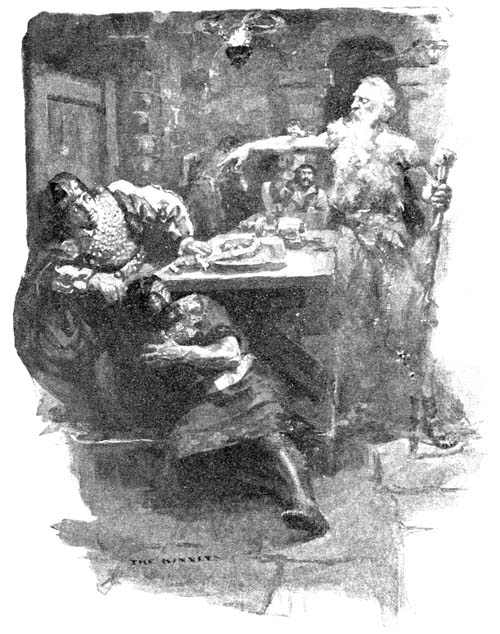
“‘Give him the maid, Franz, and all the fiends
go with her!’”
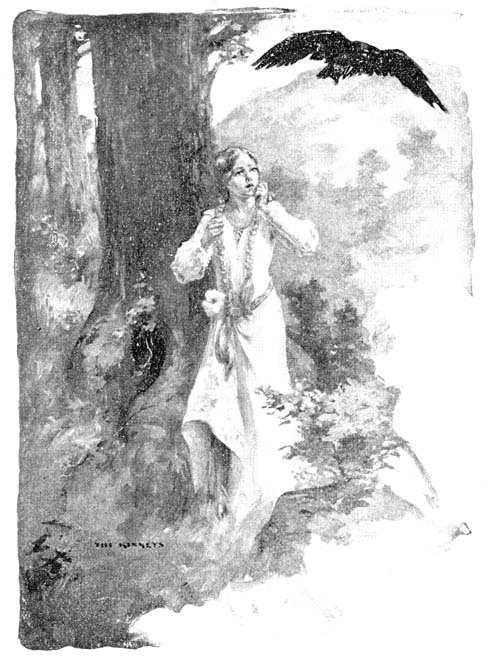
See page 33.
“Give him the maid, Franz, and all the
fiends go with her!”
So ordered Ulrich, and Franz complied
whilst his great knees beat together and his
ill-deeds stared large at him. Some cried
“Blessing!” “Absolution!” others. One
of the wicked women knelt and kissed the
skirt of the sheepskin as Jerome swept out
with never a word to them all. That the
feast flickered out in silence and trembling
sobriety, there is small need to tell.
But Jerome led the little maid through the
wide courts, where other revellers cast timorous
eyes on them, under the spiked portcullis
(where the warder was crossing himself on
his corselet) out into the black span of the
night, with only the stars and the moon and
the wind to bear them company.
As for the maid herself, it had all been one
whirling dream since noon, when the Baron’s
men had stopped her escort under the greenwood.
Happy was she, in that she was too
young to know all that had passed, but not
too young to fear lest she were dead, and
had passed to some world not heaven. Yet
the dream was not wholly evil now. Though
her companion did not speak, she knew that
he was a friend. When the castle was high
above, and the great woods thronged all around,
she grew bold enough for a question.
“Who are you?”
The hermit did not reply. In his heart he
was repeating an awful warning, “Fear the
Tempter now, Jerome; you lead by your
hand—a woman!”
“Who are you?” repeated the little maid;
“for I think you are surely God, since God
looks like a tall and noble man with a long
white beard, and all the wicked like Baron
Ulrich haste to obey him.”
“Do not blaspheme,” commanded Jerome,
swift as an arrow, almost casting off her hand;
“I am the most sinful creature under heaven.”
“Then you are the Devil. I have heard
the Abbess call him ‘The Old Man,’ too, yet
I think Baron Ulrich would never fear the
Devil.”
“Hush, daughter!” ordered the hermit,
groaning gently at the manifold tribulations
he saw awaiting; “my name is Jerome of the
Dragon’s Dale. Your poor mind wanders
after all the griefs of the day. Now how
were you christened?”
“Agnes; and my father is Graf Ludwig
of the Harz.”
“Agnes—that is a good name for a maid.
I knew an Agnes once—”
“Your own child?”
“She was—” but the words seemed to
come almost as a sob; and with instinctive
delicacy the girl feared to press her guide
with questions.
In silence they went down into the very
deeps of the forest. Agnes scarcely saw the
glimmerings of moonlight under the matted
trees. She heard the noise of hidden beasts,
the whirl of hidden waters. Then her guide
felt the hand drag heavy in his own, and he
bent over her.
“What is it? Why do you draw back?”
“Pixies are here. I am afraid.”
“There are no pixies here; yet if there
were, they are not for dread. A Christian
maid need only fear the wrath of sinful men.
So say ‘Our Father’ and be brave. Yet you
grow weary?”
“Yes.”
The strong frame bowed. The hermit
lifted his prisoner in his mighty arms. How
light the form! Something that sent a thrill
all through him touched on his cheek,—the
soft hair of a maid. His stride grew longer.
Presently on his shoulder, close to his ear, was
a sound. He halted at the break in the trees,
where spread the moonlight. No room for
doubt; utterly worn, even whilst he bore her,
Agnes was in the child’s safe refuge,—sleep.
As Jerome moved, he also deemed himself
a dreamer. He, Jerome of the Dragon’s
Dale, was taking to his hut a woman! What
matter if that temptress was a child, robed in
white innocency and helplessness? She was
not less the daughter of Eve by whom our
fathers fell. Bear her to Witch Martha?
But that unholy woman’s den was two good
leagues away, and then what right had he to
put this Agnes’s soul in eternal jeopardy by
casting her into company with that familiar
of Satan? Jerome felt the warm breath and
the soft hair, and saw in the black shadows
the form that trusted him.
“She imagined you were God!”
Then he said in his heart that this was one
of Christ’s little ones, and that he must be
strong in temptation. By the time he had
reached the Dragon’s Dale the burden in his
arms had grown heavy. Unhesitant he
threaded the familiar path, and mounted the
slope. Before the hut still glowed a few red
embers. He took the maid inside, and laid
her on the furze bed. She folded her hands,
sighed prettily, but did not waken. Jerome
stole from the hut, then fell on his knees to pray.
“O Lord God, why hast Thou appointed
that I cannot beat back memory! It all
awakes! Ah! save me from new temptation.
I cannot bear after so long that I should fail,
and pawn once more my soul and the soul of
Sigismund, my son!”
CHAPTER IV THE DOVE AT THE DRAGON’S DALE
WHEN Maid Agnes passed from
dreams to the first slow waking,
she did not open her eyes. Beneath
her head was something soft
and fragrant,—balmy furze and the sweet
boughs of pine. Outside and all about was a
crooning, witching sound,—the great pines
and beeches talking. Memory throbbed back;
but memory without a pang. Journey, fray,
blood and slaughter, the Wartburg and its
godless crew, all seemed an hundred years
away. She could look back on them calmly,
gladly, as do the saints on high upon the
distant pains of the little, fading earth. Where
was she? She did not know; still less did
she care. Outside the pines kept at their
sighing and talking. She could almost catch
the words. Far, far away, as from a distant
world, pealed out a bell,—the matin-bell of
Eisenach; she stirred and opened her eyes.
The little hut was dark, but athwart the doorway
streamed a golden sunbeam enticing her.
Short was the toilet; she was outside the hut.
The great trees were bending overhead.
Through the rifts in the boughs peered down
the blue of clearest heaven. No human form
was in sight, but before the hut a noble flame
crackled; trees before, behind, to right, to
left. But all was peace, and every tree seemed
as a friend. Now her ears caught the noise
of rushing water. A step down the slope
brought her to a rill, where leaped a streamlet
clear and cold from its fountain. She bathed
hands and face in the little pool, and saw the
buttercups drifting as tiny boats across the
water. In the twinkling mirror she saw her
own softly moulded face, and bound back
the flying gold-brown hair. Then at last
she knew she was hungry, even in heaven,
and looked about her.
Feet were crunching the dead leaves of the
forest. Out of the coppice came a man,—her
deliverer of the night before. She ran to
him with beaming face, and held out her
hands.
“Oh! It is you who saved me from Baron
Ulrich; and I know now who you are. My
wits were straying last night, but to-day it is
all plain! We are near Eisenach, and you
are Saint Jerome of the Dragon’s Dale.”
“Who declared that?” and poor Jerome
was wondering whether to open his arms and
welcome the vision into them, or to flee as
from the embrace of Satan arrayed like an
angel of light.
“The Abbess at Bamberg; and My Lord
the Prince Bishop has written concerning you
to Rome, to the Holy Father. Ah! saint you
must be, that Baron Ulrich should thus dread
you! I remember all now!”
Jerome did not answer. So his fame had
spread to Rome! Well that Witch Martha
had not told all this, or his visit to the
Wartburg would have cost yet sorer mental
wrestlings than it surely did! Agnes came
very close to him, and still with both arms
wide.
“Ah! my father Graf Ludwig is a strong,
rich man, and will reward you,—but what
do I say! Are you not a saint, and what
would be gold or lands or vassals, when the
dear God is giving you a great fief up in
heaven! Yet I must do something.”
They stood eyeing one another—those twain—like
two champions in the lists. Then the
maid, reckless through youth and love, caused
Jerome to be tempted of the Devil.
“Oh! it will not be so very wrong! even if
angels come each night to kiss you! I must
kiss you too.”
And so she did, putting her arms about
him, and kissing his shaggy lips, and saying
all the cooing tender things which spring from
the heart of a child. Jerome did not thrust
her back. He told himself that here was a
last test sent from heaven, to see if he could
endure the kiss of a maid, and never yearn
for worldly joys thrust by. But he did not
return the kiss, and she added, a little grieved:
“You are not angry with me?”
“No, daughter, no; but are you not
hungry?”
“That I am.”
Jerome took from the wicker basket which
he bore six speckled trout, his morning booty,
cleaned dexterously, and soon, spitted on twigs,
they hung above the fire. An instant later
Harun burst through the thicket, in his mouth
a partridge. But Agnes gave a little shriek,
and made to fly.
“A wolf!”
Jerome assured her with a nod.
“He never harms.”
“But wolves are evil beasts;” and Agnes
still shrank, as Harun laid his trophy at his
master’s feet.
“The only evil beasts are men.”
“I forget that he is a saint,” said Agnes,
under breath, “and all things of the forest
must obey him.”
So the partridge broiled beside the trout,
whilst Harun dutifully waited for the bones.
Jerome brought forth bread and cheese,—the
simplest meal in Agnes’s life. What would
my Lady Abbess at Bamberg think to have
a beech leaf in her lap, in lieu of a fair white
napkin from Flanders? But was it hunger
which made all taste so good, or was it that
a real saint had asked God’s blessing?
After the feast was over, Harun shambled
away into the wood, and Agnes looked at the
hermit, questioning.
“What am I to do?”
“Go where you will; follow down the
stream, but stop when you come to the close
gorge of the Dragon’s Dale. If you never
quit the brook, you can never get lost. When
you are weary, come back.”
So she kissed him once more, and clambered
down the hillslope, whilst Jerome
straightway took out the scourge as antidote
for earthly imaginings.
But Agnes found all the groves and hills
one kingdom of delight; for what bad sprites
dared dwell so near a saint? Upon the
boughs grave thrushes winked down at her;
little green snakes shot in and out the grass.
Once she pushed back a bush, and came face
to face with two bright, gentle eyes,—a
cow? what cow had ever horns like these?
A snort, a stamping—away scampered the
deer, and she heard him leaping through
thicket on thicket. She followed the stream
past tiny pool and waterfall till she halted at
the mouth of the Dragon’s Dale; for here she
was sure the holy spell of the great saint ended,
and gnomes and goblins ruled in that serpent-like
ravine. So she turned back, with pleasures
enough in the forest, until suddenly she
came on a human being,—a quaint little
woman, seated on a log, with two ravens
croaking on her shoulders. The little woman
(despite her round waist) dropped Agnes a
very deep courtesy, called her “my gracious
lady,” and seemed as much a gentle-woman
as the Abbess herself, notwithstanding strange
costume and stranger resting-place.
“And are you a holy woman too?” asked
Agnes, when the first edge was off her wonder;
“for you are not at all like to Jerome?”
Here the little woman rocked with laughter
till the woods reëchoed, and a redbreast
whirled out of a beech in fright.
“Who are you, then?”
“Call me Witch Martha.”
Agnes began to grow pale about her lips;
but the new friend assured her that hers
was only “white magic,” that she was as good
a Christian as any in the Thuringerwald,
and that all her elves and dwarfs were second
cousins to the angels, only they could not
live up in heaven because of a little swarthiness
of their skins. Then Witch Martha drew
Agnes down upon her log, and before long
the brown head was in the little woman’s lap,
and soon Martha had heard all of Agnes’s
brief life-story,—how her mother had died
when she was a baby, and how she had always
lived at the great Abbey of Bamberg,
under the special eye of the noble Abbess,
who was the Prince Bishop’s own sister. As
for her father, Graf Ludwig, all Germany
knew that he was a great prince in the North
Country, rising every day in favour with the
Landgraf of Thuringia, and with the new
Emperor, Rudolf of Hapsburg, and with them
trying to end the “stirrup law” of Ulrich and
his kind. Agnes had never been far from the
convent; she knew rather less of the world
than Martha’s winking ravens; she could
embroider, sing, read a little Latin, and illuminate
a missal. She had seen her father
only twice. He was a grand, tall man, very
fierce, but magnificent; something about him
reminded her of Jerome the Saint. But he was
no saint,—Our Lady pity him!—he was too
fond of forays and tourneys, for that! Nevertheless,
Agnes was very proud of him; and at
Goslar—whither he had summoned her—no
doubt she was to live in state like an Elector’s
daughter.
Witch Martha only nodded her wise head,
seemed to ask few questions, really asked
many, and found out all she wished to
know.
“Has your father always lived in the North
Country?”
Agnes thought not. The nuns at Bamberg
had never told her much about his early life,
because, forsooth, they did not know themselves.
But old Sister Barbara had once said
that the Graf had surely been in Italy and
even in the Holy Land, and Sister Elizabeth,
the faultfinder of the nunnery, had added
that much travel amongst the paynims had
surely brought him into perilous disregard for
his soul. But the Abbess had ordered “silence,
and no chattering of things whereof
few save the Recording Angel knew certainly.”
Then Agnes had her own question. Who
was Jerome? Had he always dwelt by the
Dragon’s Dale? Was he not of all men
very holy?
Witch Martha answered with all seeming
candour that there was no man from Pomerania
to Swabia more loved of God than he,
so that Saint Gabriel had lately assured Saint
Raphael how he had heard our Father say
that when Jerome went to heaven he was to
be His archchancellor, just as the Bishop of
Köln was to Kaiser Rudolf. Nevertheless
Jerome had only been by the Dragon’s Dale
these seven years, but since coming he had
charmed the wolves, the foxes, and the red
deer so that they all served him like so many
varlets.
“Yet who is he?” would ask Agnes; “was
he never young? For I can never think how
he looked when once a child, as I can think
of you, Witch Martha.”
The little woman seemed to shiver and to
sigh, as if she, too, had a war with memory,
but answered:—
“Only Heaven knows his age, and Heaven
will not tell! Yet I think this,—that once he
was a man of strong deeds and of blood, like
Graf Ludwig; that he has been in many distant
lands, for he speaks the paynim tongue
even better than the German. And I think
that once he had a son.”
“A son? A little lad?”
“No; for his son had grown to be a tall
knight, and though Jerome keeps all hid, I
think that father and son had a bitter quarrel,—they
parted in anger, and soon after the
son died, still cursed of his father. Therefore
Jerome has God’s anger weighing upon him
heavily, and he fears for his son’s salvation.”
“And on this account did Jerome turn
saint?”
“I think so.”
Agnes sighed and looked wise.
“It must be hard to learn to be a saint;
yet now he must enjoy it. Still, I have not
seen him smile. Surely they must smile up
in heaven. Saint Peter and Saint Paul, Saint
Lorenz and Saint Sebastian,—Sister Rosala
said that because they had toil and martyrdom
on earth, they never lacked good wine and
merry minne-lays in their great castles in the
Golden City.”
“No doubt she is right,” quoth Martha,
laughing now, though strangely enough her
laugh seemed close to tears; “but our Saint
of the Dragon’s Dale is not raised to heaven
yet.”
CHAPTER V JEROME IS TEMPTED OF THE DEVIL
WHEN Agnes came again to the
hut, she saw no sign of Jerome.
But Harun was there, and for a
moment maid and wolf looked on
one another, questioning; each meditating
whether to make friends, or to fly incontinently
into the forest. Agnes had learned
by heart Sister Rosala’s tale of the big demon
Elemauzer, who liked nothing better than to
scamper over the world in the form of a
tawny wolf, to snap up juicy girls; while
Harun’s knowledge of human kind was
summed up in Jerome, Witch Martha, and a
certain poacher who twice had nearly winged
him with an arrow. But there seemed nothing
demoniacal in Harun, and nothing dangerous
in Agnes. Therefore, Harun drew
near very timidly, wagged his tail, let his red
tongue hang out and puffed in friendship,
whilst Agnes still more timidly put a small
hand betwixt his ears and stroked him. Then
from armed truce sprang peace, from peace
came comradeship; and before either knew
it, Harun was drowsing on the greensward,
sinking deeper and deeper into slumber, and
Agnes’s gold-brown head lay on his tawny
shoulder. The great boughs far above never
ceased their talking, and gossiped louder as
the south wind, kind and warm, sung over
the summer forest. The wood-thrushes
whistled in and out; over Agnes’s face great
bumblebees buzzed closely, half wondering
whether in her red lips there lurked no sip
of honey. But she never heard their pragmatic
droning, for Harun, sly protector, gave
his tail a mighty slap which sent the bees
away to less safe-guarded flowers. So noon
sank down toward evening. The shadows of
the pines were longer, longer. The breeze
had sung itself to sleep, and all the woods
grew still. Then through the fern-brake
stirred Jerome, walking tenderly,—for he
would not needlessly crush a dewy blossom,—and
stood beside the silent pair.
Jerome had been over hill and dale to
Witch Martha’s dwelling with the laudable
desire to acquaint that uncanny woman concerning
the results of his mission to the Wartburg,
and to bid her seek out some one who
could communicate with Graf Ludwig and
take the child away. He was sorely tempted
to deliver Agnes to Martha, and so rid himself
of all temptation. Again he told himself it
was no safe thing to trust a little maid to one
who might sell her protégé’s soul to Devil
Baalberith for two Bremen shillings. Martha,
however, for her own reasons had remained
abroad, and Jerome, when the sun sank,
turned homeward—his charge could spare
him no longer. Yet not altogether regretful.
Something, some one, would be awaiting him at
the hut. He would hear a voice,—not his
own, not Harun’s shrill bark, not the cry of
the wood-bird. He would look into human
eyes, he would feel a hand, he would—“Ne
nos inducas in tentationem,” prayed Jerome;
“plain, plain it is, Lord, Thou hast given me
over to Satan, even as Thou didst Thy servant
Job, to see if I can endure all and stand.”
First he looked in the hut, and was troubled
at finding no form upon the furze bed; then
beside the tall tree he saw the sleepers,
and almost ere he knew it his lips were
twitching in a smile,—O maximum peccatum!
O gaudium impium! Joy, not at the contemplation
of the beatific vision, but at sight
of a noxious beast and of a mortal maid!
Nevertheless, as he stood over them, these
were the words which seemed sounding.
“And the sucking child shall play on the
hole of the asp, and the weaned child shall
put his hand on the cockatrice’s den; they
shall not hurt nor destroy in all my holy
mountain.”
But Jerome only told himself that Satan
could wrest Scripture as fairly as an angel;
then fortified against temptation he touched
Agnes.
“Awake!”
The heavy eyes opened, stared around.
“Ah! but the shadows are long! It grows
dark,” said she all wondering, whilst Harun
rose and shook his coat free of the pine-needles.
“Yes, you must have slept soundly. It is
time to eat;” and Jerome busied himself
about the supper,—more trout, bread, cheese,
and the remnants of the partridge. He
studiously refrained from glances at Agnes,
and never spoke save as he must. When the
meal ended, Agnes held her pretty head first
this way, then that, and followed with a
statement.
“I met a woman by the brook.”
“A woman? of what kind?”
“A fat little woman all in black, with two
big blacker ravens.”
Jerome frowned. “Then you have met
Witch Martha. She has commerce with the
Father of Lies; shun her carefully or you
can never go to heaven.”
“Oh, but she did nothing wicked. Her
speech had far more about Our Lady and the
Blessed Saints in it than you hear with the
sisters at Bamberg.”
“Her tongue may have a jargon of piety,
but her soul is given to Satan.”
Agnes sighed. Jerome was a saint, and he
ought to know. Yet it was perplexing to
understand that so prepossessing a woman as
Martha had stricken hands with the Devil.
Presently Agnes began again.
“Holy Saint Jerome, why do you never
smile?”
“Have I not told you I was no saint?”
and he waxed almost angry.
“Witch Martha and My Lady Abbess say
that you are, and I believe they, not you, are
right.”
There bubbled to Jerome’s lips an imprecation
against those two women which might
have seemed worthy of Baron Ulrich’s self.
Jerome checked it just in time. “At least,”
he comforted himself, “the arising of such
blasphemies in my heart proves that I am
still a naked sinner.”
“Maid Agnes,” said he, severely, “Witch
Martha and the Abbess prattle folly. I am a
very wicked man.”
“Is it for that cause you will not smile?”
“Yes;” but he knew she was incredulous.
“Not even if I weave these purple asters
and buttercups in a wreath, and set it on
your head?”
He did not answer. Conscience told that
he ought to rebuke her for tempting him
from holy meditations. Why disobey the
dictate? Yet he did. She made the wreath.
He felt the little flowers upon his hair. He
felt the touch of her soft hands upon his
cheek; and her eyes looked straight into
his.
“Smile!” she commanded, as she might
address Harun; “do you hear me, smile!”
And Jerome—that saint adored through
wide Thuringia—obeyed her. He smiled;
he almost laughed; but—praised be Saint
Simeon—grace was given just to shun that!
Once more the silvery bell in distant Eisenach
knelled across the trees, calling to vespers.
They knelt down to pray. Jerome
had even forgotten to doff the flower crown.
The maid prayed in loud whisper,—to Our
Lady, to Agnes of Rome her patron saint,—then
added something more softly, but he
could hear it, “Holy Saint Jerome of the
Dragon’s Dale, pray for me.”
Why did he not rebuke her with the
thunders of Sinai? Why did his own prayer
halt? Had Witch Martha taught the maid
some guilty spell? Had the arch-fiend
taken a young girl’s shape to overcome this
hardened anchorite? But Jerome was silent,
and Agnes arose from her knees.
“How long can I stay here?” spoke she,
before she went into the hut to lie down.
“I shall try to send at once for Graf
Ludwig.”
“Oh! he can know that I am safe; but
it is lovely here! I do not want to go away.
Harun, the brook, and the birds, and the talking
trees, already I love them, but most of
all,—you.”
Then he let her kiss him good night. He
did not return the kiss; nevertheless he
groaned inwardly, knowing he was making
progress in sin. True was Master Vergil’s
word, “Facilis descensus Averni!”
As he sat in the waning firelight, for the
first time in many a month a profound loneliness
had stolen over him. Harun had
prowled away into the forest. Presently
Jerome arose, cast a fresh branch on the fire,
and stole into the hut. “I must see if she is
safe and warm.”
Through the doorway crept a silver-sandalled
moonbeam. It touched on something
round and white,—the face of the
little maid. All Jerome’s veins seemed turned
to fire, yet all that fire was ineffably sweet.
He knew the glow and ecstasy of the soul
born into highest heaven. A power not
sprung of self compelled him. He could not
resist; he would not if he could. Bending
across that face, he kissed it with his bearded
lips. Once,—and the fire leaped into more
exquisite heat; twice, thrice, four times,—but
at the fourth his soul fell down from its
high heaven, like Lucifer, son of the Morning.
He rushed from the hut, his heart torn
by demons, its fire a maddening pain.
“He, he—Jerome of the Dragon’s Dale—had
bestowed a kiss on a maid!”
Jerome had resolved not to sleep that
night. He must battle back the fiends, as
became a holy soldier. The terror lest he
had fallen utterly; lest by this one lapse the
credit laid up with God by years of austerity
was forfeit,—this was omnipresent. He
would have scourged himself, but the whip
lay under the bed of the little maid, and now
he was most certain that in approaching
Agnes he approached a form of Satan. So
he knelt and thought that he prayed; but
his head was heavy. Thrice he shook the
stupor off: but strive as he would, unholy
dreams rose uppermost. Women were rising
before him, foul and pure, hideous and beautiful.
Was it the Blessed Virgin enringed by
a host of glittering spirits who was beckoning,
who was calling him? No; he knew her
now,—it was the Norse King’s daughter,
the golden-haired Trolfreda, and the wind
that hummed about blew not from the crystal
river but from the blue breast of the wild
North Sea. Again she was changed,—she
was Ada of the Silver Belt, and he rode into
Orleans at her palfrey’s side, whilst bright
tabarded heralds cried him the stoutest knight
of the Loire; but his fairest glory was in the
lady’s eyes. Yet again the heralds wore
crimson turbans, their faces were black, in
their hands boomed paynim atabals. The
church spires were spindling minarets. The
air was sweet with the musky breath of desert
sands. It was not Orleans, but Al-Cairo
by the Nile. Obaëdah was leaning down
from the swaying camel. He could see the
gemmed bracelets twinkling upon her smooth
brown arms, the gold upon her raven hair,
the rosy lips which parted in the snaring
smile. And then back to the tourney at
Naples: Kaiser Frederick, crowds, plaudits,
crowns,—and Mathilde,—the walk with
Mathilde by the sea.
He woke from the vision with a scream of
mortal pain. The black woods rang; a frightened
bird whirred from her nest. Jerome
never knew it. He was in cold sweat from
foot to crown, and trembling. So far from
praying he had given place to sinful lusts.
All the passions of the old life surged back in
one fierce wave. The repression of years had
gone for nothing. His sins stared him tenfold
blacker than the night. Again on his knees
he prayed out loudly:—
“O Lord Jesus Christ, if Thou hast any
mercy, take far from me this maid, or my
soul and the soul of Sigismund my son are
lost forever! Thou knowest how I am
tempted past endurance. For surely Beelzebub,
Sifter of Souls, has sent this child to
bring back every ungodly wish and thought.
Her power on me is grown so strong! Away
with her, Lord! in Thy Blessed Mother’s
name,—away with her! or I know not what
to do!”
So he prayed long and loud, never heeding
whether any ears save those of the wood-birds
heard him. He never recked a single, soft,
sobbing cry, and the noise of feet receding in
the forest. Then came sleep,—as wicked as
before. He sank away with a godless song
of Walter von der Vogelweide trolling in his
ear,—a minne-song in praise of love and
laughter in springtime. When he awoke, lo!
the ruddy dawn was tinting the greensward.
The fire was dead. By instinct he ran to the
hut. Empty. He called the girl.
“Agnes! Agnes! Where?”
No answer came. The shouts died down
the avenues of trees. He hunted near. He
hunted far. The maid had vanished in the
night. He should have thanked our Lord
his prayer was so swiftly granted. He did
nothing of the kind. He was almost cursing
Heaven for making his petition good. With
eyes aflame, with heart nigh leaping in his
throat, he ran toward the Dragon’s Dale. He
must find the maid,—yes, though to find
her he bartered his own soul and his son’s.
CHAPTER VI THE HERALD OF THE KAISER
THE Wartburg was in commotion;
men ran this way and that through
barbican and bailey. Michael the
Breaker looked to see if the portcullis
was ready to drop at a hatchet stroke.
Franz of the Ram’s Pate brandished a battle-axe
of three stone, and Priest Clement clapped
on a helmet.
A herald had come to the Wartburg. He
wore the Imperial arms, the double eagle of the
Hapsburgs upon his orange surcoat. He reined
his white mule at the gate of the Vorburg,
and wound a long blast upon his silver horn.
Then his roaring summons roused all the castle.
“Ho! Ulrich of Eisenach! come forth,
come forth and listen to the summons of your
liege lord and emperor!”
But Ulrich safe in the inner Hofburg swore
a great oath by Saint Jacobus that the herald
might bawl until the bastion cracked before
he stirred to hear him; and the herald, having
waited duly and gotten only curses through
the loophole, completed his proclamation.
“In the Name of the Blessed Trinity, Amen!
“I, Rudolf, Crowned of God, Emperor of
the Romans, Graf of Hapsburg, and Freiherr
of Argau, to Ulrich of Eisenach, and all who
follow him,—greeting:—
“I do summon you to appear before my
assize at Goslar, on the third Monday hereafter
following, to answer by what warrant you
do hold this castle of the Wartburg to the
detriment of its lawful master, our well-beloved
cousin the Landgraf of Thuringia; and
by what warrant you have halted, robbed, and
slain divers of our loving subjects upon our
highways, in violation of our Imperial peace.
“And especially we command you, under
pain of our most condign displeasure, to deliver
instantly to this our herald the noble
lady, Agnes, daughter of our trusty vassal
Graf Ludwig of the Harz, whom you do detain
in most unlawful custody.
“And each and all of you who shall defy
these our commands, we declare under our
Imperial Ban, and as such our loyal subjects
are commanded to apprehend or extirpate.
Also by the special authorization of the holy
Apostolic Inquisitor, the Archbishop of
Mainz, we declare all contemners of our
decrees excommunicated from the sacraments
of Holy Church.
“God save Kaiser Rudolf!”
So cried the herald; and when no intention
was manifested of delivering up the Lady
Agnes to him, he blew another great blast,
and rode down the steep to leave Baron
Ulrich and his merry men clear at their wits’
last end.
No one could doubt that the extermination
of Maid Agnes’s escort had been incomplete.
Some one had escaped and told Graf Ludwig.
The lion was unchained in very deed!
In the great feasting hall the council met, but
there was no wassail now. Ulrich’s scarred
face was black with rage and dread. Priest
Clement had nearly forgotten his scraps of
Latin. The situation was plain enough. All
through the wild and wicked years following
the death of Frederick the Second, Thuringia
had belonged to the bandit barons who had
watched the roads and ruled by “fist-law.”
The power of the Landgraf had sunk to a
shadow, and Ulrich and his crew had held
the Wartburg for a decade. But there was a
new kaiser now who had begun to end the
merry dance of devils. Rumours blew north,—how
in Swabia Kaiser Rudolf had beaten
down castles and hanged many a reckless
“ritter” on the pine tree facing his own
smoking keep. And Graf Ludwig, the
Imperial Vicar, had come to Thuringia
with a goodly force to do the very same
deeds; therefore My Lord Ulrich had his
food for thought.
“How many men will the Graf bring?” he
was asking.
“I have heard said,” quoth Michael, sullenly,
“he has more than two thousand, with
battering mangonels, likewise a band of English
longbowmen who came with Duke Richard
of Cornwall and remained. No crossbows
can match their archery.”
“And we have an hundred and twenty dogs
at most, and the Wartburg, though strong, has
a vast circuit to defend. If cleared of this
plight, I vow Saint Moritz of Coburg a chalice
of heavy gold! Is that overdear for the
worthy saint’s aid—eh! Clement?”
Ulrich leered at the priest, and the holy
man twisted his nose, while meditating. “A
pious vow, noble Baron, a very pious vow!
Nevertheless,—humph!—what did you say?
How long did you think we could make good
the castle?”
“Two days at most,” snarled Michael,
crossly.
“Two days, and then to heaven!” ran on
Clement; “will the ladder be axe, sword, or
rope? Ah! Gratias Deo,—a thought!”
“What?”
“That the wench Agnes is still with the
hermit. It is wrong to outrage a saint sed
necessitas non habet legem; and we can also
add a trifle to the weight of the chalice. In
brief, seize her from the hermit, hold her
hostage; and when the Graf comes, force him
to promise us at least our lives in exchange
for her safety.”
“The saint will rage,” objected Michael.
“If your wisdom knows a better salve
against the little pains of hanging, I am listening,”
laughed Clement, dryly. Whereat
Ulrich leaped up with a jangle of armour.
“Priest Clement has the only sense. Be
Jerome saint or devil, he must not keep the
maid. Out, every man and lad; arm heavily,
and away to the Dragon’s Dale!”
Therefore it befell that an hour later, just
as the sun was scattering the last mists of the
morning, the Baron led out his force,—an
hundred odd of as hardened sinners as ever
put on harness. Nevertheless it took all his
oaths, and the well-grounded fears of a swift
voyage to a nether country, to make the
file advance when they began to enter the
charmed region around the Dragon’s Dale.
When they reached the cross where burgomaster
Gottfred had been stricken, even
Michael the Breaker wished to halt and pray.
Ulrich and Clement walked behind with their
lances to prod on the laggards. They reached
the mouth of the Dragon’s Dale, and every
man stood irresolute, nigh convinced that the
first wight inside the ravine would be frozen
into a black stone in a twinkling. Yet as they
scuffled and shrank, lo! straight out from the
wall of rock came running the saint himself,
his white hair spread like a lion’s mane, wild
fire in his eyes, his hands upraised now in
prayer, now in cursings.
“In the name of the Lord Christ,—where?
where?”
“Where, what?” demanded Ulrich, trembling,
but not so much as before; there was
nothing awesome in the hermit now.
“The maid! Maid Agnes, the Graf’s
daughter? She has vanished. You have
stolen her. Oh! may the curse of God light
swift on you!”
He was nigh crazed, and a mere madman
was not very terrifying. So they plucked up
courage, and stood their ground.
“Hark you, greybeard,” warned the
Baron, roughly; “it is for the wench we are
come ourselves. Do you think we would rout
you out of your accursed den without fair
cause? The maid we will have, or by the
Trinity,—” he broke off, the threat unfinished,
and glared on the hermit, who appeared
utterly unstrung. For an instant he
seemed only the shambling dotard.
“Gone! gone,” he moaned abjectly. “I
can find her nowhere. If you fiends do not
possess her, she has perished amongst the
cruel beasts.”
The Baron was brave now, and advanced
boldly.
“Here, Michael,—a cord; pinion this babbler.
We’ll hale him to the Wartburg, and
then if the wench is not found, there’ll be
tortures to wring out of him where he is
hiding her. Forward, lads; there’s nothing
dreadful.”
He snatched Jerome by the arm. Men
looked to see a bolt crash down from heaven.
None came. Jerome submitted like a lamb.
Michael and Clement were at least brave
enough to stand at either side as guards.
Ulrich led thirty of his boldest down the
Dragon’s Dale, crossbow strung, swords bare,—half
disappointed they did not meet a
fire-breathing goblin. They found the little
hut empty; they searched about the tree—only
birds and dragon-flies. Maid Agnes was
nowhere. Ulrich returning promised Jerome
smart torture if the girl was not found. Jerome
gave back not a word. So at last the Baron
started again for the Wartburg with his prisoner,
ordering the men to scatter through the
greenwood, by fives and tens, and to scour
knoll and dale for seven leagues about. Have
the hostage they must, though they sought all
night for her!
Once at the castle Ulrich ordered forth the
bloodhounds. The pack went baying down
the valley, the halloos of the hunt sounded
far and wide in the forest; but when the
lanzknechts dispersed in little bands, they
knew too well the paling dread of pixies to
pry over deeply into the secrets of the wood.
The hounds ran down all scents—but vainly.
Priest Clement swore that the Brown Dwarfs
had stolen the queen down to their underworld.
“Where, alas for her poor soul, since
they were pagans all!” he added as became
a holy cleric. The chase wandered far from
the Wartburg. Presently Ulrich, disheartened,
angry, turned back to the castle, with Clement
and Michael, leaving the rest to carry on the
hunt. Saint or no saint, he intended to test
his prisoner by torture to see if he were hiding
Agnes by some art-magic. It would be
an impious deed,—Ulrich knew it,—but
better impiety, than the falling into Graf
Ludwig’s iron clutches!
The Wartburg was nigh empty when the
Baron reëntered. In the courts some of
the slattern women had lit huge bonfires,
which roared up to the deepening sky, making
turret and rampart frown down grimly.
Franz, who had played castellan in his lord’s
absence, reported the captive safe in the
lower dungeon. The Baron cursed that no
one had advised him to shoot down the herald,
and so win extra time to prepare to face attack;
but there was only one thing to do now.
Leaving Franz and a bare dozen of men-at-arms
to patrol the battlement, he summoned
Priest Clement and Michael to fetch him
divers instruments; then with them hastened
down into the bowels of the great Wartburg
rock.
All that stone and steel could do to secure
Jerome had been done. He was in a cell
whither no sun had crawled since the building
of the Wartburg; but the hermit had
recovered his dignity. He faced the three
men of blood with a cold, stern stare, which
stole away half their courage.
“Where is the maid?” demanded Ulrich,
trying to set bravado up for valour.
“God knoweth, and in His wisdom keeps
her hid, except you have already possessed
yourselves of her, and seek this occasion
against me.”
Ulrich ostentatiously produced a mallet,
and many little oaken wedges, while Clement
raised the smoking torch. Then the
Baron’s tone grew threatening.
“Hear you, old man! be you saint or devil,
we will have the maid. Whether angel or
gnome has hidden her, and where, you know;
and by Saint Moritz”—Ulrich felt safe invoking
that martyr, in view of his vow,—“out
with her hiding-place or try these
pretty toys! Behold!”
The anchorite shrugged his shoulders with
undisguised contempt.
“Ulrich of Eisenach,” spoke he, sternly,
“I answer you on the word of a Christian
man, though a sinner, that I know not where
the maid is. Doubtless it has pleased God
to bring this thing to pass that you may rush
headlong in your sins and dash to eternal
perdition. As for these oaken splints, which
you weakly design to drive betwixt my nails
and fingers,—bethink you if a man like me,
who has endured the worst gehennas of the
paynim will flinch before your petty torments?
Or what will they profit you, save
to heat sevenfold the fires now lit for you
in hell?”
Michael had been stripping back the
sheepskin from the prisoner’s shoulder.
Then, as the light flickered over it, leaped
back in horror.
“Holy Mother! His back,—all marked
with scarce-healed scars!”
“Amen!” quoth Jerome, grimly; “those
and all other tortures are too gentle for my
sins. Yet, if I would glory after the flesh, I
can make boast that all your tortures, Ulrich
of the Wartburg, will be to me as nothing.”
“He is right,” groaned the Breaker, all
his terrors springing up anew; “we are outraging
God’s saint. The demons will boil
us forever!”
“Silence, fool,” commanded Ulrich, grown
desperate; “pass me yonder mallet, and hold
fast his wrist. We will sound the depth of
this loud boasting. Now and for the last
time, babbler! Where hide you Agnes the
maid?”
Jerome vouchsafed no reply. Ulrich was
clutching the mallet and sliver when Franz-of-the-Ram’s-Pate
burst into the prison.
Even in the gloom his face shone white as
a ghost’s.
“Up, for the love of Christ! Horses and
men are all about! The Wartburg is surrounded.”
Whereat the three raced up from that
dungeon, never waiting for the door to clash.
CHAPTER VII FRITZ THE MASTERLESS
NOW when Agnes awoke from her
sleep, when she heard Jerome
at his prayer, when she heard
him call to God to remove his
temptress,—sent to vex him by Beelzebub,
catcher of souls,—then a surge of sorrow,
deeper than she had ever known before, had
swept over her heart. She had cried once
and softly; she had risen from her furze-bed,
and reckless of everything had stolen away
into the forest. Only one thing she knew,—the
great saint hated her! He believed
Satan had thrust her upon him. She was
too sinful to bear company with this holy
man, and must flee away, far away! All her
heinous crimes rose up to stare her in the
face, the thirty Aves her confessor had enjoined
upon her, and which she had forgotten
to say, the five spice-cakes which she had
filched from My Lady Abbess’s cupboard,
and which she had never confessed at all,—these
and more foul deeds weighed down her
soul. The all-wise saint had beheld its vileness,
and called to God to deliver her to her
just possessor, Satan.
When she knew aught else the great black
woods were everywhere. There was only a
flickering will-o’-the-wisp light here—there
amongst the numberless trees. She dared not
pray. Once she screamed, but the cry was
dried up in her throat. In her blind anguish
she wandered aimlessly through thorn and
thicket, brier and brake. How many times
she all but tripped into some ravine, or dashed
on jagged rocks the angels in mercy hid, for
Saint Azrael surely guided her wild feet then,
though she thought the demons after her.
At last spent with fatigue she sank upon a
moss bank. An older person would have
tossed and moaned till dawn; happier she—once
more her eyes grew heavy. Fear and
anguish vanished. She could sleep.
When Agnes this time woke it was with a
start and with groaning. Trees, everywhere
trees. The dawn was still young. The
light was red. She was lonely, thirsty, hungry.
There came a rambling rustle from the
dead leaves near at hand. Hope leaped up
that it was Harun, but only a tawny fox
spread his proud brush and vanished, scampering
at first sight of her. In these deepest
glades of the beeches not a bird was carolling
morning.
“Jerome! Holy Saint Jerome! I am
wicked, but have pity. I am afraid of the
great woods! Oh, in mercy lead me back!”
Her shrill cry went out in mocking echoes
from an unseen dell. Not a thrush called in
answer. She sank into frightened silence.
After long waiting she gathered courage to
summon Witch Martha, but that good woman
never came. At last Agnes, made calm by
desperation, took counsel.
“I cannot stay here. I have nothing to
eat. And I dare not die of hunger, for if
I die, where is the priest to anoint me with
the oil, and absolve my fearful sins? So I
can never go to heaven. The woods cannot
reach forever. No matter which way I go,
sooner or later, I must come to some house
of Christian folk who will pity me. Only I
must walk a straight line and never turn
back.”
At least walking was easier than still agony;
and she thrust boldly in among the trees.
Before long she could quench her thirst in a
tiny brook which sang along through hazel
thickets. Then presently her heart gave
a big throb. She was upon a path, weed-grown,
leaf-strewn, yet a path, blazed through
the forest. Surely it led to men, but whether
a turn to right or left would reach a refuge
soonest, Maid Agnes did not know. Therefore
she made bold, despite her wickedness,
to say a little prayer to Our Lady, asking
her to guide the choice, shut her own eyes,
and on one foot whirled around six times;
then when she looked again, followed the
way which lay straight before her. She might
have walked the tenth of a league before a
clearing burst into view,—walls, fruit trees,
a garden, and an orchard, but everywhere
silence and desolation. Here was the blackened
foundation of a house and of two large
barns, charred and rotting timbers, grass
growing in the chinks of the mortar. The
dwelling had been burned these two years.
Yet Agnes was vastly comforted. The cherry
trees of the orchard were heavy with round
red fruit. A beam had fallen so that she
could reach to a lower bough and pluck her
fill. From the wild garden a linnet rose, interrupted
in her feast of strawberries. Agnes
had these too. The roses were climbing up
the blackened wall, and the huge bees hung
over them. Gorgeous butterflies spread their
sails, and were wafted to and fro. But for
the absolute solitude and the compelling fear,
Agnes would have found this ruin the outer
door to paradise. The sun had risen clear
and warm, and the wood was giving forth the
fragrant smell of green things growing. She
ate cherries and strawberries until hunger
was banished; then at last came time to consider
“what next?” For no human help
seemed here.
She was sitting upon the beam, her head
on two small hands, when a man’s shout
startled her like a thunderclap.
“Heigh-ho! Have we here a Queen of
the Pixies?”
Agnes looked up, and behold a man stood
by, but not a steel-capped lanzknecht of
Ulrich as first fears told her. The stranger
was a short, wiry man, very black, with
a huge mustache, a beard cut to a most
singular little peak. He was all dressed in
untanned doeskin; a hunting-bag slung on
his shoulder; in his belt gleamed twenty
steel-tipped bolts; in his hand was a crossbow.
He did not look at all fierce, and
Agnes put on dignity.
“I am the daughter of Graf Ludwig of the
Harz, and am lost in the forest. Place me
in safety, and my father will reward you.”
“Graf Ludwig! By Saint Lorenz!” The
little man made the greenwood ring with
laughter. “I have distinguished company
on my domain. And how came you to get
lost?”
But alas! the story which Maid Agnes told
her new friend was too wandering to seem to
have overmuch truth in it,—Saint Jerome, the
Abbess, and Baron Ulrich, all jumbled hopelessly
together. The fellow was only certain
that a very rare bird had fluttered by a miracle
into his net, and he was bound not to lose
such gay feathers. So he merely took her by
the hand, saying:—
“Come with me; you will soon be safe and
happy.”
“Where are we going?”
“To my cave; it is snug enough for a
princess.”
“A cave,—not a house? Who are
you?”
“My best name is Fritz the Masterless.
First I was a peasant and followed a stupid
plough, then I was a swineherd, then a man-at-arms,
then a lanzknecht and watched the
roads, but all my band was cut to pieces, saving
I, so I am now a poacher and a forest
rover, and last of all, when the saints will,
I shall be a gallows-bird, with a hemp collar
and a dance on nothing, but zum! zum!—till
then it is a merry life under the greenwood,
a-following the deer.”
Agnes hung back.
“You are an evil man,” she said soberly;
“I will not go with you.”
“And be left to wander under the trees,
with never a house within these three leagues.
Hoch! No, little lady; there is nothing
gained by that. Come you do, will you, nill
you.”
The clasp on her hand tightened. Agnes
knew resistance was vain. She followed
silently, but her lips twitched. Oh! if she
had been only sinless enough to dwell with
holy Jerome.
In the deeps of the woodland Fritz the
Masterless had his hold,—half cave, half hut,
under the towering Rothenstein,—a cliff of
gnarled red rock. Here Gerda, his strong-armed,
swarthy wife, came to him, with Wolf
his eldest, a sinewy lad of fourteen who could
run like a rabbit, and also the pair of younger
girls, coarse, tow-headed wights, who resembled
Maid Agnes as two mongrels do a Castilian
spaniel. They surveyed the father’s
booty with rude, gaping eyes, and Gerda
sought greedily to see if the stranger wore no
precious ring or jewelled crucifix; but Priest
Clement had done that work too well, and
she was disappointed. However, there was
no doubting the value of Fritz’s catch. Such
white skin and hands! Such silken hair and
dainty face! She might be the Kaiser’s own
daughter; and her dress, if sadly torn, was
of very silk from the great Cham’s own
country!
Agnes bore all more steadfastly than one
might dream. There was a ritter’s red blood
in her veins if she had been reared in the
Bamberg convent. She protested stoutly
that she was Graf Ludwig’s child, until Dame
Gerda began to believe there was some fire
behind so much smoke. So leaving Agnes to
Wolf and the girls, she drew Fritz beyond
earshot.
“She does not lie. She is the Graf’s own
child. And Ulrich of the Wartburg is back
of her plight, I am bound.”
“Humph!” commented Fritz; “it is a
parlous thing to have dealings with the Graf,
or with Ulrich either. Ulrich will hang me
for taking his deer; the Graf for watching the
roads. I am none too anxious for a voyage
to purgatory that I desire to send a message
to Ludwig, ‘I have found your daughter.’
He will come with five hundred men in lieu
of ransom, and my best reward will be a long
drop to the slip-noose.”
Gerda considered wisely.
“Such white skin and hands! There is a
fortune in her.”
“Out with it then.”
“Wolf shall go to Eisenach to Mordecai the
Jew. He smuggles many a wench south to
Italy, though the saints know what becomes of
them then! He will give us round groschens
for her.”
Fritz frowned. His conscience troubled
him, though only a little.
“If only Mordecai were not an unbeliever!
It is wrong to deliver Christians into the
clutch of infidels. I have heard he sells his
women as far as to the Muslims.”
But Gerda had only a hoarse laugh.
“Pray for her soul if you will! One must
live; and I will not see so much good silver
glide out of my fingers vainly!”
Therefore her spouse reluctantly consented,
and presently Wolf had his orders,
and went away slyly northwards toward
Eisenach.
Agnes was left in company with the girls.
They gave her venison, and let her share the
broth, which they all dipped with wooden
spoons out of a great earthen pot. Her new
acquaintances were decently respectful,
although coarse enough in speech and life, to
make their poor guest plagued indeed; but
she needed little hinting that they were no
friends, and that any attempt at flight would
be hindered. The greenwood was still about
Agnes; but it was only a hateful prison now,
not an enchanted realm of cousins to the
angels, as it was around the Dragon’s Dale.
Late in the afternoon Fritz came in with a
long face.
“Men and hounds are out in the forest.
They are beating up all the coverts. Ulrich
has ordered a boar hunt. We must lie close.”
“‘Back to witch Martha; back! Fly fast, as you
love me.’”
So Agnes perforce, crouched with the rest,
in a cavern up the rock-slope, until the clear
hunting-horns died away in the distance, and
Gerda began to thank the saints. As the
gloaming fell, Wolf returned, and whispered
to his mother that the Hebrew would set
forth at dawn, and would be glad to haggle.
Agnes did not hear the words, but she saw
the glint in Dame Gerda’s eye, and a cold
shiver ran down her spine. The vagueness
of her dread redoubled all the terrors, and
hating all the rangers’ loathsome company,
Agnes wandered out a little way across the
narrow meadow before the cave-hut. Wolf
watched narrowly, but she did not try to flee
away. Seated upon a stump she was watching
the play of rosy light upon the scarred
face of the Rothenstein,—when a whir of
wings sounded, and whisk! something
alighted upon her shoulder, then a voice, but
not human:—
“Ho, he! Never fear!
I’m Satan! I’m here!”
“Zebek,” cried Agnes, “oh, joy!”
The raven was welcome as a brother.
Then the bird cocked his wicked head, and
winked his sage eye, with which winking
came a thought. To pluck the white lace
from her wrist, to twine it round the raven’s
foot,—this was the deed of an instant.
“Back to Witch Martha; back! Fly
fast, as you love me.”
And Zebek,—wise beyond many a mortal,
obeyed instantly, rising with one croak.
Fritz levelled in a trice; “whir” went the
bolt, but it was growing dark. One feather
fluttered to the grass; another croak from
mid-air. Zebek was gone, winging straight
west. Dame Gerda looked as black as the
bird, when she came from the hut.
“A raven, ill luck,” spoke she, and scolded
Fritz and Wolf; “to slay a raven worse luck;
but a vain bolt at a raven the worst luck
of all. The bird will bear the grudge, and
hatch us foulest weather.”
CHAPTER VIII GRAF LUDWIG
THE trap had snapped. Ulrich of
Eisenach was in it. He had
doubled the vow to Saint Moritz,
but with no avail. In the last
twilight the frighted watchers at the Wartburg
peered from their turrets, and saw the dim
masses of horse and footmen spreading themselves
around the mountain,—hundreds,
thousands. Graf Ludwig had been nearer,
and in greater force than any lanzknecht
dreamed. The Wartburg was ringed in by
foes.
But this was not the worst. Ulrich’s men
were still beating up the forest, and the
Graf had silently cut off their retreat. As
they wandered home in sullen handfuls,
cursing the bootless hunt, his sentries had
nipped them, nearly all, taking prisoners after
few struggles and fewer blows. Only two,
slyer than the rest, had crept through the
besiegers, and into the postern, with a tale
which made Priest Clement’s teeth chatter,—how
Ludwig was at the gates with nigh three
thousand men.
Ulrich had felt hard knocks from the Devil
ere now, but this was the hardest. The Wartburg
was a very Emperor of castles,—provisioned
and garrisoned by eight hundred, it
could hold Kaiser Rudolf at bay. But inside
the walls the Baron could barely count on
twenty men fit to strike a blow, and the
sluttish women were good for nought save
screaming. Ulrich dropped the portcullis,
placed a catapult to command the gate, and
set boxes of arrows along the ramparts to
insure ready ammunition; but how were a
score to defend the long circuit of the battlement?
The moat was almost dry. At dawn
the Baron could kill a few attackers, but by the
third hour after he knew well enough he would
be voyaging toward heaven or elsewhere.
Desperate enough was every one in the
Wartburg. As the night blackened, their
mood blackened also. The sky was thickly
clouded, starless, and moonless. A murky
hot wind fanned from the south, dead and
stifling,—“fit reminder,” so Michael forced
the jest, “of the breeze likely to blow in their
next habitation.” Priest Clement, who stood
beside him on the gate tower, trembled all
over at the impious levity.
“Do you not fear God? Are you so anxious
for torment?”
“Humph!” grumbled the Breaker; “as
much as you, holy Father. But I would have
small respect for God if He were to forgive
you or me now. We have made our bargain
with Satan as do all fools, ‘for a short life
and a merry one,’ and none should whine like
a puppy if the landlord demands the ‘drink-penny’
at last.”
“You mean our souls?” moaned the
priest.
“Very likely; ha! what is that?” and
Michael levelled his crossbow into the dark.
From the gloom below the gate came a deep
voice.
“Ho! Ulrich of Eisenach; attend!”
“I am listening,” bellowed the Baron from
the tower; “who calls?”
“I,—Ludwig of the Harz; hear now and
all your men! I command that you surrender
the castle at dawn, that especially you deliver
up to me, instantly and unharmed, my
daughter, the Lady Agnes, likewise the holy
hermit Jerome, whom your men say you hold
prisoner. Your naked state is known to us.
Escape is impossible. Surrender now, and I
promise your lives and liberties, with no more
penalty than the trifling striking off of your
two thumbs, that you may never more draw
bow, or swing longsword; if not—”
Ulrich’s voice tossed back an angry answer.
“As for the Lady Agnes she is not with us.
As for the hermit, when you storm the castle,
we slay him. As for our thumbs they will
swing our swords long enough to make your
attack cost dear.”
“Liar—do not say my daughter is not in
your foul hold.”
There was a ringing menace back of the
word, which made even Ulrich quiver, and he
turned to Franz.
“Go you and one other. Bring the hermit.
Set him on the battlement. We will make
him declare we have not the maid.”
So whilst defiance passed they brought
Jerome, told him how the land lay, and the
Baron unsheathed a dagger.
“Speak him fair now, or take home this!”
and he pricked with the point, but even in
the dark they saw the hermit’s grin of irony.
“Think you I am a child to fear the taste
of steel? I say to you again,” and Jerome’s
voice was almost proud, “I could teach
even to demons like yourselves rare niceties
in the arts of death and torture,—the hell-deeds
of the Turks, of the Sicilians—”
“Silence,” raged Ulrich; “here, set him
upon the battlement. Now, my Lord Graf,
hearken, as the hermit Jerome declares to
you that we have not your daughter.”
But Jerome only lifted his fettered hands,
and called a terrible curse down on the Baron
and his men.
“Smite! Smite and spare not! For the
Lord has delivered these foes of His servants
unto you. Root out His enemies. Let
theirs be the fate of Dathan and Abiram, of
Jezebel and Judas. Trust not their oaths,
noble Graf, when they say they know nothing
of your child. God knoweth the truth, but
by their lies they would seek to deceive even
Him and His Holy One!”
“Dash him down! Quench this madness!”
Thus cried Ulrich, but even Michael would
not raise his sword.
“At least, let us not murder this saint
now!” he resisted, and Ulrich blessed the
darkness for hiding his own blenching skin.
They haled Jerome back to his dungeon,
and again through the dark came a summons.
“Hear then, men of the Wartburg.
All, who by dawn shall come out to me,
shall have their lives, saving always Ulrich of
Eisenach, and Michael the Breaker, whose
heads are forfeit to the Kaiser, and that
unfrocked priest Clement, who is reserved
for the merciful and paternal chastening of
the most holy Inquisitor at Mainz.”
But here Priest Clement began to groan
terribly, fearing the rack and faggots even
more than the subsequent strappadoes by
Satan.
“And you, Hans Broadfoot, and you,
Joachim the Smith, except you surrender
yourselves ere midnight, your brothers, whom
I hold prisoners, have their feet wedged into
split logs, and those logs most duly enkindled.
Therefore, learn wisdom swiftly.”
Whereupon two men-at-arms, who had
been loudest and bravest for a fierce defence,
became of a sudden thoughtful.
“And finally,” wound up the Graf, “I
do counsel that you kindle no torch nor
fire upon the battlement; for I have placed
Jack, Hodge, and Giles with twelve more
picked English bowmen under your walls.
Their eyes are like cats’, and their cloth-yard
shafts are the swiftest messengers to
the Devil.”
So with a dry laugh away went the chief
into the dark, leaving the defenders as helpless
as caged rats who see the farmer come
to drown them.
There was nothing to be done. The long
racks of lances in the great Waffensaal were
mockery. No hands to wield them! The
Wartburg was strong, but there was no donjon,
separate from the outer hold, where a
few desperate spirits could prolong resistance.
Besides, succour was absolutely impossible.
Before midnight, Hans and Joachim decided
that they could not let their brothers be
grilled just because they desired to have
their throats cut at Ulrich’s side in the morning.
A little after midnight Michael killed a
man who had tried to drop a rope from the
battlement. Two hours after dawn, Ulrich,
who had lain down, after leaving three men
watching at the postern, returned and found
only Franz.
“Where are the others?” asked the
Baron.
“Deserted like the rest.”
“And why not you?”
“Call me ‘Ram’s Pate’ an you will; I can
still die with my master.”
My Lord Baron had a choking in his throat.
He gave Franz his mail-clad hand, then ordered
him to summon Michael.
“All the rest have deserted, even the
women,” reported the Breaker, grimly.
“In the Wartburg are you, Franz, Priest
Clement, and your humble man-at-arms—not
to mention the hermit down below.”
“The joust ends,” quoth My Lord. “The
camp below is stirring; they attack us soon.
Summon Clement. We must sound a parley
with the saints, though he is an indifferent
pursuivant.”
In the wide, empty court they found the
priest. His eyes were red, his gait unsteady.
He had been heartening himself in the cellar,
but when they told what they wanted he
sobered quickly.
“Woe is me! All my sins flock home.
It is I that need absolution.”
“A priest is a priest, and at least we have
none better,” urged Michael, “therefore
haste! Soon they will beat down the postern.”
“Ay,” lamented Clement, “‘the validity
of the sacrament depends not on the righteousness
of the cleric,’ so runs the canon;
but I am undone. None to absolve me, no
masses, no indulgence! I am damned forever!”
“The hermit, the saint!” this from the
slow Franz.
“The hermit! the saint!” so cried Clement;
and they all ran down into the dungeon,
dragged their prisoner up into the great hall,
and tore off his fetters. He, expecting instant
death, bowed his head in silent prayer,
but did not try to escape. Then with the
ruddy glare of dawn pouring through the
eastern casement, those four wild men
plumped on their knees before him.
“What do you wish?” said Jerome, opening
his eyes.
“Oh, holy hermit, beloved of God,” prayed
Clement, catching at the anchorite’s sheepskin,
“absolve us, for we are nigh to death.
We are sinful men, so hark to our confession.”
Jerome frowned sternly.
“I am no priest,” he shot back, nigh in
wrath; “you who call yourself priest hear
these men’s confessions, and confess yourself
to God. I am no intercessor for you.”
“Not so,” cried My Lord Baron, beginning
to beat his breast; “you would not have us
lost forever!”
“I am sinful like yourself. Refrain from
sacrilege.”
“Give attention, greybeard,” admonished
Michael, laying his battle-axe significantly
beside him; “you have the ear of St. Peter
and of St. Gabriel, and have it better than
most bishops too. Bid them make us a
smooth road to heaven, or it is the worse for
you—by Our Lady of Lichtenfels—”
“Blaspheme not the Mother of God,”
thundered Jerome, as immovable as granite,
“nor think by carnal threatenings to stir
me.”
“Confess first,” advised Clement, sagely;
“then we have but to wring ‘absolvo’ out
from his teeth, and we can sell our lives dear,
fighting like the Christians that we are.”
A rending crash without gave weight to
his counsels.
“The postern yields,” groaned Ulrich;
“let us confess.”
So all four beat their breasts, repeating
their mea culpas; then the Baron spoke
first:—
“Hearken to my confession. I have sinned
against God, His Mother, and the Holy
Angels, inasmuch as I melted into a drinking-cup
the golden crucifix which I took from the
body of the Abbot of Nördhausen after that
I had slain him.”
And Michael the Breaker spoke: “Hear
me. I also have sinned, inasmuch as last
Ash Wednesday in my forgetfulness I ate the
leg of a fowl at a farm-house we were
pillaging.”
And Franz of the Ram’s Pate spoke:
“Hear me. I also have sinned, inasmuch as
I hunted a buck on the day of the last Communion,
despising the holy sacrament.”
And Priest Clement spoke: “Hear me. I
also have sinned, inasmuch as forgetful of my
sanctity as clerk, I did kiss the daughter of
mine host of the ‘Crown and Bells’ the last
Sunday that I was in Eisenach.”
“And now,” commanded Ulrich, roundly,
“speak it out, the word ‘absolvo.’”
What strange thing played on Jerome’s
stern face? Was it the smile of the avenging
angel or of the demon who sees his sinking
prey? Louder the crash and wrack without.
The Graf was almost in the Wartburg.
Jerome’s eyes seemed burning into all the
four.
“Is this all?” demanded he, implacably.
“Have you no murders, thefts, gross wickednesses
of the flesh to own to, ere you pass to
God’s assize?”
“A few throat-cuttings, holy Father, only a
few,” smoothed Clement; “I do assure you
the Church lays major stress on what we
have acknowledged, and time now presses.”
Jerome swept his hands about in fearful
anger.
“‘Depart from me, ye cursed, into everlasting
fire, prepared for the Devil and his
angels.’ When I absolve such as you let
Satan possess my soul with yours!”
“You will not?” shrieked Michael, leaping
up and waving the axe.
“No, since I fear God!”
The Wartburg shook with the bursting of
the last barrier. They heard a whooping
war-shout.
“An end to this folly,” cried Ulrich, his
sword leaping forth; “kill him first, then go
out fighting, whether St. Michael or Beelzebub
snatch us.”
Jerome never blinked. They cursed,
raved, but he was silent. Now feet trampled
in the court. Priest Clement grew grey with
fear, but he swung an axe too.
“Absolvo! Absolvo! Say but the word,”
he screamed, and buffeted Jerome, who stood
like a stony tower, silent, but frowning
terrible.
“Kill him! Curse him!” cried Clement;
“they are on us, and we are burned forever.”
But high above the groan of the hunted and
the shout of the hunters sounded the Graf’s
voice:—
“For the love of Christ! Hold!”
CHAPTER IX HARUN KNOWS THE WAY
BEFORE the dawn the moon had
gone down; the twinkling stars
only made the vast night blacker.
A wind was tumbling the forest
boughs till they clashed and groaned like
the spirits of lost souls. The fox was crouching
in his covert, the sleepy redbreast in
his hollow peered forth once to see if the
dawn were near,—only blackness in the east,
and the bird again hid his drowsy head. Yet
there was life in the forest,—a living thing
was moving. Here the twigs snapped; there
a thorn-bush crackled. A deer was roving, or
what else? Had any eyes pierced through
the dark, they might have seen a form—a
human form—thrusting across the thickets.
Witch Martha seemed to need no eyes; if
eyes she had, they were those of an owl or
of an angel who saw the hidden things of the
night. On her shoulders sat the two ravens,
and once when she stumbled over a rotted
bough the twain croaked out together, but
she bade them “silence” in so sharp a voice
that Zodok and Zebek kept their wisdom
shut within their heads. Once Martha’s
little body ceased its gliding, and she laid
her head down to the ground and listened.
“I can hear it,—the gushing of the stream.
I approach the Dragon’s Dale.”
Then with surer motion she went onward.
Soon the leafy roof was breaking overhead.
She saw the stars blink down at her. There
was a clearing, and the traced outlines of a
tiny hut. And Witch Martha stopped and
looked about her.
No glow of embers from the door; no stir
of human life. The long boughs above
moaned out her only welcome. But of a
sudden there was a stealthy footfall from the
thicket, and then a whining cry, low and
plaintive as a child in pain, but ending with a
wild and brutish wail; and Martha turned
quickly toward the sound, whilst the two
ravens flapped and cawed again.
“Harun!” cried Martha; and again in
answer came that wail. Then a dark form
slipped out of the covert, a damp muzzle
sniffed at Martha’s hands, into her face
peered two great coals of fire,—the great
wolf’s eyes,—and Harun whined with his
delight.
“Gone; he is gone,” spoke Witch Martha.
“They have borne St. Jerome to the Wartburg,
and the little lady—she is vanished
too.” To which Harun whined yet more.
“And you are lonely, and have sought for
him in vain?” Another whine. “And he is
in peril, and war rages round the Wartburg?”
The wolf stood waiting, wagging assent
with his tail. Then Martha changed her
voice. “Hark, Harun, we must find the
little lady.” He gave back a bark. “You
must show me the way. You must sniff at
this.” And she held to his muzzle something
white. “Do you understand? Yes?” for
Harun’s bark was knowing now. “You will
lead the way; I will follow. We will find the
little lady together.”
Well that Martha had the airy elves or some
other potent sprites to aid. Over thorn and
bush, over dale and hillock, led Harun, now
swift, now slow. Once he missed the scent,
and whined hard till he found it. When he
reached the spot where Agnes had cried out
the former night he stopped; but Martha
would not let him stay. Weariness, darkness,—what
were they to fright her? Then
he found the way to the deserted garden, just
as the first glimmer of pale dawn spread over
the Thuringerwald, and presently Harun held
his mouth close to the ground, and gave a
little cry different from any before.
“Another in the forest? Some one has
joined the little lady? It is so?”
Thus Martha; and Harun answered with
another cry. Then he shambled off so rapidly,
that his comrade, swift and cat-footed
as she was, might scarce keep up with him.
Now the grey dawn burst into red gold, and
the gold turned into fire. Now the birdsong
woke in the forest, and the strong breeze
sank to a dreamy whisper, as if to lull to the
last fond sleep ere the waking. The great
beech avenues spread off into dimming vistas,
and through their midst peered out the purple-breasted
hills. But Witch Martha only
looked before her keenly, and said within
her sly old breast:—
“As I feared,—to the Rothenstein and the
hold of Fritz the Masterless. What now is
best? Back to the Lord Graf, and ask him
for men? But in that time there is room for
many a deed.”
Hereupon Zodok shook his glossy wings
and cried:—
“Good Christians, look out!
The Devil’s about!”
“Ay,” quoth his mistress; “for Fritz is no
small devil, and Dame Gerda is one greater,—the
less cause to leave a dove inside their
cage.”
And now her feet ran swift beside those of
Harun.
Then before them, tawny, steep, the Rothenstein
reared clearly, and in front a thin,
grey vapor of rising smoke. Whereat Witch
Martha halted, and her finger warned Harun
that he lag behind. Soon this was the song
which Fritz the Masterless and Wolf heard
whilst they placed the kettle before the cave.
At first they thought only the trees were
crooning; then that the thrushes talked. Then
their stout knees knocked together, and they
began to mutter a prayer to good Saint Anne.
“I have come down the moonbeam’s path soft veering,—
Forth! forth,—from your bat-black den!—
On the wings of the night-doves silent steering,—
Swift! swift,—ere I call again!
Oh, woe to the peasant,—oh, woe to the knight!
To the lad or the lass who my summons may slight.
“I have tethered my car with the spider’s glister,—
Forth! forth,—for my weirds are fleet!—
Its driver skilled was the wood-moth’s sister,—
Swift! swift,—come my goblin’s feet!—
Oh, ’twere wiser to win the elf-king’s spite
Than that lad or lass should my summons slight!
“I have learned the lore which the wild owl whistles!
Forth! forth,—for my mercy dies!—
I have wove me a dress from the silk of thistles!
Swift! swift,—see my sprites arise!—
Oh, the hawk’s grey wing or the sable of night
Shall not save nor hide, who my summons slight!”
Now Fritz the Masterless would have
faced with a stout heart an old bear or three
men; but to hear such a singing from the
wood was a sore test for any Christian. Likewise
young Wolf who stood at his father’s
side let the crossbow clatter out of his
hands almost into the fire. And when they
saw the black figure of Witch Martha—the
redoubtable woman whom half of Thuringia
knew had Baalberith, Behemoth, Elimi, and
divers other lively devils at her constant beck—only
the saints kept their hair from rising.
Such an hour! such a song! such a spell on
them already! The two stared at her with
wide-open mouths and eyes.
Martha came straight on, gliding—never
walking. She approached the fire and the
twain. Upon the turf from right to left she
drew a circle with her staff around them.
Then she spun about on one foot till their
wicked eyes grew dizzy watching her. When
halting suddenly she looked on Fritz the
Masterless, who blurted out a blunt question
as to her errand, and grew of a sudden tongue-tied;
whereat Witch Martha answered in a
chant that made Fritz and Wolf helpless as
young calves.
“The maiden ye hold,
In evil hands bold
Release her, release!
Or, by every spell
In heaven or red hell,
Your bating breaths cease.
“The efreets of night,
The angels of light,
Have laid the command;
From the Dawn-spirit’s hall,
At the Dragon-prince’s call,
I am sent, I am sent,
Agnes, maid, to demand!”
Had the witch’s voice power to freeze their
breasts to ice? Fritz’s hand twitched on his
hunting-knife. A flash from Martha’s eye—it
sank palsied from the hilt. But Wolf was
stouter hearted than his sire. So much good
silver from Jew Mordecai lost? Not without
one struggle. As a doe poises for the bound
he made to leap from the charmed circle, but
his captor’s glance was too quick. He hesitated,
was lost. For Martha’s hands flew in
mystic passes, the two ravens screamed together,
and the enchantress sang:—
“Cross the line, the fiends are waiting;
Death is sure, none shuns the fating
Writ up large on high!
Either now obedient bending
Soon afar Maid Agnes sending
Or thou’lt doom-struck lie.”
Then her hands twirled swifter, and now
Wolf felt the chills within his marrow.
“Moment, moment, swiftly gliding,
Mortals’ woe or weal deciding,
Never slack’ning nor abiding,—
Thou shalt tell how chance shall fly!”
“Ho, Gerda!” called Fritz, ready to give
a thousand bezants (if he had had them) to
loose those fetters unseen; “bring out Maid
Agnes, and quickly, in Our Lady’s name.”
He hoped the mention of that blessed name
would rob the witch’s eyes of their power,
but that desire was vain. Forth ran Gerda
and the girls, but the latter shrank back into
the hut a-shivering. Gerda was of bolder
stuff. She tried to brave out Martha’s gaze,
to parley, question, and refuse to give the
prisoner; for even she was not bold enough
to deny that they held the maid. But her
shrill tongue tripped, her proud front fell,
and she grew chill also at the witch’s new
singing:—
“Woman bold, I see them flutter,
Now they menace, now they mutter,—
Elf and goblin round thy head!
Witless wight, thine eyes are holden,
Thou see’st not the silk-spells moulden,
Woven with the shuttles golden,
By which captive thou’lt be led.”
Then Witch Martha went on to sing of
other awful things right on the edge of happening,
if Dame Gerda stopped to bicker longer.
And the goodwife whimpered out that—
“They were poor folks, had meant no ill,
and had found the little lady in the forest.
Let the good mother take her, with their
blessing, and unloose the spell.”
But here right from the hut ran Agnes,—fearless,
glad, and flew to Martha with wide-open
arms. The witch laughed once,—a
laugh that made Dame Gerda sure the two
ravens were a pair of fiends, very anxious for
her own and her children’s souls. Then the
sorceress moved about the circle, drawing
the staff from left to right, and so lifting a
great load also from Fritz’s and Wolf’s blank
minds. She took Maid Agnes by the hand;
the ravens cawed again. She flourished thrice
on high, and they saw her vanishing in the
forest. But, even when hid, her song pealed
clearly:—
“Up away! the wood-thrush calls us,
Over ash and beech and thorn!
Up away! the king-oak calls us,
Singing with his leaves to morn.
For the wind-lord wakes,
Through the greenwood shakes
All the trees,
In his glees
As he greets the fire-kissed dawn!
“Swift away! the west wind bears us
Over mount and dale and hill.
Swift away! the flower-breath bears us
Where the bees their sweet stores fill.
For the wood-queen wakes,
And her rose-crown shakes,
Laughing clear,
To my ear,—
For her trilling lips are a bubbling rill!”
“Dear Martha,” said Agnes, “what did
you do to Fritz and to Wolf and to Gerda?
By your songs could you really turn them
into stone or give them to the gnomes and to
the brownies?”
Martha perked her head and answered:—
“Ah, little lady, whether I could or I could
not, those three thought I could, and by the
lizard’s spawn” (at which uncanny oath
Agnes herself grew creepy), “it is what men
and moles think, not what things are, that
makes all the rift betwixt popes and peasants.”
“Dear Martha,” said Agnes, sorely troubled,
“say that you really do not have friendship
with the Devil.”
“Friendship little, but acquaintance;”
yet here the smile which spread on Witch
Martha’s face grew tremulous, she stood stock
still, took the little maid in her arms, and
kissed her. “Oh! may you never know!
Oh! may you never lose! Oh! may you
always see the brightness of Our Lady’s
heaven, and forget that the dear God beside
His mercy has His wrath!”
“What are you saying?” The child looked
perplexed.
“Foolishness!” spoke Martha; but her
little body shook with one long sigh. “Ah,
little one, I have frighted you. But I will
never fright you more. So be comforted,
for, by Our Blessed Lord, I have never set
eye on gnome nor efreet nor devil. Only I
use the wit that heaven sends, and by its aid
I saved you. And now hearken to strange
news.”
Then she told Agnes how the Wartburg
was beset by her father; of the sore plight
of Jerome; and how they must make all haste
to reach the besiegers ere the last attack,
“lest the holy Jerome become a saint in
heaven in sorry deed.”
Agnes did not weep when she heard of
Jerome’s danger.
“He must not die yet,” was all she said;
“for I heard him praying and saying that I
was a temptress sent from Satan. He must
never go up to visit the dear God and tell
Him that.” And for a while Witch Martha
found her feet too slow for those of the
child.
They threaded the forest, not in the circling
blind mazes which Agnes had followed
when alone, but in the straight path which
Harun found for them, and it was not long
before they heard the brooklet brawling, and
Agnes clapped her hands.
“The hut, the stream, and the Dragon’s
Dale! The dear Dragon’s Dale!”
But they might not tarry, and Martha saw
with joy that the red banner of Ulrich still
was flying above the Wartburg.
“Not too late!”
Again they plunged into the greenwood,
but now by familiar paths. Agnes’s feet
were heavy now, but she did not falter.
Presently there was a clatter of armour, and
tall men-at-arms in plated hauberks stood
across their path,—an outpost of the besiegers.
“Who comes!”
But when Witch Martha declared who her
companion might be, and when the soldiers
saw that the maid was indeed of their own
master’s face and eyes, and that her dress,
though torn, was that of a great lady, the
dapper Freiherr, their young chief, swept his
plumed cap across his knees in knightly homage,
and the shout flew up the slopes of the
Wartburg, through all the assailants’ camp:—
“Found! found! found! the little lady,
the Gräfin!”
Then how Graf Ludwig turned from the
attack, with his feet almost in the castle court,
there is no need to tell.
CHAPTER X THE EVENING LIGHT
WHEN the attackers moved once
more on their prey they entered
the great court of the Wartburg,
and never a sword flashed forth
to halt them. But as Freiherr Gustav at
their head bade his men scatter through dungeon
and attic, to drag the victims forth, lo!
he and the three hundred at his back halted,
then stood awed and reverent, as the figure
of Jerome of the Dragon’s Dale moved to
meet them. Then some doffed their basinets,
some even fell on their knees, but all
besought his blessing, for they knew that
here was the saint of the Thuringerwald.
And Freiherr Gustav, bowing the knee, with
loud voice thanked Our Lady and Her
Blessed Son who had released from sorest
peril this holy man; then vowed to Jerome
that his late oppressors should shortly have
foretastes of their everlasting gehenna. But
Jerome stayed him with a sign, forbidding the
doing of this reverence.
“For I have come to confess mine own
great fault when I cried to you to destroy
this Ulrich and his men. I have heard by
your glad shouts that Agnes the maid is
found, and in the respite whilst you tarried,
the Spirit of God, speaking from my mouth,
has touched these despairing sinners, and they
will submit themselves to you, expecting no
mercy from man, but trusting even at the
eleventh hour to the abundant mercies of
God. Therefore I command you to be exceeding
pitiful unto them, and let him that
is guiltless himself cast the first stone against
them.”
Now this exhortation to compassion Freiherr
Gustav loved little; but who could say
“no” to a living saint? So he ordered
Jerome to be escorted down the slope to Ludwig,
at whose mercy any captives lay; while
the Freiherr’s men soon haled out Ulrich
and Michael, Franz and Clement, and the
four were speedily roped, and shiveringly
awaiting the result of the holy man’s embassy.
Jerome found the Graf before a splendid
tent, with pages and squires about him, himself,
in his silvered hauberk, the tallest and
proudest of them all; but nestled against
his side, tattered, mud-stained, dishevelled,
happy, stood Agnes the maid. When she
saw Jerome she forgot that he had prayed to
be delivered from her tempting. She gave
the coo of a dove beholding its long-sundered
mate, and ran to him, and he, never asking
whether he staked his soul or not, reached
down to her, closed his arms on her, and
kissed her red mouth seven times. Some
smiled, a few nigh laughed, a few nigh wept,
but no man thought Jerome the less a saint.
Then when Agnes saw so many eyes upon
her she grew scared, and fled into the tent;
but the great Graf himself had bended the
knee before Jerome.
“Holy Father,” spoke Ludwig; and he lifted
his plumed casque, so that the hermit could
look fairly upon his proud, strong, bearded
face. “Holy Father, you have saved from
death or worse my only child. Florins or
fief-lands you do account as vanities, or I
would proffer them. Yet what shall be your
reward? Shall I give doles to two thousand
poor at Goslar? Shall I set crucifixes at
three hundred cross-roads? Shall I give
Saint Michaelis of Hildesheim pyx, chalice,
and candlestick of pure red gold?”
“None of these things, though all such
works are holy,” answered Jerome; yet as he
spoke, and gazed upon the Graf, in some
strange manner he seemed all unstrung, so
that some whispered darkly, “Ulrich has
tortured him.” But still he looked on Ludwig
with wide, heart-searching eyes; and as
he looked the chief was marvellously troubled
also.
“None of these things,” spoke Jerome, as
if compelling speech by force of will; “if
gratitude is mine, let my reward be this,—the
lives of Ulrich and his crew, that they
may be yet changed from Children of Wrath
to Children of Obedience.”
But here My Lord Graf was very sore displeased.
One could see the purple veins in his
high forehead swell, and through his haughty
lips sped forth an oath,—yet in no Christian
tongue,—a cry to some foul jinn of the East.
Then to his great amaze Jerome staggered as
though a sling-stone smote him.
“Catch him! He faints!”
So cried the Graf, outstretching a strong
arm, and many ran, but the hermit rose in
stately pride. Next in that same strange
Orient speech he addressed Ludwig, and the
proud chief in turn startled.
“Invoke no paynim fiends but answer.
Have you been long in the East?”
“Yes.” But in turn Ludwig gazed as do
men when turning mad, while two squires,
not understanding the tongue, crossed themselves,
fearing their lord was wantonly angering
the saint.
“How long?”
“Five years at Acre, two at Antioch, three
years a prisoner at Hems.”
“That was a long time since?”
“I have been in Europe now fourteen
years.”
Jerome was staring harder than ever, and
all men grew more frighted. Why did he
press the Graf so fiercely? Why did the
Graf tremble as he answered?
“And you say your name is—”
“Ludwig of the Harz;” but again the Graf
winced, and the wondering bystanders knew
not what to hope or what to fear. They saw
Jerome’s stern face growing all grey and pale,
yet still he questioned.
“You were three years a prisoner at Hems,
then returned direct to Germany?”
“No; I searched for my father. I had
heard he had entered a convent when I was
taken, but I could not find him. He is
surely dead.”
The Graf was retreating step by step; the
hermit followed him. They could see Jerome
was nigh to falling, and that his great will
bore him up.
“And was that father a man swift to wrath
and swift to strike?”
“Yes; but, ah! dear Christ, so was I!”
and now the Graf was more ashen than the
hermit.
“And did you and your father part in love
or hate? Speak for the fear of God!”
“He cursed me. He is dead. At the Judgment
Bar he will rise up against me. I cannot
bear it. God can forgive me; never he.”
Ludwig pressed his hands to his face; his
great frame shook.
“Now tell what was your father’s true
name,” commanded the hermit.
“I will not tell!” The Graf nigh
screamed it in panic-stricken defiance.
“You will tell, and tell it truly, that God
may pity you on His last Great Day. What
was your father’s name?”
“Heinrich of Waldau.”
“And your true name is not Ludwig,
but—”
“Sigismund.” The word was dragged
across the Graf’s set teeth. But a loud cry
rang through the forest.
“Jesu!”
And Jerome lay as one dead upon the
greensward.
Many swore “he is dead,” and even the
Graf’s Padua-trained physician was one of
them. But Witch Martha brought him back to
breath, though it took small wisdom in leech-craft
to know that if he woke at all, it could
not be for long. Nevertheless he did wake
just as the afternoon shadows were falling in
slanting glory across the hill of the Wartburg.
Many stood by, hoping to be edified by the
last words and moments of a very saint; but
Graf Ludwig made a commanding gesture,
and all vanished from the tent, saving he.
Then he knelt down by the camp-bed, and a
tear rolled down the iron cheek of Ludwig
of the Harz, to fall on the iron cheek of
Jerome of the Dragon’s Dale.
“My father.”
“My son.”
That was all for a very long time; and then
Ludwig (for so men would call him still), that
tall strong man, before whom robber-barons
trembled, spoke, and his voice was nigh to
sobbing.
“Father, father, I have sinned against
heaven, and am not worthy to be called
your son.”
“The fault was mine, Sigismund,—mine.”
Thus Jerome, but Ludwig answered him:—
“I was wilful and swift to wrath. I defied
you at Antioch when we stood in the room
where the form of my sister Agnes lay unburied.
I have richly earned your curse. I
strode from your presence impenitent. I
rode away on the foray to Hems, and was
taken prisoner. Amongst the infidels I was
once close to winning liberty by renouncing
Our Lord. What but the prayers of Mathilde,
my sainted mother in heaven, of my
angel sister, and of you held me steadfast?
I escaped from captivity to hear that you had
returned to Europe to bury yourself in a
convent. I sought in every abbey in France
and Italy, Germany and Spain, to fall at your
feet, and crave but the two words, ‘I forgive.’
Finding you not, I was sure that you
were dead, and at the throne of God would
rise up, implacable, to accuse me; and your
curse is dinning in my ears ever! ever!”
“They told me you were slain before
Hems,” said Jerome, simply.
“I had disgraced your name. I took another.
In the war and wrack, into which
Germany fell, I found means of advancement.
I married a woman, pure and good, but the
wise God soon took her away. She left a
little maid. I named her Agnes for my sister.
Is she not an angel born?”
“And I dreamed she was a fiend,” said
Jerome.
“And now, my father, I have prospered
mightily. I am trusted of kaiser and feared
of vassal. I have lands, and lieges, and nobly
growing fame. But your curse has bittered
every sweet; has darkened every sunbeam.
Forgive, forgive me, oh, my father!”
Jerome sat upon the camp-bed, and his
lips moved in prayer.
“Now God be merciful to me, a sinner.”
Then he looked on the Graf, who had
bowed his head, whilst tears rained fast.
“I will forgive you, oh, Sigismund, for whose
soul I have prayed and striven these many
years. For you I have fled the world, the
company of men, the love of women, wrestling,
toiling, suffering, that I might redeem
your soul from the endless death. I will
forgive you. But do you first forgive me?”
And then what more they said it is not
wise to tell.
After a while Jerome asked of Ludwig:—
“Where is the little maid?” So they
brought in Agnes, who cooed and chattered
in the great saint’s arms, for “saint” she
would call him still, though he said he was
her grandfather.
“And you will take him away with us to
Goslar?” she asked the Graf; “and because
he is holy you will set him over the abbey,
and he shall dwell in splendid state with
chaplains and palfreys, acolytes and squires,
like the Lord Prince Bishop of Bamberg?”
Ludwig answered “Yes”; but Jerome only
repeated:—
“Chaplains and palfreys, acolytes and
squires,—mine?”
Whereat—most marvellous of all the marvels
written in this book—the Saint of the
Dragon’s Dale laughed as brightly as might
Maid Agnes herself; and she was very happy.
After a while he kissed Agnes again, and
grew pensive; yet, as all others listened,
Jerome spoke:—
“I am weary, weary. I have waited long.
But God is very good, and of the things to
come I can fear nothing. I have wrought
and fought in North Land and South Land,
with paynim, with Christian. Byzantium
and Paris, Jerusalem and Bergen, Palermo
and Cairo,—I know them all. I have suffered
and sorrowed, in pain and in darkness,
but at the end, at the end,—” and his face
glowed with it sinborn brightness,—“it shall
come to pass, that at evening time there shall
be light!”
They found him in the morning sleeping.
Maid Agnes wept for long. Graf Ludwig
was shut within his tent an hour, and went
for a month with a face which men had fear
to look upon. There was wisdom in plenty,
for some said that Jerome had long been
suffering of a mortal complaint which only
his iron will had battled back, and now that
will was relaxed; others, that in excess of
joy the mortal cords were loosed; but most,
that angels had visited him by night to
set him in the burning chariot and bear him
up to heaven. Yet all were agreed in saying,
“It is well; to-day the bells on high must
ring, and all the golden streets be garland-lined,
for Christ’s strong warrior enters for
his crown.”
The Prior of Halberstadt who rode with
the army fain would have had the holy clay
transported to his abbey, there to be cased
in gold, and adored by many a pilgrim; but
Graf Ludwig answered sternly, “Nay,” for
he knew his father’s heart. Therefore they
wound down the Dragon’s Dale,—priests,
and lords, and men-at-arms, approaching the
hut in the clearing. No sombre procession
this; but for the lack of heralds and of
minne-singers one might have deemed it a
triumph. “Alleluia!” sang many, as they
started the red deer in the coppice; and soon
all broke forth into praise of Our Blessed
Lady, who welcomed her servant home.
“Ave maris stella
Dei Mater alma,
Atque semper virgo
Felix cœli porta!”
And the stream as it purled through the
Annathal, the birds as they answered the
talking pines, the wind as it crooned over
the green sea of the Thuringerwald,—all
swelled the echoing chorus,—
“Alleluia! Alleluia! Alleluia! Amen!”
Graf Ludwig strove to penetrate Witch
Martha’s secret when he thanked her for the
service done his child. Would she not come
to Goslar? Would she not forsake her uncanny
art and be a nurse and governess to
the little Gräfin? She had only refusals.
She would tell nothing of her life-story,—which
Ludwig guessed must have been a
strange one,—she would not quit the forest.
She only accepted a little gold “that she
might not vex him.”
“The greenwood covers many a secret,
and let it cover mine,” was her answer.
So she kissed Maid Agnes twice, and with
Zodok and Zebek a-croaking on her shoulders
vanished under the trees. Harun gave one
regretful howl above a new grave, and trotted
after. Nor did Agnes ever see the witch
again.
As for Ulrich and Franz, Michael and
Clement, they solemnly swore to go immediately
to Rome and perform any penance
commanded by the Holy Father, and the
Graf sent them on their way (first smiting
off their thumbs to keep them from temptation);
but whether they ended in heaven
or elsewhere is known best by the recording
angel. However, Freiherr Gustav, whom
Ludwig left in the Wartburg, warned perchance
by Martha, pounced on Fritz the
Masterless full soon, and hanged him and
Dame Gerda high—thus proving that ravens
bear ill luck, and also leaving two less sinners
in an overwicked world.
As for Maid Agnes,—“Maid” no more, but
“The Most Gracious Gräfin,”—she became
a great lady in the North Country. Still,
though she grew worldly-wise, stately, and the
wife of a very duke, every year she went on
pilgrimage to a certain shrine near Eisenach.
And if any one marvelled at her piety, her
daughters always said:—
“Our mother came rightly by her holiness;
her grandfather was a true-born saint.”
Thus, for many years, until the pillage and
sack of the Peasants’ War, the good folk of
Thuringia went on pilgrimage to the little
shrine under the talking tree in the Dragon’s
Dale, and to their prayers failed not to
add, “Sancte Hieronyme Eisenachæ, ora pro
nobis.”
MR. WILLIAM STEARNS DAVIS, the
author of “A Friend of Cæsar,” “God
Wills It,” and “The Saint of the Dragon’s
Dale,” was born on April 30, 1877, at the
home of his grandfather, President William
Stearns of Amherst College. His father
is William V. M. Davis, who for many
years has been pastor of the First Parish
Church of Pittsfield, Mass. Before coming
to Pittsfield, Mr. Davis, Senior, was
pastor of the Euclid Avenue Presbyterian
Church of Cleveland, O.; and the author
of “God Wills It” spent his boyhood in
that city. From both his father and his
mother he inherited literary tastes, and
he has always lived in the atmosphere of
books.
It was his fortune, good or bad, to be shut
out from the normal boy-life, from the
age of ten to eighteen, by a sickness
that baffled the physicians. During these
years of imprisonment, however, he
learned to forget his pain by historical
reading, and, later, by trying to write for
himself histories and historical romances.
His father preserves some seven thousand
pages of manuscript written before
the boy was eighteen. During the years
before he entered Harvard he wrote six
historical novels, none of which has ever
seen the light of day, or ever will. At
the age of eighteen a new physician discovered
and removed the cause of his
sickness. Immediately the boy’s ambition
arose; and he fitted himself, in about
eighteen months, to enter Harvard College.
His schooling had been much interrupted
by illness and invalidism, but
his mind was so keen and active that
when he was able to study, he more than
made up for lost time.
Entering Harvard when he was twenty, he
graduated in 1900, at the age of twenty-three.
He not only went through in
three years, which is a rare feat, but he
also attained such high rank in his class
that he was the first drawn for the Phi
Beta Kappa, in a class of nearly five hundred
men. In particular he distinguished
himself in historical studies; but he made
no attempt at writing for publication, beyond
a few bits of verse, until his sophomore
year at Harvard.
During that year he wrote his first novel,
“A Friend of Cæsar.” He gathered the
materials and compiled the outline for
the book while too ill to pursue legitimate
consecutive studies. The book was
actually written as a jeu d’esprit and
without thought of publication. It was
immediately received as a remarkable
attempt to reconstruct ancient life. After
graduating, he stayed another year at
Harvard; and while thus gaining his
master’s degree, he wrote his second
book, “God Wills It,” a vivid picture
of European society at the time of the
First Crusade. His first book established
him at once as one of the writers
who are trying to do something worth
while, and who are worth consideration.
Primarily, he desired to write an interesting
story. Secondarily, he tried to
render lucid certain phases in ancient
society and to show the development of
character and the true greatness of Julius
Cæsar. Besides this, he wished to make
the classical atmosphere somewhat less
vague and impracticable than it is to a
great many people, even cultivated people,
to-day.
The year following his last at Harvard was
spent largely in European travel, during
which, however, he found time to write
a third story. Like his others, it dealt
with life at a time very remote from the
present. The new novel upon which
Mr. Davis is now working, by the way,
pictures the life of Athens at the era of
its greatest glory, about the year 440 B.C.
Many of the famous men of Athens at
that time enter into the book, which has
for hero a typical young Athenian.
As in the case of many bright men who
have not enjoyed good health, Mr. Davis
is essentially a student and a scholar.
(It is his plan, by the way, to return to
Harvard this fall to complete his studies
for the doctorate.) Yet his interest in
the eras of which he writes is first of all
concerned with their human elements.
Who the people of those days were, how
they lived and thought and acted, what
they moved toward, and what they believed
and aimed for, constitute his chief
interest in them. His style is good;
his narrative is always clear; his plots,
though containing plenty of elements to
afford variety, are never so complicated
as to be confusing. His readers find
that peculiar unconscious enjoyment
which comes from a book wherein the
author has had something to say and
has said it well.
The Macmillan Little Novels
BY FAVOURITE AUTHORS
Handsomely Bound in Decorated Cloth
16mo 50 cents each
Philosophy Four
A STORY OF HARVARD UNIVERSITY. By
Owen Wister, author of “The Virginian,” etc.
Man Overboard
By F. Marion Crawford, author of “Cecilia,”
“Marietta,” etc.
Mr. Keegan’s Elopement
By Winston Churchill, author of “The Crisis,”
“Richard Carvel,” etc.
Mrs. Pendleton’s Four-in-Hand
By Gertrude Atherton, author of “The Conqueror,”
“The Splendid Idle Forties,” etc.
The Saint of the Dragon’s Dale
By William Stearns Davis, author of “A Friend
of Cæsar,” “God Wills It,” etc.
The Golden Chain
By Gwendolen Overton, author of “The Heritage
of Unrest,” “Anne Carmel,” etc.