CAMBRIDGE UNIVERSITY PRESS C. F. CLAY, Manager
LONDON: FETTER LANE, E.C. 4
NEW YORK:
THE MACMILLAN CO.
BOMBAY
}
MACMILLAN AND CO., Ltd.
CALCUTTA
}
MADRAS
}
TORONTO:
THE MACMILLAN CO. OF CANADA, Ltd.
TOKYO:
MARUZEN-KABUSHIKI-KAISHA
ALL RIGHTS RESERVED
THE SACRED DANCE A STUDY IN COMPARATIVE FOLKLORE
By
W. O. E. OESTERLEY, D.D. Vicar of St Alban’s, Acton Green, W.
Examining Chaplain to the Bishop of London
CAMBRIDGE
AT THE UNIVERSITY PRESS
1923
PRINTED IN GREAT BRITAIN
PREFACE
The following study is an attempt to estimate the
part played by the Sacred Dance among the peoples
of antiquity as well as among the uncultured races in
modern times; to account for its origin; to note the
occasions on which it was performed; and to indicate
the purposes of its performance.
The subject is more complicated than would appear
at first sight; for while the fact of its universal prevalence
among all races at one time or another of their cultural
development shows how essential a rite it was, its origin
is obviously veiled in obscurity seeing that it developed
in prehistoric times. So that in seeking to throw light
on the question of its origin one has to try to get at the
back of the mind of the savage, and envisage things
from his point of view; but that mind represents a
complex of such crass and illogical elements that one
may easily be led astray.
The purpose of the Sacred Dance, again, presents us
with another set of problems; for while in some cases
this is clear enough, in others there are alternatives
which suggest themselves; and, further, it is probable
that a variety of motives not infrequently prompted its
performance. To disentangle these is not always easy.
On the other hand, the interest of the subject from
the human point of view is great; for, as an indispensable
rite at all the crises of life, it was evidently a means of
emotional outlet. From the psychological standpoint,
therefore, its prevalence is not without importance.
Indeed, it will probably be thought that from the psychological
side the subject is inadequately treated in the
following pages. And this is true, though it does receive
some attention; but in extenuation it must be said that
the writer’s main object has been merely to give some
account of the Sacred Dance as a widespread rite; and
he feels that its treatment from the psychological aspect
would best be left to one who is an expert in psychology.
That the Old Testament figures somewhat prominently
in the following pages is partly due to the fact
that the writer has made a special study of this body
of literature, and it seemed wise to start from that with
which he was most conversant; but there is the further
reason, as is pointed out in the introductory chapter,
that the Old Testament offers, in most cases, an exceedingly
convenient starting-point from which to study
the various “types” of sacred dance.
The writer desires to express his thanks to Dr Jevons,
Dr Lukyn Williams, and Dr S. A. Cook for a number of
helpful suggestions, to Miss Bevan for reading through
the proofs, and his warm appreciation of the kindness
and courtesy of the Secretary of the University Press.
The minute care taken in pointing out oversights
in the correction of proofs, as well as other slips, is
most gratefully acknowledged.
Finally, the writer would like to take this opportunity
of thanking the Curator of the Department of Greek
and Roman Antiquities in the British Museum for his
ready help in arranging for the photographing of the
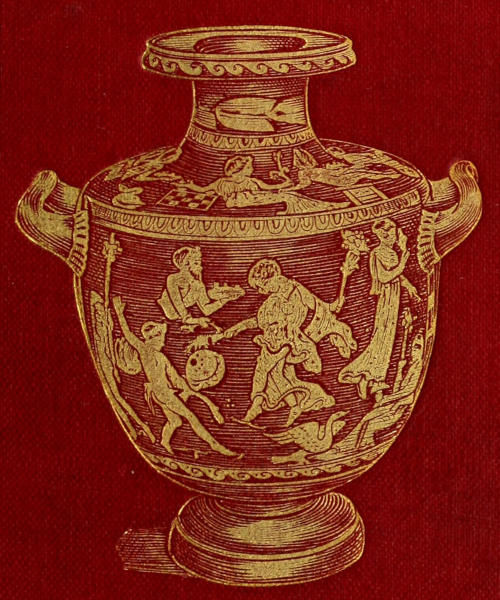
Greek Vase, representing a Maenad dancing in honour of
Dionysos, which is reproduced on the cover of this book.
ERE. Hastings’ Encyclopaedia of Religion and Ethics.
GB. Frazer’s The Golden Bough: A Study in Magic
and Religion (3rd edition).
JE.The Jewish Encyclopaedia.
CHAPTER I INTRODUCTORY — I — II — III — IV
Our study is concerned with the “sacred” dance; that
this epithet applied to the dance, at any rate during the
earlier phases of its history and as still practised among
many uncultured and even some semi-cultured peoples
to-day, is more than justified, the following pages will,
it is hoped, show.
Its extreme importance in the eyes of early man, who
regarded it as indispensable at all the crises of life—initiation,
puberty, marriage, burial—who used it as one
of the essentials in worship, who saw in it a means of
propitiating whatever supernatural powers he believed
in, a means of communion with the deity, a means of
obtaining good crops, fruitful marriages, and of communicating
with the departed—to mention only its more
important uses, shows that it is a subject worth investigating
though the domain it occupies is but a modest
one in the great sphere of the history of Religion.
Probably one of the most instructive first-hand pieces
of information which we have on the subject is contained
in the answers given to Chalmers in reply to questions
which he addressed to some natives of New Guinea. He
asked “What does the dance signify?” and he got two
replies from the natives of the two most important districts
of this big island respectively; the first ran thus:
When they dance all the spirits rejoice, as do all the
people. When dancing, all food grows well; but when
not dancing, food grows badly. No drums are beaten
uselessly [the drum-beating is the invariable accompaniment
to dancing, one implies the other]. When anyone
dies drums are beaten to comfort friends.
The second was this:
Drum-beating and dancing are a sign of rejoicing and
thanksgiving, in order that by so doing there may be a
large harvest. If the dancing is not given there will be
an end to the good growth; but if it is continued, all
will go well. People come in from other villages and will
dance all night. There will be several feasts during the
time, and each leader of the dance will pray and thank
the spirits for the good harvest.
Among other questions he also asked: “Is there any
useless dancing?” and the two replies were: “No, the
drum is never beaten uselessly”; and: “Dances are
never merely useless[1].”
The study of the subject brings out without a shadow
of doubt that these answers illustrate what were, and still
are to a great extent, the beliefs held in regard to the
sacred dance by numbers of peoples in an undeveloped
stage of culture. It is a good illustration of what, within
a circumscribed area, holds good of the wider study of
religions in general, that, as Farnell has so well put it,
all through the present societies of savage men there
prevails an extraordinary uniformity, in spite of much
local variation, in ritual and mythology, a uniformity
so striking as to suggest belief in an ultimately identical
tradition, or, perhaps more reasonably, the psychologic
theory that the human brain-cell in different races at
the same stage of development responds with the same
religious speech or the same religious act to the same
stimuli supplied by its environment[2].
A survey over the whole field produces the conviction
that the stimuli which, in its beginnings, induced the
sacred dance appear to have been what we should now
describe as the two prime spiritual and material needs,
respectively, of man, viz. the response to his “god,” and
the obtaining of food. To early savage man it was not,
of course, a god as we understand the word, nor yet even
as it would have been understood for millenniums among
uncivilized men in remote ages; we merely use the word
as a convenient term for expressing a supernatural power,
or powers, at first vague, impersonal, “mana[3],” or something
of that kind; at any rate, some power beyond the
ken of man, of whose existence he had no doubt whatsoever,
and to which he was impelled to respond to the
best of his very feeble powers. Why he should have
chosen this form of response (we are not contending that
it was the only form) is a difficult, perhaps an impossible,
question to answer, though we shall make the attempt
to do so (see pp. 15 ff.); but that he did choose this form
all the available evidence goes to show. That the sacred
dance should have been believed to be the means of
obtaining food is less difficult to understand when one
remembers the universal belief in the efficacy of imitative
magic among uncivilized men. The natives of New
Guinea dance as a means of obtaining a good harvest;
but there is evidence for the presumption that early man
did the same thing for obtaining food long before harvests
existed.
As a means of response to supernatural powers the
dance was obviously a sacred act; but the epithet may
also be applied, though perhaps in a modified way, to
the dance as a means of obtaining food; for the belief in
the existence of supernatural powers once attained, the
conviction of their intrusion into all the affairs of life
would naturally follow, as indeed we know to have been
the case. But this implies that savage man believed that
these supernatural powers were, in some sense, the givers
of food; and this is hardly compatible with the idea that
the dance as an act of imitative magic was the means
of procuring food—an idea which is abundantly proved
by the evidence to exist. If an act of imitative magic,
such as the dance, is ipso facto the means of bringing out
what it imitates, how can it be said that supernatural
powers have anything to do with the matter? And how
can the dance in this case be called sacred? It is a
question, however, whether there was not a subconscious
intention of setting in motion the “machinery” which
brought about the thing imitated every time an act of
imitative magic was performed. By the “machinery”
we mean the active intervention of supernatural powers
in an undefined, mysterious way. In this case the
dance as a means of obtaining food would likewise be,
strictly speaking, a sacred act.
However this may be, there is a large consensus of
opinion that the dance in its origin was sacred, and that
every other subsequent form of dance was ultimately
derived from this. It is true to say that “the ritual or
worship dance is the source of all others[4].” One of the
earliest modern writers on the subject, de Cahusac, likewise
says: “Aussi la danse sacrée est-elle la plus ancienne,
et la source dans laquelle on a puisé dans les suites toutes
les autres[5].” This point is particularly emphasized
because it is only the dance in its sacred aspect that
will be dealt with in the following pages.
As soon as one attempts to define what dancing in its
essence is one realizes the difficulty of doing so. It can
be defined in such a number of ways, all of which contain
elements of truth; so much depends upon the point of
view taken in regard to it. The recording of a number
of definitions would be wearisome, Voss alone gives
dozens by different people[6]. But one thing which these
various definitions teach must be noted and insisted
upon: they show that the term “dancing” connotes a
great deal more than is attached to it now-a-days. When,
for example, de Cahusac rightly defines dancing as “l’art
des gestes[7],” it is obvious that these cannot be restricted
to the feet or legs. A number of the Egyptian inscriptions
make it clear that the arms played as important
a part in the dance as the legs; representations of it on
Greek pottery show that the motions of the head, and
even more of the whole body, are necessary parts in the
movements of the dance; among some savages the sacred
dance is performed while the legs are more or less still,
but the arms and the body are constantly in motion. To
make but one reference to modern dancing: in some of
the figures of the quadrille the dancers simply advance
and recede, and at times they are stationary, merely
bowing; yet this all belongs to the dance, and comes
under the category of dancing. Crawley truly says that
“dancing is an instinctive mode of muscular expression
of feeling[8].” If, then, the feelings are restrained the
muscular expression may take the form of a staid procession,
as seems to be characteristic of the Assyrian
sacred dance. We must, therefore, include under the
many forms of the sacred dance such as range from a
formal procession, stately and measured, to those of the
wild orgy in the Dionysiac ritual. As we shall see, the
intention which prompts the dance will have a great deal
to do with its external form; a fact which gives point to
Giraudet’s phrase that “la danse a été l’expression d’un
état d’âme[9].”
The wide connotation which must be accorded to the
word “dancing” is illustrated by what the Bedouin
Arabs understand by it. They are a race which, as is
well known, has retained many beliefs, customs, and
practices which have been handed down from time immemorial;
therefore the evidence afforded by them is
valuable. By dance, which they call raḳṣ, they understand
every rhythmic movement of hands or feet,
whether remaining on the same spot or not[10]. Of them
as of all other peoples rhythm is as inseparable from the
movements of the dance “as it is from other bodily
functions, and therefore belongs to it without saying[11]”;
but, as the Arabs show, rhythmic movements can be
performed while standing on one spot; emotions can be
expressed by the rhythmic movements of the arms and
of the body and of the head while the legs may be more
or less motionless.
“The human instinct of play,” says Crawley, “is
closely connected with the human love of excitement.
The dance satisfies both, and its rhythmical character
also makes it suitable for the expression of the most
solemn and controlled emotions. It is at once the
servant of Apollo and of Dionysus[12].”
The close, one may almost say the inseparable, connexion
between the dance and music is as marked in its
sacred as in its secular character. In the first instance
it is the rhythmic instinct which demands this, so that
among many savages the “music” which accompanies
the dance is the mere clapping of hands, or the striking
together of pieces of wood, or the beating of the tom-tom,
all in rhythmical time. The same is also found among
some peoples more advanced on the path of culture,
though they usually add the sound of other instruments,
among which the flute figures prominently. Singing is,
of course, and always has been, another favourite accompaniment
to the dance. The Bedouin Arabs accompany
their dances by the beating of cymbals or of
hand-drums, or by clapping of hands; sometimes singing
accompanies the dancing[13]. This was also the case among
the Israelites.
In the following discussion on the sacred dance we
have made the Old Testament our starting-point. In
spite of some drawbacks which will become very apparent,
this course has its advantages. The Old Testament
offers, either explicitly or implicitly, as we hope
to show, evidence of the existence among the ancient
Israelites of most of the typical sacred dances of antiquity.
By “typical” we do not mean dances in their
outward form, but in the intention and object for which
they were performed. In dealing with sacred dances it
is only by considering their intention and purpose that
a classification of them can be attempted. The Old
Testament gives within the compass of its pages certain
points d’appui which afford convenient starting-points
for the consideration of these different types of the sacred
dance. Then, in each case we go on to the further investigation
of these among various other races. From this
we are often able to discern, with tolerable probability,
the early underlying ideas which prompted the performance
of the type of dance in question; for, as may
well be supposed, it is not from the Israelites that we
can expect to discover, excepting in the one case of the
ecstatic dance, the root motives of the different types of
the sacred dance. The most promising sphere for the
discernment of these is among the uncivilized races; their
naïve and unsophisticated naturalness reveals things
which a gradually developing civilization obscures.
Hence the devoting of a good deal of attention to the
sacred dance among savages in the following pages.
Another advantage of using the Old Testament for
our various starting-points is that the Israelites were in
that stage of culture in which a people still retains many
more or less primitive rites and customs while pushing
forward on the path of cultural development; so that
among them we are in touch with the past and yet experiencing
the upward trend that is taking place. Crawley
truly says that “it is in the middle stages of culture that
dancing is seen at its highest development[14]”; that applies
to the Israelites. It is like standing on an eminence and
looking behind and before. That has its advantages.
At the same time, we are not blind to the drawbacks
involved. For in some important instances the Old
Testament is silent. We give reasons which we believe
are sufficient to explain this silence. But when a particular
type of the sacred dance is not mentioned in the
Old Testament it must not be supposed that it did not
exist; indirect evidence is forthcoming which makes it
highly probable that the reverse is the case. For this
reason we shall often refer to post-biblical Jewish custom
and practice. Such a thing as the sacred dance is not
likely, from the very nature of things, to have been an
innovation of later ages; so that its existence in post-biblical
times may well be regarded as the continuance
of traditional custom; and if so, its existence among the
Israelites of Old Testament times may be taken for
granted.
Still, we realize the precariousness of seeming, in some
cases, to build upon an apparently non-existing foundation;
but the risk must be taken, and, as we hope to show,
the evidence from subsequent times justifies the risk.
A few words must be said about the sources from
which information regarding the sacred dance is to be
gained.
(1) There are a certain number of ancient inscriptions
of various kinds upon which dancing is represented. On
these the dancing is not always of a religious character;
but it is not difficult to discern when it is religious and
when secular. For example, there is a very valuable
fragment of an Egyptian fresco belonging to the 18th
dynasty (B.C. 1600-1450) in the British Museum[15], on
which two nude women dancers are depicted; the dancing
is accompanied by other women, some clapping their
hands, and others playing the flute. But another part
of the fresco shows clearly enough that the scene represents
a banquet during which professional dancing is
being performed for the entertainment of the guests.
Though it is secular dancing that we have here the inscription
is important from the present point of view,
because the dancing, which is so graphically depicted,
does not differ greatly from that shown on other Egyptian
inscriptions, where it is unmistakably sacred. Egyptian
inscriptions are those which offer most material here;
one or two Hittite and Assyrian inscriptions are also
available, and will be described later; but otherwise
there is but little to be obtained from this source.
(2) Very prolific, on the other hand, is the second
source, in the main, Greek. There are large numbers of
vessels of different kinds—vases, bowls, cups, dishes,
flasks, jugs, bottles, jars, pitchers, etc., on which dancing
is depicted[16]; many of these represent secular dancing;
some give dances of a quasi-religious kind, e.g. the
dances of satyrs; but most of them depict religious
dances, sometimes of gods and goddesses, at others of
worshippers dancing in their honour; a very favourite
subject is the dancing of Maenads. Belonging to this
source are a variety of other kinds of vessels on which
sacred dancing is depicted; sometimes the vessel itself
is in the form of a sacred dance. Excavations in Cyprus
have yielded some interesting material to which more
detailed reference will be made below. Some coins have
also been found which throw light on the subject. This
source is, above all, valuable for showing us the kind of
dances in vogue among the ancient Greeks, and bears
out the truth of the remark that “the Greek dances may
be divided and subdivided ad infinitum[17].”
(3) Our third source also offers abundance of material,
viz. ancient literature; this source includes Egyptian
literature (the Book of the Dead); the Old Testament
and post-biblical Jewish literature; ancient Arabic literature;
some of the ancient Church writers; and, above all,
Greek and Latin classical authors, quotations from whom
would alone fill a small volume.
(4) Lastly, there is modern literature. This must be
divided into two classes. The first is a small and very
unsatisfactory class: treatises which deal specifically with
dancing. We have found this class of literature unsatisfactory
for two reasons; first, because there is, comparatively,
so little information of a tangible character
to be gained from it; and, secondly, because no references
are given to authorities, even when cited. Nevertheless,
it is only fair to the respective authors to say
that they are mainly concerned with modern dancing.
As Crawley says, “there are no treatises written on any
scientifically comprehensive lines[18].” With one exception,
moreover, we have found the articles on the subject in
all the well-known English and German Bible Dictionaries
of extraordinarily little help. The exception is
Hastings’ ERE; here articles by Crawley, Farnell and
Blackman have been of real help, and the writer gratefully
acknowledges his indebtedness to them.
As to the other class of modern literature, it can only
be described as limitless; we refer to the vast number of
volumes dealing with uncultured races. To mention even
a tithe of those which have been used would be out of
the question; references to a good many will be found
in the following pages. But it is impossible for the
present writer not to say how much he owes to the works
of Sir J. G. Frazer; without their stimulus these pages
would never have been written.
The material contained in this source would fill a
number of volumes; we have restricted ourselves to
a certain number of more or less typical illustrations
chosen from a great mass.
More than a hundred and fifty years ago de Cahusac
wrote in the Preface to his Historical Treatise on Dancing:
“J’ai traité assez sérieusement un sujet qu’on ne regardera
peut-être que comme très-futile.” The present
writer hopes and believes that his effort will not be regarded
as “très-futile”; for we in these days have come
to realize more fully than was possible in the eighteenth
century the significance of the well-known words of
Terence:
Homo sum; humani nihil a me alienum puto.
CHAPTER II THE ORIGIN AND PURPOSES OF THE SACRED DANCE — I — II
In his thoughtful and very suggestive volume, The
Threshold of Religion, Marett makes the assumption that
an inductive study of the ideas and customs of savagery
will show, firstly, that an awareness of a fundamental
aspect of life and of the world, which aspect I shall
provisionally term “supernatural,” is so general as to be
typical, and, secondly, that such an awareness is no less
generally bound up with a specific group of vital reactions
(p. 124).
Every student of such ideas and customs must know how
thoroughly justified this assumption is. In studying the
particular custom, and the ideas connected with it, with
which we are here concerned, we find that this “awareness
of the supernatural,” together with the “vital
reactions,” are, at any rate in the earlier stages of its
history, invariably present. That much, at all events,
we have to go upon in seeking a theory as to the origin
of the sacred dance. To account for its origin is, however,
difficult; that is fully realized; and the present writer
would desire to lay stress on the fact that as in seeking
such origin he is largely in the domain of speculation and
theory, nothing is further from his mind than to be
dogmatic. The whole subject of the sacred dance has
been so little dealt with excepting as a mere rite, that
one is to a great extent on new ground; one must, therefore,
be quite prepared to be convicted of fallacies.
That the sacred dance originated in prehistoric times
goes without saying; but this means that no proofs can
be adduced in support of any theory as to its origin; it
must be a question of probabilities; perhaps only of
possibilities. What is, however, certain is that since the
sacred dance originated at a time when man was in a
very primitive stage of culture, what first induced him
to perform it must have been something very naïve and
childlike. That, presumably, everyone would agree with.
Now, there is no sort of doubt that one of the most
ingrained characteristics of human nature is the imitative
propensity. This is more pronounced in the child than
in the grown man; and what holds good of the individual
applies also to the race; the more uncultured man is, the
more does he, mentally, approximate to the child; so
that the further back we go in the history of the race,
the more pronounced and childlike will be that imitative
propensity. As Crawley has reminded us[19], Aristotle
maintained that dancing is imitative; and in all its forms
it is an artistic imitation of physical movement expressive
of emotions or ideas. Rightly or wrongly, then, we
believe that the sacred dance owes its origin to this
imitative propensity in man.
Now, in the animistic stage what first suggested the
presence of life in anything was movement. The cause
of the movement was neither understood nor enquired
into. A tree, swayed by the wind, moved; therefore it
was alive. But it would not strike a more or less primitive
savage that it was the wind which caused the movement.
What he would instinctively have recognized was that
here was something which he did not understand; and
therefore there was a mystery about it which inspired
awe. So, too, with streams, and rivers, and the sea; they
were alive because they had motion. In course of time
this would be modified in so far that the belief arose that
the tree or stream contained life because of an indwelling
spirit which caused the movement, thus indicating
its presence; but even so, it would have been difficult
for the savage to draw a distinction between the two at
first. Whether the same course of savage “reasoning”
will apply in regard to the sun, moon, and, later, to the
stars, in the earlier stages of the period when he first
began to take “reasoning” note of his surroundings, is
doubtful; for it is probable that he looked around and
downwards before he looked upwards. At any rate, sooner
or later he would have realized that they too moved, and
that therefore they were alive, either themselves, or animated
by something, more probably by somebody. Thus
motion, movement, which, on the analogy of man himself,
was believed to denote life, was the first thing which
the savage mind connected with supernatural powers[20].
We suggest, then, that the origin of the sacred dance
was the desire of early man to imitate what he conceived
to be the characteristic of supernatural powers. Not that
this was, in the first instance, a dance in the generally
accepted sense of the word; but merely a movement,
whether in the form of the swaying of the body in imitation
of trees, or a single-file running in imitation of a
stream, or a more boisterous movement in imitation of
the waves of the sea or of a storm-swept lake. The innate
tendency to rhythmic motion would soon have asserted
itself, and primitive dance, in the more usual sense,
would result. But it would be a sacred dance in so far
that it was performed in imitation of some supernatural
power, vague and originally impersonal, as it undoubtedly
was; to honour such by an imitative dance denotes
a religious intention.
The reasonable objection will be urged that it was not
only things which “moved” that early man regarded
as living or as indwelt by a spirit, but that stones, for
example, were among the very early things which were
treated with veneration because they were believed to
be the abodes of spirits; these did not move, so that the
suggested theory of the origin of the sacred dance breaks
down here. But when one seeks to penetrate the mind
of uncultured man and to get behind his mental outlook,
and especially when one contemplates the working of
the child-mind which offers so many analogies with, and
illustrations of that of the mentally immature savage,
one becomes convinced that this veneration of stones,
early as it was in the history of religion, was later than
that of things which move. And the reason of this is
simple; a moving thing attracts attention before that
which does not move; that lies in the nature of things
alike with the child and the savage mind. When once
the moving things are believed to be the abodes of
spirits, and the existence of these is universally recognized,
then the further step that they exist in other
things follows easily and naturally. We are thinking of
the time when as yet early man was only impressed by
those things which, because of their motion, attracted
his attention.
Réville says that
the dance was the first and chief means adopted by
prehistoric humanity of entering into active union with
the deity adored. The first idea was to imitate the
measured movements of the god, or at any rate what
were supposed to be such. Afterwards this fundamental
motive was forgotten, like so many other religious forms
which tradition and habit sustained even when the
spirit was gone[21].
We entirely agree; but the question is whether this does
not represent a later stage in the religion of prehistoric
humanity. Must there not have been a prior stage in
which a less concrete idea of supernatural powers obtained?
What induced the supposition that the god
performed “measured movements”? And what would
have been thought to be the form of these movements?
Mr Marett, in the first essay of the volume already referred
to, brings forward incontrovertible arguments, as
it seems to us, for believing that there was a stage in the
mental and religious development of man in which he
was not yet capable of other than a vague sense of the
supernatural; in which he had not yet associated definite
spirits or ghosts with what he conceived to be supernatural
phenomena; but in which the sense of mystery
and consequently of awe in face of these supernatural
phenomena filled his heart. This is also dealt with in
the fourth essay: “The Conception of Mana.” It is in
this stage that we would locate the origin of the sacred
dance, performed in imitation of what were the movements
of supernatural powers, but powers of the vaguest
kind; merely a something, unknown, mysterious, and
therefore to be feared; but associate yourself with it,
and already you are in an indefinable way in communion
with it; you have in some sense made friends with it,
which makes things safer. “Given the supernatural in
any form there are always two things to note about it:
firstly, that you are to be heedful in regard to it; secondly,
that it has power[22].” So that what Réville says is true,
but it must be referred to a later stage of religious
development.
Another consideration in connexion with the origin of
the sacred dance must be briefly dealt with. Many savage
peoples trace the origin of their sacred dances to various
animals by which, as they maintain, they were taught
to dance; therefore they imitate, in their dances, the
movements of these animals. Thus, for example, we have
kangaroo-dances, dog-dances, and cassowary-dances
among the Monumbo of New Guinea[23]; bear-dances
among the Carrier Indians[24], the Gilyaks (in Eastern
Siberia), the women of Kamtchatka[25], and others. It
may, therefore, be urged that the sacred dance originated
in this way. But apart from other arguments, it will
suffice to point out that to early man the sight of animals
was probably so much in the natural order of things that
there was nothing about them to strike him; in any case
there was nothing supernatural or mysterious about
them, nothing to be afraid about in the sense of fear
inspired by the unknown. Such being the case there
would have been no reason to imitate their movements,
as there was in the case of what were to early man those
mysterious powers whose movements he could not explain.
The connexion of animals with gods, and the
belief in descent from animals belong to subsequent
ages; such conceptions necessitate reflexion during long
periods of time. Therefore it cannot have been in imitation
of animals that the sacred dance took its origin.
The theory as to the origin of the sacred dance suggested
may or may not commend itself; but that it took
its rise from supernatural powers of some sort seems
certain; and this is supported by the belief of many
savage peoples that their sacred dances were originally
taught them by their gods[26]. The ancient Greeks also held
that their sacred dances were performed in imitation of
gods and goddesses. The Pyrrhic dance was said to have
been the invention of the Dioscuri by some; others attributed
it to Athena. Again, Artemis, Dionysos, and Zeus
himself, were all believed to have set men the example
of dancing. Ḥatḥor among the Egyptians and Baal-Marqôd
among the Phoenicians are other examples. Is
it not quite conceivable that this echoes what obtained
in more primitive times?
We come now to consider the purposes of the sacred
dance.
The whole idea and object of dancing, among civilized
peoples, has now become so purely a matter of pastime
and enjoyment that it is, at first, difficult to realize its
very serious aspect among men in past ages, and among
uncivilized races to-day. It may be true enough that
dancing has always been a means of exercise and pleasure[27];
but from the earliest historical times—and, judging from
what can be gathered from its very widespread practice
among all known races of uncivilized men, the same is
probably true of remote prehistoric times—this purpose
has always been subordinated to religious uses primarily.
There are, it is true, many instances among savages at
the present day of dances being nothing more than a
means of exercise and enjoyment; but it is not too much
to assert that in every case the elimination of the religious
element is due to extraneous influences. This is
vividly illustrated in Polynesia, for example.
“Polynesian dancing,” writes Mr Macmillan Brown,
“has advanced far on the road to conventionalism. It
has shed much of its pantomimic purpose and its religious
meaning, and in this it reveals the collision of
two or more cultures. In a region marked by so much
that is so highly primitive, nothing but the clash of
different religious systems could explain its divorce from
rites and ceremonies and its appearance as an almost
purely secular art, intended to amuse and delight an
assembly of spectators.”
The same writer shows that the character of the dancing
among them presents the proof of its originally purely
religious purpose; for
it is not like European dancing, a harmony of “twinkling
feet.” It is wholly occupied in posturing, waving the
arms and bending the body, as if before a shrine. It is
the upper part of the body that is chiefly engaged. Where
the feet come in, it is only to effect the occasional advances
or retreats, as if to or from the altar, or in the
resounding thud of the war-dance. The Polynesian dance
is oftenest stationary[28].
At the same time it would be a mistake to suppose that
all religious dancing was necessarily of this more or less
stationary character; we shall refer to examples of a
very different kind below; but it is well to emphasize
the truth that all dancing was originally religious, and
was performed for religious purposes.
Of course it often happens that the different objects
of the dance coalesce; religious and secular, or religious
and utilitarian, or more than one religious purpose, being
combined in the same dance; this, as we shall see, is
illustrated in Israelite practice. Nevertheless, it is very
certain that in numberless instances all feelings of enjoyment
had ceased though the dance continued hour
after hour because it was believed that a sacred duty was
being performed thereby. The young North American
Dakotahs, for example, did not go on dancing for a
couple of days because they were so enamoured of it;
nor was it for pastime that the Thyiads danced on madly
in honour of Dionysos until they dropped to the ground
unconscious. The reasons which made this sort of thing
necessary are absurd to us, but from the point of view
of antique thought it was a very serious and solemn
matter.
It is this serious aspect of our subject upon which
stress must be laid because now-a-days we naturally
think of dancing as mere enjoyment and pastime.
Some of the dances and their objects, and the ways in
which they are performed, among savages are so funny
that they would, we imagine, provoke a smile on the face
of a sphinx, were it capable of doing such a thing; but
while, at times, we cannot resist a laugh, we shall do
well to remember that it was far from being a laughing
matter to the savage; to do him justice we must seek to
get to the back of his mind, to enter into his feelings,
and to look at things through his eyes; then it will be
realized what the sacred dance meant to him, and its
essential seriousness will become apparent.
What the sacred dance meant not only to uncivilized
men, but also to the most cultured races of antiquity,
will be seen from the purposes for which it was performed.
These we will now briefly enumerate.
(a) It was, first and foremost, performed for the purpose
of honouring what were regarded as supernatural
powers[29]. In the pre-animistic stage these powers were
entirely vague and undefined; in the animistic stage
they developed into spirits, some benevolent, others
maleficent, powerful for good or evil. Later they became
gods and goddesses. Why dancing was a means of honouring
these supernatural, later superhuman, powers was
for these reasons: It was supposed to be an act of imitation,
and therefore flattering to the higher power (the
imitative propensity in man has already been referred
to). Secondly, by “taking it out of yourself” in the
presence of the power or deity you were offering something
in the nature of a propitiation, whether as a gift
or as an act of self-sacrifice; in either case it would be
honouring the higher power. This taking it out of oneself
in honour of a spirit or a god is an interesting phenomenon,
and in one form or another has asserted itself
throughout the history of religion. It is the earliest form
of what in course of time showed itself in such things as
self-castigation and self-mortification; its extreme form
being the love of martyrdom; for to whatever degree the
cult of self may have entered into these things, it would
be grossly unfair not to recognize that they were believed
to be pleasing in the sight of the deity, and that they
were, therefore, done with a view to honouring him.
(b) Psychologically connected with the foregoing we
have as another purpose of the sacred dance that of
“showing-off” before a higher power. One must enter
into the child-mind in order to grasp what a real thing
this is. The close analogy between the way-of-thinking
in the child and in the more or less primitive savage has
already been referred to, and is recognized on all hands.
Here are two cases of great interest which vividly illustrate
the point under consideration. The present writer
vouches for the literal truth of each. A little girl, not
exceeding five years, was dancing before a picture of the
Madonna and Child; after her dance she turned to her
mother and said: “Do you think the Baby Jesus liked
to see me dance?” It is not quite easy to say in this case
in how far the purpose was to please the “Baby Jesus,”
and in how far the perfectly natural and innocent purpose
was to “show off” before Him; probably both
motives were combined. But the second is purely one
of “showing off.” A child of about three, a boy this
time, kept on jumping as high as he could in the fields;
presently his father heard him say: “See, God, how high
I can jump!” We could hardly have more delightful
and instructive illustrations of the innate desire, common
to the child and to man of immature mental development,
to show what they can do in the sight of their
betters. So that we may justly reckon among the purposes
of the sacred dance this desire to “show off” before a
superhuman power, or what is conceived to be such.
(c) Next; the honour done to the higher power by
means of imitation had, in the eyes of uncivilized man,
some important consequences which offer further reasons
why the sacred dance was performed. Just as in imitative
magic the thing imitated was thereby effected,
so by imitating the supernatural power the imitator conceived
himself to be making himself one with him who
was imitated. This purpose of the sacred dance would
not, however, have belonged to the earliest stage, for it
presupposes the recognition of personality in the supernatural
power, and that points to a distinct advance;
and the possibility is worth contemplating as to whether,
and in how far, the sacred dance may have contributed
to this advance. At any rate, this idea that an undefined
union was brought about by means of the sacred dance
seems to be the precursor of the more developed form
of the same idea that union could be brought about by
personating a god or a goddess. When, for example, men
and women, by disguising themselves as horses, cats,
pigs, or hares, personated Demeter and Persephone, and
danced in their honour, they believed that they were,
in some inexplicable way, united with these goddesses.
In the earlier stage, by imitating what a god does, i.e.
dancing, union with him is effected; in the later stage,
the like result is achieved by imitating what he is, and
dancing in that guise. At the bottom of all this lies
the principle which looms so large in savage philosophy
that “like produces like,” i.e. sympathetic magic which
assumes that
things act on each other at a distance through a secret
sympathy, the impulse being transmitted from one to
the other by means of what we may conceive as a kind
of invisible ether, not unlike that which is postulated
by modern science for a precisely similar purpose, namely,
to explain how things can physically affect each other
through a space which appears to be empty[30].
As is well known, a more pronounced and realistic
means of union was that of eating the flesh or drinking
the blood of a sacrificial victim which represented the
god; by receiving the god into himself a man became
identified with the god. So that we have in the course
of the development of religious thought and practice, in
a materialistically ascending scale, three means whereby
union with a supernatural power was believed to be
effected: imitation, personation, and the act which produced
identification. But the important point for our
present purpose, and it is one which needs emphasis, is
that over and over again it is found that the two latter
rites (i.e. those of personation and of absorbing the god)
are accompanied by the sacred dance as a necessary
adjunct. It may be argued that this is merely done on
the principle of making certainty doubly certain; but it
is at least possible that we have here a case of the retention
of the earliest rite simply because it is the earliest.
We are bound to look for great naïveté in considering the
ideas and practices of backward races—and, indeed, not
only backward races where religious rites are concerned;—and
if, in course of time, new means suggested themselves
of uniting oneself with a god or goddess, it is
quite in accordance with what we know of uncivilized
man to suppose that he continued the older method side
by side with the newer ones, even though there was not
much meaning attached to it.
This theory that one of the earliest purposes of the
sacred dance was to imitate what supernatural powers
did, and that this imitation was believed to be the means
of union with this supernatural being (as it came to be),
receives some support and confirmation from what we
know to have been the purpose of the ecstatic dance.
(d) Uncultured man believed that by dancing to such
an extent that he became unconscious he was not only
doing something that was honouring to the deity, not
only offering something in the nature of sacrifice, but
that, he was, above all, making his body a fit temporary
abode for his god. He did not enquire how this came
about. Conceivably, the earliest idea, though unexpressed,
was that by honouring the god to this extent
the god showed his approval by uniting himself with his
dancing worshipper. The earlier widespread belief that
the deity took up his abode at certain times in trees,
stones, etc., may well have suggested the possibility of
the same thing occurring in men, but more especially in
those more intimately and directly dedicated to his
worship. The question would have arisen as to the
means to be employed whereby this end could be
achieved in the case of men; and as dancing was the
earliest form of worship this would have been the most
natural means to suggest itself. The dance would then
proceed; during it the performers would be anxiously
awaiting some inner indication of the entrance of the
deity; nothing, of course, would happen until the long-continued
dance would induce first giddiness, then
semi-consciousness, and finally a state of semi-delirium
ending not infrequently in total unconsciousness for some
time. But it is easy to understand that the first signs
of semi-consciousness would have been interpreted as
the advent of the deity and the beginnings of the divine
overpowering. Given belief in the possibility of divine
indwelling in a man, the further belief that the god
utilized his worshipper as his mouthpiece was a natural
and easy transition. Natural, because it could not be
supposed that the god would take up his abode in a man
without some purpose, and what more obvious purpose
than that of making his will known? Easy, because the
mechanism, if one may so call it, of utterance was all
ready to hand. Other things would follow, also in the
natural course; for if, on the one hand, the god utilized
the body of his worshipper as the vehicle for making his
will known, the worshipper could, on the other hand,
utilize the divine power with which he was suffused for
other purposes. Thus, for example, we have the Hebrew
prophet who, in an ecstatic state, utters the will of
Jahwe, or gives an oracle; or, as illustrating the other
side, we have the Bodo-priest “devil-dancer” of
Southern India who utilizes the divine power within
him for working cures.
But whatever the result might be, the important thing
from our present point of view is that the requisite state
required for the accomplishment of these things was
brought about by the performance of the sacred dance.
The ecstatic dance will receive a good deal of notice
below (pp. 107 ff.), so that we need not say more about
it here.
(e) Another purpose of the sacred dance was to make
the crops grow, or of helping, or inducing the god to do
so. From one point of view here the sacred dance was
an act of imitative magic. Thus, by a dance in which
the chief characteristic was high leaps it was believed
by many peoples that the corn would grow high. It is
probable, as Frazer suggests, that this was at any rate
one of the purposes with which the Salii, the priests of
the old Italian god of vegetation, danced high and leapt.
As an act of imitative magic, again, the sacred dance
had among some peoples the purpose of helping the sun
to run his course. For example, this was probably at
one time of its history the object of “Ariadne’s Dance”;
and the dance known by the name of the “Labyrinth”
may well have been believed to assist the stars in their
courses. These, and many other examples, are dealt
with in the following pages.
(f) Further, there are instances on record of the sacred
dance having the purpose of hallowing or consecrating
a victim for sacrifice, as in the case of the Arabs performing
a processional dance round a camel destined
for sacrifice, or of the Israelites making the circuit round
the altar, or of the Kayans of Sarāwak circling round
their sacrificial pigs. In all such cases it is an act of
consecration by means of the magic circle.
(g) As an adjunct to initiation ceremonies the sacred
dance was also believed to serve some useful purpose.
Presumably it was an act of homage to the god or
goddess who was supposed to be present. This is suggested
by the dancing at the Brauronian ceremonies of
Artemis which, according to Farnell, was a kind of
initiation ceremony by which young girls were consecrated
to the service of this goddess.
(h) There are some grounds for the belief that the
sacred dance was sometimes performed with the purpose
of assisting warriors to gain a victory in battle; here,
too, it was an act of imitative magic. It had, in this
connexion, the further purpose of appeasing the spirits
of slain enemies.
(i) As a marriage rite the sacred dance, at any rate
during some time of its history, fulfilled, as was believed,
one or two important purposes. The reference to the
“Sword-dance” in the Old Testament is in all probability
a relic of the antique custom of combating the
vague dangers which were supposed to menace those
entering upon the marriage state. These dangers, undefined
but nevertheless very real to those who believed
in their existence, arose not only from the fact of the
new conditions of life that were beginning, but also
because of a reciprocal fear on the part of the sexes,
and a close contact between them emphasized this.
Another way of combating, or at least averting these
dangers, was by means of a change of identity; hence
the once world-wide custom, still in existence in some
countries, of the bridal couple assuming “royal” state,
and being treated as king and queen during the period
of the wedding festivities.
Further, there are some reasons for thinking that the
sacred dance as a marriage rite sometimes had the
purpose of bringing about a fruitful marriage; there are
certain ceremonies during the period of celebration in
which the dance figures prominently which point to this,
and the analogy of the dance for making the crops grow
offers some corroboration.
(j) There are special purposes for which the sacred
dance was performed as a mourning or a burial rite. At
times these are of a curiously contradictory character.
The ghosts of the dead number among them those who
are kindly disposed towards the living, and those who
are malevolent in their attitude towards them; the latter
are supposed to be able to do harm. Speaking quite
generally, it appears, upon the whole, that the less advanced
the cultural stage the greater the tendency to
regard the spirits of the departed as malevolent. Since
the various races from which illustrations of the sacred
dance as a mourning rite are gathered were, or are (as
the case may be), in different stages of civilization, it
follows that the purposes of the rite vary; for the belief
regarding the attitude of the dead towards the living
has a good deal to do with the purpose for which the
sacred dance was performed. Thus we find that it sometimes
has the object of driving away the ghost of the departed;
or else there will be a dance on the grave for the
purpose of preventing the ghost from roaming. At other
times it is the means of scaring away evil spirits who are
believed to congregate in the vicinity of a corpse. Very
strange, but interesting, is the custom among some races
of personating the dead in the sacred dance; this is supposed
to be a potent means of bringing him back, and
he is believed to join the survivors in the dance; he is
present, but invisible, in the man who personates him.
This reminds one of the union with a supernatural spirit
by imitating him in the dance, to which reference has
been made above; the same idea underlies each. But
the purpose of the sacred dance as a mourning or burial
rite which appears as the most usual is that of honouring
the departed. This is doubtless very frequently simply
a mark of affection; but at other times it is in the nature
of a propitiatory act whereby the spirit of the departed
is persuaded to refrain from molesting the living.
Many illustrations of these various purposes of the
sacred dance will be offered in the following pages.
CHAPTER III THE SACRED DANCE AMONG THE ISRAELITES — I — II
So far as the Old Testament is concerned this subject
of the dance in religious ritual illustrates a fact which
biblical study, on the comparative basis, is bringing
more and more into prominence, and which needs to be
recognized both in the interests of truth and in order
to realize more fully the evolutionary development of
religion as an eternal principle in the divine economy.
The original aims and objects of the sacred dance were,
as we have seen, “primitive”; the continuance of the
rite throughout the ages, even to comparatively recent
times among practically all peoples, does not in any way
detract from the truth of this, for everyone knows with
what persistency religious custom and ritual continues,
not only after the original object and meaning has been
forgotten, but even when it has no meaning at all. Its
existence among the Israelites, therefore, shows them
to have been and to have acted throughout their religious
history as other races did in this respect (and it
is only one of many other illustrations that could be
given), in spite of what we rightly believe to have been
special opportunities for more exalted forms of worship.
It must be confessed that the religious uniqueness of
the Israelites, as a nation, has been, and often still is,
exaggerated to an undue extent. Certainly there were
among them those who may well be described as
unique, sui generis; but they were the great exceptions.
The nation as a whole was for many centuries no better
and no worse than others; and what stronger evidence
for this could be afforded than that given in the prophetical
books of the Old Testament? Its ultimate
emergence from the religious norm of the world to a
position of isolated superiority was due to a mere handful
of men who offered the greatest example that the world
had hitherto seen of what could be accomplished by
subordinating will and personality to the influence and
guidance of the Divine Creator.
True, it was among some of these very prophets that the
most interesting kind of sacred dance—the ecstatic dance—was
in vogue, with its wildness and extravagances; in
this they, or at least the earliest of them, did not differ
from certain classes of “holy men” all the world over;
where they did differ was in their development of the
conception which underlay the purpose of the ecstatic
dance, i.e. union with the deity; and it is just here that
they stand out in such bold relief from all others. The
earliest prophets believed that this sacred dance was the
means whereby the divine spirit came upon them; this
belief they shared with others; but they rose to the
higher belief that this means was not necessary for
achieving the purpose for which it was used. It had
served a useful purpose; but having served its purpose
it was dropped. The prophets came to the realization
that there were more spiritual means whereby union
with the deity was brought about; then the sacred dance
found no further place among them. They shed the
husk, but retained the kernel. It was the same principle
upon which St Paul acted in later days in regard to the
Law. The sacred dance, too, was in its way a “school-master”
(Gal. iii. 24), leading men to better things.
When, centuries later, the far more cultured Greeks were
still “raving” in honour of Dionysos, the Hebrew prophets
had long since learned that it is God Himself Who
puts His spirit upon men (cp. Isa. xlii. 1), and that this
is not a thing to be effected by the will or act of man.
“Who hath directed the Spirit of Jahwe?” asks one of
them in fine irony (Isa. xl. 13).
Thus the history of the ecstatic dance among the
Hebrew prophets is one of many illustrations showing
their uniqueness.
It is not, however, with these extraordinarily gifted
prophets that we are now concerned. We are thinking
of the very ordinary and very human Israelites as a
whole who, like innumerable men and women of other
races, were endowed with emotions and aspirations which
were common to humanity. And it is a curious but
interesting phenomenon that the sacred dance was among
the Israelites, as among all other peoples, one of the means
whereby these emotions and aspirations were expressed.
The fact that in the Mosaic legislation no provision is
made for ritual dancing when so many other minute
details of ritual are given might seem to suggest that
such a thing was discountenanced. Without question it
is true to say that “the priestly historians and legislators
resolutely excluded, as far as possible, everything
that could infer any similarity between the worship of
Jahwe and that of heathen deities[31].” But it is doubtful
whether the subject of the sacred dance would have
come into consideration in such a connexion; it was a
practice too deeply ingrained in human nature as a
means of expressing religious emotion to suggest that it
implied assimilation to heathen worship. The bringing
of oblations, the offering of sacrifices, were also common
to Israelite and heathen worship, but that similarity
would never have struck the Israelite legislators as derogatory,
because these, too, were means of expressing
religious emotion which, in one form or another, were
common to all races. The Mosaic legislation makes no
provision for the posture to be assumed in the presence
of the deity, nor does it say anything about singing in
worship; but it is difficult to believe that there were not
fixed modes in regard to these which had been in vogue
from time immemorial; and therefore they needed no
mention. The same may be postulated in the case of the
sacred dance. A thing which all the evidence shows to
have been a world-wide means of expressing religious
emotion and of honouring the deity during a long period
in the history of religious development, was not likely
to have been wanting among the Israelites.
In those passages in the Old Testament in which religious
dancing is recorded there is no hint of disapproval,
let alone prohibition. It is, therefore, evident that it
must have been looked upon as a usual and integral
part of worship. It must also be remembered that the
sacred dance continued to be an important element in
worship on special occasions among the Jews in post-biblical
times; the evidence will be considered later. That
this could have been an innovation is out of the question;
it was merely the continuation, in some cases quite
possibly an elaboration, of a rite familiar to the people
from time immemorial.
The comparatively rare mention, therefore, of the
sacred dance in the Old Testament must not mislead us;
the reasons for that are very natural. And when it is
realized what a number of words there are in Hebrew
for dancing (see pp. 44 ff.), and that only once is there
a possible reference to secular, as distinct from religious,
dancing, the conclusion will be forced upon us that it
played a much larger rôle in the religious life of the
people than first appearances would seem to indicate.
As far as can be gathered, religious dancing among the
Israelites was, as a general rule, performed by the sexes
separately; in the account of the worship of the Golden
Calf, however, it must be allowed that the possibility of
promiscuous dancing is not excluded, see especially
Exod. xxxii. 2, 3. Among other peoples it is found that,
mostly, the sacred dance was performed by men and
women separately; but there are notable exceptions
among the Egyptians as well as the Syrians, also among
the Greeks; and the same applies to the uncultured races.
When all the data in the Old Testament have been
gathered it is possible to discern certain types of the
sacred dance; by this we do not necessarily mean varieties
of mode, not but that these also occur; the type is indicated
rather by the connexion in which the dance occurs.
Therefore, although it is not to be supposed that there
was, generally speaking, any idea of having particular
kinds of dance reserved for different occasions, it is
possible to attempt some kind of classification. At any
rate, it is a convenient method to adopt in reviewing
the evidence.
Emphasis must again be laid on the fact that when
one is speaking of the “sacred dance” in past ages one
has to allow to the term a wide connotation. We have
come to use the word “dance” in a very restricted sense;
in antiquity it was different; included in it are modes
varying from a staid, march-like rhythmic step, to the
wilder movements of the ecstatic dance.
(1) We draw attention first to the sacred processional
dance. A cursory reference to one or two examples will
suffice here as a more detailed examination of each type
of dance will be found in the chapters to follow. Judging
from the few data offered by the Old Testament, the
sacred processional dance among the Israelites was
always performed in honour of Jahwe. In the well-known
instance of David and the Israelites dancing in
procession before the Ark, it is really in the presence of
Jahwe that it takes place since He is conceived as being
present in the Ark. The dance assumes various forms
according to the degree of religious excitement engendered.
It is spoken of as being dancing of the ordinary
kind, i.e. the common Hebrew word for dancing is used;
but presently it takes on the character of a rotating
dance, then there is jumping followed by something in the
nature of skipping, and it is also spoken of as a whirling
movement. It will be noticed that five different words
are used here to express the different ways in which the
dancing was performed. Although the occasion on which
this took place was a very special one, it would be a
mistake to suppose that the sacred dance was only reserved
for such special occasions. It is rather to be
gathered from the incidental way in which the dancing
is mentioned that the rite was usual, and was only of
a more elaborate character because of the special occasion.
A single mention of this kind must, it may be
safely asserted, imply a well-known and usual custom,
otherwise it would be commented upon as something
out of the ordinary.
(2) The sacred dance also takes the form of encircling
a sacred object, either an idol, or a sacrificial victim, or
an altar; in this last case the sacrificial victim would, of
course, be included. The form of this type of dance was
either a march-like step or a running step or else the
worshippers held hands and danced round. This latter
is nowhere specifically mentioned in the Old Testament;
but it is such an obvious form for a dance to take that
we can scarcely doubt its having existed among the
Israelites. Besides, interesting examples of a concrete
kind have been found depicting this form of dance round
sacred objects which quite possibly owe their origin to
Semitic inspiration; some of these are described in
Chapter VI below. This encircling dance was undoubtedly
an act of worship; it is also possible that in some cases
it was intended to have a consecrating effect either upon
the worshippers or upon the sacrificial victim; in the
example given by Nilus (see p. 95) the latter would seem
to have been the case. The theory of some scholars that
the circle dance was a symbolic representation of the
movement of the heavenly bodies has also a good deal
to commend it. As a funeral rite this form of the sacred
dance served some other purposes (see below).
(3) The ecstatic dance is that which has received most
attention from scholars, and deservedly, for it is one of
the most curious phenomena in the history of religious
ritual. In the exuberance of emotion engendered by it
the performers experienced what appeared to them to
amount, for the time being, almost to a metamorphosis;
they believed themselves to be infused and permeated
by the influence—perhaps it would be truer to say the
essence—of the deity in whose honour they were dancing.
Thus came about what was conceived to be in some
mystic, but wholly inexplicable way, a union with the
deity adored. In the Old Testament we have the well-known
example of the prophets performing this dance
in 1 Sam. x. 5 ff.; its contagious character is graphically
illustrated by the case of Saul, whose condition becomes
such that the people ask: “Is Saul also among the
prophets?” and he is spoken of as having been “turned
into another man” because as a result of the ecstatic
dance the spirit of Jahwe came mightily upon him. The
language implies that when once the required condition
has been reached it is then Jahwe Who takes the initiative;
the body as such remains a passive instrument,
but it becomes a Beth-el, a temporary house of God from
which He speaks forth through the medium of the voice
of the possessed.
As in the case of other types of the sacred dance, there
cannot be anything unique about this even though it is
only referred to once or twice in the Old Testament; its
incidental mention without further comment stamps it
as being nothing out of the ordinary.
Another form of this ecstatic type of dance is mentioned
in the Old Testament, also in connexion with
prophets, though not Israelite prophets. There was a
peculiar kind of limping dance performed, as it would
appear, on special occasions by the prophets of Baal.
This began with a limping step round the altar as though
the performers were lame, but soon developed into a
wild jumping about on the altar, and culminated in self-laceration
with knives and the like. In how far a state
of semi-consciousness or total unconsciousness was attained
is not indicated; but in the light of analogous
cases (referred to in Chapter VII) it may be gathered that
the loss of the physical sensation of pain inflicted by the
self-laceration must imply to some extent a loss of consciousness
so far as external surroundings were concerned.
In writing about the prophetic ecstasy of Syrian
as well as Israelite prophets, Dr T. H. Robinson well
expresses the state in saying that it was
a peculiar psychic condition in which the subject seemed
to be possessed of powers, indeed of a whole sphere of
consciousness, which was denied to the ordinary individual,
and to the prophet himself in normal states. He
did not cease to be conscious of the world as it appeared
to others, but he heard and saw things which were
beyond their range. There were a number of well-marked
physical phenomena connected with the condition
of ecstasy, though these were not invariable. The
subject might be affected with a certain constriction of
the muscles, in which case the state resembled that of a
trance. On the other hand, muscular activity might be
largely increased. Leaping, bodily contortions, and loud
cries resulted, which, as they tended to become regular
and rhythmical, developed into dancing and song. The
subject frequently experienced a kind of anaesthesia,
and would slash wildly at his own body with knife or
whip, without showing any signs of physical pain[32].
We shall find all this illustrated in the examples, to be
given in Chapter VII, of this type of dance among a
number of races.
Various means were employed to bring about this
ecstatic state, such as alcohol, and other drugs; but
there can be little doubt that the most frequent, and
certainly the most primitive, means adopted was that of
dancing.
(4) The kind of sacred dance which was the most
common among the Israelites, as among other peoples,
was that proper to Vintage and Harvest Festivals. That
it seems, from the scanty references to it which we have
in the Old Testament, as well as from many indications
in regard to its performance among other races, largely
to have lost its sacred character will not deceive us as
to its originally religious purpose. It was a characteristic
of Israelite worship that the note of joy should sound
during its celebration; the command: “Ye shall rejoice
before Jahwe your God” sufficiently bears this out.
Apart, therefore, from the original purpose of this kind
of sacred dance to which reference will be made in
Chapter VIII, there is no reason to doubt that Vintage
and Harvest dances among the Israelites were essentially
of a religious character, although the rejoicing, of
which dancing was one of the most natural modes of
expression, might not always appeal to some of the more
austere prophets, see, e.g., Amos v. 21-23. The very
rare specific mention in the Old Testament of the festival
dances is quite comprehensible, for what was obviously
proper to the celebration of a feast it would be superfluous
to speak about. Moreover, there is ample evidence
in post-biblical Jewish literature of the existence of the
sacred dance at festivals.
(5) Dances in celebration of victory in battle are referred
to several times in the Old Testament. Taking
the passages in which these are mentioned by themselves
the custom of which they speak is nothing more than a
simple and natural expression of joy and thanksgiving
for victory. But all such customs have a long history
behind them; and when analogous customs among other,
less civilized, peoples are considered, some points of interest
and significance emerge which suggest the possibility
of the custom being, in its origin, due to a different
and more practical cause. There are some grounds for
believing that the custom of which the Old Testament
speaks was a remnant of what was originally a dance
performed by women which had for its object the helping
of the men to gain a victory by means of imitative magic.
In the Old Testament there is, of course, no trace of this
beyond the fact that the dance was performed by women;
and it has become simply an act of joyful thanksgiving
to God and a tribute to the returning victors. It is
necessary to consider the analogous rite in its earlier
forms as seen among peoples of lower civilization to
estimate what justification there may be for this supposition.
If it should be the fact that this type of dance
was, in its origin, a means of effecting victory by magic,
it would be an interesting illustration of magic being,
as Marett says, “part and parcel of the ‘god-stuff’ out
of which religion fashions itself.”[33] Indeed, when dealt
with in detail, this subject of the sacred dance in the
Old Testament receives its chief interest and importance
from the fact that at all events some of the types there
mentioned are illustrations of the development of religion
out of magic.
(6) There is some reason to believe that the sacred
dance had a part to play during the rite of circumcision;
late Rabbinic tradition seems to imply as much. It had
its place among the Arabs on such occasions; and at
initiation ceremonies all the world over the sacred dance
was essential.
(7) Once more, the sacred dance during the Wedding
ceremony, though only once implied in the Old Testament,
was in all probability a regular institution; post-biblical
Jewish literature offers presumptive evidence of
its existence in earlier times among the Israelites.
(8) And lastly, we have the sacred dance as a Burial
rite. As in other cases we have to rely, firstly, on the
evidence of later Jewish literature, and, secondly, upon
the analogous practice among other peoples. As we shall
show, the emotions of fear, honour, and love, which
according to the cultural stages of uncivilized men are
felt for the spirits of the departed, are such as are
common to mankind; and these emotions are expressed,
among other ways, by means of the sacred dance. What
cultural stage, or stages, are represented in the Old
Testament as that, or those, through which the Israelites
passed may well be a matter of difference of opinion; but
that in both thought and practice they were, as a whole,
in many respects no more advanced than other contemporary
peoples does not admit of doubt. So that
when we find this rite in existence at burials or during
the mourning period among other Semites, and among
the Egyptians, not to mention the Greeks, the presumption
is justified that the Israelites practised it too.
In regard to much that has been said we are prepared
for the objection that the evidence of the Old Testament
does not offer sufficient justification for the assumptions
made. We agree that this is so if we are to rely upon
the Old Testament alone. But the object of the whole
of our investigation will be to show that the beliefs and
practices of any one race of people must, to do them full
justice, be studied in the light of analogous beliefs and
practices of other peoples. Only so can one fill up the
lacunae which inevitably exist in the records of the
races of antiquity. We have chosen as our illustration a
rite which may, likely enough, be regarded as of very
secondary importance; yet it is one which the evidence
shows was at one time regarded as essential to man. It
is therefore a study worth undertaking; for apart from
its interest as a mere antiquarian investigation, we hope
that it may be found to throw some modest side-lights
on various other subjects.
CHAPTER IV THE OLD TESTAMENT TERMS FOR “DANCING” — I — II
How large a rôle dancing in its various forms must have
played among the Israelites is shown by the fact that,
either in the restricted or in the more extended sense,
no less than eleven Hebrew roots are used to describe its
different characteristics. This in what is a relatively
poor language is not without significance.
Before saying something about the meaning of these
roots it will be well to give a list of them:
Sāḥaq and tzāḥaq, used in the intensive piel form.
Ḥūl.
Kārar, used in the pilpel form, also intensive.
Pāzaz, used in the piel form.
Rāqad, used in the piel form.
Sābab, used in the hiphil, causative, form.
Qāphatz, used in the piel form.
Dālag.
Tzālaʿ, occurs only once.
Ḥāgag.
Pāsaḥ, used in the piel form.
The first thing to notice here is that most of these roots,
when used in reference to dancing, occur only in intensive
forms; this is significant as pointing to the nature
and character of the sacred dance. Of the exceptions,
ḥūl “to whirl” is intensive in its root-meaning; it has
no piel, and its other forms occur only rarely, and almost
entirely in the later poetical books. The roots dālag and
tzālaʿ, refer to a particular kind of ritual step; and as to
ḥāgag more will be said in a moment.
Now as to the meaning of these different words for
dancing:
The root sāḥaq, in its intensive form siḥēq, means in
the first instance “to laugh,” and it is also used in the
sense of “playing” (Job xl. 29) and “merry-making”
(Jer. xv. 17, xxx. 19, xxxi. 4, Zech. viii. 5; cp. also
Judg. xvi. 25). In the specific sense of “dancing” it
occurs in 1 Sam. xviii. 7: “... and the dancing women
answered one another and said ...” (see also 1 Chron.
xv. 29). Equivalent to this root is tzāḥaq, also used in
the intensive form tziḥēq, which occurs, e.g., in Exod.
xxxii. 6: “The people sat down to eat and drink, and
rose up to dance.” It is also used of “playing” or
“sporting,” e.g. Gen. xxi. 9, Judg. xvi. 25, but in the
second of these passages its obvious meaning is “to
dance,” for as we shall see later this was the custom at
feasts. This root, therefore, presents dancing in the
aspect of a pleasant and enjoyable pastime. Further, in
various passages this root is used as a parallel to other
words for dancing. For example, in 1 Sam. xviii. 6, 7
just cited, it occurs as a parallel to the root which is the
one most frequently used in the Old Testament for
dancing, viz. ḥūl. This root expresses the “whirl” of the
dance (e.g. Judg. xxi. 21, 23, Ps. lxxxvii. 7). It is the
word used of the “writhing” or “twisting” of a woman
in travail, e.g. Isa. xxvi. 17, xlv. 10, or of one in great
pain, Isa. xiii. 8, xxiii. 5, Jer. li. 29; so that when used
in the sense of dancing, contortions of the body are
thought of, which suggests something of a rather wild
character.
The “whirling” idea is also contained in the root kārar
(in its intensive pilpel form, kirkēr), “to whirl about,”
or “rotate.” It occurs, in this sense, only once in the
Old Testament, 2 Sam. vi. 14-16, of David dancing
before Jahwe[34]; and in this passage we have another root
which does not occur elsewhere in the sense of dancing,
viz. pāzaz (again in the intensive form pizzēz); this expresses
the idea of agile leaping as part of the dance[35], the
cognate Arabic root means “to be excited.” The idea
of leaping is also contained in another root rāqad (in its
intensive form riqqēd) which in its ordinary sense means
“to skip about[36]”; as applied to dancing it occurs in the
passage last mentioned, and see further, Isa. xiii. 21,
Job xxi. 11, Joel ii. 5, Eccles. iii. 4, 1 Chron. xv. 29; in
Ps. xxix. 6 it is used of a calf “skipping.”
The root sābab, used of “going round” the altar, is
spoken about below (pp. 93 f.), so that we can leave this
for the present.
So far, then, we have briefly touched on words used
in reference to dancing which either express or suggest
the ideas of its being something enjoyable, of its involving
the bending about of the body, whirling about,
leaping, and skipping; as well as that of forming a circle,
perhaps round the altar, but in any case encircling something,
or going round about it.
Now we come to some rather special words. In including
dālag in our category we realize that this is only
justified because we are using the word “dancing” in its
extended, as well as in its more restricted, sense; and
we have shown above that this is not only permitted,
but necessary in view of the general ideas underlying the
whole subject. This word is used of the “leaping” of a
hart in Isa. xxxv. 6, just as the word rāqad is used, as
we have seen, of the “skipping” of a calf; the latter, as
already pointed out, occurs in several passages in the
sense of “dancing”; dālag may, therefore, be regarded
as in some sense parallel to it. In Cant. ii. 8 dālag certainly
seems to refer to some form of dancing. But in
two other passages the word has a special sense; in these,
though the reference is not to dancing in the strict
meaning of the term, it is used of a ritual step of a
leaping character, and may justifiably be applied to
dancing in the more extended sense. Thus, in 1 Sam. v. 5
it is said that no one ever treads on the threshold of
Dagon’s house in Ashdod. This is explained in the
Septuagint by the addition of the words “leaping over
they leap over”; this is probably only an explanatory
gloss (though it is conceivable that they represent a text
in which dālōg yidlōgū occurred), but it witnesses, at any
rate, to what was a well-known custom, for in the other
passage, Zeph. i. 9, punishment is pronounced against
“all those who leap over the threshold,” without further
explanation, showing that something quite familiar is
being referred to. There was a similar Persian custom
which forbad stepping on the threshold, one had to leap
over it with the right foot first. The custom was due
to the belief that evil spirits crouched down on the
threshold, and the leaping over it prevented coming
into contact with them, and the consequent risk of
harm. The action implied the recognition of an alien
cult, hence its prohibition[37]. In Cant. ii. 8 the root
qāphatz is used as a parallel to dālag, and also means
“to jump,” or the like; but this is the only passage in
which the word is used in this sense.
We come now to two roots of which rather more must
be said. The first is ḥāgag. In 1 Sam. xxx. there is the
account of David’s attack on an Amalekite troop who
had carried off all the women from Ziklag, among them
his two wives; the Egyptian slave of an Amalekite, who
had been abandoned by his master because he had
fallen sick, is asked by David to lead him to the spot
where the Amalekites were encamped; this he undertakes
to do on condition that no harm comes to him;
then we read in verse 16: “And when he had brought
him down, behold, they were sprawling about all over the
ground, eating and drinking and feasting” (hōgĕgim); that
is how the Revised Version renders this last word. To
render it thus, however, is pleonastic, for if they were
eating and drinking they were quite obviously “feasting”;
the word, therefore, cannot well have this meaning here.
The more natural rendering would be “dancing”; and,
indeed, this would be the meaning that we should expect,
for, as will be shown below, “dancing” is almost synonymous
with “feasting,” because it was characteristic of
feasts. Driver, in discussing this passage, says in reference
to the word:
Whether, however, the sense of dancing is really
expressed by the word is very doubtful. Modern lexicographers
only defend it by means of the questionable
assumption that ḥāgag may have had a similar signification
to ḥūg, which, however, by no means itself
expresses the sense of to dance, but to make a circle
(Job xxvi. 10).... It is best to acquiesce in the cautious
judgement of Nöldeke[38], who declares that he cannot
with certainty get behind the idea of a festal gathering
for the common Semitic ḥag. Here then the meaning
will be “behaving as at a ḥag or gathering of pilgrims,”
i.e. enjoying themselves merrily[39].
Nowack is of a similar opinion; he says that the word
here can hardly mean more than “to celebrate a feast”;
but he adds: “perhaps the word is originally used of the
sacred dance[40].” But apart from the question of the relationship
between ḥāgag and ḥūg, if the Arabic Ḥagg,
“the going round in a circle,” is the word from which
the Hebrew ḥag is derived, and presumably there is little
doubt about that, then the root-meaning of ḥāgag will
be “to go round in a circle,” and this was the essence of
the sacred dance—or of one type of the sacred dance—among
the Semites. Wellhausen points out that the
central and most important part of the cultus of the
ancient Arabs was the circuit round the sanctuary, or,
when this was offered, round the sacrifice. It is from
this fact, he says, that the Ḥagg, which means really
“the sacred dance,” is so called. He points out, further,
that this original meaning of the word has not even yet
been entirely lost in Arabic, for the verb still often has
as its transitive object the stone or the “house.” The
holy stone is itself called Davar “the object of the encirclement”
because of the custom of performing the
sacred dance round it. Evidence is forthcoming that
this was done not only round the sacred stone, the
Kaaba, but also in all sanctuaries generally[41]. König
gives as the primary meaning of ḥāgag “to make dancing
movements,” “to turn,” and regards the sense of “celebrating
a feast” as secondary[42]. This is borne out by
the use of the word in Ps. cvii. 27, where it means “to
go round in a circle,” like a drunken man.
The chief original Hebrew term for a religious dance
was doubtless ḥag. The rendering “feast” or “festival”
will indeed suffice in most cases, but only because religious
festivals necessarily included the sacred dance,
at least as long as the sacred stones remained in the
sanctuaries[43].
There is thus sufficient justification for reckoning this
root among those which are used for “to dance” in the
Old Testament.
Then as to the root pāsaḥ (in its intensive form pisseaḥ).
According to Exod. xii. 13, 23 the root-meaning of this
word would appear to be “to spare,” for we read there:
“... and when I see the blood I will pass over you, and
there shall be no plague upon you”; and again: “... and
when he seeth the blood upon the lintel, and on the two
side posts, Jahwe will pass over the door, and will not
suffer the destroyer to come into your houses to destroy
you.” Both Zimmern[44] and Schrader[45] hold that the word
is derived from the Assyrian pasâḥu, “to pacify,” which
would support the Exodus interpretation. Robertson
Smith, on the other hand, thinks it by no means clear
that this was the original meaning;
“there is,” he says, “no certain occurrence of the name
before Deuteronomy (in Exod. xxxiv. 25 it looks like a
gloss), and the corresponding verb denotes some kind
of religious performance, apparently a dance, in 1 Kings
xviii. 26. A nocturnal ceremony at the consecration of
a feast is already alluded to in Isa. xxx. 29, who also
perhaps alludes to the received derivation of pāsaḥ in
xxxi. 5[46]. But the Deuteronomic passover was a new
thing in the days of Josiah (2 Kings xxiii. 21 f.). It
underwent further modification in the exile...[47].”
So that the opinion is worth hazarding as to whether
Pesaḥ, the Passover, did not originally get its name from
the particular form of limping dance peculiar to it, just
as the ordinary feast got its name from the sacred dance,
the Ḥagg, which was characteristic of it. See further
p. 92.
A ritual dance of a somewhat similar character is
mentioned in Gen. xxxii. 31, 32, where Jacob, as he passed
over Penuel, “limped upon his thigh.” Here the root
used is tzālaʿ, which in this sense occurs here only[48]; but
there is the place-name tzēlaʿ, Saul’s ancestral home
(2 Sam. xxi. 14), which was possibly an ancient sanctuary
where this special kind of limping dance was performed.
These, then, are the words used in the Old Testament
for “dancing” in its various forms; they will come before
us again and their meanings will be more fully illustrated
when we deal in the following chapters with the nature
of the sacred dance.
It will be appropriate if we add here a word or two
about the musical accompaniment (if this can in all
cases be called “musical”) to dancing so far as can be
gathered from the Old Testament.
In its earliest and simplest form this accompaniment
consisted of the rhythmic beating of what is translated
“timbrel” in the Revised Version; the word is tôph in
Hebrew, and it was probably the most primitive instrument
among the Hebrews. It would be better described
as a hand-drum, or “tom-tom,” being made of a circular
(though also square and sometimes probably three-sided)
piece of wood over which the skin of an animal, after
preparation, was tightly drawn and fastened with a thin
thong of skin. It was held in one hand and struck with
the open palm of the other. In addition to this two
other instruments of percussion are mentioned as accompanying
dancing, namely “cymbals,” tzeltzĕlim, and what
are called metziltaim, evidently also cymbals in some
form or another as both words come from the same root;
the latter must clearly have been held one in each hand
and struck together, the dual form of the word shows
this. Wind instruments for accompaniment were represented
by the ḥalîl, “flute,” and the ʿugâb, perhaps
something in the nature of a Pan’s-pipe, though this is
quite uncertain; it is mentioned in Gen. iv. 21, where
the Revised Version renders it “pipe.” Stringed instruments
as an accompaniment to dancing were a later
development, though of course used in what are to us
early times, among the Israelites; the simplest of these
were the kinnôr, “lyre” and the nēbel, “harp.” For the
accompaniment to dancing of all three types of instruments,
percussion, wind, and string, see Job xxi. 11, 12.
We also read of “rattles,” mĕnaʿnĕʿim, probably something
equivalent to the sistrum of the Egyptians[49].
Besides instrumental, there was also vocal accompaniment,
and doubtless the rhythmic clapping of hands, the
most primitive form of accompaniment, and the beating
of the thighs, though neither of these is mentioned in
the Old Testament.
It has been truly said that
music is rarely divorced from dancing in the early
stages of culture, and seldom advances beyond mere
rhythm into melody or harmony. To a modern European
ear it sounds not much more than rhythmic noise,
a mere marking of time for concerted movement of the
limbs, monotonous and unattractive, if heard without
its origin and inspiration—the dance[50].
But the writer is mistaken in his mention of harmony
here; such a thing was quite unknown in “the early
stages of culture,” if he means by that “culture” among
uncivilized men[51].
The normal accompaniment to the sacred dance, then,
among the Hebrews was the beating of the drum and
the blowing of the flute; this, as will be seen in the
following chapters, is true of all peoples. The accompaniment
of stringed instruments is, as we have said,
a later development.
CHAPTER V THE SACRED PROCESSIONAL DANCE, AND DANCES IN HONOUR OF SUPERHUMAN POWERS — I — II — III — IV — V — VI — VII — VIII — SUMMARY AND CONSIDERATIONS
An illustration of the processional type of dance among
the Israelites which immediately suggests itself is that
of “David and all the house of Israel dancing before
Jahwe with all their might” (2 Sam. vi. 5)[52]. The picture
is that of an imposing procession, headed by the king
going in front of the Ark into Jerusalem. The entire
body of those forming the procession is described as
dancing, but special attention is drawn to David, and
the words used in reference to his mode of dancing are
instructive; he not only dances in the ordinary sense of
the word (sāḥaq), but he “rotates (kārar) with all his
might” (verse 14), and “jumps” (pāzaz, verse 16), and
“whirls round” (ḥūl); and in the parallel passage
1 Chron. xv. 29, his dancing is described as “skipping”
(rāqad) or the like; it is the word used in Isa. xiii. 21 of
the “hopping” of satyrs, and also of “galloping” horses
(Joel ii. 5) and “jolting” chariots (Nah. iii. 2). The self-abandonment
of this dancing can be imagined in the
light of Michal’s jibe that the king had shamelessly uncovered
himself. Nevertheless, the religious character of
the processional dance is obvious, and is emphasized by
the phrase “before Jahwe,” and by the fact that David
“was girded with a linen ephod” (verse 14), the officiating
priest’s dress (see 1 Sam. ii. 18).
It is probable that the sacred processional dance is
again referred to, though one cannot say so positively,
in such passages as Ps. cxlix. 3: “Let them praise His
name in the dance; let them sing praises unto Him with
timbrel (tôph) and lyre”; cl. 4: “Praise Him with timbrel
and dance,” etc.; and although in Ps. lxviii. 24, 25 (25, 26
in Hebr.) there is no special mention of the dance, it is
clearly implied by the reference to the damsels playing
on the timbrel, which was the usual accompaniment to
dancing; the passage runs: “They see Thy goings forth
[i.e. processions in honour of Jahwe], O God, the goings
forth of my God, my King, into the sanctuary; the
singers go before, behind (are) those playing stringed
instruments, in the midst (are) damsels playing timbrels,”
see also Ps. lxxxvii. 7.
Further quotations are unnecessary, for it is clear that
the sacred processional dance formed a normal adjunct
to worship among the Israelites.
In studying these types of the sacred dance among
other peoples we are faced with the same difficulty that
meets us in the case of various passages where the dance
is mentioned in the Old Testament, viz. it is by no means
always possible to say whether a processional dance is
meant or not. It is, therefore, inevitable that some uncertainty
should exist in the case of some of the illustrations
to be offered; but if not always of the processional
type, the examples to be given will all illustrate the
sacred dance as an act of honour to some superhuman
power.
As to those peoples most closely allied to the Israelites,
namely the Syrians and Arabs, our data, so far as processional
dances are concerned, are very scanty, though
we are not without information on the general subject
of the sacred dance among them. In one of the inscriptions
found in Deir el-Ḳala near Beirut there is a reference
to Θεω Βαλμαρκωδι; he is called upon as Βαλμαρκως
κοίρανε κώμων; this witnesses to the existence of a
Phoenician god known as Baal-Marqôd, according to the
Semitic form, i.e. the “Baal, or Lord, of dancing[53].” He
was either thought of as the originator of the sacred
dance among the Phoenicians, just as the Greeks and
others ascribed the origin of dancing to certain gods and
goddesses; or else he was so called “because of a bacchanalian
dance which was performed in his honour[54]”;
or because he was the god, par excellence, to whom
dancing was due as an act of homage[55]. The name shows
that among the Phoenicians the sacred dance had its
place.
We shall come, later on, to other types of the sacred
dance among the Syrians and Arabs. Here we may, in
passing, point to the fact that the Bedouin Arabs of the
Syrian Desert even at the present day perform dances
in honour of exalted personages; this may confidently
be regarded, especially in view of other evidence to be
given below, as pointing to similar dances being performed
in earlier times in honour of gods; for divinities
were honoured in this way for ages before men were.
Thus Ritter describes the dancing of the Bedouin Arabs
which he witnessed, adding that the far-travelled sailors
who were with him told him that this mode of dancing
was strikingly similar to that which they had seen performed
by the savage South Sea islanders[56]. Dancing in
honour of the newly married couple, regarded as king
and queen, is interestingly described by Wetzstein[57]. Such
dances, though not now strictly sacred, deserve a passing
reference, for they have a long history behind them, and
at one time were certainly connected with religion.
In many Babylonian psalms and hymns which were
sung in procession, and which have come down to us,
there is, it is true, no mention of dancing; but it is
difficult to believe that it did not take place, especially
in view of the evidence to be given below. The silence
may well be due to the fact that it was so obvious a
part of the ritual that there would have been no point
in mentioning it. One can hardly conceive of its absence,
knowing what we do of the Semitic religious temperament,
during such a great festival, for example, as that
of the re-entry of Marduk on the 11th Nisan into the
temple of E-sagila. On this occasion a great procession
of priests and choir was formed, and during the re-entry
of the god into his sanctuary they sang the hymn beginning:
“O Lord, at the entering-in into thy sanctuary...[58].”
At such a time of solemn religious rejoicing it can
hardly be doubted, judging from many analogies, that
some form of sacred dance formed a striking feature of
the ritual. The dance-step may well have been of a
sedate character, but, as we have seen, the steps and
performance of the sacred dance range from an almost
march-like, though rhythmical, tread to antics of the
most diverse character. It is important to remember
that in Assyrian the word for “to dance” (rakâdu) means
also “to rejoice.” Among all the Semites the religious
festivals were special times of rejoicing. So that when
we read of processions during Babylonian and Assyrian
festivals it is justifiable to assume that sacred dances
were performed as a recognized part of the ritual.
But we are not without tangible evidence on the
subject. On an inscription discovered in the palace of
Asshurbanipal a procession is depicted which is led by
men playing harps; the foremost among these, each of
whom has one of his legs raised, quite obviously represent
dancers. They are followed by women with
arms uplifted, and also by children who seem to be
clapping their hands, apparently in rhythmical time with
the dancers. An illustration of this is given, e.g., by
Jeremias[59], who quotes from the inscription the Assyrian
account of Hezekiah’s subjection to Sennacherib. In
this inscription, among other things sent by the king of
Judah to Nineveh, “playing men and women” are mentioned;
the illustration represents these as both dancing
and playing instruments. It is, therefore, as Jeremias
rightly emphasizes, very important for the light it
throws on the subject of the Temple music and worship
in pre-exilic times. But it also throws light on Assyrian
usage since it is obvious that the inscription reflects
Assyrian ideas.
Mention may be made here, but very tentatively, of
three inscriptions found in Cyprus by Ohnefalsch-Richter.
It is conceivable that these bear witness,
though indirectly, to early Mesopotamian ritual, for in
style and representation they are somewhat reminiscent
of ancient Babylonian cylinder seals. They are numbered
cxxviii. 4, 5, 6 and a sacred dance is represented on each;
they are cylindrical in form, and very ancient, pre-Homeric
and pre-Mycenaean, according to Ohnefalsch-Richter,
who says also that they bear a striking similarity
to later Olympic representations[60]. The dancers wear
long dresses rather like those of priests on Assyrian
cylinder seals.
A religious processional dance of great interest is that
represented on the well-known Hittite rock-inscription
at Boghazkeui, in Cappadocia. The central portion of
this inscription represents a company of gods and goddesses;
towards them, from either side, the procession
moves; the figures on the left hand which form the procession
are almost exclusively men, while those on the
right are all women. The men all wear the cone-shaped
Hittite cap and tip-tilted shoes, and they are performing
a running-step dance, the right feet being partly raised
and touching the ground only with their toes. The inscription
belongs approximately to B.C. 1200[61]. That it
represents a religious processional dance is clear both
because of the presence of gods and goddesses, and also
from the fact that in front of or over the heads of a
number of the figures there are hieroglyphic signs which
denote the names of divinities.
A small inscription on a haematite cylinder, from
Cyprus, also represents a Hittite sacred processional
dance. As in the previous inscription, the procession,
which is preceded and followed by a priest, moves towards
the god. Ohnefalsch-Richter thinks that the scene
represents a moment at which the dancers are resting[62].
Although we find that among the Egyptians the data
leave something to be desired, yet they are sufficient to
suggest that dancing as a religious ceremony formed an
important feature among them. As is the case among
all other peoples the sacred dance has divine sanction.
Ḥatḥor, for example, was the goddess of music and
dancing, and is often depicted with a small boy rattling
a sistrum in front of her.... The king, in the capacity of
Ḥatḥor’s son, similarly rattles a sistrum in front of her
and is called “goodly Iḥy (the goddess’s child) of the
golden one of the gods.”
The name Iḥwy, a variant form of Iḥy, is applied to the
priests of Ḥatḥor; they are represented as “dancing and
clattering castanets[63].” At the festivals held in honour
of Ḥatḥor and Bastet dancing was an indispensable
feature; so, too, at the Apis festivals[64]. Again, Bēs, or
Bēsa, originally a dancing figure of the Sudanese type,
is represented on inscriptions as holding the youthful
sun-god Harpokrates in his left arm, and offering him
food with the right hand; he also provides for the young
sun-god’s amusement, and is depicted performing grotesque
dances before him, and playing the harp and
laughing. Thus he, too, became in course of time, a god
of dance, music, and merriment[65].
In dancing in honour of their gods and goddesses,
therefore, the Egyptians were employing a method of
honouring which they imitated from the gods themselves;
and this seems to have been the case, at one
time or other, of their religious history, with most, if
not all, races, so far as the evidence enables us to judge.
As to processional dances Blackman says that
there is some reason for supposing that at Thebes and
elsewhere, on the occasion of the annual festival of
Ḥatḥor, that goddess’s priestesses, when the temple
service and the subsequent procession were ended,
paraded the streets, and, in company with the Iḥwy-priests,
stopped at one house after another in order to
bestow Ḥatḥor’s blessing upon the inmates. This they
did by dancing and singing and holding out to their
audience—perhaps that they might touch them—the
emblems of their goddess, the sistra and mnit-necklaces[66].
Again, according to Apuleius, there was a sacred dance
in connexion with the worship of Isis. On stated days
there was a great procession held in honour of this
goddess which went through the streets of the city; the
column was headed by a band of dancing masqueraders.
He describes this procession of the Isidis Navigium
minutely; among other details he mentions that in one
part of it there were musicians, playing on pipes and
flutes, followed by a chorus of chosen youths, clad in
snowy white garments; behind them came more musicians
playing on pipes, and many other men jingling on
bronze, silver, and even golden sistra[67].
Another kind of procession, namely of barges, in which
dancing also took place, is described by Herodotus in
speaking of the religious festivals of the Egyptians. He
says:
Now, when they are being conveyed to the city of
Bubastis, they act as follows,—men and women embark
together, great numbers of both sexes in every barge;
some of the women have castanets which they play, and
the men play on the flute during the whole journey; the
rest of the men and women sing and clap their hands
together at the same time. When in the course of their
passage they come to any town, they lay their barge
near to the land and do as follows, some of the women
do as I have described ... some dance, and others stand
up and pull up their clothes. This they do at every
town by the river-side[68].
Mention may be here appropriately made of a kind
of ritual dance, though not processional in the strict
sense, which seems to be represented by a scene very
often portrayed on the doors of Egyptian temples. Here
the king is seen hastening towards the deity while performing
a curious dance-like running step in which only
the fore-part of the foot touches the ground. Kees has
shown that this frequently occurring representation on
Egyptian temple-doors does in fact record a ritual dance
in honour of the god which was performed by the king
when making his offerings[69].
Other types of the sacred dance among the Egyptians
will come before us later. It may be remarked here,
however, that, in regard to the sacred dance in general,
it was, in the more ancient periods, of a staid and
measured character, if we may judge from the inscriptions.
From the time of the new empire onwards it
assumed a form more like that of modern times. As to
the apparel worn for the sacred dance and the mode of
its performance, what held good of dancing in general
applies also to this, as may be gathered, again, from the
inscriptions. In most representations the women, like
the men, wear quite short tunics, the former being decked
with all kinds of ornaments; sometimes long transparent
robes are worn, but this is exceptional. The women hold
tambourines which they strike with the open palm,
others have castanets which they click. Mostly they
appear whirling about, evidently in quick time. The
representations show that there was much bending and
other movements of body and limbs[70].
Among the Greeks dancing has from the earliest times
been associated with gods and goddesses. Thus, for
example, Apollo, Ares, Dionysos, Pan, are all described
as dancers. Artemis dances with her companions, and
even Zeus and Hera do not disdain it. The “Pyrrhic
Dance[71],” accompanied by flute-players, which was performed
during the festival of Panathenaia[72], was said by
some to be have been invented by the Dioscuri[73], according
to others it was originated by Athena. The
Muses danced on the Helicon around the altar of Zeus[74].
In the train of Dionysos were the satyrs with their
special dance, the Sicinnis[75].
That wherein the gods themselves delighted would, of
course, delight their worshippers; and it is true to say
that there was scarcely ever worship among the Greeks
without song and dance. In his Peri Orcheseōs (XV. 177)
Lucian says:
... I pass over the fact that you cannot find a single
ancient mystery in which there is not dancing.... To
prove this I will not mention the secret acts of worship,
on account of the uninitiated. But this much all men
know, that most people say of those who reveal the
mysteries, that they “dance them out[76].”
There is abundant evidence to show the truth of Farnell’s
statement that “the dance and song were indispensable
in Greek religious service[77].”
This fondness of the ancient Greeks for dancing necessitated
suitable places where it could be performed,
whether for religious or secular purposes. Ready-made
plots for this were rarely to be looked for, since what
was wanted was a more or less circular level space. It
happened far more frequently that the ground had to
be prepared artificially[78] and a dancing-ground constructed
by levelling up the soil which then had sand
strewn upon it. But wear and tear, as well as the
dampness of the ground, would soon have called for
something more solid and abiding, and therefore pavements
were laid. By means of patterns formed of differently
coloured stones such pavements served also the
purpose of facilitating dance-formations. Such places
for dancing were a source of pride to the Greek cities
in the time of Homer when there were as yet no open
spaces of public resort[79].
At least two inscriptions on which the sacred processional
dance is depicted have been found in Cyprus;
one is a relief on limestone; it represents a procession
approaching the deity before whom an altar stands;
underneath on the left a sacred dance is vividly portrayed,
and on the right a sacred feast is taking place[80].
The other, which is of a simpler character, shows the
god seated under a tree, the worshippers are coming
towards him in solemn procession[81].
A great deal of light is thrown upon our subject by
representations on ancient Greek pottery, etc.; from a
wealth of material we select the following illustrations.
On a vase-painting in the British Museum[82] a triumphal
dance procession is portrayed, it is in all probability
intended to be taking place in honour of Dionysos; men
and women are dancing, the latter playing tambourines
and lyres; in the centre is the god sitting on a camel.
Some of the figures are Greek, others are clearly oriental,
thus illustrating the alien character of the cult of
Dionysos. The dancing in honour of this god is dealt
with in Chapter VII; this example of it is given here
because it illustrates the processional type of the sacred
dance. Many illustrations can be seen in the British
Museum, and excellent reproductions of originals are
given in various books[83].
Our most informing source is, of course, Greek literature.
In the examples to be given we shall not restrict
ourselves to processional dances, for it is not always
possible to say what formation a dance took.
Sacred dances were performed in honour of Artemis[84]
at the feast of Tithēnidia which was celebrated in the
temple of Artemis Koruthalia by a stream outside
Sparta; on this occasion sucking pigs and loaves were
sacrificed to the goddess. She was apparently also
honoured with sacred dance on Parnassos, for Farnell
refers to a passage in the Phoenissae according to which
a maidens’ chorus was danced there “in honour of the
ἀθάνατoς Θεά, who, from the context, appears to be
Artemis[85].” A passage in Pausanias runs as follows:
A third cross-road leads on the right to Caryae, and
to the sanctuary of Artemis; for Caryae is sacred to
Artemis and the nymphs, and an image of Artemis
Caryatis stands here under the open sky. Here every
year the Lacedaemonian maidens dance in troops their
national dance[86].
Frazer, in his notes on the passage, says that the dancing
of the Lacedaemonian maidens “is said to have been
taught the Lacedaemonians by Castor and Pollux
(Lucian, De Saltatione, 10)....” “The name Caryae,” he
says further, “means ‘walnut-trees,’ and may have been
given to the town from the walnut-trees which grew
there[87].” Further on Pausanias tells of the Messenians
who “waylaid by day the maidens who were dancing at
Caryae in honour of Artemis, and seizing the wealthiest
and noblest of them, carried them off to a village in
Messenia[88].” When dancing in honour of Artemis the
maidens were dressed in short chitôn, and carried a
basket-like receptacle on their heads[89].
The worship of Artemis, as Curtius has observed, was
peculiarly associated with low-lying land and reed-covered
marshes. The reeds shared with men in the
worship of the goddess, and moved to the sound of the
music in her festivals, or, as Strabo says, the baskets
danced, or in Laconia maidens crowned with reeds danced[90].
At the Brauronian ceremonies of Artemis it was the
custom for young maidens to dance, in honour of the
goddess, dressed in saffron robes; in this dance both
they and the priestess were called “bears.” The saffron
robe, according to Farnell, was “possibly worn in order
to imitate the tawny skin of the bear,” but he is doubtful
of this; it is, however, very probable, as he says, that in
the earliest times of the rite an actual bear-skin was
worn by the dancers[91]. This dance was known by the
name of Arkteia; quite young girls took part in it, from
the ages of five to ten, and it appears to have been a
kind of initiation by which they were consecrated to
Artemis before arriving at puberty[92].
On the dance called Orkēsis Iōnikē, which was performed
in honour of Artemis, see Julii Pollucis Onomasticon,
IV. 193. Mention is also made of the dancing
in honour of this goddess at Elis, in Pisatid territory,
Pausan. VI. xxii. 1; see also Farnell, The Cults of the
Greek States, II. 445; and for other dances belonging
to her worship see Gruppe, op. cit.I. pp. 254, 283,
342, II. 842 and especially 1284; Lobeck, Aglao.II.
1085 ff.
The dancing performed at the festival of Gymnopaediae,
also in honour of Artemis, as well as Apollo and Latona,
which was held in Sparta at the beginning of July, is
referred to by Pausanias; he says:
In the market-place at Sparta there are images of
Pythaean Apollo, Artemis, and Latona. This whole
place is called Chorus, because at the festival of Gymnopaediae,
to which the Lacedaemonians attach the greatest
importance, the lads dance choral dances in honour of
Apollo[93].
Gruppe draws attention to the dancing performed in
honour of Apollo Karneios[94], so also Bekker[95]. Mention
may also be made of the Cretan legend of the birth of
Zeus which is represented on coins from Tralles; they
have the inscription Διὸς γοναί, with Corybantes dancing
in honour of the new-born god, and striking their shields[96].
There can be no doubt that every type of dance among
the Greeks was in its origin connected with religion; but
in the case of some it is evident that they quite lost their
religious character. The “Pyrrhic Dance,” which was at
one time purely sacred and later lost this character, is
an instance[97]. Another is that of the dance called the
“Labyrinth,” known also as the “Game of Troy,” and
“Ariadne’s Dance[98].” Réville, in referring to it, says that
in certain mythologies it has been observed that all the
stars move, turning round the earth and following their
regular courses. Nothing more is wanted for these movements
of the stars to be likened to a rhythmic and
complicated dance. The consequence will be a religious
dance in honour of the “army of the heavens.” The
dance will develop in a manner apparently entangled, but
nevertheless methodical. There were several sacred
dances having this character of imitation of the movements
of the stars; among others, that of the “Labyrinth,”
which was danced in Crete and Delos. The
labyrinth itself, with its thousand circuits, was a symbol
of the starry heaven, and the dance of the same name
must have been a sort of animated representation of
it[99].
An interesting representation of this dance occurs on an
Etruscan Polledrara vase, painted by an Ionian artist,
and found in Cyprus, where the dance was at one time
performed in Amathus in honour of Aphrodite-Ariadne;
according to tradition Theseus led the Attic youths and
maidens in this dance[100]. The representation is superbly
executed. The connexion of the name of Ariadne with
this dance is sufficient to show its originally religious
character, and probably it remained so always, theoretically;
but even as early as the time of Homer, according
to the following account from the Iliad, the religious
element does not appear prominently:
Also with cunning art he wrought a dancing-floor; like
unto that which erst, in broad Knossos, Daidalos had
made for fair-haired Ariadne. Thereon young men and
comely damsels were dancing, that clasped each other
by the wrist. The damsels were arrayed in vestures of
fine linen, and the men in fine-spun tunics, glossy with
oil. And the damsels wore fair coronals, while the men
carried golden dirks hanging from baldrics of silver.
Now they would dance with cunning feet, lightly, as
when a potter sitting at his task maketh trial of the
wheel that is ready to his hands, to see if it run; now
they would dance in long lines, facing one another. And
a great company stood around the beauteous dancing-place,
rejoicing; and two tumblers, leading the dance,
kept whirling through the midst[101].
This dance was adopted by the Romans from the
Greeks. Virgil compares its complicated evolutions with
the windings of the Cretan labyrinth[102]; and
that the comparison is more than a mere poetical flourish
appears from a drawing on a very ancient Etruscan vase
found at Tragliatella. The drawing represents a procession
of seven beardless warriors dancing, accompanied
by two armed riders on horseback, who are also
beardless. An inscription proves that the scene depicted
is the “Game of Troy”; and attached to the procession
is a figure of the Cretan labyrinth, the pattern of which
is well known from coins of Cnossus, on which it is often
represented. The same pattern, identified by an inscription,
Labyrinthus, hic habitat Minotaurus, is scratched
on a wall at Pompeii, and it is also worked in mosaic
on the floor of Roman apartments, with the figures of
Theseus and Minotaur in the middle[103].
After pointing out the widespread occurrence of this
labyrinth pattern, both for the purpose of games as well
as of decorations, Frazer continues:
A dance or game which has thus spread over Europe,
and survived in a fashion to modern times must have
been very popular, and bearing in mind how often with
the decay of old faiths the serious rites and pageants
of grown people have degenerated into the sports of
children, we may reasonably ask whether “Ariadne’s
Dance,” or the “Game of Troy,” may not have had its
origin in religious ritual. The ancients connected it with
Cnossus and the Minotaur. Now we have reason to hold,
with many other scholars, that Cnossus was the seat of
a great worship of the sun, and that the Minotaur was
a representative or embodiment of the sun-god. May
not, then, “Ariadne’s Dance” have been an imitation of
the sun’s course in the sky? And may not its intention
have been, by means of sympathetic magic, to aid the
luminary to run his race on high?... If there is any truth
in this conjecture it would seem to follow that the sinuous
lines of the labyrinth which the dancers followed in their
evolutions may have represented the ecliptic, the sun’s
apparent annual path in the sky. It is some confirmation
of this view that on the coins of Cnossus the sun
or a star appears in the middle of the labyrinth, the
place which on other coins is occupied by the Minotaur[104].
Frazer’s interesting suggestion points to the originally
religious character of “Ariadne’s Dance,” which in
course of time it lost. Like the dances at Harvest and
Vintage festivals, “Ariadne’s Dance” was one of the
mediums whereby the sacred dance developed into a
purely secular amusement. The same may be said of
the Geranos, or “Crane Dance,” danced at Delos, which
was apparently derived from “Ariadne’s Dance[105]”; and
also of the Hormos, or “Chain Dance,” which was also
performed by youths and maidens holding their hands
in a changing line[106].
Finally, reference may be made to a few representations
of the sacred dance found in Cyprus, in addition
to those already mentioned. On a vase, numbered
cxxxii. 1 by Ohnefalsch-Richter[107], a dance is represented
in which men and women are taking part, two of the
former hold semi-circular instruments with which they
accompany the dance; also, three of the men, one of
whom seems to be acting as the leader, carry small
swords at their sides; this illustrates the words of Homer
in the quotation given above (lines 597-8). Again, on
two bronze vases, numbered cxxix. 2 and cxxx. 1, the
dance represented shows women only, some of whom
are playing instruments, pipe, harp, and drum[108]; a
similar representation occurs on a painted Etruscan vase
(cxxxii. 4), while on a thin golden plate from a grave
near Corinth[109] women are portrayed dancing and clothed
with long garments; this is numbered xxv. 15.
In turning now to the sacred dance among the Romans
we find that there is not nearly the amount of material
from which to gather information that there is among
the Greeks. Cicero said: “No man who is in a sober
state and not demented would dance either privately or
in decent company[110].” If, as we may suppose was the
case, this reflected the general opinion, one can well
understand why it was that dancing never played such
a part in the national life of the Romans as it did in
that of the Greeks. Cicero, however, as is clear from the
context of this quotation, was referring to dancing as
a pastime, which respectable Romans regarded as inconsistent
with their dignity. The dance in worship was
a different matter. Nevertheless, even in this domain
it did not play the part, nor anything like it, that it did
among the Greeks. And what there was of it was, in
the main, due to Greek influence[111]. Not altogether, however;
and the influence of oriental cults must not be
overlooked. Reinach, in speaking of the effect that
eastern religions produced upon that of Rome, pointedly
contrasts the hypocrisy of the sceptical priests in Italy
(“deux aruspices, disait Coton, ne peuvent se regarder
sans rire”) with the earnestness and sincerity of the
oriental priest:
Quelle différence avec le prêtre oriental qui va droit
au fidèle, l’appelle son frère et le traite en conséquence,
éveille et nourrit les élans de sa dévotion, lui enseigne
l’exstase, l’espérance d’un monde meilleur....
Then he refers to the alien influences on the religion of
Rome:
Juvénal se plaint que l’Oronte de Syrie se soit déversé
dans le Tibre; il aurait pu en dire autant du Nil, du
Jourdain, et de l’Halys... L’Empire romain se remplit
des adorateurs d’Attis, d’Isis, d’Osiris, de Sérapis, de
Sabazios, de Zeus Dolichenos, de Mithra. Les pratiques
les plus étranges, empreinte d’un sombre mysticisme,
remplacèrent les froides et sévères coutumes romaines[112].
But while giving due weight to the effect of these
oriental influences, the fact remains that it is chiefly to
Greece that Rome owed the entry of new cults. Within
the small domain with which we are specially concerned
we have already considered the example of the “Game
of Troy,” where it was evident that this was borrowed
from Greece. Another example which may be cited is
the ritual which accompanied the processions of supplication;
a solemn dance-step was characteristic of these;
such, for instance, was that which went from the temple
of Apollo before the Porta Carmentalis to that of Juno
Regina on the Aventine; to her an offering of two white
cows was made by the Decemviri. These latter formed
the centre of the procession, and in front of them were
twenty-seven virgins who had to sing in honour of Juno.
The singing took place during a halt in the forum; here
the maidens sang their song while dancing with a
measured, stately tread. As Wissowa says, the entire
ritual was Greek from beginning to end[113]. It is probable
that the dancing priests who belonged to the early
Roman cultus[114] witness also to Greek influence.
An interesting case of what may well have been an
indirect importation from Greece, and which records
one of the earliest instances of the sacred dance among
the Romans, is mentioned by Frazer:
“In the fourth century before our era,” he writes,
“the city of Rome was desolated by a great plague which
raged for three years, carrying off some of the highest
dignitaries and a great multitude of common folk. The
historian who records the calamity informs us that when
a banquet had been offered to the gods in vain, and
neither human counsels nor divine help availed to
mitigate the violence of the disease, it was resolved for
the first time in Roman history to institute dramatical
performances as an appropriate means of appeasing the
wrath of the celestial powders. Accordingly, actors were
fetched from Etruria, who danced certain simple and
decorous dances to the music of a flute. But even this
novel spectacle failed to amuse or touch, to move to
tears or laughter, the sullen gods[115]....”
The means which were subsequently found to be effective
do not concern us here; the point is that the sacred
dance was imported from Etruria, and it is well known
that the Etruscans were largely indebted to Greece for
their religious ideas and ritual.
It will be unnecessary to offer further illustrations of
this type of religious dance among the Romans since it
was mainly derived from Greece, and we have already
devoted a section to the rite among the Greeks. It only
remains to be said that there is a marked difference in
the mode of performing the sacred dance between the
two peoples. Due largely to national temperament, but
also to earlier oriental influences, the Greeks in their
sacred dances gave freer vent to natural impulse, a
characteristic which was especially pronounced in the
ecstatic dance, with which we deal below (pp. 119 ff.).
The Romans, on the other hand, were far more restrained
and dignified in their performance of them. Nevertheless,
among both peoples the sacred dance was a necessary
adjunct to worship, and that is the point with which we
are specially concerned.
We do not propose to deal, excepting incidentally,
with the sacred dance among the Asiatic peoples; firstly,
because it would greatly increase the bulk of this volume;
and secondly, because it is doubtful whether our doing
so would really throw much further light on the subject
than we gain from the study of its prevalence among
the peoples here considered. It may be said generally,
that the Asiatics are like the other peoples with whom
we deal in their belief that the sacred dance comes from
the higher powers. Among them, too, the sacred dance
is an important part of the ritual of worship, it has
different purposes, and it is very widespread. That much
even a superficial knowledge of the religion of the Asiatic
peoples makes clear.
In referring to the subject of Vedic and Brahman
worship in India Lehmann says that the original character
of Vedic sacrifice was a friendly feast for the gods,
and among the different ways of showing honour to the
exalted guests during the sacrifices were offerings of
incense, music, and dances, which were believed to give
them pleasure[116].
Lastly, we come to consider a few examples of the
sacred dance in general among some of the uncultured
races.
The Dakotahs perform a sacred dance in connexion
with their worship of the sun; it is executed by two
young men “in a very singular attitude,” as Schoolcraft
says. These two young worshippers perform the dance
while in a state of almost complete nudity; each has a
small whistle in his mouth with which he accompanies
the dance at intervals, and each faces the sun while
dancing, that is, as long as the sun is above the horizon.
The mode of dancing is a kind of hitch of first one leg
and then the other; they do this in a rhythmic manner
and keep time by beating on raw hides of parchment....
This dance is kept up for two, and occasionally three, days,
during which time the worshippers partake of no food[117].
To take, next, an example from Central America;
Lumholtz[118] relates of the Tarahumare Indians of Mexico
that they believe that by dancing they are able to gain
the favour of their gods; their dancing is “a series of
monotonous movements, a kind of rhythmical exercise,”
which they keep up sometimes for two nights. “By
dint of such hard work they think to prevail upon the
gods to grant their prayers.” According to the same
writer, the Tarahumares say that the animals taught
them how to dance; that is an interesting point which
will come before us again in a moment. They regard
dancing as a very serious and ceremonious matter, it is
“a kind of worship and incantation rather than amusement.”
The same is true of the ancient Peruvians, to
take a South American example; the sacred dance was
the “grand form of religious demonstration among
them,” and they were very assiduous in this form of
devotion[119].
The belief of the Tarahumares that the animals first
taught them how to dance is interesting, for although
it points to a relatively low religious mentality, it is a
stage in advance, for example, of that of the natives
of Ponape, one of the Caroline islands, in the Pacific;
among these
the different families suppose themselves to stand in a
certain relation to animals, and especially to fishes, and
believe in their descent from them. They actually name
these animals “mothers”; the creatures are sacred to the
family and may not be injured. Great dances, accompanied
with the offering of prayers, are performed in
their honour[120].
These animals are their gods whom they honour by
dancing; the Tarahumares have separated their gods
from the animals, but we may well surmise that in an
earlier stage among them their gods were the animals
who taught them to dance, and in whose honour they
danced. Réville is certainly right in his conjecture that
the sacred dance among uncultured races was the earliest
form of adoration[121].
A good illustration of the way in which similar forms
of worship are in vogue among different peoples where
there can be no question of borrowing is afforded by
the worship of the Pleiades. This was practised by the
ancient Peruvians[122], though whether dancing was performed
in their honour (which was highly probable) we
are not told; but the aborigines of Australia “sing and
dance to gain the favour of the Pleiades” (whom they
call Mormodellick), they are worshipped as the givers of
rain[123]. The Blackfeet Indians of North America likewise
worship the Pleiades;
at the general meeting of the nation there is a dance of
warriors, which is supposed to represent the dance of
the seven young men who are identified with the
Pleiades. For the Indians say that the seven stars of
the constellation were seven brothers, who guarded by
night the field of sacred seed and danced round it to
keep themselves awake during the long hours of darkness[124].
Frazer has collected many instances of the worship of
this constellation in lands widely separated; in most
cases there is no mention of dancing in its honour, but
it is difficult to believe that this did not take place during
the celebration of the Festivals held at its appearance[125].
Finally, one or two examples of the sacred dance in
the continent of Africa may be offered. Speaking of the
religion of the African aborigines generally, Schneider
says that a living faith in a beneficent god of some kind
is one of its characteristics. He is worshipped, on the
one hand, from fear; but on the other, as a mark of
gratitude; and one of the chief ways whereby this gratitude
is shown is by songs and dances accompanied by
music[126]. Again, the Kaffirs perform ceremonious dances
on all sacred occasions; their mimic dances, performed
with a view to prepare for hunting or war, have also a
serious side[127]. The same is true of the Namaquas; among
these when anyone embraces Christianity it is said that
“he has given up dancing[128].” The Masai worship the god
Engai whom they conceive as embodied in the sky, or
at all events as dwelling there; he, too, is worshipped
with songs and dances[129].
Examples could, of course, be multiplied to any extent;
those given are, however, quite sufficient for our purpose;
and, as will have been noticed, they represent, apart
from Europe, all the continents.
The sacred dance among the Israelites was performed
in honour of Jahwe, their national God; and it is evident
that the processional form of dance was a normal mode
in the ritual of worship. Although the evidence as to the
existence of this rite among the Syrians and Arabs is
scanty, yet its prevalence is sufficiently attested by the
mention on an inscription of Baal-Marqôd, “the lord of
dancing”; this name may well point to the belief among
the Phoenicians that its divine bearer was the originator
of the sacred dance; so that in performing it his worshippers
did it in imitation of him, and therefore in his
honour. Dances performed by the Bedouin Arabs of the
Syrian Desert in honour of exalted personages may quite
reasonably be regarded as an adaptation of the earlier
religious rite of dancing in honour of a god or spirit.
Religious processions which were common in the
worship of Assyrians and Babylonians must be regarded
as a form of sacred dance in the extended use of the
term. In connexion with the well-known joyful character
of the religious festivals among the Semites it is
worth remembering that the Assyrian word rakâdu
means both “to rejoice” and “to dance”; where there
was rejoicing, whether of a secular or religious kind, there
was dancing; from which we may assume that at
Assyrian religious festivals the sacred dance had its
place. Direct evidence of the processional dance among
the Assyrians is offered by an inscription found in the
palace of Asshurbanipal. Some inscriptions found in
Cyprus may possibly reflect Babylonian and Assyrian
usage, but the dance represented on these is of a less
formal character than the processional dance.
Two inscriptions, one from Boghazkeui, the other from
Cyprus, bear unmistakable evidence of the religious
processional dance among the Hittites.
Dancing in honour of Egyptian divinities is well
attested on inscriptions; there is justification for the
contention that the Egyptians believed that their gods
and goddesses danced, and that therefore their worshippers
performed the sacred dance in imitation of
them. Ḥatḥor, Bastet, Bēs, and Isis are Egyptian
divinities in connexion with whom dancing is mentioned.
A special ritual dance was performed by Egyptian kings
in honour of the god when making their offerings.
Of particular interest is the sacred dance among the
Greeks. They, too, believed that gods and goddesses
first danced; it was in honour of them, and in imitation
of what they did, that their worshippers danced. Apollo,
Ares, Pan, Zeus, Hera, the Dioscuri, Athena, and, above
all, Dionysos and Artemis are the deities especially mentioned
in this connexion. The evidence, which is abundant,
is obtained from representations on pottery and
inscriptions, as well as from literary sources. Among the
Greeks the type of dances here considered was performed
primarily in honour of gods and goddesses; but
there is reason to believe that some dances had originally
other purposes. “Ariadne’s Dance” is probably the most
striking example; for there are distinct indications of
its having been at one time an imitation of the sun’s
course in the sky, and of having, by means of imitative
magic, the purpose of assisting the sun in running its
course.
The Romans were primarily indebted to the Greeks
for their sacred dances, though oriental influences were
also pronounced.
The sacred dance was an important element in Vedic
and Brahman worship; it was, likewise, performed primarily
in honour of divinities.
Probably the most instructive area in which to
study the sacred dance and its objects is that of the
uncultured races, for among them it is seen in its
native simplicity, unaffected, for the most part, by
the exigencies of a more advanced civilization. The
dance in honour of the sun, performed, for example,
by the Dakotahs in a practically nude state points
to the belief of the sun being a person with whom
it was possible to have a more or less direct contact;
the sensation upon the naked body of the warmth of its
rays would denote this contact. The long-continued
dance in its honour offers an example of touching, if
naïve, devotion, emphasized by the accompanying fast.
The belief that by means of dancing in honour of the
gods they can be prevailed upon to answer prayers—as
exemplified by Central American Indians—reveals a
mentality so deeply ingrained in human nature that the
underlying idea can be paralleled by the religious exercises
of people among the most civilized nations at the
present day. That is an interesting phenomenon about
which much could be said, but which would involve our
straying far away from the immediate subject in hand.
These same Central American Indians say that the
animals taught them to dance; this belief is undoubtedly
the explanation of the form of many dances in vogue
among savages; just as more civilized peoples, such, for
example, as the Greeks, imitated what they believed to
be the dances of their gods and goddesses, so these
savages imitated what they saw to be the movements
of animals[130]. There, however, the parallel ceases, for the
savages believed they were descended from these animals;
it was, thus, their ancestors whom they honoured by
their imitative dances. Could the beliefs of these Mexican
Indians have developed spontaneously, untouched by
extraneous influences—a thing which is, of course, out
of the question now—it is quite possible that from these
animals “high gods” would have been evolved. Perhaps
an illustration of this evolutionary process is to be seen
in one of the forms of the Greek worship of Artemis,
viz. in that of the Brauronian ceremonies. The high
probability that in the dance performed during these
ceremonies it was at one time customary for the dancers
to wear bear-skins points to the connexion of Artemis
with the bear. The meaning of this ritual is clear if we
suppose that some remote ancestors of the Greeks
danced in honour of the bear in the belief that they were
descended from bears. The dance in bear-skins would
thus be a personating of the goddess, that is to say, a
means of union with her[131].
Another line in the process of religious evolution is seen
in the widespread worship of the Pleiades. Australian
aborigines dance in their honour for the purpose of inducing
them to give rain, without, apparently, forming
any ideas as to the nature of the Pleiades; but the
Blackfeet Indians of North America imitate in dance
seven young men, identified with the Pleiades, who
appear to be the guardians of the crops.
In the few examples of worship among different
African aborigines given above we have seen that
dancing was in honour of their gods and an essential
part of their worship, and we may well believe that the
reason of this was the belief that the worshippers were
imitating their gods in doing so. While the purpose is
always honorific, we may be sure that they also had
practical ends in view, viz. either the obtaining of food,
or effecting union with the god. So that it is true to
say that the sacred dance was the means of satisfying
two essential needs of man: natural and spiritual sustenance.
In asking, finally, what is the bearing of this short
investigation upon the religion of the Israelites we note
first of all that the Israelites were at one with practically
all the nations of antiquity, as well as with the uncivilized
peoples, in performing the sacred dance in their
worship. The primary object was, among the Israelites,
as among the others, to honour their God. Why this rite
should have been thought of as pleasing to the deity we
have already considered. It is, however, improbable
that the question troubled the Israelites; it was sufficient
that it had been handed down from time immemorial
as an essential constituent in the ritual of worship.
Further, we have seen that there was a very widespread
belief that the sacred dance originated with the
gods, or, in the case of savages, with animals regarded
as ancestors. While there is no hint in the Old Testament
of any similar belief among the Israelites, we may
well ask, in view of what has just been said about the
ubiquity of the sacred dance itself, whether such a
belief, or the echo of it, may not actually have existed
among them. It can scarcely be without significance
that we get definite traces of it in the later Jewish
literature which preserves in such numberless instances
ancient traditions. It is said, for example, in the Midrash
Shir ha-Shirim to vii. 1 that God Himself will lead the
dance of the righteous in the world to come. In an
exegetical exercise of a typically Rabbinical type on
Ps. xlviii. 13, 14 (14, 15 in Hebr.) we are told that the
words: “Mark well her bulwarks,” should be rendered:
“Direct your heart to the dance”; for instead of lĕḥēlah
one must read lĕḥūlah (“to the dance”). It is said,
further, that, in that day the righteous shall point with
their fingers and say, “This is our God, who will lead
us,” i.e. in the dance. Then it is said that the last word
of the psalm ʿal-muth (“unto death”) should be read
ʿalamôth (“maidens”), i.e. God will lead the dance of
the righteous in the world to come just as the maidens
lead the dance in this world! We are not concerned with
the exegesis, but only with the idea put forth. It is
quite conceivable that some old-world tradition lies
behind it. In any case, it suggests a parallel to the belief
of many other peoples. It shows also that we may at
times be justified in seeking for side-lights upon the religion
of Israel from quarters which may not appear
promising; we fully realize the pitfalls into which we
may stumble in such cases, and the consequent need of
caution; but one must be venturesome on occasion.
We drew attention just now to the belief of the Central
American Indians that their gods could be prevailed
upon to answer prayer by means of the sacred dance;
the “limping” dance of the prophets of Baal had a
similar purpose, though in this case there is a toning
down inasmuch as there is an appeal to the pity of the
god. Not very far removed from this is the idea of
putting compulsion upon the god; an idea familiar to
uncivilized man[132]; and it is quite possible that in some
cases the sacred dance was believed to have the effect
of coercing the god to do what was required of him.
The underlying idea is similar to that expressed in
Gen. xxviii. 20-22:
And Jacob vowed a vow, saying, If God will be with
me, and will keep me in this way that I go, and will give
me bread to eat, and raiment to put on, so that I come
again to my father’s house in peace, then shall Jahwe be
my God....
CHAPTER VI THE RITUAL DANCE ROUND A SACRED OBJECT — I — II — III — IV — V — SUMMARY AND CONSIDERATIONS
The ritual encircling dance, whether in procession with
measured tread or in the form of a dance-step—and both
are varieties of what is essentially the same thing—is
perhaps the commonest kind of sacred dance. Its occurrence
is world-wide. The object around which it takes
place was in most cases, at any rate originally, a sacred
one: an idol, an altar, a sacrificial victim, a holy tree,
or a well. The encirclement was also performed round
other things; but in these cases the dance is of another
type to which attention will be drawn later.
Of sacred trees[133] and wells[134] among the Israelites we
have abundant witness in the Old Testament; there is
also plenty of evidence of their existence among other
Semitic peoples, see, for example, Baudissin, Studien zur
Semitischen Religionsgeschichte, II. 154 ff. (1876); Robertson
Smith, The Religion of the Semites, Lecture V. (1894);
Lagrange, Études sur les religions sémitiques, pp. 158 ff.,
162 ff. (1903), to mention but three of the foremost
authorities. The Old Testament nowhere mentions any
details of the cult in connexion with these sacred objects,
for reasons which have been pointed out[135], and therefore
there is no allusion to the dance around them; but as we
know from so many sources that wherever sacred trees
and springs existed (which has been all the world over)
part of the ritual in connexion with them consisted of
the sacred dance, we need not gather from the silence
of the Old Testament that it did not take place.
An interesting instance may be given of the way in
which we are able to supplement an Old Testament
record from other sources. In Num. xxi. 17, 18, occurs
this song to the well:
Spring up, O well. Sing ye unto it;
To the well which the princes digged,
Which the nobles of the people delved,
With the wand, and with their staves.
Here we have a song to the well, though no mention is
made of the sacred dance; but in a striking parallel,
recorded by Nilus, we are told that when the nomadic
Arabs found a well they danced by it and sang songs to
it[136]. Both song and dance were sacred, for, as Robertson
Smith says:
Of all inanimate things that which has the best marked
supernatural associations among the Semites is flowing
(or, as the Hebrews say, “living”) water ... and sacred
wells are among the oldest and most ineradicable objects
of reverence among all the Semites, and are credited
with oracular powers and a sort of volition by which they
receive or reject offerings. Of course these superstitions
often take the form of a belief that the sacred spring is
the dwelling-place of beings which from time to time
emerge from it in human or animal form, but the fundamental
idea is that the water itself is the living organism
of a demoniac life, not a mere dead organ[137].
Kazwini[138] relates that “when the water [of the wells
of Ilabistan] failed, a feast was held at the source, with
music and dancing, to induce it to flow again.”
One thinks of the “Well of Fair Dances” at Eleusis;
though not offering a parallel to what has just been said,
it is in so far an analogy in that it was a spring at which
sacred dancing took place, in this case by women in
honour of Demeter[139].
We have mention of sacred dancing, again, in another
connexion, viz. around the Golden Calf. The passage is
Exod. xxxii. 5, 6, 19:
And when Aaron saw this, he built an altar before it;
and Aaron made proclamation and said, Tomorrow shall
be a feast (ḥag) to Jahwe. And they rose up early on
the morrow, and offered burnt offerings, and brought
peace offerings; and the people sat down to eat and
drink, and rose up to dance[140].... And it came to pass, as
soon as he [i.e. Moses] came nigh unto the camp, that he
saw the calf and the dancing....
This definite mention of the sacred dance here justifies
the assumption that it was also performed in honour of
a similar idol set up in other sanctuaries, such as those
in Dan and Bethel (1 Kings xii. 28, 29, 2 Kings x. 29;
cp. Hos. x. 5), in Samaria (Hos. viii. 5, 6), and possibly
in Gilgal (Hos. xii. 11 [12], Am. v. 4, 5)[141].
Again, there are several passages in which the encirclement
of the altar is mentioned; these merit a little
attention. In 1 Sam. xvi. 11, where there is, however, a
little uncertainty about the reading, there is some justification
in translating the Hebrew thus: “And Samuel
said ... we will not go round, i.e. the altar, till he come.”
The Revised Version follows the Septuagint and the
Vulgate in rendering: “We will not sit down, i.e. to the
feast, till he come”; but this use of the word is otherwise
unknown in the Old Testament[142]. Taking it in its natural
sense the word would here refer to the ceremonial encircling
of the altar which is mentioned elsewhere in the
Old Testament, and was a recognized part of the ritual
in offering sacrifices among other peoples. In Ps. xxvi. 6
it is said: “I will wash mine hands in innocency and will
go round thy altar, Jahwe”; this points clearly to the
ritual encircling of the altar, and the incidental mention
of it without further comment seems to imply that it
formed part of the ordinary ritual[143]. A procession on a
larger scale may well be in the mind of the writer of
Ps. xlviii. 13 [12 in R.V.]: “Encompass ye Zion, and go
round about her”; the context points to the reference
being to some act of ritual worship; and that it is a
literal, and not a figurative, encirclement that is meant
is clear both from the use of sābab, as well as of nāqaph,
which refers often to the surrounding of cities.
An interesting passage is Ps. cxviii. 27, though there
is some uncertainty again about the text. The R.V.
reads: “Bind the sacrifice with cords, even unto the
horns of the altar.” The word ḥag is here translated
“sacrifice”; but this is not justified (in spite of Mal. ii. 3),
for, as Briggs rightly points out, the procedure “would
not be in accord with sacrificial laws and usage[144].” On
the other hand, to translate it by “sacred dance” would
be to give the word, as we have seen, its essential
meaning[145]. Then, further, the word rendered “bind”
(ʾasar) can equally well mean “join”; cp. this meaning of
the word in 1 Kings xx. 14, “Who will join battle?”
The same use is found in 2 Chron. xiii. 3, “And Abijah
joined battle”; in each case this root (ʾasar) is used. So
that our passage could be rendered quite correctly:
“Join the sacred dance.” As to the word translated
“cords,” or “ropes,” this would be used quite appropriately
in connexion with dancing; it is the same idea
as that connected with ḥebel (“chain,” or “band”), used
of prophets going about in single file (see further below,
p. 108). In Hos. xi. 4 the two words are used as parallels.
So that the reference in the psalm may well be to strings
of worshippers being called upon to join in the sacred
dance. Briggs’ objection to an explanation of this kind
on the ground that this usage of ḥag is rare and early,
“not to be thought of in so late a psalm,” is not valid
when one remembers the tenacity with which religious
customs and expressions are clung to. It is well to remember
that this psalm belongs to the “Hallel” (Pss.
cxiii.-cxviii.), the most important of the festival psalms;
the “Hallel” was sung at all the great feasts. We shall
see presently that very clear evidence exists for the performance
of the encircling of the altar during the singing
of this psalm in later days, as well as other dancing
during the great festivals. It may be taken for granted
that both kinds of dance were not innovations belonging
to subsequent ages, but the continuance of what had
been handed down for ages.
Further, one must take into consideration the idea
that underlies the ritual of the encirclement of a city,
such as we read of in Josh. vi., where the same root as
that for the ritual encompassing of the altar is used
(sābab). Through the whole account the religious element
in the undertaking comes strongly to the fore; the encircling
procession is a sacred act: the sounding of the
rams’ horns by the priests, seven in number, the presence
of the ark, the sevenfold encirclement on the seventh
day, all emphasize its religious character which receives
its highest stamp in the words which proclaim the
presence of Jahwe Himself in the procession: “And it
was so, that when Joshua had spoken unto the people, the
seven priests bearing the seven trumpets of rams’ horns
before Jahwe passed on, and blew with the trumpets:
and the ark of the covenant of Jahwe followed them.”
The God of the nation is conceived as being either
identified with, or present in, the ark. The meaning
and object of the encirclement is clear from the words
in vi. 17: “And the city shall be devoted, even it and
all that is therein, to Jahwe.” It is, as it were, a magic
circle, described around the thing “devoted” in order
that nothing shall escape; by the encirclement it becomes
“consecrated”; though, of course, in a different
sense from that in which the encirclement of the altar
consecrates the sacrifice on it.
Before drawing attention to some instances of this
type of dance among other peoples, mention may be
made of one among the Jews of post-biblical times. At
the Feast of Tabernacles, after the sacrifices had been
offered, the priests went in procession round the altar
singing Ps. cxviii. 25 on each of the seven days during
which the feast lasted. On the seventh day a sevenfold
circuit was made round the altar[146]. A ceremony of this
kind, as will be readily understood, would not have been
an innovation introduced in post-biblical times; we may
confidently take for granted that the usage, in one form
or another, had been handed down from time immemorial.
We have already drawn attention to the fact that the
central and most important part of the cultus of the
ancient Arabs was the circuit round the sanctuary, or,
when this was offered, round the sacrifice; and that it
was from this fact that the Ḥagg, which really means
the “sacred dance,” got its name. This sacred dance
was performed not only round the Kaaba, but in every
sanctuary round the sacred object. The holy stone is
itself called Davar, “the object of encirclement,” because
of the custom of performing the sacred dance round it[147].
Another illustration of this type of sacred dance is
given by Nilus. In speaking of the Arabs of the Sinaitic
Peninsula, he says that they did not worship any god
or image of a god, but sacrificed to the morning star at
its rising. Then he goes on to describe how they took
for their sacrifice a white camel which they forced into
a kneeling posture and “went circling round it in a
circuitous fashion,” the reference being clearly to some
form of processional dance, which is not, however,
further described; but he mentions singing which went
on at the same time, a very usual accompaniment to the
sacred dance. When the third circuit had been made,
and while the singing was still going on, the leader in
the procession slaughtered the camel[148]. According to
Jeremias this ritual perambulation (ṭawâf) round the
altar or a sacrificial victim among the idolatrous Semites
may be explained as having been a symbolic representation
of the movement of the heavenly bodies, in which
case, as he maintains, the ritual dance would be proved
to be a product of the ancient oriental world-concept[149].
But the rite is susceptible of a different explanation
as we have seen[150].
Another instructive example among the Semites, in
which it is evident that the perambulation is not a
symbolic representation of the movement of the heavenly
bodies, is that which takes place at the festival of the
Pyre at Heliopolis. Lucian describes this as follows:
The greatest of the festivals that they celebrate is that
held in the opening of the spring; some call this the Pyre,
others the Lamp. On this occasion the sacrifice is performed
in this way. They cut down tall trees and set
them up in the court; then they bring goats and sheep
and cattle and hang them living to the trees; they add
to these birds and garments, and gold and silver work.
After all is finished, they carry the gods around the trees
and set fire under; in a moment all is in a blaze. To this
solemn rite a great multitude flocks from Syria and all
the regions around. Each brings his own god and the
statues which each has of his own gods[151].
This encircling procession of the gods will be referred to
again when we review the instances of this type of
sacred dance which have been gathered.
The suspending of the animals on trees reminds us—but
the object is different—of the Dhāt anwāt, or “tree
to hang things on”; the spirit of a departed saint is
supposed to take up his abode in the tree at certain
times, and his worshippers hang rags and ribbons on its
branches as “pledges of attachment[152]”; this is still very
common at the present day[153]. Dancing is, however, never
mentioned in connexion with this. But in the case of
the holy tree spoken of by the ancient Arabian historian,
Tabari, it is very probable that dancing was performed
round it, even though it is not specifically mentioned.
He tells of a lofty date-palm in Nĕgrān which the inhabitants
worshipped, and in honour of which a festival
was celebrated annually; on these occasions they bedecked
the tree with as many beautiful women’s garments
as could be procured, and during a whole day divine
honours were paid to it[154].
Once more, to take a modern example which may well
reflect traditional usage; among the Noṣairis, a Semitic
tribe inhabiting the mountainous country to the south
of the Orontes, and among whom many ancient customs
are preserved, a festival called the feast of St Barbe is
observed. At this feast the young men and women,
after candles have been lighted, dance round the festival
board, which is covered with food of various kinds,
singing and shouting[155]. Apparently there is little religious
significance in this now; but it is safe to say that
at some time of its history this dance constituted an act
of honour to the saint, or a predecessor.
We have been unable to find any further instances of
this type of sacred dance among Semitic peoples, nor
yet among the Egyptians.
Among the Greeks the dance round a sacred object
must have been very usual, judging from representations
of it which have been found in Cyprus. Thus, a votive
offering made of clay, found near the villages of Katydata-Linu
and now in the Cyprus Museum, is a very
interesting example; it consists of three bearded men
dancing round another, who is also bearded and who
accompanies the dance on a Pan’s-pipe. Aphrodite was
the chief goddess worshipped in the locality. The workmanship
is very rough and belongs, according to
Ohnefalsch-Richter, to the 6th century B.C. One of the
dancing figures is lost, but the three were originally
clearly represented as dancing round the one in the
centre with hands joined. “It shows a dance-group such
as was so often formed at festivals of the gods by Aryans
and Semites, Greeks and Hebrews[156].” Somewhat similar
to this is another group (cxxxv. 6) of three women
holding hands and dancing round another who is playing
a Pan’s-pipe. Another represents, as Ohnefalsch-Richter
says, an Olympian dance (cxxxii. 3); in this case seven
women are dancing round in a circle; the arms of each
clasp the neighbour on either side round the waist. An
example of the sexes dancing together is cxxxv. 6; this
is of terra-cotta from Leukosia[157]; six figures are dancing
in a semi-circle, two are playing the tympanum; they
are alternately men and women (cp. the quotation from
the Iliad given above: “Young men and comely damsels
were dancing, that clasped each other by the wrist”).
Again, a vessel of stone, which Ohnefalsch-Richter believes
to have been a vessel for incense, forms a group of
three women dancing in a circle with joined hands. It
resembles many similar vessels found in the Artemis-Kybele
temenos at Achna, in Cyprus, as well as in
Artemis-Kybele groves; they are not found elsewhere;
all represent three women, roughly formed in the
“Egyptian style,” and seem to have been a common
cult-object in the worship of Artemis-Kybele[158].
Two examples representing a dance round a sacred
tree may be mentioned. One is very roughly made of
clay; three women holding hands are dancing round it
(cxxxv. 4). In this case the representation is formed on
a golden ring, from Mycenae; it is evidently intended
to be a dance round a sacred tree. This kind of sacred
dance, says Ohnefalsch-Richter, often occurs on Graeco-Phoenician
bronze vases[159].
Finally, just a word may be said of the ceremony
called the ἀμφιδρόμια, “the running round”; this was
a purificatory rite for new-born infants[160]. The child was
carried at a running pace round the domestic hearth,
the idea being, presumably, that the proximity of the
fire acted as a lustration; this does not, however, explain
the running round for which there must have been some
special reason; is it possible that the idea here was that
the current of air, produced by the quick running round,
which played upon the child, also had a purifying effect?
Air was one of the means of lustration; the combination
of fire and air would have afforded all that could be
desired[161].
While this rite cannot be described as magical, it is
not, strictly speaking, religious; it seems to be in a
sphere between the two; at the same time, judging from
certain Roman rites to which we turn now, the ἀμφιδρόμια
at any rate approaches the border-line of religion.
The type of sacred dance which we are considering
does not seem to have been in vogue among the Romans
excepting in the form of the circumambulatory procession;
and although the word “dance” can only in an
extended sense be applied to a procession, yet, as we
have seen (pp. 5 f.), this is justified. The Romans worshipped
their gods with sacrifice and prayer; the two,
so far as is known, were invariably combined. But
on important occasions, and for particular reasons, these
were performed in the course of a procession or circuit
round some object—land, city, army, or instruments,
such as arms and trumpets—or, again, the whole Roman
people, if supposed to be in need of ‘purification’ from
some evil influence; in this extended form the ritual was
called lustratio; and this ceremonial was perhaps the
most characteristic, not only of the Roman, but of all
ancient Italian forms of worship[162].
The object of this rite was, according to Wissowa[163], the
purification of all that was within the circle formed by
the procession; and as the sacred victims intended for
sacrifice were taken round, the effect was to keep away
all evil influences outside the circuit made.
A striking example of this circumambulatory procession
was its performance by the Fratres Arvales at
the festival of the Ambarvalia, to which reference is
made below (p. 149). Another is that of the course of the
Luperci round the Palatine Hill at the Lupercalia (see
further, p. 150); this, too, had as its object purification
whereby fruitfulness was imparted to the fruits of the
field, and to the flocks.
As among the Greeks, so, too, the Romans had a
purificatory rite for their new-born infants on the dies
lustricus, i.e. on the ninth day after birth for boys, on
the eighth for girls. Marquardt thinks that perhaps the
Romans took over the rite from the Greeks[164].
Among uncultured races the sacred dance in a circle,
or round some sacred object, is widely spread; many
illustrations of it could be given, but it will suffice if
quite a few examples are offered because, as there is a
great family likeness between them, a few will answer
the same purpose as a large number.
Schoolcraft tells us that among the Dakotahs a feast
is held every now and then at which a special dance is
performed in honour of their god Ha-o-Kah. He is a
giant god, but subordinate to the Great Spirit. This
dance
is performed by the men only, within a wigwam, around
a fire over which are kettles of meat boiling. They have
no clothing except a conical cap made of birch bark with
paint to represent lightning, and some strips of the same
material around the loins. While hopping and singing
around the kettles they will thrust in their bare hands
and pull out pieces of meat and eat them while scalding
hot. After the meat is all eaten they will splash the hot
water over their bare backs, all the time hopping around
and singing out, “oh, how cold it is!” pretending that
the hot water does not scald them, and that the god will
not allow any of his clan to be injured by it.
An illustration is given of the worshippers hopping
round the fire[165].
Again, the Timagani Indians have a “Bear Dance”
which is performed in the form of a circle led by the
chief playing a drum and singing the “Bear Dance”
song; the circle goes round counter-clockwise.
The leader sometimes dances backwards, turns round,
stoops, and in other ways imitates the bear.... The circling
keeps up until the song is finished. The idea of this
dance seems to be to honour the bear by imitating him[166].
The performers in this dance do not encircle any object;
it is simply a dance in the form of a circle; they do not
hold hands, but go round in a follow-my-leader style.
Although the dancing in honour of the bear reminds
one of the Ἀρκτεία performed in honour of Artemis, it
differs from this in that only men take part in it; and
the Ἀρκτεία, in which the performers are only young
girls is, as we have seen, an initiation ceremony. A closer
parallel of the dance of the Timagani Indians is the
“Bear Dance” among the Sioux Indians mentioned by
Réville[167].
At the New Year festival of the Kayans of Sarāwak,
to come to another part of the world, there is a great
sacrifice of pigs, whose “spiritual essence is appropriately
offered to the spirits, while their material substance
is consumed by the worshippers.”
“In carrying out this highly satisfactory arrangement,”
says Frazer, “while the live pigs lay tethered in
a row on the ground, the priestesses dance solemnly
round a sacrificial stage, each of them arrayed in a war-mantle
of panther skin, and wearing a war-cap on her
head, and on either side two priests armed with swords
execute war-dances for the purpose of scaring away evil
spirits...[168].”
This encirclement of the sacrificial victims seems to be
a kind of consecrating act prior to the sacrifice similar
to the rite of the heathen Arabs in encircling their white
camel destined for sacrifice to the morning star. The
same is probably the case among the Bagobos of Mindanao,
one of the Philippine islands, who
perform a sacred dance round a human victim prior to
his sacrifice, offered for the purpose of making the crops
grow[169].
But the more usual rite for making the crops grow is
the sacred dance round a tree; the propitiation of the
tree-spirit is believed to be a potent means for securing
this end[170]. Thus the Gallas dance in couples round sacred
trees, praying for a good harvest. Every couple consists
of a man and a woman, who are linked together by a
stick, of which each holds one end. Under their arms
they carry green corn or grass[171]. This is the underlying
idea of the dances of a quasi-religious character round
the May-pole, and round the “Corn-Mother[172],” of which
there are such numberless instances. It is also supposed
to make the cattle thrive; one instance of numbers may
be given; the Wends used to attach an iron cock to an
oak; they danced round this and then drove their cattle
round it in the belief that by this means their cattle
would increase[173].
We refrain from offering further examples, for everyone
knows how common this custom was, and still is.
The objects around which dances were performed were
various. In the Old Testament dancing is not mentioned
around trees and wells, but as these were often sacred
and as, in consequence, the dance around them was very
common among many peoples, it is a reasonable assumption
that the Israelites did the same. The song to the
well in Num. xxi. 17, 18 strengthens this assumption,
especially in view of the two parallels given. The definite
mention of dancing in connexion with the Golden Calf
(it is not specifically stated that the dancing was round
it, but this would have been the most obvious form for
it to take) suggests the probability that similar idols in
other sanctuaries were similarly honoured.
The ceremonial encirclement of the altar, whatever
the form of the encircling procession, is sufficiently
attested in the Old Testament, though the text is uncertain
in three of the passages cited. The usage in later
days among the Jews must be regarded as the continuance
of ancient custom. The analogy of the encirclement
of a city is appropriate in this connexion. The
object of the encircling procession round a city seems
to be that of “devoting” all that is within it, which
thereby becomes taboo. The encirclement of the altar is
an act of consecration, i.e. of the sacrifice upon it. This
explanation of the rite is suggested by the analogous
custom among the Arabs of encircling a sacrificial victim.
The contention that the encircling procession was a
symbolic representation of the movement of the heavenly
bodies does not explain why it should take place round
a sacrificial victim. The rite seems more likely to have
had the object of consecration; and this receives confirmation
from the instance recorded by Lucian among
the Syrians who perambulated their gods round the
sacrificial victims; this can scarcely have had any other
meaning than that of sanctifying all within the divine
circle traced by the gods.
The dance round a sacred object must have been very
common among the Greeks, judging by the large number
of representations of it which have come down to us;
the Cyprus “finds” are full of interest. Those which
represent the dance round a person who accompanies it
on a Pan’s-pipe probably portrays the kind of dancing
which took place at festivals when numbers of such
groups were formed. Such dances must often have degenerated
into mere “fun”; but that they originally had
a serious side and were performed with the single purpose
of doing something pleasing in the sight of a god or
goddess, does not admit of doubt. The representations
may well reflect one form of dancing at Israelite festivals.
Among the Greeks we have direct evidence of these
“ring” dances being performed by men and women
together; and it is known that this led at times to unseemly
licence. What little evidence we have on the
subject so far as the Israelites were concerned points to
the fact that the sexes danced separately; whether this
was always so must be left undetermined. The examples
of the dance round the sacred tree are instructive; it was
undoubtedly practised by all peoples among whom trees
were objects of worship, and therefore in all probability
among the Israelites. The ἀμφιδρόμια, or purificatory
rite of running round new-born infants, practised by the
Greeks and Romans, had no parallel among the Israelites,
so far as we know. But the ritual lustratio of the Romans
may well throw light on the Israelite ritual of encircling
the altar, referred to above.
The dance of the Dakotahs round the flesh-pot was
performed purely in honour of the god; it partakes in
some sense of an act of faith, for the believers persuade
themselves that their god will not permit his worshippers
to be scalded by the boiling water; whether their faith
ever reached the height of neutralizing sensation is not
recorded. The Bear Dance of the Timagani Indians and
of the Sioux North American Indians must have a point
of attachment somewhere with the Ἀρκτεία danced in
honour of Artemis. The dance of the Kayans, as well as
the Bagobos, around sacrificial victims appears to serve
a consecrating purpose.
One of the original objects of the dance round the
sacred tree is seen from the practice among the Gallas
to be to make the crops grow; the tree-spirit who looks
after these things is propitiated by the dance in his
honour. It is difficult to resist the surmise that at one
time the Israelites did the same thing. Tree-spirits, it
is true, have not necessarily anything to do with the
crops, and we may be certain that in many cases there
was no connexion between sacred trees and the growth
of the crops among the Israelites; but they were an
agricultural people, and the belief in the influence of
tree-spirits upon the growth of the crops is so widespread
that the probability of its existence among the
Israelites must be reckoned with.
CHAPTER VII THE ECSTATIC DANCE — I — II — III — IV — SUMMARY AND CONSIDERATIONS
An important department of our subject is that of the
type of dance performed by the early prophets of Israel.
We say the “early” prophets because the one account
which the Old Testament gives us of this kind of dance
refers to it among the early prophets. There is, however,
no reason for supposing—rather the contrary[174]—that this
type of the sacred dance was confined to the early
prophets of Israel. Its purpose was connected with an
aspiration deeply seated in human nature; its performance
has been very widespread among peoples of
antiquity; and it is found to exist at the present day
among uncultured races. So that the presumption is
that it did not cease abruptly among the Israelites, but
continued, at any rate, up to the time of the Exile.
This type of dance is the outcome of strong religious
emotion which necessitates some bodily expression. It
may be paralleled with the exuberance of physical health
which demands vigorous exercise. While it begins with
moderated movements, held in check by rhythmical
restraint, yet as the nervous excitement of the performer
becomes increasingly intense and the physical
exertion more exacting, so does the dance get wilder
and wilder until, as the result of the abandonment of
all self-control, the dancer ultimately loses consciousness.
Its contagious character has often been remarked
upon.
But the religious emotion which thus finds expression
is engendered by an aspiration which is believed to be
attained by means of the dance; and this aspiration is
nothing less than union with the deity. The loss of
consciousness which eventually takes place is replaced,
so it is believed, by the indwelling of the divine spirit;
the body thus becomes the temporary abode of the
deity, and is utilized for divine purposes.
The first passage in the Old Testament with which we
are specially concerned is 1 Sam. x. 5 ff.:
... and it shall come to pass, when thou art come thither
to the city, that thou shalt meet a band (ḥebel) of prophets
coming down from the high place (bāmāh), and in
front of them harp and drum and pipe and lyre, and
they shall be prophesying...,
cp. xix. 20-24. It is true, no direct mention of the sacred
dance is made here, but in view of the enumeration of
musical instruments which, as we have seen, usually
accompanied dancing, it is reasonable to assume that
a ritual dance was taking place. That it was a religious
exercise of some kind is made clear by the fact that they
had come down from the high place (bāmāh), i.e. a sanctuary.
The technical name for such a band of prophets,
ḥebel, “rope” or “string” (cp. Josh. ii. 15), shows that the
procession was in single file[175]; with which we may compare
the sacred dance in single file depicted on the Hittite
inscription at Boghazkeui (see p. 59). The account given
in the Old Testament of the “prophesying” of these
early prophets, and of the means employed whereby they
reached the pitch of excitement required for the purpose,
is so sober and restrained that it would be difficult to
form a picture of the whole proceeding without the help
of analogous performances among other peoples. And
we are justified in believing that the practice of this type
of dance among other peoples does throw light on its
mode of performance among these Israelite prophets,
because it is a question here of a phenomenon, a curious
phenomenon, which appears at a certain stage of religious
development, with few exceptions, all over the
world. Its details may, and do, differ; but the essence
of the rite is the same. There are innate tendencies in
human nature which produce similar results; and this
is one of them. So that when the means used for producing
such results are given in greater detail in many
cases, we are justified in believing them to have been
similar in a case in which, for some reason or other, the
details are only partially described. But if the details
of the means used to produce the result are somewhat
lacking in the Old Testament account, the result itself
is stated clearly enough. The object of all that took
place was to be “possessed,”—in this case by the spirit
of Jahwe; for it was this “possession,” this indwelling
of the deity, which enforced the “prophesying.” In the
passage before us the centre of interest, in the eyes of
the writer, is Saul. Of him it is said that, as a result of
his contact with the “rope” of prophets prophesying,
“the spirit of Jahwe” would come “mightily” upon
him, and that he, too, would prophesy with them, and
“be turned into another man”; the context shows that
his contact with the prophets meant joining in their
ecstatic dance, the effect of which is graphically described
in verses 11, 12:
And it came to pass, when all that knew him beforetime
saw that, behold, he prophesied with the prophets, then
the people said one to another, What is this that is come
unto the son of Kish? Is Saul also among the prophets?...
The surprise here expressed was natural enough seeing
the extravagances to which the ecstatic state led, for in
xix. 24 it is said of Saul that as one of the results of his
“possession” he “stripped off his clothes ... and lay down
naked all that day and all that night.”
The point with which we are primarily concerned is
the means employed to get oneself into the ecstatic state
required in order to become “possessed.” As is well
known, these were of various kinds; but the one most
prevalent in antiquity, as well as among men in a low
stage of culture at the present day, was, and is, the
sacred dance accompanied by music. While there is only
one other passage (on which see below) in the Old
Testament which deals in any detail with this type of
sacred dance, it would be the greatest mistake to suppose
that it was of only rare occurrence[176]. In the passage just
referred to, there is no hint as to its being anything unusual;
the only thing unusual was Saul’s “possession,”
while the very saying, “Is Saul also among the prophets?”
points to the peculiarity of the prophets as
something recognized and well known. And from what
we gather as to the existence of the ecstatic dance among
other peoples, the fact of its existence among the
Israelites does not strike one as other than what one
would expect.
But we turn now to another passage in which we read
of a sacred dance of a peculiar kind which seems to
develop into an orgiastic form of ecstatic dance. This
was a ritual limping dance performed at sanctuaries, and
apparently in cases of great emergency. Its object was
not the same as that form of it to which we have just
referred; however, as it evidently must belong to the
category of ecstatic dances, we consider it here. The
passage is the familiar one, 1 Kings xviii. 26, where it is
said that the prophets of Baal executed a special kind of
limping dance around the altar: “They limped about
the altar which was made.” This was done after the
ineffectual calling upon the name of their god from
morning till noon, so that it seems to have been regarded
by them as a special means of appeal to which recourse
was had as a last resort. The dance consisted of a step
which had the effect of making the dancers look lame[177].
This is clear from the use of the root in other connexions.
Thus, Mephibosheth “became lame” (2 Sam. iv. 4 and
ix. 13), as the result of a fall. The same root is used in
reference to men who are lame in 2 Sam. v. 6-8, and
also in Lev. xxi. 18, where a lame man is not permitted
“to offer bread to his God.” It is also used in reference
to animals not regarded as fit to be sacrificed because
of lameness (Deut. xv. 21, Mal. i. 8-13; cp. also Isa.
xxxiii. 23, xxxv. 6, Jer. xxxi. 8, Prov. xxvi. 7, Job
xxix. 15; and as a proper name it occurs in 1 Chron.
iv. 12, Ezra ii. 49, Neh. iii. 6, vii. 51). In a figurative way,
but connoting the same idea, the word occurs in 1 Kings
xviii. 21: “How long will ye limp upon two legs?” That
the prophet is making a word-play here is obvious; but
the passage raises the question as to the kind of step in
which the dance was performed. Limping on two legs
can hardly mean that the “limping” was done on both
legs at the same time, for a frog-leap of this kind would
not suggest lameness! The limp must have been done
on either leg alternately, yet neither leg being raised
from the ground; as this involves the bending of the
knees, one can form a fairly clear idea of what this dance
looked like. The word for “legs” is used in Isa. xvii. 6,
xxvii. 10 of the forked branches of a tree, cp. Ezek. xxxi.
6-8; if one pictures to oneself such a fork, gnarled and
bent, it might certainly suggest the position of a man’s
legs while performing this dance. The purpose of this
curious dance-step may well have been that by simulating
lameness it was thought that the pity of the god
would be aroused, and that he would therefore be moved
to answer petitions. As Robertson Smith says, “the
limping dance of the priests of Baal in 1 Kings xviii. 26
is associated with forms of mournful supplication, and
in Syriac the same verb, in different conjugations, means
‘to dance’ and ‘to mourn[178].’” While the dance began in
sober style[179] it gradually increased to an orgiastic frenzy,
as is clear from verse 28: “And they cried aloud, and cut
themselves after their manner with knives and lances,
till the blood gushed out upon them”; cp. Hos. vii. 14[180].
This dance was performed by the prophets of Baal,
and it may therefore be objected that it does not reflect
Israelite usage because the worship of these prophets
was Phoenician (cp. 1 Kings xvi. 30-33); but to this it
must be replied that the Old Testament gives ample
evidence to show that the influence of the indigenous
cults of the land was very powerful upon the Israelites[181];
the prophet Elijah himself regards practically the whole
nation as under this influence (1 Kings xix. 10, 18).
Moreover, we have mention of a ritual dance similar
to that just referred to in Gen. xxxii. 30, 31 (31, 32
in Hebr.), though the word used is a different one
(zalaʿ):
And Jacob called the name of the place Peniel; for I
have seen God face to face, and my life is preserved.
And the sun rose upon him as he passed over Penuel,
and he limped upon his thigh.
We must see here, as Gunkel points out, an aetiological
trait: “Just as, and because, Jacob limped in Penuel, so
are we also wont to limp in Penuel[182].” The name implies
that it was a sanctuary, a name such as “the face of
God” proves that here a god was believed to manifest
himself[183]; and, whatever may have originally been the
reason for it, it was the custom at this sanctuary to
perform the “limping” dance. It took place at sunrise
(see verse 31), so that it may at one time have had
something to do with sun-worship.
Conceivably another ancient sanctuary where this
special kind of dance was performed was Zēlaʿ[184], the
name of Saul’s ancestral dwelling-place (2 Sam. xxi.
14).
Although the passages in the Old Testament in which
this type of sacred dance is referred to are not numerous,
they are sufficient to show that the ecstatic dance was
not unknown among the Israelites. We have already
shown reasons to account for the comparative paucity
of references in the Old Testament to the religious dance
generally; what we have said applies to this limping
dance with special force, since there are grounds for believing
it to have been of Syrian origin; as characteristic
of Syrian religion it would have been regarded with
special abhorrence by Israelite religious leaders as being
the heathen rite of that form of alien cult to the influence
of which the Israelites were most exposed.
It will have been noticed that mention has been made
of what are, in effect, two distinct forms of what for the
want of a better term we have called the ecstatic dance,
viz. that which had for its object the bringing about of
a state of semi-consciousness, or total unconsciousness,
during which state the deity was believed to take up
his abode in the body of the worshipper, i.e. union with
the deity; and that which had for its purpose the enforcing
of the deity to answer prayer. They differed in
important particulars, to which we shall refer again; but
that wherein they were similar was the state of wild
frenzy which both ultimately assumed.
We shall now draw attention to some examples of
both forms of this ecstatic dance among other peoples.
It is a significant fact that, with the exception of Syria,
there is scarcely any evidence of the existence of the
ecstatic dance among the Semites. In the great mass of
Babylonian and Assyrian texts of which translations
have been published[185] many refer to ritual of various
kinds; in these some incidental references to this type
of dance might have been expected to occur had such
been in existence. We have sought in vain among many
of these translated texts for any hint of it; nor have we
been able to find in the works of authoritative writers
on Assyro-Babylonian religion any allusion to it. It may,
we believe, be accepted as a fact that the ecstatic dance
was unknown among these people; and this would accord
with what is otherwise known of their religious practices,
which were austere and restrained.
What has been said applies also to the ancient Egyptians;
evidence for the existence of this type of religious
dance does not appear on the inscriptions, nor yet in
Egyptian texts[186]. On the other hand, one has only to
think of the Dancing Dervishes to realize that the
ecstatic dance exists in Egypt at the present day.
Tristram compares the dancing of the modern dervishes
with that of the early Israelite prophets; and he gives an
interesting description of Arabi Pasha leading a procession
with the sacred carpet for the Kaaba of Mecca
out of Cairo on its way to the Prophet’s shrine; “in
front,” he says, “was a vast crowd of ulemas and dervishes,
leaping, bounding, swaying their arms, and
whirling round in time to the din of drums, trumpets, and
cymbals which followed them[187].” One feels that there
must be a long history behind this, and though the
evidence is wanting it is difficult to believe that there
was not something of the kind in ages long since past.
Again, as to the ancient Arabs, there is almost as great
a dearth of evidence, though some slight indications exist
of this type of dance having been performed in days
gone by[188]. Thus, a proceeding very similar to that of
Saul is mentioned by Robertson Smith of Kûkubûry,
who used “under the influence of religious music, to
become so excited as to pull off part of his clothes”; like
Saul he was what the Arabs would now call malbûs[189].
This type of dance exists at the present day among the
Arabs, and it is interesting to note, among other things,
that it is regarded as a means to mystic experiences[190].
Fuller information is forthcoming with regard to the
ancient Syrians.
There is the interesting story of Wen-Amon, an Egyptian
official who came to Byblos in Phoenicia in the
11th century B.C. Here we are told of how a noble youth,
while he was sacrificing to his gods, was seized by the
god who caused him to fall into a state of ecstasy; the
hieroglyph depicts a man rushing forward with outstretched
arms. While the youth is in this state he
prophesies, declaring that a certain messenger who had
arrived had indeed brought the image of a god, and
must be received, for he had been sent by Amon. This
occurs as the messenger with his god is on the point of
being sent away. We are not concerned with the various
details of this story; the point is that a youth is supposed
to have been caused by the will of the god to fall into
an ecstasy; the hieroglyph clearly implies an ecstatic
dance; and as a result he reveals the arrival of another
god brought by the messenger. He speaks while in this
state of ecstasy words which are divinely put into his
mouth, so that he is the mouthpiece of the god[191]. This
is precisely the same idea as that of the spirit of Jahwe
coming mightily upon Saul, he prophesies, and is turned
into another man.
Another example is given by Heliodorus (Aethiopica,
IV. 16 f.), who describes the sacred dance of the Tyrian
seafarers in the worship of the Tyrian Herakles; he says:
And I left them there with their flutes and their dances,
which they performed after the manner of the Assyrians
[i.e. Syrians], hopping to the accompaniment of the quick
music of the Pektides, now jumping up with light leaps,
now limping along on the ground, and then turning with
the whole body, spinning around like men possessed[192].
The limping here recalls the dance of the prophets of
Baal, or rather of its earlier phase, and that of Jacob
at Penuel. For the wilder phase of the dance of these
prophets we have a very interesting parallel given by
Apuleius of the ecstatic dance of the priests of the
Syrian goddess. This is well worth giving in full; it
occurs in The Golden Ass, VIII. 27, 28:
The day following I saw them apparelled in divers
colours, and hideously tricked out, having their faces
ruddled with paint, and their eyes tricked out with
grease, mitres on their heads, vestments coloured like
saffron, surplices of silk and linen; and some ware white
tunics painted with purple stripes which pointed every
way like spears, girt with belts, and on their feet were
yellow shoes. And they attired the goddess in silken
robe, and put her upon my back. Then they went forth
with their arms naked to their shoulders, bearing with
them great swords and mighty axes, shouting and
dancing, like mad persons, to the sound of the pipe.
After that we had passed many small villages, we fortuned
to come to a certain rich man’s house, where, at
our first entry, they began to howl all out of tune and
hurl themselves hither and thither as though they were
mad. They made a thousand gests with their feet and
their heads; they would bend down their necks, and spin
round so that their hair flew out at a circle; they would
bite their own flesh; finally, everyone took his two-edged
weapon and wounded his arms in divers places. Meanwhile,
there was one more mad than the rest, that fetched
many deep sighs from the bottom of his heart, as though
he had been ravished in spirit, or replenished with divine
power, and he feigned a swoon and frenzy, as if (forsooth)
the presence of the gods were not wont to make men
better than before, but weak and sickly.... And therewithal
he took a whip, such as is naturally borne by
these womanish men, with many twisted knots and
tassels of wool, and strung with sheep’s knuckle-bones,
and with the knotted thongs scourged his own body, very
strong to bear the pain of the blows, so that you might
see the ground to be wet and defiled with the womanish
blood that issued out abundantly with the cutting of
the swords and the blows of the scourge...[193].
The close parallel of this procedure of these Syrian
priests with that of the prophets of Baal needs no insisting
upon.
We turn now to Greek sources; and here the material
is as abundant as it is interesting; the examples to be
given are therefore restricted in number, but they will
be sufficient to illustrate the important part that this
type of dance played in Greek religious ritual.
By way of introduction the following words of Farnell[194]
will be found instructive; he is dealing with the earliest
period of Greek religion, and in writing about the worship
of Dionysos, says he was
vaguer in outline (than Apollo or Athene), a changeful
power conceived more in accordance with daimonistic,
later with pantheistic, thought, incarnate in many
animal-shapes, and operative in the life-processes of the
vegetative world; and an atmosphere of Nature-magic
accompanied him;
then he goes on to say that
the central motives of this oldest form of ritual were
the birth and death of the god—a conception pregnant
of ideas that were to develop in the religious future, but
alien to the ordinary Hellenic theology, though probably
not unfamiliar to the earlier Cretan-Mycenaean creed.
But the death of this god was partly a fact of ritual;
he was torn to pieces by his mad worshippers and devoured
sacramentally, for the bull or the goat or the boy
that they rent and devoured was supposed to be his
temporary incarnation, so that by this savage, and at
times cannibalistic, communion they were filled with his
blood and his spirit, and acquired miraculous powers.
By such an act, and—we may suppose—by the occasional
use of intoxicants and other nervous stimulants,
the psychic condition that this worship evoked was
frenzy and ecstasy, which might show itself in a wild
outburst of mental and physical force, and which
wrought up the enthusiastic feeling of self-abandonment,
whereby the worshipper escaped the limits of his own
nature and achieved a temporary sense of identity with
the god, which might avail him even after death. This
privilege of ecstasy might be used for the practical
purposes of vegetation-magic, yet was desired and proclaimed
for its own sake as a more intense mood of life.
This religion preached no morality, and could ill adapt
itself to civic life; its ideal was supernormal psychic energy.
It is only one aspect of the ritual of this religion
with which we are now concerned, and which is to be
illustrated by the examples given, namely, the ecstatic
dance which played such an important part in it. Therefore
we naturally think of the mythic Maenads[195], and
more especially of their historical counterpart, the
Thyiads, who are much the same as the female Bacchantes.
According to the myth concerning the origin
of the Thyiads, they were so called because the first
priestess of Dionysos was named Thyia, and she performed
orgiastic dances in his honour; hence all women
who danced, or “went mad,” in honour of Dionysos were
called Thyiads after her. The Maenads are depicted on
many Greek vases and bas-reliefs, so that we can form
a good idea of the kind of dances they were supposed
to perform; and these were, of course, the actual form
of the dances executed by the Thyiads. Thus, for
example, on a vase in the Naples Museum four Maenads
are represented dancing; two, with head thrown back,
carry the thyrsus, a staff with vine-leaves, at the top of
which was a pine-cone. One of them has also a torch;
two others, while dancing, play, one a tambourine, the
other a pipe[196]. Or again, on a cup in the Athens National
Museum a Maenad is represented playing a tambourine,
or timbrel, and dancing in wild fashion[197]. Another example
is the dancing, accompanied by instrumental
music, which is portrayed on the beautiful cylix of
Hieron, “perhaps the most exquisite that ceramography
has left us[198]”; the movements of the maidens are
superbly executed. But instances of this kind could be
greatly multiplied; they all exhibit one or other phase
of orgiastic dance, “the same mad revelry, the utter
exhaustion and prostrate sleep[199]”; and they represent
the kind of dancing which historically was performed by
the Thyiads. “Maenad,” as Miss Harrison says, “is the
Mad One, Thyiad the Rushing Distraught One, or something
of the kind ... Mad One, Distraught One, Pure One,
are simply ways of describing a woman under the influence
of a god, of Dionysos[200]”; and, of course, this
madness could be caused by any other orgiastic divinity.
Those who took part in these dances are described as
“raving and possessed”; their over-wrought state caused
them to see visions[201]; the god was believed to be present,
though invisible; and at the Dionysos festivals the
maidens celebrated his presence[202], thus direct contact
with him by his worshippers was effected[203].
In an interesting passage in Pausanias we read:
But I could not understand why he (i.e. Homer, in
Od.XI. 581) spoke of the fair dancing grounds of
Panopeus till it was explained to me by the women
whom the Athenians call Thyiades. The Thyiads are
Attic women who go every other year with the Delphian
women to Parnassos, and there hold orgies in honour of
Dionysos. It is the custom of these Thyiads to dance
at various places on the road from Athens, and one of
these places is Panopeus. Thus, the epithet which
Homer applies to Panopeus seems to allude to the dance
of the Thyiads[204].
The finest and most graphic description of this ecstatic
dance is that given by Aristophanes in the Frogs,
325 ff. which is sung by the chorus of the Mystae:
Thou that dwellest in the shadow
Of great glory here beside us,
Spirit, Spirit, we have hied us
To thy dancing in the meadow!
Come, Iacchus; let thy brow
Toss its fruited myrtle bough;
We are thine, O happy dancer; O our comrade, come and guide us!
Let the mystic measure beat:
Come in riot fiery feet;
Free and holy all before thee,
And thy Mystae wait the music of thy feet!
Spirit, Spirit, lift the shaken
Splendour of thy tossing torches!
All the meadow flashes, scorches:
Up, Iacchus, and awaken!
Come, thou star that bringest light
To the darkness of our rite,
Till thine old men dance as young men, dance with every thought forsaken.
Iacchus was the name by which Dionysos was known
at Eleusis[206].
Pindar, in the Pythian Ode, refers to the dancing of
the Thyiads at the annual festival celebrated in honour
of Pan, when, according to Herodotus, VI. 105, sacrifice
was offered and a torch procession took place:
Reference may also be made to Pausanias, V. xvi. 5,
where we read of the “Sixteen Women” who get up two
choruses, that of Physcoa and that of Hippodamia; the
former was loved by Dionysos, and she is said to have
been the first to pay reverence to him; and therefore
“among the honours which Physcoa receives is a chorus
named after her and arranged by the Sixteen Women.”
The Thyiads are, as already mentioned, the same as
the female Bacchantes often spoken of Pausanias, for
example, makes a reference to them:
... Beyond the theatre is a temple of Dionysos; the
image of the god is of gold and ivory, and beside it are
female Bacchantes in white marble. They say that these
women are sacred, and that they rave in honour of
Dionysos[208].
It is to these that Euripides refers in the Bacchae[209].
Diodorus speaks of them thus:
... In many towns of Greece every alternate year
Bacchanalian assemblies of women gather together, and
it is the custom for maidens to carry the thyrsus and
to revel together, honouring and glorifying the god; and
for the (married) women to worship the god in organized
bands, and to revel in every way to celebrate the presence
of Dionysos, imitating thereby the Maenads who
from of old, it is said, constantly attended the god[210].
The male correlatives of Maenads, or rather Thyiads,
are the Kouretes, who took their part in the Orphic
mysteries. They were
the young population considered as worshipping the
young male god, the Kouros; they were “mailed priests”
because the young male population were naturally
warriors. They danced their local war-dance over the
new-born child, and, because in those early days the
worship of the Mother and the son was not yet sundered,
they were attendants (prospoloi) on the Mother also ...
they are divine (theoi), and their dancing is sacred[211].
Clement of Alexandria refers to them thus:
The mysteries of Dionysos are wholly inhuman; for
while he was still a child and the Kouretes were dancing
their armed dance about him, the Titans stole upon him,
deceived him with childish toys, and tore him to pieces[212].
A typical instance of myth regarded as reality. We are
only dealing here, however, with a few examples of the
ecstatic dance among the Greeks. Those given will
suffice for present purposes.
It will have been noticed that all these examples
present the ecstatic dance in its milder form; it is comparable
with the dance of the Israelite prophets, not
with that of the Syrian prophets of Baal. The fact is that
this latter form of worship was not popular among the
Greeks. It is true, the worship of Attis, in which the
ecstatic dance in its most barbaric form figured prominently,
is mentioned in Pausan. VII. xvii. 9, XX. 3;
but this is quite exceptional, for the rites, of Syrian
origin, which were performed in honour of Kybele and
Attis were un-Hellenic and did not appeal to the Greeks.
“The barbarous and cruel character of the worship,
with its frantic excesses, was doubtless repugnant to the
good taste and humanity of the Greeks, who seem to
have preferred the kindred but gentler rites of Adonis.
Yet,” continues the same writer, “the same features
which shocked and repelled the Greeks may have positively
attracted the less refined Romans and barbarians
of the West. The ecstatic frenzies, which were mistaken
for divine inspiration, the mangling of the body, the
theory of a new birth, and the remission of sins through
the shedding of blood, have all their origin in savagery,
and they naturally appealed to peoples in whom the
savage instincts were still strong[213].”
Among the Romans, under the Empire and onwards,
this worship became prominent, and was still existent
in the 4th century, for Symmachus tells of the celebrations
of the festivals of Magna Mater[214]. Its special
feature was the orgiastic dance of the priests[215], accompanied
by song, which culminated in self-laceration. The
third day of this festival of Kybele and Attis was known
as the Day of Blood (Dies Sanguinis); the Archigallus
or high-priest drew blood from his arms and presented
it as an offering. Nor was he alone in making this
bloody sacrifice:
Stirred by the wild barbaric music of clashing cymbals,
rumbling drums, droning horns, and screaming flutes,
the inferior clergy whirled about in the dance with
waggling heads and streaming hair, until, rapt in a
frenzy of excitement, and insensible to pain, they gashed
their bodies with potsherds or slashed them with knives
in order to bespatter the altar and the sacred tree with
their flowing blood[216].
Thus, while among the Romans during the early
centuries of the Christian era, and owing to the influx
of oriental cults, the ecstatic dance in its most barbaric
form was prominent, among the Greeks this form of it
made but little appeal, and it is only rarely that reference
is made to it. But although this extreme and
sanguinary form was distasteful to the Greeks, the
ecstatic dance was with them of a very wild character;
and it is possible that the purpose of this type of dance
among Greeks and Romans respectively may have had
something to do with its form. Reference is made to this
point below (see p. 138), but we must first take a brief
glance at the ecstatic dance as practised among some
of the uncultured races.
Among uncultured peoples the ecstatic dance appears
both in its milder and its more barbaric forms. To take a
few examples of the former first.
The means employed to become “possessed” are
various, but the most usual is the dance accompanied
by the rhythmic beating of a drum or other instrument;
this is persisted in until with the rising excitement
it becomes wilder and wilder, and ultimately brings
about unconsciousness, or at least semi-consciousness, in
the dancer. Thus, the Vedda form of “possession” is
attained by a dance which began with moderate movements
in which “the shaman, while uttering invocations
to the spirits, circles round the offerings; the dance increases
in speed until the seizure takes place[217].” Again,
in Southern India we have the example of the so-called
“devil-dancers,” who work themselves into paroxysms
in order to gain inspiration,
whereby they profess to cure their patients. So, with
furious dancing to music and chanting of the attendants
the Bodo priest brings on a fit of maniacal inspiration
in which the deity fills him and gives oracles through
him[218].
Another instructive instance is that of the Tshi-speaking
peoples of the Gold Coast whose priests and priestesses
are believed to be from time to time
possessed or inspired by the deity whom they serve;
and in that state they are consulted as oracles. They
work themselves up to the necessary pitch of excitement
by dancing to the music of drums; each god has his
special hymn, sung to a special beat of the drums, and
accompanied by a special dance. It is while thus dancing
to the drums that the priest or priestess lets fall the
oracular words in a croaking or guttural voice which
the hearers take to be the voice of the god. Hence
dancing has an important place in the education of
priests and priestesses; they are trained in it for months
before they may perform in public. These mouth-pieces
of the deity are consulted in almost every concern of
life, and are handsomely paid for their services[219].
Among the North American Indians with whom the
sacred dance acts as the expression of religious feeling
to a greater degree than perhaps among any other uncultured
races with the exception of the aborigines of
Oceania, dancing to the point of unconsciousness is an
act of devotion to the god[220].
This is further illustrated by the ancient Peruvians;
among them the religious dance was “the grand form
of religious demonstration.” The very name of their
principal festivals, Raymi, means “dance.” Their dances
at these festivals are of such a violent character that the
dancers seem to be out of their senses. “It is noteworthy,”
says Réville, “that the Incas themselves took no part in the
violent dances, but had an ‘Incas’ dance of their own, which was
grave and measured[221].”
Another example, offered by Skeat, is from a very
different centre. In writing about dances among the
Malays, which, as he says, are almost all religious in
their origin, he goes on to tell of one which “began
soberly like the others, but grew to a wild revel until
the dancers were, or pretended to be, possessed by the
Spirit of Dancing, hantu mĕnāri as they called it ...[222].”
Lastly, in Borneo the Kayan medicine-women, in the
course of exorcism of the evil spirit for the cure of
disease, whirl round until they fall in a faint[223].
A modern European example of this type of dance is
that performed among some Russian sectaries; in order
to produce a state of religious exaltation wild, whirling
dances, like those of the dancing dervishes, are executed[224].
These are but a very few examples of many which
could be given; but they are sufficient to answer our
purposes.
Before coming to one or two illustrations of the more
barbaric form of this type of dance, one instance may
be offered of the ecstatic dance of the milder kind being
performed with an object different from those which are
usually connected with it. Among the Maoris the war-dance,
which was looked upon as a religious act, was
often performed on the eve of battle in order to impart
daring and bravery to the warriors; and this dance
often assumed the form of frenzy when accompanied by
the beating of drums and the shouting of the dancers.
An eye-witness describes it thus:
The Maoris turned their faces into close imitations
of their demonlike carved images. But the thrust-out
tongue, the wild rolling eyes standing out of the head,
the fierce grimaces, and the quivering hands and fingers,
with the accompaniment of the deep-drawn cries and
the stamp of feet, had all the advantages of living movement
to add to the terrifying effect. It is difficult to
efface the deep impression that its massive energy and
furious, almost epileptic, passion makes on the mind,
when produced by hundreds. It surpassed in fury anything
that kava or any other drug or fermented liquor
could have given to the harmonious movements of a
mass of warriors[225].
Strictly speaking, this hardly belongs to the category of
ecstatic dances because it is not performed with any idea
of communication with a supernatural power, whether
as a means of effecting union with it, or honouring it,
or as a form of supplication to it; nevertheless, it is
worth recording here, if only because it affords an illustration
of the extended use of a rite for purposes with
which originally it had nothing to do.
And now to give, finally, an example or two of the
ecstatic dance in its most extreme and barbaric form.
Frazer tells us that
when game was very scarce, certain Basuto tribes which
lived partly by the chase, were wont to assemble and
invoke the spirit of a famous dead chief and other
ancestral deities. At these ceremonies they cut themselves
with knives, rolled in ashes, and uttered piercing
cries. They also joined in religious dances, chanted
plaintive airs, and gave vent to loud lamentations. After
spending a whole day and night in wailing and prayer,
they dispersed next morning to scour the country in
search of the game which they confidently expected the
ghosts or gods would send in answer to their intercession[226].
He compares this with the frenzied rites of the Canaanite
prophets of Baal, and refers to another well-known case
among the Israelites themselves (Hos. vii. 14), in which
they lacerated their bodies by way of appealing to the
deity on behalf of their corn and vines. The non-mention
of the sacred dance in this passage does not imply that
it did not take place; analogies suggest that it was an
indispensable part of the rite.
Another instructive example is given by Jevons which
he takes from Bishop Caldwell’s “very careful observations
in Tinnevelly[227].” He says:
In Tinnevelly evil spirits have no regular priests; but
when it becomes necessary, in consequence of some
pressing need, to resort to the aid of these spirits, some
one is chosen, or offers himself, to be the priest for the
occasion, and is dressed up in the insignia of the spirit.
As blood is the sacrifice to a god, so in the dance with
which the evil spirits, like the tribal god, are worshipped,
the dancer in an ecstasy draws his own blood and drinks
that of the victim, a goat, say, and thus the spirit passes
into him, and he has the power of prophecy. As the
sacrifice of the sacred victims was a solemn mystery to
be celebrated by night, and terminated before sunrise,
so the worship of the evil spirits must be performed by
night, and the general opinion is that night is the
appropriate time for their worship[228].
Here we have another interesting parallel to the procedure
of the priests of Baal, though, as the Canaanite
worship had reached, in comparison, a higher stage, the
parallel does not hold good in all particulars. But we
have the pressing need of the Baal-worshippers, the
sacrifice to the god, the dance round the altar, the
dancers in an ecstasy drawing their own blood, and the
spirit of prophecy passing into them[229]; the sacrifice takes
place after sunset. They do not drink the blood of the
sacrificial victim in order to become possessed by the
god because this is effected by means of the ecstatic
dance whereby they prophesy; and probably this points
to an advance in religious conception; for the belief that
union is effected by the ecstatic dance is certainly not
so crass and materialistic as that which requires the
essence of the deity to pass into his worshippers by
drinking the blood of the sacrificial victim offered to
him, and which is supposed to become identified with the
god. In other respects the parallel is sufficiently striking.
In each case it is clear that the ecstatic dance is an
essential part of the ritual.
The pressing needs which this type of sacrifice with
its ecstatic dance are supposed to supply are various,
but there is a curious and instructive similarity in most of
the details of the ritual wherever it is practised, showing
that the underlying ideas are generally the same in every
case. Here is one more example. In his book on Serpent-worship
in India Mr C. F. Oldham describes what he
saw during the great sacrifice to Kailang Nāg, which
was celebrated in the village of the Ravi, and which had
for its object the obtaining of fine weather for the
sowing,—this had been delayed owing to storms. Kailang,
a demi-god, is supposed to control the weather. The writer says:
On my arrival I found the people assembled on the
open grassy space in front of the temple. The men and
the boys sat together, the women and the girls being at
a little distance. Soon the music struck up, and some
of the men and boys began to dance in a circle, the
chela[230] dancing in the centre. After a time the music
became wilder and the dance more energetic. Some of
the men, when tired, sat down, and others took their
places. The chela continued dancing, and he applied the
sungal[231] to his own back and shoulders, and to those of
some of the other dancers. Some of the men then
applied another similar scourge to their backs, with
great effect, amid shouts of Kailang Mahārāi ki jāi
(“Victory to the great king Kailang”). Then, all being
ready, a victim (a ram) was led out, and having shown,
by shivering, that it was acceptable to the deity, its
head was struck off. The body was immediately lifted
up by several men, and the chela, seizing upon it,
drank the blood as it spouted from the neck, amid
renewed shouts of Kailang Mahārāi ki jāi. The
carcase was thrown down upon the ground, and the
head, with a burning coal upon it, placed before the
threshold of the temple. The dancing was then renewed,
and became more violent, until the chela gasped out
Kailang āya (“Kailang has come”). All then became
silent, and the prophet announced that the sacrifice was
accepted, and that the season would be favourable. This
was received with a storm of shouts of Kailang Mahārāi
ki jāi, and the chela sank down upon the ground exhausted.
Water was poured over him, and he was
vigorously fanned till he showed signs of revival. The
assembly then began to disperse[232].
These three examples exhibit essentially the same
traits and sufficiently illustrate this type of dance in its
extreme form among peoples of low civilization, so that
it is unnecessary to multiply illustrations. It must, however,
be said that this more barbarous form of the ecstatic
dance is not nearly so prevalent as the form previously
mentioned; it seems to be resorted to in times of emergency,
and in this offers a further parallel to the case
of the prophets of Baal.
The ecstatic dance is performed as the outcome of
strong religious emotion; it begins quietly and without
any indication of what is to come; but the intention to
increase it gradually to an extravagant pitch is there
from the commencement, and it continues until semi-consciousness,
and even total unconsciousness is reached.
The excitement caused by the dance frequently becomes
contagious, so that others join in. The purpose of this
dance is to effect union with a superhuman spirit; the
body, temporarily “emptied” of consciousness, is believed
to be entered by the god or spirit in whose honour
the dance takes place. Among peoples of low culture,
among whom belief in the “external soul” is common,
there can be no doubt that the conviction existed that
the soul took its departure from the body for the
time being, thus making room for the higher spirit
of the god. While thus inhabiting the body, the god
utilized it for his own purposes. The prime motive
of the ecstatic dance was union with the deity; that
being once effected other things might or might not
follow.
The ecstatic dance takes, however, a different form,
and has a different purpose under special circumstances.
It acts sometimes as a means of forcing the deity (or,
rather, it is believed to do so) to answer prayer; then
during the ecstatic state self-laceration takes place,
apparently with little or no sensation of pain; the loss
of consciousness does not necessarily ensue. Both these
forms of the ecstatic dance are met with among the
Israelites. The former was practised by the prophets,
and its contagious character is forcibly illustrated; as
a result the spirit of Jahwe comes upon the performer.
The latter is mentioned as a Syrian rite practised in
time of emergency by the prophets of Baal; but the
influence of Syrian, or Canaanite, practice upon the
Israelites here is plainly indicated by the prophet Hosea
who tells of how the people “cut themselves for corn
and wine,” thus rebelling against their God. Though in
this instance the dance is not mentioned we know from
the parallel case of the prophets of Baal that it was part
of the ritual, and therefore took place; and this quite
apart from the analogous practice elsewhere. It was
done with the purpose of forcing the god (in this case
some local Baal) to give good crops. It was, so we may
believe, an emergency rite; the more normal method may
have been the dance round the sacred tree (see above,
pp. 96, 99, 103). As to the special form of dance on these
occasions, it is probable, so far as the prophetic dance
was concerned, that it began in quite moderate style,
and in single file formation; as the excitement increased
it is obvious that it assumed a very different form, a
whirling round with head thrown back, judging from
analogy. In the case of the wilder, Syrian, form, there
is reason to suppose that it began also quietly, with the
“limping” step, and presently got wilder and wilder,
until knives and other sharp instruments were seized,
and self-inflicted wounds caused blood to flow from the
bodies of the performers. The purpose of the “limping”
step is believed, with good reason, to have been to
arouse the pity of the god, or else to imitate him and
thus induce him to hear the prayers addressed to him;
the flowing blood may be regarded as having been a
means of forcing the god to answer prayer.
The ecstatic dance, at any rate in its more barbarous
form, is unknown among other Semitic peoples. This
holds good also of the Egyptians, though the present
day existence of it, in its less barbarous form, among
the Dancing Dervishes supports the belief of its having
been in vogue in earlier times.
With regard to the Syrians, however, there is the
clearest evidence of its existence in both forms; for we
have the story of Wen-Amon, and the detailed accounts
of Heliodorus and Apuleius.
Very full evidence is forthcoming as to the ecstatic
dance among the Greeks; it is, however, not indigenous,
and can be shown to have come to them from the
Syrians. It is, in the main, connected with the worship
of Dionysos, in whose honour the Thyiads danced and
raved, often until they became insensible. The god was
supposed to be present at the orgies which took place
during his festivals, and those who, by means of orgiastic
dances, lost consciousness, came under his influence and
were “possessed” by him. The instances of this dance
among the Greeks, of which some notable ones are recorded
above, show to what an extent it was in vogue;
but we find that, in general, it is the less barbarous
form of the ecstatic dance that was performed among
them. The more objectionable form was rare; it occurred
in connexion with the worship of Attis, but this was not
popular among the Greeks. On the other hand, strange
to say, among the Romans, especially during the later
period of the Empire and owing to the influx of alien
oriental cults, this form of worship became prominent.
National characteristics undoubtedly had much to do
with this contrast between Greeks and Romans; but it
is probable that the respective purposes of the dance
also had something to do with it; for while the main
purpose of the ecstatic dance among the Greeks was to
bring about the union of the god with his worshippers,
among the Romans it appears to have been that of
offering their blood. Among the Greeks, that is to say,
it was in the nature of an act of devotion; but among
the Romans it was to induce the goddess of fertility to
give abundant crops.
Both forms of this dance appear among uncultured
peoples. Its purpose is “possession” during which the
possessed becomes endowed with supernatural powers;
he is able to cure diseases, or to give oracles; or else it
is purely an act of devotion. Among the Maoris it is
supposed to have the effect of imparting courage, so it
is performed on the eve of battle.
In its more barbaric form it is supposed to induce the
higher powers to supply wants, as among the Basutos
when game is scarce. An interesting example of the rite
is offered by the natives in Tinnevelly in which both
union with a supernatural being, and the power of
prophecy is attained by means of this type of dance; it
is true that, among these natives the actual union with
the spirit is effected by offering him blood and drinking
that of the victim sacrificed to the spirit; but the
necessary spiritual condition into which the worshipper
must be transported for this purpose is brought about
through the sacred dance. But in this instance, as invariably
among the uncivilized races, there is always
some practical end in view; a material need of some
kind arises which, it is believed, will be supplied by
means of this rite.
In comparing this type of dance, as practised among
many peoples, with the three instances of it given in
the Old Testament, it will have been seen that there is
a striking similarity both in purpose and performance.
It is noteworthy, however, that among the Hebrews it
is the milder type that is indigenous, and it is essentially
an act of devotion; it is a means of receiving the spirit
of Jahwe, and this for the practical purpose of divining
His will and proclaiming it. The rite as practised by the
prophets of Baal is Syrian; and there can be little doubt
that the custom recorded by Hosea was of Syrian origin.
So that, as among the Greeks, the milder form of the
ecstatic dance was indigenous, while the more barbarous
form was due to Syrian influence.
Reviewing the subject as a whole, there is no shadow
of doubt that Hebrew and Greek practice here, though
it is but a small item of religious ritual with which we
have been concerned, illustrates their religious superiority
over all the other races. But of these two the
Hebrews stand on distinctly higher ground; there is not
the remotest reason for believing that the ecstatic dance
among them was ever contaminated by the licence which
often obtained among the Greeks. Among the Hebrews,
moreover, the object of it was purely devotional; and
when an oracle was put forth it was only to declare the
will of their God. So that it is true to say that even in
the lower planes of religious thought and practice the
Hebrews showed that they were in the vanguard of
religious evolution.
CHAPTER VIII THE SACRED DANCE AT VINTAGE, HARVEST, AND OTHER FESTIVALS — I — II — III — IV — V — VI — SUMMARY AND CONSIDERATIONS
We are not concerned here with the history and development
of the Hebrew feasts; but a few introductory
words regarding them will not be out of place.
There were three agricultural festivals of first importance
among the Israelites:
Mazzôth[233], or the feast of Unleavened Bread; this was
a spring feast held when the sickle was first put to the
standing corn and the first-fruits of the new crops were
offered (Deut. xvi. 8, 9);
Shabuôth, or the feast of Weeks, celebrated seven weeks
later at the conclusion of the harvest (Deut. xvi. 10);
called also Ḳazir, the feast of “Harvest” (Exod. xxiii.
16);
Sukkôth, or the feast of Tabernacles, the autumn
feast, called also ha-Asiph, the feast of “the ingathering,”
when “thou gatherest in thy labours out of the field”
(Exod. xxiii. 16).
Since prior to their entry into Canaan the Israelites
were nomads, and therefore did not observe harvest
festivals, it is extremely probable that, in settling down
among the Canaanites, they adopted these festivals from
the people of the land, and celebrated them in honour
of Jahwe, their God.
These three great feasts were originally, among the
Israelites, of equal importance, requiring presence at the
sanctuary (Exod. xxxiv. 23); but there are indications
that in quite early times the autumn feast of Tabernacles
assumed pre-eminence. It is called “the feast,” or “the
feast of Jahwe[234].” The other feasts were celebrated
locally.
From the present point of view it is important to note
that each of these feasts is called ḥag: ḥag ha-Mazzôth,
ḥag ha-Ḳazir, ḥag ha-Asiph; that is to say, to each is
applied the term which originally denoted what was the
essence of a festival, viz. the sacred dance round the
sanctuary; and the same is true of the minor festivals
which were celebrated at the local sanctuaries.
In view of the fact that the feast was called ḥag because
of the sacred dance characteristic of it, no surprise
can be felt at the non-mention of dancing at these feasts
when they are spoken of in the Old Testament; it was
so obvious and customary that any reference to it, excepting
incidental allusions, would have been quite
superfluous[235]. Such incidental allusions occur in the
Psalms, as we have seen, and a more specific mention
is met with in Judg. xi. 34: “And Jephthah came to
Mizpah unto his house, and, behold, his daughter came
out to meet him with timbrels and with dances”; we
are not here concerned with the character of the feast
referred to[236]; our point is that it was celebrated with
dancing. Another and fuller illustration occurs in Judg.
xxi. 19 ff., where mention is made of a feast which was
held annually at Shiloh in honour of Jahwe; that it was
a vintage feast is implied by the reference to the vineyards
in which the Benjamites hid themselves[237]. At this
feast it was the custom for the young girls to come
out and dance: “When the maidens of Shiloh come out
to dance in the dances”; and see verse 23. It is worth
noticing how the dancing is mentioned as a recognized
custom. The spot must have been a familiar one as the
feast took place annually: we are reminded of Abel-meḥolah,
“the field of dancing” (1 Kings xix. 16), which
must clearly have got its name from the festival dancing
which took place there habitually.
We know from the later history and ritual of the Jewish
festivals that they were marked by dances and processional
dances of a sacred character[238]; and the analogy
of ritual usage among other peoples makes it certain
that these religious dances at the Jewish feasts, as practised
in post-biblical times, were not innovations, but
rather the traditional ritual which had been handed
down from time immemorial. As Krauss points out, the
most primitive kind of dancing, a simple form of hopping,
without rhythmic movement (for which the Talmud
uses the word ṭaphaz), was in use in later times both at
weddings and during regular worship[239].
We have already, in another connexion, drawn attention
to the daily procession round the altar, after the
sacrifices had been offered, during the feast of Sukkôth
(“Tabernacles”). There was another dancing ceremony
at this feast which must be mentioned, a ceremony of
which it was said that whosoever had not seen it had
never seen a real feast[240]. This was the wonderful Torch-dance
which took place in the Court of the women in
the Temple on the second day of the feast. A great
multitude of men and women were always present on
this occasion to witness the dance in which only the
most prominent among the Israelites took part. While
the dance was going on hymns and psalms were sung[241].
It was because of the dances and processions at the
feast of Tabernacles, during which palms and branches
of trees were carried, similar to the thyrsus carried
by the Bacchanalian assemblies of maidens, that Plutarch
was betrayed into the error of regarding this feast
as of the same character as that celebrated in honour of
Dionysos among the Greeks; and into his assertion that
the cult of this god was in vogue among the Hebrews[242].
There was, to give another example, a religious dance,
though of an entirely different character, carried out by
Jewish maidens both on the feast-day known as the
15th of Ab, and on the Day of Atonement[243]. That the
feast of the 15th of Ab was a religious one is clear from
the evidence given by Rabbi Eliezer ben Hyrcanus[244]
(1st century A.D.) to the effect that it was the great day
of the year on which wood was offered for the burning
of the sacrifices; the supply offered on this occasion was
supposed to be sufficient to last for the year. The
festival is referred to by Josephus, who calls it the
Xulophoria[245].
To mention but one further example, at the feast of
Purim there was a special kind of dance; although this
ceased to be of a religious character, there can be no
doubt that originally it was so[246].
Among the ancient Arabs, being nomads, Harvest and
Vintage festivals did not, of course, exist. But among
their descendants a festival of another kind at which a
dance of, at any rate, a quasi-religious character is performed
may be mentioned here; for there can be no
doubt that in these things modern usage represents a
custom which has been handed down through the
generations from the distant past. At circumcision
festivals (Muzzayîn)[247] they perform what are called Daḥa
dances. The young people gather together, being invited
by the fathers of the children to be circumcised,
and perform these dances, during which they sing over
and over again:
We will protect you
From him who cuts (‘enda-l-Ḳatta’)
We will protect you.
Cut, oh Cutter!
Yet hurt not [here, in turn, the names of those who are to be circumcised are uttered],
Dancing at circumcisions is indispensable among the
peasants in Palestine[249]; it has been observed also in
many other parts of the world, e.g. among the Bambaras
of Senegambia[250].
In Gen. xxi. 4, where the circumcision of Isaac is
recorded, there is no mention of the circumcision feast
and the accompanying dance, which, judging from later
usage, always took place; but in verse 8 it says: “... And
Abraham made a great feast on the day that Isaac was
weaned.” The Rabbis of later times inferred that just
as there was a feast at the weaning there must also have
been a feast at the circumcision, and no doubt they
were right. In Pirḳe de Rabbi Eliezer we read in reference
to this passage (Gen. xxi. 4): “The sages said:
A man is bound to make festivities and a banquet on
that day when he has the merit of having his son circumcised,
like Abraham our Father, who circumcised
his son, as it is said...[251].” That dancing formed an indispensable
element at such feasts, as among other peoples
who practised this rite, hardly admits of doubt[252]. In
most cases, though not in all, there enters in a distinctly
religious note.
There is also dancing at the festivities attending the
performance of vows[253].
Although it is highly probable that at the Harvest
and other festivals of the Babylonians and Assyrians
sacred dancing took place, definite evidence in the way
of recorded instances does not seem to be forthcoming.
Among the Egyptians, however, we know that every
temple had both priests and priestesses attached, among
whom were dancers and musicians; and these played a
very important part at all festivals[254]. Apart from official
celebrations in temples, local feasts at which sacred
dances were performed, also took place. Thus, when the
Harvest was completed and the peasants offered the
first-fruits, they danced in the presence of the god of
fertility as an act of thanksgiving[255]. There was also a
dance of thanksgiving performed in honour of Ptah for
the annual overflowing of the Nile. In dancing a small
piece of wood was often held in each hand, and these
were knocked together in rhythmic time[256].
Mention should also be made of the great “Sed”
festival, originally performed only once in thirty years,
but later in every third year. At this festival the king
was deified as Osiris, and the Crown Prince was appointed,
and married to the heiress of the kingdom. At
the enthronization of the deified king the Crown Prince
danced before him as an act of honour to the god; this
was also done at another part of the ceremony by all
the men, who were present in great numbers[257].
A good example among the Greeks is that of the sacred
dance performed at the celebration of the Haloa, which,
according to a scholion to Lucian[258], was
a feast at Athens containing mysteries of Demeter, and
Kore, and Dionysos on the occasion of the cutting of
vines and the tasting of wine made from them.... The
Haloa gets its name, according to Philochorus, from the
fact that people hold sports at the threshing-floors; and
he says it is celebrated in the month Poseidon[259].... The
sports held were, of course, incidental to the business of
threshing; but it was these sports that constituted the
actual festival. To this day the great round threshing-floor
that is found in most Greek villages is the scene of
the harvest festival. Near it a booth (skēnē) is to this
day erected, and in it the performers rest, and eat and
drink in the intervals of their pantomimic dancing[260].
In connexion with ritual dances in honour of Demeter,
Frazer draws attention to the remains of “the magnificent
marble drapery which once adorned the colossal
statue of Demeter and Persephone in the sanctuary of
the two goddesses at Lycosura, in Arcadia”; on this are
carved rows of semi-human, semi-bestial figures dancing
and playing musical instruments; the bodies of these
figures are those of women, but their heads, paws and
feet are those of a horse, a pig, a cat, or a hare, and
apparently an ass[261].
“It is reasonable to suppose,” he says, “that these
dancing figures represent a ritual dance which was
actually performed in the rites of Demeter and Persephone
by masked men and women, who personated the
goddesses in their character of beasts[262].”
The story of the two daughters of Eteokles who fell
into a well while dancing in honour of Demeter and
Kore, and were turned into cypresses, probably owes its
origin to the desire to account for the reason why sacred
dances were performed under these trees, in which the
numen of one or other of these goddesses was supposed
to reside[263]. The story is given in Geoponica, XI. 4:
The cypresses have two names, and they are indeed
called Charites on account of their delectable quality,
and Cypresses on account of their bearing and producing
branches and seeds in such regular order. They
were the daughters of Eteokles; and when dancing in
imitation of the goddesses, they fell into a well; and the
earth, commiserating their misfortune, produced flourishing
plants like damsels[264].
It is unnecessary to give further examples; generally
speaking, among the Greeks dancing at festivals, so far
as their religious character is concerned, was performed
in honour of some deity. A magical purpose is sometimes
to be discerned, though rarely[265]; the ecstatic dance seems
sometimes to have had this object, and this, as one
would expect, is only the case in the earliest period of
Greek religion[266]. We have dealt in Chap. VII. with the
ecstatic dance and its objects.
As illustrating this type of dance among the Romans
we may instance the festival of the Ambarvalia; this
festival was not celebrated on a fixed date, but varied
according to the state of the crops. The duties at the
festival were carried out by Fratres Arvales, “the
Brethren of the Ploughed Fields.” With solemn prayers,
addressed primarily to Mars[267] to keep away all harm
from the crops, these Brethren led round in formal procession
the victims destined for sacrifice to Mars as the
god of vegetation, viz. a pig, a ram, and a bull. The
Arval Brothers had a special three-step dance (tripudium)
which they performed in honour of Mars and
the Lares; it was repeated three times, and during its
performance they sang a hymn of praise to the god[268].
A minute account of their three days’ festival is given
in the Acta of the year 218 (Elagabalus, CIL, VI. 2104)[269];
the dance, which took place on the second, and most
important, day is described as follows: “... Then the
priests, shut up in the temple, girding up their togas,
took the song-books and, marking the time, danced the
three step singing thus ...[270].” Again, at the festival of
the Lupercalia, held in February, when the sacrificial
feast was ended, the Luperci, crowned and anointed,
and, but for an apron of goatskin, entirely naked, ran
round the Palatine Hill with thongs cut from the skin
of the sacrificed goats in their hands[271]. The feast was
held in honour of Faunus (the Greek Pan), who was
worshipped under the name of Lupercus, in a grotto in
the Palatine Mount called the Lupercal. The running
round of the Luperci with the goats’ thongs had a purificatory
object[272] (see p. 101).
The dances of the Salii may be appropriately mentioned
here. Their sacred processions took place in
March and October, and continued for over three weeks[273].
Headed by trumpeters and dressed in full battle apparel
they marched through the city; at all the altars and
temples they halted, and, under the conduct of two
leaders, solemnly danced the war-dance in three
measures in honour of Mars, singing at the same time[274].
The Salii, however, also performed dances in honour of
Saturn, the Roman god of sowing;
“as the Romans,” says Frazer, “sowed the corn both
in spring and autumn, and as down to the present time
in Europe superstitious rustics are wont to dance and
leap high in the spring for the purpose of making the
crops grow high, we may conjecture that the leaps and
dancing performed by the Salii, the priests of the old
Italian god of vegetation, were similarly supposed to
quicken the growth of the corn by homoeopathic or
imitative magic[275].”
It was not in Rome alone that this type of dancing was
performed;
similar colleges of dancing priests are known to have
existed in many towns of ancient Italy, and everywhere,
we may conjecture, they were supposed to contribute
to the fertility of the earth by their leaps and dances[276].
This magical purpose of the sacred dance will come
before us again.
A few examples of this type of the sacred dance
among uncultured peoples may now be given[277].
The sowing festival among the Kayans of Central
Borneo, who are essentially an agricultural people and
of a primitive type, is very elaborate; but we are only
concerned with that part of it at which the sacred
dancing takes place. The following is taken from an
eye-witness’ account:
The first to appear on the scene were some men
wearing wooden masks and helmets and so thickly wrapt
in banana leaves that they looked like moving masses
of green foliage. They danced silently, keeping time to
the beat of the gongs. They were followed by other
figures, some of whom executed war-dances; but the
weight of their leafy envelope was such that they soon
grew tired, and though they leaped high, they uttered
none of the wild war-whoops which usually accompany
these martial exercises. When darkness fell the dances
ceased and were replaced by a little drama representing
a boar brought to bay by a pack of hounds.... Later in
the evening eight disguised girls danced, one behind the
other, with slow steps and waving arms, to the glimmering
light of torches and the strains of a sort of jew’s
harp[278].
Nieuwenhuis, who witnessed this, insists strongly on the
religious character of all the festivals observed by these
people. There can be little doubt that the dancing
masked men represent the spirits of fertility; the high
leaps are a magical rite to make the crops grow high;
and the row of dancing girls waving their arms is probably
in imitation of the field of healthy stalks swaying
in the wind, and thus also an act of imitative magic. It
is another form of the rite which is practised by the
Kai of New Guinea who swing to and fro on reeds suspended
from the branches of trees in order to promote
the growth of the crops[279].
Among the Malays most of the dances seem to be
for the purpose of amusement; but that some of them,
at any rate, were originally of a religious character is
evident from what Skeat says on the subject:
... All these dances, I was told, were symbolical; one
of agriculture, with the tilling of the soil, the sowing of
the seed, the reaping and winnowing of the grain, might
easily have been guessed by the dancers’ movements[280].
Such dances, as is well known, are always, in some stage
of their development, connected with the worship of
some god of vegetation[281]. Skeat says that
the religious origin of almost all Malay dances is still to
be seen in the performance of such ritualistic observances
as the burning of incense, the scattering of rice,
and the invocation of the Dance-Spirit according to set
forms, the spirit being exorcised (or “escorted homewards”
as it is called) at the end of the performance[282].
One other example may be given, this time from
Africa, of the dance being a propitiatory act, and accompanied
by prayer; it takes place at moon festivals.
The Hottentots (they are moon-worshippers) perform
long nightly dances in honour of the moon, both at the
appearance of the new moon and at full moon. After
numberless strange contortions of the body which
characterise these dances, and excruciating yells, the
worshippers fling themselves to the ground; then they
suddenly spring up, stamp about with their feet, and
gaze up at the moon, crying: “Hail, see that we have
honey, and that our flocks get plenty of food, and give
us much milk!” Then the dancing, accompanied by
the clapping of hands, continues. This goes on through
the whole night with short pauses. According to some
authorities the name Hottentot is derived from the noise
made by their feet during these nightly sacred dances
at the moon festivals[283].
Examples could be multiplied to almost any extent;
those given are typical and they will suffice for present
purposes.
A brief enumeration of the chief festivals among the
Israelites is called for in the present connexion because
they were agricultural feasts; and, as has already been
pointed out incidentally, one of the purposes of the
sacred dance was to ensure good crops. All that we
learn as to the character of these festivals in the Old
Testament emphasizes the element of rejoicing during
their celebration; and this applies with special force to
the feast of Tabernacles. The dancing which took place
at these feasts would, therefore, seem to have been
purely expressions of joy. But there are reasons for
believing that other elements entered in as well. Expressions
of thanksgiving to a god are at the same time
a means of honouring him; and this, we may feel certain,
figured largely at the Israelite feasts; they were thankful
to Jahwe for the fruits of the field, and they were joyful
for plenty; so that when grateful joy expressed itself in
the dance it constituted an act of honouring, and therefore
of worshipping, the national God. The rare explicit
mention of these dances during the feasts in the Old
Testament is easily accounted for.
But the cultural stage of the bulk of the Israelite
people, at the very least up to the time of the Exile,
can be proved by many indications in the Old Testament
to have been no higher than other races; the
extremely significant fact recorded by one of the prophets
that, on occasion, the most barbarous form of the
ecstatic dance, with its self-inflicted lacerations and
blood-flowing, was practised by the people for the
purpose of ensuring good crops, offers ample justification
for the belief that one of the objects of the sacred dance
at the spring festival was likewise to ensure good crops.
The rite was a world-wide one, which is in itself presumptive
evidence that it was practised by the Israelites.
The importance of the sacred dance during the Jewish
feasts of later times, for the existence of which the
evidence is ample, must be regarded as the observance
of traditional custom.
The ancient Arabs did not cultivate the soil and
therefore did not celebrate festivals of this kind. Among
some modern Arabs dancing takes place at circumcision
festivals, and it is accompanied by song; there are
grounds for believing that the Israelites did the same.
The dance in this case must be regarded as having been
performed in honour of the newly initiated, who, by
circumcision, were admitted into the community of the
tribe[284].
Among the Egyptians both national and local Harvest
festivals were celebrated; during these the sacred dance
played an important part. We may take it that, as
among the Israelites, the purpose of these dances was
to express joyful gratitude to the god of fertility. The
“Sed” festival was another occasion on which a sacred
dance was performed; the deified king was honoured in
this way.
The Haloa among the Greeks seems to have been at
once a Harvest and Vintage festival; the dancing which
took place during this feast must have been in honour
of the god of fertility. In Greek villages at the present
day the harvest festival takes place round the threshing-floor,
and there is much dancing, but its old significance
has now, of course, disappeared.
There is evidence that dances were performed in
honour of the fertility goddess Demeter and Persephone;
the dancers personated these goddesses in their character
of beasts,—horses, pigs, etc.; while we have here a dance
in honour of these divinities, it is possible that it also
partook of the nature of imitative magic, it being a
means of ensuring productivity.
An interesting case of framing a reason for the sacred
dance under trees, the real reason being presumably
forgotten, is that of the two daughters of Eteokles who
were turned into cypresses; these were trees under
which sacred dances were performed. Festival dances
among the Greeks were often doubtless expressions of
mirth and joy, but this did not prevent their being
performed in honour of some deity; it was precisely
similar among the Israelites to whom the exhortation
was constantly given: “Ye shall rejoice before Jahwe
your God,” in connexion with the feasts (Lev. xxiii. 40,
etc.). A magic-religious purpose is at times to be discerned
in these Greek festival dances.
Among the Romans a notable instance of this type
of sacred dance is that performed by “the Brethren of
the Ploughed Fields”; they circled round the victims
for sacrifice to Mars. A similar rite was carried out by
the Luperci in honour of the god Faunus (the Greek
Pan); it had a purificatory purpose. The dances of the
Salii were performed in honour of Mars; they also
danced in honour of Saturn, the Roman god of sowing;
their high leaps during the latter of these were believed
to have the effect of making the corn grow high.
Among the uncultured races the Kayans of Central
Borneo danced at their festivals with a purpose similar
to that of the Romans; their high leaps were a magical
rite to make the crops grow in height. A like result was
believed by the Kai of New Guinea to be effected by
swinging to and fro on reeds suspended from the
branches of trees. The Malays perform imitative dances
which at one time were believed to make the crops grow.
Finally, the Hottentots dance in honour of the moon
in belief that this will have the effect of prevailing upon
their deity, the moon, to supply them and their flocks
with sustenance.
We have no indications in the Old Testament that
the sacred dances at the Israelite feasts had any other
purpose than that of rejoicing before their God, and this
was, of course, in the nature of honouring Him. But the
possibility of the existence of imitative magic in connexion
with them at some period of their history cannot
be altogether excluded; this is suggested not only because
the idea is so widespread, but also because even
in much later times among the Jews we have an example
of an imitative magical rite during a feast in the Temple.
At the Feast of Tabernacles it was the custom for water
to be drawn ceremonially by the priests from the fountain
of Siloam; this was brought through the water-gate,
when a long-drawn-out trumpet blast was sounded, into
the Temple, where it was poured out upon the altar
during the further blowing of trumpets; the rite was
performed daily on the seven days of the Feast. That
this was a piece of imitative magic for the purpose of
ensuring a sufficient rainfall would suggest itself spontaneously;
but we have the definite statement to this
effect given by the Rabbis, for the object of the rite is
explained by the words: “The Holy One, Blessed be
He! said, Pour out water before me at the Feast, in
order that the rains of the year may be blessed to you[285].”
This clear evidence among the Jews for the existence of
a magical rite to obtain rain is sufficient justification for
believing that their forefathers may have performed
dances at Harvest Festivals for the purpose of ensuring
good crops.
CHAPTER IX DANCES IN CELEBRATION OF VICTORY — I — II — SUMMARY AND CONSIDERATIONS
It is a natural and obvious thing that there should be
expressions of joy on the occasion of victory; and, as
dancing was one of the ways whereby joy was expressed,
it is equally natural that this should have been performed
on such occasions. Furthermore, when we find
that in the records of these celebrations it is the women
who do the dancing, this is only what is to be expected
since it is done in honour of the victorious warriors. This
is all in the natural order of things; and, so far as the
Old Testament is concerned, it would seem that the
simple recording of the fact that the celebration of a
victory was one of the occasions on which dancing was
performed is all that is required. However, this custom
is widespread, and has been, and still is, in vogue among
peoples in very different stages of culture; and in discussing
a widespread custom, such as this, it is always
possible that one may discern in the performance of it
among less cultured races elements which suggest that
originally there was something more in it than appears
upon the surface. In other words, the possibility must
be reckoned with that the custom as recorded in the
Old Testament was in reality the survival of something
which was believed to have a decisive effect in bringing
about victory. The dance of the Israelite women on
these occasions had a threefold purpose; it was a means
of expressing joy; it was also the way in which the
victorious warriors were honoured; and, most important,
it was an act of praise and thanksgiving to Jahwe; so
that this type of dance was emphatically a religious one.
If, as we hope to offer some grounds for believing, this
type of dance was, in its origin, a means of effecting
victory by magic, it will be an interesting illustration
of magic being, as Mr Marett says, “part and parcel of
the ‘god-stuff’ out of which religion fashions itself[286].”
In passing, it may be said that, in spite of the fact
that the absence of the able-bodied men would make the
women the natural performers in these kind of dances,
this public appearance of oriental women witnesses to
a very different condition of society from that with
which we are familiar as obtaining in the East in later
centuries; in other words, the Israelites were in some
respects in a less advanced cultural stage than we are
sometimes apt to suppose. Not that they were conscious
of any other objects in this type of dance than
those mentioned; we only mean that at this time immemorial
custom, however different the reasons given for
its existence, was more likely to be tenaciously held to
than when radical changes in religious belief and social
and moral conditions had taken place.
The type of dancing with which we are just now
concerned has nothing to do with the war-dance, the
primary aim of which
seems to be the development of physical excitement,
and consequently courage, in the dancing warriors;
secondarily, as magical ideas attach themselves, the
aim of frightening the enemy by a demonstration of
violence is added[287].
In the Old Testament there is no mention of the war-dance.
But there was a solemn preparation for war, for
it must be remembered that among the Israelites, as
among other Semites, there was a religious element connected
with the act of warfare. Warriors “consecrated”
themselves before entering upon it (Isa. xiii. 3); the
phrase for declaring war or entering upon a state of
warfare is to “sanctify, or consecrate, war” (Mic. iii. 5,
Jer. vi. 4); and battle was prepared for by sacrifice
(1 Sam. xiii. 9, 10); moreover, after the battle the spoil,
or part of it, was consecrated to Jahwe (1 Sam. xv. 21,
2 Sam. viii. 11, 1 Chron. xviii. 11).
The Israelites, thus, entered battle under the protection
of Jahwe; the religious element, therefore, was
strongly emphasized.
We proceed now to enumerate the instances in the
Old Testament of dancing in celebration of victory.
In Exod. xv. 20, 21 a dance with song accompanied
by musical instruments is performed by women in celebration
of victory:
And Miriam the prophetess, the sister of Aaron, took
a timbrel (tôph) in her hand; and all the women went
out after her with timbrels and with dances. And
Miriam chanted[288] to them,
Sing to Jahwe, for He is greatly exalted,
The horse and his rider hath He cast into the sea.
Here the dancing and singing have clearly the single
purpose of thanksgiving to Jahwe, for the victory is
ascribed solely to Him; so that the passage presents the
highest development of purpose for which this type of
dance was performed. It is the same in Ps. lxviii. 11, 12
(12, 13 in Hebr.), where there is an obvious reference to
the custom: “Jahwe giveth the word, the women that
publish the tidings (i.e. of victory) are a great host;
kings of armies flee; and she that tarrieth at home
divideth the spoil[289].” True, there is no mention of
singing and dancing here; but if, as we may well believe,
it was so well known that the women who celebrated
the victory did sing and dance, there was no need to
specify it.
In the example given in Judg. xi. 34 it is different,
for the dancing and singing here are in honour of the
victorious warrior. Jephthah, on his return from his
victory over the Ammonites, is met by his daughter and
other maidens (her companions are spoken of in verse 38)
“with timbrels and with dances[290].” This is further illustrated
by the well-known passage 1 Sam. xviii. 6, 7:
And it came to pass as they came, when David returned
from the slaughter of the Philistines, that the
women came out of the cities of Israel, singing and
dancing, to meet king Saul, with timbrels, with joy
and with instruments of music (Shalishim, whatever
this may mean); and the dancing women sang to one
another and said,
Saul hath slain his thousands,
And David his ten thousands.
The corruptions in the Hebrew text of this passage need
not trouble us as they do not affect the special point
with which we are concerned. The same event is referred
to in 1 Sam. xxi. 11, where the way in which the
custom is spoken of shows that it was a common one:
“Did they not sing one to another in the dances...?”
See also xxix. 5. In passing, it is worth offering an
interesting parallel to this, although the actual dancing
is not mentioned. It is given in Pausanias in reference
to the victorious Aristomenes after his defeat of the
Lacedaemonians:
When Aristomenes returned to Andania the women
threw ribbons and fresh flowers on him, and recited in
his honour a song which is sung to this day,—
To the midst of the Stenyclerian plain and to the top of the mountain
In the light of these passages we may recall Judg. v. 28-30,
where the mother of Sisera is vividly depicted looking
from the “window,” together with her “wise ladies,” in
expectation of the return of her victorious son with the
spoils of battle. It is not an undue stretch of the
imagination to suppose that if victory instead of defeat
had fallen to Sisera’s lot, we should have had a description
of his mother watching the women going forth with
timbrels and dances to welcome home the victorious
warriors.
Taking these Old Testament passages by themselves,
then, there is no reason to suppose that the custom of
which they speak is anything more than a simple and
natural expression of joy and in one case, at any rate,
of thankfulness to Jahwe, for victory in battle, together
with an appropriate tribute to the victorious leader. And
the same is true in the case of other civilized peoples
of antiquity. But it is unnecessary to give illustrations
of this type of dance among them because this would
throw no light on the original object of it. For this we
must go to races in a lower stage of culture, among whom
we are so often able to see the antecedents of both the
nature and the purpose of customs which among civilized
peoples appear in a developed form, and with a different
purpose and meaning. If the consideration of a few
examples of this type of dance among uncivilized peoples
appears to lead us away somewhat from our main point,
the digression must be excused on the ground that side-lights
do inevitably, at times, cast their rays from a
distance.
But before coming to these examples we should like
to say a word about the “consecration” for battle, as
it is conceivable that this may have had an indirect
bearing on the “primitive” object of this type of dance.
The Old Testament tells us, as we have seen, that
warriors consecrated themselves before entering battle
by assisting at a sacrifice[292]. The sacrifice was a means of
propitiation which would induce the national God to
look favourably upon the expedition and give His help
to those who were about to take part in it. But this is
a relatively advanced religious conception; there is a
long history behind it, and some of the stages in that
history are discernible in the preparation for battle
among uncivilized races. We will give one instance, of
many; more are unnecessary, for the same idea underlies
them all. Schoolcraft, quoted by Frazer[293], tells us that
on extraordinary occasions the bravest warriors of the
Dakotahs used to perform a dance at which they devoured
the livers of dogs raw and warm in order thereby
to acquire the sagacity and bravery of the dog. The
animals were thrown to them alive, killed and cut open;
then the livers were extracted, cut into strips and hung
on a pole. Each dancer grabbed at a piece of liver with
his teeth, and chewed and swallowed it as he danced;
he might not touch it with his hands, only the medicine-man
enjoyed that privilege. Women did not join in the
dance.
To the savage this acquisition of bravery would be an
appropriate preparation for battle. In the many instances
of analogous rites the choice of the animal
appears to depend upon some quality characteristic of it.
But it is possible that there is something more behind
this. In the case just cited there are two points which
suggest that the choice of the dog was not solely due to
its qualities of sagacity and bravery; the sacred dance
performed during the eating of its liver, and the prohibition
to touch it, point to something sacrosanct about
the animal. Frazer points out elsewhere[294] that the
custom of killing a god in animal form
belongs to a very early stage of human culture, and is
apt in later times to be misunderstood. The advance of
thought tends to strip the old animal and plant gods of
their bestial and vegetable husk, and to leave their
human attributes (which are always the kernel of the
conception) as the final and sole residuum. In other
words, animal and plant gods tend to become purely
anthropomorphic. When they have become wholly or
nearly so, the animals and plants which were at first the
deities themselves, still retain a vague and ill-understood
connexion with the anthropomorphic gods who have
been developed out of them. The origin of the relationship
between the deity and the animal or plant having
been forgotten, various stories are invented to explain
it. These explanations may follow one of two lines
according as they are based on the habitual or on the
exceptional treatment of the sacred animal or plant.
The sacred animal was habitually spared, and only exceptionally
slain; and accordingly the myth might be
devised to explain either why it was spared or why it
was killed.
The principle here laid down is only in part applicable
to the case under consideration; but it suggests that the
dog, which was clearly sacred to the Dakotahs, was not
eaten solely on account of its qualities of sagacity and
bravery; these happened to be its characteristics which
were absorbed by eating it. As a sacred animal it possessed
supernatural powers, exemplified especially by its
characteristic qualities. In a different stage of the development
of this general conception a sacred animal
would be partaken of, divine power being thereby
acquired, irrespective of any quality that it might
possess[295].
“Holy animals,” says Robertson Smith, “and holy
things generally, are primarily conceived, not as belonging
to the deity, but as being themselves instinct
with divine power or life. Thus a holy animal is one
which has a divine life; and if it be holy to a particular
god, the meaning must be that its life and his are
somehow bound up together. From what is known of
primitive ways of thought we may infer that this means
that the sacred animal is akin to the god, for all valid
and permanent relation between individuals is conceived
as kinship[296].”
In a still later stage of development, with an advanced
conception of deity, a sacrifice to the god would be
regarded as the means of securing what was desired,
e.g. in the present case, divine aid to victory, as we find
in 1 Sam. xiii. 9, 10.
So that it is conceivable that in an earlier stage the
Semitic forbears of the Israelites partook of a sacrifice
preparatory to battle in the belief that by this means
the strength of the god would be imparted to them.
So much then for the question of consecration for
battle. We turn now to consider the purpose of the
sacred dance in connexion with battle among some of
the uncivilized races.
As far as one can gather from the evidence there seem
to be, in regard to this type of dance in its more primitive
forms, two purposes which are apparently quite distinct.
The first has for its object the quieting or propitiation
of the ghosts of those slain in battle; in this case the
dance is not the central rite, but none the less indispensable.
The following is an example of this among
the natives of the Indian Archipelago:
In the island of Timor, when a warlike expedition has
returned in triumph bringing the heads of the vanquished
foe, the leader of the expedition is forbidden by religion
and custom to return at once to his own house. A special
hut is prepared for him, in which he has to reside for
two months, undergoing bodily and spiritual purification.
That these observances are dictated by fear of
the ghosts seems certain; for from another account of
the ceremonies performed on the return of a successful
head-hunter in the same island we learn that the sacrifices
are offered on this occasion to appease the soul of
the man whose head has been taken off. The people
think that some misfortune would befall the victor were
such offerings omitted. Moreover, a part of the ceremony
consists of a dance accompanied by a song, in
which the death of the slain man is lamented and his
forgiveness is entreated.
An argumentative plea, addressed to the slain man, is
then pronounced in extenuation of the unfortunate
necessity of his having had to lose his head[297]. It is
evident that in this case the entire ceremony is an act
of propitiation to the soul of the slain lest his ghost
should bring some evil on the head of the slayer; the
dance is, of course, performed as a compliment to the
enraged ghost.
We take another example from a different part of the
world:
Among the Roro-speaking tribes of British New
Guinea homicides were secluded in the warriors’ club-house.
They had to pass the night in the building, but
during the day they might paint and decorate themselves
and dance in front of it.... Finally, those warriors who
had never killed a man before assumed a beautiful ornament
made of fretted turtle shell, which none but
homicides were allowed to flaunt in their head-dresses.
Then came a dance, and that same night the men who
wore the honourable badge of homicide for the first
time were chased about the village; embers were thrown
at them and firebrands waved in order, apparently, to
drive away the souls of the dead enemies, who seemed
to be conceived as immanent in some way in the headgear
of their slayers[298].
Here again, while the dance does not form the central
part of the ceremony, it is evidently an essential part
of it, performed in honour of the slain. The interior of
the warriors’ club-house was evidently considered a
place of safety, hence the retirement into it during the
night, the time when the ghosts were most to be feared.
The dance which followed next day must be regarded
as an act of propitiation; this concerned the veterans.
The novices had their special dance, also a propitiatory
rite, while the firebrands hurled at their heads in the
evening gave the quietus to the ghosts of the men slain
by them.
Once more, among the Arunta of Central Australia it
is likewise the custom to perform a vigorous dance on
the return from battle[299]. In this case the dance comprises
the whole ceremony, from which one can gather
the importance of it in the eyes of these people. It is
difficult to say whether the dance here is an act of propitiation
or whether it serves to frighten away the ghosts
of the slain, who are supposed to follow their slayers;
probably, we should say, the former, since the frightening
away of ghosts usually takes a different form.
As a few examples of many these cases of the dance
taking place after the return from victory show that
one of its purposes was the propitiation of the ghosts
of the slain.
We turn now to some other instances in which the
dance had a different purpose. An old historian of
Madagascar informs us that
while the men are at the wars, and until their return,
the women and girls cease not day and night to dance,
and neither lie down nor take food in their own homes....
They believe that by dancing they impart strength,
courage, and good fortune to their husbands; accordingly
during such times they give themselves no rest,
and this custom they observe very religiously[300].
A similar result is believed to be brought about by
dancing, according to Mr Fitzgerald Marriott, among
West African tribes. He says that while the Ashantee
war was raging he
saw a dance performed by women whose husbands had
gone as carriers to the war. They were painted white,
and wore nothing but a short petticoat. At their head
was a shrivelled old sorceress in a very short white
petticoat.... All carried white brushes made of buffalo or
horse tails, and as they danced they sang, “Our husbands
have gone to Ashanteeland; may they sweep their
enemies off the face of the earth[301]!”
Again, among the Thompson Indians of British Columbia,
“when the men were on the war-path, the women performed
dances at frequent intervals. These dances were
believed to ensure the success of the expedition.” The
same holds good among the Yuki tribe of Indians in
California; the women at home danced, believing that
this would ensure victory. So, too, among the Haida
women who danced and sang while their husbands were
away fighting; also among the women in the Kafir
district of the Hindoo Koosh of whom Sir George
Robertson reports that he
more than once watched the dancers dancing at midnight
and in the early morning, and could see by the
fitful glow of the wood-fire how haggard and tired they
looked, yet how gravely and earnestly they persisted in
what they regarded as a serious duty[302].
In all these cases the dancing is in the nature of
sympathetic magic, and has, therefore, an entirely
different purpose from that of the previous instances
cited, namely that of ensuring victory. While in the
cases of ghost-propitiation the dancing, though essential,
is subordinate, in the sympathetic magical, or telepathic,
type it is central.
One other example is worth giving, for it is one in
which the dancing takes place as a welcome to the
warriors on their return from battle, and is, therefore,
not of a telepathic nature; on the other hand, it does
not appear to be undertaken with the idea of propitiating
the ghosts of the slain, while the frightening of
them away is not done by the dancers. Frazer, quoting
van der Roest[303], gives this example in the following
words:
In Windessi, Dutch New Guinea, when a party of
head-hunters has been successful, and they are nearing
home, they announce their approach and success by
blowing on triton shells. Their canoes are also decked
with branches. The faces of the men who have taken
a head are blackened with charcoal. If several have
taken part in killing the same victim, his head is divided
among them. They always time their arrival so as to
reach home in the early morning. They come rowing to
the village with a great noise, and the women stand ready
to dance in the verandahs of the houses.... The day is
spent very quietly. Now and then they drum or blow on
the conch; at other times they beat the walls of the
houses with loud shouts to drive away the ghosts of
the slain.
If, as seems probable, we have here a case of the dance
taking place as a welcome home, and as a mark of honour
to the victorious warriors, then we are justified in regarding
it as the remains of the fuller form of the dance
which was performed during the whole period of the
absence of the warriors, and with a different object. In
any case, such a remnant, involving a transition from
one purpose to another, would be in the natural order
of things,—the original purpose of the dance being an
act of imitative magic to effect victory, the remnant
being merely a form of welcome home to the victorious
warriors; and such a transition could be paralleled by
analogies, as every folklorist is well aware[304]. In course of
time the original purpose or purposes of the dance would
be completely forgotten, and when a reason was sought
it would be simply and solely that of the welcome to
the home-coming victors.
It is this latter, and this alone, which is the purpose
of this type of dance in the Old Testament. But that
the custom, like all ancient customs, must have a long
history behind it, and that the ostensible purpose or
purposes of such customs vary according to the cultural
stage of the people among whom they are in vogue, will
be generally allowed. We venture, therefore, to suggest
the possibility that in its very much earlier phases
among the ancestors of the Israelites some such objects
as those indicated were connected with this type of
dance.
Joyful expressions for victory in battle lie in the
nature of things; and since dancing is, and always has
been, one of the means of giving vent to this feeling,
its mention in the Old Testament in this connexion is
what might be expected. In the few examples of this
dance recorded in the Old Testament the points to be
noted are that it is performed as an act of thanksgiving
to Jahwe; this stamps it as in the nature of a sacred
rite. It is also a welcome home to the victorious warriors
and a tribute to their bravery; but in all probability at
the back of this there was always the thought of the real
author of the victory, the national God; for it was in
His name that the warriors had consecrated themselves
for the battle, and in His name that they had, therefore,
gone forth to fight (cp. Deut. xx. 1 ff.). Moreover, it has
to be remembered that the nation’s enemies were always
regarded as the enemies of the national God. The religious
character of the rite is thus emphasized. A further
point is that these dances, together with accompanying
music, were performed by women. As it was the men
who had gone forth to fight it will be argued that there
could be none but women to perform the dances. At
the same time, it cannot be supposed that a district
would be wholly denuded of men; some, it may reasonably
be expected, remained at home for various reasons;
see e.g. Deut. xx. 6-8, xxiv. 5. But the performance of
the rite seems to have been entirely restricted to women.
It may be that there was in its early origins some reason
for this, for we find a similar restriction among races of
lower civilization.
This type of dance is quite distinct from the war-dance;
whether there was anything in the nature of a war-dance
among the Israelites we have no means of ascertaining;
it is never even hinted at in the Old Testament. On the
other hand, there was preparation for battle in the form
of sacrifice to Jahwe.
There were some other customs regarding preparation
and “consecration” for battle among the Israelites which
point to the lingering of very old-world conceptions;
this fact offers some justification for the contention that
this type of sacred dance may possibly be the remains,
in a developed form, of a rite which originally contained
some similar old-world conception. By “remains, in a
developed form,” we mean a rite shorn of its original
content, but which continues to be observed, and has
a new meaning assigned to it. We have in the Old
Testament distinct references to the taboo on sexual
intercourse for warriors previous to battle (Deut. xxiii.
10, 11; 1 Sam. xxi. 4, 5 [5, 6 in Hebr.]; 2 Sam. xi. 11).
The extension of this kind of taboo to warriors on an
expedition is common among rude peoples, and we know
that it had place among the Arabs, and was not wholly
obsolete as late as the second century of Islām[305].
In reference to the rule laid down in Deut. xxiii. 10, 11,
Frazer rightly points out that
it suffices to prove that the custom of continence observed
in time of war by the Israelites, as by a multitude
of savage and barbarous peoples, was based on a superstitious,
not a rational motive. To convince us of this
it is enough to remark that the rule is often observed by
warriors for some time after their victorious return, as
also by the persons left at home during the absence of
the fighting men. In these cases the observance of the
rule evidently does not admit of a rational explanation,
which could hardly, indeed, be entertained by anyone
conversant with savage modes of thought[306].
There is ample evidence to show that this custom was
not observed from fear of dissipating physical strength,
but simply owing to the belief that any contact whatsoever
with women made a man effeminate; it extended
even to the touching of women’s apparel. We do not
maintain that the Israelites were necessarily conscious
of the reason why they observed this taboo; it may or
may not have been so; but what we contend is that the
continued existence among them of such an old-world
rite, whatever purpose was assigned for its performance,
justifies belief in the possibility that the sacred dance
in celebration of victory is the remains of another old-world
custom and conception to which a new meaning
was given. The consideration of some analogous examples
of this type of dance among the uncultured races
suggests that in its origin it was a magical rite performed
by the women to ensure victory. This was, however,
only one of the purposes of this type of dance; another
object of it was the quieting or propitiating of the ghosts
of those slain in battle. That it ever had this object
among the Israelites or their forbears it would be rash
to deny, knowing what is recorded in the Old Testament
regarding the attitude of the living towards the dead[307];
but no data upon which to go occur in the Old Testament.
CHAPTER X THE SACRED DANCE AS A MARRIAGE RITE — I — II — III — SUMMARY AND CONSIDERATIONS
In the Old Testament there are quite a number of references
to marriage[308], but there is very little about the
ritual in connexion with or about the festivities which
took place at weddings. The wedding feast is mentioned
in Judg. xiv. 12, 17, where it is spoken of as lasting
seven days; in the Apocrypha we also have mention of
it in Tobit ix. 1 ff., xii. 1; according to x. 7 it lasts fourteen
days. The Chuppah, i.e. the canopy under which
the bride and bridegroom stand during the wedding-ceremony,
is referred to in Ps. xix. 5 (6 in Hebr.),
Joel ii. 16; cp. Tobit vii. 14, 15. The marriage procession
is mentioned in 1 Macc. ix. 37 ff., in connexion with it
“timbrels and minstrels” are spoken of. The only place
in the Old Testament in which the ceremonial dance at
a wedding is specifically referred to is in Cant. vi. 13
(vii. 1 in Hebr.); this runs, according to the R.V.
rendering:
Return, return, O Shulammite;
Return, return, that we may look upon thee.
Why will ye look upon the Shulammite,
As upon the dance of Maḥanaim?
The passage may be explained in this way (the justification
for the interpretation will be given afterwards):
It is the beginning of the “king’s week”; the people are
gathered to witness the sword-dance of the bride; as she
is the “queen” she is spoken of as the “Shulammite”
(= “Shunammite”)[309] because this was the type of a
“fair damsel” (see 1 Kings i. 3, 4; cp. Cant. i. 8, v. 9);
it is an honorific title conferred on brides during their
“queenship.” The people cry out to her: “Turn, turn,”
i.e. in her dance; it is a word of encouragement, they
wish also to observe all her movements. The bridegroom,
who is standing by, is pleased at the favourable
reception accorded to his bride, and, in oriental fashion,
asks them why they gaze upon this fair damsel who is
dancing with a sword in her hand? They reply, as he
expects them to, with a song in praise of her beauty:
“How beautiful are thy feet in sandals ...” (vii. 1 ff.),
i.e. they begin with a reference to the dance she is performing
before them, to her step and other movements
of her body. The expression “dance of Maḥanaim[310]” is
applied to the dance because of the sword that is carried
and waved about during its performance; there is a
warlike look about it, hence the name war-dance or
“dance of hosts”; probably also the name contains a
reference to the purpose for which the dance was performed;
to this we shall come in a moment.
Now there can be little doubt but that this passage
reflects the customs at weddings such as are to be seen
at the present day among the Syrian peasants who, like
the dwellers in the Arabian Desert, have preserved their
customs from time immemorial[311]. A most interesting
account of a wedding among the Syrian peasants, which
throws a flood of light upon this difficult passage in
Canticles, is recorded by Wetzstein[312]; the points which
specially concern us may be briefly mentioned here.
When, among these peasants, the day of a wedding is
fixed the neighbours gather at the village threshing-floor
where the marriage takes place. The bridegroom and
bride are proclaimed king[313] and queen, and are treated
as such during the seven days after the wedding, which
are given up to dancing and feasting. The throne of the
“royal” pair is the threshing-sledge; here they sit and
watch the festivities during the “king’s week,” as these
seven days are called. The threshing-floor is the court
of the king and queen. It is in the evening of the wedding-day
that the sword-dance takes place; this is performed
by the bride alone before the “king” and the assembled
villagers. The sword which the bride carries and brandishes
during her dance is said to symbolize and proclaim
the fact that she is prepared to defend herself from all
unlawful approach from other suitors. This explanation
is probably not the original one; for it is questionable
whether among the Syrian peasants this dance was always
performed by the bride. Kremer describes a marriage,
for example, in the neighbourhood of Beirut, at which
during the wedding procession a sword-dance took place;
it was performed by two young men, friends of the
bridegroom; they were very lightly clad in light-blue
kumbâz with white turban. Each held a small round
shield made of hide and a sword; they fought in rhythmic
time, smiting each other’s shields, and moving forward
the whole time with the procession[314]. Among the Bedouin
Arabs again, according to Doughty[315], a sword-dance
forms one of the ceremonies at weddings; here, too, it
is performed by friends of the bridegroom. This is also
the case among the Moslems in Palestine[316].
The object and meaning of this sword-dance, by
whomsoever performed, is difficult to ascertain. It is
held, and at first sight the contention seems partly
justified, that we have here a relic of the very ancient
custom of marriage by capture; but apart from the fact
that the sword in the hand of the bride scarcely bears
this out, grave doubts exist as to whether there ever
was such a custom[317]. There are reasons for believing that
this dance may originally have had a different purpose
altogether. The subject is far too large and intricate
to go into here, but Crawley has shown by numerous
examples that certain evil influences are supposed to be
abroad at the time of marriages, and that these have to
be warded off by various means[318]. To give but one or
two of these examples: “Amongst the Bheels and Bheelalahs
the groom touches the ‘marriage shed’ with a
sword.” This, like the custom among the Bechuanas of
the bridegroom throwing an arrow into the hut before
he enters to take his bride, is done in order to scare
away evil spirits or other harmful influences; this is also
the reason, as Crawley points out, of the old Roman
custom of a bridegroom combing the bride’s hair with
a spear, the coelibaris hasta. So that it is quite conceivable
that the sword-dance is a relic of the custom
of warding off what are supposed to be invisible foes
who gather around at the time of marriages[319].
A dance of another kind, but which may also be a
relic of the same custom, is mentioned by Dalman as
existing among the Bedouin Arabs. When the bride
comes into the house of the bridegroom she performs a
dance in slow movement while holding a lighted candle
in each hand with outstretched arms; she turns in all
directions so as to appear like a star[320].
A few details may now be given of the dance as a
marriage rite among the Jews of post-biblical times who
have in innumerable ways kept up customs dating from
time immemorial. We are not thinking here, any more
than in the preceding examples, of the ordinary dancing
at weddings which invariably took place as an expression
of festive enjoyment; our concern is with ritual dances
which, originally at any rate, had a specific and serious
object, justifying the epithet “sacred” being applied
to them.
During the wedding procession through the streets it
was customary for all who could do so to join in and
dance in front of the bride, who is spoken of as the
“queen”; this was done in her honour. Rabbi Tarphon
(2nd century A.D.), we are told, on one such occasion
caused the bride to be brought into his house, where she
was bathed, anointed, and adorned by his mother and
sister. Then he bade his pupils accompany her with
songs and dances to the house of the bridegroom[321].
Rabbis of high repute danced in front of brides with
myrtle-boughs in their hands. It was also part of the
marriage ceremony for a dance, in which the dancers
held myrtle-boughs in their hands, to be performed in
front of the bridal pair[322]. The perfume of the myrtle is
mystically described as dispelling the odour of hell-fire;
though why there should be any danger of that odour
during the marriage ceremony is not stated. Doubtless
we have here an echo of the old-world conception mentioned
above. We are reminded of the same thing when
we read that among the Jews of Egypt in the Middle
Ages during the wedding procession the bride wore a
helmet, and, with a sword in her hand, led the procession
with a dance[323]. It is possible that the same conception
lies behind a custom noted among the Jews of Persia
and elsewhere:
traces of the well-known stepping of the bride into seven
circles towards the bridegroom appear in some forms of
the Jewish wedding service. The Jewish bridegroom
was placed in the centre, and the bride turned round
him thrice. Or the bride and bridegroom were seated
side by side, and the assembled company danced round
them[324].
An encircling dance had the purpose (one among
others, according to circumstances) of keeping off evil
influences.
A different purpose lies behind the dance performed
among the Jews of the Caucasus, though the dancers
are probably not conscious of it: some days before the
wedding
three or four girls, relatives of the bride, put on her
clothes and invite other girls to sleep in a special room
with her. Toward evening the groom sends meat and
rice-flour to the bride and her friends. The latter go
out and sprinkle the flour on the young people who dance
while the boys and girls clap their hands[325].
This, in all probability, reflects an ancient rite, in the
nature of imitative magic, for the purpose of ensuring
a fruitful marriage. A similar purpose may be discerned
in another custom at Jewish oriental weddings, according
to which the newly-married pair leapt thrice over a
bowl of water in which a fish was swimming about[326].
Among the Jews of all ages, then, the sacred dance
as a wedding ceremony had an important place, and
though its purposes may have been entirely forgotten,
the rite itself continued.
A brief glance at some rites, analogous to those just
referred to, as existing among some other peoples will
not be without interest. The idea of “royalty” attaching
to the bridal pair is seen in Morocco at the present day;
the bridegroom is looked upon and treated as a sultan,
and his bachelor friends act as his ministers (wazara)[327].
Among the Malays the bride and bridegroom are called
Raja sari, “the sovereigns of the day,” and “it is a
polite fiction that no command of their’s, during their
one day of sovereignty, may be disobeyed[328].” Many
similar examples could be given; the underlying idea
is that by a change of identity[329],—that it is purely fictitious
is no matter—the dangers which are conceived of,
however vaguely, as attending those about to be joined
in marriage, are mitigated. Westermarck says:
A very large number of marriage ceremonies spring
from the feeling or idea that bride and bridegroom are
in a state of danger, and therefore stand in need of
purification and of special protection against magical
influences and evil spirits;
in this class of customs he includes dancing[330]. Why
dancing should be supposed to have this effect is another
question to which, presumably, different answers will
be given. For our own part, we are inclined to believe
that at the bottom of it lies a connexion with the original
idea and purpose of the sacred dance, viz. the imitation,
and therefore the pleasing, of supernatural powers, as
already pointed out (see p. 22); not that there was
necessarily any consciousness of this; but from the
earliest times dancing had had this purpose, and the
custom continued without a reason for it being assigned.
Not but what the rite as a marriage ceremony may, and
doubtless did, have other purposes as well; but these
may either have been superimposed, or what is quite
possible, a different train of ideas gave rise to them. But
behind them all lay, in the first instance, this propitiatory
act performed in honour of some supernatural
power. All festive dancing at weddings may be regarded
as having originated from this. To quote Westermarck
again:
Ceremonies which once had a purpose may, in course
of time, become entirely meaningless, and yet continue
to be practised; and ceremonies may also be direct
expressions of emotional states, whether combined with
a special purpose or not. Just as funeral rites and
mourning observances, even when they are intended to
protect the survivors against the dead man’s ghost or
the contagion of death, are very largely similar to or
identical with natural expressions of sorrow or grief, so
the precautions taken at a wedding assume the shape of
joyful performances, such as dancing, music, singing...[331].
Among these ceremonies which have become entirely
meaningless, but are continued as a joyful or picturesque
performance, was the sword-dance referred to in the Old
Testament. This, as we have already noticed, is in all
probability the relic of a rite which had the purpose of
averting evil influences; it was a more aggressive means
of combating these, the change of identity being a
passive form serving the same purpose. But as the
sword-dance had this combative purpose, any other
weapon might have been equally efficacious; indeed, if,
as we have reason to suppose, the sword-dance is but
the latest form of a very ancient rite, we should expect
to find that in its more primitive forms other weapons
would be employed, for the sword was, comparatively
speaking, a modern weapon. So that while, on the one
hand, e.g. among the Druses of Syria, the sword-dance
figures as a necessary rite at weddings[332], and among the
Moroccans the bridegroom carries a sword as long as
the marriage ceremonies continue[333], we find that in the
ancient Indian ritual the bride when formally presented
to the bridegroom at the wedding ceremony places a
whip or an arrow in his hand[334]. That in some cases the
carrying or presenting the weapon is unaccompanied by
the dance need cause no surprise; they are but exceptions
to the general rule, and it is made up for afterwards.
An echo of the primitive rite is doubtless to be
discerned among the Malayans; at a royal wedding a
performance is given by dancing girls and fencers[335]; and
at ordinary weddings during the marriage procession
there is dancing and fencing to the accompaniment of
music and singing[336].
There are various other wedding ceremonies, some
accompanied by dancing and some not, which originally
had, and often still have, the purpose of counteracting
malign influences at the time of marriage; these influences
are, or rather were, partly due to the belief in
mysterious, vaguely-conceived dangers which the sexes
reciprocally ascribed to each other[337], and partly to the
strangeness of feeling generated by the knowledge that
a new state of life was about to be entered upon which
would bring about new experiences as regards oneself,
and new relationships as regarded others. As to the
former; it is very likely that the “Henna-dance,” which
always takes place at weddings among the Malays, had
the original purpose of counteracting the dangers alluded
to, e.g., the evil eye, possibly; this dance takes its name
from the ceremony of dabbing henna on the centre of the
palm of the bride. Skeat, in describing the dance, says:
A picturesque feature of it is a small cake of henna,
which is contained in a brazen cup and surrounded by
candles. This cup is carried by the dancer who has to
keep turning it over and over without letting the candles
be extinguished by the wind arising from the rapid
motion.
The step is called the “Henna-dance step,” and the tune
accompanying it is called the “Henna-staining tune[338].”
Doubtless this is an elaboration of the original form of
the dance, and a further purpose has been superimposed—the
turning of the cup without extinguishing the
candles may be differently explained, though it must
be a magical rite of some kind—but the henna on the
palms certainly seems to point to a means of averting
the evil eye.
As to the fears at entering upon a new state, we may
be pardoned for quoting Westermarck once more, for he is
our foremost authority on the whole subject. He writes:
A marriage implies not only that the parties enter
into new relations to each other’s people, but very frequently
that one of them, through the change of
domicile, is actually transferred to the other one’s
family group. And it implies other changes in the social
grouping of people: either party passes from one social
class into another, the bridegroom from the class of the
bachelors to that of the married men, the bride from
the class of the girls to that of the married women.
This re-grouping also finds expression in the marriage
ritual, as when the hair of the bride is arranged in the
fashion of married women, or she ceremonially assumes
the head-dress worn by them, or when the bride dances
first with the unmarried girls and then with the married
women, and the bridegroom first with the bachelors and
then with the married men[339].
Here the dance is clearly in the nature of an initiatory
ceremony into one class from another, and it has the
effect of familiarizing each party with the new status
and condition; it may, therefore, be regarded as serving
a kind of prophylactic purpose.
This has taken us some way from the sword-dance;
but it all really arises from this; for all that has been
said points to the belief in the existence of undefined
dangers in marriage, and the means to counteract these;
and numberless other examples are available. But our
main point here is to show how frequently, for whatever
reasons, the dance has a part to play in the rites performed.
We take now a brief glance at one or two other
wedding ceremonies in which the dance figures prominently.
We have seen that at Harvest Festivals
dances were performed by some peoples for the purpose
of making the crops grow. Either by leaping high during
the dance, or by the dancers personating the spirits of
fertility, or by dances of other kinds, it was believed
that the desired effect could be produced. Two ideas
often coalesce in such dances: that of a propitiatory act
in honour of the god of fertility, and that of an act of
imitative magic; but, of course, the two are not always
or necessarily combined in the same dance. The purpose
of this type of dance, however, is not confined to that of
ensuring good crops. We are told, for example, that
among the Mandan Indians on the occasion of their
great annual festival, a man acts the part of a buffalo
bull in the buffalo dance, “the object of which was to
ensure a plentiful supply of buffaloes during the ensuing
year[340].” To the same circle of ideas belongs that according
to which a plentiful supply of fish can be procured
by dancing[341]. Instances need not be multiplied. It is
evident that the belief was, and probably still is, widespread
of dancing being the means of ensuring fertility.
Now if this was so in regard to crops and animals, may
it not be possible that the same belief existed in regard
to human beings? Even though the purpose might have
been entirely forgotten the practice might still be continued.
It is conceivable that this idea, though forgotten,
may underlie the ceremony of “the cleaning of the
wheat” to be used at the wedding feast among the
Moroccans; this is performed by married women and
girls; while some of them are cleaning the wheat others
dance and sing, keeping time by clapping their hands;
it is so necessary that the dancing should continue
during the whole ceremony that when the dancers get
tired others take their place[342]. Among the same people
the wazara (see p. 184) perform a ceremonial dance in the
house of the bride[343]. This may also have been the original
purpose of the epithalamium among the Greeks, sung
after the wedding feast in the evening before the door
of the bridal chamber by a chorus of maidens who
danced while they sang; Theocritus refers to this in his
eighteenth Idyll (“The Epithalamium of Helen”):
And so in Sparta long ago the maids
With blooming hyacinths their locks among,
Within the halls of fair-haired Menelaus
Before the newly-limnèd bride chamber
Their dances set—twelve girls, the city’s pride,
The flower of Lacedemon’s maids,—what time
The younger son of Atreus wooed and won
Helen, the darling child of Tyndareus,
And took her to his bower. In one accord
They sang, with measured beat and woven steps,
While loud the halls rang with the marriage-lay[344].
Other instances of a similar character could easily be
adduced. The idea is not so fantastic as, at first sight,
it may appear to some. When we are dealing with things
from the point of view of uncultured man we must not
look for the laws of cause and effect to follow the course
which would appeal to us. He believes that he can put
into motion the working of Nature by means of his own
devising; and if he induce or assist the spirits of fertility
in producing corn and buffaloes, there is no reason why
he should not by the same means assist them in quickening
the child-bearing capacity of a woman.
Many other examples could be given of the dance as
a marriage rite, but we must content ourselves with the
few following references to it among peoples in very
different parts of the world:
The Indians of British Columbia, Westermarck, The
History of Human Marriage, I. 458 f.; the natives of
Central Africa, Miss Alice Werner, The Natives of British
Central Africa, p. 131 (1906); the Kayans of Borneo,
H. Ling Roth, The Natives of Sarawak and North Borneo,
I. 114 f. (1896); the aborigines of Australia, Howitt,
The Native Tribes of South Eastern Australia, pp. 233 f.,
245 (1904); the natives of Tahiti, Featherman, op. cit.II. 33 f.; the natives of New Britain, George Brown,
Melanesians and Polynesians, p. 116 (1910).
Once only in the Old Testament is there mention of
a ceremonial wedding dance, though there are frequent
references to other marriage customs. We have to look
in other directions for the meaning and purpose of this
type of sacred dance. From the custom among the
Bedouin Arabs it seems that at their weddings the sword-dance
forms one of the most important ceremonies; and
from this we may gather that the “dance of Maḥanaim,”
mentioned in Canticles, was a similar sword-dance.
Various considerations point to the probability of this
sword-dance being a relic of the custom of warding off
what were conceived to be malign influences at the
times of weddings. Traces of the same old-world idea,
though, of course, entirely forgotten, are to be discerned
in some of the customs among the Jews of the Middle
Ages. It is possible that among them certain other ceremonies
which were performed on these occasions had the
object of ensuring a fruitful marriage.
Very widely spread is the custom of calling the bridegroom
and the bride “king” and “queen,” and of
treating them as a royal pair during the whole period
of the wedding festivities. The reason for this was
originally that, by means of change of identity, the
bridal pair might avoid the mysterious dangers which
were supposed to be present. The idea presumably was
that a disguise puzzled the malign visitors so that they
did not know on whom to vent their spleen. It is evident
that a similar purpose was served by the custom of
substituting a mock bride for the real one, or of bride
and bridegroom being attended by one or more persons
dressed up to resemble her or him; Crawley gives interesting
illustrations of both customs[345].
Some other dances in connexion with the marriage
ceremony are considered; they have either the purpose
of counteracting the evil influences already referred to;
or else, as there are some reasons for believing, they were
supposed to ensure a fruitful marriage.
It is not to be expected that we should find any trace
of these purposes in the Old Testament; but the analogy
of Bedouin Arab custom and that of the Jews at later
periods offers presumptive evidence that the customs
existed among the Israelites, though their original
purpose was entirely forgotten.
CHAPTER XI DANCING AS A MOURNING AND BURIAL RITE — I — II — III — IV — V — SUMMARY AND CONSIDERATIONS
There is no instance to be found in the Old Testament
of dancing being performed as a mourning or burial rite;
that must be acknowledged; yet in spite of this there
are strong reasons for believing that the custom did exist
among the Israelites. The silence does not imply that
the rite was not in vogue; there are, also, sufficient
reasons to account for the absence of reference to it. In
the first place, excepting incidentally we should not
necessarily expect it to be mentioned at all; it was not
a public rite; if it had been one might conceivably have
looked for some reference to it in the records, supposing
it to have been performed on some great or special
occasion; but as a private rite there was no reason for its
being recorded in Hebrew literature. Another reason for
its not being mentioned is because its original significance
and importance had, it may be confidently asserted,
been forgotten; like some other mourning and burial
customs it would have been kept up for no other reason
than that it had been handed down from time immemorial;
so that there was no point in speaking of it.
Moreover, in the case of some other Israelite mourning
customs there is only here and there incidental mention
in the Old Testament, although some of them were
certainly very often practised, e.g. flute-playing, laceration
of the body (modified later by the rending of the
garment), cutting off of the hair, baring the feet, covering
the head, the funeral feast; it might easily have happened
in the case of any one of these that the incidental
mention had not occurred (as, indeed, is the case with
flute-playing); but that silence would not have justified
denial of its existence, provided always that there were
reasons for believing that it was practised. Now, as we
shall see, in the case of dancing as a mourning or burial
rite there are reasons for believing that it was in vogue
among the Israelites, and that therefore the silence of
the Old Testament is not in itself sufficient reason for
denying that it existed among them.
There is a further potent reason for this custom never
being mentioned: its practice was incompatible with
Jahwe-worship, because of its connexion with Ancestor-worship,
and therefore the suppression (supposing it had
been mentioned) of all reference to it would have been
regarded as a sacred duty by the later redactors of the
sacred text. As is well known, the Old Testament literature
was subjected to such redactions in times when a full
development in the direction of a more rigid insistence
upon and a more emphatic declaration of monotheistic
worship had taken place; under these circumstances it
would have been the most natural thing in the world
for any reference to this rite in the sacred literature to
have been deleted. So that, on this ground, again, the
silence in the Old Testament regarding this mourning
rite is no reason for denying that it existed.
But there are, on the other hand, positive grounds for
the belief that it was in existence among the Israelites:
If analogies count for anything (and in the case of
ancient customs, and especially burial rites, they are of
the greatest importance), then the fact that dancing as
a mourning or burial rite either is, or has been, widespread
among all kinds of peoples all over the world
would suggest that the Israelites practised it too. There
are a number of other mourning and burial rites common
to the races of antiquity (including the Israelites) and
to the uncultured races of the present day[346]; if dancing
formed an exception to these, being practised by all
excepting the Israelites, there would have to be some
very special reason assigned for this; but it is evident
that such reason is not forthcoming.
Another reason which suggests the probability of
dancing as a mourning rite among the Israelites is that
it was a natural concomitant to flute-playing, which, as
we know from the New Testament, was a very usual
mourning rite; the two belong together, and where the
one was in vogue it is reasonable to suppose that the
other was not wanting. This applies, of course, to early
times; it is always possible that with the development
of religious ideas an antique custom may be modified,
or even fall into disuse; in the present case neither the
dancing nor the flute-playing fell into disuse until well
into the Christian era (indeed, the former is still performed),
but a modification of the custom took place in
so far that they were not necessarily performed at the
same time.
Then we have this further reason: it will be seen,
when we come to consider the objects of dancing as a
mourning rite, that they involve beliefs which seem to
be common to man during some stages in his cultural
and religious development. It is difficult to suppose that
what had been characteristic of man generally should
not have been so in the case of the Israelites. We touch
upon this point again later.
But, finally, the strongest reason for believing that this
custom was in vogue among the ancient Israelites is that
it exists at the present day. Such things as mourning
and burial customs are never innovations; modifications
may arise, as we have just said; a custom may fall
into disuse and be discontinued altogether; but when a
rite is practised at the present day, it is not a new thing,
but has a long history behind it. Regarding the particular
example to be given presently it is known to go
back at any rate to the beginning of the Christian era;
but it is safe to say that it must be vastly older than
that in reality; for of all customs none are so tenacious
as those which have to do with mourning and burial, for
they touch men at a very sensitive spot. If at any time
such a custom as we are thinking of is known to have
existed, or to exist now, it may be taken for granted
that, as a matter of fact, it goes back to very much
earlier, indeed to prehistoric, times. That much may
be safely gathered from what we know of the customs
of savage man and the way in which so many of them
are still existent in modified forms. So that since, at
the least, something corresponding to the sacred dance
as a mourning rite is still in vogue among some of the
Jews, it is hardly too much to say that that ipso facto
proves its existence among their Hebrew ancestors in
days gone by.
One other consideration may be urged. It must be
allowed that the number of words found in the Old
Testament for dancing is significant. When we know
that dancing on various religious occasions formed an
important element, as shown in the preceding chapters,
the presumption is strong that it occurred also during
the very solemn period of mourning.
It may, then, be contended that the cumulative effect
of these arguments justifies the belief that the sacred
dance as a mourning or burial rite was well known to,
and practised by, the ancient Israelites, and that the
silence of the Old Testament upon the subject is no
reason to doubt this.
Among the Jews (both Ashkenazic and Sephardic) the
sacred dance as a burial rite is known to have been in
existence during the Christian era. During the Talmudic
period (i.e.A.D. 500 and following centuries) it was customary,
and is still, on occasion, for a laudatory speech
to be made in the case of men either at the burial or
afterwards. Such speeches were accompanied by what
must be regarded as the remnant of some form of dance;
while they were being delivered the mourners kept up
a monotonous, but rhythmical, stamping of the feet;
this was not applause, being too regular and incessant;
it must be regarded as a means of giving vent to the
emotions, just as the dance in the ordinary sense was.
Its origin may have been, judging from parallels among
other peoples, a sacred dance in honour of the deceased,
which in course of time took this stereotyped and
mechanical form. The word used is raqaʿ which occurs
also in the Old Testament for the stamping of feet
(2 Sam. xxii. 43, Ezek. vi. 11), though in neither case
is there the slightest suggestion of dancing; but, as we
have said, it is only to be regarded as a remnant of the
earlier custom, not in itself a dance. The fact that it
was done collectively by the mourners is a point of
significance, for from what we know of funeral dances
among other peoples such collective action was usual.
Not but that individuals expressed their emotions in
their own way, too; for we read, for example, of mourners
being often carried away by the intensity of their feelings
and acting in an extravagant way, tearing off their
sandals and beating themselves with them; women were
known during a funeral procession to jump on to the
coffin. Compared with such things a dance in honour
of a respected relative deceased would be a decorous
proceeding. And when we remember that dancing was
performed as an act of honour to the deity, a similar
means of showing respect to a greatly loved and honoured
person at his funeral is not so out of the question as it
might seem at first. Krauss says that at funerals, in all
probability, both men and women performed dances
fitting to the occasion; and they certainly gesticulated
with hands and fingers. He gives a concrete instance of
a woman dancing before the picture of her dead son;
“a proceeding not unheard of during funeral processions[347]”;
the word used is rāqad, on which see above, p. 46.
Again, the Sephardic Jews (i.e. Spanish and Portuguese)
have retained some ancient elements in their
worship and ritual which have disappeared among the
Ashkenazim, who include the bulk of the Jews. A notable
instance of this is the procession round the corpse
at burials. Circumambulation, a processional march
round an object, cannot in its origin be distinguished
from the encircling dance, for in many cases the purpose
of the rite is the same. Nor can it be doubted that all
such circumambulations are modifications of earlier
forms, in which the less restrained emotions of men in
an earlier and lower stage of civilization required the
more exuberant outlet afforded by a dance-step of the
more literal kind. It is said that “dancing and procession
are sometimes confused terminologically, a result partly
due to the existence of processional dances, or the enlivening
of a procession by the dance[348]”; but whatever
may be the case terminologically, there can be no confusion
between the two essentially, for they present two
modes of emotional expression, comparable with the
ordinary religious dance and the ecstatic dance. Therefore
there is justification for regarding the Sephardic processions
round the corpse at funerals as the modification
or remnant of a ceremony which was originally performed
in a less controlled manner. The original meaning
of the rite has of course been forgotten long since; but,
as so often happens, the rite itself, or some modification
of it, is still kept up.
It is the custom at the burial of Sephardic Jews for
the mourners to make seven circuits round the bier
during which seven short supplications are chanted or
monotoned, each supplication concluding with the words:
“And continually may he walk in the land of life, and
may his soul rest in the bond of life[349].” It is interesting
to note that this Sephardic rite can be paralleled by
something similar among other peoples. Its purpose will
be considered later.
The custom seems to have been well-known as early
as the time of Homer; in the Iliad (XXIII. 13) the circumambulation
round the corpse of Patroclus is described.
Again, we read that five hundred disciples went in procession
round the funeral pyre of Buddha, in consequence
of which the pyre kindled spontaneously[350]. D’Alviella
refers to the Latin poet Statius’s description of the
funeral rites celebrated in honour of the son of Lycurgus;
among these was included a threefold procession round
the funeral pyre[351].
When the Argonauts in the poem of Apollonius
Rhodius buried their dead comrade Mopsus, they
marched round him thrice in their warrior-gear. So
among the populations of India which practise cremation,
the son or other relative who lights the pyre walks
thrice round it. The custom of walking round the corpse,
or the grave, after burial, is recorded of peoples as far
apart in space and culture as the Central Eskimo, the
Russian Tapps, the Buriats, the Shans, and the
Arāwaks of British Guiana[352].
At Chinese burials, after the body has been placed in
the tomb, the mourners join hands and perform a sort
of merry-go-round about the tomb; they repeat this
three days later[353]. The Irish, even at the present day,
when burying their dead, move in procession, sometimes
three times, but at least once, round the grave-yard,
accompanying the coffin[354]. This must, in all probability,
be a modification of an earlier form of the rite in which
the mourners went round the coffin itself; unless this be
regarded as a continuation of the funeral procession
itself; but, generally speaking, the particular custom of
which we are thinking is quite distinct from the funeral
procession.
From these instances of a modification of the sacred
dance as a mourning rite we turn now to some in which
the dancing is performed in the more literal sense.
Among the Arabs at the present day, and doubtless
the rite in one form or another goes back to times of
antiquity, the women and the young girls, when on their
way to the place of mourning, make two circles by
holding hands and dance what is called the Raḳṣa dance;
while dancing they sing:
The Almighty, the Almighty, gives and takes;
The path to the place of mourning I desire not for myself...[355].
Although other instances among the Arabs exist, they
are not numerous. But as to other Semitic peoples we
have been unable to discover examples.
On the other hand, there is a considerable amount of
evidence regarding its existence among the Egyptians,
both ancient and modern. In respect of the former this
occurs mainly on inscriptions, so that it is graphic as
well as informing. On one of these there is a representation
of the ceremony of mourning in the chamber of
the dead; harp-players, singers, and dancers appear as
taking part in the ceremonies[356].
“The sculptures and paintings of the xviii-xx
dynasties,” says Flinders Petrie[357], “show many scenes
of funeral dances; usually one woman held a tambourine
aloft and beat out a rhythm on it, while others danced
round. Exactly this dance may be seen now when parties
of women go up to the cemeteries a fortnight or a month
after a funeral; an old negress is often the drummer,
and the party stop every few hundred yards along the
road for a dance.”
At the “Feast of Eternity” dancing always took place
in honour of the dead; dancing men headed the procession
in which the statue of the departed was borne.
The step was rhythmic and slow, the arms being raised
over the head during the dancing and the inside of the
hands being turned upwards. Another position was that
of stretching the right arm slantingwise upwards while
the left arm was placed on the back. Behind the men
three or four women follow, singing[358].
In an inscription on a tomb at Benihassan there is a
representation of dances at the funeral festival of the
monarch Chnomhôtep, of the period of the twelfth
dynasty; the dancing is performed by women very
slightly clad. Funeral processions were always accompanied
by women dancing and singing[359]. In a grave near
the royal tombs of Abydos, belonging to the first dynasty
(before 5000 B.C.) Flinders Petrie found a curved wand,
ending in a ram’s horn, used for beating time in dancing[360].
There can be little doubt that this was used during the
performance of the funeral dance.
As already pointed out, this rite is still to be seen
among the modern Egyptians. Lane gives the following
interesting description of it:
It is customary among the peasants of Upper Egypt
for the female relations and friends of a person deceased
to meet together by his house on each of the first three
days after the funeral, and there to perform a lamentation
and a strange kind of dance. They daub their faces
and bosoms, and part of their dress, with mud; and tie
a rope-girdle, generally made of the coarse grass called
“halfa,” round the waist[361]. Each flourishes in her hand
a palm-stick, or a nebboot (a long staff), or a spear, or a
drawn sword, and dances with a slow movement, and
in an irregular manner, generally pacing about, and
raising and depressing the body. This dance is continued
for an hour or more, and is performed twice or
three times in the course of the day. After the third
day the women visit the tomb, and place upon it their
rope-girdles; and usually a lamb, or a goat, is slain there,
as an expiatory sacrifice, and a feast is made on this
occasion[362].
Whether the performers of this dance know the purpose
and meaning of it or not now is not stated; but there
can be little doubt, knowing what we do of the object
of similar dances on similar occasions among other
peoples, that it had originally a twofold purpose, though
these have now been amalgamated in one rite. In the
first place, it was performed as an act of honour to the
departed; this would have been more appropriately done
on the occasion of offering the sacrifice at the tomb;
probably at one time this was the procedure. But it had
the further object of combating the evil spirits which
were usually supposed to gather in the vicinity of a
corpse, hence the palm-stick, etc.; this would be done
on behalf of the spirit of the departed as well as of the
mourners; the daubing of mud on faces and bosoms was
by way of protection against the evil spirits, for it acted
as a disguise. There are cases on record in which it is
the angry spirit of the deceased himself who is feared
and against whom protective measures are taken; but
in the example before us the fact that a lamentation is
made rather points to the spirit of the deceased not
being feared.
This custom among the modern Moslems of Egypt
may be supplemented by one or two examples of something
similar among some heathen inhabitants of another
part of Egypt. In writing about the Lattuka tribe of
negroes in the Egyptian Soudan Frobenius says that
dances are performed in honour of the dead, and he
gives Baker’s description of this mourning rite. The
dancers are decorated in the most extraordinary manner,
doubtless as a special mark of respect for the departed.
About a dozen enormous ostrich feathers were stuck into
the head-dress of each dancer; hanging down from the
shoulder was either the skin of a leopard, or of a monkey;
around the loins of every dancer was a broad piece of
leather which concealed a large bell attached to the
waist; these bells sounded during the dancing. Further,
each dancer had the horn of an antelope hanging down
from his neck, and whenever a high pitch of excitement
was reached these horns were blown, whereby a sound
was produced which might be described as a combination
of the “hee-haw” of a donkey and the hooting of an
owl. This was diversified every now and then by a
circle-dance in which the women joined in with the men;
this part of the performance was done by the whole
company following a leader; it is described as a “Hell-gallop.”
The women, who otherwise danced separated
from the men, were led by one of their number who was
exceedingly fat; but in spite of this physical handicap
the brave old lady persevered in the dance right to the
end. Children also took part in the rite[363].
The same custom, though differently carried out, is
in vogue among the Makarakâ tribe who also belong to
the Egyptian Soudan. Ceremonial dances are performed
round their slain enemies by the Dinka tribe, inhabiting
the same country.
In the case of the Lattuka tribe it is clear that the
rite had again a dual purpose; they dressed themselves
and danced in honour of the deceased, while the bell-ringing
and horn-blowing would have effectively scared
away the evil spirits; the more excited part of the dance
may also well have been a means of frightening away
unwelcome visitors from the spirit-world.
The dance of the Dinkas round their slain enemies may
have one of two objects. Such dances are undoubtedly
at times intended to be a coaxing of the slain not to be
angry at having been killed; the dance is meant to soothe
them because it is done in their honour, and therefore
their spirits, it is thought, will not harm the slayers.
On the other hand, an encircling dance of this kind
round enemies may have the purpose of preventing the
spirits of the slain from getting abroad; the magic circle
keeps them in, and thus harm is averted.
The religious dance among the Greeks and Romans
played, as we have seen, a very important part. We
should, therefore, naturally expect to find it figuring also
among customs connected with mourning and burial.
And there is clear evidence that this was the case[364].
Among them dancing as a mourning or burial rite was
included in funeral processions and funeral games[365]. All
three, dancing, processions, and games, belong together.
But it was during the funeral feast, which formed the
conclusion to the mourning ceremonies, that the dance
figured most prominently. Illustrations of this dance as
a mourning rite are given in Daremberg and Saglio,
II. 848, 1385, who write thus:
Ces repas funèbres étaient accompagnés de danse. Il
semble même que ces danses étaient quelquefois exécutées
à part, avec plus de solennité et par un personnel
plus nombreux. Dans la Grotta del Trichinio à Corneto
elles se déroulent sur deux parois entières de la tombe;
la scène se passe en plein air, sous les arbres où voltigent
des oiseaux; dix danseurs s’y démènent en cadence; les
hommes alternant aves les femmes, quelques-uns jouant
de la lyre, de la flûte, ou des castagnettes. Parfois même
ces danses donnaient bien à des concours; sur un bas-relief
de Chiusi on voit, à droite, un groupe de pyrrhichistes
et un musicien jouant de la double flûte; à
gauche les juges sur une estrade[366].
The ancient Roman funeral procession was accompanied
by musicians, singers, dancers and pantomimists[367].
Among funeral processions that of the ancient Roman
nobiles is remarkable. The dead man was accompanied
by all his ancestors, represented by persons resembling
them in form and stature and wearing wax portrait
masks (imagines)[368].
These imagines maiorum stood in the alae of the atrium
of the houses of Roman nobles; they were brought out
and carried in the funeral procession. The origin of this
strange custom has been explained by O. Benndorf.
Just as, according to antique belief, the dead lived on
in the grave, which was, therefore, made into a kind of
dwelling-place for them, so, it was believed, that by
producing the likenesses of those who inhabited this
dwelling-place, it was possible to keep in touch with
their personalities[369]. Hence the setting-up of the
imagines in the atrium. When they were brought out
to accompany the recently departed in the funeral procession,
it meant that his ancestors were actually
following his body. The descriptions which have come
down to us are in reference to public funerals, or those
of the wealthier classes who could afford to pay for
sumptuous burials of an ostentatious character; but
there is reason to believe that among the less well-to-do
the same rites, though on a far more modest scale, were
observed; for it has been rightly remarked that
all periods of the history of Roman burial are unified by
the belief in the continued existence of the dead, and
in his ghostly participation in the life of the family and
the community, and by the consequent scrupulous care
about proper burial, and the maintenance of right relations
with the spirits of dead ancestors. The quick and
the dead of ancient Rome were in a more than usually
intimate communion[370].
The sacred dance, as a mark of honour to the deceased,
is therefore not likely to have been neglected among the
poor any more than among the rich.
We come now to consider some examples of dancing
as a mourning or burial rite among some of the savage
and semi-civilized peoples. What will strike us here as
strange are the contradictory ideas regarding the purpose
of the rite; but it is just these opposing ideas that will
be found to be so instructive. Various customs in
existence at the present day among civilized peoples are
explained in the light of the ideas and practices now to
be considered.
There is no doubt that the object of this rite among
uncivilized races which is most common now is the
honouring of the departed; but it is probably true to
say that this represents the latest development regarding
its purpose, and that the other reasons for which it was
performed take us back to earlier stages of the growth
of savage thought regarding the departed.
We will begin by offering examples of this most developed
idea and purpose of the rite.
In writing of the Kol tribes of Chota Nagpur who are
remarkable for their pathetic reverence for their dead,
Tylor says:
When a Ho or Munda has been burned on the funeral
pile, collected morsels of his bones are carried in procession
with a solemn, ghostly, sliding step, keeping
time to the deep-sounding drum, and when the old
woman who carries the bones in her bamboo tray lowers
it from time to time, then girls who carry pitchers and
brass vessels mournfully reverse them to show that they
are empty; thus the remains are taken to visit every
house in the village, and every dwelling of a friend or a
relative for miles, and the inmates come out to mourn
and praise the goodness of the departed. The bones are
carried to all the dead man’s favourite haunts, to the
fields he cultivated, to the grove he planted, to the
threshing-floor where he worked, to the village dance-room
where he made merry. At last they are taken to
the grave, and buried in an earthen vase upon a store
of food...[371].
It is clear that the departed spirit is believed in some
way to remain in the vicinity of the bones, or possibly
to be inside them; and this reminds one of the quaint
belief of life residing in the bones which occurs in the
Old Testament[372]. In the case before us honour, affection,
and solicitude are shown, and felt, for the departed:
honour, in being borne in procession, which is performed
rhythmically with a particular kind of step so that it
must be regarded as coming under the category of the
sacred dance; affection, because of the kind thought in
taking him to the spots he loved; and solicitude, in that
he is supplied with food. It is with the first of these
that we are particularly concerned just now; and here
is another illustration of it, also in India, but this time
among the Musulmans; it is not strictly speaking a
mourning rite, but it is an honorific ceremony for the
departed and may therefore be appropriately given.
During the Muharram[373] Festival in India one of the
ceremonies is the parading of the standard of the martyr
Qāsim. He is one of the sacred bridegrooms, for at the
age of ten he was betrothed to Fātima, daughter of
Husain, and was slain in battle. His standard is carried
by a man on horseback, who is followed by girls dancing
in his honour, and singing elegies while beating their
breasts. During another part of this festival there is the
dance of Bharang, or “foolish chatterer”; his whole body
is smeared with red ochre mixed with water; his head
is covered with a shawl, and a small flag is attached
to it. On his legs he carries tinkling bells, and during
his dance he cries out: “Ali, ali, ali, zang[374]!” This is all
done in honour of the departed saint. It is not a
hazardous surmise to suggest that we have here an
example of an adaptation of a rite millenniums older
than its present form; and its oldest element is, in all
probability, the sacred dance. The Bharang, with bells,
paint, and disguise represents a development to which
reference will be made again below.
Dances in honour of the departed are recorded of the
Conibos of the Ucayali river in Eastern Peru who, on
certain occasions, perform them on the graves of the
deceased[375]; also among the Maoris[376]. The inhabitants of
Dutch New Guinea dance round the images of their
departed on various festal occasions. Again, at the
funeral feast among the Gilbert islanders dancing and
singing is performed in honour of the dead; wailing is
also included in these mourning rites[377]. It is also an
important mourning rite among the Melanesians[378].
Similarly among the inhabitants of British New Guinea
a high festival is held in honour of the departed at which
a great dance takes place;
all the dancers are arranged in full dancing costume,
including heavy head-dresses of feathers, and they carry
drums and spears, sometimes also clubs and adzes. The
dance lasts the whole night[379].
In New Britain, too, the Sulka, a tribe dwelling to the
south of the Gazelle Peninsula, dance in honour of their
dead at a funeral feast[380]. An interesting account, together
with an illustration, of the Maquarri dance
among the Arāwaks, one of the Indian tribes of Guiana,
is given by W. H. Brett[381]; this is danced in honour of
the departed. It is called the Maquarri dance from the
“whip,” more than three feet long, which is waved
about during the dance by each dancer; with it the
dancers lash each other’s legs until the blood flows; the
whips have a sort of sacred character among the natives.
It is the flowing of the blood which is now supposed to
be pleasing to the dead; but it is pretty certain that
this is a development; at one time the dance would have
been considered as all-sufficient. Once more, among the
North American Indians the funeral dance is performed
at the grave when a sacrifice is made for the dead; the
dancing is done round the grave and is accompanied by
drum-playing and singing[382]. A similar rite is practised
by the Bondas of Guinea[383], and among the aborigines
of Northern Australia[384].
A case of particular interest is that of the dance of
the Tami inhabitants; for while this is in honour of the
dead, a further idea regarding the departed appears in
connexion with it which leads on to another purpose of
this mourning rite. The people of Tami, an island in
the Indian archipelago, belong to the Melanesian stock;
when they mourn for their dead the whole village takes
part in the lamentation; the women dance death-dances
in honour of the dead person while the men make preparations
for the burial. Now these people, like many
others, believe that when anyone has died the ghosts of
his dead kinsfolk gather in the village, and are joined by
the ghosts of other dead people; these ghosts may or
may not be friendly inclined towards the living; but in
case they are not, the people of the village take care
not to leave the dancing mourners alone, they remain
close at hand to help in case of need. This belief in the
vicinity of the ghosts of the dead is further illustrated
by these Tami islanders, for they have regular dancing
seasons during which they dance round men disguised
as familiar spirits; true, the dance “consists of little
more than running round and round in a circle, with an
occasional hop[385],” but it is essentially a dance, and its
essence is more important than its form. This is a case
of personating the departed in the dance; and the idea
seems to be that by doing so a proof is given that the
departed are really still living and that their personality
is imparted, for the time being, to the dancers. Something
quite similar is found among the Pulu islanders,
in the Torres Straits; the performers dance in pairs,
personating the deceased, for this ceremony is sometimes
performed for a number of recently deceased
people at once; according to Haddon
the idea evidently was to convey to the mourners the
assurance that the ghost was alive, and that in the
person of the dancer he visited his friends; the assurance
of his life after death comforted the bereaved ones[386].
If it be asked why this personating of the deceased
should be accompanied by dancing, the answer probably
is that as dancing was the most usual way of honouring
the departed, it would be thought of as the most efficacious
means of attracting them. The Sioux, another
North American Indian tribe, also performed dances at
graves as a mourning rite, for they believed that in doing
so they were, in some undefined way, joined by the
departed in this dance[387]. It is very likely that the
common custom of dances at funeral feasts originally
had a similar object. Among the Esquimaux, for example,
there are always dances at the funeral feasts, the
dead are invited in song to come to the feast; offerings
of food are made to them, and they feast and dance
together with the living. At their great festival of the
dead, which is held every few years, the dances are an
important feature. The dancers dance on the graves,
and on the ice if the deceased met their death by
drowning[388]. Here we seem to have the purposes separately;
the dancing at the funeral feasts is a joining
together with the departed, the dancing on the graves
is in their honour.
A very different purpose of the dance as a mourning
rite next claims attention. That it sometimes has the
object of appeasing the wrath of the departed, i.e. of
their ghosts, is shown, for instance, by the fact that
when among the inhabitants of Timor, an island in the
East Indies, a head-hunter returns home after a successful
expedition, sacrifices are offered to the man who
has lost his head; and part of the ceremony consists
of a dance accompanied by a song in which the death
of the slain man is lamented and his forgiveness is
entreated.
“Be not angry,” they say, “because your head is here
with us; had we been less lucky our heads might now
have been exposed in your village. We have offered the
sacrifice to appease you. Your spirit may now rest and
leave us at peace[389].”
But even among friends there are cases in which the
ghost of the deceased is annoyed and has to be kept in
the grave so that the surviving relatives may not be
molested by it; and the dance figures as part of the
ceremony. Thus, among the Arunta of Central Australia
as a finale to the mourning period the people gather on
the spot where the deceased died, viz. the site where he
once lived and which is now burnt and deserted. Here
the men and women dance round the charred remains,
the men beating the air with their spears, the women
doing likewise with the palms of their hands and all
shouting Wah! Wah! Wah! wa-a-ah! This, we take it,
is done to drive off both the ghost of the deceased and
any evil spirits which may be lurking about the unhallowed
spot. When the dancing, the description continues,
which lasted about ten minutes, was over, the party
proceeded to the grave at a run, the leader making a
circuit from the main party, shouting wildly with a very
prolonged intonation, Ba-au! Ba-au! The idea of the
leading man making a circuit was, perhaps, though the
natives could give no explanation, to prevent the spirit
from doubling back to the camp from which they were
supposed to be driving him.
When he reached the grave, into which the spirit of the
dead man was supposed to have fled, he began dancing
wildly upon it. He was soon joined by the rest of the
party who began
to dance backwards and forwards on and around the
grave, shouting Wah! Wah! and beating the air downwards
as if to drive the spirit down, while with their
feet they stamped upon and broke the twigs with which
a newly made grave is always covered. When these were
thoroughly broken up the dancing ceased[390].
It must be confessed that the dancing here seems
quite out of place, and yet there can be no doubt that
it forms an integral part of the ceremonies. There seems
to be something so entirely incongruous in scaring the
ghost away by shouting at it and beating him down into
his grave, and yet dancing on and around the grave
which is so very frequently a mark of honour to the
dead. The explanation is probably to be sought in the
fact of the retention of a traditional custom concurrently
with a later one which arose in consequence of the birth
of new ideas regarding the activity of the spirits of the
departed. We get a similar intermingling of rites among
the Tarahumares of Mexico whose funeral ceremonies
include the dance, though the object of the dance, in
what is presumably a new form as compared with the
original and traditional one, is the driving away of the
ghost of the deceased. They have three funeral feasts;
the first takes place a fortnight after the death, the
second six months, and the last some months after that.
At each of these feasts an important element is the
ceremony of the hikuli dance. The hikuli is the sacred
cactus, which is soaked in water and this is sprinkled
over the dancers. The hikuli is supposed to drive away
the ghost of the departed[391]. Here again the original
custom of the dance performed in honour of the departed
is retained, and there is added to it a further rite
because in course of time new beliefs regarding the
activity of the spirits of the departed had arisen; these
beliefs were in reference to the possibility of anger on
the part of the spirits because of their being cut off from
their usual mode of life and taken away from their
familiar haunts; they might be envious of those who
were left, and might show their envy by harming the
living. It became necessary, therefore, to devise means
to counter these evil intentions by driving away the
ghost of the departed. What these means were we know
in many cases, but why particular means were chosen,
such as the hikuli, or why they should be supposed to
drive the spirit away is a matter of savage philosophy,
and not always possible to penetrate. It must be evident,
however, that the idea of driving away a ghost, together
with the rite whereby this is effected, is subsequent in
time to the simple rite of dancing in honour of the
departed, because while this latter does not involve any
theory as to the activity of spirits, the former obviously
points to speculations on the subject. And as we have
already said, the explanation of the incongruity of the
two rites, as seen in the examples given, is to be sought
in the retention of the earlier traditional rite concurrently
with a later one which arose in consequence
of the birth of new ideas regarding the activity of the
spirits of the departed.
It is probable that a further step in the development
of ideas regarding this activity is to be discerned in the
belief that the spirit of the departed is joined by others
who share with him his resentment against the living;
and for safety the mourners disguise themselves, and,
possibly, the dance then assumes a different purpose,
namely, that of frightening the spirits away. This is
said to be the purpose with which some of the tribes of
Northern India dance at burials[392]; and the dance of the
Bharang, disguised, to which reference was made above,
points, perhaps, to the same thing; so also the custom
of the inhabitants of the Aaru archipelago. Among them,
when a member of the family dies, all the women leave
the house with their hair hanging loose, to wail upon
the shore; they tumble over one another head over heels
in a strange kind of dance, and smear their bodies with
dirt and mud[393].
Although in the Old Testament there is no mention
of dancing as a mourning or burial rite, there are strong
grounds for believing that it was practised. No customs
are more tenacious than those which are concerned with
the dead, and since some other mourning customs,
known to have been in existence among the Hebrews,
are not referred to in the Old Testament, the non-mention
of this one is no reason for supposing that it
was not practised. That the religious leaders looked
upon this, as well as various other rites performed in
connexion with the dead, as heathenish and superstitious,
would of itself account for the silence of the
Old Testament on the subject. The positive grounds for
believing in its existence among the Israelites are: its
very widespread vogue among different races all over
the world; the object, or objects, for which it was performed,
which involved beliefs regarding the departed
common to all races during some stages of their cultural
and religious development; and most important of all,
its existence, though in a modified form, at the present
day. Evidence is forthcoming of the rite among the
Jews in post-Christian times.
Circumambulation round a corpse, which is in the
nature of the sacred dance, was known and practised
among the Greeks as early as the time of Homer, who
mentions it; other examples are also recorded.
The rite is in vogue among the Arabs to this day who
dance in circles on their way to the place of mourning;
it is performed by women and young girls.
Much evidence is forthcoming as to its practice among
the Egyptians, both ancient and modern, of which
various examples are given above.
Among the Greeks and Romans dancing as a mourning
or burial rite was included in funeral processions and
funeral games; one of the most curious customs being
that of the presence of the imagines maiorum, or images
of ancestors, in the Roman funeral processions of the
nobility, who were thus believed to follow the dead body
of their descendant to the grave. That a meeting between
the recently deceased and his ancestors was
believed to take place in the tomb we may well conceive;
it would be precisely parallel to the Israelite belief expressed
by the phrase of being gathered to one’s fathers[394].
It was, however, during the funeral feast that dancing,
in the more literal sense of the word, figured most
prominently.
The sacred dance as a mourning or as a burial rite
among uncivilized peoples plays an important part.
Among them the objects of the rite are not only various,
but contradictory; chief among these is, however, that
of giving honour to the departed. A few examples, of
very many, have been considered. They are taken from
peoples in lands as widely spread as India, North
America, South America, Central America, Australia,
New Zealand, New Guinea, Guiana, the Indian archipelago,
and the Torres Straits; and it would be easy to
offer further instances from many other countries.
Taking these as a whole, they point indubitably to
the fact that this rite was, and is, usually performed as
an act of honour to the deceased. This represents, we
believe, its final development, so far as intention is concerned;
there are cases of its continuance in which probably
no purpose could be assigned for its performance
other than that of traditional use. From this point of
view we shall not be far wrong in regarding the rite as
a remnant of ancestor-worship; the Roman custom of
carrying the imagines maiorum in the funeral procession
is clear evidence of this. The other purposes for which
it was performed betray a far less developed outlook;
and the fact that they exist side by side with that of
the more rational object of honouring the dead offers
but another illustration of a world-wide phenomenon,
to be observed even among the most civilized peoples,
viz. that more or less primitive ideas can be held on
some things in conjunction with advanced thought on
others.
By personating the deceased in the mourning dance
it is believed by some that he can be induced to return
to his friends and dance with them, greatly to the
comfort of the relatives. The idea is about on a level
with the Roman belief in the presence of a man’s
ancestors, when their images are carried in the funeral
procession. But the same rite can, among others, have
the purpose of protecting the survivors from the spirit
of the deceased; he is sometimes supposed to be annoyed
at having been forcibly taken away from his familiar
haunts, and lest he should vent his angry feelings on his
relatives, they either dance to scare him away, or else
propitiate him by various means. Another purpose of the
rite is for the survivors to protect both themselves and
their departed friend from the malice of other departed
spirits who are believed to congregate in the vicinity of
a corpse; in this case the dance is accompanied by
sundry noises.
A variation of this is the dance round the corpse,
whether by way of perambulation or dancing in the
more literal sense. The magic circle thus formed keeps
away unwelcome spirit-visitors. But this may have
another purpose; it may possibly be a means of “keeping
in” the spirit of the deceased, and thus preventing
him from getting abroad and doing mischief. When
the dance is performed round slain enemies the object
of it seems to be that of propitiation.
If it be asked which of these purposes may be supposed
to have been that for which the Israelites performed
this rite, we imagine the reply would be: any
or all of them, according to the stage of culture in which
they found themselves. Two of them: that of honouring
the dead, and that of forming the magic circle round
the corpse (probably for keeping it safe), can be vouched
for.
FOOTNOTES
[1]Pioneering in New Guinea, pp. 181 f. (1887); see further,
J. E. Harrison, Ancient Art and Ritual, pp. 31 ff. (1913).
[2]The Evolution of Religion, p. 9 (1905); cp. the same author’s
Greece and Babylon, p. 37 (1911).
[3] See Marett, The Threshold of Religion, pp. 128 ff. (1909).
[4] Mrs Lilly Grove (now Lady Frazer) and other writers, Dancing,
p. 8 (1895); elsewhere in the same volume the writers say: “There
must have been a period of the world’s history when every action
in life, every game, every banquet, every dance, was a game, a
repast, a dance, in honour of the gods,” p. 15. The evidence
entirely bears this out if we take “gods” as meaning supernatural
powers in general.
[5]La danse ancienne et moderne, ou Traité Historique de la Danse,
p. 19 (1754). For a different opinion see Irving King, The
Development of Religion, p. 58 (1910).
[6]Der Tanz und seine Geschichte, pp. 3-15 (1869).
[7] He says: “Les différentes affections de l’âme sont donc
l’origine des gestes, et la danse qui en est composée, est par conséquent
l’art de les faire avec grâce et mesure relativement aux
affections qu’ils doivent exprimer,” op. cit. p. 17.
[9]Traité de la Danse, p. 8 (1891). Jevons (in a private communication)
lays much stress on the sacred dance being, like
every rite, “an expression of will.”
[10] See Dalman, Palestinischer Diwan, p. 254 (1901); cp. Harrison,
op. cit. p. 31.
[36] In the Midrash Bemidbar Rabba to xx. 11 it is said: “When
a man plans a sin Satan dances before him....”
[37] The underlying idea regarding the threshold has continued
through the ages in many localities, witches having taken the
place frequently of evil spirits. Walpurgis Night (the eve of
May Day) is the special time for their activity, and leaping over
the threshold is then a necessary precaution.
[38]Zeitschrift der Deutschen Morgenländischen Gesellschaft, 1887,
p. 719.
[39]Notes on the Hebrew Text of the Books of Samuel, p. 173 (1890).
[40] In “Handkommentar zum A.T.,” Die Bücher Samuelis, p. 143
(1902).
[41]Reste Arabischen Heidenthums, pp. 109 f. (1897).
[42]Hebräisches und Aramäisches Wörterbuch, p. 98 (1910).
[48] But see Mic. iv. 6 f., Zeph. iii. 19, Jer. xx. 10, Ps. xxxv. 15,
xxxviii. 18, Job xviii. 12, from which a clear meaning of the root
is gained.
[49] Cp. Nowack, Hebräische Archäologie, I. 273 (1894), where an
illustration of the Egyptian instrument is given.
[50] J. M. Brown, Maori and Polynesian, their origin, history and
culture, p. 202 (1907).
[51] See the present writer’s The Psalms in the Jewish Church,
pp. 5 ff. (1910).
[52] The text is clearly corrupt, but the above seems to be the
best reconstruction; see Nowack, Die Bücher Samuelis, p. 172
(1902); the Septuagint reads lit. “with strength” (cp. 1 Chron.
xiii. 8).
[53] See Renan, Mission de Phénice, pp. 355 f. (1864); Clermont-Ganneau,
Rec. d’Arch. Or.I. 95, 103 (1896).
[54] De la Saussaye, Lehrbuch der Religionsgeschichte, I. 372, 380
(3rd ed.).
[55] Robertson Smith, Religion of the Semites, p. 95 (1894);
Lagrange, Études sur les religions Sémitiques, p. 84 (1903).
[56]Die Erdkunde im Verhältniss zur Natur und zur Geschichte des
Menschen, XV. 729 (1850).
[57]Zeitschrift der Deutschen morgenländischen Gesellschaft, XXII.
105 ff. (1868); on this see further below, p. 179.
[58] See M. Jastrow, Die Religion Babyloniens und Assyriens,
I. 503 (1905).
[59]Das alte Testament im Lichte des alten Orients, p. 307 (1904);
see also Schrader, Die Keilinschriften und das alte Testament,
pp. 45 ff. (1883).
[60]Kypros, die Bibel, und Homer, I. 445, and the above numbered
inscriptions in vol. II. (1893).
[61] A full illustration is given in Hommel’s Geschichte Babyloniens
und Assyriens, between pp. 270-271 (1888). A good description will
also be found in Messerschmidt’s “Die Hettiter,” in Der alte Orient,
IV. 23 f.; Garstang, The Land of the Hittites, pp. 220 ff. (1910).
[62]Op. cit.I. 446; the inscription is numbered cxxvii. 1, in vol. II.
[63] A. M. Blackman, in Hastings’ ERE, X. 294 b; see also the
same writer’s The Rock Tombs of Meir, I. 22 ff., plate II (1914-15).
[64] Erman, Aegypten and aegyptisches Leben im Alterthum, I.
335 f. (1885).
[65] Wiedemann, Die Religion der alten Ägypter, p. 87 (1890).
[66]ERE, XII. 780 a, 781 b; see also the same writer in the Journal
of Egyptian Archaeology, VII. 22.
[67]The Golden Ass, XI. 8-17 (the date of Apuleius is the second
half of the second century A.D.); see also Herodotus, II. 61 ff.
[69]Der Opfertanz des ägyptischen Königs, pp. 105 ff. (1912); that
the running step was really a ritual dance is shown on pp. 109-119.
[70] Erman, op. cit.I. 299-337; and see further generally, Champollion,
Monuments de l’Égypte (1844); Lepsius, Denkmäler ...
(1897 ...); cp. Reinach, Orpheus, p. 42 (1909). As to the sacred
dancing among the Therapeutae, of later times, see Philo, De Vita
Contemplativa, pp. 127-129 in F. C. Conybeare’s edition (1895).
[71] Its home was Sparta; it was introduced into Athens in the
sixth century B.C. in the time of Pisistratus; ultimately it became
a mere war game.
[72] See A. Mommsen, Feste der Stadt Athen, pp. 98 ff. (1898),
where details will be found; an interesting account of the great
procession is given on pp. 131 ff.; see also the same author’s
Heortologie, pp. 116-205 (1864).
[73] Cp. Gruppe, Griechische Mythologie, I. 165, 167, II. 1198 f.,
etc. (1906).
[74] Hesiod, Theog. 259; Thucydides, IV. 3; Livy, XXVI. 9; Virgil,
AeneidVIII. 285; Plutarch, Thes. 21 (EB, I. 998); and see especially
Emmanuel, La Danse Grecque antique, pp. 285 ff. (1896).
[75] On the whole subject of the worship of Dionysos see Foucart,
Le culte de Dionysos en Attique (1906). For the dances in connexion
with his worship see below, pp. 121 ff.
[76] Quoted by Andrew Lang, Myth, Ritual and Religion, I. 272
(1901). See also de la Saussaye, op. cit.II. 246.
[77]The Cults of the Greek States, II. 472 (1909).
[78] See the first line in the quotation from the Iliad on p. 70.
[79] These details are from Sittl, Archäologie der Kunst, pp. 378 f.
(1895), where much further information will be found.
[80] Ohnefalsch-Richter, op. cit. vol. II., No. cxxvii. 2.
[83] Such as Müller und Wieseler, Denkmäler der alten Kunst, see
e.g.I. plate XLIV (1854 ...); Jane E. Harrison, Prolegomena to the
Study of Greek Religion (1903), who gives a number of illustrations.
[84] These were sometimes of a lascivious character.
[86]III. x. 7 (Frazer’s ed.). See further, the interesting notes in
Hitzig et Bluemner’s Pausaniae Graeciae Descriptio, I. 766 (1896).
[87]III. p. 320; see also Hitzig et Bluemner, in loc.; Farnell,
op. cit.II. 472.
[88]IV. xvi. 9. It recalls the episode of the maidens of Shiloh
dancing in honour of Jahwe, Judg. xxi. 19 ff.
[89] Cp. Emmanuel, La Danse Grecque antique (1896); for illustrations
see Müller und Wieseler, op. cit.II. 17188 ff.
[90] Ramsay, in the Journal of Hellenic Studies, IV. 36 (1883).
[91] Cp. Reinach, Orpheus, p. 123 (1909): “Les jeunes filles athéniennes,
qui célèbrent le culte de l’Artémis-ourse, s’habillent en
ourses et se disent des ourses.”
[92]Op. cit.II. 436 f.; see further Gruppe, op. cit.II. 1284, 1293;
Lobeck, Aglaophamus, 1086 (1829); Bekker, Anecdota Graeca, I. 445
(1814-21); Lübker, Real-Lex. des Klassischen Altertums, s.v.
Artemis (1914); Hesychius, s.v. Βραυρωνίοις; Mommsen, Feste
der Stadt Athen, pp. 456 ff.; Heortologie, pp. 406 ff.; and see also
Pausan. I. xxiii. 7. Cp. the custom among the Azimba of east-central
Africa, when maidens attain puberty they celebrate the
occasion by a dance in which only women take part: see Hartland
in Anthropological Essays presented to E. B. Tylor, p. 197 (1907).
[110]Pro Murena, VI. 13, quoted by Bender, Rom und römisches
Leben im Alterthum, p. 452 (1880).
[111] Cp. Wissowa, Religion und Kultus der Römer, I. 382 (1902).
[112]Op. cit. pp. 154 f.; cp. Warde Fowler, ERE, X. 820 a; Marquardt,
Das Privatleben der Römer, p. 118 (1886); Dill, Roman
Society in the last century of the Roman Empire, pp. 76 ff. (1910).
[114] Cp. Marquardt, Das Privatleben der Römer, p. 118, and the
reff. there given (1886).
[115]GB, The Scapegoat, p. 65 (1913), from Liv. vii. 1-3.
[116] In de la Saussaye, Lehrbuch der Religionsgeschichte, II. 33, cp.
149 (1905), and Reinach, Orpheus, p. 89. A great deal of information
will be found scattered about in various volumes of the
Sacred Books of the East series, e.g.I, XV (Upanishads); XII, XXVI,
XLI, XLIII, XLIV (Satapatha-Brâhmana); XXXIV, XXXVIII, XLVIII
(the Vedânta-Sûtras); XLIX (Buddhist Mahâyâna Texts); XXIII,
XXXI (the Zend-Avesta); XXVII, XXVIII, XL (the Sacred Books of
China). Also the relevant articles, which are many, in ERE,
where special literature in abundance will be found.
[117] Schoolcraft, The Indian Tribes of the United States, I. 191
(ed. by F. S. Drake, 1891); there is an illustration given of this
dance.
[119] For the religious dance among the ancient Peruvians see
Réville, Hibbert Lectures, pp. 224 ff. (1895); J. G. Müller, Amerikanische
Urreligion, p. 385 (1867); Reinach, Orpheus, p. 230
(1909).
[120] Hahl, Mittheilungen über Sitten und rechtliche Verhältnisse auf
Ponape, in “Ethnologisches Notizblatt,” II. ii. 1 (1901), quoted by
Frazer, Folk-lore in the Old Testament, I. 40 (1918). The Maoris
attributed the origin of dancing to two goddesses, Raukata-uri
and Raukata-mea, J. Macmillan Brown, Maori and Polynesian,
p. 208 (1907); see also the interesting illustrations in Caillot, Les
Polynésiens orientaux..., Pls. XLVII, XLIX-LII (1909).
[121]Les religions des peuples non-civilisés, pp. 251 f. (1883).
[123] Frazer, GB, Spirits of the Corn and of the Wild, I. 307, 309 ff.
(1912). The supremely important rôle assigned to the sacred dance
among the natives of Australia is well known; see Spencer, Native
Tribes of the Northern Territory of Australia, pp. 32, 106, 139 ff.,
173, and the illustrations on p. 186 (1914); Howitt, The Native
Tribes of South-east Australia, pp. 330, 416 (1904); Brough Smith,
The Aborigines of Victoria, I. 166 ff. (1878), cp. Reinach, Orpheus,
pp. 228 f.
[133]E.g. Gen. xii. 6 f., xiii. 18, xiv. 13, xxxv. 4, 8; Josh. xxiv. 26;
Judg. ix. 37; Jer. ii. 20, iii. 6, 13, xvii. 2; Ezek. vi. 13; Hos. iv.
13; cp. Isa. i. 29.
[134]E.g. Gen. xiv. 7, xvi. 14; cp. xxi. 19, 33; Josh. xv. 7, xviii. 17,
xix. 8.
[138]I. 189. Quoted by Buchanan Gray, Numbers (Intern. Crit.
Com.), pp. 288 f. (1903).
[139] Cp. Jane E. Harrison, Prolegomena to the Study of Greek
Religion, p. 127 (1903).
[140] A reading based on the Samaritan and the Septuagint.
[141] The name “calf,” ʿēgel, instead of “bull” or “cow,” refers to
its smallness (perhaps in irony). Such images could not have been
large as they were made of precious metal. But even when made
of other materials, such as clay, they were small, to judge from
the specimens found on the site of ancient Gezer.
[142] It is true that the word is used of “surrounding” a table in
the Hebrew of Ecclus. xxxv. 1 (xxxii. 1 in Greek), but it would
be precarious to cite this late Hebrew meaning of it in support of
the R.V. rendering of the word in 1 Sam. xvi. 11. In Ecclus. ix. 9
it is used of “mingling” strong drink.
[143] Cp. Robertson Smith, The Religion of the Semites, p. 340,
note 2: “The festal song of praise (tahlil) properly goes with the
dance round the altar (cp. Ps. xxvi. 6 sq.), for in primitive times
song and dance are inseparable.”
[145] Cp. Job xxvi. 10: “He hath worked out a circle (ḥôq ḥāg)
upon the face of the waters”; or perhaps better: “He hath circumscribed
a boundary....” This illustrates the root meaning of ḥag,
“a circle”; and this is the formation of the festival dance. See,
further, Driver and Gray, Job, Part II., Philological Notes, pp. 154,
180 (1921); Budde, Hiob, p. 146 (1896); Ball, The Book of Job,
p. 322 (1922). See also Prov. viii. 27, and cp. Isa. xix. 17: “And
the land of Judah shall be for a reeling (ḥagga’) to Egypt,” i.e.
Egypt will become giddy through fear at the sight of Judah, and
will thus “reel.” Ḥagga’ “may either be from an original sense
of ḥāgag, or it may be equivalent to being excited as at a ḥag”
(Oxf. Hebr. Lex.). More probably it is simply a derivative from
ḥag, giddiness as a result of going round at the festival dance; it
is used in Isa. xix. 17 in a metaphorical way.
[147] See above, pp. 48 ff. The prince-poet Imra-al-Kais refers in
one of his poems to girls, gown-clad, going swiftly round the
Davar (EB, I. 998).
[148]Nili Opera, Narrat. III. 8 (in Migne, Patrol. Graec.LXXIX.
612 f.) “In later Arabia, the ṭawâf, or act of circling the sacred
stone, was still a principal part of religion; but even before
Mohammed’s time it had begun to be dissociated from sacrifice,
and became a meaningless ceremony,” Robertson Smith, op. cit.
p. 340.
[149] “Damit wäre dann der kultische Tanz als Produkt der altorientalischen
Vorstellungswelt erwiesen” (de la Saussaye, Religionsgeschichte,
I. 380 [1905]).
[153] See Curtiss, Primitive Semitic Religion To-day, p. 91, where
a good photograph of one of these trees is given.
[154] Nöldeke, Geschichte der Perser und Araber zur Zeit der Sasaniden.
Aus der arabischen Chronik des Tabari, p. 181 (1879). I am
indebted to the kindness of Prof. Bevan, of Cambridge, for this
reference.
[155] See Dussaud, Histoire et Religion des Nosairis, pp. 149 f.
(1900).
[156] Ohnefalsch-Richter, op. cit.I. 360; it is numbered xvii. 5 in
vol. II.
[169] Frazer, GB, Spirits of the Corn..., I. 240 ff., II. 326 ff.; The
Scapegoat, 232 ff., 251 ff., 315.
[170] Mannhardt, Baumkultus, pp. 190 ff. (1875-1877); Wald- und
Feldkulte, I. 244 (1904-1905).
[171] Frazer, GB, The Magic Art, II. 47 ff.; see also the instances
mentioned above, p. 98.
[172] Frazer, GB, Spirits of the Corn..., I. 136 ff.
[173] Mannhardt, Baumkultus, p. 174; Frazer, The Magic Art,
II. 58 ff.
[174] On the subject generally see Hölscher, Die Profeten: Untersuchungen
zur Religionsgeschichte Israels, pp. 129-158 (1914).
[175] In speaking of the exercises of the early prophetical bands
Robertson Smith says that “they were sometimes gone through in
sacred processions, sometimes at a fixed place, as at the Naioth at
Ramah, which ought probably to be rendered ‘dwellings’—a sort
of coenobium. They were accompanied by music of a somewhat
noisy character, in which the hand-drum and the pipe played a
part, as was otherwise the case in festal processions to the sanctuary
(2 Sam. vi. 5; Isa. xxx. 29). Thus the religious exercises of
the prophets seem to be a development in a peculiar direction of
the ordinary forms of Hebrew worship at the time, and the fact
that the ‘prophesying’ was contagious establishes its analogy to
other contagious forms of religious excitement” (The Prophets of
Israel, p. 392 [1897]). See further, Gressmann, Palestinas Erdgeruch
in der Israelitischen Religion, pp. 34 ff. (1909).
[176] Robertson Smith, The Religion of the Semites, p. 432.
[177] See, for interesting parallels, S. A. Cook, in Essays and Studies
presented to William Ridgeway, p. 397 (1913).
[178]The Religion of the Semites, p. 432. But see S. A. Cook in the
work just cited.
[179] The R.V. rendering of 1 Kings xviii. 26, “And they leaped
about the altar,” is misleading.
[180] The text emendation here is obvious, it should be yithgôdâdu
(“they cut themselves”) for yithgôrâru (“they assemble themselves”).
[181] This has been illustrated by the excavations on the site of
ancient Gezer undertaken by the Palestine Exploration Fund.
[183] See, further, von Gall, Altisraelitische Kultstätten, pp. 148 ff.
(1898).
[184] The word is also used for limping, or stumbling, in a figurative
sense (Jer. xx. 10 and elsewhere; in Job xviii. 12, Ball would read
balaʿ). According to Driver the cognate Arabic word means “to
curve” (Oxford Hebr. Lex.); one thinks of the bent or curved
position of the body during the performance of the “limping”
dance.
[185] See the various works of Schrader, Winckler, Zimmern,
Jensen, O. Weber, Jastrow, etc.
[186] See, e.g., Wiedemann, Die Religion der alten Aegypter, pp. 85-87
(1890); Erman, Die ägyptische Religion, pp. 61 f., 90 (1909),
and the works of other authorities mentioned in previous chapters.
[187]Eastern Customs in Bible Lands, pp. 207-210 (1894); a good
account of the Dancing Dervishes is given in W. Tyndale’s An
Artist in Egypt, pp. 26-30 (1912); and see especially Gressmann,
Palestinas Erdgeruch in der Israelitischen Religion, pp. 34 ff. (1909).
[189]The Prophets of Israel, p. 392 (1897); cp. Stade, Geschichte des
Volkes Israel, I. 477 (1886).
[190] Snouck-Hurgronje, Mekka, II. 281 (1888-1889). And see,
further, Doughty, Arabia Deserta, II. 119 (orig. ed.); Robinson
Lees mentions this dancing as taking place at holy places in
Palestine, Village Life in Palestine, pp. 27, 28 (1897).
[191] See Golénischeff, Recueil de Travaux, XXI. 22 f.; Gressmann,
Altorientalische Texte und Bilder zum A.T., I. 225 ff. (1909).
[192] Regarding the musical accompaniment to such ecstatic
dances, Iamblichus propounds the extraordinary theory that the
reason why certain sounds and melodies produce an ecstatic state
is because before the soul entered the body it was “an auditor of
divine harmony,” and when, being in the body, it hears these,
it recollects the divine harmony and participates in it; hence the
cause of the ecstatic state and the faculty of divination (De
Mysteriis, III. 9 end).
[193] Die sequenti variis coloribus indusiati et deformiter quisque
formati, facie caenoso pigmento delita et oculis obunctis graphice
prodeunt, mitellis et crocotis et carbasinis et bambycinis iniecti,
quidam tunicas albas in modum lanciolarum quoquoversum
fluente purpura depictas cingulo subligati, pedes luteis induti
calceis; deamque serico contectam amicuio mihi gerendam imponunt
brachiisque suis humero tenus renundatis, attollentes
immanes gladios ac secures, evantes exsiliunt incitante tibiae
cantu lymphaticum tripudium. Nec paucis pererratis casulis ad
quandam villam possessoris beati perveniunt et ab ingressu primo
statim absonis ululatibus constrepentes fanatice pervolant, diuque
capite demisso cervices lubricis intorquentes motibus crinesque
pendulos in circulum rotantes, et nonnunquam morsibus suos
incursantes musculos, ad postremum ancipiti ferro quod gerebant
sua quisque brachia dissicant. Inter haec unus ex illis bacchatur
effusius ac de imis praecordiis anhelitus crebros referens, velut
numinis divino spiritu repletus, simulabat sauciam vecordiam,
prorus quasi deum praesentia soleant homines non sui fieri
meliores sed debiles effici vel aegroti.... Arrepto denique flagro,
quod semiviris illis proprium gestamen est, contortis taeniis lanosi
velleris prolixe fimbriatum et multiiugis talis ovium tesseratum,
indidem sese multinodis commulcat ictibus, mire contra plagarum
dolores praesumptione munitus. Cerneres prosectu gladiorum
ictuque flagrorum solum spurcitia sanguinis effeminati madescere....
The translation is that of S. Gaselee in “Loeb Classical
Library” (1915).
[194] In ERE, VI. 403 a; we give the quotation in full as this large
Encyclopaedia is not, for many, easily accessible.
[195] On the Korybantes, the mythical attendants on Kybele, who
were supposed to dance in wild fashion with the goddess on the
mountains, see Rohde, Psyche..., II. 48 ff. (1907); the name was
also given to the eunuch priests of the goddess in Phrygia.
[196] Panofka, Dionysos und Thyiden, pl. I. 2 (1853).
[197] Harrison, Prolegomena to the Study of Greek Religion, p. 453
(1903).
[198] The treasure is in the Berlin Museum, Cat. 2290; Harrison,
op. cit., p. 428.
[199] Harrison, op. cit. p. 393; see also Gruppe, Griechische Mythologie
und Religionsgeschichte, I. 162, II. 840, 1293; Lobeck, Aglao.,
II. 1085 ff.; Bekker, Anecdota Graeca, I. 234.
[200] Harrison, op. cit. p. 397; Gruppe, op. cit.II. 748, 1293;
Reinach, Orpheus, p. 123.
[205] Harrison, op. cit. p. 540 (omitting the interjected words of
Xanthias and Dionysos).
[206] See Mommsen, op. cit. p. 224; cp. Foucart, Les grands
mystères d’Eleusis, pp. 121 f.; and for the dancing at the celebration
of the mysteries, see p. 142 (1904).
[211] Harrison, op. cit. p. 500; and the same author’s Themis,
pp. 23 ff. (1912). Rohde, Psyche, I. 272.
[212]Protr.II. 12. Concerning them Gruppe says: “Die Kureten,
nach denen ein Magistratskollegium hiess, das unter dem proto-koures
mystische Opfer feierte, sollten durch den Lärm der Waffen
Hera vertrieben haben; eine Sagenbildung, die auf eine Angleichung
an die Riten die zwar ebenfalls euboisch-boiotischen,
aber vielleicht erst hier mit dem Artemis-dienst in Verbindung gesetzten
Kultus der grossen Göttin hinweist” (Griech. Myth.I.
284; see also II. 820, 898, 1106, 1198).
[213] Frazer, GB, Adonis, Attis, and Osiris, pp. 250 f. (1907). See
further, Hepding, Attis, seine Mythen und sein Kult, pp. 128 ff.
(1903).
[214] Ep. I. 49, II. 34, VI. 40; Dill, Roman Society in the last century
of the Western Empire, p. 16 (1910).
[215] On the Galli see Lucian, De Dea Syria, XLIII, L-LX.
[216] Frazer, op. cit. p. 223. See further Cicero, De Divinatione,
II. 50; Catullus, Carm.LXIII.; Lucretius, II. 598 ff.; Hepding, op.
cit., pp. 142 ff.; Glover, The Conflict of Religions in the early
Roman Empire, pp. 20 f. (1909).
[224] Frazer, GB, The Magic Art, I. 408; N. Tsaki, La Russie
Sectaire, pp. 66 ff. The Shakers of New Lebanon attempt in the
dance to obtain the Holy Spirit, Lilly Grove, op. cit. p. 7.
[225] J. Macmillan Brown, Maori and Polynesian, p. 204 (1907).
[226]Folk-lore in the Old Testament, III. 277 (1918).
[233] The feast of Pesach (“Passover”) coincided with this; it was
also a spring festival at which the firstlings of the herds were
offered (Exod. xxxiv. 25).
[234]E.g. 1 Kings viii. 2, xii. 32; Judg. xxi. 19; Lev. xxiii. 39, 41.
[235] This is also true of the Targums, where an allusion to the
dance is sometimes strikingly obvious, e.g. in the Targ. of Onkelos
to Deut. xvi. 14; the people are bidden to rejoice at their feasts
with the playing of flutes; this was one of the most usual accompaniments
to the sacred dance all the world over.
[254] Kees, Der Opfertanz des ägyptischen Königs, pp. 105-226
(1912); Maspero, Études de mythologie et de l’archéologie égyptiennes,
VIII. 313 (1893-1916); Blackman, Rock Tombs of Meir,
I. 23 f., II. 25, and the same writer in the Journal of Egyptian
Archaeology, VII. 21 f.
[256] Erman, op. cit.I. 340; see also Voss, Der Tanz und seine
Geschichte, p. 20 (1869), who unfortunately omits references to
authorities.
[257] See further, Flinders Petrie, Stud. Hist.III. 69 (1904), and for
festivals generally the same author’s Egyptian Festivals ... (1908).
[258]Schol. in Luc. Dialog. Meretr.VII. 4 (ed. Rabe, 1906), referred
to by Harrison, op. cit. p. 146; see also Lübker, op. cit. 298 b.
[259] Mommsen, Feste ..., pp. 359 ff.; Harpocration, s.v. Ἁλῷα, I. 24
(ed. Dindorf [1853]). For Vintage Festivals see, further, Mommsen,
Heortologie, pp. 66 ff.
[260] Harrison, op. cit. pp. 146 f. On this festival see also Bekker,
op. cit.I. 384 f.; Farnell, Cults ..., III. 315 f.; Frazer, GB, The
Spirits of the Corn and of the Wild, I. 60 ff.
[261] The author refers to his note on Pausanias, VIII. xxxvii. 3 in
vol. IV. pp. 375 ff. of his Pausanias.
[262]GB, Spirits of the Corn and of the Wild, II. 339.
[264] Cp. Pausan. VIII. xxv. 1 ff.; Ovid, Metam.V. 106; Pliny, XVI.
33; and for the Charites see Gruppe, op. cit.I. 81, II. 1073, 1083,
1189, 1284; Lobeck, op. cit.II. 1085 ff.; Julii Pol. Onom.IV. 95.
For the Thesmophoria see Frazer, GB, Spirits of the Corn ..., II.
16 ff.; Farnell, Cults ..., III. 85-93; and for the Thargelia, GB,
The Scapegoat, pp. 254 ff.; Farnell, Cults ..., IV. 268 ff.
[265]E.g. in the cult of Ἄρτεμις Κορδάκα, see Lobeck, De myst.
priv.II. 959; Farnell, Cults ..., II. 445; Pausan. VI. xxii. 1. The
procession called φαλλοφορία was especially associated with
Dionysos and Hermes, see Farnell in ERE, VI. 417 a.
[266] See Farnell in ERE, VI. 403 b; he says: “this privilege of
ecstasy might be used for the practical purposes of vegetation-magic.”
[267] Mars was originally a god of vegetation; he appears subsequently
as the god of war.
[268] See Aust, Die Religion der Römer, p. 171 (1899).
[269] A translation in full is given by Carter in ERE, II. 10 b, 11 a.
[270] See further on the whole subject Pauly-Wissowa, Realencycl.
der klassischen Altertumswissenschaft, II. 1463 ff. (1896).
[271] See Marquardt, Römische Staatsverwaltung, III. 444 (1885).
[272] Cp. the name of the month in which the festival was held,
February, which gets its name from februare “to purify.”
[273] March 19 was a special day as being the birthday of Minerva
(Ovid, Fasti, III. 812; see Mommsen, Feste ..., p. 59).
[274] “... per urbem ire canentes carmina cum tripudiis solemnique
saltatu,” Liv. I. 20. 4. See, further, Wissowa, op. cit.I. 482, who
refers to Dion. Hal. II. 70. 2. Cp. de la Saussaye, op. cit.II. 441 ff.;
and see Seneca, Epp.XV.; Quintilian, I. 2. 18.
[276] Frazer, ibid.; Marquardt, Römische Staatsverwaltung, III. 427 f.
(1885); Aust, op. cit. p. 130; Cirilli, Les Prêtres Danseurs de
Rome, pp. 97 ff. (1913); for Harvest Festivals generally among the
Romans see Wissowa, Religion und Kultus der Römer, pp. 191 ff.,
for the Hilaria, pp. 321 ff. (1912); Roscher, Ausführliches Lexikon
der griechischen und römischen Mythologie, s.v. Attis, I. 715 ff.
(1884); for the Vinalia, Aust, op. cit. p. 173. Cp. Farnell, The
Evolution of Religion, p. 145 (1905).
[277] See, for illustrations not mentioned here, Lilly Grove, op. cit.
pp. 65-92.
[278] This is given by Frazer, GB, Spirits of the Corn ..., I. 95 f.,
from A. W. Nieuwenhuis, Quer durch Borneo, I. 167-169 (1904 ...).
[279] Frazer, op. cit. p. 107. See also Chalmers, Pioneering in New
Guinea, pp. 323 ff. H. L. Roth, The Natives of Sarawak and
British North Borneo, I. 262 (1896), says: “The Dyaks really seem
to consider dancing as a part of divine service, attributing to it
some mysterious and wholesome efficacy”;—they do not enquire
why; it is taken for granted that it is so.
[281] Cp. Réville, Les Religions des peuples non-civilisés, p. 269,
who tells of how the imitative magic dance develops into a
specifically religious act.
[282]Op. cit. p. 464; see, further, pp. 465 ff., and also Skeat and
Blagden, Pagan Races of the Malay Peninsula, I. 364 f., II. 119 ff.,
126 ff., 137 with the illustration on p. 138; and for the negro
Baris, whose country is situated on either bank of the White Nile,
see Featherman, Social History of the Races of Mankind, I. 74 (1881).
[283] W. Schneider, Die Religion der Afrikanischen Naturvölker,
pp. 52-58 (1891); Fritsch, Die Eingeborenen Süd-Afrika’s, p. 327
(1872).
[284] On initiation dances see Harrison, Themis, pp. 24 f.
[285] Bab. Talm. Rosh Ha-shanah 16 a, Mishnah, Sukkah, IV. 9;
cp. Mishnah, Berakôth, V. 2; see also the curious story in Lucian,
De Dea Syria, XIII.; and for numbers of examples of rain-charms
see Frazer, GB, The Magic Art, I. 247-329.
[288] The root meaning of ʿanah is “to sing,” see Isa. xxvi. 2,
Exod. xxxii. 18, Ps. cxix. 172; and cp. the cognate Arabic root
ghanna; in neo-Hebrew it is often used of singing in chorus.
[289] A different interpretation of the passage is given by a few
commentators, e.g. Briggs in the Intern. Crit. Com., but the
natural meaning seems to be as above.
[290] We have referred to this in another connexion, see p. 141. It
is probable that we have in this episode a combination of an
historical fact and some form of the Adonis myth.
[291] Pausan. IV. xvi. 4. See, further, Hermann, Gottesdienstliche
Alterthümer, §§ 24, 50.
[292] Reference is made in 1 Sam. xxi. 5, 2 Sam. xi. 11 to an act
of self-control which was also part of the consecration for battle;
but this, which is found among many other races, had its special
reason and does not come into consideration here.
[293]GB, Spirits of the Corn ..., II. 145, where other examples are
given.
[295] The possibility is not excluded that in all cases of animals
being eaten in order to absorb their qualities, their sacredness
may have been the real reason at one time in the history of the
rite. When this reason was forgotten and its qualities became the
sole reason for eating an animal, the extension of the idea in
other ways would be natural.
[297]GB, Taboo and the Perils of the Soul, pp. 165 f. (1911); the
account is taken from S. Müller, Reizen en Ondergoekingen in den
Indischen Archipel., II. 252 (1857). For another example see
Chalmers, op. cit. p. 182.
[298] C. G. Seligmann, The Melanesians of British New Guinea,
p. 298 (1910), quoted by Frazer, Taboo and the Perils of the Soul,
p. 168.
[299] Spencer and Gillen, The Native Tribes of Central Australia,
pp. 493 f. (1899).
[300] De Flacourt, Histoire de la Grande Isle Madagascar, pp. 97 f.
(1658), quoted by Frazer, GB, The Magic Art, I. 131 (1911).
[301]The Secret Tribal Societies of West Africa, p. 17, quoted by
Frazer, op. cit.I. 132.
[303]Uit het leven der Bevolking van Windessi, in the “Tijdschrift
voor Indische Taal-Landen Volkenkunde,” XL. 157 f. (1898); GB,
Taboo and the Perils of the Soul, pp. 169 f.
[304]E.g. in such cases as the May-pole dance, and the dances
round the Midsummer fires.
[305] Robertson Smith, The Religion of the Semites, p. 455, where
references to original authorities are given. See also Stade,
Biblische Theologie des Alten Testaments, i. 148.
[306]GB, Taboo and the Perils of the Soul, p. 158; for further examples
see pp. 161 ff., and The Magic Art, I. 125 ff. Conceivably
the taboo on the persons left at home during the absence of the
fighting men may have originally had something to do with the
victory dance being performed by women alone.
[307] See the present writer’s Immortality and the Unseen World,
chaps. VIII-X.
[308]E.g. Gen. xxiv. 49 ff., xxix. 27; Judg. xiv. 7; Isa. lxi. 10;
Jer. ii. 32, vii. 34, xxv. 10; Ps. xlv. 10 ff.; Cant. iii. 6-11; cp.
3 Macc. iv. 8. In the New Testament we have more details, e.g.
Matth. xxii. 2, xxv. 1 ff.; Lk. xii. 36; John ii. 1 ff.
[309] See König, Hebr. und Aram. Wörterbuch, p. 505, and cp. the
Sept. τῇ Σουμανείτιδι (Cod. B).
[310]Kimĕhôlath hammaḥanaim. Cp. the Septuagint rendering:
ὡς χοροὶ τῶν παρεμβολῶν.
[311] Curtiss, Primitive Semitic Religion To-day, p. 52, says, “The
tenacity with which the Oriental mind, if left to itself, holds that
which has always been, and turns to it as unerringly as the needle
to the pole, has often been observed, and is our guaranty that
we may find primitive religious conditions among people with
whom, if we approach them in the right way, we may hold
intercourse to-day.” This may certainly apply to the present
instance.
[312] In the Zeitschrift für Ethnologie, pp. 287 ff. (1873).
[313] Cp. the reference to the king in Cant. i. 4.
[316] See Rothstein’s article, “Moslemische Hochzeitsgebräuche
in Lifta bei Jerusalem,” in Dalman’s Palästinajahrbuch, 1910,
pp. 102-123, especially 110-114; a photographic illustration of a
sword-dance is given on p. 102; and Klein in the Zeitschrift des
Deutschen Palästinischen Vereins, VI. 94 ff. (1883).
[317] “Its general unscientific nature has been demonstrated by
Mr Fison and Dr Westermarck.... The theory, then, that mankind
in general, or even a particular section of mankind, even in normal
circumstances were accustomed to obtain their wives by capture
from other tribes, may be regarded as exploded. There have
been, of course, and still are, sporadic cases of capture of wives
from hostile tribes or others, but such cannot prove a rule.”
Crawley, The Mystic Rose: A Study of Primitive Marriage, p. 367
(1902).
[319] For the reasons why these maleficent influences should be
believed to be present on such occasions see Crawley’s work,
chaps, XIII, XIV.
[320]Palestinischer Diwan, p. 254 (1901). For the custom among
the Arabs of the Hedjaz see Featherman, op. cit.V. 402.
[321] Krauss, Talmudische Archäologie, II. 39 (1911).
[322] Bacher, Aggada der Palestinischen Amoraim, III. 36 (1897);
JE, VIII. 341 f.
[323] Abrahams, Jewish Life in the Middle Ages, p. 193 (1896).
[324] Abrahams, op. cit. pp. 195 f.; cp. with this the rite in the
ancient Indian ritual, in which the bride takes seven steps towards
the bridegroom; at the seventh he seizes her by the foot, Winternitz,
Das altindische Hochzeitsrituell, in “Denkschriften der
Kaiserlichen Akademie der Wissenschaften,” XL. 51 (1892).
[325] Grunwald, in JE, VIII. 346 a, quoting from Chorny, Sefer
ha-Massaʿot, p. 298.
[326] Abrahams, op. cit. p. 196. For marriage rites among Jews and
Mohammedans in Palestine to-day see Baldensperger in the
Quarterly Statement of the Pal. Exploration Fund, 1899, pp. 140 ff.,
1900, pp. 181 ff., 1901, pp. 173 ff.
[327] Westermarck, Marriage Ceremonies in Morocco, p. 144 (1914).
[337] “For practical purposes, as is hardly necessary to premise,
the complex fears of men and women are often subconscious, or
are only expressed as a feeling of diffidence with regard to the
novel proceedings, and also are not always focussed on the
personality of either party with its inherent dangerous properties
nor stimulated by conscious realisation of particular dangers....
We have, however, seen cases where the individual in marriage is
consciously aware that it is his human partner who is to be
feared” (Crawley, op. cit. p. 323).
[338] Skeat, op. cit. p. 377, and for other dances at weddings see
pp. 388 f., 392.
[339]The History of Human Marriage, II. 584 (1921); see also
Featherman, op. cit.I. 208.
[346] For these, see the present writer’s book, Immortality and the
Unseen World: a Study in Old Testament Religion, pp. 141 ff.
(1921).
[347]Talmudische Archäologie, II. 67 f., 483 (1911); cp. also
Thomson, The Land and the Book: Lebanon, Damascus, and beyond
Jordan, pp. 401 ff. (1886).
[349] The mystic number, seven, in connexion with the rite will
not escape notice. The whole service will be found in Gaster’s
Daily and Occasional Prayers, vol. I. (1901). The supplications,
though not in precisely the same form in which they now appear,
are known to go back to pre-Christian times; the antiquity of the
ritual by which they are accompanied, especially when its nature
is considered, will obviously be at least as great, let alone the
long history behind it.
[350]Sacred Books of the East, XI. 129 (1879-1910).
[354] Joyce, Social History of Ancient Ireland, I. 301 (1903).
[355] Alois Musil, Arabia Petraea, III. 203 (1908).
[356] For illustrations of this kind see, e.g., Rosellini, Les Monuments
de l’Égypte et de la Nubie, Pl. CXIV. fig. 2, Pl. CXVI. fig. 6
(1831); Lepsius, Denkmäler aus Aegypten und Aethiopien, Div. II,
Pls. 52, 53 (1849); Perrot et Chipiez, Histoire de l’art dans l’antiquité:
l’Égypte, p. 701 (1882).
[364] Among the Romans, during the earliest periods, funerals
always took place at night; for the evidence see Marquardt, Das
Privatleben der Römer, pp. 343 f. (1886).
[365] As to funeral games see Daremberg et Saglio, Dictionnaire des
antiquités Greques et Romaines, II. 1376 (1896 ...): “La présence de
nombreux chars sur les vases peints du Dipylon fait croire qu’on
continua à célébrer des jeux funèbres en l’honneur du mort, et
cet usage persista longtemps encore, comme semble l’indiquer une
peinture où un char de course est représenté à côté d’une stèle
qu’on achève de décorer.” Cp. Rohde, Psyche ..., I. 224 f. As
Hartland points out (ERE, IV. 437 a), “funeral games, familiar to
us in classical literature, are of very wide distribution. They
cannot be separated from dances, for there is no hard and fast
line between the two.”
[367] In Dionys. VII. 72 there is a description of such a procession
in which troops danced in the dress of Sileni and Satyrs. Suet.
Caes. 84 (Marquardt, Das Privatleben der Römer, pp. 352 f.).
[376] J. M. Brown, Maori and Polynesian, p. 203. “Funeral dances
and death-bed dances are a world-wide custom. We hear of them
in Patagonia, in Abyssinia, in North America, in the East Indian
isles and in the Highlands of Scotland; we read about them in
ancient Egypt, and we can see them to-day in Spain, in Ireland,
and in the centre of France,” Lilly Grove, op. cit. p. 4.