THE teacher is the master and superior, and
his character, attitude, bearing and words
should be well calculated to govern and to
guide. Teaching is not simply educating—namely,
drawing out, nor simply instructing the pupil, but
training him. It is taking my thought and converting
it to his use.
With this view great care should be taken to begin
a lesson aright. The teacher should come from
communion with God, and his spirit and manner
should be at once thoughtful, earnest and cheerful,
never cold, cheerless, indifferent, or severe. Let him
give to each scholar a warm, quiet, but hearty salutation;
be early, be calm, be gentle, be firm and seriously
in earnest; never allow any scholar to take any
undue liberties; and see that each one and everything
is in its place.
With interest and reverence the teacher and his
class will then enter upon the devotional opening exercises,
joining in them. After which he will gather
his class around him, and first place himself on
terms of good-will with all, and find some common
ground for their minds to begin acting upon. A
well-timed, easy, and awakening question about the
former or present lesson will arrest attention, but it
must be well adapted, and readily answered. The
first questions must never perplex or embarrass the
pupil, for they are very important. From thence
proceed and rapidly draw their minds up towards
the great central thought of the lesson; awakening
thought, arousing curiosity, and deepening impressions.
The teacher should question the lesson out of the
pupils, and then question it into them. He will first
get the words of the lesson clearly into the minds of
the scholars—mostly by catechising—and then the
meaning and illustration of the principal words.
Next the lessons of instruction must be carefully
drawn, and lastly, applied to the heart and life of all.
A severe test comes upon the teacher in the recitation
and catechising upon the lesson. He is to
remember: 1. To draw all the information that he
can from the class; 2. To induce the class to find out
all they can for themselves; 3. To give such information
as is best for the class, but before giving any information,
be sure that no member of the class can
give it.
The true teacher starts from the known, and proceeds
over short and easy stepping-stones to the faintly
known, thence to the contrast, and then to the unknown.
Some very learned men utterly fail as teachers.
They take such tremendous strides that no pupil can
follow them. It is like the father rushing up three
steps at a time to the top of the staircase. If he would
lead his child, he must be careful to take but one step
at a time. Let the child's present knowledge be the
starting-point for all future acquisitions. Reading, or
even reciting, a lesson, may possibly teach nothing.
"'Tis in vain that you make them read the life and doctrines
of the Saviour, if you do not explain to them that
he lived for their example, that he died to redeem them,
and that those doctrines are to govern them in thought,
word and deed." Care should be taken, to select the
best plan of arranging the lesson. "The beginning
should arrest attention, the middle inform the mind,
and the end affect the heart." Let there be a natural
order and method in all your teaching;—one thought
gliding into and connecting with the next, and so on.
In no department of life is system and method of
more value, and a child is as much aided by it as a
man. Robertson justly says: "Memory without
method is useless. Detached facts are practically
valueless." Method is the laying out of the lesson
and proceeding in its natural order in conformity
with the uniform laws of the human mind. It tells
what shall come first and second, and puts everything
in its right place, so that the mind can take a clearer
grasp, and memory a more easy and a more retentive
hold, of the truths presented.
We should not, however, bind ourselves to any
one method of teaching, for there is no standard
mode alike adapted to different persons and lessons.
The most of our good teachers have wrought out
some way of teaching in a measure peculiar to themselves
and adapted to them. Those who can do so,
however, will be able to borrow much of value from
"Gall's Lesson System," with its thorough analysis,
numerous exercises, exhaustive doctrines and lessons
of instruction, or from "Stow's Training System,"
with its sympathy of numbers, its picturing out into
life and training which will aid others, and "Mimpriss's
Gospel Harmony" will help many. Let us
ride no hobbies, but gather the best suggestions from
all for our Sabbath-school work.
What we want in our Sabbath-schools is to add
a sufficiency of teaching-power—to give efficacy to
our teaching without stiffening it with rules and
forms.
A few years ago hymn-learning, catechism, and
task-lessons formed the staple of even our Scripture-classes.
Now there is a demand for good Bible-teaching,
that will equal the teaching of our best
academies and colleges. The Bible is so adapted
and wonderful as to place us on great vantage
ground. We want to know, How to use it? Mr.
J. G. Fitch, of the Normal College, London, has
given us an admirable synopsis of the few simple
principles which underlie the great art, and which,
as he justly observes, "require to be pondered and
thoroughly grasped by every teacher:"
1. "Never to teach what you do not quite understand."
Clear knowledge makes clear, pleasant
teaching.
2. "Never to tell a child what you could make
that child tell you." He will thus remember it ten
times as long.
3. "Never to give a piece of information without
asking for it again." The mind cannot retain what
it does not expect to be called on for again, or to
have a future use for.
4. "Never to use a hard word if an easy one will
convey your meaning; and never to use any word at
all unless you are quite sure that it has a meaning to
convey." Mark—not "long" word, but "hard"
word.
5. "Never to begin an address, or a lesson, without
a clear view of its end." Then aim high and at the
mark.
6. "Never to give an unnecessary command, nor
one which you do not mean to see obeyed." Therefore,
few commands; for in case you fail to secure
obedience the child rules you, and not you the child.
7. "Never to permit a child to remain in the class
for a minute without something to do, and a motive
for doing it." A child wants something to do, and
cannot bear to be idle. Keep him busy.
Teaching is an art, and like any other art, it has to
be learned—learned, too, by study, observation, and
practice. It has its rules and principles. He who
knows and practises them is a good workman;
while he who neglects them is necessarily inefficient.
First, we must get the ideas and principles. Secondly,
we must imitate or copy the good examples or
models; and thirdly, we are to practise teaching; for
the best way to learn how to teach is to teach. Said
Ralph Wells, when asked how he learned to teach,
"By my mistakes and failures." In teaching others
successfully we teach ourselves effectively.
In seeking after our models or examples to copy,
we need not, like the artist, go to Italy in order to
copy the great masters; for the great Master of
teaching—Christ, our Model Teacher and the teacher's
model—is always before us, and His example is
perfect. He is "the Teacher come from God."
"He spake as never man spake." Let us notice
some characteristics of His teaching:
1. He was very instructive. He knew what was
in man, and just how to meet his wants. If our words
do not instruct, they "are simply impertinent." Do
our "lips teach knowledge?"
2. He was beautifully simple,—child-like, but
never childish; so clear that all could understand.
So our words should be few, well-chosen, simple,
and adapted, softly and deliberately expressed.
3. His teaching was highly illustrative. So
should ours be. He gathered from all the common
surroundings of life. The tiny sparrow was made
to illustrate His care; He pointed the magi to the
stars; the fishermen were to be fishers of men; He
taught a lesson to the merchant-man from the goodly
pearl; the water-bearer was offered the water of life;
while the wheat, the grain, the tares, the chaff, the
vine, the tree, the field, and almost every object
taught the husbandman amid his daily toil. Heaven
itself is represented by earthly things and objects the
most valued—by "songs," "arches," "harps of gold,"
"rivers clear as crystal," "rivers of pleasure,"
"pearly gates," "precious rubies and stones," etc.
His illustrations always threw light upon truth—never
displaced it, as ours sometimes do. They
were drawn from everyday life, and so well adapted
that they were joyfully received by the candid inquirer.
Let all Sabbath-school teachers herein copy
the Master. Apt illustrations render truth more permanent;
for it is well said, that the "simile, the anecdote,
the fable, is sure to be remembered, and the
sentiment to which it was linked is sure to go with
it."
4. His teaching was, also, sublimely courageous.
"He spake as one having authority." His confidence
in God and in His truth raised Him above fear and
doubt.
5. His teaching was singularly adapted. It
always reached the heart and life.
6. His teaching was mingled with prayer. He
went out to teach; He retired to pray. Let all
teachers imitate His example.
7. His teaching was closely applied. Let our
teaching, also, be carried home to the everyday life
of the children, and applied closely, particularly,
personally, and privately to specific errors and sins;
for we never should allow ourselves for a moment to
doubt that there is no infirmity in manner or purpose,
in habit, temper, or character, amongst our
children, which the Sunday-school, with its divine
text-book, is not abundantly competent to reach and
remove.
Sabbath-school teaching should combine at least—1.
The art of asking questions. 2. Keeping order.
3. The art of securing attention and interesting the
pupils. 4. The drawing of practical lessons and applying
them to the daily, common life. We should
never undertake to teach a truth of which we cannot
see and make plain its uses; certainly never convey
to our children the idea that there is any unimportant
portion of revealed truth. One or two Bible-truths
and principles are generally better than many.
The art of drawing lessons is much more simple
and easy even for children than most persons think.
The only prerequisites for drawing practical lessons
are—1. A knowledge of the facts. 2. An accurate
perception whether they be good or evil. If the
action or precept be good, the practical lesson is but
an echo of the fact; if evil, avoid. Imitate the
good and shun the evil. For instance: Cain and
Abel were industrious; from which we learn the
duty to be industrious. Cain and Abel went up to
worship God; from which learn to copy their good
example in going to worship God. But Cain became
angry and slew his brother; from which we
draw the lesson of warning and danger.
Another important part of a teacher's work may be
found in Mr. Fitch's third rule, i. e., Every teacher
before he leaves the lesson, should carefully call back
in a child's own language all that he has taught him.
Without this careful, thorough review and recapitulation
he cannot be sure that his instructions and the
practical lessons taught are really received. A child
is, as it were, compelled to remember what he is
sure to be called upon for again; so that we can
hardly overestimate the value of review and recapitulation.
One superintendent in New York recently
reviewed, by aid of a blackboard, the whole of
John's Gospel with his scholars on two consecutive
Sabbaths. The teacher should keep his eyes upon
all the class, and address the class generally more
than the individual members of the class; but be
ready to sympathize with each and all.
Never be in a hurry with the lesson; calmly, patiently,
candidly proceed. It is far better to get the
pupils to understand the first verse or a single
thought of the lesson, and proceed no farther, than
to hasten over a dozen verses.
Paul says: "I had rather speak five words with
my understanding, that by my voice I might teach
others also, than ten thousand words in an unknown
tongue." (1 Cor. xiv. 19.) Be strictly impartial; have
no favorites in the school; be tenderly respectful to
the weaker ones. Particular care should be taken to
preserve order fully until the close of the school, for
then it becomes most difficult; and after the school
he will retire to his closet and commend his feeble,
imperfect labors in prayer to God. He will ask himself
the following questions: "Does any child leave
me to-day with a clear, simple view of one truth of
the gospel of Jesus Christ?" and, "Is it a matter perfectly
understood between me and my pupils to-day
that I am seeking their conversion to God at this
time, and under my instructions?" He will then think
over the events of the hour, and commence his
preparation for his next lesson. During the week
the Sabbath-school teacher will find something to do
every day. On one evening he will visit an absentee,
or look up a new scholar; on another, visit
some of the parents; then attend a social meeting, or
the teachers' meeting, and on another call to interest
one to become a new teacher. He gets one boy a
place to work, and another he introduces into the
public school; gives his scholars his name and residence
on a card, and endeavors in all ways to prove
himself to be a warm-hearted, sympathizing Christian
friend.
The teacher's life is the life of his teaching. His
character, manners, habits, dress, and associations, all
exert an influence of great power upon his pupils
and upon his fellow-teachers; and he will do well to
adopt the noble, disinterested Christian motto': "If
meat make my brother to offend, I will eat no flesh
while the world standeth;" or if the theatre, or
dancing, or tobacco, or the wine-cup, or cards, or
any minor evil, lessen my influence as a Christian
teacher, I will cheerfully abandon them at once and
for ever. "Be ye holy in all manner of conversation
and godliness."
In appending some examples or lessons in teaching,
I have selected two varieties from the "Gall" or
"Lesson System," of which the late James Gall, of
Edinburgh, was the author. I have done so, first,
because it is a system and conforms to all good rules
of teaching; secondly, because, having used it for more
than a quarter of a century, I have found it to be of
more value to the teacher and interest to the children
than any or all others, if varied and adapted with a
sound discretion; and, thirdly, because there are
more suggestions in it to teachers than any other; in
fact, it includes all others. Particular care must be
taken not to attempt too much. Never attempt to use
the whole ten exercises on any one Sabbath lesson,
or pursue the same order. Generally use the catechetical,
the explanations, and the lesson every Sabbath.
In some lessons five or six can be used. All
are suggestive.
The great leading principle of the system is to
teach the use of knowledge—not to communicate
information merely, but to train the young, by certain
definite rules, to make use of all the information
they receive. The first lesson here given is for
younger classes; the second for more advanced:
(Matt. viii. 1-3.)
"When he was come down from the mountain, great multitudes
followed him. And behold, there came a leper and
worshipped him, saying, Lord, if thou wilt thou
canst make me clean. And Jesus put forth his
hand, and touched him, saying, I will; be thou clean.
And immediately his leprosy was cleansed."
Who came down from the mountain? From what did Jesus come down? What
happened when Jesus came down from the mountain? Who followed him?
Whom did the multitudes follow?
Who came to Jesus? To whom did the leper come? What did the leper do
when he came to Jesus? Whom did the leper worship? When did the leper
worship Jesus? What did the leper call Jesus? Whom did the leper call
Lord? What did the leper say? If who would? What could Jesus do if he
would? What did the leper say Jesus could do? Who could make him
clean?
What did Jesus do? Who put forth his hand? What did Jesus put forth?
What did Jesus do when he put forth his hand? Who touched him? Whom
did Jesus touch? When did Jesus touch the leper? What did Jesus say?
Who would? What was the leper to be? Who said he was to be clean?
What happened when Jesus said he was to be clean? What was cleansed?
Whose leprosy was cleansed? When was the man's leprosy cleansed? By
whom was the man's leprosy cleansed?
How many circumstances are mentioned in this passage? (Nine.) What is
the first? (Multitudes followed Jesus when he came down from the
mountain.) What does that
teach you? Lesson.—We should follow Jesus, and take every
opportunity of receiving his instructions.
What is the second circumstance here mentioned? (A leper came to
Jesus to be healed of his leprosy.) What does that teach you?
Lesson.—We should apply to Jesus the Saviour to be healed of
the leprosy of sin.
What is the third circumstance mentioned in this passage? (The
leper worshipped Jesus.) What does that teach you?
Lesson.—We should worship the Lord Jesus Christ as the Son of
God and our only Saviour.
What is the fourth circumstance here mentioned? (The leper doubted
the willingness of Christ to cure him.) What does that teach you?
Lesson.—We should never doubt the willingness of Christ to do
us good and to save our souls.
What is the fifth circumstance mentioned in this passage? (The
leper expressed his faith in Christ's ability to cure him.) What
does that teach you? Lesson.—We should cherish in our hearts
a firm belief of Christ's ability to save us to the uttermost.
What is the sixth circumstance mentioned in this passage? (Jesus
put forth his hand and only touched him.) What does that teach
you? Lesson.—Jesus is able to save us either by the use of
means or without them.
What is the seventh circumstance mentioned in this passage? (Jesus
assured the leper of his willingness.) What does that teach you?
Lesson.—We should assure doubting inquirers of Christ's
willingness as well as ability to save them.
What is the eighth circumstance mentioned in this passage? (Jesus
immediately commanded a cure.) Lesson.—None will ever
seriously apply to Jesus in vain.
What is the ninth circumstance mentioned in this passage? (The
leprosy was immediately cleansed.) What does that teach you?
Lesson.—God is able instantly to cure the most inveterate
diseases of both body and soul.
Explanation of Words to precede the Lessons.
Mountain,—High hill. Multitudes,—Number of people.
Followed,—Went after. Behold,—Take notice.
Leper,—Man troubled with the disease called leprosy.
Worshipped,—Paid divine honors to. Wilt,—Pleaseth.
Canst,—Art able to. Clean,—Free from this disease.
Put forth,—Stretched out. Touched,—Laid it upon.
Clean,—Healed. Immediately,—At the very instant.
Leprosy,—Disease. Cleansed,—Healed or cured.
Note.—Only a part of the
ten exercises given are to
be used in any one lesson.
Question. What does God require of all those who will be saved?
Answer. God requires from those who will be
saved, true faith in his Son Jesus Christ; true
repentance of all their sins; and a new and
sincere obedience to all his commandments, from
love to Him who first loved us.
1. Verbal and General Exercise.
What does God require from those who will be saved? Who
requires true faith? From whom does God require true faith? Who will
be what?
What kind of faith does God require?
In whom are we to have true faith? Who is Jesus Christ? Whose
Son is Jesus Christ? Who is the Son of God?
What does God require besides true faith? What kind of
repentance does God require? From whom does God require true
repentance?
Of what are they to repent? Of how many of their sins must
they repent?
What does God require besides faith and repentance? From whom
does God require new and sincere obedience?
What kind of obedience does God require? What is it to be new
and sincere? To what does God require obedience? To whose
commandments are we to give obedience? How many of God's commandments
are we to obey?
From what are we to obey Gods commandments? Whom are we to
love? What are we to do from love to God? What did God do to us? Whom
did God love? Who loved us? When did God love us?
2. Numerical Exercise.
How many things does God require from those who will be saved?
(Three.—1. Faith. 2. Repentance. 3. Obedience.) What is the
first? etc.
How many things are here stated with respect to faith?
(Two.—1. It is to be a true faith. 2. It is to be faith in
Jesus Christ.)
How many things are here stated with respect to repentance?
(Two.—1. It is to be a true repentance. 2. It is to be a
universal repentance.) What is the first? etc.
How many things are here stated with respect to obedience?
(Four.—1. It is to be a new obedience. 2. A sincere
obedience. 3. It is to be a universal obedience. 4. It is to be an
obedience founded upon, and flowing from love.) What is the first?
etc.
3. Doctrines Separated.
How many doctrines are contained in this answer? (Four.—1.
God requires true faith from all who will be saved. 2. God requires
true repentance. 3. God requires a new and sincere obedience. 4. God
requires us to obey all his commandments from a principle of love.)
What is the first? etc.
4. Explanations and Illustrations.
Requires, asks, or demands. Saved, delivered from the
power and consequences of sin. Faith, belief, and assured
confidence. Christ, the anointed Saviour. Repentance,
sorrow for, and hatred of, sin. All, the whole of. A
new, not the former, but a better. Sincere, a pure,
simple, and honest. Obedience to, submission to, and ready
compliance with. Commandments, wishes, and orders.
From, arising out of. Him, God. First loved us,
had previously showed his love to us by sending his Son to die for us.
5. Doctrines Proved.
(1.) God requires true faith from all who will be
saved.—Mark xvi. 16. He that believeth, and is baptized,
shall be saved; but he that believeth not shall be damned.
(2.) God requires true repentance.—Luke xiii. 3.
Except ye repent, ye shall all likewise perish.
(3.) God requires new and sincere obedience.—Rom.
vi. 17. But ye have obeyed from the heart that form of doctrine which
was delivered you.
(4) God requires us to obey all his commandments from a principle
of love.—John xiv. 15. If ye love me, keep my
commandments.
6. Lessons from the Doctrines.
From these doctrines we learn,
(1.) That we should beware of unbelief.
(2.) That we should hate and forsake sin.
(3.) That our obedience to God should be cheerful and constant.
(4.) That all our duties should be done to please God rather than
ourselves.
7. Application of the Lessons.
Of what should we beware? (1.)
What should we hate and forsake? (2.)
What should be cheerful and constant? (3.)
Whom should we seek to please in the performance of duty? (4.)
8. Devotional Exercise (from the Answer.)
Petition.—Bestow upon us, we beseech thee, those graces which
thou requirest from all those who will be saved. Give to each of us
true faith in thy Son Jesus Christ, true repentance of all our sins,
and a new and sincere obedience to all thy commandments, arising from
love to thee who hast first loved us.
9. Devotional Exercise (from the Lessons.)
O Lord, may we always be upon our guard, (1.) and constantly
beware of falling into the sin of unbelief. May we sincerely repent
of all our transgressions, (2.) and heartily hate and forsake all
sin. And grant that (3.) our obedience to thee may be cheerful and
constant; and that (4.) all our duties may be done to honor and obey
thee, rather than to please ourselves.
10. Paraphrase formed.
God [asks or demands] from those who will be [delivered
from the power and consequences of sin,] true [belief and
assured confidence] in his Son Jesus, [the anointed Saviour,]
true [sorrow for, and hatred] of, [the whole of]
their sins, and [not the former, but a better]
and [a pure, simple, and honest submission to and ready
compliance with] all his [wishes and orders,] [arising out of,
and proceeding from,] love to [God,] who [had
previously showed his love to us, by sending his Son to die for us.]
There are also various other modes of teaching
that can be used on different lessons. One plan is
to raise the questions Who? What? When? and
Where?
Another is to take the letters P. P. D. D. D. D.,
the two P's and four D's, and inquire for P-ersons,
P-laces, D-ates, D-oings, D-octrines, and D-uties.
Another still is to take the word "F-i-d-d-l-e-r," as a
mnemonic for the teacher's use. The first letter, F,
will remind him to call on the children to tell him
what facts, and how many, are to be found in the
first verse or in the lesson. The next letter, i, may
prompt him to call for inferences or instructions.
The letter d repeated would remind him to ask for
the doctrines and duties, l will call for lessons, e for
examples and r for rebukes. This will give active
employment to the children—a thing which they
delight in, and it will aid the teacher in the difficult
but sublime work of teaching divine Truth.

XI. ILLUSTRATIVE TEACHING.
TO illustrate is to throw light upon, to illumine,
to make clear and plain. Illustration
has, also, a decorating power as well as an
enlightening power.
Illustrative teaching is not merely entertaining
or amusing the children with stories and anecdotes,
but may comprise them incidentally. Explanation
appeals to the understanding, while illustration
appeals to the observation of the young. Says
one writer: "It is by illustration alone, which appeals
to their observation, that ideas are conveyed
to children's minds." Anecdotes and stories are
generally too long for Sunday-school teaching, and
the danger is that they will overshadow the truth.
Illustrative teaching should be employed in the Sabbath-school
to make divine truth glow and become
plainer, clearer, and better understood—nothing else.
It must never displace the lesson, but be held in strict
subordination to it. Illustrations of divine truths
are very useful—in fact, indispensable; but dangerous,
unless well guarded so as never to withdraw
attention from the Bible.
This was one of our divine Saviour's chosen
modes of teaching, as we see in the beautiful parable
of the sower, and, in fact, in almost all of His inimitable
parables. Mankind, as well as children, delight
in this form of instruction. Says Mr. Groser, in his
excellent work on this subject: "Children have a
passion for details and revel in analogies. Mark
their fondness for stories, however frivolous; word-pictures,
however meagre, and comparisons, however
commonplace." Tupper says:
"Principles and rules are repulsive to a child, but happy illustration
winneth him.
In vain shalt thou preach of industry and prudence till he learn of
the bee and ant.
Dimly will he think of his soul, till the acorn and the chrysalis
have taught him.
He will fear God in thunder and worship His loveliness in flowers.
And parables shall charm his heart, while doctrines seem dead
mystery."
Illustration is something laid alongside of—parallel—for
comparison, and should be short, obvious, and
appropriate. There must always be something to
illustrate.
For instance: If we were teaching, "Take us the
foxes, the little foxes," etc., we could illustrate the danger
and influence of little evils or sins by saying:
Chemists tell us that a single grain of iodine will color
7000 times its weight in water; so a little sin may
discolor and destroy a good character. A ruined man
once said: "It was that ten minutes on the street-corner,
reading a bad book, that destroyed my
whole life." "It was that penny I stole when a
very young boy," said an old man, "that sent me
four times to prison, and confined me twenty-eight
years out of sixty of my life, and all for stealing less
than thirty-eight dollars."
Or if the lesson was, "No man can serve two
masters," etc., let the teacher say: "The other day
I saw two men together walking down the avenue,
and a little dog was running behind them; so they
went on for a while, and I wondered to which of
them the dog belonged. When they came to the
corner of a certain street they shook hands and went
opposite ways. Then I saw at once to which of
them the little dog belonged. He could not follow
both; so he trotted after his master. So, dear children,
it is with you; you may try to be Christ's servants
and the servants of Satan at the same time, but
it will be in vain; 'You cannot serve God and
mammon.'"
If on the subject of falsehood, we would impress
our pupils with the fact that the degree does not
affect criminality. An apt illustration will be found
in "Eve and the forbidden fruit."
The Bible is full of perfect examples, if rightly
selected. "Old Humphrey," the English writer for
children, abounded in pertinent illustrations. I copy
one: "Think not that because you look like other
teachers or scholars, and undertake the same duties,
that no difference is seen by those around you. You
may look alike and be altogether different."
Illustration 1. "I came to two frozen ponds, so
much alike in size and form that at the first view one
might have been regarded as the counterpart of the
other. This was, however, very far from being the
case; for, after making a hole in the ice, I found one
to be only a few inches deep, while with my stick I
could not reach the bottom of the other."
2. "I picked up two walnuts as they lay among
the dry leaves, under the tree on which they had
grown; both were large, and I thought that each
would be good; but, no! one was altogether hollow,
while the other contained a capital kernel."
3. "I bought two apples at a fruit-stand—ruddy
and ripe; I do not believe the man who sold them to
me could have pointed out any difference between
them; and yet, for all this, when I came to turn them
around and examine them, I found one of them to
be firm and sound, and the other rotten to the very
core."
"As it was with the ponds, the walnuts, and the
apples, so it may be with you. Some are shallow,
while others have depth of understanding; some
have depth of understanding, while others are shallow;
some are full of knowledge, while others are
empty; and some are firm and to be relied upon,
while others are unsound at their hearts."
These are short and very simple, but excellent and
to the point.
The Bible is full of perfect examples of illustrative
teaching. The parables are mostly of this order.
The parable of the sower, with the field and husbandman
before him, as is probable, is a striking example
of illustrative teaching. In the gospels, how
constantly our Saviour began His parables with,
"The kingdom of heaven is likened unto," or is
"like," etc. Said an old divine to a young preacher:
"I see you do not follow Christ's example in your
preaching; for you have no 'likes' in your sermons."
Do we liken Bible truth to something with
which our scholars are familiar, and thus help them
to understand it?
Illustrations abound all around us. Some years
ago there was published a work entitled "Spiritual
Honey from Natural Hives." I do not know but
it is now out of print; but it contained no less than
258 illustrations of various passages of Scripture—all
drawn from the honey-bee, and most of them
were valuable. For example: "Mercy comes naturally
from God, like honey from the bee; but justice,
like the sting, only when she is provoked." "If
nature teaches the bee not only to gather honey out
of sweet flowers, but out of bitter, shall not grace
teach us to draw, even out of the bitterest condition,
something to better our souls?" "Many hate not
sin, nor fly from it, because it is sin; but as children
do bees; not because they are bees, but because they
have a sting. So do these persons flee from sin; not
because it is sinful, but because it is hurtful."
The following convey important lessons to Bible-students:
"If you do but take and pierce God's
word, and do but stay upon it, as the bee doth on
the flower, and will not off till you have got something
out of it; if you still be digging in this mine,
this will make you rich in knowledge; and if you
be rich in knowledge, it will make you rich in
grace." Finally: "Some use flowers only for the
beauty or the smell; the physicians, for health; the
bees, for honey; so do wise and prudent persons apply
their studies for the enriching and feeding of
their minds."
The late eloquent Rev. Dr. Payson was accustomed
to illustrate under the form of apt suppositions.
For instance, said he: "Suppose you wished
to separate a quantity of brass and steel filings mixed
together in one vessel; how would you effect this
separation? Apply a loadstone, and immediately
every particle of iron will attach itself to it, while
the brass filings remain behind. Thus, if we see a
company of true and false professors of religion, we
may not be able to distinguish them; but let Christ
come among them, and all His sincere followers will
be attracted towards Him, as the steel is drawn to
the magnet, while those who have none of His spirit
will remain at a distance." Again: On a visit to a
weeping mother, who refused to be comforted for the
loss of a beloved child: "Suppose, now," said he,
"some one was making a beautiful crown for you to
wear, and that you knew it was for you, and that
you were to receive it and wear it as soon as it should
be done; now, if the maker of it were to come, and
in order to make the crown more beautiful and splendid,
were to take some of your jewels to put into it,
should you be sorrowful and unhappy because they
were taken away for a little while, when you knew
they were going to make up your crown? He can
take better care of them than you could." The
mother smiled through her tears at the thought that
her jewel was taken from her but for a season, and
said, in meek submission: "The Lord gave, and the
Lord hath taken away; blessed be the name of the
Lord."
The question here arises, From whence shall Sunday-school
teachers gather illustrations for use? I
reply, generally, everywhere, and from everything;
but to particularize: 1. From the home-surroundings,
circumstances, and home-life of the pupils. 2. Facts
and incidents that are constantly occurring around
us. "Facts are the arguments of God," said Rev.
Dr. Chalmers. 3. History, biography, and geography—sacred
and profane. 4. Agriculture, horticulture,
and botany. 5. Proverbs, maxims, wise sayings,
and poetry. 6. Emblems, similes, metaphors,
etc. 7. Science and art; manners and customs.
I need not extend this list, for these will readily
suggest many others to the teacher.

XII. PICTORIAL TEACHING. — Example.
PICTORIAL teaching is only a slightly different
form of Bible illustration, and, therefore,
will appropriately follow the previous
subject.
It presents, first, pictures and maps to the pupils
for examination, in order that they may get a clearer
view of truth. It consists, secondly, more particularly
in picturing out in words, or in vivid, graphic
description, so that the truth will appear real to the
imagination of the child. It awakens interest and
deepens impression, and all good teachers avail
themselves, more or less, of its power.
"But," says a quiet teacher, "all this must be
graphically done." I reply: "Of course it must;"
and the answer returns: "Well, I can't use it,
then, for I am not graphic." I will give all such
teachers a recipe that will render them always
graphic with children. If they would dwell clearly
and plainly on all the little details in their descriptions
to children, they will always be graphic. The
imaginations of scholars of ten or twelve years of
age are so vivid that much of the teacher's power
over them, to interest and impress truth, will depend
largely upon this power of "word-picturing."
Words containing objects largely should be most
used, instead of a mass of sentiments and principles.
Let the objective words preponderate.
The following statement embraces about a dozen
words in principles:
"It was David's duty to know the will of God,
and as he had great faith in the divine power, he went
forth without reluctance to meet the foe, and the
result was the death of Goliath."
Let us now transpose the sentence into objects
mainly, and it will not be difficult to see which will
make the clearest and best impression upon children's
minds:
"Young David stood in the valley and slung a
stone into the forehead of the giant, Goliath,
and he fell dead upon the ground."
Abbott gives many illustrations. He says:
"You tell a man, 'He went down to the shore, and got into a boat and
pushed off.' You would interest a child more if you say, 'He went
down to the shore and found a boat there. One end of the boat—the
front part, which they call the bow—was up against the shore, a
little in the sand. The other end was out of the water, and moved up
and down gently with the waves. There were seats across the boat, and
two oars tying upon the seats. The man stepped upon the bow of the
boat; it was fast in the mud.'
And so on, describing the water under one end, and sand under the
other; the one end rocking and rattling the oars, and the man walking
back and pushing the boat off," etc.
Be exceedingly minute, therefore, with little children.
In all the details which you describe take
very short steps, and take each one distinctly. The
Bible narratives are wonderfully adapted to good pictorial
teaching. Bible emblems, which so abound,
must be carefully pictured out; as, "The Lord God
is a sun and shield," a "rock," and "refuge." "As
the hart panteth," etc. Detail it so as to make the
scene as real as possible to the child, and enable him
to see the hart, the mountain, the water brooks, etc.
Suppose you were on the lesson of the apprehension
and trial of Christ:
"Children, see that crowd of people wending their way through the
streets of Jerusalem! Some of them carry torches or lanterns in their
hands; others have staves or swords. See, in the midst of them there
walks one who looks very kind, but very sorrowful. Who is it? It is
Jesus. The multitude, led on by the cruel priests, have just been to
the garden of Gethsemane and hurried him away from His disciples; and
now they are going to take Him before their rulers, that they may
have Him put to death. Then describe the High Priest, Pilate, and
Herod; the judgment hall, the drops of blood, the soldiers, and crown
of thorns; the cross, the angry cries of, 'Crucify Him!'"
All this must be done with care and exactness, and
before adopting it the teacher must make himself
very familiar with every part, so as never to hesitate
or labor in it; and then afterward call it all back by
questions, in the children's own language.
Again: Suppose you wished to make a lasting impression
on a child while developing a single important
thought; as, for instance, the omniscience of
God. Talk candidly to the child somewhat as follows:
"Mary, do you know that God knows all things? He saw Adam and Eve
when they hid themselves in the trees of the garden. He saw Moses
when he lay in his little ark by the side of the river. He saw
Timothy when his mother taught him to read the Bible. He sees every
person in the world just now. You know in Africa there are a great
many millions of men and women. They are black. They are called
negroes. God sees them all, and he sees the missionaries who are
there teaching them God's word; and at the very some moment he sees
all the people of this country, and every person in this town. He
sees you, Mary. He saw you when you were a little babe in your
cradle; he sees you at all your plays, and in the school; he knows
what you say, and what you think; he sees every tear that falls from
your eye, and every smile that plays on your cheek; he hears you sing
his praises; and when you pray, Mary, God listens to everything that
you ask; and when you lie down, and the room is dark and still, and
there is nothing moving but your pulse, and nothing heard but your
breathing, then God sees you, for the darkness and the light are both
alike to Him."
Thus dwell amply on a thought until you associate
it in the child's mind with many circumstances. For
Bible-classes, of course, a teacher would not descend
to all the details of some of these examples, yet in
every age and class be graphic and life-like in word-picturing.
The parables of the prodigal son, and of
the good Samaritan, are divinely beautiful examples
of pictorial teaching, for when our Saviour wanted
to impress love to our neighbor he pictured out for
us the beautiful story of the good Samaritan.
The following example is from "David Stow's
Bible-training," published in Edinburgh, and is the
"Training System" pictured out in words:
"As the hart panteth after the water brooks, so panteth my soul after
thee, O God." Ps. xlii. 1. The more common way that the pious teacher
or parent takes, is to pass over the emblem, and at once proceed with
the spiritual lesson—thus beginning at the end—without any
natural picture having been presented to the mind's eye of the
pupils, by which they maybe assisted to the analogy—as and
so, as the Natural, so the Spiritual—which is so uniformly
done by the Spirit of God in Scripture.
Points in the Natural Picture to be brought out.
1. Some points in the natural history of the hart—different names
given to the animal—swiftness of foot—where generally lives. 2.
Frequently hunted. 3. Where to flee to in a mountainous country, as
Judea, when pursued—hills or valleys. 4. Heat, drought, dust—effect
on the animal, particularly after running—thirst. 5. Running about
seeking for water—increasing—not merely a drink, but a brook, where
it may plunge in as well as drink. 6. Why, then, a brook, and not
stream?—picture out a brook. 7. Brooks more likely to be found in
plains—but animal pursued there. 8. The hart, heated and thirsty,
therefore pants—what
is panting? 9. Has the hart ever bathed in water brooks before? If
not, would it have panted and longed for it? The full picturing out
of these points (even in the incomplete and imperfect manner that can
be done on paper) would greatly exceed our limits. The natural
picture or condition of the hart being visible to the minds of the
children, the analogy to the circumstances in which David was placed
will appear, viz., pursued by his enemies, and especially by his own
son, Absalom—fleeing to the mountains for safety—away from the
sanctuary, etc., etc. He, no doubt, on seeing the harts near him
panting and seeking for water brooks, mournfully and longingly
expressed himself: "So panteth my soul after thee, O God."
Teacher.—I must tell you, children, before we commence our
lesson, that it is supposed this psalm was written by David, who was
obliged to flee from his enemies to the land of Jordan, and that when
there he probably took up his abode in the mountains, away from the
public worship of ... God's house, and seeing the harts
running ... Where? about the hills, and panting for thirst,
most likely induced him to use the ... What metaphor or emblem did he
use? Look at your books. David says: "As the hart panteth after the
... water-brooks (read on, children), so panteth my soul
after thee, O God."
The first thing we must speak about in this picture is the ...
hart. What is a hart? Can you tell me any other names given to
the hart? Stag—deer—gazelle—roe. Very
right; these are the names given to ... this animal, or ...
species.
Well, the name of this animal or ... species, is called ...
the hart. Is it a slow or quick moving animal? Swift.
It runs ... very swiftly. What countries do harts chiefly live
in? Mountainous countries. Why do you think so? The Bible
says, "Like a young roe upon the mountains." And a young roe is
... a young hart. Well, that
is one proof that they live in the mountains; but can they live in
the plains? Yes, sir; they live in plains in gentlemen's
parks, which are sometimes ... plain, or nearly ...
level. Very well; but when allowed to roam and run about
freely and ... naturally, they ... prefer the
mountains. Is the hart spoken of in the psalm supposed to live in
a warm or cold country, think you? A warm country. Why? ...
Bring down the map, children, and show the country or countries you
suppose to be meant. (The map of Palestine is presented.) Point out
those parts you think harts live in. You think the Psalmist means ...
the mountainous parts of Palestine. And Palestine is ... What
sort of a country? Mountainous country, and ... very
hot. Now, we must get smartly on. The hart lives in ... a hot
country, and in the mountainous parts of ... a hot
country. How does the sun shine? Over head, nearly
perpendicular, and, therefore, the great part of the year the
ground must be ... very hot and dry. In what state will the
soil be? Parched and dusty. And in mountainous countries,
where the sun is very hot, what happens to the streams or brooks?
The brooks dry up. It is then a dry and ... thirsty
land, and where ... no water is. If you turn in your Bible
to Job vi. 15, it is said: "And as the stream of brooks they pass
away,"—showing that the brooks in that hot climate are ... very
apt to pass away, or ... dry up.
Tell me, children, what you mean by panting? Show me what panting is?
This boy thinks it is simply opening the mouth. (Take nothing for
granted.) Have you ever seen a dog walking in a very hot and dusty
day, after having run a long way? Yes, sir; it opens its
mouth. Does it simply open its mouth, as this boy did? It
pants, this way. It feels uneasy. Why uneasy? Because it is
weary and thirsty. Weary and thirsty from ... the heat;
and a thirsty dog, that is weary and very ... hot, would—what
would it wish? To have a drink, or, perhaps, to ... plunge
in the brook.
Of what had the hart drank before? The brooks. Well, the hart
having both drank of ... the brook, and ... plunged in the
brook before, longed and ... panted to do so again. In
this sad condition, therefore—heated and ... thirsty, and
running about, ... panting—how would the hart feel? Would he
be satisfied to lie down? No, sir; very anxious. And what
more? Longing and panting for water. Not at rest, because it
... felt—the ... want of something it could not get at
... that time; and that was ... the water brooks.
Now, let us look at the verse, and see in what state or ...
condition the hart is supposed to be. Repeat it, if you
please, each word, separately, slowly, and distinctly. "As, the,
hart, panteth, after, the, water, brooks." What is a brook? A
clear stream—not a muddy, stagnant ... pool. Do you think
the hart had drank of a brook before? Yes; else it would not have
panted for it. What makes the hart so very thirsty? Because it
runs about the hills, where there is no water. And as the hart
opens ... its mouth, and ... pants for water, and runs
about, it raises the ... What do you think it raises? The dust
into its mouth. And what does the dust do? Increases its
thirst, and causes the hart to long more for ... the
brooks—which are now ... dried up—or, perhaps, at a ...
great distance. What would you expect the hart to do were it
to reach a brook? Drink plentifully—and, also, ... plunge
into the water. Why? To cool and ... refresh
itself. The application, or spiritual lesson, is by recalling the
hart, on the mountains, hunted by dogs, shot
at by arrows, hot and thirsty, panting for water
brooks, for a plunge-bath, and drink. So, David
fleeing on the mountains for life, pursued by enemies, longing
for safety, and for the public worship of God at Jerusalem,
panting for the Lord's house, where God's law was read,
and the true God was worshipped, etc. He desired, longed for,
panted, prayed for God, the living God.
Children, do you so long for, and pant after God, the
living God? etc., etc.
Another form of pictorial teaching is, after questioning
the lesson out of the scholars, and then in
again, and explaining all the words, etc., to paint
imaginary pictures of the events described in the
lesson. Thus, in a lesson from Matt. xiv. 22-33,
taught by the Rev. Edward Eggleston, of Chicago,
he said to the first pupil: "Carrie, suppose that you
were a painter with your canvas before you, what
picture would you draw from the 22d verse?" She
replied, "Christ sending his disciples and the multitudes
away." "Mary, what from the 23d verse?"
"Christ on the mountain, alone, in prayer." "Jane,
what from the 24th verse?" "The ship tossed with
the waves." "Lily, what from verse 25?" "Jesus
walking on the sea." The next, "Peter sinking,
Jesus saving;" and then, "The sea calm, all safe in
the ship, worshipping Jesus." From these the lessons
drawn are "Secret prayer," "Looking to Jesus
for help in danger," "Not seeking danger," and that
"Jesus is God," to control the wind and waves. The
doctrine is the Divinity of Christ: "Of a truth, thou
art the Son of God."
"Pictorial Teaching," by Hartley and Groser, on
Illustrative Teaching, further illustrates these subjects.

XIII. OBJECT-TEACHING. — Object Lessons in Brief Notes. Examples. — David and Goliath. 1 Sam. xvii. — Different Objects.

THIS is presenting an object to look at, for
the purpose of getting a clearer and more
perfect view of the truth taught. It is simply
calling to our aid the eye. The eye is one of our
two great learning senses. It has been called "the
king of the senses," and it is emphatically so with
children; for little children learn the most that they
do learn through the eye. Bunyan quaintly says:
"Come to the mind and soul through Eye-gate as
well as through Ear-gate." This is the most pleasant
and effective way of giving and receiving some kinds
of knowledge. It cultivates, also, the important
habit of close and accurate observation. Says the
Rev. Dr. Hill, the President of Harvard University:
"It is the thought of God in the object that stimulates
the child's thought." The great object is to
teach the child more than you can express in words.
In illustration, he says: "I was walking yesterday
with my little girl, and showing her plants, insects,
and birds as we walked along. We were looking at
lichens on the trees, when she suddenly, and without
hint from me, said: 'The maples have different
lichens from the ash. I mean to see if I can tell
trees by their trunks, without looking at their leaves.'
So for a long distance she kept her eyes down, saying
to the trees as she passed: Elm, maple, ash,
pine,' etc—never failing. The difference was easy
to see, but the difference could not have been so well
expressed in words."
Our schools of public instruction are largely using
this mode of teaching in the early years of school-life,
with great gratification to the children, and, also,
with great success. The size, form, shape, color,
origin, and uses of many articles are thus taught,
incidentally weaving in spelling, reading, and a vast
amount of useful knowledge. If this were all, however,
it would hardly avail much in our Sabbath-schools
above the infant class. But we apprehend
that in some particular Sabbath-school lessons, but
not in all, object-teaching can be used to great advantage
by all classes and conditions of scholars.
Never force or crowd object-teaching, however, upon
any lesson.
The simple difference between object-teaching and
illustrative teaching is this: If you were teaching on
the words "Though your sins be red like crimson,
they shall be as wool," in illustrative teaching,
we should tell the children that the Turkey-red
dyes are so firm that no bleacher's salts will make
them white, and therefore, we make the Turkey-red
rags into pink blotting-paper; in object-teaching,
we hold up the Turkey-red calico, explain it, and
then show the pink blotting-paper—making it, by
help of the two objects and the explanation, more
impressive with children. In fact, there are lessons
that cannot be plainly taught without the use of objects.
They need, however, to be used with discretion;
and upon Bible lessons only on those that will
make the truths better understood.
We have, however, the highest authority for the
use of objects in teaching religious truths. Our
Saviour himself practised this mode of teaching. It
will be remembered that when the crafty Scribes
and Pharisees sought to entangle him in his talk,
and proposed the question—"Master, is it lawful to
give tribute unto Cæsar or not?" he, perceiving
their wickedness, said, "Why tempt ye me, ye hypocrites?
Show me the tribute-money. And they
brought unto Him a penny." Why did the divine
Redeemer, who never did a superfluous thing, or
spoke a superfluous word,—why did He, who is infinite
in wisdom, call for this penny? We may
safely reply, Because it was divinely best and needful.
He wanted to bring to bear the two great learning
senses, to wit, seeing and hearing. He then
directed the eyes of these scheming men to the coin,
with this pointed question: "Whose is this image
and superscription? They said unto him, Cæsar's."
Then came the inimitable application of the lesson—without
which every lesson is a failure—viz.:
"Render therefore unto Cæsar the things which be
Cæsar's, and unto God the things which be God's."
We are told that "when they had heard these words,
they marvelled, and left him, and went their way."
The lesson was conclusive.
At another time, you remember that our Saviour
"called a little child unto him and set him in the midst
of them," to teach his disciples the answer to their
query, "Who is the greatest in the kingdom of heaven?"
Here the little child was the object. The lesson
is obvious to all. Even in the memorial service of
our Saviour's death, he called for two objects—the
bread and the wine. It was divinely necessary.
We may seem almost to see the same divine
Teacher bending forward and pointing his disciples
to the beautiful flowers at his feet, exclaiming:
"Behold the lilies of the field," or look at the "fowls
of the air," or see "the fields white unto the harvest,"
or the falling sparrow, or the fig-tree, and a
multitude of similar objects all around them, which
were used by him in his wonderful teaching, and
with such success that they were led to exclaim:
"Never man spake like this man." The whole of
the types and ceremonies in the Old Testament were
but a magnificent series of this mode of object-teaching.
This is the whole, in substance, of object-teaching.
It is Christ's mode and the prophet's way
of teaching. "It is nature's teaching," says a teacher
at our side. There is no teaching, scarcely, that is
not, in some sense, object-teaching. Said the Rev.
Dr. Chester, when describing good teaching: "This
is object-teaching, as all good teaching of the young
is. You must take their measure if you would fit
the garment of truth to them." Objects for teaching
lie all over nature as clearly as in cubes and squares
and octagons. It keeps each child pleasantly and
profitably employed. It is calling the eye and senses
to our aid in affecting the mind and heart. The eye
is our first teacher. Hence it is indispensably necessary
in an infant class to have plenty of objects.
Every good mother and good juvenile class-teacher
will make great use of the eye and action and motion
to teach and impress the great truths of the lesson
upon the little ones. Use the eye more, and
make your words few and well chosen. "Present to
the children things before words, or ideas before
names." Even in manners and morals let the person,
life and tongue of the teacher be the "object."
"She openeth her mouth with wisdom, and in her
tongue is the law of kindness."
Here is an art that every teacher should become
facile in, i. e., looking up and using objects that will
serve our purpose in teaching; and for this reason,
he should always wear his "Sunday-school spectacles."
A sprig of evergreen, or a bit of a vine
picked from the bush as we pass our garden-gate for
the Sunday-school, may serve to illustrate the duty
of "abiding in Christ" as the branch must abide in
the vine. A little flower or grass, or a falling leaf,
will illustrate, through the eye, the brevity of life,
and that "we all do fade as a leaf." Even a pin
may be used as an object, from whence to draw lessons
as to the value, use, and importance of little
things. When the pin is crooked and rendered useless,
we can with it rebuke crooked tempers or
crooked tongues or characters.
A child may be led to see "the whole armor of
God" in a picture of an old knight with his "helmet,"
"shield," "breastplate," and "sword." A
plaster cast of a faithful dog, loving doves, little
Samuel in prayer, or David with his shepherd's staff,
have all been frequently used to teach divine lessons.
A specimen of good fruit will teach us to bring forth
good fruit—to be fruit-bearers; and the showing of a
watch may be made the means of much valuable
instruction to children.
But we must sum up some of the leading things
which may be used in Sunday-school object-teaching,
viz.:
- Natural objects.
- Texts, cards, etc.
- Maps, charts, etc.
- Pictures and drawings.
- Word-painting, or pictorial teaching by aid of the imagination.
- Parables, parallels, etc.
- Portable slates and paper.
- The blackboard, which furnishes ample facilities for object-teaching.
The following is an outline lesson on a picture-print of
Ps. xviii. 32: Success is from the Lord.
First. Remarks and questions on the print. Ask the children to
point out the two principal figures—to tell you what difference they
observe in them; one is an immense man—a giant; the other a young
lad. The difference in their dress—one is clad in armor, with
helmet, shield, and spear; the other has a light dress, with a crook,
a sling, and a bag. Let them describe the manner and action of each.
The giant looks fierce and angry, raising his spear and clenching his
enormous fist. The lad appears calm and gentle; casting his look
upwards, he points to heaven. For what purpose do they seem to be
met? How can the youth escape so great and powerful an enemy? Where
can he look for help? Ask the children what they would do under the
circumstances.
Secondly. The narrative. Give the children an account from the
Bible of Goliath's size and his armor, and let them see how complete
the latter was. Read to them how he defied the armies of the living
God, and challenged any to combat with him. Who is able to stand
against so mighty an enemy? All the Israelite soldiers are afraid. At
last a slender youth comes forward and offers himself. How is he
prepared for the contest? What makes him so bold? Read verses 32-37.
He trusts in the Lord. It is His cause in which he fights. This is
David. See how he prepares himself (verse 40). His spirit is shown in
verses 45, 46.
Success was with David (see 48-50). Contrast the appearance of the
two, their different preparation and their spirit.
Lesson. David fought in the name of the Lord, trusted in His
strength, and sought His glory. How can we imitate him? All sin, all
evil, is the enemy of the Lord: we must fight against them in His
strength and seeking His glory, and He will make us more than
conquerors.
1. 1. Object, a Leaf. Children, what do I hold in my hand?
A leaf. What can you tell an about it? One says it has
form; others, color, substance, length,
breadth, thickness, branches in its frame like
the tree, all different, etc., etc. What is a leaf? The
clothing of trees. Gen. viii. 11.
2. What does the Bible say about a leaf or leaves? Shall not wither,
Ps. i. 3—be green, Jer. xvii. 8—not fade, Ezek. xlvii. 12—fadeth,
Is. i. 30—sewed fig-leaves, Gen. iii. 7—cast their leaves, Is.
vi. 13—fair, Dan. iv. 12, 21—nothing but leaves, Mark
xi. 13—putteth forth leaves, Mark xiii. 28. Enlarge and illustrate
any points.
3. See Rev. xxii. 2: And the leaves of the tree were for the
healing of the nations.
See bad, poisonous leaves. Upas tree, poison-ivy, etc.
See good leaves.—Sassafras, balsam, wintergreen, etc.
The leaves of the Bible are for the healing of the nations,
etc.
Corrupt leaves or bad books blight and destroy.
II. Object, a Grapevine with cluster of fruit. Cut
branch will not unite again with the vine. Prune so as
to produce fruit, otherwise will run to leaves. Taste of good fruit.
See fruits of the Spirit, Gal. v. 22, love, joy, peace, etc. How bear
such, etc.
III. Object, a Pin. Sharp, straight, and shining. How many for
a penny? Thirty persons to make it. So little
and cheap, not valued. So of common blessings—air, light, water.
Feel your pulse. Not live without it. So learn to value little
things.
See its value in need, as in storms, cold, etc. So value Bible,
health, school, church, etc., while you have them.
Bend it, and it becomes crooked,—so crooked tempers,
tongues, etc.
IV. A Sprig of Evergreen, broken off, may teach us to
abide in Christ.
V. Salt, as a grand preservative. A Rotten
Apple, influence and decay.
VI. Flowers, so beautiful and frail. A pansy may teach
humility, a daisy, cheerfulness, a rose, goodness
and virtue, a lily, purity, etc.

XIV. THE BLACKBOARD. — Examples of Blackboard Exercises. — Map Drawing.—Palestine.
WE would not undertake to conduct a Sabbath-school
without a good blackboard. The great object of it is to direct, to concentrate,
and to fix the attention, sympathies, and prayers
of the whole school upon that portion of the word
of God which is embodied in the great practical
thought of the lesson. It is affectingly interesting to
see a whole school, teachers and scholars, banishing
their worldly thoughts, and raising their eyes and
hearts apparently up to the great warm thought of
God, as they cross the threshold of the school-room,
and see, in clear, distinct letters on the blackboard,
the key-note of the lesson for the day; as, "My son,
give me thy heart." "Son, go work to-day in my
vineyard." "The soul that sinneth, it shall die."
"I will arise and go to my father." "Have faith in
God." "All waiting for Jesus." "Flee from the
wrath to come." "About my Father's business."
"The blood of Jesus Christ his Son cleanseth us from
all sin." "Founded on a rock," etc.
Blackboards have long been used in public schools
with great advantage, but have only been adopted in
Sunday-schools during the last decade of years.
They, however, prove to be so well adapted and
useful that they are meeting with universal approval,
and are fast coming into general use. We think a
blackboard should be used in every Sabbath-school,
on every Sabbath, by every superintendent, and on
every lesson; for the dullest superintendent, in city
or country, can plainly write or print one thought
from the word of God on the blackboard, and thus
fix the eye and concentrate the thought and heart of
the otherwise careless, upon the lesson.
We have often seen the noisiest boys of the city
calmed by this means into thoughtfulness and interest
in the lesson. Sometimes colored crayons are used
to attract as well as to impress. The names of the
Deity are sometimes carefully written in crayon of
one color, while wrath, sin, etc., may be put in
another color, say red.
A map, drawn by the superintendent or pastor on
the blackboard in the presence of the school, will have
many times the effect that it will have, if we point to
a regular map. A cross of two rough marks made by
a teacher on a slip of paper, to illustrate the lesson,
will interest a child more than will a jewelled cross,—it
was made by teacher.
Frequently the superintendent or teacher will
write down the answer, or the main word of the
answers of the children on the blackboard, and this
will interest them greatly. A teacher can use a piece
of white paper to write or draw on for the scholars
of a private class. A few points must be heeded—
1. Do not put any but well-digested, important
words, thoughts, and objects on the blackboard.
2. Write or draw as plainly, neatly, and correctly
as possible. Do not write too much.
3. Let all the exercises of the school bear directly
towards the one great thought of the lesson.
Thus let the freshest and most prominent object
in the school-room aid the teacher and superintendent,
through the use of the eye, in their great
work.
A word of caution is needed, however, concerning
the use of the blackboard. Sometimes it has been
made to appear quite ridiculous by a fanciful and
perverted use of it. The only justifiable use of the
blackboard in a Sabbath-school is in order to make
Bible truths more clear and attractive in the eyes of
teachers and scholars. Men of good taste, as well
as those having tact and ingenuity, can and do use
the blackboard with power in various ways. For
instance, some years ago I saw a lesson taught in
Ralph Wells's school—and many of my examples
originated with him—from the text in Matt. v. 16: "Let
your light so shine," etc. This was plainly
written on the board, while on one side was drawn
a figure of a light-house, with the rays of light shining
forth from the lamp. The superintendent in a
review pressed the question, "How are we to let
our light shine, according to the lesson, 'So shine?'"—and
very soon the children said they were to let their
light shine by "being pure," "meek," "merciful,"
etc., and soon the beatitudes were each written on
the separate rays from the light-house lamp.
At another time I noticed the text, "Founded on
a rock," together with the figure of a house firm on
a rock, and another house crumbling and falling
down "on the sand." See to the foundation.
A catechism lesson on the question, "What is
sin?" was placed on the board "My sin."
The following examples are given as suggestive of several different
lines of use to which the blackboard may be put:
The substance of a lesson in the 6th chapter of Matthew was once put
upon the board in two words, "Outside" and "Inside," the children
being asked to examine the chapter and tell what to write on the
blackboard; at the end of the address the board appeared as follows,
each specification having been vividly illustrated by an incident:
| Outside. | Inside. |
|---|
| Alms. | Alms. |
| Prayer. | Prayer. |
| Fasting. | Fasting. |
| Treasures. | Treasures. |
Another good lesson on the board is to take one of the commandments,
for instance, the "Third Commandment." Raise three questions and get
the children to fill out the answers as follows:
The Third Commandment.
| How broken. | Why broken. | Why not. |
|---|
| Swearing. | Get mad. | 'Tain't right. |
| Oh gracious! | Don't think. | No use. |
| Make fun of the Bible. | Think its big. | Bible says we mustn't. |
| Praying careless. | Careless. | Mean. |
| Singing and not thinking. | Wicked. | Ungentlemanly. |
The following lesson has been successfully given by the Rev. Mr.
Ostrander, of Albany:
| Thou
shalt
call
His
name | |
Believe on
The Lord |
Jesus |
Christ and thou
shalt be Saved. |
| for He
shall
save
His
people
from
their
Sins. | |
Where ought Jesus to be? Ans. In the heart.
Where did he get his name? Ans. From the angel. (Matt. i. 21.)
Why was this name given? Ans. (Matt. i. 22.)
How does he save from sin? Ans. "Believe on the Lord Jesus
Christ."
Other points of instruction and application may be derived from the
careful study of the above arrangement.
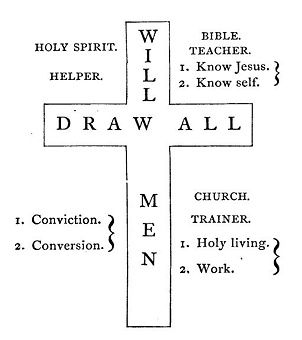
The following, by E. D. Jones, of St. Louis, teaches a lesson from
the text, John xii. 32: "And I, if I be lifted up from the earth,
will draw all men unto me." First, Notice the influences God
uses to draw men: 1. The Holy Spirit. 2. The Bible. 3. The Churches.
Secondly, Look at their relations: 1. As a Helper. 2. As a
Teacher. 3. As a Trainer. Thirdly, Look at the chief work of
these agents: 1. To Reveal. 2. To Believe. 3. To Know. 4. To Train.
At the close of the address or lesson the blackboard will appear as
follows:
Two hearts, one bad, the other good, make an instructive lesson. Get
the children to tell you what to write in them as below:
Still another is the following: "Jesus is your friend." What
qualities do you want in a friend? Answer. He must be
True. Write the word TRUE on the board, and then by
questioning draw out of the scholars four different and prominent
characteristics of Jesus as a friend, each answering to one of the
letters of the word True, as follows:
Jesus is your Friend.
T—ried.
R—ich.
U—seful.
E—verlasting.
The Parable of the Sower may be taught by the following arrangement
in three columns and twelve words or particulars. The children give
the words to fill the columns:
| The Soil. | What became of the Seed. | Represented what
Hearers. |
|---|
| Wayside. | The Devil seized it. | Careless. |
| Stony. | The sun scorched it. | Superficial. |
| Thorny. | Tares choked it. | Worldly. |
| Good. | Fruit. | Pious. |
The lesson, "Son, go work to-day in my vineyard," may be thus
arranged:
Who?—"Son,
What?—go work
When?—to-day
Where?—in my vineyard."
How work? Answer:
W—illingly.
O—rderly.
R—egularly.
K—indly.
The next three examples are from Rev. J. H. Vincent's blackboard
exercises:
History of Joseph.
| 1. Bo (rn 1745 B.C. |
| 2. So (ld | 17 | years old. |
| 3. Imp (risoned | 9 | years in slavery. |
| 4. Rel (eased | 4 | years—in prison. |
| 5. Ber (eaved | 29 | years—loses his father. |
| 6. Di (ed | 51 | years. |
| 110 | years old. |
The Seven Principal Journeys of Christ.
| 1. Bethlehem | to Jerusalem, | 6 | miles north. |
| 2. J. | to B. | 6 | miles south. |
| 3. B. | to Eg. | 250 | miles S.W. |
| 4. E. | to Naz. | 350 | miles N.E. |
| 5. Naz. | to J. | 65 | miles south. |
| 6. J. | to N. | 65 | miles north. |
| 7. N. | to Jer. | 50 | miles S.E. |
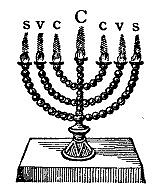
Seven Golden Rules of Sabbath-School Order.
1st s, for silence.
2d s, for system.
1st v, for vigilance.
2d v, for variety.
1st c, for charity.
2d c, for concentration.
central C for Christ.
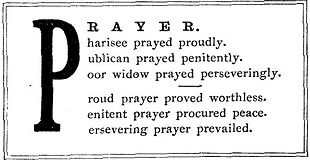
A more elaborate lesson, illustrating the parable of the Pharisee and
Publican, and showing the characteristics of three kinds of prayer
and their results, can be portrayed thus:
Another still is to write a part of the test and fill it up with the
answers of the scholars, thus:
| "At thy word I will: | Repent.
Pray.
Believe
Love.
Obey.
Suffer." |
A lesson on the Beggars that cried to Jesus, as found in Matt.
xx. 30-34, may thus be placed:
| What the beggars did: | cried in distress. |
| cried with importunity. |
| cried with faith. |
| cried with humility. |
| What Jesus did: | stood still. |
| asked what they wanted. |
| had compassion. |
| touched them. |
| Result: | He healed them. |
| They followed him. |
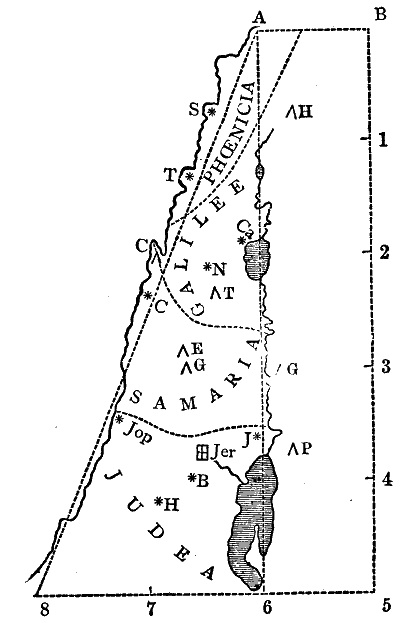
Another use for the blackboard in the Sunday-school
is the drawing of maps and outlines of the
location of sacred places. Teachers have found it
difficult, however, if not impossible, to draw maps
of the proper proportions and rightly to locate the
places. The following simple plan, used by Ritter
and Guyot, has been extensively used in our Sunday-school
Conventions the last year or two, and found to
be useful. It is called the "Relative Measurement"
method. One line, say from A to B (see diagram on
page 123), is taken as the unit of measurement. This
line is 40 miles in length. Having drawn this line at
the top or northern boundary of Palestine, next dot
off five times forty miles south, and number it in proper
proportions, 1, 2, 3, 4, 5. Then run three times
forty miles west, and number 6, 7, and 8. Then
draw a line from A, sloping to the figure 8, for the
coast-line, and you have the general outline of Palestine.
Then run another dotted line from A to 6, and
you have the Jordan line. The River Jordan rises
opposite 1. The Sea of Galilee lies opposite No. 2.
The Dead Sea opposite 4 and 5. The principal
mountains are designated as /\ H. for Hermon, etc.
Cities by * and letters, as Jer. for Jerusalem, C. for
Cæsarea, etc. (See table.)
The great divisions are made by drawing a curved
line from Mount Carmel to the Jordan, midway between
2 and 3. Then equidistant between 3 and 4
draw a circular line to the coast of the Mediterranean
Sea. The length of the Holy Land is about 180
miles and the width from 25 to 70 miles.
The Sea of Galilee is 12 miles long by 6 broad,
and the Dead Sea is about 50 miles long. The
following outline, which appeared in part in The
Sunday-School Teacher, of Chicago, is a good illustration:
Table of Localities.
(See Map.)
| / \ Mountains. | * Cities. |
|---|
| H-ermon. | H-ebron. |
| G-ilead. | B-ethlehem. |
| T-abor. | Jer-usalem. |
| P-isgah. | J-ericho. |
| C-armel. | Jop-pa. |
| E-bal. | C-æsarea. |
| G-erizim. | Ca-pernaum. |
| N-azareth. |
| S-idon. |
| T-yre. |
The foregoing are samples each of several classes
of blackboard exercises, which I have selected as
being the most practical. Other more fanciful ones
are omitted, for it should ever be remembered that
the true, legitimate use of the blackboard does not
necessarily involve any of these ingenious devices:
simply the plain Word of God, plainly written, is all.
XV. THE INFANT-SCHOOL. — Examples of Infant-class Lessons. — Example No. 1. — Example No. 2.
THERE is no department of the Sabbath-school
work of greater importance and
interest than this. We have known marked
cases of hopeful conversion of children from four to
seven years of age to result from the first hour of
Bible instruction in the youngest infant classes.
Often the character and habits of scholars as such are
formed at the very first interview with their teacher,
who thus meets them at the very entering in of "the
gates of life." It is well known that some of our
most distinguished divines, as well as active Christian
ladies, date their conversion back to the early
age of four, five, or six years. Therefore take
measures in every Sabbath-school to organize and
sustain a first-class infant-school department.
1. Get a light, warm, airy room. A lean-to added
to your chapel for the purpose, or the use of the
next-door neighbor's dining-room for an hour a
week, will answer. Give the children a room by
themselves if possible, to rise and sing, talk, recite,
and pray. Furnish the room with a good blackboard
and crayons, and such Scripture prints and
cards and maps as you can obtain for the walls and
for use. Provide for them small, comfortable seats.
2. Select and call to the charge of this class the
most pious, bright, cheerful, patient, loving, gentle,
winning teacher for children there is to be found in
the whole church, with a like assistant. Generally
the teacher will be a lady, although some men
greatly excel as infant-class teachers, so that the
complaining remark of the little girl to her mother,
that she "hadn't any teacher to-day—it was only a
man," was quite too severe to be just. The little ones
are greatly blessed in their love for their teachers,
for they want a large share of demonstrative, life-like
sympathy, expressed by a soft, loving voice and
a gentle manner—hands that will speak in all their
gestures, and a patience that endureth and a heart
that loves to teach them for Christ's sake. If the
teacher feels the need of learning how to do this
good work, let him visit good week-day infant-schools,
and gather up suggestions and lessons, as
well as confidence and inspiration, for the great
work.
3. Visit and gather in all the children from the
ages of three or four to seven years, whose parents
are willing to send them, and at once teach them
habits of punctuality, order, regularity, and pleasant
worship. When they become well drilled and instructed,
so that they can clearly read the Bible, then
transfer them to older classes, unless there are good
reasons to the contrary. Although they are little,
they are very precious, and amply worth all the painstaking
effort you can make for them.
4. Let the teacher of such a class ponder and consider
the characteristics of his precious charge.
1. Activity.—Says Mr. Hassell, "A healthful child
abhors quietude," and rightly so, as much as nature
does a vacuum. Every mother knows that her little
ones, if in health, "cannot bear to be still for a
minute." 2. Curiosity.—Archbishop Whately says:
"Curiosity is the parent of attention." 3. Inquisitiveness.—Happy
is that child who is blest with a
mother or teacher who will "bide patiently all the
endless questionings of the little one, and will not
rudely crush the rising spirit of free inquiry with an
impatient nod or a frown." Rather see in their
many questions but the untutored pleadings of the
little ones for care and cultivation. Oh, how much
they want and deserve to have their inquisitiveness
satisfied by a kind, considerate answer to all their
questions! 4. Fear.—Oh, how much children suffer
from this cause! Their natural timidity should
be respected, and not cruelly wrought upon. 5. Then,
too, children have wonder, and like to talk and hear
of "wonderful things." 6. They have also a proper
love of approbation, and they should be cheered and
encouraged when they try to do well.
Now let the teacher take up the first of these well-known
characteristics, and act upon it. An excellent
teacher of an infant class, some years ago, was accustomed
to gain order by appealing to their love of
activity. She would stand quietly at the desk and
ask the children: "Children, will you please tell me
what the gods of the heathen are like?" This was
always a pleasing request to them, and every form
would stand erect, with every hand by their sides, and
they would together begin the part of the 115th
Psalm which answers that question. They would
repeat all together, "Eyes have they, but they see
not," and every pair of little hands would go with
the teacher's, pointing to, and resting upon, their
eyes. In like manner, "mouths have they," "noses,"
"ears," "feet," "hands," etc., always suiting the
action to the word. All are in perfect order, and the
next step for the teacher would naturally be to talk a
little about the gods of the heathen, and then sing a
verse about "bowing down to gods of wood and
stone." The transition is then natural and easy to
"Our God" in heaven, where angels, saints, parents,
and children too, are; and they sing the hymn to
which all leads, viz.: "Around the throne of God
in heaven, Thousands of children stand," etc., etc.
Another mode of conducting an infant-school is to
place the children in little classes, of six scholars,
with a teacher for each, and proceed with singing,
repeating commandments, singing, recitation for ten
minutes, study of emblems, a ten-minute address,
and prayers, having a verse or two of singing between
every exercise, and no exercise longer than
ten minutes. Thus an excellent system of infant-class
instruction proceeds, while the lady who has
charge gives the address and superintends the
teachers, etc., for the hour devoted to the school.
Another way is to take the two central verses of
the regular lesson for the whole school and bring it
out on the blackboard, and question, instruct, and
pray and sing about the same thought of God in the
lesson; as, "Who formed you, child, and made you
live?" Ans. "God did my life and spirit give," etc.,
with singing and prayer.
Another infant-class teacher has a different plan,
as follows: She has arranged with a gentleman, who
teaches a large class of young ladies of sixteen to
twenty years of age, to come in with his class and
conduct the opening exercises of the infant-school.
He then goes into another room and instructs his
class for thirty minutes, and the lady instructs the
children for the same time. Then the Bible-class,
with their teacher, return, and the infant-school is
divided into classes, in which the young ladies teach
the same lesson which they have just received from
their teacher. In this way practice in teaching, and
variety are gained, and the lady teacher in the infant-school
is relieved of a part of her burden.
I have never found two infant-class teachers who
conducted their schools exactly alike. Each one has
some peculiarity in his or her mode. There is no
standard mode of infant-class instruction. Adaptation
according to circumstances is the rule. The
children should be received with great care into the
infant-school, and be given to understand that it is a
place for the holy worship of God, and to learn of him.
The children should always be greeted by the teacher
with a loving smile, that is free from every trace of giddiness,
and with words of sincere, respectful welcome.
Great evil is done if the teacher is cold,
morose, or fretful in spirit or manner. The teacher
should pray with, as well as for, the children. They
may repeat the words of the prayer after the teacher;
and it is well to prepare them for the act, by some
such remark as, "Children, we want to thank God
this morning for this holy Sabbath, for the Sabbath-school,
for kind teachers, for the blessed Bible, for
our God and Saviour Jesus Christ," and so on, mentioning
the different objects of desire. Let the
prayers always be short and simple, and sing but one,
two or three verses at a time. The addresses should
always be clear and suited to the children. An
excellent model of scriptural talks to infant-class
children will be found in "Peep of Day," "Line
upon Line," and "Precept upon Precept." "The
Tract Primer" and "Child's Scripture Question
Book" have also some good things to work up for
infant-classes. There are various other helps from
which good suggestions can be gathered.
The children should recite their verse or verses
simultaneously; then by benches, or classes, and then
by a few individual scholars called upon, so as to
ascertain if all have learned it. The time cannot be
wasted by hearing each scholar recite in turn where
there are only one or two teachers. Care should be
taken not to burden the young mind. A small,
bright, clear, pleasant Bible truth is best. As the
good Dr. Ryland used to say, "Simplify and repeat:
Simplify and repeat," remembering that simplicity
is not poverty of expression. Learn, also, how to
carry thoughts into a child's mind, and not leave
them, as many do, at the doorway. Aim at Christ
and salvation. Let no hymn be sung which you
are not, beforehand, careful to see that the children
really understand. Make every truth clear and simple,
and let them act the lesson out with appropriate
gesticulations and motions. When speaking of God,
let them do it reverently, and perhaps by all pointing
their little fingers upward.
Bible stories and anecdotes are generally best and
most interesting for infant-classes. Use the blackboard
freely with words and appropriate figures, for
such little ones learn best that which they learn
through the eye. Teach little at a time, but teach
that little well and thoroughly, is a grand motto for
the infant-class teacher.
It is of great importance that the children should
always feel that their teachers are the best and
happiest persons they ever saw, and that they are
always so very bright and happy because the religion
of Jesus makes them so full of love and joy,
and they cannot help its overflow; and that they
consider it the greatest privilege of life thus to tell
their scholars of Jesus, and lead the little children
cheerfully along Zion's road towards the heavenly
Canaan.
The following lesson was publicly taught by
Ralph Wells before the Philadelphia Sunday-School
Teachers' Institute, in September, 1867. and phonographically
reported for the columns of The Sunday-School
Times. The class was composed of some
twenty children:
The Lesson.
Teacher.—Look around just for a moment, children, and see
how many people are looking at us. I want you to have one good look,
and then to give me all the rest of your attention. After you have
had your look, I want you to sing a little with me. [The children
face the audience for a moment, smiling, parents and teachers
returning their gaze with fond affection, and shall we not say, with
many prayers that the lesson might be abundantly blessed?]
Now let me see how exactly you can repeat the hymn after me. I will
speak first, and you will follow me:
"Jesus loves me, this I know,"
[Children repeat, in earnest harmony.]
"For the Bible tells me so."
[Children repeat thus, after the teacher, the first stanza.]
Teacher.—"Jesus loves me." Let us look at this a moment. We
think that praying and reading the Bible, and saying the lesson are
worshipping God; and so they are; but we often forget that in reading
and singing these beautiful Sabbath-school hymns we are worshipping
God, too.
"Jesus loves me, this I know,
For the Bible tells me so."
[After the hymn was sweetly sung, the teacher talked very pleasantly
about the beautiful Letter which our dear heavenly Father has sent to
us.] That Letter is the blessed Bible. We are going to have a lesson
out of it to-night. But we cannot understand it unless our Father
sends some one to open our hearts to understand it. We have sung a
verse to him: now we will look to him in prayer and ask him to be our
Teacher. [The class close their eyes, fold their hands, and repeat
the prayer after their teacher.]
Dear Lord Jesus!—We thank thee for the Bible—we thank thee that it
tells us—that God loves us—that he sent Jesus to die for us.—We
thank thee—for all its promises;—that it tells us—if we love
Jesus—and trust in him—we shall go to heaven;—that if we love
Jesus—and trust in him—he will never leave us.—To-night, dear
Father—send the blessed Spirit—to make us attentive—to help us to
find Jesus—and what he would have us to do—and how we can get to
heaven.—O dear Saviour!—sometimes when we try—we find it very
hard—to do right.—Let us never be discouraged—but whenever we
sin—go to Jesus and tell him all—and get his help.—Dear
Jesus—help us to live for thee—to do good while we live—to be a
blessing to all around us—and to show that we love thee—in our
homes—to little brothers and sisters—and to all our companions—at
home—at school—and everywhere.—May we so live—that everybody
shall see—that we are Jesus' little lambs.—Hear our prayer—and
come to-night and be our Teacher—and may our little
hearts—to-night—be given away to Jesus—to love and serve him—as
long as we live.—We ask for Jesus' sake.—Amen.
[This simple petition was offered by the children, as with one voice,
the tone and accentuation of the leader being caught up and carried
by them with affecting earnestness
of pleading. One could not but feel that the exercise was
real, with both teacher and class.]
Teacher.—Now sing with me one verse more, children, and we
will take a Bible lesson together. It is new to you, but we sung it
over once this afternoon, and I guess you can sing it now. I will
sing one verse for you, because it is new to you, and then we will
sing it together. It begins with
"Oh, I must be a lover of the Lord!"
Let me sing it for you. [Teacher sings.]
"Oh, I must be a lover of the Lord,
Oh, I must be a lover of the Lord,
Oh, I must be a lover of the Lord,
Or I can't go to heaven when I die."
[The children then sing it with Mr. Wells, and finally by themselves,
clearly, loudly and accurately.]
There is a little sentence of only four words, children, that has
been more precious to me than any other in the world. I wrote it on a
piece of paper years ago, and put it in my pocket-book—here it is,
with little flowers around it—[Producing it and holding it up to the
class.] Would you like me to give you these four words? Yes,
sir! Well, I will write them on the board. [Writes:]
I do not know whether you can read—[the children, quickly
interrupting, read "Christ died for me".] Yes, if ever this
world loves Jesus, it will be because these four little words get
into everybody's heart. Try and remember them.
I am now going to read a verse out of our Father's Letter. It is a
sad story. After I read it, I am going to tell it to you in my way;
and after I have told it to you, I am going
to ask you, to see if you can tell me all about it. Then I am going
to tell you the meaning; then the lesson—three things: the story,
the meaning, the lesson. Can you give them to me? First,
the—story, next, the—meaning, and last,
the—lesson, [the children say.] Once more, give them to
me.—Story, meaning, lesson.
I will read it first out of the Bible, for I always want to give you
God's word first; then I will tell it to you. It is in the twelfth
chapter of the Book of Exodus. "Exodus" means the "going out." When
you leave this room you "go out" of it—it is your "Exodus" of the
room. So, in the Bible story, God's people went out. Let me read to
you:
"Then Moses called for all the elders of Israel, and said unto them,
Draw out and take you a lamb according to your families, and kill the
passover. And ye shall take a bunch of hyssop, and dip it in the
blood that is in the basin, and strike the lintel and the two
side-posts with the blood that is in the basin; and none of you shall
go out at the door of his house until the morning. For the Lord will
pass through to smite the Egyptians; and when he seeth the blood upon
the lintel, and on the two side-posts, the Lord will pass over the
door, and will not suffer the destroyer to come in unto your houses
to smite you."
And it happened just as God said. Now, I do not want to tell you
anything that you can tell me. In the first place, we want to find
out where this took place. Can any of you tell me the name of the
country? [Egypt! shout three or four little voices—to the
surprise even of the teacher, who, as well as the audience, was
repeatedly astonished at the accuracy, promptness, and clearness of
the children's answers.]
The Israelites, or God's people, are spoken of in the lesson. They
are now in Egypt. Let me mark it on the board. Here is Egypt,
[drawing a rough outline of the Red Sea,
river Nile, and the Mediterranean; and, proceeding northerly, of
Palestine.] Pointing to the latter, the teacher said, Here
is—Canaan, one child replied. Yes! that little girl has it.
And what city is this? [making a dot near the corner of the Dead
Sea.] Je-rusalem! [a little boy finishes the word.] God's
people had been dwelling in Canaan; how did they come to be in Egypt,
where we find them in our lesson? Who first went down to get corn?
Joseph. Yes. There was no corn in the land. What do you call
it when there is nothing to eat? Famine! a bright boy replies.
Very well, indeed. Who, then, went first to buy corn? Joseph.
And who followed him? His brethren. What did they go for?—to
keep them from—Starving! That is it, exactly. I like to hear
children answer so well. Can any of you tell me how many Israelites
or Jews there were in Egypt? How many is that? [Writing the figures
2,000,000 on the board.] Two million! [eagerly responded a
little fellow, who certainly did credit to his week-day instructors.]
Yes, there were probably two million—men, women, and children. What
was the name of the king of Egypt? It begins with P.—Pharaoh.
Yes, God said to him, "Let my people—go." but Pharaoh said,
"I—won't!" Then God said, "I will show him what I will do. My
people shall go, that they may serve me." So God told his people to
get ready that night, when our lesson begins.
What should you think this was? [Drawing a rough figure of the face
of a clock.] A clock. Yes. What hour is the hand pointing to?
Twelve o'clock. What time of night do you call that?
Midnight. Yes, at midnight God said he would go from house to
house in the land of Egypt, and every house where he did not see
something on the door he would go in and kill the first-born. Let us
make a door, now. [Drawing the outline of a door.] We won't take time
to draw it very nicely. "Every house where I see something on the
door," God said. What was it he must
see on the door? Blood! blood! [Taking the red crayon,
spots of red are dotted here and there over the white door-posts,
representing blood.] Yes; wherever I see the blood of a little killed
lamb on the door, I will not go in and slay the first-born.
This blood must first be in a—[Drawing an outline of a bowl or
basin,]—Basin, the children reply. Yes; and how are you to
get the blood on the door? [Taking the green chalk, and drawing a
bush.] Here is a little bush, called hyssop, something like a
huckleberry bush, and the people were to take that and dip it in the
basin, into the blood, and do what? Sprinkle it on the door!
Yes. What part of the door? (A pause.) L-i-n-t-e-l; what does that
spell? Lintel.
Then, "when I see the—blood—on the—lintel—and on
the two—side-posts—I will not go in and—kill the
first-born!" Yes. That was what God said.
I have sometimes thought I could see an Egyptian soldier that night
with his armor on, going up to one of the Israelites and asking,
"What is that you are putting on the door?" "It is some lamb's
blood." "What are you putting it on for?" "Because my God has told me
to." Then with a strut he has turned on his heel and walked away,
muttering to himself, "What a big fool that Jew is!"
But see! the hands on the clock begin to get around. It is now
pointing to—midnight. Yes, pretty soon it strikes
one—two—three, up to—twelve. And then! Oh! the angel of
death went from one house to another, and in every one that didn't
have—the blood—on it, the first-born was—killed.
Yes! And one wail of woe went up from Egypt that night. Fathers and
mothers, from Pharaoh in his beautiful palace, to his poorest
servant, were weeping and wailing and lamenting their first-born,
slain by the hand of the angel of God.
But some houses escaped. The ones with the—blood on.
Had there been any death in those houses? No, sir. Think. What
had died? A little lamb. Yes; a little lamb had been killed
and his blood put in—a basin. And then—suppose the basin had
been set behind the door, would that have done? No, sir. The
blood must be sprinkled on the—door, and it most be sprinkled
by a bunch of—hyssop. Yes; it must all be done exactly as God
had said. Then the door that had the blood upon it was passed over by
the angel, was it? Yes, sir. And what was done to the house
where there was no blood? What did the angel do? Went in. Yes,
and—slew the first-born. [Mr. Wells then called a little boy
up to the board, drew a rough sketch of three or four door-frames, on
two of which he used the red chalk, making marks to represent blood.
The boy was then asked, with the class, to point out which houses the
angel would enter, and which pass over, thus drilling the fact
impressively and perfectly into the scholars' minds, as also the
reason for the angel's choice—the blood of the lamb.]
How do you think I got here? On the cars. What drew the cars?
An engine. Did you ever see an engine? Yes, sir! (with
emphasis). This summer, where I live, at Tarrytown, a gentleman said
to me, "Don't you want to go down on the track and see the express
train go by to-night?" I said yes: so we went. By-and-by I heard a
rumble: it seemed to come nearer and nearer, and got louder and
louder. What was coming? The express train. Yes, it was going
to rush by us at thirty miles an hour. Could we have held out our
hands and stopped it? No, sir! (emphatically, and
incredulously). Suppose we had had you to help us, could we then?
No, sir! Well, suppose all the people in this house had caught
hold of the cars?—what then? It would have pulled them to
pieces! [a little girl says]. Well, in a minute or two I heard a
sharp toot! toot!—what was that? The whistle. Yes, and
the man on the engine put his hand on a little iron bar and pushed
it, and the cars
began to go slower and slower and slower until they stopped. The man
put his hand on the right place, the place of power, the place that
made the engine go or stop. Now, what does Jesus say to us? "Behold,
I stand at the door and knock." Can you tell me at what door Jesus
knocks? Our hearts. "If any man," or child, "will hear my
voice, and open—the door—I will come in and—sup with
him." Yes, "and he with me;" and we shall be saved. But there
must be something on the door, or we cannot be saved, any more than
the Jews, if they forgot, or would not, put the blood on the doors of
their houses. What must we have on the door? Blood. Yes. Well,
will it do if you cut your finger, and sprinkle the blood on your
house? No, sir. Suppose you kill a little lamb, and put the
blood on your front door, will that save you? No, sir, no,
sir! What must the blood be on? Our hearts! Yes, the blood
must be put upon the right place, the place where Jesus knocks, the
place of power. Our hearts then are—the door. And what must
be sprinkled on the door? Blood.
Why did our soldiers go off to the war? To fight; yes, and to
shed their—blood—for their country. And what does shedding
their blood mean? They died—[a little girl answers]. Right;
they shed their blood, they died for our country. Jesus shed his
blood, That means the same as Jesus—died; yes; how? On the
cross. He hung there for you, did he? Yes, sir. And for
me? Yes, sir; and for us all? A little girl in a
mission-school, named Mary, sat on the front seat, and when the
superintendent was telling about how they hanged Jesus on the cross,
the tears came to her eyes, and when he got to where they took the
hammer and the nails to nail him, little Mary could not stand it any
longer, but she had to get up and go out. In the afternoon she came
back smiling, and the superintendent asked her, "Mary, where did you
go this morning?" and she said, "Oh, teacher, I could not stand it
when you spoke to us about Jesus being nailed on the
cross, for I felt just as if I helped to pound the nails in, and I
went off a little piece from the school, and got down on my knees and
told Jesus that my sins helped to hang him on the cross, and I asked
him to please forgive me for helping to kill him—that I was so
sorry; but now I feel so happy." Jesus forgave her, and to-day Mary
is a little Christian girl.
I have something in my pocket (drawing out a roll) that I want you to
see. Years ago I went thousands of miles away, and I sent on to
Washington and got this paper, It is called a "passport." There is
the great seal of the United States on it, and here is the
Secretary's signature at the bottom. And when I was away, in strange
countries, where I could not speak the language, all I had to do was
to show this paper, and they said, "Let him pass," or something that
meant that, and I was allowed to go on. If I had not had this
passport, I could not have got through. The blood of Jesus must be
our passport. When God sees this blood sprinkled on the door of our
hearts, he will say, "Let him pass," and we will be allowed to go
through this life in safety, and get to heaven when we die. But oh,
how many times we have to use this passport! How often we sin and
need to come to Jesus for forgiveness, and to point to his precious
blood sprinkled on our hearts!
The teacher further continued the lesson, illustrating
by pointed and affecting incidents, briefly recapitulating,
and closing with a short prayer, in which
the little ones feelingly joined. The above is all
that need be quoted to give an idea of the style of
this successful teacher of the children.
The following lesson was kindly forwarded to the
author, in manuscript, from London, by the young
lady teacher, "S. E. A.," who has been remarkably
successful in public exercises of teaching very young
children.
A Lesson upon Forgiveness.
Harry and Fred went to school. They had to cross a road to get to it.
A boy used to stand at the crossing with a broom in his hand to sweep
it with; this boy was very rude to Harry and Fred: he used to try and
keep them from crossing the road. Once he took away Fred's books and
splashed him with mud. When the boy saw Harry and Fred running and
making haste, lest they should be late at school, he would be sure to
stop them. In the winter-time he made them walk upon the snow.
Sometimes he held up his broom before their faces and cried out,
"Can't come across, can't come across; you'll be late, you'll have
the stick." Then, again, when they were very early, he would tell
them they were late, and so make them run. At last, one day all the
children of the school to which Harry and Fred went were going to
take flowers to their teacher, as it was her birthday. Henry said
that he would bring a beautiful nosegay, for his papa's gardener was
going to cut him a large one from the green-house for him to take to
school. Well, the morning of the birthday came: the school-children
brought a great many beautiful flowers; Harry and Fred did not come
with the rest; the children wondered where they could be. At last
though, in they came, but no nosegay: they made a bow, said
"Good-morning," and then both looked down on the ground. "Where's
your nosegay?" said a little girl to Harry. "I have not got one," he
answered. How could that have happened? The gardener had cut them a
beautiful large nosegay, and when they left home in the morning for
school they had it with them—what had become of it? Had the boy
taken it away? I will tell you all about it. As they were running
along very fast
to get to school in time, all at once they left off running and began
to walk slowly. They were near the crossing, and they felt afraid of
the boy; they need not have been frightened, for the boy was sitting
down on a doorstep crying, with his head resting upon his knees, and
took no notice of them. As they were going past him, Harry said, "Oh,
he will not hurt us; let us stop; I wonder what he is crying for?"
"What is the matter?" said Fred to him. "Mind your own business,"
answered the boy; "go on to school." So on they went, but as they
turned away the boy saw the nosegay, and called after them to come
back. "Don't go." said Fred: "he's a wicked boy; we can't help him."
Well, they were going on when Harry looked again and saw him crying;
so he and Fred turned back: then the boy told them that he was very
hungry, that his mother and grandmother were both at home very hungry
and ill, that a policeman had turned him away from his crossing, and
he had not earned any money for three days. Harry said, "Poor
fellow!" and he wished he had a penny to give the poor boy. Then
Harry and Fred looked at their flowers; the boy looked too. "He can't
have our flowers, you know," said Fred; "we want them for our
teacher, she is so kind, and I want to show how much I love her." So
they walked off slowly, and the boy looked after them and the nosegay
as if he would like very much to have it. "I say he does not deserve
to be helped," said Fred. "So do I," said Harry; "and then these
flowers are too good to give to him." However, they did not feel
quite comfortable, and then they remembered a text they had learned
at school the day before—"If ye forgive not men their trespasses,
neither will your Father forgive your trespasses." That is, dear
children, if we do not forgive others, God will not forgive us. So
Harry said, "Here, Fred! take the flowers to him." Fred took the
flowers, went up to the boy, put them in his hand, and then ran away.
A gentleman soon after gave the boy a shilling
for the nosegay, and I dare say you can guess what he did with it.
When Harry and Fred gave the nosegay to the boy, it made them feel
very happy—more happy than if they had given it to their teacher;
and it did the boy good too: their kindness made all his rudeness go
away, and always after this day he did all he could to please Harry
and Fred.
Tell me the names of the boys I have spoken to you about?
How did the crossing-sweeper behave to them? What were
they going to take to school one day? Why? Did Harry
and Fred take their nosegay to school? What did they do with
it? Did the boy deserve to have it? Why did they give
it to him then? Yes, they gave it to him to show that they had
forgiven him. Sometimes people are unkind to you; perhaps one day a
boy went up to you James, and stole your marbles; perhaps your big
sister one day gave you a slap, Mary. Now, if she ever slaps you
again, or if the boy takes away James's marbles again, are you to hit
them and call them hard names, or to forgive them? Why? Yes,
you should forgive them because God wishes you to do so; because it
will be acting like Jesus to do so; because God will not forgive you
if you do not forgive. Let us think a little about Jesus. You know
that one evening when he was praying in a quiet garden, some wicked
men came and dragged him away; you remember how the soldiers mocked
him, took off his clothes, put on him an old robe, a make-believe
crown made of thorns—dared to be so filthy as to spit in his face,
beat him; and then they put great nails through his hands and through
his feet, and nailed him to a cross of wood, put it up and let him
hang there. How the nails most have torn his hands!—what great pain
they must have given him! You know if a pin were put through your
flesh how the pain would make you cry out; what then must have been
the pain of the nails! And then he did not deserve this cruel
treatment: he had gone about doing good. If any persons deserved to
be punished, those who put Jesus, the
kind, loving Saviour, to death, deserved to be; and Jesus could have
punished them if he had chosen, for he was God's dear Son; but no, he
did not punish them. Instead of that, he prayed for them: he said,
"Father, forgive them; for they know not what they do!" Let us ask
God, the Holy Spirit, to give us a forgiving spirit, and so make as
like Jesus.
Here is a story which Jesus once told, that he might teach us to
forgive others: A king once had a servant who owed him ten thousand
pieces of money. When the king called the servant that he might pay
back the money, the servant had nothing to pay: not even one piece of
money could he pay back, and he owed—ten thousand. Then the king
ordered that the servant and his wife and children should be sold as
slaves, and work until there was enough money to pay back the ten
thousand pieces. When the servant heard this he fell down on his face
before the king, and said, "Lord, have patience with me, and I will
pay thee all;" in other words, "Do wait a little longer and I will
pay back all the money." Suppose Alfred's mother owes the baker for a
great many loaves, and he was to come to her house one day and say,
"I must have my money; I won't go away till you pay it to me;" and
then your mother were to cry, and tell him how sorry she was she had
no money, but that the children had been ill, and that she had had to
give all her money to the doctor, but that if he would wait a week
longer she would get the money and pay him. Well, suppose the baker
was to feel quite sorry for your mother, and should say, "Well, I
won't ask you for the money: you need not pay me at all. I will give
you the bread you've had." Now, that is what this king did. The
servant said, "Wait a little longer and I will pay you." The king
said, "You need not pay me at all: I forgive you it all." The servant
went away. As he was going away he met a man who owed him a hundred
pennies: he went up to him, laid hold of him very rudely by the
throat, and said, "Pay me what you owe me!"
The man fell down at his feet, and said, "Have patience with me, and
I will pay you all." How much money had the king just forgiven
the servant? How much did this man owe the servant?
What ought he to have done? But he did not forgive him, but
had him put in prison directly. Some servants were standing by and
saw what this unkind servant had done, so they went to the king and
told him all about it. He ordered the servant to be brought back
before him, and then the king said to him, "O you wicked servant I
forgave you all that debt: ought you not to have forgiven the poor
man what he owed you?" The king was very angry with him, and had him
put in prison until he paid the very last farthing. Then Jesus told
the people to whom he was speaking that so their heavenly Father
would not forgive them if they would not forgive one another.
How many pieces of money did the servant owe his lord?
Had he any money to pay back with? What did the king
order to be done to him and his wife and children? What did
the servant then say? Did the king give him a little longer
time? How much did a man owe this servant? Tell me how
he treated the man? Who went and told the king all about it?
What did the king say to the servant? What did
he do to him? Who was it prayed for those who treated
him so cruelly? Now, when you go home, I want you to tell your
mothers and fathers about the lesson. Repeat it. If we do not forgive
others, God will not forgive us. Try and remember three things—about
Harry and Fred; the king and the servant; the Lord Jesus.
XVI. YOUNG MEN AND WOMEN'S BIBLE-CLASSES. — Specimen Lesson for a Senior Class. The Feast of the Passover.
WE can hardly find words to convey our impression
of the surpassing importance of these classes. To train teachers, to train
mothers and fathers, to restrain from doubtful company,
and to furnish good companions and Christian
associations, reading, habits, impulses to the young
men and women of this generation, is a work
worthy of the highest aspirations of the best and
noblest of our race. If we look at the census, we
cannot fail to notice the striking fact that a little
more than one-third of the entire population of
New York are young men and women over fifteen
and under thirty years of age, while more than one-half
of our population is under twenty years of age.
In a very short time the destinies of our country
and of our churches will be in the hands of these
young people. To a large extent they have been
neglected in the family, in society, in the Sabbath-school,
and in the Church; and as Dr. James W.
Alexander said: "Be it ever remembered, that the
neglecters of the Church have been neglected by the
Church." These young people can no longer be
petted as children, and they are not generally treated
with the respect due to them as rising young men and
women. Said a youth of fifteen once: "Uncle, I
don't know what I can do with myself. I am too
old to play with children, and I am not old enough to
be interesting to the older people." This anomalous
position such young people sadly feel. They are
sensitive, beyond any other period of life, to any
slight or neglect, and after a vain struggle to gain a
recognition and position anywhere, they rush to the
gilded saloons or the giddy dance for that sympathy,
kindness, and regard which they vainly seek for in
the family, the Sabbath-school and the Church of
Christ.
This should never be, and it must not be. But
can these persons be reached and gained by the
Sabbath-school? And how? After due consideration,
I reply, in the first place, that they can be
reached. My reasons are:
1. Because earnest, warm-hearted, disinterested
efforts in this direction have ever been successful.
When building the Brick Church in Rochester, N.Y.,
the names of all the scholars and their ages were
transcribed and placed in the corner-stone, when it
was ascertained that, of the whole number—I think
652—the average age was fourteen years and ten
months; and other churches in that city present a
similar record, because the able and influential
Christian business men and women of Rochester
devote themselves to this great work.
2. Because no class of persons is more susceptible
to kind attention and real sympathy. They are
quick to perceive and prompt to act. No class is
more hopeful.
3. Because these senior classes, when appropriately
conducted, are well adapted to meet the wants
of their personal, social, intellectual, and religious
nature, and to fill a secret void that is keenly felt by
these precious youth.
In the second place, How can our young men and
women be reached? I answer:
1. Christian men and women of real talent and
character, of religious and social position, must be
thoroughly aroused to a self-sacrificing, devoted,
heartfelt interest for them. They must put their
hearts into it. No feigned respect will do. Nothing
but real sympathy will be received. No mere professions
will answer. These youth are quick and
sharp-sighted to detect anything insincere or unreal.
The best men and women of our churches must be
chosen to take charge of their classes—persons who
can and will understand, appreciate, and respect
young people. They must evince a more anxious
and watchful desire to notice and approve what is
right in them, than to condemn that which is wrong.
They must be patient and forbearing, with a good
control of their countenance, tone of voice, language,
quick to discover the value and bearing of the half-uttered
opinions of the class, with an earnest personal
interest in each one and all things that concern
them. They should be enabled to prove themselves
sincere friends and counsellors of all—both for this
life, in employment, business, social questions, amusements,
etc., and for the life that is to come. They
should have an intelligent enthusiasm in the great
work, with a strong faith in God, in his Word, and
in his Spirit, and a hearty good-will to man.
2. Lay your plans for these classes on so large
and liberal a scale as to command the scholars'
respect as well as your own. Render them as
pleasant and as attractive as possible. Make the best
arrangements you can as to room, seats, library, and
periodicals. I am sure The Sunday-School Times
and other Sabbath-school journals and magazines,
would be very useful in such a service. Do all you
can to raise these classes in their own estimation,
and omit no opportunity to cherish self-respect on
the part of each member, and try to inspire them all
with higher aspirations and better hopes. Manifest,
as well as feel, a personal interest in each one.
3. Aim high and direct. Have a distinct, definite
aim and object in all your teachings, and see that
each member of the class clearly understands it.
Young people want drawing out and leading forward
in gentle confidence. In these classes we
ought to select and train for the purpose our best
Sabbath-school teachers. If the exercises are allowed
to degenerate into unprofitable discussions, the examination
of curious questions, controversies, or skeptical
subjects, they may be productive of positive
evil. Care should be taken, therefore, to engross
them with the most ennobling themes. None can
better appreciate what is truly excellent than these
young people. An appeal to the Word and to the
Testimony they will understand and respect. Lead
them to compare Scripture with Scripture. Illustrate
the Old Testament from the New, and also bring
illustration for the New Testament from the Old.
Induce the young people to make the best use of a
good reference Bible, searching out parallel passages
for comparison, inference, and illustration, and all
will be interested and benefited. Use similes, metaphors,
etc., which so abound, as well as comparisons
and inferences. The following quotation may serve as
an illustration of four figures of speech, all brought
into one sentence:
"Imagine a father bewailing the loss of his son,
by drowning.
Simile—He stood firmly upon the beach, like an oak of the
forest,
Metaphor—and cried out, with trumpet voice,
Hyperbole—louder than the cannon's roar:—
Apostrophe—Oh ocean! thou hast robbed me of a beloved and
courageous son."
4. The character, interests, and feelings of the
class should be the teacher's unwearied, daily study.
This will be a noble work. Nothing which concerns
them should be treated by the teacher with indifference.
His profoundest thoughts, reading, observation,
and study should be laid under contribution to
his class. Painstaking saves thousands, neglect
ruins millions. Count no sacrifice too dear to win
souls.
5. It is indispensable that the teacher of such a
class should always be courteous. Religion should
at least make its possessor a gentleman, and this the
young people all know right well. His whole life
and bearing will influence the little circle. The
personal appearance also should be duly regarded.
Says a teacher: "The manner of a teacher should
always be marked by these qualities: 1. Animation—a
quickened, active state of the whole soul; 2. Intention—the
aim and endeavor to impart the information
required; 3. Earnestness—zeal in executing
the instruction."
6. The class should be consulted, as far as possible,
respecting the subject of study. The teacher
should lose no opportunity to evince his respect for
their opinions. His difficult questions should be
asked generally of the class, while the personal
questions should be easy and adapted. He should
receive all their answers with an abounding charity
and confidence, and make the most of the feeblest
responses. A tart reply to a single remark will
ofttimes seal the lips and hearts of a whole class.
They love confidence, and become afraid to trust a
teacher with their stammering, half-uttered, imperfect
answers, particularly if he appears more anxious
to be smart and witty than to do them good and
honor them. Let the lessons be systematic and
complete. The teacher should aim to draw out the
thoughts of his pupils in an easy way, instead of
pouring in his own. "Thoughts, not words," should
be the class-motto, and none can appreciate them
better than young people. Let the illustrations be
well-chosen and appropriate. If you strike an important
practical question during the lesson, do not
leave it until satisfactorily investigated, whether the
lesson is covered or not. Let every mind be calm
and unembarrassed, so that it will work well; much
depends upon the class, as well as upon the capacity
of the teacher. "A few pebbles, a piece of leather,
and a cord, are in some hands, a more formidable
weapon than the sword of a giant, although it be
strong as a weaver's beam and keen as a blade of
Damascus steel."
7. These young people should be especially induced
to look into their own hearts, and study their
own mental and moral mechanism. Lead them
often to converse about themselves. It has been
truly said, that "it is a law of human nature, that
man is interested in nothing so much as about himself."
Whatever relates to his own personal experience
always claims his especial regard. Many quite
fail as teachers, as well as preachers, because they are
so impersonal.
8. Social meetings of the class should be held now
and then, and pains should be taken to make them
attractive and useful. Young men and women must
have their social nature regarded. The teacher
should on such occasions strive to recall the freshness
and vivacity of his own youth, and live it over
again; enter into it heartily, and show the class
his acquaintance and sympathy with all their peculiar
wants, fears, and trials. Band the young people
together, in social bonds and mutual pledges if you
please, to attend church, prayer-meeting, and Sabbath-school,
to read the Bible and pray regularly,
and perhaps pledge also against improper reading,
associates, games, drinking, smoking, late hours,
neglect of the Sabbath, and unite them in associated
literary efforts, in tract missions, Sabbath-school
work, in visitation, and in all ways of doing good.
There should be social prayer-meetings of the class
at convenient times. Have, also, a well-chosen
library for them, and point out from time to time the
books best adapted to peculiar wants and circumstances.
9. Give each pupil distinctly to understand that
every step in your efforts on his behalf is intended to
lead him to Christ; that all there is to be desired
in this life and in that which is to come, is embodied
in this idea; that you expect, as soon as they get
their minds clear upon the glad tidings of the gospel,
that they will embrace them at once. Life is
short, and there is no time to lose. Besides, young
people when convinced are generally prompt to act,
and therefore there is great encouragement. In fact,
no field of benevolent effort is more full of hope and
encouragement than this one of which we speak. In
a Bible-class in one of our church Sabbath-schools
not long since, fifty-five persons united with that
church during the current year; and in another
church and class, fifty, and in another still, thirty-four—all
as the results of one year's labor. How
glorious! Let then our sons and daughters, our
clerks, scholars, and servant-girls, all be gathered
without delay by the churches of Christ into these
adult classes. Thus let the warm, burning influences
of the living teacher reach every youthful heart.
Says an earnest worker: "Among persons of all
ages, truth most frequently has power when spoken
by the living voice. The words of a teacher's mouth
should be ever warm with the Spirit's breath, and
strong with the vital impulses of his throbbing heart.
Such words children feel." In the language of one
of our Bible commentators, the truth evidently is this:
"That personal effort for the souls of individuals—the
lip, the thought, and the heart of a living man—brought
into contact with the lip, thought, and
heart of a living man, IS A GRAND INSTITUTION OF
GOD FOR THE CONVERSION OF THE WORLD."
There is such a great necessity for adapting each
lesson perfectly to the age, acquirements, etc., of the
scholar, that I add a single specimen lesson from
"The Sunday Teachers' Treasury." It is upon the
same subject as that taken up in Mr. Wells's infant-class
lesson—"The Passover"—and is given that, by
comparison of style, the adaptation of the same lesson
to infant and Bible-classes may be seen:
(Exodus xii.)
Circumstances of the Israelites at this time; how solemn, how
stirring, how intense in interest! The institution of the Passover
seems to have a threefold design. It was—1. An act of faith and
obedience on the part of Israel. 2. A memorial of their deliverance.
3. A type of Christ. In the last view we will study it to-day,
looking less closely at those points which we had on a former
occasion, and connecting with the actual celebration of the Passover
that which God connected with it—the feast of unleavened bread and
the offering of the first-fruits of the barley harvest.
The Passover, then, was a type of Christ.
I. The victim was to be a lamb; and this title is applied to Christ
(John i. 29).
The first altar exhibits a lamb slain; the first act of God for
Israel is the slaying of the lamb; the first deed of the new
dispensation was presenting, and then offering, the Lamb; the first
opening of the sanctuary above, shows the "Lamb that was slain."
1. Without blemish (Matt. xxvii. 4; 1 Pet. i. 19; Heb. vii. 26).
2. Set apart four days (ver. 3, 6; John xii. 1, 12).
3. Roasted with fire (Isa. liii.; Ps. xxii.; Luke xxii. 44).
4. Not a bone to be broken (John xix. 33).
5. All the congregation were to take part (ver. 6; Matt. xxvi. 1;
Acts ii. 23-36).
6. The blood was to be shed and sprinkled. Where? On the side-post
and upper door-post; not on the floor, where it would be trampled on
(compare 1 Pet. i. 19; Heb. x. 29).
It is not enough that Christ's blood is shed; it must be sprinkled on
our hearts (Heb. xii. 24; 1 Pet. i. 2). The act of sprinkling it upon
the door-posts was equivalent to a profession, "I am the Lord's." It
was the means of safety, "When I see the blood," etc.
What encouragement for timid Christians! Perhaps, as the angel went
on his awful mission, the shriek and wail from some neighboring house
would reach the ears of an Israelitish family. A mother might tremble
and clasp her child to her breast with fear; her faith might be weak;
but if the blood were on the door she was safe, though trembling.
"When I see the blood, I will pass over you." "Pass over." The
general idea that God was passing through by his destroying angel,
and left those doors on which the blood was seen. This, perhaps, is
not strictly the meaning. At least, Bishop Lowth, an eminent Hebrew
scholar, says, "Two agents are supposed—the destroying angel on his
errand of judgment, and Jehovah Himself, as it were, accompanying
him; and when he sees the sign, 'springing forward before the door,'
he makes Himself the safety of his own" (compare Isa. xxxi. 5).
Peculiar beauty of the type thus viewed. If the blood of the Lamb is
sprinkled upon us, we are as safe, though not yet as happy, as the
redeemed in heaven (Rom. viii. 1, 31, 33, 34). Nothing but the blood
of the great Sacrifice will save the soul. Have you come to it? No
outward membership, no self-denial, no suffering, nothing but Christ
can save.
II. The paschal sacrifice was to be eaten.
1. The blood was to be sprinkled before the food was eaten. It
was consciousness of safety through the blood that enabled them with
gladness to partake of the feast. We must have faith in Jesus before
we can have communion with him.
2. It was to be eaten with bitter herbs and unleavened bread—the
former the emblem of their bitter oppression and
the type of sorrow for sin; the latter showing that the redeemed must
be holy. They are set free, but it is to be made pure.
III. The Passover was to be kept.
The feast of unleavened bread was to last seven days. It was, as it
were, the continuance of the Passover. The one exhibits the
way of pardon; the other, the holiness which follows pardon.
IV. In closing our subject, not exhausting it, turn to Leviticus
xxiii. 9-11.
1. "On the morrow after the Sabbath," that is, the first day after
Passover Sabbath, sometimes the third day after the Passover,
sometimes later.
2. The sheaf is evidently "Christ the first-fruits" (1 Cor. xv. 23).
Jesus rose the third day after the Passover, and this has become our
Sabbath ever since.
3. The first sheaf is the pledge of our resurrection—that is, of our
declared acceptance and full freedom by our resurrection (1 Cor.
xv. 20).
How full the meaning of the apostle's words, "Christ our
Passover is sacrificed for us, therefore let us keep the
feast!" Ours is a greater danger, a nobler deliverance, a higher
ransom, a grander freedom. Let as live as those who are not their
own, but are redeemed from "vain conversation" as well as from death
and condemnation.
XVII. THE ART OF SECURING ATTENTION.
EVERY one will acknowledge the indispensable
necessity of a teacher's securing good
attention. By attention we mean "fixity of
thought, steadiness of mind."
1. Says Mr. Fitch: "Attention is—1. An act of the
will. 2. It is the one of all the mental faculties
which is most under our control. Therefore the
degree of attention we give depends upon our disposition,
and is therefore largely a matter of discipline,
and other things being equal, that teacher will
gain the best attention who has most personal influence,
and who is looked up to with the greatest respect."
(Teacher! is your character, conduct, and
manner such as will entitle you to respect?) "3. Attention
is a habit. If truly given, every day it becomes
the easier. And every day we listen languidly
to a lesson or sermon the habit of inattention
is strengthened."
2. Attention is promoted by a deep and earnest
interest in and sympathy with the child, as well as
for him. We must enter into sympathy with him,
so as to understand his nature, his weaknesses, and
his trials, and make all due allowance for them.
3. If the teacher would secure attention, he must
be accurately and abundantly prepared; for no
teacher can teach all he knows, and the moment a
teacher approaches the limit of his preparation, he
shows his weakness and embarrassment, the child
detects it, and he is gone.
4. Improve well the circumstances which surround
the daily life of the child, for you must here gather
your best illustrations. Teachers can do this, if they
are industrious, and will keep their "Sunday-school
spectacles on."
5. Give the children frequent change of posture to
relieve them. Study to do this especially in infant-classes.
Give much freedom of motion and gesture
to the little ones. If they speak of God and heaven,
let them point and look upward in harmony, and
thus teach them in a reverent manner to act out their
words and feelings.
6. Simultaneous reading and making of ellipses,
leaving the children to fill in a word at the close of
the sentence or lesson, will aid in securing attention.
7. Recapitulation is very important to gain the attention.
The scholar must give attention to be prepared
for the expected review. Therefore always
ask in detail, in order to see that all is understood.
No child or man ever takes pains to grasp a subject,
so as to fasten it in his memory, unless he expects to
be called upon for it, or in some way to find use for
it hereafter. We cannot retain in our minds isolated
or abstract knowledge. Todd beautifully says, "Ask
a child if he knows what whiteness is, and he will
tell you no; ask him if he knows what a white wall
or white paper is, and he knows at once. Ask him
if he knows what hardness is, and he will only stare
at you; but ask him if he knows what a hard wall,
or hard hand, or a hard apple is, and he will tell
you at once." Connect the lesson with previous
knowledge, and take great care to sustain attention
with abundant resources, for if it is once lost, it is
a very difficult thing to regain it on the same lesson.
8. Pictorial power. Word-painting by the aid
of the imagination and ample details; the power
of describing scenes and incidents, so as to appear
real to the child's imagination, will assist you in gaining
his attention. If you will dwell on all the little
details of a fact clearly, you will be graphic in picturing
it out in words; and without these details,
the teacher may sometimes be very graphic with
children, even in the simple act of reading with suitable
emotion, emphasis, and action. Said a little
girl, "Oh, father, Mr. F., the minister, read the 21st
chapter of Revelation in church to-day, and it was
just as if he had taken a pencil and paper and pictured
it right out before us." It is St. John's elegant
description of the Holy City. The Bible makes
great use of the imagination in its numerous emblems,
metaphors, similes, etc. In fact, we cannot worship
God without the aid of the imagination. God is
compared to a sun and shield; a rock and refuge.
Heaven itself is described with its streets and harps
and crowns of gold, its arches, mansions, rivers, etc.
Even our divine Redeemer calls himself the vine,
the tree, the lamb, the bread, and fountain of living
waters.
9. Avoid a stereotyped or routine mode of teaching.
If ever so good, strive to improve it; vary it,
and freshen it up in some way, and thus keep each
child expecting something.
10. Awaken curiosity. Archbishop Whately says:
"Curiosity is the parent of attention; and a teacher
has no more right to expect success from those who
have no curiosity to learn, than a husbandman has
who sows a field without ploughing it;" duly regard
their love of approbation by cherishing their self-respect;
and if you would retain attention, patiently
cultivate their inquisitiveness, for it will prove one
of the grateful rewards for your kindness. Says an
old writer: "The general occupation of infancy is to
inquire. Education directs their inquiries." Therefore,
bear patiently with your little ones, and answer
all their endless questionings. Do not rashly check
the rising spirit of free inquiry with an impatient
word or frown. Says the poet:
"Answer all a child's questions, and ask others as simple
As its own, yet wisely framed
To waken and prove the young child's faculties,
As though its mind was some sweet instrument,
And you with breath and touch were finding out
What stops and keys would yield the sweetest music."
Now, I will freely acknowledge—1. That attention,
such as we want to get from children, is a very
difficult thing for anybody to give. The incidents of
yesterday and the cares of to-day and business and
pleasures of to-morrow, will divert and scatter attention.
2. That fixed attention to religious subjects is
particularly hard for any one, and especially hard
for children to give; but hard as it is, we must have
it, and no half-hearted, languid attention either, if
we are to do any real good in the Sunday-school.
3. Says an old writer to Sunday-school teachers:
"Let me tell you, you will not get it by claiming it;
by demanding it as a right; or entreating it as a
favor, by urging upon your pupils the importance of
the subject, the sacredness of the day, the kindness
of the teachers, or the great and solemn character of
the truths which you have to impart. All these are
legitimate arguments to be used with older Christians,
but will not do to rely upon with children. Nothing
in the long run—except fear, which is a very unsatisfactory
motive—can keep a child's attention fixed but
a sense of real interest in the things which you are
saying. The subject must claim attention for itself,
and therefore, the teacher needs always to be accurately
prepared and well furnished with correct knowledge,
parallel passages, illustrations, facts, anecdotes,
definitions of hard words, allusions, poetry, etc. In
all your teaching, forget not to recall the fresh spirit
of your childhood in all its warmth and earnestness,
remembering that he is the wisest teacher
who can combine the man's intellect with the child's
heart."
Now it may be, after all, teacher, that your children
may be inattentive, or they will disobey your commands,
or they will fail to treat you with respect;
but if that should be so, we will reply, in conclusion,
in the impressive words of Mr. Fitch: "Ask yourself
in that case whether your own behavior is uniform
and dignified; whether you ever give commands
without seeing that they are obeyed; whether you
waste your words or your influence in an injudicious
way; whether there is anything in your conduct that
reveals to the children a want of punctuality or order,
or of earnestness or steadfastness on your part? For
children are very keen observers of character, and,
in the long run, are sure to feel loyalty and affection
for one who is manifestly anxious to do them good,
and who can be uniformly relied on in word and in
deed."
XVIII. THE ART OF QUESTIONING.
THERE is a real art in knowing where,
when, and how to put a good question, that
shall quicken the memory, set the mind to
thinking, and call back the reflective faculties. Such
are the possibilities of a question. A large proportion
of all the good teaching in our Sabbath-schools
is brought about by the simple process of questions
and answers. "A question unveils the soul. Nothing
can escape a question. A question reveals
decision." Hence the skill required. Mr. J. G.
Fitch says: "The success and efficiency of our
teaching depend more on the skill and judgment
with which we put questions than on any other
single circumstance."
This art is to be learned, like any other art, by
much study and patient practice, for we best learn
the art of questioning by questioning. Augustine
says: "A boy can preach, but a man only can catechise,"
and Lord Bacon says: "A wise question is
the half of knowledge." Therefore the great skill
in teaching consists mainly in the right forming and
asking of questions.
If this be true, it follows that this subject should be
regarded as of special importance by every teacher.
Teachers often say that they cannot succeed in asking
questions without the book; that they do not
know what to ask. To this I reply, 1. There is never
any difficulty in forming the question where there is
an interest to obtain the answer. 2. It is generally
unwise to ask any question unless we have an interest
in obtaining the answer. Do not tantalize the little
ones. Says Mr. Hassell: "A question under some circumstances
will merely produce an exercise of the
memory; under others an exercise of reasoning;
and under others again it will stimulate inquiry,"
and we may add, awaken curiosity. Mr. Groser
says: "The true scope of questioning-power is as
follows: To awaken curiosity or the desire to know;
to arouse the memory or the recollection of what is
already known; or to point out something unknown,
which may be inferred from that which is known."
A question skillfully put will arouse, will fix attention,
concentrate the thoughts, and so discipline the
mind of the pupil.
There are, however, many bad and indifferent questions
put, in religious teaching, which a little knowledge
of the correct rules of the art of questioning
will enable us to avoid. Frequently a slight variation
in the form changes a bad question into a good
one. For instance: "Moses was a good man, was
he not?" is a bad question. "What kind of a man
was Moses?" is a good question, as it awakens
thought. "What do you understand by faith and
repentance?" is a bad question, for it is ambiguous
and indefinite, and perplexes the child. "Will you
tell me what is faith?" is a good question, for it
compels the child to think and to inquire—it puts
into his hand the laboring oar and he must row.
"Did David kill Goliath with a stone or with a
sword?" This is a bad question. It is involved and
suggestive. Ask the child simply, "With what did
David kill Goliath?" and the question is a good one,
in strict conformity with the laws of questioning and
of the child-mind.
Another class of questions is very common, but
well nigh useless, namely, leading questions, such
as, "Was David a good man?" "Was Goliath a
wicked man?" These are mostly bad or indifferent
questions, and are almost a total loss to the teacher.
Slightly vary them in the following way, and you
make them at once, in every aspect, good questions.
"What kind of a man was David?" "What kind
of a man was Goliath?" Teachers will remember,
therefore, to avoid ambiguous or indefinite, involved
or suggestive, and leading questions, which latter are
answered "Yes" or "No," for they are generally of
little avail.
What kind of questions, then, shall Sabbath-school
teachers seek to use? I reply:
1. Questions of Examination, in order to find
out what the pupil already knows; to gauge his
present knowledge, and ascertain what he needs to
know.
2. Questions of explanation of particular words,
which should be put freely while reading the
lesson.
3. Questions of actual instruction, or reflective
questions, thus making the pupil teach himself, or
find out as much as possible by thinking and inquiring,
and thus leading him to correct his own answers.
Much instruction may be communicated by asking
questions and correcting the answers, but great care
should be taken to make the most of the answers,
and to do full justice to them. Socrates's plan was
to lead the pupil by a pleasant question to discover
his own error, instead of directly charging him with
it. Encourage your scholars by all means to ask
questions with freedom, and give your teaching more
the form of an earnest conversation.
4. Questions of recapitulation or review. In
this way you ascertain whether your lessons are
received, for the test is their telling it back to you in
their own language. You question the lesson into
the minds of the scholars, and then question it out
again. Herbert, in his "Country Parson," gives us
an illustration. After asking, "Since man is so miserable,
what is to be done?" and the answerer could
not tell, instead of telling him, he properly asked
the following simple question, "What would he
do if he were in a ditch?" This familiar illustration
made the answer so plain that he was even
ashamed of his ignorance; for he could not but say,
"He would make haste out of it as fast as he could."
Then he proceeded to ask whether he could get out
of the ditch alone or whether he needed a helper,
and who was that helper? This is the skill; and
doubtless the Holy Scripture intends thus much when
it condescends to the naming of a plough, leaven,
boys piping and dancing, showing that ordinary
things are to be washed and cleansed, and serve as
lights for heavenly truths.
5. Questions with an ellipsis are most useful in the
review or summing up of the lesson, as, "He says,
I am the good—Shepherd. Come unto—me," etc.
6. Questions may often be used to kindle the
reflective faculties, to exercise the mind and to
develope ideas.
7. And, lastly, questions applying divine truth—softly,
thoughtfully, and in a few words—should
never be forgotten. Jesus did so and so. "Do you?"
David said, "Oh how love I thy law?" "Do you
so love it?" Solomon said, "Remember now thy
Creator." Charlie, "Do you love to remember your
Creator?" or "Why not?" etc.
Not only are the character and adaptation of the
question of great importance, but the manner and
look of the eye and the tone of voice and the manner
of receiving the answer. The manner should
be kind, gentle, life-like, and winning; the look of
the eye should beam with life and interest, while the
tone of voice should bespeak great tenderness and
sympathy. A cold, formal tone of voice will repel
the answer, even with a good question. It should be
sprightly, and respectfully familiar and natural.
Children cannot endure coldness nor dullness nor
dryness; therefore avoid all long pauses and sluggish
manner and heavy voice. The way which you receive
the answers will determine the question whether
your scholars will freely answer you or not. Make
the most of an answer unless it is absolutely wrong,
and if wrong, say, "Will some scholar tell me why
that answer is wrong?" Search out for all the points
or hints of truth you can find in the answer of the
child, and unfold it and hold it up in the most favorable
and gracious light.
Never snap up a scholar, or neglect or ridicule his
answers, however faulty. Always be candid and
sincere, and your scholars will soon learn to trust
themselves with you. A sharp, harsh reply will
close the lips of a whole class. Enunciate every word
with clearness. Vary the questions with all patience
if not answered readily, and never think a child does
not know because he does not answer the question
at once. Be sure "never to tell a child what you
could make that child tell you."
Let your questions have a regular connection, so
that one will naturally follow another, and in fact,
glide into the next, and "say as little as you can in
questioning and teaching, but so say it as to cause
the children to say as much as possible."
Then again be careful to adapt your questions
well. Do not tell much in your questions. Put the
right question to the right scholar, for it will not do
to ask A or B or C a question which only D in
the class can answer, for we are not to ask any child
any question unless we suppose the answer is in the
mind of the child.
It is of particular importance that in the commencement
of a lesson we always start aright. Have
some easy, pleasant questions ready, which they will
be glad to answer. No matter what occurs, never
manifest impatience or severity, or descend to a
witticism or a sneer. A sneering, sarcastic teacher
should be left out of the school. Therefore gladly
receive and develope, in the most charitable manner,
the half-uttered, stammering answer of the child at
your feet, and your children, in their hearts, will
bless you.
Dr. Arnold, the great teacher at Rugby, said:
"It was his practice to teach by questioning, and
as a general rule, he never gave information except
as a kind of reward for an answer. His explanations
were as short as possible, and his questions were of
a kind to call the attention of the boys to the real
point of every subject, and to disclose to them the
exact boundaries of what they knew and what they
did not know." Let me add to this Archdeacon
Bather's account of how he became a catechist. He
says in his "Hints on Catechising:"
"Perhaps, gentle reader, before I actually enter
upon my task of teaching you to teach others by
catechising, it may be as well to tell you how I became
a catechist myself; for the thought seized upon
me and occupied me much in very early life. I was
at school at Rugby, and at the time I speak of, was
in what we called the 'upper third.' The 'upper
fourth' was under the care of Mr. Innes, afterwards
Head Master of the Royal Free Grammar School
at Warwick. As I was sitting one evening in the
room of my private tutor, Mr. Homer, some one
knocked at the door, and in came Mr. Innes.
'Bather,' says he, 'when Mr. Homer has done with
you, will you come up into my room? I want to
speak to you; you will find nobody there but O——
(naming one of my school-fellows) and myself.' Of
course I went; and Mr. Innes, motioning my companion
to a chair and myself to another, took his
own and addressed us thus: 'I am going to set you
two boys very hard at work. Pray, O——, do you
know anything about astronomy?' 'Not much, I
am afraid, sir.' 'And you, Bather?' 'Not so much
as O——, I am afraid.' 'Well, now, do not flatter
yourselves that I am going to tell you anything about
it, for I shall do no such thing. Nevertheless, you
shall know more about it, and a good deal, too,
before you go out of this room.' He then put questions
to us both, by which he soon elicited all the
particulars of such little knowledge as we possessed;
and then he questioned us further, soon causing us
to make many blunders, and then making us correct
our answers, so that we certainly did quit the room
with fuller and more orderly notions of the matter
than we brought into it." He says, although this
did not make him an astronomer, yet it led him to
think and discern what must be the most effectual
way of imparting knowledge, for "under Mr. Innes
his interest never flagged; he could have listened all
night."
From the same source is here added another illustration
of teaching by the means of leading questions.
"Then was Jesus led up of the Spirit into the
wilderness," etc. "Then was Jesus." What do
you mean by "then was Jesus?" (Hesitates.)
"Then took Mary a pound of ointment." What
do you mean by "then took Mary?" Then Mary
took. What do you mean by "then was Jesus?"
and the answer came readily, "Then Jesus was."
Now you shall question me. Put me a question to
which each clause shall be a reply, beginning with
the first. "When was Jesus led up to be tempted?"
"Then." So here you are taught—what? The
time when these things took place. Put me a question
to which the words "led up" shall be an answer.
"What was done to Jesus?" He was "led up."
Put a question for the word "Spirit." "Who led
him up?" "The Spirit." So of the word "wilderness."
"Whither did the Spirit lead him?" "Into
the wilderness."
Let us add one more illustration, showing how to
put questions to help and lead. The manner must,
of course, be right, for a clumsy method will hinder
rather than help, and if we expect a right answer
the question must be a simple one, or one that will
not admit of being put as two questions. The following
anecdote may serve as the illustration: "A
lady came one day to my school and requested me
to let her hear the children catechised. The class happened
to be reading the third chapter of the Acts, the
first of which reads thus: 'Now Peter and John went
up together into the temple at the hour of prayer,
being the ninth hour.' 'Well,' I said to the teacher,
'stop there and question them on that verse.' 'At
what time of day?' said he, 'did those things take
place which are here set down?' 'At the ninth
hour,' replied the class. But then a poor boy became
a little frightened at something or other, and consequently
puzzled; and after some hesitation said,
'Well, then, at the ninth hour, who went where?'
The first boy in the class smiled a little, but made no
answer; the next seemed to think a little, but still no
voice came. I took care that nobody should answer
out of his turn, and the question was put to every
boy severally to the bottom of the class. The lady
turned to me and expressed her surprise that out of
a class of five-and-twenty boys nobody could answer.
'Well, ma'am, I am afraid you will consider these
five-and-twenty boys very stupid, but let us look a
little further into the matter.' And then, turning
round, my eye caught that of Jack Thompson.
'Jack,' said I, 'how many stupid boys have we got
in our second class?' 'One, sir,' says Jack. 'And
who may he be?' 'The teacher, sir.' 'You must
prove your words, Jack: come and teach the class
yourself.' Now Jack was not an impudent boy; but
as he advanced and saw the lady looking at him, he
did not appear so confused as poor Peter had done
before, and he betook himself at once to business.
'You have told us,' said he, 'that the things related
in this verse took place at the ninth hour of the day;
to what was that hour wont to be devoted?' 'To
prayer.' 'And what was the building called that was
open, at that time, to receive the worshippers?' 'The
temple.' 'Are not some persons specially mentioned
who came to the temple at that time?' 'Yes.' 'How
many?' 'Two.' 'What were their names?' 'Peter
and John.' 'Where did Peter and John go at the
ninth hour?' 'Into the temple.' 'What for?' 'To
pray,' etc. The lady began to perceive that the
children did know something about the matter, and
Jack Thompson, being concerned for the conduct of
his class, proceeded to ask them a great many more
questions, to which the answers were very satisfactory.
The lady good-humoredly expressed her
approval, and I said, 'Now, madam, you see that all
that was the matter was, that poor Peter, being a
little confused, put his questions in a clumsy manner.
Depend upon it, he will not soon do the like again.'"
Questions should be progressive, that is, they should
proceed from the simple and the known to the faintly
known, and thence to the unknown.

XIX. THE TEACHERS' MEETING. — Examples.
A REGULAR weekly meeting of Sabbath-school
teachers for conference and prayer
about all school matters, and a mutual contribution
of thoughts and illustrations and plans of
teaching adapted to each and to all the various
classes on the next Sabbath's lesson, is now considered
an indispensable necessity. And it is a great
social and religious privilege as well.
We are all unworthy, and need to learn how to
teach Scripture truths attractively to youthful minds.
All need training for the work, and the weekly
teachers' meetings ought to be the grand normal
training-schools for Sabbath-school teachers everywhere.
Every Sabbath-school ought also to have
a Bible-class or two for the training of teachers. The
almost half a million of Sabbath-school teachers in
our land—the masses—cannot mingle with us in
council in our great Conventions and Institutes, and
consequently the few favored ones must imbibe the
spirit and avail themselves of ample materials, and
carry it down to the quiet, devoted workers in common
Sabbath-schools through the means of a well-ordered
teachers' meeting. The meeting can be
held for one hour and a half on a week-day evening
at the lecture-room, or, better yet, at the superintendent's
house or that of one of the teachers, alternately.
It is conducted usually by the superintendent, but
sometimes by the pastor, or by one of the teachers
who can sustain the interest.
But we are met at this point with a stubborn and
overwhelming fact, viz.: a large proportion of all
these meetings attempted to be held have resulted
in a failure, and have been abandoned, so that now
in some places not one school in ten or twenty holds
such a meeting. With such an experience we can
never ask Sabbath-school teachers to try the experiment
on the old plan. We must count the cost, and
Sabbath-school men, with only an hour or two in a
week for it, cannot afford to make mistakes or
failures. Time is too precious.
The great practical question arises, What are the
causes of failure? Is it anything inherent in these
meetings? or is it in the wrong mode of conducting
them? After a most careful investigation of the
subject, especially during the last fifteen or twenty
years, I have come to the deliberate conclusion that
it is owing almost entirely to the wrong plans on
which they are conducted. What have been these
wrong plans?
1st. They have ordinarily been conducted on the
Bible-class, question-book, commentary-studying, and
theological-discussing plans; and on those plans they
have, and will, in at least nine cases out of ten, result
in failure, whether in the hands of pastors or of
superintendents. Teachers do not gain enough in
such meetings to reward them for their time and
trouble in coming, and consequently they cannot be
censured for non-attendance.
2d. Another plan of conducting them is in the
form of lectures. But on this plan not even an expository
lecture has prevented the meeting from being
a failure. Occasionally a pastor or a superintendent,
with great expository powers and a sprightly
manner of analyzing truth and a personal sympathy
with the teachers and children, can sustain and make
these meetings interesting and profitable on this
plan, and to such we can say—God bless you—go
on! But we cannot afford to recommend any plan
for general adoption with such a prospect of failure.
What, then, must be done? We say decidedly,
revolutionize your plans, and meet with the direct
aim and purpose of helping one another in your
work, and especially on the next Sabbath's lesson.
What then are the objects of teachers' meetings,
and how should they be conducted? The objects
appear to me to be—1. To get all the teachers
well acquainted, socially and religiously, and as
teachers. 2. To combine our mutual confidences,
sympathies and prayers. 3. To mutually help each
other and relieve each other's difficulties by conferring
together on such questions as—how best
to secure and retain attention;—how to question;—how
to prepare the lesson and present it, and
teach it;—how to draw lessons of instruction, illustrate
and apply truth;—how to analyze the lesson,
lay out the plan of it, and break it up into small,
convenient parcels, adapted to all capacities from
the infant up to the adult classes;—how to make
the Word of God most useful, most interesting and
most impressive to youthful minds, convicting of
sin and converting to God; and the thorough training
of the young in the Christian life, and in the sound
knowledge of revealed truth.
The way to conduct these meetings is, to go to
work naturally, systematically and directly, in a common-sense
way, to accomplish these grand objects.
Suppose, after singing two verses of an appropriate
hymn, a direct prayer of two or three minutes, and
one verse of Scripture that just meets the case, the
leader inquires for the next half hour the size, regularity,
etc., of the different classes, and asks counsel
to correct irregularities. In this way the teachers
will become so well acquainted with each other's
classes that they can intelligently pray for each other.
Then have a recess of ten or fifteen minutes for introduction
and social intercourse; after which another
half hour should be devoted to inquiring of
each teacher for the various best thoughts of the
lesson for them to use. Let the next meeting be
directed to the difficulties, and how to relieve them,
and the last half hour to asking for illustrations for
the week or month's lesson. At the next meeting
inquire, Have you visited your scholars during the
month, and what have you found of interest in your
visits? Then devote the last half hour to examples
and plans of teaching different verses by several
teachers. At the fourth and last meeting of the
month inquire, Is there any special religious interest
in your class? or, Why not? and lastly, How can you
apply the lesson so as best to make a saving impression?
In some such way I would meet real present wants,
avoiding routine, and providing something fresh and
varied at every meeting, just adapted to all. In some
such way conduct your meetings, and no teacher can
afford to be absent.
In a country school district Sabbath-school let the
teachers turn all their sociability into this channel, and
set apart, say Thursday evening of each week, for a
pleasant social teachers' meeting at the residence of
the superintendent or one of the teachers, alternating
about. Let the farmers arrange to leave their work
an hour earlier on that evening for the sake of the
great blessing to their children. Provide attendants
for the lady teachers. Suppose the superintendent
lives one mile north of the school-house, and two
teachers are one mile east, three south, and four west.
The two young lady teachers "one mile east" have
no escort, but the superintendent remembers that in
the next house further east, the only son of Esquire
Jones, a fine young man of sixteen years, has just
drifted out of the Sabbath-school, and is inclining
toward fast horses and gay companions. The superintendent
yearns to reach and save him. He thinks
and prays over the matter until he feels deeply for
the youth. He then visits him, and approaches him
with unusual respect—informs him that he has come
to ask a particular favor—will he accept the post of
librarian in our flourishing little Sabbath-school?
He readily consents. The superintendent then says,
"Charlie, we teachers have a delightful social gathering
at each other's houses every Thursday evening,
and as you have a fine horse and buggy, cannot you
make it convenient to bring up the two Misses S——
to that meeting?" Why, of course, it is just what the
superintendent wants, and it is also just what Charlie
wants—something to do, and soon, by God's grace,
Charlie becomes a true Christian.
In whatever form the teachers' meetings are conducted
it is indispensable—1. That the conductor
feels a sincere respect for each teacher, and treats
his opinions with candor. 2. That the conductor
shall adapt his questions to each individual, and ask
those questions with real courtesy and consideration.
3. It is absolutely necessary that the conductor should
receive all replies in a life-like manner, with due respect,
and make the best of them. If the answers
are not well received, it will close the lips of the
teachers. They must draw together, and a dull, prosy
conductor will check them all.
There is great value in the combined counsels and
experience of almost any common band of teachers
if fairly and fully drawn out. It will often be seen
that "the commonest mind has thoughts worthy of
the rarest." In this way the teachers' meetings can
be sustained in the hands of ordinary superintendents,
and will become the most attractive gatherings in the
whole community. An accomplished young lady
said to me: "One such meeting as this is worth
more than a dozen costly New York parties." The
teachers will regularly attend, for they need the
assistance which can here be obtained. As well ask
a brakeman to run a locomotive, or a spinner to
superintend a factory, or an untaught man to teach
an academy, as to ask an inexperienced person, or
even a classical scholar, to teach divine truth when
no one has taught him how. James Gall says, most
truly, "Education is the highest of all the sciences,
and teaching the most important of all the arts."
Teachers then, need training, and the teachers'
meeting can be made one of the most valuable means
of securing it. One of the great objects of Sabbath-School
Teachers' Institutes is to train superintendents,
teachers, etc., so that they can interestingly and profitably
conduct their weekly teachers' meetings, which
are the real institutes for the great mass of teachers.
The following Examples are real, as taken from
my note-book during the present year:
I. At one time the lesson was the parable of the Prodigal
Son. The first teacher was called up for the best thought for his
class in the lesson. He replied, "Like the prodigal, all children
want to have their own way." The second teacher, "The farther he
wandered the greater his misery." The third, "When starving,
came to himself." 4. He resolved to "arise and go to his father." 5.
"He returned." 6. "After his father fell on his neck, he
confessed." 7. "His confidence in his father when he
returned." 8. "His father saw him a great way off." 9. "Father
ran,"—old men do not usually run. 10. "With joy
embraced and kissed him," etc. 11. "The degradation of a
sinful course." 12. The father's wonderful condescension and
willingness.
II. At another teachers' meeting the lesson was Luke xviii. 18-27.
The Young Ruler.—First, prayer, singing, and reading of the lesson.
Then called on the teachers for their plan of teaching the lesson.
The First Teacher gave five heads. 1. Question, "What shall I
do?" 2. Knowing the law. 3. Taking up the cross. 4. Rejecting the
cross. 5. The great obstacle.
Second Teacher.—1. Eternal life, what is it? 2. Have you kept
the law? 3. What else was required? 4. Come. 5. Overcome every
obstacle. 6. You must love nothing better than Christ.
Third Teacher's plan was—The Young Ruler was, 1. Rich; 2.
Pleasing; 3. Respectful; 4. Ready to learn; 5. Prostrate—the custom
of the country; 6. Put first his love to neighbors; 7.
Commandments—Pharisee. Show the children how far they can go and yet
be lost. He was a church member, an officer in the church, a ruler:
he came to Jesus prostrate, prayed respectfully—Jesus applied the
touchstone and all was wanting.
Fourth Teacher.—1. Young man's great desire. 2. It was to be
saved. 3. Go to God's word. 4. Justified himself. 5. He loved money
more than he loved God. 6. Hollow-hearted. Study the scholar as much
as the lesson.
Fifth Teacher.—1. Young man's question and manner. 2.
Asserting he kept all the law. 3. He thought himself honest and
sincere, but was deceived. 4. Wanted satisfying peace. 5. Not willing
to remove his idols. 6. Great ignorance of the young man. 7. Riches a
great hindrance. 8. See our Lord's firmness.
Sixth Teacher.—We must show our love to Christ by love to our
neighbors.
Seventh Teacher.—With man it is impossible, but not with God.
Eighth Teacher.—Something must be given up for Christ. What?
Pride, sloth, ill-temper, bad company, bad books, love of dress,
pleasure.—See Abraham going to a strange land. Offering Isaac, etc.
Ninth Teacher.—Ruler had his ideas of doing something
to gain heaven, and was at work for it. The great Teacher took him on
his own ground and convicted him of sin.
Tenth Teacher.—A child says: "Why, here is an honest, sincere
seeker, who went to Jesus in the right manner and way, but failed."
How hard to be saved! But see—1. His question. 2. The Saviour's
answer. 3. The obstacles and hindrances. 4. The greatest apparent
defect is in the second table of the law. If perfectly convicted, why
so confident? etc.
III. Lesson, Matthew viii. 1-4. Have eight distinct exercises. 1.
Read the lesson. 2. Catechise or question upon it. 3. The numerical
exercise or asking, How many things, etc. 4. Explanations and
illustrations of difficult words. 5. Draw out great important
thoughts of the lesson. 6. Call forth the lessons of
instruction. 7. Make the application to heart and life. 8.
Review of the whole; and then, if desired, two more exercises can be
added by turning the lesson into prayer, and next to a
paraphrase formed of the verses.
There are three kinds of teaching. 1. Catechising or
questioning. 2. Conversational. 3. Lecturing. Which is
yours? We might add a fourth; but that is not teaching at all, only
it is sometimes called so—viz., Reading questions from a
question-book, and reading the answers. Good teaching is earnest,
hearty work.
IV. The fourth and last example is of the social form of teachers'
meeting. I give the notes of one held on the evening of December 11,
1867. We met at 6 o'clock P.M., precisely, at the house of Mr. C——;
opened with singing and prayer. Then had half an hour's studying of
the lesson, which was upon the Atonement. Some of the thoughts drawn
out were: Mediation,—arbitration,—the God-man,—dead goat and the
goat sent away,—the passover,—the victim,—a substitute,—altar,
victim, shed blood; vivid picture of offering the lamb;—atonement
looks both ways;—blood cleanseth. How do you get the atonement? Have
you got it? How do you prove gratitude to God for it? Exalting the
great truth, "Christ died for me." He is the only barrier against
eternal death. The lesson was shown in three phases: 1. The Redeemer
buys us from sin—is our ransom; 2. Saves us from sin; 3. Reconciles
us to God. Take first under three heads: 1. Man is a ruined wanderer;
2. Man a captive; 3. Man is free in Christ and saved. After the
lesson was thus considered, the next half hour was devoted to
business. The library, Christmas exercises, singing, and
length of opening exercises, and the treasury, were topics. The next
hour was given to tea and social intercourse. The last hour was
devoted to accounts of interesting or discouraging things in the
teachers' classes, and work, and intermingled with frequent prayer
and singing. All was conducted spiritually and in earnest, and it was
a precious three hours.