Having outlined a whole series of conditions which exercised
an influence on the life, spirit, and military efficiency
of the once famous Russian Army, I shall now pass to the sorrowful
tale of its fall.
I was born in the family of an officer of the line, and for twenty-two
years (including the two years of the Russo-Japanese War)
before the European War served in the ranks of modest line units
and in small Army Staffs. I shared the life, the joys and the sorrows
of the officer and the soldier, and devoted many pages in the
Military Press to their life which was my own. From 1914 to 1920,
almost without interval, I stood at the head of the troops and led
them into battle on the fields of White Russia, Volynia, Galicia,
in the mountains of Hungary, in Roumania, and then—then in the
bitter internecine war which, with bloody share, ploughed up our
native land.
I have more grounds and more right to speak of the Army and
in the name of the Army than all those strangers of the Socialist
Camp, who, in their haughty self-conceit, as soon as they touched
the Army, began breaking down its foundations, judging its
leaders and fighters and diagnosing its serious disease, who even
now, after grievous experiments and experiences, have not given
up the hope of transforming this mighty and terrible weapon of
national self-preservation into a means for satisfying party and
social appetites. For me, the Army is not only an historical,
social, national phenomenon, but nearly the whole of my life, in
which lie many memories, precious and not to be forgotten, in
which all is bound up and interlaced into one general mass of
swiftly passing days of sadness and of joy, in which there are
hundreds of cherished graves, of buried dreams and unextinguishable
faith.
The Army should be approached cautiously, never forgetting
that not only its historical foundations, but even such details of its
life as may, perhaps, seem strange and absurd, have their meaning
and significance.
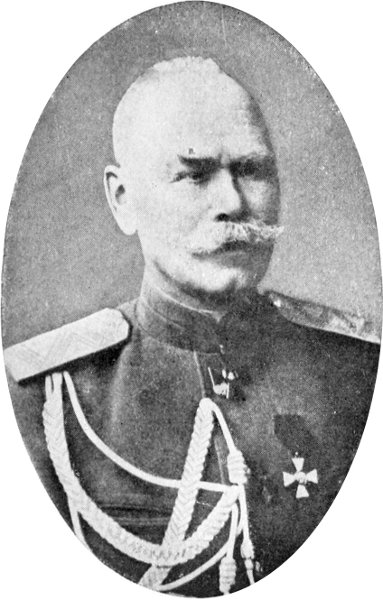
When the Revolution began that old veteran, beloved by
both officers and soldiers, General P. I. Mishtchenko, being
unable to put up with the new régime, retired from the Army. He
lived at Temir-Han Shoura, never went outside his garden fence,
and always wore his General’s uniform and his crosses of St.
George, even in the days of Bolshevik power. One day the
Bolsheviks came to search his house, and, among other things,
wanted to deprive him of his shoulder straps and decorations. The
old General retired to a neighbouring room and shot himself.
Let whoever will laugh at “old-fashioned prejudices.” We
shall reverence his noble memory.
And so the storm-cloud of the Revolution broke.
There was no doubt whatever that such a cataclysm in the life of
the nation could not but have a grave effect. The Revolution was
bound to convulse the Army, greatly weakening and breaking all
its historic ties. Such a result was normal, natural and unavoidable,
independently of the condition of the Army at the moment,
independently of the mutual relations of Commanders and
subordinates. We can speak only of the circumstances which
arrested or hastened the disintegration of the Army.
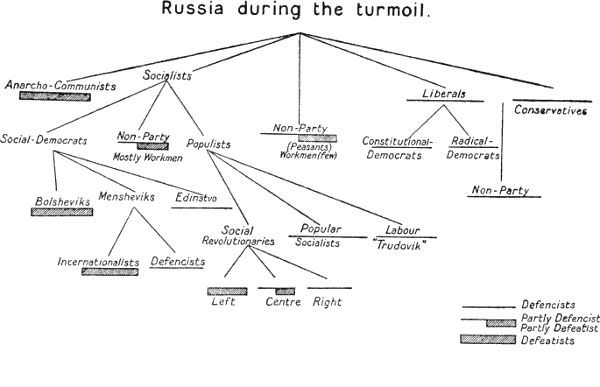
A Government appeared.
Its source might have been one of three elements: The High
Command (a military dictatorship), the Bourgeois State Duma (the
Provisional Government), or the Revolutionary Democracy (the
Soviet). It was the Provisional Government that was acknowledged.
The attitude of the other two elements towards it was
different; the Soviet practically robbed the Government of its
power, while the High Command submitted to it implicitly, and
was therefore obliged to carry out its plans.
The Government had two courses open to it; it could combat
the disintegrating influences which began to appear in the Army by
stern and ruthless measures, or it could encourage them. Owing
to pressure from the Soviet and partly through want of firmness
and through misunderstanding of the laws of existence of armed
forces, the Government chose the second course.
This circumstance decided the fate of the Army. All other
circumstances could but influence the duration of the process of
disruption and its depth.
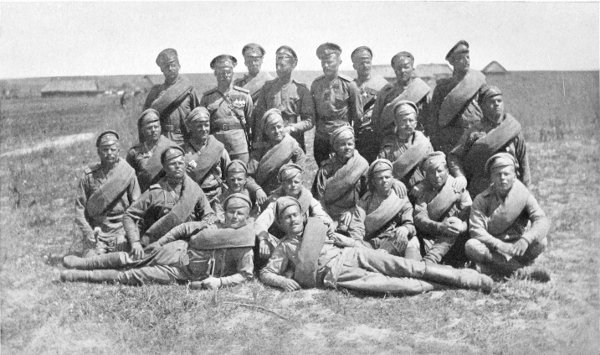
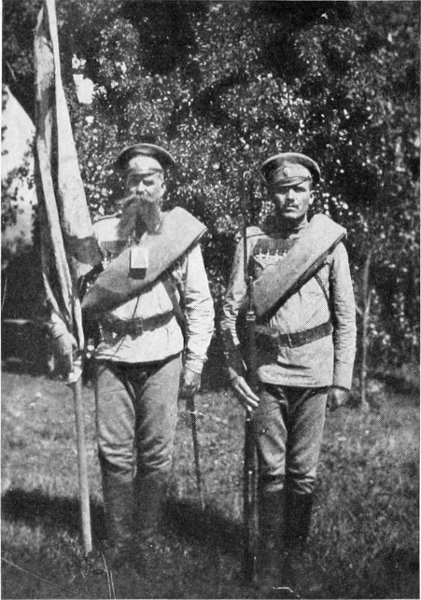
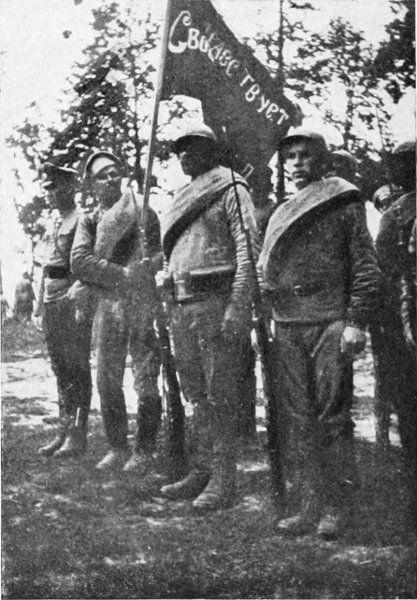
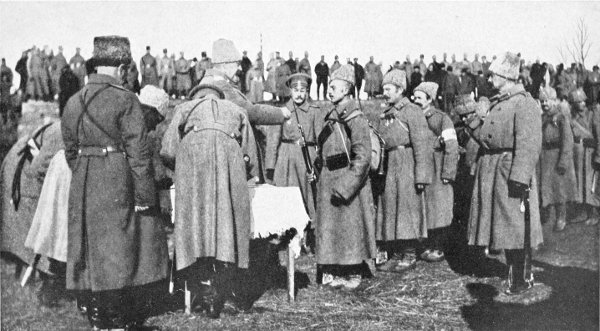
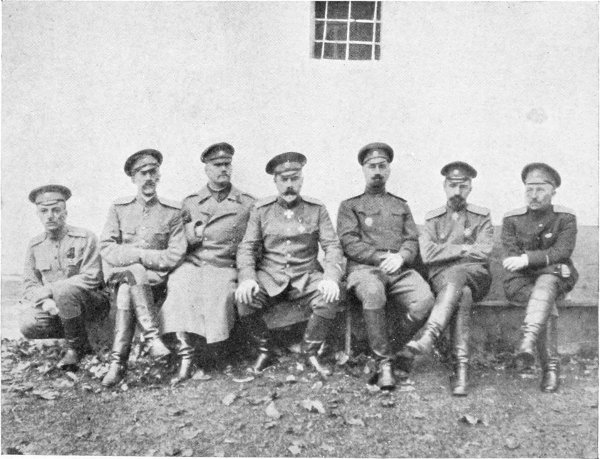
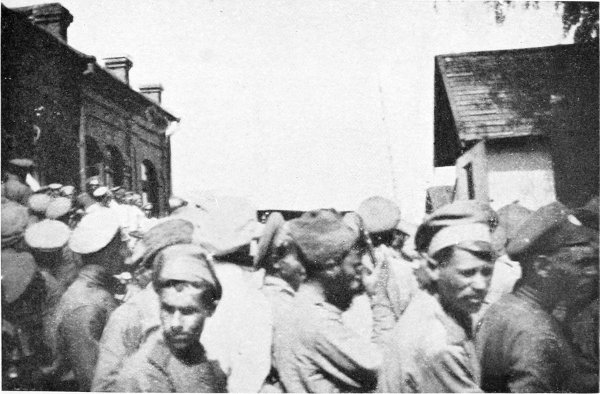
Types of soldiers of the Old Army. This company was sent to the West European Front.
The festive days of touching and joyous union between the
officers and the soldiers vanished rapidly, being replaced by tiresome,
weary week-days. But they had been in the past, those days
of joy, and, therefore, no impassable abyss existed between the
two Ranks, over which the inexorable logic of life had long been
casting a bridge. The unnecessary, obsolete methods, which had
introduced an element of irritation into the soldiery, fell away at
once, as of themselves; the officers became more thoughtful and
industrious.
Then came a torrent of newspapers, appeals, resolutions,
orders, from some unknown authority, and with them a whole
series of new ideas, which the soldier masses were unable to digest
and assimilate. New people appeared, with a new speech, so
fascinating and promising, liberating the soldiers from obedience
and inspiring hope that they would be saved from deadly danger
immediately. When one Regimental Commander naïvely inquired
whether these people might not be tried by Field Court-Martial
and shot, his telegram, after passing through all official stages,
called forth the reply from Petrograd that these people were
inviolable, and had been sent by the Soviet to the troops for the
very purpose of explaining to them the true meaning of current
events.
When such leaders of the Revolutionary Democracy, as have
not yet lost their feeling of responsibility for crucified Russia, now
say that the movement, caused by the deep class differences between
the officers and the soldiers and by “the enslavement” of the
latter, was of an elemental nature, which they could not resist, this
is deeply untrue.
All the fundamental slogans, all the programmes, tactics,
instructions and text-books, forming the foundation of the
“democratisation” of the Army, had been drawn up by the
military sections of the secret Socialist parties long before the
War, outside of “elemental” pressure, on the grounds of clear,
cold calculation, as a product of “Socialist reasoning and
conscience.”
True, the officers strove to persuade the men not to believe
the “new words” and to do their duty. But from the very
beginning the Soviets had declared the officers to be foes of the
Revolution; in many towns they had been subjected to cruel torture
and death, and this with impunity. Evidently not without some
reason, when even the “Bourgeois” Duma issued such a strange
and unexpected “announcement” as the following: “This first
day of March, rumours were spread among the soldiers of the
garrison of Petrograd to the effect that the officers in the regiments
were disarming the soldiers. These rumours were
investigated and found to be false. As President of the
Military Commission of the Provisional Committee of the State
Duma, I declare that the most decided measures will be taken to
prevent such action on the part of the officers, up to the shooting
of those guilty of it. Signed, Colonel Engelhardt.”
Next came Order No. 1., the Declaration and so forth.
Perhaps, however, it might have been possible to combat all
this verbal ocean of lies and hypocrisy which flowed from
Petrograd and from the local Soviets and was echoed by the local
demagogues had it not been for a circumstance which paralysed all
the efforts of the Commanders, viz., the animal feeling of self-preservation
which had flooded the whole mass of the soldiers.
This feeling had always existed. But it had been kept under
and restrained by examples of duty fulfilled, by flashes of national
self-consciousness, by shame, fear and pressure. When all these
elements had disappeared, when for the soothing of a drowsy
conscience there was a whole arsenal of new conceptions, which
justified the care for one’s own hide and furnished it with an ideal
basis, then the Army could exist no longer. This feeling upset
all the efforts of the Commanders, all moral principles and the
whole regiment of the Army.
In a large, open field, as far as the eye can see, run endless
lines of trenches, sometimes coming close up to each other, interlacing
their barbed wire fences, sometimes running far off and
vanishing behind a verdant crest. The sun has risen long ago,
but it is still as death in the field. The first to rise are the
Germans. In one place and another their figures look out from
the trenches; a few come out on to the parapet to hang their
clothes, damp after the night, in the sun. A sentry in our front
trench opens his sleepy eyes, lazily stretches himself, after looking
indifferently at the enemy trenches. A soldier in a dirty shirt,
bare-footed, with coat slung over his shoulders, cringing under
the morning cold, comes out of his trench and plods towards the
German positions, where, between the lines, stands a “postbox”;
it contains a new number of the German paper, The
Russian Messenger, and proposals for barter.
All is still. Not a single gun is to be heard. Last week the
Regimental Committee issued a resolution against firing, even
against distance firing; let the necessary distances be estimated by
the map. A Lieutenant-Colonel of the gunners—a member of the
Committee—gave his full approval to this resolution. When
yesterday the Commander of a field battery began firing at a new
enemy trench, our infantry opened rifle fire on our observation
post and wounded the telephone operator. During the night the
infantry lit a fire on the position being constructed for a newly
arrived heavy battery.[26]
Nine a.m. The first Company gradually begins to awaken.
The trenches are incredibly defiled; in the narrow communication
trenches and those of the second line the air is thick and close.
The parapet is crumbling away. No one troubles to repair it; no
one feels inclined to do so, and there are not enough men in the
Company. There is a large number of deserters; more than fifty
have been allowed to go. Old soldiers have been demobilised,
others have gone on leave with the arbitrary permission of the
Committee. Others, again, have been elected members of
numerous Committees, or gone away as delegates; a while ago,
for instance, the Division sent a numerous delegation to “Comrade”
Kerensky to verify whether he had really given orders
for an advance. Finally, by threats and violence, the soldiers have
so terrorised the regimental surgeons that the latter have been
issuing medical certificates even to the “thoroughly fit.”
In the trenches the hours pass slowly and wearily, in dullness
and idleness. In one corner men are playing cards, in another a
soldier returned from leave is lazily and listlessly telling a story;
the air is full of obscene swearing. Someone reads aloud from
the Russian Messenger the following:
“The English want the Russians to shed the last drop of their
blood for the greater glory of England, who seeks her profit in
everything.... Dear soldiers, you must know that Russia
would have concluded peace long ago had not England prevented
her.... We must turn away from her—the Russian people
demand it; such is their sacred will.”
Someone or other swears.
“Don’t you wish for peace. They make peace, the ——;
we shall die here, without getting our freedom!”
Along the trenches came Lieutenant Albov, the Company
Commander. He said to the groups of soldiers, somewhat
irresolutely and entreatingly:
“Comrades, get to work quickly. In three days we have
not made a single communication trench to the firing line.”
The card players did not even look round; someone said in a
low voice, “All right.” The man reading the newspaper rose
and reported, in a free and easy manner:
“The Company does not want to dig, because that would
be preparation for an advance, and the Committee has
resolved....”
“Look here, you understand nothing at all about it, and,
moreover, why do you speak for the whole Company? Even if we
remain on the defensive we are lost in case of an alarm; the whole
Company cannot get out to the firing line along a single
trench.”
He said this, and with a gesture of despair went on his way.
Matters were hopeless. Every time he tried to speak with them
for a time, and in a friendly way, they would listen to him attentively;
they liked to talk to him, and, on the whole, his Company
looked on him favourably in their own way. But he felt that
between him and them a wall had sprung up, against which all his
good impulses were shattered. He had lost the path to their soul—lost
it in the impassable jungle of darkness, roughness, and that
wave of distrust and suspicion which had overwhelmed the soldiers.
Was it, perhaps, that he used the wrong words, or was not
able to say what he meant? Scarcely that. But a little while
before the War, when he was a student and was carried away by
the popular movement, he had visited villages and factories and
had found “real words” which were clear and comprehensible
to all. But, most of all, with what words can one move men to
face death when all their feelings are veiled by one feeling—that
of self-preservation?
The train of his thoughts was broken by the sudden appearance
of the Regimental Commander.
“What the devil does this mean? The man on duty does not
come forward. The men are not dressed. Filth and stench.
What are you about, Lieutenant?”
The grey-headed Colonel cast a stern glance on the soldiers
which involuntarily impressed them. They all rose to their feet.
He glanced through a loop-hole and, starting back, asked
nervously:
“What is that?”
In the green field, among the barbed wire, a regular bazaar was
going on. A group of Germans and of our men were bartering
vodka, tobacco, lard, bread. Some way off a German officer
reclined on the grass—red-faced, sturdy, with an arrogant look on
his face—and carried on a conversation with a soldier named
Soloveytchick; and, strange to say, the familiar and insolent
Soloveytchick stood before the Lieutenant respectfully.
The Colonel pushed the observer aside and, taking his rifle
from him, put it through the loop-hole. A murmur was heard
among the soldiers. They began to ask him not to shoot. One
of them, in a low voice, as if speaking to himself, remarked:
“This is provocation.”
The Colonel, crimson with fury, turned to him for a moment
and shouted:
“Silence!”
All grew silent and pressed to the loop-hole. A shot was heard,
and the German officer convulsively stretched himself out and was
still; blood was running from his head. The haggling soldiers
scattered.
The Colonel threw the rifle down and, muttering through his
teeth “Scoundrels!” strode further along the trenches. The
“truce” was infringed.
The Lieutenant went off to his hut. His heart was sad and
empty. He was oppressed by the realisation of his unwantedness
and uselessness in these absurd surroundings, which perverted the
whole meaning of that service to his country, which alone justified
all his grave troubles and the death which might perhaps be near.
He threw himself on his bed, where he lay for an hour, for two
hours, striving to think of nothing, to forget himself.
But from beyond the mud wall, where the shelter lay, there
crept someone’s muffled voice, which seemed to wrap his brain
in a filthy fog:
“It is all very well for them, the ——. They receive their
hundred and forty roubles a month clear, while we—so generous
of them—get seven and a half. Wait a bit, our turn will come.”
Silence.
“I hear they are sharing the land in our place in the province
of Kharkov. If I could only get home.”
There was a knock at the door. The Sergeant-Major had
come.
“Your honour (so he always addressed his Company Commander
in the absence of witnesses), the Company is angry, and
threatens to leave the position if it is not relieved at once. The
Second Battalion should have relieved us at five o’clock, and it is
not here yet. Couldn’t they be rung up?”
“They will not go away. All right, I shall inquire; but, all
the same, it is too late now. After this morning’s incident the
Germans will not allow us to be relieved by day.”
“They will allow us. The Committee members know about
it already. I think”—he lowered his voice—“that Soloveytchick
has managed to slip across and explain matters. It is rumoured
that the Germans have promised to overlook it, on condition that
next time the Colonel comes to visit the trenches we should let
them know, and they will throw a bomb. You had better report
it or else, who knows?”
“All right.”
The Sergeant-Major was preparing to leave. The Lieutenant
stopped him.
“Matters are bad, Petrovitch. They do not trust us.”
“God alone knows whom they trust; only last week the Sixth
Company elected their Sergeant-Major themselves, and now they
are making a mock of him; they won’t let him say a word.”
“What will things be afterwards?”
The Sergeant-Major blushed, and said softly:
“Then the Soloveytchicks will rule over us, and we shall be,
so to speak, dumb animals before them—that is how matters will
be, your honour.”
The relief came at last. Captain Bouravin, the Commander
of the Fifth Company, came into the hut. Albov offered to show
him the section and explain the disposition of the enemy.
“Very well, though that does not matter, because I am not
really in command of the Company—I am boycotted.”
“How?”
“Just so. They have elected the 2nd Lieutenant, my subaltern,
as Company Commander, and degraded me as a supporter of the
old régime, because, you see, I had drill twice a day—you know
that the marching contingents come up here absolutely untrained.
Indeed, the 2nd Lieutenant was the first to vote for my removal.
‘We have been slave-driven long enough,’ said he. ‘Now we are
free. We must clean out everyone, beginning with the head. A
young man can manage the regiment just as well, so long as he
is a true Democrat and supports the freedom of the soldier.’ I
would have left, but the Colonel flatly refused to allow it, and
forbids me to hand over the company. So now, you see, we have
two commanders. I have stood the situation for five days. Look
here, Albov, you are not in a hurry, are you? Very good, then;
let us have a chat. I am feeling depressed. Albov, have you not
yet thought of suicide?”
“Not as yet.”
Bouravin rose to his feet.
“Understand me, they have desecrated my soul, outraged
my human dignity, and so every day, every hour, in every word,
glance or gesture one sees a constant outrage. What have I
done to them? I have been in the service for eight years; I have
no family, no house or home. All this I have found in the regiment,
my own regiment. Twice I have been badly wounded,
and before my wounds were healed have rushed back to the regiment—so
there you are! And I loved the soldier—I am ashamed
to speak of it myself, but they must remember how, more than
once, I have crept out under the barbed wire to drag in
the wounded. And now! Well, yes, I reverence the regimental
flag and hate their crimson rags. I accept the Revolution.
But to me Russia is infinitely dearer than the Revolution. All
these Committees and meetings, all this adventitious rubbish
which has been sown in the Army I am organically unable to
swallow and digest. But, after all, I interfere with no one; I
say nothing of this to anyone, I strive to convince no one. If
only the War could be ended honourably, and then I am ready to
break stones on the highway, only not to remain in an Army
democratised in such a manner. Take my subaltern; he discusses
everything with them—nationalisation, socialisation, labour control.
Now I cannot do so—I never had time to study it, and I
confess I never took any interest in the matter. You remember
how the Army Commander came here and, amidst a crowd
of soldiers, said: ‘Don’t say “General”; call me simply
Comrade George.’ Now I cannot do such things; besides,
all the same, they would not believe me. So I am silent. But
they understand and pay me off. And, you know, with all their
ignorance, what subtle psychologists they are! They are able
to find the place where the sting hurts most. Now, yesterday
for instance....”
He stooped down to Albov’s ear, and continued in a whisper:
“I returned from our mess. In my tent, at the head of my
bed, I have a photograph—well, just a treasured memory. There
they had drawn an obscenity!”
Bouravin rose and wiped his brow with his handkerchief.
“Well, let us take a look at the positions. God willing, we
shall not have to stand it long. No one in the Company wants
to go scouting. I go myself every night; sometimes there is a
volunteer who accompanies me—he has a hunter’s strain in him.
Should anything happen, please, Albov, see to it that a little
packet—it is in my bag—is sent to its destination.”
The company, without waiting for the completion of the relief,
wandered away in disorder. Albov plodded after them.
The communication trench ended in a broad hollow. Like a
great ant-hill the regimental bivouac stretched in rows of huts,
tents, smoking camp-kitchens and horse-lines. They had once
been carefully masked by artificial plantations, which had now
withered, lost their leaves, and were merely leafless poles. On
an open green soldiers were drilling here and there—listlessly,
lazily, as if to create an impression that they were doing something;
after all, it would be awkward to be doing absolutely
nothing at all. There were few officers about; the good ones
were sick of the trivial farce into which real work was now transformed,
while the inferior ones had a moral justification for their
laziness and idleness. In the distance something between a mob
and a column marched along the road towards the regimental
staff quarters, carrying crimson flags. Before them went a huge
banner bearing the inscription, in white letters, visible in the
distance: “Down with War!”
These were reinforcements coming up. At once, all the
soldiers drilling on the green, as if at a signal, broke their ranks
and ran towards the column.
“Hey, countrymen! What province are you from?”
An animated conversation began on the usual anxious
themes: how did matters stand with the land; would peace
be concluded soon? Much interest, also, was shown in the question
as to whether they had brought any home-brewed spirits,
as “their own regimental” home brew, manufactured in fairly
large quantities at “the distillery” of the Third Battalion, was
very disgusting, and gave rise to painful symptoms.
Albov made his way to the mess-room. The officers were
gathering for dinner. What had become of the former animation,
friendly talk, healthy laughter and torrents of reminiscences
of a stormy, hard, but glorious life of war? The reminiscences
had faded, the dreams had flown away, and stern reality crushed
them all down with its weight.
They spoke in low voices, sometimes breaking off or expressing
themselves figuratively: the mess servants might denounce
them, and also new faces had appeared among themselves. Not
so long ago the Regimental Committee, on the report of a servant,
had tried an officer of the regiment, who wore the Cross of
St. George and to whom the regiment owed one of its most famous
victories. This Lieutenant-Colonel had said something about
“mutinous slaves.” And though it was proved that those were
not his own words and that he had only quoted a speech made by
Comrade Kerensky, the Committee “expressed its indignation
at him”; he had to leave the regiment.
The personnel of the officers, too, was much changed. Of
the original staff, some two or three remained. Some had
perished, others had been crippled, others again, having earned
“distrust,” were wandering about the Front, importuning Staffs,
joining shock battalions, entering institutions in the rear, while
some of the weaker brethren had simply gone home. The Army
had ceased to need the bearers of the traditions of its units, of its
former glory—of those old Bourgeois prejudices, which had been
swept into the dust by the Revolutionary creative power.
Everyone in the regiment knows already of that morning’s
event in Albov’s Company. He is questioned about details. A
Lieutenant-Colonel sitting next him wagged his head.
“Well done, our old man. There was something in the Fifth
Company, too. But I am afraid it will end badly. Have you
heard what was done to the Commander of the Doubov Regiment,
because he refused to confirm an elected Company Commander
and put three agitators under arrest? He was crucified.
Yes, my boy! They nailed him to a tree and began, in turn, to
stick their bayonets into him, to cut off his ears, his nose, his
fingers.”
He seized his head in his hands.
“My God! Where do these men get so much brutality, so
much baseness?”
At the other end of the table the ensigns are carrying on a
conversation on that ever harassing theme—where to get away to.
“Have you applied for admission to the Revolutionary
Battalion?”
“No, it is not worth while. It seems that it is being formed
under the superintendence of the Executive Committee, with
Committees, elections and “Revolutionary” discipline. It does
not suit me.”
“They say that shock units are being formed in Kornilov’s
Army and at Minsk also. That would be good....”
“I have applied for transfer to our rifle brigade in France.
Only I do not know what I am to do about the language.”
“Alas! my boy, you are too late,” remarked the Lieutenant-Colonel
from the other end of the table. “The Government has
long ago sent ‘emigrant comrades’ there to enlighten minds.
And now our brigades, somewhere in the South of France, are
in the situation of something like either prisoners of war or
disciplinary battalions.”
This talk, however, was realised by all to be of a purely platonic
character, in view of the hopelessness of a situation from which
there was no escape. It was only a case of dreaming a little, as
Tchekhov’s Three Sisters once dreamed of Moscow. Dreaming
of such a wondrous place, where human dignity is not trampled
into the mud daily, where one can live quietly and die honourably,
without violence and without outrage to one’s service. Such a
very little thing.
“Mitka, bread!” boomed out the mighty bass of 2nd Lieutenant
Yassny.
He is quite a character, this Yassny. Tall and sturdy, with a
thick crop of hair and a copper-coloured beard, he is altogether
an embodiment of the strength and courage of the soil. He
wears four crosses of St. George, and has been promoted from
the rank of Sergeant for distinction in action. He does not adapt
himself to his new surroundings in the least, said “levorution”
for “revolution” and “mettink” for “meeting,” and cannot
reconcile himself to the new order. Yassny’s undoubted
“democratic” views, his candour and sincerity, have given him
an exceptionally privileged position in the regiment. Without
enjoying any special influence, he can, however, condemn, rudely,
harshly, sometimes with an oath, both people and ideas, which
are jealously guarded and worshipped by the regimental
“Revolutionary Democracy.” The men are angry, but suffer
him.
“There is no bread, I say.”
The officers, absorbed in their thoughts and in their conversation,
had not even noticed that they had eaten their soup without
bread.
“There will be no bread to-day,” answered the waiter.
“What is the meaning of this? Call the mess-sergeant.”
The mess-sergeant came, and began to justify himself in a
bewildered manner; he had sent in a request that morning
for two pouds of bread. The head of the Commissariat
had endorsed it “to be issued,” but the clerk, Fedotov, a
member of the Commissariat Committee, had endorsed it in his
turn “not to be issued.” So the storehouse would not issue any
bread.
No one made any objection, so painfully ashamed was everyone
both of the mess-sergeant and of those depths of inanity which
had suddenly broken into their life and swamped it with a grey,
filthy slime. Only Yassny’s bass voice rang out distinctly under
the arches of the mess-room:
“What swine!”
Albov was just preparing for a nap after dinner when the flap
of his tent was lifted, and through the aperture appeared the bald
head of the Chief of the Commissariat—a quiet, elderly Colonel,
who had joined the Army again from the retired list.
“May I come in?”
“I beg your pardon, Colonel.”
“Never mind, my dear fellow, don’t get up. I have just come
in for a second. You see, to-day at six o’clock there is to be a
regimental meeting. It will hear the Report of the Committee for
verifying the Commissariat, and apparently they will go for me.
I am no speech-maker, but you are a master of it. Take my part,
should it be necessary.”
“Certainly. I did not intend going, but once it is necessary, I
shall be there.”
“Thank you, then, my dear fellow.”
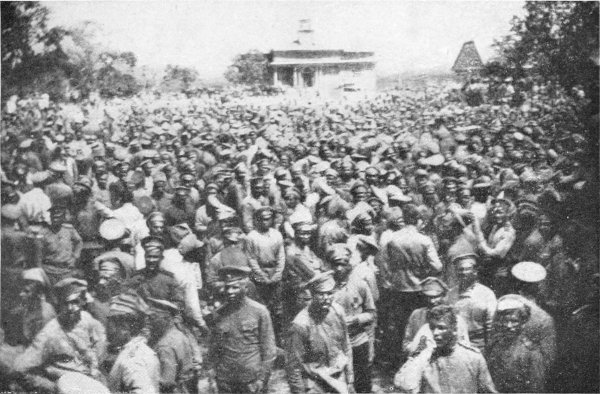
By six o’clock the square next to the regimental Staff quarters
was completely covered with men. At least two thousand had
turned up. The crowd moved, chattered, laughed—just such a
Russian crowd as on the Khodynka in Moscow or the Champs de
Mars in Petrograd at a holiday entertainment. The Revolution
could not transform it all at once, either mentally or spiritually.
But, having stunned it with a torrent of new words and opened
up before it unbounded possibilities, the Revolution had destroyed
its equilibrium and made it nervously susceptible and stormily
reactive to all methods of external influence. An ocean of words—both
morally lofty and basely criminal—flowed through their
minds as through a sieve, which passed through the trend
of the new ideas and retained only those grains which had a
real applied meaning in their daily life, in the surroundings
of the soldier, the peasant, the workman. Hence the absolute
absence of results from the torrents of eloquence which flooded
the Army at the instance of the Minister of War; hence, too, the
illogical warm sympathy with both speakers of clearly opposed
politics.
Under such conditions, what practical meaning could the crowd
find in such ideas as duty, honour, interests of the State, on the
one hand; annexations, indemnities, the self-determination of
peoples, conscious discipline, and other dim conceptions on the
other.
The whole regiment had turned out; the soldiers were
attracted by the meeting, as by any other spectacle. Delegates
had been sent by the Second Battalion, which was in the trenches—about
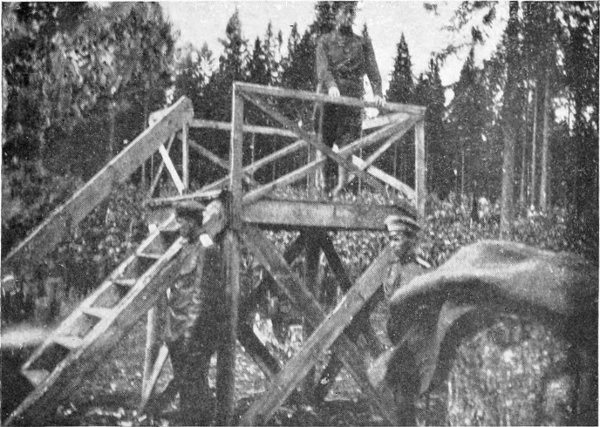
one-third of the battalion. In the middle of the square stood
a platform for the speakers; it was decorated with red flags, faded
with time and rain; they have been there since the platform was
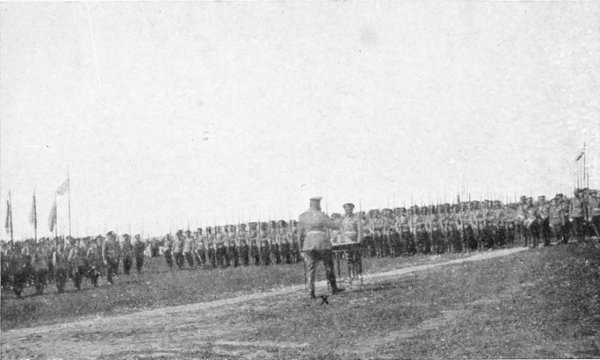
erected for a review by the Commander of the Army. Reviews
are now held not among the ranks, but from a tribune. To-day
the agenda of the meeting contain two questions: “(1) The
Report of the Commissariat Committee on the anomalies in the
supply of Officers’ rations; and (2) the report of Comrade
Sklianka, an orator specially invited from the Moscow Soviet to
speak about the formation of a Coalition Ministry.”
During the preceding week a stormy meeting, which nearly
ended in a riot, had been held in connection with the complaint
of one of the companies that the soldiers had to eat lentils, which
they hated, and thin soup, simply because all the groats and
butter were taken for the officers’ mess. This was clearly nonsense.
Nevertheless, it was resolved to appoint a Committee for
investigation, which would report to a general meeting of the
regiment. The Report was drawn up by a member of the Committee,
Lieutenant-Colonel Petrov, who had been removed the
year before from the post of Chief of the Commissariat and was
now settling accounts with his successor. In a petty, cavilling
way, with a sort of mean irony, he enumerated slight, irrelevant,
inaccuracies in the Commissariat Department of the regiment—there
were no serious ones—and dragged out his Report endlessly
in his creaking, monotonous voice. The crowd, which at first had
kept quiet, now hummed again, having ceased to listen. From
different sides voices were heard:
“Enough!”
“That will do!”
The Chairman of the Commission ceased reading and suggested
that “those comrades who wished” should express their
opinions. A tall, stout soldier ascended the platform, and began
speaking in a loud, hysterical voice:
“Comrades, you have heard? That is where the soldiers’ property
goes. We suffer, our clothes are worn out, we are covered
with lice, we go hungry, while they pull the last piece of food out
of our mouths.”
As he spoke a spirit of nervous excitement kept growing in
the crowd, muffled murmurs ran through it, and shouts of approval
burst from it here and there.
“When will there be an end to all this? We are worn out,
weary to death.”
Suddenly 2nd Lieut. Yassny’s deep voice was heard from
the rear ranks, drowning the voices both of the speaker and of the
crowd.
“What is your Company?”
Some confusion took place. The orator was dumb. Shouts
of indignation were flung at Yassny.
“What is your Company, I ask you?”
“The Seventh!”
Voices were heard in the ranks:
“We have no such man in the Seventh Company.”
“Wait a bit, my friend,” boomed Yassny, “was it not you
that came in to-day with the new lot ... you were carrying
a large placard? When have you had time to get worn out, poor
fellow?”
The spirit of the crowd changed in an instant. It began to
hiss, laugh, shout, and crack jokes. The unsuccessful orator
disappeared in the crowd. Someone shouted:
“Pass a resolution!”
Lieutenant-Colonel Petrov mounted the platform again, and
began to read out a ready resolution for transferring the officers’
mess to privates’ rations. But no one listened to him now. Two
or three voices shouted “That’s right!” Petrov hesitated a
little, then put the paper in his pocket and left the platform. The
second question, concerning the removal of the Chief of the Commissariat
and the immediate election of his successor (the author
of the report was the candidate proposed) remained unread. The
Chairman of the Committee then announced:
“Comrade Sklianka, member of the Executive Committee of
the Moscow Council of Workmen’s and Soldiers’ Delegates, will
now address the meeting.”
They were tired of their own speakers—it was always one and
the same thing—and the arrival of a new man, somewhat advertised
by the Committee, aroused general interest. The crowd
closed up round the platform and was still. A small, black-haired
man, nervous and short-sighted, who constantly adjusted the eyeglasses
which kept slipping off his nose, mounted the platform, or
rather quickly ran up on to it. He began speaking rapidly, with
much spirit and much gesticulation.
“Soldier comrades! Three months have passed already since
the Petrograd workers and Revolutionary soldiers threw off the
yoke of the Czar and of all his Generals. The Bourgeoisie, in the
person of Tereshtchenko, the well-known sugar refiner; Konovalov,
the factory owner; the landowners, Gutchkov, Rodzianko,
Miliukov, and other traitors to the interests of the people, having
seized the supreme power, have tried to deceive the popular
masses.
“The demand of the people that negotiations be commenced
at once for that peace which we are offered by our German worker
and soldier brethren—who are just as much bereft of all that makes
life worth living as we are—has ended in a fraud—a telegram from
Miliukov to England and France to say that the Russian people
are ready to fight until victory is attained.
“The unfortunate people understood that the supreme power
had fallen into even worse hands, i.e., into those of the sworn
foes of the workman and the peasant. Therefore the people
shouted mightily: ‘Down with you, hands off!’
“And the accursed Bourgeoisie shook at the mighty cry of the
workers and hypocritically invited to a share in their power the
so-called Democracy—the Socialist-Revolutionaries and the Mensheviks,
who always associated with the Bourgeoisie for the
betrayal of the interests of the working people.”
Having thus outlined the process of the formation of the
Coalition Ministry, Comrade Sklianka passed in greater detail to
the fascinating prospects of rural and factory anarchy, where
“the wrath of the people sweeps away the yoke of capital” and
where “Bourgeois property gradually passes into the hands of its
real masters—the workmen and the poorer peasants.”
“The soldiers and the workmen still have enemies,” he continued.
“These are the friends of the overthrown Czarist
Government, the hardened admirers of shooting, the knout, and
blows. The most bitter foes of freedom, they have now donned
crimson rosettes, call you ‘comrades’ and pretend to be friends,
but cherish the blackest intentions in their hearts, preparing to
restore the rule of the Romanovs.
“Soldiers, do not trust these wolves in sheep’s clothing!
They call you to fresh slaughter. Well, follow them if you like!
Let them pave the path for the return of the bloody Czar with
your corpses. Let your orphans, your widows and children,
deserted by all, pass again into slavery, hunger, beggary, and
disease!”
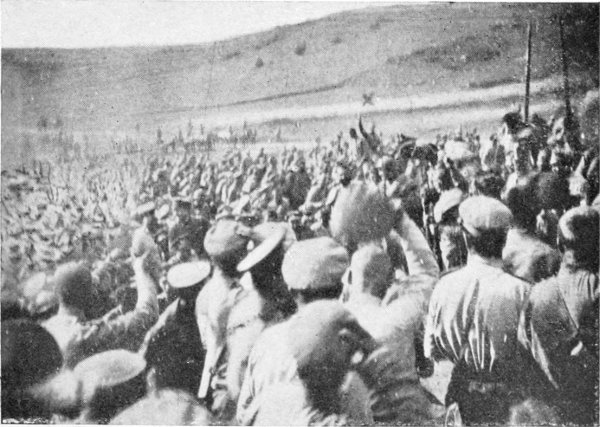
The speech undoubtedly had a great success. The atmosphere
grew red-hot, the excitement increased—that excitement of the
“molten mass,” in the presence of which it is impossible to foresee
either the limits or the tension, or the tracks along which the
torrent will pour. The crowd was noisy and agitated, accompanying
with shouts of approval or curses against “the enemies of
the people” those parts of the speech which especially touched its
instincts, its naked, cruel egotism.
Albov, pale, with burning eyes, made his appearance on the
platform. He spoke excitedly of something or other to the
chairman, who then addressed the crowd. The chairman’s words
were inaudible amidst the noise; for a long time he waved his hands
and the flag which he had pulled down, until at last the noise had
subsided somewhat.
“Comrades, Lieutenant Albov wishes to address you!”
Shouts and hisses were heard.
“Down with him! We do not want him!”
But Albov was already on the platform, gripping hard, bending
downwards towards the sea of heads. And he said:
“No, I will speak, and you dare not refuse to listen to one
of those officers whom this man has been abusing and dishonouring
here before you. Who he may be, whence he has come, who
pays him for his speeches, so profitable to the Germans, not one
of you knows. He has come here, befogged you, and will go on
his way to sow evil and treason. And you have believed him.
And we, who along with you have now carried our heavy cross
into the fourth year of the War—we are now to be regarded as
your enemies? Why? Is it because we never sent you into
action, but led you, bestrewing with officers’ corpses the whole of
the path covered by the regiment? Is it because that, of the
officers who led you in the beginning, there is not one left in the
regiment who is not maimed?”
He spoke with deep sincerity and pain in his voice. There were
moments when it seemed as if his words were breaking through
the withered crust of those hardened hearts, as if a break would
again take place in the attitude of the crowd.
“He, your ‘new friend,’ is calling you to mutiny, to violence,
to robbery. Do you understand who will benefit when, in Russia,
brother rises against brother, so as to turn to ashes, in sack and
fire, the last property left not only to the ‘capitalists,’ but to the
poverty-stricken workers and peasants? No, it is not by violence,
but by law and right, that you will acquire land and liberty and
a tolerable existence. Your enemies are not here, among the
officers, but there—beyond the barbed wire. And we shall not
attain either to freedom or to peace by a dishonourable, cowardly
standing in one and the same place, but in the general mighty
rush of an advance.”
Was it that the impression of Sklianka’s speech was still too
vivid or that the regiment took offence at the word “cowardly”—for
the most arrant coward will never forgive such a reminder—or,
finally, was it the fault of the magic word “advance,” which
for some time past had ceased to be tolerated in the Army? But
anyhow Albov was not allowed to continue his speech.
The crowd bellowed, belched forth curses, pressed forward
more and more, advancing toward the platform, and broke down
the railing. An ominous roar, faces distorted with fury, and
hands stretched forth towards the platform. The situation was
becoming critical. 2nd Lieut. Yassny pushed his way through to
Albov, took him by the arm, and forcibly led him to the exit.
The soldiers of the First Company had already rushed up to it
from all sides, and with their aid Albov, with great difficulty, made
his way out of the crowd, amidst a shower of choice abuse.
Someone shouted out after him:
“Wait a bit, you ——; we will settle accounts with you!”
Night. The bivouac had grown quiet. Clouds had covered
the sky. It was dark. Albov, sitting on his bed in his narrow
tent, illuminated by the stump of a candle, was writing a report
to the Commander of the Regiment:
“The officers—powerless, insulted, meeting with distrust and
disobedience from their subordinates—can be of no further use.
I beg of you to apply for my reduction to the ranks, so that there
I might fulfil my duty honestly and to the end.”
He lay down on his bed. He gripped his head in his hands.
A kind of uncanny, incomprehensible emptiness seized him, just
as if some unseen hand had drawn out of his head all thought,
out of his heart all pain. What was that? A noise was heard,
the tent-pole fell down, the light went out. A number of men on
the tent. Hard, cruel blows were showered on the whole of his
body. A sharp, intolerable pain shot through his head and his
chest. Then his whole face seemed covered with a warm, sticky
veil, and soon everything became still and calm again, as if all
that was terrible and hard to bear had torn itself away, had
remained here, on earth, while his soul was flying away somewhere
and was feeling light and joyous.
Albov awoke to feel something cold touching him: a private
of his company, Goulkin, an elderly man, was sitting at the foot
of his bed and wiping away the blood from his head with a wet
towel. He noticed that Albov had regained consciousness.
“Look how they have mangled the man, the scum! It can
have been no other than the Fifth Company—I recognised one of
them. Does it hurt you much? Perhaps you would like me to
go for the doctor?”
“No, my friend, it does not matter. Thank you!” and
Albov pressed his hand.
“And their Commander, too, Captain Bouravin, has met with
a misfortune. During the night they carried him past us on a
stretcher, wounded in the abdomen; the sanitar said that he would
not live. He was returning from reconnoitring, and the bullet
took just at our very barbed wire. Whether it was a German one
or whether our own people did not recognise him—who knows?”
He was silent for a while.
“What has come to the people one simply can’t understand.
And all this is just put on. It is not true—that which they say
against the officers—we understand that ourselves. Of course,
there are all sorts among you. But we know them very well.
Don’t we see for ourselves that you, now, are for us with all
your heart. Or let us say 2nd Lieut. Yassny. Could such a one sell
himself? And yet, try to say a word, to take your part—there
would be no living for us. There is a great deal of hooliganism
now. It is only hooligans that men listen to. My idea is that
all this is taking place because men have forgotten God. Men
have nothing to be afraid of.”
Albov closed his eyes from weakness. Goulkin hastily
arranged the blanket, which had slipped to the floor, made the
sign of the cross over him, and quietly slipped out of the tent.
But sleep would not come. His heart was full of an inexhaustible
sadness and an oppressive feeling of loneliness. He yearned
so much to have some living being at hand, so that he might
silently, wordlessly feel its proximity, and not remain alone with
his dreadful thoughts. He regretted that he had not detained
Goulkin.
All was quiet. The whole camp was sleeping. Albov leaped
from his bed and lit the candle again. He was seized with a dull,
hopeless despair. He had no more faith in anything. Impenetrable
darkness lay before him. To make his exit from life? No,
that would be surrender. He must go on, with clenched teeth
and hardened heart, until some stray bullet—Russian or German—broke
the thread of his wearisome days.
Dawn was coming on. A new day was beginning, new Army
week-days, horribly like their predecessors.
Afterwards?
Afterwards the “molten element” overflowed its banks completely.
Officers were killed, burnt, drowned, torn asunder and
had their heads broken through with hammers, slowly, with
inexpressible cruelty.
Afterwards—millions of deserters. Like an avalanche the
soldiery moved along the railways, water-ways and country roads,
trampling down, breaking and destroying the last nerves of poor,
roadless Russia.
Afterwards—Tarnopol, Kalush, Kazan. Like a whirlwind
robbery, murder, violence, incendiarism swept over Galicia,
Volynia, the Podolsk and other provinces, leaving behind it
everywhere a trail of blood and arousing in the minds of the
Russian people, crazed with grief and weak in spirit, the monstrous
thought:
“O Lord! if only the Germans would come quickly.”
This was done by the soldier.
That soldier of whom a great Russian writer, with intuitive
conscience and a bold heart, has said:[27]
“... How many hast thou killed during these days, oh
soldier? How many orphans hast thou made? How many
inconsolable mothers hast thou left? Dost thou hear the whisper
on their lips, from which thou hast driven the smile of joy for
evermore?
“Murderer! Murderer!
“But why speak of mothers, of orphaned children? A more
terrible moment came, which none had expected—and thou didst
betray Russia, thou didst cast the whole of the Motherland, which
had bred thee, under the feet of the foe!
“Thou, oh soldier, whom we loved so—and whom we still
love.”