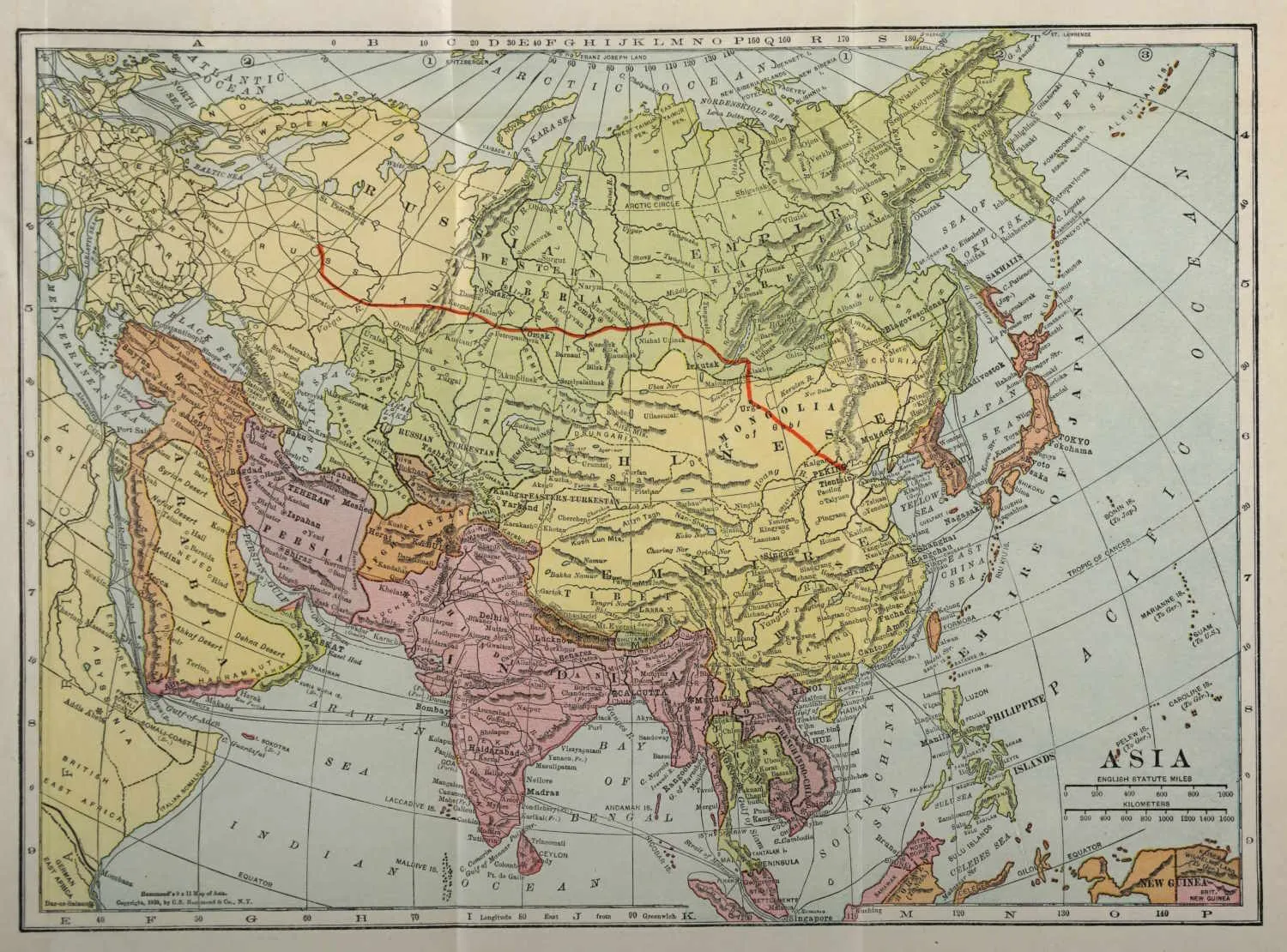
AN ancient way leads across northern Asia to the
Chinese borderland. The steel of the great
Siberian Railroad harnesses now the stretch which
mounts the Urals, pierces the steppes, winds through
the Altai foothills, and by cyclopean cuts and tunnels
girdles Lake Baikal. From Verhneudinsk southward,
it has remained as an ancient post-road
leading through the Trans-Baikal highlands to the
frontier garrison town of Kiahta. Over the Mongolian
border at Maimachen, it has narrowed into
a camel-trail threading the barren hills to the
encampment of the Tatar hordes at holy Urga.
Thence it strikes across the sandy wastes of Gobi,
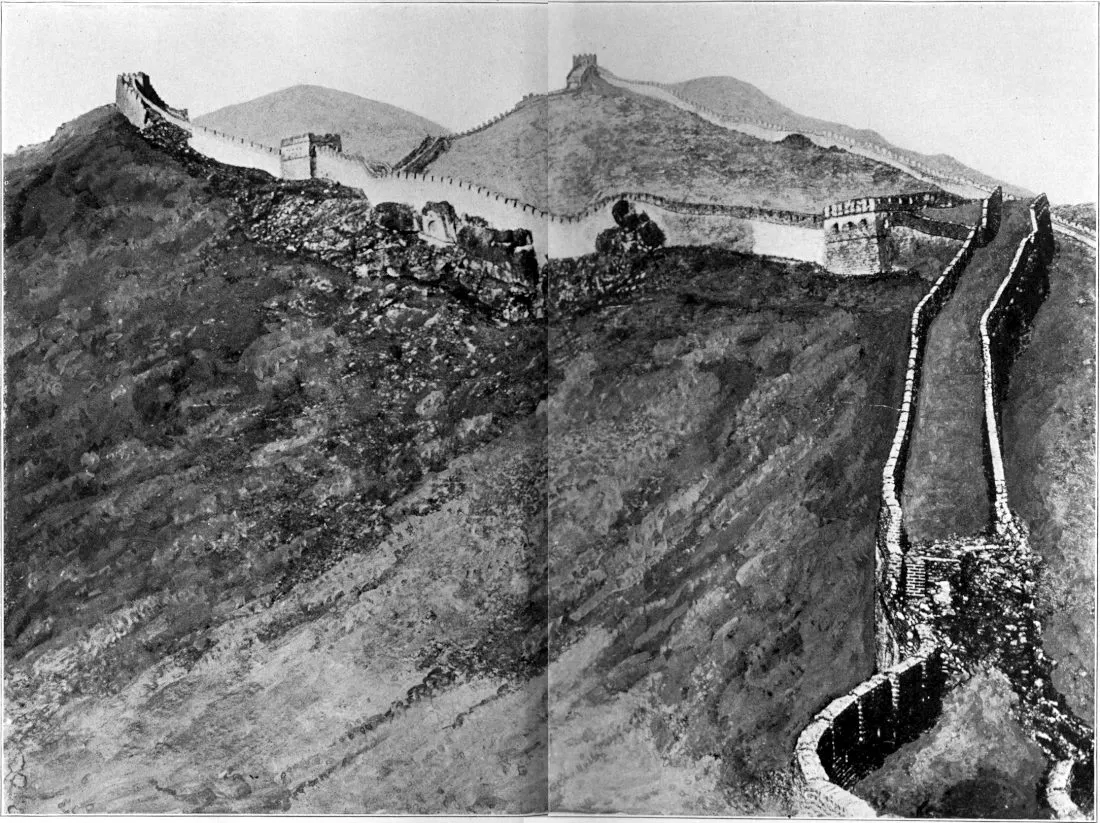
and passes the ramparts of the Great Wall of China,
on its way toward Peking and the Pacific.
Through five centuries this road has been building.
Cossacks blazed its way; musketoon-armed
Strelitz, adventuring traders, convicts condemned
for sins or sincerity, land-seeking peasants, exiled
dissenters, voyaging officials—all have trampled it.
Hiving workmen under far-brought engineers have
pushed the rails onward, bridging the chasms and
heaping the defiles. Following it eastward, unpeopled
wastes have been sown to homesteads, hamlets
have grown into cities. To the very gateway
of China it has led the Muscovite. It is the path of
Slavic advance.
The way scarcely passed Novgorod in the early
sixteenth century when the great family of the
Stroganovs, a “kindred in Moscovie called the
sonnes of Anika living neare the Castle of Saint
Michael the Archangel,” began the fur-trade with
the Samoied tribesmen from Siberia, who paddled
down the Wichida River to barter peltries with the
Russians. The prudent merchant Anika, looking to
a more permanent source for those valued furs than
the irregular visits of the aborigines, planned to
anticipate his brother traders in their purchases.
He sent east with a band of returning Samoieds
some of his own henchmen carrying, for traffic with
the inhabitants, “divers base merchandise, as small
bels, and other like Dutch small wares.” The
agents returned to report what impressed them
most. There were no cities. The Samoieds were
“lothsome in feeding,”—even a Russian frontiersman
might shrink from the cud of a reindeer’s
stomach as food,—and knew neither corn nor
bread. They were cunning archers, whose arrows
were headed with sharpened stones and fishbones.
They were clad in skins, wearing in summer the
furry side outward and in winter inward. They
willingly gave sable-skins for Dutch bells.
A series of trading expeditions began, which made
the Stroganovs so enormously wealthy that “the
kindred of Anika knew no ends of their goods.”
Indeed, they gained so much by this exploitation
that they began to fear the application by the
Czar’s agent of a monetary test of patriotism. So,
by a stroke of finance not unknown in modern days,
there was arranged the Russian equivalent for
carrying five thousand shares of Metropolitan. A
block of small wares for the account of the Czar’s
brother-in-law, Boris, was added to the stock in an
especially important expedition among the Samoieds
and Ostiaks. The adventurers got far inland. They
saw men riding on elks, and sledges drawn by dogs.
They returned with wonderful tales of marksmanship,
and, more important, brought back enough furs
to give Boris a dividend, in gratitude for which he
secured to the Stroganovs the grant of an enormous
tract of land along the Kama River and a monopoly
of the trade with the aborigines.
The Stroganovs grew and thrived. They scattered
trading-posts and factories along the river-highways
and sent many parties into the interior
to barter. In the half-century following old Anika’s
expedition, they had carried the Slavic way to the
Urals.
In the summer of 1578, when Maxim Stroganov
was ruling over the family estates along the Kama,
one Yermak, heading a fugitive band of Cossacks,
tattered and spent, with dented armor and drooping
ponies, straggled into camp and offered service.
With great delicacy Maxim forbore pressing too
closely his inquiry into their antecedents. It might
have wounded Yermak’s susceptibilities to avow
that his chief lieutenant, Ivan Koltso, was under
sentence of death for capturing and sacking a town
of the Nogoy, and that the immediate cause of his
advent was an army of Imperial Strelitz, which had
driven his band from the Volga District for piracy
and highway robbery.
The situation on the far side of the Urals, where
the skin-hunting tribes had been conquered by a
roving horde of Tatars under Kutchum Khan, was
at this time interfering sadly with the Stroganovs’
fur business. Eight hundred Cossacks, furthermore,
of shady character and urgent needs were undesirable
neighbors. So the prudent Maxim, not particularly
solicitous as to which of the two might
be eliminated, offered Yermak a supply of new
muskets if he would go away and fight the Tatars.
They were not pleasant people for the Cossacks to
meet, these former masters of Moscow. But behind
were the soldiers of Ivan the Terrible. With
a possible conquest before, and the Strelitz behind,
Yermak gladly chose to invade the Tatar territory,
which is now western Siberia.
Up the Chusovaya River the little expedition
started in 1579, damming the stream with sails to
get the boats across its shallows. Penetrating far
into the mountains, the band reached a point where
a portage could be made across the Ural water-shed.
Then they headed down the Tura River into
Siberia. Here the invaders met the first army of the
Tatars under Prince Yepancha, and with small loss
drove them back. Yermak made his winter camp
on the site of the present city of Tiumen.
Next year the advance began once more. The
Khan of the Tatars, Kutchum, was alive to the seriousness
of the incursion, and prepared to ambush
the Cossack flotilla as it descended the Tura. At a
chosen spot chains were stretched across the stream,
and bowmen were stationed on the banks to await
the coming of Yermak and overwhelm with arrows
his impeded forces. The Tatar sentries above the
ambuscade signaled the coming of the boats; all
eyes were turned intently upstream. Then Yermak’s
soldiers fell upon them from the rear, to their
total surprise and his complete victory. Straw-stuffed
figures in Cossack garments had come down
in the boats; the men themselves had made a land-circuit
and had struck the enemy unprepared.
In defense of his threatened capital, Sibir, the
old Khan rallied once more. He assembled a great
army, thirty times that of the Cossacks. For the
invaders, however, retreat was more perilous than
advance. Yermak went on, and in a great fight on
the banks of the Irtish, again prevailed. With his
forces reduced by battle and disease to some three
hundred effectives, he entered Sibir on October 25,
1581. A few days later the Ostiak tribes, glad to
escape their Koran-coercing masters, proffered their
allegiance, and the Cossack saddle was on Siberia.
But how precarious was their seat! Southward
were the myriads of the unconquered hordes of Tatary;
only one of the score of their khans had been
vanquished. As thistledown is blown before the
wind, so could Yermak’s oft-decimated band have
been swept away had once the march of the Mongols’
main division turned northward. Girding him
round were the self-submitting Ostiaks, loyal for
the moment to those who had won them freedom
from the old proselyting overlord, but not long to
be relied upon once the weight of Cossack tribute—the
fur-yassak—began to be felt.
But what the Tatar hordes had not, what the
Ostiak hunters had not, the three hundred Cossacks
had—a man. This man, starting his march as the
hunted captain of a band of outlaws, could conquer
half a continent. Then over the heads of his employers,
the mighty family of Stroganov, over the
heads of governors of provinces, of boyars, of ministers
to the throne, he could send by his outlaw
lieutenant, Ivan Koltso, loftily, imperially, as a
prince to a king, his offer of the realm of Siberia to
Ivan Vasilevich.
Ivan the Terrible, Czar of all the Russias, he who
had blinded the architect of St. Basil, lest he plan a
second masterpiece; he who had tortured and slain
a son, hated less for his intrigues than for his unroyal
weakness, responded imperially. Over the long
versts Ivan’s courier carried to Yermak a pardon,
confirmation as ruler of the newly-won realm and
the Czar’s own mantle, an honor accorded only to
the greatest, the boyars of Muscovy. Following the
messenger eastward there plodded three hundred
musket-armed Strelitz to bear aid to the Cossack
garrison. Sorely now were these reinforcements
needed, for the Ostiak tribes flamed into rebellion
against King Stork. With Kutchum’s Tatars, they
returned to the attack and besieged Sibir. Once
again, though hemmed about by the multitude of
his enemies, the valor of Yermak saved his cause.
In a totally unexpected sally, in June, 1584, the
Tatar camp was surprised, a great number massacred,
and the besiegers scattered.
The whole country, however, save only the city
of Sibir, was still in arms. Engagements between
small parties were constant. Ivan Koltso, striving
to open a way for a trader’s caravan, fell with his
fifty, cut down to the last man. Yermak, marching
out to avenge him, was himself surprised near the
Irtish. With Ulysses-like adroitness, he and two
followers escaped the massacre and reached the
river-bank, where a small skiff promised safety.
Leaping last for the boat, Yermak fell short, and,
weighted with his armor, sank in the river that he
had given to Russia. The two Cossack soldiers
alone floated down to their comrades.
One hundred and fifty, all that were left of them,
started their long homeward retreat. Far from
Sibir, they met a hundred armed men sent by the
Czar. Great was the spirit, not unworthy of the
dead leader, that turned them back, to march to
a site twelve miles from Sibir, where they built their
own town, now the city of Tobolsk.
In the years that followed, their nomad enemies
drifted south, leaving those behind who cared
not for their old khan’s quarrels. The phlegmatic
Ostiaks returned to their hunting and to their
feasts of uncooked fox-entrails. The long fight had
rolled past, leaving the Slavic way undisputed to
the Irtish.
Well it was, for no more of the Strelitz marched
to the aid of the garrisons. Russia was in the
throes of civil war and invasion,—the long-remembered
“Smutnoe Vremya,” time of troubles. Boris
Godunov, once favorite of Ivan the Terrible, became
the real ruler in the reign of the weak Feodor.
On the death of this prince, with the heir-apparent
Dimitri suspiciously slain, he had mounted the
empty throne, and a pretender, claiming to be
Dimitri miraculously escaped, had risen up in
Poland, gained the support of the king, and marched
against Boris. Though the Polish army was routed,
Boris succumbed shortly after to a poison-hastened
demise.
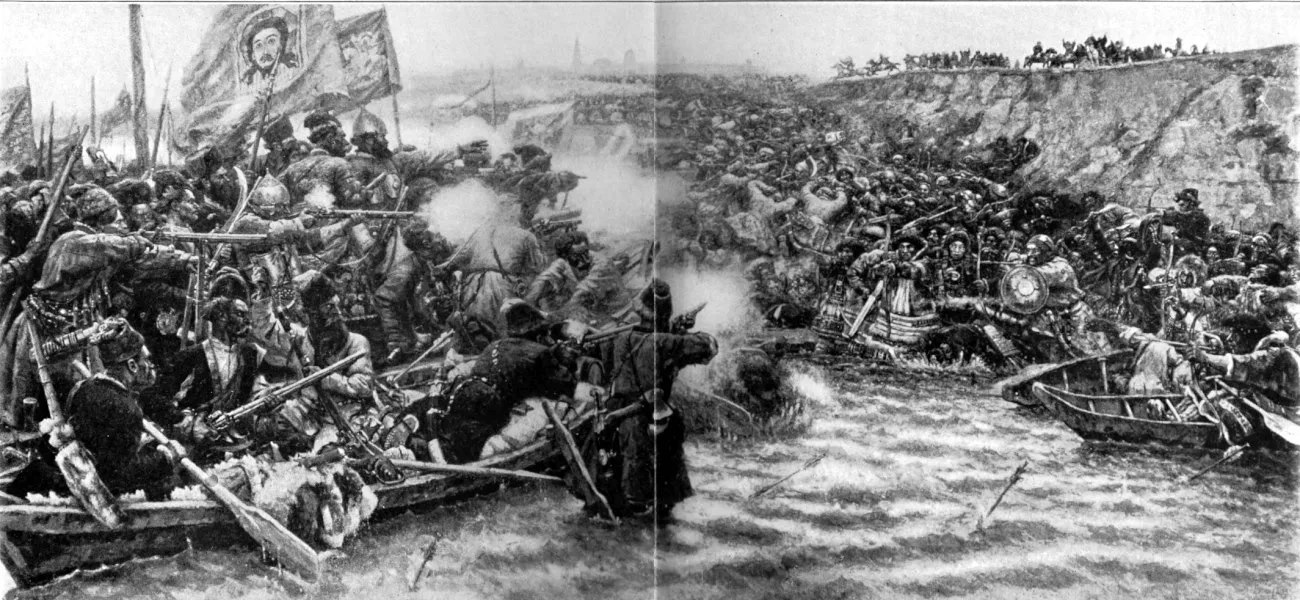
YERMAK’S EXPEDITION TO SIBIR ATTACKED BY THE TATARS
(From a painting by Surikova)
(click image to enlarge)
Dimitri attacked the new czar, captured Moscow,
and was crowned in the Kremlin by the Poles.
A revolution followed within a year, in which the
pseudo-Dimitri was slain. Meanwhile the Poles
were devastating Russia more cruelly than had
the old Tatar conquerors. At length Minim the
butcher of Novgorod led a popular revolt, which in
1613 carried to the throne Michael, the first of the
Romanovs.
Through all these years, despite the fact that
anarchy and chaos rioted over Muscovy, despite the
fact that no troops came to aid in the advance,
the Cossacks still pressed their way, contested by the
scattered bands of Tatars, and farther on by
the Buriats, the Yakuts, the Koriats. After these
fighters and conquerors came the traders and colonists,
with their families, following along the road
that had been won. The valleys of the great Siberian
rivers, which so short a time before had been
the grazing-grounds of the Tatars, became dotted
now with the farms of the new-come settlers. The
advance guards of the fur-traders, with blockhouses
guarding the portages, and clustering wooden
huts and churches, pushed south and east as far as
Kuznetz, at the head of navigation on the River
Tom, and to the foot of the Altai Mountains. North
and east the trade-route was advanced to the
Yenesei, twenty-two hundred miles inland. As
many as sixty-eight hundred sables went back to
Russia in 1640, together with great quantities of
fox, ermine, and squirrel-skins.
The quaint volumes of “Purchas his Pilgrimes,”
published in 1625, tell of some of the early explorations.
A band of Cossacks dared the upper Yenesei,
which “hath high mountains to the east, among
which are some that cast out fire and brimstone.”
They made friends of the cave-dwelling Tunguses
in this region, who were themselves stirred to explore,
and went on far eastward to another river,
less than the Yenesei but as rapid. By faster running
the Tunguses caught some of the inhabitants,
who pointed across the river and said “Om! Om!”
The old chronicler diligently records the speculation
as to what “Om! Om!” could mean. Some
thought that it signified thunder, others held it a
warning that the great beyond teemed with devils.
These unfortunate slow-running natives died, “probably
of fright,” when the Tunguses, in a spirit as
naïvely unfeeling as if they were collecting curios,
were taking them back to be exhibited to their friends
the Cossacks. How far these Tunguses had pierced
cannot be told. In one of the dialects of the Yakuts
who live beyond Baikal, “ta-oom” or “tanak-hoom”
means “greetings.” Had the Tunguses and
the Cossacks who followed them arrived at the
Yakuts’ country? Or was the river on which passed
“ships with sails” and beyond which was heard the
booming of brazen bells the Amur? Were those the
junks and temple-gongs of the Manchus? Ni snaia,—who
knows?
In 1637 the Cossacks reached and established
themselves in Yakutsk. In 1639 by the far northern
route they pierced to the Sea of Okhotsk. In 1644
a party reached the delta of the Kalyma, and
curiously speculated upon the mammoth tusks
which they found. In 1648, on the Cellinga River
beyond Lake Baikal they built Fort Verhneudinsk.
Had their tide of conquest now rolled southward, up
the Cellinga Valley, the Russian Eagles might to-day
be flying over Peking. Only the Kentai Mountains
were between them and prostrate Mongolia,
enfeebled by the internecine warfare of her rival
khans. From Mongolia, the road, worn by so many
conquerors of old, leads fair and clear to the Chi-li
Province and the heart of China.
But they passed this gateway by, those old Cossack
heroes, as the railway builders have passed it
by, to press with Poyarkov to the Pacific; to conquer,
with Khabarov, the Amur; to meet in desperate
conflict the whale-skin cuirassed Koriats of the
coast; to battle with the Manchu in conflicts where
“by the Grace of God and the Imperial good fortune,
and our efforts, many of those dogs were
slain”; to fight until but an unvanquished sixty-eight
were left of the garrison of eight hundred in
beleaguered Albazin.
The current of conquest passed by this door
to China, but the swelling stream of commerce
searched it out. In 1638, the Boyar Pochabov,
crossing Baikal on the ice, broke the first way to
Urga, the capital of the Mongolian Great Khan,
and gained the friendship of the monarch. In the
interests of trade, the deputies of the Czar Alexei
Michailovitch followed up the opening with an
embassy in 1654 to the Chinese Emperor himself.
Over steppe and mountain and desert the mission
wound its weary way to Kalgan, the outpost city
beside the Chinese Wall, and then on to Peking,
bearing to the Bogdo Khan, the Yellow Czar, the
presents of Chagan Khan, the White Czar.
From the Forbidden Palace at Peking were started
back, four years later, return presents, including
ten puds of the first tea that reached Russia. With
the presents came a message that drove flame
into the bearded cheeks of the Czar and set his
Muscovite boyars to grasping their sword-hilts. “In
token of our especial good-will we send gifts in return
for your tribute.” Thus, the Chinese Emperor.
The answer of the Czar started another legation
plodding across a continent, and the retort was
thrown at the feet of his Yellow Majesty. It was a
summons forthwith to tender his vassalage to Russia.
The Czar’s gauntlet had been hurled across Asia.
But all it brought was beggary to the traders who
had begun to press along the newly-opened route to
a commercial conquest of the East.
Soon Russia regretted the fruitage of her challenge.
In 1685 Golovin’s embassy left Moscow, and,
arriving two years later at Verhneudinsk, opened
negotiations with Peking. A Chinese commission
then made its way north, and at Nerchinsk,
August 27, 1689, was signed the famous treaty
closing to Russia her Amur outlet to the Pacific,
purchased with such desperate valor at Albazin,
but granting to a limited number of Russian merchants
trading privileges into China.
A lively traffic at once sprang up. Long caravans,
silk- and tea-laden, crossed the Mongolian deserts,
the Siberian steppes and hills, and the forested
Urals, taking the road to Europe. A little Russian
settlement was founded at Peking, and a traders’
caravansary was built. The church constructed by
the prisoners of Albazin, who had been so kindly
treated by the Manchus that they at first refused
the release which the treaty brought, gave place to
a larger edifice erected by popes from Russia.
Soon, however, the Russians again offended the
Celestial Emperor. In their riotous living, the
quickly enriched merchants disquieted the sober
Chinese. The Siberians over the frontier gave
asylum to a band of seven hundred Mongol free-booters,
whom it was urgently desired to present to
a Chinese headsman. So commerce was forbidden
anew, and most of the reluctant merchants left
their compound. Some stayed and assimilated with
the Chinese, retaining, however, their religion; and
for years a mixed race observed in Peking the rites
of Greek Orthodox Christianity.
It may seem strange that rulers so energetic as
Peter the Great and some of his successors took no
steps to resent by force of arms the arbitrary acts
of the Chinese Emperor. But much was going on in
Russia; Peter was occupied with his invasion of
Persia, and Catherine was without taste for a distant
and doubtful campaign. The garrisons scattered
over the enormous area of Siberia were numerically
too weak and too poorly equipped to do more
than hold their own. So, when commerce was once
more interdicted and the merchants banished, recourse
was had to diplomacy. In 1725 the Bogdo
Khan relented enough to receive Count Ragusinsky
with a special embassy from Catherine the First,
which arranged the second great agreement with
China, called the Treaty of Kiahta.
By it the frontier cities of Kiahta in Siberia, and
Maimachen, facing it just across the line in Mongolia,
were established as the gateway to Chinese
trade. The treaty provided for the extradition of
bandits and for a perpetual peace and friendship
between the high contracting parties. Ever since,
the citizens of Kiahta have alternately blessed and
blamed Ragusinsky,—blamed him because, in the
fear lest any stream flowing out of Chinese into
Russian territory should be poisoned, he settled the
boundary city beside a Siberian brook so inadequate
that Kiahtans have suffered ever since for lack of
water, with the river Bura only nine versts away in
China; blessed him because of the great prosperity
the treaty brought to their doors.
The tea carried by this highway became Russia’s
national drink. Great warehouses arose, built
caravansary-wise around courts. Endless files of
two-wheeled carts rolled northward, bearing each
its ten square bales of tea, or its well-packed bolts
of silk. The merchants grew wealthy in the rapidly
swelling trade.
A great Chinese embassy, headed by the third
ranking official of the Peking Foreign Office, made
its way to Moscow to keep permanent the relations
of the two empires. Similarly, a Russian embassy
was established in the rebuilt compound in Peking,
where a new church arose, whose archimandrite
gained a comfortable revenue by selling ikons and
crucifixes to the many Chinese converts he had
baptized.
Catherine the Second’s edict opened to all Russians
the freedom of Chinese trade. Its volume,
large before, became now even greater. In 1780
the registered commerce at Kiahta had risen to
2,868,333 roubles, not to mention the large value
of the goods taken in unregistered.
Tea, a pound of which, if of best quality, cost
two roubles in those days, silks, porcelains, cottons,
and tobacco, went north, exchanged for Russian
peltries, for cloth, hardware, and, curiously enough,
hunting-dogs.
An English merchant, who had penetrated to
Kiahta in that year, gives an amusing account of
the mutual distrust with which the barter was
conducted. The Russian going over the frontier to
Maimachen would examine the goods in the Chinese
warehouse, seal up what he desired, and leave two
men on guard. The Chinese merchant would then
come to Kiahta, and do the same with the Russian’s
wares. When the bargain was struck, both together
carried one shipment over the border with guards
and brought back the exchange.
In growing prosperity, undisturbed, the Kiahta
caravans came and went, while elsewhere history
was warm in the making.
Napoleon marched to Moscow, to Leipsic, to
Waterloo. The Kiahta caravans came and went.
The St. Petersburg Dekabrists rose for Constantine
and the Constitution. The Kiahta caravans came
and went. The Crimean War saw the Russian flag
flutter down at Sevastopol. Even as the Malakoff
was stormed, a Russian army marched into Central
Asia to seize the Zailust Altai slope, which points
as a spear toward Turkestan and India, and a Russian
navy sailed under Muraviev to occupy the
forbidden Amur. The Kiahta caravans came and
went.
At length a railroad, pushed year by year,
reached the Pacific. One branch cut across the
reluctantly-accorded Manchurian domain to Vladivostok;
another struck southward to Dalny and
Niu-chwang. The Russian Eagles perched at Port
Arthur and nested by the far Pacific.
The camel-commerce of the old overland road
across Mongolia shrank now as shrinks a Gobi
snow-rivulet under the burning desert sun. The
meagre Kiahta caravans became but a gaunt
shadow of the mighty past. Only an intermittent
wool-export and a dwindling traffic in tea to the
border cities remained of the great tribute of the
Urga Road. As trade vanished from their once busy
warehouses, the Chinese merchants were troubled.
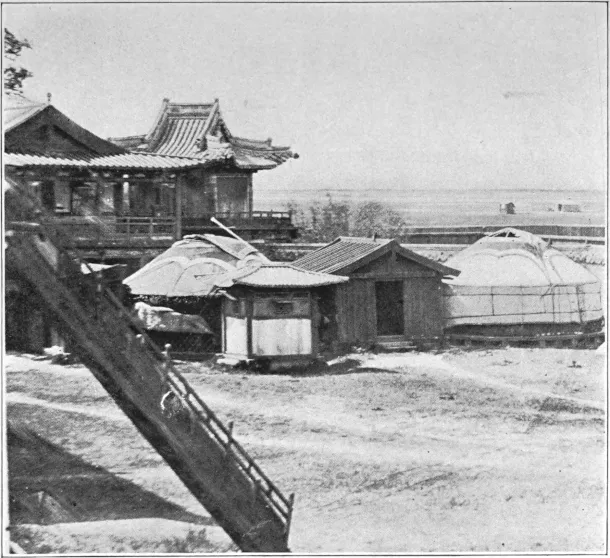
Perhaps to prayer and sacrifice the God of Commerce
would relent? So a scarlet temple rose on the
hill by Maimachen. Prosperity came suddenly once
again, a new trade rolled north over the historic
way. The Mongol cart-drivers returned from far
Ulasati. The camel-trains, that had scattered south
to the trails beyond Shama, gathered back as antelopes
herd to a new spring in the desert.
The God of the Red Temple, the God of the Caravan,
had sent the Japanese. As the Amban’s executioner
strikes off a victim’s hand, so had the Nipponese
lopped away the railroad reaching down to
Dalny and Niu-chwang—the road that was breaking
the camel-trade a thousand versts beyond, on
the old route by Maimachen and Kiahta. Against
the Russian control of the Pacific the Japanese had
hurled all their gathered might. By battle genius
and efficiency the Island soldiers won, and athwart
the front of Slavic empire they set their desperate
legions. Far more was lost to Russia than men
and squandered treasure, far more than prestige and
power of place. The enormous stakes, even in the
port of Dalny, in the forts of Port Arthur, in
the East China Railway, were but incidents. The
real tragedy of the war was that the vital terminus
of her continent railroad was alienated, and that
her civilization was barred back indefinitely.
The soldiers and statesmen who carried Russia’s
power across a savage continent had sought out
many inventions. But by whatever means each
successive territory was won, its maintenance had
been by the warrant that the Slavs had gone not
lightly, adventuring to conquest, but as an earnest
host clearing a way for the homes and the hearths
of their race. The colonist had followed the Cossack;
cities and villages, railways and telegraphs,
had risen behind the armies. The dawn of the twentieth
century saw a mighty expanse of Siberia
redeemed from a desolate waste to a land of farms
and villages, of mines and industries; a native population,
once hardly superior to the American Indian,
not, like him, displaced and exterminated, but
raised side by side with the settlers to a more equitable
place than is held by any other subject people
in Asia. The Russian advance had brought the
establishment of the volunteer fleet plying from far
Odessa to Vladivostok, and the completion of the
greatest railway enterprise the world has ever seen.
It had opened from Europe to the Far East a land-route
more important to more people than the
water-route discovered by Vasco da Gama. The
fruition of a nation’s hope was lost when the Eagles
went down at Port Arthur.
For those who feast at Russia’s cost the reckoning
is long. Predecessors not unfamed are worthy of
remembrance: the Tatars who lorded it four hundred
years, the Poles whose kings caroused in the
Kremlin, the great Emperor, with his Grande
Armée, whose stabled horses scarred the walls of
St. Basil, the Turks, the Swedes,—all conquerors
of yesterday. But long years must take their toll of
life and gold before Russia can carry the entrenched
lines along the Yalu, and reënter the
redoubts hewn in the sterile hills around Port
Arthur. The spoils to the victors for the present are
unchallenged. The Russian way to China is not
now through Manchuria.
But the ancient road of the Kiahta caravans is
still unblocked. Here is the shortest route from
Europe to the East. Here, through the defiles and
the broken foothills of the Gobi Plateau, lies the
future redemption of the great unfettered land-route
to North China. The Chinese are themselves
advancing to anticipate it. They have already built
into Kalgan. To this trading-centre across the pale,
a Russian railway may yet pass and her colonists
make fruitful the unpeopled wilds of Mongolia.
In the cycles of progress old paths are reworn.
Pharaoh’s canal from the Mediterranean to the
Red Sea was swallowed up under the sands of
three thousand years when the Genoans won a way
across the Isthmus. Their track was left unsought
when the Portuguese showed the route for ships
around the Cape. Yet to-day the Strait of Suez is
thronged with reborn commerce.
The first American highway to the Western Reserve
was superseded by the better avenue of the
newly built Erie Canal, yet came to its own again
beneath the tracks of the Baltimore and Ohio. So,
far to the westward of Japan’s outpost, the age-old
caravan road, with a shadowy fantastic history
dim as its dun trail across the desert, may rise to
a resurrected glory as a new road to China.
Its greatness is of yesterday and of to-morrow.
Unto to-day belongs the quaintness of the cavalcade
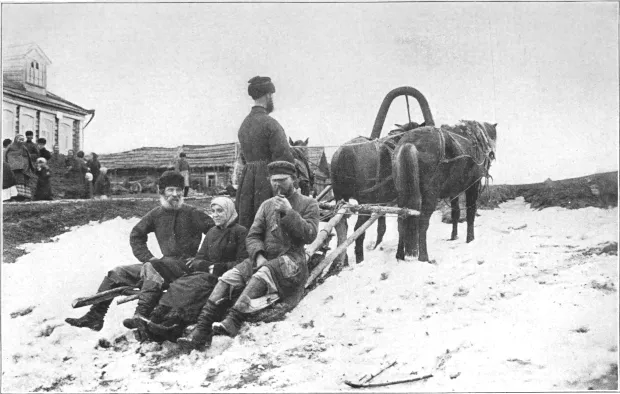
that passes to and fro along its track. Over the
frozen snows of winter and the rocky trails of summer
there plod horse and ox and camel, sleigh and
wagon and cart,—a broken line of men and beasts.
Russian posts thunder past with galloping horses,
three abreast. Bands of Cossacks convoy the
guarded camel-trains of heavy mail for China. One
meets troops of boyish recruits, singing lustily in
chorus on the tramp northward, and Mongol carts
and flat-featured Buriats on their little shaggy
ponies, sleepy wooden villages, forests, steppes,
swamps, frozen river-courses, mountain passes.
Through the kaleidoscope of races and peoples
one moves in a world-forgotten life, a procession of
the ages.
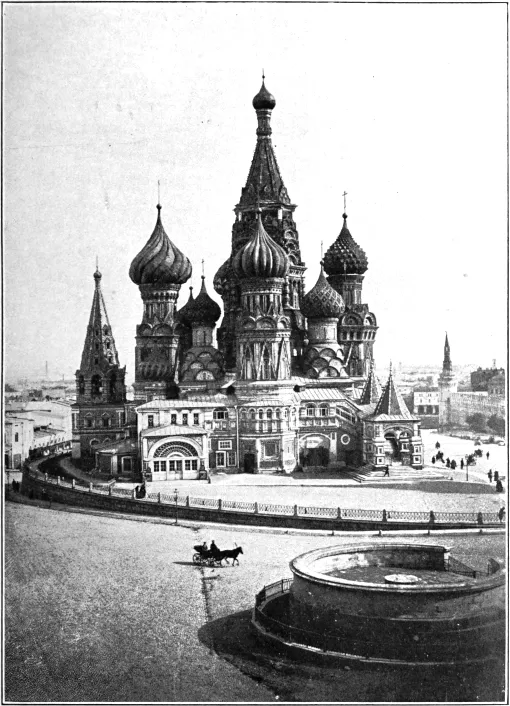
CHURCH OF ST. BASIL, MOSCOW
(Ivan the Terrible blinded its architect that he might never duplicate the masterpiece)
On the threshold of Siberia the traveler has
turned back in manner, in ways of thought, in
government, in everything, to the past. Go into
one of these cities,—you are in the Germany of
1849, with the embers still hot of the fire lighted
by the republican movement of the young men and
the industrials. The seeming chance of victory has
passed them by. The iron hand is over all. One
hears of Siberian Carl Schurzes, fugitives to America
and to Switzerland, of the month-lived Chita
Republic, of the row of gallows at Verhneudinsk,
of the bloody assizes at Krasnoyarsk.
It is as if one lived when citizens gathered in
excited groups in the Forum to discuss the news
from Philippi; or as if, from the broken masonry
of the Tuileries, there stepped out into breathing
actuality the five hundred Marseillaises “who know
how to die,” fronting the red Swiss before the
palace of Louis, the King. Here is the reality of
friends in hiding, of files of soldiers at each railway-station,
of police-examined passports without which
one cannot sleep a night in town, of arms forbidden,
meetings forbidden, books forbidden,—all
things forbidden. Here as there men thought that
the new could come only by revolution. Yet one
can see, despite all, the germs of improvement and
the upward pressures of evolution.
Move further toward the frontier towns, where
the relayed horses bring the weekly mail,—you have
gone back a hundred and fifty years. You are
among our own ancestors of the days of the Stamp
Act. Did the General Howe who governs the
oblast from his Irkutsk residency overhear the
school-boys of Troitzkosavsk as they chant the forbidden
Marseillaise, he, too, might say that freedom
was in the air. These Siberian frontiersmen shoot
the deer with their permitted flint-locks as straight
as the neighbors of Israel Putnam, and with spear
and gun they face the bear that the dusky Buriat
hunters have tracked to its lair.
Our Puritans are there, rugged, red-bearded dissenters,
“Stare’ Obriachi,” Old Believers, they are
called, who came to Siberia rather than use Bishop
Nikon’s amended books of prayer. Yankee-like, outspoken,
keen at a trade, are these big Siberian sons
of men who dared greatly in their long frozen march.
The grants to Lord Baltimores and Padroon Van
Rensselaers are in the vast “cabinetski” estates of
the grand-ducal circle, engulfing domains great as
European kingdoms.
Go into one of the villages of the peasants transplanted
in a body by the paternal Government.
Here are the patient, enduring recruits for the army,
brothers to the toilers over whose fields the Grand
Monarch’s wars rolled back and forth. Though
steeped in ignorance and overwhelmed by the incubus
of communism, they are capable of real and
splendid manhood, and will show it when their
world has struggled through into the century in
which we others live.
Go to a mining-camp in the Chickoya Valley. It
is California and the days of ’49. Histories as
romantic as those of the Sierras are being lived out
in its unsung gorges,—tales of hardships, of grub-stakes,
of bonanzas in Last Chance Gulches.
When the bumping tarantass rolls across the
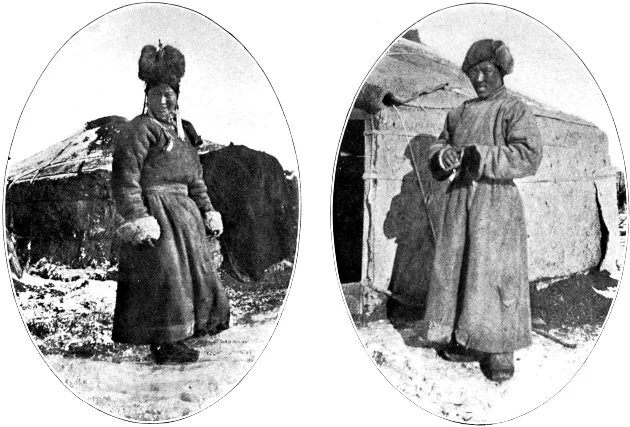
Chinese frontier into Mongolia, it enters a kingdom
of the Middle Ages flung down into the twentieth
century. Feudal princes, lords of armies weaponed
with spear and bow, tax and drive to the corvée
their nomad serfs. A hierarchy of priests whose
divine head lives in a palace at Holy Urga, sways
the multitude of superstition-steeped Mongols, and
receives the homage of pilgrims wending their way
from Siberia, from the Volga, from Tibet, from all
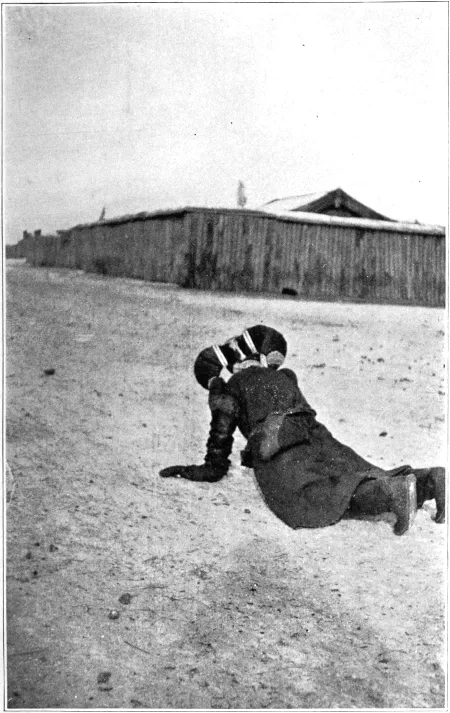
Mongolia, to their Canterbury of Lamaism. In
prostrate devotion the penitents girdle the Sacred
City before whose hovels beggars dispute with dogs
their common nourishment, and in whose compounds
princes of the race of Genghis Khan, with
armies of retainers, live bedless, bathless, lightless,
in the felt huts of their race. Squalid magnificence
and good-humored kindly hospitality are linked to
utter brutality. Sable-furs and silks cover sheepskins
worn until they drop from the body. Here and
there among the natives a Chinese trading caravansary,
alien, walled, peculiar, stands as of old the
Hansa-town, with merchant guilds and far-brought
caravan goods.
A way of adventure and strangeness, where the
years turn back, is this old road of the Golden
Horde, leading down past the ancestral homes of
the Turks to the Great Wall.
The Cossack sentries at Kiahta look Chinaward.
They have become an anomaly, this hard-riding,
fierce-fighting soldier class. The plow has metamorphosed
into myriad farms the plains along the
Don where once their ponies grazed. Mining-cuts
score the hills in the Urals where once they hunted.
Villages of Slavonic peasants rise along the Amur.
The sons of the old warriors grow into peaceful
farmer-folk, differing in name alone from their blue-eyed
neighbors. Soon they must disappear in all
save picturesquely uniformed Hussars of the Guard,
and as a memory, chanted by young men and girls
in the Siberian summer evenings when Yermak’s
song is raised. The task of the Cossack, to lead in
the conquest of kindred native races and to weld
these through themselves into Russia’s fabric, is
nearly done.
Down the ancient road lies a last avenue of advance.
Eastward is Manchuria, where artillery and
science grappling must decide the day with Japan.
Southward is India, where England’s guarded gateway
among the hills can be opened only from behind.
But into Mongolia Fate may decree that the yellow-capped
Cossacks, drafted from Russia’s Mongol
Buriats, shall lead once more the nation-absorbing
march of the White Czar. For another memorable
ride, the Cossacks, who on their shaggy ponies led
the long conquering way across the continent, may
yet mount and take the road to China.
II
THE GREAT SIBERIAN RAILWAY
HOW long to Irkutsk? Seven days now, seven
years when last I came.” The bearded Russian
standing in the doorway of the adjoining compartment
in the corridor-car of the Siberian Express
gazes thoughtfully at the fir-covered slope, whose
dark green stands in sombre contrast to the winter
snows. The train is slowly climbing the Ural Range,
toward the granite pyramid near Zlatoust, on opposite
sides of which are graven “Europe” and
“Asia.” Neighbors with easy sociability are conversing
along the wide corridors, exchanging stories
and cigarettes, asking each other’s age and income
in naïve Siberian style.
Regarding the burly occupant of the next stateroom
one may discreetly speculate. From sable-lined
paletot and massive gold chains you hazard
that he voyaged with the traders’ slow caravans
in the days before the railway—that he was a
merchant.
“A merchant? Optovi? No, I did not come with
the caravans.”
From the triangle of red lapel-ribbon, the rank-bestowing
decoration, you venture a second guess.
“Perhaps the gaspadine made the great circuit
to oversee the local administrations? He was a
government inspector—Revizor?”
“Chinovnik niet navierno,” he answers. Most
decidedly he was not an official. The suggestion
causes him to smile broadly. “I was with the convicts,”
he says.
Beside the line of rails curves the old post-road
winding like a ribbon through the highlands.
“It was by that road we marched. Seven years
of my life lie along it.”
The train swings through a cleft hewn in the living
rock, steep-sided as if the mountain had been gashed
with a mighty axe. It rumbles around the base of
an overhanging crag while you look clear down over
the white valley, with the miles of rolling green
forest beyond.
“Was not seven years a long time for the march?”
you venture.
“For a traveler, yes; for convict bands not unusual.
We went back and forth, now northward
a thousand versts as to Archangel, now west as to
Moscow, now south as to Rostov. Again and again
our troop would split, and part be sent another
way. New prisoners would be added, from Warsaw,
Finland, Samara. New guards would take charge.
Some groups would go to the West Siberian stations,
some east to the Pacific and Sakhalin. I, who was
written down for ten years at the Petrovski Works beyond
Baikal Lake, with a third commuted for good
behavior, had finished my term before I got there.”
“Why did they wander so aimlessly?”
“It seems truly as a butterfly’s flight, but you
others do not know the way of Russia. Very
slowly, very deviously she goes, but surely, none the
less, to her goal. We each came at last to our place.”
A match flares up and he lights another cigarette.
“Shall we not go to the ‘wagon restoran’ for a
glass of tea?” you ask.
Along the broad aisles you walk, past the staterooms,
filled with baggage, littered with bedding,
kettles, novels, and fur overcoats. Everything is
in direst confusion, and the owners are sandwiched
precariously between their belongings. On the little
tables which are raised between the seats, they
are playing endless games of cards, sipping tea and
nonchalantly smoking cigarettes the while. You
pass the stove-niches at the car entrances, heaped
to the ceiling with cut wood. The fire-tenders
as you pass give the military salute. You cross the
covered bridges between the cars, where are little
mounds of the snow that has sifted in around the
crevices; and a belt of cold air tells of the zero
temperature outside. At length the double doors
of the foremost car appear ahead, and crossing
one more arctic zone over the couplings, you can
hang your fur cap by the door and salute the ikon
that with ever-burning lamp looks down over the
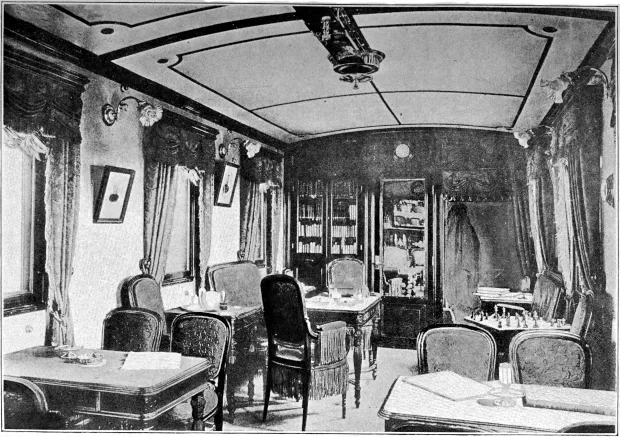
parlor-car. Now you can sit on the broad sofa set
along the wall, or doze in the corner-rocker under
the bookcase, or sit tête-à-tête in armchairs over
a miniature table. Ladies here, as well as men, are
chatting, reading, and smoking, for this combination
parlor, fumoir, and dining-room is for all, not a
resort to which the masculine element shamefacedly
steals for unshared indulgences.
“Dva stakan chai, pajolst” (two glasses of tea,
please), your friend says to the aproned chelaviek,
a Tatar from Kazan.
“Stakan vodka,” you add; for you are willing to
contribute twenty kopecks to the government revenues
if this beverage will help out the memoirs of
your friend, the convict.
“Say chass,” replies the waiter, which means,
literally, “this hour,” figuratively, “at once,”
actually, whenever he chances to recall that your
party wants a glass of tea and another of vodka.
When at length the refreshments have come, your
companion gets gradually back to the reminiscences.
“Were your comrades many on that march?”
“Twenty-six from my school in Odessa,” he says.
He tells of the tumult in the Polytechnic Academy,
when he was a boy of sixteen studying engineering;
of the barricade which the students threw up; of the
soldiers sent against it; of an officer wounded with
a stone, and the sentence to the mines. He tells of
the journey, day after day, the miserable company
trudging under the burning suns of summer and
shivering under the biting cold of winter, ill-fed and
in rags. He recalls how this friend and that friend
sickened and died; how a peasant-woman gave him
a dried fish; how one of the criminals tried to escape
and was lashed with the plet until he fainted beneath
its strokes.
“We were a sad procession. First came the Cossacks
on their ponies, with their carbines and sabres.
Then the murderers for Sakhalin, and the dangerous
criminals in fetters; a few women next; then we, the
politicals; last, more soldiers marching behind. Far
to the rear came carts and wagons with the wives
and families of the prisoners, following their men
into exile. Slowly we went, scarcely more than
fifteen versts a day, with a rest one day out of
three, for the women. In winter we camped in stations
along the road.”
From the comfortable leather armchairs they
seem infinitely distant and dream-like, these tales
from the dark ages of Siberia. The speaker seems to
have forgotten his auditor and to be talking to himself,
and soon he relapses into silence. He sits holding
his glass of lemon-garnished tea, like a resting
giant with his shaggy beard and mighty chest. The
drag of the brakes is felt through the train. “Desiet
minute stoit” (ten minutes’ stop), somebody calls
out. Suddenly, with an effort, the man across the
table rouses from his reverie, and looks about the
car, when the broad smile comes back and he says
earnestly:—
“You must not think of that as the true Siberia.
It was all long ago—thirty-five years. And you
see I who became a kayoshnik, a gold-seeker, have
prospered, and work many mines. I am glad now
that they sent me to Siberia. And many others
prosper who came with the convicts. The old dark
Siberia dies, but our new Siberia of the railroad
lives, and grows great.”
He rises resolutely and shakes your hand with a
vise-like grip.
“De svidania!” (Till we meet again.)
You rise with the rest, draw on your fur cap and
gloves, work into the heavy fur-lined overcoat, and
clamber down to the platform. A little wooden
station-house painted white is opposite the carriage
door. It has projecting eaves and quaint many-paned
windows. In front of it is a post with a large
brazen bell. On the big signboard you can spell out
from the Russian letters “Zlatoust.” This is the
summit station of the pass that crosses the Urals.
Around are standing stolid sheep-skinned figures,
bearded peasants just in from their sledges, which
are ranked outside the fence. Fur-capped mechanics,
carrying wrenches and hammers, move from
car to car to tighten bolts and test wheels for the
long eastward pull. Uniformed station attendants
are here and there, some with files of bills of lading.
As you walk down the platform among the crowd,
you come upon a soldier, duffle-coated and muffled
in his capote, standing stoically with fixed bayonet.
Forty paces further there is another, and beyond
still another, all the length of the platform, and far
up the line. What a symbol of Russian rule are these
silent sentries! And what a mute tale is told in the
necessity for a guard at every railroad halting-place
in the Empire!
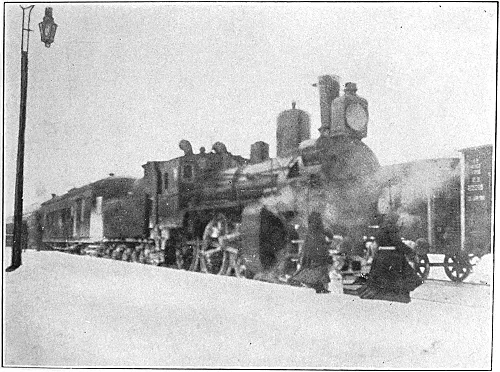
You stroll along toward the engine. Huge and
box-like are the big steel cars, five of which compose
the train. Two second-class wagons painted in mustard
yellow are rearmost, then come the first-class,
painted black, next the “wagon restoran” and the
luggage-van, where the much advertised and little
used bath-room and gymnasium are located. The
engine is a big machine, but of low power, unable to
make much speed; and the high grades and the
road-bed, poor in many places, additionally limit
progress. It is apparent why the train rarely moves
at a rate greater than twenty miles an hour.
At first you do not notice the cold. But now that
you have walked for a few minutes along the platform,
it seems to gather itself for an attack, as if
it had a personality. You draw erect with tense
muscles, for the system sets itself instinctively on
guard. The light breeze that stirs begins to smart
and sting like lashes across the face. The hand
drawn for a moment from the fleece-lined glove,
stiffens into numbed uselessness. As you march
rapidly up and down the platform, an involuntary
shiver shakes you from head to foot. A fellow
passenger, remarking it, observes:—
“It is not cold to-day, in fact, quite warm. Ochen
jarko.”
You walk together to the big thermometer that
hangs by the station-door. It is marked with the
Réaumur Scale, and your brain is too torpid for
multiplications. But the slightly built official,
known as a government engineer by green-bordered
uniform and crossed hammers on his cap, is inspecting
the mercury also.
“Eight degrees below zero Fahrenheit,” he says.
“Quite warm for January. It is often thirty-five
degrees below zero here in the Uralsk.”
It gets colder at the suggestion. The three starting-bells
ring, and everybody scrambles into the
compartments.
The express rolls onward down the Urals. You
stroll back to the warm dining-room and idly watch
the groups around. Across the way is an elderly mild-looking
officer, whose gold epaulettes, zig-zagged
with silver furrows, are the insignia of a major-general.
He smokes endless cigarettes in company
with another officer lesser in degree, a major,
decorated with the Russo-Japanese service-medal,
smart of carriage and alert of look. By the window
beyond is a young German, gazing meditatively at
the hills and the snow through the bottom of a
glass of Riga beer. A rather bright-mannered dame,
with rings on her fingers and long pendants in her
ears, chats vivaciously in French with a phlegmatic-looking
personage in a tight-fitting blue coat which
buttons up to his throat like a fencer’s jacket. A
quietly-dressed gentleman, evidently in civil life,
is reading one of the library copies of de Maupassant.
Outside, cut and tunnel, hill, slope, and valley,
green forest, white drifted snow, and bare craggy
rocks, the Urals glide past. The little track-wardens’
stations beside the way snap back as if jerked
by a sudden hand, and the telegraph-poles catch up
in endless monotony the sagging wires.
The Tatar waiter goes from place to place, clearing
off the ashes and the glasses, and getting ready
for dinner. There is a table-d’hôte repast, the Russian
obeid, a meal which starts with a fiery vodka
gulp any time after noon, and tails off in the falling
shadows of the winter sunset with tea and cigarettes.
Or, if one wishes, he may press the bell,
labeled in the Græco-Slavonic lettering, “Buffet,”
and dine à la carte.
“Il vaut mieux essayer le repas Russe,” says the
quiet reader of de Maupassant, joining you.
He is duly thanked for the advice, and we beckon
to the aproned waiter. At once the latter passes the
countersign kitchenward to set the meal in motion,
and puts before us the little liqueur-glasses and the
bottle of vodka. While we still gasp and blink over
this, he has gotten the cold zakuska of black rye-bread
and butter, sardinka, salty beluga, and cold
ham, and has started us on the first course. Then
comes in, after the omni-inclusive zakuska, a big
pot of cabbage-soup which we are to season with
a swimming spoonful of thick sour cream. The
chunky pieces of half-boiled meat floating in it are
left high and dry by the consumption of the liquid.
The meat becomes the third course, which we garnish
with mustard and taste.
“Voyons!” the Frenchman observes. “Of the
Russian cuisine and its method of preparing certain
food-substances one may not approve. Frankly it
calls for the sauce of a prodigious appetite. But
contemplating the obeid as an institution so evolved
as to fit into the general scheme of life, it finds
merit. The Russian meal is a guide to Russian character.”
“What signifies this mélange of raw fish, eggs,
and great slices of flesh, and mush of cabbage-soup?”
“Not that the Russian has no taste. It is that
he sacrifices his finer susceptibilities to his love of
freedom. A regular hour for meals would seem to
him a sacrifice of his leisure and convenience to that
of the cook. The guiding principle of the national
cuisine is that all dishes must be capable of being
served at any time that the eater feels disposed.”
This is a problem to put to any kitchen, we
allow. Napoleon’s chef met it by relays of roasting
chickens. But one cannot keep half a dozen fowl
going for each household of the one hundred and
forty million inhabitants of Russia. Thus sturgeon
is provided, and sterlet, parboiled so that it tastes
like blotting-paper; and the filet that is called
“biftek,” and the oil-sodden “Hamburger,” that is
dubbed “filet.” These can be started at nine in the
morning, and be removed at any time between that
hour and nine at night, without any appreciable
change in taste or texture. The cook of the restaurant,
like his brethren of the Empire, has laid
his professional conscience sacrificially upon the
national altar of unfettered meals. If the obeid is
not a triumph in culinary art, it is at least a signal
example of domestic generalship.
We have advanced without a hitch to roast partridge,
with sugared cranberries, which our friend
washes down with good red wine from the Imperial
Crimean estates. We get through a hard German-like
apple-tart, and reach the last item of cheese.
When the mighty meal is over, we order tea, light
cigarettes, and lean back in the armchairs to chat
and note how our neighbors are getting through the
time.
At the far end of the room a Russian has joined
the French lady and her escort. They are celebrating
some occasion that requires heaping bumpers
of champagne. The babble of their conversation is
in the air. It seems to refer to the comparative
appreciation of histrionic talent in Rouen and
Vladivostok!
Somebody is being treated to a dressing-down in
the latest Parisian argot. “Ces sont des betteraves
là-bas!” one hears scornfully above the murmurs.
Across the way some Germans are engaged with
beer-schooners. One of them gets excited and brings
his fist down upon the table. “Arbeit in Sibirien
nimmer geendet ist; they always want more advice
about their gas-plants.”
In the lull that follows the explosion, a gentle
English voice floats past from the seat behind us.
“And so I told him that the station had nearly
enough funds, but we needed workers, more workers.”
It is the English medical missionary on his way
to Shanta-fu, discussing China with the American
mining-engineer, bound for Nerchinsk.
The piano, under the corner ikon with its ever-burning
lamp, tinkles out suddenly, and a man’s
voice starts up—
You can hear the girls declare,
He must be a millionaire.
He misses a note every now and then, which does
not embarrass him in the least. Caroling gayly to
his own accompaniment, he forges ahead. The
crowd in the armchairs around the room, consuming
weak tea or strong beer, and smoking, all join with
an untroubled accord and versatile accents, French,
English, and Russian, in the blaring chorus, “The
man that broke the bank at Monte Carlo.”
The train rocks faster on the falling grade; little
by little the mountains drop away; gradually the
mighty forests become dwarfed into scattered clumps
of straggly birches, and the great trees dwindle into
bushes; lower and still lower fall the hills, until all is
flat. As far as the eye can see are the snow-covered
wastes, treeless, houseless, lifeless. The lowest foothills
of the Urals have been passed. It is the beginning
of the great steppes.
Slowly the daylight wanes. The gray darkness
deepens steadily; it seems to gather in over the gliding
snow, and the peculiar gloom of a Siberian winter’s
night closes down. At each track-guard’s post
flash with vivid suddenness the little twinkling lanterns
of the wardens of the road. Involuntarily
conversation becomes less animated and voices are
lowered; the spell of the sombreness is over all.
Soon the electric lamps are lighted, and from
brazen ikon and sparkling glasses flash reflections
of their glitter. Curtains are drawn, which shut out
the enshrouding blackness. The piano begins tinkling
again; the waiters come and go with tea and
liqueurs; the babble of conversation rises; and the
idle laughter is heard anew. Darkness may be
ahead, behind, and beside, but within there is light—enjoy
it.
The train slows for a halt. Station-lamps shine
mistily through the brooding night. Lanterns bob
to and fro on the platform as fur-capped train-hands
pass, tapping wheels and opening journal-boxes.
At each door a fire-tender is catching and
stowing away the wood which a peasant in padded
sheepskins is tossing up from his hand-sled below.
It is Chelliabinsk, whose old importance as the
clearing-house of the convicts has been passed on
to the new city of the railroad. Here the just completed
northern branch, linking Perm to Petersburg,
meets the old southern line from Samara and Moscow.
A short stop and the train moves on again. The
day is done and gradually each saunters into his
own warm compartment, which the width of the
Russian gauge makes as large as a real room. One can
read at the table by the window, under the electric
drop-light, or, propped in pillows, one can stretch
out luxuriously on the easy couch that is nightly
manoeuvred into an upper and lower berth. Practically
always after crossing the Urals, the number of
passengers has so thinned out that each may have
a stateroom to himself.
Presently you push the bell labeled, “Konduktor.”
A uniformed attendant appears standing at
the salute. “Spate” (sleep) is sufficient direction.
The sheets and pillows are dug out and the transformation
of the couch into a bed is effected.
“Spacoine notche” (good-night) he says, and you
fall asleep to the rhythmic throb of the engine.
During the following hours the train enters the
Tobolsk Government, the oldest province of Siberia,
whose 439,859 square miles of area, nearly four
times as large as Prussia, extend roughly from the
railroad northward to the Arctic Ocean, and from
the Urals eastward so as to include the lower basin
of the Ob-Irtish river system. This ancient province
has seen much of Siberia’s history, whose predominant
features have been two, growth and graft.
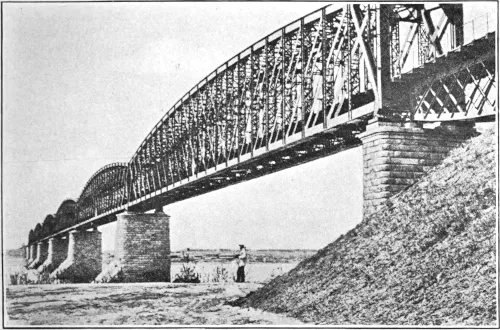
BRIDGE OVER THE IRTISH
ALONG THE TRANS-SIBERIAN RAILWAY
Out of evil, somehow, in a marvelous way has
been coming good. In the earliest days, with what
smug satisfaction did the Stroganovs find that the
native inhabitants would trade ermine for glass
beads! Yet the fruit of their sharp dealing and
purchased protection and special privilege was the
expedition that won Sibir, founded Tobolsk, and
opened to Russia the way into northern Asia. The
imperial commissioner who came to Tobolsk shortly
after Kutchum Khan’s overthrow, to collect the
yassak tribute of ten sable-skins for each married
man and five for each bachelor, was detected culling
the choice skins for himself, and substituting cheap
ones for his master. But his agents had sought out
the paths and extended the Russian Empire far
into the northern forests.
By despotic oppression the inhabitants of Uglitch
town, condemned for testifying to the murder of
Dimitri, the Czarevitch, came here into exile in
1593, carrying with them the tocsin-bell that had
tolled alarm when the Czar wished silence. But
they, together with the deported laborers settled
by the same arbitrary will along the Tobol River,
started the permanent settlement of the new realm.
A succeeding functionary called on the natives
for a special tribute of ermine for the Czarina’s
mantle. He collected so many bales of it that the
taxed began to wonder at the stature of the “Little
Mother,” and sent a special deputy to Petersburg.
The legate discovered that the Empress was as
other women, and on his disclosures the official was
unable to save his own, let alone the ermines’ skins.
Yet while the governor was plundering the fur-merchants
of Tobolsk, the frontiers were extending,
until by 1700 they reached eastward to Kamchatka
and Lake Baikal, southeast to the Altai foothills
at Kuznetz, and north to the Arctic Ocean.
At Tobolsk in 1710 Peter the Great established
the capital of his reorganized province of Siberia.
Prince Gagarin, whom he appointed its first governor,
found here a systemless extortion unworthy
of an efficient statesman. With the thoroughness of
genius he built up in the unhappy province a regular
organization of rascality. His pickets patrolled
the roads into Russia, to prevent the escape of those
who might carry the tale of his oppression. He arranged
with high officials at Court that any petitioners
who evaded this frontier net should be handed
over to an appropriate committee. Thus fortified,
he began collections of as much as could be wrung
from his luckless subjects. Every traveler paid
Gagarin’s tariff, every farmer sent him presents of
stock, every trapper forwarded the best of his catch.
The fur-trader’s donations and the merchants’
loans were assisted into Gagarin’s warehouses by
thumbscrew and thonged knout.
While these things passed in Tobolsk there came
periodically to Petersburg delegations of outwardly
contented citizens attesting the wisdom of their
governor. They brought to the Czar and the Grand
Dukes, in addition to the punctiliously rendered tax
yassak, gifts of especially fine furs. Such was the
completeness of Gagarin’s control that not an echo
of the true state of affairs reached the ears of the
astute Peter.
At length, in 1719, Nesterov, the Minister of Finance,
was privately approached by some Tobolsk merchants
and was supplied with evidence sufficient to
hang half the officials in Siberia. In a dramatic presentation
the Minister furnished this to the Imperial
Senate, showing so bad a case that Gagarin’s own
agents in the ducal circle rose up against him. The
Czar sent Licharev, a major of the Guard, to Siberia,
to proclaim in every town and hamlet that Gagarin
was a criminal in the eyes of the Emperor. As this
messenger approached Tobolsk, official after official
came out to turn state’s evidence, trying to assure
his personal safety. The highways to Russia were
guarded by Peter’s own troops, with orders to seize
all outgoing travelers who might be transporting
Gagarin’s accumulated spoil, which with commendable
prudence the Czar had allocated to himself.
When Peter was in England he had remarked
casually to an acquaintance, “In my realm I have
only two lawyers, and one of these I intend to hang
as soon as I get back.” It was particularly unfortunate
for this ex-governor that the remainder of
the legal profession did not feel himself called upon
to explain to Peter the Gagarin campaign contributions.
No one ever needed an attorney more. He
was under trial before an imperial judge who did not
know a technicality from a tort, and whose preliminary
procedure was to order a reliable gallows.
For some score of years subsequent to Gagarin,
the governors of Siberia were, in any event, moderate.
The province grew apace, increased by exiles,
by land-seeking colonists, by raskalniks,—nonconformists
of the Greek Church, self-called “Old
Believers,”—who preferred to come to Siberia
rather than follow Peter’s orders and shave off their
beards.
Then Chicherin the Magnificent came. His life
was a round of celebrations. Wonderful stews he
concocted for his sybaritic revels. At obeid an orchestra
of thirty pieces supplied the music. Artillery
in front of the residency saluted him with salvos
when he drove out. In Butter-Week all Tobolsk
drank the spirits which their governor bountifully
provided. It is hardly necessary to say that the
money for these entertainments did not come from
Chicherin’s private purse: the city merchants
groaned over forced loans and benevolences; and
at last their cry reached the throne, and Chicherin
too was removed.
With his passing, the Tobolsk Province fell to less
spectacular rulers, but under good and bad it grew
steadily, until in 1860 there were a million inhabitants
within its borders, a population which at the
present time has risen to a million and a half. Some
forty thousand of these are exiles; some eighty
thousand raskalniks; and forty thousand Tatars,
who feed the flocks where their ancestors once bore
sway, living peacefully side by side with the Russians.
Some fifteen thousand are descendants of the
Samoieds and Voguls with whom the first Stroganov
from the adjoining Russian province of
Archangel traded his wares. Some twenty thousand
are Ostiaks whose forebears were alternately allies
and enemies of Yermak.
The capital city, Tobolsk, on the Tobol River
hard-by its junction with the Irtish, has grown from
a precariously held camp of two hundred and fifty
fugitive Cossack soldiers to a city of thirty thousand.
Tiumen, the easterly city on the Tura River,
another of Yermak’s camps, has grown into a great
distributing-centre for produce brought by the river-highways.
From the railway line northward as far
as the city of Tobolsk extends a farm-belt, a continuation
of the black-earth region of great Russia.
The fertility of the land may be judged by the
number of villages met as the train speeds on, and
the large proportion of enclosed fields on both sides
of the track. Some of the finest agricultural soil in
the world lies here, such soil as composes the
prairies of Minnesota and Dakota. Three million
head of live stock graze in the district, which has
a yearly production of ten million hundredweight of
wheat alone, four million of rye, and nine million
of oats. Five million more settlers may live and
thrive, and the harvest will feed the ever-growing
cities of Europe when Siberia comes to be the new
granary of the old world. The stress and turmoil of
Tobolsk are passed. Happy the people who have no
annals!
Gradually, as the train rolls eastward beyond the
Ishim River Valley, the farm country opens out into
the unfenced prairie of the Great Steppe. The clustered
wooden villages that flanked the line through
Tobolsk appear less and less frequently, till at last
we seem to glide over an immense white sea, frozen
into perpetual calm and silence. Here and there a
gray thicket of stunted trees and bushes, here and
there a grove of naked-limbed birches, mutely exhibit
Nature’s desolation.
As the sullen landscape bares itself, one thinks of
the prison caravans tramping these wastes; of the
early neglected garrisons which Elizabeth’s favorite
General Kinderman proposed to victual on crushed
birch-bark and relieve the Crown of their expense;
of all the misery and the wrong that the steppes of
Siberia have symbolized. No sign of man’s handiwork
or of Nature’s kindliness is seen,—only the
cold snow and the bare birches, while regularly as
the ticking of a clock the telegraph-poles and the
verst-spaced stations snap back into the wastes.
The dominant reflection is not, how great is the
achievement which has mastered these steppes! but,
how infinitesimal is all that man has done in this
ocean of untrodden snow! Hour after hour we are
driving on. Yet never is there passed a landmark
to conjure into imagination a picture of progress.
One moves as in a nightmare, where he runs for
seeming ages, hunted forward, yet can never stir
from the spot. The horizon-bounded circle of vision
is as the ever-receding rim of a giant dome, the
rails ahead and behind bisecting its white immensity.
Above, the vast bowl of the blue sky dips and
meets it, imprisoning us. Where are the fields and
villages; the bustling activity of human life that
tells of man’s mastership? Hour after hour passes
without a change in the drear monotony of the landscape;
for miles on miles not a trace is seen of human
dominion. Grim Nature spreading her shroud
over plain and pasture is despot here, and Winter
is ruler of the Siberian Steppe.
One could ride due south a thousand versts,
through Golodnia the “hunger steppe” to the borders
of Turkestan, and find the same monotonous
plain, snow-covered save where the dryness of the
south has thinned its fall. One could ride from
the Caspian Sea due east to China, with each day’s
march a counterpart of the rest. Five hundred thousand
square miles of area are covered with grass and
gaudy flowers in the spring, with low brush and green
reeds where the salt swamp-lakes receive the tribute
of snow-fed streams. In midsummer the growing
grass scorches under a heat of 104°. In winter snow
is everywhere,—in feathery flakes that the midday
sun does not soften during whole months of a cold
which is a ferocity. Thirty to forty degrees below
zero is not unusual, and the land is swept by bitter
winds that pierce like daggers through doubled furs
and felts. Yet there dwell on the central plateau of
Asia a million people, and one million cattle and
three million sheep are scattered over the tremendous
range. As the herds have become hardened
through the centuries and survive in measure despite
the severity, so also have the men. From the
train-windows now one may chance to see infrequent
straggling herds of long-horned cattle, lean and
gaunt, scratching away the snow in search of food.
Mounted on little shaggy ponies are figures buried
in skins, who keep guard over them.
One detects a new type among the crowds at the
stations,—flat faces, round eyes, square thickset
bodies. Here on the borderland, the old race has
fused with the Slav and has become metamorphosed.
The sons of the Tatars, whose very name was distorted
into that of a dweller in Tartarus by those
who feared their fierce valor, have become shopkeepers,
train-hands, waiters, and butchers, who
come to sell meat and milk to the chef of the wagon
restoran. Sometimes, at the stops, figures, gnome-like
in enveloping red capote and grotesquely
padded furs, hold their ponies with jealous rein,
staring curiously at the locomotive and passengers.
DINING-CAR SALOON, VIEW OF THE LIBRARY
Looking long from the windows at this steppe,
a drowsy hypnotism steals over the mind—a dull
stupor of unbroken monotony. It is better to do
as the Russians—pay no attention whatever to the
landscape outside, but make the most of the life
within the moving caravansary,—cards and cigarettes
and liqueurs, tea and endless talk, with yarns
that take days for the spinning.
The uniformed judge, passing by, joins you. He
is traveling to a new appointment with his swarming
family of children, shawl-decked females of unknown
quality and quantity, the household bedding, and
the ancestral samovar, all crowded into one stifling
compartment. He discusses volubly the confusions
of the Code, and propounds a unique theory of his
own as to Russian jurisprudence, to the effect that
all the best laws of other nations have been adopted,
with none of the old or conflicting enactments
repealed. The general drops into the circle. He is
interesting when one has pierced the crust, but
dogmatic. At every station the soldiers of the garrison,
not on sentry-duty, jump to one side, swing
half-around, and stand at the salute until he passes,
to the huge inconvenience of the porters. He would
undoubtedly vote the Democratic ticket to repay
Mr. Roosevelt for putting Russia under the alternative
of stopping the war perforce, or forfeiting
sympathy, when Japan was said to be breaking
under the strain.
“Russia was beaten this time. What of it? Nietchevo!”
says the general.
“Nietchevo,” we echo, as we sip our tea.
“But the Japanese are wily insects,” observes his
companion, the young service-medaled major. “I
was in Vladivostok when our prisoners came back.
They tried to get money for the checks the Japanese
had given them. That was how the big mutiny
began. You know, when our men were taken captive,
the Japanese treated them very well, much
good food, vodka, let them write home all about it,
and gave them enormous pay, six yen, three dollars
a month, charging the expense all up to the Czar
for after the war. When at last the prisoners were
to be released, the Japanese promised every man
double pay, twelve roubles. But they gave them the
money? No, the insects gave them each an order
payable by the Russian commander in Vladivostok.
So the transports came, and these men were sent
ashore with these checks in their hands, and they
went up to the commandant of the city, and asked
for their cash that the Japanese had promised.
What money did the commandant have for them?
What could he do? He ordered them to go away.
So they stood and discussed on the street-corners.
And more men still came from the transports. Then
they said, ‘We will ask the general of the forts.’ So
they marched to the forts in a big crowd, and the
general he also told them to go away. For a long
time they talked and they persuaded the sailors to
help them. So they went again to the forts, and the
sailors shot at the forts, and the general ordered
the artillery to shoot. But the artillery would not,
so the men broke in and killed the officers and got
arms and went back to the city commander. Him,
too, they killed, and all Vladivostok was in mutiny
for two weeks. Not an officer dared show himself.
General Orlov persuaded them to let him into the
town. Then many were shot, but at last the city was
quiet. The Japanese are very sly insects.”
His story ends and the two officers go back to join
their families. The train throbs on across the steppe.
The German gas-plant drummer, with his new
Far Eastern outfit, is gathering from the missionary
doctor details of treaty-port life, which are being
treasured up as valuable reference data. The
French fur-merchant dips back into his library copy
of de Maupassant.
The rigor of the outside scene seems at length to
be changing. A few scattered houses appear, and
trees and fenced fields, and villages, with curling
smoke rising from the chimneys. Men and children
are walking about, and finally we come to the Irtish
River, over which the train rumbles on a half-mile
bridge. Spires and gilt domes are visible, dark
wooden houses, and bright white-painted churches
with green roofs. Droshkies and carts are passing in
the streets, and presently we draw up to the station
of Omsk, the second city of Siberia.
The junction of the Trans-Siberian Railway with
the Irtish River, which is 2520 miles long and open
from April to October, would of itself make Omsk
a centre of great strategic importance. But in addition
to this main river-highway, which is navigated
by some hundred and fifty steamers, there are affluents
by which one can sail from the Urals to the
Altai, from the Arctic Ocean to China, and these
lines of communication centre here.
From Omsk, following the Irtish down past Tobolsk,
one can steam by the Obi to Obdorsk, within
the Arctic Circle. Indeed, a regular grain-export
service was planned via the Kara Sea to London by
an ambitious Englishman. It failed after some
promise of success, because of the ice-packs in the
Gulf of Obi. From Omsk, following the Irtish upstream,
steamer navigation extends as far as Semipalatinsk,
in the Altai foothills. Smaller craft may
go nearly to the Chinese frontier.
By the Tobol and Tura rivers, Tiumen, in the
Ural foothills, may be reached, four hundred and
twenty miles from Semipalatinsk. By ascending
the Obi, a boat may go fourteen hundred and
eighty miles east from Tiumen to Kuznetz on the
Tom; through a canal from an Obi confluent the
Yenesei River System may be entered, and from it
by a short portage the Lena System. In all twenty-eight
thousand miles are navigable by small craft,
and seven thousand miles by steamer. Omsk is
the pulsing heart of this mighty interior waterway
system.
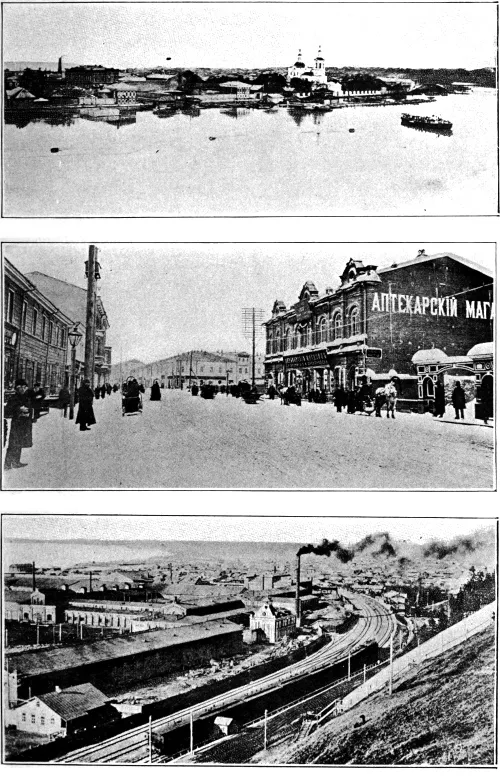
CITIES OF NEW RUSSIA
Tiumen
Tomsk
Perm
The train leaves the station, which is at a distance
from the town, and once more we are en
route. The eye rests gratefully upon the ribbon of
cultivated fields which follow the Irtish down. But
we reënter the steppe, and again the desolation settles
over all. In hours of looking, not a habitation is
seen, not an animal, not a tree,—only the same
white billows. This Barbara district in the Tomsk
Government has an area of fifty thousand square
miles. Kainsk, some seven hundred versts from
Chelliabinsk, is the centre. The section, though covered
with the fertile black earth of the adjoining
regions, is, owing to lack of drainage and adequate
rainfall, arid and almost untilled.
The round-faced civilian from the compartment
further up, whose familiarity with the country has
made him a welcome accession, joins us at the window.
He looks out over the level plain of the Barbara
Steppe with manifest satisfaction.
“You admire the landscape?” we ask satirically.
He smiles. “We got big money when the line
went through here. I made my first fortune then.”
He sighs at the memory of old times, and tells of
the railway-building days when the Czar had given
the order for a road across the continent, and the
soldiers of fortune, of whom he was one, had gathered
to the task.
“Not a kopeck had I when the Dreyfus brothers
made their big speculation in Argentine wheat and
went down, leaving us young clerks stranded in
Kiev. You know Kiev? Great pilgrimages come
there to see the bodies of Joseph and his brethren,
all preserved just as when they died. We heard by
accident of a grading job under a big contractor out
here. None of us knew anything about construction,
but three of us grain-clerks wrote a letter saying we
would put the work through, and started. We had
just enough money to get to Samara. In Samara
was a merchant much esteemed, whom I went to
see. He went on our bond, never having seen us before,
and gave us enough money to come. So it was
in the old days. The country was flat as a board.
We had but to lay down the ties and spike the rails.
Thirty versts we made of this line. It cost us thirty
thousand roubles a verst, but we got fifty thousand.
Would that we might do that now again.”
The contractor, his round jolly face glowing with
the recital and his eyes shining through gold-rimmed
glasses, is entertaining a growing company, for the
judge has stopped to gossip, and the railroad official.
“I took my money and bought an estate in the
country of the Don Cossacks,” the contractor is
saying. “I paid ten per cent to the Government for
taxes when I bought the land. I had to pay no more
taxes then all my life, but my heir would pay taxes,
or, if I sold, he who bought would pay. So it was
done in the Hataman Government.”
“It is just,” says the judge. “Why should they,
who get the property, not pay taxes?”
The contractor shrugs his shoulder and continues:
“For five years I farmed, and though I had a German
overseer, I did not prosper. So I went to one
of the cities of Russia and thought to put in a tramway.
The men of the city said, ‘Are all the horses
dead? He of the spectacles is mad.’ Yet by importunity
I got them to give me the right to make a
tramway. There were in Petersburg then many
Belgians, with much money, wishing to give it
away. So I went to them and said, ‘Here is a great
franchise, but who will build the line and gain the
riches?’
“‘We will, we will,’ said the Belgians.
“From them I got a hundred and eighty thousand
roubles clear, and an interest. I sold the interest
quickly to other foreigners, Frenchmen, and went
away. Yes, the tramway was built, and the people
crowded to ride on it as I had said. But when it
was going well, and the profits were yet to come,
the people said, ‘Shall foreigners oppress our city?’
So the town bought the tramways for what they
said was the cost, and the Belgians went away.
And they did not come back to Russia. Thus were
many railways and tramways built and taken. The
foreigners will not come back now, and Russians too
do not enter these pursuits, lest the Government
come after them later. It is hudoo (bad).”
“But is it not worse that these men should make
a tramway and draw vast money from the people?”
says the railroad official. “For me, I think the
Government should do it all.”
“Ni snaia, I don’t know,” says the contractor.
“But I who bought stocks with the Belgians’ money
(foolishly thinking that the business which I knew
not was safe, while that which I knew was shaky),
I will not give again to the stock-people the money
I shall make from the oil-fields of Sakhalin, where
I go now.”
“But,” says the railway chinovnik, “does not
the State do these things better? Look you at this
very railway. For years any who wished might
have built into Siberia. An Amerikanski, and Collins,
an Angleski, came proposing railroads, but all
things slumbered. Then in 1891 the Czar ordered
the road to be built, and in ten years we had laid
the eight thousand versts to Vladivostok. I read
that the line of Canada, where too there are steppes
and highlands as ours, took ten years for but half
the distance. We made two versts a day for all the
years, and they but one. Who other than the Government
could spend a billion roubles for a line that
will bring money returns only in the far future?”
“Ah, you chinovniks, you say, lo, we do all this!
But it was such as I built that road, and because
you gave us big money. And is not the money to
support it now got from the peasants’ taxes while
so many clerks and operators waste time in the
offices? I have seen a third as many men as at
Omsk do the same work. And your trains go as the
water-snails, twelve versts an hour for freight,
twenty versts an hour for the mail-trains, thirty-five
versts for the express. One can go eighty versts
in Europe.”
“Truly, truly, but why go so fast? It costs more
for fuel, and the track has to be made straight.
What good does it do you to come in sooner? If a
man is in a hurry to get somewhere, can he not take
an earlier train?”
The group mulls over this knotty point of logic,
which is complicated by the fact that our own train
is twelve hours late. They cite hypothetical men
with varying sorts of engagements, and then lightly
switch to talk of the nourishing properties of beer,
the utility of agricultural machinery, and the old
tiger battue of Vladivostok.
The birch groves become more frequent now,
pines begin to appear, and at last the country has
become forested. Several of the passengers bestir
themselves for departure, gathering multitudinous
bundles, and making the circuit in demonstrative
hand-shaking farewells.
“We come to Taiga, whence they go to the stingy
town of Tomsk,” the government engineer observes.
“Why do you call it the stingy town of Tomsk?”
“I will tell you. Tomsk, before the railroad came,
was the biggest, finest, and wealthiest of our cities.
She was the capital of the great Tomsk Gobernia,
with three hundred and thirty thousand square
miles of area, and a million and a half people. The
Tom brought the big river steamers to her wharves.
In the city she had sixty thousand inhabitants,
increasing every year; a university, Stroganov’s
Library, a cathedral, fine public buildings. The
merchants were rich; the miners came down from
the Altai; all things were prospering. When the
railway was ordered, the engineers came through
to locate the line. All they asked was a hundred
thousand roubles. But how stingy were the people
of Tomsk! They had given two million roubles for
their university, where the students made speeches
and got sent to the Yakutski Oblast, yet they would
not give a hundred thousand roubles to the engineers.
‘Give fifty, give even forty thousand,’ said the
engineers. But the people of Tomsk said, ‘Are we
not the seat of government for all western Siberia?
Have we not Yermak’s banner in the cathedral?
Are we not Tomsk? You must bring the railway
here anyway.’ But if the engineers had done that,
who could say where it would have ended? All
the other cities would begin to make excuses. So the
grades to Tomsk became suddenly so bad that
the line had to be run away south here, eighty-two
versts. The station where one changes was named,
in mockery, Taiga, ‘in the woods.’ The merchants
flocked out begging the engineers to come back to
Tomsk. They offered all that had been asked and
much more. They hung around the office and wept
over the blue-prints. But how can a professional
man change his plans and sacrifice his reputation?
One cannot do such things. So Tomsk was left, and
her trade now falls far behind that of the other cities,
Omsk and Irkutsk. We in Siberia smile at her and
call her the stingy city of Tomsk.”
“We have, too, another jest, of the Tomsk Czar,”
chimes in the judge. “There appeared one day
there a stranger calling himself Theodore Kuzmilch,
who bought a little house which he never left save
to do some act of charity. For years he lived; then,
when he died, the house was turned into a chapel
because of his good deeds. Many years after his
death, a merchant started the tale that this was the
Czar Alexander I, who did not die in the Crimea,
but left a false body to be carried to Petersburg and
entombed in state. He had, it was told, not really
died, and, disappointed at his powerlessness to help
his people, had come, self-exiled, to Siberia. But we
others laugh at this tale of Tomsk as an imperial
residence.”
The twenty minutes’ stop at Taiga ends, and the
train renews its journey through the forests.
With rolling hill and long-stretching forests, the
watershed bounding the eastern limits of the Obi
Basin is crossed near Achinsk, and the drainage-basin
of the mighty Yenesei River, one million three
hundred and eighty thousand square miles in area,
is entered. It just fails to equal in length the
Mississippi-Missouri System. Including the administrative
territory “Yeneseik” of the East Siberian
Gobernia, the river sweeps from the Chinese borderland
north beyond the Arctic Circle. In the far
south, where it rises among the Minusink Mountains,
the valley country is like the Italian Alps,
mild and very fertile. Iron-mines of prehistoric antiquity
are found in these valleys, relics of the old
Han Dynasty of China.
Of the twenty million bushels of grain produced
throughout the Yeneseik territory, nearly a third
comes from the Minusink oasis. The railroad pierces
the central plains, farmed in the most favorable
spots only, and capable of enormously extended
cultivation.
Through alternating forest, field, and plain the
train moves on, and crossing the three thousand-foot
Yenesei bridge, enters the city of Krasnoyarsk.
When we pull out, the engineer, who has been chatting with
the erstwhile contractor, observes, “This
town was a main hotbed of the great strike. They
are well in hand now, but we had our time with
them in 1905. Even I knew nothing of what had
been prepared.”
He goes on to tell the most curious tale of the
organized strike movement which introduced the
disturbances subsequent to the Russo-Japanese
War.
“On September 15 at noon, no one knows by
whom or from what station, a signal of dots and
dashes was tapped off. Each telegraph-operator answered
the message and passed the word to the next,
standing by until it was repeated back. Then, leaving
all things in order, he stepped from the operating-room
into the railway-station. With a motion
he gave the countersign to the ticket-sellers, and
each, as he received it, shut his desk, and walked
out. The word went to the engineers, and each, at
the signal, drew his fires and left the engine and its
train forsaken on its tracks. Every postman put
away his mail, closed the safe, and left his office;
every diligence-agent locked his doors. From Astrakan
to Archangel, from Warsaw to Vladivostok,
the electric summons went, and the whole realm of
Russia was paralyzed.
“With two thousand roubles, offered by the
Governor-General of Poland, before them, and ten
bayonets on the tender behind, an engineer and a
fireman were secured to run one coach, containing
a terrified prince, from Warsaw to the frontier. In
the south, a few cars were started by soldiers, but
beyond such rare instances, for three weeks not a train
was moved. More than this, not a telegram was
transmitted, not a letter delivered. Everywhere
was black silence, as if all the Russias had been
swept from the face of the world.
“‘More wages, and the constitution,’ was the
slogan of the strikers. The official cohorts met the
issue courageously, with bribes and bayonets, and
little by little got the upper hand. Force and money
were used unstintingly to win the operators needed
and break the front of the strike. A few, who, contrary
to the expectations of their mates, had remained
loyal to the officials, were finally secured
and protected by the soldiery. As in time one train
after another was manned and moved, the men who
had stayed away lost heart, knowing but too well
what would be the fate of those who were left outside
the breastworks. First singly, then in crowds,
they returned, and the great strike was broken.”
“Here in Krasnoyarsk there was revolutionist rule
for a while as well,” the manager remarks. “The
troops were driven out, and we had to wait for reinforcements.
Yet when I came to my office there
were sixty thousand roubles in the safe, not a kopeck
of which had been touched. Some of the best
employees were condemned. I was very sad, and the
service was very poor when they marched away.”
“What became of them?” we ask.
In a low voice he answers, “They went to the
Yakutsk.”
Everybody is silent for a moment.
“Where did you say?” inquires the missionary.
“The Yakutski Oblast,” answered the chinovnik.
In Europe people talk of the rigors of Russia’s
winter. In Russia of the cold of Siberia. In Siberia,
along the railway, when the thermometer gets down
into the forties and the sentries pick up sparrows
too numb to fly, they say, “It’s as cold as the
Yakutsk.”
“One starts to the Yakutsk by the steamer-towed
prison barge, following down the Yenesei
from Krasnoyarsk,” the engineer continues. “For
the first thousand versts northward the way is
through a mighty forest region. The interior is almost
as unknown as when the Samoieds were its
sole inhabitants. Marshes covered with trembling
soil, to be crossed only on snowshoes, alternate with
thickets, called urmans, of larches, cedars, firs,
pines, and beeches.”
“It is not alluring,” we observe.
“The cold of the winter seems largely to arrest
decay, and the fallen trees, remaining unrotted,
form a nature-made cheval de frise, impossible to
traverse save along the hunters’ trails. Another
thousand versts up the Upper Tunguska River, at
whose limit of navigation is a crossing into the Lena
System, and the Yakutsk Province begins; eastward
to the coastal range overlooking Behring Sea, and
northward to the Arctic Ocean, a million and a half
square miles of desolation, extends this exiles’
oblast. Prison-stations are located in the forsaken
tundra country beyond the Arctic Circle, where
scattered clumps of creeping birches and dwarf
willows struggle to maintain existence in the few
unfrozen upper inches of ground, congealed perpetually
beneath to unmeasured depths. Here, where
the average winter temperature is eighty below
zero, come the exiles deemed most formidable.”
“How long do men last in the Yakutski cold?” we
ask the engineer.
“Oh, sometimes a strong man will outlive his
sentence and return. The friends of our strikers
ask me sometimes about one or another, but we
have heard nothing of them since they marched
away in chains. May fate keep us from that road!”
The theme is not enlivening, and soon we go forward
into the observation-car.
After crossing the Kan River at Kansk, the railroad
turns abruptly southwest, through the hilly
country of the Irkutsk Gobernia, and climbing into
the highlands of the Altai, enters the watershed of
the Angara. The drainage-basin of this river equals
the combined areas of Iowa, Illinois, Indiana,
Ohio, Pennsylvania, and New York. It is as well
adapted to agriculture as parts of the best provinces
of Central Russia in the same latitude.
The train pulls next into the station of Nishneudinsk.
A booted peddler is making his way down
the platform, with knives, combs, caps, and cheap
knick-knacks. He stops to show us something
special, a miniature of multicolored minerals, glittering
from a hundred crystal facets. The Russian
engineer picks out the flaky quartz, the iron
pyrites,—“fools’ gold,” as they called it in old
Nevada times,—green porphyry, iridescent peacock
ore of copper, and some black crystals like
antimony, which show here and there. Malachite,
serpentine, topaz, and numberless other minerals
are in the mass, which glitters in kaleidoscopic
changes. A small piece of gold ore tops the pile.
“Cabinetski?” asks the engineer.
“Da, da,” assents the peddler. “Cabinetski.”
“It comes from one of the domains of his Imperial
Majesty’s Cabinet,” explains the engineer.
“Stretches of forest, belts of fertile river valley, fur
districts, hundreds of thousands of square versts,
the best mines in these Urals which produce sometimes
yearly seven million roubles, the entire Nerchinsk
region, producing six million roubles, are
‘cabinetski,’” he remarks. “Even I, Ivan Vasilovich
Poyarkov, am ‘cabinetski’!”
He explains the origin of the term, going back to
the old days when princedoms went to the courtiers
of Catherine. Always for a great enterprise it was
necessary to have a friend at Court. So the rich
merchants and miners would form, with powerful
members of the inner circle at St. Petersburg, alliances
such as that made by the Stroganovs with
Boris. Gradually, as time went on, the protected
were swallowed by the protectors, until one by one
the various estates had passed into the hands of
the nobles of the Imperial Court. The mines in the
Altai, which Demidov had opened up, were taken
over in 1747 by the Emperor, those in the Zabaikalskaia
Oblast at about the same time. With the passing
of the years, what had been graft and expropriation
was transmuted into vested interest, until
now it is the established right of the Imperial Cabinet,
or the Grand Dukes, to receive the revenues
of these vast domains. In the mining regions their
perquisite is from five to fifteen per cent. Save for
the tax, however, miners are free to operate upon
the ducal estates, and many are thus engaged.
A fur-capped station-agent clangs the big bronze
bell, waits a moment, and then clangs twice. The
passengers climb back into the box-like steel cars of
the express. The third bell sounds, and the train
starts. We sit down beside the engineer and the
conversation takes up the “cabinetski” again.
“We have great traditions. One Governor, Neryschkin,
of the ‘cabinetski’ mines at Nerchinsk,
marched to fight the Czar. In 1775 he was appointed
chief of the mineral belt in the Zabaikalskaia
Oblast. He sat for eleven months at home
with closed shutters. Then, on Easter Sunday,
singing a devil’s hymn, and with a fat female on
either side, he drove to church and ordered the
service amended to suit a rather bizarre taste. He
organized a series of glittering shows at the Crown’s
cost, gave free drink to the populace, and throwing
out many of his subordinates, appointed convicts in
their stead. When he had used up all the tax-money
in his keeping, he drew up cannon before the house
of the rich merchant Sibirayakov, the operator of
the mines, and made him hand out five thousand
roubles. Finally he got together an army of Tunguses
and the peasants, to march against the Czar.
He was caught on the way and sent to Russia for
punishment. It is the great honor of our service to
be governor over the ‘cabinetski’ mines. Perhaps
I shall rise there some day. Perhaps not. But I shall
not march against the Czar.”
The forests of birch and pine and fir, and the hills,
as the car drives eastward, close in again. The
crests of mid-Siberian mountains lift their snowy
heads, and the train climbs up and up toward the
great central Lake Baikal, and the city of Irkutsk,
3378 miles from Moscow, and further east than
Mandalay.
When, on this seventh day, the train is winding
up the Angara Valley toward Irkutsk, one may
mentally look back over the country that has been
traversed and estimate somewhat the meaning of
the railway. The Urals formed the first landmark.
As in the dominion of the blind the one-eyed man
is king, so after the monotony of the plains, the Ural
Mountains seem great and worthy of the name
given by the old Muscovite geographer, the “Girdle
of the World.” By actual measurements, however,
in their seventeen hundred miles of length, no peak
rises over six thousand feet. Coming eastward from
the Urals the line has cut through the southwestern
corner of the old Tobolsk Government, has skirted
the northern border of the steppe, has bisected the
Tomsk Province, and after crossing the Yenesei
River in Yeneseik has entered Irkutsk Province,
and traversed the central highland region nearly to
Lake Baikal.
Many who journey this way will have as their
first impression, when the long winter ride draws to
its close, a feeling of depression, almost of discouragement,
so few are the settlements, so desolate
seems all Nature. They see the single line of rails,
without a branch or feeder in the mighty expanse
from Chelliabinsk to Irkutsk, save for the stub put
in for the ungenerous outlanders of unlucky Tomsk.
They calculate that for a territory forty times the
size of the British Isles, and one and a half times as
large as all Europe, the inadequacy of a railroad less
in total mileage than the Chicago, Milwaukee and
St. Paul, is manifest. Statistically-informed bankers
sometimes shrug their shoulders at the mention
of the Trans-Siberian. “Every year a deficit,” they
say. “Gross earnings but twenty-four million
roubles,—one sixth of the Canadian Pacific Railway;
one tenth of the Southern Railway. Hudoo
(bad)!” One hears expressed not infrequently in
Russia the opinion that the railway is a sacrifice
justified politically by Russia’s need for a link to
the Pacific, but ineffectual to secure prosperity and
advancement to the isolated land of mid-Siberia. It
is deemed, like the Pyramids, a monument to colossal
effort and achievement but of little service to mankind.
Their statistics are correct. But it is to the
greater honor of the road that much which it has
accomplished will never appear in credits on the
account-sheets. Where the white stations of the
Siberian Railway stand now were once the wooden
prison-pens with their guarded stockades. Murderers
and priests, forgers, profligates, and university
professors, highway robbers and privy councilors,
all together have tramped this way. It is its past
from which the railroad has raised Siberia, the past
of neglect and exile that this steam civilizer has
banished to the far Yakutsk.
Closer study gives, too, a better appreciation of
the railroad’s economic significance. The line holds
a strategic position as truly as does the Panama
Canal. Though in Siberia proper there is the enormous
area of nearly five million square miles, so
much of this is in Arctic tundra, impassable swamp,
forest, or barren steppe, that the really habitable
and arable land narrows down to a tenth of this,
which lies in general between the parallels of 55°
and 58° 30’ north, and is contained within a belt
some thirty-five hundred miles long and two hundred
to two hundred and fifty miles broad.
When it is noted that the tillable area of one
hundred and ninety-two thousand square miles in
Tobolsk and Tomsk, mostly along the Obi System,
the stretch of twenty thousand miles in the steppe,
and that of one hundred thousand in the Yeneseik
and Irkutsk governments of eastern Siberia, are
all in immediate proximity to the railroad, whose
course is generally along the 55th parallel, the economic
value of Russia’s great enterprise takes a
different perspective.
Its vantage is still more emphasized when the
element of the north and south watercourses is considered.
One after another the great Siberian rivers
are crossed,—in the Tobolsk Gobernia, the Tobol,
the Ishim, the Irtish; in the Tomsk Gobernia, the
Obi and the Tom; in Yeneseik, the Yenesei; in
Irkutsk, the Angara. Each of these reaches far up
into the agricultural zone that lies north of the railroad,
bringing the harvests to its cars by the cheap
unfettered water-avenues. Thus, to the part of
Siberia that is capable of extensive development, the
railroad is even now in a position to give great
aid.
It is from such natural factors as these, not from
financiers’ figures, that one must weigh the potentiality
of this great line. Its direct value is enormous,
its indirect commercial services greater yet.
It may best be compared to a mighty river system
such as that of the Mississippi. The latter’s
traffic has never directly returned a dollar of the
millions that have gone to maintaining its levees
and training-walls and channels. Yet indirectly the
return and the value, as an asset to the American
people, are so great as to be incalculable. From its
controlling position in relation to the cultivatable
land and the interior watercourses of Central
Siberia, as well as in relation to the far eastern
artery, the Russian railway is an empire-builder
as important as has been the Nile.
The results already achieved are noteworthy.
The city of Omsk, where the railroad and the Irtish
River lines meet, has risen from a population of
thirty-seven thousand in 1897 to seventy thousand
in 1908. Further east, Stretensk has sprung from
a town of two thousand people ten years ago to over
twelve thousand to-day. Irkutsk has climbed from
sixty to over eighty thousand since the railroad
opened.
LAKE BAIKAL ISLAND OF KALTIGEI
VILLAGE OF LISTVIANITCHNOE
The rural population has increased even as that
of the cities. At the beginning of the seventeenth
century, all Siberia contained but two hundred and
thirty thousand souls; at the end of the eighteenth,
one million five hundred thousand; at the end of
the nineteenth, five million. Now, with the railroad-induced
immigration, it approaches the seven million
mark. The Steppe Government alone has risen
in fifty years from five hundred thousand to one
million five hundred thousand, and the Tomsk from
seven hundred thousand to two million five hundred
thousand.
More in importance than its present utility is
the fact that the railway holds the key to Siberia’s
future. The arable territory of the belt is equal
to that of Michigan, Wisconsin, Minnesota, Ohio,
Indiana, Illinois, Iowa, Missouri, Kansas, Nebraska,
and the Dakotas combined. This land is
generally well-watered, in a climate suitable to grain-raising,
and it is, as has been shown, in its whole
extent, adjacent to river and rail transportation.
While such farming districts of the United States
have some fifty inhabitants to the square mile, the
most densely populated gobernia, Tomsk, has but
six, and the Yeneseik but six tenths of one.
An immense further area will yield to clearing
and to irrigation, as has been demonstrated in the
great results secured from five hundred versts of
canals in the Barbara Steppe. Coal and iron are
available in many places, and timber in the greatest
abundance grows in the northern district.
From a summary of these elements one may
glean an idea of the Colossus sleeping beneath
these snows. At a normal rate of increase, fifty
million souls should populate Siberia at the close of
the twentieth century. The agency of their coming
and existing will be primarily the line of rails across
the continent. Despite the eight hundred million
roubles expended, with only far-off hopes of profit,
the faulty road-bed, the light rails, the steep grades,
and crawling trains, the glory of Russia is still
“The Great Siberian Railway.”
III
IN IRKUTSK
THE train pulls slowly up to the white station-house
at Irkutsk. A swarm of porters,
nasilchiks, white-aproned, with peaked hats, and
big, numbered arm-tags, invade the carriage. They
seize each piece of luggage and run with it somewhere
into the crowd outside. You, encumbered
with your heavy coat, laboriously follow. Irkutsk
station, more than any previous one, is crowded
with passengers and Cossack guards. Train officials
are shouting instructions, and every few paces
a sentry is standing his silent watch. This is the
transfer entrepôt for all through traffic, as well as
the depôt for the largest and most important city
of Siberia.
Threading the press on the platform, you struggle
with the outgoing human current, and in time reach
the big waiting-room of the first class. It likewise
is crowded with a mass of people, and its floor is
cumbered with heaping mounds of baggage. One
of these hillocks is constructed from your impedimenta,
which are being guarded now by a porter,
apparently the residuary legatee of the half-dozen
original competitors within the car. The man takes
the long document that witnesses your claim to two
trunks, and departs. Upon you in turn devolves
sentry duty for the interminable time during which
those trunks are being culled out from the baggage-car.
It is an exasperating wait, but the fundamental
rule for Russian traveling is, “never separate from
the baggage.” The parcel-room here at Irkutsk
held for six months a suit-case left by a friend to
be sent to this traveler. The officials would not give
it up to its owner or to any person save the forwarder,
though he, oblivious to sequels, had gone
on to San Francisco.
Like the rest, now, you camp, with the baggage
in front of you, on the waiting-room floor. It is a
very country fair, this station. At the far end is
a big stand crowded with dishes, on which are cold
meats, potato salad, heaps of fruit and cakes, sections
of fish from which one may cut his own slices,
boxes of chocolates, and cigarettes. All are piled
up in heaping profusion. One can get a glass of
vodka and eat of the zakuska dishes free, or while
waiting he may buy a meal of surprisingly ample
quantity and good quality at the long tables that
run down the centre of the room. Most of the Russians
order a glass of tea, and with it in hand sit
down till such indefinite future time as the luggage
situation shall unroll itself.
We move our baggage and join the tea caravan.
Across the table is a slight, brown-faced man, with
an enormous black astrakan cape falling to his
ankles, and wearing a jauntily perched astrakan
cap on his head. “One of the Cossack settlers,”
a friend from the train remarks. Beyond are half a
dozen tired-looking women, with dark-gray shawls
over their heads. Near them are men with close-fitting
shubas, or snugly-belted sheepskin coats, fur
inside, and rough-tanned black leather outside.
Beside the lunch-stand are a couple of young men
with huge bearskin caps, short coats, and high
leather boots tucked into fleece-lined overshoes.
A general at one of the little side tables is talking
volubly to a plump dame with furs, which are
attracting envy from many sides. The lady merely
nods between puffs of her cigarette, and sips her
tea. A large fat merchant waddles past, wrapped in
a paletot made of the glistening silvery skin of the
Baikal seal. The room is stifling, full of smoke, and
crowded with people. Yet no one seems to feel
the discomfort, even to the extent of taking off the
heavy outer coats, which, with the thermometer at
twenty degrees below zero, they have worn on the
sleigh-ride in, from across the river.
Your friends of the train, save those whose possessions
were comprised in their multitudinous
valises, are all here, fur-coated likewise and sipping
tea, waiting, without a thought of impatience, for
the baggage to be brought out.
At last appears your nasilchik. “They are got,”
he cries, and balances about himself, one by one,
your half-dozen pieces of luggage. Through the noisy,
gesticulating, thronging passengers and heaped belongings,
he shoulders and squirms a way to the
door and into the anteroom.
A couple of soldiers are good-naturedly hustling
out, from the third-class waiting-room opposite, a
little leather-jacketed and very dirty mujik.
“I did not owe seven kopecks. I cross myself. I
am not a Jew,” he loudly proclaims.
“Nietchevo,” says the soldier. “Out with him
just the same!” The peasants and crowd loafing
alongside grin appreciatingly, as the mujik is escorted,
collar-held, through the great doors.
The porter and yourself follow. A plunging line
of sleighs, backed up against the outer platform of
the station, extends far up and down the road.
Their isvoschiks, leaning back, are shouting for
fares. In sight are your two trunks. “How much to
the Métropole?” you call. The legal fare across the
river to the hotel is a rouble, but the Governor-General
of eastern Siberia couldn’t tell how much
it would be if you didn’t bargain beforehand.
“Piat rubla!” “tree rubla!” come hurtling from all
sides.
It is for you to walk down the line calling in the
vernacular, “fifty, seventy kopecks!” One of the
drivers will eventually shout a fare which you feel
able to allow, and the porter, who has been watching
the bargaining process with keen interest, gives him
the two trunks. The isvoschik retires then behind the
stormy hiring-line, and you renew the process for
a second vehicle. The sleighs are just big enough
for one person to occupy comfortably. Two can
squeeze in if they be thin enough or economically
minded. But a second sleigh is needed now for the
hand-baggage, and a third for one’s self. At length
the arrangement is completed. The porter bows
low at the donation of fifty kopecks, “for vodka”;
then, “Go ahead! all ready!” you call, and with
a flourish the procession of sleighs dashes out of
the station purlieus.
The road to the town mounts first a low hill
parallel to the river. As the horses climb toward its
crest the panorama of the city and stream, hidden
previously by the railroad structures, unrolls. Like
a great band of white, the frozen Angara sweeps to
the left and right. Beyond it stand out boldly the
clustered domes of the cathedral, their surmounting
crucifixes glittering in the sunlight. At your feet
are the sections of the pontoon bridge, which in
summer spans the river but in autumn is disconnected,
the parts being moored to the shore, lest
the drifting ice from partly frozen Baikal cut and
destroy their woodwork.
A dark streak crosses the frozen river, with dots
moving, as small apparently as running ants. The
deceptive snow has made the distance seem much
less than it is in reality. The streak is a road, and
the seeming insects are the sleighs that pass and
repass on the frozen river-trail. Between scattered
wooden houses our cavalcade rides down to the
bank, and at length onto the smooth white sheet.
It is like skating. The big horses on our sleigh are
imported from Russia, and trot splendidly, overtaking
one after another of the citizens with their little
shaggy Siberian ponies. The heaped snow is on
either side. The cold air is bracing, almost welcome,
until it begins to eat its way in.
It is a fair drive, this, across the river—a full
verst to the northern bank. We mount the incline
that leads up the slope, and come to the first log
houses of the poorer quarter of Irkutsk town.
Gaunt dogs bark feebly, and slink away on either
side. The street is almost deserted; the houses give
no sign of life.
Suddenly we come into a square crowded with
people, gay with life and motion, and motley in
colors. It fairly buzzes with talk and cries and
chaffering. Low-built booths face every side of the
open piazza. We catch a glimpse of one stocked
with hardware. Opposite it stands a little shrine
within which are dimly visible pictured saints and
the Madonna, before which are scores of burning
tapers. Our isvoschik takes off his hat as he drives
past, and reverently makes the sign of the cross.
He crosses himself also as he passes the white
church of St. Nicholas with its green roofs and gilded
crosses, and he removes his cap to the long-haired
and dark-robed pope that he meets, for the Siberian
pays much reverence to his Church.
IRKUTSK THE ANGARA RIVER
THE CATHEDRAL
The residences improve from the log cabins of
the outskirts, and grow into the two-storied whitewashed
structures of the main thoroughfares. The
streets also have an interesting procession of people.
The big troika of some high official glides past, with
coal-black horses and a coachman padded out into
a liveried Santa Claus, after the style of St. Petersburg.
Officers of the garrison sweep by in their light-gray
overcoats. Shoals of sleighs and sledges are
going to and fro. At almost every corner, armed
with a sabre and revolver, stands a police officer.
As one drives along he reads the Russian letters
on the placards and the names on the stores. Many
here are Hebrew, for the Siberians of the cities are
more tolerant than their European cousins. Irkutsk
has a very large and prosperous Jewish merchant
community, and sent her Dr. Mendelberg to
the Duma. Irkutsk has had its representation cut
down, they say, post hoc,—perhaps propter hoc.
The driver, who has kept his horses at a moderate
trot from the station through the town, suddenly
cries out to them, and swings and snaps his lash till
they break into a gallop. “We always come in
handsomely,” says the city native who is with you,
as the sleigh pulls up triumphantly at the door of
the Hôtel Métropole.
A swarm of attendants greet you at the portal,
a tall uniformed concierge, half a dozen aproned
porters, a waiter or two, a page, and behind them
the Hebraic Hazan, our host. Each porter seizes a
parcel and the concierge leaves his post by the front
door to lead the procession up the broad red-carpeted
stairway. With a rattle of keys he swings
open the door to a salon big enough to give a ball in,
and whose ceiling is six good feet above one’s head.
The average New York flat would rattle around in
it. The concierge advances to its centre and bows.
Then he goes on through to another room, almost
its duplicate in size, with a forlorn-looking washstand
and a screen across one corner.
“But the bedroom, where do we sleep?” you ask.
“Sdiece, gaspadine,” he says, “right here”; and
he conducts you to the screen.
Raised about eighteen inches above the floor is
a little wooden platform-like structure, about the
size of a cigar-shop showcase. A dingy mattress is
rolled up at one end of it. As you ruefully feel its
straw texture and survey the planks which it is to
cover, the hotel-keeper pushes in to tell you that
sheets will be put on at once if the gaspadine has not
his own. “Chass! Chass! If only the rooms suit
the gaspadine, everything will be arranged.”
The porters silently deposit their loads and depart
with their twenty kopecks each. The manager
goes out, doubtless to gather his sheets. Only the
concierge stays expectant after he has received his
tribute. You throw your heavy overcoat over one
of the armchairs and begin to open some of the
bags. The concierge still stays and looks on. You
begin to segregate laundry, and locate brushes and
tooth-powder. The concierge still stays and looks
on. You get out some slippers which are an improvement
upon the heavy snow-boots. The concierge
still lingers.
“The room is accepted,” you say finally.
“Yes, yes,” he answers. “Haracho, but for the
police, I want, please, your passport.”
To show your passport, true enough, is no more
of an incident than to take out your handkerchief.
But to be obliged before you have been ten minutes
in a place to produce a paper for the police telling
of your age and infirmities, the color of your eyes,
the number of your arms and legs and children,
seems tiresome.
“Must all give in their passports?” you inquire.
“All, all,” he answers. “I am punished if one
person stays here overnight without showing it.”
He takes the document, visibly impressed with
its flying eagle and the big red seal, and bows his
way out.
Now one can stroll around one’s suite and take in
some of the details. There are electric lights with
clusters of globes in the big pendant electrolier of
the parlor, and drop-lamps for the massive writing-desk
in the corner! The armchair by the high-silled
window is a good place to read in. Too bad
one cannot look out on the shuttling sleighs of the
street below, but the cold has thickly frosted the
double windows. Here is a big sofa, plush-covered,
and half a dozen armchairs surround the polished
table, whose top is scarred with a multitude of rings—from
the hot tea-glasses, one deduces.
Mentioning tea, why not have some? There
ought to be a bell somewhere. Unfortunately there
is not a bell. In looking for it one finds that Siberian
housekeeping does not include any dusting of the
heavy red hangings which flank the doors and
windows. An imperious cry resounds in the corridor.
“Chelaviek!” It is followed by a patter of
footsteps. So this then is the custom of the country.
You open the door, and in the tone described in
books upon elocution as “hortatory,” cry out into
the dim distances of the corridor, “Samovar, chai!”
Somewhere down the line a voice answers, “Chass,
chass!” and you retire to wait and hope.
Curiously battered the furniture looks when you
inspect it closely. Here and there a flake is chipped
away from the varnish, and cuts or dents show in
the paint. Have sabre fights, perhaps, taken place
here, or raids on assembling revolutionists? Certainly
in the generations of occupants, life has been,
in some fashion, tumultuous.
There is a fumbling at the door-knob, and, without
any preliminary knocking, a waiter comes in
with a nickel samovar, an empty teapot, and a glass.
He puts them down on the battered table and walks
out. The big kettle hums away pleasantly as the
red charcoal in its hollow interior glows from the
upward draft. The preparations seem all made, save
for the tea. Perhaps the chelaviek has gone to get it.
You let your eye rove around to the little ikon far
up in the corner, and the sleighing and wolf-shooting
etchings on the walls. But after a time this becomes
tiresome. Has the secret gendarmerie descended on
the waiter among his teapots and trays? Has he
forgotten the matter entirely, or what? The corridor-call
seems to be the only recourse. Once again
you go out. “Chelaviek!” and from some region he
comes trotting up.
“Where is that tea?”
“Oh, chai,” he says, illumined. “Has the gaspadine
not his own?”
“Most decidedly the gaspadine has not his own,”
you retort. “The gaspadine does not carry pillow-shams
or bales with him. He is not a draper’s
establishment or a grocer’s store.”
“Nietchevo,” says the waiter, amiably; and runs
off, to return with a saucer of tea-leaves, and another
containing half a dozen lumps of sugar.
“Your pardon, generally the gaspadines have
their own”; and he leaves you to the brew and your
meditations.
Well, it is pleasant, after a long train-ride, to
stretch out in a big, if battered, armchair, and sip
glasses of anything hot. The little teapot, full of a
very strong decoction, is perched on the top of the
samovar over its chimney. For a fresh glass you
pour out a half-inch of the strong essence, throw in
the sugar, and from the samovar’s spigot fill the
glass with hot water. It is thus just the strength
you personally prefer, and always hot. The samovar,
by a judicious regulation of the draft, can be
kept for hours exactly at the boil. It is a fine institution,
but cannot be transplanted to a country
where hot charcoal embers are not constantly
available.
Comfortably ensconced and sipping one’s tea, one
can leisurely, Russian fashion, think of the most
amusing method of passing the time. It is getting
on toward evening; for the day fades early here.
To-morrow is soon enough to look at things and
distribute letters of introduction. The beverage has
also blighted the appetite. Perhaps a light supper
and an early couch would be wise. The latter in the
far room looks singularly unpromising, but, “Nietchevo!”
It is rather early for dinner or supper, but
what of that? As an elusive New York politician
used to say to each of the office-seekers who came
to ask his influence for nominations, “If you want
it, there is no reason why you should not have it.”
We will try another summons of the waiter.
Up he comes with the bill of fare printed in Russian
and alleged French.
Perhaps some eggs would be good. You decide
upon them to begin with, and you will have them
poached.
“Gaspadine,” he says, “the eggs to-day cannot be
poached. Will you not have an omelette instead?”
On second thoughts we will not have eggs at all
this time; we will have a sterlet, a small steak, and
a compote. He goes off to the nether regions again.
A long time passes, but at length he returns with
the sterlet, its chisel-shaped nose piercing its tail in
true Siberian style. White creamy butter and
Franzoski kleb, white bread, round out the course.
The steak is excellent and the canned fruit is satisfying,
eaten beside the singing samovar in the great
room of the main hotel of Irkutsk. Half a dozen
letters pass the next hours until it is time to sleep.
They are written on the big desk beneath the drop-light,
with a glass of tea at one’s elbow in warm cosy
comfort.
The place is rather warm, and without any apparent
source of heat, for there are no registers or gratings
of obvious instrumentality. A search of elimination,
like the game in which one is warm, warmer,
very hot, leads at length to a rounded corner of
porcelain built into the wall, of which only a curved
segment shows in an angle of the room. Further
inspection reveals that it is a big cylindrical stove
fed by somebody in the hallway, and so arranged
as to warm two adjoining rooms.
In mitigation of the fire-tender’s zeal, we decide
to open a window. Perhaps with an hydraulic jack
this might be possible; but to manual labor it is not.
A single pane of the inner window, however, swings
back, and then we can open a similar pane in the
outer window, leaving a hole as big as the port of a
ship. It is sufficient in this weather. Some further
corridor-shouting, produces, in due time, sheets and
blankets, and presently we lie down on the straw
mattress in the little wooden-bottomed box called
a bed. “Spacoine notche,” the attendant calls, and
without trace of irony.
It is one thing to go to bed, another to sleep.
Tales are told of powder-circled couches which the
invaders, surmounting these ramparts by climbing
walls, dropped upon from above. There is a legend
that there are some people whom they do not bite.
“Nietchevo!” Is it not Irkutsk, the Paris of Siberia?
Why then complain of parasites?
Furthermore, a brass band has started up somewhere
in the immediate neighborhood the tune of
Viens poupoule! to which there echoes a popular
accompaniment of tapped glasses and stamping
feet. Perhaps one had better get up and see things
after all,—“Needs must when the Devil drives.”
We dress again. An exploring expedition reveals
the big dining-room on the floor below full to the
doors with uniformed officers, long-haired students,
and assorted civilians. All are drinking and smoking.
On a stage at one end of the room thirty
short-skirted damsels are singing and dancing in
chorus, to the great approval of the audience. As
the curtain rolls down on an act, the ci-devant
dancers descend to their friends on the floor. Corks
pop, and sweet champagne flows. The call goes
up for “Papirose!” and more cigarettes and more
bottles come thick and fast.
Soon there is an air of subdued expectancy, and
eager looks are directed to the curtain. Somebody
near by leans close and whispers for your enlightenment,
“All-black man!” Out comes an old Southern
Negro, who sings to the wondering Russians a
Slavonic version of the “Suwanee River,” between
verses delivering himself, with many a flourish, of
a clog-dance. Johnson is the man’s name. How he
drifted so far from Charleston he hardly knows himself.
He followed the music-halls to ‘Frisco, and
somebody, for whom he “has a razor ready,” told
him he would make his fortune in Vladivostok.
He kept getting further and further into the interior,
picking up the language as he went, and
turning his songs into the vernacular. Poor chap,
the pathos he puts into the “Suwanee River”! He
is thinking, in frozen Irkutsk, of the old Carolina
homestead, and is singing and dancing his way back.
A girl in peasant dress takes the stage after
“Sambo.” She is singing some song that is running
its course across northern Asia. The lassies at the
tables and the men join in. Glasses clink and heels
tap. The miners who have made their stake, the
prospectors who hope to, the sable-merchants of the
Yakutsk, the wool-dealers from Mongolia, all meet
here as the first place where the rigors of the hinterland
can be compensated. It is very gay—very,
very gay.
In the years after the ukase of Paul I, ordering
that all officers who had made themselves notorious
for lack of education or training should be sent to
the Siberian garrisons, it may be imagined what a
Gomorrah grew up under the Russian banners.
Modern celebrations are by comparison mild and
temperate, as the cold beyond these double windows
is mild and temperate to that outside the
Tunguses’ huts, in the Yakutsk Province. But it is
fairly impressive, nevertheless.
Even in a Siberian hotel, the world goes to bed
sometime. By four o’clock the music has stopped,
and the traveler is tired enough to sleep on even the
populous plank-bottomed bed. Thus do all things
work together to weave the “web of life.”
It is nearing noon when one wakes to eat a combination
of breakfast and lunch, and plan for the
day. The Post-Office and the Bank are the first
material objectives. One must register so that mail
may be delivered. We go down and join two companions
of the road. With careful directions from
the porter, the party prepares for the half-mile
walk to the Post-Office. The preliminaries are formidable
in themselves. First the felt goloshes must
be pulled over the shoes; then the big fur overcoat
must be swung on and carefully buttoned down its
length. Finally a fur cap, like a grenadier’s, with
ear-flaps is tied, and great fleece-lined gloves are
donned. The droshky-drivers assembled before the
hotel seem to take it as an insult to their profession
that we elect to walk, and two or three follow along
outside the curb until the group reaches the corner
and turns into the main street, Bolshoiskaia.
IN IRKUTSK A CHAPEL
BOLSHOISKAIA
There is an air of placid quiescence at this noon
hour. The policeman at the nearest corner is ruminatingly
handling his sabre-hilt, and watching the
sleighs go by. Here and there a woman, with the
ubiquitous gray shawl over her head, passes, with a
preoccupied air. Sheepskin-clad mujiks are driving
along, with sledge-loads of firewood or stiffly-frozen
carcasses, on their way to the bazaar markets. The
shop-windows attract our gaze. Here is one with
the word “Apteka” over the door, which is to say,
Apothecary. Benches are set in front of it, on which
one may sit and watch the people pass, as in the
chairs before a New England country tavern. Further
along is a solidly built white department store,
the Warsawski Magazine, wherein one can get all
manner of apparel,—shawls of the latest Irkutsk
pattern, towels and soap, and—most important—blankets
for the trip into the interior. We stroll in
for a moment. An individual looking like a stalwart
Chinaman, with long braided queue, shoulders his
way past us to buy some cloth.
“He is a Buriat of the tribe north of Irkutsk,”
explains one of the shop-girls, very close herself in
type to those seen at Wanamaker’s in Manhattan.
Near-by the imposing magazine is a low one-story
booth occupied by a watchmaker. Beyond that is a
walled enclosure with lofty gates, as befits a school.
Still further is the yellow and green sign of a government
liquor-traktir. The name is said to be
derived from the French word traiteur, which was
current in the days when Napoleon and Bourrienne
were planning conquests in their Parisian poverty.
As we turn up a side street, the shops for the
poorer people appear. Gaudy pictures, of packages
of tea, vegetables, and sugar-loaves, illuminate
the walls, to tell the unlettered that groceries are
sold within. Saws and hammers and vises are
painted on the walls of the hardware-shops. Loaves
of bread, crescent rolls, and rococo wedding-cakes
decorate a bakery; boots and high-heeled slippers,
a shoemaker’s booth. The street is an open-air
gallery of rude frescoes.
Presently we come to residences, some of cement-covered
brick, with high enclosing whitewashed
walls and iron gates, some wooden, with their rough-hewn
logs unpainted save for the brilliant white sills
and window-frames.
At length, far from the town’s busy district, the
Post-Office is reached. The building is thronged.
Two soldiers are loading their saddle-bags with the
mail for the regiment. Women are collecting
money-orders. A crowd waits at the window of the
girl who sells stamps. In rushing industry she
makes the calculating beads of her abacus fly
across the wires. Everybody is far too occupied to
register a voyageur’s name,—excepting always the
half-dozen soldiers posted in different parts of the
room and leaning stolidly upon their bayonets. We
venture to ask one of them which is the registry
window.
“Russisch verstehe ich nicht,” is the answer.
A Siberian post-guard knowing no Russian and
answering in German seems extraordinary.
“Where are you from?” we inquire in his native
tongue.
“Courland,” he answers,—“Courland by the
Baltic.”
This city of Irkutsk gave trouble in 1905. If it
gives trouble again, the garrison will be safe.
The registering at length is done and we turn to
go out. A tattered figure, bearded and haggard,
with rags bound on his feet, opens the outer door.
“Will the gaspadine help a man get back to
Russia?”
Your companion looks closely at him.
“A convict! very bad people.” He adds: “There
is a murder every day here, and one cannot safely
go out at night. Very bad men!”
With the contradictory charity that is so typical
of the Russian, he fumbles in his pocket and gives
the unfortunate a fifty-kopeck piece.
We go now to the great market-place and the
bazaars. Here where we enter is a row of hardware-shops.
In the first booth a string of kettles hangs
down, and knives, spoons, candlesticks, and hammers
are suspended so as to catch the eye. The
proprietor stands outside, chatting with a passer-by
and the tenant of the adjoining booth. Further on
are stationers, with tables of cheap-covered books.
The wall of one is decked with chromos of galloping
Cossacks, led by a long-haired pope with a crucifix.
The soldiers are sabring fleeing Japanese, and red
blood is lavishly provided. On the opposite wall are
glittering brass and silver ikons, and lithographs of
ancient martyrdom.
Row upon row of red felt boots hang in the next
line of booths, and in still another—the wooden-ware
bazaar—are bowls and spoons, and platters
of high and low degree. Further on a dozen women
are grouped around one of their class, who is bargaining
for a huge forequarter of beef, a full pud
weight by the big lever scales that are balancing it.
“Dorogo! dorogo!” (Too dear, too dear!) she
cries. “I will give eight kopecks a pound.”
The market-woman protests that she will be
beggared at less than eleven kopecks.
A half-sotnia of little Buriat Cossacks come riding
by, clad in their puffy leather shubas. Yellow-topped
fur caps are their only uniform garment, and
across their backs are hung the carbines. They
make merry at the haggling women. Two swing off
their shaggy ponies, and begin in turn to bargain
in broken Russian for some paper-wrapped sweetmeats.
They close the deal finally, tuck these away,
toss themselves back into position, and ride off.
Further along, half a dozen men cluster around a
fur-cap seller. He is a merry fellow, and there is
much noise and banter and gossiping. Such is the
bazaar, the Forum of old Rome set down in a Siberian
city.
THE BAZAAR, IRKUTSK
A short further stroll, and the party is at your
other objective, the Bank. You take leave of the
rest and enter. At the door, a grandly uniformed
porter helps you off with the outer husk of furs,
and motions you into the outer office, with its half-dozen
clerks bending over sloping desks. One of
these takes your card, and returning leads the way
to a capacious sitting-room, with armchairs scattered
here and there, pictures on the wall, magazines
of many nations on the centre table. The
American typewriter, which alone betrays that this
is an office, is on a little table at one side. A tall
military-looking man, gray-mustached and grave
in manner, is seated beside the window reading some
documents. He rises as you enter, and greets you,
and for some minutes the conversation in French is
upon general themes. Presently you go down into a
side pocket and get out letters of introduction. One
is from the Petersburg headquarters. He looks at
the signature—Ignatieff.
“You are his friend?” The polished worldliness
falls away as a cloak that is thrown off. “Splendid!”
he says. “Welcome to our city. We must have tea.”
He pushes a bell, and a page, red-bloused and wearing
brightly polished jack-boots, appears. “Chai,
Alexis,” he orders. “And how did you leave Ignatieff?”
he begins eagerly. “Does he still drive his
black stallions? It is two years that I have not seen
him. When I was in Petersburg last winter, he was
in Paris, and when I was in Paris, he was at Nice.
One is very separated from his friends here. One
might as well be a convict.”
You answer all his questions, and begin to feel as
if you were at a little family party. Presently, in the
midst of the double conversation,—for the Russians
seem to talk and listen at the same time,—the
boy comes in with a big samovar, and the other
accompaniments. The banker makes the brew in
the china pot. From this each of us serves himself
as the compound conversation moves on.
“You have not yet seen the sights of Irkutsk?”
he observes at last. “I will get my sleigh and show
you around when we have finished.”
“It is the middle of the day. I cannot break into
your work like that,” you protest.
But he rings a bell for the red-jacketed boy.
“Order my sleigh.—We have the finest city in Siberia,”
he continues; “eighty thousand people now,
and growing always. And trade has come with the
railroad as we had not dreamed before. In the days
when they used to bring the tea overland from
Kiahta, the sledges from Baikal would carry as
many as five thousand bales daily. We thought
when this began to be shipped through by the railroad
that it would hurt the city. But there was so
much other traffic that the loss was hardly felt.”
“The sleigh is ready,” the boy announces.
“May I have the honor?” he says, with his easy
grace.
He leads the way to the coat-rack, and is received
with the deepest bows by the uniformed worthy,
who solicitously helps him on with his coat and
overshoes. Then with a stereotyped motion the
man holds out his hand for the tip. Though this
servant is at the door of the banker’s own office and
presumably upon his pay-roll, the incessant tribute
is his perquisite. It is usual throughout Siberia for
wealthy Russians to scatter small silver everywhere
along their path—to friends’ servants, to house-porters,
to beggars on the street. The most profuse
miscellaneous generosity prevails. Riding to-day
with the Russian banker is like watching the progress
of a mediæval prince dispensing his largesse.
At the entrance to the bank is the sleigh, skeleton-framed
and high-built, unlike most of the sleighs of
Siberia. Three big black horses, with the snake-like
Arab head that characterizes the best Orloff strains,
are hitched to it, troika-fashion, the centre horse
under a big bow yoke, the outside animals running
free. The coachman has the square pillow-hat, and
the enormous wadded corpulence of Jehu elegance.
It is an interesting ride in which we move slowly
up the Bolshoiskaia, receiving, so far as the banker
is concerned, neighborly greetings from most of the
sleigh-riders, and respectful salutes from the foot-passers
on the sidewalks. A nice social distinction
our host draws in returning the formal salute for
uniformed officials, the cordial wave of the hand
for intimate friends, a nod for the humbler acquaintances:
but none go unrecognized.
Something like the Roman’s idea of showing his
city by turns up and down the Corso, is this Siberian’s.
We do halt, however, and look at the big
Opera House and the Geographical Society’s Museum
and the many-domed Cathedral,—buildings
which in no city would be other than sources of satisfaction.
After an hour of driving in the piercing
cold, one’s conscience begins to prick. The banker,
even though absent from his affairs, does not appear
to feel either business or atmosphere. At length we
are brought at a gallop to the doorstep of the hotel.
“To-night we dine at eight. Adieu.” With a bow
he draws the bearskin robes about him, and the
black horses bear him swiftly around the corner.
An acquaintance from the train is in the hallway
as you climb stiffly up the steps.
“Has the drive been a bit cold?” he asks. “Come
in and have a stakan of vodka.”
“Is that not rather heady for a between-meal
tipple?” you suggest.
“This is Siberia. When you run with the wolves,
you must cry like a wolf,—but tea, too, is good.”
You mount the stairs together, to the scene of
last night’s orgy, and order a couple of glasses of tea.
It is a strange anticlimax to find the room so
deserted. At three this morning it was a good imitation
of the traditional “Maxim’s.” At four in the
afternoon it is simply a crude wooden hall, with
the stiff-backed, plush-seated chairs ranged in bourgeois
regularity at the discreetly covered tables.
Only the shuffle of somebody practicing a new step
on the stage behind the curtains suggests the double
life of this innocent-looking hotel dining-room.
A couple of glasses of tea attack the cold in strategic
fashion, from the inside, and are better than
the external reheating method. We sip in silence for
a while.
“I am going to drive over to the Banno and have
a Russian bath,” observes your companion. “I do
not like the tin tub they bring around here at the
hotel. Are you impelled to come along?”
“Is there attendance and room for two? I’m not
minded to sit around and wait.”
“Room for five hundred,” he says, with a long
sweep of the hand. “Everybody goes there. It is
one of the institutions of the city.”
As you are now warm enough to consider a further
drive, you go down to assist in bargaining for a
sleigh to make the tour to and from the Banno.
A big brick building a verst or so away, with a
number of private equipages and a stand for public
sleighs and droshkys, is our destination. A beggar-woman
opens the double doors and gets her service
percentage from each passer.
“How much is given in this part of the world to
beggars!” you remark.
The Russian smiles. “It is a part of religion to
give. At every big family affair,—a wedding, a
christening, a funeral,—we distribute money and
gifts to the poor.”
In the entresol of the bath-house, a big tiled
anteroom, there are marble-topped tables, around
which men and women are smoking and reading
papers. One can dine here, even; but this comes
after the bath. A ticket at the kontora gives, for a
rouble, the privilege of a preliminary boiling and
a flaying by one of the naked attendants. A start
is made by washing you with infinite thoroughness,
section by section, the attendant continuing on
each spot until told to stop or advance to the next.
An unfortunate foreigner, in Irkutsk, had his head
shampooed seven times in succession before he could
recall the cabalistic word necessary to direct the
man’s attention elsewhere.
One is scrubbed and rinsed, and is then conducted
up onto a wooden platform, running along under
the ceiling. Here, while the first inquisitioner dashes
water on a steamer-oven below, the second scrapes
the victim with new pine branches. One remembers
an Irkutsk Russian bath at least as long as the
smarting and the cold he gets from it endure.
Back at the hotel one can dig out his rather
crumpled dress-suit in preparation for the evening’s
entertainment. Later, he gathers in another sleigh,
and sets out for the home of the banker.
In Irkutsk nobody relies on house-numbers to
find his way. Even Moscow has not yet advanced
to this refinement of civilization. If the driver does
not know the route, he stops to ask passers-by,
“Where is So-and-So’s house?” Again and again
you are taken to the abode of somebody else with a
name more or less similar. Then the driver will say,
quite nonchalantly, “Nietchevo!”—ask the next
person he encounters for directions, and start anew.
You leave abundant margin of time, and usually
arrive sooner or later.
Our host of to-night is, happily, well known
throughout the city. So the driver whips up to a
gallop and rushes down the snowy streets. It is not
a long ride to the big arched doorway of the white
two-storied plaster-covered house, in front of which
the driver pulls up with a flourish. You ring a bell
at the side of the door and wait. The isvoschik has
taken a station beside the curb, has folded his arms,
and is nodding on the box, apparently prepared to
camp there indefinitely. “Eleven o’clock, return,”
you say. “Haracho!” is his drowsy answer, given
without moving. The horses have drooped their
heads; they too are settled for repose. The tinkle
of a piano comes from within, but minute after
minute goes by, the bell unanswered, the isvoschik
immovable on his little seat. Other pulls of the bell
are at last of avail: the door slowly opens. A final
objurgation to the coachman that he is not wanted
until eleven o’clock falls on sealed ears. You go in
through the massive doorway.
In the antechamber a gray-bloused attendant
helps you off with wraps and goloshes, then silently
disappears through a rear door, leaving you standing
there unannounced. The vestibule is cumbered with
coats and hats on the wall-hooks, overshoes helter-skelter
on the floor, and canes and umbrellas in the
corner. It is like a clothing establishment. Beyond
the curtained doorway on the right are lights, and
the sound of the piano is louder. This seems the
most promising direction for exploration, so—forward!
Beyond the portières is a splendidly lofty room,
like that of an Italian palace, brilliantly lighted
with electricity. Many-paned windows run high up,
starting from the level of one’s breast, and long
heavy hangings half-conceal them. To the right of
the door is a mahogany grand piano, at which, oblivious
of the world, the host is diligently thumping
away at Partant pour la Syrie! with inadvertent
variations, singing carelessly as he plays. Beyond
him, in an imposing armchair of German oak, like
King Edward’s throne in the Abbey, is a lady,
propped with many cushions. She is slender and
darkly clad, and is conversing with a young man in
uniform, who sits very straight on a dainty gilt chair
of the Louis XVI epoch. A low lacquered table
before them is gayly painted with geisha girls and
eaved pagodas. It holds a massive brass samovar encircled
by a row of beautifully colored tea-tumblers
of the sort that one sees on exhibition in the glass-factories
which front the Grand Canal at Venice.
The chorus comes from the banker at the piano:—
Amour à la plus belle;
Honneur au plus vaillant.
THE ICE-BREAKER, YERMAK—LAKE BAIKAL
There is no use of paltering and waiting to be
announced, so we enter the room. The performer
hears the steps on the polished floor and swings
round on the stool. “Ah, voilà!” he says, and rises
to introduce you to his wife.
“A moi le plaisir,” she says, smiling. “Mon
frère, Ivan Semyonevich,” presenting you next to
the young officer, who rises abruptly and clicks his
heels as he takes your hand.
You are motioned to a replica of the little chair,
and your host returns to his piano, this time to play
with immense satisfaction in your honor a hazy
memory of some bygone variety show: “There’ll be
a hot time in the old town to-night.”
“A friend is very welcome,” says Madame Karetnikov,
when he finishes. “We do not see many from
the world here in Siberia.”
“The life, however, is interesting, is it not?”
“O monsieur, I, too, was interested at first, but
there are so few people of the world here, and we
see them all the time. C’est affreux! I give you a
month to change that opinion.”
“You give a month, Irina; I give a week,” growls
her brother.
“If it were not that we get away during the
spring one would perish of ennui,” the hostess adds.
“But Japan is not far. We go there or to Europe
every year. Perhaps soon we shall get a transfer
to another branch.”
“You bankers have hopes,” observes the brother,
“but what of us poor officials of the Justice Department!
We are chained to the bench like old galley-slaves,
and all we get is three hundred roubles a
month and a red button when we are seventy.”
As the macerated song floats anew from the piano,
the hall-door opens and there is dimly visible in the
anteroom a curious much-encumbered figure, with
a gigantic sheepskin hat and short blue reefer coat.
He divests himself of these, and of a long woolen
inside muffler, and, brushing back his long hair,
comes into the room. His blue tunic is resplendent
with brass buttons and he wears jack-boots. A light
down is growing upon his upper lip. He is nineteen
or twenty.
“Good-day!” says our host, hailing him in English.
“Good-day, uncle!” he replies.
He presents himself before Madame Karetnikov,
who holds out her hand, which he formally kisses.
“Zdravstvouitie, Valerian!” says the official,
shaking the young man’s hand.
Then you are introduced with explanations.
“Valerian here is in his last year at the Irkutsk
Realistic School, studying preparatory to engineering.”
The status of science in Siberia becomes the
theme, and the newcomer infuses considerable local
color into his pictures.
“Does the professor in drawing suit you now,
Valerian?” the banker inquires presently. Then he
adds to you: “They all went on strike because the
old professor of drawing had a method they did not
like. The authorities had to replace him before any
of the students would go back.”
“The new professor respects our rights,” says
Valerian soberly, not liking the levity of his elder.
Soon, from an adjoining room, come in the children
of the host,—a very pretty girl of the age at
which misses wear short dresses and braids; and
a little boy of about eight. The boy very respectfully
kisses his mother’s hand and is introduced to the
stranger, but finds a superior attraction in his father
at the piano.
The girl, Marie Pavlovna, sits down beside her
cousin Valerian. Lacking the stock football amenities
of a happier land, and half-embarrassed, half-superior
in the status of a budding young man, Valerian
is not much of a conversation-maker. Marie
Pavlovna, too, is seen but not heard. She is evidently
the typical product of the French system of
sex-segregation and cloistered study, which keeps
girls abnormally uninteresting until marriage, perhaps
to make amends subsequently.
“I think we had better go in and eat. It is half-past
eight,” says the host.
“Si tu veux,” replies his wife; and we stroll out
into a big dining-room, at one end of which is a
heavily-freighted oak sideboard.
As we approach this, the host opens a far door,
and shouts down into the darkness:—
“Obeid, Dimitri.”
We turn to the zakuska sideboard. The official
reaches for the vodka-bottle, and the little silver
egg-like glasses.
“Vodka will it be, or do you prefer cognac?”
The various guests choose their tipple. With
the gulp of a mountaineer taking his moonshine, the
banker swallows the twenty-year-old French brandy,
of the sort that gourmets protractingly sip with their
coffee. The little boy slips out to his particular region
of the house. The hostess takes her seat at the
foot of the table, and the gentlemen pass and repass,
bringing her assorted zakuska dishes as at a ball.
Caviar from the Volga, Thon mariné from Calais,
sprats from Hamburg, Columbia River salmon, are
spread out and attacked by the rest of us, standing,
free-lunch fashion. One by one the men finish and
straggle to their places at the table.
Three menservants, with gray blouses and baggy
silk trousers falling over their topboots, appear now,
one with a huge tureen of bouillon, another with
the little silver bowls, and a third with a plate of
the piroushkies that accompany the soup. Madame
Karetnikov deals out the consommé for the whole
table, and also for little Paul and his governess in
some outside quarters. Every one begins to eat,
without waiting for the hostess or for anybody else.
“It is hard work managing a big family like ours,”
she allows, in reply to your question about the
domestic problem. “We always have seven or eight,
and one can never tell how many friends will come
in to dine with us.”
She casts a solicitous eye over the table, to see
that no one has been neglected, and then serves
herself.
“One must keep the men well fed,” she observes.
“Remember that, Marie, when you get married.”
Marie at the far end of the table nods assent.
“But you must not think of marrying until you
are told,” adds the banker.
She nods assent to this, too.
“Don’t mind him, Marie,” says the official. “He
thinks he is living in the time of the Seven Boyars.
Take my advice. Pick out the man you want and go
for him. You can’t fail.”
“Such ideas to put in a girl’s head!” says his
sister, smiling.
The soup-course is nearly over, when suddenly the
banker ejaculates, and jumps up to welcome some
new arrivals.
“Ah, father!”
He runs to a sturdy benignant-looking old man,
and kisses him on both his white-bearded cheeks,
then does the same to the little old mother.
“Come in, come in; we are just beginning.”
At once the table is in a state of unstable equilibrium.
The old lady is steered to a chair at the
head, and the rest are pushed along to make room.
The father makes his way, under similar escort, in
the direction of the vodka-bottle.
“No French brandy for me!” he says, and puts
the fiery Russian liquid where it will do the most
good. He, too, goes to the far end of the table.
The student tells in a low voice that the newcomer
is a veteran of Sevastopol, was once the
personal friend of Czar Alexander, the Liberator,
and was decorated by him for gallantry at Plevna.
“What a splendid old Russian he is!” one thinks,
noting all the kindliness and courtesy of his honored
age, and the grip of a bear-trap in his hand. Yet
there is an indescribable air of melancholy about
him, as if a great sadness were being bravely and
uncomplainingly faced. A remark from the hostess
turns you to her.
“Father is one of the Colonization Commission.
We are all very much interested in hearing about
his discussions with the settlers!”
“Colonization for the settlers or for the exiles
here?” you ask.
“It is the government assistance for the voluntary
emigrants, not for the unfortunate ones.”
“But the latter must be a problem in themselves?”
Madame seems embarrassed.
The student leans over and in a low tone whispers:
“His youngest son, the brother of Vladimir, is
in hiding, is under sentence of death. They don’t
speak of him here.”
“He has just come from the Governor,” adds
Madame Karetnikov, “who is a great friend of his.
The Governor has heard from Petersburg that they
may bestow the cross of St. Stanislaus.”
“That is the autocracy here, which you do not
know in your country,” adds the student, in a low
voice. “He is an intimate friend of the Governor
and two of his sons are officials, yet his last son
is beyond pardon. The old man himself knows not
where he is. Yet they decorate the father. He still
believes in the Emperor.”
“Do not let my nephew talk politics to you,” says
the hostess, rather anxiously.
Valerian is silent.
A supplementary tureen of soup makes its appearance,
and the two newcomers are served with
it. The rest of the party have advanced to boiled
sturgeon, with a thin sauce, compensated by Russian
Château Yquem from the Imperial domain
in the Crimea. Roast beef follows the fish, with
the old general and his wife at length even with the
rest.
Then come duck and claret, and finally dessert
and champagne. The toast of the evening is drunk
to the old general, who brightens as the meal advances.
In the big reception-room, Turkish coffee is
brought, which is poured from the brazen ladle and
served in exquisite little cups without handles.
“We got them in Damascus on one of our trips,”
says the host.
Conversation goes round the table. The official is
in eager talk with Madame Karetnikov about a common
friend in a smart Petersburg regiment, who has
got badly in debt.
“He ought to apply for a transfer to the Siberian
service. The officers get more pay, and it costs less
to live,” she is urging.
“But for Serge we must consider how much
greater is the cost of champagne here,” retorts the
official.
“We can marry him to Katinka, and make her
father get him a promotion,” the sister suggests. “I
think he ought to have left the army and gone into
the contracting,—every contractor I know is as
rich as sin and goes to Monte Carlo.”
So the conversation rambles on. Cigarettes are
passed. The hostess will not have one.
“I used to smoke, but it is so common now,”
she explains. “Every peasant’s wife hangs over
her oven with a cigarette in her mouth. Even a
vice cannot survive after it has become unfashionable.”
The host comes up to show you his curios.
“This Alpine scene is one of Segantini’s. We got
it in Dresden before he had earned his repute. I
am very proud of my wife’s discrimination. The
statuettes are from a little sculptor in the Via Sistina
in Rome. Rien d’extraordinaire. The vase
came from the Imperial Palace in Peking. I bought
it from a Cossack for fifty kopecks. I have been
told it belongs to the Tsin Dynasty, and is better
than those they have in Petersburg Hermitage.”
So you are shown the spoil of two continents in
connoisseur purchases.
“Hardly to be suspected in Irkutsk,” he allows,
complacently.
Every year host and hostess visit the Riviera,
taking a turn at Monte Carlo and Nice and Cannes.
The banker speaks English, French, German, and
Italian fluently, and half a dozen other languages
passably. His wife acknowledges only French and
Italian.
The conversation turns to the idealism of Pierre
Loti’s description of the road to Ispahan. The
banker has followed this road himself, and he has
a much less poetic memory of it. The veteran—his
father—is not up in French or English, but he has
a good knowledge of German left from academy
times. In this language he tells of the old days of the
serfs and of the Crimea. He talks with the kind
frankness of age that does not need self-suppression
to prompt respect. When the guests rise to leave,
and the buoyancy of the entertainment is passed,
his cloud comes back. His voice has just a touch of
bitterness as he says good-bye.
“I am glad we can welcome to our country a man
traveling for pleasure. So many who come are here
under less pleasant auspices.”
“De svidania,” you say at last to everybody, and
out you go into the midnight frost. The droshky-driver
is still there waiting. He has slept since
you entered, unmoving through the hours. “Gastinitza,”
you direct; and he drives to the hotel
through the bleak starlit night.
Valerian comes a few days later to visit us, and
volunteers to be our guide for Irkutsk.
“If I miss a few days at the Academy, what
matter? I shall improve my English,” he explains.
Valerian is typical of the student class, all ideal
and aspiration. He has gathered the heat of the
epoch, and has concentrated it upon his philosophy.
He is saturated with the French Revolution. Does
he mention Danton, for example, it is with intentness
of loyalty for the great Mountain speaker,
which makes one almost think that the year is 1792,
and that the place is sans-culottic France; “debout
contre les tyrans!” He sings fiercely with his comrades,
to the tune of the Marseillaise, the Russian
revolutionary anthem, ending it with a swirl. “For
the palace is foe to our homes!” America he considers
one of the free nations, but he has reserves.
Though he is not at one with our political system,
yet he thinks that all learned about it is a great gain.
“Your land is free politically,” he specifies, “but
it is not yet emancipated from capital,—it is not
free socially. You have an industrial feudalism and
a proletariat. So will it not be when we have won
our revolution.”
Many are his anecdotes of the uprising of 1905,
whose tragic drama will never be fully pictured and
whose history is to be gleaned only from the mouths
of cautious witnesses.
THE ORGANIZERS OF THE CHITA REPUBLIC
“We rose at Irkutsk, many of us, students and
workmen, but General Müller had a strong garrison
of troops here. We tried them, but they would not
come over. They shot down our men and dispersed
all the meetings, and now he is Governor in the
Baltic Provinces. They say that when he was
drunk, he would shoot accused men in his own railway
carriage; “the butcher!” we of the Cause call
him. At Tomsk and Krasnoyarsk the city was held
for weeks by our party. The railway men would not
run troop-trains and the Government was paralyzed.
Chita was held by a Revolutionary Committee of
Safety. We manned the entrances with artillery.
We took turns watching, and ran the whole city, not
touching the money in the Treasury. But we were
few, and word came that the insurrection was everywhere
broken. Müller was marching from Irkutsk,
and Rennenkamp came back with the troops from
Manchuria. He promised moderate terms to all
but the leaders. The townspeople were afraid, and
rose against our men. Many were taken. Many fled
away and got to Japan and America. Some were
shot and some were sent to the Yakutsk. So it was
crushed, and our great chance was gone.”
“Will it come again?”
“Ni snaia! The workmen are ready. The intellectuals
are ready. The peasants back in Russia cry
for land. Perhaps they too will be ripe next time,
and the soldiers will be with us. In any case Siberia
has seen the red flag float over the Chita Republic.”
Many-faceted is the life in a Siberian city. In
numerous ways it seems feverish and abnormal, for
it represents the young blood of a capable race
struggling upward, and knowing that in much its
battle is desperate. The towns have hardly yet got
settled methods; they are outgrown villages where
men of all stamps, who have become enriched in
the new land, come for the pleasures or the benefit
of a less monotonous existence. The traditions of
peasant origins survive in the conditions and general
civic neglect.
Irkutsk, once its novelties have become familiar,
has lost its charm. That it is provincial is no discredit,
but its amusements are of the grosser order,
unredeemed by wit. Every evening the tawdry
dining-room at the hotel echoes the songs and noise
of the revelers. The same circle attends the theatres.
The students discuss hotly the rights of man
and the Valhalla prepared for all martyrs, and
calm simple wholesome life seems to be reserved
for the workaday world which moves on its slow
toilsome upward way in silence.
There is, however, to-night an unwonted stir at
the Hôtel Métropole. The corridors are thronged.
A Russian friend points out the notables. The blue-uniformed
official yonder with the gray mustache
and the row of glittering orders on his breast is
the Governor-General. Half a dozen members of the
local bar, in frock-coats, pass through. In the dining-room
a young lieutenant, dashingly clad in long
maroon coat with the row of silver-topped cartouches
and the clattering sabre of the Emperor’s Cossack
Guard, is being deferentially entertained by officers
of the garrison. Three officials are taking champagne
with two beautifully gowned women, Parisiennes
even to their long pendant earrings. The hotel-pages
in fresh red blouses and high boots pass here and
there with messages. The waiters, with intensified
deference, glide among the crowd in its many-colored
uniforms and glittering war-medals.
“Who has arrived?” we ask, surveying the scene.
“A member of the Imperial Cabinet.”
The announcement of his name has a personal
interest and memories of earlier stays in Russia.
The Minister’s life has been a romance indeed.
Disagreeing with his family through liberal ideas,
he went in 1862 to Birkenhead as a locomotive
engineer, to the United States, to Argentine, and
returning to Russia worked up from a very small
government position to be chief of all the Russian
roads, railways, and telegraphs, and Minister of
Ways and Communications in the Czar’s Cabinet.
His brain threw the line of rails over half a continent.
On the outbreak of the Japanese War he was called
from his retirement to the colossal task of bringing
to the front across the width of Asia half a million
men, their artillery and arms, their food, their transport,
all on the one line of rails. He has served under
three Emperors and is life-member of the Senate.
You send a card in through one of the attachés.
In a few minutes there is delivered to you the
Prince’s card, across which is written: “At noon.”
At the hour appointed you mount to the apartment
overlooking the Bolshoiskaia. Guards at salute,
staff in brilliant uniforms, secretaries and
callers in full dress,—the antechambers are full.
You pass through to the furthermost room.
In a nest of books and maps, with blue-prints outspread
on floor and chairs and sofas, is an elderly
man in a plain frock-coat, without a ribbon or a
button to hint his honors. He is vigorous, hearty,
simple, almost unchanged from your earlier acquaintance,
his keen flashing eyes hinting ever a
reverse side to the great repose of his manner.
Personal questions occupy the first minutes, but
presently we are into larger themes, and you begin
to feel subtly the man’s power. He has come on a
special tour, to inspect, with his own practiced eyes,
the projected double-tracking of the Siberian Railroad.
Every brakeman and locomotive engineer,
every traffic superintendent and division manager
along the route knows he could step down from his
private car and handle the levers and give them
directions. His mind is a very vortex of ideas, and
his range of conversation reflects world-wide interests.
The talk gets to the American political situation
and the race-problem. Later it shifts to the
Japanese War, and he tells of some of his experiences
getting the troops into Manchuria. A mention of
the overland road to China awakens reminiscences.
“It was long before the railroad that I went over
that route first,” he says. He tells of his months-long
horseback ride beyond Baikal before the railroad
went through, inspecting the trade-route and
the prospects of the country. By and by the conversation
has got to the special problems of the
Slav. With the straightforward frankness of a great
nature which wishes the best for his country, he
tells of the Russian aspirations from the standpoint
of those who are facing the problems of the
nation in their fact and practice.
“I too,” he says, “was once for changing much in
a little time, and worked to free the serfs and to
start the elective Semstvos throughout the Empire.
Alas! so much that they want is possible to no government!
One cannot by enactment abolish want
or bring all men to a niveau. We are trying to give
every man the chance to rise, unchecked by any
administrative barrier. But one sees as he lives
longer that all which one wishes cannot come at a
coup. Great changes, great improvements, I have
witnessed, but they have not come by violence. We
must keep order, and hand on to our sons an undivided
Empire of the Russias.”
You leave this patient builder of the new order
alone amid his maps and studies in the idle Sunday
city. As you descend the steps, a black-capped
student passes the door. He is humming the forbidden
Marseillaise.
IV
SLEDGING THROUGH TRANSBAIKALIA
THE sledge-route that leads to the Chinese
frontier goes southward from Verhneudinsk
across the territory of Transbaikalia. In old days
one reached its starting-point by traversing the
frozen Lake Baikal in sleighs, muffled in furs against
the sweep of the terrible winds, with plunging ponies
at full gallop.
Now, after mighty effort and at monumental
cost, the line of the great railroad has been driven
through the last obstacles that blocked an open way,
and trains carry the traveler through the deep cuts
and tunnels that pierce the barrier crags around
the Holy Sea.
It is not the express that one takes at the Irkutsk
station to reach the ancient fort, but the daily post-train,
the servant of local traffic. Luggage-cumbered
passengers crowd into the cars wherever there is
a place. A few, and these mostly officials, establish
themselves in the blue-painted first class. Many
press into the yellow second class—merchants,
lesser chinovniks, tradesmen, popes, and children on
their way to the city schools. Swarms pour into
the green wooden-benched third, where the thronging
tousle-headed emigrants patiently huddle closer
to give room to newcomers. Next to the engine,
with its big smokestack, is the mail-wagon, on
whose sides are painted crossed post-horns and
the picture of a sealed letter. Behind this, with a
sentry on guard, is the baggage-car. The sinister
compartment of drawn shutters and barred windows
is for the prisoners. In this princes or artel-workers,
their identity unsuspected, can be run across a continent
to their unknown places of exile.
The post-train starts from Irkutsk occasionally on
time. In general, along the local line the time-table
is about as reliable a guide as the calendars sold to
the mujiks, with weather prophecies for each day
of the year. Fifteen miles an hour is mean speed.
Stops may be for minutes or for hours. One settles
down therefore in the attitude sacred to a yachting
cruise,—foie gras and bridge, if it is calm; double
reefs and pilot-bread if it blows up. The high
heavens alone know when we are to get in, and
nobody cares. It is not unpleasant withal to sprawl
over a great broad couch, and as the train crawls
forward watch the white highlands slowly unroll,
the towering cliffs and peaks with spear-like pines
driving up through the snow, and the icy lake
below.
For meals, one dashes out during the station-stops,
and before the third bell gives warning of the
start, devours meat-filled piroushkies and swallows
lemon-tinctured tea at the long buffet-tables decked
with hollow squares of wine-bottles, and beer from
the seven breweries of Irkutsk. If one has a teapot
he can get boiling water from the government-furnished
samovar, and milk from the peasant-women
who stand in booths hard-by. He can add
salt fish and hot fowl, together with rye-bread and
butter, and then consume his rations at leisure in
the compartment. At night the seats are let down,
and one sleeps in fitful naps among the hills of baggage.
When morning comes, an hour-long procession
forms to take turns at the wash-bowl with its
trickle valve, in a towelless, soapless, and cindered
lavatory.
We leave Irkutsk at ten in the morning, and reach
Verhneudinsk at seven next day, covering in
twenty-one hours the 446 versts. Here is the last
of the railroad. With troika, sledge, and tarantass,
by highway and byway, over frozen rivers and
camel-tracked trails, we must now follow the old
road into the heart of Asia.
The post-station that serves as point of departure
for the sledge journey lies some distance away, at
the edge of the town. An isvoschik, after due bargaining,
proceeds to transfer thither us and our
dunnage-bags.
As we ride through the town, just waking for the
day, the streets, the lamps, the telegraph-wires, the
comfortable houses,—each and every symbol of
civilization takes on a new significance now that it is
to be left behind. On the parade-grounds the recruits
are at the morning drill, shouting lustily in unison,
“Ras, dva, tre!” to keep the step. We pass the barracks,
the shops with their brightly illustrated signs,
and ride under the wooden yellow-painted Alexander
Arch.
BAIKAL STATION
THE HIGHLANDS OF TRANSBAIKALIA
Soon we reach a street of low log houses, and a
lofty boarded enclosure is ahead. At its gateway is
swinging a black signboard, painted with post-horn
and the Czar’s double-headed eagle. “Postava
Stancie,” is inscribed over the lintel. Between the
black and white-striped gate-posts we swing into
the courtyard. To the left stretches a low log house.
To the right, along the wall, are ranked sledges. In
front are the stalls. Grooms, whip in hand, stand
around in the courtyard, muffled against the cold.
“Is the gaspadine going on?” one of them asks.
On the reply, “Yes, at once,” he scurries off to
start harnessing, and you shoulder open the low
felted door of the post-house and enter the big
waiting-room.
“Three horses?” asks the young black-mustached
agent within.
“Yes, a troika sledge.”
He turns to the book of registry attached to the
rough table by a long cord fastened with a big red
seal, and begins to write.
“The name?” he asks. It goes down.
“The destination?”
“The Chinese frontier at Kiahta.”
“Your first relay-station is Nijniouboukounskaia,
twenty-seven versts.”
The fare is set out in a printed placard posted up
on the wall; as is the price of a samovar, fifteen kopecks,
and all the other items that the traveler may
require.
The agent hands you the slip: “One rouble,
eighty-two kopecks, for two persons, the gaspadine
and his courier”; something under three cents a
passenger-mile.
As you wait for the harnessing of the post-sledge,
the courier overlooks anew the bags and counts
out again the parcels. As light as possible must
be the impedimenta. Now is the last chance for
change.
The big station-clock ticks on. The agent moves
about in the warm dusky silence of the house. The
courier straps tighter the dunnage-bag.
“Look that your furs are snugly fastened,” he
says.
There is trample of footsteps by the door. A fur-clad,
ruddy-faced driver stumbles in, makes the
sign of the cross before the ikon on the further wall,
and beckons to you.
“Ready!” he says.
Three shaggy ponies stand hitched to a wooden
sledge, not high like those of city isvoschiks, but
low and shaped like a wide bath-tub. The bottom
is cushioned with hay and you are to sit some six
inches above the runners. The bells hanging from
the big arched duga over the centre horse jingle as
he frets. The side horses, that will run loose between
rope-traces, look around at the yamshik who
stands by. He holds in his mittened hands four
reins of leather, twisted into ropes—two for the
centre trotter, one each, on the outside, for the gallopers.
You climb into the nest of rugs and furs superimposed
upon your baggage! The yamshik leaps
to the precarious perch that serves as his seat.
The whip falls, and with a bound the horses are off.
Always one starts at top speed, however bad the
way. Always one finishes at a gallop, however jaded
the horses. It is the rule of the Russian road.
With bells jingling, the driver shouting to clear
the way, and a white cloud rising behind, the sledge
skims out between the log houses which flank the
straggling street. Dogs bark and the idle passers-by
stare. Fur-covered pigs scramble up with a squeal,
and scurry from their resting-places in the road.
Girls, with shako-capped heads, peer through the
windows. Little chubby boys, in big brown felt
boots, cheer.
Soon the uttermost houses of the town are left,
and emerging we plunge into the country road
through open fields, dazzlingly, blindingly white.
The trotter’s legs seem to move too fast, as if seen
in a cinematograph. The gallopers, free of all weight
and held only by the two traces which fasten them,
outrigger fashion, swing on like wild ponies of the
steppe. Crude and massive as the sleigh may look,
its burden is almost nothing on the hard compacted
snow. The horses in the rush through the bracing
air seem to be the incarnation of the wind. A rut in
the glistening road does not produce a disjointing
shock, for, as a huntsman’s bullet glances from the
skull of a wild boar, so the sleigh glides into the air
and swiftly down again at a long low angle. It is
a fact of “flying.”
The cold is intense. After an hour of riding you
have learned a certain lesson which adds to your
experience. Whether the traveler shall make this
winter journey equipped with full camp-kit, portable
stove, folding-forks, thermos bottles, and shell-reloading
tools, or Tatar fashion, with a rifle and a
haunch of mutton, is important but not vital. Let
him make sure, however, that the huge all-enveloping
sheepskin overcoat is at hand to supplement the
coats beneath, and that a shaggy sleeping-rug is
provided in addition to the blankets. One obstinate
newcomer started with the insistence that a mink-lined
Amerikanski overcoat, with two heavy rugs
as lap-robes, would be ample. After an hour on the
road, he turned into a peasant’s hut to thaw out
upon boiling tea, while the driver went back to the
town to buy the hairiest robe and coat obtainable.
These were thenceforth worn on top of the initial
outfit. Siberia for a midwinter sledging journey
exacts this tribute of respect.
For versts the winter road follows down along the
river between towering pinnacled rocks, where in
summer eagles nest. The cliffs are vividly spotted
with orange and green lichens; below they are fretted
with the scourings of ice brought down in the spring
freshets. All along beside the road are the familiar
pine-saplings planted in mounds by the villagers to
guide the way. In the vast monotony and drifting
snows travelers would be lost but for these landmarks.
Along the fertile river valleys hamlets are
thick. A cluster of houses is met every six to ten
versts. Presently the road leaves the river and bends
to the left, cutting across fields. When it quits the
bank, it climbs sharply a five-foot ascent. The driver
does not even slacken speed. At the turn he swings
the sure-footed ponies suddenly, and takes the
slope, letting the outrigger bring up against a stiff
clump of bushes. There is a crash, the sleigh has
caromed off at right angles, nothing has befallen,
and we are on again.
Verst after verst of plateau goes by, with rounded
rolling hills of dimpled snow, treeless, houseless, a
barren waste. Then comes a crest so steep that the
horses can only toil up it at a walk, and the passengers
must climb beside them. The forest closes in
as the height is mounted,—white leafless birches
and dark green pines. The light snow is seamed with
rabbit-runs, and here and there are the far-spaced
tracks of deer or wild goats.
A mound of stones and a small pole with a Buddhist
prayer-flag—for here is the ancient home of
the Buriats—mark the top of the ascent. There is
a moment’s halt while you climb in and the driver
tightens the saddle of the centre horse; then down
the giddy descent we sweep, in full gallop once
more. The pines flash past, and you hold your
breath in fear of the smash that must come should
a horse fall, should a trace break, should a side rut
swing the sledge over. One is, however, so close to
the ground that an overturn is usually harmless,
save to the clothes and the nervous system, both of
which are at a discount in Siberian sledging. Then
too the outrigger arrangement is such that the craft
turns a quarter of the way over and slides on the
supplementary runner until it rights.
The cold is intense. One wipes away the snow
from his fur collar, and the dampness on the handkerchief
has caused it to become frozen stiff. It is a
crackling parchment that goes back into the pocket.
Eyeglasses are unwearable, for the rising vapor
from one’s breath is caught and frozen on them in an
opaque film. Fingers exposed but a moment become
numb and useless, and uncovering the hand is an
agony. Gradually as you ride, through the great
felt boots, the triple flannels, the camel’s-hair stockings,
the fur-lined gloves, the coats and rugs, the
cold begins to bite. You have become fatigued and
depressed of a sudden. The driver points to your
cheek, where the marble whiteness is eating into the
flesh, and bids you rub it with snow. An involuntary
shudder grips and shakes you relentlessly from
head to foot.
It is time to stop. If you try to go on beyond the
next station you will, if the gods are lenient and you
do not freeze, get out nerveless and trembling, not for
hours to rally strength and energy. The chill will
cling, however hot the post-house oven. Even now
you are weak, beaten down, querulous, in a sudden
feeble old age. The shudder means that the human
animal is near his endurance limit.
On an urgent call, with special preparations, you
may travel for a hundred hours, night and day,
without halt save for change of relays. Physically,
it is possible to fight cold for a time. You can run
along in all your furs beside the horses, you can beat
your arms together, and rub nose and cheeks to
keep the blood in motion. You can drink copious
glasses of scalding tea in the post-houses, and live
by stimulants on the road. Through ceaseless vigilance
and resolution you can keep from freezing, even
while intense fatigue creeps on and vitality is going.
But the persistent awful shudder is Nature’s red lantern.
Run past it if you must,—it is at your peril.
Dark against the snows, now a low-lying village
comes into sight,—Nijniouboukounskaia,—and
among its first log houses is one bearing the post-horn
signboard. A cry rouses the jaded horses to
a gallop, and covered with snow, the sledge sweeps
into the yard. Steaming and frosted white, the
animals stand with lowered heads. Stablemen run
to unharness them. Stiff with cold and muffled like
a mummy, you clamber out, and on unsteady legs
mount the steps to the felted door of the posting-inn.
In the big bare room, beside the warm oven, robes
and overcoats can be thrown off. A red-capped girl
loads the samovar with glowing brands from the
fire, and sets it humming for tea. Brown bread is
produced and eggs, and a great bowl of warm milk.
With these, and the contents of your bag of provisions,
can be eked out a welcome obeid.
For the night’s rest one need not seek a bed.
There is never a spring to ease the bones from
Verhneudinsk to Kiahta. There was discovered
just once on the journey—at Arbouzarskie—an
iron skeleton, bearing to a spring bed about the relation
that the three-toed Pleistocene prairie trotter
holds to a modern horse. The post-keeper had carefully
hewn with his axe five pine planks to cover the
gaunt limbs of it. The voyageur slept on the soft
side of these timbers. Bed and board are synonyms
in Siberia.
For a couch there is to-night the narrow wooden
law-provided bench, or—a less precarious perch,
and equally resilient—the sanded floor. For bedding,
one has one’s own blankets and coats. What
if the shoulder slept on numbs with one’s weight,
or the corner of the soap-box in the traveling-bag,
serving as a pillow, dents the tired head! One
draws off felt boots and some of the outer layers
of clothes, rolls the sheepskin about one, covers
the head with a blanket, and sleeps like the forest
bears in their winter dens.
Just before daybreak is the best time to start, so
that one can cover the most road possible while the
sun is up. At ten or eleven, an hour’s stop for lunch
is advisable, and then on again until sundown. It is
better not to travel after nightfall, as the cold is so
much more intense. We dedicate the evening to
hot tea, and then turn to the blankets and the
bench.
The stretch between Verhneudinsk and Troitzkosavsk,
officially rated at two hundred and
eighteen versts, is really somewhat longer. A run of
average record took from 4:20 P.M. Tuesday to
11:30 A.M. Thursday—forty-three hours and ten
minutes. This included all relaying, seven hours a
night for sleeping, dinner and breakfast halts, two
accidents (an overturning and a broken runner),
and one calamity—a Siberian who snored. The
actual driving-time, over a road for the most part
hilly, was twenty-two hours, five minutes, or just
about ten versts per hour.
Horses stand always ready, with special men at
hand to harness. Drivers swing on their shaggy
greatcoats, and with almost no loss of time one is
out of the shadowed courtyard and on the road
again in the dazzling whiteness of the winter day.
In traveling “post,” however, with relayed
sleighs and big empty guest-rooms, one does not
become acquainted with the life along the way. One
has only hurried glimpses of slant-eyed Buriat
tribesmen, of galloping Cossacks, trudging peasants,
post-agents, girls who carry in samovars and
silently steal out, rosy-cheeked boys on the streets,
and women at the house-windows. To know the
people and see their daily life one must get away
from the beaten highroad, strike out from the government-regulated
inns, and blaze one’s own path
into the interior.
First, you get a low passenger-sledge, long enough
to admit of stretching out, and without too many
projecting nails on the inside; then, three good
ponies of the hardy Cossack breed, that are never
curried or taken into a stable through the bitterest
winter. The best animals procurable are none too
good for climbing the passes away from the river-courses.
The whole outfit can be bought for three
hundred roubles in any of the interior towns.
For drivers, there is a class of yamshik teamsters,
who spend their lives guiding the sledge-caravans
which carry the local traffic. One of these men, Ivan
Kurbski, can guide you through a whole province,
and lodge you every evening with some hospitable
friend or recommended host. Whether he has himself
been over all the changing by-paths in the
wilderness of the Zabaikalskaia Oblast, or whether
he mentally photographs the directions of his friends
regarding each village, is an unsolved mystery.
SLEDGING SOUTHWARDS
When the day’s journey is done, Ivan will drive
slowly down the crooked street of the village he has
settled upon for the night’s repose, looking keenly
for landmarks visible only to him in this country,
where every village and every house is mate to all
the rest. Sometimes he will ask a question of one of
the innumerable urchins. But generally he seems of
himself to hit upon the desired domicile. Day after
day he will take you the sixty versts, lead you to the
village stores to replenish the supply of candles or
sugar, bring you surely to food and shelter at night,
and take off all the burden of care for the outcome
of each day’s journey.
If for the third member of your personal suite you
can get an old-time servant to keep the guns clean,
build the camp-fires when midday tea is to be taken
out of doors, bring in the baggage and rally the best
resources of each halting-place, you are doubly
lucky. You will be sedulously tended, and be
treated partly as a prince, partly as a helpless baby.
Of this order is Jacov Titoff. Not the smallest
personal service that he can render will you be permitted
to do for yourself. The telling of unpleasant
truths will be carefully avoided, however certain the
ultimate revelation. Though honest beyond question,
he pays you the naïve compliment of relying
upon your generosity in all the little matters that
concern provisions and petty luxuries. He will open
the package which he is carrying back from the
torgovlia to extract matches and cigarettes for his
own delectation, and will rifle unstintingly the reserve
of canned sardinki. He cheerfully freezes
himself waiting for deer, and stumbles up miles of
snowy mountain in the beats. He is always in good
humor, and without complaint for whatever comes.
He is ready anywhere, at any time, to sleep or drink
vodka.
Thus outfitted and manned, take your place, muffled
in furs, and seated on the felt sleeping-blankets.
Guns are at your side, the bag of provisions is in
front, your own little ponies paw the snow. They
start off now, trotting and galloping beneath the
duga. The air is frosty, clear, and thrilling as wine;
the snow is feathery and uncrusted, as when it fell
months back; bells are jingling, and the driver is
crying his alternate endearments and curses upon
the shaggy ponies. Down the long rock-flanked
river valleys, amid birch and pine forests, you will
skim, by unwonted paths, through out-of-the-world
villages, to see in their own homes the red-bloused
peasants, the women spinning at the wheel, the
peddlers and priests, the traveling Mohammedan
doctors, the rough Buriats, miners and merchants,
along the white way.
The smooth main road is left now for newly
broken sledge-trails across fields and over snow-covered
marshland. Every available river is utilized
as a highway, for along its winding length the
path, smooth and level, is marked like a boulevard
by the evergreen saplings planted by villagers to
guide the winter traveler. One can pierce the districts
flanking the Chickoya’s gorges, reachable at
other seasons only by breakneck climbs. And one
can see the real Siberia.
On this first night of his incumbency, Ivan Kurbski
lodges us with friends. He leaves us for a moment
while he enters the yard by the wicket-gate to
make due announcement, and the ponies hang their
tired frost-covered heads. Your own bows under
an equal fatigue. But the wait is very brief. Soon
the big double gates of the log-stockaded courtyard
open. The horses of their own accord turn in, and
swing up to the steps of the house. You are handed
out like an invalid grand duke, and are welcomed at
the threshold, with a hard hand-shake, by a red-bloused
peasant who ushers you up the steps, across
the low-eaved portico, and through the square felt-padded
door into the big living-room.
As we all enter, Ivan and Jacov, caps in hand,
bow and make the sign of the cross toward the
grouped ikons high up in the corner opposite the
door. The saints have guarded you on the way—are
not thanks the devoir? Then you, as head
of the party, must salute, with a “Zdravstvouitie,”
your host, the old Hazan father of the peasant who,
wearing a gray blouse sprayed with vivid flowers at
breast and wrists, sits on a bench beside the window.
Now you may sit down beside the massive table on
the other bench, which is built along the whole
length of the log walls, and survey the curious world
into which you have fallen.
A woman of middle age, clad in bright red, is busy
with a long hoe-like instrument pushing pots into
a great square oven six feet high, ten feet to a side,
and spotlessly whitewashed. To her right, in the
room beside the oven, is a girl of fifteen or sixteen,
rolling brown rye-dough on a little table, in perilous
proximity to a trap-door leading into some dark
nether region. An old bent woman gravitates between
the two. Glancing up, one meets the wondering
eyes of three sleepy blinking urchins, who peer
down in solemn interest from a big cushion-covered
shelf, two feet beneath the ceiling. Looking about
to locate the muffled sound of crows and clucks, one
discovers, beneath the oven, a corral of chickens,
pecking with perky bills at the whitewash for lime.
On the floor is sitting a little girl crooning some
endless refrain to a baby in a sapling-swung cradle.
“The gaspadine will take chai?” asks the patriarch.
From the woman’s room beside the oven the
girl brings a samovar. She sets it on the floor, beside
an earthenware jar standing near the door, and
dips out the water to fill it. Then with tongs she
takes a long red ember from a niche cut in the side of
the oven, and drops it down the samovar funnel.
Round loaves of frozen rye-bread are brought out
and set to thaw. A plate of eggs is produced from
the cellar. One rolls off as the girl passes, and falls
to the floor. Instinctively you start. Not so the others.
The egg has dropped like a stone and rolled
away. But it is quietly picked up and put to boil
with the rest. It is frozen so solidly that there is
not even a crack on the shell.
Jacov meanwhile is making earnest inquiry of
the “old one.”
“How are your cows, Dimitri Ivan’ich? Your
horses, are they well? And your sheep? All well?
And have you had good crops? Is there still plenty
of pasture-land in this village? Good!Good!—and
how is your wife?”
Poor withered wife; she is bustling around looking
after the children, and trying to help her daughter-in-law.
Not so the “old one,” the ancient man of
the family to whom these courteous questions are
addressed. The patriarch stopped his labors at fifty,
and sits slumbering away his second prospective
half-century in honored idleness. “Everybody
works but father!”
The samovar is humming now, and the table is
decked with a homespun-linen cloth ready for the
obeid. The first formality, as dinner is about to
begin, must be observed. The various members of
the family turn, one after another, toward the
ikons, reverently crossing themselves. Then the host
produces a bottle of a colorless liquid, shakes it up
and down, and brings the bottom sharply against
his palm. The cork shoots out, and he pours into a
little glass a drink of the national beverage, vodka,
which one is supposed to swallow at a gulp.
Every time a guest enters, a bottle of vodka is
brought out, costing 49¼ kopecks, half the average
day-laborer’s pay in this district. On feast-days the
visitors go from house to house drinking,—and
these prasdniks number some fifty-two days in the
Russian year. Every business deal is baptized with
vodka. Every family festival, the return of a son
from the army, the marriage of a daughter,—all
are vodka-soaked. As one passes through villages
on a saint’s day, he may meet a dozen reeling figures
and hear the maudlin songs from the courtyards
where the men have gathered. The part played by
vodka in the people’s life is appalling.
In the house now, all, beginning with the “old
one,” partake of this stimulant, solemnly gulping
down their fiery potions. Then the family sits down
in due rank and order, the “old one” in the cosiest
corner, with the samovar convenient to his hand.
You, as the guest, are beside him on the bench that
lines the wall, then comes Jacov, next the son, then
Ivan Kurbski the yamshik, and on stools along
the inner side of the table, the grandmother and
assorted infants. The mother alternates between
the table and the oven.
The samovar is tapped for tea as the first course
of the evening. For all who come, tea is the obligatory
offering, in a cup if the visitor be familiar, but
for special honor in a glass with a ragged lump of
sugar hammered from a big cone-shaped loaf. This
one nibbles as he drinks, for sugar is a luxury, not
to be used extravagantly. The brown rye-bread,
which has been thawed at the gaping oven-door, is
next brought out, and raw blubber-like fat pork, in
little squares, eaten as butter, and boiled potatoes,
and the boiled eggs, curdled from the freezing.
At Little Christmas, the prasdnik day which
comes in early January, pelmenis, or dumplings, egg-patties
(grease-cooked), and meat will be served,
with cranberries and white bread. In Butter-Week
everybody gorges on buttered blinnies, or pancakes,
garnished with sour cream. Even a substance showing
rudimentary traces of a common ancestry with
cake may be produced.
As the shadows of the northern evening close down,
a piece of candle is lighted to-night in our honor.
Generally the burning brands for the samovar,
propped in a niche cut at the height of a man’s
shoulder in the outer edge of the oven, throw the
only light. Presently the candle is used up and
the brands give a fitful flame, leaving the corners
black as Erebus.
From the baby’s cradle comes now a plaintive cry,
and one of the little girls goes over to dandle it. Up
and down, to and fro, for hours together she works,
singing her monotonous lullaby. The children, who
have been lifted down from their eyrie above the
oven, play on the sanded floor. The men remain
oblivious and smoke their pipes, letting fall an occasional
word, which comes forth muffled from their
great beards.
Ox-like, all sit for a while, sipping occasional cups
of tea. Then the woman and the girl go out and get
wood, remove the pots from inside the oven, and
build up a roaring fire. The children are rolled up
for sleep in their little blankets on the floor. The
men reach for their furs and felts. They go to the
left of the oven, the women to the right, and the
children are between, making a long row in front of
the fire. Soon all are sunk in heavy sleep. The little
girl alone sits up to rock the baby. As you doze off
in the genial warmth of the newly-stoked oven she
is still crooning her lullaby in the dim fitful light of
the firebrands.
Through the long night all lie like logs. Toward
morning, as the oven’s heat dies down and the bitter
cold creeps in, sleep becomes uneasy. One stirs and
then another. Finally the woman rises and wakes
the girl, and they go out into the cold for wood and
water. Presently the men bestir themselves, get up,
and wait for their tea. The rising sun of another day
casts its rays through the windows.
As the sleepers one by one arise and stretch, their
blankets are folded by the watchful woman of the
house, and thrust up on the children’s shelf. Some
of the men go across the room and let the water
from the little brass can in the corner trickle over
their hands. Some do not do even this.
For the outlander of washing proclivities, peculiar
problems are offered by a country of no wash-bowls,
no soap, only occasional towels, and the tea samovar
as the only source of hot water, a copious draft
on which not only postpones breakfast but compels
some of the women of the family to go out and chop
ice for a new supply. Necessity evolves the tea-tumbler
toilet method as our solution. You borrow
one of the precious tea-glasses from the old woman,
fill it to overflowing with warm water from the samovar,
and prop it up on the window-sill. The top
inch of water is absorbed into a sponge which is put
aside for future use. Into the remaining two and
a half inches a soaped handkerchief is dipped, with
which one washes one’s face, touching tenderly the
spots recently frozen. The reserved sponge will do
to rinse off the detritus of this first operation. Two
and a quarter inches of water are left, of which half
an inch may be poured over the tooth-brush. With
an inch and three quarters left, one has ample to
lather for a shave, as well as to wet the nail-brush
which is to scrub one’s hands that will be rinsed
with the sponge. Half an inch remains finally to
clean the brushes and razors. “There you are!”
With two glasses one may have a bath.
When the breakfast of rye-bread and tea is ended,
the men go out to their various winter tasks, of
which the most serious is felling trees in the forests,
cutting them up, and getting home the wood. The
women keep stolidly at their cooking, cleaning,
child-tending, and turn to the spinning-wheel and
hand-loom when other work does not press.
In the weeks that follow, each night brings us to
a different home, but never to a changed environment
or atmosphere. This type of life is found,
not only among the Trans-Baikal peasantry, but
throughout all Siberia. The log houses down
the long straggly village streets look out upon the
same wooden-walled courtyards,—the women peering
from their little windows as the sleighs jingle
past. The same ikons with burning lamps look
down as you enter; the same whitewashed oven
and shelf and cradle are there as you push open
the felted door. The women of each district wear
the same traditional costume. The bearded host
produces the same vodka. One of the most impressive
sights, when one drives out before dawn
into the frosty air, is to see at almost the same
moment from every chimney the black smoke roll
upwards, then dwindle to a thin gray streak. Each
woman has risen and heaped green wood into the
cooking-oven. It is as if one will actuated simultaneously
all the people.
At places the master of the house has a trade,
shoemaking or saddlery, and the big living-room
is littered with pieces of leather and waxed cord as
he stitches. Sometimes there are hunters in the
family, and ancient flintlock muskets rest on the
antlered trophies. The men gather together occasionally
to drive deer. But in general, as the winter
is the men’s idle time, a little wood is cut, the
cattle are seen to, and for the rest, talk, tea, and
tobacco, until it is time to eat and sleep once more.
The women on the other hand seem to be always
occupied, but they are not discontented.
SIBERIAN TYPES PEASANT
VILLAGE STOREKEEPER
The customs and institutions which bind together
the household group are unique. In all families the
Hazan is supreme. To him first of all, strangers pay
their respects. To him every member of the household
comes for advice as to whom he or she shall
marry, and which calf shall be sold. Howsoever
hard of hearing he may be, there is related to him
all the events of the neighborhood with infinite
minuteness. He is the repository of all moneys
earned by logging for a neighboring mine-owner, or
for bringing out to the railroad the sledge-loads of
rye. As head of the family he can summon a forty-year-old
son from the merchant’s counter in Krasnoyarsk,
or his nephew from the fur-traffic in Irkutsk,
and bid him return to his peasant hut. If a grandson
wishes to go to Nerchinsk to seek his fortune,
the “old one’s” consent must be obtained before the
youth receives his passport. It is all at the patriarch’s
sovereign pleasure.
We come one day upon a vexatious example of
this ancestral authority. A report reaches us, by
chance, of a hibernating bear’s hole some fifty versts
away, which one of the peasants has located. The
host, noting our interest, asks:—
“Would the gaspadine like to hunt him?”
There is no question on this score, so the peasant
is quickly brought to the hut. Numerous friends
crowd in with him, for one person’s business is
everybody’s business in these primitive communities.
For a liberal equivalent in roubles the man
agrees to act as guide, and the start is to be made
early next morning. All is arranged and he goes out
with his body-guard to make the necessary preparations.
By and by there is a stir. Our sledge-driver
comes in with a long face. Then half a dozen
peasants add themselves to the family quota in the
hut. Soon more come, until the stifling room is as
populous as a Mir Assembly. They are all talking
at once, and there is a great hubbub. At length one
voice louder than the rest seems to call a decision
for them all. They turn backward again, and with
many gesticulations bustle through the felted doors
into the snowy streets, and through the village to a
house which they enter in a body as if with intent of
sacking it. Instead they bring out and over to our
hut a slight bearded old man, bent with the weight
of many winters—the father of the peasant guide.
Humble but resolute, he faces the assembly.
“No, I cannot consent that he lead the gaspadine
to the Medvetch Dom.”
“But assure the ‘old one’ that his son will only
point out the den and then go away.”
The “old one” answers:—
“The bear does not come to steal my pigs. Why
should I get him shot? Besides, a bear chewed up
three Buriats last year. It would be sad to be devoured
even for the gaspadine’s fifty roubles.”
The reward is doubled, and forty kopecks’ worth
of vodka produced. Many advisers give aid, and one
suggests that “the son may mount a tree one hundred
sagenes from the mansion of the bear!”
But still the father refuses. “No, I will not allow
him to take out his horse and hunting-sledge.”
The son, whose half-dozen full-grown children are
looking on, shakes his head dolefully. A big eagle-nosed
peasant, of hunting proclivities, comes in.
“I will give my hunting-sleigh if he will go,” he
calls.
But the shrill voice of the “old one” rings out
again, “I do not consent. I do not consent. My son
shall not go to the mansion of the bear.”
The guide shrugs his shoulders. We have hit the
ledge of Russian authority. No one will budge.
The old man has his way.
As is the management of the household, so is that
of the village. While the Hazan rules over the common
property of the family (izba), the village elder
(Selski Starosta) is guardian over the grouped
households which make up the Mir. As the household
goods belong to no one individual, but are common
property, so the land farmed by the villagers
is a joint possession whose title rests with the commune.
The family is held for the debts and behavior
of all of its individuals; and similarly, with certain
limitations, the village community is answerable
for the taxes and discipline of each of its members.
On a humble scale it is the spirit of socialism
incarnate. Within the commune no capitalistic
employers, no wage-taking worker-class, no castes
exist, and no individuals are born with special privileges.
No distinctions of rank or fortune lift some
above their fellows. The manner of living is the
same for all. Each head of a family has a right of
vote, and elects by the freest, simplest means his own
judges and village rulers. The land, the source of
livelihood, is divided among the producers by their
own unfettered suffrage.
The chief man of the community—he who
drums out the voters to the Mir, lists those who do
not work sufficiently on the pope’s field, and reports
the toll of taxes to the Government—is simply an
elderly peasant clothed with a little brief authority.
There is no household in the average village which is
looked up to as more genteel than the rest. No such
distinctions as prevail in America will reveal that
such a farmer’s family is musical and well-read, such
another has traveled to Niagara Falls, such a third
has blue-ribbon sheep. In Russian peasant circles
all is equality, almost identity.
Here is presented the best example in the world
to-day of an applied system based upon the communistic
as opposed to the individualistic theory. It is
therefore of more than local interest. Most apparent
of all results is the economic stagnation which
has accompanied the elimination of special rewards
for special efforts. The man, more daring or more
far-sighted than his fellows, who would take for himself
the risk of a new enterprise, who would mortgage
his house to buy a reaper, or would seek a
farther market, is fettered by his plodding neighbors.
His financial obligations, if he fail, fall on the others
of a common family, whose members have a veto on
his freedom of action. His own and his neighbor’s
fields by the allotment are proportioned in extent to
the old hand-labor standard. A machine has few to
serve until the fields are readjusted to a new standard.
While technically a man may buy or rent
lands outside the commune and may introduce a
new rotation of crops or agricultural tools, actually
the inertia of the peasants bound to him by the
brotherhood of the Mir weighs the adventurous one
hopelessly to the earth. Who can persuade an assembly
of bearded conservatism-steeped “old ones”
to buy for the Mir the costly new machines? Perhaps,
with the visible demonstration of profits which
private enterprise could make under an individual
régime, the doubting elders might consent. But who
is there to show them when every village checks
back the swift to the lock-step of the clod?
Nor is it simply in material things that communism
manifests its lotus-fruit in these country hamlets.
Ignorance, unashamed, broods over them one and
all. What a dead level is revealed by the fact that
one peasant in a populous village on the Chickoya,
our guide upon a shooting-trip, could not tell time
by a watch, and had never seen such an invention.
Some instances are related where the more ambitious
men of a Mir have clubbed together to bring in
a teacher at their own expense. The Semieski, or
“Old Believers,” big, red-bearded, obstinate men,
settled in Urluck in the Zabaikal, who dissent from
the sixteenth-century revisions of Bishop Nikon, will
not send children to Slavonic schools and may have
schools of their own. But these cases are rare.
There is among the peasantry almost no education
and comparatively little desire for it, yet how far
this sentiment is from being a racial or national
failing the crowds that come to the city universities
bear ample witness. In one of the villages a teacher
from Chita is established in the side room of a peasant’s
house, wherein one night we sojourn. He has
been appointed by the Commissioner of Schools of
the Cossack Government. He is of a good Nerchinsk
family and is brother to an elector of delegates to
the second Duma. He is one of the “Intellectuals”—the
student class which forms almost a caste by
itself. A free-thinker, keenly interested in the rights
of man, a Social Democrat by politics, he goes shooting
on Sunday with some peasant cronies. He plays
Russian airs on his balilika and gets the peasant’s
daughter to dance for the guest. He produces specimens
of antimony and chalcopyrite, and discusses
the geological probability of finding silver or platinum
ores in these districts. Photographs of the
amateur-kodak variety are along the walls, and on
a table in the corner are a mandolin and a pile of
books. We pick up a volume,—“L’Évolution de la
Moralité,” by Charles Letourneau. The young
owner, who consumes a prodigious number of Moscow
cigarettes, tells of the indifference to education
among the people.
“Here we have a school in a big village, with two
other communities near by. There are easily five
hundred households,—with how many children in
each, you can see. Yet we have but thirty boys at
school. What can we do?”
He is discouraged, this single “Intellectual” of
Gotoi. Profoundly solicitous for the future, an
idealist, boundless in hopes for the good of his race,
he sees the younger generation submerged at the
threshold of opportunity by the inertia of the old.
“‘What good will it do for him to read?’ ask the
peasants, when I urge, ‘Send your boy to the
school.’ What can I say? The boy comes from my
class after two years, and goes out with the men.
He has no money to buy books if he wants them.
No newspapers come to the village, no printed matter
whatever, save that on the pictures which they
buy in the fairs. In a few years all I have taught is
forgotten. The darkness is over these villages. One
must lift them despite themselves.”
Beyond the range of the village communes, no
people show a more eager zeal for knowledge and
study. In the cities almost all of the younger generation
can read and write. The school-boys, with
their big black ear-covering caps, smart blue coats,
brightened with rows of brass buttons, and knapsacks
of books, are one’s regular morning sight.
“Realistic” and “Materialistic” schools are established
in many towns.
The apathy of the rural element is to be laid
at the door of the system which hinders those
within the confines of the communes from reaping
the fruits of special sacrifice and effort. No one
attempts to raise himself in the Mir, where the
dead weight of those bound to him is so hopeless.
If any boy, brighter than the rest, follow some
lodestar, it must be to a city. The aspirant must
bury ambition, or leave the drudging Mir with its
toll of taxes and recruits. He will not study law
before the wood-fire as did Lincoln in his log cabin.
The cloud of deadening communism over their
lives utters itself in the words continuously on
the peasants’ tongues. It is the northern equivalent
for that buttress of despotism—“mañana.”
The possibility of the Russian condition is “nietchevo!”
If the red cock (krasnai petuk) has crowed
and has left the forty householders with charred
embers where stood their homes, “nietchevo!”
They build it up of wood and straw, with the oven
chimney passing through as before. Does a raging
toothache torture, “It is the will of God,—nietchevo!”
If the weary day’s climb sees a gameless
evening, “nietchevo!” If the son is frozen in the
troop-train, “nietchevo!” If the Little Father send
to Yakutsk the other one who has gone to the city,
“nietchevo!” Is the unrevised tax for a family of
ten men pressing down upon three, “It has got to be
borne,—nietchevo!” It is this bowing to fate as a
thing begotten of the gods, when it is a force to be
fought here on earth; the long-taught submission to
evil, when evil is to be conquered, to limitation
when opportunity is to be won,—it is this spirit
which is holding rural Russia still in her Dark Ages.
The origin of the present village-system goes back
to the time of serfage, when the overlord held his
dependents herded together for easy ruling. That it
extended to unfettered Siberia, where the rewards
of individual effort were so obvious, cannot be laid
entirely to old custom or government compulsion.
Nor is it to be explained by the early necessity for
protection against wild beasts or hostile natives.
The same dangers threatened the pioneers of our
own country. Perhaps the Russian spirit of gregariousness
lies at the root of the fact that in the Czar’s
domains the peasant lives away from his fields to
be near his neighbors, while our people live away
from their neighbors to be near their fields. Whatever
the cause, the outcome is that practically the
whole rural population, even in the most thinly
settled districts, is gathered into villages, and owns
the lands in common.
The system makes enormously for homogeneity,
welding, solidarity. The people are a “mass.”
Units are lost in unity. Nothing save Nature’s imprint
and law of individuality, that decree under
which every created thing is some way different
from every other, keeps the Russian peasant from
quite losing his birthright. The commune, vodka,
and resignation are the incubi of Siberia. In the
towns and cities gather the energetic natures that
have climbed out and above them. What these
have done, their allied people—the peasants—can
do. Beyond the horizon of the latter’s narrow
lives lies still the borderland of possibilities. One
cannot doubt the vigor of the stock, nor the certainty
of its rise. This quality of rugged worth is
the basis of all the great advance that the pioneers
and the city populations have made. It is only
in the Mirs, frozen fast in their lethargy of communism,
that resurrection seems such a far-off
dream. The way is long for the peasants of Siberia—long
and toilsome. But their vast patience is
allied to as vast a courage, and both will lift them
into the larger day.
The measure passed by the last Duma, decreeing
the division of the Mir lands in severalty, and
private ownership of property, will be one of the
most momentous and far-reaching enactments ever
legislated for a people. It should end for rural
Russia the stagnation, and open an era of mighty
endeavor and achievement.
There are many races here among the serenely
tolerant Siberians, undiscriminated against and uncoerced.
While one of the Orthodox may not abjure
the state religion without severe punishment, those
born to an alien faith are unmolested by official or
proselyting pope. “God has given them their faith
as he has given us ours,” is the Russian rule.
This medley of races beneath the Russian banners
gives to one’s earliest contact the conception of a
heterogeneous disorganized jumble of nations and
peoples. But closer acquaintance impresses upon
one the dominating and surviving qualities innate
in the Slav, whose unalterable solidarity is beneath
and behind the kaleidoscopic types of aboriginal
tribes and exiled sectarians. By race-absorption,
like that which has evolved Celts, Danes, Saxon,
and Norsemen into English; British, Dutch, Swedes,
Germans and Italians into Americans, the Slav is
dissolving, transmuting to his own type and moulding
to his own institutions the varied peoples.
Though the heterogeneous blood adds to the total
of Siberian country life, it is the Slavic race that
determines the permanent order of this great land.
Primarily too it is the peasantry who shape its
destiny. Their possibilities are the limit of Russia’s
ascent. Their condition is therefore of far deeper
than sightseeing interest to the student. Unlike the
picturesque peasantry of Holland, here they are the
foundations of the state, forming not an insignificant
minority but ninety per cent of the population.
Somewhat of a new spirit flickers here and there
in Siberian hamlets. The peasant is superior to his
Russian brother. The traditions of serfdom were
broken by his severance from the old environment,
and wider lands give him an abundance unknown
save in a few favored parts of Europe. The political
exiles have through the centuries added an upsurge
of independence and personal self-consciousness,
which is markedly higher than the Oriental humility
of Occidental Russia.
The influence of the criminal, as distinct from the
political convict, is felt primarily in the cities, such as
Irkutsk and Vladivostok, to which the time-expired
men drift. The convict element is always met with.
It has been customary to billet a condemned, who
was not wanted at home, upon some out-of-the-way
village, giving him a passport for its confines alone.
The victim might have been a Moscow professor or
a locomotive engineer, but in the Mir he must farm
the land given him. Naturally such seed as this
planted in Siberian hamlets does not produce the
traditional peasant faith in God and the Czar so
faithfully preached by the popes.
Another influence making for upheaval is the
returning recruit. We are in a peasant house when
a soldat comes back to the family from his service.
If he has not brought any great burden of salary, he
has accumulated tales enough of the outer world to
hold in breathless excitement the circle of friends
and relatives which gathers at once when the tinkling
sleigh-bells and the barking have announced to
the village his return.
Far down the street is heard the jingle of his
sledge. It brings every girl to her peep-hole window,
and every boy from his sawing to the courtyard
door. At the gateway where the newcomer turns in,
he is heralded by the commotion of the household
guardians, wolf-like in appearance and nature.
Everybody within the important house runs to the
door. The village knows now which family is making
local history. The arrival is accompanied already
by two or three men who have recognized him
as he descends. He tramps in with military firmness
of tread, head erect. Before he greets the grandfather
even, he makes the sign of the cross to the holy
ikons, and, bowing down, touches his lips to the
floor. Then comes the respectful kiss to the old man,
next to the mother, while the younger brother, soon
to go to service himself, stands awkwardly by, and
the little children look half-dubiously at a form
scarcely known after his four years of absence.
Then there is a scurrying of the grown and half-grown
daughters to prepare chai and to produce the
pelmenis and brown bread. The villagers drift in
one by one, cross themselves, and speak their greetings,
until the little house is packed, and as hot as
the steam-room of a banno. The vodka-bottle is out
and everybody has settled down for an indefinite
stay. The soldier’s tales of war and garrison duty
and government and revolution hold the family and
the audience breathless through the long evening.
As you drop asleep, the hero is still reciting and
gesticulating. The guests in departing will be careful
not to stumble over you, so nietchevo.
In one of the houses where we put up, a shop
adjoins the big living-room. It has dingy recesses
from which hatchets and the commoner farm utensils
can be produced, shelves of homespun cloth,
and gaudy cottons for the men’s blouses, and beads
for the women’s bonnets. Here, as in the country-stores
of our own land, during the long idle winter
days there is always a crowd and endless discussion
of the village events,—the health of each
other’s cows, births, marriages, deaths, drafts into
the army, taxes. Even in this remoteness something
of the echo of great Russia’s struggle is heard over
the shopkeeper’s tea-cups. We hum, unthinking, a
bar of Die Beide Grenadier, in which a refrain of the
Marseillaise occurs.
A peasant looks quickly up. “It is not allowed,
that song,” he says.
“Why not?”
“That is the song of the strikers.”
“But the gaspadine is a foreigner. He may sing
it.”
“Yes,” says the peasant, “he may sing it, but
I may not. Would that I might!”
One meets quaint characters in this inland journeying—veteran
soldiers of the Turkestan advance;
“sabbato sectarians,” who keep Saturday
holy rather than Sunday; austere “Old Believers,”
traveling peddlers, teamsters who have tramped
beside their ponies over three provinces. One comes
upon peripatetic Mussulman doctors, in snug-fitting
black coats and small black skull-caps, who
show their Arabic-worded road-maps and much-thumbed
medical works bound in worn leather. Beside
their plates at table the kindly hostess puts piles
of leathery bread, unleavened, and made without
lard in deference to their caste rules.
PEASANT TYPES
A shop in one village is kept by a Chinaman,
who, lettered like most of his race, seems a far
shrewder and more intellectual person than the
uneducated Russian peasants. He invites the
stranger to drink tea that his special caravan brings,
and presents Chinese candy with the courtesy of
a grandee. When, in reciprocity, the traveler buys
sugar for his chai, he receives it wrapped in paper
covered with hieroglyphics and exhaling the faint
unmistakable Chinese odor.
Going always southward, one begins to meet
more and more frequently the villages of the Mongol-descended
Buriats. “Bratskie” (brotherly people),
the Russians call them, for despite the forbidding
aspect that flat Mongolian features, high thin
noses, yellow-brown skins, and big squat bodies
give them, no more peaceful, harmless, and hospitable
people exist. They are great and fearless
hunters, unexcelled riders, and though still only on
the threshold of civilization, are rapidly moving to
better things.
All phases of the advance from the nomad to the
agricultural stage may be studied among them.
The pastoral Buriats, decorated like the Chinese
with queues, ride around after their flocks. Their
villages lie far away from the lines of convoys, unmarked
on the Ministry map, which one is supposed
to be following. Each family occupies a little
windowless wooden hut, some fifteen feet in diameter.
In front of it is planted a pole, carrying at the
top a weather-faded pennant, the colors of which
in Buriat heraldry indicate the tribe and name of
the occupant. Behind the hut are stacks of hay
and a wooden corral with sheep and horses. Beside
it stands the summer tent, of felt, looking like a
great inverted bowl. It is empty in winter, save
for a shrine with grotesque pictured gods, fronted
by offerings.
In the homes of these least advanced Buriats we
loiter no longer than we must. The wooden house
which shelters them is hermetically sealed, and is
crowded with people and animals. Fenced off in a
corner of the first that receives us is a corral of thirteen
lambs, which at uncertain moments begin to
bleat suddenly in unison, producing, with startling
effect, a prodigious volume of sound. When one has
been roused from sleep half a dozen times a night by
this chorus, he is strongly inspired to move on. The
men are out during the day looking to their flocks.
The women spend a good part of their time sewing
furs or making felt. They are very unclean, and it
is a decided relief to get out of their homes, to which
the cold compels one to have recourse on a long
journey. In spring, with great and understandable
relief, these semi-nomads take to their felt tents and
move where fancy and pasturage dictate.
One grade higher are those Buriats who have
learned some rudimentary farming from the Orthodox.
You will see the men threshing on a level floor
beside the corral. They are dressed in long blue or
magenta fur-lined cloaks and colored cone-shaped
hats. Other Buriats are permanently resident in
the Slavonic settlements, and send their rosy-faced
children to school. They mix with the Russians,
subject to almost no disabilities, and their better
classes contract inter-racial marriages, which seem,
to an outsider, at least, completely happy and
successful.
It is no small thing, this which Russian rule has
done for the Buriats. A people whom any other nation
would spurn in racial ostracism, perhaps would
eliminate, live side by side with the good-natured
Slav in perfect accord, progressing in civilization
and material well-being as high as the individual
can aspire to and attain.
They are ruled by their own chiefs, whose sway
is tempered by the benevolent supervision of the
general government. They are represented in the
Duma by men of their own selection. They freely
worship the Buddhist Burhan in their lamasery
near Cellinginsk, without pope to preach or missionary
to proselyte. Their easy citizenship is unharassed
by money taxes, and their only obligation
is Cossack service in the army. But Cossack service
to a Buriat is what a picnic is to a boy. Riding
around on horseback, rationed by the Government,
visiting a city with real tobacco and vodka sometimes
attainable, sleeping on a straw-stuffed mattress
with no tethered lambs to murder sleep, when
they are used to a sheepskin on the dirt floor,—all
this is luxury of blissful memory, during the years
of the reserve. The net result is that the Buriats
are entirely content. They are progressing all along
the line, and are being made useful to the nation,
not by unpayable taxation, but by the service which
they are so especially fitted to render.
As one nears Chinese territory, by the lower
waters of the Chickoya River, the villages of Slavic
colonists who hold their land on tax-paying peasant
tenure, have given place to the Buriat tribesmen and
to the stanitzas of the Cossack guard that occupy
the pale of land flanking the frontier. Within this
border-belt, every village stanitza holds its quota of
Cossacks. These soldiers are for the most part descendants
of the levies from the Don region, transplanted
to the Trans-Baikal by the Government’s
despotic hand in the eighteenth century, and since
then forming an hereditary military caste. Many
of them are bearded Slavs, indistinguishable, save
for their accoutrements, from their more peaceful
neighbors. Others are of a peculiar cast of countenance,
due to the mixture with the Asiatic tribes in
ancient times, when the hunted people fled to their
ancestors’ asylum, the territories beyond the Volga
and on the Don. There is great variation in type
among the imported Cossacks. Most are Orthodox,
but a very large number are “Old Believers,” or
Semieski. In all the houses now hang the yellow cap
and the uniform coat, which must be ever ready
against the call of duty. Arms are in the corners of
the rooms, and everything has a military look, in
marked contrast to the peasant homes. Crude,
highly-colored prints of Japanese defeats, which
circulated broadcast in Russia during the war, share
the attention usually devoted exclusively to holy
ikons. Portraits of Generals Linevitch and Kuropatkin,
and Admiral Alexiev, are tacked to the
walls. In one house we saw hanging a prized silver
watch, one of those distributed by General Rennenkamp
among the soldiers of his command.
One of our Cossack hosts is an old man, Orthodox,
and of Russian origin, but with some ancient Asiatic
blood, for only a stringy beard grows on his kindly,
wrinkled face. With reluctant pride he tells of his
three sons away on service, leaving but himself and
two daughters at home. With frank happiness he
shows you his medals. Every soldier at the front
received a round brass service-medal; his, however,
a silver cross with St. George and the Dragon on it,
is given for valor. He will not drink the vodka he
offers you,—rheumatism. But in order that you
may smoke some alleged tobacco that greatly interests
him because he gathered it himself by the roadside,
in Manchuria, he starts up his pipe despite the
dust-induced coughs that it begets. He is a kindly,
loquacious old man.
Another Cossack, privileged to the broad yellow
top on his cap and the yellow stripe on his trousers,
is, for the time, our guide and gun-carrier. His
flat strongly-mustached face is open and ingenuous.
He tells of his sotnia in Manchuria.
“I was with Mitschenko at the front during the
war, in his great raid,” he says. “Ten of our sotnia
of a hundred were killed, forty wounded. We got
behind the Japanese and burned four hundred of
their wagons. We had two hundred rounds of cartridges,
and more when we wanted them. But food
often not, and meat sometimes not for two months.
We had thirty Buriats in our hundred, but the Verhneudinsk
Polk were almost all Buriats.”
In one house where ikons, oven, bench, and
stockade reveal the Slav peasant’s home, the mirrors
are shrouded for their forty days’ veiling. It
is a place of death. The owner was a full-blooded
Buriat married to a Russian woman. In silent grief
she plods through her mechanically-executed duties.
Their son, in red blouse, is in prayer beside his
father’s body. They have pressed us to remain.
The advent of strangers seems to distract their
thoughts a little. From outside comes a hail, and
heavily there dismounts from his pony an old grizzled
Buriat Cossack. He has ridden two hundred
versts to pay this last respect to his friend.
His military training makes the Cossack a little
less gentle than the average peasant. When off duty,
hen-roosts near a garrison are in some danger. For
the rest, he is naturally brave, generous, and will
share the chicken he has just ridden forty versts to
lift. He will give his pipe to be smoked, and will
behave with a thoughtfulness and courtesy that is
not found in finer circles. His children have the free
unrepressed air which speaks of genial home kindliness
and sympathy. His wife is far from being a
mute drudge.
Assuredly this is not the Cossack of legendary
fame, the “implacable knout” of the czars. It requires
almost courage, in the face of the savage of
literary tradition, to assert that the Cossack is other
than a dehumanized monster of oppression. Why
then did he cut down with utter ruthlessness the
helplessly frozen grenadiers of the Grande Armée?
Why will he massacre indiscriminately men, women,
and children on his path from Tien-tsin to Peking?
Why will he beat with his knotted whip the striking
girl students of Kiev? Who shall tell? To a certain
extent he is callous to suffering because of a defective
imagination. He will ride his best horse to death
if need be. Loving it, he will yet leave it out in
weather forty below. He is cruel, often, because he
has not the substituting gift needed to translate
another’s suffering into terms of his own. He is
valorous because, even so far as regards himself, he
cannot think beyond the immediate privation into
the future of imaged dread, so he goes fearlessly into
unpondered peril. He offends the traditional ideas of
humanity and civilization in killing people, because
of his failure to recognize a wider radius of sympathy
than circles his own tribe. But if the tribe
circumscribes his idea, the nation circumscribes the
sympathies of others who make tariffs to crush an
extra-national industry and raise armies to destroy
a foreign liberty. But if outside the Cossack’s recognized
circle, you are to him beyond the pale, in
his home, you are, ipso facto, a member of the tribe,
a brother in whose defense he will gayly risk his life,
and spend his substance.
The deeds that are recalled to the Cossack’s
discredit often fall for judgment really to those
who plan and issue the orders which loyalty makes
him obey. Where his allegiance has been once
given, there it remains. His hataman is more than
a superior officer; he is the chief of the clan, the
head of all the tribe, and the subordinate is united to
him by the traditions of centuries of mutual dependence.
Where other than blood-kin officers are put
over the Cossack he mutinies, as when, in Manchuria,
Petersburg-schooled lieutenants were drafted
and raised to command. But give him his own rightful
chief, then if the Cossack is told to do something
it is done. He will cross himself and jump from the
tower, as in Holland did Peter the Great’s guardsman
at the word of the chief to whom he had given
his loyalty.
The savage valor of the warriors in Verestchagin’s
picture, The Cossack’s Answer, is typical of the
spirit of these soldiers. Surrounded by battalions of
the foe, fated to annihilation when the summons to
surrender is rejected, the leaders, laughing uproariously
in approval, hear their hataman dictate the
insulting reply that dooms them all. If one would
ride to China he can have no better guards and comrades
than the Cossacks.
We are close to the border now, climbing the last
crest which separates the Chickoya from the Cellinga
Valley, our toiling tired ponies white with frost.
All day the long sweep of the hills has been taken
through heavy snow. The landscape is barren, desolate,
and lifeless save for the occasional sight
of a distant Buriat horseman. The sun is slowly
sinking.
The crest at last! The driver points with his whip
to the dark masses of houses below, wreathed in the
curling smoke of the evening fires. Here and there
is a brilliantly painted building or tower, and sleighs
and horsemen are passing in the streets. “Troitzkosavsk!”
he says. He points further ahead to
another more distant town, whose most dominant
features are the great square tea-caravansaries and
a mighty church, green-domed, with a gilded far-glimmering
cross. The huddled houses end sharply
toward the south, as if a ruler had marked off their
limit in a straight stretch of white. Along this pale
are little square sentry-boxes, striped black and
white. In the evening sun a distant glint of steel
flashes from the bayonet of a pacing sentry. “Kiahta!”
the driver says. Then, across the white
strip where a wooden stockade girds a settlement
of gray-walled compounds, fluttering with tiny flags,
gay with lofty towers and temples flaunting their red
eaves, he points a third time: “Kitai!” (China).
He picks up the reins, and lifts the whip;
“Scurry!” he cries to the horses. The ponies leap
forward, throwing their weight against duga and
collar, and we sweep down the hill toward the nearest
Russian town, Troitzkosavsk, four versts from
the border.
As we come down to the main road hard-by the
town, officers of the garrison drive past with their
spick-and-span fast trotters, city-wise, as one sees
them in Irkutsk. Behind rolls a Mongol cart driven
by a burly Chinaman. A Buriat, come to town to
replenish his supply of powder and ball, follows on
his shaggy pony.
Down a long street, flanked first by log cabins
with courtyards and fences like those in the peasant
villages, then by stucco-plastered houses, cement-walled
government buildings, and great whitewashed
churches, we pass and reach the centre of
the town. Then we turn up a side street to the house
of a mine-owner, to whom we are accredited.
Nicolai Vladimirovitch Tobagov meets us at the
door of his log house, clad in gray flannel shirt and
knee-boots. A not unnoteworthy product of Siberia
is this man,—squarely built and yet wiry, with
nervous strength expressed on his bearded face. He
is self-made, risen from the masses. A peasant-boy,
he started life as assistant to a surveyor, learning
to read and write by his own efforts. During this
apprenticeship he studied his chief’s books on geology,
by the light of the brands for the samovar
in the peasants’ houses where they were billeted
nightly.
He located placer gold in a number of spots, at
a time when the oblast was a lawless “no man’s
domain,” without any legal means in existence for
acquiring title to property. Guarding in silence his
secret, he waited years, until at last a mining-law
was enacted for the oblast where his prospects lay.
When this law ultimately made private ownership
possible, he started in to realize. A friend lent him
the money for a mill, which he constructed, according
to book-descriptions, on the model of those in
California. At first it failed to work, and broke
again and again. His riffles were set too steeply.
They had let the gold scour away, and his neighbors
reported that there was no gold to collect.
But he fought it through to victory, returned every
borrowed kopeck with interest, bought new machines,
and prospered; till now, besides controlling
several mines, he possesses a great domain in the
river valley, some hundred versts away, with fields
of wheat and rye and hay-meadows.
When the visitor has stamped the snow from his
felt boots and emerged from his shaggy bearskin
coat and hooded fur cap, he enters the main room,
with its walls of great logs bare of ornament and
showing the scorings of the axe, but clean as new-planed
wood can be. Between the chinks straw and
moss are packed to keep out the cold. Two great
benches flank the sides of the room. Not a picture,
not an ornament, not a curtain, not a drapery, not
a shelf, breaks the plainness of the log wall, but here
and there are hung guns and rifles. In essentials
this large house does not greatly differ from the
typical peasant’s dwelling. But a copy of the
“Sibir” newspaper lies on the table, and photographs
of the female members of the family are
added to the many reproductions of relations in
military dress, which the photographer has touched
up with brilliant dashes of red, to pay tribute to the
coat-lining, and white to indicate the gloves. Lamps
replace the lowly tapers, and they burn before more
gorgeously gilt ikons. The windows are double,
with cotton-wool and strips of colored paper between.
This is a great improvement on the single
ice-crusted window, with its perpetual drippings
down along the sill. There are the little sheet-iron
stoves, whitewashed after the tradition of the oven;
chairs with backs, as well as the square stools; and
small rooms curtained off from each other. A clock
hangs on the wall, and there are carpets on the floor.
A large table stands at one end, on which is the
ever-boiling samovar, which is nickel instead of
brass.
We are made acquainted with the wife of the
host, a stout matron of fine domestic proclivities.
Though of humble origin, she has discarded her
peasant shako and bandana-handkerchief headdress
for a bonnet, and dispenses, as to the manner born,
many luxuries. On the other hand, she has lost the
robustness which keeps her peasant sisters fresh and
hearty. Sewing-machines, and beds, and servants,
must exact toll even in Siberia. Her boys are clean-cut
and intelligent. They go to school and are the
future “Intellectuals” that are seeding Siberia. Sixteen
children—eleven Nicolai Tobagov’s own, five
adopted in open-hearted generosity—sit down to
four very solid meals a day in the big hall. Ivan
Simeonski, optovie and argove merchant, and Nicita
Baeschoef the lieutenant, traveling west on furlough,
are stopping in this friendly house, and many
other guests are here. The hospitality of the household
is conducted on a scale of patriarchal magnificence.
Before our furs are fairly off, the host has called
aloud for obeid. One’s first formality is, as usual,
to salute the ikons and the guests. One’s second
is to escape the scalding vodka, seventy proof, and
then begin with the zakuska of ten cold dishes on
the side table. There is black caviar from the
Volga, though the rapid diminution of the supply
has raised the price to ten roubles a pound. There
is red caviar from the Chickoya, cold mutton, cold
sturgeon, sardines, ham, and sliced sausages made at
home. The latter must be abundantly and appreciatively
sampled, because they have been specially
prepared under the direction of the souprouga herself.
One stands before the zakuska and dips from
dish to dish. Next, the guests take the square
wooden stools and draw up to the great table,
where the plates are set for the real dinner. Each
one helps himself to the smoking soup, which is
passed in the tureen. As this is being ladled, a plate
of round balls comes by, the delicious piroushki,
dough-shells filled with hashed meat, always served
with soup. We have entered upon a typical Siberian
meal, with the boiled soup-meat eaten as the
second course, and madeira, champagne, claret, and
rum, indiscriminately offered. A perfect babel of
conversation goes on, and one is pressed to try this,
try that, try each and everything of the long menu,
under the watchful eyes of the kindly host and
hostess.
At all times of the day the samovar is left simmering,
ready for any one of the multitudinous household
to brew tea, and constantly replenished zakuska
dishes deck the sideboard. Guests, attendants,
children, and friends come and go in the utmost
freedom. Such is the Hazan’s life.
In another part of the building there stuffs to repletion
an army of dependents. Servants, artisans,
drivers from the caravans which pass up from China
by the road below the house, a whole other below-stairs
world is here. Twenty caravan teamsters,
karetniki or isvoschniki of the sledges and carts that
fill the ample courtyard, huddle in the back rooms
for tea. An old bespectacled maker of string-net
doilies, who reads Alexander Pushkin’s poems, is
working out a week’s board in the room where the
chickens are kept. The housewife does not disdain,
either, to find a place for the traveling sapojnik,
who will put leather reinforcements on the felt
boots which have been worn through at the heel.
It is a large easy way of living, this of the man who
holds a leading place in the border city.
A CHICKOYA GIRL TROITZKOSAVSK STUDENT
A mixture of crudeness and culture, of luxury and
hardship, of Orient and Occident, runs through the
quaint fabric of frontier society, with its medley of
races and types. Fine avenues flanked by stuccoed
houses pierce the main city. Back of them lie the
log houses of the plainer citizens, while the outskirts
are occupied by the felt huts of the Buriats
and Mongols. Students in uniform elbow Cossacks
of the Guard, and maidens from the seminary brush
the Mongol wood-choppers.
“Téatre?” suggests one evening the twenty-year-old
son of your host. Of course the invitation is accepted.
At eight o’clock you put on your felt boots,
and tramp down past dark-shuttered log houses and
the silent white church into the field, where stands
a barn-like building placarded with the programme.
The young guide secures seats at the ticket-counter
of rough lumber. Seventy-five kopecks they are,
each. With them are handed out eight numbered
slips of red paper. Then together you break a way
to the front rows, through the crowd of burly Cossacks
of the garrison, bearskin-capped students,
citizens with shiny black boots, and here and there
a husky stolid-faced Buriat. Keeping hat and coat
on, as does every one else, we find seats on the rough
benches wheresoever we like or can; for nothing is
reserved save the elevated perch of the musicians,
where a four-piece orchestra drones out a monotonous
Russian march. What a fire-trap! is the first
thought. To each of the posts that sustain the
rafters is fastened a lamp shedding an uncertain
light on the hangings of bright-red cotton cloth, in
dangerous proximity to which, utterly disregarding
the “no smoking” signs, stand the crowd of forty-kopeck
admissions, rolling and smoking perpetual
papirosi.
As the impatient audience begins to pound and
stamp, a bell rings, and the curtain rises on two
comic characters busily engaged in packing for a
hurried departure from their lodging. The stage
has become a room, with red-cotton-covered walls
and bright green curtains. A merchant comes with
a bill for comestibles six months due. He is quieted
with extravagant tales of forthcoming change for
a hundred-thousand-rouble note. The landlady
enters, and the shoemaker’s apprentice with a pair
of mended boots. Both are likewise cajoled and
bullied away. The Jewish money-lender is more
difficult, but at length, to the manifest delight of the
audience, he, too, is staved off, and the pair draw the
vivid green curtains and go out through a window
for parts unknown, amid much glee and applause.
We now go out to the “buffet” and contribute to
the dangers of conflagration by smoking an offered
cigarette. We also add to the theatre’s income by
buying a glass of hot chai for ten kopecks. Something
special is in the air for the next act. The audience
is buzzing and moving in eager expectancy.
We return to our seats. The curtain rises upon a
double row of two-pud (sixty-four-pound) weights,
such as are used at the bazaar to sell frozen beef.
Amid a thunder of stampings on the plank floor
one of the escaping debtors of the last act, dressed
in tights, comes out from behind the green curtains,
and lifts one of these above his head. Then he poises
one with each hand. Finally a wooden harness is
adjusted to his body, and sixteen weights (or about
half a ton), are heaped upon him by the jack-booted
Buriat stage-attendant on one side, and the defrauded
merchant of the first play on the other. It
is the most unspectacular performance possible, this
athletic test, but it takes the place of a football
match in Siberia. The applause is ferociously appreciative.
More chai and cigarettes, and we come back to
hear a very pretty girl, dressed in the peasant’s
costume of Little Russia, head a chorus, and to see a
boy in red blouse and boots dance the wild dervish
whirl which the peasants of tradition are supposed
to execute. The boy is in the midst of his performance
when there is a tumult among the forty-kopeckers
under the musicians’ eyrie. The latter,
being human, try to watch what is going on below
and play jig-music at the same time, and sharps and
flats fly wide of the mark till the sounds become
frightful. Everybody jumps up on his bench to see
a peasant having a turn with a Buriat, and further
trouble brewing with a Cossack who has got upset
in the mêlée. There is a chaos of tossing hats and
brandished fists, and the two armed soldiers who are
on guard as policemen press in, with gruff shouts to
make them way. The tumult finally goes out the
door and into the street, and we turn back to the
poor dancer still trying to beat out his stunt.
The curtain rises next on the manager, who has
been up to date weight-lifter, escaping boarder, and
part of the peasants’ chorus. He is seated at a table,
looking very ordinary in his street clothes. Behind
him is another table covered with an assortment of
crockery, mirrors, spoons, vases, pieces of cotton
cloth, and a big striking clock. He calls for a volunteer
from the audience for some unknown purpose,
and a little rosy-cheeked uniformed Buriat schoolboy,
who has been peeking behind flapping curtain
between the acts, responds. The boy reaches into
a box and pulls out a slip of paper. The manager
reads a number from it, “Sto piatdeciet sem.” An
eager voice from the rear answers “Jes!” The
stage-attendant takes a glass tumbler from the table
and carries it solemnly to the man who has answered.
Your host nudges until you comprehend
that you are to excavate the eight theatre-slips,
which you do, to find that two only are seat-tickets.
The rest are numbered billets, and you are liable at
any moment to receive a perfumery-bottle or a candlestick
from the lottery which is in progress. The
scene now takes on an imminent personal interest
shared with the banked forty-kopeckers behind. A
breathless strain accompanies the drawing of the
numbers. It mounts to a climax as the big musical
clock is approached. The fateful billet is at last
drawn in intense silence. Every eye is fixed on the
reader. Not a Cossack speaks, not a Mongol moves.
“Dvesti tri!” and a sharp “Moi!” tells that the
clock goes to ornament the table of a burly peasant,
who grinningly receives it. The tense breaths are
let out, the forms relax, and the crowd straggles to
the door, lighting cigarettes and pulling down caps.
The drama is over. Next morning at eight a soldier
visits your host with a message from his chief.
“Bring to the police-station the passport of the
stranger seen with you at the theatre last night.”
A town droshky will take one the few versts to
Kiahta, where in the Geographical Society’s museum
is the celebrated sketch of the Dalai Lama made at
Urga by a Russian artist, when the young Tibetan
monk had fled before the English expedition to
Lhassa. Here, too, are ore samples and reconstructed
Mongolian tents. But it is hard to look at
fossil rhinoceros-heads and at stuffed sabre-toothed
tigers and musk-deer when the camel-trains are
passing and China is a verst away. A courier is
necessary now, for resourceful Jacov and driver Ivan
are strangers beyond the border. Perhaps our host
knows of a man acquainted in Mongolia? He will
inquire. Next day there presents himself a slight,
bearded, intellectual man, Alexander Simeonovich
Koratkov, usually called, for short, “Alexsimevich.”
Bachelor of forty, educated in the Troitzkosavsk
“Realistic” school. He speaks, as well as Russian,
Mongolian, English, French, German, and some
Chinese. He has translated for the English engineers
who were brought in to work the Nerchinsk
mines. He is deeply read in Buddhist mythology
and sociology. Will he go down into Mongolia with
you? Yes; and so it is arranged.
Provisions are cheap and abundant in the Siberian
towns. Sixty kopecks buy a pound of caravan
tea, seventeen kopecks a pound of sugar, the sort
that comes in a cone like a Kalmuck hat. It is a
luxury by warrant of public opinion, so much that
it has, of note, been served on baked potatoes.
Before the Buddha pictures of the Buriats, a few
lumps may be the choicest offering. Flour costs six
kopecks a pound. Beef, if a great pud-weight forequarter
is bought at the market, twenty kopecks.
Frozen butter will cost twenty-five kopecks per
pound. Eggs, of the Siberian cold-storage variety,
forty-eight kopecks a dozen. For thirty kopecks
one gets a piece of milk as big as one’s head. But
do not try to go beyond the native produce, for
canned goods, coffee, or sardines. It is bankruptcy
speedier than buying bear-holes. A big magazine
will sell pâté de foie gras, imported from France,
at two roubles the tin; while beneath the Chinese
caravansaries’ arcade, bales of tea will be sold at
a few kopecks a pound. One gets cigars in a glass-covered
box, with the government stamp, for a
rouble and a half, and they will be worth about as
much as the strings of twisted tobacco-rope which
the Mongols carry off as their single cherished luxury.
And now for transportation. The sledge can serve
no more, for the snow goes bare in places along the
caravan trail. We must have a tarantass, and in
time one is produced for inspection. A cask sawed
in half, lengthwise, is the image of its body, a
lumber-cart the model of its clumsy wheels and
framework. To the tarantass is hitched the trotter,
with his big bow yoke to bring the weight of collar
and shafts on his back rather than against his neck.
At each side of him, with much such a rig as is used
to tow canal-boats, are made fast the two galloping
horses.
When one goes beyond the post-route with his
own equipage he has, fastened under the driver’s
seat and behind his own, bags of oats and hay,
which must serve as emergency-rations for the
horses against the days in which none can be secured
along the often deserted trail. Personal provender
must be likewise stored away, bags of bread,
frozen dumplings to make soup with, tea, sugar,
milk-chocolate, milk, candles, cheese, matches,
kettles, and whatever else one can think of, or that
the ingenuity of Alexsimevich can devise. Hay is
piled into the tarantass bottom to supply the want
of springs.
A driver who knows the trails has been found,
André Banchelski, a tall Siberian, of timbering and
hunting antecedents, who has a small stock of
Mongol idioms regarding the price of hay and the
location of water. He has reached a very good
understanding with Katrinka, one of the household
dependents, and Nicolai is taking an interest in him.
To-night we go to sleep on Nicolai’s plank couch,
ready for the march of the next day. All is ready.
To-morrow we cross the Chinese frontier.
V
IN TATAR TENTS
THE shaggy ponies, white with the frost of the
morning, stand harnessed to the tarantass;
André in his belted sheepskin shuba, whip in hand, is
perched on the bag of oats; Alexsimevich sits in
a greatcoat of deerskin, with only a nose and a triangle
of black beard visible. The host, in his gray
surtout, and the red-bloused drivers of the sledges
scattered in the courtyard, all have left their samovars
to see the start. The children of the family
peep from behind the mother with her gray shawl-covered
head. They group at one side, under the
eaves of the doorway, while Josef, one of the household
servants, swings back the ponderous gates.
The reins are drawn in, the whip is lifted, the horses
are leaning forward into their collars, when the
cry of “André!” comes through the opening doorway.
From behind the gathered onlookers, who turn at
the sound, runs out Katrinka, dressed in her best
red frock. “André!” she cries. He pulls back the
starting horses, and Katrinka lifts up to him a little
bag embroidered with his initials in blue and red.
“For your tobacco.”
He looks down into her eyes and smiles. “Spasibaloubesnaia,” he says, and pushes it into the breast
of his shuba.
“De svidania, André!” she whispers, then runs
back, confused.
The teamsters laugh, pleased and amused as big
children at her blushes, and her brother shouts a
commentary from the gateway. “Vperiod! vperiod!”
says the interpreter. He has reached forty
now without falling before the charms of any Siberian
girl, and he does not sympathize. “On! on!”
The horses swing out of the great gateway into
the snowy streets, with “Good-bye! Good road!”
called in chorus after us.
At a slow trot the lumbering carriage rolls
through the quiet town, misty in the cold of the
morning. The row of shuttered shops, with their
crude pictures of the wares within, are opening for
the day. The little park with the benches, which
are trysting-places of summer evenings, cushioned
now with six inches of snow, and the low log houses
beyond, loom up and retire rearward, as we pass.
The white church and the fenced cemetery of
Troitzkosavsk are left behind, and we are on the
broad paved road by which a sharp trot of half an
hour brings us to Kiahta.
Its scattered houses now in turn begin. The big
tea-compound, of four square white walls, flanks us
and is gone. The officials’ residences and the barracks
of the garrison appear and vanish behind.
The street opens out into a big square, where, shimmering
against the white ground, stands the great
church of Voskresenie, the Resurrection. On its
green dome, lifted high in appeal and in promise,
gleams the gilded cross. In white and green and
gold Russia raises inspiringly the symbols of Slavonic
faith before the doors of the heathen empire.
As we pass the white Russian church, the litany of
the popes and the answering chant of the choir
come faintly wafted from within. But even as the
Christians sing, the clash of distant cymbals and
the roll of a far-off prayer-drum meet and mingle
with the echoes. On the hill across the border, in
vivid scarlet against the snow, with painted walls,
sacred dragon-eaves, and flapping bannerets, flames
a Chinese temple.
Here now is the borderland of empires. The neutral
strip is in front, a hundred sagenes broad. The
Cossack sentries stand at ease before their striped
boxes, which face toward Mongolia. Far to the
east and far to the west are seen stretching the
long lines of posts marking the boundary. The
outmost sentry, as the tarantass rolls across the
strip, hails you with a last “De svidania!” (God
speed!)
Past the Chinese boundary-post, covered with
hieroglyphic placards and shaped like the lotus-bud,
we drive, and in under the painted gateway
of the gray-plastered wall. No Männlicher-armed
Chinese regulars, like those that in Manchuria
throng to hold what is lost, guard this half-forgotten
road. No sentry watches; no custom-officer
bids the strangers stop. Through the open gate we
ride into the narrow street of the trading city of
the frontier—Maimachen, the unguarded back
door to China.
In life one is granted some few great impressions.
None is more striking than that experienced in
passing beneath the shadow of this gabled gateway.
Behind are kindred men, the manners of one’s own
kind, police, churches, droshkys, museums, theatres,
the whole fabric of European civilization. From
all these one is cut away in the moment of time
taken in passing the neutral strip. Two hundred
yards have thrust one into the antithesis of all
western experience, into an utterly strange environment,
where the most remarkable of the world’s
Asian races lives and trades, works and rules.
Everything which is made sensually manifest by
sight, by sound, by scent, by action, is weirdly
alien. You three in the tarantass are as men from
Mars, isolated, and moving among people foreign
to your every interest and experience. The solitary
strangeness of your little party in the tarantass,
started into a forbidding land, the first confronting
vision of the eternal Orient—these are the things
for which men travel.
As you go slowly down the narrow lane-like
street, you catch glimpses of banner-decked courtyards
seen through great barred doors in the gray
mud walls. Here and there a sallow blue-coated
Chinaman, with skull-cap and queue, passes by,
his folded hands tucked into his long sleeves, fur-lined
against the cold. Chinese booths and shops
are open. Waiting traders, seeing yet invisible,
behind the many-paned paper windows, look outward
through the peep-hole.
In the city square a halt is made before a Chinese
store, for a last provisioning. At the entrance half
a dozen Russian sledges are drawn up. Here can
be had the supply of small silver coins indispensable
for the road, canned goods of European origin, and
a bottle whose contents may be less like medicine
than is vodka. Though the goods come all the way
from Peking on camel-back, they are much cheaper
than the tax-burdened provisions over the border
in Russia. Indeed many of the main Chinese stores,
with their surprising stocks of wines and pâtés de
foie gras, candies, and Philippine tobacco, are supported
by Russian inhabitants of Kiahta and Troitzkosavsk.
It is amusing to watch the enveloping of
champagne-bottles in sleigh-robes, and the secreting
of cigars beneath fur caps for the return journey.
We stroll a little way down the street, among
the Chinese booths for native wares, where sturdy
shuba-robed Mongol tribesmen are bartering sheepskins
for blue cotton cloth, metal trinkets, quaint
long-stemmed metal pipes, and wool-shears with
big handles. They are probably getting deeper in
debt, as usual, to the wily traders. We pass the
haymarket in the shade of a ruined temple, where
the Mongols have heaped their little bundles of
provender.
All the while one has an eerie undefined sentiment
that something is lacking. It is not that the
houses which face the narrow main street are low
and poor, that the gray mud-walled compounds
are grimly unwelcoming with their closed iron-studded
gates. It is not that the small stocks of
goods in the shops tell of a vanished prosperity,
now that the bulk of the tea-trade has left. It is
not anything material, but an oppressive indefinable
feeling that something is lacking. Only when Alexsimevich
makes a chance remark, do you realize
consciously what it was you instinctively felt, “It
is queer to be in a city where there is not a woman
or child.”
Some have explained the exclusion law which
controls the situation by the self-sufficiency of the
Chinese, who wished no real settlement of their
people here,—the fruit of a pride deep-rooted as
that underlying the custom which brings every
corpse back to China for burial. Others, by the
desire to avoid transmitting to the Empire the diseases
that are rife in Mongolia. Whatever the basis,
the regulation is in full force to-day. At one time
merchants in Maimachen kept their wives across
the border in Russia, which under a subterfuge was
not technically forbidden. But the ability to hide
behind a technicality is a blessing enjoyed especially
in democracies. It did not go with the chief of
police, who came down for a squeeze which made
it more profitable to pay the women’s fare home
than to continue to offend.
A WAYSIDE TEMPLE
Associating with the native Mongol women is
here precluded by the fact that there are no settlements
near by from which the Chinese might get
indigenous consolation. A deserted tract lies behind
the town. Only camel-drivers, wood-cutters, and
sellers of cattle come into Maimachen, and they
leave at night. For though the Mongols, in their
pointed hats, pass along the streets, none may lawfully
live within the stockaded walls, and none
keep shop beneath the carved eaves of the houses
which flank its narrow streets. This is the prerogative
of Chinese traders from beyond the far-off
Wall.
The spectacled merchant Tu-Shiti, who has become
prosperous from the sale of Mongol wool,
retakes for a visit, every two years, the long camel-trail
to Kalgan and China. The tea-trader, Chantu-fou,
drinks his wares alone. The slant-eyed
clerks and booth-keepers trotting down the streets
in their skull-caps, hands tucked up the sleeves of
their blue jackets, plan no theatre-parties or amity
balls, or sleigh-rides in the biting air, as over the
way in Kiahta. The seller of sweetmeats will never
be told to be sure and inclose the red and black
New Year’s card. There is no red-cheeked Chinese
boy to smile as he munches your sugar; to puzzle
over your ticking watch as at Kotoi, or to tease
the tame crane in the courtyard. Not a girl appears
on the narrow streets. It is the sentence passed
upon the generations of Chinese who have gone to
Mongolia, that no woman of their race shall pass
the Wall. And so it must remain, for never a home
will be founded till China, the unchanging, shall
change.
Back and forth through the thoroughfares go
the little men with the queues flapping against their
backs and their sallow uncommunicative faces.
Are they thinking of the time when they will have
made their little fortunes and can get back to
China to enjoy them? As they wait for customers
in the little booths, do they plan the homes which
none of their blood may ever possess in Mongolia?
When they sleep on their wooden platforms, do
they dream of faces in the Kingdom of the Sun?
Never will one know. Around the thoughts of the
Chinaman arise the ramparts of his isolation. What
he believes, what he hopes, what he dreams are not
for you. The soul of China is behind the Wall.
The tarantass rolls out of the quaint weather-worn
gateway of the woman-less city of Maimachen.
“How much they miss!” says André, filling his
pipe from the new pouch. “How much they escape!”
retorts Alexsimevich.
When in hot haste Pharaoh ordered out his great
war-chariot to pursue the rebellious Children of
Israel, and thundered through his pyloned gateway
with plunging horses urged by the shouts of
his Nubian charioteers, he must have experienced,
despite contrasts, much the same physical sensations
as those which we feel when the tarantass
starts in full gallop across the level plain to the
distant range of mountains; but where Pharaoh’s
robe was white with dust, ours is white with snow,
and the sun, which baked his road, makes ours
endurable.
The horses leap free under the knotted lash of the
Siberian driver. With the rumble of low thunder
the ponderous wooden wheels bound over the rutty
road, hurling the springless tarantass into the air
and from side to side. You brace yourself with
baggage and hold to the sides, but toss despite all,
like corn in a popper. The hay on which you sit
shifts away to one side, leaving the bare boards to
rub through clothes and packs. A sudden splinter
makes you jump like a startled deer beside the
way. In this noisy tarantass, down the narrow
road grooved with the ruts of the Mongol carts
and sledges that have gone northward, you tumble
and groan and bump and roll out across the open
country.
There is a wide plain from Maimachen. It climbs
into the first barrier-range and the forest belt of
Mongolia, whose plateau is the third terrace in the
rise of land from the low frozen flats of the Northern
Lena to the Roof of the World,—the Himalayas
of the south. The northern city of Yakutsk is at
a very low elevation, only a few feet above the sea.
Irkutsk on the fifty-second parallel is 1521 feet in
altitude, Troitzkosavsk on the fifty-first is 2600,
Urga on the forty-eighth 3770, Lhassa 11,000 feet.
Far to the northwest, Mongolia is a forested fur
region; far to the south is Shama—the desert.
Here at the north and east the forested belt of the
Siberian highlands south of Baikal breaks off almost
at the boundary.
Snow is over everything, but thinly. It has been
worn away on the road, leaving brown patches
over which the tarantass, mounting the long slope
with horses at a slow trot, lugubriously thuds. A
long stretch of straggly trees and stumps tells of
Kiahta peasants going over the border to cut wood
where no timber-laws limit. Up and up we go,
the way steeper every sagene,—afoot now and the
horses leaning and pulling at the traces. Finally
silhouetted against the sky appears a rough pile
of stones. At its top bannerets are waving from
drooping poles. It is the Borisan on the summit of
the pass to which every pious Mongol adds an
offering, until the pile is many feet high, with stones,
sticks, pieces of bread and bones. Some throw
money which no one save a Chinaman will commit
the sacrilege of touching; some give a Moscow
paper-wrapped sweetmeat, some a child’s worn hat
or yellow-printed prayer-cloths waving on their
sticks and fading in the wind;—everything is
holy that is given to the gods.
A piercing wind, searching and paralyzing,
meets the tarantass beyond the crest at the southern
border of the forest: it is Gobi’s compliments
to Baikal, the salute of the great desert to the great
lake. The horses stumble through the drifted snow,
scarcely able to walk. The driver, blinded, half-frozen,
keeps to the general direction of the obliterated
trail. Barely one verst an hour is made,
until, under the shelter of the bald white range of
hills, the road reappears and the wind is warded off.
A rolling plain between the heights is the next
stretch of the way. The afternoon sun, dimly
bright, creeps haloed through the lightly falling
snow. Deep in the mist appears a dark moving mass.
It grows, focuses, and takes shape into a shaggy
beast of burden, and camel after camel emerges
from the haze, loaded with square bales of tea.
“Ask if there is shelter near,” you shout to the
muffled head of the interpreter.
“I will ask,” he replies. Then to the caravan
leader: “Sein oh!” he cries in greeting.
The foremost camel stares stonily as its Mongol
driver twitches the piece of wood which pierces its
upper lip, and the whole train stops.
“Gir orhum beine?”
“Ti, ti, orhum beine!” comes the answer. “It is
close at hand.”
Forward the caravan slowly paces, each camel
turning his head to stare as he passes out into the
mist again. One of them has left a fleck of blood in
each print of his broad spongy foot which the driver
will cobble with leather at the next halt. Along their
trail you drive southward. The mist is clearing as
you rise, and the sun shines down on the snow which
has crystalized in little shafts an inch high. These
spear-shaped slivers have a brightness and a sheen
of extraordinary brilliance, and like prisms show
all the colors of the rainbow. They cast a gleam,
as might a mirror, a hundred yards away. It is as
if upon the great white mantle had been thrown
haphazard treasuries in rubies and emeralds and
diamonds and opals,—myriad evergrowing rivals
of Dresden regalias. The sun goes down with its
necromancy. Beyond, the soft blanket enfolds the
rolling hills. It drapes the rocks and weaves its
drooping festoons about the barren mountain-sides.
“Mongol yurta!” calls André, turning to point
out with his whip the low dome-shaped hut, black
against the darkening sky. On its unknown occupants
we are to billet ourselves, sheltered by the
rule of nomad hospitality. As the tarantass nears
the wattled corral, the watchful ravens stir from
their perches. The picketed camels turn to stare.
A gaunt black hound stalks out, with mane erect
and ominous growls.
“Nohoi,” cries out Alexsimevich, to the inhabitants
of the hut; then adds to you, “Very bad
dogs! It is a Mongol proverb: ‘If you are near a
dog, you are near a bite.’”
Beneath an osier-built lean-to a woman is milking
a sheep, with a lamb to encourage the flow.
She calls a guttural order to the dog, which slinks
back. Then she comes to the wattled fence, while
the sheep which has been getting milked escapes
to a far corner of the yard. The woman’s head is
curiously framed by a triangular red hat, and
silver hair-plates, which hold out like wings her black
tresses. The shoulders of her magenta dress are
padded up into epaulettes two inches high. She
is girded with a sash.
“Sein oh!” says Alexsimevich.
“Sein!” she answers, and opens the gateway to
the enclosure around the hut.
André drives in among the sheep and cows, and
you climb lumberingly down with cold stiffened
limbs. André puts his whip upon the felt roof, for
it is a deadly breach of etiquette to bring it into
the house.
“You go in,” said Alexsimevich.
It is like entering a kennel, this struggle through
the narrow aperture, muffled to the eyes in double
furs and awkward felt boots. As you straighten up
after the crawl through the entrance, a red glare
from the fire just in front meets the gaze. Stinging
smoke grips the throat; you choke in pain. It blinds
the smarting eyes. You gasp and stagger. Then
some one takes your hand and pulls you violently
down on a low couch to the left, where in course of
time breath and sight return. There is no chimney,
nor stack for the fire of the brazier, which stands in
the centre of the hut. One can see the open sky
through the three-foot hole above. The smoke,
finding its way toward this aperture, works along
the sloping wooden poles which form the framework
of the felt-covered tent, filling the whole upper
section with its blinding fumes. To stand is to
smother. Sitting, the head comes below the smoke-line.
With recovered vision, one can look around within
the hut. The couch of refuge, raised some six inches
above the floor, is the bed by night, the sitting-place
by day. Against the wall at the left hand, and
directly opposite the door, is a box-like cupboard,
along whose top are ranged pictures of grotesque
Buddhist gods, before whom are little brass cups
full of offerings, millet or oil, in which is standing
a burning wick. Beside the door is a shelf loaded
with fire-blackened pots and kettles. Branches of
birch for fuel are thrown beneath. On the far side
of the room, three black lambs, fenced off by a
wicker barricade, are huddled together, quietly
sleeping.
A MONGOL BELLE AND HER YURTA A ZABAIKALSKAIA BURIAT
Seated beside the fire close by is the girl of nineteen
who has just saved you from asphyxiation.
The long fur-lined working-dress, common to all
ages and sexes of Mongols, is buttoned on her left
side with bright brass buttons, and is belted in with
a sash. She has not the padded shoulder-humps,
nor the spreading hair arrangement, which gave to
her mother, who welcomed us, so weird an appearance.
Her complexion is swarthy like an Indian’s, not
the Chinese chalky yellow, and she has red cheeks
and full red lips. Her eyes are large and black.
The rest of the party have stayed a moment outside
to ask about hay and water. You have made
this solitary and awkward entrance. The girl has
no more notion than a bird who the strange man of
another nation may be, who has stumbled into her
home. But it does not trouble her in the least. For
a moment she looks you over calmly, with a smile
of amused curiosity, rolling and wringing with her
fingers a lambskin which she is softening. Then
composedly she bids you the Mongol welcome,
“Sein oh!” and holds out her hand. Her grip is as
firm and frank as a Siberian’s.
Now Alexsimevich comes tumbling through the
door, and next André. Both are used to these huts,
and artistically stoop below the smoke-line. All our
impedimenta—blankets, furs, pots, kettles, bread-bag,
rifles—are heaped in a mound within the space
between the couch and the tethered lambs. The
girl has not stirred from her work.
“They are friends of yours then, Alexsimevich?”
you ask.
“No, no, I never saw them,” he answers. “Any
one may take shelter in any yurta in Mongolia.”
A small head suddenly makes its appearance
from the pile of rugs on the sofa opposite on the
women’s side of the tent. There emerges, naked save
for a bronze square-holed Chinese cash fastened
around her neck, a little slant-eyed three-year-old.
The water in the small cups offered to the dokchits
has long been ice, and one has full need of one’s
inner fur coat and cap in the hut, where the entrance,
opening with every visitor, sends a draft
of air, forty degrees below zero, through from the
door to the open hole which serves as chimney.
And still this tot can step out naked and not even
seem to feel it.
“The child’s name?” asks Alexsimevich.
“Turunga,” replies the girl.
“And your own?”
“Sibilina,” she says, and smiles.
Turunga carefully inspects you, and solemnly
accepts a lump of sugar which she knows what to
do with, even if it is a rare luxury offered to gods.
She sits down, in an evidently accustomed spot on
the warm felt before the brazier, to play with the
scissors-like fire-tongs, carefully putting back the
red coals that have fallen out on the earthen platform.
The tarantass-driver, having piled up your impedimenta,
excavates from its midst the bag of rye-bread,
which he sets to thaw. He gets next the
little bag of pelmenes, the meat-balls covered with
dough-paste which you carry frozen hard. The
mother comes in from under the yurta’s flap, and,
placing a blackened basin over the brazier, puts
into it a little water and scours diligently with a
bundle of birch-twigs. She brushes out this water
on the earthen floor near the entrance. This is
the picketed lamb’s especial territory, to which the
felt rugs before the couches and the altar do not
extend. A big bag of snow which she has brought
from outside is opened and the chunks are piled
into the basin, where, while one watches, it melts
down into water.
“Boutzela! boutzela!” she cries soon, holding a
lighted sliver over the basin to see by: “it boils.”
Into the Mongol’s pot go our pelmenes, to brew for
a few moments. An accidentally trenchant description
of Siberian pelmenes was given on the quaintly-worded
French bill of fare in the hotel at Irkutsk:
“Meat hashed in bullets of dough.” They come
out, however, a combination of hot soup and
dumplings, very welcome after the long cold day’s
drive across the plains, the frozen marsh, and the
rolling hills. The wooden Chinese bowls from the
bazaar at Troitzkosavsk are filled now with our
hostess’s big ladle, and the application of warmth
inwardly gradually thaws the outlying regions of the
body.
But there is trouble in camp. Turunga is moved
by the peculiar passions of her sex and her age,
curiosity and hunger. It does not matter in the
least that she has home-made pelmenes every two
or three days—she wants these particular meat-balls.
The little mouth begins to pucker and the
eyes to screw up. No amount of knee-riding by
the mother takes the place of the pelmenes. We fill
a heaping ladleful and André furnishes his own bowl.
The mother receives it, holding out both her hands
cup-fashion as is the etiquette, and Turunga is
satisfied.
The mother looks kindly to the stranger and
smiles at André, then throws more sticks of the precious
firewood on the embers. André has caught,
likewise, the not unadmiring glance of the young
maid. The girl who waits in Troitzkosavsk is not
the only one who appreciates our six-foot Siberian
hunter.
The dog barks in the yard, but without the menace
which hailed us, and the crunch of a horse’s hoofs
sounds on the frozen ground outside. The flap
opens, with its inrush of freezing air. Stooping,
there enters a typical Mongol, squat of figure, round
of head, with broad sunbrowned face and a short
queue of black hair. He wears a funnel-shaped hat,
magenta-colored, and is enveloped in a long shuba,
with brass buttons down one side like a fencer’s
jacket. About his waist is a sash with jingling knives
and pouches. He is the head of the family, come in
from herding his horses. He turns back the long
fur-lined cuffs which have protected his gloveless
hands, and stretches out both his arms for you to
place your hands over his. It is the man’s ceremony
of welcome. Then he produces a little porcelain
snuff-bottle. This must be received in the palm of the
right hand with a bow. It is to be utilized, and passed
back. If the herder is out of snuff, the bottle is
offered just the same and you must appreciatively
pretend to take a pinch. Such is etiquette.
The soup is gone now; the pot, cleaned out for
the tea, is again on the boil and the leaves are thrown
in. André has borrowed a hatchet from his host,
and has chopped off a piece of milk, which goes in
as well.
It is in order to ask the new arrival, Subadar
Jay, to pass his wooden cup for some of the beverage.
He takes it and the lumps of sugar without
a word of thanks. The Mongol language has no
expression to signify gratitude. Silence does not,
however, mean that he does not appreciate. The
dozen pieces of Mongol sandal-sole bread which
he gives you later are worth two bricks of tea in
open market, and this current medium of exchange—caravan-brought
tea—is worth sixty kopecks
the brick. No small gift, this bread, to an interloping
stranger who is brewing tea by his fire, and
camping unasked on his bed. A Tibet-schooled
lama knows the Buddhist maxim, “Only accomplish
good deed, ask no reward.” But the unlettered
Mongol layman knows its practice.
Little Turunga has played naked before the fire
long enough now; she is caught up; her reluctant
feet are put into the boots with pointed upturned
toes, and her body into a miniature sheepskin
“daily,” such as her mother and father wear. The
little girl is as smiling and shy and coquettish as
any child of white skin and complex clothes.
“Will you sell Turunga for a brick of tea?”
“No, no,” says the mother, gathering the little
one quickly up into her arms, while the rest of the
family smile at the offer and her solicitude. “No,
no, not even for ten bricks!”
Everybody laughs, Turunga with the rest, in a
child’s instinctive knowledge that she is the centre
of admiring attraction.
Far more petting than the Russian babies get is
lavished on the little Mongols. Perhaps the much
smaller families (only two or three children to a hut)
allow more attention per capita. The mother hands
Turunga over to her father,—unheard-of in Siberia,—and
he plays with the child, giving her pieces
of sheep’s tail to eat from his mouth, answering her
prattle or baby-talk and endless questions. At night,
about eight o’clock, the mother takes the child to
the couch and they both go to sleep, Turunga
cuddled warmly under her mother’s shuba.
Meanwhile we men sit cross-legged by the fire
and talk of many things,—of the pasturage for
the sheep, of the snow on the road, of the beauty
of the housewife’s silver headplates, of water and
roads, of whether or not the Mongol dokchits on the
altar are like the Gobi wolves that hate Chinese.
It is interesting to note how some of the words
used (few, however) have a familiar sound—although
there is said to be no common ancestry
with the Indo-Germanic tongues; perhaps it is only
the instinctive sound-imitation which makes the
Mongol baby cry “Mama” to its mother, as does
the child in Chita and in Chicago. “Mine,” for
instance, is mina; “thine” is tenei. A horse or mare
is mari. The word for “it is,” “they are,” is beine,
a fairly respectable form of the verb “to be” in
Chaucer’s English.
The grammar is delightfully simple. In the vernacular
there is no bothering about singular or plural.
“One hut” is niger gir; “two huts,” hayur gir.
“Milk” is su, and apparently the word for “water”
was formed from it—ou su. If one wants to know
whether it is time to throw in the meat-balls he says,
“Ou su boutzela?” with a rising inflection (“Water
boils?”) and the answer is, “Boutzela.” The “moon”
and a “month” are sara, and the years go in cycles
of twelve. If one wants to compliment the host on
the excellence of the sandal-shaped bread which he
hands out, loaded with gray chalky cheese (hourut),
one says, “Bread good be” (Boba sein beine); this
gives him great pleasure.
Some of the written numbers are somewhat like
ours: 2 and 3 are nearly the same, but they have
fallen forward on their faces; 6 has an extra tail.
When the teapot overturns, they say “Harlab!”
to relieve their feelings. There is no word for “so
good,” “farewell,” or “much obliged.” These are
just squeezed into the heartiness of the final “good”
(sein). So when one leaves, he holds out both arms,
palms up, for the host to put his own upon, and
says loudly, “Sein oh!”
A not unbarren amusement is to study out one’s
own derivations for some much-explained words.
Tamerlane is often given as meaning “the lame.”
Why does it not rather come from temur (iron)
and mean “man of iron,” as the ruler of the Khalka
tribe was called Altan Khan, the golden king? The
Amur River has khara-muren (black water) usually
given as its derivative root. Why not the Mongol
word amur, which means simply “quiet”?
In the hut to-night, while we are comparing
mother tongues, the brazier-fire has burned to red
brands. The girl reaches into a basket beside the
door for pieces of dried camel-dung, and puts them
on, that the embers may be fed and live through
the night. These argols do not smoke; she may
close the chimney-hole with the flap of felt, and the
hut will be kept somewhat warm through the night.
The Mongols prepare for sleep: they take off their
boots, and slip their arms from the sleeves of their
fur shubas, in which they roll themselves up as we
in our blankets. But how hardened they are to the
cold! A naked arm will project and the robes become
loose, but they do not wake.
We keep on all our inner clothing and roll ourselves
about with skins until we are great cocoons.
André gives a good-night look to his horses; then
he, too, lies down. With our heads beside the altar
of the gods, we sleep, in the Mongol’s gir.
How cold it is in the morning when we wake!
The embers have burned to a gray ash; the iciness
of the waste outside has gripped like an octopus
the little hut, and sucked its precarious warmth
through the night-long radiation. The chimney-hole
is open again, and the mother is starting a blaze
with her few pieces of birch firewood. André has
gone out to harness the horses. He has left the
door flap a little wrinkled, and the wind whirls
through it and up the chimney, keen as a scimitar.
Alexsimevich is getting out the tea-bowls and the
bread. You put a reluctant hand from under the
blankets and seize your fur cap. Then you disengage
the inner fur coat from its function of coverlet,
and struggle, sleepy-eyed, into it. If you have
the moral courage to take off these friends in need,
and the inner coat and sweater, to get a bowlful of
snow-water, and hunt among the baggage for soap
and a towel, all at five o’clock in the morning of this
freezing weather, then you have full license to call
the Mongols dirty degraded heathen. If, however,
you sit and shiver, and promise yourself that you
will bathe at Urga, it is elementary fair play to be
discreetly silent about the little failing of your
hosts. You will rejoice, too, in open admiration
of courage, when you find, as you sometimes will,
a clean-shaven well-groomed lama, or a washed and
combed village belle, on the road to the sacred city.
“Ready,” says André. You finish a goodly
portion of rye-bread and several bowls of Alexsimevich’s
tea, while he is carrying out the luggage
and making a pyramid of it in the tarantass. You
put both hands out to shake those of Subadar Jay,
of his wife, and Sibilina. You give a last chunk of
sugar to little Turunga, and crawl out under the
tent-flap. The family calls “good-bye” from the
gateway as you climb in. Then up the hill you start,
for the next day’s ride.
It is slow to travel by this schedule. One can advance
by day and rest by night, but daylight travel
and night sleep, while most comfortable for a man,
are the least efficient for a horse. If progress be
the aim, one must adopt the teamster’s system.
This involves a start at midnight, and eight hours
of travel at a slow trot,—six to seven versts per
hour. Then, at eight in the morning, a halt for
the ponies. One hour they stand in harness, before
getting their quarter pud of hay; after which
comes water, and finally, seven and one half pfunde
of oats. Four hours of halt are involved, in which
one can roll up in his blanket and sleep. Then off
again for eight hours of trot, and another four hours
of halt at eight in the evening. So the watches go,
with some hundred versts made daily.
Noon to-day finds us climbing the hills on foot,
to stretch our cramped limbs and ease the horses,
as in old times the English tourists climbed the St.
Gothard on the way to Italy. We are chilled, and
racked by the jar of the road, and glad of even
strenuous freedom. Presently we get on again, and
ride down the far slope. It is the camel-boat of the
steppe, this tarantass.
A solitary gnarled tree shows in the waste of
snow—the one seed that lived, on the barren waste,
of all that the Siberian winds had brought. An
eagle is watching from its upper branches. Further
on are higher hills, with trees growing on their
northern declivities alone. No foliage can stand the
sun, which steals the moisture and bakes the rocks
on the southern slopes. As we pass one of these isolated
groves, the bald trees are seen to be packed
with old nests; for the birds from miles around come
hither, as the only refuge for their eggs. Deer watch
us, standing ten yards off; for these Mongols are
poor hunters and their religion sanctifies life. A lama
may not kill even a fly: it might be his own father,
transmigrated into this form for insufficient piety.
A big white hare starts through the trees, stops,
and runs again. Thousands of little marmots scurry
to their holes in the plain at the alarm of the tinkling
bells. A kite soars with a marmot writhing in
his claws. Big gray jack-rabbits bound along the
road ahead. A troop of partridges let us pass
their wallowed holes six feet away. They peer up,
their heads protruding from the snow, their yellow
aprons glistening like shields, tame as guinea-fowl.
At length we drive into Zoulzacha village.
One becomes after a time somewhat of an adept
regarding quarters. To-night the village gives a
chance. The most promising exterior is selected,
and driving up, we prepare to enter. Cold and
cumbersomely muffled, you worm under the felt
hut-flap, and see through the pungent smoke of
the brazier a dim figure seated to the left of a veiled
altar. Bowed over a red-beaded rosary, he is
chanting in a low voice, a weird oft-repeated phrase.
He ceases as you struggle in, becomes silent, and
looks up. “Amur sein!” he salutes in quiet greeting,
and motions you to a place on the low sheepskin-covered
couch, to the right of the altar, opposite
him.
The open smile of his welcome shows white teeth
hardened by the tough biscuit of his daily diet.
You note next, with the pleasure born of seeing
anything good of its kind, the light color and unwrinkled
features of this young man of twenty-five.
The gaze of his brown eyes is direct and frank.
He is clean-shaven, his hair is close-cropped, and
he has the appearance of a well-groomed horse.
In contrast with the smoke-blackened, hardship-wrinkled
faces of the older Mongols, his is as a drink
from a clear mountain spring after stale drafts
from a long-carried canteen. His color is that of
an athlete trained under the suns of the running-track.
His features are defined, the nose not so flat,
the eyes larger than the usual Mongol type. His
expression is earnest and sincere as he now stands
up in his robe of rich orange, trimmed and girdled
with red.
He welcomes the guests without question,—it
is the rule of Mongol hospitality, but you feel for
the first time what an intrusion it is for your great
Russian tarantass-driver to shoulder his ponderous
way into the home of a stranger, loaded with your
bearskin rugs and rifles and bags of bread, and to
pile them loutishly on the native’s couch. At the
other huts wherein you have lodged, this sentiment
has not come so strongly. Poor places they were:
the hardship-lined faces; the soiled and ragged robes
of the women, the threadbareness of the heaped-up
sheepskins on the couch, all these revealed that
your two-headed eagle of silver was needed, and your
coming a windfall. But here are no sheep fenced
in, making one feel that standards are superfluous.
The fuel is put away in a basket, the bright fire-irons
are ranged in a row. The couch of polished
wood is orderly, and the skin-rugs on it are folded
in their places. The little chests of drawers are
brightly polished, and the yellow cap, with its
lining of fox-fur, on one of them is new and clean.
But most of all, in the proprietor himself is there
an air of freshness and cleanliness, of youth and
vigor, and of self-confidence. When you burst
into a place like this, covered with snow and muffled
up in furs, disturbing the master of the house at
his prayers; when your driver lays the uninvited
mattress down in the warmest place, a man cannot
but feel like a thrice-dyed barbarian bounder,
even if the home be a fifteen-foot felt hut open
at the top, and situated on the borders of the Gobi
Desert. So feeling, the first impulse is to let the
host know that you are not quite, of intent, what you
are by accident,—a big hulking foreign savage. So
you hastily think over what you can give to put
yourself less at a disadvantage. The prized reserve
of milk-chocolate comes to mind. “Will the host
have some?” you ask.
“Da blagodariou!” he answers in Russian, to
your surprise.
With mixed gladness at having made good thus
far in any event, and regret at the diminished store
of this commodity, you take a little spoonful of the
snuff which the host is now offering in a beautiful
porcelain bottle, patterned in flowers. Then you
come back with a cigarette. Most of these people
know what cigarettes are, though some smoke them
with their noses.
“No, thanks!” and he points to his closely-cropped
head.
Alexsimevich, who has followed into the hut, explains:
“You speak to a priest, he does not smoke.”
A screen hangs before the altar opposite the door.
You look hesitatingly at it. Without demur, the
lama, at the visible interest, draws back the veil.
There, in painted grotesqueness, is Janesron, the
red god of Thunder, and bearer of the lightning
sword. He glares down with his three eyes upon
the sunken orbits of a sheep’s head, laid out as an
offering. Black Gumbo, the six-armed good spirit,
is also there, and both are surrounded by attendant
demons. All are pictured artistically, the
minute detail of Tibetan workmanship showing in
their squat bodies. The polished wood of the frames
is as finely wrought as a Japanese sword-hilt.
On the box-top, beneath the gods, are set out in
neat array the best of Mongol dainties. These are
disposed in little polished brazen cups shaped like
wine-glasses. There are raisins and dried plums,
caravan-carried from the far-off Middle Kingdom,
and lumps of sugar brought down from Russia in
some trader’s pack. Millet fills one cup, water another;
each symbolizing some ancient seizin. A
wick, sunk in oil, flares in the centre, and casts a
flickering, uncanny light upon the deities. Spread
on a low seat, six inches above the felt rug on the
floor, are rows after rows of boba, the gray Mongol
biscuits, in shape like the thick soles of a sandal.
As a centre-piece between the stacked loaves rests
the brown roasted sheep’s head. It is the feast of
the New Year that this unusual volume of offerings
betokens. The old year of the Horse passes with
the rise of to-night’s new moon. The leap-year—that
of the Ram—will then begin. All the families
in the eimucks of Mongolia will feast on the
grosser part of the offering which now lies in its
ranked regularity undisturbed. For the present the
priest takes light refreshments while waiting for
his midnight rite.
“Will you have some of the tea that has been
brewed for you by the old mother while you were
looking at the altar?” asks Alexsimevich.
It has been made, not from the loosely-packed
leaves, but from the hard tea-bricks. A chunk of
this has been cast into the great iron bowl over
the brazier when the fagot-fed fire has melted the
ice and has brought the water to a boil.
Solemnly you are presented a wooden bowl of
tea, which you receive in both hands, and as solemnly
sip. The evening meal is cooked and eaten, your
sugar reciprocating the lama’s tea.
As the evening wears on, amid the smoke of
cigarettes and brass-bowled pipes, the lama brings
out quaint paper slips of Buddhist prayers.
“You are interested?” He will write for you a
charm. “O mani padmihom,” he tells you. “The
Buddhist prayer.”
“Oh, thou jewel in the lotus-flower, hail!” says
the interpreter.
It is mighty, this ancient Buddhist prayer, which
is murmured by so many millions from Japan to
Persia, from Malay to Siberia. It is symbolic,
esoterically, of much. The jewel is the soul, the
lotus is Buddha, the prayer, a wish that the spirit
be in them which was in Saka-muni, their Lord.
On endless rosaries this prayer is told. It is on the
lips of priests and women, it is carved around
the stones which travelers throw upon the obos, the
“high-places” of Old-Testament record. It is
murmured by the pilgrims as they prostrate themselves.
The disciplined body, the praying tongue,
and the mind intent on sacred things, all incline
the soul to the acquirement of merit.
The lama draws now with his quick hand, trained
to the Tibetan script of the Urga monastery-school,
sketches of his temple, Zoulzacha Soumé, of his
people’s summer tent of cloth, and winter hut of
felt. He writes out the Mongol numerals, and explains
the cycles of years, in answer to questions
regarding the New-Year festival. He describes the
puzzling element-and-animal system, by which the
chére mari, or earth horse, is 1907, the chére khoni,
or earth ram, is 1908, and so on through a sixty-year
epoch.
He quotes Mongol proverbs come down from
old priests and rulers: “One may buy slaves, but
not brothers,” and, in the spirit of Macchiavelli,
“You can govern a State by truth as well as you
can catch a hare with an ox-cart.”
Now it is nearing moonrise. From his rolled purse
the priest draws a small slip of paper ruled into
a half-inch checker pattern, in every square of which
there is a symbolic group of letters. The lama consults
this. Then he brings from the chest beneath
the altar a long narrow box in which are strips of
faded paper thick as parchment. On these in red
and black are traced quaint characters, written, as
is our script, from left to right. The priest selects
a dozen of his long sheets and puts them carefully
on his couch. He touches the box to his forehead
and restores it to its place. Then he turns and speaks
to the interpreter.
“The lama must make ready for the night of the
New Year,” you are told; and as you look, off comes
the red sash and yellow robe. The young priest stands
up in his vivid blue jacket and walks to the entrance
of the gir. From a cupboard he takes a towel, and
from the fireplace, ashes. Pouring warm tea into
a wooden bowl, he scrubs hands and face with the
vigor of an athlete after a run. Then back to the
cupboard he goes, and off comes the blue jacket for
a clean new silken one. A rich yellow robe is donned.
A bright silver knife is slung upon a new red sash
which girdles his waist; and smart and erect as an
officer of the Guards, the lama steps over, prostrates
himself before his deities, then goes out
into the night to his temple service.
“Creeds are many, but God is one,” murmurs
Alexsimevich.
It is regrettable that the rule of lama celibacy
prevents the arrangement of the usual kidnapping
marriage-ceremony between this young priest of
Zoulzacha, and Amagallan (blissfulness), the belle
of the Odjick encampment. It is early in the first
moon, Sara, of the year of the Ram, and holiday
still reigns in Mongolia. Doubtless she, too, is a
sooty Cinderella at other times; but to-day she is a
reigning princess, dressed in the best that a father,
owner of a hundred sheep, can furnish. A bright
new blue coat, lined with fine white lamb’s-wool, is
belted around her rather ample waist with a red
sash. Her boots are of evident newness. But the
triumph, the chef d’œuvre, is her pointed red hat
made of the brightest Chinese silk. It is topped
with a gold and black knot and is garnished with
gold braid. The flaps, turned up at the sides and
the back, are of a long silky dark-gray fur. A broad
red ribbon fastened behind is brought forward and
rests on her breast. She has a feminine eye to its
brilliant contrast against the blue dress. Two long
tassels of pearls, set in coral-studded silver earrings,
frame a rosy, laughing face; for Amagallan is exhilarated
with the consciousness of being very well-dressed.
The presence of two young herdsmen in dark red
and blue, and one lama of the first degree,—and
consequently not estopped from the race, like a full-fledged
priest,—bears testimony to the effectiveness
of the costume and the girl. The wiles with
which she distributes a smile to one, a dried Chinese
plum to another, and a mild frown to a third, reveal
even more the universal woman. Amagallan is not
at all averse to adding to her string three masculine
Russians. There are only two foreign nations
in Mongolia, Chinese and Russians. Into the latter
class come all stray visitants—Americans, Buriats,
and Troitzkosavsk teamsters. The girl stands up
now and greets this American with a frank hand-shake.
She invites him to sit down with the rest.
Since there is scriptural permission to eat meat offered
to idols, the fact that the evening’s feast has
stood at the feet of Buddha need not deter one from
partaking of the little dumplings, gray cheese, and
dried fruits. Amagallan hands them out on one of
those sole-shaped biscuits, which serve as plates
until one has eaten what is on them, after which
they go down themselves. A fat sheep’s-tail is sliced
for your benefit, while a coarse lump of dusky-looking
sugar is an ultimate delicacy, eaten as candy.
Muddy brick tea follows, of course. The Mongol
bread is good, but it takes resolution to do one’s
duty by the gray cheese, the resin-like desiccated
milk, and the sheep-fat just seethed.
A chatter of conversation goes on, the neighbors
drift in and out, and those of our gir, as the evening
wears on, make excursions to the other huts and
exhibit and drink more muddy tea for politeness’
sake. The hostess in each tent shakes your hand
before feeding you. The formality makes you temporarily
one of the tribe and family, to be treated
with courtesy and hospitality. Thus you are taken
into the social life of a simple affectionate people.
We meet in one hut a traveling friar who has
tramped sturdily from Tibet, pack on back and
prayer-beads on arm, begging, praying, selling relics
claiming to cure rheumatism, and the eye-diseases
which the smoky huts induce. He carries on a pole
an image of Gumbo and others of the dokchits, together
with a hodge-podge collection of rosaries,
strips of silk, bells, beads, pipe-picks, etc. These
are jingled during parts of his prayer, where it is
necessary to keep the god attentive.
A MONGOL “BLACK MAN”
In one hut they are playing the age-old game of
tawarya. A bag is produced containing hundreds
of sheep’s-knuckles, colored blue. Everybody gets
a handful. Then a girl holds out her fistful of them,
and each man guesses the number. There is a rapid
fire of shouted numerals,—“niger, hayur, urbu,
durbu!” The one who guesses correctly gets the
handful of knuckles. This person next holds out
his fistful, and so it goes. It is an uproarious sport,
interspersed with quite unnecessary grabbings of
disputed handfuls,—part of the game that Amagallan
is playing, even if not germane to tawarya.
Finally through the darkness you make your way
back to the gir in which you are billeted. The
wreathing smoke from its dome is illuminated to-night
by the beams from the fire below. It rises
in dimly bright convolutions, beautiful in its small
way as the great Northern Lights. You spread your
felt on the floor of the tent and roll up in your rugs.
The teamster needs a timepiece to regulate his hour
of harnessing, for you must start at daybreak.
Leave your watch for him on the altar of the dokchits.
It will be safe in this hut by the desert of
Gobi, among the remnant of the Golden Horde.
******
The days’ marches have taken us well up among
the ridges of the Kentei Mountains. To the eastward
is the peak which, despite the claims of Urga’s
Holy Mountain and of a site near Tibet, has the best
authority for being the burying-place of Genghis
Khan.
In 1227 the great conqueror died. The confused
records tell of his body’s being taken northward
to a mountain which was the heart of his empire,
from whose slopes sprang the sources of the three
great Mongol rivers,—the Tola, the Onon, and the
Kerulon. Beside its sacred lake the Manchu Amban
of Urga sacrifices annually to the Nature-spirits. It
is both a survival and a memorial to the bloody
sacrifice of every living being on the road to the
grave,—a tribute which tradition says the guards
of Genghis Khan’s funeral cortège offered to their
departed chief.
Huts are far apart in these highlands now, and the
whistling winds pierce the very marrow. The tired
horses can hardly crawl forward on the doubtful
trail. Far up in the heights, beside an old caravan-route,
superseded by a newly-cut artery of travel,
we come very late upon an ancient wooden shrine.
The worshipers have gone. They lived their time
in a village near by, but with the exhaustion of
pasturage for the flocks, under nomad necessity
they moved. A new camel-road was tramped out
by drivers, who must find shelter amid habitations.
So in the shrine, long unpainted, the smiling Buddha
presides now over his famished altar.
Very, very old, very, very poor, is Archir the
warden, who welcomes you. For forty years he has
watched in his gir by the dragon-gargoyled gate.
The spear with which he stood to his post of old
is blackened, and its red tassel is dulled and faded.
A tattered fringe is along the edge of the felt door
to his yurta, and holes are under its walls close to
the ground. His pile of wood is pitifully small, and
few are his sandal-sole biscuits. His shuba, sheepskin-lined,
is blackened with the soot of years.
Archir refuses courteously what he knows is a
rare foreign delicacy, a Russian cigarette. “A lama,”
he says, “may not smoke.” But his own hospitality
is of the thoughtful kind which comes from the
heart. He hands you a sheepskin softened by
long massaging between his trembling old hands,
that his own covering, not your coat, be burned
by the sparks from the brazier. He notices that
your tea-bowl is awkwardly held, and he brings a
little table to put before you. He sees your driver
fumbling for a match to light his pipe, and reaches
him a coal with the fire-tongs. He clears his couch
that you may sit in comfort. He offers you the
first use of his fire for cooking.
In the old days many came to pray to the smiling
Buddha. The drivers of the tea-caravans from far-off
China left their offerings of fruit and silk scarves.
The herdsmen whose lambs had lived well through
a bitter winter gave sheep fat of tail to the two
yellow-robed priests who chanted and clashed the
cymbals through the long days and into the nights.
The little boys dedicated to the gods, shaven-headed,
rosy-faced, crooned their lessons in the
Tibetan tongue, sitting on the floor of the big blue
school-gir beside the shrine. Every day pilgrims
on their way to Urga stopped to pray in the soumé,
and filled the tent of the young guardian with eatings
of noodle-soup and drinkings of tea, with gossip
and with song.
But all is changed now in his little hut. The rule
of non-marriage he keeps in the spirit, where so
many lamas observe it only in the morganatic letter.
This has left him alone in his old age, and
pitifully solitary now that even the dwindling
camel-trains, of whose tea-traffic the Manchurian
Railway has robbed them, pass by no more. The
priest is unfed even by pilgrims. These have gone
with the rest to the routes of a better prosperity.
Archir has seethed his evening meal of sheep-meat
and flat pieces of dough. He has let the fire die down
to embers, and has pulled the covering over the
round hole. The freezing winds very soon make
his hut so cold that one feels like a thin shaking
uncovered creature even beneath the heaped furs.
One’s ungloved hands grow numb as he lies by the
brazier.
In the morning we too depart, and like the Roman
legionary beside the Vesuvian gate of Pompeii,
the old priest waits, alone, unquestioning,
uncomplaining, till a greater God than he of the
soumé shall send the summons of relief.
******
The mountain-ranges, one after another, stretch
their towering barriers across the path. They trend
northeast and southwest, as in Siberia. First comes
the Sharan Daba, the white range, whose pass leads
down to the Iro River, rich in alluvial gold. The
streams flow westward into the Cellinga, whose
waters empty into Lake Baikal, and thence by the
Angara River, into the far-off Arctic Ocean.
Ridge follows ridge now, and valley follows
valley,—narrow cuts, with shallow streams, and
huts clustered upon their sides. Out from the almost
deserted borderland, the Mongol encampments are
not unfrequently pitched where there is water for
the flocks. If any wood be near by, it is well, since
then the dried dung can be reserved for the smokeless
evening fire when the top hole is closed.
When the steep mountain climb has been passed,
it is as if a gateway had been opened through the
constricting ridges. The broad valley of the Haragol
stretches out. Down, down, we go, onto a plain,
in the centre of which we come to an enclosure with
a high mud wall and a peaked gateway, gaudily
decked with red banners and vivid placards. Outside
the mud walls of the compound, far and wide,
are checker-board squares with irrigation ditches
between. Huge stacks of hay and straw are piled
up near the gate, the wonder and envy of the
nomads, who never have more than the scantiest
store. Within are booths facing the courtyard. A
little temple occupies one corner. Two-wheeled
carts are drawn up along the wall. Troughs and
picket-poles are ranged in line, ready for the caravans.
Now, around the tarantass, there gather from
their threshing the dwellers of the compound,—coolies
from the far-off Pink Kingdom, with puffy
blue trousers and tight-buttoned jackets, flail in
hand and metal pipe in mouth. They stare stolidly
without comment at the frost-covered horses, the
robes, and the bearded strangers. Expressionless
they stand watching every movement. Alexsimevich
asks a question; no one answers. We sit for
a moment mutually expectant. Not one of the
Chinese stirs or speaks.
Then André swings down and leads the team
through the gateway into the compound. Alexsimevich
leads the search for shelter. We cross
the courtyard to the building which serves for the
lodging of travelers. Its walls are of mud, and a
big adobe chimney projects up one side. Beneath
low eaves a small window with white paper panes
blinks like the sightless eyes of a blind man. We
stoop, pushing open the crudely pivoted door,
enter the smoky chamber, and the door swings
back behind.
We are standing in what seems an unreal world—a
stage-scene or a cavern from the Arabian
Nights. In front and on each side close in dark
windowless walls. Behind comes a feeble light
from the little paper-paned window. In the dimness,
a flickering fire throws fitful gleams on dusky figures,
idols, and wearing-gear hung on pegs driven into
the wall.
As your eyes become accustomed to the gloom,
the details take shape. A clay stove is to the left.
Fagots are heaped beside it, copper kettles rest
upon its top, pigtailed figures are crouching around.
In front, a platform, raised four feet above the clay
floor, occupies the whole width of the room and extends
back into the darkness. A group of men are
seated, cross-legged, around a little brazier, smoking.
Others are lying rolled in blankets.
With our luggage André staggers in. No one
stirs. Some of the group around the stove turn their
heads to look, but that is all. André heaps the food-bag
and blankets in a vacant spot on the kang. We
make room on the stove for our pots to boil the
water for tea. On this self-elbowed place amid the
rest we sit cross-legged, propped against the clay
wall. The smoke from the oven, led under the kang,
warms it so that the outer coat can come off. A
little tabouret some six inches high stands in a corner,
and serves as a table for the repast.
The shelter is far better, as comforts go, than any
of the Mongol tents. The icy wind that sweeps the
latter is barred off. There is a stove to replace the
nomad’s brazier; a warm kang instead of the floor
to rest upon. But how different is the spirit of the
hosts! There are no frank hand-clasps here, no interested
gossip and inquiries of the adventures by
the way. No generous bringing out of fat sheep’s-tails
and snuff-bottles for the guests’ delectation.
You cannot but have the feeling that these people
are as indifferent to your existence as they are to
the pariah dog that howls outside the walls. They
are exclusive, non-welcoming,—these Chinese.
They are strangers to the land, self-sufficing in their
toilsomely cultivated rye- and wheat-fields, an isolated,
womanless, working settlement.
Despite the better quarters and comfort which
these inns afford, one prefers to go to a Mongol tent
and be among men more human, if less civilized.
When the bread is thawed and the tea is boiled, we
eat, pay the Chinaman who gave the wood, and
with a sense of relief go out again to the tarantass
and the road.
For versts now the way is along the alluvial plain,
seamed with irrigation-ditches and dominated by
several of these walled Chinese factories. As the sun
goes down, however, there appears a solitary building,
and André gives a glad shout, seeing that it is
built of wood and has windows and big centre
chimney. “Russky dom!” he cries.
A low mud wall surrounds the enclosure. Inside
some quilts are hung in the air, that the cold may
kill the vermin. A big black dog comes up, but unlike
the scavenger beasts of the Mongol encampments,
it signals welcome with friendly tail-waggings and
good-natured barks, approaching at once as if accustomed
to kindly treatment.
The quilted door of the house opens. A booted
figure appears with the familiar red blouse, and the
Russian greeting hails you, “Zdravstvouitie!”
“An Orthodox Buriat,” says Alexsimevich.
We mount his wooden steps, shake his hand, and
enter the big warm room.
It is as if one were back in Siberia. The Buriat’s
Siberian wife, in shawl and kerchief, is busy at the
whitewashed oven. Brilliantly-colored comic prints
detail the misadventures of the young recruit, with
doggerel ballad rhymes beneath. Chickens peck
beneath the stove, the samovar hums on the table,
and figures sipping tea are grouped around it on
the benches, or are lying on the floor enjoying the
genial warmth.
“Hail, Alexsimevich!” comes a voice; and a tall
bearded Siberian, dressed in a Mongol robe, rises.
“Aha, Vladimir Vassilivich!” answers our interpreter.
“Good-day!”
A volley of questions at once overwhelms him.
The party has been long away from Kiahta, and we
have the latest news.
“A Kiahta merchant, my friend, and his son,”
Alexsimevich explains.
Overcoats are being doffed, mufflers unwound,
and boots kicked off. The babble of talk continues.
A place is made for us at the table, and glasses of
tea, with immense slices of cheese and ham, are
placed before us. When more tea and cigarettes
have completed the repast, Alexsimevich paces up
and down, relating with dramatic gestures the latest
gossip from Troitzkosavsk.
In the midst of his narrative, which all are following
with great interest, there comes an incident of
heightened vividness.
“Sh—sh!” a warning signal sounds. One of the
auditors points to a shape rolled in blankets, and
lying on the bench.
“Gaspaja” (a lady), they say.
Alexsimevich completes his tale in a lower tone
and with more artistic circumlocution.
But it is the other side’s turn to tell a tale, for
why, in the ferocious cold of midwinter, with—save
for this one Buriat’s house—the Mongol huts
only for nightly shelter, why does a lady come
down here?
The merchant explains: “She has twisted her
knee-joint, and in Irkutsk, in Tomsk even, the
Christian doctors cannot heal her. A lama tells us
that warm sulphur-water will soften the sinews, and
the bone can be brought back into place. We go to
the warm springs of the Holy River. I have been
there in old times, and I know the way.”
With pathetic eagerness the party has gone to do
the lama’s bidding, and bathe in the Mongol Jordan.
Evening comes. The lady’s bench is pulled over
close to the oven. The merchant and his son lie
down beside it on the floor. Servants and drivers
roll up at their feet, and all sleep, in amity.
It takes resolution to awake at daybreak and
leave the luxury of this shelter. But when horses
are harnessed, riders must ride. The rising sun
comes up over the white plain. The Buriat waves
“good-bye” from his doorstep; the dog barks in
farewell, and we lumber on southward.
A sugar-loaf hill marks the end of the valley. We
turn up now into the mountains, the driver somewhat
in doubt as to the way. A boy of about fifteen
years, a yellow-robed lama novice, rides by.
Alexsimevich hails him to ask the road to Urga.
A complicated explanation follows, hardly understood.
“I show you,” says the boy.
For a dozen versts he rides along on his pony
beside us, chattering and laughing. When, after
a devious trail, the pass is in sight, he starts off, and
will not, at first, accept any present for his trouble.
Valley follows valley now, the trail fairly well
defined. Mongol huts give a chance for rest and for
cooking. A welcome is bidden us in each, the nearest
water is shown, and invitations to come back are
freely extended.
There is now one last range to cross, the Tologoytou,
highest and steepest of all. Even the
mounted Mongols, who have caught up with our
toiling tarantass, swing off and climb afoot. Trees
are on either hand, and the white wall-like face of
the barrier passed in the morning seems a bare verst
away. There comes a whole slope of boulders and
rocks, jagged and broken, like the moraine of a
glacier. And then, at long last, we reach the high-heaped
Borisan at the summit, with its fluttering
prayer-flags. The foremost Mongol throws on a
rock, leaps upon his pony, and rides twice around
the mound.
“Argila! argila!” (bridles free! bridles free!) he
cries, and trots down behind the crest.
We, too, throw on a stone, and take the steep
descent.
Beyond the low rolling ridges below is the white
of the Holy Mountain, topped with green foliage.
Here one may not kill the thronging hare and deer
and pheasants. As we gallop down, the obos, the
white memorial monuments, take shape from the
snow. In the dark-gray dimness of the city beyond,
green and gold roofs become distinct, lighted by the
last glow of the sinking sun. Huts cluster close now
along the road, and the shadows of innumerable
dogs pass and mingle and pass again, where the gray
mud walls and houses begin to be continuous. In the
dim twilight the tarantass thunders into the great
wide way which ends in the main street of Urga.
Two hundred feet broad is this street. Mud walls
twenty feet high flank it. The gates to the enclosures
are closed. The fast-fading light discloses
hardly any passers-by. Save for a distant tom-tom
there is deep silence brooding over the city. A great
empty square is entered, where a few figures are
passing in the distance. We approach one of these,
who upon our question lurches up to the tarantass.
He is a Russian clad in Mongol shuba, rather the
worse for liquor.
“I will show you,” he says amiably.
Affectionately leading the horses, he reels down
one dark alley, then down the next, until we come to
a second broad street and to an enclosure with a
lantern-lighted gate. A cry brings at length a stir
within. The gate swings open.
“The Varlakoff house!” says the guide thickly.
The tarantass is led in, and we stumble through
the darkness into a Russian home of some pretensions.
In the main room is a lamp and a table
covered with a red cloth. A glass of tea is available
and is quickly swallowed. Then, tired out, we roll
up in our blankets, on the floor, and drop off to our
first night’s sleep in Urga, the Holy City of Mongolia.
VI
THE CITY OF THE REBORN GOD
THE murmur of many voices pierces the blanket
over your head. Sleepy-eyed in the warmth,
you peer out from the chrysalis of coverings to watch
the people moving about. Alexsimevich has extricated
himself from the mound which he constructs
nightly on the floor, out of luggage-bags, felt mats,
rugs, and overcoats. Under all the heaped wrappings
that he uses in the icy Mongol tents, he has
camped and slept close up against the white wall
of the oven. Truly the Siberian is brother to the
salamander. He pulls on now his big felt boots and
runs a pocket-comb through his beard.
The wife of our host, come to the door for a survey,
notes progress and returns to the female region.
The Hazan Varlakoff, gray-bloused and wearing
deerskin boots, enters next. He lights his first cigarette;
his wife with the bowl of sugar and the plate
of bread follows. She has gotten up earlier than her
husband, so she is several cigarettes ahead, but he is
cutting down the lead.
Perhaps one had better get up one’s self. It is
an easy operation here. “Getting up” consists in
emerging from the rolled blankets and stretching.
“Dressing” means pulling on boots. One can wash
over in the corner, where the brass can lets out a
trickling stream of cold water when the needle-valve
underneath is pushed up.
The samovar hums on the red cotton cloth of the
table. Varlakoff moves along to make room. From
the little pot of infused tea your glass is partly
filled; then you place it under the spigot for hot
water, and the beverage is ready for sipping. No
lemons are here, as in Russia. In a few Chinese
shops one can buy spherical citrons, but they are
like unripe oranges, and are a luxury as great as
pineapples in old New York.
A wool-buyer from Kiahta reaches for the bowl of
broken loaf-sugar, and holds it for you to choose the
piece whose size pleases best. The housewife comes
from the kitchen over by her oven-door, bringing
some crestfallen cake which she has made in your
honor.
“Kuchete! kuchete!” she commands, arms
akimbo, puffing contentedly on her cigarette.
We revel in the luxuries of Varlakoff’s room;
warmth such that we may take off the cumbersome
outer coats; chairs to sit upon, instead of crouching
cross-legged; hot samovar-made drinks, and
a chance to wash in water. The latter is a privilege
which can be appreciated only after a period of
ablutions in lukewarm tea. We stretch out and
bask and sip, and whiff papirosi in epicurean idleness.
As we luxuriate, one by one the neighbors of the
Russian colony come in, to hear the news of Kiahta
from Alexsimevich. The expedition has become
part of the gossip-transportation system. Half the
population of Kiahta must have sent messages here,—half
the Russian traders in Urga have come to
receive them. First, there is the general news dispensed
into the expectant ears of the group at Varlakoff’s.
Alexsimevich is for an hour the cynosure.
Questions and answers flash back and forth, going
off sometimes explosively like fireworks. Then follow
the special events and the individual messages.
At last these are all detailed. Now come invitations
from various men to visit their houses “Will the
gaspadine come?”—“The gaspadine must see the
city.”—“Da! da!” echoes the group.
Varlakoff goes out for his stick and overcoat.
The wool-merchant gets into his fleece-lined shuba.
He achieves the feat by the usual Siberian method.
Putting the garment over his head, he pushes his
arms through the sleeves, and gradually struggles
and writhes up into it as one gets into a wet bathing-suit.
Alexsimevich finishes his fourth glass of tea,
lights one of the Hazan’s cigarettes, and worms his
way also into his deerskin greatcoat. Then out we
go into the bright sunlight and the snow-covered
streets.
TEMPLE OF GIGIN, URGA
The houses of the Russian quarter of Urga were
only glimpsed in the dusk of last night. We have
daylight upon them now. Squat whitewashed buildings
they are, with neatly paned windows and big
square chimneys. Across the mounds and hillocks
of a broad street is the one-storied Russian Club,
where one may drink vodka, play billiards or cards,
and while away the winter evenings. Further on is
a row of shops. The bearded owners stand behind
their counters, dressed in belted Mongol shubas and
Russian fur caps. The doors to all the shops are
open, that the Mongols, perplexed with knobs, may
not take their trade elsewhere. Enameled kettles are
hanging in festoons down the walls. The shelves
are crowded with bolts of vivid-colored cotton cloths
to be sewed into shubas by the Mongols who ride
in to buy. There are big cases of sweetmeats, Moscowski
caramels, acceptable offerings to the grotesque
dokchits on the family shrines. Russian
monopoly tobacco is there, in stamped paper
packets for the delectation of Muscovites and Buriats
who have the taste and the means, and villainous
South-China tobacco and snuff for native
purchasers. One can get vodka almost as bad as
that of Siberia, and far cheaper, for it is compounded
by a local distiller who rejoices in an excise-less
market. Foreign brandies and wines fill big
walls of shelves.
“Zdravstvouitie!” one of the merchants calls,
hailing our party.
“It is Vassili Michaeloff, old friend of mine,” says
Alexsimevich. “Let us go in.”
We enter and are led back into the private part of
the house.
“Chai!” shouts the host to somebody behind the
oven.
“Haracho,” comes the answer.
We all sit down. If any purchasers drift into the
shop, they can wait until we get through our visit,
or they can go down the line. For wherever the
Eagles are planted, the Russian joyfully drops his
business to entertain a friend. At the call of “tea”
the shovel goes into the ditch, the ledger onto the
shelf, the pen into the potato. If “chai” interferes
with business, cut out business. Nor does it matter
in the least that we have just had breakfast; by the
rule of etiquette we must be entertained. “Tea”
consists first in a ceremoniously clinked toast
drowned in vodka. Then appears the samovar in
charge of the woman of the house, the glasses, and
the sugar. Next follow the cigarettes. The talk is
animated, for its local history absorbs each little
world. The fact comes out that the cousin of
Michaeloff has bought a new pair of horses for
a hundred roubles. The price, the quality of the
animals and of the man, all go into the crucible.
Kiahta beer arrives as the conversation turns to the
death of one Ivan Vladimiraef, which it is agreed
was not unnatural, since he had reached the age
of ninety-odd years. Still the provisions come.
The good wife brings in a heaping plate of lard-impregnated
Hamburger steaks, called “cotlet,”
which Alexsimevich attacks as if his last meal were
half a day instead of half an hour distant. Other
bottles accumulate to help out the dwindling
flagon of vodka. We enter upon Château Yquem,
Pomeranian, and Caucasian claret. Then cakes are
set out, and more tea, and finally a quart bottle of
champagne.
Alexsimevich stands to his guns like the 38th
Siberians at Tien-tsin. But it is hard for any one
of less rigorous training in this sort of thing to hold
even the straggler’s pace at nine o’clock in the morning.
Mentally we hoist the flag upside down, and
wink at Alexsimevich as the outward and visible
sign of the inward and spirituous distress. He takes
the rest of the champagne in a last gulp, and with
a series of thanks we gain the entrance to the
shop, where two Mongols and a Buriat are waiting
patiently, looking vacantly around at the
crockery.
We are shown ceremoniously to the door, shake
hands, remark about the weather, give our compliments
to the wife, and depart. When at the corner,
we glance back. Vassili Michaeloff is still standing
on the threshold; his three customers too are looking
out leisurely at the people passing.
“We have thrown his business out of gear,” we
remark to Alexsimevich.
He seems surprised.
“There is plenty of time. Why should they mind
waiting? Nietchevo.”
Another host is overjoyed to see us, for an engineering
problem of great perplexity is, he tells us in
due course, harassing his mind. No one in Urga can
help him out, but perhaps we will.
“The Chinese governor, the Zinzin, wants to
make an automobile line from Kalgan,” the host
announces. “I saw an iron bridge once, so I agreed
to build him one over the Lara River. Have
you ever seen an iron bridge? How shall I do
it?”
You allow that you have seen an iron bridge,—that
you have even gone across one. You suggest
that much depends on the river. “How wide is it,
for instance?”
“I have not picked out the place for the bridge
yet,” answers the host; “but the river is somewhere
between sixty and three hundred feet wide.
Have some vodka?”
“And how deep is the water?” you ask.
“Well,”—after much thought,—“it is deep
in the middle and shallow at the edges. Have a
cigarette! Have some tea! If we build this bridge,
the Zinzin will give us a decoration. How much
will the bridge cost?”
“That depends upon what sort of bridge you
build, and how long it is, and how much material
you use!”
Alexsimevich comes in.
“You see, the more iron you use, the more the
bridge costs,” he observes.
“Navierno! navierno! you speak sagely, Alexsimevich.
That is what I told the Zinzin.”
“It must have piers and abutments,” you venture.
“But the Zinzin does not like piers, because the
water was not made to put such things into. Yet
I said with you, one must always have piers. Here
is brandy. Take a few sardines!”
The problem certainly needs something special
for its elucidation. You ponder, and Alexsimevich
and the host breathlessly watch the hatching of your
official pronunciamento.
At last you deliver yourself.
“Find out how wide and deep the river is. Then
write to a steel-manufacturing company, to quote
prices. They will send a blue-print of an automobile
bridge of the specified length, together
with the weight of the steel. You can buy pieces
to build it at so many kopecks a pound, just like
butter.”
“Ah, my friend, you do not know how great a
service you have rendered! What a providence is
your coming! Pray, have some cognac! Will they
send me a picture with piers,—a picture that I can
show the Zinzin?”
“Yes,—yes, indeed.”
“I go to-morrow to tell him of this.”
We are once more in the street and the banded
escort is turning into still another Russian’s house.
Their idea of sightseeing is apparently to take tea
with every Russian in the place. A mild desire is
registered to come in contact with some of the other
people. The idea strikes them in the light of a
strange new doctrine.
“You wish to see Mongols?” one asks. Though
surprised, they acquiesce amiably. “To-day they
have holiday; you are favored. Go see the doings
and make me visit later,” says the disappointed
third host.
Then the wool-merchant speaks.
“Near by is the great temple of Urga, which few
have seen, for it is one of the most holy places of
the Lama faith. It is the temple of Maidari, the
Future God. If the gaspadine wishes to see it, I,
who have bought wool from the uncle of the keeper
of the gate, can gain admittance.”
TEMPLE IN THE URGA LAMASERY
For this we start. The Russian section, made
up of shops with posters and signs in Slavonic
letters, and homes with centre chimneys and little
square panes of glass, is left behind. Through a
long dark lane we come out into the main thoroughfare
of Mongol Urga. The town is in festival for
the New Moon. The streets are ablaze with color.
Red posters are on every door and wall. The brilliant
picture is framed by the snowy girding hills
and the green trees of the Holy Mountain to the
south. The tomb-like altars on the plain are dazzlingly
white against the gray-plastered fronts of
the houses behind. The gilded gargoyles of the
temples flash in the sun. Down the main street,
a hundred feet broad, go bevies of girls, their hair
bedecked with the gaudiest ornaments of silver and
pearl, their silken robes striped and banded in
green alternating with yellow and blue and gold.
Lamas stride here and there dressed in bright
orange robes and hats, their silver knives hanging
at their sides. Great shaggy-haired dromedaries
swing past. Horsemen, robed in vivid scarlet and
blue and magenta, dash at full gallop across the
wide open piazza in the centre of the town. A
donkey-cart is driven slowly along, crowded with
brightly-dressed girls. A squad of Chinese cavalry
trot by in white jackets, red-lettered. Two of the
Cossack garrison swagger past. A bearded Siberian
trader strolls across, clothed in the dark Mongolian
cloak which most have adopted, going toward the
Russian quarter we have just left. A string of oxen
plods by, drawing cartloads of wood.
Walking on, we come to a long line of kiosks
which a continuous procession of pilgrims in holiday
attire is entering. In each booth is a cask-shaped
prayer-wheel, a magnified model of those which
women carry, twirling them in their hands as they
walk.
Along this main square of Urga, and girding her
city stockade, are hundreds of these cylinders. All
the day long, men and women are going in and out
from one kiosk to another, turning. Some say that
formerly one could enter a great Tibetan temple only
after saying a prayer so long that even a Grand
Lama’s memory could not carry it. So, for convenience,
a cylinder with the written text was set
up at the temple gate. By degrees it became the
custom, without reading it, to rotate the petition
for a blessing. Others say that the wheels are
whirled in literal obedience to Buddha’s precept to
“turn over and over his words.”
Alternating with the wheels are stone shrines
graven with Tibetan characters, before which, on
wooden couches, silken-dressed women are abasing
themselves in abject worship. A long line of pilgrims
is doing the circle of the city. They stand,
then drop prostrate in the snow. Rising, they
move conscientiously forward to where their heads
touched, and again lie prone, making thus a penitential
circuit of the stockade. Most are in deadly
earnest. Some, hired for a proxy service, steal forward
a few inches on each prostration.
Suddenly three distant guns boom out.
“Scurry, scurry toda!” says the wool-merchant.
“Quick, this way. He is coming.”
You hurry forward to where a trail leads across
the square. Afar off, in the direction of the Holy
Mountain, is seen a band of galloping cavalry. The
Mongols on horseback around you are drawing
rein. The pilgrims are looking toward the approaching
cavalcade. Brilliant red and yellow are the robes
that flutter as the body-guard ride. Now a rumble
of wheels is heard among the clattering hoofs.
Preceded by twenty horsemen, followed by twenty
more, rolls down a Russian droshky, with a yellow-robed
lama driving. Propped among the multicolored
cushions sits a clean-shaven, silk-robed
man, with puffy cheeks and tired eyes. The European
watch which he carries hangs in anomalous
awkwardness at the breast of his robe; his leg is
propped on the front seat, as if he were lame.
Most turn their backs to him in Oriental honoring;
many prostrate themselves in the snow; every
horseman in the square has dismounted.
“He drives from his palace beside the Holy
Mountain to the temple on the hill beyond the
city,” says the wool-merchant.
“But who is it?” we ask, as the last galloper rides
by.
The Russian looks at us as an old Roman might,
if in the Forum we had not recognized Cæsar.
“That! That’s Gigin, the Living God! That’s
Buddha come back to earth,—Gigin!”
You stand a moment to take it all in. Then,
despite your purpose of respect, a smile works to
the front.
At once the wool-merchant laughs gleefully.
“Ask Varlakoff about the Buddha,” he chuckles.
“Varlakoff sold him his ponies for ten thousand
roubles. My friend showed him a picture of the
ponies, little horses, you know, and Gigin told him
to get them. They had to send to an island of
Europe, Scotland. But Gigin was very pleased.
He said Varlakoff was the only man who had never
lied to him.”
The expression of the wool-merchant was that
worn according to tradition by the Roman
augurs.
“When there is not a holiday, the people have
the market here in this square,” the merchant continues.
“I was here in the bazaar with a friend last
week, and we heard a commotion over by that
prayer-wheel. We went up, to find that two of the
Buddha’s lamas were borrowing a fine horse, worth
three hundred roubles, which belonged to a Mongol
woman. It was all she had, she told us, and it was
being taken to the Living God’s stables. The woman
was in great distress.
“‘It is mine. I will appeal to the Consul,’ said
my friend.
“The Gigin’s men could not take a Russian’s
horse, so they had to give it up. The Mongol woman
came and wept on him, she was so glad. She brought
a gift to my friend. Generally the Gigin returns
such borrowed booty when he has used it a while,
but often not. Anything that is new, the God will
buy. These pilgrims, you see, bring him offerings.
Kalmuks come all the way from the Volga, Manchus
make pilgrimages, Buriats come down from north
of Baikal, and tribesmen from Tibet. He has half
a million roubles a year from his priests, and he
does not care for anybody.”
Becoming more and more steeped in celestial
gossip, we go past the gray-plastered compounds
piled high with wood and timber, a main export
of Urga. Tall masts with logs suspended from
them are the signs. We reach at last a big stockaded
courtyard, the beginning of the monastery
quarters.
“Come, look in here!” says the guide.
You peer through the gateway at six of the biggest
bronze burgoo-kettles that ever existed outside
an ogre’s kitchen. Each kettle can hold a couple
of cows.
“It is to feed the monks,” says your companion.
The Mongols are going up to the vessels, with
buckets suspended to the end of a milkmaid’s yoke.
They dip up a load. The soup looks like gray
tapioca pudding. What it is made of remains one
of the secrets of the monastery, whose chef is stirring
the mixture with an oar.
A big stockade, enclosing tents and peaked soumé,
from which the sound of chattering is heard, appears
ahead. As we approach, a whole hive of boys
swarm out and scatter in all directions. Some are
in red, some in yellow, some wear ordinary Mongol
caps, some wear high, yellow sugar-loaf fools’-caps,
which fall over on one side. These are the
novices in training for the lama hierarchy.
The first-born of each family must by immemorial
custom become a lama. In babyhood and
boyhood one of these dedicated children is clad in
yellow robes and is especially tended. “Ubashi,”
he is called. When about ten years old the boy goes
to school, at Urga. He becomes a bandi, or student
of the prayers and of the Tibetan language. He runs
about as those we have just seen, and at about
twenty he becomes a gitzul, or first-degree lama.
Now he shaves head and beard, and wears a brilliant
yellow and red robe. Next he takes the more advanced
examination and catechism, and becomes
a full priest, or gilun, forbidden to marry, to kill, or
to work. He may continue his curriculum in one of
the departments of the lamasery, studying divinity,
medicine, or astrology.
In the divinity course a lama will memorize
Tibetan prayers, and pore for years over the big
holy books which lie within the chests of the lamasery
chapels. He will repeat the creed over his beads,
in rapt self-hypnotism, meditating in celestial holiness.
He will pray down rain for the grass, and will
exorcise glanders from the ponies.
A priest taking the medical course will gain a
knowledge of the innumerable herbs that grow on
the Tibetan mountains, many of which are of great
value as drugs, and are known only to these monastic
seekers. Massage, warm sulphur baths, and
waters, are part of his pharmacopœia. Mixed with
genuine instruction in anatomy and medicine, he
will be taught the incantations that cast out tchutgours,
or evil spirits, the words of power to be written
on rice-paper and rolled into a pill for the patient
to swallow. He will learn what devil is responsible
for the disease which has brought low the lusty
herdsman, and the right order of image to make
for allaying the infernal anger. He will be taught
when the fever crisis is at hand, so that the cymbal-clashers,
the drum-beaters, and the prayer-wailers
may assemble, and by these holy noises and a
transcendental counter-excitement, lift the patient
over the fever-point.
A PROSTRATING PILGRIMAGE
If he elects astrology, he will be instructed in
casting horoscopes of unfailing value, in reading the
stars, predicting their future stations and the coming
of eclipses. He will be prepared to declare the
reasons for visitations of murrain and to track
the trail of straying camels.
Divers are the paths of knowledge, but all may
lead to the honor of Grand Lama, head of a monastery,
or member of the college of shabniars, who
form the Council of the Living God. And when the
great reaper has called the high priest from his
earthly glory, a whitened tomb will be raised to
his memory just outside some town along the camel-trail,
while his ashes will be moulded into briquettes
and godly images, to rest before the gods in the
shrine of some soumé.
We have arrived at the gateway to the great
temple. The wool-merchant disappears inside to
work his pull. A young lama comes out to the door,
smiles at the foreigner, and then goes in again, and
you tremble lest your advent is being announced to
some other than the one man who can supposedly
be “fixed.” This is the most important temple of
Urga, forbidden to foreigners, and seen through
good fortune by a few only of the old residents.
But every gate they bar to hate will open wide to
love—and a ten-rouble note. The merchant comes
back.
“We can go in while the lamas pray,” he whispers.
The uncle appears, with an expectant look on his
face, and motions us in through the darkness to the
anteroom of the temple sanctuary.
From the chamber curtained off at one side comes
a low swelling chant.
“Service begins, you may see it from here,” the
lama says, just above his breath.
Your station is in darkness, but just the other side
of the curtain are the lamas, and their apartment
is lighted by windows. Two rows of benches extend
the length of their chamber, leaving an aisle between
them, reaching from the door to the altar. A score
of priests in yellow robes, with red sashes slung
tartan-fashion over a shoulder, are sitting on these
seats facing each other. They are ranged evidently
in the order of their ages. Two old giluns, fluent in
the Tibetan litany, sit next the altar. Then come
younger lamas, the gitzul, not yet full priests.
Finally next to the door are bandi, ten or twelve
years old, intense in youthful delight that their part
in the ceremony is to pound as lustily as they can
the big prayer-drums. The service begins with the
chanting of a ritual in form not unlike the Slavonic
litanies of Siberia. At appointed times it is necessary
to call the god’s attention to the fact that
something is going on in his honor. At once a most
deafening clamor begins. The small boy with a
drum is drowned out by his big brother, further
up the line, who officiates upon a huge wooden
cornet, and by his uncle with the conch-shell or the
cymbals. The droning of prayers is like the buzz
of hiving bees. There seem to be no responses, but
all of them read together. Presently comes a sudden
clamor, almost like a fire-alarm; then the
crash and the droning suddenly cease.
“It is over!” says the guide.
The lamas file out by a further door, and we tiptoe
in to inspect the holy of holies at the heart of the
great lama sanctuary. In the dimness one sees first
before him the table for offerings, on which are the
two main sacerdotal instruments,—a silver bell
and a silver handle like a carving-knife-rest,—and
row after row of targets made of dough-paste, of
brass cups filled with oil to serve the tapers, of millet,
rice, currants. Behind this altar, towering far up
into the hollow of the dome, is the bronze colossus
of the smiling Buddha, Maidari, the Future God.
Fifty feet in height, the figure is, cross-legged,
with open, painted eyes. From Buddha’s hands
hang long silken streamers. One of very fine quality
is embroidered with the ten thousand gods.
“This,” the priest whispers, “is a present from
the Dalai Lama.”
A great festival takes place in summer in honor of
this god, who will rule a myriad years hence, when
the race of giants descends to kill mankind and
to people the earth with their own kindred. The
Gigin’s elephant is brought out, and he himself
takes the lesser dignity of a carriage in deference
to Maidari. Even the gods of the present must
honor the gods of the future.
The Gigin’s throne is to the left of the statue.
It has triple silk cushions. Around are twelve
colossi of Buddha, some ten feet in height, and entirely
gilt save for the red lips and the eyes. The
hands are held in differing positions, folded, outstretched,
pointing. Here and there a silk scroll is
hung.
The walls of the sanctuary are lined with shelves
like a book-store, and these are loaded with statuettes
of the ten thousand gods.
We tiptoe back the way we came, and are soon in
the street of the monastery. The uncle has seen us
safely away. We betake our route from the Mongol
toward the Russian section.
“You saw the throne cushion of Dalai Lama?”
the wool-merchant asks. “They have put it back
now. Gigin kicked it out of the temple when Dalai
Lama left. The Angleski drove Dalai Lama from
Lhasa, and he came to Urga to visit Gigin, because
here is the second great Buddhist holy place. Now
Dalai Lama is very monkish, very austere, and always
prays and fasts. But our Gigin”—here follows
another expansive smile—“Gigin rode out
with his Council, the shabniars, and took some
of Pokrin’s best champagne in the cart, for they
would not have it in Lhasa. Dalai Lama was very
stiff. Gigin asked him, ‘Have a drink!’ Dalai did
not understand, for drink is forbidden. Then he
asked him again, and Dalai Lama refused rebukingly.
They came to Gigin’s palace at the foot of
the Holy Mountain, which is built like the Russian
consulate. After the prostrations, Gigin said to
Dalai that he had come far and few women were on
the road and those mostly old and ugly. Dalai Lama
refused that too. Cigarettes and snuff, and canned
tomatoes he offered, but Dalai Lama refused them
all. Then, in the Assembly of the Lamas, Dalai rebuked
Gigin, and made him sit below his servants in
penalty, for Dalai Lama is more of a god than Gigin.
All the pilgrims came to offer gifts to Dalai Lama,
and Gigin did not get his. For months Dalai Lama
stayed here. Afterwards he went away to China.
Gigin came to this temple then and kicked Dalai
Lama’s throne, throwing it down. He celebrated in
the summer palace when Dalai Lama left, for he was
very happy.”
******
Mongol Urga is left behind, and we reënter the
Russian town. A hail from one of the passers-by is
not long delayed. “Will you have chai?” he questions.
He is an alert-looking Russian, smartly clad
in a shuba of green leather trimmed with sable.
“Must we eat any more dinners to-day?” we
inquire.
“Only tea,” is the reply. It is not quite reassuring.
“That is Pokrin, the one that sells to the Gigin,”
the wool-merchant whispers. “Go with him: he can
tell you some tales.”
Obviously one must not miss the acquaintanceship
of this modern Ganymede, cup-bearer of the
many-bubbled French nectar and jugged ambrosia;
so on we march to his compound.
Pokrin was on his way to a business appointment;
but no rendezvous will interfere with prospective
chai. He hangs his coat back on its peg,
bids his wife start up the samovar, and produces the
vodka-bottle. Yes, his family is very well, and he
is very busy buying hides. We talk up and down
and roundabout numberless themes, and at last
venture: “The Gigin!”
“Ah, the Gigin was here to see me only a week
ago.”
We bow our recognition of the host’s great importance,
and he is started; soon he buckles down
into the story.
“The Buddha came up in his carriage with his
lamas riding beside him, and they tied their horses
all around here in front. Then Gigin came in, walking
softly because of his gout, and he said, ‘Let us
drink together like friends, without quarreling.’
“I brought out the drinks, and we sat down,—Gigin
and I with the lamas around us. Gigin likes
best the strong drinks,—not vodka, but cognac
and sweet champagne. Very many bottles we drank,
Gigin and I. And at last I fell asleep. But Gigin
drank still. Then he too fell asleep. In the morning
the lamas carried him to his carriage, and back he
drove to the palace, with the people lying down in
the street as he passed. All the next day I had a
very bad pain in my forehead, and it felt large.”
By non-Siberian standards Alexsimevich should
be on the way to similar symptoms in the near
future. For the purveyor to the Divinity has produced
an assorted collection of his wares which
are being sampled with due diligence. Cold meats
and wheat-bread appear on the table with the samovar.
“We must eat, or he feels badly,” whispers
Alexsimevich, as he makes a sandwich, an inch and
a half through, which is about the depth of brandy
in the Siberian highball.
Other neighbors drift in as the afternoon wears
on. The talk turns to that greatest of local events,
the Metropolitan Handicap of Mongolia, under the
high patronage of the Living God. Things become
decidedly stimulating, and the recitals lively. Everybody
is living over the excitement, ejaculating and
gesticulating. The child-quality in their minds keeps
so vivid their impressions, that the scenes are projected
almost as by a cinematograph.
From hundreds of miles around, the herdsmen
have assembled. The plain before the city is a riot
of color, as the horsemen ride here and there. In
the centre of the field is the gay pavilion for the
yellow-robed bishops and cardinals from distant
lamaseries, guests of the great Gigin.
All through the morning, hundreds of riders and
horses have been making for the starting-point,
twenty li (about seven miles) distant. The jockeys
are the smallest boys available: young red-cheeked
lamas, perched bareback on the shaggy racing-ponies.
The monks, who are stewards of the course,
have with much shouting finally, at the hour, lined
them up in a long row, facing Urga. One thousand
ponies have been reported as entering. It is a regiment
of boys. A signal starts the whole cavalcade
together. The thousand small jockeys shout at
once. A thousand whips come down on flanks. Two
thousand heels dig into the ponies’ withers. Over
the irregular plain tear the racers, dodging around
gullies, stumbling in marmot-holes, galloping helter-skelter
amid furious yells. At length they come
within sight of Urga. Crowds, mounted, have gone
out to follow them in. The shouts redouble, the
people become frantic; the riders yell at one another,
and the horses are as wild as their masters.
Shabniars and cardinals get to their feet as the
cavalcade appears. The Living God’s heavy eyes
brighten up with interest. His chief soul-mate
waves a jewelled hand and chatters excitedly with
a lama of the guard. The foremost rider is close at
hand now, the jockey, wriggling like an eel and almost
on the neck of his pony, yelling and slashing.
The field thunders behind. The leader nears the
pavilion, his pony is on the fierce final spurt,—a last
cut of the whip, and in triumph, amid the deafening
roar of the populace, the winner passes the line.
Many other riders come in at his heels, but most
straggle off to either side of the course when they
see that the finish is lost. The victor is caught up by
the priests and is brought before Gigin, where he
lies on his stomach in adoration. He receives a gift,
and is pensioned for life. The horse’s owner receives
a good price for the animal, which is added to the
Gigin’s stable. The mule-cart of the Buddha is then
brought up and he is loaded in. The yellow bishops
mount their steeds, and back to his palace goes the
Living God. Thus ends the great Urga race.
There are other athletic tournaments during the
season; most important of these is the championship
wrestling-bout, which every year decides
whether laymen or clergy are the better sportsmen.
The Gigin’s pavilion fronts a ring, with dressing-tents
on either side. From one emerges a layman.
He advances by huge jumps and prostrates himself
before the deity. Next, palms on the ground, like a
great frog, he leaps into the ring. The chosen lama
executes the same pass from the other side. They
meet, jumping like game-cocks, with quick breaks.
At length the clergyman gets a leg. In an instant he
heaves up on it, and over goes the black man,—out!
The whole assembled populace raises a stupendous
howl. Bout succeeds bout, with differing
champions and varying issues. Partisanship is intense.
The clergy usually win in these matches, and
have long held the championship.
One guest tells to-night of the photographer who
bribed a lama, and got the first photograph of
Gigin. The tale runs that this man, a Russian, secured
admission among a crowd of pilgrims, and
snapped the god, unawares, among his entourage
of priests. This photograph, enlarged and colored,
is the one now hawked to the Mongols, and which
they set up for worship among their other gods.
The lama was beheaded, they say. That was several
years ago, however: since then Gigin has been
photographed at the races and elsewhere.
At last we break away from the group and return
to our lodgings at Varlakoff’s.
A GRAND LAMA
We are informed next day that among the invitations
so lightly and uncomprehendingly accepted
was one to take dinner with the mayor of
the Russian settlement. We are expected therefore
toward evening. So, late in the day, we gird
on our greatcoat and move out heavily. Down the
street we fare forth to the house of the host. A
fine well-fed man is this mayor, with the cordial
grip and the slow smile of good-fellowship. He wears
a very long beard. He has taken a fancy to the embroidered
green and pink Chinese ear-tabs as a substitute
for the big fur cap of his own people. The
ear-tabs are about as appropriate to his burgomaster
build as baby-blue ribbon on the tail of a
fighting bull-pup. Otherwise, deerskin boots and
hunting-coat, he is the real Siberian. In the mayor’s
large sitting-room, along the wall against which the
table stands, is a rank of bottles of divers heights
and fatness, like recruits out for their drill. The
samovar of shining brass leads the array. Four
different-sized glasses stand at each plate, and the
intervening area is covered with platters of sausages,
cheese, bread, sprats of every conceivable variety,
and a medley of cold zakuska dishes.
The mayor reaches for the vodka.
“Please, none!” we blurt out.
The mayor looks hurt. Then an idea takes form
in his head, and he shouts something to his Chinese
boy, who promptly shuffles through the door into
the street.
Out of the window we catch a glimpse of him turning
into the establishment across the way, where
Pokrin’s clerk sells the wherewithal to make a
Russian holiday. The Chinese boy emerges with
a bottle, and trots back across the street with the
curious gait made requisite by the unattached thick-soled
slippers. He shuffles into the dining-room and
makes space for one more bottle. Whiskey! The
mayor has bethought himself of the English label,
and has sent for it, on the theory that not to drink,
like not to sleep, is unbelievable.
Evidently one must again sidestep, so chai is
besought and got down. Our virtue is rewarded,
for the host smiles and is content.
“Poor Pokrin!” he says presently, reminded of
the man by the beverage. “He made over a hundred
thousand roubles from selling things to the
Gigin. But now he can’t think of any more things
to sell. You saw the Gigin’s new droshky? But that
isn’t like selling an elephant or an electric-light
plant. Pokrin is down to pelicans and fountain-pens.”
He shakes his head sympathetically, and reaches
anew for the vodka-bottle. He goes on reminiscing,
half-cynically, half-regretfully, of the past, while
dinner to serve the appetite of a Cyclops keeps
coming on.
In the midst of the repast cries arise outside. A
Mongol with a flow of language is heard calling
aloud for “Bulun Darga!” (fat policeman.)
“They are after me,” says the mayor resignedly.
The Mongol comes hurtling in, pushing past the
Chinese boy.
“Fat policeman,” he cries; “Red Mustache
and Long Nose and Blue Coat are drunk, and are
disturbing my gir. Come quickly, O Lord, fat policeman.”
The mayor sighs. “I go”; then he turns to us.
“Will you accompany me?”
“Gladly, if we don’t have to eat any more.”
The mayor considers this a back-handed compliment
to the amplitude of his hospitality and
smiles.
“V period, it is not far.”
He puts on his huge greatcoat, draws on his ponderous
boots, takes a heavy stick, and in vividly
embroidered Chinese ear-tabs stands ready to follow
the Mongol. We shoulder open the felted door.
From the low-ceilinged recess between this and the
outer door he produces two other big sticks, like
pilgrim’s staves. These he hands to his visitors.
“For the dogs!” he explains.
The Mongol’s hut is soon reached. It is in frightful
disorder, and vodka-bottles are strewn around.
The mayor looks up in a little book to see if Krasni,
young Agueff, and Pugachev are not, as he suspects,
the men who in native nomenclature are
called Red Mustache, Blue Coat, and Long Nose.
He finds that he has rightly surmised.
“I know them,” says the mayor. “They will
come around to me in the morning. I will tell them
to make the Mongol satisfaction. When they come
back and say he is satisfied, I tell them to be good
and to do this no more. Nietchevo!”
The irate man is jollied along, and is told that it
will be fixed up soon. Consoled and soothed by the
protection of authority, he admits it was not so bad
after all, and he bids us, as we leave, a grinning
“Sein oh!”
“Now,” says the mayor, “will you not come and
see Urga at night?”
He leads along an icy back street, black as a canyon,
with the bulging mud-plastered walls, twenty
feet in height, so close that a cart can barely pass
between them. Not a light is seen save as a ray
pierces the shuttered planking of some compound
door. Distant clanging of cymbals and far-off
echoes alone break the stillness. Out from the gloom
of the street we come into the open piazza, half a
verst wide. It is unshadowed, and less dark. Threading
the heaped-up refuse we stumble on. The black
crows, with lancet-like blood-red beaks, which search
the heaps by day, are gone. The black cannibal dogs
wake and growl as we approach.
“They are afraid of a stick and don’t generally
attack people. But, if several do come at you, crouch
down and stay perfectly quiet,” the mayor counsels.
He then tells of the Cossack who last year, passing
by a dog that did not move aside, drew his
sabre and struck the beast. As soon as the other
dogs smelled the fresh blood, they became mad,
and half a dozen came at him. He put his back
against the wall and slashed among them. Many
he cut and wounded, but more came and more, in
an instant. Soon he was pulled down, for hundreds
were upon him.
A big black-furred brute looks insolently at us
as we pass.
“They do not bury the dead here, you know,”
the mayor says. “The corpses are taken to the
mountain northward outside the town, and are left.
It is cold to-night. There will be death in the
market-place where the poor lie shelterless. And
the dogs wait beside them.”
A little way off, where the prayer-wheel stands,
is the twinkling light of a shrine. The new moon
and the few brilliant stars are frigidly distant.
They cast a pale white glow now on the dimly outlined
walls and huts. A beggar, lying unseen, calls
suddenly as we pass his heap of sodden hides. The
six-foot Siberian hunter by our side cries out as
he stumbles over and beholds a something, partly
eaten, guarded by a great cannibal dog.
If the thought of the rights of man has drowned
sympathy with all that concerns the government
of Russia, visit Urga at night, and the Cossack of
the Russian Guard, swaggering along among the
Chinamen,—this Cossack whom you have heard
execrated as the “knout of the Czar,”—will look
to you like a Highlander at Lucknow. The chance
to absorb an unwholesome amount of tannin by
way of a samovar, and to sleep on the floor beside
the oven in the whitewashed house of Michael
Varlakoff, will become a privilege more prized than
any possessed by His Holiness, the Living God.
The section of the Russian colony in which we
have been lodging consists of five hundred-odd
traders. They have drifted down from Siberia, and
on the free ground of taxless Urga have established
their shops of gaudy European cloths, enameled
cooking-utensils, candles, and cutlery. These Russians,
whose whitewashed many-paned houses fill
a quarter of the town, have not the large interests
watched by the English merchants, who dot the
globe with their agencies. They are small Trans-Baikal
shopkeepers, transplanted bodily. They
build their houses in the Siberian way, and their
wives toil personally at the oven. They wear
blouses and felt boots as the house-dress, and keep
the ikons in the corner. Prosperity is evidenced in
the striking-clocks, the lamps, nickeled samovars,
and curtained double windows. But they are still
not many removes from the peasant.
There is, however, another section of Urga’s Russian
colony, grouped around the consulate, a large
compound situated a verst east of the Mongol town,
which was built in 1863, and was fortified in 1900,
against the Boxers. Within this compound are the
Orthodox Church, the Russian doctor, the rooms
of the twenty Cossacks of the Guard, and the great
empty barracks of the two sotnias that were sent
here in Boxer times, and were, to the regret of their
compatriots, later removed. The barracks are still
ready for any future visits, and the breastwork, with
its stake and fosse lined with barbed-wire, is
equal to any force which from a five-hundred-verst
radius can assemble against it.
In this quarter, the Russian consul is autocrat.
He is the official notary, without whose stamp no
contract is legal, the chief of police, the guardian of
orphans. Around him revolves the society of the few
dozen mondaines of Urga, whose personnel consists
of the officials, the garrison officers, and some half-dozen
commercial agents, single generally, or with
distant families. They conduct their bachelor quarters
through Chinese servants, and their cuisines are
helped out by all the canned and bottled delicacies
that can be ordered from the frontier. The gold-mines,
and the extensive wool-trade which produces
a commerce of twenty to thirty millions, demand
that first-grade men watch the interests of the great
companies which handle the business. So men of
the best cosmopolitan Russian type come, at salaries
proportioned to their sacrifice. They gather in the
consulate evenings, or sit in the fenced-off boxes at
the theatrical performances, which periodically come
down from Kiahta.
A few families who have made their sixteen-day
camel-trip from Kalgan and Peking have foregathered
here with their household goods and gods.
Buttressed by the companionship of books, this
other class lives in splendidly-furnished rooms, with
pictures purchased in Paris, statuettes from Rome,
and grand pianos drawn for days over the passes
by laboring oxen. One converses at the consulate in
French, the mother tongue of none, but the common
tongue of all. The few favored guests, who are invited
of necessity over and over, play chess endlessly
in the evenings. The ladies read the latest
French novels, or sing the songs that distant friends
have sent from the Riviera or St. Petersburg.
They drive in imported carriages and sleighs for
the afternoon airing, and bemoan Nice and Monte
Carlo in winter over the pages of Zola’s “Rome.”
The men subscribe extensively to English, French,
German, and Russian periodicals. They invite such
relatives as can be persuaded for lengthy stays, and
shower a guest with the hospitality of old claret,
caviar, and the varied courtesies which the rarity
of visitors from the world inspires. They take long
adventurous horseback trips in the dull season,—explore
forgotten monasteries, study the Tibetan
inscriptions, print monographs on the folk-tales,
and dream of promotion and Petersburg.
The consulate has one uniquely circumstanced
personality, whose career is a romance of Eastern
adventure. Born in the Baltic provinces, he studied
in the Oriental training-schools, and entered the
Russian diplomatic service at Peking. Here he applied
himself indefatigably, until he knew the
Chinese language as did hardly another European.
He could write the ten thousand ideographs, and
could speak flawlessly the Mandarin and the popular
dialects. He went to Mongolia and mastered its
languages also,—its spoken idioms and its written
grapevine letters. Then, with his diplomatic entrée,
his knowledge of men and tongues, and the initiative
of an adventurer, he launched his grand coup in the
palace of Peking.
He carried away the sole right to the gold of two
eimucks, a territory as large as France. Not a Chinaman
may pan the metal, not a Slav may open a
mine, save through this concessionnaire. A third of
all gold washed,—these are his terms to those who
would lease from him; just double what he pays the
Peking Yamen for his privilege. Fortune upon fortune
he is reported to have made, and the Chinese
gold-washers and the Russian miners who lease from
him have gathered their own stakes, too, despite the
Cæsar’s tribute which he exacpts of all that they
produce.
He has spent large sums in bringing down machinery,
to do on a great scale what the shallow
veins of ore demanded should be done on a limited
scale. An abandoned gold-dredge lies far up the Iro
River, transported piecemeal at exorbitant expense
over the hills. Traction-engines are here, which
could not cope with the Mongol roads. They consumed
forty days going one hundred and twenty
miles to the largest mine. Now they lie rusting in
their sheds. Thousands of ox-carts were engaged for
hauling in the various purchases. River steamers
and great oil-drills scattered over northern Mongolia
are relics of his ambition.
His brick house, finely furnished, and his brick
smelter stand hard-by the consulate. The Russians
tell of masons imported from Sweden to build them.
The life-history is a bizarre record of great things
attempted by a man whose overleaping ambition
stopped nowhere, and whose expenditures more
than once brought him down. But his interesting
meteoric career continues, and twenty pud of gold
are said still to come down yearly from the mines to
the most picturesque character in Russian Urga.
We drive down with one of the officials, to be
present at another of the events in Urga’s meagre
happenings—the arrival of the mail.
The Russian post, one delivery a week, crosses
Mongolia. The horses bring in three mails from the
Russian frontier. From Urga to Kalgan, the camel-post
guarded by Cossacks, traverses the great desert
of Gobi. Save the Imperial Chinese telegraph, it is
the only regular method of intercourse with the outside
world. The two thousand-odd roubles a year
paid by Russia as a subsidy are a small expenditure
for the opportunity of accustoming the people to
her service, and for controlling the avenues of news
and communication.
The post-office is at the consulate, and a new postmaster
has just been installed. Thereby hangs a
tale which is poured into your ear before your stay
in Urga has been much protracted.
A telegram came from Irkutsk to seize and bring
to Verhneudinsk as propagandists the postmaster’s
son and daughter—twenty-one and eighteen.
Twenty Cossacks surrounded the house at three in
the morning. The two were arrested, taken to the
mayor’s house, and lodged there. The next day they
were started on the trail to Kiahta. Once over the
border, there would be no more hope. Quickly
the leading men of the colony assembled and telegraphed
the Russian ambassador at Peking, knowing
that if the ambassador had official cognizance, he
could not safely authorize an arrest on Chinese soil
by the Cossacks of the Guard. The response was
delayed, but there was pressure enough upon the
consul to get the prisoners held at the mining-camp
beyond Iro until the answer was received. At
length the ambassador replied that Chinese suzerainty
must be respected. The two were free. But
the father had been advised to resign his post and
accept a station which was offered him at Kalgan,
where there were only three Russians, all warranted
proof against propaganda.
Beyond the Russian consulate, six versts, is the
Chinese town called, as are many of these trading-posts,
Maimachen, or place of trade. One can get
there by the solitary Cossack-driven droshky that
the Russian colony supports. But more appropriately
we go on pony-back, borrowing an army-saddle
and a purple fleece-lined shuba, whose skirts reach
around the knees, and whose long sleeves fold over
the hands, keeping a rider reasonably warm in cold
weather.
The houses of Mongol Urga are soon left behind,
the stockaded lamasery is passed on the left, and
we are on a big open plain. A few minutes’ gallop
takes us past the consulate. Beyond it stands a
compound girded by a stockade of saplings, within
which are the low mud walls of straggling houses,
amid which the gilded eaves of a more pretentious
residence lift themselves above the rest.
A troop of pig-tailed horsemen trots past: the
white tunics of the riders are covered, back and
breast, with red ideograph letters, which stigmatize
the bearers as of the lowest caste—soldiers of the
Celestial service. The man in front holds aloft a
gilded pear-shaped standard, and between the ranks
lumbers a covered cart with closed shutters. The
cavalcade wheels to the right and turns in, dipping
the standard as they pass under the gargoyle-tipped
beams of the gateway. Servants come running out
of the great house. From the cart is helped down
a Manchu of pallid face and short gray mustache.
That wooden house, girded by mud huts, is the seat
of government for this greatest eimuck in Mongolia.
The figure robed in cheap blue cotton is lord of life
and death, the Zinzin, Viceroy for the Emperor of
China.
This Manchu Viceroy, and his Tu-T’ung, or lieutenant-governor,
who represents Chinese authority
in the city of Kalgan, are responsible for the collection
of tribute, the administration of justice in the
cities, and the maintenance of order. Over the Chinese
inhabitants in the Maimachen the rule through
the agency of the prefect of police appointed by the
Viceroy is direct and absolute.
Over the Mongols, Chinese rule is exercised in
an irregular nebulous fashion, with some force in the
centres and almost none in the outlying districts,
where the old nomad organization of society, with
princes, barons, or tai-tsi, clergy, and ordinary black
men, still persists. A code of Chinese laws exists,
but in general justice is dealt out by the local
princes, or guns, who receive also the cattle-tax in
some districts, and who go by turns for a year to
Peking in symbol of homage.
CHINESE MANDARIN GIGIN, THE LIVING BUDDHA
These Mongol guns, ruling over each of the hushouns,
or counties, which compose the eimucks, are
under feudal obligations to the Chinese Emperor.
Their visible subjection to China consists of ceremonial
visits with tribute, for which the Emperor’s
return gifts are of far greater value. A total of
one hundred and twenty thousand lens of silver
($90,000) goes yearly from the Emperor to the
nomad nobility. A khan of the first rank receives
two thousand lens ($1500) and twenty-five pieces of
silk; lesser gentry in proportion.
This primitive aristocracy lives in barbaric state,
with splendid carpets, silver-inlaid furniture, and
jeweled accoutrements. The women are sometimes
very good-looking. They are laden with ornaments,
furs and silks, and have a spot of carmine on each
cheek, which is the prerogative of a princess. But
the normal imagination does not go beyond the gir
as a dwelling. Finely fitted it may be, yet it remains
a one-room hut, with the open brazier in its centre.
Their wealth is in ancestral ornaments, and in the
flocks and herds of their private domains. Their one
relic and memorial of a past sway lies in the custom
under which the Chinese rulers call by the old Mongol
names the eimucks, which were the ancestors’
kingdoms. That of which Urga is capital still bears
the name of Tu-she-tu.
The Mongol lords are responsible for the feudal
army, and a caste of bannermen exists, who are
paid nominally two ounces of silver per month and
a supply of grain, with the corresponding duty of
keeping their bows and arrows in order. In the
Tu-she-tu khanate of the eastern Khalka tribes,
there are twenty banners, each under an hereditary
yassak, or tributary prince. In 1900 some banners of
the Barukhs turned out to fight Russians, but they
made no showing whatever, and hurriedly returned
after a skirmish with the Cossacks. Spears and
arrows are the only weapons the Mongol army can
show.
While this feudal system applies in general to the
whole eimuck, in Urga the Gigin has a unique position.
The city is a great monastery, practically all
of the permanent native population of fifteen thousand
being priests. The laymen who are there are
mostly pilgrims, or dependents upon the Church.
Over these the Gigin is master, so that Urga is
known as “The Holy Living God’s Encampment.”
Over the Russians and the Buriat tribesmen, the
Chinese have no actual sway, and from them they
collect no taxes. The Russian consul is dictator
to this little flock; and behind his stockade, where
the tricolor waves, rally the Orthodox in times of
danger.
Across from the Zinzin’s doorway is a spiked
stockade. Inside, where they have been thrust
through a hole just big enough for a man’s body, are
the miserable criminals. In the big pit dug with
their naked hands, the wretches cower, shelterless,
under the terrible cold of winter. They live or die
there, sometimes fed by the charity of Mongols,
sometimes forgotten, sometimes purchasing miserable
fragments of offal with the unstolen remnants of
the prison allowance. Few waste sympathy on the
inmates. The low level of existence of those outside
makes the place perhaps less terrible than it would
be to people who had known other conditions. It is
a grim Chinese jest, this loathsome prison for those
who have stolen bread in the market-place, set opposite
the palace of the grafting governor who has
filched the tribute of Tu-she-tu.
From the Chinese city now, there begins to come
the distant throb of drums and clash of cymbals.
Three gorgeous Mongols gallop past in their splendid
free-reined horsemanship. A sentry stalks to
the door of the stockaded prison, and looks toward
the gray walls and temples of Maimachen. The procession
of the New Moon is to pass to-day.
You leap onto your little Mongol riding-pony, and
spurring him into a gallop, hasten along the way to
the Chinese city. He tears down the broad road.
The resplendent trotting horsemen take the pace as
a challenge, and yell joyfully for a race as their whips
come down on their own horses’ flanks. Mongol
girls walking hand in hand along the highway scatter
and call out as the riders clatter by. It is contagious.
Soon a score of riders are shouting, shaking bridles,
and lashing ponies, and it is a cavalcade of racers
that gallops up to the gate of Maimachen.
How different is this Chinese settlement from
Mongol Urga! It is a magnified replica of the city
at the frontiers. Instead of the straggly avenues a
hundred yards broad, with cañon-like alleys flanked
by high mud walls, all the streets are so narrow that
two strides cross them. They are lined with miniature
booths. Through the bars of their paper-paned
windows one sees the little delicately-tinted pictures
of pagodas and of Chinese girls, in quaint sweeping
outlines. Red and black and gold, the New Year
placards flame on every post and wall. Lanterns
are hung before the gateways; green saplings stand
sentinel by the doors; and in the unshuttered compounds
innumerable lines of gaudy banners are
seen, strung from side to side across the courtyards.
From the houses come from time to time a thrumming
and a picking of strings in minor music,
broken by an occasional clang of cymbals or a
drone of beaten drums. You pass a temple of marvelously
carved wood, wrought into curves and
flowers and arabesques, with eaves turning out into
open-mouthed dragons. Everything is brilliant in
paint and gilt—a blazing kaleidoscope of color.
In a friendly courtyard the horses are tied, and
you walk into the teeming streets. All the Chinese
of Maimachen and half the Mongols of Urga have
come out to-day. Here is a little shifty-eyed Chinese
clerk, in his low shoes, with white soles several
inches thick, his white stockings, tied at the ankle,
showing below the baggy trousers.
Here is a young Mongol lama, who hails you gleefully
with a Russian word which he has learned from
a Buriat, and points out where the procession will
emerge. A Mongol woman passes, gorgeously
dressed in flowered yellow silk, with red, sable-cuffed
sleeves so long as nearly to touch the ground,
and her head cuirassed with the burden of silver
ornaments. She smiles at the burly Mongol camel-driver
who so openly admires her.
A Chinese merchant, with red-buttoned cap, attended
by a servant, is pushing through the crowd.
His looks are surly; perhaps he is thinking of the
whereabouts of his own establishment in this carnival.
Though the rich and wifeless Chinese may acquire
Mongol companions, they cannot buy or give
affection. For a poor Mongol, who has the sincerity
and humanness which the Chinaman withholds,
one of these Mongol concubines will either deceive
her master, or, if he object too vigorously, will strip
herself of his presents and go to her lover’s gir.
A big Celestial with a fuse comes hastily through
the gateway from which the procession is to emerge.
The crash of his firecrackers startles the Mongol
ponies pushed close along the houses. Beneath the
multi-colored gateway, next pour out a score of
horsemen with pennanted spears. They ride two by
two, in white coats with red letters on their breasts.
Then comes a crowd of footmen, who fill the street
in a torrent. The curious Mongols press to each
side, and watch the procession of their alien overlords.
Two ranks are robed in vivid red, and carry poles
with big gold knobs. Blue-coated Chinamen, with
cymbals and shrilling fifes, follow; then come more
horsemen; then the great silken umbrella, and a
gray-mustached dignitary on horseback,—the
chief of police; next, more fifers and wand-carriers,
six abreast. With fireworks and clashing music,
the vivid ranks in red and blue, and yellow and
gold, and green and purple, and every other conceivable
combination of hues, make their way around
the stockade and back again through the gated city.
The crowd seems to be trending now toward a
brilliantly colored archway spanning the main
street. With the Mongol holiday-makers we follow
along into a cloistered courtyard flanked by peaked
temple-like houses. A crowd of Chinese is pressing
around some one clad in blue, who has just stepped
out between the beater of a tom-tom and an artist
with a big pair of cymbals. A preliminary flourish
introduces the performer—a pasty-faced young
Chinaman. He starts a rhythmic chant whose cadence
is within a note or two of one of the old crooning
Negro melodies of our South. Over and over
again he chants it. A poet this is. He has conned
his verses, and now comes out to sing them. He
ends with a special swirl in what is evidently a very
comic climax. The drum and cymbals crash out
once more, and another chanter comes—this one
old and feeble, with a curiously penetrating voice.
He drones a long hexameter-footed epic, in which
the harsh Chinese gh and wh sounds are not so
coarsely enunciated as in the poem of the first reciter.
“That is one of the old legend-singers,” you
are told. It is such a ballad as Homer sang, or the
Welsh bards chanted. It is the poetry and the history
of the long past, the immemorial past, far before
the infancy of other nations; for China keeps alive
her antiquity, and in her old age never forgets.
CHINESE ARCHWAY, URGA MAIMACHEN
This week there can be no buying or selling. The
Moon must be honored, but visits are in order.
Your friend brings you to meet a leading Chinese
merchant. At the house, a grille of thick wooden
bars runs down to the street level from the eaves
just above one’s head. Looking through them, one
can see over the little square window the most delicately-traced
pictures on a white background. The
panes are of paper, all save one, which is of glass, so
that the owner may see if, coming down the street,
any one turns and climbs the three steps into the
ordinarily wide-open door of his house.
The home of our host, which is likewise his office,
is finely fitted up and faultlessly clean. His light-blue
silk robes are immaculate. Two servants wait
at table, bringing in the best of China tea and
French “petit-beurre” biscuits for our delectation.
Everything is appetizing and orderly.
As we are sitting over the cups with the Chinese
merchant, the boy comes to announce visitors, and
two blue-robed fellow countrymen enter. One has
a strip of light-blue silk laid over his two arms,
which he stretches out. The host extends his own
arms and receives it, then gives it back to the newcomer,
who goes down on one knee and again presents
it. The merchant takes it a second time and
bows, this time retaining it. The two guests bend
and leave the room. “New Year’s presents,” the
merchant explains. Again the boy comes in and announces
a guest. A Mongol messenger enters, goes
down on one knee, and presents a red slip, black-lettered.
“Visiting-card,” the host explains. Then,
with a smile, “White, like yours, not polite.” He
accepts this too. “Ch’ou Ta-tzu!” (the dirty Tatar!)
he says as the latter leaves.
The calls continue, and our visit. The host is
charming, cultured, educated; he speaks English
well, and lacks in no attention. But you wonder if,
when you leave, he is not going to murmur about
you, “Yong-kwei-tsz!” (foreign devil!)
Throughout all intercourse with these Chinese,
one has always the uneasy consciousness that one is
doubtless, as with the card, unwittingly offending.
There are three hundred rules of ceremony, three
thousand formulæ of behavior, regulated by a classic
tradition. The ritual is so drilled into the Chinese
as to become instinctive. Celestial breeding would
dictate that the little formalism which precedes a
rubber, “May I play to hearts, if you please?”
be stretched to cover every action of life. The left,
not the right, is the place of honor, and to enter
a room facing wrongly is a slight. An irregular
method of folding a red New-Year’s card, and the
failure in writing to raise one character above
the level of the rest, are breaches of etiquette.
For our race there is always felt, behind the soul-mask
of Chinese eyes, a contempt. The kindness
of our host to-day is unfailing. Yet we are not at
ease or sure of the ground. Errors, condoned to
keep face, are often inwardly resented. If you put
your hat on the Mongol’s altar, everybody in the
hut will yell out for you to take it off. When you
remove it, they will nod understandingly as the interpreter
explains that the ignorant foreigner transgressed
inadvertently. Forthwith all is forgotten in
an enthusiastic discussion of the last case of botts
among the horses. But with these Chinese one
can never tell if, by taking a chop-stick between
the wrong fingers, one has not intimated that the
host’s grandfather was a cross-eyed coolie soldier.
No one will challenge or set a man right, but the
breach will be silently resented, though the tea continues
to be smilingly offered.
The old-time Chinese dealers at Urga grew enormously
wealthy in the tea-trade to Kiahta. These
have mostly gone back to China. But there are still
a number of the better-class merchants whose wares
are sold to the traders and by them to the Mongols.
The house of Liu-Shang-Yuan claims two hundred
years of establishment. The Urga people are still
prosperous, for great sums in religious tribute come
from all Mongolia to this Lourdes of Lamaism.
There are also many Chinamen who make large
profits from wool.
Of a total trade in Urga estimated at twenty-five
million roubles per year, nine tenths is in the hands
of Celestials. The remainder is Russian, for the
Mongols are entirely without a merchant class. Of
the exports, wool is the main item. Some two hundred
thousand puds are sent from Urga annually,
four fifths of which go to the United States.
While cotton cloth, cutlery, kitchen-utensils, and
other European goods come down from Russia, the
bulk of the imports are brought from China by caravan,
through Kalgan. Silks come from Shanghai,
and tea from Hankow, passing via Peking. There is
trade, too, with Ulasati in western Mongolia. It
is the centre of a fur and hide country which is
isolated from outlets toward Russia by the high
mountains, and must send caravans to Kiahta. Its
communication with China is either by Urga and
Kalgan, or by the caravan-route further south.
When the holiday-time is over we see more of the
Chinese traders. Sitting in the shops, with one of
these, and glancing out over the little counter of the
sales-room, we converse as the customers come and
go.
The Russian in his shop shows all he has of wares,
the red and magenta cloths, the enameled kettles,
the cutlery and sweetmeats. But the Chinaman
wraps his goods in hieroglyphic-covered papers, and
all that can be seen are rows of long-stemmed brass-bowled
pipes, and an array of silver and bronze teapots
on shelves at one side. Very rare things, too,
our Chinese host can produce. Shanghai silks of
finest texture, ten roubles the arsheen; jade mouthpieces
for the pipes at a hundred taels; Hankow
tea culled from the tenderest shoots. Everything is
labeled and systematized in the Chinaman’s place,
and he goes at once to the packet which he wishes to
show.
A dozen Chinese, with bright blue silk jackets
over their black surtouts, invade now the home of
the merchant. The red knot on their black skull-caps
and the length of their queues and finger-nails
show them to be men of some importance. They
take off the bright-colored ear-tabs as they enter.
They are down to buy wool. To-day they visit,
next week they will trade. Then all but one will sit
in the outer shop, while the spokesman alone will go
into the inner room and confer with the merchant.
From time to time the spokesman will go back to
the party and consult, till in the end the bargain is
made. They will all hold to the agreement, too,
whichever way the market goes. For in this the
Chinese are inflexibly honest. A local Chinaman
dispatched a mounted messenger the six versts to
Urga, to return to us twenty kopecks which he had
overcharged by a slip of his abacus-adder.
Yet the Scotch engineers saw shells in the arsenals
loaded with clay when the native troops went
against the Japanese. The English miners in the
Province of Shan-tung have had their profits cut
to nothing by the official “squeezes,” and Chinese
have bought in the depreciated stocks.
The ethic code of the squeeze seems to be very
nice. It is a point of honor, almost always scrupulously
observed, that the first-fruits of official graft
go to repaying the one who advanced the money
to buy the office. A Chinaman, who could not be
trusted to administer honestly a trust fund of a
hundred taels, will repay this obligation to his
backer. Thus must he keep face.
From the tax-appraiser who numbers the sheep
to the civil governor who receives the lumps of
silver tribute for transmission to Peking, every
official gets his squeeze. They say in the eimuck of
Ulasati, where sables are part of the tribute, that
the officials take out the best furs and put back
poor skins to keep the number the same; and in
Urga, that the enormously rich administration takes
a Tammany third of the tribute. There has never
been a viceroy yet, it is reported, who has left
Mongolia poor. Yet each official plays straight
with his backer, his “belly-band.” Very curious
is this race, and there live few Westerners who can
at all understand it.
We ride back in the evening from the Chinese
city (for none may stay for the night), buried in
recurring reveries. How brightly glitters the face,
and how barren is the heart in Maimachen! Never
the thousand ties of kinship and affection, never the
thrill of citizenship, never the love of a home. How
little generosity, too, or sympathy for the people of
the land! The Mongols are but “tame barbarians,”
as of old were stigmatized the tributary Formosans.
Now and then one finds a Chinaman out among the
nomad Mongols. Perhaps he may be a watcher at a
distant temple, perhaps a telegraph-operator on the
two lines that go, one to Kalgan and Peking, one to
Kiahta and Russia. Always he is something solitary—different.
There is an almost sinister splendor
in this aloofness—this self-sufficiency of walled
cities and compounds where none but Chinese may
dwell. What a rebuff of nationhood in the gates
that shut out at night all save the alien outlanders!
What contempt in the law that no woman of China
may come among these Mongol people, as if the
very air were contamination! How the natives are
silently despised, whose bodies in death go to the
dogs, while the Chinaman’s, in a casket, is sent back
over the long leagues to his home!
The homeless, wifeless, Chinese city, with the
quarter of Mongol women without the walls,—it
is in many ways typical of all Chinese rule in Mongolia.
For, as the Celestial trader defaults in the
duty of marrying the Mongol mother of his children,
so China defaults in many of the duties that are
inherent in suzerainty. One resents the heavy
Chinese yoke on the necks of these simple frank-hearted
Mongolians. They are a race of great good-humored
children, and they are exploited while
disdained.
We are thinking of this unfairness as we ride back
along the road to Urga. Behind is the distant
Chinese city, the Manchu Viceroy’s straggling
palace, the picketed prison-stockade. Before is the
drooping tricolor banner of the Czar, and the white
and green of the Greek Church, with its far-seen
golden crucifix. A crowd of brilliantly-clad Mongols,
lamas and laymen and girls and youths, are
strolling back from Maimachen. They are laughing
and chattering, and in uncouth playfulness are
pushing one another about across the road.
Half a dozen of the Zinzin’s Chinese foot-guard
are likewise coming from Urga, stolid-faced, superior.
As they reach the tumultuous band it sinks into
silence, and the men crowd to the side of the road
that the Chinese may pass.
THE GREAT WALL
(click image to enlarge)
They tramp by without a glance. Then out from
the Russian barrack-gate swings a little Cossack in
his great black sheepskin hat, gray tunic, clattering
curved sabre, boots and spurs. He is one of the
Zabaikalskaia Buriats, whom Russians call Bratskie,
the brotherly people. He speaks a tongue so similar
to the Mongol that all these people can understand
him. They look up to him as a rich relative,
fortunate in overflowing measure. For on the pilgrimages
of Buddhist Buriats to Urga, their wives
have told the wondering Mongol women of the
sewing-machines which they have at home to stitch
linings, and have allowed the visitors to peep into
their mirrors. The Mongol men have admired the
Buriats’ breech-loading rifle, worth six horses at
current quotations. They have enviously heard tell
that in Russia one pays no cow-alba, but the young
men get a uniform and free food when they ride
out to give their Cossack service to the Czar. They
have listened to Buriat boasts of the warm houses of
Siberia, and stacks of hay, and stored-up harvests.
So Mongols smile when the Buriats come to their
girs. They say, “Rich smooth Buriats! Great lords!
Give candle, give sugar, give tobacco, give vodka.”
Has not a little Zabaikalskaia Buriat reason to
swagger when he starts from the Russian barrack-gate
to see his lady in Urga? And should a Cossack
of the Czar step aside for a Chinaman in the shadow
of the Eagles? Head erect, with a look to right
and then to left, hand on sabre, he swings straight
down the centre of the road, and right through the
Chinese soldiers. Without dispute they open a way.
He chucks a not unwilling girl under the chin as he
passes the Mongols, and he is good-naturedly hailed
by the rest: “Hello, Cossack! Why so fast? She
has gone away with a lama.” And he goes a bit
faster toward Urga.
These Cossacks, terrible in war, friends and
equals with the conquered in peace, are those who
have held the Russian vanguard in this march to
China,—the march which began when the two
hatamans of Moscow, commanded by Ivan the
Terrible, started in 1507 on their long tramp eastward.
The Cossacks it was whom Yermak led to
the conquest of Sibir. Through them, in storm and
stress, despite oppression and convict-gangs, with
faults and failings, omissions and commissions, the
advance of Russia has been the way of civilization
where none could otherwise have come.
“It will mean much when a Russian railway follows
our trail from Kiahta,” says Alexsimevich;
and André adds: “They will all be glad when the
Cossacks come to Kalgan.”
VII
RUSSIA IN EVOLUTION
NEW times have come to Russia with the events
that have halted her armies. The Slav, looking
and reaching outward, has been hurled violently
back upon himself, and he turns to look inward.
The stream of Slavic civilization still flows eastward.
But now held back at the frontiers, its tide is rising
behind the impounding barriers and is lifting on its
wave the level of national life. Its scour is undermining
here and there, its laden currents are depositing
and filling in the interstices of the social
fabric. The struggle is intensified to achieve representative
government, to secure administrative
reform, to relieve the distress of the peasantry. The
people are in evolutionary throes and are sweeping
forward in the arts of peace, in the science of government,
and in the myriad lines of internal development.
The movements of empire-advance have been
noted because they have been conspicuously visualized.
But the economic and social growth have
been only slightly regarded by our western world,
intent upon great events, crises, conflicts lost and
won. The seizure of a hamlet in Manchuria has
obscured the founding of twenty cities in Siberia.
The continent-cleaving Siberian Railway has now
revealed, in the Russian occupation of northern
Asia, not an exploiting colonial enterprise, but a
race-movement akin to the European invasion of
our Aryan ancestors. The upward struggle of a
people striving to find itself is embodied in imperial
rescripts and armed revolts, in dumas and dynamite,
where rival titans grapple for the throw.
There is now therefore in the world a more earnest
watching of this metamorphosing Russian people.
What are the types of civilization, the beliefs, the
manners of thought, the institutions that are to
hold mastery over the largest area on the globe
occupied by a single nation?
To comprehend a people and the course of its
evolution one must pierce below the surface of
ephemeral and contemporary incident, and probe
the primitive racial elements. Russia is to-day
iceberg-like. The crumbling, upper ice, honeycombed
by eating waves, is exposed; but submerged
and unseen is the massive blue block beneath.
Because rotten surface-structures are obvious, many
fail to appreciate what lies in the depths. There
comes understanding for much when one sounds the
ancient sources in race-history.
From the earliest times Russia lay across the path
of incessant invasion from Asia. In 1224 the Mongols
swept down upon the old Scythian plains.
There were no mountain fastnesses in which the
sparse population could defend itself. The followers
of Genghis Khan, through the years that followed,
destroyed town after town,—Bolgari, Suzdal,
Yaroslavl, Tver,—devastated Volkynia, and Galicia,
until all Russia, save Novgorod, was brought
under Tatar rule. Their devastations cut off the
population of whole provinces, and changed old
Russian cities, such as Kiev, to hybrid towns of
Asiatics. At Sarai on the Volga, for two centuries
Tatar sovereigns ruled; and here from being pagan
they became adherents of Islam. Russia’s foreign
master was confirmed in a religion as antagonistic
as was his race. To these aliens Russia gave humiliating
homage and paid tribute, and from their
khans her czar received permit to rule. Thus in
her infancy she had a foreign race, not as servile
members of the humble labor class, but in the wild,
fierce scourge of conquerors.
Throughout this period many Russian princes
married into noble Mongol families, and Mongol
officers formed alliances with the Russian boyars.
The Muscovite aristocracy had already grown into
strong Oriental proclivities from contact with its
southern neighbor, the Byzantine, and these became
confirmed under the Tatar. One czar, at
least, Boris Godunov, was of Mongol birth. Incessant
war harassed the people. Alexander Nevski,
of Novgorod, beat back the Swedes; but, abasing
himself, he went to the Tatar khan with the
tribute of a country too feeble still to resist him.
By and by Russia began to rally and to strengthen
her centres, Novgorod, Kiev, and Vladimir. Moscow
arose—that small destiny-city where Simon
the Proud, even in vassalage, dared to dream of
unity and nationality, and took the title of “Prince
of all the Russias.” His grandson made the first
great stand against the Mongols and won in the
field of Tula, which, with the fights of Alexander
Nevski, gives to chroniclers and bards their early
Russian ballads, or bilinî. Moscow, punished
cruelly, was razed almost to the ground. But the
Bear was aroused and goaded into desperation.
Russia reeled to her feet, and for nearly a hundred
years she fought, she lost, she fell; but she rose again
and fought on, until at last the power of the Tatar
terror was broken and the tyrant was driven over
her border. Still, for a hundred years more, she was
forcing back his inroads, and rescuing the winding
trains of her children, toiling over the southern
steppes to be sold as slaves at Kaffa. This was
Russia in the last quarter of the sixteenth century.
That Europe was spared this, she owes to the
Russian. Through those crucial centuries when the
Slav, weak, torn, anguished, beset with foes around
and foes within, was standing grimly at the perilous
portal of civilization, Europe, within the temple,
safe by his grace, was privileged to work up into
light, to cement her nationalities, to effect the liberation
of her masses, and to develop her intellect
into the magnificent promise of a printing-press,
a people’s Bible, and a Shakespeare.
But to the brave warden of that portal there was
not the sweetness and the light. For him were the
seams and the scars, the mutinous passions of
the strife. Long after the clouds of the Dark Ages
had cleared from the face of western Europe, they
hung over Russia. The Slav was back in his Dark
Ages yet, heir only to a barbaric experience. Here
he must start, where Europe had started nearly a
thousand years before, where America, in the favor
of Providence, was never to be called upon to start.
For him were the memories of subjection and the
blood of contention; but also, in relief, to him were
the stolid patience and endurance which were to
serve him so well. He groped along in the shadow
until the coming of the great Peter.
But now arose a man. He, too, had dreamed
the dream of empire,—vast, masterful. He set
about making his dream real. He found Russia a
small inland state, torn by faction, barbarian, and
Oriental. Though himself the descendant of a long
line of Byzantine kings, half monk, half emperor, he
saw with the insight of genius, and he knew that
that way did not lie greatness. Therefore fully and
fiercely he broke with the past and set himself to the
future.
Between him and that future stood the Strelitz.
The walls of the Kremlin, and the Red Square told
the doom of their barring conservatism. He warred
with the Turk, he fought the Cossack, he routed the
Swedes, again and again, taking whole provinces on
his Baltic outlet and securing the coveted Neva.
He embroiled himself with Persia, and through
Baku opened a way to the Caspian. Then, with a
high hand, he swept out the customs that made for
Orientalism. He broke the seclusion of women, the
prostrations, banished the caftan, the beard, and
the flowing robes. He lifted his people bodily
and violently out of their past, and set them down
face-front to a new order. The Russia he had
received a province, he left an empire. The Russia
he had received Asiatic, he left European, and
already a force in Europe. And when arose one of
his own blood—a reversal—who would undo the
herculean labor of this master-builder, who would
give back to Sweden those priceless, wave-washed
Baltic provinces, and, restoring the capital to Moscow,
return to an Oriental estate, the patriot was
stronger than the father, and at the price of his
son’s life he bought the progress of Russia. Here in
this man, who died in 1725, we can truly say that
Modern Russia begins.
Through this skeleton history can be traced the
structure of the modern state, as in the struggle for
survival may be found the root and early warrant
of her governmental system. Every element, physical
and ethnic, was, and still is, a handicap. Russia
is not protected by the ramparts of the sea; she is
surrounded on all sides by nations with whom her
history has been that of perennial conflict. In place
of a compacted, well-peopled country, she has an
empire extended gradually from frozen Nova
Zembla to Afghanistan, from the Danube mouth
to Behring’s arctic sea. She is a land of many distinct
peoples, as foreign to each other as Lithuanians
and wild Kirghis; as alien in religion as
Catholic and Mohammedan. She is divided into
one knows not how many tribes, numbers of them
completely barbarous. Her eastern and south-eastern
frontiers call for defense across vast and
vacant stretches. Her northern and western borders
are occupied by Finns and Poles, unforgetful forever
of their own days of sovereignty, naturally and
rightly jealous for the memories and the prerogatives
that are its legacy.
With the eastern problem living from the first on
her immediate border, with her many tribes wayward,
Russia early strove to fuse her empire into
national unity. In old Poland had been seen the
fearful price which feebleness and disunion pay to
fate. How much greater was the menace to polyglot
Russia, were her master-grip to relax! That she
should hold a strong hand over the elements that
ever threatened her disruption was the first national
necessity. This supreme obligation to herself in her
entirety compelled a firm, commanding, centralized
authority. The mould that was to shape such metal
had need of rigidity and unyielding strength. To
meet these race-desires, not as a purposeless tyranny
but as the fruit of a long evolving system, arose the
autocracy.
The system reached its climax in the most absolute
administration of modern times at the period
of the American Revolution; the “Government
Statute of 1775” meshed all things and all men into
the institutions of despotism; Russia groaned under
the iron rule of a Nicholas, yet rejoiced in the belief
that strength was there, and sure defense from
domestic disunion and foreign aggression; then, in
the Crimea, came a revelation of the inefficiency of
the bureaucratic juggernaut. Despite the stubborn
valor of the defenders of Sevastopol, despite the
gallant efforts of the aged autocrat, the glory of
Russia went down in the blaze of her city and her
fleet.
The old régime had failed. Even the Czar, before
he died, could read the lesson but could not
act. How pathetic the words of the failing monarch:
“My successor may do what he will, I cannot
change.”
With the accession of Alexander to the throne
in 1855, on the sudden death of Nicholas, came the
first effective steps toward modern institutions.
The young czar, a self-declared friend of progress,
raised regally the standard of reform. All Russia
rose to the hopes of his idealism. Corruption in
office, which had before been rampant, was crushed
out by the sheer force of public opinion. Pamphlets
circulated freely, uncensored. Meetings were everywhere
held to discuss the varied plans of a vivified
government. With a whole nation become to a
degree transcendental, the Czar began his reign and
his reforms.
First of all for righting, as it was first in evil, came
serfdom. Summoning commissions of his ablest
advisers, seeking counsel of the proprietors and
their coöperation in an act of self-abnegation, the
Czar proceeded to the execution of his great task.
For three years every side and every phase of the
problem was studied. Then at length with a fundamental
law which forecovered every detail of the
situation, Alexander II put his signature, February
19, 1861, to the great Ukase of Liberation.
In Russia’s past there is much to answer for
before the judgment-bar, in omission and in commission.
Yet, giving but justice to ruler and people,
it must be allowed that the measure which freed
the serfs ranks, with Magna Charta and the American
Constitution, among the mightiest agencies of
advance that mankind has ever known. A dependent
population of nearly forty-six million souls was
given liberty. The great act was accomplished
peacefully, and the measures were executed without
any trouble worthy of the name, in a spirit equitable
to the old owners as well as to the serfs. Not
alone were the latter released from bondage, they
were provided, one and all, with land and livelihood.
They were given, in everything that concerned
their local administration, entire freedom
from interference by their old masters or by the
members of the Administration. The righteous deed
that the American Republic achieved nearly three
years later liberated but one ninth the number of
the Russian bondmen. It did so at the cost of the
deadliest fratricidal war of modern times, and the
impoverishment of one quarter of its people. All
the work of the Freedmen’s Bureau through the
Reconstruction period could not insure to a tithe
of the Negroes the opportunity for a livelihood,—this
that Russia provided inalienably for each of her
liberated. To this day the American Negro in many
places is under special civic disabilities more galling
than those imposed anywhere in the Russian
Empire.
The protection of the former serfs was skillfully
arranged by grouping them in self-governing village
communes, to which land enough was given on a
long-term repayment basis. In each, by an assembly
composed of all the heads of households, periodic
allotments of the common territory were made to
the individuals. Compact economic units, whose
property could not be sold, were built up against
alienation of the land or poverty-induced peonage.
The rendering of justice in local disputes was delegated
to the peasant courts,—the only tribunals
in Russia, save the National Senate, from which
there is no appeal.
The Mir, complete within itself, was responsible
to the Imperial Government for good order and the
taxes, and was secure from molestation provided
these duties were fulfilled. Its inhabitants, united
and independent, were able to resist any encroachment
by their former masters or by neighboring
landlords.
THE KREMLIN, MOSCOW
It is not unworthy of note that up to the present
time the liberties in economic matters thus granted
have rarely been infringed by the authorities, nor
have the village assemblies been exploited as a play
in politics or to attain personal ends. While agriculturally
and industrially the communal land provisions
have become insufficient, cramping, perhaps
baneful, and no longer necessary now that society
is in equilibrium, nevertheless the germ of free institutions
fecundated in the Mir, when dissociated
from its communal features, is admirable still, and
is capable of becoming the foundation for real self-government.
Plans for provincial assemblies as a further extension
of local home rule had been under consideration
since 1859. On January 1, 1864, an Imperial
Ukase was promulgated instituting Semstvos in
thirty-three governments. To this assembly, proprietor
and peasant, rich and poor, elected their
representatives. Each Semstvo was to appoint its
own executive to carry out the laws it decreed.
The jurisdiction of this assembly, though confined
to local and non-political matters, was wide.
Rates, streets, convocations, posts, sanitary measures,
famine-relief, fire-insurance, schools, agricultural
improvement, all land, house, and factory
taxes (those upon imperial as well as those upon
private domains), were given into the Semstvo control.
It was granted partial powers over various
other minor matters. It exercised practically all
the economic and social functions of local governmental
activity save what fell to the Mirs. It was
welcomed as an epoch-making institution. The
liberal press of the period hailed it as a living
guidon of the upward way, as the blessed daylight
of a constitutional government.
So indeed it might have become. In the new
Emperor’s mind there germinated a whole peaceful
revolution. He had plans for new courts of justice,
reorganization of the army, reform of the civil
administration, and popular representative government,
with an elected national chamber.
But in the midst of his reforms broke out the
Polish insurrection. The Czar had granted to the
Poles elective councils in each district of government
and in the chief cities; he had appointed a
Pole his Minister of Public Instruction, and had
made many concessions to their old language. Iron
and blood crushed out the insurrection, but it had
brought to the great Czar Liberator the conviction
that liberty spelled disunion for Russia, and this
belief was never to be dispelled.
Upon the Semstvo assemblies, no longer uplifted
by the old generous enthusiasm of the sovereign,
pressed little by little the dead weight of executive
officialdom. One by one their functions were lopped
away. More and more the selection of delegates was
transferred to the administrative officials. The
marshals of noblesse became chairmen, the governors
vetoing overlords. Before the death of Alexander
II, his once-cherished creations had lapsed
from independent state legislatures into anomalous,
semi-advisory councils, discussing roads, land-taxes,
agriculture, and schools, and controlled by the
land-owning nobles and the governors. Semstvo
and Mir and Assemblies of the Noblesse became
ornamental trimmings to the colossal edifice of the
bureaucracy.
The assembling of all the functions of government
into the hands of the executive became again
the guiding principle of this system. “The Council
of State,” whose office was that of discussing the
budget and law-making proposals, was the simulacrum
of a parliament. The Senate, which gave
decision on special points appealed from the lower
courts, and whose promulgation of all enactments
was the hall-mark of their legality, was a form of
supreme court. But both hung from above rather
than rested on a substructure. They were substantially
cut off from popular influences, their
function was secondary action following origin in
the executive bureaus. The Imperial Autocrat,
deriving his right from Divinity alone, exercised, in
addition to his executive functions and his duties
as supreme commander of the armed forces of the
State, those powers which by a segregation of functions
would have fallen to the legislative bodies and
the judiciary. In this, the ten ministries were his
main agencies.
Under this system, legislation was inaugurated
through the presentation of a project to the Czar
by one of his ministers, or by outside petition, or
perhaps by the imperial wish.
The proposed enactment, if the Czar ordered it
to be further examined, was referred usually to an
Imperial Commission of Study. Debates followed
in the Advisory Council of State, and the completed
bill, as framed by this body, was signed by the
Emperor and became a ukase, to be formally promulgated
by the Senate and enrolled as part of the
law of the land. Interpretations of law were made
by the Ministers, which none might gainsay. Thus
was the legislative function absolute.
In the provinces the three functions of government
were equally centralized. A governor (almost
invariably a general or an admiral) through his
subordinate executive officers duplicated in microcosm
the system of the capital. The dependent
Semstvo was his Council of State, the dependent
judges composed his Senate, the dependent Semski
Natschalniki, his executive ministers. Into his bureaus
came the details of provincial government save
such matters as the villagers settled in their own
Mirs. The troops of the district were at his call, the
gendarmerie under his orders carried out the judicial
arrests and the drumhead condemnations that
sent so many thousands along the road to Siberia.
In the placing of these proconsuls and their sustaining
soldiery was applied the Roman rule,
“Divide et impera.” The head officials of the provinces
were from distant parts,—the Governor
of Warsaw from Tiflis, the Governor of Odessa
from Samara, the Governor of the Amur from the
Baltic. The Orthodox Cossacks of the Don were in
force among the troubled Poles and Jews of the
western governments; the drafts from the peasantry
of Little Russia garrisoned Tiflis and Turkestan,
and Siberian regiments watched the Austrian frontier.
Even the popes sent to petty village congregations
were generally of far-off origin.
Though power was thus alienated from the
people, the bureaucracy, by other agencies rooted
deep in human nature, had twined itself around the
daily life of society.
Every ambitious man in his profession, as he
succeeded, was marked for promotion. Not only
to office-holders and soldiers, but to everybody,
throughout the whole social fabric, were “chins”
or graded ranks given. Here for example is a selection
from one of the lists of the Czar’s Christmas
announcements:—
Appointed members of the Council of State: Privy
Councilor Kabylinski, and Von Kaufman, Senator, Minister
of Public Instruction, President of the Supreme
Court.
Decorated with the St. Stanislaus Order, First Class:
Major-General Hippolyt Grigerasch, Director of the
Department of Physics and Electro-technology at the
Nicholas Engineer Academy and School.
Decorated with the St. Vladimir Order of the Third
Class: Major-General Michael Hahnenfeldt, on the staff
of his Imperial Highness the Supreme Commander of
Guards in the St. Petersburg Military District.
Valentin Magorski, Doctor of Veterinary Medicine,
Chief of the Veterinary Staff.
Alexander Pomeranzev, Professor of Architecture.
Dimitri Sassiyadke, Governor of Radom.
Michael Mardarjev, Censor of Foreign Papers and
Journals.
Advanced to the ranking Chin of actual State Councilor,
hereditary “honorable citizen” Constantine Popov,
founder and director of the Tea Emporiums.
Raised into hereditary “honorable citizenship” of the
3d gild, the Archangel merchant Emil Brautigam.
Given personal “honorable citizenship,” Vladimir
Ritimoun, Proprietor of the Wollner Typographical
Establishment; Karl Volter, Captain of the steamer
Emperor Nicholas II, of the Riga Navigation Co.
When a professor from his books was called up
before the highest provincial dignitary to have
pinned on his lapel for honorable service to the
Empire the Order of St. Stanislaus, it was hard for
him not to have a warm sentiment for those who
had so signally recognized his talents. When on the
document which recorded the promotion of a royal
prince to a colonelcy was enrolled the name of a
tradesman; when a neighboring doctor was raised
his step in civil rank, each felt the touchstone. All
who had served well in their respective positions
might hope to be on the honor list, and this was the
most effective tribute to the weakness, the worth,
and the ambition of human nature.
In Russia, as in France under Napoleon’s iron
yoke, there was a welcome to every sort of ability,
and its elevation to posts of the highest trust. The
aristocracy sought for was one of power, not that
of a small birth-caste. A fundamental democracy
ran through society. Save for a few of the Guards
regiments, the army was officered by poor men. The
Cossacks’ officers were chosen from among their own
people and were state-trained. In the knapsack of
every soldier was Skobelov’s baton; in the desk
of every chinovnik, Witte’s portfolio.
So stood the bureaucratic edifice, complete in
itself. Here and there a popular embellishment
was added, perhaps to strengthen, often to conceal;
but in grim reality it formed no part of the structure.
Thus the Russian Empire finished out the
nineteenth century. With the twentieth the system
had come to trial for its stewardship.
In the great reckoning are elements both of good
and of evil. The liberation of the serfs and all that
went with the emancipation stand as a credit. It is
a further vast credit that Russia has made, held
together, and civilized an empire of over eight and
a half million square miles, with a population of
over one hundred and forty million souls; that to
the internal development of her splendid resources
the Government has vigorously set its hand, seeking
for her rivers unhampered navigation, for her
canals larger passage, for her deserts great irrigation
works. Already the Siberian Railway links
the Baltic and Pacific; already on the southeast the
tracks creep to the threshold of Kashmir, where
some four hundred miles separate the Russian lines
from those of British India. This gap once crossed,
Calcutta becomes but eleven days distant from
London. It is still another credit that, despite
Slavic limitations and financial loss, in the face of
Western invention and competitive leveling, the
country of the cheapest telegraph and the cheapest
railway rate was until recently not America but
Russia. It is a credit that the public land has been
put so efficiently and generously at the disposal of
the people, that any emigrant expressing a genuine
purpose of settling will be given, wherever he may
select it in Siberia, a liberal homestead, and he will
be conveyed to it over the Trans-Siberian Railway
for a sum less than the cost. He is not only allotted
his homestead, but he is supplied with seed, grain,
tools, and advances for his first years of marketing.
It is again a credit that the governmental attitude
to the industrial classes has not been one of oppression.
True, work-hours are unrighteously long and
certain strikes have been put down arbitrarily.
Still the Russian labor laws and arrangements for
the settlement of labor difficulties are in many features
conspicuously statesmanlike and just. Some
years since, a body of Belgian miners, fifty or more,
with their families, were transferred from the collieries
of the Meuse to the Donetz Basin. Recently
these miners, at a meeting of the directors’ board,
presented a memorial to this purport: “How happy
are we who are no more in Belgium, but who live
and work in Russia! No longer must we support
the socialistic committee. On the day of pay we
put our hands in our pockets and have it for our
wives and children.”
The other side of the ledger is, however, not
without weighty items. While no system of government
can legislate prosperity, the public welfare
is rightfully the first test, as it should be the first
consideration, of an administration. Despite her
immense territories, her vast mineral deposits, her
fertile soils, her navigable rivers, her abundant
timber, all the natural sources of national wealth,
Russia is very poor. The peasants have more than
doubled in number since the allotment of communal
fields that followed the emancipation, and they are
in general want. Vast stretches, whole provinces,
are subject to periodic famine. Millions of the
people are constantly on the brink of starvation.
Manufacturing is, as a rule, desultory, undeveloped,
and, in general, unprofitable.
The per-capita wealth of Russia is estimated at
but two hundred and seventy-five dollars, as compared
to Germany’s seven hundred dollars, France’s
eleven hundred and twenty dollars, and England’s
twelve hundred and thirty-five dollars. The savings-bank
deposits reported for all Russia average but
$2.75 per man, while in France they average $20.82,
in England $15.00, and in Austria $15.68.
The degree of administrative responsibility for
this condition is of course not to be definitely laid
down. Much manifestly is due to natural conditions,
national character, and historic handicaps; and
some of the resultants would be the same under any
administrative policy. Russia in her great area has
had a sparse population. She has not, like her sister
nations, and preëminently America, been able to
lay the rest of the world under teeming contribution
to her citizenship. She has had only her natural
increase, and no such record as that of the United
States has been possible. The Slav is not commercial,
but agricultural. He has remained poor, and
has had relatively very small resources to devote
to what have proved our two greatest developing
forces—internal improvement and education.
It is, however, a matter directly involved in government
that, with this low standard of national
living, there is the correlated fact of extremely high
national expenditure. An immense budget of two
billion roubles, ordinary expenditure, is annually
met, which the war-loans raised to a total, for some
years, of over three billions.
DRAGOON CONSTABLE
RUSSIAN TYPES
It is the general belief that a large part of the
public funds is frittered away in needless waste, with
multitudes of idling clerks and sinecure officials.
Granting the benefit of doubt, assuming that the
Administration’s corruption and inefficiency are
exaggerated, and supposing that the public money
is in the main honestly and productively spent, it is
still a very serious question if any public service
rendered by the agents of Government can correspond
to or justify the immense burden of taxation
heaped upon a people whose economic distress is so
terrible.
The weight of the tax-levy crushing the peasants,
whose improvident habits aggravate their want,
is, for most, unescapable unless they follow the emigrant’s
road to Siberia. The rate-gatherer can take
anything the mujik has, save his last coat, his last
horse, his seed-grain for next year. He is, with fateful
frequency, forced to hire himself out to whoever
will use his services, and this during the brief summer
season which is so supremely essential if he is
to attend to his own crops and fields. One landowner
relates that he has seen paid an average of
five roubles ($2.50) a month for farm-laborers, including
men, women, and children, during June,
July, and August.
Under the old system the method of rate-levy
on the “souls” in a family weighed inequitably.
Census revision was delayed in one instance, personally
related, by over twenty-three years. A family
taxed, twenty-three years before, on a father,
four brothers, and two adult sons,—seven souls,—was
still assessed for seven males, whether the
family had increased to twenty, or been reduced
to one. Each member of the household was responsible
for the total.
It is related that whole families in Samara, reduced
by the fearful cholera epidemic of some years
back from scores of men to a dozen or ten, had to
leave their home-country for Siberia to escape the
load of their dead brothers.
Discussing the economic loss of the years of military
service, one of the country nobles related an
incident. He told of ordering the dead leaves and
branches cleared out of his lake. Ordinarily, he
said, he did not go near the work or let the peasants
come near his château, for there was a good deal of
class-hostility where he lives. But he was interested
in the lake because the branches were killing some
specially cherished fish, so he went down through
the woods and was surprised to see nobody working.
All the men were crowded round a peasant
whom he had cited as an example of those who,
though unlettered, had great capacity. This man
had served seven years in the navy and could neither
read nor write, a commentary upon what the service
training was. He was declaiming on politics, and
the squire stepped behind a tree, for the peasant
spoke musically and well. The man was telling
about his naval service: “Seven years on the boats
I have been, brothers, and every three months I got
ninety kopecks to buy a string for the crucifix and
to cut my hair. I had no money for tobacco, none
to send home to my wife in all this time, and I came
home without a kopeck. Seven years of my life I
have given to the Czar. What has he given me?
What has he given you?” The landowner stepped
from behind the tree and faced the group of startled
peasants. “You have heard, your honor? Well it is
true, it is true!”
The measure which under existing land-conditions
would most directly raise the standard of life is the
improvement of the mediæval agricultural system,
and this depends upon the intelligence of the people
at large. Scientific farming needs technical knowledge,
yet of the great sums collected, a very small
portion goes to education. The Nation spends for
it but forty-three million roubles, the Semstvos but
twenty million roubles, or together one eighth of
the military budget.
A tedious, inefficient course in Slavonic, with the
prayer-books as text, a smattering of modern Russian,
sometimes mathematics as far as multiplication
and division,—this is the state education of
the privileged few of the peasants’ children. Whatever
small amount of real knowledge is gained is
quickly submerged in the ocean of ignorance at
home. The percentage of illiteracy is very great.
The record gives Switzerland five, Germany seven,
Great Britain ten, France fifteen, Russia eighty-four.
It is argued that for the bulk of the population,
under existing material conditions, schools are of
small use. The lack, in the general poverty, of the
very primary materials,—paper, pencils, books;
of proper shoes and clothes; the unsuitableness of
the houses of the peasants as places for the children
to prepare their lessons in, with no spot to put their
books or to do their tasks and with no available
light—all these things strike at the very root of
education. The population must be raised economically
to the point where the elementals of existence
are assured, before the incidental costs of schools
can be met by the peasantry. However, there has
been coming to Russia during the last generation, in
a great wave, the kind of education that made the
American West—the education of expansion, of
the founding of towns, the planting of new industries,
the building of new railroads, the opening of
better navigation-routes, the enlistment of foreign
capital; all the intelligence and enlightenment that
attends a real industrial, commercial, and material
quickening.
Beyond these social and economic factors a large
count is set against the bureaucratic system for the
conduct of administration. The suppression of personal
liberty, of freedom of speech, the abuse of
power by arbitrary officials, remorseless repression,
ruthlessly carried out, racial oppression, frightful
cruelty in the prisons and exile stations;—it is
a terrible indictment that has been drawn. The
close of the Japanese War opened a new “Smutnoe
Vremya,” or time of trouble. Industrial wars, riots
in Baku, uprisings in the Caucasus, seizure of cities
by Social Democrats,—so went the disturbances
throughout Russia, the white terror above grappling
with the red terror beneath.
The situation which the forces of order were
required to meet was extraordinary. The balance-wheel
of the human mind, and all sense of proportion
among classes of the people, seemed at times to
be lost. Barbaric as the administration condemnations
undoubtedly were, the individuals were not
infrequently innocent only by curious standards.
In a broad view one must confess that on both
sides were rights and wrongs. The system, far more
than individuals, was at fault. But while a system
so linked to violence and oppression could not longer
be suffered, the way out could not come through
yielding to men in insurrection.
Salvation lay along the path that the Emperor
opened. His rescript of October 17, 1905, proclaimed
a National Duma.
The pregnant clauses in the summons to a national
legislature were these:—
We direct the Government to carry out our inflexible
will in the following manner:—
1. To grant the population the immutable foundation
of civic liberty based on real inviolability of the person
and freedom of conscience, speech, union, and association.
2. To call to participation in the Duma those classes
of the population now completely deprived of electoral
rights.
3. To establish it as an immutable rule that no law can
come into force without the approval of the State Duma.
The ebullition of sentiment that followed these
decrees was extraordinary. All the bitterness and
discontent that had weltered through the years of
distress were metamorphosed into a glowing hope.
Ambition and aspiration became a fervor. The
delirium went electrically through all classes during
the few following weeks of uncensored press and
unfettered meetings. The educated were fed with
every sort of essay upon what would be the result
of the new order, and exhortation to keep spread
the young wings for national ascension. Among the
unlettered peasants, pictures circulated showing
glorified cartoons of the risen Russia. One of the
most widely distributed of these celebrated the Imperial
Svoboda Manifesto. The genius of the Slav
stood forth: one hand rested on a tablet marked
“Zakon” (Law), the other unfurled a banner inscribed
in blazing red letters, “Svoboda” (Liberty),
below which followed freedom of speech, of forming
associations, of holding meetings, of religion, the
inviolability of the home, and amnesty for political
prisoners. Peasants and workmen were grouped
around, and above them stood an heroic figure representing
the Duma which was to halo all national
activity with law. The rising sun, illumining the
Tauride Palace, cast its glow and glamour over
the prophecy.
The ukase had gone forth to give the widest representation
at the polls. The command was followed
out in a system by which every class had
its own deputies in the nominating colleges that
elected the Duma members. Among the peasantry
each volost had two deputies; every thousand industrials
had one, the nobility, the salaried clerks, the
bourgeois in the cities, the Cossack stanitzas, the
boards of trade, the universities, the Holy Synod,
the aboriginal Buriat tribesmen,—each had special
representation. Uninterfered with for the most
part by officialdom, all Russia crowded to the polls,
every man believing that his ideal was now, at last,
on the eve of realization. The peasants who called
for land, the workmen who wished for higher wages,
the Intellectuals with their slogan of universal education,
the submerged races with dreams of reborn
nationalities, the ambitious with visions of power,
the venal with hopes of plunder, each and all thought
their hopes were to spring at once into the actual
and the visual.
In such a fever-time the men to whom official
service meant the slow toilsome improvement of
conditions by self-sacrificing devotion to the routine
of administration, who could offer as pre-nomination
pledges only earnest study and conscientious action
on the legal matters presented, were passed by in the
hot aspiring canvass for delegates. Those who believed
all things and promised all things, whose fervency
of expectation fed the universal hope, whose
preaching held that, the way once cleared, Russia
could at a bound reach the plane to which other
countries had so long and toilsomely struggled,
those of fiery faith which would consume every
obstacle—these were the men whom the people
ratified and whom the nation sent to St. Petersburg
for the first Duma.
It was a band of hot heads and eager hearts
that assembled, echoing their constituents’ desires,
crying for all things and at once. They were saturated
with the history of the French Revolution,
they felt confident that their coming meant the end
of the old régime, and belief in their own power was
the pledge of the future. Their first official act
threw down the gauntlet to autocracy. In the reply
to the Crown, passed during their first day’s session,
the final paragraphs read:—
The most numerous part of the population, the hard-working
peasants, impatiently await the satisfaction of
their acute want of land; and the first Russian State
Duma would be recreant in its duty were it to fail to
establish a law to meet this primary want by resorting
to the use of lands belonging to the State, the Crown, the
Royal family, all monastic and state lands, also private
landed property, on the principles of eminent domain.
The spiritual union of Russia’s different nationalities
is possible only by meeting the needs of each one of them,
and by preserving and developing their national characteristics.
The Duma will try to satisfy these wants.
Sirs, the Duma expects of you full political amnesty,
as the first pledge of mutual understanding and mutual
agreement between the Czar and his people.
It was apparent that if these clauses did not contemplate
the confiscation of private property, which
was openly advocated by the peasant deputies, and
the substitution of a “spiritual union” of Russia’s
subsidiary peoples for the real hegemony, there was
fair prima-facie evidence for thinking that they did.
While a general amnesty would render less than
justice to a large number of citizens, it would cover
as well the bomb-shell anarchists, whose imprisonment
was as necessary to the protection of society
as that of any other dangerous criminals. The
tenor of these demands, the speeches of the deputies,
and the avowed desires of their majority, brought
matters to a crisis. Not alone the autocracy, but
national unity, and the jurisdiction of the courts,
were called openly and violently into question.
When such a challenge is offered a government, it
must answer or abdicate.
Unostentatiously, the Imperial Administration
poured troops into St. Petersburg from Kronstadt
and the northern garrisons. The governors at Moscow,
Odessa, Warsaw, and the big industrial centres
were notified to concentrate their loyal regiments.
The whole country was mapped out like a checker-board.
It was now only a question of when the
authorities would act.
On the night of July 8, the troops in St. Petersburg
were called to arms. They marched with
machine-like precision to appointed stations throughout
the city. With the dawn every strategic point
was held by the soldiery, and a battalion ringed
about the deserted Duma hall. In the silence was
read the imperial rescript. The first Duma had
ceased to exist.
The dissolution of this national parliament had
come as a stroke of lightning. The venerable representative
Petrunkevitch told how he was awakened
at five in the morning with the news that the city
was under martial law and that soldiers with fixed
bayonets were at the Duma doors. Hurried consultations
were held with groups of colleagues, and
finally the word was passed to meet at Viborg in
Finland. At the little inn there, the pressing crowd
of one hundred and sixty-nine fugitive deputies
signed their manifesto. It called for the cessation
of tax-payments, the refusal of conscription, and
reclaimed the freedom of Russia. But the insurrection,
the uprising in their support! Not a regiment
came to assist them, not a city rallied to their
call, not a Mir responded. For a few weeks the
signers were free. Then the police took them, one
by one.
Dully unprotesting, the public received the news
of the dissolution of the Duma and the arrest of
the deputies. The majority of Russians did not
want disunion, did not want the overthrow of vested
rights. Each wanted some specialty of his own.
Yet here was the resultant of each constituency’s
crystallized desires. The people had accepted the
leadership of those who had held out great hopes,
impotently. The Government had crushed the men
whose power meant social and economic, as well as
administrative, revolution. In the blow it had perforce
shattered the dreams as well.
STREET SCENES IN MOSCOW THE TVERSKAIA GATE
LOUBIANSKAIA PLACE
Humiliated by the contemptuous condemnation
of their chosen representatives, bitterly disillusioned,
the people at large stolidly acquiesced in the extinction.
The voting for the second Duma, which followed
some months later, was almost perfunctory. Those
who had chronically wished to agitate, and those
put forward by the Administration in an effort to
pack the membership, composed the bulk of the
deputies. Moderates, hopeful of progress with
order, stayed at home, disgusted with both sides.
The result was a second violent, wrangling Duma,
offending like the first, and in its turn ignominiously
snuffed out.
The year 1907 saw universal disappointment,
cynicism, and skepticism. In the literature, the
lassitude of the nation was shown, and morbid
despair reflected the thwarted hopes, the agonies,
the confusion of the people. The bitterness in the
Lazarus of Andreyev, the decadence in the Sanin
of Artzybashev, mirrored the people’s mood, and
the shadow of a dark destiny brooded over all. To
fill the cup, the reaction, coldly triumphant, was
able to bring the members of the first national parliament
before the bar for high treason in signing
the Viborg Manifesto.
In the stifling Hall of Justice in St. Petersburg,
like a resurrection of the first Duma, sat the hundred
and sixty-nine signers, grouped as of old by
party affiliations. Each man was called upon to
justify his actions. Many had signed the Viborg
document in the belief that the people would rise
in bloody rebellion, and they issued what was, to
their fevered view, advice of moderation. One
deputy after another stood erect to answer for his
deeds. If the men had been carried from liberty
into license, at least they had been fired by intense
belief in themselves and in their mission.
Impressive were the solemn declarations of those
who expected nothing less than long imprisonment
for speaking out, now, a defiance to the ruling
power. It was currently rumored that should the
former President of the Duma, Dolgoroukov, justify
his action, his penalty was to be three years’
imprisonment; the others would serve one; while
liberty was reported to be the bribe for any who
would confess a fault. Yet almost to a man these
old deputies rose to declare that they still stood by
all that they had done.
“I did not care, and do not care if our action was
unconstitutional. We found that we must rely,”
said Nabokov, “on the highest law, the will of the
people.”
Kakoshtin, of the Cadet Party, and a professor
in Moscow University, declared: “Whatever fate
awaits us, it will be nothing compared to the sufferings
of our predecessors who have fallen in the
fight for liberty.”
Three members of the “Group of Toil” declared
that the first Duma would be an encouragement to
the people to overthrow the present system.
Mourontzev, and Prince Dolgoroukov were there,
leading members of the first Duma. Petrunkevitch
ended his speech: “If you open for us the doors of
the prison, we will quietly enter with the knowledge
that we have fulfilled a duty to the Fatherland.”
Burning words these, but they waked not an echo.
The Administration was in complete control of the
situation. Repression was the order of the day, repression
as widespread and efficient as in the days
of Nicholas I; the autocracy, buttressed by an army
which, however lacking in discipline and supposedly
honeycombed by disaffection, nevertheless rallied
still to the command and service of the master.
At this time there was issued the call for a third
Duma. As Prime Minister sat cold Stolypin, whose
reputation as a governor-general was the reverse
of liberal. He had risen by virtue of rigid efficiency.
His best friends did not know his beliefs. He had
dissolved both the first and second assemblies, and
had done his best to pack the third. “I want a
Duma that will work, not talk,” he declared.
The murmurers said that the Russian Parliament
had become a farce; that the administrative officers
were following to the best of their ability instructions
from St. Petersburg to deliver a roster of safe
men; that those who had agitated unwisely were
being removed from the likelihood of candidature;
that the Senate, with its membership of retired
officials, had so construed each provision of the
election law that the unquiet classes were as far
as possible disfranchised; that every influence was
being used to make the third a “dummy Duma,”
hopelessly manipulated into the reactionary camp.
Throughout this time of shattered ideals and
discouragement, a very small band of real believers
still held high the torch of faith. Most prominent
among them was Alexander Goutchkov, he who
among the Moscow Constitutional Democrats (the
“Cadets” of the earlier times) had in a critical
Polish debate of the party spoken and voted alone
for a united Russia.
When at length the third Duma had assembled,
the so-called Octobrists or Moderates, who had a
small plurality, prepared a reply to the Speech
from the Throne. Very respectful it was, with no
demand for general amnesty or suggestions of confiscation
or national devolution. It read in part:—
We wish to devote all our ability, knowledge, and
experience to strengthening the form of government
which was given new life by the Imperial will; to pacify
the Fatherland, to assure respect for the laws, to be a
buttress for the greatness and power of indivisible Russia.
Unexceptionable, this, to the higher powers, save
that in the preamble in the original draft, the Czar’s
historic title of “Autocrat” had not been given him.
A debate followed, and brought about the declarations
which defined the parties of the third Duma.
Bishop Mitrophane, of the Right, or reactionary
party, rose. He said in the name of his group that
the Address to the Throne must contain the phrase
“Autocrat of all the Russias.” Lawyer Plevako
seconded, threatening to secede if the proper title
were not incorporated. Paul Milyoukov spoke hotly
for the opposing Cadets, asking whether the country
was or was not under a constitution. He declared
the new election law to be contrary to the
original ukase and an act of force. Others of the
Left, among them orator Maklakov of the Cadets,
declaimed against the election law by which this
Duma was constituted. They were not politic,
these spokesmen, but harsh and dogmatic, yielding
none of the courtier-respect that makes up for so
much absence of real yielding. For the Octobrists,
Alexander Goutchkov led the debate. His speech
revealed that they operated, not with the bludgeon,
but with the Damascus blade. They were of flexible
obstinacy and opportunism, stirring up no
sleeping dogs, bending to rise again. Goutchkov
slipped adroitly into his speech the disputed word
constitution, thus: “We do not believe that the
Czar’s power has been diminished. The Emperor
has become free, for the Constitution has delivered
him from court camarillas and the hierarchy of
chinovniks.” Thanks largely to his tact, the Octo
brists won. The Address, without “Autocrat,” was
passed by a vote of two to one. But it passed at
the cost of self-separation by the right wing of the
reactionaries, who withdrew.
The answer of the Administration came sharply
from Prime Minister Stolypin:—
The manifesto of imperial power has borne witness
at all times to the people that the autocratic power,
created by history and the free will of the monarch, constitutes
the most precious benefit of the political state
of Russia; for it is this power and this free will that are
alone capable, as the tutelary source of existing constitutions,
of saving Russia in times of trouble, of guaranteeing
the state from the dangers that threaten it, and of
bringing back the country to the way of order and historic
truth.
He called upon the Chamber to incorporate the recognition
of the “Autocracy.”
A hundred members protested. Many of the
Cadets walked out. To the Octobrists, barely a
quorum, fell the humiliating duty of recalling their
own address and of inserting, despite the scorn, the
fateful word. So shaken was the group itself by the
conflict that of its one hundred and sixty members
but ninety-five united in the caucus that elected
officers and committee members. Alexander Goutchkov
was chosen chairman, Baron Meyendorf, Priest
Bjeloussov, and Radsjauko, officers. Among the
heads of committees were Prince Wollanski, and
Peasant Kusovkov. In spite of the stigma of reaction
popularly imposed upon them, these were not
unrepresentative men.
The distracted Duma got slowly under way, and
the Prime Minister brought before them his proposed
policy of administration.
M. Stolypin’s address to the Duma, November
16, 1907, stated that:—
1. The destructive movements of the party of the
extreme Left have resulted in brigandage and anarchy.
Order will be the first duty of the Government.
2. Agrarian relief is the first necessity, and this by
a system of small proprietors.
3. Local self-government and administrative reforms
will be formulated and presented to the Duma.
Business got centred on these practical subjects.
Discussions as to whether or not there was an autocracy
gave place to famine-relief measures and railway-rate
studies. The absenting delegates of the
Left and Right, who had retreated to their tents
in the wrangle over the Czar’s titles, and had left
the forlorn little band of constructive Octobrists
to carry on the work of legislation, now returned.
The proceedings began to take parliamentary
form.
The Budget came on, the Ministers of the Government
presenting their projects for discussion. In
the heat of debate, the Minister of Finance, M.
Kakovtsev, exclaimed, “Thank God, we have no
parliament yet!” The fact that an Imperial Minister
was presenting his budget to an elected assembly
showed the reality, but the war on names rose
up afresh. The Duma officially declared the Minister’s
expression unfortunate. He threatened to
resign unless the house apologized. The Left again
exploded in outcries, called out that the Duma was
a farce, threw in their votes as more fuel for the
flame of discord, and deserted the hall when they
were in the minority. Still the little band of
moderates chose the self-abnegating, unspectacular
part, and gave the apology that avoided a
crisis.
But now came up a matter wherein the dispute
was not over a name or a title, but a reality. The
Government, upheld by the Czar, the Court, and
much public sympathy, proposed a programme for
a new navy. It called for the immediate allocation
of one hundred and eleven million roubles, and the
expenditure in ten years, of over a billion roubles.
In the state of the country this entailed a fearful
burden, perhaps the loss of the gold standard. The
outwardly supine members, in rows like grenadiers,
voted against the project. By 194 to 78 it was lost.
The Minister of Finance shortly afterwards undertook
to issue railway bonds without the Duma’s
consent. With a rebuke, for which this time no
apology was asked or given, his estimate was cut
down by one rouble, and voted. The Amur Railway
was authorized, though three hundred million
roubles are its prospective toll. The sole remaining
Pacific port of Russia, Vladivostok, is thereby
linked with the Irkutsk and Trans-Baikal districts
of Siberia, and so doubly insured against an eastern
enemy.
After a lengthy session the third Duma adjourned,
but not by violence. It could show as results two
hundred bills passed, a budget thoroughly scrutinized
and ratified, and much faithful work in committee.
More important still, the Parliament, by
forbearance and patience, had made itself a part of
the machinery of government, and had shown that
a national legislature did not mean expropriation,
and a partitioned Russia.
At the end, fiery Maklakov of the Cadets, he who
early in the session had cried out that all was a farce,
admitted that “the third Duma has lost none of its
rights, it is systematically extending them.” All
honor to those whose self-suppression and patience
won.
The thin edge of the wedge had been driven in
under absolutism by the third Duma, but little
could one foresee that a half-dozen quiet blows
would, during the fourth Duma’s session, bring autocracy
to the greatest crisis it has encountered since
it decreed a legislature. The heart of the situation
lies in a naval bill submitting to the Duma matters
which the Constitution reserves to the control
of the Emperor. Strangely, too, the Czar is himself
the abettor, if not the originator, of the supplanting.
In May, 1906, the Czar decided to create the
“Naval General Staff.” One hundred thousand
roubles a year were needed, and the money must
be sought of the Duma. The first two assemblies
being so violent, the measure lay in abeyance, to
the great injury of the service. Since the regeneration
of the navy was one of the measures made painfully
necessary by the Japanese War, M. Stolypin
had a bill drafted, in three clauses: one ratifying
the creation of the “Naval General Staff,” a second
furnishing an annual sum for its operation, a third
supplying a fund for contingencies. No feature of
the creation, save the financial aspect, came at all
within the legal jurisdiction of the Duma. Yet the
Premier had the organization itself brought before
the Assembly.
The deputies criticised the institution, modified
it, sliced the estimates. Assuming the judicial functions
of a court of last appeal, they voted the
money and passed the bill, which M. Stolypin then
submitted to the upper chamber. In view of the
overstepping of domain, the bill was, after a lucid
exposition of the law by the ex-Controller-General,
thrown out.
The matter was next submitted to the Czar himself,
who authorized its reintroduction in the Duma.
A second time the measure was passed and sent
to the Council. M. Durnovo, ex-Minister, ablest of
the Conservatives, and candidate for the Premiership,
made a notable speech. He proved clearly the
trespass upon the rights reserved to the Crown,
showed that such precedents would build up an artificial
claim which could not later be combated, while
the allowance of participation in one instance gave
a warrant for demanding interference in any and
every proposal. The bill was a blow at the very
heart of monarchical government, and a degree of
democracy not allowed even in republican France.
But, defiantly, M. Stolypin held his ground. The
anomaly was presented of Conservatives decrying
the Premier for undermining the dynasty, with the
Emperor himself supporting the culprit. Thus has
the former government minority been converted
into a majority,—the measure passed by the small
margin of twelve.
The reactionaries have bitter feud with this Premier.
He has, it is allowed, so enlarged the functions
of the deputies by handing over to them, one after
another, the vital prerogatives of the autocracy,
that no later action can ever disestablish the Duma.
The Empire is now governed through a unified
cabinet; the important prerogative of appointing
the governors-general has been exercised by the
Premier, rather than by the Czar, since June 16,
1906. Russia has marched far on its upward
way.
Great, however, is the task ahead. Of all that the
Duma can achieve the country has supreme need.
The agrarian question calls aloud for solution, and
the peasants’ future depends on land-relief. The
Emperor has given instructions for the sale of most
of the Crown domains and those of the Imperial
Family. The nobles are being encouraged to sell to
the tenants, on notes guaranteed by the Imperial
land bank. Firm and able hands must guide this
improvement, promoting the division of estates
left to run wild, but avoiding the pitfalls of threatened
property-rights.
Individual enterprise must be awakened, which
will in the end bring about more scientific rotation
and intensive farming. The old system leaves
fallow thirty-three per cent of the arable land—an
area equal to the whole ploughed acreage of the
United States. In western Europe but seven per
cent is fallow, and the value of the harvest per acre
in Russia is less than a third that of Germany. The
policy adopted in the Agrarian Law of November
9, 1906, for the gradual breaking-up of the communistic
Mirs, and the division of the common lands,
at the villagers’ option, into freehold plots, is a wise
one. In 1907, the year following the law’s promulgation,
2617 peasants, in the government of Ekaterinoslav
had become individual proprietors. Under
the Land Act of 1909 one million farms had been
taken up for private ownership in the first six
months of the law’s operation.
Emigration to the vast untilled fields of Siberia
should be carried on with all the efficiency of which
the Government is capable. That this is in progress,
the figure of four hundred and ninety-one
thousand emigrants for the first seven months of
1908 attests. Fifty-nine thousand homeseekers were
sent by villages which wished to emigrate thither
en masse. But care and providence must follow
the movement, and insure that the settlers are
equipped with the means for safe and permanent
establishment.
The race-question calls also for a righteous solution.
The future must bring the repeal of the old
bureaucratic laws of Jewish exclusion, and end the
vicious circle of oppression and terrorism against
this much wronged people. The chaotic finances
of the Empire must be regulated by years of patient
work, such as that of the last Duma, through
whose agency there is now, for the first time in
twenty-two years, a budget surplus.
The Duma members, to whom these all-important
tasks fall, must plough the fields in all their
armor. The autocracy is not their greatest enemy.
The history of parliamentary government demonstrates
again and again that in an ordered community
authority gradually reverts to the national
representative assembly. Little by little power
slips away from the throne. In England, in 1686,
the reign of James II could show Jeffreys’ Bloody
Assizes; yet five years later the Parliament was in
full and permanent control of the government.
The preservation of the country from the nether
chaos is, however, a mightier problem. Before the
ship of state rides safe in the harbor of true representative
government there must come a critical
period when the administrative powers are not
firmly clasped by the hand of either autocracy or
duma. This hiatus-time, when iron repression
ceases and sober self-rule begins, is yet to come.
Those who must tide the nation over it are such
as those pathetically few Octobrists, unpopular because
of their bending, craven-seeming policy, and
because of the unfree elections that gave them place.
Will such a group, when the crucial hour strikes,
be allowed peaceably to pilot the vessel? Or will
red-handed revolution wrench from their grip the
tiller, bereft of the guidance of autocracy? Is it to
be evolution or revolution?
One cannot deny that a free election to-day would
throw out the toiling Octobrists and put in a membership
like that of the first Duma. These constructive,
unvisionary men are not loved, nor is their
progress likely to make them so. They exist as the
ruling factor only by virtue of election manipulations
and legal interpretations. With this essentially
temporary support taken away, the group
would be powerless, for every indication shows
that the people would not support them or their
policies.
PEDDLER POLICEMAN
RUSSIAN TYPES
Even Moscow, their former stronghold, fell away
in the 1909 elections. There is throughout the country
an undercurrent of fierce demand for an immediate
millennium, with Liberty as the guiding grace
and some particular party as its escort. A song that
has become almost an anthem, “Spurn with us that
ancient tyrant,” chanted softly by the school-boys
to the tune of the Marseillaise,—this tells the tale
of what is in the air, and in the blood of the people.
The most poorly-suppressed desire is insatiate to
hack away with one blow the abuses that have,
through the centuries, rooted themselves deep in
Russian society. The experience of the various revolutionary
and terrorist movements proves that their
votaries are capable of daring any death for their
creeds, and of swimming to their imaged goal in a
sea of blood. Let the conservative Octobrist group
once succeed in concentrating power in the Duma,
and then let a free election substitute for them such
men as were in the first Duma, and the Russian
Revolution has become a fact.
It is a commonplace to compare the situation
with that of France in 1790. There is, however,
one fundamental difference. France possessed a
numerous and economically powerful bourgeoisie,
from whom political rights had been withheld.
This class included many strong men moved to
a unity of political desire. They were able in the
first place to work up into a place of dominance.
After the interval of supplanting terrorism, they
retook by their own efforts the power which, save
for the periods of despotic militarism, they have
since maintained. In Russia the conservative middle-class
is numerically very weak, and its representatives
are unable to seize and hold control
themselves. They possess it now only precariously,
by the external propping of weakening absolutism.
Will Russia’s Octobrists, after performing the function
of filching power from the autocracy, meet,
at the hands of a new Robespierre, the fate of the
high-idealed Gironde?
One cannot yet answer. But whatever the harvest,
the work of the third and fourth Dumas, carried
out in harmony with the Imperial Ministers,
has shown that the last dread arbitrament of social
war need not come. Revolution is the final recourse,
to be undertaken only if a political and social situation
is so desperate that all other means must fail.
Such is not the case in Russia. There are administrative
abuses there. But governmental restrictions
press rather less than one might imagine upon the
plain workaday people; and compared to those
of other nations, they are not exceptional save in
degree. It is the educated and so-called upper
classes who complain. Taxes elsewhere than in Russia
are burdensome and sure as death. Emigration
to Siberia will give any peasant the legal privilege
of escaping taxation, which in America is the prerogative
of her absentee plutocracy alone. The
exile system, dwindling for years past, has now
been in effect abolished by the refusal of the Duma
to make an appropriation for its continuance. The
press-censorship is only the open operation of influences
tacitly accepted elsewhere—such as in
the United States left the Tweed Ring so long
uncriticised. The much-condemned passport is
actually of no more inconvenience than showing a
railway ticket, and it does not come within “forty
sagenes” of the custom-house inquisition which
faces every American citizen on his return home.
It is not an error to say that in many matters of
individual liberty the Slav enjoys more than the
American. In the treatment of subject nations, reliable
and neutral witnesses declare that Russia does
not approach the rigor of the Prussian bureaucracy
in Alsace. Many of the Empire’s restrictions are
those which obtained throughout Europe fifty years
ago—abuses common to a certain stage of civilization,
and of public opinion. These melt away in
newer customs, for time is curing much. Once the
chariot of progress is started, many evils right
themselves in the natural and inevitable upward
pressure, and many slough off unnoted. It is not so
many years back that in America a black man could
be deported to malarial lowlands more deadly
than Siberia’s steppes; not so long ago that the
English Parliament passed an act requiring all
railway-trains to be preceded by a man carrying
a red flag. Like the seignorial rights of Germany’s
feudal states, anachronisms become outgrown, and
fall away.
In Russia, unfortunately, the onslaught against
iniquitous human laws is overcarried into a blind
charge against Nature’s laws, which no revolution
can repeal. The protest against dire artificial abuses
is mixed with a rebellion against the curse of Adam.
It is the fearful fact of life that the destiny of the
majority is anxiety, dependence for daily bread on
other men, grinding incessant toil remunerated by
a bare livelihood, a barring-back from the fullest
personal capacity and possibilities through poverty,
parentage, environment, and lack of opportunity.
The forces of Nature and primal competition put
so many limitations upon every one’s action that it
is hard to say which are due to the tyranny of men,
which are the handicaps born of the nature of things.
The cry for deliverance is rising equally in the workhouses
of Scotland, in France, where thirty-five
per cent of the land is owned by great proprietors,
in the slums of New York City, and in the rice-fields
of Japan. A government under the present
system can but do its best to develop men’s capacities,
and to give them a fair deal. All that the
best of modern societies has succeeded yet in
securing to the mass of mankind is the chance to
get their sons the education which will enable them
to vanquish some of the limitations, security for
the person, and protection from robbery of the
cruder sort.
Capacity and opportunity can come but by
slow degrees. When one sees the numbers and the
types in the villages, men of latent capacities undoubtedly,
but swamped by the spirit of nietchevo
and with all their enterprise sapped in the stagnant
communism of the Mir, he realizes the futility
of a sudden change and the hopelessness of
germinating by political pellet the leaven of progress
in the hundred and forty millions.
Rulers may be changed by revolution. But the
real quickening of the people to their great future
must come and is coming by the slow, sure way of
evolution.
VIII
THE STORY OF THE HORDES
AMONG people so peaceful and subdued as are
the latter-day Mongols, it is hard to realize
that the race has had a past which in tradition at
least goes back to the infancy of history. According
to legend, the Chinese, the first reputed offspring
of the Mongols, preceded by three hundred years
Egypt’s earliest dynasty. They antedate Abraham’s
assigned epoch by twenty-six generations. They
claim to have continued before Marathon a longer
time than has elapsed from the foundation of Rome
to our own era. Yet they yield not even to the Romans
preëminence of arms, for they won and ruled
an empire in extent and population the greatest that
has ever existed. Mongols have led the world’s
mightiest armies; their hosts have carried the ox-hide
banners over every great European state but
Spain and England, and into every Asian country
except Japan.
That the march of Mongols down the long way of
history has been so little appreciated is the sword’s
obeisance to the pen. Save for the mendacious memoirs
of Tamerlane, and a few Ouighour inscriptions
in Central Asia, chronicles there are virtually none.
So story has found a peg for the clipped tails of
Alcibiades’ dogs, but scarcely a word for the deeds
of those who won the world from the Yellow Sea to
the Baltic, from the Persian Gulf to the Arctic. Only
where the annals of the race have been written in the
blood of the peoples they conquered are the events
to be traced; only by assembling the alien and hostile
evidences of the encircling nations can one shape
the outline of Mongolia’s mighty past. History
takes from the Confucian Book of Records the
story of the earliest emigration to the east; from
Herodotus the descent upon Mesopotamia and the
struggle with Persia on the west. It gleans from
the Chinese archives the doings of the Hiung-nu—the
Huns; from the documents of the Byzantine
Empire the descent on Europe of the same Mongolian
“Scourge of God.” It culls from Arab historiographs
the facts of the southern conquests of
Genghis Khan; from Russian monasteries the tale
of the northward march of his lieutenant Batui.
The outlines of Mongolia’s career are patched
and gathered from her frontier lands, yet silhouetted
against the far recesses of time they grow steadily
clearer and more colossal.
In the year given by most as 2852 B.C., a tribe,
whose earliest folk-lore and traditions point to an
origin in the cradle of the Hordes near Urga, was
pushing seaward down the valley of the Yellow
River. Like the children of Israel, they were in
constant conflict with the “barbarian” aborigines.
This tribe became in due time the Chinese nation.
Through fifteen hundred years the descendants
of the invaders wrought out a dimly comprehended
civilization on the banks of the Hoang-ho. Behind
the imposing national legend, hallowed by the
mist of centuries and focused by images of their five
Hero Kings, one may see the fact of strong, brave
rulers striving for their people’s advance. A real
statesman was the original of the demigod Shinnung,
“holy husbandman,” the introducer of agriculture,
in whose honor every spring a furrow is
ploughed in the soil of his temple courtyard by the
Emperor of China. A father in the flesh was that
“Nest-builder” who watched the birds construct
their homes, and on that model taught his people to
make the wattled and plastered huts one sees to-day.
The mystic queller of disastrous inundations, Ta-yu,
founder of the house of Hia, was the first hydraulic
engineer, the dykes of whose successors embank the
treacherous Yellow River. He it was who hung at
his door a bell which any of his subjects might ring,
to obtain immediate attention, and who would
leave his rice to answer a call to secure justice. Kie
likewise wears human lineaments, he who made a
mountain of meat and a tank of wine, and then, to
please a frail companion, had his courtiers eat and
drink of them on all fours like cows. There is an
historic background to the rising against the tyrant
under Shang, who later offered himself as a human
sacrifice for rain in time of famine, and a kindred
note in the story of Chou-siu, sold to misfortunes
by a woman whom he loved and immolating himself
in his royal robes when the rebellious vassals were
closing in around him.
As the years pass, the histories become clearer and
more direct, and the legendary aspect of exploits
falls away. The Commentaries of Confucius deal
with events as tangible and exact as Luther’s Reformation:
they give the records of kings, and their
daily doings two thousand years before our era.
In 1122 B.C., with Wu-wang of the dynasty of
Chu, the Chinese nation emerged as a civilized state.
It was organized on a feudal system, not dissimilar
to that built up by Japan’s powerful Daimios. Under
this single dynasty the Celestial Kingdom began
a period of 873 years of development, marked by the
writings of the great sages. Lao-tse, founder of the
Taoist religion, with its watchword of “Tao” (reason),
but its quick degeneracy to forms and idol-worship,
was the first of the Chinese philosophers in
point of time. He was at the zenith of his repute
around 530 B.C. He had a young disciple struggling
through poverty to an education, “Master Kung,”
known to us under the Latinized nomenclature of
Jesuit missionaries as Confucius.
The youth eagerly conned and meditated upon
Lao-tse’s abstract speculations; but, unsatisfied, he
began the studies and compilations from the ancients
which to this day constitute the foundations
of Chinese literature, etiquette, religion, ceremonial,
and policy of government.
Confucius was at once the world’s greatest college
professor and its most influential editor. His school
instructed three thousand pupils in ethics and
etiquette. His writings have influenced more minds
than those of any other human individual, and
his supremacy is the triumph of uninspired work.
His moral tone is lofty,—as witness his “Do not
unto another what you would not have done to
yourself,”—but his life brought no great new
message.
“I am a commentator, not an originator,” he
said of himself.
Mang-tse, “Master Mang,” whom we know as
Mencius, followed “Master Kung” by one hundred
years, applying, as a practical reformer, to the
society of the day, the maxims of his enlightened
philosophy, rebuking princes and giving to the
Chinese world the last of its classics.
In the glories of the Chu Dynasty, China, the
earliest offshoot of the Mongol race, reached its
literary and philosophic climax.
In Turan, now called Turkestan, and in Mesopotamia,
a western division of the Mongols appears
about 640 B.C. It is making an incursion into the
declining Empire of Assyria, over which Nebuchadnezzar
is soon to rule. Nothing of detail remains,
only the record of the devastating inroad over the
mountain; but it locates at this date the southwestern
frontier of Mongol dominion.
Scythia, north of the Black Sea, reveals them
next. The sketch is drawn by the master-pen of the
Greek father of history in his description of
the expedition of Darius, 506 B.C. “Having neither
cities nor forts, they carry their dwellings with them
wherever they go,” Herodotus writes, describing the
nomad foes of the Great King. He relates that they
are “accustomed, moreover, one and all of them, to
shoot from horseback and to live not by husbandry,
but on their cattle.”
This was the enemy against whom Darius planned
a campaign, whose object was to free from the menace
of the Scythians north of the line of advance his
prospective expedition for the conquest of Greece.
From the bridge of boats over the Hellespont, beside
which Miltiades watched, the great Persian marched
to the Don River, the nomads always retreating.
Darius finally challenged the Scythian king to stand
and fight, or to accept him as suzerain. To this
message Idonthyrsus replied: “This is my way,
Persian. I never fear men or fly from them, nor do
I now fly from thee. I only follow my common mode
of life in peaceful years. We Scythians have neither
towns nor cultivated lands, which might induce us,
through fear of being taken or ravaged, to be in any
hurry to fight with you. In return for thy calling
thyself my lord, I say to thee, ‘Go weep!’”
All the Asian steppes were open to the ever-retreating
nomads: Darius was obliged to halt.
Hereupon, the Scythian prince, understanding how
matters stood, dispatched a herald to the Persian
camp with presents for the king. They were “a bird,
a mouse, a frog, and five arrows.”
Darius was at liberty to deduce whatever explanation
he chose. He retreated, the Scythians
hounding his army on. He found his bridge over
the Bosphorus safe, and returned to Persia to
prepare the Athenian expedition that ended at
Marathon. The Scythians remained: they were left
leading their flocks as of old over the unconquerable
steppes.
By these echoes of clashings with other nations,
the first-known streams of Mongol outflow are dimly
followed to the Caucasus Mountains and the Black
Sea on the south and west, bounding Scythia; to the
Hoang-ho Valley, in which were living the metamorphosed
Chinese.
But the rolling hills south of Lake Baikal, the
source of the race-stream, still poured out fresh
hordes, which periodically overflowed in roving
nomad bands, harrying the plainsmen. While the
feudal states of China struggled and fought among
themselves, now coalescing under the “Wu-pa,” the
five dictators, now uniting under a Prince Hwan
of Shan-tung into a temporary Chinese Shogunate,
there came down upon the fertile lands and populous
cities wild horsemen, sparing none, burning,
looting, riding away. “The Hiung-nu descended on
us,” appears again and again in the history.
At length, about 246 B.C., arose the short but
glorious dynasty of Ts’in, under China’s king, Shi-hwang-ti.
He was a man of action. He compacted
a centralized monarchy from the many princedoms,
drove back the nomad Hiung-nu beyond the Yellow
River, built the Great Wall, and by his glorious
exploits blazoned into Europe’s vocabulary,
the word China—Ts’in.
In Sz-ma Ts’ien’s history, a striking incident,
revealing the Great Emperor’s limitations, is graphically
told.
“Li-se, the councillor, said, ‘Of old, the Empire
was divided and troubled. There was nobody who
could unite it. Therefore did many lords reign at
a time. For this, the readers of books speak of old
times to cry down these. They encourage the people
to forge calumnies. Your subject proposes that
all the official histories be burned. The books not
proscribed shall be those of medicine, of divination,
of agriculture. If any want to study laws, let them
take the office-holders as masters.’”
The decree was “approved.” The old books of
annals, the Confucian Commentaries, the Odes
and the Rituals, to the suppressed execration of the
learned, fed the flames. The literati who protested
were warmed, themselves, over the same fires.
But despite Shi-hwang-ti’s signal defeat of the
five coalescing tribes, and the eighty-two thousand
severed heads; despite the victories in 214 B.C., the
Hiung-nu Empire grew in power, until it extended
from Corea to Tibet.
The Chinese “Han” Dynasty, even under the
peasant-founder, Lin-pang, who had proven himself
a thorough soldier, was constantly harried. The
loss of the old literature continued to be mourned,
which argues some plane of general appreciation.
The Minister urged the recall of the Ts’in philosophers
and the reproduction of the burned books.
“Why have books?” said the Emperor. “I won
the Empire on horseback.”
“Can you keep it on horseback?” the Minister
asked.
The literati were eventually recalled. Their support
was secured for the throne, and the Hiung-nu
were kept back by art as well as by arms.
At the Emperor’s death, his widow, the Dowager
Empress Lu, of Borgian repute, was still harder
pressed by the nomads. Meteh, the khan of the
invading hordes outside the Wall, ventured to send
to her a proposal of marriage and tariff-treaty
couched in Rabelaisian poetry. “I wish to change
what I have for what I have not.” He followed
the verses with gifts of camels and carts and steppe
ponies. In return his messengers insisted on a tribute
of wadded and silk clothes, precious metals
and embroidery, grain and yeast, as well as the intoxicating
samshu. These royal presents and tribute
were really a trading of goods, a barter, and citizens
of lower rank, in the fairs beside the Wall, were
carrying on an equivalent.
More and more oppressive became the demands of
the Mongols. A band of beautiful maidens, a very
toll of the Minotaur, was exacted yearly. In one
of the ancient Chinese poems a princess laments the
fate that condemns her to a barbarian husband,
a desolate land where raw flesh is to be her food,
sour milk her drink, and the felt hut her palace.
In 200 B.C., Sin, King of Han, marched against the
Hiung-nu, only to retreat after heavy losses, with a
third of his soldiers fingerless from the cold. Again,
in 177 B.C., the Hiung-nu broke a treaty and raided
across the Wall. A speech of the Emperor, in 162
B.C., is quoted in the Chinese chronicles: “These later
times for several years the Hiung-nu have come in
a crowd to exercise their ravages on our frontiers.”
In 141 B.C., Nu-ti, the fifth of the House of Han,
assembled a great army of one hundred and forty
thousand Chinese, and marched against the Confederacy.
This army, like that of Darius, penetrated far
up into the nomad’s territory. Scarcely a quarter
of them returned. But the invasion was not fruitless:
the Hiung-nu gave allegiance to China.
Later, in 138 B.C., largely to turn the left flank of
the Horde, the Chinese advanced into Corea. In
119 B.C. another march to the district north of Tibet
turned the nomads’ right flank. At length, in 100
A.D., a more northerly Tatar clan, the Sien-pi, came
down on the broken remnants of the Hiung-nu.
After thirteen hundred years of power this tribe was
destroyed. Of the scattered nomads some remained
to unite with their victorious conquerors; some went
south to Turkestan; a third group trekked north,
and went over the great steppe. Subsequent to 100
A.D., they are found on the east bank of the Volga,
where during two centuries they temporarily disappear
from history.
The great Empire of China now existed unmolested
by the Hordes, and after a few hard fights
ruled Asia as far as the borders of Persia. Its outposts
almost met those of the Empire of Rome.
Both realms were, about this date, in peace and prosperity.
There is even a record of trade between
them, the Chinese annals telling of an expedition of
King An-tun, or Antoninus, in 166 A.D., to Burmah,
from which his factors reached the Middle Kingdom;
and of glass, drugs, metals, and game obtained
overland by way of Parthia from Ta-ts’in, the Great
Empire. Pliny writes of silk, iron, furs, and skins,
caravan-brought from China. So moved the two
empires until 376 A.D., when Valens the Irresolute
reigned in Byzantium. To him came messengers
bringing word of great alarm from the Danube.
The whole nation of Goths were on the bank, begging
a refuge in Roman territory.
“Wild enemies, from where we know not, are
upon us!” they cried.
The Goths, who were to subvert the declining
empire, were escaping from before the western division
of the old Hiung-nu. Valens had the Goths
ferried over the Danube, and the Huns established
themselves in the vacated places of what is now
Austria.
THE MIRACLE OF ATTILA’S REPULSE
(From a painting by Raphael in Vatican)
Amid those hordes arose a leader destined to leave
a memory in the sagas of the Scandinavian bards,
in the Niebelungenlied of the Teutons, and a lurid
trail in the annals of the Cæsars. He called himself
a descendant of the great Nimrod, “nurtured in
Engaddi, by the grace of God, King of the Huns,
the Goths, the Danes, the Medes; the Dread of the
World,”—Attila.
A profound politician, he alternately cajoled and
threatened the peoples whose conquest he undertook;
a true barbarian, no food save flesh and milk
passed his lips. He and his men worshiped the mysteriously
discovered scimitar of Mars, and from
Persia to Gaul, from Finland to the walls of Constantinople,
his armies ranged. Ambassadors went
from his Court to China. The great battle of Chalons,
in which, aided by the Goths, the dwindling
forces of Rome’s Western Empire won their last
victory, alone preserved Europe from his yoke. His
descendants, mixing with succeeding conquerors,
have remained until this day in the land that is
called, after their dreaded name, Hungary.
Back to the history of Sz-ma Ts’ien one must
return for the next harvest of Mongolia’s dragon-teeth.
The Tung-hu, whose descendants are now
the skin-clad Tunguses that live far to the north,
even up to the Arctic Ocean, came down between
309 and 439 A.D. upon Manchuria. This occupation
separated China from Corea, which, thus isolated,
preserved for centuries the old Han dialect. The
Tung-hu conquerors established a great kingdom
extending from the Japan Sea to Turkestan. From
380 to 580 they ruled the northern kingdom of
China proper. The leading place among those who
composed their empire was held by the tribe of Juju,
or Geougen, whose descendants are now the Finns.
Subject to the Juju was a Mongol clan descended
from the old southern Hiung-nu, who lived hard-by
Mount Altai. They were blacksmiths and armorers
for the Tung-hu army, and were called Turks.
Their crescent power gradually supplanted that of
their masters.
In 480 this people appeared on the border of
China. By 560 the Turkish Empire had become supreme
in Central Asia. They pressed upon the nation
of Avars on the Altai borderland of the steppe,
until twenty thousand of these, refusing to submit,
moved westward. Justinian received the envoys
of the fugitives in 558. They offered to serve him,
and threatened, if unaccepted, to attack his Eastern
Empire. Anxious only to keep them away from his
own domains, and indifferent as to which should
survive, he sent them to attack his German enemies.
The Avars, conquering a place in Europe,
established a powerful nation between the Danube
and the Elbe, biding their time till with the
other barbarians they could descend to the spoil of
Rome.
After their rebellious vassals came the Turkish
envoys, with richer presents to the Eastern Emperor
Justin II, and more alarming menaces. The
military alliance of the Turks was accepted and that
of the Avars renounced. Kemarchus carried the
ratification of Rome’s treaty to Mount Altai in
Central Asia. For many years there was friendship
between Mongol and Byzantine, mutual alliance and
trade.
In 618 the great T’ang Dynasty arose in China,
whose fame is suggested in the fact that the only
Cantonese word for a Chinese nationality is “Man
of T’ang.” The energetic Li-shi-min subdued the
Manchurian Tunguses, and in 630 a great battle
broke the Turkish power. China once again was
supreme from Corea to the borderland of Persia.
During the T’ang Dynasty, Kashmir in India, and
Anam were captured by the Chinese.
There followed now a period of centuries when the
breeding-place of the Mongol’s wolf-born hordes
ran barren. In unchronicled obscurity the skin-clad
herdsmen lived out their generation. To the feeble
Ouighour confederacy fell the sceptre of the steppes.
The old territory of the Hiung-nu khans and the
Turkish Supreme King was split into little chief-governed
principalities. Manchus and Tung-hus,
rallying again, alternately ruled and harried China.
Avars and Huns occupied their distant conquests.
But in the vast stretch between, the tribes were in
a bewitched sleep. The people and the qualities that
made the old armies were there; the breed of shaggy
ponies which they rode was there; iron reddened
the hill-slopes, waiting to be hammered into spears
in the Altai forges; China and Europe were as ripe
for the spoiling. All that the Mongols needed was
a leader.
In a quaint chronicle of the Middle Ages we read
of how he came. When the French took Antioch
from the Turks, one Can Can ruled over the northern
region out of which the Turks had originally
come. To the old kindred in this hour of need
they sent for aid. Can Can was of the Cathayans,
a people dwelling among the mountains. In
one of the valley stretches lived the Tayman tribe,
who were Nestorians. After Can Can’s death a
shepherd, who had risen to power among the Taymans,
made himself ruler as King John. King John
had a brother named Vut. Beyond his pastures
some ten or fifteen days’ journey was Mongol; the
latter described as a poor and beggarly nation, without
governor or law save their soothsayings so detestable
to the minds of the Nestorians. Adjoining
the Mongols were other poor people called Tatars.
When King John died without an heir, Vut became
greatly enriched. This aroused naturally the cupidity
of his needy neighbors. Among the Mongols was
a blacksmith named Cyngis. Ingratiating himself
with the Tatars, he pointed out that the lack of a
governor left both peoples subject to the oppression
of the surrounding tribes. He got himself raised to
the double chieftainship, secretly collected an army,
and broke suddenly upon Vut. Cyngis sent the Tatars
ahead now to open his way, and the people
everywhere cried in dismay, “Lo, the Tatars come!
the Tatars come!”
While the Turks sought aid of their kinsmen for
the defense, the French King sent to King John’s
reputedly Christian kingdom for help to his
crusade. But Cyngis “Temugin,” the Man, had
come. As Genghis Khan he was to open up the
vastest empire the world has ever seen.
In 1200 the young Temugin, in a great battle near
Urga, defeated Wang Khan, whom modern research,
vindicating the basis of truth in the old Friar William
de Rubruquis tales, has shown to have been a
Tatar prince of the Nestorian Christian faith, King
of the Kitai or Cathayans, in all probability the
ruler known to the princes of Europe, through his
letters to the Roman Pope, as the Christian potentate
of the Orient, Prester John.
Wang Khan’s skull, encased in silver, graced the
conqueror’s tent as a first trophy. In 1206, summoning
all the Mongol chiefs, Temugin took the
title of Genghis Khan, “The Greatest King.”
His armies were turned next to the reduction of
his own people, the nomad tribes of the Central
Asian plains. As one after another was defeated,
its warriors were incorporated into his growing
army. When all these myriad shepherds and soldiers
were gathered in, he directed his march towards
China.
The Great Wall was as paper to his host. Ninety
cities were taken by storm, never one surrendering.
For while to the kindred races which he had conquered,
and which furnished further recruits for his
armies, Genghis was most merciful and humane, to
a foreign foe he was indeed the Wrath of God. Once
he was bought off from the invasion; but again he
returned to the prey. A way into Peking was opened
by means of a mine dug under the walls to the centre
of the city; through it a picked body of Mongols
entered, marched to the gates, and opened them.
The savage host rushed in to sack and slay. For
sixty days Peking burned, and five desolated provinces
of North China were added to the Mongol
Empire.
Mohammed, Sultan of Carizme, who reigned from
India to the Persian Gulf, was the next objective for
the Mongols. In the field, by valor and numbers,
the Khan’s troops defeated all the Sultan’s armies.
The walled towns were besieged and taken, largely
through the skill of Chinese engineers. The whole
great Persian district was harried after the custom
of the Mongols through four years; for hundreds of
miles the country was so ruined that to this day the
old populousness and prosperity have never been
recovered.
The army of one of the Khan’s generals marched
north into Turkestan, and subduing many Turkish
peoples, entered beyond the Caucasus the territory
of the Polovtisni, themselves Mongols of an earlier
invasion. The conquest of Russia had begun. A
Muscovite chronicle of those days illustrates the
utter consternation and surprise of the inhabitants
at this formidable and sudden incursion: “In
those times there came upon us, for our sins, unknown
nations. No one could tell their origin,
whence they came, or what religion they professed.
God alone knew who they were.” The people generally
believed that the time had come foretold in
Revelation when Satan should be let loose with the
hosts of “Gog and Magog to gather them together
in battle; the number of whom is as the sand of the
sea.” Indeed, in the old map of Tatary, by Hondius,
the territories of these two fabled worthies are
carefully outlined in what is now Manchuria.
Despite the Tatarean theory of the Mongols’
army, the Russian chivalry gathered to the aid of
the Polovtisni, and collected an army by the lower
Dnieper. Defiantly they killed the ambassadors
whom the Mongols sent. The wrathful nomads advanced
into the Crimea near the Sea of Azov. The
two hosts met in the fatal battle of Kalka. It was
the Crécy of Russian chivalry. Hardly a tenth of
the army escaped. Ten thousand of the men of Kiev
fell; of the princes, six, of the boyars, seventy, died
on the field of battle. Matislaf the Bold alone
made front, and he was treacherously betrayed
and slain.
The way into southern Russia was now open; yet,
after their victory in 1224, the Mongols disappeared
as suddenly as they had come. The hordes had been
diverted to complete the conquest of China. For
thirteen years they were swallowed up by the steppe.
The son of Genghis, “Oktai,” had succeeded the
dead conqueror, and had appointed Batui General
of the West.
Again there was heralded an invasion, this time by
one of the outlying tribes of Khirgiz on the eastern
border. The blow was aimed at the very heart of
Russia. The old Slav ballads, or “bilinî,” tell how
Oleg the Handsome fell at Riszan. The Tatars
entered and burned Moscow in 1237. Onward into
the north rolled their conquest, town after town
falling. At the Cross of Ignatius, fifty miles from
Novgorod, the torrent turned, and, sparing for the
time being the ancient republic, swept to the south.
Against the cradle of the Russian race, the white-walled
many-towered city of Kiev, Mangu, the
grandson of Genghis, now marched. By multitudes
the Tatars carried the walls. Fighting to the end,
the last defenders went down in a ring around the
tomb of the great Yaroslav.
Russia was prostrate at the feet of the nomads.
Her princes became vassals, some to journey as far as
the Amur to pay their homage to the Great Khan.
Without the Tatar Emperor’s letters-patent, no
prince could assume his inheritance. When the
envoy presented the documents, the nobles had to
prostrate themselves and accept them kneeling.
Each Russian city gave its tribute, even the still
uninvaded Novgorod. Every peasant in Muscovy
paid his poll-tax. Indeed, the supremacy of the
czars of Moscow, when the Tatar yoke was at
length thrown off, was largely due to the wealth
which the Romanov family had managed to acquire
and to hold during their term as tax-farmers of the
Great Khan. Russian troops, supplied as part of the
tribute, engaged in the Tatar wars, getting in one
instance of record their share of the booty—after
the sack of Daghestan. They were drafted on account
of their great size and valor into a body-guard
for the Mongol Emperor in Peking, corresponding
to the Swiss Guard of Louis XVI.
While the conquest of Russia was being consolidated
into a permanent Mongol dominion destined
to endure for nearly two hundred and fifty years,
Batui led his army on into Poland and Bohemia.
He took Buda-Pest and devastated the country far
and wide. The most alarming accounts preceded
him, which are still to be read in the monkish annals
of the time. “Anno Domini, 1240, the detestable
people of Satan, to wit, an infinite number of Tatars,
broke forth like grasshoppers covering the face of
the earth, spoiling the eastern confines with fire and
sword, ruining cities, cutting up woods, rooting up
vineyards, killing the people both of city and country.
They are rather monsters than men; clothed
with ox-hides, armed with iron plates, in stature
thick and short, well-set, strong in body, in war
invincible, in labor indefatigable, drinking the
blood of their beasts for dainties.”
The Holy Roman Emperor, Frederick II, who
undertook to gather the powers of Europe to meet
the danger, wrote to Henry III of England:—
“A barbarous nation hath lately come called Tatars.
We know not of what place or originall. A
public destruction hath therefore followed the common
desolation of Kingdomes and spoil of the fertile
land which that wicked people hath passed through,
not sparing sex, age or dignity, and hoping to extinguish
the rest of mankind. The general destruction
of the world and specially of Christendom calls
for speedy help and succour.
“The men are of short stature but square and well-set,
rough and courageous, have broad faces, frowning
lookes, horrible cries agreeing to their hearts.
They are incomparable archers.
“Heartily we adjure your majestie in behalfe of
the common necessitie, that with instant care and
prudent deliberation, you diligently prepare speedy
aide of strong knights and other armed Men-at-arms.”
Throughout Europe the dread was universal. In
1248 Pope Innocent IV sent to the Tatars an embassy
with money, begging them to cease their ravages.
Failing, he summoned Christendom. Louis IX
of France prepared a crusade. The fishermen of
England could not sell their herrings because their
usual customers, the Swedes, had remained at home
to defend Scandinavia. Fortunately, the tide of
western Mongol invasion had spent itself. After
wasting the Danube district, the death of the Great
Khan recalled Batui in 1245.
ON THE ROAD TO THE MING TOMBS
Syrian archives reveal the Mongols’ next appearance.
In 1243 Hatthon, King of Armenia, sought
Mangu Khan at Cambaluc (Peking), praying him
to fight the Saracens and recover Jerusalem. Mangu
sent his general, who speedily took Antioch, spoiled
Aleppo, and sacked the city of Bagdad.
When the latter was stormed, Haloon, the Mongol
general, ordered that the Caliph be brought alive
into his presence. There had been found in the city
a quite surprising booty in treasure and riches.
Haloon asked why the Caliph had not used his
wealth to levy mercenaries and defend his country.
The Caliph replied that he had deemed his own
people sufficient to withstand the Mongols. Then
the Khan announced that the precious things which
had been so cherished would be alone left to the
miserable man, who was shut into a chamber with
his pearls and gold for sustenance and perished in
torments. There was no Caliph of Bagdad after
him.
Thus, almost simultaneously, there were conquered
by the Mongols, northern China, Syria,
Russia, Hungary, and Poland. The stream of
human blood that it cost is immeasurable.
Of the first conqueror, Genghis Khan, an Arab
poem says:—
On every course he spurred his steed
He raised the blood-dyed dust.
The lives of four and a half million people are
reckoned as his toll on humanity. He had proposed
to raze every city and destroy every farm of the five
northern Chinese provinces, to make pasture for his
nomads, and was only dissuaded by a minister, who
ventured death in opposing him. It was he who
ordered the million souls of Herat to slaughter.
Batui, subduer of Russia, called “Sein Khan” (the
Good King), is said after the Moscow massacre to
have received 270,000 right ears. Following his
fight with the Teutonic knights, near the Baltic,
nine sacks of right ears were laid at his feet.
“Vanquished, they ask no favor, and vanquishing,
they show no compassion.” “The Mongols came,
destroyed, burnt, slaughtered, plundered, and departed,”
summarizes an Arab; and the unimaginative
chronicles of the Chinese tell without comment
of city after city taken, and their inhabitants put
to the sword.
Utter ineradicable barbarity would, on the face of
things, seem to have been the inmost nature of this
people. Yet only a few years later, when Mangu
Khan was ruling at Caracorum, the Court had
become civilized. Forty-one years after Genghis
Khan’s death, when the great Venetian traveler
Marco Polo arrived at Kublai’s Court, the palaces
and the organized statecraft at Peking had become
a model of efficiency. The Mongols, not as a race,
but in the sphere of their leaders, had become
a real nation, not unworthy of its success.
It is interesting to reconstruct the Tatar capital
and note its development in half a century. The
Minorite monk, sent to beg aid from the supposedly
Christian Mangu Khan for the delivery of Jerusalem,
wrote a detailed description of the city, Caracorum.
It had a circuit of three miles and in dearth
of stone was rampiered strongly with earth. It
had two main streets: one of the Saracens, where
the fairs were held and where many merchants
assembled, attracted by the traffic with the Court,
and with the continuous procession of visitors and
messengers; the second chief street was occupied
by Chinese, who were artificers. The town had four
gates. In the eastern section grain was sold, in the
western sheep and goats, in the southern oxen and
wagons, in the northern horses. Beyond were large
palaces, the residences of the secretaries. The Khan
himself had a great court beside the city rampart,
enclosed not by an earth but a brick wall. Inside
was a large palace, and a number of long buildings,
in which were kept his treasures and stores of
supplies.
Twice a year the Khan held high festival, with
drinking-bouts whereat Master William, a captive
taken in Hungary, served as chief butler, officiating
at the tree which he had devised to pour forth intoxication.
The ambassador of the Caliph of Bagdad
came in state, carried upon a litter between two
mules. Before the Khan, rich and poor in multitudes
moved in procession, dancing, singing, clapping
their hands. The guests brought gifts to the
monarch. Those of the ambassador of the Turkish
Soldan were especially rich, but for quaintness the
Soldan of India scored. He sent eight leopards, and
ten hare-hounds taught to sit upon the horses’ buttocks
as do cheetahs. Manifestly it was no raw
encampment of barbarians, this Caracorum of
Mangu Khan.
If the Mongol’s Court could, in 1253, show this
degree of “pomp and pageantry,” how much was it
exceeded by that of Kublai the Magnificent, visited
and told of by Marco Polo.
Kublai had established a second seat at Shang-tu,
and had built not merely a court, but a city. His
palace was of marble, its rooms aglitter with gold.
Art had come, and the ceilings were painted with
figures of men and beasts and birds. Trees of all
varieties, and flowers, were executed with such exquisite
skill as filled the traveler, familiar with the
best products of Italy, with amaze and delight. Sixteen
miles of park, enclosed by a wall, embosomed
the palace. Rivers, brooks, and luxuriant meadows
diversified the landscape, and white stags, fallow
deer, gazelles, roebuck, rare squirrels, and every
variety of attractive creature, lent gayety and
charm.
The Khan rode weekly with his falcons. Sometimes
a leopard sat a-croup behind him, and was
loosened at the game that struck his fancy.
The tale runs on of the Khan’s silk-corded pavilion
in the grove, gilt all over, and having lacquered,
dragon-pedimented columns; of cave-born rivers
running deep below the ground; of treasured gems
and gold.
No wonder that Coleridge’s imagination was
warmed to his dream poem.
In Xanadu did Kublai Khan
A stately pleasure dome decree,
Where Alph the sacred river ran,
Through caverns measureless to man,
Down to a sunless sea.
London’s tortuous streets were to wait two hundred
years for their first pavement, when Cambaluc’s
were so straight and wide that one could see
right along them from end to end, and from one gate
to the other. In the Khan’s parks, the roads, being
all paved and raised two cubits above the surface,
never became muddy, nor did the rain lodge on
them, but flowed off into the meadows.
In addition to civilization’s wealth and magnificence,
the Mongols had developed a well-organized
government. The Khan’s twelve barons exercised
his delegated authority, as does a modern cabinet
in behalf of the national executive. Cambaluc was
policed by a thousand guards. The city wards were
laid out, for taxation and government, in squares
like a chess-board, and all these plots were assigned
to different heads of families. The military
roads were constantly kept up by a large force. The
Emperor had ordered that all the highways should
be planted with great trees a few yards apart. Even
the roads through the unpeopled regions were thus
planted, and it was the greatest possible solace to
travelers.
The post, too, was as thoroughly organized as
Napoleon’s. The messengers of the Emperor, bound
in whatsoever direction from Cambaluc, found,
every twenty-five miles of the way, a relay-station.
Where the route lay through uninhabited deserts,
the relay-posts were made houses of sojourn. At all
stations express messengers were in readiness, as
links in the system for speeding dispatches to provincial
governors or generals: they were equipped
with the fastest horses, which stood fresh and saddled,
ready for an instant mount. The men wore
girdles hung with bells; when within hearing of a
station came the sound of jingling and the clatter of
hoofs, the next man similarly provided would leap
to his horse, take the delivered letter, and be off
at full speed. The post covered a full two hundred
miles by day, and an equal distance by night.
Marco Polo states that, in the season, fruit gathered
one morning at the capital, in the evening of the
next day reached the Great Khan in Shang-tu—a
distance of ten days’ journey.
Organized charity was instituted by the Mongol
Khan for Cambaluc. A number of the poorest families
became his pensioners, receiving regularly
wheat and corn sufficient for the year. The nomad
levied as tribute a tenth of all wool, silk, hemp, and
cloth stuffs, and had therefrom clothing made for
the indigent of his capital. He had a banking system,
paper money, a wonderful military discipline,
advanced astronomy; and he opened the Grand
Canal to the commerce of the ages. When one
recalls the epoch at which all this existed, and
realizes that at that time wolves and robbers disputed
mastery of the streets of Paris; that the
Saracens were lords of half of Spain; that Wycliffe
had not yet published his Bible, and that French
was the language of the English law courts,—the
advance attained is hardly short of marvelous.
In nothing whatsoever is the Mongol civilization
more remarkable and contrasting than in its religious
toleration—the last acquisition of a civilized
state.
While the Christian King of France was engaged
in earning the title of “Saint Louis” by extirpating
a people of whose creed he disapproved, his
envoy, the friar, came to a country which had attained
complete religious liberty and toleration.
There were “twelve kinds of idolatries of divers
nations.” Two churches of Mahomet preached the
law of the Koran, and one church of the Christians
proclaimed the gospel of the Christ.
He found his own creed treated with especial
courtesy, the Great Khan subscribing two thousand
marks to rebuild a chapel on the behest of an Armenian
monk. He relates that the privilege was
accorded to the Church of trying any of their number
accused of theft; that the Khan’s secretary and his
favorite wife were Christians; that a chapel was
allowed them within the court enclosure; and that
the Nestorians inhabited fifteen cities of Cathay
and had a bishopric there.
Marco Polo found the same indulgent tolerance of
his religion. In Calaci, the principal city of Tangus,
the inhabitants were “idolaters,” but there were
three churches of Nestorian Christians. In the province
of Tenduch, formerly the seat of Presbyter
John, King George was a Christian and a priest,
and most of the people were Christians. They paid
tribute to the Great Khan.
Indeed, if the Mongolian attitude toward armed
nations combating in Christ’s name has been implacable
hostility, toward those of the faith who
worshiped peacefully in their midst it has been
uniformly tolerant, even favoring. The Nestorians,
who brought their creed from Khorassan in the
fourth century, had by 500 A.D. bishoprics in Merv,
Herat, and Samarcand. The Perait Turkomans as
a tribe accepted Christianity, and were unpunished.
That the Faith was liberally treated in 781, under
the Chinese, is self-acknowledged, on the ancient
Nestorian stone of Si-an-fu. Headed by a cross,
there is graven in Syrian and Chinese the Imperial
decree of 638, ordering a church to be built: it gives
an abstract of Christian doctrine, and an account of
the “introduction and propagation of the noble law
of Ta-t’sin in the Middle Kingdom.” In Si-an-fu
at this time there were four thousand foreign families,
cut off from return by a northern inroad of
fanatical Tibetans into Turkestan.
Another monument of 830, found near the site of
the old Ouighour capital on the Orkhon, and carved
in Chinese, Turkish, and Ouighour characters, mentions
the Western religion. A strange sect of Hebrews
of unknown origin found as well an unpersecuted
home at K’ai-feng-fu, where the Mosaic rites
could be performed. To this day a remnant survives.
The same tolerance for alien faiths marked Tatar
rule in Russia. The Khan of Sarai authorized a
Greek church and a bishopric in his capital, exempting
the monks from his poll-tax. Khan Usbek in
1313 confirmed the privileges of the Church, and
punished with death sacrilege against it. Kublai
Khan took part regularly in the Easter services,
and allowed the Roman missionaries to establish
a school in Shang-tu.
Indeed, reviewing the whole sweep of Asia’s religious
history, one can hardly escape the deduction
that if the greatest race of the greatest continent is
idolatrous, it is not the fault of the Mongolians.
The Nestorian missionaries had an unsurpassed
opportunity in the fourth century when their faith
was new and burning, and the world was at peace.
But stigmatized as heretics after a doctrinal dispute
which had been settled by the logic of a
street fight, in which Cyril’s Egyptian bravos defeated
the Syrian henchmen of the Patriarch of
Constantinople, their mother church was driven out
of the Roman Empire into Persia, where, cut off
from the support of the main trunk of fellow
Christians, their organization withered away as
a lopped branch. The chief congregations in Iran
and Turan were overwhelmed by the Mohammedans,
until at length there were left only the
dwindling congregations in Mongolia, and such
communities as those on the Malabar coast in
India.
To-day one hears of interesting discoveries. Now
it is of the old buried Christian strata among Turkomans
of Samarcand, of doctrines preserved through
the fury of Islam fanaticism by families that have
secretly transmitted Christian worship through the
centuries. Next it is of Nestorian monks in Asia
Minor, startled at being able to read the characters of
Ouighour inscriptions, relics of the writings which
their predecessors carried to Mongolia. But for all
practical purposes the Nestorian labors, once so
promising, are as if they had never been.
Another supreme opportunity for Christianity
came when Kublai Khan, in 1268, sent west by the
Polo brothers for Roman missionaries to teach his
people.
“The Great Khan, ... calling to him the two
brethren, desired them for his love to go to the Pope
of the Romans, to pray him to send an hundred wise
men and learned in the Christian religion unto him,
who might show his wise men that the faith of the
Christians was to be preferred before all other sects,
and was the only way of salvation.
“After this the Prince caused letters to the Pope
to be written and gave them to the two brothers.
Now the contents of the letters were as follows: He
begged that the Pope would send as many as an
hundred persons of our Christian faith; intelligent
men acquainted with the seven arts, well qualified
to prove by force of argument to idolaters and other
kind of folk, that the law of Christ was best; and if
they would prove this, he and all under him would
be Christians.”
In the advance of Christianity the steps ahead
have been made not so much by the conversion of
the people as by the winning of their rulers,—Constantine,
giving to Rome’s legions the standard of
the Cross; Clovis; Ethelbert; Vladimir, who drove
the whole population of Kiev naked into consecrated
water of the Dnieper; Charlemagne, moving
against the Saxons with his corps of priests. Where
these spoke for a hundred thousand souls, Kublai
spoke for a hundred million. He was able to deliver;
it was the Pope who did not rise to the occasion. In
all Christendom Gregory could find but two priests
to go with the Khan’s messengers, and these turned
back in the midst of the journey, alarmed by the
prospect of its hardships. The Khan, who wished
some religion, sent to Tibet, and received the Buddhist
missionaries whom he requested. So China,
Mongolia, Tibet, and eastern Turkestan are Buddhist
to this day.
Yet once again the Christian opportunity came.
The way which had been opened into China by
Matteo Ricci had been followed by Jesuit missionaries,
until at the beginning of the seventeenth century
there were two churches in Peking, some three
hundred thousand converts in the Empire, and the
favor of the Emperor Hang was with the Western
faith.
When Christianity was spreading with cumulative
rapidity, the Dominicans and Franciscans came in
and denounced the Jesuit workers for tolerating
the ancestor-cult of the Chinese, and for permitting
God to be called “Shang-ti.” In vain the Emperor
Hang, appealed to by the Jesuits, declared that by
“Shang-ti” the Chinese meant “Ruler of the Universe,”
and that the Confucian rites were family
ceremonies and not idolatry. The rival friars persuaded
the Pope to proclaim “Tien-chu” the proper
Chinese word for God, and to condemn all ancestral
ceremonies. Thereupon, the Chinese Emperor, rebuffed
and disgusted with all the wrangling fraternities,
condemned the Christian religion and killed
the friars, save those whom he wanted for the Imperial
Observatory.
One cannot but recall an early commentary made
by Mangu Khan upon the jarring Christian sects
whose rival dogmas have prevented, and do to this
day, the common progress.
“We Mongolians believe that there is but one
God, through whom we live and die, and we have an
upright heart towards Him. That as God hath given
unto the hand fingers, so He hath given many ways
to men. God hath given the Scriptures to you, and
ye Christians keep them not. But He hath given us
soothsayers, and we do that which they bid us, and
we live in peace.”
For some years after Kublai Khan’s death, the
Mongol Empire held its preëminence by inertia
rather than by strength. Each of the khans had his
kingdom. Presently the nations that had been subdued
began to rise against the numerically small
garrisons of Mongolia. In China, the young Bonze,
Chu-Yuan-Chang, finally organized a band of Boxers,
and succeeded in driving out the last degenerate
Mongol khan from Peking. He united the old eighteen
provinces and established the Ming Dynasty,
the tombs and palaces of whose kings are still the
most celebrated structures of China.
In Russia, Dimitri of the Don gathered one
hundred and fifty thousand men and defeated the
Mongols at Kulikovo.
If the old supreme monarch of the north had lost
his sway, in the south the Mongol race was being
lifted to its second period of empire under Tamerlane,
the Iron Khan. His was the history of the first
Mongol conqueror repeated. The ant that Timur
watched during his exile, which fell back and returned
sixty-nine times before it carried its grain of
wheat to the top of the wall, was the symbol of his
early career. Constant obscure tribal conflicts, unsuccessful
at first, led finally to a gathering of the
nomads into a terrible invading army. The Golden
Horde was hurled against Dimitri, defeated him, and
marched upon Moscow. It was sacked with the horrors
of Genghis’ days, and all Russia was ravaged to
the Don and the Sea of Azov. One of Tamerlane’s
armies traversed the Pamir into India, and, by the
capture of Delhi, opened the way for the Mogul
Dynasty of his sons, which was to endure until the
Indian Mutiny. His Indian army, returning, swept
a swath of desolation through Persia, Mesopotamia,
Syria, Georgia, and Armenia. Every city that
was taken was sacked, and the event commemorated
by a pyramid of skulls embedded in mortar. One
hundred and twenty pyramids marked Tamerlane’s
path through India alone. The Delhi pyramid was
made from the skulls of one hundred thousand slain
“with the sword of holy war.”
Bajazet, Sultan of the Ottoman Turks,—themselves
sprung from a nomad Mongol tribe,—was
threatened by Tamerlane on the west. In a great
battle Bajazet was defeated.
Alhacen, Tamerlane’s Arabian secretary, relates
that the conquered king was examined by his master.
“Wherefore dost thou use so great cruelty towards
men? Dost thou not pardon sex or
age?”
Bajazet might logically have responded with
a “tu quoque,” but his position did not warrant
it.
“I am appointed by God to punish tyrants,” continued
Tamerlane. He had an iron cage made; and
locked within it like a linnet, the unfortunate sultan
was carried from place to place, because, in the Tatar’s
naïvely quoted words, “It is necessary that he
be made an exemplary punishment to all the cruel of
the world, of the just wrath of God against them.”
The invasion of China was under way, in 1405,
when Tamerlane died, leaving a renewed Mongol
Empire, which stretched from the Hoang-ho to the
Don, and from Siberia to India.
Here again the descendants of the savage conquerors
rose to the requirements of their sovereignty
and obeyed the peaceful and humane maxims that
each of the two great and warlike and pitiless tyrants
had bequeathed to his successors. They ruled
with a fair degree of wisdom and a large measure of
success. A descendant of Tamerlane was to build
at Agra, in 1630, the most splendid monument the
world has ever seen, the Taj-Mahal.
In the century after Tamerlane’s death the
Hordes split up once more, Ivan the Great of Moscow,
having consolidated many neighboring princedoms,
with the nominal consent of his Tatar overlord,
at length seized the opportunity to refuse the
payment of tribute. The Mongol Khan had no longer
the power to compel it at the sword’s point, and
without a battle the Tatar supremacy was covertly
relinquished. In 1480 the long servitude of Russia
to the alien invader was ended. From this time
the Mongol nomads appear hardly at all in history.
They withdrew gradually to their Asian steppes,
leaving in Turkey, in the Crimea, and in India, the
kingdoms of their offshoot tribes. Russia and China
still felt the raids of the horsemen, for the khans of
the Golden Horde were yet not to be despised.
Fernan Hendez Pinto, the shipwrecked Portuguese
of the generation after Vasco da Gama, was
in China in 1542 when Tatars came down and besieged
it. He saw “an emperor called Caran whose
seigniorie confineth within the mountains of Gen
Halidan, a nation which the naturals call Moscoby,
of whom we saw some in this citie [of Tuymican],
ruddie, of big stature, with shoes and furred clothes,
having some Latin words, but seeming rather, for
aught we observed, idolaters than Christians.
“To the ambassador of that Prince Caran, better
entertainment was given than to all the rest. He
brought with him one hundred and twenty men of
his guard, with arrows and gilded quivers, all
clothed in chamois-skins, murrie and green. After
whom followed twelve men of high giantlike stature,
leading great greyhounds, in chains and collars of
silver.”
When Yermak cleared the way to Sibir, and
opened the path that was to lead to the Pacific, the
Mongols were pushed south. Russians still had
Tatars all along their frontier, but these were
pressed steadily back as the Slavic race advanced
eastward. The Tatar domains were restricted soon
to the steppe country and Mongolia.
After Yermak’s time the Mongol power sank. It
fell further when the Manchus established their
dynasty in Peking in 1644. So low had its estate
become that even the old fighting instinct was gone,—all
the passionate desire for independence that
has been the Mongols’ birthright since the dawn of
history. How had it vanished? Christianity had
not come. Buddhism had come, and it was the tolling
of the knell for freedom.
The sum of national energy and the heat of the
new dispensation were diverted into theocracy. The
meaning of life, its value and its duty, these basic
ideas which determine the ultimate activities of every
race, were revolutionized by the new faith. To the
Pagan the world was good despite its evils; struggle
against environment measured the worth of manhood
and freedom was the supreme blessing. To the
Buddhist, life was an evil in which the soul had
become enmeshed. The path to release lay not in
overcoming the environment, but in retreating from
it within the citadel of the soul. Resignation, self-surrender,
the yielding of this world to secure the
other world beyond,—such were the forces which
transformed the Mongols from the foremost warriors
into the priest-ridden, subject, unaspiring
people of to-day. The supreme problem in the
autonomy of China, and in the subjugation of India,
is involved in the point of view of Buddhism and
its outgrowth in character.
In 1650 a son of the leader, Tu-she-tu Khan, was
made chief of the Mongol kutukhtus, or cardinals,
with the title of Cheptsun Damba. This monsignor
began the Urga hierarchy of Gigins, or god-priests,
which has continued until the present time, when
the eighth Gigin reigns at the Holy City. As the
powerful Tu-she-tu clan lost its vitality, Chinese
influence made itself felt. This was directed in general
toward the encouragement of the priesthood,
whose celibacy and other-worldliness dovetailed
with Chinese control.
The Mongol khans, becoming through the years
more and more unwarlike, had grown tired of internecine
feuds. They were at last won over by
China to a nominal allegiance and the payment of
a formal tribute, reciprocating which, imperial gifts
of tenfold value served as artful bribes. Modestly,
diplomatically, came King Stork, leaving to the
local Daimios, seemingly undisturbed, their feudal
sway. With the coming of the first Manchu governor
began the present era of Mongolia.
THE GLORY IS DEPARTED
As time went on, the Chinese, more astute and
cunning, took little by little from the careless hands
of the nomad princes the reins of real political power.
The native chiefs were wheedled into giving up many
ancient rights over the vassals, as well as their
general taxing powers. The celibate priests, who were
draining the manhood of their idle but powerful
hierarchy, were subsidized and directed by the interlopers.
They preached to their confiding countrymen
obedience and submission. In the Mongol
Gigin of Urga, the Chinese raised up a native power
superior to all the old feudal lords, whose armies
melted away beneath the ecclesiastical dominion.
When the Gigin became in turn too great a menace,
they caused it to be decreed that each succeeding
incarnated Buddha must come from Tibet, and that
his main powers must be delegated to a “Council of
Lamas.”
In the train of the Manchus came the Chinese
traders, polite, supple, calling themselves friends of
the Mongols, offering their alluring wares on undefined
credit terms which tangled the unsuspicious
natives in inextricable usury. Peking-brought gewgaws
were paid for a hundred times over in the food
and clothing which the natives kept giving to the
compounding voracity of the debt.
Chinese coolies pressed up the river-valleys, begging
land here, intruding themselves there; more
followed, and ever more, until the best of the pastures
were filched away, and the nomads, in order to
exist, were forced to trek to the more distant and
barren slopes. Deforesting transformed into deserts
whole provinces. The once famed virtue of the
Tatar women is forgotten, and every Chinaman has
his “friend” whom he leaves behind when he returns
to his native land. The big prosperous Mongol
families, that early travelers noted, are no more.
Two or three children are the most that one sees to
a yurta, and the population, owing to lama celibacy
and the decreased means of subsistence, is declining
from year to year.
This is the people and this the land which sent
horde after horde through centuries to conquer the
world; where in half a dozen generations a little
band of blacksmiths like the Turks could breed a
nation that would dominate Asia. With narrowing
means of subsistence, and aliens draining their
small surplus capital, the Mongol race lies prostrate
beneath the Yellow Empire. The grim Malthusian
tenet that the world cannot give food for all its
children falls short here of the grim actuality. The
silent invasion of the Chinese has been as ruthless
as was the march of Genghis Khan. The economic
garroting of a race is what the world has seen in
Mongolia.
No longer are there men to lead or men to fight.
Obediently and submissively the once fierce, ranging
warriors have yielded to the artfully-imposed yoke.
The army of unmatched cavalry has become a memory,
and a nation of fighters has become a race of
timid herders, with little heart or brain. The sons
of the old soldiers have learned to shave their heads
and croon Tibetan prayers, and the fires of a people’s
ambition are quenched in the creed that makes
abstention from effort a cardinal virtue, and annihilation
life’s supreme objective. What there was
of virtue and of valor lies buried in distant graves.
Ringed with the bones of slaughtered captives,
rusted swords at their sides, they sleep well, those
old forgotten warriors. In poverty and hardship,
priest-ridden and debt-ridden, decimated and degenerated,
their descendants eke out their sterile
days. But there lingers yet among them a half-forgotten
memory of the heroic past. The wandering
chanter still sings in the twilight the old “Song of
Tamerlane”—Tamerlane who will come again,
they say, and lead the hordes once more to victory.
When the divine Timur dwelt in our tents,
The Mongol Nation was redoubtable and warlike.
Its least movements made the earth bend;
Its mens’ look froze with fear
The ten thousand people upon whom the sun shines.
O Divine Timur, will thy great soul soon return?
Return, return; we await thee, O Timur!
IX
CHINA
DESTINY has bequeathed to his once subject-race
the heritage of Genghis Khan, but whether
its Manchu possessor can or cannot hold even his
own birthright is to-day an enigma. The last few
years have seen the gathering of the eagles, disputing
the mastery of eastern Asia, where China stands
against the world. Slav, Saxon, and Frank press
in, upon the supine empire. Has this yellow race the
manhood and the capacity to rally against them
and retrieve its national integrity?
The cession of Formosa after the war of 1895
began the partition. China’s defenselessness was
then visualized. The revelation of her easy defeat
set every predatory nation on the alert. Watchful
for an occasion, which two murdered missionaries
supplied, Germany, by clumsy but successful unscrupulousness,
seized Kiao-chow and two hundred
miles of hinterland. Three weeks after the bludgeoned
ratification of Admiral Diedrich’s grab, Russia
procured the signature of the intimidated Emperor
to the lease of Port Arthur. France demanded
and secured the cession of Kwang-chow-wan, on
the mainland opposite the island of Hainan. England
acquired the lease of Wei-hai-wei, and continental
territory opposite Hong-kong. Italy came
to claim as its portion Sanmen Bay; but this at
least China found courage to refuse.
Then followed a period when, backed each by its
government, invading cohorts of promoters scooped
in franchises and special privileges of every description.
The latter part of 1899 saw foreigners pushing
in from Manchuria on the north, where Russia with
her so-termed railway guards held the strategic
route, and from Yun-nan on the south, where
France was constructing a similar road of conquest.
It showed four European nations so established
along the coast that only by courtesy of a foreign
government could a Chinese vessel cast anchor in
some of the principal ports of China. It saw a Belgian-French
railway driving from Peking into the
heart of the Empire at Hankow; an American line
started north from Canton to the same objective;
an English line controlling the territory between
the main northern trade-centres, Niu-chwang and
Tien-tsin; a French society in possession of a great
south-country copper concession; Russians with
the exclusive right to all the gold in two eimucks
of Mongolia; and an English syndicate deeded the
best of the Chinese coal-fields.
The partition was thus far accomplished. The
continental nations seemed to be ready for all that
they could get. The strength of Great Britain’s
traditional position, based upon maintaining the
integrity of China, was shaken by her lease of Wei-hai-wei,
although this lease was to run only so long
as Russia should hold Port Arthur. England was on
the point of recognizing openly “spheres of influence,”
as is shown by the inferential claim to special
British rights in the Yangtse region set forth in the
official transactions of Sir Claude McDonald, and
brought out under parliamentary interpellation,
when a Secretary of State for Foreign Affairs in the
Balfour Ministry spoke of “British rights” to the
provinces adjoining the Yangtse River and Ho-nan
and Che-kiang.
There was apparently good warrant for the general
belief that in expectation of an impending partition
a provisional understanding had been reached
by the different chancelleries, regarding the share
of each nation, England being allotted the mighty
domain from the Yellow Sea to Burma and Afghanistan,
including all Tibet, as well as six hundred and
fifty thousand square miles in China proper. In
general, from Shan-tung inland the valley of the
Hoang-ho was destined for Germany; the district
north of her Anamese possessions for France; all
Mongolia and Manchuria for Russia; Corea and
the province of Fokien on the mainland opposite
Formosa, for Japan. Peking and the surrounding
district, whose disposition was embarrassed by
jealousy if not by scruples, was alone left for the
Chinese.
At this critical juncture, when the day of dismemberment
seemed indeed to have arrived, the United
States came forward in behalf of the “open-door”
doctrine, as a means of preserving the nationality
and the integrity of China. In a circular letter to
the Powers, our Secretary of State, Mr. John Hay,
asked that adhesion be given in writing to three
main propositions, appertaining to each country
“within its respective sphere, of whatever influence.”
These points were that no treaty port rights
or other vested interests should be interfered with;
that the Chinese tariff should be maintained; that
no discriminating railway charges or harbor-dues
should be imposed.
America’s might, thrown into the wavering balance,
turned the scale. Great Britain gave ready
adhesion. Though the responses of some of the
other Powers were evasive, none was at this time
willing to bear the onus of an adverse stand: each
nation nominally accepted, and the movement
toward partition was checked.
To most people Chinese matters seemed settled.
The preservation of a nation had been combined
with the guaranteeing of a great free market; the
orgy of grabbing had ceased. Russia, assenting to
the open door, had promised to evacuate Manchuria.
The special concessions, though secured by
stand-and-deliver methods, it was felt would bring
economic improvements and would furnish to the
Chinese a demonstration of the beneficent results of
Western civilization.
It was recognized that there would be frictions:
misunderstandings are inevitable when old ways
are faced with new. The extra-territorial rights of
foreigners and their converts, absolutely necessary
to protect their liberties if not their lives, could not
but create occasional unharmonious situations, in
which the consuls would have to intervene. The
severity of the judicial punishment meted out at
times to rioting cities for harm done to the protégés
of the Powers was to be deplored, each nation grieving
at the atrocities the others had seen fit to perpetrate.
But periodic local and temporary disturbances
had been going on from time immemorial. Did not
the Chinese realize, we reasoned, that their old corrupt
government had been given another undeserved
chance to try and march with the rest of the
race; that this world is not the place for graft-ridden
relics from the fifth century B.C.? The least
we felt was that, thanks to the bearer of the “Flowery
Banner,” the Chinese had been given a last
opportunity. A self-denying Occident had guaranteed
the nation’s existence and had presumably
earned its everlasting gratitude. “Let China get up
and do something—let it redeem itself.”
THE BRIDGE AND TABLETS IN PEI-HAI
A very small circle of Chinese shared this Western
view, and realized at their true value the mights
if not the rights. There existed among the literati
at Peking and in the coast cities the rudiments of
a foreign liberal party. Recognizing that Western
methods must come, they had been in favor of accepting
foreign improvements even at the cost of
railway concessions and the violated dwellings of
wind and water spirits. When this party won over
the young Emperor, there began the period of
foreign concessions. Reforms, too, covering every
subject, from queue-cutting to postage-stamps, were
inaugurated.
The summer of 1898 saw the important edict
which ordered the abolition of the Wen-chang essays
and the penmanship posts, with the Emperor’s
personal comment that the examinations should
test “a knowledge of ancient and modern history,
and information in regard to the present state of
affairs, with special reference to the governments
and institutions of the countries of the five great
continents, and their arts and sciences.” A Bureau
of Mines was established, a patent-office, schools,
a scheme of army reform.
The climaxing decree was the one abolishing
sinecures. For the Emperor’s unreconstructed
entourage this last was too much. Foreign aggression
had embittered to the point of unreason mandarin
and coolie alike. The coup d’état planned by
the Dowager Empress, and executed by the reactionaries,
virtually dethroned the Emperor, exiled
his advisers, and ended the foreign-encouragement
reform.
Indeed it was not within human nature for it to
endure. From the point of view of the party of the
second part the aspect of the whole foreign relationship,
even after the Hay Note, looked very
ugly indeed. The fact of guaranteed integrity was
obscured by the laissez-faire of the already consummated
grabs. The idea that gripped them was
the humiliation of foreign occupation and foreign
aggression. It was as if the Russians and the English
had just seized rival reservations on Long
Island and the Jersey coast, commanding New York
City; as if the English had wrenched away Charleston;
the Germans, Philadelphia; the French, New
Orleans; and Cossacks were garrisoned in strategic
points throughout New England. It was as if
the New York, New Haven and Hartford Railway
were manned and guarded by Slavs, the New York
Central by Belgians, the Pennsylvania by Prussians;
as if the Pittsburgh mines were handed over en bloc
to an English corporation, and the Russians had
exclusive mining rights to the gold of Alaska’s
Yukon region. It was as if America’s protective-tariff
and contract-labor laws were repealed at foreign
dictation, and a flood of foreign machine-made
goods and undesired immigrants were poured into the
unwilling country. It was as if yellow-robed Buddhist
lamas were everywhere haranguing the Yankee
farmers, telling them of the fraudulent nature of the
Christian creed, and urging upon them an approved
canine method for disposing of deceased ancestors,
to replace their superstitious funeral services. It
was as if astrologers, calling themselves engineers,
were to dig up New York cemeteries in order to
erect prayer-wheels; as if the apostates whom these
yellow priests had drawn into their joss-houses were
enabled to dodge part of the taxes, which consequently
fell with added oppression on the rest of the
people; and as if, when they did something which
others would in the normal course of events get punished
for, a lama came before the magistrate and got
them off. As if the President and the Senate were
given a weekly wigging by the diplomatic corps, and
were periodically forced to deed away sections of
the forest reserve and tracts of particularly desirable
territory.
With such an aspect as this, which represents
what in an undefined, bewildered way the Chinese
saw and felt, it is no wonder that they considered the
Confucian dictum obsolete: “Do not unto others,
what you would not that they should do unto you”;
and joined the patriotic harmonious Fists,—the
Boxers.
Chinese sentiment was ungauged in the West
because we had never put ourselves in their places.
Unforeseen save by a few unheeded Cassandras, and
unprepared for, there broke out the planless, leaderless
Boxer Rebellion, grim fruitage of the national
resentment. A few hastily gathered legation guards
were alone available for defense. Spreading from
the Shan-tung Province, where the severity of the
Germans had goaded the usually peaceable people to
madness, the I-Ho-Chuan besieged the legations at
Peking. It was the infuriated and ill-directed rush
of a patriotism real if futile,—a turning against the
spoilers.
The movement was crushed in a torrent of
blood, and with a devastation that for long will
leave its mark upon the northern provinces. The
closing year of the nineteenth century saw the Taku
forts stormed, Tien-tsin, the Liverpool of the
North, taken over and administered by a foreign
board, Manchuria and Mongolia swarming with
Cossacks, the Dowager Empress in flight, and her
capital looted by foreign armies.
The coming of alien soldiery to the Forbidden
Palace left its impress in the fiercer though more
carefully smothered hatred of mandarins and people.
It was still a blind resentment. They were
injured, stung in all their pride and self-sufficiency,
but dumb, bewildered, not knowing what to do,
which way to turn. The liberals with their solution
were gone; with them had passed the hopes of a progressive
policy.
The people, perplexed, looked to their reëstablished
reactionary rulers for guidance. But these
officials, mostly of advanced age, and steeped in the
ideas and ideals of the Confucian classics, were anxious
mainly to close the ears and eyes of the masses
to the unpleasant realities; to feather their own
nests and finish off their lives in tranquility.
The Chinese Minister to the United States, Wu
Ting Fang, gives a graphic picture of these Celestial
Bourbons:—
“It must be remembered that most of the high
officials in Peking are born and bred Chinese of the
old school. All the princes and nearly all the ministers
of state have spent most of their days within
the four walls of the capital. They have never
visited even other parts of the empire, not to say
foreign lands; nor can they speak any other language
besides their own. They have absolutely no
knowledge or experience of foreign ways except
those who are ministers of the Tsung-li Yamen, and
the experience of these men has been confined exclusively
to their official intercourse with the foreign
representatives at Peking.”
Buttressing their hereditary intransigeance, these
mandarins had, after the Hay Circular, possessed
a measure of confidence that their yielding of open-door
trade privileges to the greed of the foreigners
had enlisted a combined support which would preserve
China’s remaining national powers.
But so powerless to fulfill their purposes had these
paper pledges become, so far was the open-door
doctrine from settling the situation, that in China’s
own territory, where by solemn promises of both
parties no special privileges could accrue, the year
1904 saw two Powers in the throes of the greatest
war of modern times.
If the realization of the combatants’ purpose has
signified much to the nations of the West,—perhaps
rather to the United States, for the others
nursed no illusions,—to China it has meant far
more. It has brought for the first time a real and
general appreciation of the necessity for modernized,
efficient self-defense.
Fifteen years of aggression have been needed to
drive home this knowledge. While the defeats of
1895 came as a blow to a few keen-minded Chinese,
to most they were a matter of entire indifference.
China was not conquered, they reasoned: only two
provinces took part while the viceroys of the rest
looked idly on. “That Shan-tung man’s war” was
the general attitude; “Li Hung Chang’s boats
beaten.” When it was over, merely Formosa, the
little-valued island of “tame barbarians,” had been
lost. The traditional policy of playing off the jealous
powers one against the other had apparently succeeded;
it had cleared the Japanese from Corea and
Port Arthur. China as a nation was hardly touched,
and multitudes of people never knew there had been
a war.
The seizures of 1897-1899, coming close upon
each other, exasperated, but taught no lesson. The
mass of Chinese, and even those in high official
circles, believed that a little effort would drive the
foreign devils into the sea. The march of the Allies
to Peking stunned them. It was their first facing of
the fact.
HSUEN-WU GATE, PEKING
The Russo-Japanese War, and the partition of the
province that had cradled their Emperor’s dynasty,
dissipated their fool’s paradise. It was seen then,
clearly, by all, that China’s only hope of maintaining
her integrity lay in her defensive power. With
the object, not of securing the blessings of civilization
(which the overwhelming majority of Chinamen
desire no more than we do the Holy Inquisition),
but of beating away the spoilsmen, the Peking
rulers turned at length to the survey of their actual
military condition. As this concerns intimately the
Chinese internal situation, a summary of it may be
pertinent.
The Hwai-lien regulars, to the number of twenty-five
thousand, are well-drilled, and well-armed with
Chinese-made Mausers. They are stationed in the
northern provinces, including the Taku and Peht’ang
forts, the Tien-tsin station, and the neighborhood
of Peking. These make up the only national
force of modern troops at the disposal of the Chinese
Government, but the private armies of various viceroys
bring up the total somewhat as follows: The
camps of foreign-drilled troops, formerly Yuan Shi
Kai’s, probably the best in China, number roundly
twenty thousand. From the Shen-ki Ying, or artillery
force, from the camps of the Manchu Banners,
which the Government is making an effort to whip
into some kind of shape, from the Imperial body-guard,
and other scattered and less important
troops, ten thousand effectives might be culled. In
the south the Viceroy of Nanking has, all told, some
twenty thousand more men holding the Wusung
forts, who may be classed as efficient and well-armed;
some of these are German- and Japanese- drilled.
This total of seventy-five thousand represents
China’s numerical military strength in effective
modern troops.
The old hereditary organization of twenty-four
Banners, adds some two hundred thousand Manchus,
Mongols, and Chinese,—of the privileged
soldier caste, which through two hundred and fifty
years has drawn an annual subsidy of eight million
taels from the Peking treasury. Billeted as the nominal
wardens of the provincial cities and garrisoned
around Peking, these Tatars have become as a rule
so degenerated by immemorial idleness as to be useless
save for picturesque parades. The one positive
element is that they are men under pay, subject to
order, and available for initial experiments.
The Green Banner, or militia, under the command
of a general for each province, is theoretically composed
of a large number of native Chinese. The
army is made up mainly of officers. The higher
officials of the Green Banner acquire the pay, commissary,
and weapon-allotments of their nominal
armies, and pad the rolls with the names of coolies
who come out for the annual review in return for the
small portion of their nominal wage which must be
spent to keep face.
To expect these men to get out and fight is obviously
more than they bargained for. The Green Banner
can deliver about the same relative number of
actual soldiers per unit of population that a Mississippi
backwoods county polls for the Republican
party. The most that can be said for the Green Banner
is that it has a list of men’s names from which
a certain number of real recruits might be obtained.
The military organization of even the best regular
troops is feeble. Constant word reaches the press
of soldiers revolting for lack of pay. In one such
instance nine hundred men near the Manchuria
border mutinied and were put down with difficulty,
tying up the caravans for some time. Aside from
questions of discipline, and considering number only,
it is doubtful if, in the whole empire of four hundred
million people, one hundred thousand decently
armed and drilled troops could be gathered, in an
extremity, for defensive purposes.
Drilled and armed men in whatever numbers are,
however, but one element of a country’s defensive
power. Organization, transportation, commissary,
and supply are factors of hardly less importance.
The troops that get there are the ones which count,
and even a Chinese army marches on its belly. Russia’s
defective transport, to mention but one case,
undoubtedly decided both the Crimean and the
Japanese wars. The question of territorial defense
is one of several dimensions, first of which is how
soon could a given force, with its necessary commissary
and ammunition-supply, be disposed along
the various lines of possible attack.
Making the round of the Chinese Empire, it is
apparent that Tibet and Mongolia, for all the resistance
that could be made, might be taken by
England and Russia respectively whenever they
were minded to cross the border. The Chinese
could throw out barring columns no further westward
than Sze-chuan, no further northward than the
Great Wall.
On the frontier of Corea, the Yalu River formerly
defined the first line of defense. But this frontier
has been moved westward by the Japanese, so that
it would be a political impossibility to put men there
even were it practically possible. The present line
would of necessity be between Shan-hai-kwan and
Yung-ping. Perhaps withdrawals from the northern
provinces, the viceroys permitting, might admit
massing here fifty thousand troops. But this, as
well as any other possible line, is entirely unfortified,
giving hardly more advantages to the repelling than
to the attacking forces. There would be no second
line of defense, nothing to fall back upon but the old
Tatar Wall of Peking. Beyond this fifty thousand
any quota brought from the south would consume
a very considerable time, probably a month, even
allowing that their semi-independent viceroys did
not discreetly hold off altogether.
Further east, at Shan-tung, Germany’s railway
pierces to the heart of the Confucian province;
while from the Chinese military centre in Chi-li there
is no corresponding railroad, Chinese-manned,
giving them access, were it necessary to repel aggression.
The Anamese railways afford the French
means of bringing up troops, where China could
assemble an army only after weeks of marching. The
Burmese frontier of Britain’s dominion is similarly
vantaged.
The German Land-Wehr, while the first armies go
to the front, may be called out and mobilized, until
the whole manhood of the nation is in arms. Such
a body is nonexistent in the Celestial Empire. Like
her own lichee nut, once the frail shell of her resistance
is broken, the meat is ready for the eating.
Considered solely from the military standpoint,
aside from reform as such, China is as supine as
a huge helpless jelly-fish, with disconnected nerve-ganglia,
and not even the rudiments of a backbone.
For the first requirements of national defense,
what is necessary? For the north there should be
a thoroughly drilled and equipped regular army of
at least one hundred and fifty thousand men, with
capacity for rapid concentration in the neighborhood
of Peking. For the south a standing army of
at least fifty thousand men. An intermediate army
of fifty thousand more should be available near
Hankow, capable of being thrown either way.
The Peking-Hankow railway line must have strategic
branches to Canton, Shanghai, Yun-nan, and
Shan-tung. These must be controlled not by foreigners
but by Chinese. There must exist a reserve
of, say, five hundred thousand men, at least partially
drilled, from which to draw reinforcements.
There must be arsenals able to make all the weapons
and ammunition for these forces, since foreign
nations will continue to command the sea. The
sums needed to realize such a programme must be
available, and China must possess the organization
and fiscal system for the conduct of a war. From
this summary it may be seen that adequate defense
requires a measure of increase in her efficiency that
is revolutionary. The demand which such measures
would make upon any nation is stupendous. How
much more would it exact of China, where for its
accomplishment every single factor must overthrow
the ideas, the principles, the very morals evolved
through centuries in the most conservative race of
the globe!
At the outset, for the personnel of such a regular
army, two hundred and fifty thousand adults must
be transformed from stolid, superstitious field-tillers
and coolies, never of combative spirit, into
courageous, disciplined fighting men. Can this be
done? Some, eminently qualified to judge, answer
that it can; but Chinese history has not for several
thousand years furnished many glorious annals.
Where a stark fight is recorded, as at Albazin, or
against the Mongol khans in the sixteenth century,
the warriors have been Manchus rather than Chinese.
Whenever an aggressive nation, be it Hiung-nu
or Khitan, Mongol or Manchu, British or Japanese,
has gone against the genuine Chinaman, the latter
has invariably submitted. It is only when his subjugators,
absorbed into the swarming mass of conquered,
have degenerated, that the native has been
able to rise and drive out his enfeebled oppressor.
The Chinese have conquered by time and their
birth-rate.
PEKING
Where the Allies’ main assault was made
On the other hand, the Chinaman has qualities
which, translated into military virtues, should theoretically
give him a great initial advantage over any
other race. He is comparatively without nerves;
he can hold a gun without a tremor for what to a
Westerner is an inconceivably long time; he has good
eyes and a strong sight; he can be victualed on a
few handfuls of rice; he is entirely indifferent as to
where or how he lodges; he is sober and reliable; he
is a big-bodied man, stronger even, perhaps, than
the Japanese; he is docile, obedient, and susceptible
to discipline. Indeed, in all that concerns his physical
qualities and certain moral superiorities, one
could not ask for better raw material. When well
led he has at times done very creditably. A generation
of such leadership as Yuan Shi Kai’s would do
not a little toward bringing out what there is latent
in this people.
If in the army organization the gap between what
is and what should be is so great, how much wider is
it in the government organization needed to finance
reform. The revenues of China are some $100,000,000.
About $36,000,000 are allotted to military
purposes. When from this has been deducted the
eighteen million-odd which go to the generals of the
Red and Green Banners, there is left, theoretically,
about $18,000,000 for the real army. Actually there
is efficiently applied probably not over $10,000,000.
The regular army of Japan—two hundred and
twenty-five thousand—takes $40,000,000 effectively
expended. China must begin from the very
bottom, whereas Japan is simply carrying along. A
judicious total expenditure of at least $50,000,000 is
needed for China’s army. With the additional railway
and arsenal programme, and other concomitant
work, the demands over and above present outlays
would reach around $110,000,000. Add this to the
present budget, less the well-spent ten millions, and
there is to be reckoned a total budget of at least
$200,000,000.
Could China raise such a defense-fund on top of
her present hundred-million-dollar budget? Could
she cut down on present expenses to help it out?
The latter might be considered. Theoretically the
wasted army money of the present budget might
be saved and applied. Practically the vested interests
in the graft are so important as to make it
of infinite difficulty. The mere beginning of sinecure-cutting
cost the Emperor the actuality of his
throne and nearly his head.
The list shows other items of expenditure which
cannot be materially economized. The large and
growing sum which goes to repay interest, foreign
loans, and indemnities, cannot be touched, nor can
the $16,000,000 sent to the provinces for their local
expenditures. The $8,000,000 for the Peking
salaries and palace expenses is a fixture. The
modest and well-administered $3,000,000 of the
customs expenditures, covering about all the public
works that China undertakes,—the lighthouse and
coast-patrol allowances, the mails, the interpreters’
school,—this cannot be pared. The needed money
must come if at all by increase of the receipts. One
is driven irresistibly back to the Government’s taxing
capacity.
The physical possibility of such taxation undoubtedly
exists. The per capita revenue which the
Government receives from its four hundred million
subjects is but twenty-five cents. The American
per capita revenue is eight dollars, the Japanese
five dollars, the Russian twelve dollars, the Indian—perhaps
in conditions the closest parallel to the
Chinese—one dollar and a quarter. An extra twenty-five
cents would raise the Chinese Government well
above all financial difficulties, and still leave the
rate far below that of the other great nations of
the world.
Looking at the actual mechanism for revenue
collection, one is met by difficulties which have
rooted themselves deeply into the system. One
cannot squeeze any larger proportion of the needed
sum than the present $25,000,000 from the Imperial
Maritime Customs. Tariff-rates are fixed by treaty,
and the collections, under English direction, are as
efficient as they can become. The likin duties on
freight during inland transit are such a plague to
commerce that, far from being increased, they
should be swept away altogether as one of the earliest
of reform measures. This $14,000,000 is produced
at so heavy a price of fettered and thwarted
commerce that added tariff would but aggravate
the strangulation without materially increasing income.
The opium revenue of $5,000,000 is likewise
an item which, for the best interests of China, should
disappear from a reformed budget, and the “foreign
dirt” from the Celestial domain. In any event
opium cannot be made much more productive.
After these eliminations there are left items
which bring in $56,000,000. The sources consist
principally of the land-tax, the grain-tribute, native
customs, and the salt gabelle. The returns from
these factors would require to be nearly trebled, if
they were relied upon to make up the bulk of the
needed total.
The method of collection is a further check to
greater income. The existing machinery of fiscal
administration operates, roughly, as follows: When
the funds begin to run short for the usual expense-accounts,
the various executive boards apply to the
Board of Revenue. The latter makes a glorified
guess at the sum which, considering harvests, rebellions,
and other elements, each province might
be able to pay. It is thereupon put to the provincial
officials, consisting usually of a viceroy, a governor,
a treasurer, and a judge, to supply something approximating
this sum. The provincial syndicate,
through the medium of various intermediate officials,
such as the tao-tai and the fu-prefect, whose
powers are nebulous and overlapping, call upon
the eighty-odd county magistrates for an estimated
share. The magistrates, shien-kwan, called colloquially
“father and mother officials,” whose varied
functions include rendering justice, keeping the
jail, leading the religious processions, and collecting
the taxes, send out each his hundred henchmen to
get the actual money or grain. Of this hierarchy of
officials not one has a salary which would keep his
establishment going for a month. Of necessity the
laborer must draw his own hire first from the harvest.
Under such a satrap system, by the grace of
human nature, each official takes what the traffic
will bear, letting pass to the man higher up enough
to conciliate his claim and to keep face with
Peking. If the penalties which follow deficient generosity
to a superior define the maximum contribution,
the minimum is fixed by the famine or the rebellion
point. With this method in vogue, it is not
unreasonable to assume that the amounts gathered
in the first instance are about as great as can be
wrung from the people. An increase of the Government’s
receipts would have to come through shaking
down the office-holders for a larger share of their
pickings. Such a revenue as a real reform would
demand must despoil of vested rights in his livelihood
every mandarin, viceroy, tao-tai, fu-prefect,
magistrate, and petty publican in the empire. It
might be practicable to commute the likin, or inland
octroi dues, for fixed sums by agreement with the
hongs, or merchant associations. This was done in
Li Hung Chang’s province, Kwang-tung, where
$2,750,000 was paid in order to get rid of likin dues
which netted only $670,000. Enough might be
raised by this means to pay the officials at just
rates. Then honest collections might reasonably be
demanded, and a beginning be made of fiscal reform.
But it is apparent from these outlines how long
a way China has to travel before her capacity for
self-defense is a reality.
The facts are now being comprehended by all
classes. From the coast cities, a growing number
of young Chinese have been sent to study abroad,
mainly in Japan—as many as fifteen thousand in
1907. Returning, these so-called “students” have
become the leaders in the boycotts against the
United States and Japan. They have engaged actively
in propaganda of a patriotic nature, and,
more constructively, have translated into their
mother tongue hundreds of books on history, economics,
and law, including the whole Japanese code,
Herbert Spencer, Huxley, Voltaire, Montesquieu,
the “Contrat Social” of Rousseau, the works of
Henry George and Karl Marx, and many others
of the same general nature.
These movements show a widespread public opinion
friendly to Chinese regeneration. Various administrative
measures have been inaugurated which
are yet more promising.
The old method of dividing the Peking Bureau
into provincial departments, and letting each of
these care for every sort of business from its special
province, has been altered. Instead of a bureau
having general charge over the salt-tax, the customs,
and the appointments of each province, there
have been organized ten departments, dealing each
with its specialty throughout the entire realm. The
five recently-created bureaus—Agriculture, Works
and Commerce, Police and Constabulary, Post-Office
and Education—tell by their names the centralizing
purpose of the new régime. Formerly five hundred
clerks attended a department, with office-hours
from eleven A.M. to two P.M. including lunch, smoking-time,
and due intervals for examining peddlers’
wares. Now a much reduced force is employed,
with actual working-hours generally from nine A.M.
to four P.M. The foot-binding of children has been
prohibited; pressure has been put upon the officials
who smoke opium to abandon it, under penalty of
dismissal from the service; classical essays as a civil-service
examination subject are being given up, and
the education of the Chinese youths abroad is being
encouraged. A large number of Japanese officers
have been engaged to train the khaki-clad and
well-armed Chinese regulars, who have shown excellent
aptitude. The Government has bought back
practically all foreign railroad concessions, and all
the valuable mining concessions except the Kai-ping
coal-fields.
Even representative government is well under
way. The Dowager Empress’s edict of August 27,
1908, by which a nine-year period was set for the
devolution of legislative powers to provincial assemblies
and a national senate has been justified
by remarkable success. The local legislatures,
elected under carefully restricted suffrage qualifications,
have grappled earnestly with the economic
problems of the districts. The senate, of
thirty-two members, selected by the Prince Regent
from an elected body, has not yet had time to
show results, but the calibre of the men in it is
encouraging.
China is making a real effort to get abreast of the
times. But never was a nation brought more directly
before the judgment-bar on the plain test of
character. Upon the capacity of the race for private
sacrifice and public honesty rests primarily her
salvation. Whether China can or cannot rise to
the task depends upon her own manhood, and no
one can be prophet of the issue; for all estimate
of Chinese character is perplexed by that curious
Eastern subtlety of contradictions which baffle
understanding.
The inability of the Chinese to keep fingers out of
the public till is proverbial; yet the very high standard
of business integrity is universally conceded.
SUMMER PALACE OF THE EMPEROR
The quality of Chinese honesty is attributed by
some to the local idea of good form, and the obvious
mercantile maxim that future credit depends upon
present performance. Bourse operators may be
scrupulously exact as to obligations which the mere
lifting of a finger imposes, while engaged in campaigns
diverting to their private speculations the
funds of a chain of banks, or looting the values from
the minority owners of a street-railway.
Chinese business integrity is said to be due to
the fact that her merchants are of the upper class;
cowardice in war, to the fact that her soldiers are
of the lowest caste. In Japan the condition is exactly
reversed: hence the prowess of her Samurai,
and the peccability of her clerks—such that Japanese
bankers employ Chinamen to handle their
money.
Since the Japanese have built up an effective
public administration, it is fair to give the Chinese
the benefit of faith, and to assume that in time they
too will rally to the task, and make a modern state.
With this should come the Trans-Mongolia Railway:
opening to the plainsmen of Central Asia a
prospect of civilization and advance.
Equally or more important, looking at things
broadly, it would give to the world the best of the
great Asian trade-routes. Examine a globe and see
what, in the shortening of distance, this land-route
to Peking signifies. Note the enormous circumnavigations
that must be made in going around
by India and Suez, and measure then the direct
overland route by the Urga Post-Road and the
Trans-Siberian Railway.
The bulky freight from the Asian Coast to western
Europe will still pay tribute to the sea. To compete
with vessel-transportation, which carries a ton
from Shanghai to London for seven dollars, the railroads
over the 7283 miles from Vladivostok to
Paris would have to make a rail-rate of one tenth of
a cent per ton-mile; this is impossible when one remembers
the average American rate of eight tenths
of a cent. But North China, all North Asia, and
Europe west of Moscow, are within the railway
radius of an Urga-Peking line.
From interior China may be drawn the goods for
half a continent. The tea-freight which Russia receives
over the long sea-trip to Odessa, or by the
trans-shipped Vladivostok route, can be loaded
then at Kalgan on the car that goes to Moscow. By
it the silks of the Tien-tsin merchants may be rolled
through into the freight-yards of St. Petersburg,
and the timberless cities of interior China may build
with the wood of the Yakutski Oblast forests. By
it the dwellers in the valley of the Hoang-ho,
“China’s Sorrow,” may be nourished in their need
with the wheat of the Angara Valley; the Manchu
mandarins may be clad in the furs from the Yenesei;
the ploughshares tempered in Petrovski Zavod
break the ancient soil of the Chi-li Province; the
silver of the Altai Mountains make the bangles
that deck the anklets of the purdah women.
For America the road will open a commercial
highway into the very heart of a new and expanding
empire. American rails may carry American
cars,—those ever moving shuttles which weave the
woof of trade. American woolens and felts may
protect the Siberians against their Arctic cold,
American machinery mine and refine their gold.
New England cottons, utilizing the Panama Canal,
may clothe the myriad coolies of interior China.
Here is the mail-route of ten days from Paris to
Peking, against the thirty-five days needed by the
fastest ships. Here is the quickest passenger-route
from London to Yokohama. All these potentialities
lie as the fallow heritage of the Urga Road, if
beyond Kalgan it is given its avenues to China and
the sea. It is civilization that must profit when the
equilibrium of the East is restored, and over the old
Urga Road China is relinked to the West by the
trains of the great Asian Railway.
The Riverside Press
CAMBRIDGE . MASSACHUSETTS
U . S . A
ASIA
(click image to enlarge)
Transcriber’s Notes:
Variations in spelling and hyphenation are retained.