A CONTEMPORARY critic has pointed to Rimsky-Korsakov and Tchaikovsky as
having, between them, built up Russian music to its present proud
condition, “constructing their majestic edifice upon the everlasting
foundation laid by Glinka.” Making some allowance for grandiloquence of
language, this observation is particularly true as applied to
Rimsky-Korsakov, for not only was he consistently true to the national
ideal in all his works, but during his long activity as a teacher he
trained a whole group of distinguished musicians—Liadov, Arensky,
Ippolitov-Ivanov Grechyaninov, Tcherepnin, Stravinsky—who have all
added their stones to the building up of this temple of Russian art. At
the same time, we must regard Rimsky-Korsakov as the last of those
national composers who chose to build with exclusively local materials
and in purely Russian style. The younger generation are shaping their
materials under more varied influences. Rimsky-Korsakov, therefore,
stands out in the history of Russian opera as one of the most
distinguished and distinctively racial composers of that circle to whom
we owe the inauguration of the national school of music in Russia.
The subject of this chapter was born in the little village of Tikvin, in
the government of Novgorod, on March 6th, 1844, and, until he was twelve
years old, he continued to live on his father’s estate, among the lakes
and forests of northern Russia, where music was interwoven with every
action of rustic life. His gifts were precocious; between six and seven
he began to play the pianoforte, and made some attempts at composition
before he was nine. It was almost a matter of tradition that the men of
the Korsakov family should enter the navy; consequently in 1856,
Nicholas Andreivich was sent to the Naval College at St. Petersburg,
where he remained for six years. Not without difficulty he managed to
continue his pianoforte lessons on Sundays and holidays with the
excellent teacher Kanillé. The actual starting point of his musical
career, however, was his introduction to Balakirev and his circle. From
this congenial companionship Rimsky-Korsakov was abruptly severed in
1863, when he was ordered to sea in the cruiser “Almaz.” The ship was
absent on foreign service for three years, during which she practically
made the round of the world. While on this voyage Rimsky-Korsakov wrote
and revised a Symphony, Op. 1 in E Minor, and surely never was an
orchestral work composed under stranger or less propitious conditions.
Balakirev performed this work at one of the concerts of the Free School
of Music in the winter of 1866. It was the first symphony ever composed
by a Russian, and the music, though not strong, is agreeable; but like
many other early opus numbers it bears evidence of strong external
influences.
In the chapters dealing with Balakirev and his circle I have given a
picture of the social and artistic conditions in St. Petersburg to which
the young sailor returned in the autumn of 1865. In common with other
members of this school, Rimsky-Korsakov’s musical development at this
time was carried on as it were à rebours, Schumann, Berlioz, Liszt and
Glinka being his early ideals and models. During the years of his
pupilage with Balakirev, he composed, besides his first symphony, the
Symphonic Picture “Sadko,” a Fantasia on Servian Themes, the Symphony
with an Oriental programme entitled “Antar,” and the opera The Maid of
Pskov, now usually given abroad under the title of Ivan the Terrible.
In his “Chronicle of my Musical Life” Rimsky-Korsakov shows clearly that
after passing through a phase of blind idolatry for Balakirev and his
methods, he began, largely by reason of his orderly, industrious, and
scrupulously conscientious nature, to feel the need of a more academic
course of training. He realised the defects in his theoretical education
most keenly when, in 1871, Asanchievsky, who had just succeeded Zaremba
as Director of the St. Petersburg Conservatoire, offered him a post as
professor of practical composition and also the direction of the
orchestral class. Urged by his friends, and prompted by a certain
self-assurance which he asserts was born of his ignorance,
Rimsky-Korsakov accepted the post, being permitted at the same time to
remain in the naval service. Although he had composed “Sadko,” “Antar,”
and other attractive and well-sounding compositions, he had worked, so
far, more or less intuitively and had not been grounded in the
particular subjects which form the curriculum of a musical academy.
Probably it mattered much less than his scrupulous rectitude prompted
him to suppose, that he felt unfit to lecture upon rondo-form, and had
his work as a conductor yet to learn. The main thing was that he brought
a fresh, breezy, and wholly Russian current of thought into the stuffy
atmosphere of pedantic classicism which must have been engendered under
Zaremba’s directorate.[46] Indeed, according to his own modest account,
things seem to have gone well with the orchestral and instrumentation
classes. From this time, however, began that strong reaction in favour
of classicism and “the schools,” upon which his progressive friends
looked with dismay; to them his studies appeared merely the cult of
musical archæology—a retrogressive step to be deeply deplored. On the
other hand Tchaikovsky hailed it as a sign of grace and repentance.
“Rimsky-Korsakov,” writes the composer of the “Pathetic” symphony to N.
von Meck, in 1877, “is the one exception (in the matter of conceit and
stiff-necked pride) to the rest of the new Russian school. He was
overcome by despair when he realised how many profitable years he had
lost and that he was following a road which led nowhere. He began to
study with such zeal that during one summer he achieved innumerable
exercises in counterpoint and sixty-four fugues, ten of which he sent me
for inspection.” Rimsky-Korsakov may have felt himself braced and
strengthened by this severe course of musical theory; it may have been
a relief to his extremely sensitive artistic conscience to feel that
henceforward he could rely as much on experience as on intuition; but
his remorse for the past—supposing him ever to have felt the sting of
such keen regret—never translated itself into the apostasy of his
earlier principles. After the sixty-four fugues and the exhaustive study
of Bach’s works, he continued to walk with Berlioz and Liszt in what
Zaremba would have regarded as the way of sinners, because in his
opinion it coincided with the highway of musical progress, as well as
with his natural inclinations. He knew the forms demanded by his
peculiar temperament. Genius, and even superior talent, almost
invariably possess this intuition. No one should have known better than
Tchaikovsky that in spite of well-intentioned efforts to push a composer
a little to the right or the left, the question of form remains—and
will always remain—self-selective. Rimsky-Korsakov, after, as before,
his initiation into classicism, chose the one path open to the honest
artist—musician, painter, or poet—the way of individuality.
In 1873 Rimsky-Korsakov, at the suggestion of the Grand Duke
Constantine, was appointed Inspector of Naval Bands, in which capacity
he had great opportunities for practical experiments in
instrumentation. At this time, he tells us, he went deeply into the
study of acoustics and the construction and special qualities of the
instruments of the orchestra. This appointment practically ended his
career as an officer on the active list, at which he must have felt
considerable relief, for with all his “ideal conscientiousness” it is
doubtful whether he would ever have made a great seaman. The following
letter, written to Cui during his first cruise on the “Almaz,” reveals
nothing of the cheery optimism of a true “sea-dog”; but it does reveal
the germ of “Sadko” and of much finely descriptive work in his later
music. “What a thing to be thankful for is the naval profession,” he
writes; “how glorious, how agreeable, how elevating! Picture yourself
sailing across the North Sea. The sky is grey, murky, and colourless;
the wind screeches through the rigging; the ship pitches so that you can
hardly keep your legs; you are constantly besprinkled with spray, and
sometimes washed from head to foot by a wave; you feel chilly, and
rather sick. Oh, a sailor’s life is really jolly!”
But if his profession did not benefit greatly by his services, his art
certainly gained something from his profession. It is this actual
contact with nature, choral in moments of stress and violence, as well
as in her milder rhythmic moods, that we hear in “Sadko” the orchestral
fantasia, and in Sadko the opera. We feel the weight of the wind
against our bodies and the sting of the brine on our faces. We are left
buffeted and breathless by the elemental fury of the storm when the Sea
King dances with almost savage vigour to the sound of Sadko’s gusslee,
or by the vehement realism of the shipwreck in “Scheherezade.”
Of his early orchestral works, “Sadko” displays the national Russian
element, while the second symphony, “Antar,” shows his leaning towards
Oriental colour. These compositions prove the tendency of his musical
temperament, but they do not show the more delicate phases of his work.
They are large and effective canvases and display extraordinary vigour
and much poetical sentiment. But the colour, although laid on with
science, is certainly applied with a palette knife. We must go to his
operas and songs to discover what this artist can do in the way of
discriminating and exquisite brush-work. In speaking of Korsakov’s work,
it seems natural to drop into the language of the studio, for, to me, he
always appears as a descriptive poet, or still more as a landscape
painter who has elected music for his medium. Gifted with a brilliant
imagination, yet seeing with a realist’s vision, he is far more
attracted to what is capable of definite expression than towards
abstract thought. Lyrical he is; but more in the sense of Wordsworth
than of Shelley. With a nature to which the objective world makes so
strong an appeal, impassioned self-revelation is not a primary and
urgent necessity. In this respect he is the antithesis of Tchaikovsky.
The characteristic vein of realism which we have found in all our
Russian composers, and most strongly marked in Moussorgsky, exists also
in Korsakov; but in his case it is controlled by an almost fastidious
taste, and a love of beautiful details which sometimes stifle the
fundamental idea of his work. From these preliminary remarks you will
have formed for yourselves some idea as to the spirit in which this
composer would approach the sphere of dramatic music.
He came to it first by way of Russian history. The Maid of Pskov
(“Pskovityanka”[47]) was completed in 1872, and performed in St.
Petersburg in January, 1873. The cast was a remarkably good one: Ivan
the Terrible—Petrov; Michael Toucha—Orlov; Prince Tokmakov—Melnikov;
Olga—Platonova; Vlassievna—Leonova. Napravnik was the conductor.
Opinions as to its success vary greatly, but the early fate of the work
does not seem to have been happy, partly because, as Stassov says, the
public, accustomed only to Italian opera, were incapable of appreciating
this attempt at serious historical music-drama, and partly because the
opera suffered severely at the hands of the critics and the Censor.
In The Maid of Pskov (“Ivan the Terrible”) Rimsky-Korsakov started
under the influence of Dargomijsky’s The Stone Guest, to the theory of
which all the new Russian school at first subscribed. Afterwards
Rimsky-Korsakov, like Tchaikovsky, alternated between lyrical and
declamatory opera and occasionally effected a union of the two styles.
In The Maid of Pskov the solo parts consisted at first chiefly of
mezzo-recitative of a somewhat dry quality, relieved by great variety of
orchestral colour in the accompaniments. The choruses, on the other
hand, were very national in style and full of melody and movement. The
work underwent many revisions before it appeared in its present form. In
1877 the composer added the Overture to the Prologue and the Entr’actes.
At this time he was assisting to edit the “monumental” edition of
Glinka’s operas which the master’s sister Liudmilla Shestakov was
bringing out at her own expense. “This occupation,” says
Rimsky-Korsakov, “proved to be an unexpected schooling, and enabled me
to penetrate into every detail of Glinka’s structural style.” The first
revision of The Maid of Pskov and the editing of A Life for the
Tsar and Russlan were carried on simultaneously. Therefore it is not
surprising that Rimsky-Korsakov set himself to polish and tone down many
youthful crudities which appeared in the original score of his own
opera. Cui, Moussorgsky and Stassov, although at first they approved his
resolution to revise the work, showed some disappointment at the
results; while the composer’s wife deeply regretted its first form. It
was evident to all that what the work had gained in structure and
technical treatment it had lost in freshness and lightness of touch. In
1878 the composer offered it once more, in this revised edition, to
Baron Kistner, Director of the Imperial Opera, but without success. The
work was laid aside until 1894, when it was again re-modelled and
revived by the initiative of an amateur society at the Panaevsky
Theatre, St. Petersburg, in April 1895. In this version it was mounted
at the Imperial Opera House, Moscow, when Shaliapin appeared in the part
of Ivan the Terrible. On this occasion the opera was preceded by the
Prologue Boyarinya Vera Sheloga, composed in 1899. Its reception was
extremely enthusiastic, and in the autumn of 1903—thirty years after
its first performance—it was restored to the repertory of the St.
Petersburg Opera.
The subject of The Maid of Pskov is taken from one of Mey’s dramas,
dealing with an episode from the history of the sixteenth century when
Ivan the Terrible, jealous of the enterprise and independence of the
twin cities of Pskov and Novgorod, resolved to humble their pride and
curtail their power. Novgorod fell; but the awful doom of Pskov was
mitigated by the Tsar’s discovery that Olga, who passes for the daughter
of Prince Tokmakov, the chief magistrate of the city, was in reality his
own natural child, the daughter of Vera Sheloga whom he had loved in
youth, and for whose memory the tyrant could still feel some spark of
affection and some pangs of remorse. One of the finest moments in the
opera is the summoning of the Vêche, or popular assembly, in the
second act. The great city of mediæval Russia, with all it contained of
characteristic energy, of almost Elizabethan vigour and enterprise, is
set before us in this musical picture. The stress and anger of the
populace; the fine declamatory monologue for Prince Tokmakov; the song
sung by Michael Toucha, Olga’s lover, who leads the rebellious spirits
of Pskov; the impressive knell of the tocsin calling the citizens to
attend the Vêche—all unite to form a dramatic scene worthy to compare
with the finale of Glinka’s Russlan and Liudmilla, or with the
Slavsia (the chorus of acclamation) which makes the Kremlin ring in A
Life for the Tsar. Russians, as everyone knows who has lived in their
country, have a passion for bells, and often reproduce their effects in
their music: witness the orchestral prelude “Dawn Breaking over Moscow”
in Moussorgsky’s Khovanstchina and the familiar Overture “1812” by
Tchaikovsky. The bell effects in The Maid of Pskov are extraordinarily
moving. Recalling, as it does, traditions of political liberty and free
speech, this bell—so I have been told—appeared in the eyes of the
Censor the most objectionable and revolutionary character in the whole
opera. The scenes in which the old nurse Vlassievna takes part—a
Nianka is so much a part of domestic life in Russia that no play or
opera seems complete without one—are full of quiet humour and
tenderness. The love-music for Michael and Olga is graceful rather than
passionate, more warmth and tenderness being shown in the relations
between the young girl and the Tsar, for whom she has an instinctive
filial feeling. Psychologically the later scenes in the opera, in which
we see the relentless and superstitious heart of Ivan gradually
softening under the influence of paternal love, interest and touch us
most deeply. In 1899 Rimsky-Korsakov added, at Shaliapin’s request, the
aria now sung by the Tsar in his tent, in the last act. This number
reveals much of Ivan’s strange and complex nature; in it he is
alternately the despot, the remorseful lover, and the weary old man
aching for a daughter’s tenderness. Cheshikin points out the remarkable
effect which the composer produces at the end of this solo, where the
key fluctuates between B flat major and G minor, with the final cadence
in D major, giving a sense of weakness and irresolution appropriate to
Ivan’s weariness of body and soul. The final scene in the opera, in
which the death of Olga snatches from the wretched Tsar his last hope of
redemption through human love, has but one fault: that of almost
unendurable poignancy.
With the accession of Alexander III. in 1881 began a more encouraging
period for Russian composers. The Emperor showed a distinct predilection
for native opera, and particularly for the works of Tchaikovsky. A
series of musical events, such as the raising of the Glinka monument at
Smolensk by national subscription (1885), Rubinstein’s jubilee (1889),
the publication of Serov’s critical works, and the public funeral
accorded to Tchaikovsky (1893), all had his approval and support, and in
some instances were carried out entirely at his own expense. Henceforth
the repertory of Russian music-dramas was not permitted to languish, and
after the death of Tchaikovsky, the Directorate of the Opera Houses
seems to have turned to Rimsky-Korsakov in the expectation of at least
one novelty in each season. Consequently his achievement in this sphere
of music far exceeds that of his immediate predecessors and
contemporaries, amounting in all to thirteen operatic works. Of this
number, none can be said to have been really a failure, and only one has
dropped completely out of the repertory of the two capitals and the
provinces, although some are undoubtedly more popular than others. To
speak in detail of all these works would require a volume devoted to the
subject. I propose, therefore, to give a brief account of the greater
number, devoting a little more space to those which seem most likely
ever to be given in this country.
The two operas which follow in 1879 and 1880, while possessing many
features in common with each other, differ wholly in character from The
Maid of Pskov. In A Night in May and The Snow Maiden
(“Sniegourochka”) the dramatic realism of historical opera gives place
to lyrical inspiration and the free flight of fancy. A Night in May is
taken from one of Gogol’s Malo-Russian tales. The Snow Maiden: a Legend
of Springtide is founded upon a national epic by the dramatist
Ostrovsky. Both operas offer that combination of legendary, picturesque
and humorous elements which always exercised an attraction for
Rimsky-Korsakov’s musical temperament. In both works he shows that he
has attained to a supreme mastery of orchestration, and the
accompaniments in every instance go far to atone for his chief
weakness—a certain dryness of melodic invention, except where the style
of the melody coincides with that of the folk tune. A Night in May
reveals the composer as a humorist of delicate and fantastic quality.
Rimsky-Korsakov’s humour is entirely native and individual, having
nothing akin to the broad, saturnine, biting wit of Moussorgsky, nor to
the vigorous humour of Borodin’s comic villains Eroshka and Skoula, in
Prince Igor. Rimsky-Korsakov can be sprightly, fanciful, and arch; his
humour is more often expressed by witty orchestral comments upon the
text than by the melodies themselves.
The first performance of A Night in May took place at the Maryinsky
Theatre, St. Petersburg, in January 1880, but it was soon withdrawn from
the repertory and only revived in 1894, at the Imperial Mikhaïlovsky
Theatre. In 1896 it was given at the Folk Theatre, in Prague; and
produced for the first time in Moscow in 1898. Besides being more
lyrical and melodious in character than The Maid of Pskov, this opera
shows evidences of Rimsky-Korsakov’s intervening studies in the
contrapuntal treatment of the choruses and concerted numbers. The scene
of A Night in May, as in several of Gogol’s tales, is laid near the
village of Dikanka in Little Russia. Levko (tenor), the son of the
Golova or Headman of the hamlet, is in love with Hanna (mezzo-soprano),
but his father will not give consent to the marriage, because he admires
the girl himself. In the first act Levko is discovered serenading Hanna
in the twilight. Presently she emerges from her cottage and they sing a
love duet. Then Hanna asks Levko to tell her the legend of the old
deserted manor house that stands beside the mere. He appears reluctant,
but finally relates how once a Pan (a Polish gentleman) dwelt there with
the Pannochka, his fair daughter. He was a widower, and married again,
but his second wife proved to be a witch who caused him to turn his
daughter out of the house. The girl in despair drowned herself in the
mere and became a Roussalka. She haunted the lake at night, and at last,
catching her stepmother perilously near the edge of the water, she lured
her down into its depths. Levko tells his sweetheart that the present
owner wants to erect a distillery on the site of the mansion and has
already sent a distiller there. The lovers then say good-bye and Hanna
re-enters her cottage. Next follows an episode in which the village
drunkard Kalenik (baritone) tries to dance the Gopak while the village
girls sing a chorus of mockery. When the stage is empty the Headman
(bass) appears and sings a song to Hanna in which, while he implores
her to listen to his love, he tells her that she ought to be very proud
to have him for a suitor. Hanna, however, will have nothing to say to
him. Levko, who has overheard this scene and wishes to teach his father
the lesson “of leaving other people’s sweethearts alone,” points him out
to some woodcutters on their way home from work and encourages them to
seize him and hold him up to ridicule. The Headman, however, pushes them
aside and makes his escape. The act ends with a song for Levko and the
chorus of woodcutters.
In the second act the curtain rises on the interior of the Headman’s
hut, where, with his sister-in-law and the Distiller, he is discussing
the fate of the old manor house. Levko and the woodcutters are heard
singing their impertinent song outside the house. The Headman, beside
himself with rage, rushes out and catches one of the singers, who is
dressed in a sheepskin coat turned inside out. Now follows a farcical
scene of tumult; the singer escapes, and the Headman, by mistake, shuts
up his sister-in-law in a closet. There is a general hue and cry after
the culprit and the wrong people are continually being arrested,
including the village drunkard Kalenik. In the last act Levko is
discovered singing a serenade to the accompaniment of the Little-Russian
bandoura before the haunted manor house by the mere. Apparently the
wraith of the Pannochka appears at one of the windows. Then the
Roussalki are seen on the edge of the lake, where they sit weaving
chaplets of water-plants. At the request of the Pannochka-Roussalka,
Levko leads the choral dances with his bandoura. Afterwards the
Pannochka rewards him by giving him a letter in which she orders the
Headman not to oppose Levko’s marriage with Hanna. When the dawn breaks,
the Headman, accompanied by the Scrivener, the Desyatsky (a kind of
village superintendent) and others, arrive upon the scene, still in
search of the culprit, who proves to be his own son. Levko gives the
letter to his father, who feels obliged to consent to the young people’s
marriage. Hanna with her girl friends now come upon the scene and the
opera ends with a chorus of congratulations to the bride and bridegroom.
Perhaps the most graceful of all Rimsky-Korsakov’s early operas is The
Snow Maiden, in the music of which he has reflected the indelible
impressions of a childhood spent amid sylvan surroundings. There is
something of the same vernal impulsion in pages of The Snow Maiden of
which we are conscious in Wagner’s Forest Murmurs. What a profound loss
to the poetry of a nation is the disappearance of its forests! It is not
only the rivers which grow drier and poorer for the ruthless wielding
of the axe. None of Korsakov’s operas show a greater profusion of little
lyrical gems than this one, which embodies the Slavonic legend of the
spring. The Snow Maiden is the daughter of jolly King Frost and the
Fairy Spring. She is brought up by her parents in the solitary wintry
woods, because envious Summer has foretold her death when the first ray
of sunlight and love shall touch her icy beauty. But the child is
attracted by the songs of the shepherd Lel, whom she has seen sporting
with the village girls in the meadows. She longs to lead a mortal’s
life, and her parents unwillingly consent, and confide her to a worthy
peasant couple who promise to treat her as a daughter. The Fairy Spring
bids her child to seek her should she be in trouble—“you will find me
by the lake-side in the valley and I will grant your request whatever it
may be” are the parting words of her mother. Then the Snow Maiden begins
her sad mortal existence. She admires the gay shepherd, who does not
respond to her fancy. Mizgyr, a young Tatar merchant, falls madly in
love with her, and for her sake deserts his promised bride Kupava. The
passionate Kupava appears at the Court of the king of Berendei and
demands justice. The fickle lover makes but one defence: “O, Tsar,” he
says, “if you could but see the Snow Maiden.” At this juncture she
appears, and the King, beholding her beauty, cannot believe that she is
heartless. He promises her hand and rich rewards to any one of his young
courtiers who can woo and win her before the next sunrise. In a
wonderful forest scene we are shown the arcadian revels of the people of
Berendei. Lel makes love to the deserted Kupava; while Mizgyr pursues
the Snow Maiden with his passionate addresses. The wood-spirits
interfere on her behalf and Mizgyr gets lost in the forest. The Snow
Maiden sees Lel and Kupava wandering together under the trees and
endeavours to separate them, but in vain. In her trouble she remembers
her mother and seeks her by the lake-side. The Fairy Spring appears, and
moved by her daughter’s entreaties, she accords her the power to love
like a mortal. When the Snow Maiden sees Mizgyr again she loses her
heart to him, and speaks of the new, sweet power of love which she feels
stirring within her. But even as she speaks, a ray of sunlight pierces
the clouds, and, falling on the young girl, melts her body and soul into
the rising spring waters. Mizgyr, in despair, kills himself, and the
opera closes with a song of thanksgiving to the Midsummer Sun.
The poetical death-scene of the Snow Maiden; Kupava’s passionate love
song and her incantation to the bees; the pastoral songs of the
shepherd Lel; the folk-song choruses; sometimes with accompaniments for
the gusslee; the fairy scene in the forest and the return of the birds
with the flight of winter—these things cannot fail to charm those who
have not altogether outgrown the glamour of the world’s youth with its
belief in the personification of natural forces. This opera is truly
national, although it deals with legendary rather than historical
events. This, however, as M. Camille Bellaigue points out, does not mean
that its nationality is superficial or limited. Speaking of the
wonderful scene in the palace of the King of Berendei, where he is seen
sitting on his throne surrounded by a company of blind bards singing
solemn airs to the accompaniment of their primitive harps, the French
critic says: “Such a chorus as this has nothing in common with the
official chorus of the courtiers in old-fashioned opera. In the
amplitude and originality of the melody, in the vigour of the arpeggio
accompaniment, in the exotic savour of the cadence and the tonality, we
divine something which belongs not merely to the unknown but to
infinitude.... But there is something which the music of Rimsky-Korsakov
expresses with still greater force and charm, with an originality which
is at once both stronger and sweeter, and that is the natural landscape,
the forms and colours, the very face of Russia itself. In this respect
the music is something more than national, it is to a certain extent
native, like the soil and sky of the country.”[48]
In 1889 Rimsky-Korsakov began a fourth opera, the history of which is
connected with the co-operative tendency that distinguished the national
school of musicians. The composition of collective works was, I believe,
one of Balakirev’s early ideals; the Paraphrases, a set of clever
variations on a childish theme, dedicated to Liszt by Borodin, Cui,
Liadov and Rimsky-Korsakov, and the Quartet in honour of Balaiev are
examples of this spirit of combination. In 1872 Gedeonov, then Director
of the Opera, proposed that Borodin, Moussorgsky, Cui and
Rimsky-Korsakov should each undertake one act of a ballet-opera for a
plot of his own providing, entitled Mlada. The music was written, but
lack of funds prevented the enterprise from being carried out, and each
composer utilised the material left on his hands in his own way.
Rimsky-Korsakov incorporated his share with the fantastic scenes of A
Night in May. In 1889, however, he took up the subject once more and
Mlada was completed by the autumn of the same year. Produced at the
Maryinsky Theatre in October 1892, it failed to win the success it
undoubtedly deserved. In the opera the part of Prince Mstivoy was taken
by Stravinsky, and that of the Czech minstrel, Liumir, by Dolina. In the
ballet, the Shade of Mlada was represented by the famous ballerina
Petipa, and the Shade of Cleopatra by Skorsiouka. The subject is taken
from the history of the Baltic Slavs in the ninth century; but although
in this work he returns to an historical episode, the composer does not
go back to the declamatory style of The Maid of Pskov. Cheshikin
considers that Mlada is highly effective from the theatrical point of
view. Moreover, the old Slavonic character of the music is cleverly
maintained throughout, the ordinary minor scale being replaced by the
“natural minor” (the Æolian Mode). The scenes representing the ancient
Pagan customs of the Slavs are highly picturesque and, except on the
grounds of its expensive setting, it is difficult to understand why this
work should have passed out of the repertory of the Russian opera.
The most distinctly humorous of all Rimsky-Korsakov’s operas is the
Christmas Eve Revels, a subject also treated by Tchaikovsky under the
title of Cherevichek and re-published as Le Caprice d’Oxane. The
composer, as we have seen, rarely went outside his own land for literary
material. But even within this circle of national subjects there exist
many shades of thought and sentiment. Gogol’s characters differ widely
from those portrayed in such a legend as “Sadko.” The Malo-Russian and
Cossack population are more vivacious, and also more dreamy and
sentimental, than the Great Russians. In fact the difference between the
inhabitants of the Ukraine and those of the government of Novgorod is as
great as that between a southern Irishman and a Yorkshireman, and lies
much in the same directions.
The Christmas Eve Revels opens with an orchestral introduction, “The
Holy Night,” descriptive of the serene beauty of the night upon which
the Christ Child came into the world to put all the powers of darkness
under his feet. It is based upon two calm and solemn themes, the first
rather mystical in character, the second of child-like transparency. But
with the rising of the curtain comes an entire change of sentiment, and
we are immediately brought into an atmosphere of peculiarly national
humour. This sudden change from the mystical to the grotesque recalls
the Russian miracle plays of the Middle Ages. The moon and stars are
shining on a Little-Russian village; the hut of Choub the Cossack
occupies the central position. Out of the chimney of one of the huts
emerges the witch-woman Solokha, riding upon a broomstick. She sings a
very old “Kolyadka,” or Christmas song. Now the Devil appears upon the
scene to enjoy the beauty of the night. These shady characters confide
their grievances to each other. Solokha has a weakness for the Cossack
Choub, but her son Vakoula the Smith is making love to Choub’s beautiful
daughter Oxana, and this is a great hindrance to her own plans, so she
wishes to put an end to the courtship if possible. To-night Choub is
going to supper with the Sacristan and Vakoula is sure to take that
opportunity of visiting his sweetheart, who is, however, deaf to all his
entreaties. The Devil has his own grudge against Vakoula, because he has
drawn a caricature of his satanic majesty upon the wall of the village
church. The Devil and the Witch decide to help each other. They steal
the moon and stars and fly off, leaving the village plunged in darkness.
Ridiculous complications occur. Choub and the Sacristan go out, but
wander round in a circle, and after a time find themselves back at the
Cossack’s hut, where Vakoula is making love to Oxana. In the darkness
Vakoula mistakes Choub for a rival lover and drives him out of his own
courtyard. Matters are set right by the return of the moon and stars,
who have managed to escape from the Devil and his companion.

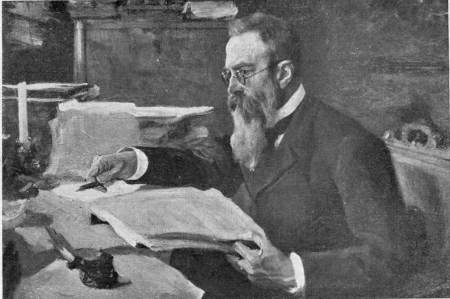
0
RIMSKY-KORSAKOV
From a portrait by Repin
In the end Oxana declares she will only accept Vakoula on condition that
he presents her with a pair of the Empress’s shoes. The Smith departs
upon this unpromising errand. Thanks to his Cossack friends he finds his
way into the palace. During the festivities of the evening, the Cossacks
are called upon to perform their national dances in order to amuse the
Court. The Empress, in high good humour, is informed of Vakoula’s quest,
and good-naturedly gives him her shoes. He returns in triumph to his
native village and marries his capricious beauty.
Although Rimsky-Korsakov had apparently abandoned the original operatic
theories of the new school, Dargomijsky’s methods must still have
exercised some attraction for him, for in 1897 he set Poushkin’s
dramatic duologue Mozart and Salieri without making the least change
in the text, and dedicated it to the memory of the composer of The
Stone Guest. Its production by the Private Opera Company at Moscow, in
1898, was memorable for a wonderful interpretation by Shaliapin of the
part of Salieri. Mozart (tenor) was sung by Shkafer, the conductor being
Esposito. The same artists sang in the work when it was given in St.
Petersburg in the following year. In Mozart and Salieri, which is not
called an opera but merely a dramatic scene, we have melodic recitative
without any relapse into cantilena. The declamation of the two musical
heroes is relieved and embellished by apt comments heard in the
accompaniments. For instance, when Salieri speaks of a “simple scale,” a
scale is heard in the orchestra; when he mentions an organ, a pedal
point is introduced into the accompaniment. This sounds extremely naïve,
but in reality this miniature music-drama is remarkably clever as
regards craftsmanship and musical repartee. The style of the work is
completely in keeping with the period—the eighteenth century—and
excellent imitations of Mozart’s style occur when the master sits down
to the piano and plays two tiny movements, allegretto semplice and
grave.
Rimsky-Korsakov wrote one more work in a similar style to Mozart and
Salieri, the Dramatic Prologue in one act Boyarinya Vera Sheloga,
which was really intended to precede The Maid of Pskov and elucidate
the history of Olga, the heroine of that opera. The little work was
first performed in this way by the Private Opera Company at Moscow in
1898. It tells in fuller detail the story of the two sisters Vera and
Nadejda Nassonov, to which Prince Tokmakov refers in his conversation
with Matouta in the first act of The Maid of Pskov, and introduces the
Boyard Ivan Sheloga and Vlassievna, the faithful nurse of the orphaned
Olga. The work contains a charming lullaby sung by Vera to her little
daughter. This number is published apart from the Prologue and has
become extremely popular with amateur singers.
Sadko, A Legendary Opera (Opera-bylina), in seven tableaux, composed
between 1895-1896, is a compromise between lyrical and declamatory opera
so skilfully effected that this work has come to be regarded as the
perfect fruit of Rimsky-Korsakov’s maturity, and the most complete
exposition of his artistic creed. The work was produced by the Private
Opera Company at Moscow in December, 1897, and introduced to St.
Petersburg by the same company in the following year.
Sekar-Rojansky, a young tenor possessed of a beautiful fresh voice,
created the title rôle. The work was received with extraordinary
enthusiasm, and shortly afterwards the Directorate of the Imperial
Operas, who had at first refused to consider it, took up the opera and
staged it with great magnificence. A. M. Vaznietsov, brother of the
artist who painted the frescoes of the cathedral of Kiev, was sent to
Old Novgorod and other parts of northern Russia to make sketches for the
scenery. The archæological details and the landscapes on the margin of
Lake Ilmen were faithfully reproduced. The first performance took place
at the Maryinsky Theatre in January, 1901, under Napravnik’s direction;
on this occasion Davidov impersonated the hero.
At the outset of his career, Rimsky-Korsakov was attracted by this
legend of the eleventh century belonging to the Cycle of Novgorod. Sadko
is a poor but adventurous minstrel, often referred to in the folk-songs
as “the nightingale of Novgorod.” He does not win his renown by
chivalrous actions and prowess in the field, like Ilya Mouramets and the
heroes of the Cycle of Kiev. The Novgorodians were an energetic but
commercial race. Sadko, driven to desperation by poverty, lays a wager
against the rich merchants of Novgorod that he will catch gold-fish in
Lake Ilmen. The merchants stake their goods, the minstrel all he has—a
far more valuable asset—“his dare-devil head,” as the legends say. How
Sadko charms the Sea King by his singing and playing upon the gusslee,
how he secures the gold-fish and, with them, all the wealth of Novgorod,
is told in the ballad of Nejata, the young minstrel. After a while Sadko
grows restless in spite of his good fortune. He sets sail with his fleet
of merchant vessels in search of fresh adventures. The ships are
overtaken by a tempest, and it becomes necessary to propitiate the wrath
of the Sea King. Lots are cast, and the unlucky one invariably falls to
Sadko. It is characteristic of the astute merchant-hero that he cheats
in every possible way in order to avert his doom! Finally, he is cast
overboard and drifts away upon a plank, clinging to his cherished
gusslee: a pagan Jonah; a Slavonic Arion. His adventures at the bottom
of the seas; the Sea King’s welcome to his virtuoso-guest; his efforts
to marry Sadko to one of his daughters; the procession of these
beautiful sea-maidens—some three hundred in number—demanding of Sadko
a judgment far more difficult and delicate than anything Paris was
called upon to pronounce; the cleverness with which Sadko extricates
himself from the difficult situation, by selecting the only plain lady
of the party, so that there is no risk of permanently falling in love
with her and forgetting his wife in Novgorod; the wild glee of the Sea
King at the playing of the famous minstrel, and his dance, which
imperils the earth and can only be stopped by the shattering of the
precious gusslee; Sadko’s return to his faithful and anxious wife—all
these incidents are set forth in the opera with a Wagnerian luxury of
stage accessories and scenic effects.
As regards structure, Sadko combines—as I have said—the lyrical and
declamatory elements. It is pre-eminently a national opera in which the
composer has conveyed a truthful picture of the customs and sentiments
of an archaic period. In Sadko we find many melodies completely modal
in character. The Sea Queen’s slumber song in the seventh scene is
Dorian, Sadko’s aria in the fifth scene is Phrygian, and so on. The
song of Nejata has an accompaniment for harps and pianino which gives
the effect of the gusslee.
Besides the national element, Rimsky-Korsakov introduces characteristic
songs of other countries. In the scene in which Sadko generously
restores to the merchants the goods won from them in his wager, keeping
only a fleet of merchant vessels for himself, he requests some of the
foreign traders to sing the songs of their distant lands. The Varangian
guest sings a song in a brisk, energetic rhythm, quite Scandinavian in
character; the Venetian complies with a graceful barcarolle, while the
Indian merchant charms the audience with an Oriental melody of rare
beauty. The musical interest of Sadko is in fact very great.
If there is any truth in the suggestion that Rimsky-Korsakov composed
Mozart and Salieri and dedicated it to Dargomijsky as a kind of
recantation of certain Wagnerian methods, such as a limited use of
leitmotifs to which he had had recourse in Sadko, then his return to
the purely lyrical style in his ninth opera, The Tsar’s Bride
(Tsarsky Nievesta), may equally have been a kind of apology to the
memory of Glinka. But it seems far more probable that he worked
independently of all such ideas and suited the musical style to the
subject of the opera. The Tsar’s Bride, in three acts, was produced by
the Private Opera Company at Moscow in 1899, Ippolitov-Ivanov being the
conductor. From Moscow it travelled first to the provinces, and reached
St. Petersburg in the spring of 1900. As it is perhaps the most popular
of all Rimsky-Korsakov’s operas, and one that is likely to find its way
abroad, it is advisable to give some account of the plot. It is based on
one of Mey’s dramas, the subject of which had temporarily attracted
Borodin some twenty years earlier. The Oprichnik Gryaznoy falls madly in
love with Martha, the beautiful daughter of a merchant of Novgorod named
Sobakin; but she is betrothed to the Boyard Lykov. Gryaznoy vows she
shall never marry another, and procures from Bomely, court-physician to
Ivan the Terrible, a magic potion which is to help his cause. His former
mistress Lioubasha overhears the conversation between the Oprichnik and
Bomely. She makes a desperate effort to win Gryaznoy back to her, but in
vain. In the second act the people are coming away from vespers and
talking about the Tsar’s choice of a bride. Martha, with two companions,
comes out of the church. While she is standing alone, two men emerge
from the shadow of the houses, one of whom is Ivan the Terrible in
disguise. He gazes intently at Martha and then goes his way, leaving
her vaguely terrified. Meanwhile Lioubasha has been watching Martha from
a window. Then she in her turn goes to Bomely and asks him for some
potion that will injure her rival. He replies that he will give her what
she requires, but the price of it will be a kiss from her lips.
Reluctantly she consents. In the third act, Lykov and Gryaznoy are
seated at table with the merchant Sobakin, who has just informed them
that the wedding of Lykov and Martha must be postponed. Lykov asks
Gryaznoy what he would do in his place if by any chance the Tsar’s
choice should fall upon Martha. The Oprichnik gives an evasive answer.
Meanwhile, in one of the cups of mead poured out by the host, he drops
his magic potion, and when Martha joins them at table he offers it to
her to drink. Suddenly the maidservant rushes in with the news that a
deputation of boyards has arrived, and a moment later Maliouta enters to
announce that the Tsar has chosen Martha to be his bride. In the final
scene, which takes place in an apartment in the Tsar’s palace, Sobakin
is seen bewailing his daughter’s illness. Gryaznoy enters with an order
from Ivan to inquire after her health. The Oprichnik believes that her
illness is caused by the potion he administered. Presently Maliouta with
the rest of the Oprichniki come upon the scene. Gryaznoy informs Martha
that her former suitor Lykov, having confessed to the fiendish design of
poisoning her, has been executed by order of the Tsar. Martha gives a
cry and becomes unconscious. When she comes to herself her mind is
affected, and she mistakes Gryaznoy for her lover Lykov, calling him
“Ivan” and speaking caressingly to him. Gryaznoy now sees that his plot
for getting rid of Lykov has been a failure. Touched by Martha’s madness
he is prepared to give himself up to Maliouta for judgment; but the
latter gives him an opportunity of inquiring into the deception played
upon him by Bomely. Lioubasha now comes forward and confesses that she
changed the potion. Gryaznoy stabs her and then imploring Martha’s
forgiveness, quits the scene, while the poor mad girl, still mistaking
him for her lost lover, cries after him “Come back to-morrow, my Ivan.”
The music of The Tsar’s Bride is melodious; and the orchestration,
though simpler than is generally the case with Rimsky-Korsakov, is not
lacking in variety and colour. Though by no means the strongest of his
operas, it seems to exercise a great attraction for the public; possibly
because its nationalism is less strenuously demonstrated than in some of
its predecessors.
The Legend of Tsar Saltan, of his Son the famous and doughty Warrior,
Prince Gvidon Saltanovich, and of the beautiful Tsarevna Liebed (the
Swan-queen), an opera in four acts with a Prologue, the libretto drawn
from Poushkin’s poem of the same title, was produced by the Private
Opera Company in Moscow in December 1906. Previously to the first
performance of the work, an orchestral suite consisting of three of the
entr’actes was played in St. Petersburg at one of the concerts of the I.
R. M. S. The work follows the model of Sadko rather than that of
purely lyrical operas. Here Rimsky-Korsakov makes a more extended and
systematic use of the leitmotif. The leading characters, Saltan,
Militrissa, Tsarevna Liebed and the Sea Rovers, have their
characteristic themes, but a number of minor motives are used in
connection with particular sentiments and even to represent various
natural objects. The story, which is too long to give in all its
details, deals with the adventures of Tsar Saltan and the Three Sisters;
the two elders—recalling the story of Cinderella—are jealous of the
youngest Militrissa who marries the Tsar’s son, and during Saltan’s
absence from home they revenge themselves upon her by sending a false
message announcing that she has borne her husband a daughter instead of
a son. The tale offers a strange mixture of the fantastic and the
realistic. The opera is remarkable for its fine orchestral numbers and
the novelty and brilliancy of its instrumentation, and for the free use
of folk melodies.[49]
In his eleventh opera, Servilia, Rimsky-Korsakov makes one of his rare
excursions in search of a subject outside Russian folk-lore or history.
The libretto is based upon a drama by his favourite author Mey, but the
scene of the plot is laid in Rome. In Servilia Rimsky-Korsakov returns
once more to the declamatory style, as exemplified in Mozart and
Salieri, without, however, entirely abandoning the use of the
leitmotif. The first performance of the work took place at the
Maryinsky Theatre in the autumn of 1902. Servilia’s passionate love for
the Tribune Valerius Rusticus, from which she suddenly turns on her
conversion to Christianity in the last act of the opera, offers
considerable opportunities for psychological delineation. But “the
inward strife between her pagan passion and ascetic instincts,” says
Cheshikin, “is not enacted on the stage; it takes place chiefly behind
the scenes and the spectator is shown only the result.” It is not
surprising that the success of the opera does not lie in the delineation
of the heroine but in certain interesting details, and especially in the
skilful use of local colour. The Hymn to Athena in the first act; the
Anacreontic song for Montanus in the second act (in the Mixolydian),
with its characteristic figures of accompaniment for flute; the Dance of
the Mænads; and a graceful Spinning-song for female voices in the third
act, are the most successful numbers in the work. On the whole,
Servilia is regarded by Russian critics as a retrograde step after
Sadko and Tsar Saltan.
Kastchei the Immortal is described as “a legend of the autumn” in one
act and three scenes, with uninterrupted music throughout. The sketch of
the libretto was given to the composer by E. M. Petrovsky and is a free
adaptation of a very old fairy tale. The opera was produced by the
Private Opera Company in Moscow in 1902, and aroused a good deal of
comment in consequence of several new procedures on the part of the
composer, revealing a more decisive tendency to follow in the steps of
Wagner. The charge of imitation is based upon the use of leitmotifs
and also upon the content of the libretto, in which, as in many of
Wagner’s operas, the idea of redemption plays a prominent part.
Kastcheievna, the daughter of the wicked wizard Kastchei, is redeemed
by intense suffering from her own jealous fury, when she lets fall a
tear, in the crystal sphere of which Kastchei has enclosed his own fate.
But Rimsky-Korsakov does not give us merely an internal drama in the
Wagnerian sense, for we see enacted upon the stage the wholly external
drama of the rescue of the unhappy Tsarevna, spell-bound by the evil
Kastchei, at the hands of Ivan Korolevich. The opera ends with the
downfall of the barriers which shut out the gloomy, autumnal,
sin-oppressed kingdom of Kastchei from the happier world outside. “This
symbolism,” says Cheshikin, “may be taken in its widest acceptation; but
in anything which is freed from a despotic power, our public is prepared
to see a social tendency which is to their taste and they applaud it
with satisfaction.” Kastchei chanced to be the opera which was
represented in St. Petersburg (in March, 1905) at the moment when
Rimsky-Korsakov was expelled from his professorship at the Conservatoire
in consequence of his frank criticisms of the existing bureaucracy, and
each representation was made the occasion of an ovation in his honour.
The opera contains many fine moments, such as the fierce chorus—a kind
of trepak—sung by the snow-spirits at the close of the first act; the
two contrasting love-duets, one which Ivan Korolevich sings with
Kastcheievna, and a later one in which the Tsarevna takes part, in the
third act; and the sinister slumber-song which the unhappy Tsarevna is
forced to sing for Kastchei, while wishing that his sleep was the sleep
of death, is distinguished for its marked originality. As regards
harmony, Rimsky-Korsakov in Kastchei indulges in a good deal that is
piquant and unusual; there is much chromaticism in the fantastic scenes
and a general tendency to what one critic describes as “studied
cacophany,” which is unusual in the work of this composer. Kastchei
stands out as one of the most Wagnerian among Russian operas.
Pan Voyevode was completed in 1903, and produced by the Private Opera
Company in St. Petersburg in October, 1904. The scene of the libretto is
laid in Poland about the beginning of the seventeenth century, and the
story concerns the love affairs of Chaplinsky, a young nobleman, and
Maria, a poor orphan girl of good family. While out hunting, Pan
Voyevode—governor of the district—sees Maria and loses his heart to
her. At his command the lovers are separated by force, and the Voyevode
declares his intention of marrying Maria. Yadviga, a rich widow, who has
claims upon the Voyevode, determines to prevent the marriage at any
cost. She takes counsel with a sorcerer, from whom she procures poison.
The preparations for the wedding are all made, and the Voyevode is
entertaining his friends at a banquet, when Yadviga appears, an
uninvited guest, to warn him that Chaplinsky and his friends are coming
to effect the rescue of Maria. At the banquet Maria sings the “Song of
the Swan,” but its yearning sadness oppresses the Voyevode and his
guests. Suddenly the injured lover bursts into the hall with his
followers and a wild scuffle ensues. In the last act, Chaplinsky having
been taken prisoner and condemned to death, the interrupted festival
recommences. In the meantime Yadviga has poured poison into Maria’s
goblet. Needless to say that in the end the cups get changed and it is
the Voyevode who drinks the fatal potion. Maria, after a prayer by his
dead body, orders the release of Chaplinsky and all ends happily.
Pan Voyevode gives occasion for a whole series of Polish dances, a
Krakoviak, a Kazachok, or Cossack dance, a Polonaise, and a Mazurka. The
incantation scene, when Yadviga seeks the sorcerer, and the Song of the
Swan are favourite numbers in the work. Pan Voyevode was produced in
Moscow in 1905 under the conductorship of Rachmaninov.
The idea of the Legendary Opera, The Tale of the Invisible City of
Kitezh and the Maiden Fevronia, was in Rimsky-Korsakov’s mind for
nearly ten years before he actually composed the work between
1903-1905. The first performance in St. Petersburg took place at the
Maryinsky Theatre early in the spring of 1907, and Moscow heard the
opera in the following season. The opera starts with an orchestral
introduction based upon a folk-melody. There is great charm in the
opening scene laid in the forests surrounding Little Kitezh, where
Fevronia is discovered sitting among the tall grasses and singing a song
in praise of all living creatures. There she is joined by a bear, and a
crane, and other birds, all of which she welcomes as friends; and there
the young Prince Vsievolod sees her and loses his heart to the beautiful
child of nature. Their love scene is interrupted by the sound of horns,
introducing a company of archers in search of the Prince. Fevronia then
finds out her lover’s identity. The next act shows the market-place in
Little Kitezh crowded with all manner of archaic Russian types: a
showman leading a bear, a minstrel singing and playing the gusslee,
old men and women, young men and girls—one of those animated canvases
which recall certain pages in Moussorgsky’s operas and are the
precursors of similar scenes in Stravinsky’s Petroushka. Some
“Superior People” are grumbling at the marriage of the Prince to the
unknown and homeless girl Fevronia. Soon the bride appears accompanied
by the wedding procession. She receives the congratulations of the
populace, but the “Superior People” show some disdain. Suddenly a fresh
group of people rush on in terror, followed by the Tatars who break up
the crowd and seize Fevronia. Under threats of torture they compel the
crazy drunkard Kouterma to guide them to Kitezh the Great. Fevronia puts
up a prayer for the city as the Tatars carry her off on one of their
rough carts.
The scene changes to Kitezh the Great, where the old Prince and his son,
the bridegroom, are listening to the account given by the fugitives of
the destruction of Little Kitezh by the Tatars. All are horrified to
hear that Fevronia has fallen into their ruthless hands. The Prince
assembles his soldiers and goes out to meet the enemy. While the women
are singing a chorus of lamentation, the church bell begins to ring of
its own accord. The old Prince declares it is a miraculous sign that the
town will be saved. The curtain rises next on the Tatar encampment on
the shores of the Shining Lake. Fevronia in despair is still sitting in
the Tatars’ cart. The half-crazy Kouterma has been bound hand and foot
because the Tatars suspected him. Their two leaders have fought; one is
left dead on the ground; all the others have fallen asleep. Fevronia
takes a knife from the dead Tatar chief and cuts Kouterma’s bonds. He
is about to escape when the sound of a bell arrests him. He rushes madly
to the lake with the intention of drowning himself, but at that moment a
ray of sunlight falls on the water in which he sees reflected the city
of Kitezh the Invisible. Now he really makes his escape, taking Fevronia
with him. The Tatars are awakened, and running to the edge of the lake,
they, too, see the miraculous reflection and exclaim in terror: “Awful
in truth is the God of the Russians.”
Fevronia passes some terrible hours alone in the gloom of the enchanted
forest with Kouterma; but she prays, and presently he leaves her. Then
little lamps appear in the trees, and gold and silver flowers spring up
in the grass, while the Paradise Birds, Aklonost and Sirin, sing to
comfort her. Aklonost tells her he is the messenger of death. She
replies that she has no fear of death, and weaves herself a garland of
immortal flowers. Presently the spirit of the young Prince appears to
her. He tells her that he has been killed, “but now,” he says, “thank
God, I am alive.” He gives Fevronia some bread, bidding her eat before
she starts on her long journey; “who tastes our bread knows eternal
happiness,” he says. Fevronia eats and throws some of the crumbs to the
birds; then with a prayer, “Christ receive me into the habitations of
the just,” she disappears with the spirit of the Prince. After an
orchestral interlude, the curtain rises upon the apotheosis of the City
of Kitezh, and the Paradise Birds are heard proclaiming: “The Celestial
gates are open to us; time has ceased; Eternity has begun.” The people
come out to welcome Fevronia and the Prince, and sing their
epithalamium. Fevronia now learns that Kitezh did not fall, but only
disappeared; that the northern lights bore the prayers of the just to
heaven; and also the cause of the blessed and miraculous sound heard by
Kouterma. Then the Prince leads his bride into the cathedral while the
people sing: “Here shall there be no more tears or sorrow, but
everlasting joy and peace.”
Rimsky-Korsakov died of angina pectoris on June 8th, 1908 at Lioubensk,
near St. Petersburg, where he was spending the summer with his family.
In the previous year he had finished his last opera The Golden Cock,
the production of which was not sanctioned by the Censor during the
composer’s lifetime. It is said that this vexation, following upon his
difficulties with the authorities of the Conservatoire, helped to hasten
his end.
The Golden Cock is composed to a libretto by V. Bielsky, based upon
Poushkin’s well-known poem. The author of the book says in his preface
to the opera: “the purely human nature of Poushkin’s Golden
Cock—that instructive tragi-comedy of the unhappy consequences
following upon mortal passions and weaknesses—permits us to place the
plot in any region and in any period.” In spite of the Eastern origin of
the tale, and the Italian names, Duodo and Guidone, all which
constitutes the historical character of the story and recalls the simple
customs and the daily life of the Russian people, with its crude, strong
colouring, its exuberance and liberty, so dear to the artist. The work
opens with a Prologue, in which the Astrologer tells us that although
the opera is
“A fairy-tale, not solid truth,
It holds a moral good for youth.”
In the first scene we are introduced to a hall in the Palace of King
Dodon, where he is holding a council with his Boyards. He tells them
that he is weary of kingly responsibilities and especially of the
perpetual warfare with his hostile neighbours, and that he longs to rest
for a while. First he asks the advice of his heir, Prince Gvidon, who
says that instead of fighting on the frontier he should withdraw his
troops and let them surround the capital, which should first be well
provisioned. Then, while the enemy was destroying the rest of the
country, the King might repose and think of some new way of
circumventing him. But the old Voyevode Polkan does not approve of the
project, for he thinks it will be worse to have the hostile army
surrounding the city, and perhaps attacking the King himself. Nor does
he agree with the equally foolish advice of the King’s younger son
Aphron. Very soon the whole assembly is quarrelling as to the best way
out of the difficulty, when the Astrologer arrives upon the scene. He
offers King Dodon a present of a Golden Cock which would always give
warning in case of danger. At first the King does not believe him, but
the cock is brought in and cries at once: “Kikeriki, kikerikou! Be on
your guard, mind what you do!” The King is enchanted and feels that he
can now take his ease. He offers to give the Astrologer whatever reward
he asks. The latter replies that he does not want treasures or honours,
but a diploma drawn up in legal form. “Legal,” says the King, “I don’t
know what you mean. My desires and caprices are the only laws here; but
you may rest assured of my gratitude.” Dodon’s bed is brought in, and
the chatelaine of the Palace tucks him up and keeps watch by him until
he falls into a sound sleep. Suddenly the shrill crowing of the Golden
Cock awakens the King and all his attendants. The first time this
happens he has to send his unwilling sons to the war; the second time he
is obliged to go himself. There is a good deal of comic business about
the departure of the King, who is obviously afraid of his warhorse.
In the second act Dodon and the Voyevode Polkan, with their army, come
to a narrow pass among the rocks which has evidently been the scene of a
battle. The corpses of the warriors lie pale in the moonlight, while
birds of prey hover around the spot. Here Dodon comes suddenly upon the
dead bodies of his two sons, who have apparently killed each other. The
wretched, egotistical king is reduced to tears at the sight. His
attention is soon distracted, for, as the distant mist clears away, he
perceives under the shelter of the hillside a large tent lit up by the
first rays of the sun. He thinks it is the tent of the hostile leader,
and Polkan endeavours to lead on the timid troops in hopes of capturing
him. But, to the great astonishment of the King and his Voyevode, a
beautiful woman emerges from the tent followed by her slaves bearing
musical instruments. She sings a song of greeting to the dawn. Dodon
approaches and asks her name. She replies modestly, with downcast eyes,
that she is the Queen of Shemakha. Then follows a long scene in which
she lures on the old King until he is hopelessly infatuated with her
beauty. Her recital of her own attractions is made without any reserve,
and soon she has completely turned Dodon’s head. She insists on his
singing, and mocks at his unmusical voice; she forces him to dance
until he falls exhausted to the ground, and laughs at his uncouth
movements. This scene really constitutes the ballet of the opera.
Finally the Queen of Shemakha consents to return to his capital and
become his bride. Amid much that is genuinely comic there are a few
touches of unpleasant realism in this scene, in which the ineffectual,
indolent, and sensual old King is fooled to the top of his bent by the
capricious and heartless queen. Here we have travelled far from the
beautiful idealism of The City of Kitezh; the humour of the situation
has a sharp tang to it which belies the spirit of Poushkin and Russian
humour in general; we begin to speculate as to whether Bielsky has not
studied to some purpose the plays of George Bernard Shaw, so much read
in Russia.
The curtain rises in the third act upon another of those scenes of
bustle and vigorous movement characteristic of Russian opera. The people
are awaiting the return of King Dodon. “Jump and dance, grin and bow,
show your loyalty but don’t expect anything in return,” says the
sardonic chatelaine, Amelfa. There enters a wonderful procession which
reminds us of an Eastern fairy tale: the advance guard of the King; the
Queen of Shemakha, in a bizarre costume, followed by a grotesque cortege
of giants, dwarfs, and black slaves. The spectacle for the time being
allays the evident anxiety of the people. As the King and Queen pass by
in their golden chariot the former appears aged and care-worn; but he
gazes on his companion with uxorious tenderness. The Queen shows evident
signs of boredom. At this juncture the Astrologer makes his appearance
and a distant storm, long threatening, bursts over the city. The King
gives a flattering welcome to the Astrologer and expresses his readiness
to reward him for the gift of the Golden Cock. The Astrologer asks
nothing less than the gift of the Queen of Shemakha herself. The King
refuses with indignation, and orders the soldiers to remove the
Astrologer. But the latter resists, and reminds Dodon once more of his
promise. The King, beside himself with anger, hits the Astrologer on the
head with his sceptre. General consternation in the crowd. The Queen
laughs a cold, cruel laugh, but the King is terrified, for he perceives
that he has killed the Astrologer. He tries to recover himself and takes
comfort from the presence of the Queen, but now she openly throws off
all pretence of affection and drives him away from her. Suddenly the
Cock gives out a shrill, threatening cry; he flies on to the King’s head
and with one blow of his beak pierces his skull. The King falls dead. A
loud clap of thunder is followed by darkness, during which the silvery
laugh of the Queen is heard. When it grows light again Queen and Cock
have both disappeared. The unhappy and bewildered people sing a chorus
of regret for the King: “Our Prince without a peer, was prudent, wise,
and kind; his rage was terrible, he was often implacable; he treated us
like dogs; but when once his rage was over he was a Golden King. O
terrible disaster! Where shall we find another king!” The opera
concludes with a short Epilogue in which the Astrologer bids the
spectators dry their tears, since the whole story is but fiction, and in
the kingdom of Dodon there were but two real human beings, himself and
the Queen.
The music of this opera is appropriately wild and barbaric. We feel that
in spite of forty years development it is essentially the work of the
same temperament that produced the Symphonic Poems “Sadko” and the
Oriental symphony “Antar.”
A close study of the works of Rimsky-Korsakov reveals a distinguished
musical personality; a thinker; a fastidious and exquisite craftsman; in
a word—an artist of a refined and discriminating type who concerns
himself very little with the demands and appreciation of the general
public. Outside Russia, he has been censured for his subserviency to
national influences, his exclusive devotion to a patriotic ideal. On
the other hand, some Russian critics have accused him of introducing
Wagnerism into national opera. This is only true in so far that he has
grafted upon opera of the older, more melodic type the effective
employment of some modern methods, more particularly the moderate use of
the leitmotif. As regards orchestration, I have already claimed for
him the fullest recognition. He has a remarkable faculty for the
invention of new, brilliant, prismatic orchestral effects, and is a
master in the skilful employment of onomatopœia. Those who
assert—not entirely without reason—that Rimsky-Korsakov is not a
melodist of copious and vivid inspiration must concede the variety,
colour, independence and flashing wit of his accompaniments. This want
of balance between the essential and accessory is certainly a
characteristic of his music. Some of his songs and their accompaniments
remind me of those sixteenth-century portraits in which some slim,
colourless, but distinguished Infanta is gowned in a robe of brocade
rich enough to stand by itself, without the negative aid of the wearer.
Rimsky-Korsakov does not correspond to our stereotyped idea of the
Russian temperament. He is not lacking in warmth of feeling, which
kindles to passion in some of his songs; but his moods of exaggerated
emotion are very rare. His prevailing tones are bright and serene, and
occasionally flushed with glowing colour. If he rarely shocks our
hearts, as Moussorgsky does, into a poignant realisation of darkness and
despair, neither has he any of the hysterical tendency which sometimes
detracts from the impressiveness of Tchaikovsky’s cris de cœur.
When a temperament, musically endowed, sees its subject with the direct
and observant vision of the painter, instead of dreaming it through a
mist of subjective exaltation, we get a type of mind that naturally
tends to a programme, more or less clearly defined. Rimsky-Korsakov
belongs to this class. Labelled or not, we feel in all his music the
desire to depict.
This representative of a school, reputed to be revolutionary, who has
arrayed himself in the full panoply of musical erudition and scholarly
restraint; this poet whose imagination revels in the folk-lore of Russia
and the fantastic legends of the East; this professor who has written
fugues and counterpoints by the dozen; this man who looked like an
austere school-master, and can on occasion startle us with an almost
barbaric exuberance of colour and energy, offers, to my mind, one of the
most fascinating analytical studies in all contemporary music.