Dated:
Lwow, Galicia,
April 1, 1915.
The news of the fall of Przemysl reached
Petrograd on the morning of March 23,
and the announcement was given out by the
War Office at noon. The spring is very late
in Russia this year, and so much snow and such
intense cold have not been known so late in
March for more than a hundred years. On
the 23rd it was snowing heavily in Petrograd
and a biting wind was sweeping through the
streets. Save for an occasional street car and
foot passengers the Moika and even the Nevsky
Prospekt were at noon almost as empty as at
midnight. And then came the announcement
that the great fortress in Galicia had fallen. In
an hour the news was all over the town and in
spite of the inclement weather the streets were
thronged with eager Russians, from Prince to
Moujik, anxiously asking each other if the news
which had been so long promised could really
be true. The fall of Przemysl it must be remembered
had been reported at least a dozen times
in Petrograd before this.
There are people in as well as out of Russia,
who like to say that the man in the street over
here cares nothing for the war and knows less,
but on this particular day these people were
silent. It was no wonder. If ever a people
genuinely rejoiced over good news it was the
citizens of all classes of Russia’s capital when
it became known that Przemysl was at last in
Russian hands. By three in the afternoon,
crowds had organized themselves into bands,
and with the Russian flag waving in front, and
a portrait of the Czar carried before, dozens of
bands marched through the streets chanting
the deep-throated Russian National anthem;
one of the most impressive hymns in the world.
Though the snow was still falling and a nipping
wind blowing, thousands of the crowds that now
perambulated the streets stood bareheaded in
the blast as each procession passed. Old retired
generals of seventy and more stood at rigid
attention as the portrait of their monarch and
the flag of their nation was borne past. Moujiks,
princes, men and women, the aged and the
young alike, displayed the same spirit of ardour
and enthusiasm as each demonstration came
down the street. While it is true that there is
not in Russia what we in the West call public
opinion, yet a stranger living here during this
war comes to feel that there is growing up
a spirit that is uniting all classes. This is
the great hope for the war. It is also Russia’s
hope for the future. In another generation
it is destined to bring forth greater progress and
unity than the Empire of the Czar has ever
known.
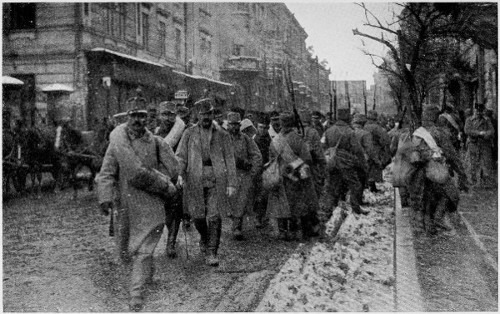
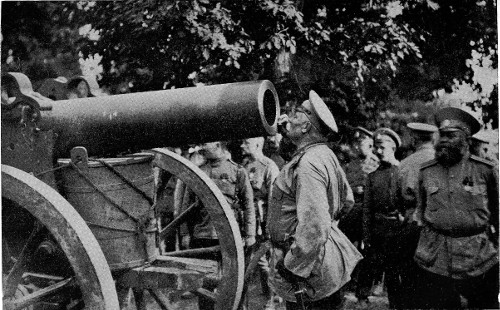
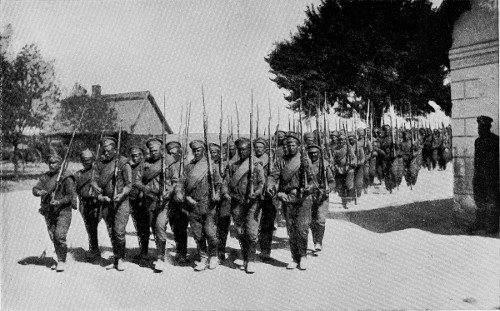
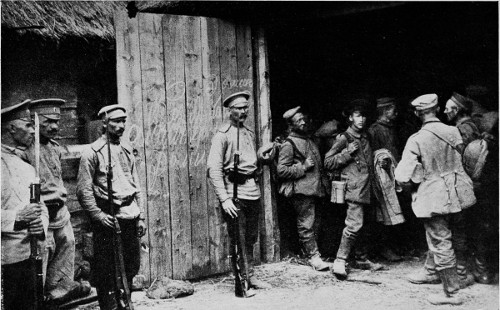
Occupation of Przemysl by the Russians. Austrians leaving as prisoners. The Russians entering the town.
The people of Petrograd have followed the
war much more closely than one would have
believed possible. Over here there has been
action from the day the war started, and hardly
a month when gigantic movements of some sort
or other have not been under weigh. Petrograd
has been called on again and again to furnish
new troops, and from September until to-day
there has not been a week that one could not
see new troops drilling in the streets. Russia
has had great successes and great setbacks, but
each alike strengthens the same stubborn determination
to keep pressing forward.
There was great disappointment when the
Russian army withdrew a few weeks ago from
East Prussia, but it began to abate when
it became known that the German advance
was checked. The Russians, as is their habit,
had pulled themselves together, and slowly but
surely were pushing back the invader just as
they did in the dreary days following the Samsonov
disaster in the first days of the war. Then
came the news of Galicia and the greatest single
success that the war has brought to any of the
Allies, or for that matter to any of the belligerent
powers. When the details of the numbers
of the captured began to leak out, the importance
of the success was first realized, and not
without reason did the Russians begin to allude
to the fall of Przemysl as a second Metz. It
was generally believed that the garrison shut up
within the fortress did not total above 50,000
men, and none were more surprised than the
victors, when they learned that more than
131,000 soldiers and nearly 4,000 officers had
fallen into their hands, not to mention a
number of guns of all calibres amounting
probably to above 300. These unfortunately
have been rendered useless by the Austrians
and must be charged as a heavy loss to them
rather than as any direct military asset gained
by the Russians.
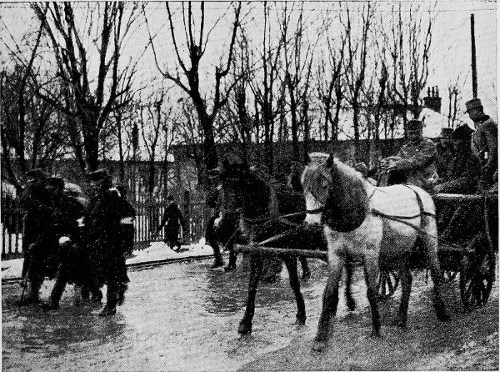
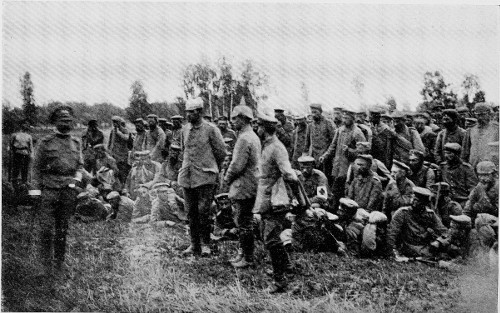
Austrian prisoners leaving Przemysl.
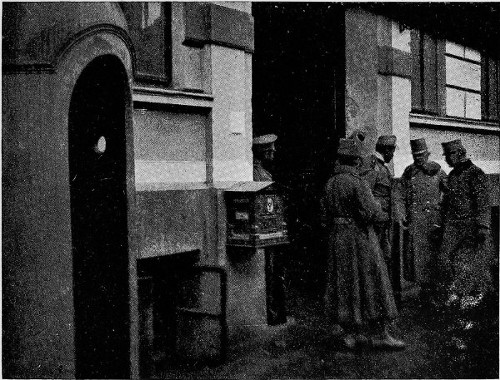
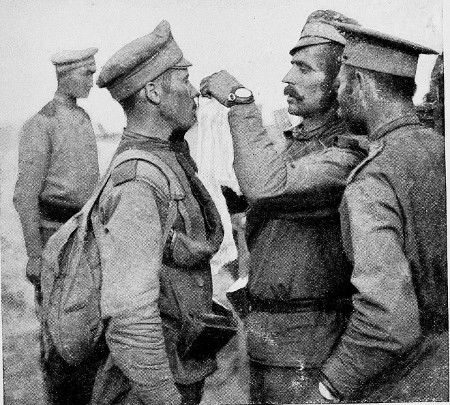
Russian occupation of Przemysl. Austrian officers pay a last visit to
the Russian head-quarters before leaving for Lwow.
Well may the Russians take pride in what
their new army has accomplished, for one must
go back to the taking of Plevna to find any such
landmark in the history of Russian siege operations.
The last great siege in Muscovite history
was that of Port Arthur, and one cannot
but contrast the state of matters in Russia ten
years ago, and now. Port Arthur fell after a
long series of disasters to the Russian arms, and
the people all over the Empire received the
tidings without interest and with that dumb
resignation to disaster that is characteristic of
their fatalistic temperament. A spirit of hopelessness
and despondency and pessimism pervaded
every class of Russian society. Announcements
of new defeats were heard without surprise
and almost without interest. “Of course,
what do you expect?” one would hear on all
sides, “Russian troops never win.” But now
there is quite a different point of view. Even
the moujik has come to feel a pride and confidence
in his army and in its victories. Their
successes are his successes, and their defeats
are his defeats.
One who takes interest in studying the
psychology of countries comes to realize that pride
of race and confidence in one’s blood is the greatest
asset that any nation can possess. Throughout
Russia, the cause in which her Armies are
engaged has come to be more nearly understood
than any war she has ever engaged in. It is
not true of course that the peasant knows as
much as does the British Tommy; nor is there
anything like the same enlightenment that prevails
in the Western Armies. But in fairness
to Russia she must not be judged from a
Western standpoint, but compared with herself
ten years ago.
As has been written by a dozen writers from
Russia in the last six months the new spirit
was crystallized when the war began. It has
had its ups and its downs with the varying reports
from the Front, but as each defeat has
been turned into a stepping stone for a subsequent
advance, public confidence has gradually
mounted higher and higher, until, with the fall
of Przemysl, we find Russian sentiment and
confidence in Russia at probably the highest
point that has ever been reached in the history
of the Empire. The dawn of the new day of
which we hear so much over here now, bears
every indication of being the beginning of the
much heralded new Era in this country.
Galicia is still under martial law, and one
cannot even enter the new Russian province
without a permit issued by the General Staff.
It is of course even more difficult for one to get
into the actual theatre of war. A wire, however,
from the Staff of the Generalissimo to the powers
that be in Petrograd, made the way to Przemysl
possible, and a few days after the fortress had
fallen the writer reached Lwow. The Russian-gauged
railroad has been pushed south of the
old frontier line to the town of Krasne, famous
as the centre of the battle-line of Austrian defence
in the days when the armies of Russky
were pushing on toward Lwow.
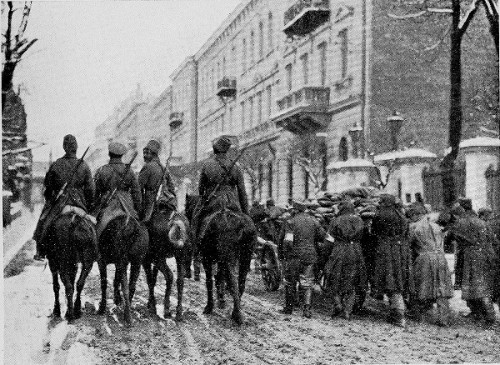
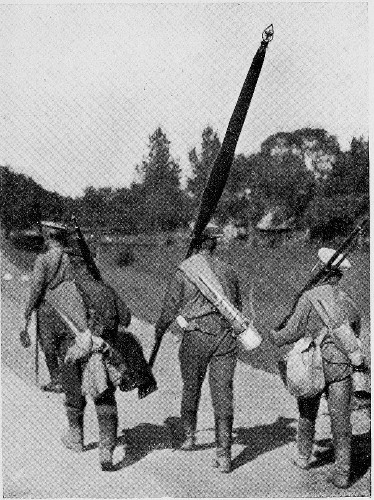
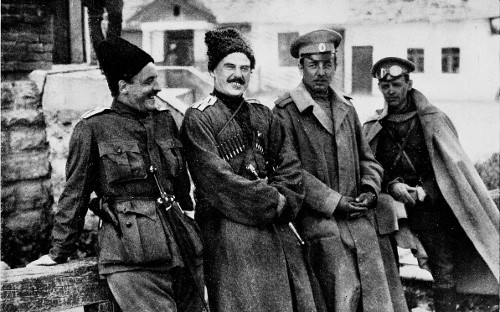
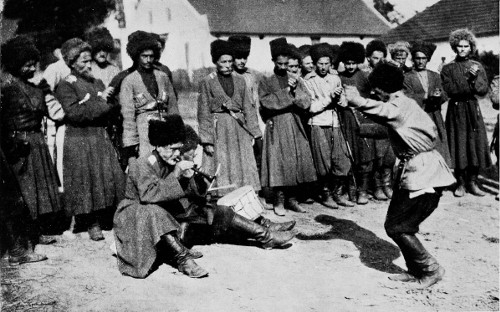
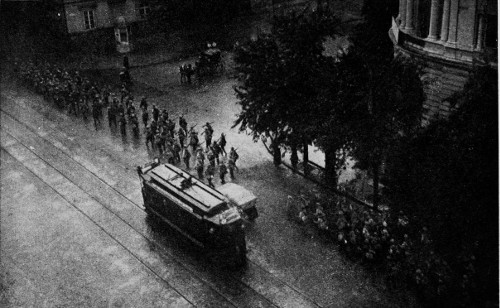
Cossack patrol entering Przemysl.
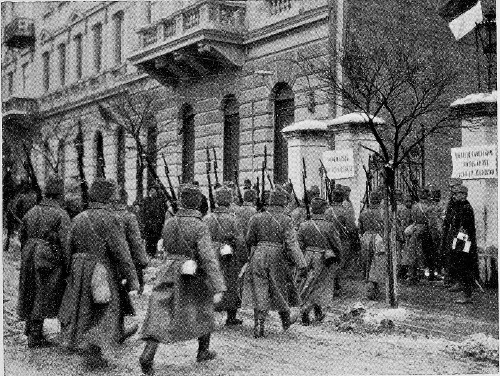
Russian occupation of Przemysl. Governor’s bodyguard entering
Government House.
It was originally intended to widen the Austrian
tracks to take the Russian rolling stock,
so that trains might proceed direct to the capital
of Galicia; but it was found that the expense
of carrying on operations which meant the widening
of every bridge and the strengthening of
every culvert and elevated way, to take the
heavier equipment, would involve time and
expense scarcely less than building a new line
complete. The result is that one still changes
carriages some distance out of Lwow, a handicap
that is trifling for passenger traffic, but
involving very real inconvenience and delays
in the handling of the vast amount of freight
and munitions that go to supply the huge
armies in the field in Galicia.
Lwow itself is no longer the dismal place
that it was in the early autumn when almost
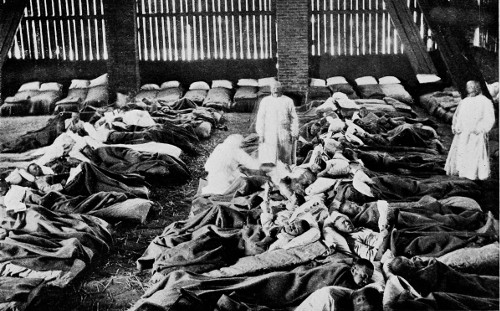
every public building was a hospital, and the
station a receiving depot for the thousands
of fresh wounded that poured in by train-loads
from the positions on the San and from
the trenches before Przemysl, which was just
then undergoing its first investment. Where
stretchers and throngs of wounded formerly
filled every available foot of ground in the
huge terminus a few months ago, all is now
orderly and very much as in the days before
the war. The hotels which in October were
filled to overflowing with officers and Red
Cross nurses, are now comparatively quiet, and
the city itself, barring troops going through and
prisoners coming from Przemysl, is not far from
normal. A few hours after arriving the writer
was received by Count Brobinsky, who frankly
expressed his delight and relief at the capture
of the Galician fortress.
There are of course a large number of Austrians
in Galicia, and ever since the Russian
occupation in September a pro-German-Austrian
propaganda has been kept up here. Every
reverse to the Dual Alliance has been minimized
as much as possible, and every effort was subtly
made by the German-Austrian agents of the
enemy to prevent the peasants and that portion
of the population here which sympathizes with
the Russians, from co-operating in the new
régime. They were assured that soon the Austrians
would be coming back, and fears of reprisals
when the day came have no doubt
restrained a large number of Little Russians,
Poles and others from openly supporting the
efforts of the new government to restore Galicia
to its normal state. But with each month it
has become increasingly difficult for the Austrian
sympathizers to make the public believe that
the Russian occupation was only a temporary
wave that would shortly recede. Austro-German
advances in Bukowina, and the really
serious aggressive attempts through the Carpathians
no doubt helped to render conditions
unsettled. Then came the check of the
Austrian advance in Bukowina and the gradual
reclaiming by the Russians of the ground lost
at the first impetus of the enemy’s offensive.
This was followed by the failure of the relieving
column to make satisfactory headway toward
its objective at Przemysl.
In spite of all these very obvious failures to
achieve any definite advantage over the Russians,
the spirits of the anti-Russian element
were kept buoyed up by the spectacle of the
great fortress in Galicia still holding out. “As
long as Przemysl stands out there is hope,”
seems to have been the general opinion of all
who wished ill to the Russians. Thus the fortress,
which at the outset might have been abandoned
with small loss of prestige to the Austrians,
gradually came to have a political as
well as military significance of the most far reaching
importance. In the general crash after the
battle of the Grodek line, the loss of a town
which until then had never been heard of in
the West, outside of military circles, would have
escaped anything more than passing comment.
Not until the Russian armies had actually swept
past its trenches and masked its forts, did the
world at large know that such a place was on
the map; even then the greatest interest manifested
was in the vexed question as to how its
name was pronounced, if indeed it could be done
at all, an opinion which was held by not a few
people. This place which could have been given
up earlier in the war without any important
sacrifice was held tenaciously and became one
of the vital points of strategy in the whole campaign.
An army which turned out to be a huge
one, was isolated from the field armies of Austria
at a time when she needed every able-bodied
man that she could get; and Przemysl, which, as
we see now, was doomed from the start, was
allowed to assume an importance in the campaign
which made its fall not only a severe military
loss but a blow to the hopes of the Austrians,
both at home and in Galicia. The fall of this
fortress has gone further towards shattering
any hopes of ultimate victory that have been
entertained than anything that has occurred
since the war started.
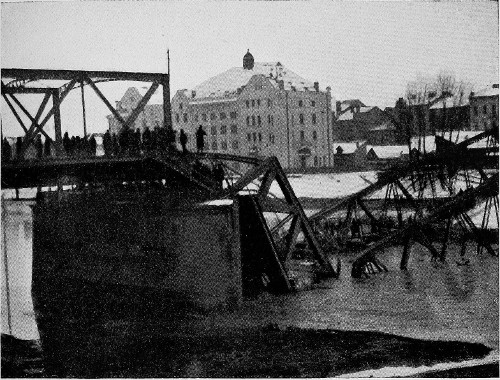
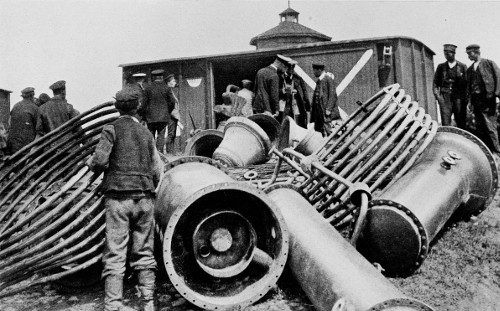
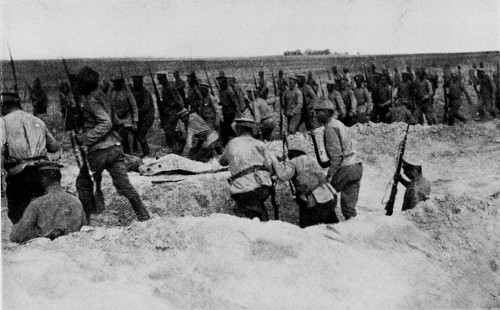
Destroyed by the Austrians before leaving Przemysl.
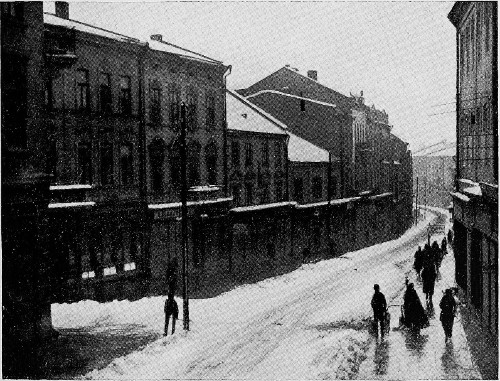
Principal street in Przemysl.
As Count Brobinsky, who for six months now
has been straggling to readjust Galicia to the
normal, said, his task has now been enormously
simplified, and there is scarcely an element left
here that now believes there is any chance of
Austria winning back her lost province. The
Austrian agents have abandoned hope, and the
Russian sympathizers are now openly declaring
their loyalty to the new régime. There is, however,
a class of bureaucrats left here aggregating,
I am informed, nearly 40,000 in number. This
class is composed of Poles, Austrians and others
who for generations have been holding the best
offices at the disposal of the Vienna government.
These are of course, almost to a man, out of their
lucrative posts, and represent the element that
has most vigorously, if quietly, attempted to
undermine the activities of the government installed
here by Russia. But even these see in
the collapse of their great fortress the evaporation
of their chief hopes.
As Galicia is still under martial law, all the
motor cars have been taken over by the military
authorities and so, even armed with passes
and permits, we found it all but impossible to
reach Przemysl. The best horses here are in
the army service, and the few skinny horses
attached to the cabs find it difficult even to
stagger from the station to the hotel, and it was
out of the question to go by carriage the 94 kilometres
to Przemysl. But when we told Count
Brobinsky of our difficulties, he solved them by
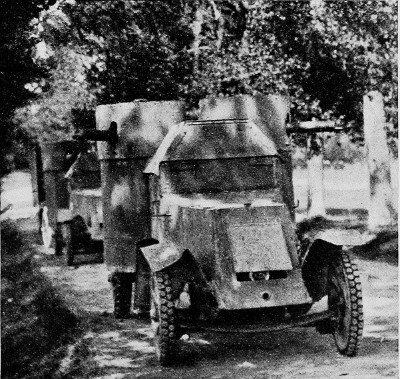
promptly placing a huge military touring car
at our disposal; he further paved the way for
a pleasant trip to the scene of the Russian achievement
by giving us a personal letter of introduction
to General Atrimanov, the new Russian
commandant of the captured fortress.
The spring is late here as it is throughout
Russia this year, and it was snowing heavily as
our big touring car, with a soldier as chauffeur,
threaded its way in the early morning through
the narrow streets of Lwow and out into the
open country which was now almost white.
Before we have been twenty minutes on the
road we begin to pass occasional groups of dismal
wretches in the blue uniform which before
this war was wont to typify the might of the
Hapsburgs, but which now in Galicia is the
symbol of dejection and defeat. Through the
falling snow they plod in little parties of from
three to a dozen; evidently the rear guard of
the column that went through yesterday, for
they are absolutely without guards, and are no
doubt simply dragging on after their regiments.
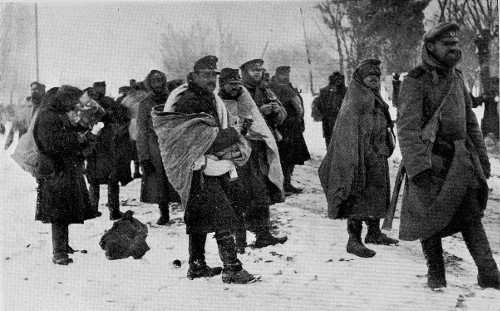
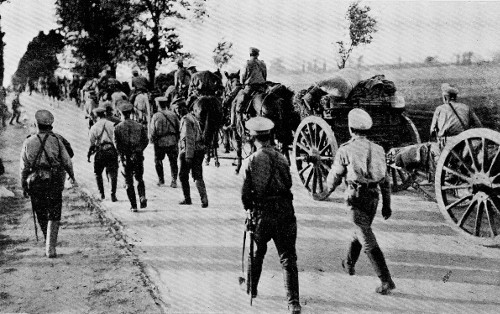
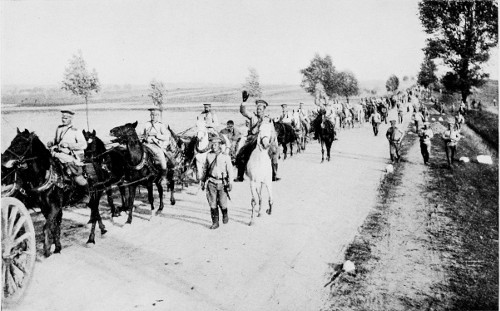
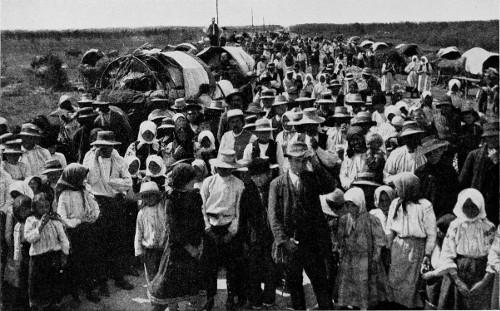
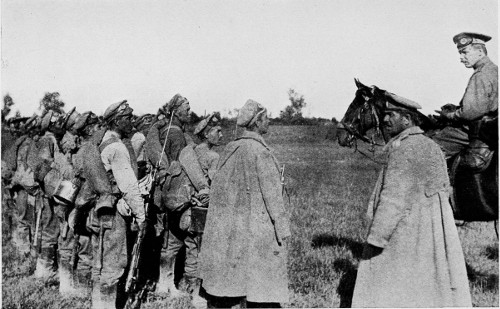
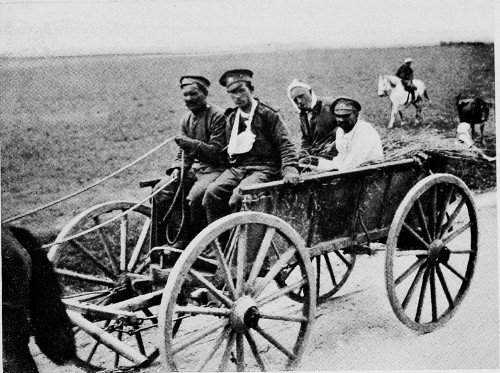
Austrian and Hungarian prisoners en route to Lwow.
From Lwow almost due west runs the line of
the highway to Grodek where we get our first
glimpse of prisoners in bulk. Here, at the scene
of some of the fiercest fighting that the war has
produced, is a rest station for the columns that
are making the journey to Russian captivity
on foot from Przemysl to Lwow, and I know
not how far beyond. As we motor into the
town the three battalions of the 9th Hungarian
regiment of the 54th Landsturm brigade are just
straggling into the town from the west. With
a few Russians who seem to be acting as guides
and nurses rather than as guards, they file through
the streets and into a great square of a barracks.
Here they are marshalled in columns of four,
and marched past the door of the barracks where
an official counts the individual fours and
makes a note of the number that have passed
his station. Beyond in a grove the ranks
are broken, and the weary-looking men drop
down under the trees, regardless of the snow
and mud, and shift their burdens and gnaw at
the hunks of bread and other provisions furnished
them by the Russians.
It is hard to realize that the haggard despondent
rabble that we see has ever been part of
an actual army in being. Most of them were
evidently clothed for a summer campaign, and
their thin and tattered uniform overcoats must
have given but scant warmth during the winter
that has passed. The line is studded with
civilian overcoats, and many of the prisoners
have only a cap or a fragment of a uniform which
identifies them as ever having been soldiers at all.
The women of the village pass up and down
the line giving the weary troops bits of provision
not in the Russian menu. All the men are
wan and thin, with dreary hopelessness written
large upon their faces, and a vacant stare
of utter desolation in their hollow eyes. They
accept gladly what is given and make no comment.
They get up and sit down as directed
by their guards, apparently with no more sense
of initiative or independence of will than the
merest automatons. We pause but a few minutes,
for the roads are bad and we are anxious
to get over the muddy way as quickly as possible.
The western portion of Grodek was badly
knocked up by shell fire during the battle in
September, and the barren walls of charred
buildings remain to tell the story of the Austrian
effort to stay the tide of the Russian advance
that swept them out of position after position
during the first weeks of the war. Grodek
was reported to have been utterly destroyed at
the time, but as a fact, not more than one-fifth
of the buildings were even damaged by the
artillery fire.
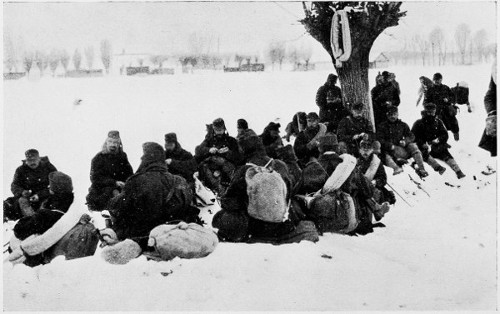
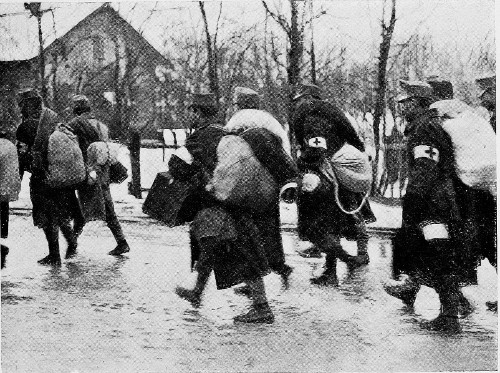
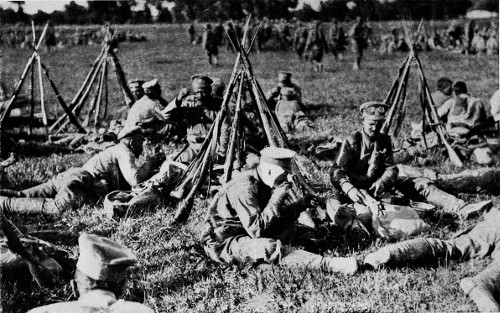
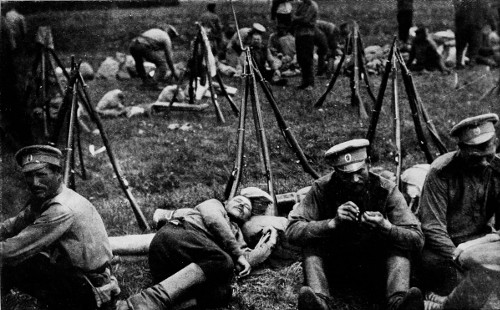
Austrian prisoners resting by the roadside during their march from Przemysl.
Just east of Sadowa Wisznia, the scene of
another Austrian stand, we come upon a regiment
attached to the 54th Landsturm brigade. This
is the tenth regiment, and, with the exception
of a few non-commissioned officers, is composed
entirely of Slovaks and Hungarians. They
are resting as we motor up, and for nearly a
mile they are sitting dejectedly by the side of
the road, some with heads resting wearily against
tree trunks, while dozens of others are lying in
the snow and mud apparently asleep. As nearly
as I could estimate, there is about one Russian
to a hundred prisoners. In any case one has
to look about sharply to see the guards at all.
It reminds one a bit of trying to pick a queen
bee out of a swarm of workers. Usually one
discovers the guard sitting with a group of
prisoners, talking genially, his rifle leaning against
the trunk of a tree near by.
We stopped here for about half an hour while
I walked about trying to find some prisoners
who could speak German, but for the most part
that language was unknown to them. At last
I discovered a couple of non-commissioned officers,
who, when they heard that I was an American,
opened up and talked quite freely. Both took
great pride in repeating the statement that
Przemysl could never have been taken by assault,
and that it had only surrendered because of
lack of food.
One of the men was from Vienna and extremely
pro-German in his point of view. He
took it as a matter of course that the Austrians
were defeated everywhere, but seemed
to feel a confidence that could not be shaken
in the German troops. He knew nothing of
the situation outside of his own garrison, and
when told of Kitchener’s new British Army,
laughed sardonically. “It is a joke,” he said,
“Kitchener’s army is only on paper, and even
if they had half a million as they claim to have,
they would be of no use. The English cannot
fight at all.” When told that over two million
men had been recruited in the British Empire
he opened his eyes a bit, but after swallowing
a few times he came back, “Well even if they
have it does not matter. They can’t fight.”
The other man whom I questioned was mainly
interested in how long the war was going to
last. He did not seem to feel any particular
regret at the fall of the fortress, nor to care very
much who won, as long as it would soon be over
so that he could go home again. As for the
rank and file I think it perfectly safe to suggest
that not one in a hundred has any feeling at
all except that of hopeless perpetual misery.
They have been driven into a war for which
they care little, they have been forced to endure
the hardships of a winter in the trenches with
insufficient clothing, a winter terminating with
a failure of food supplies that brought them all
to the verge of starvation. The fall of the fortress
means to them three meals of some sort
a day, and treatment probably kinder than they
ever got from their own officers. They are
at least freed from the burden of war and relieved
of the constant menace of sudden death which
has been their portion since August.
The road leading west from Sadowa Wisznia is
in fearful condition owing to the heavy traffic of
the Russian transport, and in places the mud
was a foot deep. The country here is flat with
occasional patches of fir and spruce timber.
It is questionable if there ever was much prosperity
in this belt; and since it has been
swept for six months by contending armies, one
cannot feel much optimism as to what the future
has in store for the unfortunate peasants whose
homes are destroyed, and whose live stock
is said to have been taken off by the Austrians
as they fell back before the Russians.
One’s preconceived idea of what a modern
fortress looks like vanishes rapidly as one enters
Przemysl. In time of peace it is probable that
a layman might pass into this town without
suspecting at all that its power of resisting attack
is nearly as great as any position in all Europe.
Now, of course, innumerable field works, trenches,
and improvised defences at once attract the
attention; but other than these there is visible
from the main road but one fortress, which,
approached from the east is so extremely unpretentious
in appearance that it is doubtful
if one would give it more than a passing glance
if one were not on the lookout for it.
Przemysl itself is an extremely old town which
I believe was for nearly 1,000 years a Russian
city. From remote days of antiquity it has
been a fortress, and following the ancient tradition,
each successive generation has kept improving
its defences until to-day it is in reality
a modern stronghold. Why the Austrians have
made this city, which in itself is of no great importance,
the site of their strongest position, is
not in the least obvious to the layman observer.
The town itself, a mixture of quaint old buildings
and comparatively modern structures, lies
on the east bank of the river San—which at
this point is about the size of the Bow river
at Calgary, in Canada—and perhaps 3 kilometres
above the point where the small stream
of the Wiar comes in from the south. The little
city is hardly visible until one is almost upon it,
so well screened is it by rolling hills that lie all
about it. Probably the prevailing impression
in the world has been that the Russian great
guns have been dropping shells into the heart
of the town; many people even in Lwow believe
it to be in a half-ruined condition. As a
matter of fact the nearest of the first line of
forts is about 10 kilometres from the town itself,
so that in the whole siege not a shell from
the Russian batteries has fallen in the town
itself. Probably none has actually fallen within
5 kilometres of the city. There was therefore
no danger of the civilian population suffering
anything from the bombardment while the
outer line of forts held as they did from the
beginning.
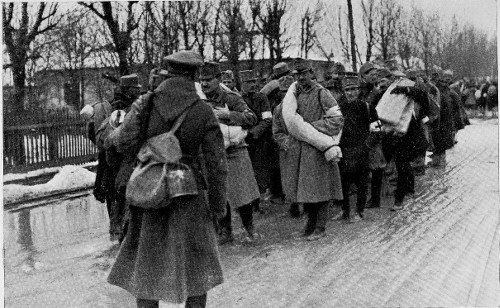
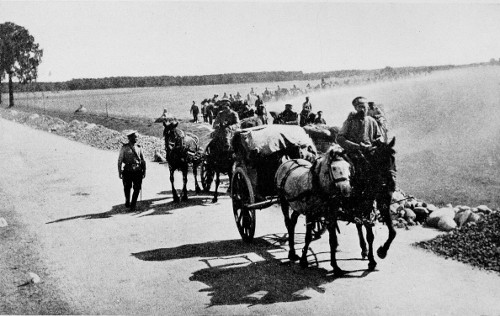
Austrian prisoners leaving Przemysl.
The only forts or works which we were given
the opportunity of seeing, were those visible
from the road, the authorities informing us that
they had reason to believe that many of the
trenches and positions were mined, and that
no one would be permitted in them until they
had been examined by the engineers of the army
and pronounced safe. If the works seen from
the road are typical of the defences, and I believe
they are, one can quite well realize the
impregnable nature of the whole position. The
road from Lwow comes over the crest of a
hill and stretches like a broad ribbon for perhaps
5 kilometres over an open plain, on the
western edge of which a slight rise of ground
gives the elevation necessary for the first Austrian
line. To the north of the road is a fort,
with the glacis so beautifully sodded that it
is hardly noticeable as one approaches, though
the back is dug out and galleried for heavy guns.
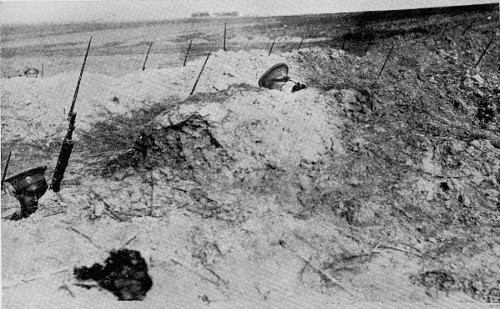
Before this is a ditch with six rows of sunken
barbed wire entanglements, and a hundred yards
from this is another series of entanglements
twelve rows deep, and so criss-crossed with barbed
wire that it would take a man hours to cut his
way through with no other opposition.
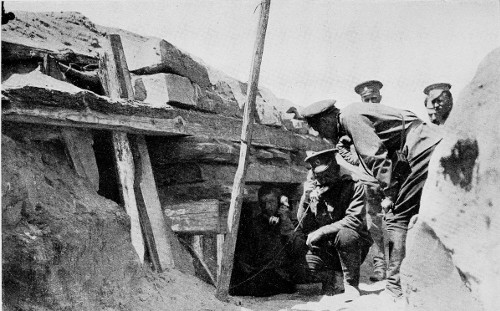
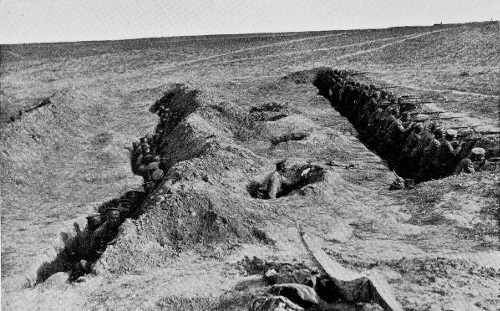
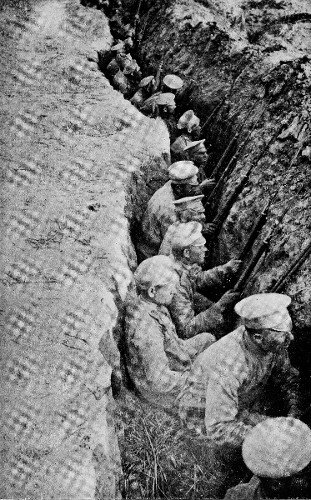
To the right of the road runs a beautifully
constructed line of modern trenches. These
are covered in and sodded and buried in earth
deep enough to keep out anything less than a
6-inch field howitzer shell unless it came at a
very abrupt angle. To shrapnel or any field
gun high explosive shell, I should think it would
have proved invulnerable. The trench itself
lies on a slight crest with enough elevation to
give loop holes command of the terrain before.
The field of fire visible from these trenches is at
least 4 kilometres of country, and so perfectly
cleared of shelter of all sorts that it would be
difficult for a rabbit to cross it unseen. The
ditch and two series of wire entanglements extend
in front of the entire position. This line
is, I believe, typical of the whole outer line of
fortifications, which is composed of a number of
forts all of which are tied together with the line
of trenches. The outer line is above 40 kilometres
in circumference, from which it may be
judged to what great expense Austria has been
put in fortifying this city. I was not able to
get any accurate information as to the number
of guns which the Austrians have on their various
positions, but the opinion of a conservative
officer was, that, excluding machine guns, there
were at least 300 and possibly a greater number.
The inventory has not yet been completed by
the Russians. These are said to range in calibre
from the field piece up to heavy guns of
30 centimetres. I was informed that there
were a few 36 and one or two of the famous 42
centimetres here when the war started, but
that the Germans had borrowed them for their
operations in the West. In any case it is hard
to see how the big guns, even of the 30 centimetres,
would be of any great value to a defence
firing out over a crest of hills in the distant landscape
behind which, in an irregular line of trenches,
an enemy lay.
After a few experiments against the works,
the Russians seem to have reached the conclusion
that it would not be worth while even to
attempt carrying the trenches by assault. Indeed,
in the opinion of the writer neither the
Russians nor any other troops ever could have
taken them with the bayonet; the only method
possible would have been the slow and patient
methods of sapping and mining which was used
by the Japanese at Port Arthur. But methods
so costly, both in time and lives, would seem to
have been hardly justified here because, as the
Russians well knew, it was merely a question of
time before the encircled garrison would eat itself
up, and the whole position would then fall
into their hands without the cost of a single
life.
The strategic value of Przemysl itself was
in no way acutely delaying the Russian campaigns
elsewhere, and they could afford to let
the Austrian General who shut himself and a
huge army up in Przemysl, play their own game
for them, which is exactly what happened. There
was no such situation here as at Port Arthur,
where the menace of a fleet in being locked up
in the harbour necessitated the capture of the Far
Eastern stronghold before the Russian second fleet
could appear on the scene and join forces with
it. Nor was there even any such important factor
as that which confronted the Germans at Liège.
To the amateur it seems then that the Austrians,
with eyes open, isolated a force which at the start
must have numbered nearly four army corps,
in a position upon which their programme was not
dependent, and under conditions which made
its eventual capture a matter of absolute certainty
providing only that the siege was not relieved
from without by their own armies from
the South.
The lesson of Przemysl may be a very instructive
one in future wars. The friends of General
Sukomlinoff, the Russian Minister of War, are
claiming with some reason that what has happened
here is a vindication of the Minister’s
theory, that fortresses in positions which
are not of absolute necessity to the military
situation should never be built at all, or
should be abandoned at the inception of war
rather than defended unwisely and at great
cost. It is claimed that if the Warsaw forts
had not been scrapped some years ago, the
Russian Army to-day would be standing a siege,
or at least a partial siege, within the city, rather
than fighting on a line of battle 40 kilometres
to the west of it. Port Arthur is perhaps an
excellent example of the menace of a fortified
position of great strength. So much had been
done to make that citadel impregnable that
the Russians never dreamed of giving it up.
The result was that a position, which was doomed
to succumb eventually, was made the centre of
all the Russian strategy. For months the army
in the North was forced to make attempt after
attempt to relieve the position, with the results
that they lost probably four times the number
of the garrison in futile efforts to relieve it. A
fortress which has cost large sums of money
must be defended at any cost to justify the
country that has incurred the expense. Forces
which can probably be ill spared from field operations
are locked up for the purpose of protecting
expensive works which, as in the case of
Przemysl, yield them little or nothing but the
ultimate collapse of their defence, and the consequent
demoralization of the field armies which
have come to attach an importance to the
fortress which, from a strategic point of view,
it probably never possessed.
The last few kilometres of the road into Przemysl
was alive with Russian transport plodding
into the town, but the way was singularly free
from troops of any sort. With the exception
of a few Cossack patrols and an occasional officer
or orderly ploughing through the mud, there
was nothing to indicate that a large Russian
army was in the vicinity. It is possible that it has
already been moved elsewhere; in any case
we saw nothing of it.
Between the outer line of forts and the Wiar
river are a number of improvised field works,
all of which looked as though they could stand
a good bit of taking, but of course they were
not as elaborate as the first line. The railroad
crosses the little Wiar on a steel bridge, but the
bridge now lies a tangle of steel girders in the
river. It is quite obvious that the Austrian
commander destroyed his bridges west of the
town because they afforded direct communications
with the lines beyond; but the bridge
over the Wiar has no military value whatsoever,
the others being gone, save to give convenient
all rail access to the heart of Przemysl itself.
The town was given up the next day and, as
the natural consequence of the Austrian commander’s
conception of his duty, all food supplies
had to be removed from the railway trucks
at the bridge, loaded into wagons, and make
the rest of the journey into the town in that
way, resulting in an absolutely unnecessary delay
in relieving the wants of the half-famished garrison
within. The only bright spot that this
action presents to the unprejudiced observer
is that it necessitated the dainty, carefully-shod
Austrian officers walking three kilometres through
the mud before they could embark on the trains
to take them to the points of detention for prisoners
in Russia. There cannot be the slightest
doubt that the rank and file of the garrison
were actually on the verge of starvation, and
that the civilian population were not far from
the same fate. As near as one can learn the
latter consisted of about 40,000 persons. I am
told that the prisoners numbered 131,000 men
and some 3,600 officers, and that perhaps 20,000
have died during the siege from wounds and
disease. This, then, makes a population at
the beginning of nearly 200,000 in a fortification
which, as experts say, could have easily
been held by 50,000 troops. One officer even
went so far as to declare that in view of the wonderful
defensive capacity of the position 30,000
might have made a desperate stand. The fortress
was thus easily three times over garrisoned.
In other words there were perhaps at the start
150,000 mouths to feed in the army alone, when
50,000 men would have been able to hold the
position. This alone made the approach of
starvation sure and swift. The fact that in this
number of men there were 3,600 officers, nine
of the rank of General, indicates pretty clearly
the extent to which the garrison was over
officered. Kusmanek, the commander of the
fortress, is said to have had seventy-five officers
on his personal staff alone.
As far as one can learn there was no particular
pinch in the town until everything was
nearly gone, and then conditions became suddenly
acute. It is improbable that economy
was enforced in the early dispensing of food
supplies, and the husbanding of such resources
as were at hand. When the crisis came, it fell
first upon the unfortunate soldiers, with whom
their officers seem to have little in common.
Transport horses were killed first, and then the
cavalry mounts went to the slaughter house
to provide for the garrison. The civilians next
felt the pinch of hunger, and every live thing
that could nourish the human body was eaten.
Cats I am told were selling at ten kr. each and
fair-sized dogs at twenty-five kr. The extraordinary
part of the story is that according
to evidence collected from many sources the
officers never even changed their standards of
living. While the troops were literally starving
in the trenches, the dilettantes from Vienna,
who were in command, were taking life easily
in the Café Sieber and the Café Elite. Three
meals a day, fresh meat, wines, cigarettes and
fine cigars were served to them up to the last.
One of the haggard starved-looking servants
in the hotel where I was quartered told me that
several of the staff officers lived at the hotel.
“They,” he said, “had everything as usual. Fresh
meat and all the luxuries were at their disposal
until the last. Yet their soldier servant used
to come to me, and one day when I gave him half
of a bit of bread I was eating, his hands trembled
as he reached to take it from me.” My informant
paused and then concluded sardonically,
“No, the officers did not suffer. Not they. It
was cafés, billiards, dinners and an easy life for
them to the end. But the rest of us. Ah, yes,
we have suffered. Had the siege lasted another
week we should all have been black in the face
for want of food.”
An Austrian sister who had been working in
the hospital confirmed the story. “Is it true
that people were starving here?” I asked her.
“Indeed it is true,” she told me, “the soldiers
had almost nothing and the civilians were little
better off. As for us in the hospitals—well,
we really suffered for want of food.” “But
how about the officers?” I asked. She looked
at me sharply out of the corner of her eyes, for
she evidently did not care to criticize her own
people, but she seemed to recall something and
her face suddenly hardened as she snapped out:
“The officers starve? Well, hardly. They lived
like dukes always.” More she would not say,
but the evidence of these two was amply confirmed
by the sight of the sleek well-groomed
specimens of the “dukes” that promenade the
streets. While the soldiers were in a desperate
plight for meat, the officers seemed to have retained
their own thoroughbred riding horses
until the last day. I suppose that riding
was a necessity to them to keep in good
health. The day before the surrender they
gave these up, and 2,000 beautiful horses were
killed, not for meat for the starving soldiers be
it noted, but that they might not fall into the
hands of the Russians. Perhaps I can best
illustrate what happened by quoting the words
of a Russian officer who was among the first
to enter the town. “Everywhere,” he told
me, “one saw the bodies of freshly-killed saddle
horses, some of them animals that must have
been worth many thousand roubles. Around
the bodies were groups of Hungarian soldiers
tearing at them with knives; with hands and
faces dripping with blood, they were gorging
themselves on the raw meat. I have never seen
in all my experience of war a more horrible and
pitiable spectacle than these soldiers, half
crazed with hunger, tearing the carcasses like
famished wolves.” My friend paused and a
shadow crossed his kindly face. “Yes,” he
said, “it was horrible. Even my Cossack orderly
wept—and he—well, he has seen much of war
and is not over delicate.”
I can quote the statement of the Countess
Elizabeth Schouvalov, of whom more anon, as
further corroborative evidence of conditions existing
in the town. The Countess, who is in charge
of a distribution station to relieve the wants
of the civil population, said to me: “It is true
that the people were starving. Common soldiers
occasionally fell down in the street from sheer
weakness for want of food. Some lay like the
dead and would not move. But their officers!”
A frown passed over her handsome features.
“Ah!” she said, “they are not like the Russians.
Our officers share the hardships of the
men. You have seen it yourself,” with a glance
at me, “you know that one finds them in the
trenches, everywhere in uniforms as dirty as
their soldiers, and living on almost the same
rations. A Russian would never live in ease
while his men starved. I am proud of my people.
But these officers here—they care nothing
for their men. You have seen them in the
streets. Do they look as though they had suffered?”
and she laughed bitterly.
I had not been above a few hours in Przemysl
before it was quite clear to me, at least, that
Przemysl surrendered for lack of food, and that
while the officers were living luxuriously, their
men were literally starving. That they let
them starve while they kept their own pet
saddle horses seems pretty well established from
the evidence obtainable. One wonders what
public opinion would say of officers in England,
France or America who in a crisis proved
capable of such conduct?
In my comments on the Austrian officers I
must of course limit my observations to the
types one sees, and hears about, in Przemysl.
Out of 3,600 officers there must have been men
of whom Austria can be proud, men who did
share their men’s privations, and these, of course,
are excepted from the general observations.
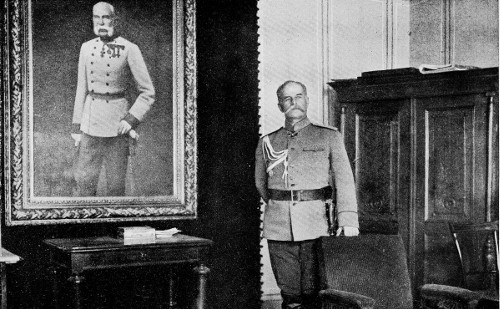
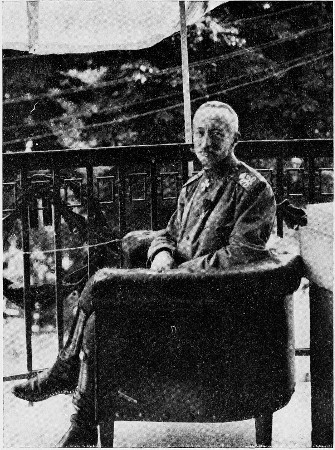
Russian Governor of Przemysl.
Immediately on reaching the town we sought
out the head-quarters of the new Russian Commandant
of the fortress. Over the door of
the building, in large gold letters, were words
indicating that the place had formerly been
the head-quarters of the 10th Austrian Army
Corps. At the entrance two stolid Russian
sentries eyed gloomily the constant line of dapper
Austrian officers that passed in and out, and
who were, as we subsequently learned, assisting
the Russians in their task of taking over
the city. General Artimonov, the new governor,
received us at once in the room that had
been vacated only a few days before by his
Austrian predecessor General Kusmanek. On
the wall hung a great picture of the Austrian
Emperor. The General placed an officer, Captain
Stubatitch, at our disposal, and with him
our way was made comparatively easy. From
him and other officers whom we met, we gathered
that the Russians were utterly taken by surprise
at the sudden fall of the fortress, and dumbfounded
at the strength of the garrison, which
none believed would exceed the numbers of
the Russians investing them; the general idea
being that there were not over 50,000 soldiers
at the disposal of the Austrian commander.
Three days before the fall a sortie was made
by some 30,000 Hungarian troops. Why out
of 130,000 men only 30,000 were allotted to this
task in such a crisis does not appear. Neither
has any one been able to explain why, when they
did start on their ill-fated excursion, they made
the attempt in the direction of Lwow rather
than to the south, in which direction, not so
very far away, the armies of Austria were
struggling to reach them. Another remarkable
feature of the last sorties was, that the troops
went to the attack in their heavy marching kit.
Probably not even the Austrians themselves
felt any surprise that such a half-hearted and
badly organized undertaking failed with a loss
of 3,500 in casualties and as many more taken
prisoners. One does not know how these matters
are regarded in Austria, but to the laymen
it would seem that some one should have a lot
of explaining to do as to the last days of this
siege. Officers who have been over the ground
state that in view of the vast numbers of the
garrison, and the fact that they were well supplied
with ammunition, there would have been
great chance of an important portion of the
beleaguered breaking through and getting clean
away to the south; but no attempt of this nature
seems to have been made.
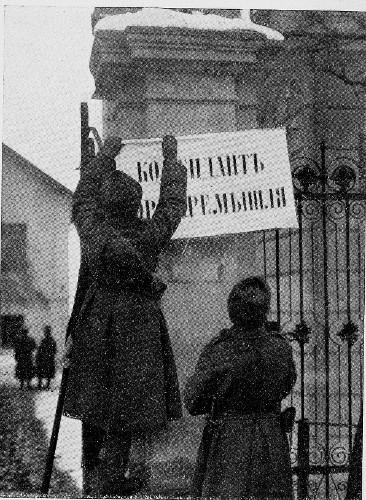
Russian occupation of Przemysl. Head-quarters of Staff.
The night before the surrender, the Austrians
began destroying their military assets, and for
two hours the town was shaken with the heavy
explosions of bridges and war material of all
sorts. Every window facing the San river was
broken by the overcharge of the explosives that
destroyed the bridges. Simultaneously the work
of destroying the artillery was going on in all
the forts with such efficiency, that it is doubtful
if the Russians will get a single piece
that can be used again. The soldiers even destroyed
the butts of their muskets, and the
authorities, who were evidently keen on this
part of the work, arranged for tons of munitions
to be dumped into the river. Others were assigned
to kill the saddle-horses.
By daylight the task seems to have been completed
and negotiations for surrender were opened
by the Austrians. Our guide, Captain Stubatitch,
was the first Russian to enter the town as a
negotiator, and through him the meeting of
ranking officers was arranged—a meeting that
resulted in the unconditional surrender of the
fortress. The original terms agreed on between
Kusmanek and General Silivanov, the commander
of the Russian forces, did not permit the Austrian
officers to carry their side arms; but a
telegram from the Grand Duke spared them
the humiliation of giving up their swords, a
delicate courtesy, which it seems to the writer
was quite wasted on the supercilious Austrian
officers. In the first place there has been no
formal entrance of Russian troops, Silivanov
himself not yet having inspected his prize. The
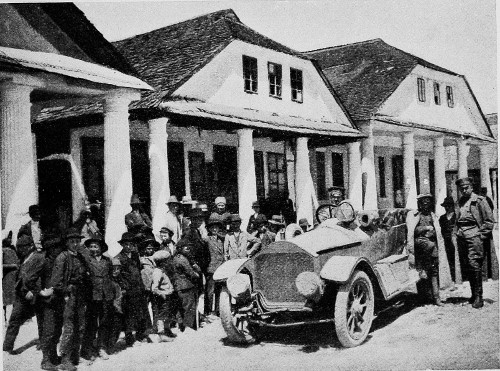
first Russians to enter came in six military touring
cars absolutely without any escort, and went
quietly and unostentatiously to the head-quarters
of the Austrian commander where the affairs
of the town were transferred with as little friction
as the changing of the administration of
one defeated political party into the hands of
its successor. Following the officials, small driblets
of troops came in to take over sentry and
other military duties, and then came the long
lines of Russian transport bringing in supplies
for the half-famished garrison. All told, probably
there have not been above a few thousand
Russian soldiers in Przemysl since its capitulation,
and these were greeted warmly by both
prisoners and civilians. There has been no
friction whatever and everybody seems well
satisfied with the end of the siege. The greatest
task at first was the relief of the population,
both soldiers and civilians. Countess Schouvalov,
whom I have mentioned before, came
the second day and immediately began feeding
the population from the depôt where she
organized a kitchen and service of distribution
which alone takes care of 3,000 people
a day. The Army authorities arranged for the
care of the soldiers and much of the civil population
as well, and in three days the situation
was well in hand and practically all the suffering
eliminated.
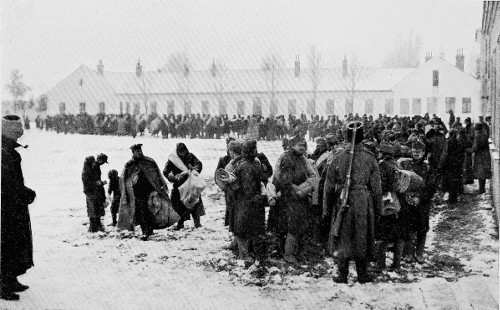
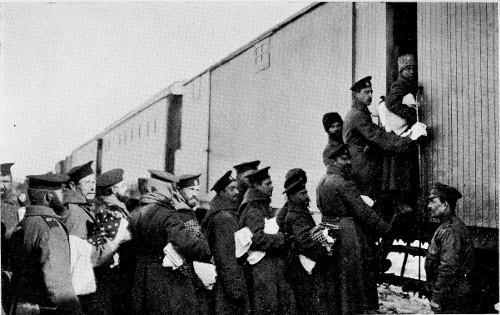
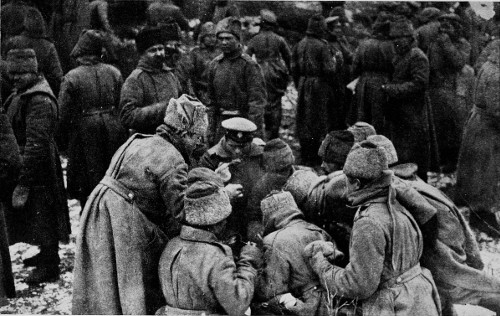
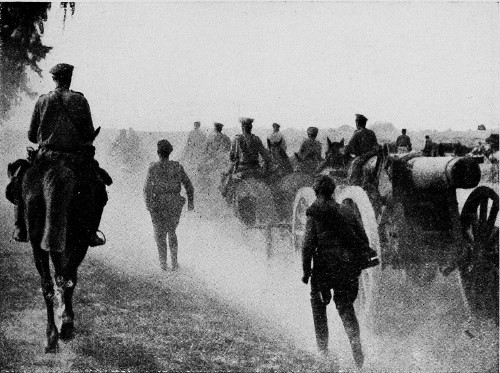
Feeding Austrian prisoners en route to Lwow.
I have talked with many people in Przemysl,
and civilians and prisoners alike speak of the
great kindness of the Russians from the ranking
officers down to the privates, all of whom
have shown every desire to ameliorate the
distress. The difficulty of feeding so vast a
throng necessitated the immediate evacuation
of the prisoners, and an evacuation office was
at once organized. Batches of prisoners started
toward Lwow at the rate of about ten thousand
a day, which is about all the stations along
the route can handle conveniently with supplies.
The officers are sent out in small blocks by rail
once a day, and are, I believe for the most part
taken directly to Kiev, where they will remain
until the end of the war.
General Kusmanek himself departed the first
day in a motor car to the head-quarters of
Silivanov and thence with the bulk of his staff
to Kiev. Those who have seen him describe
him as a youngish man looking not over
forty, but in reality fifty-four. A man who
saw him the day of the surrender told me that
he had accepted the situation very casually,
and had seemed neither depressed nor mortified
at the turn events had taken. The ranking
officer left in Przemysl is General Hubert, formerly
Chief of Staff, who is staying on to facilitate
the transfer of administrations; the head-quarters
is filled with a mixture of officers and orderlies
of both armies working together in apparent
harmony.
The fall of Przemysl strikes one as being the
rarest thing possible in war—namely a defeat,
which seems to please all parties interested. The
Russians rejoice in a fortress captured, the
Austrians at a chance to eat and rest, and
the civilians, long since sick of the quarrel, at
their city once more being restored to the
normal.
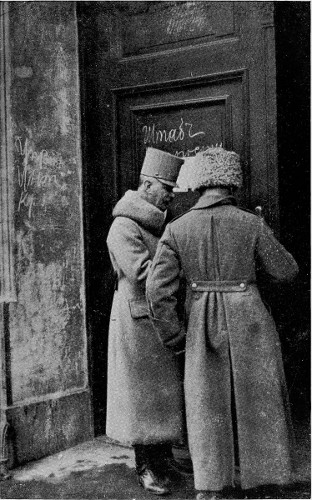
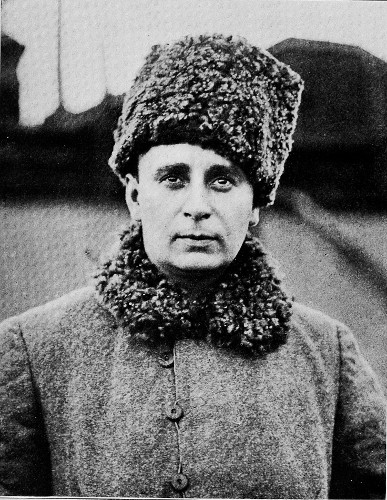
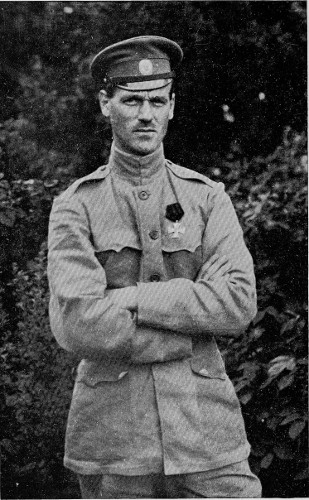
General Hubert, Chief of Austrian Staff in Przemysl.
WARSAW IN APRIL, 1915