CHAPTER IX REASONS FOR OUR REVERSES ( continued )
THE RUSSIAN ARMY AND THE
JAPANESE WAR
The insufficient tactical preparation of our troops—
Measures taken to improve it.
I have touched upon the fact of how our want of
tactical training was shown up in the Crimean and
second Turkish Wars. Especially conspicuous
was the inability of our senior commanders—relying
as they usually did upon quite inadequate
information as to the enemy’s strength and dispositions—to
co-ordinate the operations of the
different arms towards one end, and their ignorance
of where to deliver the main attack. The
minor part played by our cavalry and our comparatively
great power of defence were also remarked.
Finally, attention was drawn to the
fact that our lack of the power of manœuvre
compelled us to place superior numbers in the
field against the Turks, a course which had not
formerly been necessary.
After the war of 1877–78 we set to work to
study our weak points, in order to eliminate our
faults. Much must have been accomplished since
then, for the tactical training of the army at the
beginning of the recent war was undoubtedly of
a higher standard than it was twenty-five years
ago. Still, in some matters we had not progressed,
while in others we had actually gone
back. The duty of training the troops rests
with commanding officers of all ranks, and the
responsibility for this extends right up to those
in command of military districts. Although the
same drill-books and manuals are used by the
whole army, there is considerable variety in the
way that the tactical instruction is imparted,
owing to the diverse views held by the district
commanders. I have taken part in many manœuvres,
and was in command of the army at the
grand manœuvres at Kursk in 1902, and I noted
down what I considered to be our principal failings
in this respect. In October, 1903, I submitted
a report on the subject to the Tsar, in
which my conclusions on certain points were as
follows:
“1. Staff Work with the Main Army and with
Detached Columns at the Grand Manœuvres.
“Generally speaking, the staff work cannot be
characterized as entirely satisfactory. The principal
reasons for this were the somewhat unhappy
selection of the officers appointed to be chiefs of
the different staffs, the poor organization of the
staffs themselves, due to a limited personnel and
to an insufficient supply of the means of communication
[telegraph and telephone equipment]
for both the troops and staffs, and the
neglect to arrange proper intercommunication
between units by making use of mounted orderlies,
automobiles, or cyclists. Intelligence of
the enemy as well as of the disposition of
other units was always received late by those
whom it concerned, because the cavalry was
badly organized, and could not carry out its
orders properly.
“The amount of writing done by the various
staff-officers was colossal. They worked the
whole evening and all night; their effusions were
lithographed or printed, and were sent off in all
directions; but the orders were rarely received
by the troops in proper time. At the manœuvres
of the Warsaw Military District in 1899, cases
came under my notice of general officers commanding
divisions receiving the order to move in
the morning two hours after the time appointed
for them to start.
“In many instances staff-officers with troops
seemed ignorant of how a reconnaissance should
be carried out, and consequently did not
gauge the dispositions of the enemy’s forces
with sufficient accuracy. This reacted in turn
on the dispositions made by the chief commanders,
more particularly in their employment
of the reserves (Kursk manœuvres and those
at Pskoff and Vlodava). Similarly, they did
not know how to arrange for the maintenance
of touch along the front and to the rear, a
defect which caused a delay in the receipt
of orders and information which was quite
avoidable.
“2. Work of the Cavalry at Manœuvres.
“The increased importance now attached to
the strategic or independent duties of cavalry has,
in my opinion, acted detrimentally upon the
cavalry work with the troops. The spirit of the
strategic rôle was in most cases not properly
grasped, and the chief idea of the masses of
mounted troops of both sides appeared to be to
meet each other. They therefore neglected to
furnish the commanders of their sides with the
information of the enemy, so necessary before an
action, and left the infantry without their co-operation
during the actual combat; this was
the same whether they were acting in attack or
defence. Long-distance patrols often did useful
work, but owing to the lack of proper means for
the quick transmission of the information collected,
it reached the troops to whom it might
be useful after the enemy’s dispositions had been
changed. The near patrols did not work in with
the long-distance ones. Our mounted troops
were frequently allowed to lose touch with the
enemy at night under the pretext that the men
and horses required rest, and the employment of
a dozen troopers was grudged after dark, when
by day whole divisions and corps were futilely
marched and countermarched, and sent upon
duties which were not always in accordance with
the general idea of the operations.
“The cavalry work should be more strictly in
co-operation with that of the other arms than it
is at present, and all officers in command of
mounted units should remember that their rôle
is auxiliary, and largely consists in assisting the
General in command to come to a proper decision
by the completeness and accuracy of the
information they send back; that the cavalry
should help the commanders, firstly, to frame a
plan of action, then to crush the enemy on the
field of battle.
“3. Attack and the Defence.
“Here again information was wanting. When
commanders made up their minds either to attack
or to stand on the defensive, they were never
able to feel, from their information of the enemy
and the locality, that they thoroughly knew
what they were doing, or that it really was in
accordance with the spirit of the general idea.
We were strong in the defence, but we rarely
delivered a soundly conceived or executed attack.
In the attack column commanders did not always
take pains to obtain enough accurate information
as to the dispositions and strength of the enemy,
so as to be able to appreciate the situation properly
and draw up a reasoned plan of battle, to
select the direction of the main attack, to allot
the troops for it, and take steps to deceive the
enemy as to its precise direction. When they
had massed sufficient first-line troops for the
main attack, they did not also move up the reserves
of all arms.
“In particular, we did not know how to conduct
the advance, and then deliver the assault
with proper preparation by artillery and rifle fire.
Many commanders seem, unfortunately, to be
wedded to the idea of carrying out a continuous
advance without making any use of the rifle. If
we ever encounter an enemy, such as the Germans,
who systematically train their troops to
advance under cover of their own heavy rifle-fire,
we shall be worsted, for in peace we often advance
almost without firing a rifle to a range of 1,000
or even 800 paces of the position.
“The guns also frequently ceased fire at the
same critical period—i.e., when their attacking
infantry are nearing the enemy. My inquiries as
to the reason for this were usually met with the
reply that their ammunition was expended. If
the absolute necessity for keeping in hand a considerable
number of rounds for the assistance of
the decisive infantry attack is not realized now
that we have quick-firing guns, our artillery will
in war become useless at the very moment when
its co-operation is most vital.
“In defence we are better than in the attack,
and we know how to make the most of the fire
effect of both guns and rifles. The ranges in
front of a position are usually measured and
clearly marked. But proper use is not made
of reserves. We do not, as we should, throw
them into the firing-line, so as to increase the
volume of fire after the enemy’s main attack has
developed, nor do we launch them in a fierce
counter-attack after he has come within decisive
range. The reserves are often kept in mass, and
thrown against the attack without any supporting
rifle-fire. Many regiments and brigades told off
as reserves to a defensive position go through
the whole manœuvres without firing a single
round.
“4. The Revival of the Column Formation
in the Attack.
“Other European armies are now doing everything
possible to minimize the murderous effect
of modern rifle and artillery fire on themselves,
and are, at the same time, endeavouring to
develop their own fire to the utmost, both in
the attack and defence; indeed, the Germans, in
their efforts to this end, have gone the extreme
length of deploying all their troops—sometimes
even to the sacrifice of their reserves—in long
thin lines. We, on the other hand, judging by
the last manœuvres, are going to the other
extreme, for our decisive attack is delivered
almost without any fire preparation, and with
men massed in quarter column!
“If a stop is not put to the increasing density
of our attack formations, we shall suffer for it
heavily. It is all the more dangerous for us, as
we do not assist our assaulting infantry properly
with supporting gun and rifle fire.
“5. The Work of the Artillery.
“Artillery positions were in most cases skilfully
chosen, but the fire discipline was often
bad. As batteries can only carry a limited
number of rounds in the field, it is vital that
the gunners should be taught to economize every
round; this is, of course, particularly important
with quick-firing guns. But we often fired more
rounds than were necessary: fire was opened too
hurriedly, at quite unimportant targets, with the
result that, at the critical moment of the attack,
batteries had to signal that they were in action,
for all their ammunition had been expended.[1]
“6. The Work of the Sappers.
“The bloody lessons of Plevna and Gora
Dubniak put fresh life into our military
engineering, which lasted for a certain time
after the Turkish War. Our sappers became
skilful at constructing trenches and redoubts,
and the other troops were also trained in field-works,
and began to like entrenching themselves.
But a reaction soon set in. This was largely
due to General Dragomiroff, who did much to
bring about a return to the old order of things,
when it was held that everything was decided
by the bayonet. He was quite opposed to the
use of cover, and carried his orders on this
subject to the height of absurdity, even forbidding
his men to lie down while advancing to attack!
“To dig oneself into the ground means labour,
and takes much time. Moreover, instructions
used to be issued that all trenches dug had to
be filled in again, and all redoubts dismantled.
This at once limited the scope of trench-work in
the army. The entrenching tool, which after the
Turkish War had been valued next to cartridges
and biscuits, was relegated to the mobilization
store, and never brought out for use or even
for inspection. At many manœuvres the men
were not practised at all in the fortification of
positions; at others the alignment of trenches
was traced only. While giving the sapper
units full credit for their excellent training, I
cannot but express my fear that they specialize
far too much in a mass of detail, and ignore
the fact that their main duty in war is to
co-operate in every way with the infantry, both
in strengthening defensive positions and in the
attack of them.
“7. Criticism by Commanders.
“It is gradually becoming the custom to omit
all criticisms[2] at grand manœuvres. Mistakes,
therefore, pass unnoticed, are repeated, and tend
to become chronic. I remember some very
instructive manœuvre criticisms made by General
Gurko, and I have listened with interest and
advantage to others made by General Roop.
Discussions after the operations are always held
in the Kieff and St. Petersburg Military Districts,
but nowadays some officers in command
of districts neither make any remarks themselves
when present at manœuvres, nor expect them to
be made by the officers commanding sides or
the other seniors. Orders issued after a long
period—though they may enumerate the various
points noticed—and the reports eventually printed
of large concentrations and manœuvres, are comparatively
useless for instruction. To be of use,
criticisms must be made by the commanders, and
made on the spot.
“It is, however, important to realize how rare
the power of good criticism is. The remarks
usually made are either quite colourless or too
highly pitched. Some of our most capable
general officers also seem peculiarly ‘unlucky’
in the way they manage unnecessarily to hurt
the feelings of commanding officers by their
harsh way of putting things. They forget that
to lower the prestige of a senior in the presence
of his juniors always produces a bitter harvest,
especially in war. They forget the infinite
variety of the conditions of different tactical
situations, and that at peace manœuvres there
is no need for one side to win or lose. Again,
independent action, though certainly not wrong
in itself, is often put down as a mistake and
adjudged to be wrong because the senior commander
has his own opinion in the matter. Such
narrow-minded criticism deprives officers in
command of units of the spirit of independence,
of initiative, and of the desire for responsibility.
Instead, they try to discover the fads of the
officer in command, in order to ‘play up’ to
them.
“8. Conclusion as to the Tactical Instruction
of our Troops.
“Although the opinion of the generals in
command of military districts in all matters pertaining
to military training should, and do, carry
great weight, yet there must be some limit to
individual action. It is impossible, for instance,
to permit each of them to train the troops
in his command entirely in accordance with
his own views as to what is most important
in war; for the instruction of attack and defence
should not be carried out on entirely
different lines in the different districts. Yet
this is more or less what has been done. We
at headquarters are partly to blame, owing to
the delay in the publication of the field-service
manuals and the instructions for the combined
training of all arms. As an example of what
I refer to: General Dragomiroff has trained the
troops under him in the Kieff Military District
to attack according to a system of his own, of
which the soundness is open to doubt. If some
of his theories are carried out in war, they will
result in heavy loss, and therefore their inculcation
in peace seems entirely wrong. His
order that the skirmishers escorting artillery
should be on a line with the guns themselves
would only cause the premature silencing of the
latter; and another, that the lines of skirmishers
advancing to attack should not lie down
when halted, is simply impossible of execution.
When bullets are flying, a line lies down of its
own accord as soon as it halts, and quite rightly
so, as men get cover more easily when lying
than standing. And now, following General
Dragomiroff’s example, in the Vilna Military
District General Grippenberg has begun to act
according to his own theories, and depart from
the textbook. In his District Orders this year,[3]
in which were published his criticisms on the work
done at manœuvres, he recommends that infantry
in close order should receive cavalry with independent
fire[4] instead of with volleys. He insists,
also, that when a line is advancing by short
rushes, these rushes should begin from the flanks.
“Unfortunately, much that I saw when inspecting
the troops in the different districts and
on grand manœuvres led me to the conclusion
that the tactical training, especially in command,
of officers commanding units, from regiments
upwards, is neither sound nor uniform.”
My strictures on the peace tactical training
of the army were, unfortunately, only too well
confirmed during the war.
The theatre of war in Manchuria presented
many peculiarities of climate, topography, and
inhabitants. It was unlike any of the “probable”
theatres of operations we had studied, and
was, therefore, quite new to the troops who
came from European Russia. The Japanese
were not only new and practically unknown
foes, but the nature of the information that we
did possess about them tended to show our great
superiority, and therefore incited us to contempt.
The existing edition of our “Field Service
Regulations” was obsolete, and the revised
edition was still in the Press. Special instructions,
therefore, had to be issued, in order to
assist our troops to grapple with the entirely
strange conditions under which they were placed.
These were compiled and printed under my
direction, and distributed to officers in command
of all units, from companies and squadrons upwards,
and to all chief staff-officers. In them
I emphasized the necessity of getting to know
something about the enemy, enumerated their
strong and weak points, and drew attention
to their patriotism and traditional indifference
to death. I stated that their strong points
predominated, and that in the Japanese we
should find a very powerful opponent, even
when reckoned by European standards. I continued:
“It is most important that in the first engagements,
in which they will certainly be in superior
strength, we should not give the Japanese the
satisfaction of victory, for that will only still
further elevate their spirit.
“No particular or new tactics need be adopted
against our present enemy, but we must not
repeat the mistakes in manœuvring which cost
us so dear in the Turkish War of 1877–78.”
I then mentioned the causes of our reverses
at Plevna, and commented in detail on the
most important. After capturing Nicopolis, our
troops moved on Plevna in ignorance of the
strength and dispositions of the enemy. As far as
obtaining this information was concerned, our
cavalry was not well handled. In the first fight at
Plevna (July 20, 1877) we attacked with too
few men and in detail. We did the same in the
fights of July 31 and September 12, but to an
even greater extent, and the attacks were carried
out in too dense a formation, were not sufficiently
prepared by fire-effect, and our own
numerous cavalry and that of the Roumanians
did practically nothing. The attacks on September 10
and 11, 1877, failed because our troops
were badly distributed and untrained. I attached
an appreciation of the work of our troops in
the Turkish War as follows:
“In this war the staff work was not always
successful. The troops often received orders
too late, and time was wasted waiting for their
receipt before commencing a move. Units
arriving at night on the positions allotted to
them did not always find the officers who should
have been waiting their arrival to guide them.
Officers in command of troops were often not
informed by the staff as to the enemy’s strength
and dispositions, or as to our own neighbouring
columns. Lack of information was the principal
cause of our disasters; we sometimes
attacked in entire ignorance of the enemy’s
strength and dispositions, and even partially so of
our own.
“As an example of what our troops can do
in an attack may be quoted the capture of Kars;
it is a very instructive case. Though the weak
field-works of Plevna resisted our efforts for five
months, at Kars neither strong parapets nor deep
ditches could check our onslaught. Our gallant
Caucasians advanced on the fortress by night;
they were well led, and always had a body of
scouts skilfully thrown out in front, and they
captured strongholds that had been termed
‘impregnable’ with great bravery.
“In the defence our troops have always
fought well. Let us remember the defence of
the Shipka Pass, and imitate it.”
After a short review of our errors in the
Turkish War, I enumerated those which were
still noticeable in our peace manœuvres.
As operations developed the enemy’s peculiarities
became as well known as our own, so I was
able in August, September, October, and December,
1904, to issue supplementary instructions.
Notwithstanding the number of our cavalry,
and what our scouts had been able to do, we
had not ascertained the general dispositions and
strength of the enemy. The information brought
in by spies was exaggerated and unreliable. The
result was that, when we had carried out any offensive
operations, we had advanced without knowing
anything of the enemy. My instructions ran:
Instructions issued in August.
“In our attacks we have started the advance
too rapidly, without strengthening positions
already occupied, and without full artillery co-operation,
and we have stopped the action at a
period when we still had large numbers both in
the general and regimental reserves. In retirements
we have withdrawn to positions previously
occupied by us without having taken steps to
hold our ground on any of them, which preparation
would not only have greatly assisted the
retirement itself, but, what was far more important,
would have enabled us to renew the
attack.
“Another point is, that many of our defensive
positions have not corresponded to the numbers,
when extended, told off to defend them. Nevertheless,
the enemy’s frontal attacks, even if we
hold quite chance positions, usually fail, and we
have been obliged to abandon our ground owing
to the turning movements which their superior
numbers have made possible.
“In attacking, especially among hills, the
infantry must wait so that the assault may be
prepared by fire, in order to get breath or to
give time for the co-operation of a turning movement.
There is also another and involuntary
reason for halting—namely, the enemy’s fire.
Owing to this, units halt, or, what is worse, begin
to retire without orders; what then usually
happens is this: A few men begin to trickle
back from some company that has come under a
particularly hot fire; they are followed by their
own company, which is in turn followed by the
companies on either side, even though the latter
may perhaps be holding strong ground. Such a
moment is, indeed, critical, and unless some brilliant
officer appears who possesses the secret of
rallying retreating men and succeeds in making
the company hold its ground, the action is lost.
But besides setting a personal example to the
men, a commanding officer must at once push
forward some of his reserves to stop the rot
among those retreating. The most important
thing at such a crisis is the example set by the
officers or the steadiest men, particularly by
Cavaliers of the Order of St. George.[5] A company
commander’s example is everything to his
company. Therefore, however deserving he may
be in peace, a company commander who does not
display personal gallantry in action should be
instantly removed from his command.
“The most effective method of guarding
against a sudden emergency either in attack or
defence—and this is particularly true in hilly
country—is to have in hand a strong reserve, and
not to make use of it too lightly. This we have
not done in recent actions; we have told off weak
reserves, and used them up too quickly. Whole
regiments have sometimes been sent in support
where two companies or a battalion would have
been ample.[6]
“In all kinds of operations officers in command
must keep the forces on either flank, as well as
their seniors, informed of everything that happens.
We are, unfortunately, not accustomed to do
this. Before an action the smallest details are
reported, but as soon as an action begins we
become so preoccupied with the fight that the
most obvious duties are forgotten. Chief staff-officers
of all grades will in future be held responsible
for the frequent transmission of reports
during an action.”
The special attention of commanding officers
was also called to the necessity for providing
their men with hot food during action, and to
the excessive expenditure of ammunition in our
fights.
Instructions issued during September.
The following were the main instructions given
by me while preparing for an advance after the
fighting in August:
“It is a regrettable fact that so far, whenever
we have taken the offensive, we have met with
reverse. Owing to our lack of information, to
which I have already drawn attention, instead of
delivering a confident attack according to a
clearly-thought-out plan, we have acted in a
half-hearted manner. We often deliver our main
attack too soon, and regardless of the enemy’s
intentions. Instances have occurred where we
have detailed attacking columns as small as a
battalion; in others we have operated without
any definite plan of action. Finally, there have
been cases where not enough determination
has been shown in pressing forward to the objective.”
The importance of gaining even slight successes
over the enemy’s advanced troops at the beginning
of a forward movement, the fact that in the
attack of positions turning movements should
always be made in combination with frontal
attacks, and the advantage of pushing on energetically
when once an advance had commenced,
were all points specially noted. The necessity
of holding on determinedly to every yard of
ground gained was accentuated, and leading units
in a frontal attack were warned not to deliver
the assault until the synchronous turning movement
had been fully developed. Every use was
to be made of fire-effect of every sort. I wrote:
“A glaring case of that lack of co-operation
from which we suffer so much was the fight
of September 2,[7] when the left column began the
action far too soon, and therefore finished by
retiring in disorder. This had the worst results
on the success of the whole operation.
“I must again remind all ranks of the great
necessity for economizing ammunition, especially
gun ammunition. At Liao-yang we used up in
two days our special artillery reserve of more
than 100,000 rounds. The conveyance of gun
ammunition to the front is very difficult, and
batteries which have expended theirs become
mere dead-weight to the army.”
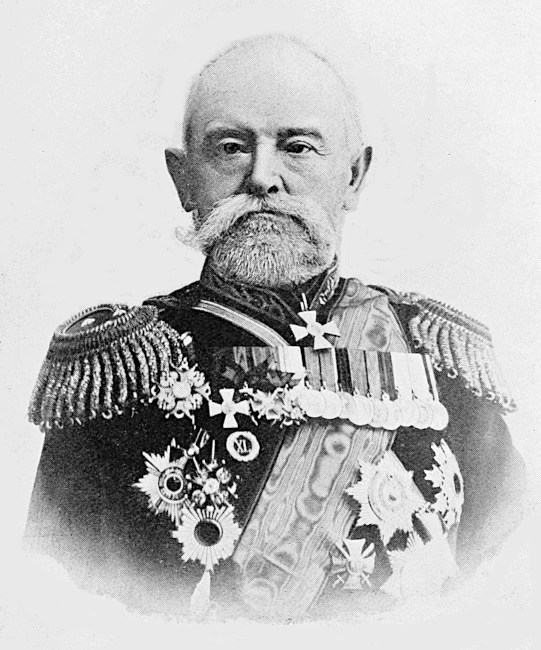
GENERAL LINIEVITCH.
The peculiarities attendant on operations in
a country covered with such crops as kao-liang
were also reviewed in detail:
“Any men leaving the ranks in action under
pretext of accompanying or carrying away
wounded men will be severely punished.
“Companies and squadrons must be as strong
as possible for an attack. To this end the most
strict precautions must be taken to limit the
number of men employed on extraneous duties
and for transport work. The Cossacks are not
to be employed as orderlies and escorts by the
officers under whom they may be temporarily
serving. Sound horses in possession of sick
Cossacks should be taken from them, and made
over to those who are horseless, but fit for duty.
“It is to be regretted—and I have more than
once commented on it—that commanding officers
do not pay proper attention to the order that the
soldier’s emergency biscuit ration, carried on the
person, should remain untouched. This reserve
ration is constantly being eaten, and no steps are
taken immediately to replace it. Many commanding
officers calmly allow the whole of the
men’s portable reserve to be consumed under
the pleasing conviction that it is the duty of
someone else to bring up fresh supplies to the
regimental commissariat.
“The above instructions only touch on a few
details of field-work. The main guide for action
is the ‘Field Service Regulations,’ but these
cannot, of course, meet every case which may
arise in the entirely new circumstances under
which we are now operating. I expect commanding
officers of all ranks, therefore, to show greater
initiative in the performance of their duties.”
My instructions issued in October included
remarks on our offensive operations during the
end of September. Amongst other things, I
said:
“I still notice faults in the method of conducting
attacks. Thick lines of skirmishers are
too closely followed by the supports and reserves.
The formations have generally been ill adapted
to the ground, and have been such as to form an
excellent target. If this close-order formation had
been assumed in these cases just before a bayonet
charge, then, despite the heavy sacrifices entailed,
there would have been some point in it, because
of the additional force and impetus given to the
assault; but it was adopted when the attack was
still at long range, and so caused useless and
heavy loss. We should in such cases imitate the
Japanese, and do what we used to in the
Caucasus—make every use of cover. Every
effort must be made to reconnoitre well, in
order that advantage may be taken of every fold
of the ground, and of every stick and stone, and
the attack may be enabled to advance as close as
possible to the enemy with the least possible
loss. The way to do this is for individual men,
or groups of men, to advance by short rushes till
the attacking units are able to collect. On open
ground, if the attacking infantry has to wait for
the artillery preparation, it should entrench itself
as rapidly as possible.
“In retreating, the movement to the rear of
large masses together afforded the enemy a
splendid target, for which we suffered. Again,
to avoid unnecessary loss in retirement, portions
of a position have often been stubbornly held
until a withdrawal could be effected under cover
of darkness. If the portion of ground on either
side happens to have been already abandoned,
and the Japanese are sufficiently mobile to make
use of it, such isolated defence of any one section
of a position might cost very dear. We must
learn how to retire by day—by the same methods
as laid down above for the attack (by rushes), and
avoid close formations in doing it.
“I and other senior officers have noticed
during an action hundreds and thousands of
unwounded men leaving the ranks, carrying
wounded to the rear. In the fights of October 12
to 15[8] I personally saw wounded men being
carried to the rear by as many as nine others.
This abuse must be put down with the utmost
rigour, and until an action is over only the
stretcher-bearers should take wounded to the rear.
“The Japanese are fortifying the positions
along our front, converting villages, knolls, and
hill-tops into strong, defensible points, and
strengthening their positions with obstacles.
These positions should be carefully studied, their
strong points noted, and in every section of our
line a plan of possible operations against the
corresponding portions of the enemy’s position
should be made. The early organization of the
artillery preparation of any attack on these
selected points is important.
“Detachments of sappers and scouts should
be sent ahead of the assault to destroy the
obstacles round fortified villages, which should
be well shelled. Till the assault is made the
advance should be under cover, and if the leading
troops find they are not strong enough to capture
the point on which they have been directed, they
must hold on to a point as near to the enemy as
possible, in order to press forward again when
reinforced.”
Finally, in my instructions issued in December,
1904, I recapitulated the most important points
brought out by our recent experiences, such as—
“1. The necessity, in order to avoid loss, for
our attack formations to be better adapted to
the ground.
“2. Economy in artillery ammunition.
“3. The more intelligent employment of rifle-fire,
and the necessity for volley-firing at night.
“4. The great value of night operations.
“5. Proper communication between all senior
commanders.
“6. The necessity for the mutual co-operation
of all arms, and the maintenance of touch in
battle.
“The surest road to success is the determination
to continue fighting, even when the last reserve
has been exhausted, for the enemy may be in
the same, if not in worse plight, and what is not
possible in daylight may be accomplished at
night. Unfortunately, in recent fights, some
commanders even of large forces have confessed
themselves unable to carry out the operation
entrusted to them, at a moment when they still
had in hand big reserves which had not fired a
shot.”
Of course, as soon as our disasters began, the
papers started to accuse our troops of insufficient
training, and they were not far wrong. In the
first place, most of the men were reservists who
had forgotten a great deal. In the second, this
war was our first experience of smokeless powder,
of quick-firing artillery, of machine-guns, and of
all the recent developments in means of destruction,
and much was strange and unexpected.
Our preconceived notions were upset, and we
were baffled by the deadly nature of indirect
artillery-fire, by the new attack formations—when
advancing infantry is rarely visible, and
one man at a time crawls up almost unseen,
taking advantage of every inch of cover. Our
troops had been instructed, but what they had
learned varied according to the personal idiosyncrasies
of this or that district commander. The
stronger the officer commanding a district, the
less did he feel bound to abide by the authorized
method of instruction and training laid down
in the existing drill-books. General Grippenberg
was no exception to this. In spite of the
regulation as to the use of volleys for repulsing
night attacks; in spite of war experience which in
every way confirmed the necessity and value of
volley-firing; in spite of the Commander-in-Chief’s
instructions on this point, he made up his mind
some days before a battle to re-teach the force
under his command. He ordered the employment
of independent fire at night. His “Instructions
for the Operations of Infantry in
Battle” [signed by him on January 4, 1905],
printed and issued to the troops, aroused consternation
and amusement throughout the army.
In this book it was actually laid down that volleys
were only to be resorted to if the enemy suddenly
appeared at close quarters, and that immediately
after a volley a bayonet attack should be made.
While condemning the method in which our
troops operated at the Ya-lu, he, in the above
“Instructions,” gives a recipe for action whereby
two of our battalions might destroy a Japanese
division. After a summary of the amount of
small-arm ammunition expended, he said:
“If our two battalions had been deployed and
had opened rapid independent fire, the Japanese
division would have been destroyed, and we
should have won the day.”
Such a simple matter did General Grippenberg
consider the annihilation of a Japanese division!
But a few days later, when he moved against the
Hei-kou-tai position with a strong force of 120 battalions,
his own prescription proved to be valueless.
In the first few days, when he was opposed
by not more than two divisions, he was unable to
take San-de-pu, got his troops into confusion, gave
the enemy time to bring up strong reinforcements,
and retired—to St. Petersburg.
As to the attack formation adopted by the
troops arriving from Russia, the 41st Division
had in particular been taught to work in very
close formation, and not taught to make use of
the ground. It came from the Vilna district,
which was commanded before the war by General
Grippenberg. Our gunners also arrived at the
front with only one idea of artillery tactics—to
place their batteries in the open and make
use of direct fire. For this we paid dearly in our
very first fight.
CHAPTER X REASONS FOR OUR REVERSES ( conclusion ) — Difficulties in Organization. — Defects in Personnel .
Particular difficulties of the strategic situation—Defects
in organization and personnel—Absence of a military
spirit in the army, and lack of determination in
carrying operations to a finish—Breakdown of our
organization under the strain of active service.
It is the duty of every Headquarter Staff to
work out all possibilities, and, regardless of
existing international relations, to provide for
war in every probable quarter. Accordingly,
our general line of operation in case of war with
Japan had been duly drawn up in conjunction
with the staffs of the Pri-Amur and Kuan-tung
districts, and had been approved. The following
is an extract from the paper dealing with the
subject:
“Taking advantage of her military position—for
she will be more ready for war than we are,
and will therefore possess in the first period of
the campaign a great numerical superiority both
by sea and land—Japan can afford to define her
objectives only generally. She may (1) confine
her attention to the occupation of Korea, and
not take the offensive against us (which will most
probably be the case); or (2) occupy Korea and
also assume the offensive—
- (a) In Manchuria.
- (b) Against Port Arthur.
- (c) In the Southern Ussuri district (Vladivostok).
“Should Japan decide on the first alternative,
then, taking into consideration the number of
reinforcements we shall need, and the adverse
conditions under which they will have to be
conveyed to the front, we shall be forced at first
to allow her to seize Korea—without retaliative
action on our part, if only she will confine herself
to occupying that country, and not develop plans
against Manchuria and our territory. Should
she choose the second alternative, we should be
obliged to fight, and ought at once to make up
our minds not to end the war until we have
utterly destroyed her army and fleet. In view,
however, of her numerical superiority and greater
readiness during the first period of the struggle,
we shall have to assume a generally defensive
rôle. Any troops we may have within the
theatre of operations should as far as possible
keep clear of decisive actions, in order to avoid
being defeated in detail before we can concentrate
in force.
“The numerical superiority of the Japanese
fleet will probably prevent our squadron from
any major active operations, and it will have to
confine its action to the comparatively modest
task of delaying the enemy’s landing as much as
possible. The defence of our own possessions
should be carried out by the forces in the
Southern Ussuri and the Kuan-tung districts,
which are formed for that particular object, and
based on the fortresses of Vladivostok and Port
Arthur. All the remaining troops, except those
allotted to the line of communications and to
maintain order in Manchuria, should be concentrated
in the area Mukden-Liao-yang-Hsiu-yen.
As the Japanese advance, these troops, while
delaying them as much as possible, will gradually
be compelled to retire on Harbin. If it becomes
evident in the first period of the campaign that
the whole Japanese effort is being directed
against us in Manchuria, then the force which
would be concentrated first of all in the Southern
Ussuri district (1st Siberian Corps) would be
transferred there.”
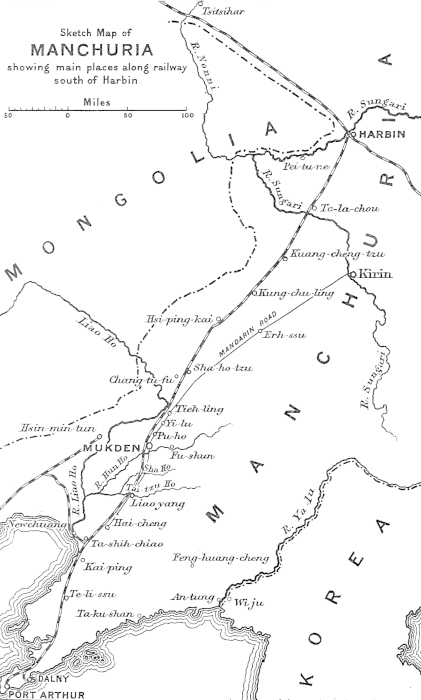
Sketch Map of MANCHURIA
The two years succeeding the date on which
this paper was written saw great alterations in
the strength, dispositions, and readiness of our
military and naval forces in the Far East. There
was also considerable change in the political
conditions in Manchuria and in Northern Korea
in consequence of the active policy which we had
begun to assume. It was therefore found necessary
in 1903 to consider a revision of the above
scheme in accordance with these altered conditions.
During those two years our strength in
the Far East had grown by the increase in our
land forces and fleet, and the improved efficiency
of the railways. We have already seen what
was done to improve the latter. It will suffice
to say here that, instead of the twenty waggons
available over the whole Chinese line in 1901,
the War Department in 1903 received seventy-five
in the twenty-four hours, and hoped, on the
strength of promises made, to have five through
military trains by the beginning of 1904. The
fleet, which in 1901 was considered inferior to
the Japanese, was, at the end of 1903, stated, on
the authority of the Viceroy, Admiral Alexeieff,
to be so strong that any possibility of its defeat
by the Japanese was inadmissible. But in those
same two years Japan had not been idle, and
had been unceasingly increasing her naval and
military forces. In consequence of this the
relative local strengths of the two nations were
still much the same in 1903 as they had been in
1901, and it was thought prudent to adhere to
the same general plan of operations as had been
drawn up and approved two years previously.
To give an official opinion of that time, I quote
an extract from a memorandum I submitted to
the Tsar on August 6, 1903:
“In the report which will be sent in from the
Headquarter Staff, the conclusion arrived at
after a careful appreciation of the resources of
both nations is the same as that reached two
years ago—namely, that in the event of war with
Japan, we should act on the defensive; that the
concentration and general distribution of our
troops should remain the same; that although
we may move troops on to the line Mukden-Liao-yang-Hsiu-yen,
we cannot hold our ground
in Southern Manchuria in the first period of the
war if that region be invaded by the whole
Japanese army. We should therefore still count
upon Port Arthur being cut off for a considerable
period, and in order to avoid defeat in detail,
should withdraw towards Harbin until reinforcements
from Russia enable us to assume the
offensive. But I may add that, while accepting
the same plan of operations as we did two years
ago, we can now have far greater confidence in
the issue of a struggle. Our fleet is stronger
than the Japanese, and as reinforcements will
arrive now more quickly than they could have
formerly, it will take less time for us to be in a
position to advance.”
In a memorandum by the Chief of the Headquarter
Staff, submitted to me on February 12,
1904—i.e., a few days after the enemy had
attacked our fleet at Port Arthur—General
Sakharoff described the Japanese intentions as
follows:
“The Japanese plan appears to be—
“1. To inflict a crushing blow upon our fleet
so as to paralyze its activity once and for all,
and thus guarantee freedom of movement to
their transports. To attain this end they have
not hesitated to attack us before the declaration
of war (vide the night operations of February 8
and 9). The transfer to them by the British of
Wei-hai-wei also has given them an advantageous
naval base right on the flank of any
operations undertaken by our squadron.
“2. To capture Port Arthur in order to attain
the same object—the destruction of our fleet.
“3. To advance on and capture Harbin, so as
to isolate the Pri-Amur district from the rest
of Russia, and to destroy the railway.”
Our hopes as to the promised improvement
of the railway were unfortunately not realized,
while our fleet, damaged by the enemy’s onslaught
before the declaration of war, was not
only weaker than the enemy’s, but failed even
to perform the modest task expected of it in
1901. Consequently the concentration of our
troops was a far slower business than we thought
it would be, while the Japanese, having gained
command of the sea, threw the whole of their
army on to the continent. Thus, gaining the
initiative on land as well as on the sea, and fired
as they were with immense patriotism, the enemy
commenced the war superior to us morally as
well as materially. However, though the task
before us was one of extreme difficulty, our
resources were immensely superior to the enemy’s,
and the moment when we should become completely
ready for the struggle was only postponed.
Notwithstanding the unfavourable conditions
under which we started, after fifteen
months’ fighting we were holding the Hsi-ping-kai
positions, and, although we had not actually
assumed the offensive, we had by no means retired
as far as Harbin, which had been accepted as
a possibility in the original scheme. If we had
only possessed the determination necessary to
carry this scheme right through, we ought not
to have ended the war until we had utterly
defeated the enemy. Therefore, whatever we
did accomplish can only be looked upon as preparatory
to the decisive struggle. One of the
assumptions of our original scheme of operations
was that, if a strong Japanese force invaded
Southern Manchuria, we should not be able, in
the first period of the war, to hold it. In the
event the whole Japanese army invaded that
area, but the opposition shown by our troops at
Liao-yang, on the Sha Ho, and at Mukden, was
so effectual that, though the enemy gained
possession of the greater portion of Southern
Manchuria, they did not reassume the offensive
against us for six months. The difficulties which
the Japanese surmounted in advancing from
Ta-shih-chiao to Tieh-ling cannot be compared
to those which would have faced them, in the
three defensive lines which we had constructed
on the way to Harbin,[9] had they attempted to
drive us to that place. I reiterate what I have
so often said in the preceding chapters: though
the war was brought to an end, the army was
not beaten. Of the great force which lay ready
on the Hsi-ping-kai position in August, 1905,
one-half had never been under fire. Further on
I will explain how it was that we never acquired
the material and moral superiority necessary to
defeat the enemy during the fifteen months that
the war did last.
In the diary I kept when in Japan[10] I drew
a diagram, with explanatory notes, to illustrate
the Japanese question and show the possibility
of our being able to defend our interests in
Manchuria and Korea by force. I reproduce
the diagram[11] and the notes in extenso:
“This diagram shows Japan’s comparatively
favourable situation with regard to the theatre
of operations. Her base—indeed, her whole
country—is only about 600 miles by sea from
our shores, and 135 from Korea.
“Our territory in Asia is so vast and so thinly
populated that we shall be compelled to make
European Russia, which is 3,400 to 6,000 miles
distant, our base. For a protracted war with
Japan it is evident that the single-line Siberian
Railway will not suffice; we shall be obliged to
lay a second track, and to increase the number
of trains in the twenty-four hours. Also, as it
runs for a considerable distance along the Chinese
frontier and through Chinese territory, it cannot
be relied on in the event of war with both China
and Japan together.”
We were glued to the railway, and could not
move away without risk of being left without
supplies. Our field artillery and heavy four-wheeled
transport carts were unable to travel
over most of the hill roads. The summer rains
made the movements of the army, with its heavy
baggage trains and parks, extremely difficult;
teams of twenty horses were harnessed to guns,
and even empty carts had to be man-handled.
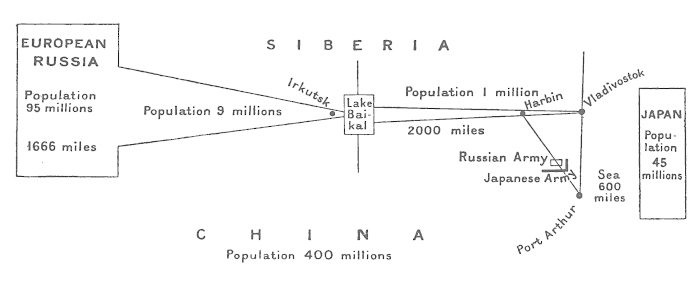
DIAGRAM SHOWING THE POSITION OF THE THEATRE OF WAR
RELATIVELY TO RUSSIA AND JAPAN.
But of all our difficulties, the complete command
of the sea obtained by the Japanese right at the
beginning of the war caused the greatest. With
their three armies they cut off Port Arthur,
and began an advance from an enveloping base
against our army, which was still tied to a
railway-line. Our southward advance for the
relief of Port Arthur was threatened by Kuroki’s
army based on Korea. Any movement against
him was out of the question, especially for those
corps which had arrived from Russia, as they
were quite unused to hilly country. Our
communications through Manchuria were only
weakly defended, and might be cut at any
moment by the Chinese, while those further
west were liable to interruption (bridges destroyed,
strikes, frost, etc.). The feeding of the
army depended on local resources, which a
hostile population could easily conceal, carry
away, or even destroy; and as the amount of
supplies obtained from Russia was extremely
small and uncertain, the army might very easily
have been starved. The chance actions at the
Ya-lu and Te-li-ssu, in which our most reliable
troops were worsted, still further improved the
enemy’s moral, and lowered ours.
With the absence of a proper military spirit
among our troops, and the evil influence of
the many seditious manifestoes against the war
circulating amongst them; with the unsteadiness
shown by many units in the first fights, and with
all the other defects above mentioned, a great
numerical superiority was necessary—I must
speak perfectly plainly—in order to defeat an
enemy worked up to a pitch of fanatical excitement.
But we did not obtain this superiority
until it was too late—when we were waiting on
the Hsi-ping-kai position, and negotiations for
peace were being carried on at Portsmouth.
Up to December we were fighting with what
seemed a fairly large force, according to a tally
of battalions; but these were greatly under
strength, for in the most important early period
of the war—from May to October inclusive—we
lost very many men, and received but few drafts.
In many cases the Japanese battalions were
twice as strong as ours. While all our actions
were hampered by insufficient information regarding
the enemy, the intelligence we received
as to what was happening in our rear—in Mongolia
and in the Manchurian provinces—was so
alarming as to compel us to detach a large force
to protect our communications. Again, when
the enemy became complete masters of the sea,
we had to detail sufficient troops to guard against
a landing in the Vladivostok and the Ussuri
districts. All these things combined to complicate
our position and give the enemy the
initiative at the start, and right manfully did
their whole nation strive to seize their advantage.
Their land communications were safe; their sea
communication with their base was quick and
sure. We, on the contrary, could only put in
the field a fraction of our land forces, and, till
we could concentrate sufficient men for an
offensive, were tied down to a definite course
of action. We had—
1. To make certain of and protect the concentration
of the reinforcements which were
arriving, so as not to allow them to be destroyed
as they came up.
2. To take steps to relieve Port Arthur.
3. To maintain order in our rear, and to
guard the railway.
4. To feed the army—mainly on local supplies.
5. To guard the Ussuri district.
Had the Japanese got possession of our communications,
a catastrophe unprecedented in
military history might have resulted. Without
any victory in the field, the mere destruction of
the railway in our rear, combined with the cutting
off of local resources, would have threatened
us with starvation—and disaster. Such were the
unfavourable conditions under which we fought
for fifteen months, and our army was not only not
completely defeated, but grew in strength, while
our communication with Russia gradually became
better secured and more efficient. We had
always recognized the possibility of being driven
back to Harbin and beyond; but this never
happened, and we held on to Hsi-ping-kai.
The situation could only have been improved in
one way—by a rapid concentration of sufficient
troops for, and an assumption of, an offensive all
along the line. While these troops were collecting,
each fight—quite independent of its actual
result—would have really helped us if it had at
all weakened the enemy. But our departure from
our accepted plan of operations began at the
commencement of the war, when, instead of
fighting a rearguard action, General Zasulitch
got seriously engaged against the whole of
Kuroki’s army at the Ya-lu, and was defeated.
In May, when the 3rd Siberian Division[12] had
alone arrived at Liao-yang (besides the troops of
the Pri-Amur Military District), the Viceroy,
fearing for the fate of Port Arthur, instructed
me to assume the offensive towards the Ya-lu
against Kuroki’s army, or southwards for the
relief of the fortress of Port Arthur. But the
inadequate force with which General Shtakelberg
pushed forward, owing to ignorance of the
fact that the Japanese were in superior strength,
got drawn into a serious engagement at Te-li-ssu,
and was defeated. With the arrival of all
the units of the 4th Siberian Corps and one
division of the 10th Army Corps, it seemed
possible to contain Kuroki’s army, to concentrate
fifty to sixty battalions rapidly in the direction of
Ta-shih-chiao, and to attempt to hurl back Oku
to the south. It seemed as if our army had a
splendid chance of operating on interior lines.
The enemy was strung along three lines of
advance—Dalny, Kai-ping, Ta-shih-chiao (Oku);
Ta-ku-shan, Hsiu-yen, Ta-ling, Hai-cheng
(Nodzu); Ya-lu, Feng-huang-cheng, Fen-shui-ling,
Liao-yang (Kuroki). We occupied the
central position—Liao-yang, Hai-cheng, Ta-shih-chiao—with
advance guards thrown forward on to
the Fen-shui-ling heights. We might have been
able, by containing two armies and deceiving
the enemy by a demonstration, to strike the third
army in force. A blow delivered at Kuroki or
Nodzu did not promise success, owing to our lack
of training in, and unpreparedness for, hill warfare
[we had no mountain artillery, our baggage was
heavy, and we were uncertain of receiving supplies,
owing to the insufficiency of transport material].
The only other course was to strike at Oku, who
was based on the railway, but such an operation
was risky, because Kuroki and Nodzu might
have driven back our screens and fallen on our
communications. On June 26 and 27, when
only one brigade of the 31st Division of the
10th Army Corps[13] had arrived at Liao-yang, the
Japanese on the eastern front (Kuroki and Nodzu)
themselves took the offensive and seized the
passes (Fen-shui Ling, Mo-du Ling, Da Ling) on
the Fen-shui-ling heights. We opposed them in
insufficient strength, and did not even make them
disclose their numbers. The troops of the eastern
force withdrew towards Tkhavuop, and General
Levestam’s force to Hsi-mu-cheng. Our screens
were thus situated as follows: on Kuroki’s line
of advance, only two marches from Hai-cheng;
on Oku’s line of advance at Ta-shih-chiao, four
marches from Liao-yang.[14] Our position was
critical, particularly if the information we had
received as to the Japanese collecting in considerable
force to operate against Hai-cheng was confirmed.
Still, if we were able to strike a rapid
blow at Oku, we might rob the enemy of the
initiative, and after forcing back Oku’s army,
have fallen on Nodzu. After we had driven
back these troops, Kuroki’s position would
have been so far forward and so far separated
from the other groups that the danger of his
breaking through to Liao-yang would have been
minimized. But for such decisive operations the
first requisite was the concentration of sufficient
troops for offensive operations against Oku.
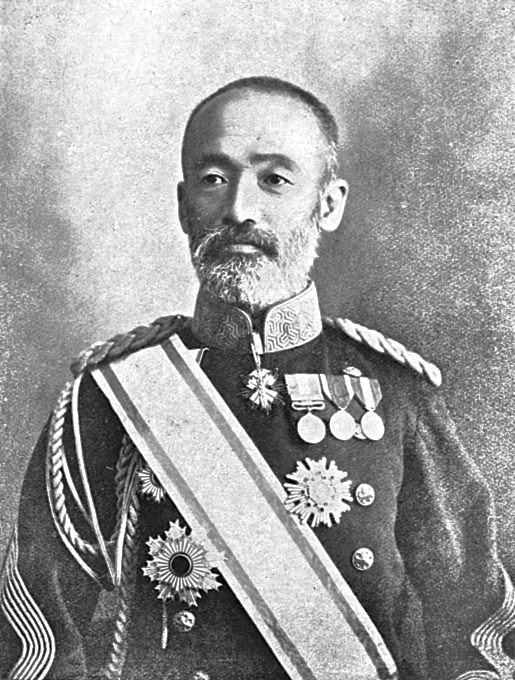
GENERAL BARON KITEN NOGI.
At the end of June we had altogether available
against the three Japanese armies 120 battalions,
and were inferior to the enemy both in the
number of battalions and the number of men.
Our position was made worse by an epidemic of
dysentery which broke out amongst the troops
at Ta-shih-chiao, and swept off a considerable
number of men. The Krasnoyarsk Regiment[15]
was the greatest sufferer, having as many as
1,500 men down with the disease at the end of the
month. But the main thing which delayed any
advance on our part was the rain, which made
all moves difficult, and some places absolutely
impassable for transport. It was even difficult
to convey supplies to our various stationary forces
over distances of less than a march. In spite of
the lack of pack-saddles, wheeled transport had
to be given up for pack transport, and not even
pack-animals could do more than seven to eleven
miles in the twenty-four hours. On the Liao-yang–Lang-tzu-shan
road things were still
worse, for the bridges over the mountain streams
had been carried away, and communication
between the eastern force (3rd Siberian Corps,
under Count Keller) and Liao-yang was interrupted
for some time. Far, therefore, from being
ready to advance, the officers commanding the
1st and 4th Siberian Corps found the greatest
difficulty in rationing their troops, and on
June 29 asked that they might be withdrawn
towards the positions near the railway at Ta-shih-chiao,
and that the country east of the line
might be left to the cavalry, with a few infantry
units in support.[16]
General Count Keller was persistent in his
demands that communication should be maintained
between his force and Liao-yang, but we
had neither the material, the means, nor the time
to comply with his wishes, which would have
meant the laying of a light railway and the
strengthening of the road bridges. As I feared
that the Japanese might make a fresh forward
movement on Hai-cheng, I ordered thirty-nine
battalions to concentrate near Hsi-mu-cheng on
June 29. The short march from Hai-cheng was
accomplished on the 28th with great difficulty
through a sea of mud, and on the 29th Hsi-mu-cheng
was temporarily cut off by the mountain
streams in flood. The feeding of the troops
collected there was found to be so difficult that
as soon as it was known that the enemy, instead
of advancing, had retired towards the Fen-shui
Ling (Pass), certain units were ordered to return
to the railway. Taking advantage, on July 18,
of the screen formed by a portion of the
17th Army Corps, we attempted to advance
against part of Kuroki’s army in the hope of
forcing our way forward and gaining a partial
success. For this Count Keller had under his
command forty-three battalions, but the attempt
failed. He stopped the action before any large
number of our troops had become engaged. On
the 29th Oku’s army took the offensive; we had
to evacuate Ta-shih-chiao and Newchuang after
a feeble resistance, and allowed Oku and Nodzu
to join hands. When on July 23 I inspected
the units of the 10th Army Corps, who were
holding the position near Hu-chia-tzu, I found
out how absolutely incapable of operating in hilly
country the troops newly arrived from Russia
were. Before sending them forward, it was
necessary to train them in hill fighting, and to
provide them with pack transport. On July 31
all three Japanese armies advanced, and we
concentrated after a series of battles round
Liao-yang. Here, in spite of our resistance, the
three armies were able to join hands. Their
attacks on the left bank of the Tai-tzu Ho were
repulsed, but owing to the unfortunate nature of
our operations on the right bank, the conditions
became so unfavourable to us that I was obliged
to order a retirement to Mukden. The withdrawal
was conducted without the loss of a
single gun or transport cart, while the enemy
lost in men more heavily than we did. In the
detailed accounts I have given in the first three
volumes of the operations at Liao-yang, on the
Sha Ho and at Mukden, our difficulties and the
causes of our defeats are explained. The course
of events showed that our original scheme of
operations was quite a correct forecast, for in it
the probable necessity of retiring towards Harbin
had been foreseen. Indeed, matters at Liao-yang,
on the Sha Ho, and especially at Mukden, might
have been very much worse for us than they were,
and might have necessitated our retirement on
Harbin early in October, 1904, when, as a matter
of fact, we remained in Southern Manchuria.
Clausewitz has truly laid down that an army
should be inseparably connected with its base, but
our base was Russia, more than 5,000 miles away.
The way that this one difficulty alone was overcome
will perhaps be eventually appreciated at
its true worth. The very complicated attendant
circumstances demanded great and patient efforts
on the part of the whole nation in order to turn
them to our advantage. Our reverses were explicable,
and even in our defeat we exhausted our
enemy, while ourselves increasing in strength. It
was inevitable that a different complexion would
have been put on the face of things as soon as
circumstances became more favourable to us.
The war showed that our army organization
gave us too small a percentage of actual combatants
as compared with the total numbers
whom we rationed. By this I mean that, in
spite of the immense numbers that we maintained
in the face of great difficulties, we were
unable to put enough men into action to win.
Our establishments of all arms, of parks, hospitals,
transport corps, field bakeries, staffs, and all
offices and institutions, include a large percentage
of non-combatants, which was swollen in the
last war by the absence of any organized line of
communication troops, the necessity of carrying
out a large amount of railway construction, and
of appointing officers and men to newly formed
supply and transport units. Even so the
number of non-combatants laid down in the
establishments for each unit was not sufficient
to perform the duties that fell to them, and it
became necessary, for reasons which will be
mentioned later, to detail combatants for
domestic duties. As but few non-combatants
were wounded in action, the proportion of them
to the combatant element became still greater
after every big fight. It was usual, when a
battle was imminent, to order back to their units
all men who were on extra-regimental duties,
but in spite of all the steps taken, the fighting
number was never more than 75 per cent. of the
number of men on the strength. In the beginning
of April, 1905, when we were preparing
the theatre of war up to the River Sungari, the
combatant element of the 1st Manchurian Army
actually fell to 58 per cent. of the strength.
As in previous wars, the infantry, of course, did
most of the fighting, and also carried out by far
the greater number of fatigues and extra duties.
As they also lost more men in action, their
fighting strength was proportionately more reduced
than that of the other arms.[17] In April,
1905, the percentage of rifles in the 1st Manchurian
Army to the total number of men that
had to be rationed was 51·9 per cent. When
the convalescents returned to the ranks, its
strength amounted by the beginning of December
to 192,000 men, of whom 105,879 carried rifles;
but we could only put a much smaller number
in action owing to various duties, fatigues, etc.
In August, 1905, the number of rifles was
58·9 per cent. of the total of men rationed.
To obviate this state of affairs, and to insure
that companies should be as strong as possible in
action, I gave orders on June 9, 1905 [when I
was commanding the 1st Manchurian Army],
that out of each of the four battalion regiments,
not more than 369 combatants should be detailed
for extra duties. This figure included 128
stretcher-bearers, 35 bandsmen, and 48 men for
baggage guards. In addition to this, a large
number of men were required for road and bridge
work on the communications, for guards for the
different stores, for working parties to assist
the supply and medical services, for policing
villages, for duty with the improvised transport
units, etc. True, this had its compensations,
for we were able thus to get rid of the 2nd
Category reservists from the ranks; but we felt
the loss in the number of rifles we could place in
the firing-line. Of course, there were, in addition,
the sick, the wounded, and the convalescents
with units and in hospital. In this way the
total of all ranks classed as combatants but
absent from the firing-line, or not doing combatant
work, amounted on the average to 800
men out of every four-battalion regiment, or
about one-quarter of its strength. To carry on the
campaign without properly organized units on the
communications, without sufficient camp guards,
without making roads and bridges, without allowing
men for transport and baggage duties, was
impossible. Notwithstanding the good payment
we offered, the native population did not come
forward to work freely, especially when fighting
was imminent. A certain number were employed
on transport, but they were very unreliable, and
bolted at the first alarm, often taking their
horses and carts with them. During the battle
of Mukden, for instance, the whole of the
hired transport of the 1st Army, consisting of
400 carts, entirely disappeared. Our attempts
to obtain Russian hired labour were a failure,
though the rates of pay offered were liberal
enough.
The extent to which transport duties were
responsible for weakening the fighting strength
of the army can be seen from the fact that, during
the fifteen months of war, 122 transport units
were formed, and 8,656 carts, 51,000 horses, and
20,000 pack-animals purchased. For duty with
these, 328 officers, 22,000 men, 1,700 hired
civilians (Russians), and 9,850 Chinamen were
employed. These 122 units were improvised
under adverse conditions and from small cadres,
and, as they had to be raised in a hurry, there
was nothing for it but to appoint to them men
and officers from the army.
The strength of units also decreased most
marvellously in action. This was partly due to
losses, but often also due to the habit of men
leaving the firing-line to carry wounded to the
rear. This was sometimes done with permission,
sometimes without. Very often the men who
retired did not have this excuse.
I have pointed out (in Chapter VII.) that the
army did not receive its drafts in time, and that
we had to fight below strength; this shortage
was still further increased for the following
reasons: The war establishment of a company
was 220 rifles; but from this number had to be
deducted the shortage with which units arrived
at the front,[18] the sick, and those detailed for
camp and other duties—a procedure which,
though unprovided for by Regulations, was
permitted by officers in command. Accordingly
companies often went into the very first fight at
a strength of only 160 to 170 rifles. For a long
time the personal supervision exercised by commanding
officers to insure that units took the
field as strong as possible was very slack. It
seemed, on the contrary, as if their efforts tended
all the other way, for they left men behind whenever
they possibly could, particularly those who
were most necessary—i.e., those on whom depended
the payment and regular rationing of the
men. Thus, with the exception of the regimental
adjutant, the staff of a regiment rarely went into
action; while of the men who are classed as combatants,
the company clerks, armourer-sergeant,
cooks, officers’ servants, the butcher, the cattle
guards and the officers’ grooms, were always left
behind. The formation of a force of mounted
scouts took away a certain number of men, and
stretcher-bearers and bandsmen of course did not
fight. Finally, owing to the peculiar nature of
the country, donkeys for carrying water were
provided for each company, and these required
men to look after them, and one or two entire
companies from each regiment had to be detached
as baggage guard owing to the insecurity of our
communications. Commanding officers thought
it necessary to leave behind so many men for the
above purposes that the orders given for them
to accompany the firing-line were either quite
neglected, or only half carried out. It was soon
found that eight bearers per company were
far too few for carrying wounded, and men
from the ranks were allowed to help their
wounded comrades to the rear. From this
cause companies often literally melted away
during a fight. There were many instances
where unwounded men went to the rear under
pretext of carrying away the wounded, at the
rate of six, eight, or ten sound soldiers to one
wounded! The return of these willing helpers
to the front was not so prompt as it might have
been, and was difficult to control. The result
was that a company hotly engaged usually only
had 100 or less rifles after a few hours’ fighting,
although its losses might have been inconsiderable.
Meanwhile, as we only asked for drafts strong
enough to bring companies up to the established
war strength, without taking into account the
above extraordinary leakage, the drafts we received
did not bring companies up to their proper
strength in action.
The reason why the lines of communication in
the field[19] took so large a number away from
our fighting-line was that we had no proper
communication units, and the large working
parties necessary for the light railway, road and
bridge work had to be drawn from the fighting
troops. It was entirely owing to the care with
which the commanding officers on the line of
communications—especially those in the engineers—had
been selected that we were able to fight,
and at the same time to make roads of some
hundreds of miles’ length for intercommunication
between corps. For instance, at the end
of 1904 and the beginning of 1905, when the 1st
Army was south of the Hun Ho, out of 180,000
men, 7,000 were on the line of communications.
At the beginning of July, 1905, when the strength
of the 1st Army had gone up to 250,000, and
the communications stretched back a length of
150 miles to the River Sungari, there were 10,000
men employed on them—i.e., 4 per cent. of the
army’s strength. The length of the road made
on the Hsi-ping-kai positions by the 1st Army
alone amounted to 1,000 miles, with bridges of
more than 20 feet breadth and 50 feet span, and
nearly 40 miles of embankment. Though the
greater part of this was done by hired Chinese
labour, even in this comparatively quiet period the
troops of the 1st Army were on “works” for a
period of 30,000 working “man days.”[20]
The supply service, also, as has been
mentioned, absorbed a large number of men. The
field commissariat were unable, at the beginning
of the campaign, to work the bakeries owing to
the lack of men. All the bakeries, therefore,
were taken over by the troops, who had to build
the ovens, buy flour, and bake the bread themselves.
Thus the eight field bakeries (of which
four were in Liao-yang) which arrived in Harbin
and Liao-yang without transport or men had
at first to be taken over by the troops. But
from May, 1904, onwards the Governor-General
insisted on most of the work being handed back
to the Commissariat Department. The energy of
General Gubur, the Field Intendant of the army,
in obtaining supplies locally rescued it from
the difficult position in which it was beginning
to find itself owing to the constantly increasing
number of mouths and to the inadequate number
of supply trains. Assisted by Generals Bachinski
and Andro, General Gubur took full advantage of
all the resources of the country. For this, again,
officers and men were necessary to guard supply
depôts and collect and escort herds of cattle, and
were taken from the combatant troops. A large
part of the forage and meat the troops obtained
for themselves, but this entailed the provision
of strong foraging parties, which went far afield
and often remained away a considerable time,
and of permanent guards to tend the regimental
cattle. When the troops of the Pri-Amur district
were concentrated in Manchuria, they left a
number of men behind as “base details” to look
after their buildings and property. Touch was
maintained between these base details and the
units at the front during the whole war; from
them the troops received their warm clothing
in winter, and to them it was sent back in the
summer of 1905. This all meant the employment
of soldiers. Finally, men had to be told
off for topographical work, reconnaissance, and
as escorts for officers and other persons, etc.
The number for all the above duties taken
together, with the wounded and sick present
with units, constituted on an average 400 to
500 men per regiment. This, added to the 369
authorized “employed” men above mentioned,
brought the total up to 800. Obviously such a
loss of numbers must be taken into consideration
in appreciating the fighting work of the army.
Other things which contributed to the same
result were the immense development of the
different staffs and administrations, the auxiliary
institutions, such as supply parks and hospitals,
the congestion on the roads caused by the masses
of baggage which had collected, and the fact
that both our wheeled and pack transport carried
less than it was supposed to owing to the hilly
country and the all-prevailing mud. After heavy
fighting our army corps, especially those consisting
of three-battalion regiments, amounted
to less than 10,000 to 15,000 rifles, and yet the
immense organization, military parks, baggage,
and transport, etc., for a full corps had still to
be guarded. Even the regimental standards,
which should have been a source of strength and
encouragement in the fight, were in many cases
prematurely taken to the rear under a guard of
a company or half a company, the troops at the
front being weakened by this number at the
most important moment of an action. I was
obliged to make a ruling that in action the
standards should be kept with the regimental
reserves, and that steps should be taken that
they should be a symbol of victory in the most
critical phases of a fight (as used to be the case in
former wars), and a source of strength instead of
weakness to the units which possessed them.
In September and October, 1905, instead of
one Manchurian army, three were formed (the
1st, 2nd, and 3rd); they were all intended for
operations in the Mukden area, and were based
on the one railway which constituted their
common line of communications. The powers
of the army commanders were as laid down by
regulation. Officers in command of armies were
given (Field Service Regulations, 1890) almost
all the powers formerly vested in the Commander-in-Chief.
As regards fighting, it was laid down
that “in conducting military operations the officer
commanding an army should be guided by the
instructions of the Commander-in-Chief, but
should act independently.” This latitude would
be very convenient in operating in Europe,
where each army would have its own independent
line of communications; but in the
conditions which existed at Mukden—one
common position and one line of communications
for all—and with a difference of views
existing between the army commanders as regards
the conduct of affairs, the arrangement
was, to say the least of it, extremely unsuitable.
A difference of opinion upon some vital matter
might easily arise, when it might be necessary
either to order the army commander to carry
out an operation which he thought unnecessary,
inopportune, or even dangerous, or else to ask
for him to be replaced. For instance, a fortnight
before we assumed the offensive on January 25,
after everything had been settled and all plans
drawn up, General Grippenberg suddenly surprised
me by his opinion—that the campaign
was lost; that we should retire towards Harbin,
hold that point and Vladivostok, and thence
move with two armies in other directions. In
which directions, he was unable to explain. The
Commander-in-Chief’s instructions on many
essential points, such as the danger of holding
non-continuous lines[21] and the necessity for having
strong army reserves, were not carried out
because the responsibility for holding the defensive
positions occupied by the armies rested
on the army commanders. Thus my endeavours
to send at least twenty-four battalions—if not
the whole of the 17th Army Corps—from the
3rd Army into the reserve failed, as the officer
commanding that army thought that his position
in the centre would not be safe if the regiments
of the 17th Corps, which was in advance, were
replaced by reserve regiments of the 6th Siberians.
As mentioned in the account of the operations
of the 14th Infantry Division at Hei-kou-tai,
notwithstanding my instructions to conceal our
intention of attacking the enemy’s left flank as
long as possible, General Grippenberg, for no
apparent reason, and without even asking permission,
assumed the offensive almost two weeks
before the time that I had fixed by moving the
14th Division towards Ssu-fang-tai (on the
heights by San-de-pu) on January 13, and by
moving the 10th Army Corps into the advanced
lines between the right flank of the 3rd Army
and the River Hun on the 16th. By this
the enemy was informed of our intentions before
we began our forward movement, and the front
of the 2nd Army was spread over thirteen
miles.
With the exception of General Linievitch,
our army commanders were unnecessarily
sensitive to interference with their powers, and in
cases where orders would formerly have been
issued to corps commanders it now became
necessary to reckon with the personal opinions
of army commanders, and to guard against
offending their susceptibilities. After the pomp
and parade of General Grippenberg’s departure
from the army, the relationship between the
army commanders and the Commander-in-Chief
became still more strained. How jealously they
looked after their rights, and how strangely they
interpreted their own powers, is illustrated by
the following incident: On February 19 I sent
for the three army commanders and their chief
staff officers, in order to ascertain their views as
to the plan of operations which should be undertaken
under the unfavourable conditions brought
about by the fall of Port Arthur and General
Grippenberg’s unsuccessful operations at Hei-kou-tai.
The following courses were open to
Nogi’s army, no longer required in the Kuan-tung
Peninsula: it might join the four armies
already in the field against us; it might, together
with the divisions formed in Japan and the
troops in Korea, form a force of seventy to
eighty strong battalions for operations against
Vladivostok, or, landing at Possiet Bay, it might
march against Kirin and Harbin, so as to outflank
our position at Mukden. I had also been
continually receiving reports from General
Chichagoff to the effect that the enemy had
invaded Mongolia, and, aided by numerous bands
of Hun-huses, had begun to attack the railway
in our rear, which had forced me to weaken the
army by detailing an infantry brigade and four
Cossack regiments to reinforce the railway guard
and safeguard our position. In spite of these
reports, Generals Linievitch and Kaulbars expressed
the opinion that we ought not to change
our plans, and should carry out the orders I had
issued on January 25—namely, to fall on the
enemy’s left flank. But when my Chief of Staff
asked the officer commanding the 2nd Army—who
was to commence the operation—how he
proposed to employ his cavalry, Kaulbars,[22] looking
upon the question as an interference with
his authority, became annoyed, and said much
that was unnecessary and quite beside the point.
As it turned out, the Chief of the Staff had every
reason to be anxious as to the employment of
this Army, for its work in the battle of Mukden
was anything but satisfactory.
The very large powers vested in army commanders
in the matter of bestowing distinctions
was both unnecessary and harmful. They were
authorized to award the fourth class Order of
St. George on the recommendations of committees
convened by them; they could give the
Distinguished Service Cross to private soldiers,
and award the Orders of St. Anne, second, third,
and fourth classes, and St. Stanislav, second and
third classes, with swords and ribbons. As the
forces were lying so close together, it was very
soon noticed that the distribution of decorations
in the different armies varied very much, being in
accordance with the personal predispositions of the
different commanders. In one army they were
so lavishly bestowed as to excite general derision,
and their value was much lowered in consequence.
By far the worst offender in this respect was
one well-known general, who for one and the
same engagement [Hei-kou-tai] decorated divers
officers with two Orders apiece, while, contrary
to regulations, he bestowed the Distinguished
Service Cross to fifteen and more men per company
and battery. I jotted down in my diary
my impressions after inspecting units of the
2nd Army. Amongst other things, I noted that
he had awarded thirty Distinguished Service
Crosses to a battery, of which only seventy men
had been in action and even then scarcely under
fire. Indeed, to my astonishment, as they stood
on parade almost the whole of the front rank
were wearing crosses. The officer in command
told me that he had been ashamed to announce
these rewards to the men, and to have to try and
select certain specific acts for them. I told the
men I hoped that they would show themselves
worthy of these marks of distinction in the fights
to come!
The large independent powers possessed by
the army commanders in matters of supply were
also superfluous in a case where there was only
one railway and one tract of country in which to
procure supplies. The only result was that
prices were raised all round by the fact that the
different armies were bidding against each other.
In this respect General Grippenberg’s behaviour
was most incomprehensible. As meat was very
scarce in December, I advised him to cut down
the meat ration from 1 pound to ½ pound.
Instead of this, by an order issued on January 3,
he increased it to 1½ pounds per man per day.
With the conditions that obtained generally on
the Sha Ho, and if our army corps had been
organized on a broader basis, there would have
been no necessity whatever for three separate
army commanders with their special powers;
but they were appointed. And yet, after the
disaster of Mukden, it was the Commander-in-Chief
who was generally held responsible for
everything.
As regards the personnel, I will give in full
the impressions recorded in my report on the
1st Manchurian Army at a time when the
experiences of the war were fresh in my mind;
my opinion in the main agrees with those of other
senior commanders.
(a) The Command.—No appreciation of the
senior commanders—that is to say, of the work
done by individual corps, divisional, and brigade
commanders—can or, indeed, ought to be made
at present. The personal element is too prominent.
We must wait till personal feelings
have died away, so as to be able to draw impartial
conclusions based on authenticated facts,
and on facts alone, as to what happened and
who was to blame. All the same, it may be
said that the most pronounced weak points
amongst our senior commanders, especially in
the first period of the campaign, were their lack
of initiative, their ignorance of the method in
which an attack should be conducted, and their
want of determination. There was never any
co-ordination in the operations of large units,
which were really quite remarkable for their
absolute disconnection. Indifference as to the
position of neighbouring forces was the rule, and
a tendency to accept defeat before a fight was
really lost was painfully evident. Even our best
commanders preferred their neighbour to be told
off for the attack, while they themselves remained
in support. If a column were retiring under
difficulties, any other forces close at hand would
withdraw also, instead of coming to its assistance;
and there was practically no instance of a bold
forward movement. The work of the regimental
commanders was certainly better than that of
those higher up, but it was impossible not to
notice that they did not possess the power of
making the most of a situation and finding their
way about. A regimental commander detached
on special duty could rarely make his arrangements
without the assistance of an officer of the
General Staff; he could not, as a rule, read a
map himself, much less teach those under him
how to do so. This was especially the case at
the beginning of the war, and had considerable
influence on the conduct of operations, as regiments
often either arrived late at their rendezvous
or went to points where they were not wanted.
The lack of eye for country is partly explained
by the fact that our officers were quite unused
to hills. Though this defect certainly became
less marked as time went on, it was still perceptible
in the operations round Mukden, and
even afterwards.
Though the officers lacked a proper military
spirit, they were generally good in other ways,
particularly those of the regular army. The
best proof of their gallantry is furnished by the
number of losses sustained by the 1st Army
from November, 1904, to September, 1905, from
which it will be seen that their proportion of
killed and wounded was considerably higher
than that of the men.
|
Officers. |
Rank and File. |
| Numbers. |
Percentage
to Average
Strength. |
Numbers. | Percentage
to Average
Strength. |
| Killed |
167 |
4⋅1 |
4,779 |
2⋅5 |
| Wounded |
905 |
23⋅8 |
27,425 |
14⋅6 |
| Missing |
89 |
2⋅1 |
5,684 |
2⋅9 |
|
1,151 |
30⋅0 |
37,888 |
20⋅0 |
The losses in this army for the whole period
of the war were somewhat higher:
| | | Officers. |
|
Rank and
File. |
| Killed |
… |
… |
396 |
… |
10,435 |
| Wounded |
… |
… |
1,773 |
… |
56,350 |
With the exception of those who had volunteered
for the front, the officers of the reserve
were not nearly so well qualified as those of the
regulars; they were much behind them in
tactical training, and did not always perform
their duties with the zeal which should be shown
on active service. Many ensigns of the reserve
turned out unsatisfactory, having accepted this
rank purely to escape becoming private soldiers
upon mobilization; they had no sympathy with
the military profession, and hated soldiering.
They were absolutely without training, and some
of them had no authority whatever over the
men. The ensigns and acting ensigns[23] promoted
from the ranks for distinguished service
were excellent in every respect. Having been
selected from the rank and file, they usually
appreciated their rank, and had considerable
authority amongst the men; they got on well
with the officers, and proved efficient and hard-working
assistants to the company commanders.
The extent to which the acting ensigns sacrificed
themselves to duty is evinced by the fact that
of 680 in the 1st Army in February, 192 were
killed and wounded in the Mukden battle—i.e.,
more than 28 per cent. The moral tone of
the officers was quite satisfactory; during the
whole period of the war only nineteen were
dismissed for unbecoming conduct. In reporting
on the work done by the officers of the General
Staff, the majority of the senior officers in command
of troops expressed the opinion that their
theoretical training and intelligence stood very
high, and that their work was unselfish, but that
they were not sufficiently in touch with the troops,
and lacked the personal, practical knowledge
required to enable them to judge properly how
much might be expected of men, and in what
way an order would be carried out—a knowledge
which is necessary if small errors are to be
avoided in the transmission of orders, etc. They
recommended that, to give these staff-officers the
necessary practical training, they should do most
of their service with troops of all three Arms,
and only a part of their service on the staff;
while, to prevent them being looked upon by
the troops as mere clerks, they should be relieved
of the mass of clerical work that now falls to the
General Staff. As in other bodies of men, so
amongst these officers are to be found some
specially fitted for field-work, and others, again,
who prefer purely staff duties, and in my opinion
the two classes should be separated. Generally
speaking, the General Staff officers in the
1st Army did everything that was required of
them. From November, 1904, to September,
1905, their losses in killed and wounded amounted
to 12 per cent. of their strength; if the casualties
which occurred before the formation of the
1st Army are taken into account, the percentage
works out as much as 25·7. During the whole
of the above time only four were sent back to
Russia on account of sickness, while the majority
of the wounded returned to the front.
As regards the senior commanders, many
general officers who had commanded independent
units with great success in peace-time were quite
unfitted to take command of large units under
the stress of war. Few had even had sufficient
peace practice in the actual command of divisions
and corps, and many were not up-to-date in their
knowledge of modern war requirements. The
general characteristic displayed by most was their
lack of the power of forming a decision and a
disinclination to accept responsibility. Some
arrived at the front actually holding important
commands for which they were—either through
ill-health or for other reasons—quite unfitted.
From three army corps, composed of veteran
regiments which had arrived earlier than others
in the theatre of war, there retired, or were sent
back, after the first fights, one corps, four
divisional, and several brigade commanders.
Amongst the reasons which contributed to complicate
the conduct of operations were the frequent
changes in the Commander-in-Chief, of
whom there were three in nineteen months.
From the beginning of the war till the end of
October, 1904—for eight and a half months—Admiral
Alexeieff was in supreme command;
from the end of October to the middle of March,
1905—four and a half months—I was in command;
from the middle of March till the end of
the operations—six months—General Linievitch
was in command.
The fact that I only commanded for four and
a half months out of nineteen, and that this
period was in the middle of operations, was not
taken into account by those who last year flooded
Russia with pamphlets and newspaper articles,
apparently written with the sole object of proving
that I, both as Commander-in-Chief and as War
Minister, was the person mainly responsible for
our misfortunes. In a letter to the Tsar, dated
February 21, 1906, from the village of Shuan-chen-pu,
I wrote on this point as follows:
“I am aware of the serious accusations levelled
against me in the Press. Though there are
among them many to which I would scorn to
reply, I should be happy to accept entire responsibility
for the disasters which have overtaken
us, but that such a course would be
historically incorrect. It would also be a mistake,
because it would lessen the general desire
of the whole army for a thorough investigation
of all the causes of our partial defeats, so that we
may be able to avoid them in the future.
“I venture to say ‘partial’ defeats, because
there could be no possible suggestion that our
land forces in Manchuria suffered defeat similar
to that sustained by the fleet. When peace was
concluded we had an army of almost one million
men, still holding positions occupied by us after
the Mukden battle, and ready, not only for the
defensive, but for a most active advance.
“Information that reached us from Japan
showed that the sources from which she had been
drawing the men for her armies were drained
dry, that her finances had been completely exhausted,
that discontent at the long-drawn-out
war was already making itself felt among her
people, and that for these reasons her army could
not reckon on further success against our superior
numbers. Therefore, the most searching and
exhaustive study of all our weak points cannot
shake the belief prevalent in the army that our
troops in Manchuria would have been victorious
if only the war had been continued.
“It will be for the future historian to decide
whether the troops we put into the field
before March, 1905, would have sufficed for
victory.
“Nowadays, with the complicated machinery
of modern armies, the personality of the supreme
commander is less important than it was. Without
trusty, able, and energetic subordinates, without
a spirit of initiative amongst all ranks, without
a superiority in numbers, and, what is most important,
without a military spirit amongst the
troops and patriotism in the whole nation, the
duty of a Commander-in-Chief is so difficult that
it is far too much for a merely talented leader.
It may be said that a military genius would have
overcome the moral and physical difficulties we
had to encounter. Possibly; but an Alexeieff,
a Kuropatkin, a Linievitch, a Grippenberg, a
Kaulbars, and a Bilderling were unable to do so.
“I venture to remind Your Imperial Highness
that, on receiving the orders appointing me to be
Commander-in-Chief, I did not joyfully express
my gratitude. I replied to the effect that it was
only a dearth of commanders which led Your
Majesty to select me. If I still firmly believed
in victory after the Mukden battle, I had, indeed,
good grounds for so doing.”
The author of the cleverly written article
entitled “All about Commanders” writes as
follows:
“The absence of initiative, the habit of always
relying upon superiors, and only acting when
ordered to from above, are characteristics of
junior commanders which made the work of
those at the head of the army more difficult.
The value of the time element in war also was
forgotten.”
The modern theorist in strategy, Blume, says:
“Even the greatest genius in a supreme commander
cannot replace independent action by
individual leaders.”
Even during actual operations numerous newspaper
articles appeared, well calculated to discredit
the officers. They were represented as
overbearing, rude, dishonourable drunkards. Indeed,
one of the most gifted of our writers—Menshikoff—went
very far in this respect, for
he wrote of the “blunted sense of duty, intemperance,
moral laxity, and inveterate laziness”
of a large body of men who never spared
their lives and performed their duty almost
religiously. In a diatribe against military life
by M. Kuprin, called “The Duel,” private
soldiers were represented as being treated with
the greatest cruelty, and it was implied that it
was the custom for our officers to slap and beat
their men on company parades. The writer
concluded by saying that the time would come
when the officers would be caught and beaten
in byways, when women would deride them,
and soldiers refuse to obey their orders. In the
great family of officers—as in other classes—there
are, of course, bad specimens, but no
generalization can be made from this as to the
class as a whole. If some officers were seen
drunk on the lines of communications or at
Harbin, it is not fair to jump to the conclusion
that all officers got drunk. They should be
judged after they have been seen in action, in
the trenches, and on the line of march, not only,
as they often were, by what happened in the
rear. But it is much easier to sit in St. Petersburg
or Harbin and hurl abuse than it is to
watch matters at the front. I have alluded to
the large proportion of killed and wounded
amongst the officers, which shows that their
gallantry has not grown less than it used to be,
and they certainly looked after the welfare of
the soldier in a way that was unprecedented.
The men were fed, clothed, cheered up, and kept
in good fettle. The junior officers were zealous,
soon found their feet under new and strange
conditions, and as they grew accustomed to the
local topography, became good map-readers.
The most severe critic must acknowledge that
the standard of our officers, both staff and
regimental, has been much raised since the
Russo-Turkish War.
But, according to the opinion of these same
observers, the private soldier has, on the contrary,
deteriorated during these twenty-seven years,
for, though a better man physically, he is
morally a worse man than he used to be. As
I have remarked, the men with the colours
were quite reliable, but many of the reservists—especially
the 2nd Category men—required much
supervision both in action and out of it, the
most difficult material to handle being that
from the manufacturing centres and large towns.
Soldiers nowadays require more looking after
than they did formerly, when but few were
literate. Up to the present, thank God, our
officers still have a good hold upon the men,
based on mutual respect; but great endeavours
were made at the beginning of the war to
undermine this.
Kirilloff and others have made a dead set
against the behaviour of the officers of our
General Staff in the late war, but the majority
worked most unselfishly, and did good service
commanding units or on the staff. A large
number distinguished themselves by their professional
zeal and gallantry, while some found
a glorious death in action. At their head may
be mentioned General Kondratenko, the hero
of Port Arthur. Among the killed also were
the gallant General Count Keller, Staff-Officers
Zapolski, Naumenko, Jdanoff, Pekuti, Vasilieff,
Mojeiko; and of those who died from wounds
were Andreeiff and Yagodkin. Among the
wounded were four divisional commanders—Lieutenant-Generals
Rennenkampf and Kondratovitch,
Major-Generals Laiming and Orloff;
also Staff-Officers Markoff, Klembovski, Gutor,
Rossiski, Gurko, Inevski, etc. Altogether, about
twenty officers of the General Staff were killed
and forty wounded. The hostile attitude of the
Press towards the officers, the endeavour of
divers persons to undermine their authority, the
indifference of the intelligent classes in Russia
to what was happening in Manchuria, and
especially the anti-Government campaign, which
was conducted with the object of creating a
mutiny among the troops, was hardly calculated
to raise the soldiers’ moral, or to encourage them
to perform acts of heroism. There was no
military spirit in the army.
The Rank and File.
The rank and file, like the officers, were of
two classes: those serving with the colours, and
the reservists. The former were in every respect
good; they were steady in action, enduring and
well trained; but the reservists were on a much
lower plane altogether. In the first place, the
older men were unable to stand the arduous
conditions of field service, coupled with the
rigours of the Manchurian climate. They suffered
greatly from sunstroke and heart affections
when marching among the hills, and during the
hot weather. At the battles of Ta-shih-chiao,
Hai-cheng, and Liao-yang, these men fell out
in such numbers that their units became quite
immobile, and absolutely useless for any offensive
operations. Moreover, the 2nd Category reservists
did not know the rifle, and had forgotten
everything they had once learnt when with the
colours, and it required real hard work to instruct
and train them up to the level of the serving
soldiers. I have mentioned their unsteadiness.
Units which were almost entirely composed of
these men—that is to say, those units which had
been formed by expanding the reserve regiments—were
very unsatisfactory: it was almost impossible
to get them into action. The regiments
of the 4th Siberian Corps, which did so splendidly
at Ta-shih-chiao, Hai-cheng, and Liao-yang, were
an exception; they were composed entirely of
Siberian reservists, who, though surly fellows
and poor marchers, were men of character and
very steady in action. The drafts composed of
young soldiers were magnificent. Most of them
had only just done their recruits’ course, were
single men, and possessed both staying power and
activity, and, being regular soldiers, were accustomed
to field-service conditions. Unfortunately,
it was only after the battle of Mukden that
these drafts began to arrive. But these young
soldiers who did so well in small actions would
have done still better in a decisive engagement.
The general feeling of discontent which already
prevailed in all classes of our population made
the war so hateful that it aroused no patriotism
whatever. Many good officers hastened to
offer their services—which was only natural—though
all ranks of society remained indifferent.
A few hundreds of the common people volunteered,
but no eagerness to enter the army was
shown by the sons of our high dignitaries, of our
merchants, or of our scientific men. Out of the
tens of thousands of students who were then
living in idleness,[24] many of them at the expense
of the Empire, only a handful volunteered,[25]
while at that very time, in Japan, sons of the
most distinguished citizens—even boys fourteen
and fifteen years of age—were striving for places
in the ranks. Japanese mothers, as I have
already said, killed themselves through shame
when their sons were found to be physically
unfit for military service. The indifference of
Russia to the bloody struggle which her sons
were carrying on—for little-understood objects,
and in a foreign land—could not fail to discourage
even the best soldiers. Men are not
inspired to deeds of heroism by such an attitude
towards them on the part of their country.
But Russia was not merely indifferent. Leaders
of the revolutionary party strove, with extraordinary
energy, to multiply our chances of
failure, hoping thus to facilitate the attainment
of their own unworthy ends. There appeared
a whole literature of clandestine publications,
intended to lessen the confidence of officers in
their superiors, to shake the trust of soldiers in
their officers, and to undermine the faith of the
whole army in the Government. In an “Address
to the Officers of the Russian Army,” published
and widely circulated by the Social Revolutionists,
the main idea was expressed as follows:
“The worst and most dangerous enemy of the
Russian people—in fact, its only enemy—is the
present Government. It is this Government
that is carrying on the war with Japan, and you
are fighting under its banners in an unjust cause.
Every victory that you win threatens Russia
with the calamity involved in the maintenance
of what the Government calls ‘order,’ and every
defeat that you suffer brings nearer the hour of
deliverance. Is it surprising, therefore, that
Russians rejoice when your adversary is victorious?”
But persons who had nothing in common with
the Social Revolutionary party, and who sincerely
loved their country, aided Russia’s enemies by
expressing the opinion, in the Press, that the
war was irrational, and by criticizing the mistakes
of the Government that had failed to prevent it.
In a brochure entitled “Thoughts Suggested
by Recent Military Operations,” M. Gorbatoff
referred to such persons as follows:
“But it is a still more grievous fact that while
our heroic soldiers are carrying on a life-and-death
struggle, these so-called friends of the
people whisper to them: ‘Gentlemen, you are
heroes, but you are facing death without reason.
You will die to pay for Russia’s mistaken policy,
and not to defend Russia’s vital interests.’ What
can be more terrible than the part played by
these so-called friends of the people when they
undermine in this way the intellectual faith of
heroic men who are going to their death? One
can easily imagine the state of mind of an officer
or soldier who goes into battle after reading, in
newspapers or magazines, articles referring in
this way to the folly and uselessness of the
war. It is from these self-styled friends that the
revolutionary party gets support in its effort to
break down the discipline of our troops.”
Reservists, when called out, were furnished by
the anti-Government party with proclamations intended
to prejudice them against their officers,
and similar proclamations were sent to the army
in Manchuria. Troops in the field received
letters apprising them of popular disorders in
Russia, and men sick in hospitals, as well as men
on duty in our advanced positions, read in the
newspapers articles that undermined their faith
in their commanders and their leaders. The
work of breaking down the discipline of the army
was carried on energetically, and, of course, it
was not altogether fruitless. The ideal at which
the leaders in the movement aimed was the state
of affairs brought about by the mutinous sailors
on the battleship Potemkin. These enemies of
the army and the country were aided by certain
other persons who were simply foolish and
unreasonable. One can imagine the indignation
that the M―s, the K―s, and the
K―s would feel if they were told that they
played the same part in the army that was played
by the persons who incited the insubordination
on the Potemkin; yet such was the case. Firm
in spirit though Russians might be, the indifference
of one class of the population, and the seditious
incitement of another, could hardly fail to
have upon many of them an influence that was not
favourable to the successful prosecution of war.
Commanding officers in the Siberian military
districts reported, as early as February, that
detachments of supernumerary troops and reservists
had plundered several railway-stations,
and later on regular troops, on their way to the
front, were guilty of similar bad conduct. The
drifting to the rear of large numbers of soldiers—especially
the older reservists—while battles
were in progress was due not so much to
cowardice as to the unsettling of the men’s minds,
and to a disinclination on their part to continue
the war. I may add that the opening of peace
negotiations at Portsmouth, at a time when we
were preparing for decisive operations, unfavourably
affected the moral of the best in the
army.
M. E. Martinoff, in an article entitled “Spirit
and Temper of the Two Armies,” points out that
“ ... even in time of peace, the Japanese people
were so educated as to develop in them a patriotic
and martial spirit. The very idea of war with
Russia was generally popular, and throughout
the contest the army was supported by the
sympathy of the nation. In Russia, the reverse
was true. Patriotism was shaken by the dissemination
of ideas of universal brotherhood and
disarmament, and in the midst of a difficult
campaign the attitude of the country toward the
army was one of indifference, if not of actual
hostility.”
This judgment is accurate, and it is evident,
of course, that with such a relation between
Russian society and the Manchurian army it
was impossible to expect from the latter any
patriotic spirit, or any readiness to sacrifice life
for the sake of the Fatherland. In an admirable
article, entitled “The Feeling of Duty and the
Love of Country,” published in the Russki
Invalid in 1906, M. A. Bilderling expressed
certain profoundly true ideas as follows:
“Our lack of success may have been due, in
part, to various and complicated causes, to the
misconduct of particular persons, to bad generalship,
to lack of preparation in the army and
the navy, to inadequacy of material resources,
and to misappropriations in the departments of
equipment and supply; but the principal reason
for our defeat lies deeper, and is to be found in
lack of patriotism, and in the absence of a
feeling of duty toward and love for the Fatherland.
In a conflict between two peoples, the
things of most importance are not material resources,
but moral strength, exaltation of spirit,
and patriotism. Victory is most likely to be
achieved by the nation in which these qualities
are most highly developed. Japan had long been
preparing for war with us; all her people
desired it; and a feeling of lofty patriotism pervaded
the whole country. In her army and her
fleet, therefore, every man, from the Commander-in-Chief
to the last soldier, not only knew what
he was fighting for, and what he might have to
die for, but understood clearly that upon success
in the struggle depended the fate of Japan, her
political importance, and her future in the history
of the world. Every soldier knew also that
the whole nation stood behind him. Japanese
mothers and wives sent their sons and husbands
to the war with enthusiasm, and were proud
when they died for their country. With us, on
the other hand, the war was unpopular from
the very beginning. We neither desired it nor
anticipated it, and consequently we were not
prepared for it. Soldiers were hastily put into
railway-trains, and when, after a journey that
lasted a month, they alighted in Manchuria, they
did not know in what country they were, nor
whom they were to fight, nor what the war was
about. Even our higher commanders went to
the front unwillingly, and from a mere sense of
duty. The whole army, moreover, felt that it was
regarded by the country with indifference; that
its life was not shared by the people; and that it
was a mere fragment, cut off from the nation,
thrown to a distance of 6,000 miles, and there
abandoned to the caprice of Fate. Before decisive
fighting began, therefore, one of the contending
armies advanced with the full expectation
and confident belief that it would be victorious,
while the other went forward with a demoralizing
doubt of its own success.”
Generally speaking, the man who conquers in
war is the man who is least afraid of death. We
were unprepared in previous wars, as well as in
this, and in previous wars we made mistakes;
but when the preponderance of moral strength
was on our side, as in the wars with the Swedes,
the French, the Turks, the Caucasian mountaineers,
and the natives of Central Asia, we
were victorious. In the late war, for reasons that
are extremely complicated, our moral strength
was less than that of the Japanese; and it was
this inferiority, rather than mistakes in generalship,
that caused our defeats, and that forced us
to make tremendous efforts in order to succeed
at all. Our lack of moral strength, as compared
with the Japanese, affected all ranks of our
army, from the highest to the lowest, and
greatly reduced our fighting power. In a war
waged under different conditions—a war in
which the army had the confidence and encouragement
of the country—the same officers and
the same troops would have accomplished far
more than they accomplished in Manchuria.
The lack of martial spirit, of moral exaltation,
and of heroic impulse, affected particularly our
stubbornness in battle. In many cases we did
not have sufficient resolution to conquer such
antagonists as the Japanese. Instead of holding
with unshakable tenacity the positions assigned
them, our troops often retreated, and in such
cases our commanding officers of all ranks, without
exception, lacked the power or the means
to set things right. Instead of making renewed
and extraordinary efforts to wrest victory from
the enemy, they either permitted the retreat of
the troops under their command, or themselves
ordered such retreat. The army, however, never
lost its strong sense of duty; and it was this
that enabled many divisions, regiments, and
battalions to increase their power of resistance
with every battle. This peculiarity of the late
war, together with our final acquisition of
numerical preponderance and a noticeable decline
of Japanese ardour, gave us reason to regard
the future with confidence, and left no room for
doubt as to our ultimate victory.
In both Russian and foreign papers numerous
articles have appeared in which the Commander-in-Chief
has been accused of a lack of determination
in the conduct of various battles.
Without any real basis for their statements,
critics have represented that orders to retire
were for some unknown reason more than once
given by him at a moment when victory lay in
our hands. Comments upon his indecision and
frequent change of orders were so common that
the idea became universal that it was Kuropatkin,
and Kuropatkin alone, who prevented
the army and corps commanders from defeating
the enemy.
My first three volumes supply the answer to
the most serious of these accusations: in them
are described the tremendous efforts we had to
make to prevent our operations ending worse
than they did. I have never been one of those
who believe that an order once given should not
be countermanded or modified. In war circumstances
change so quickly, and information
received so frequently turns out to be false,
that it would be fundamentally unsound to
insist, in spite of changed conditions, on keeping
exactly to an order once issued. An excellent
example of this is given by the operations at
Hei-kou-tai. The order received by the officer
commanding the 1st Siberians to rest his troops
on January 27, and to occupy the line Hei-kou-tai–Su-ma-pu–Pei-tai-tzu,
was founded on the
incorrect supposition of the commander of the
2nd Manchurian Army that San-de-pu had been
captured. The former was more than once told
not to attack. Yet, even though news was
received that San-de-pu had not been taken,
he insisted in carrying out the orders given, in
which, by a mistake, a village held in force by
the enemy was appointed as our halting-place.
The result is known: we fought all day, lost
7,000 men, and at daybreak on January 28
were compelled to retire. With regard to the
accusation that the late Commander-in-Chief[26]
constantly countermanded his own orders, it is
interesting to note that General Grippenberg, in
his article, “The Truth about the Battle of
Hei-kou-tai,” points out that, although he did
not agree with him as to the necessity for retiring
the right flank of the 2nd Army to take
up a more concentrated position, he did not
express this opinion to the Commander-in-Chief,
because he and all his staff knew that
Kuropatkin would never countermand an order
once given.
Upon the point as to whether we might have
defeated the Japanese at Liao-yang or Mukden
we shall remain unenlightened, in spite of the
publication of my book, till we know in detail
the actual movements of the Japanese in these
actions. As regards Liao-yang, I can only
express my personal opinion. An important
decision, such as that leading to an order for
troops to retire, cannot be given upon the inspiration
of a moment. All the attendant circumstances
have to be taken into account—the
results of the previous engagements; the physical
and mental condition of the troops; the strength
and dispositions of the enemy; the results which
he may attain if the fight is continued; the
reports from the front, flanks, and rear; the
extent to which the reserves have been depleted,
their readiness for action; the amount of ammunition
in hand, etc. At the battle of Liao-yang
Kuroki’s army, in addition to Nodzu’s, might
easily have been pushed across to the right bank
of the Tai-tzu Ho, just as the Japanese boldly
threw the greater part of Oku’s army, in addition
to Nogi’s, across on to the right bank of the
Hun Ho at Mukden. This was all the more
possible because our attempt to assume the
offensive with the troops stationed on the left bank
on September 2 ended disastrously. If there is
no hope of worsting an enemy by an offensive
counter-stroke, it is very important for a defending
force, circumstanced as we were,[27] to
retire in good time, and not to hold on until
an orderly retirement becomes impossible to
carry out. We retired under very difficult conditions
along roads deep in mud, but not a
single trophy was left behind, not a prisoner,
not a gun, not a transport cart.
If we had delayed a single day, our retirement
might have resembled that of the 2nd and 3rd
Armies, which were in so awkward a plight at
Mukden. For the reasons explained in my third
volume, the 2nd Army was, on March 7, almost
surrounded on flanks and rear. Great efforts
were necessary in order that we might extricate
ourselves from the position in which we were
placed without being utterly defeated. But
these efforts were not made, and the situation of
our whole force on March 7, 8, and 9 became
worse, and the danger of a considerable part of
the 2nd Army being surrounded by Nogi’s
troops still more imminent. Comparing the
condition of our men with that of the Japanese
on March 7 and 8, as well as the positions occupied
by the two forces on the 8th, and taking
into account the moral superiority of the Japanese,
I should have given up hope of a victorious issue
from the battle on the 7th and 8th, and have
arranged for a retirement to Tieh-ling before
the army became disorganized. The future
historian will probably accuse me of having held
on too long. I did not give the order to retire
till March 10, and according to events and the
opinion of my staff, the order should have been
given a day earlier. If we had retired on the
9th, the army would probably have fallen back
in complete order without losing anything
(except wounded); indeed, we might have taken
with us a fairly large number of prisoners and
captured guns and machine-guns. In my report
upon the battle of Mukden to His Majesty the
Tsar, I acknowledged that I was primarily
responsible for our reverse, and admitted that
I should have more accurately gauged the
difference between the men of the two forces
and the qualifications of the commanders, and
that I should have been more careful in making
my decisions. Hoping against hope to defeat
the enemy, despite the disastrous operations of
the 2nd Army, between March 2 and 7, I gave
the order to retreat too late. I should have
abandoned all hope of eventual victory at Mukden
a day sooner than I did, and our withdrawal
would have been effected in good order. Thus,
the general conclusion regarding the battles of
Liao-yang and Mukden could, in my opinion,
be expressed as follows: If we had retired from
Liao-yang a day later than we did, the result
would have been much the same as at Mukden;
if we had retired from Mukden a day sooner, the
result would have been much the same as at
Liao-yang.[28]
I might also have been blamed for not holding
on longer to Tieh-ling and fighting there, and
for ordering the troops to retire on to the Hsi-ping-kai
position. My reply is given in detail
in my third volume. It is sufficient to say here
that, when it was decided to retire from Tieh-ling
on March 12 and 13, according to the
officers commanding those units of the 2nd and
3rd Armies which suffered most in the battle of
Mukden, we only had an effective strength of
16,390 rifles in 114 battalions.[29] If I had accepted
battle there under such conditions, it would have
been most dangerous, as we might have completely
lost the cadres of many units. How
long it would have taken us to re-form for a
new battle can be judged from the fact
that the officer commanding the 3rd Army
stated before a committee assembled as late as
May 17 [two months after the retreat] that
he thought the acceptance of a general action
even then on the Hsi-ping-kai position itself was
inadvisable.[30]
I will bring the present chapter to a close by
quoting literally my farewell address to the
officers of the 1st Manchurian Army. In this
address, with fresh impressions of all that we
had gone through and had actually felt during
the war, I outlined those of our defects which
prevented us defeating the enemy in the time at
our disposal. But while indicating our weaknesses,
I also brought out the strong points of
the troops which I had commanded—points
which gave every reason for a belief that we
should have won in the end.
“To the Officers of the 1st Manchurian Army.
“In a few days the 1st Manchurian Army will
be broken up, and I must now bid farewell to
the glorious troops which I have had the great
honour to command for two years. Upon you
fell the arduous duty, in the beginning of the
war, of withstanding the attack of a numerically
superior enemy, so as to gain time for our
reinforcements coming from Russia to concentrate.
You had the good fortune to be present
at the battles of the Ya-lu, Te-li-ssu, Ta-shih-chiao,
Yang-tzu Ling, Lang-tzu-shan, and also at
the long-drawn struggles of Liao-yang, the Sha
Ho, and Mukden, and by your conduct during
those fights you earned the praise of the rest
of the army.
“With a comparatively weak establishment of
five and a half corps (160 battalions), or an
average fighting strength of 100,000 rifles and
2,200 officers, the 1st Manchurian Army lost up
to March 14, 1905:
| | | Officers. |
|
Rank and
File. |
| Killed |
… |
… |
395 |
… |
10,435 |
| Wounded |
… |
… |
1,773 |
… |
56,350 |
or a percentage of killed and wounded amongst
the officers of 91, and amongst the rank and file
of 67, per cent. of the average war strength. In
the independent units the losses in killed and
wounded were:
| Officers. |
|
Rank and
File. |
| 34th East Siberian Rifle Regiment |
89 |
… |
3,243 |
| 36th East Siberian Rifle Regiment |
73 |
… |
2,531 |
| 3rd East Siberian Rifle Regiment |
102 |
… |
2,244 |
| 4th East Siberian Rifle Regiment |
61 |
… |
2,170 |
| 23rd East Siberian Rifle Regiment |
50 |
… |
2,290 |
| 1st East Siberian Rifle Regiment |
71 |
… |
1,920 |
“The particularly gallant conduct in action of
the officers is apparent from the fact that the
percentage of killed and wounded is considerably
higher than that of the men, while many single
units proved that it is possible to continue
fighting after a loss of two-thirds of the fighting
strength. And yet, despite these sacrifices,
despite all our efforts, we were unable to beat
the enemy. Undoubtedly we had to fight
against a very brave, energetic, and most martial
foe. So careless were the Japanese of life that
they piled the bodies of their comrades on our
obstacles, and endeavoured to reach our positions
by climbing over these masses of corpses. For
a long time also they were able to bring superior
forces against us. But we became tempered by
misfortune, and gained wisdom by experience,
and our numbers grew until we finally became
so strong in mind and spirit last summer that
victory seemed assured.
“The intervals of comparative peace between
the great battles were employed in strengthening
the army, and many positions up to and including
Mukden were fortified with immense
trouble. After that battle the defence of the
left flank of the whole force was entrusted to
you, and three very strong defensive lines were
constructed by your labours up to the River
Sungari. These lines, particularly the first and
second, were, on account of their fortifications
and the nature of the ground, in every way suited
either for a desperate defence or for the attack.
Although our army was not quite ready to
assume the offensive by last May, it would
have welcomed orders to advance. The enemy,
shaken by their losses at Mukden, kept their
positions for six months, and waited for us to
move forward. We inaugurated many improvements
based upon our previous experiences in
the war, and the tactical training of the troops
made immense progress. We not only filled
up our weakened ranks by means of the drafts
which reached us, but expanded all the rifle
regiments into four battalions. In the way
of reinforcements, the 1st Army received the
53rd Infantry Division, the Cossack Infantry
Brigade, and the Don Cossack Division.
“The firing-line of the 1st Army was in August
last stronger than it was at the beginning of the
war, before the September battles on the Sha Ho,
and, thanks to the great exertions of those in
command, and the unselfish work of the medical
services, the health of the army remained excellent
throughout. It was, indeed, fortunate,
for if any great sickness had broken out we
should, owing to the few drafts then arriving,
only have had very weak cadres for the field.
It was absolutely essential, therefore, that no
expense or efforts should be spared in order to
keep every man fit for the ranks, and I am
happy to say that our common efforts met with
unusual success, for our losses from sickness
were less than in killed and wounded. In
the 1st Manchurian Army we had lost up to
August 14, 1905, 2,218 officers and 66,785 other
ranks killed and wounded in action, and 2,390
officers and 58,093 other ranks from sickness.
I draw your attention to the fact that while the
percentage of losses from action should naturally
be higher among the officers than the men, they
ought, on account of their better living, to lose
less from sickness. The converse was the case
with us, which shows that our officers were not
sufficiently hardy, and did not know how to
preserve their health. To this we must pay
particular attention.
“In material matters the army was also
excellently situated in August. Clothing and
equipment of all sorts were on the spot and
plentiful, while all technical supplies had accumulated.
Never have we been such a formidable
force in every sense as we had become by the
summer of 1905, when we were suddenly informed
of the unhappy negotiations at Portsmouth,
and that peace had been concluded.
Doubtless this was necessitated by the state of
the interior of Russia; but it was heart-breaking
for the army. I remember with what grief the
news was received by all ranks. Life seemed to
die out of our bivouacs, and all our minds were
filled by one sad thought—that the war had
ended before the enemy had been beaten. Looking
back on the trials we have recently gone
through, we can find consolation in the feeling
that we have done our duty to Tsar and country
as far as has lain in our power; but for many
reasons the time given us has turned out to be
insufficient. These reasons we must fearlessly
search out, and discover what—beyond mere
numerical inferiority—prevented our success
before peace was concluded. Before all others,
I, your senior commander, am guilty because I
did not succeed in rectifying our many moral
and material defects during the war, and in
making the most of the undoubted strong points
of our troops. The material defects are known
to all of us—the small number of rifles in the
firing-line per company [partly owing to lack of
care to put as many men as possible into action],
the insufficiency [at the beginning] of mountain
artillery, the lack of high explosive shells, of
machine-guns, and of technical stores of all sorts.
By last August the majority of these deficiencies
had, through the great exertions of the War
Ministry, been made good. Our moral defects
I attribute to the different standards of training
among the troops, their inferior technical preparation,
and the great numerical weakness of
units in action. We also suffered much from
inadequate reconnaissance of the enemy’s position
before a battle, and the resulting vagueness
as to how to conduct the action [particularly in
the attack]; and, most important, from the lack
of initiative and independent thought in individual
commanders, the absence of the military
spirit in officers and men, of dash, of mutual
co-operation between units, and of a general
determination to carry out a task to a finish at
any sacrifice. The tendency to accept defeat
too soon—after only the advanced troops had
suffered—and of retiring instead of repeating
the attack and setting an example, was highly
detrimental. Such retirement, instead of calling
forth increased efforts from the neighbours, in
most cases only served as a signal for their own
retreat.
“Generally speaking, there was in all ranks a
great dearth of men of strong military character,
with nerves tough enough to enable them to
stand the strain of an almost continual battle
lasting for several days. It is evident that
neither our educational system nor our national
life during the last forty to fifty years has been
of a nature to produce men of strong independent
characters, or more would have appeared in our
army when wanted. Now the Tsar has given
us the blessing of freedom. The nation has been
released from the leading-strings of a bureaucracy,
and can now develop freely, and direct its
energies to the good of the country. Let us
hope that this blessing of freedom, coupled to
a well-thought-out system of education, will
raise the material and moral forces of the Russian
nation, and produce in every sphere of national
activity stalwarts who are enterprising, independent,
possessed of initiative, and strong in
body and soul. By an infusion of such the
army will be enriched. But it is not possible
for the army idly to await results which are the
work of a generation. Knowing now our strong
and weak points, we can, and ought to, start on
self-improvement without delay. The war has
brought out many men [especially amongst all
ranks of the 1st Army], from modest company
officers up to corps commanders, on whose
energy, zeal, and ability the Russian nation can
rely; and I notice with pleasure that not a few
of those amongst the 1st Army have received
good appointments in the Far East and in Russia.
This should serve as a fresh proof that the Tsar
is diligently watching our efforts, and is losing
no time in employing the most worthy of you
to the advantage of the whole army.
“You have first-hand knowledge of the difficult
conditions generally under which war is
now conducted, and of the moral and physical
effort that is required to carry on an almost
continuous battle for several days. You also
know by experience the exact value in action
of all kinds of technical equipment. All this
makes it necessary for you to endeavour to
perfect yourselves. With the exception of the
cadet corps, our schools take no pains about the
physical development of children; consequently,
many of our officers, as was evident in the
war, are physically feeble. Pay attention to
gymnastics, to fencing, to singlesticks, and to
musketry. An officer should not be a mere
spectator of the physical exercises of the men—a
thing I have often noticed—but should himself
set the example to those under him.
“The relations between officers and men have
always been of the closest. Like fathers to the
men, our officers have won their affectionate
respect. Remember that to our soldiers the
word ‘father-commander’ is not merely an empty
phrase; they believe in it. Remember, also, that
a commander only wins the heart of his soldiers
when he is their father-commander. It is quite
possible to be strict and at the same time look
after the men’s welfare, for our soldiers are not
afraid of severity, but respect it; in the majority
of cases a just severity is a deterrent against
crime. But the simple-minded soldier is particularly
sensitive to injustice, and soon sees
through any deceit practised on him. You who
shared with the men all the hardships and
dangers of field service are very favourably
situated. The men having seen you in action—always
in your place, giving an example of
unselfishness—will forgive much, and will follow
you through fire and water. These links which
bind the ranks must be carefully maintained,
and officers who have been in the field with
units must not be removed from them unless
absolutely necessary. Guard the military traditions
acquired by regiments, and do your best
to preserve the memory of the gallant deeds
done by companies, squadrons, or batteries collectively,
or by individual members of them.
Keep in close touch with the private soldier; try
to win his full confidence. You will gain it by
your constant care of and your affection for him;
by your strict, and at the same time fatherly,
relations to him; by knowing your work; and
by your own example. Only by these will you
be able to take advantage of all his good points,
to correct his defects, and guard him from the
harmful influences which will be more numerous
in the future than ever. The recent cases of
military mutinies should be constantly in our
memories. I turn to you officers in command
of regiments in particular. You know the great
responsibility which falls upon you in action.
How often has the issue of the battle depended
on the way a regiment has been led. It has
often been enough for an energetic, gallant,
capable man to get the command of a regiment
to change its character utterly. The selection
of men for these appointments must, therefore,
be carefully made, and those chosen must work
incessantly to educate all those under them.
“Up to the present our regimental commanders
have, unfortunately, been too much taken up
with routine and office work, and have been
unable to give sufficient time to the practical
military side of their duties, to that intercourse
between officers and men which is so valuable.
Some seem to think that their chief duty
is to look after such details as the colour
and the repainting of the transport carts, and not
the training of the men. The constant strain of
how to make both ends meet with the money
granted, how to maintain the clothing and other
funds, has increased to such an extent, and worries
some commanders so much, that they scarcely
get to know their own officers, and do positive
harm to their men by trying to increase funds at
the expense of their rations, and therefore of
their health. In the late war the Supply Department
carried out their difficult duties so well
that they have proved that they deserve to be
implicitly trusted in peace-time; we can therefore
give over to this department much of the work
of supplying the troops (clothing, equipment,
transport, food). Then regimental and company
commanders will stand out as real flesh and
blood commanders in the true sense, and will
cease to be “office” automatons and mere
inspectors of stores and depôts, and the work of
training and education will progress.
“I would invite the special attention of all commanding
officers to the necessity for thoroughly
studying the characters of those under them.
With us, men of independent character and
initiative are rare. Search out such men, encourage
them, promote them, and so encourage
the growth of the qualities which are essential
for all soldiers. Men of strong individuality are
with us, unfortunately, often passed over, instead
of receiving accelerated promotion. Because
they are a source of anxiety to some officers in
peace, they get repressed as being headstrong.
The result is that they leave the service, while
others, who possess neither force of character nor
convictions, but who are subservient, and always
ready to agree with their superiors, are promoted.
Remember how much our inattention to the
opinions and evidence of those under us has
cost us.
“The greater part of the 1st Army is to remain
in the Far East, and I am convinced that the
glorious Siberian regiments of the 1st Manchurian
Army, which have been such a tower of strength
in action, will now, under the new conditions of
peace, still be Russia’s bulwark in that quarter.
“In bidding you farewell, my dear comrades in
the field, I sincerely hope that the war experience
you have gained will be of great advantage to
the army and the country. Devoted to Crown
and country, always ready to maintain law and
order, and to uphold the authority of the Government,
holding yourselves aloof from the intrigues
of political parties, and knowing your own weak
and strong points as shown up by the struggle
we have all been through, you will, I believe,
quickly heal your wounds, and lead the army in
its struggle towards perfection. Although in the
future you may be denied the recollection of
victories won, you can remember—and this
should be a consolation and an encouragement—that
you were ready, without fear of sacrifice, to
continue the struggle with the gallant enemy
till you had beaten him. You, officers, believed
that you would win, and you succeeded in
instilling this belief into our grand soldiers.
“May God assist you in the duties that lie
before you, which are as important for our dear
country as any we have already performed, even
though they be in peace. Farewell. Accept my
sincere gratitude for all your self-denying service
in the field, and express to the men my thanks
for their services, and for the many proofs they
have given of devotion and loyalty to the Tsar
and Fatherland.
“Shuan-chen-pu,
“February 18, 1906.”
CHAPTER XI — I. — II. — III. — IV. — V. — Improvement of the Regulars. — Improvement of the Reservists. — Reforms in the Organization of the Reserve Troops. — Steps to augment the Combatant Element in our Infantry. — Machine-Guns. — Reserve (or Depôt) Troops. — Troops in Rear—Communication Troops. — Engineer Troops. — Artillery — Cavalry. — Infantry. — Organization.
Suggested measures for the improvement of the senior
ranks; for the improvement of the regulars and
reservists; for the reorganization of the reserve troops;
for increasing the number of combatants in infantry
regiments—Machine-guns—Reserve troops—Troops on the
communications—Engineers—Artillery—Cavalry—Infantry—Organization
generally.
Our recent experiences have furnished ample
material by which we may be guided in our
efforts to improve the war training and increase
the efficiency of our forces. The War Ministry,
assisted by officers who served in Manchuria,
and by articles which have appeared in the military
Press, has already embarked upon numerous
reforms. I shall here merely express my own
opinion upon the points I consider most important,
and which should be settled first of all.
Amongst these are measures for—
1. The improvement of the senior ranks.
2. The improvement of the regular soldiers
and reservists.
3. Reforms in the organization of the reserve
troops.
4. Increasing the number of actual combatants
in our infantry regiments.
5. Enlarging the war establishment of regiments,
brigades, divisions, and corps, and, by
means of decentralization, making them more
independent.
As regards the first: Our three wars of the
last fifty years have disclosed many shortcomings
in our officers. Most of these have undoubtedly
been due to the undeveloped state of the nation,
and to the general conditions of life and labour,
which have affected the army as an integral part
of the whole population. Any serious attempt
to improve our officers as a body, therefore, is
only likely to be successful if and when a general
improvement sets in in our social conditions.
It has pleased the Tsar to inaugurate many
fundamental reforms for the betterment of the
civil status of all classes of our population in
every walk of life, and reforms in the officer class
should be instituted at the same time.
Why is it that, with so many capable, keen,
and intelligent men as we possess among our
junior officers and those in comparatively subordinate
positions, we have so few original-minded,
keen, and competent seniors? As I
have said, the standard of all ranks of the army
entirely depends on that of the nation. With
the growth of the moral and mental faculties of
the people at large there will be a corresponding
growth in that of the military class; but so long
as the nation suffers from a paucity of well-informed,
independent, and zealous men, the
army cannot well be expected to be an exception.
If the uniform attracted the pick of the population,
out of a nation of many millions, however
backward, there would be at least hundreds of
the very best men—in every sense—quite capable
of commanding troops in war. It would therefore
seem necessary—
1. To adopt a military uniform such as will
attract the flower of our youth.
2. To insist that the best of those privileged
to wear the uniform should serve in the army,
and there acquire the military knowledge and
strength of character necessary for war.
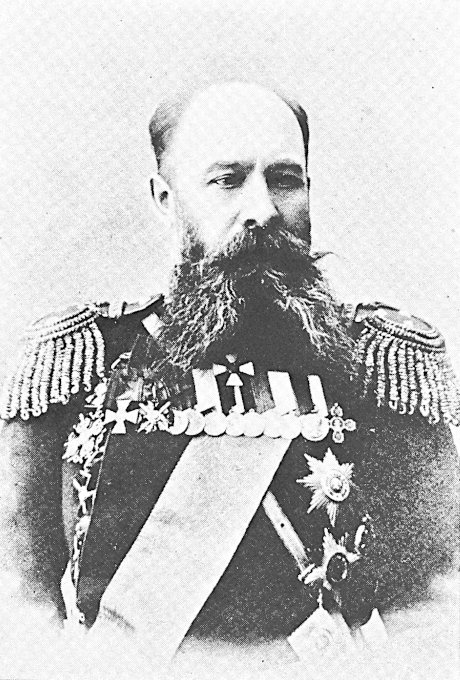
GENERAL GRIPPENBERG
In the first of these two particulars we have
succeeded, for in Russia the military uniform has
been particularly honoured for years; but we
have by no means approached near the second
desideratum. The majority of the best men
wearing military uniform have not only never
served in the army, but are absolutely unconnected
with it. In the eighteenth century a
custom crept in of dressing the sons of grandees
in military clothes, and they could get promotion
at an age when they were riding toy
horses round drawing-rooms. Then, little by
little, military uniform, military rank, even that
of General, ceased to become the absolute
prerogative of the army, or, indeed, to denote any
connection with war. The members of the
Church were the only people not arrayed in it.
Members of the Imperial Council, Ambassadors,
Senators, Ministers of the different departments
and their assistants, Governor-Generals, Governors,
Mayors, Superintendents of Police, officials
in the various Government departments and in the
military institutions, all wore military uniform,
and were graded in different ranks. With few
exceptions, all that they had to do with the army
was to be a source of weakness to it. Amongst
the many names in the long list of generals,
only a few belong to officers on the active list,
and, what is worse, those who are serving in the
army get superseded in rank by, and receive less
emoluments than, those who are not. Consequently,
the best elements in the service are
naturally anxious to leave. The posts of Minister
of the Interior, of Finance, of Ways and Communications,
of Education, and of State Control,
used to be held by generals and admirals, as
well as the appointments of Ambassador at Constantinople,
Paris, London, and Berlin. Service
uniforms were therefore conspicuous at all diplomatic
and ministerial gatherings. Military clothes
also had a great attraction for other departments,
and several of them tried to assimilate their
uniforms as much as possible to those of army
officers. The worst offender in this respect was
the Ministry of the Interior, which adopted a
uniform for police-officers and even for constables
which could hardly be distinguished
from that worn by military officers. The private
soldiers were naturally unable to make anything
of this multitude of uniforms, and never knew
whom to salute or obey; indeed, the police-officers’
great-coats and caps with cockades were
enough to puzzle the most discriminating. This
all seems incomprehensible; but the ambition
to wear military uniform is easily explained. It
is largely due to the ignorance of the people.
Not long ago, anyone wearing even a hat
with a cockade was taken in the country for a
person in authority; caps were doffed to him,
and in winter heavily laden sledges would be
turned into snow-drifts to give him the road,
while his vulgar abuse would be patiently
accepted.
Thirty years ago, when a young officer, I spent
about a year on service with the French in Algiers,
and travelled a great deal. I was astonished to
find that it was found convenient, even under
republican rule, to keep to a system of semi-military
government for the native population—Arabs
and Kabyles. It was, in this case, entrusted
mainly to army officers, and those civilians who
were also appointed had to adopt a uniform
similar to that worn by the military. These
officials told me in all seriousness that their
spurs and the gold braid round their caps assisted
them in their dealings with the Arabs, in collecting
taxes, settling land questions, and other matters.
It was so in our case. Undoubtedly the wearing
of military clothes did facilitate the difficult
work which our police-officers have to do; but
a great change has recently come over the country,
and a uniform alone is not now enough to command
obedience. It is sometimes a drawback, if
not a danger. It is, of course, to be hoped that
such an unnatural state of affairs will not last;
but it is very desirable to take advantage of the
present indifference displayed by the civil population
to uniform to take it from all who are not
actually serving in the army. The time has come
when the prestige appertaining to our uniform
should be restored, and the status of those serving
in the army should be raised.
With the same object in view, we must continue
to try and improve the material position
and prospects of the corps of officers. An important
matter, and one to which I have given
much attention—so far without entire success—is
that service on the staff, in offices and in branches
of the War Department, should not pay better
than service with the troops. Many of the officers
now so employed in semi-civil duties can well
be replaced by civilian officials. It is, moreover,
essential that service in the Frontier Guards, in
the Customs, police, gendarmerie, on the railway,
and as tax-collectors, should cease to be financially
preferable to service in the army.
As senior officers get on in the service,
they must not be allowed to forget what they
have previously learnt, a thing which is now only
too common. It is essential that they should be
practised in peace in commanding troops, and not
be mere administrators, inspectors, spectators, and
umpires. They should therefore be in a position
to spend most of their time with troops in the
field and in cantonments. With our military
system the command of troops is at present
almost entirely in the hands of the regimental,
brigade, divisional, corps and district
commanders.[31] Thus our infantry and cavalry
regiments used to be under five masters. But,
in the words of the proverb, too many cooks
spoil the broth, and in war all was not for the
best in all our regiments. Often while the ingredients
and the fire left nothing to be desired,
the cooks did not know what to do. How can
such a state of things be explained? It will be
said that the selection of commanders was not
always happy. That is true; but it must be
remembered that selections had to be made from
those men who were qualified according to the
regulations and the reports drawn up by various
commanding officers. In some cases seniority
was considered to be by itself a qualification for
promotion. Efforts of a sort were undoubtedly
made to get the best men we had, but they were
insufficient. All the commanders in the five
degrees of our military hierarchy are so occupied
with their daily work of routine and correspondence,
while many are so overburdened with the
administrative details of their appointments, that
they have little time to attend to the business of
actual war. Yet, as they get on in the service,
more knowledge of war is required of them. The
short periods of concentration in summer, with
only a few days of instructional work on both
sides, give little practice in command, and at
other times the number of responsible duties
connected with administration places that art on
a far higher plane than mere soldiering. And
what is most important is that the whole of our
service—of our lives almost—is spent doing things
which do not go to form character. Of the five
posts above mentioned, only two—the divisional
and corps commanders—are in any way independent,
and their occupants are immersed in
office work. The relative amount of time spent
on the different sorts of duties tends to turn the
regimental commander into an administrator
rather than a fighter, while a brigade commander
has absolutely no independence; in fact, his
absence or presence is scarcely noticed. Finally,
the same tendency to produce office men and
bureaucrats is noticeable even in the work of
those on the highest rungs of the ladder—the
general officers in command of military districts.
Instances might be multiplied of men who, though
long in charge of military districts, never once
commanded troops on manœuvres, and for several
years never even got astride a horse. How can
this impossible state of affairs be remedied, and
a body of leaders, constantly practised in the
execution of those duties in command of troops
that would be required of them in war, be formed?
On active service the rôle of the regimental
commander is both wide and important. To
issue successfully from the test of modern war,
he must have character, experience, and facility
in manœuvring his unit in the field, must know
his men well, and therefore have found the time
both for intercourse with his officers and for perfecting
himself in his profession. In battle it is
men he has to deal with, and not files of papers
and storehouses. But, situated as he is at present,
he is so overburdened with important administrative
details that most of his time is passed
dealing with requisitions and inventories instead
of with flesh and blood. The penalties he incurs
by neglect of his administrative duties are far
heavier and more tangible than those incurred
by neglecting the tactical training of his regiment.
The greater part of these duties—those
such as are connected with clothing, transport,
and rationing—should be removed from his
shoulders. He should be made the controller
of these sections of duty, and not the person
actually responsible. Nor is his position easy
in respect to the personnel. The great shortage
of officers, especially in those units quartered in
inferior barracks, is the cause of many difficulties.
When mobilization is ordered, some of the already
too small number of officers are told off for the
innumerable miscellaneous duties and detachments;
commanders of battalions and of companies
are interchanged; many of the men are
transferred to other units, a mass of reservists
join, and, if there is not time for the new arrivals
to settle down with the few old hands, the commander
has to lead into action a regiment which
he does not know, and which does not know
itself. Our mobilization schemes, therefore, require
revision in this respect, and every regiment
should have in peace-time a permanent establishment
of officers and men who would accompany
the regiment on service. The company commanders
in particular should not be removed
from their companies. But to make such an
arrangement possible, it is essential that one of
the senior captains (who might be appointed to
the staff) should run the regimental school. It
is also important to keep the regimental commander
as a man apart as far as possible; he
should be made to realize upon all occasions the
peculiar importance of the duties entrusted to
him, and the respect due to himself personally
by reason of these duties.
In Manchuria, just as in the wars of the second
half of last century, the great value of the
infantry brigade as an independent fighting unit
came out strongly in all the large battles; as
also did the great influence of its commander on
the result of the fight.
The advance and rear guards of army corps
generally consisted of brigades. A brigade
commander usually began the attack; a brigade
commander usually finished it (by commanding
the rearguard). And yet the post of Brigadier
is not considered one of importance; his powers
are insignificant, and his position does not allow
him sufficient independence to enable him to
train either himself or his unit. Divisional
commanders and their chief staff-officers in peace-time
often ignore the brigadiers as if they were
not wanted, and were fifth wheels to the coach;
and their absence for whole years, building
barracks and roads, etc., is not considered to
have any adverse effect on the successful training
of the regiments under them. In such
circumstances even the zealous ones, and those
anxious to do their duty, become dulled, slack,
and lose capacity for work. There can be only
one way out of this unnatural state of things,
which, from a military point of view, is most
harmful: brigade commanders must in peace-time
be given independent command of those
units which they will have to command independently
in war. This applies to cavalry as
well as to infantry. Every brigade should have
a small staff such as exists in independent
brigades—namely, two adjutants, one an officer
of the General Staff for operations, and one for
administration. Each brigade commander should
have powers in both these branches of their duty
equal to that now delegated to divisional commanders,
while their disciplinary powers should
remain as at present.
Our divisional commanders are independent
and in direct touch with troops; but they also
are overburdened with routine correspondence,
and as they are frequently appointed to command
the summer camps, it happens that they
are more often present at the exercises of the
troops as spectators than actually in command.
In field operations where there are two sides,
the divisional general rarely finds it possible to
take command of one, partly owing to an
exaggerated idea of his own abilities, and partly to
the scarcity of officers of sufficient seniority to
be umpires. Consequently, he only gets practice
in commanding troops in the field during concentrations
of large bodies of men. This is not
enough. Commanders of infantry divisions, in
particular, do not know nearly enough about the
other arms, owing to the little practice they get
in commanding mixed forces. So, while giving
greater powers to brigade commanders, it will
be also advisable to delegate to divisional generals
the powers now exercised by corps commanders
(with the exception of disciplinary powers).
Divisional commanders should always remember
that the 16,000 rifles which they command are
a number that can decide the fate of any action.
With the inclusion, in divisions, of artillery,
sapper, and cavalry units, exceedingly instructive
exercises can be arranged within these units both
in summer and winter, and the troops and their
commanders thereby trained for war under
modern war conditions. The four[32] officers of
the General Staff who would be with each
division should be relieved of all routine, except
that relating to operations, and they should
devote the whole of their time and energies to
preparing work for the brigade and divisional commanders
in the training of the troops for battle.
Army corps commanders are quite independent,
but, like the divisional commanders, are overburdened
with routine correspondence, etc., and
do not get sufficient practice in commanding
troops in the field. Some, during a tour of duty
of several years, have never commanded troops
on manœuvres; and it is impossible for all of
them to have sufficient acquaintance with cavalry,
as some corps do not include this arm. They
and their staff, especially the General Staff
officers, have no practice at all, or else very
little, in the use of technical equipment and the
modern aids to warfare (telegraphs, telephones,
mines, motors, balloons, etc.). The experience
of the late war showed up the necessity of increasing
the establishment of the army corps,
and the actions of their commanders will have
such an important, and in many cases deciding,
influence, that extremely careful selection is
necessary for these posts; the men appointed
must be capable of teaching others as well as
of learning themselves. As with the divisional
generals, so should the powers of corps commanders
be extended at the expense of those
now exercised by officers in command of military
districts.
The commanders of military districts are the
senior officers actually in charge of troops, and
have at the same time important duties as administrative
heads of districts. Here again
administrative work, together with correspondence
connected with the troops, occupies the
greater part of their time, and only in exceptionally
favourable circumstances (the large
manœuvres with concentrations of troops from
different districts) can they get any practice in
commanding in the field. But as they also have
to perform the duties of Governor-General, they
are not able to devote sufficient time to the
troops, even in inspecting them, or to improving
themselves. I am absolutely convinced that,
however much such a combination of two appointments—each
of which requires a man of
exceptional ability and character—may be desirable
from the political point of view, it has
the gravest disadvantages for the army. There
is a limit to human power. As our governor-generals
devote the greater part of their time and
energies to civil matters, they entrust a large part
of their military duties to the chief staff-officers
of the districts. It can easily be understood
that such an arrangement is not in the interests
of the army. For instance, the most important
military district—that of Warsaw—was, as far
as the army was concerned, neglected in the time
of several governor-generals. Indeed, at one
time, much to the subversion of the authority
of officers in command of districts and corps, the
troops in this area were controlled by the chief
of the district staff! Therefore, if we wish that
the commanders of military districts—our most
natural selections for the command of armies in
war—should have time to prepare themselves
for this important duty, we should free them from
civil duties; otherwise we shall get no improvement.
They must also be relieved of the
numerous and responsible cares with respect to
all those questions which in war mainly fall
to the officer in command of the communications.
The inspection of hospitals, of supply depôts,
engineer and artillery units, of parks, of offices—everything
that takes too much time from the
exercises for the actual training of the troops
and of themselves—should be eliminated from
their duties. These have become so heavy with
the complications of modern war, and are fraught
with such importance to army and country, that
the men who will have to perform them must
unceasingly prepare themselves in peace; but,
for the reasons I have already given, few officers
have time to follow up the developments in
their profession. That is why in the recent
war we were left behind in knowledge of the
employment of artillery, of the utility of the
various technical means of intercommunication,
in appreciating relative value of different attack
formations, etc. Our senior officers must be given
sufficient leisure, while improving the troops under
them, at the same time to improve themselves.
I have more than once pointed out how
excellent the regulars were as regards military
qualifications, and how much more reliable in
the first fights than the reservists, especially the
older ones. But we must look to the nation
itself for the cause of the shortcomings of both.
The lack of education in the peasant is reflected
in the private soldier, and the non-existence of
a martial spirit amongst the masses, coupled to
the dislike for the war, resulted in the absence
of a military spirit in our troops in Manchuria.
Their ignorance made the conduct of modern
war, which demands a much greater spirit of
combination and initiative from the individual
than formerly, very difficult for us. Consequently,
while behaving with the utmost gallantry
when in close order—in mass—our men,
when left to themselves without officers, were
more inclined to retire than to advance. In the
mass they were formidable; but very few of
them were fit for individual action, and this is
a point in which the Japanese had a great
advantage. Their non-commissioned officers in
particular were better educated than ours, and
on many prisoners—private soldiers as well as
non-commissioned officers—we found diaries
written not only grammatically, but with a
general knowledge of what was going on and of
what the Japanese were trying to do. Many
of them drew well. One prisoner—a private—drew
on the sand an excellent diagram of our
position and that of the enemy.
It is never easy to turn in a short time an
ignorant, illiterate recruit into an intelligent and
keen soldier, capable of individual action; and
the recent reduction[33] of the term of service has
made the task still harder. The greatest difficulty,
however, is to get good non-commissioned
officers; even with the four to five year period
with the colours we were not able to do this
satisfactorily. The mass of our recruits are so
illiterate, and so much book knowledge is required
in the schools from our non-commissioned
officers, that there is a natural tendency to pick
the men for these posts on account of their
education and outward sharpness. This is a
mistake, as these qualities are often superficial.
The simple recruits of the deepest and strongest
characters are usually slow and uncouth and do
not shine externally; consequently many of
them never become selected for non-commissioned
rank, and finish their service as private
soldiers. But a surly man of some character
often makes a better soldier than his smarter
comrade. With the reduced term of service we
can do nothing without a considerable number
of time-expired men. The present conditions
under which these men are kept on in the ranks
are sound enough, but the men dislike doing
time-expired, or what they characterize as
“mercenary,” service. We must get over this
dislike, and therefore as much as possible raise
the position of sergeant-major and other non-commissioned
officers.
Another burning question, and one with which
we shall be confronted more and more in the
future, is how to keep the destructive tenets of
the revolutionary parties out of our barracks.
Drastic action will of course be taken, but if we
do not succeed in crushing these parties among
the people, we can hardly expect to be able to
keep the army from infection.
One of the most important requirements with
our short term of service is that our men should
not be taken away from their work for police
duties. The part so frequently taken by the
troops in putting down civil disorders by force
of arms is particularly harmful to discipline. To
turn to another point, owing to the inadequate
funds allotted, our soldiers have always been
treated worse than those of other armies. The
Germans, for instance, spend twice as much per
head upon the maintenance of their army as we
do. Some improvement in this direction has
already been made, especially in the feeding.
With a serviceable cadre of time-expired sergeant-majors
and non-commissioned officers, and with
the living conditions of the men improved, we
can face the future calmly even with a three-year
term of service. But we shall only succeed
if we relieve the troops of the large amount of
extra regimental work which falls to them
(tailoring, shoemaking, and other workshop
work, care of reserve stores, etc.), and if we
lighten their guard duties. Our recruits are
free from this work and from guards only in the
first year of service.
Our infantry in the recent war can be classified
in four groups, according to the relative number
of old regular soldiers and reservists:
1. The East Siberian Rifle Regiments, which
were maintained almost on a war footing[34] in
peace.
2. The infantry in the 1st Brigades of the
31st and 35th Divisions, which were filled up to
war strength with regulars at the beginning of
the war.
3. The infantry of the regular army corps
brought up to war strength with reservists.
4. The infantry units formed from reserve
troops.
According to the opinion of competent officers
who served in the war (which I fully share),
other conditions being equal, the more regular
soldiers there were in a unit, the more it could be
relied on in battle. The best troops we had were
the East Siberian Rifle Regiments, and after
them the brigades of the 31st and 35th Divisions.
In the case of the army corps, which proceeded
to the front direct from Russia, sufficient care
was not taken to regulate the proportion of
regulars to reservists. Some units—the 10th
Army Corps, for instance—arrived at the front
20 per cent. below strength in men, and more in
officers. In the first fight in which it was
engaged, several companies of this corps had
only sixty regular soldiers—thirty trained men
and thirty recruits—who had not even passed
their recruit’s musketry course. All the remainder
were reservists, among whom were a large
number of 2nd Category men. These regular
units consequently were, to all intents and
purposes, nothing but reserve units. Finally,
our reserve units arrived almost without any
permanent peace cadres, so swallowed up were
they in the great mass of reservists. In the early
fighting these reservists, particularly those of
the 2nd Category, were vastly inferior to the
regulars; many of them took advantage of every
opportunity to leave the ranks with or without
permission. There is little doubt that if the
war had been a national one, and if the country
had supported its sons at the front instead
of doing the opposite, these men would have
done better in the first fights; but it is also quite
certain that, other conditions being equal, the
man with the colours must be better than the
other as a soldier. He is not torn from his
family at a time when he has begun to think
that his military liability is over; he is better
trained, and possesses esprit de corps. Therefore,
the best way of improving our infantry is to
maintain it with a stronger peace establishment
than at present.
In Manchuria a peace establishment of 100 men
per company became so weak from the various
causes incidental to active service that companies
went into action with one-third regulars to two-thirds
reservists. Nominally regular forces,
they were in reality more like reserve troops.
Regulars should be in the majority in every
company, but the great difficulties and expense
of maintaining troops on a strong peace footing
compel us to pay special attention to the question
of improving our reserve men. Modern war
must be fought mainly with men temporarily
called up from amongst the people.
The only thing that will insure devotion to
their country among reservists proceeding to the
front is the existence of a spirit of patriotism in
the nation. Discontent and feelings of oppression
among the people are naturally reflected in
the minds of those of them leaving for war.
But, independent of such all-important general
considerations, there are certain definite things
that can be taken to improve the tone of the
reservists. According to the present system,
when a man passes from the colours into the
reserve his connection with his own unit—in
fact, with the Service generally—almost ceases.
The practice concentrations are not carried out
on a large enough scale, and though valuable, are
often dispensed with altogether on account of
financial considerations. So it happens that a
man passing into the reserve takes his uniform
with him, but, with rare exceptions, never even
wears his forage-cap; this he generally gives to
some neighbour or relation—hardly ever a soldier—to
wear out. The reservist himself only too
gladly dons peasant’s clothes or other mufti; he is
glad to feel that he is a peasant again. He starts
in business, takes up peaceful occupations, and
raises a family. When he reaches the age of
forty, he begins to put on flesh. And it is under
these conditions that he is suddenly torn from
the bosom of his family, and sent to fight in a
strange, “hired”[35] land for a cause for which he
feels no sympathy, and which he does not
understand. To this are added the general discontent
all around him, and a flood of revolutionary
proclamations. The separation of the
reservist from all touch with the army once he
has left it does not tend to his rapid retransformation
from “mujik” into trained soldier.
In the case of Manchuria he certainly became a
good man after some months in the school of
war, but so long a period of grace cannot be
counted on in the future.
Coming here into the heart of the country as
I did nine months ago, and staying here continuously,
I have been in a position to observe
our reservists returning from the war. When
the return stream first began in March, April,
and May, there were large numbers. Sometimes
when I passed they would fall in—in line—and
receive me after the military fashion. They
wore fur caps, very often military great-coats,
and looked, as they were, a fine body of young
soldiers. Nine months of hard work in the fields
soon turned them again into peasants, and now,
when they come to me, on business or otherwise,
instead of saluting, they take off their caps and
call me “Barin.”[36]
In Japan mothers counted it a dishonour if
their sons were rejected as medically unfit to go
to the front. With us how different it was!
Women often came to thank me heartily for
having “had pity” on their sons and husbands,
because these latter happened to have been told
off for duty with transport units or with hospitals,
etc., instead of being sent into action,[37] and they
did the same when their men returned safe and
sound. In Japan, Germany, and other countries,
some endeavour is made in education to inculcate
patriotism into the people. A love of country
and pride in the Fatherland is created in the
children. As has been said before, the schools
in Japan do everything they can to create and
foster a martial spirit in the youth of the nation,
and to practise them in military matters. There
and in other countries the formation of various
patriotic societies is approved, and all kinds of
physical sport are encouraged. The authorities
are not afraid to issue thousands of rifles to the
people for rifle practice, etc. We do not do this;
we are afraid for political reasons. Little is
done to inculcate patriotism by education in our
schools, and the great gulf between Church,
rural, and Government schools makes matters
worse. Students in the highest educational
establishments have long ago abandoned study
for politics; it has for long been the fashion to
abuse everything Russian, and military service is
thought to be dishonourable. Our infantry
soldier is undersized and overloaded; he is
usually untidy, often dirty, and wears an ugly
and ill-fitting uniform. Is it a wonder that, as
he slouches along, he excites more pity than
pride in the man in the street? And yet it is
on this undersized man that the integrity of the
Empire depends. Money is tight, as we all
know, but still, we do not keep the soldier clean
and smart enough when he is serving, and when
we pass him into the reserve we give him a dress
which he can display with no pride to his neighbours
or even his own family. Under such conditions,
how can we hope that he will then
suddenly turn into a martial warrior?
Only by the reformation of our schools, and the
introduction into the life of the lower classes of
reforms, which, besides increasing their comfort,
will develop in them a love for, and pride in,
their country, and a deep sense of the necessity
for some sacrifice for it, shall we get in the
reserve a thorough soldier of the right sort. The
attainment of such a result cannot depend
entirely on any actions of the War Department,
which must, after all, be secondary; but the
things that can be effected by it are nevertheless
important, and I will enumerate those which
seem to be the most pressing.
In an army discipline is the foundation of all
efficiency; but to maintain discipline in an army
is impossible when the mass of the nation have
no respect for authority, and where the authorities
actually fear those under them. The term of
service with the colours is now so short that
there is no time to overcome in the soldier the disorderliness
of the people from whom he comes, yet
to effect improvement in the reservist demands
an iron military discipline. It must not be
allowed for a moment that a soldier need not be
afraid of his officer. The present greatest enemy
to discipline is the employment of soldiers in the
political struggle now going on. On the one
hand, the force is corrupted by propaganda;
on the other, men are taken away from military
duties and detailed for almost continual police
work, in putting down disorder not only of a
military nature, such as mutiny, where the situation
can only be saved by the assistance of
reliable troops, but riots which should be dealt
with by the police and the gendarmes. Officers
are taken away to sit on field courts,[38] to judge,
shoot, and hang political and other criminals.
These duties make the populace hate the troops,
and among the soldiers who suffer in killed and
wounded it arouses a feeling of hatred not only
for the civilians who shoot at them, but against
the officers who order them to kill the civilians.
The result is demoralizing to a degree. What
impression can the man passing into the reserve
take home with him if, during the two or three
years of his colour service, he has been “maintaining
order” in various ways with the aid of
his rifle? The army can and must do all that is
necessary to suppress mutinies, and to break
down all organized opposition, but it should then
return at once to its ordinary work. If this sort
of duty becomes frequent, if the soldier sees that
the Government is powerless to restore order
even with the aid of troops, doubts will creep
into his mind as to the expediency of the
Government’s policy and as to his own commanders.
According to what I hear, it seems
that the heavy task which has recently fallen to
the lot of the army is now coming to an end,
and that order is beginning once more to be
restored in our great country. Please God may
it soon be the case, as otherwise the force must
deteriorate instead of improving.
Under ordinary conditions our work should
tend to make the man passed into the reserve
arrive in his native village or town well disciplined,
knowing his work, taking a pride in his
old corps, and respecting those under whom he
has served. We must therefore endeavour to
prevent him from losing touch with the Service
and quickly forgetting what he has learned in it.
In some armies to obviate this they have what is
called the territorial system, by which reservists
maintain touch to the end of their term with
those units in which they have served. This
system is not possible for us in its entirety, but
it might be applied partially and adopted on a
fairly large scale. One of its great advantages
would be that reservists would on mobilization
at once join the units in which they had previously
served. They would not be strangers, but would
be known to the cadre of time-expired, but still
serving, non-commissioned officers and the officers,
and would soon settle down. Men of the same
district would be more inclined to hold together
under fire, and every man would feel that if he
behaved badly his comrade would send news of
it to his home. Units territorially connected
with the people would be more dashing than
corps collected from anywhere. There would,
of course, be many difficulties, which would have
to be overcome before the system could be
adopted. For instance, men taken from a certain
locality would, if employed to suppress disorders
in that place, be more likely to waver than
men from another unit and district. Cases have
been known where non-commissioned officers who
had been strict with their men have requested, on
being passed into the reserve, not to be sent off
in the same compartment of a train with their
late subordinates, who had threatened to “make
things even” so soon as they both passed into
the reserve together. With us such a settling
up of old scores might easily be effected under
a territorial system, by which both officers and
soldiers would, after their service, come together
in one district.
It must be more frequently impressed on the
reservists that they still are soldiers. Local
concentrations should be organized for them so
that they may get some training, and these
should be arranged at such a time of the year as
to interfere as little as possible with the crops.
This would vary, of course, according to locality.
Our recruiting officers are now mainly occupied,
like everyone else, with office work; they should
be more in touch with the reservists, who should
look to them as their commanding officer, adviser,
and protector. The relationship now is too purely
official. An important matter also is the division
of reservists in peace-time. In my opinion it is
essential to have three classes. For the first two
years after the man leaves the colours he should
be considered on furlough; he should be made
to wear uniform, and always be ready to be
recalled in case of partial or general mobilization.
The men of the last two classes should be on
a different footing, and should be used on mobilization
to fill up services in rear, hospitals,
bakeries, parks, transport units, and to guard
camps on the communications, etc.
We have already seen (Chapter
VI.) how, when the war began, we found it necessary, in the
absence of any assurance arranged by diplomacy against other
contingencies, to be ready for any military eventuality on our Western
frontier. Consequently, too great a number of reserve units were
included amongst the troops told off to take the field in the Far
East. Another reason for this was that we did not really know the
qualities of different sections of our army. Our crack troops, taking
both officers and men together, of three Guard and three Grenadier
divisions, six divisions in all, were left in European Russia, while
newly formed corps composed of reserve units were sent into the
field. I have already mentioned how my recommendation to mobilize the
reinforcements being sent to us immediately after Easter was for
various reasons rejected, how they were mobilized a month later than
they should have been, and arrived in Manchuria unsettled, untrained,
knowing scarcely anything of the new rifle, without having fired a
course of musketry, and not having done any combined tactical
operations with the other arms.
The troops of the 6th Siberians, which certainly
had been in camp for a short time before starting,
had not been given a gun or a squadron to enable
them to practise combined operations. Of the
4th Siberian Corps, which mobilized under most
favourable conditions, only the Omsk Regiment
had been trained in artillery, and this was of an
old pattern; yet it had to go into action with
quick-firing guns. Cavalry were hardly seen.
Indeed, if we consider the haphazard selection of
commanding officers, the lack of any community
of thought amongst the officers generally, the
almost complete absence of proper tactical training,
the large number of 2nd Category reservists,
general dislike of the war, and, finally, the absence
of military spirit, it will be evident why some
units of the reserve troops failed. In the first
battles the troops of the 4th Siberian Corps won
a good reputation in the army. The reasons for
this were:
1. The splendid character of the men in them.
Bluff, surly fellows of Siberia, they were strong in
body and stout of heart, and understood better
than others the reasons for which we were fighting
in the Far East.
2. The careful selection of those in command.
3. The bravery of the officers.
4. The long time they had, compared with
other troops, to train and acquire cohesion.
But, after the reserve troops which came out
from European Russia had received their baptism
of fire, they also did well. It is sufficient to call to
mind the behaviour of the regiments of the 54th
and 71st Divisions at Mukden, as well as those
of the 55th and 61st Divisions. But this result
was not reached till late, and cost many lives.
In a European conflict the fate of a campaign
will be far more rapidly decided than it was in
Manchuria, for the first battles fought after the
declaration of hostilities will have a deciding
influence. In the recent war, owing to the slow
concentration possible on a single-track railway,
the reserve troops might have been collected
sooner and given several months to settle down,
and have thus arrived at the front more ready
for battle. In a European war they will have to
be transported into the theatre of operations in
a very short time after mobilization. We made
a great mistake in forming the reserve troops
into separate army corps. In my opinion, it
would have been much better to have put them
into existing corps—either as third divisions or
separate brigades. This would have improved
our corps organization, which is too unwieldy
and too big for a strength of only twenty-four
battalions. With strong corps consisting of
efficient self-contained brigades the confusion
of units in battle would be minimized.
Before the war no army corps organization
had been worked out for the reserve troops;
everything had been arranged for a divisional
organization. In my opinion, neither corps nor
divisions are necessary. It would be more
advantageous to form the reserve units into
independent brigades of eight battalions, and to
use them as army troops, or possibly as corps
troops. The mobilization of the reserve artillery,
sapper, and cavalry, should take place together
with that of the infantry. Every reserve brigade
of eight battalions (8,000 rifles) should have, with
two batteries of twelve guns, one company of
sappers and one reserve squadron of cavalry or
a sotnia of Cossacks. This arrangement would
permit of reserve troops being employed on
secondary objects without the organization of
the army being broken up, and it would no longer
be necessary to find so many divisional and
corps commanders, with their numerous staffs.
Amongst the causes of our disasters has been mentioned (Chapter
VI.) the small number of
rifles per company we had in action as compared
with the Japanese. We often had more
battalions than they, but fewer men. The
various reasons for this I have already enumerated.
To lessen the number of subsidiary duties which
take men away from the fighting-line of the
regular army, we must create cadres for the
troops of the rear services; we must also arrange
that the casualties are quickly made good from
the reserve troops, which should be kept up permanently
and closely connected with the regular
troops. (Every regular regiment should have
one reserve or depôt battalion.) To augment
the numbers fighting compared with the numbers
fed, and, in particular, to increase the number
of men in the firing-line, we must bring up the
combatant establishment of our companies from
220 to 250 rifles. With 220 rifles on the roll
of a company, we were never able to put even
200 in action; and in bringing the strength of
these units up to 250, we must take steps to see
that they all really can take the field. According
to the “War Establishments,” a line infantry
regiment has an establishment of 3,838 combatants
and 159[39] non-combatants (total 3,997),
which gives 235 rifles per company. But in this
number are included 35 bandsmen, 33 drummers,
1 bugler, 3 regimental quartermaster-sergeants,
1 sergeant-major of the non-combatant company,
5 baggage non-commissioned officers, and, moreover,
another 240 (15 per company) detailed for
supply work, etc. Excluding these, 3,520 combatants
are left, which gives 220 per company;
but experience has shown that there is much
leakage from this number.
The peculiarities of Manchuria necessitated the
employment of men on duties that would have
been quite unnecessary, or less necessary, in
a European war. Thus, in addition to the
authorized transport, we had pack transport,
which swallowed up fifty men per regiment.
The large herds of cattle with regiments required
twenty-four men to look after and guard
them. There were nine regimental butchers.
Two or three donkeys were told off to each
company. (Indeed, they were of such great use
in taking water and ammunition up into the
firing-line that I consider they should be included
in the establishments of troops in European
Russia.) In each company one man was
told off to these animals. The number of
officers on the regimental rolls included those
who had been wounded and were away convalescent,
and many of these took their orderlies
with them on leaving the front. The expenditure
in these orderlies alone amounted to more
than 100 men. For the special pack transport
which was formed for the scout sections for
carriage of ammunition and supplies, thirteen
men per regiment were required. Judging by
the experience of the war, I consider the following
duties ought to be allowed for in every
regiment in addition to the establishment of
159 non-combatants:
| Company clerks | 16 |
| Mess caterers | 18 |
| Officers’ mess cooks | 4 |
| Men’s cooks |
18 | [40] |
| Butchers and cattle guard | 12 |
| Officers’ grooms | 27 |
| Transport drivers with scout sections |
13 |
| Instructors | 4 |
| Stretcher-bearers | 128 |
| Baggage guard | 48 |
[41] |
| With water donkeys | 16 |
| Officers’ orderlies | 80 |
| Sergeant-major of non-combatant company |
1 |
| Transport driver non-commissioned officers |
5 |
| Despatch riders | 20 |
| Bandsmen | 35 |
| Drummers | 33 |
| Reserve in case of sickness and wounded |
13 |
|
| Total | 491 |
All these must be classed as non-combatants.
Adding to these the prescribed establishment
of 159 non-combatants, we shall get a total
of 650 with each regiment of four battalions.
They should all be armed, and be ready to fight
either in the advanced lines or with the baggage.
The value of machine-guns is now so great
that we cannot afford to be without them. In
my opinion, each company should have one gun,
and six men should be detailed to carry it and
its ammunition. Thus, there would be 100 men
with the machine-guns in a regiment (including
four reserve men). The scout sections also did such
useful service in the recent war that we ought
certainly to have dismounted and small mounted
scout sections in each regiment. This would
take up 200 more men. Finally, the strength
of every company, exclusive of all these extras,
should be fixed at 250 rifles, which would make
4,000 in the regiment. The strength of a regiment
would, therefore, total as follows:
| Combatants (in sixteen companies) |
4,000 |
| Scout sections | 200 |
| Machine-gun sections | 150 |
| Non-combatants | 650 |
| |
| Total | 5,000 |
The present establishment of a four-battalion
regiment is 3,838 combatants and 159 non-combatants;
total, 3,997. Therefore a total
increase of 1,003 per regiment is desirable.
Including fifteen men in every company for
supply duties, the authorized non-combatant
element works out at:
| Non-combatants | 159 |
| Bandsmen, drummers, buglers |
69 |
| Regimental quartermaster-sergeants |
3 |
| Sergeant-majors and baggage |
| non-commissioned officers |
6 |
| For supply duties | 240 |
|
| Total | 477 |
Fixing the total number of non-combatants
required at 650, I thus add to the expenditure
authorized by existing establishments 173.
These, including stretcher-bearers, would never
go into action. Thus, the addition necessary to
bring the fighting element of a regiment up to
5,000 comes out as follows:
| Increase of thirty rifles per company |
| (so as to have 250 instead of 220) |
480 |
| Scout sections | 200 |
| Machine-gun sections | 150 |
|
| Total | 830 |
This increase would greatly add to its present
strength.
At the beginning of the war the army had
only a small number of machine-guns. Recognizing
the value of this weapon, the Japanese
quickly introduced it, and furnished their field
troops with a large number. We did the same,
and several machine-gun companies and sections
arrived from Russia during the summer of
1905. But the type of weapon did not satisfy
tactical requirements—(1) as regards its weight;
and, (2) adaptability to the ground. A pattern
must be invented that can be carried even
into the outpost line. Our high, unwieldy
weapons, with their shields, more resembled light
field-guns; and their unsuitable construction,
combined with the difficulty of adapting them
to the ground, was responsible for the decision
that these guns should be organized into batteries,
and be treated and used as artillery. Such
an opinion is absolutely wrong, for the great
volume of fire which they can deliver calls
for their distribution at the most important
points along the firing-line, and, therefore, a
capability of advancing with assaulting columns.
The organization of machine-gun companies did
not meet the above tactical requirements. Each
battalion should have four guns.
The reserve or depôt troops should be developed
and given an organization which will
permit of the wastage in units, both in officers
and men, being made good from them immediately
after a battle or during a long series of
battles. Each infantry regiment should have
its reserve (depôt) battalion, which should be
formed on mobilization at a strength of 40 per
cent. of the combatant establishment of a regiment—i.e.,
at 1,600 men.[42] Of these, 400, or
10 per cent. of the regiment’s strength, should
be in the theatre of war. This number should
be formed into one company, and should constitute
the reserve depôt company of its particular
regiment, and be continually feeding it.
With every division these companies should be
organized together into a reserve battalion of
1,600 men for the immediate replacement of
casualties in the regiments of the division. All
wounded and sick who are not sent to the base
should be attached to this battalion till they are
passed as fit. After great battles this reserve
would be depleted, and would require filling up
from the base depôt. The establishment of the
other arms should be kept up to strength by a
parallel arrangement. The casualties amongst
non-combatants are less, but in their case a reserve
is necessary, distinct from the combatant reserve,
to make good their wastage. It should be
mainly composed of 2nd Category reservists and
those of the convalescent combatants not considered
fit enough for the ranks.
The war shows very clearly the immense importance
of rapidly repairing the wastage in units
directly after an action. The Japanese succeeded
in doing this, with the result that they were
greatly superior to us in numbers. It was more
important for us to be able to replace casualties
by drafts than to receive reinforcements, and it
would have made us stronger. For instance,
with five troop trains available in the twenty-four
hours, a complete army corps with its baggage
and parks took twenty days to reach the front,
and increased our strength by some 25,000 rifles.
If drafts had been sent up during those twenty-days
instead of an army corps, we should have
received 90,000 to 100,000 men. In place of
cavalry, baggage, artillery, parks, and a small
number of infantry, we should have got a large
number of the latter. It was infantry we wanted,
for in our big battles it was the infantry that
suffered so heavily. The number of guns per
1,000 rifles was too large, and the amount of
transport and baggage was prodigious, with the
result that the 10,000 to 12,000 rifles left in corps
resembled an escort to the artillery, parks,
baggage, etc.,[43] more than anything else.
By troops in rear I mean those at rest camps,
railway troops, road working parties, telegraph
sections, motor troops, transport of various kinds,
all of which should be under the general officer
commanding communications. There is also a
large number of men in the departments, institutions,
and depôts of all the field administrations,
but as in Manchuria these were mostly fixed by
the authorized establishment, I will not refer to
them. The absence of any prepared organization
of troops for the line of communication, however,
led to their being formed at the expense of the
fighting strength of the infantry. While officers
commanding regiments complained of the great
wastage of their men on duties in the rear, those in
rear complained that the numbers they had were
insufficient. Troops for the duties in rear should
of course be formed on mobilization. In the
part of my report upon the 1st Army which
deals with the organization of the communications
there is much valuable material which is
based on war experience, and may be a useful
guide for the future. By the end of August,
1905, the strength of the 1st Army alone was
300,000. Its own communications in rear had
a depth of 150 miles and a frontage of 330 miles,
including the detachments guarding the extreme
left flank and the left flank corps under General
Rennenkampf, with which we permanently occupied
a front of about 70 miles. Under the
general commanding the communications of the
1st Army, which consisted of six army corps,
were 650 officers and officials, 12,000 men, and
25,000 horses, and this number was considered
inadequate. In my report, I gave as my estimate
for the numbers required for one army corps per
day’s march in length of communications—
| Men. |
| 1. Half company infantry |
120 |
| 2. Transport | 320 |
| 3. Road troops | 25 |
| 4. Postal telegraph working parties |
5 |
|
| Total | 470 |
The great development of science in warfare is
very marked, but the late war did not display
the employment of scientific forces that will be
made in a struggle between two European
Powers. In this respect the Japanese were
much better served than we were, but even
they were not technically equipped in the way
that will soon be necessary. The speedy construction
of strong fortifications, the laying of
railways (especially of field railways) and construction
of metalled roads, the organization of
aerial and wireless telegraphy, of signalling by
heliograph, lamps, and flags, the employment of
balloons, motors, and bicycles, are all duties for
which the demand increases every day, while the
great quantity also of artificial obstacles, wire,
mines, hand-grenades, explosives, reserves of
entrenching tools, etc., now required must exist
ready for use in large quantities. A much larger
number of engineer troops, including sappers,
telegraph and railway units, than we had available
in Manchuria is necessary, in order that all
this technical equipment may be used to the best
advantage. Without touching here upon the
railway troops necessary for the proper service
of the communications, the number of which
must depend upon the length of the existing
lines, and of those proposed to be laid during
operations, let us consider the question of the
number of sapper and telegraph troops required
for one army corps of three divisions.
The spade, which had been forgotten since the
Turkish War, has once more regained its true
position. With the volume and murderous
effectiveness of modern fire, neither the attack
nor the defence can be conducted without enormous
losses, unless proper and intelligent use is
made of digging. For a protracted defence strong
fortified positions with both open and closed
works and all possible kinds of artificial obstacles
are absolutely necessary. Consequently, for the
attack of such positions, special troops are required
trained in the use of explosives and the destruction
of obstacles, and in road-making, for heavy
artillery demands good roads and strong bridges.
While every Japanese division of twelve
infantry battalions had one strong sapper battalion,
we had on an average only one company
of sappers with each division. This proved to
be too small a proportion. Our sappers worked
nobly in the construction of earthworks and
roads, but they did little in actual contact with
the enemy, and, strange as it may appear, were
often forgotten when an action began, even when
we attacked the enemy’s strongly fortified positions.
In the 2nd Army we had several sapper
battalions, and yet in the assault on San-de-pu[44]
not a single company was told off to accompany
the storming columns. As our sappers were so
scarce, we took the greatest care of them, as
their small number of casualties as compared
with those of the infantry proves. To get the
best results from this arm, it seems to me necessary
to associate them more with other troops,
and therefore to attach them to divisions, instead
of including them in the corps troops. If we
succeed in getting strong regiments of 4,000 rifles,
I consider it essential that every regiment should
have attached to it, for offensive as well as
defensive operations, one sapper company of
250 men, which would mean a four-company
sapper battalion, 1,000 strong, for every division.
They should be trained to put up obstacles very
rapidly, and should possess the necessary tools and
equipment for their destruction. A large supply of
wire is also very important; it may be taken that
every division should have a sufficient supply of
wire for two defensive points, say 1 ton for each.
Moreover, there should be attached to each
division a field-telegraph company of six sections,
in order to organize rapid communication between
each party of troops thrown out in front and
the divisional staff. Each regiment should have
with it a section which should be equipped to
establish communication by telephone,[45] flag,
cycle or motor. With every three-division army
corps there should be a sapper brigade of three
battalions, a field-telegraph battalion of five
companies, a mining company, a balloon section,
and a railway battalion. Two of the telegraph
companies should keep up communication from
the corps to army headquarters, to other corps,
to its own divisions, to the parks, the baggage,
and reserves.
One of our principal failings, as I have repeatedly
mentioned, was lack of information.
Owing to this, and the consequent loss of touch,
commanders could not conduct operations intelligently
or keep corps and army commanders and
the Commander-in-Chief informed of what was
happening. Every Japanese regiment laid down
telephones as it advanced; we used to find their
dead operators in our trous de loup, which
showed that they were right up with the firing-line.
With us touch was not infrequently lost
even between whole corps and armies! The
necessity for remedying this grave defect is
obvious, and we must practise how to do this in
peace. Not a regiment should be allowed to
advance at manœuvres without at once being
connected up by telephone with its brigade commander
and the divisional staff, and it is essential
that, as the information comes in by telegraph
and telephone, the divisional corps and army
staffs should at once fix on the maps the positions
of both forces. Formerly commanders could
watch the whole battlefield through a telescope
from an eminence, could see their own troops,
and could trace the position of the hostile infantry
and artillery from the smoke. Now there is
nothing to be seen. Often the troops are out of
sight, and all that meets the eye are the puffs of
smoke from the bursting shrapnel. Therefore
orders and dispositions have to be worked out
on the map, and we must learn how to keep
these maps constantly up to time. In order that
all intelligence may be at once noted, a “service
of communication,” by means of motors, cyclists,
and particularly of telegraph and telephone,
might be organized, in addition to the ordinary
reports brought in by mounted men. To attain
these important results, considerable expense
must be incurred in the creation of this “service
of communication” or “service of information”
of such a nature as to meet in every way the
requirements of battle, of movement, and of rest.
An adequate number of sapper units with
regiments will not only help us in the capture
of fortified positions strengthened by obstacles,
but will assist us rapidly to adapt them for
defence when taken. The work of the mining
company in future wars will be great both in
attack and defence, especially in defence. It
should have charge of all explosives required for
demolitions, including mines, pyroxyline bombs,
and hand-grenades. The great effect of the
bombs thrown by revolutionaries and anarchists
points to their extensive use in war in the future.
If fanatics can be found who will rush to certain
death in order to kill peaceful citizens, it should
certainly be possible to find devoted soldiers
who will advance ahead of the firing-line and
throw bombs into the enemy’s obstacles.
Besides supply of field railway material for
the army, each corps should have enough for
thirty miles of line (steam or horse draught,
according to circumstances).
We have learnt by experience that skill in
the employment of guns is more important than
their number. Under modern battle conditions,
when the position of a battery cannot be seen,
a great deal of ammunition is fired during the
artillery duel without any result. Two to four
well-concealed guns cleverly moved from one
position to another can hold their own with a
brigade of artillery, and, if they can only range
on the enemy’s guns first, rapid fire gives them
the power of inflicting heavy loss. Our keenest
and most experienced gunners got on to the
enemy on many occasions with great effect, but
as a rule our artillery did little damage. One
occasion when very ineffective results were
obtained by us was at Hei-kou-tai, where, in
our endeavour to get possession of San-de-pu,
we fired 70,000 rounds into every square,[46] except
the one which actually contained the village.
Our immense expenditure of ammunition also
emphasized how carefully the question of the
right proportion of guns in a force must be
considered. In this war, owing to the great
delay in sending up drafts to repair wastage, we
were often actually handicapped by having too
many guns! We frequently had to fight with
divisions containing only some 6,000 to 8,000
men in the four regiments and the full forty-eight
guns—a proportion of six to eight guns per
1,000 rifles, which is far too many. And
our guns were literally an embarrassment, especially
when they had run out of ammunition.
Even assuming that we shall be able (as I have
suggested) to place in the field regiments with
a strength of 4,000 rifles, I consider it will be
quite sufficient if we maintain the proportion of
guns at forty-eight per division, or three guns
per 1,000 rifles. The fire from quick-firing
guns is nowadays quite powerful and effective
enough for four guns to be considered a tactically
independent fighting unit; but the formation
of batteries of such a size is expensive,
and requires too many men. It appears to be
preferable, therefore, to abandon the artillery
divisional organization, and return to the former
twelve-gun battery, dividing it into three companies,
each of which would be in a tactical sense
independent. The 48 guns—i.e., four batteries—with
an infantry division, would then be organized
into an artillery regiment under the command
of the divisional general. Each company would
be commanded by a captain, the battery by a
lieutenant-colonel, the regiment by a colonel.
We found that for mutual and smooth co-operation
in battle it is most important that
batteries should operate as far as possible with
the same regiments of infantry. Close touch is
established, and each arm unselfishly supports
the other. I often heard the expression, “our
battery,” “our regiment,” and in these simple
words a deep, underlying sentiment was expressed.
Each battery should be capable of
acting independently of the artillery regiment
to which it belongs. For hill warfare mountain
artillery should be allotted to infantry in the
same proportion as I have suggested for field
artillery.
Our gun proved an excellent weapon; but
our shrapnel, which was very effective against
objects and troops in the open, was of no
use against invisible targets, earthworks, and
mud walls. Our artillery fire against villages
held by the enemy, therefore, produced very
little result. I consider that a new pattern of
shell should be introduced with thicker walls
and a heavier bursting charge; but even then
the effect of such light projectiles as our field-guns
fire will not be great against the earthworks
which are nowadays so quickly thrown
up on positions. To prepare the way for the
assault on such fortifications, and to obtain any
speedy result in attacking defended localities,
we must have field howitzers of a modern type.
They should be organized in regiments of two
batteries (twenty-four howitzers), and attached
to a corps as corps artillery. Finally, it is
essential that every army should have a light
siege-train to assist in the capture of strongly
defended posts and heavy works.
The organization of park units was well conceived,
but the vehicles were unsuited to the
Manchurian roads. I am afraid to express an
opinion in favour of a further increase of mobile
parks, because we were so overburdened with
baggage of different kinds. I think it is preferable
to improvise local parks at railway-stations
and junctions, as we did in Manchuria.
Small-arm ammunition rarely ran short, but
there was often a great lack of gun ammunition,
and after the battles of Liao-yang, the Sha Ho,
and Mukden, our reserves for filling up battery
and park stocks were exhausted. The average
expenditure of rifle ammunition worked out as
follows: For a whole-day battle for one battalion,
21,000 rounds, with a maximum of 400,000; an
hour’s fighting for one battalion, 1,700, with a
maximum of 67,000. The total reserve taken
with a four-battalion infantry regiment was
800,000. The average expenditure per quick-firing
field-gun in a one-day battle worked out
at 55 rounds, with a maximum of 522; an hour’s
fighting, 10 rounds, with a maximum of 210.
In the earlier fights the work of the artillery
varied a good deal, and was not very successful;
but as they gained experience, many batteries
fought splendidly, not only against guns, but
against rifle-fire. Compared with the work of
our artillery in 1877–78 (in the European theatre
of operations), we have made considerable progress
in skill, and the very heavy losses in killed
and wounded in many batteries prove that our
gunners know how to die. The horse artillery
work depended entirely on the commanders of
the cavalry units to which the batteries were
attached, and when these commanders really
meant fighting the batteries did good work.
As a proof of this, it is enough to recall the
gallant conduct of the 1st Trans-Baikal Cossack
Horse Artillery Battery attached to Mischenko’s
Trans-Baikal Cossack Brigade. This battery
and its young commander were known to the
whole army; more than once it successfully
fought several of the enemy’s batteries, and yet
its losses were insignificant. Sometimes our
cavalry leaders were unnecessarily anxious to
retire, as was the case in the cavalry of the
2nd Army at the battle of Mukden, when the
two batteries which were with it lost only two men
wounded and one missing in eleven days’ fighting.
One six-gun battery was sufficient for four
mounted regiments of such strength as we had.
As said above, there should be one artillery
regiment of four batteries (48 guns) with each
infantry division, or a total of 144 guns for the
three divisions. These three regiments would be
organized in a brigade. There should also be one
regiment of 24 howitzers with each corps.
Though our cavalry was numerous, its work
hardly came up to our expectations, but where it
was properly commanded it did well enough. In
my opinion, the main reform that is necessary
in the cavalry is to improve their training. Till
it is educated to feel that it should fight as
obstinately as infantry, the money expended on
our mounted Arm will be thrown away. If
infantry can still continue fighting after losing
50 per cent. of their strength, cavalry should be
able to do the same. In action we nursed the
cavalry too much; out of action we did not take
sufficient care of it. Though they had not lost
a man, whole regiments were moved to the rear
as soon as the first shrapnel began bursting near
them. The four regiments of cavalry—two
dragoon and two Cossack—on whom fell the
most difficult but the most honourable duty of
obtaining information and opposing the leading
units of Nogi’s enveloping forces at the battle
of Mukden, lost in killed and wounded:
| | | | |
Men. |
| February 25 |
… | … |
… | … |
2 |
| March 2 |
… | … |
… | … |
1 |
| March 4 |
… | … |
… | … |
1 |
| March 5 |
… | … |
… | … |
7 |
| March 6 |
… | … |
… | … |
2 |
| March 7 |
… | … |
… | … |
6 |
| March 8 |
… | … |
… | … |
1 |
| March 9 |
… | … |
… | … |
1 |
| March 10 |
… | … |
… | … |
1 |
|
|
Total | … |
… | … |
22 |
Which works out at less than one man per
squadron and sotnia. The casualties in almost
every company of infantry were more than in
these twenty-four squadrons and sotnias. It is
quite plain that these units did not fight, but
merely avoided the enemy; and it is equally
plain that, by avoiding battle, the cavalry neither
checked the enemy’s movement nor got any
information about him. The material of which
our cavalry was composed was excellent, but
everything depended on those in command. In
the battle of Te-li-ssu the infantry of the
1st Siberian Corps lost 2,500 men; the Primorsk
Dragoon Regiment, belonging to the same corps,
lost one!
But I repeat that where their leaders meant
fighting the cavalry did their duty and suffered
heavily. Take, for example, the Trans-Baikal
Cossacks, which did so well under Mischenko,
and the Caucasian Brigade. The Siberian
Cossacks, under Samsonoff, fought at Liao-yang
and the Yen-tai Mines with greater bravery
than was displayed by some of Orloff’s infantry,
while the independent sotnias of the Don and
Orenburg Voiskos, and the dragoons under
Stakhovitch, were no whit behind them. Indeed,
the men of the Primorsk Dragoon Regiment
were good enough; it was the officers who failed
in not getting the best out of them. The independent
units of all the Cossacks did well, but
it was out of the question to expect martial
ardour or a keen desire to perform feats of
gallantry in old men such as formed the
3rd Category Cossack regiments. But even
these 3rd Category regiments could do good
work when skilfully handled. The Cossack
horses generally, and the Trans-Baikal horses in
particular, were too small; while those of the
Don regiments were sturdy, but rather soft.
The Trans-Baikal Cossacks on their shaggy little
ponies reminded one more of mounted infantry
than cavalry. On the whole, however, our
cavalry worked far better than in the Russo-Turkish
War under Generals Kuiloff and Loshkareff
at Plevna. The great difficulty now is
to find and train cavalry leaders; in Manchuria,
according to most accounts, the juniors were
good, the field officers moderate, and the general
officers, with few exceptions, bad.
The personality of the officer in command of
a regiment of cavalry is a very important factor,
as his merits and weak points are very quickly
known, and as soon as a man in such a post shows
himself unsuitable he should be removed. (This
also applies to the general officers.) But I rarely
found a divisional or corps commander who would
report on the unsuitability of senior commanders
under them; they even concealed cases of
cowardice. It was only at the conclusion of
hostilities that it transpired that several had not
only shown a lack of keenness, but even of
personal courage. Some of the regimental commanders
were very old; at fifty-five a man is too
old for the command of a regiment. As in the
infantry, the post of cavalry brigadier should be improved,
and made a more important appointment.
To it should be given the executive and administrative
powers now wielded by divisional generals.
Three brigades should be formed into a division,
the divisional general being given the powers of
an army corps commander. There is no necessity
for a higher organization. To the division of
three brigades should be allotted a twelve-gun
battery of horse artillery (three companies of four
guns each). To every three-division army corps
should be added one cavalry or Cossack brigade.
One of the regiments of this brigade should act
as divisional cavalry, two squadrons or sotnias
with each division. If it is thought desirable
that commanders of infantry divisions become
acquainted with cavalry in peace-time, then two
squadrons should be stationed in the area of the
divisions under them.
As in former wars, so in Manchuria was the
heat and burden of the day borne by our infantry,
and there is no doubt that, in the future, infantry
will retain its name as the principal Arm. The
importance of other Arms depends entirely on
the extent to which they assist infantry to defeat
the enemy, for the latter is the final arbiter of
victory or defeat. But infantry cannot work
alone, and nowadays, if it is not assisted in action
by artillery, cavalry, and sappers, if every resource
of modern science is not brought into play to
lighten its heavy task, it will either fail or will
buy victory at too high a price. It is to infantry,
as the principal Arm, that we must pay our chief
attention. And yet with us service in the Line is
not considered so honourable as service in the other
branches! From the moment of the selection
of its recruits we do everything to weaken it.
Even the pattern of uniform worn by our Line
infantryman is particularly ugly. In his
old-fashioned, badly fitting tunic, overburdened with
haversacks and equipment of all sorts, he is anything
but a martial sight. This is an aspect of
the case which cannot be ignored, and it is almost
as important that a man’s uniform should be
comfortable and attractive as that it should meet
all the purely military requirements. All ranks
should be enabled to admire their own dress and
be proud of it. Up to the present, the majority
of Line officers have not been given a good
enough general or military education. Officers
of all arms should receive a general education
not lower than the intermediate standard of
the national educational establishments, and a
military education not lower than that of the
military schools. We should teach the line
officer to have a love and respect for the Arm in
which he serves, as well as a knowledge of its
particular rôle in battle, and must therefore raise
his social position so that he may be a welcome
guest in any society. We must provide him
with a comfortable, inexpensive, and smart
uniform. We must protect him from being
abused by his seniors in the presence of his
juniors, and in every possible manner encourage
the development in him of an independent spirit.
Bravery alone is not sufficient nowadays to
attain victory; knowledge, initiative, and willingness
to accept responsibility are also required.
Infantry have always had a hard part in action,
and have always suffered great loss, but the
modern battle which lasts for days makes greater
demands upon their mental and physical endurance
than ever before. With a large proportion
of reservists and short-service men, we cannot
rely on perfection in the soldier; it is therefore
all the more necessary that we should take steps
to obtain it in our officers, and for this purpose
we are lucky in having excellent and responsive
material. Under all the arduous conditions
under which the majority of our regiments had
to fight, the greatest trials fell to the infantry
officer, and right well he did his duty. It is
quite enough to compare the casualties amongst
those officers with those of their brothers in the
cavalry, artillery, and sappers to see on whom
fell the chief hardships and dangers. In some
regiments the whole set of officers was changed
several times. The following figures serve as an
illustration of how they suffered:
| | Killed and
Wounded. |
| The 3rd East Siberian Rifle Regiment lost |
… | 102 |
| The 34th East Siberian Rifle Regiment lost |
… | 89 |
| The 36th East Siberian Rifle Regiment lost |
… | 73 |
| The 1st East Siberian Rifle Regiment lost |
… | 71 |
| The 4th East Siberian Rifle Regiment lost |
… | 61 |
| The 23rd East Siberian Rifle Regiment lost |
… | 50 |
It is impossible to recall the gallant war services
of these and of the officers of many other regiments
without profound respect and emotion.
It must always be borne in mind that the
infantry of the Line is the backbone of our
Service in peace as well as in war. Consequently,
we should make much more of those who serve
in it than we do, and give them a better chance.
At present the list of regimental commanding
officers includes far too many Guardsmen or
officers of the General Staff. I am convinced
that if the importance of service in the Line is
to be maintained, we must put an end to the
present unfair acceleration of promotion amongst
Guards and General Staff officers as compared
with that of their brothers. The latter produce
a great many men capable of being good regimental
commanders; all that is wanted is to
know how to select them. Since the last Turkish
War they have undoubtedly made considerable
progress, and it is for us to arrange that this
improvement is continued by fostering it in
every way.
Owing to casualties, the company commanders
were changed too often for efficiency, but they
generally performed good service, lack of initiative
being, as usual, their chief fault. It is most
important for the good of the Service that captains
(of all arms) displaying distinguished military
qualifications should be quickly promoted to
field rank. Yet recommendations sent to St.
Petersburg were not acted on for a very long
time, if ever. In such a matter some discretion
should be allowed the Commander-in-Chief, and
he should be empowered to promote junior
officers to the rank of Lieutenant-Colonel for
distinguished service in the field. Special men
would thus arrive at the command of independent
units and regiments, posts where the personality
of the man in command is so important. It
often happened that a regiment which had done
badly absolutely changed its character with a
change of commanding officers. Seniority should
not be the only guide for promotion, and the
establishment of field-officers in Manchuria constituted
a quite adequate number from which
good regimental commanders could have been
liberally selected. During the period when we
were occupying the Hsi-ping-kai positions, many
of the regimental commanders in all the armies
were good men, and the 1st Army was particularly
lucky in this respect. Though many of
the infantry brigadiers who came out to the war
proved failures, amongst the regimental commanders
were many capable field-officers, whose
advancement to the rank of General gave us
some first-class brigade commanders. In the
1st Army alone were Major-Generals Lechitski,
Stelnitski, Dushkevitch, Lesha, Riedko, Dobotin,
etc. Thus, even under the unfavourable conditions
under which they served, we found enough
good material amongst our infantry officers to
give us some confidence for the future. Had
the war been continued, many of the colonels
promoted to generals for distinguished service
would have commanded divisions. This is as
it should be, for it ought to be possible for a
regimental commander to rise within a year to
the command even of an army corps, if he be
sufficiently brilliant.
I repeat that the tasks which fall upon infantry
in battle nowadays are of such exceptional
difficulty that the promotion of its officers for
distinguished field service should be made exceptionally
rapid. I am aware that even a good
regimental commander may make a bad divisional
general; but I also maintain that a regimental
commander who has successfully commanded in
several fights, has shown a knowledge of his
work, keenness, enterprise, and personal bravery,
and has won the confidence of his men, should
be promoted as quickly as possible. He may
find it difficult at first to get his bearings under
the new and more complicated conditions of a
high command, where he has to rely upon maps
and the reports of others instead of upon the
direct evidence of his own eyes and ears, but still
he will grapple with the situation, even of an army
corps commander, far better than some general
whose experience has been confined to office-work
and peace manœuvres.
Finally, in order to give due importance to the
principal Arm—infantry (infantry of the Line in
particular)—I consider the following measures
necessary:
1. To give a better education to the officers
entering it.
2. To improve their material and social position.
3. To provide officers and men with a smarter
uniform.
4. To accelerate their promotion and put an
end to the system by which Guardsmen and
officers of the General Staff get more rapid
advancement, and so block the way of their
unfortunate brothers to regimental and divisional
commands.
5. To facilitate as much as possible the special
promotion in war of distinguished company
officers to field rank.
6. To award regimental commanders who
display particular merit on service rapid advancement
to the rank of General, without regard to
their seniority or the speed of their promotion.
The two last of these recommendations also
obviously apply to officers of the other Arms.
In my opinion, our experiences in the recent
war have shown the necessity for such an organization
in our army as I will now describe:
Infantry Regiment: To consist of 4 battalions,
each of 4 companies. Each company
to have a strength of 250 combatants. In
addition to the 16 combatant companies per
regiment, there should be scout sections (mounted
and dismounted), and machine-gun sections
with 16 portable guns. Strength of regiment,
5,000 men.
Cavalry and Cossack Regiments: As at present.
Infantry Brigade: 2 regiments, 8 battalions.
Cavalry Brigade: 2 regiments, 12 squadrons
or sotnias.
All brigades should be capable of acting
independently.
Infantry Division: To consist of 2 infantry
brigades, 1 regiment of artillery,[47] 1 sapper battalion,
1 telegraph company, 2 squadrons or
sotnias of cavalry, transport company, parks,
bakeries, hospitals. Total, 17 battalions, 48 guns,
and 2 squadrons or sotnias.
Cavalry Division: To consist of 3 separate
brigades, 1 horse artillery battery. Total,
36 squadrons or sotnias, and 12 guns.
Army Corps: To consist of 3 infantry divisions,
1 artillery brigade, including a regiment of
howitzers, 1 cavalry brigade,[48] 1 sapper brigade,[49]
1 transport battalion, 1 battalion for camps on
the line of communication. Total, 48 battalions,
169 guns, 12 squadrons or sotnias, and 3 sapper
battalions.
Reserve Troops: To be formed into independent
brigades, to which the reserve units of
artillery, cavalry, and sappers should be attached.
Each brigade to consist of 8 battalions, 2 batteries
(24 guns), 1 squadron or sotnia, 2 sapper
companies, half a company of telegraphists, transport,
hospitals, and bakeries. These brigades,
being organized on an independent footing, would
be attached to the armies; they would be detailed
either as part of the army reserve or for independent
work in guarding the flanks and rear,
or be joined to corps, according to circumstances.
This, I think, will give great independence
to all units, and the creation of independent
reserve brigades, outside of the divisional and
corps organization, would often prevent the
breaking up of this organization when a battle
was in progress. To organize reserve field troops
beforehand in field formations, such as divisions
of three brigades, or corps, is not a convenient or
suitable arrangement, as they will not be ready to
take part in the fighting as soon as the regulars.
Amongst steps which will raise the status of
regimental service, and so attract the best men
to it, I consider it necessary, in addition to
providing an attractive uniform, to establish
ranks distinct from those borne by officers on
the staff, in administrative offices, and in departments.
According to the scale of our
military hierarchy, the various commands (exclusive
of the Cossack troops) carry ranks as
follows:
Sub-Lieutenant, Cornet, Lieutenant, and Staff-Captain
in the different Arms are the ranks
given to the junior officers in companies,
squadrons, and batteries.
A Captain commands a company or a squadron.
A Lieutenant-Colonel commands a battalion,
a battery, and a cavalry division.[50]
A Colonel commands a regiment and a division
of artillery.
A Major-General commands a brigade.
A Lieutenant-General commands a division.
A Lieutenant-General or a full General commands
an army corps or a military district.
All these ranks are also conferred on officers
serving on the staff and in departments. Thus,
the rank of Colonel, which ought only to be
given to men in command of regiments, is also
borne by those on the administrative and police
staffs, while generals of all grades, who have
never held command of troops or even of small
units, fill up our Generals list. At the time
I framed the regulation to limit the number of
promotions to General’s rank of men not actually
in the army I was much bothered by numerous
officers who feared that their further promotion
might be blocked. The present large number
of ranks amongst the officer class is not required.
It is quite possible to reduce them,
and to give to these their old Russian names
(to which the Cossack[51] troops still adhere), for
officers of all Arms doing regimental service—namely,
Khorunji, Sotnik, and Esaoul. The
rank of Pod-esaoul, which was adopted later,
might be excluded. Esaouls would command
companies, squadrons, sotnias, and companies
(of artillery); Sotniks would command half-companies,
half-squadrons; and Khorunjis would
command sections. The normal establishment
of a company would be one Esaoul, two Sotniks,
and four Khorunjis. The same should be done
in the cavalry. For those not serving regimentally
the ranks of Ensign, Lieutenant, and
Captain might be maintained, those of Sub-Lieutenant
and Staff-Captain being abolished.
The present ranks of field-officers might be
conferred on those officers not doing regimental
service, and the titles of Voiskovoi Starshina and
Colonel on those with regiments. The first would
command a battalion, a division of cavalry or
artillery; the second, regiments of all Arms.
The rank of Lieutenant-Colonel to be kept for
staff and departmental officers, and the rank of
Major should be introduced instead of that of
Colonel. The names of the ranks of those
serving with troops to correspond generally to
the nature of the appointment; thus, officers
commanding brigades should be called Brigadiers,
those in charge of divisions, Divisional Generals,
of an army corps, Corps Generals. The latter
rank should also be given to commanders of
military districts and their assistants. The only
officers not actually serving with troops who
should be allowed to have the title of Corps
General should be three: the War Minister
and the chiefs of the General and Headquarter
Staffs. For service away from troops only two
ranks of General should be maintained—Major-General
and Lieutenant-General. The titles
Generals of Infantry and Cavalry, etc., should
be abolished. The grading would then be as
follows:
A.—FOR REGIMENTAL SERVICE.
| Commander of section |
… | Khorunji. |
| Commander of half-company, half-squadron, |
| half-sotnia |
… | Sotnik. |
| Commander of company, squadron, sotnia, |
| artillery company |
… | Esaoul. |
| Commanding battalion, battery, |
| division of cavalry |
… |
Voiskovoi Starshina. |
| Commanding regiment |
… | Colonel. |
| Commander of brigade |
… | Brigadier. |
| Commander of division |
… | Divisional General. |
| Commander of corps |
… | Corps General. |
B.—FOR EXTRA REGIMENTAL SERVICE.
Ensign, Lieutenant, Captain,
Lieutenant-Colonel, Major,
Major-General, and Lieutenant-General.
Except in the case of the chief staff-officers
of districts, the transfer of general officers not
with troops to service with troops should be forbidden.
The appointments of Corps Chief Staff-officers
and Quartermaster-Generals on the staffs
of districts should carry the rank of Major. Officers
going into other departments should take purely
civil rank, and promotion on retirement should
be abolished. To accelerate the advancement
of specially distinguished colonels, it should be
possible to appoint them to brigades with the
rank of Brigadier. There is at present great confusion
in this matter of accelerated promotion in
deserving cases, for colonels can be given the
command of independent brigades, and yet not
of non-independent ones.
As war is a greater strain on the officers than
on the men, it is important, when granting
special privileges for regimental service to the
latter, that great care should be taken to insure
their physical fitness. A particularly bad form
of unfitness is that caused by corpulence, and,
unfortunately, many even of our company officers
suffered from this in Manchuria. One of our
regimental commanders was so stout that he
was practically helpless, and was taken prisoner
at Te-li-ssu, though unwounded! As to the
rank and file, hill-climbing with an 80-pound
equipment makes campaigning very arduous for
those of forty years of age or over. Company
and field officers can well serve up to fifty, but
commanding officers of cavalry should not be
over fifty, and of infantry regiments over fifty-five.
The age-limit for generals in command
of brigades and divisions should be sixty, and
of corps sixty-three. The necessity for the age
regulations we now have became apparent during
the war, for as a result of them our field-officers
were relatively young; but our experience proves
that the limit should be still further lowered in
the direction I have mentioned.
The proposals set forth above, which it is
thought would tend to increase our fighting
efficiency, are, after all, only details of organization
and of preparation. The main factors
contributing to insure victory are the same as
they always have been—a high moral and the
power of rapid concentration in superior strength.
Diplomacy must prepare for the struggle so as
to enable all the armed forces of the Empire to
be put into the field if necessary, and we must
have numerous efficient railways to facilitate the
rapid massing of superior numbers. On these
two most important factors will depend the plan
of campaign. The ability to assume the offensive
bestows an immense superiority, for it gives the
initiative to the side which undertakes it. The
defender’s leading troops are compelled to fall
back, his less prepared troops are perhaps
crushed, while his reinforcements are destroyed
piecemeal. The result is that the moral of the
attacker increases, while that of the enemy inevitably
diminishes. To re-establish a balance
under such conditions is not only a matter of
time, but is extremely difficult. With a defensive
plan of operations, unshakeable belief in
eventual success and immense patience are
necessary in order to overcome all difficulties,
and to defeat the foe with a final assumption
of the offensive.
From the short sketch I have given of what
was accomplished by the Russian armed forces
in the eighteenth and nineteenth centuries, it is
seen that we took the offensive in the majority
of the wars we were engaged in. Without
railways, but with a large peace standing army
(period of service twenty-five years with the
colours), with equality and often a superiority[52]
in armament and training, Russia was able to
commence operations, and to force her will
upon the enemy—i.e., to assume the offensive.
Nowadays we have been left behind by our
Western neighbours in readiness for hostilities,
and the recent war disclosed the fact that we
had been outdistanced by our Eastern neighbour
also. Russia will, no doubt, in time find the
strength and means once more to take her
former place amongst other Powers as regards
fighting efficiency; but it will take years of
unceasing effort, for rapid concentration and an
offensive strategy are impossible without great
developments in our railway system. No one
can say whether we shall be allowed to wait for
everything to be perfected, or whether we shall
again be drawn into war before we are ready.
It is therefore absolutely necessary to prepare
without loss of time to make war under conditions
as unfavourable as those of the recent
conflict.
Without referring here to the necessity for
diplomatic preparation for hostilities, and the
proper attitude of all grades of Russian society
during war, I will comment in the most general
lines on those measures which should, in my
opinion, be taken for the more useful employment
of resources already at our disposal. The principle
which is of such importance in field operations,
that troops once engaged will not be
relieved, must be finally accepted. Therefore,
every unit going into action should know that
it will be supported, but not replaced. The
principle in its broadest sense applies without
distinction to all ranks who join the field army,
and till victory has been attained not a soul
should be able to return home or receive another
appointment outside the theatre of operations.
Those who prove themselves unfit for their
appointments at the actual front should be given
other employments for which their bodily and
mental qualifications are fitted. In such a
serious business as war in defence of country
no personal ambition should or can have place,
and the removal of a person from the field army
should be considered the greatest possible disgrace—a
stain which the service of a lifetime
cannot efface. Officers thus removed should be
deprived of their military rank, dismissed the
Service, and should forfeit all rights and privileges
gained in the Service, and officers and men
so removed should be deprived of the right to
hold any Government post whatever, whether
under the War Department or not.
The punishment for cowardice should be death.
I have touched upon the question of accelerated
promotion for good service in the field, and the
converse applies. Senior commanders who show
themselves unfit for their appointments ought to
be at once removed from their commands and
given posts corresponding to their capabilities.
Commanders of corps and divisions considered
unfit may, in order to guard their military
honour, request to be allowed to remain in the
army in command of divisions or brigades.
Only one kind of seniority can be acknowledged
in war—namely, the ability to gain the
victory. General officers incompetent for field
service can do very useful work on the lines of
communications, in the direction and training of
the reserve troops, the management of hospitals,
the administration of the inhabitants of the
country, etc. If we ever mean to be capable of
defeating a powerful enemy, we must not allow
an army corps commander who is struck off
from the command of his corps, and who does
not even display personal courage, to become a
member of the Committee of Imperial Defence;
nor must we allow junior commanders who fail
when tested by war to receive appointments in
non-mobilized units, nor permit hundreds of
officers who leave the front on account of ill-health,
and under various pretexts, to remain
away and not return. I say nothing of the case
where an army commander leaves his army
during active hostilities without even reporting
his departure to the Commander-in-Chief.
If courts of honour are found to be a necessity
in peace-time, how much more are they necessary
in war? In addition to being formed in regiments,
they should be formed in corps and
armies to adjudicate upon the conduct in action
of senior commanders up to the rank of Divisional
General. It is vital that the existing immunity
of men who show cowardice in action, or who are
guilty of disgraceful conduct out of action, should
at once cease. For this purpose I consider we
should form soldiers’ courts of honour in every
company and independent unit, as a means for
suppressing the worst elements found in the
ranks. For, with the lack of moral development
of the modern man in the street, it is absolutely
necessary to have some such tribunals upon
whose verdict corporal punishment can be
awarded to private soldiers. To leave the field
under the pretext of assisting or carrying away
the wounded—except for the men specially
detailed for this duty—should be punished with
the utmost rigour. And to fight an action to a
finish, officers must not hesitate to sacrifice their
last reserves, if necessary, and also themselves.
It is necessary to draw attention to this, as
instances occurred in the war where officers,
having given orders for a retirement, were themselves
the first to go. Such an example is always
infectious, and leads to disorganization of units
and loss of confidence in the commander. Commanders
of forces who do not in battle support
neighbouring units when able to do so should be
deprived of their appointments, tried, and, if
necessary, punished by death. Commanders of
all ranks should be thoroughly alive to the value
of every man in the ranks. Therefore, every
endeavour should be made to keep units as strong
as possible during an action.
Finally, I will touch briefly on several points.
I will permit myself to express the opinion that
the existing regulations as to rewards in war
require revision and considerable alteration. At
present far too many honours are bestowed.
Another point that demands attention is that of
malingering. As we have seen, sickness was
more prevalent amongst the officers, in spite of
their better living, than among the men. Unfortunately,
also, the medical officers more than
once called my attention, when I was inspecting
hospitals, to cases of malingering amongst officers
as well as men. The great majority of patients,
of course, were really ill, but much of the sickness
was due to the individual not taking proper care
of himself. Officers must realize that, however
honourable a thing it is to be wounded, it is as
dishonourable to remain in hospital when their
comrades are fighting. It should be ruled for
all ranks that in such cases the period of sickness
should not count as service, and that during it
pay should be forfeited. All officers and officials
absenting themselves for more than two months
should be removed from their appointments,
and appointed to the reserve or depôt troops.
Amongst the many regrettable things to be
noted in the late war was the disgraceful conditions
under which both men and officers were
often taken prisoner. The existing regulations,
which lay down that all the circumstances of a
case of capture should be investigated, were not
complied with. Officers who returned straight
to Russia from being prisoners in Japan were
appointed by the War Department even to the
command of divisions. There is only one thing
which justifies capture—the fact of being
wounded. All those who surrender when they
have not been wounded should be tried by court-martial
for not fighting to the last.
The regulations regarding fortresses should be
revised, and the occasions upon which a fortress
is allowed to surrender should be absolutely cut
out, for fortresses may be taken, but should
never, under any circumstances, surrender. Commandants
of fortresses who surrender them, captains
who surrender their ships, officers in command
of units that lay down their arms, should
be considered as forfeiting all rights, and should
be condemned to be shot without trial, and
all those not in command who surrender unwounded
should be deprived of their military
rank from the day of their surrender. During
the war the Press did much to undermine the
authority of officers in command, and to lower
the moral of the men, by indiscriminate revelations.
In the next war only such events should
be allowed to appear in the newspapers as may
help to encourage the men. When active operations
are over, the circumstances are changed,
and it is then essential for the good of the Service
to have a thorough investigation into all shortcomings.
But it is not sufficient that all ranks of the
army should be imbued with the spirit of fighting
on till victory is won; it is necessary that the
whole nation should have the same feeling, and
to the best of their ability assist towards a happy
issue of the struggle being carried on by the
army. In our state of backwardness (especially
as regards railways) we are doomed in our next
war to a slow concentration, and therefore to a
protracted campaign. Being unable at once to
put large forces into the field, and to seize the initiative,
we may again be compelled to bear the consequences
of our unreadiness—frequent reverses,
and retirement; but we must, without wavering,
firmly believe in eventual success, however unfavourable
the conditions at the start. The
moral and material resources of Russia are
immense, and the fixed determination on the
part of the army and the whole nation to win is
our principal guarantee of victory.
CHAPTER XII SUMMARY OF THE WAR — I. — II. — III.
I have already reviewed[53]
(in Chapters VIII.,
IX., X., and XI.) the causes of our failure. They can be
summarized in three groups:
1. Those causes independent of the War
Ministry.
2. Those dependent on the War Ministry,
for which officers in the field had no responsibility.
3. Those for which officers in the field were
alone responsible.
The first group comprises—
(a) The absence of any diplomatic arrangement
which would have enabled us to despatch
and distribute our whole army freely as circumstances
dictated (similar to that which
in 1870–71 made it possible for the Prussians
to move the whole of their armed forces against
France).
(b) The subordinate part played by the fleet
during the war.
(c) The inferiority of the Siberian and Eastern
Chinese Railways.
(d) The internal disorders in Russia, which
affected the spirit of the army.
The second group comprises—
(a) The delay in mobilizing the reinforcements
for the Far East.
(b) The transfer into the reserve during the
war of well-trained soldiers—men who were
still liable for colour service—from the military
districts in European Russia, while untrained
elderly reservists were being sent to the front.
(c) The belated despatch of drafts to the
front. (The reason of this was also the inefficiency
of the railways.)
(d) The delay in promoting those who particularly
distinguished themselves in the field.
(Many recommendations were ignored.)
(e) The deficiencies in our technical equipment.
(f) The faults of organization (absence of
troops for protecting communications, dearth
of transport, unwieldiness of the army and corps
organizations).
(g) Deficiencies in the personnel both of
officers and men.
The third group comprises—
(a) The absence of a true military feeling
among the troops.
(b) The poor spirit in action shown by some
of them.
(c) The lack of determination on the part of
commanders of all degrees to carry out the tasks
entrusted to them.
(d) The breakdown of the organization under
the stress of war.
The weak points of our forces, which were so
noticeable in the wars waged in the second half
of the last century, had not been entirely eliminated
during the fifty years which intervened
since the Crimea, and were again evident in the
recent struggle—namely:
1. We were inferior to our enemy in technical
troops and equipment.
2. The “command” was unsatisfactory.
3. The army was insufficiently trained tactically.
4. We did not insure victory by having considerable
superiority in numbers.
We did not have before us any clear idea of
our object, and consequently did not show
sufficient determination in its prosecution.
So many different reasons have been advanced
for our failure that the question naturally arises
as to what foundation there really is for my
opinion—shared by the greater part of the army
in the field—that if we had not concluded peace
so hastily victory would have crowned our
arms.
My belief that we could, and ought to, have
issued victorious from the struggle is based
upon—
- The steady growth of our material forces.
- The growth of our moral forces.
- The gradual deterioration of the enemy in both respects.
We have already seen how fatal the inefficiency
of our railways was for us. Yet, though six
months before the outbreak of war only two
pairs of short trains were available for military
purposes, when peace was concluded we had ten
and even twelve pairs of full trains running in
the twenty-four hours. Thus, during hostilities
the carrying capacity of the railway grew sixfold,
and was capable of still further increase. Notwithstanding
all our reverses, the army continued
to grow in numbers, and was 1,000,000 strong
when peace was concluded, and more than
two-thirds of this number (including the newly
arrived drafts, the new corps, and the Pri-Amur
troops) had not been under fire. Moreover,
owing to improved rail transport and the proper
exploitation of all local resources, the whole
number was assured of everything necessary,
both for fighting and subsistence, to an extent
that had never previously been the case. We
had received a proper proportion of artillery of
every nature, reserves of light railway material,
telegraph and wireless telegraph stores, and
entrenching and technical tools and equipment
of all sorts. We had constructed three strong
lines of defence at Hsi-ping-kai, Kung-chu-ling,
and Kwang-cheng-tzu; our communications in
rear were safe; almost every army corps was
in possession of its own line of rails; and the
Sungari and other rivers were crossed by many
bridges. The war strength of all units had been
considerably augmented. Russia’s resources for
continuing the struggle were greater than those of
Japan, for not only had our Guards and Grenadiers
not been drawn upon, but the greater part of
the army was still at home.
Though an improvement of moral is by no
means as easy to bring about in an army as
that of its material condition, the officers who
were most in touch with our men were convinced
that it was done in our case. It may
possibly be a peculiarity of the Russian soldier
that he possesses latent moral strength of the
kind which is developed slowly, and not destroyed
by any trials to which the individual
is subjected; but to those who made a study
of the war it appeared perfectly clear that our
men showed an increasing spirit of stubborn
determination as the campaign progressed. In
the early fights before the battle of Liao-yang—at
Te-li-ssu and Ta-shih-chiao—we withdrew
after comparatively small losses. At the latter
fight two army corps, and at Yang-tzu-ling one
corps, retired, though they together did not
collectively lose as many men as the 1st East
Siberian Rifle Regiment alone lost in the battle
of Mukden. At Liao-yang our men fought
better than in the previous fights; on the Sha Ho
they showed a better spirit than at Liao-yang;
while at Mukden many units showed a still
further improvement. We were all convinced,
therefore, that in a defence of, or an offensive
advance from, the Hsi-ping-kai position, the men
would fight even better than at Mukden, for the
improvement in spirit shown by our troops had
been progressive and steady. They had learned
much, particularly during their long stay in
direct touch with the enemy on the Sha Ho.
Even the reserve units, which failed in the early
fights, fought with great bravery and steadiness
at Mukden. To prove this, it is only necessary
to recall the exploits of the 71st and
54th Divisions, the later arrived reserve units
of the 55th and 61st Divisions at Mukden,
and of many regiments of the 10th, 17th,
and 1st Army Corps. The regiments of the
4th Siberian Corps and the East Siberian
Rifles, indeed, were an example throughout the
war.
The Tsar, in his Order to the army and fleet
of January 14, 1905, predicted this improvement
in the moral of the troops, notwithstanding their
reverses, with great foresight. His belief in the
spirit of the army was expressed in the following
memorable words:
“Though we may be sore at heart on account
of the disasters and losses that have befallen us,
do not let us be discouraged. By them Russia’s
strength is renewed, and her power increased.”
As operations continued we made corresponding
progress in our tactics. We learned how to
attack and make use of the ground, and how
to employ artillery, and learned by heart the
lesson of keeping strong reserves in hand [at
the Hsi-ping-kai position the reserve of the
1st Manchurian Army alone consisted of eighty
battalions]. We also learned how to obtain
intelligence of hostile forces. At the close of
the war our knowledge of the Japanese dispositions
was more complete than it had ever been;
indeed, we had accurate information of the exact
whereabouts, not only of their main bodies, but
also of many individual units. (This was chiefly
obtained from prisoners.)
We received as reinforcements 300,000 regular
soldiers then with the colours, most of whom
had volunteered for the front, and the 1905
recruits. These young soldiers were ready to
face any danger; they arrived in the highest
spirits, and their cheerfulness and evident keenness
to see some fighting did one’s heart good.
The older reservists were mostly employed on
duties in the rear. As a result, volunteers were
always forthcoming for the numerous raids and
reconnaissances made by the 1st Manchurian
Army from the Hsi-ping-kai position, or for any
other adventurous work. The mainspring of the
improvement in our spirit, however, was the
more careful selection made of the officers
appointed to command units. Many of these
now began to display military qualifications of
a high order. The fighting round Mukden had
produced generals of a calibre upon which we
could have fully relied in any subsequent battles.
As regards the general question of the readiness
of the 1st Manchurian Army for renewed
fighting after the Mukden battle, I concluded
my report on this force as follows:
“With the occupation of the Hsi-ping-kai
position the army found itself confronted with
a great work.
“No map of the neighbouring country existed,
and the little information we had of the enemy
was chiefly remarkable for its absolute vagueness.
There were no roads to the rear, no local
depôts for the supply of the army, and no fords
over the Sungari River, which was a standing
menace, as the usual Spring floods were still
ahead of us.
“The co-ordinated and willing efforts of all
ranks, however, soon changed all this. The fortified
line of works from Hsi-ping-kai Station to
the village of Kung-chu-ling became practically
invincible, and the order was given to use it as
a place d’armes and accumulate strong reserves
there. In May there were eighty battalions in
reserve behind the left flank; practically one-half
of the five army corps was located here.
“A two-verst[54] map was made, showing not only
the country in our rear, but the strip of ground
right up to the enemy’s positions.
“By means of reconnaissances and the employment
of spies, we gradually sifted our inaccurate
intelligence till our information was correct. We
were able first to locate the disposition of the
enemy’s armies, then of his divisions, and, finally,
of small units.
“The services to the rear were carried out with
similar energy; roads were laid out, the Sungari
was bridged, and storehouses were built.
“At the beginning of July the army was
almost ready to advance; the only thing lacking
was the equipment for light railways for horse
traction. Without this it was impossible to
advance in any great strength.
“During the last few months a horse railway
was laid to Ya-mu-tzu, and the carriage of supplies
for a forward movement was thus assured.
“A connected series of reconnaissances were
carried out in order to gain knowledge of the
ground in front.
“The army was brought almost up to full
strength by the drafts and new units which had
joined.
“In August it was quite ready for battle, and
its now recuperated and reinforced veteran corps
waited the order for a forward movement in
complete confidence.”
General Bilderling, who commanded the 2nd
Manchurian Army (which suffered the most
heavily at Mukden), finishes his report on this
army as follows:
“The army occupied the Hsi-ping-kai position,
shattered and disorganized by the battle of
Mukden; but it has recovered with extraordinary
rapidity. With the arrival of the young soldiers
and reservists, all the units have been brought up
to full war strength, and it is only in the officers
that there is still a great deficiency. The mounted
units have been reinforced by fresh squadrons and
by horses from the artillery reserve; the guns and
waggons which were lost or had become unserviceable
have been replaced. Every division has
been strengthened by mounted and dismounted
machine-gun sections, and howitzer batteries have
been formed; a light railway for horse-draught
has been laid along the whole length of the position
and in rear of it; and, profiting by recent
experience, the troops are now thoroughly proficient
in all exercises and manœuvres. Thus
the army, by reason of its numbers, material
composition, and training, has become really
better prepared for hostilities at the close of the
war than it was at the beginning, and again
constitutes a menace to the enemy.”
The 3rd Manchurian Army, which, under the
command of General Batianoff, formed a reserve
for the 1st and 2nd Armies, and contained corps
which had arrived latest and had not been in
action, was also a large and reliable body of men.
Of course, there is a skeleton in every cupboard,
and naturally in such a large force as the three
armies constituted there were weak spots. Thus,
there were to be found amongst the men, and
even the officers, a certain number of poor-spirited
creatures who disbelieved in the possibility of
victory. But even such characters would have
plucked up their spirits and done good service at
the first success.
From the moment I joined the army in Manchuria,
I invariably told every unit that I met or
reviewed that the war could only end after we
had been victorious; that till then none of us
would be allowed to return home; and that
victory was certain when sufficient reinforcements
reached us. And belief in these facts
sank into the hearts of officers and private
soldiers. Both before and after Mukden, I more
than once heard the men themselves—particularly
those in hospital—say that they could not
return home till the enemy had been defeated.
“The women will laugh at us,” were their words.
Another important factor, and one which the
Russian especially values, is constant and affectionate
care for his bodily needs and his health.
For anyone who has not been on active service
it is difficult to appreciate how troops who have
been disorganized and badly shaken by hard
fighting can regain heart if they suddenly find
hot food ready for them. A night’s rest, a full
stomach, ammunition replenished, a quiet calling
of the roll, and the calm demeanour of their
officers—all assisted to make our splendid soldiers
once more ready for the fray. As regards the
army’s moral generally, I should mention that
the nearer our men were to the enemy, the
better were their spirits and the fewer the carping
comments and criticisms which always do
so much harm; there was no time to read the
papers. When I visited the advanced units of
the 1st Army (those of the 2nd, 3rd, and 4th
Siberians, and of the 1st Army Corps commanded
by Colonels Prince Trubetski, Tikhomiroff, Redkin,
and General Kashtalinski), I found universal
keenness to advance. The men were well looked
after, discipline was strict, and the attitude of
both men and officers was one of quiet and
steady determination. But in proportion as the
distance from the advanced lines increased, and
direct touch with the enemy was lost, there was
time for talk and gossip. It was on the lines of communication
(particularly at Harbin) that drunkenness
and gambling took place, besides other forms
of dissipation that disgraced the army. It was
here that the white-livered brigade collected,
leaving the front under any excuse even when
fighting was in progress, and, indeed, what else
could be expected of them? It is much to be
regretted that some of our pressmen judged the
army by what they saw at Harbin, and that we
were judged by this standard even in Russia.
Many officers and others in authority who had
failed to pass the “ordeal by fire” lived on in
Russia, and from them a correct opinion as to
the self-sacrifice and devotion of the army and
its readiness to continue the war could hardly
have been expected. Unfortunately for us, also
there happened to be on the Committee of
Imperial Defence two general officers who had
been at the front. One had left it; the other
had been deprived of his command of an army
corps. Clearly, such men as these could not have
much assisted this new and important body to
insist on the necessity of continuing the struggle.
A step taken by me to raise and to maintain
the spirit of the army was the rapid promotion
of those officers who had most distinguished
themselves in the field. We obtained a number
of our best senior regimental officers by promoting
captains, and, what is more important,
we appointed many distinguished officers to the
command of regiments without regard to their
lack of seniority, or to the fact that some of them
were only lieutenant-colonels. In a very short
time these commanding officers improved their
regiments almost beyond recognition, and fully
proved how important a careful selection is in
war. By promoting to Major-General those
colonels who had most distinguished themselves
on service, we began to get at the head of
brigades leaders who were worthy of every confidence,
and offered a splendid selection from
which to choose divisional and corps commanders.
A further step which I took to woo victory
was to enforce the humane treatment of the
Chinese population of Manchuria. I, and those
immediately under me, insisted on their being
protected (as far as war conditions permitted)
from unnecessary hardships, and on their property
being guarded, and I made a point of their
being promptly paid in cash for everything they
brought in. This assisted us considerably in
getting supplies, and, notwithstanding the great
hardships we ourselves occasionally suffered, I
invariably insisted on these relations being maintained.
Consequently, not once was I forced
to have recourse to requisitioning supplies or
transport, nor had I to use force to get local
labour. The results surpassed all my expectations,
for, in spite of the great efforts made by
the enemy to raise the Chinese population against
us, and in spite of the unfriendly feeling towards
us of many of the Chinese authorities themselves,
the mass of the people appreciated our
attitude, remained quiet, and, by freely bringing
in their products, saved us from hunger.
Although they might have easily kept us in a
perpetual state of alarm by killing isolated
officials, attacking small detachments, destroying
the telegraphs and the roads, they—with very
few exceptions—lived on peacefully in the theatre
of war, in some instances even joining with us
in fighting the Hun-huses.
Thus, besides the plan of campaign for carrying
on the war—in which the possibility of
retiring even behind Harbin was foreseen—the
principal means taken by me to secure victory
were:
1. To instil in all ranks a firm belief that the
war could only be brought to a close with
victory, and that till victory had crowned our
efforts not one of us would return home.
2. To foster a constant fatherly endeavour on
the part of all in authority to attend, as far as
the exigencies of the Service permitted, to the
comfort and preserve the health of the troops.
3. To assist in all ways the readiness and
preparation of the troops, particularly by accelerating,
irrespective of mere seniority, the promotion
of the most distinguished of the officers.
4. To maintain a uniformly humane attitude
towards the Chinese population of Manchuria.
The enemy’s army began to weaken in the
moral as well as the material sense.
To drive back our army northwards to Hsi-ping-kai
called for immense efforts and many
sacrifices on the part of the Japanese. I have
stated (in Chapter VII.) that our Headquarter
Staff estimated the total peace establishment of
their army at 110,000 men [of which 13,000
were always absent on furlough and leave], and
the reserve and territorial forces at only 315,000,
so that the total number available for service
was, as we thought, not more than 425,000.
But, according to the figures of the Japanese
army medical authorities, more than 1,000,000
men were called up to the colours, which must
have demanded a great effort on the part of the
nation. It was found necessary also, during the
war, to alter the existing laws so as to catch
those men who had already completed their time
in the reserve for a further period of service in
the regular army, and to draft into the ranks
in 1904 and 1905 the recruit contingent of 1906
as well as that of 1905. (Towards the end we
began to find old men and boys amongst our
prisoners.) Their casualties were very high; in
the Cemetery of Honour in Tokio alone
60,600 men killed in battle were buried, and to
these must be added more than 50,000 who died
of wounds. Thus it appears from these two
sources alone that they lost 110,000—a figure
equal to the whole peace establishment of the
army. Taking into account our standing peace
army of 1,000,000 men, our losses were comparatively
far lighter than those of the Japanese.
In all some 554,000 men passed through their
hospitals during the war, of whom 220,000[55] were
wound cases. Altogether they lost 135,000 men
killed and died of wounds and sickness. Their
losses in officers were particularly heavy, and
the men fought with such stubborn bravery that
whole regiments, and even brigades, were on
certain occasions almost wiped out of existence.
This happened, for instance, in the fight for
Putiloff Hill,[56] on October 15; also during the
February fighting for the position held by the
3rd Siberians on the Kiao-tu Ling [Pass]; in the
battle of March 7, at Tu-hung-tun[57] and other
points. At Liao-yang and Mukden the majority
of the enemy’s troops suffered very heavily in
their frontal attack of our positions, and failed
to take them. The fate of these battles was
decided by turning movements. In the fighting
on the Sha Ho they tried hard to force us back
towards Mukden, and many of their units were
again and again driven off our positions, and
only occupied them after we had abandoned
them of our own accord. The spirit of these
Japanese troops who had thus seen no success
attend their individual efforts could not but be
shaken. Again, the ever-increasing determination
displayed by our men must have affected
their spirit. Their regulars had been placed
hors de combat in considerable numbers, and
however quickly the recruits might be called up
and trained, it was not to be expected that they
would be able to develop the same stubbornness
in defence, and the same dash in attack, that
their comrades had possessed in the first campaign.
This was noticeable in the fighting in
front of Mukden, but especially near Hsi-ping-kai.
While our scouting parties, and the
troops of the advanced posts, were pressing the
enemy more and more boldly, we began to
notice a comparative lack of enterprise on their
part, coupled with a want of their former daring,
and even their watchfulness. Perhaps the strain
of war was beginning to tell on the Southern
temperament. Indeed, for six whole months
they gave us time to strengthen ourselves and
fortify, without once attempting to attack and
press us back on the Sungari, and so inflict a
crushing defeat. While we remained at Hsi-ping-kai
the number of prisoners taken by us
began to increase, and they ceased to display the
fanaticism shown by those captured in 1904.
Many openly acknowledged that they were
weary of the war, and from the nature of
numerous letters from Japan found on the killed
and prisoners, it was evident that this weariness
was general. These letters also told of the
heavy increase in taxation during the war, of
the increased cost of the necessities of life, and
of the dearth of employment. Once an entire
company surrendered in front of the positions
held by the 1st Siberians, a thing that had never
happened before. Nor were the enemy well
situated as regards material. Money became
more and more scarce, while the requirements
of the growing army increased. Particular
difficulty was found in quickly replenishing
artillery ammunition. This was very noticeable
on the Sha Ho.
But what must have been the most serious
source of anxiety to Japan was the indifference
which Europe and America were beginning to
show to her successes. At first it had seemed
profitable to Great Britain and Germany that
Russia and Japan should be drawn into war, for
when they were exhausted the hands of both
would be tied—ours in Europe, and Japan’s in
Asia. Nevertheless, it was not to the interest of
Europe generally to allow the triumph of the
Japanese in the battlefields of Manchuria to become
absolute. A victorious Japan might join
with China, and raise the standard of “Asia for
the Asiatics.” The extinction of all European
and American enterprises in Asia would be the
first object of this new great Power, and the
expulsion of Europeans from Asia would be the
end. There is already little enough room on
the Continent of Europe. Without the markets
of the wide world she could not exist, and the
cries of “America for the Americans,” “Asia
for the Asiatics,” “Africa for the Africans,” are
of serious import for her. But the danger is
approaching, and is so imminent that the Powers
of Europe will be forced to sink their differences
and unite in order to withstand the attempt of
the young nations[58] to drive old Europe home
into the narrow shell which she has long since
outgrown. We might have taken advantage of
this change in international feeling, and have
tried to close the money markets of the world
to Japan. Only one decisive victory on our
part was wanted to bring about a very serious
reaction both in Japan and in the army in the
field. If we had exhausted her financial resources,
and had continued the war, we might
soon have compelled her to seek an honourable
peace, which would have been advantageous
to us.
At Mukden we fought with a shortage in
establishment of 300,000 men; we began the
war with inconsiderable forces; we conducted it
under the most unfavourable conditions, and
without the support of the country; we were,
moreover, weakened by disturbances in the
interior, and were connected with Russia only
by a single-track weak line. In these impossible
conditions we put 300,000 of the enemy hors de
combat, and had 600,000 rifles ready at Hsi-ping-kai
at a time when they were beginning to
flag. If we attained such results, can it be said
that our army accomplished but little? Is it
fair to continue applying the epithet “Disgraceful”
to the war? It cannot be denied that both
the troops and their leaders did less in the time
at their disposal than they might have done if
properly supported by the country; but by the
summer of 1905 conditions had begun to change
in our favour. The conquered are always judged
severely, and the leaders should naturally be
the first to bear the responsibility for disaster
to the troops under them. We can only be
judged as acquitted because of our readiness
to continue the struggle—a readiness which was
created, and grew stronger in the army in spite
of disaster. We believed in the possibility and
certainty of victory, and if it had not been for
the serious internal disturbances in Russia, we
should have undoubtedly been able to prove the
truth of our belief in battle.
Even the inhabitants of Moscow, where, in all
the difficult times the nation has passed through,
a manly and determined voice has always been
raised in support of the honour and dignity of
Russia, showed that their spirits had on this
occasion fallen. It was with amazement and
sorrow that we read of a certain action of the
Moscow Town Council on June 7, 1905. The
news had immense effect on the army, and on
hearing of it I sent the following letter[59] to Prince
Trubetski, the President of the Moscow nobility:
“An overwhelming impression has been produced
throughout the army by the news which
has reached us from home that many poor-spirited
people are trying to bring about an
early peace. It is forgotten that a peace made
before victory has been won cannot be honourable,
and will not therefore be permanent. Never
has our army been so strong and so ready for
serious battle as now. Victory is nearer than
seems likely to those at a distance. The troops
have great belief in the new Commander-in-Chief;[60]
they are assured of everything necessary
to their wants, and their health is excellent.
We would welcome news of the enemy’s advance,
and are ready to move against them, when
ordered to, with full faith in our strength. The
troops have become war-seasoned. Even those
units which were for various reasons not as
steady as they should have been in the early
fights are now thoroughly reliable. Numbers
of wounded officers and men are hastening
to rejoin, though not completely convalescent.
Though we have lost the fleet, the army remains
to us, and, I repeat, it is more powerful than it
ever was before. Our position is altogether
stronger and, tactically, better placed than those
we held at Liao-yang or Mukden, for the
Japanese do not envelop us in the same way.
Though their forces have also been growing in
numbers, there are many indications that their
strength is on the wane: their ranks are being
filled with men who formerly would not have
been accepted, and the whole spirit of the army
has undergone a change. More men allow themselves
to be taken prisoners than before; their
artillery and cavalry are weaker than ours, and
they are short of gun ammunition. Letters
from Japan, which we have found on the men,
show that a general feeling of dissatisfaction with
the war is growing among the people, for prices
have gone up, and they are enduring great
privations. These are the conditions under
which I to-day read in letters from Moscow
that on June 7 the Town Council discussed the
advisability of inviting the representatives of
the people to consider the question of putting
an end to the war. Last February, on my
departure for the front, you, in the name of all
the representatives of Moscow, bade me farewell
with words full of courage and of faith in the
might of Russia. I therefore consider it my
duty to send this letter to you. If the Muscovites
do not feel as able as before to send their
worthiest sons to us to help us overcome the
foe, let them at least not prevent us from doing
our duty in Manchuria.
“Although there is nothing of a secret nature
in this letter, its publication in the Press over
my signature is very undesirable.”
In reply, Prince Trubetski wrote to me on
June 14 as follows:
“I have handed over your telegram, which
greatly touched me, to the Mayor and Zemstvo;
I will communicate its contents to as many
as I can, and I will do everything that is possible
to get action taken on it. If it may be considered
necessary by the Tsar to end the war, I do not
think it should be discussed beforehand in committees.
May God help you! My whole heart
is with you.”
But the efforts of individuals were powerless
to check the march of events. The serious state
of Russia’s internal affairs and the hostile—to
put the best construction on it—indifference of
the people resulted in peace being prematurely
concluded. The consequences of making such a
peace, by which Japan was recognized as Russia’s
conqueror in Asia, will have serious results not
only for us, but for all the Powers who have
possessions or interests on that continent. The
“Yellow peril,” the appearance of which has
only recently been foreseen, is now a reality.
Notwithstanding her victorious issue from the
war, Japan is hurriedly increasing her forces,
while China is forming a large army under the
guidance of Japanese officers and on the Japanese
model. In a very short space of time she and
Japan will be able to pour an army of more than
1,500,000 into Manchuria, which, if directed
against us, could proceed to take a great deal
of Siberia from Russia, and reduce her to a
second-rate Power.
We have seen above how the absence of any
previous diplomatic arrangements forced us to
keep the greater part of our armed forces in
European Russia during the war, which fact
constituted one of the reasons of our reverses
(the Guards and Grenadiers Corps remained in
Russia, while the reserve troops fought in Manchuria).
We have one consolation in that we
now know that our Western neighbours are not
pursuing any policy of aggression against us, for
they had an excellent opportunity in the years
1905 and 1906[61] to alter the existing frontier
had they wished to do so. We may hope, therefore,
to be able to come to some understanding
with the Powers of Europe by which, should we
be again attacked in the Far East, we shall be
able to throw the whole of our armed forces into
a struggle with either Japan or Japan and China
combined. Another reason for our failure is the
fact that we were unable rapidly to make full
use of such forces as were available, because of
the weakness of railway communication between
Russia and Manchuria. It is clear that, as matters
now stand in the Far East, the laying of a second
track over the Siberian line and the construction
of a railway along the bank of the Amur are so
vital for us that no time should be lost in doing
these things. The mere construction of a line
along the Amur can help us but little, while
a double-track line, even with forty-eight trains
in the twenty-four hours, cannot, of course, satisfy
all the requirements of the great army we should
have to put in the field in the event of a fresh
war. In future we shall only be able to rely to
a small extent upon the vast supplies of food in
Manchuria, and shall be obliged to convey the
greater portion not only of our munitions of war,
but of our food-supplies, from European Russia
and Siberia. It will therefore be necessary to
make use of our water communications, for the
failure of the attempt to transport supplies in
1905 by the Arctic Ocean and the River Yenissei
cannot be considered final. Particular assistance
also could be afforded to the army by increasing
the population of Siberia, and so at the same
time augmenting the local resources necessary
for an army. The rich reserves of metals, coals,
and timber in that part will assist us in bringing
nearer to the Far East not only our food-supply
base, but also our war base (for ordnance, ammunition,
explosives, etc.).
Among the main reasons for our disasters must
be mentioned the indifferent, even hostile attitude
of the people to the late war; but the menace to
our nation from the Far East is now so clear that
all grades of society ought to prepare—in case of
a fresh attack on Russia by Japan or China—to
rise like one man to defend the integrity and the
greatness of our Fatherland.
Thus, to attain success in any such future
war, which is by no means an improbable contingency,
we should strive—
1. To be in a position to make use of all our
troops;
2. To have thorough railway communication
between the Pri-Amur and Russia;
3. To prepare the waterways of Siberia for
the carriage of heavy goods in bulk from west
to east;
4. To move the army’s base as far as possible
from Russia into Siberia; and, what is most
important—
5. To make ready to carry on a new war not
only with the army, but with the whole of a
patriotic nation.
History had apparently destined Russia to
undergo a bitter trial from 1904 to 1906, both on
the field of battle and at home. Our great nation
has issued renewed and strengthened from still
heavier trials, and let us not doubt now but that
Russia, summoned by the Tsar to a new life, will
quickly recover from the temporary blows which
she has sustained, and will not fall from her high
place among the other nations of the world. As
regards the army, its bitter experiences should not
on this occasion fail to bear fruit, and the most
detailed, thorough, and fearless study of all its
defects can only bring about a renewal and increase
of strength. We must remember one
point—and it is the main point: our officers
and many of the men conducted themselves
most unselfishly in most difficult circumstances.
Given this, all our other faults can be comparatively
quickly mended; but before all else,
we must not be afraid of openly acknowledging
them.
Strength lies—in the truth.
In this important work of rejuvenation which
is now beginning in Russia for the good of the
people and the army, we must remember the
great words of the Tsar to the Army and Fleet
almost two years ago:
“Russia is mighty. During the thousand
years of her existence there have been years of
still greater suffering—years when greater danger
menaced. Yet she has every time issued from
the struggle with fresh glory, with added might.
“Though we may be sore at heart on account
of the disasters and losses that have befallen us,
do not let us be discouraged. By them Russia’s
strength is renewed and her power increased.
“A. N. KUROPATKIN,
General.
“Sheshurino,[62]
“November 30, 1906.”
END OF VOLUME IV. OF THE ORIGINAL
CHAPTER XIII INTRODUCTION AND CONCLUSION TO VOLUME III. [63] — First Phase. — Second Phase. — Third Phase. — CONCLUSIONS UPON THE BATTLE OF MUKDEN [93]
When war seemed likely,
the following scheme for the strategical distribution of the troops in
the Far East in the event of hostilities was agreed to by the Viceroy,
Alexeieff:
1. The major portion of the troops, consisting
of 60 infantry battalions, 65 squadrons, 2 sapper
battalions, and 160 guns (total, 65,000 rifles and
sabres), were to be sent into Southern Manchuria.
The main body was to be concentrated in the
area Hai-cheng–Liao-yang, and the advance
guard[64] moved forward to the Ya-lu.
2. The garrison of Port Arthur was to consist
of the 7th East Siberian Rifle Division (12 battalions),
2 battalions of fortress artillery, and
1 company of sappers. The 5th East Siberian
Rifle Regiment, consisting of 4 battalions with
6 guns, was also detailed for the defence of the
Kuan-tung district, to augment the strength of
the garrison if necessary.
3. The garrison of Vladivostok was to consist of
the 8th East Siberian Rifle Division (8 battalions
of infantry), with 2 battalions of fortress artillery,
2 sapper companies, and 1 mining company.
4. That of Nikolaievsk was to be 1 fortress
infantry battalion, 1 fortress artillery company,
and 1 mining company.
This scheme, by which the force detailed for
the defence of Port Arthur and the whole Kuan-tung
Peninsula was limited to sixteen battalions,
was due to our exaggerated idea of the strength
and invincibility of our Pacific Ocean Fleet. According
to the Viceroy, it was founded on the
following opinion, expressed by Admiral Witgeft,
Chief of Alexeieff’s temporary naval staff:
“According to the present relative strengths
of the two fleets, the possibility of ours being
defeated is a contingency that need not be considered,
and until it has been destroyed it is
inconceivable that the Japanese can land at Newchuang
or any other spot on the Gulf of Korea.”
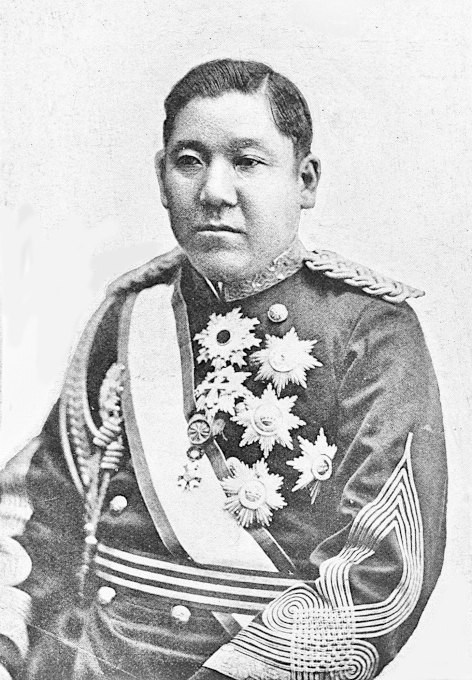
FIELD-MARSHAL MARQUIS IWAO OYAMA.
But such an attenuation of our force in this
quarter was contrary to the opinion of a committee—attended
by me in my capacity of War
Minister—which sat in Port Arthur in June,
1903. The Viceroy and senior commanders of
the garrison were present at the meeting when it
was resolved and recorded as “essential” that
the 3rd Siberian Corps should be formed for the
defence of Kuan-tung, in addition to the 7th East
Siberian Rifle Division, its permanent garrison,
and that this corps should be composed of the
3rd and 4th East Siberian Rifle Divisions, each
of twelve battalions. In fact, it was considered
necessary to have thirty-six battalions of infantry,
exclusive of reserve battalions, for the defence of
Port Arthur and the Peninsula. This formation
of a special army corps for Kuan-tung was thought
to be necessitated by the existence so close to
Port Arthur of Dalny, a magnificently equipped
port, connected by railway to the fortress, and
a most convenient base for operations against it.
Feeling that the force allotted to the defence
of the Peninsula was inadequate, on February 11
I telegraphed as War Minister to Alexeieff that
I considered it imperative that the 9th East
Siberian Rifle Division—then under formation—should
be sent there in place of the 3rd East
Siberian Rifle Division, ordered to the Ya-lu.
The Viceroy did not concur in this view, but
he temporarily retained the 13th and 14th East
Siberian Rifle Regiments.
On February 20, 1904, I was appointed to
the command of the Manchurian Army. In my
first communication to the Viceroy (No. 1 of
February 24) I again expressed the opinion
that, in view of the possibility of it being besieged
by four or five Japanese divisions, our first efforts
should be directed to strengthening Port Arthur.
And I further stated:
“If Port Arthur is weakly garrisoned, and
should be besieged, I might be tempted by that
fact to assume the offensive before there has been
sufficient time to concentrate our forces. It is
for this reason that I have already advised the
concentration of the 9th Division in Kuan-tung
to replace the 3rd.”
However, the Viceroy again disagreed with
me, and wrote in a despatch of March 1:
“Separate operations against the fortress would
only be really worth undertaking if the enemy
could make certain of seizing it by a coup de
main, and the moment for this has passed. The
land front is becoming more formidable every
day, and, though not complete, the works are
now well advanced; 200 additional guns have
been mounted in Port Arthur itself, and more
than forty at Chin-chou; the strength of the
garrison is being brought up by the reservists
arriving from Trans-Baikalia, and the stocks of
supplies are being increased. All the bays nearest
the fortress, as well as the port of Dalny, have
been mined, and for the rest—the oft-proved
stubbornness of the Russian soldier in defence
can be relied on.”
He had already reported to the Tsar that—
“Although separate operations against Port
Arthur would threaten the fortress itself with all
the hardships of a siege or blockade, they would
be rather advantageous to our arms as a whole, for
they would entail a division of the enemy’s forces.”
As regards my own recommendations upon the
plan of operations to be followed against Japan,
I drew up two memoranda, which I submitted to
the Tsar on February 15 and March 4. In the
former I stated:
“In the first phase of the campaign our main
object should be to prevent the destruction of
our forces in detail. The apparent importance
of any single locality or position (fortresses excepted)
should not lead us into the great error of
holding it in insufficient force, which would bring
about the very result we are so anxious to prevent.
While gradually growing in numbers and preparing
to take the offensive, we should only move
forward when sufficiently strong, and when supplied
with everything necessary for an uninterrupted
advance lasting over a fairly long period.”
Against this the Tsar was pleased to note in his
own handwriting the words “Quite so.”
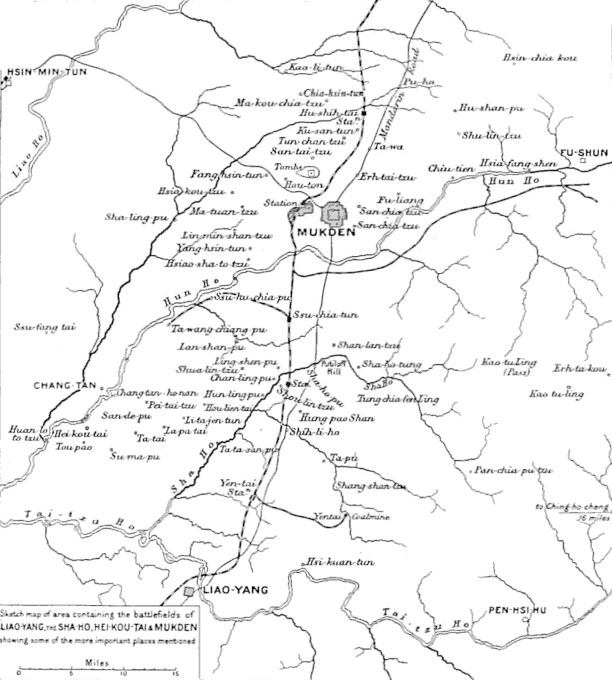
SKETCH MAP OF AREA CONTAINING THE BATTLE
FELDS
OF LIAO-YANG, THE SHA HO,
HEI-KOU-TAI, AND MUKDEN
SHOWING SOME OF THE MORE
IMPORTANT PLACES MENTIONED
I left St. Petersburg on March 12, and arrived
at Liao-yang on the 28th. On this date there were
collected in the concentration area in Southern
Manchuria 59 battalions,[65] 39 squadrons and
sotnias, and 140 guns. The distribution was as
follows:
The Southern Force (under General Sakharoff)
of the 1st and 9th East Siberian Rifle Divisions—20
battalions, 6 squadrons, and 54 guns—was in
the area Hai-cheng—Ta-shih-chiao—Newchuang—Kai-ping.
The Eastern (Advance) Force (under General
Kashtalinski) of the 3rd East Siberian Rifle Division—8
battalions, 24 guns, 8 mountain and
8 machine-guns—was moved to the Ya-lu.
The Mounted Force (under General Mischenko)
of 18 squadrons and 6 guns was operating in
Northern Korea.
The Main Body was divided into two groups:
At An-shan-chan: 5th East Siberian
Rifle Division of 8 battalions and
24 guns.
At Liao-yang: 2nd Brigades of the
31st and 35th Infantry Divisions, 22nd
and 24th East Siberian Rifle Regiments—21
battalions, 10 squadrons,
and 24 guns.
In addition to these, the 23rd East Siberian
Rifle Regiment—3 battalions and 4 guns—was
allotted to the protection of the Viceroy’s Headquarters.
In Port Arthur were the 7th East Siberian
Rifle Division—12 battalions, 2 reserve battalions,
3½ battalions of fortress artillery, and
a sapper and mining company.
In Kuan-tung were the 5th, 13th, 14th, and
15th East Siberian Rifle Regiments, 1 battalion
of the 16th East Siberian Rifle Regiment, 2 battalions
of the 18th East Siberian Rifle Regiment,
and 1 reserve battalion—12 battalions, 20 guns,
and 1 sotnia of Cossacks.
On my arrival I approved the following scheme
of engineering works: The fortification of the
positions on the Fen-shui Ling (Passes), and at
Liao-yang, Mukden, and Tieh-ling; the construction
of roads across the passes to the Ya-lu, and
of three parallel roads from Kai-ping to Mukden;
the construction of crossings over the Liao River,
and the hutting of three army corps. I at once
took steps also to strengthen our advance guard
on the Ya-lu, which was some 133 miles distant.
Two regiments of the 6th East Siberian Rifle
Division were sent there, in addition to the third
battalions for the regiments of the 3rd East
Siberian Rifle Division. By the time, therefore,
that the enemy began crossing the Ya-lu, the
Eastern (Advance) Force had been increased to
eighteen battalions, besides which the 21st East
Siberian Rifle Regiment had been moved towards
Ta-shih-chiao. The advance guard was under
General Zasulitch. Meanwhile the units of the
1st Siberian Division were detained by Alexeieff
in Harbin, so that, from the middle of March to
the middle of April, the Manchurian Army did
not receive a single battalion from the rear.
Notwithstanding the orders Zasulitch had
received to avoid a decisive engagement with
the enemy, who had the superiority in numbers,
on May 1 part of his force became hotly engaged
in what developed into a serious fight at the
Ya-lu, and after a disastrous finish his eastern
force was withdrawn to the passes of the greater
Fen-shui-ling range, which they reached on
May 7. In this action only nine of our eighteen
battalions took any active part, those of the
11th and 12th East Siberian Rifle Regiments
showing great gallantry and determination.
When asked why he had disobeyed the orders
repeatedly given to him not to become entangled
in a serious engagement, but to fall back on
Feng-huang-cheng, Zasulitch gave as his reason
that he had hoped to defeat the enemy. On
May 5 the Japanese began debarking at Pi-tzu-wo,
and a small force of all arms under General
Zikoff was detached from the southern force in
order to reconnoitre and ascertain the importance
of this landing. The advance of this column
incidentally enabled us to repair temporarily
the portion of the line which the enemy had
destroyed, and so to run a train-load of mélinite
shells, machine-guns, and ammunition through
to Port Arthur. The Emperor was fully alive
to the danger of the situation caused by the
dispersion of the Manchurian Army, and on
May 11 telegraphed his orders for an immediate
concentration. This was completed by the 14th,
and the force was grouped on two points—Hai-cheng
and Liao-yang. The former group
consisted of twenty-seven battalions, twelve
squadrons and sotnias, and eighty guns; the
latter of twenty-eight battalions, six sotnias, and
eighty-eight guns. The passes over the Fen-shui-ling
range were guarded by small columns
of infantry with guns, and advance and flank
guards were thrown out. The independent
cavalry, operating on our flanks east of the
passes, was divided in two bodies, under Mischenko
and Rennenkampf. West of Liao-yang was a
small force under General Kossagovski, while
five and a half battalions of the 1st Siberian
Division lay at Mukden. At this time also,
when the Viceroy returned to Port Arthur
(after Admiral Makharoff’s death of April 13),
the weakness of the place began to be shown up,
and Alexeieff’s apprehensions as to its safety
became acute. In a despatch of May 16 he
questioned whether the place “would be able
to hold out for more than two or three months,
in spite of all the steps taken to strengthen
its defences.” On April 25 the Chief of the
Viceroy’s Staff telegraphed to me that, owing
to the inadequacy of the garrison, Alexeieff
considered it essential that if the fortress were
attacked, the field army should support it as
energetically and rapidly as possible. Alexeieff
was not singular in his pessimistic views, for
Stössel also gave up hope of a successful defence
of Port Arthur directly after he had so unnecessarily
abandoned the Chin-chou position on
May 27. On the 28th I received a telegram
from him urging me to support him speedily and
in strength. This opinion was again endorsed
by Alexeieff, who telegraphed on June 5 that
“Port Arthur cannot strictly be called a storm-proof
fortress, and it is a question whether it can
even stand a siege of the length indicated in my
telegram of May 16.”
The result of this volte-face on the part of
Alexeieff as to the powers of resistance of the
place was that he pressed me to send part of
the army at once to assist it, though we were
by no means ready for such an enterprise. On
May 21 he wrote that he considered the moment
in every way favourable for the army to assume
the offensive in one of two directions—either
towards the Ya-lu, with the object of defeating
and throwing Kuroki back across the river,
detaching a force to contain him there, and then
moving on to relieve Port Arthur, or else direct
on that place.
It should be borne in mind that these instructions
were given at a time when the position
of only two of the hostile armies had been fixed.
Of these, one—of three divisions and three
reserve brigades—had forced the crossing of the
Ya-lu, and the other—of three divisions—had
landed near Pi-tzu-wo. Moreover, a landing,
of the extent of which we had no information,
was then being carried out at Ta-ku-shan.
Consequently we did not know the destination
of one-half of the enemy’s army, and were thus
not in possession of two important pieces of
knowledge which were necessary before any
operations of a decisive character could be undertaken—namely,
the position of the enemy’s main
forces and their probable plan of operations.
It was incumbent on us, therefore, to exercise
great caution, and to keep our forces as far as
possible concentrated, so as to be ready to meet
the attack of two or even three armies. Concerning
the two directions in which the Viceroy
advocated an advance, the following few points
suggest themselves. For any operations towards
the Ya-lu—bearing in mind the necessity for
guarding our flank and rear against one hostile
force landing at Pi-tzu-wo, and possibly others
landing near Kai-ping or Newchuang—not more
than sixty to seventy battalions were available
of the ninety-four which in the middle of May
constituted the army; the whole of the food for
these troops had to be brought up by rail, owing
to the exhaustion of the local resources—never
very plentiful—in the hilly country between
Liao-yang and Feng-huang-cheng: we had not
got the transport to do this, for our ten transport
trains could only have carried a three or four
days’ supply for a force of this size; the usual
May and June rains would have made the
movement of our guns and baggage at first
difficult, and then impossible, and we had at
that time no mountain artillery or pack transport;
we were by no means well placed in the
matter of artillery parks: the horses for those of
the 5th, 6th, and 9th East Siberian Rifle Artillery
Divisions were still en route to Harbin, while
the 1st and 2nd Siberian Divisions had arrived
without any. Finally, if Kuroki should fall back
behind the Ya-lu without accepting battle, we
should have been obliged to retire and leave
at least an army corps to contain him. When
the rainy season came on, this corps itself would
have been obliged to withdraw, as with interrupted
communications it would have been
seriously threatened by Kuroki’s far larger force,
well provided with both mountain artillery and
pack transport. For these reasons an offensive
towards the Ya-lu was impracticable.
Under the conditions laid down by the Viceroy
as to keeping screens on the Fen-shui Ling
(Passes), and leaving a reserve at Hai-cheng[66]
until such time as fresh reinforcements had been
received, a direct advance on Port Arthur could
only be made with one corps of twenty-four
battalions. In view of the possibility of Kuroki
taking the offensive in superior force (after
reinforcement by the troops already beginning
to land at Ta-ku-shan) against our cordon, which
extended along the Fen-shui-ling range for
more than sixty-six miles, and in view of the
possibility of the Japanese cutting off any
detachment moving on Port Arthur by landing
somewhere in its rear, the despatch of this corps
130 miles to the south could not but be considered
a most risky and difficult operation.
As our numerical weakness absolutely precluded
a general assumption of the offensive on
our part, I pointed out that by such a movement
for the relief of Port Arthur we risked
disorganizing the whole army. I also drew
attention to the fact that, according to the
report of Captain Gurko, who had just arrived
from the fortress, its combatant strength
amounted to at least 45,000 men (including
sailors), and that the enemy could not therefore
have any very overwhelming superiority. My
views upon the inexpediency of any movement
towards Port Arthur were communicated to the
War Minister in my telegrams (Nos. 692 and
701) of May 28 and 30. But in a telegram of
the 31st the Viceroy urgently requested me to
advance to the relief of the fortress, and expressed
the wish that four divisions should be
detailed for the operation; while on June 6 he
quoted to me a message from St. Petersburg
in which it was stated that the time was “ripe for
the Manchurian Army to assume the offensive.”
At the end of May the first reinforcements—the
3rd Siberian Division—began to arrive in
the concentration area. This enabled me to
increase the force detailed for the advance into
Kuan-tung up to 32 battalions,[67] 22 squadrons
and sotnias, and 100 guns. As a reserve to this
force, the 2nd Brigade of the 31st Division was
placed in the area Kai-ping—Hsiung-yao-cheng,
and to a brigade of the 3rd Siberians was allotted
the duty of watching the coast from Newchuang
to the latter place. To hold Kuroki and the
troops under Nodzu that had landed at Ta-ku-shan
in check, 40 battalions, 52 sotnias, and
94 guns were left on the Fen-shui Ling (Passes),
distributed over a length of more than sixty-six
miles. The general reserve consisted of the
5th East Siberian Rifle Division at Liao-yang,
and a brigade of the 3rd Siberian Division at
Hai-cheng. Early in June the force detailed
under General Shtakelberg for the operations
towards Port Arthur began to concentrate at
Te-li-ssu, with its advance guard at Wa-fang-tien.
On the 13th the Japanese themselves began to
advance from Pu-lan-tien, and by the evening of
that day we had been able to rail two regiments
of the 9th East Siberian Rifle Division into
Te-li-ssu. On the 14th the enemy’s attack of
our position there was repulsed, and on the
following day Shtakelberg proposed to make a
counter attack, having been reinforced at noon
by the Tobolsk Regiment. However, the battle
ended in our defeat, and we were forced to fall
back. General Gerngross, who was in command
of the 1st East Siberian Rifle Division, was
wounded, but remained in action. Shtakelberg’s
orders gave him freedom of action, but he was
instructed not to accept decisive battle if the
enemy were in superior numbers. Simultaneously
with the enemy’s advance from the south,
Kuroki moved forward on the 14th to the
Ta Ling[68] (Pass) from Hsiu-yen, where three
(according to some reports four) Japanese divisions
were concentrated. Their 12th Division
and three reserve brigades were left to watch
our eastern force, and a further movement on Kai-ping,
Ta-shih-chiao, or Hai-cheng was quite likely.
In order to be in a position to check the combined
advance of the two Japanese groups, I
thought it advisable to strengthen our southern
force, and therefore so rearranged our dispositions
that 87 out of 110 battalions were massed on the
southern front, in the area Kai-ping—Hai-cheng,
against Oku and Nogi. Fortunately for us, the
critical position of our eastern front during the
operations at Te-li-ssu was not appreciated by
Kuroki, which fact favoured Count Keller’s
demonstration towards Feng-huang-cheng in the
middle of June. Otherwise Kuroki might have
seized Liao-yang. On the 25th the enemy’s
advance against our eastern force was commenced.
On the 27th Keller withdrew some of his troops
from the Fen-shui Ling (Passes) without opposition,
and by July 1 the main body was concentrated
seven miles east of Lang-tzu-shan and
twenty-seven from Liao-yang. On June 27,
without any serious engagement, but under
pressure from the enemy, we abandoned the
Fen-shui Ling (Passes), which they at once
occupied. A few days previously—on June 23—about
a division of the enemy had been located
by Rennenkampf to the east of Sai-ma-chi.
Believing that Hai-cheng constituted our greatest
danger, as the enemy might, if they gained a
success there, cut off Shtakelberg’s force close by,
on the 29th I concentrated forty-one battalions
and eighteen sotnias under Zasulitch at Hsi-mu-cheng,
intending with them to hurl back the
enemy on to their Hai-cheng line of advance.
However, on the same day we discovered that
those of the enemy who had moved at first from
the Ta Ling (Pass) along the Hsi-mu-cheng road
had again retired to it.
This danger being temporarily averted, I
ordered the 31st Infantry Division back to
Hai-cheng. As the defence of Liao-yang from
the east was the next most urgent matter, a
brigade of the 9th Division, which had just
arrived from Russia, was moved to Lang-tzu-shan
to act as a reserve to the eastern force, which had
been previously augmented by the return to it
of two regiments of the 3rd East Siberian Rifle
Division. The other brigade was sent, under
General Hershelman, who commanded the
division, to Hsi-kei-an village [at the junction of
the Liao-yang and Mukden roads], so as to cover
the left flank of the eastern force and guard the
road to Mukden. Taking into consideration the
considerable increase of the eastern force, I
ordered Count Keller to take the offensive, so as
again to get possession of the passes. He did so,
but although he had forty battalions under his
command, he advanced with only twenty-four.
Though our troops were successful in the early
hours of July 17, thanks to the gallant conduct
of the 24th East Siberian Rifles under Colonel
Lechitski, the result of the day’s action was not
favourable. Keller stopped the advance before
even bringing into action his strong reserves, with
the result that at nightfall the eastern force was
once more on its former positions on the Yang-tzu
Ling (Pass). On the 19th the brigade of the
9th Division was driven from its position at
Chiao-tou, and fell back towards Hu-chia-tzu.[69]
By the middle of July the disposition of the
enemy’s forces was approximately as follows:
Kuroki, with three field divisions and reserves,
had captured the three Fen-shui Ling and
Mo-Tien Ling (Passes), and, with his outposts
thrown out on the roads to Liao-yang, had
reached the valley of the Tang Ho, a tributary
of the Tai-tzu Ho. Nodzu, with an army of
approximately the same strength, had captured
the passes on the Kai-ping, Ta-shih-chiao, and
Hai-cheng roads, and had two divisions and
a brigade in reserve on the Hai-cheng line of
advance and one on the Ta-shih-chiao line. Oku,
having moved up from Kuan-tung with his army
of some four divisions, had driven back our
outposts and occupied Kai-ping. Two brigades
were left in reserve on the line Feng-huang-cheng—Kuan-tien-chang.
Thus, according to our
information, two armies of about 90 to 100
battalions had advanced against us from the east,
and one of about 50 to 60 battalions from the
south, whilst Nogi’s army of 3 divisions and
2 reserve brigades had been left to operate
against Port Arthur. Our dispositions were
briefly: 44 battalions against Kuroki’s army;
28 battalions on the line Fen-shui-ling—Hai-cheng
against 2 divisions and 1 reserve brigade
of Nodzu’s army; 48 battalions against Oku’s
army, and 1 division of Nodzu’s; 16 battalions
were in the general reserve at Hai-cheng, and
four in garrison at Liao-yang. It must, however,
be borne in mind that the effective strength of
our battalions was very far short of the prescribed
establishment.[70] From the beginning of the war
up to July only 3,600 men were received in the
way of drafts.
With the above dispositions of the opposing
forces, we should, according to the theory of the
art of war, have been able to operate on “interior
lines.” But for us this was extremely difficult,
as, in the first place, we had not enough men to
attain the necessary superiority over any one of
the hostile groups without laying ourselves open
to defeat by the other two; and, in the second,
the rains had so seriously damaged the roads as
to prevent the rapid movement (as we had heavy
guns and baggage) necessary for successful action
even on interior lines. Finally, as their bases
(Korea, Ta-ku-shan, Pi-tzu-wo) were enveloping
it was possible for each of their groups to refuse
an unequal battle, and fall back without exposing
its communications. Still, notwithstanding these
unfavourable conditions, it was proposed to attack
Kuroki, who menaced our communications most,
at the earliest favourable moment. The troops
which could be employed to strike him were
distributed in two directions: twenty-four battalions
of the eastern force on the main road from
Liao-yang to Lang-tzu-shan, with its outposts on
the Yang-tzu-ling heights; and twenty-four
battalions of the 10th Army Corps on the line
Liao-yang—Sai-ma-chi, with its outposts five
miles short of Chiao-tou. Twenty-four battalions
of the 17th Corps were told off to remain as
a reserve to these two groups at Liao-yang, while
to prevent our left flank being turned, and to
cover the Mukden road, the 11th Pskoff and
2nd Dagestan Regiments, which had just arrived
from Russia, were ordered to Pen-hsi-hu. But
on July 23, when I inspected the 10th Corps,
I found that it was absolutely incapable of
operating in the hills, as it had no pack-animals.
In fact, those companies on outpost duty on
steep or high ground had actually to remain all
day without food or water. As the units of the
17th Corps were in a similar condition, it was
impossible even to think of at once assuming the
offensive.
Meanwhile, on the 23rd and 24th, the enemy
themselves took the initiative by attacking the
1st and 4th Siberian Corps south of Ta-shih-chiao.
In spite of the fact that the position held by these
corps was very extended (eleven miles), and was
divided in the centre by a rocky ridge, and that
its left flank could have been easily turned, all
the enemy’s efforts were repulsed. The regiments
of the 4th Siberians, who bore the heat and
burden of the day, behaved splendidly, but “in
view of the great superiority of the enemy and
the development of an attack from the direction
of Ta-ling,” Zarubaeff, who was given general
instructions but allowed freedom of action,
decided early on the morning of the 25th to
withdraw his force towards Hai-cheng. On
learning of this, I ordered General Sluchevski
to make immediate preparations for offensive
operations, and, if Kuroki should cross the
Tai-tzu Ho and move towards Mukden, at once
to advance, whether his troops were prepared
for operating in the hills or not, and endeavour
to strike Kuroki’s communications. However
painful the abandonment of the port of Newchuang
was for us after our tactical success at
Ta-shih-chiao—for the enemy could now make use
of it as a new base—the strategical position of our
army was improved. With the departure of the
southern force towards Hai-cheng, our greatly
extended front was diminished by twenty miles.
On July 31 the enemy advanced all along the
line. As far as our southern group was concerned,
their blow was directed against Zasulitch,
who was holding a position west of Hsi-mu-cheng,
especially against his right flank, which was
driven back in spite of the devoted efforts of the
Voronej and Kozloff Regiments. As any further
success on their part threatened to cut off the
2nd Siberians from the main body of the southern
group, I withdrew Zasulitch’s force to Hai-cheng.
On the same day, the enemy’s operations on the
eastern front were directed against both our
groups. In the action on the Yang-tzu Ling
(Pass) General Count Keller was killed, and the
unexpected death of this gallant commander,
together with the abandonment without orders
by the 23rd East Siberian Rifle Regiment[71] of
the position which protected his left flank, greatly
influenced Kashtalinski (Keller’s successor) in
coming to his too hasty decision to withdraw the
force to Lang-tzu-shan. At the same time the
10th Corps was taken partly by surprise,[72] and
driven from its advanced posts towards Hu-chia-tzu.
Sluchevski, learning of the retirement of
the eastern force towards Lang-tzu-shan, and
fearing for his right flank, then withdrew his
corps to An-ping. In these operations the corps
commander displayed a lack of energy, and several
regiments showed great unsteadiness, especially
the reservists, many of whom actually left the
ranks during the progress of the fight.
The complicated nature of the situation now
necessitated extreme caution on our part, lest
anything should prevent our concentration in
strength at Liao-yang, and there fighting a
decisive battle against all three Japanese armies
with some hope of success. From Liao-yang to
our position on the eastern front, An-ping–Lang-tzu-shan,
was twenty miles, and to Hai-cheng forty
miles. In order to insure the movement of the
troops on the southern front to their positions at
Liao-yang in good time, it was necessary to move
them from Hai-cheng to the position at An-shan-chan—fifteen
miles from Liao-yang—which was
fortified at the beginning of the war. The retirement
began early on August 2, and on the
following day the troops were concentrated on
the position. In my report to the Tsar of
August 4, I gave the following general reasons
for withdrawing to the line An-shan-chan–Lang-tzu-shan–An-ping
after the July fighting:
1. The Japanese superiority in numbers.
2. They were accustomed to hills and hot
weather; they were younger, carried lighter
loads, and had numerous mountain artillery and
pack transport.
3. Their energetic and intelligent leadership.
4. The extraordinary patriotism and military
spirit of their troops; and
5. The lack of such a spirit on our side (caused
by general ignorance of what we were fighting
for).
Every moment gained at the beginning of
August was of great importance to us, as the
units of the 5th Siberians, which the Viceroy
agreed to send to the front—instead of into the
Pri-Amur district, as was proposed earlier—should
have been beginning to arrive in Liao-yang.
Orders were therefore issued to fortify
an advanced position half a march from Liao-yang
in addition to the main position at that
place, and for this time was required. Still, in
spite of the obvious and immense importance of
every day we gained by delaying the enemy’s
advance, General Bilderling, who had taken
over the command of our eastern front from
July 31, wrote that it was necessary to withdraw
his troops immediately without fighting to
Liao-yang itself, while Sluchevski urged that the
army should be concentrated still further north—in
the area Liao-yang–Mukden. These officers
reiterated the same opinions still more forcibly
early in August, when the difficulty of moving
their troops towards Liao-yang became greatly
increased by the heavy rains. The Viceroy, who
was much perturbed about the fate of Port
Arthur by the news of the unfortunate result of
the naval operations on August 10, and whose
fears were increased by Stössel’s highly alarmist
reports, was at the same time urging me
(August 15) to assist the fortress and make an
advance of some sort—though it were only a
demonstration—towards Hai-cheng.
On August 25 the enemy again advanced, and
on the 26th attacked us on the eastern front, but
their onslaught on the 3rd Siberians at Lang-tzu-shan
and the attempt made to turn our right
flank failed. Ivanoff (who was in command of
the corps) handled his artillery most skilfully,
and all units of this corps behaved well. The
reserves sent up by Bilderling arrived in good
time, but the enemy obtained a position on the
left of the 10th Corps which enabled them to
menace the retirement of this corps along the
Tang Ho. In the hot fight on the 26th again
several units of the 10th Corps did splendidly.
At this time a strong turning movement was
discovered being developed against the left flank
of our An-shan-chan position; but by delaying
and inflicting heavy loss on the enemy on the
Lang-tzu-shan and An-ping positions, all the
corps were able to fall back on the advanced
positions at Liao-yang, where the army was concentrated
on August 29. At the beginning of
the action there the army was short of its prescribed
strength by 350 officers and 14,800 men.
Excluding the men detailed for extra duty (on
the communications, etc.), the average strength
of our companies was only 140 to 150 rifles, and
those companies that lost most heavily in the
previous fights could muster less than 100.
The detailed account of the battle of Liao-yang
has long ago been submitted to Headquarters.
The following is a general description
of it: On August 30 and 31 the enemy attacked
our advanced positions with great determination,
especially that of the 1st and 3rd Siberians, but
were repulsed everywhere with heavy loss. In
this fight the regiments of the 1st, 9th, 3rd, 6th,
and 5th East Siberian Rifle Divisions rivalled
each other in steadiness and gallantry, while the
dispositions made by Shtakelberg and Ivanoff
were good. Our success, however, was by no
means lightly gained. Our artillery expended as
much as 100,000 rounds of ammunition, leaving
us with only 10,000 rounds in the army reserve.
Moreover, excluding eight battalions furnishing
guards and holding the works of the main Liao-yang
position, on September 1 only sixteen battalions
were left in the general reserve. During
the 31st we observed that large bodies of Kuroki’s
army were crossing on to the right bank of the
Tai-tzu Ho. And, as the position held by the
10th Corps (against which Kuroki should have
been operating in full strength) had not for two
days been subjected to any such determined
attacks as that held by the 1st and 3rd Siberians,
there was every reason to suppose that Kuroki’s
main body was moving round to operate against
our communications. Accordingly a decision had
to be made of one of two alternatives: either—
1. To contain Kuroki with a small force and
advance to the south against Oku and Nodzu; or—
2. To fall back on the main Liao-yang position,
leave as few troops as possible to defend it, and
then attack in force that portion of Kuroki’s
army which was moving round our left, and
endeavour to crush it by driving it back on the
Tai-tzu Ho, which at that time of the year was
unfordable except at a few points.
As regards the first, even if we were successful
against Oku and Nodzu, they could always fall
back on their communications if in difficulties,
and so draw us away from Liao-yang, while any
success by Kuroki which might lead to an attack
by him on our communications would threaten
us with catastrophe.[73] In order to collect sufficient
force to move against the two armies, it would
have been necessary to have contained Kuroki
with only such troops as were on the right bank
of the river—namely, the 17th Corps and two
regiments of the 54th Division (total, forty battalions)
under Bilderling. But as these troops
were not yet seasoned, it was impossible to rely
on their performing such an extremely difficult
task as that of holding in check Kuroki’s superior
numbers on the necessarily extended position
they would have to occupy [this fear was justified
by subsequent events]. These considerations led
to the adoption of the second alternative.
On the 31st, under cover of darkness and
without being pressed, we began the evacuation
of the advanced positions, which had already been
of value to us, inasmuch as the enemy had been
weakened by the losses incurred in attacking
them. By the following morning as many as
100 battalions, with artillery and cavalry, had
crossed on to the right bank of the river. The
Japanese did not occupy our abandoned positions
till the evening of that date, when they began to
shell Liao-yang. The general disposition of the
army was as follows: 56 battalions, 10 sotnias,
and 144 guns (under Zarubaeff) were still on the
left bank; 30 battalions, 5 sotnias, and 84 guns
were on the right for the defence of Liao-yang
itself. In addition to the small columns detailed
to guard our flanks and rear, the remainder of
the army, totalling 93 battalions, 73 squadrons
and sotnias, and 352 guns, were told off to attack
Kuroki. But in making this calculation as to
the number of battalions available, it is essential
to explain a very important factor. During the
whole period of the war from its commencement
till August only 6,000 men had been received at
the front as drafts to repair wastage, and, as I
have said, we began the fighting round Liao-yang
with a shortage of 15,000 men. The result of
this, taken in connection with the great number
of men that had to be detached for various non-combatant
duties, and also our losses in the
fighting that had already taken place in the
neighbourhood, was that the actual strength of the
ninety-three battalions was, on September 1, only
from 50,000 to 55,000 rifles. For instance, the
twenty-one battalions comprising the 10th Corps
(which took part in the affair of September 2) only
numbered 12,000 rifles, and the total of the twenty-four
battalions of the 1st Siberians only amounted
to 10,000. Kuroki’s army, on the other hand,
was calculated to number approximately from
65,000 to 70,000 men. The plan of operations
for the troops crossing on to the right bank was
as follows: The force was to deploy between the
position held by the 17th Corps near the village
of Hsi-kuan-tun and the heights near the Yen-tai
mines, which were to have been held by Orloff’s
force of thirteen battalions. Using the Hsi-kuan-tun
position as a pivot, the army was to throw its
left forward so as to strike the Japanese in flank.
The position for the 17th Corps near this village
was chosen by Bilderling in preference to that
which had been prepared for defence beforehand
on the right bank on the line San-chia-tzu–Ta-tzu-pu,
and sufficient attention was not paid
to its fortification. All that was done was to dig
a few trenches, and no field of fire had even been
cleared in the kao-liang crops. The consequence
was that, in the early morning of September 2,
the enemy drove the 137th Niejinsk Regiment
from the peak north-east of this place, which
constituted the left flank position of the 17th
Corps, and to regain this hill became the first
thing we had to do. For this Bilderling was
given forty-four battalions, with the 3rd Siberians
in reserve, while the 1st Siberians and Orloff’s
column were to assist by threatening the Japanese
right. Both Bilderling and Shtakelberg had been
instructed as to what was expected of them, but
they were given an absolutely free hand as to
their dispositions. Notwithstanding the large
force under Bilderling’s command, the operations
failed in their object. Although the peak was
recaptured on the evening of the 2nd, we were
again driven off during the night, and had to fall
back some two miles, only halting on the Erh-ta-ho
heights.
Orloff, on the other hand, moved from his
position on the heights south of the Yen-tai mines
before he ought to have done, without waiting
for the arrival of the 1st Siberians. His troops
became at once immersed in a perfect sea of kao-liang,
and were fired on from front and flank;
parts of the column were seized with panic, and
the whole force retreated in disorder towards
Yen-tai station. A large portion even went as
far as the station itself. This sudden and unexpected
departure from the field of 12,000 men
had a disastrous result on this flank. We lost
an excellent position, which should have served
as the support for our advance from the left, and
the enemy, spreading away to the north, had by
5 p.m., in spite of the gallant efforts of Samsonoff
and his Siberian Cossacks, occupied the whole
range of heights and the Yen-tai mines. With
the occupation of these heights the whole of our
left was endangered. At midnight Shtakelberg
reported that, owing to his heavy losses in the
preceding battles, he would not be able to take
the offensive, or even to accept battle on the
following day.
Meanwhile the armies of Oku and Nodzu had
advanced in force against Liao-yang, but had
been driven back by Zarubaeff. Here the main
burden of the fighting fell on the 5th East
Siberian Rifle Division, which behaved extremely
well, as did the regiments of the 4th Siberians.
On the night of the 3rd, however, Zarubaeff
reported that, though the enemy had been repulsed,
he had only three battalions left in
reserve, and needed reinforcements and gun
ammunition. At the same time a message came
in from Lubavin, who was covering the Pen-hsi-hu–Mukden
line, informing me of his retirement
to the Tung-chia-fen Ling (Pass), sixteen
miles from Mukden. From this it is evident
that if, choosing the first alternative, we had
marched against Oku and Nodzu, Kuroki could
most certainly have driven back the 17th Corps
and 54th Division, and have seized the railway
in rear of our troops moving southwards. As
we knew, however, that Kuroki was not operating
against us with his main body during the battle
of the 2nd, we realized it might have been sent
to turn our left. Such being the situation, we
had to decide whether to maintain our hold on
the river, or to abandon Liao-yang and retire to
the position on the left bank of the Hun Ho in
front of Mukden, which had been already fortified.
As regards the first alternative, it seemed
possible that we might, by an immense effort and
skilful manœuvring, be able to hold on to
Liao-yang and throw Kuroki behind the Tai-tzu
Ho. But for this it was essential to draw in the
force that had crossed to the right bank, and to
deploy it on a fresh line farther to the north, so
that we might be able to attack the enemy’s
position on the heights near the Yen-tai mines
from the north as well as from the west. Such
a movement would have exposed our right, and
would have isolated the position still held by the
17th Corps on the right bank of the river. The
Japanese might drive it in and issue in rear of
the troops at Liao-yang, for that place was only
eleven miles distant from the position to which
the 17th Corps would have had to retire if it were
driven back. The defenders of Liao-yang, being
then attacked by Oku and Nodzu combined,
would be in a critical situation. As regards the
second alternative, a retirement on Mukden
presented great disadvantages and dangers. It
increased the distance to Port Arthur; it would
have to be carried out under pressure from the
enemy in front and on the left, and the roads
had been so much damaged by rain that it was
doubtful whether we should succeed in getting
our transport or even artillery to Mukden. The
abandonment of Liao-yang could not fail both
to depress the troops who had so gallantly
defended it and encourage the enemy. But, on
the other hand, we should be extricated by such
a retirement from a situation in which we were
threatened in front and flank. A successful
withdrawal would also give time for the 1st Army
Corps to come up, and, what was not less important,
for us to replenish artillery ammunition,
of which we were very short. Besides this, the
banks of the Tai-tzu Ho were specially unsuited
for our troops, as they were almost entirely
covered with kao-liang. Our men were unused
to this, lost their heads whenever they got into
it, and were very liable to panic.
On the whole, our past experiences of the
offensive did not inspire any confidence that we
should be able to cope with the difficult situation
implied by a retention of Liao-yang. I decided,
therefore, on the retirement towards Mukden,
which was carried out by September 7. The
most difficult work, especially on the early
morning of the 5th, fell to the lot of the
1st Siberians, who had to beat off Kuroki’s force
attacking from the east; this they did with
success, and without losing a single trophy, in
spite of the difficulties in which we were placed.
A general account of the operations round
Liao-yang, and a statement of all the considerations
which led to our retirement, were telegraphed
to the Emperor on September 11. On
the 14th the army was made happy by the
following gracious message, which I received
from His Majesty:
“From your reports of the fighting at Liao-yang,
I appreciate that it was impossible for you
to have held that position longer without risk
of being completely cut off from your communications.
Under such conditions, and in face of
the existing difficulties, the retirement of the
whole force across country without the loss of
guns or baggage was a brilliant feat of arms.
I thank you and the gallant troops under your
command for their heroic conduct and enduring
self-sacrifice. May God help you all!”
Upon retirement, our troops were grouped in
two principal bodies—
1. The defence of the main position on the left
bank of the Hun Ho was entrusted to the 10th
and 17th Corps under Bilderling, to whom was
subordinated Dembovski’s force of 10 battalions
of the 5th Siberians, which was guarding the near
right flank of the main position. Altogether,
the troops under Bilderling’s command amounted
to 75 battalions, 53 squadrons and sotnias,
190 guns, 24 mortars, and 3 sapper battalions.
2. The protection of the left flank from Fu-shun
to the west was entrusted to Ivanoff’s force,
consisting of the 2nd and 3rd Brigades of the
4th and some units of the 5th Siberians (total,
62 battalions, 26 sotnias, 128 guns, and 2 sapper
battalions).
3. To keep touch between these two main
groups were the 1st Siberians under Shtakelberg
(total, 24 battalions, 10 squadrons and sotnias,
56 guns, and 1 sapper battalion). To his force
was entrusted the defence of the portion of the
Hun Ho from Chiu-tien to Pu-ling.
4. The general reserve was disposed in two
groups—
(a) 4th Siberians (24 battalions, 6 squadrons,
96 guns, 12 mortars, and 1 sapper battalion) on
the line Erh-tai-tzu–Khou-kha.[74]
(b) 1st Army Corps, which concentrated in
Mukden early in September[75] (32 battalions,
6 squadrons, 96 guns, 1 sapper battalion), along
the Mandarin road on the line Pu-ho–Ta-wa.
5. The protection of the extreme right was entrusted
to Kossagovski (6½ battalions, 9 squadrons,
14 guns), the main body of which was at Kao-li-tun
on the Liao.
6. A brigade of the 6th Siberians (8 battalions
and 1½ sotnias) was concentrated at Tieh-ling to
protect our communications.
7. The Trans-Baikal and Ural Cossack Brigades
which did not belong to any corps were joined
together under the command of Mischenko
(21 sotnias and 8 guns).
Besides putting the finishing touches to the
main position at Mukden, which had already
been fortified, the defensive work consisted of
strengthening the Fu-liang and Fu-shun positions,
and throwing up some works on the right bank
of the Hun Ho between Mukden and Fu-liang.
The object of these was to check the enemy
crossing until our reserves could come up. In
addition to this, much was done to improve the
communications towards Tieh-ling. On September 20
I learned by telegram from the Viceroy
of the formation of the 2nd Manchurian Army.
This was to comprise the 6th Siberians and
8th Army Corps, five Rifle brigades from Russia,
a Cossack infantry brigade, the 4th Don and
2nd Caucasian Cossack Divisions, and three
dragoon regiments of the 10th Cavalry Division.
General Grippenberg was appointed to the command
of this force on September 24.
Our position at Mukden had some very grave
defects.
1. Its left flank (Fu-liang–Fu-shun) was,
owing to the bend in the Hun Ho to the north-east
of Mukden, thrown much too far back. If
the enemy were successful on this flank, and
came out on to our communications, we should
be compelled to abandon the main position
prematurely.
2. Almost immediately in rear of the position
was the River Hun, which was at the time
unfordable, and could only be crossed by bridges.
Behind the river was the town itself.
3. The Fu-shun coal-mines, which were most
necessary to us (for railway fuel), were right in
front of the position.
These drawbacks, as well as our great desire
to prevent any of the enemy’s forces being
detached for the reinforcement of Nogi’s besieging
army, drove us to try and take the offensive as
soon as possible.
Meanwhile the drafts whereby to replace our
losses were still arriving at the front very slowly;
during July and August only 4,200 men were
received. On September 29 the eight corps
composing the Manchurian Army could only
muster 151,000 rifles, the deficit in officers being
670. Besides these corps, the Viceroy put the
6th Siberian Corps[76] under my command, with
the proviso that it should not be included in the
army, and should not be split up.[77] It was
concentrated at Mukden on October 8. My
requests that the units of the 1st Siberian
Division—some ten battalions—which were not
included in the army, might be made over to me
were not acceded to. But although we were
really too weak, an advance seemed more advantageous
than waiting for the enemy to attack,
for there seemed little chance of our being able
to hold our ground on the Mukden positions.
According to our information, the Japanese
main forces had crossed on to the right bank
of the Tai-tzu Ho, between Liao-yang and
Pen-hsi-hu, and were disposed approximately as
follows: In the centre, behind the line Yen-tai
station–Yen-tai mines, six divisions with brigades
in reserve; on the right, écheloned along the
line Pan-chia-pu-tzu–Pen-hsi-hu, two divisions
with brigades in reserve; on the left, more or
less along the line San-de-pu–Sha-tai-tzu, two
divisions with their reserves. The enemy had
fortified their positions on the Yen-tai heights
and at Pan-chia-pu-tzu. It was decided, therefore,
that the first object of our advance was to
hurl the Japanese back on to the left bank of
the Tai-tzu Ho. To do this we were to deliver
a frontal attack, and at the same time endeavour
to turn their right, so that, if successful, we
should dislodge them from the hills. Orders
were issued for the forward movement to commence
on October 5. The following was the
plan of advance decided upon by me:
1. Western Force.—This force, under Bilderling,
consisting of the 10th and 17th Corps
(total, 64 battalions, 40 squadrons and sotnias,
196 guns, and 2 sapper battalions), was to make
a demonstration in front against the enemy’s
main force.
2. Eastern Force.—This force, under Shtakelberg,
consisting of the 1st, 2nd, and 3rd Siberians
(total, 73 battalions, 29 squadrons and sotnias,
142 guns, 6 mortars, 32 machine-guns, and
3 sapper battalions), was to attack the right
flank of the enemy, moving round it from the
east. The first objective of this force was the
enemy’s positions at Pan-chia-pu-tzu.[78]
3. The General Reserve.—This, consisting of
the 1st Army Corps and 4th Siberians, with
Mischenko’s brigade (total, 56 battalions, 20 sotnias,
208 guns, 30 mortars, and 2 sapper battalions),
was to move up in rear of the interval
between the western and eastern forces.
4. The 6th Siberians (32 battalions, 6 sotnias,
96 guns, and 1 sapper battalion) was to remain
temporarily in Mukden (with a brigade at Tieh-ling),
so that it might either be moved to a
flank or added to the reserve, according as the
operations developed.
5. Flank Guards.—A force of 30½ battalions,
39 sotnias, 82 guns, and 1 sapper battalion was
told off to protect the flanks. Of this, 19½ battalions,
25 sotnias, 64 guns, and the sapper
battalion were to take part in the attack of
the enemy’s position while keeping touch with
Dembovski’s and Rennenkampf’s columns of the
eastern and western forces respectively.
6. Should the enemy concentrate towards
their right, an endeavour was to be made to
break through their centre in the direction of
the Yen-tai mines by the 6th Siberians, with
Bilderling’s force and the general reserve.
The advance began on October 5, and meeting
with no determined opposition, we on the 9th
occupied the following positions:
Western Force.—The line Shih-li-ho–Ta-pu.
Eastern Force.—The line San-chia-tzu–Shang-shan-tzu–Ununin.
In the Centre.—By the range of hills south of
Khaamatan (with the assistance of a portion
of the general reserve).
The 4th Siberians, especially the Tomsk,
Barnaul, and Irkutsk Regiments, did excellent
work, as did Mischenko’s mounted force, reinforced
by the 4th East Siberian Rifle Regiment.
Rennenkampf’s column moved out into the
Tai-tzu Ho Valley, and worked along both
banks of the river towards Pen-hsi-hu. Though
the independent regiments of the 1st and 3rd
Siberians suffered heavily, overcame the difficulties
of the locality, and made altogether a
gallant bid for success, they failed in their object,
mainly owing to the lack of co-ordination in
the plan of operations, and of cohesion in its
execution. On the evening of the 10th the
Japanese themselves took the offensive, having
concentrated their main forces opposite our right
and centre. Bilderling’s western force, after
fighting desperately against heavy odds and
losing forty-six guns, fell back on the 12th on
to the main position on the Sha Ho. Our
centre, augmented by the 1st Corps, found itself,
in consequence, too far forward, and was obliged
on the evening of the 13th to commence a
retirement on to the high ground near the
position of the western force, and occupied the
heights south of Erh-ta-ho. From the 10th to
the 12th Shtakelberg’s eastern force made a
gallant but vain endeavour to get possession of
the almost inaccessible ridges to the north of the
road from Pen-hsi-hu to the Yen-tai mines.
His dangerous position, thirteen miles in advance,
and the necessity for collecting enough
troops in our centre to repulse the further
attacks of the enemy’s main body, compelled
me on the 12th to order him to withdraw to the
high ground of the position occupied by the
rest of the army, and to move a portion of his
force in support of our centre. The enemy’s
further attempts to drive us from the ground
we were holding were unsuccessful, though we
were hard pressed on the Sha Ho, and the
general desire to retire on our Mukden positions
became very great. In a night attack on the
15th the enemy succeeded in dislodging two
regiments of the 22nd Division from the “One
Tree Peak,” which they were holding on the
left bank of the Sha Ho between the villages
of Sha-ho-pu and Sha-ho-tung. The loss of this
height, which commanded us on the right bank
of the river, and constituted, so to speak, the
key of our position, by no means improved the
situation. On the evening of the 16th, therefore,
I concentrated a force of twenty-five
battalions under Putiloff, whom I ordered to
attack the enemy in front and flank. After
desperate hand-to-hand fighting, he succeeded
on the morning of the 17th in driving them off
the heights, and captured eleven guns, one
machine-gun, many limbers and waggons. This
episode put the finishing touch to the major
operations of both sides, and we now proceeded
to pass the winter in our respective positions in
close touch with one another.
The reasons of the indecisive issue to the
battle were:
1. Shtakelberg’s unskilful disposition of the
large force put under his command, which was
(as we discovered later) almost three times the
size of that opposed to him.
2. The absence of proper control and generalship
among senior commanders of the western
force.
3. The abortive operations of, and lack of
energy displayed by the officer commanding the
10th Corps. (Among other things, he not only
retired quite unnecessarily on October 12 from
his position on the left bank of the Sha Ho, but
also neglected to warn his neighbour in command
of the 1st Corps, who was in consequence
placed in a critical position.)
4. The useless manœuvres of the officer commanding
the 31st Division, who several times
ordered one of his brigades to retire without due
cause.
5. The unsteadiness of many units.[79]
6. The lack of cohesion in the operations of
the 6th Siberians (on the right of the western
force).
During this battle of the Sha Ho the senior
commanders—Generals Bilderling and Shtakelberg—were
given instructions as to what was
required of them generally, but were left to
make their dispositions independently.
As will be seen from the above brief sketch
of events, the September fighting had no decisive
results. The two sides suffered equally,
and lost about 50,000 men each. Still, our
assumption of the offensive, even with inadequate
numbers, greatly improved our strategical
position by moving our general front thirteen
miles forward in front of Mukden, and afforded
us a matter of four and a half months of time.
As soon as we occupied the positions on the
Sha Ho from Shou-lin-tzu on the right flank to
Kao-tu-ling on the left, we set to work fortifying
them. Besides ten battalions of the
1st Corps, the whole of the 1st Siberians and
twenty-four battalions of the 6th Corps were
moved into the general reserve in rear of the
centre, and we were confident that we would be
able to hold our ground. We still had, however,
a very small number of men—indeed, in
some units the shortage was alarming. The
total strength of the 252 battalions comprising
our army on October 25 was only 140,000 rifles,
which works out at an average strength of
550 per battalion, while many battalions could
not even muster 400 men. Not less disquieting
was the lack of officers, which now amounted
in the infantry alone to over 2,700, or an average
deficiency per battalion of eleven. Meanwhile
the drafts to repair wastage were still coming up
in driblets. In October and November we only
received some 13,000 men. It was not till
December 8 that they began to reach us in any
quantity; during that month and the first half
of January 72,000 arrived. I reported upon this
vital question in my letters to the Tsar of
October 26 and November 5.
In his despatches of October 23 and 26 His
Majesty was pleased to inform me that I had
been appointed to the supreme command of all
the forces in the Far East, that General Linievitch
was appointed to the command of the 1st,
and General Baron Kaulbars to the command
of the 3rd Army.[80] My first act was to augment
the army by adding to it the whole of the
1st Siberian and 61st Divisions, the latter of
which was intended by Alexeieff for the Pri-Amur
district. This at once added 20,000 rifles
to the field army; the leading units also of the
8th Corps began to arrive at the beginning of
November, and at the end of the month were
concentrated at Mukden. But the main thing
which still remained to be done was the improvement
of our railway communication with Russia,
which became more than ever necessary on
account of the increased army to be supplied.
On November 28 the effective strength of all
three armies, including the 8th Corps, amounted
to 210,000 men. Our information as to the
enemy put their strength at this date at about
200,000. Although we were rather superior in
numbers, our superiority was too slight to insure
a successful offensive under the particularly
difficult conditions offered by the intense cold
weather, and the fact that the enemy’s positions
were strongly fortified. The low temperature
rendered the lightest trench work practically
impossible, and made the provision of a large
amount of warm clothing an absolute necessity.
Our preparations for the offensive, as regards
making Mukden an intermediate base and our
engineering work, began in November. In
addition to the branch railway to the Fu-shun
mines, which was completed that month, a
branch was laid to the right flank of our dispositions,[81]
and a field line to Rennenkampf’s
force on the left.[82] But still, when December
came we were not ready to advance, mainly
owing to the delay in railway construction,
largely caused by the weather. Although I was
informed by the War Minister, in a communication
dated November 8, that the running
capacity of the Siberian and Trans-Baikal lines
would from October 28 be brought up to twelve
pairs of military trains, we never received as
many right up to the end of the war. The
result of this was that the expected drafts, as
well as the three Rifle brigades, arrived about
ten days later than we had calculated on receiving
them, and there was great delay in the
distribution of warm clothing to the men, particularly
felt boots. Very great difficulty also
was experienced in collecting the food-supplies
necessary for the forward movement, and in
organizing new transport units.
When, in the middle of December, I summoned
a meeting of the three army commanders
and consulted them as to the possible date of an
advance, in view of the critical state of affairs at
Port Arthur, they unanimously stated that it was
essential to await the arrival of the whole of the
16th Corps. On receiving the news of the surrender
of the fortress, I again asked their opinions
as to whether—in view of Oyama’s armies being
probably augmented by that of Nogi—they did
not consider it desirable to commence an advance
at an earlier date. But they still adhered to
their former opinion, modifying it only to the
extent that we should begin our advance while
this corps was arriving, and not wait until its
concentration was completed. As regards the
actual plan of the offensive operations, the
opinions of the three army commanders were
the same—namely, that we should deliver the
main blow with as large a force as possible at the
enemy’s left, and envelop it. The only difference
of opinion was as to the depth of this envelopment.
The boldest and most original plan was
that proposed by Grippenberg—namely, that he
should undertake, with the 2nd Army, a wide
turning movement—almost an envelopment—of
the enemy’s left in the direction of Yen-tai station,
and cut himself free from the 3rd Army. He
considered it necessary to have seven corps under
his command for this operation. This, however,
was impracticable, as, even without leaving any
troops as a general reserve, besides the 16th
Corps then arriving, only four corps could be
given him—namely, the 8th, 10th, 1st Siberian,
and the Composite Rifle Corps. General Linievitch,
who was apprehensive that the enemy
might attack the 1st Army, thought it dangerous
to give Grippenberg the 1st Siberians. Kaulbars,
in his turn, thought it impossible, without grave
risk of the 3rd Army being driven from its positions,
to detach any portion of it to the 2nd Army.
Finally, Grippenberg’s plan, though it promised
great advantages in the event of success, seemed
very risky, for it extended our already long front
still more, and made it so attenuated that it
would be liable to be broken by a determined
attack at any point. Moreover, no general
reserve would be left at my disposal with which
to deal with any unforeseen emergency.
After proposing the above bold plan, Grippenberg
suddenly went to the other extreme, and
became pessimistic. For instance, on January 13,
he informed me that the campaign was as good
as lost, that we ought to retire to Harbin, hold
on to that point and Vladivostok, and from
thence move with two armies “in other directions.”
On my asking him which were the
directions in which we should move, he gave no
clear explanation. The same idea was expressed
also in a report received on the same day (dated
January 2) from General Ruzski, the Chief of
the Staff of the 2nd Army. In it was contained
Grippenberg’s opinion that it was impossible for
us to dream of being successful after Nogi’s
arrival, and that—
“The officer commanding the Army accordingly
inclines to the conclusion that, under the
circumstances, the best solution of the question
would be to fall back to Mukden, or further if
necessary, and there to await a favourable opportunity
to take the offensive.”
However, it was finally decided, in accordance
with the opinions of Linievitch and Kaulbars,
and with the consent of Grippenberg, to take the
offensive in January, on the condition that complete
and direct touch was maintained between
all three armies.
According to our information, the strength of
the Japanese armies was approximately as follows:
| Kuroki’s Army | … |
68 battalions, 21 squadrons, |
| | and 204 guns |
| Nodzu’s Army | … |
50 battalions, 11 squadrons, |
| | and 168 guns |
| Oku’s Army | … |
60 battalions, 29 squadrons, |
| | and 234 guns |
or a total in all three armies under Oyama of
178 battalions, 61 squadrons, and 606 guns. It
was calculated that they could put 200,000 rifles
in the field against us on January 14, 1905. As
a matter of fact, we underestimated the number.
From the prisoners we took we knew accurately
what was going on in their 1st Army, but we
were unable to ascertain with sufficient accuracy
and in good time what was happening in the
rear, or what reinforcements were being received.
Their fortified positions were as follows: The
left flank up to the village of Hsiao-tung-kou
was held by Oku. In the centre was Nodzu’s
army. On the right was Kuroki. Opposite
Rennenkampf, on our extreme left, was a force
under Kavamura amounting to about 15,000 to
20,000 men. Nogi’s army was estimated at
72 battalions, 5 squadrons, and 156 guns; but
which units had reached Oyama, and how they
were grouped, we did not know.
In order to induce the enemy to detach as
many men as possible for their line of communications,
and so weaken their front, to handicap
their supply arrangements, and to stop the
rail transport of Nogi’s units to the front, a raid
by a mounted force[83] was organized against their
line of communications. The objects of this raid,
which was under Mischenko, were:
1. To seize Newchuang station, and destroy
the large stocks of food-supplies collected there;
and—
2. To blow up the railway-bridges and destroy
the track on the portion of the line from Ta-shih-chiao
to Kai-ping.
Neither object was fully attained, chiefly owing
to the slowness with which the force moved.
Individual episodes that occurred are, however,
very instructive, and show that our cavalry is
quite fitted to perform the most self-sacrificing
duties.
The plan agreed upon for the main advance
was explained in my orders of January 19. Just
as it had been in September, our primary object
was to drive the enemy behind the Tai-tzu Ho,
and to inflict on him as much damage as possible.
The force selected for our first attentions was
Oku’s left-flank army, the left wing of which was
to be enveloped. The advance of the 1st and
3rd Armies against the positions held by Nodzu
and Kuroki were to be started and developed in
accordance with, and depending upon, the measure
of success attending the efforts of the 2nd and 3rd
Armies to capture the enemy’s left-flank positions
on the Sha Ho. The armies were given the
following tasks:
1. The 2nd Army was to gain possession of the line
of Japanese works San-de-pu–Lita-jen-tun–Ta-tai–San-chia-tzu,
and then the line
Tsun-lun-ian-tun–Ta-ta-san-pu along the Sha
Ho. And, conformably to the enemy’s action
and the success attained by the 3rd Army, it
was, while throwing a strong containing force
to the south, to develop its operations towards
the line San-tia-tzu–Shih-li-ho, and on the
heights south of the last village.
2. The 3rd Army was to capture the line of
works Chang-ling-pu–Ling-shen-pu, and then
the line along the Sha Ho from the latter point
to Hun-ling-pu inclusive. And, conformably
to the enemy’s action and the successes attained
by the 2nd Army, it was to develop its operations
towards the line Hei-te-kai Peak–Hung-pao
Shan Peak.
3. The 1st Army was to co-operate in the
capture of Hou-te-kai Peak, and seize the heights
near the villages of Cheng-san-lin-tzu and Shih-shan-tzu.
And according to the action of the
enemy and the successes attained by the 2nd and
3rd Armies, it was, with the assistance of the
3rd Army, to develop its operations towards the
positions near the villages Ta-pu, San-chia-tzu,
Shan-lu-ho-tzu, which we had occupied on the
10th to 12th October.
In my orders of January 21 it was clearly
defined that the above scheme would require
modification dependent on the line of action
adopted by the Japanese.
If, contrary to our calculations, the enemy
preferred to contain our 2nd and 3rd Armies, and
to fall with the rest of their forces on the 1st, or
on the interval between the 1st and 3rd Armies,
the position would call for a very energetic
advance against their flank by the 2nd and 3rd
Armies.
If they should at once fall back on their second
line of positions without holding on to their first
line, we should endeavour to turn their retirement
into a disordered retreat.
January 25 was the day fixed for the commencement
of our advance, but, owing to the
action of Grippenberg, who should have started
the movement, the arrangements had to be
altered. Almost a fortnight before our operations
began our chances of success had been
unfortunately reduced by certain dispositions
made by him. The corps to be attached to his
army were disposed as follows:
| 8th Corps | … |
South of the River Hun on |
| | both sides of the railway. |
| 10th Corps | … |
At Bai-ta-pu village on the |
| | Mandarin road. |
| 1st Siberians | … |
Behind the right flank of the |
| | 1st Army. |
The right of the 2nd Army between the
5th Siberians and the River Hun was only protected
by cavalry, while a separate column of
five battalions and two cavalry regiments under
Kossagovski was on the right bank of the river.
Notwithstanding the instructions issued that
these dispositions were to hold good as long as
possible, in order that we might conceal our
intentions from the enemy, and also that the
10th Corps—intended to act as a reserve in the
event of their striking at our centre—was not to
be moved from its place without my knowledge,
on January 14 Grippenberg transferred the
14th Division over on to the left bank of the Hun,
and on the 16th, without letting me know, moved
the 10th Corps closer to the right of the 3rd Army.
These movements, of course, at once disclosed
our intentions, and information soon came in that
the enemy had, in their turn, commenced moving
their troops westwards and fortifying opposite
our new dispositions.
The strength of the army was:
|
Bat-
talions |
Squad-
rons
and
Sotnias |
Field-
Guns |
Mortars |
Siege-
Guns |
Mac-
hine-
Guns |
Sapper
Bat-
talions |
| 2nd Army |
120 |
92 |
412 |
24 |
4 |
20 |
3 |
| 3rd Army |
72 |
18 |
294 |
54 |
56 |
12 |
3 |
| 1st Army |
127 |
43 |
360 |
12 |
— |
8 |
5 |
General
Reserve |
42 |
— |
120 |
— |
— |
4 |
— |
| Total |
36 |
153 |
1,186 |
90[84] |
60 |
44 |
11 |
By the middle of January our numbers were,
as regards rank and file, almost up to the
authorized war strength, except in the Composite
Rifle, 8th and 16th Corps, which had
arrived short, so that the total of our forces was
about 300,000 rifles. Although the establishment
in officers was not fully complete, we now
had some 5,600 in the infantry, which gave us
on the average 15 per battalion.
The advance began on January 25, as ordered,
the 1st Siberians first seizing the village of
Huan-lo-to-tzu, and later, after a hot fight
lasting all day, the village of Hei-kou-tai;[85]
Kossagovski’s column gained possession of Chi-tai-tzu
and Ma-ma-kai without much difficulty.
San-de-pu was not attacked that day. Of the
14th Division, which was intended for this
attack, three regiments were sent on the 22nd
to join Mischenko’s force, in order to strike a
separate blow at a small Japanese force of all
arms, which, according to spies, was in occupation
of A-shih-niu. Mischenko moved against
this place with his infantry, but found no enemy
there, and so the 14th Division was marched
forty miles on a fool’s errand, and only arrived
at Chang-tan on the morning of the 26th,
thoroughly exhausted. The action of the 25th
for the village of Hei-kou-tai, which we only
seized with great difficulty and after heavy loss,
in spite of our overwhelming superiority, indicated
that such strongly fortified points as
San-de-pu and Lita-jen-tun could not be attacked
without proper previous preparation, for we
could not afford to waste men. I particularly
underlined the necessity for this in my directions—“For
the operations of the 2nd Army in capturing
the enemy’s fortified line San-de-pu–Lita-jen-tun–Ta-tai,”
dated January 15, and also
in my instructions with regard to the 2nd Army’s
operations against the Lita-jen-tun portion,
dated January 16. Notwithstanding this, in the
orders for the dispositions of the 2nd Army
on January 26, it was to operate on the line
from Hou-leng-tai to the Hun—over a distance
of ten miles against a fortified position—and to
capture the two strongly defended points, San-de-pu
and Lita-jen-tun. Grippenberg, moreover,
came to no understanding with Kaulbars
as to co-operation, and it was only upon a request
made by the commander of the 10th Corps
that the commander of the 3rd Army arranged
to co-operate with his artillery, and so prepare
the assault of the 5th Siberians. Being by
chance in Hsui-tun just at the time when the
10th Corps was making ready to carry out its
allotted task, I was able to avert a dispersed
attack (over a stretch of thirteen miles), and to
prevent the employment of troops in an unprepared
assault on strongly fortified positions.
The attack to be made by the left flank of the
2nd Army on the morning of January 26 was
countermanded by Grippenberg himself, but the
order was delayed in transmission, and if I had
not been in Hsui-tun it would have taken place.
The attack of the village of San-de-pu by the
14th Division alone failed, and it could hardly
have done otherwise in the absence of any
artillery preparation. Neither the ground round
it nor the fortifications of the place itself had
been studied, and no sketch-plan of it had been
made or issued to the troops. The result was
that our guns shelled a village called Pei-tai-tzu,
north-east of San-de-pu, all day instead of the
place itself, which they did not touch, while the
14th Division attacked and captured Pao-tai-tzu
(to the west of San-de-pu), and reported to me
they had taken San-de-pu. The outer enclosure
of San-de-pu village was mistaken by this division
for that of a reduit inside the village, and acting
upon the assumption that they were not strong
enough to seize this reduit, they were ordered
back to their former positions, and abandoned
Pao-tai-tzu. Meanwhile, having received the
report that San-de-pu had been taken, Grippenberg
gave orders for the heavy guns and mortars
with the 8th Corps to be sent at once to the
10th Corps, in order to prepare the assault of
Lita-jen-tun next day. At the same time, as
his men, who had had no sleep for three nights,
were utterly exhausted, he asked permission to
rest his army on the 27th. Accordingly, the
1st Siberians were ordered to halt in the area
south-east of Hei-kou-tai; but as we had not
yet taken this area, the order led to this corps
having to fight a separate action on the 27th
for the possession of Su-ma-pu and Piao-tsao.
When it became known on the morning of
the 27th that San-de-pu had not been taken,
Grippenberg was obliged to give up all idea of
repeating the attack on the 27th, as he had sent
his heavy guns to the 10th Corps. The decision
was also necessitated by the fact that the
Japanese had sent up strong reinforcements.
When Shtakelberg was informed that San-de-pu
had not been taken, he did not consider it
possible to carry out Grippenberg’s twice repeated
order to cease his attack, and late in the
evening, after a hot fight, he seized the greater
part of Su-ma-pu by a disconnected attack with
four regiments. But being counter-attacked at
dawn on the 28th by superior numbers both in
front and on the left, he was forced to fall back
with great loss (6,000 men). By that evening
the 1st Siberians were holding a position on the
line Tou-pao–Chu-san-ho-tzu, which the Japanese
continued to assault with great fury till the
early morning. The despatch of troops towards
Su-ma-pu in no way met the circumstances:
it led to a needless digression from the main
objective of the whole operations—i.e., San-de-pu—and
generally to a still greater extension of the
already too long front occupied by the 2nd Army.
In order to divert the enemy’s attention from
our right flank by a demonstration, the villages
of Hsia-tai-tzu and La-pa-tai were attacked and
seized on January 27 by part of the 10th Corps
under Tserpitski; but as we were not ready to
storm San-de-pu, these places were abandoned.
The cavalry of the 2nd Army, under Mischenko,
made a bold dash at the enemy’s rear,
and succeeded in killing and capturing a good
many; but their success would have been far
greater had the Don regiments under Teleshoff
not been late in arriving. Mischenko, who was
at the head of the advanced sotnias, was severely
wounded, and Teleshoff, who succeeded in the
command, failed to carry out the task entrusted
to him. He neither sent word that the Japanese
were receiving reinforcements, nor helped the
Siberians when they were fighting for Su-ma-pu.
By evening on the 28th the situation in the
2nd Army was roughly as follows: The positions
north of San-de-pu, along a front of eight miles—from
the positions occupied by the 3rd Army
up to the River Hun—were held by the 10th
Corps and 15th Division; sixteen battalions
of the former had been brought closer to the
river, and behind them was the reserve of the
3rd Army, a brigade of the 17th Corps. The
Composite Rifle Corps and 1st Siberians were
distributed along a front west of San-de-pu, on
the line Chan-chua-tzu–Tou-pao. Kossagovski’s
force was at San-chia-tzu. The reserve of the
2nd Army consisted of only one regiment of
the 14th Division,[86] and Grippenberg had (26th
to 28th) three times asked for reinforcements to
be sent him from the general reserve. The front
of the 2nd Army was spread over twenty miles.
Thus, by the evening of the 28th the greater
part of that army was separated from the
3rd Army by San-de-pu village, which was
still in the enemy’s hands, and was dispersed
over a long line fronting south-east. Whilst so
distributed, not only was it difficult to assist it
with troops from the 3rd Army in the event of
its being attacked, but there was the danger,
if the enemy reinforced heavily, of their being
in a position to employ San-de-pu as a pivot,
force back the Rifle Corps, and break through
on to the communications of the 1st Siberians.
Meanwhile reports came in which showed that
only a portion of the enemy’s available forces
were operating against Grippenberg, while the
movement of Kuroki’s and Nodzu’s troops to
the west showed that the enemy could still
throw another six divisions into the fight. They
might be moved against the weakened and
extended front of the 3rd Army, thrust into the
interval between the 3rd Army and the Hun Ho,
or used as reinforcements to the troops operating
against our positions west of San-de-pu.
About 7 p.m. Kaulbars reported to me that
the enemy had at 4 p.m. begun a movement in
great strength towards their advanced positions.
At the same time this movement became disclosed,
and we opened artillery and rifle fire. As
the reserve of the 3rd Army had already been
given to the 2nd, I was obliged, as a temporary
measure, to give Kaulbars the 72nd Division
from my reserve. This left me with only thirty
battalions of the 16th Corps, which had just
arrived. Although the positions held by the
Composite Rifle Corps and 1st Siberians had
behind them an ice-covered river with steep
frozen banks that hindered the crossing of all
three arms, and were therefore inconvenient, yet
the situation of the 2nd Army—enveloping
San-de-pu, as it did—offered us certain advantages
if we could only drive back the troops
attacking the 1st Siberians and succeed in
storming that place on the 29th. When, therefore,
the above report came in from Kaulbars,
the Chief of Staff of the 2nd Army was asked
on the telephone when it was proposed to start
the assault on San-de-pu. To this Ruzski replied
that it certainly could not take place next
day, as it had not been properly prepared by
artillery, and that it was impossible then to fix
a time for it. On account of the vagueness
of this reply, he was instructed to report to
Grippenberg the information sent in by Kaulbars,
and also the orders in which the 2nd Army was
instructed to take up a more concentrated position
in the early hours of the 29th, assuming as
their first task the defence of the line
Ssu-fang-tai—Chang-tan—Ta-man-ta-pu.
Grippenberg, who
was in a neighbouring apartment with a telephone,
did not say a single word to this message,[87]
and these orders were carried out. All the
enemy’s attacks on the positions Tou-pao–Chu-san-ho-tzu
were repulsed by the 1st Siberians
before retiring.
Thus ended our first attempt at the offensive,
and it cost us 10,000 men. The chief cause of
our failure was, of course, our neglect to prepare
properly the assault on San-de-pu, which again
was a sign that we did not yet sufficiently respect
our foe. Though a contempt of the enemy was
all through the war evinced by the senior officers
when they first arrived at the front, yet after our
first actions it was generally, and perhaps unfortunately,
replaced by an exaggerated idea of their
merits. The absence of proper touch between
Grippenberg and the corps under him was also
responsible for much, as, owing to it, the transmission
of orders and of information was greatly
delayed. The whole of the 8th and Composite
Rifle Corps, again, did not shine in action. For
instance, on the 28th, certain units of the
15th Division, though not at all pressed, began
to retire without permission. By doing so they
exposed the siege battery they were covering,
which was preparing to destroy its guns and
blow up its ammunition preparatory to retiring
itself.
On January 30 Grippenberg reported himself
sick by letter, and by the Tsar’s permission left
on February 3 for St. Petersburg. This action
of his set a fatal example both to those under him
and to the rest of the army, and was most harmful
to all discipline. The opinions, also, that he
had expressed, to the effect that the campaign
was virtually over, and that we should retire to
Mukden and Harbin, had a dangerously disturbing
effect on our weaker members. It was in
the long-run more harmful than any single
defeat of a portion of our force would have been.
When the right flank of the 2nd Army fell
back, the army held a line from Fu-cha-chuang-tzu
to Ssu-fang-tai. The enemy made several
unsuccessful attempts to drive us from those of
their advanced positions that we had captured,
their main efforts being directed towards the
recapture of Pei-tai-tzu and Chang-tan-ho-nan.
We, on our side, made energetic preparation to
continue the advance we had begun so unluckily.
Fresh siege batteries were brought up, the
approaches to the enemy’s defended posts were
carefully reconnoitred, and detailed plans were
made. On February 16 we received some drafts,
which were used to make good the casualties in
the 1st Siberians and the Composite Rifle Corps,
both of which had suffered so heavily at
Hei-kou-tai.
On February 10 General Kaulbars assumed
command of the 2nd Army, and Bilderling
temporarily took over command of the 3rd.
Meanwhile, early in this month, information kept
coming in that large bodies of Japanese cavalry
with guns, together with bands of Hun-huses,
were collecting in Mongolia, especially near the
portion of the railway between Kung-chu-ling
and Kuang-cheng-tzu, and early on the morning
of the 12th the enemy raided the line north of
the station of the former name and blew up a
railway-bridge. The same day a reconnoitring
party of the Frontier Guards suddenly came on
a Japanese force of two cavalry regiments, a
battalion, and some 2,000 Hun-huses near the
Mongolian frontier. In the ensuing action we
lost a number of men and one gun. General
Chichagoff continued to report with great insistence
that large bodies of the enemy—over
10,000 strong—were collecting in Mongolia for
the purpose of cutting our communications.
Believing these reports, I detailed a brigade of
the 41st Division and the whole of the Don
Cossack Division to reinforce our protective
troops on the railway itself, upon which, of
course, we were dependent for supplies, drafts,
and reinforcements. In addition to this, I also
put some 15,000 reservists[88] under the command
of General Nadaroff, to strengthen the Frontier
Guards and the line-of-communication troops
generally.
The rumours that we heard at this same time
also of the landing of a large Japanese force in
Northern Korea (assumed to be in connection
with the liberation of Nogi’s army by the
surrender of Port Arthur), part of which might
be detailed for operations against Vladivostok,
compelled me to take in hand the strengthening
of our forces in the Primorsk district, and of the
Vladivostok garrison in particular. With this
end in view, a mixed brigade of six battalions,
formed from men of the 1st Army, was sent to
the fortress. In order to enable this brigade to
be expanded into a division, and each of the Rifle
regiments in the Primorsk district into regiments
of four battalions, it was necessary, first of all,
to divide the drafts which had come up for the
army between the field army and the troops in
the Primorsk district. Although forced to
reduce the strength of the field army to the
above extent, I made a mistake in not insisting
upon a sufficiently strong general reserve being
formed. To do this I should have taken the
whole of the 17th Corps into my reserve, though
such a course would have been against the
opinion of General Bilderling (who considered
it dangerous to weaken the 3rd Army, as he had
no reliance in the steadiness of the reserve troops
of that army, the 5th and 6th Siberians). Instead
of the thirty-two battalions, which would have
been thus obtained, only one division, the
6th Siberians,[89] was added to the general reserve.
In my orders issued after our disastrous action
at Hei-kou-tai, it was laid down that as many
units as possible should be taken out of the
firing-line, so that strong army reserves might
be formed. In order to render this possible, it
was pointed out that defensive positions should
not be held in equal strength along the whole
front; that it was sufficient to prepare and hold
the most important portions of a line as strongly
as possible; and that, by holding on to these at
all costs, time would be gained in which reserves
could be pushed up to any threatened section.
Unfortunately, I left too much to the experience
and discretion of the army commanders, and did
not sufficiently insist on exact compliance with
my instructions.
Adhering to the original plan of offensive
operations decided upon in accordance with the
opinions of all the army commanders, I requested
Kaulbars to fix the first day for the advance.
He first chose February 23, but owing to the
troops of the 2nd Army being worn out with the
very heavy work they had done in connection
with the fortification of the positions, the advance
was, at his own request, postponed till the 25th.
On the 24th, however, Kaulbars heard that the
date for the assault of San-de-pu was known to
the enemy. He therefore lost hope of success,
and asked that the assault might be indefinitely
postponed. Meanwhile, on the 23rd, the enemy
advanced in force against the Ching-ho-cheng
column, and this body fell back from its fortified
position next day after fighting an unsuccessful
engagement.
At the commencement of the Japanese advance
our armies were distributed as follows:
Right Flank.—2nd Army, consisting of the
1st Siberians, Composite Rifle, 8th and 10th Corps,
a brigade of the 3rd and a mixed brigade
of the 5th Siberians (total, 126 battalions),
occupying the line Ssu-fang-tai–Chang-tan–Hou-lien-tai,
a length of sixteen miles.
Centre.—3rd Army, consisting of the 5th
Siberians (less two regiments), 17th Corps, and
one division of the 6th Siberians (total, 72 battalions),
occupying the line Hou-lien-tai–Ling-shen-pu–Sha-ho-pu–Shan-lan-tzu,
a length of
eleven miles.
Left Flank.—Here were the 1st Army (less one regiment), 4th, 2nd,
and 3rd Siberians (the latter less one brigade), 71st Division,
Independent Siberian Reserve Brigade, and two Trans-Baikal
infantry battalions (total, 128 battalions), occupying the line
Shan-lan-tzu–Lu-chiang-tun–Erh-ta-kou–Lia-cheng-wu-tun, and further
along the right bank of the Sha Ho, having its left flank three miles
east of the Kao-tai Ling (Pass), a length of thirty miles. The 1st Army
also had independent columns at Ching-ho-cheng and Hsin-tsin-tin.
The General Reserve consisted of forty-four
battalions—namely, the 16th Corps (less one
brigade) on the railway six miles south of Mukden
station, 72nd Division, and 146th Tsaritsin Regiment,
behind the right flank of the 1st Army at
Huang-shan.
On February 23 the shortage in the infantry
(rank and file) of all three armies was 49,000.
A “Short Account of the Operations round
Mukden in February, 1905,” was submitted to
His Majesty the Tsar with a letter from me
dated May 13, 1905. A detailed description of
these operations has been completed, and has
now also been submitted to His Majesty. The
whole of the Mukden operations can be divided
into three phases:
1. From February 23 to 28, till the turning
movement against our right flank developed.
2. From February 28 to March 9—the period
of our concentration on the right bank of the
Hun Ho, and our attempts to drive back the
enemy who were enveloping us.
3. From March 9 to 16—our final attempt to
hold on to Mukden, and our forced abandonment
of it.
During this the enemy directed their attention
exclusively to the left flank of the 1st Army—to
Rennenkampf’s force, the 3rd, and (partly) the
2nd Siberians. Amongst the troops operating
against Rennenkampf was the 11th Japanese
Division from Port Arthur, and from this it was
surmised that other portions of Nogi’s army were
also acting on that flank. The widely extended
position of the 1st Army, bearing in mind the
absence of an adequate army reserve; the concentration
of large bodies of the enemy against
the 2nd and 3rd Siberians, disclosed on February 24;
the retirement of the Ching-ho-cheng
force; the possibility of a turning movement
against it; and, finally, the decision of the officer
commanding the 2nd Army to postpone the
attack indefinitely—all these made me decide to
reinforce the 1st Army quickly from my general
reserve, not only in order to check the enemy,
but also in order to operate actively ourselves.
The first reinforcements despatched were: a
brigade of the 6th East Siberian Rifle Division
on February 24 to protect the left flank of the
Ching-ho-cheng force, and the 146th Regiment
and 2nd Brigade of the 72nd Division on February 25
to reinforce the left flank of the
1st Army. Finally, when it was discovered that
the enemy were operating in great strength
against the left flank of the Kao-tai Ling position,
the 1st Siberians and 1st Brigade of the 72nd
Division were sent on February 27 to assist the
1st Army in its projected advance. On this day,
also, the 85th Viborg Regiment was sent to
reinforce Daniloff’s force. When the 1st Army
received these additions, amounting in all to
fifty-four battalions, the advance of Kuroki’s
army and of the right flank force of Kavamura
was checked; but still our intended advance did
not take place (owing to the exaggerated reports
as to the enemy’s strength), and the 1st Siberians
were sent back to the right flank to rejoin the
general reserve.
The first report of large bodies of Japanese
infantry appearing near Ka-liao-ma, on the left
bank of the Liao, was received on February 28.
News came in also of the enemy moving along
the right bank, and of the appearance of their
columns at Hsin-min-tun. It was essential to
take immediate steps to meet them on the way
to Mukden in their turning movement. I
thought it was possible, by using the positions
of the 3rd Army as a pivot of manœuvre, and
withdrawing its right flank on to the line Ling-shen-pu–Shua-lin-tzu–Lan-shan-pu,
to leave[90] for
the defence of the section between the 3rd Army
and the Hun Ho, and of that on the right
bank, a total of forty-eight battalions, and to
transfer on to the right bank the remainder of
the 2nd Army (forty-eight battalions), and, after
reinforcing them with twenty-four battalions of
the 16th Corps and thirty-two battalions collected
from the 3rd and 1st Armies, to detail
them for operations against Nogi. The command
of the troops collected on the right bank of the
Hun was entrusted to Kaulbars, and I pointed
out to him several times the particular importance
of rapid and energetic action against the
turning movement which threatened Mukden
and our communications.
The first units sent from the main reserve at
Mukden to the west were:
1. Towards Kao-li-tun, on the river, to operate
against the wide turning movement along the River
Liao, a brigade of the 41st Division under Birger.
2. To Sha-ling-pu, the 25th Division, under
General Topornin, commanding the 16th Corps.
3. Simultaneously the 2nd Brigades of the
9th and 31st Divisions were concentrated under
the command of Topornin, south of the 25th
Division, on March 2.
The successive arrangements made by Kaulbars,
in view of the enemy’s advance—already
commenced on the right of the 2nd Army; the
abandonment of Ssu-fang-tai; the withdrawal of
troops from the right bank; the relief of corps
that had been engaged, and the retention of
troops which had already started towards
Mukden, not only disclosed to the Japanese
the possibility of free movement along the right
bank of the river, but delayed the arrival on
the western front of reinforcements from the
2nd Army. General Topornin therefore received
no support either on March 2 or 3; still, he
successfully continued on March 3 the attack
commenced the day before on the village of
Sha-ling-pu. However, in view of the turning
movement that had now become quite clear
against our right flank, Kaulbars ordered a retirement—though
the enemy were in no way
pressing us—to the western Mukden fortifications.
The troops took up a line fronting on
Ma-tuan-tzu–Wu-kuan-tun, and, in spite of the
orders given, did not occupy either the old
railway embankment or the fortified position
west of Lin-min-shan-tzu. This direct withdrawal
towards Mukden placed our troops in a
very disadvantageous position, and enabled the
enemy both to continue their turning movement,
and make it wider and more dangerous.
Immediately after our retirement from Sha-ling-pu,
they moved forward quickly and enveloped
our western front, and, moving on March 3
across on to the main Hsin-min-tun road, began
to threaten Mukden from the north. Birger’s
brigade, which had now returned from Kao-li-tun,
fell back on Hu-shih-tai station.
The protection of Mukden on the west and
north was placed under Kaulbars, and was undertaken
by units joining the general reserve.
1. The composite divisions of three regiments of
the 17th Corps under De Witte took up the fortified
position at Khou-kha[91] on the morning of March 3.
2. A force of seven battalions under Colonel
Zapolski was sent to Hu-shih-tai station.
3. The 10th Rifle Regiment was concentrated
at siding No. 97.
4. Eighteen battalions of the 1st Siberians
came up as a reserve to these on March 3.
The concentration which I had ordered of the
units of the 2nd Army on the right bank of the
Hun was taking place extremely slowly. Indeed,
some regiments which had already assembled
had been sent back to the left bank. When I
reached Mukden on the 3rd, I impressed on
Kaulbars the necessity of not losing any time,
and told him to attack the following day, but
gave him a free hand as to the direction of attack.
He did not carry out the order, owing to the
concentration of his army on the right bank not
having been completed. Meanwhile, in the early
hours of March 4, the important hamlet of Ssu-hu-chia-pu
was evacuated by the 2nd Army,
and at the same time Ivanoff withdrew the
15th Division from the position behind the Hun
and the right flank of the 3rd Army, which he
had been told to defend, without fighting. The
latter thus became exposed. A brigade of the
5th Siberians and nine sotnias of cavalry, which
had remained on the right bank near Tung-chen-tzu,
were moved across to the left.
During March 4, which was thus lost to us for
offensive operations, Nogi continued his turning
movement, which was now becoming enveloping
and dangerous. Accordingly, after discussing
the matter with Kaulbars, I ordered him on the
5th to concentrate sufficient troops for the purpose,
and to attack the enemy’s left, and I again
emphasized the fact that our main chance of
success lay in the rapidity and energy with which
he struck. In an order of the 2nd Army of
March 5, a force of forty-nine battalions was
organized to make the attack under the command
of Gerngross. Here again the concentration
was too slow, and the right column only
moved out from the line Sha-ho-tzu–Khou-kha
about 2 p.m. Its right flank might have been
strengthened by a brigade of the 41st Division with
Zapolski’s column, and the left flank by sixteen
battalions of the 25th Division. We therefore
might have contained the enemy on the Yang-hsin-tun–Hsiao-sha-ho-tzu
line with a force under
Tserpitski, and have attacked with a mass of
seventy-seven battalions.
Kaulbars, alarmed at Tserpitski’s exaggerated
reports as to the nature of the attacks made on
his left by some three divisions, moved a brigade
from Gerngross’s force behind the left flank, sent
another on to the left bank of the river, and
stopped Gerngross’s attack till such time as the
result of Tserpitski’s action should be known.
The net result of these proceedings, of the late
commencement of the operations, and of their
half-hearted nature, was that, although we met
with no opposition, on the 5th we moved our
right only on to the line Pao-ta-tun–Fang-hsin-tun–San-chia-fen;
and so another day was lost.
In accordance with my orders for energetic
action, the advance of the right was continued
on the 6th, but it was carried out with less men
than on the previous day (thirty-three battalions),
without energy or cohesion, and met with determined
opposition at the village of Liu-chia-kan.
Then, before the whole of Gerngross’s force had
become engaged, Kaulbars stopped the advance,
and gave orders to take up the defensive. That
day we got possession only of Tsuang-fang-chih.
In short, notwithstanding the great strength of
the 2nd Army, with its reinforcements of more
than fifty battalions, on March 4, 5, and 6—the
three most important days—we moved our right
only a few miles forward, and took to defensive
measures even on the western front.
Owing to the ill success of the operations of
the 2nd Army on March 5, I issued orders to all
the armies to send back their divisional baggage
along their respective lines of communication
towards the north of Mukden. On the 5th the
Japanese began a series of attacks on our northern
and western fronts. On the left flank of our west
front they were everywhere repulsed by Tserpitski
and Hershelman, whose forces amounted to forty-nine
battalions. In the centre of the western
front they won a partial success, on March 7
compelling units of the 25th Division to retire
temporarily from Wu-kuan-tun. But on the
northern front, which was the most dangerous
for us, they won great successes, on the 7th and
8th getting possession of several villages. From
there they repeatedly attacked our northern force
of twenty-five battalions under Launits, which
was holding the line Ta-heng-tun–San-tai-tzu–Kung-chia-tun.
At the same time their columns
moved still farther to the north, and threatened
Hu-shih-tai station. To protect this, I despatched
a force of six battalions of the 4th Siberians to
Tsu-erh-tun under Colonel Borisoff. To secure
our retirement to Tieh-ling, in case we should
not succeed in beating off Nogi’s army, on the
evening of March 7 I gave orders to the 1st and
3rd Armies, who were too far forward, to retire
early on the 8th to our fortified positions south
of Mukden—at Fu-liang and Fu-shun. With
their retirement and the concentration of the
whole of the 2nd Army on the right bank it
became possible to allot forty-eight battalions
from the 1st and 3rd Armies to operate against
Nogi, and to collect seventeen battalions into the
reserve of the 2nd Army. Of these reinforcements,
General Artamonoff’s force of ten battalions
alone arrived under my command on
the 8th.
Having failed in our attempts to stop Nogi’s
army, which was moving round our right flank,
first on the line from Sha-ling-pu to the old
railway embankment, and then on the line of
the Hsin-min-tun main road, I decided to try
once more to block it on the line Ku-san-tun–Tsu-erh-tun,
and, if a favourable opportunity
occurred, to assume the offensive from this line.
On the 9th we had the following troops available
for the purpose:
1. Borisoff’s column of 6 battalions holding
the villages of Tung-chan-tzu, Ku-san-tun, and
Hsia-hsin-tun.
2. Artamonoff’s column of 9 battalions[92] at
Tsu-erh-tun.
3. Hershelman’s column of 14 battalions, sent
from the reserve of the 2nd Army to that place.
Total, 29 battalions.
On March 9 I ordered Lieutenant-General
Muiloff, to whom was given the command of
these troops, to co-operate with Launits’ force
in an attack on the village of Hei-ni-tun. The
operation was carried out in a disjointed manner,
without careful reconnaissance, and without any
arrangement for co-operation having been made
with Launits; a bad storm and clouds of sand
also impeded us, and the attack failed. The
Japanese continued their advance to the north-west.
Thus, by the 9th, the enemy was still
not driven back on the side where they were
most dangerous; part of the village of San-tai-tzu,
taken from us in the early hours of that day,
remained in their hands. The situation, indeed,
appeared critical, for we received news on the
same evening of the Japanese advance to the
Hun Ho against the section Fu-liang–Hsiao-fang-shen,
which was held by weak units of the
1st Army, 4th and 2nd Siberians. Indeed, if we
delayed the withdrawal on Tieh-ling longer there
was great danger that some of our most advanced
forces in the south and south-west might be cut
off. Therefore orders were given that same
evening for a retirement to Tieh-ling early on
the 10th, and for this operation roads were
allotted as follows: The 2nd Army was to proceed
along both sides of the railway and west of
the Mandarin road; the 3rd Army along the
Mandarin road and others to the east of it, as
far as the Fu-liang–Hsi-chui-chen–Hui-san–Shu-lin-tzu
road; the 1st Army along the latter,
and the roads to the east of it.
Meanwhile the enemy had on the 9th broken
through the 1st Army near Chiu-tien, driving
back part of the 4th Siberians from this point
to Leng-hua-chi. The officer commanding the
2nd Siberians (next to them) did nothing but
merely hold his position on the River Hun at
Hsiao-fang-chen, and the enemy spread out along
the valley Hsiao-hsi-chua–Hu-shan-pu. The
attempt made to drive them back at night by
the Tsaritsin Regiment failed.
During the early morning of the 10th our
position became yet worse; on the right flank
the Japanese drove back Borisoff’s force to Hsiao-kou-tzu
and opposite San-tai-tzu, and penetrated
as far as the grove of the Imperial tombs. On
the east large bodies of them appeared in sight
of the Mandarin road. One was opposite Levestam’s
force, while another began shelling the
Mandarin road near Ta-wa from the heights near
Hsin-chia-kou. The orders given on March 5
for the baggage to be sent back in good time
had not been carried out, and part of the impedimenta
of the 2nd and 3rd Armies, which was
stretching along the road near Mukden early
on the 10th, blocked the passage of the 5th and
6th Siberians and 17th Corps. On this morning
also the Japanese, who had broken through
near Chiu-tien on the 9th, began to press our
left flank under Meyendorff. The troops sent
as reinforcements did not act together, and were
driven back north-west. By 10 a.m. Meyendorff
was in full retreat—not north-east, but north-west
towards the Mandarin road, which he
crossed between Ta-wa and Pu-ho. The 6th
Siberians now began to retire prematurely, and
by so doing exposed the right of the 1st Corps
and the left of the 17th. This unnecessarily
sudden retirement of more than forty battalions
under Meyendorff and Soboleff placed the 17th
Corps and the 5th Siberians in a difficult position.
Instead of fronting south, they had to
front south-east. After a hot fight this force,
consisting of thirty battalions, was also obliged
to move to the rear prematurely. They did not
go to Ta-wa, but west and south of the Mandarin
road. This opened out a way for the enemy to
that road, and also to the railway north—further
on the portion between Mukden and Wen-ken-tun.
By seizing this section about 2 p.m., before
the rearguards or even the tail of the main body
had passed Wa-tzu, they took our troops in flank.
We had evacuated the village of San-tai-tzu prematurely,
and it was quickly occupied by the
Japanese. Between Wa-tzu and this village
there is a defile, less than three miles long, through
which a large part of the 2nd Army had to force
its way under attack from both sides. Portions
of the rearguards under Hanenfeld and Sollogub,
which tried to get round to the east of it, were
captured or destroyed.
I instructed General Dembovski to organize
the defence of the Mandarin road at Ta-wa, and
for that purpose to utilize the troops retiring along
it. By 10 a.m. the distance between the portions
of the enemy on the west and east of the railway
was only seven miles. It was vital to stop any
further contraction of the area of retirement of
the 2nd Army. This might be done by blocking
the Japanese advance to the railway from the
west and north-west. As I was more anxious
about the latter direction than any other, I moved
out the eighteen battalions under Zarubaeff, which
had joined my reserve from the 1st Army, on to
the line Ma-kou-chia-tzu–Yang-tzu-tun, and ten
battalions of the 72nd Division on the front
Tung-shan-tzu–Hsiao-hsin-tun. The first force
covered the railway between Hu-shih-tai and
San-tai-tzu, and the second barred the enemy’s
advance and supported the right flank of
Artamonoff’s column. As a reserve to these troops,
in case of pressure from the east, a brigade of the
1st Siberian Division was left near Hu-shih-tai
station. By 4 p.m. the state of affairs on the
Mandarin road became worse, as, immediately
after General Levestam’s force had retired behind
Pu-ho, Dembovski also abandoned his positions
near Ta-wa, and moved off to the west. The
fighting ceased as darkness came on. The last
of the 2nd Army to fall back were portions of
the 1st, 2nd, and 3rd Rifle Regiments under
Lieutenant-Colonel Korniloff; they broke through
near Wa-tzu in the pitch dark, though hemmed in
by the enemy on three sides.
We continued to retire during the night, covered
by the rearguard under Muiloff and that of Zarubaeff’s
column. On the 11th several units of the
1st and 3rd Armies collected at the village of
Yi-lu; but the greater part of the 3rd Army fell
back direct on Tieh-ling. Bilderling was unable
to carry out his proposal of remaining on the
River Yi-lu till the 12th, and, having taken
command of Shileiko’s force, after slight opposition
retired northwards from Yi-lu village. By
doing this he placed the rearguards of the 2nd
Army that were still south of this point in a
very precarious position. The main bodies of
all the armies began on the 11th to occupy a
position eight miles south of Tieh-ling on the
Fan Ho. The 2nd Army took up a line to the
west and the first one to the east of the Mandarin
road, the 3rd remaining in reserve. Everything
possible was done to restore order amongst the
troops, transport, and parks. On the 13th the
enemy’s advanced troops reached our positions,
and on the 14th they attacked, directing their
main effort on the line between the sections held
by the 2nd Siberians and 72nd Division. All
their attacks were repulsed with great loss, and
many hundreds of dead were left in front of our
position. Our losses were 900.
The two-weeks battle had badly disorganized
several units, especially those of the 2nd and 3rd
Armies. The men who had got separated from
their own units and attached to others had to be
sorted out and restored, baggage, transport, and
parks had to be separated, and ammunition replenished.
To carry this out made it essential
that we should not be in direct touch with the
enemy—that there should be some space between
us. For this reason, and on account of the turning
movement against our right flank along the
River Liao, discovered by the cavalry, I decided
not to accept battle at Tieh-ling, but to order
a general retirement of all the armies on the 14th
to the Hsi-ping-kai position, which was the best
one between Tieh-ling and the River Sungari.
The 1st and 2nd Armies began to move out of
Tieh-ling on March 16, and by the 22nd were on
the heights of Hsi-ping-kai.
Both the nearness of the events related above
and our ignorance about the enemy make it impossible
for any detailed and absolutely impartial
judgment to be formed upon the reasons for our
defeat in this great battle. The records that have
been collected so far, however, are sufficient to
throw light upon a few facts—upon certain of our
dispositions that did not correspond to the requirements
of the case. Those made by the commander
of the 2nd Army, to which force was entrusted
the duty of stopping Nogi’s turning movement
towards our rear, are of particular interest, and
certain of them which had a very important bearing
on the issue of the operations are now described.
General Kaulbars made neither a sufficient
nor a clever use of his cavalry. This fact,
coupled with the unfortunate selection of its
leaders, was the reason why the mounted branch
did such bad work,[94] and behaved in a manner
that can hardly be called “devoted” during the
Mukden operations. In the instructions given
on March 1 to Grekoff’s cavalry to operate
against Nogi, the object to be attained was
plainly set forth, but how it was to be attained
was not clearly defined. The execution of its
most important task was also made the more
difficult by the fact that Grekoff’s force was, on
the same day as the orders were issued, split up
into two almost equal groups, of which the
eastern was found to be fighting Oku instead of
Nogi. To rectify this, the cavalry under Pavloff
was ordered on the same day by Kaulbars to
undertake a special task against the turning
columns, but on the 2nd the order was changed,
and eight of Pavloff’s sotnias were put under
the command of Launits, who was operating
against Oku. No touch was maintained between
their different groups, and the greater
part of the mounted forces clung to the infantry,
and did practically no fighting (the losses
suffered by this Arm during the twenty-three
days’ operations in February and March were
quite insignificant). Yet most of our regiments
were quite capable of performing the most difficult
tasks of war. The action of the infantry of
the 2nd Army on the positions which they had
taken up was completely passive. They did not
try to get into touch with the enemy to ascertain
their strength and dispositions (by taking
prisoners), or to occupy advanced posts where
these would be advantageous. The reconnoitring
patrols of this army also did but little work.
The consequence of such unsatisfactory performance
of their duties by the cavalry and advanced
infantry units of the 2nd Army was that information
of the enemy was so meagre that the
appearance of a great mass of Nogi’s army on
and to the east of the Hsin-min-tun road came
as a complete surprise to Kaulbars.
Owing to the appearance of large hostile
bodies near Ka-liao-ma, I had on February 28
already ordered him[95] to take immediate steps to
ascertain their exact strength, the direction in
which they were moving, and their intentions.
I repeated this order[96] on March 2, instructing
him to find out their strength and dispositions
more accurately if possible, and to frame some
plan of action. I pointed out the necessity for
energetic steps to ascertain the whereabouts of
Nogi’s main body—whether it was opposite Sha-ling-pu,
or whether it was executing a wider
turning movement. On the morning of March 5
I for the third time[97] asked Kaulbars to find out
where Nogi’s left flank was. Not one of these
orders was carried out, with the result that I had
inadequate and incorrect information upon which
to form a decision as to the strength and whereabouts
of the enemy operating on the right bank
of the Hun. Tserpitski’s alarmist reports to the
effect that more than three divisions were opposed
to him made the fog worse. Kaulbars, who had
been ordered to stop Nogi’s flanking movement,
on the strength of incorrect information, all the
time turned his chief attention towards the
western front to Oku, whom he took for Nogi.
The latter, owing to the 2nd Army’s inaction on
March 3, 4, 5 and 6, was made a present of four
days in which to complete his sweeping movement
to the north-east,[98] and Kaulbars continued
to see danger only on the west, paying insufficient
attention to what was happening on the Hsin-min-tun
road, north-west of Mukden. On
March 1 he conceived a most complicated
“castling” manœuvre, which he endeavoured to
carry out when in direct touch with the enemy.
The Composite Rifle Corps was ordered to cross
from the right bank of the Hun on to the left,
and the 8th Corps from the left to the right.
The Rifle regiments crossed over the river, and
by so doing evacuated the most important section
near Chang-tan, but the 8th Corps was unable to
get across. The enemy at once took advantage
of this, and, rapidly throwing their 8th Division
forward along the right bank of the river, drove
back the relatively weak force of ours still on
that side. Kaulbars, moreover, stopped the
movement on Sha-ling-pu (of the Composite
Division under Golembatovski), which had
already been started, and by so doing deprived
us of the possibility of checking the heads of
the enemy’s columns on March 2. Finally, the
5th Rifle Brigade under Churin—which was
moving by my orders to operate against Nogi—was
stopped on March 3 by Kaulbars in the
valley on the right bank of the Hun, and found
itself among the troops opposing Oku.
After weakening Topornin by sixteen battalions,
Kaulbars, on reaching his force, countermanded
the advance on Sha-ling-pu, which had
been begun on the morning of the 3rd, and
suddenly withdrew thirty-two battalions to
Mukden without fighting. This made our
position distinctly worse. He took no steps
to establish and maintain touch with Birger’s
brigade on the Hsin-min-tun road, and never
informed the latter of the order to retire he
had given to Topornin on the 3rd. In telling
Launits on the morning of March 3 of his
decision (to withdraw Topornin’s force to
Mukden), he stated that “Grekoff’s column
and Birger’s brigade are probably cut off from
Mukden,” but he made no attempt to help
Birger. And yet up to 2 p.m. on the 3rd
Birger’s brigade was not even engaged. Our
attempt to retake Ssu-hu-chia-pu on March 4
was stopped by Launits, owing to the receipt of
orders from Kaulbars not to attack if it was
likely to be a costly operation. Kaulbars did
nothing that day, although he had under his
command 119 battalions[99] on the right bank of
the Hun, and although I had ordered him to
assume the offensive. Moreover, he did not
even know the whereabouts of the troops under
him. Although he had 113 battalions under his
command on the right bank on March 5, he again
did nothing. He did not carry out my orders
to attack the enemy’s left energetically, and permitted
these troops, which were at Khou-kha—next
to Gerngross’s force—to deploy very slowly,
and stopped their advance before they had got
in touch with the enemy. Moreover, yielding
to the preconceived idea of the main danger
lying in the west, he moved sixteen splendid
battalions of the 10th Corps from Gerngross’s
force, operating towards Hsin-min-tun, on to the
left flank of the army. Yet again on the 6th,
although he had 116 battalions on the right
bank, he effected scarcely anything, for our active
operations towards Hsin-min-tun were conducted
with an insufficient force, and therefore failed.
The result of his dispositions from March 2
to 5 was that on the 6th we did not have a
single battalion of the 2nd Army operating
against Nogi, whereas we should have had
forty.[100] All ninety-six battalions of the 2nd
Army were on that day distributed on the
defensive against Oku. This distribution of
troops, which in no way met either the general
requirements or the definite task given to
Kaulbars—to stop Nogi’s army—constituted one
of the main reasons of the failure of our operations
at Mukden.
On the 2nd and 3rd the following troops were
given to Kaulbars from my reserve for his
operations against Nogi:
| | |
Battalions. | |
| 16th Corps | … | |
24 |
| 1st Siberians | … |
| 18 |
| De Witte’s column (3rd Army) | … | | 15 |
| Zapolski’s column |
… | | 4 |
| | | — |
| Total | … | | 61 |
Moreover, sixteen battalions of the 10th Corps
(2nd Army) were by my orders concentrated
opposite Sha-ling-pu on the 2nd, and on the
7th the 10th Rifle Regiment and two battalions
of the 4th Siberians were sent from my reserve
to join Kaulbars’ army—i.e., he was given in
all eighty-one battalions, of which sixty-five
had not previously belonged to the 2nd Army.
Of these, as transpired later, as many as thirty-five
battalions did not take part, or only
took very little part, in any fighting up to the
10th—i.e.:
| | |
Battalions. | |
| 1st Siberians | … | |
13 |
| De Witte’s column | … | | 13 |
| 2nd Brigade, 9th Division |
… | | 8 |
| 10th Rifle Brigade |
… | | 2 |
| | | — |
| Total | … | | 35 |
These units either occupied defensive positions,
and merely watched the Japanese making a
flank march past them,[101] or were moved for no
reason from one place to another (2nd Brigade
of the 9th Division). Their losses from the 3rd
to 9th were trifling.
On the 4th, when I ordered Kaulbars to
“move every available man on to the right flank
near the Hsin-min-tun road,” the reverse was
done. Two regiments (Tambov and Zamost)
were moved from the right bank of the river on
to the left; the 2nd Brigade of the 9th Division
was ordered to move away from the Hsin-min-tun
road, and crossed from Huang-ku-tun to
Liu-kou-tun, and the Primorsk Dragoons from
an important position on this road were sent to
the rear to Hu-shih-tai.[102] On March 5 we were
able to collect more than 100 battalions for
operations against Nogi, 70 being concentrated
by my instructions. But although Kaulbars
had received orders to send an army corps on
to the right bank of the Hun to engage Nogi,
he not only did not carry out the order, but
lost five days (March 2 to 6), and thus allowed
the turning movement to develop so far that
part of the force I had collected (25th Division)
was on the 7th operating, not against Nogi, but
against Oku’s left flank. Moreover, as he had
on the 5th also weakened the force collected by
me to act against Nogi by sending 16 battalions
to the left flank of the 2nd Army, the result
of these dispositions and our inaction during
these five days was that on the 7th only 37
battalions operated against Nogi instead of 100.
The loss of time, and the weakness of the force
that actually opposed Nogi, were largely contributory
to our failure.
Having so far employed only a very small part
of the troops entrusted to him for offensive
operations, on the 7th Kaulbars definitely and
finally assumed the defensive. He did not even
seize the opportunity of the repulses suffered
by the enemy at Wu-kuan-tun and against
Tserpitski’s force to attack. On the 7th, 8th,
and 9th, with 140 battalions at his disposal, he
assumed a passive rôle everywhere. While
allowing a great confusion of units, he did not
take proper steps, which he was quite able to do,
to re-establish the corps, divisional and brigade
organization, and on the 8th he did not take
advantage of the possibility of forming a reserve
from the entire 10th Corps, which would have
enabled him to re-establish the organization of
the other corps. On the 4th he removed Generals
Muiloff, Topornin, and Kutnevich from the command
of their corps for no reason, and as he did
not replace them by other officers, the staffs of
these corps were headless. The employment
of the reserves in the 2nd Army was neither
carried out by arrangement, nor in accordance
with the actual necessities of the situation, so
that there were instances of reserves being sent
up when not required (Gerngross on March 8).
In spite of my order, which he received on the
5th, to send back the baggage and transport to
the north, Kaulbars only obeyed this instruction
in regard to Tserpitski’s and Gerngross’s columns
on the 9th, and thus made our retirement,
especially that of our rearguards, most difficult.
He failed to observe the appearance or concentration
of the enemy on the northern front, and took
no steps to avert this danger. The concentration
of our forces on this side was carried out under
my own orders. Had it not been for this, the
enemy would have seized the village of San-tai-tzu
and the grove of the Imperial tombs on
the 7th.
One occasion when Kaulbars did issue orders
that met the case was when he ordered Launits
to attack the enemy on March 10 at Hei-ni-tun
so as to assist the retirement, and he got together
a strong force for this purpose. But then, when
these troops were on the point of commencing
the attack, he went to Launits and countermanded
it, without even informing me of this
most important change in his previous dispositions.
Yet, had this attack been only partially
successful, it would have greatly relieved the
situation. Right up to March 13 not one of the
arrangements made by him was fully carried out,
and it is clear that he did not even then in the
least appreciate the conditions. In addition to
wasting time, extending his front, and acting
only on the defensive, he did not realize the
danger of Nogi’s appearance at such a moment
north of Mukden, nor of his movement round our
flank. In a letter to me of August 11, he wrote
that on March 8 and 9, “although we had been
retiring for a week, circumstances were going
very well for us, as, the further the enemy moved
northwards, the nearer they were getting to their
Poltava.”
From the above it can be seen that Kaulbars’
dispositions, his inaction, and his misunderstanding
of the whole situation, could not lead the
2nd Army to Poltava. On the contrary, on
March 8 and 9, 1905, it was nearly a case of
Tsushima.
It only remains for me to conclude with a few
pages out of the short report on the war which I
submitted to His Majesty the Emperor.
“Of the many causes contributing to the
disastrous issue to the Battle of Mukden, I will
only mention the following:
“1. The fall of Port Arthur liberated Nogi’s
army, the whole of which took part in the
battle. The formation of the new divisions in
Japan was completed at the same time, and,
judging by the prisoners we captured, two of these
also took part in the battle. The immediate
making good of wastage in their ranks presented
no particular difficulty to the enemy, owing to
the relative proximity of Japan to the theatre of
war, and the resultant ease with which she was
able to transport her troops by sea. Judging by
the muster rolls found on the dead and wounded,
the effective strength of their companies was
between 200 and 250 rifles, and all casualties
were at once replaced.
“The liberation of Nogi’s army and the landing
of troops in Northern Korea compelled us
to increase the force detailed for the defence of
the Primorsk district and Vladivostok, and the
appearance of bodies of Japanese cavalry, together
with artillery and numerous bands of Hun-huses
in Mongolia, coupled with the raids on the
railway, which were becoming more frequent,
necessitated steps being taken to increase the
railway guard along its 1,350 miles’ length in
Manchuria.
“These two measures took fourteen battalions
and twenty-four sotnias from the field army, and
also a large number of the 80,000 reservists then
being sent to the front as drafts.
“All these things combined enabled the
Japanese at the battle of Mukden to be as strong
as, if not stronger than, we were in the number
of rifles.
“2. The tardy discovery by our cavalry of the
enemy’s movement round our right flank, when
‘strong columns of Japanese infantry’ had
already appeared at Ka-liao-ma.
“3. The complete lack of energy displayed by
the officer in command of the 2nd Army in repulsing
Nogi’s force which was moving round us,
with the result that we lost seven most important
days (March 1 to 8).
“4. His complete ignorance of the strength
and whereabouts of the enemy moving round
his right. The lack of information and the inaccuracy
of what was received rendered some of
my own dispositions not only unnecessary, but
wrong. As a particular instance, I may mention
that I only knew for certain when it was too
late that the enemy were not making (as had
been reported) a wider turning movement on
both banks of the Liao towards Tieh-ling.
“5. The lack of energy displayed by senior
officers of the 3rd Army on March 10 in overcoming
the difficulties of the retirement. Their
passive attitude with regard to the enemy’s
movements towards the Mandarin road—illustrated
by the diversion of the various columns
(on encountering the enemy) towards the west
on to the line of retirement of the 2nd Army,
instead of forcing back the enemy away from the
Mandarin road.
“The inaction of the 55th Division of the
6th Siberians was remarkable. The commander
of this unit, who only had this one division under
his command, decided to place it directly under
the officer in command of the 1st Corps. Having
done so, he rode away from his division to Ta-wa
village. When he reached the railway on the
morning of the 11th, he was unable to inform
me where his division[103] was!
“6. The failure of the commanders of the 2nd
and 3rd Armies to carry out the orders I had
given some days before the retirement began to
send back the baggage and transport northwards.
It was the disorder and panic which occurred
amongst these auxiliary services on the retirement
that caused the loss of so many guns and
limbers, and ammunition and baggage waggons.
“7. The inertia displayed by the officers
commanding the 2nd Siberian Division and the
2nd Siberians, when an attempt was made to
prevent the enemy breaking through near Chiu-tien,
and when later they spread north of the
Mandarin road. Besides the twenty-four battalions
of the 1st Corps and the 4th Siberians,
which did remain on the right flank of the
1st Army, the 55th Division might have been
used in this operation. But the officer commanding
the 2nd Siberians received the enemy’s
advance passively, merely throwing back his
right flank, and thus presenting the enemy with
an opening for their advance on to the Mandarin
road.
“8. Nevertheless, I consider that I myself am
the person principally responsible for our defeat,
for the following reasons:
“(a) I did not sufficiently insist on the concentration
of as large a general reserve as possible
before the operations commenced.
“(b) I weakened myself just before an important
battle by a brigade of infantry and a
Cossack division (believing General Chichagoff’s
reports). If I had not sent one brigade of
the 16th Corps for duty on the communications,
and had insisted on the 1st Siberians
being sent back from the 1st Army at full
strength, I should have had two full corps
available for operations against Nogi’s turning
movement.
“(c) I did not take adequate measures to prevent
the confusion of units. Indeed, during the
battle I was myself compelled to contribute to
the disintegration of corps.
“(d) I should have made a better appreciation
of the respective spirit of both sides, as well as
of the characteristics and qualifications of the
commanders, and I should have exercised more
caution in my decisions. Although the operations
of the 2nd Army from March 2 to 7 failed
in their object, my firm belief in ultimate victory
resulted in my ordering a general retirement
later than I ought to have done. I should have
abandoned all hope of the 2nd Army defeating
the enemy a day sooner than I did; the retirement
would then have been effected in complete
order.
“(e) When convinced of Kaulbars’ inertia and
passive tactics, I should have taken command
of the troops on the right bank of the Hun
personally. On March 9 I should similarly have
taken command of Muiloff’s force, and acted as
a corps commander.”
In my letters of March 31 and May 13, 1905,
to His Majesty the Emperor, I reviewed generally
the factors which made the war extraordinarily
difficult for us.[104]
Has the army survived its Tsushima? No;
it went through nothing nearly so bad as that.
We fought hard everywhere, and we inflicted
greater losses on the enemy than they on us.
We were weaker in numbers than they were,
and we retired. Even the Mukden reverse owes
its reputation as a decisive Japanese victory to
the impressions of our own correspondents, who
were with the baggage and in rear. Can one
say that the Russian land forces were defeated,
when in the first important battles (at Liao-yang
and on the Sha Ho) we only put into action
a fourteenth part of our armed forces, and at
Mukden, at a time when the Japanese had
already put forth their greatest efforts, we had
less than a sixth of our force? Nor must it be
forgotten that we fought against a nation of
50,000,000 martial and ardent souls, who, hand
in hand with their Emperor, were able to grasp
victory by fearing no sacrifice. To defeat such a
foe in such a distant theatre of war, great and continued
efforts were required of the whole of our
country as well as of the army. In the beginning
of the eighteenth and nineteenth centuries
we waged great wars with such leaders as
Charles XII. and Napoleon. In these we also
experienced defeat, but in the end we issued
absolute victors. In the eighteenth century,
between defeat at Narva and victory at Poltava
nine years elapsed; in the nineteenth, between
defeat at Austerlitz and our entry into Paris
there was also nine years’ interval.
The events which happened in the Far East
in 1904–05 can, owing to their historical importance
and their significance for Russia and the
whole world, be placed alongside those through
which Russia passed in the early years of the
eighteenth and nineteenth centuries. In the
struggle with Charles XII. and Napoleon the
Russian people was at one with the Tsar, and
bravely bore all trials and sacrifices, strengthening
and improving the army, treating it with
kindness, believing in it, wishing it well, and
profoundly respecting it for its gallant deeds.
The people realized the necessity for success,
hesitated at no sacrifice, and were not troubled
by the time required to gain it, and the harmonious
efforts of Tsar and people gave us
complete victory. The way to victory is in the
present day by the same road which our ancestors
followed in the early years of the last two
centuries.
If mighty Russia, headed by the Tsar, had
been permeated by a brave and single-minded
desire to defeat the Japanese, and had not
stinted the sacrifices and time necessary to preserve
Russia’s integrity and dignity, our glorious
army, supported by the trust of its ruler and
a united people, would have fought until the
enemy had been vanquished.
APPENDIX I THE ROYAL TIMBER COMPANY [105]
APPENDICES
Among the first questions suggested by General
Kuropatkin’s narrative and the editorials, reports,
and official proceedings that he quotes, are: Who
was State Councillor Bezobrazoff? How did he
acquire the extraordinary power that he evidently
exercised in the Far East? Why was “everybody”—including
the Minister of War—“afraid
of him”? Why did even the Viceroy respond to
his calls for troops? and why was his Korean
timber company allowed to drag Russia into a
war with Japan, apparently against the opposition
and resistance of the Tsar, the Viceroy, the
Minister of War, the Minister of Finance, the
Minister of Foreign Affairs, the Port Arthur
Council, and the diplomatic representatives of
Russia in Peking, Tokio, and Seoul?
No replies to these questions can be found in
General Kuropatkin’s record of the events that
preceded the rupture with Japan, but convincing
answers are furnished by certain confidential
documents found in the archives of Port Arthur,
and published at Stuttgart,[106] just after the close
of the war, in the Liberal Russian review Osvobojdenie.
Whether General Kuropatkin was
aware of the existence of these documents or not
I am unable to say; but as they throw a strong
sidelight on his narrative, I shall append them
thereto, and tell briefly, in connection with them,
the story of the Ya-lu timber enterprise as it is
related in St. Petersburg.
In the year 1898, a Vladivostok merchant
named Briner obtained from the Korean Government,
upon extremely favourable terms, a concession
for a timber company that should have
authority to exploit the great forest wealth of
the upper Ya-lu River.[107] As Briner was a promoter
and speculator who had little means and
less influence, he was unable to organize a company,
and in 1902 he sold his concession to
Alexander Mikhailovich Bezobrazoff, another
Russian promoter and speculator, who had held
the rank of State Councillor in the Tsar’s Civil
Service, and who was high in the favour of some
of the Grand Dukes in St. Petersburg.
Bezobrazoff, who seems to have been a most
fluent and persuasive talker, as well as a man of
fine presence, soon interested his Grand Ducal
friends in the fabulous wealth of the Far East
generally, and in the extraordinary value of the
Korean timber concession especially. They all
took shares in his enterprise, and one of them,
with a view to getting the strongest possible
support for it, presented him to the Tsar. Bezobrazoff
made an extraordinarily favourable
impression upon Nicholas II., and in the course
of a few months acquired an influence over him
that nothing afterward seemed able to shake.
That the Tsar became financially interested in
Bezobrazoff’s timber company is certain; and it
is currently reported in St. Petersburg that the
Emperor and the Empress Dowager together
put into the enterprise several million roubles.
This report may, or may not, be trustworthy;
but the appended telegram (No. 5), sent by Rear-Admiral
Abaza, of the Tsar’s suite, to Bezobrazoff
in November, 1903, indicates that the Emperor
was interested in the Ya-lu enterprise to the
extent, at least, of the two million roubles mentioned.
Bezobrazoff’s “Company,” in fact, seems
to have consisted of the Tsar, the Grand Dukes,
certain favoured noblemen of the Court, Viceroy
Alexeieff probably, and the Empress Dowager
possibly. Bezobrazoff had made them all see
golden visions of wealth to be amassed, power to
be attained, and glory to be won, in the Far East,
for themselves and the Fatherland. It was this
known influence of Bezobrazoff with the Tsar
that made “everybody” in the Far East “afraid
of him”; that enabled him to enlist in the service
of the timber company even officers of the
Russian General Staff; that caused Alexeieff to
respond to his call for troops to garrison Feng-huang-cheng
and Sha-ho-tzu; and that finally
changed Russia’s policy in the Far East, and
stopped the withdrawal of troops from Southern
Manchuria.
General Kuropatkin says that the Russian
evacuation of the province of Mukden “was
suddenly stopped by an order of Admiral
Alexeieff, whose reasons for taking such action
have not to this day been sufficiently cleared up.”
The following telegram from Lieutenant-Colonel
Madridoff, of the Russian General Staff, to Rear-Admiral
Abaza, the Tsar’s personal representative
in St. Petersburg, may throw some light on the
subject:
(No. 1.)
To Admiral Abaza,
House No. 50, Fifth Line,
Vassili Ostroff, St. Petersburg.
Our enterprises in East constantly meet with opposition
from Dzan-Dzun of Mukden and Taotai of Feng-huang-cheng.
Russian officer merchants have been sent East to
make reconnaissances and examine places on Ya-lu. They
are accompanied by Hun-huses, whom I have hired. The
Dzan-Dzun, feeling that he is soon to be freed from
guardianship of Russians, has become awfully impudent,
and has even gone so far as to order Yuan to begin
hostile operations against Russian merchants and Chinese
accompanying them, and to put latter under arrest.
Thanks to timely measures taken by Admiral, this order
has not been carried out; but very fact shows that
Chinese rulers of Manchuria are giving themselves free
rein, and, of course, after we evacuate Manchuria their
impudence and their opposition to Russian interests will
have no limit. Admiral (Alexeieff) took it upon himself
to order that Mukden and Yinkow (Newchuang) be not
evacuated.[108] To-day it has been decided to hold Yinkow,
but, unfortunately, to move the troops out of Mukden.
After evacuation of Mukden, state of affairs, so far as our
enterprises are concerned, will be very, very much worse,[108]
which, of course, is not desirable. To-morrow I go to the
Ya-lu myself.
(Signed) Madridoff.
Shortly before Lieutenant-Colonel Madridoff
sent this telegram to Admiral Abaza, Bezobrazoff,
who had been several months in the
Far East, started for St. Petersburg with the
evident intention of seeing the Tsar and persuading
him to order, definitely, a suspension
of the evacuation of the province of Mukden,
for the reason that “it would inevitably result
in the liquidation of the affairs of the timber
company.” From a point on the road he sent
back to Madridoff the following telegram, which
bears date of April 8, 1903, the very day when
the evacuation of the province of Mukden
should have been completed, in accordance with
the Russo-Chinese agreement of April 8, 1902:
(No. 2.)
To Madridoff,
Port Arthur.
There will be an understanding attitude toward the
affair after I make my first report. I am only afraid of
being too late, as I shall not get there until April 16,
and the Chief leaves for Moscow on April 17. I will do
all that is possible, and shall insist on manifestation of
energy in one form or another. Keep me advised, and
don’t get discouraged. There will soon be an end of the
misunderstanding.
(Signed) Bezobrazoff.
On April 24, 1903, Bezobrazoff sent Madridoff
from St. Petersburg a telegram written,
evidently, after he had made his first “report” to
“the Chief.” It was as follows:
(No. 3.)
To Madridoff,
Port Arthur.
Everything is all right with me. I hope to get my
views adopted in full as conditions imposed by existing
situation and force of circumstances. I hope that if they
ask the opinion of the Admiral (Alexeieff), he, I am
convinced (sic), will give me his support. That will
enable me to put many things into his hands.
(Signed) Bezobrazoff.
General Kuropatkin says that Admiral Alexeieff
gave him “repeated assurances that he was
wholly opposed to Bezobrazoff’s schemes, and
that he was holding them back with all his
strength”; but the Admiral was evidently playing
a double part. While pretending to be in
full sympathy with Kuropatkin’s hostility to the
Ya-lu enterprise, he was supporting Bezobrazoff’s
efforts to promote that enterprise. Bezobrazoff
rewarded him, and fulfilled his promise to “put
many things into his hands” by getting him
appointed Viceroy. Kuropatkin says that this
appointment was a “complete surprise to him”;
and it naturally would be, because the Tsar
acted on the advice of Bezobrazoff, Von Plehve,
Alexeieff, and Abaza, and not on the advice of
Kuropatkin, Witte, and Lamsdorff. It will be
noticed that Von Plehve—the powerful Minister
of the Interior—is never once mentioned by
name in Kuropatkin’s narrative. Everything
seems to indicate that Von Plehve formed an
alliance with Bezobrazoff, and that together they
brought about the dismissal of Witte, who
ceased to be Minister of Finance on August 29,
1903. Anticipating this result of his efforts, and
filled with triumph at the prospect opening
before him, Bezobrazoff wrote to Lieutenant-Colonel
Madridoff on August 25, 1903, as
follows:
(No. 4.)
“The great saw-mill and the principal trade in timber
will be transferred to Dalny, and this in co-partnership
with the Ministry of Finance. The Manchurian Steamship
Line will have all our ocean freight, amounting to
25,000,000 feet of timber, and the business will become
international. From this you will understand how I
selected my base and my lines of operation.”
In view of the complete defeat of such clear-sighted
statesmen and sane counsellors as Kuropatkin,
Witte, and Lamsdorff, there can be no
doubt that Bezobrazoff’s “base and lines of
operation” were well “selected.”
The document that most clearly shows the
interest of the Tsar in the Ya-lu timber enterprise
is a telegram sent to Bezobrazoff at Port Arthur
in November, 1903, by Rear-Admiral Abaza,
who was then Director of the Special Committee
on Far Eastern Affairs, over which the Tsar
presided, and who acted as the latter’s personal
representative in all dealings with Bezobrazoff
and the timber company. In the original of
this telegram significant words, such as “Witte,”
“Emperor,” “millions,” “garrison,” “reinforcement,”
etc., were in cipher; but when Bezobrazoff
read it he (or possibly his private secretary)
interlined the equivalents of the cipher
words, and also, in one place, a query as to the
significance of artels—did it mean mounted
riflemen or artillery? The following copy was
made from the interlined original:
(No. 5.)
From Petersburg
November 14–27, 1903.
To Bezobrazoff,
Port Arthur.
Witte has told the Emperor that you have already
spent the whole of the two millions. Your telegram
with regard to expenditure has made it possible for me
to report on this disgusting slander, and at the same time
contradict it. Remember that the Chief counts on your
not touching a rouble more than the three hundred without
permission in every case. Yesterday I reported again
your ideas with regard to the reinforcement of the garrison,
and also with regard to the artels (mounted Rifles or
artillery?) in the basin. The Emperor directed me to
reply that he takes all that you say into consideration,
and that in principle he approves. In connection with
this the Emperor again confirmed his order that the
Admiral telegraph directly to him. He expects a telegram
soon, and immediately upon the receipt of the
Admiral’s statement arrangements will be made with
regard to the reinforcement of the garrison, and at the
same time with regard to the mounted Rifles in the basin.
In the course of the conversation the Emperor expressed
the fullest confidence in you.
(Signed) Abaza.
General Kuropatkin refers again and again to
the Tsar’s “clearly expressed desire that war
should be avoided,” and he regrets that His
Imperial Majesty’s subordinates “were unable
to execute his will.” It is more than likely that
Nicholas II. did wish to avoid war—if he could
do so without impairing the value of the family
investment in the Korean timber company—but
from the above telegram it appears that as
late as November 27, 1903, only seventy days
before the rupture with Japan, he was still
disregarding the sane and judicious advice of
Kuropatkin, was still expressing “the fullest
confidence” in Bezobrazoff, and was still ordering
troops to the valley of the Ya-lu.
APPENDIX II BREAKDOWN OF THE UNIT ORGANIZATION AND DISTRIBUTION [109]
Amongst the causes which added to our difficulties
must be mentioned the frequent breakdown
in action of the normal organization of the
troops. It began when war was declared, and
though efforts were made to rectify things as far
as possible, it was not till after the battle of the
Sha Ho that we were really able to re-establish
our formations. But both the corps and divisional
organization again disappeared during the
battle of Mukden, and the resulting confusion
to a certain extent contributed to our defeat.
When war began the corps organization of the
troops stationed in the Far East was not complete,
and one corps was formed of the independent
Rifle brigades. When the Rifle regiments
were brought up to a strength of twelve battalions,
the normal composition of the 1st and 3rd Siberian
Divisions was twenty-four battalions. The 2nd
Siberian Corps was supposed to consist of one
Rifle division and one reserve division formed in
the Trans-Baikal district. Before hostilities commenced,
a division of the 3rd Siberian Corps (the
3rd East Siberian Rifle Division) was moved by
the Viceroy to the Ya-lu; the 4th East Siberian
Rifle Division, with the corps staff, remained in
Kuan-tung. The 1st Reserve Division, which
constituted part of the 2nd Siberian Corps, I
kept at Harbin, and this corps remained with
only one division till I was appointed Commander-in-Chief.
When the operations began,
I endeavoured to reform the dislocated corps
organization. I therefore collected on the line
Liao-yang–Feng-huang-cheng the 3rd and 6th
Siberian Rifle Divisions, and formed with them
a corps which I called the 3rd Siberians. At
first I did not succeed in sending to this corps
the 23rd East Siberian Rifle Regiment—it being
stationed in Mukden as a guard on the Viceroy’s
Headquarters—and my subsequent request that
it might be sent to the Ya-lu to join the corps
there was refused; it was only sent forward after
the battle of the Ya-lu. The line Liao-yang–Ta-shih-chiao–Port
Arthur was guarded by the
1st Siberian Corps, at full strength. The 2nd
Siberian Corps, in which was included the 2nd
Brigades of the 31st and 35th Divisions, which
had arrived in the Far East in 1903, composed
my reserve, and was divided between Liao-yang
and Hai-cheng.
At first, owing to our paucity of numbers, the
3rd Siberians had to defend a large tract of
country. Six regiments of this corps were on
the line River Ya-lu–Feng-huang-cheng–Fen-shui-ling–Liao-yang;
one regiment was on the
line Ta-ku-shan (sea and mouth of Ya-lu)–Hsui-yen–Ta
Ling–Hai-cheng. One regiment was
on the line Kuan-tien-cheng–Sai-ma-chi–An-ping–Liao-yang.
When the 4th Siberians
arrived, the line Ta-ku-shan–Ta Ling–Hai-cheng
was occupied by one of its brigades, because a
considerable number of Japanese had made their
appearance in this direction. The remaining
three brigades were concentrated near the station
of Ta-shih-chiao,[110] as a reserve either for the
1st Siberians to the south or the brigade of the
4th Siberians on the Ta Ling (Pass). All the
units of the 10th Army Corps which arrived
from Russia were collected on the line Sai-ma-chi–An-ping–Liao-yang,
where Kuroki’s army was in force. As soon as the units of the 4th
Siberians and 10th Army Corps occupied the
above-mentioned lines, the regiments[111] belonging
to the 3rd Siberians were moved off to join their
own corps. On arriving from European Russia,
the units of the 17th Army Corps were concentrated
near Liao-yang, and formed my main
reserve.
The two brigades of the 10th and 17th Army
Corps, which arrived in the Far East in 1903,
were organized as independent brigades, and, till
the troops concentrated at Liao-yang, operated
with the advanced forces. The brigade of the
35th Division fought with the 1st Siberians, to
which it was sent up as a reinforcement in the
battle of Te-li-ssu. The brigade of the 31st
Division sent to reinforce the troops operating
on the line Ta-ku-shan–Ta-Ling–Hai-cheng,
together with the 5th East Siberian Rifle Division,
became part of the 2nd Siberians. When
the Japanese advanced with all their three armies
on July 31, the general disposition of our troops
was as follows:
1. To the south, opposite Oku’s army, were the
1st and 4th Siberian Corps, total forty-eight
battalions (the 1st Siberians at full strength, the
4th Siberians consisting of three brigades), under
the command of General Zarubaeff.
2. On the line Ta-ku-shan–Ta Ling–Hai-cheng,
opposite Nodzu’s army, were the 2nd
Siberians and a brigade of the 4th Siberians,
total twenty-eight battalions, under the command
of Lieutenant-General Zasulitch.
3. On the line Ya-lu–Fen-shui-ling–Liao-yang,
opposite Kuroki’s army, were the 3rd
Siberians, and the 10th and 17th Army Corps,
total eighty battalions, under the command of
General Bilderling. At this time the 5th Siberians
were, by the Viceroy’s orders, detrained at Mukden,
and told off to protect the rear and the line Pen-hsi-hu–Mukden,
and to act at the same time as
a reserve for the advanced corps. When we
moved towards Hai-cheng the brigade of the
4th Siberians operating on the line Hai-cheng–Ta
Ling–Ta-ku-shan, returned to its own corps.
In retiring towards Liao-yang, the two brigades
of the 10th and 17th Army Corps, which had
been sent out to the Far East in 1903, joined
these corps.
During the first days of the battle of Liao-yang
the 1st, 3rd, and 4th Siberians and 10th
Army Corps took part at their full strength of
units. The 2nd Siberians had only one division,
and the 17th Army Corps concentrated on the
right bank of the Tai-tzu Ho, and was not
at first engaged. When we crossed on to the
right bank of the river, in order to operate
against Kuroki, the corps organization became
in several instances quite dissolved. In addition
to the 2nd and 4th Siberians, we had to leave
a brigade from both the 3rd Siberians and the
10th Army Corps for the defence of the immense
fortified camp at Liao-yang itself. At the time
of our advance at the beginning of October, I did
everything possible to keep the corps organization
intact. The 1st and 3rd Siberians and the 1st,
10th, and 17th Army Corps operated at full
strength, while the 4th and 6th Siberians had
three brigades each, one brigade of the 4th
Siberians being sent to strengthen the 3rd, which
had a particularly difficult task allotted to it, and
one brigade of the 6th Siberians (which was under
me) being left by the Viceroy’s orders to protect
our rear. The 2nd Siberians, which consisted
of the 5th East Siberian Rifle Division, was
strengthened by five reserve battalions. The
5th Siberians was alone (for good reasons) split
up into two groups, one operating under the
command of the corps commander on the extreme
right flank, the other on the extreme left under
General Rennenkampf. The account of the September
operations of the Eastern and Western
Forces, given in Chapter IX., shows to what an
extent the units became mixed by the mere
course of the fighting. As soon as I was appointed
Commander-in-Chief, I did my best to
prevent this in the future. The 61st Reserve
Division, which did not belong to an army corps,
and had been detailed by the Viceroy to strengthen
the Vladivostok District, was sent by me to the
field army and incorporated in the 5th Siberians,
in place of the 71st Division, which was concentrated
on the extreme left flank under the command
of General Rennenkampf. All the regiments
of the 1st Siberian Division were sent to
join the 2nd Siberian Corps, and the 1st Siberian
and 10th Army Corps were moved at full strength
from the first line to my main reserve. The
3rd, 4th, and 6th Siberian and the 1st and 17th
Army Corps were at full strength—distributed
along the first lines and in reserve. The 2nd and
5th Siberian Corps had each only three brigades,
one brigade of the latter having been left on the
right bank of the Hun Ho to protect our extreme
right. A brigade of the 5th Division holding
Putiloff Hill was left, at the special request of the
officer commanding the 1st Manchurian Army, on
the positions which had been captured by the
splendid regiments of this brigade (19th and
20th East Siberian Rifle Regiments). As soon
as the 8th and 16th Army Corps arrived they
were posted to my main reserve; the three Rifle
Brigades were formed into a Composite Rifle
Corps.
Early in January, 1905, I concentrated all
three corps of the 2nd Army—i.e., the 8th, 10th,
and Mixed Rifle Corps in reserve, and I had in
my main reserve the 1st Siberians with a division
of the 16th Army Corps (the other was still on
the railway). We had altogether 128 battalions
in reserve, and our position was most favourable.
It might, however, have been still better if I had
insisted on strong army reserves being formed in
the 1st and 3rd Armies. My proposal to move
the 17th Army Corps back from the advanced
lines met with a strongly worded request that
the distribution of the 3rd Army might be left as
it was. In the 1st Army I might have insisted
on the whole of the 4th Siberian Corps being
sent to join the reserve after the transfer of the
Rifle Brigade from Putiloff Hill to the strong
Erh-ta-ho position. I made a mistake also in
forming three Rifle Brigades together into one
corps. If I had kept them as independent
brigades, it would have been unnecessary to take
brigades from army corps whenever independent
brigades were required. Although the Japanese
had fewer battalions than we had, these were
much stronger than ours; they also had more
independent units than we had. Their divisions
were not organized in corps, their small armies
being made up of divisions and independent
brigades, and our corps organization was not
sufficiently flexible to meet the thirteen to fifteen
Japanese divisions, and a similar number of
independent brigades. The enemy were able to
take divisions and brigades from the advanced
positions and transfer them, without upsetting
their existing organization, and with far greater
ease than we could move our corps. When an
independent brigade operated against us—as, for
instance, on the line Sai-ma-chi–An-ping—we
were obliged to break up our corps organization
in order to meet it with one of our brigades; this
happened in the 10th Army Corps.
Again, owing to the general course of events
and other reasons over which I had no control,
our corps organization had to be broken up
before the operations at Hei-kou-tai, but was
restored as soon as possible. It also occurred
during the February fighting round Mukden,
where the circumstances, indeed, did not in every
case warrant it. After General Grippenberg’s
disastrous operations at Hei-kou-tai our strategical
position was altered much for the worse. Four
army corps, which had until then been standing
in reserve, were sent up into the fighting-line,
and three of them became hopelessly mixed up
in the process. At the time I thought it only
possible to keep one corps (the 1st Siberians) in
reserve, but the 16th Army corps, the 72nd Division,
a brigade of the 6th East Siberian Rifle
Division, and the Tsaritsin Regiment were available,
as it turned out. This made a total reserve
of eighty-two battalions. With such a strong
main reserve I hoped to be able to meet the
enemy successfully, if, on being reinforced by
Nogi’s army from Port Arthur, they took the
offensive.
According to our estimates, the fall of Port
Arthur might reinforce the Japanese field army
by some fifty battalions altogether, but we
thought that the greater portion of Nogi’s army
would be sent to operate against Vladivostok, or
via Possiet towards Kirin, so as to take us in the
rear. The possibility of this made us extremely
sensitive, both as to our rear and as regards
Vladivostok. The first thing we did, therefore,
on Nogi’s army being set free, was to strengthen
the garrison of the latter place, which was very
weakly held for the extent of the defences. I
sent there from all three armies cadres of a
strength of six battalions, which were to expand
into four regiments so as to form the 10th East
Siberian Rifle Division. It was thought that,
upon a general assumption of the offensive, the
Japanese would simultaneously try to bring about
a rising of the local native population, and to
destroy the railway bridges behind us. To give
colour to our fears, a whole series of reports, each
more alarming than the last, were received from
General Chichagoff. In these he described the
large numbers of the enemy that had appeared
behind us with the intention of seizing Harbin
as well as of destroying the railway. I mentioned
(Vol. III.) how this officer calculated the
strength of the enemy in our rear at tens of
thousands, and how persistent he was in his
demands that the troops guarding the line might
be strengthened. As a proof of the urgency of
the circumstances, he reported the defeat, with a
loss of guns, of some Frontier Guards sent out by
him to reconnoitre east of the Kuan-cheng-tzu
station. Later information corroborated these
reports in so far that parties of the enemy, accompanied
by bands of Hun-huses, had penetrated
far in rear, broken through our line of posts
between Kuan-cheng-tzu and Bei-tu-ne, and were
threatening the latter point, which, being our
central corn-supply depôt, was of immense importance
to us. Large bodies of Japanese and
Hun-huses were also reported as moving in the
direction of Tsit-si-har with the intention of
blowing up the important railway-bridge across
the River Nonni, and thus cutting our railway
communication. One of the large bridges near
the station of Kung-chu-ling was, after a skirmish
with our guards, destroyed. In the face of such
“circumstantial evidence” as the loss of guns
and the destruction of bridges, it was impossible
not to credit General Chichagoff’s reports (the
extent of their exaggeration we did not find out
till later), and to refuse him assistance. The
security of our communications was literally
vital, for even their temporary disorganization
meant catastrophe. Not only the flow of reinforcements
to the front, but the collection and
distribution of local supplies would have ceased.
As we were over 5,300 miles away from our
base (Russia), we had been forced to form a local
supply base, and the loss of this would have
threatened the army with starvation. As, therefore,
the actual numbers guarding the railway
were small, I increased them by one brigade of
the 16th Army Corps and four Cossack regiments.
My staff inclined to the opinion, indeed, that six
Cossack regiments should have been sent.
In February the Japanese moved forward in
strength, carrying out a frontal attack combined
with simultaneous turning movements against
both our flanks. To carry out such an operation
successfully implies great numerical superiority
on the side of the attackers, or else great attenuation
along their front; and relying, apparently, on
the strength of their positions, the Japanese did
weaken their front to a very great extent. Our
best plan would accordingly have been to have
attacked them in the centre in the hope of breaking
through there, and then operating afterwards
against the outflanking movements. But this
might have been disastrous, for if they succeeded
in holding their frontal positions with comparatively
small numbers stiffened by extra artillery
and machine guns and well reinforced by reserves
[which were in their case splendidly organized],
we might still have been outflanked by the
turning movements.
The special difficulty of frontal attacks was
amply confirmed during the Mukden battles,
for, although our troops there held very extended
positions, they repulsed the Japanese whenever
the latter made only a frontal attack. When,
therefore, the Japanese assumed the offensive,
and Kavamura’s movement round our left flank
developed, I determined to check it by attacking
Kuroki in front and flank. The situation on
our left had become very alarming, for by losing
the strong Ching-ho-cheng position and retiring
towards Ma-chun-tan we had exposed the left
flank of the 3rd Siberian Corps on the Kao-tai
Ling (Pass). A still wider turning movement
threatened to throw the 71st Division back on
Fu-shun, but the reinforcements rapidly sent to
the 1st Army from the main reserve were able
to arrest Kavamura’s movement, largely owing
to the behaviour of General Rennenkampf’s and
Daniloff’s 71st and 6th East Siberian Rifle
Divisions, which fought with great gallantry and
stubbornness. If the 1st Army, which had a
strength of 175 battalions, had made a successful
advance, it ought to have influenced the operation
then under way against our right. Being
anxious to take the offensive, I gave Linievitch,
commanding the 1st Army, the chance of
selecting the main point of attack, and he
decided to strike the point where Kuroki’s and
Kavamura’s armies joined. The orders had been
issued, and the movement had actually begun,
when certain unconfirmed reports as to the
movement of some Japanese divisions round
the left flank of the 3rd Siberians unfortunately
led him to stop the attack and send back such
units of the 1st Siberian Corps as had been lent
to the 1st Army for the operation. We had
lost several days in collecting troops for this
offensive movement, and large bodies of the
enemy had meanwhile been moving round our
right. I have described in detail (Vol. III.) the
steps taken to avert this danger, and the results
achieved. Here I will only mention them
briefly. Against the 2nd Army, which consisted
of ninety-six battalions, and which was mostly
located on the left bank of the Hun Ho, Oku
was operating with the greater part of his army.
His right flank was, according to our information,
operating against the 5th Siberians, and
part, probably, against the 17th Army Corps
of the 3rd Army. Thus, opposed to the troops
under General Kaulbars’ command at the time
when Nogi’s advance developed, there were,
according to our calculations, not more than
thirty-six to forty Japanese battalions. As the
2nd Army was reinforced by twenty-four battalions
of the 16th Army Corps from the main
reserve, theoretically we should have driven
Oku’s army south by an energetic offensive, and,
having thus cut it off from Nogi’s force, should
have fallen on the latter. To do this we should
have had to seize the fortified positions with
strong defensive points near the village of San-de-pu
by frontal attack. Practically, in the
much more favourable conditions of a month
previous, 120 battalions of the 2nd Army had
been unable to drive the enemy southwards and
get possession of this village after six days’
continuous fighting. There was every reason
to fear, therefore, that even if we gained possession
of these points, and succeeded in forcing
back Oku’s army, so many men would have
been expended in the effort that we should
have been in no condition to oppose Nogi, who
could then have captured Mukden, and cut off
the 2nd and 3rd Armies from their communications.
Whatever course was decided upon, our weakness
in power of manœuvre, the strength of the
Japanese divisions, and their great powers of
defence, had to be borne in mind. On the
whole, a consideration of these points rather led
to the conclusion that it was probably a distinct
advantage to them to engage as many of us as
possible in a frontal attack on their positions,
so that they might be the more certain of success
in their turning movement. After looking at
the question from all sides, I decided to stand
on the defensive in the front of the 2nd and
3rd Armies, and to move as quickly as possible
sufficient troops to the right bank of the Hun Ho
to check and then drive back Nogi’s army, which
was executing the turning movement. The first
troops to be used for this were those of the
2nd Army, whose duty it was to protect the
right flank of our whole force. For this purpose
I first took one corps from this army, calculating
that the sixty-four remaining battalions could
without difficulty withstand any onset by Oku
(of from thirty to forty battalions). General
Baron Kaulbars was ordered to move this corps
as quickly as possible towards the village of
Sha-ling-pu, where I proposed to concentrate the
units to oppose Nogi. To operate against him
I then moved up twenty-four battalions of the
16th Corps together, putting them also under
the command of General Kaulbars, while as a
reserve to these advanced troops I took twelve
battalions from the 3rd and the 1st Siberian
Corps, which I ordered to move towards Mukden
and rejoin my reserve as soon as news was
received of the attack being stopped, and of the
departure of the 1st Army to Chi-hui-cheng.
Thus, arrangements were made for the concentration
of ninety-two battalions, which by March 3
should easily have been able to cover our right
flank, check Nogi’s army, and drive it back.
Unfortunately, our hopes of what was going to
be effected on this flank were not fulfilled. In
order to move this army corps against Nogi,
Kaulbars essayed a most complicated manœuvre—namely,
to move the Composite Rifle Corps
from the right bank of the Hun Ho on to the
left, and to replace it on to the right bank by
the 8th Army Corps, which was to move on
Sha-ling-pu. The first part of this plan was
carried out—the Rifle Corps crossed on to the
left bank, but, owing to the Japanese pressure,
the 8th Army Corps remained on that side.
Thus the units of the two Corps became mixed
up. Of the 2nd Army, only two brigades (of
the 10th Army Corps), which had been sent
there under my orders, together with the
25th Infantry Division, arrived at Sha-ling-pu.
Meanwhile the whole of the 10th Army Corps,
or at least twenty-four battalions of it, might
have been moved there, for it was opposed by
very few of the enemy. The transfer from the
right—the threatened—flank of the Rifles had,
as is now known, very serious consequences, for
by it the right flank of the 2nd Army was uncovered
too soon, and the units there, being
attacked in front and flank, began to retreat,
which caused the adjacent troops to do the
same.
From the information I received as to the
enemy’s movements, I decided to move the
16th Army Corps in two directions—one portion
direct on Hsin-min-tun, and the 25th Division
on Sha-ling-pu. When it became apparent that
the enemy were not advancing behind the
Liao Ho, but between it and the Hun Ho,
Kaulbars very properly gave orders for a brigade
of the 41st Division to be sent up towards the
25th Division at Sha-ling-pu. We should have
thus had the 16th Corps, consisting of twenty-four
battalions, all together; and to this it was
General Kaulbars’ intention to add the 8th Army
Corps at full strength. As this force would have
been reinforced by me by another Siberian corps,
we should have had three army corps against
Nogi. Unfortunately, however, Kaulbars countermanded
the orders already issued to General
Birger (to join the 25th Division), and this
brigade continued to act independently, and
added to the existing confusion of troops, especially
when it split up and retired in two
directions—towards Mukden and Hu-shih-tai
station. Instead of the 8th Army Corps arriving
to reinforce the 25th Division, two brigades of
the 10th Army Corps turned up. Finally,
Linievitch did not consider it possible to carry
out his orders (to send the 1st Siberian Corps
to Mukden at full strength), and asked permission
to detain two regiments of it, and so
the divisions of the 1st Siberian Corps arrived
in Mukden with only three regiments each.
Fully recognizing the danger of our position on
the right flank, the commander of the 3rd Army
sent his army reserve of three regiments of the
17th Army Corps to Mukden, and on his own
initiative added to them the Samara Regiment
(three battalions), which had been sent to him
the day before with a view to strengthening
his left. Meanwhile the different orders given
during the fighting between February 23 and
March 4 by the commanders of the 1st and
2nd Armies resulted in an inextricable confusion
of lesser units, which added to that caused by
the breakdown of the corps organization. As
there were insufficient army reserves, Linievitch
reinforced the troops that were being attacked
from the corps reserves of those corps which
had not been attacked. For instance, when the
enemy’s advance against the left flank of the
1st Army began, certain units of the 3rd Siberian
Corps, by moving eastwards along the front, were
able to strengthen Rennenkampf’s force. When
the Kao-tai Ling position—defended by the
3rd Siberians—was attacked, this corps was supported
by portions of the 2nd and 4th Siberian
Corps to the west of them; when the 2nd
Siberians were attacked they were reinforced by
units of the 4th.
Thus the reinforcements sent up by me only
served to heighten the general confusion of units
caused by the orders of the officer commanding
the 1st Army and of the corps commanders.
Against Kavamura on March 1 and 2 there were
in the 1st Army the 71st Division, consisting
of three regiments, the whole of the 6th East
Siberian Rifle Division, one regiment of the
3rd East Siberian Rifle Division, and one regiment
of the 1st Army Corps—total twenty-nine
battalions.[112] Against Kuroki were the 3rd East
Siberian Rifle Division, consisting of three regiments,
one regiment of the 71st Division, two of
the 4th Siberians, and one of the 2nd Siberians—total
twenty-five battalions. On the assumption
that we should attack, I sent to these troops the
72nd Division and the 1st Siberians at full
strength, as well as one regiment of the 1st Army
Corps—total forty-four battalions. Thus sixty-nine
battalions were concentrated on and behind
the positions of the 3rd Siberian Corps. Farther
west, on the positions of the 2nd Siberian Corps,
there remained of this corps fourteen battalions,
which, reinforced by a regiment of the
4th Siberians, successfully repulsed all attacks,
including an assault made by the Japanese
Guards. Still farther west, on the positions of
the 4th Siberians, which were not attacked,
there were twenty to twenty-four battalions of
this same corps. Finally, against Nodzu’s right
twenty-four battalions of the 1st Army Corps
not only completely repulsed all attacks, but
pressed forward very successfully. Generally
speaking, although the units of the 1st Army
were considerably mixed up, the corps organization
of the 1st, 2nd, and 4th Siberians and the
1st Army Corps was not very much disturbed.
In the 2nd Army matters were worse. The
unsuccessful attempt to “castle” two corps (the
Composite Rifle and 8th Army Corps) was the
start of the break-up of the army corps organization,
and in beating off the enemy these two
corps, together with the 10th, became still more
involved. Throughout the fighting of the night
of March 4 no touch was kept between the
different units of the 8th Army Corps. The
14th Division (three regiments) and one regiment
of the 15th Division crossed on to the right bank
of the Hun Ho and moved westwards, while the
15th Division (three regiments) arrived behind
the left flank of the 3rd Army after a night
march to the north-east. On the morning of the
4th mingled portions of all these corps took up
fresh positions on both banks of the Hun Ho.
Sufficient efforts were not made to readjust
matters either in the divisions or corps. The
commander of the 10th Army Corps maintained
under his command only two brigades of the 9th
and 31st Divisions (consisting of sixteen battalions),
which had been moved by my order
towards Sha-ling-pu; the commander of the
16th Army Corps was with the 25th Infantry
Division, which had sixteen battalions; while
neither the commanders of the 8th or Composite
Rifle Corps had got so many troops directly
under them. By General Kaulbars’ orders,
Tserpitski was appointed to command the left
wing of the troops moved on to the right bank
of the Hun Ho; among these was only one
regiment of the 10th Army Corps, the remainder
belonging to the 8th Army, Composite Rifle,
and 5th Siberian Corps. At the same time as
Kaulbars appointed Tserpitski, he removed the
commanders of the 8th, Composite Rifle, and
16th Corps from the direct command of troops.
This gave the coup de grâce to the corps organization
of this army. It was now completely
destroyed. As I have mentioned (Vol. III.), there
was an opportunity on March 6 of withdrawing
the whole of the 10th Army Corps from the first
line, and so reorganizing the 8th Corps and the
Composite Rifles properly, but the commander
of the 2nd Army did not seize it.
The inaction of the 2nd Army on March 4, its
passive and disastrous operations on the 5th and
6th, placed our right flank in a very difficult
position. Nogi was moving not only along the
flank, but to the rear of the 2nd Army. The
commander of this army, continuing to see
danger where there was none, paid particular
attention to Oku’s operations, and left Nogi to
move round to our rear without hindrance.
Indeed, had I not interfered on March 7,
Nogi’s force would have seized Shan-tai-tzu, the
Imperial Tombs, and Mukden, and moved in
rear of the 2nd Army. By my orders the
defence of the positions near Shan-tai-tzu,
Ta-heng-tun, and Wen-ken-tun was organized
so as to face to the north and west. The movement
of the 3rd Army towards the Hun Ho
contracted our position, and enabled me to withdraw
to my main reserve portions of the 9th,
15th, and 54th Divisions, and by means of this
concentration the danger of Nogi’s movement to
our rear was temporarily averted, but in the
section held by the 2nd Army we were fighting
on three fronts—west, south, and north. Under
such conditions I naturally sent into action those
units which were nearest. Still, the defence of
the northern front was entrusted to a brigade of
the 41st Division, the Volinsk Regiment, and to
the 9th Rifle Regiment. Near Tsu-erh-tun were
concentrated three regiments of the 9th and
three of the 54th Divisions.
On the 6th and 7th I made a final attempt to
wrest victory from the Japanese. Hoping that
Kuroki had suffered heavily on the preceding
days, and relying on the splendid material in the
1st Army, I made up my mind, after considerable
discussion of the matter with its commander on
the telephone, to weaken that army considerably,
so as to make certain of having sufficient men at
Tsu-erh-tun. I augmented my main reserve
by the whole of the 72nd Division, a brigade of
the 2nd Siberian, and eighteen battalions from the
1st Army and 4th Siberian Corps. The commander
of the 1st Army was of opinion that if
we did not soon have a success on the right this
weakening of the 1st Army might be a danger,
but though fully realizing the force of his contention,
I considered it necessary to take the risk
for the following reasons:
1. One hundred and five splendid battalions
were still left under the command of General
Linievitch.
2. The enemy in front of the 1st Army must,
according to the reports sent in by its commander,
have lost very heavily.
3. The Japanese had transferred almost the
whole of Oku’s army to the right bank of the
Hun Ho, immediately after Nogi’s, and we had
either to break through this disposition or
strengthen those of our forces on the right bank
of the Hun Ho by a lateral movement. As I
have described already (Vol. III.), our hopes were
not realized. The movement of the reserves to
Tsu-erh-tun was effected very much more slowly
than we had counted upon, and, taking advantage
of our reduction in strength on the front held by
the 1st Army, the enemy broke through there.
At the point of our position (Chiu-tien) where
the enemy broke through, there should have been,
according to the arrangements of the officer
commanding the 1st Army, four regiments of the
troops under his command, but as a matter of fact
there were only ten companies of the Barnaul
Regiment.[113]
Taking all the circumstances into
consideration, our retirement was, in my opinion,
a day too late, and instead of throwing all the
reinforcements which arrived at Tsu-erh-tun into
the fight, some of them (General Zarubaeff’s
force) had to be kept as a last reserve in case the
enemy attempted to close us in with a ring
of fire.
In the last fights at Mukden, the 4th Siberian
Corps was scattered along the whole front, but
the enemy being at that spot in inconsiderable
strength, did not attack its strong position at
Erh-ta-ho. Thirty-two splendid battalions of
this corps might have been used by the commander
of the 1st Army for a local counter-attack,
or, together with the troops of the
1st Army Corps or those of the 2nd Siberians,
for a greater effort at the counter-offensive,
for which a very favourable opportunity presented
itself when the enemy attacked the
2nd Siberians. By advancing we could have
taken the attacking forces in flank and rear,
and the Japanese Imperial Guards would have
been threatened with disaster. But the opportunity
was not seized. Hence the 4th Siberian
Corps, having no force opposed to it, only
formed, so to speak, a reserve to the 1st and
2nd Armies.
On the whole, the confusion was at its greatest
between March 8 and 10 on the northern front
of the 2nd Army, but the energetic and gallant
General Launits was in command, and he not
only beat back all attacks, but rescued the inert
units of the 2nd Army, whose rear Nogi was
threatening. On March 10 General Muiloff, in
command of the rearguard (composed only of
the Lublin Regiment), gallantly and successfully
carried out the difficult duty of covering the
retirement of the 2nd and 3rd Armies.
It must be remembered that, though the corps
organization mostly broke down, the regimental
organization was preserved, and this gave a
cohesion in action which, when taken advantage
of, served us right well. The preservation of the
regimental organization was also important on
account of the rationing of the troops. The first
line transport (with field kitchens and two-wheeled
ammunition carts) were kept with regiments,
and so ammunition and food were in many cases
most opportunely forthcoming in spite of the
mixing up of units. The nearness of our supplies
also at Mukden enabled us easily to refill regimental
reserves. Against the 1st Siberian Corps
at the bloody action at Su-no-pu (near San-de-pu)
on January 27—a fight that was more or less
unpremeditated on both sides—units of five
different Japanese divisions were engaged, though
the enemy had a comparatively small force in
the field. The enemy, therefore, must also have
suffered from confusion.
I have endeavoured to give some explanation
of how it was that units got mixed up; but I
consider that it was in many cases quite
unnecessary. Consequently, when I reported to
the Tsar that I was mainly responsible for our
disaster at Mukden, I pointed out that one of my
mistakes was that I did not sufficiently legislate
to prevent this confusion, and that, as a matter of
fact, I was forced by circumstances to add to it.
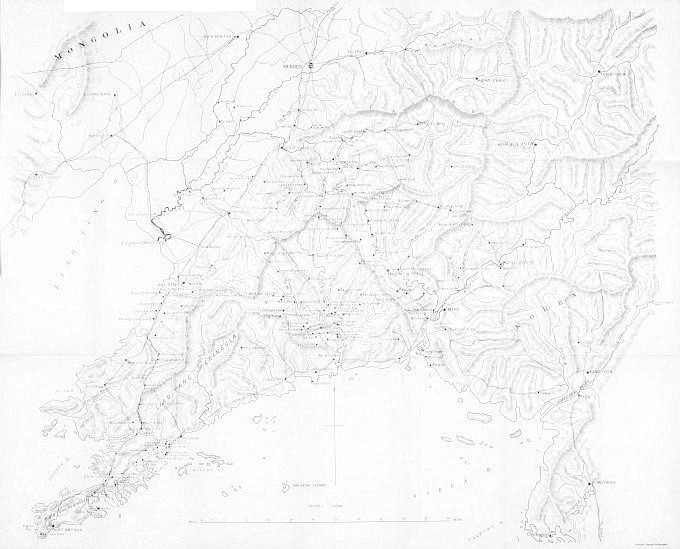
MAP OF THEATRE OF OPERATIONS
SOUTH OF MUKDEN