What a mighty space lies between the palace and the cottage in
this country! ay, what a mighty space between the mansion of the
private gentleman and the hut of the labourer on his estate! To
enter the one: to see its stateliness and extent; all its offices, outbuildings,
gardens, greenhouses, hothouses; its extensive fruit-walls,
and the people labouring to furnish the table simply with
fruit, vegetables, and flowers; its coach-houses, harness-houses,
stables, and all the steeds, draught-horses, and saddle-horses,
hunters, and ladies’ pads, ponies for ladies’ airing-carriages, and
ponies for children; and all the grooms and attendants thereon;
to see the waters for fish, the woods for game, the elegant dairy for
the supply of milk and cream, curds and butter, and the dairymaids
and managers belonging to them;—and then, to enter the
house itself, and see all its different suites of apartments, drawing-rooms,
boudoirs, sleeping-rooms, dining and breakfast rooms; its
steward’s, housekeeper’s and butler’s rooms; its ample kitchens
and larders, with their stores of provisions, fresh and dried; its
stores of costly plate, porcelain and crockery apparatus of a hundred
kinds; its cellars of wine and strong beer; its stores of linen; its
library of books; its collections of paintings, engravings, and
statuary; the jewels, musical instruments, and expensive and interminable
nick-knackery of the ladies; the guns and dogs; the cross-bows,
long-bows, nets, and other implements of amusement of the
gentlemen; all the rich carpeting and fittings-up of day-rooms, and
night-rooms, with every contrivance and luxury which a most ingenious
and luxurious age can furnish; and all the troops of servants,
male and female, having their own exclusive offices, to wait upon
the person of lady or gentleman, upon table, or carriage, or upon
some one ministration of pleasure or necessity: I say, to see all
this, and then to enter the cottage of a labourer, we must certainly
think that one has too much for the insurance of comfort, or the
other must have extremely too little. If the peasant can be satisfied
with his establishment, and the gentleman could not tell how to live
without his, one would be almost persuaded that they could not be
of the same class of animals. Knowing, however, that they are of
the same species, it only shews of what elastic stuff human nature
is made; into what a nutshell it can compress its cravings, and how
immensely it can expand itself when the pressure of necessity is
withdrawn. I am not going here to moot the old question of
whereabout happiness lies in this strange disparity of circumstance;
it, no doubt, lies somewhere between the extremes. It certainly
cannot be created by external superfluities. They lay open their
possessors to the exercise of despotic power; to the corruptions of
pride and luxury; to false taste, frivolous pursuits, and the diffusion
of the attention over so many objects as to prevent the heart from
settling firmly on any. They have a tendency to weaken the domestic
attachments, and the love of solid pursuits. On the other hand,
the pressure of poverty and ignorance certainly can, and too often
does, lie so heavily as to destroy the relish of life’s enjoyments in
the cottager. Yet happiness is a fireside thing; and the simplicity
of cottage life, the fewness of its objects, and the strong sympathies
awakened by its trials and sufferings, tend to condense the affections,
and to strike deep the roots of happiness in the sacred soil of consanguinity.
When wealth is accompanied by a desire to do good,
it is a glorious and a happy destiny; when lowly life is virtuous,
easy, and enlightened, it is a happy destiny too—for it is full of the
strong zest of existence, and strong affections. But this is not my
present subject.
When we go into the cottage of the working man, how forcibly
are we struck with the difference between his mode of life and our
own. There is his tenement of, at most, one or two rooms. His
naked walls; bare brick, stone or mud floor, as it may be: a few
wooden, or rush-bottomed chairs; a deal, or old oak table; a
simple fireplace, with its oven beside it, or, in many parts of the
kingdom, no other fireplace than the hearth; a few pots and pans—and
you have his whole abode, goods and chattels. He comes
home weary from his out-door work, having eaten his dinner under
hedge or tree, and seats himself for a few hours with his wife
and children, then turns into a rude bed, standing perhaps on
the farther side of his only room, and out again before daylight,
if it be winter. He has no one to make a fire in his dressing-room,
to lay out his clothes, to assist him in his toilet; he flings
on his patched garments, washes his face in a wooden or earthen
dish at the door; blows up the fire, often gets ready his own breakfast,
and is gone.
Such is the routine of his life, from week to week and year to
year; Sundays, and a few holidays, are white days in his calendar.
On them he shaves, and puts on a clean shirt and better coat,
drawn from that old chest which contains the whole wardrobe of
himself and children; his wife has generally some separate drawer
or bandbox, in which to stow her lighter and more fragile gear.
Then he walks round his little garden, if he have it; goes with
his wife and children to church or meeting; to sit with a neighbour,
or have a neighbour look in upon him. There he sits, his
children upon his knee, and tells them how his father used to talk
to him.
This is cottage life in its best estate; in its unsophisticated
and unpauperised condition. He has no carriages, no horses,
no cards of invitation, or of admittance to places of amusement;
none of the luxuries, fascinations, or embellishments of life belong
to him. It is existence shorn of all its spreading and flowering
branches, but not pared to the quick. This is supposing
the father of the family is sober and industrious;—that he is
neither a pot-house haunter, a gambler at the cockpit, a boxer, a
dog-fighter, a poacher, an idle, rackety and demoralized fellow, as
thousands are. This is supposing that he brings home his week’s
wages, and puts them into the hands of his wife, as their best
guardian and distributer;—saying,—“Here, my lass, this is all
that I have earned; thou must lay it out for the best; I have
enough to do to win it.”
And what are these wages, out of which to maintain his family,
aided by the lesser earnings of his wife, by taking in washing,
helping in harvest-fields, charring in more affluent people’s houses,
and so on, and the earnings of the children in similar ways, or in
some neighbouring factory? His own probably amount to nine,
or, at most, twelve shillings, and if his family be large, and there
are several workers among them, the whole united earnings may
reach twenty shillings per week; a sum which will hardly find
other men wherewith to pay toll-bars, or purchase gunpowder; a
sum which we throw away repeatedly on some bauble; and yet, on
this will a whole family maintain life and credit for a week, ay, and
on much less too. In this little hut, which we should hardly think
would do for a cowshed or a hayloft, and to which the stables of
many gentlemen are real palaces, is the poor man packed with all
his kindred lives, interests, and affections: and so he carries on the
warfare of humanity, till He, who is no respecter of persons, calls
him to stand, side by side, before his throne with the rich man who
“has fared sumptuously every day.”
Such are “the short and simple annals” of thousands and tens
of thousands in these kingdoms; and yet what fine strapping
young fellows spring up in these little cabins, men who have tilled
the soil of England and wielded at home her mechanic tools, and
borne her arms abroad, till their industry and genius, under the
direction of higher minds, have raised her to her present pitch of
eminence; and what sweet faces and lovely forms issue thence to
Sunday worship, to village feast and dance; or are seen by the
evening passer-by in the light of the ingle, amid the family group,
making some smoky-raftered hut a little temple of rare beauty, and
of filial or sisterly affections. I often thank God that the poor
have their objects of admiration and attraction; their domestic
affections and their family ties, out of which spring a thousand
simple and substantial pleasures; that beauty and ability are not
the exclusive growth of hall and palace; and that, in this country
at least, the hand of arbitrary power dare seldom enter this
charmed circle, and tear asunder husband from wife, parent from
children, brother from sister, as it does in the lands of slavery. Yet
our New Poor Laws have aimed a deadly blow at this blessed
security; and, till the sound feeling of the nation shall have again
disarmed them of this fearful authority, every poor man’s family is
liable, on the occurrence of some chance stroke of destitution, to
have to their misfortune, bitter enough in itself, added the tenfold
aggravation of being torn asunder, and immured in the separate
wards of a Poverty Prison. The very supposition is horrible;
and, if this system, this iron and indiscriminating system,—a
blind tyranny, knowing no difference between accidental misfortune
and habitual idleness, between worthy poverty and audacious imposition,
between misfortune and crime,—be the product of Philanthropy,
may Philanthropy be sunk to the bottom of the sea!
But the cottage life I have been speaking of, is that of the
better class of cottagers; the sober and industrious peasantry: but
how far short of this condition is that of millions in this empire!
To say nothing of Irish cabins, the examples of what a state of
destitution, misery, and squalor men may sink into; how much
below this is the comfort of a Highland hut? What a contrast is
there often between the cottage of an English labourer, and the
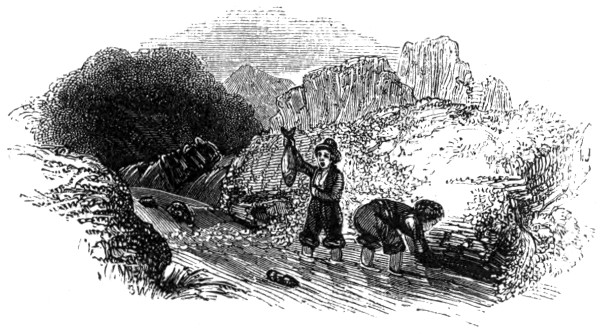
steading of a Highland farmer. There it stands, in a deep glen,
between high, rocky mountains. His farm is a wild sheep-track
among the hills. Wheat, he grows none, for it is too cold and
weeping a climate. He has a little patch of oats for crowdie and
oatcake; potatoes he has, if the torrent has not risen during
sudden rains so high in the glen as to sweep his crop away. He
has contrived a little stock of hay for his cows, but where it can
have grown you cannot conceive, till some day, as you see a woman
or a boy herding the cattle amongst the patches of cultivation—for
there are no fences between the grass and arable land—you find
one or the other cutting the longer grass from the boggy waste
with a sickle, and drying it often in little sheaves as our farmers
dry corn. But the house itself;—it is a little, low, long building of
mud, or rough stones; the chimney composed of four short poles
wrapped round with hay-bands; a flat stone laid upon it to prevent
the smoke being driven down into the hut by the tempestuous
winds from the hills; and another stone laid upon that, to keep it
from being blown away. The roof is thatched with bracken, with
the roots outermost; or often the same roof is a patchwork of
bracken, ling, broom, and turf. A little window of perhaps one
pane of thick glass, or of four of oiled paper. The door, which
reaches to the eaves, is so low that you must stoop to enter; and
the smoke is pouring out of it faster than it ascends from the
chimney. A few goats are, most likely, lying or standing about
the door. You enter, and as soon as you can discern anything
through the eternal cloud of smoke, you most probably find yourself
in a crowd. The fire of peat lies in the centre of the hut, surrounded
by a few stones; wooden benches are nailed on one side
against the wall, and the other is partitioned off like a large wooden
cupboard, with sliding doors or curtains, for the family bed, as you
find all over Scotland, and even in Northumberland. The pigs are
running about the floor; hens are roosting over your head; the
cows are lowing in, what we should call, the parlour; nine or ten
children, or weans, as they call them, and a callant, or boy, who
teaches the weans, and the father and mother, and very probably
their father and mother, or one of them, in extreme age, are fixing
their eyes on the stranger.
In the summer of 1836, Mrs. Howitt and myself passed the
night in such a dwelling, and a slight notice of the place may
present, to many of our readers, a new view of cottage life. It was
in Rosshire, some thirty or forty miles north-west of Inverness, at
a spot called the Comrie, lying between Loch Echilty and Loch
Luichart. A wild, and yet most beautiful spot it was,—a little
strath opening itself out between the wooded mountains which
surround Loch Echilty, and the bare stony hills in the direction of
Strath Conan. We came upon it after wandering through the
delicious fairyland of birch woods that clothe that Loch in the very
romance of picturesque beauty, springing up amongst the wildest
chaos of crags, here hanging over the water, and here surrounding
the ruinous blackness of some solitary hut, that, but for children
playing before it, would appear to have been tenantless for years.
A stern defile guarded by vast masses of projecting rocks, by places
clothed with the richest drapery of crimson heather, by places
naked and lividly grey, and height above height still scattered with
climbing birch trees, brought us to a little nameless loch hidden
in the woods, girt with a dense margin of reeds, and covered
with the most magnificent display of white water-lilies, and then
appeared two of those little huts in this Highland solitude. The
evening was rapidly sinking into night, and we were uncertain how
far it was to the next inn. Two women appeared at the door of
one of the huts, and rather startled us with the information, that
the nearest inn in the way we proposed to go, was distant five-and-twenty
miles! That another mile brought us to the ferry over the
Conan, where the carriage-road ceased, and all beyond was mountain
and moorland waste. We seemed, as it were, to be on the
very verge of civilization; and there appeared to be nothing for us
but to retrace our way for some miles, or to take up our lodging in
this house.
Weary as we were, this appeared the less objectionable alternative,
and we accepted the offer which the elder woman made us.
The moment we did so, the poor woman seemed struck with the
rashness of her act. “What shall I do for the like of you? What
shall I find for the like of you?” We assured her we should not
be very fastidious guests, and in we went. It was such a hut as I
have just described. The fire lay on a hearth of stones, with a few
large stones built up against the mud wall to prevent the house
from being burnt. The woman’s husband, a farmer, was gone
into Morayshire with lambs; a hired shepherd sat on the side of
the partitioned bed, such as I have already described; two fine
sheep-dogs lay before the fire, and a troop of barelegged and kilted
boys came running in from some distant school. They were Macgregors,
having come hither from Dumbartonshire, and could,
fortunately for us, speak English. We sate on a bench in the
ingle, and all these little Macgregors, Grigor Macgregor, Peter and
Duncan, and the rest, squatted on the mud-floor, and alternately
watched us and their eldest sister, a fine barelegged lassie of
eighteen, who was busy baking oatcakes for us. It was a hot post
both for herself and for us. She put on peats till the hut was like
an oven, and the smoke made our eyes smart almost past endurance.
Yet we watched the progress of her operation with great interest,
as she made a paste of oatmeal and water, rolled it out in cakes,
cut it into segments, baked them on an iron girdle over the fire,
and then reared them before the glowing peats to make them crisp.
This done, she found us some tea, and that was our supper. They
had two or three cows, but their milk was already in the process of
being converted into cheese; the potatoes and the oats of the last
crop were exhausted, and the wet season had prevented the ripening
of the present. “There was,” said our hostess, “a great cry
in the country for food!” Our fatigue, and this announcement,
induced us to think we fared well. They made us a comfortable
bed in the spence, where we found four Gaelic Bibles, and the
History of Robinson Crusoe! Early in the morning we pursued
our way; but ere we took our leave, the poor woman came in from
fetching up her cows, her clothes wet to the very knees. When
we expressed our surprise—“O,” said she, “that is what we are
used to every day of our lives. While you have been in your bed,
the herdboy has three times gone round the corn-fields with his
dogs, to chase away the stags and roes into the woods. The last
thing every night, while the corn is growing in the field, he goes
round—once again at midnight, and then at the earliest dawn of
day. Every night it must be done, or a green blade would not be
left. If you went in the gloaming with the man into the wood, sir,
you would see twenty stags as big as our cows. O it’s an awful
place for wild beasts—foxes and badgers, and serpents! did you
ever see a serpent, ma’am? Sometimes in a morning they rear
themselves up in a narrow path, and hiss at me bitterly.” As the
poor woman spoke, we stood at the door of her little tenement, and
saw the heavy dew lie glittering on the grass all round; and the
primitive cheese-press, consisting of a pole, one end of which was
thrust into a crevice of a rock, and the other weighted with a huge
stone; and around us were the heathy mountains and the woods;
the mists and clouds clinging to the sides of wild hills, or rolling
away before the breeze of morning; and the sound of the neighbouring
torrent alone disturbing the deep solitude. We could not
avoid feeling how far was all this from the cottage-life of England.
We gave the poor woman what we thought a fitting return for her
hospitality, and left her overwhelmed with a grateful astonishment,
which shewed what was there the real value of money.
This is a scene in the scale of comfort far below the general run
of labourers’ houses in England; but yet how far, infinitely far
lower, do many of our working people’s abodes sink. What dens
have we in manufacturing towns! What little, filthy, dismal, yet
high-rented dens! What cabins do some of our colliers and miners
inhabit! What noisome, amphibious abodes abound in our fishing
villages, such as Crabbe has painted! What places have I seen in
different parts of England, which everywhere obtain the name of
Rookeries,—huge piles built for some purpose which has not answered;
or some deserted hall, let off in little tenements; the
windows broken, and stopped with old rags and hats; the ground
all round trodden down, covered with ash-heaps; a few stunted
bushes, or gooseberry trees, where once had been a garden, displaying
the ragged and tattered wash of the indigence of indigence:
altogether exhibiting such an air of poverty as impoverishes one’s
very spirit, and fills it with a nameless feeling of disgust and despondence
for days after. Such a place I particularly recollect seeing
somewhere between Netherby and Gretna-Green; and, observing
an old man “daundering about,” as he called it, as without hope
and object, I asked him how this place came to look so forlorn—“O,”
said he, “we once could run our cows on the waste, and did
very well, but that is taken away. Sir James asked the steward
what the poor people must do, ‘O, they will all hooly[25] away,’ said
he; but where are we to hooly to?”
Ah! cottage life! There is much more hidden under that
name than ever inspired the wish to build cottages ornées, or to
inhabit them. There is a vast mass of human interests within its
circle, of which the world takes little note. The loves and hopes;
the trials and struggles; the sufferings, deaths, and burials; the
festivities and religious confraternities; the indignities that fret,
and the necessities that compel, to action and union our simple
brethren and sisters. How little is truly known; how much is
consequently misjudged; how great is the indifference concerning
them in those who have the power to work miracles of love and
happiness amongst them, and must one day stand with them at the
footstool of our common Father, who will demand of his children
how each has loved his brethren.
Let us turn our eyes, however, a moment from the dark side to
the light one. There is not a more beautiful sight in the world
than that of our English cottages, in those parts of the country
where the violent changes of the times have not been so sensibly
felt. Where manufactures have not introduced their red, staring,
bald brick-houses, and what is worse, their beershops and demoralization:
where, in fact, a more primitive simplicity remains. There,
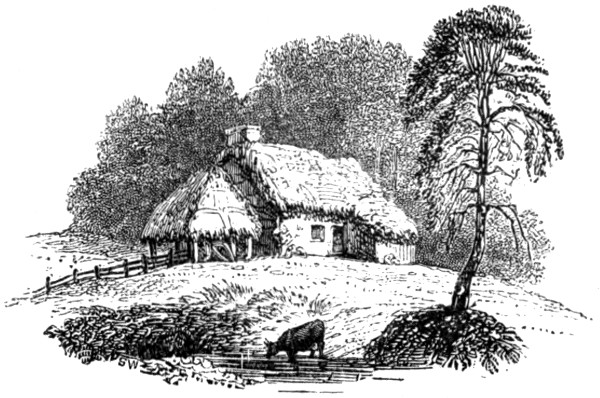
on the edges of the forests, in quiet hamlets and sweet woody
valleys, the little grey-thatched cottages, with their gardens and
old orchards, their rows of beehives, and their porches clustered
with jasmines and roses, stand:—
Hundreds of huts
All hidden in a sylvan gloom,—some perched
On verdant slopes from the low coppice cleared;
Some in deep dingles, secret as the nest
Of Robin Redbreast, built amongst the roots
Of pine, on whose tall top the throstle sings.
Hundreds of huts, yet all apart, and felt
Far from each other; ’mid the multitude
Of intervening stems; each glen or glade
By its own self a perfect solitude,
Hushed, but not mute.
John Wilson.
There they stand, and give one a poetical idea of peace and
happiness which is inexpressible. Well may they be the admiration
of foreigners. In many of the southern counties, but I think
nowhere more than in Hampshire, do the cottages realize, in my
view, every conception that our poets have given us of them. One
does, no doubt, when looking on their quiet beauty, endow them
with a repose and exemption from mortal sufferings that can belong
to no human dwelling; and Professor Wilson, in his poem called
“An Evening in Furness Abbey,” which appeared in Blackwood’s
Magazine, September, 1829,—a poem flushed all over with the
violet hues of poetry, and overflowing with tenderness and grace,
gives one this very delightful expression of a thought which has
occurred to many of us—
The day goes by
On which our soul’s beloved dies! The day
On which the body of the dead is stretched
By hands that decked it when alive; the day
On which the dead is shrouded; and the day
Of burial—one and all go by! The grave
Grows green ere long; the churchyard seems a place
Of pleasant rest, and all the cottages,
That keep for ever sending funerals
Within its gates, look cheerful every one,
As if the dwellers therein never died,
And this earth slumbered in perpetual peace.
But sobering down by such sad, yet sweet thoughts as these,
our poetical fancies of cottage life, and bringing them within the
range of human trouble and suffering, still these rustic abodes
must inspire us with ideas of a peace and purity of life, in most
soothing contrast with the hurry and immorality of cities. Blessings
be on them wherever they stand, in woodland valleys, or on
open heaths, throughout fair England; and may growing knowledge
bring growth of happiness, widening the capacity of enjoyment
without touching the simplicity of feeling and the strength of
principle. Well may the weary wayfarer—
Lean on such humble gate and think the while,
O! that for me some home like this would smile;
Some cottage home to yield my aged form,
Health in the breeze, and shelter in the storm.
There are thousands of them inhabited by woodmen, labourers,
or keepers, that are fit dwellings for the truest poet that ever lived;
and it is the ideal of these picturesque and peace-breathing English
cottages that has given origin to some of the sweetest paradises
in the world—the cottages of the wealthy and the tasteful. What
most lovely creations of this description now abound in the finest
parts of England, with their delicious shrubberies, velvet lawns,
hidden walks, and rustic garden-huts; their little paddocks lying
amid woods, and skirted with waters; spots breathing the odour
of dewy flowers, and containing in small space all the elegance and
the country enjoyments of life.
Happiness, it is true, is not to be dragged into such places;
but what places they are for the genuine lover of the country to
invite her into! The very feeling of the cumbrous pomp and
circumstance of aristocratic establishments in this country, makes
one think of such sweet hermitages with a sense of relief and
congratulation. What more charming abode has the wide earth
for a spirit soothing itself with the pleasures of literature and the
consolation of genuine religion, far from the wranglings pf political
life, than such a one as the cottage, formerly that of Mrs. Southey,
at Buckland, on the border of the New Forest; of Miss Mitford,
at Three-Mile-Cross; or that of Wordsworth at Rydal? But we
must quit these earthly paradises to speak of other things.
What a revolution of taste has taken place in the English people
as it regards popular festivals and festivities! Our ancestors were
passionately fond of shows, pageants, processions, and maskings.
They were fond of garlands and ribbons, dancing and festive
merriment. May-day, Easter, Whitsuntide, St. John’s Day, Yule,
and many other times, were times of general sport and gaiety.
Music and flowers abounded; mumming, morris-dancing, and many
a quaint display of humour and frolic spread over the country.
The times, and the spirit of the times, are changed:—we are
become a sober people. England is no longer merry England, but
busy England; England full of wealth and poverty—extravagance
and care. There has been no small lamentation over this change;
and many of our writers have laboured hard to bring us once more
to adopt this state of things. They might as well attempt to
bring back jousts and tourneys[26], popery, and government without
representation. The times, and the spirit of the times are changed.
Strutt, Hone, Leigh Hunt, Miss Laurence, and many others, may
expatiate on the poetic beauty of these things: they may deplore
the extinction of this graceful rite, that jocund festivity, and pray
us earnestly to resume them once more; but can they give us our
light hearts again? Can they make the nation young again?
Can they make us the simple, ignorant, confiding people, living in
the present, careless of the future, as our ancestors were? Till
they can do this, they must lament and exhort us in vain. As
soon might they bid the sun to retrace his path; the seasons
reverse their course; earth and heaven turn back in the path of
their years. What our ancestors were, they were from circumstances
that are gone for ever; and what we are, we are from
another mighty succession of circumstances, of which the memory
and effect may no more be blotted out, than the stars can be
blotted out of the clear heavens of midnight. The country has
passed through deep baptisms, and processes of fermentation which
have worked out the lighter external characters, and totally reorganised
the moral as well as the political constitution of the
kingdom. The better qualities of the old English character I trust
we fully retain, but the more juvenile and fantastic ones are
irrevocably destroyed in the shock of most momentous convulsions.
Amongst the many attempts to account for the sedater cast
of the modern popular mind, Sir E. Bulwer, in “England and
the English,” has attributed it to the spread of Methodism.
Had he attributed it to Puritanism he would have been nearer
the mark. Methodism may possibly have done something
towards it, but it neither began early enough, nor spread universally
enough, to have the credit of this change. The decay
of popular festivities has been noticed and lamented by writers for
the last century. It has been going on both before and since the
rise of Methodism, with much the same pace of progression, and is
equally felt where Methodism is not allowed to shew its face, as
where it exercises its fullest power. Over what a great extent of
this country does the influence of high-church landlords prevail,
where Methodism cannot get footing; where the people are all
expected to go soberly to church as in the good old times; and yet
there the people are just as grave, have grown out of the sports
and pastimes of their ancestors, just as much as in the most
Methodistic districts. In the manufacturing districts, where the
Methodists have gained most influence, it is true enough that they
have helped to expel an immense quantity of dog-fighting, cock-fighting,
bull-baiting, badger-baiting, boxing, and such blackguard
amusements; but Maying, guising, plough-bullocking, morris-dancing,
were gone before, or would have gone had not Methodism
appeared.
Mighty and many are the causes which have wrought this
great national change; causes which have been operating upon us
for the last three hundred years; and are so intimately connected
with our whole national progress, political and intellectual—with
all our growing greatness, with all our glory and our sorrows,
that had not Methodism existed, that character would have been
exactly what it is.
The Reformation laid the foundation of this change. While
we had an absolute pope, and an absolute king; while the people
were neither educated, nor allowed to read the Bible, nor to be
represented in Parliament; while the monarch and a few noble
families held all the lands of the kingdom, the lower classes had
nothing to do but to follow their masters to the wars, or live easily
and dance gaily in times of peace. The retainers of great houses,
the labourers in the fields, foresters and shepherds, following their
solitary occupations, constituted the bulk of the nation. Merchants
and merchandise were few; our great trading towns and interests
did not exist; the days of newspapers, of religious disputes, of
literature and periodicals, were not come. The people were either
at work or at play. When their work was over, play was their
sole resource. They danced, they acted rude plays and pantomimes,
with all the zest and gaiety of children, for their heads
were as unoccupied with knowledge and grave concerns as those
of children. They lived in poverty it may be, but still they lived
in that state of simplicity and dependence which left them little
care; and they were cut off, by the impossibility of rising out
of their original rank, from all troublesome excitement. It was
equally the concern of the civil government and the hierarchy to
encourage sports and festivities, to keep them out of dangerous
inquiries into their own condition, or rights. In the great feudal
halls, the minstrel, the jongleur, the jester, and other ministers of
gaiety; hawks and hounds abroad, jollity and drinking at home,
kept the minds of all idlers occupied with matters to their taste.
The clergy and monks promoted with an equal zeal of policy, the
festivals of saints, keeping of high days and holidays, processions,
games, and even acting the mysteries and miracle-plays. While
the system continued, this spirit and national character must have
continued likewise; but the Reformation burst like a volcano
from beneath, and scattered the whole smiling surface into disjointed
fragments, or buried it beneath the lava of ruin.
Henry VIII. at once destroyed Monkery and the Catholic
church. He at once seized on the ecclesiastical lands, and snapped
asunder the ecclesiastical policy. The translation of the Bible let
in a flood of light that revealed all the phantasmagoria of the past,
and prepared a train of everlasting inquiries, disquietudes, and
intellectual and political triumphs for the future. The people saw
they had been treated as children, but they now awoke to the
passions and the conscious power of men. They had tasted of the
tree of knowledge of good and evil, and their eyes were opened to
their actual condition, never more to be closed. The lands that
were rudely seized and arbitrarily distributed, created a new class
in the community—the gentry—a link between the aristocracy and
the people;—possessing the knowledge of the one, and sharing the
interests of the other. Henry’s predecessors had hastened this
new era by curtailing the wealth and power of the nobility; and
the long wars of the houses of York and Lancaster had already
done much of this work for him; exterminating some, humbling
others, and embarrassing with debts the remainder. So were the
elements of a more popular career thrown into the midst of the
nation; and the religious persecutions on the Continent, by
sending us swarms of jewellers, weavers, and other artificers, laid
the foundation of those trading propensities which have now
carried us to such a marvellous length. We came to be a trading
and colonizing people, and to possess a fleet in order to protect our
new interests. How rapidly this navy grew, indicating by its own
growth that of the general wealth and commercial enterprise of
England, of which it was the consequence, is seen by this circumstance.
In that fine old ballad of Sir Andrew Barton, Lord
Howard is made to say to Henry VIII. in 1511—
Sir Andrew’s shipp I bring with mee;
A braver shipp was never none;
Now hath your grace two shipps of warr,
Before in England was but one!
This one was the Great Harry, built in 1504. In about 80 years
only afterwards, the English had thirty vessels of war at sea, and
with these dared to attack the Invincible Armada of Spain, consisting
of one hundred and thirty vessels, and by the assistance of
a providential tempest, totally dispersed and destroyed it. Then
Howard of Effingham, Drake, Frobisher, Hawkins, were the names
of our commanders,—names which thenceforward filled all the
known world with terror, and gave to England the empire of the
seas. With this extension of national interests, a more active and
earnest spirit was diffused through the people. The struggle with
enemies abroad, and with the rapidly maturing spirit of religious
freedom at home, kept Elizabeth engaged, and induced in her a
rigour of persecution, and in the people a rigour of resistance and
the soul of martyrdom. Before the development of these antagonist
powers, all lightness fled; singing gave way to preaching
and listening; dancing, to running anxiously to know the fate of
sufferers, and the doctrines of fresh-springing teachers. So completely
had the old relish for merriment and pastimes died out,
that her successor, James, endeavoured to compel the people, by
the publication of his “Book of Sports” to be jocose and gamesome.
But it would not do. The soul of the people was now up
in arms for their rights; and the despotic nature of himself and his
son, resisting their claims, kept up such a fever of political strife in
the kingdom as would have put out all jesting and capering if they
had not gone before. The hierarchy fell,—fell in one wide chaos
of civil contention; and, as if torrents of blood and volumes of fire,
and the trampling hoofs of thousands of careering cavalry had not
been enough to overwhelm and dash to pieces every remaining
fragment of jollity and popular fête,—in came Puritanism from
Geneva, and the Solemn League and Covenant from Scotland.
There was a final close to all the pageantry of processions and the
merry saintliness of festivals: they were denounced and abhorred
as the carnality of Anti-Christ and the rags of the scarlet woman.
Charles II. indeed, could revive licentiousness, but he could not
bring back the holiday guise of “the old profession.” And what
has been the course of England since? One ever-widening and
ascending course of mighty wars, expanding commerce, vast colonization,
and the growth of science, literature, and general knowledge.
We are no longer a nation of feudal combatants, of piping
shepherds, and thoughtless peasantry,—but of busy, scheming,
money-collecting, family-creating men. Our last tremendous war
put the climax to this amazing career. In it all Europe seemed
torn to pieces and organized anew. We, as a people, were led by
circumstances to put forth the most stupendous energies that
perhaps any nation ever did. To defend our colonies; to support
the interests of our allies with arms and subsidies; to supply the
whole of Europe with all species of manufactures, and almost all
species of merchandise, and through this demand stimulating into
existence the powers of steam and machinery, a population of
amazing numbers to maintain. And then, the shock and the
revulsion when this great war-system suddenly ceased! An immense
debt, vast taxes, the necessity of maintaining high prices,
the necessity of boundless competition and low wages that we might
so compete with the continent, returning to its old habits.
Who does not know with what a fiery force this has fallen on
the working classes? What distress, what pauperization, what
desperation, brought to the very pitch of rebellion, they have gone
through; and recollecting this, can any one think otherwise than
that it has been enough to sober any people that is not destitute of
every element of high character. If we could, after a baptism like
this, be still like the French, a dancing, dissipation-loving people,
we should, like them, have but a fitful care to secure our liberties,
and the comforts of good government; like them, at this moment,
we should be the victims of successive revolutions, yielding no
fruit but tyranny. But we are a sober and a thoughtful people,
and are therefore working out of the mass of our difficulties the
form of a renewed constitution, adapted to our present enlarged
views and experience. But besides this, our energies have not
been called forth for this good end alone; they have brought with
their exercise a high relish for intellectual pleasures. Our minds
have been stirred mightily, and, like animals that during their
wintry torpor feel no hunger, yet feel it keenly the moment they
are awake, they have become hungry for congenial aliment. We
have fed on much knowledge, and are no longer children, but full-grown
men, with manly appetites and experienced tastes. Could
we now sit, as our ancestors did, for nine hours together at a
mystery? Could we endure to read through the chronicles and
romances of the middle ages,—books which spun out their recitals
to the most extraordinary length, and were never too long; for
books then were few? If we could not, so neither could the
simple pleasures and rural festivities satisfy the peasantry of this.
We are the creatures of new circumstances, and of a higher reach
of knowledge. A combination of causes, too puissant to be
resisted, has made hopeless all return to the juvenilities of the
past. And after all, happiness—of which the people, however
unwisely, are always in quest, does not consist in booths and
garlands, drums and horns, or in capering round a May-pole.
Happiness is a fireside thing. It is a thing of grave and earnest
tone; and the deeper and truer it is, the more is it removed from
the riot of mere merriment:
The highest mood allowed
To sinful creatures, for all happiness
Worthy that holy name, seems steeped in tears,
Like flowers in dew, or tinged with misty hues,
Like stars in halo.
John Wilson.
And the more our humble classes come to taste of the pleasures
of books and intellect, and the deep fireside affections which grow
out of the growth of heart and mind, the less charms will the
outward forms of rejoicing have for them. Beautiful and poetical,
I grant, are many of the old rites and customs of which we have
been speaking; but they are beautiful and poetical as belonging to
their own times,—and many of them, I am inclined to believe, as
seen in the distance; for, seen at hand, there is a vulgarity in most
popular customs that offends invariably our present tastes. Nor
do I mean to say that our present population cannot be cheerful.
A more truly cheerful people never existed; and they can dance
and be merry too when they will; as Christmas, and Whitsuntide,
and their annual village feasts and their harvest-homes can testify.
Since the Reformation, the saints of the calendar having become
mere names in this country, their festivals have accordingly died
away. Whitsuntide, Easter, and Christmas seem almost all that
have maintained their stand; and of these we will speak a little;
but in the first place let us have a few words on May-Day.
May-day was celebrated with a gaiety and poetical grace far
beyond all other festivals. It had come down from the pagan
times with all its Arcadian beauty, and seemed to belong to those
seasons more than to any Christian occasions. It is one that the
poets have all combined to lavish their most delicious strains
upon. The time of the year was itself so inspiring,—with all
its newness of feeling, its buds and blossoms and smiling skies.
It seemed just the chosen period for heaven and earth and youth
to mingle their gladness together. There is no festivity that is
so totally gone! Washington Irving in his very interesting account
of his visit to Newstead Abbey, takes the opportunity to say, that
he had been accused by the critics of describing in his Sketch
Book popular manners and customs that had gone by, but that he
had found those very customs existing in that neighbourhood.
That those who doubted the accuracy of his statements must go
north of the Trent. That he found May-poles standing in the
old-fashioned villages, and that a band of plough-bullocks even
came to the abbey while he was there.
Washington Irving certainly seemed most agreeably impressed
with the primitive air of that part of Nottinghamshire, and it is
interesting to see the effect which places most familiar to you
produce on the minds of strangers of taste and poetical feeling.
His delight at finding himself in old Sherwood, the haunt of Robin
Hood; in hearing the bells of Mansfield at a distance; and his
remarking the names of Wagstaff, Hardstaff, Beardall, as names
abounding about the forest, naturally suggesting the character
of those who first bore them—names so common to our eyes as
never to have awakened any such idea;—all this is very agreeable;
but let no lover of ancient customs go thither on the strength of
Washington Irving’s report, unless he means to travel much
farther north of the Trent than Newstead. There is certainly a
May-pole standing in the village of Linby near Newstead, and
there is one in the village of Farnsfield near Southwell; but I have
been endeavouring to recollect any others for twenty miles round
and cannot do it, and though garlands are generally hung on these
poles on May-day, wreathed by the hands of some fair damsel who
has a lingering affection for the olden times, and carried up by
some adventurous lad; alas! the dance beneath it, where is it? In
the dales of Derbyshire, May-poles are more frequent, but the
dancing I never saw. In my own recollection, the appearance of
morris-dancers, guisers, plough-bullocks, and Christmas carollers,
has become more and more rare, and to find them we must go into
the retired hamlets of Staffordshire, and the dales of Yorkshire and
Lancashire.
One would have thought that the May-day fête would have outlasted
all others, except it were Christmas, on the strength of the
poetical wealth of heart and fancy woven with it through our
literature. Every writer of any taste and fancy has referred with
enthusiasm to May-day. Chaucer, Spenser, Shakspeare, Fletcher,
Milton, Browne, Herrick, and all our later poets, have sung of it
with all their hearts. Chaucer, in Palamon and Arcite, describes
Arcite going to the woods for garlands on May morning, according
to the old custom. He
Is risen, and looketh on the merry day;
And for to do his observance to May,
Remembering on the point of his desire,
He on the courser, starting as the fire,
Is risen to the fieldés him to playe;
Out of the court were it a mile or tway:
And to the grove of which that I you told,
By Aventine his way began to hold,
To maken him a garland of the greves,
Were it of woodbine, or of hawthorn leaves,
And loud he sung, against the sunny sheen:
“O May, with all thy flowers and thy green,
Right welcome be thou, fairé, freshé May;
I hope that I some green here getten may.”
And from his courser with a lusty heart,
Into the grove full hastily he start,
And in a path he roamed up and down.
Milton has many beautiful glances at it, and Shakspeare touches
on it in a hundred places, as in “The Midsummer Night’s Dream:”
If thou lovest me then,
Steal forth thy father’s house to-morrow night;
And in a wood, a league without the town,
Where I did meet thee once with Helena,
To do observance to a morn of May,
There will I stay for thee.
The European observance of this custom is principally derived
from the Romans, who have left traces of it in all the countries
they subdued. It was their festival of Flora. It was the time in
which they sacrificed to Maia; and in Spain, where this custom
seems to remain much as they left it, the village-queen still is
called Maia. But we have traces of it as it existed amongst the
Saxons, whose barons at this time going to their Wittenagemote,
or Assembly of Wise Men, left their peasantry to a sort of saturnalia,
in which they chose a king, who chose his queen. He wore
an oaken, and she a hawthorn wreath; and together they gave
laws to the rustic sports, during those sweet days of freedom.
The May-pole too, or the column of May, was the grand standard
of justice amongst these people, in the EY-COMMONS, or fields of
May: and the garland hung on its top, was the signal for convening
the people. Here it was that the people, if they saw cause,
deposed or punished their governors, their barons and kings. It
was one of the most ancient customs, which, says Brande, has by
repetition been from year to year perpetuated.
But we have traces also of its mode of celebration among our
Druid ancestors, for it is certainly one of the old customs of the
world, having come down from the earliest ages of Paganism
through various channels. Dr. Clarke in his Travels, vol. ii.
p. 229, has shewn that the custom of blowing horns on this day,
still continued at Oxford, Cambridge, London, and other places,
is derived from a festival of Diana. These ancient customs of the
country did not escape the notice of Erasmus when in England,
nor the ceremony of placing a deer’s head upon the altar of
St. Paul’s church, which was built upon the site of a temple of
Diana, by Ethelbert, king of Kent. Mr. Johnson, in his “Indian
Field Sports,” also states the curious circumstance, that the Hindoos
hold a vernal feast called Bhuvizah, on the 9th of Baisach,
exclusively for such as keep horned cattle for use or profit, when
they erect a pole and adorn it with garlands; and perform much
the same rites as used to be adopted by the English on the first of
May. Thus it appears how ancient and how widely spread was
this custom; and its celebration by the Druids and Celts points
it out as belonging to the worship of the sun. In Ireland and the
Highlands of Scotland, the people still kindle fires on the tops of
their mountains on this day, called Beal Fires, and the festival
then celebrated Beltane, or Bealtane. The practice is to be traced
in the mountainous and uncultivated parts of Cumberland, amongst
the Cheviots, and in many parts of Scotland. Mr. Pennant says—“On
the first of May, in the Highlands of Scotland, the herdsmen
of every district hold their Beltein. They cut a square trench
in the ground, leaving the turf in the middle. On that they make
a fire of wood, on which they dress a large caudle of eggs, butter,
oatmeal, and milk, and bring, besides the ingredients of the caudle,
plenty of beer and whisky; for each of the company must contribute
something. The rite begins with spilling some of the
caudle on the ground, by way of libation. On that every one
takes a cake of oatmeal, on which are raised nine square knobs,
each dedicated to some particular being, the supposed preserver of
their flocks and herds; or to some particular animal, the real
destroyer of them. Each person then turns his face to the fire,
breaks off a knob, and flinging it over his shoulder, says—“This
I give to thee; preserve thou my sheep: this I give to thee;
preserve thou my horses:” and so on. After that they use the
same ceremony to the noxious animals—“This I give to thee O
Fox! spare thou my lambs; this to thee O hooded Crow! this to
thee Eagle! When the ceremony is over they dine on the caudle,
etc. etc.”
Something of this kind is retained in Northumberland, in the
syllabub prepared for the May-feast, which is made of warm milk
from the cow, sweet cake, and wine; and a kind of divination is
practised by fishing with a ladle for a wedding-ring, which is
dropped into it for the purpose of prognosticating who shall be
first married. This divination of the wedding-ring is practised in
the midland counties on Christmas-eve; and they have a peculiar
kind of tall pots made expressly for this purpose, called posset-pots.
I have myself fished for the ring on many a merry Christmas-eve.
One cannot avoid seeing in these ceremonies their most ancient
origin and consequently wide-spread adoption. The throwing
over the shoulder offerings to good and evil powers is exactly that
of all savage nations, the effect of one uniform tradition. The
American Indians, indeed, seldom propitiate the good, but are
very careful to appease, or prevent the evil Manitou. These
notions have, no doubt, everywhere contributed to connect ideas of
the presence and power of spiritual and fairy creatures, and the
extraordinary license of witchcraft on this night and day. We
cannot avoid thinking of the wizard rites of the Blocksburg in
Germany, made so familiar by Goëthe; and we see the reason why
all houses were defended by forest boughs, gathered with peculiar
ceremonies, and worn by the young on May-eve, in almost every
European country.
What then were the exact ceremonies of May-day? The
Romans celebrated the feast of Flora in this manner. The young
people went to the woods, and brought back a quantity of boughs,
with which they adorned their houses. Women ran through the
streets, and had the privilege of insulting every one who came in
their way. And here may we not see the custom, still continued
in France, though fallen into desuetude here, of the epousées
(brides) of the month of May? The epousées are the little
daughters of the common people, dressed in their best, and placed
on a chair, or bank, in the streets and public walks, on the first
Sunday in May. Other little girls, the brides’ companions, stand
near with plates, and tease the passengers for some money for
their epousées.
Like the Romans, then, our ancestors celebrated May-day as a
festival of the young. The youth of both sexes rose shortly after
midnight, and went to some neighbouring wood, attended by songs
and music, and breaking green branches from the trees, adorned
themselves with wreaths and crowns of flowers. They returned
home at the rising of the sun, and made their windows and doors
gay with garlands. In the villages they danced during the day
round the May-pole, which was hung to the very top with wreaths
and garlands, and afterwards remained the whole year untouched,
except by the seasons,—a fading emblem and consecrated offering
to the Goddess of Flowers. At night the villagers lighted up fires,
and indulged in revellings, after the Roman fashion. In this
country they added the pageant of Robin Hood and Maid Marian,
with Friar Tuck, Will Stutely, and others of their merry company;
the dragon and the hobby-horse,—all of which may be found fully
described in Strutt’s Queenhoo-Hall.
Spenser and Herrick give very graphic pictures of these popular
festivities, which I shall here transcribe; and first, Spenser from the
Shepherds’ Calendar.
Young folke now flocken in everywhere
To gather May buskets,[27] and smelling brere;
And home they hasten the posts to dight,
And all the kirk pillars, ere daylight:
With hawthorne buds, and sweet eglantine,
And garlands of roses, and sops-in-wine.
Sicker this morrow, no longer agoe,
I sawe a shole of shepherds outgoe
With singing and shouting, and jolly chere;
Before them rode a lustie tabrere,
That to the many a hornpipe played,
Wherto they dauncen, eche one with his mayd.
To see these folks make such jovisaunce
Made my heart after the pipe to daunce.
Tho to the greene-wood they speeden hem all,
To fetchen home May with their musicall,
And home they bringen, in a royall throne,
Crowned as king, and his queen attone
Was Lady Flora, on whome did attend
A fayre flock of faeries, and a fresh band
Of lovely nymphs. O that I were there
To helpen the ladies their May-bush beer!
Herrick’s poem is in the form of a lover inviting his sweetheart
to go out a May-gathering.
CORINNA’S GOING A-MAYING.
Get up, get up for shame: the blooming morn
Upon her wings presents the God unshorn:
See how Aurora throws her fair
Fresh-quilted colours through the air:
Get up, sweet slug-a-bed, and see
The dew bespangling herb and tree.
Each flower has wept and bowed towards the east
Above an hour ago, yet you not dressed:
Nay, not so much as out of bed
When all the birds have matins said,
And sung their thankful hymns; ’tis sin,
Nay, profanation to keep in;
When as a thousand virgins on this day
Spring sooner than the lark to fetch in May!
Rise and put on your foliage, and be seen
To come forth like the spring time, fresh and green,
And sweet as Flora. Take no care
For jewels for your crown, or hair;
Fear not, the leaves will strew
Gems in abundance upon you:
Besides, the childhood of the day has kept,
Against you come, some orient pearls unwept.
Come and receive them, while the light
Hangs on the dew-locks of the night,
And Titan, on the eastern hill
Retires himself, or else stands still
Till you come forth. Wash, dress, be brief in praying;
Few beads are best when once we go a-Maying!
Come, my Corinna, come, and coming mark
How each field turns a street, each street a park,
Made green and trimmed with trees; see how
Devotion gives each house a bough,
A branch; each porch, and door, ere this,
An ark, a tabernacle is,
Made up of whitethorn, neatly interwove,
As if here were those cooler shades of love.
Can such delights be in the street,
And open fields, and we not see ’t?
Come, we’ll abroad, and let’s obey
The proclamation made for May;
And sin no more, as we have done, by staying;
But my Corinna, come, let’s go a-Maying!
There’s not a budding boy or girl, this day,
But is got up and gone to bring in May:
A deal of youth, ere this, is come
Back, and with whitethorn laden home:
Some have despatched their cakes and cream,
Before that we have left to dream;
And some have wept, and wooed, and plighted troth,
And chose their priest, ere we can cast off sloth.
Many a green gown has been given;
Many a kiss both odd and even;
Many a glance too has been sent
From out the eye, love’s firmament;
Many a jest told, of the key’s betraying
This night, and locks picked; yet we’re not a-Maying!
Come, let us go while we are in our prime,
And take the harmless folly of the time;
We shall grow old apace, and die
Before we know our liberty:
Our life is short, and our days run
As fast away as does the sun:
And as a vapour or a drop of rain,
Once lost can ne’er be formed again:
So when, or you or I are made
A fable, song, or fleeting shade;
All love, all liking, all delight,
Lie down with us in endless night,
Then, while time serves, and we are but decaying,
Come, my Corinna, come, let’s go a-Maying!
Such were the festivities of youth and nature to which our
monarchs, especially Henry VIII., Elizabeth, and James, used to go
forth and participate. In the reign of the Maiden Queen, pageant
seemed to arrive at its greatest height, and the May-day festivities
were celebrated in their fullest manner; and so they continued,
attracting the attention of the royal and noble, as well as the
vulgar, till the close of the reign of James I. In “The Progresses
of Queen Elizabeth,” vol. iv. part i., is this entry: “May 8th,
1602. On May-day, the queen went a-Maying to Sir Rich.
Buckley’s, at Lewisham, some three or four miles off Greenwich.”
This may be supposed to be one of those scenes represented in
Mr. Leslie’s magnificent picture of May-day, in which Elizabeth is
a conspicuous object. It is recorded by Chambers that Henry
VIII. made a grand procession, with his queen Katherine and
many lords and ladies, from Greenwich to Shooter’s Hill, where
they were met by a Robin Hood pageant. In Henry VI.’s time,
the aldermen and sheriffs of London went to the Bishop of
London’s wood, in the parish of Stebenheath, and there had a
worshipful dinner for themselves and other comers; and Lydgate
the poet, a monk of Bury, sent them by a pursuivant “a joyful
commendation of that season, containing sixteen stanzas in metre
royall.”
In April, 1644, there was an ordinance of the two houses of
Parliament for taking down all and singular May-poles; and in
1654, the Moderate Intelligencer says—“this day was more
observed by people’s going a-Maying, than for divers years past,
and indeed much sin committed by wicked meetings, with fighting,
drunkenness, ribaldry and the like. Great resort came to
Hyde Park; many hundred of rich coaches, and gallants in rich
attire, but most shameful powdered-hair men, and painted and spotted
women.” And this before my Lord Protector! so that the old
spirit was rising up again from beneath the influence of Puritanism;
and the Restoration was again the signal for hoisting the May-poles.
In Hone’s Everyday Book, and in that valuable miscellany,
Time’s Telescope, many particulars of the rearing again the great
May-pole in the Strand, and of the latest May-pole standing in
London, may be found.
Old Aubrey says, that in Holland they had their May-booms
before their doors, but that he did not recollect seeing a May-pole
in France. Yet nothing is more certain than the custom of the
French of planting tall trees in their villages at this time, and of
adorning their houses with boughs, and of planting a shrub of
some pleasant kind under the window, or by the door of their sweethearts,
before day-break, on a May-morning. Aubrey complains
himself bitterly of the people taking up great trees in the forest of
Woodstock to plant before their doors; and John Evelyn as bitterly
laments the havoc made in the woods in his time. They are safe
from such depredations now. Yet in different parts of England
still, till within these few years, lingered vestiges of this once great
day. At Horncastle in Lincolnshire, the young people used to
come marching up to the May-pole with wands wreathed with
cowslips, which they there struck together in a wild enthusiasm,
and scattered in a shower around them. At Padstow in Cornwall,
they have, or had lately, the procession of the hobby-horse. At
Oxford on May-day, at four o’clock in the morning, they ascend
to the top of the tower of Magdalen College, and used to sing a
requiem for the soul of Henry VII., the founder, which was afterwards
changed to a concert of vocal and instrumental music, consisting
of several merry catches, and a concluding peal of the bells.
The clerks and choristers, with the rest of the performers, afterwards
breakfasted on a side of lamb. At Arthur’s Seat, at Edinburgh, they
make a grand assembly of young people about sunrise, to gather
May-dew, and dance. In Huntingdonshire, a correspondent of
Time’s Telescope says, that the children still exhibit garlands.
They suspend a sort of crown of hoops, wreathed and ornamented
with flowers, ribbons, handkerchiefs, necklaces, silver spoons, and
whatever finery can be procured, at a considerable height above
the road, by a rope extending from chimney to chimney of the
cottages, while they attempt to throw their balls over it from side
to side, singing, and begging halfpence from the passengers. A
May-lady, or doll, or larger figure, sometimes makes an appendage
in some side nook. The money collected is afterwards spent in a
tea-drinking, with cakes, etc. May-garlands with dolls are carried
at Northampton by the neighbouring villagers, and at other places.
At Great Gransden in Cambridgeshire, at Hitchin, and elsewhere,
they make a lord and lady of May. At night, the farmers’ young
servants go and cut hawthorn, singing what they call the Night-song.
They leave a bough at each house, according to the number
of young persons in it. On the evening of May-day, and the
following evening, they go round to every house where they left a
bush, singing The May-Song. One has a handkerchief on a long
wand for a flag, with which he keeps off the crowd. The rest
have ribbons in their hats. The May-Song consists of sixteen
verses, of a very religious cast. At Penzance, and in Wales, they
keep up May dances and other peculiar ceremonies.
I have been more particular in detailing the rites and customs
of this festivity, because, once more popular than any, they are
now become more disused. There have been more attempts to
revive the celebration of May-day, from its supposed congeniality
to the spirit of youth, than that of any other festivity, but all in
vain. The times, and the spirit of the times, are changed.
May-day was the great festival of the young. Easter was the
great festival of the church. It followed the dismal and abstemious
time of Lent, and came heralded by Palm-Sunday, the
commemoration of our Saviour’s riding into Jerusalem; Maundy-Thursday,
the day on which he washed the feet of his disciples;
and Good-Friday, the day of his death. All these days were kept
with great circumstance. On Palm-Sunday there was, and still is,
in Catholic countries, a great procession to church, with tapers
and palm-branches, or sprigs of box as a substitute. Stowe says
that in the week before Easter, “had ye great shows made for the
fetching in of a twisted tree, or withe, as they termed it, out of the
woods into the king’s house, and the like into every man’s house
of honour and worship.”
This was the sallow or large-leaved willow, whose catkins are
now in full bloom, and are still called palms by the country people.
Maundy-Thursday, or Dies Mandati, the day of the command to
wash each other’s feet, was a great day of humiliation and profession
of Christian benevolence. The pope washed the feet of certain
poor men; kings and princes did the same; in the monasteries the
custom was general, and long retained. After the ceremony,
liberal donations were made to the poor, of clothing, and of silver
money; and refreshments were given them to mitigate the severity
of the fast; on the 15th of April, 1731, Maundy-Thursday, a distribution
was made at Whitehall, to 48 poor men and 48 poor
women, the king’s age then being 48—of boiled beef and shoulders
of mutton; loaves and fishes; shoes, stockings, linen, and woollen
cloth; and leathern bags with one, two, three, and four penny
pieces of silver, and shillings to each; about four pounds in value.
The Archbishop of York also washed the feet of a certain number
of poor persons. James II. was the last king who performed this
in person: but a relic of this custom is still preserved in the
donations dispensed at St. James’s on this day. In 1814, this donation
was made with great ceremony at Whitehall Chapel. In the
morning, Dr. Carey, the sub-almoner, and Mr. Hanley, the secretary
of the Lord High Almoner, Mr. Nost, and others belonging
to the Lord Chamberlain’s office, attended by 40 yeomen of the
guard, distributed to 75 poor women and 75 poor men—being as
many as the king was years old—a quantity of salt fish, consisting
of salmon, cod, and herrings; pieces of very fine beef, five loaves
of bread, and some ale to drink the king’s health. At three o’clock
they met again; the men on one side of the chapel, the women on
the other. A procession entered, consisting of a party of yeomen
of the guard, one of them carrying a large gold dish on his head,
containing 150 bags with 75 silver pennies in each, for the poor
people, which was placed in the royal closet. They were followed
by the sub-almoner in his robes, with a sash of fine linen over his
shoulder and crossing his waist. He was followed by two boys,
two girls, the secretary, and another gentleman, with similar
sashes, etc. etc.: all carrying large nosegays. The church evening
service was then performed; at the conclusion of which the silver
pennies were distributed, and woollen cloth, linen, shoes and
stockings, to the poor men and women, and, according to ancient
custom, a cup of wine, to drink the king’s health. This ceremony
is still continued in similar style.
At Rome, the altar of the Capella Paolina is illuminated with
more than 4000 wax tapers; and the pope and cardinals go thither
in procession, bringing the sacrament along with them, and leaving
it there. Then the pope blesses the people, and washes the feet of
some pilgrims, and serves them at dinner. At Moscow, Dr. Clarke
says, the Archbishop washes the feet of the Apostles, that is, twelve
monks designed to represent them. The archbishop takes off his
robes, girds his loins with a towel, and proceeds to wash their feet,
till he comes to St. Peter, who rises up, and the same interlocution
takes place between him and the prelate as is said to have done
between our Saviour and that Apostle.
The next day is Good-Friday, so called by the English, but
Holy-Friday on the continent—the day of our Saviour’s death.
Thousands of English travellers have witnessed, and many described,
the splendid pageant of this night at St. Peter’s at Rome, on which
the hundred lamps which burn over the apostle’s tomb are extinguished,
and a stupendous cross of light appears suspended from
the dome, between the altar and the nave, shedding over the whole
edifice a soft lustre delightful to the eye, and highly favourable to
picturesque representations. This exhibition is supposed to have
originated in the sublime imagination of Michael Angelo, and he
who beholds it will acknowledge that it is not unworthy of the
inventor. The magnitude of the cross, hanging as if self-suspended,
and like a meteor streaming in the air; the blaze that it
pours forth; the mixture of light and shade cast on the pillars,
arches, statues, and altars; the crowd of spectators placed in all the
different attitudes of curiosity, wonder, and devotion; the processions,
with their banners and crosses gliding successively in silence
along the nave, and kneeling around the altar: the penitents of
all nations and dresses collected in groups near the confessionals
of their respective languages; a cardinal occasionally advancing
through the crowd, and as he kneels, humbly bending his head
to the pavement; in fine, the pontiff himself without pomp and
pageantry, prostrate before the altar, offering up his adorations in
silence, form a scene singularly striking.
In various Catholic countries the lights are suddenly put out
at the sound of a bell, and a flagellation, in imitation of Christ’s
sufferings, commences in the dark, with such cries as make it a
truly terrific scene. The effect of the singing of the Miserere at
Rome, in the time of the darkness, has been described by several
writers as inexpressibly sublime.
At Jerusalem the monks go in procession to Mount Calvary
with a large crucifix and image, where they take down the image
from it with all the minute procedure of taking down, unnailing,
taking off the crown of thorns, etc. etc. In Portugal, they act in
the chapel the whole scene of the Crucifixion, the Virgin Mary
sitting at the foot of the cross with Mary Magdalene and St. John;
the coming of Nicodemus and Joseph of Arimathea; the taking
down by order of Pilate, and bringing the body in procession to
the tomb.
Such are the ceremonies of Catholic countries: here the people
eat hot-cross buns, and go to church, and that is all. The first
sound you hear on awaking in the morning, is that of numerous
voices crying hot-cross buns, for every little boy has got a basket,
and sets out with a venture of buns on this day. Yet how few
know or call to mind the amazing antiquity of this custom. Mr.
Bryant traces it to the time of early Paganism, when little cakes
called bown were offered to Astarte, the Catholics having politically
engrafted all the Gentile customs on their form of Christianity.
Then came Easter-eve, on which the fast was most rigorous;
and then broke Easter-day, the joyous Sunday, the day of the
resurrection. All sorrow, fasting, and care now gave way to gaiety;
and religious pageants were established, and are so still in Catholic
countries, to edify the people. Goëthe gives a lively description of
the effect of the coming Easter morn upon Faust. He is just
wearied out of life with ambitious cravings, and about to swallow
poison, when he hears the sound of bells, and voices in chorus,
singing—Christ ist erstanden!
EASTER HYMN.—Chorus of Angels.
Christ is from the grave arisen!
Joy is his. For him the weary
Earth has ceased its thraldom dreary,
And the cares that prey on mortals;
He hath burst the grave’s stern portals;
The grave is no prison:
The Lord hath arisen!
Faustus—O, those deep sounds, those voices rich and heavenly!
How powerfully they sway the soul, and force
The cup uplifted from the eager lips!
Proud bells, and do your peals already ring,
To greet the joyous dawn of Easter morn?
Hymn continued.—Chorus of Women.
We laid him for burial
’Mong aloes and myrrh,
His children and friends
Laid their dead master there!
All wrapped in his grave-dress
We left him in fear,
Ah! where shall we seek him?
The Lord is not here!
Chorus of Angels.
The Lord hath arisen—
Sorrow no longer;
Temptation hath tried him,
But he was the stronger!
Happy, happy victory!
Love, submission, self-denial
Marked the strengthening agony,
Marked the purifying trial:
The grave is no prison:
The Lord is arisen.
Faustus—Those bells announced the merry sports of youth;
This music welcomed in the happy spring;
And now am I once more a happy child,
And old remembrance twining round my heart,
Forbids this act, and checks my daring steps—
Then sing ye forth—sweet songs that breathe of heaven!
Tears come, and earth hath won her child again.
Dr. Anster’s Translation.
In this beautiful incident, purely English readers may be apt to
attribute to German extravagance the chorus of angels; but Goëthe
had in his eye the Catholic pageants—pageants that once were
common here. The only theatres of the people were the churches,
and the monks were the actors. Plays were got up with a full
dramatis personæ of monks, in dresses according to the characters
they assumed. The sepulchre was erected in the church near the
altar, to represent the tomb wherein the body of Christ was laid.
At this tomb, which was built at an enormous cost, and lighted at
an equal one, and for which there was a gathering from the people,
there was a grand performance on Easter day. In some churches
Mary Magdalene, Mary of Bethany, and Mary of Nain, were represented
by three deacons clothed in dalmatics and amisses, with their
heads covered in the manner of women, and holding a vase in their
hands. These performers came through the middle of the choir,
and hastening towards the sepulchre with downcast looks, said
together this verse, “Who shall remove the stone for us?” Upon
this, a boy clothed as an angel, in albs, and holding a wheat-ear in
his hand before the sepulchre, said, “Whom do you seek in the
sepulchre?” The Marys answered, “Jesus of Nazareth, who was
crucified.” The boy-angel answered, “He is not here, but is risen,”
and pointed to the place with his finger. The boy-angel departed
very quickly, and two priests in tunics, sitting without the sepulchre,
said, “Women, whom do you seek?” The middle one of the three
said, “Sir, if you have taken him away, say so.” The priest,
shewing the cross, said, “They have taken away the Lord.” The
two sitting priests said, “Whom do you seek, women?” The
Marys, kissing the place, afterwards went from the sepulchre. In
the meantime a priest, in the character of Christ, in an alb, with
a stole, holding a cross, met them on the left horn of the altar, and
said, “Mary!” Upon hearing this, the mock Mary threw herself
at his feet, and with a loud voice, cried, “Cabboin!” The priest
representing Christ, replied, nodding, “Noli me tangere;” touch
me not. This being finished, he again appeared at the right horn
of the altar, and said to them as they passed before it, “Haik,”
do not fear. This being finished, he concealed himself, and the
women-priests, as though joyful at hearing this, bowed to the altar,
and turning towards the choir, sung “Alleluia, the Lord is risen!”
This was the signal for the bishop or priest to begin and sing aloud,
Te Deum.
Brand quotes, from the churchwardens’ accounts at Reading,
several items paid, for nails for the sepulchre; for rosin for the
Resurrection-play; for making a Judas; for writing the plays
themselves; and other such purposes. Fosbrooke gives “the
properties” of the Sepulchre-show of St. Mary Redcliff church,
at Bristol, from an original MS. in his possession, formerly belonging
to Chatterton, viz. “Memorandum:—That Master Cannings
hath delivered, the 4th day of July, in the year of our Lord
1470, to Master Nicolas Pelles, vicar of Redcliff, Moses Conterin,
Philip Barthelmew, and John Brown, procurators of Redcliff
aforesaid, a new sepulchre, well gilt with fine gold, and a civer
thereto; a image of God Almighty rising out of the same sepulchre,
with all the ordinance that longeth thereto; that is to say, a lath
made of timber and iron-work thereto. Item; hereto longeth Heven
made of timber and strined cloths. Item; Hell made of timber,
and iron-work thereto, with Devils the number of thirteen. Item;
four knights keeping the sepulchre with their weapons in their
hands; that is to say, two spears, two axes, with two shields. Item;
four pair of angels’ wings, for four angels, made of timber and
well painted. Item; the Fadre, the crown and visage; the ball
with a cross upon it, well gilt with fine gold. Item; the Holy
Ghost, coming out of Heven into the sepulchre. Item; longeth to
the four angels four Perukes.”—Fosbroke’s British Monachism.
Throughout the Christian world, wherever the Catholic and
Greek churches extend, great and magnificent are the pageants,
processions, and rejoicings still of this day. The lights themselves
at the sepulchre are objects of great admiration. When this
kingdom was catholic, the paschal, or great Easter taper at Westminster
Abbey, was three hundred pounds weight. Sometimes a
large wax light called a serpent was used; its name being derived
from its form, which was spiral, and was wound round a rod.
To light it, fire was struck from a flint consecrated by the abbot.
The paschal in Durham cathedral was square wax, and reached
to within a man’s length of the roof, from whence this waxen
enormity was lighted by “a fine convenience.” From this superior
light all others were taken. Every taper in the church was purposely
extinguished, in order that this might supply a fresh stock
of consecrated light, till at the same season of the next year a
similar parent torch was prepared.
Of the lighting of the annual fire at the Holy Sepulchre at
Jerusalem, Turner, in his Tour to the Levant, gives a similar
account. “We entered the church of the Holy Sepulchre with
difficulty, our janizary carrying before us a whip of several leathern
thongs, which he used most liberally. The church was filled with
pilgrims and spectators, not less in number than 7000. What a
scene was before me! The Greek and Armenian galleries overlooking
the dome, were filled with female pilgrims of those nations,
enthusiastically looking towards the sepulchre, and crossing themselves.
Below me, the whole church, and particularly the circular
apartment containing the dome, was absolutely crammed with
pilgrims, men and women, hallooing, shouting, singing, and
violently struggling to be near the sepulchre, while the Turkish
soldiers were driving them back with their whips. One man I saw
in the contention had his right ear literally torn off. The place
immediately near the window whence the fire was given, was
occupied by the richest pilgrims, who, for this precedence, pay to
the Turks 200 or 300 sequins. An old woman sitting on the
step of the door of the Greek church, had kept that seat for a day
and a night without moving, and paid two dollars to get it. A
ring was kept, as well as the tumult would allow, by the crowd
around the sepulchre, round which pilgrims were carried on others’
shoulders, singing religious songs in Arabic and Greek; while, at
other times, a party of ten or twelve ran rioting round it, knocking
down every one that stood in their way. The Greek and Armenian
bishops were shut in the sepulchre at two o’clock with a single
Turk, who is well paid to declare that he saw the fire descend
miraculously, or, at least, to keep silence. Before they enter, the
sepulchre is publicly inspected, and all the lamps extinguished.
“At twenty minutes to three, the fire was given from the window,
and was received with a tremendous and universal shout through
the whole church. On its first appearance, the torch was seized
by a boy who rubbed it against his face, hand, and neck, with
such vehemence as to extinguish it, for which he was well beaten
by those near him. Eight different times was the fire given from
the window, and as every pilgrim carried candles in his hand, in
bunches of four, six, eight, or twelve, in ten minutes the whole
church was in a flame, and in five more nearly every candle was
extinguished. But what enthusiasm! The men rubbed them
against their heads and faces, their caps, and handkerchiefs; and
the women uncovered the bosom, directing the flame along their
heads, necks, and faces, and all crossing themselves during the
operation, with the utmost devotion and velocity. The candles,
when a little of them is burnt, are carried home, and ever afterwards
preserved as sacred. Messengers with lanterns, stood ready
at the door, to carry the fire to the Greek convent of Bethlehem,
of the Cross at Sullah, and of St. Saba, near the Dead Sea.”
Equally curious, and far more splendid, are the ceremonies at
Rome on this day. The moment they suppose our Saviour is risen,
the cannons of the castle of St. Angelo are fired, and all the bells
in the city begin ringing at once. The people, throwing off their
fasting weeds, give themselves up to rejoicing. The church of
St. Peter, and the whole piazza before it, are crowded with all
classes of persons in gala dresses. The pope is carried in magnificent
state, through the church, shaded by waving peacocks’ feathers,
attended by his guardia nobile, in princely uniform, glittering with
gold, their helmets adorned with plumes of feathers; the ambassadors
and their wives; the senators and their trains; the Armenian
bishops and priests, in very splendid robes; the cardinals, bishops,
and all the Roman troops in grand procession. The pope blesses
the people from the terrace, who receive the benediction on their
knees, and look up with eager eyes for the indulgences that are
scattered amongst them by some of the cardinals. In the evening
there is a grand illumination of St. Peter’s. “On entering the
Piazza,” says a traveller, “we beheld the architecture of the dome,
façade, and colonnade, all marked out by soft lamps: a bell tolled,
and in a moment, as if struck by a magical wand, the whole fabric
burst into a dazzling blaze of the most beautiful light; nor could
we conceive how the sudden transition was effected. Fireworks
and festivities concluded the evening.”
In Spain, Portugal, South America, wherever indeed the
Catholic religion extends, similar church plays, pageants and
rejoicings prevail. In the Greek church, nay even in Turkey,
Easter is a great festival. The Russians celebrate it with extraordinary
zeal. At Moscow no meetings of any kind take place
without repeating the expressions of peace and joy, Christos
voscress! Christ is risen! To which the answer always is the
same; Voistiney voscress! He is risen indeed! On Easter-Monday
begins the presentation of the Paschal eggs. Lovers to
their mistresses, relations to each other, servants to their masters,
all bring ornamented eggs. The meanest pauper in the street
presenting an egg, and repeating the words Christos voscress,
may demand a salute even of the empress. All business is laid
aside; the upper ranks are engaged in visiting, balls, dinners,
suppers, masquerades; while boors fill the air with their songs, or
roll about the streets drunk. Servants appear in new and tawdry
liveries, and carriages in the most sumptuous parade.
In all this may be seen what Easter was in England when it
was a Catholic country—what a change in our observance of times
the Reformation has produced! Fifteen days were the festivities
usually kept up; in many places servants were permitted to rest
from their labours; all courts of justice were shut up, and all
public games of a worldly nature were forbidden. Still in London
it is a great week of relaxation to the mechanics, who pour out to
Greenwich and other places by thousands to enjoy themselves.
On Easter Monday 1834, as stated under the head of “Sunday in
the Country,” it appeared that no less than 100,000 persons went
by the steam-vessels to different places. In large towns, Easter-Monday
is a holiday, and you may see a few swings, shows, and
whirligigs for the children; but as you go farther into the country,
all trace of this once great festival fades away. In the midland
counties you rarely see a Paschal, or as it is more commonly called,
a Pace-Egg. These eggs, which are almost as ancient as the Ark,
of which they are a symbol, are to be found in almost all civilized
countries. They are an emblem of the resurrection. As the whole
living world went into the ark, and were shut up for a season, like
the life in the egg, so by the egg, the ancients for ages symbolized
the tradition of that great event, bringing eggs to the altars of
their gods. The Hindoos even conceive their god Brahme, once
in a cycle of ages, to enter into the egg, with the whole animated
universe, and to float, like the ark, on the waters of eternity, till
the time comes to reproduce himself and all things with him. So
the Gnostics engrafted this idea on the Christian religion; for the
entrance of Christ into the tomb, and his resurrection, were at
once typified by the ark, and the egg, its symbol. This adopted
custom, as all such customs do which have a sentiment in them
dear to the human heart, flew far and wide. We have seen that
the Russians give paschal-eggs: but what is more singular, the
Mohammedans do the same. In France, in the week preceding
Easter, baskets full of eggs boiled hard, of a red or violet colour,
are seen in the streets, and the children amuse themselves with
playing with, and afterwards eating them. In Egypt, the cattle
and trees were coloured red at this period, because, they said, the
world was once on fire at this time. The egg, placed on the
paschal table of the Jews, was a symbol of the destruction of the
human race, and of its regeneration. The egg entered into all the
mysterious ceremonies called apocalyptic; and the Persians, who
present it at the commencement of the new year, know that an
egg is the symbol of the world. Throughout the country of
Bonneval, on the day preceding Easter Sunday, and during the
first days of that week, the clerks of the different parishes, beadles,
and certain artisans, go about from house to house to ask for their
Easter eggs. In many places the children make a sort of feast at
breakfast in Easter on red or yellow eggs. The Druids had the
egg in their ceremonies; and near Dieppe is a Druidical barrow,
where a fête used to be held by the country people, till the Revolution,
where vast crowds of both sexes assembled from the neighbouring
villages, and gave themselves up to a day of sports and
rejoicing, in which eggs figured most singularly.
The Pace-Eggs seem now to have retired northward in England.
In Yorkshire and Lancashire, and so northward, they may be
found. They are boiled hard, and beautifully coloured with various
colours, some by boiling them with different coloured ribbons
bound round them; others by colouring them of one colour, and
scraping it away in a variety of figures; others by boiling them
within the coating of an onion, which imparts to them the admired
dye. Early in the morning of Easter-Monday, in the Lancashire
towns and villages where wooden clogs are worn, you may hear a
strange clatter on the pavement under your window. It is the
children, who are running to and fro, begging their Pace-Eggs.
In Staffordshire, Shropshire, Lancashire, Cheshire, and Durham,
they still retain the custom of heaving or lifting on Easter Monday
and Tuesday. In some of these counties on Monday, the men lift
the women by taking hold of their arms and legs, which is repeated
nine times; and on Tuesday the women use the like ceremony with
the men. In other places, the men on one day go decorated with
ribbons into every house into which they can get an entrance,
force every woman to be seated in this vehicle, and lift her up
three times with loud huzzas; and on the next the women claim
the same privilege. In some places the women sit out in the
streets, and practise this odd ceremony on every male passenger
that they can catch, giving him a salute round; afterwards laying
him under contribution, and the sum thus derived they lay out in
a tea-drinking.
Ball-play used to be practised on Easter-Sunday in the church,
the clergy and dignitaries joining in it. Corporations with the
mace, sword, and cap of maintenance, carried before them, used to
go out on Monday, to play at ball, and dance with the ladies.
They used to eat tansy-pudding and bacon as customary to the
time. These, and many other, to us, ridiculous customs were all
of ancient pagan origin engrafted on Christianity, and had all a
symbolical meaning, most probably unperceived by the multitude
who used them. The lifting three times had reference to the
resurrection after three days; the ball was a symbol of the world;
tansy the bitter herbs of the passion, and bacon to express their
abhorrence of Jews, the destroyers of the Saviour.
We now see how all these festivities were kept alive by the
art and power of the church, and how soon they fell into mere
pageants when the Reformation poured in a truer light.
That the Reformation did effect this change is most convincingly
proved by the retention of the old Catholic religious
plays still in Catholic countries. Mr. Hone, in his “Ancient
Mysteries,” brings together a variety of modern instances of such
things on the continent; and our travellers can furnish us with
more. Moore’s mention of these plays in his “Fudge Family in
Paris,” in 1817, must be familiar to everybody:
What folly
To say that the French are not pious, dear Dolly,
When here one beholds so correctly and rightly,
The Testament turned into melo-drames nightly;
And doubtless, so fond they’re of scriptural facts,
They will soon get the Pentateuch up in five acts.
Here Daniel, in pantomime, bids bold defiance
To Nebuchadnezzar and all his stuffed lions.
In a note, he adds, that in this “Daniel, ou la Fosse aux
Lions,” Jehovah himself is made to appear! In 1822, M.
Michelot, the Editor of the Mirour, was arraigned at the tribunal
for having ridiculed the state religion, because he had published
a description of a puppet-play just then witnessed at Dieppe,
consisting of the birth of Christ, the passion, and the resurrection!
and in which our Saviour, the Virgin, Judas, Herod, etc., were
most revoltingly introduced. During Congress at Vienna in 1815,
the Allied Monarchs used to attend a sacred comedy, of David,
performed by the comedians of the National Theatre, in which
Austrian soldiers fired off their muskets and artillery in the
character of Jews and Philistines! It is needless to say that
nothing of the kind could be tolerated in this country.
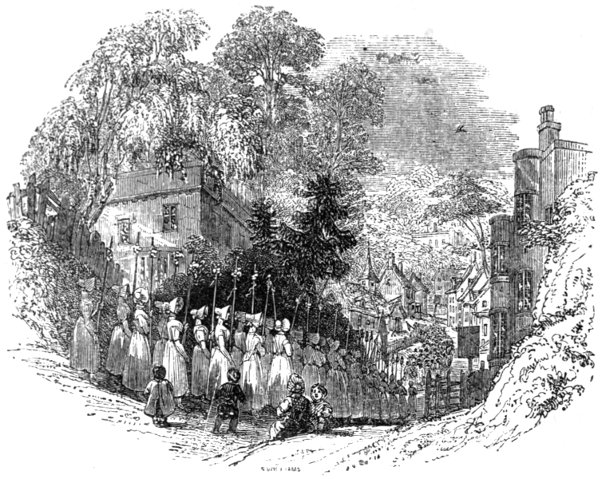
This is the only ancient religious festival that has become a
popular one since the Reformation, through the addition of a
modern circumstance. Clubs, or Friendly Societies, have substituted
for the old church ceremonies, a strong motive to assemble
in the early days of this week as their anniversary; and the time
of the year being so delightful, this holiday has, in fact, become
more than any other, what May-day was to the people. Both
men and women have their Friendly Societies, in which every
member pays a certain weekly or monthly sum, and on occasions
of sickness or misfortune, claims a weekly stipend, or a sum of
money to bury their dead. These Societies were very prudential
things, especially before the institution of Savings’ Banks, which
are still better; and in the vicinity of towns have become most
important resources for the working class, and especially servants.
In the country, Friendly Societies still do, and will probably long
remain, because Savings’ Banks are not easily introduced there.
In a Savings’ Bank, whatever a person deposits he receives with
interest. It is safe, and may be demanded any time. On the
other hand, a man may contribute for years to a club, and not
want a penny for himself on account of sickness, and at his death,
with the exception of a fixed sum to bury him, and one for his
widow, all his fund goes from his family; or, what is worse, he
may pay for many years, and just when he wants help, he finds
the box empty, through the great run upon it by the sickness or
accidental disabling of his fellows; or the steward has proved
dishonest and has decamped; or he has failed. Many such cases
have occurred, especially during the violent changes of the last
twenty years. In some particular cases the capital of a dozen
Friendly Societies has, by some strange infatuation or artifice,
been lodged in the hands of the same man, who has proved bankrupt
and ruined them all. These are the drawbacks on Friendly
Societies; and yet with these, they were better than nothing for
the poor, and some of them have, in many cases, been remedied by
the members sharing their fund amongst them once every seven
years. They were, and are often, the poor man’s sole resource and
refuge against the horror of falling on the parish, and have helped
him through his time of affliction without burthening his mind
with a sense of shame and dependence.
Well then may they come together on one certain day or days
throughout the country, to hold a feast of fellowship and mutual
congratulation in a common hope. Their wealthier neighbours
have encouraged them in this bond of union and mutual help, and
have become honorary members of their clubs. It is a friendly
and christian act. Accordingly, on Whit-Monday, the sunshiny
morning has broke over the villages of England with its most
holiday smile. All work has ceased. There has been, at first, a
Sabbath stillness, a repose, a display of holiday costume. Groups
of men have met here and there in the streets in quiet talk; the
children have begun to play, and make their shrill voices heard
through the hamlets. There have been stalls of sweetmeats and
toys set out in the little market-place on the green, by the shady
walk, or under the well-known tree. Suddenly the bells have
struck up a joyous peal, and a spirit of delight is diffused all over
the rustic place, ay, all over every rustic place in merry England.
Forth comes streaming the village procession of hardy men or
comely women, all arrayed in their best, gay with ribbons and
scarfs, a band of music sounding before them; their broad banner
of peace and union flapping over their heads, and their wands
shouldered like the spears of an ancient army, or used as walking-staves.
Forth they stream from their club-room at the village
alehouse.
’T is merry Whitsuntide, and merrily
Holiday goes in hamlet and green field;
Nature and men seem joined, for once, to try
The strength of Care, and force the carle to yield:
Summer abroad holds flow’ry revelry:
For revelry, the village bells are pealed;
The season’s self seems made for rural pleasure,
And rural joy flows with o’erflowing measure.
Go where you will through England’s happy valleys,
Deep grows the grass, flowers bask, and wild bees hum;
And ever and anon, with joyous sallies,
Shouting, and music, and the busy drum
Tell you afar where mirth her rustics rallies,
In dusty sports, or ’mid the song and hum
Of Royal Oak, or bowling-green enclosure,
With bower and bench for smoking and composure.
May’s jolly dance is past, and hanging high,
Her garlands swing and wither in the sun;
And now abroad gay posied banners fly,
Followed by peaceful troops, and boys that run
To see their sires go marching solemnly,
Shouldering their wands; and youths with ribbons won
From fond fair hands, that yielded them with pride,
And proudly worn this merry Whitsuntide.
And then succeeds a lovelier sight,—the dames,
Wives, mothers, and arch sigh-awakening lasses,
Filling each gazing wight with wounds and flames,
Yet looking each demurely as she passes,
With flower-tipped wand, and bloom that flower outshames;
And, in the van of these sweet, happy faces
Marches the priest, whose sermon says, “be merry,”
The frank, good squire, and sage apothecary.
W. H.
Forth stream these happy bands from their club-room, making
the procession of the town before they go to church, and then
again after church and before going to dinner, for then begins the
serious business of feasting, too important to admit of any fresh
holiday parade for the rest of the day. Nothing can be more
joyously picturesque than this rural holiday. The time of the
year—the latter end of May, or early part of June, is itself jubilant.
The new leaves are just out in all their tender freshness:
the flowers are engoldening the fields, and making odorous the
garden: there are sunshine and brightness to gladden this festival
of the lowly. In my mind are associated with this time, from the
earliest childhood, sunshine, flowers, the sound of bells, and village
bands of music. I see the clubs, as they are called, coming down
the village; a procession of its rustic population all in their best
attire. In front of them comes bearing the great banner, emblazoned
with some fitting scene and motto, old Harry Lomax the
blacksmith, deputed to that office for the brawny strength of his
arms, and yet, if the wind be stirring, evidently staggering under
its weight, and finding enough to do to hold it aloft. There it
floats its length of blue and yellow, and on its top nods the huge
posy of peonies, laburnum flowers, and lilachs, which our own
garden has duly furnished. Then comes sounding the band of
drums, bassoons, hautboys, flutes, and clarionets: then the honorary
members—the freeholders of the place—the sage apothecary, and
the priest whose sermon says “be merry”—literally, for years, his
text being on this the words of Solomon—“Let us eat and drink,
for to-morrow we die.”—and then the simple sons of the hamlet,
walking as stately and as gravely as they can for the nods and
smiles of all their neighbours who do not join in the procession,
but are all at door and window to see them go by. There they go,
passing down the shady lane with all the village children at their
heels, to the next hamlet half a mile off, which furnishes members
to the club, and must therefore witness their glory. Now the
banner and the gilded tops of their wands are seen glancing
between the hedge-row trees; their music comes merrily up the
hill; and as it dies away at the next turn, the drumming of distant
villages becomes audible in half a dozen different quarters. Then
come, one after another, the clubs of the neighbouring hamlets,
as the old ballad of the Earl of Murray very expressively says,
“sounding through the town;” giving occasion to a world of
criticism and comparison to the village gossips, no doubt always
terminating in favour of their own folk.
But the most beautiful sight is that of the women’s clubs,
which in some places walk on the same day with those of the men,
but more commonly on Tuesday. Here the contrast between the
band and banner-bearer, and the female array that follows them,
gives great effect. In some places they are graced with the presence
of some of the ladies of the neighbourhood who are honorary
members, and their cultivated countenances, and style of bearing,
again contrast with the simple elegance or showy finery of the
rustic train which succeeds, consisting of the sedate matrons and
blooming damsels of the village. Their light dresses, their gay
ribbons and bonnets, their happy, and often very handsome faces,
cannot be seen without feeling with Wordsworth, that
Their beauty makes you glad.
In all the pageants and processions that were ever seen, there
is nothing more beautiful than those light wands with which they
walk, each crowned with a nosegay of fresh flowers. These posied
wands were worthy of the most chastely graceful times of Greece;
and amongst the youthful forms are often such as Stothard would
have gloried in seizing upon to figure in his charming procession
pieces. Indeed a Whitsuntide procession in his hands would have
formed altogether a picture equal to his Canterbury Pilgrimage,
and the Procession of the Flitch of Bacon. It has never had
justice done it, and Stothard is gone; but we have artists remaining
from whose pencil it may, and I trust will, receive honour due.
Why not Leslie add it to his Sir Roger Coverley going to church,
or Sir Roger and the Gipsies? I can see the painting already in
my mind’s eye. The village church is in one extremity; the
banner of the men’s club is stooping at the porch as the train is
about to enter, and the women’s club is advancing up the street
in the foreground: the band composed of figures full of strong
character; the female figures full of simple elegance and arch
beauty,—their posied wands depicted with the force of reality; the
village street in perspective; the village alehouse with depending
sign; booths and stalls, and all round merry faces and holiday
forms.
These love-feasts of the Friendly Societies seem very appropriately
celebrated at this festival, which was originally derived
from the Agapai, or love-feasts of the early Christians. It is,
indeed, a great improvement on the Whitsun-Ales, which succeeded
the Agapai in the Roman church. It is, as I have before observed,
the happiest and almost sole adaptation of a modern institution
to an ancient custom by the Church of England; a policy, on the
contrary, so closely studied and extensively practised by the Catholic
church. The Whitsun-Ales were so called from the churchwardens
buying, and laying in from presents also, a large quantity
of malt, which they brewed into beer, and sold out in the church
or elsewhere. The profits, as well as those from Sunday games—there
being no poor-rates—were given to the poor, for whom this
was one mode of provision, according to the Christian rule, that
all festivities should be rendered innocent by alms. “In every
parish,” says Aubrey, “was a church-house, to which belonged
spits, crocks, and other utensils for dressing provisions. Here the
housekeepers met. The young people were there too; and had
dancing, bowling, shooting at butts, etc., the ancients sitting
gravely by, and looking on.”
King James, to check the progress of nonconformity, and
keep people to church, published his “Book of Sports,” and commanded
attendance on Whitsun-ales, church-ales, etc.; but he
soon found that forced sport is no sport at all. These Friendly
Societies, however, by adopting this day, have revived the Agapai
in a more popular shape, and long may they continue, refined
indeed, and made more temperate by better information, and a
better morality. These being held at public-houses, and their
monthly nights, on which they pay their contributions, being held
there too, has made many persons object to them; and the
utilitarian spirit, especially during periods of general distress, has
induced many of them to give up their bands, banners, and ribbons,
and to throw the money thus saved into the general stock: but if
we are to retain any rustic festival at all, we cannot, I think, have
a more picturesque one, or at a pleasanter time. Let all means
be used to preserve a day of relaxation and good-fellowship from
gross intemperance, but let not the external grace and rustic
pageantry be shorn away. As I have met these Whitsuntide processions
in the retired villages of Staffordshire, or as I saw them
in the summer of 1835 at Warsop in Nottinghamshire, I would
wish to see them as many years hence as I may live. In the latter
village, Miss Hamilton, a lady of poetical taste, and author of
several poetical works, had painted the banner for this rural fête
with her own hands, and the flowers with which the wands were
crowned were selected and disposed in a spirit of true poetry.
Long, I say, may this bright day of rejoicing come to the hamlet;
and the musing poet stop in the glades of the near woodlands, and
exclaim with Kirk White:
Hark how the merry bells ring jocund round,
And now they die upon the veering breeze;
Anon they thunder loud,
Full on the musing ear.
Wafted in varying cadence, by the shore
Of the still twinkling river, they bespeak
A day of jubilee,
An ancient holiday.
And lo! the rural revels are begun,
And gaily echoing to the laughing sky,
On the smooth-shaven green
Resounds the voice of mirth.
Mortals! be gladsome while ye have the power,
And laugh, and seize the glittering lapse of joy;
In time the bell will toll
That warns ye to your graves.
The next and last of these popular festivities that I shall notice at
any length, is jolly old Christmas,—the festival of the fireside;
the most domestic and heartfelt carnival of the year. It has
changed its features with the change of national manners and
notions, but still it is a time of gladness, of home re-union and
rejoicing; a precious time, and one so thoroughly suited to the
grave yet cheerful spirit of Englishmen, that it will not soon lose
its hold on our affections. Its old usages are so well known;
they have been so repeatedly of late years brought to our notice
by Washington Irving, Walter Scott, Leigh Hunt in his most
graphic and cordial-spirited Months, Indicator, and London
Journal, and by many other lovers of the olden time, that I shall
not now particularly describe them. We have already seen how,
in all our religious festivals, the most ancient customs and rites
have been interwoven with Catholicism. Who does not recognise
in the decoration of our houses and churches with ivy, holly, and
other evergreens, the decorations of the altars of Greece and Rome
with laurels and bays as the symbols of the renewal of the year
and the immortality of Nature? In our mistletoe branches the
practice of Druidical times? Who does not see in the Abbot of
Unreason, and his jolly crew, the Saturnalia of ancient times?
Those who do not, may find in Brand’s Antiquities, the various
volumes of Time’s Telescope, collected by my worthy friend John
Millard, and in Hone’s Everyday Table, and Year Books, matter
on these subjects, and on the Christmas pageants, rites, and processions
of Rome, that would of itself fill a large volume. In old
times it was from Christmas to Candlemas a period of general
jollification; for the first twelve days—a general carnival. The
churches were decorated with evergreens; midnight mass was
celebrated with great pomp; according to Aubrey, they danced in
the church after prayers, crying Yole, Yole, Yole, etc. For a
fortnight before Christmas, and during its continuance, the mummers,
or guisers, in their grotesque array, went from house to
house, acting George and the Dragon, having the Princess Saba,
the Doctor, and other characters all playing and saying their parts
in verse. Others acted Alexander the Great, and the King of
Egypt. Bands of carollers went about singing; and all the great
gentry had
A good old fashion when Christmas was come,
To call in their old neighbours with bagpipe and drum.
And then in those good old halls, what a feasting, and a sporting,
and a clamour was there! The Yule block on the fire, the plum-porridge
and mince-pies on the table, with mighty rounds of beef,
plum-pudding, turkeys, capons, geese, goose-pies, herons, and
sundry other game and good things. Ale of twelve months old
circling round, and the old butler and his serving-men carrying up
the boar’s head, singing in chorus the accustomed chant, as they
set it before the lord of the feast:
Caput Apri defero
Reddens laudes domino.
The boar’s head in hand bring I,
With garlands gay and rosemary;
I pray you all sing merrily,
Qui estis in convivio, etc.
Then, as Burton in his Anatomie of Melancholie, tells us,—“what
cards, tables, dice, shovel-board, chesse-play, the philosopher’s
game, small trunkes, billiards, musicke, singing, dancing,
ale-games, catches, purposes, questions, merry tales of arrant
knights, kings, queens, lovers, lords, ladies, giants, dwarfs, thieves,
fairies, goblins, friars, witches, and the rest. Then what kissing
under the mistletoe! roaring of storms without, and blazing hearths
and merry catches within!”
With all this rude happiness we cannot now linger; let us be
thankful that our ancestors, rich and poor, enjoyed it so thoroughly,
enjoyed it together, as became Christians, on the feast of the nativity
of their common Saviour. We will just review this state of things
as it existed in the time of old Wither, two hundred years ago;
and the remembrance of it, as it glanced on the imagination of
Scott, and then turn to it as it exists amongst us now.
CHRISTMAS.
So now is come our joyful’st feast;
Let every man be jolly;
Each room with ivy leaves is dressed,
And every post with holly.
Though some churls at our mirth repine,
Round your foreheads garlands twine;
Drown sorrow in a cup of wine,
And let us all be merry.
Now all our neighbours’ chimneys smoke,
And Christmas blocks are burning,
Their ovens they with baked meats choke,
And all their spits are turning.
Without the door let sorrow lie;
And if from cold it hap to die,
We’ll bury it in a Christmas pie,
And evermore be merry.
Now every lad is wondrous trim,
And no man minds his labour;
Our lasses have provided them
A bagpipe and a tabor:
Young men and maids, and girls and boys,
Give life to one another’s joys;
And you anon shall by their noise
Perceive that they are merry.
Rank misers now do sparing shun;
Their hall of music soundeth;
And dogs thence with whole shoulders run,
So all things there aboundeth.
The country folks themselves advance
With crowdy-muttons out of France;
And Jack shall pipe, and Jyll shall dance,
And all the town be merry.
Ned Squash hath fetched his bands from pawn,
And all his best apparel;
Brisk Nell hath bought a ruff of lawn
With dropping of the barrel.
And those that hardly all the year
Had bread to eat, or rags to wear,
Will have both clothes and dainty fare,
And all the day be merry.
Now poor men to the justices
With capons make their errants;
And if they hap to fail of these,
They plague them with their warrants:
But now they find them with good cheer,
And what they want, they take in beer,
For Christmas comes but once a year,
And then they shall be merry.
Good farmers in the country nurse
The poor, that else were undone;
Some landlords spend their money worse
On lust and pride in London.
There the roysters they do play;
Drab and dice their lands away,
Which may be ours another day,
And therefore let’s be merry.
The client now his suit forbears;
The prisoner’s heart is eased;
The debtor drinks away his cares,
And for the time is pleased.
Though others’ purses be most fat,
Why should we pine or grieve at that?
Hang sorrow! care will kill a cat,
And therefore let’s be merry.
Hark! now the wags abroad do call
Each other forth to rambling;
Anon you’ll see them in the hall
For nuts and apples scrambling.
Hark how the roofs with laughter sound,
Anon they’ll think the house goes round,
For they the cellar’s depth have found,
And then they will be merry.
The wenches with their wassail bowls
About the streets are singing;
The boys are come to catch the owls,
The wild mare in it bringing.
Our kitchen-boy hath broke his box,
And to the dealing of the ox
Our honest neighbours come by flocks,
And here they will be merry.
Now kings and queens poor sheepcotes have,
And mute with every body;
The lowest now may play the knave,
And wise men play the noddy.
Some youths will now a mumming go,
And others play at Rowland-bo,
And twenty other games boys mo,
Because they will be merry.
Then wherefore in these merry daies
Should we, I pray, be duller?
No, let us sing some roundelays,
To make our mirth the fuller.
And while we thus inspired sing,
Let all the streets with echoes ring;
Woods and hills and every thing,
Bear witness we are merry.
This is, at once, quaint and graphic. It shews us the joys of
our ancestors in their homeliness and their strength. It is full of
the spirit of the time, and the impressions of surrounding things.
Let us now see the same days through the magic mist of a modern
poet’s imagination—a poet whose soul turned to all the beauty
and picturesque splendour, and the jollity of the past, with a
passion never, in any bosom, living with a stronger delight. How,
in reverted vision of his heart and mind is every thing purified,
sanctified, and refined. What a force of enjoyment breathes
through the whole: how vividly are all the characteristics of the
time, its fable and its manners given; yet with what a grace and
delicacy, unknown to the poet of the times themselves. We have
here all the happiness, the hospitality, the generous simplicity of
the past, tinged with the beautiful illusions of the present.
ANCIENT CHRISTMAS.
And well our Christian sires of old
Loved, when the year its course had rolled,
And brought blithe Christmas back again,
With all its hospitable train.
Domestic and religious rite
Gave honour to the holy night:
On Christmas-eve the bells were rung;
On Christmas-eve the mass was sung;
That only night of all the year
Saw the stoled priest the chalice rear.
The damsel donned her kirtle sheen;
The hall was dressed with holly green;
Forth to the wood did merry men go
To gather in the mistletoe.
Then opened wide the baron’s hall,
To vassals, tenants, serf, and all;
Power laid his rod of rule aside,
And Ceremony doffed his pride.
The heir with roses in his shoes,
That night might village partner choose;
The lord, underogating share
The vulgar game of “post and pair.”
All hailed with uncontrolled delight
And general voice the happy night,
That to the cottage, as the crown,
Brought tidings of Salvation down.
The fire with well-dried logs supplied,
Went roaring up the chimney wide;
The huge hall table’s oaken face,
Scrubbed till it shone the day to grace,
Bore then upon its massive board
No mark to part the squire and lord.
Then was brought in the lusty braun
By old blue-coated serving-man;
Then the grim boar’s-head frowned on high,
Crested with bays and rosemary.
Well can the green-garbed ranger tell
How, when, and where the monster fell;
What dogs before his death he tore,
And all the baiting of the boar,
While round the merry wassail bowl,
Garnished with ribbons, blithe did trowl
There the huge sirloin reeked; hard by
Plum-porridge stood, and Christmas pie;
Nor failed old Scotland to produce,
At such high tide the savoury goose.
Then came the merry maskers in,
And carols roared with blithesome din;
If unmelodious was the song,
It was a hearty note and strong,
Who lists may in their mumming see
Traces of ancient mystery.
White shirt supplied the masquerade,
And smutted cheeks the vizor made;
But oh! what maskers richly dight
Can boast of bosoms half so light!
England was merry England then,
Old Christmas brought his sports again;
’Twas Christmas broached the mightiest ale;
’Twas Christmas told the merriest tale;
A Christmas gambol oft would cheer
A poor man’s heart through half the year.
Scott’s Marmion.
In these two poems we have sufficient picture of the past;
what of these things continue with the present? In Catholic
countries, indeed, much of the ancient show and circumstance
remain. In Rome, all the splendour of the church is called forth.
On Christmas-eve, the pipes of the Pifferari, or Calabrian minstrels,
are heard in the streets. The decorators are busy in draping the
churches, clothing altars, and festooning façades. Devout ladies
and holy nuns are preparing dresses, crowns, necklaces, and cradles,
for the Madonna and Child of their respective churches. The
toilette of the Virgin is performed, and she blazes in diamonds, or
shines in tin, according to the riches of the respective parish treasuries.
In the Church of the Pantheon, says Lady Morgan, she
was crowned with gilt paper, and decked with glass beads, and on
the same day in Santa Maria Novella, we beheld the coal-black
face set off with rubies and sapphires, which glittered on her dusky
visage “like a rich jewel in an Ethiop’s ear.” The cannons of St.
Angelo announce the festival; shops are shut, and saloons deserted.
The midnight supper and the midnight bands begin the holy revel,
and the splendid pomp in which the august ceremonies are performed
at the churches of the Quirinal, St. Louis, and the Ara
Cœli, is succeeded by a banquet of which even the poorest child of
indigence contrives to partake. The people from the mountains
and the Campagna flock in to witness and to enjoy the fête, and
present a strange sight of wild figures amid the inhabitants of the
city. The churches are lit up with thousands of wax tapers; the
culla, or cradle of Christ, is removed from the shrine at the chapel
of Santa Maria Maggiore, and carried in procession to the chapel
of the Santa Croce, where it is exposed on the high altar on
Christmas-day to the admiration of the faithful. Musical masses
are performed; the Pope himself performs service in the Sextine
Chapel on Christmas-eve, and on Christmas-day his Holiness performs
mass in St. Peter’s, in Hebrew, Greek, and Latin; amid a
most brilliant assembly of people of all nations, princes, ambassadors,
nobles, and distinguished strangers.
At Naples numbers of shepherds from the mountains of the
Abruzzi and the neighbouring Apennines, flock in two or three
weeks before Christmas, and go about the streets, playing on their
bagpipes, as the Calabrians do both here and in Rome. Most of
the Neapolitan families engage some of these itinerant musicians
to play a quarter of an hour at their houses on each day of the
Novena: the wild appearance of these mountaineers, and the shrill
notes of their pipes attract the attention of travellers. Fireworks
are displayed here in the most extraordinary manner; and, as in
other parts of Italy, it is the custom to erect in the churches and
in private houses, representations of the birth of our Saviour;—the
stable, the shepherds, the oxen, the Virgin Mary, receiving the
homage of kings and their trains, are all exhibited with great
ingenuity. A similar custom prevailed in some parts of Spain.
Such are the customs of these and other catholic countries. In
the north, where Christmas was celebrated as a festival of the gods
of the ancient Scandinavians, under the name of Yule, it is now
celebrated with great devotion; and in Germany they have some
domestic customs of a very interesting nature. Coleridge, in the
Friend, gives the following account of what he witnessed himself.
“The children make little presents to their parents, and
to each other; and the parents to their children. For three or
four months before Christmas, the girls are all busy; and the
boys save their pocket-money to make or purchase these presents.
What the present is to be, is cautiously kept secret, and the
girls have a world of contrivances to conceal it—such as working
when they are out on visits, and the others are not with them;
getting up in the morning before daylight, etc. Then, on the
evening before Christmas-day, one of the parlours is lighted up
by the children, into which the parents must not go. A great
yew bough is fastened on the table at a little distance from the
wall; a multitude of little tapers are fixed in the bough, but not
so as to burn it till they are nearly consumed; and coloured paper,
etc. hangs and flutters from the twigs. Under this bough, the
children lay out in great order, the presents they mean for their
parents, still concealing in their pockets, what they intend for
each other. Then the parents are introduced, and each presents
his little gift: they then bring out the remainder, one by one,
from their pockets, and present them with kisses and embraces.
When I witnessed this scene, there were eight or nine children,
and the eldest daughter and mother wept aloud for joy and tenderness;
and the tears ran down the face of the father, and he clasped
all his children so tight to his breast, it seemed as if he did it to
stifle the sob that was rising within him. I was very much affected.
The shadow of the bough and its appendages on the walls and
arching over on the ceiling, made a pretty picture; and then the
rapture of the very little ones, when at last the twigs and their
needles began to take fire and snap,—O, it was a delight for them!
“On the next day, in the great parlour, the parents lay on the
table the presents for the children. A scene of more sober joy
succeeds; as on this day, after an old custom, the mother says
privately to each of her daughters, and the father to his sons, that
which he has observed most praiseworthy, and that which was
most faulty in their conduct. Formerly, and still in all the
smaller towns and villages throughout North Germany, these
presents are sent by all the parents to some one fellow, who, in
high buskins, a white robe, a mask, and an enormous flax wig,
personates Knecht Rupert, i. e. the servant Rupert. On Christmas
night he goes round to every house, and says that Jesus Christ,
his master, sent him thither. The parents and elder children
receive him with great pomp and reverence, while the little ones
are most terribly frightened. He then inquires for the children,
and according to the character which he hears from the parents he
gives them the intended presents, as if they came out of heaven
from Jesus Christ. Or if they should have been bad children, he
gives the parents a rod, and, in the name of his master, recommends
them to use it frequently. About seven or eight years old,
the children are let into the secret, and it is curious how faithfully
they keep it.”
The bough mentioned by Coleridge as yew, is by other writers
said to be of birch. The Christ-child is said to come flying through
the air on golden wings; and causes the birch-bough fixed in the
corner of the room to grow, and to produce in the night, all
manner of fruit; gilt sweetmeats, apples, nuts, etc., for the good
children. Richter makes Quintus Fixlein recal one of these scenes
of his youth, very beautifully. “I will,” said he to himself, “go
through the whole Christmas-eve, from the very dawn, as I had it
of old. At his very rising he finds spangles on the table, sacred
spangles from the gold-leaf and silver-leaf with which the Christ-child
has been emblazoning and coating his apples and nuts, the
presents of the night. Then comes his mother, bringing him both
Christianity and clothes; for in drawing on his trousers, she easily
recapitulated the ten commandments; and in tying his garters,
the Apostles’ creed. So soon as candlelight was over, and daylight
come, he clambers to the arm of the settle, and then measures the
nocturnal growth of the yellow wiry grove of Christmas-birch.
There was no such thing as school all day. About three o’clock
the old gardener takes his place on his large chair, with his Cologne
tobacco-pipe, and, after this, no mortal shall work a stroke. He
tells nothing but lies, of the aeronautic Christ-child, and the
jingling Ruprecht with his bells. In the dark our little Quintus
takes an apple, and divides it with all the figures of stereometry,
and spreads the fragments in two heaps on the table. Then, as
the lighted candle enters, he starts up in amazement at the unexpected
present, and says to his mother, ‘Look what the good
Christ-child has given thee and me, and I saw one of his wings
glittering!’ And for this same glittering he himself lies in wait
the whole evening.
“About eight o’clock, both of them with necks almost excoriated
with washing, and clean linen, and in universal anxiety lest the
Holy Christ-child find them up, are put to bed. What a magic
night! What tumult of dreaming hopes! The populous, motley,
glittering cave of fancy opens itself in the length of the night, and
in the exhaustion of dreaming effort, still darker and darker, fuller
and more grotesque; but the waking gives back to the thirsty
heart its hopes. All accidental tones, the cries of animals, of
watchmen, are, for the timidly devout fancy, sounds out of heaven;
singing voices of angels in the air; church music of the morning
worship.
“At last come rapid lights from the neighbourhood, playing
through the window on the walls, and the Christmas trumpets, and
the crowing from the steeple hurries both the boys from their bed.
With their clothes in their hands, without fear for the darkness,
without feeling for the morning frost, rushing, intoxicated, shouting,
they hurry down stairs into the dark room. Fancy riots in
the pastry and fruit perfume of the still eclipsed treasures, and
haunts her air-castles by the glimmering of the Hesperides-fruit
with which the birch-tree is laden. While their mother strikes a
light, the falling sparks sportfully open and shroud the dainties on
the table, and the many-coloured grove on the wall; and a single
atom of that fire bears on it a hanging garden of Eden.”
I am informed by a lady friend that German families in Manchester
have introduced this custom of the Christmas-tree, and
that it is spreading fast amongst the English there,—pine-tops
being brought to market for the pupose, which are generally illuminated
with a taper for every day in the year.
Such are the rites, fancies, and ceremonies with which other,
and especially Catholic countries, have invested this ancient festival.
What now remain in our Protestant nation of these customs?—Much
is gone; many are the changes that have taken place in our
manners and opinions; and yet it is certain that we regard this
season of festivity with a strong and sacred affection. It is true
that there is commonly but one day of thorough holiday to the
people; one day on which all shops are shut; on which labour in
a great measure ceases, and the poor join with the rich in repose
and worship. The poor, indeed, do not partake the benefit of this
season, as the poor of old time did; the houses of the great are
not, as they were then, open to all tenants and dependents. There
is now, indeed, upon the great man’s table,
No mark to part the squire and lord;
but there is a mark more immobile than the salt, set in the grain
of our minds. The distinctions of society have grown with our
commercial wealth, and have multiplied grades and relations. A
sense of independence too has sprung up in the lower classes, with
commerce and the growth of intelligence. The great man might,
indeed, condescend to call his tenants and dependents to his hall to
a Christmas revel, but if they went at all they would go reluctantly,
and feel ill at ease. They would feel it as a condescension, and
not as springing out of the heartiness of old customs. They would
feel that they were out of their element; for all classes know
instinctively the broad differences of habits, manners, and modes
of thinking that separate them from each other more effectually
than any feudal institutions did their ancestors. The pride of the
yeoman would be more in danger of suffering than the pride of the
lord; the pride of the cottager than that of the farmer, if invited
to his table. When the brick floor and the wooden bench gave
way in the farm-house to the carpet and the mahogany chair, the
feet of the labourer ceased to tread familiarly round the farmer’s
table. Harvest meals and harvest-home suppers bring them together
in rustic districts; they are the remaining links of the old
chain of society; but the Christmas custom is broken, and is therefore
no longer observable with full content. This great difference
between the past and present exists, and therefore the rejoicing
of the poor at this time is short and small: would to heaven that
the kindly feeling of the community would make it greater!
But, independent of this, to the rest of the community Christmas
brings much of its ancient pleasure. Each class within itself,
enjoys it, perhaps more deeply, if less noisily than of old. It is, as
I have before said, the festival of the fireside. Friends and families
are brought together by many circumstances. Summer tourists
and out-of-door pleasure-seekers have all turned home at the
frown of winter. As it was their delight in the early year to plan
excursions, to make parties, and then to fly forth in all directions,
to enjoy new scenes, new faces, summer skies, and sea-breezes; it
is now their delight to assemble again round their familiar firesides,
with the old familiar faces, to talk over all that they have
seen, and said, and done. Parliament has adjourned, and weary
senators and their families have fled from London, and are, once
more, at their country seats. Children are come home from school;
business seems to pause, or to move less urgently in the dead
season of the year, and releases numbers from its tread-mill round
to an interval of relaxation. All the branches of families meet
with spirits eager for enjoyment; and storms, frosts, and darkness
without, send them for that enjoyment to the fire-bright hearth.
Christmas-eve approaches, and with it signs of observance, and
feasting, and amusement. Holly, ivy, and mistletoe appear in vast
quantities in the markets, and almost every housekeeper, except
those of the Society of Friends, furnishes herself with a quantity
to decorate her windows, if not always to sport a kissing-bush.
Churches, halls, city houses and country cottages, are all seen with
their windows stuck over with sprigs of green and scarlet-berried
holly. Mistletoe is said never to be introduced into churches
except by ignorance of the sextons, being held in abhorrence by the
early Christians on account of its prominence in the Druidical
ceremonies. And this is likely enough; but in the house it maintains
its station, and well merits it, by the beauty of its divaricated
branches of pale-green, and its pearly-white berries. But Christmas-eve
brings not only evergreens into request, but abundance of
more substantial things. The coaches to town are fairly loaded
to the utmost with geese, turkeys and game, as those downwards
are with barrels of oysters. The grocers are busy selling currants,
raisins, spices, and other good things, for the composition of
mince-pies and Christmas sweetmeats. Pigs are killed, and pork-pies,
sausages, and spareribs abound, from the greatest hall to the
lowest hut. Heaven be thanked that the blessing goes so far in
this instance. It is a delight to think of all the little children in
the poor man’s house, that the year through have lived coarsely if
not sparely, now watching the fat pig from their own sty cut up,
and pies and spareribs, boiling pieces, black puddings and sausages,
springing up as from a magical storehouse unlocked by the
key of Old Christmas. O! it is a delicious time, when the father
and the mother can sit down amongst their throng of eager little
ones, that “feel their life in every limb,” and feast them to their
hearts’ content; and live with them for a short time amid substantial
things and savoury smells, and, after all, hang in the chimney-corner
two noble flitches for the coming year.
These good things come with Christmas-eve, and with them
come the Waites. Except in some few very primitive districts,
these do not go about for a week or more as they used to do, but
merely on this night. And it is a fact singularly unfortunate for
Mr. Bulwer’s theory of the effect of Methodism noticed before,
that wherever Methodists exist they are sure to be amongst these
waites, and are, in many places, the only ones. The strange,
dreamy, yet delightful effect of the music and singing of these
waites, as you hear them in a state rather of sleep than waking,
who has not experienced? They are, as Fixlein expresses it, to
our conscious senses, but half dormant understandings, “sounds
out of heaven, singing voices of angels in the air.” I shall never
forget the delicious impressions of this midnight music on my
childish spirit, and would fain hear such strains on every returning
Christmas-eve till I cease to hear any mortal sounds.
But Christmas morning comes; and ere daylight dawns, you
are awoke by the rejoicing music of all the village or the city bells,
as it may be; and cannot help feeling, spite of all that puritans
and grave denouncers of times and seasons have said, that there is
something holy in the remembrance of the time, which does your
spirit good. Who can read these verses of, Wordsworth’s addressed
to his brother, without feeling the truth of this?
TO THE REV. DR. WORDSWORTH.
The minstrels played their Christmas tune
To-night beneath my cottage eaves;
While, smitten by the lofty moon,
The encircling laurels thick with leaves,
Gave back a rich and dazzling sheen,
That overpowered their natural green.
Through hill and valley every breeze
Had sank to rest with folded wings;
Keen was the air but could not freeze
Nor check the music of their strings;
So stout and hardy were the band
That scraped the chords with strenuous hand.
And who but listened?—till was paid
Respect to every inmate’s claim;
The greeting given, the music played,
In honour of each household name,
Duly pronounced with lusty call,
And “merry Christmas” wished to all!
O Brother! I revere the choice
Which took thee from thy native hills;
And it is given thee to rejoice;
Though public care full often tills
(Heaven only witness of the toil)
A barren and ungrateful soil.
Yet would that thou with me and mine
Hadst heard this never-failing rite;
And seen on other faces shine
A true revival of the light—
Which Nature and these rustic Powers,
In simple childhood, spread on ours!
For pleasure hath not ceased to wait
On these expected, annual rounds,
Whether the rich man’s sumptuous gate
Call forth the unelaborate sounds,
Or they are offered at the door
That guards the dwelling of the poor.
How touching when at midnight sweep
Snow-muffled winds, and all is dark,
To hear—and sink again to sleep!
Or, at an earlier call, to mark,
By blazing fire, the still suspense
Of self-complacent innocence.
The mutual nod,—the grave disguise
Of hearts with gladness brimming o’er;
And some unbidden tears that rise
For names once heard, and heard no more:
Tears brightened by the serenade,
For infant in the cradle laid!
Ah! not for emerald fields alone,
With ambient streams more pure and bright
Than fabled Cytherea’s zone
Glittering before the Thunderer’s sight,
Is to my heart of hearts endeared
The ground where we were born and reared!
Hail! ancient Manners! sure defence,
Where they survive, of wholesome laws;
Remnants of love whose modest sense
Thus into narrow room withdraws;
Hail, Usages of pristine mould,
And ye, that guard them, Mountains old!
Christmas-day then is come! and with it begins a heartfelt
season of social delight, and interchanges of kindred enjoyments.
In large houses are large parties, music and feasting, dancing
and cards. Beautiful faces and noble forms, the most fair and
accomplished of England’s sons and daughters, beautify the ample
firesides of aristocratic halls. Senators and judges, lawyers and
clergymen, poets and philosophers, there meet in cheerful and
even sportive ease, amid the elegances of polished life. In more
old-fashioned, but substantial country abodes, old-fashioned hilarity
prevails. In the farm-house hearty spirits are met. Here
are dancing and feasting too; and often blindman’s-buff, turn-trencher,
and some of the simple games of the last age remain.
In all families, except the families of the poor, who seem too much
forgotten at this, as at other times in this refined age, there are
visits paid and received; parties going out, or coming in; and
everywhere abound, as indispensable to the season, mince-pies, and
wishes for “a merry Christmas and a happy New-Year.”
It is only in the more primitive parts of the country that the
olden customs remain. The Christmas carols which were sung
about from door to door, for a week at least, not twenty years ago,
are rarely heard now in the midland counties. More northward,
from the hills of Derbyshire, and the bordering ones of Staffordshire,
up through Lancashire, Yorkshire, Northumberland, and
Durham, you may frequently meet with them. The late Mrs.
Fletcher (Miss Jewsbury) one of the most highly-gifted, both in
talents and principle, of those who are early lost to the world,
collected a volume of such as are sung in the neighbourhood of
Manchester, and presented it to Mrs. Howitt. Amongst them
are many of the most ancient, such as—“Under the Leaves, or
the Seven Virgins,” beginning—
All under the leaves, and the leaves of life,
I met with virgins seven;
And one of them was Mary mild,
Our Lord’s Mother in Heaven.
“The Moon shone bright,”—beginning with
The moon shone bright, and the stars gave a light
A little before it was day,
The Lord our God he called to us,
And bade us awake and pray.
Awake, awake, good people all,
Awake and you shall hear,
Our blessed Lord died on the cross
For us whom he loved so dear;
and ending thus—
To day, though you’re alive and well,
Worth many a thousand pound,
To-morrow dead, and cold as clay,
Your corpse lies under ground.
God bless the master of this house,
Mistress and children dear;
Joyful may their Christmas be,
And happy their New-Year.
That singular old ballad of Dives and Lazarus, in which occur
these stanzas:—
As it fell out upon a day,
Poor Lazarus sickened and died;
There came two angels out of heaven
His soul therein to guide.
“Rise up, rise up, brother Lazarus,
Thine heavenly guides are we;
Thy place it is provided in heaven,
To sit on an angel’s knee.”
As it fell out upon a day,
Rich Dives sickened and died;
There came two serpents out of hell
His soul therein to guide.
“Rise up, rise up, brother Dives,
Thine evil; guides are we;
Thy place it is provided in hell,
To sit on a serpent’s knee!”
One has this home-thrusting stanza:
So proud and lofty do some people grow,
Dressing themselves like players in a show;
They patch and paint, and dress like idle stuff,
As if God had not made them good enough.
The well-known Twelve Joys:
The first good joy that Mary had, it was the joy of one,
To see her own son Jesus to suck at her breast-bone;
To suck at her breast-bone, good man, and blessed shall he be,
Through, Father, Son, and Holy Ghost, the One United Three! etc.
The equally popular one:
God rest you, merry gentlemen,
Let nothing you dismay;
Remember Christ our Saviour
Was born on Christmas-day,
To save poor souls from Satan’s power,
Who’ve long time gone astray.
Which ends thus:
God bless the master of this house,
And mistress also;
And all the little children
That round the table go;
With their pockets full of money,
And their cellars full of beer;
And God send you a happy New-Year.
Amongst them is found Bethlehem City.
In Bethlehem city, in Jewry it was,
That Joseph and Mary together did pass;
And there to be tax’d, as many one mo,
When Cæsar commanded, in truth it was so. etc.
And that fine hymn which is sung in some places at midnight by
the Waites, and which the Methodists have adopted for their early
morning service:
Christians, awake! salute the happy morn,
Whereon the Saviour of the world was born.
And the following, which, though evidently in a most defective
state, I shall give entire, as exhibiting a striking impress of the
character of the middle ages; and shewing how well they understood
the true spirit of Christ.
Honour the leaves and the leaves of life,
Upon this blest holiday,
When Jesus asked his mother dear,
Whether he might go to play.
To play! to play! said blessed Mary,
To play, then get you gone;
And see there be no complaint of you
At night when you come home.
Sweet Jesus, he ran unto yonder town,
As far as the holy well;
And there he saw three as fine children
As ever eyes beheld.
He said, “God bless you every one,
And sweet may your sleep be;
And now, little children, I’ll play with you,
And you shall play with me.”
“Nay, nay, we are lords’ and ladies’ sons—
Thou art meaner than us all;
Thou art but a silly fair maid’s child,
Born in an oxen’s stall.”
Sweet Jesus he turned himself about,
Neither laughed, nor smiled, nor spoke,
But the tears trickled down from his pretty little eyes,
Like waters from the rock.
Sweet Jesus he ran to his mother dear,
As fast as he could run—
O mother, I saw three as fine children
As ever were eyes set on.
I said “God bless you every one,
And sweet may your sleep be—
And now, little children, I’ll play with you,
And you shall play with me.”
“Nay,” said they, “we’re lords’ and ladies’ sons,
Thou art meaner than us all;
For thou art but a poor fair maid’s child,
Born in an oxen’s stall.”
Then the tears trickled down from his pretty little eyes
As fast as they could fall.
“Then,” said she, “go down to yonder town,
As far as the holy well,
And there take up those infants’ souls,
And dip them deep in hell.”
“O no! O no!” sweet Jesus then said,
“O no! that never can be;
For there are many of those infants’ souls
Crying out for the help of me!”
I must not close this article either without recalling to the
recollection of some of my readers that quaint old carol, which was
sung by bands of little children at Christmas, and which brings
fairly before us the paintings of the old masters, where Joseph is
always represented as so old a man, and Mary sits in the “oxen’s
stall” with her crown on her head.
Joseph was an old man, and an old man was he,
And he married Mary, the Queen of Galilee.
It goes on to describe how they went into the garden, and Queen
Mary asked Joseph to gather her some cherries, on which he turned
very crabbed, made Mary weep, and then all the cherry-trees made
their obeisance;
And bowed down to Mary’s knee—
And she gathered cherries by one, two, and three.
These are in the spirit of the legend which relates that Jesus, when
a boy, was playing with other boys, when they made sparrows of
clay, and he made a sparrow too, but his sparrow became instantly
alive, and flew away.
Simple were the times when such rude rhymes as these were
framed, to be sung before the doors and by the blazing yule-clogs
of gentle and simple. They are not calculated to stand the test
of these days; the schoolmaster will root them all out: but it is
to be hoped that he will leave untouched the cordial spirit of
piety and affection so fitted to make happy this desolate period of
the year.
In Yorkshire, Staffordshire, Cornwall, and Devon, the old spirit
of Christmas seems to be kept up more earnestly than in most
other counties. In Cornwall, they still exhibit the old dance of
St. George and the Dragon. A young friend of ours happening to
be at Calden-Low in the Staffordshire hills at Christmas, in came
the band of bedizened actors, and performed the whole ancient
drama, personating St. George, the King of Egypt, the fair Saba,
the king’s daughter, the Doctor, and other characters, with great
energy and in rude verse. In Devon they still bless the orchards
on Christmas-eve, according to the old verses:—
Wassail the trees, that they may beare
You many a plum, and many a peare:
For more or less fruits they will bring
As you do give them wassailing.
In some places, they walk in procession to the principal
orchards in the parish. In each orchard one tree is selected as the
representative of the rest; and is saluted with a certain form of
words. They then either sprinkle the tree with cider, or dash a
bowl of cider against it. In other places, only the farmer and his
servants assemble on the occasion, and after immersing cakes in
cider, hang them on the apple-trees. They then sprinkle the trees
with cider; pronounce their incantation; dance about the tree, and
then go home to feast.
In Mr. Grant Stewart’s “Popular Superstitions of the Highlands,”
may be found an account of the Highland mode of celebrating
Christmas; and here we say a hearty good-bye to Jolly
Old Christmas.
We have now made a hasty sketch of those old festivals which
still retain more or less of their ancient influence. We have
endeavoured to shew what is the present state of custom and feeling
in these particulars by contrasting it with the past. New
Year’s-day is yet a day of salutations; Valentine’s-day has yet
some sportive observance amongst the young; and Plough-Monday,
here and there, in the thoroughly agricultural districts, sends out
its motley team. This consists of the farm-servants and labourers.
They are dressed in harlequin guise, with wooden swords, plenty of
ribbons, faces daubed with white-lead, red ochre, and lamp-black.
One is always dressed in woman’s clothes and armed with a besom,
a sort of burlesque mixture of Witch and Columbine. Another
drives the team of men-horses with a long wand, at the end of
which is tied a bladder instead of a lash; so that blows are given
without pain, but with plenty of noise. The insolence of these
Plough-bullocks, as they are called, which might accord with
ancient license, but does not at all suit modern habits, has contributed
more than anything else to put them down. They visited
every house of any account, and solicited a contribution in no very
humble terms. If it was refused, their practice was to plough up
the garden walk, or do some other mischief. One band ploughed
up the palisades of a widow lady of our acquaintance, and having
to appear before a magistrate for it, and to pay damages, never
afterwards visited that neighbourhood. In some places I have
known them enter houses, whence they could only be ejected by
the main power of the collected neighbours; for they extended
their excursions often to the distance of ten miles or more, and
where they were the most unknown, there practised the most
insolence. Nobody regrets the discontinuance of this usage.
The Fairies, which gave in old times one of the most interesting
and poetical features to the country, have all vanished clean away.
Of those supernatural and airy beings who used to haunt the
woodlands, hamlets, and solitary houses of Old England, they were
the first to depart. “They were of the old profession”—true
Catholics; and with Catholicism they departed; and have only left
their interest in the pages of our poets, who still cling with fondness
to the fairy mythology. Bogards, barguests, ghosts, and
hobgoblins, still, in many an obscure hamlet and the more primitive
parts of the country, maintain much of their ancient power,
and continue to quicken the steps of the clown in lonely places,
of the schoolboy past the churchyard, and to add a fearful interest
to the winter fireside stories in cottages and farms. Witchcraft,
spite of what Sir Walter Scott asserted in his Demonology, is far
from having ceased to have stanch believers in numerous places.
Are not many of the Methodists firmly persuaded of demoniacal
possession? It is not long ago that Mr. Heaton, one of their
ministers, published a volume in support of this doctrine, and
detailed a very extraordinary case of possession of a boy who
mounted on the surbase of the room, and danced there, on a space
where he could not for a moment support himself when not under
this influence. In this curious book, which I sent to Sir Walter
Scott, and which he assured me he meant to make use of, but was,
no doubt, prevented by his quickly succeeding decline, is a minute
account of all the process of praying the spirit out of the lad, of the
dogged resistance of the demon, and their final triumph over him.
John Wesley was strongly impressed with a belief of such things,
as may be seen in his “News from the Invisible World,” and in
the pages of the old series of the Wesleyan Magazine. And if
recent demoniacal possession be a living faith of the nineteenth
century, witchcraft has no lack of votaries. In Nottingham, a town
of seventy thousand inhabitants, I knew a shoemaker who stood
six feet in height, and “might dance in iron mail,” who lately
lived, and probably still lives, in constant dread of the evil arts of
witches and wizards. On the lintel and sill of his door, he had the
ancient charm of reversed horse-shoes nailed; but he said, he
found them of little use against the audacious malice of witchcraft.
He had standing regularly by his fireside a sack-bag of salt, for he
bought it by a sack at a time for the purpose, and of this he frequently,
during the day, but more especially on dark and stormy
nights, took a handful, with a few horsenail stumps, and crooked
pins, and casting them into the fire together, prayed to the Lord
to torment all witches and wizards in the neighbourhood, and he
believed that they were tormented. As I stood by the man’s fire
while he related this, it was burning with the beautiful purple hue
of salt. On all other subjects he appeared as grave and sober as
his neighbours.
In the obscure alleys of large towns, as well as in solitary
situations, fortunetellers still live, and to my own knowledge draw
many customers, besides the gipsies, who haunt there in winter
time, and are the regular professors of palmistry. Witches,
spectres, gipsies, and cunning people, still remain to diversify
common life, spite of all the spread of education; but the fairies,
pleasant little people, are gone for ever, and have been gone long.
Chaucer, indeed, says that they were gone in his day.
In olde dayes of the king Artour,
Of which that Bretons speke gret honour,
All was this land ful filled of faerie;
The elf-quene, with her joly compagnie
Danced ful oft in many a grene mede.
This was the old opinion as I rede;
I speke of many hundred yeres ago;
But now can no man see non elves mo,
For now the grete charitee and prayeres
Of limitoures and other holy freeres,
That serchen every land and every streme,
As thikke as motes in the sonne beme,
Blissing halles, chambres, kitchenes and boures,
Citees and burghes, castles highe and toures,
Thropes and bernes, shepenes and dairies,
This maketh that ther ben no fairies;
For ther as wont to walken was an elf,
Ther walketh now the limitour himself.
And Dr. Corbet, bishop of Norwich, who died in 1635, wrote
the following interesting—
FAREWELL TO THE FAIRIES.
Farewell rewards and fairies!
Good housewives now may say;
For now foule sluts in dairies,
Doe fare as well as they;
And though they sweepe their hearths no less
Than mayds were wont to doe,
Yet who of late for cleanliness
Finds sixpence in her shoe?
Lament, lament old Abbies,
The Fairies’ lost command;
They did but change priests’ babies,
But some have changed your land:
And all your children stolen from thence
Are now growne Puritanes,
Who live as changelings ever since
For love of your demesnes.
At morning and at evening both
You merry were and glad,
So little care of sleepe and sloth
Those pretty ladies had.
When Tom came home from labour,
Or Ciss to milking rose,
Then merrily went their tabour,
And merrily went their toes.
Witness those rings and roundelayes
Of theirs which yet remain;
Were footed in Queen Mary’s days
On many a grassy playne.
But since of late Elizabeth,
And later James came in,
They never danced on any heath
As when the time hath bin.
By which we note the fairies
Were of the old profession,
Their songs were Ave Maries,
Their dances were procession.
But now, alas! they all are dead,
Or gone beyond the seas,
Or farther for religion fled,
Or else they take their ease.
A tell-tale in their company
They never could endure;
And whoso kept not secretly
Their mirth was punished sure.
It was a just and Christian deed
To pinch such black and blue;
O how the commonwealth doth need
Such justices as you.
Now they have left our quarters;
A Register they have,
Who can peruse their charters,
A man both wise and grave.
A hundred of their merry pranks
By one that I could name
Are kept in store; con twenty marks
To William for the same.
To William Churne of Staffordshire
Give laud and praises due,
Who every meal can mend your cheer
With tales both old and true:
To William all give audience,
And pray ye for his noddle;
For all the fairies’ evidence
Were lost if it were addle.
Possibly the fairies may yet linger in the dales of Ettrick
Forest, where poor Hogg used to see them, and sung so many
beautiful lays in their honour that he may be styled the Poet
Laureate of the Fairies. But he is gone now—gone after many
another great and shining light of the age, having made the
shepherd’s plaid almost as glorious as the prophet’s mantle—and
they may not choose to reveal themselves to another. They may
possibly yet pay an occasional visit to Staffordshire, the county of
William Churne; and we have, indeed, heard of them doing some
pleasant miracles on Midsummer-eve on Calden-Low. If we are
to believe the report of a certain little damsel, as given in Tait’s
Magazine, of June 1835—
Some, they played with the water,
And rolled it down the hill;
And this, they said, shall merrily turn
The poor old miller’s mill.
For there has been no water
Ever since the first of May,
And a blithe man shall the miller be
By the dawning of the day.
O, the miller, how he will laugh
As he sees the mill-dam rise—
The jolly old miller how he will laugh
Till the tears fill both his eyes.
And some they seized the little winds,
That sounded over the hill,
And each put a horn into his mouth,
And blew so sharp and shrill.
“And there,” said one, “the merry winds go
Away from every horn,
And these shall clear the mildew dank
From the blind old widow’s corn.”
O! the poor blind widow—
Though she has mourned so long,
She’ll be merry enough when the mildew’s gone,
And the corn stands stiff and strong.
And some they brought the brown lintseed,
And flung it down from the Low;
“And this,” said they, “by the sunrise,
In the weaver’s croft shall grow.”
O! the poor, lame weaver,
How he will laugh outright,
When he sees his dwindling flax-field
All full of flowers by night.
Then up and spoke a brownie,
With a long beard on his chin,
“And I have spun the tow,” said he,
“And I want some more to spin.
“I’ve spun a piece of hempen cloth,
And I want to spin another;
A little sheet for Mary’s bed,
And an apron for her mother.”
And with that I could not help but laugh,
And I laugh’d out loud and free,
And then on the top of the Calden-Low
There was no one left but me.
And all on the top of the Calden-Low
The mists were cold and grey,
And nothing I saw but the mossy stones,
That round about me lay.
This deponent saith, that coming down from the Low, she saw all
their benevolent intentions already realized. It is to be hoped that
such visits may be again paid to Calden-Low, but we have our doubts.
The Pixies may possibly still haunt those caves and dells in
Devonshire where Coleridge and Carrington saw them; but with
those exceptions—and they received on the faith of poets, who take
license—we believe they have all emigrated. In the lays of Shakspeare
and Milton, they are made immortal denizens of our soil;
and we shall never see moonlight, or come upon the VER-RINGS
that still mark our plains and downs, without feeling and poetically
believing that the fairies have been there. In Wales, however, the
common people still declare that they abide. Scotland may have
given up the brownies, and kelpies, and urisks; and we may no
longer have hobthrushes dwelling amongst our rocks, or Robin
Goodfellow, alias Puck, alias Hobgoblin, playing his pranks, as in
this confession:
Whene’er night-wanderers I meet,
As from their night-sports they trudge home,
With counterfeiting voice I greete,
And call them on with me to roame,
Through woods, through lakes,
Through bogs, through brakes;
Or else unseen with them I go,
All in the nicke,
To play some tricke,
And frolicke it with ho, ho, ho!
Sometimes I meet them like a man;
Sometimes an ox, sometimes a hound;
And to a horse I turn me can,
To trip and trot about them round.
But if to ride
My backe they stride,
More swift than wind away I go,
O’er hedge and lands,
Through pools and ponds
I winny, laughing ho, ho, ho!
He may not come to play those pranks, nor as Milton has
described his visits to the farm:
To earn the cream-bowl duly set.
The thrashing-machine has thrown the lubber-fiend out of
employment; but the Welsh still declare themselves honoured by
the continuance of these night-wanderers. They have still the
corpse-candles; and hear Gabriel’s hounds hunting over the hills
by night, and stoutly avow that the fairies are as numerous there
as ever. There is a waterfall at Aberpergum, called the Fairies’
Waterfall, where they are, almost any night to be heard singing;
and I have heard a very grave Friend declare that he has seen
them dancing in a green meadow, as he rode home at night. How
long, indeed, this may continue, one cannot tell; for old Morgan
Lewis, who for fifty years has acted as guide to the beautiful waterfalls
of Neath Valley, and is a most firm believer in all the Fairy
faith, especially of their luring children away by assuming the
forms of their deceased relatives, and offering them fairy-bread to
eat, which changes their natures, and they are compelled to join
the Elfin troop—declares that they are now gone from that neighbourhood;
that “the spirit of man is become too strong for them.”
A fair friend has sketched for me, the old man in the attitude of
describing to a party the exact spot on which his father saw their
very last appearance. Behind him rises the Dînas Rock, from
time immemorial the sanctum sanctorum of Welsh fairyland; and
old Morgan is exclaiming, “They are gone! they are gone! and
we’ll never see them more!”
There is nothing more characteristic in rural life than a village
alehouse, or inn. It is the centre of information, and the regular,
or occasional rendezvous of almost everybody in the neighbourhood.
You there see all sorts of characters, or you hear of them. The
whereabout of everybody all around is there perfectly understood.
I do not mean the low pothouse—the new beer-shop of the new
Beer-bill, with LICENSED TO BE DRUNK ON THE PREMISES blazoned
over the door in staring characters—the Tom-and-Jerry of the
midland counties—the Kidley-Wink of the west of England. No,
I mean the good old-fashioned country alehouse; the substantial,
well-to-do old country alehouse—situated on a village green, or by
the road-side, with a comfortable sweep out of the road itself for
carriages or carts to come round to the door, and stand out of
all harm’s way. The nice old-fashioned house, in a quiet, rural,
out-of-the-way, old-fashioned district. The very house which Goldsmith
in his day described—
Where grey-beard mirth and smiling toil retired,
Where village statesmen talked with looks profound,
And news much older than their ale went round.
It is a low, white-washed, or slap-dashed, or stuccoed, or timber-framed
house, with its various roof, and steep gables; its casement
windows above, bright and clean, peeping out from amongst vines
or jasmines, where the innkeeper’s neat daughter, who acts the
parts of chambermaid, barmaid, and waiter, may be seen looking
abroad; and its ample bay-windows below, where parties may do the
same, and where, as you pass, you may occasionally see such parties—a
pleasant-looking family, or a group of young, gay people, with
merry, and often very sweet faces amongst them;—their post-chaise,
travelling-carriage, barouche, or spring-cart, according to
their several styles and dignities, standing at the door, under the
great spreading tree. Ay, there is the old spreading tree, that is
as old, and probably older than the inn itself. It is an elm, with a
knotty mass of root swelled out around the base of its sturdy stem
into a prodigious heap—into a seat, in fact, on holiday occasions,
for a score of rustic revellers, or resters. In some cases, where the
root has not been so accommodating, a good stout bench runs
round it; or where the root is at all endangered by scratching
dogs, picking and hewing children, or rooting pigs of the village,
it has heaped up a good mound of earth round it; or it is protected
by a circle of wattled fence.
You see the tree is a tree of mark and consequence; it is, indeed,
the tree. It is looked upon as part and parcel of the concern;
of as much consequence to the house as its sign; and it is often the
sign itself:—The Old Elm-Tree! Or it may be a yew—the very
yew out of which Robin Hood and Little John, Will Scarlett, or
Will Stutely cut their bows—yes, that house is “The Robin Hood.”
Or it may be a mighty ash—the One-Ash, or the Mony-Ash, as in
the Peak of Derbyshire. Or it is an oak of as much dignity—The
Royal-Oak. Or it is a whole grove or cluster, by character or tradition—The
Seven-Sisters—or The Four-Brothers—or The Nine-Oaks—all
of which sisters, brothers, or nine companions, except
one, are decayed, dropped off, or thrown down, as many a family
beside has been. See!—the sign hangs in it, or is suspended on
its post just by, bearing the likeness of the original tree, attempted
by some village artist.
Just such a tree and such a house, all my Surrey, and many of
my metropolitan readers are familiar with at the foot of St. Anne’s
Hill, by Chertsey. The Golden-Grove, kept by James Snowden,—who
does not know it, that loves sweet scenery, sweet associations,
or a pleasant steak and pipe, or a tea-party on a holiday of nature,
in one of the most delicious nests imaginable? Yes! there is a
nice old village inn for you; and such a tree! There you have the
picture of the Golden-Grove all in a blaze of gold—somewhat dashed
and dimmed, it is true, by the blaze of many suns,—but there it
is, in front of the inn, and by the old tree. The inn, the hanging
gardens and orchards, the rustic cottages scattered about, the rich
woods and splendid prospects above, the beautiful meadows and
winding streams below; why, they are enough to arrest any traveller,
and make him put up his horse, and determine to breathe a
little of this sweet air, and indulge in this Arcadian calm, amid
these embowering woodlands. And where is he? Below, in those
fair meadows, amid those cottage roofs and orchard trees, rises the
low, square church-tower of Chertsey:—Chertsey, where Cowley
lived and died; and where his garden still remains, as delicious as
ever, with its grassy walk winding by his favourite brook, and the
little wooden bridge leading into the richest meadows. And where
his old house yet remains, saving the porch pointing to the street,
which was taken down for the public safety, but the circumstance
and its cause recorded on a tablet on the wall, with this concluding
line—
Here the last accents flowed from Cowley’s tongue.
You then, poetical or enthusiastic traveller or visitant, tread the
ground which Abraham Cowley trod in his retirement; and what
is more, you tread the ground which Charles James Fox trod in his
retirement. The hill above is St. Anne’s,—conspicuous through a
great part of Surrey, Berks, Bucks, Herts, and Middlesex, delightful
for its woods and for its splendid panoramic views, including
the winding Thames, Cooper’s Hill, celebrated by Sir John Denham,
Hampstead, Highgate, Harrow, and mighty London itself, but still
more delightful to the patriotic visitant, as the place where Fox
retired to refresh himself after his parliamentary contests, and to
recruit himself for fresh struggles for his country. It is a place
which Rogers by his pen, and Turner by his pencil, have made still
more sacred. Who does not know the lines of Rogers in his poem
of Human Life, in his last splendidly-embellished edition of his
works, referring to Fox?—
And now once more where most he wished to be,
In his own fields, breathing tranquillity—
We hail him—not less happy Fox, than thee!
Thee at St. Anne’s so soon of care beguiled,
Playful, sincere, and artless as a child!
Thee, who wouldst watch a bird’s nest on the spray,
Through the green leaves exploring, day by day.
How oft from grove to grove, from seat to seat,
With thee conversing in thy loved retreat,
I saw the sun go down!—Ah, then ’twas thine,
Ne’er to forget some volume half divine,
Shakspeare’s or Dryden’s—through the chequered shade
Borne in thy hand behind thee as we strayed;
And where we sate (and many a halt we made),
To read there with a fervour all thine own,
And in thy grand and melancholy tone,
Some splendid passage, not to thee unknown,
Fit theme for long discourse.—Thy bell has tolled!
—But in thy place among us we behold
One who resembles thee.
There is the place, drawn by Turner, exactly as it is; and
there is still living the widow of the great statesman, at the advanced
age of upwards of ninety years.
It must be confessed that the Golden-Grove is located in a very
golden situation, and then—its tree! I suppose that is scarcely to
be rivalled. I have placed on my title-page the King of Belgium’s
tree, but James Snowden’s tree is every whit as remarkable.
It is a grand old elm, with massy, wide-spreading horizontal
branches, on which is laid a stout oaken floor, fenced in by a strong
parapet of boards and palisades. It is an aerial, arborean lodge,
reached by an easy flight of steps, furnished with seats and tables,
and canopied by the green awning of the whole tree’s foliage—just
the sylvan bower that makes one long to see a joyous party in it
on a summer’s day, looking out with glad faces on the passers by;
or a rustic company, with their homely pots of ale, and the smoke
of their pipes circling out amongst the green leaves about them.
This is the old-fashioned country alehouse, such as I am
speaking of, only that we are still merely at the entrance of it,
still lingering and haunting about the door, while the landlady
and her daughter are on the fidgets to receive us, and the old
landlord comes out with his bare head, and his rustic bow, and
greets us with—“A fine old tree that, sir! Their heads don’t
ache as planted it, sir;” and the hostler is advancing from the
stable to take charge of our vehicle. But walk in. How clean it
is! Bless us, what a nice snug parlour! What an ample, comfortable
kitchen, or house-place as they call it, with its wide fireplace!
What an array of plates, dishes, and bright pewter pots
on the shelves around, and of hams and flitches dangling from the
ceiling. It is a substantial place; there is no fear of starvation
here. The joint is turning at the fire, and the tea-kitchen stands
for ever boiling, ready to mix a tumbler of spirits, or to make
coffee or tea at all hours.
These country inns are, of course, some greater, some less;
some richer, some more simple—according to their custom, situation,
or other contingent circumstances; but they are generally
clean to a miracle, and plentiful places. The travelling carriages
stop to bait there, for it is between towns; the squire comes there
occasionally, for he patronizes it, and has all private and public
meetings held there. Most probably it is his own property, and
its sign the arms of his family; and what is quite as likely, the
landlord is his old servant. Half of these places are kept by old
servants of the neighbouring families, who have married and retired
to public life. The groom, the coachman, nay the valet or the
butler, has married the lady’s maid, or the comely laundress, or a
daughter of a neighbouring farmer, and there is nothing he can
so readily fashion himself to as an inn. It is something after his
own way—he is still waiting on somebody at table or at carriage.
He is knowing in horses and dogs, and he can’t be well spared
out of the neighbourhood. He is acquainted with all the farmers,
and their acquaintance all round, and they come to the house. In
nine cases out of ten he has a farm attached to his inn. In other
cases, our country innkeeper is a maltster too, or a miller; and
these are the country inns for good cheer. O, what cream, what
fresh butter, what fresh eggs, what fresh vegetables, what plump
tender pullets, what geese and ducks for the roasting, with all
appendages of peas and onions, cucumbers and asparagus, can
that larder produce which is situated in the Goshen of rural
plenty; where the malt-kiln is at hand instead of the druggist’s
shop; where barley is steeped instead of coculus; where the
hostel has a plentiful garden at its back, and a good farm behind
that.
Go up to your bed-chamber; you are delighted with its sweetness—its
freshness—its cleanness. You fairly stand to snuff up
the air that comes in at the open window. You turn to admire
the clean white bed—the snowy sheets—the fresh carpet—the
old-fashioned walnut drawers, and wide elbow-chairs of massy
workmanship, with damask cushions, clean, though much worn,
which have been purchased at the sale of some ancient manor-house.
All is as bright and clean as busy and country hands can
make them. There is lavender in the drawers! You may, indeed,
if you please, be laid in lavender; for you have only to look out of
your window, and the garden below has whole hedges of lavender,
and there are trees of rosemary nailed up your walls to the very
window-sills of the room. And then you see such filbert-bushes,
such damson, and plum, and apple, and pear trees, that you have
visions of apple dumplings, damson tarts, and a hundred other
rural dainties. And now, if you want to study the character of
the place; if you are staying some few days, and are curious in
“the short and simple annals of the poor;” if you want to paint
like Moreland or Gainsborough; or to vie with Miss Mitford in
sunshiny pictures of an English village, there you are in the very
watch-tower of observation.
You look out on the green, and there comes all the population—the
old to talk and smoke their pipes, the young to play at
skittles, nine-pins, quoits, or cricket. You see out over fields and
farms; whatever, or whoever you meet with in your walks,—cottage
or hall, man, woman, or child,—your landlord can give the whole
history and mystery of it; and besides, as I have said, there every
body comes. The clergyman himself comes there sometimes to
meet his neighbours, on parish or other affairs. All the gentlemen
farmers and plodding farmers, the keepers, the labourers,—every
body has some business at one time or another there. There are
the privileged guests of the bar, the frequenters of the best parlour,
the rustic circle of the kitchen fireside. There the wedding-party
comes, and often dines there. There the very followers of the
funeral find some occasion or need of comfort to draw them.[28]
There the soldier on furlough halts—the recruits marching to their
destination halt too. If it be a country that is at all frequented
for its natural beauty or curiosities, or for sporting, there is always
some wild-looking animal or other, a “man at a loose end,” ready
to guide you to the moors, to act as a marker, to carry your
game-bag, or your fishing-basket. In all such places there is a
wit, an eccentric, a good singer. The Will Wimbles, the broken-down
gentlemen, the never-do-wells, all come there. You may
see them, and hear them, and when they are gone, may hear all
their oddities and their histories; and every evening you shall
hear every piece of news, for five miles round, as related and
canvassed over by the guests amongst themselves. Many of these
landlords are themselves perfect originals; and by their humour,
their racy anecdotes, and “random shots of country wit,” draw
numbers to their ingle. If any of my readers have heard old
Matthew Jobson, of the Nag’s Head, Wythburn, at the foot of
Helvelyn, holding forth in the midst of the rustic frequenters of
his hearth, they have a good notion of such Bonifaces,—men that
can furnish a Wordsworth or a Crabbe with the rough diamond of
a story which they set in imperishable gold,—or flash out sparks of
native wit that afterwards set the tables of city palaces in a roar.
But lest I should be accused of tempting my readers into the
abodes of publicans and sinners, I must again remind them that
I am only talking of those quiet, respectable old country inns,
where the master and mistress had a character to maintain, had a
regard to the opinion of the parson and the squire; and of those
only as places of necessary refreshment. As parts and parcels of
English rural life, I am bound to describe them; and who has not
spent a pleasant hour in such a place with a friend, on a pedestrianizing
excursion, or with a rural party at dinner or tea? And
who has not rejoiced to escape from night and storms, on wide
heaths or amongst the mountains, to the “shelter of such rustic
roof?” Into such a house I remember, years ago, being driven
by a wild night of wind, rain, and pitchy darkness, on the edge
of Yorkshire, and the cheerful blaze of the fire, and the rustic
group round it, as I entered, were a right welcome contrast to the
tempestuous blackness without. Wet, and cold, and weary as I
was, I had no intention of being conducted to the best parlour of
so small a house as this was, in so secluded a part of the country,
on a dismal night in October. Whoever is obliged at such a
season to betake himself to such humble hostel, let him, if he do
not find a good fire blazing in the parlour, seat himself in the old
chimney-corner: there he is sure of warmth and comfort in a
homely way. In summer a rustic inn, in the most obscure district,
is pleasant enough; but in winter beware! Travellers are few—the
best parlour is probably not used once a month, for all country
incomers know that the old chimney-corner is always warm.
Instead, therefore, of being led, as is the regular custom, on the
arrival of a respectable looking stranger, into the best parlour,
while a fire is lighted, and of waiting, chill and miserable, for its
burning up, and for the coming of your tea or supper, watching
the smoking, snapping, fizzing sticks, and the reek, refused ascent
up the damp chimney, ever and anon puffing out into the room
in clouds—march at once into the common room, or ensconce
yourself as a privileged guest in the bar. If you find a fire
blazing in the parlour, that is indication that there is passing
enough on that road to keep one burning there: if not, the blazing
ingle is your spot. There I took my station, with a high wooden
screen behind me, a bright hearth before me; and having ordered
a beef-steak and coffee, and secured the room over this very one
for my lodging, knowing that that too is always dry in winter,
I began to notice what company I had got. The scene presented
is worth describing, as a bit of rural life. About half a dozen
villagers occupied the centre of the great circular wooden screen,
at one end of which I was seated. Before them stood the common
three-legged round table of the country public-house, on which
stood their mugs of ale. The table, screen, fire-irons, floor, every
thing had an air of the greatest cleanness. Opposite to me, in
one of the great old elbow-chairs, so common in country inns in
the north, some of them, indeed, with rockers to them, in which
full-grown people sit rocking themselves with as much satisfaction
as children, sate an old man in duffil-grey trousers and jacket, and
with his hat on; and close at my left hand a tall, good-looking
fellow of apparently fifty-five, who had the dress of a master stonemason,
but a look of vivacity and knowingness, very different to
the rest of the company. There was a look of the wag, or the
rake about him. He was, in fact, evidently a fellow that in any
place or station would be a gay, roystering blade; and if dressed
in a court dress, would cut a gallant figure too. He eyed me with
that expression which said he only wanted half a word to make
himself very communicative. The check which my entrance had
given to the talk and laughter which I heard on first opening the
door, had now passed, and I found a keen dispute going on, upon
the important question of how many quicksets there are in a yard,
when planted four inches asunder. The old man opposite I found
was what a punster would term a fencing-master,—a planter of
fences,—a founder and establisher of hawthorn hedges for the
whole country round; and out of his profession the dispute had
arisen. The whole question hinged on the simple inquiry, whether
a quickset was put in at the very commencement of the line of
fence, or only at the end of the first four inches. In the first case
there would be evidently nine—in the latter only eight. The
matter in dispute was so simple and demonstrable, that one
wondered how it could afford a dispute at all. Some, however,
contended there were eight quicksets, and some that there were
nine; and to demonstrate, they had chalked out the line of fence
with its division into yards, and sub-division into four inches, on
the hearth with a cinder; but the dispute still went on as keenly
as if the thing were not thus plainly before their eyes, or as
disputes continue in a more national assembly on things as self-evident:
and many an earnest appeal was made from both sides to
the old hedger, who having once given his decision, disdained to
return any further reply than by a quiet withdrawal of his pipe
from his mouth, a quiet draught of ale, and the simple asseveration
of—“Nay, I’m sure!” The debate might have grown as tediously
prolix as the debates just alluded to, had not my left-hand neighbour,
the tall man of lively aspect, turned to me, and, pointing to
the cindery diagram on the hearth, said, “What things these stay-at-home
neighbours of mine can make a dispute out of! What
would Ben Jonson have thought of such simpletons? Look here!
if these noisy chaps had ever read a line of Homer or Hesiod, they
wouldn’t plague their seven senses out about nothing at all. Why,
any child of a twelvemonth old would settle their mighty question
with the first word it learned to speak. Eight or nine quicksets
indeed! and James Broadfoot there, who should know rather better
than them, for he has planted as many in his time as would reach
all round England, and Ireland to boot, has told them ten times
over. Eight or nine numbskulls, I say!”
“O!” said I, a good deal surprised—“and so you have read
Homer and Hesiod, have you?”
“To be sure I have,” replied my mercurial neighbour, “and
a few other poets too. I have not spent all my life in this sleepy-headed
place, I can assure you.”
“What, you have travelled as well as read, then?”
“Yes, and I have travelled too, master. Ben Jonson was a
stonemason; and if I am not a stonemason I am a sculptor, and
that is first-cousin to it. When Ben Jonson first entered London
with a hod of mortar on his head, and a two-foot rule in his
pocket, I dare say he knew no more that he had twenty plays in
his head, than I knew of all the cherubims I should carve, and the
epitaphs I should cut; and yet I have cut a few in my time, and
written them too beforehand.”
“O! and you are a poet too?”
He nodded assent, and taking up his mug of ale, and fixing
his eyes stedfastly on me over the top of it as he drank with a
look of triumph,—then setting down his mug—“And if you want
to know that, you have only to walk into the churchyard in the
morning, and there you’ll find plenty of my verses, and cut with a
pen of iron too, as Job wished his elegy to be.” Here, however,
lest I should not walk into the churchyard, he recited a whole host
of epitaphs, many of which must have made epitaph-hunters stare,
if they really were put on headstones.
“Well,” I said, “you astonish me with your learning and wit.
I certainly did not look for such a person in this village—but pray
where have you travelled?”
“O! it’s a long story—but this I can tell you—I have gone
so near to the end of the world that I could not put sixpence
between my head and the sky.”
At this the whole company of disputants forgot their quicksets,
lifted their heads and cried—“Well done Septimus Scallop!
That’s a good ’un. If the gentleman can swallow that, he can
anything.”
“O!” said I, “I don’t doubt it.”
“Don’t doubt it!” they shouted all at once—“don’t doubt it?
Why, do you think any man ever could get to where the sky was
so low as he couldn’t get in sixpence between his head and it?”
“Yes he could, and often has done—make yourself sure of that.
If a man has not a sixpence he cannot put it between his head and
the sky; and he is pretty near the world’s end too, I think.”
Here they all burst into a shout of laughter, in the midst of
which open flew the door, and a tall figure rushed into the middle
of the house, wrapped in a shaggy coat of many capes, dripping
with wet, and holding up a huge horn lantern. A face of wonderful
length and of a ghastly aspect glared from behind the lantern,
and a voice of the most ludicrous lamentation bawled out—“For
God’s sake, lads, come and help me to find my wagon and horses!
I’ve lost my wagon! I’ve lost my wagon!” Up jumped the
whole knot of disputants, and demanded where he had lost it.
The man said that while he went to deliver a parcel in the village,
the wagon had gone on. That he heard it at a distance, and cried,
“woa! woa!” but the harder he cried, and the farther he went,
the faster it went too. At this intelligence away marched every
one of the good-natured crew excepting the wit. “And why don’t
you go?” I asked.—“Go! pugh! It’s only that soft brother of
mine, Tim Scallop, the Doncaster carrier. I’ll be bound now that
the wagon hasn’t moved an inch from the spot he left it in. He
has heard the wind roaring, and doesn’t know it from his own
wagon wheels. Here these poor simpletons will go running their
hearts out for some miles, and then they will come back and find
the horses where he left them. I could go and lay my hand on
them in five minutes. But they are just as well employed as in
griming Mrs. Tappit’s hearthstone. Never mind;—I was telling
you of what the hostler said to Ben Jonson when Ben was reeling
home early one morning from a carouse, and Ben declared that he
was never so pricked with a horsenail-stump in his life—
Ben.—
Thou silly groom
Take away thy broom,
And let Ben Jonson pass:
Groom.—
O! rare Ben!
Turn back again,
And take another glass!”
Septimus Scallop laughed at the hostler’s repartee, and I
laughed too, but my amusement had a different source from his.
There was something irresistibly ludicrous in the generous rushing
forth of the whole company to the aid of the poor carrier, except
the witty brother! But he was quite right: in about an hour, in
came the good-natured men, streaming with rain like drowned
rats, and declaring that after running three miles and finding no
wagon, they bethought themselves of turning back to where the
carrier said it was lost; and there they had nearly run their noses
against it, standing exactly where he left it.
So much for the village inn. Every traveller must have seen
in such a place many a similar piece of country life. A new class
of alehouses has sprung up under the New Beer Act, which being
generally kept by people without capital, often without character;
their liquor supplied by the public brewers, and adulterated by
themselves; have done more to demoralize the population of both
town and country, than any other legislative measure within the
last century. In these low, dirty, fuddling places, you may look
in vain for
The whitewashed wall, the nicely sanded floor,
The varnished clock that clicked behind the door.
In manufacturing towns, and agricultural districts, they alike
multiply the temptations to the poor man, and by their low character
are sure to deteriorate his own. Against the swarms of these,
in many places, the quiet respectable old village inn has little
chance. It must disappear, or be kept by a different and a worse
class of people; and when it goes, it goes with Goldsmith’s graphic
lamentation—for very different are the shops that succeed it:
Vain transitory splendours! could not all
Reprieve the tottering mansion from its fall!
Obscure it sinks, nor shall it more impart
An hour’s importance to the poor man’s heart.
Thither no more the peasant shall repair,
To sweet oblivion of his daily care;
No more the farmer’s news, the barber’s tale,
No more the woodman’s ballad shall prevail;
No more the smith his dusky brow shall clear,
Relax his ponderous strength, and lean to hear;
The host himself no longer shall be found,
Careful to see the mantling bliss go round;
Nor the coy maid, half willing to be prest,
Shall kiss the cup to pass it to the rest.
Besides the remains of the ancient festivals, the country people
find a great source of amusement in these gatherings. The Wake
is the parochial feast of the dedication of the church. It has now
dwindled into a village holiday, shorn by the Reformation of all
its ecclesiastical and sacred character. But it furnishes a certain
point in every year, in every individual parish, to which the rural
people can look forward as a point of rest and mutual rejoicing.
It is a time which leads them to clean up their houses, to look
forward and prepare for a renewal of their wardrobe; and which
cheers the spirit of many an otherwise solitary and labouring person
with the prospect of a short season of relaxation, a short pause in
the otherwise ever-going machinery of servitude. The old people—parents,
and grand-parents, say—when telling of their children
out at service, in some distant place, or married and settled far
off: “Well, well, we shall see them at the wake. They’ll all be
here, thank God, well and hearty, I hope.” The children, as they
groan at times under the tedium of perpetual labour, suddenly
cheer up, and say,—“Well, but we shall go home at the wake;”—a
thing which is regularly stipulated for at hiring; and the vision
of that joyful time, though but a moment in itself, puts out all
the twilight of their weary waiting. The time comes. The merry
bells of the church are ringing on the anniversary of that church’s
completion, perhaps five or seven hundred years ago. Merrily
they ring; and simple and glad creatures, young maidens, and
youths, and comely pairs with a troop of children round them, hear
them, as they come over hill and dale, approaching from all quarters
the place of their nativity, and the place of their ancestors: the one
place, however small and however obscure, tinged all over with
the memories of childhood, and filled with the stories and legends
that were interwoven with the very grain of their minds by their
parents’ recitals in early life—the one place, therefore, which seems
the most important in the universe. They, like the Chinese,
always place in the maps of their simple thoughts their native
village in the centre of the earth. Over hill and dale they are
coming, all in their holiday array; and in many a bright little
cottage, basking in the sunshine of morning, are eager hearts
looking out for them; wondering how Grace and Thomas will
look; whether they are much altered; and whether the children
of the married ones will be much grown. The beauty of these
village feasts is, that they do not occur all at one time, so that the
friends and acquaintance of the inhabitants of one place, come
pouring in to see them, and are ready in their turn to receive them
at their feast.
They are times of pleasant exchange of hospitalities and
renewals of simple friendships. Out of doors there are stalls
of toys and sweetmeats, and whirligigs for the children; within,
there is, for once, plum-pudding and roast beef, and an infinity of
such talk as best pleases their tastes. Old notes of by-gone years
are compared. Many are recalled to remembrance who have not
been thought of for a long time. The hearts of the old are
warmed by retracing their early exploits, and early acquaintance,
with all the pleasant exaggerations of memory; and the young
listen, and think with wonder on those good old times.
In some old-fashioned places, these feasts are named from and
mingled with the remains of other old church rites. At Ilkeston
in Derbyshire, it is called the Cross-Dressing, and the cross in the
village is dressed up with oaken boughs, with their leaves gilt
and spangled. At Tissington, near Dovedale, the Well-Dressing
or Well-Flowering, when they dress up a beautiful spring with
flowers, and have dances and processions and much merriment, is
their great feast, though it may not happen to fall exactly on the
day of the dedication of the church. At Blidworth, in the old
demesnes of Sherwood, it is their Rocking; I suppose from its
happening to fall on the day after Twelfth-day, or St. Distaff’s-day,
the custom of which is described by Herrick:—
Partly work, and partly play,
Ye must on St. Distaff’s-day:
From the plough soone free your teame,
Then come home and fother them.
If the maides a spinning goe,
Burn the flax and fire the tow.
Bring in pails of water then,
Let the maides bewash the men:
Give St. Distaff all the right,
Then bid Christmas sport good night.
And next morrow every one,
To his owne vocation.
In different villages, different customs have allied themselves to
the great annual feast, the season of meeting of friends and relatives.
Long may these meetings remain bound up with, at least,
one bright day in the year. I trust, however knowledge and
refinement may extend themselves, they will never refine these
rural holidays away. Let them root out cruelty and rudeness, and
drunkenness, as they have done already in a great degree—for where
now are bull-baitings, bear-baitings, dog-fights, and cock-fights,
which twenty years ago were the invariable accompaniments and
great attraction of these wakes? Let Christian knowledge root
out these things, and thus perfect this one white season of the
cottager’s year—making it entirely an occasion for cultivating the
best affections, and knitting together family ties.
These, which are called provincially Statitz, or Statice, are
meetings for hiring of farm and household servants, “according to
statutes made and provided,” and are held in certain central and
convenient places. They are attended merely by farmers, and
people who happen to want men or maid-servants, and by the
servants themselves. By the latter they are looked forward to
with much interest. They furnish occasion for a holiday. They
are for the time their own masters, having left, or being about to
leave their places, and either to re-engage themselves, or to seek
new ones. They here meet their old acquaintances, and compare
notes of the past year, of the character of the different places they
have had; of what extraordinary has befallen them; and are full
of new schemes and speculations as to where they shall go; what
advance of wages they shall obtain; in what capacity they shall
hire themselves. In many parts of the country he who offers himself
as a shepherd appears with a lock of wool in his hat, placed
under the band; the wagoner has a bit of whipcord stuck there;
the groom a bit of sponge; the milkmaid in her bonnet a tuft of
cow-hair; and the general run of farm-servants are conspicuous
enough as to what they are, by their carters’-frocks, or slops, hob-nailed
ankle boots, and out-of-door, half-waggish, half-sheepish
looks.
It is a true country scene, to see all these rude sons of the soil
collected together from their farm-yards and solitary fields, where,
far from towns, they have gone whistling after the plough, sowing,
or gathering in harvest; and the girls that have been scrubbing,
churning, and milking, and occasionally helping in the hay or corn
fields, here dressed out in their rustic finery, and shewing such
robust forms and rosy faces as might astonish our over-delicate
citizens. To see the farmers going amongst them, inquiring after
their accomplishments and qualities, and cheapening them much as
they would cheapen a horse; and their no less wary wives negotiating
with the buxom damsels of the mop and pail. These matters
all satisfactorily disposed of, and the Earnest, or money given on
account of future services, or as it is otherwise called, the Fastening-penny,
from its formerly being a penny, though now a shilling,
being given, away go the farmers and farmeresses, and leave the
lads and lasses to a day of jollity and fun. The swains lose no time
in selecting each his chere-amie for the day; and the afternoon
is spent in eating, flirting, drinking, and dancing, and then all
separate their several ways, for at least another year.
Some of these Statutes in agricultural districts bring together
a vast concourse of people. In Warwickshire, Oxfordshire,
and many other parts of the country, these statutes are held about
Old Michaelmas-day, when all the servants, men and women, are at
liberty from their servitude, and have a week’s holiday to attend
the different neighbouring statutes, mops, or bull-roastings, as they
are called. All work is at an end. Day-labourers are the only
men who can be got to do out-of-doors offices; charwomen take
the place of housemaids within; and good housewives are often at
their wits’ end what to do. As you enter towns you find them
swarming with the country lads and lasses, and oxen roasting in
the streets; booths, shows, eating, treating, and dancing the order
of the day. As you go along the highways you meet the young
country people streaming along in their rustic finery to or from
the towns; and when you arrive at a country inn, probably the
door is barred and bolted, if it be towards evening,—the servants
being all gone to be hired, the master to hire, and the mistress left
alone, and no little afraid of the loose strolling fellows who are
abroad at this unsettled time. I once went, when a boy, with my
schoolmaster to Polesworth Statute, in Warwickshire, and well
remember that such was the crowd, that although I saw a penny
on the ground, and made many attempts to stoop down and pick it
up, I found it impossible to do it. In Northumberland, Durham,
and the south of Scotland, similar meetings are held, where the
hinds hire their Bondagers.
Statutes are places where the working class of the rural districts
amuse themselves, but fairs are great sources of pleasure to all
classes of country people. The farmers, and their wives and
daughters; the villagers of all descriptions; the cottagers from the
most secluded retreats; the squire and his family from the hall—all
flock to the fair of their county town, and find some business to
be transacted, and a world of pleasure to be enjoyed. There are
cheese, cattle, horses, poultry, geese, and a hundred other things,
to be sold; and multitudes of household articles, clothing, and
trinkets to be bought; and, besides all this, a vast of seeing and
being seen to be done. I will describe the great October Fair of
Nottingham, called Goose-Fair, as a good specimen of a country
fair on a large scale.
In the country, for many miles round, this fair is looked
forward to by young and old with views of business and recreation
for months; and what was done, and said, and seen at Goose-Fair;
who was met there, and what matches were made, serve for conversation
for months afterwards. The buyers and sellers of cheese,
apples, onions, and a variety of other articles, are making their
preparations to be there; some of them from distant counties;
horse-jockeys are getting ready their strings of horses; young
people are putting their wardrobes in order, and expecting all that
such young people do expect on such occasions. In the town, two
or three days before, the signs of the approaching fair increase.
Huge caravans incessantly arrive, with their wild beasts, theatricals,
dwarfs, giants, and other prodigies and wonders. Then come
trotting in those light, neat covered wagons, containing the contents
of sundry bazaars that are speedily to spring up. As you go
out of the town at any end, you meet caravan after caravan, cart
after cart, long troops of horses tied head and tail, and groups of
those wild and peculiar-looking people, that are as necessary to a
fair as flowers are to May;—all kinds of strollers, beggars, gipsies,
singers, dancers, players on harps, Indian jugglers, Punch and
Judy exhibitors, and similar wandering artists and professors.
For some days before the general fair commences, the horse-fair
is going on. You recognise all the knowing-ones in horse-flesh
from all the country round; country gentlemen and smart
young farmers, and cunning jockeys with their long drab great
coats, short old boots, and their jockey whips stuck carelessly under
their arm. Horses of all kinds, light and heavy, full blood, half
blood, and no blood at all, are ridden and driven to shew their
action, along the pavement in all directions, as if the aim of the
riders was to run over everybody they could, and break their own
necks into the bargain.
Then on the authentic day of the fair, forth comes the procession
of the corporation to proclaim the fair, and march up the
market-place and down again in their scarlet robes, mayor and
aldermen, the mace borne and the trumpet blown before them, and
the beadles with their staves behind. Having made this procession
to the wonder of all children, and sight-loving adults,
they ascend into the Town-Hall, there, oddly enough, called the
Exchange, and the crier proclaims the fair from the charter, at the
prompting of the town-clerk. The fair is proclaimed, and is already
in existence. There is the market-place, an area of six acres,
jammed full of stalls, shows, bazaars, and people. From the
earliest hour of the morning, wagons loaded with cheese have been
arriving, which are now seen on one side of the market-place,
pitched down in piles, and in quantities enough, one would think,
to serve all England for a twelvemonth. There are the farmers,
and their wives and daughters, well wrapped up in good market
coats, with numerous capes, surveying with pride the workmanship
of their hands, and the product of their summer’s dairy; and there
are the dealers busy amongst it with their cheese-tasters, tasting
and chaffering, and buying, and sending off their purchases by
wagons to the wharfs. It is incredible in what a little time those
great heaps of cheese vanish from the stones, and nuts and onions
in abundance.
The whole market-place is now one mass of moving people,
and unintermitted din. Wombwell’s Menagerie displays all its
gigantic animals on its scenes; Holloway’s “Travelling Company
of Comedians” are dancing with harlequin and clown in front
of their locomotive theatre; wonderful women, and children, and
animals; wonderful machinery, panoramas, and prodigies are displayed
on all sides in pictorial enormity, and the united sounds of
Wombwell’s fine band of musicians in their beef-eater costume,
the band of Holloway, the smaller ones of other shows, and the
bawlings, and invitings, and oratorical declamation of a dozen
different showmen, with bellowing of gongs and clashing of
cymbals, make up a sound enough to drive to distraction more
swine than ran into the sea of Gennesaret, but which seems,
notwithstanding, wonderfully delightful to ears grown weary of
country quiet. It is curious to see the numbers pouring in and
out of these places; to see the dense crowd of upturned faces
collected before every show where there are antics playing, and
clowns and fools talking nonsense for their entertainment. To
hear the hearty laughs which follow their standing jokes, is to feel
how cheaply pleasure can be furnished to hungry spirits.
But the crowd of fair-goers walking round and round this
annual Babel! During the morning, business is the chief engrossment;
but from noon till eleven or twelve o’clock at night, pleasure
is the pursuit. The farmers’ daughters, who stood in their caped
coats before their piles of cheese, are now metamorphosed into
most extraordinary belles, and have found beaus as dashing as
themselves. At all the stalls, purchases of gingerbread, sweetmeats,
nuts and oranges, are going on; and through the bazaars—those
modern additions to fairs, goes a perpetual stream of gay
people, admiring the endless variety of things that are there
displayed on either hand. Tea-caddies, workboxes of rosewood
and pearl, china, cut-glass, drums and trumpets, and all kinds of
toys; bracelets and necklaces, and all species of female trinkets;
fans, and parlour bellows, figures in porcelain and painted wood;
purses, musical boxes, and, in short, all the thousand contents of
a bazaar.
This afternoon portion of the fair is called the gig-fair, because
people come driving in their gigs to it; i. e. it is the pleasure-fair,
where smart people from all quarters come to see, and to be
seen. The second day of the fair, I believe, is the earliest on which
very genteel people make their appearance, and then you may often
see numbers of country families of good standing mingling in the
moving mass of Vanity Fair. It is amusing enough to sit at a
window, and look over all the stirring and motley scene. To see
the eternal stream of smart dresses and fair faces go by. Round
and round they move, in one dense throng, every one apparently
driven forward by the weight of the coming crowd; and, taking
into consideration the press, the noise, the weariness of such
thronged and continued walking, one is apt to wonder how any
human beings can find pleasure in it. But that they do find
pleasure, and an intense pleasure, their eager and multitudinous
flocking thither sufficiently denote. They come out of a quietness
that presents a little noise and dissipation as an agreeable contrast.
They come to attractions adapted to their taste. The greater part
of them are full of youth and expectation. There is no occasion
on which so many country flames are struck up as at a fair. And
in truth, you see numbers of fine healthy forms of both sexes in
this crowd, and beautiful faces in numbers sufficient to make you
feel with the poet:
The ancient spirit is not dead;
Old times, thought I, are breathing there;
Proud was I that my country bred
Such strength, a dignity so fair.
It is a time, in fact, of universal country jollity, pleasure-taking,
love-making, present-making, treating, and youthful entertainment,
enjoyed to an extent that people of different tastes can form no
conception of. Many an important connexion is dated from the
fair; many a freak, a pleasure, a piece of wit and fun, are thence
registered, and talked of at country firesides to the latest period
of life; and these are all so much part and parcel of our common
nature, that there must be a stony place in the heart which does
not strongly sympathise with the actors and partakers of them.
Joy, therefore, to all fair-goers! and with the growth of greater
intelligence and taste, long may the healthy capacity of being
lightly pleased retain its hold on the robust forms and sweet faces
of English Rural Life.
I have often thought that we have artists who go all over the
world in quest of novelties of scene, costume, character, and grouping,
many of whom, if they came to an English fair, with minds
capable of entering into what they saw, might give us scenes and
figures of more real interest than they often bring back after years
of absence. The dancing-scene before Holloway’s; the figures and
coquetting of country belles and their lovers; and the picturesque
simplicity of the old men gazing like children on some wonder-promising
showman, and now full of consternation and amaze at
some of them finding their purses clean vanished from their
pockets, would form good subjects for the pencil.
A great deal has been written about our fashionable watering-places,
but there is another class of watering-places quite as amusing
in their way, of which the public knows little or nothing.
There are the rural watering-places, which are part and parcel of
our subject, without which any picture of rural life would be incomplete;
and which I shall here therefore take due notice of.
These are the resort of what may be styled the burgher and agricultural
part of our population. The farmer, the shopkeeper, the
occupant of the clerk’s desk, or the mercantile warehouse,—each
and all of these feel the want of a periodical relaxation from business
and care, and the want of that change of scene and circumstance,
that may give a fresh feeling of both mental and physical
renovation. These, as they stand wearily sweltering in the hot
field, or bending over the everlasting counter, suddenly see in their
mind’s eye the flashing of the sea, and feel the breezes blow upon
them like a new life. They resolve on the instant “to go to the
salt-water” before the summer is over, and begin contriving when
and how it shall be, and what wives and children, or old cronies,
can go with them. The farmer sees that the only time for him will
be in the interval between hay and corn harvest, and speedily he
has inoculated some of his friends with the same desire. Many a
jolly company is thus speedily made, and at the fixed time away
they go, in gigs and tax-carts, or on scampering horses, with more
life and spirit than most people return from more celebrated places.
In Lancashire the better class of the operatives in the manufacturing
districts, consider it as necessary “to go to the salt-water” in
the summer, as to be clothed and fed all the rest of the year. From
Preston, Blackburn, Bolton, Oldham, and all those great spinning
and weaving towns, you see them turning out by whole wagon
and cart-loads, bound for Blackpool and such places; and they who
have not seen the swarming loads of these men and women and
children, their fast driving, and their obstreperous merriment, have
not seen one of the most curious scenes of English life.
In one of those strolls through different parts of the country
in which I have so often indulged myself, and in which I have
always found so much enjoyment, from the varieties of scenery and
character which they laid open to me, I once came upon a watering-place
on the coast, that afforded me no small matter for a day
or two’s amusement. What could have been the cause of the setting
up of such a place as a scene of pleasurable resort, it would be
difficult to tell, except that it possessed a most bounteous provision
of two great articles in demand in the autumnal months in cities—salt
water and fresh air, for which a thousand inconveniences would
be endured. It was situated quite on the flat coast of a flat country,
a few miles from one of its sea-ports, yet near enough to obtain
speedily thence all those good things which hungry mortals require—and
who are so hungry as people bathing in sea water, and imbibing
sea air, and taking three times their usual exercise without
being distinctly aware of it?
Strolling along the coast, I found a good hotel, with all the
usual marks of such an establishment about it. There were quantities
of people loitering about the sands in front and in the garden,
and other quantities looking out of windows with the sashes up;
some of them, particularly the ladies, holding colloquies out of
the windows of upper stories with some of the strollers below;
post-chaises, and gigs, and shandray carts, standing here and there
in the side scenes; a row of bathing-machines on the shore,
awaiting the hour of the tide; and a loud noise of voices from a
neighbouring bowling-green. The odours of roasting and baking
that came from the hotel, were of the most inviting description.
I inclined to take up my abode there for a few hours at least, but on
entering, I found that as to obtaining a room, or a tithe of a room,
or even a chair at the table of the ordinary, it was quite out of the
question. “Lord bless you, sir,” said the landlady, a woman of
most surprising corporeal dimensions, in a white gown, an orange-coloured
neckerchief, and a large and very rosy face, as she stood
before the bar, filling the whole width of the passage; “Lord bless
you, sir, if you’d give me a thousand golden guineas in a silken
purse, I should not know where to put you. We’ve turned
hundreds and hundreds of most genteel people away, that we have,
within this very week, and the house is fit to burst now, it’s so
hugeous full. But you’ll get accommodated at the town.” “What
town?” said I; “is there a town near?” “Why, town we call
it, but it’s the village, you know; it’s Fastside here, not more
than a mile off; if you follow the bank along the shore, you’ll go
straight to it. You can’t miss it.” Accordingly, following the
raised embankment along the shore, I soon descried Fastside, a
few scattered cottages, placed amongst their respective crofts and
gardens, and here and there a farm-house, with its substantial
array of ricks about it, denoting that the dwellers were well off in
the world. But I soon found that all the cottages, and many of
the farm-houses, had their boarders for the season, and that there
was scarcely one but was full. I had the good luck to spy an
equipage, and something like a departing group at the door of one
of the cottages, and as it moved away, to find that I could have
the use of two rooms, a parlour and chamber over it, if I liked to
go to the expense. “Perhaps,” said the neat cottage housewife,
“as a single gentleman, you may not like to occupy so much
room, for just at this season we charge rather high.” “And
pray,” said I, “what may be the enormous price you are charging
for these rooms, then?” “Seven shillings a-week each room,
and half-a-crown for attendance,” looking at me with an inquiring
eye, as if apprehensive that I should be astounded at the sum.
“What! the vast charge of sixteen and sixpence per week,” I
replied, smiling, “for two rooms and attendance?” “Yes,” said
the simple dame; “but then, you see, you will have to live besides,
and it all comes to a good deal. But may be you are a gentleman,
that doesn’t mind a trifle.” Having assured her that there would,
at all events, be no insurmountable obstacle in her terms, I entered
and took possession of two as rustic and nicely clean rooms as
could be found under such a humble roof. I had taken a fancy
to spend a few days, or a week at least, there. It was a new scene,
and peopled with new characters, that might be worth studying.
The cottage stood in a thoroughly rural garden, full of peas, beans,
and cabbages, with a little plot round the house, gay with marigolds,
hollyhocks, and roses, and sweet with rosemary and lavender.
The old dame’s husband was a shrimper, or fisher for shrimps,
whom I soon came to see regularly tracing the edge of the tide
with his old white horse and net hung behind him. She had,
besides me, it seemed, another lodger, who, she assured me, “was
a very nice young man indeed, but, poor young gentleman, he
enjoyed but very indifferent health. Sometimes I think he’s been
crossed in love, for I happened to cast my eye on one of his books—he
reads a power of books—and there was a deal about love in
it. It was all in poetry, you see, and so on; and then again, I
fancy he’s consumptive, though I wouldn’t like to say a word to
him, lest it should cast him down, poor young man; but he reads
too much, in my opinion, a great deal too much; he’s never without
a book in his hands when he’s in doors; and that’s not
wholesome, you are sure, to be sitting so many hours in one
posture, and with his eyes fixed in one place. But God knows best
what’s good for us all; and I often wonder whether he has a
mother. I should be sorely uneasy on his account, if I were her.”
So the good dame ran on, while she cooked me a mutton chop
and took an account of what tea and sugar and such things she
must send for by the postman, who was their daily carrier to the
town. I listened to her talk, and looked at the pot of balm of
Gilead, and the red and white balsams standing in the cottage
window, and the large sleek and well-fed tabby cat sleeping on the
cushion of the old man’s chair, and was sure that I was in good
hands, and grew quite fond of my quarters. Before the day was
over, I became acquainted with the old shrimper, who came in
after his journey to the next town with his shrimps, and who was
as picturesque an old fellow as you would wish to see, and full of
character and anecdotes of the wrecks and sea accidents on that
coast for forty years past. I had been informed all about who
were the neighbours inhabiting the other cottages and farms, and
had a good inkling of their different characters too. I had walked
out to the bank when the tide was up, and round the garden, and
actually got into conversation with “the poor young man,” my
fellow lodger.
The next morning I was up early, and out to reconnoitre the
place and neighbourhood; and this young man having found out
that I was also addicted to the unwholesome practice of reading
books, took at once a great fancy to me, and went with me as
guide and cicerone. I found that all the mystery about him was,
that he was a youth articled to an attorney in great practice, and
had stooped over the desk a little too much, but was soon likely to
be as strong and sound as ever, being neither consumptive nor
crossed in love, although in love he certainly was. A more simple-hearted,
good-natured fellow, it was impossible could exist. He
had the most profound admiration of all poets and philosophers,
and read Goldsmith, Shenstone, and Addison, with a relish that
one would give a good deal for. As for Sir Walter Scott, and
Lord Byron, and Tom Moore, he knew half of their voluminous
poetical works by heart; mention any fine passage, and he immediately
spouted you the whole of it; and as for the Waverley
Novels, he had evidently devoured them entire, and was full of
their wonders and characters. Yet, thus fond of poetry and
romance, it was not the less true that he had a fancy for mathematics,
and played on the fiddle and the flute into the bargain.
Nor was this all the extent of his tastes, he had quite a penchant
for natural history; had he time, he declared he would study
botany, ornithology, geology, and conchology too; and yet, although
such a book-worm himself, he seemed to enjoy the company of
the other visiters there who never read at all. There was a whole
troop that he made acquaintance with, and whose characters he
sketched to me, particularly those of a merry set who lodged at
a cottage opposite, where he often went to amuse them with his
fiddle. As my business was to see what were the characters and
the amusements of such a place, I desired him to introduce me to
them, but in the first place to let us run a little over the country.
The country was rich and flat, divided into great meadows full
of luxuriant grass, grazed by herds of fine cattle, and surrounded
by noble trees, which served to break up the monotony of the landscape.
Here and there you saw the tall, square, substantial tower
of a village church peeping over its surrounding screen of noble
elms. We were accustomed to stroll into these churchyards, admiring
the singularly large and excellent churches, all of solid stone;
the spacious graveyard and the large heavy headstones, adorned
with carved skulls and cross-bones; and gilded angels with long
trumpets figured above the simple epitaphs of the departed villagers.
The farm-houses, too, surrounded also with tall elms, and with a
great air of wealth and comfort, drew our attention. As we approached
nearer to the sea, the country was more destitute of wood;
consisted of very large fields of corn, then beginning to change into
the rich hues of ripeness; fields also of woad, a plant used in dyeing,
and there extensively cultivated; and these fields intersected
no longer by hedges, but by deep wide ditches called dykes, in
which grew plenty of reeds, water-flags, a tall and splendid species
of marsh ranunculus (R. lingua) and yellow and white water-lilies.
As we drew near to the village, if village such scattered dwellings
could be called, we were struck with the peculiar aspect of the dry
lanes, and the plants which grew there, so different to those of an
inland neighbourhood. They were exactly such as Crabbe has
described them in such a situation:—
There, fed by food they love, to rankest size,
Around the dwelling docks and wormwood rise;
Here the strong mallow strikes her slimy root;
Here the dull nightshade hangs her deadly fruit;
On hills of dust the henbane’s faded green,
And pencilled flower of sickly scent is seen;
At the wall’s base the fiery nettle springs,
With fruit globose and fierce with poisoned stings.
Above, the growth of many a year, is spread
The yellow level of the stonecrop’s bed;
In every chink delights the fern to grow,
With glossy leaf and tawny bloom below.
The great embankment secured all this from the invasion of the sea,
and, winding along the flat sands, formed a delightful walk when
the tide was roaring up against it. Here also the male portion of
the visiters came to bathe; and, when the tide was up, nothing
could be more delicious. They could undress on the sunny sward
of the mound at whatever distance from the others they pleased, for
there were many miles of the bank; and the waves dashing gently
against the grassy slope, received them on a secure and smooth
sand, at a depth sufficient to allow them either to wade or swim.
They generally, however, undressed near enough to swim or wade
in company, and to splash one another and play all manner of
practical jokes.
When the tide was out, from this bank you had a view of a
great extent of level sands, monotonous enough in themselves, but
animated by the view of vessels in full sail passing along the
Channel to or from the neighbouring port, and by the flight and
cries of the sea-birds. Along these sands we ranged every day
to a great distance, collecting shells, leaping the narrow channels
of salt water left in the hollows, shooting gulls, watching the
shrimps that were floating in the tide, and amusing ourselves with
the crabs, which, left in the holes in the strand, were running
sideways here and there in great trepidation, yet never so much
alarmed as not to be ready to seize and devour those of their own
species that were less in personal bulk and prowess than themselves.
Then, again, we found a good deal of employment in
botanising amongst the patches of sea-wilderness, which were not
so often submersed by the tide as to destroy the vegetation altogether,
or to produce only fucus and other sea-weeds. The rest-harrow,
the eringo with its cerulean leaves, the stag’s horn plantain,
the glasswort or common (not the true) samphire—these and
many others had all an interest for us. In one place we found
the sea-convolvulus blowing in its rich and prodigal beauty on the
sands; and then we came to wild hills of sand thrown up by the
billows of ages, a whole region of desolation, overgrown with the
sea-wheat, and the tall yellow stems and umbels of the wild
celery.
Such was the scenery; the people of the cottages were generally
fishermen, with their families; and the visiters, farmers and
persons of that class, often with their families. At the house
opposite us, as I have said, was the merriest crew. My friend the
young lawyer was in the habit of running in and out amongst
them as he pleased. He proposed that we should go and dine
with them, as they had a sort of ordinary table, where you could
dine at a fixed and very moderate charge, as all charges indeed
were there. Here we found about a dozen people. One, who
appeared and proved an old gentleman-farmer, a Mr. Milly, always
took the head of the table; and a merrier mortal could not have
been there, except he who occupied the other end, a fellow of infinite
jest, like Sir John Falstaff, and to the full as corpulent. Who
and what he was, I know not, save that he was a most fat and
merry fellow, and went by the name of Sir John between the
young lawyer, whom I shall call Wilson, and myself. This joyous
old gentleman had his wife and son and daughter with him. The
son was a young man as fond of a practical joke as his father was
of a verbal one; nay, he was not short of a verbal one too, on
occasions. He was of a remarkably dark-brown complexion, and
on some one asking him how he came to be so dark, when the rest
of his family were fair, he at once replied, “Oh, can’t you fancy
how that was? It happened when I was a child in the cradle. I
got turned on my face, and had like to have been smothered. I
got so black in the face, I have never recovered my colour again.
My mother can tell you all about it—can’t you mother?” At this
repartee, all the company laughed heartily, and truly it was a
company that could laugh heartily. They had merry hearts. Then
there was a good worthy farmer of the real old school. I was near
saying that John Farn was old, but, in fact, he was not more than
five-and-thirty, but his gravity gave him an appearance of something
like age. He was dressed in a suit of drab, with an ample
coat of the good old farmerly cut, and jack-boots like a trooper.
But John Farn had a deal of sober sound sense, and a mind that,
had it been called out, would have been found noble. I became
very fond of John. The rest were young farmers and tradesmen,
full of youth and life. They had brought their horses with them,
and some of them gigs, and were fond of all mounting and scouring
away on the shore for miles together.
The great business, indeed, was to bathe, and eat and drink,
and ride or walk, and play at quoits or bowls. If the tide was up
early in the morning, all would be up and out, and have their dip
before breakfast. Then they would come back hungry as hunters,
and devour their coffee, beef, and broiled ham, and shrimps fresh
from the cauldron, and then out, some to ride round to have a look
at the neighbouring farms, or on the shore to see the fishing
smacks go out or come in. Others got to quoits or bowls till
dinner; and after a hearty meal and a good long chat, they would
slowly saunter up to the hotel, and see what company was there,
and take a glass and a pipe with some of them, and see the newspaper,
and perhaps have a game at bowls there, and then back to
tea; after which they grew very social, and called on the other
boarders at the cottages near, and strolled out with the ladies to
the bank, which was not far off; and so wiled the time away till
supper. Four meals a-day did they regularly sit down to, and
enjoy themselves as much as if they had not eaten for a day or two,
praising all the time the wonderful property of sea-air for getting
an appetite. As sure as shrimps appeared at breakfast, did soles
at supper; and after supper one drew out his bottle of wine, and
another got his brandy and water, and all grew merry. Those
that liked it took a pipe, and it annoyed nobody. There was
plenty of joking and laughter, that it would have done the most
fastidious good to hear, and as much wit, and perhaps a good deal
more, than where there does not exist the same freedom. More
jovial evenings I never saw. Wilson gave them a tune on his
flute, or took his fiddle; they cleared the floor of the largest room,
invited some of the neighbouring visiters who had wives or daughters
with them, and had a dance. On such evenings Sir John
Falstaff sat in the large bay-window of the apartment for coolness,
and wiped his brow and sang his merriest songs. His songs were
all merry, and he had a host of them: it was a wonder where he
had picked them up. His son often joined him, sometimes his
wife and daughter too. It was a merry family. Surely never
could care have found a way into their house. Not even the
young man’s brown complexion could give him a care; it only
furnished him with a joke, and made laughter contagious. Never
could the old man have been so fat, had care been able to lay hold
on him. The whole of that huge bulk was a mass of rejoicing.
How his eyes did shine and twinkle with delight as he sang! what
silent laughter played around his mouth, and stole over his ruddy
cheeks, like gleams of pleasantest lightning of a summer’s night,
as he lifted his glass to his head, and listened to some one else!
But, alas! all his mirth was well-nigh closed one day. He was
tempted by the fineness of the weather into the tide, contrary to
his wont, and his doctor’s order. Some one suddenly missed him;
all looked round: at a distance something like a buoy was seen
floating; it was Sir John; his fat floated; his head had gone
down like a stone; they just pulled him up time enough to save
him, but he was blacker in the face than ever his son had been
in the cradle, and got a fright that spoiled all his mirth for some
days.
But there was a ball at the hotel, and every body was off to it;
all except Wilson, who was not well, and myself, who stayed to keep
him company. Even grave John Farn, in his drab suit and jackboots,
would go. Who would have thought that there was such
a taste for pleasure in John Farn? John Farn was very fond of
hearing Wilson and myself talk of books. He would come to our
cottage, and sit and listen for hours to our conversation, or take up
some of our books himself, and read. I perceived that there was
an appetite for knowledge in him that had never been called out,
because it had had nothing to feed on; but it was clear that it
would soon, if it was in the way of aliment and excitement, become
fearfully voracious. When he found the name of Dryden in a
volume, he declared that he was born in the same parish. He put
the book into his pocket, and was missed all that day. Somebody,
by chance, saw him issue out of a great reed bed towards evening;
he had read the volume through, and declared that he should think
ten times better of his parish now for having produced such a man.
Who would have thought that John Farn, the Northamptonshire
farmer and grazier, and who had lived all his life amongst bullocks,
and whose whole talk was of them, would have fastened thus suddenly
on a volume of Dryden’s poems? But John used to accompany
Wilson and myself, botanising along the shore and the inland
dykes; and it was curious to see with what a grave enthusiasm he
would climb in his great jack-boots over the roughest fences; how
he would leap across those wide dykes; how he would splash
through the salt-water pools and streams to tear up a flower or a
sea-weed that he wanted; and with what an earnest eye he would
look and listen as we mentioned its name, and pointed out its class
in the volume, or related its uses! There was an undiscovered
world, and a great one, in the soul of that John Farn.
The more I saw of that man, the more I liked him. The
stores of yet unstirred life, both of intellect and feeling in his
frame, became every day more strongly apparent. He would sit
with us on the sea-bank for hours watching the tide come up,
or watching its play and the play of light and shadow over it when
at flood, and drink down greedily all that was said of this or other
countries, all that had in it knowledge of any kind. His whole
body seemed full of the joyous excitement of a youth that in years
should have passed over him, but was yet unspent, and was now
only found. He rose up one day and said, “Let us hire a ship,
and sail out to some other country.” At the moment we laughed
at the idea, but John Farn persisted with the utmost gravity in his
proposal, and eventually we did hire a smack and sailed across to
Norfolk. We visited Lynn; walked over the grounds of the school
where Eugene Aram was an usher when he was taken for the
murder; and nothing but the threatening of the weather would have
prevented us crossing over to the Continent. As it was, it was
delightful to see the childlike enjoyment with which that grave
man saw the breezy expanse of ocean, the fiery colour of its
waters as the vessel cut through them in the night, the seals that
lay on a mid-sea rock as we sailed along, and the birds of ocean
screaming and plunging in its billows.
There was a legion of things in the bosom of John Farn that he
knew nothing of all the years that he had been buying and selling
cattle, but were now all bursting to the light with a startling vigour.
I wonder whether they have since troubled him, like blind giants
groping their way to the face of heaven, or whether, amid his cattle
and his quiet fields, they have collapsed again into dim and unconscious
dreams; but the last action which I witnessed in him, made
me sure that his moral feeling was as noble as I suspected his
intellectual strength to be great.
There was a robbery at Uriah Sparey’s. Money and other articles
were missed from the packages of the guests. The suspicion fell
on a servant girl. Great was the stir, the inquiry, and the indignation.
Mrs. Uriah Sparey was vehement in her wrath. She insisted
that the affair should not be talked of lest it should bring
discredit on her house; but to satisfy her guests, she would turn
the girl out of it that instant. The girl with tears protested her
innocence, but in vain. When she came to open her own box, she
declared that she was robbed too. Her wages, and the money given
her by visiters, were all gone. Mrs. Sparey exclaimed, that “never
did she see such an instance of guilty art as this! The girl to
remove from herself the charge of theft, to pretend that she herself
was robbed!”
If the girl was guilty, she most admirably affected innocence;
if she was of a thievish nature, never did nature so defend vice
under the fair shield of virtuous lineaments. All saw and felt this;
all had been much pleased with the appearance and behaviour of
the girl. Her vows of innocence were now most natural; her tears
fell with all the hot vehemence of wronged truth; she earnestly
implored that every search and every inquiry should be made, that
she might at least regain her character; her money she cared little
for. But Mrs. Uriah Sparey only exclaimed, “Minx! get out of
my house! I see what you want; you want to fix the theft upon
me!” All started at that singular exclamation, and fixed their eyes
on Mrs. Sparey; she coloured; but no one spoke. The girl stood
weeping by the door. Then said John Earn, “Go home, my girl,
go home, and let thy father and mother see into the matter for
thee.” At these words, the girl, whose tears were before flowing
fast but freely, burst into a sudden paroxysm of sobs and cries, and
wrung her hands in agony. “What is the matter?” asked John
Farn; “has the poor girl no parents?” “Yes, yes!” she exclaimed,
suddenly looking at him, and the tears stopping as if
choked in their bed; “but how can I go to them with the name of
a thief?” The colour passed from her face, and she laid hold on a
chair to save herself from falling. “Mary!” said John Farn, “I
will not say who is the thief; but this I say, I will hire thee for a
year and a day, and there is a guinea for earnest, and another to
pay thy coach fare down. Be at my house in a fortnight, and till
then go and see thy mother. Let them call thee thief that dare!”
With that he rose up, gave Mary his address, paid his bill to Mrs.
Sparey, and marched out of the house with his little round portmanteau
under his arm. We all hurried out after him, gave him
by turns a hearty rattling shake of the hand as he was about to
mount his horse; and that was the last I saw of John Farn. I
know no more of him, yet would I, at a venture, rather take the
heart of that man, though compelled to take the long drab coat and
the jack-boots with it, than that of many a lord with his robes of
state, and all his lands and tenements besides.
Such were a few days and their real incidents passed by me at
a Rural Watering-place some years ago.
A mighty revolution has taken place in the sports and pastimes of
the common people. They, indeed, furnish a certain indication of
the real character of a people, and change with the changing spirit
of a state. A mighty revolution has taken place in this respect,
within the last thirty years, in England, and that entirely produced
by the change of feeling, and advance of character. But if we look
back through the whole course of English history, we shall find the
sports and pastimes of the people taking their form and character
from the predominant spirit of the age; in a great measure copied
from the amusements and practices of their superiors, and always
influenced by them. While the feudal constitution of society prevailed,
and chivalry was in vogue, the sports of the common people
had a certain chivalric character. They saw jousts and tourneys
and feats of archery, and they jousted and tilted, and shot at butts.
Tilting at the quintain was, in all the chivalric ages, a popular
game. It was a Roman pastime, instituted for military practice,
and continued for the same object by the feudal nations; and was
adopted by the common people as a favourite game, because both
the laws of chivalry and their slender finances prevented them taking
part in jousts and tourneys. In Strutt may be found descriptions
and quaint illustrative engravings of the various kinds of this game.
“The Quintain,” says Strutt, quoting from Vegetius, de re militari,
Menestrier and others, “originally, was nothing more than the
trunk of a tree, or post set up for the practice of the tyroes in
chivalry. Afterwards a staff or spear was fixed in the earth, and a
shield being hung upon it, was the mark to strike at; the dexterity
of the performance consisted in striking the shield in such a manner
as to break the ligatures and bear it to the ground. In process of
time this diversion was improved, and instead of the staff and the
shield, the resemblance of a human figure, carved in wood, was
introduced. To render the appearance of this figure more formidable,
it was generally made in the likeness of a Turk, or a Saracen,
armed at all points, having a shield upon his left arm, and brandishing
a club or a sabre in his right. Hence this exercise was called
by the Italians—‘running at the armed man, or at the Saracen.’
The quintain thus fashioned, was placed upon a pivot, and so contrived
as to move round with facility. In running at this figure,
it was necessary for the tilter to direct his lance with great adroitness,
and make his stroke upon the forehead, between the eyes, or
upon the nose; for if he struck wide of those parts, especially upon
the shield, the quintain turned about with much velocity, and in
case he was not exceedingly careful, would give him a severe blow
upon the back with the wooden sabre held in the right hand, which
was considered as highly disgraceful to the performer, while it
excited the laughter and ridicule of the spectators. When many
were engaged in running at the Saracen, the conqueror was declared
from the number of strokes he had made, and the value of them.
For instance, if he struck the image upon the top of the nose between
the eyes, it was reckoned for three; if below the eyes upon
the nose, for two; if under the nose to the point of the chin, for
one; all other strokes were not counted: but, whoever struck upon
the shield, and turned the quintain round, was not permitted to
run again upon the same day, but forfeited his courses as a punishment
for his unskilfulness.” Brande, in his Popular Antiquities,
tells us that the Saracen was often armed with a bag of sand instead
of a sabre, which came upon the back of the unlucky tilter with
such violence as to fling him to the earth with no enviable shock.
Various were the quintains, according to the age in which they
were used, or the means of the players. In some cases the quintain
was merely a common stake with a board fastened to it; in others,
it was a post with a cross-bar moving on a pivot, something like a
turnstile, with the sand-bag at one end of the bar, and the board,
or shield, at the other. In others, it was a water-butt set upon a
post, so as to throw its contents over the tilter if he struck it unskilfully.
In others, it was a living person holding a shield. There
was also the water-quintain. “A pole or a mast,” says Fitzstephen,
“is fixed in the midst of the Thames, during the Easter holidays,
with a strong shield attached to it; and a boat being previously
placed at some distance, is driven swiftly towards it by the force of
oars, and the violence of the tide, having a young man standing at
the prow, who holds a lance in his hand, with which he is to strike
the shield; and if he be dexterous enough to break the lance against
it, and retain his place, his most sanguine wishes are satisfied. On
the contrary, if the lance be not broken, he is sure to be thrown
into the water, and the vessel goes away without him; but, at the
same time, two other boats are stationed near to the shield, and
furnished with many young persons, who are in readiness to rescue
the champion from danger.” It appears to have been a very popular
pastime, for the bridge, the wharfs, and the houses near the river,
were crowded with people on this occasion, who came, says the
author, to see the sports, and make themselves merry.
Running at the quintain continued to be a favourite game till
Queen Elizabeth’s time; and was universal throughout the country.
Plott, in his History of Oxfordshire, mentions it, and Laneham
describes a curious instance of it exhibited at Kenilworth during
the entertainment given by the Earl of Leicester to Queen Elizabeth.
“There was,” he says, “a solemn country bridal; when in the
castle was set up a quintain for feats of arms, where, in a great
company of men and lasses, the bridegroom had the first course at
the quintain, and broke his spear très hardiment. But his mare in
his manage did a little stumble, that much-adoe had his manhood
to sit in his saddle. But after the bridegroom had made his course,
rose the rest of the band, awhile in some order; but soon after tag
and rag, cut and long tail; where the specialty of the sport was to
see how some for his slackness had a good bob with the bag, and
some for his haste to topple downright, and come tumbling to the
post. Some striving so much at the first setting out that it seemed
a question between man and beast whether the race should be performed
on horseback or on foot; and some put forth with spurs,
would run his race byas, among the thickness of the throng, that
down they came together, hand over head. Another, while he
directed his course to the quintain, his judgment would carry him
to a man among the people; another would run and miss the
quintain with his staff, and hit the board with his hand.”
Boys imitated this game on their own scale, drawing one
another on wooden horses to the quintain, or running at it on foot;
and various other rustic exercises were derived from it. Of archery
we need not speak, every one knowing how universal it was during
the feudal ages; and quarter-staff, quoits, flinging the hammer,
pitching the bar, and similar games were the offspring of the same
state of society. Playing at ball and at bowls were very ancient
and kingly sports, and became general amongst the people. They
were ancient classical games, and no doubt were introduced by the
Romans into this country. They are mentioned both in the oldest
metrical romances, and the oldest of our popular ballads. Tennis
courts were common in England in the sixteenth century, and the
establishment of such places countenanced by the monarchs. Henry
VIII. was a tennis player. Fives courts, and places for the practice
of a variety of ball-games,—hand-ball, balloon-ball, stool-ball,
principally played at by women; hurling, foot-ball, golf, bandy,
stow-ball, pall-mall, club-ball, trap-ball, tip-ball, and that which is
now become the prince of English ball-games, cricket.
Another circumstance in the feudal ages, which contributed to
promote these and other games, was, that towns were few. The
majority of the common people, living in the country; in forests
and fields; watching the game, or cultivating the lands, or tending
the herds and flocks of their lords, on open downs and wastes,
naturally congregated with greater zest in villages after the day’s
tasks were over, and entered into amusements with the lightheartedness
of children; for they were as ignorant of all other
cares, of book-learning, and what was going on in the world at a
distance, as children. Hence their social pleasures were of an
Arcadian stamp—they danced, they leaped, they wrestled, they
kicked the foot-ball, or flung the hand-ball, the quoit, or the bar.
But another circumstance which tended to fashion their amusements
was that the feudal ages were also the ages of the Catholic
church; a church which delighted to amuse the imaginations of
the people with shows, pageants, miracle-plays, and mysteries.
The church festivals were all scenes of holiday, feasting, and wonderment.
Processions, and representations of the acts and persons
of their religious faith, kept them fixed in admiration and insatiable
delight. The churches were the first and only theatres. In them
all scripture subjects, personages, doctrines, and even opinions
were represented, and brought palpably before the wondering
people, in mysteries, moralities, and miracle-plays. Things which
now would justly be deemed the most revolting blasphemies and
desecrations of holy things, were then gravely brought out by the
church, for the entertainment and edification of the people. I
have already shewn something of this in speaking of the religious
festivals, as celebrated in Catholic countries, but we can only see
these things in their full growth, by looking back into the middle
ages. The theatrical exhibitions of London in the twelfth century
were of this kind; representations of the miracles wrought by
confessors, and the sufferings of holy martyrs. But these did not
suffice. These ecclesiastical actors penetrated into the Holy of
Holies, and dared to represent the sacred Trinity before the eyes
of the mob. In the mystery called Corpus-Christi, or Coventry-Play,
being played in a moveable theatre, by the mendicant friars
of Coventry, the Deity himself is represented seated on his throne,
delivering a speech commencing thus:
Ego sum de Alpha et Omega, principium et finis.
My name is knowyn God and Kynge,
My worke for to make now wyl I wende,
In myself now resteth my reyninge,
It hath no gynnyng, ne noe ende.
The angels then enter, singing from the church service, “To
Thee all angels cry aloud, the heavens and all the powers therein;
to Thee the cherubim and seraphim continually do cry, Holy, holy,
holy, Lord God of Hosts.” Lucifer next makes his appearance,
and desires to know if the hymn they sang was in honour of God
or of himself? The good angels readily reply, in honour of God;
the evil angels incline to worship Lucifer, and he presumes to
seat himself on the throne of the Deity, who then banishes him
into hell.
In the mysteries, the Devil and his angels seem to have been
the principal comic actors; and by all kind of noises, strange
gestures, and contortions, excited the laughter of the people. At
many of these plays the kings and their courts, all the nobility
and gentry of the time, as well as the people, would sit with the
highest delight, nine hours a day, for six and eight days together.
Nay, at the moralities, which were not representations of facts, but
moral reasonings and dialogues, carried on by Virtues, Vices, Good
Doctrine, Charity, Faith, Prudence, Discretion, Death, and the
like, they would sit equally long. The Scotch were as persevering
in these amusements as our own ancestors. They are represented
as sitting “frae nine houris afoir none till six houris at evin,” at
the representation of Sir David Lindsay’s “Satyr of the Three
Estates,” and in 1535, in the reign of the accomplished James IV.
Here, however, Sir David, the Chaucer of Scotland, had turned
the weapons of the church against itself, and through its favourite
medium, the drama, uttered the most caustic satire against it from
the mouths of Rex Humanitas, Wantonness, Solace, Placebo, Sensualitie,
Homeliness, Flattery, Falsehood, Deceit, Chastity, Divine
Correction, etc. etc.
Besides the church too, during the feudal times, there were the
festivities kept up in the castles and halls at Christmas, Easter,
birthdays, and other great days, on which all kinds of pageants,
mimings, masks, and frolics, were shewn to their followers and
dependents, by the great feudal lords; and their minstrels,
mimes, and jesters were made to exert their arts for their gratification.
Wandering minstrels and jongleurs went from house to
house, and from village to village, following their profession of
entertainers of the people. All these things combined to fashion
the popular taste, and the popular amusements, and all at the
Reformation received their death-blow. It was not, indeed, an
instant death, but it was a slow and certain one; for though the
reigns of Henry VIII. and Elizabeth seemed to carry pageants
and tourneys to their climax, the living principle of them was
dying out. The Catholic church, the great mother of all festivals
and mysteries, was overturned, and in the dispersion of its property
the rise of new classes and a new state of things originated; and
so far had these causes taken effect in the reign of James I., that
he made public proclamation in 1618, that “Whereas, we did
justly, in our progress through Lancashire, rebuke some Puritans
and precise people, in prohibiting and unlawfully punishing of
our good people for using their lawful recreations and honest
exercises on Sundays and other holidays after the afternoon service,
it is our will that, at the end of Divine service, our good people be
not disturbed, letted, or discouraged, from any lawful recreation,
such as dancing, either for men or women; archery for men,
leaping, vaulting, or any other harmless recreation; nor for having
of May-games, Whitsun-ales, and Morris-dances, and the setting
up of May-poles, and other sports therewith used.”
But the day was gone by. A new spirit was arisen, and was
destined soon to shew itself with overwhelming power. The days
of Cromwell and the Puritans were coming, when all these things
were to be denounced as popish and heathenish. The spirit and
language at that time becoming universally such as that displayed
by Thomas Hall, B.D., Pastor of King’s-Norton, in his Funebria
Floræ, or the Downfall of May-games in 1660, in which he says,
“The city of Rome, in the county of Babylon, has contrary to the
peace of our lord, his crown and dignity, brought in a pack of
practical fanatics, viz.: ignorants, atheists, papists, drunkards,
swearers, swashbucklers, maid-marians, morris-dancers, maskes,
mummers, May-pole stealers, health-drinkers, gamesters, lewd
men, light women, contemners of magistrates, affronters of ministers,
rebellious to masters, disobedient to parents, misspenders of
time, and abusers of the creature, etc.”
This republican Puritanism, in its genuine style, was now
again about to cease, but the effects of it could never be obliterated
by subsequent kings. Compare the popular amusements as enumerated
by Burton in his “Anatomie of Melancholie,” a short
time before the Commonwealth, with those which remained thirty
years ago,—the period when they expired nearly altogether, and
gave way to a new era. “Cards, dice, hawks, and hounds,” he
says, “are the recreations of the gentry; ringing, bowling, shooting,
playing with keel-pins, tronks, coits, foot-balls, balowns,
running at the quintain, and the like, are the common recreations
of country folk. Riding of great horses, running of rings, tilts
and tournaments, horse-races and wild-goose chases, are desports
of greater men. The country hath its recreations of May-games,
feasts, fairs and wakes; both town and country, bull-baitings and
bear-baitings, in which the countrymen and citizens greatly delight;
dancing of ropes, jugglings, comedies, tragedies, artillery-gardens,
and cock-fightings, Whitsun-ales, maskes, jesters, gladiators, and
tumblers.”
Thirty years ago, tilts and tournaments had gone after their
parent chivalry; archery had fallen before gunpowder; Whitsun-ales
had followed many another ecclesiastical merriment; comedies
and tragedies had set up their own secular houses apart from the
church; and scarcely any of the other amusements were left but
bull-baiting, bear-baiting, cock-fighting, and similar barbarities.
The public mind had become vulgarized and brutalized. The
spirit of chivalry, with its pageants and knightly feats, had diffused
some sense of grace and graceful emulation amongst the people;
the church, amid all its ludicrous shows and absurdities, had conveyed
some moral principles; the wandering minstrels had in their
lays and ballads excited some feelings of honour, and many a
feeling of true nature and homely poetry: but all these sources
of inspiration, feeble and mingled with evil as they were, were
dried up, and during the long wars of the Hanoverian dynasty
the common people seem to have been neglected as rational and
immortal beings, and cultivated and educated only as the instruments
and the food of war. Accordingly, the minstrels had
dwindled into ballad-singers, the jongleurs into jugglers and
mountebanks; the Arcadian amusements of the country—May-games,
dances on the green, wrestling and leaping, were nearly
extinct; and there remained the very characteristic sports of bull-baiting,
bear-baiting, badger-baiting, dog-fighting, cock-fighting,
and throwing at cocks on Shrove-Tuesday. Bear and bull baitings
were games that our queens Elizabeth and Anne had both delighted
in, but the more elegant pastimes of those queens and their subjects
had fallen into disuetude, the savage and brutal alone remaining.
This was natural enough. From the days of Marlborough
to those of Wellington, the common people had been bred for the
battle-field,—the food of the great European Moloch of war; and
the bloody spirit which casts out all the fairer spirits of grace and
gaiety, had been purposely and avowedly cherished, as the true
English spirit. Who that remembers these times, does not recollect
the famous speeches of Wyndham and his colleagues in favour
of these brutal sports? Who forgets their prognostics that if this
spirit was destroyed, there was an end of our martial ascendency?
But the point of time had arrived beyond which this spirit could
not endure. The brutal and vulgarized condition of the people
flashed on the perception of the middle classes, which amid all the
noise of war had been progressing in intelligence and refinement.
Robert Raikes and Sunday-schools arose. A better spirit, a better
sense of our duties and responsibilities towards the people awoke.
It was seen that all over the country the more laudable sports of
the village green, and the village wakes, as quoits, nine-pins,
skittles, wrestling, leaping, cricket, and the other ball games; will-pegs,
jumping in sacks, and other athletic amusements, had lost
much of their relish, and were abandoned for the bloody spectacles
of the bull-ring and the cock-pit. Attempts were made to counteract
this spirit; Parliament was petitioned on the subject, and
after the repulse given to these attempts by the senators I have
alluded to, nothing was so common as to see the bulls led through
the villages adorned with ribbons, and bearing on their necks large
placards of—“Sanctioned by Wyndham and Parliament!”
I have before me now a curious specimen of the effect of such
doctrines on the minds of those even who are, by national authority,
the public teachers of the country, in a little volume published
in 1819, by a clergyman of the name of Chafin—“An Account
of Cranbourn Chase.” He says, “cockfighting also, in the last
century was a favourite diversion, greatly delighted in by persons
of all ranks; and there was a nobleman, Lord Albemarle Bertie,
who was so fond of the amusement, that he attended cock-pits
when he was totally blind. And there were but few gentlemen in
the country, who did not keep and breed game cocks, and were
very anxious and careful in the breeding of them. Frequent
matches were made, and there were cock-pits in almost every
village, the remains of which are still visible. To this amusement
also Cranbourn Chase contributed, for the cocks bred in it were
superior to others, both in shape and make, and, as the feeders
name it, handled better when brought to their pens; insomuch
that Lord Weymouth, of Longleat, an ancestor of the present
Marquis of Bath, for many years had a cock at walk at every lodge
in the chase, and the keepers were well rewarded for taking care
of them; and when they were brought chickens from Longleat,
annually, each game cock was accompanied with two dunghill
hens, which became the perquisite of the keeper when the cock
was taken away. But in our days of refinement, this amusement
of cock-fighting hath been exploded, and, in a great measure,
abandoned, being deemed to be barbarous and cruel; but in this
respect the writer thinks differently, and believes it to be the least so
of any diversions now in vogue, and nothing equal as to cruelty, to
horse-racing, in which poor animals are involuntarily forced against
their nature to performances against their strength, with whips
and spurs, which, in jockey phrase, is styled cutting up. But in
fighting of cocks the case is totally different; for, instead of a force
against nature, it is an indulgence of natural propensities; for
cocks at their walks, and at full liberty, will seek each other for
battle as far as they can hear each other’s crowing; and the arming
them with artificial weapons, when they are brought in the pit to
fight, is the very reverse of cruelty, for the contest is sooner ended,
and sufferings trifling, in comparison to what they would have
been had they fought with their own natural weapons, by lacerating
their bodies, and bruising each other in every tender part.”
Now, to feel the full force of the Rev. William Chafin’s notion
of a game that is the least cruel of any diversions now in vogue, it
is necessary to consider that these cocks are stimulated to contest
by heating food and artificial contrivances, such as keeping them
within the sight or crow of their rivals; that they are then clipped
almost bare of feathers; the feathers are clipped off their stomachs;
their heads cut clean of their wattles; their wings and tails cut
short and square; that they are, in fact, metamorphosed from the
most gallant-looking of birds into the most bare, comical, quaint,
and strutting objects in nature, I was going to say; but they are
put out of all nature, and are, lastly, armed with steel or silver
spurs of an inch long, sharp as needles. With these they kick
and pierce each other, “lacerating their bodies, and bruising each
other in every tender part;” fighting till their heads are all one
mass of gore; till they are often stark blind, and go staggering
about like drunken men, till one has the luck to strike the other
clean through the head with his artificial spur. This is a game
which a clergyman, a teacher of Christianity, could by custom
come to think “the least cruel of all the diversions now in vogue.”
It is impossible to produce more striking evidence of the effect of
a familiarity with cruelty. It is just by the same process that men
come to approve of war and slavery. God be praised that all these
bloody sports are gone for ever from the soil of England. That
bull, bear, and badger baiting, have all, after many a hard contest,
been eventually put down; that for some years, so much has the
mind of the common people been raised and softened, there have
scarcely been any cock-fighters, except noblemen and gentlemen,
whose cock-pits have been the nuisances of their neighbourhoods,
and their game-cock caravans, travelling from place to place with
these cocks, have offended the public eye. It is a satisfaction to
record that in the year 1835, even this brutal game was made
illegal by Act of Parliament, and that through the exertions of
Joseph Pease, the only member of Parliament who is a member
of the Society of Friends.
Since these atrocities have been exploded, their place has not
been supplied by an equal number of more commendable amusements.
The people of large towns, in particular, have not substituted
a sufficient equivalent. Politics and alehouses seem, till
lately, to have furnished their sole stimulants. There appears to
have been a pause in that important portion of human life, amusement,
so far as the common people are concerned; but it has been
in appearance only. One of the greatest changes that ever took
place in human society, has been in this interval maturing;—the
change from the last stage of worn-out feudalism to the commencement
of the era of social regeneration;—a change from a system
in which the largest portion of mankind was regarded but as the
instruments of the luxury and revenge of the wealthy few,—to
one in which every part of the human family will be recognised
as possessing the same nature, and worthy of enjoying the same
domestic and intellectual blessings;—a change, in fact, from
Gentilism to Christianity; from the condition in which the great
of the earth lorded it over the poor, to that in which the common
sympathies of our nature will be honoured and obeyed; and a
career of intelligence, benevolence, and mutual good-will and good
works will begin, to end in a prosperity beyond our present
imagination. And already what symptoms of this better state of
things break upon us! What schools, and Mechanics’ Libraries
and Institutes; what Friendly Societies, and plans on the part of
the wealthy for the benefit of the poor. For amusements there
has been no time. All workers, both in town and country, have
been compelled to plod on solemnly and half-despairingly from
day to day, and from year to year. But pleasures of a higher
order, and more akin to genuine happiness,—social pleasures and
pleasures of the intellect, will open upon and grow upon our more
numerous brethren of the operative class. They will find pleasures
in books—boundless, unimagined, inexhaustible, inexpressible
pleasures;—pleasures in their wives and children, pleasures in
their firesides, and in the glorious face of nature, which have
hitherto been unknown to their eyes and hearts, sealed up in the
frost of ignorance and the contempt of the proud. And already
we see the commencement of that new order of pastimes which will
assuredly result from this new order of mind. In the country,
indeed, you find with pleasure occasionally, in some old-fashioned
hamlet, the villagers and farm-servants in an evening tossing the
quoit, that relic of the ancient discus; bowling, or playing at
skittles; but rustics, in general, look to wakes and fairs for
amusement; and yet at wakes you do not see half the sports there
used to be,—as running, leaping, jumping in sacks; or aiming at
the snuff-boxes balanced on the will-pegs; and where these games
do remain, they are too frequently attached to alehouses, and
made gambling baits of. But, in town and country, it is the
noble, and as Miss Mitford, the fair historian of rural life, justly
calls it, the true English game of cricket, which shews whither the
mind of the people is tending, and what will be the future
character of English popular sports.
This game seems to have absorbed into itself every other kind
of ball-game, trap-ball, tip-cat, or foot-ball. Foot-ball, indeed,
seems to have almost gone out of use with the enclosure of wastes
and commons, requiring a wide space for its exercise; but far and
wide is spread the love of cricketing, and it may now be safely
ranked as the prince of English athletic games. I will here
describe a match of this fine sport, which was played on the 7th
and 9th of September 1835, between the Sussex and the Nottingham
Club, and the thoughts which it produced in me at the
time.
The Nottingham Club challenged the Sussex to a match for
fifty guineas a-side; and played first at Brighton, where the
Sussex men were beaten, who then went to play the Nottingham
men on their own ground. The match commenced on Monday,
September 7th, and was finished on Wednesday the 9th, about
half-past four o’clock. Tuesday having been a wet day, there was
no playing. The Nottingham men beat again, having three
wickets to go down. A more animating sight of the kind never
was seen.
On Sunday morning early, we saw a crowd going up the
street, and immediately perceived that, in the centre of it, were the
Sussex cricketers, just arrived by the London coach, and going to
an inn kept by one of the Nottingham cricketers. They looked
exceedingly interesting, being a very fine set of fellows, in their
white hats, and with all their trunks, carpet-bags, and cloaks,
coming, as we verily believed, to be beaten. Our interest was
strongly excited; and on Monday morning we set off to the
cricket-ground, which lies about a mile from the town, in the
Forest, as it is still called, though not a tree is left upon it,—a
long, furzy common, crowned at the top by about twenty windmills,
and descending in a steep slope to a fine level, round which
the race-course runs. Within the race-course lies the cricket-ground,
which was enclosed at each end with booths; and all up
the forest-hill were scattered booths, and tents with flags flying,
fires burning, pots boiling, ale-barrels standing, and asses, carts,
and people bringing still more good things. There were plenty of
apple and ginger-beer stalls; and lads going round with nuts and
with waggish looks, crying—“nuts, lads! nuts, lads!” In little
hollows the nine-pin and will-peg men had fixed themselves, to
occupy loiterers; and, in short, there was all the appearance of a
fair.
Standing at the farther side of the cricket-ground, it gave me
the most vivid idea possible of an amphitheatre filled with people.
In fact, it was an amphitheatre. Along each side of the ground
ran a bank sloping down to it, and it, and the booths and tents at
the ends were occupied with a dense mass of people, all as silent as
the ground beneath them; and all up the hill were groups, and on
the race-stand an eager, forward-leaning throng. There were said
to be twenty thousand people, all hushed as death, except when
some exploit of the players produced a thunder of applause. The
playing was beautiful. Mr. Ward, late member of Parliament for
London, a great cricket-player, came from the Isle of Wight to see
the game, and declared himself highly delighted. But nothing
was so beautiful as the sudden shout, the rush, and breaking up of
the crowd, when the last decisive match was gained. To see the
scorers suddenly snatch up their chairs, and run off with them
towards the players’ tent; to see the bat of Bart Goode, the batsman
on whom the fate of the game depended, spinning up in the
air, where he had sent it in the ecstasy of the moment; and the
crowd, that the instant before was fixed and silent as the world
itself, spreading all over the green space where the white figures of
the players had till then been so gravely and apparently calmly
contending,—spreading with a murmur as of the sea; and over
their heads, amid the deafening clamour and confusion, the carrier-pigeon
with a red ribbon tied to its tail, the signal of loss, beating
round and round as to ascertain its precise position, and then
flying off to bear the tidings to Brighton,—it was a beautiful
sight, and one that the most sedate person must have delighted
to see.
My thoughts on such occasions overpass the things moving
before me, and run on into consequences; and I could not help
feeling what a great change the last thirty years had produced in
the mind, taste, feeling, and moral character of our working population.
What a wide difference was here presented, to the rude
rabbles formerly assembled to the most barbarous and blackguard
amusements imaginable. Why this is a near approach to the athletic
games of the Greeks; and no Greek crowd could have behaved
with more order and propriety, and evincing an intense interest,
excited not by any vulgar and unworthy cause, but by a fine trial
of skill and activity between their townsmen and their countrymen
of a distant county. Such an interest, arising out of such an emulation,
not only shews a great progression of the public taste, but
will wonderfully promote that progression. Here, if we have been
disappointed in many other instances, we see the actual and legitimate
effect of general education. It is because the general mind is
quickened, raised, and made capable of more refined impulses, that
twenty thousand people can now sit, day after day, to witness a
contest of manly activity and pure skill, and enjoy a high delight
without drunkenness and brutal rows. Never was a more respectable
collection of people seen; and although there were plenty of
booths and tents well supplied with all sorts of eatables and drinkables,
and a good many took a necessary refreshment, or a comfortable
glass and a pipe, as they sat and looked on, at the time we
left there were no symptoms of drunkenness, but a sight the most
gratifying imaginable—thousands of poor workmen streaming off
homewards the moment the game was over, many of them with
their children, wives, or sweethearts.
I say, therefore, that my thoughts ran on into consequences,
and I saw, in prospect, the great good which this better taste for
amusement, this purer species of emulation will produce. It is a
beautiful sight to see men coming from a distant part of England
to contend in a noble gymnastic exercise with those of another
part of the country; and the spirit of generous rivalry thus is
spread wider and wider. You see while a match is impending,
what numbers of cricket-players are out in the fields, from grown
men to boys that can but just wield the lightest bat. You see,
even while the great game is going on, boys playing their lesser
games in the outskirts of the crowd; and when the match is
decided, the spirit is kindled and diffused farther than ever, by the
warm discussions of the various merits of the players, and the glory
acquired by the best.
This is a spirit which deserves the attention both of the public
and the legislature, and if ever we come to see public grounds
appropriated to every large town for such exercises, as has been
proposed in Parliament by Mr. Buckingham, then not merely
cricket but kindred sports will be pursued, quoits, nine-pins, bowls,
archery, leaping, and running; all having a direct tendency to
strengthen the body and quicken the mind; to counteract both
the physical and moral poisons of crowded factories and thickly-populated
towns.
It may, indeed, be objected, that all such games would lead
to betting; but are we to shrink from every useful measure through
fear of its abuse? I say fearlessly, let us set the brand of public
abhorrence on such a practice, boldly and firmly, and the practice
will disappear. It is not long since the brutal practice of boxing
had become a mania, and seemed to set all public censure at
defiance, but it did but seem—public censure put it down. Let
the higher classes too sanction these laudable exercises by their
presence as a public duty, and the British people will, in my
opinion, in coming years, exhibit scenes of beautiful skill, activity,
and grace, as imposing as Greece ever saw. In the instance here
selected, the two most obvious circumstances were,—first, the
absence of the higher classes, especially of the ladies; and secondly,
the most perfect and admirable decorum of the people.
We must not close this department of our subject without
saying a word or two on wrestling. This exercise, which at one
time was almost universal, is now, like many others, fallen into
general disuse; and is confined almost entirely to Cornwall and
Devon in the west, and the counties of Chester, Lancaster, Cumberland,
and Westmoreland in the north. These counties, indeed,
have always been pre-eminent in the science of wrestling, and have
possessed practices peculiar to themselves. Formerly, the citizens
of London were great wrestlers. Stow tells us, that in the month
of August, about the feast of St. Bartholomew, there were divers
days spent in wrestling. The lord mayor, aldermen, and sheriffs
being present, in a large tent pitched for that purpose, near Clerkenwell;
the officers of the city, namely, the sheriffs, sergeants, and
yeomen; the porters of the king’s beam, or weighing-house, etc.,
gave a general challenge to such of the inhabitants of the suburbs
as thought themselves expert in this exercise. In Sewell’s History
of the Society of Friends, a curious circumstance is recorded connected
with this taste of the Londoners for wrestling. Edward
Burrough, a young and enthusiastic preacher in that society, which
then was newly formed, seeing a ring made for a wrestling match
in some part of the city where he was passing, and a man in it
awaiting the acceptance of his challenge by some one, suddenly
stepped into it, to the great amazement both of the champion and
the spectators, “who,” say the historian, “instead of some light and
airy person, seeing a grave and awful young man,” were utterly
posed and confounded; and the eloquent and zealous minister,
taking advantage of this surprise, told them he was prepared for a
contest, but of another sort to what they were looking for; and
forthwith gave them such a sermon in his fiery and vehement style
of eloquence, which had gained him the name of Boanerges, or
the Son of Thunder, as wonderfully quieted them down, and sent
them away in a solemn frame of mind.
This wrestling spirit, however, appears to have vanished for
a long period from London as well as the country, and to have
been only of late years revived by the West of England, and the
Westmoreland, and Cumberland Clubs. These have drawn together
great numbers; the spectators at the anniversary display of
the Westmoreland club at Chalk-Farm, in the spring of 1837,
being about 8000.
Sir Thomas Parkyn, of Bunny Park, in Nottinghamshire, who
was a zealous advocate and patron of wrestling, gave an annual
prize for the best wrestler, and ordered the continuance of the
same in his will; but it would not take root there, and the only
remaining traces of his endeavour are, his book on the Cornish
Hug, and his effigy in a niche in Bunny church, in the attitude in
which a wrestler receives his antagonist, with his favourite title of
Thomas Luctator inscribed over his head.
It is singular that in the two extremities of the country, where
wrestling maintains its ancient popularity, adjoining counties,
whose rivalry, no doubt, keeps alive the interest in it, should
maintain such opposite practices. In some of the northern
counties, kicking is allowed, in others it is not. In Devon, kicking
shins is a great part of the game; in Cornwall it forms no part
of it. Lancashire is famous for its cross-buttock, and Cornwall for
its hug. Cornwall and Devon, however, possess unquestionably
the pre-eminence in this ancient art, an art which held an eminent
rank in the Olympic games of Greece. “The Cornish,” says
Fuller, “are masters of the art of wrestling, so that if the Olympian
Games were now in fashion, they would come away with the
victory. Their hug is a crowning close with their fellow combatant,
the fruits whereof is his fair fall, or foil at the least.” “They
learn the art,” says Carew, “early in life, for you shall hardly find
an assembly of boys in Devon and Cornwall, where the untowardly
among them will not as readily give you a muster of this exercise,
as you are prone to require it.”
A writer in Hone’s Every-Day Book, in 1828, says, “No kicks
are allowed in Cornwall except the players who are in the ring
mutually agree to it. A hat is thrown in as a challenge, which
being accepted by another, the combatants strip, and put on a
coarse loose kind of jacket, of which they take hold, and of nothing
else. Play then commences. To constitute a fair fall, both
shoulders must touch the ground at or nearly the same moment.
To guard against foul play, to decide on the falls, and manage the
affairs of the day, four or six Sticklers, as the umpires are called,
are chosen, to whom all these matters are left. Wrestling thrives
in the eastern part of Cornwall, particularly about Saint Austle
and Saint Columb. At the latter place, resides Polkinhorne, the
champion of Cornwall, and by many considered entitled to the
championship of the four western counties; Cann, the Devonshire
champion, having declined to meet him, Polkinhorne has not
practised wrestling for several years past, while Cann has carried
off the prize at every place in Devon that he shewed at. They
certainly are both good ones. Parkins, a friend of Polkinhorne’s,
is a famous hand at these games; and so was Warner of Redruth,
till disabled in February 1825, by over-exertion on board the
Cambria brig, bound for Mexico.”
This writer proceeds to state that John Knill, Esq. bequeathed
the income of an estate to be given in various prizes for racing,
rowing, and wrestling; these games to be held every fifth year for
ever; and that the first was celebrated in July 1801, around a
mausoleum which he erected in his lifetime on a high rock near
St. Ives. “Early in the morning, the roads from Helston, Truro,
and Penzance, were lined with horses and vehicles of every description,
while thousands of travellers on foot poured in from all
quarters till noon, when the assembly formed. The wrestlers
entered the ring; a troop of virgins dressed in white, danced and
chanted a hymn composed for the occasion; the spectators ranged
themselves along the hills, and, at length, the mayor of St. Ives
appeared in his robes of state. The signal was given; the flags
were displayed from the towers of the castle; here the wrestlers
exerted their sinewy strength; here the rowers dashed through the
waves, and the songs of the damsels added delight to the scene.
A dinner and ball at the Union Hotel concluded the day. The
games were again celebrated in 1806, 1811, 1816, and 1821, with
increased favour and admiration.”
So much for Cornish play; that of Devon, I have already said,
is of a different kind. The Devon wrestlers don’t practice the
hug, but kick shins dreadfully. For this purpose they have their
shoes armed with iron, and before going into the ring, they wrap
up their legs with numerous folds of carpeting to defend themselves
from the violence of the kicks. “The Devonshire men,”
says the same writer, who professes to be of neither county, and
to admire the champions of both, “have no under-play, nor have
they one heaver. Visit a Devon ring, and you will wait a tedious
time after a man is thrown ere another appear. After undergoing
the necessary preparation for a good kicking, he enters, and
shakes his adversary by the hand, and kicks, and lays hold when
he can get a fit opportunity. If he is conscious of superior
strength, he goes to work, and by force of arm wrests his opponent
off his legs, and lays him flat; or if too heavy for this, he carries
him round by the hip. But when the men find that they are
‘much of a muchness,’ it is really tiresome; caution is the word,
and the hardest shoe, and the best kicker, carries it. I have seen
in Cornwall more persons at these games when the prize has been
a gold-laced hat, a waistcoat, or a pair of gloves, than ever attend
the sports in Devon, where the prizes are liberal, for they don’t
like to be kicked for a trifle; or even at the famed meetings of
later days in London, at the Eagle in the City-Road, or the Golden
Eagle in Mile-End. How is this? Why, in the latter places, six,
eight, and at farthest twelve standards, are as much as a day’s
play will admit of; while in Cornwall I have seen forty made in
one day. At Penzance, on Monday, 24th ultimo, thirty standards
were made, and the match concluded the day following. In Devon,
what with the heavy shoes, and thick padding, and time lost in
equipment and kicking, half that number cannot be made in a day.
I have frequently seen men obliged to leave the ring, and abandon
the chance of a prize, owing solely to hurts they have received by
kicks from the knee downwards; nay, I have seen Cann’s brothers,
or relations, obliged to do so. To the eye of a beholder unacquainted
with wrestling, the Cornish mode must appear as play;
that of Devon—barbarous. It is an indisputable fact that no
Cornish wrestler of any note ever frequents the games in Devon,
and that whenever those from Devon have played in Cornwall, they
have been thrown—Jordans by Parkins, and so on.”
I think any person not of Devon must give the preference to
the play of Cornwall as more scientific and less savage; but before
we proceed to compare the rival champions, let us give a little
more display of the Devonshire men by an eye-witness in 1820,
who has related his visit to the ring at Exmouth, in the London
Magazine, with a great feeling of enjoyment. He was told one
morning that there was going to be a wrestling, and that “the
Canns would be there; and young Brockenden; and Thorne, from
Dawlish; and the men from the moors!” This excited his imagination;
as well it might, for there is something about the names
of these men, the Canns, the Brockendens, the Widdicombs of the
moors, that has a wild, grim, and wrestlerish sound; and accords
well with those grey, ancient, and romantic moorlands of the
western regions of our island. On approaching the ring he found
a champion in it. “He was a young man of extremely prepossessing
appearance, stripped to the shirt, and enclothed with the
linen jacket with a green cock on the back, which I have noticed
to be the customary garment. His figure, which in its country
garb had not particularly impressed me with its size or strength,
now struck me as highly powerful, compact, and beautiful. His
limbs were well grown, and strongly set—yet rather slight than
otherwise—and his body was easy, slim, and yet peculiarly expressive
of power. The fronts of his legs from the knee to the ankle,
were armed with thick carpeting, to protect them from the kicks
of his antagonist; and even this strange armour did not give to his
person the appearance of clumsiness. His neck was bare, and
certainly very fine;—but the shape of his head struck me as being
the most expressive and poetical (I use the term under correction)
I had for a long time beheld—being set off, I conceive, by the way
in which his hair was arranged;—and this was dark, hanging in
thick snakish curls on each side of his forehead, and down the
back part of his head: add to all this, a handsome, melancholy,
thin countenance, and you will have at once some idea of the young
man who now stood before me. I turned to a countryman near
me, and inquired who this youth might be, whose undaunted
mien and comely port had so taken my favour captive. ‘Who is
that?’ said the man, with a tone of surprise, accompanied with a
look of profound pity at my ignorance—‘why, one of the Canns to
be sure!’” But we will pass over the first day’s play, and come
to the evening of the second day’s play. “The first shout of the
master of the revels was—‘The younger Cann, and Widdicomb
of the Moors!’ and this was received with a low murmur, and a
deep interest which almost smothered sound. The younger Cann
was the stoutest of the brotherhood, finely formed and fair-haired.
He stripped and accoutred himself immediately: his brothers assisting
in buckling his leg-armour and fastening his jacket. There
was evidently a great anxiety in this group, but still the utmost
confidence in ultimate success; and I could not help taking part
in the interest of the brothers, and at the same time entertaining a
full share of their faith in their champion’s triumph. ‘And who,’
said I to a neighbour, ‘are these Canns?’ ‘They are farmers; and
there are five brothers, all excellent wrestlers; but you only see
three here to-night.’ But the fine young wrestler stepped into
the ring, and our conversation ceased.
“The moon was now very clear, full, and bright; and its light
fell upon the noble person of Cann, and shewed every curl of his
hair. The Moor-man soon joined him—prepared for the conflict.
He was a giant in size, and from what I gathered around me, a
man of most savage nature. The popular feeling was painfully
on Cann’s side. After the cup had been pledged, the opponents
seized each other with an iron grasp. Cann stood boldly, but
cautiously up, as conscious that he had much to do; and the
Moorman opposed him resolutely and grandly. The struggle was
immediate; and Cann, with one terrific wrench, threw his antagonist
to the earth; but he fell so doubtfully on his shoulder, that
it seemed uncertain whether he would fall on his back, which is
necessary to victory, or recover himself by rolling on his face.
Cann looked proudly down upon him, and saw him by a miraculous
strain, which resembled that of a Titan in pain, save the fall, by
wrenching himself down on his face. His shoulder and side were
soiled—but he was not deemed vanquished.
“By the order of the umpires the struggle was renewed, when
owing, as I conceived, to the slippery state of the grass, Cann fell
on his knees, and the Moor-man instantly hurled him on his back.
All was uproar and confusion—but Cann was declared to have
received a fall—and gloom spread itself over all! He could not
be convinced of the justice of his judges—a common case when
the verdict is adverse—and it was in real pain of spirit that he
pulled off the jacket.
“Young Brockenden followed next, with another man from
the Moors; and he received a doubtful fall, which was much
cavilled at, but which the judges, nevertheless, gave against him.
It now grew late, and the clouds thickened around, so that the
wrestlers could scarcely be perceived. I left the sports somewhat
unwillingly; but I could not distinguish the parties, and in truth,
I was dispirited at my favourite’s being foiled. I heard that the
brother Canns retrieved the fame of the family—but the darkness
of the night, and the state of the grass, gave no chance, either to
the spectators or to the wrestlers. In the morning, the ring, the
awning, the scaffolding—had vanished; and the young fellows had
separated; the Canns to their farms—the men to the moors.”
Having now taken a peep at both the Cornish and Devonshire
men, let us bring them into contact. In 1826, at the Eagle-Tavern
Green, City-Road, several matches took place between
Devonshire and Cornish men, on the 19th, 20th, and 21st of
September. The following exhibition of the struggle between
Abraham Cann, the champion of Dartmoor, and Warren of Cornwall,
is equal to a bass-relief from a Grecian frieze, and gives a
most graphic view of the systems of the two counties. It is from
the London Magazine, and evidently by the same writer.
“The contest between Abraham Cann and Warren not only
displayed this difference of style, but was attended with a degree
of suspense between skill and strength, that rendered it extremely
interesting. The former, who is a son of a Devonshire farmer,
has been backed against any man in England for 500l. His figure
is of the finest athletic proportions, and his arm realizes the
muscularity of ancient specimens. His power in it is surprising:
his hold is like that of a vice, and with ease he can pinion the arms
of the strongest adversary, if he once grips them, and keep them
as close together, or as far asunder, as he chooses. He stands
with his legs apart, his body quite upright, looking down good-humouredly
on his crouching opponent. In this instance, his
opponent, Warren, a miner, was a man of superior size, and of
amazing strength, not so well distributed, however, throughout his
frame: his arms and body being too lengthy in proportion to their
bulk. His visage was harsh beyond measure, and he did not
disdain to use a little craft with eye and hand, in order to distract
his enemy’s attention. But he had to deal with a man as collected
as ever entered a ring. Cann put in his hand as quietly as if he
were going to seize a shy horse, and at length, caught a slight hold
between finger and thumb of Warren’s sleeve. At this Warren
flung away with the impetuosity of a surprised horse. But it was
in vain; there was no escape from Cann’s pinch, so the miner
seized his adversary in his turn, and at length both of them
grappled each other by the arm and the breast of the jacket. In
a trice Cann tripped his opponent with the toe in a most scientific
but ineffectual manner, throwing him clean to the ground, but
not on his back, as required. The second heat began similarly.
Warren stooped more, so as to keep his legs out of Cann’s reach,
who punished him for it by several kicks below the knee, which
must have told severely if his shoes had been on, after his country’s
fashion. They shook each other rudely—strained knee to knee—forced
each other’s shoulders down, so as to overbalance the body—but
all ineffectually. They seemed to be quite secure from
each other’s efforts, as long as they held by the arm and breast-collar,
as ordinary wrestlers do. A new grip was to be effected.
Cann liberated one arm of his adversary, to seize him by the cape
behind; at that instant, Warren, profiting by his inclined posture
and his long arm, threw himself round the body of the Devon
champion, and fairly lifted him a foot from the ground, clutching
him in his arms with the grasp of a second Antæus. The Cornish
men shouted aloud, ‘Well done, Warren!’ to their hero, whose
naturally pale visage glowed with the hope of success. He seemed
to have his opponent at his will, and to be fit to fling him, as
Hercules flung Lycas, any how he pleased. Devonshire then
trembled for its champion, and was mute. Indeed it was a moment
of heart-quaking suspense. But Cann was not daunted; his
countenance expressed anxiety, but not discomfiture. He was off
terra firma, clasped in the embrace of a powerful man, who waited
but a single struggle of his, to pitch him more effectually from
him to the ground. Without straining to disengage himself, Cann
with unimaginable dexterity, glued his back firmly to his opponent’s
chest, lacing his feet round the other’s knee-joints, and
throwing one arm backward over Warren’s shoulders so as to keep
his own enormous shoulders pressed upon the breast of his uplifter.
In this position they stood, at least twenty seconds, each labouring
in one continuous strain, to bend the other, one forward, the
other backwards. Such a struggle could not last. Warren, with
the might of the other upon his stomach and chest, felt his balance
almost gone, as the energetic movements of his countenance
indicated. His feet too were motionless, by the coil of his adversary’s
legs round his; so, to save himself from falling backward,
he stiffened his whole body from the ankles upwards, and these
last being the only liberated joints, he inclined forward from them,
so as to project both bodies, and prostrate them in one column to
the ground together. It was like the slow and poising fall of an
undermined tower. You had time to contemplate the injury which
Cann, the undermost, would sustain, if they fell in that solid,
unbending posture to the earth. But Cann ceased bearing upon
the spine as soon as he found his supporter going in an adverse
direction. With a presence of mind unrateable, he relaxed his
strain upon one of his adversary’s stretched legs, forcing the other
outwards with all the might of his foot, and pressing his elbow
on the opposite shoulder. This was sufficient to whisk his man
undermost the instant he unstiffened his knee—which Warren did
not do till more than half-way to the ground, when from the
acquired rapidity of the falling bodies, nothing was discernible.
At the end of the fall, Warren was seen sprawling on his back,
and Cann, whom he had liberated to save himself, had been thrown
a few yards off, on all fours. Of course the victory should have
been adjudged to this last. When the partial referee was appealed
to, he decided that it was not a fair fall, as only one shoulder had
bulged the ground, though there was evidence on the back of
Warren that both had touched it pretty rudely. After much
debating, a new referee was appointed, and the old one expelled:
when the candidates again entered the lists. The crowning beauty
of the whole was, that the second fall was precisely a counterpart
of the first. Warren made the same move, only lifting his antagonist
higher, with the view to throw the upper part of his frame out
of play. Cann turned himself exactly in the same manner, using
much greater effort than before, and apparently more put to it by
his opponent’s great strength. His share, however, in upsetting
his supporter was greater this time, as he relaxed one leg much
sooner, and adhered closer to the chest during the fall; for at the
close he was seen uppermost, still coiled round his massive adversary,
who admitted the fall, starting up, and offering his hand to
the victor.”
Since then Polkinhorne of St. Columb has encountered Cann,
and thrown him, and is, or was, the acknowledged champion of
the West. He is the keeper of the principal inn at St. Columb,
where I on one occasion stopped, having shortly before taken a
halfpenny ticket from his dethroned rival, Cann of Dartmoor, at
the foot-bridge between Plymouth and Devonport, where he was,
if he be not yet, stationed.
In my last chapter I gave a general view of the present rural
sports and pastimes of the peasantry—perhaps as it regards
wrestling, more prominently than some readers might think judicious.
But what is prominent in the country life of any part of
England, it is my bounden duty to set before my readers; and
there is no feature of English life more remarkable than the sanguine
attachment of the people of some particular parts to particular
sports; more especially where those sports have relaxed their
ancient hold on the people in all other districts, or have refused
to be engrafted on other districts; as golf continues to be one of
the prime sports of Scotland, but will not travel across the Tweed.
Let us now, before closing the department of this work appropriated
to the peasantry, notice some characteristic features, which
I think must strongly interest us all.
After all, the happiness of a people is not found in their amusements.
Amusements may indicate, in a certain degree, that a
people is happy; but real happiness is a thing of a more domestic
nature. It is a Lar, and belongs to the household, or is to be
found in the quiet and enclosed precincts of home gardens. A
great portion of the happiness of the common people is therefore
little perceived, for it is unobtrusive; and consists in following
out those peculiar biases and penchants, which in higher personages
are termed genius. The genius of the working classes, which
from its deriving little help from science, or field of exercise from
circumstance, is seldom admitted to be genius at all, still exhibits
itself in a variety of ways, and contributes at once to their prosperity,
their happiness, and to the stamping of individual character.
A great deal of it is necessarily exerted in their particular trades,
and produces all that is beautiful and exquisite in handicraft arts.
That which gives an artisan eminence in the workshop of his
master, would probably have produced specimens of art that would
have claimed the admiration of the whole community. Those
glorious specimens of architectural perfection which adorn our
chief cathedrals, the work of the middle ages, are the evidences of
masonic skill, which in this age might probably have been employed
on our plainer structures, or in building steam-engines, or elaborating
some piece of plate, or carving the handles of parasols.
Circumstance has much to do in the decision of the fate of all
genius and ingenuity. It is a striking fact, that the greater
number of artisans who eminently excel in their own line, partake
largely of the temperament and foibles of genius. They are often
irregular in their application to business, fond of company and of
its excitements; so that nothing is so common as to say, that man
is an inimitable workman, but that he will not work half his time,
and is too fond of the public-house, where he draws a circle of
admirers around him. But when a man is at once skilful, steady,
and enthusiastic in his art,—that man is a happy man. His mind
has a constant subject of reflection, of exercise, of satisfaction,
before it. He sees with pride the workmanship of his hands, and
enjoys with as much inward delight the reputation and applause it
brings him, as does a poet, a philosopher, or a conqueror the fame
of their respective works.
But, in many others, the peculiar instinct shews itself in some
other pursuit than their trade. It does not happen to them to
have fallen upon that profession which would have called forth the
slumbering spirit, and when it wakes it shews itself in some other
form. These men are said to have their HOBBY. They have
a favourite scheme, or occupation, which shares their attention
with their trade, and often supersedes it. Crabbe, that close
observer of whatever passed in this grade of life, has well described
these propensities. If they shew themselves in a man’s own trade:
Then to the wealthy you will see denied
Comforts and joys that with the poor abide;
There are who labour through the year, and yet
No more have gained than—not to be in debt;
Who still maintain the same laborious course,
Yet pleasure hails them from some favourite source;
And health, amusement, children, wife, or friend,
With life’s dull views their consolations blend.
But if the bias of the mind does not lie in the man’s own art:
Nor these alone possess the lenient power
Of soothing life in the desponding hour;
Some favourite studies, some delightful care
The mind with trouble and distresses share;
And by a coin, a flower, a verse, a boat,
The stagnant spirits have been set afloat;
They pleased at first, and then the habit grew,
Till the fond heart no higher pleasure knew.
Oft have I smiled the happy pride to see
Of humble tradesmen in their evening glee;
When of some pleasing,fancied good possessed,
Each grew alert, was busy, and was blest.
Whether the call-bird yield the hours delight,
Or magnified in microscope, the mite;
Or whether tumblers, croppers, carriers seize
The gentle mind, they rule it, and they please.
Yes, it is in these and many other occupations, dictated by
individual organization, or taste, that numbers of the working class
find a world of happiness. Some are amateurs of one kind, some
of another; some are rearers of fancy pigeons, some of fancy dogs;
others are enthusiasts in music, singing, bell-ringing, and make a
noise in the world from belfries, organ-lofts, orchestras, at harmonic
meetings, and in rural festivals. Some spend a whole life
in seeking the perpetual motion; some in devising improvements
in steam-engines, and other machines. Whether they deal with
realities, or with chimeras, as too often they do, the busy spirit of
humanity will be at work in the breasts of the operative class. In
the country it assumes many a shape that is beautiful, and others
that are picturesque. Some are incorrigible poachers, from the
love of the pursuit of wild creatures, of strolling about in solitary
glens and woods, of night-watching, and adventure. Others have
an inextinguishable love of a gun,—these men all their lives are
noted for this propensity. They have a certain keeper-like appearance.
They affect fustian or velveteen jackets, with wide skirts,
and huge pockets; gaiters, and strong shoes. They have a
lounging, yet unauthorized air, which betrays them to be not the
true men of office. They have always some excuse for carrying a
gun; they are stuffers of curious birds and animals; or they procure
them for one who is; and it is alike amazing how they escape
the penalties of the law for trespasses and destruction of game,
and yet bring home such owls, squirrels, herons, sea-birds, curlews,
plovers, martins, and fillimarts, shrikes, waxen-chatterers, and
foxes, and young fawns, as are not to be obtained except by a
traversing, daily and nightly, of parks, preserves, woods, and chases,
as must be perilous, and, indeed, impracticable to any other men.
Noblemen and gentlemen generally find it desirable in the end, to
instal this particular variety of the human species in all the honours
and freedom of keepership. Happy is the man of this stamp who
reaches America. That is the land for him! A land of woods, of
herds of deer, and turkeys, of bears and buffaloes. There he may
roam the paradise of back settlements, and satiate his soul with
hunting and shooting; with lying in wait, and with wild adventure,
without fear of game-laws, and the obstructions of monopoly.
Others, again, have an indomitable passion for hunting otters,
badgers, polecats, rats, hedgehogs, and similar tenants of out-of-the-way
dales, river-sides, thickets and plantations; and have perpetually
at their heels, terriers of every kind, spaniels, and lurchers.
These are generally well entitled to be classed under the head of
ragamuffins; and are generally more than half poachers, being as
ready to snap up a leveret, rabbit, or young wild duck, as they are
to destroy a stoat. But the passion for their peculiar fancy is inextinguishable,
and not to be put out by a whole bench of magistrates,
or a voyage to New South Wales, for there the dogs would
instinctively muster at their heels, and they would be after the
kangaroos at the very first opportunity.
A congener of these, and yet of a somewhat more civilized
grade, is the bird-catcher and trainer. Beware of your nightingales
that come in April from some sunny land, and shew you the preference
of settling for the season in your shrubbery, or coppice. If
this man be your neighbour, the glorious song of midnight will
soon experience a mysterious hush. You hear it, and proclaim the
news to your family. By day you catch its not-to-be-mistaken
notes amongst the budding trees, as you pass in and out of your
grounds. “There is the very same bird come to its favourite spot,”
you say, to delight your wife, or sister, or children, who clap their
hands, and run to carry the news into the housekeeper’s room.
“There is the fine old nightingale again in the shrubbery!” At
evening on are put bonnets and hats, shawls and cloaks, and forth
sallies the happy domestic group. The air is chill, for it is but
April; yet the moon is rising in her sweet pensiveness, and the
freshness of the air and the budding boughs are about you. Down
the narrow path you go, where the primroses gleam faintly from
amongst the mossy stems of the shrubbery trees. Past the rustic
summer-house you go, down by the close turf of the shadowy lawn—near
to the brook, that flows so subduedly in its singing murmurs
that it cannot drown a single bird-note. You have reached
the little wooden bridge—and hark!—it is there sure enough!
Yes, to-night, and the next, and perhaps the next, it is there,—and
then it is gone. You wonder why. Can it have deserted its
favourite haunt? Can it be the stormy weather? The east wind
must have silenced it? No! it is moping in the cage of that
villanous bird-catcher, who is intending to aggravate his crime of
kidnapping this prince of air-minstrels, by fetching the blackbird
which sings on the top of your ash, and the thrush that flings back
his notes from the distant elm. Beware of your woodlarks, and
your bullfinches, if this man be your neighbour. He has an ear
which recognises in a moment the master singer, and he has a
dozen arts to put in practice against his liberty. In his little house
is a collection of prisoners that would make any reasonable person’s
heart ache. He has blackbirds that are studying artificial tunes,—marches
and waltzes—how much more apt one would think them
to learn dirges and laments! But he has even poor Robin Redbreast
put to school under the nightingale—bullfinches that are
blinded, and then made to listen in doleful obedience to his flute
or pipe. They are to be piping bullfinches of great note and value.
But let us leave the melodious melancholy of his prison-house, and
when we have lightened our hearts in the open air, we may muster
up charity enough to do the man justice. He has, after all, no
lack of kindness in his heart. He takes them captive as the
Christians take negroes—to civilize them, and make them happier!
His soul is in all that he does. I one day met an old man and
woman in a wood. As I drew near them I heard a strange chirping
of young birds. It was a fine summer evening. “How is
this,” I said; “it is time for the birds to be at roost, and yet I
hear young ones chirping?” “0!” said the old man—“here
they are;” opening his basket, and shewing a nest full of young
canaries. “It was a fine evening,” said he, “and I and my old
woman thought a walk would do us good, and we thought it would
do the birds good too.”
The delights of angling seize upon another class. People that
have not been inoculated with the true spirit, may wonder at the
infatuation of anglers—but true anglers leave them very contentedly
to their wondering, and follow their diversion with a keen
delight. Many old men there are of this class, that have in them
a world of science,— not science of the book, or of regular tuition,
but the science of actual experience. Science that lives, and will
die with them; except it be dropped out piecemeal, and with the
gravity becoming its importance, to some young neophyte, who has
won their good graces by his devotion to their beloved craft. All
the mysteries of times and seasons, of baits, flies of every shape and
hue; worms, gentles, beetles, compositions, or substances found by
proof to possess singular charms. These are a possession which
they hold with pride, and do not hold in vain. After a close day
in the shop or factory, what a luxury is a fine summer evening to
one of these men, following some rapid stream, or seated on a green
bank, deep in grass and flowers, pulling out the spotted trout, or
resolutely, but subtilely, bringing some huge pike or fair grayling
from his lurking place beneath the broad stump and spreading
boughs of the alder. Or a day, a summer’s day, to such a man,
by the Dove, or the Wye, amid the pleasant Derbyshire hills; by
Yorkshire or Northumbrian stream; by Trent or Tweed; or the
banks of Yarrow; by Teith, or Leven, with the glorious hills and
heaths of Scotland round him! Why, such a day to such a man,
has in it a life and spirit of enjoyment to which the feelings of cities
and palaces are dim. The heart of such a man,—the power and
passion of deep felicity that come breathing from mountains and
moorlands; from clouds that sail above, and storms blustering and
growling in the wind; from all the mighty magnificence, the solitude
and antiquity of nature upon him—Ebenezer Elliott only can
unfold. The weight of the poor man’s life—the cares of poverty—the
striving of huge cities, visit him as he sits by the beautiful
stream—beautiful as a dream of eternity, and translucent as the
everlasting canopy of heaven above him;—they come—but he casts
them off for the time, with the power of one who feels himself
strong in the kindred spirit of all things around; strong in knowledge
that he is a man; an immortal—a child and pupil in the
world-school of the Almighty. For that day he is more than a
king—he has the heart of humanity and the faith and spirit of a
saint. It is not the rod and line that floats before him—it is not
the flowing water, or the captured prey, that he perceives in those
moments of admission to the heart of nature, so much as the law
of the testimony of love and goodness written on every thing around
him with the pencil of Divine beauty. He is no longer the wearied
and oppressed—the trodden and despised—walking in thread-bare
garments, amid men who scarcely deign to look upon him as a
brother man,—but he is reassured and recognised to himself in
his own soul as one of those puzzling, aspiring and mysterious
existences for whom all this splendid world was built, and for whom
eternity opens its expecting gates. These are magnificent speculations
for a poor angling weaver or carpenter; but Ebenezer
Elliott can tell us, that they are his legitimate thoughts when he
can break for an instant the bonds of this toiling age, and escape
to the open fields. Let us leave him dipping his line into the
waters of refreshing thought, and return to the cottage garden.
There we shall see another form of that beneficently varied taste
which adds so much to the poor man’s pleasures.
We may look into many a cottage garden, and find it a little
world of beauty and pleasant cares. Here one poor man is a lover
of bees. He has stored his little sheltered garden with all sorts of
flowers that bees love, or that come out early in the year for them.
On the sunny side of his little domain you see his rustic shed with
its row of hives; all neatly thatched, and all sending out their
busy stream of honey-gatherers. There is no man of any reflection
but must feel what a source of enjoyment that row of hives has
been. What cares and contrivances have contributed to extend
that row from the solitary swarm, purchased perhaps in the days
of deeper poverty than now presses upon him. What summer-noon
watchings there have been for the flight of new swarms; what
hurry and ringing of pans and fire-shovels to charm them down;
what recapturings and bringing back to the ancient bench to form
a new family in the little bee-state.
There is one circumstance, however, connected with the keeping
of bees, which spoils the poetry of it; and that is the brimstone
pit of destruction that awaits them. But there is many a poor
man that loves his bees with a strong affection, and loathes to
do them that grievous wrong. He levies tribute, but does not
destroy. I once saw a fine instance of this feeling. A poor man,
a lover and keeper of bees, heard by chance that a swarm had
taken up their abode in the roof of Caverswall Nunnery in
Staffordshire; and that the abbess was intending to have them
destroyed. His residence was at a distance of seven miles from
the Abbey, but he instantly put his favourite volume of “Huber
on Bees” in his pocket, and set out. Here, being admitted to the
presence of the abbess, he told his errand, and begged that she
would not commit so barbarous and inhospitable an act,—that
providence seemed to have directed those wonderful little creatures
thither as it were, for the certainty of protection from the hearts
of Christian ladies. At least he begged that she would read that
book before she put her threat into execution. He soon afterwards
came to me with a face of great delight, saying—“The abbess has
read Huber, and she won’t destroy the bees!”
Many cottagers, again, are most zealous and successful florists.[29]
This is a taste full of beauty, and possessing a high charm. To
select rich and suitable soils; to sow and plant; to nurse and
shade, and water; to watch the growth and expansion of flowers
of great promise;—it is sufficient for the enjoyment of one spirit.
The number of flowers now cultivated by florists is much increased
to what it was. They had only the polyanthus, auricula, hyacinth,
carnation, tulip, and ranunculus; but the splendid dahlia, and
the pansy now engross much of their attention and admiration.
Others, again, are collectors and admirers of insects; and as
education extends, natural history will, no doubt, receive many
zealous adherents from the operative ranks. Crabbe has described
both these tastes as united in one man.
There is my friend, the weaver; strong desires
Reign in his breast; ’tis beauty he admires.
See! to the shady grove he wings his way,
And feels in hope the raptures of the day.
Eager he looks; and soon to his glad eyes,
From the sweet bower, by nature formed, arise
Bright troops of virgin-moths, and new-born butterflies;
Who broke that morning from their half-year’s sleep,
To fly o’er flowers where they were wont to creep.
Above the sovereign oak, a sovereign skims,
The purple Emperor, strong in wing and limbs:
There fair Camilla takes her flight serene,
Adonis blue, and Paphia, silver queen:
With every filmy fly from mead or bower,
And hungry Sphynx, who threads the honeyed flower;
She o’er the larkspurs’ bed, where sweets abound,
Views every bell, and hums the approving sound:
Poised on her busy plumes, with feelings nice,
She draws from every flower, nor tries a floret twice.
He fears no bailiff’s wrath, no baron’s blame,
His is untaxed, and undisputed game;
Nor less the place of curious plants he knows;
He both his Flora and his Fauna shows.
For him is blooming in its rich array,
The glorious flower which bore the palm away.
In vain a rival tried his utmost art,
His was the prize, and joy o’erflowed his heart.
“This, this is beauty! cast, I pray, your eyes
On this my glory! see the grace—the size!
Was ever stem so tall, so stout, so strong,
Exact in breadth, in just proportion long;
These brilliant hues are all distinct and clean,
No kindred tint, no blending streaks between;
This is no shaded, run-off, pin-eyed thing,
A king of flowers, a flower for England’s king!”
Lastly, the general pleasures of a garden form a grand item in
the enjoyments of the poor man. To shew what these pleasures
are, to what an extent they are enjoyed in some districts, even by
town mechanics, and how much further they may be extended, I
shall quote a portion of a paper published by me in November
1835, in Tait’s Magazine.
There are, in the outskirts of Nottingham, upwards of 5000
gardens, the bulk of which are occupied by the working class. A
good many there are belonging to the substantial tradesmen and
wealthier inhabitants; but the great mass are those of the mechanics.
These lie on various sides of the town, in expanses of many acres
in a place, and many of them as much as a mile and a half distant
from the centre of the town. In the winter they have rather a
desolate aspect, with their naked trees and hedges, and all their
little summer-houses exposed, damp-looking, and forlorn; but, in
spring and summer, they look exceedingly well,—in spring all
starred with blossoms, all thick with leaves; and their summer-houses
peeping pleasantly from among them. The advantage of
these gardens to the working-class of a great manufacturing town,
is beyond calculation; and I believe no town in the kingdom has
so many of them in proportion to its population. It were to be
desired that the example of the Nottingham artisans was imitated
by those of other great towns; or rather that the taste for them
was encouraged, and, in fact, created by the example of the middle
classes, and by patriotic persons laying out fields for this purpose,
and letting them at a reasonable rate. A wide difference in the
capability of indulging in this healthful species of recreation, must
of course, depend on the species of manufacture carried on. Where
steam-engines abound, and are at the foundation of all the labours
of a place, as in Manchester, for instance, there you will find few
gardens in the possession of the mechanics. The steam-engine is
a never-resting, unweariable, unpersuadable giant and despot; and
will go on thumping and setting thousands of wheels and spindles
in motion; and men must stand, as it were, the slaves of its unsleeping
energies. O! what was the fate of the ancient genii to
the fate of our modern mechanics! What was the fate of “the
slaves of the lamp,” or the slaves of talismanic ring, to that of the
slaves of the steam-engine! They could vanish and lie at rest till
came the irresistible call; they could sport over ocean and desert,
through the air and the clouds; they could speed into the depths of
space and wander amid the inconceivable mysteries and miracles of
unknown worlds, till the omnipotent spell recalled them to execute
some temporary wish of their tyrant, and then return to a wide
liberty. But the slave of the steam-engine must be at the beck of
his tyrant night or day, with only such intervals as barely suffice
to restore his wearied strength and faculties:—therefore you shall
not see gardens flourish and summer-houses rise in the vicinity
of this hurrying and tremendous power. But where it is not, or
but partially predominates, there may the mechanic enjoy the real
pleasures of a garden. And how many are those pleasures!
Early in spring—as soon, in fact, as the days begin to lengthen
and the shrewd air to dry up the wintry moisture—you see them
getting into their gardens, clearing away the dead stalks of last
year’s growth, and digging up the soil; but especially on fine
days in February and March are they busy. Trees are pruned,
beds are dug, walks cleaned, and all the refuse and decayed vegetation
piled up in heaps; and the smoke of the fires in which it is
burnt, rolling up from many a garden, and sending its pungent
odour to meet you afar off. It is pleasant to see, as the season
advances, how busy their occupants become; bustling there with
their basses in their hands and their tools on their shoulders;
wheeling in manure; and clearing out their summer-houses; and
what an air of daily-increasing neatness they assume, till they are
one wide expanse of blossomed fruit-trees and flowering fragrance.
Every garden has its summer-house; and these are of all scales
and grades, from the erection of a few tub-staves, with an attempt
to train a pumpkin or a wild-hop over it, to substantial brick houses
with glass windows, good cellars for a deposit of choice wines, a
kitchen, and all necessary apparatus, and a good pump to supply
them with water. Many are very picturesque rustic huts, built with
great taste, and hidden by tall hedges in a perfect little paradise of
lawn and shrubbery—most delightful spots to go and read in of a
summer day, or to take a dinner or tea in with a pleasant party of
friends. Some of these places which belong to the substantial tradespeople
have cost their occupiers from one to five hundred pounds,
and the pleasure they take in them may be thence imagined; but
many of the mechanics have very excellent summer-houses, and there
they delight to go, and smoke a solitary pipe, as they look over the
smiling face of their garden, or take a quiet stroll amongst their
flowers: or to take a pipe with a friend; or to spend a Sunday
afternoon, or a summer evening, with their families. The amount
of enjoyment which these gardens afford to a great number of
families is not easily to be calculated—and then the health and the
improved taste! You meet them coming home, having been busy
for hours in the freshness of the summer morning in them, and
now are carrying home a bass brimful of vegetables for the house.
In the evening thitherward you see groups and families going; the
key which admits to the common paths that lead between them is
produced; a door is opened and closed; and you feel that they are
vanished into a pure and sacred retirement, such as the mechanic
of a large town could not possess without these suburban gardens.
And then to think of the alehouse, the drinking, noisy, politics-bawling
alehouse, where a great many of these very men would
most probably be, if they had not this attraction,—to think of this,
and then to see the variety of sources of a beautiful and healthful
interest which they create for themselves here:—what a contrast!—what
a most gratifying contrast! There are the worthy couple,
sitting in the open summer-house of one garden, quietly enjoying
themselves, and watching their children romping on the grass-plot,
or playing about the walks; in another, a social group of friends
round the tea-table, or enjoying the reward of all their spring
labours, picking strawberries fresh from the bed, or raspberries,
gooseberries, and currants from the bush. In one you find a
grower of fine apples, pears, or plums, or of large gooseberries; in
another, a florist, with his show of tulips, ranunculuses, hyacinths,
carnations, or other choice flowers, that claim all his leisure
moments, and are a source of a thousand cares and interests. And
of these cares and interests, the neat awning of white canvass,
raised on its light frame of wood; the glasses, and screens of
board and matting, to defend those precious objects from every
rude attack of sun, wind, or rain—all these are sufficient testimonies;
and tell of hours early and late, in the dawn of morning
and the dusk of evening, when the happy man has been entranced
in his zealous labours, and absorbed in a thousand delicious fancies,
and speculations of perfection. Of late, the splendid dahlia and
the pansy have become objects of attention; and I believe of the
latter flower, till recently despised and overlooked, except in the
old English cottage-garden, there are now more than a hundred
varieties, of such brilliance and richness of hue, and many of them
of such superb expanse of corolla, as merit all the value set upon
them.
This is the allotment system of the manufacturing town; to the
full as desirable as that for the country, and which may be facilitated,
fraught as it is with abundant physical and moral good, by
philanthropic individuals to a great extent. At Nottingham, as I
have observed, the taste seems to have grown up originally of itself,
and then, exciting the attention of speculators, has been extended
to its present growth by them. The mechanics there have not their
gardens at a cheap rate. They all say that they could purchase
their vegetables in the market for the amount of their rent and
incidental expenses; but then, they get the health and the enjoyment,
and their fruit and vegetables they get so fresh.
There are, according to a personal examination made by myself,
now, upwards of 5000 of these gardens, containing, as single gardens,
400 square yards each,—the general scale of a garden; though
a good many are held as double, and even treble gardens. These
let at from a halfpenny to three halfpence per yard; but averaged
at three farthings, make a rental of 1l. 5s. per garden, or a total of
6250l. Five thousand gardens of 400 yards each of clear garden
ground, independent of fences and roads, give 413 acres and about
a rood. Now, if we add one-fifth for fences and roads, the total
quantity of land occupied is 496 acres, or we may say, in round
numbers, 500 acres. Here then, 500 acres, which at fifty shillings
an acre—a good rent for ordinary purposes, would yield a rent of
1250l.; yield, by being converted into gardens, a rent of 6250l., or
a clear profit of 5000l.
Thus, it is evident, that any persons willing to promote the
taste for gardening in the neighbourhood of towns, might double,
in many instances, the ordinary rent of the land, and yet let it in
gardens at half the price of these Nottingham ones. Even where
land in the vicinity of a large town is very highly rented, a halfpenny
a yard, and ten gardens to the acre, fences and roads included,
would produce 8l. 6s. 8d. per acre; no contemptible sum;
to say nothing of the real kindness of the accommodation, and the
health, pleasure, and pure taste communicated to their fellow men;
whilst, against the increased risk of loss, and the increased trouble
of the collection of rent, are to be set the value of the garden
stock, fruit trees, shrubs, and flower roots, and the summer-houses,
which enhance the value to the next tenant.
Here I close this chapter, and this department of my work,—the
habits and amusements of the people. It is a subject to which
I attach no common importance. The people make the majority of
our race; and if they are all equally the objects of that divine care
which created them, they must be equally the objects of our truest
sympathies. This has not hitherto been sufficiently considered:
but every day that consideration must be forced more and more
upon us; and we shall be made to feel that no philosophy is good
which does not include the poor in its theory; no religion is sound
which does not recognise their kinship; no legislation is wise which
does not operate for their physical and intellectual benefit; and no
country can be said to be truly prosperous, where the multitude is
not respectable, enlightened, moral, and happy.
Let us all endeavour to hasten this period, as a living proof
that Christianity is really preached to the poor; and that our
knowledge has produced the most felicitous of its genuine fruits,
in peopling this great nation with a race such as no nation has
yet possessed; such as may eat,
Well earned, the bread of service, yet may have
A mounting spirit;—one that entertains
Scorn of base action, deed dishonourable,
Or aught unseemly.
Charles Lamb.
Sonst stuerzte sich der Himmels-Liebe Kuss
Auf mich herab, in ernster Sabbathstille;
Da klang so ahndungsvoll des Glockentones Fuelle,
Und ein Gebet war bruenstiger Genuss:
Ein unbegreiflich holdes Sehnen
Trieb mich durch Wald und Wiesen hinzugehn,
Und unter tausend heissen Thraenen,
Fuehlt’ ich mir eine Welt entstehn.
Faust.
In other days, the kiss of heavenly love descended upon me in the solemn stillness
of the Sabbath; then the full-toned bell sounded so fraught with mystic meaning,
and a prayer was vivid enjoyment. A longing, inconceivably sweet, drove me
forth to wander over wood and plain, and amid a thousand burning tears, I felt a
world rise up to me.
Hayward’s Translation.
Goethe, in his Faust, has given a very lively description of a
German multitude bursting out of the city to enjoy an Easter
Sunday;—mechanics, students, citizens’ daughters, servant-girls,
townsmen, beggars, old women ready to tell fortunes, soldiers, and
amongst the rest, his hero Faust and his friend Wagner, proceeding
to enjoy a country walk. They reach a rising ground; and
Faust says—“Turn and look back from this rising ground upon
the town. From forth the gloomy portal presses a motley crowd.
Every one suns himself delightedly to-day. They celebrate the
rising of the Lord, for they themselves have arisen: from the dark
rooms of mean houses; from the bondage of mechanical drudgery;
from the confinement of gables and roofs; from the stifling narrowness
of streets; from the venerable gloom of churches—are they
raised up to the open light of day. But look! look! how quickly
the mass is scattering itself through the gardens and fields; how
the river, broad and long, tosses many a merry bark upon its surface;
and how this last wherry, overladen almost to sinking, moves
off. Even from the farthest paths of the mountain, gay-coloured
dresses glance upon us. I hear already the bustle of the village.
This is the true heaven of the multitude; big and little are huzzaing
joyously. Here I am a man—here I may be one.”
Making allowance for the difference of national manners, this
might serve for a picture of Sunday in the neighbourhood of a
large town in England. Human nature is the same everywhere.
The girls are looking out for sweethearts; and both mechanics and
students are seeking after the best beer and the prettiest girl:
Ein starkes bier, ein beitzender Toback,
Und eine Magd im Putz dass ist nun mein Geschmack.
“Strong beer, stinging tobacco, and a girl all in her best,—that is
the taste for me,” cries one: and so it is here and everywhere.
See how the multitudes of our large manufacturing towns, and of
London spend their Sundays. They pour out into the country in
all directions, but it is not to enjoy the country only. They do
enjoy the country; but it is because it heightens their wild delight
in smoking, drinking, and flirtation. Who does not know what
innumerable haunts there are within five, ten, or even twenty miles
round London, to which these classes repair on Sundays: tea-houses
and tea-gardens, country inns, hedge-alehouses, all the old
and noted places where good beer and tobacco, merry company, and
noisy politics are to be found? Norwood, Greenwich, Richmond,
Hampton-Court, Windsor, the Nore, Herne-Bay, Gravesend, Margate;
and those old-fashioned places of resort that Hone gives you
glimpses of; such as Copenhagen-House, the Sluice-House, Canonbury,
etc.—what swarming votaries have they all.[30] And what an
immensity of new regions will the railroads that are now beginning
to stretch their lines from the metropolis in different directions,
lay open—terræ incognitæ, as it were, to the millions that in the
dense and ever-growing mass of monstrous London pant after
an outburst into the country. Truly may these say, through the
medium of this modern and most providential means of occasional
dispersion:—
To morrow to fresh fields and pastures new!
I well remember two ladies of high reputation in the literary
world, who, after reading Faust, were inspired with a desire to see
how the lower classes amused themselves on a Sunday in this
country. It was, they thought, a subject of profitable study.
They could not divest themselves of the idea that the people must
wonderfully enjoy themselves, in their own way; and perhaps they
might imagine that they should be received and complimented, as
Faust and his friend Wagner were. Well; the experiment was
tried. Another gentleman and myself accompanied them; and of
all schemes we hit upon that of going by the steam-packet to
Richmond. It was a fine morning in May. Our packet and
another sailed from St. Katherine’s wharf with crowded decks, and
a bright sun over our heads, casting its animating glory upon
tower and town, over the majestic river, and the green country to
which, anon, we emerged. We swept under bridge after bridge,
and saw the mighty metropolis, with its vast wilderness of houses,
wharfs, warehouses, and great public buildings, rapidly glide away
behind us; above all the towers and spires of churches St. Paul’s
lifting its solemn dome and glittering cross; and then the villages,
splendid villas, and beautiful gardens, with the tall robinias in
their new leaves, and covered with their snow-white masses of
flowers, in gay succession;—Lambeth, Vauxhall, Chelsea, Battersea,
Fulham, Putney, Barnes, Chiswick, Kew, Richmond!—it was
a fair and promising scene.
The people on board were well-dressed. There were some
portly, middle-aged dames, with gold watches at their sides, and
clad in richest silks; and there were some as lovely young ones as
London could shew. You were sure that there were plenty of the
very-well-to-do-in-the-world about you, if there were none of the
very refined; substantial tradespeople, that would have the best
the world could procure in eating, drinking, and dressing. And
there was a knot of Germans too; men with great mustachios and
laced coats; and damsels from whose tongues the strong, homely,
expressive German speech seemed to fall wondrous softly. It was
quite an attractive circumstance: for our fair friends, being just in
the fresh fervour of studying “Die Deutche Sprache,” and reading
Faust, imagined every thing in them interesting, and doubtless
fancied them just such characters as Goethe would have drawn
much out of. All seemed promising, when lo! we were at Richmond,
and every thing had been only orderly, cheerful, and nothing
more.
Ah well! this was English decorum on a Sunday; if it were
not very piquant, it was at least, very commendable. We stepped
on shore, lunched, strolled about on the terrace, amid streams of
gay people; sat on one of the seats, and gazed over that vast
expanse of rich woodland, meads, and villas; wandered down the
green meadows towards Petersham and Twickenham, into the
woods below the Star-and-Garter, and back to the packet. And
now we were destined to see the character of the common people
on a Sunday jaunt. The moment the packet began to move, it
began to rain, and all the way it rained! rained! rained! The
ladies took refuge in the cabin. What a cabin! There were all
the sober, orderly throng of the morning, metamorphosed by the
power of strong drink into a rackety, roaring, drinking, smoking,
insolent, and jammed-together crew. The cabin was crushing full.
The stairs were densely packed with people. One of the ladies
made a precipitate retreat upon deck, and there, with only the
protection of her parasol, stood with the patience of a martyr and
the temper of a saint, all the weary length of the voyage, through
dripping, drenching, never-ceasing rain! The other, with more
fear of her silks and satins, and determined to see what such a
crowd was, persisted in staying below. It was an act which only
the highest heroism could have maintained. There was a group
taking tea at a side-table, all well, very well-dressed people, and
holding a conversation of such language! such sentiments! such
anecdotes! and accompanied with such bursts of laughter! at
what must have stricken people with any sense of decency, dumb!
And then there were those spruce youths, so modest in the
morning, now drinking pots of porter and smoking cigars. Yes,
smoking cigars, though the laws of the cabin, blazoned aloft, proclaimed—“No
smoking allowed in the cabin!”—Spite of all cabin,
or cabinet, or parliamentary laws, they drank, they smoked, they
rolled voluminous clouds from one to another; and when requested
to desist, said—“O, certainly! It is perfectly insufferable for
people to smoke in such company; they ought to be turned out.”
And then all laughed together at their own wit. The captain was
called, and begged to enforce his own law; and they cried, “O
yes, captain! certainly, certainly,” and then laughed again; and
the captain smiled, and withdrew: for what captain could seriously
forbid smoke and drink that were purchased of himself?
These drapers’ apprentices and shopmen, for such they seemed,
gloried in annoying the whole company; and for this purpose,
they placed themselves by the open window, so that the draft
carried the smoke across all the place. There did but prove to be
one real gentleman in the whole troop, who accommodated the
lady with a seat—for not a soul besides would stir—and said, as
he saw her annoyance; for with all her endurance, this was visible—“Madam,
what a hell we have got into!”
And such, thought I, is a specimen of the populace of the
mighty and enlightened London! Truly the schoolmaster has
work enough yet before him.
It was a party in a parlour,
Crammed just as they on land are crammed;
Some sipping punch, some sipping tea,
All noisy, and all damned!
Our fair friends wished to see the character of the common
people in their Sunday recreations, and they saw here a specimen
that, I feel persuaded, will satisfy them for life. One, at least,
saw this; for the other stood stoically silent upon deck, and saw
nothing but rain! rain! rain! O the weary time of that voyage!
amid oaths and clamour, vulgarity in all its shapes of swaggering,
or maudlin foolishness, riot of action, and indecorum of speech,
drinking, smoking, crushing, laughing, swearing,—a confusion
carried along the fair Thames, and into the heart of London, worse
than that of Babel, and worthy of Pandemonium. How many
thousands of such Sunday revellers, steeped in drink, and roystering
vulgarity, were pouring into that mighty heart of civilization
and Christian knowledge, at the moment we joyfully skipped up
Westminster-stairs, and thanked heaven that the Goethe experiment
was over.
What London exhibits on its own great scale, all our populous
manufacturing towns exhibit, each in its own degree. It is curious
to observe from the earliest hour of a Sunday morning, in fine
weather, what groups are pouring out into the country. There
are mechanics who, in their shops and factories,—while they have
been caged up by their imperious necessities during the week, and
have only obtained thence sights of the clear blue sky above, of
the green fields laughing far away, or have only caught the wafting
of a refreshing gale on their fevered cheek as they hurried
homeward to a hasty meal, or back again to the incarceration of
Mammon,—have had their souls inflamed with desires for breaking
away into the free country. These have been planning, day after
day, whither they shall go on Sunday. To what distant village;
to what object of attraction. There have come visions of a neat
country alehouse to them; its clean hearth, sanded floor; its
capital ale, and aromatic pipe after a long walk; its pure unadulterated
fare, sweet bread, savoury rashers of bacon, beef steaks and
onions, and all with most mouth-watering odours. Others have
seen clear hurrying trout-streams, or deep still fish-ponds, lying
all along wild moors, or amid tangled woods; and they have determined
to be with them. They will take angle and net; they will
strip off clothes, and take the trout with their hands, from under
the grassy banks of their little swift streams. They will have a
dash at the squire’s carp, when he and all his people are at church.
And, in other seasons, mushroom gathering, and nutting, and all
kinds of what is called Sabbath-breaking, come before them with
an unconquerable impetus. For to their minds—neglected, but
full of strong desires and pent-up energies—nature’s delights,
wild pursuits, bodily refreshments, and the enjoyment of one day’s
full freedom from towns, red walls, dry pavements, shops, masters,
and even wives and children, are mixed up into a strange, but
wonderfully bewitching excitement. These are going off, before
the world in general is awake, at four, five, or six o’clock in a
morning, in clusters of twos and threes, sixes and sevens, with
long and eager strides, stout sticks in their hands, and faces set
towards the country with a determined expression of fresh-air
hungriness. And there, again, are going the bird-catchers; two
or three of them, with two or three children with them, perhaps.
They have some far-off green lane, or furzy common, or airy down
in their mind, to which they are hastening with their cages, carried
under a piece of green baize, or blinded with a handkerchief. All
the way will they stalk on at a four-mile rate, and these little lads—the
least not more than five years old—will go on trotting after
them, and never think of weariness till all the sport is over, and
they are making their way homeward in the evening. Then shall
you see them dragged along by one of their father’s hands; for
the men will not slacken pace for them, but pull them along with
them; and you will see those little legs go on, trot, trot, trot, till
you think they will actually be worn to the stumps before they
reach home. These men and eager lads you will find in some
solitary spot seven or eight miles off, if you go out so far, seated
silently under a tall hedge or old tree, or in some moorland
thicket, watching their apparatus, which is placed at a distance;
their tame bird, of the species they are seeking to take, chained by
its leg to a crossed stick, or a bough thrust into the ground. There
it is, hopping about and chirping in the sunshine; and around
stand cages containing other decoy birds, and other cages ready to
receive the unsuspicious birds, that, attracted by the hopping and
chirping of their captive kinsmen, will presently come and alight
near them, and speedily get entangled in the limed twigs that are
disposed about, or will find the net that is ready spread for them,
come swoop over them. Every person who has walked the streets
of London, has seen the crowds of these little captives, larks, woodlarks,
linnets, goldfinches, nightingales, etc., in the shops, which
have been thus caught on all the great heaths and downs, for
twenty miles round the metropolis, by fowlers, who are nearly
always thus employed there.
Then, again, you see another Sunday class; tradesmen, shopkeepers,
and their assistants and apprentices,—all those who have
friends in the country,—on horseback or in gigs, driving off to
spend the day with those that come occasionally and pay them a
visit at markets and fairs. The faces of these are set for farm and
other country-houses within twenty miles round. There is not a
horse or gig to be had for love or money at any of the livery-stables
on a Sunday. These hebdomadal rusticators,—these good dinner-eaters,
fruit-devourers, curd-and-cream-consumers, pipe-smokers,
and loungers in gardens, garden-arbours, crofts, orchards,—these
soi-disant judges of cattle, crops, dogs, guns, game,—these haunters
of country-houses, complimenters of country beauties, and lovers
of good country fare,—have got them all. Yes, yes, many a
pleasant Sunday in the country do these men spend after their
fashion,—none of the worst, if none of the holiest; and yet they
go to the village church too sometimes, and wonder that so fine
a preacher should be hidden in such a place. Towards nine or
ten o’clock in the evening, they will be pouring back into the
town as blithely as they rolled out in the morning, being now
primed with all those good things that lured them away so sharply
after breakfast.
And, when they were gone, how sunnily and cheerily passed
the day in the town; the merry bells all ringing, the gay people
all abroad, streaming along the smooth pavements to church or
chapel, or for the forenoon and evening promenade, in their fresh
and handsome attire. Such troops of lovely women, such counterpoising
numbers of goodly and well-dressed men: all squalor, and
poverty, and trouble, and distress, shrunk backward into the alleys
and dens out of sight; all cares and tradesmanship shut up in the
closed shops and warehouses; and nothing but ease, leisure, bravery
of equipment, and shew of wealth, walking in the face of the sun,
as if there was no reason why they should not walk there for ever.
The very beggars are gone, like swallows in autumn—not one to
be seen, except in the secret rendezvous where they pass one long
day of luxurious idleness. The barrack has sent forth its troop of
soldiers in their rich full-dress. They have marched with sounding
music to the great church, with their usual crowd of boys and
idle men after them. And then, morning, noon, or evening, you
have seen a group of people collect in the market-place, or some
open street, that has grown and grown into a large, dense crowd;
and then you have seen a man suddenly appear, with bare head,
and book in hand, in the centre. This is some field-preacher; one
of many hundreds that on this day, in towns, villages, rural lanes,
or on heaths and commons, go out to preach to them who are too
indifferent, or too shabby, to come into a respectable place of
worship.
We often think how strange it would have been to have lived
in the days of the Reformation, or of the Puritans, when men full
of zeal went to and fro, through the length and breadth of the
land, to denounce the dominant form of religion, and preach repentance
and salvation from the Bible. We have not the opposition
and the persecution now, or we should have just such men and
such scenes. There is such freedom for every man to choose his
own mode of worship, and the religiously inclined have so many
modes to choose from, and to associate them with a circle of people
so much after their own hearts, that they have no impulse to seek
further; no, not to seek after those who have no particular desire
to be found; they think it enough that they have chapel-room
and open doors for those who will come. It is chiefly, therefore,
the poor that are left to seek after the poor; that feel it incumbent
to “go out into the highways and hedges and compel them to
come in.” The mechanic, who has been labouring hard all the
week in his worldly vocation, now shaves and washes, and dresses
the best he may, and goes forth, fearing not the sneers and the
scorn of the great and learned, of the worldly-wise and genteel,
but comes into the very face of them, and before their gay windows
in the open square; often before the lofty church and majestic
cathedral, whose organ-tones are deeply pealing in his ears. There
he lifts up his homely features, his rudely clipped head; there he
lifts up his horny hand, that has for many a year dealt sturdy
strokes to inanimate matter, and now deals, with tenfold zeal,
strokes as hard to hearts as hard. There he lifts up his voice in
no finely modulated or practised tones, but with earnest pleadings
and awful threatenings and unfoldings of God’s judgments on the
wicked and careless; and then, with as earnest and affectionate
expositions of his mercies, arrests, terrifies, melts, and fills with
new sensations and desires the hearts of his fellows in the lowest
regions of human life, who have lived beyond the sound of heavenly
promises, and of God’s love and fear in a great measure, “because
no one cared for their souls.”
The wise may wonder; the learned may curl the lip of classical
pride; the gay and the happy, who live in splendid houses, and
worship in splendid pews and beneath high and arched roofs, may
pass by, and not even glance on the poor illiterate preacher and
his spell-bound audience; but that man is, after all, a patriot and
a scholar; a good subject of the realm—a good servant of heaven;
and will probably effect more real benefit in one day, than a dozen
of us, who think sufficiently well of our services to the commonwealth,
shall effect in all our lives: and till some comprehensive
plan is adopted, by which the Sabbath may lay all its advantages,
all its holy peace, all its knowledge and heavenly fruition, before
every man, woman and child, in this great empire, he must and
shall do what he can to supply the deficiency. With all his ignorance,—and
he has much,—he has learned what is necessary for
the good of his own spirit, and the strength of natural sympathy
has taught him the way to communicate it to the hearts of his
fellows. He knows the language, the style, the tone of sentiment
and the species of argument that the soonest reaches them. He
knows their besetments and their wants, for he has been pursued
by the same needs, tainted by the same corruptions, baptized into
the same distresses; he has an experimental knowledge that no
man of another class can have. With all his extravagance,—and
he has much,—he has not half the amount that we daily see in
more dignified places; and for the wildness, the error, the eccentricity
of his doctrines, ah! how much more readily could we
match them in those after whom carriages roll, and the world
runs, and on whom honours and wealth are heaped as an inadequate
reward. See there, how he extends his arms! how he beats
the air! how he strains every muscle, and exerts every fibre of his
frame, till the perspiration rolls from his heated brow; how he
thunders, and makes the whole great area ring with the outbreak
of his terrors, his adjurations, and his appeals! And yet, from the
simple table on which he is mounted shall no folly proceed, that
has not its counterpart in the most dignified pulpit, wholly freed—and
that is a world of advantage—from the freezing indifference
that fills thousands with its torpidity.
For the seamen, London and Liverpool, and other ports, offer
their floating or seamen’s chapels, where they may hear the gospel
preached in a language that goes straight to their hearts and
understandings, but which a landsman would attempt in vain.
Like the lower orders in general, they have a language and an
experience of their own, and the man who preaches to them in
another language, and with other imagery, cannot keep alive their
attention, however eloquent, or however learned; and he who
attempts their language without a practical knowledge of their life,
only excites their ridicule. It is even necessary, occasionally, to
accommodate the language of Scripture to their ideas and experience.
A very popular preacher once requested permission to
address the sailors in their floating chapel at Liverpool, and,
attempting seamen’s language, told them that he who secured an
interest in Christ, cast anchor on a rock! At once all eyebrows
were elevated in amazement, and broad grins overspread every face.
“Hear him! Hear him!” they cried, one to another, “he talks
of casting anchor on a rock!” Yet there was no uncommon hardness,
or propensity to scoffing in these men; on the contrary, it
was admirable to see, when Captain Scoresby, the well-known
northern voyager, addressed them, how they kindled with interest,
and melted down in emotion: when he told them how Christ
preached in a ship, how he loved the mariners of his days, the
tears started from their eyes, and rolled over scores of hardy
cheeks that had faced the fiercest gales, and been tanned by the
hottest suns. It was, and is still, I doubt not, delightful to see
such an audience. There was the smart sailor and his smart
lass; others with their wives and families; and old men who had
spent the greatest portion of a long life on the seas. Such a collection
of black and curly heads, of bushy whiskers, of the thin and
white hair of age, of eyes gleaming with youth and life, or dimmed
by the extremity of years!—such an intent and childlike throng
of listeners! all so little accustomed to artifice,—to conceal or feel
shame for their emotions,—that the changes of their expressions
were as rapid and striking as those of the sun and wind on their
own element. There sate some happy fathers, with their children
on their knees, as though they saw so little of them, had found
them so lately, or must leave them so soon, that they could not
have them near enough. There sate strong men, touched to the
depth of their hearts by the pathos of the preacher, leaning against
the side of the cabin, and weeping unrestrained tears, or listening,
with lips apart, in breathless attention; and there sate women,
who, when winds and tempests were mentioned, turned a fond,
anxious look to some dear one sitting by them; and others, who
when the voyagers at sea were prayed for, clasped their hands, and
looked to heaven unutterable things. Great must be the comfort
and the blessing of thus bringing Christianity to the knowledge of
our seafaring men. Great has been its effect amongst the fishermen
of Cornwall, as any one may see, who will visit the crowded
chapels of St. Ives, and other places.
But there is still another class of preachers that may be
encountered on Sundays: the disciples of Irving. None of your
simple mechanics, but gentlemen—gentlemen in appearance, in
manners, in education. You will see such a one pulling out his
pocket Bible, in some public situation, and beginning to address
the two or three that happen to stand near. The singularity of
the thing soon attracts others; there begins to be a moving from
all parts towards that spot, till there is at length a large and dense
crowd. There, in the midst of this wondering and promiscuous
circle, in the most cultivated tones, with the most proper action,
and in the purest language, you hear, perhaps, the Honourable
and Reverend —— himself, “dealing damnation round the land;”
depicting his audience in the most fearful colours, as fallen, utterly
corrupt, blackened with every imaginable sin, and wandering
blindfold on the very brink of hell. In the opinion of some of
these preachers, all the world is lying in ignorance and sin; all
other preachers of all other creeds are blind leaders of the blind;
to him and his few coadjutors alone has the mystery of godliness
been revealed; “they are the men, and wisdom shall die with
them.” I must confess that to me, this cold Calvinism, this
abusive and declamatory zeal, though coming from very gentlemanly
mouths, is not a thousandth part so attractive as the warm-hearted,
liberal, and affectionate addresses of the illiterate mechanic.
Nay, to me it is excessively repulsive; and I would much rather
find myself in some far-off village, in some green lane, or on the
heath, where such are holding their summer camp-meeting.
I love the sound of hymns
On some bright Sabbath morning, on the moor
Where all is still save praise; and where hard by
The ripe grain shakes its bright beard in the sun:
The wild bee hums more solemnly: the deep sky;
The fresh green grass, the sun, and sunny brook,—
All look as if they knew the day, the hour,
And felt with man the need and joy of thanks.
Philip Bailey’s Festus.
There at least are warmth and enthusiasm; there at least, if there
be extravagance, is also an exhibition of much character, and plenty
of the picturesque. A crowd of rustic people is assembled; a
wagon is drawn thither for a stage, and in it stand men with black
skull-caps, or coloured handkerchiefs tied upon their heads to prevent
taking cold after their violent exertions; men of those grave
and massy, or thin, worn, and sharp features, that tell of strong,
rude intellects, or active and consuming spirits; men in whose
bright, quick eyes, or still, deep gaze, from beneath shaggy brows,
you read passions that will lighten, or a shrewdness that will tell
with strong effect. In their addresses you are continually catching
the most picturesque expressions, the most unlooked-for illustrations,—often
the most irresistibly amusing. I heard one edifying
his audience with an account of the apples of the Dead Sea,
gathered most likely, at a tenth transmission, from Adam Clarke’s
Commentaries. “Ay,” said he, “sin is fair to look at, but foul to
taste. It is like those apples that grow by the Red Sea. They
are yellow as gold on one side, and rosy-cheeked as a fair maid of
a morning on the other; but bite them,—yes, I say bite them, and
they are full of pepper and mustard!”
Another was talking of God’s goodness, and applying Christ’s
illustration: “‘If you ask your father for bread, will he give you
a stone?’ Now, my brethren I don’t mean a stone of bread,—Christ
didn’t mean a stone of bread: for, may be, it was not sold
by the stone in his time; and he would not be a bad father neither,
that gave you a stone of bread at a time; but I mean a stone
from the road,—a real pebble, as cold as charity, as bare as the
back of my hand, and as hard as the heart of a sinner.”
Now, none but those who had known the immense value of a
stone of bread would be likely to think of such a thing, or to
guard against such a mistake. But with such laughable errors,
with much ignorance and outrageous cant, there is often mixed up
a rude intellectual strength, and a freshness of thought that never
knew the process of taming and trammelling called education, and
that fears no criticism; and flashes of poetical light, that please
the more for the rudeness of their accompaniment. There are
women, too, that exhort in soft voices and pathetic tones on such
occasions; and, suddenly the crowd will divide itself into several
companies, and go singing to different parts of the field. Their
hymns have a wild vivacity, a metaphoric boldness, and strange as
it may seem, a greater spirituality about them than those of any
other English sect that I have come in contact with. It is well
known that they are set to some of the finest and liveliest, and
most touching song-tunes; and hence, perhaps partly their startling
effect; having divested themselves of that dry and dolorous
monotony that hangs about sectarian hymns in general. They
describe the Christian life under the figure of battles and campaigns,
with “Christ their conquering captain” at their head;
as pilgrimages, and night-watches; and hence their addresses are
full of the most vivid imagery. I well remember, in the dusk of
a fine summer evening, the moon hanging in the far western sky,
the dark leaves of the brookside alders rustling in the twilight air,
hearing, from the dim heath where they were holding their camp-meetings,
the wild sound of one of these hymns. It was the
dialogue of a spirit questioning and answering itself in the passage
of death and the entrance into the happy land, and the chorused
words of “All is well!—All is well!” came over the shadowy
waste with an unearthly effect.
Singing then, such hymns,—but on these occasions chiefly of
supplication or triumph,—they kneel down, each company in a
circle; the leaders pray; and it is curious to see what looks of
holy jealousy are cast from one circle to another, as the voice of
one leader predominates over those of the others by its vehemence,
its loudness, or its eloquence; drawing speedily away all the
audience of the less gifted. It is scarcely now to be expected that
we shall ever find a Whitefield, a Wesley, a Fox, or a Bunyan, on
such an occasion, but from the effect of the enthusiasm, the
earnestness, the wild energy and rude eloquence, that I have seen
in a few humble men, I can well imagine, with Lord Byron, what
must be the impression made by one strong mind under the broad
blue sky, and amid the accompanying picturesqueness of scene
and people.
But let us away into the far, far country! Into the still, pure,
unadulterated country. Ah! here indeed is a Sabbath! What a
sunny peace, what a calm yet glad repose lies on its fair hills;
over all its solemn woods! How its flowery dales, and deep,
secluded valleys reflect the holy tranquillity of heaven! It is
morning; and the sun comes up the sky as if he knew it was a
day of universal pause in the workings of the world; he shines
over the glittering dews, and green leaves, and ten thousand
blossoms; and the birds fill the blue fresh air with a rapture of
music. The earth looks new and beautiful as on the day of its
creation; but it is as full of rest as if it drew near to its close—all
its revolutions past, all its turbulence hushed, all its mighty griefs
healed, its mysterious destinies accomplished; and the light of
eternity about to break over it with a new and imperishable power.
Man rests from his labours, and every thing rests with him. There
lie the weary steeds that have dragged the chain, and smarted
under the lash—that have pulled the plough and the ponderous
wagon, or flown over hill and dale at man’s bidding; there they
lie, on the slope of the sunny field; and the very sheep and cattle
seem imbued with their luxurious enjoyment of rest. The farmer
has been walking into his fields, looking over this gate and that
fence, into enclosures of grass, mottled with flowers like a carpet,
or rich green corn growing almost visibly; at his cattle and his
flock; and now he comes back with leisurely steps, and enters
the shady quiet of his house. And it is a shady quiet. The sun
glances about its porch, and flickers amongst the leaves on the
wall, and the sparrows chirp, and fly to and fro; but the dog lies
and slumbers on the step of the door, or only raises his head to
snap at the flies that molest him. The very cat, coiled up on a
sunbright border in the garden, sleeps voluptuously:—within, all
is cleanness and rest. There is none of the running and racketing
of the busy week-day: the pressing of curds, and shaping and
turning of cheese; the rolling of the barrel-churn; the scouring
of pails; the pumping, and slopping, and working, and chattering,
and singing, and scolding of dairymaids. All that can be dispensed
with, is, and what must be done is done quietly, and is early
away. There is a clean, cool parlour; the open window lets in
the odour of the garden—the yet cool and delicious odour, and the
hum of bees. Flowers stand in their pots in the window; gathered
flowers stand on the breakfast table; and the farmer’s comely wife,
already dressed for the day, as she sees him come in, sits down to
pour out his coffee. Over the croft-gate the labourers are leaning,
talking of the last week’s achievements, and those of the week to
come; and in many a cottage garden the cottagers, with their
wives and children, are wandering up and down, admiring the
growth of this and that; and every one settles in his own mind,
that his cabbages, and peas, and beans are the best in the whole
country; and that as for currants, gooseberries, apricots, and
strawberries, there never were such crops since trees and bushes
grew.
But the bells ring out from the old church tower. The pastor
is already issuing from his pleasant parsonage; groups of peasantry
are already seen streaming over the uplands towards the village.
In the lanes, gay ribbons and Sunday-gowns glance from between
the trees, and every house sends forth its inhabitants to worship.
Blessings on those old grey fabrics, that stand on many a hill and
in many a lowly hollow, all over this beloved country; for much
as we reprobate that system of private or political patronage by
which unqualified, unholy, and unchristian men have sometimes
been thrust into their ancient pulpits, I am of Sir Walter Scott’s
opinion, that no places are so congenial to the holy simplicity of
Christian worship as they are. They have an air of antiquity about
them—a shaded sanctity, and stand so venerably amid the most
English scenes, and the tombs of generations of the dead, that we
cannot enter them without having our imaginations and our hearts
powerfully impressed with every feeling and thought that can make
us love our country, and yet feel that it is not our abiding place.
Those antique arches, those low massy doors, were raised in days
that are long gone by; around these walls, nay, beneath our very
feet, sleep those who, in their generations, helped, each in his little
sphere, to build up England to her present pitch of greatness.
We catch glimpses of that deep veneration, of that unambitious
simplicity of mind and manner that we would fain hold fast amid
our growing knowledge, and its inevitable remodelling of the whole
framework of society. We are made to feel earnestly the desire
to pluck the spirit of faith, the integrity of character, and the whole
heart of love to kin and country, out of the ignorance and blind
subjection of the past. Therefore is it that I have always loved
the village church, that I have delighted to stroll far through
the summer fields; and hear still onward its bells ringing happily;
to enter and sit down amongst its rustic congregation,—better
pleased with their murmur of responses, and their artless but
earnest chant, than with all the splendour and parade of more
lofty fabrics. Therefore is it that I long to see the people rescued
from the thraldom of aristocratic patronage, that they may select
at their own will, the pious and pure hearted to fill every pulpit in
the land, and station in every parish a lover of God, a lover of the
country, and a lover of the poor.
But Sunday morning is past: the afternoon is rolling away;
but it shall not roll away without its dower of happiness shed on
every down, and into every beautiful vale of this fair kingdom.
Closed are the doors of the church, but opened are those of thousands
and tens of thousands of dwellings to receive friends and
kindred. And around the pleasant tea-table, happy groups are
gathering in each other’s houses, freed from the clinging, pressing,
enslaving cares of the six days; and sweetly, and full of renewing
strength to the heart, does the evening there roll away. And does
it not roll as sweetly where, by many a cottage-door, the aged
grandfather and grandmother sit with two generations about them,
and bask in another glorious Sabbath sunset? And is it not
sweet where friends stroll through the delicious fields, in high or
cheerful talk; along the green lane, or broom-engoldened hill-side;
or down into the woodland valley, where the waters run clear and
chimingly, amid the dipping grass and the brooklime; and the
yellow beams of the descending sun glance serenely amongst the
trees? And is it not sweet where, on some sequestered stile, sit
two happy lovers, or where they stray along some twilight path,
and the woodbine and the wild-rose are drooping their flowery
boughs over them, while earth and heaven, supremely lovely in
themselves, take new and divine hues from their own passionate
spirits; and youth and truth are theirs: the present is theirs in
love, the future is theirs in high confidence: all that makes glorious
the life of angels is theirs for the time. Yes! all through the
breadth of this great land,—through its cities, its villages, its
fair fields, its liberated millions are walking in the eye of heaven,
drinking in its sublime calm, refreshed by its gales, soothed by the
peaceful beauty of the earth. There is a pause of profound, holy
tranquillity, in which twilight drops down upon innumerable roofs,
and prayers ascend from countless hearths in city and in field, on
heath and mountain,—and then, ’tis gone; and the Sabbath is
ended.
But blessings, and ten thousand blessings be upon that day;
and let myriads of thanks stream up to the Throne of God, for this
divine and regenerating gift to man. As I have sate in some
flowery dale, with the sweetness of May around me, on a week-day,
I have thought of all the millions of immortal creatures toiling
for their daily life in factories and shops, amid the whirl of
machinery and the greedy cravings of mercantile gain, and suddenly
this golden interval of time has lain before me in all its
brightness,—a time, and a perpetually recurring time, in which
the iron grasp of earthly tyranny is loosed, and Peace, Faith, and
Freedom, the angels of God, come down and walk once more
amongst men!
Ten thousand blessings on this day, the friend of man and
beast. The bigot would rob it of its healthful freedom, on the one
hand, and coop man up in his work-a-day dungeons, and cause him
to walk with downcast eyes and demure steps; and the libertine
would desecrate all its sober decorum on the other. God, and the
sound heart and sterling sense of Englishmen, preserve it from both
these evils! Let us still avoid Puritan rigidity, and French dissipation.
Let our children and our servants, and those who toil for
us in vaults, and shops, and factories, between the intervals of
solemn worship have freedom to walk in the face of heaven and the
beauty of earth, for in the great temple of nature stand together,
Health and Piety. For myself, I speak from experience, it has
always been my delight to go out on a Sunday, and like Isaac,
meditate in the fields, and especially, in the sweet tranquillity and
amid the gathering shadows of evening; and never in temple or in
closet, did more hallowed influences fall upon my heart. With the
twilight and the hush of earth, a tenderness has stolen upon me; a
desire for every thing pure and holy; a love for every creature on
which God has stamped the wonder of his handiwork; but especially
for every child of humanity; and then have I been made to
feel that there is no Oratory like that which has heaven itself for
its roof, and no teaching like the teaching of the Spirit which
created, and still overshadows the world with its Infinite wings.
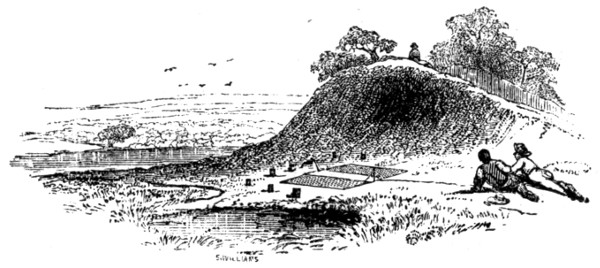
To the real lover of the country there needs no great events, no
exciting circumstances to effect his happiness. The freshness of
the country, and the profoundness of its quiet, are to him full of
happiness. The whole round of the seasons, the passage of every
day, the still walk amongst fields and woods, and by running waters,
are to him sources of perpetual pleasures. When “the winter is
over and gone,” he sees with joy the increased light amongst the
breaking clouds and dispersing fogs; he feels with delight the
milder temperature; he passes by, and observes the first bursting
from the warm southern banks of green, luxuriant plants,—the
arum, the mercury, the crisp chervil, the wrinkled leaves of the
primrose, the blossomed branch of the apricot and peach on the
sunny walls of the cottage, and the almond in the garden and
shrubbery, like a tree of rosy sunshine, ere a leaf is yet seen; these
things he sees with a feeling that has more true delight in it than
ever was known to city drawing-room or palace. To me, the most
ordinary walk in the country is, and always has been a luxury. I
remember what joy these things gave me when a boy, and now they
give me again a boy’s heart. I remember the enjoyment I experienced,
when an old sportsman used to take his gun on his arm on
a Saturday afternoon, when my village school made holiday, and
led me up long lanes, between high mossy banks, where the little
runnels come rushing and chiming along, between high, overhanging
hedges; and through wide, still, shady woods; and across fields
deep with greenest grass, and bright with sunshine, and all the
glory of spring; and everywhere pointed out to me the nests of
birds, each built in its peculiar situation; the robin and the yellow-hammer
on the bank; blackbirds and throstles in the hedges, or
under the roots of some old tree overhanging a stream, or set
amongst the boughs of the young fir-trees in the plantations. I
remember how I used to delight in the depth of rich grass and
flowery weeds in the open fields and along the sunshiny hedges; in
the hedges themselves, all clad in their young leaves, sprinkled
with glittering morning dews, and perhaps waving with the utmost
prodigality of hawthorn bloom. I remember too, with what earnest
delight I used to gaze on the bushes of the wild-rose briar, and
admire the singular beauty of its finely-cut and emerald-green
leaves, amongst which the whitethroat framed its gauzy nest. All
this I remember: and while I think of it, I seem to hear the lark
singing in the clear air above me, as he used to do, with a
Joy we never can come near:
and I now see more clearly what it was that produced such an effect
upon me. It was that beauty, that wide-spreading, cheering, heart-strengthening
beauty—which God hath showered on the face of the
earth, to make us feel his presence in his works; and to learn to
love him as we go along the most solitary paths, and to rejoice in
his goodness, where the world comes not between us and the perception
of it. It was that beauty, which is indeed a revelation
from heaven, that then made itself felt in my young heart, and has
only grown more dear to me every year and every day, and I trust
has not been wanting of all that good effect which it is intended it
should produce, by weaning us from worldly pleasures, by bringing
us to feel habitually the presence of love, and providence, and divine
purity, as we go along in solitude and thought; in short, in keeping
alive in our hearts the freshness of their feelings and the
strength of their better hopes. All this I remember, and it is like
the light of a perpetual summer morning in the far-off horizon of
memory; and I say, all these delicious feelings have gone with me
through life, and do, and will, go with all those who love nature
with a filial love.
The first glimpses of spring have in our eyes and hearts an
indescribable charm. There is a freshness and a mellowness in the
earth then, after the frosts and rains of winter, that give a beauty
to it that it possesses at no other period of the year. I never see
it, and smell the odour of the upturned soil, without seeming to
feel renewed our ancient kinship with the earth whence we sprung,
which gives us such manifold blessings all our natural lives, and
takes us to its peaceful bosom when we lie down wearied, wasted,
and heart-worn. When the labourer cuts his ditches, and piles up
his banks anew, there is a beauty in the dark, clear, smooth earth,
which his spade cleaves so shiningly. As the children of the
village hunt over the steep banks for violets or snail-shells, or the
early robin’s nest, your eye is made conscious of the beauty of those
banks, with their crumbling mould and springing plants. As the
drainer cuts his drain in the greensward of the meadows; as the
ploughman turns up the broad lea, all is rich and beautiful. And
then, as the hedges and trees clothe themselves in their new and
delicate foliage; as the winds come singing sonorously; as the
grass and flowers spring beneath your feet; as April now smiles
out joyously and bright, and now broods still and beneficent, with
a gloom in its sky so unlike the gloom of autumn or winter—a
gloom casting a dark shade on the distant landscape, while, in other
quarters, the light comes bursting and gushing through the thinner
places of the clouds; and fields lie hushed amid light mists, and
scattered with a silvery dew in such a living, prolific greenness,
that you feel that the birth of millions of flowers is rapidly maturing;
that violets must be springing in legions along the hedges and
in the copses; and that the old, yellow English daffodil is nodding
in tufts in village crofts, and over the margins of mossy wells.
At such times, so deeply do we feel the entrancing influence
of spring, that we cannot help breaking out into an affectionate
apostrophe in praise of her:
All sadness from my heart is gone—
All sadness, and all fears,
Till I forget that thou art one
Who metest out our years.
And then, when May comes in, and we walk abroad some fine,
sunshiny, breezy, yet balmy day,—balmy in hollows and dells, and
along southern uplands; fresh blowing on the ridges of the downs—breezy
in the forest glades; and hear the ringing notes of the
blackbird and thrush, and the lark calling to high heaven itself in
uncontrolable joy; and see peasants out in fields and gardens,
women, from the lady of the hall to the dame of the cottage,
drawn out to be genial lookers-on, and directors in the renewal of
flower-borders, in the sowing of seeds and planting of shrubs; and
see old men sitting on stone or wooden benches on the warm side
of the house, or leading some little child by the hand down the
lane,—two links come strangely together, from the extremities of
the chain of human life; one not having yet arrived at the troubles
of humanity, the other past them; yet what a wide, dark care-land
lying between them!—to see groups of children scattered here and
there over the happy fields, tracing the hedge-sides, or the clear
streams, or running to secure the first cowslips, while their clear
voices come ringing from the distant steeps and hill-tops, why—there
is happiness to the nature-loving and man-loving spirit,
that is as far beyond the power of human expression, as God’s
goodness is beyond mortal comprehension.
There is a season of early spring marked by a succession of
flowers that has something in it to me more tenderly poetical than
any other part of the year. It is that between the appearance
of the snowdrop and the cowslip, with all the intermediate links
of the crocus, the violet, the primrose, the anemone, and the
bluebell. They have, in themselves, such delicate grace, and are
surrounded in our minds by so many poetical associations, and
they mark the fleet passing of a period of so much anticipation,
that they are seen with a delight at their re-appearance, and a
regret that they must so soon be gone by. Then, too, they have
the world almost all to themselves. They are the few beloved
children of the early time. All their more gorgeous and joyous
kindred are still slumbering in the earth. They come forth and
salute us amid the naked landscape, amid wild, chill winds and
beating rain. When the cowslip disappears it is no longer so; all
is greenness and sunshine; a thousand blossoms hang on the forest
bough, or flutter on the earth; and the delicacy of our perceptions
is lost in the profusion of beauty.
But then, in that calmer season, when May has put on all its
wealth and splendour; when the fields are deep with grass, and
golden and purple with flowers; when the hawthorn is a miracle
of beauty and sweetness, perfuming the whole air, what paradises
of delight are gardens—warm, flowery, odorous—happy with the
hum of bees: and old orchards, where you may witness what
Coleridge so feelingly describes in a noble blank-verse letter to his
brother:—
As now, on some delicious eve,
We in our sweet sequestered orchard plot
Sit on the tree crooked earthward; whose old boughs,
That hang above us in an arborous roof,
Stirred by the faint gale of departing May,
Send their loose blossoms slanting o’er our heads!
And thus it is through every season. In June and July, the
glow and perpetual beauty of the country; the abundance of grass
and flowers; the charm of river sides, of angling in woodland
streams; the magnificence of thunder-storms; the breaking out of
coolness and freshness after them; the delights of running waters;
bathing and sailing; the fragrance of fields and gardens; the
beauty of summer moonlight; the picturesque cheerfulness of
hay-harvest; the enjoyment of rich mountain scenery; rambling
amongst the brightness of morning dews, along valleys, past the
outstretched feet of heathy hills; lying on some moorland slope
conscious of all the singular hush and glow of noon; watching all
the varying lights and hues, listening to the varied sounds of
evening in glens, now basking in the yellow calm sunshine, now
deep in gloom; amid towering crags, by the dash of waters, or on
some airy ridge that catches the last glow of heaven, taking in a
vast stretch of scenes that defy alike the power of pen and pencil.
Ah! slowly sink
Behind the western ridge, thou glorious sun!
Shine in the slant beams of the sinking orb,
Ye purple heath-flowers! richlier burn, ye clouds!
Live in the yellow light, ye distant groves!
And kindle, thou blue ocean! So my friend
Struck with deep joy may stand, as I have stood,
Silent with swimming sense; yea, gazing round
On the wild landscape, gaze till all doth seem
Less gross than bodily; a living thing
Which acts upon the mind, and with such hues
As clothe the Almighty Spirit when he makes
Spirits perceive his presence.
Coleridge.
And then the corn-harvest, with all its happy human groups,
and rich colours; the calm, steady splendour of autumn days;
the deepening silence of the decaying year, its returning storms
and pictorial tints; the very gloom and awfulness with which the
year retreats, sending the spirit inwards. In all these scenes and
changes, the soul of the lover of Nature luxuriates; and even finds
beauty and strength in the stern visitations of winter. He goes
with Nature in all her rounds, and rejoices with her in all. There
needs for him no great event, no combination of stirring circumstances;
it is not even necessary to him that he be poet, or
painter, or sportsman; if he have not the skill or faculty of any,
he has the spirit of all. For him there are spread out in earth and
heaven, pictures such as never graced the galleries of art. He sees
splendours, and scenes painted by the hand of the Almighty, for
whose faintest imitations the connoisseur would pay the price of
an estate. To him every landscape presents beauty; to him every
gale breathes pleasure; and every change of scene or season is
a new unfolding of enjoyment. He knows nothing of the heart-burnings
and jealousies which infest crowded places. He is not
saddened by the sight of wickedness, or the experience of ingratitude
and deceit. He is exempt from the ennui of polished society;
the sneers of its unkindly criticism; and the hollowness of its
professions. He converses with the Great Spirit which lives
through the universe, and fills the hearts that open to its influence
with purity, humanity, the sweetest sympathies, the most holy
desires; and overshadows them with that profound peace and that
inward satisfaction, which are themselves the most substantial
happiness.
That these are no vain imaginations, but positive realities,
scattered abroad for universal acceptance as much as the blessings
of air and sunshine, we have only to open the works of our best
writers to be convinced of;—to see how the expression of their
happiness breaks from them continually. It is this overflowing
and irrepressible gladness of a heart resting on nature which gives
such a charm to the writings of White and Evelyn, and good old
Izaak Walton. And the poets—they are full of it. Listen to
them, and then consider the nobility of their views, and the lofty
purity of their souls, and then admit the power and depth of that
influence which lives in Nature and speaks in Christianity.
So shalt thou see and hear
The lovely shapes and sounds intelligible
Of that eternal language which thy God
Utters; who from eternity doth teach
Himself in all, and all things in himself.
Therefore all seasons shall be sweet to thee,—
Whether the summer clothe the genial earth
With greenness, or the redbreast sit and sing
Betwixt the turfs of snow in the bare branch
Of mossy apple-tree, while the nigh thatch
Smokes in the sun-thaw; whether the eave-drops fall,
Heard only in the traces of the blast;
Or if the secret ministry of frost
Shall hang them up in silent icicles,
Quietly shining to the quiet moon.
Coleridge.
And for the cordial, substantial, heart-filling contentment
which is gathered from the quietness of rural life, hear what Sir
Henry Wotton, a most accomplished man, who had seen much of
court life, both at home and abroad, says,
Would the world now adopt me for her heir;
Would beauty’s queen entitle me the fair;
Fame speak me Fortune’s minion; could I vie
Angels[31] with India; with a speaking eye,
Command bare heads, bowed knees; strike justice dumb.
As well as blind and lame; or give a tongue
To stones by epitaphs; be called “great master”
In the loose rhymes of every poetaster—
Could I be more than any man that lives,
Great, fair, rich, wise, all in superlatives;
Yet I more freely would these gifts resign,
Than ever fortune would have made them mine;
And hold one minute of this holy leisure
Beyond the riches of this empty pleasure.
Welcome pure thoughts! welcome ye silent groves!
These guests, these courts my soul most dearly loves.
Now the winged people of the sky shall sing
My cheerful anthems to the gladsome spring;
A prayer-book now shall be my looking-glass,
In which I will adore sweet virtue’s face.
Here dwell no hateful looks, no palace cares,
No broken vows dwell here, no pale-faced fears;
Then here I’ll sit, and sigh my hot love’s folly,
And learn to affect a holy melancholy:
And if contentment be a stranger then,
I’ll ne’er look for it but in heaven again.
Such are the pleasures that lie in the path of the lover of the
country; pleasures like the blessings of the Gospel, to be had
without money, and without price. There are many, no doubt,
who will deem them dull and insignificant; but the peace which
they bring “passeth understanding,” and we can make a triumphant
appeal from the frivolous and the dissipated, to the wise
and noble of every country and age.
Many precious rites
And customs of our rural ancestry
Are gone, or stealing from us.
Wordsworth.
How rapidly is the fashion of the ancient rural life of England
disappearing! Every one who lived in the country in his youth,
and looks back to that period now, feels how much is lost! How
many of the beautiful old customs, the hearty old customs, the
poetical old customs, are gone! Modern ambition, modern wealth,
modern notions of social proprieties, modern education, are all
hewing at the root of the poetical and picturesque, the simple and
cordial in rural life; and what are they substituting in their stead?
We will endeavour, anon, to shew what they are doing, and what
they are leaving undone; just now let us try to seize on the
fluttering apparition of primitive custom, and bid it a hearty
good-bye, before it is gone for ever. I have, in another place,
shewn how all the more fanciful and refined of our village festal
habits have vanished. The May-day dances, and gathering of
May-branches—the scattering of flowers on holiday occasions in
village streets, and about our houses. Even the planting of
flowers about the graves in our village churchyards, once so
common in England, is now rarely to be seen. Camden in his
Britannia, and John Evelyn mention that it was the custom of
their times in Surrey, but who in Surrey sees anything of the
kind now?[32] You may meet with a solitary shrub, or with graves
bound down with withes and briars; but nothing of that general
planting of flowering shrubs which you see in Wales. It is the
fate of champaign countries, to have their rustic customs sooner
obliterated than those of mountain regions. The Scotch still
retain their penny-weddings and Halloweens, the Welsh their
singular wedding customs, and funeral customs as singular; but
how wonderfully have the simple customs on these occasions of
our English hamlets dwindled in our days! Washington Irving,
in an interesting paper in the Sketch-Book, speaks of a practice in
some villages of hanging up in the churches at the funeral of a
maiden, gloves and garlands cut in paper. In what church is that
done now-a-days? And yet, though I never saw a funeral in
which so beautiful and appropriate a practice was retained, I well
recollect seeing those gloves and garlands hanging in the church of
my native village in Derbyshire; and I have heard my mother say,
that in her younger days she has helped to cut and prepare them
for the funeral of young women of the place. The garlands were
originally of actual flowers—lilies and roses—and the gloves of
white kid. For these had become substituted simple white paper.
There was a garland then, of imitative roses and lilies wreathed
round a bow of peeled willow—a pair of gloves cut in paper, and
a white handkerchief of the same material on which was written
some texts of Scripture, or some stanzas of poetry applicable to the
occasion, and to the hope of immortality in the deceased; and
these were not unfrequently chosen for the purpose by the dying
maiden herself. These emblems of purity and evanescent youth
were laid on the coffin during the funeral procession, as the sword
and cap of the soldier on his, and were then suspended in the
body of the church; and there hung, till they fell through time,
or till all who had an interest in the deceased were dead or
departed. In all the village churches into which I have been in
various parts of the kingdom, I do not recollect seeing any of those
maiden trophies, except in this one; and they, on the coming of a
new incumbent, were removed in a general church-cleaning many
years ago.
And yet, where is it that our old customs, and the impress of
past times and generations, linger so strongly as about our village
churches in England! Entering one of them in some retired
district on a Sunday, you seem to step back into a past age. The
quaint old place—its rude and ancient pillars and arches—its
oaken pews and pulpit, grown almost black with years; the massy
font, the grim, grotesque human heads for corbels, every one
differing from the other, where the mason seems to have indulged
his humorous fancy without regard to the sacred character of the
house in which they were to figure—the contrasting, though often
faded splendour of the squire’s pew; the heavy tombs, with procumbent
effigies of knight and dame—the mural tablets to the
memory of departed rectors; the hatchment in sign of some once
important personage gone to his long home—and the half-worn
stones on which you tread,
Where many a holy text around is strewn,
To teach the rustic moralist to die.
And then, the simple congregation! All in their best attire, in
cut and texture guiltless of modern fashion: the clergyman, who
with the air of a gentleman, has probably caught somewhat of the
Doric air of the region; and the old clerk with his long coat, and
long hair combed over his shoulders, doling out his responses with
a peculiar twang, to which an ancient parish clerk can only attain.
Then the little music-loft, with its musicians, consisting of a
bass-viol, a bassoon, and hautboy, and the whole congregation
singing with all their heart and soul. These are remnants of
antiquity that are nowhere else to be found. There is a paper in
Blackwood’s Magazine for April 1838, called “Church Music and
other Parochials,” which gives you a picture of things which
everybody who has gone to a thoroughly old-fashioned country
church has seen over and over. The old clerk, the writer says,
always reads Cheberims and Sepherims, and most unequivocally—“I
am a Lion to my mother’s children,” and truly he sometimes
looks not unlike one: and when told by the clergyman that he
must take him to task to teach him to read and give the responses
differently, he replies—“Why, sir, if I must read just like you
there wouldn’t be a bit of difference between us.”
Such is the peculiar elocution of the true old parish clerk, that
even a dog is sensible of it. I wandered into a rustic church where
I accidentally saw the congregation collecting, having at my heels
a little favourite spaniel. The church stood in the middle of a
field at some distance from the hamlet, and I did not see where
to secure the dog during the service; I therefore trusted to his
general good behaviour, and made him lie down under the seat.
Here he slept very quietly for some time; but at the very first
sound of the clerk’s voice, which was of the genuine traditional
tone, up he jumped and began to bark most vociferously. I kicked
him with my heel; menaced him with look and hand; set my foot
on him; held his mouth—but all was in vain. While the clergyman,
who, I must confess, shewed great forbearance, perceiving
that I was a stranger, and who moreover betrayed by a suppressed
smile that he also perceived the true cause of the dog’s irritation,
was reading the lessons, the dog was perfectly still; again the
clerk said, “amen,” and again up started Fido and barked as loud
as ever. The case was hopeless—nothing remained but to retire.
In some of these rustic temples you sometimes see things that
would electrify a city audience with surprise. I once saw a venerable
clergyman on the edge of Yorkshire perpetrate a pun in the
midst of the service with all gravity. As he was reading the
morning lessons, a fellow who had probably been a little elated
over-night, or not improbably the same morning, suddenly cried
out—“Arise and shine!”—The rector paused and said, “Who
was that?” “It was Joseph Twigg, sir,” responded some one.
“Then twig him out!” rejoined the rector, as glibly and yet as
gravely as possible. A smile, and indeed a general display of open
mouths and grinning teeth appeared in his congregation—but
Joseph Twigg was twigged out, and the rector went on.
Around these old buildings cling all the ancient superstitions.
They are as much haunted as ever. They are as prolific of stories
of ghosts and apparitions as ever. There are yet young people
who go and watch in those old porches on St. Mark’s-eve to see
whom they shall marry, and will sow hempseed backward at midnight
round the whole church for the same purpose. In many parts
of the country none will be buried on the north side of the church;
and accordingly that side of the churchyard is commonly one unbroken
level of greensward, although all the rest be crowded to
excess with graves. The north side of the church, by immemorial
custom, is the allotted portion of the suicide and the outcast. Accordingly,
in many churchyards, that part is purposely very small.
It is in many so little visited, that it is a wilderness, grown in
summer breast-high with mallows, nettles, chervil, elder bushes,
Hemlocks and darnels dank.
The writer of the article in Blackwood’s Magazine just mentioned,
says, “I have often tried to make out the exact ideas the poor
people have of angels—for they talk a great deal about them. The
best that I can make of it is, that they are children, or children’s
heads and shoulders winged, as represented in church paintings,
and in plaster-of-Paris on ceilings. We have a goodly row of them
all the length of one ceiling, and it cost the parish, or rather the
then minister, I believe, who indulged them, no trifle to have the
eyes blacked, and nostrils, and a touch of light red in the cheeks.
It is notorious and scriptural, they think, that the body dies, but
nothing being said about the head and shoulders, they have a sort
of belief that they are preserved to angels—which are no other than
dead young children.” There is no doubt that nearly all the idea
which many country people possess of cherubims and angels is
derived from these plaster heads, or from those cherubims with full-blown
cheeks and gilded wings, and those gilded angels with long
trumpets depicted on gravestones. Ministers preach about angels
and spirits as things which everybody comprehends, but which they
have no actual conception of, only as they see them represented by
the chisels and gold-leaf of country masons; and the story of the
country fellow who had shot an owl, and was thus accosted by his
wife—“Don’t thee know what thee hast done? Why, thee hast
killed one of ar parson’s cherabums!” is not so outré as it might
appear to many.
But we must leave these superstitions to the winter fireside of
the hamlet. More of the old customs connected with funerals than
with any other events, remain in primitive districts. In Derbyshire,
when the body is laid out, the nurse who attended the deceased,
and has performed this last office, goes round to “bid to
the berrin” (funeral). The names of the parties to be invited are
given to her, and away she trudges from house to house, over hill
and dale, sometimes to a considerable distance. She delivers her
message, and names the day and hour. Refreshments are forthwith
set before her. However she may protest that she wants
nothing—can eat nothing—out come, at least, the sweet loaf, and
currant or ginger wine. The family gathers round as she sits, to
hear all particulars of the illness; how it came on; what doctor
was employed; all the progress of the complaint; which leads
probably to whole histories of similar illnesses which they have
known,—all the sayings of the deceased; the end he made, which
is generally described by saying, “he died like a lamb!”—“What
sort of a corpse is it?” which generally is answered by the information,
that “he looks just like himself for all the world—with a
most heavenly smile on his countenance.” All these matters are
drunk in with great interest, and with many solemn wishes that
they may all make as comfortable an end. Some trifle, sixpence
or thereabout, is given to the nurse, and on she trudges to the next
place. There is no doubt but that the death of an individual in
one of these rustic places is felt ten times as much by his acquaintance
as that of a citizen by his. The bustle of persons and events
in city life so break down the force of the event, and so much
sooner elbow it out of mind. In the country, the moment a passing
bell is heard to toll, you see every individual all attention;
every one cries “hush.” They stand in the attitude of profound
listeners. The bell, by some signals which they all understand,
proclaims to them the sex, and married or single state of the deceased,
and then counts out his or her age.[33] Having ascertained
these particulars, they begin to speculate, for they already know
everybody that is ill in the parish, and thus generally discover
pretty certainly before any other intelligence reaches them, whose
bell it is. That bell is sufficient text for the discourse of the day.
They run over all the biography of the individual, and bring up
many an anecdote of him and his cotemporaries, which had long
slept in their minds. When those invited to the funeral arrive,
a substantial meal is often given, followed by wine and cake: and
besides the customary distribution of scarfs, hatbands and gloves,
a packet of sponge-cake made on purpose, of a prescriptive size and
shape, and called “berrin-cake,” is delivered to every one before
the setting out of the funeral, to take home with him, wrapped in
fine writing paper, and sealed with black wax. Nothing can be
more solemn than the behaviour of all the spectators as the train
passes along the road, all passengers stopping till the funeral is
gone by; all taking off their hats, and watching its onward course
in silence. In some places the old custom of chanting a psalm as
they proceed towards the churchyard is still kept up, and nothing
can be more impressive than the effect of that chant, as it comes
mingled with the solemn tolling of the bell over some neighbouring
hill, or along a quiet valley, of a summer’s evening. When
the train reaches the churchyard-gate, it halts, and if the clergyman
be not ready to receive it, the coffin is sometimes set down
upon trestles or chairs, and the company waits till the clergyman
appears. It seems to be looked upon as an established mark of
respect for the clergyman to meet the funeral at the gate, and it is
beautiful to see the serious and unhurried manner in which the
country clergyman of the more pure and primitive districts goes
forth to receive the dead to its resting-place, repeating aloud as he
precedes the funeral to the church, a portion of the service for the
occasion.
The funeral of the young in the country has something particularly
striking in it—the coffin being borne by six of the
deceased’s own age. That of a young girl is more particularly so—the
coffin being covered with a white pall, the six bearers being
dressed in white with white hoods, the chief mourners in black
with black hoods.
Nothing can, in fact, be more widely different in feeling and
effect than town and country funerals. In town a strange corpse
passes along, amid thousands of strangers, and human nature
seems shorn of that interest which it ought, especially in its last
stage, to possess. In the country, every man, woman, and child
goes down to the dust amid those who have known them from
their youth, and all miss them from their place. Nature seems,
in its silence to sympathise with the mourners. The green mound
of the rural churchyard opens to receive the slumberer to a
peaceful resting-place, and the yews or lindens which he climbed
when a boy in pursuit of bird’s-nest, moth, or cockchaffer, overshadow,
as it were, with a kindred feeling his grave.
The custom of strewing flowers before the houses at weddings,
and on other occasions of rejoicing, is now nearly gone out, but at
Knutsford in Cheshire, and probably at some few other places, they
have a practice which seems to have sprung out of it. On all
joyful occasions they sprinkle the ground before the houses of all
those who are supposed to sympathise in the gladness, with red
sand, and then taking a funnel, filled with white sand, sprinkle a
pattern of flowers on the red ground. At weddings this is generally
accompanied with a stanza or two of traditionary verse. As
Long may they live,
Happy may they be,
Blest with content,
And from misfortune free.
Long may they live,
Happy may they be;
And blest with a numerous
Pro-ge-ny.
In the north of England a curious practice prevails the first
time a young child is sent out with the nurse. At every house of
the parents’ friends, where the nurse calls, it receives an egg and
some salt; and in Northumberland it is so general, that they
carry a basket for the purpose. The child of a friend of ours
received from an old lady from the north, an egg, a penny loaf,
and a bunch of matches. The meaning of which let the wise
interpret as they can.
Such customs linger northward more tenaciously than in the
south, and are even too numerous for record here. In various
northern counties, particularly Lancashire, Westmoreland, and
Cumberland, they keep up the ancient practice of rush-bearing;
but instead of carrying rushes to strew the church floor, as their
ancestors did, who had no other floor to the church, they now
chiefly retain the gay garland of flowers carried by young women,
and accompanied by the rustic minstrels. In Lancashire and
Cheshire they still eat Simnel cake on Mid-lent Sunday, that is, a
particular saffron cake, called after Lambert Simnel, who was a
baker, and is supposed to have been famous for it. They ride
stang,[34]
that is, set a scolding wife on a lean old horse, with the
face to the tail, and parade her through the village with a tremendous
clamour of frying pans, and other noise. They hang bushes
at each others’ doors on May morning which are expressive of each
others’ characters. A sort of language des arbres established by
antiquity, expressing either compliment or sincere criticism, as it
may be. A branch of birch signifies a pretty girl; of alder or
owler, as they call it, a scold; of oak, a good woman; of broom, a
good housewife: but gorse, nettles, sawdust, or sycamore, cast the
very worst imputations on a woman’s character, and vary according
as she be girl, wife or widow. These are, it is said, not seldom
used by the malicious to blast the character of the innocent. The
girls wear little bags of dragon’s-blood upon their hearts to inspire
their swains with love. They curtsey to the new moon and
turn the money in their pockets, which ought to be doubled before
the moon is old. They shut their eyes when they see a pie-ball
horse, and wish a secret wish, taking care never to see the same
horse again, or it would spoil the charm. With them the dog-rose
is unlucky; if you give one, you will quarrel with the person,
however dear to you; if you form a design near one it will come
to nought. A shooting star is falling love in their eyes; and in
their opinion the foxglove is not like other flowers, it has knowledge;
it knows when a spirit passes, and always bows the head.
They have, therefore, a secret awe of it. They are careful to have
money in their pockets when they hear the first note of the cuckoo,
for they will be rich or poor through the year accordingly. They
believe also that whatever they chance to be doing when they first
hear the cuckoo, they will do all the year. They have the firmest
faith that no person can die on a bed in which are the feathers of
pigeons or any wild birds. Such are some of the simple chains
with which ancient superstition bound the minds of our ancestors,
and which education has not yet quite worn asunder.
There is, however, one good custom which the present age has
rapidly obliterated—that of leaving open the country churchyard.
In towns, there is perhaps less attraction to a churchyard in the
mass of strange corpses which are there congregated, and the
wilderness of bare flags which cover them; and there may be more
cause for the vigilant prevention of the violation of the sanctity
and decorum of the spot. But why must the country churchyard
be shut up? Why should that generally picturesque and
quiet place be prohibited to the stranger or the mourner? Some
of the churchyards in these kingdoms are amongst the most
romantic and lovely spots within them. What ancient, quiet,
delicious spots have I seen of this kind amongst our mountains,
and upon our coasts! What prospects, landward and seaward,
do some of them give! How sweetly lies the rustic parsonage
often along their side; its shrubbery lawn scarcely separated from
the sacred ground. Why should these be closed? “There have
been depredations,” say the authorities. Then let the beadle see
to it; let the offenders be punished; let the parish school and the
minister teach better manners; but let these haunts of the sad or
the meditative, be open to our feet as they were to those of our
fathers. I must confess that I strongly sympathise with my
brother, Richard Howitt, in the feelings expressed in Tait’s Magazine
for June 1836. “The yew trees, which adorned, with a solemn
gracefulness, the churchyard of my native place, are cut down;
the footpaths across it are closed; the walls are raised; for stiles,
there are gates locked, and topped with iron spikes. A wider
barrier than death is interposed betwixt the living and the dead.
I must confess that I like it not. Why should man destroy the
sanctities of time and nature? Beautiful is the picture drawn by
Crabbe:—
Yes! there are real mourners. I have seen
A fair, sad girl, mild, suffering, and serene;
Attention through the day her duties claimed,
And to be useful as resigned she aimed.
Neatly she dressed, nor vainly seemed to expect
Pity for grief, or pardon for neglect;
But when her wearied parents sank to sleep,
She sought her place to meditate and weep.
******
She placed a decent stone his grave above,
Neatly engraved—an offering of her love:
For that she wrought, for that forsook her bed,
Awake alike to duty and the dead.
******
Here will she come, and on the grave will sit,
Folding her arms in long abstracted fit;
But if observer pass will take her round,
And careless seem, for she would not be found.
“Where is now the free and uninterrupted admission for such
mourners? Grief is a retiring creature, who ‘would not be found,’
and will not knock at the door of the constituted authorities for
the keys: she will look lingeringly at the impassable barriers and
retire. Easy of access were churchyards until lately, with their
pleasant footpaths, lying, with the tranquillity of moonlight, in
the bosom of towns and villages; old, simple, and venerable,—trodden,
it may be, too frequently by unthinking feet—but able at
all times to impress a feeling of sacredness—fraught as they were
with the solemnities of life and death—on bosoms not over religious;
and now, to a fanciful view, they seem more the prisons
than the resting-places of the dead.”
We have said that we will look at what education and other causes
are doing, and what they are leaving undone in the change of
character which they are effecting in the rural population. It
appears by the Reports of the Poor-Law and Charity Commissioners
that education progresses more in the northern and manufacturing
districts than in the southern and agricultural ones.
This is, no doubt, very much the case; and what education is
leaving undone in these districts is, that it acts too timidly, too
much in the spirit of worldly wisdom. It is afraid of making the
people too intellectual; of raising their tastes, lest it should spoil
them as Gibeonites, hewers of wood and drawers of water. My
own experience is, that this is a grand mistake; that you cannot
give them too pure and lofty a standard of taste; and that especially,
our best and noblest poets, as Milton, Shakspeare, Wordsworth,
Cowper, Southey, Campbell, Burns, Bloomfield, etc. should
be put into their hands, and particularly into those of the agricultural
population. What can be so rational as to imbue the minds
of those who are to spend their lives in the fields with all those
associations which render the country doubly delightful? It is
amazing what avidity they evince for such writers when they are
once made familiar with them; and whoever has his mind well
stored with the pure and noble sentiments of such writers will
never condescend to debase his nature by theft, idleness, and low
habits. The great alarm has always been that of lifting the poor
by such knowledge above their occupations, and filling their heads
with airy notions. I can only point again to the agricultural
population of Scotland, where such knowledge abounds. If the
labourers have not the genius of Burns, many of them have a
great portion of the manly and happy feeling with which
He walked in glory and in joy,
Following his plough along the mountain side.
There is every reason, so far as experiment goes, to suppose
that the same effect would follow in England. Where are there
men so sober and industrious as those artisans who are now the
steadiest frequenters of Mechanics’ Libraries? I have given, in
the first chapter of the Nooks of the World, a striking instance of
the effects of such reading on an agricultural labourer. Through
my instigation several intelligent families have made themselves
acquainted with this meritorious man, and speak with admiration
of his manly and superior character. Let the experiment be
repeated far and wide!
But education itself yet wants introducing to a vast extent into
the agricultural districts. The commissioners give a deplorable
picture of the neglect of the agricultural population in the counties
bordering on the metropolis. In some parts of Essex, Sussex,
Kent, Buckinghamshire, Berks, etc., schools of any description are
unknown; in others not more than one in fifteen of the labourers
are represented as able to read. In this county, Surrey, much the
same state of things exists. I have been astounded at the very
few labourers that you meet with that can read; and I think I see
some striking causes for this neglect of the labouring class in the
peculiar state of society here—it has no middle link. A vast
number of the aristocracy reside in the county from its proximity
to town; and besides these, there are only the farmers and their
labourers; the servants of the aristocratic establishments—a numerous
and very peculiar class; and the few tradesmen who supply
the great houses. The many gradations of rank and property
which are found in more trading, manufacturing, and mixed districts
do not here exist. It seems as if the Normans and the Saxons
had here descended from age to age; two races, distinct in their
habits as their condition, and with no one principle of amalgamation.
The aristocracy shut themselves up in their houses and
parks, and are rarely seen beyond them except in their carriages,
driving rapidly to town, or to each other’s isolated abodes. They
know nothing, and therefore can feel nothing for the toiling class.
The effect is visible enough. The working classes grow up with
the sense that they are regarded only as necessary implements of
agriculture by the aristocracy—and they are churlish and uncouth.
They have not the kindliness, and openness of countenance and
manner that the peasantry of more socially favourable districts
have. The farmers too seem little to employ them as house-servants,
fed at their own table. You do not hear of those jolly
harvest-suppers, which you may still find in many old-fashioned
places, where master and man feast and rejoice together over the
in-gathered plenty. So far as downright rusticity goes, there is as
much of that within a dozen miles of London as in the farthest
county of England; but the peasants seem to have lost much of
the sentiment which those of more distant counties possess. They
have their wakes and fairs on their extensive commons and greens,
and leap in bags, and have wheelbarrow races, and races of women
for certain articles of female apparel, gipsies with their lucky-bags
and will-pegs; but as to anything of a poetical cast, I do not see
it. What a fall from the funeral train going chanting a psalm on
its way to the churchyard, to one which I saw the other day in
this neighbourhood. The coffin was laid on a cart, and secured
with ropes; one shaggy horse went jostling it along; another cart
followed, occupied by the chief mourners, half a dozen of them
huddled together, and the rest succeeded on foot, in a rude and
straggling company.
In many villages I see no church at all; and where they are
seen, how different to the fine old churches of most parts of England.
As you cast your eyes over a wide landscape, you look in
vain for those tall taper spires and massy towers which rise here
and there in most English scenery; and find perhaps somewhere a
solitary little erection resembling a little wooden dovecote. The
piety of these parts never expended itself much in church-building.
The villages themselves are often very picturesque. They are
frequently scattered along extensive commons, amidst abundant
woods and grey heaths; generally buried in their old orchards,
and built with many pictorial angles and projections; often
thatched, and consisting of old framed timber-work, or wood altogether,
with gardens full of flowers, and goodly rows of beehives.
Vines run luxuriantly over their very roofs, and in autumn hang
with a prodigality of grapes; and as to the country itself, nothing
can be more pastorally and sylvanly sweet than this county. Its
grey heaths and pine woods, in one part, remind you of Scotland—its
commons, in others, covered with the greenest turf and
scattered with oaks, have the appearance of old forests; and wherever
you go, you get glimpses into fine woodland valleys, and of
old solitary halls standing far off in the midst of them; grey farm
houses; old water mills; the most rustic huts; some pastoral
stream like the Mole, which goes wandering about through this
scenery, fringed with its flags and meadow-sweet, and with its
bullrushes bending in its copious stream, as if it were loath to
leave it; in short it is a region full of the spirit of the poetry of
Keats,—a region lying as it might lie
——————— Before the faëry broods
Drove Nymph and Satyr from the prosperous woods;
Before King Oberon’s bright diadem,
Sceptre and mantle, clasped with dewy gem,
Frighted away the Driads and the Fauns
From rushes green, and brakes, and cowslipped lawns,—
From beechen groves, and shadows numberless.
But the people themselves seem lost in their umbrageous hamlets,
and on their commons, unthought of. There is the village of
Oxshott, some three miles hence.—Go through it on a Sunday,
when the agricultural people are all at leisure, and there they are
as thick as motes in the sun, in the middle of the village street.
There appears to be no church, nor any inhabitants but farmers
and labourers. Boys, girls, men and women, all seem to be out
of doors, and all in their every-day garbs. The colour of tawny
soiled slops and straw-hats gives, as a painter would say, the
prevailing tint to the scene. The boys are busy enough playing
at ball, or cricket. The men seem to pass their time sitting on
banks and stiles, or gossiping and smoking in groups. Scarcely a
soul will move out of the way to let you pass on. The intellectual
condition of this obscure hamlet is strikingly indicated to every
passer through, by a large school-house bearing on its front, cut
in stone, this proud title—“The Royal Kent School, founded
in 1820;”—but which has been since so far confounded, that its
windows are broken to atoms, and it is at once recent and in ruins!
This state of things should not be suffered to continue. The vast
wealth of the aristocracy living hereabout, and the ignorance
around them, very ill accord. Amongst the affluent families in
the county, there are, no doubt, many who would be anxious to
secure an education to the rural children, if they actually knew
that it was needed! In the village of Esher this has recently
been done: let us hope that other places will “go and do likewise.”[35]
Since writing the above, I have met with the following statements,
in Mr. Frederick Hill’s excellent work on National Education.
They are in his account of Mr. William Allen’s School of
Industry at Lindfield, in Sussex; and are, at once, most confirmatory
of the view I have taken of the state of things in this
county, and of the remedy to be applied. To benevolent and
wealthy landed proprietors they are full of encouragement.
“We visited the school at Lindfield, in July 1831, and it had
then been established several years. Before fixing on the spot
where to build his school, Mr. Allen sent an intelligent young
man on a tour through the county, to find out where a school was
most wanted. After a diligent search, Lindfield was pitched upon
as the centre of a district in which the peasantry were in a very
low state of ignorance. Lindfield is on the road from London to
Brighton; distant from London about thirty-seven miles, from
Brighton fifteen.
“Not only did Mr. Allen receive no assistance in building his
school, but most of the wealthy inhabitants endeavoured to thwart
him; while among the peasantry themselves, the most preposterous
stories were afloat respecting his designs. These poor people had
been so little accustomed to see persons act from other than selfish
motives, that they could not believe it possible that any one would
come and erect a large building, at great cost and trouble to himself,
merely from a desire of promoting their good. They felt
sure that all this outlay was not without some secret object; and
at last they explained all, much to their own satisfaction, by
referring it to the following notable project.—The building was to
be applied to the diabolical purpose of kidnapping children; a
high palisade was to be thrown up all round it, and other measures
taken to prevent entrance or escape. Then the school was to be
opened, and every thing carried on smoothly, and with great appearance
of kind and gentle treatment, until such a number of children
had been collected as would satisfy the rapacious desires of the
wretches who had hatched the wicked scheme; when all at once the
gates were to be closed upon them, and the poor innocents shipped
off to some distant land!
“Greatly indeed must a school have been wanted where such
unheard-of absurdity could circulate and obtain credence. At
length the building, a most substantial and commodious one, was
completed, though few indeed were those who at once ventured
within the dreaded bounds. However, by dint of perseverance,
this number was gradually increased. The few children who did
come, began in a short time to take home with them sundry pence,
which they had earned in plaiting straw, making baskets, etc.;
arts they were learning at school. The boys began to patch their
clothes and mend their shoes, without their parents having a penny
to pay for the work. Meanwhile there came no authentic accounts
of ships lying in wait on the neighbouring coast, nor had even the
dreaded iron palisades raised their pointed heads. Little by little,
the poor ignorant creatures became assured that there was nothing
to fear, but, on the contrary, much practical good to be derived
from sending their children to the school; and that strange and
incredible as it might seem, the London ‘gemman’ was really come
among them as a friend and benefactor. A breach being thus
fairly made in the mud-bank of prejudice, it was not long before
the whole mass gave way. In short, the scheme proved so completely
successful, that at the time we visited the school, almost
every child whose parents lived within a distance of three miles,
was entered as a pupil, the total number on the list being no less
than 300. The children are at school eight hours each day; three
being employed in manual labour, and five in the ordinary school
exercises. There is a provision for a diversity of tastes in the classes
of industry; indeed the most unbounded liberality is manifest in all
the arrangements. Some are employed as shoemakers, others as
tailors, and others again, at platting, basket-making, weaving,
printing, gardening, or farming. The children work very cheerfully,
and are found to like the classes of industry better than the
school.
“The first employment to which the little workers are put, is
platting straw. When they are au fait at this, which is generally
at the end of a few months, they are promoted to some other craft;
the one of highest dignity being that of printer. Before leaving
school the child will become tolerably expert at three or four trades.
Those who work on the farm have each the sole care of a plot of
ground, measuring one-eighth part of an acre, and each is required
to do his own digging, sowing, manuring, and reaping. An intelligent
husbandman, however, is always on the ground, to teach those
who are at fault. The plots of land were all clean and in nice
order; and from the variety of produce, oats, turnips, mangel-wurzel,
potatoes, and cabbages, the whole had a curious and amusing
appearance, reminding one of the quilted counterpanes of
former years. We found the system of matayer rent in use; each
boy being allowed one half of the produce for himself, the other
half being paid for the use of the land, the wear and tear of tools,
etc. One lad, twelve years old, had in this way received no less a
sum than twenty-three shillings and sixpence, as his share of the
crop of the preceding year; and we were told that such earnings
were by no means uncommon.”
Lady Noel Byron established a school on a similar plan at
Ealing, which has been eminently successful. She there educates
a number of boys in a manner which must render them far better
qualified to fulfil those duties to which they will be called as they
grow up, than has yet been done by the old defective modes of
England, and especially of English villages. Besides being taught
the most useful branches of English education, they work three
hours each day, partly for the institution, partly for themselves, in
their own gardens. Gardens of a sixteenth of an acre are let to
the elder boys at threepence a month; seeds they either buy of
their masters, or procure from their friends. Racks for the tools
are put up and numbered, so that each boy has a place for his
own, and in that he is required to keep them. The objects of this
school are to educate children destined for country pursuits, in a
manner to make them better workmen, and more intelligent and
happy men than is at present the case. For this purpose it was
conceived necessary that they should early acquire the habits of
patient industry; that they should be acquainted with the value
of labour, and know the connexion between it and property; that
they should have intelligence, skill, and an acquaintance with the
objects with which they are surrounded; that the higher sentiments,
the social and moral part of their being, should obtain a
full development.
So industriously have the boys laboured, and so well have they
succeeded, that their gardens, with few exceptions, present before
the crops are harvested, an appearance of neatness and good
husbandry. They have all since, either disposed of their vegetables
or taken them home to their families. But vegetables are not the
only crop; around the borders of each, flowers are cultivated. It
is a great matter to induce a taste for, and give a knowledge of,
the manner of cultivating flowers. They are luxuries within the
power of every person to command.
There is a considerable gaiety and alacrity in all this; the
boys learn to sing many cheerful and merry songs. They strike
up a tune as they go out in bands to works, and as they return,
they do the same.
It is with the greatest satisfaction that I add, similar schools
have been established by Mrs. Tuckfield in Devonshire, Mr. James
Cropper in Lancashire, and that the Earl of Lovelace has now
built a school on the same plan at Ockham in Surrey, where the
same course of education will be given to the peasant children of
the neighbourhood. The institution in fact, contains three schools,
a boy’s, a girl’s, and an infant school. Suitable buildings are in
progress for teaching the boys the rudiments of the most common
handicraft trades, as shoemaking, tailoring, carpentry, basket-making,
etc. The girls are employed at certain hours, in the dairy,
the laundry, and in all kinds of household work. For this purpose
able masters and mistresses are engaged, who have been prepared
by an especial education and long practice for their arduous office.
On our first visit to this interesting establishment, though it was far
from being completed, we found about 130 children educating in
it. It was delightful to see the young chopsticks of this county,
where, from generation to generation, the intellect of the working
class has long been suffered to lie as dead and as barren as one
of their own sand-hills, clustered about the master in the school,
answering questions in geography and natural history with as
much quickness and obvious delight, as any children of city or
of hall could possibly do; their little ruddy faces, no longer
indicative only of health and stupidity, but fairly a-blaze with the
workings of their minds, the pleasant thirst of knowledge, and
the generous emulation of honest distinction. We walked through
the house, and found the neat little girls sewing and ironing,
cleaning and scouring, engaged in those very avocations which
must some day give comfort to their homes. We saw the boys
turn out with their spades, and soon found some of them planting
forest trees in a nursery-ground, others planting their own gardens;
and what delighted us, was to find on the bordering of their garden
ground, a string of little flower-beds, belonging to the girls, which
carried me at once away to my own school-days and school-garden
at Ackworth.
I have not room here to do more than indicate the existence
of this most invaluable school, in a part of the country where rural
education is so much wanted. And, indeed, where throughout
England are not such invaluable schools wanted? The attention
of land owners everywhere ought to be called to this patriotic
experiment. Let but such schools as those of the late Captain
Brenton, William Allen, Lady Byron, and Lord Lovelace, be once
diffused throughout the towns and villages of England, and a revolution
will be effected, such as never yet was achieved in any
country. An educated population; men no longer apt to grow
up in the mere consciousness of their animal nature, but made
acquainted with their intellectual powers, their moral qualities and
social affections; women having the energies of their true character
called forth, and taught to give comfort, and the attraction of
intelligence to their homes,—then will England truly have “a bold
peasantry, their country’s pride.” Brutishness and low debauchery
must disappear. All will feel the claims which society has upon
them; and all will see that, to attain a common share of the good
things of life, they must possess activity, prudence, good management,
and perseverance. Who can, indeed, imagine to himself
what this country must become, with a population thus judiciously
educated, filling its towns, its villages, its fields, and overflowing
into our colonies, with the certain and splendid dower of industry
and intellectual strength?
She smiles, including in her wide embrace
City, and town, and tower, and sea with ships
Sprinkled; be our companion while we track
Her rivers populous with gliding life;
While, free as air, o’er printless sands we march,
Or pierce the gloom of her majestic woods;
Roaming, or resting under grateful shade,
In peace and meditative cheerfulness.
Wordsworth.
We have now taken a comprehensive view of the rural life of England;
of the mode in which “gentle and simple,” rich and poor,
pass their life in the country; of the sports, the pastimes, the
labours and various pursuits which fill up the round of rural existence;
of the charms and advantages which there await the lovers
of peace, of poetry, of natural beauty, and of pure thoughts: and
I think it must be confessed that though other countries may boast
a more brilliant climate, none can offer a more varied and attractive
beauty; other modes of life may be more exciting, but none can be
more calmly delightful, none more conducive to a healthful and
manly spirit.
The more we see of our own country, the more do we love it;
and it is for this reason, that in closing this volume, I cannot take
leave of my readers without advising them to do as I have done,—see
as much of it as they can. There is no part of it but is filled
with some high historical or literary association: it is the land where
brave men have contended and poets sung, and philosophers and
politicians have meditated works and measures, of which the world
is now reaping the honour and enjoyment; there is no part of it
but has some trace of those manners and dialects which belong to
the living of a thousand years ago, and therefore are most interesting
motives to our tracing back the stream of time, and beholding
the growth of our country’s fortunes from age to age; there is no
part of it, but has its swarming cities, or its fields smiling like a
garden beneath the triumphant effect of British tillage,—or its wild
hills and forests, that, untouched by the plough, are left to be fruitful
of free thoughts, of poetic feelings, of picturesque beauty and
magnificence, of health to the hearts and spirits of our countrymen
and countrywomen, necessary to generate those high thoughts and
maintain those endeavours that shall yet lead noble England to the
height of its destined honour.
It is glorious, indeed, to visit the countries of ancient art and
renown—Greece, Italy, Egypt, or sacred Palestine—my spirit
kindles at the very mention of them,—yet whether it were my
privilege or not to traverse those glorious regions, I should still
wish to wander over every hill, and through every busy city of my
native land. To me, I repeat, there is no part of this illustrious
country but opens some new feeling of affection. As I pass over
her plains, I am filled with admiration of that skill and indefatigable
industry which have covered them with such affluence of cattle,
such exuberant grass, such depths of waving corn; as I pass by her
rural halls and hamlet abodes, I find myself perpetually on classic
ground, amid the homes of poets and patriots; when I enter her
cities, I am struck with all their busy and swarming children, with
their endless manufactures; their institutions for rebutting human
evils, and raising the human character; with rich men carrying on
gigantic enterprises of commerce or national improvement, and
poor men associating to ascertain and defend their rights. These
are all animating objects of notice; and I will tell those who may
not hope to see much of foreign regions, that there is enough in
merry England to fill the longest life with delight, go where they
will. I would have those who are young and able, to take their
knapsacks on their backs, and with a stick in their hand, they may
find pleasures worth enjoying, go which way they will in these
islands, though they do as many an adventurer has done, set up
their staff as an indicator, and march off in the direction in which
it falls.[36]
What a summer’s delight there lies in any one such progress.
Suppose you took your route from the metropolis through the
south and west. How delightful are the richly cultivated fields,
the green hop-grounds, the hanging woods of Kent; how pleasant
the heathy hills and scattered woodlands of Surrey; the thickly-strewn
villas of the wealthy, the vine-covered cottages and village
greens of the poor. Are not the flowery lanes and woody scenery
of Berkshire, and the open downs of Wiltshire worth traversing?
What a sweet sylvan retirement in the one; what an airy, wide-spreading
amplitude of vision in the other! It were worth somewhat
to read Miss Mitford’s living sketches in her own sweet
neighbourhood; it were worth a great deal more to meet Miss
Mitford herself, as she lives amongst her simple neighbours, who
know how much she is their friend, or amongst her wealthy and
educated ones, who know how much she deserves of their esteem
and admiration. Would it be nothing to ramble amongst the
ancient walls of Winchester, every spot of which is as thickly
strown with historical recollections as it is venerable in presence?
Would it be nothing to climb those downs, and see around far-spreading
greenness, sinking and swelling in the softest lines of
beauty; and below, vales, stretching in different directions, contrasting
their rich woodiness most strikingly with the bare solitudes
of the down? To see the venerable cathedral lifting its
hoary head from the vale, and numbers of subject churches shewing
their humbler towers and spires all along the valleys; and
catch the glitter of those streams which water those valleys, as
they wind to the sun. I have trodden these downs and dales in
summer weather with feelings of buoyant delight, that admit of no
description. There is Stonehenge, standing in the midst of Salisbury
Plain, which is worth a long pilgrimage to see. To see!
Yes, and to feel in all its lonely grandeur, with all its savage and
mysterious antiquity upon it. It is a walk from Salisbury, that,
on a spring or autumn day, with a congenial spirit, were enough
to make that a life’s pleasant memory. Ascend first from that
truly old English city, along whose streets and past almost every
door run living streams of most beautiful water from the sweet
brimful Avon—to the ramparts of Old Sarum. What a stupendous
work of antiquity you stand upon; what a scene lies all
around you! How beautifully rises that noble cathedral above the
subject city; how finely the magnificent spire above the fabric
itself! And en passant, what a feature of fair and solemn dignity
is the cathedral in our English cities! As you approach them,
and see afar off these noble monuments of past science towering
aloft in sublime dignity, you are at once reminded that you are on
classic ground; that you are about to enter a place where our
ancestors worked out some portion of the national fame; and are
thereby awakened from other thoughts to look about you for all
that is worthy of notice. But this is but a passing tribute to the
grave beauty of those glorious old piles—they deserve more; but
other objects now call us on. See what green and watered valleys
allure you forward. See where the downs stretch their solitary
heads amid the clear and spiritual hues of the sky. And as you go
on, the chime of flocks, and the discovery of sweet hamlets, and the
voices of their children at play, and the tinkle of the plough-team
bells, shall make you feel that the rural peace and delight of Old
England are as strong in her heart as ever. For myself, the
smallest peculiarity of rural fashions and habits in different parts
of the country attracts my attention, and gives me a certain degree
of pleasure. The sight of herds of swine grazing in the wide
fields of Berkshire and Hampshire as orderly as sheep do, is what, at
the first view, gives an agreeable surprise to the man from the midland
and northern counties, where it is never seen. The sight of the
clematis, which flings its flowery masses over hedges and copses; of
myrtles, hydrangeas, fuchias, and other tender plants, blossoming in
the gardens of the south: the appearance of different birds and insects,
as the chough, the nightingale in greater frequency, the woodlark
sending its voice from the distant uplands; the large stag-beetle,
and other insects; these, and other things observed in one part of
the island which are never met with in another, small matters though
they be in themselves, all give a novel interest to some new spot,
and some agreeable hour. Nay to me, I say, the very varying of
rural costumes and implements are objects of interest. Those odd
ladders in Berkshire, stretching at the feet to a width of sometimes
two yards, and then tapering up rapidly; as if Berkshire peasants
could not stand on such ladders as all England beside stands on.
The light wagons and carts in the south, so different from the
heavy ones of the midland counties; and some of them so painted
and adorned in front with large roses, and other flowers; and their
teams, with bells at their bridles, and frames of bells over the
leader’s head, and barbaric top-knots on their heads, and scarlet
fringes and tassels on their gears; and tails all bound up with
ribbons, and curious platting. The wagoners, each in his straw
hat and white slop, with
His carter’s-whip, that on his shoulder rests,
In air high towering with a boorish pomp,
The sceptre of his sway.
Horses at plough, harnessed with a simple collar of straw, and a
few ropes. Oxen with their heavy wooden yokes ploughing in one
part of the country as primitively as they did in the days of Alfred,
ay, or of King David; and shepherds with their crooks in another,
shew to those who never saw them but in books, that some of our
oldest practices still remain.
The various constructions of billhooks, shovels, and wheelbarrows
which prevail in different quarters of the island, contribute
to the picturesque: from the clumsy rudiment of a barrow
seen in Cornwall, which lies on the ground without legs, and the
sides of which are cut out of two pieces of wood, rudely tapering
off into handles; through all the various shapes of that little
vehicle, up to its most perfect one. The shovels used by the labourers
in the West of England, with handles as tall as themselves,
would make the men of the midland counties stare; and again, the
billhook of the midland counties, with a back edge as well as a
front one, would be equally strange to the chopsticks of Surrey and
Sussex. The various modes of country employment promote the
same effect. The ploughman whistling after his team; the shepherds
on the downs, driving their white flocks before them like a
rolling cloud to evening fold or morning pasture; the dwellers on
heaths and moors, paring the turf for fuel, or cutting from the
peat-beds their black bricks, and piling their black pyramids on
the waste. Every different district displays its peculiar employment.
Durham and Northumberland exhibit their extensive and
curious coal mines; Yorkshire and Lancashire their weaving and
spinning; the hills of Derbyshire their lead mines; Nottingham
and Leicester shires their coals again; Lincoln and Norfolk their
vast corn farms; the Southern downs their shepherds; Devon and
Cornwall their tin and copper mines; Gloucester and Somerset
display their fields of teazles again, indicating that there our finest
broad-cloths are made; Stafford and Warwick shires swarm with
collieries, iron-founderies, and potteries; and so on. Each district
has its peculiar pursuit and occupation pointed out by nature, and
all these things give variety to the country and its inhabitants, and
scatter everywhere interesting subjects of inquiry for the passer-by.
I say then, cross only the south of England, and how delightful
were the route to him who has the love of nature and of his
country in his heart; and no imperious cares to dispute it with
them. Walk up, as I have said, from Salisbury to Stonehenge.
Sit down amid that solemn circle, on one of its fallen stones:—contemplate
the gigantic erection, reflect on its antiquity, and
what England has passed through and become while those stones
have stood there. Walk forth over that beautiful and immense
plain,—see the green circles, and lines, and mounds, which ancient
superstition or heroism have everywhere traced upon it, and which
nature has beautified with a carpet of turf as fine and soft as velvet.
Join those simple shepherds, and talk with them. Reflect, poetical
as our poets have made the shepherd and his life,—what must be
the monotony of that life in lowland counties—day after day, and
month after month, and year after year,—never varying, except
from the geniality of summer to winter; and what it must be then;
how dreary its long reign of cold, and wet and snow!
When you leave them, plunge into the New Forest in Hampshire.
There is a region where a summer month might be whiled
away as in a fairyland. There, in the very heart of that old
forest you find the spot where Rufus fell by the bolt of Tyrell,
looking very much as it might look then. All around you lie
forest and moorland for many a mile. The fallow and red deer in
thousands herd there as of old. The squirrels gambol in the oaks
above you; the swine rove in the thick fern and the deep glades
of the forest as in a state of nature. The dull tinkle of the cattle
bell comes through the wood; and ever and anon, as you wander
forward, you catch the blue smoke of some hidden abode curling
over the tree tops; and come to sylvan bowers, and little bough-overshadowed
cottages, as primitive as any that the reign of the
Conqueror himself could have shewn. What haunts are in these
glades for poets: what streams flow through their bosky banks, to
soothe at once the ear and eye enamoured of peace and beauty.
What glades for endless grouping and colourings for the painter.
At Boldre you may find a spot worth seeing, for it is the
parsonage once inhabited by the venerable William Gilpin, the
descendant of Barnard Gilpin, the apostle of the north; the author
of “Forest Scenery,”—and near it is the school, which he built
and endowed for the poor from the sale of his drawings. Not very
distant from this, stands the rural dwelling for many years, and till
lately, the residence of one of England’s truest-hearted women,
Caroline Bowles, now Mrs. Southey—and not far off you have the
woods of Netley Abbey—the Isle of Wight, the Solent, and the
open sea.
But still move on through the fair fields of Dorset and Somerset,
to the enchanted land of Devon. If you want stern grandeur,
follow its north-western coast; if peaceful beauty, look down into
some one of its rich vales, green as an emerald, and pastured by
its herds of red cattle; if all the summer loveliness of woods and
rivers, you may ascend the Tamar or the Tavy, or many another
stream; or you may stroll on through valleys that for glorious
solitudes, or fair English homes, amid their woods and hills, shall
leave you nothing to desire. If you want sternness you may pass
into Dartmoor. There are wastes and wilds, crags of granite, views
into far-off districts, and the sound of waters hurrying away over
their rocky beds, enough to satisfy the largest hungering and
thirsting after poetical delight. I shall never forget the feelings
of delicious entrancement with which I approached the outskirts of
Dartmoor. I found myself among the woods near Haytor Crags. It
was an autumn evening. The sun, near its setting, threw its yellow
beams amongst the trees, and lit up the ruddy tors on the opposite
side of the valley into a beautiful glow. Below, the deep dark
river went sounding on its way with a melancholy music, and as I
wound up the steep road beneath the gnarled oaks, I ever and anon
caught glimpses of the winding valley to the left, all beautiful with
wild thickets and half shrouded faces of rock, and still on high
those glowing ruddy tors standing in the blue air in their sublime
silence. My road wound up, and up, the heather and the bilberry
on either hand shewing me that cultivation had never disturbed
the soil they grew in; and one sole woodlark from the far-ascending
forest to the right, filled the wide solitude with his wild
autumnal note. At that moment I reached an eminence, and at
once saw the dark crags of Dartmoor high aloft before me, and one
large solitary house in the valley beneath the woods. So fair, so
silent, save for the woodlark’s note and the moaning river, so unearthly
did the whole scene seem—that my imagination delighted
to look upon it as an enchanted land,—and to persuade itself that
that house stood as it would stand for ages, under the spell of
silence, but beyond the reach of death and change.
But even there you need not rest—there lies a land of grey antiquity,
of desolate beauty still before you—Cornwall. It is a land
almost without a tree. That is, all its high and wild plains are
destitute of them, and the bulk of its surface is of this character.
Some sweet and sheltered vales it has, filled with noble wood,
as that of Tresilian near Truro; but over a great portion of it
extend grey heaths. It is a land where the wild furze seems
never to have been rooted up, and where the huge masses of
stone that lie about its hills and valleys are clad with the lichen of
centuries. And yet how does this bare and barren land fasten on
your imagination! It is a country that seems to have retained its
ancient attachments longer than any other. The British tongue
here lingered till lately—as the ruins of King Arthur’s palace still
crown the stormy steep of Tintagel; and the saints that succeeded
the heroic race, seem to have left their names on almost every
town and village.
It were well worth a journey there merely to see the vast
mines which perforate the earth, and pass under the very sea; and
the swarming population that they employ. It were a beautiful
sight to see the bands of young maidens, that sit beneath long
sheds, crushing the ore and singing in chorus. But far more
were it worth the trip to stand at the Land’s-End, on that lofty,
savage, and shattered coast, with the Atlantic roaring all round
you. The Hebrides themselves, wild and desolate, and subject to
obscuring mists as they are, never made me feel more shipped into
a dream-land than that scenery. At one moment the sun shining
over the calm sea, in whose transparent depths the tawny rocks were
seen far down. Right and left extend the dun cliffs and cavernous
precipices, and at their feet the white billows playing gracefully
to and fro over the nearly sunken rocks, as through the manes of
huge sea-lions. At the next moment all wrapt in the thickest
obscurity of mist; the sea only cognizable by its sound; the dun
crags looming through the fog vast and awfully, and all round
you on the land nothing visible, as you trace back your way, but
huge grey stones that strew the whole earth. In the midst of
such a scene I came to a little deserted hut, standing close by a
solitary mere amongst the rocks, and the dreamy effect became
most perfect. What a quick and beautiful contrast was it to this,
as the very same night I pursued my way along the shore, the
clear moon hanging on the distant horizon, the waves of the
ocean on one hand coming up all luminous and breaking on the
strand in billows of fire, and on the other hand the sloping turf
sown with glowworms for some miles, thick as the stars overhead.
I speak of the delight which a solitary man may gather up for
ever from such excursions; that will come before him again and
again in all their beauty from his past existence, into many a
crowd and many a solitary room; but how much more may be
reaped by a congenial band of affectionate spirits in such a course.
To them, a thousand different incidents or odd adventures, flashes
of wit and moments of enjoyment, combine to quicken both their
pleasures and friendship. The very flight from a shower, or the
dining on a turnip-pie, no very uncommon dish in the rural inns of
Cornwall, may furnish merriment for the future. And if this one
route would be a delicious summer’s ramble, with all its coasting
and its sea-ports into the bargain, how many such stretch themselves
in every direction through England. The fair orchard-scenes
of Hereford and Worcester, in spring all one region of bloom
and fragrance,—the hills of Malvern and the Wrekin. The fairy
dales of Derbyshire; the sweet forest and pastoral scenes of Staffordshire;
the wild dales, the scars and tarns of Yorkshire; the
equally beautiful valleys and hills of Lancashire, with all those
quaint old halls that are scattered through it, memorials of past
times, and all connected with some incident or other of English
history. And then there is Northumberland—the classic ground
of the ancient ballad—the country of the Percy—of Chevy Chace—of
the Hermit of Warkworth—of Otterburn and Humbledown—of
Flodden, and many another stirring scene. And besides all these
are the mountain regions of Cumberland, of Wales, of Scotland,
and Ireland, that by the power of steam are being brought every
day more within the reach of thousands. What an inexhaustible
wealth of beauty lies in those regions! These, if every other portion
of the kingdom were reduced by ploughing and manufacturing
and steaming to the veriest common-place, these, in the immortal
strength of their nature, bid defiance to the efforts of any antagonist,
or reducing spirit. These will still remain wild and fair, the
refuge and haunt of the painter and the poet—of all lovers of
beauty, and breathers after quiet and freshness. Nothing can pull
down their lofty and scathed heads; nothing can dry up those
everlasting waters, that leap down their cliffs, and run along their
vales in gladness; nothing can certainly exterminate those dark
heaths, and drain off those mountain lakes, where health and liberty
seem to dwell together; nothing can efface the loveliness of those
regions, save the hand of Him who placed them there. I rejoice to
think that while this great nation remains, whatever may be the
magnitude of the designs for the good of the world in which Providence
purposes to employ it,—however populous it may be necessary
for it to become,—whatever the machinery and manufactories
that may be needfully at work in it; that while Cumberland,
Wales, Scotland, and Ireland continue, there will continue regions
of indestructible beauty—of free and unpruned nature, so fair that
those who are not satisfied therewith, would not be satisfied with
the whole universe. More sublimity other countries may boast,
more beauty has fallen to the lot of none on God’s globe. And
what a satisfaction it is, to see that our poetry of late years has
awakened the public mind to a full sense of our natural advantages.
It may be said that many traverse the continent who never see their
own country, but it cannot be said that the beauty of our own fair
islands is overlooked. On the contrary, every one who travels
through them himself, sees how increasing are the numbers who do
the same. To many a point of beauty and historic interest I have
been, from the very Land’s-End to John O’Groat’s; and I do not
know one spot of any claims to attention, which I did not find
numerously visited from the earliest spring to late in the year. I
once was at Loch Katrine early in April, and there were arrivals of
several carriages a day. I was at the Land’s-End late in October,
and as I reached the Logan Rock, a very interesting party of young
people were just coming away from it. As I have said, I walked
up to Stonehenge from Salisbury in order to enjoy it in all its
solitude. This was late in the autumn; yet I found a large party
there, and the shepherds assured me that every day, and all day
long, it would continue so till severe weather set in. When Dr.
Johnson went as far as the Hebrides, it was reckoned a rare thing.
In the summer of 1836, I visited Staffa and Iona in company with
seventy persons; and all summer long, three or four times a-week,
do those places see scarcely less than a hundred English people
land upon them.
Who indeed does not know how every pleasant place on our
coasts, how the Peak of Derbyshire, how all Wales, the Highlands
of Scotland and many parts of Ireland are annually thronged with
people, who break away from towns and trade to refresh their
spirits with the invigorating spirit of the mountains, and with the
sights and sounds of ocean? Nay, such is the pressure of the tourist
current, that whatever place steam-vessels reach in the mountain
districts—it is one of the most ludicrous scenes imaginable to see
a packet come to the pier, and its whole swarm of passengers leap
ashore and proceed at full gallop to storm the inns for beds and
accommodation. I have myself, as I believe I have before stated,
been forced in the throng up to the very attics of one of these inns
by the rush of people, who filled the whole staircase, and indeed
house, calling out for beds, while the poor landlady was wringing
her hands in despair of reducing the clamorous chorus into some
sort of order.
Ludicrous as this recital however is, the spirit which occasions
it is an excellent one. It is full of health and good moral feeling.
It is one which, if it goes on, hand in hand with our machinery
and our literature, must produce the happiest effects. I trust that
this volume will add its quota to that love of the country which I
would desire to see possessing a corner of every human being’s
heart. While that is there, I am sure there must be an undecayed
portion of the original heart of humanity,—a remnant, at least, of
that tone of spirit which makes heaven desirable, and which is
capable of enjoying it. He that loves the country as God has made
it, in all its varying beauty and immortal freshness, must love God
and man too; and while he seeks in mountain solitudes and on sea
shores, relief from the weariness of too long jostling in the crowd,
will find with delight how this very solitude will quicken his appetite
for human society, and his perception of the comforts and
home-pleasures of towns. I declare, that when I have been for
weeks roaming amongst forests and mountain wastes, I feel, on
coming into a city, a sense of its life, activity, and social condition
which was before become comparatively dim. As I have entered
one in the early morning, and have seen the neat young housemaids
rubbing the knockers and cleaning down the steps of their
masters’ doors, and have caught glimpses, as I passed along, of
well oil-clothed passages, and well carpeted rooms, and fires already
burning cheerfully,—I have felt a sense of the comforts and pleasantness
of English homes that I have rarely felt besides. Or at
evening, as we pass where blinds are yet undrawn, and where fires
are seen warmly illumining fair rooms, and happy faces are congregated
around them, who has not felt the same thing?
But we must now close this volume; and how can that be more
fitly done than by ending as we began, and acknowledging with a
rejoicing thankfulness, “that the lines have indeed fallen to us in
pleasant places,” in a land which it would be difficult to pronounce
more blessed in its literature, its religious spirit, or in the splendid
dowry of its natural beauty.
London; Printed by Manning and Mason, Ivy Lane.