PON a narrow cot, in the Hospital
apartment of the jail,
they laid Rodney, and immediately
prepared the medicines suited to
his case. The medicines were at length
administered, and, with a pleasant consciousness
of comfort and attention, he
fell asleep.
When he awoke, it was evening; he
was perfectly conscious, and felt better;
but it was a long time before he could
recall his thoughts, and understand
where he was, and how he had come
thither. He looked around him, and
saw a line of cots on each side of him.
About a dozen of them were occupied
by sick men. A large case of medicines,
placed on a writing-desk, stood at one
end of the room. Two or three men,
who acted as nurses, were sitting near
it, talking and laughing together. In
another part of the room, by a grated
window, looking out upon the pleasant
sunset, were two of the convalescent
prisoners, pale and thin, conversing
softly and sadly. There was not a face
he knew,—none that seemed to feel
the slightest interest for him; and the
wicked scenes of the past two months,
and the unhappy circumstances of the
present hour, flashed through his mind,
and he hid his face in his pillow and
wept.
He heard steps softly approach his
cot, and knew that some one was standing
beside him. But he could not stifle
his sobs, and he did not dare to look up.
"I am glad to see that you are better,
though I am sorry to see you so
much troubled, my poor boy," said a
soft, kind voice.
It was long since he had been spoken
to in a kind tone, and he only wept the
more bitterly, and convulsively pressed
his face closer to the pillow. Presently
he felt an arm passed slowly under the
pillow, which wound around his neck, and
gently drew his head toward the stranger.
"Come, come," said the same soft
voice, "don't give way to such grief;
look up, and talk to me. Let me be a
friend to you."
Rodney yielded to the encircling arm,
and turned his tearful eyes to the man
who spoke to him.
He was a tall, slender man, pale from
sickness, decently dressed, and with an
intelligent, benevolent countenance. He
was one of those whom Rodney had
observed looking out of the window.
"What is the matter?" said he;
"what has brought you into this horrible
place?"
The confidence of the boy was easily
won. He had felt an inexpressible desire
to talk to some one, and now he
was ready to lay open his whole heart
at the first intimation of sympathy.
"I ran away from home," was the
frank and truthful reply.
"But they do not put boys in jail for
running away; you must have done
something else."
"I was charged with something else;
but indeed, indeed, I am innocent!"
"That is very possible," said he,
with a sigh; "but what did they charge
you with doing?"
And Rodney moved closer to him,
and leaned his head upon his breast, and
told him all. There was such an evident
sincerity, such consistency, such
tones of truth in the simple narrative,
that he saw he was believed, and the
sympathizing words and looks of the
listener inspired him with trust, as
though he was talking to a well-known
friend.
For several days, they were constantly
together; the stranger waited upon Rodney,
and gave him his medicine, and
helped him from his cot, talked with
him, and manifested for him the kindness
of a brother. From several conversations,
Rodney gleaned from him
the following history.
Lewis Warren,—so will we call him—(indeed,
Rodney never knew his true
name),—was born and had lived most
of his life in a New England village.
He was the son of a farmer; a pious
man, and deacon of a church, by whose
help he received a liberal education.
Soon after he had graduated at ——
College, he came on to Philadelphia,
with the expectation of getting into
some business. At the hotel where he
stopped, he became acquainted with a
man of very gentlemanly appearance
and address, who said that he, too, was
a stranger in the city, and proposed to
accompany him to some places of amusement.
Warren went with him to the
theatre, and, on succeeding evenings, to
various places of amusement. As they
were one evening strolling up Chestnut-street,
this friend, Mr. Sharpe, stopped
at the well-lighted vestibule of a stately
building, that had the air of a private
house, although it was thrown open, and
proposed that they should go in, and see
what was going on there. Warren consented,
and, after ascending to the second
floor, and passing through a hall,
they entered a large, brilliantly-lighted
billiard saloon. Around several tables
were gathered gentlemanly-looking men,
knocking about little ivory balls, with
long, slender wands or cues, and seeming,
evidently, engrossed in their respective
games. After looking around
for a while, Sharpe proposed going up
stairs into the third story. They ascended
to the upper rooms. In the
upper passage stood a stout, short negro-man,
who glanced at Sharpe, stepped
one side, and permitted them to pass
unquestioned. They entered another
smaller room,—for the third story was
divided into several rooms,—and found
other games than those exhibited below.
After walking through some of the
rooms, and observing the different games,
most of which were new to Warren, his
companion said to him:
"Do you understand anything about
cards?"
"Not a great deal; I have occasionally
played a game of whist or sledge."
"Well, that is about the sum of my
knowledge. Suppose we while away a
half-an-hour at one of these vacant
tables."
Warren consented, and they sat down.
After playing a game or two, Sharpe
proposed having a bottle of wine, and,
said he, laughingly, "Whoever loses
the next game, shall pay for it."
"Agreed," said Warren; and the
wine was brought, and he won the
game.
"Well, that is your good luck; but
I'll bet you the price of another bottle
you can't do it again."
Warren won again.
They tried a third, and that Sharpe
won; a fourth, and Warren rose the
winner.
The next evening found them, somehow,
without much talk about it, at the
same place. They played with varied
success; but when they left, Warren
had lost ten dollars.
He wanted to win it back, and himself
proposed the visit for the third
night. He became excited by the
game, and lost seventy dollars.
Still his eyes were not open; he did
not dream that he was in the hands of
a professed gambler, and, hoping to get
back what he had lost, and what he felt
he really could not spare from his small
amount of funds, he went again.
"There!" said he, after they had
been about an hour at the table, "there
is my last fifty-dollar bill; change that,
and I'll try once more."
"Well," said Sharpe, "here is the
change; but the luck seems against you.
We had better stop for to-night."
But Warren insisted upon continuing,
and he won thirty dollars in addition to
the fifty which Sharpe had changed for
him. The gambler then rose, and told
him that he would give him a chance to
win all back another time, as fortune
seemed to be again propitious to him.
Warren never saw him after that
night. The next morning he determined
to seek a more private boarding
house, and economize his remaining
funds, and seek more assiduously some
business situation. He stepped to the
bar to pay his board, handing the clerk
one of the notes he had received in
change for his last fifty-dollar bill. The
clerk examined it a moment, and passed
it back, saying, "That is a counterfeit
note, sir." He took it back, amazed,
and offered another.
"This is worse still," said the clerk.
"I think we had better take care of
you, sir. You will please go with me
before a magistrate."
"But I did not know——!"
"You can tell that to the squire."
"You have no right to take me,"
said Warren; "you have no warrant."
"No; but I can keep you here till I
send for one, which I shall certainly do,
unless you consent to go willingly."
And Warren, conscious of his own
innocence in this respect, and never
thinking of the difficulty of proving it,
went to a magistrate's office with the
clerk at once.
The clerk entered his complaint, and,
besides swearing to the offer of the
notes, swore that he had seen him, for
several days past, in the company of a
notorious gambler.
Warren was stunned, overwhelmed,
by this declaration. No representation
that he made was believed. His pockets
were searched, and all the money he had,
except some small change, was found to
be counterfeit. A commitment was at
once made out against him, and he was
sent to jail, to await his trial on the
charge of passing counterfeit money.
This is one of the methods by which
professional gamblers "pluck young
pigeons." No young man is safe who
allows himself to play with cards, or to
handle dice.
Rodney believed that Warren had
told him the truth, and fellowship in
misfortune drew the hearts of the duped
man and the wronged boy towards each
other; for though both had been very
much to blame, yet duped and wronged
they had been by knaves more cunning
and wicked than themselves.
They had many serious conversations
together, for both had been piously instructed,
and Warren, who seemed truly
penitent for his wanderings, as he sat
by the bed-side of the sick boy, encouraged
him in his resolutions to lead a
different life,—to seek the forgiveness
and grace of God through a merciful
Redeemer. Seldom has a poor prisoner
received sweeter sympathy, or more
salutary counsel, than was given to Rodney
within the walls of that old Arch-street
jail, by his fellow-prisoner.
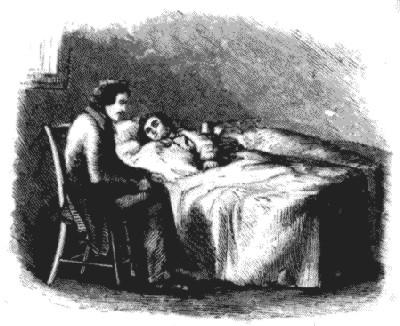
"Rodney," said Warren to him one
day,—it was the first day that he had
left his cot,—"I shall soon leave this
place; I have written to my father, and
he will be here at the trial with such
evidences in my favor, from the whole
course of my life, as cannot fail to secure
me an acquittal. I feel no doubt that
this stain upon my character will be
wiped away. And I believe that I shall
have reason to thank God, as long as I
live, for having permitted this trouble.
It is a very hard lesson, but I trust it
will be a salutary one. Since I have
been here, I have prayed earnestly to
God for the pardon of my sins. I have
resolved, in sincerity of soul, to consecrate
my affections and my life to his
service. I have had a severe struggle;
but I believe, I feel, that God has heard
my prayers, forgiven my iniquities, and
the last few days in this jail have been
the happiest of my life. I feel that I
hate the sins of which my heart has
been so full, and that I love God even
for the severe providences that have
checked my course of impenitence. I
feel like a new man; and if I am not
deceiving myself,—and I pray that I
may not be,—I have experienced that
regeneration of heart of which I have
so often heard, but which I could never
before comprehend.
"I hope that you, too, will try and
seek the Saviour, pray to him for forgiveness,
and beg the guidance of His
Holy Spirit for your future life. If we
both do this sincerely, we shall have
reason forever to bless God for the way
in which he has led us."
"Pray for me," said Rodney; while
tears rolled down his pale cheeks. "I
want to be a Christian, and I hope that
God will have mercy upon me, and guide
me, for the future, in the right path."
A few days after, Warren was called
into court to take his trial; and, to Rodney's
great delight,—for he had learned
to love him like a brother,—he heard
from one of the nurses that he had been
honorably acquitted.
During the same week, the case of
Rodney was called up, and he was conducted
by an officer to the court-house.