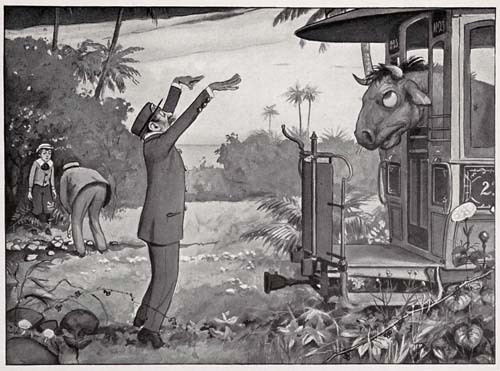
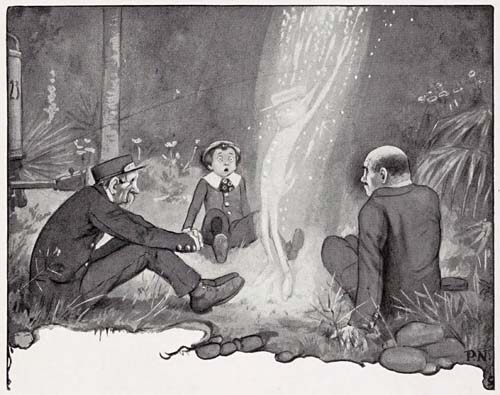
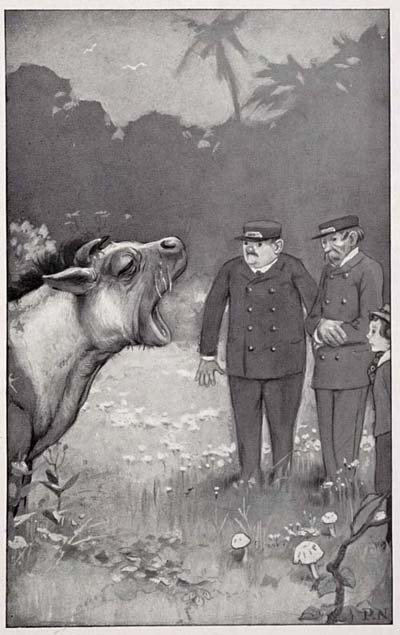
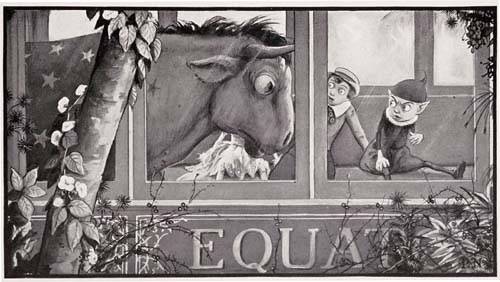
“BOTHER that Equine Ox,” said Nimbus. “I might
have known he’d do something like that, and just
before procession week, too.”
“Procession week?” said Billy wonderingly.
“Yes, the week of the procession of the Equine Oxes.
The Sun and the Moon and their oldest daughter, the
Evening Star, were coming down to see it, and Jack Frost
and Aurora Borealis ought to be there now. And that
miserable Equine Ox has gone and spoiled it all. He isn’t
fit for anything but a barbecue.”
“What are you going to do?” asked Billy, while the conductor
and the motorman gaped in a dazed silence.
“Do? Why, fix it, of course. I only hope we can get
there before he breaks away altogether. It would be a
beautiful state of affairs to have an Equator charging up
and down the world, wouldn’t it?”
“I think it would be fun,” ventured Billy.
“Oh, certainly!” said Nimbus. “When you played under
the trees in your front yard, do you think it would be fun
to have cocoanuts drop on you instead of acorns? Instead
of rabbits and chipmunks in the woods, do you think it
would be fun to see lions and tigers and boa-constrictors
and laughing hyenas, to say nothing of hippopotamuses
with teeth like banisters? Yes, it would be real jolly now,
wouldn’t it?”
Billy saw that Nimbus was seriously disturbed and he
kept silent.
The Meteor, who had entered the car unasked and taken
a seat on the floor, now got up and began to shoot violently
from one door to another, sometimes zigzagging so that he
bumped the windows. His blazing tail trailed after him,
and once or twice Billy had to draw back quickly to keep
his face from a severe switching.
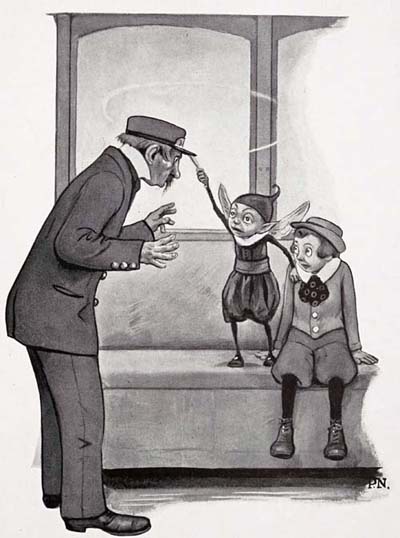
The conductor and the motorman were very much annoyed
by these antics, and at last the conductor said:
“What’s the matter with him, anyway? Why don’t he
sit still?”
“He can’t sit still,” said Nimbus. “A meteor is a shooting
star and ever so often he has to shoot.”
“Shootin’ is against the rules,” growled the motorman.
“No shootin’ allowed in any cars of this company.”
“He isn’t shooting aloud. He’s shooting to himself,”
said Nimbus. “I’ll send him back to the Equator as soon
as I compose a message that is strong enough to tell the
Equine Ox what I think of him.”
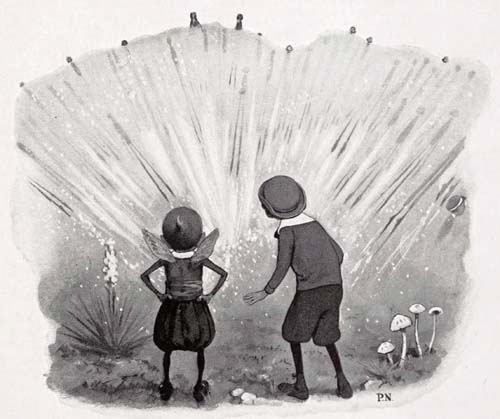
Billy had been looking out of the window. A long way
off he noticed a row of enormous signs, each with curious
characters on it, all outlined in bright green and blue
stars.
“Signs of the Zodiac,” said the Meteor, coming to a sudden
stop and looking over Billy’s shoulder. “‘Keep off
the sky,’ and ‘No loose dogs allowed,’ and such like. The
Aerolites have just turned ’em on. They come right after
the twilight.”
“I—I don’t think I understand,” said Billy.
“Neither do I,” said the Meteor, “but I’ll explain it in
a minute. I’ve got a few shots in me now that have got
to go off.”
He leaped to his feet and began to dart backward and
forward in the car till Nimbus, who was writing on a pad
of paper, became irritated and slammed the car-door on
the Meteor’s tail.
“Isn’t he peevish!” said the Meteor, sinking down at
Billy’s side. “But as I was saying about the Aerolites,
every night the Sun goes down, as you know, and it would
be pitch dark until the Moon and the Stars came up if it
wasn’t for them.
“One of them keeps watch until he sees the Sun starting
to slide behind a mountain or into the sea, and then he
tells the others, and they all hurry around and light the
twilights. When they have them all lit there is enough
light to see by till the Moon and the Stars get out of bed
for the night. After that they can light the Signs of the
Zodiac. They get paid for that. Lighting the twilights
they have to do for their board and lodging and motive
power.”
Nimbus left off writing. “I think that will do,” he said,
handing the pad to Billy.
Billy read:
“V. E. Ox, Equator.
“Of all the good-for-nothing, idle, dull-witted, stupid, feather-brained
idiots I have met in twelve million years you are easily the
worst. Send that Spring Tide to bed for a week. Get the other
Equine Ox and a regiment of elephants and sit on the Equator
till I get there. If he tries to get away duck him in the ocean.
My only regret is that you have but four stomachs instead of
ninety-four to get indigestion in.
“Yours disgustedly, Nimbus.”
The Meteor took the paper from Billy’s hand, Nimbus
released the tail from the door and he shot forth into the
night.
Billy began to be very much distressed about the darkness,
remembering his promise to his mother to be home
for dinner. Nimbus, noticing his troubled face and feeling
better now that he had unburdened himself of his opinion
of the Equine Ox, sat beside him and said cheerfully:
“Never mind, Billy, it’s always half dark up here.
We’re out of the air, you know, and we have to have air
to see the light through, just as your mother has to have
opera-glasses to see the play through. We’ll be home in
time for dinner. Never fear.”
At this assurance Billy felt much better, and became
very eager to see the great fight that he knew would take
place when they got down to the Equator and took part in
the effort to keep him from escaping.
But the motorman and the conductor were in no such
cheerful mood. They sat apart in a corner and talked
in whispers; and Billy, listening although he did not mean
to, soon learned that they were talking about the Snow
Fairies.
“It’s them,” said the conductor, “that spills snow all
over the tracks and ties up the lines in winter.”
“Sure it is!” said the motorman. “Let’s get off and fix
’em.”
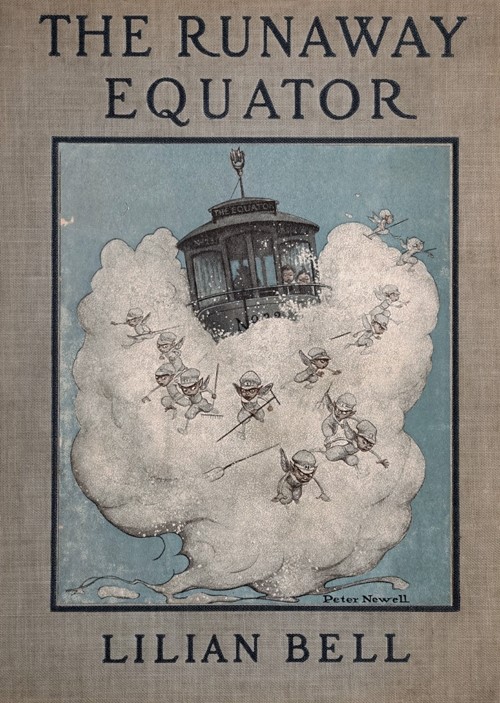
Billy glanced out of the window. There, right before
his eyes, he saw a great number of little people, clad in
white uniforms, raking huge masses of what seemed to be
white flowers on the upper side of a cloud. Through the
dim half-light he watched them working away, with rakes
and pitchforks, some of them piling the white flakes into
great stacks, while others pulled long rows of them to the
edge of the cloud and pushed them over the side.
Billy remembered that it was summer when he left home
and he wondered how it happened that snow-making was
going on; but following with his eyes the flakes that whirled
downward he saw a long chain of mountains far below.
He knew, of course, that snow fell on mountains, even in
summer time, so he understood.
“I tell you what I’ll do,” the motorman was saying; “I’ll
go out and back her sideways and we’ll run through ’em.
That’ll knock ’em all off the cloud, and we won’t have no
more snow.”
“Great idea,” said the conductor. “We’ll get ’em all at
one lick.”
Billy looked anxiously at Nimbus, who overheard, but
only chuckled. “Let ’em try it,” he said, “and see what
happens.”
Nimbus joined Billy at the window, and the motorman
and the conductor, seeing that the Fairy’s back was turned,
got up very quietly and went out on the front platform.
The motorman put his lever on the controller and, looking
around carefully to make sure that he was not observed,
reversed the power.
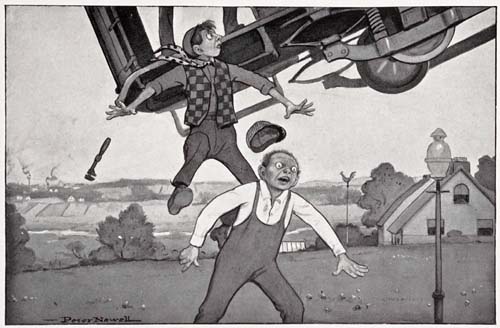
The car trembled, stopped, then began to go backward
with a sidelong motion that took it right into the snow
cloud.
Instantly the air grew cold, and the wind howled around
the trolley pole and rattled the windows.
Straight into a great pile of snow went the car, and the
Snow Fairies, looking up, saw it coming and skipped away
in every direction.
There was a shock, snow flew in showers, then the car
buried itself in a great white pile up to the window tops
and stopped stock still.
Stamping and pawing the snow out of their eyes and
mouths, the motorman and conductor came back into the
car.
“Pleasant weather, gentlemen,” said Nimbus. “Looks
a little like snow, however. Suppose you go out now and
clear the track. You’re used to it.”
Angry, but too much ashamed of themselves to show
their feelings, the motorman and the conductor got shovels
from under the seats and went out to clear away a path
for the car.
“It always pays best to let Nature take care of herself,
as the boy said who sat on the volcano,” Nimbus observed.
“It will be a dreadful delay, though, and we are in such
a hurry to get to the Equator,” said Billy.
“Oh, no, there will be no delay at all! The Cloud is
going right in our direction just as fast as we were. We’ll
warm up, however, for it’s a trifle cold,” said Nimbus. And
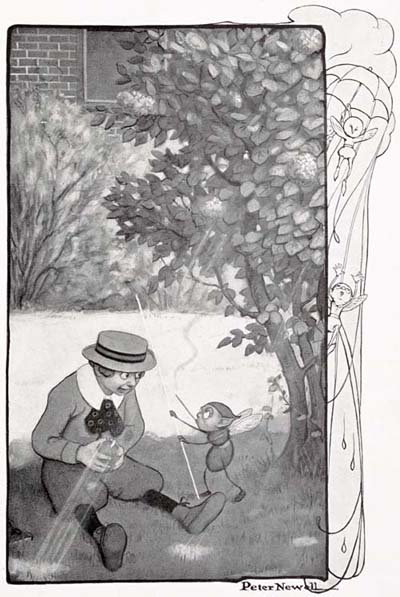
taking out the sunbeam he had brought with him from
the lilac bush, he hit a piece out of it and handed it to
Billy.
“Eat it,” he said. “Nothing so stimulating in cold
weather as a sunbeam. We’ll just sit here and wait for
an answer to my telegram. And you can act acquainted
with the sky people.”
Billy looked out of the window into the sky. Was it
true, he wondered, that the Sun and Moon were really
sky people?
“What’s the matter?” asked Nimbus.
“I was just wondering if the Stars are all really people,”
said Billy.
“Really people!” said Nimbus. “Well I should say they
are. And all the Clouds are, too. You see that bunch over
there? Well, that is Mrs. Pink-Cloud and Mrs. White-Cloud
and Mrs. Pearl-Cloud and Mrs. Mackerel-Cloud
and Mrs. Yellow-Cloud sitting together and sewing on
party dresses for their children to go to the Star children’s
birthday party. It’s warm over there where they are.”
“Oh!” said Billy. “Are they all named?”
“Named! Of course they are! And every Star, too.
But nobody can remember them but their own mother,
Mrs. Moon. Even their father, Mr. Sun, gets confused
sometimes and mixes the boys’ names with the girls’.”
“Are the Clouds people, too?” asked Billy wonderingly.
“Just as much people as you are,” answered Nimbus
seriously. “Old General Gray-Cloud and old General
Thunder-Cloud are great fighters and have awful battles.
You can hear them down on the Earth sometimes. It
sounds like thunder and looks like lightning from where
you live, but from where we live—Oh, my!”
“Dear me,” said Billy, “how very interesting! And do
the mothers teach their children to behave the way our
mothers do on the Earth, or are they allowed to do as they
please in the sky?”
“Well, you do show your ignorance!” said Nimbus, with
such severity that Billy quite blushed for himself. “Why
let me tell you what I saw only yesterday when I was under
the lilac bush waiting for you.”
“Did you know about me before I saw you?” asked
Billy, much flattered.
“Why, certainly I did. I saw you having such a stupid
time with a geography lesson which I knew I could make
so easy for you that I said to myself: ‘I’ll just
wait until I have him all to myself and then I’ll show
him!’”
“That was very kind of you,” said Billy, “and I am
sure that I shall never forget anything I have seen.”
“That’s just the way with me,” said Nimbus; “so what
I saw of the Cloud children I will tell to you, and then
it will be just the same as if you had seen it.”
“So it will,” said Billy, who by this time had got to have
great faith in the Geography Fairy.
“What do you suppose makes it rain?” asked Nimbus
suddenly.
Billy thought intently for a moment. He knew he had
heard something about clouds and mist and heat and cold,
but for the life of him he couldn’t remember when anybody
asked him. That is what makes examinations so
hard. You know, but you can’t remember.
“Ah, ha!” said Nimbus. “You can’t think, can you?
Well, I’ll tell you, and you’ll never forget this reason. The
other day, when their mothers were all sitting and sewing,
the Cloud children——”
“What are their names?” asked Billy.
“Well, there happened to be Pinkie Pink-Cloud and
Goldie Gold-Cloud and Pearlie Pearl-Cloud. They asked
their mothers if they could float over Central Park and
watch the Earth children at play. Their mothers said yes,
so away they went. At first it was great fun to watch, for
it was Mayday and all the children were marching about in
their pretty white dresses while nursemaids and fräuleins
and mademoiselles by the dozen, and a few mothers, were
looking on.
“Then Pinkie and Goldie and Pearlie began to play tag
among themselves, nor was it very long before Pinkie said
that Goldie did not tag her when she said she did, and
Pearlie took sides; so in one moment those little sunny
faces grew black with anger and presently they began to
cry as hard as ever they could.”
“Well?” said Billy, as Nimbus paused.
“Well,” repeated the Fairy, “don’t you see? Their tears
were rain!”
“Oh!” said Billy.
“The next thing that happened was that their mothers
looked up from their sewing and saw the dark spot over the
park, where, a few minutes ago, it had all been bright and
sunny. They knew what had happened, for in April and
May the Cloud children are easily upset and cry if you
poke your finger at them. So they floated over to the park
and, instead of asking the children what the matter was,
as most mothers would have done, Mrs. Gold-Cloud told
the children to look down at the park.”
“And what did they see?” asked Billy, who never before
had thought of looking at the Earth children through the
eyes of the clouds.
“Why, the rain spoiling all the pretty white dresses and
the children all stopping their play and rushing about for
shelter.”
“I know,” said Billy. “I was there myself.”
“Were you?” said Nimbus. “Then you know what
happened.”
“I only know it stopped raining,” said Billy.
“But don’t you know why?” asked Nimbus.
Billy shook his head.
“Because Mrs. Gold-Cloud told the children how tears
and black looks on their faces always spoiled the pleasure of
somebody else, and how smiles and sweet looks and lots of
love in the heart brings happiness. When she said this, the
Cloud children dried their tears on their mothers’ cloud
handkerchiefs and began to smile, and when Pinkie and
Goldie kissed each other, the whole sky brightened up. So
everything got sunshiny again, and of course the rain
stopped as soon as the tears were dried, so in five minutes
the little Earth children were running about again as
happy as lambs. And the sight of their happiness made
the Cloud children glad they had not been so selfish as to
quarrel long.”
“They must be nice children,” said Billy thoughtfully.
“That story sounds the way my mother tells things.”
“When you go back, you can tell the story to her,” said
Nimbus.
“Thank you for telling me,” said Billy politely. “It is a
very nice story and I sha’n’t forget it. I’ll have lots of
things to tell when I get back. What are you going to do
about the Equator?”
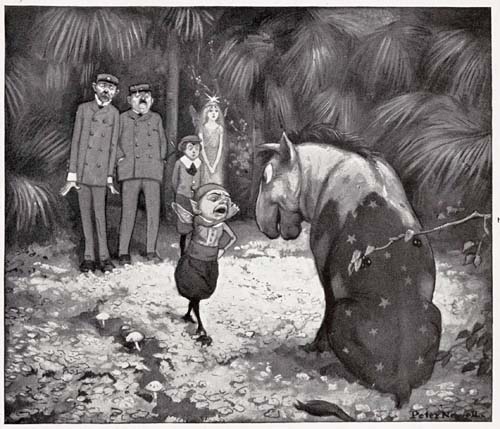
“Hello!” The last exclamation was directed at the
Meteor, who suddenly appeared through the snow bank
and, panting for breath, handed Nimbus a message which
Billy read over his shoulder.
The message read:
“Glad to know you are coming, and thanks for your kind words.
Equator is loose.
“Respectfully, Equine Ox.”