There is no need to give the lives of the succeeding
Astronomers Royal so fully as that of Flamsteed.
Not that they were inferior men to him; on the
contrary, there can be little doubt that we ought to
reckon some of them as his superiors, but, in the
case of several, their best work was done apart from
Greenwich Observatory, and before they came to it.
This was particularly the case with Edmund
Halley. Born on October 29, 1656, he was ten
years the junior of Flamsteed. Like Flamsteed, he
came of a Derbyshire family, though he was born at
Haggerston, in the parish of St. Leonard's, Shoreditch.
He was educated at St. Paul's School, where
he made very rapid progress, and already showed
the bent of his mind. He learnt to make dials; he
made himself so thoroughly acquainted with the
heavens that it is said, 'If a star were displaced in
the globe he would presently find it out,' and he
observed the changes in the direction of the mariner's
compass. In 1673 he went to Queen's College,
Oxford, where he observed a sunspot in July and
August, 1676, and an occultation of Mars. This was
not his first astronomical observation, as, in June,
1675, he had observed an eclipse of the moon from
his father's house in Winchester Street.
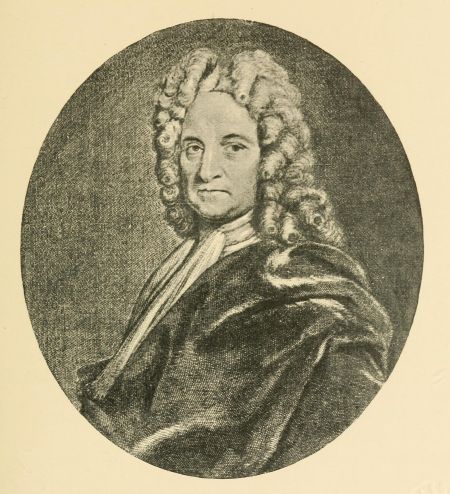
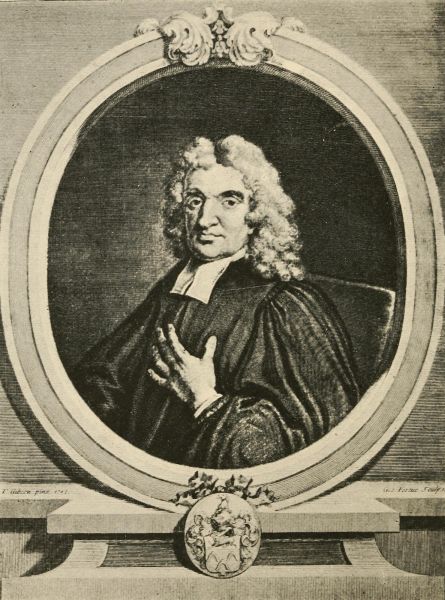
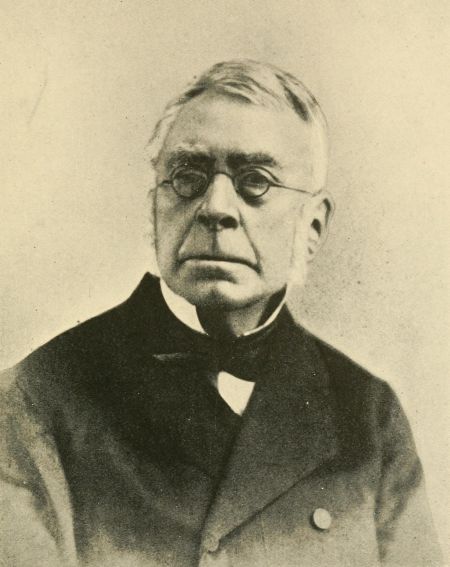
EDMUND HALLEY.
(From an old print.)
A much wider scheme of work than such merely
casual observations now entered his mind, possibly
suggested to him by Flamsteed's appointment to the
direction of the new Royal Observatory. This was
to make a catalogue of the southern stars. Tycho's
places for the northern stars were defective enough,
but there was no catalogue at all of stars below the
horizon of Tycho's observatory. Here, then, was a
field entirely unworked, and young Halley was so
eager to enter upon it that he would not wait at
Oxford to obtain his degree, but was anxious to
start at once for the southern hemisphere.
His father, who was wealthy and proud of his
gifted son, strongly supported him in his project. The
station he selected was St. Helena, an unfortunate
choice, as the skies there were almost always more
or less clouded, and rain was frequent during his stay.
However, he remained there a year and a half, and
succeeded in making a catalogue of 341 stars. This
catalogue was finally reduced by Sharp, and included
in the third volume of Flamsteed's Historia Cœlestis.
In 1678 he was elected Fellow of the Royal
Society, and the following year he was chosen to
represent that society in a discussion with Hevelius.
The question at issue was as to whether more accurate
observations of the place of a star could be obtained
by the use of sights without optical assistance, or by
the use of a telescope. The next year he visited the
Paris Observatory, and, later in the same tour, the
principal cities of the Continent.
Not long after his return from this tour, Halley
was led to that undertaking for which we owe him
the greatest debt of gratitude, and which must be
regarded as his greatest achievement.
Some fifty years before, the great Kepler had
brought out the third of his well-known laws of
planetary motion. These laws stated that the planets
move round the sun in ellipses, of which the sun
occupies one of the foci; that the straight line
joining any planet with the sun moves over equal
areas of space in equal periods of time; and, lastly,
that the squares of the times in which the several
planets complete a revolution round the sun are
proportional to the cubes of their mean distances
from it. These three laws were deduced from actual
examination of the movements of the planets. Kepler
did not work out any underlying cause of which these
three laws were the consequence.
But the desire to find such an underlying cause
was keen amongst astronomers, and had given rise
to many researches. Amongst those at work on the
subject was Halley himself. He had seen, and been
able to prove, that if the planets moved in circles
round the sun, with the sun in the centre, then the
law of the relation between the times of revolution
and the distances of the planets would show that the
attractive force of the sun varied inversely as the
square of the distance. The actual case, however, of
motion in an ellipse was too hard for him, and he
could not deal with it. Halley therefore went up to
Cambridge to consult Newton, and, to his wonder and
delight, found that the latter had already completely
solved the problem, and had proved that Kepler's
three laws of planetary motion were summed up in
one, namely, that the sun attracted the planets to it
with a force inversely proportional to the square of
the distance.
Halley was most enthusiastic over this great discovery,
and he at once strongly urged Newton to
publish it. Newton's unwillingness to do so was
great, but at length Halley overcame his reluctance;
and the Royal Society not being able at the time
to afford the expense, Halley took the charges
upon himself, although his own resources had been
recently seriously damaged by the death of his
father.
The publication of Newton's Principia, which, but
for him, might never have seen the light, and most
certainly would have been long delayed, is Halley's
highest claim to our gratitude. But, apart from this,
his record of scientific achievement is indeed a noble
one. Always, from boyhood, he had taken a great
interest in the behaviour of the magnetic compass,
and he now followed up the study of its variations
with the greatest energy. For this purpose it was
necessary that he should travel, in view of the great
importance of the subject to navigation. King
William III. gave him a captain's commission in the
Royal Navy—a curious and interesting illustration
of the close connection between astronomy and the
welfare of our navy—and placed him in command of
a 'pink,' that is to say, a small vessel with pointed
stern, named the Paramour, in which he proceeded to
the southern ocean. His first voyage was unfortunate,
but the Paramour was recommissioned in 1699, and
he sailed in it as far as south latitude 52°.
In 1701 and the succeeding year he made further
voyages in the Paramour, surveying the tides and
coasts of the British Channel and of the Adriatic,
and helping in the fortification of Trieste. He
became Savilian Professor of Geometry at Oxford in
1703, having failed twelve years previously to secure
the Savilian Professorship of Astronomy, mainly
through the opposition of Flamsteed, who had already
formed a strong prejudice against him, which some
writers have traced to Halley's detection of several
errors in one of Flamsteed's tide-tables, others to
Halley's supposed materialistic views. Probably the
difference was innate in the two men. There was
likely to be but little sympathy between the strong,
masterful man of action and society and the secluded,
self-conscious, suffering invalid. At any rate, in the
contest between Newton and Flamsteed, which has
been already described, Halley took warmly the
side of the former, and was appointed to edit the
publication of Flamsteed's results, and, on the death
of the latter, to succeed him at the Royal Observatory.
The condition of things at Greenwich when
Halley succeeded to the post of Astronomer Royal
in 1720 was most discouraging. The instruments
there had all belonged to Flamsteed, and therefore,
most naturally, had been removed by his widow.
The Observatory had practically to be begun de novo,
and Halley had now almost attained the age at
which in the present day an Astronomer Royal
would have to retire. More fortunate, however, than
his predecessor, he was able to get a grant for
instruments, and he equipped the Observatory as
well as the resources of the time permitted, and his
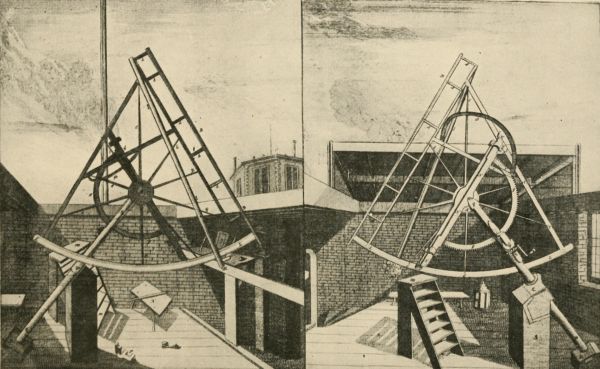
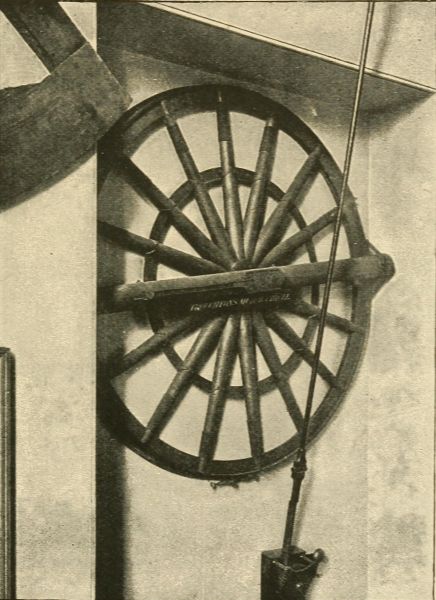
transit instrument and great eight-foot quadrant still
hang upon the Observatory walls.
As Astronomer Royal his great work was the
systematic observation of the positions of the moon
through an entire saros. As is well known, a period
of eighteen years and ten or eleven days brings the
sun and moon very nearly into the same positions
relatively to the earth which they occupied at the
commencement of the period. This period was well
known to the ancient Chaldeans, who gave it its name,
since they had noticed that eclipses of the sun or
eclipses of the moon recurred at intervals of the above
length. It was Halley's desire to obtain such a set
of observations of the moon through an entire saros
period as to be able to deduce therefrom an improved
set of tables of the moon's motion. It was an
ambitious scheme for a man so much over sixty
to undertake, nevertheless he carried it through
successfully.
His desire to complete this scheme, and to found
upon it improved lunar tables, hindered him from
publishing his observations, for he feared that others
might make use of them before he was in a position to
complete his work himself. This omission to publish
troubled Newton, who, as President of the Royal
Society—the Greenwich Board of Visitors having
lapsed at Queen Anne's death—drew attention at a
meeting of the Royal Society, March 2, 1727, to
Halley's disobedience of the order issued under Queen
Anne, for the prompt communication of the Observatory
results. That Newton should thus have put
public pressure upon Halley, the man to whom he
was so much indebted, and with whom there was so
close an affection, is sufficient proof that his similar
attitude towards Flamsteed was one of principle and
not of arbitrariness. Halley, on his side, stood firm,
as Flamsteed had done, urging the danger that, by
publishing before he had completed his task, he
might give an opportunity to others to forestall his
results. It is said—probably without sufficient
ground—that this refusal broke Newton's heart and
caused his death. Certainly Halley's writings in
that very year show his reverence and affection for
Newton to have been as keen and lively as ever.
Halley's work at the Observatory went on
smoothly, on the lines he had laid down for himself,
for ten years after Newton's death; but in 1737 he
had a stroke of paralysis, and his health, which had
been remarkably robust up to that time, began to
give way. He died January 14, 1742, and was buried
in the cemetery of Lee Church.
As an astronomer, his services to the science
rank higher than those of his predecessor; but as
Astronomer Royal, as director, that is to say, of
Greenwich Observatory, he by no means accomplished
as much as Flamsteed had done. Professor Grant, in
his History of Physical Astronomy, says that he seems
to have undervalued those habits of minute attention
which are indispensable to the attainment of a high
degree of excellence in the practice of astronomical
observation. He was far from being sufficiently
careful as to the adjustment of his instruments,
the going of his clocks, or the recording of his
own observations. The important feature of his
administration was that under him the Observatory
was first supplied with instruments which belonged
to it.
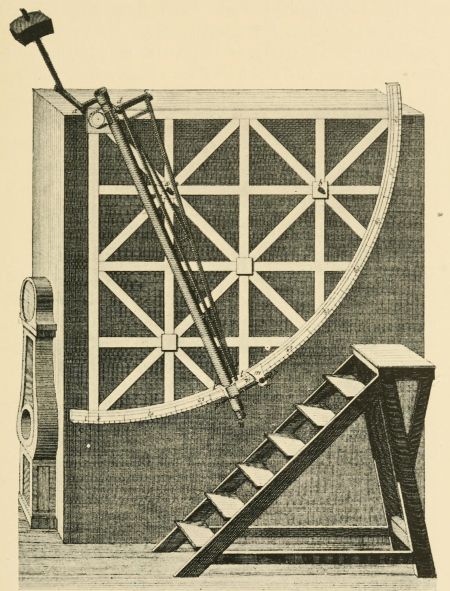
HALLEY'S QUADRANT.
(From an old print.)
His astronomical work apart from the Observatory
was of the first importance. He practically
inaugurated the study of terrestrial magnetism, and
his map giving the results of his observations during
his voyage in the Paramour introduced a new and
most useful style of recording observations. He
joined together by smooth curves places of equal
variation, the result being that the chart shows at
a glance, not merely the general course of the variation
over the earth's surface, but its value at any spot
within the limits of the chart.
Another work which has justly made his name
immortal was the prediction of the return of the
comet which is called by his name, to which reference
will be made later. Another great scheme, and one
destined to bear much fruit, was the working out of
a plan to determine the distance of the sun by
observations of the transit of Venus.
Of attractive appearance, pleasing manners, and
ready wit, loyal, generous, and free from self-seeking,
he probably was one of the most personally engaging
men who ever held the office.
The salary of the Astronomer Royal remained
under Halley at the same inadequate rate which it
had done under Flamsteed—£100, without provision
for an assistant. But in 1729 Queen Caroline, learning
that Halley had actually had a captain's commission
in the Royal Navy, secured for him a post-captain's
pay.
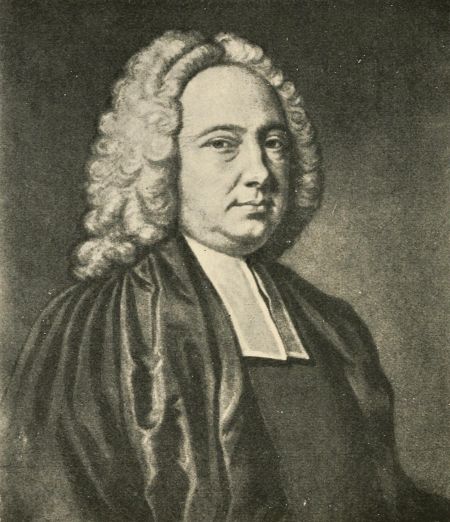
JAMES BRADLEY.
(From the painting by Hudson.)
Halley's work is represented at the Observatory
by two of his instruments which are still preserved
there, and which hang on the west wall of the present
transit room: the Iron Quadrant afterwards made
famous by the observations of Bradley, and 'Halley's
Transit,' the first of the great series of instruments
upon which the fame of Greenwich chiefly rests.
This transit instrument seems to have been set up
in a small room at the west end of what is now known
as the North Terrace. His quadrant was mounted on
the pier which is now the base of the pier of the
astrographic telescope. This pier was the first extension
which the Observatory received from the original
building.
On the breakdown of his health Halley nominated
as his successor, James Bradley; indeed, it is stated
that he offered to resign in his favour. He had
known him then for over twenty years, and that keen
and generous appreciation of merit in others which
was characteristic of Halley had led him very early
to recognize Bradley's singular ability.
James Bradley was born in 1692 or 1693, of
an old North of England family. His birthplace was
Sherbourne, in Gloucestershire, and he was educated
at North Leach Grammar School and at Baliol
College, Oxford. During the years of his undergraduateship
he resided much with his uncle, the
Rev. James Pound, Rector of Wanstead, Essex, an
ardent amateur astronomer, a frequent visitor at the
Observatory in Flamsteed's time, and one of the
most accurate observers in the country. From him,
no doubt, he derived his love of the science, and
possibly some of his skill in observation.
Bradley's earliest observations seem to have been
devoted to the phenomena of Jupiter's satellites and
to the measures of double stars. The accuracy with
which he followed up the first drew the attention of
Halley, and so began a friendship which lasted
through life. His observations of double stars,
particularly of Castor, only just failed to show him
the orbital movement of the pair, because his attention
was drawn to other subjects before it had become
sufficiently obvious.
In 1719 Bradley and his uncle made an attempt
to determine the distance of the sun through observations
of Mars when in opposition, observations which
were so accurate that they sufficed to show that the
distance of the sun could not be greater than 125
millions of miles, nor less than about 94 millions.
The lower limit which they thus found has proved to
be almost exactly correct, our best modern determinations
giving it as 93 millions. The instrument
with which the observations were made was a novel
one, being 'moved by a machine that made it to
keep pace with the stars;' in other words, it was the
first, or nearly the first, example of what we should
now call a clock-driven equatorial.
That same year he was offered the Vicarage of
Bridstow, near Ross, in Monmouthshire, where, having
by that time taken priest's orders, he was duly
installed, July, 1720. To this was added the sinecure
Rectory of Llandewi-Velgry; but he held both livings
only a very short time. In 1721 the death of Dr.
John Keill rendered vacant the Savilian Professorship
of Astronomy at Oxford, for which Bradley became
a candidate, and was duly elected, and resigned his
livings in consequence.
It was whilst he was Savilian Professor that
Bradley made that great discovery which will always
be associated with his name. Though professor at
Oxford, he had continued to assist his uncle, Mr.
Pound, at his observations at Wanstead, and after
the death of the latter he still lived there as much
as possible, and continued his astronomical work.
But in 1725 he was invited by Mr. Samuel Molyneux,
who had set up a twenty-four-foot telescope made by
Graham as a zenith tube at his house on Kew Green,
to verify some observations which he was making.
These were of the star Gamma Draconis, a star which
passes through the zenith of London, and which,
therefore, had been much observed both by Flamsteed
and Hooke, inasmuch as by fixing a telescope in an
absolutely vertical position—a position which could
be easily verified—it was easy to ascertain if there
was any minute change in the apparent position of
the star. Dr. Hooke had declared that there was
such a change, a change due to the motion of the
earth in its orbit, which would prove that the star
was not an infinite distance from the earth, the
seeming change of its place in the sky corresponding
to the change in the place of the earth from which
the observer was viewing it.
Bradley found at once that there was such a
change—a marked one. It amounted to as much
as 1´´ of arc in three days; but it was not in the
direction in which the parallax of the star would have
moved it, but in the opposite. Whether, therefore,
the star was near enough to show any parallax or not,
some other cause was giving rise to an apparent displacement
of the star, which entirely masked and
overcame the effect of parallax.
So far, Bradley had but come to the same point
which Flamsteed had reached. Flamsteed had
detected precisely the same apparent displacement
of stars, and, like Hooke, had ascribed it to parallax.
Cassini had shown that this could not be the case, as
the displacement was in the wrong direction; and
there the matter had rested. Bradley now set to
follow the question up. Other stars beside Gamma
Draconis were found to show a displacement of the
same general character, but the amount varied with
their distance from the plane of the ecliptic, the
earth's orbit. The first explanation suggested was
that the axis of the earth, which moves very nearly
parallel to itself as the earth moves round the sun,
underwent a slight regular 'wobble' in the course of
a year. To check this, a star was observed on the
opposite side of the pole from Gamma Draconis;
then Bradley investigated as to whether refraction
might explain the difficulty, but again without
success. He now was most keenly interested in the
problem, and he purchased a zenith telescope of his
own, made, like that of Molyneux, by Graham, and
mounted it in his aunt's house at Wanstead, and
observed continuously with it. The solution of the
problem came at last to him as he was boating on the
Thames. Watching a vane at the top of the mast,
he saw with surprise that it shifted its direction every
time that the boat was put about. Remarking to the
boatmen that it was very odd that the wind should
change just at the same moment that there was a
shift in the boat's course, they replied that there was
no change in the wind at all, and that the apparent
change of the vane was simply due to the change of
direction of the motion of the boat.
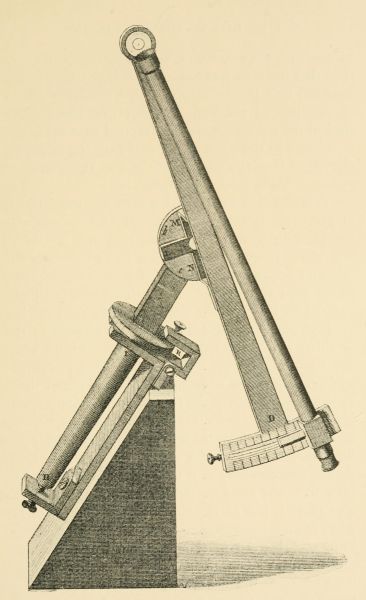
GRAHAM'S ZENITH SECTOR.
(From an old print.)
This supplied Bradley with a key to the solution
of the mystery that had troubled him so long. It
had been discovered long before this that light does
not travel instantaneously from place to place, but
takes an appreciable time to pass from one member
of the solar system to another. This had been discovered
by Römer from observations of the satellites
of Jupiter. He had noted that the eclipses of the
satellites always fell late of the computed time, when
Jupiter was at his greatest distance from the earth;
and Bradley's own work in the observation of those
satellites had brought the fact most intimately under
his own acquaintance. The result of the boating
incident taught him, then, that he might look upon
light as analogous to the wind blowing on the boat.
As the wind, so long as it was steady, would seem to
blow from one fixed quarter so long as the boat was
also in rest, but as it seemed to shift its direction
when the boat was moving and changed its direction,
so he saw that the light coming from a particular star
must seem to slightly change the direction in which
it came, or, in other words, the apparent position of
the star, to correspond with the movement of the
earth in its orbit round the sun.
This was the celebrated discovery of the Aberration
of Light, a triumph of exact observation and of
clear insight. As to the exactness of Bradley's
observations, it is sufficient to say that his determination
of the value of the 'Constant of Aberration' gave
it as 20·39´´; the value adopted to-day is 20·47´´.
On the death of Halley, in 1742, Bradley was
appointed to succeed him. He found the Observatory
in as utterly disheartening a condition as his predecessors
had done. As already mentioned, Halley
had not the same qualifications as an observer that
Flamsteed had. He was, further, an old man when
appointed to the post, he had no assistant provided
for him, and the last five years of his life his health
and strength had entirely given way. Under these circumstances,
it was no wonder that Bradley found the
instruments of the Observatory in a deplorable state.
Nevertheless, he set to work most energetically, and
in the year of his appointment he made 1500 observations
in the last five months of the year. He was
particularly earnest in examining the condition and
the errors of his instruments; and as their defects
became known to him, he was more and more anxious
for a better equipment. He moved the Royal
Society, therefore, to apply on his behalf for the
instruments he required; and a petition from that
body, in 1748, obtained what in those days must
be considered the generous grant of £1000, the
proceeds of the sale of old Admiralty stores. The
principal instruments purchased therewith were a
mural quadrant and a transit instrument, both eight
feet in focal length, still preserved on the walls of the
transit-room. It is interesting also to note that,
following in the steps of Halley, and forecasting, as it
were, the magnetic observatory which Airy would
found, he devoted £20 of the grant to purchasing
magnetic instruments.
Meantime he had continued his observations on
aberration, and had discovered that the aberration
theory was not sufficient entirely to account for the
apparent changes in places of stars which he had
discovered. A second cause was at work, a movement
of the earth's axis, a 'wobble' in its inclination,
technically known as Nutation, which is due to the
action of the moon, and goes through its course in a
period of nineteen years.
Beside these two great discoveries of aberration
and nutation, Bradley's reputation rests upon his
magnificent observations of the places of more than
three thousand stars. This part of his work was done
with such thoroughness, that the star-places deduced
from them form the basis of most of our knowledge
as to the actual movements of individual stars. In
particular, he was careful to investigate and to correct
for the errors of his instrument, and to determine
the laws of refraction, introducing corrections for
changes in the readings of thermometer and barometer.
His tables of refraction were used, indeed,
for seventy years after his death. Of his other labours
it may be sufficient to refer to his determination of
the longitudes of Lisbon and of New York, and to his
effort to ascertain the parallax of the sun and moon,
in combination with La Caille, who was observing at
the Cape of Good Hope.
As Astronomer Royal, Bradley's great achievement
was the high standard to which he raised the
practical work of observation. From his day onwards,
also, there was always at least one assistant.
His first assistant was his own nephew, John Bradley,
who received the munificent salary of ten shillings a
week. Still, this was not out of proportion to the
then salary of the Astronomer Royal, which practically
amounted only to £90. However, in 1752,
Bradley was awarded a Crown pension of £250 a
year. He refused the living of Greenwich, which was
offered him in order to increase his emoluments, on
the ground that he could not suitably fulfil the
double office. Bradley's later assistants were Charles
Mason and Charles Green.
Bradley's last work was the preparation for the
observations of the transit of Venus of 1761, according
to the lines laid down by his predecessor, Halley.
His health gave way, and he became subject to
melancholia, so that the actual observations were
taken by the Rev. Nathaniel Bliss, who succeeded
him in his office after his death, in 1762. He was
buried at Minchinhampton.
So far as we know Bradley's character, he seems
to have been a gentle, modest, unassuming man,
entirely free from self-seeking, and indifferent to
personal gain. He was in many ways an ideal
astronomer, exact, methodical, and conscientious to
the last degree. His skill as an observer was his
chief characteristic; and though his abilities were not
equal as a mathematician or a mechanician, yet, on
the one hand, he had a very clear insight into the
meaning of his observations, and, on the other, he was
skilful enough to himself adjust, repair, and improve
his instruments.
Of Bradley's instruments, there are still preserved
his famous twelve-and-a-half-foot zenith sector, with
which he made his two great discoveries; his brass
quadrant, which in 1750 he substituted for Halley's
iron quadrant; his transit instrument, and equatorial
sector. Bradley added to the buildings of the
Observatory that portion which is now represented
by the upper and lower computing rooms, and the
chronometer room, which adjoins the latter. This
room—the chronometer room—was his transit room,
and the position of the shutters is still marked by
the window in the roof.
The Rev. Nathaniel Bliss, who succeeded
Bradley, only held the office for a couple of years,
and during that time was much at Oxford. He,
therefore, has left no special mark behind him as
Astronomer Royal.
He was born November 28, 1700. His father,
like himself, Nathaniel Bliss, was a gentleman, of
Bisley, Gloucestershire.
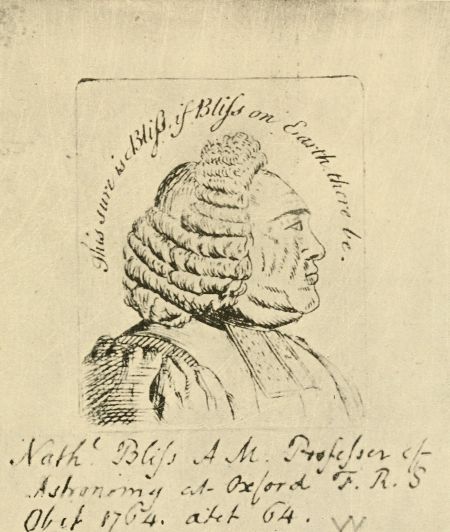
NATHANIEL BLISS.
(From an engraving on an old pewter flagon.)
Bliss graduated at Pembroke College, Oxford, as
B.A. in 1720, and M.A. in 1723. He became the
Rector of St. Ebb's, Oxford, in 1736, and on Halley's
death succeeded him as Savilian Professor of Geometry.
He supplied Bradley with his observations
of Jupiter's satellites, and from time to time, at his
request, rendered him some assistance at the Royal
Observatory. This was particularly the case, as has
been already mentioned, with respect to the transit
of Venus of 1761, the observations of which were
carried out by Bliss, owing to Bradley's ill-health.
It was natural, therefore, that on Bradley's death he
should succeed to the vacant post; but he held it too
short a time to do any distinctive work. Such
observations as he made seem to have been entirely
in continuation of Bradley's. He took a great
interest, however, in the improvement of clocks, a
department in which so much was being done at this
time by Graham, Ellicott, and others.
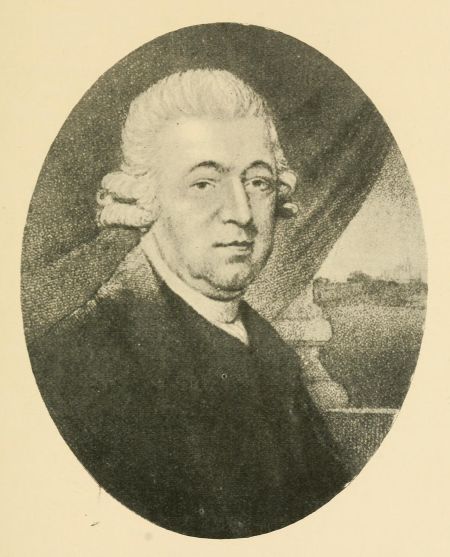
Nevil Maskelyne, the fifth Astronomer Royal,
was, like Bliss, a close friend of Bradley's. He was
the third son of a wealthy country gentleman,
Edmund Maskelyne, of Purton, in Wiltshire. Maskelyne
was born in London, October 6, 1732, and was
educated at Westminster School. Thence he proceeded
to Cambridge, where he graduated seventh
Wrangler in 1754. He was ordained to the curacy
of Barnet in 1755, and, twenty years later, was presented
by his nephew, Lord Clive, to the living of
Shrawardine, in Shropshire. In 1782 he was presented
by his college to the Rectory of North
Runcton, Norfolk.
The event which turned his thoughts in the
direction of astronomy was the solar eclipse of July
25, 1748; and about the time that he was appointed
to the curacy of Barnet he became acquainted with
Bradley, then the Astronomer Royal, to whom he
gave great assistance in the preparation of his table
of refractions.
Like Halley before him, he made an astronomical
expedition to the island of St. Helena. This was
for the special purpose of observing the transit of
Venus of June 6, 1761, Bradley having induced the
Royal Society to send him out for that purpose.
Here he stayed ten months, and made many
observations. But though the transit of Venus was
his special object, it was not the chief result of
the expedition: not because clouds hindered his
observations, but because the voyage gave him the
especial bent of his life.
Halley had actually held a captain's commission in
the Royal Navy, and commanded a ship; Maskelyne,
more than any of the Astronomers Royal before or
since, made the improvement of the practical business
of navigation his chief aim. None of all the incumbents
of the office kept its original charter—'To find the
so much desired Longitude at Sea, for the perfecting
the Art of Navigation,' so closely before him.
The solution of the problem was at hand at this
time—its solution in two different ways. On the one
hand, the offer by the Government of a reward of
£20,000 for a clock or watch which should go so
perfectly at sea, notwithstanding the tossing of the
ship and the wide changes of temperature to which
it might be exposed, that the navigator might at any
moment learn the true Greenwich time from it, had
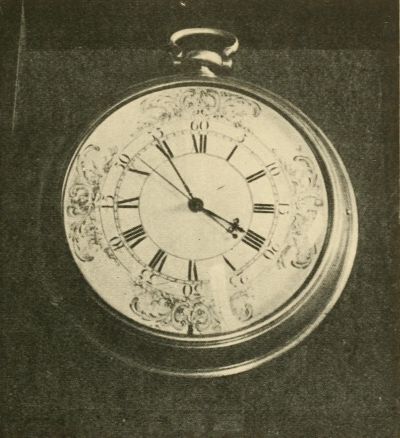
brought out the invention of Harrison's time-keeper;
on the other hand, the great improvement that had
now taken place in the computation of tables of the
moon's motion, and the more accurate star-catalogues
now procurable, had made the method of 'lunars,'
suggested a hundred and thirty years before by the
Frenchman, Morin, and others, a practicable one.
In principle, the method of finding the longitude
from 'lunars,' that is to say, from measurements of
the distances between the moon and certain stars, is
an exceedingly simple one. In actual practice, it
involves a very toilsome calculation, beside exact
and careful observation. The principle, as already
mentioned, is simply this: The moon travels round
the sky, making a complete circuit of the heavens
in between twenty-seven and twenty-eight days. It
thus moves amongst the stars, roughly speaking, its
own diameter, in about an hour. When once its
movements were sufficiently well known to be exactly
predicted, almanacs could be drawn up in which the
Greenwich time of its reaching any definite point of
the sky could be predicted long beforehand; or, what
comes to the same thing, its distances from a number
of suitable stars could be given for definite intervals
of Greenwich time. It is only necessary, then, to
measure the distances between the moon and some of
these stars, and by comparing them with the distances
given in the almanac, the exact time at Greenwich
can be inferred. As has been already pointed out,
the determination of the latitude of the ship and of
the local time at any place where the ship is, is not
by any means so difficult a matter; but the local
time being known and the Greenwich time, the
difference between these gives the longitude; and
the latitude having been also ascertained, the exact
position of the ship is known.
There are, of course, difficulties in the way of
working out this method. One is, that whilst it takes
the sun but twenty-four hours to move round the sky
from one noon to the next, and consequently its
movements, from which the local time is inferred, are
fairly rapid, the moon takes nearly twenty-eight days
to move amongst the stars from the neighbourhood
of one particular star round to that particular star
again. Consequently, it is much easier to determine
the local time with a given degree of exactness than
the Greenwich time; it is something like the difference
of reading a clock from both hands and from the
hour hand alone.
There are other difficulties in the case which
make the computation a long and laborious one, and
difficult in that sense; but they do not otherwise
affect its practicability.
During this voyage to St. Helena, both when
outward bound and when returning, Maskelyne gave
the method of 'lunars' a very thorough testing, and
convinced himself that it was capable of giving the
information required. For by this time the improvement
of the sextant, or quadrant as it then was, by
the introduction of a second mirror, by Hadley, had
rendered the actual observation at sea of lunar distances,
and of altitudes generally, a much more exact
operation.
This conclusion he put at once to practical effect,
and, in 1763, he published the British Mariner's
Guide, a handbook for the determination of the
longitude at sea by the method of lunars.
At the same time, the other method, that by the
time-keeper or chronometer, was practically tested
by him. The time-keeper constructed by John
Harrison had been tested by a voyage to Jamaica
in 1761, and now, in 1763, another time-keeper was
tested in a voyage to Barbadoes. Charles Green, the
assistant at Greenwich Observatory, was sent in
charge of the chronometer, and Maskelyne went with
him to test its performance, in the capacity of
chaplain to his Majesty's ship Louisa.
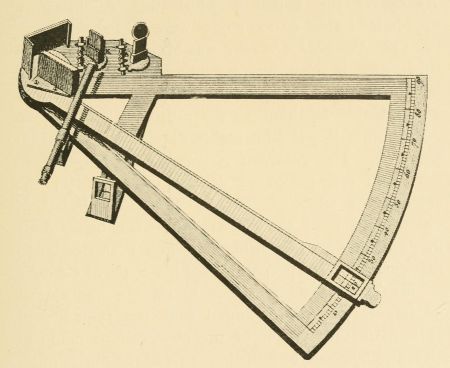
HADLEY'S QUADRANT.
(From an old print.)
The position which Maskelyne had already won
for himself as a practical astronomer, and the intimate
relations into which he had entered with Bradley
and Bliss, made his appointment to the Astronomer
Royalship, on the death of the latter, most suitable.
At once he bent his mind to the completion of the
revolution in nautical astronomy which his British
Mariner's Guide had inaugurated, and in the year
after his appointment he published the first number
of the Nautical Almanac, together with a volume
entitled, Tables Requisite to be Used with the Nautical
Ephemeris, the value of which was so instantly
appreciated, that 10,000 copies were sold at once.
The Nautical Almanac was Maskelyne's greatest
work, and it must be remembered that he carried
it on from this time up to the day of his death—truly
a formidable addition to the routine labours of an
Astronomer Royal who had but a single assistant on
his staff. The Nautical Almanac was, however, in
the main not computed at the Observatory; the
calculations were effected by computers living in
different parts of the country, the work being done
in duplicate, on the principle which Flamsteed had
inaugurated in the preparation of his Historia Cœlestis.
Maskelyne's next service to science was almost
as important. He arranged that the regular and
systematic publication of the observations made at
Greenwich should be a distinct part of the duties of an
Astronomer Royal, and he procured an arrangement
by which a special fund was set apart by the Royal
Society for printing them. His observations covering
the years 1776 to 1811 fill four large folio volumes,
and though, as already stated, he had but one
assistant, they are 90,000 in number. Thus it was
Maskelyne who first rendered effective the design
which Charles II. had in the establishment of the
Observatory. Flamsteed and Halley had been too
jealous of their own observations to publish; Bradley's
observations—though he himself was entirely free
from this jealousy—were made, after his death, the
subject of litigation by his heirs and representatives,
who claimed an absolute property in them, a claim
which the Government finally allowed. None of the
three, however much their work ultimately tended
to the improvement of the art of navigation, made
that their first object. Whereas Maskelyne set this
most eminently practical object in the forefront, and
so gave to the Royal Observatory, which under
his predecessors somewhat resembled a private
observatory, its distinctive characteristics of a public
institution.
It fell to Maskelyne to have to advise the
Government as to the assignment of their great
reward of £20,000 for the discovery of the longitude
at sea. Maskelyne, while reporting favourably of
the behaviour of Harrison's time-keeper, considered
that the method of 'lunars' was far too important to
be ignored, and he therefore recommended that half
the sum should be given to Harrison for his watch,
whilst the other half was awarded for the lunar tables
which Mayer, before his death, had sent to the Board
of Longitude. This decision, though there can be
no doubt it was the right one, led to much dissatisfaction
on the part of Harrison, who urged his claim
for the whole grant very vigorously; and eventually
the whole £20,000 was paid him. The whole question
of rewards to chronometer-makers must have
been one which caused Maskelyne much vexation.
He was made the subject of a bitter and most
voluminous attack by Thomas Mudge, for having preferred
the work of Arnold and Earnshaw to his own.
Otherwise his reign at the Observatory seems to
have been a singularly peaceful one, and there is little
to record about it beyond the patient prosecution,
year by year, of an immense amount of sober, practical
work. To Maskelyne, however, we owe the practice
of taking a transit of a star over five wires instead
of over one, and he provided the transit instrument
with a sliding eye-piece, to get over the difficulty
of the displacement which might ensue if the star
were observed askew when out of the centre of the
field. To Maskelyne, too, we owe in a pre-eminent
degree the orderly form of recording, reducing, and
printing the observations. Much of the work in this
direction which is generally ascribed to Airy was
really due to Maskelyne. Indeed, without a wonderful
gift of organization, it would have been impossible
to plan and to carry the Nautical Almanac.
Beside the editing of various works intended for
use in nautical astronomy or in general computation,
the chief events of his long reign at Greenwich were
the transit of Venus in 1769, which he himself
observed, and for which he issued instructions in the
Nautical Almanac; and his expedition in 1774 to
Scotland, where he measured the deviation of the
plumb-line from the vertical caused by the attraction
of the mountain Schiehallion, deducing therefrom
the mean density of the earth to be four and a half
times that of water.
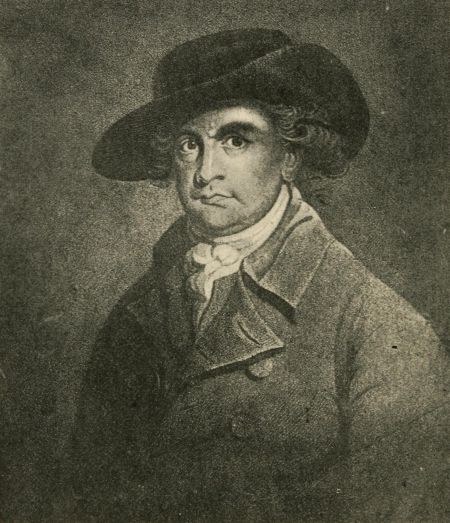
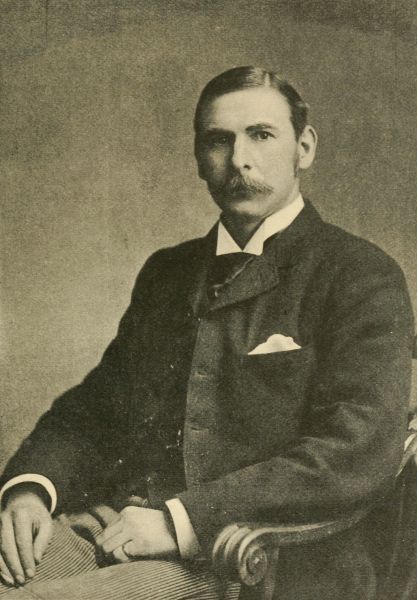
JOHN POND.
(From an old engraving.)
He died at the Observatory, February 9, 1811,
aged 79, leaving but one child, a daughter, who
married Mr. Anthony Mervin Story, to whom she
brought the family estates in Wiltshire, inherited by
Maskelyne on the deaths of his elder brothers, and,
in consequence, Mr. Story added the name of
Maskelyne to his own.
Maskelyne's character and policy as Astronomer
Royal have been sufficiently dwelt upon. His private
character was mild, amiable, and generous. 'Every
astronomer, every man of learning, found in him a
brother;' and, in particular, when the French Revolution
drove some French astronomers to this country
to find a refuge, they received from the Astronomer
Royal the kindest reception and most delicate
assistance.
Maskelyne added no instrument to the Observatory
during his reign, though he improved Bradley's transit
materially. He designed the mural circle, but it was
not completed until after his death. His additions
to the Observatory buildings consisted of three new
rooms in the Astronomer Royal's house, and the
present transit circle room.
John Pond was recommended by Maskelyne
as his successor at Greenwich. At the time of his
succession he was forty-four years of age, having
been born in 1767. He was educated at Trinity
College, Cambridge, and then spent some considerable
time travelling in the south of Europe and Egypt.
On his return home he settled at Westbury, where
he erected an altazimuth by Troughton, with a two-and-a-half-foot
circle. A born observer, his observations
of the declinations of some of the principal
fixed stars showed that the instrument which
Maskelyne was using at Greenwich—the quadrant by
Bird—could no longer be trusted. Maskelyne, in
consequence, ordered a six-foot mural circle from
Troughton, but did not live to see it installed, and
in 1816 this was supplemented by Troughton's transit
instrument of five inches aperture and ten feet focal
length.
The introduction of these two important instruments,
and of other new instruments, together with
new methods of observation, form one of the chief
characteristics of Pond's administration. Under this
head must be specially mentioned the introduction
of the mercury trough, both for determining the
position of the vertical, and for obtaining a check
upon the flexure of the mural circle in different
positions; and the use in combination of a pair of
mural circles for determining the declinations of
stars.
Another characteristic of his reign was that under
him there was the first attempt to give the Astronomer
Royal a salary somewhat higher than that of a
mechanic, and to support him with an adequate staff
of assistants. His salary was fixed at £600 a year,
and the single assistant of Maskelyne was increased
to six.
This multiplication of assistants was for the purpose
of multiplying observations, for Pond was the
first astronomer to recognize the importance of greatly
increasing the number of all observations upon which
the fundamental data of astronomy were to be
based.
In 1833 he finished his standard catalogue of
1113 stars, at that time the fullest of any catalogue
prepared on the same scale of accuracy. 'It is not
too much to say,' was the verdict of the Royal
Astronomical Society, 'that meridian sidereal observation
owes more to him than to all his countrymen
put together since the time of Bradley.'
A yet higher testimony to the exactness of his
work is given by his successor, Airy.
'The points upon which, in my opinion, Mr. Pond's
claims to the gratitude of astronomers are founded, are
principally the following. First and chief, the accuracy
which he introduced into all the principal observations.
This is a thing which, from its nature, it is extremely difficult
to estimate now, so long after the change has been made;
and I can only say that, so far as I can ascertain from
books, the change is one of very great extent; for certainty
and accuracy, astronomy is quite a different thing from
what it was, and this is mainly due to Mr. Pond.'
The same authority eulogizes him further for his
laborious working out of every conceivable cause or
indication of error in his declination instruments, for
the system which he introduced in the observation
of transits, for the thoroughness with which he determined
all his fundamental data, and for the regularity
which he infused into the Greenwich observations.
One result of this great increase of accuracy was
that Pond was able at once authoritatively to discard
the erroneous stellar parallaxes that had been announced
by Brinkley, Royal Astronomer for Ireland.
But Pond's administration was open, in several
particulars, to serious censure, and the Board of
Visitors, which had been for many years but a committee
of the Royal Society, but which had recently
been reconstituted, proved its value and efficiency by
the remonstrances which it addressed to him, and
which eventually brought about his resignation. His
personal skill and insight as an observer were of the
highest order; but either from lack of interest or
failing health, he absented himself almost entirely
from the Observatory in later years, visiting it only
every ninth or tenth day. He had caused the staff
of assistants to be increased from one to six, but had
stipulated that the men supplied to him should be
'drudges.' His minute on the subject ran—
'I want indefatigable, hard-working, and, above all,
obedient drudges (for so I must call them, although they
are drudges of a superior order), men who will be contented
to pass half their day in using their hands and eyes in the
mechanical act of observing, and the remainder of it in
the dull process of calculation.'
This was a fatal mistake, and one which it is very
hard to understand how any one with a real interest
in the science could have made. Men who had the
spirit of 'drudges,' to whom observation was a mere
'mechanical act,' and calculation a 'dull process,'
were not likely to maintain the honour of the Observatory,
particularly under an absentee Astronomer
Royal. Pond tried to overcome the difficulty by
devising rules for their guidance of iron rigidity.
The result was that after his resignation, in 1835, the
First Lord and the Secretary of the Admiralty expressed
their feeling to Airy, Pond's successor, 'that
the Observatory had fallen into such a state of
disrepute that the whole establishment should be
cleared out.' A further evil was the excessive development
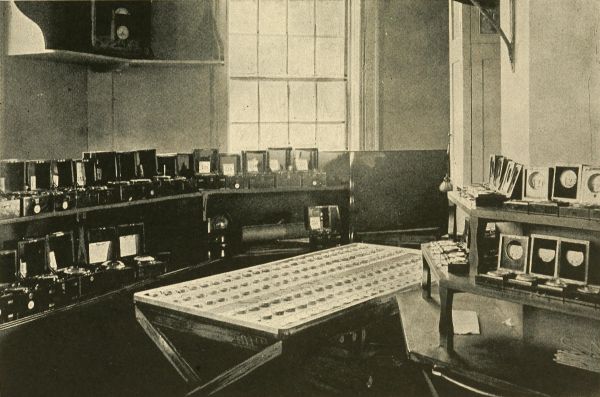
of chronometer business, so as practically to
swamp the real work of the Observatory, whilst the
prices paid for the chronometers at this time were
often much larger than would have been the case
under a more business-like administration.
With all his merits, therefore, as an observer, the
administration of Pond was, in some respects, the least
satisfactory of all that the Observatory has known,
and he alone of all the Astronomers Royal retired
under pressure. He did not long survive his resignation,
dying in September, 1836. He was buried
by the side of Halley, in the churchyard at Lee.
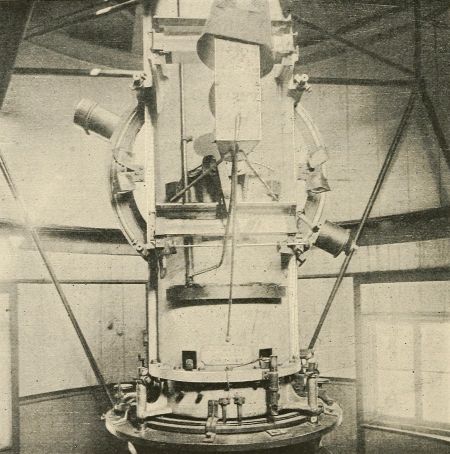
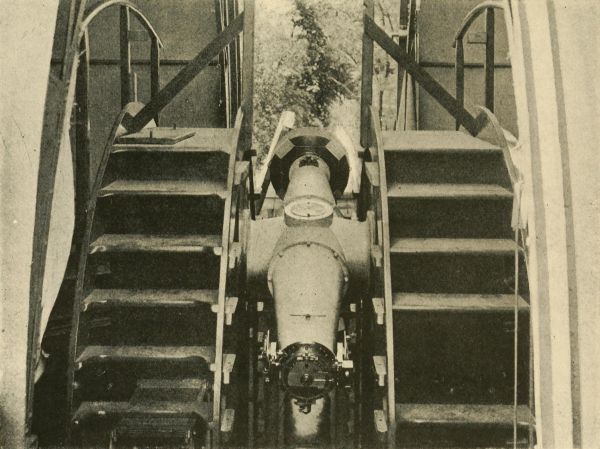
Of Pond's instruments, the Observatory retains
the fine transit instrument which was constructed by
Troughton at his direction, and the mural circle,
designed by Maskelyne, but which Pond was the
first to use. Both of these have, of course, long been
obsolete, and now hang on the walls of the transit
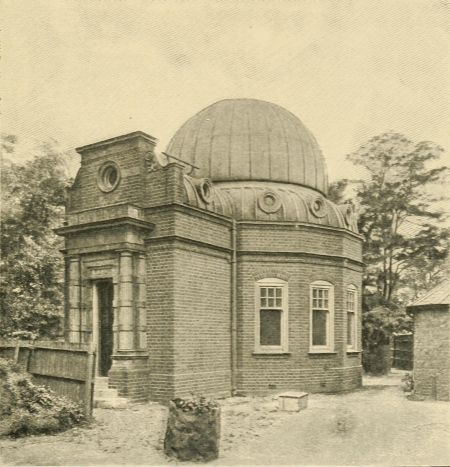
room. The small equatorial, called, after its donor,
the Shuckburgh equatorial, was also added in Pond's
day, and though practically never used, still remains
mounted in its special dome.