THE ROYAL MINT.
Coining is the term applied to the processes employed in the
manufacture of money. It is proposed to describe the present mode of
manufacture; but it may be as well to state, that in remote periods
money was made by cutting out a piece of metal somewhat of the form
of the intended coin, and imparting the device to it by the blow of a
sledge-hammer. For this purpose the blank piece of metal was laid upon
a die, say the obverse, fixed into a block of wood or stone, supposed
to have been so large as to absorb the vibration caused by the blow,
and to a great extent prevent the quivering which would naturally
arise, and cause unsteadiness. The workman then took the other die, say
the reverse, and passing it through a folded sheet of lead, in order to
avoid the shock to the hand, he placed the engraved part on the blank,
which was resting on the lower die, and held it firmly while another
workman struck it with a sledge-hammer. It is worthy of remark that a
piece of lead such as that described is in the Museum of Dies at the
Royal Mint; and although its surface, by the action of the atmosphere
and other causes, is now converted into carbonate of lead, indentations
caused by the tips of the workman’s fingers are evident. This piece is
believed to have been used with a die of Edward IV. At a later period
the upper die was held in a twisted hazel stick. After each blow the
dies were what is technically termed locked together; that is, the
lower and upper dies were made to fit into the partly-formed coin, so
that neither die could turn without turning the whole mass, and then
a second or third blow was given, till the coin was completed. An
improvement on this method was effected by fitting the two dies into
rods of iron, which may be represented as a pair of tongs; the flat
parts which are used to take a coal would then be the position occupied
by the dies. This plan saved the operator some risk of bruised fingers,
but the process was essentially the same as the original one; and to
money produced by either means was applied the term hammered
money, in contradistinction to milled money; that is, money
which was made from blanks obtained from fillets which had been rolled
in a very rough kind of rolling mill, driven by horse power—the germ
from which sprang the present machinery. On this point it is perhaps of
interest to quote a passage from the Report made to the Lords of the
Treasury in 1695 by Mr. William Lowndes, who says:—“All the moneys we
have now in England, both gold and silver, are reducible to two sorts,
one stamped with the hammer, and the other pressed with an engine
called the mill. The gold or silver of the hammered money is first cast
from the melting-pot into long bars, those bars are cut with shears
into several square pieces of exact weight for sovereigns, angels,
crowns, half-crowns, shillings, &c. Then with tongs and hammer they
are forged into a round shape, after which they are blanched (that is,
made white or refulgent by nealing or boiling), and afterwards stampt
or impressed with an hammer to make them perfect money. This method
of making money with the hammer (as appears in the said red book) was
practised in the reign of King Edward the first” [the book referred
to is in the Exchequer] “and this kind of hammered money continued
through all the reigns of succeeding Kings and Queens till about the
year of our Lord 1663, when by several warrants and command of the
King, Charles the Second: to wit, by one warrant, dated the fifth of
November, 1662; one warrant, dated the eighth of April, 1663; and a
third warrant, dated the twenty-fourth of December, 1663; the other
sort, called milled money, was first fabricated to be current
in England in this manner: first, the gold or silver is cast out of
the melting-pot into long flat bars, which bars are drawn through a
mill (wrought by a horse), to produce the just thickness of guineas,
half-guineas, crowns, half-crowns, shillings, &c. Then with forcible
engines called cutters, which answer exactly to the respective
sizes or dimensions of the money to be made, the round pieces are cut
out from the flat bar, shaped as aforesaid (the residue whereof, called
sizel, is melted again), and then every piece is weighed and made to
agree exactly with the intended weight, and afterwards carried to other
engines (wrought secretly), which put the letters upon the edges of the
larger silver pieces, and mark the edges of the rest with a graining.
The next thing is the blanching, performed as above; and at last every
piece is brought to the press, which is called the mill (wrought
of the strength of men), and there receives the impression, which makes
it perfect milled money.”
The processes now used are as elaborate as the old methods were simple;
but considering the requirements of the present day, and the enormous
quantity of money produced, it must not be expected that our coins
will, for depth of engraving, bear comparison with those of the Romans,
who, though succeeding in producing finished works of art, seem to have
forgotten the wear and tear to which they would be subjected, and so
left them, as a rule, free from a protecting edge; hence they would
lose their image and superscription at a far earlier date from their
birth or manufacture than would well-made coins of the present period.
It was formerly believed that gold could be sent to the Mint to be
coined free of charge to the importer; such, however, was not the case.
By the Act 33 Victoria, cap. 10, several Acts relating to the coinage
are repealed, and all persons[7]
obtain the right to send gold to the Mint to be coined on the following terms:—
“8. Where any person brings to the Mint any gold
bullion, such bullion shall be assayed and coined, and delivered out
to such person, without any charges for such assay or coining, or for
waste in coinage. Provided that (1)—If the fineness of the whole of the
bullion so brought to the Mint is such that it cannot be brought to
the standard fineness under this Act of the coin to be coined thereout
without refining some portion of it, the Master of the Mint may refuse
to receive, assay, or coin such bullion. (2) Where the bullion so
brought to the Mint is finer than the standard fineness under this
Act of the coin to be coined thereout, there shall be delivered to
the person bringing the same such additional amount of coin as is
proportionate to such superior fineness. No undue preference shall be
shown to any person under this section, and every person shall have
priority according to the time at which he brought such bullion to the
Mint.”
The standard for gold is fixed by the new Act at “Twenty-two carats
fine and two carats of alloy in the pound weight troy”—the same that
was specified in the 3rd Edward VI., 35th Elizabeth, 2nd Charles I.,
and 18th Charles II. Silver is maintained at the former standard of
“Eleven ounces two pennyweights fine silver and eighteen pennyweights
of alloy in every pound weight troy.” Until the passing of this Act
silver was coined under that of George III., which repealed the Act 18
Charles II., as regards the coining of silver free of charge. The Act
33 Victoria, cap. 10, repeals that of George III., but fails to make
provision for the coining of silver, which is therefore now coined
under the Common Law; yet the new Act specifies the weight and fineness
of the silver coinage. The omission was made because the Chancellor
of the Exchequer thought it “unfair to introduce silver to this Act
as it is a source of revenue;” a little later I will examine this
statement.[8]
The Bank of England is practically the only “importer” of bullion to
the Mint, and by coinage makes a considerable profit merely from its
exceptional circumstances. By its charter and by Act of Parliament it
is compelled to keep a stock of bullion equivalent to the excess of
its authorised issue of notes—such authorised issue being secured
by “Government debt” and “other securities”—which at the present
time is fifteen millions; and gold, when at the Mint for coining, is
esteemed as being still at the Bank. By the Act 7 and 8 Victoria, cap.
32, section 4, the Bank of England is compelled to purchase bullion,
previously melted and assayed at the cost of the seller, at the rate
of £3 17s. 9d. per ounce of standard gold, paying for it
in Bank of England notes. Assuming that all the gold thus purchased is
coined, the Bank makes a profit[9]
of about £2,000 on each million. When its authorities desire to coin
gold they give notice at the Mint, and subsequently send at stated
intervals “importations” of say 200 ingots of gold, each weighing about
180 ounces, and previously assayed. Upon the arrival of these ingots
at the Mint, they are taken to an office, where, in the presence of an
officer from the Bank of England, a small piece is cut from each ingot,
and hammered out into a kind of strip. This piece is then put into a
paper marked with a letter which corresponds with the mark or letter on
the individual ingot from which it was taken. This having been effected
for each ingot, the pieces are forwarded with their respective ingots
to the Mint Office, where their weight is determined and compared
with that charged by the Bank of England. The pieces which have been
hammered out and placed in a marked packet are called the “assay
pieces.” The assay pieces are sent to the resident assayer in the Mint,
who estimates and reports to the Master the amount of pure gold in each
ingot. The report of the resident assayer is then submitted to the Bank
authorities, and if they find it to agree with their own assayer’s
report, the ingots are retained for operations in the Mint. When it is
desired to get the ingots of gold into a form fit for coining, they
have to be alloyed with copper, or fine gold must be added, so as to
bring them to standard or crown gold, which consists of 22 parts of
pure gold and 2 parts of alloy, or 91·66 per cent. of gold and 8·33 per
cent. of copper in 100 parts. Copper is usually employed because it is
cheaper, and forms a harder alloy than silver.
Supposing there are 100 ingots, having a total weight of 18,000 oz.,
and by assay it has been found that they contain 17,900 oz. of pure
gold, it is required to bring them to the standard fixed by law. A
rule-of-three sum tells how much alloy or how much gold is to be added.
So, if 22 parts of pure gold require 2 parts of alloy, how much alloy
will 17,900 parts require? The fourth term of the following proportion,
viz., as 22:2::17,900:1,627·027, will show how much is to be added; but
since there are already 100 oz. of alloy present, as indicated by the
fact that 18,000 oz. contain within themselves only 17,900 oz. of pure
gold, it is only necessary to add the excess required, viz., 1,527·027,
so that these 100 ingots will produce 19,527·027 oz. of standard gold.
Had the ingots been found to contain more alloy than is required,
it would have been necessary to add so much pure gold as would have
rendered the whole standard. The proportions of the metals having been
determined, the whole mass is divided so as to make about 1,200 oz.
of gold and alloy for each melting-pot. In practice it is customary
to take the estimated amount of gold in a given number of ingots, and
add so much alloy, or so much pure gold, as shall bring those ingots
to standard, the whole weight being generally about 1,200 oz.; this is
called potting the ingots. Ingots are almost invariably melted,
and cast into bars for sovereigns.
I must here mention that the various illustrations I have introduced
were originally used for the article “Coining” in
Tomlinson’s “Cyclopædia,”
and the permission to use them here has been generously granted to me
by Messrs. Virtue and Co., whose property they are.
In the illustrative engravings, the initial letters used to indicate
the different parts are made to take their places in accordance with
the order in which the various parts of the machine under description
come into play, so that by tracing out the alphabet in any figure, the
reader will see the consecutive action of the parts of the machine he
is studying.
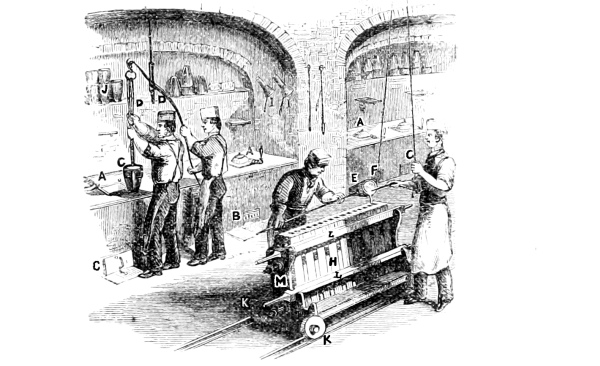
Fig. 1.—Gold Melting.
Fig. 1 represents the arrangements for melting the ingots
with their alloy, for producing standard gold. In the Mint there are seven
furnaces: each furnace, A, is 12 inches square and 24 inches deep to
the top of the bars, which are seen at the ash-pit B. The pot C is
made of a mixture of Stourbridge clay and plumbago, hence called a
plumbago pot; it is 9¼ inches deep, and 7 inches across at the
top inside. The pot, previously annealed, is placed in the furnace on
a bottom which stands upon the two centre bars. The bottom is
intended to shelter the base of the pot C from the stream of air which
is necessary to the combustion of the fuel, but which would damage the
pot. The pot is then covered by its muffle and lid, and surrounded by
fuel, which, as it burns up, warms and then heats the pot to redness,
but so gradually that there is no great risk of breaking the pot. When
the pot has become of a full red heat, the ingots are carefully placed
in it, and the alloy is added by means of the funnel I: the pot is
then covered up, and allowed to remain till the whole mass of metal
has liquefied. The foreman then stirs it with a rod made of the same
substance as the pot, and allows it to remain till the fluid mass has
reached a peculiar temperature, known by experience as that at which
the metal, when poured into a mould, forms the most solid and workable
bar. This temperature having been gained, the two outside bars at B are
removed, the ash-pit is then covered to protect the men’s feet, and the
firing poked out. The lid and muffle are next removed from the pot, and
the pot lifted by an assistant from the furnace by the crane D. The
foreman then conveys the pot C, by means of a pair of tongs which clasp
it, to the frame of moulds, when an assistant brings forward a loop of
iron, suspended by a chain and cord from the roof of the building, and
passing the loop of iron over a button on the end of the lower clamp
of the tongs, as shown at E, F, supports the weight of the pot by the
cord, as indicated at G. Previously to the melting, pieces of charcoal
are placed at the bottom of the pot for the purpose of reducing any
oxide that may be present in the alloy—and Dr. Percy has found that
copper can dissolve 13·50 per cent. of oxide of copper—because oxide
of copper, when dissolved in standard gold, frequently renders the mass
so brittle that when the bars produced are passed between the rollers
they crack and break, just as does gold containing minute quantities
of lead or zinc. The influence of oxide of copper on standard gold
was thus very marked in 1859, when a large proportion of the gold
was so brittle, that if a bar were dropped on the floor, or tapped
with a hammer, it broke, just as heated brass breaks under similar
circumstances. Mr. Richard Smith had some years since pointed out that
if copper in which oxide of copper is dissolved be poured through an
atmosphere of coal gas, all the oxide is reduced. I therefore submitted
this gold to the process thus suggested to reduce all the oxide of
copper, and produced bars so tough that they could not be broken by a
sledge hammer unless after repeated bending by that means. Yet this
gold was not thus cured of its brittleness, but was treated peculiarly,
as will be seen in a future place.[10]
When the metal is fused, the charcoal which was placed at the bottom
is brought to the surface by stirring, and as it rises through the
fluid alloy, reduces the oxide of copper, and remains on the surface to
protect the alloy from the action of atmospheric oxygen. In order to
prevent it from falling into the moulds, the assistant holds a piece
of stick at the mouth of the pot, thus allowing the gold to pass, but
stopping the charcoal. The foreman, in the case of gold, judges almost
wholly by the eye, but in the case of silver by the ear, as to when
the moulds are filled. The metal poured from each pot forms four bars.
The moulds H are made of iron, cast into such a form that each piece
viewed from the top has the form of the letter T, so that three
pieces placed together form two moulds; the whole of the set is held in
its position by cross-bars, L, which fit into notches cut in the main
frame M, where will be seen two powerful screws by which the moulds are
forced tightly together after the cross-bars L are fixed. J represents
the pots placed so as to be kept dry and ready for use; K, the wheels
and tram on which the frame of moulds runs. The whole of the set of
moulds having been filled, the screws at M are loosened, the bars, L,
removed, and the parts of the several moulds removed, so that the bar
in each mould is exposed to view. The workman takes each bar as it is
exposed by a pair of tongs, and plunges it into a cistern of cold water
to insure rapid cooling, and then places it on a bench, where the bars
produced from each pot are separated and marked with a number, to
indicate the pot from which they were poured, and the entire set with
letters, to indicate the day on which the melting took place. After
these distinctive marks have been placed on the bars, two assay pieces
are taken from the bars from each pot.
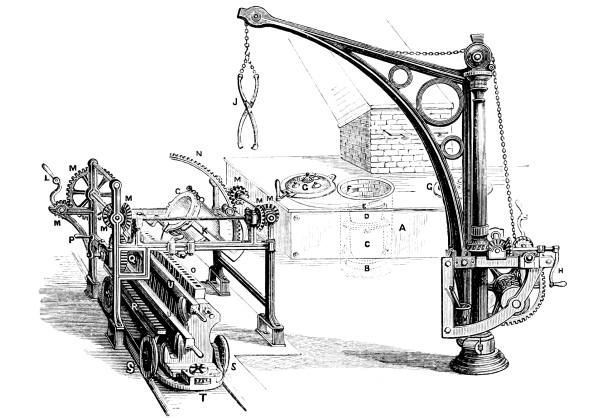
Fig. 2.—Silver Melting.
As silver melting,[11]
when discreetly conducted, is slightly different in some of its
details, it will be well to describe it here. In Fig. 2,
A indicates the furnace with the front removed, to exhibit the internal
arrangements. The furnace is circular, and is 21·5 inches across, and
31 inches deep. The bars, which are represented by dotted lines, are
removable at will. The bottom B stands on the centre bars, just
as in the case of gold melting: it is filled with coke dust, which
retains any silver issuing from a small accidental crack or pin-hole
in the pot, and also offers a non-conducting medium for the pot C to
rest upon, it being necessary to avoid the abstraction of heat by the
current of air against the base of the pot. A muffle, D, is placed on
the pot, and upon this muffle the lid E rests. The pot is circular, and
provided with a lip, to facilitate the pouring of the metal; it is made
of wrought-iron, 12 inches across at the top, and 15 inches deep, and
when melting for florins is charged with 4,800 ounces of silver. As in
the case of gold, so with silver, the metal is alloyed with copper;
standard silver being composed of 222 parts of pure silver and 18 parts
of copper in 240 parts, or 92·50 parts of silver and 7·50 of copper in
100 parts.[12]
The calculations based on the assays from ingots are just
the same as in the case of gold. The ingots are put into the pot, and
the lid is placed on the muffle (which is intended to prevent metal
from falling over the top of the pot during the process of fusion,
as sometimes might happen when scissel[13]
is melted), and the furnace is then closed, so that the air enters
through the bars, and passes into the chimney through the flue F.
The lid of the furnace G is provided with peep-holes, by which the
temperature can be regulated at will, while they also admit of a survey
of the state of the furnace. When the fusion is complete, and carried
so far as to raise the fluid metal to the necessary temperature, the
bars of the furnace, with the exception of those which support the
pot, are removed, and the fuel is poked out, because the pot at this
temperature is so soft that it would be torn if it were pulled
through the fuel. The lid and muffle are next taken off by tongs,
and the crane is swung round by the handle, H, till its tongs are
brought over the furnace, when, by working the handle I, the tongs J
are lowered till they come to the pot; the foreman then makes them
seize the pot, and by a signal gives his order for the raising of the
pot from the furnace. Pieces of fuel and iron scaling are knocked off
from the pot by the foreman with a brush kept in a crucible of water,
indicated by V at the foot of the crane. The crane is then swung round
by H, till the pot is over the cradle K, when it is lowered and secured
in the cradle by the screw, shown at C. The frame of moulds is now run
under the lip of the pot, and the foreman, by means of the handle L,
which will be seen to communicate with the wheels M, and the rack N,
tilts the pot so that the fluid metal may pour in a good stream into
one of the moulds O, until, by the sound, he judges it to be full;
he then lowers the pot, while his assistant, who is also watching
the filling of the moulds, turns the handle P, which, by the wheel Q
fitting into the rack R, moves forward the frame of moulds so far as to
allow another mould to come beneath the lip of the pot, to be filled as
before. The fluid silver in the melting-pot is covered with charcoal,
for the same reason as explained in gold melting, and this is kept
back by means of a large piece of charcoal laid at the mouth of the
melting-pot. The frame of moulds runs on wheels S, and at T is provided
with a rack and pinion, by which the moulds may be moved farther from
or nearer to the lip of the pot, which, as it is tilted, is continually
altering its relative position to the mouth of the moulds, and would,
were it not for this arrangement, pour its metal outside of, or upon
the moulds, instead of into them. The moulds are formed of
T
pieces, in the same manner as the moulds for gold, and are secured in
their position by the same method, the cross-bars being shown at U.
The bars, having been taken from the moulds, are cooled in water, and
distinctively marked, as in the case of gold. Assay pieces are cut from
them, but in the case of silver three assays are taken from the bars
produced from each pot.
The bars for different denominations of coins are proportioned in their
width, so as to admit of two rows of blanks being cut from the fillets
produced from them. The following statement gives the whole facts
concerning bars for each coin, as used in the Royal Mint. It would be
well to produce bars of a uniform thickness of 0·50 inch, as such bars
may be cast solid, and when cast produce better fillets with half the
rolling, without the cost of annealing. There would be also another
advantage, for the blanks obtained from the fillets produced from bars
0·50 inch thick would not require annealing, and would thus save the
cost of that process, as well as the loss occasioned by it, while the
coins produced would wear immeasurably longer in circulation. There are
other considerations why this thickness should be at once adopted, as
will be shown when the subject of loss by coining is explained.
I am glad to notice that Mr. Fremantle, in his Report on European
Mints, proposes to adopt my recommendation, as shown by the following
passage, page 9:—
“... It would seem to be a question whether
in a newly organised Mint considerable time and labour might not be
saved by reducing the size of the moulds in which both gold and silver
bars are cast. The result would be that, as bars would be thinner when
first subjected to the process of rolling, the time now occupied by
that process would be sensibly diminished. It should also be mentioned
that although there is great difficulty in producing sound castings if
the thickness of the bars should be reduced, it might nevertheless, for
the metallurgical reasons which Mr. Roberts points out, be advisable to
make this alteration.”
There is really no “difficulty in producing sound castings
if the thickness should be reduced;” but I fear there are many
DIFFICULTIES in the Royal Mint itself.
Indeed the casting of the bronze bars—whose thickness is less than that
I propose for those of gold—gives evidence of the ease with which
thinner bars may be produced; yet against these, insuperable
difficulties were urged until I experimentally demonstrated how
easily they could be cast.
Statement of Particulars as regards
Bars used for Coining.
| Metal. |
Denomination of
intended coin. |
Length. |
Breadth. |
Thickness. |
Average
Weight. |
| |
|
Inches. |
Inches. |
Inches. |
Troy oz. |
| Gold |
Sovereign |
24 |
1·375 |
1·000 |
320 |
| Half-Sovereign |
24 |
1·125 |
1·000 |
250 |
| Silver |
Crown |
22 |
2·750 |
1·000 |
300 |
| Half-Crown |
22 |
2·500 |
1·000 |
240 |
| Florin |
21 |
2·125 |
1·000 |
220 |
| Shilling |
21 |
1·437 |
1·000 |
150 |
| Sixpence |
21 |
1·125 |
1·000 |
120 |
| Fourpence |
21 |
0·875 |
1·000 |
96 |
|
21 |
0·875 |
1·000 |
96 |
| Bronze |
Penny |
24 |
2·500 |
0·375 |
100 |
| Halfpenny |
24 |
3·000 |
0·375 |
117 |
| Farthing |
24 |
3·000 |
0·375 |
117 |
It is to be regretted that crowns, half-crowns, and fourpences are no
longer coined. It has been represented to me by many manufacturers and
others who employ vast numbers of men, that the disuse of the fourpenny
piece has caused considerable inconvenience in the weekly payments to
their workpeople. The objection to this coin would appear to be that it
is so nearly the diameter of the threepenny piece; but this is obviated
by the fact that the edge of the latter is plain, while that of the
fourpenny is crenated or “milled.”
The assay pieces,[14]
when cut from the bars, are placed in the divisions of a tray going
from left to right, so that there can be no mistake as to the number
of the pot from which the metal comes; each assay piece is then placed
in a small envelope, marked with a distinctive mark, to characterise
the pot from which it came. The assay pieces are sent in equal numbers
to the two non-resident assayers, who determine, irrespectively of
each other, the amount of gold found in each piece. Suppose we trace
one assay piece, and imagine that 120 are undergoing the same process
at the same time. The assay piece is flattened out into a kind of
ribbon, and from it three pieces are cut, each weighing half a gramme.
Each piece of this weight takes the name of a thousand, and is
represented by the figures 1,000; but of course it may be called a
pound, a ton, or by any other denomination. Each piece is wrapped in
paper, with three times its weight of silver in two pieces, both metals
being of the same thickness. The parcels, as they may now be called,
are ready for the next process, and are arranged in their proper
places from left to right in the divisions of a tray, and taken to the
assaying furnace. In the assaying furnace is placed a Payen[15]
muffle, or kind of oven, perforated at places so as to allow a limited
amount of atmospheric air to pass from the interior through its sides
into the furnace. The muffle is surrounded with fuel, so that it
is kept at a good—almost white—heat. On the floor of the muffle is
sprinkled some bone ash—obtained by burning bones to whiteness—and on
this bone ash is placed a set of 40 cupels, or little cups, made of
compressed bone ash, and about as big as a florin, and so deep as to
hold about half a teaspoonful of water. When the cupels have been in
the muffle long enough to become red hot, a piece of lead of about nine
times the weight of the gold to be assayed is put into each cupel,
taking care not to let any lead fall over, or it would destroy the
muffle. So soon as the lead has melted, the paper parcels containing
the gold and the silver are placed one in each cupel of melted lead.
In a short time the gold and silver melt together, and, as it were,
dissolve in the lead; then a kind of circulation of the fluid metallic
mixture is observed to take place; and during this circulation, the
lead, as it is presented to the surface, meets with the oxygen of the
atmosphere, and combining with it, forms oxide of lead, which at that
temperature is fluid, and drains into the substance of the cupel,
carrying with it the copper and other impurities contained originally
in the gold, leaving in the cupel a button which contains all the pure
gold and the silver. The cupellation occupies about ten minutes, and
at the end of that time the little mass of fused metal is observed to
brighten up, the signal by which the assayer knows that the process is
finished, and he withdraws the cupels one by one, tilting the fluid
globule on one side, that it may incorporate with it any small globule
which may chance to be upon the side of the cupel. Some assayers
close the doorway of their muffles as the time of the brightening up
of the assay approaches, to avoid the access of the atmosphere till
the buttons have become solid, because the button of metal—by its
silver—absorbs oxygen; and giving off this oxygen at the moment of
solidification, spurts or opens, leaving the button hollow or ragged.
This precaution is not thought necessary by all assayers, nor, indeed,
is this system invariably followed, for some prefer to wrap the gold
and silver in the lead foil which is to be used, and do not care to
have the precious metals of identical thickness; these assayers use a
smaller proportion of silver, viz., 15 parts to 6 of standard gold,
or 17·50 to that which they judge to be fine, with a view to
avoid the danger of “spurting;” they also save time by withdrawing the
whole batch of cupels on a tray by means of a peel. The button is taken
from the cupel as soon as it has been detached, either by dropping a
little water on to it, or by allowing it to cool spontaneously, and it
is then hammered out into a strip and annealed. It is next rolled into
a ribbon or fillet, and again annealed, after which it is curled up
into the form of a letter S. Some prefer to roll the piece into a kind
of cushion, but in such a case it is more difficult to remove all the
silver; the proper plan is to expose as large a surface as possible to
the action of the acid in the next operation.
The S-shaped fillet is put into a flask of nitric acid of specific
gravity 1·23, and the flask is placed in a little cup of brass,
which stands over a small gas-burner, while the neck of the flask
enters a kind of flue, through which a current of air is continually
passing into the chimney of the furnace. The flask being placed in
its position, the gas is lighted, and a gentle heat applied, when the
nitric acid dissolves out the silver from the S-shaped fillet, and is
known to have done its work when red fumes cease to be evolved. The
acid is then poured off, and the remaining sponge of metal is washed
with distilled water, and boiled with concentrated nitric acid, which
removes the remainder of the silver. The sponge of gold is now washed
with water, to remove the nitrate of silver, and is then heated to
redness in a capsule to render it tough, for in its spongy state it is
so rotten that it will not bear to be touched; and although it remains
spongy, it is toughened by being heated to redness. It is now called a
cornet. This spongy state is a consequence of the addition of
silver, the presence of which, and its subsequent removal, produce a
separation of the particles of the gold. The gold is thus formed into
a kind of network or sponge, so that the acid can get at every part
of it, and remove any metal which is soluble in the acid. Diluted
acid is used first, because if there be any lead left it is dissolved
out, and because the action of the strong acid is so violent, that
part of it would probably be carried out from the flask. Nitric acid,
when boiling, is liable to form bubbles of gas, which expanding, give
rise to what is called bumping; hence it is usual to put a
charred pea into the flask, and this, floating on the surface, causes
a more even flow of vapour and gases, and so prevents bumping. It is
probable that the charred pea determines the boiling at one particular
temperature, for it is found that water, if it be floated in a fluid of
a higher boiling point than itself, may be raised considerably above
its ordinary boiling point, although remaining quiescent till disturbed
by a rod or point. The cornet is next weighed, and as it has been begun
under the idea that it was a thousand—1,000—all that it weighs
short of 1,000 is the alloy which has been removed, the object having
been to determine how much pure gold was present in the alloy. There
is, however, a source of error in the process which requires to be
explained.
It is found to be practically impossible to remove every trace of
silver from the cornet; it is therefore necessary to make an allowance,
the amount of which is determined by a proof. The proof consists
of a mixture of gold and silver of known proportions, so that if all
the silver be removed from a thousand—1,000—the remaining cornet
should weigh exactly 916·6. Four of these proofs are worked with each
batch of assays—a batch being 120 assays—under precisely similar
circumstances, every precaution being taken that the four shall be
equally distributed over different parts of the furnace, &c. Now
suppose that the proofs, instead of weighing 916·6, as they would
weigh if the whole of the silver were removed, were found each to
weigh 916·9; it would be known that 000·3 of silver had been retained,
and must be deducted from each of the whole batch of assays. If the
assays of coins exceed the limits of from 917·6 to 915·6, they are
repeated, as it is assumed that an error has arisen. The convenience of
considering the ½ gramme as 1,000 consists in the fact that 1,000 parts
of standard gold contain 916·67 of gold and 83·33 of alloy; so that the
result having been arrived at without any calculation, one source of
error is avoided and time is saved.
Messrs. Johnson, Matthey, and Co. have invented a tray of platinum
capsules or thimbles, into which the assay pieces are placed for
treatment with acid, instead of into the ordinary glass vessels over
gas-burners. The advantages of this invention are too manifest to
require elaboration; but saving of acid, gas, labour, and risk of
error are amongst the chief of them; and besides, the plan has been in
successful operation in their own assay offices in Hatton Garden, as
well as in other important assay offices, for several years past. The
first cost would seem to be the principal objection to this plan of
Messrs. Johnson, Matthey, and Co.; but this is really a small matter,
for the apparatus becomes stock in trade, and its cost should be
viewed simply as so much capital, whose interest is paid by the saving
effected in glass, but more especially by the smaller amount of acid
actually employed, while the platinum can at all times be sold for
nearly its original cost as old metal.
The mode of operation is as follows:—A stand of slate is so arranged
that a means of heating is made to rest on its base. For this purpose
a jet of gas is preferred; where, however, gas cannot be obtained,
an ordinary oil lamp or a charcoal fire may be used. On a shelf over
the source of heat are placed two or three receptacles of platinum,
each communicating with a vessel made of porcelain, provided with
three necks and an overflow pipe. There is a kind of sieve or tray of
platinum, so arranged as to carry from 16 to 100 thimbles of platinum,
and provided with a handle, so that this tray, with its charge, can be
manipulated at pleasure. The thimbles vary in size according to taste,
but each one is cut or slit at the bottom, so that the solution of
silver as it is formed may by its density fall out, and allow the clean
acid to take its place.
When an operation is to be performed, the tray filled with the charged
thimbles—that is, containing the assay pieces—is placed in one of the
platinum receptacles or boilers, and heated to a fitting temperature;
when the desired effect is produced, the tray is lifted into another
receptacle, and again heated; this may be carried to three times if
necessary. The products of decomposition of the acid go, with the acid
which evaporates, into the porcelain vessel, where the free acid falls
through the overflow pipe into a proper chamber, while the acid fumes
pass into the flue through the third neck before spoken of. The parted
assays having been washed by several immersions in boiling distilled
water, without removal from their thimbles, have now to be dried and
annealed in a platinum muffle, so formed as to fit into an ordinary
muffle, and, after annealing, to be weighed in the usual manner, having
saved at least 75 per cent. of the usual trouble.
It is almost needless to add that the system of proofs above
described must be also used with this process.
The assay for silver is not so tedious, as it is finished at the point
where it leaves the muffle on the cupel; but up to this point it passes
through precisely the same process as the gold.
It will have been observed that the event of the process of assaying
is to exhibit the proportion of bullion which may be present
in a given weight of mixed metals, but that it does not demonstrate
the character of the substance which forms the alloy, because this is
assumed to be copper or silver. In practice it is found that the alloy
may be a mixture of copper or silver with lead, mercury, antimony,
arsenic, tin, or zinc, in varying proportions, but whose sum does not
exceed the rate per centum in relation to the bullion which is allowed
by law. The existence of minute proportions of lead, mercury, antimony,
arsenic, tin, or zinc is a matter of great concern, for these, when present,
add indefinitely to the difficulties of the coining departments.
Under the present system, complete analyses of bullion imported for
coining are a practical impossibility. I would therefore propose to
abolish the office of non-resident assayer, and then to appoint two
resident assayers, who should conduct their operations in independent
laboratories—already existent—and a condition of whose appointment
should be an agreement to conduct, when so directed by the Master
of the Mint, complete analyses of the bullion submitted for assay.
The information thus obtained would enable the melter, by processes
subsequently explained,[16]
to remove all those substances which are now found to be
fatal to the coining of certain bullion. The appointment of officers
possessing such ability would be an equal guarantee with the present
for the faithful preservation of the integrity of the coinage. This
suggestion has been adopted and recommended—so far as regards the
resident assayers—by Messrs. C. W. Fremantle and C. Rivers Wilson, in
their “Reports on the Mint,” 1870. Indeed two assistant assayers have
been recently appointed.
When the assay reports arrive, the Master determines whether the metal
has been found within the limits, and if he be satisfied he writes on
the assay reports “Passed,” and signs the reports. The Deputy-Master
retains the reports as his warrant, and then issues his order for the
delivery of the bars by the melter to the rolling room, as recommended
in my report dated 29th January, 1859; but, as the accounts are kept by
weight, every set of bars is weighed by the officer who receives them
into that room before he gives them to his men to work into fillets.
When, in 1856, I took charge of some departments in the Royal Mint, I
found that the system of weighing was extremely loose. Officers were
plainly told that if they ventured to satisfy themselves as to the
weight of bullion they had received—in fact, to determine whether
they received what was charged to them—“they would be paid out.” This
state of things led men to accept any weight. But I objected
and resisted; for I found that the average on each day’s work as
received amounted to an habitual minus of five ounces on the weight
charged on silver, while on gold it was seldom so little as one ounce.
In illustration I will state one case which occurred. I delivered
7920·00 ounces of gold to the Mint Office. When that gold was received,
the official weigher gave me credit for 7918·15 ounces, which was a
deduction of no less than 1·85 ounces. I appealed to the Master, who by
written order directed the gold, the weight of which was thus disputed,
to be weighed by Mr. Pilcher, the officer of the weighing room, in
the presence of witnesses whom the Master nominated. Mr. Pilcher
complied with this order, and gave a certificate, signed by the
deputed witnesses, in which he stated that the gold under dispute
weighed 7919·98 ounces—that is, that it differed in weight as charged
by me to the Mint Office 9·60 grains instead of 888·00 grains, the
difference which the official weigher had deducted from the bullion
I had delivered to him. The custom had been to weigh silver to 0·50
ounce, and gold to a pennyweight; but I introduced the system of
weighing silver to 0·10 ounce, and gold to 0·01 ounce, and at the same
time induced the Master to order new balances of superior construction
for the coining department, and one specially devised by Mr. James M.
Napier for use in the Mint Office. Of this balance, received after
having been ordered for some years, it will be sufficient to say that
it appears to be extremely accurate when properly used, and is then
capable of great results; but, unfortunately, the system is such that
those who are admittedly unfit may be promoted to important posts, just
because they are senior, and not because of superior fitness for the
work. This fine balance, therefore, becomes equal to a good rifle in
the hands of a bad marksman. Great accuracy having been enforced, the
weighing is now improved, but is still far from perfect, because the
officers are compelled to abide by the decision of the weigher at the
Mint Office, who, as beforesaid, may be unfit for his office, while
the officers themselves are debarred from all checks, by the removal
from the coining department of the set of standard weights, which were
bought on purpose that those gentlemen might check their own weights as
to accuracy. The Master’s order for the removal of these weights was in
the following terms:—
“The standard weights hitherto kept in the
weighing room are permanently transferred to the Mint Office. A new
set of standard weights to be made for the Mint Office. The coining
department weights to be examined by Mr. —— ——, and compared with those
in the Mint Office (after these have been corrected), and reported on
by him. Such examinations to be repeated every six weeks.”
It should be observed that this order was preceded by one written on
the 2nd February, 1865, which directed that the Mint Office weigher
should be the final judge, but that any officer might demand the
re-weighing of any bullion, while the second weighing was to be final.
All appeals to pass through Mr. John Graham, the order proceeding to
direct that—
“The final decision is not to be called in
question by any other officer of the coining department.”
The latter determination, I was informed, was intended to apply to me
personally. Its immediate effect was a deduction of 0·25 ounce from the
first gold I delivered, and a consequent alteration of my book to that
extent by Mr. John Graham, who made a note in writing as follows:—
“This difference (error) may be accounted for by the
acknowledged error of three grains heavy of the Mint Office
500 oz. weight. See Œrtling’s Report.
(Signed) “J. G.”
Such being the circumstances, I submitted; but the result could be in
one direction only, for it had long been maintained that the reported
losses were but “an hallucination,” and were, in fact, a “mere
difference of weighing.”
It is true that the weights are periodically adjusted, but there is
adjusting and adjusting. These facts have been dwelt upon because
they have a most important bearing on the subject of loss and gain by
coining, to be afterwards treated of.
Between 1856 and 1866 the old scales were removed, to make room for
the superior balances of Messrs. De Grave, Short, and Fanner, the
eminent scale-makers of St. Martin’s-le-Grand, of whose balances it
is impossible to speak too highly, and of whom it is but fair to
state that the Prize Medal was awarded to them at the International
Exhibition, 1862, for their superior workmanship in balances.
Since it is necessary for the officer in charge of any department to
ascertain the exact amount he gives to his workmen, and to satisfy
the Master that they have returned—to within the limit of the weight
of one blank of whatever denomination of coin he may be working—the
bullion which they received, it became imperative to select the best
balance; and in practice that made by Mr. S. R. Short, of the firm
above named, was found to be the most serviceable. Mr. Short has
introduced minor improvements from time to time, as experience has
dictated, but the balance about to be described, after years of wear,
determines to within one grain when charged with 1,200 ounces troy. The
mode of proving the accuracy of a balance is to weigh as usual, and
having arrived at a just determination of the weight of the matter to
be weighed, to change the weights to the pan in which the matter has
been weighed, and to place the matter in the pan previously occupied by
the weights, so that both are now made dependent from the reverse ends
of the beam; if the results be identical with the former results there
can be no doubt as to the accuracy of the beam; should there be any
variation, the balance must be adjusted by minute alterations of the
knife-edges at its ends.
Mr. Napier has made his balance after the principle of Mr. Cotton’s
balance, so that it requires no adjusting screws, but I have no
personal experience of the benefits of this omission.
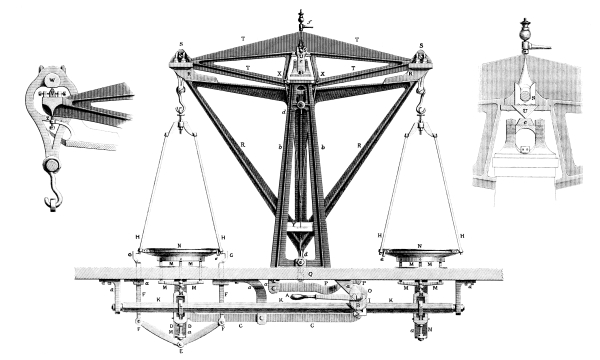
IMPROVED BALANCE (TO WEIGH 2000 OUNCES.)
BY Mʳ. S. R. SHORT, JUNʳ.
The balance used in the rolling room of the Royal Mint is specially
adapted for the purpose. Such a balance, as already noticed, must be
accurate, as must also all the balances used in the Mint; but this
balance requires an arrangement by which the pans can be released
from the beam and held firmly while being loaded. Mr. S. R. Short has
been peculiarly happy in effecting this object, as will be seen by
reference to the steel engraving, which exhibits a fine illustration
of Mr. Short’s balance. The raising of the handle A causes the partial
revolution of the cam B—represented by dotted lines—and this, as it
diminishes, releases the lever C, which, by the rods D acting on the
point E, permits the approach of the joints on the rods F towards the
centre. The rods F work on a centre fixed beneath the table on which
the balance stands, so that the closing of their one end causes the
opening of the other. Thus the claws G recede from the wedges H, upon
which they had been fastened, and so release the pan, for the claws act
simply as a man’s hand would act in fixing the pan while it is being
loaded. Immediately upon the opening of the claws another action takes
place by the continued movement of the handle A, which causes the cam
I to rotate upon the friction roller J, affixed to a lever proceeding
from the shaft K, which at L is cut with eccentric bearings, so that
by the partial revolution of K, caused by the pressure of I upon J,
the series of supports M sink downwards from the pans N, thus obliging
the pans, with the rods which support them, to be suspended from the
supports S, which rest on the frame R. So soon as the pans are thus
suspended, the continued motion of the handle A causes the cam O to
permit the falling of the lever P, which at Q supports upon a friction
roller the iron framework R. This framework terminates upwards at the
points near S in sugar-loaf cones of gun-metal, which are intended to
relieve the knife-edges of the beam from the pressure of their planes
while the beam T is out of use, or while it is being loaded, for at
these times the knife-edges would become seriously damaged. By the
lowering of the frame R the centre knife-edge U is permitted to rest
on its plane of steel c, which is beautifully bedded on an arch
of gun-metal, as will be seen if the enlarged representation of this
part, and which is shown to the right, be examined. In fact, the steel
plane c is secured by wedges exactly shaped to it, but for the
sake of illustration these wedges have been replaced in the enlarged
portion of the engraving by upright pillars shown against c,
with screws travelling through them, and intended to fix c
rigidly in a given position. At the same instant that U comes into rest
upon c, the knife-edges V at the ends of the beam T receive the
planes W, so that the beam has now to support the weight of the matter
placed in the scale-pans, and at this time is determined the actual
weight of whatever that matter may be. The weigher, by an indicator
suspended from the beam at X, reads the oscillations of the beam on an
ivory plate at Y. At the time of weighing, the beam with its dependents
is carried by the four-legged frame of iron b. The frame R
passes through friction rollers of brass at d, which rollers
maintain it in its relative position to the beam. The weighing having
been determined, the handle A is reversed, and the beam is placed at
rest; but the vibration of the machinery in the rolling room causes a
continuous chatter of the knife-edges V against the planes W, therefore
at each end of the beam a small screw Z is made just to touch the lower
edge of the beam when it is at rest. Final adjustments which are very
minute may be arranged by f; while the box e on the
pan against G is intended to receive small pieces of lead, which
are used to compensate for the loss by the wearing of the pans. The
shaft K is supported from the table by a. The beam of the
balance represented in the steel engraving measures 48·00 inches from
knife-edge to knife-edge; that is to say, it measures 24·00 inches
from the centre knife-edge to the knife-edge at either end. Mr. S.
R. Short has made for the rolling room another balance for weighing
silver, and as it differs in some important details, it is deemed wise
to demonstrate those alterations in Fig. 3, where
the supporting frame R will be seen to carry three upright pillars S¹,
S², S³. The pillars S¹ and S³ are represented as being placed on the
farther side of the beam, which at those parts is broken away, that
the pieces of steel against which the pillars are made to touch may be
seen. S² touches against one of these pieces of steel near the centre
knife-edge U, and in front of the beam. The pillar S² terminates in a
point, which passes into an inverted cone, while the point of S³ is
made to pass into an inverted V, so that when the beam is raised
by these pillars from its centre knife-edge, S² obliges it to take a
specific position with regard to its distance from the centre of the
plane on which its centre knife-edge rests, and S³ causes it to take
a perfectly parallel line. S¹ is simply a plane which rises against a
plane and steadies the other end of the beam, which by this arrangement
stands as on a tripod, and is, therefore, prevented from moving, and
in addition has its knife-edge invariably placed upon the same part of
the plane at each time of weighing, while the frame R, by its continued
lowering, drops the planes with equal accuracy on the end knife-edges V.
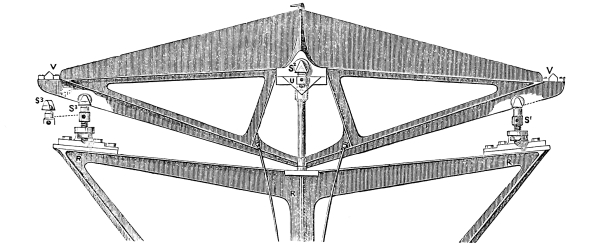
Fig 3.—Short’s Plan for Levelling a Beam.
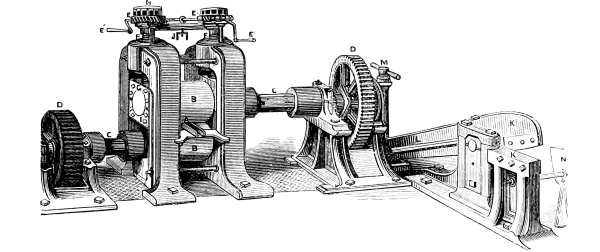
Fig. 4.—Breaking-down Mill.
The sovereign bars having been weighed by the officer, and given by
him to his men, are wrought in sets of twenty; each set is called a
batch, and each bar in the batch undergoes precisely the same
process. The bar is passed into the opening A of the breaking-down
mill Fig. 4, where it receives a considerable compression,
for the rollers B, seizing its end, drag it forward, while they roll back and
retard the progress of that part of the bar which is not between them.
The result is that the bar is lengthened, but not widened materially,
so that length is gained at the expense of the thickness, which is
regulated by the distance between the rollers. The rollers are driven
by shafts and adjusting couplings C, which are themselves driven by the
wheels D. The distance between the rollers is determined by the action
of the lever E′, which, by the endless wheels on its axle at E fitting
into geared wheels, gives motion to powerful screws shown at F, which
terminate in cups on the upper part of the upper brasses of the rollers
B, as may be seen at G. The upper brasses are kept always against the
ends of the screws by weights which are beneath the mill, but from
which levers and rods terminate at the lower part of the upper brasses,
at about the position indicated by I, so that the upper roller has
motion either upwards or downwards at pleasure, but the motion upwards
is arrested by the powerful screws F, and this point once determined
by the reading of the scale H, is fixed by the clamp J. The thickness,
therefore, of each bar in a batch is determined within certain limits;
and when each bar in the batch has been rolled, the mill is altered,
refixed, and again the rolling goes on till each bar has passed seven
times at varying pinches through these rollers. Owing to the wear of
the moulds in which the bars are cast—and which is largely due to
the presence of minute portions of antimony in the gold—the bars are
never of uniform thickness; hence bars of every denomination are passed
through the rollers on their edge, so as to reduce them to one uniform
thickness, otherwise the fillets resulting would be ragged, and of
unequal widths, which defect would cause them to produce blanks out of
remedy[17]
as to weight. The rollers are set face to face; the graduated scale H
is then fixed at zero; if now the rollers are separated until there
be a space of 1·00 inch between them, the scale H will indicate 50;
if, however, it be desired to read a higher figure, part of another
revolution must be performed, causing the scale to read, say 31·50 of
that revolution, when the rollers will be so far apart that sovereign
bars which pass between them will, allowing for the expansion after
compression, be found to be exactly 1·375 inches wide.
If now these bars be rolled on their sides, the mill must be turned
down till the scale reads 45, when, if the bars be passed through, they
will measure as under for width and thickness at each successive pinch.
A spring-pinch means the passing the bar once more through the
mill without altering the distance between the rollers.
A sovereign bar passed
through the rolling mill— |
Becomes a fillet or ribbon— |
| Inches wide. |
Inches thick. |
| At |
45·00 |
1·450 |
0·775 |
| ” |
35·00 |
1·540 |
0·610 |
| ” |
26·00 |
1·610 |
0·460 |
| ” |
19·00 |
1·665 |
0·335 |
| ” |
14·00 |
1·696 |
0·250 |
| ” |
10·50 |
1·712 |
0·194 |
| ” |
8·50 |
1·765 |
0·148 |
| ” |
7·00 |
1·778 |
0·129 |
| ” |
1st spring-pinch. |
1·778 |
0·127 |
| ” |
2nd ” ” |
1·778 |
0·120 |
| ” |
3rd ” ” |
1·779 |
0·118 |
| ” |
4th ” ” |
1·781 |
0·117 |
When the bars have passed through the rollers at 10·50 they have become
of great hardness, and of considerable length, say 6 or 8 feet. They
are then taken to the shears K, where their hollow ends are cut off,
and the bars cut into lengths of 18 inches; or rather, such was the
practice when it was considered wise to obtain as much coined money as
was possible from the bars; but recently, under other considerations,
the old plan of the moneyers has been re-introduced, that of shearing
the hollow ends from the bars before rolling. In this process there
is needless waste, and it is to be hoped that the proper practice
will be reverted to, for under that system the ends averaged 4·26 per
cent., while under the re-introduced one it amounts to 7·03[18]
per cent. on the bars, and for the following reason. When the metal is
poured into the moulds, it almost immediately solidifies, and while
solidification is going on contracts in volume, leaving a kind of cup
of metal or hollow part on the top of the bar. In the act of rolling,
the bar maintains an equable width until this hollow part is reached,
when it suddenly expands, and at this point the workman shears off
the defective part of the bar, whereas in the other case he shears
off the hollow end until his eye fails to discover the effects of the
shrinkage; hence the loss of 2·77 per cent. on the produce of fillets,
as well as the loss in wages for melting the bars. The shears may be
regarded as large scissors driven by a drum on the same shaft that
carries the driving wheel for D. The drum is eccentric, so that at each
revolution the shears are caused to open and shut. The bar being placed
between the jaws K, the long end L of the shears is raised by the drum,
and the piece is cut off. The shears may be closed and the end of L
suspended, when out of use, by a hook on the end of the screw worked by
the lever M. The length at which a bar is to be cut off is regulated by
the gauge shown at N.
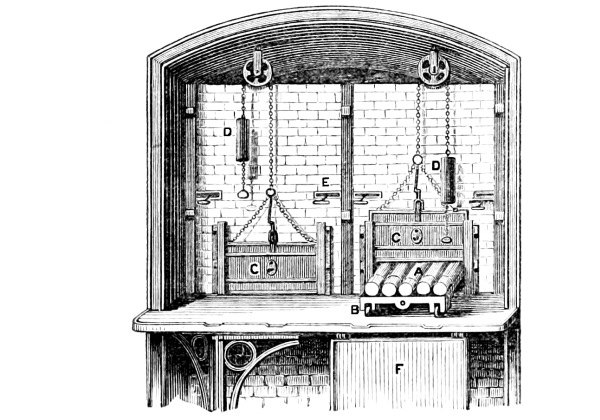
Fig. 5.—Annealing Furnace.
The sheared bars are placed in copper tubes, the tops of which are
luted on with clay. It is imperative that the copper tubes should be
made without solder, because this fuses at a temperature below that
which is required to anneal the gold; if present it would run down upon
the hot gold, and cause it to fuse and alloy with the solder, thus
spoiling the work and entailing expense upon the coiner. The tubes
which are used in the Royal Mint are made by Messrs. Benhams and Froud,
of Chandos Street, Strand, who, after considerable pains, arrived at a
method of making the tubes in such a manner as to entirely satisfy the
requirements of the Mint. The tubes A are placed on an iron carriage
B, which is then run into the furnace, as shown in Fig. 5.
The door of the furnace C is closed by raising the counterpoise D; the heat
of the furnace is regulated by the damper E. The apron F is sometimes of use
in annealing very long silver bars. After remaining in this furnace
for twenty minutes, the carriage is withdrawn, and the tubes, taken
with tongs, are plunged into cold water, to cool the gold as rapidly
as possible. The rapid cooling of gold and silver gives to each metal
a peculiar character, which is of value in the after processes, and
prevents the access of the atmosphere, which, in prolonged cooling,
would cause the oxidation and consequent removal of so much copper
that the alloyed metal would become too rich in gold for circulation
as coin. The annealing of some metals is effected not so much by the
continued heat as by the slow cooling; it is therefore wise to raise
the metal to its full heat as rapidly as possible, and then so to
arrange matters that it may cool very slowly. This method does not
hold good in the case of the precious metals and of copper, for they
become, under such treatment, so soft, malleable, and pasty as to stick
to the machinery, and thus to cause considerable trouble and loss.
After annealing, the bars, which are now called fillets, go
again to the breaking-down mill, through which they are passed with
the scale indicating 8·50, then at 7·00, and after this are submitted
to another pinch without altering the scale at all; so that what is
called a spring-pinch is given, with the intention of effecting
the reduction of the fillet to one uniform thickness, for the breaking
down and subsequent rolling cause the fillets to become much thicker
in their middle than at their sides. The spring-pinches reduce this,
while at the same time they diminish the elasticity of the metal, and
fit it for the other mills. It will be seen, by reference to the above
table, that the widening of the fillet is very trifling; but width may
be gained to any desired extent, at the will of the workman, if the
bars be submitted to a heavy pinch instead of a series of light ones.
The fillet having been submitted to the fourth spring-pinch, is gauged
on its side by a steel instrument, of which Fig. 6
is a representation. It is a hollow wedge, which is graduated to the
thousandth of an inch. Supposing that the opening from A to B were
extended until it were one inch wide at A, the space would be divided
between it and B into 1,000 parts, and then every fillet passed into
this opening would stop at a given point, say, for instance, at 140;
such being the case, every part of the same fillet should be arrested
precisely at the same point. The fillets are reduced till they measure
117 on this gauge, and are consequently 0·117 inches thick. They are
then passed to the next mill, where they receive four light pinches,
and then to a third mill, where they receive two more very light
pinches, and by means of these six pinches are reduced in thickness to
0·075 inches. They then pass to another mill, still finer than any of
the preceding, and here are submitted to four very light pinches, by
which they are reduced to 0·058 inches, and are finally finished at the
sixth or gauging mill, where they receive three pinches, and are then
0·053 inches thick by 1·829 wide.

Fig. 6.—Small Gauge.
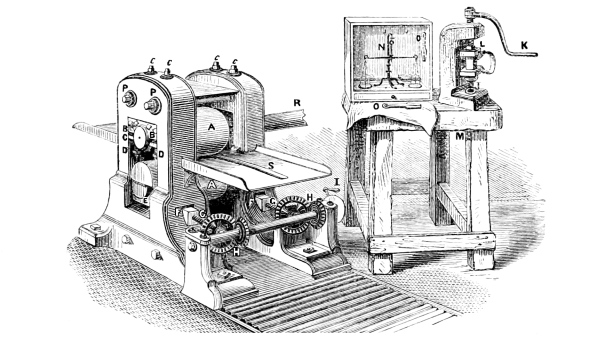
Fig. 7.—Gauging Mill.
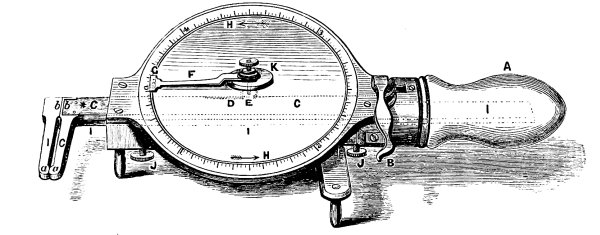
Fig. 8.—Ansell’s Standard Gauge.
The gauging mill is of different construction from the other mills, as
may be seen by reference to Fig. 7, where the rollers A are seen in the
act of reducing a fillet. The upper roller is fixed in brasses loosely
clamped together; the upper brass, B, being firmly bolted to the main
frame of the mill by the screws c, while the lower one C, which
carries the weight of the roller when it is running empty, is supported
by spiral springs shown at D. The lower roller works on a brass, E,
which rests on a wedge shown at F; the brass being cut to fit the
wedge, so that it may become similar to a solid mass, irrespective of
any motion given to the wedge. By this mode of adjusting, a difference
of the 0·001 of an inch may be made with ease between the distance
of the rollers, and, consequently, in the thickness of fillets which
may pass between them. The wedge F is moved forward and backward by
the screw G, which itself has motion from the gear work H, by the
handle I. Directly a fillet is passed between the rollers, the topmost
one is forced against its upper brasses, and further upward motion
becomes impossible. The weight of metal in this roller gives rise to
irregularities in the thickness of the fillets which pass from this
mill, causing much trouble and some expense; therefore it is proposed
to support the upper roller by a similar arrangement to that which
affects the lower roller, and to keep it rigidly against the upper
brass, but with just so much pressure as its own weight would induce
were circumstances reversed, and by these means to relieve the fillet
from the weight of the roller, because that has an undue influence on
each end of it. The gauger of fillets requires other tests besides that
of the thickness of the edge of the fillet, so he punches out a blank
from an occasional fillet by a hand-press, the cutter of which is shown
at J, Fig. 7, worked by the handle K, through the screw L. The blank
falling through the bolster of the cutter is caught at M, and is then
weighed in the hand scales N, against a standard weight, from which it
must not vary more than 0·50 grain. O, Fig. 7, is the gauge actually
used by the workman; Fig. 6 represents the standard gauge used only by
the officer in charge to check the work at its various stages. He has
in addition a gauge of great accuracy, by which to measure the fillets
at any point, as to width and thickness. This gauge will be more
intelligible by reference to Fig. 8. A is the handle, which
is hollow; B is a lever attached to the flat rod of copper C, which at D is cut
with a rack, into which a pinion E is made to work. The pinion E works
on a shaft, the upper end of which carries a hand F, provided with a
vernier G. If now the handle A be firmly held by the hand, while the
thumb be made to press the lever B towards the end of the handle,
the rod C is set in motion, and causes the hand G to travel in the
direction of H. The rod C rests on another rod I, made of steel, and
so long as to pass into the handle of the instrument. The ends of the
rods C and I are fitted at b with steel shoulders, and are then
continued, as represented, to a. If it be desired to measure the
thickness of a fillet, the points a a and b b are caused
to open by pressure applied to B, and the fillet is placed between
the points a, when a spring fixed in the box K brings back the
rod C as soon as B is gently released, and encloses the fillet. The
separation of the points a by the fillet causes the hand or
indicator G to stand at a point from zero, which is then read. The
scale is divided into 500 parts; and if the points be opened 0·50 inch,
the hand makes one revolution; so that the ·001 of an inch is gained
by one reading. But each 0·001 is subdivided by the vernier into ten,
so that a ten-thousandth part of an inch is read without trouble. To
measure the diameter of a blank coin, or the width of a fillet, it must
be placed between the points b; but since the extreme graduation
of this gauge is 0·50 inch, it is necessary, if it be desired to
measure a larger diameter, to press back the lever B till the zero of
the vernier G reaches 0·500 on the scale H, and hold it there while a
clamp is made fast at the spot indicated by the star (*), to prevent
the motion of C without I. When the clamp is fixed the rod I must be
drawn out till the zero of the vernier reaches that of the scale H,
when the screws J must be tightened to retain I in its new position,
with half an inch permanent opening between the points b and
between the points a. In a new measurement, that permanent 0·500
must be added to the reading. This arrangement admits of measuring up
to 3·5000 inches, to which limit the gauge is extremely accurate. The
instrument was invented by myself, because I found it difficult to
convince the men that the fillet was thickest in its middle, and
consequently heavier there than it should be; and, unfortunately, that
the workmen habituated themselves to attributing this fault to each
other, when its existence was proved. The fact was, that under the
system which had prevailed, the men—with a view to make bad work for
a specially-designed reason—would set the upper rollers at varying
angles, so that a fillet at one mill would have one thin and one thick
edge; and when that fillet passed through the next mill, the angle of
the roller being altered, would make both edges alike, but the effect
of the manœuvre was to push the metal into the middle of the fillet,
and thus to unfit it for the draw-bench. Hence the necessity to fix
where the blame should rest, and the production of this instrument,
under my direction, by Mr. C. Becker, of 30, Strand, at once overcame
all those difficulties.
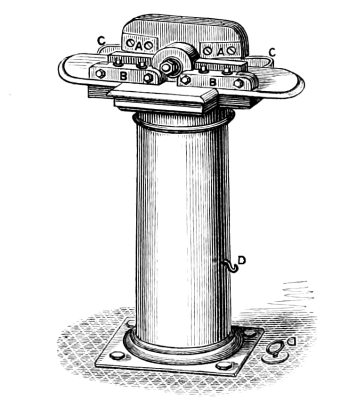
Fig. 9.—Small Shears.
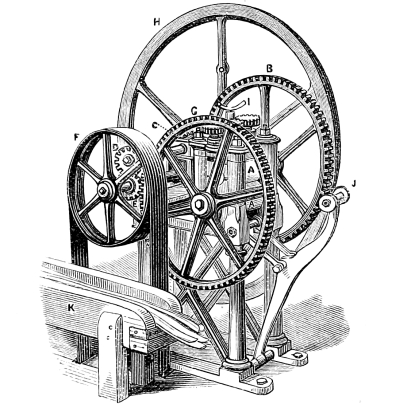
Fig. 10.—Flatting Mill.
The fillets are weighed from the rolling room to the drag room, where
they are finally adjusted; for with every energy, discretion, and
skill, FILLETS CANNOT BE OBTAINED OF UNIFORM THICKNESS
BY SIMPLE ROLLING. In the drag room the fillets are taken to the small
shears, Fig. 9, by which one end of each fillet is trimmed
so as to render it square. The plates A are fixed to the head of a T-shaped
lever, which is caused to oscillate by a cam beneath the floor. The
plates A shut against a face of steel fixed to a block, and held by the
screws shown at B; if therefore the end of the fillet be passed between
the plate A and the face of B, each oscillation causes the cutting off
of so much as protrudes, the pieces cut off falling into the box C,
which has now been enlarged so far as to form a pan all round the top
with a view to catch all of them. D forms part of a chain, by which the
shears are thrown out of motion. The fillets, having been trimmed so as
to render their ends square, are next passed to the extent of about two
inches between the rollers of a flatting mill, shown in Fig. 10, which
reduce that part of the fillet to about two-thirds its thickness. A
A represent a pair of small rollers, the upper one of which is cut
with three flat faces, so that it has three rounding and three flat
surfaces; hence, when both rollers are revolving, there are spaces with
openings between them; but when the rounding faces come down, those
openings are much narrowed, so that any fillet placed between them
becomes thinned to just such an extent as may be deemed necessary. The
rollers travel in opposite directions, so as to cause the expulsion
of a fillet placed between them. The reverse motion is gained as
follows:—The upper roller is driven by B, which receives its motion
from the little pinion C, carried on the shaft which also supports D.
D reverses the motion of E, which is driven from the drum F. E also
drives G, which gives motion to the lower roller. The fly-wheel H
is borne at the extreme end of the shaft which carries F and E. The
fillets are rested on J while being flatted, and are, after
flatting, placed in the trough K, from which they are taken to a
rolling mill in the drag room, of precisely the same construction as
that exhibited at Fig. 7, to be passed twice through at equal
pinches, with a view to render them still more accurate than they were when
leaving the rolling room, as well as to reduce them to the exact
thickness at which the trier has found they will produce the best work
at the draw-bench. The rolling mill in the drag room was provided with
steel rollers. Steel rollers are of somewhat recent invention, and
seem to have received a high character from those whose opinion may
be modified by further experiments more accurately made. My opinion,
founded on experience, is to the effect that they are not worth their
extra cost; but that their usefulness may be more fully developed when
they shall have been fitted with the arrangements proposed for the
gauging mills before explained.[19]
After these alterations have been made, it may fairly be questioned
whether steel rollers will, under circumstances every way similar,
produce better work than is produced by the ordinary chilled-iron
rollers; in other words, I believe that steel is not a better substance
for rollers than chilled cast-iron. Those who have to sell, and those
who have to use, have, of course, different motives; he who has
to use a machine should judge calmly, and not be led away because
the invention is new. It is amongst these considerations that I am
convinced that steel rollers do not save money; for if they wear
longer without getting out of order, they also require a longer time
to put them again in order. Rollers, made from whatsoever substance,
cannot reasonably be expected to produce a fillet from every part of
which blanks of equal weight can be struck, because it is not yet
possible to produce a compound of equal hardness throughout; but if
the construction of the mill be altered, steel rollers may approach
nearer to that perfection which is gained by the draw-bench, but they
can never replace it. The fillets are taken from the mill to the
draw-bench.
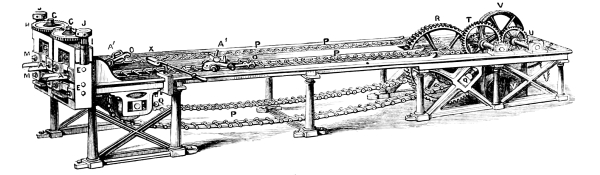
Fig. 11.—Draw-bench.
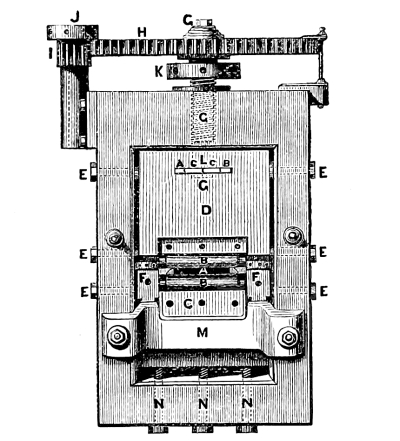
Fig. 12.—Head of Draw-bench.
Fig. 11 represents the draw-bench, the name of
which is retained, as being in fact its only appropriate one. The flatted
end of each fillet is passed into the opening shown at A. The
dog A´ is then run up till its teeth seize the fillet. The lever
is depressed until one of the hooks O catches a bar of the circulating
chain P, which in its onward motion drags the dog, and causes it to
bite the fillet and draw it through the opening at which it has
been entered. P gets its motion from a notched cam, the axle of which
is shown at Q. There are two distinct chains to each draw-bench, and
there are two distinct draw-benches, so that one description does for
both double ones. R is a cogged wheel, the shaft of which, Q, carries
two notched drums, and each drum gives motion to a chain, so that both
chains travel at the same pace. R is set in motion by the pinion S, on
the shaft which is driven by the wheel T. T is driven by U, which is on
the shaft driven by the strap and drums V. Fig. 12 is a representation
of the head of the draw-bench, and in studying this engraving it will
be well to refer at the same time to Fig. 11. The dog takes
its name from its resemblance to the head of a bull-dog. It consists of a pair
of levers, whose long arms extend beyond the axle-tree of the wheels
nearest to O, and whose shortest arms are formed by the passing of the
other axle-tree through the lever. The teeth are set at the front of
the short arms. The axle-tree near O is fixed to the bars forming O,
and runs loosely between the long arms of the lever, so that when O is
pulled forcibly it causes the axle-tree to open the long end of the
levers, and thereby to close the short end or teeth of the dog, the
more rigidly in proportion to the pressure exerted at O. Directly the
fillet has passed through the cylinders the dog springs slightly by the
elasticity of the fillet, and thus releases itself from the chain; at
the instant of release the weight over the foremost wheels falls, and
by its fall lifts the hooks O so high as to admit of their escaping
contact with the circulating chain P. The position of the teeth of
the dog is shown by A in Fig. 12. The flatted part of the
fillet is just so thin as to admit of its passing easily between the cylinders
B until seized by A, but the part which is not thinned comes against
the cylinders B, and requires considerable force to drag it between
them. The cylinders B do not rotate; in fact, they may be considered as
forming part of a solid mass.[20]
The lower cylinder is laid on the bed C, and is clamped there by a
cheek fastened on to C by three screws, the holes for which are shown
on C; the upper cylinder is fixed to the mass D by a precisely similar
arrangement. The beds C D are held perpendicularly by the points of the
screws E; and we may now view the cylinders as secured to, and forming
part of, their beds. The distance between the cylinders is regulated by
the capstans F, which separate the beds of the cylinders, and
so separate the cylinders. The accuracy of this adjustment is
all-important, because the distance between the cylinders determines
the thickness of the fillet which passes between them. The bed D of the
upper cylinder is required to be movable at pleasure; it is therefore
provided at G with four wedges, two of which, c c, are cut so
that if looked upon from the top a round hole shows itself, and through
this hole the end of the screw, which at this point L is plain, and
has a neck turned in it, passes, with its head beneath the wedges and
against the lower G. So soon as this is effected the wedges A B are
pressed into their places, and these holding c c together, cause
them to secure G by its neck; if, therefore, G be now caused to rise,
the block D must rise with it, but the head of this screw rests on
the solid block D, while its neck is just so long as to admit of this
without itself being pressed against the wedges c c. G is a very
fine-cut screw which fits into a female screw cut in the frame of the
head of the draw-bench; it is moved to any distance varying from the
hundred-thousandth part of an inch (0·00001) and upwards by the wheel
H, which receives a very minute motion from the pinion I by means of a
lever fitting into the capstan head J. K was originally intended to be
used to set or fix the screw G when it had been brought to its proper
position, but it is not used; for, in fact, the cylinders wear away
appreciably by the passage of the fillets, so that they constantly
require to be brought nearer together to make up for this wear. With
some species of gold the friction is so great that, although oil is
used, the cylinders become so hot as to render the gold pasty; in
such case a kind of welding takes place, which causes the tearing of
the fillet. If this extreme point be not reached, as indeed it seldom
is, the cylinders become of varying temperatures, and so great is the
effect of this, that in order to compensate for it, the upper cylinder
has to be continually raised or depressed. The beds which carry the
cylinders become worn by the strain and fret, and require grinding
out at intervals; therefore, to allow for the difference which this
would make, screws N are provided, by which the cylinder in the lower
bed can always be raised to its proper position. We cannot but admire
the ingenious productions of inventive minds; and surely if ever
there were a marvellous machine for assisting the coiner, it is this;
indeed, it may be doubted whether a more admirable instrument for its
purpose can be contrived. Sir John Barton, who invented and directed
the making of it, took into consideration every circumstance which
could possibly arise, but he never saw practically the full advantage
of his conception. Under my direction, this machine was so used that
the average work produced was very favourably compared with the trials
recorded by Sir John Barton, and details of which were given to me by
the late Mr. W. H. Barton. There are some persons who smile at the
draw-bench, but it is one of those inventions which will outlive its
detractors, at least, so long as economy and perfection are points
to be studied in coining. Foreign Mints are said to have found no
advantage in the use of the draw-bench. It is to be regretted that they
have not found a man with sufficient intelligence to use so accurate an
instrument; it is surely not the fault of the sun if men are blind to
its splendour. Mr. J. Martin, of the Paris Mint, has recently made some
very accurate experiments with the draw-bench, and has produced results
every way in accordance with those obtained by me in the Royal Mint,
and is convinced that the draw-bench may be considered as the coiner’s
right hand.
Against all sound advice the Master had been induced to buy a pair of
steel rollers, at a cost of £800 (I state the sum on the authority of
Mr. W. H. Barton, who, being Comptroller at the time, probably knew the
actual cost), and with these I made an elaborate series of experiments,
extending over many weeks. The results were wholly adverse to the new
rollers—others arrived at the same conclusion—and I reported to
the Master, in writing, on the facts as I found them, showing that
the average gave an advantage of 19·92 per cent. in favour of the
draw-bench, and on this ground I maintained the superiority of that
machine. He replied by a peremptory order, directing me “to prohibit
now and for ever” the “use of the draw-bench, and to take measures
for its removal from the Mint.” Thus absolved from responsibility,
I—after making a written protest—obeyed that which I could no longer
withstand. The result was that the rejected blanks, which had averaged
3·60 per cent., now advanced to 23·52 per cent. I was unable to avoid
this great expense, and when I spoke to him about it he was not very
amiably disposed; however, he finally wrote me the following note, on
which I remarked to him “that steel rollers, whether driven by cogged
wheels or by straps, would still be steel rollers.”
“7th June, 1861.
“Dear Sir,
“In the cutting and adjusting room you may return
to the use of the draw-bench till the gearing of the steel rollers is
altered. I had overlooked the circumstance that in the United States
Mint cogged wheels are not used for that purpose.
“Yours truly,
“Tho. Graham.
“G. F. Ansell, Esquire.”
It is satisfactory to me to find that Mr. Fremantle confirms the
opinion at which I had arrived. He says (“European Mints,”
page 9):—“The adjustment of the fillets after rolling is in some European
Mints performed by the draw-bench, as in England. In others it is
performed by carefully adjusted rolling mills only. The experience
acquired both in this country and abroad tends to show that it is
advisable to retain the draw-bench—at any rate, until some more
accurate method is found of equalising the fillets and reducing them
to their correct thickness.” If Mr. Fremantle will investigate for
himself instead of being guided by the opinions of others, he will
rigidly follow the correct conclusion at which he has arrived; if,
however, he will look in the drag room in the Royal Mint, he will
discover evidence of the former existence of a series of rollers which
were replaced by the draw-bench. Yet one of his co-travellers, who is
manifestly willing to make experiments, says of the draw-bench, “Still
it has yet to be proved that it can compete in sustained accuracy with
a well-constructed rolling mill.” Quite true; but I think the answer
holds good, and any one who would replace the draw-bench by rolling
mills—which have hitherto failed—should, as Sir John Barton did,
prove his proposition otherwise than at the Government expense, and
then on success obtain fair remuneration. Before leaving the study
of this instrument it is right that I should mention that Mr. John
Murray, of the Royal Mint, has added immeasurably to the value of
it by inventing a most ingenious machine for grinding the cylinders
(see B, page 28) with accuracy, so that those cylinders
which have been used can with ease be, as it were, repaired. In justice to
Mr. Murray I should add that I omitted all mention of his invention in any
former issue, because some principal contractors were to my knowledge
intending to make him an offer of a sum of money for it, and under such
circumstances I could not think it right to give a description of it. A
like feeling induces me to postpone to another occasion details of this
clever contrivance; its simplicity is such that a mere outline would
put a maker of instruments in possession of means for its construction.
The fillets which have passed between the draw-bench cylinders are cut
into lengths of about 18 inches by the shears shown at X, in Fig. 11,
and are then sent to the trier, who by means of a hand-press similar
to, but more delicate than, that shown at Fig. 7, punches
out one or two blanks from each length of 18 inches, and weighs it, or them,
against a standard weight, and in accordance with his judgment directs
the fillets to be cut by the boys or men at the machines. The trier
allows 0·20 grain on the pound of blanks for the loss which afterwards
occurs by annealing.[21]
If, however, the bars, as previously suggested, were cast uniformly of
the thickness of 0·50 inch, this allowance, which is equal to a value
of £34 8s. 7½d. on each million, need not be made; but in
fact, as will be seen, even this is not sufficient to cover that loss
under present circumstances.
Not only has it become a habit to smile at the draw-bench, but every
unfair attempt has been made to get rid of it. Officers were abused
because they would not report against it, and the machine itself was
submitted to usage never contemplated by the inventor. The then chief
coiner, who had formerly seen soap used in calico works in Manchester,
insisted on using soap-suds, whereby the beds for the cylinders became
rusted, the cylinders destroyed, and the whole machine thrown out
of gear, so that 30 per cent. of all the work was rejected: these
perverse trials, extending over weeks, appeared to throw discredit on
the draw-bench. Having been a calico-printer, that officer endeavoured
to engraft on to the processes of coining some of the practices
adopted in that business; but had he duly appreciated the principle
on which the draw-bench acts, he could not have attempted the use of
soap-suds, or, at least, on its complete failure would have assented
to its disuse. The very first object of the draw-bench is to produce
just so much friction as will cause the lateral displacement of the
molecules of the metal then under its operation. Soap, when it adheres
to the bullion, permits the fillet to pass without friction, and
when it is scraped off by the cylinders the gold becomes so hot from
friction that the hand cannot with safety touch it; hence there are
alternating parts of the fillet very hot and absolutely cold, and, as
a consequence, no two blanks can be obtained of equal weight. Sir John
Barton not only made the machine, but determined also that oil was
the only fit lubricator for metal made to pass through the cylinders
of the draw-bench. Forgetful of the immediate wear on the surface of
the metal, others have attempted to replace the cylinders by wedges of
steel, so made as that a constant stream of cold water should keep them
cool when in operation. This also failed from the formation of rust,
while the work produced never equalled that obtained from cylinders.
The proper use of the draw-bench is to reduce fillets to an equable
thickness in every part, and this can only be done when the trier,
after studying the quality of his metal, has determined how much he
can remove by once passing through the cylinders; then by keeping up
a constant succession of fillets, properly smeared with oil, so that
the equable friction always maintains them at the same temperature.
Under such circumstances, and with a remedy of 0·24 grain, the rejected
should not exceed 2 per cent., and this on the whole day’s work should
contain half its weight of light and the other half heavy blanks. This
also was a curious instance of want of knowledge on the part of that
controlling officer, who for years maintained that if the work were
properly conducted all the rejected should be on one side of
the remedy.[22]
The fillets, notwithstanding the draw-bench, cannot be brought to
perfect accuracy, and to meet such variations as arise, a difference is
made in two of the cutting-out punches by altering their diameters to
such an extent that a blank cut by them from a standard fillet would
vary in weight from a blank cut by a standard cutter from the same
fillet. One cutting-out punch is so altered that a blank would be
0·125 grain, and the other that a blank would be 0·250 grain heavier.
This admits of a fillet otherwise too thin being used; but if the
fillet be found to err on the other side, it is passed once more
either through the draw-bench, or through the mill at a spring-pinch.
The trier, Mr. William Fenton, is a peculiarly steady man, possessing
a calm judgment, with considerable energy, and upon him depends the
accuracy of the whole process of coining; he has not unfrequently so
managed his work that upon 5,000,000 of sovereigns coined, he has been
within one sovereign of the calculated value.
The fillets, having been thrown by the trier into the receptacles which
indicate the particular cutting-out punches to which they are to be
taken, are fetched by a man, who wipes off the oil, and then carries
them to the cutting-out room, where the fillets are cut into blanks and
scissel. In this place it may farther be noticed that soap-suds cannot
be used in the place of oil, because the soap could not be removed
without washing,—a practical impossibility,—and would therefore
remain, and add indefinitely to the weight of the gold, and thus open
the door for peculation. The cutting-out presses used in the Royal
Mint are very cumbersome, and when in operation are terribly noisy:
it is therefore hoped that at no distant period they may be replaced
by some of a far more simple construction; but it is believed that
under all circumstances it will be found wise to adhere to the plan of
cutting out a single blank at each descent of the punch.[23]
For bronze it is well to obtain five or more blanks at each blow,
but the limited variation of weight allowed by law on blanks of the
precious metals would render this false economy. Fig. 13
represents one of the twelve cutting-out presses, which are all driven by the
wheel A, provided with a series of cams on its outer rim; one of these cams, B,
is in the act of striking the friction roller C, which is attached to,
and forms part of, the lever D. D is fixed to an upright shaft E, which
at F is cut with a screw thread working into a female screw fitted
into the main shoulder of the press at G. If now the cam B strikes
C, and throws it outwards, it causes the shaft E to take a part of a
revolution, and in so doing the screw F makes it rise and carry with
it the block H, whose tendency to circular motion is prevented by a
plug fitting into its groove, and fixed in the guide I. The lower end
of H carries the screwed cap J, which supports the cutting-out punch,
so that when E rises it carries the cutting-out punch through just the
same distance that itself travels upwards. The cutting-out punch is now
ready for action, and is released by the continued revolution of the
wheel A, as will be seen by the figure; but as it could not fall with
sufficient force of itself, assistance is rendered by the pressure of
the atmosphere, as will be seen by the following arrangement. The lever
D is provided, near its junction at E, with a loop of iron travelling
on a screw, so that it may be moved farther from, or nearer to, the
centre of action, and thus admit of the increase of power. This loop of
iron is represented by K, and is continued by a rod of iron across the
upper part of the room and through a hole in the wall to a system
of levers L, from which a rod is suspended, the lower end being
connected with a piston working in the chamber M. The chamber M is
an hermetically-closed vessel secured to a stone firmly fixed in the
floor. The piston works in this chamber, and is covered with about two
inches of oil, which prevents the access of the atmosphere by leaks to
any part beneath the piston. If the piston, therefore, be raised from
the base of the chamber, a vacuum is produced in that portion from
which the piston is removed, and consequently the atmosphere presses
on the surface of the oil, which in its turn presses on the piston,
and carries it down (the reverse of the action explained by Mr. James
Napier in “European Mints”); in its fall the piston pulls down the
cutter, which has been raised; for the same blow which raises the
cutter also raises this piston; therefore, when the cutter is raised
the workman places the fillet N, from which blanks are to be cut, on
the bolster, shown at O, and holds it firmly while the cutter descends
and punches out a blank, which falls through the bolster into the
drawer P. By the time that the down stroke of the cutting-out punch is
complete, the wedge Q has entered a slit in the spring R, and strikes
the spring, thus throwing the machine back, and preparing it to start
when the cam B shall strike the friction roller C. The point at which
Q may strike R is determined by a screw near the left-hand T. The
upright shaft E, which is partly hollow, terminates at a flat cogged
wheel, and the upper part of F is made to pass into E; while at S is
an arrangement which serves to detach or connect these pieces, that
the cutter may upon occasion be used by the hand by means of the lever
T, as well as to admit of the necessary alterations, as the punches,
by regrinding, become shorter. The cutting-out punch, when it rises,
carries with it the fillet from which the blank has been punched, until
the fillet comes against the guard W, which detaches it.
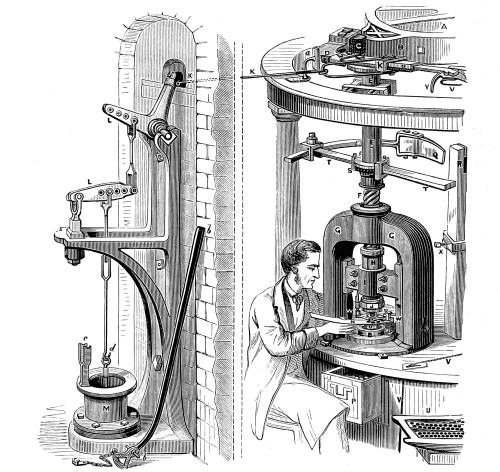
Fig. 13.—Cutting-out Press.
The fillets from which the blanks have been punched have the
appearance of ribbons perforated with round holes, and are now called
scissel (from the Latin scindo, to cut). These are
thrown into a tray, U, from which they are taken at intervals, and
bound up by strips of the same into bundles of 180 ounces—in the case
of silver 360 ounces—ready for re-melting. The cutting-out press is
set at liberty to start by the workman pressing his foot on a lever
in connection with the line and spring indicated by V; and so long as
he keeps this lever down, the press is worked continuously, but when
he releases it the spring catches the extreme end of D, and motion is
arrested. The blanks which accumulate in the box P are collected at
frequent intervals and examined, to see that their edges are smooth;
if they be ragged, as may happen from the wear or fracture of the edge
of either the cutter or bolster, a loss would be entailed in after
processes which would cause the coin to be outside the prescribed
limit, and to pass at an illegal weight into circulation, as the
rough edges would be removed after the weighing of the blanks had
been effected. According to the quality of the work—the character of
the gold—under operation, the trier tests more or less frequently
the variations of weight in a given number of blanks. This process is
called POUNDING, and is, next to the
trying, the most important of his duties; if such an expression
can be admitted, he has, by trying, fired his shot, and here
determines if he has hit the bull’s-eye, all depending on his own
unaided judgment. The gauge, Fig. 8, is found of great
service in detecting irregularities as to diameter and thickness, which would
not be, and are not, detected by weight, for the weight may remain equal,
although both diameter and thickness may vary. All these points require
considerable care on the part of those whose duty it is to attend to
them; for the quality of a coinage is determined in this room: blanks
which once leave it cannot be afterwards altered. The subsequent
operations, being purely mechanical, would be quite as well performed
by automaton machines.
The completing processes form undoubtedly the prettiest and most
interesting part of the operation of coining; nevertheless the
processes already described constitute its most essential features. The
blanks are weighed from this room in drafts of about 720 ounces, and
placed in bags; each bag, therefore, contains four journeys of
about 180 ounces each. The term journey is said to be derived
from an old French word, but circumstances render it probable that this
derivation has been applied by others than the original inventor of
the word, for it manifestly was not used by the coiner of it to imply
a “day’s work.” I cannot find an author who gives a time at which 720
ounces of silver became a journey, while 180 ounces of gold were also
called by the same name. It must have taken far longer to coin 720
ounces of shillings or groats than to coin 180 ounces of sovereigns or
half-sovereigns; hence the same word could never have been intended to
mean “a day’s work.” Be this as it may, it is time that such names gave
place to more appropriate and expressive terms. It is to be hoped that
500 ounces will become the standard maximum weight for bags of either
of the precious metals; such a system would be the means of reducing
the chance of error, it would have an actual meaning, and would be a
convenient weight for a man to lift to and from a scale-pan. When such
a measure shall be convenient to the officers of the Bank of England,
that institution will subserve the interests of the Mint by adopting it.
In a paper recently published by the Commissioners on the International
Coinage (at page 228) it is stated that “in the British
Mint 15 pounds troy of standard gold are coined into 701 sovereigns nearly
(15 lbs. = £700 17s. 6d.).” This statement does not exactly
convey the truth, and is calculated to mislead, because such an operation
is not, and never has been, conducted in the British Mint, where the
invariable rule is to abide rigidly by the law, and to coin 20 pounds
troy weight of standard gold into 934·50 sovereigns, as specified
in the Mint Indenture, now replaced by the Act of Parliament, 33
Vict., cap. 10. Of these sovereigns so coined, 701 are placed in a
bag, and called a journey; but by a Mint fiction the journey
was considered by the old moneyers, and yet more ancient weigher and
teller, 15 pounds troy exact, because the parts of an ounce were
difficult of addition; and this was maintained until 1860, when a
disputed weight with the Bank of England as to the value of the
deliveries corrected that which I had previously pointed out as an
error. It is now the custom to consider a journey as consisting of
180·03125 ounces, instead of, as it is, 180·03210 ounces, an error of
·00085, which has a money value of about 6s. 7½d. on each
delivery to the Bank.
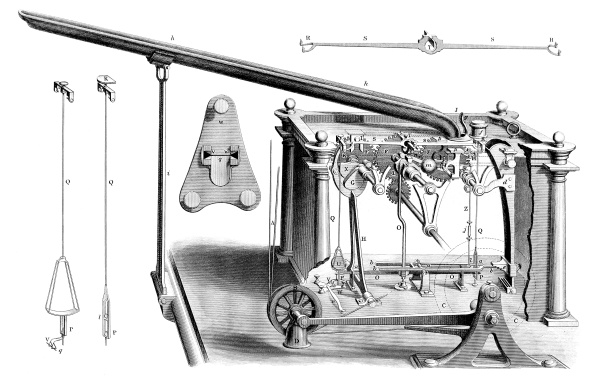
COTTON’S PATENT AUTOMATON BALANCE.
WITH PILCHER’S IMPROVEMENTS.
The bags of blanks should[24]
be carried forward to the room in which the weighing of the individual
blanks is effected by Mr. Cotton’s automaton weighing machines.
Mr. Cotton’s weighing machines form perhaps the most elegant and clever
invention of modern times. They effect the process of weighing far
more accurately than man can hope to do, and with extraordinary
accuracy determine the weight of about twenty-three blanks per minute.
Peculiarly admirable as are these machines, their perfection has been
greatly increased by improvements suggested by Mr. Richard Pilcher,
who has immediate charge of those in the Royal Mint. Mr. Pilcher,
whose inventive genius is only equalled by his desire to give to the
public the benefit of his inventions, has rendered these automaton
balances serviceable to the Mint; whereas, when they left the hand of
Mr. William Cotton, they were of great service to the Bank of England
alone, for there only two determinations, or in fact one determination
is necessary. In that institution it is required to show that the
coins issued by it are not below the legal weight for circulation,
whereas the Mint must guarantee that coins leave its works neither
above nor below the limits fixed by law: hence the necessity for the
incorporation of Mr. Pilcher’s improvements with Mr. Cotton’s beautiful
invention.
After reading the letter of Mr. James M. Napier in the Times of
September 2nd, 1869, I can but express my surprise that that gentleman
has not seen fit to acknowledge Mr. Pilcher’s modifications instead
of claiming for himself all the credit, when a part only—and that
undoubtedly an important one—is his due.
The steel engraving exhibits a view of Cotton’s
automaton machine as used in the Royal Mint, where seventeen such
machines are employed. For the purpose of illustration, the brass side
of the machine has, in imagination, been torn away, as also has the top
of the machine. To obtain the highly-finished drawing from which this
engraving was made was a matter of no ordinary difficulty, but it was
accomplished by the skill and assiduity of Mr. E. S. Gibson, to whom
my thanks are due, as well as to Mr. J. W. Lowry, for the pains he has
bestowed in executing the engraving.
The whole theory of this balance rests on the fact that the centre
of gravity and the centre of action are in one line: either being
disturbed, the balance is no longer equal. The machine gains its motion
from a shaft fixed to the ceiling of the room. Steam contained in a
boiler exists under an ever-varying pressure, arising from the amount
of work which it may be necessary for the engine to perform, or from
the irregular combustion of the fuel, as well as from other causes.
Since it is of the utmost importance that the automaton balance should
be made to maintain a uniform pace, Messrs. Napier and Sons found it
necessary to drive the shaft which gives it motion by a small
atmospheric engine, which is placed in the weighing room. It has
been found that a chamber may be kept equably exhausted of air, if
the atmosphere be admitted to it by a uniformly weighted valve. Such
a chamber—to be described presently—is used in the Mint for other
purposes, and Messrs. Napier conducted from this a pipe, by the agency
of which the atmospheric engine is worked with a far more even and
steady motion than could be obtained by steam; in fact, the exhausted
chamber becomes a regulated spring, which softens down the variations
in the motion of the steam-engine. The shaft supported by the ceiling
conveys its motion to the weighing machine by a line A, which, passing
over the friction wheels B, circulates round the stepped wheel C,
which runs loose on the shaft communicating with E. The line A is
maintained with sufficient rigidity by a weight D, which is suspended
at the end of the lever carrying the friction wheels B. The weight D
is just sufficient to insure the continuous working of the machine,
but is so light as to permit the line A to slip on C in the event of
anything going wrong in the works of the balance. When the machine is
to be set in motion, a kind of cheek is made—by screwing—to touch
the face of the wheel C, and thus, by friction, C gives motion to the
wheel E. This is an elegant mode of meeting a chance of accident, for
in the event of the weight D proving to be too heavy, any extra force
simply disconnects this cheek from the face of C, and so stops the
machine. The machine having been set in motion, E, by communication
with the wheels F, all of which are driven by it, causes the cam G
to push forward the lever H, which, terminating at I, pushes forward
the flattened continuation of I indicated by dotted lines, until it
moves a blank placed in the collar J, at the bottom of the hopper
h, on to the scale-pan K, which, for the sake of clearness, is
isolated, and will be seen behind the machine and under the extreme
end of the hopper. So soon as the blank coin has been placed on the
scale-pan K, the cam L lowers a lever n, the office of which is
to permit the opening of the forceps M, and thus to release the rod,
Q, dependent from K upon the knife-edge R. The forceps are closed by
the cam L, which raises n, and by it compresses an attached
spring. The forceps are intended to hold this rod Q while the
blank is placed on K, because the friction caused by the placing of the
blank would have a tendency to push K from the knife-edge on which it
is suspended, and thus blunt its delicate edge. While the forceps are
opened the cam N, by its partial revolution, lifts the rod O, which
is steadied in its motion, by a pin rising from it, and entering the
inverted arch o; its lower extremity working into a socket on
the table on which the whole frame of the machine stands.
Towards its lower extremity the rod O will be seen to branch out right
and left, until each end passes through a kind of step in the rods Q,
indicated by P. The office of this rod is to bring the beam, from which
the rods Q are dependent, to a dead level, as well as to release both
ends of the beam by one action. At the moment that the forceps M have
released the right hand rod Q, the cam N, by O, releases both the rods
Q, by rising from the steps P, thus permitting the beam to determine
the weight of the blank placed on K. A close inspection of the steel
engraving will show that the rods Q are suspended from and rest upon
the knife-edges R of the beam S, which has a centre knife-edge T, by
which the whole mass is supported and poised. The knife-edges are
made to find their own planes or resting-places upon curved or hollow
pieces of steel, thus securing the smallest point of contact with a
certainty of the smallest amount of friction. In ordinary balances the
substance to be weighed is placed in a pan, which is on the same level
as the pan which contains the counterpoise; but in Mr. Cotton’s balance
this condition is of no consequence, so that the counterpoise rests
ultimately upon a point which is at the same distance from the centre
of action as the point upon which the matter to be weighed rests.
The counterpoise U is placed in a kind of cage, and any variation
from this standard is at once indicated, even if it reach only to the
thousandth part of a grain. By law, the weight of a coin may vary to
a certain extent from a standard weight;[25]
the variation or latitude allowed is called remedy, from the
Latin ad remediam; and in weighing, this remedy is taken
advantage of by a contrivance much simplified by Mr. Pilcher. The
weight of a sovereign is 123·274 grains, but it may by law be either
123·474 grains, or it may fall to 123·074[26]
grains. Mr. Pilcher therefore reduced the counterpoise to the minimum
allowed, thus avoiding the placing of a remedy-wire for the light side;
and he then made the remedy-wire q (shown in the first enlarged
portion on the left-hand side of the steel engraving), which is placed
on the stand W, upon a peculiarly-formed point indicated by V, so heavy
that any blank which would not raise it and the counterpoise must be
within the remedy on the heavy side. In accordance with this
arrangement, the continuation of the rod Q is terminated by a cage at
V; so that if a blank be so light as to be unable to raise the
counterpoise U until the stirrup comes in contact with the remedy,
it is too light to make a legal coin. This fact being determined,
the motion of the machine causes the cam X to bring back the rod I
(indicated by dotted lines), that it may be ready when required to push
forward another blank, and the forceps M to grasp the rod Q, while the
cam Y permits the falling of the rod Z, which is nearly counterpoised
by the ball m (the precise length of the rod being regulated by
the screw j), until its finger a rests upon the indicator
b. The depth to which a shall fall is fixed by the step
l (shown by Q in the second enlarged portion of the steel
engraving). This is, of course, determined by the forceps, securing Q
at the position indicated by the weight of the blank. The indicating
finger b having come to rest, the continued motion of the
machine causes the cam c to permit the shoot d to fall
until one of its steps e comes into contact with the indicating
finger, when the lower part of the shoot must be exactly over, and form
part of, one of the tubes k, which terminate in boxes labelled
respectively “heavy,” “light,” “medium.” The shoot having taken its
position, the continued motion of the machine causes the cam G to
induce the placing of another blank on the scale-pan K, and this blank,
by advancing, pushes off the one just weighed, which, falling into and
through the shoot, passes to the compartment reserved for it. Suppose
the newly-placed blank to be too heavy for forming a legal coin, the
same operation goes on, but it now lifts not only the counterpoise,
but also causes the stirrup at V to lift the remedy-weight q.
This is a most delicate operation, for if a blow, however light, be
given, it would cause unsteadiness in the beam. Mr. Pilcher therefore
determined to make the carriage W, which supports the remedy-wire
q, stand upon micrometer screws, by which the remedy-wire is
made just to touch the stirrup, without pressure, while it also rests
upon the most minute points, formed by cutting away every part of V
which is not actually required—in fact, shelving it out. The scale-pan
K is protected from draught by the lantern f, while the blanks
are directed into the collar J by the guard g, as they slide
down the hopper h, which at its centre is supported by an
upright, i. The blocks p are the supports which hold all
the machinery to the roof of the machine.
Some new machines have recently been supplied to the Mint by Mr. James
Napier, but it is not certain that these are cheaper than the old ones.
That they are lower in price may be admitted, and they are certainly
more convenient in use, from the fact that the wheels shown at F are
placed at the back. It is, however, to be regretted that Mr. Napier
did not introduce into these new machines the recent inventions of Mr.
William Bradshaw, which are supremely simple, and, now that they are
effected, one cannot but wonder that so many minds having been engaged
on these machines, improvements such as these have not earlier seen the
light. To Mr. Bradshaw, particularly, great credit is due, for he was
obliged to overcome, not only innate difficulties, but difficulties of
position, and these latter were of no mean kind. It is to the credit of
the Mint authorities that they finally adopted these improvements, and
ordered the necessary alterations to be made in all the machines.
Mr. Bradshaw’s improvements enable the automaton balances to weigh 30
per cent. more coins in the same time; yet they permit each coin to
occupy a longer space of time in being weighed. This would appear to
be a mechanical contradiction, but if reference be made to the plate
it will be seen that the cam G pushes forward the lever H, which
ultimately, by the slide, pushes the blanks on to the scale-pan K. By
altering the shape of the cam G, Mr. Bradshaw causes it to do its work
more rapidly, and thus leaves the piece on K longer than before; but
that this time may not be lost, he alters also the shapes of the cam
L and of the cam N, so that the forceps M are opened, and the beam is
released more rapidly: thus the balance would be longer in action;
but to utilise the time ready to be saved, he alters also the driving
pulley E, causing the machine to make 30 per cent. more determinations
per minute, and that this may be effected with greater certainty he
reduced the depth of the step, shown at e, to just one-half,
so that the beam has to travel only half the distance it formerly
travelled to determine the position of the light, heavy, or medium
piece. He next proceeded to alter the rod O, because he observed
that it received a tilting motion arising from its being lifted by a
shoulder, as shown in the plate. To overcome this defect he made the
rod straight up to a certain point, where he divided it into a kind of
loop which passed over the cam N, which, as it revolves, lifts this rod
perpendicularly. He still found that the cam N had a tendency to push
this rod against its bearings, especially at o, so he placed a
spring of brass between the top of its loop and the cam N, and secured
at one end to p, and by this contrivance made the cam to lift
the brass, and that in its turn to raise the rod O. There was yet
another difficulty, caused by an occasional stoppage of the action of
the spring which softens the descent of the bearing of the rod O into
its lower socket; this he removed by cutting a hole in the side of the
socket, so that it can be seen at once if the spring be in action. I am
not one who approves his suggestions as to the remedy-wires. These may
be the means of saving time, but they are wrong in principle, and I do
not describe them.
Great inconvenience arose from the collection of dust, spangles of
bullion, and other foreign matter on parts of the balance. This Mr.
Bradshaw overcame by two simple contrivances; first, he pierced the
bottoms of the grooved trays, so that these substances might in a great
measure fall through while the blanks were being arranged in rouleaux,
thus separating the largest pieces, which, falling down the shoot,
would stop its action; and, secondly, he placed a glass shelf midway
between the table and the beam, that is, beneath the hopper h,
where it terminates at J, and above the beam S, where it is seen near
the forceps M, thus protecting the beam and forceps. These may appear
to be trifling alterations,—they are nevertheless to Cotton’s balance
what the compound metal balance-wheel is to a watch. Mr. Pilcher was
granted the magnificent sum of £40 for his invention of the
file (to be described), but it is hoped that Mr. Bradshaw will be
rewarded with a far more open-handed generosity; for if, by judicious
liberality, encouragements are offered to those in the Civil Service
to give to the country the benefit of their inventions, we may still
hope that even our Government institutions will bear comparison with
ordinary commercial manufactories as regards the development of
inventive genius. Nor is this a small matter, for all the working
improvements in the Cotton’s balance have been made by those whose
duty it is to attend to their working; yet I am not aware that any
acknowledgment, either direct or indirect, has been made to the
officers concerned. It is said that their salaries cover all their
time and energy. This may be true, but such a policy is not calculated
to result in many great steps towards perfecting either machines or
processes.
It is well to state that the beam in Mr. Cotton’s balance is 8·90
inches in length, and that its weight is 288·41 troy grains.
Those blanks which are neither too light nor too heavy are called
medium, and are weighed and put into bags for future issue
as coins. The light are reserved for the melting-pot. The
heavy blanks should be reduced by means of a peculiar kind of
file to the weight of medium blanks, and thus saved from being melted,
so avoiding further loss to the Mint. This file was invented by Mr.
Pilcher, who, being the officer of this room, considers his duty to be
neglected if there be any improvement capable of being made, but which
is left undone; he never tires till the invention is complete and the
machine made. Mr. Albert Barre, the distinguished engraver to the Paris
Mint, declares this file to have surmounted all the difficulties he
has met with in this part of the process. In his own words, “it leaves
the face of the blank untouched, and free to develop the work of the
engraver, which no other file does, or can effect, because any metal
which is ploughed out from the face of a blank, leaves a hole
which is not filled up in coining.”
The opinions which I have here expressed have so far prevailed on two
of the travellers to European Mints, as to induce them to glance,
though rather shyly, at the necessity for reducing heavy blanks; but
Mr. Napier writes a passage which I quote, as it demonstrates that he,
who is admittedly one of the most successfully ingenious men of the
age, has thought over and studied the words I wrote at page 60
of the last edition—he took that book in his hand to the Mint on the day
after its publication—with that attention to which he thought they
were entitled. I beg the reader to ponder over Mr. Napier’s words, they
are most important; but I hope those who will be called upon to vote
the necessary money will also read my remarks on this extract from Mr.
Napier’s report on European Mints. He says at page 44:—
“Treatment of Too-heavy Blanks.—Notwithstanding the
employment of the best mechanical appliances for rolling the bars,
adjusting the fillets to gauge, and cutting out the blanks, and the
most intelligent and painstaking workmen to carry on the operations,
still, owing to unavoidable imperfections in the means, the blanks,
when cut from the fillets, will not be found equal in weight, nor,
indeed, so nearly equal that they can be recognised as of equal
value, and passed on to be manufactured into coins destined to be
put into circulation, and to represent one value. The irregularities
will necessarily be more or less, according to the care and ability
of the workmen, and the condition of the machinery; but under the
most favourable circumstances only a certain proportion of the blanks
will be found to come within the limits which it has been considered
desirable to set down to restrict the quantity of error.
“This being so, the following questions present themselves: Are
the too-heavy and too-light blanks to be returned to the crucible and
remelted, or to be passed on and detected only in the finished coin,
and then sent to the crucible? Or are too-light blanks to be avoided
altogether, and all the blanks to be made either of sufficient weight
or too heavy? and in such case are the too-heavy blanks to be submitted
to some process for reducing their weight to within the legal limit? Or
is a more exact means to be preferred, by which they will be equalised
to that perfection which cannot practically be questioned, and by which
they will become, for all purposes, one and the same weight?
“The facts collected are, that at nearly all the European Mints the
reduction of too-heavy blanks, both of silver and gold, is practised,
to avoid the loss attendant upon their return to the crucible, and
that the endeavour is to make all the blanks either standard weight
or heavier, so as to admit of reduction, to err, indeed, on the
heavy side, even to the extent of necessitating the reduction of all
the blanks. So great is the importance generally attached to this
department, that it is calculated that, in some instances, nearly as
many hands are employed in the service of it, including the weighing,
as in all the other working departments combined. In Berlin, where
particular care is devoted to the weight of the coins, between 200
and 300 men are employed in times of pressure in the weighing and
equalising of the blanks, which operations are in this instance
performed by the workman with a hand shaving apparatus, fixed to the
table at which he sits, and a pair of scales also placed near to him.
The work done by one man is revised by a second, and the file is used
for giving the finishing touch, so that the blanks are brought to
great perfection in weight. But although the extent of the means shows
the great importance attached to the results in the establishments
visited, and the large expenditure which, at least in the opinion of
the directors of these Mints, may be permitted with profit in this
department, the serious consideration of the employment of so many
hands would militate against the carrying out of the system in the
New Mint. It may be satisfactory, therefore, to know that, in case
the desirability of an exact coinage should be entertained, means
for assuring it are at hand without the employment of manual labour
for the purpose. The subject has, indeed, for many years occupied
attention, and, after much labour and expense, the difficulties have
been overcome, and a machine has been constructed to the order of
the Government of India which fulfils all the required conditions
for equalising the coinage to that perfection that no appreciable
difference need exist between the standard weight and the coin blank
which has passed through the machine. This machine differs essentially
from those employed at the Mints visited, and which, it has been
explained, only take a fixed quantity off each blank presented to
the cutting tool, without reference to the weight of the blank, the
operation being repeated or not, according to the result; or, in other
words, no matter what be the weight of the blank, whether nearly light
enough, or much too heavy, the cutting tool of the machine treats all
in the same manner.
“The equalising machine referred to, on the contrary, not only takes
from the too-heavy blanks, each in succession, a quantity of their
surplus weight, but it ascertains how much it is necessary to take off
each blank to reduce it to the standard weight; and it deducts that
amount only; so, although the blanks which are supplied to the hopper,
or reservoir of the machine, enter the machine of unknown weight, they
are equalised by it in once passing through, and are delivered into a
receptacle for the finished work, all of one weight, the standard, or
so near to it that good ordinary scales, such as are used for weighing
blanks and coins, will not detect a difference.
“Means can therefore be provided for the purpose, should
it be decided to reduce the blanks to equal weight, or only
to within the pale of accuracy instituted by Parliament, the
basis of which legislation must be taken to have been the then
practicable approach to perfection; for it is to be presumed that,
with a sufficient assurance that accuracy akin to perfection
was attainable ALONG WITH
ECONOMY, the wisdom of Parliament
would have enacted accordingly.
“The first outlay for self-acting coin blank equalising machinery
WOULD NECESSARILY BE LARGE, but it is
believed at the same time that the saving would be considerable,
especially upon gold.
“The question of the amount of economy would have to be more fully
gone into, and the expense of the machinery accurately estimated.
Extensive and continuous experiments with the machine have also
STILL TO BE MADE TO ACQUIRE
A KNOWLEDGE OF ITS USE, and to ascertain, after
a lengthened probation, whether any modifications in the details
are advisable: the limited experiments already made leave no doubt,
however, of the successful result.
“The arguments in favour of an exact coinage chiefly
rest upon an economical basis, and branch out beyond the
walls of the establishment into questions of currency,
wear, and recoinage, which it is not thought necessary to
treat of here; at the same time it may be stated that it
seems desirable that the coinage should be made as exact to
weight as possible CONSISTENT WITH ECONOMY,
and that an exact coinage would be found more economical
as a circulating medium, would be more just, and a better
starting-point from which to legislate for the withdrawal from
circulation of worn coin than a coinage issued from the Mint with
acknowledged errors, or differences in weight so substantial as to be
represented in value, in the case of gold coins, by some of the lesser
denominations of the coins of the realm.”
The reasons which Mr. Napier gives are worthy of grave
consideration—they are mine wholly—except so far as regards those to
which I have drawn attention by printing them in small capital letters,
and which show that even with his vast experience he dare not answer
for the success of his machine, while the suggestion of the necessity
“to acquire a knowledge of its use” should make a desire to recur to a
successful machine paramount. If, indeed, I rested on my own opinion,
I should be content to see Mr. Napier’s machine tried, although I
think its failure would be established; but it so happens that I can
quote the opinion of the late Master of the Mint on the machine under
consideration, expressed at a period when the efficiently economical
conduct of the Royal Mint had received his utmost consideration. In his
letter to the Treasury, dated 7th June, 1860, he says:—
“I may be allowed to call to your
recollection that a Parliamentary grant of £1,100 was obtained by the
Mint in 1856 for the purchase of two automaton filing and adjusting
machines, which it was proposed to have constructed by Messrs. R.
Napier and Sons, the eminent engineers. No part of this grant has
been appropriated. The rapid amendment in the blanks which took place
immediately afterwards led me to suspend the order for these machines,
and ultimately to abandon the idea of any great expenditure for the
object contemplated. In the meantime also, a machine of a much more
simple character was contrived by Mr. R. Pilcher, of the weighing room,
and was constructed in the Mint, with no assistance from without.
Pilcher’s adjusting machine has proved sufficiently effective, costs
nothing for labour, and has now been in constant operation for two
years. The cost of making a pair of machines such as we now possess
is estimated at £60, a sum which was saved to the public by the mode
in which the work was executed. Trusting that the Lords Commissioners
of her Majesty’s Treasury will be disposed to consider favourably the
merit and practical value of such an invention, I venture to solicit
their Lordship’s sanction to the application of £60, the sum just
stated, to the benefit of the inventor, jointly with an ingenious
mechanic on the establishment, who gave material assistance in the
construction of the machine. I would propose the following awards,
if agreeable to their Lordships:—To Mr. R. Pilcher, £40; to Meredith
Jones, £20.”
It was upon advice tendered by myself that Mr. Graham thus excluded
the machine now recommended by Mr. Napier. I maintain that a simple
machine should be preferred before a complicated one, and the Mint
authorities should give Mr. Pilcher’s £60 machines—admittedly perfect
in operation—a fair trial against Mr. Napier’s £1,100 machines, and
see if they prove equally effective. If, on the other hand, Mr.
Napier’s fails, then it is but fair to the public that that machine
which is undoubtedly a success, and for which the inventor has been
publicly rewarded, although in a most inadequate manner, should
be used.
The machine thus spoken of was used with the utmost advantage until
1866, when its use was abolished by the advice of Mr. John Graham, who
subsequently, in 1868, broke it to pieces that his improvements
might be rendered permanent, thus causing an expense of 50 per cent. on
the total cost of manufacture for rejected coins,[27]
because the use of the file having been abolished, the coined money
alone was weighed, thus rendering it impossible to reduce the heavy pieces.
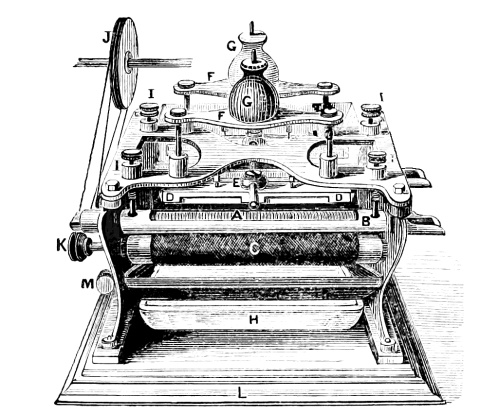
Fig. 14.—Pilcher’s Filing Machine.
Although the use of this file has thus been stopped, it is greatly to
be hoped that it will again be employed, and thus enable the Government
to produce coined money at the cheapest possible[28]
rate, because it enables the Mint authorities to obtain the
largest per-centage from the bars. Feeling that this much-desired
re-introduction will take place, it is thought wise to give the
following description of Pilcher’s file, which, if not desired
for the benefit of our own Mint, will be adopted by other coining
countries:—Fig. 14 is a representation of this
compact machine. The blanks A are placed in rouleaux in a tube B,
which is open at top and at bottom; through the opening at the bottom
the blanks rest their EDGES on the
file C, which, as it revolves about 1,000 times per minute, files
off metal from the edge of the blank. Each machine has two tubes,
and when both have been filled the rod D, which carries a triangular
knife-edge, is released by the lever E, and the knife-edge resting
upon the upper edge of the blanks A,—with the intention of offering
resistance to their rotary motion,—enables the operator to remove
MUCH OR LITTLE metal from their edges at
pleasure by increasing the resistance which D offers by adding a weight
G on to the gallery F. H is a glass dish into which the dust, as it is
removed from the edges of the blanks, falls, thus insuring a perfect
separation of the dust from the blanks. The blanks in B are kept
in their position by small blocks of ebony, which are secured by the
thumb-screws I. Motion is given by the wheel J, which communicates with
the pulley K by a cord or catgut. The whole machine stands on a block
of mahogany L, secured to a table of oak. M is a screw which is used to
tighten the cords between J and K. Between C and H is a hopper of brass
to catch flying particles of the precious metals. Each file reduces 250
sovereign blanks per minute.
The objections which were raised to the introduction and use of this
machine were curious, and amongst others it was firmly maintained that
it caused the coining press to make brockages, because the blanks which
had been filed were smaller than those which had not been thus treated.
The amusing part of this objection was that all the blanks were
afterwards reduced to a uniform diameter by the edges being compressed
before being coined.
The medium blanks—now unfortunately the coined moneys—are rung by
boys to detect any which may be dumb or cracked, and which are rejected
for melting. Dumb or cracked pieces arise when bubbles of air are
enclosed in the bars at the time of pouring the fluid metal into the
moulds in the melting-house.
Besides this source of dumb work may be mentioned another of large
occurrence in silver, and occasionally met with in gold, which results
from an imperfect mixture of the alloy at the time of melting, and
developes itself at the draw-bench, where whole fillets, of six feet
long, may be seen to separate into two complete layers of metal, the
inner surfaces being coated with a thin film of copper, frequently
quite pure, but sometimes in the form of suboxide. It would thus appear
that a globule of copper becomes enveloped in a volume of fluid gold
or silver, and, in the act of pouring, this globule is drawn out into
a kind of wire, perhaps extending some inches in length, enclosed in
precious metal. When this is rolled it is all flattened together, but
there is no adhesion between the surfaces, so that when the fillet
passes through the draw-bench the lateral motion given to the atoms
of the metal causes the slip which finally separates the two surfaces
of metal, and the eye at once detects the existence of the fault. In
the coinage of 1857, no less than 141·38 ounces of gold fillets thus
imperfect were returned to the melter in one day, and on the whole of
that coinage these fillets averaged nearly 0·50 per cent. (see page
92). In the case of silver this defect is of less consequence, but
of greater occurrence. It is the duty of the melter to see that such
bars are neither produced nor forwarded, and there can be but little
doubt that in a properly conducted Mint the melter would be directed to
re-melt such fillets without payment to the men.
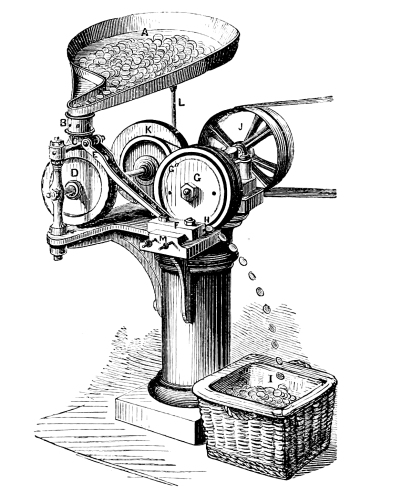
Fig. 15.—Jones’s Edge-Compressor.
The medium blanks which would now be fit for coining should be
weighed up in bags of about 500 ounces, instead of 180 ounces, as
is the custom, and sent forward to the room in which is placed
a machine which has to diminish the diameter of each blank by
compressing its edges. This is called a marking machine, but
such a name being obviously improper, it is preferred to call it the
EDGE-COMPRESSOR. Up to 1861 the best machine
for this purpose was that invented and patented by Messrs. R. Heaton and Sons,
of the Mint, Birmingham; but in the early part of 1858 the subject of the
varying diameter of blanks came under consideration as effecting the
production of brockage. Mr. Pilcher was consulted by me, and proposed a
machine, of which he gave the outline, which I submitted to the Master
of the Mint on the 31st of March, 1858. This machine was to be fed from
the top, but was abandoned because it did not meet the desired minimum
of 1,000 pieces per minute. Mr. Pilcher therefore proposed to erect on
the same spindle five revolving discs, and to face these five discs
with as many cheeks. At a given time it was determined to manufacture
a marking machine, and one of five which Mr. Pilcher proposed was
to be made. It was preferred to ask Mr. Meredith Jones to assist in
its manufacture. Mr. Jones had also a design for a machine for this
purpose, and it was arranged that as Mr. Jones made Mr. Pilcher’s file
he should make his own machine. Mr. Jones proposed, and Mr. Pilcher
accepted, the following proposition. Mr. Pilcher was to retire from
the machine, and in consideration of his so retiring, and allowing the
machine to be called Jones’s marking machine, Mr. Jones was to give
Mr. Pilcher one-half of whatever sum might be paid by the Mint for the
use of the machine. Fig. 15 represents Mr. Jones’s machine.
The blanks are placed in the hopper A, and fall by an incline into a tube B until
they rest at C, on a notched wheel D. As D revolves each of its notches
carries away the bottom blank of the pile from the tube B, and leaves
it to slide down the tube E till it reaches the block F. The block F is
cut with a narrow groove, which exactly corresponds with the groove Gᵃ
on the plate or disc G. The disc G revolves, and as the blank slides
down and comes with some little impetus against the groove in the block
F, the groove Gᵃ catches it, and causes it to take two revolutions
between the disc G and the block F, finally permitting its escape at H,
when it falls into I, being now reduced in diameter and thicker on the
edge, but its centre remaining as it was before. The machine is driven
by J, the shaft of which carries a reduced rigger for the driving of
K. The hopper is supported by the rod L. The distance between F and
G represents the diameter of the blank after its edge is compressed,
this distance being determined by the screws seen at M. Blanks of all
diameters may be compressed at this machine if the block F and the
plate or disc G be removed and replaced by others, neither operation
taking many minutes. The edges of the blanks are compressed at the rate
of 700 per minute. A boy of fourteen could work this perfectly well,
and with more convenience now that the hopper is replaced by such a one
as is used to supply Mr. Cotton’s weighing machine. The edge of the
blank is compressed with a view to prepare it for the crenating
to be given by the collar in the after process of conversion into a coin.
The blanks are conveyed from the edge-compressor to the annealing room,
where they are placed in rouleaux in iron boxes, the tops of which are
luted on with clay, the boxes are then placed on iron carriages, and
run into reverberatory furnaces, heated by Juckse’s smoke-consuming
apparatus, where they remain for an indefinite period. The furnaces are
like that represented in the rolling room for annealing the fillets in
copper tubes. To anneal the blanks, the temperature should be raised
rapidly until the boxes attain a full red heat; and the time allowed
for the operation should be from twenty to twenty-five minutes at the
utmost. After the heating, the boxes are withdrawn from the furnace
and placed on the floor of the room, till the blanks are assumed to
have become of a low red or black heat, the point below that at which
copper combines rapidly with oxygen; they are then opened. If the boxes
be opened while the blanks are still of a full red heat, there is what
is called too much loss by annealing, or, in other words, too much
of the copper has become oxidised, and thus rendered soluble in the
dilute sulphuric acid into which they are presently removed. The box
having been opened, the blanks are turned out into a copper tray, and
on this carried to a cistern of cold water, in which a colander stands;
they are thrown through the water into this colander, and thus cooled
rapidly. When cool, they are taken in the colander to a leaden cistern
of nearly boiling dilute sulphuric acid, into which they are placed,
and allowed to remain for about three or four minutes. By means of this
bath of sulphuric acid a thin skin of oxide of copper is removed; the
gold on the surface from which the copper has been washed out is of a
sponge-like form, and gives a beautiful bloom to the new coin when it
is struck. This process is called blanching, and is of great
interest to the coiner, as it is here that his loss by coining takes
place. The bars of gold sent to the coiner are found to be standard
within certain limits,[29]
therefore the blanks produced from those bars must be of the same
fineness; but by this process of blanching, copper is removed; hence
the standard, or the amount of pure gold contained in the blanks, is
proportionably raised, and this tells on the million to an amazing
extent. When the annealing is conducted for too long a period, the
copper becomes oxidised to too great an extent during the time of
annealing, for there is no atmosphere more capable of oxidising than
is that of one of these furnaces; it is for this reason that the heat
should be gained rapidly, before that oxidising atmosphere shall have
time to permeate the luting and attack the copper of the standard gold.
At the trial of the pyx in 1861 the gold coined by Mr. Thomas Graham,
the late Master, was found to be “4 grains on the pound too fine;”
that is to say, containing in 5,760 grains 5,284 grains of pure gold
in the place of 5,280 grains, which it should have contained. This is
well for the people, but it is bad for the Master of the Mint, because
he has lost 4 grains of pure gold on each pound that he has coined,
which amounts to no less than £757·65870 in value upon every million
of sovereigns. This loss may well be avoided, either by adding extra
alloy to allow for this removal of copper, or, as would be far wiser,
by abolishing the process of annealing the blanks, as was done in 1859,
when more than a quarter of a million of sovereigns were coined from
unannealed blanks obtained from brittle gold which was much harder than
any ordinary gold to be met with. It must be remembered that the saving
of bullion would leave a large margin for the increased destruction of
dies, and in addition the coin would wear longer in circulation.
By his elaborate experiments Mr. Charles Hatchett proved not only
that the British standard gold was the best alloy for coins, but that
this alloy should be so manipulated as to avoid either the extreme of
ductility or of hardness, and when this medium was attained the coins
produced wore longer and better than any others.
It will be of importance in this place to consider the question of
annealing the blanks previously to coining them, and experience teaches
that this process should be omitted. The gold alluded to as coined in
1859 from unannealed blanks was the same gold that was spoken of as
being so toughened in the form of bars when the fluid metal had been
poured through a stream of coal gas.[30]
The gold contained antimony, arsenic, and lead, so was predisposed to
become brittle; but by pouring through the air it absorbed oxygen,
and became certainly the most brittle gold that has passed through my
hands. It was toughened by reducing the oxide of copper, and worked
remarkably well, producing the most workable fillets, regular and
uniform blanks, which yielded an average of 5·67 per cent. rejected.
The blanks were tough, soft, and very malleable, capable of being cut
with a chisel without fracture, and ringing musically on an iron block,
thus satisfying all the requirements of good coining gold; but directly
these blanks were annealed they showed 30 per cent. of pieces so
brittle that they could be broken by a moderate pressure of the finger
and thumb. After coining, the whole mass became so brittle that less
than 2 per cent. remained sound after twice ringing on an iron block,
as is the usual practice. These brittle coins, when again annealed, and
suddenly cooled by plunging into cold water, became tolerably tough,
and withstood ringing to 8 times, when they again became brittle. It
now became evident that none of this gold should be issued to the
public,—indeed, I may state that this same gold had been rejected by
all the coining countries as unfit for coin. It was therefore ordered
to be melted and returned to the Bank as unfit for coin, its value
being £167,539. After every possible obstacle had been placed in the
way, I overcame the aversion to change, obtained permission to try
some experiments on this gold, rewrought it, and coined it all without
annealing. The coin thus produced was so tough that an ordinary man
could not break a sovereign even by the aid of a pair of pliers.[31]
Yet when these toughened coins were annealed, they became so brittle
that a child could break them readily. In the Royal Mint some of these
coins in each state are preserved. Mr. Graham, then ever anxious
to secure to the Mint any advantage, was pleased to address to the
Treasury a letter on the subject of this gold, in which he said, “A
correspondence between the Governor of the Bank and myself on the
brittle property of the gold occasionally imported into the Mint to be
coined was formerly brought under your notice in my letter of the 21st
March, 1857. The evidence of the evil in question was not confined to
the Royal Mint, but has, I believe, been felt at all other mints, and
also by goldsmiths generally, since the recent gold discoveries. It was
traced to the presence in the gold of a minute portion of antimony or
arsenic (often not greater in quantity than one-tenth of a per cent.),
which escapes the observation of the assayers. But no remedy in dealing
with such gold then presented itself, except the expensive one of
having the brittle gold refined.
“An unusually large proportion of the gold received for coining
last year was of this defective character, but the whole of it was
successfully coined notwithstanding, and no part returned to the Bank
to be refined, as on former occasions.
“This improvement in the practice of the coining department is the
result of a laborious investigation made in the coining department, of
which I am happy to assign the chief merit to Mr. Ansell.
“It now appears that the antimony or arsenic acts injuriously when
the gold blanks are allowed to cool gradually, but not when cooled
suddenly, after annealing, the gold appearing to have time to
crystallise and become granular under the influence of the antimony
particles in the one case, but not in the other. The improvement may be
justly represented as one of considerable value. It saves entirely much
extra labour hitherto applied to brittle gold without any beneficial
result. It will also lead to the diminution of waste, of which brittle
gold was always a fruitful source.”[32]
I do not accept the conclusion arrived at by Mr. Graham, for my
experiments showed clearly that this peculiar gold could not be heated
even to a black heat after coining without becoming absolutely brittle
under all circumstances. Notwithstanding the experience gained by
the coining of this brittle gold, the annealing of coined money was
effected by the present authorities at the Royal Mint in 1868, when
a vast amount of brittle gold was coined, of which considerably more
than half a million sterling in coined pieces were annealed and plunged
into cold water, just as was done in 1859, and with precisely similar
effects; that is, the production of brittle pieces, as soft as lead
and perfectly rotten. These pieces were sent to the Bank of England,
where they have given great dissatisfaction. They should have been
melted, as were those of 1859. I, being an officer of the Mint at the
time, offered to coin this gold as I had coined that in 1859; my offer
was declined, and a vast mass of very brittle coin was, in addition
to that of which I have spoken as having been annealed after coining,
issued to the public, besides many thousands of ounces uncoined having
been returned to the Bank of England by the Mint authorities, who found
themselves unable to coin it; these facts being, as I think, little to
the credit of the official ability.
The Right Honourable Lord Kinnaird, with a view to relieve the Mint
authorities, suggested, on the 22nd of March last, from his place in
the House of Lords, a proviso “that such gold”—specified in clause 8
of the Coinage Bill then under discussion—“should be free from lead,
antimony, and other substances, so as to admit of its being coined
without previous refining.” The Government promised to consider this
suggestion, and, after consideration, rejected it, although the right
thus proposed to be established has always been claimed by the Mint but
disputed by the Bank of England. His lordship then drew the attention
of the House of Lords to the issue of the brittle sovereigns, to
which I have alluded, as having given so much dissatisfaction at the
Bank, and on the 25th of March, the following letter appeared in the
Times:—
“THE COINAGE BILL DEBATE.
“To the Editor of the Times.
“Sir,—In your full and very correct
report of what I stated in the House last night on the Coinage
Bill, there is an error which I think must have occurred in the
printing—‘sweat’ should be ‘sweep.’ I think what I said in regard to
the £640,000 sent by the Mint to the Bank would have been clearer if
I had added—‘Its brittleness was increased by being annealed after
coining.’
“Your obedient servant,
“Kinnaird.
“50, Avenue Road, Regent’s Park,
“March 23rd.”
Attention being thus forcibly drawn to a great evil, the Marquess of
Lansdowne, in reply to Lord Kinnaird’s remarks on the appointment of
Mr. Roberts, stated that “Mr. Roberts was a very eminent chemist, who
had proved his capabilities by devising a system for depriving gold of
the obnoxious properties on which the noble lord recently commented.”
Lord Kinnaird has already pointed out that this process, which the
eminent Mr. Roberts has “devised,” was discovered by Dr. Percy, and
that the process was published by that gentleman so long since as 1848.
Dr. Percy conceived the elegant idea that if a stream of chlorine gas
were passed over an ore containing gold, the chlorine would combine
with the gold and dissolve it out from its matrix, as water would do
sugar. This it does with complete success, forming a chloride of gold
which is readily soluble in water, and from which it can be obtained
with the utmost ease.
With regard to the invention of the process for which Lord Lansdowne
gave Mr. Roberts credit, the facts of the case stand as follows. Dr.
Percy discovered that by means of chlorine gas he could separate gold
from its ores. He described his invention in the Transactions of the
British Association in 1848, and in the Philosophical Transactions
in 1850. Plattner carried it out practically about 1852 in Silesia,
and I, in January, 1856, conducted a long series of experiments upon
it for the Chancellorsville Gold Mining Company. The exact process
now proposed or “devised” by Mr. Roberts was patented by Mr. Miller,
the present assayer to the Sydney Mint, in 1867—No. 1767. When Lord
Lansdowne finds himself thus deceived, he will probably in future think
it necessary to examine statements suggested to him before making them
from his place in the House of Lords.
This new process consists in forcing chlorine gas through melted
gold, and it is assumed that the chlorine will carry off the silver,
lead, antimony, tin, and arsenic, which render the gold brittle. On the
face of the proposition, there are very grave reasons for believing
that it will fail if tried. This also is the deliberate opinion of the
most eminent metallurgical chemist of this or any other time; indeed,
it has been tried and found a failure. It has failed of its object, and
instead, attacks the gold, which, with the chlorine, will leave the
melting-pot and pass into the chimney, creating a use for the proposed
chimney chambers of Mr. Roberts.
Experience at the Mint is to the effect that the run of gold ingots
produced by the melting of worn and light coins culled from those in
circulation is found to be worse than standard by 1-500th, or two in
each thousand parts. There can be no doubt but that this is mainly
due to the fact of the loss of copper by the processes of annealing
and blanching. In actual practice extending over many millions, it is
found that 1,000,000 sovereign blanks lose 5,708 grains of copper:
now, since this copper is removed from the surface, it leaves a
sponge of pure gold coating that surface. Pure gold is very soft, and
rapidly wears away, so that when the coins from which 5,708 grains of
copper have been taken go into circulation, this film of gold, which
amounts to £555·62 on each million pieces, is removed by friction.
It will probably be argued that the copper being taken first and the
gold afterwards, leaves the coin of the same standard as the original
bars;[33]
if, however, this proposition be examined, it will be seen
that the bars are assayed and found to be below standard 0·55562 on the
thousand coins; but the blanks obtained from the bars are, by annealing
and blanching,[34]
brought to standard before they are coined, and those coins assayed
WHILE NEW are found to be standard by the
jury of goldsmiths at the trial of the pyx, because they retain this
film of gold; let them, however, go into circulation and lose their
film of gold, and they will be reduced to the original composition of
the bar; that is, worse than standard 0·55562 in the 1,000. The trial of
the pyx[35]
is supposed to be a great protection to the people against
deterioration of the coinage. This opinion is not entertained by those
who have witnessed the whole operation, for then it is manifest that
the copper is sufficiently oxidised while melting to insure the alloy
containing enough gold to enable the jury to find it “Fine, 4 grains
on the pound,” or any other degree of fineness. There can be no doubt
that the jury should be composed of men knowing something practically
of assaying, and who would not hesitate to publish every detail of the
process adopted, stating specifically the amount of loss incurred by
melting the ingot produced from the selected coins. That the jury is
composed of honourable men—goldsmiths—is beyond doubt; but that these
goldsmiths should know how to assay is also an important matter, and
should be a sine quâ non. It would be well if some independent
member would move the House for a return of the assays by the Mint of
ingots produced from worn and light coin received from the Bank of England.
Having thus specifically stated in my previous editions the facts as
they exist of our coinage, I waited a refutation of my statement.
I was informed that the Bank of England had made careful assays,
and proved that the worn gold coin was not below the standard of
fineness. I was also informed that bullion merchants in London had
obtained newly-coined sovereigns, and by means of a scratch-brush had
removed the film of pure gold of which I spoke, and upon a re-assay
no difference had been detected. My reply was, and continues to be,
the assays were either made by bunglers or were carelessly made, while
with regard to the statement related for the Bank of England, I
simply refused credence because in my own knowledge that Institution
has been greatly puzzled for years as to the reason of the lower assay,
and it was myself who pointed out the cause to Mr. Thomas Graham on the
4th January, 1860. That gentleman mentioned my suggestion to the then
chief cashier, who preferred to think “it was due to the base coins
which found their way into the Bank.” I said then as I think now—“I
believe the officers of the Bank of England are far too sharp to take
one base coin in five hundred.” This reply settled the discussion.
That the light and worn coin is habitually below the standard is
conclusively proved by the fact that if any man should take, as the
great Duke of Wellington did, a thousand sovereigns to a jeweller’s to
be made into plate—and his Grace took coined money that he might be
sure to have plate of the fineness of 22 carats, or standard gold—he
would find, as the duke found to his cost, the plate “cut” at the
Goldsmiths’ Hall as being below standard. That the case still exists is
so well acknowledged by jewellers that they invariably add “fine gold”
when they melt coin for plate which is to be stamped with the Hall mark.
“Monetarius,” who wrote to the Times from Malvern—where,
singularly, Mr. Thomas Graham was then residing—and Sir John Herschel,
quoted in their letters to the Times the report of a Belgian
chemist to prove that our coinage is invariably standard. Such
authorities seemed to quiet public opinion; but Lord Kinnaird moved on
two occasions in the House of Lords for the “Returns of assays by the
Mint of ingots produced from worn and light coin received at the Mint
from the Bank of England.” The Government firmly refused these returns
on the alleged ground that they were “too bulky;” Lord Kinnaird,
however, explained the true cause of the refusal when he said that
these returns would conclusively prove that the gold coinage, when
worn, is habitually below the standard, as is also shown by Mr. Ernest
Seyd in his letter of the 20th, inserted in the Times of the
21st August, 1869:—
“... The British public are under the
impression that English sovereigns stand highest as far as correctness
in quality is concerned. In reality, the British gold coin falls much
more below its standard fineness than French, American, and Russian
coin.... But the best proof of the greater inferiority of the British
gold coin is given by the action of the Bank of England. The Bank of
England cuts light gold coin, and so renders it unfit for further
circulation. The holder of such coin thus loses, in the first place,
the value of the gold worn away by abrasion, and the cut sovereigns
are handed back to him as being now only bullion (the loss so far
amounts to from 1d. to 4d. per sovereign); the bullion
now remaining is the metal of which the coin had been made, presumably
at the rate of 77s. 10½d. per ounce, and worth that much,
or, at the Bank rate for buying gold, at least 77s. 9d.
per ounce. Yet the Bank of England will not give more than 77s.
6½d. for it. Worth at Mint price, 934½d., the Bank pays
but 930½d. per ounce—a deduction of 0·43 per cent.”
I need not express an opinion upon such a case so stated;
but I can quote one of far higher value, for Mr. J. G. Hubbard, who
is a profound authority, says, in his letter in the Times of
September 4th, 1869:—
“This inaccuracy of our Mint assays was
pointed out by Mr. Seyd in his intelligent and well-informed letter
of the 20th ult., and I can corroborate his observations by my own
experience of sovereigns sent to Russia, where the Mint, more exact
than our own, ranked sovereigns at fully ⅛ carat grain worse than
standard.”
Let us now see what steps are taken by the authorities, and then judge
of their motive for introducing a reform so greatly needed, and which
would never have been attacked had not I unceasingly urged it since
1860. In his Report on European Mints, Mr. C. W. Fremantle says:—
“I have therefore received with much
satisfaction the expression of Mr. Roberts’s opinion that the process
of blanching may, as far as gold coin is concerned, be discontinued
without detriment to the appearance of the coin. It is this
process which leads to the deterioration of standard found to exist
in gold which has been for some length of time in circulation,
and in consequence of their Lordships’ decision that
light gold coin shall for the future be received
back by the Mint for recoinage, the
question becomes at this moment one of PECULIAR IMPORTANCE.”
I have emphasized some of the passages as showing that this decision
is very like that of the unjust judge—not so much from conviction of
right as from the necessity of the case. I do not charge the Mint with
yielding to importunity; but being made to bear the loss, they are
willing to amend that which they now openly admit to have been
a wrong. Why is the opinion of Mr. Roberts quoted? why not some of the
great officials at the Mint? Silence on this head is significant. Mr.
Roberts will hardly desire to claim a discovery which he found in my
last book, for he, too, bought one of the first copies which were sold.
That I may not appear to be claiming that which is not my own, I quote
the words from Mr. Roberts’s report:—
“It is evident that bars slightly below
standard may be allowed to pass to the subsequent operations of
coining, on the assumption, justified by calculation, that the
blanching would be attended with a sufficient elevation of standard to
bring the coins within the limits of fineness prescribed by law. The
film of soft pure metal, however, is removed by wear; and
the coins, when remelted, will consequently be found to be below
standard fineness.
“This is a question of some importance
NOW that the Mint has undertaken the operation
of re-coining light pieces, and I would recommend, therefore, that the
process of blanching gold coin should be altogether abolished.”
The italics are my own, and if the words so pointed out be read with
reference to those I have persistently used, there can be but one
conclusion, Mr. Roberts having had but a few months’ experience in the
Mint, notwithstanding Mr. Fremantle’s reliance on his judgment.
As regards the trial of the pyx, useless and mischievously deceptive as
it is shown to be, the Act of Parliament, 33 Victoria, cap. 10, makes
it imperative to give this excuse for a dinner at the Goldsmiths’ Hall
at least once a year. Had the Government assented to the proposition of
Lord Kinnaird, and nominated the Professor of Metallurgy for the time
being in the Royal School of Mines, one of their own officers, and who
at present is the most distinguished of metallurgists, foreman of the
jury, the country could have relied upon the verdict now given honestly
enough; but upon inadequate knowledge, indeed, if the reader will refer
to pages 10-12, it will become clear that so delicate
a process as assaying should be watched by those who can appreciate its
refinements, or its results can possess no judicial value.
I attended the trial of the pyx, which was held on the 17th July,
1860, with an especial view to, and an avowed intention of, publishing
details of the operation. With a desire to further this object Mr. W.
H. Barton, the then Deputy-Master, gave me the following particulars,
and I, for myself, observed that the coin when melted was placed in
an open crucible, without flux, and for part of the time without a
cover: the ingot produced was of a GOOD BLACK
colour from the oxidation of the copper. The objections to such a
melting can hardly be exaggerated, and I am of opinion that however
fairly selected—and they were honestly taken—1·310 ounces is not
a sufficient bulk on which to form an opinion as to the purity of
£24,654,849 of gold coin.
Coined
Money. |
Name of Master when
Coin was Pyxed. |
Value of the
Coined Money
Pyxed. |
Weight of
Pieces taken
from the
Coined Money
for the Pyx. |
| |
|
£ |
s. |
d. |
Ounces. |
| Gold |
Sir J. F. W. Herschel, Bart. |
2,977,190 |
12 |
2 |
1052·200 |
| Thomas Graham, Esq. |
24,654,849 |
0 |
9¼ |
8300·087 |
| Silver |
Sir J. F. W. Herschel, Bart. |
100,450 |
7 |
0 |
121·899 |
| Thomas Graham, Esq. |
2,331,666 |
19 |
6 |
2811·543 |
Coined
Money. |
Name of Master when
Coin was Pyxed. |
Weight of
Coins taken
to melt into
an Ingot for
the Assay. |
Loss by
Melting to
obtain the
Ingot. |
Weight of
Bullion
actually
taken from
the Ingot for
the Assay. |
| |
|
Ounces. |
Ounces. |
Ounces. |
| Gold |
Sir J. F. W. Herschel, Bart. |
9·116 |
0·020 |
0·766 |
| Thomas Graham, Esq. |
51·500 |
0·077 |
1·310 |
| Silver |
Sir J. F. W. Herschel, Bart. |
3·137 |
0·046 |
1·287 |
| Thomas Graham, Esq. |
67·881 |
0·652 |
1·781 |
The authorities of the Mint, having assented to part of my proposition,
have yet stopped half way, and blindly considering that the blanching
alone was the cause of loss to and fictitious value of the
coinage, they will find that their loss is greater now than it was when
they unwisely permitted blanching. I do not point out to them the reason
why—that is now their business; but I confess that I am a little
amazed at Mr. Roberts’s recommendation—one that was given up by the
moneyers before he was born, yet now gravely made by that gentleman in
these words, “I should prefer that in order to prevent needless wear
to the dies, the blanks should be annealed, after every trace of oil
has been removed by washing with the aid of alkali, the utmost care
being taken to avoid oxidation by exposure to air.” One seems to see
Mr. Roberts in the presence of men who would dwell on his instructions
as would a soldier on those of his general, directing the filling of a
copper tube with gold blanks, previously divested of “oil by alkali,”
so as to leave a film of lime soap neatly protecting their surface, and
covering them with powdered charcoal. The tube so filled will be duly
placed in the furnace, duly heated, and duly plunged into the cistern
of cold water by the foreman, who, having taken an insurance ticket
from the Accidental Death Company, feels quite safe, when, suddenly,
a mass of copper and some pounds weight of gold blanks occupy the
space from which it is hoped his head may have retired in time. Quite
seriously, I have seen the cap of a tube blown suddenly off, and the
blanks projected from the tube so plunged into water—from the same
cause that bursts a kitchen boiler when cold water is admitted to one
already red hot—with such violence as would certainly kill a man if he
chanced to be in the line of fire. Do they not at the Mint understand
the true cause of loss? An officer who tells his men to “go and do,”
is not so likely to effect his object as if he were to show them “how
to do” the work required of them; neither “bullying” nor making the
men pay for losses will stop those losses of bullion. Knowledge alone
is power. Knowledge alone can direct. Knowledge alone is required in
the Royal Mint. There are plenty of men there who are most desirous to
carry out any instructions; but, if the bugle give an uncertain sound,
who can obey?
The effect of the annealing having been thus dwelt upon and explained,
I will continue the description of the subsequent operations, stating
what was formerly done and what had better be recurred to till
experience is gained by those who are entrusted with the management of
the Mint. After about three minutes’ boiling in dilute sulphuric acid,
the blanks in their colander were washed under a stream of cold water,
to remove the sulphate of copper and the sulphuric acid from their
surfaces, otherwise these substances would deface the dies used for
coining, as well as give the coin a dirty appearance. From the washing
they were taken to a sieve of sawdust, A, Fig. 16, into
which they were thrown to be dried by friction with the hand. A revolving drum
of brass lined with wood has lately been introduced for this purpose.
The objections to this form of apparatus appear to be that the blanks
get hardened by blows, through falling against each other, lose more
in weight, and become indented on the surface, thus producing a less
perfect coin. It had been wiser to have introduced a sieve with an
eccentric motion, which, if filled with sawdust, would shake that dust
between the blanks and dry each one perfectly, when, by the removal
of a false bottom, the sawdust could be allowed to sift itself from
the blanks by one or two turns of the sieve, and the latter would be
as soft as they invariably were before the introduction of the brass
drum. This would be a matter of importance if, as is to be hoped,
the authorities are induced to abolish the process of annealing and
blanching, for then it would still be necessary to remove the film
of oil which is left on the blanks in the cutting-out process, and
this could be done more quickly and effectively in the proposed sieve
than by any other process. The sawdust absorbs the water from
the surface of the blanks just as would a piece of sponge; but the
surface is not all, for it is found that by the removal of the copper
the gold on the face of the blank has been brought almost into the
condition known as frosted; it is, in fact, to a small extent,
honey-combed. The gold represents the comb, and the copper the honey,
but as the copper is removed, water takes its place, and has to be
dislodged from these interstices by heat. The blanks, having been
partially dried in the sieve A, are put into the tray B, and from this
they were shot into the colander oven C, which was closed, and then
thrust into the heated chamber D, and twisted gently round and round
at intervals during ten minutes. The blanks were then turned out into
a sieve E, by which any particles of dust were separated; the blanks
were finally, by the aid of the tray B, placed in a bag. The sawdust
fell from the sieve A on to a plate of iron heated by the furnace E, by
which it was dried, and became ready for another operation. The chamber
D was heated by a small furnace beneath it.
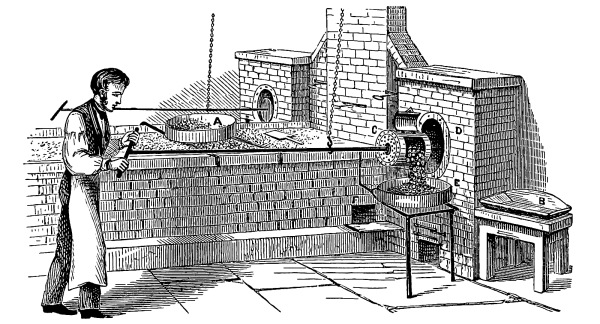
Fig. 16.—Drying Room.
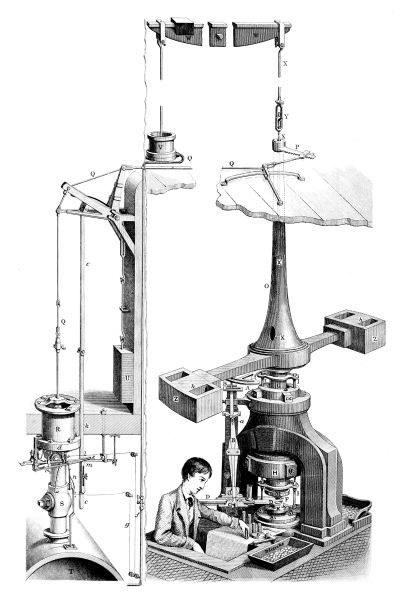
BOULTON’S SCREW-COINING PRESS.
AS USED IN THE ROYAL MINT.
The blanks, having been thoroughly cleaned after annealing, are taken
to the coining press, which at the present time is, as to efficiency,
about what the old water-wheel is to the steam-engine; yet, as a relic
of the past, it is a magnificent conception. It is perhaps the most
interesting in its work of any of the coining machinery; its action
is truly pleasing to watch, but one must feel that the totally deaf
would enjoy the watching it at work more than do those who are endowed
with the sense of hearing, because the noise of the presses would not
disturb their thoughts. The noise is really painful. In these opinions
Messrs. Fremantle and Napier express entire concurrence. The blanks
taken from the colander oven are each by a single blow at this machine
converted into coins possessing the obverse and reverse impressions, as
well as the crenated edge, which is one of the means employed to
protect the coin from the peculations of the clippers, those enemies to
coin of all ages and all countries, but whose business has departed,
not so much from the crenated edge as from the better balances placed
in the hands of almost every man—certainly within reach of every
man. The crenated edge is known to be no protection against the plan
called “sweating,” and which is effected by shaking the new coins in
bags, when perhaps an ounce of gold may be obtained from 1,000 new
sovereigns. The sovereigns thus treated are passed, and the operator
makes his profit, but the light gold is detected by the balance, not by
the eye. This is not the place to discuss[36]
such a question, so that we pass on to a description of the machine
which is used to give the image and superscription to coins which will
be current in accordance with the law.
The steel engraving illustrates Mr. Boulton’s screw-coining press.
The blank is laid by the automaton hand D on the lower die F; D retires,
and the collar then rises and encloses the blank, while the upper die,
fixed to the main screw of the press by the securing apparatus M, comes
down with a blow estimated to be about forty tons, and, striking the
blank, causes its particles to re-arrange themselves, and to assume the
form given by the engraving on the dies and the crenated collar which
surrounds them;[37]
in other words, the plain blank becomes by one blow a coin in every
way complete. The following description will convey to the reader an
explanation of the processes as they arise. The press having been
set at rest, with the fullest space between the dies, is called
up—that is to say, the upper die has been raised from the
lower die, and in this position the automaton hand D has conveyed a
blank from the tube E to, and holds it over, the lower die F; upon
the first motion of the press downwards, the eccentric wheel or cam A
causes the lever B, which works on the pivot a, to withdraw D
by the pin C. The lever B may be lengthened or shortened at pleasure
by an arrangement against the lower B. The first motion towards the
withdrawal of D causes its finger or hand to open, and to release the
blank, which falls upon the face of the lower die. The opening of the
finger, or hand, is effected by a pin which works in a slit in the
movable finger of D, near to C. The continuation of the motion which
draws back D, causes the rods I, which are carried by the main screw G,
to release the collar K, by the levers J. The collar K, being thus
relieved from downward pressure, rises by the elasticity of the springs
L until it wholly encloses the blank which has been left on the lower
die. The rods I pass through the shoulder of the frame of the press,
and are destined for another service besides that just described; for
the main screw G, which travels through a female screw fixed in the
frame of the press (as may be seen by the dotted lines between G and
H), thereby receives its power to rise or fall upon each part of a
revolution, whereas the upper die must strike the blank a blow just
such as would be struck by a hammer, and without a twisting motion;
therefore that motion of G is lost just below H, where G fits into a
cup suspended rigidly on, and is prevented from twisting by, the rods
I, as shown at N. To the lower part of the cup N is fastened M, which
carries the upper die. So that, just at the moment that the levers J
have permitted the collar to enclose the blank, the upper die reaches
the full force of its blow, and comes upon the blank. The force of the
blow, by converting the blank into a coin, causes an instantaneous
recoil of the screw G, which is assisted in its rise by a kind of
balance just equal to its weight. The nature of this arrangement
will be better understood by reference to the engraving, where the
funnel-shaped tube O is seen to be traversed by a rod X, represented by
dotted lines, and which terminates in the head of the screw G near the
lowest X; the opening in the funnel being for the convenience of fixing
this rod to G. At Y is a swivel, where the twisting motion of X, given
by G, is lost. X is connected at its upper end with a balanced beam
W, the other end of which is in communication with the chamber V by a
rod which carries a piston working in V. The chamber V is not wholly
exhausted, but is in connection by a tube with the partially-exhausted
chamber T, an arrangement which, while it becomes a counterpoise to the
weight of the press, is used as a regulator of the blow to be given,
so that it is quite possible to coin blanks of differing denominations
by the agency of this chamber without altering the vacuum in the large
vessel T.
The motive power of the press, that which brings down the die with
force, is gained by the pressure of the atmosphere upon a piston in
the cylinder R, and is conveyed to the press as follows:—The lever
P is fixed firmly on to the trumpet-shaped tube O, and is connected
by a series of rods, Q, with the piston in R, from which the tube S
communicates with T. The large chamber T is kept in a constant state of
partial exhaustion by the action of a thirty horse-power steam-engine,
through a well-made iron tube of considerable length. The boy who works
the press starts it by first pulling a cord f, terminating in
the box in which he sits; the cord f, by its spring n,
releases the valve d at i, and permits it to act when
required; he next pulls the cord g, which by its loose lever
opens the valve j, through which the atmosphere passes freely
across the bottom of the piston in the cylinder R into the tube S, and
so into the partially-exhausted chamber T; this would cause a rush
of air through the valve d, but d, at the instant of
its release by the line f, is closed by a spring. Atmospheric
air expands instantly if the pressure be removed from it, so that
immediately on the opening of the valve j, the air beneath the
piston in R expands, and part of it, entering the chamber T, produces
an unequal pressure upon the upper and lower sides of the piston,
and the result is that the piston is forced down by the weight of an
atmosphere it is unable to support. By the time that the piston has
completed its stroke, the rod c has brought a button, which it
carries on its farther side, and situated at k, down so low
that it strikes the lever l, and closes the valve j,
thus stopping the expansion of air below the piston, while the button
m has at the same instant permitted the falling of the lever
e, and the consequent opening of the valve d; when the
recoil of the screw G takes place, the piston in its descent expels
(by compression) the small amount of air remaining in the cylinder
R through d, thus opening it so that air can rush in at this
valve and permit the rising of the piston. The rising of the piston
insures the removal of the button at k, and so soon as k
is removed, l is forced up by a spring at its farther end, and
opens the valve j, thus giving the means of consecutive action
to the press. If it be desired to stop the press, the boy loosens the
line f, and so permits the spring n to keep the valve
d permanently open. The boy, before supplying blanks to the tube
E, piles them on an iron block b, and flattens each blank in the
pile by one or two blows of a hammer on the top of the pile.
In “European Mints” are some apt words, with which I conclude my
remarks on this great invention of Mr. Boulton—great beyond compare
at the period of its birth, great beyond admiration if its results be
estimated faithfully and gratefully by a thoughtful people. We in our
day are indebted to Mr. Boulton for his press; yet its age has passed,
and as a park loses its timber, so must our Mint lose—sorrowfully
to all who love the past—its glorious mementos of men who dwell in
history to make present men mere manikins. Original minds are not
now tolerated; subservience if you will; but invention—not if a man
values or depends upon his office. Mr. Napier says truly, “The press
just mentioned and its apparatus are complicated, scattered, and
unhandy, reaching into three apartments, and require a foundation of
great solidity, and a special construction of building. The noise and
vibration accompanying their performance are disturbing to a greater
extent than in the case of the blank cutting screw press to which
reference has been made.”
It has been conceived that coins are made of two discs of metal
soldered together, and that the crenated edge is intended to hide
the join. This notion has arisen from the occasional appearance of a
cracked coin in circulation; the true explanation of the cracked coin
being that at the time of pouring the fluid metal into the mould, an
air bubble has been enclosed, and this air bubble has rent the fillet
asunder at the time of its being rolled; but the separation does not
exhibit itself until the final annealing, when it is too late for its
discovery: recently, however, it has become a custom to ring the coined
gold before it goes into circulation, and thus to detect and stop such
defective pieces.
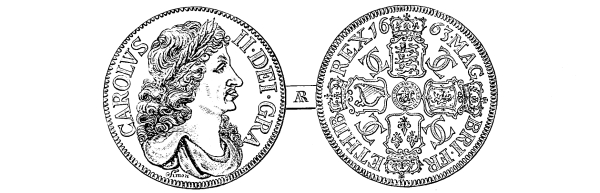
Fig. 17.—Petition Crown.

Fig. 18.—Inscription on edge of the Petition Crown.
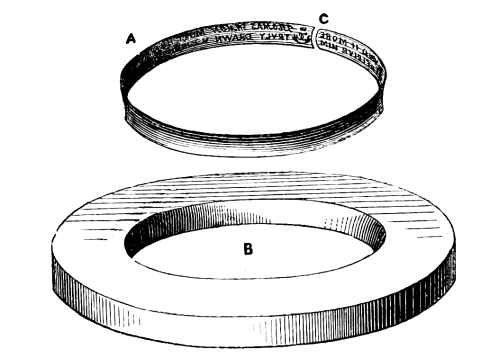
Fig. 19.—Fillet and Collar.
The origin of the crenated, commonly called the “milled,” edge (thus
giving the name of the instrument to the substance operated upon), was
the desire to make any clipping of the coin easily noticeable. Many
devices were used, but John Evelyn suggested the motto, Decus et
tutamen,[38]
and this was retained for some coins until 1854. The
crenated edge is now produced, without exception, and it is really
the best, as admitting of easier detection if counterfeited. The
distinctive marking of the edges of coins is of very early date, and
was performed by various species of hand labour, each in its turn easy
of falsification. At length this was effected by machinery, until
finally the coin was formed by striking the blank while enclosed in a
collar. The use of the collar, and its first invention, are somewhat
doubtful; Mr. Hawkins, however, appears to have established the fact
of its having been used at so early a date as William the Conqueror
(vide “Ruding,” vol. i. p. 158); but the earliest coin which
gives a clear notion of the use of a collar is the celebrated Petition
Crown of Simon, which he coined for and presented to Charles II. Fig. 17
represents this very highly-prized coin, one of which was sold a
few years since for £275. This wood engraving is by Messrs. Cheshire
and Dickenson, from a fac-simile drawing taken by Mr. E. S. Gibson; it
is an exact copy of the coin in the Mint collection. It is surrounded
on its edge by a petition in raised letters, of which Fig. 18 is
a fac-simile. The late Mr. W. H. Barton thought that this coin must have
been struck while surrounded by a collar, or it could not have been
produced at all. This opinion induced a further search for the collar
which was used, and which is believed to be in existence, and to have
been seen by men now living,—it is probably amongst the collection of
curiosities of coining left by Mr. W. H. Barton. Mr. Barton suggested
that the petition must have been engraved on a fillet of steel, which
was then coiled up in a collar, as indicated by Fig. 19,
and that the blank to be coined was then placed in the coiled fillet of steel.
The coin having been struck, the fillet with the coin was knocked
out from the collar, just as medals are now knocked out; and, once
free, the fillet sprang off from the coin. This conjecture was so
strongly confirmed by minute examination, that it may be interesting
to represent the mode of operation by means of Fig. 19,
where A is the engraved fillet coiled up and just ready to drop into the collar
B; the opening C which is left is copied from the petition on the coin, which
shows the metal to have been forced through this part of the fillet,
where its ends, which were cut to fit each other, did not quite meet.
The head of this protruding part has been filed off, the file marks
still remaining visible on this part of the edge of the coin. This fact
renders Mr. Barton’s conjecture almost a certainty. The coin weighs
517·10 grains; its average diameter is on the obverse 1·5784 inches,
and on the reverse 1·5837 inches, both measures having been taken on
the extreme edge. The petition is somewhat sunken and rounding inwards;
if therefore it be measured from its lowest part, the centre of the
edge of the coin, the diameter of the coin is 1·5741 inches, giving
0·0043 inch which must be worn away before the top of the letters of
the petition can be touched in ordinary wear; thus the coin would
circulate for centuries, and its petition still remain untouched. The
coin being 0·0053 inch greater in diameter on its reverse than on its
obverse side, admitted of its being more readily punched out from its
collar, which was doubtless cut to admit of this design being carried
out. The engraving on this coin is the cause of its great value,
Simon having so perfectly carried out the idea that coins should
represent sculpture, that this specimen stands wholly unrivalled as a
coin. It has led to the impression that so good artists are not to be
found at this day as flourished then. The fact is that artists seek
such employment as remunerates them for their study; and until their
conditions of employment are satisfied we must abstain from the desire
to see coins such as were produced in ages past, and which gave an
honourable name to the country producing them. It may be hoped that
this means of preserving the history of the age in which so much has
been done may be continued. It was probably from this collar of Simon’s
that Sir Isaac Newton gained his idea for that which he is said to
have invented. The collar of the present day leaves nothing to desire,
for it gives so distinctive a mark to the edge of the coin that any
mutilation must be detected; while forgers are unable to produce coins
to imitate those struck in it, unless they use the same means, which
would incur too great an expense. The coinages of Victor Emmanuel
illustrate beautifully how easily coins may be struck, so that, after
years of wear, they still represent the original more than creditably.
To take an instance, a bronze coin, 5 centesimi, has been purposely
subjected, for nine years, to more than ordinarily rough usage. This
coin is little worn; the whole of the features are still perfect,
except that the hair is worn off above the ears, and part of the
moustache is removed. The secret of success in this coin appears to be
that the ear and adjacent parts are slightly sunken, while the whole of
the work and inscription are kept well below the protecting edges, and
there is not an indistinct figure or letter on the coin.
In the British Mint false notions lead its authorities to believe that
apparent saving is real economy; so far from such being the case, if
our coins carried a better design they would not only look better, but
wear longer, and still maintain their weight. While it is my intention
to allude in another place to the large loss occasioned by our silver
coinage, I submit to the reader the facts arrived at by Mr. William
Miller, the late chief cashier in the Bank of England, who devoted
great attention to the rate of wear of coins. He found that coins which
had lost their protecting edges wear far more rapidly than those with
a protecting edge, and showed me tabular statements demonstrating that
fact. It was the intention of Mr. Miller to publish these tabulated
results. However, his painfully early removal has, I fear, prevented
that benefit being given to the public. His brother has no knowledge of
their having been published; but Mr. George Forbes, the chief cashier
in the Bank of England, has courteously given me a table closely
allied to those of which I speak, and another to which I shall refer
hereafter. I now, with permission, print this table, showing the rates
at which coins of the different reigns have worn, and which rates all
tend to prove clearly Mr. Miller’s opinion to have been correctly
formed. The fact of the increasing rate of wear would appear to be
explained by the larger surface exposed to friction by the removal of
the protecting edge. When a little later I come to the discussion, on
page 155, of the second table, I shall have
occasion to say a few more words on this, which seems to find a fitting
place on the preceding page, but contains matter which will cause too
great a digression if dwelt upon now.
A Statement showing the Results of some
Experiments made upon a Large Number of Silver Coins, of which 169,000
were examined singly, with the view of ascertaining the Present
Condition of the Silver Circulation, and the Loss by Wear.
It should be observed that the average of loss by wear in a century,
given in the Table, is founded upon the wear which the several coinages
have undergone up to the present time; but as the rate at which a coin
wears is an increasing rate, it is obvious that the actual loss in a
century would be much greater than that here given:—
| |
Amount Coined since
1816. |
Withdrawn
from
Circulation. |
Remaining in
Circulation. |
| |
|
£ |
£ |
£ |
| CROWNS |
Victoria |
117,414 |
|
117,414 |
| William IV |
|
|
|
| George IV |
140,726 |
|
140,726 |
| George III |
321,750 |
|
321,750 |
| HALF-CROWNS |
Victoria |
1,043,251 |
|
1,043,251 |
| William IV |
380,556 |
|
380,556 |
| George IV |
1,113,848 |
|
1,113,848 |
| George III |
2,387,088 |
252,870 |
2,134,218 |
| FLORINS |
Victoria |
1,541,161 |
|
1,541,161 |
| SHILLINGS |
Victoria |
2,609,504 |
490 |
2,609,014 |
| William IV |
412,038 |
49,944 |
362,094 |
| George IV |
878,922 |
350,622 |
528,300 |
| George III |
3,304,224 |
867,674 |
2,436,550 |
| SIXPENCES |
Victoria |
1,182,339 |
298 |
1,182,041 |
| William IV |
281,994 |
34,614 |
247,380 |
| George IV |
81,378 |
47,738 |
33,640 |
| George III |
919,314 |
312,250 |
607,064 |
| |
£ |
16,715,507 |
1,916,500 |
14,799,007 |
- LEGEND:
- (A) = Average of Loss by wear in 100 Years, at the rate at
- which the Coinages of the several reigns have worn,
- up to the present time.
- (B) = Loss by wear on Amount withdrawn.
- (C) = Loss by wear on Amount in Circulation.
- (D) = Number of Coins examined singly.
| |
|
(A) |
(B) |
(C) |
(D) |
| |
|
Per Cent. |
£ |
£ |
|
| CROWNS |
Victoria |
5·50 |
|
|
|
| William IV |
|
|
|
|
| George IV |
7·04 |
|
15,776 |
4,000 |
| George III |
7·46 |
|
|
|
| HALF-CROWNS |
Victoria |
14·17 |
|
|
|
| William IV |
15·30 |
|
|
|
| George IV |
15·80 |
13,546 |
250,270 |
20,000 |
| George III |
15·92 |
|
|
|
| FLORINS |
Victoria |
15·00 |
|
10,147 |
5,000 |
| SHILLINGS |
Victoria |
26·55 |
|
|
|
| William IV |
26·82 |
|
|
|
| George IV |
28·74 |
167,684 |
413,044 |
80,000 |
| George III |
29·96 |
|
|
|
| SIXPENCES |
Victoria |
37·00 |
|
|
|
| William IV |
39·00 |
|
|
|
| George IV |
44·80 |
72,420 |
221,380 |
60,000 |
| George III |
45·00 |
|
|
|
| |
|
|
253,650 |
910,617 |
169,000 |
| 253,650 |
|
| £ |
1,164,267 |
total |
| |
loss by wear. |
| Bank of England, December, 1860. |
W. MILLER. |
As further showing the rate of wear, I append a note which I have
copied from the eighth volume of the Journal of the Society of
Arts, written by Mr. John Miller, to whose courtesy I have often
been indebted, and who shows that the general rate of wear is rather
higher than would appear from the above facts, for his figures prove a
loss by wear to the extent of £4 11s. 8d. on a hundred
sovereigns in a hundred years, as will be seen in his letter which follows:—
“Bank of England, Gold Weighing Room,
“29th August, 1859.
“Sir,—According to your wish I collected
one hundred sovereigns of the date one thousand eight hundred and
twenty, which, on weighing, I find have lost in value one pound six
shillings and sevenpence.
“As these sovereigns were taken from parcels sent in from different
places, and at different times, during a long period, I think the
experiment is as likely to give a correct estimate of the loss which
the coin undergoes by wear as any that could be tried.
“I have the honour to be, Sir,
“Your very obedient servant,
(Signed) “J. Miller.
“A. Latham, Esq., Deputy Governor.”
That I may convey as accurate information as possible I also give
the following tables from the same volume of the Society of Arts. These
tables seem so clear as to render detailed explanation unnecessary.
It would appear that coins wear pretty much in proportion to the kind
of usage they receive; for Professor Jevons, in his pamphlet “On the
Condition of the Metallic Currency of the United Kingdom,” shows
indisputably that at the West End of London they suffer less than at
the East End, where they are thrown with force on rough and often sandy
benches while at the West they are treated with more consideration.
Results of some Careful Examinations made in
1858 of Light Gold and Silver Coin of the Early Years of the Present
System of Coinage, 1817 to 1825, taking 1822 as the mean of those years.
- LEGEND:
- (A) = Mint Weight of each Coin.
- (B) = Mint Weight of £100 worth.
- (C) = Weight of £100 worth of old Coin.
- (D) = Loss in 36 Years, 1822 as the Mean.
| |
(A) |
(B) |
(C) |
(D) |
| |
Ounces. |
Ounces. |
Ounces. |
Ounces. |
| Sovereign |
·25682 |
25·682 |
25·360 |
·322 |
| Half-Sovereign |
·12841 |
25·682 |
25·070 |
·612 |
| Half-Crown |
·4545 |
363·636 |
345·850 |
17·786 |
| Shilling |
·1818 |
363·636 |
315·575 |
48·061 |
| Sixpence |
·0909 |
363·636 |
296·950 |
66·686 |
The above data applied to 100 years give the following results:—
- LEGEND:
- (A) = Mint Weight of £100 worth.
- (B) = Loss of Weight of £100 worth in a Century.
- (C) = Loss of Value in a Century.
- (D) = Loss of Weight of each piece in a Century.
- (E) = Loss of Volume from 1,000 parts in a Century.
| |
(A) |
(B) |
(C) |
(D) |
(E) |
| |
Ounces. |
Ounces. |
£ m. |
Ounces. |
|
| Sovereigns |
25·682 |
·895 |
3·485 |
·00895 |
35· |
| Half-Sovereigns |
25·682 |
1·700 |
6·620 |
·00850 |
66· |
| Half-Crowns |
363·636 |
49·406 |
13·587 |
·06176 |
136· |
| Shillings |
363·636 |
133·503 |
36·713 |
·06675 |
367· |
| Sixpences |
363·636 |
185·239 |
50·941 |
·04631 |
509· |
| (Signed) W. MILLER. |
| Bank of England, 8th October, 1859. |
In this interesting table Mr. Miller curiously shows that the loss of
value and of volume bear equal relations to a coin, from which I infer
that he went so far as to measure determinately the amount of water
displaced by such coins as are referred to in these very valuable
researches; that he possessed a rigidly honest mind I know from
occurrences in my own dealings with him, and therefore I am sure his
figures are the results of actual experiment, and so, entirely reliable.
These facts show that before it is determined to withdraw our coins
when they have reached the age of eighteen years, the Mint authorities
should produce coins with a more perfect protecting edge, as was done
at my suggestion for shillings and sixpences, and then by abolishing
the annealing of blanks give to our coins a medium hardness so that
they will be able to bear comparison with the Italian as regards wear
and tear, and retain a juvenile appearance after the exercise, instead
of their present smooth worn surface.
The method of manufacturing the collar with the interior crenated
circle, which is employed to give the protecting edge to the finished
coin, is very simple:—A piece of flat, soft steel is bored with a
hole of the required diameter, and is fixed in a lathe so that it may
be made to revolve rapidly at pleasure. While the partly-formed collar
is revolving in the lathe, the slide-rest is made to place a kind of
cogged wheel, carried on a rod of steel, into the hole which has been
bored; by a screw in the slide-rest, the cogged wheel is brought down
until it touches the inside of the partly-formed collar; at the moment
of contact, the cogged wheel is turned round by the friction of the
collar against it, and its continued pressure upon the inside of the
collar causes the latter to receive an imprint from the cogged wheel.
When the imprinting is complete, the collar is hardened, and it is then
fit for use at the coining press. The system of manufacture is supposed
to be the most perfect; but it is manifest that no two collars are
produced of exactly the same internal diameter; hence the coin issuing
from each collar of the same denomination must, as it does, vary in
diameter; but this is of small consequence, the difference being so
minute that it is not detected unless by very accurate measurement;
indeed, coins coming from the same collar must vary in size, since the
collar wears away by use to a certain extent. The diameter and
consequent thickness of a coin are not determined by law, but by its
suitableness for the public to whom it is to be issued; consequently
the usual mode of arriving at the diameter of a coin is to make it of
such a size that it will emit the most musical sound it is capable of.
This rule was not sustained in the case of the small florin—better
known as the “godless florin;” hence, coupled with the omission of
the Dei Gratia[39]
in its superscription, the coin fell into disfavour.
The following measurements, taken from a set of proof coins of the
present reign, will convey an idea of the probable size of any coin
of the realm; but from the reason before stated, a man need not be
disappointed should he find the diameters differ from any he may
examine by an accurate gauge. While stating the diameters (which never
vary beyond a few thousandths of an inch), it is thought proper to
give the legal weight and legal tender[40]
of each denomination of coin current in Great Britain:—
| Denomination of Coin |
Diameter. |
Weight in Troy. |
Legal Tender. |
| |
Inches. |
Grains. |
Ounces. |
To the value of— |
|
| Gold. |
Sovereign |
0·8680 |
123·2744 |
0·2568 |
The highest sum |
|
| Half-Sovereign |
0·7622 |
61·6372 |
0·1284 |
known. |
|
| Silver. |
Crown |
1·5048 |
436·3636 |
0·9090 |
|
|
| Half-Crown |
1·2714 |
218·1818 |
0·4545 |
|
|
| Florin |
1·1826 |
174·5454 |
0·3636 |
| Shilling |
0·9296 |
87·2727 |
0·1818 |
| Sixpence |
0·7648 |
43·6363 |
0·0909 |
| Fourpence |
0·6456 |
29·0909 |
0·0606 |
Forty shillings |
|
| Threepence |
0·6383 |
21·8181 |
0·4545 |
sterling. |
|
| Maundy. |
|
|
|
|
|
| Fourpence |
0·6957 |
29·0909 |
0·0605 |
| Threepence |
0·6383 |
21·8181 |
0·4545 |
| Twopence |
0·5294 |
14·5454 |
0·0303 |
| Penny |
0·4388 |
7·2727 |
0·0151 |
| Copper. |
Penny |
1·3502 |
291·6666 |
0·6076 |
One shilling sterlg. |
Proclaimed |
| Halfpenny |
1·1155 |
145·8333 |
0·3038 |
Sixpence” |
illegal |
| Farthing |
0·8575 |
72·9166 |
0·1519 |
Sixpence” |
since 31st |
| Half-Farthing |
0·6953 |
36·4583 |
0·0759 |
Sixpence” |
December, 1869. |
| Bronze |
Penny |
1·2000 |
145·8333 |
0·3038 |
One shilling ” |
|
| Halfpenny |
1·0000 |
87·5000 |
0·1822 |
One shilling ” |
|
| Farthing |
0·8000 |
43·7500 |
0·0911 |
One shilling ” |
|
The press for coining is still defective: one of its defects is the
production of imperfect coins, of which Fig. 20 is a common
type. It is produced by the failure of the automaton hand to place the blank
exactly on the lower die, so that the collar, when it rises, fails to
enclose it; hence, when the upper die descends to strike the blank,
only that part of it which is over the die is impressed, the collar
being forced down by the pressure of the other part of the blank upon
its upper surface. On other occasions the automaton hand drops its
blank too early, or fails to bring it forward at all: on such occasions
it sometimes receives a severe pinch, and retires with an impression
produced on its end by the dies; and on either of these occurrences,
the dies may come forcibly together, and disfigure each other, so that
the next coin which is produced carries with it on each side a faint
impression of both dies as well as its proper impression. This could
never happen if the levers which carry the weights Z on the screw of
the press performed actually the whole of the functions for which they
are designed. A contrivance has been adapted to the coining presses
to stop their action should the automaton hand fail to bring forward
a blank for coining. This, after months spent in attempting its use,
is set aside because it increases the evil it was intended to remedy.
Fig. 21 is a representation of an imperfect
half-crown which had been submitted twice to the process of coining,
and by oversight passed into circulation in 1818. It had been current,
and was taken in ordinary change in July, 1861; it is much worn, but
on each side may be clearly traced the impressions of the obverse and
of the reverse, singular effects being produced where the crown of the
reverse fits so neatly on to the back of the head of his Majesty; and
where, on the obverse, the shield displaces his Majesty’s face. This
could hardly have been an accidental occurrence; it would seem that the
workman of the press must have struck the coin properly, and then taken
some pains to fit it into a larger collar and give it a second blow.
If the collars were all of precisely the same size such an act would
be impossible; but there are sufficient variations in the size of the
collars to admit of this explanation. Some accidental productions have
been called by ignorant writers incused coins, and conjectural
histories of them have been published; when, in fact, their history is
simply this: it so chanced that the coin last struck remained upon the
upper die, and gave its lower-side impression to the upper side of the
next blank which was coined. This is no uncommon occurrence, and the
effect of it would be that such a coin would have the same device on
each side; but of course one would present the design in relief and the
other in intaglio.
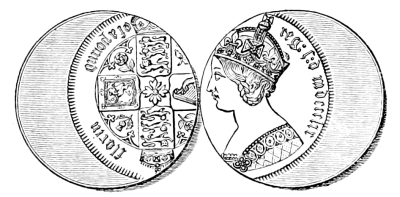
Fig. 20.—Brockage.
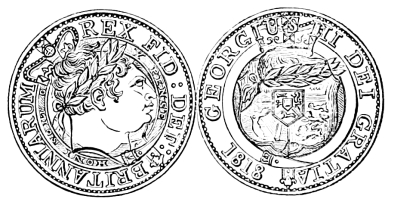
Fig. 21.—Brockage.
Such being some of the imperfections of Mr. Boulton’s coining press,
it may perhaps be assumed that they can be readily overcome; but I am
not aware of the existence of any press which is free from them. The
French press has, however, many advantages, and the Mint authorities
have recently had a new one made, from which extraordinary results were
anticipated, but it now appears that this is simply another improvement
of the usual type, and that it has cost about £1,500 and remains on the
premises of the manufacturers.
As the coined money issues from the press it is collected in trays
and examined; all imperfect coins, curiously termed “brockages,” are
picked out; and the good coins weighed into drafts of 701 sovereigns,
equal in weight to about 180 ounces: these are at present sent to the
weighing room, where they are examined for imperfect coins by passing
over a kind of blanket, so arranged on a series of rollers that each
coin lying on its surface can be seen as the blanket revolves. The
blanket covered with coins is carried round a set of rollers, and thus
produces them on the upper side of a lower blanket, when the reverse
side can be seen. The effect of this machine is to worry the eye, if
constant watching be enforced, for no one can watch a string of coins
in continuous motion and see each one. A very minute alteration
of this machine would cause it to stop for a few seconds at intervals,
and during that stoppage the accustomed eye could readily detect and
select the imperfect coin.
After this overlooking, the coins are rung as blanks used to be,
and then weighed separately, all the rejected going to the
melting-pot, by which a waste[41]
of 50 per cent. is incurred at the extreme end of an elaborate process;
but this unwise course, it is to be hoped, will soon be abandoned when
its expensive and perfectly useless extravagance is considered. After
the various operations of the weighing room the coin is collected and
weighed into separate bags, each containing 701 sovereigns; the exact
weight of the contents of each bag is noted; and, the bags having been
placed in a truck, are taken to the Mint Office, where they undergo
what is called pyxing, which is simply the selecting from each
and every bag a pound weight, from which two coins are taken; each
coin is weighed and its weight recorded. Of these coins one is placed
in the hands of the assayer to determine its value as to per-centage
of gold, and the other is sealed in a packet, which is placed in a
pyx for the trial of THE PYX at
Westminster—an ancient process now useless, because any skilled man can
detect by assay a deterioration of the coin. These particulars having
been taken, the coin is in due course delivered to the officers of the
Bank of England, who conduct it in amounts of about £140,000 to the
Bank in a waggon.
The law enacts that 20 lbs. weight troy of standard or crown gold shall
be made into 934·50 sovereigns, and this proportion gives the means of
determining the theoretical weight of one sovereign; for if the 20 lbs.
troy weight produce 934·50[42]
coins, it is only necessary to divide by that number the number of
grains in 20 lbs. troy, and the quotient will represent the weight of a
single sovereign, viz., 123·2744783306581059 troy grains; therefore the
journey of 701 sovereigns should weigh 180·032102728731942215
troy ounces, and a million 256821·829855377 troy ounces, equal to
7·8618927506797 tons avoirdupois; hence the War Indemnity of France
will weigh 1572·37855 tons.
Since the coins of a people must represent food in proportion as they
are of specific weight, it is to be regretted that the law does not
fix the weight (with a remedy) of the individual sovereign, instead of
fixing the number of coins in 20 lbs. weight, and giving a remedy[43]
of 12 grains on the pound troy. Irrespective of law, the practice of
the Royal Mint is to apportion the estimated amount of remedy (or
latitude for error) to each coin; but in America the pound weight alone
is studied; hence the individual coins vary so considerably in weight
that it pays as a commercial speculation to select the heavy coins, and
to sell them as bullion; thus leaving the light coins in circulation,
to the dishonour of the nation, because if a man take 1,000 American
gold coins to the Bank of England they will not be received at their
nominal value, but as bullion; hence the loss becomes personal, and so the
coins of America cannot, and do not, stand on a par with those of England.
The paragraph above has stood unaltered since the first edition, and I
reproduce it because its history is perhaps curious. Mr. Graham, soon
after I entered the Mint, commenced urging reasons why the system of
weighing coins individually, which he considered expensive, should be
abandoned; as well as I was able I met his proposition by firm but
adverse arguments, until at last he “ordered me to omit the weighing of
individual pieces, and to pound the work as is directed by law.”
I therefore asked him, as the matter was a very grave one, to write
the order. This he refused to do, and thought it hard of me to
require a written order, and so the matter dropped; when, however, Mr.
John Graham was appointed, Mr. Graham told me that he could now carry
out his wishes without a “written order.” In the meantime he had asked
me “to write a treatise on coining for Tomlinson’s Cyclopædia—in fact,
I have already referred Mr. Tomlinson to you, and he will call; your
difficulty will be to compress your information into a sufficiently
small space.” After so long an attempt to preserve the accuracy of our
coinage, I felt unwilling to allow such an opportunity to pass, and
therefore placed my opinions in print, and thereby gave Mr. Graham so
deep an offence that he refused to place my book in the Mint library,
although I gave him a copy for that purpose; it was still absent from
those shelves when I left the Mint. In August, 1864, Mr. John Graham,
acting under the “Master’s orders,” directed “that the contents of only
one bag in three should be weighed,” and this was carried out till
pieces which bore the device of florins found their way to the Bank
of England, and amongst them were found some of the intrinsic value
of 1s. 6d., while others reached so high as 2s.
9d. Mr. Graham was greatly distressed about this occurrence,
and, notwithstanding his brother’s position, directed me to stop this
new system at once. He then attributed the innovation to myself, and
blamed me for all that had happened. I therefore told him that he, and
he alone, was to blame, for I had persistently refused to do it unless
fortified with a written order. This caused, as I felt at the time,
our final separation; but had I been willing to accept blame which
belonged, as I told him, to himself first, and in a lesser degree to
his brother, he would have made it a fair ground for my removal from
the Mint—a result he had earnestly endeavoured to effect. I was so
far free from blame that I was actually absent from the Mint part of
the time, and during the remainder refused to enter the room where
the blanks were cut, such action on my part resulting from a desire
to protest firmly, by deed as I had done by word, against what I knew
to be a fatal step. The wisdom of my proposition to apportion the
remedy to the individual piece was so apparent that the Legislature
incorporated it in the Act 33 Victoria, cap. 10, and as detailed
information may be of special value to many, I quote the first schedule
to that Act on the opposite page.
That others concur in my thus claiming the origination of the
apportionment of the remedy to the individual piece, is, I think,
clearly demonstrated by the subjoined letter, which appeared in the
Money Market and City Intelligence of the Times, on Thursday,
March 10, 1870.
“The following relates to the coinage question:—
“March 8th.
“Sir,—In your article of this day you draw attention to
Mr. Ansell’s new work, ‘The Royal Mint,’ which I have studied
carefully. I shall feel obliged if you will permit me, through you,
to direct the attention of members of Parliament to the suggestion
thrown out by Mr. Ansell in his ‘Treatise on Coining’ in 1862, and
repeated in the book above alluded to.
“In the New Coinage Bill, which is to be discussed on the 10th inst.,
the Chancellor of the Exchequer would appear to have adopted in part
the proposal of Mr. Ansell, to make the remedy on the individual
coin, instead of on the pound weight of coins, as is now the law.
Mr. Ansell gives very strong reasons, besides the expense, why
0·2568 grain should be enforced as the legal remedy on the
individual coin, and surely, while the legislature is invited by
Mr. Lowe to adopt 0·20 grain, it would be wise that those reasons
should be considered, for the Act, once obtained, will be difficult
to repeal, and the Mint seems capable of improvement.
“I am, Sir, your obedient servant,
“Nummorum Famulus.”
I may add that Mr. Fremantle has purchased a copy of my last impression
for the Mint Library.
The coinage of silver is precisely the same in every detail as the
coinage of gold; but there are one or two points that require to be
dwelt upon. Weight for weight, silver is more bulky than gold, and is
coined in larger quantities; hence it has become important to expedite
its coining by every means. Thus, in the process of annealing, it is
simply placed unprotected, except by a lid of iron, upon an iron truck,
and run into the annealing furnaces, from which, after twenty minutes,
it is withdrawn and plunged at once into cold water. In the annealing
of the silver blanks it is important to have the copper of the alloyed
metal removed from their surface; this is effected by annealing the
blanks for from seven to ten minutes in open pans, when the copper
becomes oxidised, and is removed by the process of blanching, described
under the coining of gold.[44]
FIRST SCHEDULE.
Denomination of
Coin. |
Standard Weight. |
Least Current Weight. |
Imperial
Weight.
Grains. |
Metric
Weight.
Grams. |
Imperial
Weight.
Grains. |
Metric
Weight.
Grams. |
| Gold: |
|
|
|
|
| Five Pound |
616·37239 |
39·94028 |
612·50000 |
39·68935 |
| Two Pound |
246·54895 |
15·97611 |
245·00000 |
5·87574 |
| Sovereign |
123·27447 |
7·98805 |
122·50000 |
7·93787 |
| Half-Sovereign |
61·63723 |
3·99402 |
61·12500 |
3·96083 |
| Silver: |
|
|
|
|
| Crown |
436·36363 |
28·27590 |
— |
— |
| Half-Crown |
218·18181 |
14·13795 |
— |
— |
| Florin |
174·54545 |
11·31036 |
— |
— |
| Shilling |
87·27272 |
5·65518 |
— |
— |
| Sixpence |
43·63636 |
2·82759 |
— |
— |
| Groat or Fourpence |
29·09090 |
1·88506 |
— |
— |
| Threepence |
21·81818 |
1·41379 |
— |
— |
| Twopence |
14·54545 |
0·94253 |
— |
— |
| Penny |
7·27272 |
0·47126 |
— |
— |
| Bronze: |
|
|
|
|
| Penny |
145·83333 |
9·44984 |
— |
— |
| Halfpenny |
87·50000 |
5·66990 |
— |
— |
| Farthing |
43·75000 |
2·83495 |
— |
— |
Denomination of
Coin. |
Standard Fineness. |
Remedy Allowance. |
| Weight per piece. |
Millesimal
Fineness. |
Imperial
Grains. |
Metric
Grams. |
| Gold: |
|
|
|
|
| Five Pound |
Eleven-twelfths |
1·00000 |
0·06479 |
0·002 |
| Two Pound |
fine gold, |
0·40000 |
0·02592 |
| Sovereign |
one-twelfth |
0·20000 |
0·01296 |
| Half-Sovereign |
alloy; |
0·10000 |
0·00648 |
| |
or millesimal |
|
|
|
| |
fineness 916·66. |
|
|
|
| Silver: |
|
|
|
|
| Crown |
|
1·81818 |
0·11781 |
0·004 |
| Half-Crown |
|
0·90909 |
0·05890 |
| Florin |
Thirty-seven |
0·72727 |
0·04712 |
| Shilling |
fortieths fine |
0·36363 |
0·02356 |
| Sixpence |
silver, |
0·18181 |
0·01178 |
| Groat or Fourpence |
three-fortieths |
0·12121 |
0·00785 |
| Threepence |
alloy; or |
0·09090 |
0·00589 |
| Twopence |
millesimal |
0·06060 |
0·00392 |
| Penny |
fineness 925· |
0·03030 |
0·00196 |
| Bronze: |
|
|
|
|
| Penny |
Mixed metal, |
2·91666 |
0·18899 |
None. |
| Halfpenny |
copper, tin, |
1·75000 |
0·11339 |
| Farthing |
and zinc. |
0·87500 |
0·05669 |
The weight and fineness of the coins
specified in this Schedule are according to what is provided by the Act
fifty-six George III., chapter sixty-eight, that the gold coin of the
United Kingdom of Great Britain and Ireland should hold such weight
and fineness as were prescribed in the then existing Mint indenture
(that is to say), that there should be nine hundred and thirty-four
sovereigns and one ten-shilling piece contained in twenty pounds
weight troy of standard gold, of the fineness at the trial of the same
of twenty-two carats fine gold and two carats of alloy in the pound
weight troy; and further, as regards silver coin, that there should
be sixty-six shillings in every pound troy of standard silver of the
fineness of eleven ounces two pennyweights of fine silver and eighteen
pennyweights of alloy in every pound weight troy.
In annealing the precious metals, it is intended to use large retorts
of Stourbridge clay instead of the naked flame, as is the present
practice. The advantage of using retorts will be the protection
they will afford to the substances to be annealed, and the uniform
temperature at which they may be kept for any required time. So great
are the obstacles to improvement in the British Mint, that, although
this suggestion was made by me, and plans were prepared, in June,
1861, the necessary alterations have not yet been attempted; indeed,
it has been reserved to Mr. P. F. Comber, the intelligent chief coiner
of the New Mint in Melbourne, to adopt this suggestion. The furnace
for his use has been made by Messrs. Deane, of Arthur Street East,
London Bridge, who, from experience, know this kind of furnace to be
successful; indeed, it has been long used to gain higher temperatures
than are required for metals in the annealing of glass, pottery, &c.
I have recently been permitted to make a long series of experiments at
the works of the Patent Fuel Company, on their wharf at Deptford, and
these have convinced me that their mode of converting hydrocarbons
into vapour, and burning that vapour with a proper supply of air under
pressure, could be applied in the Mint with great advantage to the
heating of the annealing furnaces, especially if the authorities of
that department should adopt the retorts proposed.
In my previous editions I have suggested the use of these retorts,
and I am glad to see that the Royal Mint is likely to adopt them, for
Mr. Napier recommends them in his Report, and Mr. Roberts not only
coincides in that recommendation, but specifically says, “It is a
question for consideration whether muffles of clay instead of iron, and
gas as fuel, might not be used with advantage.”
The coinage of bronze is somewhat new; that is to say, it has, after
centuries, been re-introduced; and as little is known respecting it, it
will be well to consider one or two circumstances connected therewith.
The dimensions of the bars are previously given,[45]
those measurements were determined by me after much troublesome
experimenting, and the bars are found to be capable of producing the
best blanks, as regards equality of weight one for another, with the
least labour. In the rolling of bronze there are some singular facts to
be noted; for instance, the finding the same metal at one time ductile,
and at another absolutely brittle; yet if the bronze has been properly
melted, with due precaution to avoid the access of atmospheric oxygen,
it is uniformly malleable and ductile, and may be rolled from such bars
as described without once annealing. It is sometimes preferred not to
use the knowledge gained, and then complications commence. The following
mode of operating will meet all cases:—The bars may be rolled down to
half their thickness, and then will anneal perfectly well in an open
furnace on an iron truck. The heating should be conducted rapidly,
and when the fillets get to a full red heat they should be withdrawn,
thrown out singly on the floor, and allowed to remain till perfectly
cold. Should any bars be annealed in the rough state, they must be
kept away from water. A little water thrown upon the end of a bar when
red hot causes it to become rotten throughout, and on submission to
any pressure it will fall to pieces as would gingerbread; yet if the
bars be partly rolled to a certain proportion of their thickness, they
may be plunged at once into cold water without damaging them for work.
After annealing, the fillets should be blanched in diluted sulphuric
acid, containing one per cent. of the ordinary commercial acid. It is
well to save time by blanching two or three tons at a time; but a few
minutes effect all that is required—that is, the separation of the
film of oxide from the surface. The film is then removed by a mop made
of rag or cotton waste, and with little labour a few boys may clean
many tons in a day. Fillets which have been blanched before being
rolled produce clean and bright blanks. The blanks require somewhat
different treatment. It is better to anneal them in copper tubes. The
bottom of the tube should be covered to about the depth of an inch
with charcoal dust, then the tube filled with blanks, except allowing
for another layer of coarse charcoal dust, and the top put on to the
tube. The annealing should not occupy more than thirty-six minutes;
the highest temperature should be that at which the tube looks a full
reddish white, and this should be gained as rapidly as possible. The
tube, after removal from the furnace, should be allowed to remain at
rest till perfectly cold. The charcoal is intended to combine with the
oxygen, which would otherwise combine with the metals of the bronze
during the heating and the cooling of the blanks in the copper tubes.
Having regard to the production of perfect coins, the blanks should be
cooled in an atmosphere of ordinary coal gas, by which every particle
of oxygen is prevented from access, and a great part of the oxides
already existing in the alloy reduced by the combination of their
oxygen with the hydrogen of the coal gas, thus leaving the blanks
somewhat porous, and comparatively soft, so that, when coined, the
metal wholly fills the work on the dies, and the coin is produced with
a good protecting edge. Bronze as used at the Royal Mint consisting of
95 of copper, 4 tin, and 1 zinc in 100 parts—zinc should be omitted
because it causes useless labour—may be coined to great perfection
if the blanks be cooled in coal gas after annealing: whereas bronze
of a far softer nature cannot be made to fill the work of the dies
satisfactorily by any other method yet known, unless the engraving on
the dies be very shallow. The bronze coins, which have replaced the
old copper money, have what is considered to be an innovation in the
inscription by the repetition of the T in the abbreviation of
Britanniarum, which is simply the classical mode of expressing in an
abbreviated form the number of the possessions which together form
Great Britain; it is equivalent to MS., which is the abbreviation for
manuscript, while MSS. represents the word manuscripts; so BRITT.
represents the cluster of islands or possessions called Great Britain.
The objection to BRITT., on the ground of its being an innovation, is
singular, as this word occurs on the shillings of George III., coined
in 1816. It is also curious that the original dies for the bronze
coinage were made to carry BRIT. only, until a coin found its way
into the hands of the Right Hon. W. E. Gladstone, who at once pointed
out the error, and thus caused the re-introduction of the classical
BRITT. Mr. Gladstone also suggested the issue of octagonal bronze
coins, which undoubtedly would have been a mistake had it been adopted.
Perhaps it may not be uninteresting to record that the pattern penny in
bronze, which was submitted to and approved by her Majesty, was lost
in its passage through the post, for the postman opened the letter and
destroyed both it and the penny in a closet in the Royal Mint. Copper
and bronze money are merely tokens; it is therefore well to reduce such
tokens to as low a weight as is consistent with the rigidity of the coin.
By Royal Proclamation, dated at Windsor, 13th of May, 1869, the
old copper moneys are declared illegal; or, in the words of the
proclamation, “No copper moneys whatsoever (other than and except
such bronze moneys as are now current by virtue of our proclamation
bearing date the 17th day of December, 1860, or any proclamation dated
subsequently to the said 17th day of December, 1860) shall be allowed
to pass or be current in any payment whatsoever within the kingdom of
Great Britain and Ireland after the 31st of December, 1869.” So that
since that date no copper moneys have been legally paid away. This,
however, will not affect those who wish to preserve copper coins of
this or former reigns as specimens.
As dies are the means by which metal becomes COIN,
it will be material to add the processes of their manufacture. Experience
alone can indicate the proper steel to be used, so that it is useless to
attempt a description. But the form of the steel is a matter upon which
die-makers differ. Some use square bars of that metal, and cut off
pieces, which are forged into the proper form for dies; however, the
more experienced die-makers use round bars of steel, which are cut by a
tool somewhat of the shape of the bar, so that when the tool is struck
every part of its edge begins to cut. The tool is so shaped as to leave
the end of the bar from which the piece has been cut quite square, so
that it may form the bottom for the next piece cut off. The piece of
steel thus cut off is taken to a lathe, where its upper end is turned
somewhat into the form of the top of a sugar-loaf; the depth of this
form being determined by the style of work to be impressed upon the
steel when it is to be formed into a die. For the original matrix the
piece of steel is turned to a flat end, and is usually strengthened by
driving a carefully-welded ring of hot iron on to it: although some
prefer thus to simply shrink on a ring of iron, the more experienced
choose welding, because that which is shrunk on is never so solid,
and is apt to enclose air bubbles, which prevent the mass becoming
one, thus permitting an undue yield in a faulty spot when pressure is
applied. In the making of a matrix, the steel is softened to different
extents by different engravers, but all soften more or less. The steel
having been softened, the engraver cuts with a kind of hand chisel,
by a motion of the wrist, such design as may be required, and after
many months of work produces a finished matrix, from which he requires
to produce many copies, because this one matrix would itself soon
wear out, and by frequent use would be more exposed to risk. It is,
therefore, hardened to admit of its being submitted to such pressure
from another piece of steel as to impart its design to that steel
without itself being distorted by the pressure. For this purpose the
matrix is fitted with a ring of iron round its upper part, which, when
fitted on, gives the engraved part the appearance of being the bottom
of a cup; this cup is filled with a paste made of beer grounds and
fine charcoal dust, or, better still, with that small charcoal which
is found behind the flue of the forge—a kind of soot produced by the
spent sparks which fly upwards, and which is so much in request by the
file-makers. Thus protected, the matrix should be placed in the naked
fire wholly enclosed with fuel, and heated as rapidly as possible,
keeping it constantly turned round and round, so as to insure each
particle of its mass being equally heated; a quarter of an hour should
be long enough to produce the necessary temperature. It must be borne
in mind that the great principle is to avoid the decarbonisation of
the steel, therefore the less time that is occupied the better. The
temperature of the matrix should be that rich and peculiar full red
which for a few seconds is visible before white heat supervenes, for
a white heat once gained causes the steel to scale off, and renders
the matrix partially worthless. This peculiar temperature once gained,
the matrix must be permitted to remain for three minutes in the fire
without any blast. If it should get too hot it must be cooled by adding
exhausted fuel from the hearth. At the end of three minutes’ quiescent
heating it may be assumed that the centre of the matrix has become of
the same temperature as its outer particles; it is then taken quickly
from the furnace and placed in a kind of colander, so that water may
wholly envelope it, and yet flow freely past it while its under surface
is wholly exposed. The matrix C is placed in the colander D, Fig. 22,
bottom upwards, and is then brought immediately under the pipe
dependent from a kind of funnel A, which should hold at least a hundred
gallons of cold water; the bottom of the pipe must be secured by a plug
of wood B, capable of being knocked out instantaneously. This is the
most important process in the hardening of the matrix, and requires
considerable steadiness with great rapidity of motion. The matrix
being held in the colander about half an inch above a large surface of
water E, and immediately under the centre of the plugged pipe from the
funnel, the plug B is knocked out from the pipe, and the water falls in
a continuous stream wholly unbroken until striking the very centre of
the base of the matrix, thus securing the commencement of the process
of hardening FROM THE CENTRE. So soon as
this first shock of the flowing water has been effected, the matrix
must be sunk into the vessel of water below, until it is uniformly
covered to the depth of half an inch, and must be held there until the
whole of the water from the funnel has run out; then the matrix must
be sunk to the bottom of the vessel of water, and allowed to remain
till absolutely cold. If it be removed before it be cooled throughout,
there is great danger of a crack on its surface being produced by the
expansion from within. The plug is preferred to a tap in the pipe from
which the water is to flow, because the turning of a tap gives a motion
to the water, which causes it to fall in a hollow stream, and thus
obviates the very effect which it is desired to produce. This process
has been followed for more than thirty years, and during that time the
manufacturer who uses it—one of the most eminent engravers and
die-makers in Europe—has never met with any accident, nor has he found
any failure. I have recently visited a manufactory in South Yorkshire
in which many thousands of dies are made annually on this system,
without an instance of failure. Die-makers, after the hardening,
proceed as follows:—Remove the paste of charcoal from the face of the
matrix, and then clean the face of the die with hydrochloric acid.
After this it is tempered—that is to say, it is raised to a temperature
which somewhat relaxes the rigidity of its particles; this is commonly
judged of by the COLOUR which the face of
the matrix assumes; but since no two men are likely to distinguish the
same tint, nor can any one actually judge of colour unerringly, it is
wise to adopt another standard, the one most preferred being to temper
the matrix until the engraver can make a good graver bite while
the die is hot. The tempered die may be cooled by plunging it either
into oil or into water as soon as the tempering has reached the desired
point. If at this instant the tempering cease, when the die is dead
cold the graver will no longer touch the steel, which is now just so
hard as to resist a blow without fracture. It is next polished, and is
then fit for use; that is to say, is fit for the multiplication of dies
from itself.
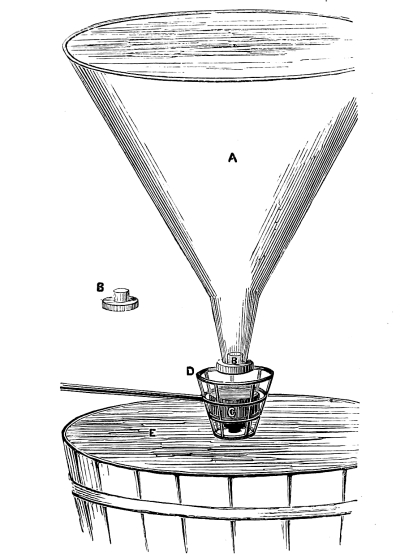
Fig. 22.—Die Hardening.
The multiplication consists in the taking a set of punches, each
being an exact copy of the matrix. The steel, having been formed
into masses with sugar-loaf tops in accordance with the depth of the
engraving, is ready to receive the impression from the matrix, just
as hot sealing-wax is ready to receive the impression from a signet.
The matrix is placed beneath a press, and on its face is placed the
sugar-loaf end of the annealed mass of steel; a very light blow is
given by the press, so as to obtain simply the sinking of the first
portion of the cone, for if a violent blow be given at this stage it is
manifest that a large mass of steel is forced into a smaller space; in
other words, the particles of steel which formed the cone are pressed
into a dense mass on the surface of the intended punch, and prepare a
crack, which by-and-by developes itself. After this light blow, the
partly-formed punch is placed in a covered pot filled with charcoal,
and heated in a furnace just as was described for the hardening of
the matrix, bearing in mind that it is the cooling, not the heating,
which softens the steel. So soon as the heating has been raised to the
point before indicated, the pot containing the punch is removed, and
bedded in hot ashes, and there left to cool as slowly as possible; it
should be forty hours before it becomes cold. When cold it is cleaned,
receives a second very light blow under the press, examined, afterwards
receiving a third very light blow, and is then a second time annealed,
&c. The number of blows required to bring out to perfection on the
punch the work on the matrix, depends entirely upon the size of the
matrix and the depth of the work engraved upon it. For these reasons,
no accurate instructions can be given; but for all cases light blows
should be made, because all metals mould more readily under gentle treatment.
From the punch is obtained, by processes which should be in every way
similar, a series of dies for the use of the coining press. Each die
from the punch is examined, and has the figures for the date impressed
upon it before it is hardened. The dies are of two kinds: one, C, the
obverse, with a long neck, upon which the collar B fits freely, and a
second, the reverse, with a short neck, so that the face of the die
just enters the collar sufficiently to meet and compress the blank.
Fig. 23 demonstrates these two dies, and exhibits
the collar, showing at B the milled interior circle, which gives the
crenated edge to the finished coin at its formation. For the past
few years the reverse die has been made to carry, in addition to its
recognised device, a small number, with a view to determine at which
coining press, and on what particular day, that die was used, that
bad work might be traced to an individual. It need hardly be said
that the accidents encountered in daily work overcome the object thus
sought, for a die may last either minutes or days in wear owing to
the irregularities of the steel from which it is made, and besides,
the boys who work the presses are of necessity changed at irregular
intervals.
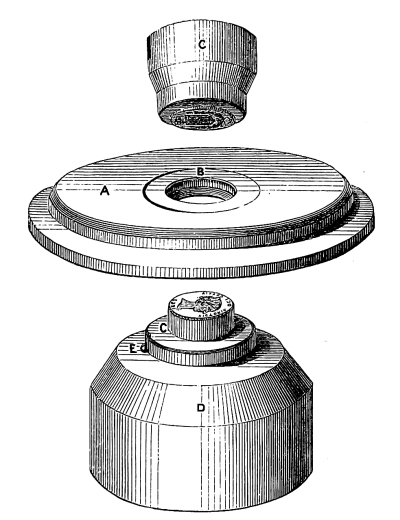
Fig. 23.—Coining Dies and Collar.
The long-necked die is fitted into a bolster D, as shown in Fig. 23,
and is prevented from shifting its position in that bolster by a plug
of iron indicated at E. The bolster, with its die, is secured in a kind
of dish beneath the screw of the press by a series of screws, which
admit of adjusting the bolster so that the die it carries shall be
placed immediately beneath the upper die, which is carried on the main
screw G of the press, as may be seen at page 60.
There is little doubt but that certain stages of die manufacture
would be rendered more effective if more reasonable treatment were
employed. It has yet to be demonstrated that carbon steel is the best
metal that can be employed, for it seems more than probable that some
alloys would render a metal which would possess within itself more of
the properties which are necessary for the perfecting a die, and for
its duration when in use. For the elimination of such an alloy we must
await the time when the non-resident assayers are replaced by resident
chemists who, during the leisure times in the Mint, will be willing
and glad to experiment on some of the compounds of iron with the rarer
metals, for in that field will surely be found a combination which
will be definite, and therefore homogeneous and unvarying. There can
be no doubt that the cause of the uncertainty which prevails as to the
endurance of steel for dies arises from its unequal composition.
Gold possesses as many colours, and exists in as many conditions,
as any substance ordinarily met with. Those various changes are due
to the existence of impurities in the metal, which are neglected in
assaying, because the only business of the assayer is to determine
that the sovereign actually contains the lawful weight of pure gold,
and also so much alloy as is specified: what this alloy shall be is,
in the abstract, a small matter so that it is not silver, because
if it be silver it is worth the expense to separate it, and thereby
destroy the coinage. Yet, although the existence of such metals as
lead, bismuth, tin, antimony, and arsenic, as well as palladium and
osmium-iridium is not illegal, it becomes necessary to separate them,
because these metals affect the coin in various ways. Palladium and
platinum alloy with the gold only after considerable time, therefore
these metals may generally be seen in the finished coin, frequently as
a slight bar across its surface, sometimes as spots on its crenated
edge. Osmium-iridium causes trouble, inasmuch as it is so infusible,
that it simply floats about in the melted gold, and several crystals
agglomerate; where this takes place, the difficulty of manufacture is
so great, that it is impossible to produce the desired amount of coin
within the limits of remedy as to weight. The simplest means for the
removal of these substances is to allow the fused metal to remain for a
considerable time, when they settle to the bottom, and the clear metal
can be poured off; the dregs, if so they may be called, are then sent
to the refiner, but the process of separation is too long, and hardly
adapted for a description in this place.
As a practical matter, the other, or volatile metals, and lead, may be,
and generally are, removed by means of corrosive sublimate. This is an
expensive measure, and does not answer its intention, for some of the
mercury combines with the gold and renders it brittle. In practice, the
best process is that recommended by Mr. Warington, who proposed to add
to gold found to contain tin, antimony, or arsenic, 10 per cent. of
oxide of copper. The gold is fused in a Payen crucible, and the oxide
of copper is then added and stirred into the gold by a rod made of the
same substance as the crucible. This operation is easy of performance,
because the infusible oxide of copper stirs up with the gold readily,
and each particle of antimony, arsenic, or tin, as it comes into
contact with the oxide of copper, reduces it to the metallic state,
the volatile metals combining with the oxygen, while an equivalent of
copper alloys itself with the gold. The impurities, as they oxidise,
mix or combine with the oxide of copper. One or two experiments tell
how much copper is thus added to the gold; consequently, how much
fine gold is to be added to keep the alloy standard—and subsequent
treatment by the oxide of copper simply removes the volatile metals.
Gold treated by this process is perfectly workable on a large scale,
and there is no trouble. A condition of success is, that no reducing
agent, such as carbon, be present, and therefore plumbago pots cannot
be used. In practice, half an hour is the best time to keep the metal
in contact with the oxide of copper. The objection is frequently
expressed, that to refine gold is not the business of the coiners. This
opinion, however, will bear modification, for the expense of the oxide
of copper is trifling as compared with the cost of labour in treating
brittle gold.
I now advert to a most important matter in relation to coining, viz.,
that of the loss sustained, its cause, and prevention.
It appears that the Royal Mint should sustain less loss than any other
mint by the coining of gold and silver. If allowance be made for the
sale of the sweep or dust[46]
which results from a coinage, the total loss, inclusive of every
operation in coining, should be so small that it might be passed
without notice; in fact, there ought to be a minute increase of weight
from traces of oil which are left on the fillets to enable them to pass
through the cylinders of the draw-bench;[47]
by melting[48]
there seems to be too great a loss of metal: this should
reach about £100 per million coined, and such loss would be wholly
explained by the refining, which takes place through the removal of
copper by oxidation; although this is minute, still it is enough to
explain the loss which I indicate. If the assays be closely watched
there can be no loss, for the trial of the pyx invariably shows the
gold coin to err on the side of purity, so that if the Master of the
Mint should determine to issue gold of exact standard, and refuse to
avail himself of the latitude allowed, he may fairly cover every source
of loss, and coin money WITHOUT WASTE OF METAL.
Each grain that is found in excess of the standard upon the pound weight of
gold causes a loss of about £180 upon each million coined. The moneyers
asserted that they sustained a loss of £700 for each million coined,
such loss being exclusive of melting. This has never been believed to
have been a truthful statement, nor has the loss by coining alone often
reached so high an amount, although so large a sum as £373 per million
would seem to have been determined, by some careful experimenters,
as the necessary loss. Where the gold went to was not stated; but
supposing such a loss to accrue, it is manifest that either the gold
volatilised or the floors must be paved to many inches in thickness
with gold, but it is an established fact that matter once existent
cannot be annihilated; yet it has required many arguments to convince
those most interested in coining that the mere cutting up of bullion
into small pieces does not alter its actual weight: the present Mint
Authorities entertain the fallacious notion that large loss of gold
is, for metallurgical reasons, NECESSARY.
Notwithstanding Mr. Graham’s opinion that a loss of £206 on a million
was too high,[49]
they in their “Reports on European Mints” have arrived at the
conclusion “that the ‘waste’ shown to have existed of late years in the
English Mint has not been excessive.”
To leave, then, the realms of speculation, and for a short time to
examine figures, a matter which is little understood will be reduced
to one of easy comprehension. Mr. W. T. Brande, in connection with
others, carried on a series of experiments between 1851 and 1856, the
results of which he gave me in writing, and which induced him to arrive
at the conclusion that by coining alone there was a loss varying from
1·20 grains on the pound, to 3·10 grains on the pound troy, or a mean
of 2·15 grains on each pound troy coined. This loss was thought to be
a necessary consequence of coining, and by a simple rule-of-three it
tells as follows:—
| A loss of |
1·20 |
grains |
on the lb. |
= £208·33 |
on each |
£1,000,000. |
| ” |
3·10 |
” |
” |
= £538·18 |
” |
£1,000,000. |
| Mean loss |
2·15 |
” |
” |
= £373·26 |
” |
£1,000,000. |
Mr. Brande and his colleagues, by his own admission, did not know the
value of the sweep recovered, therefore this loss was believed to be
absolute. We will next examine the accounts and see the fruit of that
belief, and then determine the effect of a contrary faith. And in the
following statements, given in a tabular form, I would observe that
the facts recorded were compiled by the Mint officials for the Master
at my suggestion, and that copies were given to me by the late Master,
who indeed invariably, when such statements were prepared, handed them
to me to copy and examine for my own information, and to see that they
were accurate.
It is a fact that the Mint books do not record the loss upon the gold
coined in November and December, 1851; or, if they do, these accounts
have been only quite recently balanced. In the following statement I
omit the coin of those two quarters, because the late Deputy Master
assured me that the accounts were not made up. This, I am aware, lays
me open to a correction; I therefore state that the coined money of
these two months is not included in my calculations.
Statement showing the Rate of
Coin obtained and the Loss of Metal incurred in each Quarter from
March, 1852, to December, 1857.
(A) = Proportional Loss of Metal
on each Million Ounces Coined.
| Quarter ending:— |
Total Amount of
Gold Coined
per Quarter. |
Rate per Centum
of Coin obtained
from Rough Bars. |
(A) |
| |
|
Ounces. |
Ounces. |
Ounces. |
| March 31st, |
1852 |
300260·201 |
|
446·94 |
| June 30th, |
” |
501032·558 |
|
399·17 |
| Sept. 30th, |
” |
615753·337 |
|
500·50 |
| Dec. 31st, |
” |
828159·837 |
50·51 |
639·37 |
| March 31st, |
1853 |
1113414·454 |
47·28 |
691·60 |
| June 30th, |
” |
1223454·550 |
49·40 |
472·34 |
| Sept. 30th, |
” |
248434·554 |
39·34 |
1130·64 |
| Dec. 31st, |
” |
484331·447 |
42·81 |
784·42 |
| March 31st, |
1854 |
769791·029 |
54·21 |
730·61 |
| June 30th, |
” |
101611·604 |
49·65 |
787·21 |
| Dec. 31st, |
” |
194968·684 |
47·76 |
583·07 |
| March 31st, |
1855 |
515639·229 |
47·42 |
447·05 |
| June 30th, |
” |
501708·378 |
47·01 |
456·20 |
| Sept. 30th, |
” |
283944·316 |
43·53 |
420·18 |
| Dec. 31st, |
” |
1012329·518 |
44·57 |
509·08 |
| March 31st, |
1856 |
360409·244 |
38·39 |
489·05 |
| June 30th, |
” |
818465·116 |
40·36 |
509·57 |
| Dec. 31st, |
” |
362599·792 |
41·74 |
406·28 |
| March 31st, |
1857 |
73638·878 |
39·64 |
233·84 |
| June 30th, |
” |
19872·998 |
40·52 |
57·86 |
| Dec. 31st, |
” |
1154606·290 |
54·69 |
18·45 |
There will be occasion to refer to the next table for further
information; but as the facts in this table are not strictly comparable
with any others that will be given, it is better to explain this as it
stands. Of the rate per centum of coin obtained from the bars there
will be occasion to speak at a later period. These figures are placed
here with a view to save repetition, which would be necessary when
that subject is discussed.[50]
Although the figures in the first column represent ounces, each item
can at pleasure be converted into pounds sterling by multiplying
it by £3·89375, which is the decimal expression for £3 17s.
10½d., the price per ounce of standard gold. In such case it
will only be necessary to multiply the weight of the coinage by that
value, and then to consider the loss of metal as pounds sterling—thus,
300,260·201 ozs. + £3·89375 = £1,171,318 5s. 3¼d., which
sum lost weight by coining at the rate of £446 18s. 9½d.
per million coined. If calculation be made by addition and division of
the figures in the third column, it will be observed that the average
loss per million between March, 1852, and December, 1856, is £577·96,[51]
and this was believed to be absolutely wasted in coining; but this
amount may be fairly reduced by the deduction of £72 10s., the
average value of sweep recovered, when it will remain £505·85. It
will also be seen that the rate per million missing—for that is the
fact—varied a good deal according to circumstances.
It has been asserted that these losses were mere matters of account,
and resulted from the removal of “fat or oil” in the various
operations. These explanations shall be admitted to their fullest
extent, but that they do not contain the cause for all the losses is
to be gathered from the fact that gold has been returned to the Mint
by the brickmaker, who found it in the ashes which he had bought. That
there were cases of actual theft I am myself aware; for I, by the
Master’s sanction, dismissed two men who were detected. Eleven others
shared the same fate, but no prosecution was attempted or permitted,
although strongly urged. As bearing on this point the following, in
relation to “peculation,” is told and believed in the Mint:—In 1856,
when the men had formed a strong opinion as to the honesty of one
particular person, they took their own means to watch him, and to see
how and when he abstracted the metal. A clear-headed man made it his
business to do this duty. The suspected man was assisting the officer
at the scales in the drag room, when the watcher saw him, after the
bullion was weighed, take a piece stealthily and secrete it in the
palm of his hand. The watcher, thinking to secure detection, requested
the officer at the scales to re-weigh that draft; but this gentleman
refused to comply. The watcher then told the officer what he had seen,
and that if he would open the man’s hand the piece of gold was still in
it, when the officer, addressing the suspected person, said, “Is it all
right, John?” John replied “Yes,” and no more passed. On his road home
“John” stumbled, and a piece of uncoined gold fell on the pavement.
That metal was actually removed from the premises is beyond doubt, for
a late officer picked up a piece of gold in the courtyard wrapped in
brown paper, and the police brought to the Master a “flat end”[52]
of gold, which had been offered for sale. The police inspected all the
men in the Mint employ; but the person who abstracted the gold did not
personally offer it for sale, and thereby escaped detection.
On the 2nd of December, 1853, the cutting room book records a loss of
87·26 ounces of gold, for which no satisfactory explanation is given.
This book also contains some significant remarks by the officer who had
charge of that department.
The Mint books adopt the word “Wasteage” as explanatory of these
losses, which were believed to be a necessary result of coining; so
generally, indeed, was this firmly-implanted belief entertained, that
at the bottom of each day’s account the word loss was printed, so that
the officer had only to write the amount which was missing.
If indeed proof that unnecessary wasteage[53]
took place be required, it will be but necessary to quote from the
letter of the Master of the Mint to the Treasury, dated 7th June, 1860.
This letter was placed in my hands on the 1st June, 1860, by the
Master, who desired me to copy such parts as related to loss and were
of service to me, and that I might confirm the accuracy of his figures.
He said, “It appears by the table that the average loss on the gold
coinage of the first six years is £784 0s. 0¾d., and
on the gold of the last three years £172 8s. 11½d. per
million coined, showing an improvement of £611 11s. 1¼d.
per million coined. On the twelve millions of gold coined during the
last three years the saving exceeds twelve thousand pounds.” The three
years here referred to were contained in the period during which Mr.
Graham entrusted me with the management of the coining department.
That the actual amount of loss by coining may be got at, it will be
necessary to view the matter in a different form, and in that way to
show the amount of money recovered by the sale of sweep; that is, by
the sale of the ignited rubbish accumulated during a coinage, and
in the statement given on page 90 the money
value of each item is specifically represented. It need not be insisted
that the utmost care should be exercised in preserving the sweep, when
it is stated that this yields, at the end of a coinage, from 15 to 20
ounces of material bullion called scrap or supply, when picked
over before sale, for only such as will pass through a fine sieve is
sold; yet this sweep used to stand about in open, unlocked boxes from
month’s end to month’s end.
It would be wrong to state that there is no apparent loss by
coining gold. If, however, the whole circumstances be examined, it will
be found that, after deducting every legitimate waste, an appreciable
gain should be exhibited. In annealing sovereign blanks the loss is
54·12 ounces on each million. This then would appear to be an absolute
waste; but starting on the undisputed fact that “matter cannot be
lost,” let us see what becomes of these 54·12 ounces apparently
lost. 54·12 ounces contain 25,977·60 grains troy. Now, since careful
analysis extending over more than thirty millions of gold annealed
has determined that each million lost 5,708 grains of copper, and
this copper is washed away as sulphate of copper, it may be admitted
that so much is lost, thus leaving 20,169·60 grains unaccounted for.
These 20,169·60 grains are just 42·02 ounces, and if proper care were
bestowed I could show how every particle should be recovered at the end
of the coinage.
That there should be a gain is demonstrable from the fact that the gold
as received into the coining department is quite clean; when wrought it
becomes coated with oil, and this being returned on the scissel[54]
to the melting-house is really charged as gold. In 1858 Mr. W. H. Barton,
experimenting independently, arrived at the conclusion that there were
200 ounces of oil on 765,370 ounces of gold scissel, while on the same
scissel I, by careful experiments, determined that there were 118·39
ounces of oil, the remainder being dust and other foreign matter.
Further experiments, conducted by Mr. Barton for his own satisfaction,
brought him to adopt my figures as accurate. This proportion would give
154·55 ounces to each million ounces of scissel; but since good work
returns only 35·80 per cent. of scissel on the rough bars, it becomes
manifest that this same proportion is but 101·22 ounces in each million
coined.
Now the MONEYERS[55]
used to make an allowance of 347 ounces to each million ounces of
scissel, and with such sharp business-like people it is barely possible
that they allowed too much. We may therefore assume that the scissel
of the present day is much less covered with oil than it used to be;
and this is indeed the truth, for whereas the trucks were wont to be
actually spotted with oil which dropped from gold scissel, they are
now unstained; and it may be mentioned that, to test the minute amount
on the scissel, the Master has upon occasions wiped it with a white
cambric handkerchief, by way of settling a disputed point, without
perceptibly soiling the handkerchief. Admitting then a loss of 42·02
by annealing and blanching, we get, by deducting this from the gain by
oil, an absolute gain of 59·20 ounces on each million ounces coined. In
a little while, when examining the table, we shall see how this theory
worked out in practice; for, to be perfect, it should be capable of
demonstration. The question will naturally arise, If the oil be now
so small in proportion, why should there not be an increased loss by
melting? And here indeed arises a very nice point, but one which is
proved to demonstration—that whereas large amounts of oil cause
loss, small quantities of oil PREVENT
loss by melting, and for the following reason. Standard gold consists
of copper 2 parts, gold 22 parts. So soon as this gold approaches
red heat it changes to a purple colour on its surface, owing to the
oxidation of the copper. If, however, a trace of oil be present, the
heat, while it warms the gold, volatilises the oil, and thus places
the gold in an atmosphere free from oxygen, so that the standard
gold remains metallic until it liquefies; hence the saving of loss,
for any oxide of copper would be lost in the pot. This matter of the
oil has been dwelt upon because it is a vexed question, and when the
melter, by want of care, makes a large loss, he invariably, by a human
weakness, attributes the loss to the oil on the scissel. It was on such
an occasion that the assistant-melter produced the following amusing
parody on the three witches of Shakespeare. The illustrative picture is
clever, but unfitted for these pages.
- First Witch. Round about the journeys go,
- In the dirt and rubbish throw;
- Extraneous matters, small and great,
- Everything to make the weight.
-
- Second Witch. Stone swept up and pounded small,
- Pieces of the stuccoed wall,
- A bit of saffron-coloured brick,
- Odds and ends of broken stick;
- Here’s the sweeping of the floor,
- Weighing full an ounce or more.
-
- All. Hubble bubble, toil and bubble,
- Give the melter every trouble.
-
- Third Witch. Copper by annealing got,
- Send largely to the melting-pot;
- A pennyweight of leather strap,
- A piece of old brown paper cap,
- Some cotton fluff, ten grains of coal,
- Then OIL to saturate the whole.
-
- All. Hubble bubble, toil and bubble,
- Give the melter every trouble.
-
- Macbeth (as Justice). How now, ye secret, black,
- and cunning rollers!
- What is’t ye do?
-
- All.A deed without a name.
-
- 24th November, 1862.J. G.
Upon consulting the table—see p. 90—it will be found
that, by deducting the value of the sweep recovered, from the value of the metal
lost, between the periods November, 1851, and March, 1857, the actual
loss was £19,930 18s. 0d., which sum, divided by the
amount of gold coined in that period—viz., £40345185·450, gives £494
as a bona fide loss on each million pounds coined, when the
belief was to the effect that there must be a loss. The great fact,
that matter once existent cannot be lost, was never applied
to the operations of minting until, in 1856, I demonstrated to the
Master that the floors not being paved to many inches thick with gold,
the bullion which was stated to be “wasted” in coining must have been
absolutely volatilised, the proposition exposing me to more than
ridicule at the time, and to positive hatred and misrepresentation
thereafter; but when once the determination was formed to arrest what
I saw clearly was unnecessary loss, it was carried out firmly, and in
November, 1856, I commenced my determinations of the necessary
amount of loss in each operation, as well as a series of experiments to
elucidate other points requiring reform and explanation.
In furtherance of this firm resolve I assembled the men together, and
informed them that I had now taken charge of the departments over which
I had been placed, and that I should not permit any man to leave the
Mint until the account was satisfied, and I had received from them the
bullion to its uttermost part which I proposed to entrust to them.
That I might effect this determination I weighed out to them, in their
presence, a limited weight of gold, and then directed their foreman,
on their behalf, to satisfy himself that the weight I charged was fair
and honest; and then, with a firmness which surprised them, I followed
this gold step by step, never for an instant permitting it to leave my
sight, and at each step in its passage from bullion to coined money
I carefully weighed it, and made the foreman again check me, all
the men being witnesses. At the end of the operations a
FIXED GAIN exhibited itself. I was
called upon for an explanation, which I gave, and each man was thus
convinced that it was no use to attempt to cheat me, and was compelled
to acknowledge that unless by abstraction there could be no loss. Many
arguments followed for months, but LOSS
became a matter of history so long as I was present,—not so in my
absence, even at that time, as the books will show.
Great firmness was required, but I persevered, and received not only
thanks, but very valuable assistance from many of the men. With a
view to keep the Master supplied with information as I gained it, I
adopted a plan of reporting to him daily in writing the various changes
which took place in the bullion under my care as regards differences
of weighing, loss or gain, the amount per cent. of coin obtained, and
other such details, and at the end of each coinage I summarised the
whole of such facts into a tabular form, and thus rendered to him a
complete history of the operations conducted. This proved of immense
service, for upon the occurrence of an unusual event, attention was
at once drawn to it, and means adopted to discover the cause, while
at the same time a constant study of these reports could not fail to
induce for myself a more minute inquiry into the various branches of
my subject. I feel it cannot be unfitting to give, before proceeding
further, one of these statements or reports relating to gold, and when
I come to the discussion of silver I will, in its proper position,
place such another table, because these seem to convey much practical
information which will be useful to those engaged in coining.
The report placed on page 92 is a copy of one
I made to the Master, so I give it in extenso, and it will be
found that by it bullion may be traced from its first admission to the
coining department to its final issue as coined money, while each item
of its history finds a place in the immediate department in which the
bullion may be under operation.
Statement of Losses incurred and of Sweep recovered.
This refers wholly to Gold in the Coining Department.
| Date—Financial Year. |
Weight of
Coinage. |
Value of Coinage. |
Weight of
Lost Metal. |
| |
Ounces. |
£ |
s. |
d. |
Ounces. |
| Nov. |
1851 |
to March |
1852 |
351837·830 |
1,369,968 |
11 |
0 |
134·206 |
| April |
1852 |
to March |
1853 |
3058360·186 |
11,908,489 |
19 |
5½ |
1851·888 |
| ” |
1853 |
” |
1854 |
2726011·580 |
10,614,408 |
11 |
9¾ |
1804·559 |
| ” |
1854 |
” |
1855 |
812219·517 |
3,162,579 |
14 |
10½ |
424·092 |
| ” |
1855 |
” |
1856 |
2158391·456 |
8,404,236 |
14 |
7½ |
1039·798 |
| ” |
1856 |
” |
1857 |
1254703·786 |
4,885,502 |
17 |
2 |
581·615 |
| ” |
1857 |
” |
1858 |
1256586·572 |
4,892,833 |
19 |
4 |
17·784 |
| ” |
1858 |
” |
1859 |
736150·582 |
2,866,386 |
6 |
6¾ |
16·603 |
| ” |
1859 |
” |
1860 |
980070·679 |
3,816,150 |
4 |
2 |
74·857 |
| ” |
1860 |
” |
1861 |
861205·000 |
3,353,316 |
19 |
5 |
263·568 |
| ” |
1861 |
” |
1862 |
1872214·638 |
7,289,935 |
14 |
11 |
| ” |
1862 |
” |
1863 |
2351444·336 |
9,155,936 |
7 |
8 |
27·480 |
| ” |
1863 |
” |
1864 |
1807332·130 |
7,037,299 |
9 |
8 |
47·054 |
| ” |
1864 |
” |
1865 |
1949438·200 |
7,590,624 |
19 |
10 |
43·491 |
| ” |
1865 |
” |
1866 |
1256347·104 |
4,891,901 |
10 |
9 |
57·612 |
| ” |
1866 |
” |
1867 |
175838·208 |
684,670 |
0 |
5 |
5·037 |
| ” |
1867 |
” |
1868 |
109580·129 |
426,677 |
12 |
1¾ |
3·357 |
| June |
1868 |
to Sept. |
1868 |
280993·740 |
1,094,119 |
7 |
6 |
⁂19·87 |
| Date—Financial Year. |
Value of Lost Metal. |
Value of Sweep. |
| |
£ |
s. |
d. |
£ |
s. |
d. |
| Nov. |
1851 |
to March |
1852 |
522 |
11 |
3 |
89 |
1 |
3 |
| April |
1852 |
to March |
1853 |
7,210 |
15 |
9¼ |
716 |
11 |
11½ |
| ” |
1853 |
” |
1854 |
7,026 |
10 |
0¼ |
707 |
7 |
3½ |
| ” |
1854 |
” |
1855 |
1,651 |
6 |
1¾ |
222 |
14 |
3 |
| ” |
1855 |
” |
1856 |
4,148 |
14 |
3 |
635 |
4 |
1½ |
| ” |
1856 |
” |
1857 |
2,264 |
13 |
3 |
422 |
13 |
10 |
| ” |
1857 |
” |
1858 |
69 |
4 |
11 |
192 |
14 |
10 |
| ” |
1858 |
” |
1859 |
64 |
12 |
11½ |
209 |
16 |
7 |
| ” |
1859 |
” |
1860 |
291 |
9 |
6 |
254 |
4 |
9 |
| ” |
1860 |
” |
1861 |
1,026 |
5 |
4 |
545 |
10 |
5½ |
| ” |
1861 |
” |
1862 |
| ” |
1862 |
” |
1863 |
+ 107 |
0 |
1 |
360 |
1 |
11 |
| ” |
1863 |
” |
1864 |
+ 183 |
4 |
4 |
459 |
0 |
1 |
| ” |
1864 |
” |
1865 |
169 |
6 |
10 |
295 |
9 |
3½ |
| ” |
1865 |
” |
1866 |
224 |
6 |
6 |
350 |
3 |
9 |
| ” |
1866 |
” |
1867 |
19 |
12 |
3 |
Nil. |
| ” |
1867 |
” |
1868 |
13 |
1 |
5 |
Nil. |
| June |
1868 |
to Sept. |
1868 |
77 |
7 |
7 |
Nil. |
| Date—Financial Year. |
Value of Lost Metal.
per Million Coined. |
Value of Sweep.
per Million Coined. |
| |
£ |
s. |
d. |
£ |
s. |
d. |
| Nov. |
1851 |
to March |
1852 |
381 |
8 |
10¼ |
65 |
0 |
2½ |
| April |
1852 |
to March |
1853 |
605 |
10 |
3¾ |
60 |
3 |
5¾ |
| ” |
1853 |
” |
1854 |
661 |
19 |
6½ |
66 |
12 |
10 |
| ” |
1854 |
” |
1855 |
522 |
2 |
1¾ |
70 |
8 |
5 |
| ” |
1855 |
” |
1856 |
481 |
14 |
10¾ |
75 |
11 |
7½ |
| ” |
1856 |
” |
1857 |
463 |
10 |
11¼ |
86 |
10 |
4¼ |
| ” |
1857 |
” |
1858 |
⁂ 14 |
3 |
0 |
39 |
7 |
10½ |
| ” |
1858 |
” |
1859 |
⁂ 22 |
11 |
0½ |
73 |
4 |
0½ |
| ” |
1859 |
” |
1860 |
76 |
7 |
7 |
66 |
12 |
5 |
| ” |
1860 |
” |
1861 |
96 |
8 |
6 |
51 |
5 |
1 |
| ” |
1861 |
” |
1862 |
| ” |
1862 |
” |
1863 |
+ 11 |
3 |
8 |
39 |
6 |
7 |
| ” |
1863 |
” |
1864 |
+ 26 |
0 |
8 |
65 |
4 |
5 |
| ” |
1864 |
” |
1865 |
⁂ 22 |
6 |
2 |
38 |
18 |
6 |
| ” |
1865 |
” |
1866 |
⁂ 45 |
17 |
1 |
71 |
11 |
8 |
| ” |
1866 |
” |
1867 |
28 |
12 |
10 |
Nil. |
| ” |
1867 |
” |
1868 |
30 |
12 |
8¼ |
Nil. |
| June |
1868 |
to Sept. |
1868 |
70 |
14 |
5¾ |
Nil. |
Notes.—The sign + indicates that on
those special coinages there was an actual gain by weight to the extent
specified, which will be explained on page 98.
The ⁂ is intended to draw the attention of the reader to these
figures when a little later they are explained at pages 89,
93, 94, 95,
98.
To obtain the true amount of loss, deduct the value of the sweep
from the value of the gold lost.
Return to an Order of the House of Lords
dated 17th February, 1870.
The LORD ROSSIE. No. 1.
FROM THE COINING DEPARTMENT
OF THE ROYAL MINT.
A Statement of
the Weight and Value of the Gold Moneys coined in each Financial Year
from 1851 to 1869 inclusive, exhibiting the Weight and Value of the
Loss or Waste sustained in each Year, as well as the Value of Sweep
recovered, and the average Proportion of such Loss or Waste and Sweep
recovered to each Million Pounds Sterling coined.
| Date. |
Weight of Coinage. |
Value of Coinage. |
| |
Ounces. |
£ |
s. |
d. |
| Nov. |
1851 |
to March |
1852 |
351837·830 |
1,369,968 |
11 |
0 |
| April |
1852 |
to March |
1853 |
3058360·186 |
11,908,489 |
19 |
5 |
| ” |
1853 |
” |
1854 |
2726011·580 |
10,614,407 |
11 |
10 |
| ” |
1854 |
” |
1855 |
812219·517 |
3,162,579 |
14 |
10 |
| ” |
1855 |
” |
1856 |
2158391·456 |
8,404,236 |
14 |
7 |
| ” |
1856 |
” |
1857 |
1254703·786 |
4,885,502 |
17 |
4 |
| ” |
1857 |
” |
1858 |
1256586·572 |
4,892,833 |
19 |
4 |
| ” |
1858 |
” |
1859 |
736150·582 |
2,866,386 |
6 |
7 |
| ” |
1859 |
” |
1860 |
980070·679 |
3,816,150 |
4 |
2 |
| ” |
1860 |
” |
1861 |
861205·000 |
3,353,316 |
19 |
5 |
| ” |
1861 |
” |
1862 |
1872214·638 |
7,289,935 |
14 |
11 |
| ” |
1862 |
” |
1863 |
2351444·336 |
9,155,936 |
7 |
8 |
| ” |
1863 |
” |
1864 |
1807332·130 |
7,037,299 |
9 |
8 |
| ” |
1864 |
” |
1865 |
1949438·200 |
7,590,624 |
19 |
10 |
| ” |
1865 |
” |
1866 |
1256347·104 |
4,891,901 |
10 |
9 |
| ” |
1866 |
” |
1867 |
175838·208 |
684,670 |
0 |
5 |
| ” |
1867 |
” |
1868 |
127485·816 |
496,397 |
17 |
11 |
| ” |
1868 |
” |
1869 |
1270778·550 |
4,948,093 |
19 |
7 |
| Date. |
Amount of
Waste. |
Value of Waste. |
Value of Sweep
recovered. |
| |
Ounces. |
£ |
s. |
d. |
£ |
s. |
d. |
| Nov. |
1851 |
to March |
1852. |
134·206 |
522 |
11 |
3 |
89 |
1 |
3 |
| April |
1852 |
to March |
1853 |
1851·888 |
7,210 |
15 |
9 |
716 |
11 |
11½ |
| ” |
1853 |
” |
1854 |
1804·559 |
7,026 |
10 |
0 |
707 |
7 |
3½ |
| ” |
1854 |
” |
1855 |
424·092 |
1,651 |
6 |
2 |
222 |
14 |
3 |
| ” |
1855 |
” |
1856 |
1039·798 |
4,148 |
14 |
3 |
635 |
4 |
1½ |
| ” |
1856 |
” |
1857 |
581·615 |
2,264 |
13 |
8 |
422 |
13 |
10 |
| ” |
1857 |
” |
1858 |
17·784 |
69 |
4 |
11 |
192 |
14 |
11 |
| ” |
1858 |
” |
1859 |
16·603 |
64 |
13 |
0 |
209 |
16 |
7 |
| ” |
1859 |
” |
1860 |
74·857 |
291 |
9 |
6 |
254 |
4 |
9 |
| ” |
1860 |
” |
1861 |
263·568 |
1,026 |
5 |
4 |
545 |
10 |
5½ |
| ” |
1861 |
” |
1862 |
| ” |
1862 |
” |
1863 |
!+ 27·480 |
107 |
0 |
1 |
360 |
1 |
11 |
| ” |
1863 |
” |
1864 |
+ 47·054 |
183 |
4 |
4 |
459 |
0 |
1 |
| ” |
1864 |
” |
1865 |
43·491 |
169 |
6 |
10 |
295 |
9 |
3½ |
| ” |
1865 |
” |
1866 |
57·612 |
224 |
6 |
6 |
350 |
3 |
9 |
| ” |
1866 |
” |
1867 |
5·037 |
19 |
12 |
3 |
Nil. |
| ” |
1867 |
” |
1868 |
3·357 |
13 |
1 |
5 |
Nil. |
| ” |
1868 |
” |
1869 |
45·585 |
177 |
9 |
11 |
538 |
3 |
1 |
| Date. |
Value of Waste
per £1,000,000 |
Value of Sweep
per £1,000,000 |
| |
£ |
s. |
d. |
£ |
s. |
d. |
| Nov. |
1851 |
to March |
1852. |
381 |
8 |
10 |
65 |
0 |
3 |
| April |
1852 |
to March |
1853 |
605 |
10 |
4 |
60 |
3 |
6 |
| ” |
1853 |
” |
1854 |
661 |
19 |
7 |
66 |
12 |
10 |
| ” |
1854 |
” |
1855 |
522 |
2 |
2 |
70 |
8 |
5 |
| ” |
1855 |
” |
1856 |
493 |
12 |
11 |
75 |
11 |
8 |
| ” |
1856 |
” |
1857 |
463 |
10 |
11 |
86 |
10 |
5 |
| ” |
1857 |
” |
1858 |
14 |
3 |
0 |
39 |
7 |
10 |
| ” |
1858 |
” |
1859 |
22 |
11 |
1 |
73 |
4 |
0 |
| ” |
1859 |
” |
1860 |
76 |
7 |
7 |
66 |
12 |
5 |
| ” |
1860 |
” |
1861 |
96 |
8 |
6 |
51 |
5 |
1 |
| ” |
1861 |
” |
1862 |
| ” |
1862 |
” |
1863 |
11 |
13 |
8 |
39 |
6 |
7 |
| ” |
1863 |
” |
1864 |
26 |
0 |
8 |
65 |
4 |
5 |
| ” |
1864 |
” |
1865 |
22 |
6 |
2 |
38 |
18 |
6 |
| ” |
1865 |
” |
1866 |
45 |
17 |
1 |
71 |
11 |
8 |
| ” |
1866 |
” |
1867 |
28 |
12 |
10 |
Nil. |
| ” |
1867 |
” |
1868 |
26 |
6 |
7 |
Nil. |
| ” |
1868 |
” |
1869 |
35 |
17 |
5 |
108 |
15 |
2 |
! Note.—The financial years 1862/1863 and
1863/1864 exhibit a gain in the Coining Department.
C. W. FREMANTLE, Deputy-Master of
the Mint.
Royal Mint, 2nd March, 1870.
Statement of Work
Performed in the Coining Department from
October 2nd, 1857, to December
17th, 1857, inclusive.
The Coinage was completed in 53 Days.
The Value of the coined Gold was
£4,495,748 4s. 10d.
| IN ROLLING ROOM. |
| Received. |
| Weight of Gold Bars for Sovereigns |
|
| by Mint Office Beam |
2110962·00 ozs. |
| Weight of the same Bars |
|
| by Rolling Room Beam |
2110939·71 ” |
| Showing a minus difference upon |
|
| the Mint Office weight of |
22·29 ” |
| |
| Returned. |
| |
As by Rolling
Room Beam. |
As by Mint
Office Beam. |
| |
Ounces. |
Ounces. |
| Fillets |
2016337·80 |
|
| Stopped Pots |
1256·15 |
1256·15 |
| Brittle Bars |
12142·36 |
12142·36 |
| Ends |
81207·18 |
81208·24 |
| |
2110943·49 |
94606·75 |
| Deduct “received” |
2110939·71 |
|
| Increase during work. |
3·78 |
|
| The Ends were 4·49 per cent. on Bars. |
| IN CUTTING ROOM. |
| Received. |
| Gauged Fillets for Sovereigns |
|
| by Rolling Room Beam |
2016337·80 ozs. |
| Gauged Fillets for Sovereigns |
|
| by Cutting Room Beam |
2016331·10 ” |
| Showing a minus difference upon |
|
| the Rolling Room weight of |
6·70 ” |
| |
| Returned. |
| |
As by Cutting
Room Beam. |
As by Mint
Office Beam. |
| |
Ounces. |
Ounces. |
| Cut Blanks |
1250996·04 |
|
| Scissel |
755829·53 |
755830·74 |
| Dumb Fillets |
9540·00 |
9540·00 |
| |
2016365·57 |
765370·74 |
| Deduct “received” |
2016331·10 |
|
| Increase during work. |
34·47 |
|
| The Dumb Fillets were 0·45 p. c. on Bars. |
| The Scissel was 35·80
”” |
| IN WEIGHING ROOM. |
| Received. |
| Cut Blanks for Sovereigns |
|
| by Cutting Room Beam |
1250996·04 ozs. |
| Cut Blanks for Sovereigns |
|
| by Weighing Room Beam |
1250989·11 ” |
| Showing a minus difference |
|
| upon the Cutting Room weight of |
6·93 ” |
| Returned. |
| |
As by Weighing
Room Beam.. |
As by Mint
Office Beam. |
| |
Ounces. |
Ounces. |
| Good Blanks |
1163502·34 |
|
| Rejected Blanks |
87488·31 |
87488·57 |
| |
1250990·65 |
87488·57 |
| Deduct “received” |
1250989·11 |
|
| Increase during work. |
1·54 |
|
| The Rejected was 4·14 per cent. on Bars. |
| ” ”
6·99 ”Blanks. |
| IN ANNEALING AND PRESS ROOMS. |
| Received. |
| Good Blanks for Sovereigns |
|
| by Weighing Room Beam |
1163502·34 ozs. |
| Good Blanks for Sovereigns |
|
| by Annealing Room Beam |
1163487·44 ” |
| Showing a minus difference upon |
|
| the Weighing Room weight of |
14·90 ” |
| Returned. |
| |
As by Press
Room Beam.. |
As by Mint
Office Beam. |
| |
Ounces. |
Ounces. |
| Coined Sovereigns |
1154590·87 |
1154606·29 |
| Pyx Pieces |
1903·92 |
1909·21 |
| Brockages |
6926·03 |
6925·90 |
| One Sovereign missing. |
·25 |
|
| Loss of Weight by |
|
|
| Annealing and Blanching |
57·05 |
|
| |
1163483·12 |
1163441·40 |
| Deduct “returned” |
1163487·44 |
|
| Loss during work |
4·32 |
|
| The Brockages were 0·33 on Bars. |
| The Coined Money was 54·79 on Rough Bars. |
| ””
57·26 on Clean Bars. |
| Paid for Wages of Men and Boys. |
| Rolling Fillets, |
£252·402225 |
| Cutting Blanks, |
£260·624165 |
| Annealing Do. |
£145·437875 |
| Coining Do. |
£120·269875 = £778 14s. 8d. |
| |
for £4,495,748 4s. 10d. Coined Money. |
Memorandum of
Coined Gold Moneys
delivered into Mint Office. |
| |
Ounces. |
| October |
252030·274 |
| November |
594084·366 |
| December |
308491·650 |
| |
1154606·290 |
- 4495748·2 : 778·7 :: 1000 : 0·173208 = 3s. 5½d.
- 4495748 : 36·64 :: 1000 : 1·955d.
- The Wages paid for Melting 2,110,962 were £36·64
- = 1·955d. on each 1,000 Sovereigns coined.
- = 0·001955 on each Sovereign coined.
- 1,000 Sovereigns cost 3s. 5½d. to coin
- = 0·04156992 of a Penny for each Coin.
To the Master of the Mint.
GEORGE F. ANSELL, January 20th, 1858.
Reference to the table at page 84 will
demonstrate the fact that, by March, 1857, the average loss had
fallen to £233·84, while in June of the same year it had been reduced
to £57·86, finally reaching so low as £18·45 in December, 1857, the
sums being in every way strictly comparable with all those of that
table, because the value of the sweep is not taken into account in
any case. As is usual in all discoveries, the merit was soon found
to be worth claiming, but that the credit was due to me the Master
himself admitted; and it is a fact that I was the only new officer,
while all those who had been previously employed were still retained;
and I feel that the Master confirmed his opinion when, in consequence
of the reforms I had effected, he obliged all officers to follow such
directions as I gave. In all cases where time would permit, I made it a
rule to obtain the Master’s sanction before giving orders; but in cases
of necessity I was empowered to act independently, and did so act, he
confirming such orders as I gave. It should also be mentioned that so
soon as I entered the Mint, Mr. Graham gave me positive instructions
not to allow either of the then chief officers to interfere with the
coining department. Nor would he permit a gold coinage to be conducted
in my continued absence. If, however, the business of the Mint called
me away, he, to induce the belief that I was in town and on the spot,
would pay my expenses to and from London from his own pocket, and this
he did on several occasions, because he found that “in my absence
unnecessary loss re-appeared.” The opposition offered to the coining
of bronze in the Royal Mint was so great, that the Master wished me
to go to the mint of Messrs. Heaton and Sons at Birmingham, and there
make such experiments as were necessary to confirm the opinions I had
formed on that subject. This firm, with a generosity ever their own,
permitted me to make, during a considerable period, and free of charge,
such experiments for the Mint as I deemed necessary, rendering every
possible assistance; but my investigations and agreeable visit were
brought suddenly to a close by the following note from the Master:—
“Royal Mint, 9th January, 1861.
“My Dear Sir.
“Owing to renewed pressure for gold coin, we find it necessary to
begin rolling on Friday next. I am sorry to shorten your holiday,
but your presence is very desirable as soon as gold enters the
rolling room, and will relieve me of much anxiety.
“The pyx pence received from Mr. Gausby to-day appear to be of fair
quality. We should like to have a ton or two.
“Very truly yours,
“Tho. Graham.
“G. F. Ansell, Esquire,
“At Messrs. Heaton & Sons, Birmingham.”
To demonstrate, then, the correctness of the theorem I had proposed,
it will be necessary to refer once more to the table on page 90,
where it will be seen that these results exhibit themselves in the financial
year April to March, 1857-58, when the loss in each million coined
was £14 3s., and the sweep recovered in that year was sold at
the rate of £39 7s. 10½d. for each million coined. If,
therefore, the proportionate loss be deducted from the value of sweep
sold, we have for the first[56]
time in the experience of coiners a GAIN BY COINING
to the extent of £25 4s. 10½d. on each million coined,
thus approaching to the calculated gain of £59 4s., while in the
next financial year it will be observed that there was a loss of £22
11s. 0½d., with a value of sweep recovered £73 4s. 0½d.,
giving an absolute gain of £50 13s., practically the result
calculated upon. To comprehend, then, the reason, why in the following
years a loss is again permitted, it will be necessary to enter into
matters of the inner life of the Mint. By the year 1859 the hatred
excited against me in consequence of these exposures had culminated to
the extreme. The Master, then desirous of finding a permanent position
for his brother,[57]
listened to and encouraged any stories against myself, notwithstanding
the facts above related, and instead of consulting me and sending
necessary orders through me, as usual, sent written orders openly by
messengers, whose instructions were to read them to each officer. These
styled by himself “circulating orders,” were intended to disgust all
the officers who had assisted in the reforms, and it was apparently
determined by these and other like means to bring back the management
of the Mint into the former chaos of irregularities, that he might make
his brother’s appointment appear necessary.
The disrespect thus exhibited to myself, and to the officers generally,
had to a certain extent its designed effect, for in 1859-60 the
loss rose to £76 7s. 7d., the sweep selling for £66
12s. 5d., showing an absolute loss of £9 15s.
2d. It will now be necessary to refer to a statement of losses
and gains upon each quarter, because the accounts were not
officially balanced, the next statement being for the years April,
1860, to March, 1862,[58]
but the quarterly account below[59]
shows that the loss rose to 65·444 ounces, progressing rapidly in
June, 1861, to 105·823 ounces, while in March, 1862, it had reached
the ugly figure of 157·745 ounces. Before, however, this vast loss had
been reached, the officers consulted together with a view to devise
a means of arresting the downward course. About this time a piece of
gold was discovered secreted in the drag room tunnel. I felt that this
was a fact on which I could legitimately appeal to the Master against
his new system, and this I did on the 31st December, 1861, when I
represented to him that the reappearance of the losses was wholly due
to his withdrawal of support from his officers, and that if he would
not take the steps which were necessary, he alone must bear the blame,
for I had now represented the truth to him. He asked my advice; so I
told him boldly that he must come down officially to the works, as of
old, and show himself a supporter of honest men. After much persuasion
he assented to this advice, and came down. From that day the losses
ceased, yet the effects, so far as the accounts are concerned, are
exhibited till the quarter ending March, 1862; but the following
quarter, ending June, 1862, exhibits a natural gain of 17·942 ounces.
This table is of value, as showing the alternations of the apparent
gain or loss; for in some quarters the loss appears to be greater than
in others, arising from the fact that the bullion picked from the sweep
is in some cases included; but this is always included in the return of
the financial year.
STATEMENT SHOWING THE LOSSES AND GAINS
UPON EACH QUARTER,
FROM JUNE, 1856, TO SEPTEMBER, 1868.
| Quarter ending:— |
Gold. |
Silver. |
| Loss. |
Gain. |
Loss. |
Gain. |
| |
Ounces. |
Ounces. |
Ounces. |
Ounces. |
| June 30th, |
1856 |
417·070 |
|
|
|
| Dec. 31st, |
” |
147·325 |
— |
268·460 |
| |
|
— |
— |
9·550 |
| March 31st, |
1857 |
17·220 |
— |
690·314 |
| June 30th, |
” |
— |
— |
94·026 |
| Sept. 30th. |
” |
— |
— |
315·903 |
| Dec. 31st, |
” |
21·316 |
|
|
| March 30th, |
1858 |
— |
4·673 |
500·335 |
| Sept. 30th, |
” |
— |
— |
315·114 |
| Dec. 31st, |
” |
— |
— |
211·250 |
| March 31st, |
1859 |
16·603 |
— |
259·082 |
| June 30th, |
” |
9·417 |
— |
185·358 |
| Sept. 30th, |
” |
— |
— |
240·890 |
| Dec. 31st, |
” |
— |
— |
403·593 |
| March 31st, |
1860 |
65·444[60] |
— |
69·096 |
| Sept. 30th, |
” |
— |
— |
427·238 |
| June 30th, |
1861 |
105·823[61] |
|
|
| Dec. 31st, |
” |
— |
— |
606·765 |
| March 31st, |
1862 |
157·745[62] |
— |
— |
2·501 |
| June 30th, |
” |
— |
[63]17·942 |
170·965 |
|
| August 31st, |
” |
5·671 |
|
|
| Dec. 31st, |
” |
5·584 |
— |
132·984 |
| March 31st, |
1863 |
— |
20·793 |
|
| June 30th, |
” |
— |
— |
458·672 |
| Dec. 31st, |
” |
13·767 |
|
|
| March 31st, |
1864 |
— |
60·821 |
48·845 |
| June 30th, |
” |
— |
13·843 |
9·042 |
| Sept. 30th, |
” |
— |
— |
783·347 |
| Dec. 31st, |
” |
39·679 |
|
|
| March 31st, |
1865 |
17·660 |
— |
147·780 |
| June 30th, |
” |
— |
— |
480·346 |
| August 31st, |
” |
— |
1·020 |
195·546 |
| March 31st, |
1866 |
58·632 |
— |
230·515 |
| May 30th, |
” |
5·037 |
— |
136·014 |
| Sept. 30th, |
” |
— |
— |
631·037 |
| March 31st, |
1867 |
— |
— |
260·352 |
| June 30th, |
” |
3·562 |
— |
158·951 |
| August 31st, |
” |
— |
0·205 |
43·033 |
| March 31st, |
1868 |
— |
— |
271·540 |
| June 30th, |
” |
— |
— |
222·545 |
| Sept. 30th, |
” |
19·873 |
— |
19·897 |
These are grave charges, but an inquiry could not fail to
establish their truthfulness. To return, then, to the table at
page 90, it will be observed that the loss of
1859-60 increased in the years 1860-62 to £45 3s. 5d.;
but the stimulus applied by the renewed support of the Master
reproduced its legitimate results, and in 1862-63, instead of a loss of
bullion, there was a gain of £11 3s. 8d., which, with the
sweep, made £50 10s. 7d., and this increased in 1863-64
to £91 5s. 1d.
Statement of Losses Incurred and
of Sweep Recovered.
This refers wholly to Gold in the Melting Department.
| Date—Financial Year. |
Weight of
Coinage. |
Value of Coinage. |
| |
Ounces. |
£ |
s. |
d. |
| Nov. |
1851 |
to March |
1852 |
351837·830 |
1,369,968 |
11 |
0 |
| April |
1852 |
to March |
1853 |
3058360·186 |
11,908,489 |
19 |
5½ |
| ” |
1853 |
” |
1854 |
2726011·580 |
10,614,407 |
11 |
9¾ |
| ” |
1854 |
” |
1855 |
812219·517 |
3,162,579 |
14 |
10½ |
| ” |
1855 |
” |
1856 |
2158391·456 |
8,404,236 |
14 |
7½ |
| ” |
1856 |
” |
1857 |
1254703·786 |
4,885,502 |
17 |
2 |
| ” |
1857 |
” |
1858 |
1256586·572 |
4,892,833 |
19 |
4 |
| ” |
1858 |
” |
1859 |
736150·582 |
2,866,386 |
6 |
6¾ |
| ” |
1859 |
” |
1860 |
980070·679 |
3,816,150 |
4 |
2 |
| ” |
1860 |
” |
1861 |
861205·000 |
3,353,316 |
19 |
5 |
| ” |
1861 |
” |
1862 |
1872214·638 |
7,289,935 |
14 |
11 |
| ” |
1862 |
” |
1863 |
2351444·336 |
9,155,936 |
7 |
8 |
| ” |
1863 |
” |
1864 |
1807332·130 |
7,037,299 |
9 |
8 |
| ” |
1864 |
” |
1865 |
1949438·200 |
7,590,624 |
19 |
10 |
| ” |
1865 |
” |
1866 |
1256347·104 |
4,891,901 |
10 |
9 |
| ” |
1866 |
” |
1867 |
175838·208 |
684,670 |
0 |
5 |
| ” |
1867 |
” |
1868 |
109580·129 |
426,677 |
12 |
1¾ |
| Date—Financial Year. |
Weight of
Lost Metal. |
Value of
Lost Metal. |
Value of Sweep. |
| |
Ounces. |
£ |
s. |
d. |
£ |
s. |
d. |
| Nov. |
1851 |
to March |
1852 |
91·456 |
356 |
2 |
1½ |
133 |
0 |
2 |
| April |
1852 |
to March |
1853 |
1332·474 |
5,188 |
6 |
4¾ |
708 |
10 |
0 |
| ” |
1853 |
” |
1854 |
728·088 |
2,834 |
19 |
10½ |
709 |
9 |
8¼ |
| ” |
1854 |
” |
1855 |
223·811 |
871 |
9 |
3¼ |
209 |
2 |
4¾ |
| ” |
1855 |
” |
1856 |
867·277 |
3,376 |
19 |
2¼ |
805 |
5 |
4¾> |
| ” |
1856 |
” |
1857 |
515·298 |
2,006 |
8 |
9¾ |
469 |
1 |
5¾ |
| ” |
1857 |
” |
1858 |
275·452 |
1,072 |
10 |
10 |
262 |
18 |
5¾ |
| ” |
1858 |
” |
1859 |
248·804 |
969 |
15 |
7¼ |
231 |
2 |
1½ |
| ” |
1859 |
” |
1860 |
259·069 |
1,008 |
15 |
0 |
240 |
16 |
3 |
| ” |
1860 |
” |
1861 |
17·668 |
3,183 |
15 |
11 |
729 |
19 |
10½ |
| ” |
1861 |
” |
1862 |
| ” |
1862 |
” |
1863 |
636·395 |
2,477 |
19 |
3 |
590 |
2 |
7 |
| ” |
1863 |
” |
1864 |
629·815 |
2,452 |
6 |
10 |
507 |
11 |
0 |
| ” |
1864 |
” |
1865 |
464·080 |
1,807 |
0 |
8 |
509 |
10 |
0 |
| ” |
1865 |
” |
1866 |
585·622 |
2,280 |
5 |
4 |
535 |
5 |
0 |
| ” |
1866 |
” |
1867 |
37·440 |
145 |
15 |
0 |
Nil. |
| ” |
1867 |
” |
1868 |
— |
— |
71 |
10 |
6 |
| Date—Financial Year. |
Value of
Lost Metal
per Million. |
Value of Sweep
per Million. |
| |
£ |
s. |
d. |
£ |
s. |
d. |
| Nov. |
1851 |
to March |
1852 |
259 |
18 |
9½ |
97 |
1 |
9¼ |
| April |
1852 |
to March |
1853 |
435 |
13 |
7¾ |
59 |
9 |
10¾ |
| ” |
1853 |
” |
1854 |
267 |
1 |
9¼ |
66 |
16 |
10 |
| ” |
1854 |
” |
1855 |
275 |
11 |
1 |
66 |
2 |
5½ |
| ” |
1855 |
” |
1856 |
401 |
16 |
3¾ |
95 |
16 |
4 |
| ” |
1856 |
” |
1857 |
410 |
13 |
10¼ |
96 |
0 |
3¼ |
| ” |
1857 |
” |
1858 |
‡ 219 |
4 |
1¼ |
‡ 53 |
14 |
8½ |
| ” |
1858 |
” |
1859 |
‡ 337 |
19 |
7 |
‡ 80 |
12 |
6¼ |
| ” |
1859 |
” |
1860 |
264 |
16 |
8 |
63 |
2 |
0 |
| ” |
1860 |
” |
1861 |
297 |
10 |
1 |
68 |
11 |
9 |
| ” |
1861 |
” |
1862 |
| ” |
1862 |
” |
1863 |
270 |
12 |
9 |
64 |
9 |
0 |
| ” |
1863 |
” |
1864 |
348 |
9 |
6 |
72 |
2 |
5 |
| ” |
1864 |
” |
1865 |
238 |
1 |
2 |
67 |
2 |
5 |
| ” |
1865 |
” |
1866 |
466 |
2 |
6 |
109 |
8 |
2 |
| ” |
1866 |
” |
1867 |
212 |
18 |
6 |
Nil. |
| ” |
1867 |
” |
1868 |
— |
167 |
12 |
6¾ |
This mark (‡) is intended to attract
the attention when at pages 98, 103,
these figures are discussed. To obtain the true amount of loss, deduct
the value of the sweep from the value of the gold lost.
Return to an Order of the House of Lords,
dated 17th February, 1870.
The LORD ROSSIE. No. 2.
FROM THE MELTING DEPARTMENT OF THE ROYAL MINT.
A Statement of the Weight and Value of the
Gold Moneys coined in each Financial Year from 1851 to 1869 inclusive,
exhibiting the Weight and Value of the Loss or Waste sustained in
each year, as well as the Value of Sweep recovered, and the average
Proportion of such Loss or Waste and Sweep recovered to each Million
Pounds Sterling coined.
| Date. |
Weight of
Coinage. |
Value of Coinage. |
| |
Ounces. |
£ |
s. |
d. |
| Nov. |
1851 |
to March |
1852 |
351837·830 |
1,369,968 |
11 |
0 |
| April |
1852 |
to March |
1853 |
3058360·186 |
11,908,489 |
19 |
5 |
| ” |
1853 |
” |
1854 |
2726011·580 |
10,614,407 |
11 |
10 |
| ” |
1854 |
” |
1855 |
812219·517 |
3,162,579 |
14 |
10 |
| ” |
1855 |
” |
1856 |
2158391·456 |
8,404,236 |
14 |
7 |
| ” |
1856 |
” |
1857 |
1254703·786 |
4,885,502 |
17 |
4 |
| ” |
1857 |
” |
1858 |
1256586·572 |
4,892,833 |
19 |
4 |
| ” |
1858 |
” |
1859 |
736150·582 |
2,866,386 |
6 |
7 |
| ” |
1859 |
” |
1860 |
980070·679 |
3,816,150 |
4 |
2 |
| ” |
1860 |
” |
1861 |
861205·000 |
3,353,316 |
19 |
5 |
| ” |
1861 |
” |
1862 |
1872214·638 |
7,289,935 |
14 |
11 |
| ” |
1862 |
” |
1863 |
2351444·336 |
9,155,936 |
7 |
8 |
| ” |
1863 |
” |
1864 |
1807332·130 |
7,037,299 |
9 |
8 |
| ” |
1864 |
” |
1865 |
1949438·200 |
7,590,624 |
19 |
10 |
| ” |
1865 |
” |
1866 |
1256347·104 |
4,891,901 |
10 |
9 |
| ” |
1866 |
” |
1867 |
175838·208 |
684,670 |
0 |
5 |
| ” |
1867 |
” |
1868 |
127485·816 |
496,397 |
17 |
11 |
| ” |
1868 |
” |
1869 |
1270778·550 |
4,948,093 |
19 |
7 |
| Date. |
Amount of
Waste. |
Value of Waste. |
Value of Sweep
recovered. |
| |
Ounces. |
£ |
s. |
d. |
£ |
s. |
d. |
| Nov. |
1851 |
to March |
1852 |
91·456 |
356 |
2 |
2 |
133 |
0 |
2 |
| April |
1852 |
to March |
1853 |
1332·474 |
5,188 |
6 |
5 |
708 |
10 |
0 |
| ” |
1853 |
” |
1854 |
728·088 |
2,834 |
19 |
11 |
709 |
9 |
8¼ |
| ” |
1854 |
” |
1855 |
223·811 |
871 |
9 |
3 |
209 |
2 |
4¾ |
| ” |
1855 |
” |
1856 |
867·277 |
3,376 |
19 |
2 |
805 |
5 |
4¾ |
| ” |
1856 |
” |
1857 |
515·298 |
2,006 |
8 |
10 |
469 |
1 |
1¾ |
| ” |
1857 |
” |
1858 |
275·452 |
1,072 |
10 |
10 |
262 |
18 |
5¾ |
| ” |
1858 |
” |
1859 |
248·804 |
968 |
15 |
7 |
281 |
2 |
1½ |
| ” |
1859 |
” |
1860 |
259·069 |
1,008 |
15 |
0 |
240 |
16 |
3 |
| ” |
1860 |
” |
1861 |
817·668 |
3,183 |
15 |
11 |
729 |
19 |
10½ |
| ” |
1861 |
” |
1862 |
| ” |
1862 |
” |
1863 |
636·395 |
2,477 |
19 |
3 |
590 |
2 |
7 |
| ” |
1863 |
” |
1864 |
629·815 |
2,452 |
6 |
10 |
507 |
11 |
0 |
| ” |
1864 |
” |
1865 |
464·080 |
1,807 |
0 |
3 |
509 |
10 |
0 |
| ” |
1865 |
” |
1866 |
585·622 |
2,280 |
5 |
4 |
535 |
5 |
0 |
| ” |
1866 |
” |
1867 |
37·440 |
145 |
15 |
8 |
Nil. |
| ” |
1867 |
” |
1868 |
54·460 |
212 |
1 |
0 |
71 |
10 |
6 |
| ” |
1868 |
” |
1869 |
701·084 |
2,729 |
16 |
11 |
788 |
7 |
4 |
| Date. |
Value of Waste.
per £1,000,000. |
Value of Sweep
per £1,000,000. |
| |
£ |
s. |
d. |
£ |
s. |
d. |
| Nov. |
1851 |
to March |
1852 |
259 |
18 |
10 |
97 |
1 |
9 |
| April |
1852 |
to March |
1853 |
435 |
13 |
8 |
59 |
9 |
11 |
| ” |
1853 |
” |
1854 |
267 |
1 |
9 |
66 |
16 |
10 |
| ” |
1854 |
” |
1855 |
275 |
11 |
1 |
66 |
2 |
6 |
| ” |
1855 |
” |
1856 |
401 |
16 |
4 |
95 |
16 |
4 |
| ” |
1856 |
” |
1857 |
410 |
13 |
10 |
96 |
0 |
3 |
| ” |
1857 |
” |
1858 |
219 |
4 |
1 |
53 |
14 |
8 |
| ” |
1858 |
” |
1859 |
337 |
19 |
7 |
80 |
12 |
6 |
| ” |
1859 |
” |
1860 |
264 |
6 |
8 |
63 |
2 |
0 |
| ” |
1860 |
” |
1861 |
297 |
10 |
1 |
68 |
11 |
9 |
| ” |
1861 |
” |
1862 |
| ” |
1862 |
” |
1863 |
270 |
12 |
9 |
64 |
9 |
0 |
| ” |
1863 |
” |
1864 |
348 |
9 |
6 |
72 |
2 |
5 |
| ” |
1864 |
” |
1865 |
238 |
1 |
2 |
67 |
2 |
5 |
| ” |
1865 |
” |
1866 |
466 |
2 |
6 |
109 |
8 |
2 |
| ” |
1866 |
” |
1867 |
212 |
18 |
6 |
Nil. |
| ” |
1867 |
” |
1868 |
427 |
2 |
6 |
144 |
1 |
9 |
| ” |
1868 |
” |
1869 |
551 |
13 |
4 |
159 |
6 |
6 |
| C. W. FREMANTLE, DEPUTY-MASTER OF THE MINT. |
| ROYAL MINT, _2nd March_, 1870. |
In November, 1863, Mr. John Graham was appointed; but he did not
interfere in the coining department until about March, 1864. The
disastrous effects of his mismanagement now became apparent, and the
losses have again made, it is to be feared, an habitual appearance.
In the first year of his efforts, the loss per million[64]
became £22 6s. 2d., the sweep selling for £38 18s.
6d., giving a gain of £16 12s. 4d. only; in
the next year, a gain of £25 14s. 7d.; and it was now
determined, notwithstanding a written protest, that the sweep and
scrap were not worth collecting, so they were lost. The next two
years exhibit absolute losses of £28 12s. 10d. and £30
12s. 8½d. per million respectively, while in September,
1868, a loss of 19·873 ounces is recorded as a balance; yet it is a
fact that no gold was ever produced to satisfy this balance, so that
in my opinion it will be correct to state that the loss is at the rate
of £70 14s. 5¾d. on each million coined. Unless upon
the existence of such facts, it is difficult to understand why the
Mint authorities should not publish annually an official statement
of the loss or gain made by coining gold and silver, as well as the
amount coined; but, that the whole details may be complete, it is now
necessary to enter upon the discussion of the melting-house accounts.
The table on p. 96 exhibits the operations of that department upon
the same gold as that just discussed. If, as in the case of the table
relating to the coining department, the total loss between November,
1851, and March, 1857, be reduced by the value of the sweep sold,
it will appear to be, on gold, £11,599·825, and this divided by
£40,345,185·450, the total sum coined, will give an average loss of
£280 7s. 8¾d. per million coined, when, as was admittedly
the case, the gold scissel was saturated to dropping with oil. Let
us now see if this loss be increased by the reduction of the amount of
oil which was formerly sent to the melter on the scissel.
When in 1857-58 the loss by coining was put a stop to, and a gain was
produced, it was roundly asserted that the melter’s account would
show that the loss, so far from being stopped, had only been
transferred from one department to another; but by examining the table
now under discussion, it will be seen that when, in 1857-58,[65]
the gain of £25 4s. 10½d. occurred in the coining
department, so far from there being a CORRESPONDING LOSS
in the melting-house, that which had averaged £280 7s. 8¼d.,
fell to £165 9s. 4¾d.,—as will be seen by deducting
the sweep sold from the loss recorded in the year 1857-58. When, in the
next year, the gain by coining rose to £50 13s., the melter’s
loss did not reach its former average amount, for in that year, when
he had as large an amount of brittle gold to contend with as in 1858,
his loss was £257 7s. 0¾d.,[66]
or still below the old average; whereas, if from this period the loss be estimated,
it will be found that its average is £212 6s. 1d. per
million coined, as against £280 7s. 8¼d., or a clear
saving of £68 1s. 7d. effected by lessening the amount
of oil on the scissel (explained at page 87);
and this amount may fairly be added to the total sum saved per million
coined, which will be for coining £494, for melting £68 1s.
7d., making together £562 1s. 7d. on each million
coined. That the loss by melting should reach the extravagant sum of
£212 per million coined—Mr. Mathison, the contractor under the Company
of Moneyers, made an average loss of £112 only—can hardly be maintained
even in the Royal Mint; that it does occur is indisputable. The cause
for it is not far to seek; yet it is hardly within my scope in this
place to point out the means by which it should be reduced to within
the limit of £100, which is demonstrably the maximum limit it should be
permitted to reach. This, then, is the state of affairs as regards loss
by the coining of gold.
Thus far I have considered the rate of loss at a period when such
loss was deemed to be necessary; its reduction when it was
demonstrated to be unnecessary, as resulting from preventible
causes, and, in continuation, the means whereby loss should be
prevented to the establishment of the absolute profit, if a correct
system be established throughout the Mint. I now proceed to show the
re-establishment of the old system of UNNECESSARY LOSS—loss
which should not and would not be permitted in any well-regulated
institution; but when men are permitted to travel at the expense of the
country to European Mints, with the simple object of finding reasons
why loss should arise, and authorities for its existence, we must hush
our surprise, and be thankful if that loss do not exceed the amount
heretofore reached. To me it appeared singular that the Mint Officials
should be present in the House of Lords and hear Lord Lansdowne state
from his place that “upon exact inquiry he had been assured that a
loss of one shilling on £100 was not an unreasonable sum,” without
subsequent protest against such a statement. It is more singular if
one should compare that estimated loss with what those Officials state
in their “Reports on European Mints;” but it is most singular, that by
studying the returns made by those Officials to the House of Lords, it
becomes apparent that throughout the whole affair there is exhibited
a great disregard of the exact truth. To make clear my view of the
case, I will adduce the three statements. Lord Lansdowne’s fixed sum
of a shilling on £100, is equivalent to £500 on a million; while Mr.
Fremantle, at page 7, “European Mints,” states that careful
enquiry has shown, that as regards melting “in all Mints, considerable allowance
is made for such loss, and that the ‘waste,’ shown to have existed of late
years in the English Mint has not been excessive.” The return shows
that between 1866-69 it averaged £296 per million.[67]
Mr. Roberts says: “In the English Mint the amount of loss on gold by melting
is considered to be 0·173 per mille, or a grain on the troy pound;” that
is to say, £173 on a million. Why cannot these Authorities agree? Lord
Lansdowne, of course, speaks on instructions received, probably from
Mr. Fremantle, who thus exhibits his inability to agree with himself,
and agreement with his fellow-traveller seems hopeless; for whereas Mr.
Fremantle reduces Lord Lansdowne’s loss from £500 to £296, Mr. Roberts
reduces the latter sum nearly 50 per cent., and states it at £173.
I will now refer to the returns made to the order of the House of
Lords on the motion of Lord Kinnaird, and which, for this purpose,
I have printed on pages 91, 97,
opposite the tables obtained from the same source whence these returns
were made. By the return (see page 97) the Mint
Authorities clearly admit that whereas the loss by melting was in
1866-67 only £212 18s. 6d., it became, in 1867-68, £283
1s. 9d., and increased to £392 6s. 10d.
in the subsequent year, as will be seen if the value of the sweep be
deducted from that of the waste. It appears to me that such startling
facts require attentive enquiry, especially if it be borne in mind
that the loss by melting as shown in the return was so little as
£165 9s. 5d. in 1857-58. Since, however, it is now
the custom in the Mint to pass the bars for coining, directly from
the melting-house to the coining department—in accordance with the
recommendation made by me in my Report to the Master of the Mint dated
29th of January, 1859—so as to bring the whole operation of coining
under one responsible officer, as I therein urged, it is but right I
should give the Mint the benefit of any advantage that can be obtained
by a retrospective treatment of accounts, and therefore I will refer
to the table on page 101 which shows the final
result of operations conducted in the coining and melting departments.
In cases where gain was made by coining I will deduct such gain from
the loss by melting, and where loss by coining took place I will add
it to that by melting. Thus treated then, the loss by melting and
coining for 1866-67 becomes £241 11s. 4d., for 1867-68
£309 8s. 4d., and for 1868-69 £319 9s. 1d.,
or a steadily increasing amount, as will be seen subsequently on
page 104.
As regards loss on gold, enquiry would prove that a remarkable oblivion
to all carefulness or the principles of economy exists in the minds
of Mint Officials; for this noble metal, being one of the most dense
as well as one of the most valuable, can be packed away into a small
space; hence the utmost care, guided by knowledge of the subject, is
necessary if waste is to be prevented. To start with that indisputable
axiom, “matter cannot be lost,” is but to have the truth placed in
unmistakable language; yet by the return[68]
made to Lord Kinnaird’s motion a most startling contradiction to this
truism is brought to light. The Mint Authorities, from the time of the
government occupation of the Royal Mint, have manifestly omitted
to think that “matter cannot be lost,” and they have assumed that the
mere fact of subdivision must entail loss; but this fallacy is at
once dissipated if Lord Kinnaird’s idea be adopted. He, in his speech
in the House of Lords, said: “If any of your lordships will place a
thousand sovereigns in a box, and cause the box to be shaken until the
sovereigns have reduced themselves to impalpable powder, and will then
weigh the dust—gold-dust—produced, it will be found that the dust now
weighs the exact weight of the sovereigns before shaking.” So apt an
illustration would be spoiled by comment, yet we find that the return
(see page 102) exhibits the fact that the Mint
has paid to the Bank of England sums varying from £1,132 to as low as
£161 for each million of gold coined into sovereigns. Now the processes
necessary to the conversion of gold into sovereigns is merely one of
subdivision—of less degree than absolute powdering—therefore it is
quite clear there can be no loss of gold. If there be any missing, it
is because it is misplaced. Misplaced gold is practically lost, because
Mint experiences appear to be adverse to the finding of the place of
secretion. By this return it appears that the Mint has actually paid so
large a total sum as £59,084 1s. 4d., in seventeen years
to the Bank of England for gold which should have been returned to that
institution. The Government of Mr. Gladstone, professedly desiring to
economise governmental expenditure, permits this!!!
While it is the opinion of the Government that LOSS
IS REASONABLE, it is hopeless to expect a stoppage of that which
should not be permitted; yet it is right to state that these losses are
not only demonstrably unnecessary, but that they have been proved by
practice to be capable of great reduction, as shown by the following
table, compiled from the returns before quoted on pages 91,
97.
Statement showing
the ultimate Loss by Coining Gold, by Melting Gold, and the Gain by
Coining Gold, as also the absolute Loss resulting from both operations,
from 1851 to 1869. Compiled from the Returns for which Lord
Kinnaird moved.
Average Rate for Each Million Coined.
Date.
Financial Year. |
Ultimate Loss by
Coining £1,000,000
Gold. |
Ultimate Gain by
Coining £1,000,000
Gold. |
| |
£ |
s. |
d. |
£ |
s. |
d. |
| 1851-1852 |
315 |
8 |
7 |
|
| 1852-1853 |
545 |
6 |
10 |
|
| 1853-1854 |
595 |
6 |
9 |
|
| 1854-1855 |
451 |
13 |
9 |
|
| 1855-1856 |
418 |
1 |
3 |
|
| 1856-1857 |
377 |
0 |
6 |
|
| 1857-1858 |
|
25 |
4 |
10 |
| 1858-1859 |
|
50 |
12 |
11 |
| 1859-1860 |
9 |
15 |
2 |
|
| 1860-1862 |
45 |
3 |
5 |
|
| 1862-1863 |
|
51 |
0 |
3 |
| 1863-1864 |
|
91 |
5 |
1 |
| 1864-1865 |
|
16 |
12 |
4 |
| 1865-1866 |
|
25 |
14 |
7 |
| 1866-1867 |
28 |
12 |
10 |
|
| 1867-1868 |
26 |
6 |
7 |
|
| 1868-1869 |
|
72 |
17 |
9 |
Date.
Financial Year. |
Ultimate Loss by
Melting Ingots, &c.
for £1,000,000 Gold. |
Ultimate Loss by
both Operations. |
| |
£ |
s. |
d. |
£ |
s. |
d. |
| 1851-1852 |
162 |
17 |
1 |
478 |
5 |
8 |
| 1852-1853 |
376 |
3 |
9 |
921 |
10 |
7 |
| 1853-1854 |
200 |
4 |
11 |
795 |
11 |
8 |
| 1854-1855 |
209 |
8 |
7 |
661 |
2 |
4 |
| 1855-1856 |
306 |
0 |
0 |
724 |
1 |
3 |
| 1856-1857 |
314 |
13 |
7 |
691 |
14 |
1 |
| 1857-1858 |
165 |
9 |
5 |
140 |
4 |
7 |
| 1858-1859 |
257 |
7 |
1 |
206 |
14 |
2 |
| 1859-1860 |
201 |
4 |
8 |
210 |
19 |
10 |
| 1860-1862 |
228 |
18 |
4 |
274 |
1 |
9 |
| 1862-1863 |
206 |
3 |
9 |
155 |
3 |
6 |
| 1863-1864 |
276 |
7 |
1 |
185 |
2 |
0 |
| 1864-1865 |
170 |
18 |
9 |
164 |
6 |
5 |
| 1865-1866 |
356 |
14 |
4 |
330 |
19 |
9 |
| 1866-1867 |
212 |
18 |
6 |
241 |
11 |
4 |
| 1867-1868 |
283 |
1 |
9 |
309 |
8 |
4 |
| 1868-1869 |
392 |
6 |
10 |
319 |
9 |
1 |
Return from the Royal Mint to an Order
of the House of Lords,
dated 17th February, 1870.
The LORD ROSSIE.
A Statement showing the individual sums paid
by cheque by the Master of the Mint to the Bank of England in
consideration of any loss or waste by coining gold, by melting gold,
and by assaying gold on each occasion of a balance of accounts by
those institutions between 1851 and 1869 inclusive, specifying the
proportional payments in relation to each million coined during the
several periods.
| Date of Payment. |
Period during which
Waste occurred. |
Amount of
Cheque. |
Rate of Waste
per Million. |
| |
|
|
£ |
s. |
d. |
£ |
s. |
d. |
| 1852, |
March 31st |
From 11th July 1851 to 31st March 1852 |
890 |
1 |
5 |
649 |
0 |
0 |
| ” |
August 26th |
From 1st April to 30th June 1852 |
1,926 |
10 |
5 |
951 |
0 |
0 |
| ” |
December 6th |
From 1st July to 30th September 1852 |
2,051 |
16 |
9 |
882 |
0 |
0 |
| 1853, |
June 17th |
From 1st October to 31st December 1852 |
3,209 |
8 |
2 |
995 |
0 |
0 |
| ” |
July 8th |
From 1st January to 31st March 1853 |
5,270 |
1 |
3 |
1,132 |
0 |
0 |
| ” |
September 30th |
From 1st April to 30th June 1853 |
4,564 |
0 |
0 |
1,026 |
0 |
0 |
| ” |
December 30th |
From 1st July to 30th September 1853 |
1,147 |
5 |
2 |
1,112 |
0 |
0 |
| 1854, |
August 30th |
From 1st October 1853 to 30th June 1854 |
4,583 |
0 |
0 |
878 |
0 |
0 |
| 1856, |
May 2nd |
From 1st July 1854 to 31st December 1855 |
8,685 |
14 |
3 |
895 |
0 |
0 |
| 1857, |
June 12th |
From 1st January 1856 to 30th May 1857 |
5,265 |
0 |
0 |
803 |
0 |
0 |
| 1858, |
May 5th |
From 1st June 1857 to 31st March 1858 |
1,110 |
14 |
7 |
230 |
0 |
0 |
| 1860, |
March 12th |
From 1st April 1858 to 30th June 1859 |
1,282 |
16 |
7 |
360 |
0 |
0 |
| ” |
June 27th |
From 1st July 1859 to 31st March 1860 |
1,084 |
6 |
3 |
347 |
0 |
0 |
| 1862, |
August 29th |
From 1st April 1860 to 31st August 1862 |
4,272 |
11 |
7 |
389 |
0 |
0 |
| 1863, |
March 30th |
From 1st September 1862 to 31st December 1862 |
1,766 |
14 |
8 |
350 |
0 |
0 |
| ” |
June 3rd |
From 1st January to 31st March 1863 |
606 |
19 |
4 |
161 |
0 |
0 |
| 1864, |
September 6th |
From 1st April 1863 to 31st July 1864 |
2,584 |
11 |
11 |
281 |
0 |
0 |
| 1865, |
March 29th |
From 1st August 1864 to 31st December 1864 |
1,320 |
16 |
9 |
419 |
0 |
0 |
| ” |
October 19th |
From 1st January to 30th September 1865 |
438 |
6 |
3 |
169 |
0 |
0 |
| 1866, |
July 4th |
From 1st October 1865 to 30th June 1866 |
2,633 |
13 |
2 |
485 |
0 |
0 |
| 1867, |
December 12th |
From 1st July 1866 to 30th November 1867 |
227 |
5 |
20 |
457 |
0 |
0 |
| 1869, |
November 30th[69] |
From 1st December 1867 to 30th November 1869 |
4,162 |
1 |
0 |
461 |
0 |
0 |
| |
|
|
£ 59,084 |
1 |
4 |
|
|
|
| C. W. FREMANTLE, Deputy-Master and Comptroller. |
| Royal Mint, 2nd March, 1870. |
In this table (page 101) care has been taken
to remove every item which can mislead, and therefore the ultimate
or absolute loss to the Mint is alone put forward; and while the
subsequent table (page 102) shows the money and
its rate per million actually paid to the Bank for loss; this shows
the internal accounts of the operative departments in the Mint only,
so that every item which can reduce the loss has been admitted, and
it is therefore necessary to point out that each sum exhibited in the
last column as the ultimate loss by both operations, is the rate for
each million coined, all being under precisely similar circumstances in
every respect. I have excluded loss by assay.
If this table (page 101) be examined,
it will be seen that between 1851 and 1857 there was an invariable
statement of loss by coining; then between 1857 and 1859 a period of
gain; to be followed in the next two periods, 1859 to 1862, by loss,
which was again overcome; and for the next four years a varying gain,
alternated by two years of loss, and followed finally by another
statement of gain.
Enquiry may fairly be made why, if up to 1857 loss had been permitted,
gain could subsequently be established. The reply is, that the
management of the coining department was placed under myself by Mr.
Graham, and I acted firmly on my belief that “matter cannot be lost;”
hence, if the accounts were short, I made the men hunt the floors—not
the chimneys—carefully until the gold was found.
The Master of the Mint then discouraged my efforts, and the result
was rapidly increasing loss, until I placed on the Master[70]
the responsibility of such loss, when there returned four years of gain,
thus once more proving that under proper management loss would not
occur; but from this period I was removed from responsible management,
and the result was a return to the habitual loss. This would appear
to have been overcome in the year 1868-1869, for in that year a gain
to the extent of £72 17s. 9d. (see Return, page 91)
is exhibited. It will be necessary to examine this gain to see how far
it is real, and the proof is at hand that it is obtained under false
pretences.
For special reasons which are not exhibited,[71]
the figures relating to 1851-1852 on the table at page 96
are fictitious; the fact being that losses which should have been stated
are excluded. If, however, the table from 1852 to 1869 be examined it
will be observed that the ultimate loss by melting varies considerably,
but that in the year 1857-1858 it fell to £165 9s. 5d.,
while in that year a gain was made by coining to the extent of
£25 4s. 10d.[72]
This gain being deducted from the loss by melting, leaves a final loss
of £140 4s. 7d., as will be seen in the last column at
page 101. To test then the gain shown in 1868-69 by the same rule,
it will be observed that while the coining department (see page 101)
made a profit of £72 17s. 9d.,[73]
the loss by melting was £392 6s. 10d., or higher in
amount than it has been in any previous year, so that the gain
claimed for coining is false—it has not arisen—it is a
STATEMENT OF ACCOUNTS, obtained by sending
inaccurate weights of bullion to the melter, and thus shifting to that
department the loss which fairly belonged to the coiner. The same
remark applies to the year 1865-1866, when it will be seen that the
system of loss fairly reset in.
Bona fide gain by coining gold in its final out-turn
is only to be obtained by the possession of a firm belief in the impossibility
of legitimate loss, and by entrusting the operations of coining to
such men as appreciate the fact that it is atoms which build up the
universe. I proved, and maintained my assertion for years, that there
should be no loss, but on the other hand gain, by coining gold, and
this I did with a reduction in the loss by melting to a lower point
than has ever before or since been known, and with a total loss from
both causes of only £140 4s. 7d. (see pages 101-102);
and, had occasion served, it was always intended that I should direct
the melting of gold as I had done that of silver,[74]
for as I had clearly shown that coining could be fairly conducted
without loss, the Master was to have given me an opportunity to show
the same facts in melting.
Of this loss of £140 4s. 7d. in the final out-turn of
gold, it should be explained that at that date the system of weighing
to and from the bank was such that there was on that coinage a
difference of weighing against the Mint of £75 on each million,
so that had just weighments been made, my loss from all causes being
reduced by that amount would have been £65 4s. 7d. on
each million coined.
With such facts established and stated in the return to the House of
Lords, it is at least singular that Lord Lansdowne should support his
assertion that 1s. on £100 is a moderate and fair loss, by
stating that this is also the opinion of eminent refiners in London.
In my experience refiners do not know what their losses are, for their
customers bear them. By special agreement with Sir A. Rothschild, the
Mint pays 4d. per ounce on the total sent for refining, and
receives back all the gold and silver; but the general public, by
previous agreement, submit to a deduction of weight, and thus pay the
expenses of refining. Mr. Graham, in his paper published after his
brother’s failure to conduct the gold coinage as I had done, fixed the
loss at £300 on a million. Lord Lansdowne now fixes it at 1s. on
£100; that is, at the rate of £500 on a million; and this sum is being
rapidly approached, for Lord Kinnaird’s return shows that for the past
three years it has averaged £464.[75]
And since such a loss is to be borne and pleasantly spoken of by Mr.
Lowe, the Master of the Mint, as “going up the chimney,” it is well
to see if that can take place.
The volatilization of gold and silver requires an extremely high
temperature. This temperature is never reached in melting the precious
metals for coinage; therefore vapour of gold or of silver cannot by
any possibility be conveyed into the chimney; consequently, cannot
be found there. That this statement is true, has been demonstrated
satisfactorily in Brussels, where the chimneys were discreetly searched
to find the silver which the contractors were informed would be
found: the chief contractor assured me that they failed to find the
most minute trace of either silver or gold. Yet Mr. Roberts, at
page 23, “European Mints,” says, “The precious
metals actually volatilized may be arrested by condensation. This point
has received much attention in the Roman Mint, where the flues of the
gold melting furnaces have been placed in communication with condensing
chambers of simple construction, the adoption of which has been
attended with very satisfactory results.” On page 17
he has already said “I strongly recommend that a condensing
chamber be attached to the flues of the gold melting furnaces. Such
chambers have not hitherto been used in the Mint in this country, but
their advantage has been proved in the Roman Mint, where they have been
the means of effecting a considerable saving.”
It is with regret that one sees men entrusted with the control of so
great a work as our coinage, making propositions on the authority of
the Roman Mint, whose gold coinage is perhaps the smallest in Europe.
If, however, Mr. Roberts should conduct on a large scale the plan
he has devised for removing the obnoxious properties from
brittle gold, these chambers may become useful. In the meantime the
present Mint chimneys have the accumulations of more than sixty years,
and it would be quite worth while to pull them down and obtain the
£59,000[76]
which the Mint admits to have lost (see page 101).
Are the chimneys lined with finely-divided gold, or does that
metal accumulate in ingots? if the latter be the case, their draught
must be slightly impeded, for fifty-nine thousand pounds worth of
gold would more than fill an imperial bushel; in the popular view a
“thousand sovereigns fill a quart measure.” If Mr. Roberts should fail
to find any trace of gold, he can re-consider his proposition; should
he, however, find the sum which has been supposed to be lost, that
treasure will pay the cost of new chimneys.
If, instead of Lord Lansdowne appealing to Lord Kinnaird’s generosity
to leave unsaid things which should be said, his Lordship would
refute the facts and figures which Lord Kinnaird places before their
Lordships’ House, it seems probable that the question would be settled;
but while Lord Lansdowne simply pleads that “the person who supplies
information to Lord Kinnaird is only a dismissed clerk,” it becomes
manifest that the facts placed before Lord Kinnaird are awkward to
contradict, and still more awkward to explain, except by the painful
delusion Lord Lansdowne adopts—that “his lordship confuses the
accounts.” It may fairly be admitted that the accounts furnished by
the Mint Authorities to the House of Commons are stated in such a
manner that bankers and merchants find it impossible to comprehend
them, and to arrive at their meaning, more than one banker in London
has applied to me to unravel those statements which have been
characterised as “such that if our younger clerk were to present them
he would be dismissed our service.” Still, that Lord Kinnaird has not
fallen into this error has, it is hoped, been now made fully manifest.
Lord Lansdowne, in continuation, stated that “the author of this book
appears to have left unnoticed the losing operations in the Mint, and
Lord Kinnaird seems to have fallen into the trap.” Had Lord Lansdowne
looked into the book he thus criticized, he would have found that
each process of gain and loss is treated at considerable length, but
none with more detail than the processes of the melting both for gold
and silver, as he will learn if he will refer to the book, now out of
print, but a copy of which is in the Mint Library—for gold melting,
at pages 69, 74,
81, 82, 83;
and for silver melting, at pages 101,
104, 109, 111,
where it will be clearly seen that these losses are dwelt upon and
shown to be inexcusable. The returns upon which I have thus commented
are also of importance as introducing a new system in accounts—that
of altering such accounts without reason assigned or explanation
given. If the return on page 91 be examined for
the year April 1867 to March 1868, it will be seen that a variation
exists between it and my table on page 90; for
whereas I state the value of the coinage for that year at £426,677
12s. 1¾d. and the loss at 3·357 ounces, or at the rate of
£30 12s. 8¼d. on the million coined, the return states
the money coined at £496,397 17s. 11d.; and leaving
unaltered the amount of loss, shows it to be at the rate of £26
6s. 7d. per million coined, a similar alteration has been
made in the account of the melting department. Seeing that my figures
were those supplied by the then Deputy Master to the late Master of
the Mint, I cannot comprehend why those accounts should be issued by
Mr. Fremantle, who has entered the Mint since that gentleman’s death,
with a variation in the figures, but I shall presently show that such a
proceeding is not confined to this one transaction.
While the subject of accounts is under notice, I think it right to
observe upon a passage in Mr. Fremantle’s “Report on European Mints,”
at page 7, in which that gentleman says—
“I propose, also, that the ‘sweep,’ under
which term are comprised dust collected from the floors, carbonaceous
deposits from flues, ground-up crucibles, &c., should be treated in
the Mint, instead of being sold, as at present, to the highest bidder.
It will be important to determine what metallurgical process should be
adopted with a view of carrying this intention into effect; but the
step cannot fail to be advantageous to the Mint, not only as tending
to economy, but also more especially as enabling the department to
substitute a real for a fictitious statement of ‘waste,’ the
regulations of the public service NOT
ALLOWING THE PROCEEDS OF THE ‘SWEEP’, when sold to the
public, to be brought to account AS A
SET-OFF AGAINST THE GROSS AMOUNT OF LOSS.”
that while I quite appreciate his thus carrying out the suggestion I
never ceased to urge, I do object to his stating that which is hardly
true as indicated by the passages I have marked. Such a statement must
have been a slip of the pen, as it is but necessary to refer to the
returns made to the House of Lords[77]
to exhibit the fact that these accounts are now kept and actually
published to Parliament, and in my own knowledge, those returns are
accurate—not false—for I saw much of the money paid for the sweep,
which I delivered to the purchasers on the authority of Mr. Barton.
There is no sense in which these returns can be said to be false unless
in the one year I have pointed out. If they be false, is it not a
serious matter for any one to sign his name and submit them as accurate
to Parliament?
Let us, then, turn to the accounts, and see how far the other expenses
are unnecessarily inflated—and why? In such a consideration it will be
necessary to revert, as in the case of losses, to the earlier periods
of the Government occupation of the Mint; and, without going too far
into details, it may be stated that the average amount of rejected
work (see page 44) reached, in some
instances, 70 per cent.; but if the averages for sovereigns be taken as
extending over long periods, a good general knowledge may be gained,
thus:—
In 1855, between June 6th and August 13th, the highest was 40·51 per
cent., the lowest 13·13 per cent., the mean of 41 days giving 21·49 per
cent.; while, at that period, the coined money was 43·53 per cent. on
the clean bars.
In 1856, from January 2nd to January 22nd inclusive (18 working days),
the highest was 21·48 per cent., the lowest 12·72 per cent., the mean
of 18 days giving 18·51 per cent.; while, at that period, the coined
money was 38·39 per cent. on the clean bars.
In 1856, during a short coinage I reduced its average amount to
13·78 per cent., the coined money increasing to 41·74 per cent. on
the clean bars; but, as shown at page 92, this
improved in 1857 to 6·99 per cent., while the coined money rose to
57·26 per cent. on the clean bars.
In 1860, from January 4th to February 18th inclusive (41 days), the
highest was 7·71 per cent., the lowest 2·33 per cent.; the mean of 41
days was 4·11 per cent., which by the file was reduced to 2·07 per
cent.;[78]
while, at that period, the coined money was 57·43[79]
per cent. on the clean bars.
Before arriving at definite conclusions as regards the amount of
rejected work, it will be necessary to understand that up to the 2nd of
August, 1861, the remedy[80]
allowed in practice was 0·30 grain, and that in proportion as the
remedy is reduced, the amount of rejected is increased; it is also
the case that when work is good all the blanks or coins approach the
standard weight, but when it is bad they as invariably go to the side
or margin of the remedy. The following table exhibits the amount per
cent. of rejected work[81]
which took place, with the various remedies; and these facts once
determined, are to be remembered, because the rejected will in all
cases bear these proportions to each other. In this table sovereigns
are alluded to.
Remedy in Parts of a Grain.
| |
0·30
Grain. |
0·25
Grain. |
0·24
Grain. |
0·23
Grain. |
0·22
Grain. |
0·21
Grain. |
0·20
Grain. |
| Average in 1860 |
4·00 |
8·00 |
... |
... |
... |
... |
12·00 |
| ” 1861 |
... |
10·00 |
13·00 |
15·00 |
15·00 |
18·00 |
19·00 |
| ” ” |
5·10 |
10·50 |
... |
... |
... |
... |
19·66 |
These considerations had no weight when the Coinage Bill was being
hurriedly passed—at late hours, so as to avoid discussion on its
clauses—by the House of Commons. It in due course reached the House
of Lords, where Lord Kinnaird moved a clause—which would have been
greatly to the benefit of the Mint had it been adopted—to the effect
that the remedy on the individual piece should be 0·2568 grain; that
is—the remedy from the old scale under the Mint Indenture proportioned
to one coin. This Coinage Bill introduced a new principle, and it would
have been wise had it given the Mint every chance of success. Instead,
however, of proceeding cautiously, his lordship’s motion was rejected
and the remedy declared fixed at 0·2000 grain, thus necessitating the
use of a working remedy of 0·1700 grain, or perhaps 0·1500 grain,
and the consequent rejection for re-melting of “only 15½ per
cent. of the whole of the money coined.” My experience tells me, more
probably of about 35 per cent.; but upon this head I will allow Mr.
Napier to speak. He says, “Indeed, roundly taken, the returns to the
crucible may be put at nearly 50 per cent.; so that to produce a given
weight of finished coin, something like double the weight of metal must
be melted. So long as this state of things lasts, the process up to the
formation of the blank must be regarded as imperfect.” It is not the
process that fails, it is the want of power to conduct that
process which causes so candidly admitted a continuation of the
fatal system re-introduced by Mr. John Graham.
The proportioned legal remedy was 0·2568 grain. Now we can only wish
to be within the law. If, therefore, 0·25 grain had been adopted as a
working remedy, the automaton balances are so accurate that no
piece could ever be found beyond the remedy, on either side, and an
immense expense would be saved in labour alone, for the rejected goes
to the melting-pot; yet, owing to a mistake on the part of the
Bank of England, 0·20 grain was used in 1861, but under my urgent
representation this was relaxed because of the extravagant expense, and
for some years 0·24 grain was used, in accordance with the following
order from the Master:—“Mr. Ansell is requested to increase the remedy
on sovereigns from 0·20 grain to 0·24 grain, and the half-sovereigns
in a similar proportion.—14th of August, 1861. (Signed) Thomas
Graham.” Under other management, since the early part of 1868, the
working remedy has been reduced to 0·15 grain. Such useless waste, it
is to be hoped, has only to be pointed out that this clause of the New
Coinage Act may be repealed.
Following these considerations, the next table will show the rate
per cent. of rejected sovereigns and half-sovereigns, as well as the
remedies practically employed in regular work. They are, in all cases,
the average results of whole coinages of each specific year mentioned.
| Date. |
Sovereign
Blanks. |
Half-
Sovereign
Blanks. |
By Filing Metal
from the Edges of
the Heavy Blanks
they were reduced
to the Standard
Weight when the
original rate
per cent. was
reduced to, on |
Sovereigns
coined (that
is, weighed
after the Coin
was struck,
so the heavy
were melted). |
| Sovereigns. |
Half-
Sovereigns. |
| |
Per Cent. |
Per Cent. |
Per Cent. |
Per Cent. |
Per Cent. |
| 1855 |
21·49 |
32·29 |
... |
... |
... |
| 1856 |
14·50 |
20·04 |
... |
... |
... |
| 1857 |
7·44 |
16·13 |
... |
... |
... |
| 1858 |
4·50 |
11·16 |
... |
... |
... |
| 1859 |
5·67 |
8·86 |
4·14 |
5·52 |
... |
| 1860 |
3·62 |
10·08 |
1·69 |
4·65 |
... |
| 1861 |
5·75 |
... |
3·36 |
... |
... |
| ” |
21·43 |
... |
12·22 |
... |
... |
| ” |
16·07 |
... |
6·68 |
... |
... |
| 1862 |
9·48 |
17·06 |
3·37 |
11·53 |
... |
| 1863 |
9·68 |
... |
4·25 |
... |
... |
| ” |
18·76 |
18·08 |
... |
11·69 |
... |
| ” |
18·76 |
... |
6·76 |
... |
... |
| ” |
... |
28·79 |
... |
12·86 |
... |
| 1864 |
15·15 |
28·27 |
5·07 |
12·79 |
... |
| ” |
... |
... |
... |
... |
5·74 |
| 1865 |
... |
... |
... |
... |
6·61 |
| 1866 |
... |
... |
... |
... |
9·87 |
| 1867 |
... |
... |
... |
... |
... |
| 1868 |
... |
... |
... |
... |
17·82 |
| Date. |
Half-Sovereigns coined
(that is, weighed after
the Coin was struck, so
the heavy were melted). |
Remedies employed on
Sovereigns on each piece. |
Remedies employed on
Half-Sovereigns
on each piece. |
| |
Per Cent. |
Parts of a Grain. |
Parts of a Grain. |
| 1855 |
... |
... |
... |
... |
0·30 |
... |
0·15 |
| 1856 |
... |
... |
... |
... |
0·30 |
... |
0·15 |
| 1857 |
... |
... |
... |
... |
0·30 |
... |
0·15 |
| 1858 |
... |
... |
... |
... |
0·30 |
... |
0·15 |
| 1859 |
... |
... |
... |
... |
0·30 |
... |
0·15 |
| 1860 |
... |
... |
... |
... |
0·30 |
... |
0·15 |
| 1861 |
... |
... |
... |
... |
0·30 |
... |
... |
| ” |
... |
... |
0.20 |
... |
... |
... |
... |
| ” |
... |
... |
... |
0·24 |
... |
... |
... |
| 1862 |
... |
... |
... |
0·24 |
... |
0·12 |
... |
| 1863 |
... |
... |
... |
0·24 |
... |
... |
... |
| ” |
... |
... |
... |
... |
... |
0·12 |
... |
| ” |
... |
... |
... |
0·24 |
... |
... |
... |
| ” |
... |
... |
... |
0·24 |
... |
0·12 |
... |
| 1864 |
... |
... |
... |
0·24 |
... |
0·12 |
... |
| ” |
14·76 |
... |
... |
0·24 |
... |
0·12 |
... |
| 1865 |
12·60 |
... |
... |
0·24 |
... |
0·12 |
... |
| 1866 |
15·64 |
... |
... |
0·24 |
... |
0·12 |
... |
| 1867 |
20·28 |
... |
... |
... |
... |
0·12 |
... |
| 1868 |
... |
0·15 |
... |
... |
... |
... |
... |
It will thus be seen that of the whole mass of gold coined in 1868,
17·82 per cent. of sovereigns and 20·28 per cent. of half-sovereigns
went respectively to the melting-pot—a state of things which no
contractor would tolerate for a week; yet this waste has continued
throughout 1870. Now, there can be no reason why the bullion should not
again be weighed in the form of blanks, and the heavy blanks reduced by
the file, as they were in former days; for it must be remembered that
that file[82]
has met with approval and adoption by the highest
authorities on coining in their respective mints, and there is manifest
folly and waste in sending fully 50 per cent. more rejected work to
the melter than is absolutely necessary. These remarks will be more
impressive if the table of rejected work be examined for 1861, where
it will be seen that, with a remedy of 0·30 grain, the rejected was
5·75, reduced to 3·36 per cent., whereas it immediately went up to
21·43, reduced to 12·22 per cent., when, on the 2nd of August, the
remedy was reduced to 0·20 grain; and that on the 14th of August, when
the remedy was increased to 0·24 grain, the rejected became 16·07, and
was reduced to 6·68 per cent., these being the figures obtained by
the total amounts passed through all the automaton machines. We will
next, then, see the effect of this extravagance in manufacture on the
total out-turn of coin, because this is the final test of the cost of
manufacture, it being readily understood that if 17 per cent. of the
whole coinage be remelted, whereas 2·07 per cent. used to suffice,
there must of necessity be a clear waste of labour to the extent
of 15 per cent. Therefore, not only is unnecessary labour exacted,
but also a large additional loss by melting is—under the present
Authorities—incurred, as well as the loss by coining (see pages 101,
103). Having considered this, it will be fitting that the subject of
wages paid to workmen shall receive attention, as a means to arrive at
the cost of coining a sovereign, and which, it may be here stated, has
been by others estimated at far too high a sum.
In discussing, then, the amount of coined money obtained from gold
bars, it will be necessary to enter into details of figures, and
to show not only the rate per centum of coin obtained from bars as
forwarded by the melter, but also the rate obtained from the clean
bars—that is, from bars whose ends have been sheared off, and from
the total weight of which the brittle bars and stopped pots have
been deducted, thus leaving none but solid workable bars called, in
practice, “clean bars,” as against the rough bars, which, indeed are
rough enough to deserve that title.
Statement showing the rate per centum of Mixed Coin
from Rough Bars of Gold, and the rate per centum of
Sovereigns and Half Sovereigns from those respective
Bars. The Brittle Bars and Stopped Pots are deducted.
Coinage
conducted between
the Periods:— |
Mixed Bars,
“Rough.” |
Mixed Coin. |
Rate per cent.
on Mixed Bars. |
| |
Ounces. |
Ounces. |
|
| November 1856 to April 1857 |
1,103,403 |
456,575 |
41·37 |
| October 1857 to March 1858 |
2,280,033 |
1,238,171 |
54·24 |
| November 1858 to June 1859 |
1,955,961 |
915,530 |
46·80 |
| January 1860 to March 1860 |
1,460,209 |
802,847 |
54·28 |
| January 1861 to April 1861 |
1,707,098 |
862,329 |
50·51 |
| June 1861 to March 1862 |
4,448,353 |
1,874,885 |
42·14 |
| May 1862 to March 1863 |
4,534,377 |
2,354,805 |
51·93 |
| October 1863 to June 1864 |
4,946,697 |
2,323,238 |
46·96 |
| October 1864 to December 1864 |
1,981,150 |
958,354 |
48·87 |
| January 1865 to August 1865 |
1,129,772 |
518,673 |
45·91 |
| November 1865 to May 1866 |
3,580,017 |
1,396,567 |
39·29 |
| April 1867 to June 1867 |
305,418 |
127,576 |
41·77 |
| July 1868 to August 1868 |
678,976 |
280,993 |
41·38 |
Coinage
conducted between
the Periods:— |
Sovereign Bars,
“Rough.” |
Sovereigns
Coined. |
Rate per cent. on
Sovereign Bars. |
| |
Ounces. |
Ounces. |
|
| November 1856 to April 1857 |
480,704 |
288,592 |
60·03 |
| October 1857 to March 1858 |
2,133,366 |
1,168,227 |
54·29 |
| November 1858 to June 1859 |
1,341,862 |
592,325 |
44·14 |
| January 1860 to March 1860 |
1,185,227 |
657,362 |
55·46 |
| January 1861 to April 1861 |
1,402,538 |
717,010 |
51·12 |
| June 1861 to March 1862 |
4,448,353 |
1,874,885 |
42·14 |
| May 1862 to March 1863 |
4,237,267 |
2,220,713 |
52·40 |
| October 1863 to June 1864 |
4,557,216 |
2,166,112 |
47·53 |
| October 1864 to December 1864 |
1,713,659 |
847,357 |
49·44 |
| January 1865 to August 1865 |
779,345 |
373,340 |
47·90 |
| November 1865 to May 1866 |
2,676,226 |
1,041,926 |
38·11 |
| April 1867 to June 1867 |
... |
... |
... |
| July 1868 to August 1868 |
678,976 |
280,993 |
41·38 |
Coinage
conducted between
the Periods:— |
Half
Sovereign Bars,
“Rough.” |
Half
Sovereigns
Coined. |
Rate per cent. on
Half
Sovereign Bars. |
| |
Ounces. |
Ounces. |
|
| November 1856 to April 1857 |
622,699 |
167,983 |
26·97 |
| October 1857 to March 1858 |
146,667 |
69,944 |
47·68 |
| November 1858 to June 1859 |
614,099 |
323,203 |
52·63 |
| January 1860 to March 1860 |
274,982 |
145,400 |
52·87 |
| January 1861 to April 1861 |
304,560 |
145,319 |
47·71 |
| June 1861 to March 1862 |
|
|
|
| May 1862 to March 1863 |
297,110 |
134,092 |
45·13 |
| October 1863 to June 1864 |
389,481 |
157,125 |
40·34 |
| October 1864 to December 1864 |
267,491 |
110,986 |
41·48 |
| January 1865 to August 1865 |
350,427 |
145,332 |
41·47 |
| November 1865 to May 1866 |
903,791 |
354,640 |
39·23 |
| April 1867 to June 1867 |
305,418 |
127,576 |
41·77 |
| July 1868 to August 1868 |
|
|
|
Statement showing the Gold Bars used in each Coinage
from November, 1856, to August, 1868, and the rate
per centum of Ends, of Mixed Gold Coin, and of
Sovereigns and Half Sovereigns produced from
those Bars.
Coinage
conducted between
the Periods:— |
Mixed Bars,
“Clean.” |
Ends cut
from Bars. |
Sovereign Bars.
“Clean.” |
| |
Ounces. |
Per Cent. |
Ounces. |
| November 1856 to April 1857 |
1,057,776 |
4·13 |
460,851 |
| October 1857 to March 1858 |
2,192,798 |
3·82 |
2,051,872 |
| November 1858 to June 1859 |
1,798,717 |
4·41 |
1,210,447 |
| January 1860 to March 1860 |
1,414,516 |
3·13 |
1,148,130 |
| January 1861 to April 1861 |
1,619,251 |
5·14 |
1,330,448 |
| June 1861 to March 1862 |
4,215,722 |
5·22 |
4,215,722 |
| May 1862 to March 1863 |
4,351,531 |
4·03 |
4,066,506 |
| October 1863 to June 1864 |
4,566,032 |
[83]7·60 |
4,261,432 |
| October 1864 to December 1864 |
1,851,724 |
6·48 |
1,602,533 |
| January 1865 to August 1865 |
1,047,901 |
7·24 |
722,921 |
| November 1865 to May 1866 |
3,336,536 |
6·80 |
2,494,243 |
| April 1867 to June 1867 |
291,696 |
4·50 |
.. |
| July 1868 to August 1868 |
612,857 |
9·57 |
612,857 |
Coinage
conducted between
the Periods:— |
Half
Sovereign
Bars,
“Clean.” |
Mixed Coin,
including
Pyx Pieces. |
Sovereigns
from
“Clean” Bars. |
Half
Sovereigns
from
“Clean” Bars. |
| |
Ounces. |
Per Cent. |
Per Cent. |
Per Cent. |
| November 1856 to April 1857 |
596,925 |
43·16 |
62·62 |
28·12 |
| October 1857 to March 1858 |
140,926 |
56·39 |
56·93 |
49·63 |
| November 1858 to June 1859 |
588,269 |
50·89 |
48·93 |
54·94 |
| January 1860 to March 1860 |
266,386 |
56·75 |
56·43 |
54·54 |
| January 1861 to April 1861 |
288,803 |
53·18 |
53·88 |
50·03 |
| June 1861 to March 1862 |
... |
... |
44·47 |
|
| May 1862 to March 1863 |
285,025 |
54·03 |
54·60 |
47·39 |
| October 1863 to June 1864 |
304,600 |
50·88 |
50·82 |
51·25 |
| October 1864 to December 1864 |
249,191 |
51·75 |
52·87 |
44·53 |
| January 1865 to August 1865 |
324,980 |
49·49 |
51·64 |
44·72 |
| November 1865 to May 1866 |
842,293 |
41·80 |
41·77 |
42·10 |
| April 1867 to June 1867 |
291,696 |
... |
... |
43·70 |
| July 1868 to August 1868 |
... |
... |
45·84 |
|
The half-sovereigns shown in this table (page 111) at 26·97 per cent.
were coined in November, under the old system, but they are placed here
that these returns may be accurate. The effect of the reduction of the
remedy from 0·30 to 0·20 grain (which has been explained at page 107)
is evidenced in the amount of coin obtained in the period—June, 1861,
to March, 1862; yet it is fair to admit that some of this gold was
exceptionally bad, for the Bank of England, finding that the bad gold
of 1859 had been coined, paid the Mint the compliment to send at this
period some of a singularly rotten character, with an appearance almost
woolly; and if reference be made to the table of rejected at page 109,
this gold will be seen to have produced, with a remedy of 0·24 grain,
16·07, reduced to 6·68 per cent., over the remainder of the coinage,
thus making the disastrous effect of the reduced remedy more apparent.
As has been before stated, the gold of 1859 contained, besides a vast
amount of brittle gold, 0·45[84]
per cent. of its whole weight of dumb fillets. Then, coming to the
period, October, 1863, to June, 1864, we find a continued state of bad
work, influenced by the remedy of 0·24 grain to a certain extent but to
a much more marked degree by the new system which was now introduced;
and by referring to the next table, it will be seen that the ends
at one jump went up from 4·03 to 7·60 per cent., because a mistaken
opinion led to the shearing off the ends from the bars in the rolling
room. The order for the re-introduction of this abandoned custom was
in the following terms, so could not be set aside by those who saw
its unwisdom:—“In the practice of the rolling room, Mr. John
Graham is requested to cause not less than 3 inches from the hollow
end of each gold bar to be cut off before beginning the rolling, with
a view of keeping back the doubtful portion of the bar.—(Signed)
Thomas Graham. 7th December, 1863.” Grave
as was this error, it was surpassed by a real blunder, for at this
period it was determined to stop all fillets that appeared to exhibit
any signs of brittleness, thus hopelessly rejecting an immense bulk
of really good work lest it should contain any bad; whereas, had
the proper course been adopted, the good from each fillet should
have been selected, as was the invariable custom under the
MONEYERS and the small per-centage of really bad
fillets rejected. By this system the men were thoroughly disheartened. To such
a length was this mismanagement at last carried, that the officers and
men allowed things to take their course, feeling sure that time would
demonstrate the folly of the present system. However, the extravagance
has continued down to this day. Yet another source of waste of
labour was left; and even this was utilised. In the working of the
draw-bench, as well as the mill, there are at starting many fillets
so varying in thickness that it is not fair to make the trier send
them to the cutters as regular work. It was the custom at that
period to detain these fillets to the end of the day, when they were
especially treated, cut at a special cutter, and the blanks sent to
be weighed—the good were reserved, but the bad were returned to
the trier, yet not charged to him as bad work, thus enabling him
to save at least 70 per cent. of, perhaps, 5,000 ounces per diem.
Under the new régime this was not permitted, from sheer want
of knowledge, although its stoppage was condemned alike by officers
and men. Causes such as these reduced the average amount of coined
sovereigns, from rough bars, from 51 to 44 per cent., as will be
seen by examining the table of coined money obtained from rough
bars.[85]
By now referring to the accompanying statement, the effect
of this mismanagement will be seen, for instead of an average of 52·40,
only 48·48 per cent. of coin was obtained from bars[86]
that had been stripped of every fault that could interfere with their
producing power. Instead of yielding, as these should have done,
a larger proportion of coin, they really gave less than the coin
previously obtained from rough bars, as will be manifest if this
statement be consulted. But, that these facts may be more clear, this
abstract is made from the two previous tables, showing the averages of
coin obtained and the waste of labour by manufacture under the present
system, so clearly to exhibit the amount of loss in money value by
labour alone.
| From |
On Rough Bars. |
On Clean Bars. |
Mixed
Coin. |
Sovereigns. |
Half
Sovereigns. |
Mixed
Coin. |
Sovereigns. |
Half
Sovereigns. |
Ends. |
| November 1856 to March 1863 |
48·75 |
51·34 |
45·49 |
52·40 |
53·98 |
47·44 |
4·26 |
| October 1863 to August 1868 |
44·03 |
44·87 |
40·85 |
48·48 |
48·58 |
45·26 |
7·03 |
| Waste per Centum |
4·72 |
6·57 |
4·64 |
3·92 |
5·40 |
2·18 |
2·77 |
Statement showing the Amount of Money Coined and of Pyx Pieces
between November, 1856, and August, 1868.
- LEGEND:
- (A) = Money Coined:—Sovereigns and Half Sovereigns.
- (B) = Coined Money:—Sovereigns
- (C) = Coined Money:—Pyx Pieces.
- (D) = Coined Money:—Half Sovereigns.
- (E) = Coined Money:—Mixed Pyx Pieces.
Coinage
conducted between
the Periods:— |
(A) |
(B) |
(C) |
| |
Ounces. |
Ounces. |
Ounces. |
| November 1856 to April 1857 |
456111·568 |
288314·570 |
277·857 |
| October 1857 to March 1858 |
1236713·674 |
1166819·294 |
1407·777 |
| December 1858 to January 1859[87] |
450090·524 |
410119·648 |
584·990 |
| March 1859 to June 1859[88] |
464407·847 |
181414·181 |
207·494 |
| January 1860 to March 1860 |
801722·890 |
656425·814 |
936·549 |
| January 1861 to April 1861 |
861205·000 |
715989·212 |
1021·293 |
| June 1861 to March 1862 |
1872214·638 |
1872214·638 |
2670·720 |
| May 1862 to March 1863 |
2351444·336 |
2217447·814 |
3265·725 |
| October 1863 to June 1864 |
2320041·256 |
2163027·402 |
3085·452 |
| October 1864 to December 1864 |
957057·966 |
846150·074 |
1207·216 |
| January 1865 to August 1865 |
518037·315 |
372808·744 |
532·079 |
| November 1865 to May 1866 |
1394809·101 |
1040421·949 |
1504·848 |
| April 1867 to June 1867 |
127485·816 |
|
|
| July 1868 to August 1868 |
280608·540 |
280608·540 |
385·200 |
Coinage
conducted between
the Periods:— |
(D) |
(C) |
(E) |
| |
Ounces. |
Ounces. |
Ounces. |
| November 1856 to April 1857 |
167796·998 |
186·436 |
464·293 |
| October 1857 to March 1858 |
69894·380 |
49·947 |
1457·724 |
| December 1858 to January 1859[89] |
39970·876 |
28·404 |
613·394 |
| March 1859 to June 1859[90] |
282993·693 |
210·844 |
418·338 |
| January 1860 to March 1860 |
145297·076 |
103·747 |
1040·296 |
| January 1861 to April 186 |
145215·788 |
103·618 |
1124·911 |
| June 1861 to March 1862 |
|
|
|
| October 1863 to June 1864 |
157013·854 |
111·964 |
3197·416 |
| October 1864 to December 1864 |
110907·892 |
79·094 |
1286·310 |
| January 1865 to August 1865 |
145228·571 |
103·618 |
635·697 |
| November 1865 to May 1866 |
354387·061 |
253·461 |
1758·309 |
| April 1867 to June 1867 |
127485·816 |
90·265 |
|
| July 1868 to August 1868 |
|
|
|
To show the extra cost of coining, these figures have but to be
multiplied into the sums coined. Before, however, entering upon this
field, it will be well to explain that the rates per cent. of coined
money obtained, as exhibited in the last two tables, are inclusive of
the pyx pieces, so as to show, as far as possible, the best results.
The pieces taken for the Mint trial are excluded, because these do not
ultimately find their way into circulation; but that the vast money
loss may be seen, I have added, in a tabular form, a statement[91]
which will show the weight of coined money produced in each coinage
from 1856 to 1868. It may, at first sight, appear that if the work
be so badly conducted as to yield an average of 3·92 per cent. less
coined money from a hundred ounces of bars, the expense incurred is
increased to an equivalent amount; but such is not the case, for
all depends on the point at which the extravagant workmanship may
have taken place. If, for instance, the bad work be produced in the
rolling room, it simply induces the expenditure of so much wages in
the melting, because the men are paid for the bars produced; but if
the rejection shall have taken place after the money is coined, it
becomes a more serious matter, because, in such a case, the loss and
expense attendant on each operation subsequent to the melting have
been incurred. It is, therefore, extremely difficult to give a general
rule, but an instance will suffice. The coinage for 1857,[92]
inclusive of every manufacturing expense, cost 6s. 5d.
per thousand pieces; while that of 1866 cost 13s. 2d. per
thousand pieces. That the exact amount of waste may be estimated for
these two years, then, it is only necessary to multiply the weight
given previously (refer to page 114) for the
coined money and pyx pieces, which, in the period from November,
1856, to April, 1857, would be 456,111·568, added to 464·293, and the
sum of these, multiplied by £3·89375,—the decimal expression for £3
17s. 10½d., when the total value of that coinage will
be obtained, and found to be £1,777,796·15. Since each thousand coins
cost 6s. 5d., the total sum was coined at an expense
of £570 7s. 6d.; but, had the rate of expense been the
same as for the coinage of 1866, the total cost would have been £1,170
7s. 7½d., or exactly £600 0s. 1½d. more
than it should have cost for actual working expenses. So by the rule of
proportion the actual expense for the coinage of 1866 may be obtained,
and this table is valuable as showing the weight of each coinage,
but will naturally be more serviceable to those who seek practical
information than to general readers, and for the benefit of such it is
added.
On examining this table (see page 114),
it will be observed that the coinages of December, 1858, to June,
1859, and against which is placed, are bracketed, with a view to call
attention to the fact that the accounts of those two coinages became
inexplicably mixed. Since the present and the late Prime Minister
have stated from their places in Parliament that the Royal Mint is
found wanting in administrative ability, it may not be out of place to
suggest that there is abundant room for reform in the Office division
of that Department, for it is seldom that the accounts can be obtained
for many months after the work is finished, and this circumstance, as
is apparent, is a serious inconvenience to the operative department.
Following these considerations on the extravagance of manufacture, and
reflecting on what the processes should be, it appears that this is a
fitting point at which to study the cost of producing gold coins, and,
consequently, the rates of wages paid to the men for labour. Therefore,
it may be well to state that there were two systems of payments to
workpeople: one by which they were paid for time, that is, by
the hour, for cleaning the working departments, machinery, &c., and
for the more important coining of bronze; while for the coining of the
precious metals they were paid by a scale of piece-work. These
systems produced nothing but dissatisfaction amongst the workpeople,
for at times they were receiving very good wages, and at others none
at all; and to meet such contingencies the men and boys who were on
the establishment received a kind of retaining fee, which was called
subsistence, and in bitter irony no more fit name can be given to
the miserable pittance which, under this form, was paid to them. It
commenced at 6s. a week, and, after twenty years, rose to
10s. a week; and if, as often happened, the Mint were idle for
months together, this was all the poor fellows had to subsist upon;
and, to reduce the value of this pittance to its smallest proportion,
they were not entitled to it unless they should each day present
themselves, and, by a fiction, ask for leave of absence for that
day, the longest period for which leave can be granted. After many
attempts to compel the men to comply with these terms, they were wisely
permitted to go home, and “wait further orders;” so that, by a kind
of tacit resistance, they were able to overcome a regulation which
would make it impossible to obtain employment elsewhere, because most
other work commences before eight, at which hour they were required to
present themselves. If, instead of this unsatisfactory state, the men
were paid fixed wages, and, in addition, so much for each 100 lbs. of
coined money produced, they would be satisfied, while the coined money
would be produced at a cheaper rate, for each man would be concerned to
see that every exertion was made for the final event; whereas, under
the then arrangement, with a specific amount of gold to be coined, it
is manifest that, with management such as is now under discussion,
the sum for wages might be doubled, because the men were paid at the
following
Rates for Piece-work.
- LEGEND:
- (A) = Rolling Fillets.
- (B) = Adjusting and Cutting.
- (C) = Marking and Annealing.
- (D) = Coining in Press Room.
- (E) = Melting. (Ends are not deducted.)
For each 100 lbs.
Troy of Good
Work produced. |
(A) |
(B) |
(C) |
(D) |
(E) |
| |
s. |
d. |
s. |
d. |
s. |
d. |
s. |
d. |
d. |
| Gold |
Sovereigns |
3 |
0 |
5 |
0 |
3 |
0 |
2 |
6 |
5 |
| Half-Sovereigns |
5 |
0 |
10 |
0 |
6 |
0 |
5 |
0 |
5 |
| Silver |
Florins and upwards |
1 |
6 |
2 |
6 |
2 |
0 |
1 |
8 |
5 |
| Shillings |
2 |
0 |
3 |
6 |
3 |
6 |
3 |
0 |
5 |
| Sixpences |
4 |
0 |
7 |
0 |
7 |
0 |
6 |
0 |
5 |
| Fourpences |
5 |
0 |
8 |
0 |
14 |
0 |
12 |
0 |
0 |
| Threepences |
6 |
0 |
10 |
0 |
14 |
0 |
12 |
0 |
5 |
And, to view this matter in its practical light, we can demonstrate its
unadvisedness. Thus, in the coinage of 1857,[93]
there were 2,110,962 ounces of gold bars wrought, which produced
2,016,337·80 ounces of fillets (equal to 95·51 per cent.). These
fillets produced 1,163,502·34 ounces of good blanks, from which
1,154,590·87 ounces of coined sovereigns were obtained. Now, if
these various weights be reduced to wages—the men were paid for the
produce of each operation—by the table above given, they will yield as
follows:—
| |
£ |
s. |
d. |
| For |
melting |
36 |
12 |
9½ |
| ” |
rolling |
252 |
8 |
0½ |
| ” |
cutting and adjusting |
260 |
12 |
5¾ |
| ” |
annealing and blanching |
145 |
8 |
9 |
| ” |
coining in press room |
120 |
5 |
4¾ |
| |
£ |
815 |
7 |
5½ |
So that for producing 1,154,590·87 ounces, or £4,495,748, of coined
money, the men were paid £815 7s. 5½d., which sum was
equally divided amongst the whole body, except that paid to the
melters, for they are still paid, by a curious fiction, as packers and
tellers. This, then, is the sum paid for wages when the coin produced
averaged 54·79 per cent. on the bars; but let us see its amount
compared with another statement put forward by the late Master of the
Mint when the sovereigns produced averaged—the coinages concerned
terminated in December, 1864,[94]
and May, 1866[95]—49·44
and 38·11[96]
per cent. on the bars respectively—in other words, let us compare
this rate of pay with that given in the Report of the Commissioners on
the International Coinage, from which book the figures for 1864 in the
following Table are taken.
Statement showing the Cost of producing
1,000 Coined Sovereigns and Half Sovereigns.
Date of
Coining |
Denomination
of Coin. |
Total Number
of Coins in
the Coinage. |
Average
Number of
Pieces
per Week. |
Total Sum
paid to
Workmen as
Wages. |
| |
|
|
|
£ |
s. |
d. |
| 1857 |
Sovereigns |
4,495,748 |
497,625 |
778 |
14 |
8 |
| 1858 |
” |
47,549 |
|
8 |
4 |
2½ |
| 1858 |
Half Sovereigns |
544,312 |
272,156 |
91 |
10 |
3 |
| 1864 |
Sovereigns |
5,663,656 |
514,878 |
2,011 |
11 |
7½ |
Date of
Coining |
Cost of
1,000
Pieces in
Wages. |
Cost of
1000 pieces
in Salaries
and
contingent
expenses. |
Cost in
Loss of
Metal by
Coining. |
Total Cost
of producing
1000 Gold
Coins. |
| |
£ | s. | d. |
£ | s. | d. |
£ | s. | d. |
£ | s. | d. |
| 1857 |
0 | 3 | 5½ |
0 | 8 | 1¼ |
0 | 2 | 9½ |
0 | 14 | 4¼ |
| 1858 |
0 | 3 | 5¼ |
0 | 17 | 5½ |
0 | 4 | 1¼ |
1 | 5 | 2 |
| 1858 |
0 | 3 | 4½ |
0 | 18 | 3¾ |
0 | 4 | 1¼ |
1 | 5 | 11¼ |
| 1864 |
0 | 7 | 2 |
0 | 12 | 9¼ |
0 | 6 | 0 |
1 | 5 | 11¼ |
Date of
Coining |
Cost of
1,000 Pieces
for melting. |
Total Cost
of producing
one Gold Coin. |
| |
£ | s. | d. |
£ | s. | d. |
| 1857 |
0 | 0 | 1·955 |
0 | 0 | 0·174 |
| 1858 |
|
0 | 0 | 0·302 |
| 1858 |
|
0 | 0 | 0·309 |
| 1864 |
|
0 | 0 | 0·311 |
By which it is demonstrably shown that whereas at that
period 1,000 coins cost for wages 7s. 2d., at the periods above
given, and shown as 1857-8, the cost was 3s. 5½d. for
the same number of coins, thus showing a clear saving for wages, by
the proper system of management, of 3s. 8½d. on each
1,000 sovereigns coined, or on that total quantity no less than £1,050
2s. 8½d. While such extravagance is not only tolerated
but approved, miserable savings are effected at the cost of the
helpless. But to treat of the wrongs to which men in this Department
are submitted would take volumes which none would read.
Since, however, the appearance of the last edition of this book, the
Mint Authorities have adopted in part the plan of wages payment I
therein suggested, and which I had submitted to the late Master of
the Mint in my Report dated 29th January, 1859. Indeed, I believe the
system now in force was recommended to the Treasury, in the first
instance, by Mr. Thomas Graham. I am sorry they did not give full
effect to my propositions, still they have improved the positions of
the workmen by the alterations made, but for the reasons I shall state
I cannot concur in what they have done. I leave my original proposition
to speak for itself, as I reproduce it a few pages hence, and here
content myself with exhibiting the system of payment to workmen now in
force in the Royal Mint. Vide “Mint Reports,” No. 7, 1870.
“We propose that for the future all piece-work in gold and silver
coining shall be paid for at the reduced rate of 1s. 9d.
per 1,000 good pieces, and all bronze coining at the rate of £2
10s. per ton for pence, £3 10s. per ton for halfpence,
and £7 per ton for farthings.
“In addition to their wages for piece-work, we propose that the men
should be entitled to a uniform payment of £1, and the boys to a
payment of 10s., and after three years’ service, to 15s.
per week. The only exception to these arrangements would be the
payments made to certain overmen, which would be in one case £1
10s., and in five other cases £1 5s. per week. These
payments would continue to be made when the Mint is at work as well as
when it is unemployed, and to the boys as well as to the men. All the
men and boys would thus receive sufficient weekly wages to maintain
them, both during a cessation of work and while the Mint is in full
operation.
“By this arrangement an average saving of £100 a year only will be
effected.”
To the principle involved in this system I take exception; for the
manufacturers, who gave the idea for it, never coined the precious
metals, so that the whole operation of the system could not have been
present to their minds when they recommended it. By this plan the men
are paid for simple numbers, and not as they should be, in proportion
to the labour and anxiety incurred.
That this fault may stand out clearly, I submit in the following table
a fair week’s work on each coin, and we will assume that the one kind
of coin follows the other, as indeed would really be the case in actual
operation, only at greater intervals.
| GOLD |
| Sovereigns. |
Half Sovereigns |
600 journeys
per week.
= 420,600
pieces at 1/9
per 1,000. |
300 journeys
per week.
= 420,600
pieces at 1/9
per 1,000. |
| |
|
| Wages £36·80 |
£36·80 |
| SILVER. |
| Florins. |
Shillings. |
Sixpences. |
Threepences. |
240 journeys
per week.
= 475,200
pieces at 1/9
per 1,000. |
180 journeys
per week.
= 712,800
pieces at 1/9
per 1,000. |
108 journeys
per week.
= 855,360
pieces at 1/9
per 1,000. |
60 journeys
per week.
= 950,400
pieces at 1/9
per 1,000. |
| |
|
|
|
| £41·55 |
£62·37 |
£74·84 |
£33·16 |
| BRONZE. |
| Pennies. |
Half Pennies. |
Farthings. |
30 cwt. per
diem, or say
9 tons a week
at £2 10s.
per ton. |
25 cwt. per
diem, or say
7·50 tons a week
at £3 10s.
per ton. |
12 cwt. per
diem, or say
3·60 tons a week
at £7
per ton. |
| |
|
|
| £22·50 |
£26·25 |
£25·20 |
It is reasonable to suppose that men are more exposed to temptation
when gold is within their reach (and that this is Mr. Fremantle’s view
may be gathered from one of his reasons for urging a removal of the
Mint, viz., to avoid “opportunities for peculation”) than when they are
operating upon silver or bronze; yet we find by the above demonstration
that sovereigns and half-sovereigns yield almost the worst wages
to the men, for the sums specified are divided amongst the whole body
of them, who probably number now, as when I left the Mint, 27 men and
11 boys. The contrast is stronger if the payment for florins be
compared with that for THREEPENCES, which,
with a tithe of the labour, yield just double the remuneration.
The Reporters give a reason why they altered the system, which after
I have pointed out the above facts, will seem to be curious. They
state that the inequalities of wages induce “the improvident
to contract liabilities, and, on the other hand, the more skilful
workmen are induced to accept employment elsewhere, and the Mint loses
their services.” In my own experience, the men prefer regular wages
of a smaller amount to an irregular income of greater value, because
they can then regulate their household expenses and save money by
fixed weekly sums, but that this reason never entered the heads of the
Reporters is manifest from their own admission. They urge “this
arrangement because an average saving of £100 a year will be
effected,” which saving is to come out of the pockets of men
already underpaid. I would say to the Reporters, “Muzzle not the ox
that treadeth out the corn.”
The total cost, then, of producing a sovereign in 1857 under proper
management was 0·174d., while under Mr. Graham’s system it would
appear to have been 0·311d. in 1864. If, however, the facts be
examined, and stripped of the sensational effect of the cost of one
coin, it will be found that the difference is far from infinitesimal,
for whereas the total absolute cost per 1,000, inclusive of everything,
was 14s. 4¼d. in 1857, it had reached £1 5s.
11¼d. in the years 1864-66 (see page 117).
The increased expense thus incurred amounts to 11s. 7d. on each
1,000 coins, or, on the whole amount of that coinage, to £3,280 4s.
This, then, is the state of cost at a selected period, when a large amount
was coined weekly. But what would have been the cost had it been taken
on the total coinage? For then we should have found an increase in
the amount per 1,000 pieces for salaries and contingent expenses,
whereas the figures for 1857 include the whole coinage—beginning,
middle, and ending; so that the average produce of coins per week,
although appearing to be smaller than that of 1864, is really far
greater, for whereas the largest number reached in any one week in
1864 was 585,899[97]
pieces, in 1857 the largest number in any one week was
915,506[98]
pieces, or larger by 329,607 pieces, the average per week being 17,253
pieces less, because the coinages of 1864-1866 referred to, do not
contain the beginning and “tailing-off” of the coinage; in simple fact,
they are figures written for effect, not for information. That
the complete coinage costs more for salaries and contingent expenses
is self-evident, because those expenses remain the same if no coins be
struck, but that this is a fact is demonstrated by the little coinages
of 1858 in the same table,[99]
where it will be seen that, although the payments for wages nearly
approach the cost of 1857, the cost for salaries and contingent
expenses is greater than it was in 1864. Another point is here also
proved to demonstration—that whereas the loss by coining is clearly
proved to be unnecessary, the late Master of the Mint states it at
6s. per 1,000, or £300 per million
coined. That this should have been so stated is of ill omen,[100]
for when the belief of Mr. Brande and his colleagues led them to the
conclusion that loss was necessary at a mean rate of £373 per million,
they exceeded £500; and, by rule of proportion, we may expect the Mint
to make, now that the belief of the late Master has found expression, a
loss of £452.[101]
Be this as it may, the difference between 6s. and 2s.
9½d. is sufficient to make men think, for even this trifle
of 3s. 2½d. on 1,000 coins amounts to £908 2s.
6½d. on that single coinage. That the loss on the coinages
of 1858 should be so great is explained by the fact that in a small
coinage the first loss by gilding the machinery is as great as in a
large one; but in the case of a great coinage this is so distributed
over the mass as not to appear. Had it been determined, however, to
exhibit the actual facts by the system of selection followed by others,
not only would this loss of metal have disappeared, but a gain would
have been shown, for on those particular coins there was an actual gain
of 1·39 ounces, which is at the rate of £9 18s. 10½2d.
per million coined, or 2·386d. per 1,000 pieces coined, so
reducing the cost of these actual coins to £1 0s. 10½d.
and £1 1s. 6d. per 1,000 respectively; but as these
matters are dwelt upon for information alone, it is preferred to place
the fair proportion of the loss on this coinage on this portion of it.
It should be observed that the contingent expenses for 1857 do not
include £1,100 voted for the new files,[102]
because that sum was never appropriated to that purpose; but that
they do include the subsistence paid to the men, and, indeed, every
possible sum other than weekly wages paid to the men by the piece-work
scale above quoted. I have not questioned, nor have I investigated,
the figures used by the late Master of the Mint, for as he wrote those
papers, and invited the Signatories to give their names after the
copies were fairly made, it is but just to suppose that that gentleman
satisfied himself of their accuracy.
The Chancellor of the Exchequer has proposed to reduce the value of
the gold coinage by removing one grain of gold from the sovereign,
a reduction of 0·81119 per cent, of its value. This matter has been
so fully discussed, and its error so completely demonstrated, that
little need be here said; but there is one consideration which should
not be omitted. The new standard of value, for such it will be, will
be worth only its value in gold immediately after it has quitted our
shores. To travellers, therefore, it is a tax of about one per cent.,
for each of Mr. Lowe’s pounds will fetch but 19s. 10d.,
and, whether the coins be exchanged here or abroad, the reduction must
be borne; whereas, if it were determined to charge the importer
for the cost of coining, and for that alone, no tax could fall on
individuals—a system which must be unjust, and the coin would, by this
burden, be restricted in its power of sale as bullion, so small a sum
as one-eighth of one per cent. having frequently determined the sending
of coin rather than of bullion, because, when the exchanges are nearly
equal, merchants thus save the cost of assaying, which, inclusive of
loss of interest, &c., amounts to 2s. 6d. per £100.
To fix, then, the sum proper to charge for the coining of gold is
practically a simple matter, if it be desired, as should be the case,
to protect our coinage from conversion into bullion, to the profit of
special merchants, but to the loss of the nation. In the following
proposition the exact cost can be determined, and that should be the
maximum limit of a Mint charge or mintage, for if that charge be
so enlarged as to insure a profit, the fears of Mr. J. G. Hubbard as to
the illicit coiners relieving the Mint may be expected to be realised.
Between April, 1855, and December, 1865, £59,581,957 were coined, or
an average of £5,958,195 in each year. If, however, six millions be
accepted as the average yearly coinage of gold, it will give data for
the following calculations.
That the cost of coining may be always the same, let there be
thirty-six efficient workmen and twelve boys, and let these be paid
for wages in the following manner:—To each man £1 a week, whether at
work or not, and to boys a sum beginning at 14s. per week, to
be increased 1s. per week for each additional year of service,
until the age of twenty be reached, when they should receive the same
sum of £1 as is paid to the men, but the “rating as men” should be
stopped till a vacancy occurs, that the number of men, inclusive of
melters, shall not exceed thirty-six, as then no injustice will be done
the men, and the boys are sufficiently provided for to enable them to
wait. When, however, work is in progress I would pay for piece-work as
follows; for—
| |
£ |
|
|
|
| Sovereigns |
0·806 |
per 100 |
lbs. troy of |
coined money. |
| Half Sovereigns |
1·571 |
” |
” |
| Florins |
0·555 |
” |
” |
| Shillings |
0·800 |
” |
” |
| Sixpences |
1·348 |
” |
” |
| Threepences |
2·330 |
” |
” |
| Bronze pence |
7·500 |
|
per ton of |
coined money. |
| ”halfpence |
10·000 |
” |
” |
| ”farthings |
15·000 |
” |
” |
This sum should be divided by a simple system
equally amongst the workpeople, so that men should take one whole
share, boys who have served more than three years and a half two-thirds
of a share, and boys of less service than three years and a half
one-third of a share. When the fair share of piece-work exceeds the
permanent amount of fixed wages, that sum should be deducted from the
total sum allotted to each, so that the permanent wages would become
a fixed charge secured on the piece-work to be performed. This being
performed intelligently, each workman would participate in the benefit,
therefore each would do his best; whereas no increase can take place in
the cost of production, for any carelessness in the various operations
simply causing so much waste labour, would bring no remuneration, and
the wages would thus bear proportion to the anxiety incurred and be equalized.
To pursue, then, this proposition further, it will be convenient to
assume that 420,600 sovereigns are coined per week, this being a fair
average amount to take if the complete coinage be conceived to be
6,000,000 of finished coin. In such a case fourteen weeks would be
required to effect the operation, and its total cost will stand thus:—
| |
|
£ |
| For |
assays by out-door assayers |
998·4 |
| ” |
wages to workmen |
1,035·0 |
| ” |
salaries and contingent expenses |
2,843·0 |
| ” |
loss of metal by coining |
1,200·0 |
| |
|
£6,076·4 |
In estimating salaries and contingent expenses the estimates of 1857
have been taken, because the pressure for bronze has passed away,
and the establishment has, it is supposed, gone back to its then
dimensions. At that period it was usual to estimate the cost of coining
gold, inclusive of assaying, at the rate of one-sixth per cent. In
the above calculations the cost of assaying is included, as well as
the salaries and contingent expenses, from which, however, has been
deducted the fixed wages paid to the workpeople for fourteen weeks,
because they are supposed to have been earned as piece-work.
Allowance at the extravagant rate of £200 per million coined is also
made for loss of metal by coining, so that under this proposition the
total cost of producing six millions of coined gold becomes £6,076·40.
This must be the absolute sum, for the cost of dies, police, &c.,
is included in the amount for salaries and contingent expenses; it
therefore follows that each £100 would cost for manufacture £0.101273,
or about 2s. 0¼d. Here, then, are exhibited the grounds
on which the calculations are based, and unless there are errors on the
face of the figures it is demonstrated that the total cost of coining,
even with an extravagant estimate, may be reduced to about one-tenth
of one per cent. Why, then, should a profit of nine-tenths of one per
cent. be desired or granted? If an ultimate decision should be formed
to charge £1 for each thousand sovereigns coined, a stimulus will
be given to the Mint authorities to investigate the cause of their
losses, the means whereby these may be stopped, and to how great an
extent useless officers may be parted with, thus to make a minute but
legitimate saving out of the allowance, for there is no substantial
reason why we should coin free of charge; nor, on the other hand, is
it right that the cost of that operation should fall on the tax-payer,
while a just rate for mintage would, unless under very exceptional
circumstances, protect the coinage from illegitimate conversion into
bullion, for it must be remembered that there is already in reality a
tax of 1½d. per ounce for the conversion of bullion into coin,
paid by the importer to the Bank of England, and the charge for
mintage will be in addition to that tax.
A very strong reason against an exorbitant charge may be found in the
fact that the French Mint is content to fix its rate at about 6 francs
70 centimes for each kilogramme of their standard gold, which is coined
into pieces of the value of 3,100 francs, or about 0·216129 per cent.,
say 4s. 3¾d. for each £100 coined, and this under a
system of contract which gives a profit to the contractors, so that
it becomes clear, coining is practically done at a fixed rate in
France, that rate being above the actual cost of our coinage in
1857, but below the charge proposed by the Chancellor of the Exchequer
by six-tenths of one per cent., irrespective of the deduction of
1½d. per ounce made at the Bank when gold is bought.[103]
This being the case, it is reasonable to suppose that all the gold for
coining will go to France; whereas, if it be desired to convert the
coin of France into our proposed debased coinage, each £1,000
so converted will produce but £990·275, because the 1½d. per
ounce is equal to 0·16051 per cent., and to this tax is added 0·81119
per cent. by the deduction of the one grain proposed by the Chancellor
of the Exchequer, for it must be understood that the coined money of
France will still be treated as bullion. Perhaps a still plainer view
of the case may be obtained, if it be assumed that a man has a million
pounds’ worth of gold, which, for cheapness’ sake, he gets coined in
France, where he will pay £2,161·29 for coining it. Circumstances,
however, make it desirable that this million in French gold coins
should be converted into coin of the British standard as coined at the
Royal Mint, where the owner will find that, for the conversion of his
bullion, he has to submit to a deduction equal in value to £9,725,
which, added to the sum charged in France for the first coining, makes
a total of £11,886·29. How many persons will be willing to sacrifice
such a sum for the convenience of others? The result must be that,
unless under the most exceptional circumstances, no gold except for
currency can be coined in England, it will inevitably be sent to
France, because coined gold will there always be 0·81119 per cent. more
valuable than in England.
In discussions recently earned on in the newspapers, the liability
of gold coin to be sifted of its pieces which are heavier than the
theoretical standard has been a good deal dwelt upon; but there is one
view which, perhaps, has not occurred to those who are unacquainted
with the manufacturing details. It is true, then, that the standard
weight of a sovereign deduced from its proportional weight to 20 lbs.
troy is 123·274478 grains, and that this piece may vary so far in
weight as to be either too light or too heavy by no less than 0·2000
grain, and yet be a perfectly legal tender. With careful manufacture
the coins issued should be so apportioned that there shall be half
the number on the light and the other half on the heavy side of the
standard weight.[104]
By referring to the papers furnished for the guidance of the jury at
the trial of the pyx it will be found that the gold coins reported on
at the last two trials were on the light side of the theoretical
weight, for those submitted to trial in 1861 were by number 24,655,335
pieces, and weighed only an equivalent to 24,654,849 sovereigns,
consequently the Bank of England received exactly £486 more in coined
moneys than their bullion was worth; therefore this was a profit to
that Institution. And on the occasion of the trial which took place
in 1866 there were by number 34,927,188 pieces, which weighed only an
equivalent to 34,927,008 sovereigns, so that the Bank gained exactly
£180. These facts demonstrate the fairness with which the Mint coins
and issues its coined moneys, not in accordance with the letter, but
with the spirit of the law which governs its actions; yet the evidence
thus given is to the effect that the bulk of the coins are on the
light side. The current weight of the sovereign, as authorised by
Act of Parliament 33 Vict., cap. 10, and published in the London
Gazette, 12th August, 1870, is 122·50 grains, and below this
weight the Bank of England will not receive it in payment of twenty
shillings; but the half-sovereign, being a coin of convenience, is
allowed to circulate till its weight, has fallen to 61·125 grains,
below which it is not received at the Bank in liquidation of a debt
of ten shillings. Thus, then, while a sovereign may be legally coined
so that its weight may be either 123·474478 grains or 123·074478
grains, it is still permitted to circulate, and is a legal tender at
the current weight of 122·50 grains, or a difference of 0·574478 grain
below the minimum weight permitted by the New Coinage Act for its issue
from the Mint. If, as will be found to be the case on an average of
years, the rejected coins by weight amount to 16 per cent. when the
remedy is 0·20 grain, and to 9 per cent. when the remedy is 0·25 grain,
it is evident that the chance of obtaining profit by picking coins
is not greater than 3·5 per cent., because the difference between a
fifth and a quarter of a grain makes an increase of 7 per cent., and
of these rejected pieces rather less than half are on the heavy side,
because, as has been shown, the whole deliveries to the Bank of England
are on an average light pieces; therefore it will be perfectly safe
to consider that each hundred sovereigns contain at the extreme three
coins which may be two-tenths of a grain heavier than the standard
weight of 123·274478 grains; but it is by no means certain that any
hundred pieces would contain one single coin heavy by this amount
even if the remedy were made to be 0·25 grain, because the automaton
balances of Mr. Cotton are so accurate as never to permit the issue of
pieces beyond the limits assigned, and any piece which at its passage
through the machine equalled the maximum weight would be, and is,
inevitably reduced—infinitesimally, if you will—in weight, by abrasion
against other pieces in the act of falling, as well as when put into
its bag previously to going to the Bank of England. When the remedy was
0·30 grain the case was different, but it may now be assumed that it is
impossible for any one to make profit by selecting heavy
pieces,—this irrespective of the fact that the bankers find it worth
their while to select heavy pieces for transmission to the Bank of
England, because they then obtain the coins which are of current
weight, yet not intrinsically worth twenty shillings;—whereas the
recent public discussion makes it appear that it is worth the risk
to certain unknown individuals in Brussels to buy our newly-coined
sovereigns, pick from them such as exceed 123·274 grains, and melt them
into ingots for sale as bullion, and return to us the light pieces. The
only modes by which it pays such persons to buy new sovereigns for the
purpose of such gain is to shake them together in canvas bags, or to
submit them to the electrotype process—as is often done by chemical
students—and by these means obtain from each a specific amount of
gold, sending the sweated coins into circulation, having reduced each
of them to the lowest current weight by a very short rough usage. It is
different when coins, instead of being individually weighed, are simply
pounded, that is, weighed en masse, just to determine
that a certain number are in a given weight: in such circumstances
many coins most unequable may be issued, as was the case when silver
coins were thus treated in the Royal Mint in August, 1864, against
all sound principles. At that period the then Master, under false
notions of economy,[105]
determined not to weigh individual pieces of silver money, because
silver coins were mere tokens, but when coins bearing the device of
FLORINS, and ranging in intrinsic value
from 1s. 6d. to 2s. 9d. irrespective of
extrinsic worth, were returned to the Mint, this economy was soon
abandoned.
I have dwelt at considerable length upon the losses incurred by
the coining of gold; such losses I now find are defended by high
authorities, but I hope some effort may be produced by my words, yet
not mine only, for I will quote those used by Mr. Graham in his letter
to the Treasury[106]:—
“This gives in a million coined a net loss of £257 7s.
0¾d.; ... but after making allowance for the circumstances just
stated, the loss of gold in melting remains higher, in my opinion, than
it ought to be; and it will, I trust, be found to admit of some further
reduction in future years.
“A correct estimate of the whole waste in coining is obtained by
combining the returns of the two departments:—
| |
£ |
s. |
d. |
|
| Loss of melting department |
257 |
7 |
0¾ |
per million. |
| Surplus of coining department |
50 |
13 |
0 |
” |
| Difference |
206 |
14 |
0¾ |
” |
It thus appears that in 1858-59 the net loss in minting £1,000,000
of gold was £206 14s. 0¾d.’
He then proceeds to show that “the loss on the gold coinage for the
(then) last three years was £172 8s. 11½d.,” yet
Mr. Fremantle’s return to the House of Lords No. 30, 1870, shows a loss
of £464 as the average in the last three years, and he in “European
Mints,” uses these significant words: “The waste shown to have existed
of late years in the English Mint has not been excessive.”
I reproduce these words because the Chancellor of the Exchequer has
accepted contracts for coinages for foreign countries, and I propose to
study the matter in relation to his probable profit.
With such losses accruing as are here exhibited, it appears to be a
step worthy only the present Chancellor of the Exchequer to advertise
for coinage contracts for foreign countries. At what price will they
be granted to him? It is perfectly clear that, to make a profit, he
must charge more than it will cost, so it will be well to examine his
chance of success. We may assume that it will cost him 2s.
6d. to coin £100 in sovereigns as the expenses of salaries,
wages, and loss; in addition to these he will find it necessary to
pack his coined money for exportation, whither he must pay carriage,
insurance, &c. Should he feel that he need not charge for wear and
tear of machinery, he must still remember that it will require
renewal at intervals, and every expense must be included in a total
sum of 4s. 3¾d., or the foreign contractors (whom he
was sanguine enough to suppose would give him information) will be
sure to beat him in the tender for the contract. As to silver, it is
already certain that his loss by coining would alone make any profit
hopeless even to a Chancellor of the Exchequer who knows how to get
five quarters’ taxes in one year. Lord Kinnaird has shown that the
Mint loses by manufacturing silver coin, by sheer loss of metal, at
the rate of 3s. 9¾d. for each £100 coined (see page 146),
and in addition to this tax he has to pay 1s. 9d.
for each 1,000 coins manufactured for labour, besides the contingent
expenses, including packing, insurance, &c. All expenses must come
within 15s. for each £100, because this is the sum at which the
foreign contractors gladly accept coinages. While saying thus much, it
has been necessary to reserve facts which would be indispensable to a
contractor, because such information should be rendered to a contractor
only on terms such as another would be willing to offer for it, and to
publish it here would be hardly fair to those whose business it is to
live by coining.
The Royal Mint, suffering thus from faults which its officials profess
themselves unable to remedy, it seems an eccentric proceeding that
while the Government Institution bears good-naturedly all the loss, the
Bank of England should obtain all the profit, “as a set-off against
the stock of bullion it is compelled to keep.” It is to be remarked
that the Chancellor of the Exchequer stated that it was “necessary to
expedite the coining of gold, because it bears interest while under
coinage,” thus exhibiting an absence of knowledge, for the Mint pays no
interest. It is no concern of the Bank whether its bullion be reserved
as ingots or coin, because it is compelled by Act of Parliament to keep
a specified amount to meet the excess issue of its notes, and this
circumstance alone enables the Bank of England to coin gold without
loss of interest—gold at the Mint is still considered as reserved by
the Bank. So far, indeed, from the Bank losing money by importing gold
for coming, it makes a clear profit, as is shown by the following
figures—this even under its new system of assay—
Bank of England Profit.
| By the charge of 1½d. on each ounce of gold |
£1605·100 |
| By the system of absorbing assay fractions |
166·666 |
| By the turn of the scale on purchase |
71·339 |
| On each million coined |
£1843·105 |
Nor is this all; for the Bank exacts from the Mint the last ounce
or fraction of an ounce of all it sends, and besides receives gold
invariably coined on the light side of the standard, to the average
extent of £11·50, and makes an additional profit by the turn of the
scale, which gives them from the Mint £75 on each million, so that
their total gain comes to be £1,929 12s. on each million sent to
the Mint for coining, that Department good-naturedly finding alloy into
the bargain. That I do not exceed the facts of the case would seem to
be conclusively proved by Messrs C. W. Fremantle and C. Rivers Wilson,
for those gentlemen in their Reports state the amount at £3,458, and
affirm (see Reports on the Mint, page 4) that on £5,000,000 the Mint
would make a profit of £8,000. How they reconcile their figures I do
not know, for by their own showing it should be £17,290. They had
better accept my figures, which would produce a profit of £9,648 on the
same amount.
I feel that I have produced sufficient evidence to oblige me to
withdraw the opinion I have hitherto held, and which I thus expressed—
“If, as I can clearly show, the Mint can
still be advantageously retained under Government control, it would
appear to be a pity to place the coinage in the hands of contractors,
for it is evident that they must be paid such a price as will yield
them a profit, and this sum had better be saved to the nation.”
On the contrary, I now think it is the duty of the Government
TO AT ONCE COIN BY CONTRACT, as the
cost of such process will be definite, whereas it is now illimitable.
Instead of the tax-payers paying for New Mint buildings, which are
not required, contractors would gladly buy the present Mint just
as it stands, and in three years amass colossal fortunes. If Mr. Lowe
were to hand over the coinage of gold, silver, and bronze—by which the
Government now loses so large a sum—for one year, with proper security,
to an unofficial person, who should pay all the costs and reap all
the profit, I am sure the annual vote for the expenses of the Mint
and coinage may be remitted and the work will be better performed. At
a period when the Government has seen fit to send Commissioners to
European Mints to learn the mystery of coining, it seems a perversion
of reason to adopt the opinions of those learners, and upon their
recommendations build new Mint premises. I am aware that it is thought
by the sanguine that the old Mint site will sell for a vast sum, which
will pay for the new site; but is it in the experience of the public
that such transfers are made without loss? Indeed the probability
of vast expense is so great that it becomes a settled question. The
Commissioners—the chief of whom says,
“... While I must not be understood to be
in a position to offer positive recommendations on many points, and
more especially as regards machinery, while the question as to the
future site of the Mint is still pending, yet I trust that I have shown
the importance of the information which we have acquired, and the
possibility of applying it with advantage to many Mint arrangements in
this country”—
recommend machinery and experiments with which
two of their number are admittedly unacquainted, and their Reports
show throughout that they are really writing upon subjects to which
their minds have not yet become accustomed, and which consequently
they cannot fully appreciate. Instead, therefore, of the Legislature
building new premises on the advice of such officers, it will surely
be wise to give the contract system a fair trial, say for a year,
in accordance with the suggestion of Lord Kinnaird. It is not the
premises, it is not the machinery, it is not the workpeople, but the
utter want of experience in the chief officers that gives rise to the
state of muddle and dissatisfaction amongst the officials, and causes
loss of bullion, which does not go into the chimney, and other expenses
which will not bear the light of day.
Mr. Fremantle recommends new premises, on the ground that such should
be built expressly for Mint purposes. The present Mint was so built,
and is now capable, with very limited expenses, of adaptation. It would
be cheaper to burn it down and rebuild the operative departments, than
to remove it to another site, where the same want of experience will
surely give rise to precisely similar evidences of mismanagement as now
exist. It is because the Government prefers to put the wrong man in the
wrong place—square men in round holes—that it is thought necessary to
transfer the Mint, really that those gentlemen may be nearer their own
comfortable homes and friends.
The East End of London is recognised as a disagreeable part to dwell
in; but the Mint is essentially a manufactory, and, as such, is not
fitted for the westerly parts of the metropolis, and those who object
to the neighbourhood should relinquish their offices. Would it be
tolerated, if proposed, to remove the Enfield factory to the Thames
Embankment, so that it “should be more immediately associated with
the Treasury offices?” In its present site the Mint has supplied the
coinage, and could issue multiples of its past productions; economy
being the order of the day, why incur unnecessary expense?
In the meantime, the old rule holds good—a bad workman complains of
his tools; and those who demonstrate their inability to conduct the
Mint in such manner as to derive the revenue which they admit should
accrue and which they profess themselves unable to secure, should
gracefully assent to place the matter in the hands of contractors till
the Government shall see fit to put the department in the charge of
some person who will practically develope the truth, instead of hunting
in the chambers of the chimneys for that which they must know full well
has left the Mint by another means.
The Commissioners seem to have gone out of their way to show their want
of knowledge on vital points in the manufacture of money. Thus Mr.
Fremantle recommends the substitution of graphite for iron pots in
silver melting, on the authority of Mr. Roberts, whose experience is
expressed in these words—“Graphite crucibles permit of the total
contents being poured into moulds, and this enables the accounts to be
adjusted daily.” Truly the accounts may be adjusted daily; but
most commercial people object to adjustment, as that process
commonly leads to a minus account, and frequently an employment of the
detective police. To balance an account is a very different proceeding;
but is it true that graphite crucibles expedite the process? No, it is
not true, as witnessed by the table on page 102,
where it will be seen that the amount of gold which is not “poured
into the moulds” varies from £1,132 down to £161, and has, at the
last return, risen steadily to £461, although the gold referred to was
MELTED IN GRAPHITE CRUCIBLES. At a later
period I will show these facts in greater detail.[107]
So much interest does not attach to the coining of silver as to the
coining of gold; yet, as the amount of profit to be made by this
coinage depends on the length of time which silver coins can be kept
in circulation, it is necessary to consider whether the Royal Mint has
at any time made, or does now make, so much profit as it should, and
whether the coins when made are so manufactured as to be fit in the
highest degree to bear the wear and tear to which it is intended that
they shall be submitted. These questions, although they may appear
to be of little interest, are really important, because the Mint, if
properly managed, should, by its silver coinage, pay all its expenses,
and by its bronze coinage, if the latter be discreetly conducted,
render an actual profit to the Government. I propose presently[108]
to touch upon the bronze coinage, when inquiry will demonstrate that this
is conducted in such a manner as that a large per-centage of the fair
profit is sacrificed annually.
In those countries where silver is legally the standard of value
the coins contain the amount of silver which is equivalent to a
fixed sum of gold, and in all such cases, if silver should happen
to rise in price, bullion merchants buy large quantities of new
silver coins and export them, because these remain at a fixed
price, although all other silver has risen in value. In England this
contingency is avoided by giving to coined silver an extrinsic
value; that is to say, by raising silver whose natural market price
varies[109]
between 5s. per ounce and 5s. 2d. per ounce to an
artificial value of 5s. 6d. per ounce when it is coined
into money. It is the practice of the Mint to buy silver only when it
is at its lowest market price, and then in parcels of the value of
£50,000. Upon an average of years it is found that the profit thus
accruing[110]
should amount to about 8 per cent. Even with perfect management the
whole of this 8 per cent. would not be secured, because all worn and
light silver culled from circulation is returned to the
Mint by the Bank of England for recoinage into new money, piece
for piece, and many of the worn[111]
pieces represent only half their original extrinsic value. What we call
a shilling is intrinsically worth, when coined, about 10¾d., but
when it is culled from circulation it is often worth only 6d.,
therefore a loss of 4¾d. is incurred by re-coining it, quite
independently of the labour and loss of metal. It should, however, be
stated that the Mint makes a small profit by receiving the unreported
fractions as well as the excess of weight[112]
invariably given when ingots are purchased. In France the five-franc
piece is coined so that it contains its intrinsic value, the importer
paying 75 centimes for each 100 francs in value. Since this sum yields
a profit to the contractor, we may be certain that it covers every
possible expense of production. If this cost be proportioned to our
money, it will appear to be at the rate of 15s. for each £100.
Let us see, then, if the silver coinage of Great Britain is produced
at so cheap a rate as is that of France, and this shall be determined
by discussing the unnecessary losses which are permitted, in a similar
manner to, but less elaborately than, that adopted for the gold
coinage. The tables which will be exhibited are those given me by the
late Master of the Mint, under precisely the same circumstances as
described when speaking of the tables relating to gold. I will then
briefly treat of these losses as they were, as they are, and as they
should be. Those who are habituated to the working of gold feel, when
that work ceases, a kind of relief, which is perhaps natural if the
relative value be considered. The Mint, then, suddenly changes from
this metal to one of just about a fourteenth of its value, for to the
Mint people gold at £3 17s. 10½d. is as 14·16 is to 1
of silver, which they view as of a value of 5s. 6d. per
ounce; again, it is more bulky and unmanageable. These causes are to be
admitted to their full share of importance, but should not induce us to
accept them in explanation of facts which are not otherwise reasonable,
and such seems to be the case with silver in the Royal Mint. Mr. Seyd,
in his admirable work on Bullion and Exchanges, at page 560 says, “We
should like to see a return moved for in Parliament of the wasteage
of gold at the British Mint from 1850 to the present year; it might
show whether there has not been at certain periods of the management
of the operative department much less loss than at others, and whether
there has not been occasionally a small gain even, as there certainly
ought to be with proper management.” Mr. Seyd has shown himself a
master of the subject he has undertaken, and perhaps the facts stated
in the earlier pages of this book may reply to some of his questions.
He then proceeds to say, “A return of the wasteage of silver might
also prove interesting, as well as an account of the imperfect work
returned to the melting-pot during each year.” When an author who has
so successfully studied a subject invites such information, one can but
feel that it is wise to give some details. I propose, however, to give
only such facts as will bring us up to the year 1861, because the
following years vary but little, and if I were to give another eight
years it would require more space than it is deemed wise to occupy.
In the following tabular statements will be found every particular
relating to silver arranged in a precisely similar manner to the facts
regarding gold, and it is hoped that they are given with sufficient
clearness to render unnecessary a lengthy explanation. I have given
other details at pages 136-142.
In explaining the table on page 132 it
should be noted that the £1,315 9s. 4d., given as the
value of the loss per million in 1852-53, is not the true value, for,
as in the case of gold, the account of the loss was not kept. The loss
of those years is, therefore, reduced by sharing it with the coined
money of the financial years, June, 1851, to March, 1853; if this sum
be, as it should be, excluded, the loss will be £1,695 17s.
6½d. The same allowance must be made for the melting-house
account in the table on page 134, when that sum
will become £1,375 12s. 4¾d. instead of £1,067 0s.
11¼d. It is deemed fair to reduce this loss as far as possible;
therefore the whole sum coined between June, 1851, and March, 1853, has
been made to bear the one loss of these 1845·449 ounces. The same test
being applied to these tables as was applied to that relating to
gold,[113]
it will be found that the average loss by coining silver between June,
1851, and March, 1857, was £1,013 11s. 2¼d., whereas
in the next period, between April, 1857, and March, 1860, it fell
to £365 15s. 10½d. This reduction then shows that the
former loss, taken at its lowest, gives evidence of unnecessary
wasteage to the extent of £647 15s. 4d. on each million
coined; but this sum is not that shown by the Mint books, for, as above
stated, it is below the truth. Great, then, as were the amounts missed,
we shall find them far greater if the state of the melting-house be
considered, and to do this is necessary, because it was asserted that
the loss was arrested in the coining department by sending more oil and
dirt to the melting-house. Let us then see how this stands in regard
to the truth, for while in the period 1851 to 1857 the oil literally
dropped from the scissel and drained through the trucks on to the
floor, in the latter period the trucks were not soiled, and the use
of oil in the rolling room was rigidly prohibited, while in the drag
room only so much as was required to lubricate the fillets at the drag
bench was permitted to be used, and this was as far as possible removed
by careful wiping with cotton waste. It is also a fact that whereas
there had been an HABITUAL LOSS in the
rolling and drag rooms when oil was used very largely, there was now a
GAIN IN BOTH ROOMS; in the former to the
extent of one in ten thousand ounces wrought, and in the latter to the
extent of two in ten thousand. These facts must be of importance while
considering the following statement (see page 134).
Statement showing the Amount of Silver Coined and
of the Loss attending it in the Coining Department.
| Date—Financial Year. |
Weight of
Coinage. |
Value of Coinage. |
| |
Ounces. |
£ |
s. |
d. |
| June |
1851 |
to March |
1852 |
314689·050 |
86,539 |
9 |
9¼ |
| April |
1852 |
to March |
1853 |
1088196·550 |
299,254 |
1 |
0¼ |
| ” |
1853 |
” |
1854 |
2135071·750 |
587,144 |
14 |
7½ |
| ” |
1854 |
” |
1855 |
501459·800 |
137,901 |
8 |
10¾ |
| ” |
1855 |
” |
1856 |
1138355·000 |
313,047 |
12 |
6 |
| ” |
1856 |
” |
1857 |
1792800·000 |
493,020 |
0 |
0 |
| ” |
1857 |
” |
1858 |
1420560·000 |
390,654 |
0 |
0 |
| ” |
1858 |
” |
1859 |
1449360·000 |
398,574 |
0 |
0 |
| ” |
1859 |
” |
1860 |
2052720·000 |
564,498 |
0 |
0 |
| March |
1861 |
to June |
1861 |
650160·000 |
178,794 |
0 |
0 |
| Date—Financial Year. |
Amount of Loss
by Coining. |
Value of the
Silver Lost. |
| |
Ounces. |
£ |
s. |
d. |
| June |
1851 |
to March |
1852 |
|
|
|
|
| April |
1852 |
to March |
1853 |
1845·449 |
507 |
9 |
11½ |
| ” |
1853 |
” |
1854 |
2943·025 |
809 |
6 |
7½ |
| ” |
1854 |
” |
1855 |
657·362 |
180 |
15 |
5¾ |
| ” |
1855 |
” |
1856 |
1632·957 |
449 |
1 |
3¼ |
| ” |
1856 |
” |
1857 |
2191·367 |
602 |
12 |
6¼ |
| ” |
1857 |
” |
1858 |
910·264 |
250 |
6 |
5½ |
| ” |
1858 |
” |
1859 |
834·679 |
232 |
0 |
2¾ |
| ” |
1859 |
” |
1860 |
898·837 |
247 |
3 |
7¼ |
| March |
1861 |
to June |
1861 |
1357·375 |
373 |
5 |
5½ |
| Date—Financial Year. |
Value of the
Sweep Sold. |
Lost Silver per
Million Coined. |
Sweep per
Million Coined. |
| |
£ | s. | d. |
£ | s. | d. |
£ | s. | d. |
| June |
1851 |
to March |
1852 |
31 | 12 | 8 |
| | |
| | |
| April |
1852 |
to March |
1853 |
90 | 4 | 10½ |
1,315 | 9 | 4 |
315 | 18 | 3 |
| ” |
1853 |
” |
1854 |
160 | 12 | 4 |
1,378 | 8 | 4¾ |
273 | 11 | 1¼ |
| ” |
1854 |
” |
1855 |
69 | 19 | 2¼ |
1,310 | 17 | 11 |
507 | 6 | 3¼ |
| ” |
1855 |
” |
1856 |
104 | 5 | 7½ |
1,434 | 9 | 9¼ |
333 | 3 | 3¾ |
| ” |
1856 |
” |
1857 |
149 | 10 | 9¼ |
1,223 | 6 | 3¾ |
303 | 6 | 2¾ |
| ” |
1857 |
” |
1858 |
98 | 1 | 10 |
640 | 15 | 6¾ |
251 | 1 | 11 |
| ” |
1858 |
” |
1859 |
125 | 8 | 4 |
582 | 2 | 1 |
314 | 13 | 3¼ |
| ” |
1859 |
” |
1860 |
10 | 18 | 3 |
437 | 17 | 6¼ |
19 | 6 | 7¼ |
| March |
1861 |
to June |
1861 |
24 | 14 | 4½ |
2,087 | 14 | 6¼ |
138 | 5 | 0½ |
To obtain the true amount of loss or waste,
deduct the value of the sweep from the value of the silver lost.
Return from the Royal Mint to
an Order of the House of Lords,
dated 17th February, 1870.
(The LORD ROSSIE.)
COINING DEPARTMENT.
A Statement of
the Weight and Value of the Silver Moneys coined in each Financial Year
from 1851 to 1869 inclusive, exhibiting the Weight and Value of the
Loss or Waste sustained in each Year, as well as the Value of Sweep
recovered, and the average Proportion of such Loss or Waste and Sweep
recovered to each Million Pounds Sterling coined.
| Date. |
Weight of
Coinage. |
Value of Coinage. |
Amount of
Waste. |
| |
Ounces. |
£ |
s. |
d. |
Ounces. |
| August |
1851 |
to March |
1852 |
314689·050 |
86,539 |
9 |
9 |
1845·450 |
| April |
1852 |
to March |
1853 |
1088196·550 |
299,254 |
1 |
0 |
| ” |
1853 |
” |
1854 |
2134891·750 |
587,095 |
4 |
8 |
2943·025 |
| ” |
1854 |
” |
1855 |
501459·800 |
137,901 |
8 |
11 |
657·362 |
| ” |
1855 |
” |
1856 |
1138355·000 |
313,047 |
12 |
6 |
1632·957 |
| ” |
1856 |
” |
1857 |
1792800·000 |
493,020 |
0 |
0 |
2191·367 |
| ” |
1857 |
” |
1858 |
1420560·000 |
390,654 |
0 |
0 |
910·264 |
| ” |
1858 |
” |
1859 |
1449360·000 |
398,574 |
0 |
0 |
843·679 |
| ” |
1859 |
” |
1860 |
2052720·000 |
564,498 |
0 |
0 |
898·837 |
| ” |
1860 |
” |
1861 |
625714·000 |
172,071 |
7 |
0 |
1032·502 |
| ” |
1861 |
” |
1862 |
769680·000 |
211,662 |
0 |
0 |
| ” |
1862 |
” |
1863 |
532147·610 |
146,340 |
11 |
10 |
811·466 |
| ” |
1863 |
” |
1864 |
835920·000 |
229,878 |
0 |
0 |
| ” |
1864 |
” |
1865 |
1936800·000 |
532,620 |
0 |
0 |
1100·169 |
| ” |
1865 |
” |
1866 |
1880640·000 |
517,176 |
0 |
0 |
906·407 |
| ” |
1866 |
” |
1867 |
1739520·000 |
478,368 |
0 |
0 |
891·389 |
| ” |
1867 |
” |
1868 |
961200·000 |
264,330 |
0 |
0 |
473·724 |
| ” |
1868 |
” |
1869 |
597600·000 |
164,340 |
0 |
0 |
280·764 |
| Date. |
Value of
Waste. |
Value of Sweep
recovered. |
| |
£ |
s. |
d. |
£ |
s. |
d. |
| August |
1851 |
to March |
1852 |
507 |
10 |
0 |
121 |
17 |
6½ |
| April |
1852 |
to March |
1853 |
| ” |
1853 |
” |
1854 |
809 |
6 |
8 |
160 |
12 |
4 |
| ” |
1854 |
” |
1855 |
180 |
15 |
6 |
69 |
19 |
2¼ |
| ” |
1855 |
” |
1856 |
449 |
1 |
3 |
104 |
5 |
7½ |
| ” |
1856 |
” |
1857 |
602 |
12 |
6 |
149 |
10 |
9¼ |
| ” |
1857 |
” |
1858 |
250 |
6 |
5 |
98 |
1 |
10 |
| ” |
1858 |
” |
1859 |
232 |
0 |
3 |
125 |
8 |
4 |
| ” |
1859 |
” |
1860 |
247 |
3 |
7 |
10 |
18 |
3 |
| ” |
1860 |
” |
1861 |
283 |
18 |
9 |
46 |
7 |
1½ |
| ” |
1861 |
” |
1862 |
| ” |
1862 |
” |
1863 |
223 |
3 |
1 |
Nil. |
| ” |
1863 |
” |
1864 |
| ” |
1864 |
” |
1865 |
302 |
10 |
11 |
15 |
6 |
7 |
| ” |
1865 |
” |
1866 |
249 |
5 |
3 |
16 |
9 |
4 |
| ” |
1866 |
” |
1867 |
245 |
2 |
8 |
Nil. |
| ” |
1867 |
” |
1868 |
130 |
5 |
6 |
121 |
3 |
3½ |
| ” |
1868 |
” |
1869 |
77 |
4 |
2 |
Nil. |
| Date. |
Value of Waste.
per £1,000,000. |
Value of Sweep
per £1,000,000. |
| |
£ |
s. |
d. |
£ |
s. |
d. |
| August |
1851 |
to March |
1852 |
1,315 |
9 |
5 |
315 |
18 |
1 |
| April |
1852 |
to March |
1853 |
| ” |
1853 |
” |
1854 |
1,378 |
10 |
9 |
273 |
11 |
7 |
| ” |
1854 |
” |
1855 |
1,310 |
18 |
1 |
507 |
6 |
3 |
| ” |
1855 |
” |
1856 |
1,434 |
9 |
8 |
333 |
2 |
3 |
| ” |
1856 |
” |
1857 |
1,222 |
6 |
4 |
303 |
6 |
2 |
| ” |
1857 |
” |
1858 |
640 |
15 |
4 |
251 |
1 |
11 |
| ” |
1858 |
” |
1859 |
582 |
2 |
1 |
314 |
13 |
3 |
| ” |
1859 |
” |
1860 |
437 |
17 |
5 |
19 |
6 |
7 |
| ” |
1860 |
” |
1861 |
739 |
18 |
8 |
120 |
16 |
0 |
| ” |
1861 |
” |
1862 |
| ” |
1862 |
” |
1863 |
593 |
3 |
0 |
Nil. |
| ” |
1863 |
” |
1864 |
| ” |
1864 |
” |
1865 |
568 |
0 |
9 |
28 |
15 |
7 |
| ” |
1865 |
” |
1866 |
481 |
19 |
4 |
31 |
16 |
9 |
| ” |
1866 |
” |
1867 |
512 |
8 |
8 |
Nil. |
| ” |
1867 |
” |
1868 |
492 |
16 |
11 |
458 |
7 |
8 |
| ” |
1868 |
” |
1869 |
469 |
16 |
2 |
Nil. |
| C. W. FREMANTLE, Deputy Master and Comptroller. |
| Royal Mint, 2nd March, 1870. |
Statement showing
the Amount of Silver Coined
and of the Loss attending its
Manipulation
in the Melting Department.
| Date—Financial Year. |
Weight of
Coinage. |
Value of Coinage |
| |
Ounces. |
£ |
s. |
d. |
| June |
1851 |
to March |
1852 |
314689·050 |
86,539 |
9 |
9¼ |
| April |
1852 |
to March |
1853 |
1088196·550 |
299,254 |
1 |
0¼ |
| ” |
1853 |
” |
1854 |
2135071·750 |
587,144 |
14 |
7½ |
| ” |
1854 |
” |
1855 |
501459·800 |
137,901 |
8 |
10¾ |
| ” |
1855 |
” |
1856 |
1138355·000 |
313,047 |
12 |
6 |
| ” |
1856 |
” |
1857 |
1792800·000 |
493,020 |
0 |
0 |
| ” |
1857 |
” |
1858 |
1420560·000 |
390,654 |
0 |
0 |
| ” |
1858 |
” |
1859 |
1449360·000 |
398,574 |
0 |
0 |
| ” |
1859 |
” |
1860 |
2052720·000 |
564,499 |
0 |
0 |
| March |
1861 |
to June |
1861 |
650160·000 |
78,794 |
0 |
0 |
| Date—Financial Year. |
Amount of
Loss by
Melting |
Value of the
Silver Lost. |
Value of
Sweep Sold. |
| |
Ounces. |
£ |
s. |
d. |
£ |
s. |
d. |
| June |
1851 |
to March |
1852 |
|
|
|
|
36 |
0 |
1 |
| April |
1852 |
to March |
1853 |
1496·945 |
411 |
13 |
2¼ |
111 |
19 |
4½ |
| ” |
1853 |
” |
1854 |
1814·808 |
499 |
1 |
5¼ |
143 |
2 |
4 |
| ” |
1854 |
” |
1855 |
882·870 |
242 |
15 |
9½ |
187 |
19 |
7 |
| ” |
1855 |
” |
1856 |
519·069 |
142 |
14 |
10½ |
144 |
0 |
2¼ |
| ” |
1856 |
” |
1857 |
2912·149 |
800 |
16 |
9¾ |
151 |
12 |
4¼ |
| ” |
1857 |
” |
1858 |
1001·676 |
275 |
9 |
2½ |
100 |
13 |
6¼ |
| ” |
1858 |
” |
1859 |
+733·101 |
+201 |
12 |
0¾ |
115 |
4 |
11 |
| ” |
1859 |
” |
1860 |
199·288 |
54 |
16 |
1 |
101 |
8 |
8 |
| March |
1861 |
to June |
1861 |
238·495 |
65 |
9 |
10¾ |
49 |
4 |
4½ |
| Date—Financial Year. |
Value of
Lost Silver
per Million
Coined. |
Value of
Sweep
per Million
Coined. |
| |
£ |
s. |
d. |
£ |
s. |
d. |
| June |
1851 |
to March |
1852 |
|
|
| April |
1852 |
to March |
1853 |
1,067 |
0 |
11¼ |
383 |
11 |
1 |
| ” |
1853 |
” |
1854 |
849 |
19 |
11¾ |
243 |
15 |
0 |
| ” |
1854 |
” |
1855 |
1,760 |
11 |
11¾ |
1,363 |
2 |
10 |
| ” |
1855 |
” |
1856 |
456 |
19 |
7½ |
460 |
0 |
5¾ |
| ” |
1856 |
” |
1857 |
1,624 |
7 |
1¾ |
307 |
10 |
6¾ |
| ” |
1857 |
” |
1858 |
705 |
2 |
6½ |
257 |
14 |
2¾ |
| ” |
1858 |
” |
1859 |
+505 |
16 |
2½ |
289 |
2 |
10¾ |
| ” |
1859 |
” |
1860 |
97 |
1 |
8¼ |
179 |
13 |
9 |
| March |
1861 |
to June |
1861 |
366 |
6 |
3¼ |
275 |
5 |
7¼ |
To obtain the true amount of loss, deduct
the value of the sweep from the value of the silver lost.
Return from the Royal Mint to an
Order of the House of Lords,
dated 17th February, 1870.
(The LORD ROSSIE.)
MELTING DEPARTMENT.
A Statement of the
Weight and Value of the Silver Moneys coined in each Financial Year
from 1851 to 1869 inclusive, exhibiting the Weight and Value of the
Loss or Waste sustained in each Year, as well as the Value of Sweep
recovered, and the average Proportion of such Loss or Waste and Sweep
recovered to each Million Pounds Sterling coined.
| Date. |
Weight of
Coinage. |
Value of Coinage. |
Amount of
Waste. |
| |
Ounces. |
£ |
s. |
d. |
Ounces. |
| August |
1851 |
to March |
1852 |
314689·050 |
86,539 |
9 |
9 |
1496·945 |
| April |
1852 |
to March |
1853 |
1088196·550 |
299,254 |
1 |
0 |
| ” |
1853 |
” |
1854 |
2134891·750 |
587,095 |
4 |
8 |
1814·808 |
| ” |
1854 |
” |
1855 |
501459·800 |
137,901 |
8 |
11 |
882·870 |
| ” |
1855 |
” |
1856 |
1138355·000 |
313,047 |
12 |
6 |
519·069 |
| ” |
1856 |
” |
1857 |
1792800·000 |
493,020 |
0 |
0 |
2912·149 |
| ” |
1857 |
” |
1858 |
1420560·000 |
390,654 |
0 |
0 |
1001·676 |
| ” |
1858 |
” |
1859 |
1449360·000 |
398,574 |
0 |
0 |
484·490 |
| ” |
1859 |
” |
1860 |
2052720·000 |
564,498 |
0 |
0 |
199·288 |
| ” |
1860 |
” |
1861 |
625714·000 |
172,071 |
7 |
0 |
*+20·516 |
| ” |
1861 |
” |
1862 |
769680·000 |
211,662 |
0 |
0 |
| ” |
1862 |
” |
1863 |
532147·610 |
146,340 |
11 |
10 |
+48·918 |
| ” |
1863 |
” |
1864 |
835920·000 |
229,878 |
0 |
0 |
| ” |
1864 |
” |
1865 |
1936800·000 |
532,620 |
0 |
0 |
1516·266 |
| ” |
1865 |
” |
1866 |
1880640·000 |
517,176 |
0 |
0 |
3296·589 |
| ” |
1866 |
” |
1867 |
1739520·000 |
478,368 |
0 |
0 |
2923·255 |
| ” |
1867 |
” |
1868 |
961200·000 |
264,330 |
0 |
0 |
1526·136 |
| ” |
1868 |
” |
1869 |
597600·000 |
164,340 |
0 |
0 |
599·329 |
| Date. |
Value of Waste. |
Value of Sweep
recovered. |
| |
£ |
s. |
d. |
£ |
s. |
d. |
| August |
1851 |
to March |
1852 |
411 |
13 |
2 |
155 |
19 |
5½ |
| April |
1852 |
to March |
1853 |
| ” |
1853 |
” |
1854 |
499 |
1 |
5 |
143 |
2 |
4 |
| ” |
1854 |
” |
1855 |
242 |
15 |
9 |
187 |
19 |
7 |
| ” |
1855 |
” |
1856 |
142 |
14 |
11 |
144 |
0 |
2¼ |
| ” |
1856 |
” |
1857 |
800 |
16 |
10 |
151 |
12 |
4¼ |
| ” |
1857 |
” |
1858 |
275 |
9 |
3 |
100 |
13 |
6¼ |
| ” |
1858 |
” |
1859 |
133 |
4 |
8 |
115 |
4 |
11 |
| ” |
1859 |
” |
1860 |
54 |
16 |
1 |
101 |
8 |
8 |
| ” |
1860 |
” |
1861 |
5 |
12 |
10 |
203 |
8 |
10½ |
| ” |
1861 |
” |
1862 |
| ” |
1862 |
” |
1863 |
13 |
9 |
1 |
120 |
6 |
2 |
| ” |
1863 |
” |
1864 |
| ” |
1864 |
” |
1865 |
416 |
19 |
6 |
278 |
1 |
1½ |
| ” |
1865 |
” |
1866 |
906 |
11 |
3 |
104 |
5 |
8 |
| ” |
1866 |
” |
1867 |
803 |
17 |
11 |
Nil. |
| ” |
1867 |
” |
1868 |
419 |
13 |
9 |
347 |
4 |
3½ |
| ” |
1868 |
” |
1869 |
164 |
16 |
3 |
31 |
0 |
11 |
| Date. |
Value of Waste
per £1,000,000. |
Value of Sweep
per £1,000,000. |
| |
£ |
s. |
d. |
£ |
s. |
d. |
| August |
1851 |
to March |
1852 |
1,067 |
0 |
10 |
404 |
5 |
9 |
| April |
1852 |
to March |
1853 |
| ” |
1853 |
” |
1854 |
850 |
1 |
4 |
243 |
15 |
4 |
| ” |
1854 |
” |
1855 |
1,760 |
11 |
8 |
1,363 |
2 |
10 |
| ” |
1855 |
” |
1856 |
455 |
19 |
8 |
460 |
0 |
3 |
| ” |
1856 |
” |
1857 |
1,624 |
7 |
2 |
307 |
10 |
6 |
| ” |
1857 |
” |
1858 |
705 |
2 |
7 |
257 |
14 |
2 |
| ” |
1858 |
” |
1859 |
334 |
5 |
6 |
289 |
2 |
10 |
| ” |
1859 |
” |
1860 |
97 |
1 |
8 |
179 |
13 |
9 |
| ” |
1860 |
” |
1861 |
14 |
14 |
0 |
530 |
3 |
3 |
| ” |
1861 |
” |
1862 |
| ” |
1862 |
” |
1863 |
35 |
15 |
2 |
319 |
15 |
7 |
| ” |
1863 |
” |
1864 |
| ” |
1864 |
” |
1865 |
782 |
17 |
4 |
522 |
1 |
0 |
| ” |
1865 |
” |
1866 |
1,752 |
18 |
2 |
201 |
12 |
9 |
| ” |
1866 |
” |
1867 |
1,680 |
9 |
11 |
Nil. |
| ” |
1867 |
” |
1868 |
1,587 |
14 |
9 |
1,313 |
11 |
3 |
| ” |
1868 |
” |
1869 |
1,002 |
17 |
6 |
188 |
18 |
2 |
Note.—The Financial Years 1860/1861
1861/1862 1862/1863 1863/1864 exhibit a gain in the Melting
Department.
C. W. FREMANTLE,
Deputy Master and Comptroller Royal Mint,
2nd March, 1870.
By similar treatment to that applied to the table on page 132
this will yield an average loss between June, 1851, and March, 1857, of
£698 13s. 3d. per million coined; whereas in the period
from April, 1857, to March, 1860, there is a gain by melting of £87
13s. 3d. per million pounds sterling coined. To look
a little more closely into these figures, it will be observed that
in the year 1858-59 there was a positive gain of no less than £505
16s. 2½d. on each million coined; this is not to be
explained by any known fact, but it seems probable that in that year
a circumstance occurred that had happened many times previously, and
from the prevalence of the same folly. At the Mint Office it is the
custom to weigh the silver from the coining department to the melting
department in drafts of 1,440 ounces, or for occasions of 720 ounces.
Now it not unfrequently happens that the weigher leaves the counting
of the number of drafts to his scalesman, and so an error creeps in.
Some days afterwards the coining department finds itself short, say 720
ounces, and by searching its books finds it has been credited with too
little on a specific day; after investigation the error is admitted,
and the old receipt altered. Now such an error happened on the 3rd of
August, 1858, when 1,440 ounces, or two journeys, were delivered, but
not credited; however, on the 16th August this was discovered, and the
receipt altered at the Mint Office. It is probable that the melter
never made a corresponding alteration in his books, and if that be the
case, the gain of 1858-59 will disappear, to be replaced by a loss of
£487 0s. 8¼d., which would appear to be more natural.
Should these lines meet the eye of the officer concerned, he could at
once see if this be the explanation of so large a gain, and which has
caused him much anxiety. That a gain can be made by melting is not a
fact, although, if the statement be examined for the year 1855-56,
it will be seen that a gain of £3 0s. 10¼d. appears to
have been made; and once more, in 1859-60 a plus of £82 12s.
0¾d. per million seems to have been realised. These facts,
taken as they stand, would mislead, and for reasons which shall now be
stated. Sufficient is, however, here shown to prove that the stoppage
of the use of oil effected a reduction in the habitual loss of the
melting-house, while this fact renders it impossible to show that the
stoppage of loss in the coining department was due to the more free use
of oil and dirt (see page 131).
In July and August, 1858, the melter being absent on leave, I was
directed by written order of the Master to take his duties. Silver
being under operation, the following quantities were melted, and with
the results recorded:—
| Given to Melt. |
| |
Ounces. |
| Ingots and alloy |
434,393·548 |
| Scissel |
457,032·810 |
| Clean ends |
1,440·000 |
| Extra alloy |
499·539 |
| Plus on weight charged by Mint Office |
51·680 |
| |
893,417·573 |
Produced by Melting. |
| |
Ounces. |
| Bars |
889,974·690 |
| Ends |
2,154·750 |
| Grains |
462·050 |
| Assays |
114·230 |
| Loss by melting |
711·853 |
| |
893,417·573 |
To analyse this loss—for by weight it was absolute—will give much
information, and the details of proportionate loss were as follows:—
| |
On each Million
Ounces Melted. |
| On ingots of silver (produced from lead by Pattinson’s |
|
| process) and alloy for the manufacture of medals |
947·91 |
| On ingots, 5-franc pieces, and alloy |
263·85 |
| On ingots, 5-franc pieces, scissel, and alloy |
418·40 |
| Worn coin (culled from circulation) and scissel |
710·06 |
| Scissel melted by itself |
1,036·45 |
| Mean Loss |
675·34 |
Thus, then, it appears that upon this weight of silver and alloy there
was, when melted, a loss of 711·853 ounces, or a mean loss of 675·34
ounces in standard silver; yet, on two undoubted occasions, the table
above given[114]
exhibits a gain upon the work of two whole years; why, therefore,
should the loss just stated have been permitted to take place, when
every atom of metal was weighed in the presence of witnesses before
being placed in the pots, and was not lost sight of by the officers
concerned until it was returned to the scales to be again weighed? The
reply is simple: the gain in 1855-56 and 1859-60 was not made, and
its appearance is simply a matter of account, for the melter was not
accustomed to, and probably to this day does not, weigh silver into his
melting-pots—he is, or was, satisfied with the Mint Office weights,
which are so far from accurate that no ironmonger would accept them.
On this melting alone, including 29 days’ receipts from the Mint
Office, there were differences to the extent of 82·11 ounces plus their
weight, and 30·43 ounces minus their weight, so that if the one be
deducted it still leaves an absolute plus on the weight charged by the
Mint Office of 51·68 ounces. Here, then, is a means of gain;[115]
but if the increase of weight derived from this source be taken on the ingots
and five-franc pieces bought, it is at the rate of 203·60 in a million
ounces purchased. Besides this, the melter is not charged with the
extra alloy he puts into his silver, and this on an ordinary average
amounts to 1,126 ounces on each million ounces wrought; so that this
work, which, in fact, did yield a loss of 711·853 ounces, or at the
rate of £796 on the million pounds sterling, would, by the old system
of computation, have lost £201. Since, then, it is thus demonstrable
that a difference of £591 arises when it is known that the whole of
the day’s work is weighed into as well as from the melting-pot, it is
but reasonable to believe that a greater difference may have arisen
when it was known by the Mint Office weigher that his weights were not
checked, and, therefore, in weighing ingots to the melter, he probably
just satisfied himself that they were as heavy as they were charged by
the bullion dealer, and allowed the plus weight which is invariably
given by that merchant to go to the melting-house not charged into the
account. It is a fact that if the weigher finds ingots sent by the
bullion dealer lighter than the weight charged, he sends them back,
this practice not being rigidly dependent on the actual weight of the
ingots as a whole; for unless each one is distinctly heavier than the
weight set against it, it is returned, or the dealer must send silver
to make up the required weight. And this case has more than once
arisen; so that in practice, if an ingot be charged as 1,000 ounces,
it must weigh indefinitely beyond that weight up to 0·50 ounce, and is
then received as 1,000 ounces; but if it weigh in addition 0·60, then
it is received as 1,000·50 ounces. These “drafts,” as they are called,
amounted on 402,573 ounces of ingots to 82·11 ounces, or at the rate
of 203 per million ounces bought. When calculating the proportion of
metal for melting, it is the custom to add 1 part of extra alloy to the
thousand ounces of silver, and thus to allow for the loss which takes
place by annealing and blanching. The extra alloy is not charged to the
melter, as before said, but is weighed to him, and thus goes really
to reduce his loss; in practice its proportionate use is increased,
for after several re-meltings of scissel (see page 35)
the bars become richer in silver than is required by the law, and then again
extra alloy is added. In the case of the silver melted in 1858 it must be
stated, that if from the loss exhibited the value of the sweep be
deducted, that loss will still be too high, because the silver had
not yet been recovered from the melting-pots; but with this allowance
made, if we divide the total value of the sweep from 1851 to 1857 by
the total sum coined, we shall arrive at a fair average price of that
sweep, which may be taken at £404 2s.,[116]
thus leaving a loss of £392 on each million pounds sterling coined. But
if, by the old style of calculation, the melter’s loss be estimated on
the weight charged to the melter by the Mint office, it is £201, and
this sum deducted from the average value of the sweep will give a gain
of £203, where it is perfectly certain, from the extreme care which
was taken, that the real loss was £392, which, minus £54 4s.
7d., subsequently explained, becomes an absolute loss, by
melting weighed quantities, of £337 15s. 5d. per million
pounds sterling melted. Allusion has been made to the silver left in
the iron melting-pots: in the case which has been so much dwelt upon
cast-iron pots from Glasgow were used, these absorbing an exceptionally
large amount of silver. As, however, the object is to arrive at a fair
average, it will be wiser to take into consideration the ordinary
wrought-iron pot, which, although it costs more at first, is cheaper in
the long-run, as it will stand from fifty to sixty meltings, whereas
the bulk of the cast-iron pots used in 1858 leaked in the first
melting, and no one of them stood a whole day’s work.
In treating of the melting of silver, it has been explained that
charcoal is placed in the pot, to prevent the oxidation of the alloy.
This, to a measured extent, it effects, but in the process it becomes
burned, and its ash forms a slag with the oxide of iron of the pot, and
this slag, always floating on the top of the fused silver, gradually
covers the inner surface of the pot as the silver is poured out, and
in so covering the pot secretes globules of silver in the “pin-holes”
of the iron. At the end of the useful existence of the pot this silver
is, or rather should be, obtained. The practice is to “sweat the pot,”
and to fuse in it some common table salt—chloride of sodium. It would
seem that the used-up wrought-iron pots yield by this process, on an
average, 12 ounces of silver. But all the silver is not obtained at
this operation, for the pots stand out of doors, in a yard to which
many persons have free access, for months before they are treated
professionally, and the result of the preliminary sweat which they
undergo is not a source of profit to the Mint.
In 1858 two wrought-iron pots were locked up when their active
period had passed, and these were subsequently treated with great
consideration, with a view to ascertain their capacity for retaining
silver. They yielded under my hands:—
| |
Ounces. |
| By simple sweating |
20·00 |
| By detaching the slag and oxide from the pot |
|
| and fusing it with salt |
24·70 |
| By separating the remaining silver from the pin-holes |
|
| in the pot by means of diluted acid |
4·60 |
| |
49·30 |
In the whole period of that melting I used nine wrought-iron pots,
of which three were entirely used up, and six cast-iron pots, all of
which leaked—some two on one day: it would therefore seem fair to
assume that of these fifteen pots eight were worn out. We may then
consider that had all the eight pots been carefully treated, and each
made to yield its fair proportion of silver, we should have recovered
silver at the rate above shown, or 24·65 ounces from each pot, and this
weight, multiplied by eight, as proposed, will give 197·20 ounces,
which, at 5s. 6d. an ounce, would be worth £54 4s.
7d., and by this amount may that loss of £392 be reduced, when
the actual loss will be £337 15s. 5d., as determined by
most carefully-conducted operations on weighed quantities. This loss,
however, is not final, although absolute, because the sweep was sold
for £289 2s. 10¾d.;[117]
and, deducting this, the final loss is £48 12s. 6¼d.
on each million pounds sterling melted. There can be no doubt but
that this is at least one-third in excess of the loss which should
take place; yet, between 1851-57, it was, after all deductions for
sweep, recoveries from worn-out pots, &c., had been made, no less
than £698 13s. 3d. This excess might be accounted for
either as wasteage in the melter’s department, or as legitimate loss
by melting caused by the excess of oil sent on the scissel; but since
the coiners permitted unnecessary loss to accrue, it will be right to
charge this sum to their account, because, if they received metal free
from oil, and returned it to the melter sustaining too much oil, it is
evident that they received from their men bullion and oil in place of
bullion. I therefore add £650 0s. 8¾d., the difference
between £48 12s. 6¼d. and £698 13s. 3d., to
the wasteage previously explained,[118]
when that sum will be raised to £1,297 16s. 0¾d. on each
million of silver coined.
In all former calculations the value has been determined on the million
coined; but now that we approach the necessary considerations as to
the loss by melting which should absolutely take place, it becomes
necessary to state that, as a rule, 100 parts of silver bars should
produce 57 parts of coined money, and in this proportion must the value
of the sweep be reduced, that we may obtain its value proportioned to
the silver lost by weight in melting. The sweep results, as in the case
of gold, from the grinding of the burnt refuse of the melting-house,
which consists of the sweepings from the floor, partly-used charcoal,
and dirt—“matter in the wrong place,” as Lord Palmerston so aptly
designated it. At the end of the coinage this is sold, and its value is
applied to the reduction of the apparent loss by melting. In the case
now under discussion, we have found that there was an absolute loss by
weight of 711·853 ounces on 893,417·573 ounces of bullion given to be
melted. By proportion, this weight is equal to 796·764 ounces on each
million. The sweep was sold for £289 2s. 10¾d. for each
million coined; therefore, to obtain the specific amount that should be
deducted by this source from the loss, we must assume that the coined
money was 57 per cent. upon the bullion melted, when £164 16s.
3½d. becomes the value of the sweep belonging to each million
melted. Since this sum is calculated by value, we will convert it
into ounces, which is a simple process; for, as the other sums bear
proportion to pounds sterling, we have but to consider it as ounces,
when the sum we require will be 164·814. To this sum is to be added the
amount of silver due from the melting-pots, as before explained, and
which is 220·724 ounces, because it has been assumed that we should
obtain 24·65 from each on the average number of pots used in melting,
and this, calculated into the million, is as above. The total of these
two sums, 385·538, deducted from 796·764, leaves a final loss of
411·126 ounces by weight in melting a million ounces of standard silver.
By experiments made with the utmost care, I arrived at the conclusion
that, in melting silver bullion for a complete coinage, the loss by
melting should not exceed £100 on each million sterling melted, and
in this conclusion I am confirmed in a remarkable manner by Colonel
Smith,[119]
who, with vast opportunities for careful every-day work and by absolute
weighing, found a loss of 200 in each million for dirt and oxygen
alone, and this he is willing to consider as 250 on each million of
scissel; but he found his loss by melting ingots 30 on the million,
and assuming that the total of a coinage would be half ingots and half
scissel, this would give an average of 140 when he was “convinced that
he was robbed,” and that this was so he proved by compelling the naked
workmen, by means of physic, to disgorge the silver they had swallowed.
He, however, was probably still robbed, for black men rub pieces of
bullion or coins together and secrete the dust obtained by that means
in their hair, and thus abstract metal from the works of the Brazilian
Mining Association, and probably from the mints in India. To such an
extent is robbery by this means carried on that the Association above
referred to causes the head of each person to be washed before he
leaves work, and thus recovers a large amount of gold dust.
If then, as has been shown, there is a final loss of £411 2s.
6d. on each million of silver melted, we must now determine
that this sum amounts to £721 5s. 5½d. on each million
pounds sterling coined; and since by coining a loss is sustained
equal to £365 15s. 10½d., the total final loss is no
less than £1,132 7s. 11½d. per million pounds sterling
of silver coined. Such being the facts ascertained by the scales, we
find that the loss by ACCOUNT is returned at
£365 15s. 10½d. for the coining department, while, at the same
period, the melting-house account shows a gain of £87 13s. 3d.,
which, deducted from the loss of the coining department, gives a final
loss equal to £278 2s. 7½d., as against, in the former
period, a loss by coining of £1,013 11s. 2½d., and by
melting of £698 13s. 3d., or a total final sum of £1,712
4s. 5½d. The difference, then, between these two final
sums, or £1,434 1s. 10d., shows the actual loss that the
Mint authorities submitted to without explanation on each million of
silver coined between June, 1851, and March, 1857. This sum is exactly
8s. 8d. for each £100 coined, while the French contract
to coin each £100 for 15s., including loss, wages, salaries,
&c. Although, for the sake of accurate demonstration, I have accepted
the facts as stated, it is but fair that I should compare the results
actually obtained with those stated by the usual methods, and then the
contrast will become more apparent; for whereas the proportional loss
by melting is shown to have been on weighed quantities £721 5s.
5½d., it is a fact that by the usual methods of account, that
of neglecting to charge to the melter the extra weight added to the
ingots by the system of purchase, and omitting the weight of the extra
alloy, this loss becomes reduced to insignificant proportions, for it
was exactly £180 0s. 1d., and as the sweep sold for £164
16s. 0½d. per million melted, the final loss would be
but £15 3s. 11½d. Yet, for the sake of truth, I consider
it better to charge to each department the metal by weight, and that
weight should include every atom, because then, an exceptional loss
having taken place, its significance is at once apparent; whereas, when
unknown weights are placed in the melting-pot, the losses may vary to a
considerable extent, and yet not be detected. By this plan fictitious
gain becomes impossible—apparent loss inevitable; but that loss is
so determinate that it can be calculated to a nicety, and any
figure obtained beyond that calculated exhibits one of two
facts,—that the melting or coining, or both, have by too great a
degree refined the silver under operation, and this is demonstrated by
the final assays, or UNNECESSARY WASTE IS AGAIN PERMITTED,
but both result from carelessness; therefore the Mint Master’s duty is
perfectly clear. While, then, absolute gain is impossible, and loss
inevitable, it is, perhaps, well to exhibit the results of Colonel
Smith’s experience in the Indian Mints, because that gentleman states
that there can be no loss, and that there must be a gain. Thus,
then, he and I are antagonistic on the plainest possible point; yet
an examination of his statement will show that his gain, although
absolute, is not legitimate, but results from a near approach to
obtaining bullion without paying for it.
It must, then, be explained that in England, and in the Indian Mints,
it is not the custom to assay bullion with a view to the determination
of its actual value, but only to the nearest part of a pennyweight.
Thus, standard silver is composed of 222 parts of silver and 18 of
copper in 240. Assuming that it is the custom to determine the amount
of silver to within half a pennyweight; and that, the assay showed
23 pennyweights and 11 grains, the silver ingot would be reported as
containing 23 pennyweights, and the owner would lose the 11 grains,
whereas it should be the custom to determine absolutely the real value
of the ingot. Now, in India, Colonel Smith found these “unreported
fractions,” when alloyed with copper, amounted to 1,230 parts on each
million purchased, so that if he paid for a million ounces, he received
1,001,230 ounces. Here, then, was part of his profit. In addition to
this gain he made another by the customary turn of the scale,[120]
but he has not told us its amount; yet his final result, from the receipt
of the bullion to its return to the merchants as coined money, is at
the rate of £1,165 gain on each million pounds sterling coined. Now
it is clear that if so large a sum as £1,230 per million is obtained
without purchase from the merchant, either that merchant should himself
saturate those unreported fractions with alloy, or make Colonel Smith’s
mints pay for them. It is asserted that this practice “exists in the
Royal Mint, but not to so large an extent;” yet Colonel Smith states it
to be at the rate of £932 per million coined. If this be the case, the
Mint books should show for its official accounts a vast gain, instead
of, as is the case represented by its purely manufacturing accounts, a
loss. This may possibly be the case, but, so far as my experience goes,
it is against the practice; for the bullion received is invariably
greater in weight than that returned in coined money.
Colonel Smith has determined with great precision that from dirt alone
there is a loss by melting of 1 part in each thousand melted. Before
he paid for bullion he invariably insisted on its being pre-melted,
because the Mint thus saved the loss occasioned by adhering dirt and
extraneous matter; this was wise if the merchants would submit to it,
but it is doubtful if English bullion dealers would first melt dollars
and five-franc pieces before selling them to the Royal Mint.
With bullion thus manipulated I have shown that the Royal Mint also
made a gain, but such gain is not real (see pages 136,
137, 138), for it is
evident that the silver having been bought with the intention of
being converted into standard silver, each grain should be alloyed,
and the whole amount of fine silver being thus alloyed should produce
its calculated weight of standard silver; therefore in each department
every atom should be weighed, and the total weight charged to any
particular operation returned or accounted for, and under these
circumstances no gain can result.
Colonel Smith, however, has determined with great care the following
facts from every-day work, and these are so valuable that it is deemed
wise to quote them. He found, then, that he made an actual gain by
coining from the above circumstances of 1,230 ounces on each million
ounces of rupees produced as coin. In the blanching of the blanks that
were used for the making of that coined money the loss by blanching
was at the rate of 966 ounces per million blanched, and from the acid
used in blanching he obtained 726 ounces of metallic copper, so that
of the 966 ounces which disappeared only 240 ounces were a real loss,
which resulted from oxygen and dirt. Here, then, are reliable figures;
and, as he sold his sweep for a sum equal to 140 ounces of silver for
each million ounces coined, it is clear that his real loss was just
826 on each million ounces coined. It must be seen that although the
copper was recovered, it should in these calculations be neglected,
because in the Royal Mint it is not in practice deemed wise (nor,
indeed, is it the every-day custom in India) to separate this copper;
therefore we will consider the whole matter lost to the Mint. Since,
then, he has demonstrated that he received in his clean ingots more
silver by 1,230 ounces than he paid for, it is only necessary to add
this sum to the weight he charges to himself, which will then be
1,001,230 ounces; in manipulating this total weight he shows that he
lost 554 ounces by melting and 826 ounces by blanching, or a total
loss of £1,380 per million pounds sterling. This, compared with the
practice in the Royal Mint, shows, as Colonel Smith says, that the
Mints of India do not obtain their legitimate amount of profit; and
he, in his own words, attributes the loss to what he considers its
only fit cause—“peculation.” For even in the Royal Mint—ill-managed
institution that it is—the average annual loss, taken by the system
of weighing, is only £721 5s. 5½d. Still, as showing
the fluctuations, it is curious to observe that in the last period
given, viz., from March to June, 1861, the recorded loss by melting is
£91 0s. 8d., while that by coining is £1,949 9s.
6d.,[121]
or a final loss of no less than £2,040 10s. 2d.
Having given the returns relating to gold ordered by the House of
Lords, I also give those exhibiting similar details for silver, and
place that relating to coining on page 133,
while that demonstrating the facts as regards melting will be found
on page 135.
Mr. Fremantle assures us in his Report that “the ‘waste’ shown to have
existed of late years has not been excessive,” while Mr. Roberts tells
us, “The apparent loss on silver melting is two grains on the troy
pound, or 0·346 per mille, much of the metal being recoverable from
sweep.” 0·346 per mille is 346 per million, so we will take these two
statements into consideration as regards the returns now to be noticed.
I propose to submit the following abstract from the return on page 135,
and thus bring into view facts recorded by the Mint Officials,
that they may be contrasted with opinions expressed by those
gentlemen, and for this purpose I deduct the value of the sweep from
that of the waste, and thus arrive at the amount of the latter, and as
“of late years” may fairly be taken to express the five last past, I
will operate on those periods only.
Value of Waste
per £1,000,000. |
|
Value of Sweep
per £1,000,000. |
|
Final Loss by
Melting Silver. |
| £ | s. | d. |
|
£ | s. | d. |
|
£ | s. | d. |
| 782 | 17 | 4 |
Deduct
Value
of
Sweep. |
522 | 1 | 10 |
The
Result
is a |
260 | 15 | 6 |
| 1,752 | 18 | 2 |
211 | 12 | 9 |
1,541 | 5 | 5 |
| 1,680 | 9 | 11 |
Nil. |
1,680 | 9 | 11 |
| 1,587 | 14 | 9 |
1,313 | 11 | 3 |
274 | 3 | 6 |
| 1,002 | 17 | 6 |
188 | 18 | 2 |
813 | 19 | 4 |
| Total Loss divided by 5 years |
4,570 | 13 | 8 |
| Gives the Average Loss by Melting Silver |
916 | 2 | 8¾ |
In other words, the loss which actually accrues is practically three
times as great as Mr. Roberts finds necessary, and yet Mr. Fremantle
approvingly says it is not excessive. I should advise Mr.
Roberts to return to the use of wrought-iron pots and pay proper
attention to the melting, for I have proved that £100 on a
million sterling is as much waste as should LEGITIMATELY
arise, and Colonel Smith confirms my determinations, as will be seen at
pages 140-141. If these officers will pay sufficient attention to their
business, they need not fear the variations of assay pointed out by
Levol. These arise, it is true, but to an imperceptible extent
only when melting is properly conducted, as I proved to the entire
satisfaction of Mr. Graham in August, 1858, and who, in consequence,
relinquished his intention of adopting the then proposed mode of taking
silver for assay from the fluid metal by ladles. It is not by hunting
hopeless hobbies that losses are to be stopped, nor will the silver
be found in the chimneys—if so, some of it should be in those of the
present Mint. Will Mr. Fremantle or Mr. Roberts state what has become
of £916 worth of silver from each million coined in the past five years?
The actual value lost is £4,580 14s. 6d.,
sufficient to make four immense ingots, which would surely stop the
draught of any chimney in the Mint.
As this return has yielded matter for comment, I will refer briefly to
that which exhibits the additional loss by coining, and shown on page 133,
the following abstract for the past five years will suffice.
Value of Waste
per £1,000,000. |
|
Value of Sweep
per £1,000,000. |
|
Final Loss by
Coining Silver. |
| £ | s. | d. |
|
£ | s. | d. |
|
£ | s. | d. |
| 568 | 0 | 9 |
Deduct
Value
of
Sweep. |
28 | 15 | 7 |
The
Result
is a |
539 | 5 | 2 |
| 481 | 19 | 4 |
31 | 16 | 9 |
450 | 2 | 7 |
| 512 | 8 | 8 |
Nil. |
512 | 8 | 8 |
| 492 | 16 | 11 |
458 | 7 | 8 |
34 | 9 | 3 |
| 469 | 16 | 2 |
Nil. |
469 | 16 | 2 |
| Total Loss divided by 5 years |
2,006 | 1 | 10 |
| Gives the Average Loss by Coining Silver |
401 | 4 | 4¾ |
Whereas then the loss from 1851 to 1857 averaged, as I have shown on
page 131, £1,013 11s. 2¼d., and fell under
my management in the period between 1857 and 1860 to £365 15s. 10½d.,
it has now again risen to £401 4s. 4d.—a steady increase
at the rate of 10 per cent., which seems unreasonable.
A rigid Parliamentary inquiry into the circumstances of the Mint is
as great a necessity at this time as it was shown to be in 1856; and
such an inquiry might demonstrate not only a want of ability, but also
whether all the officers are satisfied; whether there be not great
heart-burnings, tending to a not very complacent style of performing
their duty.
I quote the following from Hansard’s Debates, as having occurred in the
House of Lords, to show that the Government steadily resists inquiry
into the affairs of the Mint; yet I hope the time will arrive when
Parliament will assert its right and induce Ministers to yield an inquiry,
however much “Mr. Lowe may deprecate it.” On the 22nd March,1870,
“Lord Kinnaird
said: I stated the other night that great robberies have notoriously
taken place, and I maintain that these peculations and robberies
still continue. If I had an opportunity before a Committee, I could
prove this, but the returns which I have obtained will show the
correctness of what I am stating. I was not surprised the other evening
at a particular return being refused, for the officials of the Mint
naturally dislike further exposure; but the returns before us clearly
show that under the term ‘waste,’ which should rather be ‘stolen,’
large sums are lost in coinage. There ought to be no loss in coinage
if the Mint was properly conducted. There might, indeed, be a small
loss of £100 on the million in the melting department; but in the
coining there should be a gain of at least £59, making the net loss
£41. Instead of this, however, there was a loss, as those returns
show, of £460 on every million coined. What becomes of that sum? It
must go into some one’s pocket, and in point of fact it is abstracted.
Look, too, at the large sums which are paid to the Bank of England for
loss every time there is a coinage; at one time there was a loss of
£1,132 on every million for loss of gold abstracted and not returned
in coinage. From 1851 to 1857 there was a loss; in the next two years
there was a gain; the next two years there was a loss and the following
year there was a gain, and after that losses. Now why should not the
gain continue? Why was there a gain? Because the men were properly
looked after, and could not abstract the precious metal.... I hope your
Lordships will agree to refer this bill to a Select Committee, or will
hereafter agree to an independent inquiry into the Mint, conducted
by other gentlemen than the Chancellor of the Exchequer’s Private
Secretary and the Deputy Master.... I move that the Bill be referred to
a Select Committee.”
I again quote Hansard’s Debates, 24th March, 1870:—
“Lord Kinnaird said: The noble Marquess,
(the Marquess of Lansdowne) stated on Tuesday night that there was a
considerable profit on silver, which no doubt ought to be the case; but
the returns obtained by an Honourable Member in the House of Commons
showed that, though in some years there was a gain, in nine years the
total loss on the coinage of silver was £5,373. Bad workmanship, he
might remark, made the coins much less durable, and therefore caused
expense by rendering earlier repair of the coinage necessary. He hoped
that, later in the session, the Government would concede an inquiry
into the management of the Mint, when he would undertake to prove his
allegations of mismanagement and peculation, and indeed the returns
proved this....
“The Marquess of Lansdowne thought that
the noble Lord confounded two things. There was a loss incurred by the
public in keeping the silver coinage up to its proper standard; but in
its manufacture into coin, there was a considerable gain, amounting to
something like £20,000.”
Again, on the 18th July, I also quote from Hansard’s Debates:—
The Management of the Mint.—Motion for a select Committee.
“Lord Kinnaird: I rise to move for a
Select Committee to inquire into the past and present management of the
Mint, and although I very much regret that it is the intention of the
Government not to assent to my Motion, I feel bound, nevertheless, to
call your Lordships’ attention to the mismanagement of the Department
to which my Motion refers. It will be in your Lordships’ recollection
that when the Coinage Bill was under consideration I moved for certain
returns connected with the gold coinage, my object being to show that
considerable loss occurred in the process of coining. Some of those
returns were granted, but others were refused on the plea that they
were too voluminous to lay on your Lordships’ table. But I have made
inquiries, and find that refusal was made because the officials of the
Mint did not wish for any searching inquiry, and because the returns
would have exposed certain malpractices connected with the coinage.
I also moved, when the Bill was in Committee, for certain returns
connected with the coinage of silver and the transactions between the
Bank of England and the Mint. I was informed on that occasion that no
record was kept of those transactions; I saw at the time that was a
subterfuge, and that the officials knew these returns would disclose
certain malpractices at the Mint which they would prefer were not
made public, for not only is a record of these transactions kept, but
the returns could be granted with ease. I have found, however, that a
return has been presented to the House of Commons, which gives me the
principal part of the information I desired to obtain by the returns
for which I moved. That return, I have heard said, is not strictly
correct; but it is a return presented to Parliament, and, as far as
the figures to which I wish to refer are concerned, I have reason to
believe they must be correct. The noble Marquess (the Marquess of
Lansdowne) who answered me on that occasion, admitted that as regards
the gold there was great loss in coinage. He said that although the
Government was not supposed to make money by the gold coinage, they
made a considerable sum by the silver; and at another time (on the 24th
March) he said that although there was a loss resulting from keeping
the silver up to the proper standard, through wear and tear, yet on
the manufacture there was a profit of something like £20,000 a year.
Now, I am not going to hold the noble Marquess to any statement he
made on that occasion, because not being himself connected with the
Mint he must have been dependent on the officials; but I can assure
him that statement is entirely erroneous. It is quite true that a
profit was made in the Mint in the year 1859 of £27,032 on the coinage
of silver, and this arose from the large quantity coined and the very
small purchase of worn coin. £647,064 worth of silver was coined in
that year as against a yearly average of £341,018, and the purchase of
worn coin amounted to only £8,096 as against the average of £14,633.
But although this profit of £27,032 was made in this year, there was a
loss of £5,373 during the next nine years. Now, my Lords, as regards
the coinage of silver, there should be an uniform profit. The price of
silver is 5s. 1d. or 5s. 1⅜d. per ounce,
so that there should be a profit of 7½ per cent. upon the silver coin.
In 1868 the sum purchased was £312,252, which should have yielded a
profit of £23,368, but the return showed a loss of £10,896; so that,
adding the loss on to what the profit should have been, we find that
the Mint was £34,265 on the wrong side that year in its silver coinage;
but inasmuch as the loss on the purchase of worn silver was £18,058 in
that year, the net loss to the Mint through mismanagement was £16,207.
Now, what became of that sum of money? How has it disappeared? The
noble Lord admits gold was abstracted during the process of coining,
and I say that the loss now arises from peculation. The Chancellor of
the Exchequer himself contradicts the noble Lord, and admits that there
is a loss on silver, for in the estimates I find he asked the House of
Commons to vote £1,000 to make good the loss on silver, in addition
to £15,000 for the loss occasioned by repairing that coinage for the
coming year, which has to be paid out of the pockets of the people
instead of the Exchequer being replenished by the legitimate profit of
£20,000. But the most extraordinary loss is in the coinage of copper.
One ton of copper costs about £100, and when converted into coin it
is worth £358, giving an actual gross profit of £258; yet I find the
Chancellor of the Exchequer asked for £1,000 last year to make good
the loss on the copper coinage. I have been rather amused to find the
Chancellor of the Exchequer speaking slightingly of the loss on the
gold coinage, saying in all probability it went up the chimney. I think
it is more likely to have gone up “the spout.” Now, I find another item
in the estimates of £1,800 for the expenses of an inquiry into foreign
Mints. This represents the expenses of three gentlemen who are going
to inquire into the method of coining adopted on the Continent; but,
on inquiry, I find that nearly all the machinery in use in foreign
Mints went from this country, so that we could ascertain all that we
want to know about the practice in foreign Mints, by making inquiries
of certain engineering firms in this country. I may be told that the
foreign Mints may have improved on the machinery supplied to them, but
even this may be ascertained without going to this enormous expense.
Moreover, most of the coining on the Continent is done by contract, and
it is not likely that contractors will give a Government Commissioner,
who is competing with them by advertisement, much information as to the
way in which they carry on their work; so that altogether this £1,800
will be completely thrown away. And who are the gentlemen commissioned
to make this inquiry? The Deputy Master is one of them—a most
excellent, financial man; but, unfortunately, he knows nothing of the
practical part of the business, and will gain very little by his trip.
Then there is Mr. Roberts, lately appointed chemist to the Mint; ...
and the third gentleman is Mr. Napier, one qualified in every respect
for the duty. In 1858 a sum of £1,100 was set apart for the purchase of
a filing machine in accordance with an estimate sent in by Mr. Napier
for the purpose; but, before the order was executed, an officer in the
Mint made a machine answering every purpose, which cost only £60, and
nobody knows what became of this £1,100. I believe this Commission is
going to Spain, but Mr. Napier manufactured the machinery in use there,
so he is going to Spain to see how his own machines work, and he is to
receive £2,000 for doing it. Perhaps, however, as the war has broken
out the trip will be postponed. Now, my Lords, what I say I am prepared
to substantiate before a Committee, and I challenge contradiction.
That an inquiry is needed even at this late period of the session is
patent, for the House of Commons has only recently voted no less than
£18,000 to make up the losses in the Mint. Mr. Fremantle and Mr. Rivers
Wilson have made a Report on the subject of some of these complaints,
and have suggested improvements; but these improvements would have no
effect upon the working of the establishment, and would not touch the
main defects in the system. One of the alterations made in consequence
of that Report was a revision of the scale of wages. Formerly the
workmen had a retaining fee varying from 6s. to 10s. per
week when unemployed, and a certain wage beside when at work. But the
pay was very small, and it was thought this might lead to peculation.
The scale has accordingly been revised by the payment of £1 per week
as retaining fee, but the revision is calculated to give the men a
little less on the whole, a result to be expected when the arrangement
was made by so skilful a financier as the Chancellor of the Exchequer,
and the country saves £100 a year out of the workmen’s wages. But the
most extraordinary part of the revision is to come; and this affords
another instance with the sugar duties, hawkers’ licenses, and the gun
tax, of the readiness with which the Chancellor of the Exchequer jumps
to conclusions, without being at the trouble to inform himself upon
the subject in hand. The workmen are by this new scale to receive less
when coining gold than when coining silver, although the temptation to
peculation is greater, so that at the time when their honesty should
be secured by good payment, they are to be treated with a niggardly
hand, and who can be surprised if they help themselves? The noble
Marquess says there has been only one case of dismissal for peculation;
but, if he inquires further, he will find there have been twelve.
No prosecution has followed these dismissals, nor even an inquiry.
Prosecutions would not be palatable to the Mint authorities, because
they would expose the system. Now, I can assure your Lordships, that
these statements I have made are true in every respect, and I challenge
contradiction; and I trust the Government will think the facts really
demand a searching inquiry. More than a year since, I brought the
subject before the Chancellor of the Exchequer, but it was pooh-poohed,
and I was told that a private inquiry would be made: but no inquiry
has been made, and the system remains unamended. I therefore move for
a Select Committee, to inquire into the past and present management of
the Mint.
The Marquess of Lansdowne: I regret that
it is my duty to decline to accede to the motion of the noble Lord,
but I feel sure your Lordships will admit, when I have made a brief
statement of the facts of the case, that the Government is warranted in
refusing the Committee. I must admit that two cases of peculation have
occurred at the Mint; but the persons concerned were dismissed, and
there has been no reason to suspect a recurrence of the practice; I am
sure therefore, the noble Lord is under a misapprehension[122]
when he says there have been twelve cases of dismissal for peculation
during the last few years. As regards the charge of wasteful
management, I must repeat the statement I made on a previous occasion.
The noble Lord, I fear, confuses two things—namely, the loss occurring
from the necessity of keeping the silver coinage up to the proper
standard, and the gain which accrues from the coining; and, on the
whole, there is a distinct gain, although I may, on a previous
occasion, have overstated the amount. There is, notwithstanding the
information of which the noble Lord appears to be possessed, a gain of
£5,000 a year on the silver coinage. The amount of waste on the gold
coinage has, within the last few years, been extremely moderate: it is
at present, 1s. per £100; and an eminent firm of refiners in the
city has given an opinion that this is very satisfactory. So much for
the past. With regard to the present, I must say that as the department
has recently been reorganised, it would be hardly fair, before it had
got into full working order, to institute an inquiry. The staff has
been reduced, thus effecting a saving on this year’s estimates of
£5,000; the system of the payment of wages has been altered, resulting
in a small saving and in a marked effect on the staff; and the melting
and coining departments have been united, avoiding that apparent
confusion between the accounts of the two departments, which has, in
some respects, misled the noble Lord. Lastly, I come to the Commission
of Inquiry, which has been travelling on the Continent. Now, if the
machines in use on the Continent have been mostly made at Birmingham,
much may be learnt, as to their application and the character of the
metals used, by the proposed inquiry. As regards the members of that
Commission, Mr. Roberts is a very eminent chemist, and has proved his
capabilities by devising a system for depriving gold of the obnoxious
properties on which the noble Lord recently commented. The noble Lord
did not fail to admit that Mr. Napier was eminently qualified for a
post on the Commission; and, as regards the Deputy Master, he has
exhibited great abilities in discharging the duties of his office, and
I do not think the noble Lord has said a single word to show he has
forfeited our good opinion.
Since I am desirous of drawing attention to the affairs of a Public
Department, and to that only, I have omitted some passages in the
foregoing debates because they did not affect the subject under
discussion; still, I quote the remainder of the debate in so far as it
was personal to myself in the Appendix at pages 197-198.
It will have been seen that in these debates in the House of Lords, Lord Lansdowne,
on the part of the Government, made statements to which Lord Kinnaird,
in his honoured letter to me, alludes, I therefore proceed to offer a
few remarks.
That Lord Kinnaird does not confound loss on the coinage
with loss occasioned by the repair or “keeping of the coinage up to
standard,” is demonstrated by his lordship’s speeches, and by the
return No. 157, 1869, presented to the House of Commons by Mr. Ayrton,
which shows that, in 1859, £647,064 of coined money was obtained
by coining £620,031 of silver purchased for coining, giving
£27,033 as a clear profit for that especial year.
If, however, the circumstances be examined, it will be found that in
1859 only £8,096 was lost by the purchase of worn silver coin, as
against the yearly average (shown on page 5
in the return, but not inserted by me) of £14,633. Yet even this
exceptional gain is not creditable, for, at the rate of 7½ per cent.,
it should have been £46,502 instead of £27,033.
The remaining nine years on the return—No. 157, 1869—show an average
loss by the silver coinage as exhibited in the next table compiled from
it. The Mint returns as presented to Parliament require explanation. I
have therefore added two columns to demonstrate the profit and loss.
| Date. |
Total Value of
Silver Coined. |
Real Cost or
Value of Metal. |
Profit
Realised. |
Loss
Sustained. |
| |
£ |
£ |
£ |
£ |
| 1860 |
218,403 |
222,981 |
|
4,577 |
| 1861 |
209,484 |
215,029 |
|
5,545 |
| 1862 |
148,518 |
159,948 |
|
11,429 |
| 1863 |
161,172 |
171,855 |
|
10,688 |
| 1864 |
535,194 |
521,003 |
14,190 |
|
| 1865 |
501,732 |
483,861 |
17,870 |
|
| 1866 |
493,416 |
486,113 |
7,302 |
|
| 1867 |
193,842 |
195,445 |
|
1,603 |
| 1868 |
301,356 |
312,252 |
|
10,896 |
| |
2,763,117 |
2,768,487 |
39,362 |
44,733 |
| Deducting the Profit, £39,362, the Final Loss becomes |
£5,371 |
Such final loss is indefensible. Yet Lord Lansdowne is led to believe
that the seigniorage on silver yields a profit of £5,000 a year
(modified from his first statement of £20,000), whereas this return,
inclusive of the £27,033 before explained, exhibits a profit of £21,659
in ten years, or of an average of £2,165 per annum. This statement
will, however, deceive those who rely on it, for two reasons. The year
1859, as already pointed out, is exceptional; and another return, No.
67, 1870, made to the House of Commons (see page 150)
shows that, inclusive of this anomalous gain, the silver coinage has been a
source of loss to the country to the exact average amount of 17s.
6d. on each £100 purchased for coinage. In printing this return
I have made it up to 1868, omitting the year 1869, which alone shows
a loss of £120,000, and must therefore be an incomplete return. It
is to be regretted that the Government refused on two occasions a
return of the account of losses on silver manufacture, because such a
return would have included loss by assay as well as loss by coining
and melting. The refusals were undoubtedly based on fear of exposure,
because the return can be given readily—that they can be given, is
proved by the fact that I have read the accounts in the bill books
at the Mint, and have copies of such entries. Lord Lansdowne was
instructed to state that no such accounts are kept. The subterfuge of
the Mint Authorities consists in the fact that Lord Kinnaird has not
asked for the return in the precise words in which the account is kept;
it cannot, however, be again refused if moved for as “transferred from
the account of the Mint expenses, for the satisfaction of the Audit
Office to account for the waste or loss by coining silver.” If the
Mint Authorities will place the bill book of the Royal Mint before me
for a few hours, I will compile the table. Such a return would exhibit
the fact that in the five years last past, the loss by misplacement
and mismanagement exceeds £1,867 3s. 10¾d. per million
coined; it would show that the average amount of loss reaches
3s. 9¾d. for each £100 coined, such sum being in fact
about one-third of the total sum charged by the contractors who conduct
the coinage in Paris for France. The contractor for the Paris Mint, in
his charge, includes loss of silver by coining, melting, and assay,
wear and tear of machinery, wages to workmen for labour, salaries
and contingent expenses; and while bearing these charges, he makes a
handsome
An Account of the Sums
Advanced in Each Year from the Consolidated Fund for the Purchase
of Bullion for Coinage; and of the Sums Paid in Each Year to the
Account of Her Majesty’s Exchequer at the Bank of England, in
Repayment thereof.—(Pursuant to Act 7 Will. 4, c. 9.)
| Date. |
Amounts Advanced
from the
Consolidated
Fund. |
Amounts Paid into
the Exchequer, in
Repayment of
Advances. |
Remarks. |
| |
£ |
s. |
d. |
£ |
s. |
d. |
|
| 1837 |
22,000 |
0 |
0 |
|
|
|
As given
in detail
in
previous
Returns. |
| 1838 |
196,029 |
19 |
4 |
168,029 |
19 |
4 |
| 1839 |
400,000 |
0 |
0 |
350,000 |
0 |
0 |
| 1840 |
170,000 |
0 |
0 |
175,000 |
0 |
0 |
| 1841 |
100,000 |
0 |
0 |
135,000 |
0 |
0 |
| 1842 |
180,000 |
0 |
0 |
162,120 |
4 |
0 |
| 1843 |
350,000 |
0 |
0 |
265,000 |
0 |
0 |
| 1844 |
550,000 |
0 |
0 |
501,389 |
17 |
0 |
| 1845 |
850,000 |
0 |
0 |
678,772 |
2 |
9 |
| 1846 |
300,000 |
0 |
0 |
429,937 |
1 |
11 |
| 1847 |
100,000 |
0 |
0 |
217,033 |
10 |
2 |
| 1848 |
|
|
|
18,534 |
3 |
1 |
| 1849 |
150,000 |
0 |
0 |
120,000 |
0 |
0 |
| 1850 |
150,000 |
0 |
0 |
120,000 |
0 |
0 |
| 1851 |
100,000 |
0 |
0 |
187,213 |
1 |
1 |
| 1852 |
391,970 |
0 |
8 |
191,970 |
0 |
0 |
| 1853 |
508,029 |
19 |
4 |
550,000 |
0 |
0 |
| 1854 |
100,000 |
0 |
0 |
200,000 |
0 |
0 |
| 1855 |
250,000 |
0 |
0 |
300,000 |
0 |
0 |
| 1856 |
450,000 |
0 |
0 |
450,000 |
0 |
0 |
| 1857 |
420,000 |
0 |
0 |
350,000 |
0 |
0 |
| 1858 |
400,000 |
0 |
0 |
400,000 |
0 |
0 |
| 1859 |
550,000 |
0 |
0 |
650,000 |
0 |
0 |
| 1860 |
270,000 |
0 |
0 |
150,000 |
0 |
0 |
| 1861 |
400,000 |
0 |
0 |
550,000 |
0 |
0 |
| 1862 |
400,000 |
0 |
0 |
350,000 |
0 |
0 |
| 1863 |
250,000 |
0 |
0 |
250,000 |
0 |
0 |
| 1864 |
600,000 |
0 |
0 |
|
0 |
0 |
| 1865 |
520,000 |
0 |
0 |
460,000 |
0 |
0 |
| 1866 |
410,000 |
0 |
0 |
510,000 |
0 |
0 |
| 1867 |
300,000 |
0 |
0 |
250,000 |
0 |
0 |
| 1868 |
220,000 |
0 |
0 |
200,000 |
0 |
0 |
| 32 Years |
10,058,029 |
19 |
4 |
9,970,000 0 0 |
0 |
0 |
Loss,
£88,029 19s. 4d. 17/6
on the £100 |
| C. W. FREMANTLE, Deputy Master of the Mint. |
| Royal Mint, 18th February, 1870. |
profit, his total sum for all being 15s.
for each £100 coined. Is it probable that the contractor would tolerate
a charge of 3s. 9¾d. for loss alone out of a total of
15s. Since the Government refuses figures, imagination alone can
tell what is the loss in the Royal Mint; yet in the face of such facts
Mr. Lowe accepts contracts as against the French contractor to whom he
sends Commissioners—one of whom experienced “great difficulty in
obtaining accurate information with regard to the amount of loss that
accrues” on gold and silver—that he may instruct them in the cost of
manufacture. Does a banker make known his secrets? He may permit you
to stand at his counter and see cheques paid, but “thus far and no
farther” is the guiding principle. Mr. Lowe’s contract notions have
been already noticed.
To return, then, to facts admitted by the Government, and presented
to the House of Lords in obedience to Lord Kinnaird’s motion; the
return numbered 30, 1870, clearly demonstrates that there is, under
the management of the present officers, and has been for the last five
years (see pages 144-145), an average loss
by coining of £401, and by melting, of £916, or a total of £1,317
on each million of silver coined. By way of contrast, it should be
noticed that this return exhibits the fact that, when the Mint was
under my management—between April 1857 and March 1860—the total average
loss, under circumstances every way similar, was but £395 4s.,
inclusive of “melting and the losing operations,” for each million of
silver coined. Well may the Government refuse a return which, at the
smallest possible computation, would EXHIBIT
AN UNNECESSARY WASTE TO THE EXTENT OF £922 ON EACH MILLION OF SILVER
COINED, OR EXACTLY £3,144 ON THE SILVER CONCERNED IN THE RETURN
No. 157, 1869, quoted at page 149.
The unnecessary waste here displayed is not the only reason why silver
yields no final profit or seigniorage—and the foregoing statements
clearly demonstrate that Lord Kinnaird has not misunderstood the
accounts. The great reason of the loss occasioned by the silver
coinage, both by manufacture and by seigniorage, is want of knowledge
on the part of the Mint officials, for it can require but little
argument to show that that which costs 61d. and sells for
66d., must, if properly manufactured, yield an absolute profit.
So, to demonstrate more clearly the exact case, we will take the real
cost of the silver for 1868 and see what profit this should have
afforded, and then Lord Lansdowne will perhaps explain why the loss
arises, for this return (see page 154) is perfectly free
from all manufacturing details, and does not include wages, officers’ salaries,
or contingent expenses; it simply states the bald fact that so much
silver was bought and converted into coined money, and by deducting
one from the other there is demonstrated an actual loss of £10,896
12s. Now the amount bought was in real intrinsic value £312,252
12s., and this produced in coined silver money £301,356. It
has been shown in the return now under comment that silver fetched
at that period (1859-1868) 61⅜d. per ounce, which, expressed
in decimals, will be 61·375d., and silver, by the Act of
Parliament, is so coined as that each ounce is converted into money of
a nominal value of 66d., such extrinsic value being given to
silver because it is a token currency, and as such is a legal tender to
the limited extent of £2. The difference, then, between 66d.
and 61·375d. is 4·625; if, therefore, 61·375 gives a profit
of 4·625, it follows that 100 should give 7·535; but for the sake
of simplicity we will consider this profit as at the rate of 7½
per cent.; then £312,252 12s. at 7½ per cent., should yield
£23,418 18s. 10¾d., yet not only was the profit lost,
but, in addition, there is a recorded—admitted—loss of £10,896
12s., which, added to the loss of profit, brings that total to
£34,315 10s. 10¾d.; but that Lord Lansdowne may not be
unfairly pressed, Lord Kinnaird expressed willingness to deduct from
this sum the amount of loss entailed that year by recoinage (see *
below) and which was £18,058 9s. 6d., leaving thereby an
irretrievable loss of exactly £16,257 1s. 4¾d., on that
year alone.
No. 262.—Return to an Order of
the Honourable the House of Commons,
dated 30th May, 1870.
(Mr. AYRTON, page 5.)
Worn Silver Coin Purchased for Re-coinage.
| Date |
Weight. |
Nominal Value. |
Mint Value at
5/6 per Ounce. |
Loss by
Re-Coinage. |
| |
Ounces. |
£ | s. | d. |
£ | s. | d. |
£ | s. | d. |
| 1860 |
357902·538 |
113,000 | 0 | 0 |
98,423 | 3 | 9 |
14,576 | 16 | 3 |
| 1861 |
308873·077 |
97,600 | 0 | 0 |
84,940 | 1 | 10 |
12,659 | 18 | 2 |
| 1862 |
425591·682 |
135,000 | 0 | 0 |
117,037 | 14 | 3 |
17,962 | 5 | 9 |
| 1863 |
324674·838 |
102,800 | 0 | 0 |
89,285 | 11 | 5 |
13,514 | 8 | 7 |
| 1864 |
388388·152 |
123,500 | 0 | 0 |
106,806 | 14 | 10 |
16,693 | 5 | 2 |
| 1865 |
292496·983 |
93,000 | 0 | 0 |
80,436 | 13 | 4 |
12,563 | 6 | 8 |
| 1866 |
361280·187 |
115,000 | 0 | 0 |
99,352 | 1 | 0 |
15,647 | 19 | 0 |
| 1867 |
376142·927 |
120,000 | 0 | 0 |
103,439 | 6 | 0 |
16,560 | 14 | 0 |
| 1868 |
388878·297 |
125,000 | 0 | 0 |
106,941 | 10 | 6 |
18,058 | 9 | 6 |
| 1869 |
325976·928 |
105,000 | 0 | 0 |
89,643 | 13 | 0 |
15,356 | 7 | 0 |
| |
3550205·609 |
1,129,900 | 0 | 0 |
976,306 | 9 | 11 |
153,593 | 10 | 1 |
The Yearly Average Price paid per Ounce for
Silver Bullion purchased in the Market for Coinage in the Years 1860 to
1869, both inclusive, was as follows:—
| 1860 |
1861 |
1862 |
1863 |
1864 |
1865 |
1866 |
1867 |
1868 |
1869 |
| d. |
d. |
d. |
d. |
d. |
d. |
d. |
d. |
d. |
d. |
| 61¾ |
61½ |
61½ |
61½ |
61¼ |
61 |
61⅞ |
60¾ |
60⅞ |
60⁶/₁₆ |
The amount of Seigniorage paid into the
Exchequer in the years 1860 to 1869, has been,—
| 1860 |
1861 |
1862 |
1863 |
1864 |
| £ | s. | d. |
£ | s. | d. |
£ | s. | d. |
£ | s. | d. |
£ | s. | d. |
| 27,134 | 1 | 8 |
4,961 | 7 | 5 |
11,227 | 6 | 2 |
211 | 13 | 4 |
6,160 | 6 | 8 |
| 1865 |
1866 |
1867 |
1868 |
1869 |
Total
1860-69 |
| £ | s. | d. |
£ | s. | d. |
£ | s. | d. |
£ | s. | d. |
£ | s. | d. |
£ | s. | d. |
| 57,645 | 17 | 9 |
28,630 | 0 | 5 |
4,331 | 10 | 7 |
18,622 | 7 | 4 |
12,345 | 4 | 10 |
171,269 | 16 | 2 |
| C. W. FREMANTLE, Deputy Master of the Mint. |
| Royal Mint, 31st. May, 1870. |
Would Lord Lansdowne like to live on a profit of such a
description? Should his lordship still maintain his statement that
there is a gain from seigniorage by coining silver, perhaps he will be
so good as to explain why the Chancellor of the Exchequer asked last
year for £1,000 to “defray the anticipated loss,” as well as £15,000
to pay the expenses of the recoinage, or “keeping the silver up to the
required standard.” It has been stated that this return is false—it is
surely a grave matter to make a false return to Parliament, in itself a
crime which should be inquired into and punished.
The loss thus exhibited is entailed solely because the Master of the
Mint habitually wishing to keep things quiet, refuses all Parliamentary
enquiry, and contents himself with so-called retrenchment because he
deducts £100 a year from the Mint workmen.
A continuation of the return to which Lord Kinnaird drew attention
has been presented, No. 262, 1869, signed by Mr. Fremantle. Singular
to relate, this is not merely a continuation, for it gives
information in regard to seigniorage, and Mr. Fremantle has amended the
account made by Mr. Graham; thus a return presented to Parliament has
been altered by Mr. Fremantle without comment, and now exhibits results
directly opposed to those shown for the same years by Mr. Graham. The
words at the head of the column are, for some reason which does not
appear, also altered, but the “real cost” of metal must mean the same
as the “total amount paid” for it. I have, therefore, compiled from
each a statement of the profit and loss; but I reproduce the figures
presented in the one case by Mr. Thomas Graham, and in the other by Mr.
C. W. Fremantle, BOTH RELATING TO THE SAME ACCOUNT,
and both supposed to be accurate (see page 154).
It is necessary that I should state that Mr. Graham had been dead
more than a year when his accounts were altered, in the manner now
to be explained. If his returns were correct, Mr. Fremantle’s
must be incorrect, or, “adjusted,” as Mr. Roberts would style
it. If reference be made to the table on page 154,
it will be seen that by the return No. 157, Mr. Graham showed
a loss to the extent of £5,373 4s. 6d. on nine years’
(1860-1868) silver coinage. Now, Lord Kinnaird explained that return
fully to the House, and, to prove his accuracy, produced the return
No. 30, which will be found on page 150.
Considerable astonishment was caused by such facts, but no reply was
given. However, it now appears by the return No. 262, which I print
under No. 157, and on the same page, that Mr. Fremantle has found
the means to convert Mr. Graham’s loss into an absolute
GAIN of so large an amount as £1,011,668
2s. 0d., and that without any word of explanation.
The returns thus placed together are so contradictory, that I confess
I utterly failed to unravel them, and therefore submitted them to more
than one banker, several merchants, and, finally, to a professional
accountant, not one of whom could suggest a key to the extraordinary
process which has been adopted.
No. 157.—Return to an Order
of the Honourable the House of Commons, dated 21st April, 1869,
for Account “of all Gold, Silver, and Copper Moneys of the Realm
Coined at the Mint, for each Year from the 1st January, 1859, to
the 31st of December, 1868, &c.,” in continuation of No. 340,
1867-68.
(Mr. AYRTON, page 3)
|
Total Value of
Silver Coined. |
Real Cost or
Value of Metal. |
Profit on
Coinage. |
Loss on
Coinage. |
| Date |
£ | s. | d. |
£ | s. | d. |
£ | s. | d. |
£ | s. | d. |
| 1860 |
218,403 | 7 | 0 |
222,981 | 1 | 6 |
| | |
4,577 | 14 | 6 |
| 1861 |
209,484 | 0 | 0 |
215,029 | 0 | 10 |
| | |
5,545 | 0 | 10 |
| 1862 |
148,518 | 11 | 10 |
159,948 | 2 | 6 |
| | |
11,429 | 10 | 8 |
| 1863 |
161,172 | 0 | 0 |
171,855 | 15 | 0 |
| | |
10,683 | 15 | 0 |
| 1864 |
535,194 | 0 | 0 |
521,003 | 5 | 0 |
14,190 | 15 | 0 |
| | |
| 1865 |
501,732 | 0 | 0 |
483,861 | 13 | 6 |
17,870 | 6 | 6 |
| | |
| 1866 |
493,416 | 0 | 0 |
486,113 | 15 | 2 |
7,302 | 4 | 10 |
| | |
| 1867 |
193,842 | 0 | 0 |
195,445 | 17 | 10 |
| | |
1,603 | 17 | 10 |
| 1868 |
301,356 | 0 | 0 |
312,252 | 12 | 0 |
| | |
10,896 | 12 | 0 |
| |
2,763,117 | 18 | 10 |
2,768,491 | 3 | 4 |
39,363 | 6 | 4 |
44,736 | 4 | 6 |
| Deduct Profit, when there remains Absolute Loss |
5,373 | 4 | 6 |
| THO. GRAHAM, Master of the Mint. |
| Royal Mint, 19th April, 1869. |
No. 262.—Return to
an Order, &c., dated 30th May, 1870, &c.,
in Continuation of Paper No. 157, of Session
1868-9.
(Mr. STANSFELD, page 3.)
| |
Total Value of
Silver Coined. |
Total Amount
Paid for
Silver Bullion |
Profit on
Coinage. |
Loss on
Coinage. |
| Date |
£ | s. | d. |
£ | s. | d. |
£ | s. | d. |
£ | s. | d. |
| 1860 |
218,403 | 7 | 0 |
141,112 | 7 | 11 |
77,290 | 19 | 1 |
|
| 1861 |
209,484 | 0 | 0 |
100,327 | 11 | 0 |
109,156 | 9 | 0 |
| 1862 |
148,518 | 11 | 10 |
51,165 | 19 | 11 |
97,352 | 11 | 11 |
| 1863 |
161,172 | 0 | 0 |
53,134 | 12 | 7 |
108,037 | 7 | 5 |
| 1864 |
535,194 | 0 | 0 |
445,191 | 11 | 9 |
90,002 | 8 | 3 |
| 1865 |
501,732 | 0 | 0 |
416,524 | 6 | 9 |
85,207 | 13 | 3 |
| 1866 |
493,416 | 0 | 0 |
282,247 | 12 | 6 |
211,168 | 7 | 6 |
| 1867 |
193,842 | 0 | 0 |
181,000 | 17 | 11 |
12,841 | 2 | 1 |
| 1868 |
301,356 | 0 | 0 |
80,744 | 16 | 6 |
220,611 | 3 | 6 |
| 1869 |
76,428 | 0 | 0 |
135,083 | 0 | 11 |
|
58,655 | 0 | 11 |
| |
2,839,545 | 18 | 10 |
1,886,532 | 17 | 9 |
1,011,668 | 2 | 0 (‡‡) |
58,655 | 0 | 11 |
| C. W. FREMANTLE, Deputy Master of the Mint. |
| Royal Mint, 31st May, 1870. |
The return contains another enigma. For, whereas Mr. Fremantle, on
page 3 of the return in which he has amended Mr. Graham’s figures,
exhibits profit to the extent of £1,011,668 2s. 0d. in
place of Mr. Graham’s loss of £5,373 4s. 6d.—but there
being a loss of £58,655 0s. 11d. on his own year’s
coinage, the substituted profit(‡‡) must be reduced by that amount,
when it will be £953,013 1s. 1d. Again, page 5, he gives
a tabular statement (see page 152), by which
he shows that £171,269 16s. 2d. went to the Exchequer
as seigniorage, while the loss by recoinage amounted to £153,593
10s. 1d., leaving a total profit of £17,676 6s.
1d. What has become of the difference between this profit and
that in the amended return?—a small matter perhaps, but which yet
amounts to £917,659 8s. 11d. in ten years. If it were
made it can be shown to have been legitimately disposed of, or is it
simply an “official statement,” such as those which public companies
have of late so frequently exhibited. If, however, that sum has
been realised, why does Mr. Fremantle show separately the amount of
seigniorage? There lies below a grave matter for inquiry why a Public
Department should place before Parliament an altered account without
one word of explanation. If Mr. Graham has put forward a false return,
one greatly against himself, it is right that the matter should be
investigated. If, on the other hand, Mr. Fremantle has placed figures
on paper which have no representatives in coin, it is indeed a grave
matter. In either case it goes to prove the necessity for a searching
inquiry into the affairs of the Royal Mint.
Lord Kinnaird does not stand alone in his view of the loss by the
silver coinage, for Mr. William Miller, late Chief Cashier in the
Bank of England, had, years since, arrived at the same conclusion,
and produced at that time evidence to prove his statement. By the
courtesy of Mr. George Forbes, at present Chief Cashier in the Bank of
England, I am in possession of Mr. Miller’s statement (see p. 156):
its perusal induces me to wish that Government officials would put forward
statements as lucid. Mr. William Miller, in this table, adopts a
process which I am assured is entirely legitimate, and by it educes the
fact that “the Government owes the silver coinage a million and a
half, and not as an account.” It is perfectly true that the profit,
if made, is not supposed to be placed at interest; but it is also the
fact that the profit has never been realised, hence the loss of
both capital and interest. His calculations are those of an accountant,
and by them he argues that if the £6,493,000 of silver coinage had
produced its legitimate gain, there would have accrued by it, and the
interest thereon, a sum of £3,880,000 clear profit: he then
proceeds to show how that profit has been disposed of. Being himself
aware of the amount of loss by worn coins culled from circulation, he
states it at £255,000; and estimating the loss on that which remains
current, to be eliminated in its turn, at £910,000, shows a loss by
wear and tear of £1,165,000. The details for the complete study of this
table will be found in page 65, where every information
is given in precise figures, while in this he adopts whole numbers, and proceeds
to reason out the entire matter. That he may not press the Government,
he assumes an extreme rate for the expense of coinage—varying from 2¼
to 3½ per cent., while the real cost is about O·75 per cent.—and adds
to that amount the interest thereon, then deducting the total of these
sums from the £3,880,000 which should have arisen, he shows a balance
£1,411,000 which the Government owes to the silver coinage. While
Mr. Miller’s table on page 65 shows an average loss by
wear on the silver coinage current since 1816, at the rate of 24·31 per cent. in
a hundred years, and on that of George III.—the most worn—of
98·34 per cent., the Mint—receiving its culled coin from the Bank of
England—states its loss at the rate of 135·93 per cent. in the same
period (see return, p. 152).
THE GOVERNMENT IN ACCOUNT WITH
THE SILVER COINAGE.
| Coined in the Reign of George III.:— |
|
| Crowns |
£322,000 |
| Half-Crowns |
2,387,000 |
| Shillings |
3,304,000 |
| Sixpences |
919,000 |
| |
£6,932,000 |
Supposing the cost of the Silver to have been 5s. 1d. an
ounce in the new money, there would remain 5d. per ounce as profit to
the Government. That 5d. would be about 7·57 per Cent. on the
amount coined.
| 7·57 per Cent. on £6,932,000 |
= £525,000 |
|
| Compound Interest thereon at |
|
| 3½ per Cent. for 43 Years, the |
|
| true Average Number of Years |
|
| as nearly as can be made out |
1,779,000 |
| |
|
2,304,000 |
| Coined in the Reign of George IV.:— |
|
|
|
| Crowns |
141,000 |
|
| Half-Crowns |
1,114,000 |
|
| Shillings |
879,000 |
|
| Sixpences |
81,000 |
|
| 7·57 per Cent. on |
£2,215,000 |
= £168,000 |
| Compound Interest at 3½ for 35 Years |
392,000 |
| |
560,000 |
| Coined in the Reign of William IV.:— |
|
|
|
| Half-Crowns |
381,000 |
|
| Shillings |
412,000 |
|
| Sixpences |
282,000 |
|
| 7·57 per Cent. on |
£1,075,000 |
= £81,000 |
| Compound Interest at 3½ for 15 Years |
111,000 |
| |
192,000 |
| Coined in the Reign of Victoria:— |
|
|
|
| Crowns |
117,000 |
|
| Half-Crowns |
1,043,000 |
|
| Florins |
1,541,000 |
|
| Shillings |
2,610,000 |
|
| Sixpences |
1,182,000 |
|
| 7·57 per Cent. on |
£6,493,000 |
= £492,000 |
| Compound Interest at 3½ for 15 Years |
332,000 |
| |
824,000 |
| |
£3,880,000 |
| Loss by Wear:— |
| On amount remaining in Circulation |
£910,000 |
|
| Ditto withdrawn from Circulation |
255,000 |
|
| |
|
|
£1,165,000 |
| Expenses of Coinage:— |
| Crowns and Half-Crowns at 2¼ per Cent. |
124,000 |
|
|
| Shillings at 2·85 per Cent. |
205,000 |
329,000 |
|
| Compound Interest thereon, 30 Years at 3½ per Cent |
594,000 |
|
| |
|
|
923,000 |
| Sixpences at 3¼ per Cent. |
80,000 |
|
| Compound Interest thereon, 26 Years at 3¼ per Cent. |
116,000 |
|
| |
|
196,000 |
| Florins at 2½ per Cent |
39,000 |
|
| Compound Interest thereon, 5 Years at 3¼ per Cent. |
5,000 |
|
| |
|
44,000 |
| 7·57]per Cent. on the amount of Silver recoined |
| at the Government’s expense (£1,316,500) |
100,000 |
|
| Compound Interest, at 3½ per Cent. for Average of 10 Years |
41,000 |
|
| |
|
141,000 |
| Balance |
|
1,411,000 |
| |
|
£3,880,000 |
| I communicate this Statement as my grounds for the Estimate that |
| the Government owes the Silver Coinage a million and a half, and |
| not as an Account. |
| December, 1860. |
W. MILLER. |
It has been proposed to reap a harvest of profit from the silver
coinage, just as was done with the bronze coinage, but with this
difference—that whereas the old copper pennies, when alloyed
with tin and zinc, made TWO BRONZE pennies, thus
making the profit by a diminution of weight, the present suggestion is to reduce
the amount of silver in the silver coinage, and so to get profit by
converting the old coinage into a new one of lower standard. So long
as silver is only a token it can make no difference in matter of
fact whether that token be intrinsically worth sixpence, eightpence,
or tenpence, so that it represents and is legally payable for the
twentieth part of a pound up to a fixed amount; but in another light
the lowering of the standard has a very material interest to the
people, and in this way. If those coinages which are made of different
alloys from our own, that is, in different proportions of silver and
copper, be examined, it will be found that none of them wear
so well as our own. Elaborate experiments, carefully made, determined
that silver, when alloyed with copper in the proportion of 222 of the
former to 18 of the latter, formed the most fitting alloy. Tested by
practice in the pocket, those experiments are demonstrated to have been
justly performed, and that their results were accurate. It is worthy
of remark, that in the reign of Edward III. these proportions formed
the Old Standard, showing that long anterior to that period it
had been used, although no record is preserved. It is also certain that
these same proportions were used in many subsequent reigns, and we can
but suppose that our ancestors had their wise reasons for arriving at
such a standard. Indeed, Mr. Hatchett, in his elaborate experiments on
gold and silver coins, arrived at the conclusion that metal of medium
ductility was best fitted for the manufacture of coined money. He
recommended the preserving of the present standard for gold on that
ground, and fails to make any remarks as to silver; hence it may be
fairly assumed that he considered it the best for its purpose. It is,
however, certain that pure silver is too ductile, while silver alloyed
with 20 per cent. is really as ductile as pure silver, and in our
present standard we appear to have the medium impliedly recommended by
Mr. Hatchett. The old proportion was again adopted for our standard of
silver coin when, by the Act Geo. III. cap. 68, sec. 4, it was enacted
that 66 shillings shall be made from the pound troy of silver of the
standard of 11 oz. 2 dwts. of fine silver and 18 dwts. of alloy. The
alteration proposed has varied from a mixture of 10 per cent. to one of
20 per cent. of alloy. Now, one of these is a minute alteration, but in
such matters it is surprising to the uninitiated to find how small a
variation of proportion effects a great change in character; take, for
instance, the difference in qualities of steel, where the proportion
best fitted for each purpose must be used, or waste is incurred. In
cases where the metal is required for cutlery a different steel is
selected from that which is used for the manufacture of dies, and yet
the difference consists in a minute proportion of carbon, to be
detected only by analysis. So with the alloy of silver; and, if a
profit be made by reducing the proportion of silver, a greater loss
will take place by wear and tear, and the people pay for this, because
the profit on a silver coinage depends on the length of the period
during which the coins wear. Should a change be effected, it is to be
hoped that it will not be based on the series of experiments lately
conducted in the Royal Mint, and which were simply determinations of
how much grinding each alloy could bear under different circumstances,
there being no doubt that the proper mode is to let some thousands of
coins be carried by careful observers in their pockets in the ordinary
mode of carrying money, and at intervals to weigh those coins and
see their loss, as well as to examine them for their deterioration
in an artistic point. For it should not be forgotten that the act of
coining is an important act of Sovereignty, and should be properly
performed, that the Monarch may not appear to be held in light esteem.
The ordinary wear encountered in the use of coins by shopkeepers could
also be tested without risk or trouble. We as a people need not debase
our coinage simply for the sake of a first gain, for, if that be the
object, the Government might as well contract for advertisements,
and thus make profit; but it may fairly be doubted whether our
shillings would be improved in appearance if they were substituted for
paving-stones,—the late favourite medium for advertising. Yet, if gain
alone is to be the consideration, these points should be determined. It
appears to be the object of a coinage to make a medal which shall best
encounter wear and tear without loss or deterioration. This, we know,
is best gained by employing artists of the highest talent, and coiners
who know how to give effect to the artist’s intention. It is almost
indisputably the fact that this has never been so well performed as in
the shillings of William Wyon, designed after the bust by Chantry, and
which coins, to this day, far surpass those of subsequent coinages in
every way. The remarks of Mr. Pepys seem to be quite fitting if applied
to our present coinage, and demonstrate how truthfully it has been said
that history reproduces itself; for on Feb. 20, 1660, he says:—“...
where we met with Mr. Slingsby, who showed me the stamps of the King’s
new coyne; which is strange to see, how good they are in the stamp, and
bad in the money for lack of skill to make them. But he says Blondeau
will shortly come over, and then we shall have it better, and the best
in the world.” The protecting edge should be raised and thick, and the
work of the die well sunk, as then by friction less surface is exposed,
and the coin would not only last longer in circulation, but would
during its whole existence carry the image and superscription. While
this improvement should be effected, the note of Mr. Pepys, on the
23rd November, 1663, should not be forgotten, for he says, with great
point:—“... with Alderman Backewell talking of the new money, which
he says will never be counterfeited, he believes; but it is so deadly
inconvenient for telling, it is so thick, and the edges are made to
turn up.” Mr. Backewell had become accustomed to the hammered
money, and felt the thickness of the milled; but we have found
the advantage of the milled money, and do not like it when, after a
short existence, it becomes as thin as the hammered money was. The
protecting edge not only protects the design on the coin, but it
also makes the coin more difficult of bending, and bent coins are
troublesome.
In former reigns unwise counsels have prevailed, and the coinages have
been tampered with; but the invariable event has been disaster, as has
been clearly shown by Mr. Lowndes, who says:—“Although the former
debasements of coins by public authority, especially those in the
reigns of King Henry the Eighth and King Edward the Sixth, might be
projected for the profit of the Crown, and the projectors might measure
that profit by the excessive quantities of alloy that were mixed with
the silver or gold, and although this was enterprised by a Prince who
could stretch his prerogative very far upon his people, and was done
in times when this nation had very little commerce, inland or foreign,
to be injured or prejudiced thereby, yet experience presently showed
that the projectors were mistaken, and that it was absolutely necessary
to have the base moneys reformed; the doing whereof was begun by King
Edward the Sixth himself, carried on by King Philip and Queen Mary,
and happily finished (though not without great charge, vexation, and
trouble, the only offspring of such designs) by Queen Elizabeth, who
(as is noted above) in the third year of her reign, when money was not
plentiful, erected a distinct Mint in the Tower to convert the base
(not counterfeit money) into sterling;” and continuing, he says:—
“Thirdly. Because making of base money will disgrace this Government
in future generations, the critics in every age being apt to estimate
the goodness or badness of ancient Governments by their coin, as hath
been done, especially in the case of the Romans, and a temptation of
this kind ought not to be left for future ages, to the prejudice of the
honour of the present King.”
Surely, with such experience before him, the Chancellor of the
Exchequer cannot wish to persevere with his proposal—which can hardly
be called original—to debase our gold coinage, when such a measure has
been so deliberately condemned by experience in former periods.
Statement of Work Performed in the
Coining Department
between October 1st, 1857, and
March 31st, 1858, inclusive.
The Coinage was completed in 63 Days.
The Value of the coined Silver
was £234177·96875.
| IN ROLLING ROOM. |
| Received. |
Returned. |
| |
|
As by
Rolling Room
Beam. |
As by
Mint Office
Beam. |
| Bars for Florins. |
|
|
|
| |
Ounces. |
|
Ounces. |
Ounces. |
| As by Mint Office Beam. |
761202·00 |
Florin Fillets |
728342·56 |
|
| As by Rolling Room Beam. |
761212·67 |
” Ends |
32956·95 |
32956·90 |
| Showing a plus difference. |
10·67 |
Deduct “received.” |
761299·51 |
|
| |
|
Increase during work. |
86·84 |
|
| Bars for Shillings |
|
|
|
| |
Ounces. |
|
|
|
| As by Mint Office Beam. |
528613·00 |
Shilling Fillets |
504599·40 |
|
| As by Rolling Room Beam. |
528617·25 |
” Ends |
24081·80 |
24081·91 |
| Showing a plus difference. |
4·25 |
Deduct “received.” |
528681·20 |
|
| |
|
Increase during work. |
63·95 |
|
| Bars for Sixpences. |
|
|
|
| |
Ounces. |
|
|
|
| As by Mint Office Beam. |
175644·00 |
Sixpenny Fillets |
168666·70 |
|
| As by Rolling Room Beam. |
175644·54 |
” Ends |
7003·10 |
7003·07 |
| Showing a plus difference. |
0·54 |
Deduct “received.” |
175669·80 |
|
| |
|
Increase during work. |
24·26 |
|
| Bars for Threepences. |
|
|
|
| |
Ounces. |
|
|
|
| As by Mint Office Beam. |
33643·00 |
Threepenny Fillets. |
32661·25 |
|
| As by Rolling Room Beam |
33642·20 |
Threepenny Ends. |
987·55 |
987·55 |
| Showing a minus difference. |
0·80 |
Deduct “Received.” |
33648·80 |
|
| |
|
Increase during work. |
6·60 |
65029·43 |
| IN CUTTING ROOM. |
| Received. |
Returned. |
| |
|
As by
Cutting Room
Beam. |
As by
Mint Office
Beam. |
| Fillets for Florins. |
|
|
|
| |
Ounces. |
|
Ounces. |
Ounces. |
| As by Rolling Room Beam. |
728342·56 |
Florin Blanks |
433013·65 |
|
| As by Cutting Room Beam. |
728339·29 |
” Scissel |
295327·34 |
295327·98 |
| Showing a minus difference. |
3·27 |
Deduct “received.” |
728340·99 |
|
| |
|
Increase during work. |
86·84 |
|
| Fillets for Shillings |
|
|
|
| |
Ounces. |
|
|
|
| As by Rolling Room Beam. |
504599·40 |
Shilling Blanks |
320518·84 |
|
| As by Cutting Room Beam. |
504598·71 |
” Scissel |
184117·20 |
184117·20 |
| Showing a minus difference. |
0·69 |
Deduct “received.” |
504636·04 |
|
| |
|
Increase during work. |
37·33 |
|
| Fillets for Sixpences. |
|
|
|
| |
Ounces. |
|
|
|
| As by Rolling Room Beam. |
168666·70 |
Sixpenny Blanks. |
101407·09 |
|
| As by Cutting Room Beam |
168666·25 |
Sixpenny Scissel. |
67271·99 |
67271·99 |
| Showing a minus difference. |
0·45 |
Deduct “Received.” |
168679·08 |
|
| |
|
Increase during work. |
12·83 |
|
| Fillets for Threepences. |
|
|
|
| |
Ounces. |
|
|
|
| As by Rolling Room Beam. |
32661·25 |
Threepenny Blanks. |
19373·13 |
|
| As by Cutting Room Beam |
32661·25 |
Threepenny Scissel. |
13293·73 |
13293·73 |
| Showing no difference. |
0·00 |
Deduct “Received.” |
32666·86 |
|
| |
|
Increase during work. |
5·61 |
560010·90 |
| IN WEIGHING ROOM. |
| Received. |
Returned. |
| |
|
As by
Weighing Room
Beam. |
As by
Mint Office
Beam. |
| Blanks for Florins. |
|
|
|
| |
Ounces. |
|
Ounces. |
Ounces. |
| As by Cutting Room Beam. |
433013·65 |
Florin Blanks. |
423988·43 |
|
| As by Weighing Room Beam. |
433010·55 |
” Rejected. |
9020·63 |
9020·63 |
| Showing a minus difference. |
3·10 |
Deduct “received.” |
433009·06 |
|
| |
|
Loss during work. |
1·49 |
|
| Blanks for Shillings |
|
|
|
| |
Ounces. |
|
|
|
| As by Cutting Room Beam. |
320518·84 |
Shilling Blanks.s |
315492·95 |
|
| As by Weighing Room Beam. |
20516·07 |
Shilling Rejected |
5021·79 |
5021·79 |
| Showing a minus difference. |
2·77 |
Deduct “received.” |
320514·74 |
|
| |
|
Loss during work. |
1·33 |
|
| Blanks for Sixpences. |
|
|
|
| |
Ounces. |
|
|
|
| As by Cutting Room Beam. |
101407·09 |
Sixpenny Blanks. |
99083·98 |
|
| As by Weighing Room Beam. |
101406·65 |
Sixpenny Rejected. |
2223·63 |
2223·63 |
| Showing a minus difference. |
0·44 |
Deduct “received.” |
101407·61 |
|
| |
|
Increase during work. |
0·96 |
|
| Blanks for Threepences. |
|
|
|
| |
Ounces. |
|
|
|
| As by Cutting Room Beam. |
19373·13 |
Threepenny Blanks. |
19326·87 |
|
| As by Weighing Room Beam |
19372·96 |
Threepenny Rejected. |
46·03 |
46·03 |
| Showing a minus difference. |
0·17 |
Deduct “Received.” |
319372·90 |
|
| |
|
Loss during work. |
0·06 |
16312·08 |
| IN ANNEALING ROOM. |
| Received. |
Returned. |
| |
|
As by
Annealing Room
Beam. |
As by
Mint Office
Beam. |
| Blanks for Florins. |
|
|
|
| |
Ounces. |
|
Ounces. |
Ounces. |
| As by Weighing Room Beam. |
423988·43 |
Florin Blanks |
423606·37 |
|
| As by Annealing Room Beam. |
423984·25 |
Loss of Weight
by Annealing
and Blanching. |
367·84 |
|
| Showing a minus difference. |
4·18 |
Deduct “received.” |
423974·21 |
|
| |
|
Loss |
10·04 |
|
| Blanks for Shillings |
|
|
|
| |
Ounces. |
|
|
|
| As by Weighing Room Beam. |
315492·95 |
Shilling Blanks |
315190·47 |
|
| As by Annealing Room Beam. |
315490·42 |
Loss of Weight
by Annealing
and Blanching. |
283·86 |
|
| Showing a minus difference. |
2·53 |
Deduct “received.” |
315474·33 |
|
| |
|
Loss |
16·09 |
|
| Blanks for Sixpences. |
|
|
|
| |
Ounces. |
|
|
|
| As by Weighing Room Beam. |
99083·98 |
Sixpenny Blanks |
98980·28 |
|
| As by Annealing Room Beam. |
99083·67 |
Loss of Weight
by Annealing
and Blanching. |
103·39 |
|
| Showing a minus difference. |
0·31 |
Deduct “received.” |
99083·67 |
|
| |
|
Loss |
0·00 |
|
| Blanks for Threepences. |
|
|
|
| |
Ounces. |
|
|
|
| As by Weighing Room Beam. |
19326·87 |
Threepenny Blanks |
19304·08 |
Supply.[123] |
| As by Annealing Room Beam |
19326·72 |
Loss of Weight
by Annealing
and Blanching. |
22·64 |
47·67 |
| Showing a minus difference. |
0·15 |
Deduct “Received.” |
19326·72 |
|
| |
|
Loss |
0·00 |
47·67 |
| IN PRESS ROOM. |
| Received. |
Returned. |
| |
|
As by
Press Room
Beam. |
As by
Mint Office
Beam. |
| Blanks for Florins. |
|
|
|
| |
Ounces. |
|
Ounces. |
Ounces. |
| As by Annealing Room Beam. |
423606·37 |
Florin Coin |
420367·28 |
420278·40 |
| As by Press Room Beam. |
423606·37 |
Florin Brockages. |
2951·76 |
3069·61 |
| Showing no difference. |
0·00 |
Florin Pyx Pieces. |
283·86 |
283·86 |
| |
|
Deduct “received.” |
423602·90 |
|
| |
|
Loss |
3·47 |
|
| Blanks for Shillings |
|
|
|
| |
Ounces. |
|
|
|
| As by Annealing Room Beam. |
315190·47 |
Shilling Coin |
313853·64 |
313847·00 |
| As by Press Room Beam. |
315190·47 |
Shilling Brockages. |
1227·88 |
1228·17 |
| Showing no difference. |
0·00 |
Shilling Pyx Pieces. |
107·87 |
107·87 |
| |
|
Deduct “received.” |
315189·39 |
|
| |
|
Loss |
1.08 |
|
| Blanks for Sixpences. |
|
|
|
| |
Ounces. |
|
|
|
| As by Annealing Room Beam. |
98980·28 |
Sixpenny Coin |
98279·81 |
98271·65 |
| As by Press Room Beam. |
98980·28 |
Sixpenny Brockages |
678·84 |
678·84 |
| Showing no difference. |
0·54 |
Sixpenny Pyx Pieces. |
21·18 |
21·18 |
| |
|
Deduct “received.” |
98979·83 |
|
| |
|
Loss |
0·45 |
|
| Blanks for Threepences. |
|
|
|
| |
Ounces. |
|
|
|
| As by Annealing Room Beam. |
19304·08 |
Threepenny Coin. |
19145·45 |
19159·20 |
| As by Press Room Beam |
19304·08 |
Threepenny Brockages. |
154·85 |
154·85 |
| Showing no difference. |
0·00 |
Threepenny Pyx Pieces. |
3·02 |
3·02 |
| |
|
Deduct “Received.” |
19303·32 |
|
| |
|
Loss |
0·76 |
857103·65 |
| |
Ounces. |
| Total received from Mint Office |
1499104·00 |
| ” returned to”” |
1498503·73 |
| Loss |
600·27 |
The proportional loss on this coinage was
0·199 ounces on each 500 ounces coined, instead of 1 in 500 as the
Master had expected must be the case.
| The mean rate of |
| The |
Ends was |
3·94 |
per cent. |
on the |
Rough Bars. |
| ” |
Scissel was |
37·85 |
” |
” |
” |
| ” |
Rejected Blanks was |
0·89 |
” |
” |
” |
| ” |
Brockages was |
0·38 |
” |
” |
” |
| ” |
Coined Money was |
56.87 |
” |
” |
” |
| ” |
Coined Money was |
59·22 |
” |
” |
Clean Bars |
WAGES PAID TO WORKMEN BY PIECE-WORK SCALE.
| |
Florins. |
Shillings. |
Sixpences. |
Threepences. |
| For |
Melting |
13·215 |
9·176 |
3·079 |
0·584 |
| ” |
Rolling |
45·521 |
42·045 |
28·111 |
8·165 |
| ” |
Cutting |
44·165 |
46·008 |
28·899 |
8·052 |
| ” |
Annealing |
35·300 |
45·965 |
28·869 |
11·260 |
| ” |
Coining |
29·192 |
39·231 |
24·570 |
9·572 |
| Total wages paid |
£167·393 |
£182·425 |
£113·528 |
£37·633 |
Rate paid for each
100 lbs. troy of
Coined Money. |
£0·475 |
£0·697 |
£1·386 |
£2·358 |
| |
Rate per cent. of
Coined Money
from Rough Bars. |
Rate per cent. of
Coined Money
from Clean Bars. |
| Florins |
55·26 |
57·76 |
| Shillings |
59·38 |
62·22 |
| Sixpences |
55·96 |
58·29 |
| To the Master of the Mint. |
| GEORGE F. ANSELL. |
| May 6th 1858. |
It would appear necessary that I should now give[124] a copy of one
of the reports I made to the Master, showing for silver a similarly
detailed history of its manipulation to that which was given for gold
(see page 92); and as that was fully explained, it is felt
unnecessary to say more of this report than to point out that the blanks are
simply stamped in the press room, and that as this operation produces
no alteration of weight, the losses recorded were due to abstractions
of coined money, and were reported to the Master as such, while the
loss exhibited in the annealing room was also due to the same cause.
The loss which appears to have arisen in the weighing room arises from
another cause. The blanks when operated upon lose little splinters
of metal, which are preserved, and at the end of the coinage go to
a fund of odd pieces, which are melted; and the ingot produced is
assayed, its estimated amount of silver is determined, and this is
called supply, and will be seen to be 47·67 ounces for the whole
department, although it appears in the annealing room account, because
it is usually cleaned in that room.
As regards the accounts for the rolling and cutting rooms, it
would be a source of interest to the curious could they but examine
the books and compare them for periods previously to and after
1857, when it would be demonstrated that nearly the whole of the
losses above explained took place in those rooms. I stopped these
evaporations, and removed the word loss which was
habitually printed at the foot of each day’s account, replacing it by
the word GAIN, because that significant
word expressed what should have happened, and that which under me did
really take place in these rooms.
It is remarkable, but even in so simple a matter as the bronze coinage
there also arises a large loss—that is, a great part of the profit is
lost. I therefore propose to say a few words upon this subject, and
see if reason will confirm the facts of experience. The average value
of copper is about £100 a ton, and this may be assumed as the average
price of bronze in ingots. It is perfectly well understood that bronze
and copper coins are both accepted as token money; but some amongst us
may remember when copper pennies were so coined as that each penny was
intrinsically worth that sum, the intention being that any customer
could check the honesty of the shopkeeper when he bought an ounce of
tea or tobacco, by placing his “cart-wheel-penny” against the commodity
still in the scale. Experience, however, demonstrated that this was
not a right footing for a subservient coinage. It was found that when
copper in the market fluctuated to a price beyond 1d. per ounce,
this coinage was collected and melted. Therefore it was determined to
make the intrinsic far below the extrinsic value, and then to limit the
legal tender to 2s. in nominal value in copper money.
In 1860 the copper token money was replaced by bronze token money, and
the weight of this was still farther reduced, so that the intrinsic
value of a penny became as nearly as possible one farthing—that is to
say, a farthing’s worth of copper or bronze had given to it in the act
of coining an extrinsic value equal to a penny, by which a profit of
300 per cent. would appear to be realised. But since some of the bronze
is coined into pence, halfpence, and farthings, and these vary in
their proportional intrinsic value, it is felt to be fair to give the
Government every possible latitude, because Lord Kinnaird evidently
accepted those facts when he made his speech in the House of Lords.
Bronze costs £100 a ton, and a ton of bronze is, on an average,
converted into £358 when coined—that is to say, £100 intrinsic value
receives by the act of coining an extrinsic value equal to £358, and so
yields a profit of £258. Yet the Chancellor of the Exchequer last year
asked for, and obtained, £1,000 to defray the loss on bronze,
the fact being that on the value coined—£10,010—there should have
been a clear profit of £25,825. And it so happens that, by the return
No. 157, 1869, a profit is admitted to the modest extent of £6,318
0s. 2d. Why was the £1,000 asked for, and what became of
the £6,318 0s. 2d.? and further, why was that modest sum
allowed to take the place of the proper profit, or £25,825?
The return above quoted, No. 157, 1869, shows that in the nine years,
1860-1868, the purchase value of copper bought for coinage was
£489,071, and the same return shows that this intrinsic value was
converted into money of the nominal value of £991,833; therefore,
by deducting the cost from that sum, there appears a clear profit
of £502,762 on bronze since 1860, which is at the moderate rate of
£102 per cent. on the outlay. It will be well to investigate farther,
and perhaps to take the contract given to Messrs. James Watt and Co.
for 1,720 tons in 1860. The sum paid to that firm, added to the cost
of copper supplied to them for the manufacture of bronze to produce
1,720 tons of coin, was £229,200; and the 1,720 tons of bronze money
forwarded to the Mint by the terms of that contract was, in nominal
value, when delivered, £696,293, so that the profit on that one
transaction was £467,093, or at the rate of £203 per cent. on the
outlay. The last coin (a penny) to complete this contract was struck by
Messrs. Watt at 9 A.M. on Thursday, the
11th of June, 1863; so that the coinage, which has been conducted since
that period, has been struck under the superintendence of the present
Mint officials. The return No. 157, 1869, shows that, at the period
when the Mint was receiving bronze coin from the contractors, and was
at the same time coining bronze—viz., from 1860-1863, the profit was
diluted from 258 to 108 per cent.; but when the Mint took the whole
manufacture from 1864 to 1868, under Mr. John Graham alone, that profit
was further lessened to 78·70 per cent., or rather less than £78
15s. was made where £258 should have been made.
The Mint officials may, and probably will, plead that this return, as
well as that relating to silver, is “false;” still they must stand
or fall by their own figures, or issue intelligible and trustworthy
returns to the orders of the House of Commons; and these exhibit the
fact that Messrs. Watt’s contract gave a profit of 203 per cent.; the
Mint and Messrs. Watt’s contract jointly of 108 per cent.; the Mint
solely, of only 78¾ per cent. It will probably be asserted that the
purchase of the old copper money caused the apparent loss; but this
argument will be disposed of if we take the case of 1863, up to which
period 1,651 tons 8 cwts. 2 qrs. 27¾ lbs.; of worn copper coin had
been purchased at an absolute cost of £234·80 per ton. To assume
then that this was the cause for diminished profit, let us see if it
can be proved to demonstration. I have shown that a ton of bronze
money is worth £358, and a ton of copper, when bought as old coin,
£234·80; therefore, the copper so bought should yield profit of about
£152·50 per centum. But it should do more than this; for I, of my
own knowledge,—because I ordered it,—state that bronze was bought
to a considerable amount at the then current rate of new copper. The
following, however, is the worst that could happen:—If the whole of
the old copper cost £234·80 per ton, when converted into bronze money,
it would produce £358, or equal to £152·5 per cent. profit. Upon what
ground then can the profit—when new copper at the lower price is
bought—be reduced so low as to 108 per cent., and then fall to £78·70
per cent. on the copper purchased? Were any prosecutions made, or
were men simply told their “services were no longer required?” If the
accounts were investigated by a professional accountant, what amount of
loss in weight—in addition to the loss by dirt which amounted to 0·41
per cent. on each ton melted—would be shown when they were balanced?
Another curious inquiry might be made:—At what rate for labour was
bronze money coined in the Royal Mint after the cessation of the
contract? It might be found to be exorbitant.
Since, however, Lord Kinnaird directed attention to this subject,
Mr. Fremantle has adjusted the return No. 157, as regards bronze, in
a manner similar to, yet differing from, that relating to silver. I
propose to insert copies of these returns, following the arrangement
adopted for those relating to silver; and it will be seen that whereas
Mr. Graham showed a profit of £502,761 11s. 11d. between
the years 1860-68, without an instance of loss, Mr. Fremantle
not only alters all the figures relating to the copper purchased,
but reduces Mr. Graham’s profit to £403,376 18s. 6d.
and shows a loss in 1864 to the extent of £31,896 13s.
4d.; which sum, deducted from £435,273 11s. 10d.,
yields the profit Mr. Fremantle is willing to admit. I am fully aware
that “figures may be made to tell anything;” but until the year 1870 I
was not aware that Parliament would permit its returns to be altered,
amended, or adjusted without leave or a word of explanation. Surely
such an occurrence, added to evidence previously adduced, will cause
some independent member to “tackle” even Mr. Lowe in the House of
Commons. Why Mr. Fremantle, in the case of silver, converts loss into
profit, and in that of bronze reduces, apparently without reason,
the amount of profit, should be explained. I have done my share in
calling
attention to the facts. It should be pointed out that the
figures relating to 1869 in the following return are inserted, but not
demonstrated, because I wish to mark emphatically the fact that it is
Mr. Graham’s figures alone which are made to perform these operations,
while those of Mr. Fremantle yield a profit of £12,476 4s.
6d., or at the rate of £137·35 per centum on the copper
purchased.
No. 157.—Return to an
Order of the Honourable the House of Commons, dated 21st April, 1869,
for Account “of all Gold, Silver, and Copper Moneys of the Realm Coined
at the Mint, for each Year from the 1st day of January, 1859, to the
31st day of December, 1868, &c.,” in continuation of No. 340,
1857-68.
(Mr. AYRTON, page 4.)
| Date |
Total Value of
Copper Coined. |
Purchase Value
of Copper. |
Profit on
Coinage. |
Loss on
Coinage. |
| 1860 |
£ | s. | d. |
£ | s. | d. |
£ | s. | d. |
£ | s. | d. |
| Copper |
134 | 8 | 0 |
|
|
|
| Bronze |
37,856 | 0 | 0 |
9,185 | 2 | 11 |
28,805 | 5 | 1 |
| Bronze: |
|
|
|
| 1861 |
273,578 | 13 | 4 |
96,735 | 6 | 8 |
176,843 | 6 | 8 |
| 1862 |
352,800 | 0 | 0 |
203,389 | 0 | 0 |
149,411 | 0 | 0 |
| 1863 |
151,648 | 0 | 0 |
82,482 | 0 | 0 |
69,166 | 0 | 0 |
| 1864 |
18,069 | 6 | 8 |
9,660 | 0 | 0 |
8,409 | 6 | 8 |
| 1865 |
57,493 | 6 | 8 |
31,740 | 0 | 0 |
25,753 | 6 | 8 |
| 1866 |
50,624 | 0 | 0 |
26,910 | 0 | 0 |
23,714 | 0 | 0 |
| 1867 |
33,301 | 6 | 8 |
18,960 | 0 | 0 |
14,341 | 6 | 8 |
| 1868 |
16,328 | 0 | 2 |
10,010 | 0 | 0 |
6,318 | 0 | 2 |
| |
991,833 | 1 | 6 |
489,071 | 9 | 7 |
502,761 | 11 | 11 |
|
| THOS. GRAHAM, Master of the Mint. |
| Royal Mint, 19th April, 1869. |
No. 262.—Return to
an Order of the Honourable the House of Commons, dated 30th May,
1870, in continuation of Parliamentary Paper, No. 157, of Session
1868-9.
(Mr. STANSFELD, page 4.)
- LEGEND:
- (A) = Total Value of Copper Coined.
- (B) = Total Amount Paid for Copper Bullion and Old Copper Coin.
| Date |
(A) |
(B) |
Profit on
Coinage. |
Loss on
Coinage. |
| 1860 |
£ | s. | d. |
£ | s. | d. |
£ | s. | d. |
£ | s. | d. |
| Copper |
134 | 8 | 0 |
16,317 | 10 | 0 |
21,672 | 18 | 0 |
|
| Bronze |
37,856 | 0 | 0 |
|
|
| Bronze: |
|
|
|
| 1861 |
273,578 | 13 | 4 |
117,963 | 10 | 0 |
155,615 | 3 | 4 |
| 1862 |
352,800 | 0 | 0 |
230,784 | 3 | 0 |
122,015 | 17 | 0 |
| 1863 |
151,648 | 0 | 0 |
136,315 | 0 | 0 |
15,333 | 0 | 0 |
| 1864 |
18,069 | 6 | 8 |
49,966 | 0 | 0 |
|
31,896 | 13 | 4 |
| 1865 |
57,493 | 6 | 8 |
16,518 | 0 | 0 |
40,975 | 6 | 8 |
|
| 1866 |
50,624 | 0 | 0 |
9,273 | 0 | 0 |
41,351 | 0 | 0 |
| 1867 |
33,301 | 6 | 8 |
6,260 | 0 | 0 |
27,041 | 6 | 8 |
| 1868 |
16,328 | 0 | 2 |
5,059 | 0 | 0 |
11,269 | 0 | 2 |
| 1869 |
20,832 | 0 | 0 |
8,355 | 15 | 6 |
|
| |
1,012,665 | 1 | 6 |
596,811 | 18 | 6 |
435,273 | 11 | 10 |
31,896 | 13 | 4 |
| C. W. FREMANTLE, Deputy Master of the Mint. |
| Royal Mint, 31st May, 1870. |
The foregoing is demonstrative of the processes of coining as conducted
in the Royal Mint, and of the system which prevails in that Department;
I feel it right, however, to add an epitome of the trial of the pyx, a
custom established by the Mint Indenture of 18th Edward III.
I will describe the trial which took place on the 17th of July, 1861,
when the Lord Chancellor Westbury presided in the absence of the Queen,
whom he represented as though she were personally present. It should
have commenced at nine o’clock in the morning, but some delay was
caused by the inability to open the pyx chamber in Westminster Abbey,
owing to the rusting of the locks. The Lord Chancellor was supported
by the following members of the Most Honourable the Privy Council,
Lord Granville, the Duke of Argyll, Sir Edward Ryan, and the Right
Hon. Robert Lowe; Lord Monteagle attending officially with the trial
plates in sealed packages. The jury of twelve men selected by the
Goldsmiths’ Company was then sworn in due form. Lord Monteagle next
declared that the trial plates were standard according to law, and
that they were in the same state, and that the seals were in the same
state, as when deposited in the pyx chamber. The Lord Chancellor then
charged the jury, telling them of the prerogative of the Crown, and
that the Sovereign has a right to issue money bearing her image and
superscription, and that the people take such money in commerce because
it is guaranteed of certain purity, that this guarantee also insures
the receiving of the money by foreign nations; and that these facts
made the attesting of its purity a vital point, that all people might
be assured by their verdict that the money issued is in accordance
with the law, both as to weight and fineness. The Lord Chancellor then
explained the laws relating to the coinage, and that the Master of the
Mint, who was present, would, if their verdict were favourable, be
discharged from further liabilities as to the coin he had made up to
the 31st of December, 1860. After this the Lord Chancellor dwelt upon
the antiquity of the trial of the pyx very briefly, and then explained
that the word pyx is of Greek origin, and means “box”—the
box in which is placed the money to be tested by the jury. He then
explained the law as to the custody of the pyx and of its keys, and
passed on to the latitude allowed for errors as to the standarding of
the alloy, and for the remedy by weight for each pound of manufactured
coin;[125]
stating that there had been one adverse verdict found by a jury at
the trial of the pyx, but that the present verdict would doubtless be
favourable to the Master of the Mint, who would then be discharged from
further liabilities by Royal letters-patent. He then adjourned the jury
to the Goldsmiths’ Hall to make the necessary tests and trials of the
coin, desiring that they should afterwards deliver their verdict to
him, either at the House of Lords at six o’clock, or at his residence
at eight o’clock. Lord Monteagle then handed the trial plates to the
foreman of the jury. The trial plates are wide ribbons of gold and of
silver, about as thick as a florin, and indented on the edges. The face
of each plate is stamped with the obverse impression of a sovereign
die; and the date of its manufacture, with the proportion of its alloy,
is engraved on each plate.
The jury, having arrived at the Goldsmiths’ Hall, proceeded to count
and weigh the gold and silver moneys of Sir John Herschel, and of
Thomas Graham, Esq.; they then selected a fixed number from the coins
of each Mastership for trial by assay, following a process similar to
that described at pages 10-14. The jury also
tested the coined money by weight, but did not test any individual coin
(see new law, pages 70-73) as to its weight,
because the old law only required the coined money to be within the
limits of weight allowed, supposing a fixed number of any coins to be
weighed against a standard pound. The limit, or remedy, was 12 grains
on each pound weight troy of gold coin, or about O·2568218 grain on
each sovereign, and 24·00 grains on each pound weight troy of silver
coin. After the assay the jury agreed upon a verdict, which was to the
effect that the moneys of both Masterships were found by them to be
within the remedy, both as regards weight and fineness. This verdict
was delivered at eight o’clock P.M., at
the Lord Chancellor’s private residence. The Master of the Mint was
present, with his Deputy Master and other officers, during the trial.
The total amount in the pyx at this trial was £36,417 10s. in
gold moneys, and £807 4s. 3d. in silver moneys, and from
these the jury selected a total of 60·616 ounces of gold and 71·018
ounces of silver for the assays.
In the same manner the trial of the pyx was held at Westminster on the
19th January, 1866, the only difference consisting in the fact that
at that time £34,927,008 8s. 0¼d. in coined gold, and
£1,556,100 11s. 10d. in coined silver were submitted to
this test.
In an earlier page[126]
I have expressed my views as to the worthlessness of the farce called
the Trial of the Pyx. While I studiously avoid altering that
expression of opinion, I am sorry that the last Trial of the Pyx
under the ancient law took place on Tuesday, the 15th day of February,
1870. I could have felt less regret at the removal of this ancient
custom from one law to another, had there been provision for its better
execution; but simply to do away with the sacred charm of antiquity,
and to enact a troublesome deception, is worse than a blunder; it is,
in my antiquarian view, a crime.
The Trial of the Pyx—now, without meaning, as well as a
farce—is to be held, under the Act 33 Victoria, chap. 10, at least
once in every year. Why not daily throughout the year—that its
absurdity may be demonstrated more markedly? Had it been as it should
have been, a real trial of the Pyx, instead of an examination with a
foregone conclusion of certain coins; “at least once in every year,”
would have been not only justifiable but right.
APPENDIX.
To the Right Honourable Lord Kinnaird, K.T.
27, Bernard Street, Russell Square, W. C.
February 8th, 1871.
My Lord,
I shall feel obliged if I may thank you for your Lordship’s letter of
the 7th inst., in which you request from me—in consequence of the
remarks made on my character by Mr. Lowe in the House of Commons, and
by the Duke of Argyll and Lord Lansdowne in the House of Lords—a
history of my connection with the Mint.
In compliance with your Lordship’s request, I proceed to put in
writing an account of my association with and severance from the
Royal Mint. That I may occupy as little of your Lordship’s valuable
time as possible, I have selected certain passages from the Treasury
correspondence which relate to myself. I am not aware that I have at
all unduly interpreted those letters, or that, by omitting parts, I
have made them appear more favourable to myself than they were intended
by their authors to be. If, however, the Government should so view
these extracts, may I beg of your Lordship to move for the complete
correspondence, the publication of which would, I believe, more fully
demonstrate my “case.” I possess copies of that correspondence, but
extracts from it will convey all that concerns myself; to this there is
one exception, and I beg to submit a considerable portion of one letter
from the Master of the Mint to the Treasury, because its contents fully
bear out my statement that great irregularities had existed and were
checked. Indeed, I now invite your Lordship’s attention to a passage
in that letter because the Mint is at present conducted at extravagant
expense, while its losses of bullion reach far towards the former
average. Mr. Graham says, “The diminished waste of late years (1857-60)
is further attended with increased economy in working, of which,
indeed, a low waste return is one of the surest indications.”
The correspondence which your Lordship has so generously placed at my
disposal, I also include that my account may be complete, although
necessarily brief. I should also state that, by the rules of the Civil
Service, an extra clerk cannot approach the head of his Department
without permission from his superior officer. Yet your Lordship will
observe that the Master of the Mint not only received my reports, but
addressed orders to, and treated me as, the chief on whom he relied,
as is proved by his writings now copied as well as by those in my
possession.
In the early part of the year 1856 the Master of the Mint found himself
so beset with difficulties arising from irregularities committed by
those who should have supported him, that he formed a determination to
engage a person on whom he could rely in the Coining Department, and
who at the same time had sufficient personal influence and knowledge of
the work to check those irregularities which he knew were taking place,
but which were beyond his personal supervision. These irregularities
were known to the Government of that period, and had caused so vast an
expense that that Government, which was presided over by Lord
Palmerston, had intimated to the Master, that unless the Mint could
be conducted more satisfactorily and economically, it would be broken
up as an imperial establishment, and thus necessitate the placing
of the coinage in the hands of contractors. With this view papers
were printed and issued to various firms; but Mr. Graham, being very
sincere and energetic in his desire to so conduct the Mint as that
this necessity should not arise, sought the advice of engineers and
others, with a view to finding such a man as combined within himself
the qualities which he saw to be necessary. Finally, by the advice
of Dr. A. W. Hofmann, he called upon me at my residence in October,
1856, and related to me in detail the facts above alluded to, and
explained precisely the position of affairs at the Mint, giving me
the names of the troublesome persons, and showing his own position to
be so intolerable, that without some one on whom he could rely, it
would be impossible for him to continue his Mastership. Mr. Graham
then proceeded to tell me what had passed between Dr. Hofmann and
himself as to my fitness for the work required, and explained clearly
the impossibility of placing me in a secure position or in high
office at first, but that if I would accept a supernumerary clerkship
temporarily, he would, when I had effected the object of his desires,
advise my promotion to the office then held by Mr. W. T. Brande, when
that office should become vacant. With this understanding I agreed
to accept the position proposed if duly appointed; but that I might
be able to carry out such reforms as were necessary, I insisted on
sufficient power being given to me by himself or by the Government. In
pursuance of this agreement, Mr. Graham recommended my appointment in
a letter to the Treasury, dated 29th October, 1856, in the following
terms:—
“I desired to introduce a young man, recommended by scientific and
technical information available in coining, by energy of character,
and by tried ability in the supervision of workmen—a faculty by no
means common. After applying to Mr. William Fairbairn and to Mr. George
Rennie, who both recommended candidates, and making inquiry in various
other quarters, I have been led to propose the name of Mr. George
Frederick Ansell as temporary clerk. Mr. Ansell was educated under Dr.
Hofmann, and acted for some years as his laboratory assistant. He has
since been Scientific Director in the Panopticon, Leicester Square,
which was lately broken up. He appears to be a person of superior
education and ability, and great activity and vigour of character, and,
as I have been assured, has shown much discretion in the management of
both pupils and workmen.”
Mr. Graham announced to me my appointment in the following note:—
“Royal Mint, November 6th, 1856.
“My dear Sir,—
“I am happy to inform you that your nomination to office in the Mint
has been approved by the Treasury.
“Would you favour me with a call to-day before three o’clock, if
quite convenient; or, if not, to-morrow morning after eleven.
“Ever truly yours,
“George Frederick Ansell, Esq.”
“Thomas Graham.
I was thus appointed to a supernumerary clerkship, and took office in
the Rolling Room of the Royal Mint; but before doing so I particularly
inquired of Mr. Graham, in the presence of Mr. W. H. Barton, the then
Deputy-Master, what authority I should have, and how far I should be
supported if I attempted to enforce obedience, and whether I was at
liberty to call for statements and examine original documents and
books. He verbally authorised me to examine such books as I wished
to examine, and desired Mr. Barton to give me such statements or
information as I might ask for; and as to my authority, he said, “If
you order the men to dance a hornpipe on the table, they shall do it,
and all orders shall pass through your hands.” With such power, and a
salary of £120 a year, or rather £10 a month, I took office on the 12th
November, 1856.
An examination of the books in the Royal Mint will prove that I quickly
corrected the irregularities in the Rolling Room, and increased the
amount of finished work by 100 per cent. Loss of bullion became unknown
in that room.
In the Adjusting and Cutting Room, however, the losses and rejected
work continued to be astounding, the loss averaging seven ounces of
gold per diem, and for days together running so high as twelve ounces.
The Master had many times urged me to relinquish the direction of the
Rolling Room, and to take charge of the Cutting Room. I, however,
maintained that it was wiser “to begin at the beginning and clear up as
I went.” To this he reluctantly assented, but on the 25th of February,
1857, the officer who had charge of that department, as well as of the
Weighing Room, exhibited so decided an opposition to the written order
of the Master, that it became necessary for me to yield the point.
On that day I changed duties with the officer alluded to. The Master
wished me also to superintend and assist the officer so removed to the
Rolling Room, and I made a note to that effect in the official book of
that department, which doubtless still remains.
It had been the custom with officers in the Mint to consider it
derogatory to understand practically the machines in use, and the
officer whom I replaced did not know for years afterwards whether the
cylinders used in the Drag Bench were fixed or movable, and described
them as “going round like the rollers!!!” I had, however, a different
opinion; and, notwithstanding the scorn and contempt of the “gentlemen”
of the Mint, made myself minutely acquainted with all details, so
that I could perform the manual labour of each workman; this had been
observed, and when I took charge of the Adjusting and Cutting Rooms
the foreman of those rooms barricaded himself in his recess with a
determination to prevent me seeing his operations. I stepped from one
copper trough to another, and thus placed myself at his side, greatly
to his astonishment. His remarks were significant, “You mean to learn
the duties?” “I do.” To which he replied, “Man proposes, God disposes.”
I directed the removal of the barricades, and invited the foreman into
my private room, where a little conversation enabled him to understand
his new officer.
I then delegated to Mr. Richard Pilcher the charge of the Weighing
Room, and gave him the key of the stronghold in that room: while I
remained in the Mint he retained that position, and still holds it. He
served me faithfully and fearlessly.
Subsequently I weighed to the foreman of the Cutting and Adjusting
Room, in the presence of himself and the workmen, a given weight of
gold, which I watched in its progress, and weighed at each stop. As was
to be expected, there was a final increase of weight: many explanations
were asked, and given; but I firmly demanded all the gold so delivered,
each day, and thus replaced habitual loss by habitual gain.
Without passing into too minute detail, it is sufficient to state, that
while some men were removed, others were introduced. That these changes
were made by me I can conclusively prove by the Master’s written orders
and letters to that effect. But the following letter to the Treasury
seems to tell an indisputable tale.
Extracts from Letter of Master of the Mint
to the Lords of the Treasury.
Royal Mint, August 6, 1857.
“The late foreman, who was dismissed.... The dismissal of J—— B——,
late foreman in the Adjusting and Cutting Rooms, arose out of an
investigation respecting the nature and extent of the waste of bullion
in the operations of coining, which is a subject demanding the most
watchful attention in the direction of a Mint. This loss is understood
to have been represented by the moneyers as averaging 7 parts in
10,000 parts of gold coined, or £700 in one million sterling coined;
and it has continued undiminished under the new arrangements. Such an
amount of loss of metal appeared to me excessive, and certainly is so
when compared with the corresponding loss in the Mint of Paris, which
I am informed on good authority lies between 3 and 5 parts only in
10,000 parts of metal, and this with much hurry of execution, and with
inferior machinery, and other circumstances against the Paris Mint.
“The appointment of the new officers, Mr. —— and Mr. Ansell, in the
Coining Department gave me means of laying out the inquiry with effect.
It is a subject of considerable difficulty from the circumstances that
the losses to be detected, as they occur, are minute in themselves,
although their cumulative effect is great; and such losses are often
masked and concealed by legitimate change of weight in the bullion, due
to oxidation of the alloy, adhering oil, &c. Without entering into
details I may state that I have reasons to believe the inquiry will
result in a large reduction of our waste, and great profit to the Mint,
which I trust will appear in the returns of the next gold coinage.
A portion of the loss is traced to culpable proceedings on the part
of the dismissed foreman, who, as tryer of fillets, appears to have
occasioned much mischief by producing bad work (blanks out of remedy)
seemingly with a purpose.
“By the vigorous action of two of these officers, Mr.
—— and Mr. Ansell, great economy has been enforced throughout the
Coining Department. Mr. Ansell, since his appointment in November last,
has been acting on the salary of a temporary clerk, £10 a month, with
the addition of £2 10s. per month when engaged from 8
A.M. till 6 P.M.
I now beg strongly to recommend that Mr. Ansell’s monthly salary
shall be increased to £12 10s., in consideration of his
valuable services, with the addition of £2 10s. per month
when engaged from 8 A.M. to 6
P.M. as heretofore.
(The master then goes on to request my Lords to do this for Mr. Ansell.)
“Tho. Graham.
“August 6, 1857 (No. 1114).”
In this letter the Master justly attributes the stoppage
of the losses to the dismissal of J—— B——, at my
recommendation, and in consequence of my investigation, as
is proved by my Report to the Master, and by his letter to
the Treasury, copies of which I can furnish; but that this
was the case is demonstrated by the following order:—
“Royal Mint, 10th July, 1857.
“Ordered that J—— B—— be discharged from the service of the Mint,
in consequence of frequent neglect and inaccuracy as Tryer in the
Adjusting and Cutting Rooms of the Coining Department, in accordance
with the Report of Mr. Ansell, of July 8th. Confirmed by Mr. Buckle.
(Signed)“Tho. Graham.”
(Extract.) Letter from the Treasury to the Master of the Mint.
“25th August, 1857.
“My Lords sanction proposed arrangements of the 6th, but desire to
receive a Report of the circumstances connected with the dismissal
of J—— B——, in consequence of the investigation respecting waste of
bullion.
(Signed)“W. H. Stephenson.
“Mint (No. 1163), 27th August, 1857.”
I, in consequence of this letter from the Treasury, went to Somerset
House and to Doctors’ Commons, and obtained many particulars relating
to J—— B——; and the Master wrote a Report to the Treasury, of which I
have, and can produce, a copy: it is dated 15th June, 1858.
(Extract.) Letter from the Lords of the Treasury
to the Master of the Mint.
“Treasury Chambers, 3rd September, 1858.
“Sir,
“In reply to your letter, dated 17th ultimo, recommending the
grant of increased salaries to Messrs. —— and Ansell, I am commanded
by the Lords Commissioners of Her Majesty’s Treasury to state, that
although they readily admit Messrs. —— and Ansell’s claims upon their
favourable consideration, they cannot authorise the full amount
recommended for them: their Lordships are pleased to fix Mr. —— and
Mr. Ansell’s salary at two hundred and twenty pounds a year, including
the allowance hitherto received by him for additional attendance—both
these augmentations to take effect from the commencement of the present
year.
(Signed)“C. E. Trevelyan.
“Treasury (No. 14409), 3rd September.
“The Master of the Mint.”
Notwithstanding these facts the Master of the Mint,
towards the end of 1859, showed by his actions that he meant to
introduce his bankrupt brother, to whose character your Lordship
alluded in the House of Lords; and whose ignorance of the duties,
coupled with great inequality of temper and intemperate habits,
rendered him totally unfit for the office. Such being the unmistakable
intention of Mr. Graham, who disregarded the advice tendered to him by
influential persons, I addressed to him the letter which follows:—
To the Master of the Mint from George F. Ansell, Esq.
“Royal Mint, January 6th, 1860.
“Sir,
“I trust you will accord to me the regret with which I bring to your
notice affairs relating to myself. Circumstances have placed me in a
position which is very anomalous, while my salary is such that I find
it quite impossible to manage my payments so as to keep free from debt,
and I now most unwillingly approach you upon the subject, hoping that
you will permit me to place in your hands the grounds on which I rest
my hope, that my application will receive your favourable and early
consideration. On the 12th of November, 1856, I entered the service
of the Mint as a Supernumerary Clerk, and subsequently passed the
examination which was enforced by the Civil Service Commissioners, as
that process was thought by you to be to my ultimate advantage.
“In my first interview with you I expressed surprise at the large
losses which you said were occurring, notwithstanding the weight of oil
which was added to the precious metals in the processes of coining.
My conviction of the impossibility of this loss arising if proper
supervision were exerted was so great that I at once stated to you, in
the presence of Mr. Barton, that there should be no loss at all upon
either gold or silver; but that if oil were used there should be an
increase of weight.
“You, sir, gave me such authority in the Coining Department as would
enable me to establish my proposition, which you then said was contrary
to the facts as found in the Royal Mint, as well as in the Paris Mint.
“By your orders I commenced my duties in the Rolling Room, and
was soon satisfied that the irregularities which existed would quite
explain the losses which had taken place. I reported to you faithfully
from day to day all irregularities, but upon none did I dwell so
earnestly as upon the errors in, and differences of, weighing, attended
by circumstances of which I feel it unnecessary to remind you, unless I
say that they were reduced and overcome by no ordinary perseverance and
at great personal risk.
“While the balances were in error it was impossible to determine
how great the losses were, for they were stated to be more differences
of weighing than anything else; but I felt it incumbent on me to
experiment carefully on the gold which we were then coining, that I
might thus satisfy myself and you of the truths of my proposition. The
average of five preceding year’s gave a loss of 597·55 ounces on each
million ounces coined; and the result of my first years experimenting
was an average loss of 31·06 ounces on the million ounces coined. While
the second year gave an absolute increase of weight of 9·22 ounces on
the million ounces coined.
“Your mind will picture the interests which I disturbed, and give
me credit for the moral courage which became necessary to support the
violent enmity which my course drew down on me, for you are aware of
the vigour with which I was met by adverse opinions from Messrs. ——,
——, ——, and ——; these gentlemen, as well as the Junior Clerks, who
were supposed to be my colleagues in the Coining Department, openly
maintaining that there were, and had been, no unnecessary losses.
Threats of personal violence did not deter me from my duty; but the
men being well plied with arguments by the Messrs. ——, ——, who were
supported by Mr. ——, rendered my course extremely difficult.
“Mr. —— accused me of adding more oil than he used to permit, and so
explained the—as he called it—“apparent stoppage of the losses;” but
the fact of my using less oil than had ever been known was so notorious
that he subsequently admitted it; nevertheless, the accusation induced
me to experiment, and these experiments resulted in the total abolition
of the use of oil in the Rolling Room, and on the Cutters; while the
minute amount which was necessary at the Draw-Bench was carefully wiped
off before the blanks were cut out.
“Now that the use of oil is abolished gain is impossible, but the
loss is invariably covered by the amount for which the sweep is sold,
so that my proposition is now more satisfactorily proved than ever.
Contemporaneously with these facts I had to encounter equally serious
difficulties in the subject of rejected blanks, which reached 70 per
cent. on the whole number of blanks cut; but the common average was
from 30 to 35 per cent. By rigid experiments, conducted by my own
hands, I reduced these abominations to 1·00 per cent. on silver, and
to 4·00 per cent. on gold, without the aid of Mr. Pilcher’s excellent
filing machine.
“In the year 1857-58, I coined by my own arrangements—although my
plans were strongly combated at the time—the largest amount of gold
coin ever yet produced in a given time, conducting the coinage without
loss, and with a total of 4·50 per cent. of rejected blanks. A large
quantity of this gold contained osmium-iridium, but I coined it without
its being first refined.
“In 1859 I coined about £250,000 (64,790·224 ounces) of a peculiarly
brittle gold, which was delivered to the Bank of England in June and
July, 1859. I believe this to be the first time that brittle gold has
been coined so as to produce perfectly good and tough coins.
“Permit me to remind you that all the elements of wrong still remain
in the Mint, and would be re-exerted in the absence of your Mastership;
for not one of those officers who permitted these things has been
removed.
“As a consequence of the abolition of the use of oil in the Coining
Department, the losses in the Melting House are greatly reduced.
“In addition to my works in the Coining Department, I beg to state
that I have, by my own hands, reduced the losses in the Melting-House
(this was done during the time of using oil in the Coining Department)
33 per cent.; and my figures were not only admitted by Mr. Mushet, but
absolutely proved by him to be below the truth.
“It would be wrong in me to lead you to suppose that I have
performed these works without active co-operation; I therefore freely
acknowledge the services of Mr. —— during these past two years, and I
beg to be permitted to say that he is now rendering you most efficient
services.
“If I have to acknowledge the services of Mr. —— I feel myself bound
in justice to say more of Mr. Richard Pilcher, who has, under peculiar
circumstances, rendered you through me most valuable services; he has
done many things greatly to the advantage of the Mint. In times past,
Mr. Pilcher has borne a life best described as that of ‘a toad under
a harrow,’ and his position remaining the same, although his present
circumstances are altered, he would be again thrust back into the
trouble he has just escaped from. I therefore, trusting that you will
not think me presumptuous, beg of you to recommend to the Lords of the
Treasury, as a temporary measure, that Mr. Pilcher be recognised as
holding a position equal to that of a Junior Clerk, and that he may
have sole charge of the Weighing Room, with a salary of £200 a year,
which would be an addition of only £8 18s. a year to his present
pay. I assure you, most honestly, that Mr. Pilcher is thoroughly
competent to conduct the duties of the Weighing Room, for he has
conducted them without a single fault for three years.
“As regards myself, I feel that if you will give me your
consideration, you will determine that my works are worthy a special
application to the Lords of the Treasury; that my position and salary
may be commensurate with my services, which have been rendered in
profound confidence in your sense of justice towards those who do their
duty to you.
“You are aware, sir, that of necessity, I have placed myself in
direct antagonism with those by whom you are surrounded, and that I can
therefore hope for reward at your hands only.
“With unmeasured hope and confidence,
“I am, Sir,
“Your most faithful servant,
“George F. Ansell.
“To the Master of the Mint.”
After the “receipt of that letter” the Master told me
he would at once establish me, but could not make a fresh appointment,
because the Treasury looked with such distaste on new appointments;
but he promised me “the first place:” “you shall be first—above them
all.” That he admitted my claims is proved by the fact that he told
a mutual friend—whom I had consulted, and by whose advice I wrote
that letter—that “Mr. Ansell’s claims were stronger than he had
represented;” but that this was his real opinion is clearly proved, not
only by his former letters to the Treasury, but by the written orders
and notes addressed to me, now in my possession, and by the letter
which he wrote to the Treasury on the 7th June, 1860.
(Extract.) Letter from the Master
of the Mint to the
Lords Commissioners of Her Majesty’s Treasury.
Royal Mint, 7th June, 1860.
“Sir,
“In continuation of the account of the waste or loss of bullion
sustained in coining gold during the periods from 1851 to 1858 which
was submitted to the Lords Commissioners of Her Majesty’s Treasury, in
my letter of the 22nd May, 1858, I beg now to add a return of the waste
upon the gold coinage of another year, 1858-9.
“The waste in the Melting and Coining Departments will be stated
separately.
Waste in the Melting Department—Gold Coinage.
| Date. |
Weight of
Gold
Coinage. |
Value of Gold
Coinage. |
Amount of
Waste. |
Value of
Waste. |
| April 1, 1858, to |
Ounces. |
£ |
s. |
d. |
Ounces. |
£ |
s. |
d. |
| March 31, 1859 |
736150·582 |
2,866,386 |
6 |
6¾ |
248·804 |
968 |
15 |
7¼ |
| Date. |
Value of
Sweep
recovered. |
Value of
Waste per
Million. |
Value of
Sweep per
Million. |
| April 1, 1858, to |
£ |
s. |
d. |
£ |
s. |
d. |
£ |
s. |
d. |
| March 31, 1859 |
231 |
2 |
1¼ |
337 |
19 |
7 |
80 |
12 |
6¼ |
“The net loss of the department will be obtained by deducting the value
of the sweep recovered from the value of the waste, reported above, and
is as follows:—
“On a gold coinage of £2,866,386 6s. 6¾d. the net loss by
account in the Melting Department is £737 16s. 5¾d.; this
gives on a million coined a net loss of £257 7s. 0¾d. Of
the loss by account a portion is apparent only, and depends upon the
dissipation during the melting of the oil and other impurities adhering
to the gold scissel. The adventitious matter described was acquired
by the scissel in the coining operations, and it has the effect of
lowering the amount of loss reported in the Coining Department (as
will be seen immediately) in the same proportion that it elevates the
loss by account of the Melting Department. But after making allowances
for the circumstance just stated, the loss of gold in melting remains
higher in my opinion than it ought to be, and it will, I trust, be
found to admit of some further reduction in future years.
Waste in Coining Department—Gold Coinage.
| Date. |
Weight of
Coinage. |
Value of
Coinage. |
Amount of
Waste. |
Value of
Waste. |
| April 1, 1858, to |
Ounces. |
£ |
s. |
d. |
Ounces. |
£ |
s. |
d. |
| March 31, 1859 |
736150·582 |
2,866,386 |
6 |
6¾ |
16·603 |
64 |
12 |
11¼ |
| Date. |
Value of
Sweep
recovered. |
Value of
Waste per
Million. |
Value of
Sweep per
Million. |
| April 1, 1858, to |
£ |
s. |
d. |
£ |
s. |
d. |
£ |
s. |
d. |
| March 31, 1859 |
209 |
16 |
7 |
22 |
11 |
0¾ |
73 |
4 |
0¾ |
“On a gold coinage of £2,866,386 6s. 6¾d. the account
shows a waste amounting to £64 12s. 11½d., with sweep
recovered amounting to £209 16s. 7d. The Coining
Department therefore returns a surplus by account of £145 3s.
7½d.; that is, £209 16s. 7d. less £64 12s.
11¼d.
“A surplus by account instead of the usual loss was exhibited for the
first time in the return of the preceding year. A true surplus or
increase of metal is of course unattainable in any minting operation.
The increase of weight recorded arises from adventitious matter
acquired by the gold scissel in the Coining Department, to be again
lost in the melting, as was just explained. The surplus by account
of the Coining Department amounts to £50 13s. 0d. on
£1,000,000 coined.
“A correct estimate of the whole waste in coining is obtained by
combining the returns of the two departments:—
| |
£ |
s. |
d. |
|
| “Loss of Melting Department |
257 |
7 |
0¾ |
per million. |
| Loss of Coining Department |
50 |
13 |
0 |
” |
| Difference |
206 |
14 |
0¾ |
” |
“It thus appears that in 1858-9 the net loss in minting £1,000,000 gold
was £206 14s. 0¾d.
“The annual loss since the reconstitution of the Mint in 1851 is as
follows.
“Loss of bullion (waste, less sweep recovered) in minting £1,000,000
gold—
| |
|
£ |
s. |
d. |
|
| In |
1851-52 |
479 |
5 |
8 |
partly by estimate. |
| ” |
1852-53 |
921 |
10 |
7 |
| ” |
1853-54 |
795 |
11 |
7¾ |
| ” |
1854-55 |
661 |
2 |
4¼ |
| ” |
1855-56 |
724 |
1 |
3 |
| ” |
1856-57 |
691 |
14 |
1¾ |
| ” |
1857-58 |
140 |
4 |
7[127] |
| ” |
1858-59 |
206 |
14 |
0¾ |
| ” |
1859-60 |
187 |
0 |
0 |
“An additional year just completed, 1859-60, which appears in the
preceding statement, is given subject to a subsequent correction of a
few pounds more or less, as the sweep of that year (being still unsold)
is taken by estimate.
“It appears by the table that the average loss on the gold coinage of
the first six years is £784 0s. 0¾d.; and on the gold
coinage of the last three years, £172 8s. 11½d. per
million coined; showing an improvement of £611 11s. 1¼d.
per million coined. On the twelve millions of gold coined, during the
last three years, the saving exceeds twelve thousand pounds.
“The diminished waste of the late years is further attended with
increased economy in working, of which, indeed, a low waste return
is one of the surest indications. The proportion of sovereign blanks
rejected in passing through the weighing machines, and which require
to be remelted, causing thereby additional waste of metal and loss of
labour, has been gradually diminished. This is shown by the following
returns respecting the work performed in similar circumstances at
various periods.
Proportion in 100 Sovereign Blanks Cut.
| “In |
1855 |
21·49 |
per cent. |
|
|
| ” |
1856 |
18·51 |
” |
|
|
| ” |
1859 |
13·78 |
” |
Under |
present officers. |
| ” |
1860 |
4·11 |
” |
” |
” |
“The last small proportion of 4·11 per cent. of rejected blanks was
further reduced to 2·07 per cent. by submitting the heavy portion of
the blanks to the action of a new filing machine. I may be allowed to
recall to your recollection that a Parliamentary grant of £1,100 was
obtained by the Mint in 1856 for the purchase of two automaton filing
and adjusting machines, which it was proposed to have constructed by
Messrs. Napier and Sons, the eminent engineers. No part of this grant
has been appropriated.
“The rapid amendment in the blanks which took place immediately
afterwards led me to suspend the order for those machines, and
ultimately to abandon the idea of any great expenditure for the object
contemplated. In the meantime also a machine of a much more simple
construction was contrived by Mr. Richard Pilcher, of the Weighing
Room, and was constructed in the Mint with no assistance from without.
Pilcher’s adjusting machine has proved sufficiently effective, costs
nothing for labour, and has now been in constant operation for two
years. The cost of making a pair of machines such as we now possess
is estimated at £60, a sum which was saved to the public by the mode
in which the work was executed. Trusting that the Lords Commissioners
of her Majesty’s Treasury will be disposed to consider favourably the
merit and practical value of such an invention, I venture to solicit
their Lordship’s sanction to the application of £60, the sum just
stated, to the benefit of the inventor, jointly with an ingenious
mechanic on the establishment who gave material assistance in the
construction of the machine. I would propose the following awards, if
agreeable to their Lordships:—
“To Mr. R. Pilcher £40.
“To Meredith Jones £20.
“Their Lordships have afforded encouragement on previous occasions to
voluntary efforts made within the Department in improving the machinery.
“On one additional point I would take the opportunity to offer
information, and also submit a proposition for their Lordships’
consideration. A correspondence between the Governor of the Bank of
England and myself, on the property of the gold occasionally imported
into the Mint to be coined, was formerly brought under your notice
in my letter of the 21st of March, 1857. The evidence of the evil in
question was not confined to the Royal Mint, but has, I believe, been
felt at all other Mints, and also by goldsmiths generally, since the
recent gold discoveries. It was, however, traced to the presence in the
gold of a minute portion of antimony or arsenic (often not greater in
quantity than one-tenth of a per cent.), which escapes the observation
of the assayers. But no remedy in dealing with such gold presented
itself, except the expensive one of having the brittle gold refined.
“An unusually large proportion of the gold received for coinage
last year was of this defective character; but the whole of it was
successfully coined, notwithstanding, and no part returned to the Bank
to be refined, as on former occasions.
“This improvement in the practice of the Mint is the result of a
laborious investigation made in the coining department, of which I am
happy to assign the chief merit to Mr. Ansell. It now appears that the
antimony or arsenic acts injuriously when the gold blanks are allowed
to cool gradually, but not when cooled suddenly after annealing; the
gold appearing to have time to crystallise and become granular under
the influence of the antimony particles in the one case, but not in the
other. The improvement may be justly represented as one of considerable
value. It saves entirely much extra labour hitherto applied to brittle
gold without any beneficial result. It will also lead to the diminution
of waste, of which indeed brittle gold was always a fruitful source.
“The services of Mr. Ansell in effecting this improvement appear to
me well deserving of recognition; and I would strongly recommend the
award to that gentleman of a moderate grant of such amount as their
Lordships may be pleased to accord, on account of these services. Mr.
Ansell is a valuable officer, and no one has contributed more to the
reduction in other ways of the expenditure of the establishment. Both
he and Mr. ——, another junior officer of the Coining Department,
are also engaged at salaries (...) which are certainly very moderate,
considering the responsible duties these gentlemen are called upon to
perform.
(Signed)“Tho. Graham.
“To George A. Hamilton, Esq., Treasury.”
I quote thus much of this letter to prove to your Lordship that
the Master adopted my recommendations;
indeed, he specifically stated to me that the recommendations for
Mr. Pilcher and myself were made with a view to support a future
application. I would also observe that the actual money saving
effected by the coining of the brittle gold here alluded to was £1,562
7s. 11¾d., and I desire to be very clear in stating that
I copied this letter from Mr. Graham’s own writing. That a copy of it
was sent to the Treasury would seem to be certain, for the following
reply was received and handed to me by the Master:—
“From the Treasury to the Master of the Mint.
Treasury Chambers, 22nd September, 1860.
“Sir,
“I am directed by the Lords Commissioners of Her Majesty’s Treasury
to acquaint you that the general result of your Report of the 7th June
last on the loss of bullion in coining gold in the year 1858-1859 is,
in the opinion of my Lords, very creditable to the Department under
your management. My Lords willingly accede to your recommendation that
£40 should be granted to Mr. R. Pilcher, and £20 to Meredith Jones
for their services in the invention and construction of an adjusting
machine under the circumstances represented in your Report. My Lords
will also be prepared to grant a suitable payment to Mr. Ansell, in
recognition of his services in obviating the difficulty in coining gold
containing minute portions of antimony or arsenic, and they request
that you will report to them the amount that you recommend to be
granted to Mr. Ansell.
(Signed)“George A. Hamilton.
“The Master of the Mint.
“Mint Number, 2988, 24th September, 1860.”
In answer to this the Master wrote to the Treasury, recommending a
payment of £100 to Mr. Ansell, and the Treasury reply was as follows:—
From the Treasury to the Master of the Mint.
“Treasury Chambers, 19th October, 1860.
“Sir,
“With reference to your letter of the 13th instant, I am directed
by the Lords Commissioners of Her Majesty’s Treasury to acquaint
you that my Lords are pleased to authorise, in accordance with your
recommendation, the grant of £100 to Mr. Ansell in recognition of his
services in obviating the difficulty of coining gold containing a
minute portion of antimony or arsenic.
(Signed)“George A. Hamilton.
“The Master of the Mint.
“Mint Number, 3024, 20th October, 1860.”
Under my advice, the Master addressed a letter to Mr. Pilcher,
conveying to that gentleman the £40, having previously written to me
the following letter:—
The Master of the Mint to G. F. Ansell, Esq.
“Royal Mint, 20th October, 1860.
“Dear Sir,
“Your success in obviating the difficulty of coining
gold containing a minute portion of antimony or arsenic
is a benefit to this department which calls for my most
grateful thanks. In recognition of your services, I have the
pleasure, with the approbation of the Lords Commissioners
of Her Majesty’s Treasury, to present to you the sum of one
hundred pounds, for which cheque is enclosed.
“I have the honour to remain,
“Dear Sir,
“Most faithfully yours,
(Signed)“Tho. Graham.
“George F. Ansell, Esq.
“Mint Number, 3026, 1860.”
I was not at the time aware that the Master wrote to the Treasury on
the 8th of June, 1860. That he did so, would seem to be proved by the
following letter in reply; but that he should write on the next day
after his letter of the 7th June, 1860, renders it possible that he
made some alteration after that letter left my hand. I have not, my
Lord, seen the letter written on the 8th June and alluded to in the next.
(Extract.) Letter from the Treasury
to the Master of the Mint.
“Treasury Chambers, 25th September, 1861.
“Sir,
“I am commanded by the Lords Commissioners of Her Majesty’s
Treasury to inform you that, having in consideration the
very favourable opinion expressed in your Report of the
8th June, 1860, as to the ability and vigilance displayed
by Messrs. —— and Ansell, and the saving which has been
effected in the processes at the Mint under your direction,
their Lordships are pleased to sanction the increase of £30
a year to the salaries of those gentlemen, to take effect
from the commencement of the present quarter, as recommended
in your letter of the 6th instant.
(Signed)“George A. Hamilton.
“The Master of the Mint.
“Mint Number, 454, 26th September, 1861.”
On the introduction to the Mint of Mr. John Graham all was changed,
and it became clear that I was to be sacrificed. Mr. Barton, then
Deputy-Master, therefore advised me to bring the matter to an issue
by applying for the first vacant office. This I did, but my note was
not even acknowledged; the Master, however, obtained a “Minute” from
the Lords of the Treasury to the effect that extra clerks were not
at liberty to apply for promotion, and this was conveyed to me
by a messenger. To the office for which I had thus applied, Mr. John
Graham who was then an extra clerk, was subsequently appointed. Upon
the occurrence of the death of Mr. W. T. Brande, whose office had been
specifically promised to me, I spoke to the Master of the Mint; but
he assured me “The Treasury would fill up the vacancy, for they were
dissatisfied with the whole of the Mint appointments.” He, however,
appointed his brother, notwithstanding his acknowledged incompetence
and unfitness. It was on the occurrence of that event that Mr. Barton
strongly “advised me, on the event of the next vacancy to apply for it
over the Master’s head, if you can get an influential person to back you.”
Finding the ground thus removed from my feet, I sought counsel with my
friends, and determined to renew my studies in chemistry—having, in
consequence of the Master’s promises, relinquished that profession when
I entered the Mint.
It now becomes necessary to show by what occurrences my name was
brought to your Lordship’s notice, and this I will do briefly.
When I had completed my laboratory in Bernard Street, I called on Mr.
Robert Hunt, F. R. S., and asked him what subject would be likely to do
me most service. He at once kindly suggested “a means to find fire-damp
in coal mines—one that will act unerringly, and require no attention
from man.” I at once adopted the subject for study, and Mr. Hunt gave
me many kind letters of introduction that I might “see my enemy at
home,” especially a note to Mr. Oakes of Riddings House, Alfreton,
whose generosity and hospitality were very prominent. I told that
gentleman the object of my visit, and talked with him at considerable
length, for I found in him a man singularly desirous to help his
fellow-men. Mr. Oakes invited his brother to take me to a pit at a
distance of about four miles, where I should be almost sure to find
some fire-damp, and to this pit Mr. Oakes, junior, most kindly took me.
The coal pit was itself a very remarkable one, and contained singular
evidences in the history of the past. It will ever be associated with
the invention of my “Fire-damp Indicator,” for it was in this pit
that the idea for its formation occurred to me. If, therefore, this
instrument should fortunately be the means of saving life, that benefit
will have arisen from the kindness of Mr. Oakes. When I had made my
instruments, I took them to the Mint, and showed them to Mr. Graham.
Diffusion being fitly styled Graham’s Law,
I took it for granted he would be pleased to find that force applied
practically. I said to him, “I have proposed, Mr. Graham, to indicate
the existence of fire-damp in coal mines.” He replied, “Ah, yes; that
subject comes up every seven years.” I placed an instrument on his
table, and asked if he would look at it, saying, “I propose to use your
law of diffusion.” Before I had finished the word diffusion he
cut in upon me with an exclamation of great force, “Good God! what
would I have given for that thought!” I said, “God gave it to me.”
To which he said, “I was on the Coal Mines Commission, and I did all
I could to find a means of discovering the presence of that dreadful
gas.” He refused to examine my apparatus, on the ground that he
objected to the smell of gas, but said, “the honour of being associated
with you in it would be so great that I shall be glad if you will allow
me to pay all expenses, and you can make your experiments in my
laboratory; the apparatus shall be left there.” I, however, declined
his offer.
I exhibited the apparatus, as was but natural, in the first instance
to Mr. Robert Hunt, at his residence, and afterwards to many other
scientific men. It was subsequently noticed in the Times, in
very high terms. A few days after that event, I received a note from
Dr. Angus Smith, F.R.S., asking if I could “exhibit my experiments
to Lord Kinnaird at 2 P.M. to-morrow.”
I gladly accepted the proposed appointment, and suggested whether “his
Lordship could obligingly come to me at 27, Bernard Street,” which he
courteously did, accompanied by Mr. P. H. Holland and Dr. Angus R.
Smith. I then found that Lord Kinnaird was Chairman, and Mr. Holland
a Commissioner, of the Royal Commission of Mines. Your Lordship, as
you may remember, honoured me by remaining in company with Mr. Holland
and Dr. A. Smith for more than two hours, examining minutely every
detail. From that day you have spared neither time nor labour to induce
coal owners to adopt and use my “Indicator,”—which your Lordship also
brought under the notice of Her Majesty, who deputed H.R.H. the Duke
of Edinburgh to examine it on her behalf. This His Royal Highness
graciously did at my residence. It has also been distinguished by
mention in the Preface to the last edition of Ure’s Dictionary, in
which work it is fully described. In practical operation it has proved
to be entirely successful even in the hands of working colliers, who
have, on more than one occasion, said to me, “When men’s lives are as
valuable as those of horses, your instruments will be used; but, you
see, they buy horses, and men they get for nothing.”
I took occasion to speak with your Lordship about my troubled position
at the Mint, and asked permission to make known to you all the
circumstances. You having thus heard from me a statement of my views,
advised me to await the arrival of the proper time, and stated that
then you would assist me. I have already said that Mr. Barton advised
me to apply over Mr. Graham’s head for promotion when a vacancy should
occur, and I therefore waited that event. Unfortunately for me, Mr.
Barton was the first to be removed by death, he having died on the 25th
August, 1868. I had, therefore, no powerful friend left in the Mint.
It was amidst such circumstances that I sought the assistance of your
Lordship; which commenced with the following correspondence:—
From the Right Hon. Lord Kinnaird, K.T.,
to the Right Hon. B. Disraeli.
“Rossie Priory, Inchture, N.B.,
“August 28th, 1868.
“Dear Sir,
“May I ask you to read the enclosed—I cannot, of course, ask you
as from myself to attend to the application therein—but having become
acquainted with Mr. Ansell during the time I was Chairman of the Mines
Commission, I was so struck with his intelligence and ingenuity,
combined with a great knowledge of chemistry, that I felt he was a very
valuable public servant. Mr. Ansell has invented a machine for the
discovery of fire-damp in mines, which, if generally adopted, would
be the means of preventing great loss of life from explosions in coal
mines, and I am convinced that if you could find time you would be much
interested in witnessing his experiments.
“Mr. Ansell has no friends in high quarters to bring his claims
under your notice; I venture therefore to do so, however unwillingly,
because I feel that he is deserving, and especially well fitted for the
appointment. With many apologies for troubling you,
“I remain,
“Yours faithfully,
(Signed)“Kinnaird.
“The Right Hon. B. Disraeli.”
Enclosure.
“Royal Mint, August 28th, 1868.
“Sir,
“I most respectfully request your attention to the following
statement of my claim for promotion consequent on the death of the
Deputy-Master of the Mint, Mr. Barton. By a letter dated 29th October,
1856, addressed to the Treasury, I was recommended by Mr. Thomas
Graham, F.R.S., the Master of the Mint, as fit to be appointed to a
Supernumerary Clerkship in the Royal Mint.
“On the 12th of November, 1856, I was appointed to that office at
a salary of £120 per annum, having previously passed the necessary
examination before the Civil Service Commissioners. The internal
management of the Mint then was, and had for some time previously,
been in great confusion; the workmen were disorderly and dishonest,
peculation was of daily occurrence, and it was universally believed
that the processes of coining could not be carried on without
considerable loss. Moreover, in consequence of the various modes by
which bullion was then weighed, it was almost impossible to detect
dishonesty. Nor was this all, for the blank coins were so imperfectly
executed that it was always necessary to reject and return to the
melting-pot from 15 to 35 per cent.
“From 1851 to 1856 the average ‘loss by coining,’ as it was then
called, was
In gold, £581·42 per million pounds sterling.
In silver, £271·00 per million ounces coined.
“During the same years the average number of blank coins rejected was
| In gold, |
17·92 |
per cent. |
| In silver, |
25·00 |
” |
“At this period, owing to the use of oil on the metal in the processes
of coining, an additional loss was incurred in the melting. The average
loss by melting during the same period being,
| In gold, |
£356·33 |
per million pounds sterling. |
| In silver, |
£210·75 |
per million ounces coined. |
“Soon after I entered the Mint I was taken into the confidence
of the Master.
“I satisfied him that by proper management and vigilance no loss
ought to be incurred by the processes of coining; that if due care
were taken, scarcely any of the blank coins, when completed, would be
rejected, and that a further saving to the Government would be effected
by abolishing the use of oil in the processes of coining.
“Mr. Graham entrusted to me the sole task of carrying out these
reformations, at the same time promising that if I were successful I
should be amply rewarded by promotion.
“You, Sir, will be able to judge of my success by the following
results:—
“Instead of any ‘loss by coining’ since 1856 to the present date,
there has been, on the average, a positive gain:—
In gold, £20 per million pounds sterling coined;
While for silver, £55·75 per million ounces coined is the total
average loss.
“During the same time the average number of blank coins rejected
has been
| In gold, |
2·07 |
per cent. |
| In silver, |
1·00 |
” |
“During the same period the average loss by melting has been reduced to,
| In gold, |
£271·90 |
per million pounds sterling. |
| In silver, |
£57·90 |
per million ounces coined. |
“In 1857, as you, Sir, will doubtless perfectly remember, there arose
a very great pressure on the Bank of England for coined gold; any
endeavour to supply this unusual demand necessitated great exertion
on the part of the Mint, and the Master of the Mint placed the matter
entirely in my hands. I produced, without a single instance of loss by
peculation, and with an average of only 6 per cent. rejected blank
coins, 1,100 journey weights of sovereigns per week, being more by 200
journey weights than had ever before been obtained. I thus was the
humble means of saving the country from experiencing the disastrous
effects consequent on the Bank of England being unable to meet the
demand for gold—a state of things almost universally expected at the
time as the unavoidable result of the then monetary crisis.
“In 1858, during the temporary absence on leave of the Master Melter,
the Master of the Mint, by a written order, directed me to conduct the
melting department. This I did with such success as to reduce the then
ordinary loss by melting by no less than 33 per cent.
“By a letter to the Treasury, dated 17th August, 1858, Mr. Graham
recommended my salary to be increased to £220 per annum. This was done
soon afterwards.
“In 1859 I endeavoured to coin a large quantity of brittle gold, which
had up to that time, not only in the Royal Mint, but also in the mints
of other countries, been invariably rejected, under the impression that
it was totally unfit for coining purposes in consequence of its extreme
brittleness. I coined and sent to the Bank of England upwards of a
quarter of a million pounds sterling of this brittle gold, the coins
having proved to be so tough that they could not be broken by ordinary
means. For this service I received from Mr. Graham a letter, dated 20th
October, 1860, conveying to me ‘his most grateful thanks,’ and from
the Lords of the Treasury a small gratuity of £100, awarded to me in
consequence of a letter to the Treasury from the Master of the Mint,
dated 13th October, 1860, recommending that such a donation should be made.
“By a subsequent letter, dated September 6th, 1861, Mr. Graham
recommended the Lords of the Treasury to raise my salary to £250 per
annum. His recommendation was at once acceded to on the part of the
Treasury.
“In 1862, at the request of the Master of the Mint, I undertook the
destruction of the old copper money, and destroyed from 10 to 16 tons
per diem, at the comparatively small cost of 8s. 4d.
per ton. Before this work was put under my charge 2 tons per diem had
never been destroyed; and in the Paris Mint, where a similar process of
demonetising had been in operation, the cost had never been less than
£10 per ton.
“On several occasions offers were made to me of situations (unconnected
with the Royal Mint) in which I should have earned a much greater
salary than that which I now receive, but I have always been induced to
refuse them by the express promises made to me from time to time by the
Master of the Mint, Mr. Graham, that he would ensure my being placed in
a safe position in the Mint.
“In the month of November, 1863, the office of Assistant Coiner became
vacant. No one, so far as I am aware, had performed so many or so
important services as to give him such a claim to that appointment as
I possessed; but, much to my surprise, Mr. Graham ignored my claims,
and appointed to the vacant office his brother, Mr. John Graham,
a gentleman considerably junior to me in the service of the Mint.
Smarting under what I conceived the injustice I had experienced from
the Master of the Mint, I wrote perhaps too strongly, but for this
I have apologised, and he has accepted my apology, but I feel that
it is probable that the Master of the Mint will, consequently on the
estrangement between us, not recommend me for the appointment, and I
can only rely on my services (into which I hope you will kindly cause
inquiry to be made), as giving me a claim, and therefore venture to
address you by the advice of Lord Kinnaird.
“The unwillingness which I have cause to fear on the part of the Master
of the Mint to recommend me will not, I am sure, arise from a belief of
my unfitness—as in 1864 he offered to secure to me the appointment of
Chief Coiner and Melter to the Hong Kong Mint, at a salary of £1,000
a year—an appointment which, being the father of a family, I was
compelled to decline.
“I have to apologise for thus venturing to address you, which I could
only think of doing under the belief that you will take into your
favourable consideration the application of one who has endeavoured
faithfully and zealously to fulfil his duty, and not without some
success, as I have endeavoured to point out.
“I have the honour to be, Sir,
“Your most obedient servant,
(Signed) “George P. Ansell.
“The Right Honourable B. Disraeli,
“Hughendon Manor, Buckinghamshire.”
This application, I would remind your Lordship, was made while Mr.
Disraeli was First Minister of the Crown, and was acknowledged as follows:—
“10, Downing Street, Whitehall, August 31st, 1868.
“My Lord,
“I am directed by Mr. Disraeli to acknowledge the receipt of your
Lordship’s letter of the 28th inst., and to acquaint you that he has
made a note of its contents.
“I have the honour to be, my Lord,
“Your obedient servant,
(Signed)“Montagu Corry.
“The Lord Kinnaird.”
On the 3rd September, 1868, Mr. Montagu Corry called on the Master of
the Mint and remained with him some considerable time.
On the 28th September I received by a messenger, without any further
intimation, the following note:—
The Master of the Mint to G. F. Ansell, Esq.
“Royal Mint, 28th September, 1868.
“Dear Sir,
“I regret to have to inform you that it is not in my power to
continue your present engagement as an extra officer in the coining
department while the Mint is only so partially occupied as it has been
for some time past.
“Your assistance will not, therefore, be required beyond the 31st
December next.
“I remain, faithfully yours,
(Signed)“Tho. Graham.
“G. F. Ansell, Esq.”
Which I immediately forwarded to your Lordship, asking
advice, when you were so good as to write as follows:—
The Rt. Hon. Lord Kinnaird, K.T.,
to the Rt. Hon. B. Disraeli.
“Rossie Priory, Inchture, N.B., September 30th, 1868.
“Dear Sir,
“I venture to trouble you on behalf of Mr. Ansell, of the Royal
Mint, who I had advised to apply to you for the appointment of Deputy
Master of the Mint, as from his long experience in the Department, and
great ability as a chemist, I felt he deserved promotion, and was in
every way fitted for the office. It seems however, that his application
has drawn down the ire of the Master of the Mint, who, I suppose,
wished to have some friend of his own, consequently Mr. Ansell has
received a very curt dismissal (copy enclosed).
“It is very hard on a public servant who has done his duty for so
many years to be thus summarily dismissed, and I therefore venture
again to trouble you on the subject, feeling confident that your sense
of justice will dispose you to view the matter favourably.
“Yours faithfully,
(Signed)“Kinnaird.
“The Right Hon. B. Disraeli, Grosvenor Gate.”
Your Lordship also wrote letters to the noblemen and gentlemen
who had supported my application.
On the 2nd December, 1868, Mr. Disraeli, on the eve of his resignation,
appointed Mr. C. W. Fremantle—his private secretary—to the vacant
office of Deputy-Master of the Mint.
The Rt. Hon. Lord Kinnaird, K.T.,
to the Rt. Hon. W. E. Gladstone.
“Rossie Priory, Inchture, N.B., December 25th, 1868.
“Dear Mr. Gladstone,
“I should not have troubled you at present, as you still must have
much to occupy your time and attention; but the case I have to bring
before you is pressing, as, if anything is to be done in the
matter, initiatory steps must be taken before the 31st.
“During the time I was engaged on the Mines Commission, I became
acquainted with Mr. G. F. Ansell, of the Mint, who has invented a
most ingenious instrument for detecting fire-damp in mines, which,
if generally adopted in working coal pits, would, I am perfectly
satisfied, be the means of saving life to a very great extent. I have,
therefore, taken great interest in Mr. Ansell, and on the occasion of
the death of the Deputy-Master of the Mint, I and other friends of his
applied to the late Government to appoint him to the vacant office,
and we believed that he would get the appointment for which he is so
well qualified. Some delay, however, took place, which, we were led to
believe, was owing to the Master of the Mint, Mr. Graham, being opposed
to it, and he at the same time, on the plea that Mr. Ansell was a
supernumerary clerk, though he had been twelve years in the
service, gave him notice to quit on the 31st of this month, and the
office of Deputy has been filled up.
“Now Mr. Ansell, who is a very able chemist, and has got the very
highest testimonials, gave up his profession under a promise that
he was to get a permanent appointment in order to undertake a most
difficult task—that of detecting peculations which were taking place
in the Mint. In this he succeeded, and was highly complimented by the
Master of the Mint in letters to the Treasury which can be seen.
“The fact is, he saved the country, as the tables will show, upwards
of £27,000, to say nothing of the advantage of putting a stop to
peculations, and introducing order and economy in the working of the Mint.
“Mr. Graham, though having borne, and still bearing, witness to
Mr. Ansell’s high qualifications to the office, has conceived a
strong dislike to Mr. Ansell, because, as I understand, Mr. Ansell
remonstrated with him, and has spoken to the Master in strong terms, on
the appointment of his brother, Mr. John Graham, to an office in the Mint.
“In consequence of this ill-will, and of Mr. Ansell having applied
to the late Government for the appointment of Deputy-Master, Mr. Ansell
has been dismissed, after twelve years’ service, on the
plea that there is no work for him. Although a fresh coinage is
about to take place immediately, and I think there is every probability
of these peculations being again carried on if inefficient men are
appointed, and there is no one to check them as Mr. Ansell did, I think
I am justified, for the sake of the public service, independent of the
hardship of the case, in asking you to cause an inquiry to be
made into the reason of a public servant being dismissed after twelve
years of service, and, in the mean time, to order the dismissal to be
suspended till the inquiry is made.
“If you would get one of the Junior Lords of the Treasury to hear
Mr. Ansell’s statement, he will, I am sure, be able to satisfy himself
as to the truth of what I have stated, and be able to enlighten you as
to what has taken place in the office of the Mint. With many apologies
for troubling you,
“I remain, yours faithfully,
(Signed)“Kinnaird.
“The Rt. Hon. W. E. Gladstone, &c., &c.”
On the 30th December your Lordship wrote me a letter,
in which you said:—
“Mr. Gladstone writes me, ‘I have at once transmitted your letter to
the Chancellor of the Exchequer, to whose cognisance it belongs.’ I
have written to Mr. Lowe.”
Your Lordship again wrote on the 5th January, 1869, enclosing a letter
From the Rt. Hon. Robert Lowe
to the Rt. Hon. Lord Kinnaird, K.T.
“11, Downing St., Whitehall, 4th January, 1869.
“My Dear Lord,
“Mr. Ansell, in whom you have interested yourself, is, I
have ascertained, a temporary clerk in the Mint, and the
duration of his employment must accordingly depend on the
necessities of the Department, of which the Master of the
Mint is the only judge. The Treasury could not, therefore,
interfere with Mr. Graham’s discretion in such a case.
“I have, however, felt it my duty to make a particular
inquiry as to the nature of the expectations held out to
Mr. Ansell when his engagement commenced, and which you
have been informed amounted to a promise that he was to get
a permanent employment; but I am informed by the Master of
the Mint—the only person who could, I imagine, have made
such a promise—in the most positive terms, that he never
gave Mr. Ansell, either before or after he went to the Mint,
any encouragement to look for a permanent engagement. Under
these circumstances, whatever the merits of Mr. Ansell may
be, I am afraid I cannot undertake so serious a proceeding
as to interfere with the course which the Master of the Mint
may consider it proper to pursue in this matter.
“Believe me,
“Yours truly,
(Signed)“Robert Lowe.
“Lord Kinnaird.”
On the 6th January, 1869, I, by the advice of your
Lordship, took the opinion of eminent counsel, before whom I laid
proofs of my statements. Counsel advised me to draw up a Memorial, and
ask your Lordship to present it to the Treasury. This I did, with the
assistance of a well-known solicitor, who used infinite pains. The
Memorial was as follows:—
“To the Right Honourable the Lords Commissioners
of Her Majesty’s Treasury.
“The Humble Memorial of George Frederick Ansell,
of No. 27, Bernard Street, Russell Square,
Analytical Chemist.
“Sheweth as follows:—
“In the month of October, 1856, the Master of the Mint called
upon your Memorialist, and offered to nominate him to a position in
Her Majesty’s Mint, and promised that he should be promoted if he
succeeded in effecting the object the Master of the Mint had in view,
which was to reform certain abuses which prevailed extensively in the
coining department, in which there was then, and had been for some time
previously, great waste, owing to the carelessness and peculations of
those employed in conducting some of the processes in that department.
There were also great irregularities and disobedience of orders and
disregard of regulations. All those circumstances combined, caused
considerable loss in the operation of coining, and the Master of the
Mint informed your Memorialist that he understood it to be the
intention of the Government to put the coinage out to contract, unless
it could be conducted with greater economy in the Mint. Upon the
understanding and in the belief that he was to be promoted when any
vacancy in a higher office should occur, your Memorialist accepted the
offer made to him, and relinquished the professional pursuits he was
engaged in prosecuting, and agreed to devote the whole of his time
and energies to the service required of him. Consequently upon this,
the Master of the Mint, in a communication dated the 29th of October,
1856, submitted a proposition for the consideration of your Lordships’
predecessors in the following terms:—
“‘Under this designation I desire to introduce a young man
recommended by scientific or technical information available in
coining, by energy of character, and by tried ability in the
supervision of workmen—a faculty by no means common.... I have been led
to propose the name of Mr. George Frederick Ansell as temporary clerk.
Mr. Ansell was educated under Dr. Hofmann, and acted for some years as
his laboratory assistant. He has since been scientific director in the
Royal Panopticon, in Leicester Square, which was lately broken up. He
appears to be a person of superior education and ability, and great
activity and vigour of character, and, as I have been assured, has
shown much discretion in the management of both pupils and workmen. Mr.
Ansell, if appointed, would be placed in the rolling room, and have
charge of putting the bars into work.’
“On the 4th of November, 1856, your Lordships’ predecessors approved
of the recommendation of the Master of the Mint, and on the 12th of
November, 1856, your Memorialist entered upon his service. Before
taking active duty, he inquired of the Master what latitude was allowed
in case of any difference of weight between the bullion given to the
men and the return. The Master replied that he did not know, but that
there had always been considerable loss in the room your Memorialist
was to enter. Your Memorialist assured the Master that there ought to
be no loss, and stated that if he were supported he would demonstrate
it. The Master of the Mint promised to give your Memorialist full
authority, and also assured him that he might depend upon promotion if
he were able to carry out what he had stated.
“In a very short time after your Memorialist had entered upon his
duties the losses were stopped, the men became obedient to orders, and
all irregularities ceased; but it was not without exciting considerable
ill-will amongst some of the men and officers employed that your
Memorialist succeeded in accomplishing the ends in view.
“Previously to your Memorialist entering upon his duties, peculation
had been of almost daily occurrence. In consequence of the various
modes by which the bullion was then weighed, it was almost impossible
to detect dishonesty. In addition to this, the blank coins were so
imperfectly made, that it had always been necessary to reject and
return to the melting-pot quantities ranging from 15 to 35 per cent.
“During the six years, 1851 to 1856, the average loss by coining, as
it was termed, was as follows:—
| In gold, |
£581·420 |
per million pounds sterling. |
| In silver, |
£271·000 |
per million ounces coined. |
In addition to this, a loss was incurred in the melting, owing to
the use of oil in the processes of rolling and cutting out, and the
average of this loss during the same period was:—
| In gold, |
£356·330 |
per million pounds sterling. |
| In silver, |
£210·750 |
per million ounces coined. |
“During the same period, the average number of blank coins rejected was:—
| In gold, |
17·92 |
per cent. |
| In silver, |
25·00 |
” |
“The Master of the Mint entrusted solely to your Memorialist the
task of carrying out such reforms, and taking such steps as your
Memorialist considered necessary to put a stop to the peculations and
waste above mentioned.
“The result of such superintendence by your Memorialist has been
that, during the years from 1857 to 1866, instead of any loss by
coining, there has been, on the average, a positive gain, inasmuch
as the gain on gold amounted to £20 per million sterling, whilst the
loss in silver was reduced from £271 per million ounces, to £55 per
million ounces. During the same period, the average number of blanks
rejected has been, in gold, only 2·07 per cent., and in silver, only
1·00 per cent. The average loss by melting was also reduced to the
following:—
| In gold, |
£271·900 |
per million pounds sterling. |
| In silver, |
£57·900 |
per million ounces coined. |
“The following tabular statement, compiled from the official books
of the Royal Mint, shews the average loss by peculation during the
six years 1851-1857, and the saving effected under your Memorialist’s
management during the years 1857-1866:—
| Coining Department. |
| Date. |
Money
coined. |
Absolute loss
by peculations. |
Averages per
£1,000,000
coined. |
Absolute saving
effected by
stopping
peculation. |
| Loss. |
Gain. |
| |
£ |
£ |
£ |
£ |
£ |
| 1851-57 |
40,345,185 |
20,030 |
491 |
— |
— |
| 1857-66 |
50,894,385 |
Nil. |
Nil. |
26 |
27,736 |
| Melting Department. |
| Date. |
Average loss
by melting
per £1,000,000
coined. |
Absolute average
saving effected
by the disuse of
oil on the scissel. |
| |
£ |
£ |
| 1851-57 |
261 |
— |
| 1857-66 |
233 |
28 |
“The result from the above table is that in the period 1851-1857
£40,345,185 in gold was coined at a loss to the Government by
peculations and waste in coining of upwards of £20,000, whilst by the
gains and savings effected by your Memorialist, amounting to £545 in
each £1,000,000 coined, the gain to the Government during the years
1857-1866 amounted to £27,736, and this in the gold alone, and quite
independently of the saving effected in the coining of silver.
“In the year 1857, shortly after the appointment of your Memorialist,
there was a great demand and pressure on the Bank of England for gold
coin, and the endeavour to supply this unusual demand necessitated
great exertion on the part of the Mint. The Master of the Mint placed
the matter entirely under the direction of your Memorialist, who was
the means of producing, without a single instance of loss by peculation
and with an average of only 6 per cent. of rejected blanks, 1,100
journey weights of sovereigns per week, being more by 200 journey
weights than had ever before been obtained. This extra production
undoubtedly contributed largely to meet the demand for gold and relieve
the pressure on the Bank during the monetary crisis of that year.
“In the year 1858, during the temporary absence on leave of the Master
Melter, the Master of the Mint directed your Memorialist to conduct
the melting department, and during such superintendence of it your
Memorialist reduced the then ordinary loss in melting by no less than
33 per cent.
“In the month of August of that year the Master of the Mint recommended
your Memorialist’s salary to be increased from £120 per annum to £220.
“In the year 1859 a large quantity of brittle gold had been brought to
the Mint, and up to that time that kind of gold had been invariably
rejected by the Royal Mint, as well as by the Mints of other countries,
under the impression that it was totally unfit for coining in
consequence of its extreme brittleness. Your Memorialist endeavoured
to turn this gold to account, and succeeded in coining it; and upwards
of a quarter of a million sterling of this coined gold was sent to the
Bank of England, and the coins proved to be so tough that they could
not be broken by the ordinary means. For this service your Memorialist
received from the Master of the Mint a letter expressing his ‘most
grateful thanks,’ and upon his recommendation, in the month of October,
1860, a gratuity of £100 was awarded to your Memorialist by your
Lordships’ predecessors, and in the year 1861 your Memorialist’s
salary was raised from £220 to £250 per annum. Your Memorialist also
originated and developed the plans by which the new bronze money was
coined previous to its issue in 1860. Those plans are still followed,
and in consequence of your Memorialist’s investigations of the
subject, Messrs. Heaton and Messrs. Grenfell were referred to him for
information and assistance by the Master of the Mint.
“In the year 1862 your Memorialist, at the request of the Master of
the Mint, undertook the destruction of all the old copper coinage, and
destroyed from 10 to 16 tons per diem, at the comparatively small cost
of 8s. 4d. per ton. Before this work was put under your
Memorialist’s charge, scarcely so much as 2 tons per diem had ever been
destroyed; and in the Paris Mint, where a similar process had been in
operation, the cost had never been less than £10 per ton.
“Down to this period, offers had been made to your Memorialist on
several occasions of situations unconnected with the Royal Mint,
at a much higher salary than he was in receipt of there, but your
Memorialist was induced to decline them in consequence of the
assurances of the Master of the Mint that his position there should
be greatly improved. In the month of November, 1863, the office of
Assistant Coiner became vacant. No one, so far as your Memorialist
is aware, had performed so many or such important services in the
establishment as he had done; but his claims were ignored, and the
Master of the Mint, passing over him, appointed his own brother, Mr.
John Graham (who was considerably junior in the service), to the vacant
post.
“Upon the death of the late Mr. Barton, Deputy-Master of the Mint, your
Memorialist applied to the Right Honourable the then First Lord for
promotion, but he appointed Mr. Fremantle, his private secretary, to
Mr. Barton’s office, and no other change or promotion was made.
“On the 28th of September, 1868, your Memorialist received his
dismissal from the service, in the following letter from the Master of
the Mint—
‘Royal Mint, 28th September, 1868.
‘Dear Sir,
‘I regret to have to inform you that it is not in my power to
continue your present engagement as an extra officer in the coining
department while the Mint is only so partially occupied as it has been
for some time past. Your assistance will not therefore be required
beyond the 31st of December next.
‘I remain,
‘Faithfully yours,
‘Tho. Graham.
‘G. F. Ansell, Esq.’
“Notwithstanding the intimation conveyed by the above
letter that your Memorialist’s services were no longer required in
consequence of the coining department being only partially occupied,
it is the fact that another gentleman, who was an extra clerk in the
bronze store department, and considerably your Memorialist’s junior
(but who is private secretary to Mr. John Graham, the brother of the
Master), has been appointed to the same post as your Memorialist held;
and it is also the fact that the Mint is now executing a new coinage of
about £5,000,000 of gold, and your Memorialist believes that it will
be found, on investigation, that losses have again occurred, upon this
and the last preceding coinage, which was not superintended by your
Memorialist.
“Upon a reference to the communications to the Treasury from the Master
of the Mint, under the dates of
- 29th October, 1856,
- 6th August, 1857,
- 17th August, 1858,
- 7th and 8th July, 1860,
it will be seen that your Memorialist’s services have been referred
to by the Master of the Mint in terms of high approbation, and your
Memorialist can confidently assert that his dismissal has not been
owing to any want of efficiency or attention to the public service on
his part; and, on the other hand, others who have less effectually
served the public interest, and have been junior to your Memorialist in
the service, have been promoted over his head. The Master of the Mint
at one time offered to recommend your Memorialist to an appointment in
the Mint at Hong Kong; but the climate would have been unsuitable to
your Memorialist and his family, and he was compelled to decline it.
“Your Memorialist has spent twelve of the best years of his life in the
public service at an insignificant salary, and has effected savings to
the public to the amount of £35,000 and upwards in the gold coinage
alone, besides many other savings in other branches of his department,
and has now been dismissed without, as he humbly submits, any adequate
reason at three months’ notice (which your Memorialist is advised
is insufficient according to the usual course of law) and without
compensation of any kind.
“Your Memorialist therefore humbly prays your
Lordships to cause inquiry to be made into the circumstances stated by
your Memorialist, and his special services in connection with the Royal
Mint, and that your Lordships will be pleased to continue his services
in some other department in which they may be made available, or to
award some compensation to him in consideration of the considerable
sums he has been the means of saving to the public during the course of
his employment at the Royal Mint, and of his abrupt dismissal by the
Master without any just cause.
“George F. Ansell.
“10th February, 1869.”
On the 19th February, your Lordship enclosed to me the following
letter:—
From C. Rivers Wilson, Esq.,
to the Hon. A. Kinnaird, M.P.
“11, Downing Street, Whitehall, 15th February, 1869.
“Dear Sir,
“The Chancellor of the Exchequer has received the Memorial from Mr.
Ansell, forwarded in your letter of Saturday, and has caused it at once
to be laid before the Board of Treasury, in compliance with the wish
expressed by Lord Kinnaird.
“I am, dear Sir,
“Yours faithfully,
(Signed)“C. Rivers Wilson.
“Hon. Arthur Kinnaird, M.P.”
On the 22nd February, 1869, Mr. John Graham died, thus
leaving the office of Chief Coiner vacant. I immediately informed your
Lordship of this unexpected event, and you, on the 23rd, wrote to the
Hon. A. Kinnaird, asking that gentleman to go immediately and see Mr.
Lowe, and to take him a copy of my book of testimonials; and on the
24th your Lordship wrote to the Hon. A. Kinnaird, asking him to see Mr.
Gladstone, in whose gift the office of Chief Coiner is. On the 27th
February, 1869, a friend suggested that I should “ask Lord Kinnaird to
mediate between Mr. Graham and myself.” Your Lordship permitted me to
make that suggestion, and wrote as follows:—
The Rt. Hon. Lord Kinnaird, K.T., to
Thomas Graham, Esq., F.R.S., D.C.L.
“Rossie Priory, Inchture, N.B., March 1st, 1869.
“Sir,
“I do not know whether you are aware that Mr. G. F. Ansell, by my
advice, has presented a Memorial to the Lords of the Treasury, praying
for compensation for his dismissal from the Mint.
“I considered the case so hard that a gentleman who had served
the country for about twelve years, ably and efficiently, as shown
by letters from the Treasury and from yourself, should be dismissed
on three months’ notice, that I resolved to bring this case before
Parliament, but before doing so I thought it best that Mr. Ansell
should memorialise the Treasury, stating his case and past services.
“Since the Memorial was sent in, I have heard of the loss you have
sustained, and consequently have applied for the appointment for Mr.
Ansell to the office lately filled by your brother.
“I think it right you should know this, and I am not without hopes
that my recommendation may meet with your concurrence, as though I am
aware that you had at one time some difference with Mr. Ansell, yet
he has at the same time told me of many kindnesses he has received
from you—shown also on a late occasion, when you gave him a very good
testimonial on his being a candidate for a Gas Inspectorship, which
proves the high opinion you have of Mr. Ansell’s qualifications.
“He has assured me that, should he get the appointment, he will act
most cordially with you, and be most anxious to forget all that is past.
“I am prepared, on hearing from you that you concur in Mr. Ansell’s
appointment, to write to Mr. R. Lowe to tell him that I wish the
Memorial withdrawn.
“Your obedient servant,
(Signed) “Kinnaird.
“T. Graham, Esq., F.R.S., D.C.L.,
“Master of the Royal Mint, London.”
Envelope marked “Private,”
From T. Graham, Esq., F.R.S., D.C.L., to
the Rt. Hon. Lord Kinnaird, K.T.
“4, Gordon Square, 3rd March, 1869.
“My Lord,
“On returning from Scotland I find your letter of the 1st instant,
the receipt of which I beg to acknowledge.
“I beg to remain, my Lord,
“Your Lordship’s most obedient servant,
(Signed)“Tho. Graham.
“The Right Hon. Lord Kinnaird.”
On the 6th March, 1869, your Lordship wrote me to the
effect that Mr. Lowe had stated that he “still entertained a belief
that Mr. Ansell was never on the staff of the Mint, and he cannot force
a supernumerary on Mr. Graham, but he has sent the
Memorial to Mr. Graham to answer.” I feel that the Right Hon.
Robert Lowe thus committed a singular act of injustice to me. Those
who will read the Memorial cannot but be struck with the fact that
my sole complaint is against Mr. Thomas Graham, yet Mr. Lowe remits
the case to the accused for his decision. Such an act is a
remarkable comment on the promise of the Government that those who
would faithfully do their duty, irrespective of their nominal position,
should be rewarded.
This injustice induced your Lordship to take further steps, and you
sent me the following letter:—
From the Right Hon. W. E. Gladstone
to Hon. A. Kinnaird, M.P.
“March 5th, 1869.
“My dear Kinnaird,
“I am not sure whether the arrangements to be made at the Mint will
place any vacancy at my disposal, but if they do I will carefully
consider the subject of your letter respecting Mr. Ansell.
“Ever yours sincerely,
(Signed)“W. E. Gladstone.
“The Hon. A. Kinnaird.”
On the receipt of this letter your Lordship directed
me to send a copy of my “Treatise on Coining” to Mr. A. West for Mr.
Gladstone. Up to this date the case had been urged upon Mr. Gladstone,
not only by your Lordship, but in addition by five Cabinet Ministers
and five members of the House of Commons; yet there was, as in the case
of Mr. Disraeli, some mysterious cause why I was defeated, and on the
27th of March, 1869, I received the following:—
From the Lords of the
Treasury to G. F. Ansell, Esq.
(No. 3727, 24th March).
“Treasury Chambers, 27th March, 1869.
“Sir,
“In reply to your Memorial of the 10th of February last, I am
directed by the Lords Commissioners of her Majesty’s Treasury to
acquaint you that my Lords have made inquiry into the circumstances
which led to the cessation of your employment as a temporary clerk
at the Royal Mint, and they do not find that they are such as in
their opinion would justify them in awarding you any compensation in
consequence thereof.
“I am further desired to state that your removal from the service
was entirely within the discretion of the Master of the Mint, who
distinctly denies ever having held out to you any expectation of
promotion or of permanent employment; and that your statements as to
the value of your services at the Mint are not corroborated by Mr.
Graham.
“In conclusion, I am desired to add, with regard to your application
that your services may be continued in some other department, that my
Lords have no appointment at their disposal to which they can nominate
you.
“I am, Sir,
“Your obedient servant,
(Signed)“William Law,”
George F. Ansell, Esq.,
“27, Bernard Street, Russell Square, W.C.” “Exᵃᵈ.
Whereupon your Lordship took steps, which I will
explain presently; but I beg first to append a few extracts from
my diary, written day by day at a time when, had my confidence in
Mr. Graham been shaken, I could have induced him to make a written
agreement. I instead placed in him so profound a confidence that I
placed my future, as he knew, entirely in his keeping.
“9th March, 1858.
“I expressed an opinion that in the event of the Master being ill,
or seeing fit to resign, I should be summarily dismissed the Mint,
and that the —— and —— would come into power. I also related the
grounds for my opinion, and the Master said that ‘the Treasury were too
much awake to all affairs to admit of my dismissal or removal, or of
such a change at any time under any circumstances; and that, beside,
Mr. Sterry was now just preparing his last Report of the waste per
quarter, and which would effectually close —— and ——’s chance.’”
“9th July, 1858.
“I showed the Master, and he read Mr. Halder Wood’s letter. I sought
his advice, and he advised me to remain at the Mint, promising that,
so soon as Mr. Brande or Mr. Buckle died, I should be placed in their
position, for the Treasury would not make a place for me. I wrote this
to Mr. Wood, who soon replied, offering me a place which was next to
himself, and advising me ‘not to trust Graham’s promises.’”
“September 2nd, 1857.
“A note from Mr. F. Versmann, declining a position which I had placed
at his disposal under these circumstances. Mr. Corcoran offered to
introduce me to Mr. Payne, who subsequently offered to engage me on
the following terms: I was to attend three days a week at Farnham,
where I was to have a residence and £250 a year. The other three days
I was at perfect liberty to use and to spend in London, in no way tied
to Mr. Payne. I consulted Mr. Graham. He promised most faithfully
that I should be ‘above all,’ and advised me to decline Mr. Payne’s
offer. I did decline it, and to prove to Mr. Graham that the offer was
bona fide, I handed to him Mr. Payne’s letter, with a request
that he would recommend a fit person, and I would introduce him.
Mr. Graham gave the letter to Mr. Versmann, who in his note says he
declines because ‘I am sorry indeed that Mr. Payne finds it necessary
for the chemist to reside on the spot; but, after all, I am sure I
am right in not giving up my chances in London.’ Mr. Corcoran has at
this day a perfect recollection of the whole matter, and writes me ‘I
believe you would have accepted, but you had a prospect of a certain
position in the Royal Mint.’”
“October 5th, 1859.
“In a conversation about my position, which had arisen from the
opposition offered to me, the Master said, ‘Yes, that is the
difficulty, you see the Treasury will not give you a position while we
have so much old lumber in the way of officers who do nothing.... And
in truth I will tell you I had hoped that the Act of last session would
have rendered retirement at sixty-five compulsory, and then I would
have placed you in a far higher position in the coining department; but
that clause was unwisely withdrawn, and here I am, still encumbered
by people utterly useless.’ I said, ‘Is it probable that I shall have
to wait for my promotion till the death or retirement of one of my
so-called ‘superior officers,’ or shall I now stand a chance of a more
immediate position of safety?’ He replied with great earnestness, ‘It
is a year since anything was done for you, so I will do something for
you before the end of early winter, and you stand a far better chance
now that Sir Charles Trevelyan is gone from the Treasury, for he always
stood in your way, because his own nominations had turned out so very
disastrously to this place; but I will promise you I will set you firmly
directly the men return to London—directly the Ministers are in town.’”
22nd April, 1869.
Being determined to find the reason why I failed to be appointed, you,
as stated in your Lordship’s letter, called on Mr. Graham, at the Mint.
Mr. Graham spoke of his desire to serve Mr. Ansell, and offered “to
appoint him to the position from which Mr. C. W. Goodwin was to be
retired with an increased salary.”
I had in writing begged your Lordship to allow me to decline this
offer, because I saw through the malevolent malice which induced it,
and enclosed a statement with extracts from my diary.
Four days later, it appears that your Lordship called again on Mr.
Thomas Graham, in the Mint, where he was in consultation with Dr. Lyon
Playfair, M.P., and Mr. C. W. Fremantle, when you, as stated in your
letter, read and heard read Mr. Graham’s letter to the Treasury, and
your Lordship wrote to Mr. Lowe in relation to this interview with Mr.
Graham, and sent me Mr. Lowe’s reply.
“Downing Street, Whitehall, April 29th, 1869.
“Dear Lord Kinnaird,
“Had Mr. Graham consulted me, I should have advised him not to
produce any documents to you and Dr. Lyon Playfair, for the simple
reason that I have already decided the case, and that it ought not
to be opened without my consent. That consent I feel myself bound to
withhold. I cannot permit any one in this office to act as a Court of
Appeal on what I have decided. I have already given to your Lordship
such explanations as the case seemed to require, and I have nothing to
add to it.
“I am, my lord,
“Faithfully yours,
(Signed)“Robert Lowe.
“The Right Hon. Lord Kinnaird.”
The Right Hon. Lord Kinnaird, K.T.,
to the Right Hon. Robert Lowe.
“Rossie Priory, Inchture, N.B., May 4th, 1869.
“Dear Mr. Lowe,
“The only explanation in re Ansell which I received from you, was
that Mr. Ansell’s Memorial, which complained of Mr. Graham’s conduct,
had been remitted to that gentleman for an answer, and that, after
receiving it, you considered further inquiry was unnecessary.
“I then asked to see the answer, and was refused, though, at the
same time you assured me that it did not reflect in the least
on Mr. Ansell’s character. When I did see Mr. Graham’s answer, I
was struck with the animus which pervaded its tone, and can hardly
understand how such a difference ‘between us’ can exist as to what
does and does not reflect on a man’s character.
That the impression conveyed to my mind by the document is the natural
one, is corroborated by the declaration of Dr. Lyon Playfair on reading
it; for he declared, ‘most strongly, that if published, it would
prevent Mr. Ansell obtaining, not only any official, but any other
employment.’ And certainly, if the statements therein be true, such a
result would be deserved; however, the document bears on the face of
it so manifest a perversion of facts, and exhibits such a malevolent
feeling towards Mr. Ansell on the part of Mr. Graham, on whose word
alone you have ‘decided the case,’ that I am satisfied that the
publication of this document would rather tell in Mr. Ansell’s favour
than otherwise. I pointed out to you that the appointment by Mr.
Graham of his brother, whose unfortunate habits were well known, to a
position of great responsibility in the Mint, and the peculations and
losses which, by Mr. Graham’s own admission, had taken place, demanded
a special inquiry into the management, and however much I might wish
to screen a man of Mr. Graham’s scientific acquirements, I do not feel
inclined to follow your advice and ‘ask Mr. Gladstone to give Mr.
Ansell another appointment,’ instead of exposing the mismanagement of
the Mint, and I cannot understand how, if you believe Mr. Graham’s
answer to be reliable, you could recommend me to take such a course.
“Yours faithfully,
(Signed)“Kinnaird.
“The Right Hon. Robert Lowe, Downing Street.”
The Right Hon. Lord Kinnaird, K.T., to
the Right Hon. W. E. Gladstone.
“Rossie Priory, Inchture, N.B., May 4th, 1869.
“Dear Mr. Gladstone,
“Since I saw you on the subject of Mr. Ansell’s appointment
to the vacant office at the Mint, I have seen Mr. Graham’s
answer to Mr. Ansell’s Memorial, and I earnestly hope that
you will not think of filling up the vacant office without a
full inquiry into the management of that Department, which
I consider is imperatively called for, and I do not think
that in making that appointment you would be justified in
being guided by the advice of the Master of the Mint, who
formerly appointed to that office his brother, whose drunken
habits were so notorious as to render him quite unfit to be
continued in such a charge.
“I see no reason to doubt Mr. Ansell’s statements that great
peculations did take place at the Mint, as well as waste
in coining. This is admitted by the Master himself, and
clearly brought out in the Memorial of Mr. Ansell, who was
employed for twelve years as supernumerary, and received
an acknowledgment more than once from the Treasury in
consequence of the saving he had effected. Mr. Graham, it is
true, denies the facts, and endeavours to blast Mr. Ansell’s
character, and thus to throw discredit on the evidence Mr.
Ansell could give.
“Mr. Graham further states in his answer that Mr. Ansell
was dismissed on the complaint of his brother, while the
letter of dismissal following immediately on Mr. Ansell’s
application to Mr. Disraeli to be put on the permanent staff
bears, that it was in consequence of the ‘coining department
being so partially occupied,’ though at the same time a new
coinage had been ordered.
“Mr. Graham’s answer bears on the face of it such a
perversion of facts that it appears to me an inquiry is
absolutely necessary, and I hope you will not oppose a
Motion for a Committee of Inquiry into the management of the
Mint, unless some other mode of inquiry is adopted.
“Believe me,
“Yours faithfully,
(Signed)“Kinnaird.
“The Right Hon. W. E. Gladstone.”
Your Lordship will perhaps allow me to bring to your
remembrance that Mr. Thomas Graham died on the 16th of September, 1869,
many months after you had made great exertions in my favour. This is
the more necessary because some have thought that Mr. Graham was not
aware of my charges against him, whereas he had a full knowledge of
all that was passing, and his removal made it more difficult for me
to prove my statements or to obtain justice. It had been, I believe,
your Lordship’s intention to allow “my case,” as it has been called,
to go into abeyance till, on the occasion of your motion in the House
of Lords for a Committee to inquire into the management of the Mint,
others gratuitously attacked me, instead of replying to your Lordship
exact statements made on the 18th July, 1870, when you once more
brought the subject of the Mint before the House of Lords. As that
debate became of personal interest to myself, I beg to quote your
Lordship’s concluding speech.
“Lord Kinnaird: I am quite ready, as
far as Professor Graham is concerned, to acquit him individually and
personally from anything improper; all I have to say with regard to
Professor Graham is that he was not a fit person for the office,
as he continued the jobbery which he found in existence, and which
had prevailed there ever since the Mint was a Government office. He
appointed his own brother, a calico printer, to an office for which he
was entirely unfit, not only on the ground of general incompetence,
but from his well-known habits of intemperance. I am quite ready to
admit that the bulk of the information I possess upon the subject is
obtained from Mr. Ansell, who was for many years employed by the Master
of the Mint, and who, as the returns show, succeeded in making even
the gold coinage a paying department, as it should be, instead of a
losing department, as it is; but my statements are also founded on,
and confirmed by, returns presented to both Houses of Parliament. Mr.
Ansell also put a stop to peculation, and made himself very unpopular
among the officials in consequence. Mr. Ansell gave up very valuable
appointments in order to fulfil his duties at the Mint, under the
repeated promise of promotion when a vacancy should occur; and I am
afraid I am responsible for what is called his dismissal, for, when
I applied to the late Prime Minister for his promotion, Mr. Graham,
who, in common with the other officials, feared an exposure from Mr.
Ansell’s promotion, wrote him a letter of dismissal as follows:—
‘Royal Mint, September 28, 1868.
‘Dear Sir,
‘I regret to have to inform you that it is not in my power to
continue your present engagement as an extra officer in the coining
department, while the Mint is only so partially occupied as it has been
for some time past. Your assistance will not, therefore, be required
beyond the 31st of December next.
‘I remain, faithfully yours,
‘Tho. Graham.
‘G. F. Ansell, Esq.’
“After this dismissal the profit ceased and the
loss recurred. I accordingly applied to the Prime Minister and the
Chancellor of the Exchequer for an inquiry, but I was treated rather
summarily, and the Chancellor of the Exchequer said he deprecated any
inquiry. Only two or three months, however, after giving him that
notice, and while he was still engaged in the Mint, Mr. Graham warmly
recommended him for the office of Gas Inspector to the Corporation of
London, stating that he was a well-informed practical chemist, and ‘a
man of tried integrity’—‘a man of tried integrity!’ Now, within
three months after the Master of the Mint dismissed this officer—who,
as the returns will show, had saved the country some thousands—he
writes this testimonial:—
‘I beg to express the very favourable
opinion which I entertain of Mr. G. F. Ansell’s qualifications for the
office of Inspector of Gas to the Corporation of London. Mr. Ansell is
a well-informed practical chemist, and has given much attention for
several years to gas. He is the inventor of an ingenious instrument for
indicating the presence of fire-damp in the atmosphere of mines, which
is much admired by scientific and practical men. Mr. Ansell is also
a man of tried integrity and great energy. From what I have seen of
him at the Mint I would say that he would devote himself entirely and
conscientiously to the work of the new office, if appointed.’
“The Duke of Argyll: Who signed that letter?
“Lord Kinnaird: Thomas Graham. And, notwithstanding this high
testimony to the value of his services, this man was dismissed because
he knew too much of what was going on in the Mint. I challenge the Mint
authorities to prove a single statement in his book to be false. If
they can, why do they not contradict him? They dare not. Mr. Ansell’s
book has been some months before the public, and if the Mint could
have challenged his statements, which are very damaging, they would
certainly have done so. I challenge contradiction. I am very glad the
noble Lord has given me the opportunity of making this statement with
regard to Mr. Graham, a talented man, but quite unable to cope with the
clever men about him, unaided by Mr. Ansell. Now that Mr. Ansell has
been dismissed, you see what is the result. The noble Lord has told
your Lordships of reforms which have been made at the Mint; but I can
assure him I expect little good to result from those reforms, for the
very men who then had charge of these departments, and who permitted
the peculations and mismanagement which Mr. Ansell stopped, are the
men who are now promoted to the chief management of the operative
departments of the Mint. I hope, therefore, the matter will not be
allowed to drop, for I am sure there is no department in this or any
other country more corrupt than the Mint.”
“Motion (by leave of the House) withdrawn.”—
(House of Lords, Monday 18th July, 1870. Hansard’s Report)
I beg to express my great obligation to your Lordship for
so complete a determination to obtain justice for me as
you have exhibited, and which has required not only labour
given ungrudgingly, but time, which I am sure would have
been of inestimable value to others. My power to thank is
weak, but I am entirely grateful. I am also obliged to your
Lordship for sending me a copy of Hansard’s Report, which
I, in accordance with your Lordship’s permission, print
elsewhere, but reserve its conclusion as a fitting finish
to this statement, which I submit as a true epitome of my
unfortunate—for myself—connection with the Royal Mint.
I have the honour to remain,
My Lord,
Most gratefully your Lordship’s obedient and obliged servant,
GEORGE F. ANSELL.
The Right Hon. Lord Kinnaird, K.T., F.R.G.S.
Lord-Lieutenant of Perthshire, &c., &c., &c.