Prior to the middle of the seventeenth century, about
which period stage-coaches came into use in England,
the only vehicles available to ordinary travellers would
seem to have been the carrier's stage-waggon, which, owing
to its lumbering build and the deplorable state of the roads,
made only from ten to fifteen miles in a long summer's day.
The interior of such waggons exhibited none of the refinements
of modern means of travel, the only furnishing of the
machine being a quantity of straw littered on the floor, on
which the passengers could sit or lie during the weary hours
of their journey. Though the stage-coaches came into
vogue about the middle of the seventeenth century, as
already stated, the heavy waggons seem also to have held a
place till much later—for in one of these Roderick Random
performed part of his journey to London in 1739; and it
was doubtless only the meaner class of people who travelled
in that way, as the description given by Smollett of his
companions does not mirror, certainly, people of fashion. M.
Sobrière, a Frenchman, on his way from Dover to London
in the reign of Charles II., thus writes of his experience
of the waggon: "That I might not take post, or be obliged
to use the stage-coach, I went from Dover to London in a
waggon. It was drawn by six horses, one before another,
and driven by a waggoner, who walked by the side of it. He
was clothed in black, and appointed in all things like another
St George. He had a brave Montero on his head, and was a
merry fellow, fancied he made a figure, and seemed mightily
pleased with himself." Unlike travelling in the present
day, when one may go 100 miles in a railway carriage without
speaking to a fellow-passenger, the journey in the old-fashioned
waggon brought all the travellers too close and too
long together to admit of individual isolation, for the passengers
might be associated for days together as companions,
had to take their refreshment together, lived as it were in
common, and it was even the custom to elect a chairman at
the outset to preside over the company during the journey.
But the stage-coach gradually became the established public
conveyance of the country, improving in its construction
and its rate of progression as the improved state of the
roads admitted of and encouraged such improvement. Still,
compared with the stage-coaches of the best period, travelling
by the earlier stage-coaches was a sorry achievement. Here
is an advertisement of stage-coaches of the year 1658:—
"From the 26th April there will continue to go stage-coaches
from the George Inn, without Aldersgate, London,
unto the several cities and towns, for the rates and at the
times hereafter mentioned and declared:—
"Every Monday, Wednesday, and Friday—To Salisbury,
in two days, for xx. s.; to Blandford and Dorchester,
in two days and half, for xxx. s.; to Burput, in three days,
for xxx. s.; to Exmister, Hunnington, and Exeter, in four
days, for xl. s.; to Stamford, in two days, for xx. s.;
... to York, in four days, for xl. s."
Indeed the charges might have been reckoned by time,
the travelling being at the rate of about 10s. a day.
Another advertisement in 1739 thus sets forth the merits
of some of the stage-coaches of the period:—
"Exeter Flying Stage-coach in three days, and Dorchester
and Blandford in two days. Go from the Saracen's
Head Inn, in Friday Street, London, every Monday,
Wednesday, and Friday; and from the New Inn, in Exeter,
every Tuesday and Thursday." Then the advertisement
makes known the fact, with regard to another coach, that
the stage begins "Flying on Monday next." They were
not satisfied in those days with a coach "going," "running,"
or "proceeding," but they set them "flying" at the rates of
speed which may be gathered from these notices. Nearly
thirty years later another advertisement set forth that
the Taunton Flying Machine, hung on steel springs, sets
out from the Saracen's Head Inn, in Friday Street, London,
and Taunton, every Monday, Wednesday, and Friday,
at three o'clock in the morning, the journey taking two
days. There were places inside for six passengers, and the
fares were as follows, viz.:—
| To | Taunton, | £1 16 0 |
| " | Ilminster, | 1 14 0 |
| " | Yeovil, | 1 8 0 |
| " | Sherborne, | 1 8 0 |
| " | Shaftesbury, | 1 4 0 |
Outside passengers, and children in the lap, were half these
fares.
To follow out in a historical fashion the development of
the coaching period down to the introduction of railways,
would be beyond the purpose of this work, nor will the
limits of these pages admit of so great an extension of the
subject. The earlier modes of travelling, and the difficulties
of the roads, are treated of in several histories of England
in a general way, and more fully in such books as the
'Lives of the Engineers,' by Smiles; 'Old Coaching
Days,' by Stanley Harris; and 'Annals of the Road,' by
Captain Malet,—all of which contain much that is entertaining
and interesting. Here it is proposed merely to
recall some of the incidents of the coaching days, so far as
they relate to the mail-service, between the time when
Palmer's mail-coaches were put on the road in 1784, down
to the time when they were shouldered off the road by the
more powerful iron horse.
The dangers to which the mail-coaches were exposed
were chiefly of three kinds,—the danger of being robbed
by footpads or highwaymen; that of being upset in the
road by running foul of some cart, dray, or waggon, or other
object placed in the way; and the peril of being overtaken
by snowstorms, and so rendered helpless and cut off from
the usual communications.
It was an almost everyday occurrence for the mail-bags
to be robbed on the night journeys, when the principal
mails were carried. We know of these things now through
notices which were issued by the Post-office at the time, of
which copies are still in existence. Here are the terms of
a notice issued to the mail-guards in March 1802:—
"Three Irishmen are in custody for highway robbery.
One of them has confessed, and declares that their purpose
in going out was to rob the mail-coach. Their first step
was to watch an opportunity and fire at the guard, which it
is supposed might have been easily obtained, as they are so
frequently off their guard. They had pistols found on them.
It is therefore necessary, in addition to your former instructions,
to direct that you are particularly vigilant and watchful,
that you keep a quick eye to every person stirring, and
that you see your arms are in the best possible condition,
and ready for instant duty."
On the 21st December 1805, a bag of letters for Stockport
was stolen out of the mail-box while the coach was in
Macclesfield. It was a Sunday night about ten o'clock
when the robbery took place, and the bag was found empty
under a haystack near the town. The following notice of
another robbery was issued by the Postmaster-General on
the 1st March 1810:—
"Whereas the bags of letters from this office (London),
of last night, for the following towns—viz.,
| Hatfield, |
St Neots, |
Spalding, |
| Welwyn, |
Oundle, |
Lowth, |
| Stevenage, |
Stilton, |
Horncastle, |
| Baldock, |
Wansford, |
and |
| Biggleswade, |
Grantham, |
Boston, |
| Kimbolton, |
Spilsby, |
|
—were stolen from the mail-box, about ten o'clock on the
same night, supposed at Barnet, by forcibly wrenching off
the lock whilst the horses were changing; whoever shall
apprehend and convict, or cause to be apprehended and
convicted, the person or persons who stole the said bags,
shall be entitled to a reward of One Hundred Pounds," &c.
On Monday the 19th November of the same year, the
bags of letters from
| Melton Mowbray, |
Thrapston, |
| Oakham, |
Higham Ferrers, |
| Uppingham, |
and |
| Kettering, |
Wellingborough, |
were stolen at Bedford at about nine o'clock in the evening.
Again, in January 1813, a further warning to the guards
was issued, showing the necessity for vigilance on the part
of these officers, by describing some of the recent robberies
which were the occasion for the warning:—
"The guards are desired by Mr Hasker to be particularly
attentive to their mail-box. Depredations are committed
every night on some stage-coaches by stealing parcels. I
shall relate a few, which I trust will make you circumspect.
The Bristol mail-coach has been robbed within a week of
the bankers' parcel, value £1000 or upwards. The Bristol
mail-coach was robbed of money the 3d instant to a large
amount. The 'Expedition' coach has been twice robbed in
the last week—the last time of all the parcels out of the
seats. The 'Telegraph' was robbed last Monday night
between Saracen's Head, Aldgate, and Whitechapel Church,
of all the parcels out of the dicky. It was broken open
while the guard was on it, standing up blowing his horn.
The York Mail was robbed of parcels out of the seats to a
large amount."
The following account of a stage-coach robbery committed
on that, at one time, notoriously dangerous ground called
Hounslow Heath, is taken from the 'Annals of the Road,'
already referred to in this work:—
"In the reign of King George III., a stage coach, driven
by one Williams, and going over Hounslow Heath on the
road between Reading and London, was stopped by a
highwayman, who, riding up, demanded money of the
passengers. A lady gave up her watch, a gent his purse,
and away goes the highwayman, followed, however, by
Williams (the bold) on one of the leaders, who 'nailed' and
brought him back to the coach, on which he was placed and
taken to Staines. This occurred on a Tuesday; the hearing
before the magistrates took place on Wednesday; on
Thursday he was in Newgate; on Friday he was tried, and
sentenced to be hung on Monday. Williams then got up a
memorial, petitioning for a reprieve; and on this being
presented to his Majesty, the sentence was commuted to
transportation for life. The king was so pleased with
Williams's daring, that he presented him with a key of
Windsor Park gates, to be used by him and his descendants
so long as they drove a coach from Reading to London.
This royal authority allowed them to pass through the park
instead of going by the turnpike road."
Another very interesting account of a mail-coach robbery
is given by Mr S. C. Hall in his 'Retrospect of a Long
Life,' the object of the outrage being, not apparently plunder
for plunder's sake in the ordinary sense, but to recover some
legal documents and money paid as rent by a man in the
neighbourhood who stood high in local favour, but was
understood to have been harshly treated by his landlord.
The case occurred in Ireland, and is characteristic of the
way in which the Irish people give vent to their feelings
when they are stirred by affection or sentiment.
"I was travelling in Ireland (it must have been about the
year 1818), between Cork and Skibbereen, when I witnessed
a stoppage of the mail to rob it. The road was effectually
barricaded by a huge tree, passage was impossible, and a
dozen men with blackened faces speedily surrounded the
coach. To attempt resistance would have been madness:
the guard wisely abstained from any, but surrendered his
arms; the priming was removed, and they were returned to
him. The object of the gang was limited to acquiring the
mail-bags; they were known to contain some writs against
a gentleman very popular in the district. These being
extracted, the coach pursued its way without further interruption.
The whole affair did not occupy five minutes. It
was subsequently ascertained, however, that there had been
a further purpose. The gentleman had that day paid his
rent—all in bank-notes; when the agent desired to mark
them, there was neither pen nor ink in the house; the
mail-bag contained these notes. Where they eventually
found their way was never proved, but it was certain they
did not reach the landlord, whose receipt was in the hands
of his tenant, duly signed."
Interceptions of the mail for the purpose of preventing
the serving of writs by means of the post are not unknown
in Ireland at the present time. In August 1883 a post-runner
near Mallow was stopped by two men, dressed in
women's clothes and with blackened faces, who seized his
mail-bag, and made search for registered letters which it
was supposed might have contained ejectment notices.
None were found, however, and the men returned the other
letters to the runner. A similar outrage was committed in
the same neighbourhood in 1881.
The following exciting and unpleasant adventure happened
to the passengers by the Enniskillen mail-coach on its way
to Dublin on the morning of the 4th January 1813. The
coach had safely made its journey to a point within two
miles of a place called Dunshaughlin, the time being about
3 a.m., when the mail-guard, watchful as his duty required,
espied a number of men suspiciously lying on each side of
the road in advance of him. The night must have been
clear, and probably there was bright moonlight; as otherwise,
at that early hour in the month of January, the men
lying in wait could not have been observed. There being
little doubt that an attack upon the mail was contemplated,
the carriage was at once drawn up, and the alarm given.
The drowsy or benumbed travellers, thus rudely aroused and
brought to a sense of their danger, hastily jumped to the
ground, and demanded the spare arms which were carried
for use on like emergencies. These were immediately
served out to the passengers, who, if not animated by true
Irish spirit at so early an hour, to fight for fighting's sake,
were at any rate determined to defend their lives and
property. At the head of the coach-party in this lonely
and trying situation was a clergyman of the County Cavan
named King, who, like Father Tom in the play, had not
forgotten the accomplishments of his youth, and who was
prepared to carry the message of peace and goodwill with
the blunderbuss at the ready, this being the weapon with
which he had armed himself. The robbers, perceiving that
they were to encounter a determined opposition, thought it
wise to retreat; and while the guards stood by their charge—the
mail-coach—the men were pursued over a field by Mr
King, on whom they fired, without, however, doing any
damage. The parson, deeming a return necessary, replied
with the gaping blunderbuss—and to some purpose it was
thought, for three of the men were within twenty yards of
him when he fired. The would-be robbers being now
driven off, the passengers had time to realise their fright;
and gathering themselves again into the coach, the journey
was continued, though it is hardly likely that sleep resumed
its sway over the terrified passengers for the remaining hours
of that particular night.
These are but a few instances of the robberies against
which the guards were constantly warned to be on the alert,
and which they were enjoined to prevent. They were provided
with a blunderbuss and a brace of pistols, to make a
good defence in case of need; and it may be interesting to
recall that the charge for the former was ten or twelve shot
the size of a pea, and two-thirds of such charge for the latter—the
quantity of lead mentioned being sufficient, one would
suppose, if well directed, to give a hot welcome to any one
attempting the mail.
But the guards were very often not so vigilant as they
should have been, the ale-houses having then the attractions
which to many they still have: sometimes they fell asleep
on their boxes, and in other respects wofully infringed the
regulations. The following official notice plainly shows
this:—
"I am very sorry to be under the necessity of addressing
the mail-guards on such a subject; but though every
direction and inspection are given them, and they are fully
informed of the punishments that must follow if they do
not do their duty, yet, notwithstanding this, and every
admonition given in every way that can be devised, four
guards that were looked upon as very good ones, have in
the course of last week been guilty of such misconduct as
obliges their discharge—for the public, who trust their lives
and property in the conduct of the office, can never be
expected to suffer such neglect to pass unnoticed. The
four guards discharged are John ——, for having his mail-box
unlocked at Ferry-bridge while the mail was therein;
Wm. ——, for going to the office at York drunk to fetch
his mail, though barely able to stand; W. ——, for bringing
the mail on the outside of the mail-box and on the roof,
and converting the mail-box to another use; W. ——, for
going from London to Newmarket without firearms."
On another occasion a guard was fined five guineas "for
suffering a man to ride on the roof of the mail-coach," and
at the same time he was told that if he had not owned the
truth he would have been dismissed—this being followed
by the quaint observation, looking like a grim official joke,
"which he may be now, if he had rather than pay the fine
to the fund"! One more notice as to the vice of taking
drink on the part of the guards, and as showing the impressive
and formal manner of carrying out a dismissal in the
coaching days. The document is of the year 1803, and runs
as follows, viz.:—
"I am very sorry to order in all the guards to witness the
dismissal of one old in the service; but so imperious is the
duty, that was he my brother he would be dismissed:
indeed I do not think there is a guard who hears this but
will say, a man who goes into an ale-house, stays to drink
(and at Brentford) at the dusk of morning, leaving his
mail-box unlocked, deserves to lose his situation; and he is
dismissed accordingly. And I am sure I need not stimulate
you to avoid fresh misconduct—to read your instructions,
and to mind them. I am the more sorry for this, as guards
who have been some time in the service are fit for no other
duty."
Towards the drivers also of the mail-coaches severe
measures were taken when they got drunk; and the penalty
sometimes took a peculiar form, as witness the following
public act of submission and contrition:—
"Whereas I, John ——, being driver of the mail-coach,
on my way from Congleton to Coleshill on Monday,
December 25, 1809" (some excuse, perhaps, on account of
its being Christmas-day), "did stop at several places on the
road to drink, and thereby got intoxicated,—from which
misconduct, driving furiously, and being from my coach on
its returning, suffered the horses to set off and run through
the town of Coleshill, at the risk of overturning the carriage,
and thereby endangering the lives of the passengers, and
other misfortunes which might otherwise have occurred:
for which misdeeds the Postmasters-General were determined
to punish me with the utmost rigour, and if it had
been prosecuted, would have made me liable to the penalty
incurred by the said offence of imprisonment for six months,
and not less than three; but from my general good character,
and having a large family, have generously forgiven me on
my showing contrition for the past offence, as a caution
to all mail and other coachmen, and making this public
acknowledgment."
In another case a mail-coach driver was summoned before
a magistrate for intoxication and impertinence to passengers,
and was thereupon mulcted in a penalty of £10, with
costs.
The accidents that befell the coaches were sometimes of
a really serious character, and of very frequent occurrence—some
of them, or perhaps many of them, being due wholly
to carelessness. A person writing in 1822 remarks as
follows:—"It is really heartrending to hear of the dreadful
accidents that befall his Majesty's subjects now on their
travels through the country. In my younger days, when I
was on the eve of setting out on a journey, my wife was in
the habit of giving me her parting blessing, concluding
with the words, 'God bless you, my dear; I hope you will
not be robbed.' But it is now changed to 'God bless you, my
dear; I hope you will not get your neck broke, and that
you will bring all your legs safe home again.'" Sometimes
the drivers, if it fell in their way to overtake or be overtaken
by an opposition coach, would go in for proving who
had the best team, and an exciting race would result.
Sometimes a horse would fall, and bring the coach to grief;
and in the night-time the horses would occasionally tumble
over obstacles maliciously placed on the road to bring this
about. Whether this was always done to facilitate robbery,
or out of sheer wantonness, is not quite clear, but instances
of such acts of wickedness were frequent. On the night
of the 5th June 1804, some evil-disposed persons placed
a gate in the middle of the turnpike road near Welwyn
Green, and set up two other gates at the entrance of
Welwyn Lane, also across the road, with the view of
obstructing the mail-coach and injuring the persons of the
passengers. Early on the morning of the 14th April 1806,
the mail-coach was obstructed, in coming out of Dumfries,
by some evil-disposed persons placing boughs or branches
of trees across the turnpike road, by which the lives of the
passengers were put in peril and the mail much delayed.
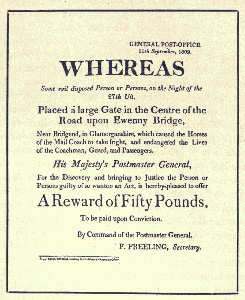
A similar outrage was committed on the night of the 27th
August 1809, when a large gate was placed in the middle
of the road on Ewenny Bridge, near Bridgend, in Glamorganshire.
In this instance the horses of the mail-coach
took fright, imperilling the lives of all upon the coach; for
it is very likely that they narrowly escaped being thrown
over the bridge. Again, on the night of the 30th April
1812, some persons placed eleven gates at different points
across the road two or three miles out of Lancaster, on the
way to Burton-in-Kendal, whereby destruction was nearly
brought upon the mail-coach and its human freight.
Between Northwich and Warrington, early on the morning
of the 19th November 1815, eight or ten gates and a door
were placed in the way of the mail-coach, and further on a
broad-wheeled cart, with the view of wrecking the mail.
On Sunday, the 15th June 1817, the horses of the mail-coach
were thrown down near Newmarket, and much
injured, by stumbling over a plough and harrow, wickedly
placed in their way by some evil-doers. These are but a
few of the cases of such malicious acts, with respect to
which rewards were offered by the Postmaster-General at
the time, for the discovery of the offenders.
Notice of Offer of Reward.
But there were other ways in which the mail was placed
in jeopardy—namely, by waggoners with teams getting in
the middle of the highway, and not clearing out smartly to
let the mails go by, or by otherwise so driving their horses
as to foul with the mail-coach. And it is curious to observe
how such cases were dealt with by the Post-office. The
following poster, issued publicly, will explain the matter:—
"Caution to Carters.
"Whereas I, Edward Monk, servant to James Smith of
Pendlebury, near Manchester, farmer, did, on Tuesday the
24th day of July last, misconduct myself in the driving of
my master's cart on the Pendleton road, by not only riding
furiously in the cart, but damaging the York and Liverpool
mail-coach, and endangering the lives of the passengers—for
which the conductor of the mails has directed a prosecution
against me; but on condition of this my public submission,
and paying the expenses attending it, all proceedings
have been discontinued. And I thank the conductor, and
the gentlemen whose lives I endangered, for their very
great lenity shown me; and I promise not to be guilty of
such outrage in future. And I trust this will operate as a
caution to all carters or persons who may have the care of
carts and other carriages, to behave themselves peaceably
and properly on the king's highway. Witness my hand,
the 2d Aug. 1804."
Then there was the danger attending the running away
of the horses with the coach, of which the following is an
instance, the facts being succinctly set forth in a notice of
1810, of which the following is a copy:—
"Whereas Walter Price, the driver of the Chester and
Manchester mail-coach, on Thursday night the 22d Nov.
1810, on arriving in Chester, incautiously left his horses
without any person at their heads, to give out a passenger's
luggage (while the guard was gone to the Post-office with
the mail-bags), when they ran off with the mail-coach
through the city of Chester, taking the road to Holywell,
but fortunately without doing any injury; in consequence
of which neglect, the driver was, on the Saturday following,
brought before the magistrates, and fined in the full penalty
of Five pounds, according to the late Act of Parliament."
And through the city of Chester, with its narrow streets!
It seems a miracle how four runaway horses, with a coach
at their heels, could have cleared the town without dire
disaster.
Again, it would come to pass that in dark nights the
horses would sometimes stumble over a stray donkey or
other animal which had taken up its night-quarters in the
middle of the road, and there made its bed. Nor were
these the only perils of the road, which were always increased
when the nights were thick with fog. On the
morning of the 30th December 1813, the mail from the
South reached Berwick late owing to a fog, the horses being
led by the driver, notwithstanding whose care the coach had
been overturned twice. The drivers were called upon on
occasions to make up their minds in a moment to choose
one of two courses, when danger suddenly burst upon them
and there was no escape from it. A good instance of such
a case happened to the driver of the Edinburgh to Dumfries
mail-coach, who proved that he could reason his case quickly
and take his resolve. At one of the stages he had changed
horses, and was proceeding on his way, the first portion of
the road being down a steep hill with an abrupt turn at the
foot. He had hardly got his coach fairly set in motion,
when to his dismay he perceived that the wheelers, two
new horses, had no notion of holding back. The animals
became furious, while the passengers became alarmed. It
seemed a hopeless task to control the horses under the
circumstances, and to attempt to take the turn at the foot
of the hill would have assured the upsetting of the coach
and all its belongings. At this juncture the passengers
observed a strange smile creep over the coachman's face,
while he gathered up the reins in the best style of the
profession, at the same time lashing his horses into a good
gallop. Terror-struck, the passengers saw nothing but
destruction before them; yet they had no alternative but
to await the issue. Opposite the foot of the hill was a
stout gate leading into a field, and this was the goal the
driver had in view. Steadying the coach by keeping its
course straight, he gave his horses all the momentum they
could gather, and shot them direct at the gate. The gate
went into splinters, the horses and coach bounded into the
field, and were there immediately drawn up, neither horses,
coach, nor passengers being seriously hurt by the adventure.
HOLYHEAD AND CHESTER MAILS SNOWED UP
NEAR
DUNSTABLE—26TH DEC. 1836. (From an old Print.)
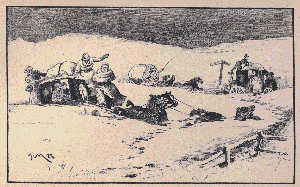
Of all the interruptions to the mail-coach service, none
were so serious as those which were occasioned by snowstorms,
nor were the dangers attending them of a light
nature to the drivers, guards, or passengers. The work
achieved by man, either for good or evil, how insignificant
does it not seem when contrasted with the phenomena of
nature!
In the year 1799 a severe snowstorm occurred in the
country, which very much deranged the mail-service, as
may be gathered from the following circular issued by the
London Post-office on the 27th April of that year:—
"Several mail-coaches being still missing that were
obstructed in the snow since the 1st February last, this is
to desire you will immediately represent to me an account
of all spare patent mail-coaches that are in the stage where
you travel over, whether they are regular stationed mail-coaches
or extra spare coaches, and the exact place where
they are, either in barn, field, yard, or coach-house, and the
condition they are in, and if they have seats, rugs, and
windows complete." So that here, after a lapse of about
three months, the Post-office had not recovered the use of
all its mail-coaches, and was beginning to hunt up the
missing vehicles.
Another snowstorm occurred in January 1814, evidence
of which, from a passenger's point of view, is furnished by
Macready in his 'Reminiscences.' He wrote as follows:—
"The snow was falling fast, and had already drifted so
high between the Ross Inn and Berwick-on-Tweed that it
had been necessary to cut a passage for carriages for some
miles. We did not reach Newcastle until nearly two hours
after midnight: and fortunate was it for the theatre and
ourselves that we had not delayed our journey, for the next
day the mails were stopped; nor for more than six weeks
was there any conveyance by carriage between Edinburgh
and Newcastle. After some weeks a passage was cut
through the snow for the guards to carry the mails on
horseback, but for a length of time the communications
every way were very irregular."
But Christmas of 1836 must bear the palm for snowstorms
which have succeeded in deranging the mail-service
in England, and it may be well to quote here some accounts
of the circumstances written at the time:—
"The guard of the Glasgow mail, which arrived on
Sunday morning, said that the roads were in the northern
parts heavy with snow, and that at one place the mail was
two hours getting over four miles of road. Never before,
within recollection, was the London mail stopped for a
whole night at a few miles from London; and never before
has the intercourse between the southern shires of England
and the metropolis been interrupted for two whole days."
"Fourteen mail-coaches were abandoned on the various
roads."
"The Brighton mail (from London) reached Crawley, but
was compelled to return. The Dover mail also returned,
not being able to proceed farther than Gravesend. The
Hastings mail was also obliged to return. The Brighton
up-mail of Sunday had travelled about eight miles from that
town, when it fell into a drift of snow, from which it was
impossible to extricate it without further assistance. The
guard immediately set off to obtain all necessary aid; but
when he returned, no trace whatever could be found either
of the coach, coachman, or passengers, three in number.
After much difficulty the coach was found, but could not be
extricated from the hollow into which it had got. The
guard did not reach town until seven o'clock on Tuesday
night, having been obliged to travel with the bags on horseback,
and in many instances to leave the main road and
proceed across fields, in order to avoid the deep drifts of
snow."
"The Bath and Bristol mails, due on Tuesday morning,
were abandoned eighty miles from London, and the mail-bags
brought up in a postchaise-and-four by the two guards,
who reached London at six o'clock on Wednesday morning.
For seventeen miles of the distance they had to come across
fields."
"The Manchester down-mail reached St Albans, and
getting off the road into a hollow, was upset. The guard
returned to London in a post-chaise and four horses with
the bags and passengers."
"About a mile from St Albans, on the London side, a
chariot without horses was seen on Tuesday nearly buried
in the snow. There were two ladies inside, who made an
earnest appeal to the mail-guard, whose coach had got into
a drift nearly at the same spot. The ladies said the postboy
had left them to go to St Albans to get fresh cattle,
and had been gone two hours. The guard was unable to
assist them, and his mail being extracted, he pursued his
journey for London, leaving the chariot and ladies in the
situation where they were first seen."
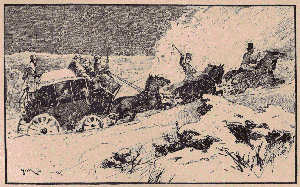
"The Devonport mail arrived at half-past eleven o'clock.
The guard, who had travelled with it from Ilminster, a
distance of 140 miles, states that journey to have been a
most trying one to both men and cattle. The storm
commenced when they reached Wincanton, and never
afterwards ceased. The wind blew fresh, and the snow and
sleet in crossing Salisbury Plain were driving into their
faces so as almost to blind them. Between Andover and
Whitchurch the mail was stuck fast in a snowdrift, and the
horses, in attempting to get out, were nearly buried. The
coachman got down, and almost disappeared in the drift
upon which he alighted. Fortunately, at this juncture, a
waggon with four horses came up, and by unyoking these
from the waggon and attaching them to the mail, it was got
out of the hollow in which it was sunk."
These are some of the reports, written at the time, of the
disorganisation of the mail-service in consequence of the
snowstorm. Some slight idea of the magnitude of the
drifts may be obtained from one or two additional
particulars. The mail proceeding from Exeter for London
was five times buried in the snow, and had to be dug out.
A mail-coach got off the road seven miles from Louth, and
went over into a gravel-pit, one of the horses being killed
and the guard severely bruised. So deeply was another
coach buried on this line of road that it took 300 men,
principally sappers and miners, working several hours, to
make a passage to the coach and rescue the mails and
passengers. Near Chatham the snow lay to a depth of 30
or 40 feet, and the military were turned out to the number
of 600 to clear the roads.
THE DEVONPORT MAIL-COACH FORCING ITS WAY
THROUGH
A SNOWDRIFT NEAR AMESBURY—27TH DEC. 1836.
(From an old Print.)
On the line of road from Chatham to Dover, a sum of
£700 was spent by the road-trustees in opening up the road
for the resumption of traffic, an official report stating that
for 26 miles the road "was blocked up by an impenetrable
mass of snow varying from 3 feet to 18 feet in depth."
Between Leicester and Northampton cuttings were made,
just wide enough for a coach to pass, where the snow was
heaped up to a height of 30, 40, and in some places 50
feet. About a stage from Coventry, near a place called
Dunchurch, seventeen coaches were reported to be laid up
in the snow; and in other parts of the country a similar
wholesale derangement or stoppage of road-traffic took
place.
On the 9th January 1837, an official report set forth
that "the mail-coach road between Louth and Sheffield had
on the 6th inst. been closed twelve days in consequence of
the snow, and it is stated that it will be a week before the
mail can run." An attempt was made to get the mail
forward from Lewes to London by post-chaise and four
horses; but after proceeding about a mile from the town,
the chaise returned, the driver reporting that it was impossible
to proceed, as the main road was quite blocked up
with snow to a depth of 10 or 12 feet.
These were the good old times; and no doubt to us they
have a romance, though to the people who lived in them
they had a very practical aspect.
The general instructions to mail-guards in cases of breakdown
were as follows:—
"When the coach is so broke down that it cannot proceed
as it is on its way to London, if you have not above
two passengers, and you can procure a post-chaise without
loss of time, get them and the mail forward in that way,
with the horses that used to draw the mail-coach, that they
may be in their places (till you come to where a coach is
stationed); and if you have lost any time, you must
endeavour to fetch it up, which may be easily done, as the
chaise is lighter than the coach.
"If you cannot get a post-chaise, take off one of the
coach-horses, and ride with your bags to the next stage;
there take another horse,—and so on till you come to the
end of your ground, when you must deliver the bags to the
next guard, who must proceed in the same manner. If
your mail is so large (as the York, Manchester, and two or
three others are at some part of the road) that one horse
cannot carry it, you may take two; tie the mail on one
horse and ride the other. The person who horses the mail
must order his horsekeeper at every stage to furnish you
with horses in case of accidents. Change your horses at
every post-town, and do all your office-duty the same as if
the coach travelled.
"If in travelling from London an accident happens, use
all possible expedition in repairing the coach to proceed;
and if it cannot be repaired in an hour or two, take the
mail forward by horse or chaise—if the latter, the
passengers will go with you."
In pursuance of these instructions, many instances of
devotion to duty were given by the mail-guards, in labouring
to get the mails forward in the midst of the snowstorm
of 1836.
On the 26th of December the Birmingham mail-coach,
proceeding to London, got rather beyond Aylesbury, where
it broke down. Some things having been set right, another
effort was made, and some little further way made; but the
attempt to go on had to be given up, for the snow was
getting deeper at every step. A hurricane was blowing,
accompanied with a fall of fine snow, and the horses shook
with extreme cold. In these circumstances, Price the mail-guard
mounted one of the horses, tied his mail-bags on the
back of another, and set out for London. He was joined
farther on by two postboys on other horses with the bye-bags,
and all three journeyed in company. The road-marks
being frequently effaced, they were constantly deviating
from their proper course, clearing gates, hedges, and
ditches; but having a general knowledge of the lie of the
country, and Price being possessed of good nerves, they
succeeded in reaching the metropolis. The guard was in
a distressing state of exhaustion when he reached his
destination. This was only one instance of the way in
which the guards acquitted themselves during this memorable
storm, and for their great exertions they received the
special thanks of the Postmaster-General.
At a place called Cavendish Bridge the mails were
arrested by the storm, and the exertions of the coachman
and guard were thus referred to by a private gentleman of
the neighbourhood, who communicated with the Post-office
on the subject: "I take leave to remark that the zeal
and industry evinced by the guard and coachman, more
especially the former (named Needle), upon the trying
occasion to which your communication has reference, was
well worthy of imitation, and formed a striking contrast to
the reprehensible apathy of two gentlemen who were inside
passengers by the mail."
A notable instance of the devotion to duty of a coachman
and mail-guard, and one illustrating the dangers and
hardships which Post-office servants of that class had to
encounter, occurred in the winter of 1831. On Tuesday
the 1st February of that year, James M'George, mail-guard,
and John Goodfellow, coachman, set out from
Dumfries for Edinburgh at seven o'clock in the morning,
and after extraordinary exertions reached Moffat,—beyond
which, however, they found it impossible to proceed with
the coach, owing to the accumulation of snow. They then
procured saddle-horses, and with these, accompanied by a
postboy, they went on, intending to continue their journey
in this way. They had not proceeded beyond Erickstane
Hill, a rising ground in close proximity to the well-known
natural enclosure called the Deil's Beef-Tub, when it became
evident that the horses could not make the journey,
and these were sent back in charge of the postboy to
Moffat. The guard and coachman, unwilling to give in,
continued their journey on foot, having in view to reach a
roadside inn at Tweedshaws, some two or three miles
farther on. The exact particulars of what thereafter
happened will never be known, beyond this, that the mail-bags
were afterwards found tied to one of the road-posts
set up in like situations to mark the line of road on
occasions of snowstorms, and that the two men perished
in the drift. The last act performed by them, before being
quite overcome by exhaustion and fatigue, was inspired by
a sense of duty, their aim being to leave the bags where
they would more readily be found by others, should they
themselves not live to recover them. Shortly after this
the two men appear to have succumbed; for their bodies
were found five days afterwards within a hundred yards
of the place where they left the bags, and where at the
cost of their lives they had rendered their last service to
the Post-office and their country.
"And down he sinks
Beneath the shelter of the shapeless drift,
Thinking o'er all the bitterness of death,
Mix'd with the tender anguish Nature shoots
Through the wrung bosom of the dying man,
His wife, his children, and his friends unseen.
. . . . .
On every nerve
The deadly winter seizes; shuts up sense;
And, o'er his inmost vitals creeping cold,
Lays him along the snows, a stiffened corse,
Stretch'd out, and bleaching in the northern blast."
—Thomson.
We who are accustomed to the comforts of railway
travelling, are nevertheless, in regard to accidents, very
much like the ostrich; for though we do not purposely
close our eyes to danger, we are nevertheless placed in such
a position that we are unable, when shut up in a railway
carriage, to see what is before us, or about to happen.
Far otherwise was the case in the days of coaching.
The passengers, as well as the drivers and guards, were
not only exposed to the drenchings from long-continued
rain, the terrible exposure to the cold night-air in winter
travelling, and the danger of attack from highwaymen,
but they ran the risks of all the accidents of the road,
many of which they could see to be inevitable before they
happened. There were occasions when passengers were
frozen to death on the coaches, and others when they fell
off benumbed with cold. It is said sometimes that first
impressions are often correct; but there are, of course,
erroneous first impressions as well. A story is told of a
mail-guard in Scotland who had the misfortune to be on
a coach which upset, and from which all the outside people
were thrown to the ground. The guard came down upon
his head on the top of a stiff hedge, and from this
temporary situation rolled into a ditch, where for a moment
he lay. Coming to himself from a partial stupor, he
imagined there was something wrong with the top of his
head, and putting up his hand, he felt a flat surface,
which to his dawning perception appeared to be a section
of his neck, his impression being that his head had been
cut off. This was, however, nothing but the crown of his
hat, which, being forced down over his head and face, had
probably saved him from more serious damage. Broken
limbs were accidents of common occurrence; but affairs of
much more serious import occasionally took place, of which
the following is a notable example:—
On the night of Tuesday the 25th October 1808, the
road between Carlisle and Glasgow was the scene of a
catastrophe which will serve to illustrate in a striking
degree one of the perils of the postal service in the mail-coach
era. The place where the event now to be described
occurred, lies between Beattock and Elvanfoot (about five
miles from the latter place), where the highway crosses the
Evan Water, a stream which takes its rise near the sources
of the Clyde, but whose waters are carried southward into
Dumfriesshire. To be more precise, the situation is between
two places called Raecleuch and Howcleuch, on the Carlisle
road; and a bridge which now spans the water, in lieu of a
former bridge, retains by association, to this day, the name
of the "Broken Bridge."
It was at the breaking up of a severe storm of frost and
snow, when the rivers were flooded to such an extent as had
never been seen by the oldest people in the neighbourhood.
The bridge had been but recently built; and though it was
afterwards stated that the materials composing the mortar
must have been of bad quality, no doubt would seem to
have been entertained as to the security of the bridge. The
night was dark, and accompanied by both wind and rain—elements
which frequently usher in a state of thaw. The
mail-coach having passed the summit, was speeding along at
a good round pace, the "outsiders" doubtless making themselves
as comfortable as circumstances would allow, while
the "insides," as we might imagine, had composed themselves
into some semblance of sleep, the time being between
nine and ten o'clock, when, suddenly and without warning, the
whole equipage—horses, coach, driver, guard, and passengers—on
reaching the middle of the bridge, went headlong precipitate
into the swollen stream through a chasm left by the
collapse of the arch. It is by no means easy to realise what
the thoughts would be of those concerned in this dreadful
experience—pitched into a roaring torrent, in a most lonely
place, at a late hour on such a night. The actual results
were, however, very serious. The two leading horses were
killed outright by the fall, while one of the wheelers
was killed by a heavy stone descending upon it from the
still impending portions of the wrecked structure. The
coach and harness also were utterly destroyed. But, worse
still, two outside passengers, one a Mr Lund, a partner in
a London house, and the other named Brand, a merchant in
Ecclefechan, were killed on the spot, while a lady and three
gentlemen who were inside passengers miraculously escaped
with their lives, though they were severely bruised. The
lady, who had scrambled out of the vehicle, sought refuge
on a rock in mid-stream, there remaining prisoner for a
time; and by her means a second catastrophe of a similar
kind was happily averted. The mail from Carlisle for
Glasgow usually exchanged "Good-night" with the south-going
coach, when they were running to time, just about the
scene of the accident. Fortunately the coach from Carlisle
was rather late; but when it did arrive, the lady on the
rock, seeing the lights approach, screamed aloud, and thus
warned the driver to draw up in time. Succour was now
at hand. Something ludicrous generally finds itself in
company with whatever is of a tragic nature. The guard of
the Carlisle coach was let down to the place where the lady
was, by means of the reins taken from the horses. Hughie
Campbell—that was the guard's name—when deliberating
upon the plan of rescue, had some delicacy as to how he
should affix the reins to the person of the lady, and called
up to those above, "Where will I grip her?" But before
he could be otherwise advised, the lady, long enough
already on the rock, broke in, "Grip me where you like,
but grip me firm," which observation at once removed
Hughie's difficulty, and set his scruples at ease. The driver
of the wrecked coach, Alexander Cooper, was at first thought
to have been carried away; but he was afterwards found
caught between two stones in the river. He survived the
accident only a few weeks—serious injuries to his back
proving fatal. As for the guard, Thomas Kinghorn, he
was severely cut about the head, but eventually recovered.
It was usual for the coachman and guard over this wild
and exposed road to be strapped to their seats in stormy
weather; but on this occasion Kinghorn, as it happened,
was not strapped, and to this circumstance he attributed his
escape from death. When the mail went down, he was
sent flying over the bridge, and alighted clear from the
wreck of the coach. The dead passengers and the wounded
persons were taken by the other coach into Moffat.
It may be added that the fourth horse was got out of its
predicament little the worse for the fall, and continued to
run for many a day over the same road; but it was always
observed to evince great nervousness and excitement whenever
it approached the scene of the accident.
Yet the mail-coach days had charms and attractions for
travellers, if they at the same time had their drawbacks:
the bustle and excitement of the start, when the horses
were loosed and the driver let them have rein, under the
eyes of interested and admiring spectators; the exhilarating
gallop as a good pace was achieved on the open country-road;
the keen relish of the meals, more especially of
breakfast, at the neatly kept and hospitable inn; the blithe
note of the guard's horn, as a turnpike-gate or the end of a
stage was approached; and the hurried changing of horses
from time to time as the journey progressed. Ever-varying
scene is the characteristic of the occasion: the village with
its rustic quiet, and odd characters, who were sure to
present themselves as the coach flew by; the fresh and
blooming fields; the soft and pastoral downs; the scented
hedgerows in May and June; the stretches of road
embowered with wood, affording a grateful shade in warm
weather; the farmer's children swinging on a gate or over-topping
a fence, and cheering lustily with their small voices
as the coach swept along. And then, the hours of twilight
being past, when
"Day hath put on his jacket, and around
His burning bosom buttoned it with stars,"
the eeriness of a night-journey would be experienced.
During hard frost the clear ring of the horses' feet would
be heard upon the road; the discomfort of fellow-passengers
rolling about in their places, overcome by sleep, would be
felt; while in the solemn dulness of the darker hours of
night the monotony of the situation would be relieved at
intervals, in the mineral districts, by miniature mountains
of blazing coal, shedding their lurid glare upon the coach as
it passed, and showing up the figures of soiled and dusky
men employed thereat, thus creating a horrible impression
upon the passengers, and seeming to afford an effective
representation of Dante's shadowy world.
Or, on occasions of great national triumph—when, for
example, some important victory crowned our arms—the
coach, decked out with ribbons or green leaves, would be
the bearer of the joyful and intoxicating news down into
the country,—the driver and guard, as the official representatives
of the Crown, being the heroes of the hour.
But it may be of interest to learn what a mail-coach
journey was from one who had just completed such a trip,
and who, in the freshness of youth, and with the unreserve
which can only subsist in correspondence between members
of a family or dear friends, immediately commits his
impressions to writing. We have a vivid sketch of a
journey of this kind from no less a personage than Felix
Mendelssohn, the great musical composer. Mendelssohn
was at the time a young man of twenty: he had been
making a tour in Scotland with his friend Klingemann—the
visit being that from which, by the way, Mendelssohn
derived inspiration for the composition of his delightful
Scotch symphony; and the means by which he quitted the
northern kingdom was by mail-coach from Glasgow to
Liverpool. The following letter, descriptive of the journey,
and dated August 19, 1829, is copied from an interesting
work called 'The Mendelssohn Family':—
"We flew away from Glasgow on the top of the mail,
ten miles an hour, past steaming meadows and smoking
chimneys, to the Cumberland lakes, to Keswick, Kendal,
and the prettiest towns and villages. The whole country
is like a drawing-room. The rocky walls are papered with
bushes, moss, and firs; the trees are carefully wrapped up
in ivy; there are no walls or fences, only high hedges, and
you see them all the way up flat hill-tops. On all sides
carriages full of travellers fly along the roads; the corn
stands in sheaves; slopes, hills, precipices, are all covered
with thick, warm foliage. Then again our eyes dwelt on
the dark-blue English distance—many a noble castle, and
so on, until we reached Ambleside. There the sky turned
gloomy again, and we had rain and storm. Sitting on the
top of the 'stage,' and madly careering along ravines, past
lakes, up-hill, down-hill, wrapped in cloaks, and umbrellas
up, we could see nothing but railings, heaps of stones or
ditches, and but rarely catch glimpses of hills and lakes.
Sometimes our umbrellas scraped against the roofs of the
houses, and then, wet through, we would come to a second-rate
inn, with a high blazing fire, and English conversation
about walking, coals, supper, the weather, and Bonaparte.
Yesterday our seats on the coach were accidentally separated,
so that I hardly spoke to Klingemann, for changing horses
was done in about forty seconds. I sat on the box next by
the coachman, who asked me whether I flirted much, and
made me talk a good deal, and taught me the slang of
horsemanship. Klingemann sat next to two old women,
with whom he shared his umbrella. Again manufactories,
meadows, parks, provincial towns, here a canal, there a
railway, then the sea with ships, six full coaches with
towering outsiders following each other; in the evening a
thick fog, the stage running madly in the darkness.
Through the fog we see lamps gleaming all about the
horizon; the smoke of manufactories envelops us on all
sides; gentlemen on horseback ride past; one coach-horn
blows in B flat, another in D, others follow in the distance,
and here we are at Liverpool."
Speed was of the first consideration, and the stoppages
at the wayside stages were of very limited duration. At
an inn, the travellers would hardly have made a fair start
in appeasing their hunger, when the guard would be heard
calling upon them to take their seats, which, with mouths
full, and still hungry, they would be forced to do, though
with a bad grace and a growl—the acknowledged privilege
of Englishmen. A story is told of one passenger, however,
who was equal to the occasion. Leisurely sipping his tea
and eating his toast, this traveller was found by the landlord
in the breakfast-room when the other passengers were
seated and the coach was on the point of starting.
Boniface appealed to him to take his place, or he would
be left behind. "But," replied the traveller, "that I will
not do till I have a spoon to sup my egg." A glance
apprised the landlord that not a spoon adorned the table,
and rushing out he detained the coach while all the
passengers were searched for the missing articles. Then
out came the satisfied traveller, who also submitted to be
searched, and afterwards mounted the coach; and as the
mail drove off he called to the landlord to look inside the
teapot, where the artful traveller had placed the dozen
spoons, with the double object of cooling the tea for his
second cup, and detaining the coach till he drank it.
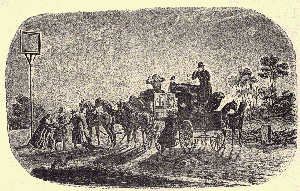
The illustration here inserted, from an old print, shows
a passenger securing refreshment on a cold night.
Nocturnal Refreshment.
In the year 1836 the speed of some of the mail-coaches
was nearly ten miles an hour, including stoppages, and
this was kept up over very long distances. From Edinburgh
to London, a distance of 400 miles, the time allowed
was forty-five and a half hours; in the opposite direction
the time was curtailed to forty-two and a half hours.
From London to York, 197 miles, twenty hours were
allowed; London to Manchester, 185 miles, nineteen
hours; London to Exeter, 176 miles, nineteen hours;
London to Holyhead, 259 miles, twenty-seven hours;
London to Devonport, 216 miles, twenty-one hours. But
in the earlier days of the mail-coach, travelling was much
less rapid; for we find that in 1804 the mail-coach from
Perth to Edinburgh, a distance by way of Fife of 40
miles, took eight hours for the journey, including stoppages
and the transit by Ferry across the Forth—that is, at the
rate of five miles an hour. The mail-guards rode about
twelve hours at a stretch—quite long enough, in all
conscience, on a wet or frosty night.
But though in the earlier days of the mail-coaches the
speed achieved by them, even on the main lines, was
probably not more than seven or eight miles an hour, the
people at head-quarters would seem to have regarded this
as a thing not to be trifled with; for in a Postmaster-General's
minute of 1791, directing that, owing to the
frequent robberies, a caution should be given to the public
against sending bank notes otherwise than in halves, the
following bit of advice is added. The minute directs that
the notice shall contain "also a printed caution at the foot
of the Table, directing all persons to avoid, as far as may
be, sending any cash by the post, partly from the prejudice
it does the coin by the friction it occasions from the great
expedition with which it is conveyed, and especially as the
cash is so liable to fall out of the letter by jolting, and to
be found at the bottom of the bag," &c. It would be a
species of high treason to treat with levity any kind of
expression or decision proceeding from a reigning Postmaster-General,
but at this safe distance of time we may venture
to smile at the idea here propounded, that coins would
seriously suffer by sweating in a mail-bag conveyed by
coach at the surprising rate of eight miles an hour. Such
ill-founded apprehensions of the mail-coach speed were not,
however, confined to post officials, for Lord Campbell was
frequently warned against the danger of travelling in this
way, and instances were cited to him in which passengers
died from apoplexy induced by the rapidity with which
these vehicles travelled!
An incident of a romantic nature happened about the
year 1780 in connection with the stage-coach (not a mail-coach,
however, be it noted) running between Edinburgh
and Glasgow at that period. The stage-coach, drawn by
four horses, had been on the road for many years, having
been established about the year 1758. The time occupied
in the journey was twelve hours; nor, down to the period
in question, had any acceleration taken place. A young
lady of Glasgow, of distinguished beauty, having to travel
to Edinburgh, a lover whose suit towards her had not
hitherto proved successful, took the remaining tickets for
the journey, and so became her sole companion on the
way. By assiduous attentions, and all the winsome ways
which the tender passion knows to suggest, as well as by
earnestness of pursuit, the lover won the lady to his
favour, and she soon thereafter became his wife. But the
full day did not justify the brightness of the morning:
the husband failed to prove himself worthy of his good
fortune; "and the lady, in a state worse than widowhood,
was, a few years after, the subject of the celebrated
Clarinda correspondence of Burns."
In addition to the obvious duties of the mail-guards—to
protect the mails and carry out their exchange at the several
stations—they were sometimes required to perform special
duties unconnected with Post-office work. They were, for
example, called upon to keep watch in the early part of the
present century upon French prisoners of war who might
be breaking their parole, a likely way of escaping being
by the mail-coaches. The guards were instructed to
question any suspicious foreigner travelling by the coach,
and to report the matter to the postmaster at the first town
at which they arrived. This was doubtless looked upon as
a pleasure rather than as a hardship; for they were reminded
that the usual reward was ten guineas each—not a
bad price for a Frenchman under the circumstances.
No record of the mail-coach days would be complete
without a description of the annual procession of mail-coaches
which used to be held in the metropolis on the
monarch's birthday. As every corporation or society has its
saint's day, or yearly festival, so the Jehus of the Post-office
were not without theirs; an occasion on which they
showed themselves to advantage, and drew admiring crowds
to behold them. The following account of one of these
displays is from the 'Annals of the Road,' a work of great
interest on subjects connected with coaching generally; and
as the description is given with spirit and apparent truthfulness,
we cannot do better than give it at length, and in
this way bring the present chapter to a close:—
"The great day of the year was the King's birthday,
when a goodly procession of four-in-hands started from the
great coach manufactory of Mr John Vidler, in the neighbourhood
of Millbank, and wended its way to St Martin's-le-Grand.
Splendid in fresh paint and varnish, gold lettering
and Royal arms, they were the perfection of neatness and
practical utility in build, horsed to perfection, and leathered
to match. They were driven by coachmen who, as well as
the guards behind, were arrayed in spick-and-span new
scarlet and gold. No delicate bouquets, but mighty nosegays
of the size of a cabbage, adorned the breasts of these
portly mail coachmen and guards, while bunches of cabbage-roses
decorated the heads of the proud steeds. In the
cramped interior of the vehicles were closely packed buxom
dames and blooming lassies, the wives, daughters, or sweethearts
of the coachmen or guards, the fair passengers
arrayed in coal-scuttle bonnets and in canary-coloured or
scarlet silks. On this great occasion the guard was allowed
two seats and the coachman two, no one allowed on the
roof. But the great feature, after all, was that stirring note,
so clearly blown and well drawn out, and every now and
again sounded by the guards, and alternated with such airs
as 'The Days when we went Gipsying,' capitally played on
a key-bugle. Should a mail come late, the tune from a
passing one would be, 'Oh, dear! what can the matter
be?' This key-bugle was no part of the mail equipment,
but was nevertheless frequently used.
"Heading the procession was the oldest-established mail,
which would be the Bristol. On the King's birthday,
1834, there were 27 coaches in the procession. They all
wore hammer-cloths, and both guard and coachman were in
red liveries, the latter being furnished by the mail contractor.
They wore beaver hats with gold lace and cockades. Such
a thing as a low billycock hat was not to be seen on any
coach anywhere. Sherman's mails were drawn by black
horses, and on these occasions their harness was of red
morocco.
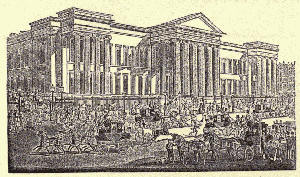
St Martin's-le-Grand in the Coaching Days
"The coaches were new each year. In these days brass
mountings were rarely known; plated or silver only were in
use. On the starting of the procession, the bells of the
neighbouring churches rang out merrily, continuing their
rejoicing peals till it arrived at the General Post-office.
Many country squires, who were always anxious that their
best horses should have a few turns in the mail-coaches
in travelling, sent up their horses to figure in the procession.
"From Millbank the procession passed by St James's
Palace, at the windows of which, above the porch, stood
King William and his Queen. The Duke of Richmond
(then Postmaster-General) and the Duke of Wellington
stood there also. Each coach as it passed saluted the King,
the coachman and guard standing up and taking off their
hats. The appearance of the smart coaches, emblazoned
with the Royal arms, orders, &c., coachman and guard got
up to every advantage, with their nosegays stuck in their
brand-new scarlet liveries, was at this point strikingly
grand. The inspectors of mail-coaches rode in front of the
procession on horseback."


