The history of thirteen years of the life of Davy, like
that of fifty of the life of Faraday, is closely interwoven
with the history of the Royal Institution.
Their lives were the life of the place; and hence, to
complete the history of the Institution to the time of
Faraday, a sketch of Davy and his scientific life must
be given here.
Humphry Davy was born on December 17, 1778, at
Penzance. He was the son of a wood carver and was
apprenticed to a surgeon.
Mr. Davies Gilbert heard that the boy was fond of
making chemical experiments. He encouraged him
and spoke of him to Dr. Beddoes, Professor of Geology
and Chemistry at Oxford, who happened to be at work
upon the ‘Geology of Cornwall.’
Afterwards Dr. Beddoes established the Pneumatic
Institution at Clifton, and he required an assistant to
prepare the gases and superintend the Pneumatic
Hospital, and Mr. Gilbert proposed Davy. He went
on October 2, 1798, ‘to superintend experiments on
the medical powers of factitious airs or gases.’
Davy thus wrote to Mr. Davies Gilbert:
November 12, 1798.
I have purposely delayed writing until I could communicate
to you some intelligence of importance concerning
the new Pneumatic Institution. The speedy execution of
the plan will, I think, interest you both as a subscriber and
a friend to science and mankind. The present subscription
is, we suppose, nearly adequate to the purpose of investigating
the medicinal powers of factitious airs. It still continues
to increase, and we may hope for the ability of
pursuing the investigation to its full extent. We are
negotiating for a house in Downe Square, the proximity of
which to Bristol and its general situation and advantages
render it very suitable for the purpose. The funds will, I
suppose, enable us to provide for eight or ten patients in
the Hospital, and for as many out of it as we can procure.
We shall try the gases in every possible way.
We are printing in Bristol the first volume of the ‘West
Country Collection,’ which will, I suppose, be out the
beginning of January.
Believe me, dear Sir, with affection and respect, truly
yours,
Humphry Davy.
The first two hundred pages of this collection, constituting
very nearly half the volume, consist of essays of
Davy on ‘Heat, Light, and the Combinations of Light,’
on ‘Phos-Oxygen or Oxygen and its Combinations,’
and on the ‘Theory of Respiration.’
He wrote on February 22, 1799, to Davies Gilbert:
Dear Friend,—(For I love you too well to call you by a
more ceremonious name), I have delayed writing to you,
expecting that some of our experiments would produce
results worthy of communication.
I am now as much convinced of the non-existence of
caloric as I am of the existence of light.
Our laboratory in the Pneumatic Institution is nearly
finished.
I hope the gaseous oxide of azote will prove to be a
specific stimulus for the absorbents.
I know of little general scientific news. Berthollet makes
sulphuretted hydrogen out to be an acid.
I remain, with affection and respect, yours,
Humphry Davy.
Again on April 10, 1799, to Mr. Gilbert, writing of
light and heat, he said:
The supposition of active powers common to all matter
from the different modifications of which all the phenomena
of its changes result, appears to me more reasonable than
the assumption of certain imaginary fluids, alone endowed
with active powers, and bearing the same relation to common
matter as the vulgar philosophy supposes spirit to
bear to matter.
It is only by forming theories, and then comparing them
with facts, that we can hope to discover the true system of
nature.
I made a discovery yesterday which proves how necessary
it is to repeat experiments. The gaseous oxide of azote is
perfectly respirable when pure. It is never deleterious
but when it contains nitrous gas. I have found a mode of
obtaining it pure, and I breathed it to-day in the presence of
Dr. Beddoes and some others—sixteen quarts of it for near
seven minutes. It appears to support life longer than even
oxygen gas, and absolutely intoxicated me. Pure oxygen
gas produced no alteration in my pulse nor any other
material effect, whereas this gas raised my pulse upwards
of twenty strokes, made me dance about the laboratory as a
madman, and has kept my spirits in a glow ever since.
Yours, with affection and respect,
Humphry Davy.
Dr. Paris says Coleridge gave him this account of
of the caution of Davy at this time:
Dr. Beddoes thought nitrous oxide gas would cure paralysis.
A patient was to be treated by Davy. He first took
the temperature by means of a small thermometer placed
under the tongue. The patient immediately declared that
he felt better. The opportunity was too tempting to be
lost. Davy cast an intelligent glance at Mr. Coleridge, and
desired the patient to renew his visit on the following day,
when the same ceremony was again performed, and repeated
every succeeding day for a fortnight, the patient gradually
improving during that period, when he was dismissed as
cured, no other application having been used than that of
the thermometer.
Southey thus wrote his opinion and that of Coleridge
regarding Davy at this time: ‘He is a marvellous
young man, whose talents I can only wonder at.’
Later he wrote:
My residence at Westbury was one of the happiest
portions of my life.... I was in habits of the most
frequent and intimate intercourse with Davy, then in the
flower and freshness of his youth. We were within an
easy walk of each other over some of the most beautiful
ground in that beautiful part of England. When I went
to the Pneumatic Institution he had to tell me of some new
experiment or discovery and of the views which it opened
for him, and when he came to Westbury there was a fresh
portion of Madoc for his hearing.
On July 3, 1800, Davy wrote from Bristol to Gilbert:
We have been repeating the galvanic experiments with
success. Nicholson, by means of a hundred pieces of silver
and zinc, has procured a visible spark. Cruickshank has
revived oxidated metals in solution by means of the nascent
hydrogen produced from the decomposition of water by the
shock, and both he and Carlisle have absolutely resolved
water into oxygen and hydrogen by means of it, making
use of silver and platina wires. An immense field of
investigation seems opened by this discovery; may it be
pursued so as to acquaint us with some of the laws of
life!
You have undoubtedly heard of Herschel’s discovery
concerning the production of heat by invisible rays
emitted from the sun?
Coleridge is gone to reside in Cumberland.
Yours, with sincere affection,
Humphry Davy.
On October 20, 1800, again he wrote to Gilbert:
In pursuing experiments on galvanism during the last
two months I have met with unexpected and unhoped-for
success. Some of the new facts on this subject promise to
afford instruments capable of destroying the mysterious veil
which nature has thrown over the operation and properties
of ethereal fluids.
Galvanism I have found, by numerous experiments, to be
a process purely chemical.
I remain, with sincere respect and affection, yours,
Humphry Davy.
During this year he published a volume entitled
‘Researches, Chemical and Philosophical, chiefly concerning
Nitrous Oxide and its Respiration.’
In the spring of 1800 Mr. Underwood, a geologist
and artist, had become a proprietor of the Royal
Institution. He had several conversations with Count
Rumford on the subject of Davy’s superior talents and
the advantages that would accrue to the Institution
from engaging him as a lecturer. ‘The Count called
on me,’ Underwood says, ‘on January 5, 1801, having
received from the managers of the Institution full
powers to negotiate upon this subject. On this occasion,
however, I thought it advisable to introduce the
Count to Mr. James Thompson, as being the more
eligible person to treat in behalf of Davy, not only on
account of his greater intimacy with him, but because,
not being a proprietor, he was unconnected with the interests
of the Institution.’ Mr. Thompson wrote to Davy.
With his characteristic energy Davy answered in person,
and had several conferences with Count Rumford. The
following letter from Count Rumford to Davy, written
from the Royal Institution, is dated February 16, 1801:
Dear Sir,—In consequence of the conversations I have
had with you, respecting your engaging in the service of
the Royal Institution of Great Britain, I this day laid the
matter before the managers of the Institution at their
meeting,[32] and I have the pleasure to acquaint you that
the proposal I made to them was approved, and the following
resolution unanimously taken by them: ‘Resolved,—That
Mr. Humphry Davy be engaged in the service of the
Royal Institution in the capacity of Assistant Lecturer in
Chemistry, Director of the Chemical Laboratory, and Assistant
Editor of the Journals of the Institution, and that
he be allowed to occupy a room in the house and be furnished
with coals and candles, and that he be paid a salary
of 100l. per annum.’
On this occasion I did not neglect to give an account to
the managers of the whole of what passed between us
respecting the situation it was intended you should fill in
the Institution on your engaging in its service, and the
prospects that could with propriety be held out to you of
future advantages, and the managers agreed with me in
thinking that, as you had expressed your willingness to
devote yourself entirely and permanently to the Institution,
it would be right and proper to hold out to you the prospect
of becoming, in the course of two or three years, Professor
of Chemistry in the Institution, with a salary of 300l.
per annum, provided that within that period you shall
have given proofs of your fitness to hold that distinguished
situation.
Although you must ever consider the duties of the offices
you may hold under the Institution as the primary objects
of your care and attention, yet the managers are so far
from being desirous that you should relinquish the private
philosophical investigations in which you have hitherto been
engaged, and by which you have so honourably distinguished
yourself and attracted their attention, that it will afford them
the sincerest pleasure to encourage and assist you in these
laudable pursuits, and give you every facility which the
philosophical apparatus at the Institution can afford to
make new and interesting experiments.
You will naturally consider the Journals of the Institution
as the most proper vehicle for communicating to the
public from time to time short accounts of the progress you
may make in your investigations; this will, however, by no
means be considered as precluding you in any degree from
presenting to the Royal Society of London, or any other
learned body, philosophical papers or memoirs on such
scientific subjects as may engage your attention, or from
publishing in any other manner the results of your researches.
As you are fully informed with respect to the nature and
objects of the Royal Institution and are acquainted with
the respectable character of those distinguished persons
with whom I have the honour to act in the management of
its concerns, you cannot, I think, entertain the smallest
doubt of their constant protection and of their readiness on
all occasions to do full justice to the zeal and abilities you
may display in the situation in which they have placed
you.
It is with much esteem and a sincere desire that the
talents which at so early a period of life you discovered
may be cultivated with care, and always employed with
success, that I am, dear Sir, your most obedient Servant,
Rumford.
On March 8 Davy wrote to Davies Gilbert:
I cannot think of quitting the Pneumatic Institution
without giving you information of it in a letter; indeed, I
believe I should have done this some time ago had not the
hurry of business and the fever of emotion produced by the
prospect of novel changes in futurity destroyed to a certain
extent my powers of consistent action.
You, my dear sir, have behaved to me with great kindness,
and the little ability I possess you have very much contributed
to develope; I should therefore accuse myself of ingratitude
were I to neglect to ask your approbation of the
measures I have adopted with regard to the change of my
situation and the enlargement of my views in life.
In consequence of an invitation from Count Rumford,
given to me with some proposals relative to the Royal
Institution, I visited London in the middle of February,
where, after several conferences with that gentleman, I was
invited by the managers of the Royal Institution to become
the director of their laboratory and their assistant professor
of chemistry. At the same time I was assured that, within
the space of two or three seasons, I should be made sole
professor of chemistry, still continuing director of the laboratory.
The immediate emolument offered was sufficient for my
wants, and the sole and uncontrolled use of the apparatus in
the Institution for private experiments was to be granted me.
The behaviour of Count Rumford, Sir Joseph Banks,
Mr. Cavendish, and the other principal managers was
liberal and polite, and they promised me any apparatus
that I might need for new experiments.
The time required to be devoted to the services of the
Institution was but short, being limited chiefly to the winter
and spring. The emoluments to be attached to the office
of sole professor of chemistry are great, and, above all, the
situation is permanent and held very honourable.
These motives, joined to the approbation of Dr. Beddoes,
who, with great liberality, has absolved me from my engagements
at the Pneumatic Institution, and the strong wishes
of most of my friends in London and Bristol determined
my conduct.
Thus I am quietly to be transferred to London, whilst
my sphere of action is considerably enlarged, and as much
power as I could reasonably expect, or even wish for at my
time of life, secured to me without the obligation of labouring
at a profession.
The Royal Institution will, I hope, be of some utility to
society. It has undoubtedly the capability of becoming a
great instrument of moral and intellectual improvement.
Its funds are very great. It has attached to it the feelings
of a great number of people of fashion and property, and
consequently may be the means of employing to useful
purposes money which would otherwise be squandered in
luxury and in the production of unnecessary labour.
Count Rumford professes that it will be kept distinct
from party politics. I sincerely wish that such may be
the case, though I fear it. As for myself, I shall become
attached to it, full of hope, with the resolution of employing
all my feeble powers towards promoting its true interests.
I have been pursuing galvanism with labour and some
success; I have been able to produce galvanic power from
single plates, by effecting on them different oxidating and
deoxidating processes.
After the 11th I shall be in town—my direction, Royal
Institution.
I am, my dear Friend, with respect and affection, yours,
Humphry Davy.
At the meeting of the managers of the Royal Institution
on February 16 (present, Sir J. Banks, Earl
Morton, Count Rumford, and Mr. R. Clark, Chamberlain
of the City of London), it was resolved ‘that Mr.
Humphry Davy be engaged in the service of the
Royal Institution in the capacities of Assistant Lecturer
in Chemistry, Director of the Laboratory, and Assistant
Editor of the Journals of the Institution; that he be
allowed to occupy a room in the house, and be furnished
with coals and candles; and that he be paid a
salary of one hundred guineas per annum.’
On March 16 Count Rumford, after reporting that
a room had been prepared and furnished, stated that
Mr. Davy had arrived at the Institution on Wednesday,
March 11, and taken possession of his situation.
Davy gave three courses of lectures in the spring of
1801.
His first course consisted of five lectures on the
‘New Branch of Philosophy’—the galvanic phenomena.
His first lecture was on Tuesday evening, April 25.
He began with the history of galvanism, detailed the
successive discoveries, and described the different
methods of accumulating galvanic influence. Polished
plates of different metals and the effect of their lying
together in contact with water and air were exhibited.
‘Air is absolutely necessary to the oxydating process.’
He observed that ‘it was difficult to prove that hydrogen
was given out in the decomposition of water in this
way, and that it seemed rather probable that alkali
was formed.’ He showed the effects of galvanism on
the legs of frogs, and exhibited some interesting experiments
on the galvanic effects on the solution of
metals in acids. As a recent discovery of his own he
showed that with one kind of metal only, more powerful
effects may be produced than with two, as heretofore
employed; but in this case there must be more than
one liquid interposed between the plates. He stated
that copper, for example, and discs of cloth or pasteboard,
moistened with diluted nitrous acid and solutions
of muriat of soda and sulphuret of potash, and
arranged in the order named (viz. copper, nitrous acid,
muriat of soda, sulphuret of potash, &c.), give much
more sensible shocks than the pile as at first constructed.
The reporter added: ‘Sir Joseph Banks, Count Rumford,
and other distinguished philosophers were present.
The audience was highly gratified, and testified their
satisfaction by general applause. Mr. Davy, who appears
to be very young, acquitted himself admirably
well; from the sparkling intelligence of his eye, his
animated manner, and the tout ensemble we have no
doubt of his attaining a distinguished eminence.’
The second lecture was given on the 28th, and the
others were to be delivered on the Tuesday and Saturday
evenings till completed. He gave another short course
on Pneumatic Chemistry. ‘The lectures were extremely
ingenious and excited considerable attention.’ The
concluding lecture was on June 20, on Respiration, and
after the lecture an opportunity was given to such as
wished it to breathe some of the nitrous oxide. The
reporter said, ‘Mr. Grosvenor Bedford, Mr. Stodart, and
Mr. Underwood breathed the gas, and the effects it
produced, and especially on the last, were truly wonderful.
Mr. Underwood experienced so much pleasure from
breathing it that he lost all sense of everything else, and
the breathing bag could only be taken from him at
last by force.’ ‘The irresistible tendency to muscular
action produced by this gas was such as cannot be
described. It must be witnessed to be conceived.’
‘Professor Pictet, of Geneva, who is now on a visit in
this country, Count Rumford, and other philosophers
of eminence were present, and seemed not a little
gratified with the exhibition of the gas.’[33]
‘Another galvanic course was also given by Mr. Davy,
which, being delivered in the fore part of the day, was
attended not only by men of science, but by numbers
of people of rank and fashion, a proof that the Institution
bids fair to promote a taste for philosophical
pursuits among those whose wealth has but too often
fostered the idea that such subjects were beneath the
notice of independence.’
At a meeting of managers, held on June 1, it was
resolved ‘that Mr. Humphry Davy, Director of the
Chemical Laboratory and Assistant Lecturer in Chemistry,
since he has been employed at the Institution, has
given satisfactory proofs of his talents as a lecturer, and
also it was resolved that he be appointed and in future
denominated Lecturer on Chemistry at the Royal
Institution, instead of continuing to occupy the place
of Assistant Lecturer, which he has hitherto filled.’
On June 18 his first paper was read at the Royal
Society. It was an account of some galvanic combinations
formed by an arrangement of single metallic
plates and fluids analogous to the galvanic apparatus
of M. Volta.
On June 29 a permanent committee for the general
purposes of chemical investigation and analysis was
appointed at the Royal Institution, and the Minutes
say that Mr. Davy was instructed to prepare himself
to give in the month of December next a course of
lectures on the Philosophical and Chemical Principles of
the Art of Dyeing, or on the Arts of Staining or Printing
with Colours, Woollen, Linen, and Cotton Goods. ‘That
Mr. Davy have permission to absent himself during the
months of July, August, and September for the purpose
of making himself more particularly acquainted with
the practical part of the business of tanning.’
Davy first went to Bristol, and thence he wrote to
his friend Mr. Underwood to join him for a tour in
Cornwall.
My dear Underwood,—That part of Almighty God
which resides in the rocks and woods, in the blue and
tranquil sea, in the clouds and sunbeams of the sky, is
calling upon thee with a loud voice; religiously obey its
commands, and come and worship with me on the ancient
altars of Cornwall.
I shall leave Bristol on Thursday next, possibly before;
so that by this day week I shall probably be at Penzance.
Ten days or a fortnight after I shall expect to see you, and
to rejoice with you. We will admire together the wonders
of God—rocks and the sea, dead hills and living hills
covered with verdure. Amen.
Write to me immediately, and say when you will come.
Direct, H. Davy, Penzance. Farewell, being of energy.
Yours with unfeigned affection,
H. Davy.
On November 14 he wrote to Davies Gilbert from
the Royal Institution:
I didn’t arrive in London until the 20th of September.
On my arrival I found that Count Rumford had altered
his plans of absence, and had left London on that very
day for the Continent, purposing to return in about two
months. He is now at Paris, and in about a fortnight we
expect him here.
I yesterday ascertained rather an important fact; namely,
that a galvanic battery may be constructed without any
metallic substance. By means of ten pieces of well-burnt
charcoal, nitrous acid, and water, arranged alternately in
wine-glasses, I produced all the effects usually obtained
from zinc, silver, and water.
The Bakerian lecture[34] by Dr. Young, our Lecturer on
Natural Philosophy, is now reading before the Royal
Society. He attempts to revive the doctrine of Huygens
and Euler, that light depends upon undulations of an
ethereal medium. His proofs (i.e. his presumptive proofs) are
drawn from some strong and curious analogies he has discovered
between light and sound.
You should fix your permanent residence in London,
where alone you can do what you ought—instruct and
delight numbers of improved men. I am, my Friend, yours
with unfeigned esteem and respect,
Humphry Davy.
On January 5, 1802, a syllabus of Davy’s course of
lectures on Chemistry was printed at the press of the
Royal Institution. He wrote for it the following advertisement:
It is generally admitted that the best method of teaching
the sciences is to begin with simple facts, and gradually to
proceed from them to the more complicated phenomena.
In the following pages, which contain the outlines of a
course of lectures on Chemistry, an attempt has been made
to employ such a method. Hence the abstruse doctrines
concerning the imponderable fluids have been separated
from the history of simple chemical action, and the applications
of the science from the science itself. The classification
of substances adopted is founded rather upon facts than
analogies, and in consequence certain bodies have been
placed among the simple principles which, from their resemblance
to other bodies of known composition, have been
generally arranged in the class of compounds. This is an
imperfection, but on the principles assumed it could not
easily be avoided. And it will be fortunate for the author
if a discerning public should not discover many more important
imperfections.
Part I. ‘The Chemistry of Ponderable Substances.’
Part II. ‘The Chemistry of Imponderable Substances.’
Div. 1, of Heat or Caloric; Div. 2, of Light; Div. 3, of the
Electric Influence; Div. 4, of Galvanism.
Part III. ‘The Chemistry of the Arts.’ Div. 1, of Agriculture;
Div. 2, of Tanning; Div. 3, of Bleaching; Div. 4,
of Dyeing; Div. 5, of Metallurgy; Div. 6, of the Manufactory
of Glass and Porcelain; Div. 7, of the Preparation
of Food and Drink; Div. 8, of the Management of Heat and
Light Artificially Produced.
He gave his introductory lecture to the morning
course on General Chemistry on Thursday, January 21,
and to the evening course on Outlines of Chemical
Science and Chemistry of the Arts on February 9. The
allusion to the Royal Institution with which he ended
his first lecture was full of poetry.
‘In reasoning concerning the future hopes of the
human species we may look forward with confidence to
a state of society in which the different orders and classes
of men will contribute more effectually to the support
of each other than they have hitherto done. This
state, indeed, seems to be approaching fast; for, in consequence
of the multiplication of the means of instruction,
the man of science and the manufacturer are daily
becoming more assimilated to each other.
‘The arts and sciences also are in high degree
patronised by the rich and privileged orders.
‘The unequal division of property and of labour, the
differences of rank and condition amongst mankind, are
the sources of power in civilised life—its moving
causes and even its very soul. In considering and
hoping that the human species is capable of becoming
more enlightened and more happy we can only expect
that the different parts of the great whole of society
should be intimately united together by means of
knowledge and the useful arts, that they should act as the
children of one great parent with one determinate end,
so that no power may be rendered useless, no exertions
thrown away.
‘In this view we do not look to distant ages or amuse
ourselves with brilliant though delusive dreams concerning
the infinite improvability of man, the annihilation
of labour, disease, and even death; but we
reason by analogy from simple facts; we consider only
a state of human progression arising out of its present
condition; we look for a time that we may reasonably
expect, FOR A BRIGHT DAY OF WHICH WE ALREADY
BEHOLD THE DAWN.’
The following day Sir H. Englefield wrote to Mr.
Underwood from Tilney Street, ‘Davy, covered with
glory, dines with me at five to-day. If you could meet
him it would give me great pleasure.’
At this dinner Sir Henry wrote a request to Davy to
print his lecture.
A friend of Davy’s some years afterwards thus
mentioned the success of his lectures to Dr. Paris:
‘The sensation created by his lectures at the Institution
and the enthusiastic admiration which they
obtained is at this period scarcely to be imagined.
Men of the first rank and talent, the literary and the
scientific, the practical and the theoretical, blue-stockings
and women of fashion, the old and the young,
all crowded, eagerly crowded, the lecture room. His
youth, his simplicity, his natural eloquence, his
chemical knowledge, his happy illustrations and well-conducted
experiments excited universal attention and
unbounded applause.
‘Compliments, invitations, and presents were
showered upon him in abundance from all quarters. His
society was courted by all, and all appeared proud
of his acquaintance.’
On February 5 he again dined with Sir H. Englefield
at his house at Blackheath. Eighteen long years
afterwards, looking back through Davy’s career, Sir H.
Englefield said of this evening, ‘It was the last flash of
expiring nature.’
On May 31, 1802, at the managers’ meeting, it was
resolved that Mr. Humphry Davy be for the future
styled Professor of Chemistry to the Royal Institution.
In July ‘he respectfully requested leave of the managers
that he may be permitted to spend a few weeks
during the summer in the country. It is not amusement
alone that he hopes to gain during his short
absence, but he believes that he may be able to collect
some information that may be useful in the lectures to
be given on Agriculture in the spring, and which may
be in other ways connected with the views of the
Institution. He will take care that his absence shall
not interfere with the regular publication of the
Journals, and he will never be so far from town but
that he can speedily return whenever his presence may
be necessary.’
He wrote to Davies Gilbert, October 26:
Dear Friend,—The anxieties and hopes connected with
a new occupation have prevented me from paying sufficient
attention even to the common duties and affections of life....
Your correspondence is to me a real source of pleasure,
and, believe me, I would suffer no opportunity to escape of
making it more frequent and regular.
My labours in the theatre of the Royal Institution have
been more successful than I could have hoped from the
nature of them. In lectures the effect produced upon the
mind is generally transitory; for the most part they amuse
rather than instruct, and stimulate to inquiry rather than
give information. My audience has often amounted to four
or five hundred and upwards, and amongst them some
promise to become permanently attached to chemistry.
This science is much the fashion of the day.
I mentioned to you in a former letter the great powers
of galvanism in effecting the combustion of metals. I have
lately had constructed for the laboratory of the Institution
a battery of immense size; it consists of four hundred plates
of five inches in diameter and forty of a foot in diameter.
I am now examining the agencies of it upon certain
substances that have not as yet been decomposed.
Have you seen the theory of my colleague, Dr. Young, on
the undulations of an ethereal medium as the cause of
light? It is not likely to be a popular hypothesis after
what has been said by Newton concerning it. He would
be very much flattered if you could offer any observations
upon it, whether for or against it.
We are publishing at the Royal Institution a ‘Journal
of Science,’ which contains chiefly abridged accounts of
what is going on in different parts of Europe, with some
original papers; and, in hopes that its diffusion may become
more general, we have fixed its price at one shilling.
I am beginning to think of my course of lectures for the
winter. In addition to the common course of the Institution,
I have to deliver a few lectures on Vegetable Substances,
and on the Connexion of Chemistry with Vegetable
Physiology, before the Board of Agriculture.
I am, dear Sir, with affection and respect, yours,
H. Davy.
In April Davy joined Dr. Young in editing the
eighth number of the Journal. Count Rumford had
edited the three first and Dr. Young the four following
numbers. In the third number Davy had given
an account of a new eudiometer, and in the fourth
outlines of a view of galvanism. In another number
he gave an account of a method of copying paintings
upon glass, and of making profiles by the agency of
light upon nitrate of silver, invented by T. Wedgwood,
Esq. He says, ‘Nothing but a method of preventing
the unshaded parts of the delineation from being
coloured by exposure to the day is wanting to render
the process as useful as it is elegant.’
On February 24, 1803, an account of some experiments
and observations on the constituent parts of
certain astringent vegetables, and on their operation in
tanning, was read by Davy at the Royal Society.
He was proposed as a Fellow of the Royal Society
on April 20, and elected on November 17.
A letter from Coleridge to Mr. Purkis, dated February
17, 1803, from Nether Stowey, thus speaks of
Davy at this time:
I rejoice in Davy’s progress. There are three suns
recorded in Scripture—Joshua’s, that stood still; Hezekiah’s,
that went backward; and David’s, that went forth and
hastened on his course like a bridegroom from his chamber.
May our friend prove the latter! It is a melancholy thing
to see a man, like the sun in the close of the Lapland summer,
meridional in his horizon, or like wheat in a rainy
season, that shoots up well in the stalk, but does not kern.
As I have hoped and do hope more proudly of Davy than
of any other man, and as he has been endeared to me more
than any other man by the being a thing of hope to me
(more, far more, than myself to my own self in my most
genial moments), so of course my disappointment would
be proportionably severe. It were a falsehood if I said that
I think his present situation most calculated of all others to
foster either his genius or the clearness and uncorruptness
of his opinions and moral feelings. I see two serpents at
the cradle of his genius—dissipation with a perpetual increase
of acquaintances and the constant presence of
inferiors and devotees, with that too great facility of attaining
admiration which degrades ambition into vanity; but
the Hercules will strangle both the reptile monsters. I
have thought it possible to exert talents with perseverance,
and to attain true greatness wholly pure even from the
impulses of ambition, but on this subject Davy and I always
differed.... My book is not, strictly speaking, metaphysical,
but historical. It, perhaps, will merit the title of a history
of metaphysics in England, from Lord Bacon to Mr. Hume
inclusive. I confine myself to facts in every part of the
work, excepting that which treats of Mr. Hume; him I
have assuredly besprinkled copiously from the fountains of
bitterness and contempt. As to this and the other works
which you have mentioned, ‘have patience, lord, and I will
pay thee all.’
Mr. T. Wedgwood goes to Italy in the first days of May.
Whether I accompany him is uncertain; he is apprehensive
that my health may incapacitate me. If I do not go with
him, I shall go off myself in the first week of April if
possible.
Davy himself wrote, on May 5, to his friend Mr.
Thomas Poole:
Be not alarmed, my dear friend, as to the effect of
worldly society on my mind. The age of danger has passed
away; there are in the intellectual being of all men permanent
elements, certain habits and passions that cannot
change. I am a lover of nature with an ungratified imagination;
I shall continue to search for untasted charms, for
hidden beauties.
My real, my waking existence is amongst the objects of
scientific research; common amusements and enjoyments
are necessary to me only as dreams to interrupt the flow of
thoughts too nearly analogous to enlighten and to vivify.
Coleridge has left London for Keswick. During his stay in
town I saw him seldomer than usual; when I did see him
it was generally in the midst of large companies, where he
is the image of power and activity. His eloquence is unimpaired;
perhaps it is softer and stronger. His will is
probably less than ever commensurate with his ability.
Brilliant images of greatness float upon his mind like the
images of the morning clouds upon the waters: their forms
are changed by the motions of the waves, they are agitated
by every breeze, and modified by every sunbeam. He
talked in the course of one hour of beginning three works,
and he recited the poem of ‘Christabel’ unfinished and as
I had before heard it. What talent does he not waste
in forming visions sublime, but unconnected with the real
world! I have looked to his efforts as the efforts of a
creating being, but as yet he has not even laid the foundation
for the new world of intellectual forms.
When my agricultural lectures are finished I propose to
visit Paris, and perhaps Geneva.
On May 10 the first lecture was given before the
Board of Agriculture, and five others on succeeding
Fridays and Tuesdays. They were corrected and
published in 1813.
Later he wrote again to Mr. Poole:
Often, very often, in the midst of the tumults of the
multitude in this great city has my spirit turned in quietness
and solitude towards you.
I hope soon to see you in Somersetshire, where we may
worship nature and the Spirit that dwells in nature in your
green fields and under your tranquil sky. My communications
with you, and Coleridge, and Southey, and other
ornaments of the great existing Being have excited feelings
which cheer me in the apathy of London, and which make
me love human nature.
In December 1803 Dr. Dalton gave a course of
lectures at the Royal Institution. Early in January
he wrote to a friend from the Royal Institution:
I was introduced to Mr. Davy, who has rooms adjoining
mine; he is a very agreeable and intelligent young man,
and we have interesting conversations in the evening; the
principal failing in his character as a philosopher is that he
does not smoke. Mr. Davy advised me to labour at my first
lecture; he told me the people here would be inclined to
form their opinion from it. Accordingly I resolved to write
my first lecture wholly; to do nothing, but to tell them what
I would do and enlarge upon the importance and utility of
science. I studied and wrote for near two days, then
calculated to a minute how long it would take me reading,
endeavouring to make my discourse about fifty minutes. The
evening before the lecture Davy and I went into the theatre;
he made me read the whole of it, and he went into the
farthest corner. Then he read it, and I was the audience.
We criticised each other’s method. Next day I read it to an
audience of about 150 or 200 people, which was more than
were expected. They gave a very general plaudit at the
conclusion, and several came up to compliment me upon
the excellence of the introduction. Since that I have
scarcely written anything; all has been experiment and
verbal explanation. In general my experiments have
uniformly succeeded, and I have never once faltered in the
elucidation of them; in fact, I can now enter the lecture
room with as little emotion nearly as I can smoke a pipe
with you on Sunday or Wednesday evening.
Before Coleridge left for Malta Davy wrote to him:
Twelve o’clock, Monday (probably March 1804).
My dear Coleridge,—My mind is disturbed and my
body harassed by many labours, yet I cannot suffer you to
depart without endeavouring to express to you some of
the unbroken higher feelings of my spirit, which have you
at once as their cause and object.
Years have passed away since we first met, and your
presence, and recollections with regard to you have afforded
me continued sources of enjoyment.
Some of the better feelings of my nature have been
elevated by your converse, and thoughts which you have
nursed have been to me an eternal source of consolation.
In whatever part of the world you are you will often live
with me, not as a fleeting idea, but as a recollection possessed
of creative energy, as an imagination winged with
fire, inspiring and rejoicing.
You must not live much longer without giving to all
men the proof of power which those who know you feel in
admiration. Perhaps, at a distance from the applauding
and censuring murmurs of the world, you will be best able
to execute those great works which are justly expected from
you; you are to be the historian of the philosophy of feeling.
Do not in any way dissipate your noble nature. Do
not give up your birthright. May you soon recover perfect
health, the health of strength and happiness! may you
soon return to us confirmed in all the powers essential to
the exertion of genius! You were born for your country, and
your native land must be the scene of your activity. I
shall expect the time when your spirit, bursting through
the clouds of ill-health, will appear to all men, not as an
uncertain and brilliant flame, but as a fair and permanent
light, fixed, though constantly in motion, as a sun which
gives its fire not only to its attendant planets, but which
sends beams from all its parts into all worlds.
May blessings attend you, my dear friend! Do not forget
me; we live for different ends and with different habits
and pursuits, but our feelings with regard to each other
have, I believe, never altered. They must continue; they
can have no natural death. I trust they can never be
destroyed by fortune, chance, or accident.
H. Davy.
In October Davy thus wrote to a friend on the
death of Gregory Watt, the son of James Watt:
We are deceived, my dear Clayfield, if we suppose that
the human being who has formed himself for action, but
who has been unable to act, is lost in the mass of being.
There is some arrangement of things which we can never
comprehend, but in which his faculties will be applied.
The caterpillar, in being converted into an inert scaly
mass, does not appear to be fitting itself for an inhabitant of
the air, and can have no consciousness of the brilliancy of
its future being. We are masters of the earth, but perhaps
we are the slaves of some great but unknown beings. The
fly that we crush with our finger or feed with our viands,
has no knowledge of man and no consciousness of his
superiority. We suppose that we are acquainted with
matter and with all its elements, and yet we cannot even
guess at the cause of electricity or explain the laws of the
formation of the stones which fall from meteors.
There may be beings—thinking beings—near us, surrounding
us, which we do not perceive, which we can never
imagine. We know very little, but, in my opinion, we
know enough to hope for the immortality—the individual
immortality—of the better part of man.
I have been led into all this speculation, which you may
well think wild, in reflecting upon the fate of Gregory; my
feeling has given erring wings to my mind. He was a
noble fellow and would have been a great man.
His letters to me only three or four months ago were full
of spirit, and spoke not of any infirmity of body, but of an
increasing strength of mind. Why is this in the order of
nature, that there is such a difference in the duration and
destruction of her works? If the mere stone decays, it is
to produce a soil which is capable of nourishing the moss and
the lichen; when the moss and the lichen die and decompose,
they produce a mould which becomes the bed of life to
grass and to a more exalted species of vegetables. Vegetables
are the food of animals, the less perfect animals of
the more perfect, but in man the faculties and intellect are
perfected; he rises, exists for a little while in disease and
misery, and then would seem to disappear without an end
and without producing any effect.
Another mention of Coleridge occurs in February,
when Davy wrote to Mr. Poole:
There has been no news lately from Coleridge; the last
accounts state that he was well in the autumn and in
Sicily. On that poetic ground we may hope and trust that
his genius will call forth some new creations, and that he
may bring back to us some garlands of never-dying verse.
I have written to urge him strongly to give a course of
lectures on Poetry at the Royal Institution, where his feeling
would strongly impress and his eloquence greatly
delight.
In January 1805 Davy presented his collection of
minerals to the Royal Institution. They were valued
at one hundred guineas.
On February 4, as Director of the Laboratory, he
received an addition of 100l. to his salary.
He had two papers read at the Royal Society, one
on a ‘New Mineral, consisting of Alumine and Water,’
and the other on a ‘New Mode of Analysing Minerals
containing Fixed Alkali by Boracic Acid,’ and for these
and his other papers he received the Copley medal.
In September he thus wrote to Davies Gilbert:
I came from Ireland by the Western Road about a fortnight
ago.
The Irish are a noble race degraded by slavery and
bearing the insignia of persecution—extreme savageness or
the lowest servility. Yet they are ingenious and active,
and seem to me to possess all the elements of power and
usefulness; but amongst the lower orders there is a most
unfortunate equality, destructive of all great and efficient
exertion, and amongst the higher classes the greatest degree
of activity is awakened only by the desire of imitating
the English, and that not so much in their virtues as in
their luxuries and follies.
And to his friend Poole he wrote, October 9:
I have very much to say about Ireland. It is an island
that might be made a new and a great country. It now
boasts a fertile soil, an ingenious and robust peasantry, and
a rich aristocracy, but the bane of the nation is the equality
of poverty amongst the lower orders. All are slaves without
the probability of becoming free. They are in the
state of equality which the sans-culottes wished for in
France, and until emulation and riches and the love of
clothes and neat houses are introduced amongst them there
will be no permanent improvement.
Changes in political institutions can at first do little
towards serving them; it must be by altering their habits,
by diffusing manufactures, by destroying middle men,
by dividing farms, and by promoting industry, by making
the pay proportioned to the work. But I ought
not to attempt to say anything on the subject when my
limits are so narrow.
Up to 1806 the lectures given by Davy had brought
to him repute and to the Royal Institution success.
To his high reputation as a lecturer he was now
about to add that of a great original discoverer. As
early as July 3, 1800, he wrote to Davies Gilbert,
‘We have been repeating the galvanic experiments
with success.’ (See p. 316.) These experiments led
him to think that all chemical decompositions might
be polar. He electrised different compounds at the
different poles of the battery, but he made no great
discovery for five years. The assertion that acid and
alkali were generated by the action of the voltaic
pile in the decomposition of water led him to undertake
fresh galvanic experiments in 1806. Before long he
was rewarded by his great discoveries regarding chemical
electricity, the decomposition of the alkalies, and
the composition of chlorine.
It appears from the Laboratory Books that in
September he first made experiments on phosphorus
with the galvanic spark, and in the last week of
October he ‘tried to decompose phosphorus by the
galvanic fluid.’ He fused the phosphorus into a tube
through which a platinum wire passed. This was the
form of the experiment which he made a year afterwards
to compel potash to give up its oxygen.
On November 20 his first Bakerian lecture was
given at the Royal Society. It had this long title:
On the ‘Chemical Agencies of Electricity;’ on the
‘Changes Produced in Water by Electricity;’ on the
‘Agencies of Electricity;’ on the ‘Decomposition of
various Compound Bodies;’ on the ‘Transfer of certain
Constituent Parts of Bodies by the Action of Electricity;’
on the ‘Passage of Acids, Alkalies, and other
Substances through various Attracting Chemical Menstrua
by Means of Electricity;’ ‘Some General Observations
on these Phenomena, and on the Mode of
Decomposition and Transition;’ on the ‘General
Principles of the Chemical Changes Produced by
Electricity;’ on the ‘Relations between the Electrical
Energies of Bodies and their Chemical Affinities;’ on
the ‘Mode of Action of the Pile of Volta, with
Experimental Elucidations;’ on ‘Some General Illustrations
and Applications of the Foregoing Facts
and Principles.’
This was the first dawn of light regarding the inseparable
union between chemical and electrical
motions. The two ends of the pile of metals gave in
quantity and quality different chemical results, and
the chemical products varied with the variations of
the liquid into which the poles were put. The
identity of chemical affinity and electricity was
imagined, and a new division of elements was made
into electro-positive and electro-negative, according as
the one or other end of the pile attracted them. The
kind of polarity of each matter was thought to
determine the electrical and chemical actions shown
by it.
Napoleon had founded a prize of 2,400l. for a
discovery comparable to that of Franklin or Volta, and
at the same time he founded with the interest a medal,
of 120l. value yearly, for the best experiment on the
galvanic fluid. This medal for the year 1807 was
given to Davy for this paper, which was then printed.
Davy wrote to Mr. Poole, ‘Some people say I
ought not to accept this prize, and there have been
foolish paragraphs in the papers to that effect; but if
the two countries or governments are at war, the men
of science are not. That would indeed be a civil war
of the worst description; we should rather, through the
instrumentality of men of science, soften the asperities
of national hostility.’
On January 22, 1807, Davy was elected secretary of
the Royal Society.
Dr. Young wrote to a friend:
I believe your pheasants have assisted in bringing my
friend Davy into a hundred a year and the office of secretary
of the Royal Society. It had never occurred to him
to offer himself till I suggested it to him one day when he
dined with me. The next day he heard of poor Gray’s
death, and, upon applying to the President, he was, after
some deliberation, approved, although another person had
before been encouraged. If I had not been a member of an
illiberal profession I should have liked the situation myself,
but perhaps the public is right in discouraging a divided
attention.
At the end of August Davy wrote to Mr. Poole:
I am obliged to be in the neighbourhood of town during
the greater part of the summer for the purpose of correcting
the proofs for the ‘Philosophical Transactions.’
If Coleridge is still with you, be kind enough to say to
him that I wrote nearly a week ago two letters about
lectures, and, not knowing where he was, I addressed them
to him at different places. I wish very much he would
seriously determine on this point. The managers of the
Royal Institution are very anxious to engage him, and I
think he might be of material service to the public and of
benefit to his own mind, to say nothing of the benefit his
purse might also receive. In the present condition of
society his opinions in matters of taste, literature, and
metaphysics must have a healthy influence; and, unless he
soon becomes an active member of the living world, he
must expect to be hereafter brought to judgment for hiding
his light.
Seven months afterwards Davy again wrote to Mr.
Poole:
Coleridge, after disappointing his audience twice from
illness, is announced to lecture again this week. He has
suffered greatly from excessive sensibility, the disease of
genius. His mind is a wilderness in which the cedar and
the oak, which might aspire to the skies, are stunted in their
growth by underwood, thorns, briars, and other parasitical
plants. With the most exalted genius, enlarged views,
sensitive heart, and enlightened mind he will be the victim
of want of order, precision, and regularity. I cannot think
of him without experiencing the mingled feelings of admiration,
regard, and pity.
Why do you not come to London? Many would be happy
to see you, but no one more so than your very sincere Friend,
my dear Poole,
H. Davy.
The Laboratory Books show that the last week in
September 1807 he exposed magnesia upon a glass
plate at the positive pole with distilled water. Four
days afterwards he put oxide of zinc in a coagulated
state round the positive pole.
On October 6 he began ‘a new series of experiments
on polarity.’
From the account he gives of one experiment,
it appears that he exposed different substances on a
glass plate to the action of the platinum wires from
a galvanic battery of 100 plates of 6 inches.
He tried the following substances: oxalic acid, dry;
succinic acid; oxalic acid; soap; alcohol; water;
carbonate of ammonia; nitrate of potash. He wrote,
‘Pure potash, as dry as it can be made, discharges
the negative in a remarkable degree and insulates the
positive.’
‘Remarkable Phenomena with Potash. It soon—’
Here the laboratory note ends, but his paper in the
‘Philosophical Transactions’ says—‘fused, became a
conductor, and gave brilliant light with the appearance
of flame at the negative wire. When it was
slightly moistened, to make it a better conductor, the
potash began to fuse at both its points of electrisation;
there was a violent effusion at its upper or positive
surface, while at the lower or negative surface there
was no liberation of an elastic fluid, but a formation of
small granules resembling quicksilver, which occasionally
burst with explosion.’
He then tried carbonate of ammonia, sulphuric acid
and water, soap, and the flame of a candle.
The following day carbonate of ammonia and
oxalic acid were tried, sulphuric acid, water, and
alcohol.
From the 7th to the 16th no experiments were
entered in the Laboratory Book; but to the substance
that produced the gas and globules he gave the name
first of alkaligen; for on the 16th he says, ‘Gas
from alkaligen in alcohol;’ also ‘gas from ether and
gas from oil of turpentine.’
On the 17th he again experimented on this gas
from the alkaligen in ether and turpentine, and says,
‘The gas which had been collected from the globules
under oil of turpentine by the action of water burnt
in contact with the air. Does it (the matter of the
globules) not form gaseous compounds with ether,
alcohol, and the oils?’
Then he notes the action of the alkaligen on
mercury. ‘Forms with it a solid amalgam, which soon
loses its alkaligen in the air.’ ‘This amalgam amalgamates
with platina and iron, but soon flies off on exposure
to the air.’ ‘Query, Does it amalgamate with
phosphorus?’
‘Probably whenever it meets with hydrogen it
dissolves in it.’ ‘Probably forms an æriform compound
with ether.’
On October 19 he made his famous experiment by
which he showed beyond question that potash can
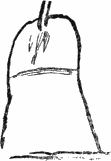
give up its oxygen. ‘When potash was
introduced into a tube having a platina
wire attached to it, so (fig.), and fused
into the tube so as to be a conductor—i.e.
so as to contain just water enough,
though solid—and inserted over mercury,
when the platina was made negative, no gas was
formed and the mercury became oxydated, and a
small quantity of the alkaligen was produced round the
platina wire, as was evident from its quick inflammation
by the action of water. When the mercury was made
the negative, gas was developed in great quantities
from the positive wire, and none from the negative
mercury, and this gas proved to be pure oxygen—a
capital experiment, proving the decomposition of potash.’
‘A small quantity of alkaligen was produced round the
platina wire.’
‘The gas produced from alkaligen confined under
mercury by the contact of water seemed to be hydrogen
nearly pure. Soda decomposed with different phenomena.’
Davy made no more notes on that day.
On the 20th he worked on the gas obtained from
sodagen and potagen, and writes, ‘Barytes gave at the
oxygen side, when touched with the wire, an appearance
like combustion—a bright rose-coloured light. Mem.:
To try what effect the hydrogen side will have upon it.’
On the 21st he again worked on the gas, and says
the gas from ether, when properly washed, seemed to
be pure hydrogen.
He then says, ‘Examined the effect of heat this day
and last night of the peculiar substance.’ Then he
notes the results, and then he continues, ‘what can
be the reason if the metallic globule is composed of
A and H (alkaligen and hydrogen)—What is the reason
that water and ether and alcohol saturated with potash
still act on it so energetically?’
On the 24th he tried the substance with sulphur and
phosphorus.
On the 25th, 26th, and 27th he worked on barytes, &c.
On the 27th barytes heated to whiteness did not
become a conductor.
On October 30 he was still at work on the gas.
On October 31 he says, ‘When the substance amalgamated
with mercury, was distilled in a glass retort, and
the contents received over mercury, no air was generated;
nor over water till the sublimed substance came
in contact with the water, when hydrogen was evolved.’
On November 2 he was still working on potagen.
‘Probably this substance combines with oxygen in
two proportions, the red colour owing to this; and it
is owing to this that it acts upon plate-glass.’
‘The first oxide a peculiar substance capable of
being procured with much difficulty, the second potash.’
In the midst of his discovery the condition of the
laboratory made him write in the book ‘some regulations
with regard to the state of the laboratory.’
‘1. Everything is to be put in its proper place in
the evening, and everything to be arranged for the
next day’s operations.
‘2. The fire to be lighted at eight o’clock, and the
apparatus for the experiments to be prepared by nine.’
On November 4 he writes, ‘The result of the distillation
of as pure a piece (of potagen) as I could
obtain seemed to be hydrogene nearly pure.
‘The gas given out from an amalgam of it with
mercury likewise hydrogene.’
On November 5 many experiments were made.
On November 6 he still worked on the gas. His
notes say ‘on the combustion of sodagen and potagen
with oxygen.’
‘Potagen certainly sublimes unaltered at a temperature
below red heat. It is twenty times lighter
than mercury.’
On November 13 he wrote to his friend Mr. Pepys:
I have decomposed and recomposed the fixed alkalies and
discovered their bases to be two new inflammable substitutes
very like metals, but one of them lighter than ether
and infinitely [more] combustible; so that there are two
bodies decomposed and two new elementary bodies found.
The Bakerian lecture was read on November 19,
only four days before Davy was obliged to take to his
bed by illness. The first sketch of this famous paper
was thus made in the Laboratory Book:
‘The substance is analogous to some of those imagined
to exist by the alchemical visionaries.
‘Possessing all the physical properties of metals except
high specific gravity, it seems to combine with all
of them, and form with them truly metallic amalgams;
but in all cases it is capable of being separated from
them by its greater facility of oxidation.’
Then he gives the action on water and ice.
The theory of its operation upon water is extremely
simple.
3. ‘When,’ he says, ‘the peculiar substance was
brought in contact with a thin piece of phosphorus and
pressed upon, there is a considerable action.’
4. ‘When it was brought in contact with sulphur in
fusion in tubes filled with the vapour of naphtha, they
combine with varied ignition.’
5. ‘The new substance produces some beautiful results
with mercury.’
Then he describes the alloys.
‘The basis of potash, when thrown into the strong
mineral acids, inflames and burns on the surface.’
Then he describes the effects with sulphuric acid,
and nitrous acid.
‘The action of the basis of potash on fat and volatile
oils, and on various bodies, is less violent than on any
other class of compound substances containing oxygen,
as might have been expected from the small quantity
of this principle which they hold in combination.
‘The application of naphtha to its preservation I
have already mentioned. On the colourless and perfectly
transparent naphtha distilled from petroleum or
from brown naphtha at a low heat, and defended from
air, it has scarcely any action at common temperatures.’
Then he describes the further action on naphtha.
‘The fat and volatile oils closely related to naphtha
in composition resemble it likewise in their habitudes
with the basis of potash. The lightest naphtha that I
have been able to procure by double distillation was
of spec. gr. 770, water being 1,000, and was almost
colourless. In this fluid, confined in close vessels, the
globules swam for hours without apparently affecting
it, but by degrees a yellow film formed upon them, the
naphtha became brown at its point of contact, and the
globules sank to the bottom of the vessel. After
some days the fluid surrounding the globule appeared
black and turbid.
‘The fat and volatile oils approach to naphtha in their
habitudes with respect to the basis of potash.
‘The fat oils follow naphtha in the order of bodies
that slightly act upon it; and the volatile oils, the fat
oils; but they all contain sufficient oxygen to render
the basis of potash alkaline, if it is exposed to them
for a sufficient time and in proper quantities, and that
more or less rapidly, according to the circumstances.
When naphtha or the oils are exposed to air they soon
alkalise the basis. Oxygen is absorbed from the air,
and a soap is formed, brown from the decomposition of
the compound fluid during the time of the alkalisation.
If air be excluded the process is a much longer time
in taking place; no gas is emitted in the fixed oils or
in naphtha; but in the volatile oils hydrocarbonate
is produced in small quantities, and in all these cases
charcoal is deposited. In oil of turpentine the process
is more rapid than in any other oil I have tried, and
this oil contains either water or the elements of water,
and perhaps a larger proportion of oxygen to its
inflammable matter.
‘Nor ought we to be surprised that these substances
have never been produced in nature. Their strong
attraction for oxygen renders it impossible.’
‘The division into two poles:
‘The basis of potash, by its strong attraction for
oxygen, decomposes all the metallic oxides which
I have exposed to it by a gentle heat.
‘The oxides of lead it instantly acts upon, and the
metal is revived and alkali formed. In consequence
of this operation it cannot be preserved in tubes of
flint glass.
‘Are the bases of the fixed alkalies simple bodies? I
perhaps shall be asked.
‘But are these singular bodies themselves compounds?
Have we reached the limits of our analysis—More
capable of combining with oxygene than the basis of
water?
‘The basis of potash serves almost as an accurate
indication of the proportion of oxygene in bodies and
exactly in proportion—camphor, spermaceti, wax,
volatile oils.
‘In the course of my inquiries many circumstances
arose at first anomalous, but which soon were capable
of being explained, and which, when understood, seemed
to extend the general facts which had been detailed.’
A long break here occurs in the Laboratory Notes.
On November 23, 1807, Davy was taken ill with fever.
On December 7 the Managers’ Minutes say, ‘Mr. Davy
having been confined to his bed for the last fortnight
by a severe illness, the managers are under the painful
necessity of giving notice that the lectures will not
commence until the first week in January next.’
On January 18 the managers of the Royal Institution
ordered 500 copies of the following paper to be printed:
January 18, 1808.
For the satisfaction of those proprietors who were not
present at the opening of the Rev. Mr. Dibden’s introductory
lecture on Wednesday last the managers have obtained
and printed the following note of it:
‘Before I solicit your attention to the opening of those
lectures which I shall have the honour of delivering in the
course of the season, permit me to trespass upon it for a
few minutes by stating the peculiar circumstances under
which this Institution is now again opened, and how it
comes to pass that it has fallen to me rather than to a
more deserving lecturer to be the first to address you.
‘The managers of this Institution have directed me to
impart to you that intelligence which no one who is alive
to the best feelings of human nature can hear without the
mixed emotions of sorrow and delight.
‘Mr. Davy, whose frequent and powerful addresses from
this place, supported by his ingenious experiments, have
been so long and so well known to you, has for the last
five weeks been struggling between life and death. The
effects of those experiments recently made in illustration
of his late splendid discovery, added to consequent bodily
weakness, brought on a fever so violent as to threaten the
extinction of life. Over him it might emphatically be said,
in the language of the immortal Milton, that—
Death his dart shook, but delayed to strike.
If it had pleased Providence to deprive the world of all
further benefit from his original talents and intense application
there has certainly been sufficient already effected by
him to entitle him to be classed among the brightest scientific
luminaries of his country. That this may not appear
to be unfounded eulogium I shall proceed, at the particular
request of the managers, to give you an outline of the
splendid discovery just alluded to, and I do so with the
greater pleasure as that outline has been drawn in a very
masterly manner by a gentleman of all others perhaps the
best qualified to do it effectually (Cavendish?)
‘In the course of the last twenty-five or thirty years the
science of chemistry has undergone great changes and has
been astonishingly augmented by various important discoveries,
amongst which the most remarkable have been the
decomposition and recomposition of water and of nitric acid,
discovered by Mr. Cavendish, and the consequent knowledge
of the nature of metallic calces (now called oxides) with
that of acids in general.
‘But although the two fixed alkalies called soda and
potash were attacked by the most eminent chemists with
every known chemical agent and by every method which the
improved state of science could suggest, not the smallest effect
could be produced on them; so that the nature of these two
common substances remained totally unascertained and
became a grand desideratum of chemical science. When,
however, M. Volta had communicated to the Royal Society
his great discovery of the galvanic pile, and when this had
been modified into the more convenient form of troughs by
Crookshank of Woolwich, the electro-galvanic power was
found by various philosophers to produce surprising effects
when applied to different substances, and Mr. Davy in particular
distinguished himself in these researches and made
a number of valuable experiments and observations, some
of the more remarkable of which he communicated to the
Royal Society in the Bakerian lecture read in November
1806. Mr. Davy conceived, however, from what he had
then accomplished, that much more might be done; and
with equal skill and perseverance he performed a new
series of experiments, in the course of which, by various
means, he again tried the effect of the powerful galvanic
batteries belonging to the laboratory of the Royal Institution,
and particularly devoted his attention to the two fixed
alkalies (soda and potash), with the view of effecting their
decomposition and of ascertaining the nature of them by
means of that powerful agent galvanism.
‘This great discovery he at length effected; and, to the
high gratification of all men of science, he proved that
soda and potash are compound bodies, each consisting of
a peculiar metal, which has so great a tendency to combine
with oxygen that no agent but galvanism can separate them.
The two metals, therefore, of soda and potash have always
hitherto been presented to us in this state of combination
with oxygen, forming the two alkalies. But some of the
primitive earths (as they are called), such as barytes and
strontites, have many alkaline properties, which induced Mr.
Davy to subject them to similar experiments; and in like
manner he discovered that these consisted of metallic bases
united to oxygen, forming compound bodies analogous to
the two fixed alkalies. These may justly be placed amongst
the most brilliant and valuable discoveries which have ever
been made in chemistry, for a great chasm in the chemical
system has been filled up; a blaze of light has been diffused
over that part which before was utterly dark; and
new views have been opened so numerous and interesting
that the more any man who is versed in chemistry reflects
on them, the more he finds to admire and to heighten his
expectation of future important results. Mr. Davy’s name,
in consequence of these discoveries, will be always recorded
in the annals of science amongst those of the most illustrious
philosophers of his time. His country, with reason,
will be proud of him; and it is no small honour to the
Royal Institution that these great discoveries have been
made within its walls, in that laboratory and by those
instruments which, from the zeal of promoting useful knowledge,
have with so much propriety been placed at the disposal
and for the use of the Professor of Chemistry.
‘This recital [said Dr. Dibden] will be sufficient to convince
those who hear of the celebrity which the author of
such a discovery has a right to attach to himself; and yet no
one, I am confident, has less inclination to challenge it. To
us and to every enlightened Englishman it will be a matter
of just congratulation that the country which has produced
the two Bacons and Boyle has in these days shown itself
worthy of its former renown by the labours of Cavendish
and Davy.
‘The illness of the latter, severe as it has been, is now
beginning to abate,[35] and we may reasonably hope, from
present appearances at least, that the period of convalescence
is not very remote.’[36]
The recovery of Davy was slow.
On February 22 he attended at the request of the
Committee of Managers, and informed them that he
should be able to commence his course of lectures on
Electro-Chemical Science on Saturday, March 12, at
two o’clock, and those on Geology on Wednesday
evening, the sixteenth of that month. In his opening
lecture he thus spoke of electro-chemistry and its power
of analysis: ‘In this it will be seen that Volta has
presented to us a key which promises to lay open
some of the most mysterious recesses of nature. Till
this discovery our means were limited; the field of
pneumatic research had been exhausted, and little
remained for the experimentalist except minute and
laborious processes. There is now before us a boundless
prospect of novelty in science, a country unexplored
but noble and fertile in aspect, a land of
promise in philosophy.’
In the Laboratory Book, probably about this
time, he wrote, ‘An instrument for procuring those
metals that have not yet been reduced—for decomposing
muriatic acid gas, fluoric, &c., and boracic acid
gas.’
On April 19 and 20 Davy was again at work with
the battery of 520 pair of plates.
He began thus: ‘Indications of the decomposition
of muriatic acid. To use every effort to ensure
accuracy in the results.’
‘A given quantity of muriatic acid gas was acted
upon by dry charcoal; there was continued vivid light
in the galvanic circuit. The action was continued for
ten minutes; when a little water was added no absorption
took place, so that all the muriatic acid gas
was decomposed. Some other experiments were made
with dry muriate of lime and mercury and with a
solution of muriate of lime, strontium, and soda.’
On June 30 he had a paper read at the Royal Society
on the ‘Decomposition of the Earths Strontia, Lime,
Magnesia, by Means of Iron at the Negative End of
the Battery.’ Berzelius having mentioned in a letter
that he had succeeded by using mercury as the
negative pole, Davy repeated Berzelius’s experiment,
and decomposed alumina and silica by an amalgam
of mercury and potassium at the negative end of the
battery.
On July 11 he laid before the managers of the
Royal Institution the following paper:
A new path of discovery having been opened in the
agencies of the electrical battery of Volta, which promises to
lead to the greatest improvements in chemistry and natural
philosophy and the useful arts connected with them; and
since the increase of the size of the apparatus is absolutely
necessary for pursuing it to its full extent, it is proposed to
raise a fund by subscription for constructing a powerful
battery, worthy of a national establishment and capable
of promoting the great objects of science.
Already in other countries public and ample means have
been provided for pursuing these investigations. They
have had their origin in this country, and it would be dishonourable
to a nation so great, so powerful, and so rich
if, from the want of pecuniary resources, they should be
completed abroad.
An appeal to enlightened individuals on this subject can
scarcely be made in vain. It is proposed that the instrument
and apparatus be erected in the laboratory of the
Royal Institution, where it shall be employed in the
advancement of this new department of science.
The Managers’ Minutes then say:
The above paper having been laid before the board of
managers, they felt it their indispensable duty instantly to
communicate the same to every member of the Institution,
lest the slightest delay might furnish an opportunity to other
countries for accomplishing this great work, which originated
in the brilliant discoveries recently made at the
Royal Institution.
Lord Dundas, W. Watson, Thomas Bernard, and C.
Hatchett, the managers present, agreed to subscribe to this
undertaking, and ordered that a book be opened at the
steward’s office for the purpose of entering the names of all
those who may wish to contribute towards this important
national object.[37]
The sum wanted was soon raised, and Davy thus
described the battery:
‘It consists of 200 instruments, connected together
in regular order, each composed of ten double plates,
arranged in cells of porcelain, and containing in each
plate thirty-two square inches; so that the whole
number of double plates is 2,000, and the whole
surface 128,000 square inches. This battery was
charged with sixty parts water and one part of nitric
acid. It gave a spark from charcoal points through
four inches of air.’
On July 12 the Laboratory Notes say, ‘Tried the experiments
upon the decomposition of the earths by iron
wire with the happiest results.’ These were obtained
with the battery of only twenty pair.
On July 18 he wrote, ‘In pursuit of the researches on
the deoxygenation of diamond and charcoal.
‘Is not diamond the 2-oxide of carbon, charcoal
the 1-oxide, the gaseous oxide of carbon a triple
compound of hydrogen, nitrogen, and charcoal?’
On September 21, 22, 23, 24, 25, 26, 27 experiments
were tried on the production of cold by induced electricity.
He tried the decomposition of sulphur ‘with
success.’ He tried to decompose mercury in the
Torricellian vacuum ‘with success apparently.’
‘Sulphur, after giving out hydrogen by electricity,
had lost its yellow colour and was became brownish,
but still non-conducting, crystalline, and transparent.’
Numberless experiments were made on the action of
potassium on ammonia and on nitrogen.
In November he must have injured his right hand,
for his notes are made with his left hand on the 19th
and 20th of this month.
On December 15 he gave another Bakerian lecture
on New Analytical Researches on Alkalies, Phosphorus,
Sulphur, &c. In this paper he says his chief object
was to show that there was oxygen in ammonia, and
that potassium was not a compound of the metal and
hydrogen. He made further experiments also on
the decomposition of boracic, fluoric, and muriatic
acids.
On December 27, 1808, Davy wrote to Coleridge:
Alas, poor Beddoes is dead! He died on Christmas
Eve. He wrote to me two letters on two successive days—22nd
and 23rd. From the first, which was full of affection
and new feeling, I anticipated his state. He is gone at
the moment when his mind was purified and exalted for
noble affections and great works.
My heart is heavy. I would talk to you of your own
plans, which I shall endeavour in every way to promote; I
would talk to you of my own labours, which have been incessant
since I saw you and not without result; but I am
interrupted by very melancholy feelings, which, when you
see this, I know you will partake of. Ever, my dear Coleridge,
very affectionately yours,
H. Davy.
On December 28 he wrote in the Laboratory Book,
‘We have tried a number of experiments within the last
few days on the muriatic and fluoric acids, heating
them with potassium.’
Early in 1809 Davy sent an appendix to his last
Bakerian lecture to the Royal Society. In it he spoke
‘of the general results being decisive with regard to a
decomposition of nitrogen having been effected.’
In a letter at this time he told his friend Mr.
Children ‘he hoped to show him nitrogen as a
complete wreck, torn to pieces in different ways.’
On January 18 he wrote, ‘Capital result from the
action of potassium on ammonia. Nitrogen was lost.
If the nitrogen is to be considered as converted into
oxygen and hydrogen, it must be regarded as containing
much more oxygen than water; and if we do not adopt
this supposition, the only alternative is that water is
the ponderable matter which, under different modifications
of electro-chemical existence, constitutes oxygen,
hydrogen, nitrogen, and the nitrous compounds.’
On February 15 he wrote in the Laboratory Book,
‘Were a description, indeed, to be given of all the
experiments I have made, of all the difficulties I have
encountered, of the doubts that have occurred, and the
hypotheses formed—’ The sentence was not finished,
and more time was lost on the investigation.
Throughout the spring and summer more experiments
were made on ammonia and nitrogen.
He ignited potassium by the voltaic spark in nitrogen,
and found that some hydrogen was evolved and some
nitrogen lost; but when the potassium was free from
potash this did not occur, and at last he gave up trying
to show that nitrogen was a compound of oxygen and a
metallic basis.
At the end of August he was working on tellurium
and made telluretted hydrogen.
To his mother he wrote in August:
At present, except when I resolve to be idle for health’s
sake, I devote every moment to labours which I hope will
not be wholly ineffectual in benefiting society, and which
will not be wholly inglorious for my country hereafter; and
the feeling of this is the reward which will continue to keep
me employed.
On September 13 he wrote in the Laboratory Book
this verbal picture of his laboratory:
Objects much wanted in the laboratory of the Royal
Institution: Cleanliness, neatness, and regularity.
The laboratory must be cleaned every morning when
operations are going on before ten o’clock.
It is the business of W. Payne[38] to do this, and it is the
duty of Mr. E. Davy to see that it is done and to take care
of and keep in order the apparatus.
There must be in the laboratory pen, ink, paper, and
wafers, and these must not be kept in the slovenly manner
in which they usually are kept. I am now writing with a
pen and ink such as was never used in any other place.
There are wanting small graduated glass tubes blown
here and measured to ten grains of mercury.
There are wanting four new stopcocks fitted to our air-pump.
There are wanting twelve green glass retorts.
There are wanting most of the common metallic and
saline solutions, such as acetate of copper, nitrate of
silver, nitrate of barytes—most of these made in the
laboratory.
All the wine-glasses should be cleaned.
And, as all operation ceases at six o’clock in the evening,
there is plenty of time for getting things in order before
night; but if they are not got into order the same night,
they must be by ten o’clock the next day.
The laboratory is constantly in a state of dirt and confusion.
There must be a roller with a coarse towel for washing
the hands and a basin of water and soap, and every week
at least a whole morning must be devoted to the inspection
and ordering of the voltaic battery.
For Thursday—i.e. to-morrow—the experiments in the
morning are on the excitation of radiant heat and electricity
in different gases. For the experiments on
Friday, which will be on tellurium, there
are wanting very pure hydrogen; two bottles
of new, very pure oxymuriatic gas; two
new stopcocks cemented into retorts, with stoppers,
either green or white; some tubes of
this bore  or near it, closed at one
end and six inches long; a spirit lamp made
from a phial of large bore and the tube larger
than that at present used.
or near it, closed at one
end and six inches long; a spirit lamp made
from a phial of large bore and the tube larger
than that at present used.
On September 14 he tried various experiments
on the excitation of electricity. The Laboratory Book
says, ‘Present in these and the former experiments,
Mr. Cavendish, Dr. Herschel, Mr. Herschel, Sir Charles
Blagden (not in the second set on electricity); Dr.
Wollaston, Mr. Warburton.’
The repulsion of the machine was compared to the
repulsion in a partial vacuum, in hydrogen, in carbonic
acid, and in rarefied carbonic acid. The former experiments
the same day were on the rise of a thermometer
heated by a coil of platinum wire in different gases.
On September 21 the Note-Book says:
An Experiment to Decompose Muriatic Acid Gas.—A
balloon having three openings, to one of which a stopcock
was cemented, and in the other two were corks containing
wires, so adapted to each other that a contact might
be made. Pieces of well-burnt charcoal were fastened to
the ends of the wires. The apparatus, being air-tight, was
exhausted and filled with hydrogen; another exhaustion
being made, the balloon was filled with oxymuriatic gas
from a gas-holder, with which it was connected by means
of a stopcock. The two wires being joined to the voltaic
apparatus and a contact of the charcoal made, the ignition
was brilliant without any apparent combustion; white
fumes were presently produced, which in a short time disappeared
again, and were afterwards, during the remaining
time the experiment was in hand, only formed when two
new points of charcoal came in contact, or when the flame
played on the copper wire which fastened the charcoal.
The light emitted was a brilliant yellowish colour, frequently
assuming a fine lake. After an hour’s time the gas appeared
unaltered, of its original colour. The higher parts of the
pieces of charcoal were covered with a fine greenish-yellow
powder, otherwise unaltered.
Tin-leaf thrown in through one of the openings began
immediately to form with the oxymuriatic acid gas the
fuming liquor of Libavius. When shook it inflamed.
On September 23, 1809, in a letter to Mr. Children, he
mentions this experiment, and says ‘it is as difficult to
decompose as nitrogen, except when all its elements
can be made to enter into new combinations.’
On October 3, among ‘the hints for experiments’ in
the Note-Book is this, to detonate together hydrogen
and oxymuriatic acid.
Another Bakerian lecture was given, and then he continued
his researches on ammonia.
On November 24 ‘experiments to be in progress’
are thus entered in the Laboratory Book:
1. To decompose sulphuretted hydrogen by electricity
in an apparatus by which the results can be accurately
known.
2. To pass potassium through ignited powdered quartz.
3. To decompose muriatic acid gas by potassium, so as
to ascertain the quantity of hydrogen formed.
4. To weigh ammonia, hydrogen, and nitrogen,
sulphuretted hydrogen and gaseous fluoric acid, nitrous
oxide, and oxymuriatic acid gas.
5. To make a series of experiments upon the ores and
products of cast iron.
6. To ascertain with greater precision than has been yet
obtained the nature of the acid matter formed in pure
water, oxygenated or not.
7. To decompose fluoric acid gas, and to ascertain the
source of the hydrogen which it gives by the operation of
potassium.
8. To make various experiments on the amalgamation of
ammonia, using different amalgams of mercury and different
modes of excluding water.
9. To endeavour to bring the ὑδὼρ theory to a test
of producing oxygen from water without hydrogen.
10. To decompose muriate of soda and litharge and other
bodies that contain no water by electricity, and to see what
happens.
In the early part of 1810 the experiments were
chiefly on the action of potassium on sulphur and
phosphorus.
From analogy oxygen had been considered as the acidifying
principle of the muriatic acid, or spirit of salt.
It was thought to combine with more oxygen, and then
was called oxygenated muriatic acid, although its powers
as an acid were weakened and it became more volatile
and bleached.
Davy sent two papers to the Royal Society, on this
subject. The first was on July 12, ‘Researches on Oxymuriatic
Acid and the Elements of Muriatic Acid; with
Experiments on Sulphur and Phosphorus,’ and the
second, on November 15, was the ‘Bakerian Lecture on
Some of the Combinations of Oxymuriatic Gas and
Oxygen, and on the Chemical Relations of these Principles
to Inflammable Bodies.’
In the first paper he says, ‘Scheele considered
oxymuriatic acid as more simple than muriatic acid,
and that it became muriatic acid by union with
phlogiston. Berthollet said it contained oxygen.
The vivid combustion of many bodies in this gas has
favoured the presumption that it contained oxygen very
loosely combined, and ready to exert its utmost power
of affinity; but it is mere presumption, since heat and
light result also from the intense agency of any other
combination without the presence of oxygen.’
On July 3 he wrote, ‘Equal parts of oxymuriatic acid
and hydrogene, both dried, were detonated. There was
a diminution equal to about 1⁄12, and muriatic gas was
formed; and this was over mercury, and some of the
oxymuriatic acid burnt the mercury, and there was an
excess of ¼ hydrogene. Equal parts of oxymuriatic
acid and sulphuretted hydrogene, diminution about 1⁄12.
Muriatic gas formed; sulphuretted hydrogene apparently
in excess.’
A most important experiment had been made on
September 21, 1809, on the resistance of oxymuriatic
acid to galvanic decomposition; and as long previously
as April 19, 1808, he had decomposed muriatic acid
with a battery of 520 pair of plates.[39]
The experiments which were detailed in the Bakerian
lecture read during the absence of Davy on November
15, were made in July and August.
On August 30, after entering things wanted, he
wrote in the Laboratory Book:
‘No experiments are to be made or carried on
in the laboratory without the consent and approbation
of the Professor of Chemistry. The attempt at original
experiment, unless preceded by knowledge, merely
interferes with the progress of discovery. There are a
sufficient number of new and interesting objects which
a modest student would wish to pursue, and in which
the path is marked and distinct.’
On September 8 he was again experimenting on the
decomposition of nitrogen. He wrote, ‘And if it be
said that no air and no water were present (in the
potassium, boracic acid, and ammonia), the experiment
is decisive as to the destruction of nitrogen and its
containing the same kind of elementary matter as
water.’
To the like experiment, September 13, he wrote,
‘This experiment seems almost decisive on the decomposition
of nitrogen.’
Soon after he wrote, ‘Query, Does not the general
tenor of the last experiments lead to the suspicion
of the decomposition of nitrogen?’
On September 16 he made this note: ‘Objects to be
attempted during the next week: To-morrow, oxymuriatic
acid pure, to try absorption by two grains of
different metals—tin, arsenic, antimony, bismuth,
copper, platina, lead, zinc.’
On October 4, when he was about to start for Dublin,
he wrote in the Laboratory Book, ‘The principal thing,
the laboratory in complete order.’ He was absent from
October 4 to the middle of December. No experiments
were entered until October 27; then there are some on
oxymuriatic acid by E. Davy.
On November 15 the action of oxymuriatic gas on
dried nitrous gas was repeated.
The next experiment was on November 24. ‘Two
grains of silver were entirely converted into horn-silver;
the absorption of chlorine gas was 9⁄10 of a cubic inch.’
This was the first use of the word CHLORINE in the
Note-Book; it occurs daily afterwards. Oxymuriatic
gas continued the chief subject of the experiments in
the laboratory up to the end of February in the following
year.
This year Davy was invited to deliver a course of
lectures on Electro-Chemical Science, and another
course of six lectures on the Application of Chemistry to
Agriculture, in the new laboratory of the Dublin
Society. Having obtained permission as secretary to
be absent from the meetings of the Royal Society, he
commenced his course on November 8 and finished it
on the 29th, and the Society requested his acceptance
of 500 guineas.
In 1811 he again delivered two courses, one on the
Elements of Chemical Philosophy and the other on
Geology. For these he received 750l., and Trinity
College made him a Doctor of Laws. Such consideration
for lectures on this side of the Atlantic sounds
fabulous.
He wrote to his mother:
Balina, Ireland, October 24, 1811.
The laboratory in Dublin, which has been enlarged, so
as to hold 550 people, will not hold half the persons who
desire to hear my lectures. The 550 tickets issued for the
course by the Dublin Society at two guineas each were
all disposed of the first week, and I am told now that from
ten to twenty guineas are offered for a ticket.
This is merely for your eye; it may please you to know
that your son is not unpopular or useless. Every person
here, from the highest to the lowest, shows me every attention
and kindness.
I shall come to see you as soon as I can. I hear with
infinite delight of your health, and I hope Heaven will continue
to preserve and bless a mother who deserves so well
of her children.
I am, your very affectionate Son,
H. Davy.
During 1811 he made the acquaintance of Mrs.
Appreece, the daughter and heiress of Charles Carr, of
Kelso, and about the end of the year probably he
wrote to his mother:
My dear Mother,—You possibly may have heard reports
of my intended marriage. Till within the last few days it
was mere report. It is, I trust, now a settled arrangement.
I am the happiest of men in the hope of a union with a
woman equally distinguished for virtues, talent, and accomplishments.
You, I am sure, will sympathise in my happiness. I
believe I should never have married but for this charming
woman, whose views and whose tastes coincide with my
own, and who is eminently qualified to promote my best
efforts and objects in life.
I am, your affectionate Son,
H. Davy.
He wrote to his brother, at that time a medical
student at Edinburgh:
My dear John,—Many thanks for your last letter. I
have been very miserable. The lady whom I love best
of any human being has been very ill. She is now well
and I am happy. Mrs. Appreece has consented to marry
me, and when the event takes place I shall not envy kings,
princes, or potentates.
I am, my dear Brother, ever most affectionately yours,
H. Davy.
The Laboratory Note-Book at this time contains very
little work.
On February 21, 1811, he had a paper read to the
Royal Society on a ‘Combination of Oxymuriatic Gas
and Oxygen Gas, called Euchlorine.’
In July the action of chlorine on carbonic oxide,
exposed for hours to bright sunshine, was examined.
He wrote, ‘The new gas seems to consist of equal
volumes of chlorine and carbonic oxide condensed to
one volume.’
On August 7 Davy wrote in the Laboratory Book,
‘To get nitrous oxide, nitrous gas, and very pure
chlorine for experiments. To try to decompose
nitrogen or to combine it with chlorine.’
On the 10th the exposure to the light had been continued
two days without result.
In the middle of August he experimented on the
action of potassium on silicated fluoric gas.
From September 2 to December 20 there are no
entries in the Laboratory Book. That day—the first
after his return from Ireland—there are experiments on
the electrolization of water.
Early in the following year Sir Joseph Banks wrote
to Sir George Staunton (in China):
We are going on here as usual, but I think the taste for
science is on the increase. The Royal Society has been
well supplied with papers, and continues to be so. Davy,
our secretary, is said to be on the point of marrying a rich
and handsome widow, who has fallen in love with science
and marries him in order to obtain a footing in the
academic groves; her name is Apreece, the daughter of
Mr. Carr, who made a fortune in India, and the niece of Dr.
Carr, of Northampton. If this takes place, it will give to
science a kind of new éclat; we want nothing so much as
the countenance of the ladies to increase our popularity.
Very little laboratory work was done in 1812. It
appears from Davy’s notes that a few experiments
on euchlorine were made in January. In February
he was again working on sulphur and phosphorus
and chlorine. In March he was experimenting on
borum with oxygen, and with chlorine.
In August an experiment was made to ascertain
whether there is, according to the received belief, a
neutral part in the voltaic circle.
The battery consisted of forty double plates, thus
arranged: Each trough, excepting the end ones, was
separately connected with a glassful of mercury by
polished copper wire, and each pair of glasses was
connected by very fine polished iron wire.
The effects took place at the moment of contact
at all the wires, so that there could have been no
neutral point.
For the last time, after innumerable failures, he returned
to the decomposition of nitrogen.
On August 13 ‘experiment very cautiously made of
the action of potassium on nitrogene. Light green
when mercury is employed, red when potassium.’
On October 23 the Laboratory Book says:
‘A series of experiments to attempt to decompose
hydrofluoric acid, and to ascertain the constitution of
the fluoric combinations.
‘1. To obtain pure hydrofluoric acid.
‘2. To obtain silicofluoric acid gas, and to decompose
it by potassium and by potash, and to ascertain the
quantity of fluate of lime they will give.
‘3. To make pure prussic acid.
‘4. To act upon pure prussic acid by chlorine.’
On November 5 a new detonating compound was
formed; this was the chloride of nitrogen.
This year Davy gave his last course of lectures on
Chemical Philosophy at the Royal Institution.
An account of four of these lectures ‘was taken off
from notes by Mr. Faraday.’ The subjects were
Radiant Matter, Chlorine, Simple Inflammables, and
Metals. After the report of each lecture he gave the
experiments as a sequel, illustrated with drawings;
the whole made a small quarto of 386 pages, with an
index of twenty-five pages. The volume was bound
by Mr. Faraday, and was sent to Davy as an evidence of
Faraday’s ‘knowledge, diligence, and order,’ when he
asked for an engagement at the Royal Institution.
Davy gave the lecture on Radiant Matter on February
29. He said, ‘With respect to radiant or ethereal
substances all our knowledge of it is obtained
from the effect it produces on us and terrestrial bodies
when in motion.
‘In our consideration of this subject it will be
essentially necessary that we distinguish between knowledge
and speculation. These terms in their meaning
are palpably different, but yet have been intermixed
and combined together in a very singular manner.
The French chemists in particular speak of the
materiality of heat, and of the nature of the compounds
it forms, as confidently and as fluently as if they had
undeniably proved it to be a body. They have blended
their knowledge with speculation, and formed a theory
that is very possibly untrue. The most eminent
phenomena of radiation are to be observed in light.’
And then he passed on to the laws of light and
dwelt on Herschel’s discovery that the heating power
of red rays was to the green as fifty-five to sixteen,
and that he had himself found the thermometer
rose still higher beyond the red, and that heating rays
are less refrangible than light rays; then he showed
a wire heated by the voltaic battery in air and in
vacuo, and said that he had proved ‘that the radiating
power is three times as strong in an exhausted
receiver as in the open air,’ and, ‘fully proves that
radiation is not caused by undulations in the atmosphere.
It is strongest when no atmosphere is present.’
He ends his account of the effects of radiant heat thus:
‘Were it not for this terrestrial radiation of earthly
bodies, the heat would accumulate from the rays of the
sun until at last the whole world would be uninhabitable.
‘But, besides the effects produced by the two species
of radiant matter—radiant light and radiant heat—there
are other effects—chemical effects—that take place
caused by the action of some radiant matter that
comes to us from the sun, perhaps a single substance
that, independent of light and heat, causes effects by
its own power.’ And then he showed an experiment of
chlorine and hydrogen exposed to light.
He says, ‘There is a very singular analogy that
exists between the rays at the violet end of the spectrum,
hydrogen gas, and the negative pole of the voltaic
battery; and opposed to it stands the analogy of the
rays at the red end of the spectrum to positive electricity;
they produce opposite effects to the first-mentioned
arrangement, but act similar to each other.
‘If that sublime idea of the ancients that there is
only one species of matter in the universe, and that its
different properties depend on the difference of size,
shape and other qualities should be confirmed, it
would simplify the science in a most eminent degree,
and at the same time it would raise it to the acme of
perfection.’
Opposing the view that oxygen gas contained light
combined with it, and gave light out in oxidation, he
contrasted slowly oxidised iron with an iron turning
burnt in oxygen.
‘When the laws which govern in chemical science are
fully known, there is no doubt it will become a much
more simple science. It cannot fail to be so, since
then it will be complete. Already it is one of the
most useful of the whole circle to man, and when in
its utmost state of improvement it will be one of the
most sublime. It will, I have no doubt, connect
mechanical and chemical sciences together; it will
concentrate them into one and in that one comprehend
the whole universe.
‘The first step to truth is the confession of ignorance.
No man could have made the immortal discoveries of
Newton unless he had first thrown up the ridiculous
doctrines of Des Cartes. To attend to our errors and
own them, to sacrifice all selfishness to the science,
not to support errors for the sake of vanity, ought to
be the leading precepts of a philosopher. He should
turn his endeavour to the advancement of science and
not to the increase of his reputation. Let him fix steps
for others to rise on, and he does more real good to
science than if he had spent years in controversy on an
equivocal point. Let him turn his thoughts to general
views and try to contain the whole science in his grasp;
he will then be calculated to arrange it, improve it, and
reform it and place it in that order which tends so
materially to its advancement.’
His lecture on Chlorine was given on Saturday, March
14; the previous week he had given a lecture on
Oxygen, which was not reported by Faraday.
‘I will demonstrate what I affirm in a positive and
satisfactory manner.
‘Accustomed for years to consider the chemical principles
of the French School of Physical Sciences as
correct, I had adopted them and put faith in them
until they became prejudices, and I even felt unwilling
to give them up when my judgment was fully convinced
by experiment that they were erroneous. I know that
this is the case in some degree with almost every person;
he is unwilling to believe that he is wrong, and therefore
feels averse to adopt what is right when it opposes
his principles.
‘Pelletier died from inhaling this gas (chlorine). It
supports combustion of a taper [experiment]; it does
not contain oxygen.’ He showed by experiment that
pure dry chlorine and hydrogen, when exploded, caused
no moisture; no water was formed. This was the
synthetical proof. Decomposition of muriatic acid gas
by potassium was shown as the analytical proof. Compounds
with phosphorus, ammonia, and sulphur all free
from oxygen. ‘Oxygen does combine with chlorine. I
have ventured to name the compound euchlorine; it is of
a very bright yellow green colour. Names should represent
things, not opinions, for in the last case they
often tend to misrepresent and mislead.
‘As chlorine contained no oxygen, it became an
inquiry well worth investigation to ascertain the part
which chlorine acted in bleaching. It decomposes
water and forms hydrochloric acid.’
‘Had Mr. Berthollet obtained oxygen from chlorine
there would have been no error in his theory, but by
not attending to the minute circumstances of his
experiment, by not ascertaining that the water present
acted no part and was not decomposed, he fell into an
error, and of course all the conclusions he drew were
false and erroneous. Nothing should be allowed but
what can be proved by experiment, and nothing should
be taken for granted upon analogy or supposition.’
Faraday concludes this lecture thus: ‘Mr. Davy now
proceeded to comment and make observations on the
former theory of chlorine gas. Here I was unable to
follow him. The plan which I pursue in taking of
notes is convenient and sufficient with respect to the
theoretical and also the practical part of the lecture,
but for the embellishments and ornaments of it it will
not answer. Mr. Davy’s language at those times is so
superior (and indeed throughout the whole course of
the lecture) that then I am infinitely below him and
am incapable of following him even in an humble
style. Therefore I shall not attempt it; it will be
sufficient to give a kind of contents of it.
‘He said that hypotheses should not be considered as
facts and built upon accordingly. Nevertheless, if
cautiously pursued, they might lead to mature fruit.
That nothing should be taken for granted unless proved.
By considering oxygen as contained in chlorine the
whole chemical world had been wrapped in error
respecting that body for more than one-third of a
century.
‘He noticed that all the truly great scientific men
were possessed of great humility and diffidence of
their own opinions and powers. He spoke of Scheele,
the discoverer of chlorine; observed that he possessed a
truly philosophical spirit, gave up his opinions when
he supposed them to be erroneous, and without hesitation
or reluctance adopted those of others which he
considered more correct; admired his spirit and
recommended it to all philosophers; compared it to
corn, which looked but simple and insignificant in
blossom and asked for little praise, yet was the support
of man.’
In this lecture Faraday gives the details of twenty
experiments.
On April 8 Professor Davy lectured on Simple
Inflammable Bodies. ‘Their number, excepting the
metals, is six, which unite with oxygen and chlorine,
the subjects of the two last lectures.’ He showed
a jet of oxygen burning in hydrogen, and said,
‘In the burning of tallow, wax, oil, and wood it is
the hydrogen of their bodies that causes the flame;
though in most cases it is also combined with carbon,
yet it is the hydrogen that produces the flame....
‘I have here a bladder filled with nitrous oxide gas;
I will breathe it once or twice, but not so far as to
incapacitate me from continuing the lecture. It
produces a very pleasing sensation (far superior to the
most exquisite liquors, such as champagne), and I have
no doubt that if I were to continue it a few minutes
longer I should make a very interesting exhibition to
the company; but I would rather be excused....
‘If we suppose that the diamond is pure carbon,
and is therefore the same as charcoal, we have a very
strong presumptive reason to suppose that all matter
is alike in all substances. If substances so opposite
and so different as charcoal and diamond are in
reality the same kind of matter, then the difference in
other bodies is no proof that they also are not of the
same kind of matter; and this would lead us to
suppose that there is but one matter in nature, and
that the difference in different bodies is owing to
variety in the distance of the particles, to shape, and to
size....
‘In conclusion several of these six simple combustibles
I suspect to be compounds, and perhaps their
nature may shortly be discovered....
‘What gives a strong colour to the idea of the
compound nature of nitrogen is the quantity of it
that can be obtained from animal bodies, whereas they
imbibe none, they combine with none.
‘Sulphur and phosphorus both appear to be compound
bodies when they are subjected to the power of
a voltaic battery. A great quantity of hydrogen gas
is evolved, so that it appears hydrogen is one of their
constituent parts....
‘Whether these bodies are compound or not, they
are objects of new research; they present new fields for
the great, the industrious, the scientific, and the
penetrating mind. Our horizon extends the higher
we rise. The result of future inquiries will probably
lay a foundation on which future ages and future
generations may erect an edifice that will reach from
earth to heaven.’
In this lecture Faraday noted twenty-two experiments.
The next day, April 9, Davy was knighted by the
Prince Regent.
On April 10 Sir Humphry Davy gave his last lecture
at the Royal Institution; it was on the Metals.
‘All the volatile metals burn with flame, and all
those that are not volatile with sparks....
‘These, with the metals of the alkalies and the
alkaline earths which I have had the good fortune to
discover, make up the number to about forty.’
He shewed the mode of obtaining alkaline metals
by voltaic decomposition; and earths by potassium.
The mode of obtaining the alkaline metals by
chemical action alone was shown, but the experiment
was not made. A quantity of potassium from common
potash by iron was on the table.
‘The combustion of metals is according to their
electricity, those containing the most electricity
burning with the most energy. All those metals that
are positive to others are also more inflammable than
those others, and burn more readily....
‘That the metals of the earths and alkalies cannot
exist at the surface of our globe we are well assured,
but they may exist in the interior, and if so they will
offer a very complete and a very probable solution of
the phenomena of earthquakes and volcanoes; and
perhaps, considered thus, they may lay the foundation
of a new and perfect system of geology.
‘We have here a small volcano formed of clay, &c.,
in the shape of a mountain, and having two or three
pieces of the alkaline metals introduced here and
there. Now by adding a little water to this volcano
I shall be able to inflame it and cause it to burn
briskly....
‘Meteors consist of alkaline metals and iron; the
iron burns last if it be burnt at all.
‘What I conceive is, that there are certain bodies
that revolve round our earth—a kind of satellites—and
are the same with respect to our globe that comets
are to the sun. Their orbits are ellipses, whose longer
diameters, like those of the comets, far exceed their
shorter ones. They must move with very great
velocity to counteract the attraction of the earth....’
Regarding transmutation of metals he said ‘the beginning
was deceit, the progress falsehood, and the end
beggary, said Lemery.’
‘It was supposed till lately that the fixed alkalies
were simple bodies, but I have had the good fortune
to prove them compounds; and that pure potash
should contain a metal, oxygen, and water is not
more probable than that the metals are compounds,
yet it not only is probable but it is possible, and in
reality is so....
‘From the mercurial amalgam and from the quantity
of hydrogen given out by metals when exposed to the
action of a vigorous voltaic battery, either this
hydrogen is combined with the metal or it is one of
its constituent parts....
‘If, then, we suppose that hydrogen constitutes a part
of all metals, they will be compounds of it and a base.
The hydrogen will give them their genuine characters
and make them metals, and their base will bestow on
them their own peculiar properties.
‘I should wish particularly on this point to be
understood rightly. I am not an advocate for
alchemy and its attendant frauds; that will appear
from the tenor of my discourse; but I conceive it to be
a noble and glorious object to follow up the paths
trod by those chemists who wish for the improvement
of science to ascertain the compound nature of
metals. It is a subject well worthy of pursuit, and
whenever the discovery is made it will confer
immortal honour on the discoverer, the age, and the
country that it is made in.’
Faraday then says, ‘Having thus given the general
character of the metals, Sir H. Davy proceeded to make
a few observations on the connection of science with the
other parts of polished and social life. Here it would
be improper for me to follow him. I should merely
injure and destroy the beautiful, the sublime observations
that fell from his lips. He spoke in the most
energetic and luminous manner of the advancement of
the arts and sciences, of the connection that had
always existed between them and other parts of a
nation’s economy. He noticed the peculiar congeries
of great men in all departments of life that
generally appeared together, noticed Anaximander,
Anaximenes, Socrates, Newton, Bacon, Elizabeth,
&c., but, by an unaccountable omission, forgot
himself, though I will venture to say no one else
present did.
‘During the whole of these observations his delivery
was easy, his diction elegant, his tone good, and his
sentiments sublime.’
Faraday ends his volume with the notes of eighteen
experiments that were made in this lecture.
The same day Davy wrote to his brother. It was
the eve of his wedding.
Friday, April 10, 1812.
My dear Brother,—You will have excused me for not
writing to you on subjects of science. I have been absorbed
by arrangements on which the happiness of my future life
depends. Before you receive this these arrangements will,
I trust, be settled, and in a few weeks I shall be able to return
to my habits of study and scientific research. I am going
to be married to-morrow, and I have a fair prospect of
happiness with the most amiable and intellectual woman I
have ever known.
The Prince Regent, unsolicited by me or by any of my
intimate friends, was pleased to confer the honour of knighthood
on me at the last levée. This distinction has not
often been bestowed on scientific men, but I am proud of it,
as the greatest of human geniuses bore it; and it is at least
a proof that the world has not overlooked my humble
efforts in the cause of science.
I am, my dear Brother, most affectionately yours,
H. Davy.
On June 12 he published his ‘Elements of Chemical
Philosophy.’ It is dedicated to Lady Davy, ‘as a
pledge that he shall continue to pursue science with
unabated ardour.’
Dr. Thomas Young, in the ‘Quarterly Review’ for
September 1812, enables us to see what was thought
of Sir H. Davy and of his book at this time.
‘In attempting a review of this work we cannot
avoid professing that we are far from entertaining the
impression of sitting down as competent judges to
decide upon the merits or demerits of the author; on
this point the public voice, not only within our own
islands, but wherever science is cultivated, has already
pronounced too definite a sentence to be weakened or
confirmed by anything that we can suggest of exception
or approbation. Our humble labours on such
an occasion must be much more analytical and
historical than critical; at the same time we are too
well acquainted with the author’s candour to suppress
any remark which may occur to us as tending to
correction or improvement. It has most assuredly
fallen to the lot of no one individual to contribute to
the progress of chemical knowledge by discoveries so
numerous and important as those which have been
made by Sir Humphry Davy; and, with regard to
mere experimental investigation, we do not hesitate to
rank his researches as more splendidly successful than
any which have ever before illustrated the physical
sciences in any of their departments. We are aware
that the “Optics” of Newton will immediately occur to
our readers as an exception; but, without attempting
to convince those who may differ from us on this
point, we are disposed to abide by the opinion that for
a series of well-devised experiments and brilliant
discoveries the contents of Davy’s “Bakerian Lectures”
are as much superior to those of Newton’s “Optics” as
the “Principia” are to those or to any other human work
for the accurate and refined application of a sublime
and simple theory to the most intricate and apparently
anomalous results derived from previous observation.
‘Until the year 1806 Sir Humphry Davy had been
remarkable for the industrious and ingenious application
of those means of experiment only which had
been long known to chemists. He had acquired at a
very early period of his life a well-established celebrity
among men of science throughout Europe by the
originality and accuracy of his researches, and at the
same time the fluent and impressive delivery of his
lectures had obtained him the most flattering marks of
approbation from the public of the metropolis. But
it was in the summer of that year that, in repeating
some electro-chemical experiments of very doubtful
authority (the production of acid and alkali by the
decomposition of water), he was led into a new train of
reasoning and investigation, which enabled him to
demonstrate the important laws of the connection
between the electrical affections of bodies and their
chemical powers. This was his first great discovery....
Our author’s next great step was the decomposition of
the alkalies, which he effected the succeeding year;
and this, though less interesting and important with
regard to the fundamental theory of the science, was
more brilliant and imposing from its capability of
being exhibited in a visible, tangible form. The third
striking feature which distinguishes the system advanced
in the present work is the assertion of the
existence of at least two empyreal principles—oxygen
and the elastic fluid called the oxymuriatic acid gas
(chlorine)....
‘A fourth peculiarity, which, however, is less exclusively
and originally a doctrine of Sir Humphry Davy,
is the theory of the simplicity of the proportions in
which all bodies combine—a theory the explicit
illustration and general and minute application of
which the science is principally indebted to our
countryman Mr. Dalton.’
How far later discoveries have advanced our knowledge
can be seen in the strange words, as they now
sound, which Dr. Young uses when he mentions the
first researches of Davy.
‘Certain bodies which attract each other chemically,
and combine when their particles have freedom of
motion, when brought into contact still preserving
their aggregation, exhibit what may be called electrical
polarities, and by certain combinations these polarities
may be highly exalted; and in this case they become
subservient to chemical decompositions, and, by means
of chemical arrangements, the constituent parts of
bodies are separated in uniform order and in definite
proportions.’
The review then gives the account of the discovery
of potassium, sodium, barium, strontium, magnesium,
aluminum, glycinium, zirconium, silicium, and itrium
and boron.
On the subject of oxymuriatic acid gas Dr. Young
says ‘we cannot help thinking his tone somewhat more
decisive than the present state of the investigation altogether
authorises,’ and he strongly objects to Davy’s
terminology; which never was adopted by chemists.
As no table of the proportional weights of chemical
substances entering into combination is to be found in
Sir H. Davy’s work, Dr. Young says he took the liberty
of inserting one formed from Davy’s numbers and from
the experiments of Berzelius and Richter.
He thus ended his review, ‘The character of Sir Humphry
Davy’s researches has always been that of the most
interesting originality, and we have certainly no reason
to complain that he has in his experiments very
commonly forsaken the beaten path.
‘With all its excellences this work must be allowed
to bear no inconsiderable marks of haste, and we would
easily have conjectured, even if the author had not
expressly told us so in his dedication, that the period
employed on it “has been the happiest of his life.” In
that and in every other happiness which may have
befallen him we shall ever most sincerely rejoice; nor
shall we think the public will have any reason to
reproach him with having done too little for science,
even if he should fail at any future time in his avowed
resolution of pursuing it “with unabated ardour;” that
he has not yet so failed is become from a late accident
a matter of public notoriety, and if we may expect
perseverance to be at all commensurate to success, we
have no reason to be apprehensive of his passing any
part of his life in inactivity.
‘The style and manner of this work are nearly the
same with those of the author’s lectures delivered in
the theatre of the Royal Institution. They have been
much admired by some of the most competent judges
of good language and good taste, and it has been
remarked that Davy was born a poet, and has only
become a chemist by accident. Certainly the situation
in which he was placed induced him to cultivate an
ornamented and popular style of expression and embellishment,
and what was encouraged by temporary
motives has become natural to him from habit. Hence
have arisen a multitude of sentimental reflections and
appeals to the feelings, which many will think beauties
and some only prettinesses; nor is it necessary for us
to decide in which of the two classes of readers we
wish ourselves to be arranged, conceiving that in
matters so indifferent to the immediate object of the
work a great latitude may be allowed to the diversity
of taste and opinion.’
On June 18 Davy sent a paper to the Royal Society
on ‘Some Combinations of Phosphorus and Sulphur,’
and in July two other papers—‘Further Observations on
Chloride of Nitrogen; and on Fluorine and Hydrofluoric
Acid.’
Late in August he wrote to a friend, ‘I have just
published a volume of the ‘Elements of Chemistry,’ and
I hope to publish another in the course of the spring.
Having given up lecturing, I shall be able to devote
my whole time to the pursuit of discovery.’
On October 14, from Edinburgh, he wrote to Mr.
Children:
‘I have received a very interesting letter from
Ampère. He says that a combination of chlorine and
azote has been discovered at Paris, which is a fluid
and explodes by the heat of the hand, the discovery
of which cost an eye and a finger to the author. He
gives no details as to the mode of combining them. I
have tried in my little apparatus with ammonia cooled
very low and chlorine, but without success.’
On October 24 he writes, ‘On Wednesday we are to
have a meeting at the Institution, to try to make this
compound of azote and chlorine.’
On November 5 a letter was read at the Royal
Society from Davy to Sir Joseph Banks on this compound,
which had been formed by exposing chlorine to
a solution of nitrate of ammonia. During his investigation
the substance exploded in a tube, and he
received a severe wound in the eye.
On November 16 he wrote to his brother, ‘It is not
safe to experiment upon a globule larger than a pin’s
head. I have been severely wounded by a piece
scarcely bigger.’
In January 1813 he had another severe attack of
inflammation in the wounded eye, and it was not
perfectly well till April.
On April 4 he wrote to his brother, ‘I am now
quite recovered, and Jane is very well, and we have
both enjoyed the last month in London. I have been
hard at work (on fluorine). We have now a triad of
supporters of combustion.
‘I have just finished printing my “Agricultural
Lectures.”’
Soon after he again wrote to his brother:
I communicated to you in a former letter my plans as far
as they were matured. I have neither given up the Institution
nor am I going to France, and, wherever I am, I shall
continue to labour in the cause of science with a zeal not
diminished by increase of happiness and (with respect to
the world) increased independence.
I have just finished the first part of my ‘Chemistry’ to my
own satisfaction, and I am going to publish my ‘Agricultural
Lectures,’ for which I am to get 1,000 guineas for the copyright
and fifty guineas for each edition, which seems a fair
price. As I shall see you so soon I shall not write about
any matters of science.
I was appointed professor (honorary) to the Institution
at the last meeting (April 5). I do not pledge myself to
give lectures. Brande gives twelve.
If I lecture it will be on some new series of discoveries,
should it be my fortune to make them, and I give up the
routine of lecturing merely that I may have more time to
pursue original inquiries and forward more the great
objects of science. This has been for some time my intention,
and it has been hastened by my marriage.
I shall have great pleasure in making you acquainted
with Lady D. She is a noble creature (if I may be permitted
so to speak of a wife) and every day adds to my
contentment by the powers of her understanding and her
amiable and delightful tones of feeling. God bless you!
Believe me to be your affectionate brother,
H. Davy.
In the minutes of the monthly meetings of members
of the Royal Institution, April 5, 1813, it is stated that
Sir H. Davy rose and begged leave to resign his situation
of Professor of Chemistry; ‘but he by no means wished
to give up his connection with the Royal Institution, as
he should ever be happy to communicate his researches
in the first instance to the Institution in the way he
did in the presence of the members last Wednesday
(on hydrofluoric acid), and to do all in his power to
promote the interest and success of this Institution.’
Earl Spencer moved ‘that the thanks of this meeting
be returned to Sir H. Davy for the inestimable services
rendered by him to the Royal Institution,
and that, in order more strongly to mark the high
sense entertained by this meeting of the merits
of Sir H. Davy, he be elected Honorary Professor of
Chemistry.’
Mr. Brande was then nominated Professor of
Chemistry, with a salary of 200l. per annum.
In October Sir H. Davy went abroad with Mr.
Faraday.
In May 1815 he came back, and Faraday was re-engaged
as the assistant in the laboratory of the Royal Institution.
Whilst abroad he had sent as many as seven
papers to the Royal Society—on ‘Fluoric Acid Compounds
and Hydrogen Acids.’ Two papers on ‘Iodine,’
on ‘Combustion of the Diamond,’ on ‘Ancient Colours,’
on a ‘Solid Compound of Iodine and Oxygen,’ on ‘Hyperoxy-Muriates.’
When he returned he probably intended to make
greater discoveries in chemistry during the following
ten years than he had made during the fifteen years that
he had been at the Institution. He was in the prime
of life. He had won the highest rank as an original
inquirer. He had a love of research which, in spite of
his marriage, his wealth, and ultimately his ill health,
never ceased until his early death. He had Faraday
as his assistant, and he soon found a subject more
fruitful than the composition of nitrogen, which had so
long baffled his genius.
Many of the details of his work in the laboratory
until his last experiment on the diffusion of gases, in
February 1826, are to be found in the ‘Life of Faraday.’
It will be sufficient to give here a statement of the
original researches which he communicated to the
Royal Society.
In November 1815 and January 1816 his papers on
Fire-damp were read. He then worked upon flame, and
in January 1817 his researches on flame and his splendid
invention of the Davy Lamp were laid before the
Royal Society. At this time the popular reputation of
Davy reached its climax, and, looking back, we can
now see that his life should have ended here; he
was then only 38 years old. He was presented with a
service of plate as a token of his invaluable invention
by the coal owners of the Tyne and Wear. He
bequeathed this to the Royal Society for the foundation
of a medal, to be given yearly to the chemist who made
the greatest discovery. This prize should be looked
on as a lasting memorial of the countless lives which
Davy and other chemists, by the application of their
scientific researches, have preserved.
Year after year, from 1817 to 1826, Davy communicated
new investigations to the Royal Society. He
worked on chlorine, on phosphorus, on mists. He
went abroad again, and he tried chemically to unfold the
Herculanean papyri. He returned in 1820, and was
elected President of the Royal Society after the death
of Sir Joseph Banks. Then he worked on magnetic phenomena
produced by electricity, on electric phenomena
in vacuo, on water in the cavities of crystals, on new
phenomena of electro-magnetism. He became jealous
of the discoveries of Faraday, and he sent a paper to the
Royal Society on the ‘Application of Liquids Formed
by the Condensation of Gases as Mechanical Agents.’
In 1823 he began to work on the defence of the
copper sheathing of ships, and in 1824 he had two
papers published on this subject. He went in a Government
steamboat to Norway, Sweden, and Denmark for
the purpose of trying the influence of motion on his
protectors. He had already suffered for a year at this
time from ill health. In 1825 his paper on the ‘Preservation
of Metals by Electrochemistry’ was published.
In practice his plan failed, and he was too ill to bear
lightly the disappointment of his expectations. In
1826 he had a paper read on the ‘Relations of Electrical
and Chemical Changes.’ It contained but little new
matter. On November 30 he was elected President of
the Royal Society for the last time. He was dangerously
ill on the day of election.
In the middle of December 1826 he was struck with
paralysis of the right side.
With the restlessness of disease on January 22, about
a month after his attack, he set out for Italy. He had
the worst possible journey across Mont Cenis, and, after
being three weeks at Ravenna, in the middle of March
he wrote to Mr. Poole:
I am, thank God, better, but still very weak and wholly
unfit for any kind of business and study. I have, however,
considerably recovered the use of all the limbs that were
affected, and, as my amendment has been slow and gradual,
I hope in time it may be complete. But I am leading the
life of an anchorite, obliged to abstain from flesh, wine,
business, study, experiments, and all things that I love;
but this discipline is salutary, and, for the sake of being able
to do something more for science, and I hope for humanity,
I submit to it, believing that the Great Source of intellectual
being so wills it for good.
One of the last thoughts in his note-book, written at
Ravenna, shows his mind:
‘Our real knowledge is but to be sure that we know
nothing, and I can but doubt if this be a curse or
blessing. Those who hope, trust, and believe are
surely happier far than those who doubt; and the submissive
child, who of his father’s goodness is secure,
is far more blessed than the froward one, who sets
himself against his powerful will, which, after all his
struggles and vain efforts, he must at last obey, rebelling
against the love which would have made him happy.
Is not this the history of man?—of that bright and
beauteous garden where in innocence and ignorance
he lived and loved till the false taste of knowledge
made him wretched and he knew that he must die.
And is not this the glory and the consummation of
the Christian faith, which gives him back his innocence,
his hopes, his confidence in God, which through his
life still gilds the future with a golden blessing of an
expected immortality? Man fell in Adam; knowledge
was his bane; man rose in Christ, recovering his
ignorance or substituting hope for what was doubt.’
Four or five days before he left Ravenna he wrote,
April 6, ‘Did not shoot, but returned thanks to the
Great Cause of all being for all His mercies to me, an
undeserving and often ungrateful creature, but now
most grateful. May I become better and more grateful
and more humble-minded every day!’
‘Valde miserabilis’ is not an unfrequent expression at
this time, commonly accompanied with mention of
diminished power of limbs and general feebleness, with
pain and numbness. Sometimes he was in despair of
recovery and resigned to his fate, at other times
indulging in hope, thankful for feeling better, and
expressing thanks (and he does it very often) by the
use of letters; as G. G. D. (Thanks and glory to God);
O. O. O.; or more fully thus, G. O. O. O. D.
On July 1 he wrote to his friend Mr. Davies Gilbert,
who was on the council of the Royal Society. He says
that the expectations of his complete and rapid recovery
have not been realised.
Under these circumstances I feel it would be highly
imprudent, and perhaps fatal, for me to return and to attempt
to perform the official duties of President of the Royal
Society; and as I had no other feeling for that high and
honourable situation except the hope of being useful to the
society, so I would not keep it a moment without the
security of being able to devote myself to the labour and
attention it demands. I beg, therefore, you will be so good
as to communicate my resignation to the council and to
the Society at their first meeting in November, stating the
circumstances of my severe and long-continued illness as
the cause. At the same time I beg you will express to
them how grateful I feel for the high honour they have
done me in placing me in the chair for so many successive
years. Assure them that I shall always take the same
interest in the progress of the grand objects of the Society,
and throughout the whole of my life endeavour to contribute
to their advancement and to the prosperity of the
body.
He continued his notes thus:
‘September 2.—I took my exercise well with less
fatigue, and certainly feel better. Offered up my
thanksgiving to the O. O. O. with tears of gratitude
and feelings of intense adoration,
‘September 27, St. Goar.—A very beautiful and
glorious evening. I thought I was going to be quite
well, as the weakness of the left wrist, which put an end
to my shooting at Spiers, is quite gone; but I found
my stiff leg as bad as ever. Yet I can hardly be
lower or live lower. Dubito fortissime restaurationem
meam.
‘As I have so often alluded to the possibility of my
dying suddenly, I think it right to mention that I am
too intense a believer in the Supreme Intelligence, and
have too strong a faith in the optimism of the system
of the universe, ever to accelerate my dissolution. The
laurel-water and laudanum and opium that are in my
dressing-case are medicines. I have been and am
taking a care of my health which I fear it is not worth,
but which, hoping it may please Providence to preserve
me for wise purposes, I think my duty. G. O. O. O.’
He arrived in London on October 6. Not finding his
health improve, on March 29, 1828, he left England
again. Before he went he sent a paper on Volcanoes to
the Royal Society.
In his ‘Consolations in Travel’ he says, ‘I was desirous
of again passing some time in Southern Austria and
Italy, in the hope of re-establishing a broken constitution,
and though this hope was a feeble one, yet at least
I expected to spend a few of the last days of life more
tranquilly and more agreeably than in the metropolis
of my own country. Nature never deceives us. The
rocks, the mountains, the streams, always speak the
same language. A shower of snow may hide the
verdant woods in spring, a thunder-storm may render
the blue, limpid streams foul and turbulent; but these
effects are rare and transient; in a few hours, or at least
days, all the sources of beauty are renovated; and Nature
affords no continued trains of misfortunes and miseries,
such as depend upon the constitution of humanity, no
hopes for ever blighted in the bud, no beings full of
life, beauty, and promise taken from us in the prime
of youth. Her fruits are all balmy, bright, and sweet;
she affords none of those blighted ones so common in
the life of man and so like the fabled apples of the
Dead Sea, fresh and beautiful to the sight, but when
tasted full of bitterness and ashes.’
On May 22 he writes, ‘To my old haunt, Wurzen,
which is sublime in the majesty of Alpine grandeur.
The snowy peaks of the Noric Alps rising above thunder-clouds,
whilst spring in all its bloom and beauty blooms
below, its buds and blossoms adorning the face of
nature under a frowning canopy of dark clouds, like
some Judith beauty of Italy—a Transteverene brow
and eye and a mouth of Venus and the Graces.’
On June 3 he wrote to his brother, Dr. Davy:
Aussee, in Styria.
Notwithstanding the long, severe, and depressing
malady under which I still labour I am not entirely without
hope of ultimate recovery, and the few pleasures which I
retain in this my state of earthly purgatory have principally
reference to the enjoyments and prospects of my friends;
and I indulge in the idea that you are well and happy and
enjoying a life which I can say I only support, supposing
that it pleases Omniscience to preserve me for some ends
which I cannot understand, but which I trust belong to
the great plan of goodness and mercy belonging to the
Divine mind.
It suits me better to write away my days in this solitary
state of existence in the contemplation of nature than to
attempt to enter into London society, where recollections
call up the idea of what I was, and the want of bodily
power teaches me what a shadow I am. I make notes in
natural history, fish, and prepare for another edition of my
‘Salmonia;’ ride amongst the lakes and mountains; and
attach the loose fringe of hope as much as possible to my
tattered garments. I am now going to Ischel, where there
are warm salt baths, to try if they will renovate the muscular
power of my leg and arm.
I wish to go to Trieste in October, to make the experiments
I have long projected on the torpedo. God bless
you, my dear John!
Your affectionate Friend and Brother,
H. Davy.
On June 24 he says:
I have used the baths. I have nearly recovered the
flexibility of the affected limbs, but not their former strength,
and this I can hardly hope to do as long as I am obliged
to live so low and to use so much medicine; but I shall go
on. Speranza!
In November he sent his last paper to the Royal
Society. It was on the Torpedo.
On December 21 he wrote to his brother:
Rome.
Perhaps in the spring you could see me in Illyria. I
would then show you my kind little nurse, to whom I owe
most of the little happiness I have enjoyed since my illness.
He had stopped his treatment for four months and
had lived rather more freely, but in ‘every respect I
have continued extremely temperate.’
On January 30, 1829, he was still at Rome. He said,
‘The palpitation of the heart has increased almost
alarmingly, and I do not think I have gained any
strength in the weak limbs.’
On February 1 he wrote in his journal, ‘Finished
the dialogues fifth and sixth’ (these ended the ‘Consolations
in Travel’). ‘Si moro, spero che ho fatto il
mio dovere, e che la mia vita non e stata vana ed inutile.’
On February 6 he wrote to his friend Poole from
Rome:
Would I were better, I would then write to you an
agreeable letter from this curious city; but I am here
wearing away the winter, a ruin amongst ruins.
I write and philosophise a good deal, and have nearly
finished a work with a higher aim than the little ‘Salmonia,’
which I shall dedicate to you. It contains the essence of
my philosophical opinions and some of my poetical reveries.
I sometimes think of the lines of Waller:
The soul’s dark cottage, battered and decayed,
Lets in new light through chinks that time has made.
I have, notwithstanding my infirmities, attended to
scientific objects whenever it was in my power, and I have
sent to the Royal Society a paper, which they will publish,
on the ‘Peculiar Electricity of the Torpedo,’ which I think
bears remotely on the functions of life. I attend a good
deal to natural history.
I fight against sickness and fate, believing I have still
duties to perform, and that even my illness is connected
in some way with my being made useful to my fellow-creatures.
I have this conviction full on my mind, that
intellectual beings spring from the same breath of Infinite
Intelligence, and return to it again, but by different courses,
like rivers born amidst the clouds of heaven and lost in
the deep and eternal ocean; some in youth rapid and short-lived
torrents, some in manhood powerful and copious
rivers, and some in age by a winding and slow course, half
lost in their career and making their exit by many sandy and
shallow mouths. [And then he asks him if he will come
and travel with him.] But I write as if I were a strong man,
when I am like a pendulum, as it were, swinging between
death and life. God bless you, my dear Poole!
Your grateful and affectionate Friend,
H. Davy.
A fortnight afterwards he had another severe attack
of paralysis of the right side.
On February 23, three days after the attack, he
dictated a letter to his brother.
My dear John,—Notwithstanding all my care and discipline
and ascetic living I am dying from a severe attack
of palsy, which has seized the whole of the body with the
exception of the intellectual organ. I am under the usual
severe discipline of bleeding and blistering, but the weakness
increases, and a few hours or days will finish my
mortal existence. I shall leave my bones in the Eternal
City. I bless God that I have been able to finish all my
philosophical labours....
God bless you, my dear brother! may you be happy and
prosperous!
Your affectionate Friend and Brother,
H. Davy.
The 25th he dictated another letter, chiefly on the
torpedo; it ends:
Pray do not neglect this subject, which I leave to you as
another legacy. God bless you, my dear brother!
Your affectionate Friend,
H. Davy.
He tried to write a postscript, and he did write ‘My
dear John;’ then he dictated, ‘I am dying; come as
quickly as you can. You will not see me alive, I am
afraid. God bless you!’
On March 16 Dr. Davy reached him. ‘Never shall I
forget,’ he says, ‘the manner in which he received me,
the joy which lighted up his pale and emaciated
countenance, his cheerful words and extreme kindness,
and his endeavours to soothe a grief which I had not the
power of controlling on finding him so ill, or rather at
hearing him speak as if he were a dying man, who had
only a few hours to live, and who wished to use every
moment of such precious time. With a most cheerful
voice, a smile on his countenance, and most warm
pressure of the hand, he bade me not be grieved, but
consider the event as a philosopher. He expressed his
pleasure at seeing me so soon and in having me with
him in his last hours, and firmly rejected all expectation
and hope of recovery. He had lost all the irritable feeling
to which he was very liable, and which generally
accompanies paralytic complaints. His own conviction
that he was a dying man almost persuaded me that the
brilliancy of his mind was a lightening before death.’
The next day he was not only amused but interested
deeply with the dissection of a torpedo made by Dr.
Davy in an adjoining room.
On the night of March 31, having gradually got
worse, he told Dr. Davy he was sure he should die. ‘He
took leave of me most tenderly, kissed my cheek, and
bade God bless me. I believed that now indeed I was
about to lose him and that I should never again hear
his voice of kindness. During the night when I went to
him he still breathed. The following morning, when I
drew back his curtains, he expressed great astonishment
at being alive. He said that he had gone through the
whole process of dying, and that when he awoke he had
difficulty in convincing himself by experiments that he
was in his earthly existence. He added that his being
alive was quite miraculous, and that he now began to
think his recovery not impossible, and that it might be
intended by Divine Providence that his life should be
prolonged for purposes of usefulness.
‘From this day he pretty rapidly improved; as he
mended the sentiment of gratitude to Divine Providence
was overflowing.’ On April 20 he wrote his last note
at the end of a letter of Dr. Davy’s.
‘My dear Sister,—I am very ill, but, thanks to my
dearest John, still alive. God bless you all!—H. Davy.’
‘He would have said more, but his feeble hand failed
him.’
On April 30 he was able to leave Rome for Switzerland.
He stayed a week at Genoa and on May 28 he
reached Geneva, and there first heard of the death of
Dr. Young, ‘which affected him in a manner almost
unaccountable.’ He dined early and was read to afterwards;
at half-past nine he wished to be left alone, ‘and
I took leave of him,’ says Dr. Davy, ‘for the night. At
half-past two his servant called me. He was insensible,
and in a few minutes he expired.’
For the last half-century general opinion has been so
charmed by the simple greatness of Faraday, that even
the genius of Davy with his love of original research has
been partially eclipsed. But, as time lessens the effect
of the contrast, the reputation of Davy will recover its
former brightness, and the picture drawn of him by Mr.
Poole will not be looked on as due to the partiality of
his oldest and most attached friend.
‘Although the most friendly intercourse existed
between us for thirty years, I fear I have little else to
communicate than to bear testimony to his general
intellectual elevation and to the warmth, sincerity,
and simplicity of his heart. I was first introduced to
him at the Medical Pneumatic Institution at Clifton in,
I think, 1799, where I inhaled his nitrous oxide with
the usual extraordinary and transitory sensations; but
the interesting conversation, manners, and appearance
of the youthful operator were not transitory—nay,
riveted my attention—and we soon became friends.
‘From that time to his death no interruption of the
most cordial goodwill and affection occurred between
us. Neither the importance of his discoveries nor the
attentions of the exalted in rank or science, whether as
individuals or bodies, nor the honour conferred on him
by his sovereign, made the least alteration in his
personal demeanour or in the tone of his correspondence.
No man was ever less spoiled by the world. The truth
is, though he conformed to the world and paid due
deference to those men and things which are deferred to
by the world, his delight was in his intellectual being.
He felt that he had the power of investigating the laws
of nature beyond that entrusted to the generality of
men, and the success with which he acted on this
impulse increased his confidence. During his last visit
to me in November 1827, when in a very weak state of
health, he more than once said, “I do not wish to live as
far as I am personally concerned; but I have views
which I could develope, if it please God to save my life,
which would be useful to science and to mankind.”
Indeed, to be useful to science and to mankind was that
in which he gloried, to use a favourite word of his. He
was enthusiastically attached to science and to men of
science, and his heart yearned to be useful to mankind,
and particularly to the humblest of mankind. How
often have I heard him express the satisfaction which
the discovery of the safety lamp gave him. “I value it,”
he said, “more than anything I ever did.”
‘However his circumstances and situation in society
altered, his labours and zeal in the pursuit of science
were throughout his life undiminished.
‘What from my earliest knowledge of my admirable
friend I considered his most striking characteristic was
the quickness and truth of his apprehension. It was a
power of reasoning so rapid when applied to any
subject, that he could hardly himself be conscious of
the process, and it must, I think, have been felt by
him as it appeared to me pure intuition. I used to say
to him, “You understand me before I half understand
myself.”
‘If his mind had been given in that direction he
would probably have ranked high among our poets. I
recollect hearing perhaps the greatest living poetic
genius (Coleridge) say, “Had not Davy been the first
chemist, he probably would have been the first poet of
his age.”
‘No man was less a sectarian, if I may use the
expression, in religion, in politics, or in science. He
regarded with benevolence the sincere convictions of
any class on the subject of religion, however they might
vary from his own. In politics he was the ardent
friend of rational liberty; he gloried in the institutions
of his country and was anxious to see them maintained
in their purity by timely and temperate reform. Men
of science, wherever situated, he considered fellow-subjects
of one great republic spread over the world.
As to his amusements he would say, “It is not the sport
only, though there is a great pleasure in successful
dexterity, but it is the ardour of the pursuit, the pure
air, the contemplation of the fine country, the exercise,
all which invigorate the body and excite the mind to
its best efforts.”
‘When he made his last visit to me in 1827, on his
arrival he said, “Here I am, the ruin of what I was.”
But nevertheless the same activity and ardour of mind
continued, though directed to different objects.
‘He was not only one of the greatest but one of the
most benevolent and amiable of men.’