(R. T. signifies Round Tower, or Towers.)
Aaron, or Inaron, 149.
Abad (Persian dynasty), 246.
Abaris, the Boreadan;
his mission to Delos from the Insula Hyperboreorum, 53-56, 397, 448;
why he did not adopt the Scythian dress, 56;
meaning of the “arrow” which he bore with him to Delos, 328.
Abernethy (R. T.), 10, 431.
Agriculture, an object of Sabaic worship, 111.
Agnarupi, a manifestation of the Deity (Brahminic), 288.
Aiche Baal-tinne and Aiche-Shamain, 199, 200.
Aithair Foadha, or the tree of Bhudda, explained, 472.
Alphabet (Irish), a “tree” code, 229, 418.
See St. Patrick.
Amergin, the bard, brother of Heremon and Heber, 22, 387, 388.
Annals of Ulster and of the Four Masters, cited against the theory that R. T. were belfries, 364;
also to prove that they existed before the 5th century, 374.
Anatta, Anuzza, and Docha, their respective meanings, 114.
Apis, the Egyptian deity, what he represented, 159.
Apollo, meaning of the name, 61;
his alleged cyclic visits to the Insula Hyperboreorum (Ireland), 52, 397;
Christnah, the Indian equivalent of, 218, 219;
sculptured with the Python at Knockmoy, 330;
meaning of the Python myth, 291;
the “great year” of the Greeks, 397;
his musical worship in Ireland, 403;
his supposed temple at Kilmalloch, 202;
Phrygian account of his visit to the Hyperboreans, 436;
Grynæus and Lycæus explained, 466.
See Sun-Worship.
Apple, Eve and the, 227 et seq.
Arabic Sabaism, 503-506.
Architecture of the R. T., 513.
Ard-Melchan, derivation of the name, 203.
Ardmore (R. T.), 71, 75;
meaning of the name, 75.
Argues, its Sabaic import, 195.
Arimaspi, their connection with Cyclopean architecture and mining, 86, 407.
Ark of Scripture, what it means, 224-226, 267, 270 et seq.
Armagh (R. T.), destruction of, by lightning, 50.
Aron distinguished from Tebah (both signifying “ark”), 270.
Arran, meaning of the name, 429 n.
Arrowhead character, 340.
Artemidorus cited, 301, 302, 400.
Aryans, site of the ancient Aria or Artacoana, 183;
Aria and Ariana distinguished, 183, 184;
the latter equivalent to Iran or Eriene, 184;
Eriene corrupted into Ierne, 185;
Zendavast description of the Aryan country, 185 et seq.;
change in its climate, 186, 187;
consequent Western migration of the Aryans, 187;
Jemshid and his times, 188;
policy of Zoroaster, 188;
laws of Ormuzd corrupted, 188;
two claimants for the name of Zoroaster, 189;
antiquity of the original Zoroaster, 189;
his predecessors, 189;
the Dabistan and its author, Moshan or Fani, 189;
religion of Hushang, 189, 190;
the Mahabadean dynasty, 190;
antiquity of the Iranian monarchy, 190.
Asia, the “cradle of the human race,” 265, 266.
Astarte, phallic worship of, 101, 102;
description of her temple at Hieropolis, 168;
known also by the name Rimmore, 102;
signification of the latter, 102;
perpetuation of this meaning in sculpture at Glendalough, 473;
traces of her worship (as the Moon) at Athlone, 204;
the Irish term of endearment, “Astore,” derived from her name, 213;
Astarte distinguished from Militta, 213;
use of bells in her worship, 175.
Astore. See Astarte.
Astronomy, proficiency of the ancient Irish in, 59, 60, 521-3;
R. T. used for purposes connected with, 61, 62, 521;
entered into the religion of the ancient Egyptians and Indians, 77-79;
connection of serpent-worship with, 515;
Fergil and the theory of the earth’s rotundity, 523;
predilection of the Irish peasantry for, 523;
malign influence of the Druids on, 521.
Athlone, 204.
Atreus, “treasury” of, its analogy to the Round Towers, 454, 458.
Augurs (Roman), symbolism of the cross connected with, 490.
Avatara and Avantara, incarnations (Brahminical) of the Deity, distinguished, 288.
Aventine (Roman), derivation of the name, 198 n.
Avienus on the Insula Sacra, 28, 29, 117;
his opinion of Irish antiquities, 28;
applies the term “Hibernian” to the Irish, 28.
Baals, plurality and divinity of, 29;
meaning of “Baal,” 29, 65;
connection between them and the R. T., 29;
twofold signification of the word “Baal” in Scripture, 74;
Septuagint rendering of the expression “high place of Baal,” 75;
the Irish Bail-toir and Aoi-Bail-toir distinguished, 75.
Baal-Phearagh, how connected with the Baal-peor of Scripture, and with the African Belli-Paaro, 111;
signification of the name, 103;
form of the R. T. attributable to his influence, 29.
See Farragh or Phearagh.
Baal-thinne, or sacred fire of Baal, 88-90.
Baaltis, meaning of, 65.
Babel, tower of, its purpose, 63, 64;
meaning of “Babel,” 65;
the Hebrew (scriptural) name for, indicative of its phallic character, 283, 284.
Babylonians, proficient in astronomy, 64 n.
Bacchus, name of, found in ancient Irish inscriptions, 437;
only another name for one of the various Buddhas, 235 n.;
the “Maypole” ceremony specially connected with his worship, 235;
significance of the name Sabasins, 505.
Badhha, worshipped by the Tuath-de-danaan women, 132.
Baku, description of fire-temple at, 72.
Ballycarbery (R. T.), 48.
Banavan (in Scotland), its connection with the Tuath-de-danaans, 114 n.
Bards, nature of their office, 22, 23;
their high reputation, 23, 24;
their use of rhyme and verse, 25;
also of music, 25, 405, 406;
their decadence into prose after their conversion to Christianity, 25;
suppressed by the English, 26;
superiority of Irish bardic music, 405, 406;
origin of the name “Bards,” 451;
the knowledge of astronomy preserved in their sacred books, 522.
Basilisk, or Cockatrice, its Sabaic and scriptural significance, 225, 226.
Bavana and Dana, 113, 114.
Beaufort (Miss), and the enactment of Tara (A.D. 79), 88-96.
Belfries, the R. T. could not have been intended as, 5-13, 36, 37;
the names Cloic-teacha and Erdam applied to them in the Irish Annals, as distinguished from Fiadh-Nemeadh, 50, 51.
Belli-Paaro, or Baal-Peor, and Baal-Phearagh, phallic nature of, 111.
Bells, origin of, 10, 11;
Irish Ceol and Ceolan date from pagan times, 11;
the Sabian and Druidic use of, adopted by the Christian missionaries to their own worship, 11, 170-175;
introduced into England from Ireland by Gildas, 11, 173, 174;
miraculous effects supposed to result from the tolling of, 35 n.;
date of their introduction into churches, 174;
shape of the Irish crotals, or pagan bells, 175;
square bells, 175;
connection of bells with the worship of Astarte, 175;
St. Finnan’s bell, 174 n.;
references to bells in Scripture, 171;
traces of apparatus for ringing bells found in some of the R. T. accounted for, 172, 173;
used for worship in Ceylon, Burmah, and China, 173, 174.
Belus, description of the tower of, by Herodotus, 283 n.
Benares, cruciform shape of pagodas at, 352;
sepulchral pyramids at, 75, 76.
Beth (Irish alphabetical letter), significance of, 228, 229.
Birs-Nimrod, or tower of Nimrod, its Sabaic character, 65 n.
Bleain, the Irish for year, its meaning and derivation, 58.
Boar-incarnation (of Vishnu) and the White Island, 326-328.
Boat (lunar), or crescent, 273.
Boaz and Jachin (pillars of Solomon’s temple), 372, 511-514.
Bolati, meaning of, 65.
Bona dea, Sabaic rites of, 348, 349.
Boo and A-Boo, origin of the Irish expressions, 132, 133.
Boreades, or Tuath-de-danaan priests of Boreas, superseded by the Scythian Druids, 56;
relics of their costume, 56, 57;
likewise priests of Apollo, 397-401;
origin of the name, 401;
Irish astronomy preserved in their sacred books, 522.
See Bards and Insula Hyperboreorum.
Brahminism, subsequent to and distinct from Buddhism, 108, 213-215;
its doctrine of multiple divine emanations, 287, 288.
See India.
Brazen Serpent (of Scripture), or Nehushtan, its relation to the basilisk, 225;
also to Sabaism generally, and to that of Ireland in particular, 501-506.
See Serpent-worship.
Brechin (R. T.), 8, 10, 431;
description and explanation of its symbolic sculpture, 299-301.
Britain, inclusive of Ireland, in ancient writings, 58;
derivation of the name, 427;
Irish etymology of some English local names accounted for, 426, 427.
Brontes, Sabaic import of the name, 195.
Brooches (Irish) of crescent form, their symbolism, 273, 274.
Buddhism, speculations regarding nature of, 107;
antecedent to Brahminism, 108, 213, 214;
Buddhists expelled from India, 108, 109;
date of Buddha’s ministry, 109;
abstract character of his teaching, 109, 110;
the Sun and Moon (i.e. generation and production) as objects of primitive worship, 109, 110;
Buddhism preceded Buddha, 109, 110;
definition of Bhud and Buddhism, 112;
transmigration of souls, a tenet of, 112, 113;
abstract purity of, 112, 220;
moral code of Buddhists, 112, 220;
Dana, Bavana, Anuzza, Docha, and Anatta explained, 113, 114;
forbids the taking of animal life, 113;
reverence of Buddhists for the elephant, 113 n.;
Budh-Nemph, Nemph-Thur, and Tor-Boileh equivalent, 114 n.;
Badha, Macha, and Moriagan worshipped by Tuath-de danaans, 131, 132;
Farragh or Phearagh (Irish), identical with Bhud, 132;
origin of the Irish suffixes Boo and a-Boo, 130, 132;
Tuath-de-danaan effigy of Buddha, 139, 141;
its Sabaistic and Phallic character, 213, 227, 311;
Colebrooke’s charges against considered, 214, 215;
subterranean temples for practice of, 215, 216;
Buddha distinct from Paramon, 216;
Dearg, darioga, and darag as epithets of Buddha, 216, 217;
meaning of Magh and Maghody, 217;
Christnah, or the “Indian Apollo,” 218, 219;
Buddha stands for a series of incarnations, 220, 221;
Budh, the forbidden “apple” of Scripture, 227;
twofold meaning of Budh, or Fiodh, 228 et seq.;
Eve, the first Buddhist, 230;
Cain, the first priest of Buddhism, 230;
Bacchus identical with Buddha, 235 n.;
significance of the Ceylon “Maypole” festival, 238, 239;
the Palencian “tree”-symbolism, 229;
original seat of, 244, 264;
Budh and its derivatives, Fiodh, Fidhuis, Fides, with Deus and Hercules, 250;
Tuath and Suath identical with Buddha, 264;
birthplace and parentage of Buddha, 264;
corresponding Brahminic doctrine of multiple incarnation 287;
its doctrine of a virginal conception, 288;
its symbolism of the cross compared with that of Christianity, 293, 294, 295;
Budh synonymous with Phallus, 311;
also with the Egyptian Thot, 323;
Bhagavan, Crishna, the White Island, and snake-legend of the Puranas considered, 325-329;
connection of the “boar incarnation” with Ireland, 326-328;
Buddhist sculpture at Knockmoy, 328-336;
also on Cross at Old Kilcullen, 337, 338;
analogies between Buddhism and Christianity, 364, 365;
theory that Orpheus was a Buddhist, 405.
Budh (Irish), or Fiodh, its signification, 103;
primary and secondary meaning of, 228, 229.
Budh-gaye (Irish) and Budda-gaya (Indian), their phallic meaning, 310-312.
Bud-Nemph and Nemph-Thur (birthplace of St. Patrick), also Tor Boileh (Indian local name), identical in meaning, 114 n.
Buns (I. for children), e.g. Surage-buns, or children of the sun;
cf. with Hindu-Buns (E. I.), children of the moon, 74.
Burwah Sangor, description of snake-sculpture on Hindu temple at, 363;
its mutilation by Mohammedans analogous to that of the similar sculpture on Irish crosses by St. Patrick, 364.
Cabiri and Cabiric, origin and meaning of the name, 354;
connected with Freemasonry, 354, 359.
Cain, the first priest of Buddhism, 230;
nature of his offence, 230;
and of the “sin-offering” prescribed for him, 230, 231;
also of the “mark” set upon him, 232;
computation of the time at which he lived, 234;
his predecessors, 241, 242;
his immediate progeny, 247.
Camadeva (Hindu god of desire), origin and meaning of his name, 94;
other names for, 94;
his parentage, marriage, and friendships, 94, 95;
personal aspect of, 94, 95;
hymn to, 95, 96;
his connection with the phallic symbolism of the R. T., 91-101.
Cambrensis (Giraldus Cambrensis) on the R. T., 49, 83;
on the climate of Ireland, 529.
Camden on the R .T., 374.
Canonisation of local pagan objects of worship in Ireland, 43, 44.
Carnac, Buddhist symbolism at, 321-323.
Castlereagh, evidence of Sabaic worship at, 205, 206.
Cathoir-ghall (as a name of R. T.), its meaning, 48, 61, 62, 103.
Caucasus, origin and meaning of the name, 354, 355;
existence of buildings similar to the R. T. in, 74.
Caves. See Mithratic Caves.
Celestial Indexes, theory of the R. T. being, considered, 52.
Celestine (pope), his commission Ad Scotos, 41.
Cells, theory of the R. T. being, 13, 14.
Ceol and Ceolan (bells), their pagan use, 11.
Ceylon, bells used at the Dagob temples in, 173 n.;
the Maypole ceremony as observed in, 238;
Buddhist temple of Calane in, resemblance between it and Brechin R. T., 300;
meaning of the name Dagobs, 369;
description of a Dagob, 369-371;
sepulchral character of, 370, 371.
Chaildees, or Culdees, not connected with the Egyptian Cophtes, 40, 41;
the latter may, however, have derived their knowledge from the Tuath-de-danaans, 155;
did not admit the papal supremacy, 46;
meaning of the name, 44.
Chaldeans, their connection with the Tuath-de-danaans, 155.
Christianity, existed in Ireland before the time of Pelagius, or of St. Patrick, 41;
early Irish Christians ostracised, 42;
St. Patrick’s actual share in the diffusion of, 42, 43;
canonisation of objects of pagan worship by the apostles of, 44, 492;
to what its reception by the Irish pagans, is attributable, 344 et seq.;
prophecy in the Hindu Puranas of a coming redeemer of mankind, 345;
the “Yugas” to the same effect, 345, 346;
Hindu “History of Vicrama Ditya,” 346;
Arabic poetic prediction to same effect, 346;
analogous inscription on pillar at Buddal, 346, 347;
theory that, in its leading essentials, it was introduced into Ireland as a revival of an early Eastern religion by the Tuath-de-danaans, 493;
the Greek term logos considered with reference to this point, 478, 479;
also the reference in St. John’s gospel to Christ’s coming to his “own,” 478;
the incident of the Magi, and the symbolism of the cross in its sculptured representation, 482, 483;
meaning of the expression “Lamb of God,” 486-489;
conformity between Buddhism and Christianity, 365;
the Church festivals derived from the Tuath-de-danaan ritual, 493.
Christnah (the Indian Apollo), 218, 219;
the legend of his incarnation and his connection with the “White Island” (Muc-Inis), 326, 327.
Chronos, deification of, accounted for, 197.
Churches, arguments from their being found in the neighbourhood of Round Towers, Cromleachs, and Mithratic caves against the pre-Christian antiquity of the R. T. considered, 7, 8, 356, 357.
Clement (the Irish doctor), German testimony to his learning, 54 n.
Climate of Ireland praised by Geraldus Cambrensis, 529.
Clogad, meaning of, 12;
the name accountable for a mistake as to the R. T., 12.
Cloicteach, or belfrey, distinct from R. T., 36, 37.
Clondalkin (R. T.), 101, 359.
Clonmacnoise, antiquity of its crosses, churches, and round towers accounted for, 356, 357;
once a stronghold of Buddhism, 356, 357;
its sculptures unconnected with Christianity, 358, 359;
inferiority of the architecture of its churches to that of the other remains, such as crosses and round towers, 163;
Abbot O’Brien and his “cell,” 13, 14.
Cockatrice, or Basilisk, its symbolism, 225.
Colebrooke’s statement regarding Buddhism refuted, 214.
Colgan on the R. T., 37, 51.
Colzoum (Egyptian monastery), supposed to resemble the R. T., 30-33.
Coptic, Hurd’s description of the Ethiopian monks so-called, 45, 46;
such monastic orders not analogous to the Irish Culdees or Chaildees, 45.
Cormac (bishop of Cashel), his allusions to fire-worship, 81, 82;
his description of the R. T., and opinion of their great antiquity, 368, 394.
Crescent-Worship, its origin and significance, 261, 262, 273 et seq.;
its symbolism preserved in the Irish crescent brooches, 273, 274;
crescent on the summits of R. T., 103;
the crescent of Sheva (Hindu), 103;
the crescent and the “ark,” 224-226;
the Pish-de-danaan votaries of, 261, 262.
Crioch-na-Fuineadhach, a name of Ireland, its meaning, 344.
Crocodiles as objects of worship, 165, 166;
bearing of this on the question of sub-pyramidal (and R. T.) cavities, 166.
Cromleachs, their Buddhist origin, 2, 3;
that churches are found in their vicinity no disproof of this, 8;
possibly the work of Firbolgs or Scythians, 428.
Cross-Worship, its antiquity and universality, 289-308;
Egyptian interpretation of the cross symbol, 289, 291;
Druidic cross worship, 289;
practised among all ancient Gothic peoples, 290;
the Egyptian Taut symbol, 291;
Buddhist origin of cross-worship, 291;
Greek allegory of Apollo and the Python, 291, 292;
the Irish Tuath cross, 291;
the cross a symbol of universal nature, 294;
Irish cross with kilted figure thereon—of whom? 295-297;
crosses on obelisk at Sandwick (Ross-shire), 305-309;
crosses in cryptograms of heathen deities, 308;
Plato on the prevalence of the cross symbol, 308;
cross symbols found at the temple of Serapis, 312;
the forehead “mark” in Ezekiel, a cross, 313;
cross on the coinage of the Emperor Decius, 314;
also on Phœnician medals, 314, 315;
description of the great cross at Forres, 317-320;
the latter cross probably erected by Tuath-de-danaans, 320;
theory that such crosses are of Danish origin refuted, 321;
cross symbols on monolith at Carnac, 321, 322;
resemblance of sculpture on cross at Old Kilcullen to those on the temple at Kalabche in Nubia, 337-342;
crucificial Buddhist effigy of Deva Thot, 343, 344;
freemasonry and the crucifixion, 344;
cruciform construction of Mithratic temple at New Grange, 350;
also of the so-called “Devil’s Yonies,” 314, 350, 351;
also of pagodas at Benares and Mathura, 352;
union of cross with lingam symbol at Elephanta, 353;
analogy between Irish and Eastern cross-symbolism, 353, 354;
snake-sculpture on Irish crosses, 502;
the crosses of Clonmacnoise, Clondalkin, Armagh, Finglas, etc., 357-367;
cross-symbolism at Brechin and Donoghmore R. T., 8;
its connection with serpent-worship, Freemasonry, and Buddhism, 358-367;
all ancient Irish crosses the work of Tuath-de-danaans, 359-361;
the dog-effigy on the cross at Clonmacnoise, 359;
demolition and restoration of cross at Finglas, 365-367;
cross-worship symbolised in the shamrock, 440;
meaning of the expression “Lamb of God,” 486-489;
also of the emblem × for the number ten, 487, 488;
also of the Druidic “key” emblem, 488, 489;
also of the Irish cross (or “finger”) oath, 489;
theory of crosses having been introduced into Ireland by the Pope, 489-492;
the cross-symbolism of Palencia, 490;
the cross-staff of the Roman Augurs, 490;
pagan sculpture on the cross at Kells, 490, 491;
how Irish crosses became associated with Christianity, 492-494;
how the crosses over the doors of some of the round towers may be accounted for, 511.
Crucifixion, sculpture of, at Knockmoy, explained, 328-345;
analogous sculpture on temple at Kalabche (Nubia), 337;
Hindu (Purana) legend of, 339;
testimony of Buddhists and of Freemasonry to the fact of a primeval crucifixion, 343, 344.
Cumman, the Irish astronomer, 59.
Cycle, of nineteen years—“the great year” of the Greeks, 52.
Cyclopean Walls, their origin, and derivation of the name, 86;
found wherever the Pelasgi settled, 86.
Cyclops, public origin of the name, 86;
its Sabaic import, 195, 196.
Dagobs (Cingalese temples), analogous to the R. T., 369-372.
Dahamsouda (King of Baranes, or Benares) and the Bana, or Buddhist gospel, sculpture of the legend at Glendalough, 470 et seq.
Dalton on the date of the Scotch R. T., 10;
his theory that Iris was not Ireland considered, 398.
Dana, as the root of Danaans, its meaning, 113.
Dancing, connected with Sabaic worship, 110;
circular dances performed round the R. T., 517;
Rinke-teumpoil and Turrish dances, 517.
Danes, the R. T. could not have been constructed by, 9, 10;
nor have been intended as places of refuge from, 35, 36;
crosses not commemorative in any way of the, 321.
Davies on the genealogy of the Irish language, 58.
Dearg, Darag, and Darioga, their origin and meaning, 206, 216, 217.
Decius (Roman Emperor), the cross-emblem on his coinage, 314.
Delos, visit of Abaris to, 53-56, 397, 448;
why the fleet of Xerxes did not molest, 69;
Hyperborean embassies to, repulsed, 445, 446;
account of the subsequent transmission of Hyperborean offerings to the shrines of Apollo and Diana there, 446.
Delphi, poetic account of the foundation of the oracle by Hyperboreans representative of the Irish priesthood, 445;
similar tradition at Delos, 445;
hymn of Alcæus commemorating the visit of Apollo to the Hyperboreans on his way to, 446, 447;
derivation of the names Delphi, Pythia, and Sybil, 507;
whence the Pythia derived her inspiration, 507.
Deluge, scriptural narrative of, explained, 266 et seq.;
number of the Noachidæ, 269, 270;
distinction between Aron and Thebit (both signifying “ark”), 270;
meaning of the name Noah, and of the mandate, “Come thou and all thy house into the ark,” 272;
derivation of Deucalion, 275;
figurative character of the, 275, 276;
the argument from marine strata, 276-278;
signification of the raven, dove, and olive branch, 278;
Purana account of the, 279 n.;
whence the Mosaic version may have been derived, 280, 281;
Japhet and Javan explained, 283 n.;
coincidence between the diluvian period and that of the Tuath-de-danaan migration from the East, 436;
legend of Fintan and Caisarea, niece of Noah, 385;
Moses and the Pish-de-danaans, 283.
Dendera, resemblance between the respective worships of ancient Egypt and India exemplified by conduct of Sepoys at, 143, 144.
Deucalion, origin of the name, 275.
Deus and Hercules synonymous, 250;
meaning of Deus Fidhius, 250.
Deva Thot (Buddhist), represented as crucified, 343.
Devenish (R. T.), 38, 71, 167.
Devil’s Yonies, 314, 350, 351.
Diodorus Siculus and Iris, or the Insula Hyperboreorum, 120 n., 397-399.
Dionysius of Sicily, sense in which he uses Iris and Irin, 120.
Docha, included with Anuzza and Anatta in the Bavana, 114.
Dog, personified in sculpture at Persepolis and Clonmacnoise, 359.
Doghda (Milk), the title of the tutelar goddess of Ireland, 339.
Donatus (bishop of Etruria, 9th century), his description of Scotia, or Ireland, 54.
Donoghmore (R. T.), bas-relief of crucifix over door of, 8.
Dove, its signification in the Noachian allegory, 278.
Downpatrick, St Patrick’s alleged “granary” near, 164.
Druids, superiority of the Irish, 57;
Cæsar and Pomponius Mela on the, 57;
whence the Irish Druids derived their superiority, 57;
were fire-worshippers, 82;
significance of the golden “sickle” used by them in cutting mistletoe, 200;
influence of their degeneracy on the study of astronomy in Ireland, 521;
how that study was kept alive by the books of their predecessors, the Boreades, 522.
Dumboe (R. T.), 81.
Dune of Dornadella (Scotland), its resemblance to the R. T., 455;
the mystery of its stone shelves explained, 456.
Dungeons, theory of the R. T. being, 16 et seq.
Egypt, ancestral connection of Ireland with, 77;
Sabian character of its ancient worship, 77;
resemblance of the latter to that of India and China, 143;
remarkable confirmation of this in the conduct of Sepoys at Dendera, 143;
its Ghizan pyramids popularly ascribed to Philitis (a shepherd), and the evidence of Sanskrit records to the same effect, 144-146;
the Uksi, or shepherd kings, 146, 151;
derivation of the word “pyramid,” 146-148;
the Coptic name and its signification, 148;
Armæus, Amosis, and Inaron (the supposed founders of the Ghezan pyramids), who they were, 149;
sojourn of the Israelites in, 149;
did not take place until after the Uksi invasion, 151;
the dislike of the Egyptians to the Israelites accounted for, 151;
Manetho’s account of Osarsiph or Moses, 151;
proximity of Goshen to Ghiza, 153;
date of the Exodus, 150;
civilisation and magic of the Egyptians borrowed from the Chaldeans, 155;
connection of this circumstance with Irish history, 155;
the ancient Egyptians not idolaters, 268;
indebtedness of Moses to them, 281.
Elephanta (subterranean or Mithratic temples of), Buddhist sculptures of, 215;
their defacement by the Brahmins, 215, 216;
cross-symbolism in, 353.
Elephants, objects of reverence to Buddhists, 113 n.
Eleusinian mysteries, their nature, 110, 111, 347, 348;
kindred rites of Bona Dea and Phiditia, 348, 349;
degradation of such rites into the Saturnalia, 349, 350;
the Irish Nullog, 350;
the typification of regeneration, or the new birth, 350.
Ellora (caves of), 215, 216.
Emerald Isle, explanation of the name, 503.
England, traces of the Danaans in, 425.
Enoch (Book of), 401, 402, 475-478.
Erdam (Irish for belfry), contradistinguished from Fidh-Nemead, 50.
Erigena, or Scotus (John or Shane), the Irish doctor, 54 n.
Etrurians, their origin and connection with the Tuath-de-danaans, 85.
Eve, the forbidden fruit and the serpent, 227-230, 285 et seq., 506, 508.
Exodus. See Egypt.
Farragh, or Phearagh, 56;
identical with Budh and Moriagan, 132, 141;
meaning of the name 132;
Spencer’s theory as to his being Fergus, king of Scotland, 132;
his identity with Peor and Priapus, 132 n.;
his effigy in the Museum of T. C. D., 137, 138;
similar effigies found at Rampore (Himalayas), 139;
as to his being synonymous with Pharaoh, 142;
represented as wearing a kilt, or philabeg, 141, 341.
Fenius, or Feni, ancestor of the Scoto-Milesians, 432;
date of his era, 432.
Fergil, Irish astronomer, who in the 8th century taught the rotundity of the earth, 523.
Fidh-Nemead, or Fidh-Nemphed, its meaning, 50, 105, 353;
Colgan’s and O’Connor’s errors respecting, 51.
Fine Arts, existed in remote antiquity, 407;
proficiency of the ancient Irish in, 411;
evidence of this proficiency, 412;
Oriental character of the Tuath-de-danaan fine art work, 412, 413.
Finger-Oath of the Irish peasantry, its connection with cross-worship, 489, 501.
Finglas, old cross at, 365-367.
Fiodh, or Fidhuis, its derivation and meaning, 228, 250.
Firbolgs, or Celtic inhabitants of Ireland before the Tuath-de-danaans, 297;
assisted the Scythians to expel the latter, 297, 428;
their attire described, 297;
could not have built the R. T., 386, 387;
but probably constructed the Cromleachs, 428;
origin of the name, 428;
their religion akin to that of the Scythians, 428;
how the existence of two distinct races (Celtic and Scythian) in Arran and the northern isles may be accounted for, 428, 429;
duration of their rule between the first Tuath-de-danaan emigration (from Persia) and the second (from India), 442, 443;
confusion as to the battle of Moytura, which they fought with the Tuath-de-danaans, 386, 387, 448, 449.
Fire-Worship, alluded to in Scripture, 67, 68;
originated in “Ur of the Chaldees,” 68;
spread thence to Persia, 69;
the Persian “Ur,” 69;
the “Pyrea” noticed by Brisson, its nature, 69;
question as to whether the round towers were fire-temples, 70-75, 80-82;
also as to whether the Ghebre or Parsee temples were exclusively devoted to this worship, 71;
structural peculiarities of fire-temples, 71, 72;
the temples at Baku and Smerwick, 72;
Strabo’s description of the “Pyratheia,” 72;
fire-temple at Zezd, 72;
pagodas considered and described, 73;
derivation of the name “pagoda,” 73, 352 n.;
pagodas devoted to worship of the sun and moon, 73;
significance of their form, 73, 74;
fire-worship introduced into Italy by the Pelasgi, 86, 87, and into Ireland by the Scythians, 520;
could not have been the exclusive purpose of round towers, 80-82;
Cormac’s allusion to, 81, 82;
Druidic fire-worship, 82;
St. Bridget’s fire-temple, 82, 83;
testimony of the Venerable Bede to its existence in Ireland, 83;
structural affinity of the Irish fire-temples to those of ancient Greece and Rome, 85, 86;
the vestal fire, 87;
the Baal-thinne, Miss Beaufort’s theory as to, 88-90.
Fomorians, in what sense they may be regarded as builders of the R. T., 394, 395;
their affinity to the Tuath-de-danaans, 393-395;
meaning of the name, 394, 395.
Forbidden Fruit (of Scripture), its meaning, 227, 229 n.
Forehead-Mark (Ezek. ix. 4, 5, 6), a cross, 313.
Forres (Scotland), description of sculpture on cross at, 317-320.
Four Masters. See Annals.
Freemasonry, 20;
essentially Christian in principle, 344;
its Cabiric rites similar to those practised in the Fiodh Aongusa or the Mithratic caves of Budh, 353, 354;
its connection with the R. T., 19, 20.
See Masonic.
Fuller, allusion in his writings to the Irish harp, 406.
Gadelglas, origin of the name, 502, 503;
its connection with serpent-worship, 502.
Gadelians, ancestors of the Milesians, 432, 502.
Gal and Noudabal (Persian legend from Ferdosi), its meaning, 102 n.
Gallamh, father of Heber and Heremon, 393, 432.
Gaur Towers of India, similar to the R. T., 371.
Gaye-phallus, twofold meaning of, 311, 312.
“Generation of Vipers,” meaning of the phrase, 498 et seq.
Ghebres, or Parsees, their fire-temples, 71.
Ghizeh and its pyramids, 144-153.
Giant’s Ring (R. T.), an instance of a R. T. without a church near it, 514.
Gildas, introduction of bells into England by, 11, 121, 173, 174.
Giraldus. See Cambrensis.
Glendalough (R. T.), 167, 469, 474.
See Saint Kevin.
Gnomons, theory that the R. T. were. See Celestial Indexes.
Goban Saer (the supposed architect of the R. T.), legendary account of, 375-385;
not contemporary with St. Abhan, 383, 384, 493;
was a Tuath-de-danaan, 386, 492;
meaning of his name, 385, 386;
his individuality, 379, 385;
his effigy at Clonmacnoise, 358;
the sacerdotal character of its attire, 513.
Goshen, significance of its situation, 153.
Granard, derivation of the name, 208.
Greece, not the source of Irish religion or learning, 41, 453;
nature of Greek Sabaism, 194-197;
Herodotus on the Greek theogony, 196;
remarkable derivative analogy between Greek and Irish names, 453-470.
Grian (Irish), as the root of Grynæus (epithet of Apollo), 208.
Gyah, Buddhist subterranean temple, 215.
Gwalior (Hindu temple), its subterranean passage, 166.
Harp, cultivation of harp music in Ireland, 403-406.
Heber and Heremon, 387;
their parentage, 393, 432;
headed the Scythian invasion of Ireland, 393;
their epoch according to Irish chronology, 432;
distinct, except in language, from the Danaans, 393.
Hebrew, its affinity to Irish, 228.
Hecatæus on the mission of Abaris from the island of the Hyperboreans to Delos, 53-55;
on the peculiar appearance of the moon as seen from the latter island, 397;
on the cyclic visits of Apollo to the latter, 397;
on the prevalence of harpers there, 403.
Heeren on the history, language, architecture, and institutions of ancient Persia, 178-183.
Heliogabalus, connection of the name with the perverted sense of Gaye-phallus, 312.
Hercules, and his twelve labours, 195;
worshipped in Egypt, Phœnicia, and elsewhere, before his inclusion in the Greek theogony, 195;
a personification of the sun, 195;
pronounced by Orpheus the father and destroyer of all things, and the great deliverer of mankind, 195;
explanation of the Zodiac, 195, 196;
Hercules Astrokiton, 196;
worshipped by different nations under a diversity of names, 196;
Hercules Fidhius, 250;
Hercules and Deus synonymous terms, 250;
the founder of Western philosophy, 437;
worshipped as Osiris and Bacchus, 437.
Herodotus cited, 160, 161, 180, 196.
Hibernia, meaning and derivation of the name, 28, 29, 115-126, 128, 129.
See Iran, Ireland, Insula Hyperboreorum.
Hindus, their origin and the meaning of their name, 74.
See India.
Holy and Most Holy (places mentioned in Scripture), anatomical significance of, 373.
Hypanis (River), identity of the Egyptian and Indian religions, and of the destination of their respective pyramids, suggested by architectural remains found near, 76.
Hyperborean (an epithet of Ireland), its twofold meaning, 55.
See Insula Hyperboreorum.
Inaron. See Aaron.
Index theory of the R. T. See Celestial Indexes.
India, idea underlying the morphology of Brahminism, 77, 78;
purpose of the Indian cave-temples, 78;
devotion of Brahmins to astronomy, 78, 79;
ancient Hindu civilisation, 79, 80;
its decadence under Mohammedan rule, 80;
Sir W. Jones on the pantheistic idealism of, 94 n.;
Buddhism, 107-114 (and see Buddhism);
identity of ancient Egyptian worship with Brahminism, 143;
Sepoys worshipping in Egyptian temples, 143;
reference in Sanskrit records to the Pyramids, 144;
Indian origin claimed for Orpheus, 405;
second migration of the Tuath-de-danaans to Ireland was from, 443;
sculpture at Glendalough explained by reference to the history of, 469-474.
Insula Hyperboreorum, identity of Ireland with, 52, 396-403, 437, 445 et seq.;
twofold meaning of Hyperborean, 55;
description by Hecatæus of, distorted by Diodorus, 397, 398;
likewise by Dalton and Macpherson, 398;
incredulity of Diodorus accounted for, 398, 399;
known also as Ogygia, 437;
scepticism of Müller respecting, 443, 444;
mission of Abaris from, 447, 448;
Greek evidence of its identity with Ireland, 451 sq.
Iona, derivation of the name, 83 n.;
its connection with St. Columbe Kille, 83 n.
Iran, the generic name of both Persia and Ireland, 127;
its specific form, Irin, appropriated to Ireland, 120-127;
meaning of both these names, 127;
origin of the diverse forms, Ire, Eri, Ere, Erin, 128;
how Iran was metamorphosed into Ierne and Hibernia, 128, 129;
its occupation by the Tuath-de-danaans, and their expulsion by the Pish- (or Pith-) de-danaans, 252-259;
equivalent in meaning to Paradise, 285;
properly applicable to all India lying north-west of the Indus, 184;
changed by the Greeks into Ariana, 185;
Pahlavi Erin and Zend Eriene and Pelasgic Ierne, 185;
Irad and Iran, 244;
Iranians and Turanians, 123-126.
See Persia and Ireland.
Ireland, its early repute for academic learning, 45, 46, 59 n.;
its learning not borrowed from Greece or Rome, 45, 46;
the “Insula Hyperboreorum” of the Ancients, 52, 396-403, 445 et seq.;
alleged cyclic visits of Apollo to, 52, 397;
description of, by Donatus (9th century), 54;
its identity with Scotia, 54 n.;
why called the “Sacred” Island, 55, 117, 130;
persecution in Scotland of exiles from, 57 n.;
included by the Ancients in the general term Britain, 58;
antiquity and astronomic character of the Irish language, 58, 250;
also of its alphabet, 416-418;
genealogy of the language according to Davies, 58;
Mosheim’s testimony to the learning of the ancient Irish, 59 n.;
also that of Henricus Antisiodrensis, 59 n.;
description of Ireland by Artemidorus, 400;
its ancestral religious affinity with Egypt and India, 77-80;
resemblance of its early architecture to that of ancient Greece and Rome, 86;
derivation and meaning of the name Hibernia, 115-126;
Tacitus on, 119;
Iran and Irin as names for, 120, 121-126;
Irenses, 121;
origin of the name Ogygia, 131;
also of the names Fuodhla, Fudh, Inis, and Inis-na-Bhfiodhbhadh, 131;
its connection with Sabaism, 193-210;
Hebrew and Irish, branches of the same root-language, 228;
twofold signification of Irish letters and words, 228, 229;
the Irish alphabet a “tree” code, 229;
Irish (i.e. the language of Iran) an original and universal tongue, 250;
Artemidorus on the ancient religion of, 301, 302;
mentioned in the Puranas as “the white island” (Muc-Inis) 325-328;
significance of its readiness to accept Christianity, 344;
Crioch-na-Fuineadhach as a name of, 344;
St. Patrick not the introducer of letters into, 416-419;
proof that the Irish is not derived from the Roman alphabet, 416-419;
the Ogham character, 340, 419, 420;
views of Montmorency and Whittaker refuted, 418-428;
ancient celebrity of, not due to the Celts or Scythians, 428;
resemblance of the Irish, as regards physique, manners, customs, religious observances, etc., to the ancient Persians, 437-440;
in ancient times an “Oriental Asylum,” 441;
twice invaded by the Tuath-de-danaans, 442, 443;
Firbolg occupation of, 442, 443;
meaning of Bana-ba as a name of, 470-474;
also of its Sabaic name Tibholas, 507;
its existence known to the Greeks and Brahmins, 517, 518.
Iris and Irin and Iran, names of Ireland, 120, 121, 127, 398.
Isidore of Seville, on the identity of Scotia with Ireland, 54 n.
Isis (Egyptian deity), phallic worship of, 105, 106;
what she personified, 106.
Israelites, sense in which the author uses the term, 11;
their use of bells, 11.
Japhet (Noachian) and Javan (his son), derivation and meaning of the names, 283 n.
Kaiomurs (king of Persia), 245-247;
identical with Noah, 272.
Kalabche (Nubian temple), resemblance of its sculptures to those at Knockmoy and Old Kilcullen, 337-342.
Kells (R. T.), 83;
snake sculpture on cross at, 361, 490.
Kill (in Irish names), its origin and signification, 43;
existence of a “Kill” evidence of previous existence of paganism, 43, 44.
Kilcullen, or Old Kilcullen, remarkable Tuath-de-danaan cross at, 337;
its Buddhist character, 337, 338.
Killeshandra, phallic meaning of the name, 207.
Killmallock (R. T.), 44, 167, 202;
derivation of the names, 201;
description of its tower as contrasted with the churches in its vicinity, 202, 203.
Kilmacdugh, remarkable leaning round tower at, 515.
Kilt, or Philabeg, 138, 296;
originally a Tuath-de-danaan article of attire, not a Celtic, 297;
disappeared from Ireland before the introduction of Christianity, 298;
kilted figures of Budh, 138, 296;
antiquity of the Irish philabeg, 512.
Knockmoy, description of supposed Buddhist sculptures at, 328-335;
refutation of theory that they depict the death of MacMurrough’s son, 333, 334;
representation of the kings, with doves, explained, 330;
similarity of the sculpture to that on temple of Kalabche (Nubia), 337-341;
confirmatory Purana evidence, 339;
Phrygian attire of the subordinate figures, 329, 437.
La-Beuil-tinne (first of May), or day of Baal’s fire, 201.
Lambh and Luamh, twofold meaning of, 487-489.
Lanigan on the theory that the round towers were repositories for ecclesiastical treasure, 35.
Ledwich’s views regarding the round towers, 13-15;
on Cumman, 59.
Lingajas (worshippers of the Lingam, or male nature), 102, 113, 228, 259, 260, 282, 353;
their connection with Babel, 284.
Lotos, phallic significance of, 257 n.;
Chinese legend of the, 257, 258.
Lough Derg, meaning of its name, 206.
Lough Neagh, submerged round towers of, 50.
Lough Rea, and its connection with the worship of Astarte, 204, 205.
Lycanthropy (or wolf-madness) in Ireland, 468, 469.
MacCarthy Mores, reputed founders of round towers, 39, 40.
Macha, one of the three deities specially worshipped by Tuath-de-danaan women, 132.
Madura, cruciform pagoda at, 352.
Magadha (birthplace of Buddha), 264;
its bearing on the question, how the Tuath-de-danaans made their way to Ireland? 265, 266 n.
Magh-abadean (name of Persian dynasty), 190, 246;
another name for Tuath-de-danaan, 248;
its derivation, 247, 248.
Magh and Maghody, representing the bounty of Providence, 217, 218.
Mahadeva (Hindu legend of), and the Lingajas and Yonijas or Yavanas, 260, 261.
Manetho, his account of the invasion of Egypt by the Uksi, or shepherd kings, 142;
also of the Israelites, 151.
Manuscripts (ancient Irish), loss of, 54 n.;
destruction of by St. Patrick, 135;
preservation and habitat of the remainder, 136.
Marine Strata, their bearing on the chronology of the Deluge, 276-278.
Masonic significance of the round towers, 19, 20;
meaning of Saer, 20 n.
Maya and Ritty (Hindu), parents of Camadeva, meaning of the legend, 94.
Maypole ceremony (Irish), its Eastern origin, 233;
its phallic and astronomic significance, 233, 234;
what it commemorated, 234;
corresponds to the Bacchic Phallica, Donysia, and Orgia, 235;
description of the Irish Maypole festivals, 237;
mode of celebration at Waterford, 238;
similar ceremony at Ceylon celebrated by women only, 238, 239.
M‘Pherson’s theory of Erne as the Insula Hyperboreorum, 398.
Medal effigies of Christ, 508-510.
Melchisedec, of what he was the type, 494-497.
Milesians, 328, 432, 502;
date of their invasion of Ireland, 432-434.
See Heber and Heremon.
Milner on the “belfry” theory of the round towers, 12.
Mining, Tuath-de-danaans proficient in, 408;
traces of their workings on the coast of Antrim, 408-410;
their acquaintance with iron, 115, 410;
the Arimaspi, or Cyclopean miners, 86, 407.
Mithratic Caves, Buddhist origin of, 2, 3, 353;
argument from the vicinity of churches to, 8;
also from Cromleachs being found near them, 17, 18;
as to their Phœnician origin, 18;
Fiodh Aongusa as a designation of, 353;
Mithratic temple at New Grange, 351, 352;
their cruciform character, 353, 354;
cave of Elephanta, 353.
Moloch, meaning of the name, 65, 201.
See Killmallock.
Molten Sea at Solomon’s temple, 172.
Montmorency, his theories as to the round towers refuted, 16-19, 30, 34-37, 413 et seq.
Moon, prominences of, strikingly visible from the Insula Hyperboreorum, 52, 53;
phallic worship of, 91, 92, 110;
generally an object of Sabaic worship, 111, 193-210;
worshipped as Astarte and Rimmon, 102;
different names for, as a fructifying power, 91;
connected with the deification of the feminine principle, 211, 212;
different names expressive of this deification, 211;
dual sense of such epithets preserved in the primitive Irish tongue, 212, 213;
Militta, Astarte, and the Irish derivative Astore, 213;
connection of the round towers with her worship, 74, 75, 112.
See Astarte, and 109, 112.
Moriagan, a deity worshipped by the Tuath-de-danaans, 131, 132;
his military character, 132;
a personification of Budh under the name Farragh, 132;
meaning of the latter name, 132;
Spenser’s theory that he was Fergus, king of Scotland, 132.
See Farragh.
Moses, his identity with Amosis and Osarsiph, 149-152;
Manetho’s account of, 151, 152.
See Deluge.
Moshan Fani, his account of ancient Persia, 189 et seq.
Mosheim on the learning of the Irish schoolmen, 59 n.
Moytura (battle), meaning of the name, 386;
first not to be confounded with another and subsequent battle, 448, 449;
scenes of the respective battles, 386;
retreat of the Firbolgs to Arran after the first battle, 386, 387;
cause of the second battle, 448.
Muc-Inis as a name of Ireland corresponding to the White Island mentioned in the Puranas, 325;
threefold meaning of the name, 327;
Dr. Keating’s interpretation of it refuted, 328.
Müller’s scepticism as to the Hyperboreans, 443, 444.
Music, antiquity of Irish music, 403;
Hecatæus cited in evidence of its culture by the ancient Irish, 403;
Giraldus Cambrensis on the proficiency of the Irish harpers, 403, 404;
Clarsech, Cruit, and Orphean, as names for the harp, 404;
music of the Irish bards superior to that of their contemporaries, 405, 406;
Fuller’s eulogium on the Irish harp, 406;
a Danish origin falsely ascribed to the Irish harp, 406.
See Apollo.
Nagualism, a Mexican form of Sabaism, described, 499 et seq.
Navigation, ancient Irish skilled in the art of, 457.
New Grange, Mithratic temple at, cruciform character of, 351, 352.
Nimrod, the inventor of Sun-Worship, 63;
builder of the tower of Babel, 63;
his object in building it, 63, 64;
why called rebel, 64;
Birs Nimrod, or Mujellibah, 65 n.
Niracara (Brahminic), bodiless manifestations of the deity, as opposed to sacara, or visible ones, which latter are, when in a human form, the progeny of virginal conception, 288.
Noah and the Noachidæ, 269-273.
See Deluge and Ark.
Nubia, resemblance of sculptures, found at temple of Kalabche in, to certain sculptures at Old Kilcullen and Knockmoy, 337-343.
Nullog (Irish name for Sabaic rites), its derivation and meaning, 350.
Obelisk at Sandwick (Ross-shire), description of, 305-309.
O’Connor on the gnomon or celestial-index theory of the round towers, 51.
Ogg (Colonel), phallic sculpture presented by him to the H. E. I. C., 229 n.
Ogham character, 419, 420, 437.
Ogygia, name of Ireland, or of the Insula Hyperboreorum, 437.
Olive Branch (Noachian), its significance, 278.
Ollamh Fodlah, or Feidlimidh (king of Ireland), meaning of his name, 430;
date of his accession, 430;
his ancestry, 430;
reputed founder of the round towers, 430, 431;
and see 502.
Ophiolatreia (a form of Sabaism), identical with Gadelianism, 505;
the specific object of its worship, 505.
See Serpent-Worship.
Ordericus Vitalis, his use of the name Irenses for the Irish, 121.
O’Rorkes, reputed founders of the round towers, 39, 40.
Orosius (fifth century) on the Scoti as being inhabitants of Ireland, 54 n.
Orpheus and Orphean, 404. 405.
Osarsiph (name for Moses), 151.
Osiris (Egyptian deity), the object of Sabaic and Phallic worship, 105, 106;
the same as Apollo, 437;
his staff, 490.
See Isis.
Padma-devi (Brahminic), its meaning, 93;
connection with the Pyramids, 92.
Pagodas (Hindu), derivation of the name, 73, 352 n.;
not fire-temples, but devoted to the worship of the sun and moon, 73;
significance of their form, 73, 74;
their phallic import, 103;
cruciform construction of those at Benares and Madura, 352.
Palatine (Hill), etymology of the name, 198 n.
Palaver (I.), identical with Pahlavi, the Persian court dialect, 122.
Palenque, or Palencia, Sabaic and Phallic import of sculptures at, 229;
cross symbolism at, 489;
affinity of its religion to that of ancient Ireland, 501;
votan and the Culebra, 501, 502;
its triple symbolism of yoni, the serpent, and death, 229, 503.
Pali (Hindu), name for the Uksos, or shepherd kings, 142, 143, 146.
Paradise, another name for Iran, 285.
Paramon (apostate Buddhist), founder of Brahminism, derivation and meaning of his name, 216, 217.
Parsees, or Ghebres, disciples of Zoroaster, and fire-worshippers, 71.
Parvati, the regenerate name of Sati (Hindu goddess), and the Yonijas, 260, 261.
Peirom and Piromis (cf. Sanskrit Birouma), as the origin of the name Pyramid, 147.
Peirum (king of Formosa), Japanese legend of, 147, 148.
Pelasgi, sprang from the same stock as the Tuath-de-danaans, 55;
were in fact a branch of the latter, 85;
called also Tyrseni, 85;
the real builders of Cyclopean walls, 86;
correspondence of the Cyclopean architecture with that of certain Irish remains, 86;
introduced fire-worship into Italy, 87.
Penances (Turrish), performed round the round towers, 517.
Persepolis, description of, 179.
Persia, derivation of the name, 177;
the source of European civilisation, 177;
Heeren’s account of the origin of the Persian empire, 178-183;
antiquity and grandeur of the remains of Persepolis, 179;
remarkable absence of ancient records of, 180;
erroneous views of Herodotus and Arrian respecting, 180;
Terceira on the ignorance by Persians of their own history, 181;
Heeren’s classification of ancient eastern empires, 182, 183;
the Zend and Pehlivi languages of Persia, 182;
Irish the possible key to both, 183;
Lake Zevora and the Aria Palus, 183;
site of the ancient Aria, the latter distinct from Ariana, 183, 184, 187;
description of ancient Aria (Eriene-Veedjo), 186;
disastrous change of its climate leading to its desertion by the Arii, 186, 187;
subsequent immigration of the latter into, 187;
Zoroaster and his predecessors, 188-190;
the Mahabadean dynasty, 190, 245, 246;
meaning of the name, 247;
antiquity of the Iranian monarchy, 190;
Moshan Fani’s account of the ancient Hushang religion, 188-193;
Sir J. Malcolm’s description of the same, 193;
its Sabian character, 194;
its origin, 194 n.;
its adoption by the early Greeks, 194;
original seat of Buddhism, 244;
evidence of the Dabistan, 245-247;
the pre-Zoastrian dynasty founded by Mahabad, 245, 246;
his Abad successors, 246, 247;
decadence of the Mahabadean dynasty, 246, 247;
Iy-Affram and Iy-abad dynasties, 246, 247;
Shah Kisleer and Mahabool, 247;
the Yessan dynasty, 247;
Kaiomurs, or Gilshah, 247;
Cain’s descendants Mahabadeans, 247;
distinct position among the Mahabadeans of the Tuath-de-danaans, 248;
rule of the Tuath-de-danaans in, how terminated, 252-259;
silence of Persian historians on this point accounted for, 252, 253;
Vallancey’s error, 253-255;
the Pith- (or Pish-) de-danaan dynasty, 252-259;
consequent respect for women in ancient Persia, 262, 263;
affinity of the Ogham character to the “arrow-heads” of Persepolis, 340;
resemblance of the Irish and Persians in physique, customs, etc., 437-444;
the trefoil reverenced in Persia as well as in Ireland, 439, 440;
only the first Tuath-de-danaan invasion of Ireland was from Persia, 443.
See Fire-Worship and Iran.
Phallic Worship, connection of the round towers with, 61, 62, 91, 101, 103, 371, 372, 511;
religious character of, 93, 105, 213;
as practised in India, 94;
fable of devotees beguiled by Sheeva and Prakeety, 97-101;
phallic form of round towers, 101, 248;
also of pillars at Solomon’s temple, 101;
of Astarte or Rimmon, 101, 102;
meaning of Toradh, 102 n.;
fable of Gal and Noudabah, 102 n.;
the lingam and its priesthood, 102, 112;
Indian and Irish pagodas, devoted to, 103;
meaning of Budh, 103, 228, 229;
also of Baal Phearagh, 103;
also of Cathoir-ghall and Teaumpal-na-greine, 103;
crescent of Sheeva symbolised on round towers, 103;
phallic significance of Fidh-Nemphed, 105;
identity of Sabianism with, 105;
fable of Isis and Osiris, 106;
of the sun and moon, 75, 109, 110;
extended to agriculture, 111;
Belli-Paaro, 111;
identity and antiquity of Buddhism, Phallism, and Sabaism, 213;
what the “forbidden fruit” of Scripture signified, 227;
Eve and the “tree of knowledge,” 228, 285, 501, 506;
Budh, Fiodh, Beth, their common significance, 228, 229;
the Maypole ceremonial, 233 et seq.;
derivation and meaning of lingam and yoni, 259, 260;
their secondary meaning, also that of Tuath and Pish or Pith, 256, 257;
origin of Lingajas and Yonijas, according to the Puranas, 260, 261;
Chinese legend of Puzza and the lotus, 257, 258;
significance of the sacred “crescent,” 261;
introduction of crescent worship into Persia, 261, 262;
Hebrew name for tower of Babel, phallic import of, 283, 284;
significance of the triangle and the pyramid, 267-269;
Pythagorean triangle of ten, 267, 268;
phallic import of the name Thebit for the “ark,” 270, 271;
the “ark of bulrushes” and the doctrine of “virginal conception,” 271;
“Come thou and all thy house into the ark” explained, 272;
derivation of the symbolic “crescent” or lunar “boat,” 273;
the Irish “crescent” brooches, 273, 274;
Delphic and other personifications of yoni, 282 n.;
the temple of Belus at Babylon, 283 n.;
the Ogg sculpture in the British Museum, its phallic and Buddhistic significance, 229 n.;
Eve and the “Serpent,” 285 et seq., 505;
origin of the two Danaan sects, i.e. the Tuaths and Piths, 286;
legend of Apollo and the python, 291, 292;
also of the Purana “Snake giant,” 292;
Proserpine and the “serpent,” 303;
identity of Budha-gaya and Budh-gaye, 310, 311;
their common and their secondary meaning, 311;
degradation of Phallicism, 311, 312;
how evinced in the title Heliogabalus, 312;
phallic character of the Eleusinian mysteries, 349;
also of those of the Bona Dea and Phiditia, 349;
Phallus synonymous with Budh, also Budh-gaye (Irish) with Budha-gaya (Hindu), meaning of both, 311;
phallic configuration of the round towers, 372, 511.
Pharaoh, synonymous with Farragh and Phearagh, 142.
Phearagh (Irish pagan deity). See Farragh.
Pheelea, its derivation, meaning, and use, 459-461;
Irish specimen found at Ballymony, 461;
also, as Pheeleas, (an order of Irish priesthood), etymology of connected with the Greek oracular Peleiai of Dodona, 459;
oracular tube of this nature found at Ballymony, 460;
its uses and symbolism explained, 461, 462.
Phiditia, a form of phallic worship practised at Carthage, 349.
Philabeg (a portion of ancient Irish costume). See Kilt.
Phœnicians, round towers not built by, 413, 414;
their sole connection with Ireland, 414, 420;
a mercantile, not a literary, people, 415;
not connected with Irish letters, 420.
Phrygians, their reference to the Insula Hyperboreorum, 436;
traces of their costume in the sculptures at Knockmoy, 437.
Picts, persecution of Tuath-de-danaans by, 57 n., 326, 431.
Pire-monc (Coptic name for pyramid), its meaning, 148.
Piromis (Egyptian high priest) and Piromia, as the origin of Pyramid, 147.
Pish, or Pith, its signification, 255-257.
Pish-de-danaans, or Pith-de-danaans, meaning of the name, 257;
how distinguished from the Tuath-de-danaans, 255-257, 282;
origin of the war between the two sects, 258;
victory of the Pish-de-danaans and consequent expulsion from Persia of their rivals, 259;
Hindu version of a corresponding struggle between the Lingajas and Yonijas, 260, 261;
their political and moral code, and worship of the Yoni, or “sacred crescent,” 261, 262;
their subsequent expulsion from Iran, or Persia, and retreat to Egypt, 281;
known there as the Uksi, or shepherd kings, 281;
builders of the pyramids, 282;
dwelt in Shinar (Mesopotamia) pending their arrival in Egypt, 282;
communicated to Moses the legend of the Deluge, 283;
known also as Yavanas, 273, 283.
See Tuath-de-danaans.
Pomegranate Ornament, mentioned in connection with bells in Scripture, 171;
the name Rimmon expressive of, 102, 172;
its significance, 102;
depicted in the mouldings of the round towers, 172.
Pomponius Mela on Druidic learning, 57.
Pope, as to the alleged papal origin of the ancient Irish crosses, 489-492.
Prakeety and Sheeva, Hindu legend of, 97-101.
Pratya-sha (Brahminical), visible emanations from the Deity, 288.
Proserpine and the Serpent, allegory of, 303.
Prutaneion (Greek), its nature, derivation, and applied meaning, 198 n.
Puranas (Hindu sacred writings), cited, 260, 279 n., 325-329, 499.
Puzza and the Lotus, Chinese legend of, 257, 258.
Pyramids, cost of building, 7;
purpose for which they were intended, 77, 145, 157, 158, 248;
whether used as sepulchres, 75, 76, 158, 159, 162;
Brahminic theory respecting, 92, 161;
origin of those at Ghiza, 144-156, 281, 282;
marble casing of, 144;
dimensions of the great pyramid, 145, 267;
peculiar construction of the smaller ones, 145;
derivation of the word “pyramid,” 145-149;
images of the Pyromis, 147;
not intended as granaries, 145;
description of their general structure, 157;
their astronomical character, 158;
internal passage pointing to the polar star, 157;
whether intended to be metrical standards, 158;
or sepulchres, 158, 159, 162;
sarcophagus in the Great Pyramid, 159;
sarcophagus of Apis at Biban-el-Moluk, 159, 160;
theory of Herodotus regarding, 160, 161;
Brahminic theory from existence of wells under, 161, 162;
probability of corresponding excavations under the round towers, 162, 163;
the Japanese Peirum, 147, 148;
Coptic name for, 148;
Indian origin of, 148;
whether the Israelites were employed in constructing, 148-156;
vicinity of Ghizeh to the land of Goshen, 153;
ignorance of the Egyptians respecting their origin accounted for, 154;
Buddhistic doctrine of their emblemism, 248;
coincidence between dimensions of the Great Pyramid and those of the “ark,” 267;
probably erected by the Uksos, or shepherd kings, i.e. by the Pish-de-danaans, 281, 282.
Pyratheia (fire-temples), Strabo’s description of, opposed to the whole character of the round towers, 72.
Pyrea, or fire-temples of the Chaldeans, Persians, etc., 69.
Pythagoras and the triangle of ten, 267, 268;
Tuath-de-danaan mission to, 449, 450;
meaning of his name, 507, 508.
Pythia, derivation and meaning of, 507;
transmission to the oracle of the inspiring vapour through pheeleas, 460, 507.
Python, allegory of Apollo and the, its origin and meaning, 291, 292, 330;
its representation at Knockmoy, 330.
Raven (Noachian), sent forth from the ark, what it typified, 278.
Rimmon (Astarte), its meaning and emblemism, 101, 102.
Rinke-teumpoil (temple dance), its connection with the round towers, 517.
Ritty (wife of Camadeva), her place in the Hindu phallic mythology, 94.
Rome, connection of the Irish Chaildees with, 44;
Montmorency’s theory on this point, 44, 45;
academies of Ireland superior to those of, 45;
nature and extent of the acknowledgment of Roman supremacy in Ireland, 45;
Dr. Hurd on the relation of the Chaildees to, 46;
Fenelon on the moral and religious status of, 46.
Round Towers, to be regarded as Sabian towers, 3, 4;
or primitive Buddhist temples, 4;
Buddhist origin claimed for them in common with Cromleachs and Mithratic caves, 2, 3;
not designed for penitential or purgatorial purposes, 5;
not specially intended as beacons or belfries, 5, 6, 10, 12, 13, 36, 37;
not limited to any special purpose, 6;
durability, costliness, and complexity of their structure, 6, 7;
inferior construction of churches in their vicinity, showing that the latter date from a subsequent period, 7, 514;
instance of a R. T. without a church near it, 514;
not of Danish origin, 9, 10;
as to the alleged Christian origin of those at Brechin and Abernethy in Scotland, 8, 10, 431;
how Scotch differ from Irish R. T., 10;
the “cell” theory, 13, 14;
the existence of R. T. in Scotland accounted for, 10;
their being termed Cloghads no proof of their being merely belfries, 10-12;
not intended as retreats or depositories in the case of a hostile invasion, or as places of seclusion for anchorites, 13-15, 35, 36;
nor as “excubiæ” (Stanihurst’s theory), 14, 15;
their connection with freemasonry, 19, 20;
and with the Bards, 22, 23;
their antiquity, 27, 28;
erected by followers of Baal Phearagh, 29;
inference from the peculiar position of their doors, 33;
belfry at Slane not a R. T., 36, 37;
not meant as monastic fortresses, 37, 38;
that of Devenish, 38, 71;
allegation that they were founded by the O’Rorkes and M‘Carthys, 39, 40;
that of Ballycarberry, 48;
described by Giraldus Cambrensis, 49;
alleged to be submerged under Lough Neagh, 50;
the “celestial index” theory, 52;
twofold purpose of, 61, 62, 372;
phallic significance of, 61, 62, 91, 101, 103, 112, 178, 372, 511;
the “fire-temple” theory, 70, 71, 74, 82, 83, 91;
Ardmore and Devenish R. T. considered with regard to the latter theory, 71;
Eastern buildings similar to the R. T., especially in the Caucasus and Hindostan, 74, 75;
Eastern R. T. not necessarily fire-temples, 75, 191;
Drumboe R. T. and the “fire-temple” theory, 81;
structural difference between R. T. and “fire-temples,” 83;
Miss Beaufort’s arguments considered, 83-89;
not “provincial palaces” elected under the enactment of Tara, 90;
funeral and astronomic purposes of, 91, 92;
that of Clondalkin, 101;
the “crescent of Sheevah” sculpture on the latter, 103;
symbolic of the Lingam, 112;
possibility of subterranean passages under, 162-166;
confirmatory evidence of this at Downpatrick, 164;
comparative date of structures at Clonmacnoise, 163;
must have existed before St. Patrick’s time, 164;
the round pillars of Aradus (Tripoli), 165;
the crocodile tanks of the Egyptian labyrinth, 166;
the “sepulchre” theory, 162-166;
subterranean passage of Hindu temple at Gwalior, 166;
argument from water in vicinity of, 167;
Lake of Astarte at Hieropolis, 168;
Solomon’s “Molten Sea,” 172;
confirmatory description by Lucian, 168;
mode of ascending the R. T., 168, 169, 176;
segregation of solitary worshippers on summit of R. T., 170;
use of bells in R. T., 169, 175;
corresponding usage in Indian and Jewish ceremonials, 169-175;
similar conformity in respect of sacrifices, 170-173;
pomegranate sculpture on, 171, 172;
traces of bell apparatus on accounted for, 172, 173;
corresponding bell usages in Ceylon, Burmah, and China, 173 n., 174 n.;
traces of steps used for ascending R. T., 176;
parallel instance at phallic temple of Serrowbee, 176;
R. T. of Kilmalloch, 201-203;
R. T. on Scattery Island, 206;
common phallic symbolism of R. T., obelisks and other lithoi, 217, 229 n.;
connection of the R. T. with the offence of Cain, 233;
form of the R. T. significative of Divine unity, 248;
reason why R. T. are seldom found in Persia, 253 et seq.;
pseudo-Christian symbols on R. T. of Brechin, 299-301;
similar emblems on temple in Ceylon, 300;
Fidh-nemead as a designation of, 343;
their analogy to certain Nubian antiquities, 343;
R. T. of Clonmacnoise, their vicinity to the churches accounted for, 356, 357;
Cormac’s testimony to their antiquity and Buddhist origin, 74, 368;
their affinity to the Ceylonese Dagobs, 369-371;
also to the Gaur towers of India, 371;
their twofold, i.e. phallic and sepulchral character, 372;
analogy between them and the pillars Jachin and Boaz of Solomon’s temple, 372, 373;
era of their construction, 373-395;
proof in the annals of Ulster that they existed before the fifth century, 374;
legend of their supposed architect, Goban Saer, 375, 383, 513;
St. Abhan could have had no share in their construction, 383, 384;
not of Scythian origin, 386, 387;
probability of their Tuath-de-danaan origin, 386-389, 513;
as to the possibility of their Fomorian origin, 394, 395;
Amergin’s evidence as to their antiquity, 387, 388;
corresponding Boreadan temples of Apollo described by Hecatæus, 403;
could not have been of Phœnician origin, 413, 414;
why there are no R. T. in England, 425;
their existence in Scotland accounted for, 431;
not founded by Ollamh Fodlah, 430;
their connection with the worship of Osiris, 437;
their resemblance to the Treasury of Atreus (Greece), 455;
also to Dune of Donadella (Scotland), 455;
certain projections from their surface accounted for, 456, 515;
difference of their appropriation accounted for, 512;
reason of their phallic shape, 511;
significance of their apertures, 511;
also of their crucificial emblems, 511;
also of the absence or presence of internal compartments, 511;
their varying height, 511;
shape and fashioning of the apex, 511;
also of their cornices, resembling those of Solomon’s pillars, 511, 514;
their tapering diameter, 511, 512;
their doors, reason of height from the ground, 512;
their exceptional architecture, 513-516;
their material, evidence of a pre-Christian origin, 513, 514;
similar evidence from their decorative character, 513, 514;
occasional vitrification of their interior accounted for, 514;
absence of floors in, how explicable, 514, 515;
correspondence of their general construction with that of Solomon’s temple, 514, 515;
their perpendicularity, 515;
probable mode of their construction, 516;
cohesiveness of their structure exemplified, 516;
performance of dances (Rinke-teumpoil) round them, 517;
peculiar penances (Turrish) observed in their vicinity, 517;
the prevalent uncertainty as to their origin and uses explained, 519, 520;
their assignment to astronomical purposes after the Scythian conquest of Ireland, 521.
Sabaism, 193-210, 503-510;
not idolatry, 194;
origin of, 194 n., 503;
its objects of worship, 194;
professed by the early Greeks, 194;
its identity with Phallicism, 105;
significance of Cyclops, Sterope, Argues, Brontes, Hercules, 195, 196;
names under which Hercules or the Sun was worshipped, 196;
Herodotus on the old Greek theogony, 196;
whence Greece derived Sabaism, 196, 197;
how the latter degenerated into idolatry, 197;
its affinity with the ancient religion of Ireland, 197-210;
such affinity evident from Irish local names, 197-210;
Sabaic origin of the names Palatine, Aventine, Prytaneia, 198 n.;
Aiche-Baal-tinne and Aiche-Shamain explained, 199, 200;
Irish customs and expressions indicative of, 199;
existed among the Druids, 199, 200;
significance of the Druidic “golden sickle,” its Indian equivalent, 200;
adoption of its institutions by the early Christian missionaries, 200-202;
La-Beuil-tinne as a name for Christmas, 201;
signified in architectural remains at Kilmalloch, 201, 203;
Sabian origin of the names Baltinglas, Athlone, Shannon, Lough Rea, Castlereagh, Deargart, and Lough Derg, etc., 203-209;
Scattery Island and its round tower, 206;
Killeshandra, 207;
Grian (the Sun), as a root name, 208, 209;
Sabian affinity of the Irish with the Algan Kinese of N. America, 209;
connection between Sabaism, Buddhism, and Phallism, 213;
deification of the energies of nature alluded to in the Book of Enoch, 401, 402;
derivation and origin of the name Sabian, 503;
triple meaning of the Irish root, Sabh, 503;
Hindu equivalent of the latter, 503 n.;
Sabaism indicated in Palencian remains, 503;
Ophiolatreia and the Gadelian varieties of, 505;
“know that ye are Sabians” (Arabic prophecy) explained, 503, 506;
meaning of Τό ΣΑΒΟΕ in Bacchic rites, 505;
Sabaic, or Phallic, import of Sibyl, Delphi, Pythia, and Tripod, 507;
also of the name Pythagoras, 508;
the sacred name “Immanuel,” and the medals of Christ, 503, 510;
Sabaic character of the round towers, 510 et seq.
Sabh, triple meaning of, 503;
identity with Hindu Seva, 503 n.
Sacara (Brahminical), name for certain embodiments of the Deity, 288.
Saer, triple meaning of, 20 n.
See Goban Saer.
Saint Abhan, Montmorency’s view as to his having been the founder of the R. T. considered, 30, 383;
not contemporary with the Goban Saer, 383, 384;
and see Goban Saer.
Saint Bridget, originally a pagan vestal or fire-worshipper, 82;
date of her conversion to Christianity, 82;
how she continued to show a leaning to her former faith, 82;
description of her “fire-house” by Cambrensis, 82, 83;
unconnected with the R. T., 83.
Saint Columb, or Columb-Kill, and the isle of Hy, 37;
not the founder of Kells R. T., 83.
Saint Kevin, nature of his connection with Glendalough, 471;
Ledwich’s fallacy respecting, 472.
Saint Patrick, introduction of Christianity into Ireland not due to him, 41;
his share in the work of evangelisation, 42, 43, 364;
meaning of Nemph-Thur, the name of his birthplace, 114 n.;
his holocaust of Irish literature, 135, 415, 416;
his alleged “granary” at Down, 164;
his pagan master, Milco Mac-Huanan, 203, 204;
the only sense in which he can be regarded as having extirpated snakes from Ireland, 360-364;
analogous legend in the Puranas, 362, 363;
not the originator of the Irish alphabet, 416;
nor of the national veneration for the shamrock, 439, 440.
Saint Paul, as to the possibility of Ireland having been evangelised by, 41.
Salsette, subterranean temple at, 215, 216.
Samona, a title for the priests and images of Buddha, 141.
Sandwick (Ross-shire), description of symbolic sculpture on obelisk at, 305-9.
Sati, or Parvati (Hindu), and Mahadeva, parents of the Lingajas and Yonijas, 260.
Scapegoat, corresponding observance connected with R. T., 170, 172;
similar observance in upper India, 172 n.
Scattery Island, its round tower and seven churches, 206.
Scoti and Scotia, the latter originally identical with Scythia, 54;
Scoti, a name for the Irish, 54 n., 429;
the Scoto-Brigantes and their invasion of Ireland, 426;
distinct from the Scandinavian invasion, 426;
connection of the Scoti with Spain, 426 n.;
their amalgamation with the Firbolgs, 428;
change of the name Irin into Scotia, 429;
date at which the former name was resumed, 429;
Scotia Major and Scotia Minor, and substitution of the latter for Albania as the name of Scotland, 429 n.;
retention of Scoti as a name for the Irish, 429 n.;
friendship between the Picts and Scots, and adoption by the former of Scotia as a name for their country, 431;
rupture of this friendship, 431;
the Scoto-Milesians, 432.
Scotland, exile of the Danaan Boreades to, 56;
persecution of the latter by the Picts, 57 n.;
round towers in, 10, 431.
Scotus (Johannes). See Erigena.
Scraball (head-tax), as to its levy for the purpose of building palaces at Tara, 89, 90.
Scythians, date of their conquest of Ireland, 297, 435;
assisted by the Firbolgs to subjugate the Iranians (Tuath-de-danaans), 297, 428;
superseded the usages and dress of the latter, 297, 298;
Strabo’s description of the Scythian attire, 53;
why Abaris did not wear this dress, 56;
their policy towards the Boreades, 56;
their contempt for architecture, 383, 384;
O’Morgan (Archbishop of Armagh), the first Scythian who built a stone house, 384;
St. Abhan could not have done so, 384;
Goban Saer not a Scythian, 386;
could not have built the R. T., 386, 387;
spoke the language of the Tuath-de-danaans, 393;
their religion Druidical, 428;
name of Ireland changed to Scythia (Scuitte), 429;
their occupation of the country responsible for the decay of its grandeur and piety, 520.
Seanneacbus, mistake of, respecting the battle of Maytura, 448, 449.
Sepoys at Dendera, remarkable behaviour of, 143, 144.
Sepulture, mystic significance of the form of the R. T. in reference to, 372.
Serapis, monogram of Christ found beneath foundation of temple to, 312.
Serpent-Worship, general symbolism of the serpent, 221, 222;
Purana legend of the snake giant killed by Christnah, 221, 292;
antiquity of this worship and of its symbolism, 222, 223;
symbol of circle and serpent explained, 222, 223, 506;
ubiquity of serpent-worship and of its peculiar symbolism, 222, 223;
the Vindolana stone and its symbolism, 223;
identity of serpent, sun, and phallic worship, 223, 224;
symbol of cross, crescent, and cockatrice explained, 224-226, 506;
Egyptian notions regarding the basilisk, 225;
relation of the latter to the brazen serpent of Scripture, 225, 506;
Eve and the serpent, 285 et seq., 505, 506;
Apollo and the Python, 291, 292, 330;
meaning of “Python,” 330 n.;
Proserpine and the serpent, 303;
snake-symbolism on Irish crosses, 357-367;
only sense in which St. Patrick can be allowed credit for the extirpation of snakes from Ireland, 361-363;
scriptural allusions to snake-charming, 360;
why snake-sculpture on crosses was revered by the Irish, 361;
description of snake-sculpture on temple at Burwah Saugor, 363;
snake symbolism at Glendalough, 473;
the expression “generation of vipers” explained, 498-505;
Purana legend of Deity assuming form of serpent, 499;
Nagualism and its doctrines, 499 et seq.;
the Palencian Culebra and the Irish Gadelglas, 502;
serpent insignia of the Milesians, 502;
Gadel, Gadelglas, and the “Emerald Isle” explained, 502, 503;
Vishnu, the snake, and the White Island, 326.
Serrowlee (India), description of certain structures resembling R. T. at, 176.
Shamrock, Irish national reverence for, derived from ancient Persia, and not introduced by Saint Patrick, 439, 440;
imported by the Tuath-de-danaans, 440;
reason for its veneration, 440;
shamrock devices in Freemasonry, and upon the crowns of Irish and Persian kings, explained, 440.
Shannon, a Gangian name, 205, 206;
its divinity Derg (Durga), 206.
Sheeva, or Seva, the originator of phallic worship, 100, 101;
his “crescent” represented on the R. T., 103;
his name identical with the Irish Sabh, 503;
its Hindu signification, 503 n.
Shinar (in Mesopotamia), the site of the tower of Babel, and of the origin of Sabaism, 64;
settlement of the Noachidæ, 65;
its previous occupation by the Pish-de-danaans before they went to Egypt, 282.
Siamese Registers, their coincidence with the Irish as to the date of the Tuath-de-danaan invasion, 435.
Sibyls, why so called, 507.
See Pheelea and Pythia.
Sickle, as to the symbolism of the golden one used by the Druids, 200.
Slane, belfry at, not a R. T., 36, 37.
Smerwick, ancient fire-temple at, 72.
Solomon’s Temple, Phallic or Sabian pillars at, 101, 372, 511;
consequent affinity between them and the R. T., 372, 514;
anatomical significance in the construction of, 373;
correspondence of its windows to the apertures of R. T., 514.
See Molten Sea.
Spenser, cited, 469.
Stanihurst, his theory of the R. T. being “excubiæ,” 14, 15.
Steropes, Sabaic, import of the term, 195.
Strabo on Abaris and the Insula Hyperboreorum, 53-55;
his description of Pyratheia, showing that R. T. could not have been the latter, 72.
Suad-dha-dana (father of Buddha), identical with Tuath-de-danaan, 264.
Sullivan and O’Sullivan, connected with the Hindu name, Sulivahana, 339;
peculiar reverence accorded to families bearing this name in Ireland, 339 n.
Sun-Worship, Nimrod reputed to have introduced, 63, 64;
Baal, Moloch, and Bolati as names of the Sun, 65;
its Sabian character, 64-66, 110;
why it originated, 66;
at first merely emblematical, 66;
not conducted originally in temples, 66;
its degeneration into Materialism, as fire-worship, 67;
allusions to both in Scripture, 67, 68, 109;
names for the Sun as representative of the fructifying principle, 91;
description of a Mexican fire-temple, 156 n.;
connection of the R. T. with, 75;
connection of Ophiolatry (serpent-worship) with, 223, 224.
See Apollo and Fire-Worship.
Tacitus (Agricola), his comparison of Ireland with England, 119.
Tailtine Games, described, 390-392;
origin of the name, 392;
recorded in sculptures on Irish crosses and obelisks, 392;
corresponding observances in Egypt and Greece, 392, 393;
Buddhist significance of, 392;
analogy of Tailtine with English Tilt, 392;
Telltown, 389.
Tara, triennial assemblies at, 23;
pagan rites celebrated at in the time of St. Patrick, 42;
Miss Beaufort on the enactment of, A.D. 79, by Tuathal Teachmar, in connection with the purpose of the R. T., 88, 89;
Psalter of Tara quoted in refutation of her theory, 89, 90;
a place for legislative deliberations, 389.
See Teamor.
Taut (Egyptian), triple-cross emblem of, 291;
its connection with Freemasonry, 291 n.
Teamor (or Tara), not a palace, but a R. T., 90, 389.
Teaumpal-na-greine (temple of the Sun), a name for R. T., 103.
Ten (the number) the Pythagorean triangle of, 267, 268;
its phallic significance, 268;
its connection with the pyramids, 268, 269;
how it came to be represented by a cross, 487-489;
its connection with the Irish “finger-oath,” 489.
Terceira (Spanish historian of 16th cent.) on the decay of learning in Persia, 181.
Thebit, or Thebith (name for the “Ark”), its phallic import, 270, 271.
Tibholas, or Tivolas, as a name of Ireland, its Sabaic origin and import, 507.
Toradh (Irish), curious double meaning of, 102 n.
Tor-Boileh (Indian local name), corresponding to Irish Nemph-Thur and Budh-Nemph, 114 n.
Totdana (a religious name of Ireland), explained, 453.
Tree, how each letter of the Irish alphabet denotes some kind of, 229, 418.
Tree of Knowledge, (scriptural), what it signified, 227-230.
See Eve.
Trefoil. See Shamrock.
Triangle, sacred character and phallic import of its form, 267.
See Ten.
Tripod (Delphic), analogous symbolism of shape between it and the pyramid, 507.
Tuath, corresponds to Buddhist Suath, and is resolvable with Budh, 264;
device of the cross significant of, 291.
Tuath-de-danaans, origin and meaning of the name, 55, 248, 249, 257;
a sacerdotal caste of the Persian Magh-abadeans, 248, 249;
derivation of Tuath and Tuatha, 249, 257;
of de and Danaans, 249;
meaning of the whole name, 249;
distinct from the Pish- (or Pith)- de-danaans, 255-257;
origin of their separation from the latter, 258;
war of the two sects, and victory of the Pish-de-danaans, 259, 285;
consequent expulsion of the Tuath-de-danaans from Persia, 259;
discrepant Hindu account of the struggle, 260, 261;
their settlement in Ireland, and its consequences, 259, 264-266, 393;
their leaders, the sons of Miledh, the Fomorian, 393;
their existence in Persia recognised by Eastern historians, 264;
identical with Suad-dha-dana (Buddhist), 264;
Kaiomurs, or Yavana (Noah), the founder of their dynasty, 272;
their garb described, 297;
contrasted with that of the Celts, 297;
their expulsion from Ireland, and persecution by the Picts in Scotland, 320;
their battles with the Firbolgs, 386, 448, 449;
were a sea-going people, 414;
whether carried by the Phœnicians to their destination, 414;
date of their arrival in Ireland, 435, 436;
curious correspondence of same with that of expulsion of the Buddhists, ib.;
also with the diluvian period, 436;
effected two distinct settlements in Ireland, 436, 443, 448, 449;
their expulsion from India by the Brahmins, 443;
harassed by the Firbolgs, 441, 442;
their embassy to Greece, and contest with the Firbolgs on their return; consequent battle, 448, 449;
their subsequent decadence both in religion and learning, 449;
merging of their ritual with that of the Druids, 449;
their practical introduction of the leading tenets of Christianity into Ireland, 493;
Irish crosses, church festivals, and hagiology derived from, 492-494, 513;
prosperity of Ireland in their time, 517;
effacement of their influence by the Scythian conquest, 520;
subsequent accommodation between victors and vanquished, 520;
analogous event in Roman history, 520, 521;
their connection with the round towers, 386-389, 513.
See Buddhism, Round Towers, Persia, Ireland, etc.
Turrish, name for penitential gyration round the R. T., 517.
Uksi, or Huksos (shepherd kings), Manetho’s account of, 142;
called Pali in Vedas, 143;
their invasion of Egypt explains the dislike of the Egyptians to the Israelites, 143, 151;
evidence of Herodotus, 143;
were probably the founders of the Pyramids, 144, 153;
the shepherd Philitis, 144, 146;
their general influence on civilisation and science in Egypt, 144-156;
were antecedent to the Israelites there, 151;
were derived from the same stock as the Tuath-de-danaans, 155.
Ulster (annals of), record the destruction of fifty-seven R. T. by an earthquake in the 5th cent., 374.
See Annals.
Ur, meaning of, 68;
Chaldean and Persian cities of that name, the former the original seat of fire-worship, 68, 69.
See Nimrod and Fire-Worship.
Valentia (Lord) on certain edifices in the Caucasus resembling R. T., 74.
Vallancey, his theories as to the R. T., 13, 254, 255;
his confusion of the Pish-de-danaans with the Tuath-de-danaans, 253;
also of Airgiodlamh with Zerdust (Zoroaster), 254;
his merits and defects, 19, 254, 255.
Vassant (Hindu deity), companion of Camadeva, meaning of the name, 95, 96.
Vedas (Sanskrit records), cited, 143.
Venerable Bede, evidence of, as to the existence of fire-temples in Ireland, not conclusive as to the character of the R. T., 83.
Vestal-Fire, of Oriental origin, 87.
Vindolana, remarkable Sabaic sculpture on stone found at, 223-226.
Vipers, their place in Sabaism, 498-505;
import of the scriptural expression, “generation of vipers,” 498, 499.
See Serpent-Worship.
Virginal Conception, a doctrine not confined to Christianity, 271, 288, 291-304.
Vishnu (Hindu deity), phallic worship of, identical with that of the Yonijas, 260 n.
Ware (Sir John), 37;
on the chronology of the R. T., 373.
Waterford and Wexford, argument from R. T. not being found there, 9.
Wells, existence of, under the pyramids, an argument against the theory that they were royal mausoleums, 162.
Whitaker on the derivation of the name Britain, 421, 422;
on the Celtic origin of Irish, Scotch, and Welsh local names, 422;
on a Belgic colonisation of Ireland, 423;
his theories refuted, 423-428.
White Island (Muc-Inis), a name of Ireland, 327;
also the name given in the Puranas to the kingdom of Crishna, and the scene of Vishnu’s incarnation and the abode of the legendary snake-giant, 325-327;
triple meaning of the Irish name, Muc Inis, 327;
Keating’s theory of its origin, 328;
its real meaning, 339.
Wolf, representation on ancient Irish sculptures of the, 466, 467;
meaning of the symbolism, 466-468;
Lycanthropy, or wolf-madness, 468;
its prevalence among the ancient Irish, 469;
the Irish as wolf-tamers, 469;
Irish and Indian wolf-dogs, 469;
meaning of Lyceus, 469.
Woman, the subject of deification in early times, 211, 212;
typified by the Moon, 211;
names under which she was worshipped, 211, 212;
dual import of the Irish term Astore, 212, 213;
nature of Eve’s fatal curiosity, 228, 229, 285;
also how it led to Buddhism, 330;
exalted position of woman in ancient Persia, 262, 263;
the scriptural penalty imposed on Eve explains the nature of her offence, 285;
the promise of virginal offspring to avert its consequences, 285, 286;
immorality resulting from the wish to anticipate this promise, 287;
Buddhist recognition of its fulfilment, 301;
Artemidorus on the pre-Christian worship of the virgin in Ireland, 301;
Greek perversion of the idea of virginal conception, 303;
meaning of the expression, “the son of woman” in the Book of Enoch, 475-477.
Yavana, its meaning, 259, 273;
another name for Pish-de-danaans, 283.
Yessan (Persian dynasty), 247.
Yonijas, worshippers of the Yoni, or sacred emblem of female nature, 259, 260, 282 n.
See also Devil’s Yonies.
Zezd (Persian), nature of fire-temple at, 72.
Zoroaster (or Zerdust), meaning of the name, 52;
period at which he lived, 189;
nature of his teaching, 188;
anticipated by Hushang, 189, 190.
Note.—This edition of O’Brien’s work on the Round Towers being, as
regards the Author’s text, a facsimile of that published in 1834, the
above Index will serve for both.
PRINTED BY
MORRISON AND GIBB LIMITED, EDINBURGH
Footnotes:
[1] “Bryan O’Brien, of the county of Kerry, son of Teige, born 1740,
married, 17th November 1797, Ellen, daughter of Justin MacCarthy (by
Joanna Conway, his wife); and had: I. Richard, who died unmar. in Jan.
1861; II. Lucien, who also died unmar. in America, in Mar. 1865; III.
Turlogh Henry, author of The Round Towers of Ireland, who died unmar.
1835” (O’Hart’s Irish Pedigrees, p. 168). At pp. 39, 40, post, O’Brien
alludes to his maternal grandfather as “the last of the MacCarthy Mores.”
[2] At pp. 480, 481, post: thus, by the way, refuting a statement (in
the Gentleman’s Magazine for 1835) which has been adopted in the
Dictionary of National Biography, that he was utterly ignorant of
Celtic.
[3] It is not to be supposed that a University Professor of Greek would
have had any difficulty in explaining to the most ordinary intelligence an
idiom so frequently occurring in the New Testament as εἰς τὰ ἴδια, which
we meet with, not only in the passage referred to (John i. 11), but at
xvi. 32 and xix. 37 of the same Gospel, and at xxi. 6 of the Acts of the
Apostles. Nor is it likely that the exegetic difficulty connected with τὰ
ἴδια would have occurred to a boy of twelve. Further, Mr. Boyton did not
resign his connection with the University until 1833, whereas, in the
passage above cited, O’Brien evidently refers to some time about 1820.
[4] It is not even clear that he is identical with the “Henry O’Brien”
mentioned in the Catalogue of the Graduates of the University of Dublin
from 1691 to 1868, now in the British Museum. The entry is as
follows:—“Henry O’Brien, B.A. (ad eundem, Cantab.), 1835.”
[5] This must have been the English Master of the Rolls, who at that time
was the Right Hon. Sir John Leach, a judge remarkable for the celerity of
his decisions, in marked contrast to those of his contemporary, Lord
Eldon, of whom it used to be said that he heard cases without determining
them, whereas Sir John Leach determined cases without hearing them.
[6] Edinburgh Review, vol. lix. pp. 148, 149.
[7] Mr. Marcus Keane, author of The Temples and Round Towers of Ancient
Ireland, states in his Preface to that work that he spent three years,
during which he had to travel more than five thousand miles, in the
performance of a task not much more exacting.
[8] From “To the Public,” a narrative prefixed to his translation of
Villanueva’s “Ibernia Phœnicia,” which preceded The Round Towers.
[9] Ibid. p. xxxii. “’Ερεμω” may, however, be an error of the printer,
and the fact that it was subsequently corrected lends colour to this view.
[10] It must be admitted that a letter alluded to at p. xix, post,
written by the Rev. Cæsar Otway, a member of the Council, lends some
colour to this assertion.
[11] P. xxiii of the introduction to Phœnician Ireland, inscribed “To
the Public.”
[12] This letter will be found at p. lxxi, post.
[13] Vol. 59 of the Edinburgh Review for 1834.
[14] Gentleman’s Magazine for March 1834, p. 288; for Oct, 1834, p. 365
f.; and for Nov. 1835, p. 553. At pp. 340 f. of the volume for 1833, pt.
ii., may be found a distinctly unfavourable review of O’Brien’s
translation of Ibernia Phœnicia.
[15] Vide note 2, p. vii, ante.
[16] It may be remarked here that an Act for the protection of ancient
monuments is much needed in Ireland.
[17] At p. 4 of his work on the Round Towers (2nd ed.).
[18] Amusing instances of this autocratic method pervade Dr. Petrie’s work
on the Round Towers. Thus, at p. 109, he disposes of the Phallic Theory,
which had exercised so many noble minds, with the single remark: “It is,
happily, so absurd, and at the same time so utterly unsupported by
authority or evidence worthy of refutation, that I gladly pass it by
without further notice, even though it has found a zealous supporter in
the person of Sir “William Betham” (who, it may be observed, was not only
a member of the Academy, but one of the leading antiquarians of his day,
besides being Ulster-King-at Arms, etc. etc.) “since these pages were
originally written ... and who was consequently not unacquainted with
their contents.” (The italics are ours.) No further reference to this
much-debated theory occurs in his book; but there are many denunciations
of Sir W. Betham for presuming to differ from him. His way of dealing with
the evidences and arguments in support of the pagan origin of the Round
Towers adduced by O’Brien and Sir W. Betham is simply this: “I have not
thought them deserving of notice” (p. 359).
[19] At pp. 1, 2 of The Towers and Temples of Ancient Ireland, by Marcus
Keane, M.R.I.A. (Dublin: Hodges, Smith & Co.); a very beautiful and
interesting volume. A still more formidable champion of the revolt against
Dr. Petrie’s sway has since appeared, the Rev. Canon Bourke, M.R.I.A.,
author of Pre-Christian Ireland (Brown & Nolan, Dublin, 1887).
[20] The Migration of Symbols: Archibald Constable & Co., Westminster,
1894.
[21] Introduction, pp. ix-xv.
[22] Preface, 3.
[23] P. 12.
[24] At p. 4 of his work on the Round Towers.
[25] General Vallancey’s literary remains are preserved in seven octavo
volumes, entitled Collectanea de Rebus Hibernicis, of which a complete
set is rather difficult to obtain. The portions specifically relating to
the round towers will be found in vols. ii., iii., and vii. As regards the
other source of plagiarism to which Moore refers in his article above
quoted,—“the remarkable work called Nimrod,”—it has been already
shown, without any attempt at contradiction, that the leading idea of
Nimrod was that the round towers were fire-altars, and that (to quote
the writer’s words) “O’Brien’s theory is not to be found in any page of
it.”
[26] According to “Father Prout” (“Rogueries of Tom Moore”), it was
probably suggested to him by the study of Lucian. See p. 90 of Mr. Kent’s
edition of “The Works of Father Prout.”
[27] Alluded to in the Charmides of Plato.
[28] This statement is subject to a qualification. Certain structures—one
at Peel in the Isle of Man, and another at Hythe in Kent—are supposed, on
grounds of which the validity is more or less questioned, to be round
towers.
[29] Vide p. 514. General Vallancey had made a similar remark: “Nor are
they always annexed to churches. There are many in the fields, where no
traces of the foundations of any other buildings can be discovered around
them” (Collect. iii. 492, cited at p. 17 of Dr. Petrie’s work). Dr.
Lanigan avowed the same; but Dr. Petrie declares “they are, without a
single exception, found near old churches, or where churches are known to
have existed”; though, as Mr. Keane points out, he assumes buildings to be
“churches” which have no claim to that title.
[30] Fraser’s Magazine, November 1, 1833.
[31] The characteristic architectural peculiarities belonging to each of
the towers was the omission required to be supplied, and for this alone
three months were extended. During that time I wrote my entire Essay, and
of course did not omit this requisite. But as these could give no interest
to the general reader, I have omitted them in the present enlarged form.
If called for, however, I shall cheerfully supply them, as an Appendix to
another work which may soon appear.
[32] Dublin Penny Journal, July 7, 1832.
[33] “Kilmallock has been a place of some distinction from a very remote
period, and, like most of our ancient towns, is of ecclesiastical origin,
a monastery having been founded here by St. Maloch in the sixth century,
of which the original Round Tower still remains.”—Dublin Penny
Journal, vol. i. p. 65.
“These (the Ruins of Swords) consist of a fine and lofty Round Tower,
coeval with the foundation of the original monastery.”—Ibid. vol. i. p.
177.
[34] If this appear over-sanguine, I trust it will be attributed to its
only cause—a strong sense of injustice expressed in the moment of warmth,
and without ever expecting that this expression should see the light.
[35] That this was not gratuitous I pledge myself to prove, even from
circumstances that have already transpired.
[36] It is true Mr. Higgins has told me this, and I listened with polite
silence to what I had read “in print” a thousand times before. But our
chronicles call the name Macha, and I abide by them. Enough, however, has
occurred between the date of this letter and the present to quiet the most
ardent disposition as to the pursuit of earthly éclat. Its author is no
more! He has reached that “bourne whence no traveller returns.” And the
warning, I confess, is to myself not a little pointed, from the
unremitting perseverance with which this inquiry has been prosecuted and
the vexatious opposition with which its truths have been met.
[37] I wish the reader to keep this in mind; its effects will be
manifested by and by.
[38] φωνη εν τη ερημω.
[39] See Letter No. 3.
[40] Dublin Penny Journal, August 3, 1833.
[41] Gibbon’s Memoirs.
[42] The Budhist temples.
[43] The Cromleachs.
[44] The Mithratic Caves.
[45] Job i.
[46] I say accidentally, because he foundered as well upon the actual
colony who erected those temples, as upon the nature of the rites for
which they were erected.
[47] Colonel Montmorency.
[48] Pliny, lib. lxvi. cap. 12.
[49] This incomparably beautiful object, constructed of white marble, in
the days of Demosthenes, in the second year of the one hundred and
eleventh Olympiad, 335 years before Christ, and in the year 418 of Rome,
was erected in honour of some young men of the tribe of Archamantide,
victors at the public games, and dedicated, it is supposed, to Hercules.
[50] The first name ever given to this body was Saer, which has three
significations—firstly, free; secondly, mason; and thirdly, Son of
God. In no language could those several imports be united but in the
original one, viz. the Irish. The Hebrews express only one branch of it by
aliben; while the English join together the other two.
[51] Sallust, Cat. Con.
[52] Lib. xi. epist. 11.
[53] 2 Kings xvii. 29, 30.
[54] Byron.
[55] Vol. iii. p. 78, note.
[56] The tolling of a bell was supposed to have had miraculous effects—to
keep the spirits of darkness from assaulting believers—to dispel thunder,
and prevent the devil from molesting either the church or congregation;
and hence they were always rung, in time of storm or other attack, to
paralyse the fiend, whether the elements or mortal man, by the hallowed
intonation. Each was dedicated to a particular saint,—duly baptized and
consecrated; and the inscriptions which still remain on the old ones that
have come down to us proclaim the virtue of their capabilities. The
following distich will be found to sum them up, viz.:—
“Laudo Deum verum, plebem voco, congrego clerum,
Defunctos plero, pestem fugo, festa decoro.”
And the very syllables of this which follows form a sort of tuneful
galloping, viz.:—
“Sabbata pango, funera plango, solemnia clango.”
[57] νπερ τον Ωκεανον παρελθειν επὶ τας καλουμενας Βρετανικας νησους.
Euseb. in Præp. Ev. 1. 3.
Egyptum et Libyam sortitus est alius Apostolorum, extremas vero oceani
regiones, et Insulas Britannicas alius obtinuit. Nicephor. l. 2, c. 40.
[58] Religious Rites and Ceremonies, published under his name.
[59] Milton.
[60] This latter to be explained hereafter.
[61] The ruins, to the height of ten feet, still remain.
[62] Goldsmith.
[63] Top. Dist. ii. c. 9, p. 720.
[64] In the reign of Txiacha Labhruine, A.M. 3177; B.C. 827.
[65] This mark (7), in the Irish language, is an abbreviation for agus,
i.e. and.
[66] The Annals of Inisfallen, also, p. 148, call them by the same name
of Fiadh-Nemeadh.
[67] Rer. Hib. Scrip. Vet. iii. p. 527.
[68] Fidh-Nemeadh certainly admits of this interpretation, but in a very
different sense from what its author had supposed.
[69] A German writer, contemporary with the Emperor Charles the Great,
says of another Irishman named Clement, at a much later period, “That
through his instructions the French might vie with the Romans and the
Athenians. John Erigena, whose surname denoted his country (Eri or Erina
being the proper name of Ireland), became soon (in the ninth century)
after famous for his learning and good parts, both in England and France.
Thus did most of the lights which, in those times of thick darkness, cast
their beams over Europe, proceed out of Ireland. The loss of the
manuscripts is much bewailed by the Irish who treat of the history and
antiquities of their country, and which may well be deemed a misfortune,
not only to them, but to the whole learned world.”
[70] Isidore of Seville, in the seventh century, says: “Scotia eadem et
Hibernia,” that is, Scotia and Ireland are one and the same—an identity,
however, of locality, not of signification. And Orosius of Tarracona,
still earlier in the fifth century, avers that, “In his own time, Ireland
was inhabited by the nations of the Scoti.” And were further evidence
required as to the point, it would be found in the fact of one of our
Christian luminaries, whose name was Shane, i.e. John, being called by the
Latin historians indifferently by the epithets of Johannes Scotus and
Johannes Erigena—the former signifying John the Irishman and the latter,
John the Scotchman.
[71] The Scots first drove them from Ireland to what is now called
Scotland, and the Picts afterwards chased them from the lowlands to the
highland fastnesses.
[72] Henricus Antisiodrensis, writing to Charles the Bald, says: “Why need
I mention all Ireland, with her crowd of philosophers?” “The philosophy
and logic,” says Mosheim, a German historian, “that were taught in the
European schools in the ninth century, scarcely deserved such honourable
titles, and were little better than an empty jargon. There were, however,
to be found in various places, particularly among the Irish, men of
acute parts and extensive knowledge, who were perfectly well entitled to
the appellation of philosophers.”
[73] Antiq. p. 108.
[74] Milton.
[75] I will show, however, that it was much older.
[76] De Orig. et Progress. Idolat. ii. 61.
[77] Gen. xi. 4.
[78] Gen. vi. 5.
[79] On the top was an observatory, by the benefit of which it was that
the Babylonians advanced their skill in astronomy so early; when
Alexander took Babylon, Callisthenes the philosopher, who accompanied him
there, found they had observations for 1903 years backward from that
time, which carries up the account as high as the hundred and fifteenth
year after the flood, i.e. within fifteen years after the tower of Babel
was built.
[80] I stop not to inquire whether or not this may have been the same with
that which stood in the midst of the temple of Belus, afterwards built
around it by Nebuchadnezzar. The intent I conceive similar in all, whether
the scriptural Tower, Birs Nimrod, or Mujellibah; and the rather, as
Captain Mignan tells us of the last, that on its summit there are still
considerable traces of erect building, and that at the western end is a
circular mass of solid brick-work sloping towards the top, and rising
from a confused heap of rubbish; while Niebuhr states that Birs Nimrod is
also surmounted by a turret. My object is to show that the same
emblematic design mingled in all those ancient edifices, though not
identical in its details.
[81] Hos. ii. 16.
[82] St. Stephen, the first martyr who suffered death for Christ, said
before the Jewish Sanhedrim, “God dwelleth not in temples made with hands”
(Acts vii. 48).
[83] Asiatic Researches.
[84] It is most unaccountable how Hanway, after seeing this evidence of an
actual fire-temple, should, notwithstanding, commit the egregious
blunder of calling the Round Towers—which differed from it as much as a
maypole does from a rabbit-hole—fire-temples also. Yet has he been most
religiously followed by Vallancey, Beauford, Dalton, etc., who could not
open their eyes to the mistake.
[85] Pottinger’s Belochistan.
[86] Num. xxii. 41.
[87] Milton.
[88] Top. Dist. ii. c. 34.
[89] Had Bede even asserted that the Round Towers were fire receptacles,
it would not obtain my assent, as they were as great an enigma in that
venerable writer’s day as they have been ever since, until now that their
secret is about to be unveiled.
[90] The derivation of this word not being generally known, I may be
allowed to subjoin it. It is the Irish for dove, as columba is the
Latin, and was assigned to the above place in honour of St. Columbe, who
was surnamed Kille, from the many churches which he had founded.
[91] Trans. Roy. Ir. Acad. vol. xv.
[92] This adjective is not here applied to our western Irin, i.e.
Ireland, but to the eastern Iran, i.e. Persia.
[93] “Virginesque Vestæ legit, Albâ oriundum sacerdotium, et genti
conditoris haud alienum” (Livy, lib. i. cap. xx.).
[94] Horace.
[95] Asiatic Researches, Dissert. Up. Egypt and Nile.
[96] Literally, “the goddess of the lotos.”
[97] Craufurd’s Sketches.
[98] Milton.
[99] Maya also signifies illusion, of which as an operation of the
Deity, the following remark, extracted elsewhere from Sir William, may not
be unseasonable:—“The inextricable difficulties,” says he, “attending the
vulgar notion of material substances, concerning which ‘we know this
only, that we know nothing,’ induced many of the wisest among the
ancients, and some of the most enlightened among the moderns, to believe
that the whole creation was rather an energy than a work, by which the
Infinite Being who is present at all times and in all places, exhibits to
the minds of his creatures a set of perceptions, like a wonderful picture
or piece of music, always varied, yet always uniform; so that all bodies
and their qualities exist, indeed, to every wise and useful purpose, but
exist only as far as they are perceived—a theory no less pious than
sublime, and as different from any principle of atheism, as the
brightest sunshine differs from the blackest midnight.”
[100] Nature.
[101] The Hindoos never bathe nor perform their ablutions whilst the sun
is below the horizon.
[102] Poojah is properly worship.
[103] Krishen of Matra may be called the Apollo of the Hindoos.
[104] Vassant, the spring.
[105] Kama, the god of love.
[106] Translated from the Persic, and read before the Oriental Society in
India.
[107] The reason why the Egyptian Pyramids, though comprehending the
same idea, did not exhibit this form, will be assigned hereafter.
[108] In his treatise, De Deâ Syriâ.
[109]
“Astarte, queen of heaven, with crescent horns,
To whose bright image nightly by the moon,
Sidonian virgins paid their vows and songs.”—Milton.
[110] “Les Indiens ont le Lingam qui ajoute encore quelque chose à
l’infamie du Phallus des Egyptiens et des Grecs: ils adorent le faux dieu
Isoir sous cette figure monstreuse, et qu’ils exposent en procession
insultant d’une manière horrible à la pudeur et à la crédulité de la
populace” (La Croze, p. 431).
[111] We can now see how it happened that the Irish word Toradh, i.e.
“to go through the tower ceremony,” should signify also “to be pregnant”;
and we can equally unravel the mythos of that elegant little tale which
Sir John Malcolm tells us from Ferdosi, in his History of Persia. “It is
related,” says he, “that Gal, when taking the amusement of the chase, came
to the foot of a tower, on one of the turrets of which he saw a young
damsel of the most exquisite beauty. They mutually gazed and loved,
but there appeared no mode of ascending the battlement. After much
embarrassment, an expedient occurred to the fair maiden. She loosened
her dark and beautiful tresses, which fell in ringlets to the bottom
of the tower, and enabled the enamoured prince to ascend. The lady
proved to be Noudabah, the daughter of Merab, king of Cabul, a prince of
the race of Zohauk.”
[112] Chap. iv. p. 48.
[113] Syncellus accordingly spells Budh, even in the singular number, with
an F; and Josephus, from the Scriptures, additionally commutes the final
d into t. We shall see more inflections anon.
“φουδ εξ ου τρωρλοδιται.”—Syncellus, p. 47.
“Fut was the founder of the nations in Libya (Africa), and the people were
from him called Futi” (Josephus, Ant. lib. i. c. 7).
[114] Vide Plutarch, de Isi et Osiri.
[115] Eas, in Irish, also means the moon.
[116] Literally the Son of the Sun, and should properly be written
O’Siris, like any of our Irish names, such as O’Brien—and meaning sprung
from.
[117] These are the indexes for which Mr. O’Connor could find no other
use than that of dials!
[118] “Les mystères de l’antiquité nous sont demeurés presqu’interdicts;
les vestiges de ses monuments manquent le plus souvent de sens pour nous,
parceque, de siècle en siècle, les savants ont voulu leur attribuer un
sens” (De Sacy).
[119] To this declaration of Mr. Heeren, as I cannot now bestow upon it
a separate inquiry, I must be allowed briefly to intimate that if such be
all that he “knows with certainty” on the topic, he had better not know it
at all, for, with the exception of that part which avows the general
ignorance concerning its rise and progress, as well as its expulsion by
the Brahmins from the East, all the rest is inaccurate. In the first
place it does not “flourish” at present in Ceylon. It has sunk and
degenerated there into an unmeaning tissue of hideous demonology, if we
may judge by a reference to a large work published here some time ago, by
Mr. Upham, which is as opposite from real Budhism as truth is from
falsehood. In the second place its tenets were not “in direct opposition
to those of the Brahmins,” any more than those of the Catholics are from
the tenets of the Protestants; yet have the latter contrived to oust the
Catholics, their predecessors, as the Brahmins did the still more
antecedent Budhists. And this will be sufficient to neutralise that
insinuation which would imply that Budha was an innovator and a
sectarian, until I show by and by that the reverse was the fact.
[120] The Jews themselves, so early as the time of Moses, adopted the
practice as an act of thanksgiving.
“And Miriam the prophetess, the sister of Aaron, took a timbrel in her
hand; and all the women went out after her, with timbrels, and with
dances.
“And Miriam answered them, Sing ye to the Lord, for He hath triumphed
gloriously; the horse and his rider hath He thrown into the sea” (Exod.
xv. 20, 21).
[121] The origin of this word shall be explained hereafter.
[122] “Verily, verily, I say unto you, except a corn of wheat fall
into the ground and die, it abideth alone; but if it die, it bringeth
forth much fruit” (John xii. 24).
[123] We are told—says Sir John Malcolm, in a Persian work of celebrity,
the Attash Kuddah—that a person dreamt he saw Ferdosi composing, and an
angel was guiding his pen: he looked near, and discovered that he had just
written the above couplet, in which he so emphatically pleads for humanity
to the smallest insect of the creation.
[124] Another Almoner was an epithet they assigned to God, which even
the Brahmins retained after they had seceded from them, as may be seen in
Wilkins’ translation of a Sanscrit inscription on a pillar near Buddal,
published in the first volume of the Asiatic Researches. This
inscription, I must observe, as it escaped that learned Orientalist to
perceive it, as it equally did the acumen of the president, his annotator,
is, with the column on which it appears, nothing else than a record of the
triumphs obtained by a hero of the Brahminical party in exterminating the
Budhists. The frequent allusion to the “lustful elephants,”—such as
“whose piles of rocks reek with the juice exuding from the heads of
intoxicated elephants,”—and “Although the prospect hidden by the dust
arising from the multitude of marching force was rendered clear from the
earth being watered by constant and abundant streams flowing from the
heads of lustful elephants of various breeds,”—and still more that
beautiful and pathetic sentiment which occurs in the original of the
preceding paper, omitted by Mr. Wilkins, but supplied by the president,
viz. “by whom having conquered the earth as far as the ocean, it was
left as being unprofitably seized—so he declared; and his elephants
weeping saw again in the forests their kindred whose eyes were full of
tears,”—make this a demonstration: yet would the beauty of the image be
lost to some of my readers, were I not to explain that the Budhists
treated with a sort of deified reverence the tribe of elephants, which
now bewailed their extermination as above described.
[125] From Bavana was named the village of Banaven, in Scotland, whither
some of the Tuath-de-danaans had repaired after their retreat from
Ireland—a very appropriate commemoration of their recent subversion; and
a particular locality within its district, where St. Patrick was born, was
called Nemph-Thur, that is, the holy tower, corresponding to
Budh-Nemph, i.e. the holy Lingam, from the circumstance of there
having been erected on it one of those temples which time has since
effaced. Tor-Boileh upon the Indus, which means the Tower of Baal, is
in exact consonance with Nemph-Thur and with Budh-Nemph; and there can
be no question but that there also stood one of those edifices, as the
ruins even of a city are perceptible in the neighbourhood. Mr. Wilford,
however, would translate this last name, Tor-Boileh, by Black Beilam:
and, to keep this colour in countenance, he invents a new name for a
place called Peleiam, “which,” he says, “appears to have been transposed
from Ac Beilam, or the White Beilam, sands or shores and now called
‘Hazren.’” I am not surprised at the discredit brought upon etymology.
[126] And this, too, after he had admitted that “the name is certainly of
the pure Iberno-Celtic dialect, and must have had some meaning founded in
the nature of things in its original and radical formation.”
[127] All our ancient swords were made of brass.
[128] Gibbon, vol. ii. p. 527, 4to, 1781.
[129] Histoire d’Irelande, vol. i. cap. 7.
[130] Avienus lived in the fourth century.
[131] “Melius (Hiberniæ quam Britanniæ) aditus—portusque per commercia et
negociatores cogniti” (Tacit. vit. Agricol. 499).
[132] “Plus in metum quan in spem.”
[133] “ὥσπερ και των Βρεττανων τους οικοντας την ονομαζομενην Ιριν.” Diod
Sic. lib. v.
[134] In proof of this, I aver that I could go through the whole range of
their language, and prove that in its fabrication, so punctilious was
their regard to euphony, they scrupled not to cancel or otherwise
obnebulate the essential and significant letters of the primitive
words; so that, in a few generations, their descendants were unable to
trace the true roots of their compounds. Hence that lamentable
imperfection which pervades all our lexicons and dictionaries, and which
can never be rectified but by the revisal of the whole system, and that by
a thorough adept in the language of the Irish.
[135] I say strangled, because Irin is a compound word embracing within
its compass two distinct parts, of which Iris could give but the spirit
of one.
[136] “Iren perrexit ut et aliorum Doctorum sententias in philosophicis
atque divinis litteris investigator curiosus exquireret” (Vita Gildæ,
cap. 6).
[137] Lib. x. Anno 1098.
[138] Modern writers upon Persia, who would refine upon the matter, have
perverted this word to Pehlivi; but look you into the early numbers of
the Asiatic Researches, and there you will find it spelled as above.
[139] Besides, to speak accurately, this is not a western country at
all, or only so relatively to Britain, Gaul, and that particular line.
[140] Collect. de Reb. Hib. vol. iv.
[141] Antiq. Research. Pers. vol. i. p. 137.
[142] If I have taken a wrong view of the professor’s phraseology, I shall
feel most happy to be set right; but I submit to the critic whether I am
not justified in understanding him as I do.
[143] To be met with at a place called Tauk-e-Bostan. Silvestre de Sacy, a
member of the Institute at Paris, had made the following translation of
it, which is divided into two parts.
The first:—“This figure is that of a worshipper of Hormuzd, or God; the
excellent Shahpoor; king of kings; of Iran and An-Iran; a celestial
germ of a heavenly race; the son of the adorer of God; the excellent
Hormuzd; a king of kings; of Iran and An-Iran; a celestial germ of a
heavenly race; grandson of the excellent Narses; king of kings.”
The second:—“This figure is that of a worshipper of Hormuzd, or God; the
excellent Varaham; king of kings; king of Iran and An-Iran; a
celestial germ of a heavenly race; son of the adorer of God; the excellent
Shapoor; king of kings; of Iran and An-Iran; a celestial germ of a
heavenly race; grandson of the excellent Hormuzd; king of kings.”
[144] This An, the original name for country, was modified afterwards,
according to clime and dialect, into tan, as in Aqui-tan-ia,
Brit-tan-ia, Mauri-tan-ia, etc.; and into stan, as in Curdi-stan,
Fardi-stan, Hindu-stan, etc.
[145] From this was formed the English word tower, the very idea
remaining unchanged. As was also the English word bud, meaning the
first shoot of a plant, a germ, from the Irish budh, i.e. the
organ of male energy.
[146] The present bleak and sterile aspect of this region militates
nothing against this view, when we consider the thousand alterations which
it has undergone, under the thousand different tribes that have
consecutively possessed it.
[147] From Ir or Eer, sacred, and an, a land.
[148] From Ir or Eer, sacred, and in, an island.
[149] Iran or Irin, i.e. Eeran or Eerin.
[150] Each of these three preceding words means religion or
revelation. And from them Era, denoting a period of time,—which
with the ancients was a sacred reckoning,—has been so denominated; as
well as Eric, which, in law phraseology, indicates a certain penalty
attachable to certain crimes, and equivalent to Deodand, or a religious
restitution—all Irish.
[151] I mean the “Græci vetustissimi,” not the “Græculi esurientes.”
[152] Namely, Ivernia:—u, v, and b are commutable.
[153] Should you hesitate as to this mode of accounting for the letter
b, I can show you that the Greeks spelled Albion indifferently with or
without a b; as they indifferently used b or v in one of the above
names for Ireland; for instance—
Ἄι Βρετανιδες ειϛι δυο νησοι, Ουερνία και Αλουιον, ητοι Βερνια καὶ Αλβιων Eustath. ad Dion. Perieg.
[154] It is only the date, however, that I will share with any one. The
derivation of the word and its true exposition are exclusively my own.
[155] “Quod nomen ob beati solum ingenium, in quo nullum animal venenosum
vitale, facile assentior attributum” (Ogyg. pt. i. c. 21). So
gratifying, however, has this been to the obsequious wisdom of subsequent
historians (?), as to be echoed from one to the other with the most
commendable fidelity. “O imitatores, servum pecus!”
[156] Pronounced Fiodhvadh—copied literally from the old manuscripts.
[157] This corresponds to Ir-an, the Sacred Land.
[158] This answers to Ir-in, the Sacred Island.
[159] The reader will see that, in quoting Dr. Keating, I do so from no
respect for his discrimination or sagacity. Whenever he has attempted to
exert either, in the way of comment or deduction, he has invariably
erred: fortunately he has offered none in this instance. Yet is his book a
most valuable compilation; and I now cull out of it those three names,
as one would a casket of jewels from a lumber-room.
[160] This Farragh, otherwise Phearragh, is the Peor of the
Scriptures, and the Priapus of the Greeks.
[161] “Priapus, si physice consideretur idem est ac sol; ejusque lux
primogenia unde vis omnis seminatrix” (Diod. Sic. lib. i.). See also
Num. xxv. 4, where you will see that “Peor” remotely meant the sun.
[162] I shall not trouble myself in reciting the absurd attempts that
have been heretofore made to expound this word: it is enough to say that
they were all wrong.
[163] The motto, also, of this family, viz., Lamh laider a-Boo, i.e.
“The strong arm from Boo,” now changed to Vigueur du dessus, is in
keeping with the same idea.
[164] This is the mere utterance of an historical transaction without
reference to sect, creed, party, or politics. No feelings of
bitterness mingle therein. The author disclaims all such, as much as he
would depreciate them in others.
[165] In the library of Trinity College, Dublin, are several such,
collected in the beginning of last century, by Lhuyd, author of the
Archæologia, and restored by Sir John Seabright, at the instigation of
Edmund Burke. I am credibly informed also, that there have been lately
discovered in the Library at Copenhagen certain documents relating to our
antiquities, taken away by the Danes after their memorable defeat at
Clontarf, by King Brian, A.D. 1014. Lombard has already asserted the same;
and that the King of Denmark entreated Queen Elizabeth to send him some
Irishman, who could transcribe them; that Donatus O’Daly, a learned
antiquarian, was selected for the purpose, but that his appointment was
afterwards countermanded, for political reasons.
There are, besides, in mostly all the public libraries of Europe—without
adverting to those which are detained in the Tower of London—divers Irish
manuscripts, presented by the various emigrants, who from time to time
have been obliged to fly their country, to seek among strangers that
shelter which they were denied at home; taking with them, as religious
heirlooms, those hereditary relics of their pedigree and race.
One of the most beautiful and pathetic pieces of Irish poetry remaining,
written by Macleog, private secretary to Brian, after the demise of that
monarch, and beginning with this expression of his sorrow: “Oh! Cencoradh
(the name of his patron’s favourite palace), where is Brian?” was picked
up in the Netherlands, in 1650, by Fergar O’Gara, an Augustinian friar,
who fled from Ireland in the iron days of Cromwell.
[166] I rejoice to state, that the present administration, under the
benign direction of our patriot King, have resolved, so far as in them
lies, to atone for former depredators. There is now a vigorous revisal of
those documents going on, with a view, as I understand, to their immediate
publication.
[167] The antiquarian luminaries of the Royal Irish Academy would fain
make out that this was a Christian warrior. Their high priest has
lately proclaimed the fact, in their “collective wisdom.” It is
astonishing how fond they have suddenly become for the memory of the
monks; they would now father everything like culture in the country upon
them. It used not to have been so!
[168] This image was found under the root of a tree dug up in Roscommon.
It is about the size of the drawing; is made of brass, once gilt; the
gilding, however, now almost worn off; and may be seen in the Museum of
Trinity College, Dublin.
[169] Major Archer’s Travels in Upper India, vol. i. pp. 383, 384. Lond.
1833.
[170] So the “collective wisdom,” in the true spirit of Christian
restitution and penitential contrition, have lately pronounced him! It is
delightful to see this solicitous zeal with which, when it suits a private
purpose, they cherish the memory of the monks, being no longer in the
way of their secular perquisites: but if the poor monks could speak, or
send a voice from the tomb, it would be to say that they did not choose to
be encumbered with such meretricious flattery; and that, having laid no
claim to those relics, or to the towers which they decorated, during
their lifetime, they now in death must repudiate the ascription.
“Timeo Danaas et dona ferentes,” would be their answer.
[171] Asiatic Researches, vol. vi.; where it will be observed that the
Doctor was not writing for me. He did not even suspect the existence of
this figure. It is, like the preceding one, of bronze.
[172] The Egyptian sovereign assumed this title, as the highest that
language and imagination could bestow. It signifies literally the act
of copulation, of which it would represent him as presiding genius—the
source whence all pleasure and happiness can flow—and is but faintly
re-echoed in the Macedo-Syriac regal epithet of Ευεργετης,
“Benefactor,” or even that by which we designate our king as the
fountain of goodness. There being no such letter as ph in the
ancient alphabets, all those words, viz. Pheor, Pharaoh, and
Pharagh, should properly be spelled Feor, Faraoh, and Faragh.
[173] Gen. xlvi. 34.
[174] “On the fifteenth day of the first month every year. Every person is
obliged, on the evening of that day, to set out a lantern before his door,
and these are of various sizes and prices, according to the different
circumstances of those to whom they belong. During this festival, they
have all sorts of entertainments, such as plays, balls, assemblies, music,
dancing, and the lanterns are filled with a vast number of wax candles,
and surrounded with bonfires.”
[175] Barker.—The same is mentioned by Captain Burr, in reference to the
Indian followers who had attended him to the temple of Isis.
[176] Mr. Greaves’s diagonal, in proportion to his base of 694 feet, is
991 feet nearly; the half of which is 495½ feet, for the height of the
Pyramid; for as the radius is to the tangent of 45°, so is half the
diameter to half the diagonal, or 7 to 10, or 706 to 1000. Say, 7 : 10 ::
694 : 991⁄2 = 495½.—Dissertation upon the Pyramids.
[177] Schindl.
[178] Gen. xlvii.
[179] Hist. Christ. des Indes, p. 429.
[180] Lib. ii. p. 4.
[181] πυρ, generally rendered fire, is not so, however, in the true
import of the word, but the Sun; fire is only a secondary sense of it.
[182] Barker.
[183] Ibid.
[184] Gen. xlvi. 34.
[185] Ex. vii. 11, etc., and 2 Tim. iii. 8.
[186] America also has had her ancient pageantry. Antonio de Solis gives
the following description of the Mexican shrine:—“The site of that temple
devoted to the worship of the Sun, and its altar for human sacrifices, was
a large square environed by walls, cloisters, and gates; in the centre was
raised a high tower of a pyramidical form, broad at the base, and narrowed
towards the top, having four equal sides in a sloping direction; in one of
which was a flight of one hundred and fifty steps to the top, covered with
the finest marble, with a square marble pavement, guarded with a
balustrade: in the centre stood a large black stone, in manner of an
altar, placed near the idol. In the front of this tower, and at a
convenient distance from its base, stood a high altar of solid masonry,
ascended by thirty steps: in the middle of it was placed a large stone, on
which they slaughtered the numerous human victims devoted for sacrifice;
the outside being set with stakes and bars, on which were fixed human
sculls.”
[187] The regular pyramid is a section of the cube, whose altitude is
equal to half the diameter of the base, and is contained within a
semicircle. The great pyramid is not of this precise order; its height or
altitude being found more than half the diameter of its base. A second
order is that whose altitude is equal to half the diagonal of the base,
and is also bounded and contained within a semicircle; and consequently,
if the diagonal be given at 1000, the altitude will be 500: but the true
height of the Egyptian pyramid being determined at less than half its
diagonal, is therefore found to be not exactly of this order, but nearly
approaching to it, and probably aimed at in the original design, though
failing in the execution.—Dissertation upon the Pyramids.
[188] Astronomy began very early to be cultivated among the Egyptians; and
to them is attributed the discovery of the magnitude of the solar year,
or, as it is distinguished, the Egyptian year of 365 days; which
discovery appears to be noticeable, and memorialised in the construction
of their Great Pyramid. The ancient measure of length being the cubit, and
that measure being determined common with the Hebrews and Egyptians, as
nearly as Dr. Cumberland could determine it, and reduced to English
measure, a certain standard is obtained: but we find also another, called
the longer cubit, to have obtained, on which we may with equal propriety
calculate the measures of the Egyptian Pyramid, on which to infer the
number of days contained in the solar year; the measures of the base of
the Great Pyramid being found, if not exactly, yet nearly approximating to
it.—Dissertation upon the Pyramids.
[189] I have not the least doubt but the ancient Egyptians measured by the
cubit, whatever it then was; that the number of cubits was designedly
fixed upon by them in laying the base of the Pyramid; and that if we
divide the ascertained sum of 752 feet by 2, the quotient will be 376,
which is a number exceeding 365 by 11: consequently, if we estimate their
ancient cubit at 2 feet 7⁄10 of an inch, that measure will be ascertained,
and found to approximate nearly to the longer Hebrew cubit; and so will
the measures of the Pyramid be found to agree with the number of days in
the solar year.—Dissertation upon the Pyramids.
[190] Then Major Fitzclarence, March 2, 1818.
[191] Asiatic Researches.
[192] Scientific Tourist through Ireland, p. 33.
[193] Usher’s Primord, c. xvii. p. 846.
[194] Journal, pp. 21, 23.
[195] Neither can I, with him, restrict their object to Tombs alone;
their Phallic shape bespeaks another allusion; as does the style of
architecture indicate an affinity of descent, though not an identity
of design with that of our Towers.
[196] In his treatise, De Deâ Syriâ.
[197] Of this distant adoration we may still see traces in the practice of
the Irish peasantry, almost preferring to say their prayers outside the
precincts of the chapel, or mass-house, than within it, unconsciously
derived from this service of the Afrion, or benediction-house, i.e. the
Round Towers.
[198] The Ghabres to this day chew a leaf of it in their mouths, while
performing their religious duties round the sacred fire.
[199] Those are what Montmorency would fain make out to have been roses
imported from the Vatican.
[200] A similar sacrifice is described by Major Archer as still practised
in the mountains of Upper India, which he himself witnessed. “An
unfortunate goat,” says he, “lean and emaciated, was brought as an
offering to the deities; but so poor in flesh was he that no crow would
have waited his death in hopes of a meal from his carcass.”
[201] “Round the tie or umbrella at the top (of the Dagobs at Ceylon)
are suspended a number of small bells, which with these form tees of a
great quantity of smaller pagodas that surround the quatine, being set in
motion by the wind, keep up a constant tinkling, but not unpleasing sound”
(Coleman).
The temples of Budh in the Burmese empire are also pyramidical, the top
always crowned with a gilt umbrella of iron filagree, hung round with
bells.—“The tie or umbrella is to be seen on every sacred building
that is of a spiral form; the rising and consecration of this last and
indispensable appendage is an act of high religious solemnity, and a
season of festivity and relaxation. The present king bestowed the tie
that covers Shoemadoo: it was made at the capital. Many of the principal
nobility came down from Ummerapoora to be present at the ceremony of its
elevation. The circumference of the tie is fifty-six feet; it rests on an
iron axis fixed in the building, and is further secured by large chains
strongly riveted to the spire. Round the lower rim of the tie are appended
a number of bells, which agitated by the wind make a continual jingling”
(Symes).
[202] “It is remarked that in China they have no pyramids, but pagodas
raised by galleries, one above another, to the top: the most celebrated of
these is that called the Porcelain Tower, in Nankin, said to be two
hundred feet high, and forty feet at the base, built in an octagonal form.
These pagodas seem to have been designed for altars of incense, raised to
their aërial deities, with which to appease them; and their hanging bells,
with their tintillations to drive away the demons lest they should, by
noxious and malignant winds and tempests, disturb their serene atmosphere
and afflict their country” (Dissertations upon the Pyramids).
[203] The reason of this will appear hereafter; while in the interim I
must observe that this new appropriation of them to Christian purposes was
what occasioned that error on the part of a writer some centuries after,
who opined that it was Sanctus Patricius who first presented one to
Sancto Kierano. I make no question of the present; but does
presentation imply invention?
[204] Cambrensis tells rather a curious story about St. Finnan’s
bell:—“There is,” says he, “in the district of Mactalewi, in Leinster, a
certain bell which, unless it is adjured by its possessor every night in a
particular form of exorcism shaped for the purpose, and tied with a cord
(no matter how slight), it would be found in the morning at the church of
St. Finnan, at Clunarech, in Meath, from whence it was brought; and,” adds
he, “this sometimes happened.”
[205] A communication from Mr. Hall himself, just imparted, assures me
that, as far as he could judge, the aperture was coeval with the
instrument, and by no means accidental.
[206] “This word is generally supposed to be derived from Fars or Pars, a
division of the empire of Iran, and applied by Europeans to the whole of
that kingdom. It is certainly a word unknown, in the sense we use it, to
the present natives of Iran, though some Arabic writers contend that Pars
formerly meant the whole kingdom. In proof of this assertion, a passage of
the Koran is quoted, in which one of Mohammed’s companions who came from a
village near Isfahan is called Telman of Fars or Pars. We have also the
authority of the Scripture for the name of this kingdom being Paras or
Phars. The authors of the Universal History, on what authority I know not,
state that the word Iran is not a general name of Persia, but of a part of
the country. This is certainly erroneous: Iran has, from the most
ancient times to the present day, been the term by which the Persians call
their country; and it includes, in the sense they understand it, all the
provinces to the east of the Tigris; Assyria Proper, Media, Parthia,
Persia, and Hyrcania or Mazenderan” (Sir John Malcolm).
[207] These quotations from the professor’s book are not given
consecutively as he wrote them, but brought together from detached
sections and chapters.
[208] Pars is the Persian, Fars the Arabic, pronunciation of the word.
[209] I should have observed, that Plato also, speaking of those modern
Persians, says: “They were originally a nation of shepherds and herdsmen,
occupying a rude country, such as naturally fosters a hardy race of
people, capable of supporting both cold and watching, and when needful, of
enduring the toils of war” (Plato, De Leg. iii. op. ii. p. 695).
[210] Επεκτεινεται δε τ’ οὔνομα της Αριανης μεχρι μερους τινος καὶ Περσων
καὶ Μηδων και ετι των προσαρκτον Βακτριον και Σογδιανῶν. εισι γαρ τως και
ὁμωγλωττοι παρα μικρομ (Strabo, p. 1094).
[211] All the other variations are thus similarly accounted for; being but
offshoots of the same radix, such as I have already shown (p. 128) in
reference to Ireland—while the careful reader will of himself see that
the name of that lake in Persia, of which the Greeks and Romans conjointly
manufactured Aria Palus, corresponds to our Lough Erne, and must doubtless
have been so called in Persia also, for palus is evidently but the
translation of lough.
[212] Zendavesta, i. 14.
[213] “And what would hardly appear possible, as we cannot discover what
purpose such a finished fable of idolatrous superstition would be meant to
answer” (Sir John Malcolm’s History of Persia, vol. i. p. 191).
[214] Yet in Hindoostan, also, as we learn from Major Archer, “an
astrologer is a constituted authority in all the villages, and nothing
pertaining to life and its concerns is commenced without his sanction.”
[215] “Tout, dans le systême primitif de la religion des Grecs, atteste la
transposition des traditions comme des principes; tout y est vague, sombre
et confus” (De Sacy).
[216] “The Sabians themselves boasting the origin of their religion from
Seth, and pretending to have been denominated from a son of his called
Sabius, as also of having among them a book, which they called the Book
of Seth” (Prideaux, part i. book iii.).
[217] This is only a corruption from the Irish word Ercol, the sun.
[218] Wisdom of Solomon, xiv. 16, 17.
[219] To this exactly corresponds, as well in import as in appropriation,
the name of one of the hills upon which Rome was built, that is
Palatinus, which—no doubt, to the amazement of etymological
empirics—is nothing less than a compound of Baal and tinne; that is
Baal’s fire—the initial B and P being always commutable. And
Aven-tinus, the epithet of another of the Seven Mounts, is derived from
Avan, a river; and tinne, fire, meaning the fire-hill, near the river.
And as the former was devoted to the sun, so the latter was to the
moon; in confirmation of which it got another name, namely, Re-monius,
of which the component parts are Re, the moon, and moin, an elevation.
The Pru-taneion, also amongst the Greeks, was what? A fire-hill.
Startle not, it is a literal truth. But the dictionaries and lexicons say
nothing about these matters? nay, offer other explanations?
mystifications, Sir, if you please, whereby they implicate, as well
themselves as their readers, in absurdities; which could not be expected
to be otherwise uninstructed, as their authors necessarily were, in the
elements of that language whence all those words have diverged.
Pru-taneion, then, is compounded of Bri, a mount, and tinne, fire;
the B, as before observed, being commutable with P, particularly
amongst the Greeks, who indifferently called Britain Βρετανικη and
Πρετανικη (νησος being understood). Every community had, of old, one of
those Britennes, or fire mounts, natural or artificial. The guardian
of the sacred element therein was called, Bri-ses; and the dwelling
assigned him, hard by, Astu. The number of those latter Cecrops reduced,
in Attica from one hundred and sixty, to twelve. Of these, Theseus
appointed the principal station at Cecropia, the name of which he
changed, by way of eminence, to Astu; and hence this latter word,
which originally but represented the abode of the Sacerdos, came
ultimately to signify a city at large; as Prutaneion did a Common
Council Hall.
[220] To this day, the most kindly wish, and ordinary salutation, of the
Irish peasant, continues to be Bal dhia duit, Bal dhia ort, that is the
god Baal to you, or the god Baal upon you.
[221] The Irish mode of expressing it is Slan fuar tu sin, agus slan
adfaga tu sin. The Caffres who reside all round the Cape, pay their
adoration to the moon, by dancing to her honour when she changes, or when
she is at the full. They prostrate themselves on the ground, then rise up
again, and, gazing at her orb, with loud acclamations, make the following
address:—“We, thy servants, salute thee. Give us store of milk and honey;
increase our flocks and herds, and we will worship thee.”
[222] The word is more mysterious, as I shall explain elsewhere.
[223] Hannah More.
[224] Byron.
[225] “One superstition of the pagans never fails to assert its influence
upon spots like this—the genius loci is always ascendant” (Deane).
[226] Ab-roch also, the official title of Joseph, when appointed regent
of Egypt, signifies father of the king.
[227] “The Himalaya are the peculiar abodes of the gods of the Hindoos;
the rivers, issuing from the eternal snows, are goddesses, and are sacred
in the eyes of all. Shrines, of the most holy and awful sanctity, are at
the fountain-heads of the Ganges and Jumna; and on the summit of Kedar
Nauth, Cali, that goddess of bloody rites, is supposed to have taken up
her residence. One among the numerous proceedings of her votaries, is to
scramble as high up the mountain as they can attain, taking with them a
goat for an offering: the animal is turned loose with a knife tied
round his neck; the belief is, that the goddess will find the victim, and
immolate it with her own hand” (Archer).
[228] This adjective I apply indiscriminately to Persia or to Ireland.
[229] It lies in the district of Ins-oin, which means the abode of
Magicians; corrupted now to Inis-owen, which would import Eugene’s
island. An aggravated blunder—the place being in the very centre of
the country, with which such an imaginary chevalier was never associated.
[230]
“His tibi Grynæi nemoris dicatur origo,
Ne quis sit lucus, quâ se plus jactet Apollo.”
Virg. Ecl. 6.
[231] “Granem dixere priores.”—Ovid.
Although those heaps are now but signals of accidental or violent death,
for which each passenger bespeaks his sorrow by adding a small stone,
yet we see that in their origin they were more religiously designed; and
while this latter practice is observed also in India, it appears that
they have retained there more correctly the primitive idea, as may be
inferred from these words of Major Archer:—“On the right and left are
several cairns of stones, erected by parties of travellers as they cross,
in acknowledgment to the deities or presiding spirits for their
protection.”
[232] Ogyg. seu Rer. Iber. Chron. part i. p. 16.
[233] One of the ancient names of Ireland is Inis Algan, that is, the
Noble Island.
[234] “The children gathered the wood, the fathers kindled the fire, and
the women kneaded the dough to make cakes for the queen of heaven” (Jer.
vii. 18).
[235] Lettres sur les Sciences, p. 202.
[236] Hist. du Calendrier, Pref. p. 14.
[237] “Obeliscum Deo soli, speciali munere, dedicatum fuisse” (Ammianus).
[238] “Chinenses et Indi, præter imagines in pagodis et delubris,
prægrandes aliquando etiam integras rupes, presertim si naturâ in
pyramidalem formam vergebant, in idola formari solebant” (Hyde).
[239] Is it not pitiable, therefore, to hear Mr. Deane, in the last volume
of the Transactions of the Society of Antiquaries, London, ascribe the
erection of those obelisks which he met in Britanny, to the following
text? namely, “Behold Saul lay sleeping within the trench, and his spear
stuck in the ground at his bolster” (1 Sam. xxvi. 7).
When Captain Pyke landed in the island of Elephanta, near Bombay, he found
in the midst of a Gentoo temple a low altar, on which was placed a large
polished stone, of a cylindrical form, standing on its base, the top
rounded, or convex: they called it Mahody,—that the name of the
inconceivable God was placed under it aloof from profanation.
Launder, in his Voyage to India, p. 81, saw one erected in a tank of
water. Herodian tells us he saw a similar stone, round at the bottom,
diminishing towards the top in a conical form, at Emessa, in Phœnicia,
and that the name they gave it was Heliogabalus (Vallancey).
[240] I.e. the Good-Baal-Peor.
[241] Wilford, in like manner, after a more mature acquaintance with the
system, says, “I beg leave here to retract what I said in a former essay
on Egypt, concerning the followers of Buddha.”
[242] Observations on Drakontia, London, 1833.
[243] The Mexican hierogram is formed by the intersecting of two great
serpents, which describe the circle with their bodies, and have each a
human head in its mouth.
[244] Ovid.
[245] Gen. xi. 31.
[246] See pages 503-506 for the explication of the serpent and the rest of
the allegory.
[247] The Betula, or Birch tree.
[248] Were additional proof required that this is the true solution of the
Mosaic myth, respecting the forbidden apple, it is irresistibly
offered to anyone who will see that relic of Eastern idolatry, presented
by Lieutenant-Colonel Ogg to the Museum of the East India Company, London,
which consists of a tabular frame of white marble, furnished with a
fountain, and emblematically stored with religious devices; the most
extraordinary of which is a representation of the Lingam and Yoni in
conjunction, around the bottom of which, in symbolical suggestion, is
coiled a serpent; while the top of another Lingam, placed underneath, is
embossed towards the termination, which is conical and sunny, with
four heads, facing the cardinal points, and exactly corresponding with
those which grace the preputial apex of the Round Tower of Devenish.
Those four heads represent the four gods of the Budhist theology, who have
appeared in the present world, and already obtained the perfect state of
Nirwana, viz. Charchasan, Gonagon, Gaspa, and Goutama. And the entire
coincidence between this Lingam and the characteristics of our Round
Towers is such as to convince the most obdurate sceptics, even had I not
put the question beyond dispute before, that they were uniform in
design, and identical in purpose.
[249] Venus preferred a cestus, or a talisman of her own sex, as we are
told in the fourteenth book of the Iliad, where it is said, that
“the Queen of Love
Obeyed the sister and the wife of Jove,
And from her fragrant breast the zone unbraced,
With various skill and high embroidery graced.
In this was every art, and every charm,
To win the wisest, and the coldest warm:
Fond love, the gentle vow, the gay desire,
The kind deceit, the still reviving fire,
Persuasive speech, and more persuasive sighs,
Silence that spoke, and eloquence of eyes.”—Homer.
[250] The offerings made at the present day are precisely of the same
kind. “Boiled rice, fruits, especially the cocoa-nut, flowers, natural,
and artificial, and a variety of curious figures made of paper, gold leaf,
and the cuttings of the cocoa-nut kernel, are the most common” (Symes).
[251] Gen. iv. 7.
[252] Methinks I hear some wiseacre start up here and say this cannot be,
because man in an uncivilised state occupies more space than when
restricted by social usages. Pray, sir, who told you that man was then
uncivilised? Then, in fact, it was that he may be called truly
civilised, as more recent from the converse of his Creator.
[253] In fig. 1, plate 33, of Mr. Coleman’s book, “is a four-headed Linga
of white marble, on a stand of the same, surrounded by Parvati, Durga,
Ganes, and the Bull Nandi, in adoration. The size of the stand or tablet
is about two feet square, and the whole is richly painted and gilt. On the
crown of the Linga is a refulgent sun.” In fig. 2 of same “is a Panch
Muckti, or five-headed Linga, of basalt, of which the fifth head rises
above the other four, surmounted by the hooded snake. Each of the heads
has also a snake wreathed around it, as well as around the Argha. The Bull
Nandi is kneeling in adoration before the spout of the Yoni.”
[254] And Bacchus, in reality, was but another name for one of the
various Budhas. Even under the name of Dionysos we find him, to this
hour, amongst ourselves. “On Sliabh Grian, or the Hill of the Sun”
says Tighe, “otherwise called Tory Hill, in the county Kilkenny, is a
circular space, sixty-four yards in circumference, covered with stones. In
this stands a very large one, and on the east side another, reared on
three supporters, and containing an inscription, which in Roman letter
would exhibit “Beli Dinose.”
[255] “There are in India (also) public women, called women of the idol,
and the origin of this custom is this: when a woman has made a vow for the
purpose of having children, if she brings into the world a pretty
daughter, she carries it to Bod,—so they call the idol which they adore,
and leaves it with him” (Renaudot’s Anc. Rel. p. 109).
[256] “It is generally known, that the religion of Boudhou is the religion
of the people of Ceylon, but no one is acquainted with its forms and
precepts” (Joinville).
[257] Goldsmith.
[258] That is, “above reason.”
[259] Gen. vi. 2.
[260] Ibid. iv. 26.
[261] Job xxxviii.
[262] “In the beginning God created” (Gen. i. 1).
[263] Gen. vi. 4.
[264] Dr. Gill, very innocently, would account for it otherwise, viz.
“either because they made their fear fall upon men, or men through
fear to fall before them, because of their height and strength—or
rather because they fell and rushed on men with great violence, and
oppressed them in a cruel and tyrannical manner”!!!
[265] Philosophers will ultimately repose in the belief that Asia has been
the principal foundry of the human kind; and Iran or Persia will be
considered as one of the cradles from which the species took their
departure to people the various regions of the earth (Dr. Barton, Trans
Phil. Soc. Philad. vi. p. 1).
“It follows that Iran or Persia (I contend for the meaning, not the
name) was the central country which we sought” (Sir W. Jones, Asiatic
Researches).
[266] An edifice of this kind, in which the relics of Budha were kept,
near Benares, is described by Wilford as about fifty feet high, of a
cylindrical form, with its top shaped like a dome.
[267]
“Tuatha Heren tarcaintais
Dos nicfead sith laitaith nua.”
That is,
The magicians of Ireland prophesied
That new times of peace would come.
I would point your attention to this stanza, not only as confirmatory of
the solution above given for the word Tuatha, but as furnishing another
link in that great chain of analogy which I have traced between the names
of Ireland and ancient Persia. Haran, in Mesopotamia, is but the
prefixing of an aspirate to Eran, the Pahlavi variation for Iran, the
original name for that Sacred Land.
[268] General Vallancey was equally ignorant as to the meaning of the
additional words De-danaan.
[269] The Lotos was the most sacred plant of the ancients, and typified
the two principles of the earth’s fecundation combined—the germ
standing for the Lingam; the filaments and petals for the Yoni.
[270] This Puzza is nothing more than our Irish Pish: and, what is
miraculously coincident, the title of the enthusiast who annually kills
somebody in honour of her, under the name of the goddess Manepa, at
Tancput, is Phut, or Buth; that is, the Budh of the Irish!
[271] “Therefore shall a man leave his father and his mother, and shall
cleave unto his wife; and they shall be one flesh” (Gen. xi. 24).
[272] “There is a sect of Hindus, by far the most numerous of any, who,
attempting to reconcile the two systems, tell us, in their allegorical
style, that Parvati and Mahadeva found their concurrence essential to
the perfection of their offspring, and that Vishnu, at the request of the
goddess, effected a reconciliation between them; hence the navel of
Vishnu, by which they mean the os tincæ, is worshipped as one and the
same with the sacred Yoni.”
[273] She “made use of the same artifice the old woman, called Baubo, did
to put Ceres in good humour, and showed him the prototype of the Lotos.
Mahadeva smiled and relented; but on the condition that they should
instantly leave the country.”
[274] “But such is the confusion and uncertainty of the Hindu records,
that one is really afraid of forming any opinion whatever” (Wilford).
[275] Sir John Malcolm, vol. i. p. 270.
[276] Thomson.
[277] “When history fails in accounting for foreign extraction of any
people, or where it is manifestly mistaken, how can this extraction be
more rationally inferred and determined, or that mistake rectified, than
from the analogy of languages? And is not this at once sufficiently
conclusive, if nothing else was left them?” (Eugene Aram).
[278] “The merchants of Magadha formed not only a particular class, but
also a particular tribe. It seems that they were bold, enterprising, and,
at the same time, cautious and circumspect; hence they are said to be
merchants by the fathers’, and warriors by the mothers’ side, according to
Mr. Colebrook’s account of the Hindu classes” (Asiat. Res. ix. p. 79).
[279] See A Dissertation on the Antiquity, Origin, and Design of the
principal Pyramids of Egypt, etc. etc.
[280] Mersennus writes thus:—“I find that the cubit (upon which a learned
Jewish writer, which I received by the favour of the illustrious Hugenius,
Knight of the Order of St. Michael, supposes the dimensions of the temple
were formed) answers to 23¼ of our inches; so that it wants ¾ of an
inch of two of our feet, and contains two Roman feet and two digits, and a
grain, which is ¼ of a digit.” The Paris foot, with which Mersennus
compared this cubit, is equal to 168⁄1000 of the English foot, according
to Mr. Greaves; and consequently is to the Roman foot as 1068 to 967. In
the same proportion, reciprocally, are 23¼ and 2568⁄100. That cubit,
therefore, is equal to 2568⁄100 unciæ of the Roman foot, and
consequently falls within the middle of the limits 2557⁄100
and 79⁄100,
with which we have just circumscribed the sacred cubit: so that I suspect
this cubit was taken from some authentic model, preserved in a secret
manner from the knowledge of the Christians (Sir Isaac Newton).
[281] “And he brought me to the door of the court; and when I looked,
behold a hole in the wall. Then said he unto me, Son of man, dig now
in the wall; and when I had digged in the wall, behold a door: and he said
unto me, Go in and behold the wicked abominations that they do here. So I
went in, and saw; and, behold, every form of creeping things, and
abominable beasts, and all the idols of the house of Israel, pourtrayed
upon the wall round about” (Ezekiel).
[282] “Inter omnes eos, non constat à quibus factæ sint, justissimo casu
obliteratis tantæ vanitatis authoribus” (Plin).
[283]
עשהלך תבת עצי גפר קנים
תעשה את התבה וכפרתאתה
מבית ומחוץ בכפר וזה אשר
תעשה אתה שלש מאות אמה
ארך התבה חמשים אמה
רחבה ושלשים אמה קומתה
Gen. vi. 14. |
[284] Exod. ii. 3.
[285] The Septuagint translators, not perceiving any difference, rendered
all, similarly, by the word κιβωτός!
[286] As does also Tha, To, Ti, Tho, Thu, with their several
commutables, derivatives, formatives, etc.
[287] And the Valley of To-phith, in which human victims were
sacrificed, thus discloses, in the symbolic secret of its shape, that
the propitiation of this instrument was the grand object of the
sacrificers.
[288] Virgil.
[289] Gen. vi. 9.
[290] Gen. vi. 12.
[291] Rom. i. 20-24.
[292] Gen. vi. 8.
[293] The-bith.
[294] Gen. ix. 1.
[295] “This king is stated to have reclaimed his subjects from a state
of the most savage barbarity. He was, we are told by our author, the son
of Yussan-Ajum, while others call him the grandson of Noah; all agree in
acknowledging him as the founder of a dynasty, which are known in history
as that of the Paishdadian” (Sir John Malcolm).
[296] The Irish name for a boat is baudh, which is only a formative of
pith.
[297] Gen. v. 29.
[298] If the reader will now turn to p. 223, will he not think it probable
that the symbol contained on the broken-off portion of the stone, there
represented, must have been the phallus?
[299] Who can forget the fable in Ovid, de jactibus lapidibus?
[300] “But as his descendants gave him his right as to the title of Deva,
and decreed divine honours to be paid to him, we shall henceforth call him
Deva-cala-Yavana; or, according to the vulgar mode of pronouncing this
compound word, Deo-cal-Yun, which sounds exactly like Deucalion in
Greek” (Wilford).
[301] Fielding.
[302] Isa. viii. 7, 8.
[303] Gen. vii. 2.
[304] Gen. viii. 10, 11.
[305] The following is an abstract of the Hindoo version of this allegory,
as copied from their Puranas:—“Satyavrata, having built the ark, and
the flood increasing, it was made fast to the peak of Nau-baudha, with a
cable of a prodigious length. During the flood, Brahma, or the creating
power, was asleep at the bottom of the abyss: the generative powers of
nature, both male and female, were reduced to their simplest elements,
the Linga and the Yoni. The Yoni assumed the shape of the hull of a
ship, since typified by the Argha, whilst the Linga became the mast.
In this manner they were wafted over the deep, under the care and
protection of Vishnu. When the waters had retired, the female power of
nature appeared immediately in the character of Capoteswari, or the
dove, and she was soon joined by her consort, in the shape of
Capoteswara.”
[306] See p. 63.
[307] Acts vii. 22.
[308] The date of those Uksi was not the only misconception this
historian has committed. He was equally in the dark as to the place
whence they came, and, for want of a better name, called them, at a
venture, Arabians!
[309] See p. 64.
[310] Most of the oracles in the ancient world were but
personifications of this influence—the goddess invariably being the
sacred Yoni. And the priestesses so far prevailed upon the credulous
worshippers as to make them believe that she actually spoke! The oracle
of Delphi, the most venerable in all Greece, obtained its name from the
very thing—the first syllable De, signifying divine or sacred;
and the second phi, i.e. phith, yoni: the letter l having been
inserted only for euphony. Even in the Greek language this import is not
yet lost.
[311] As Noah was himself named from the symbolical boat, so was his
eldest son Japheth, from its sanctified prototype. Ja-Phith
signifies consecrated to Pith, or the Yoni. And again, his son’s
name, Ja-van, means consecrated to woman.
[312] “In the city of Babylon there is a temple with brazen gates,
consecrated to Jupiter Belus, being four square; and each side being two
furlongs in length. In the midst of this holy place there is a solid
tower, of the thickness and height of a furlong; upon which there is
another tower placed, and upon that another; and so on, one upon another,
insomuch that there are eight in all. On the outside of these there are
steps or stairs placed, by which men go up from one tower to another. In
the middle of these steps there are resting-places; and rooms were made
for the purpose, that they who go to the top may have conveniences to sit
down and rest themselves” (Herodotus).
“’Tis a tower exactly round, in form of a cone, or round pyramid; the
diameter, or thickness at the base, being 81 feet; the circumference, or
way round, 254½ feet; the height perpendicular likewise 81 feet, equal
to the diameter; the height likewise, oblique, 90½ feet; and the angles
of the sides equal to those of the former design: the whole likewise a
mass of brick and bitumen work, amounting to 140,589 cubic feet, upon 5207
square” (Mark Gregory).
[313] Gen. xi. 4.
[314] Spenser’s Faërie Queene.
[315] Shiloh is an Irish word, literally meaning seed, and
additionally showing that it was in our sacred language all those
occurrences were originally named.
[316] Both words equally signify the happy country or the sacred land.
[317] Gen. iii. 15.
[318] See chap. xvii. p. 229.
[319] Gen. iii. 15.
[320] Gen. xix. 31-34.
[321] Asiatic Researches.
[322] Job xix. 25.
[323] John viii. 56.
[324] Rev. xiii. 8.
[325] Appeal to Common Sense, p. 45.
[326] See chap. xvi. p. 224.
[327] De Morib. German. xxiv.
[328] Western Islands, vol. i. p. 184, etc.
[329] Highlands, vol. iii. p. 236.
[330] “I inquired,” says Mr. Martin, “of the inhabitants, what tradition
they had concerning these stones; and they told me, it was a place
appointed for worship in the time of heathenism; and that the chief Druid
stood near the big stone in the centre, from whence he addressed himself
to the people that surrounded him.”
[331] United at the feet in this manner . The jewel in the
freemasons’ royal arch is thus formed. Noah was a freemason; and being the
inventor of that mysterious and sacredly-religious ceremony, called
the Deluge, we may be satisfied that all the secrets of that body bear
reference to my developments. I look upon their institution as most
solemn and majestically sublime.
[332] In the accounts transmitted to us of the various Buddhas, no term
occurs more commonly as descriptive of their innocence and their meekness
than that of lamb.
[333] Gen. iii. 15.
[334] Luke iii. 39.
[335] See p. 132.
[336] Indian Antiquities, vol. ii. p. 361.
[337] See chap. xvi. p. 221.
[338] Matt. xxii. 29.
[339] Vol. i. p. 308, on the article “Fine Arts.”
[340] The initial subscribed to the article.
[341] See Appendix.
[342] Like the two former effigies, at pp. 138 and 140, it is made of
bronze, and found in Ireland after the Tuath-de-danaans. Those found
after their brethren in the East are made of the same metal. “Sometimes,”
says Archer, “the images are of wood or stone, but these, unless
possessing the rarity of some monkish legend, are not in such repute as
their brothers of brass.”
[343] This is the only peculiar monogram of Jesus Christ—I. H. S.
belonging originally to Budha, though appropriated afterwards to him,
Υ Η Σ was its proper form, and it comprehended a mysterious
number, as follows:—
Another monogram of Budha was Φ Ρ Η. It composed the same numerical
enigma, viz.—
Salvo vera Deum facies, vultusque paternæ,
Octo et sexcentis numeris, cui litera trina
Conformet sacrum nomen, cognomen et omen.
Martianus Capella.
[344] Arch. Soc. Ant. Lond. vol. ii. p. 83.
[345] Asiatic Researches.
[346] “He has a separate apartment, shrouded from vulgar eyes by a black
velvet curtain, richly embossed with gold, in a splendid palace at
Ummerapoor: and his whole residence is as dazzling and sumptuous as gold
and silver can make it. He is furnished with a silk bed, adorned with gold
tapestry, hangings, and jewellery, and has his gold appurtenances. Foreign
ministers are introduced to his sacred person, and he ranks before every
member of the royal court except the king” (Symes).
[347] It was only as an epithet that the title sacred could apply to
Samothrace: and as such, every other locality, wherein those mysteries
were commemorated, shared it in common. But in this our island, to which
Artemidorus above alludes, and where superior solemnity attended the
celebration, the name of sacred was no adventitious clause, but, par
excellence, the constituent essence of its proper appellation (see
pp. 128, 129).
[348] Μυστηρια δε δυο τελειται του ενιαυτου; Δημητοι Κορη; τα μικρα και τα
μεγαλα· και εστι τα μικρα ωσπερ προκαθαρσις και πραγνέυσις των μεγαλων.
[349] Lib. x. p. 474.
[350] εις την Πολιτ. Πλατ. p. 380.
[351] See the article under her name in the Classical Dictionary, with
all the authorities there adduced.
[352] Clem. Alex. Strom. ii.
[353] Mihi cum multa eximia divinaque videntur Athenæ tuæ peperisse—tum
nihil melius illis mysteriis quibus agresti immanique vitâ exculti ad
humanitatem mitigati sumus: initiaque, ut appellantur, ita revera
principia vitæ cognovimus: neque solum cum lætitiâ vivendi rationem
accepimus, sed etiam cum spe meliori moriendi (De Legibus, 1. i. c. 24).
[354] Pope.
[355] Luke xix. 20.
[356] “The Bulbul of Iran has a passion for the rose, and when he sees
any person pull a rose from the tree he laments and cries” (“Persian
Poem,” quoted in Ouseley’s Oriental Collections).
[357] Basnage, bk. iii. ch. xix. s. xix.
[358] That phenomenon in the heavens, called the “Southern Cross,” appears
to me so associated with the mystery of redemption, in all ages, that I
cannot forbear drawing attention to the sign. The following is Captain
Basil Hall’s description of this curious constellation.
“Of all the antarctic constellations, the celebrated Southern Cross is
by far the most remarkable; and must in every age continue to arrest the
attention of all voyagers and travellers who are fortunate enough to see
it. I think it would strike the imagination even of a person who had never
heard of the Christian religion; but of this it is difficult to judge,
seeing how inextricably our own ideas are mingled up with associations
linking this sacred symbol with almost every thought, word, and deed of
our lives.
“The three great stars which form the Cross, one at the top, one at the
left arm, and one, which is the chief star, called Alpha, at the foot, are
so placed as to suggest the idea of a crucifix, even without the help of a
small star, which completes the horizontal beam. When on the meridian, it
stands nearly upright; and as it sets, we observe it lean over to the
westward. I am not sure whether, upon the whole, this is not more striking
than its gradually becoming more and more erect, as it rises from the
east. In every position, however, it is beautiful to look at, and well
calculated, with a little prompting from the fancy, to stir up our
thoughts to solemn purposes.
“I know not how others are affected by such things, but for myself I can
say with truth, that during the many nights I have watched the Southern
Cross, I remember on two occasions, when the spectacle interested me
exactly in the same way, nor any one upon which I did not discover the
result to be somewhat different, and always more impressive than what I
had looked for. This constellation, being about thirty degrees from the
South Pole, is seen in its whole revolution, and accordingly, when off the
Cape of Good Hope, I have observed it in every stage; from its triumphant
erect position, between sixty and seventy degrees above the horizon, to
that of complete immersion, with the top beneath, and almost touching the
water. This position, by the way, always reminded me of the death of St.
Peter, who is said to have deemed it too great an honour to be crucified
with his head upwards. In short, I defy the stupidest mortal that ever
lived, to watch these changes in the aspect of this splendid
constellation, and not to be, in some degree, struck by them” (Fragments
of Voyages).
[359] Isa. liii. 4, 5.
[360] Isa. liii. 3.
[361] Asiatic Researches.
[362] Matt. x. 26.
[363] This will explain a text in Scripture never before understood,
namely, “Son of Man, when the land sinneth against Me by tresspassing
grievously, then will I stretch out Mine hand upon it, and will break the
staff of the bread thereof, and will send famine upon it, and cut off man
and beast from it” (Ezek. xiv. 13). Fogh is another term equivalent to
this.
[364] This will at once appear from Varro, who, in Nonus Marcellinus, is
made to say, “We are barbarians, because that we crucify (in gabalum
suffigimus) the innocent; are you not barbarians, when you acquit the
guilty?” Compare also Selden, Syntagm. ii. c. 1.
[365] Mithra signat illic in frontibus milites suos (Tertullian, de
Præscrip. cap. xi.).
[366] Ezek. ix. 4, 5, 6.
[367] John iii. 10. The omission of this cross from the text of our
translation may afford some handle to the enemies of religion.
[368] Matt. vi. 27.
[369] Cunni Diaboli.
[370] The rosary was also anterior to Christianity.
[371] John i. 29.
[372] John i. 30.
[373] John i. 31.
[374] Isa. xlii. 9.
[375] Temora.
[376] “And this stone, which I have set for a pillar, shall be God’s
house” (Gen. xxviii. 22).
[377] It is fit I should advertise that Mr. Hamilton spoke of the
individual merely as a figure, without professing to identify him in name
or history either with Thot, Budha, or anybody else.
[378] Introduction, p. xciii.
[379] Cowper.
[380] From the Brahma-vawartta, section of the Crishna-janma—c’hand’a.
[381] Much, mugh, mughsaine tra ainm sain delias do dheadh (Cormac’s
Glossary).
[382] The locale of that boar, as well as the mystery of its
meaning, which Plutarch transmitted in his allegorical war between
Osiris and Typhon, is now no longer ambiguous (see p. 327).
[383] I have before explained that the serpent Pyth-on means the
seduction of sensuality—Pith itself signifying yoni, the boat, or
serpent, the final on being nothing but a Greek termination.
[384] Isa. liii. 7.
[385] “The gods,” said the Budhist priest to the Catholic bishop before
alluded to, “who have appeared in the present world, and who have obtained
the perfect state, niebau, or deliverance from all the evils of life,
are four, Chanchasam, Gonagom, Gaspa, and Godama” (Syme’s Embassy to the
Court of Ava).
[386] I shall give you my definition for this word by and by.
[387] 1 Cor. xv. 51.
[388] It will be perceived, that I do not mean this to be an exact copy
of the Knockmoy Crucifixion—or vice versâ.—The general idea is, what I
mean to substantiate, and the identity of design cannot well be gainsaid.
This remark applies also to the kings about to be introduced by and by.
[389] “We saw,” says Colonel Symes, alluding to the imperfect shell of a
Budhist temple, in the Burman Empire, “several unfinished figures of
animals and men in grotesque attitudes, which were designed as
ornaments for different parts of the building” (Embassy to the Court of
Ava).
[390] 1 Cor. i. 12.
[391] Asiatic Researches.
[392] The name of Sulivan in Ireland, than which there is no one more
common, is unquestionably but the perpetuation of the above Sulivahana.
And I can give a proof of the fact, independently of its derivation,
which will scare ridicule into defiance. It is that a particular branch of
that family called the O’Sulivans, of Tomies, have been ever looked upon
with a feeling of reverence by the natives, almost approaching to
veneration. I have in vain striven to ascertain from them the origin of
this indefinable sense of sanctity. It was like magic upon their minds:
they half-worshipped them, and knew not why. There were but two
individuals of this stock remaining when I was a schoolboy, a few years
ago, at Killarney.
[393] “That is,” says Keating, “the neighbouring country”!!! as if a
country would call itself by such a name! Vallancey ridicules, but bungles
himself still more. And while reminded by this circumstance, I had best
note, that what this last-mentioned writer elsewhere translates as “the
topographical names of Ireland” (Ainim abberteach an n’ Eirean),
should have been “the appellative names of Ireland”: they are the
titles of the island itself, not descriptions of the several
localities within it.
[394] Gen. xlix. 10.
[395] Asiatic Researches.
[396] Asiatic Researches.
[397] Isa. xlii. 2, 3.
[398] Retiring into a still more solitary place, Gautama and his
disciples sustained triumphantly an argument with two of their bitterest
enemies. But a severer trial exhibited his righteousness in a yet clearer
light. Four young and beautiful sisters, burning with unholy love,
presented themselves naked before him, and besought him to comply with
their desires. “Who, O Gautame!” said they, in the rage of their
disappointment, “who is the lying witness who dares attest that the
virtues of all the former saints are concentrated in thee?” “Behold my
witness,” said the sage, striking the ground with his hand, and at the
moment Okintôngu, the tutelar genius of the earth, appeared, proclaiming,
with a loud voice, “It is I who am the witness of the truth!” The young
women then fell upon their faces and adored Gautama, saying, “O pure and
perfect countenance, wisdom more precious than gold! majesty
impenetrable! honour and adoration to thee, thou source of the faith of
the three epochs of the world!” (Abridged from Klaproth).
[399] Chambers’s Edinburgh Journal, October 12, 1833.
[400] This is the exact rendering of the name by which they called it:
viz. nua vreith, or the being born anew by the operation of grace.
[401] It is still practised in the East.—“For the purpose of regeneration
it is directed to make an image of pure gold of the female power of
nature, in the shape either of a woman or of a cow. In this statue the
person to be regenerated is inclosed, and dragged out through the usual
channel. As a statue of pure gold, and of proper dimensions, would be too
expensive, it is sufficient to make an image of the sacred Yoni, through
which the person to be regenerated is to pass” (Wilford).
[402] See pp. 3-78 and 162.
[403] Be it remembered, that it was in consequence of his ignorance of the
principle of regeneration that our Saviour addressed Nicodemus in these
cutting words, viz. “Art thou a master of Israel, and knowest not these
things?” thereby recognising the existence of the doctrine before His own
manifestation to that people.
[404] “Enter ye in at the strait gate: for wide is the gate, and broad
is the way, that leadeth to destruction, and many there be which go
in thereat, because strait is the gate, and narrow is the way, which
leadeth unto life, and few there be that find it” (Matt. vii. 13, 14).
[405] “The dome [of this, what he calls a cemetery] springs at various
unequal heights, from eight to nine and ten feet on different sides,
forming at first a coving of eight sides. At the height of fifteen or
sixteen feet, the north and south sides of this coving run to a point like
a gore, and the coving continues its spring with six sides; the east side
coming to a point next, it is reduced to five sides, the west next; and
the dome ends and closes with four sides; not tied with a key-stone, but
capped with a flag-stone of three feet ten inches, by three feet five. The
construction of this dome is not formed by key-stones, whose sides are the
radii of a circle, or of an ellipsis converging to a centre. It is
combined with great long flat stones, each of the upper stones projecting
a little beyond the end of that immediately beneath it; the part
projecting, and weight supported by it, bearing so small a proportion to
the weight which presses down the part supported; the greater the general
weight is which is laid upon such a cove, the firmer it is compacted in
all its parts” (Pownall).
[406] “The eight sides of this polygon are thus formed: the aperture which
forms the entrance, and the three niches, or tabernacles, make four sides,
and the four imposts the other four” (Pownall).
[407] This word I have already derived, after the example of other
writers, from peutgeda, or house of idols, so misnamed by Europeans. I
must state, however, that another explication is also assigned thereto,
and that is, a perversion of the term bhaga-vati, or holy house. But
with great respect to the gentlemen who incline to the latter opinion, I
have to observe that bhaga-vati, properly signifies the sacred Yoni;
and, therefore, that however applicable to a subterraneous temple, or
cave, it could by no means represent an erect building.
[408] “The entrance into this temple, which is entirely hewn out of a
stone resembling porphyry, is by a spacious front supported by two massy
pillars and two pilasters forming three openings, under a thick and steep
rock, overhung by brushwood and wild shrubs. The long ranges of columns
that appear closing in perspective on every side; the flat roof of solid
rock that seems to be prevented from falling only by the massy pillars,
whose capitals are pressed down and flattened as if by the superincumbent
weight; the darkness that obscures the interior of the temple, which is
dimly lighted only by the entrances; and the gloomy appearance of the
gigantic stone figures ranged along the wall, and hewn, like the whole
temple, out of the living rock,—joined to the strange uncertainty that
hangs over the history of this place,—carry the mind back to distant
periods, and impress it with that kind of uncertain and religious awe with
which the grander works of ages of darkness are generally contemplated”
(Erskine).
[409] “This appellation, Caucasus, at least in its present state, is not
Sanscrit; and as it is not of Grecian origin, it is probable that the
Greeks received it through their intercourse with the Persians” (Wilford).
[410] Darwin.
[411] “If perfection in art consist in affording continued pleasure, its
achievements, when contemplating this column, must be deemed
insurpassable. A Corinthian capital of 10 feet is poised on a shaft of
67½ feet, the latter resting on a base of 21½ feet; the whole rises
to a height of nearly 100 feet” (Head).
[412] “Or the obelisks, commonly called Cleopatra’s Needles, one alone is
now standing; the other, lying down, measures seven feet square at the
base, and sixty-six feet in length. They are so well known, that it is not
necessary to give a very particular description of them” (Clarke).
[413] In confirmation of this, you will find at p. 14 of Seguin’s
Thessalonian Coins, the impression of a man with a hammer, as above, in
one hand, and a key in the other, and the word Cabeiros as the
inscription.
[414] On all public occasions displays of this kind are still indulged in
the East. The floralia of the Romans were adopted from the Easterns.
“Every person, male and female, had festoons depending from the top of
the cap down one side of the head. These were composed of the flowers of
the wild rose and hawthorn, and other beautiful kinds, which, while they
set off the headpiece of the lieges, literally perfumed the air wherever
they went” (Archer).
[415] Sketches of India Field Sports. Dr. Shaw and Mr. Forbes are even
more conclusive.
[416] P. 338.
[417] If you examine the Tuath-de-danaan crosses with a minute eye, you
will find this exposition irrefutably verified. Though they all have the
traces of the Budhist sculpture, they have also the marks of
obliteration; and no one of them to a greater extent than this at
Finglas, where it is known that St. Patrick principally resided. Yet even
this retains indistinct evidence of snakes, etc.
“The body of the snake is not only capable of flexion, but of close and
intimate application to every rugged inequality of a tree on the earth;
and this faculty is the result of its minute subdivisions. The body of the
snake is never bent in acute angles, but always in flowing easy curves or
circles. From each of those distant bones, so multitudinous in their
number, which form the vertebral column (and in one species of Pythra we
have counted 256, exclusive of those composing the tail), a rib arises
from each side, and both together form a great portion of a circle, so as
to embrace nearly the whole circumference of the body. These ribs are
restricted to the vertebræ of the body only; they do not arise from those
of the tail.”
[418] Travels in Northern India.
[419] Oliver Cromwell with his army of locusts.
[420] Byron.
[421] Some say he belonged to the fifth century. All agree that it was
not later than the ninth.
[422] See p. 61.
[423] July 1833.—This gentleman’s name was Pareira.
[424] Religious Rites and Ceremonies.
[425] The Gaurs themselves did not build those towers, but finding them to
their hand, and knowing them to have been formerly reverenced, they
converted them to this purpose.
[426] One called Jachen, that is, he shall establish; and the other
Boaz, or, in it is strength. This was all emblematical, which, without
giving Solomon any participation therein, may be accounted for on the
principle that the building was conducted under the superintendence of
Hiram, a Sidonian, who naturally had exercised the taste of his own
country in the discretion here allowed him. Nor will the circumstance of
those pillars having been made of metal oppose any barrier—the design
is the thing to be considered, not the material. And besides, we find
them of metal elsewhere also.
“An iron pillar,” says Archer, “stands in a sort of courtyard, having the
remains of cloisters on the four sides. Its history is veiled in darkest
night. There is an inscription on it, which nobody can decipher: nor is
there any account, historical or traditional, except we may refer to the
latter class, a prevalent idea of all people, that the pillar is on the
most sacred spot of the old city, which spot was also its centre. It is
also said that as long as the pillar stood, so long would Hindustan
flourish. This was the united dictum of the Brahmins and astrologers of
the day. The pillar is fifteen or sixteen inches in diameter.”
[427] ανθρωπος εστι των παντων μετρον (Protagoras).
[428] 1 Kings viii. 27.
[429] Antiquities of Ireland, vol. ii. p. 134.
[430] Antiquities of Ireland, vol. ii. p. 129.
[431] Dublin Penny Journal, 20th July 1833.
[432] Dublin Penny Journal, 10th June 1833.
[433] Dublin Penny Journal, 20th July 1833.
[434] Ibid. 5th October 1833.
[435] Colgan.
[436] Melpomene, ch. 46.
[437] “Oppidum vocant Britanni cum silvas impeditas vallo atque fossâ
munierunt. The Britons call a town an encumbered wood, fenced in with a
rampart and a ditch” (Cæsar’s Comment. lib. 5).
[438] Of whom O’Flaherty gives this character from an Irish poem, writ by
one G. Comdeus O’Cormaic, which he thus translates into Latin:—
“Primus Amerginus genu candidus anthor Jern
Historicus, judex lege, poeta, sophus.”
That is,—
Fair-limbed Amergin, venerable sage,
First graced Ierne’s old historic page;
Judge of the laws, for justice high approved,
And loving wisdom by the muse beloved.
And he quotes this hemistich as another fragment of his poetry—
“Eagna la heagluis aidir
Agus feabtha la flaithibh.”
That is,—
Let those, who o’er the sacred rites preside,
Take wisdom for their guardian and their guide;
Let those, whose power the multitude obey,
Support by conduct their imperial sway.
[439] The above stanza, I should observe, belongs to that species of
poetry called in Irish con-a-clon, wherein the final word of each line
is the initial one of the following.
[440] Or “Tarah,” says the Dinn Seanchas, compiled by Amergen Mac
Amalgaid in the year 544, “was so called from its celebrity for melody.”
[441] “Once occupied by a celebrated queen!” (Asiatic Researches).
[442] “Heremon was the first of the Scots who held the dominion over all
Ireland” (Psalter of Narran).
[443] “For, in the first place, the general tradition of the old Irish
handed down to us by all our historians and other writers, imports that
when the Scots arrived in Ireland, they spoke the same language with that
of the Tuath-de-danaans” (Preface to O’Brien’s Irish Dictionary).
[444] The Egyptian epithets are not very dissimilar: “Besides these first
inhabitants of Sancha-dwipa, who are described by the mythologists, as
elephants, demons, and snakes, we find a race called Shand-ha-yana,
who are the real Troglodites; they were the descendants of Abri, before
named, whose history being closely connected with that of the Sacred
Isles in the West, deserves peculiar attention” (Asiatic Researches).
[445] Nearly similar things, we find, have occurred in the East. “The
natives of the place (Mavalepuran, in Indian) declared to the writer of
this account, that the more aged people among them remembered to have seen
the tops of several pagodas far out in the sea; a statement which was
verified by the appearance of one on the brink of the sea, already nearly
swallowed up by that element” (Asiatic Researches).
[446] Αναθηματα,—things dedicated to the gods.
[447] In March.
[448] In September.
[449] See p. 120.
[450] Trans. Roy. Ir. Acad. vol. xvi. p. 166.
[451] Procopius calls them ανηκοι και αμελιτητοι, that is, heedless and
indifferent to all culture.
Bishop Cormac also says that he “cannot sufficiently express his
astonishment at the indifference which the Scottish nation evinced in his
day to literature.”
Strabo calls them, Αγριων τελεως ανθρωτων, while M‘Pherson asserts of
their brethren, that “nothing is more certain than that the British Scots
were an illiterate people, and involved in barbarism, even after the
Patriarch’s mission to the Scots of Ireland.”
[452] In fact this writer had no other reason for this mistake which he
has committed, in describing it as “scarce habitable for cold,” than his
knowledge of its Hyperborean situation. “The most remote navigation
northward from the Celtic coast in our days,” says he, “is said to be into
Ireland (Ierné), which being situated beyond Britain, is scarce habitable
for cold, so that what lies beyond that island is thought to be not at all
habitable” (Geog. lib. 2, ex vers. Gul. Xylandri).
[453] Orpheus also calls the sea dividing the north of Scotland from
Ireland, “Mare Cronium, idem quod mare saturninum et oceanus
septentrionalis” (Vallancey).
[454] Gerald. Cambr. Hist. i. cap. 19.
[455] A series of articles written under this head, in the columns of the
Dublin Penny Journal, by Mr. Pebrie, antiquarian high-priest to the
Royal Irish Academy!
[456] This Tubal-Cain was evidently the person from whom the Greeks
manufactured their mythological Vul-can.
[457] “The griffin,” says Shaw, copying Ctesias, “is a quadruped of India,
having the claws of a lion, and wings upon his back. His fore parts are
red, his wings white, his neck blue, his head and his beak resemble those
of the eagle; he makes his nest among the mountains, and haunts the
deserts, where he conceals his gold.”
[458] “The ignorance of the European Greeks in geography was extreme in
all respects during many ages. They do not even appear to have known the
discoveries made in more ancient voyages, which were not absolutely
unknown to Homer” (Mr. Gouget, Origin of Arts and Sciences, tom. 7, b.
3).
[459] “L’existence de ce peuple antérieur est prouvée par le tableau qui
n’offre que des débris, astronomie oubliée, philosophie mêlée à des
absurdités, physique dégénérée en fables, religion épurée, mais cachée
dans une idolatrie grossière. Cet ancien peuple a eu des sciences
perfectionnées, une philosophie sublime et sage” (Bailly).
[460] Amongst our antiquities also are found nose-rings (nasc-srion),
which, stronger than any other demonstration, shows the orientalism of our
Tuath-de-danaan ancestors. Their ear-rings, also, are thus defined in
Comrac’s Glossary: “Arc nasc—vel, a-naisc, bid im cluas—aibh na
saoreland,” i.e. a ring worn in the ears of our gentry.
[461] Dublin Penny Journal.
[462] “Si j’ai bien prouvé que Butta, Thoth, et Mercure ne sont également
que le même inventeur des sciences et des arts” (Bailly).
“The Buddhists insist that the religion of Buddha existed from the
beginning” (Asiatic Researches).
[463] Gentleman’s Magazine, Nov. 1822.
[464] In the entire land of Phœnicia there was but one, and that
comparatively a modern one, erected no doubt after their intercourse with
the Tuath-de-danaans.
[465] The play above alluded to is that of the Pænulus, or Carthaginian,
in which Haono is introduced in quest of his two daughters, who, with
their nurse, had been stolen by pirates, and conveyed to Calydon, in
Ætolia. Thither the father repairs on receiving intelligence of the fact,
and addresses a supplication to the presiding deity of the country, to
restore to him his children unstained by pollution. He is made to speak in
his vernacular tongue, just as natives of France are represented in our
drama by Shakespeare: and so interesting is the whole—independently of
the curiosity attaching to so rare a production—that I shall subjoin a
portion of it for the reader.
1.
“Nith al o nim, ua lonuth secorathessi ma com syth.
An iath al a nim, uaillonac socruidd se me com sit.”
O mighty splendour of the land, renowned, powerful; let him quiet me with repose.
2.
“Chin lach chunyth mumys tyal myethii barii imi schi.
Cim laig cungan, muin is toil, mo iocd bearad iar mo sgil.”
Help of the weary captive, instruct me according to thy will, to recover my children after my fatigue.
N.B.—The first line in each of these triplets is Phœnician, the
second Irish, and the third, their import, in English.
[466] “How comes it then that they are so unlearned—still, being so old
scholars? for learning (as the poet saith) emollit mores nec sinit esse
feros; whence, then, I pray you, could they have those letters?” He
answers, “It is hard to say, for whether they at the first coming into the
land, or afterwards by trading with other nations, learned them of them,
or devised them amongst themselves, is very doubtful, but that they had
letters anciently is nothing doubtful, for the Saxons of England are said
to have their letters and learning, and learned men, from the Irish. And
that also appeareth from the likeness of the character, for the Saxon’s
character is the same with the Irish” (Spenser).
[467] “Having been always free and independent of the empire of the
Romans, they were unacquainted with the Roman language and its characters:
there were, therefore, but two courses to adopt; either to translate the
holy books into the language of the country, and celebrate the divine
mysteries in it, which would have been contrary to the custom of the
Church, or to teach the characters of the Roman language to those who were
to instruct others; the holy apostle adopted the latter course” (Abbé Mac
Geohigan).
[468] Book of Cashel.
[469] Job viii. 8, and xix. 23.
[470] There is no Mohammedan of learning in Persia or India who is not an
astrologer: rare works upon that science are more valued than any other;
and it is remarkable that on the most trivial occasions, when calculating
nativities and foretelling events, they deem it essential to describe the
planets in terms not unsuited to the account which the author of the
Dabistan has given of these deities (Sir John Malcolm).
[471] Job xix. 23, 24.
[472] Job viii. 8.
[473] Since I have commenced this work, a very ancient manuscript of the
abbey of Icolmkill has fallen into my hands; it was written by
Cairbre-Liffeachair, who lived six generations before St. Patrick, and
about the time of our Saviour; an exact account is given in it of Irish
kings, from whence I infer, that as the Irish had manuscripts at that
period, we must certainly have possessed them likewise.
[474] Æschylus would seem to refer to this, when he makes Prometheus say,
“I invented for them the array of letters, and fixed the memory, the
mother of knowledge, and the soul of life” (Bloomfield’s edition, v.
469).
[475] Τον Ἑρακλεα ὁι Κελτοι ΟΓΜΙΟΝ ονομαζουσι φωνη τη επιχωριῳ. Lucian.
[476] Whittaker’s, Manchester.
[477] See p. 332.
[478] An allegory, by the way, which I could explain satisfactorily, were
it not that it would detain me.
[479] O Richard of Cirencester, oh! what pleasure it affords me to see the
moderns running after the chariot wheels of the monks, whenever they
can pick out amongst their lucubrations any stray sentences to support
their own fantasies!
[480] “Near the road (at a place called Margan) is an old cross, bearing
an inscription, which has been doomed to serve as a bridge for foot
passengers over a little rivulet; and in the village are fragments of a
most beautiful cross richly decorated with fretwork.”—Cambrensis.
[481] Some copies read Scoto, the meaning, however, is the same; the
only difference being that the latter partakes of the modern enunciations
of the word, as Scots, instead of Scuits or Scythians.
[482] In the anxiety with which my translation of “Phœnician Ireland”
was hurried through the press, it inadvertently escaped me that the
Scythians had only touched at Spain. The above will correct the
oversight; to which I shall add that, “as for entitling the Spanish-Irish
Scots, there wants no authority, the Irish authors having constantly
called the Spanish colony Kin-Scuit, or the Scottish nation.”—Lhuydh.
[483] “Every argument of the origin of emigrant nations must, after all,
be referred to language.”—Camden.
[484] The derivation of those two terms is not exclusively mine. It is but
the repetition of the received interpretation of all men of letters.
[485] “For it is to be thought, that the use of all England was in the
raigne of Henry the Second, when Ireland was planted with English, very
rude and barbarous, so as if the same should be now used in England by
any, it would seem worthy of sharpe correction, and of new lawes for
reformation, for it is but even the other day since England grew civill”
(Spenser).
[486] The name of Arran was given to this island as expressive of the
land of the unfaithful, in opposition to our Iran, or the land of the
faithful: both corresponding to the Iran and An-Iran of the Persians.
[487] This, however, did not happen at first; for the name of Ireland was
not yet generally used among strangers, as Adam de Breme, who lived in the
eleventh century, and Nubigensis, in the twelfth, were the first who
mentioned it: the name of Scotland was by degrees appropriated to Albania,
which was for some time called Little Scotland, “Scotia Minor,” to
distinguish it from Ireland, which was called “Scotia Major,” whose
inhabitants did not lose all of a sudden the name of Scots: they are so
called in the eleventh century by Herman, in the first book of his
chronicle; by Marianus Scotus, Florentius Wigorniensis, in his annals, in
which, having inserted the chronicle of Marianus, in mentioning the year
1028, he says, “In this year was born Marianus, probably a Scot from
Ireland, by whose care this excellent chronicle has been compiled from
several histories.” We discover the same thing in a chronicle in the
Cottonian library (Abbé Mac Geoghegan).
[488] The Picts, confiding in the happy omen of future friendship from the
Scots, obtained wives from them, and thereby contracted so close an
alliance, that they seemed to form but one people; so that the passage
between the two countries being free, a number of Scots came and settled
amongst the Picts, who received them with joy (Buchanan).
Britannia post Britones et Pictos tertiam Scotorum nationem in Pictorum
parte, recepit, qui, duce Reuda, de Hibernia progressi, vel amicitiâ vel
ferro, sibimet inter eos sedes quas hactenus habent, vindicârunt, à quo
scilicet duce usque hodiè Dalreundini vocantur (Beda, Hist. Eccles. lib.
i. cap. 1).
Cambrensis says, that in the reign of Niall the Great in Ireland, the six
sons of Muredus, King of Ulster, with a considerable fleet, seized on the
northern part of Britain, and founded a nation, called Scotia (Topog.
Hib. dist. 3, cap. 16).
“It is certain,” says Camden, “that the Scots went from Ireland into
Britain. Orosius, Bede, and Eginard, bear indisputable testimony that
Ireland was inhabited by the Scots.” Elsewhere he calls the Irish the
ancestors of the Scotch. “Hiberni Scotorum atavi.”
[489] Author of the New Analysis of Chronology, and late Fellow of
Trinity College, Dublin.
[490] See p. 376.
[491] This should have been Scythians.
[492] “Origin and Purity of the Primitive Churches of the British Isles.”
[493] Various colonies of the Tuath-de-danaans had settled here: but I
talk now of the last one, immediately preceding the Scythians.
[494] See pp. 259, 264, 265.
[495] See pp. 385, 282, and 259.
[496] Euseb. Præpar. Evang. 1. ii. 4.
[497] Πανταχοῦ δὲ καὶ ἀνθρωπομορθον Οσιρίδος ἄγαλμαδεικνύουσιν ἐξορθιαζον
τῶ’ αἰδοιω, διὰ το γόνιμον καὶ τὸ τρόφιμον.—Plut. de Isid. et Osirid.
[498] See p. 265.
[499] De facie in orbe lunæ. Slatyr, also, an English poet, in his “Pale
Albeone,” calls our island Ogygia. Rhodoganus explains the propriety of
the word when he says, “Ogygium appellant poetæ tanquam pervatis dixeres.”
[500] The original, in fact, of the Feodal System.
[501] An act of daring impiety (not requiring to be added) disgusted
Jemsheed’s subjects, and encouraged the Syrian prince, Zohauk, to invade
Persia. The unfortunate Jemsheed fled before a conqueror, who was deemed
by all, the instrument of divine vengeance. The wanderings of the exiled
monarch are wrought into a tale, which is among the most popular in
Persian romance. His first adventure was in the neighbouring province of
Seistan, where the only daughter of the ruling prince was led, by a
prophecy of her nurse, to fall in love with him, and to contract a secret
marriage; but the unfortunate Jemsheed was pursued through Seistan, India,
and China, by the agents of the implacable Zohauk, by whom he was at last
seized, and carried before his cruel enemy, like a common malefactor. Here
his miseries closed; for after enduring all that proud scorn could inflict
upon fallen greatness, he was placed between two boards, and sawn asunder
with a bone of a fish (Sir John Malcolm).
[502] Clio, chap. 130.
[503] “Now these heathens in India, believe that an atonement has been
made for their sins,” says Dr. Hurd, in his Religious Rites and
Ceremonies. Had the Doctor, or whoever he was that assumed his name,
known that this was their reliance upon the expiation “of the Lamb slain
from the beginning of the world,” he would have spared his heathens, and
spoken less irreverently.
[504] Clio, chap. 193.
[505] Cambrensis, in the twelfth century, says, the Irish then musically
expressed their griefs; that is, they applied the musical art, in which
they excelled all others, to the ordinary celebration of funeral
obsequies, by dividing the mourners into two bodies, each alternately
singing their part, and the whole, at times, joining in full chorus.
“The body of the deceased, dressed in graveclothes, and ornamented with
flowers, was placed on a bier, or some elevated spot. The relations and
keeners (singing mourners) then ranged themselves in two divisions, one
at the head, and the other at the foot of the corpse. The bards and
croteries had before prepared the funeral caoinan. The chief bard of the
head chorus began by singing the first stanza in a low doleful tone, which
was softly accompanied by the harp: at the conclusion, the foot semichorus
began the lamentation, or ullaloo, from the final note of the preceding
stanza, in which they were answered by the head semichorus; then both
united in one general chorus. The chorus of the first stanza being ended,
the chief bard of the foot semichorus began the second gol, or
lamentation, in which they were answered by that of the head, and, as
before, both united in the full chorus. Thus, alternately, were the song
and the choruses performed during the night. The genealogy, rank,
possessions, the virtues and vices of the dead were rehearsed, and a
number of interrogations were addressed to the deceased: as, Why did he
die? If married, whether his wife was faithful to him, his sons dutiful,
or good hunters or warriors? If a woman, whether her daughters were fair
or chaste? If a young man, whether he had been crossed in love? or if the
blue-eyed maids of Erin had treated him with scorn?” (Transactions of the
Royal Irish Academy, vol. iv. note 9).
[506] Baillie.
[507] A particular anecdote in the Persian history has such claims upon
the feelings, and is otherwise so interesting, as being, in fact, the
elucidation of the origin and era of the Tyrrhenians, Etrurians, or
Tuscans, in Italy, that I am forced to transcribe it here at full length.
“Feridoon was the son of Ablen, an immediate descendant of Tahamurs. He
had escaped, in almost a miraculous manner, from Zohauk, when that prince
had seized and murdered his father. At the age of sixteen he joined Kâwâh,
who had collected a large body of his countrymen: these fought with
enthusiasm under the standard of the blacksmith’s apron, which continually
reminded them of the just cause of their revolt; and the presence of their
young prince made them invincible. Zohauk, after numerous defeats, was
made prisoner, and put to a slow and painful death, as some punishment for
his great crimes.
“Feridoon’s first act was to convert the celebrated apron into the royal
standard of Persia. As such, it was richly ornamented with jewels, to
which every king, from Feridoon to the last of the Pehlivi monarchs added.
It was called the Derush-e-Kawanee, the Standard of Kawa, and continued to
be the royal standard of Persia, till the Mohammedan conquest, when it was
taken in battle by Saed-e-Wukass, and sent to the Caliph Omar.
“A Persian poet, alluding to the victories which the youthful Feridoon
obtained over Zohauk, and to those enchantments by which the latter was
guarded, and the manner in which they were overcome by his virtuous
antagonist, beautifully exclaims, ‘The happy Feridoon was not an angel; he
was not formed of musk or of amber; it was by his justice and mercy that
he gained good and great ends. Be then just and merciful, and thou shalt
be a Feridoon.’
“The crimes of his elder sons, which embittered the latter years of
Feridoon, have given rise to one of the most affecting tales in Persian
romance; and it is, indeed, only in that form that there remains any trace
of these events. This virtuous monarch had, we are told, three sons, Selm,
Toor, and Erii. The two former were by one mother, the daughter of Zohauk;
the latter by a princess of Persia. All these three princes had been
united in marriage to three daughters of a king of Arabia. Feridoon
determined to divide his wide dominions among them. To Selm he gave the
countries comprehended in modern Turkey; to Toor, Tartary and part of
China; and to Erii, Persia. The princes departed for their respective
governments, but the two elder were displeased that Persia, the fairest of
lands, and the seat of royalty, should have been given to their junior,
and they combined to effect the ruin of their envied brother. They first
sent to their father to reproach him with his partiality and injustice,
and to demand a revision of his act, threatening an immediate attack if
their request was refused. The old king was greatly distressed; he
represented to them that his days were drawing to a close, and entreated
that he might be allowed to depart in peace. Erii discovered what was
passing, and resolved to go to his brothers and to lay his crown at their
feet, rather than continue to be the cause of a dissension that afflicted
his father. He prevailed upon the old king to consent to this measure, and
carried a letter from their common parent to Selm and Toor, the purport of
which was, that they should live together in peace. This appeal had no
effect, and the unfortunate Erii was slain by his brothers who had the
hardihood to embalm his head and send it to Feridoon. The old man is said
to have fainted at the sight. When he recovered, he seized with frantic
grief the head of his beloved son, and, holding it in his raised hands, he
called upon heaven to punish the base perpetrators of so unnatural and
cruel a deed. ‘May they never more,’ he exclaimed, ‘enjoy one bright day!
May the demon remorse tear their savage bosoms, till they excite
compassion even in the wild beasts of the forest! As for me,’ said the
afflicted old man, ‘I only desire from the God that gave me life, that he
will continue it till a descendant shall arise from the race of Erii to
avenge his death: and then this head will repose with joy on any spot that
is appointed to receive it.’
“The daughter of Erii was married to the nephew of Feridoon, and their
young son, Manucheher, proved the image of his grandfather; this child
becoming the cherished hope of the aged monarch; and when the young prince
attained manhood he made every preparation to enable him to revenge the
blood of Erii. Selm and Toor trembled as they saw the day of retribution
approach; they sent ambassadors with rich presents to their father, and
entreated that Manucheher might be sent to them, that they might stand in
his presence like slaves, and wash away the remembrance of their crimes by
tears of contrition. Feridoon returned their presents; and in his reply to
their message expressed his indignation in glowing terms. ‘Tell the
merciless men,’ he exclaimed, ‘that they shall never see Manucheher, but
attended by armies, and clothed in steel.’
“A war commenced; and in the very first battle Toor was slain by the lance
of Manucheher. Selm retired to a fortress, from whence he was drawn by a
challenge from the youthful hero, who was victorious in this combat, and
the war restored tranquillity to the empire” (Sir John Malcolm).
[508] “Fifty-six years the Fir-Bolgs royal line were kings, and the
sceptre they resigned to the Tuath-de-danaans” (Keating).
[509] We have as yet no accounts of the persecution and expulsion of the
Budhists from India; and this circumstance of itself would allow us to
infer, with great probability, that those events must have taken place at
a very remote period of antiquity.—Asiatic Researches.
[510] Göttingen University.
[511] Vallancey, Coll. vol. iii. p. 163.
[512] Bryant’s Anal. vol. iii. 491-3.
[513] “The first origin of the Danavas” says Wilford, talking of the
primeval inhabitants of Egypt, “is as little known as that of the tribe
last mentioned. But they came into Egypt from the west of India, and are
frequently mentioned in the Puranas, amongst the inhabitants near Cali.”
Is it not manifest that they were a colony of our Danaans? And is not this
still more undeniable from the circumstance of a part of Egypt—doubtless
that wherein the Danaans resided—having been called of old, as you will
find by the same authority, by the name of Eria? See p. 68 of present
volume.
[514] This explains what Hecatæus records, as to the ancient attachment
between the Hyperboreans and the Grecians—“deducing their friendship from
remote times.” And the offerings which the latter are said to have brought
to the former were precisely of that nature (ανθηματα) which
comports with the spirit of our Budhist pentalogue. See p. 112.
[515] As to the actuality of the visit, it is past anything like doubt,
from Orpheus, or if you prefer Onomacretus’ poem called “Argonautica”; and
his conviction of this it was which made Adrianus Junius, quoted by Sir
John Ware, to characterise Ireland as an “insula Jasoniæ puppis bene
cognita nautis.”
[516] “Abaris ex Hyperboreis, ipse quoque theologus fuit; scripsit
oracula regionibus quas peragravit, quæ hodie extant; prædixit is quoque
terræ motus, pestes, et similia ac cætera. Ferunt eum cum Spartam
advenisset, Lacones monuisse de sacris mala avertentibus, quibus peractis
nulla, postmodum Lacedæmone pestis fuerit” (Apollonius, Histor.
Mirab.).
“They thought them gods and not of mortal race,
And gave them cities and adored their learning,
And begged them to communicate their art.”
Keating (from an old Irish poem).
Turn back also to pp. 328, 67, and 66, and see what is there stated!
“An hundred and ninety-seven years complete
The Tuath-de-danaans, a famous colony,
The Irish sceptre swayed.”
[517] “A spiritual supremacy of this kind prevailed in several cities of
Asia Minor, as, for instance, at Pessinus, in Phrygia. The origin of such
constitutions is uncertain; but, according to tradition, was of very
ancient date. The same cities were also great resorts of commerce, lying
on the highway from Armenia to Asia Minor. The bond between commerce and
religion was very intimate. The festivals of their worship were also those
of their great fairs, frequented by a multitude of foreigners; all of whom
(certain classes of females not excepted), as well as everything which had
a reference to trade, were considered as under the immediate protection of
the temple and the divinity. The same fact may be remarked here, which has
obtained in several parts of Central Africa, namely, that the union of
commerce with some particular mode of worship gave occasion at a very
early period to certain political associations, and introduced a
sacerdotal government” (Heeren, vol. i. p. 121).
[518] “This word is of uncertain etymology—their early history is
uncertain. Diodorus (lib. v. 31) tells us that the Celts had bards who
sung to musical instruments; and Strabo (liv. iv.) testifies that they
were treated with respect approaching to veneration. The passage of
Tacitus (Germ. 7) is a doubtful reading” (American Encyclopædia).
[519] See Oriental Collections.
[520] Homer’s Iliad, π. v. 233.
[521] Hesiod, apud Strabo, 1. 7.
[522] See Miege’s Present State of Ireland.
[523] See p. 257.
[524] On the pillar at Buddall, before alluded to, are these words,
namely, “He had a womb, but it obstinately bore him no fruit. One like him
can have no relish for the enjoyments of life. He never was blessed with
that giver of delight, by obtaining which a man goes to another
Almoner.” Upon which the learned translator (Sir Charles Wiggins) very
correctly comments, that “he had no issue to perform Sradh for the
release of his soul from the bonds of sin.” See p. 113 of this work. By
another Almoner is meant the Deity.
[525] See p. 327.
[526] “Graiis, ingenium Graiis: dedit ore rotundo” (Horace).
[527] This is still more evident by his making use of the word τηλοθι,
that is, far off, meaning from Greece! And Hesiod applies this
identical topography to the British Islands, which he styles sacred,
describing them as μαλα τηλε, an immeasurable distance off, towards the
northern point of the ancient continent!
[528] See p. 71.
[529] Chap. xvii. 15.
[530] For Dedan, see last two pages; and for D-Irin, see p. 128. The
prefixing of D to the last word arose from confounding it with the
former name; and thus it was embodied with it, as seen before in L-Erne.
[531] Or as the Rev. Cæsar Otway would say, in a similar
embarrassment,—“I will give (i.e. invent) you a motto and a motive
for it.” Ha, ha, ha! (see Dublin Penny Journal, July 8, 1832).
[532] Dublin Penny Journal, April 6, 1833.
[533] “Elementorum omnium spiritus, utpote perennium corporum motu semper,
et ubique vigens, ex his quæ per disciplinas varias affectamus, participat
nobiscum munera divinandi, et substantiales potestates ritu diversa
placatæ, velut ex perpetuis fontium venis vaticina mortalitati suppeditant
verba” (Ammianus Marcellinus, lib. 21).
“They then took wives, each choosing for himself; whom they began to
approach, and with whom they cohabited; teaching them sorcery,
incantations, and the dividing of roots and trees” (Book of Enoch).
“I have collected fifty words in the Irish language relating to augury and
divination: every one of them are oriental, expressing the mode of
producing these abominable arts; they are, in fact, the very identical
oriental words written in Irish characters” (Vallancey).
[534] Danaus, the sire of fifty daughters, leaving those fruitful regions
watered by the Nile, came to Argos, and through Greece, ordained that
those who erst were called Pelasgi, should by the name of Danai be
distinguished (Euripides).
[535] You will find in Bruce, the Abyssinian traveller’s writings, that
those boats are still called, in that country, arghs, as they were in
ours, and the people who man them are styled Phut, corresponding to our
Fo-morians.
[536] “I thank you,” says Symmachus to his brother Flavianus, “for the
present you made me of some Irish dogs (canes Scotici), which were
there exhibited at the Circensian Games, to the great astonishment of the
people, who could not judge it possible to bring them to Rome otherwise
than in iron cages.”
[537] This is the meaning of the name Glen-da-lough, and a faithful
portraiture it is of the situation.
[538] Miniature of Budhism.
[539] “The secret, it was lost, but surely it was found” (Freemason’s
Song).
[540] This account is found in Satdharmalankare, a very popular Budhist
book, being a collection of histories, etc., from the writings of the
Rahats, in which the original Paly (Pahlavi) texts are preserved
with the Singhalese (Miniature of Budhism).
[541] Buddu, the god of souls, is represented by several little images
made of silver, brass, stone, or white clay, and these are set up in
almost every corner, even in caverns and on rocks, to all which piles the
devotees carry a variety of provisions, every new and full moon throughout
the year; but it is in March they celebrate the grand festival of Buddu,
at which time they imagine the new year begins. At this festival they go
to worship in two different places, which have been made famous by their
legendary stories concerning them. One of them is the highest mountain in
the island, and called by the Christians Adam’s Peak; the other is in a
place where Buddu reposed himself under a tree, which planted itself
there for the more commodious reception of the deity, who, when he was on
earth, frequently amused himself under its agreeable shade, and under
that tree the pagans in Ceylon adore their Buddu, whom they really
believe to be a god (Dr. Hurd).
Bodhesat receives a few handfuls of grass presented to him by Soitha (a
Brahmin), which grass, when strewed on the ground under the Bo tree,
there arise from the earth miraculously a throne of diamond fourteen
cubits high, covered externally with grass; on which Bodhesat takes his
seat, reclining his back against the tree, in order to accomplish his
last act of meditations. Buddha having ascended into the air, and
displayed his glory to all the worlds in rays of six different colours, in
order to afford the gods a proof of his perfection, stands seven days with
his eyes fixed on the Bo tree, enjoying the Dhyanes (Miniature, etc.).
[542]
“Yes, love indeed is light from heaven,
A spark of that immortal fire,
With angels shared, by Allah given,
To lift from earth our low desire.
Devotion wafts the mind above,
But heaven itself descends in love,
A feeling from the Godhead caught,
To wean from self each sordid thought.”—Byron.
[543] Book of Enoch, lxi. 8-10.
[544] Dr. Lawrence, present Archbishop of Cashel.
[545] Preface to translation of the Book of Enoch.
[546] “If this singular book be censured as abounding in some parts with
fable and fiction, still should we recollect that fable and fiction may,
occasionally, prove both amusing and instructive; and can then only be
deemed injurious when pressed into the service of vice and infidelity. Nor
should we forget that much, perhaps most, of what we censure, was grounded
upon rational tradition, the antiquity of which alone, independent of
other considerations, had rendered it respectable. That the author was
uninspired will be scarcely now questioned. But, although his production
was apocryphal, it ought not therefore to be necessarily stigmatised as
necessarily replete with error; although it be on that account incapable
of becoming a rule of faith, it may nevertheless contain much moral as
well as religious truth, and may be justly regarded as a correct standard
of the doctrine of the times in which it was composed. Non omnia esse
concedenda antiquitati is, it is true, a maxim founded upon reason and
experience; but, in perusing the present relic of a remote age and
country, should the reader discover much to condemn, still, unless he be
too fastidious, he will find more to approve; if he sometimes frown, he
may oftener smile; nor seldom will he be disposed to admire the vivid
imagination of a writer who transports him far beyond the flaming
boundaries of the world—
———‘Extra
Processit longe flammantia mœnia mundi’;
displaying to him every secret of creation; the splendours of heaven, and
the terrors of hell; the mansions of departed souls, and the myriads of
the celestial hosts, the seraphim, cherubim, and ophanim, which surround
the blazing throne, and magnify the holy name of the great Lord of
Spirits, the Almighty Father of men and of angels” (Archbishop of Cashel).
[547] See p. 475.
[548] John i. 10, 11.
[549] John i. 14.
[550] P. 478.
[551] But cf. Acts (Gr.) xxiv. 23, τῶν ιδιων.
[552] John i. 12.
[553] John i. 13.
[554] See p. 242.
[555] See p. 243.
[556] Rom. xi. 33.
[557] John i. 31.
[558] John xii. 28.
[559] Namely, the secret of an Antediluvian Incarnation.
[560] Matt. ii. 1, 2.
[561] This woodcut is copied from one of the early block-books.
[562] See p. 440.
[563] I need not repeat to the reader, that by Irish I mean the
primitive Persic, indiscriminately common as well to Iran as to
Irin.
[564] Virgil’s Æneid, vi. 724.
[565] John viii. 12.
[566] John i. 1.
[567] John i. 29. See also p. 315 of this volume.
[568] See p. 288.
[569] In the Tartar language, which is a dialect of the Irish, it still
retains this latter import, as appears from the following:—“Ce qu’il y a
de remarquable, c’est que le grand prêtre des Tartares port le nom de
lama, qui en langue Tartare signifie la croix; et les Bogdoi qui
conquirent la Chine en 1644, et qui sont soûmis au delae-lama dans les
choses de la religion, ont toujours des croix sur eux, qu’ils appellent
aussi lamas” (Voyage de la Chine, par Avril, lib. iii. p. 194).
[570] The words Irish and sacred are synonymous. See p. 129.
[571] See pp. 267, 268, 269.
[572] “The peculiar office of the Irumarcalim it is difficult to find
out,” says Lewis, “only it is agreed that they carried the keys of the
seven gates of the court, and one could not open them without the rest.
Some add that there were seven rooms at the seven gates, where the holy
vessels were kept, and these seven men kept the keys, and had the charge
of them” (Origines Hebrææ, vol. i. p. 97).
[573] See p. 438, with the note thereon also.
[574] See Dublin Penny Journal, Nov. 10, 1833.
[575] Published by Berthoud, 65 Regent’s Quadrant, Piccadilly.
[576] See p. 361. At Monasterboice there are three very beautiful
specimens of those Tuath-de-danaan crosses still remaining, and covered,
as usual, with hieroglyphic sculpture. “The pillars in the Palencian
city,” I find, “are also decorated with serpents, lizards, etc.”
[577] See Borlase, p. 162.
[578] See p. 36. I must not omit to mention that the Tuath-de-danaan cross
at Armagh, noticed at p. 359, was pulled down some time back, to prevent
the squabbles between the Catholics and the Orangemen, neither of whom
had any inheritance therein!
[579] Vita prima S. Patricii, Ap. Colgan.
[580] “Fear not: for, behold, I bring you good tidings of great joy, which
shall be to all people. For unto you is born this day, in the city of
David, a Saviour, which is Christ the Lord” (Luke ii. 10,11).
[581] “And suddenly there was with the angel a multitude of the heavenly
host, praising God, and saying, Glory to God in the highest, and on earth
peace, good will towards men” (Luke ii. 13, 14).
[582] Matt. ii. 9.
[583] Gen. xiv. 18, 19, 20.
[584] Heb. vii. 4, 1, 2, 3. “Rex idem hominum, Phœbique Sacerdos”
(Virgil).
[585] “Holy mysteries must be studied with this caution, that the mind
for its module be dilated to the amplitude of the mysteries, and not the
mysteries be straitened and girt into the narrow compass of the mind”
(Bacon).
[586] Isa. lii. 7.
[587] John xvi. 33.
[588] Luke xix. 42.
[589] John xiv. 27.
[590] Heb. vi. 19, 20.
[591] Christmas Carols.
[592] Freemasons’ Song.
[593] Matt. iii. 7.
[594] John vii. 41.
[595] See p. 229.
[596] Keating’s History of Ireland, folio, p. 143.
[597] Pronounced Sauv. This was the Seva of the Hindoos, by which
although they understood, indeed, as well generation as destruction to
be symbolised; yet it is clear that they must have long lost the method of
accounting for the reason why, otherwise than saying, that death and
life meant the same thing; that is, that the cessation of existence in
one form was but the commencement of existence in another.
[598] Freemasons’ Song.
[599] Ashe’s Masonic Manual.
[600] See p. 282, note.
[601] See p. 268.
[602] Isa. vii. 14.
[603] “The countenance of Christ was placid, handsome, and ruddy, so
formed, however, as to inspire the beholders, not so much with love and
reverence as with terror; his locks were like the colour of a full ripe
filbert nut (auburn), straight, and entire down to the ears, from thence
somewhat curled down to the shoulders, but parted on the crown of the head
after the manner of the Nazarites; his forehead was smooth and shining,
his eyes blue and sparkling, his nose and mouth decorous, and absolutely
faultless; his beard, in colour like his locks, was forked, and not long”
(Waserus, p. 63).
“At this time appeared a man, who is still living, a man endowed with
great power, his name Jesus Christ. The people say that he is a mighty
prophet; his disciples call him the Son of God. He quickens the dead, and
heals the sick of all manner of diseases and disorders. He is a man of
tall stature, well proportioned, and the aspect of his countenance
engaging, with serenity, and full of expression, so as to induce the
beholders to love and then to fear him. The locks of his hair are of the
colour of a vine-leaf, without curl, and straight to the bottom of his
ears, but from thence, down to his shoulders, curled and glossy, and
hanging below his shoulders. His hair on the crown of the head disposed
after the manner of the Nazarites. His forehead smooth and fair. His face
without spot, and adorned with a certain tempered ruddiness. His aspect
ingenuous and agreeable. His nose and his mouth in no wise reprehensible.
His beard thick and forked, of the same colour as the locks of his head.
His eyes blue and extremely bright. In reprehending and improving, awful;
in teaching and exhorting, courteous and engaging; a wonderful grace and
gravity of countenance; none saw him laugh, even once, but rather weep. In
speaking, accurate and impressive, but sparing of speech. In countenance,
the fairest among the children of men” (Attributed to Lentulus,
predecessor of Pilate in the government of Judea, recorded by Fabricius in
his Codex Apocryphus Novi Testamenti).
[604] The principal one I conceive to have been at the hill of Tara,
which means the hill of the Saviour, and synonymous with mount Ida,
which means the mount of the cross. See p. 453.
“The predominant style and character of the Pillar Tower,” says
Montmorency, “in a great measure discloses the secret of its origin.” It
is astonishing how, after this, he and his pupils of the academy should
labour to assimilate that secret to a dungeon.
“L’obélisque que les Phéniciens dédièrent au Soleil dont le sommet
sphérique et la matière étoient fort différens des obélisques d’Egypte”
(Ammian. Marcel.).
[605] Ex. xx. 26. The word altar does not mean what it is generally
taken to express, a platform, but a high place, or standing column,
what the Septuagint renders by the Greek word στηλη, a pillar.
And this was what the Israelites were forbid erecting to Jehovah, lest
that their nakedness should be discovered while ascending by steps or
ladders to the entrance overhead.
The Gaurs have round towers erected of stone, and thither they carry
their dead on biers; within the tower is a staircase with deep steps made
in a winding form, and when the bearers are got within, the priests scale
the walls by the help of ladders; when they have dragged the corpse gently
up with ropes, they then let it slide down the staircase (Dr. Hurd’s
Rites and Ceremonies, etc.).
[606] See pp. 7 and 8.
[607] 1 Kings vi. 4.
[608] 1 Kings vi. 6.
[609] 1 Kings vi. 29.
[610] The Tower of Pisa bears no comparison to this edifice.
[611] The holy wells also, with the practice of hanging pieces of cloth
upon the branches of an overhanging tree, all belonged to the
Tuath-de-danaan ceremonial. The early Christians took possession each of
them of one of these wells, and are now, by prescription, recognised as
their patron saints, and even supposed to have been their founders?
[612] Μοῖσα δ’ οἰκ ἀποδαμει τρόποις επι σφετέροσι, παντα δε χοροὶ παρθένων
λυρᾶν τε Βοαὶ καναχαί τ’ ανλων δονεονται δαφνᾳ τε χρυσεα κομος αναδησαντες
εἰλαπινα ξοινιν εν φρονως. νοσοι δ’ οντε γηρας ονλομενον κέκρατα ἱερᾶ
γενεᾶ· πονων δε καὶ μαχᾶν ἄτερ οικεοισι φυγοντες υπερδικον Νέμεσιν (Pyth
x. 59).
[613] Even among the vegetables, they abstained from beans, as did the
Pythagoreans after them, ob similitudinem virilibus genitalibus.
[614] See conditions of advertisement in Preface.
[615] “You may read in Lucian, in that sweet dialogue, which is entitled,
Toxaris; or, of Friendship, that the common oath of the Scythians was
by the sword, and by the fire, for that they accounted those two
speciall divine powers, which should worke vengeance on the perjurers. So
doe the Irish at this day, when they goe to battaile, say certaine prayers
or charmes to their swords, making a crosse therewith upon the earth, and
thrusting the points of their blades into the ground, thinking thereby to
have the better successe here in fight. Also they use commonly to swear by
their swords” (Spenser).
[616] See pp. 81, 82.
[617] They were afterwards degraded to every possible purpose they could
be made to subserve: but I speak above of the time immediately after
their overthrow.
[618] “I had not been a week landed in Ireland from Gibraltar, where I had
studied Hebrew and Chaldaic, under Jews of various countries and
denominations, when I heard a peasant girl say to a boor standing by her,
Féach an maddin nag (Behold the morning star), pointing to the planet
Venus, the maddin nag of the Chaldean. Shortly after, being benighted
with a party in the mountains of the western parts of the county of Cork,
we lost the path, when an aged cottager undertook to be our guide. It was
a fine starry night. In our way, the peasant pointing to the constellation
Orion, he said that was Caomai, or the armed king; and he described
the three upright stars to be his spear or sceptre, and the three
horizontal stars, he said, were his sword-belt. I could not doubt of this
being the Cimah of Job, which the learned Costard asserts to be the
constellation Orion” (Vallancey).
[619] At p. 305 of his work on the Towers and Temples of Ancient
Ireland, Mr. Keane observes: “Lists of Irish Round Towers have been made
to the number of one hundred and twenty; of these, the remains of about
sixty-six are traceable.” The list given here includes some towers of
which the site alone remains, as being possibly of interest to explorers.
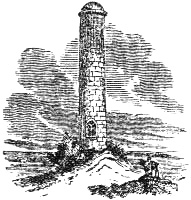
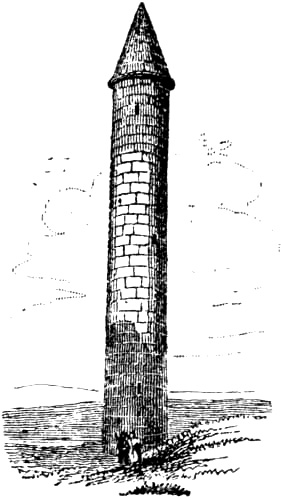
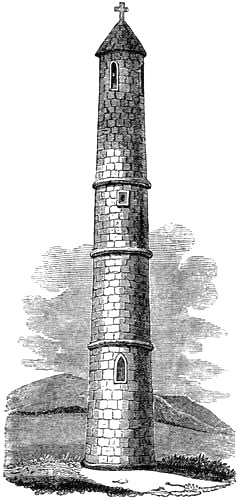
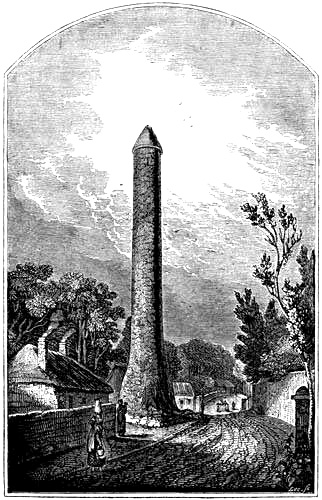
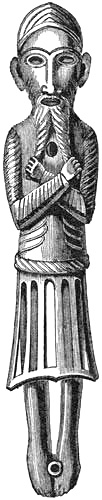
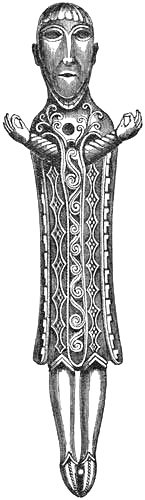
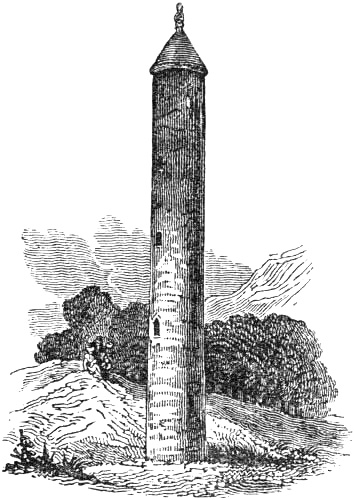
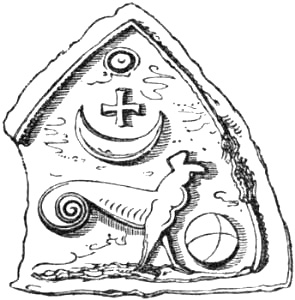
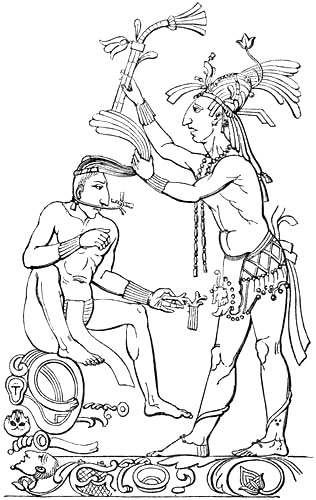
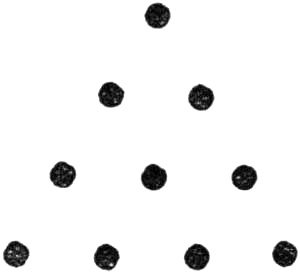
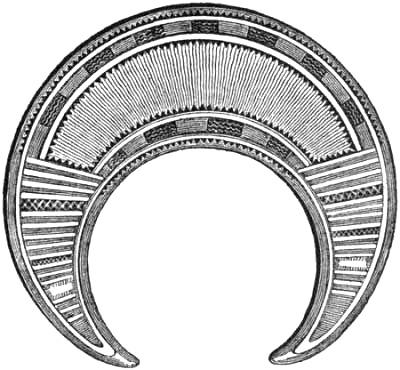
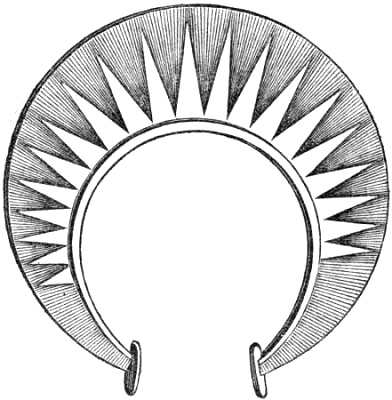
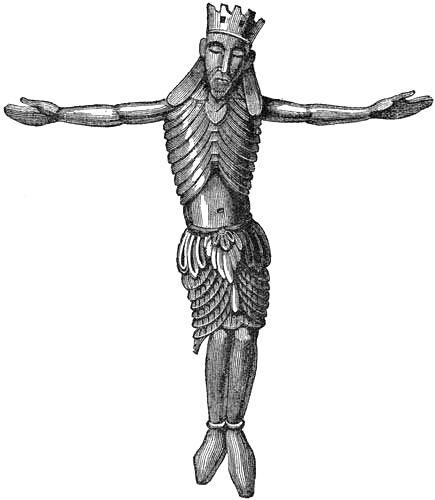
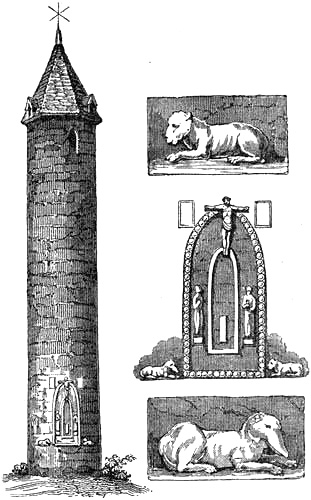
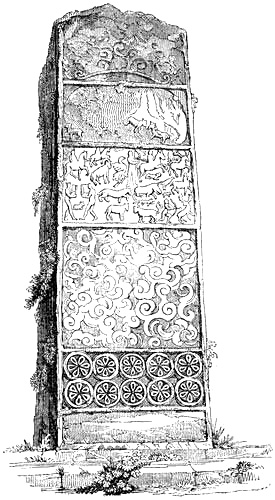
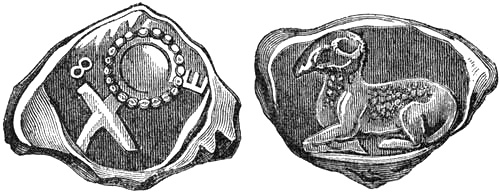
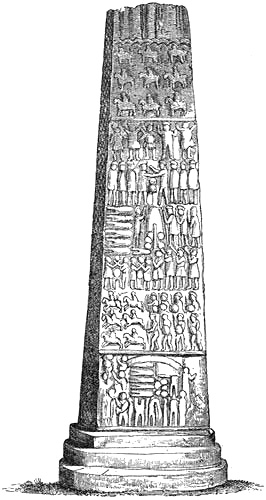
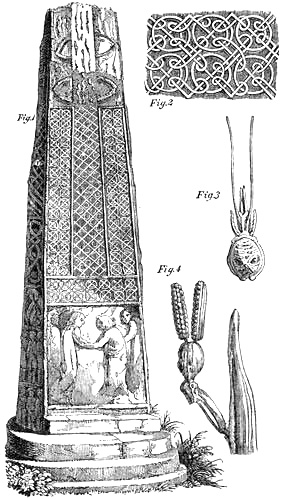

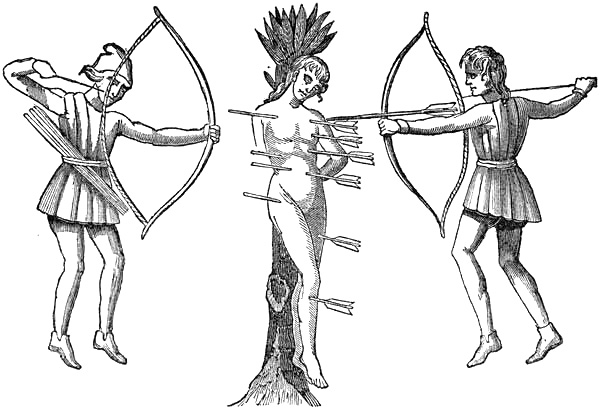
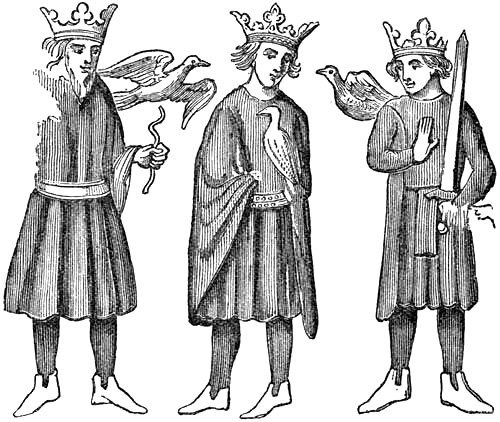
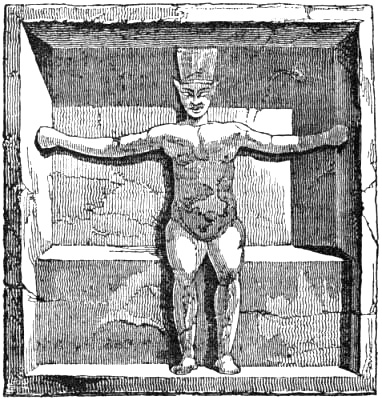
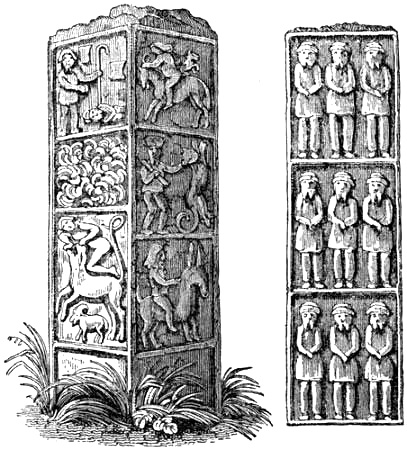
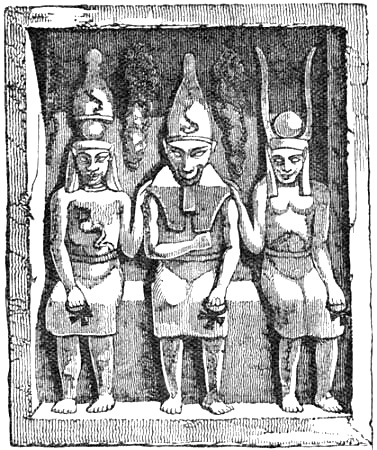
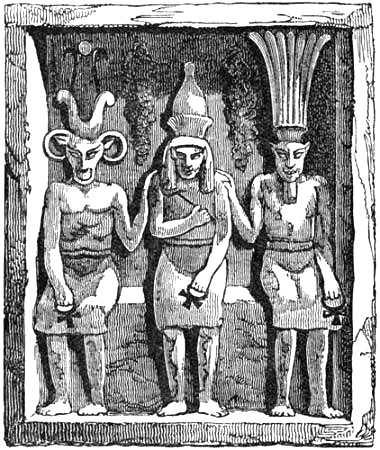
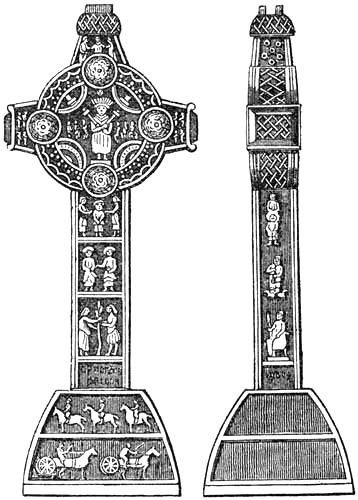
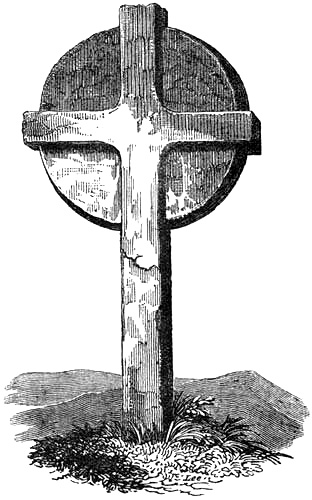


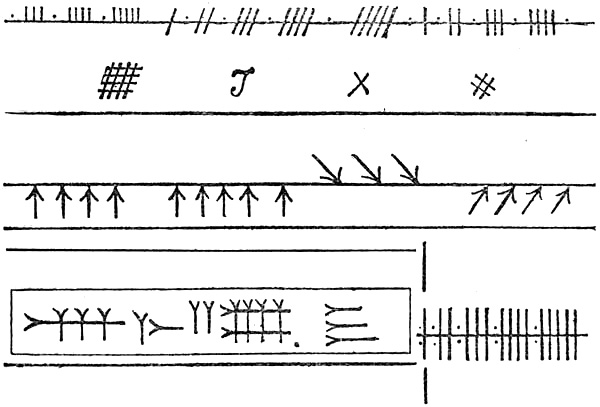

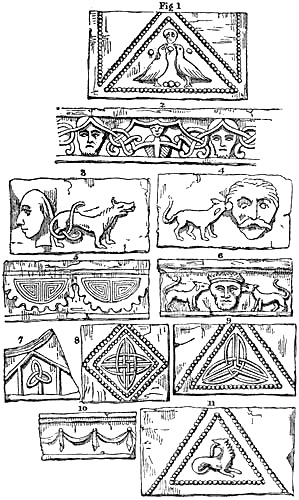
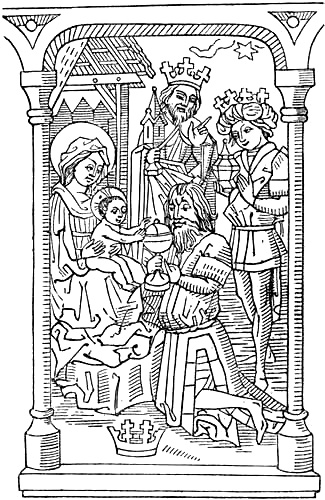
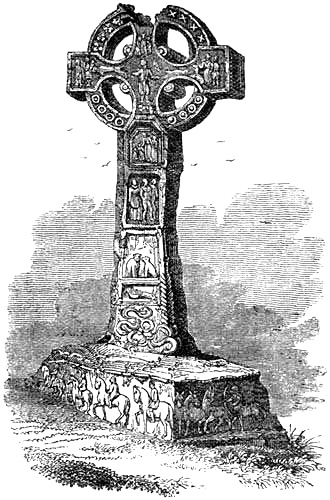
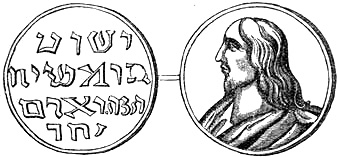
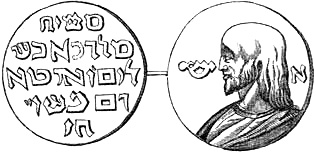
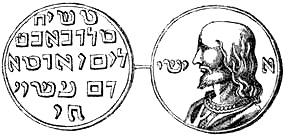
 . The jewel in the
freemasons’ royal arch is thus formed. Noah was a freemason; and being the
inventor of that mysterious and sacredly-religious ceremony, called
the Deluge, we may be satisfied that all the secrets of that body bear
reference to my developments. I look upon their institution as most
solemn and majestically sublime.
. The jewel in the
freemasons’ royal arch is thus formed. Noah was a freemason; and being the
inventor of that mysterious and sacredly-religious ceremony, called
the Deluge, we may be satisfied that all the secrets of that body bear
reference to my developments. I look upon their institution as most
solemn and majestically sublime.