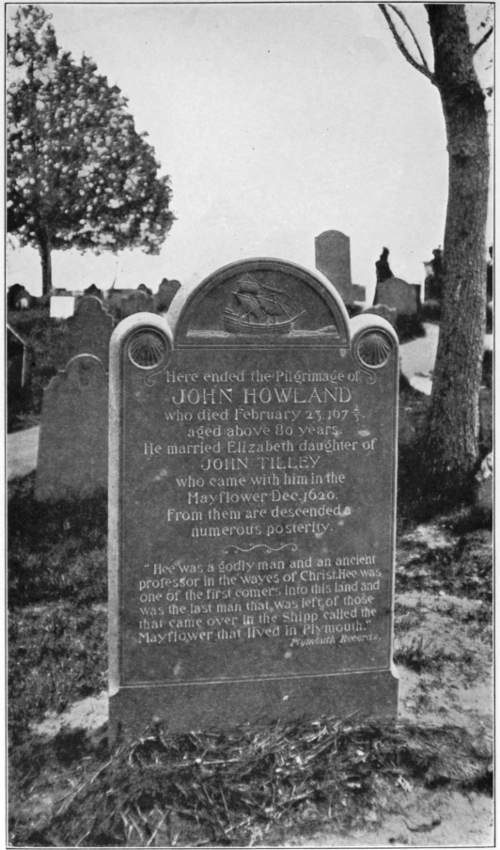
Photograph by A. S. Burbank, Plymouth
From a Painting
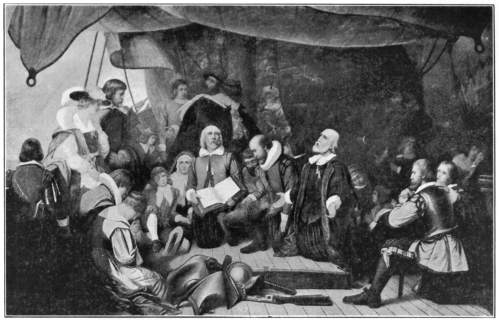
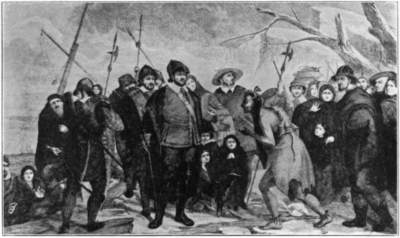
The Landing of the Pilgrims
IV
"INTO A WORLD UNKNOWN"—TRIALS AND TRIUMPH
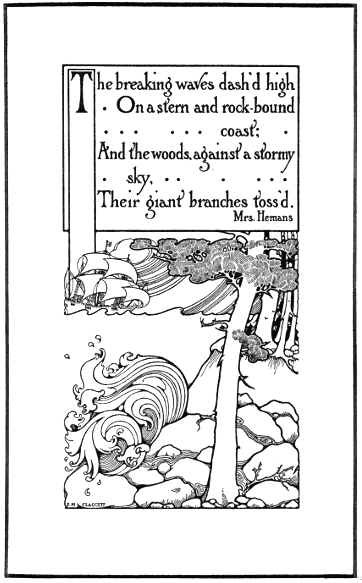
The breaking waves dash'd high
On a stern and rock-bound coast;
And the woods, against a stormy sky,
Their giant branches toss'd.—Mrs. Hemans.
We can imagine with what wondering awe and mingled hopes and fears the
Pilgrims looked out over the sea upon that strange New World, with its
great stretch of wild, wooded coast and panorama of rock and dune and
scrub, wintry bay and frowning head-land, to which destiny and the worn
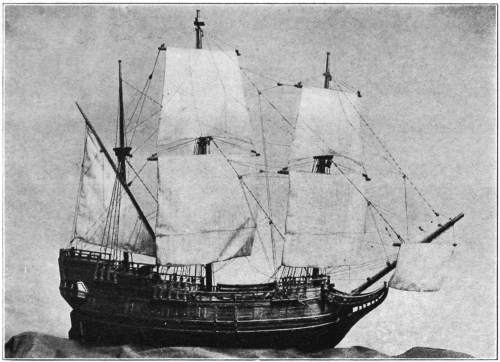
white wings of the Mayflower together had brought them. With thankful
hearts for safe deliverance from the perils of the sea, mindful of the
past and not despairing for the future, they turned trustfully and
bravely to meet the dangers which they knew awaited them in the unknown
wilderness ashore.
The point reached by the voyagers was considerably north of the intended
place of settlement, the vicinity of the Hudson River; but whether
accidental or designed—and some evidence there certainly was which
seemed to show that the master of the Mayflower had been bribed by the
Dutch[4] to keep away from Manhattan, which they wanted for
themselves—the variation was a happy one for the colonists, inasmuch as
it saved them from the savages, who were warlike and numerous near the
Hudson, while in this district they had been decimated and scattered by
disease.
Copyright, 1906, by A. S. Burbank, Plymouth
From a Painting
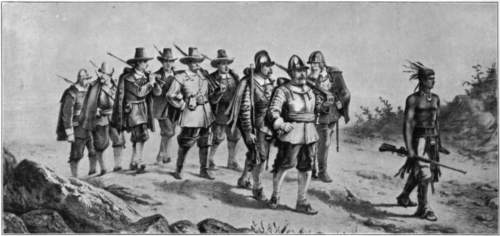
The March of Miles Standish
Now the Pilgrims were a prudent as well as a pious and plucky people,
and while yet upon the water they set about providing themselves with a
system of civil government. Placed as they were by this time outside the
pale of recognized authority, some fitting substitute for it must be
established if order was to be maintained. The necessity for this was
the more imperative as there were some on board—the hired labourers,
probably—who were not, it was feared, "well affected to peace and
concord." Assembled in the cabin of the Mayflower, we accordingly have
the leaders of the expedition, preparing that other historical incident
of the pilgrimage. There they drew up the document forming a body
politic and promising obedience to laws framed for the common good. This
was the first American charter of self-government. It was subscribed by
all the male emigrants on board, numbering forty-one. Under the
constitution adopted, John Carver was elected Governor for one year.
The Mayflower rode at anchor while three explorations were made to
discover a suitable place of settlement, one of them on shore under
Captain Miles Standish, and two by water in the ship's shallop, which
had been stowed away in pieces 'tween decks on the voyage. On December
21st an inlet of the bay was sounded and pronounced "fit for shipping,"
and the explorers on going inland found "divers cornfields and little
running brooks," and other promising sources of supply. They accordingly
decided that this was a place "fit for situation," and on December 26th
the Mayflower's passengers, cramped and emaciated by long confinement on
board, leaped joyfully ashore. Appropriately the spot was named New
Plymouth, after the last port of call in Old England.
The Pilgrims landed on a huge boulder of granite, the Pilgrim Stone,
still reverently preserved by their descendants: a rock which was
to their feet as a doorstep
Into a world unknown—the cornerstone of a nation![5]
The early struggles of the Plymouth planters and the hardships they
endured form a story of terrible privation and suffering on the one hand
and heroic endurance and self-sacrifice on the other. They were late in
arriving, and the season, midwinter, was unpropitious. The weather was
unusually severe, even for that rigorous climate, and the Pilgrims found
themselves in sorry plight on that bleak New England shore. Cold and
famine had doggedly to be fought, and the contest was an unequal one.
Cooped up for so long in the Mayflower, and badly fed and sheltered on
the voyage, the settlers were ill-fitted to withstand the stress of the
new conditions. For a time it was a struggle for bare existence, and the
little colony was brought very near to extinction.
The first care was to provide accommodation ashore, and for economy of
building the community was divided into nineteen households, and the
single men assigned to the different families, each of whom was to erect
its own habitation and to have a plot of land. These rude homesteads of
wood and thatch, and other buildings, eventually formed a single street
beside the stream running down to the beach from the hill beyond. The
soil of the chosen settlement appeared to be good, and abounded with
"delicate springs" of water; the land yielded plentifully in season, and
life teemed upon the coast and in the sea.
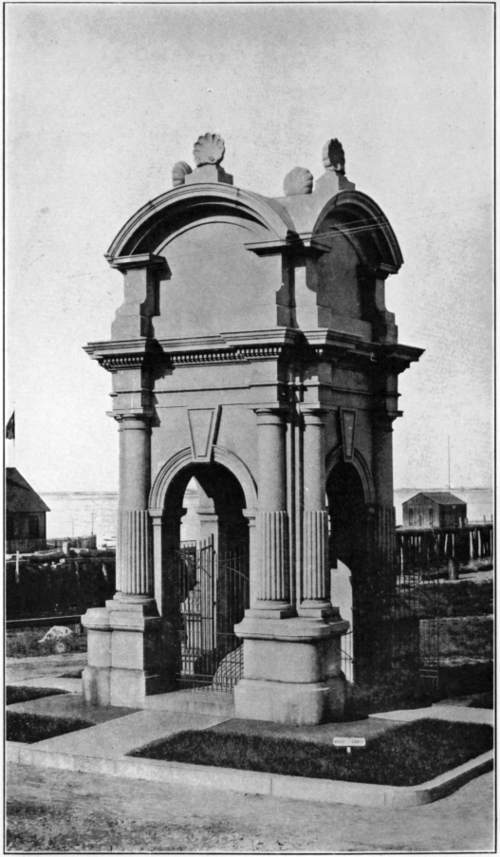
Copyright, 1906, by A. S. Burbank, Plymouth
The Canopy over Plymouth Rock
But many of the Pilgrims never lived to enjoy this provision of a
bountiful Providence. Worn out, enfeebled in health, insufficiently
housed ashore, they were a prey to sickness. Death reaped a rich harvest
in their midst. Every second day a grave had to be dug for one or other
of them in the frozen ground. Sometimes, during January and February,
two or three died in a single day. So rapid was the mortality that at
last only a mere handful remained who were able to look after the sick.
William Bradford was at this time prostrated, and it is pathetic to note
the expression of his gratitude to his friend William Brewster and Miles
Standish and others who ministered to his needs and those of the
fellow-sufferers around him. One house, the first finished, was set
apart as a hospital. The hill above the beach was converted into a
burial-ground,[6] and one is touched to the quick to read of the graves
having to be levelled and grassed over for fear the prowling Indians
should discover how few and weak the strangers were becoming!
With March came better weather, and for the first time "the birds sang
pleasantly in the woods," and brought hope and gladness to the hearts of
the struggling colonists. But, by that time, of the hundred or more who
had landed three short months before, one-half had perished miserably.
John Carver succumbed in April, and his wife quickly followed him to
the grave. Bradford, by the suffrages of his brethren, was made Governor
for the first time in Carver's place. He had himself sustained a heavy
bereavement, for, while he was away in the shallop with the exploring
party, Dorothy May, the wife he had married at Amsterdam, fell overboard
and was drowned. Many men of the Mayflower also died that dreadful
winter as the ship lay at anchor in the bay, including the boatswain,
the gunner, and the cook, three quartermasters and several seamen.
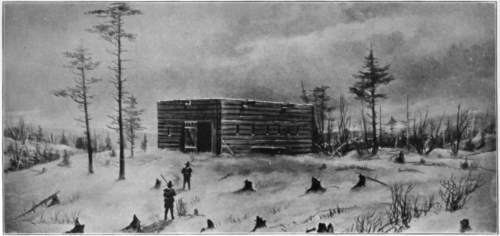
Photograph by A. S. Burbank, Plymouth
From a Painting
The Old Fort and First Meeting House
To other troubles were allied the ever menacing peril of the Indians,
which resulted in the famous challenge of the bundle of arrows wrapped
in a rattlesnake's skin, and Bradford's effective reply to it with a
serpent's skin stuffed with powder and shot; also, less happily, that
return of Miles Standish and his men bearing in triumph a sagamore's
head; and the building of the hill-fort, with cannon brought ashore from
the Mayflower mounted on its roof, where also they worshipped till the
first church was built at the hill fort in 1648. Here it was that the
Pilgrims perpetuated the church founded at Scrooby in England. A
building erected for storage and public worship in the first days of the
colony took fire soon after its completion and was burnt to the ground.
Of the refuge on the hill Bradford writes: "They builte a fort with good
timber, both strong and comly, which was of good defence, made with a
flatte rofe and batilments, on which their ordnance was mounted, and
where they kepte constante watch, especially in time of danger. It
served them also for a meeting-house, and was fitted accordingly for
that use." The fort was large and square, and a work of such pretentions
as to be regarded by some of the Pilgrims as vainglorious. Its provision
was fully justified by the dangers which threatened the settlers, and it
became the center of both the civic and religious life of the little
colony.
An excellent idea of the scene at Sunday church parade is given in a
letter[7] written by Isaac de Rassières, secretary to the Dutch colony
established at Manhattan, the modern New York, in 1623, describing a
visit he paid to the Plymouth Plantation in the autumn of 1627. After
speaking of the flat-roofed fort with its "six cannon, which shoot iron
balls of four and five pounds and command the surrounding country," the
writer says of the Pilgrims meeting in the lower part: "They assemble by
beat of drum, each with his musket or firelock, in front of the
captain's door; they have their cloaks on, and place themselves in order
three abreast, and are led by a sergeant without beat of drum. Behind
comes the Governor in a long robe; beside him, on the right hand, comes
the Preacher with his cloak on, and on the left the Captain with his
sidearms and cloak on, and with a small cane in his hand; and so they
march in good order, and each sets his arms down near him. Thus they are
constantly on their guard, night and day."
The spectacle may not have been strictly that witnessed at every service
on "Sundays and the usual holidays," for this was a state visit to the
Colony, with solemn entry and heralding by trumpeters, and the Pilgrims
probably treated the occasion with more form than was their wont. Still
it is an instructive picture, full of romantic suggestion.
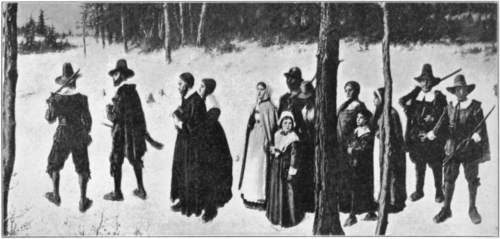
Photograph by A. S. Burbank, Plymouth
From the Painting by G. H. Boughton
Pilgrims going to Church
And then the service itself. For some notion of this we must turn to a
visit paid to the Plantation five years later, in the autumn of 1632,
when we are introduced to another scene in the fortified church. From
the "Life and Letters" of John Winthrop, Governor of the neighbouring
Colony of Massachusetts Bay, we gather that, at the time stated,
Winthrop and his pastor, John Wilson, came over to Plymouth, walking the
twenty-five miles. "On the Lord's Day," we read, "there was a sacrament,
which they did partake in." Roger Williams was there as assistant to
Ralph Smith, the first minister of Plymouth church, and in the afternoon
Williams, according to custom, "propounded a question," to which Mr.
Smith "spake briefly." Then Mr. Williams "prophesied," that is he
preached, "and after, the Governor of Plymouth spake to the question;
after him, Elder Brewster; then some two or three men of the
congregation. Then Elder Brewster desired the Governor of Massachusetts
and Mr. Wilson to speak to it, which they did. When this was ended the
deacon, Mr. Fuller, put the congregation in mind of their duty of
contribution; whereupon the Governor and all the rest went down to the
deacon's seat, and put into the box, and then returned."
There is nothing here about the music of the services, such as it was,
vocal only, rugged, but not without melody. We know, however, that the
Pilgrims used that psalter, brought over by them to New England, with
its tunes printed above each psalm in lozenge-shaped Elizabethan notes,
which Longfellow so grandly describes in "The Courtship of Miles
Standish" as
the well-worn psalm-book of Ainsworth,
Printed in Amsterdam, the words and the music together,
Rough-hewn, angular notes, like stones in the walls of a churchyard,
Darkened and overhung by the running vine of the verses.
The duty of "tuning the Psalm," as they designated the performance, in
the young colonial days, before choirs or precentors were dreamt of, was
delegated to some lusty-lunged brother present, and, judged by the
testimony which has come down to us, it was an onerous one, trying to
his patience and his vocal power when, as sometimes happened, the
congregation carried another tune against him. They were called to
Sabbath worship in the earlier times by sound of horn or beat of drum
or the blowing of a large conch-shell. At Plymouth we have seen it was
by drum beat, probably from the roof, that the people were assembled at
the meeting-house.
When the Mayflower left them to return home in the spring, the settlers
must have felt they were desolate indeed, for their nearest civilised
neighbours were five hundred miles to the north and south of them, the
French at Nova Scotia and the English in Virginia. Seven months later,
in November, came the Fortune, bringing thirty-five new emigrants,
including William Brewster's eldest son; John Winslow, a brother of
Edward; and Robert Cushman, who had turned back the year before at Old
Plymouth. In addition to her passengers, the Fortune brought out to the
colonists, from the Council of New England, a patent[8] of their land,
drawn up in the name of John Pierce and his associate Merchant
Adventurers in the same way as the charter granted them by the Plymouth
Company on February 21, 1620, authorising the planters to establish
their colony near the mouth of the Hudson river.
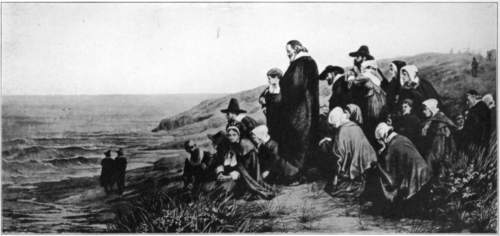
Photograph by A. S. Burbank, Plymouth
From the Painting by A. W. Bayes
The Departure of the Mayflower
When the Fortune sailed back to England, she carried a cargo of
merchandise valued at five hundred pounds. This was intended for the
Adventurers, but they never received it, for when nearing port, the
vessel was captured by the French and the cargo seized. The ship was
allowed to proceed, and Cushman, who returned in her, secured the papers
on board, among them Bradford and Winslow's Journal, known as Mourt's
Relation, and a letter from Edward Winslow to his "loving and old
friend" George Morton, who was about to come out, giving seasonable
advice as to what he and his companions should bring with them—good
store of clothes and bedding, and each man a musket and fowling-piece;
paper and linseed oil for the making of their windows (glass being then
too great a luxury for a New England home), and much store of powder and
shot.
Soon arrived further parties from Leyden and stores from the Adventurers
in London in the Anne and the Little James pinnace, the people including
such welcome additions as Brewster's two daughters, Fear and Patience;
George Morton and his household; Mrs. Samuel Fuller; Alice Carpenter,
widow of Edward Southworth, afterwards the second wife of Governor
Bradford; and Barbara, who married Miles Standish. Then from the Leyden
pastor came letters for Bradford and Brewster. The writer was dead—had
been dead a year—when those letters reached their destination, but this
they only knew when Standish gave them the tidings on his return from a
voyage to England. John Robinson passed away at the age of forty-nine on
March 1, 1622, in the old meeting-house at Leyden, and they buried him
under the pavement of St. Peter's Church. Brewster lost his wife about
the time the sad news was known, and the messenger who brought it had
further to tell of the death of Robert Cushman. Truly the tale of
affliction was a sore one.
By the July of 1623 a total of about two hundred and thirty-three
persons had been brought out, including the children and servants, of
whom one hundred and two, composed of seventy-three males and
twenty-nine females, eighteen of the latter wives, were landed from the
Mayflower. At the close of that year not more than one hundred and
eighty-three were living. The survivors bravely persevered. Gradually
the Pilgrim Colony took deep root. The New Plymouth men were a steady,
plodding set, and the soil, if hard, was tenacious. They got a firm
foothold. They suffered much, for their trials by no means ended with
the first winter; but their cheerful trust in Providence and in their
own final triumph never wavered. By 1628 their position was secure
beyond all doubt or question. The way was now prepared; the tide of
emigration set in; and the main body of the Puritans began to follow in
the track of their courageous and devoted advance-guard.
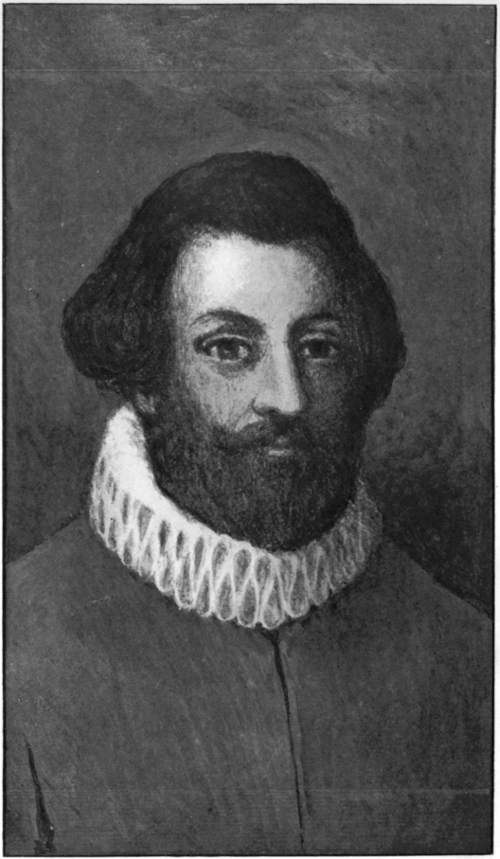
Copyright, 1904, by A. S. Burbank, Plymouth
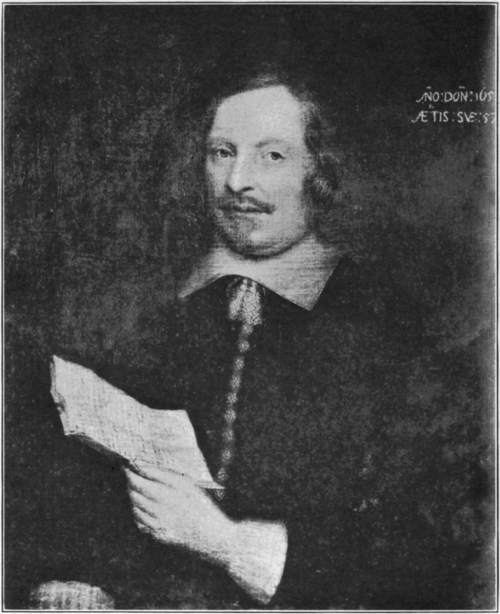
Captain Miles Standish
Out there in the West these Pilgrims, or first-comers, settled
themselves resolutely to the task which lay before them. They were no
idle dreamers, though their idealism was intense, and they were united
by the bonds of sympathy and helpfulness, one towards another. Their
works were humble, their lives simple and obscure, their worldly success
but small, their fears many and pressing, and their vision of the future
restricted and dim. But they consistently put into practise the
conceptions and ideals which dominated them and were to be the
inheritance of the great Republic they unconsciously initiated and
helped to build up. They established a community and a government
solidly founded on love of freedom and belief in progress, on civil
liberty and religious toleration, on industrial cooperation and
individual honesty and industry, on even-handed justice and a real
equality before the laws, on peace and goodwill supported by protective
force. They were more liberal and tolerant in religion than the Puritan
colonists of Massachusetts Bay, and more merciful in their punishments;
they perpetrated no atrocities against inferior peoples, and cherished
the love of peace and of political justice.
Although at first the relations of the Pilgrims with their Puritan
neighbours were none of the best, a better state of feeling before long
prevailed. We have seen how John Winthrop and his pastor plodded over to
Plymouth to attend its Sunday worship. Three years earlier, in 1629,
Bradford and some of his brethren went by sea to Salem to an ordination
service there, and, says Morton in his "Memorial," "gave them the right
hand of fellowship." There were other visits, letters of friendship, and
reciprocal acts of kindness. We read of Samuel Fuller, physician and
deacon, going to Salem to tend the sick, and of Governor Winthrop
lending Plymouth in its need twenty-eight pounds of gunpowder.
This good feeling strengthened as time went on, and drew together the
Plantations of Plymouth, Massachusetts, and Connecticut for mutual
support and protection; and in May, 1643, the deputies of these
Colonies, meeting at Boston, subscribed the Articles of Confederation
which created the first Federal Union in America. This league prospered
well until 1684, when the Colonial charter was annulled and a Crown
Colony was established under an English governor. Less than a decade
later Massachusetts became a Royal province, and that period in American
history was entered upon which ended with the Declaration of
Independence and the creation of the United States.
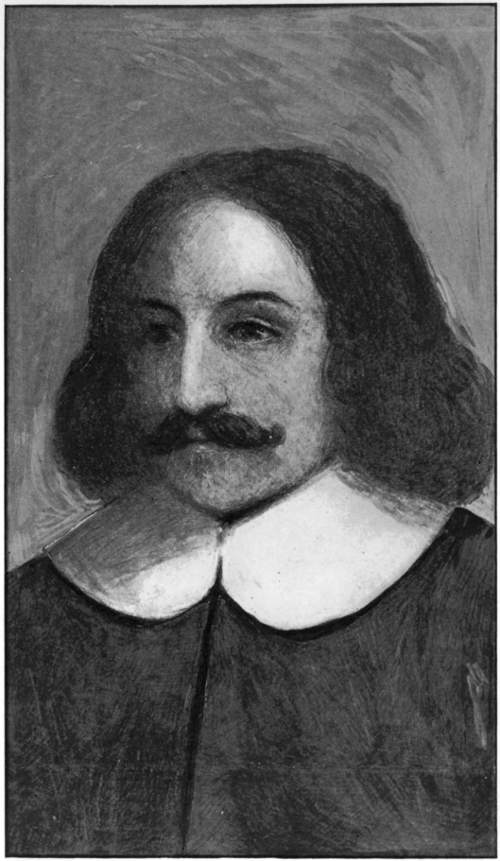
Copyright, 1904, by A. S. Burbank, Plymouth
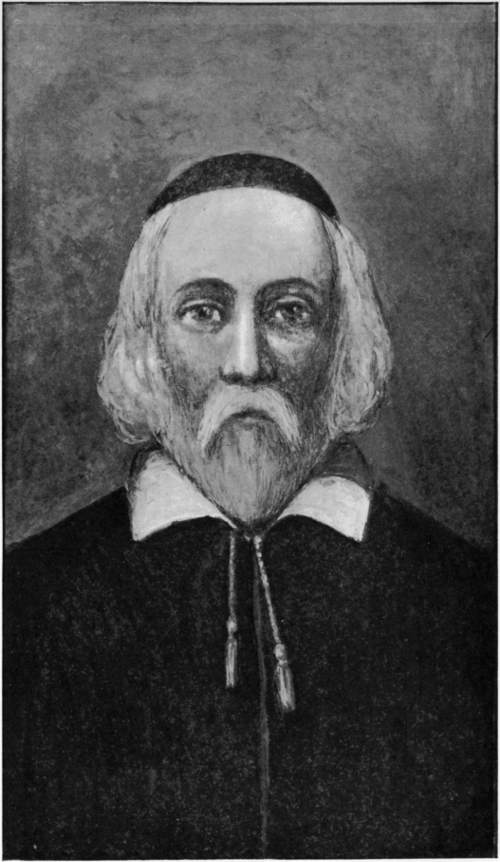
Governor William Bradford
While the federation of 1643 did much for the United Colonies, it
overshadowed, but could not obscure, Plymouth and the unique annals and
traditions which have preserved for it a foremost place in all American
history. With the order of things inaugurated in 1692 the body politic
framed by the men of the Mayflower ceased to have separate existence,
but it remains deep in the foundations of the nation which absorbed it.
In the modest language of William Bradford used in his day, "As one
small candle may light a thousand, so the light here kindled hath shone
to many, yea, in some sort to our whole nation," a truth which has a far
wider application now than it had in Bradford's time.
Such is the story of the Mayflower Pilgrims, romantic, heroic, idyllic,
based also upon the principles which have molded and maintained a mighty
free nation. Its place in the life of to-day is honoured and
conspicuous, and rests upon the rock of a people's gratitude.
During the nineteenth century it was proclaimed by many orators, among
them John Quincy Adams, Daniel Webster, Edward Everett, Robert Charles
Winthrop, and George Frisbie Hoar—to name only the century's dead—who
as New Englanders and lovers of liberty were well fitted to voice the
virtues of the Pilgrim Fathers, the hardships they endured, their high
merits as colonists compared with other colonists of ancient and modern
times, and the immense issues springing from their devout, laborious,
and self-sacrificing lives.
Passing on to the twentieth century we have the story taken up by one
American President and continued by another at the cornerstone laying
and dedication of a combined tribute of State and Nation to the lives
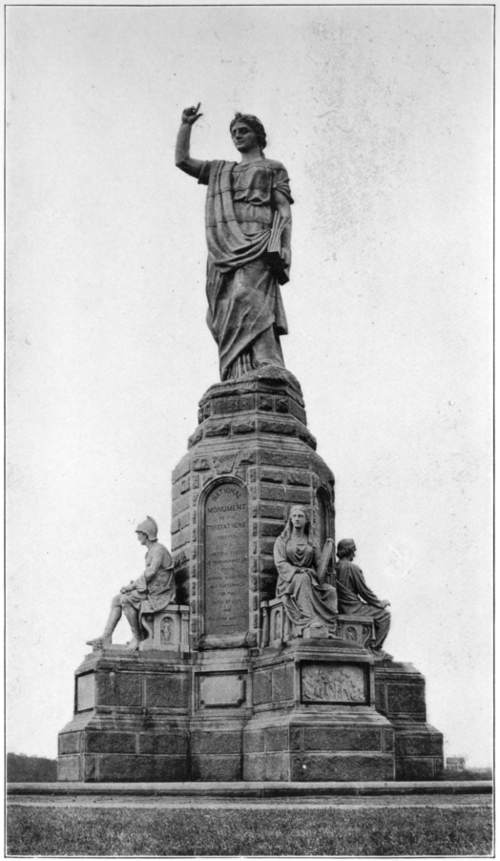
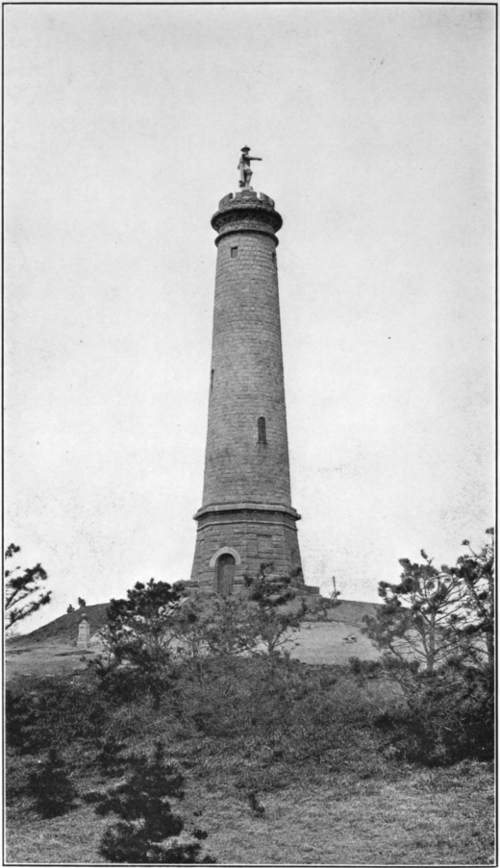
and work of the Forefathers. This was the Pilgrim Memorial Monument,
erected at Provincetown on a commanding site above the harbour in whose
waters the Mayflower dropped her anchor nearly three centuries ago.
The gatherings there of 1907 and 1910 stand out prominently in Pilgrim
history, especially so that of August 5 of the latter year, which was
grandly impressive alike in its magnitude and its purpose and character.
President Taft, the successor of President Roosevelt, arrived in his
yacht Mayflower with imposing naval display amid rejoicing and the
booming of guns. He was greeted by Governor of the State Eben S. Draper,
Captain J. H. Sears, president of the Cape Cod Pilgrim Memorial
Association, and members of the local committee. Accompanying him were
Secretary of the Navy George von L. Meyer, United States Senators Henry
Cabot Lodge and George Peabody Wetmore, and Justice White of the United
States Supreme Court. The scene and the ceremonies, soul-stirring and
significant, are worthy of permanent record.
Escorted by a company of bluejackets, of whom two thousand, with marines
from the warships, lined the street from the wharf, President Taft and
the other guests were driven up the hill to the Monument, where, from
the grandstand at its base, Captain Sears reviewed the plans which
resulted in its erection.
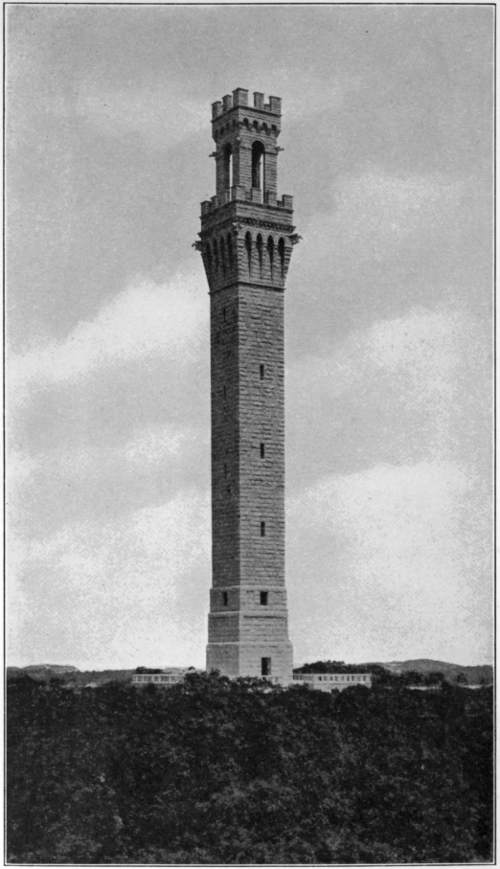
Photograph by A. S. Burbank, Plymouth
The Pilgrim Memorial Monument at Provincetown
President Charles W. Eliot of Harvard University gave an historical
address. In graphic language he contrasted the desolate prospect
confronting the Pilgrims at Cape Cod with the picture upon which the
present concourse gazed, a happy and prosperous population filling the
smiling land and in the harbour traversed by the Mayflower a varied
throng of ships, "with them numerous representatives of a strong naval
force maintained by the eighty million free people who in nine
generations from the Pilgrims have explored, subdued, and occupied that
mysterious wilderness so formidable to the imagination of the early
European settlers on the Atlantic coast of the American continent."
With force and pathos Dr. Eliot spoke of the debt they all owed to the
Pilgrim Fathers. "We are to hear the voices of the Chief Magistrate of
this multitudinous people and of the Governor of the Commonwealth
acknowledging the immeasurable indebtedness of the United States and of
the Colony, Province, and State of Massachusetts to the adult men and
the eighteen adult women who were the substance or seed-bearing core of
the Pilgrim company; and we, the thousands brought hither peacefully in
a few summer hours by vehicles and forces unimagined in 1620 from the
wide circuit of Cape Cod—which it took the armed parties from the
Mayflower a full month to explore in the wintry weather they
encountered—salute tenderly and reverently the Pilgrims of the
Mayflower, and, recalling their fewness and their sufferings, anxieties
and labours, felicitate them and ourselves on the wonderful issues in
human Joy, strength, and freedom of their faith, endurance, and
dauntless resolution."
Dr. Eliot was followed by M. Van Weede, chargé d'affaires of the
Netherlands Legation at Washington, whose Government was represented on
this occasion because the Pilgrims sailed from Holland. (The cornerstone
laying three years before was attended by the British Ambassador.)
Formal transfer of the Monument from the National Commission, which
directed its construction, to the Commonwealth of Massachusetts and the
Pilgrim Memorial Association, was made on behalf of the United States
Government by Senator Lodge, who enlarged upon the two great political
principles embodied in the Mayflower compact, the conception of an
organic law and of a representative democracy, and on the noble
purpose—that of securing freedom of worship and the preservation of
their nationality and native language—of the little band of exiles who
signed the document and settled there.
William B. Lawrence of Medford accepted the Monument on behalf of the
Memorial Association, and a quartet sang "The Landing of the Pilgrims,"
by Mrs. Felicia Hemans.
Congressman James T. McCleary of Minnesota, who supported the bill in
Congress for a Government appropriation to assist in the building of the
Monument, also spoke.
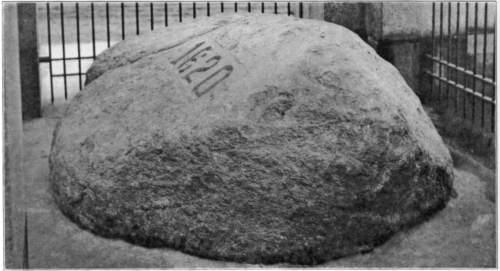
Photograph by A. S. Burbank, Plymouth
Plymouth Rock
Governor Draper then introduced the President. "This Monument," he said,
"shows that our people and our State and National Government honour and
revere the Pilgrims and the great principles of government they
enunciated," and for that reason, he added, "It is most fitting that
this Monument, whose cornerstone was laid by one President, should be
dedicated by another."
President Taft declared that the spirit which animated the Pilgrim
Fathers had made the history of the United States what it was by
furnishing it with the highest ideals of moral life and political
citizenship. "It is meet therefore," said he, "that the United States,
as well as the State of Massachusetts, should unite in placing here a
Memorial to the Pilgrims. The warships that are here with their cannon
to testify to its national character typify the strength of that
Government whose people have derived much from the spirit and example of
the heroic band. Governor Bradford, Elder Brewster, Captain Miles
Standish are the types of men in whom as ancestors, either by blood, or
by education and example as citizens, the American people may well take
pride."
The ceremonies were brought to a close by Miss Barbara Hoyt, a
descendant of Elder Brewster, unveiling a bronze tablet over the door of
the Monument facing the harbour which bears an appropriate inscription
written by Dr. Eliot.
And so this magnificent Monument stands as a landmark which, seen from
afar across the ocean, will remind the traveller of the small beginnings
of New England when, in the words of Dr. Eliot, fired and led by the
love of liberty, the Mayflower Pilgrims here "founded and maintained a
State without a king or a noble, and a Church without a bishop or a
priest."
It is upon record that in the early days of the Plymouth Plantation an
expedition was made in the Mayflower's shallop, a big boat of about
fourteen tons, to a point lower down on the coast, where the party made
friends with the Shawmut Indians and found a fine place for shipping,
and forty-seven beautiful islands, which they greatly admired as they
sailed in and out amongst them. This was the future Boston Harbour.
It is interesting to reflect that when, a decade and more after the
Pilgrim Fathers had landed in America, some hundreds of Puritan
colonists embarked for Massachusetts, many of the leading burgesses of
the then only Boston—that Old Boston, scene of the Pilgrims' detention
and suffering—were of the number. The town cannot claim a contribution
to the Mayflower, but it has a boast as proud, for it was because the
ancient seaport sent so large a contingent of Puritans to America that
it was ordered "that Trimountain," the site overlooking the sheltered
waters and the island group which delighted Pilgrim eyes, "shall be
called Boston."
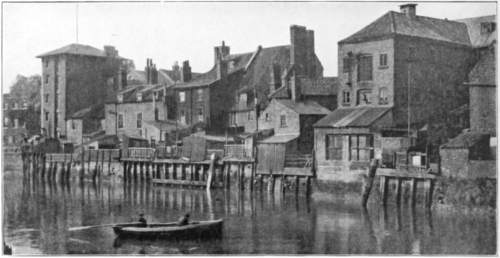
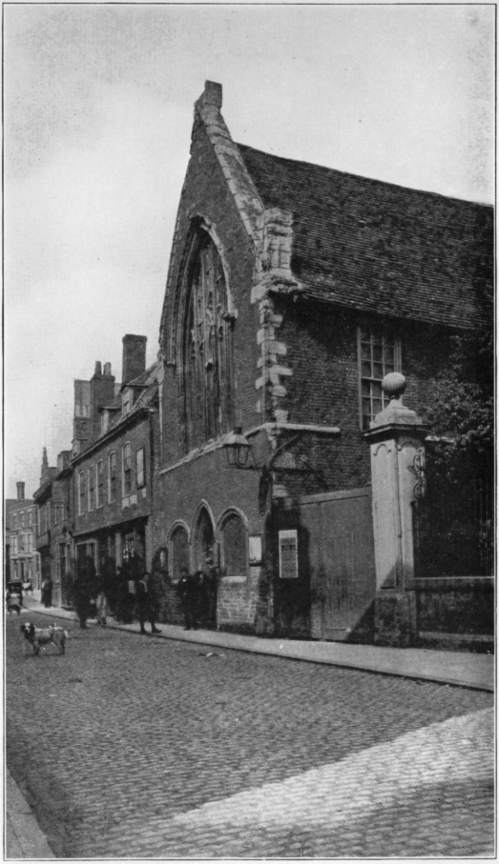
Photograph by Hackford, Boston
A Bit of Old Boston
It was in the spring of 1630 that the main body of Puritan emigrants,
John Winthrop's party, sailed from Southampton. A year before that the
Massachusetts Bay Company dispatched to the West an expedition of five
ships, and one of them was our old friend the wonderful little
Mayflower, of immortal memory, which nine years earlier had carried out
the Plymouth Pilgrims and was now assisting in the settlement of
Massachusetts!
Among the Bostonians and their friends who sailed with or in the wake of
Winthrop were Richard Bellingham, Recorder of the town (Nathaniel
Hawthorne in "The Scarlet Letter" draws Governor Bellingham of the New
Boston); bold Atherton Hough aforementioned, Mayor of the borough in
1628; Thomas Leverett, an alderman, "a plain man, yet piously subtle";
Thomas Dudley and young John Leverett, who became Governors of
Massachusetts; William Coddington, father and governor of Rhode Island;
and John Cotton, the far-famed Puritan preacher of Boston church, who
became one of the leading religious forces of New England life.
And Old Boston, we have seen, is still much as it was outwardly over
three hundred years ago, when the Pilgrim Fathers gazed upon it, and
later Cotton preached long but edifying sermons in the vast church, and
the Puritan warden struck the Romish symbol from the hand of a carven
image on the noble tower.
The first days of the Trimountain Colony resembled in some of their
features those of the planting of New Plymouth. Although their shelter
was of the scantiest, the settlers had not, like the settlers of
Plymouth, to face at the outset the rigors of a Western winter. The
Pilgrims arrived in December, on the shortest day of the year, whereas
the day of the Puritans' landing was the very longest. Sickness and
famine had nevertheless to be fought. Disease quickly carried off twenty
per cent. of the people. About a hundred others returned home
discouraged. The rest persevered, and proved themselves worthy followers
of the New Plymouth Pilgrims. The Colony was, moreover, recruited by
fresh comers from the old country; and through many vicissitudes,
dissensions, and set-backs, much that was blasting to the spiritual and
moral life and development of the Colony, it prospered materially and
gathered strength. And there grew up the New England States.
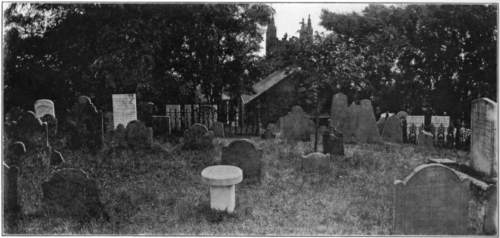
Photograph by A. S. Burbank, Plymouth
The Site of the Old Fort, Burial Hill, Plymouth
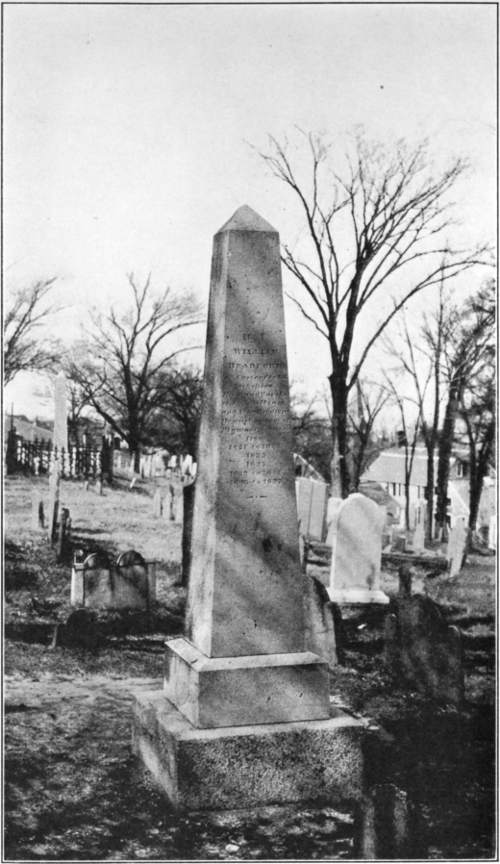
On the slope of Burial Hill,[9] surrounded by memorials of the Pilgrim
Fathers and with the graves of their dead in the background; facing down
that stream-skirted street of the Pilgrims once bordered by their humble
dwellings and echoing to the tread of their weary feet; looking out upon
the waters which bore to this haven, long years ago, the storm-tossed
Mayflower and her eager human freight, there stands to-day a church
which through the centuries has preserved unbroken records and
maintained a continuous ministry. This is the First Church in Plymouth
and the first church in America, the church of Scrooby, Leyden, and the
Mayflower company, the church of Brewster and Bradford, of Winslow and
Carver, whose first covenant, signed in the cabin of the little emigrant
ship, is still the basis of its fellowship. Here Roger Williams, the
banished of Boston and missionary of Rhode Island—a man according to
Bradford of "many precious parts, but very unsettled in
Judgment"—ministered for a time under Ralph Smith in the early stormy
days of the sister colony; and here John Cotton, son of the famous
Boston teacher and preacher—"a man of scholarly tastes and habits,
somewhat decided in his convictions, diligent and faithful in his
pastoral duties"[10]—was pastor for nearly thirty years from 1669.
As the First Church in Boston is the fifth of its line, so is the First
Church in Plymouth the fifth meeting-house used by the Pilgrim
community. Its predecessor, a shrine of Pilgrim history around which
precious associations clustered, was destroyed by fire in 1892; from
the burning ruins was rescued the town bell cast by Paul Revere in
1801, and this sacred relic hangs and tolls again in the tower of the
present edifice.
Amid such scenes as these well may we of to-day pause and reflect. For
on this hallowed spot, with its historic environment and its striking
reminders of a great and honoured past, was rocked the cradle of a
nation of whose civil and religious liberty it was the first rude home.
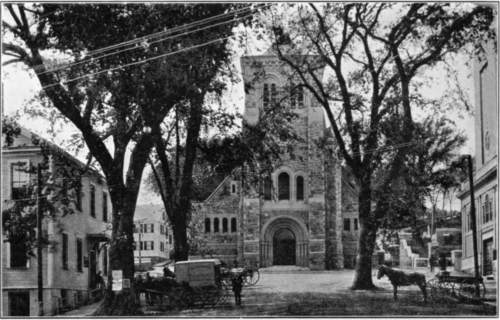
Photograph by A. S. Burbank, Plymouth
First Church, Plymouth
The entrance to Burial Hill is shown on the Right