THE EARLIER PEOPLE.
A PATRIARCH'S STORY.
This is the City of Winnipeg. Its growth has been wonderful. It is the highwater
mark of Canadian enterprise. Its chief thoroughfare, with asphalt pavement, as it
runs southward and approaches the Assiniboine River, has a broad street diverging at
right angles from it to the West. This is Broadway, a most commodious avenue with
four boulevards neatly kept, and four lines of fine young Elm trees. It represents to
us "Unter den Linden" of Berlin, the German Capital.
The wide business thoroughfare Main Street, where it reaches the Assiniboine
River, looks out upon a stream, so called from the wild Assiniboine tribe whose
northern limit it was, and whose name implies the "Sioux" of the Stony Lake. The
Assiniboine River is as large as the Tiber at Rome, and the color of the water justifies its being
compared with the "Yellow Tiber."
The Assiniboine falls into the Red River, a larger stream, also with tawny-colored
water. The point of union of these two rivers was long ago called by the French
voyageurs "Les Fourches," which we have translated into "The Forks."
One morning nearly forty years ago, the writer wandered eastward toward Red River,
from Main Street, down what is now called Lombard Street. Here not far from the bank
of the Red River, stood a wooden house, then of the better class, but now left far
behind by the brick and stone and steel structures of modern Winnipeg.
The house still stands a stained and battered memorial of a past generation. But
on this October morning, of an Indian summer day, the air was so soft, that it seemed
to smell wooingly here, and through the gentle haze, was to be seen sitting on his
verandah, the patriarch of the village, who was as well the genius of the place.
The old man had a fine gray head with the locks very thin, and with his form, not
tall but broad and comfortable to look upon, he occupied an easy chair.
The writer was then quite a young man freshfrom College, and with a simple introduction, after the easy manner
of Western Canada, proceeded to hear the story of old Andrew McDermott, the patriarch
of Winnipeg.
"Yes," said Mr. McDermott, "I was among those of the first year of Lord Selkirk's
immigrants. We landed from the Old Country, at York Factory, on Hudson Bay. The first
immigrants reached the banks of the Red River in the year 1812.
"I am a native of Ireland and embarked with Owen Keveny—a bright
Hibernian—a clever writer, and speaker, who, poor fellow, was killed by the
rival Fur Company, and whose murderer, De Reinhard, was tried at Quebec. Of course
the greater number of Lord Selkirk's settlers were Scotchmen, but I have always lived
with them, known them, and find that they trust me rather more than they at times
trust each other. I have been their merchant, contractor, treaty-maker, business
manager, counsellor, adviser, and confidential friend."
"But," said the writer, "as having come to cast in my lot with the people of the
Red River, I should be glad to hear from you about the early times, and especially of
the earlier people of this region, who lived their lives, and came and went, before
the arrival of Lord Selkirk's settlers in 1812." Thus the story-telling began, and
patriarch and questioner made out
from one source and another the
whole story of the predecessors of the Selkirk Colonists.
MOUND BUILDERS' ORNAMENTS, ETC.
A. Ornamental gorget of turtle's plastron.
B. Gorget of sea-shell (1879).
C. Gorget of buffalo bone.
D. Breast or arm ornament of very hard bone.
E. String of beads of birds' leg bones.
Note cross X.
F. One of three polished stones used for gaming.
G. Columella of large sea couch (tropical, used as sinker for
fishing).
AN EXTINCT RACE.
"Long before the coming of the settler, there lived a race who have now entirely
disappeared. Not very far from the Assiniboine River, where Main Street crosses it,
is now to be seen," said the narrator, "Fort Garry—a fine castellated structure
with stone walls and substantial bastions. A little north of this you may have
noticed a round mound, forty feet across. We opened this mound on one occasion, and
found it to contain a number of human skeletons and articles of various kinds. The
remains are those of a people whom we call 'The Mound Builders,' who ages ago lived
here. Their mounds stood on high places on the river bank and were used for
observation. The enemy approaching could from these mounds easily be seen. They are
also found in good agricultural districts, showing that the race were agriculturists,
and where the fishing is good on the river or lake these mounds occur. The Mound
Builders are the first people of whom we have traces here about. The Indians say that
these Mound Builders are not their ancestors, but are the 'Very Ancient Men.' It is
thought that the last of them passed away some four hundred years ago, just before
the coming of thewhite man. At
that time a fierce whirlwind of conquest passed over North America, which was seen in
the destruction of the Hurons, who lived in Ontario and Quebec. Some of their
implements found were copper, probably brought from Lake Superior, but stone axes,
hammers, and chisels, were commonly used by them. A horn spear, with barbs, and a
fine shell sinker, shows that they lived on fish. Strings of beads and fine pearl
ornaments are readily found. But the most notable thing about these people is that
they were far ahead of the Indians, in that they made pottery, with brightly designed
patterns, which showed some taste. Very likely these Mound Builders were peaceful
people, who, driven out of Mexico many centuries ago, came up the Mississippi, and
from its branches passing into Red River, settled all along its banks. We know but
little of this vanished race. They have left only a few features of their work behind
them. Their name and fame are lost forever.
"And is this all? an earthen pot,
A broken spear, a copper pin
Earth's grandest prizes counted in—
A burial mound?—the common lot."
THE GAY FRENCHMAN.
Then the conversation turned upon the early Frenchmen, who came to the West during
the days of French Canada, before
Wolfe took Quebec. "Oh! I have no doubt they would make a great ado," said the old
patriarch, "when they came here. The French, you know, are so fond of pageants. But
beyond a few rumors among the old Indians far up the Assiniboine River of their
remembrance of the crosses and of the priests, or black robes, as they call them, I
have never heard anything; these early explorers themselves left few traces. When
they retired from the country, after Canada was taken by Wolfe, the Indians burnt
their forts and tried to destroy every vestige of them. You know the Indian is a
cunning diplomatist. He very soon sees which is the stronger side and takes it. When
the King is dead he is ready to shout, Long live the new King. I have heard that down
on the point, on the south side of the Forks of the two rivers, the Frenchmen built a
fort, but there wasn't a stick or a stone of it left when the Selkirk Colonists came
in 1812. But perhaps you know that part of the story better than I do," ventured the
old patriarch. That is the Story of the French Explorers.
"Oh! Yes," replied the writer, "you know the world of men and things about you; I
know the world of books and journals and letters."
"Let us hear of that," said the patriarch eagerly.
A. Native Copper Drill.
B. Soapstone Conjurer's tube.
C. Flint Skinning Implement.
D. Horn Fish Spear.
E. Native Copper Cutting Knife.
F. Cup found in Rainy River Mound by the Author, 1884.
MOUND BUILDERS' REMAINS
Well, you know the French Explorers were very venturesome. They went, sometimes to
their sorrow, among the wildest tribes of Indians.
A French Captain, named Verandrye, who was born in Lower Canada, came up the great
lakes to trade for furs of the beaver, mink, and musk-rat. When he reached the shore
of Lake Superior, west of where Fort William now stands, an old Indian guide, gave
him a birch bark map, which showed all the streams and water courses from Lake
Superior to Lake of the Woods, and on to Lake Winnipeg. This was when the
"well-beloved" Louis XV. was King of France, and George II. King of England. It was
heroic of Verandrye to face the danger, but he was a soldier who had been twice
wounded in battle in Europe, and had the French love of glory. By carrying his canoes
over the portages, and running the rapids when possible, he came to the head of Rainy
River, went back again with his furs, and after several such journeys, came down the
Winnipeg River from Lake of the Woods, to Lake Winnipeg, and after a while made a
dash across the stormy Lake Winnipeg and came to the Red River. The places were all
unknown, the Indians had never seen a white man in their country, and the French
Captain, with his officers, his men and a priest, found their way to the Forks of the Red and Assiniboine Rivers. This
was nearly three-quarters of a century before the first Selkirk Colonists reached Red
River. The French Captain saw only a few Indian teepees at the Forks, and ascended
the Assiniboine. It was a very dry year, and the water in the Assiniboine was so low
that it was with difficulty he managed to pull over the St. James rapids, and reached
where Portage la Prairie now stands, and sixty miles from the site of Winnipeg
claimed the country for his Royal Master. Here he collected the Indians, made them
his friends, and proceeded to build a great fort, and named it after Mary of Poland,
the unfortunate Queen of France—"Fort de la Reine," or Queen's Fort. But he
could not forget "The Forks"—the Winnipeg of to-day—and so gave
instructions to one of his lieutenants to stop with a number of his men at the Forks,
cut down trees, and erect a fort for safety in coming and going up the Assiniboine.
The Frenchmen worked hard, and on the south side of the junction of the Red River
with the Assiniboine, erected Fort Rouge—the Red Fort. This fort, built in
1738, was the first occupation of the site of the City of Winnipeg. The French
Captain Verandrye, his sons and his men, made further journeys to the far West, even
once coming in sight of the Rocky Mountains. But French Canada was doomed.
In twenty years more Wolfe was to
wrench Canada from France and make it British. The whole French force of soldiers,
free traders, and voyageurs were needed at Montreal and Quebec. Not a Frenchman seems
to have remained behind, and for a number of years the way to the West was blocked
up. The canoes went to decay, the portages grew up with weeds and underwood, and the
Western search for furs from Montreal was suspended.
THE INDIANS OF THE RED RIVER.
No man knew the Indian better than Andrew McDermott. No one knew better how to
trade and dicker with the red man of the prairie. He could tell of all the feuds of
tribe with tribe, and of the wonderful skill of the Fur Companies in keeping order
among the Indian bands. The Red River had not, after the departure of the French,
been visited by travellers for well nigh forty years. No doubt bands of Indians had
threaded the waterways, and carried their furs in one year to Pigeon River, on Lake
Superior, or to Fort Churchill, or York Factory on Hudson Bay. It was only some ten
or fifteen years before the coming of the Selkirk Colonists that the fur traders,
though they for forty years had been ascending the Saskatchewan, had visited Red
River at all. No missionary had up to the coming of the Colonists ever appeared on the banks of the Red
River. Some ten years before the settler's advent, the fur traders on the upper Red
River had most bitter rivalries and for two or three years the fire water—the
Indian's curse—flowed like a flood. The danger appealed to the traders, and
from a policy of mere self-protection they had decided to give out no strong drink,
unless it might be a slight allowance at Christmas and New Year's time. Red River was
now the central meeting place of four of the great Indian Nations. The Red Pipestone
Quarry down in the land of the Dakotas, and the Roches Percées, on the upper
Souris River, in the land of the wild Assiniboines were sacred shrines. At intervals
all the Indian natives met at these spots, buried for the time being their weapons,
and lived in peace. But Red River, and the country—eastward to the Lake of the
Woods—was really the "marches" where battles and conflicts continually
prevailed. Red River, the Miskouesipi, or Blood Red River of the Chippewas and Crees,
was said to have thus received its name. Andrew McDermott knew all the Indians as
they drew near with curiosity, to see the settlers and to speculate upon the object
of their coming. The Indian despises the man who uses the hoe, and when the Colonists
sought thus to gain a sustenance from the fertile soil of the field, they were laughed at by the Indians who caught
the French word "Jardiniers," or gardeners, and applied it to them.
The Colonists were certainly a puzzle to the Red man. To the banks of the Red
River and to the east of Lake Winnipeg had come many of the Chippewas. They were
known on the Red River as Sauteurs, or Saulteaux, or Bungays, because they had come
to the West from Sault Ste. Marie, thinking nothing of the hundreds of miles of
travel along the streams. They were sometimes considered to be the gypsies of the Red
men. It was they coming from the lucid streams emptying into Lake Superior and thence
to Lake Winnipeg, who had called the latter by its name "Win," cloudy or muddy, and
"nipiy" water. When the Colonists arrived, the leading chief of the Chippewas, or
Saulteaux, was Peguis. He became at once the friend of the white man, for he was
always a peaceful, kindly, old Ogemah, or Chieftain.
All the Indians were, at first, kindness itself to the new comers, and they showed
great willingness to supply food to the hungry settlers, and to assist them in
transfer and in taking possession of their own homes.
The Saulteaux Indians while active and helpful were really intruders among the
Crees, a great Indian nation, who in language and blood were their relations. As
proof of this the Crees at this
time used horses on the plains. The horse was an importation brought up the valleys
from the Spaniards of Mexico. Seeing his value as a beast of burden, more fit than
the dog which had been formerly used, they coined the word "Mis-ta-tim," or big dog
as the name for the horse. Their Chiefs were, with their names translated into
pronounceable English, "the Premier," "the Black Robe," "the Black Man," while
seemingly Mache Wheskab—"the Noisy Man"—represented the Assiniboines. The
Crees, so well represented by their doughty Chiefs, are a sturdy race. They adapt
themselves readily enough to new conditions. While the northern Indian tribes met the
Colonists, yet in after days, as had frequently taken place in days preceding, bands
of Sioux or Dakotas, came on pilgrimages to the Red River. Long ago when the French
Captain Verandrye voyaged to Lake of the Woods, his son and others of his men, were
attacked by Sioux warriors, and the whole party of whites was massacred in an Island
on the Lake. The writer in a later day, near Winnipeg, met on the highway, a band of
Sioux warriors, on horse-back, with their bodies naked to the waist, and painted with
high color, in token of the fact that they were on the warpath. On occasion it was
the habit of bands of Sioux to find their way to the Red River Valley, and
the people did not feel at all
safe, at their hostile attitude, as they bore the name of the "Tigers of the
Plains."
With Saulteaux, Crees, Assiniboines, and Sioux coming freely among them, the
settlers had at first a feeling of decided insecurity.
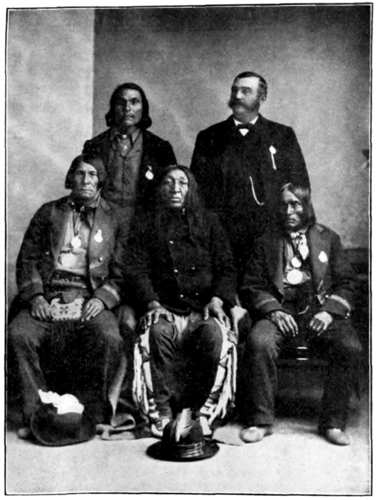 Osoup Agent
Atalacoup Kakawistaha Mistawasis
FOUR CREE CHIEFS OF RUPERT'S LAND
THE MONTREAL MERCHANTS AND MEN.
But the fur trade paid too well to be left alone by the Montrealers who knew of
Verandrye's exploits on the Ottawa and the Upper Lakes. When Canada became British,
many daring spirits hastened to it from New York and New Jersey States. Montreal
became the home of many young men of Scottish families. Some of their fathers had
fled to the Colonies after the Stuart Prince was defeated at Culloden, and after the
power of the Jacobites was broken. Some of the young men of enterprising spirit were
the sons of officers and men who had fought in the Seven Years' War against France
and now came to claim their share of the conqueror's spoils. Some men were of Yankee
origin, who with their proverbial ability to see a good chance, came to what has
always been Canada's greatest city, on the Island of Montreal. It was only half a
dozen years after Wolfe's great victory, that a great Montreal trader, Alexander
Henry, penetrated the western lakes to Mackinaw—the Island of the Turtle, lying
between Lakes Huron and Michigan.
At Sault Ste. Marie, "he fell in with a most noted French Canadian, Trader Cadot, who
had married a Saulteur wife. He became a power among the Indians. With Scottish
shrewdness Henry acquired from the Commandant at Mackinaw the exclusive right to
trade on Lake Superior. He became a partner of Cadot, and they made a voyage as
Canadian Argonauts, to bring back very rich cargoes of fur. They even went up to the
Saskatchewan on Lake Winnipeg. After Henry, came another Scotchman, Thomas Curry, and
made so successful a voyage that he reached the Saskatchewan River, and came back
laden with furs, so that he was now satisfied never to have to go again to the Indian
country. Shortly afterwards James Findlay, another son of the heather, followed up
the fur-traders' route, and reached Saskatchewan. Thus the Northwest Fur Trade became
the almost exclusive possession of the Scottish Merchants of Montreal. With the
master must go the man. And no man on the rivers of North America ever equalled, in
speed, in good temper, and in skill, the French Canadian voyageur. Almost all the
Montreal merchants, the Forsythes, the Richardsons, the McTavishes, the Mackenzies,
and the McGillivrays, spoke the French as fluently as they did their own language.
Thus they became magnetic leaders of the French canoemen of the rivers. The voyageurs
clung to them with all the tenacity of a pointer on the scent. There were Nolins,
Falcons, Delormes, Faribaults, Lalondes, Leroux, Trottiers, and hundreds of others,
that followed the route until they became almost a part of the West and retired in
old age, to take up a spot on some beautiful bay, or promontory, and never to return
to "Bas Canada." Those from Montreal to the north of Lake Superior were the pork
eaters, because they lived on dried pork, those west of Lake Superior, "Couriers of
the Woods," and they fed on pemmican, the dried flesh of the buffalo. They were
mighty in strength, daring in spirit, tractable in disposition, eagles in swiftness,
but withal had the simplicity of little children. They made short the weary miles on
the rivers by their smoking "tabac"—the time to smoke a pipe counting a
mile—and by their merry songs, the "Fairy Ducks" and "La Claire Fontaine,"
"Malbrouck has gone to the war," or "This is the beautiful French Girl"—ballads
that they still retained from the French of Louis XIV. They were a jolly crew, full
of superstitions of the woods, and leaving behind them records of daring, their names
remain upon the rivers, towns and cities of the Canadian and American Northwest.
Some thirty years before the arrival of the Colonists, the Montreal traders found it useful to form a Company.
This was called the North-West Fur Company of Montreal. Having taken large amounts
out of the fur trade, they became the leaders among the merchants of Montreal. The
Company had an energy and ability that made them about the beginning of the
nineteenth century the most influential force in Canadian life. At Fort William and
Lachine their convivial meetings did something to make them forget the perils of the
rapids and whirlpools of the rivers, and the bitterness of the piercing winds of the
northwestern stretches. Familiarly they were known as the "Nor'-Westers." Shortly
before the beginning of the century mentioned, a split took place among the
"Nor'-Westers," and as the bales of merchandise of the old Company had upon them the
initials "N.W.," the new Company, as it was called, marked their packages "XY," these
being the following letters of the alphabet.
Besides these mentioned there were a number of independent merchants, or free
traders. At one time there were at the junction of the Souris and Assiniboine Rivers,
five establishments, two of them being those of free traders or independents. Among
all these Companies the commander of a Fort was called, "The Bourgeois" to suit the
French tongue of the men. He was
naturally a man of no small importance.
"THE DUSKY RIDERS OF THE PLAINS."
But the conditions, in which both the traders and the voyageurs lived, brought a
disturbing shadow over the wide plains of the North-West. Now under British rule, the
Fur trade from Montreal became a settled industry. From Curry's time (1766) they
began to erect posts or depots at important points to carry on their trade. Around
these posts the voyageurs built a few cabins and this new centre of trade afforded a
spot for the encampment near by of the Indian teepees made of tanned skins. The
meeting of the savage and the civilized is ever a contact of peril. Among the traders
or officers of the Fur trade a custom grew up—not sanctioned by the
decalogue—but somewhat like the German Morganatic marriage. It was called
"Marriage of the Country." By this in many cases the trader married the Indian wife;
she bore children to him, and afterwards when he retired from the country, she was
given in real marriage to some other voyageur, or other employee, or pensioned off.
It is worthy of note that many of these Indian women became most true and
affectionate spouses. With the voyageurs and laborers the conditions were different.
They could not leave the country, they had become a part of it, and their marriages with the Indian women
were bona fide. Thus it was that during the space from the time of Curry until the
arrival of the Selkirk Colonists upwards of forty years had elapsed, and around the
wide spread posts of the Fur Trading Companies, especially around those of the
prairie, there had grown up families, which were half French and half Indian, or half
English and half Indian. When it could be afforded these children were sent for a
time to Montreal, to be educated, and came back to their native wilds. On the plain
between the Assiniboine and the Saskatchewan, a half-breed community had sprung up.
From their dusky faces they took the name "Bois-Brulés," or "Charcoal Faces,"
or referring to their mixed blood, of "Metis," or as exhibiting their importance,
they sought to be called "The New Nation." The blend of French and Indian was in many
respects a natural one. Both are stalwart, active, muscular; both are excitable,
imaginative, ambitious; both are easily amused and devout. The "Bois-Brulés"
growing up among the Indians on the plains naturally possessed many of the features
of the Indian life. The pursuit of their fur-bearing animals was the only industry of
the country. The Bois-Brulés from childhood were familiar with the Indian
pony, knew all his tricks and habits, began to ride with all the skill of a desert ranger, were familiar with
fire-arms, took part in the chase of the buffalo on the plains, and were already
trained to make the attack as cavalry on buffalo herds, after the Indian fashion, in
the famous half-circle, where they were to be so successful in their later troubles,
of which we shall speak. Such men as the Grants, Findlays, Lapointes, Bellegardes,
and Falcons were equally skilled in managing the swift canoe, or scouring the plains
on the Indian ponies. We shall see the part which this new element were to play in
the social life and even in the public concerns of the prairies.
THE STATELY HUDSON'S BAY COMPANY.
The last of the elements to come into the valley of the Red River and to precede
the Colonists, was the Hudson's Bay Company—even then, dating back its history
almost a century and a half. They were a dignified and wealthy Company, reaching back
to the times of easy-going Charles II., who gave them their charter. For a hundred
years they lived in self-confidence and prudence in their forts of Churchill and
York, on the shore of Hudson Bay. They were even at times so inhospitable as to deal
with the Indians through an open window of the fort. This was in striking contrast to
the "Nor'-Wester" who trusted the
Indians and lived among them with the freest intercourse. For the one hundred years
spoken of, the Indians from the Red River Country, the Saskatchewan, the Red River
and Lake Winnipeg, found their way by the water courses to the shores of the Hudson
Bay. But the enterprise of the Montreal merchants in leaving their forts and trading
in the open with the Indians, prevented the great fleets of canoes, from going down
with their furs, as they had once done to Churchill and York. The English Company
felt the necessity of starting into the interior, and so within six years of the time
of the expedition of Thomas Curry, appeared five hundred miles inland from the Bay,
and erected a fort—Fort Cumberland—a few hundred yards from the
"Nor'-Westers'" Trading House, on the Saskatchewan River. By degrees before the end
of the century almost every place of any importance, in the fur-producing country,
saw the two rival forts built within a mile or two of each other. Shortly before the
end of the 18th Century, the "Nor'-Westers" came into the Red River Valley and built
one or two forts near the 49th parallel, N. lat.—the U.S. boundary of to-day.
But four years after the new Century began, the "Nor'-Westers" decided to occupy the
"Forks" of the Red and Assiniboine River, near where Verandrye's Fort Rouge had
been built some sixty years
before. Evidently both companies felt the conflict to be on, in their efforts to
cover all important parts, for they called this Trading House Fort Gibraltar, whose
name has a decided ring of the war-like about it. It is not clear exactly where the
Hudson's Bay post was built, but it is said to have rather faced the Assiniboine than
the Red River, perhaps near where Notre Dame Avenue East, or the Hudson's Bay stores
is to-day. It was probably built a few years after Fort Gibraltar, and was called
"Fidler's Fort." By this time, however, the Hudson's Bay Company, working from their
first post of Cumberland House, pushed on to the Rocky Mountains to engage in the
Titanic struggle which they saw lay ahead of them. One of their most active agents,
in occupying the Red River Valley, was the Englishman Peter Fidler, who was the
surveyor of this district, the master of several forts, and a man who ended his
eventful career by a will made—providing that all of his funds should be kept
at interest until 1962, when they should be divided, as his last chimerical plan
should direct. It thus came about that when the Colonists arrived there were two
Traders' Houses, on the site of the City of Winnipeg of to-day, within a mile of one
another, one representing a New World, and the other an Old World type of mercantile
life. It was plain that on the
Plains of Rupert's Land there would come a struggle for the possession of power, if
not for very existence.


