NEW YORK · BOSTON · CHICAGO · DALLAS
ATLANTA · SAN FRANCISCO
MACMILLAN AND CO.,
LONDON · BOMBAY · CALCUTTA · MADRAS
MELBOURNE
THE MACMILLAN COMPANY
OF CANADA, LIMITED
TORONTO
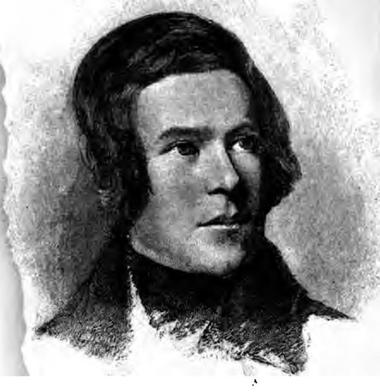
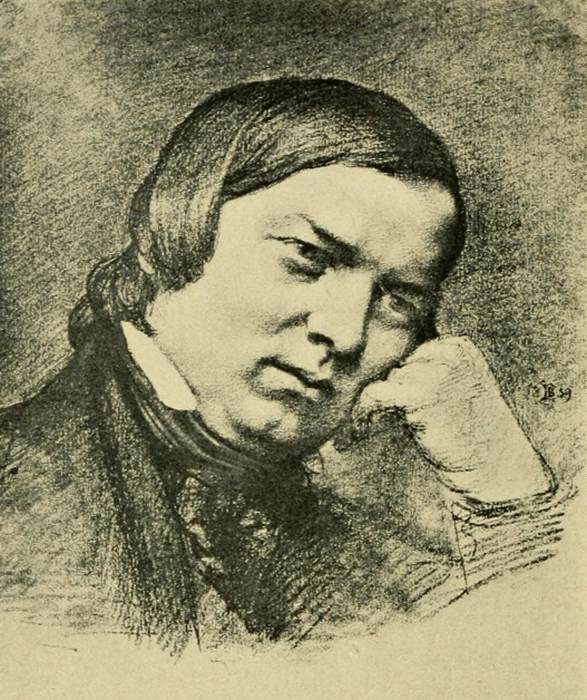
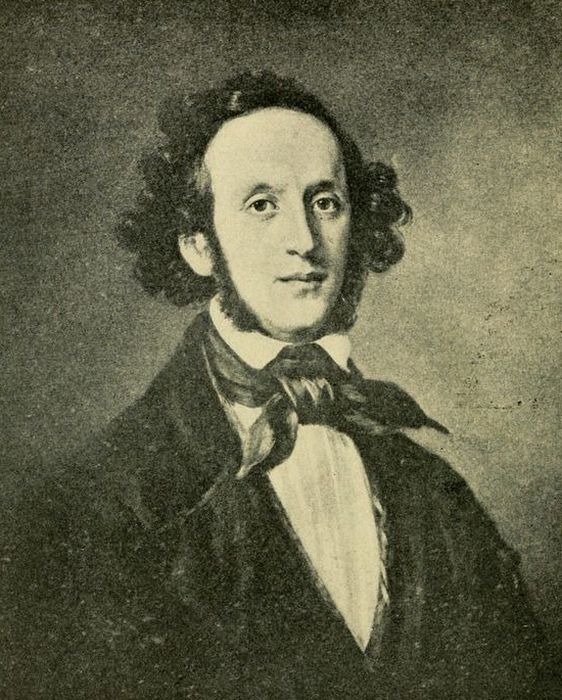
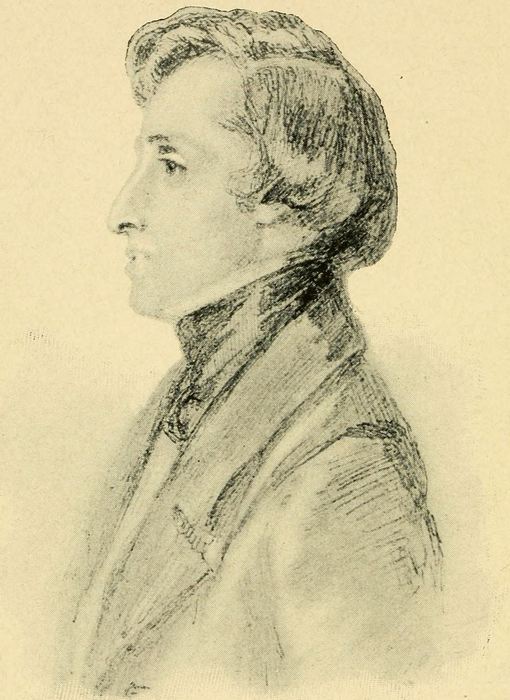
ROBERT SCHUMANN
From a water color made in Vienna in his youth
The ROMANTIC COMPOSERS
BY
DANIEL GREGORY MASON
AUTHOR OF "FROM GRIEG TO BRAHMS,"
"BEETHOVEN AND HIS FORERUNNERS," ETC.
"Consciously or unconsciously a new school is being
founded on the basis of the Beethoven-Schubert romanticism,
a school which we may venture to expect will mark
a special epoch in the history of art."
SCHUMANN
NEW YORK
THE MACMILLAN COMPANY
LONDON: MACMILLAN & CO., LTD.
1940
COPYRIGHT, 1906,
BY THE MACMILLAN COMPANY.
COPYRIGHT, 1934,
BY DANIEL G. MASON.
All rights reserved—no part of this book may be reproduced
in any form without permission in writing
from the publisher, except by a reviewer who wishes
to quote brief passages in connection with a review
written for inclusion in magazine or newspaper.
Set up and electrotyped. Published November, 1906.
PRINTED IN THE UNITED STATES OF AMERICA
PREFACE
This book completes the series
of studies of composers and of
their music, from Palestrina to
the present day, which was begun
with "From Grieg to Brahms"
(1902), and continued in "Beethoven and his
Forerunners" (1904). It will be noted that
these three volumes should be read in an order
different from that of their publication. First
should come "Beethoven and his Forerunners,"
in which are made a general survey of the
periods of musical history and the principles of
musical style, and special studies of Palestrina,
Bach, Haydn, Mozart, and Beethoven; then
"The Romantic Composers," in which the story
is taken up at the death of Beethoven and carried
through the period of romanticism, with
essays on Schubert, Schumann, Mendelssohn,
Chopin, Berlioz, and Liszt; and finally "From
Grieg to Brahms," comprising studies of the
chief modern musicians, including Grieg,
Dvořák, Saint-Saëns, Franck, Tschaïkowsky,
and Brahms, and two more general papers on
"The Appreciation of Music" and "The
Meaning of Music." Thus read, the three
books should serve as a commentary on the
more important individual composers, æsthetic
principles, and historical schools in modern
instrumental music.
From the first I have had in mind the intention
of illuminating the musical peculiarities
of each composer by constant reference to his
personal character and temperament. For this
reason, while I have dealt as briefly as possible
with colorless biographical facts, I have
made free use of characteristic anecdotes, of
contemporary descriptions of appearance, manners,
etc., and of letters and table-talk where
they are available. Music is indeed a unique
artistic medium, and no man can express anything
in it except through a technical mastery
which has little to do with his character. Yet,
given the medium, what he does express is
bound to be permeated with his peculiar personality;
and as the general reader can get a
much clearer idea of a human being like himself
than he can of so subtle a technique as that
of music, it has seemed better to lay stress on
that side, even though it is not the only or
perhaps even the most important one. With
the object of keeping awake, nevertheless, the
reader's sense of those technical methods and
traditions which so largely determine the nature
of all music, I have included in each book
some pages dealing with impersonal principles
and historical schools.
Believing that one has no right to intrude,
in such studies as these, one's own prejudices,
but should transcend as far as possible one's
temperamental limitations, I had hoped to be
able to maintain throughout the attitude of the
chronicler, and to exclude all special pleading.
In the essays on Berlioz and Liszt I have perhaps
not achieved this detachment of attitude.
Realism is a tendency which seems to me quite
mistaken and mischievous in music, and I have
attacked it with some warmth. But in view
of the great favor that realism enjoys in contemporary
composition, the shoals of writers
that rally every day to its defence, and the
potency of its appeal to the average listener,
whose dramatic sense and pictorial imagination
are always livelier than his purely musical perception,
I do not greatly fear that I shall dangerously
disturb any reader's critical equilibrium.
These studies are intended simply as guides
to the music they discuss. If they lead the
reader to the concert-hall, to the piano, to the
library of scores; if they help him to hear
themes and their development where before
he heard only masses of agreeable sound; if
they incite him to repeat and analyze his musical
experiences, to listen with his mind as well
as his ears, to study a symphony as alertly as
he would study a painting or an essay,—then
only will they have justified their existence.
Historians of music are accustomed
to speak of the first half
or three-quarters of the nineteenth
century as the Romantic
Period in music, and of those
composers who immediately follow Beethoven,
including Schubert, Schumann, Mendelssohn,
Berlioz, Chopin, Liszt, and some others, as
the Romantic Composers. The word "romantic,"
as thus used, forms no doubt a convenient
label; but if we attempt to explain its meaning,
we find ourselves involved in several difficulties.
Were there then no romanticists before Schubert?
Have no composers written romantically
since 1870? Such questions, arising at once,
lead us inevitably to the more general inquiry,
What is romanticism?
In the broadest sense in which the word
"romanticism" can be used, the sense in which
it is taken, for example, by Pater in the Postscript
of his "Appreciations," it seems to mean
simply interest in novel and strange elements of
artistic effect. "It is the addition of strangeness
to beauty," says Pater, "that constitutes
the romantic character in art; and the desire
of beauty being a fixed element in every artistic
organization, it is the addition of curiosity to
this desire of beauty that constitutes the romantic
temper." Romanticism is thus the
innovating spirit, as opposed to the conserving
spirit of classicism; romanticists appear in
every age and school; and Stendhal is right in
saying that "all good art was romantic in its
day." It is interesting, in passing, to note the
relation of this definition to the widely prevalent
notion that romanticism is extravagant and
lawless. To the mind wedded to tradition all
novelty is extravagant; and since an artistic
form is grasped only after considerable practice,
all new forms necessarily appear formless at
first. Hence, if we begin by saying that romantic
art is novel and strange art, it requires only
a little inertia or intolerance in our point of view
to make us add that it is grotesque and irrational
art, or in fact not art at all. Critics have often
been known to arrive at this conclusion.
Suggestive as Pater's definition is, however,
it is obviously too vague and sweeping to carry
us far in our quest. It does not explain why
Monteverde, with his revolutionary dominant
seventh chords, or the Florentine composers
of the early seventeenth century, with their
unheard-of free recitative, were not quite as genuine
romanticists as Schubert with his whimsical
modulation and Schumann with his harsh
dissonances. We have still to ask why, instead
of appending our label of "romantic" to the innovators
of centuries earlier than the nineteenth,
we confine it to that comparatively small group
of men who immediately followed Beethoven.
The answer is to be found in the distinctness
of the break that occurred in musical development
at this time, the striking difference in
type between the compositions of Beethoven and
those of his successors. From Philipp Emanuel
Bach up to Beethoven, the romanticism of each
individual composer merely carried him a step
forward on a well-established path; it prompted
him to refine here, to pare away there, to expand
this feature, to suppress that, in a scheme
of art constantly maturing, but retaining always
its essential character. With Beethoven, however,
this particular scheme of art, of which the
type is the sonata, with its high measure of
formal beauty and its generalized expression,
reached a degree of perfection beyond which it
could not for the moment go. The romantic
impulse toward novelty of Beethoven's successors
had to satisfy itself, therefore, in some
other way than by heightening abstract æsthetic
beauty or general expressiveness; until new technical
resources could be developed the limit was
reached in those directions. Beethoven had
himself, meanwhile, opened the door on an inviting
vista of possibilities in a new field—that
of highly specialized, idiosyncratic, subjective
expression. He had shown how music, with
Mozart so serene, detached, and impersonal,
could become a language of personal feeling,
of individual passion, even of whim, fantasy,
and humor. It was inevitable that those who
came after him should seek their novelty,
should satisfy their curiosity, along this new
path of subjectivism and specialized expression.
And as this music of the person, as we may
call it, which now began to be written, was different
not only in degree but in kind from the
objective art which prepared the way for it, it
is natural that in looking back upon so striking
a new departure we should give it a special
name, such as romanticism.
As for the other line of demarcation, which
separates the romantic period from what we call
the modern, that is purely arbitrary. "Modern"
is a convenient name for us to give to those
tendencies from which we have not yet got far
enough away to view them in large masses and
to describe them disinterestedly. As the blur
of too close a vision extends back for us to 1870
or thereabout, we find it wise to let our romantic
period, about which we can theorize and form
hypotheses, end there for the present. But it
already seems clear enough that the prevalent
tendency even in contemporary music is still the
personal and subjective one that distinguished
the early romantic period. Probably our
grandchildren will extend that period from
Beethoven's later works to those of some composer
yet unborn. And thus we have, in studying
the romantic composers, the added interest
that we are in a very real sense studying ourselves.
If, with a view to getting a more precise notion
of the new tendencies, we ask ourselves now
what are the salient differences between a classical
and a romantic or modern piece of music,
we shall be likely to notice at once certain traits
of the latter, striking enough, which are nevertheless
incidental rather than essential to romanticism,
and must be discounted before we
can come at its inmost nature. These changes
have come chiefly as a result of the general evolution
of musical resources, and though necessarily
modifying the romantic methods, are not
primary causes or effects of them. Thus, for
example, the nineteenth century has seen an extraordinary
development in the mechanism of
all musical instruments, and in the skilful use
of them by musicians. This is impressed upon
us by the most cursory glance at any modern
orchestral score. Haydn's and Mozart's orchestra
consisted of a nucleus of strings, with a
few pairs of wood and brass wind instruments
added casually for solos or to reinforce certain
voices in the harmonic tissue. The scheme was
fundamentally monochromatic, however much
it might be set off by bits of color here and
there. By the time of Wagner the orchestra
was essentially a group of several orchestras of
divers colors: the addition of a third flute, of
English horn to the oboe family, of bass clarinet,
and of contrafagotto made each group of the
wood-wind instruments capable of fairly complete
harmony; the horns were increased in
number from two to six or eight, the bass trumpet
made possible complete chords for the trumpets,
and there were four trombones and a
choir of tubas. Thus, instead of having a uniform
foundation, with variety merely in the
trimming, the modern orchestra has complete,
independent choirs of most various instruments,
capable of all sorts of combination, opposition,
and contrast.
The manner of writing for the orchestra
changed as much as its constitution. Beethoven
usually writes three- or four-part harmony for
the strings, and doubles the wood and brass as
seems effective. Tschaïkowsky and Wagner
are apt to put an entire family of instruments
on one melodic voice, another on another, a
third on a third—as in the second movement
of the "Symphonie Pathétique," at the point
where flutes, oboes, clarinets, and bassoons sing
the melody, while first and second violins and
violas pick an obligato to it. In a word, much
more attention is paid in the modern orchestra
to richness and variety of tone-color and to an
impressionistically effective disposition of the
various timbres than in the classical scores.
The same tendency is observable in chamber
and pianoforte music. Not only are modern
composers fond of curious groupings of wind
and string instruments, as in the trumpet
septet of Saint-Saëns, the clarinet quintet
and horn trio of Brahms, and other such
works, but when they use only the four stringed
instruments they combine contrasting rhythms
and modes of phrasing, as well as pizzicato,
the sordino, the high register of the 'cello,
and other exotic devices, with an unfailing
sense of color-values. Schubert is the first
conspicuous example of this sort of quartet
writing; Dvořák is his worthy follower. As
for the piano, there is almost as much difference
between the piano writing of Beethoven, so
often thick, harsh, and lumpish, and the ramifying
figuration of Schumann or the wide, clear
arpeggiated accompaniments and flowering
scale-figures of Chopin as there is between
the coloring of Rembrandt and that of Monet.
All this gain in sensuous richness and technical
elaboration is, however, to be considered
largely as a concomitant rather than a direct
result (though to some extent is was that)
of the romantic movement. It was primarily
merely a phase of that unparalleled material
and mechanical progress so characteristic of
the nineteenth century. The modern orchestra
and the modern pianoforte are simply special
examples of the ingenuity of that century in
mechanical devices; the genius which turned
the clavichord into the piano was the same as
that which substituted the propeller for sails,
and the electric telegraph for the lumbering
mail-coach. But if this modern mechanical
genius has indeed brought to the musician priceless
gifts, it is still important to remember that
perfected mechanisms do not account for romantic
music, which might conceivably have existed
without them. Instruments alone cannot make
music, any more than a steam derrick can
build a bridge. If we wish to seize the true
spirit of the modern musical art, we must,
after all, leave orchestra, and piano, and sensuous
value behind, and ascertain to what use
composers have turned all these resources, and
to what manner of expression, embodied in
what kind of forms, they have been spurred
by the romantic spirit.
Difficult to make, and dangerous when made,
as are sweeping generalizations about so many-sided
a matter as the expressive character of
whole schools or eras of art, there seem to
be generic differences between classical and
romantic expression which we can hardly
avoid remarking, and of which it is worth
while to attempt a tentative definition, especially
if we premise that it is to be suggestive rather
than absolute. The constant generality of
classical expression, and the objectivity of
attitude which it indicates in the worker,
cannot but strike the modern student, especially
if he contrasts them with the exactly opposite
features of contemporary art. The classical
masters aim, not at particularity and minuteness
of expression, but at the congruous setting
forth of certain broad types of feeling. They
are jealous of proportion, vigilant to maintain
the balance of the whole work, rigorous in
the exclusion of any single feature that might
through undue prominence distort or mar
its outlines. Their attitude toward their work
is detached, impersonal, disinterested—a purely
craftsmanlike attitude, at the furthest pole
from the passionate subjectivity of our modern
"tone-poets." J. S. Bach, for example, the
sovereign spirit of this school, is always concerned
primarily with the plastic problem of
weaving his wonderful tonal patterns; we feel
that what these patterns turn out to express,
even though it be of great, and indeed often
of supreme, poignancy, is in his mind quite a
secondary matter. The preludes and fugues
of the "Well-tempered Clavichord" are monuments
of abstract beauty, rather than messages,
pleas, or illustrations. And even when their
emotional burden is so weighty as in the B-flat
minor prelude or the B-minor fugue of the
first book, it still remains general and, as it
were, communal. Bach is not relieving his
private mind; he is acting as a public spokesman,
as a trustee of the emotion of a race or
nation. This gives his utterance a scope, a
dignity, a nobility, that cannot be accounted
for by his merely personal character.
Haydn and Mozart illustrate the same attitude
in a different department of music. Their
symphonies and quartets are almost as impersonal
as his preludes and fugues. The substance
of all Haydn's best work is the folk-music
of the Croatians, a branch of the Slavic
race; its gaiety, elasticity, and ingenuousness
are Slavic rather than merely Haydnish. It is
true that he idealizes the music of his people,
as a gifted individual will always idealize any
popular art he touches; but he remains true
to his source, and accurately representative of
it, just as the finest tree contains only those
elements which it can draw from the soil
in which it grows. Mozart, more personal
than Haydn, shares with him the aloofness, the
reticence, of classicism. What could be more
Greek, more celestially remote, than the G-minor
Symphony, or the quintet in the same
key? What could be less a detailed biography
of a hero, more an ideal sublimation of his
essential character, than the "Jupiter Symphony"?
And even in such a deeply emotional
conception as the introduction to the C-major
quartet, can we label any specific emotion?
Can we point to the measures and say, "Here
is grief; here is disappointment; here is
unrequited love"?
In Beethoven we become conscious of a
gradually changing ideal of expression. There
are still themes, movements, entire works, in
which the dominant impulse is the architectonic
zeal of classicism; and there is the evidence
of the sketchbooks that this passionate individualist
could subject himself to endless discipline
in the quest of pure plastic beauty. But there are
other things, such as the third, fifth, and ninth
symphonies, the "Egmont" and "Coriolanus"
overtures, the slow movement of the G-major
concerto (that profoundly pathetic dialogue
between destiny and the human heart), and the
later quartets, in which a novel particularity
and subjectivity of utterance make themselves
felt. In such works the self-forgetful artist,
having his vicarious life only in the serene
beauty of his creations, disappears, and Ludwig
van Beethoven, bursting with a thousand
emotions that must out, steps into his place
and commands our attention, nobly egotistic,
magnificently individual. And then there is the
"Pastoral Symphony," in which he turns landscape
painter, and with minutest details of
bird-notes and shepherds' songs and peasants'
dances delineates the external objects, as well
as celebrates the inner spirit, of the countryside.
These things mark the birth of romanticism.
For romanticism is, in essence, just this
modern subjectivity and individualism, just
this shifting of the emphasis from abstract
beauty, with its undifferentiated expressiveness,
to personal communication, minute interest in
the uttermost detail, impassioned insistence
on each emotion for itself rather than as a
subordinate member in an articulate organism,
and, in extreme cases, to concrete objects,
persons, and scenes in the extra-musical world.
Musicians since Beethoven have inclined to
exploit more and more that aspect of their
art which is analogous to language, even when
this means neglect of the other aspect, the
nearest analogue of which is to be found in
sculpture, architecture, and decorative painting.
The modern watchword has come to be initiative
rather than obedience, originality rather than
skill, individuality rather than truth to universal
human nature. It is, after all, one impulse,
the impulse toward specialization, that runs
through all the various manifestations of the
romantic spirit, and may be traced alike in
the lyricism of Schubert, the fanciful whimsicality
of Schumann, the picturesqueness of
Mendelssohn, the introspection of Chopin, and
the realism of Berlioz and Liszt.
In Schubert, the first of the out-and-out
romanticists, and the eldest of them all in point
of time (his birth date falls in the eighteenth
century), we find a curious grafting of a new
spirit on an old stem. Brought up on the
quartets and symphonies of Haydn and Mozart,
making his first studies in boyishly literal
imitation of them, he acquired the letter of
the classical idiom as none of the others save
Mendelssohn ever did. His works in sonata
form, written up to 1816, might well have
emanated from Esterhaz or Salzburg; the
C-major Symphony, so far as general plan is
concerned, would have done no discredit to
Beethoven. Yet the spirit of Schubert is always
lyrical. It was fated from his birth that he
should write songs, for his was a typically sentimental
temperament; and when he planned
a symphony, he instinctively conceived it as a
series of songs for instruments, somewhat
more developed than those intended for a voice,
but hardly different in kind. As a naturalist
can reconstruct in fancy an extinct animal
from a fossil jaw-bone, a musical historian might
piece out a fair conception of what romanticism
is, in the dearth of other evidence, from a
study of "Erlkönig," or "Ständchen," or "Am
Meer"; and the ideas he might thus form would
be extended rather than altered by acquaintance
with the "Unfinished Symphony" or the D-minor
Quartet. The lyrical Schubert contrasts always
with the heroic and impersonal Bach or Beethoven,
much as Tennyson contrasts with Shakespeare,
or Theocritus with Sophocles.
Schumann adds to the lyrical ardor of Schubert
insatiable youthful enthusiasm, whimsicality,
a richly poetic fancy, and a touch of
mysticism. His songs are even more personal
than Schubert's, and his piano pieces, especially
the early ones, bristle with eccentricities. The
particularity, minute detail, and personal connotation
of the "Abegg Variations," the "Davidsbündertänze,"
the "Papillons," the "Carnaval,"
the "Kreisleriana," are almost grotesque. He
confides to us, through this music, his friendships,
his flirtations, his courtship, his critical sympathies,
his artistic creed, his literary devotions.
Never was music so circumstantial, so autobiographic.
In later years, when he had passed
out of the enchanted circle of youthful egotism,
and was striving for a more universal speech,
his point of view became not essentially less
personal but only less wayward. Till the last
his art is vividly self-conscious—that is his
charm and his limitation. No one has so
touchingly voiced the aspirations of the imprisoned
soul, no one has put meditation and
introspection into tones, as he has done in the
adagio of the C-major Symphony, the "Funeral
March" of the Quintet, the F-sharp major
Romance for piano.
If Schumann sounds, as no other can, the
whole gamut of feeling of a sensitive modern
soul, Mendelssohn, quite dissimilar in temperament,—correct,
reserved, dispassionate,—is
nevertheless also romantic by virtue of his
picturesqueness, his keen sense for the pageantry
of life, his delicate skill as an illustrator of
nature and of imaginative literature. His "Songs
without Words" reveal a strain of mild lyricism,
but he is never intimate or reckless, he never
wholly reveals himself. His discreet objectivity
is far removed from the frankly subjective
enthusiasms of Schubert and Schumann.
He was, in fact, by tradition, training, and native
taste, a classicist; the exhibition of deep feeling
was distasteful to his fastidious reticence;
and he is thus emotionally less characteristic
of his period than any of his contemporaries.
But for all that he shows unmistakably in the
felicity of his tone-painting the modern interest
in picturesque detail, in the concrete circumstance,
the significant particular. Illustration
rather than abstract beauty—that is one of
the special interests of the new school. No
one has cultivated it more happily than the
composer of the "Midsummer Night's Dream"
music, the "Hebrides Overture," and the
"Scotch" and "Italian" Symphonies.
Chopin presents an even more singular
instance than Schumann affords of what
introspection can make of a composer, of how
resolute self-communion can individualize his
work until its intense personal savor keeps
little to remind us of other music. All Chopin's
tastes were so aristocratic that the exclusiveness
of his style seems a matter of course, and was
probably to his mind a supreme merit. And
if it debarred him from some musical experiences,
if it made his music sound better in a
drawing-room than in a concert hall, it certainly
gave it a marvellous delicacy, finesse, originality,
and fragile beauty. It is, so to speak, valetudinarian
music, and preserves its pure white
complexion only by never venturing into the full
sunlight. Here, then, is another differentiation
in musical style, a fresh departure from
the classic norm, due to the exacting taste of
the mental aristocrat, the carefully self-bounded
dreamer and sybarite.
Markedly specialized as the expression is,
however, in Schubert, Schumann, Mendelssohn,
and Chopin, and strikingly contrasted as it is
with the serene generality of the classical
music, the two schools after all differ rather in
the degree of emphasis they lay on the various
elements of effect than in kind. Both, we feel,
are using the same means, though to such
different ends. But with Berlioz and Liszt
we pass into a new world, in which not only
emphasis and intention, but the actual materials
and the fundamental principles of art, have
undergone a change. These men have pushed
the romantic concreteness even beyond the
range of sentiments and emotions, to invade
that of facts and events. They are no longer
satisfied with the minutiæ of feelings; they
must depict for us the external appearance of
the people who feel, give us not only heroes,
but these heroes' coats, with the exact number
of buttons and the proper cut, according to the
fashion of the particular decade. If Schumann
and his fellows are the sentimental novelists of
music, the Thackerays and the George Eliots,
here are the naturalists, the scientific analysts,
the "realists" with microscope and scalpel
in hand, the Zolas and the Gorkys.
This insistence on the letter is quite instinctive
with Berlioz. In the first place, he was a
Frenchman; and the French have a genius
for the concrete, and in music have shown
their bias by approaching it always from the
dramatic, histrionic point of view. Opera
is the norm of music to the Frenchman. For
him, music originates in the opera-house, quite
as inevitably as for the German it originates
in the concert room. Berlioz's "symphonies,"
therefore, as a matter of course, took the form
of operas, with the characters and action suppressed
or relegated to the imagination.
In the second place, the active impulses in
Berlioz's personal temperament predominated
over the contemplative to a degree unusual
even in his countrymen; he conceived a work
of art in terms not of emotion but of action;
and his musical thinking was a sort of narration
in tones. He accordingly wrote, with ingenuous
spontaneity, in a style that was, from the German
standpoint, revolutionary, unprecedented,
iconoclastic—a style the essence of which
was its matter-of-fact realism. His "Symphonie
Fantastique," which Mr. Hadow calls his
most uncompromising piece of program music,
sets forth the adventures of a hero (whose
identity with the composer is obvious) in five
movements or acts, and with the most sedulous
particularity. We first see him struggling with
love, tormented by jealousy, consoled by religion;
then in a ball-room, pausing in the midst
of the dance to muse on his beloved; then in
the country, listening to idyllic shepherds
and hearing the summer thunder. He dreams
that he has murdered the beloved, that he is
to be beheaded at the guillotine; he is surrounded
by witches, his mistress has herself
become a witch, the Dies Iræ clangs its knell
of death across the wild chaos of the dance....
Now in all this the striking point is the concreteness
of the imagery, the plenitude of
detail, the narrative and descriptive literalness
of the treatment—and above all the subordination
of the music to a merely symbolic
function. Berlioz here brings into prominence
for the first time the device, so frequent in
later operatic and program music, of treating
his themes or motives as symbols of his
characters, associated with these by a purely
arbitrary but nevertheless effective bond.
When we hear the melody we are expected to
think of the character, and all the changes
rung on it are prompted not by the desire for
musical development, but by psychological
considerations connected with the dramatic
action. Thus, for example, in this symphony
the motive known as "l'idée fixe" represents
the beloved; its fragmentary appearances in the
second, third, and fourth movements tell us
that the thought of her is passing through our
hero's mind; and in the last movement, when
she endues the horrid form of a witch, we hear
a distorted, grotesque version of it sardonically
whistled by the piccolo. Highly characteristic
of Berlioz is this use of melodies, so dearly
valued in classic music for themselves alone,
as mere counters for telling off the incidents
in the plot, or cues for the entrances of the
dramatis personæ.
Liszt, a man of keener musical perception
than Berlioz, placed himself also, in obedience
to his strong dramatic sense, on the same artistic
platform. In such a work as the "Faust
Symphony" we discern a more musical
nature producing practically the same kind
of music. There is the same narrative and
descriptive intention; the three movements
take their names from the chief characters
in the action, Faust, Gretchen, and Mephistopheles;
and though the second is more
general in expression than Berlioz ever is,
the other two are good examples of his method.
There is also the same machinery of leading
motives and their manipulation according to
the requirements of symbolism, even to the
parodying of the Faust themes in the "Mephistopheles"
section. In the symphonic
poem, "Les Préludes," however (and in the
"Dante Symphony" and other compositions),
Liszt shows his German blood in a treatment
more imaginative, the actuating subjects being
often not persons and events, but emotional
and mental states. But the fact that many of
the transformations of the themes are from the
musical standpoint travesties, justified only by
their psychological intention, shows that the
attitude even here is still that of the dramatist,
not that of the abstract musician. The
art, in a word, is still representative, not presentative
and self-sufficing. Again, the representative
function of music for Liszt is shown
by his tendency to approach composition
indirectly, and through extraneous interests
of his many-sided mind, instead of with the
classic single-mindedness: his pieces are suggested
by natural scenery, historical characters,
philosophic abstractions, poems, novels,
and even statues and pictures.
In all these ways and degrees we see exemplified
the inclination of the nineteenth-century
composers to seek a more and more
definite, particular, and concrete type of expression.
Subjective shades and nuances take
the place of the ground-colors of classicism;
music comes to have so personal a flavor
that it is as impossible to confound a piece of
Chopin with one of Schumann as it is difficult,
by internal evidence alone, to say whether
Mozart or Haydn is the author of an unfamiliar
symphony; ultimately, insistence upon special
emotions opens the way to absorption in what
is even more special—individual characters,
events, and situations,—and on the heels of
the lyrical treads the realistic. The artistic
stream thus reverses the habit of natural
streams: as it gets farther and farther from its
source it subdivides and subdivides itself again,
until it is no longer a single large body, but a
multitude of isolated brooks and rivulets.
Our contemporary music, unlike the classical,
is not the expression of a single social consciousness,
but rather a heterogeneous aggregate of
the utterances of many individuals. What
is most captivating about it is the sensitive
fidelity with which it reflects its composers'
idiosyncrasies.
All things human, however, have their price,
and romanticism is no exception to the rule.
The composers of the romantic period, in
becoming more particular, grew in the same
proportion less universal; in bowing to the
inexorable evolutionary force that makes each
modern man a specialist, they inevitably sacrificed
something of the breadth, the catholicity,
the magnanimity, of the old time. It is doubtless
a sense of some such loss as this, dogging
like a shadow all our gains, that takes us back
periodically to a new appreciation of the classics.
There is often a feeling of relief, of freer breathing
and ampler leisure, as when we leave the
confusion of the city for the large peace of the
country, in turning from the modern complexities
to the old simplicities, and forgetting that there
is any music but Bach's. The reasons for this
contrast between the two schools must of
course lie deeply hidden in the psychology of
æsthetics, but a clew to them at least may be
found near at hand, in the conditions of life,
the everyday environments, of the two groups
of artists.
It has often been remarked that the composers
of the nineteenth century have been
men of more cultivation, of greater intellectual
elasticity and resulting breadth of interest,
than their predecessors. Palestrina, Bach,
Handel, Haydn, Mozart, even Beethoven, concentrating
their whole minds on music, were
far less curious as to other human pursuits
than their later brethren. The six composers
we are studying are impressive instances of
this modern many-sidedness of mind. At least
three of them, Schumann, Berlioz, and Liszt,
were skilled journalists and men of letters;
Schumann with the finely judicial, fancifully
conceived sketches of his New Journal of
Music, Berlioz with his brilliant, fantastically
humorous feuilletons, and Liszt with his
propaganda, in book and pamphlet, of Wagner,
Chopin, and other contemporaries. (Fancy
Bach interrupting his steady stream of cantatas
to write an exposition of the genius of Handel!)
Schumann was, moreover, something of a poet,
and Mendelssohn was one of the most voluminous
and picturesque of letter-writers. Chopin was
as versed in social as in musical graces and
Liszt was—what was he not?—a courtier,
a Lovelace, a man of the world, and an abbé.
Schubert alone, of them all the eldest and the
nearest to classical traditions, was a composer
pure and simple.
The versatility of these men was no accident
or freak of coincidence; it was the effective
trait that made their work so profusely allusive,
so vividly minute, in short, so romantic. And
what is more to our purpose just here, it was
the underlying cause of a defect which is quite
as symptomatic of romanticism as its merits.
So various a mental activity must needs lack
something in depth; if attention is spread
wide it must be spread thin; thought given to
avocations must be borrowed from the vocation.
We should expect to find, accordingly, division
of energy resulting, here as elsewhere, in a lack
of concentration, a failure of power; and
herein we are not disappointed. With the
possible exception of Mendelssohn, no one
of our six composers can compare, simply
as a handicraftsman, with Bach or Mozart.
Schubert was so little a contrapuntist that he had
just engaged lessons when death interrupted
his brief career. Schumann and Chopin gave
in their youth innumerable hours that should
have counted for systematic to routine the
fanciful improvisation so seductive to poetic
temperaments. Berlioz kicked down all the
fences in his coltish days, and ever after looked
askance at the artistic harness. Liszt, for all
his diabolical cleverness, remained the slave
of mannerisms, and became a dupe of his
own rhetorical style.
Now there is doubtless in all this waywardness
something that strikes in us a chord such
as vibrates in sympathy with the small boy
who, regardless of barbed wire, invades the
orchard and carries off the delectable green
apples. It is a fine thing to be young, it is
glorious to be free. But sober second thought
relentlessly follows: we know that apples
must be sent to market in due course, and that
that exciting green fruit is, after all, indigestible
and unripe; and we know equally that
musicians must undergo their apprenticeship,
and that all art executed without adequate
technical mastery is crude. The crudity of
the art of our musical orchard-robbers becomes
at once evident when we compare a single
melody, or an entire movement, of Schubert or
his successors with one by Mozart or Beethoven.
The single melody is the molecule of music,
the smallest element in it that cannot be subdivided
without loss of character. Every great
melody has an indefinable distinction, a sort
of personal flavor or individuality, which we
may discern but cannot analyze. It has also,
however, an organic quality, depending upon both
the unity and the variety of its phraseology,
that we can to a certain extent study and define.
Assuming, to start with, the subtle distinction
without which it would sink into the commonplace,
we can compare and contrast it with
other melodies in respect of its organic quality,
its simultaneous presentation of unity and
variety—in a word, its plastic beauty. Such
a melody as the second theme of the first
movement of Mozart's G-minor Quintet,
for example, gains a wonderful charm from the
complexity, and at the same time the final
simplicity, of its phrase structure. The several
musical figures, or motives, of which it is composed
follow each other without the least
impression of crass mechanical dovetailing;
yet one feels, as they proceed, such a sense of
logical progression, of orderly sequence, that
the final cadence seems like an audible "Q. E.
D." Contrasted with such dexterous phrase-weaving
as this, many of Schubert's and Schumann's
tunes, with their literal repetitions of
short phrases, their set thesis and antithesis,
seem pitifully bald and trite. It is hardly fair
to take extreme cases, but they best bring out
the point. Schubert's "Drang in die Ferne,"
ten consecutive measures of which repeat literally
the same rhythm, and the theme in
Schumann's "Abegg Variations," in which a
single phrase recurs sixteen times, will make
it almost painfully evident. This tendency to
rhythmic monotony, to an unvaried singsong reiteration
of phrase, besets constantly these two
composers, too often takes Chopin in its grasp,
and in Mendelssohn is aggravated by an inclination
to stay in one key, page after page,
until our heads droop with drowsiness. Berlioz,
on the other hand, errs in the opposite direction.
Variety, with him, degenerates into a chaotic
miscellaneousness, and what should be an
agreeably diversified landscape becomes a pathless
jungle. In both cases there is a failure
of the constructive faculty, due to a lack of
mental coördination and concentration. The
price paid for interesting detail is monotony
or instability in the organism.
Similar weaknesses reveal themselves when
we pass from considering the elemental melodies
to survey the ways in which they are built up
into larger sections and whole movements—when
we pass, that is, from form to structure.[1]
None of the romantic composers attained a
breadth, diversity, and solidity of construction
in any wise comparable to Beethoven's. Schubert
was intellectually too indolent, if not
indifferent, to attempt intricate syntheses of
his materials, but relied instead on their primitive
charm to justify endless repetitions. Schumann,
less tolerant of platitude, and gifted
with more intense, if hardly more disciplined,
imagination, resorted to constant kaleidoscopic
change, resulting in those "mosaic forms"
which are related to true cyclic forms much
as a panorama is related to a picture. Mendelssohn
was naturally a better master of construction,
but the knots he ties are somewhat loose
and inclined to ravel out. Chopin, a born
miniaturist, obviously fails to make his sonatas
and concertos anything but chance bundles of
lyrical pieces. As for Berlioz and Liszt, they
frankly faced their dilemma, and had the
shrewdness to disclaim the desire to do that for
which they wanted the faculty. They fell
back on the "poetic forms," and let their works
pile up without internal coherence, held together
only by the thread of the story they were
illustrating.
For this failure to work out the highest degree
of plastic beauty possible to them, the romanticists
frequently have to pay in a serious loss of
power. Keenly interesting as are the details of
their work, the whole impression is apt to lack
fusion, clearness, integrity. Not without terrible
risks may the musician neglect form,
since form is itself, for him, perhaps more than
for any of his brother artists in other mediums,
a fundamental means of expression.
Of this matter popular thought is inclined to
take a superficial view; it is fond of confusing
vital form with dry formalism, of speaking
contemptuously of formal analysis as the pedantic
dissection of lovely melodies, the plucking and
counting of the petals of the flowers of art, and
of reiterating ad nauseam its irritating half-truth,
"Music is the language of the emotions."
Popular thought would do well to pause and
consider; to ask itself whether language too
has not its form, without which it is unintelligible;
to inquire how much of the expressive
power of a lovely melody would remain were
its pitch and time relations (that is, its form)
materially altered, how long we could be inspired
by the most exciting rhythms, were they ceaselessly
reiterated without relief, and how eloquent
we should find even the most moving symphony,
were it written all in one key, or in several
keys that had no relation to one another. Such
consideration soon suggests the truth, which
impresses us the more the more deeply we study
music, that there is a general expressiveness
underlying all particular expressions, a fundamental
beauty by which all special beauties
are nourished as flowers are nourished by the
soil, a symmetry and orderly organization that
can no more be dispensed with in music without
crippling its eloquence than a normal regularity
of the features can be dispensed with in
the human face without distorting it into absurdity
or debasing it into ugliness. Without
its pervasive presence, all special features, however
amusing or superficially appealing, fail to
inspire or charm. They become as wild flowers
plucked to languish indoors, as seaweeds taken
from their natural setting of liquid coolness.
Or again, the particular expressions of music
may be compared to the strings of an instrument,
of which the sounding board is plastic
beauty; without its sympathetic reinforcement
the strings, strike them as we may, give forth a
scarcely audible murmur; with it, there is
clear and powerful sonority. So the most
ingenious music is dull and dead if it lack the
vitality of organic form, but if it be beautiful
it will make its way directly to the heart.
It is surely not necessary to add that this
discussion of the primal importance of form is
not intended to impeach all romantic music
as deficient in the appeal that beauty alone
can make. This were indeed a reductio ad
absurdum. Much of the music of Schubert,
Schumann, Mendelssohn, and Chopin is of the
rarest beauty, and, by the same token, of the
most moving eloquence. The intention of our
analysis is rather to secure that aid to the
appreciation of just such beauties which
discrimination alone can give, and by means
of comparison to sharpen the focus of our
mental image of what romanticism achieves
and of what it fails to achieve. At its best, we
shall rejoice to find, it shares the serene loveliness,
the impersonal grandeur, of classicism.
At its less than best, it offers us a vivid intellectual
interest, a keen pleasure in following its
wide ramifications and its faithful illustrations
of many phases of life. At its worst only does
its exaggerated passion for detail mislead it
into petty and prosaic literalism.
A slightly different angle of approach to this
whole problem of musical expression is afforded
by psychological analysis. Here, again, as we
might expect, modern theory, the learned as
well as the popular, is somewhat biassed by the
prominence in modern practice of certain special
features of effect. The psychologists dwell
with a pardonable partiality of vision on the
means of special expression; to complete
their theories the reader has often to add for
himself a consideration of the psychology
of form. An article by M. Edmond Goblot,
entitled "La Musique Descriptive,"[2] is interesting,
like others of its kind, both for what it explains
and for what it ignores.
M. Goblot classifies expressive music under
three headings, to which he gives the names of
"la musique emotive," "la musique descriptive,"
and "la musique imitative." His first rubric
is somewhat vague, a sort of rag-bag into which
he stuffs "toute musique qui provoque l’emotion
sans aucun intermediaire conscient." The
other two are not only more precise, but serve
to call attention to devices which have become
very prominent in romantic, and especially
in modern realistic, music. "Imitative" music,
by reproducing literally sounds heard in the
extra-musical world of nature, suggests to the
listener the objects and events associated with
them. Examples are the bird-notes in Beethoven's
"Pastoral Symphony," the thunder in
Berlioz's "Symphonie Fantastique," the bleating
of sheep in Strauss's "Don Quixote," the
striking of the clock and the wailing of the baby
in his "Symphonia Domestica." "Descriptive"
music suggests actions and events by
means of analogies, chiefly of movement and
of utterance, between the music and the object,
and is of course far commoner than the more
literal and narrowly circumscribed imitation.
Beethoven is descriptive when he represents
the even flowing of the brook, in the "Pastoral
Symphony," by rippling figures in eighth
notes, or when in the bass recitatives of the
Ninth Symphony he suggests the impassioned
utterance of an imaginary protagonist;
Mendelssohn describes in his "Hebrides
Overture" the heaving of the ocean, and in his
"Midsummer Night's Dream" the dancing of
fairies; Saint-Saëns reproduces in "Le Rouet
d'Omphale" the very whirr of the spinning-wheel,
and Wagner in his fire-music the ceaseless
lapping of flames.
Such devices as these certainly occupy a
prominent place in modern music. Almost
every composer of the later nineteenth century
has taken his fling at this sort of sketching from
nature. One cannot resist, nevertheless, the
suspicion that M. Goblot attaches too great
an importance to what is, after all, a casual and
desultory element in most compositions, and
that he inclines to lay on the narrow shoulders
of imitation and description a greater burden
of explanation than they can carry. Beethoven's
birds and brooks are attractive features
in a great work; Saint-Saëns' spinning-wheel
makes a charming arabesque on a harmony
of solid musicianship; but what are we to say
to M. Goblot's assertion that a passage cited
from Alexandre George, modulating upward
by whole steps, is emphatically expressive
because it "reminds us of a person reiterating
with growing exaltation the same authoritative
or impassioned affirmation, and each time
advancing a step, in an attitude of menace or
defiance"? Can we accept as unquestioningly
as he does a series of thirteen consecutive
fifths, descriptive of sunrise, on the ground that
it "wounds our ears as the light of the sun
wounds our eyes"? And listen to his comment
on Schubert's "Trout," that long-suffering
denizen of Teutonic waters: "En courant
sur son lit de pierres, elle se creuse de plis
profonds, se hérisse de crêtes saillantes, et ces
plis et ces crêtes se croisent obliquement en
miroitant." Schubert's fat shoulders, we suspect,
would have shaken could he have read
this ingenious commentary on his work.
If such finical transcription of natural
sights and sounds is the aim of music, why
do we prefer Beethoven's thunder, which
clings cravenly to the diatonic scale, to Berlioz's,
so much more realistic in its daring dissonance?
Why do we not forthwith turn about face on
the road our art has so long been travelling,
and forsake musical intervals, those quite
artificial figments, for the noises which
surround us everywhere in the actual world?
Noise is indeed the hidden goal toward which
all description and imitation aspire, and sound
could never have passed into music under
their guidance, but only in quest of a far deeper,
more subtle expressiveness. It is hard to believe
that any sane listener would long continue
to patronize music in which there was not
something more truly satisfying than the lapping
of brooks, the crashing of storm or battle,
and the whirring of spinning-wheels or the
creaking of wind-mills. If such were the case,
we should have to admit sadly that music had
fallen to the level to which dramatic art falls
in the real-tank-and-practicable-saw-mill melodrama,
to which painting falls in those pictures
from which we try to pluck the too tangible
grape.
M. Goblot evidently realizes himself that
there is a subtler appeal than that of description
and imitation; for it is in order to account
for it that he makes his separate heading of
"la musique emotive," by which he indicates
all music which acts directly upon the emotions,
without the aid of any recognition of external
objects, any intellectual concepts, or, as he
says, "aucun intermediaire conscient." The
appeal he here has in mind is that of thousands
of melodies, which, without describing
or imitating any concrete object, suggest vividly
special states of feeling, by recalling to us,
in veiled, modified, and idealized form, those
gestures or cries we habitually make under the
spur of such feelings. Since the spontaneous
vocal expressions of strong emotion—wailing,
crying, pleading, moaning, and the like—have
all their characteristic cadences, which can be
more or less accurately reproduced in a bit of
melody, and since the natural bodily gesticulations
can be similarly suggested by divers
rhythmical movements, music has the power
to induce a great variety of emotional states
by what we may call direct contagion, without
the intermediation of any mental images.
It can act upon us like the infection of tears
or laughter, to which we involuntarily succumb,
without asking for any reasons. And it
certainly exercises this power much more constantly
and steadily than it imitates or describes.
Almost all lyrical melodies, such as Schumann's
"Ich Grolle Nicht," with its persistently rising
inflection of earnest protestation, or Chopin's
"Funeral March," with its monotone of heavy
grief, will be found on analysis to reëcho,
in an idealized and transfigured form, the natural
utterance of passion. This kind of expression,
which has been frequently described, appeals
to our subconscious associations rather than to
those conscious processes of thought by which
we follow realistic delineation. Operating at
a deeper level in our natures, it is proportionately
more potent and irresistible.
But is even this type of expression, more
general and pervasive though it be than the
types so interestingly studied by M. Goblot—is
even this style of expression universal, omnipresent,
fundamental? Does it suffice to explain
the overwhelming emotional appeal of an organ-fugue
of Bach, for example, of which the impression
seems to be vague, general, indefinable
in specific terms, in the exact measure of
its profundity? If "la musique emotive" works
at a deeper level and upon a more subconscious
element in our nature than "la musique
imitative" and "la musique descriptive," is
there not still another kind of music, which
we may perhaps best call simply "la musique
belle," which, addressing still deeper instincts,
exercises an even more magical persuasiveness?
The case of the Bach fugue forces us to the
conclusion that there is indeed a kind of expression
depending neither on the portrayal of
natural objects nor on the suggestion of such
special feelings as joy and grief, but penetrating
by a still deeper avenue to the primal springs
of our emotion. The more compelling the
experience, it seems, the more is it idealized
away from concrete references and provocations
in the direction of abstract musical beauty.
By presenting to us a perfect piece of form,
a highly complex yet ultimately single organism
of tones, it calls into full play our most fundamental
perceptions; and this satisfying exercise
of our faculties gives us a pervasive happiness,
a diffused sense of efficient vitality, ineffably
more delightful than any particularized emotion
or isolated intellectual process. Perfection of
form thus turns out to be the most indispensable
of all the means of expression at the command
of the composer.
Psychological analysis, carried to its legitimate
end, verifies, we see, the conclusions of the
naïve musical observer. All expression, for
psychology, is the product of an association
between two "terms" in the mind—the first
that which is given by experience, the expressive
object, the second that system of thoughts
and feelings at which the mind arrives through
the associative act, that which, as we say,
is expressed. This being the case, it is evident
that, other things being equal, that expression
will be most potent the first term of which
most deeply stirs our instinctive, subconscious
life. When the first term is a basic activity
of our minds, such as the perception of a
beautiful form, the feelings to which it leads
us will have a peculiar depth and amplitude.
Our whole organism, like the sounding-board
of the well-attuned instrument, will be set in
vibration. This is what happens when we
listen sympathetically to music that is really
beautiful. When, on the other hand, the
mental trigger pulled is only some special
emotion, so that the stimulation is superficial or
local, the impression will reverberate less far-reachingly.
We shall be less profoundly
moved. And when it is not even an emotion,
however special, that starts off the train of
thought, but the intellectual concept of some
object or event, we shall likely be not so much
moved as interested; our curiosity rather
than our passions will respond; and we shall
call the music bizarre, original, or striking,
but hardly beautiful. Something like the same
gradation in the power of various appeals,
according to their generality, is observable in
ordinary life. To read a love-story, labyrinthine
in minute detail, is a less seizing
experience than to overhear the impassioned
speech of some actual lover, even if we catch
none of the words; and this in turn commoves
us less than to feel in our own frames that
boiling of the blood, that surging of the vitals,
which is the raw material of love. Brisk
exercise on a fine autumn day of sun and wind
gives a richer happiness than is dreamed
of in our philosophies. It communicates no
particular ideas, but attunes our whole being
so exquisitely that the fancies spring up spontaneously,
like wild-flowers in a fertile meadow.
So lovely music simply establishes in us a mood,
leaving all the furniture of that mood to our
imaginations. And this is why it is that artistic
expression, as it becomes more minute and
meticulously precise, is apt to lose in persuasive
power, and that the composer, if he understands
his medium, must needs hesitate long before
sacrificing the least degree of beauty, however
interstitial and inconspicuous, to any isolated
feature of interest, no matter how salient or
seductive.
Perhaps it is not too much to hope that the
foregoing analysis, incomplete and tentative as
it is, affords us something like a rational basis
for our instinctive attitudes toward the various
types of music. Though its intention is to suggest
rather than to dogmatize, it may by this
time have fixed clearly in our minds certain
fundamental principles of artistic effect; and by
constant reference to these it may have established
in us a measure of judicial impartiality
and poise. Especially, it may have clarified
our notions, likely to remain confused so long
as they are unconscious, of the essential achievements
of the romantic school, both in its lyrical
and in its realistic phases, as well as of the
peculiar drawbacks and limitations to which
it is subject.
The abiding charm of the lyrical work of
the romantic composers, typical of which are
Schubert's songs, Schumann's novelettes and
phantasiestücke, and Chopin's nocturnes and
preludes, lies in its intimateness, its strong
personal flavor. It fascinates us by its impulsive
self-revelation, its frankness, spontaneity, and
enthusiasm. Its subjectivity and introspection,
even when they are troubled or touched with
sadness, stir a sympathetic chord in the self-conscious
modern breast. To those moods
which the classic reticence chills and repels,
romantic music speaks with tender, caressing
humanity. Even its limitations are then an
added appeal; for when we are too weary
or dull to brace ourselves to the perception
of impersonal beauty, the accent of private
grief, aspiration, struggle, and disappointment
seems better pitched to our capacity,
and has a pathos we can understand. Schumann
and Chopin are the best companions
for hours of reverie and self-communion.
On the other hand, when those hours overtake
us in which we realize the pathetic incompleteness
of all merely personal life, in which
we discern what fragmentary creatures we are,
and how little of truth we can ever see, then all
living to ourselves alone is touched with the
sense of vanity. Then every utterance of our
petty private griefs, and even of our nobler but
still private joys, seems like a breath dissipated
in a universe; we find true existence, solid
reality, only in an identification of our interests
with those of all mankind. As morals finds
its escape from this sense of the vanity of individual
living in social devotion, æsthetics finds
it in the impersonality of classic art. Romanticism
is sometimes silent, or speaks to unattending
ears. We turn from all special expressions,
touched as they are with human
mortality and evanescence, to the eternal
abstract beauty.
If lyrical music is unsatisfactory to these
moods of highest vitality and severest demand,
realistic music is exasperating, intolerable.
When we have nothing better to do it is amusing
enough to note the ingenuity with which a
composer can introduce the bray of an ass into
his delicate tissue of tones, as Mendelssohn
does in the "Midsummer Night's Dream
Overture," or make three bird-notes sound a
harmonic triad as Beethoven does in his "Pastoral
Symphony." There is a fascinating
technical problem involved in the suggestion of
natural noises by musical tones, and when we
are indifferent to such technical interests, we
may still find diversion in following a series
of tonal cues to the events of a familiar story.
But when we crave the sublimity of music,
when we long to feel once more the thrill of
its transcendent beauty, how can we endure to
be put off with the barking of a dog, the mewing
of a cat, the galloping of a horse, or the
crying of a baby? Most program music is incredibly
trivial in intention, and gives an impression
of maladaptation of means to ends, the
former are so elaborate, the latter so paltry and
mean. To elicit from a modern orchestra of a
hundred instruments a feeble imitation of a
battle seems, as some one has piquantly phrased
it, "like using a steam-hammer to kill a fly."
We read with impatience the annals of this
school. John Mundy, an English composer
of the seventeenth century, writes a "Fantasia
on the Weather," in four parts: "Faire Weather;
Lightning; Thunder; a Faire Day." Adam
Krieger, in 1667, composes a four-part vocal
fugue "entirely imitative of cats," on a chromatic
subject set to the words "Miau, miau."
Dussek produces a series of pieces entitled
"The Sufferings of the Queen of France," some
of which are: "The Queen's Imprisonment"
(largo); "She reflects on her Former Greatness"
(maestoso); "Her Invocation to the Almighty
just before her Death" (devotamente); "The
Guillotine drops" (a glissando descending scale);
"Apotheosis." We smile patronizingly over these
first childish attempts of an art essentially
childish. No longer satisfied with such innocent
delineations of natural and political history,
we must have autobiography, domesticity,
and even metaphysics, translated into tones.
But will posterity take a truly keener delight
in our triumphs of realism than we do in the
works of Mundy and Krieger? Already Mr.
Arthur Symons, in his essay on Richard Strauss,
cries in pardonable irritation: "If I cared more
for literature than for music, I imagine that I
might care greatly for Strauss. He offers me
sound as literature. But I prefer to read my
literature, and to hear nothing but music."
Were triviality the only sin of program
music we might leave it, without further ado,
to the gradual oblivion which overtakes the
jejune in art. But, unfortunately, program
music not merely bores the music-lover; it
does him a positive injury, which criticism
ought, so far as it can, to mitigate. By its false
emphasis it distracts attention from what
music can do supremely to what it can only
botch and bungle, brings true masterpieces
into discredit with hearers not sensitive or disciplined
enough to appreciate them, and plunges
the simple into a hopeless æsthetic quagmire.
Pitiable is the frequency of such questions, on
the lips of aspiring students, as, "Ought I, when
I listen to music, to have in mind a series of
pictures, or a story?" To judge by the minuteness
of its detail the art which beyond all
others is great by virtue of indefinite suggestion,
and inspires by appealing to faculties far below
the level of intellectual consciousness, is to be
sadly duped. "We forget," writes Vernon Lee,
"that music is neither a symbol which can
convey an abstract thought, nor a brute cry
which can express an instinctive feeling; we
wish to barter the power of leaving in the mind
an indelible image of beauty for the miserable
privilege of awakening the momentary recollection
of one of nature's sounds, or the yet
more miserable one of sending a momentary
tremor through the body; we would rather
compare than enjoy, and rather weep than
admire."
The upshot of all this is, that not even in
enjoying the novel delights, the picturesque
glimpses, and the fancy-provoking allusiveness
which romanticism has introduced into music
should we give ourselves too unreservedly to
what may be, after all, but a partial and limited
pleasure. If these things make us indifferent
to deeper beauties they do us a disservice. If,
however, we can keep, in spite of their seductions,
our sense of proportion, our perception
of relative values, we shall enjoy them in security.
The romantic movement has undoubtedly
led to a widening of our artistic
sympathies, has enriched our music with new
expressive possibilities and technical resources.
It has been one of those periods of ebullience,
corresponding perhaps in the consciousness of
the race to the storm and stress of adolescence
in the individual, which are bound to come so
long as we are growing. We cannot fully
maintain our poise at the very moment in
which we are extending our field of experience;
periods of conquest must alternate with periods
of assimilation; and as in walking we constantly
lose our balance in order to progress, so in
mental life we willingly forego control until it
can supervene on a broader consciousness.
The romantic composers, eagerly developing
the expressive possibilities of music, may have
forgotten sometimes in their enthusiasm the
organic beauty without which music can never
wholly satisfy, but nevertheless they have
enriched their art. The available resources of
music are to-day more various than ever
before. Not only have its mechanical facilities
been wonderfully perfected by the ingenuity of
the nineteenth century, but its potentialities for
vivid and detailed expression have been permanently
raised by the subjective intentness of
the modern temperament. It remains for future
composers to make a new synthesis of all these
novel elements, and without sacrificing their
vividness to impose upon them the ultimate
integrity of impression which at present they
too often lack. A classical unity and beauty
must supervene upon our romantic multiplicity
and interesting confusion. Expression, without
losing the minuteness that modern speculation
has gained for it, must regain something of the
classical serenity. We have had already one
musician who, profiting by his heritage, has
vied with Schumann in versatility and with Bach
in intimacy, who has combined in his single
mind something of the sensitive sympathy of
the romanticists and the rugged power of the
classicists. It may be that Brahms but points
the way to a music of the future which will be
as grand as it is vivid, as universal in scope as
it is personal in accent and inspiration, and in
which beauty of form and richness of expression
will be reunited in perfect coöperation to one
great artistic end.
FOOTNOTES:
[1] Properly speaking, "form" refers to the molecular
constitution of music, to the ways in which relations of
pitch and rhythm are manipulated in melody and harmony;
"structure" to the molar constitution of music, the subsequent
grouping of the melodies into complete pieces.
The difference between a sonata, a fugue, and a nocturne
is a difference of structure; the difference between a good
melody and a bad one is a difference of form.
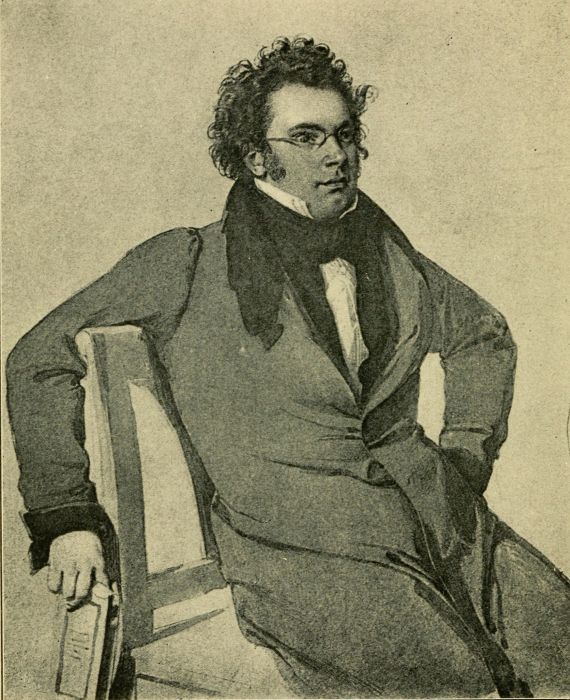
FRANZ SCHUBERT
From an original water color by W. A. Rieder
II
FRANZ SCHUBERT
As the earliest full-fledged representative
of the romantic school
of composers which succeeded
Beethoven, Schubert occupies a
peculiar position in the history
of music. His work forms the link between
the classical music of Haydn, Mozart, and
Beethoven and the romantic music of Schumann,
Mendelssohn, and Chopin, having certain
qualities in common with each. Traditions,
training, and environment allied him with the
older order; but instinct led him into new
paths. Scattered plentifully through the thousands
of pages covered by his racing pen, many
of which might be the work of some humdrum
eighteenth-century kapellmeister, are features
of surprising novelty, pointing unmistakably to
the future rather than to the past—gleams of
the true gold in a vast heap of sand. Nine-tenths
of the time he is content to imitate, with
amiable, unthinking garrulity, the quartets and
sonatas he grew up with; the other tenth he
breaks forth incontinently, an inspired pioneer.
This mingling of the matter-of-course and the
unexpected, of the sand and the gold, makes
his music a curious study.
Born in Vienna, January 31, 1797, Schubert
began the study of music when still a child,
under the direction of his father, a school-teacher
by profession, and his two brothers.
While in his teens the boy began playing the
viola pans in the family string quartet. His
brothers took the violin parts, and his father
played the 'cello: not always impeccably, it is
to be feared, for we read how little Franz, looking
doubtless very solemn and gnomelike in
the spectacles he already wore, would from
time to time, without stopping to look at the
score, comment on the wrong notes the paternal
fingers were sounding. This informal quartet
was the nucleus of an orchestra, known as
the Orchestral Society of Amateurs, which
flourished at a somewhat later period, and
served to make Schubert acquainted with the
works of Krommer, Romberg, Cherubini,
Spontini, Câtel, Mehul, Boïeldieu, Weigl,
Winter, and others of that category, as well as
with some Haydn and Mozart, and the first
two symphonies of Beethoven. There was
also an orchestra in the government school
for the Emperor's choir, known as the "Convict"
(from convivo, not convinco), which the
boy, thanks to his clear soprano voice, attended
from his eleventh to his sixteenth year; and of
this he was not only a member, but for some
time a conductor. One can readily imagine
that with all this music-making there was little
time for general schooling. Indeed, from the
moment he left the Convict, in 1813, he seems
to have given little thought to any but a technical
education; and though he attended a normal
school for a while, and later even tried teaching
under his father for three years, his main interests
were his lessons with the famous opera
composer, Salieri, and his first essays in composition.
For the instinct of imitation had started
him composing at an age when most boys
nowadays are learning arithmetic. At thirteen
he broke the ice with a four-hand piano
fantasia, and from that moment swam contentedly
through a sea of manuscripts. His
teeming fecundity and his carelessness for the
children of his brain once they were hatched
showed themselves from the first. When he
mislaid thirty minuets written at the Convict,
he would not trouble to recopy them; what he
enjoyed was the activity, not its product; and
it was dull to bottle old water while the spring
was flowing so cool and fresh. The figure of a
spring does scant justice to Schubert's inexhaustible
fancy; it was more like one of those
magic knapsacks in the fairy stories—the more
he took out of it, the more remained behind.
By 1815 his fertility had become almost uncanny,
especially when we remember that he
had for music only the leisure hours of a young
schoolmaster of eighteen. In March he wrote
the Mass in G; between March 25 and April 1
a string quartet in G-minor; in May a symphony
(his third) in D-major; in June an entire
operetta; during six days in July another
operetta, of which the libretto fills forty-two
closely printed pages; on October 15 seven
songs; on the 19th four more; and in the
interstices of time, another symphony, four other
operettas, two piano sonatas, and one hundred
and thirty-five songs, headed by "The Erl-King."
One rubs one's eyes. Compared with
Schubert's pen, Aladdin's lamp seems a poor
affair.
The natural result, in worldly matters, of this
imaginative preoccupation was abject poverty.
Never did Apollo turn his back on Admetus with
a more sublime indifference than in the avatar
of this otherwise modest musician. It is true
that he gave some scattering music lessons, and
that for a time he acted as music-master in that
same Esterhazy family which so long patronized
Haydn; but of any lasting patronage, any remunerative
appointment, or any systematic
teaching, we hear nothing. Even his compositions
brought him but a farcical revenue.
He published nothing until 1821, when the first
batch of songs, including "The Erl-King," was
printed by subscription. Later, the publishers
being still unwilling to take risks on a virtually
unknown composer, twenty more songs were
similarly issued. Only when popular favor
had become manifest could he use the regular
channels of publication; and then he had to
content himself with the merest pittances.
Diabelli, who in forty years is said to have
gained over ten thousand dollars on "The
Wanderer," paid Schubert for the plates and
copyright of that and nineteen other songs
only three hundred and fifty dollars. Haslinger,
in the composer's last year, when his reputation
was made and his work practically done, paid
him one dollar and a quarter for half a dozen
of his finest songs. That he was himself largely
to blame for this pecuniary misfortune, through
his aversion to drudgery and his carelessness in
the conduct of business affairs, hardly reconciles
us to the fact of his constant and often extreme
poverty, but for which he might have lived
longer and wrought to even better purpose.
But if he was poor, he had at least the temperament
and tastes suitable to poverty. Not
even Mozart, whose character and destiny had
much in common with Schubert's, was more
light-hearted and easy-going. "Perfect freedom
of action," says his biographer, "was the
element in which he by preference moved, and
for which he was content to make every sacrifice."
To drink his mug of beer and eat his
sausage, to flirt with pretty servant-maids and
peasant girls, to discourse youthful philosophy
and play practical jokes with convivial poets,
painters, and students, above all to fill reams
of music paper with the melodies that were
always flooding his brain—this was his conception
of sufficing happiness. It is curious to
read of his daily routine—how, rising early,
he would proceed, often before dressing, to improvise
until breakfast; how, after a morning
spent in composition, he would dine at the
Gasthaus for a Zwanziger (ten cents); how he
would divide the rest of the day between walking
in the suburbs, calling on the ladies of his
acquaintance, and discussing beer and friendship
in Bogner's coffee-house, or the "Zur Ungarischen
Krone," or the "Zum rothen Kreuz,"—sometimes,
in these latter haunts, jotting
down immortal melodies on the backs of wine
cards in the midst of the tavern pandemonium.
When he was in high spirits he would
challenge a friend to a mock duel with walking-sticks,
or sing the "Erl-King," in parody,
through the teeth of a comb. And then
there were the Schubertiaden, or Schubert
evenings, held by his friends of both sexes in
some one of the Vienna suburbs, at which the
diversions consisted of dancing, lieder-singing,
and theatricals, all to the accompaniment of the
flowing bowl. "When the juice of the grape
flowed in his veins," says one of his biographers,
"he became a laughing tyrant, and would destroy
everything he could, without making a
noise,—glasses, plates, and cups,—and sit
simpering and screwing up his eyes into the
smallest possible compass." Altogether we get
the picture of a Bohemian, irresponsible,
bachelor life, innocent enough, but not troubled
with embarrassing refinements. Schubert was
not at his ease in highly cultivated circles. In
his first letter from Zelész, the seat of the Esterhazys,
he describes the servants in detail before
giving a word to their princely employers.
Physically Schubert was a short, stout man,
with round shoulders, thick, blunt fingers,
low forehead, projecting lips, stumpy nose,
and short curly hair. Very near-sighted, he
wore spectacles from boyhood. His friends'
somewhat boorish wit compared him to a
negro, a cabman, and even a tallow-candle,
and afflicted him with the nickname of
"Schwammerl," or "The Sponge"—whether
in reference to his fondness for beer or to his
superfluous flesh does not transpire.
The noteworthy fact toward which all these
bits of otherwise insignificant personal detail
point, the thesis in support of which they are
here cited, is that Schubert was an unusually
pure case of the sentimental temperament. All
the external evidence—his contentedly ambling,
unbuttoned existence, his combination of sweetness
and a sort of involuntary nobility of aim,
with an utter lack of intellectual distinction,
his gullibility in business matters and practical
affairs, his devotion to day-dream and revery,
even his indolence and resulting sponginess of
physique—points in the one direction. And
these matters of ordinary observation are reinforced
by the internal evidence of his music,
as for example the preference for short pieces,
each vividly expressive of a single mood; the
pervasive tone of tender sadness, frequently
irradiated by charming fancy, but seldom
swept aside by tumultuous passion and energy;
the fondness for minor keys, delicious modulations,
and persistent hypnotizing rhythms; the
incapacity for complex structure and sustained
imagination. Here, obviously, is no hero of
abstract thought, like Bach, or of intellectual
and emotional passion, like Beethoven, but a
gracious sentimentalist, a man of feeling, a sort
of Burns or Heine of music.
The natural medium of musical expression
for such a temperament is the brief lyric, the
song for single voice with piano accompaniment;
and it was inevitable that Schubert, constituted
as he was, should become "the father of the
song." Before his time, this had been a form
not favored by the great composers; Mozart's
and Beethoven's songs, as Mr. Hadow has remarked,
were merely the chips thrown off in a
great workshop; for them the norm of expression
was the symphony. But Schubert, as a new
sort of man among composers, treated the song
with a new kind of earnestness, and with an
unprecedented spontaneity. Each of his best
songs is an unsophisticated utterance of simple
sentiment, a wondrously vivid presentment
of a single isolated feeling, a "moment's
monument," as Rossetti said the sonnet should
be. And this was precisely what the artistic
situation required. As in a short story of the
kind that Kipling, Stevenson, and others have
made familiar to us we do not demand that
evolution of character, that complex nodation
of plot, that subtle action and reaction of motive,
which every great novel must have, but simply
vividness, brilliant depiction of a single person,
idea, or situation, so in a song we desire no
symphonic grandeur of scope and wealth of
ordered detail, but rather perfect utterance of
a single highly specialized emotion.
Schubert's best songs fulfil this requirement
in an almost inimitable degree. Simple in style
and design, wonderfully direct and sincere, conceived
as idealizations of the beautiful old
German Volkslieder, and carried out with all
the artistic perfection and appropriateness of
detail that good craftsmanship could give, they
are among the few things in music that are
absolutely achieved. Especially remarkable is
the art-concealing art by which Schubert,
through some perfectly simple and unobtrusive
feature of rhythm, melody, or harmony, knows
how to suggest exactly the spirit and atmosphere
of his text. In the well-known "Serenade,"
for example, the deftly managed mixture
of minor and major harmonies (a favorite
device, by the way, with Schubert) strikes just
the right emotional note of loverly solicitude
and tenderness. In "Am Meer" four chords
at the beginning, and again at the end, bring
the sombre, majestic ocean visibly before us,
while the sudden dissonances introduced with
the line "Fielen die Thränen nieder" bring
home to us with a terrible poignancy the human
tragedy which the poet has so vividly outlined
against this stern natural background.
And then turn to "Hark! Hark! the Lark,"
perhaps the most purely lovely, in a musical
sense, of all the songs, and note the adorable
elasticity of the rhythm, the lambent grace of
the tune, the idyllic change of key at the words,
"And winking Mary-buds begin to ope their
golden eyes," and the poising flight of the
melody at the final, "Arise—arise—arise":—truly
Elizabethan this music, in its graciousness
and childlike joy. In short, Schubert
strikes at once, and in each case, in such songs
as "Hark, hark! the Lark," "Who is Sylvia?"
"Am Meer," "Du bist die Ruh," "Die
Forelle," "Heidenröslein," and perhaps a
dozen others, the exact tone and style needed
to transfigure the particular feeling with all the
magic of music, and throughout the song maintains
the mood perfectly, with no mixture or
clouding. And this, too, with the greatest
actual diversity of mood in the different songs,
to which his art flexibly responds. This group
of his fifteen or twenty best songs is not only
the crown of his own work, but one of the
brightest jewels in the crown of romanticism.
In critical justice it is necessary to add, however,
that in another group of his songs, even
more popular than this supreme one, Schubert's
romanticism inspired him less happily. Whenever,
giving free rein to his passion for detailed
expression, he directed his effort less towards
reproducing an emotional mood than towards
illustrating actual incidents, whenever, that is,
he allowed dramatic rather than musical considerations
to sway him, he produced a type
of song which, in spite of its popularity, is
intrinsically inferior, and hence likely to lose
favor as musical taste develops. The most famous
examples of this type are "The Erl-King"
and "The Wanderer"; others scarcely less
known are "Der Atlas," "Die Doppelgänger,"
"Die Junge Nonne," "Die Allmacht," "Kolma's
Klage," and "Hagar's Klage." To hear
the music of some of the songs of this class, unhappily
large, after reading the commentaries
of their admirers, is almost as cruel a disillusion
as to eat the food at a cheap restaurant after a
perusal of the pretentious and highly decorated
bill of fare. Of "Die Allmacht," for example,
Mr. A. B. Bach, in his book on "The Art
Ballad," writes as follows:—
"This composition I would call a great tone-picture;
it is a hymn of praise, stately and full
of splendor. We seem to hear some prophet,
who, with a voice of thunder, speaks to the
people of the power and glory of the Almighty.
The greatness of God in nature is first proclaimed.
The tone-painting is full of grandeur
and majesty. Not with the delicate, charming
pencil of Fra Angelico, but with the strong,
energetic, and powerful brush of Michael
Angelo, does Schubert paint the raging of the
storm, the forest's boisterous violence, the
thunder and the lightning. The painting is
softer, milder, sweeter, only when he comes to
the beautiful and calming words that the power
of God is high above all, and greater when man
feels it in his inmost heart.... Then follows
a great crescendo, ending with the powerful
and mighty exclamation, 'Great is Jehovah,
the Lord!' which produces an overpowering
effect. In this composition, as scarcely in any
other, Schubert, usually so charming, is very
dramatic, and shows command of the loftiest
expression."
Turning, with expectation keyed high, from
this rhapsody to the music of "Die Allmacht,"
what do we find? An annoyingly loud thumping
of the piano, in its muddy lower register,
for four pages on end, with no rhythmic relief; a
vocal part more like a second-rate operatic recitative
than one of those divine tunes of which
Schubert had the secret; and to fill the cup of
boredom, three rumbles of conventional musical
"thunder," as threadbare and outworn as
the antiquated theatrical properties described
by Steele in the "Tatler." It is hard to understand
how any true lover of music can turn
from "Hark, hark! the Lark," or "Who is
Sylvia?" or "Du bist die Ruh," to such songs
as these, with their physically exciting tremolos,
crashing diminished-seventh chords, chromatic
climaxes, mysterious staccato octaves, pianissimo,
in the bass, and other such claptrap effects,
better suited to accompany the drowning of the
heroine of melodrama than to edify the sense
of musical beauty. They reveal pitilessly the
seamy side of romanticism, and make us wish
that Schubert's fecund imagination had been
controlled by a more fastidious taste.
If the sentimentalist's tendency to value
emotion for itself, as the voluptuary wallows in
sensation, and the realist's fondness for crudely
detailed effect, sometimes led Schubert into an
artificial and fevered style, his very simplicity
at other times played him false. Simplicity in
art, as the case of Wordsworth has notoriously
proved, covers a wide range, from the sublime
to the ridiculous. Schubert is often sublimely
simple, as in "Du bist die Ruh," "Heidenröslein,"
"Der Leiermann"; but sometimes he
is merely flat and obvious. Indeed, writing, as
he did, over six hundred songs in a score of
years, not the most inspired of men could
always have avoided platitude. Thus we must
set aside many melodramatic and many trite
compositions before we can get an unimpeded
view of his real masterpieces. But after that
has been done, we have left about twenty or
thirty songs of such incomparable loveliness as
to give him a secure place among the great
masters of the musical lyric.
The careful discrimination between quantity
and quality in Schubert's work, so obviously
important in judging his songs, becomes perhaps
even more indispensable when we come
to his instrumental works. The facts that here
present themselves to the intending student on
his first approach to the subject are entirely
misleading. Schubert wrote, he learns, ten
symphonies and twenty string quartets, besides
much other chamber and orchestral music.
Remembering that Beethoven wrote nine symphonies
and sixteen string quartets, he is likely
to assume that the essential Schubert is to be
found permeating the one set of works just as
the essential Beethoven permeates the other,
and that if he can take, so to speak, a critical
average of them all, he will come at the true
musical personality of their author. Nothing
could be more erroneous. For it must be borne
in mind that while the works of Beethoven were
written during the entire period of his artistic
maturity, from his twenty-fifth to his fifty-sixth
year, and with the most laborious care, those of
Schubert are largely youthful exercises, and
were in many cases thrown off as one would
write a letter. Schubert wrote voluminously
and carelessly, and died at thirty-one, just as
he was entering the prime of life. His works
are thus, if one may say so, like his person,
embedded in superfluous flesh. The bulk of
them are, so far as representing him goes, pure
surplusage, to be stripped off and thrown aside
before we can see the outline and stature of his
genius. The compositions produced before
1820 are interesting to-day only as documents
bearing on the peculiar way in which his
individual style was gradually developed.
What they chiefly reveal is the ingenuousness,
one might almost say the unconsciousness, with
which he habitually composed. He seems to
have made no effort to draw forth, by taking
thought, his shy and retiring individuality; his
method was rather to copy, often almost literally,
the music he knew and liked, especially
that of Haydn and Mozart. The quartet in
G-minor, written in 1815, for example, contains
a perfectly Mozartish minuet, while its finale
is pure Haydn, except for occasional gleams
of Schubert in the happy exuberances of detail
and in the quick, informal modulations. Of
the symphony in B-flat, written in 1816, the
first and fourth movements are Haydn, the
second and third Mozart. The closeness of
the imitation is at times fairly disconcerting,
as in the last eight measures of the minuet,
which sound like a rejected sketch for the
minuet of the "Jupiter Symphony":—
An even more amusing case is that of a
passage in the E-major Quartet (opus 125,
no. 2), written in the following year (1817),
so startlingly like a portion of Mozart's G-minor
Symphony that we can hardly resist the theory
of unconscious plagiarism. The passages in
question merit a careful comparison. If imitation
is the sincerest flattery, Schubert was paying
an eloquent tribute, indeed, to the genius of
Haydn and Mozart in his works of 1815-1817.
Before 1818 there is little internal evidence
that Schubert had felt at all the influence
of the greatest musician of the period, Beethoven,
with whom, if we may judge from
his diary, he was not yet in complete sympathy.
Under date of June, 1816, he compares disparagingly
"that bizarrerie for which we have
chiefly to thank one of the greatest German
artists" with the "naturalness" and "purity"
of the Italian, Salieri. In the C-major symphony
of 1818, however, he has evidently fallen
completely under the sway of the master. The
first movement of this work shows a great
advance over earlier symphonies; the orchestral
resources are increased, and used with more
skill; the themes are more concise and vigorous,
more truly symphonic, though still showing
a tendency to rhythmic monotony; the construction
is ampler and more carefully planned,
there being a slow introduction and a Beethovenish
coda. The transition by which the
repetition of the first section of the movement
is approached shows afresh the curious literalness
with which Schubert copied his models.
The long poising, pianissimo, on a single harmony,
and the final almost imperceptible lapse
into the original key, are Beethoven to the
letter. The other movements show the same
influence. Especially noteworthy are the substitution
of a scherzo for the old-fashioned
minuet, and, in the finale, the many sudden
shifts of tonality by a semitone, and sudden
alternations of extreme loud and soft. Here,
as much as in the earlier things, it is true,
Schubert remains the obedient and passive
student; he is still, in the phrase of Stevenson,
"playing the sedulous ape"; but his model is
much more complex, his touch is surer, his
technical facility greater, and he needs only to
grow a little older, a little more mature and
self-conscious, in order to stamp all these
gradually acquired materials with his own
individuality.
Now maturity comes to most men, the romanticists
like the others, as a result of the
suffering, misunderstanding, and disappointment
that years have a way of bringing. The
youth interprets all the world by his own
freshness of enthusiasm, keen sensation, untrammelled
imagination. Everything seems
possible to him, and life is one long, romantic
adventure. But when he actually comes in
contact with that world which looked so fair
from a distance, through the rosy glasses of
temperament, he discovers that it is stubborn
to his purposes, that it is full of alien wills with
which he struggles in vain, and that this struggle
reveals insurmountable weaknesses and
limitations in himself. Then either bitterness,
or a new understanding of himself, resignation
to the inevitable, and interpretation of life in
more universal terms, is bound to displace the
old romantic egotism. Experience regroups
itself in soberer colors, and if he be generous
enough to escape cynicism he emerges from the
ordeal chastened and humanized.
This transition from self-absorbed youth to
magnanimous manhood came to Schubert between
his twenty-third and twenty-seventh
years, hastened by the adverse conditions of
his life. We have seen how poverty held him
in its sullen grasp; ill-health was added in
1824; and all through his last decade the
sense of the indifference of the public to his
higher artistic aims must have been dispiriting
in the extreme. His songs were favorably
enough received, but little interest was taken
in his chamber and orchestral music except by
a small circle of friends. That he could nevertheless
go on, year after year, producing so
splendid a series of compositions, in a spirit of
such uncompromising devotion to art, almost
entirely unsupported by public recognition,
buoyed up by inward conviction alone, proves
that underneath the careless Bohemianism of
his everyday existence there was developing in
him the stuff of real heroism. Like Columbus,
he
"found a world, and had no chart
Save one that faith deciphered in the skies.
To trust the soul's invincible surmise
Was all his science and his only art."
The story of the last year of his short life is
most pathetic. In March, 1828, he made an
attempt to mend his fortunes by giving a
concert of his own works, by which he
earned one hundred and fifty dollars, to him a
large sum. But no temporary help like this
could count for much, so long as his compositions,
the main business of his life, were so
shamefully underrated by the publishers. For
six of the best of the "Winterreise" songs he received
a little over one dollar; for the E-flat Trio
(opus 100), about four dollars and a half; for the
great A-major Pianoforte Quintet (opus 114), a
little over six dollars. His health being now
seriously impaired, he wished to spend the
summer in the country with friends, but was
compelled by poverty to remain in the heat and
confusion of Vienna. A momentary encouragement
offered in a projected performance of his
greatest work, the C-major Symphony, but it
was given up as too difficult, and he never heard
it. It was first performed eleven years after his
death, by Mendelssohn, in Leipsic. In the fall
he rapidly failed, and had just arranged to take
lessons in counterpoint, with a view to yet
greater works, when, after a comparatively
short illness, he died, on November 19, 1828.
He left no will, but from the official inventory
of his effects we learn that he left behind him
twenty-six dollars' worth of clothing and house
furniture, and "a quantity of old music" (including
the manuscript of the C-major Symphony),
valued at five dollars.
Such were the dingy outer circumstances of
this man's life. But his spirit soared above
them. "My compositions," he wrote in his
diary, "are the product of my mind, and spring
from my sorrow; those only that were born of
grief give the greatest delight to the outside
world;" and in another place, more profoundly:
"Certainly that happy joyous time is
gone when every object seemed encircled with a
halo of youthful glory; ... and yet I am now
much more than formerly in the way of finding
peace and happiness in myself." But the best
evidence we have that Schubert learned the
lesson of sorrow, and not only transmuted bitter
experience into immortal beauty but under the
stress of that experience first found his true
self, lies in the wonderful series of compositions
which he wrote between 1820 and 1828. Here
we find at last the essential Schubert. In the
single movement in C-minor for string quartet,
dated 1820, he discloses a new world of
dramatic expression, earnest feeling, daring
modulation, intricate harmony, and chromatic
melody. And from this time on masterpiece
followed masterpiece: the "Unfinished Symphony"
in 1822; the A-minor Quartet and the
Octet in 1824; the G-major and D-minor
Quartets in 1826; the first two piano trios a
year later; and to cap the climax, the C-major
Quintet and the immortal C-major Symphony
in 1828.
In spite of the emotional depth of these last
works, the dominant note remains in them, as
in everything that emanated from Schubert,
romantic. Everywhere in them the interest of
the romanticist in color for its own sake, in the
primary sensuous charm of the tone combinations,
is strikingly manifest. One of the hallmarks
of Schubert's symphonies is his impressionistic
treatment of orchestral tints, both
pure and in mixture. None knows better than
he how to make the oboe sultry or menacing,
the clarinet mellow and liquid, the horn hollow,
vague, mystical, the 'cellos passionate, and the
violins clear, aspiring, and ethereal. The score
of his C-major Symphony is a marvel of ingenuity
and felicity in the weaving of various
colors and modes of playing, as staccato and
legato, pizzicato, etc. Look, for instance, at
page 162 of Eulenberg's miniature score, and
see how the wood-wind instruments chatter in
staccato against the long rise and fall of the
strings playing in octaves, legato; or at page
139, noting how, after a powerful climax and a
moment of complete silence, the 'cello, against
plucked chords by the other strings, sings a
languorous melody, which is presently taken up
by the oboe; or at pages 30-35, where, under
the shimmering veil of the strings, the trombones
gradually work out their sinister call,
rising ever higher and higher, and finally precipitating
all into the sounding turmoil of the
climax on page 36. In such passages as these
every tone sounds, and all unite harmoniously
to produce the intended effect. In few scores
will one find at once such richness and such
clear transparency of coloring.
Nor is Schubert dependent for variety of
color, as unimaginative composers are, on the
richly diversified palette of the full orchestra.
His chamber music shows how much he can
accomplish with limited means. In his two
trios, op. 99 and 100, by making the most of
the percussion quality of the piano as well as
of both the pizzicato and the sustained tones of
the strings, he evolves a surprising variety from
the three instruments. Even with the string
quartet, the most monochromatic of chamber
combinations, he achieves great differentiation
and contrast, largely by rhythmically individualizing
each voice. The opening of the
A-minor Quartet is a good example: viola and
'cello give a drone bass in a peculiar and striking
rhythm (a dotted half-note followed by a
group of four sixteenths); the second violin
holds the tone-mass together by means of a
graceful legato running figure in eighth-notes;
the first violin sings a melody that follows its
own free and untrammelled rhythm. One is
reminded by such a passage of Dvořák, who is
of close artistic kin to Schubert. Both men,
in their writing for strings, secure fascinating
texture by opposing many diverse rhythms
simultaneously. The device has been assailed
as being a mask to cover a poverty of real
polyphony (inner melodiousness); but though
it may to a certain extent be that, there can be
no doubt of its sensuous effectiveness.
Another similarity between Schubert and
Dvořák, also indicative of their romantic interest
in special momentary features, is their
coloristic use of harmony, and especially of
modulation. Sudden transitions to remote keys
are no commoner perhaps in Schubert than in
Beethoven, but in Schubert they are prompted
by considerations of color rather than of design.
Like Dvořák, he loves unexpected recrystallizations
of tone. He shakes the kaleidoscope of
his fancy, and all the bits of glass fall into a
new pattern (tonality). Such a fascinating
change as that immediately after the forte chord
of D, in the second entr'acte of "Rosamunde,"
is an illustration. Even better ones, because
showing so clearly the lack of any element of
formal design in these changes, are those casual
alternations of major and minor mode which
are so frequent as to constitute a mannerism.
At the close of the first movement of the G-major
Quartet is an extreme case. Four
measures consist entirely of abrupt alternations
of the major and minor tonic chords, with no
melodic binding together. This is obviously
purely a color effect, and its motive is of course
unequivocally romantic.
Romantic also is the persistent lyricism of all
Schubert's music, the symphonies and quartets
as well as the songs and piano pieces. In the
larger almost as much as in the smaller works,
the fundamental trait of the peculiar type of
expression used is its subjectivity, its strong
personal flavor. If the songs of the classicists
seem often like condensed symphonies, the symphonies
of this romanticist are in many respects
magnified songs. In several of his instrumental
movements Schubert actually transcribes his
themes from songs already written, as for example
in the variations of the D-minor Quartet,
founded on "Death and the Maiden," and those
of the "Forellen Quintet," founded on "Die
Forelle." When he uses entirely new material,
he is apt to conceive it in the lyrical style, and
even to cast it in the lyrical form, with an exact
balance of phrases of equal length. The second
subject in the "Unfinished Symphony," for
instance, is like a stanza or strophe; the imagination
easily adds words to it; it is an
instrumental song. Most of Schubert's more
emotional themes share this quality of utterances,
and seem rather communications of personal
feeling than objects of abstract beauty. Even
in the later works, like the D-minor and G-major
Quartets and the C-major Quintet, in
which the romance is tinged with tragedy, it is
still, one feels, romantic tragedy, the tragedy of
sentiment and sensibility, and not universal
cosmic tragedy like Beethoven's or Bach's.
Yet there is in these later works, also, an
intensity and breathlessness of utterance, a
white heat of passion burning away all dross
and surplusage, and giving the style an incisiveness
strongly contrasted with Schubert's usual
genial prolixity, which seem to emanate from
some sterner, wilder element in his nature.
There is a nervous tenseness here which is
distinctively modern; the D-minor Quartet
particularly has the modern closeness of texture
and rapidity of pulse. Its first theme, unlike
most of Schubert's, is a short and trenchant
motive of five notes, compelling attention from
the very outset. The entire first movement is
treated with great depth of feeling and sustained
power, and the coda is of a wonderful
dignity and reticence. The final presto, too,
reminds us of Schumann in its emotional richness,
and of Tschaïkowsky in the passion of its
broken rhythms and headlong harmonic progressions.
On the other hand, the harmonic
idiom of the first movement of the quartet in
G-major (see Figure IV.), with its lapses of
triads down through intervals of a whole step,
is that of César Franck. Schubert is here the
prototype of the most advanced modern symphonists,
as in his piano pieces he anticipates
the methods of Schumann, Chopin, and Liszt,
and in his songs gives the cue to Franz, Rubinstein,
Grieg, and Brahms.
The chief faults of Schubert's instrumental
works—and they are grave ones—result in
part from his way of composing, and in part
from the untraversable opposition between
the lyrical expression native to him and the
modes of construction suitable to extended
movements. Schubert was an easy-going, careless,
and indolent writer. He wrote music as
most people write letters; often he would
scribble off half a dozen songs in a single day;
he thought nothing of making an overture in
three hours, or a whole operetta in a week;
to a friend who asked him how he composed,
he replied, "As soon as I finish one thing I begin
another." What all this means, practically, is
that he did not "compose" at all in the strict
sense of placing together tones with care and
forethought, but merely improvised on paper.
And as a result, while he certainly attained a
delightful spontaneity of effect, he also fell into
the pitfalls of monotony and diffuseness. He
is constantly becoming hypnotized by a rhythm,
keeping it up relentlessly, page on page, without
relief. When he has once hit upon a phrase
that appeals to him, such, for example, as the
second subject in the G-major Quartet, he is
apt to adhere to it pretty closely through a
whole section of the piece. Such insistence,
in contrast to the variety of phraseology of
composers like Mozart, is comparable in effect
to the singsong couplets of Pope or Dryden, as
contrasted with the pliant versification of
Shelley. This weaker aspect of Schubert, connected
with his lack of intellectual vigor and
possibly with a certain flabbiness of moral
fibre, has been exhaustively discussed by Mr.
H. H. Statham, an English critic, who reaches
the conclusion that "in music, as in literature,
easy writing is hard reading," and that in Schubert's
larger pieces "lovely melodies follow each
other, but nothing comes of them." Whether
or not we agree with so extreme a view, we
cannot deny Schubert's weakness in musical
construction.
We usually find in his music five pages of
repetition to one of real development. Mr.
Statham is right in contrasting the "vain repetitions"
in the andante of the C-major
Symphony with the logical evolution of matter
in the allegretto of Beethoven's Seventh Symphony.
And even where, as in the fine coda of
the finale of the C-major Symphony, Schubert
has a truly broad design to work out, he fills in
his detail in the easiest, least exacting way by
repeating identical phrases at a higher and
higher pitch. The effect of the long, gradual
climax is intensely dramatic, but when upon
familiarity we realize that the ideas generate,
so to speak, by fission, or exact reduplication,
rather than by organic evolution, we are left
æsthetically unsatisfied. The truth seems to be
that Schubert, being essentially a lyrical writer,
makes beautiful symphonies and quartets in
spite of, rather than by means of, the natural
conditions of these epic musical forms. His
symphonies are expanded songs, delightful, as
songs are delightful, for their directness of
feeling, their beauty of detail, their warmth of
color and sensuous charm.
His last work, however, the great C-major
Symphony, has enough of the heroic about it
to make us cautious in saying what he might
or might not have done had he not died at thirty-one,
when he was just entering the period of
artistic maturity. There is a grandeur of
scale and intention, a deliberation and solidity,
a sustained power, large touch, and freedom of
execution about this symphony that place it
above all his other works. The long climaxes
bespeak a reserve power not associated with
Schubert the song-writer; the themes wear
their possibilities less upon the surface, and
unfold them more cumulatively; the harmony
is firmer, plainer, and stronger; the scoring is
done as it were with a larger brush, the colors
laid on in wider spaces and freer patterns;
and in the last movement the romantic note is
for once well drowned in a deeper cry of tragic
heroism. It is not a mere coincidence that the
theme at the beginning of the development
section so strongly suggests Beethoven's "Hymn
of Joy"; the spirit here is Beethoven's, and the
spaciousness of the scheme of construction, if
not the detail with which it is filled in, are
worthy of the greatest symphonist. Here surely
the graciousness of childhood and the romantic
dalliance of youth are laid aside, and Schubert
speaks with the deep, deliberate voice of manhood.
Death never came to an artist more untimely.
Had he lived, we cannot tell what
new and even profounder expressions of the
ripe earnestness that lies beyond romance he
might not have planned and achieved.
III ROBERT SCHUMANN
ROBERT SCHUMANN
From a painting by E. Bendemann
III
ROBERT SCHUMANN
In the year 1830, in the old German
university town of Heidelberg,
Robert Schumann, then a
youth of twenty, a reluctant student
of law, and a devoted lover
of music, was making the most momentous decision
of his life. For us, to whom his music
is a fait accompli, it is easy enough to see the
way his genius pointed; for him it was a time
of self-searching, of beckoning hopes and haunting
fears, of long hesitation before the final
courageous adventure into an unknown land.
"My whole life," he writes his mother, "has
been a twenty years' struggle between poetry
and prose, or, if you like to call it so, Music
and Law. Now I am standing at the crossroads,
and am scared at the question 'Which
way to choose.'" "Let me draw a parallel,"
he continues. "Art says: 'If you are industrious,
you may reach the goal in three years.' Jurisprudence
says: 'In three years you may perhaps
be an "Accessist," earning sixteen groschen a
year.' Art continues: 'I am as free as air;
the whole world is open to me.' Jurisprudence
shrugs her shoulders, and says: 'I am nothing
but red tape, from the clerk to the judge, and
always go about spick-and-span, and hat in
hand.' Art goes on to say: 'Beauty and I
dwell together, and my whole world and all my
creations are in the heart of man. I am infinite
and untrammelled, and my works are immortal.'
Jurisprudence says, with a frown: 'I can
offer you nothing but bumpkins and lawsuits,
or at the utmost a murder, but that is an unusual
excitement. I cannot edit new Pandects.'
My beloved mother, I can but faintly indicate
the thoughts which are surging through my
brain. I wish you were with me now, and
could look into my heart. You would say:
'Start on your new career with courage, industry,
and confidence, and you cannot fail.'"[3]
Certainly there was little enough in the legal
profession to attract a youth such as these early
letters reveal, ardent, imaginative, romantically
intolerant of the humdrum and the prosaic.
From the first we see him, in this clear mirror
of his own words, marked for a life of artistic
expression and free creation. He has all
the artist's susceptibility to impressions, both
sensuous and intellectual, as we gather from
his rhapsodies over the landscapes, peasant
maidens, and wines of the Rhine Valley, and
from his interest in the individualities of his
travelling companions. He is a creature of
moods, plunged in a day from heights of joy
into abysses of melancholy. He is impetuous,
generous, and volatile in his boyish friendships
and love affairs; an affectionate but inconsiderate
son, an ardent but desultory worker, a
voluminous but irregular correspondent, irresponsible
in money matters, impatient of social
usages, inconstant in almost everything but his
devotion to beauty. The idol of his boyish
hero worship is Jean Paul Richter, that curiously
German compound of sentimentality,
mysticism, and wayward humor; he wishes
that all mankind might read Richter and become
"better and more unhappy;" and he often
favors his mother with Jean-Paulish apothegms,
reflections, and fantasies, in which platitude
and sincerity are mixed as only enthusiastic boyhood
can mix them. Byron, Heine, and the
other romantic poets of the day he reads, too,
with avidity, and imitates them in erotic ballads
and plays about picturesque robbers. And all
along, music is the language of his deepest
moods, and he spends hours communing with
his piano in rhapsodic improvisation, and devotes
his leisure to composing musical character-sketches
of his friends.
By such a youth the choice between law and
music could hardly be decided but in one way.
He persuaded his mother and his guardian to
allow him six months in Leipsic, under the
teaching of Friedrich Wieck, to show what he
could make of himself as a pianist. His letters
during this period of the first steady labor he
had known, when the reaction necessarily
following the feverish weeks of decision plunged
him into a dull and relaxed state, show the
sterling side of his meteoric nature. They
complete the picture of one of the most lovable
of youths. "I just keep jogging on," he writes
in May, 1831. "It is the fault of all vivid young
minds that they aspire to too much at once; it
only makes their work more complicated, and
their spirit more restless.... If only I could
do one thing well, instead of many things badly,
as I have always done! Still, the principal
thing for me to keep in mind is to lead a pure,
steady, sober life. If I stick to that, my guardian
angel will not desert me; he now sometimes
almost possesses me for a little." A few
months later he continues, more tranquilly:
"If one has at last come to a conclusion, and
is quiet and satisfied in one's own mind, the
ideas of honor, glory, and immortality, of which
one dreams, without doing anything toward
their accomplishment, all resolve themselves
into gentle rules, only to be learned from time,
life, and experience. To bring to light anything
great and calmly beautiful, one ought only to
rob Time of one grain of sand at a time; the
complete whole does not appear all at once,
still less does it drop from the sky. It is only
natural that there should be moments when we
think we are going back, while in reality we
are only hesitating in going on. If we let
such moments pass, and then set to work
again quickly and bravely, we shall get on all
right."
The philosophic calm thus gained by habits
of regular work was soon to be sorely taxed;
for in that very year all Schumann's hopes of
ever becoming a piano virtuoso were shattered
by an accident to his right hand. With characteristic
impatience he had devised a mechanism
for hastening the independence of the
refractory fourth finger by holding it up with a
string while the others practised. Of course
the result of this violence was a permanent
lameness. Under this affliction, however, was
hidden an incidental benefit; for piano playing
became now no longer one of the many things
that he did badly, as he had complained, and
he had at last all his attention to concentrate
upon composition. He had written his opus
1, "Variations on the name of Abegg," in 1830;
he now followed this up with an endless stream
of charming piano pieces, the like of which
had never before been seen. In 1830-31
came the "Papillons," opus 2, and the "Allegro,"
opus 8; in 1832 the "Studies after Paganini" (in
which the technical interest of the virtuoso is
still paramount), the "Intermezzi," and the
fascinating "Impromptus on a Theme of Clara
Wieck"; 1833 added to the list two more
primarily technical works, the "Concert Études
on Caprices of Paganini" and the splendid
"Toccata," opus 7; and in the next six years, up
to 1839, came a long series of unique and lovely
things, among which stand forth in especial
prominence those romantic whimsicalities, the
"Davidsbündlertänze," the "Carnaval," and
"Kriesleriana," the somewhat less successful,
because more ambitious, Sonatas, opuses 11,
14, and 22, and the more mature "Symphonic
Études," "Kinderscenen," "Phantasie," and
"Novelettes."
These piano works, conceived with most
daring originality and executed with inimitable
verve, deserve to take rank with Schubert's
songs, Mendelssohn's overtures, and Chopin's
nocturnes and preludes, among the very few
supreme and perfect attainments of the romantic
spirit in music. Their exuberant vitality,
their prodigal wealth of melodic invention, their
rhythmic vigor and harmonic luxuriance, their
absolutely novel pianistic effects, their curious
undercurrent of fanciful imagery and extra-musical
allusion, the peculiarly personal, even
perverse, idiom in which they are couched, all
conspire to make them unique even among
their author's works, and in some respects
more happily representative of him than the
later productions in which he was more influenced
by conventional or borrowed ideals.
In them we have the wild-flavored first fruits of
his genius, fresh with all the aroma and bloom
of unsophisticated youth.
A curious feature of most of these early
pieces, due to the literary cultivation and to
the fanciful bias of their composer's mind, is
their constant reference to all sorts of extra-musical
interests. Schumann, at this time
almost as much a man of letters as of tones,
took pleasure in equipping his pieces with an
ingenious and amusing series of allusions to
places and people, real and fictitious, a kind of
running commentary of footnotes on the music,
comprehensible only to the initiated. This is
managed partly by means of spelling out words
in the letters which stand for musical tones,[4]
partly by directions printed above the music,
like stage directions in a play, and partly by
mottoes, both musical and literary, and quotations
of original and other melodies. The
"Variations," opus 1, are founded on a theme
which spells A-B-E-G-G—a pseudonym given
by Schumann to a lady whose beauty he had
admired.
Most of the pieces in the "Carnaval" are
founded on four tones spelling A-S-C-H, in
honor of a friend who lived in the town of
that name, the rhythms being so ingeniously
varied that each theme sounds new in spite
of its set tonal basis.
In later life Schumann wrote six organ fugues
on the name B-A-C-H; in the album of Gade,
the Danish composer, he wrote a theme spelling
"G-A-D-E, A-D-E" ("Gade, farewell");
and the "Northern Song," in his "Piano Pieces
for the Young," is founded on the same letters,
in honor of the same musician.
Mottoes and quotations meet us at every
turn. Printed above one of the melodies in
the "Intermezzi" are the words "Meine Ruh'
ist hin"—"My peace is gone." The "Davidsbündlertänze"
bear at their head a stanza of
verses, and commence with a musical motto by
Clara Wieck. In the final march of the
"Carnaval," a melody of the seventeenth century,
"The Grandfather's Dance," is used to
symbolize the futile resistance of pedantic conservatism
to the progress of art. The "Phantasie,"
opus 17, was to have been called "Obolos,"
the purpose of its composition being to
contribute to a fund for a monument of Beethoven,
and the separate movements were to
have received the highly fanciful titles, "Ruins,"
"Triumphal Arch," and "The Starry Crown";
but Schumann finally contented himself with a
motto from Schlegel:—
"Durch alle Töne Tönet
Im bunten Erdentraum
Ein leiser Ton gezogen
Für den der heimlich lauschet."[5]
In the "Faschingsschwank aus Wien" (Carnival
Prank at Vienna) he manages the musical
quotation with felicitous humor. It seems
that the playing of the "Marseillaise" was at that
time forbidden by the German authorities, on
account of the strongly revolutionary tendencies
of public feeling. This police taboo did not
prevent Schumann from letting a single strain
of the splendid tune flash out from his mosaic
of melodies, to the unbounded delight of his
audience and the discomfiture of the helpless
officials.
Of all his compositions, the "Davidsbündlertänze"
is fullest of this tricksy play of imagination,
in which he took, as Oscar Bie says, "the
pleasure of the delicate man of taste in labelling."
From about 1834, when he founded his
musical journal, the Neue Zeitschrift für Musik,
the imaginary society of the Davidsbund played
an important part in his mental life. Believing
that it was a part of his duty to oppose
the philistinism, the dulness, pedantry, and
sensuality which pervaded the music of the day,
he dramatized the conflict as a struggle between
the Davidsbund, or club of Davidites, and the
forces of Philistia. His fancy played about this
central conception until it had evolved a whole
company of Davidites, individualizing each
one. Several were merely single aspects of
their creator's complex temperament. Florestan
was the impassioned Schumann, Eusebius
the dreamy and tender Schumann, Raro the
philosophical mediator between the two. Others
indicated friends: Felix Meritis was Mendelssohn;
Chiarina, Clara Wieck; Estrella, Ernestine
von Fricken, an early sweetheart. Once
projected into the actual world, these figments
of fancy became very real to their creator. His
Sonata, opus 11, was originally printed as "by
Florestan and Eusebius." Each of the numbers
of the "Davidsbündlertänze" is signed
"F.," or "E.," or "F. and E.," and the ascription
is always conscientiously justified by the
character of the music. In the first edition
there are even "stage directions," such as,
"Here Florestan stops, his lips trembling painfully,"
and "Eusebius said too much about
this; but his eyes were full of joy." These
finical particularities, however, as well as the
motto in verse, were in the second edition
stricken out.
All these elaborate paraphernalia with which
Schumann equipped his first essays in composition
are noteworthy not so much for any
intrinsic significance as for the light they throw
on his peculiar attitude toward an art which
most of his predecessors had approached in a
wholly objective and detached spirit. The
persistent and minute subjectivity they reveal
is remarkable in so young a man, working by
instinct and in despite of the powerful influence
of tradition. Most men approach music through
a systematic technical discipline, and achieve
individuality of style only with maturity; Schumann,
reversing the process, turns to music at
first simply as to one of several available ways
of expressing a lively imagination, and gains
technical skill but gradually and by arduous
effort. His eloquence is that of a man filled
with matter and enthusiasm, but untrained in
oratory; he stammers, hesitates, coins words,
improvises phraseology as he goes, and in
the end attains fluency by dint of sheer earnestness
and conviction. The inner impulse to
expression creates its own medium, instead of
being itself formed by the medium available;
and while a language thus derived offhand has
necessarily certain crudities, it has also, of
course, a delightful freshness and happy spontaneity.
The inexhaustible tunefulness of the early
Schumann is little short of marvellous. Few
composers have been so prodigal of lovely
melodies. They are like the king's daughters
in the fairy tales, each more beautiful than the
last; and though there is doubtless a family
resemblance, each has a distinct physiognomy,
a pronounced individuality. They are, for the
most part, indeed, brief, striking motives rather
than deliberately composed tunes, perfect but
minute crystals of most various shapes, forming
spontaneously in the highly saturated solution
of the musical thought. No effort is made
to purify, separate, or collect them; what their
composer seems chiefly to value is their profusion
and luxuriance. To state the same
thing in more technical terms, there is next to
no thematic development; there is simply the
presentation of one charming phrase after another.
The result is of course a certain fragmentariness
and whimsicality; the music impresses
us not by its cumulative power, its
orderly advance, but by the sheer charm of its
primitive elements.
The vigor of the rhythms never flags. Short
notes in "dotted rhythms," holds from unaccented
to accented beats, and all manner of
devices for intensifying accentuation, give an
inimitable elasticity to such things as the first
of the "Intermezzi," the sixth, seventh, ninth,
and final sections of the "Impromptus on a
Theme of Clara Wieck," the ninth of the
"Davidsbündlertänze," "Préambule," "Coquette,"
"Chiarina," "Valse Allemande," and
the final march in the "Carnaval," "Aufschwung"
in the "Phantasiestücke," and many
others. There is to be observed also a constant
tendency to emphasize the metre by slight but
systematic deviations from it, such as syncopation
and the shifting of motives into artificial
relations to the measure, and the simultaneous
use of two or more metrical schemes at once.
Interesting examples of this sort of intensive
syncopation occur in "Grillen," one of the
"Phantasiestücke," in the B-flat major section
of the eighth "Novelette," and in the "Faschingsschwank
aus Wien." A delightfully quaint
use of shifted motives is made in the finale of
the Sonata, opus 11. The theme of the
movement, though written in triple measure,
consists entirely of two-beat motives, so that
there is a constantly felt, and very exciting,
opposition between metrical and rhetorical
accents.
The motive of the scherzo of the same work is
treated in a somewhat similar way. Of all the
many instances which might be mentioned of a
simultaneous use of two metrical schemes, one
of the most consummate is the employment,
in "Des Abends," of three groups of two sixteenth-notes
in the melody, against two groups
of three sixteenths in the accompaniment—a
subtlety often missed by pianists, but essential
to the charm of the piece. The first two numbers
of the "Davidsbündlertänze" also present
attractive oppositions of metre.
The same waywardness finds further expression
in certain harmonic eccentricities. Schumann
loves to surprise, waylay, disappoint, and
otherwise cajole his hearer. Strong unprepared
dissonances, entrances of chords before
we expect them, delays of the expected ones,
entire evasions of the seemingly inevitable, and
felicitous transitions into the seemingly impossible
are a constant feature of his program.
He loves to hit upon a note as if by accident,
and then to justify and even emphasize it, as
in the eighth and succeeding measures of the
theme of the "Papillons"; to wound our ears
with the harshest intervals, and then compel
our acquiescence by a resulting felicity, as in
the introduction to the F-sharp minor Sonata;
to toss us restlessly upon a chromatic sea and
bring us out at last into diatonic tranquillity, as
in the first two pages of the "Toccata." At the
beginning of the "Kreisleriana" he keeps the
right hand half a pace ahead of the left, thus
producing a great richness of tone as well as
emphasizing the vigorous progression of the
bass. In the first variation in opus 5 just the
reverse of this occurs; the bass takes the lead,
while the chords in the right hand lag behind,
making temporary discords, but always coming
out right in the end.
Many of these peculiarities of harmony are
doubtless due simply to Schumann's sensuous
susceptibility to good ear-filling sound, long
intensified and developed by his habit of improvisation.
Sir Hubert Parry remarks that
"he loved to use all the pedal that was possible,
and had but little objection to nearing all the
notes of the scale sounding at once. He is
said to have liked dreaming to himself, by
rambling through all sorts of harmonies with
the pedal down; and the glamour of crossing
rhythms and the sound of clashing and antagonistic
notes was most thoroughly adapted
to his nature." There is, indeed, evidence of
this taste for rich tonal effects on almost every
page of his piano music. Like Chopin he finds
a Mozartian clarity of sound a little tame, and
prefers to obscure the outlines of his consonant
chords by means of plentifully sprinkled dissonances;
but while Chopin, more fastidiously
delicate, makes his dissonances float like a
diaphanous veil over the pure chords, Schumann,
with true Teutonic luxuriousness, fills
up all the chinks and crannies with suspensions
and passing notes, and holds down the pedal to
boot. His piano style is much more massive
than Chopin's. He has the true Johnsonian
taste for sonorousness and resonance. His ear
is insatiably curious, too; witness the final
chord in the "Papillons," with its tones released
successively until but one remains sounding, the
extraordinary clangor of low thirds and final
emergence of ghostly pianissimo chord at the
end of "Paganini" in the "Carnaval," and the
many bizarre sonorities he obtains by making
the left hand play above the right, as in the
second of the "Abegg Variations" and in the
section marked "Langsamer" in number two
of the "Kreisleriana."
Taken all together, these piano compositions
of the decade 1830-1840, which may be called
the first period of Schumann's artistic life,
reveal an extraordinarily mobile and fanciful
temperament, working with the greatest freedom
and spontaneity, though without the
guidance of regular discipline. Their crudities
are undeniable: the flights are short, the forms
are fragmentary and often badly proportioned,
the style is highly subjective, eccentric, arbitrary.
Yet there is in these things such unflagging
vitality, such rare and various beauty, such
abounding youthful enthusiasm and freshness,
that one would hardly sacrifice them for anything
else that music has to offer, and it has
even been questioned whether in the final
analysis there is not more of the true Schumann
in them than in the later, larger, and more
technically perfect works. In a sense Hans
von Bülow was right in saying that the ipsissimus
Schumann was to be found only in the
early works up to opus 50.
However this may be, it is certain that
at about his thirtieth year Schumann's artistic
ideal began to undergo a gradual but radical
transformation. We see him in the compositions
of this time paying less and less attention to
those purely personal whims and fancies that
had at first dominated his imagination, and
beginning to work very earnestly toward objective
beauty and impersonal expression. The
fictitious characters, the mottoes, the stage
directions, the whole elaborate machinery of
allusion to extra-musical interests, are forgotten,
and the interest of the music itself becomes
all in all. There had been already, among the
works of his "storm and stress period," single
compositions in which the dramatic interest
was wholly subordinated to the musical, as,
for example, the great "Toccata," opus 7, the
"Allegro," opus 8, and the "Novelettes," opus 21;
but now what had been only occasional in the
days when fancy and a self-involved emotional
life absorbed him grew to be normal and constant,
and he became for the first time a liberal
and devoted artist. Of the causes underlying
this important change, the most fundamental
was doubtless simply increasing maturity.
Youth is naturally and innocently egotistical;
the young man of sensibility loses himself
in day dreams and whimsical fancies, which
have no basis in experience, and no reference
to anything beyond themselves; age brings
a sense of the values of real life, sobers and
domesticates the passions, and enlarges the
interests until they spread from the self to all
humanity. In an artistic nature this general
change of attitude involves a change of artistic
ideal; poignancy, intensity of expression, become
less valued than justice and proportion;
the merely self-expressive comes to seem trivial,
and whimsicalities are discarded as interfering
with the serenity of a universal beauty.
Schumann's change of attitude was simply
an unusually striking case of what happens to
every perceptive mind when experience has
been sufficiently assimilated.
The anxieties, doubts, fears, and disappointments
connected with his courtship of Clara
Wieck probably did more than anything else
to chasten and to steady his character at this
time.[6] The two artists, so diverse in talents,
so remarkably at one in musical ideals, had
first met in Leipsic in 1828, when one was a
law student and amateur musician of eighteen,
and the other an accomplished pianist,
though only nine years old. Their relation
was for a while purely musical; but as Clara's
mind gradually developed, and especially
after she began to play Schumann's compositions,
they discerned more and more how deep-seated
an artistic and personal congeniality was
destined to bind them together. It is most
interesting to trace in his letters and published
music the successive steps of their comradeship.
In 1832 he composes his "Impromptus on a
Theme of Clara Wieck"; in 1833 he writes:
"I have had a sympathetic idea, namely that
to-morrow, exactly at eleven o'clock, I shall
play the Adagio from Chopin's 'Variations,'
and shall think intensely, exclusively, of you.
My petition is that you will do the same, so
that we may meet and communicate in spirit;"
in 1834 he says: "When I am thinking of you
very intently I invariably find myself at the
piano, and seem to prefer writing to you in
chords of the ninth, and especially with the
familiar chord of the thirteenth." "Chiarina,"
in the "Carnaval," written in 1835 and 1837,
is a musical portrait of the already beloved
Clara, and the F-sharp minor Sonata, dating
from the same period, one of his most romantic
and impassioned works, is dedicated to her.
The "Davidsbündlertänze" (1837) opens with
a motive by her, and in 1839, while he is busy
with the "Phantasie," he tells her, "I suppose
you are the Ton in the motto." As time goes on,
musical sympathy merges more and more into
love. "The 'Davidsbündlertänze,' and 'Phantasiestücke,'"
he writes in January, 1838, "will
be finished in another week. There are many
bridal thoughts in the dances, which were suggested
by the most delicious excitement that I
ever remember. My Clara will understand all
that is contained in the dances, for they are
dedicated to her more emphatically than any of
my other things. The whole story is a Polterabend."[7]
In April he observes ingenuously, "I
have just noticed that Ehe[8] [the German for
"marriage"] is a very musical word, and a fifth,
too." A year later he exclaims: "From your
Romance I see plainly that we are to be man
and wife. Every one of your thoughts comes
out of my soul, just as I owe all my music to
you.... Once I can call you mine you shall
hear plenty of new things.... And we will
publish some things under our two names, so
that posterity may regard us as one heart and
one soul, and may not know which is yours and
which mine. How happy I am!"
Meanwhile, however, the narrow selfishness
of the father, Friedrich Wieck, was raising all
sorts of obstacles to this union. His daughter
being, by her playing in public, a source of
financial gain to him, he steadily opposed a
marriage, as unfavorable to his interests. He
forbade the lovers to meet, circulated false
and damaging stories of Schumann, and when
the couple, goaded to despair by his insensate
obstinacy, had resolved to take matters into
their own hands, thwarted even so radical a
step by pretending to yield, but imposing conditions
that could not possibly be carried out.
On the whole, considering his impulsive temperament,
Schumann bore this persecution
with admirable patience, though not without
an occasional plaint. "Your father calls me
phlegmatic? 'Carnaval' and phlegmatic! F-sharp
minor Sonata and phlegmatic! Being
in love with such a girl and phlegmatic! And
you can listen calmly to all this? He says
that I have written nothing in the Journal
for six weeks. In the first place, it is not true;
secondly, even if it were, how does he know
what other work I have been doing? Up to
the present the Journal has had about eighty
sheets of my own ideas, not counting the rest
of my editorial work, besides which, I have
finished ten great compositions in two years,
and they have cost me some heart's blood. To
add to all this, I have given several hours'
hard study every day to Bach and Beethoven,
and to my own work, and conscientiously
managed a large correspondence. I am a
young man of twenty-eight, with a very active
mind, and an artist to boot; yet for eight
years I have not been out of Saxony, and have
been sitting still, saving my money, without
a thought of spending it on amusement or
horses, and quietly going my own way, as usual.
And do you mean to say that all my industry
and simplicity, and all that I have done, is
quite lost upon your father?"
But all these difficulties and disappointments,
all these occasions for patience, tact, industry,
loyalty, and self-control, painful as they were to
experience, were slowly transforming the capricious
and dreamy youth into a man of mature
will and seasoned resourcefulness. "No man
is any use," says Stevenson, "until he has
dared everything." Some such conviction must
have been in Schumann's mind when at last,
early in 1840, he resolved to avail himself of
the law of Saxony that when parents withhold
their consent to a marriage without good
reason, the consent of the courts may be substituted.
For such a man, so public a step in
so sacredly private a matter must have been
doubly difficult; to decide upon it must have
involved a long mental turmoil. But he did
finally take his case to the courts, and eventually
married Clara Wieck, with the sanction of
the law, in September, 1840. With this manly
and courageous action his youth may be said
to have ended, and the responsibilities, anxieties,
labors, and sober joys of his manhood to have
commenced.
It thus happens that the last purely lyrical
expression of his essentially lyrical genius is
to be found in the fine series of songs which
he poured forth in 1840. In the early months
of this, his "song-year," he was in a most
sensitive and exalted state. The prospect of
attaining the goal so long vainly striven for had
fired his imagination to fever heat; and according
to his habit he relieved this excitement by
incessant composition. "Since yesterday morning,"
he writes in February, "I have written
about twenty-seven pages of music (something
new), and I can tell you nothing more about
it, except that I laughed and cried over it with
delight. Ah, Clara, what bliss it is writing
for the voice, and I have had to do without it
for so long!" This "something new" was
the cycle of "Myrthen" songs, opus 25, among
which are "Widmung," "Der Nussbaum,"
"Die Lotosblume," "Du Bist wie eine Blume,"
and others almost equally earnest, tender, and
passionate. With his first published songs
(nine lyrics by Heine, opus 24) he sends the
message: "Here is a slight reward for your
last two letters. While I was composing these
songs I was quite lost in thoughts of you. If
I were not engaged to such a girl, I could not
write such music." "I have been composing
so much," he writes in May, "that it really
seems quite uncanny at times. I cannot help
it, and should like to sing myself to death,
like a nightingale. There are twelve songs
of Eichendorff's [the 'Liederkreis,' opus 39,
containing the dramatic 'Waldesgespräch,' the
ethereal 'Mondnacht,' and the splendidly
passionate 'Frühlingsnacht'], but I have nearly
forgotten them, and begun something else."
All together, over one hundred songs were
produced during this single year, including
such immortal masterpieces as "Er, der
Herrlichste von Allen," "Im wunderschönen
Monat Mai," "Ich grolle nicht," "Ich hab'
im Traum geweinet," and "Die Beiden Grenadiere,"
in addition to those already mentioned.
In general, the songs have the same melodic
freshness, richness of harmony, color, vigor
of rhythm, and individuality of style that distinguish
the earlier piano works. It is noteworthy,
however, that in a certain directness
of utterance, in freedom from eccentricities
of manner and perversity of fancy, and in an
increased breadth and coherence of structure,
they show a distinct advance. They mark,
indeed, a point of transition in Schumann's
career, a point at which, still retaining the
exuberance of youth, he has just learned to
direct and control it by means of a more efficient
artistry, and in the service of a maturer
ideal. To most of his other works a strict
criticism has reluctantly to admit the pertinence,
on one side or the other, of the proverb
"Si jeunesse savait, si vieillesse pouvait";
but the songs seem as thoroughly achieved
as they are richly inspired.
After his marriage he turned to the larger
forms of composition, which he took up in a
curiously methodical rotation. First came, in
1841, three symphonies, the B-flat major,
opus 38, the so-called "Overture, Scherzo, and
Finale," and the D-minor, published many
years later as opus 120. The piano concerto
was also begun. In 1842 his interest was
shifted to chamber music, and the three
quartets for strings, the piano quartet, and the
piano quintet appeared in rapid succession.
Not until 1843 did he essay, in "Paradise and
the Peri," a large choral work, but thereafter
several such works appeared from time to time.
Thus we see that while his more romantic
compositions were for the most part produced
in the years of youth and courtship, he turned,
when once he had begun to face life as it is,
in all its tragedy and difficulty as well as its
human beauty and sweetness, to the severer,
grander forms of music. In spite of the happiness
he found in one of the most perfect of
marriages, we must remember that this union
also involved new responsibilities, anxieties,
and distractions. It brought with it novel
social and professional duties, children to be
protected, guided, and helped, and above all
the grinding routine by which the daily bread
of an artist has to be earned. How severe the
conditions were we have only recently learned
from the complete biography of Clara Schumann.[9]
In her diary we read of the constant
struggles of these sensitive people to get the
mere necessaries of life; of the husband's
steadily increasing ill-health, physical and mental,
ending in insanity and early death; of enforced
migrations to Dresden and Düsseldorf in search
of more lucrative posts for him as an orchestral
conductor, and of the defeat of even these
efforts by the incompetence of disease; and of
the wife's loyal resumption of concert playing,
in order to fill the family purse. All this experience
of the sordid actualities with which the
world always tests its idealists was well calculated
to make even Schumann take a sober,
and at times a tragic, view of life; and though
he is always noble and devoted, there is often
in his chance remarks, as years go on, a note
of weariness, melancholy, or philosophic resignation.
It is not that he surrenders his ideals—only
that he finds them more difficult of realization
than he had supposed in the flush of youth,
and under the buffets of fate retires somewhat
into himself, and chastens his enthusiasm into
a stoical faith and a more patient loyalty.
This change of temper inevitably makes itself
felt in such characteristic music as the solemn
introduction and the aspiring adagio of the
C-major Symphony, the mystical "Cathedral
Scene" of the "Rhenish Symphony," the sombre
and restless "Manfred Overture," the noble
"Funeral March" in the Piano Quintet, and the
infinitely tender Andante grazioso of the Piano
Concerto. The same sincere, simple nature as
ever is felt behind these things, but the stream of
its emotion is now more profound and quiet,
as a river, when it reaches the plains, no longer
sparkles and bubbles, but flows tranquil and
deep.
Technically, Schumann was handicapped in
this new departure by his exclusively pianistic
early training. He had acquired a habit of
thinking in terms of the piano which it was
almost impossible to break, and he had not,
like most symphonists, familiarized himself
with orchestral instruments from boyhood.
The consequence was that he made many
blunders in his first essays in instrumentation,
and never scored with the ease, certainty, and
effectiveness of a master. An oft-cited instance
is the opening horn-phrase of the first symphony,
originally written as at (a) in Figure
VIII, in which form it is grotesquely ineffective
on account of the muffled quality, on the horn,
of the fifth and sixth tones, and changed only
on second thought, after rehearsal, to its
present form, (b).
Another is the first trio of the scherzo in the
second symphony. Curiously oblivious of
tonal monotony, he cast this passage entirely
for the strings, despite the fact that they
had been prominent throughout the whole
of the preceding scherzo. It was Mendelssohn
who suggested the use of the wood-wind
instruments here, certainly a marked
improvement. Isolated errors or miscalculations
like these, however, are much less serious
than the pervasive heaviness and muddiness of
scoring that constantly mar the sound-mass.
A mistaken desire for richness of color led him
to double his instruments until all transparency
was lost. It is as if a painter should use all
his pigments all the time: the potency of each
would be cancelled by the others, and the eye,
through a surfeit of impressions, would become
dulled and jaded. Only by the silence of some
instruments can others come into relief. "Schumann's
symphonies," says Mr. Weingartner,[10]
"are composed for the pianoforte, and arranged—unhappily,
not well at that—for the orchestra.
Whenever I compare, as a conductor, the
labor of the rehearsals and the performance
with the final effect, there comes over me a
feeling similar to that I have towards a person
in whom I expected to find mutual friendship
and was disappointed. No sign of life gleams
in this apathetic orchestra, which, if given even
a simple Mendelssohnian piece to play, seems
quite transformed." There are, it is true, as
Mr. Weingartner would doubtless admit,
many single passages of great tonal beauty
and originality scattered here and there in
these overladen scores. Such are the sombre
trombone harmonies at the end of the slow
movement of the B-flat Symphony, the celestial
violin melody in the adagio of the C-major
Symphony (to which Mr. Weingartner gives
the highest praise), and the violin solo in the
Romance of the Symphony in D-minor. Above
all, there is the wonderful horn-call in the
"Genoveva Overture"—one of the loveliest
moments in all music.
But these are the high lights in a picture
which for the rest is too often gray and blurred.
In the chamber music, too, we feel the same
shortcomings. The three quartets sound
patchy or dry, like piano pieces played without
pedal;[11] only in the quintet and the quartet
with piano does Schumann's favorite instrument
introduce elasticity and sparkle.
Another problem, even more fundamental
than that of instrumentation, which Schumann,
in approaching the larger forms, had to solve
as best he could, was that of melodic variety
and breadth. Here again he was at a disadvantage.
All his experience had been with
short lyrical melodies or germs of melodies
such as are appropriate to piano pieces in the
romantic vein and to songs; but larger works
require a wider sweep in the initial themes, a
more complex differentiation of themes, and a
power of mental synthesis that can combine the
most diverse elements in a coherent organism.
Mr. Hadow[12] names the two types of melody,
which are suitable respectively to the large and
to the small forms, the "Continuous" and the
"Discrete." "In the former," he explains, "a
series of entirely different elements is fused into
a single whole: no two of them are similar, yet
all are so fitted together that each supplies
what the others need. In the latter a set of
parallel clauses are balanced antithetically: the
same rhythmic figure is preserved in all, and the
differences depend entirely upon qualities of tone
and curve. The former is the typical method
of Beethoven, the latter that of Schumann."
And he cites as examples Beethoven's violoncello
sonata in A, and the opening movement
of Schumann's piano quintet. Now, the
construction of extended works out of melodies
of the discrete or lyrical type presents certain
inevitable difficulties that the romantic composers,
who instinctively think only in such
melodies, are always having to meet in one
way or another. We have already seen[13] how
Schubert, on the whole, failed to solve the
problem, and contented himself with monotonous
repetitions of his ideas, or with variations
of their mere ornamentation or timbre. We
shall later see how Chopin declined, and how
Berlioz and Liszt evaded, the same embarrassment.
It will be enlightening to examine how
far Schumann succeeded and how far he failed
in readjusting his musical imagination to the
new requirements.
In many cases he fails as Schubert failed.
Beginning a symphonic movement with a song-like
melody, grouped in parallel phrases, generally
of four measures' length, he is able to
proceed only by more or less "vain repetitions."
The result is a monotony, a flatness and lack of
contrast and relief, something like that of a
wall-paper with its endless re-presentations
of a single pattern. This defect is especially
felt in the development sections of his first
movements and finales, in which he has, by the
compulsion of circumstances, to forego the
charm of melodic novelty. In the allegro
of the first quartet, the development is founded
on two or three patterns, many times reiterated
in various keys. The first movement of the
piano quartet, in spite of its harmonic originality,
is open to the same criticism, as are also,
in fact, most of the development sections in all
four of the symphonies. A welcome contrast
is found in the corresponding parts of the first
movement in the quintet, where an ingenious
"diminution" of the theme gives opportunity
for much genuine variation, and of the finale
of the concerto, with its inexhaustible fertility
of rhythms and melodic figures. It must be
added, also, that even when Schumann is most
helplessly shackled to his initial themes, these
are of such intrinsic beauty that the effect is
infinitely to be preferred to that of more skilful
mediocrity.
Next to the primordial charm of his melodies,
his most efficient aid in the solution of the problem
is his instinct for counterpoint, with all
its matchless power to vitalize the musical
tissue. This instinct was educated by a long
and earnest study of Bach. As early as 1829
he made thorough acquaintance with the "Well-tempered
Clavichord." In 1832 he writes:
"I have taken the fugues one by one, and
dissected them down to their minutest parts.
The advantage of this is great, and seems to
have a strengthening effect on one's whole
system; for Bach was a thorough man. There
is nothing sickly or stunted about him, and
his works seem written for eternity." One
of the most striking passages in the letters is that
which acknowledges the supreme importance
of such study to the romantic composers.
"Haydn and Mozart," he says, "had only a
partial and imperfect knowledge of Bach, and
we can have no idea how Bach, had they known
him in all his greatness, would have affected
their creative powers. Mendelssohn, Bennett,
Chopin, Hiller, in fact all the so-called romantic
school, approach Bach far more nearly in their
music than Mozart ever did: indeed all of
them know Bach most thoroughly. I myself
confess my sins daily to that mighty one, and
endeavor to purify and strengthen myself
through him." Besides this general purification
and strengthening of his musical thought,
Schumann found in Bach an invaluable antidote
for his wayward, youthful subjectivism;
for Bach is of all composers the most deeply
and abstractly musical, the most thoroughly
founded on natural tonal laws, the least infected
with extraneous ideals and meretricious methods.
His art is wholly objective, quite universal;
he makes no concession to vulgarity or to insensibility,
and his taste is as exacting as his
skill is impeccable. Technically, too, he gave
Schumann, too long habituated to the narrow
scope and rigid rhythmical balance of the
lyrical forms, just the emancipation, the mental
liberation and broadening, which he needed.
The way of escape from the prosodic monotony
of the song lies through polyphony, through
the conceiving of music as a group or bundle
of melodies each of which has its own vitality
and its own provocation to fancy. Once the
composer learns to follow each strand in this
web, for its own sake, and to attain coherence
by the persistence of characteristic motives
of all types, rather than by a slavish alternation
of phrase and equal counter-phrase, the creation
widens in his view, and he writes with a
hitherto undreamed-of elasticity.
The wholesome influence of the polyphonic
or contrapuntal habit of mind makes itself
felt very early in Schumann's works, even in
the piano pieces of the first period. Oscar
Bie detects its earliest manifestations in opuses
13 and 14, but it is certainly noticeable in the
"Impromptus," opus 5. The very scheme of
this work, which is a set of variations on a
fixed bass quite as much as on the "Romance"
of Clara Wieck, suggests the Bach standpoint.
The dexterous weaving of motives in sections
four and eight show the same spirit. Above
all, the fugato in the finale, with its bold contour
and its steadily cumulative sonority and
thematic interest, and with its striking stretto
(see the figure), not only gives evidence of
minute study, but is a far from unskilful
imitation of a great model.
Figure X.
Theme and Stretto from the Finale of the Impromptus, opus 5.
The habitual use of the sequence, the canon,
and even the fugato, though always in an
impressionistic, romantic vein, also presses itself
constantly upon our attention. Such contrapuntal
habits soon became instinctive and unconscious
with Schumann. "In my latest
compositions," he remarks in 1838, "I often
hear many things that I cannot explain. It
is most extraordinary how I write almost everything
in canon, and then only detect the
imitation afterwards, and often find inversions,
rhythms in contrary emotion, etc." But
the explanation is given by a sentence in the
same letter: "Bach is my daily bread; he
comforts me and gives me new ideas."
So beneficent in the small pieces, the inspiration
of the Bach polyphony became invaluable
in the larger works. To it are traceable
the supreme passages in the symphonies, such
as the profoundly thoughtful introduction of
the C-major, with the rugged dissonances
resulting from the superposing of the call of
horns and trumpets upon the inexorable progression
of the strings, the insistently climactic
introduction of the D-minor, and the entire
movement in the E-flat major known as the
"Cathedral Scene," which is surely not the least
of the monuments of Gothic art, though its
massive pediments and soaring arches are
carved of immaterial tones. In his three
essays in the string quartet, the most exacting
of all mediums, Schumann's contrapuntal skill
is less secure. Failing often to conceive the
inner voices independently, he falls into a
jerkiness resulting from the constant stoppages
of the little phrases; instead of letting the melodies
germinate and soar, he constricts them
within a predetermined harmonic mould; and
the wall-paper patterns inevitably creep in. But
in the quartet with piano and still more in the
quintet, the contrapuntal stimulus is again
efficiently felt. From the soaring imitations
of the first page to the two exciting fugatos
in the coda of the finale, one on the theme of
that movement, and the other, by a happy
inspiration, on the theme of the opening allegro,
structurally rounding out the entire work, the
music bubbles and throbs with melody.
One other great work there is, belonging
to this period, which for fecundity of invention,
luxuriant richness of coloring, and stoutness
of structure deserves to rank with the quintet,
if not above it. This is the piano concerto in
A-minor, begun in 1841 and completed in
1845,—that is to say, written in the brief
prime of Schumann's troubled life, when his
powers had been marshalled and coordinated
by discipline, and before they had become
blighted by disease. It is thus quite up to
his early standard in the matter of freshness of
melody, rhythmic animation, and exotic gorgeousness
of harmony, and at the same time far
more firmly knit, more justly proportioned,
and more flexibly conceived than the piano
sonatas or the string quartets. The sincerity,
tenderness, grace, and impetuous enthusiasm
of the youthful romanticist are not in the least
abated. What could be more contagious than
the exuberant first movement, in which one
hardly knows which to admire the more, the
felicity of such details as the clarinet cantabile,
the Andante expressivo for solo piano, and the
nobly polyphonic cadenza, or the broadly
climactic plan of the whole? What could
appeal more simply and directly to the heart
than the delicate and yet ecstatic Andante
grazioso, with its winding intermeshed melodies,
clustering about the violoncello phrases as a
grapevine festoons itself upon a tree? Yet
perfectly wedded with all this feminine suavity
and grace is a more masculine quality, a fine
poise, restraint, reservation of force, which
counteracts all tendency to feverishness, and
gives the work a sort of impersonal dignity
and beauty at the opposite pole from the perverse
individualism of the "Davidsbündlertänze"
and the "Carnaval." One feels that
the composer, no longer the victim of his
moods, is shaping his work with the serene
detachment of the artist. Particularly manifest
is this new mastery in the rhythmical treatment
of the finale. The rhythms here are as salient,
as seizing, as ever, but they are far more
various. The contrast between the strongly
"three-beat" quality of the initial motif, (a)
in Figure XI, and the cross accent of twos in
the second theme (b), is a stroke of positive
genius.
One should note also the subtlety with which
the regular three-beat meter is gradually resumed
after the interregnum (c in the figure).
Indeed, to do justice to the plastic beauty of this
movement would require nothing less than a
measure-by-measure analysis of its charmingly
varied phraseology. To play it after the
"Abegg Variations" is like passing from a
schoolboy's singsong delivery of "The Boy
Stood on the Burning Deck" to the reading of
an ode of Shelley or a sonnet of Keats.
In our desire to comprehend how much
Schumann gained by his study of Bach and other
great masters of composition (such as his
contemporary, Mendelssohn, for instance, whose
perfection of form he vainly tried to emulate,
possibly to the disadvantage of his own originality),
we must not fail to note certain indications
that his enthusiasm sometimes overleaped itself.
A strong will like his easily falls, by the overuse
or abuse of special artistic devices, into
mannerisms; and he, with his fondness for
sequences, inversions, canons, and other contrapuntal
traits, did not escape this danger.
So long as he used these tools with a certain
romantic freedom and geniality, inspired by
their spirit rather than enslaved by their letter,
as he uses for example the canon in the andante
of the piano quartet, the device of diminution
in the development section of the first movement
of the quintet, and the fugato in the finale of
the same, they enriched and guided his fancy.
But when he writes canonically throughout a
whole movement, as in the scherzo of the
D-minor Trio or the third movement of the
F-major Trio, when he puts upon his genius
the manacles of strict counterpoint, as in the
Studies in Canon Form for Pedal Piano, opus
56, and in the Four Fugues, opus 72, above all
when he indulges, as in the organ fugues on
B-A-C-H, in those inversions and retrogressions
of themes dear to the schoolmen, then learning
becomes baneful, and music degenerates into
a pedantic exercise.
A far more insidious and fatal blight than
such occasional pedantry was now, however,
beginning to overspread his music. The
story of the long, gradual eclipse and final
extinction some years before death, by the
ravages of physical and mental disease, of a
genius which had dawned so brightly and reached
its meridian in such ample and yet tempered
splendor, is one of the most pathetic chapters in
the history of art. The exact nature of the disease
was somewhat obscure, but the basis of it
seems to have been a tendency, inherited from
the mother, toward abnormal activity of the
brain, and a resulting congestion, distention
of the blood-vessels, and final ossification of
cerebral tissue, carrying with it mental paralysis
and degeneration. The trouble was no doubt
aggravated by overwork and by the constant
excitement of musical composition. A peculiar
feature was its reaction on Schumann's spirits.
Generally this sort of cerebral atrophy is attended
by unreasoning high spirits, a baseless
self-satisfaction uncanny to observe but merciful
to the sufferer. But Schumann's native
moral force and mental power were so great that
he struggled with his fate as a lesser man would
not have done; and the result of the unequal
fight was a terrible melancholy, sinking sometimes
into a blank lethargy of depression, and
rising at other times into acute despair. It
was in one of these frenzied moments that,
in February, 1854, he attempted to drown
himself in the Rhine. Rescued from suicide,
he had for safety's sake to be put in an asylum,
where after two years of merely vegetative
existence, he died on July 29, 1856.
This deep-seated physical disability is responsible
for the curious impotence of those compositions
which he so restlessly produced all through
the afflicted years. Such things as the violin
sonata, opus 121, the "Introduction and Allegro
Appassionata," opus 92, the Concert Allegro,
opus 134, and the overtures "Julius Caesar,"
"Braut von Messina," and "Hermann und
Dorothea," negligible from the artistic standpoint,
are as human documents deeply pathetic.
In them we see the crippled master in fruitless
travail. The intention is always noble, the
old fire flashes out now and then, the ideal of
expression is the same as ever, but the path from
will to act is clogged, the musical fancy is
paralyzed; and all that results is page after
dreary page of rigidly unchanging rhythms,
stagnant harmonies, manufactured melodies,
and climaxes that reach no goal. Particularly
saddening is it to note the hysterical character
of the emotional passages. In the overture
to "Manfred," one of his immortal masterpieces,
he showed once for all his marvellous
power for impassioned expression. Alas!
that in the fever of sickness he was goaded to
parody his own immortal work in futile replicas
that imitate its qualities only to trivialize them.
It is a relief to turn from the sorry spectacle
of these galvanic twitchings of the once so
virile intellect to the one happy episode that
lightens this period of gloom. This was the
coming of Brahms in 1853. In order to understand
fully what the apparition of a youth of
so pure and high a genius meant to Schumann,
we must remember the depth and unselfishness
of his love for art, the lifelong labors he had
undertaken in order to purify public taste,
the grim and often single-handed battle he had
waged against Philistinism and mediocrity.
Composition, the service of the gods of music
at their inmost shrine, had been only one aspect
of his life; the other side had been his literary
and editorial labors, in which, like a true
priest, he had gone forth to spread the faith
among heretics and idolaters. The New Journal
of Music, which he founded in 1834, had
for its object, in his own words, "the elevation
of German taste and intellect by German art,
whether by pointing to the great models of old
time, or by encouraging younger talents."
"The musical situation," he wrote some years
afterwards, "was not then very encouraging.
On the stage Rossini reigned, at the pianoforte
nothing was heard but Herz and Hünten;
and yet but a few years had passed since Beethoven,
Weber, and Schubert had lived amongst
us. One day the thought awakened in a wild
heart, 'Let us not look on idly; let us also lend
our aid to progress, let us bring again the poetry
of art to honor among men.'" The proposal
thus made, in a spirit of altruistic devotion to
art unhappily too rare among creative musicians,
was faithfully carried out in a series of appreciative,
generally discriminating, and always entertaining
articles on such men as Mendelssohn,
Gade, Bennett, Franz, Henselt, Heller, Berlioz,
Liszt, Thalberg, and Moscheles, alternating
with others of a more historical or general character,
always wise, fair, suggestive, and pleasantly
pointed with humor, wit, and the play of that
irresponsible fancy which revelled in Jean Paul
and created the Davidsbund.
One of the most touching features of the
New Journal, to a reader of to-day, is the almost
too generous kindliness of its judgments, the
eager enthusiasm with which it proclaims the
advent of geniuses who have already fallen into
oblivion. Its editor proceeded so heartily on
the principle that it is wiser to encourage the
good than to discourage the bad that he often
"discovered" nonentities only to have them
left helpless on his hands. The experience
must have been disappointing to the most
sanguine. Seldom as he condemns, too, he
must frequently have had the petty egotists
swarming and buzzing about him, black flies
and gnats in human form, such as will beset
the stanchest crusader. To one engaged
in so humane and disinterested a task, and
pursuing it through such annoyances, the advent
of a true genius like Brahms must have been the
most joyful of events. Schumann at once
recognized and welcomed it. When Brahms,
then a tow-headed, high-voiced boy of twenty,
arrived from Hamburg with a parcel of manuscripts,
he gave him, in the famous article,
"New Paths," the most royal greeting a neophyte
has ever received from a brother musician.
"He has come, the chosen youth, over whose
cradle the Graces and the Heroes seem to have
kept watch. May the Highest Genius help
him onward! Meanwhile another genius—that
of modesty—seems to dwell within him. His
Comrades greet him at his first step in the world,
where wounds may perhaps await him, but
also the bay and the laurel." "It is a fitting
reward," says Mr. Hadow, "that the voice which
had so often been raised in commendation of
lesser men should devote its last public utterance
to the honor of Johannes Brahms."
Indeed, despite the struggles of his youth,
the hardships and disappointments of his
manhood, and the cruel affliction that maimed
and killed him before his time, Schumann's
destiny, look at it with but sufficient largeness,
was a happy one. It is not given to men to
attain their ideals; and in this respect, as in
so many others, he was most human. His
life, in its mere actualities, is, like all lives, a
thing of incomplete beginnings, disappointed
hopes, defeated or unrealized aspirations. But
to look at the individual is to see but a partial,
and therefore a distorted and misleading,
picture. Only in his relations to others, in
his service to the common good, in the seeds of
social benefit which he plants and the ways of
social progress which he discovers, is his true
life to be found. If he has wrought faithfully,
purely, single-mindedly, his work will suggest
and imply more than it attains; and it will
partake by virtue of this suggestion in all
future attainment of the same kind. All
Schumann's work tends in the direction of
what is highest and most beautiful in music.
Much he achieved, but much more he realized
only as an ideal realizes that to which it points,
and in some sense gives it solid reality in the
world. Whenever and wherever men pursue
what is pure, high, fresh, noble, and fair in
music, there the spirit of Schumann will be at
work.
FOOTNOTES:
[3] "Early Letters of Robert Schumann," trans. by
M. Herbert, London, 1888, pp. 113, 118.
[4] In German the terminology of letters standing for tones
is richer than in English. B is our B-flat, while H stands
for our B-natural; Es is E-flat; As, A-flat, etc.
[5] See page 128 for Schumann's comment on this motto.
[6] The remarkable story of this courtship is told at length
in "Clara Schumann, Ein Künstlerleben," by Berthold
Litzmann, Zweiter Band, Leipsic, 1906. It has also been
vividly sketched in English by Mr. Richard Aldrich, in an
article in Music, vol. 18.
[8] H, it will be remembered, stands in German for the
note B-natural, which makes the musical interval of a fifth
with E.
[9] "Clara Schumann, Ein Künstlerleben," by Berthold
Litzmann, 1903-1906.
[10] "The Symphony since Beethoven," Eng. trans., p. 31.
[11] See the Adagio of the Quartet, opus 41, no. 1. The
accompaniment is essentially a piano accompaniment, transcribed
for 'cello and viola; but without the pedal it lacks
fluidity.
[12] "Studies in Modern Music," First Series, Essay on
Schumann, p. 213.
FELIX MENDELSSOHN
From the painting by Edward Magnus
IV
FELIX MENDELSSOHN
In studying the relations of a number
of contemporary artists to the
general tendency of their age it is
interesting to note how, in spite of
the influence exerted upon them
all by prevailing conditions and available opportunities,
each responds to the occasion in his
own way, always maintaining, in the common
enterprise, his own particular ideals, tastes, and
methods. Despite all the schools and movements
in the history of art, each artist remains
himself. So it was in the period of
romanticism. The romantic tendency was in
the air—the tendency to subjectivism, to picturesqueness,
to specialized expression, to a
richly sensuous embodiment of ideas; but
nevertheless, each individual composer approached
music from his own standpoint,
seized upon those elements in it for which he
had a native affinity, and quietly ignored what
did not attract him.
That Mendelssohn should have been a
romanticist at all is a proof of the strength of
the romantic tendency in his day; he seemed
born rather for the severest, purest, most uncompromising
classicism; and if he did, as a
matter of fact, come to share the ideals of his
age, it was in his own way and for his own
ends. The crudities, the exaggerations, the
morbid self-involution of the extreme phases
of the movement, certainly never infected him.
For this happy immunity he was indebted largely
to the fortunate conditions of his life, both
personal and artistic. Crudity is usually a
result of narrowness of culture or of a deficiency
in technique; and Mendelssohn grew up in a
singularly refined domestic and social circle,
and was a skilled musician before he was
breeched. Exaggeration springs from a lack
of taste; and Mendelssohn's taste, both by
native endowment and by training, was consummate.
Self-consciousness, whether blessed
or baneful, is the child of suffering; how, then,
should it come to one whose whole life was so
protected, so guided, so lapped in material
prosperity, family affection, and social respect?
Mendelssohn's life reads like the story
of some fairy prince, beautiful, brave, and
virtuous, who is rocked in his cradle by the
gentle godmother, Good-fortune, who runs his
race amid the plaudits of admiring friends, and
who dies young, untarnished, and full of honors,
as one loved by the gods. He never knew the
squalor of poverty, the paralysis of drudgery,
the bitterness of inaptitude, the dull ache
of disappointment. In his bright, precocious
childhood he was the idol of a wise father, a
fond mother, brothers and sisters who shared
his tastes and in some measure his abilities,
and a circle of literary and artistic friends at
the head of which was the aged Goethe. In
later years he had all the advantages of university
training, the best teachers in music, foreign
travel, varied friendships, a happy marriage,
and a fame extending to all corners of Europe.
Appropriately indeed was he named Felix.
The influence of a long-established, carefully
bred, and highly cultivated family played an important
part in the formation of his personality.
Schubert, Schumann, Chopin, Berlioz, and
Liszt blazed out suddenly, meteoric individuals,
from respectable but obscure origins;
but Mendelssohn was the last bright flower
put forth by an ancient stock. Only as such
can he be understood. His grandfather, Moses
Mendelssohn, an orthodox Jew of the old school
and a self-made man, was a famous scholar in
his day. He was prominent in the intellectual
circles of Berlin in the middle of the eighteenth
century, participated in a famous controversy
with Lavater, was a friend of Lessing, and was
the author of "Phædon, or the Immortality
of the Soul," a work translated into all European
languages. His son Abraham inherited his
strong character and something of his mental
power, without his genius. An independent
thinker, an unusually wise and devoted father,
he was yet singularly modest, and used to say
that he began by being "the son of his father"
and ended by being "the father of his son."
He married Leah Solomon, daughter of a
wealthy Jewish family of Berlin. It was her
brother, a man of some reputation as an art
critic, who, turning Christian, adopted and
induced Abraham Mendelssohn to adopt the
name of Bartholdy, as a distinction from
the branches of their families which retained
the ancient faith. Fanny Mendelssohn, Felix's
sister, was also an unusual person. She had a
genius for music second only to his, and would
doubtless have become famous had it not been
for her father's prejudice against a professional
life for women. Some of the "Songs without
Words" are of her composition, and her criticism
was always eagerly welcomed by her
brother. She married Hensel the painter, who
added still further to the artistic interests and
associations of the Mendelssohn family.[14]
In Felix's sixteenth year his father bought
the mansion known as "Leipziger Strasse no.
3," in the suburbs of Berlin, which became the
scene of a most idyllic family and social life.
There were separate suites of apartments for
the various groups of the clan, Fanny Hensel
and her husband occupying one side, and her
sister Rebecca and her husband, Edward
Devrient, the other; there was a room suitable
for theatrical performances, which were frequently
given; there was a large garden, and in
the middle of it a garden-house with a hall accommodating
several hundred persons, in which
informal musicales were arranged every Sunday
afternoon. No pains were spared to grace
the everyday life. "In the summer-houses,"
we read,[15] "writing materials were provided,
and Felix edited a newspaper, called in the
summer 'The Garden Times,' and in the
winter 'The Snow and Tea Times.' To
this all comers were invited to contribute, and
the young people were joined in their fun by
their elders, including such distinguished personages
as Humboldt and Zelter." We can
readily imagine that music was the constant
accompaniment of all that went on; for not
only did Felix and Fanny play the piano and
compose, but Rebecca and her husband were
singers, and Paul, the youngest of the family,
was a good violoncellist. For the Sunday
afternoon musicales Felix constantly wrote new
things, of which the most important was the
"Midsummer Night's Dream Overture,"
played before a crowded audience in the
garden-house at the end of 1826.
Had Mendelssohn not been surrounded,
thanks to the wealth and cultivation of his
parents, by this atmosphere of social friendliness
and artistic charm, he might have had reason to
regret the nervous sensibility he had inherited
from them. The abnormal delicacy of constitution
indicated by the fact that his grandfather,
father, mother, and sister all died of cerebral
paralysis took in him the form of such an excitability,
physical, emotional, and mental, as
would have brought much suffering upon a
youth whose conditions of life had been less
ideal. Extreme sensitiveness was the most
radical trait of his character and temperament.
His affection for his relatives was of
passionate intensity; a slight misunderstanding
or coolness would reduce him to tears, he could
not work when his brother or sisters were ill,
and the death of his sister Fanny was a shock
from which he never recovered. His friendships
were romantic in their ardor and in their exacting
demands; he showed in them, indeed,
the childish egotism of the oversensitive.
"Write soon, and love me," he ends one of his
letters; and a friend said of him, significantly,
"He loved only in the measure that he was
loved."[16] His brother-in-law, Devrient, in his
reminiscences, says that when crossed or disappointed
he sometimes lost all self-control,
and in illustration tells the story of some theatricals
planned for the silver-wedding celebration
of his parents, for which he had written the
music, and in which Devrient was to sing the
principal part. At the last moment Devrient
was summoned to sing at the Crown Prince's
on the very evening appointed. With singular
blindness to everything but his own plans,
Mendelssohn begged him not to go, and when
all were assembled began to talk incoherently,
and in English. "The stern voice of his father,"
says Devrient, "at last checked the wild torrent
of words; they took him to bed, and a profound
sleep of twelve hours restored him to his
normal state." It was the same sensitiveness,
doubtless, that underlay his vanity in regard to
his work, and made indifference so intolerable
to him. "The atmosphere of love and appreciation,"
says Devrient, "in which he had been
nurtured was a condition of life to him; to
receive his music with coldness or aversion was
to be his enemy, and he was capable of denying
genuine merit in any one who did so. A blunder
in manners, or an expression that displeased
him, could alienate him altogether."
But fortunately, at least for the moment,
the cold winds of the outside world rarely invaded
the quiet garden of art and friendship in
which he passed his youth. Inside the barriers
which his father's wealth and devotion, his
mother's tender solicitude, and his sisters'
comradeship and admiration reared about him,
he composed, studied, and dreamed in idyllic
peace. For variety there were conversations
with men skilled in art and literature, studies in
the classics and modern languages, harmless
flirtations, letter-writing, water-color sketching,
and tours in Italy and Switzerland. For recreation
there were bowling, fencing, and swimming.
And if the disagreeable could not be
entirely eliminated, if there must be an occasional
headache or fit of lassitude, or if, in
spite of one's personal charm and graceful,
lovable nature one's friends would not always
take the trouble to understand one, then one
could resort to a sort of Epicurean stoicism,
refuse to attend to the painful and the annoying,
and dwell insistently on all that was bright,
gracious, and delightful.
Mendelssohn's earliest compositions reflect
all the freshness and gaiety of his youthful
nature, all the ease and charm of the circumstances
in which it developed. From the first
their technical skill is perfect; for Mendelssohn
had had no distracting struggles for daily bread,
like Schubert, no moiling in arid, uncongenial
studies, like Schumann; he had been placed
under the best masters, and had assimilated
harmony, counterpoint, and fugue as unconsciously
as most boys assimilate reading, writing,
and arithmetic. What was even better,
their style was entirely individual; for the spirit
of Ariel had never before been incarnated in a
musician—or, if it had been, it had smothered
under impeding conditions. In the scherzo of
the octet written at sixteen there are all the
Mendelssohnian traits: fluent melodiousness,
correct harmony, carefully polished detail,
and an inimitable delicacy, finesse, and lightness
of style. "The whole piece," wrote his
sister Fanny, "is to be played staccato and
pianissimo, the tremulandos coming in now and
then, the trills passing away with the quickness
of lightning; everything new and strange, and
at the same time most insinuating and pleasing,
one feels so near the world of spirits, carried
away in the air, half inclined to snatch up a
broomstick and follow the aërial procession.
At the end the first violin takes a flight with a
featherlike lightness, and—all has vanished."[17]
The last words are quoted from a stanza of the
Walpurgis Night Dream in "Faust," of which
it was Mendelssohn's intention to give a musical
illustration:—
"The flight of the clouds and the veil of mist
Are lighted from above.
A breeze in the leaves, a wind in the reeds,
And all has vanished."
The same kind of intention was carried out
even more brilliantly in the "Midsummer
Night's Dream Overture," of which it is not
too high praise to say that it is worthy of its
Shaksperian inspiration. In the immaterial
dance of the violins and the strange calls of the
trumpets and wood-wind instruments, as if from
some cloudy No-man's-land, of this wonderful
work, conceived by a genius and executed
by a master only seventeen years old, a new type
of music is born.
It is worthy of remark that in neither of
these works is there the slightest trace of the
turgidity so often observable in youthful productions.
On the contrary, one of their most
prominent traits is a cool dispassionateness, as
of the deliberate, detached artist, remarkable
in so young a man. The more one studies
Mendelssohn's music the more one becomes
convinced that this cool dispassionateness is one
of his fundamental qualities. Everywhere it
reveals itself—in the suavity of his melody, in
the purity of his harmony, in the smooth fluency
of his part-writing. Violence of contrast,
dramatic trenchancy of expression, the overemphasis
of hysterical eloquence, he punctiliously
avoids; he is always clear, unperturbed,
discreet, harmonious. The lavish sensuousness
of Schubert, the impulsive sincerity of Schumann,
are impossible if not distasteful to this
Addisonian temperament; personal sentiment,
self-revelation, the autobiographic appeal, he
avoids as the purist in manners avoids a blush,
an exclamation, or a grimace. If he is romantic
in his love of the picturesque, in his sense of
color, and in his fondness for literary motives,
his emotional reticence is entirely classic. He
is more observant than introspective, and his
art is more pictorial than passionate.
Compare, for a moment, by way of illustration,
the overtures "Manfred" and "Hebrides."
Schumann's work is intensely human
from the opening onslaught of syncopated chords
to the final, deep-drawn sighs of the contrabasses.
There is unassuagable desire in the melody so
appropriately marked "In leidenschaftlichem
Tempo," there is the very accent of a lover's
longing in the beautiful Astarte theme. The
music constantly rushes on into feverish excitement,
only to expend its force and die away
to tender sadness, whence in a moment it lashes
itself again into new fury. From this so human
world—
"Of infinite passion, and the pain
Of finite hearts that yearn"—
Mendelssohn transports us, in his "Hebrides,"
to an island set in a boundless expanse of the
sea, where we watch only the rise and fall of
great billows and hear the long sigh of the wind
and the cries of sea-birds. The fierce dissonances
of Schumann, his ceaseless modulation,
his never resting movement, give place to clear
ethereal harmonies, to high, pure trumpet calls,
poising violin melodies, and the thin note of the
oboe suggesting infinite distance, and to an undulating
movement like the ebb and flow of
winds and waves. These two works are typical.
If Schumann is incomparable in his insight into
the storm and stress of the human heart,
Mendelssohn is one of the greatest of landscape
painters.
What is true of the "Hebrides Overture"
is in greater or less degree true of all Mendelssohn's
compositions which can be called really
successful. They charm us not by their personal
appeal, their introspective veracity, as Schumann's
so constantly do, but precisely by their
freedom from personal bias, their objective
truth, their universal interest. When he makes
us see the winds and waves of the "Hebrides
Overture," the marching pilgrims of the "Italian
Symphony," the dancing fairies of the "Midsummer
Night's Dream" music, it is not as
through a temperament, but as in the white
light of pure imagination. It is such a view of
the world as some visitant from another planet
might get—some gentle, happily organized being,
whose intelligence was unperturbed by
human passions and undistorted by practical interests.
It is the view rather of a Tennyson than
of a Browning. "In the eyes of Mendelssohn,"
a keen observer has recorded, "there was none
of that rapt dreaminess so often seen among
men of genius in art. The gaze was rather
external than internal; the eye had more
outwardness than inwardness of expression."
What is said here of the physical eye might
with equal truth be applied to that mind's eye
with which the artist envisages his work. Mendelssohn's
attention, we feel, was never engaged
with his own emotions, but played like a disembodied
spirit about the impressions he was
imagining. He himself is as elusive as the elves
and fairies he so loved to depict. He is always
behind his work rather than in it.
The chief technical peculiarities of Mendelssohn's
music, as we should expect in an art
pursued in this spirit of cool and competent
impersonality, are fluency, grace, and elegance.
His melody, lacking to an unusual degree the
suggestion of impassioned utterance, is more
decorative than expressive—a sort of tonal
arabesque, often exquisitely wrought, but curiously
unexciting. There is no boldness in the
physiognomy of his tunes; they conform closely
to the average type of traditional German
melody; and their charm is due to the neatness
and facility with which they follow the paths of
least resistance. His harmony is solid and
correct, but hardly ever unconventional; he
prefers an authorized to a novel progression,
values clearness above richness, and treats
dissonances with the utmost circumspection.
His attitude toward modulation is conservative.
Certain of his works, such as the "Scotch Symphony,"
with its endless A-minor and D-minor,
have justly been charged with monotony, so
fond he is of hovering gently about among a few
closely related keys. In polyphony his ideal
is smoothness of progression. Those daring
momentary collisions between different voices,
each progressing independently, which give
Bach's fabric such a stoutness, he shrinkingly
avoids. His part-writing is almost too conciliatory,
too considerate of the prejudices of the
ear; the natural roughnesses are all ironed out
or glossed over. In a word, whenever he has a
choice between the original and the established,
he chooses the latter; he is too urbane to risk
startling his hearer, and prefers to ingratiate
himself with familiar charms; but so deftly
does he manage these that he constantly gives
us the pleasure of recognizing "what oft was
thought, but ne'er so well expressed."
In the matter of orchestration his delicate
ear and fine taste made him a great master.
His instinct for proper balance and fusion of
timbres is unerring, he knows how to be sonorous
without becoming opaque or blatant, and his
scores abound in the purest, clearest, and
freshest colors. Where shall we find a parallel
for that ethereal shimmer of the violins in the
"Midsummer Night's Dream Overture," or for
the magical chord of the wood-wind that arrests
it? or for the serene beauty of the violin
melody, so airily poised, at the end of the same
overture? or for the liquid coolness of the
flutes, violins, and trumpets in the "Hebrides"?
or for the elastic vitality of the violins at the
opening of the "Italian Symphony"? Here, we
cry with delight, is a master who can make
flutes and clarinets and violins in their upper
register, and trumpets playing piano, sound not
like mere orchestral instruments, but like angelic
voices in remote skies. This magical charm is
largely due to the limpid transparency of his
coloring. He never overscores, never surfeits
the ear and confuses the mind by laying on the
tints too thickly or piling up colors that will not
coalesce. Few composers have so fully realized
how little an effect is due to the mere quantity
of the sounds, how much to their skilful composition.[18]
As an example may be cited the
last page of the "Con moto moderato" movement
in his "Italian Symphony," where the same
motive is sounded first by horns and bassoons,
then by trumpets and drums, then by flutes
and oboes, all together building up the loveliest,
most diaphanous fabric of tone.
An even more striking instance, remarkable both
for the economy of the means employed and for
the indescribable charm of the resultant effect,
is the passage for violins and two flutes, in the
"Pilgrim's March" of the same symphony.
As a master of pigments like Monet knows
how to set on the canvas spots of pure color
which merge only in the eye of the beholder, so
Mendelssohn builds Æolian harmonies with a
few pure tones that fill but never cloy our ears.
So long as Mendelssohn maintained his instinctive
aloofness from human emotion, so long
as, dwelling in his heaven of imagination, he
painted delicate aquarelles of fairyland and
romantic natural scenery, he was an incomparable
master. In that rarefied atmosphere
sentiments, like objects, were quite properly
somewhat ghostly, tenuous, impalpable; the
cheerful Mendelssohnian contentment sufficed
for joy, the tender Mendelssohnian melancholy
for sorrow. But as time went on it was perhaps
inevitable that he, too, like Schubert and
Schumann, and indeed all sincere romanticists,
should strive to leave his fanciful boyish world
behind him, and to express something of those
deeper realities with which the years were
making him acquainted. Accumulating experience
may well have brought to the man of
forty a distaste for the gracious insubstantiality
which was entirely charming in the work of a
youth of seventeen. But, unfortunately, a serious
difficulty presented itself at this point.
From the outset a thoughtful observer
might have doubted whether so artificially
protected a life as that of Mendelssohn's
youth would develop his character and genius,
in the long run, so favorably as it at first promised
to do. There is such a thing as a good
fortune so unrelieved that, by removing the
prick of adversity, the challenge of obstacles,
the illumination of sympathy, it becomes in
truth misfortune. This is the fate that seems
to have overtaken Mendelssohn. The smile of
Destiny, constant from his youth, became at last
fixed and vacuous. As in his boyhood he had
been the pet of his family, so in manhood he
became, as conductor of the famous Gewandhaus
Orchestra in Leipsic, and general dictator of
musical affairs, the pet of a larger but still
almost invariably indulgent circle. As his
fame as a composer, conductor, pianist, and
organist increased, the admiring audience
widened until it comprised all Germany; and
when in his last years he turned to oratorio
writing he had England too at his feet. A wit
has vividly pictured the atmosphere of adulation
in which he lived in the remark: "Mendelssohn
could not stick his head out of the window but
some one would shout 'Hurrah!'"
The tendency of such an environment is to
cramp the sympathies, smother the sense of
humor, and intrench the petty pride of the most
magnanimous of men; Mendelssohn was peculiarly
at its mercy, because extreme sensitiveness
inclined him to be wounded rather than
enlightened by such adverse criticism as he got,
because consciousness of real merit put him off
his guard against the exaggerations of hero-worshippers,
and because the innate bias of his
mind was more toward a fastidious distinction
than toward a rugged catholicity. Even in his
youth his affections, as we have seen, were
exclusive and jealous; and on the intellectual
side a similar narrowness showed itself in a
certain preciosity that we should call bigotry
had it been less amiably expressed. That is a
significant incident that Berlioz relates of his
sojourn with Mendelssohn in Rome in their
student days. "One evening," he says, "we
were exploring together the Baths of Caracalla,
debating the question of the merit or demerit
of human actions, and their remuneration during
this life. As I replied with some enormity,
I know not what, to his entirely religious and
orthodox opinions, his foot slipped, and down he
rolled, with many scratches and contusions, in
the ruins of a very hard staircase. 'Admire
the divine justice,' said I, helping him to rise;
'it is I who blaspheme, and it is you who fall!'
This impiety, accompanied with peals of laughter,
appeared to him too much, it seemed; and,
from that time, religious discussions were always
avoided." The lack of plasticity here
shown in a religious matter is also observable
in his literary and musical opinions. Lampadius
quotes his comment on Shelley's "Cenci":
"No, it is too horrible! It is too abominable!
I cannot read such a poem." Mr. Hadow tells
how he "praised the treatment of the double-basses
in Berlioz's Requiem, just as he afterwards
told Wagner that 'a canonic answer in
the second act of "Tannhauser" had given him
pleasure,'" and remarks, "There was always
a little touch of Atticus in Mendelssohn's relations
to his fellow-composers."
In the artificial air he was condemned to
breathe, this pallor of intellectual anemia
gradually became habitual. As a rare plant,
kept always under glass, withers at a breeze
which would invigorate the hardy weed so he
could but shiver and shrink from those winds of
impartial opinion which ruder natures inhale
with zest. His youthful exquisiteness of taste
thus grew peevish and fretful with advancing
years. Too frequently we read of incidents
like his studied coldness, throughout a long rehearsal,
toward a favorite singer, and his curt
explanation at the end: "Your curls provoke
me, Fräulein Schloss. Wear your hair smooth;
curls ought never to be black, but light brown
or fair." Great, however, was the provocation.
To set yourself a pace no mortal could maintain
by writing the "Midsummer Night's Dream
Overture" at seventeen; to marry an angelic
creature who agreed with your most casual word
and kissed your hand when you improvised in
public; to move among admiring friends,
relatives, pupils, and acquaintances as a king
might move in a never ending triumphal procession;
to find all qualms you might feel from
time to time as to the superiority of your work
immediately drowned by the immemorial habit
of passive self-acceptance; to see other men,
with other ideals, winning a success which your
universally recognized fair-mindedness would
not let you deny,—all this might bring pangs
of bitterness to a saint.
Perhaps this spiritual and professional exclusiveness,
and the isolation it resulted in,
did not really grow with the years, but only
seems more anomalous in age, which should
be mellow, than in naturally arrogant youth.
Certainly there were not lacking many evidences
of a more wholesome development, of a growth
toward larger ideals, of cordial services to fellow-artists.
True self-respect, a very different
thing from narrow conceit, is shown in the
following passage from a letter. "As time goes
on I think more deeply and sincerely of that—to
write only as I feel, to have less regard than
ever to outward results, and when I have produced
a piece that has flowed from my heart—whether
it is afterwards to bring me fame,
honors, orders, or snuff-boxes, does not concern
me." A fine modesty prompts the confession:
"All I have done appears to me somewhat miscellaneous....
I know what ought to be,
and is not." And in spite of the reserve that
always impeded his social efforts, there is plenty
of evidence that he put himself to much trouble
to help such brother musicians as Liszt, Berlioz,
and Spohr to gain a hearing.[19]
Above all, he was raised quite above all
petty personal considerations by his whole-souled
enthusiasm for the great ancient masters.
His efforts to educate popular taste by familiarity
with classical works were as unremitting
and as disinterested as Schumann's. He was
the most active of all the champions of Bach,
at that time so shamefully neglected. His
performance of the great "St. Matthew Passion"
in Berlin, in March, 1829, the first since the
composer's death in the middle of the eighteenth
century, is one of the most important events in
musical history; the significance of it, and of
his other labors in behalf of Bach propaganda,
to the entire subsequent progress of music,
and especially to the romantic movement, of
which Bach is one of the corner-stones, cannot
be exaggerated.
Yet, in spite of all this, if we compare
Mendelssohn with men like Beethoven, or
Schumann, or Tschaïkowsky, in whom feeling
is cordial and expression impulsive, we cannot
escape the impression of a certain thinness of
blood, straitness of sympathy, and inelasticity
of mind. His personality is tenuous, over-rarefied;
he seems more like a faun than a
man. And hence it comes about that when,
leaving his world of fairies, elves, visionary
landscapes, and ethereal joys and sorrows, he
tries to sound a fuller note of human pain and
passion, he is felt to be out of his element. His
style is too fluent, too suave, too insinuating and
inoffensive, to embody tragic emotion. It
lacks the rugged force, the virile energy, the
occasional harshness and discordance even, of
the natural human voice; its reading of life,
in which there is ugliness, crudity, and violence
as well as beauty, is too fastidiously expurgated.
Which are the best of his piano works? Certainly
not the "Songs without Words," with
their facile melody, their monotonous rhythms
and their cloyingly consonant harmony; nor
the respectable, harmless, unexciting sonatas,
cut from the same stuff, but by the yard instead
of the square inch. Rather the "Variations
Sérieuses" and the "Preludes and Fugues,"
in which there is some of the vigor of Bach,
and the elusive immaterial whimsies, in the true
Mendelssohn vein, such as the "Capriccio,"
opus 118, the scherzos, the "Spinning Song,"
the "E-minor Fantasie," and the "Rondo Capriccioso."
Similarly, in the chamber music, it is
the Canzonetta of the E-flat quartet, the scherzos
of the trios, and the finale of the violin concerto,
that most please us. As for the symphonies,
even the noble adagio of the "Scotch"
is just the least bit soporific; but the scherzo or
the Scottish jig, and the fresh allegro vivace
and stirring saltarello of the "Italian" are delightful.
Mendelssohn gay and gracious is the
best of company; Mendelssohn sentimental
makes us "begin to loathe the taste of sweetness,
whereof a little more than a little is by
much too much."
The effeminate element in his work is probably
chiefly responsible for the indifference, boredom,
or distaste with which it is nowadays so
often received. Since his romanticism was a
matter of imagination rather than of passion,
of fancy and delicate sentiment rather than of
turbulent feeling, it is inevitably voted dull by
a generation given over like ours to the pursuit
of thrills, tolerant of any turgidity that can
excite, and preferring intensity to clarity of
emotion. He represents a mild, tentative, and
restrained application of artistic principles that
have been much more brilliantly and thoroughly
illustrated by bolder spirits like Schumann,
Chopin, and Liszt, who have accordingly somewhat
eclipsed him. His conservatism also made
him retain many of the traditional formulæ and
mannerisms of classicism, which have become
repugnant to our less conventional age. The
result is that it has become almost a fashion to
sneer or to smile at his music. But it is conceivable
that we err in one direction as much
as his contemporaries did in the other. It may
be that we call his art stale and vapid merely
because our palates are jaded by over-indulgence
in spices and condiments. Mendelssohn
is undeniably, for the present, among the fallen
gods; but whether a maturer and less sophisticated
taste than our own may some day set
him up again is a question we must be content
to leave unanswered.
FOOTNOTES:
[14] See S. Hensel's "The Mendelssohn Family, from
Letters and Journals," a fascinating book. English translation
published in London, 1881.
[18] Compare the remarks on Schumann's scoring, at
page 139.
[19] See the story of the banquet he tendered to Liszt in
Leipsic, in Lampadius' "Life," p. 167.
V FRÉDÉRIC CHOPIN
FRÉDÉRIC CHOPIN
V
FRÉDÉRIC CHOPIN
Critics of literature and painting
have succeeded in disseminating
pretty widely the idea that the
style of each artistic species is
determined largely by the technical
conditions under which it develops. We
all know that one style is appropriate to
engraving, another to oil-painting, and still
another to pastel work; we recognize that the
prose-writer and the versifier must use different
vocabularies. Musical critics, however,
whether from ignorance or from a disposition to
involve their subject in an impenetrable haze
of sentiment, have for the most part left us
undisturbed to the enjoyment of our primitive
notion that music, as a product of pure "inspiration,"
remains unmodified by such practical
considerations as what voices can best sing, or
instruments best play. We have to reach largely
without their aid the conclusion that, in music
quite as much as in literature or painting, the
kind of body available to a composition determines
in no small degree the sort of spirit which
is to inhabit it.
The style of Palestrina, for example, the
greatest master of the sixteenth century, bears
the unmistakable stamp of the medium which
at that time was firmly entrenched by tradition—the
ecclesiastical choir of mixed voices. His
polyphonic texture came in obedience to the
necessity of making many melodies, simultaneous
and intertwined, for the various groups of
singers; the movement and range of his melodies
were restricted by the rather narrow capacities
of the human voice; his harmony, in the
interests of accurate intonation, had to be kept
simple and transparent. When, somewhat later,
the organ came into vogue, it suggested certain
modifications of style, splendidly realized by
J. S. Bach. The natural capacities of the hands
on the keyboard tended to focus attention quite
as much on the chord as on the separate strands
of melody, and the massive effects of chord-patterns
began to vie in importance with the
more polyphonic traits. At the same time
harmony was free to become much more complex,
since pipes cannot sing out of tune, and the
mechanically even tone, free from the vibrato
and incapable of the accentuation of voices,
made feasible a grand impersonality of style,
felt at its maximum in Bach's fugues. A little
later still the orchestra became the dominating
medium, and Beethoven, ignoring altogether
the ecclesiastical tradition, founded his
work on the secular dance and song, immemorially
associated with bowed and wind instruments.
Melody became lyrical rather than contrapuntal,
the exact balance of phrase by phrase
instead of the imitation of motive by motive grew
to be the chief means of coherence, and a systematic
extension of this balance resulted in the
sonata-form. At the same time the marvelous
expressive power of the bowed instruments was
nobly utilized: on the emotional side music
became more than ever before profound, impassioned,
mystical, and poignant.
As Palestrina, Bach, and Beethoven reflect
in their musical individualities the technique
of the chorus, the organ, and the orchestra, so
Chopin is in large measure a resultant of the peculiar
qualities of the most influential of modern
instruments, the pianoforte. This instrument
had already assumed an important rôle during
the life of Beethoven, and by the time of Schubert
and Schumann it had made its influence
deeply felt; but in no composer before Chopin
do we find so delicate a divination of its capacities,
so thorough a mastery of its mechanism,
so willing an acquiescence in its limitations, so
single-minded a formation of style upon the peculiar
dialect it speaks in the language of music.
Of none of his predecessors can it be said, as it
can of him, that had the voice, the organ, and
the orchestra not existed, his art would still
have been essentially what it was. Indeed, his
work is the offspring of so perfect a marriage
between the artistic impulses of a sensitive
human organism and the peculiar potentialities
of a special instrument that it can be properly
understood only through a study of both.
The most serious defect of the piano is its inability
to sustain its tones. The tones of the voice
and of wind instruments are limited in duration
only by the air capacity of the lungs, those of
bowed string instruments can be held indefinitely,
and an organ pipe will sound as long as the air
pressure is maintained in the bellows. The
vibrations of a piano string, on the contrary, are
at their maximum only during the moment in
which it is struck by the hammer operated by
pressing the key, and from that moment gradually
decrease, giving forth a sound constantly
fainter and fainter. Once the key is struck,
the player's control over the mechanism ceases,
and he has no choice but either to wait passively
for silence or to strike another key. For
this reason the broad, poising melodies and the
slow-moving, deliberate harmonies of the choral
and organ schools are ineffective on the piano.
The long notes, fading momently away, fail,
because of the insufficiency of their physical
embodiment, to receive their due share of attention,
and so lose their musical value. Still
more do purely polyphonic passages, which
depend for their effect on the leisurely succession
of dissonances and their resolutions,
subtly interlinked, suffer from the discontinuity
of the piano tone. The indifference, or even
insensibility, to the beauty of pure line, which
characterizes so much of our modern musical
taste, is probably in large measure due to the
prevalence of an instrument so little suited to
exhibit it.[20]
At a very early period after the piano came
into common use, musicians began to recognize
the necessity of minimizing its characteristic
defect by modifying their manner of writing.
They soon discovered that if the tones would not
sustain themselves, they must be struck over
and over again as rapidly as possible: repetition
must counteract evanescence. An early application
of this principle is the use, by Bach and
other clavichordists, of trills, mordants, and
other ornaments as a means of keeping long
melody-notes audible. A more important one
is the breaking up of chords into figures of short
notes in the accompaniments of Haydn and
Mozart, a device which soon became so indispensable
that a glance at any modern piano
score will discover hundreds of such groups of
short notes, which are nothing but chords played
piecemeal in order to make them sound.
A melody in the right hand, accompanied by
these broken chords in the left—this soon became
the normal texture of music intended for
the piano.
The first great merit of Chopin was that he
carried to its logical extreme this system of counteracting
the piano's defective sonority. The
great advance made by him is shown even in the
brief quotations of Figure XV. The Mozart
example is rudimentary—the device at its
lowest terms. In the Beethoven passage the
chords are placed too low; they sound muddy,
opaque, inelastic. In the Schubert passage the
sonority is better, but the figures are so arranged
as to be very difficult to play, on account of the
wide jump the hand has to make at the middle
of each measure. Chopin, on the other hand,
avoids muddiness by clustering his harmony
fairly high (about the region of middle C),
at the same time gets a sufficient bass for his
chords, which he is able to do by covering a
great deal of ground in each figure, and in spite
of the wide space traversed on the keyboard
respects the comfort of the player by not requiring
any sudden leaps. It is furthermore
worthy of note that by introducing two tones
foreign to the harmony (the fourth and the
sixteenth) he gains a richness of sound lacking
in the other examples. We get here, however,
but the merest inkling of the inexhaustible
ingenuity with which he manages this
matter of "figuration," or the ornamental disintegration
of chords. In order really to appreciate
it we should have to examine those
nocturnes, say, like the second, third, seventh,
and eighth, in which with the left hand unaided
he supplies a good firm bass and an intricate
texture of accompaniment; we should have to
study those pieces, such as the first, fifth, and
eighth of the Études, opus 10, and the Prelude,
opus 28, no. 23, in which it is the right hand that,
racing back and forth over the keyboard, fills
in the chinks of the harmony as a painter
"stipples" an even tint with an infinite number
of tiny brush-strokes; we should have to
analyze in detail such a masterpiece as the Étude
in A-flat major, opus 25, no. 1, in which it is
both hands that weave together a diaphanous
web of sound, while the outer fingers of one sing
the tune, and those of the other the bass.[21]
Chopin's negative merit of minimizing the
disadvantages of his instrument is, however,
very intimately connected with a more positive
skill in utilizing its peculiar advantages, in order
to understand which we shall have to revert for
a moment to our examination of the mechanism
of the piano. The most characteristic feature of
this mechanism—a feature so vital that it has
been called the soul of the piano, and so unique
that no other instrument except the harp presents
a parallel to it—is the damper pedal,
generally known by the inaccurate and misleading
name of "the loud pedal." Its function
is to raise all the dampers which control
the vibrations of the strings, leaving them free
to respond to any impulse they may receive.
It thus secures two important results.
In the first place, it counteracts the non-sustainment
of single tones by fusing a great
many such individual tones, separately produced,
into one impression. It will readily be
seen, for instance, how indispensable is the
pedal to the intended effect of the broken chords
of Figure XV: only through its coöperation
do they become worthy equivalents, in the piano
idiom, of what the organ or voices would present
in the form of sustained chords in long notes.
Moreover, every tone sounded on the piano,
with the pedal down, is reinforced, through
what is known as sympathetic vibration, by
many other tones not sounded by the hands at
all. For, since every tone produced by a piano
string is in reality, as proved by scientific analysis,
by no means simple, but a complex of many
elements known as "partial tones," and since
any elastic body capable of producing a given
tone will actually produce it, through sympathetic
vibration, whenever the tone is already
being otherwise sounded in its vicinity, it will
readily be understood that all the partial tones
set going by striking a piano key will, if the
dampers are, by means of the pedal, kept from
interfering, start into activity whatever strings
are tuned to their respective pitches. Thus the
pedal turns the entire body of strings into one
vast Æolian harp, ready to take up, reëcho,
and multiply the slightest breath of sound produced
through the keyboard.
Some idea of the extraordinary enrichment
of timbre or tone-quality which accrues
to the piano through the sympathetic vibration
made possible by the pedal may be gained by
striking a single key, say middle C, first without,
then with, the pedal. The first tone stands
out hard and angular, like a leafless tree in a
desert; the second is liquid, murmurous, palpitant,
its outlines softened as a landscape is
softened by a misty atmosphere. When a
chord rather than a single key is struck, the effect
is, of course, multiplied in direct proportion
to the number of its constituent tones. The hard
nucleus of the impression is clothed in a soft web
of subordinate sounds, the result of sympathetic
vibration. Suppose, for example, we play the
chord of four whole notes in Figure XVI. If
at the same time we free the strings by pressing
the pedal, we shall summon from them an
attendant train of ghostly "harmonics" for
each of the four, represented in the figure by
quarter-notes. These auxiliary tones, to be
sure, will be exceedingly faint and individually
indistinguishable, but they will nevertheless
give to the impression that curious mellowness,
depth, or liquidity (one calls vainly on the divers
experiences of other senses to describe it)
which is one of the fundamental charms of the
piano tone.
The second important result of the damper
pedal is a still greater richness of tone
which it enables composers to attain by artificially
pushing still farther the fusion of many
single tones which is illustrated on the plane of
nature by the foregoing examples. The student
of harmony will observe that though most
of the "harmonics," written in quarter-notes, of
Figure XVI, are consonant to the fundamental
chord, and thus enrich without obscuring it,
there are several, notably the G-sharp, which,
being foreign to the chord, tend slightly to blur
its clarity. These dissonant harmonics are,
however, so faint that their effect is practically
nil. But if the composer, acting on the hint they
give him, introduces into his chords similar
foreign tones, sounded more distinctly by the
hands, he at once imparts to the harmony a
curious opacity and thickness which it is almost
impossible to describe, but which affords a pleasant
contrast to the uniform clearness of purely
consonant chords. The fourth and the sixteenth
notes in the bit of Chopin already cited
(Figure XV) illustrate this device. The effect
of such dissonant tones may be likened to the
effect of mixtures and body-colors in painting;
they afford relief from the monotony of consonance
just as those afford relief from the
monotony of the pure colors. They provide the
musical picture with chiaroscuro and atmosphere,
softening the sharpness of its lines, spreading
over it, so to speak, a delicate translucent haze.
Used to excess, of course, they make a mere
smutch, a meaningless, chaotic daub; the
music reverts to primitive noise; the nice point
is to use them just enough to gain depth, solidity,
light and shade, without blackening and
confusing the whole impression.[22]
Now Chopin is one of the supreme masters
in the coloristic use of the dissonance. His
nocturnes, especially the first, seventh, eighth,
and fourteenth, may fairly be said to inaugurate
by this means a new era in music, comparable
in many respects to the era of impressionism in
painting. Their tremulous, vaporous harmonies
seem to come from no common piano, but from
some wind-swept Æolian harp. Take, for
instance, such a passage as the following, at the
end of the third nocturne:—
Here it is as if, after placing on his canvas the
two main chords of the cadence, dominant and
tonic, he took, while the colors were still wet, a
brush, and with the softest imaginable touch
drew it across the entire face of the picture.
The grace-notes, most of which, it will be noted,
are dissonant to the main harmony, are no more
meant to be heard individually than the spots
of paint in a Monet are meant to be seen individually;
they are a running of the colors,
blurring the otherwise too bald outline. Chopin's
scores are full of these delicate veilings and
obscurations. In a majority of cases they are
produced, as in this instance, by the right hand,
above a clear harmony in the lower register.
But sometimes, more daringly,[23] he assigns the
web of dissonance to the left hand, in the middle
register or even in the bass, thus gaining an
extraordinary lurid gorgeousness of coloring.
The passage in the third ballade, beginning at
the change of signature to four sharps (Figure
XVIII), is an instance.
Or again, as in the "Meno mosso" of the
Scherzo, opus 39, both hands first deliver
bold, clear chords, and then weave a shimmer
of light above them. In all such cases, it is
obvious that the dissonances in question do
not belong to the essential melodic and harmonic
lines of the composition; they are, as
Mr. Hadow says, "effects of superficies, not
effects of substance," and may be compared
to those local blurs made by a draughtsman's
stump in a charcoal sketch, or, as before
suggested, to those surprisingly rich mixed
tints produced in impressionistic paintings by
a multitude of minute brush-strokes.
The at first sight very elaborate modulations
of Chopin which have provoked so much discussion
are but a further application of the
same principle. They are really not modulations
at all, in the classic sense of transitions
from one key to another having a structural
value, but rather amplifications of the groups
of grace-notes that constantly embroider the
tunes. Their function is sensuous rather than
structural, and we might describe them by
coining the word "grace-chords." Of the
twelfth measure of the second nocturne, for
example, Mr. Hadow well says that "when we
see it on paper it seems to consist of a rapid
series of remote and recondite modulations,
but when we hear it played ... we feel
that there is only one real modulation, and
that the rest of the passage is an iridescent
play of color." Another striking instance is
the following measure in the "Polonaise-Fantaisie,"
a composition in which effects of this
sort abound.
The pedantic scholiast would say that the composer
here modulated, with startling speed,
through the keys of B-flat, C, D, and A-minor;
but all that the mind grasps is the two chords
at the beginnings of the measures, connected
by a gorgeous pageant of inarticulate sound.
The sketch is being rubbed with the draughtsman's
stump again, this time with even finer
temerity and more splendid result than before.
It is a lesson in the meaning of that much-abused
word "originality" to observe that
Chopin arrived at all these novel effects, which
differentiate his style so strikingly from those
of the conservatives and the virtuosos of his day,
simply by discerning through a superior sensitiveness,
and working out with a matchless
skill, the peculiar potentialities of the medium
at his hand. Realizing as no one else had done
that the piano compensates for its inability
to bring out the beauties of pure line (due to the
non-sustainment of single tones), by the wealth
of color made available through the pedal's
fusion of many tones, both consonant and dissonant,
in one composite impression, he shrewdly
arranged his campaign accordingly. He adjusted
all his technical resources, both as a composer
and as a pianist, in the interests of the
greatest possible transfusion and intermixture
of impressions. This is the secret of his harmonic
scheme, so chromatic and full of dissonance;
of his lavish melodic embroidery; of his
tempo rubato, by which the outline of meter
itself, so arithmetical and inexorable, is gently
relaxed; of his curious soft, light touch, which
seemed to glide over rather than strike the keys—"so
insinuating and gossamer a touch,"
says an ear-witness, "that the crudest and most
chromatic harmonies floated away under his
hand, indistinct yet not unpleasing"; and this
is the secret of his lavish use of the damper
pedal, equalled, among his contemporaries, only
by that of Schumann.[24]
The unprecedented individuality of the
style he thus developed profoundly impressed
all observers. "In the marvellous art of carrying
and modulating the tone, in the expressive,
melancholy manner of shading it off," says Marmontel
in his "Pianistes Célébres," "Chopin
was entirely himself. He had quite an individual
way of attacking the keyboard, a
supple, mellow touch, sonorous effects of a
vaporous fluidity of which only he knew the
secret." "Imagine," writes Schumann in the
New Journal of Music, "an Æolian harp that
had all the scales, and that these were jumbled
together by the hand of an artist into all sorts
of fantastic ornaments, but in such a manner
that a deeper fundamental tone and a softly
singing higher part were always audible, and
you have an approximate idea of his playing."
Liszt's testimony is that he "imprinted on all
his pieces one knows not what nameless color,
what vague appearance, what pulsations akin
to vibration," and that "his modulations were
velvety and iridescent as the robe of a salamander."
Nor do the scholastic musicians of the time
fail to pay this pioneer the eloquent tribute of
misunderstanding him. Moscheles, a man of
the old régime, writes, after hearing him play,
"The harsh modulations which strike me disagreeably
when I am playing his compositions
no longer shock me, because he glides over them
in a fairylike way with his delicate fingers."
This comment is most significant. Moscheles
found Chopin's modulations harsh because he
played them with the punctilious accuracy, the
absolute literalness, which is appropriate to the
music of line, but not to the music of color. In
rendering a Bach fugue we cannot get each tone
too distinct, since it is sure to be a part of some
melody, a clear perception of which is necessary
to our appreciation of the design. But Chopin's
polyphony is not Bach's polyphony, as is illustrated
by the former's Prelude, opus 28, no. 1.
Both the right- and the left-hand parts here are
melodic; but if both are played with an equally
salient touch, the conflicts between the voices
become unpleasant. The proper way is to let
the lower part sink into the background, giving
merely a certain depth and opacity to the general
impression; the two melodies are as it were
on different planes, the lower one more remote
and heard but dimly as through a slight haze.
So it is everywhere in Chopin. To play him
too distinctly is as fatal an error as to examine
a charcoal sketch with a magnifying glass, or to
bend over a canvas of Monet and peer curiously
at each spot of paint. One must stand off,
and half close one's eyes, until the details are
lost in the masses. In a word, here is a new
type of art, demanding a new mode of apperception.
If a Bach fugue and a Mozart quartet
are the steel engravings of music, Chopin's
pieces are its impressionistic paintings and
pastels.
But it is time to pass to some other phases
of the extraordinary sensibility and unerring
taste of Chopin, thus evidenced by his originality
in technique, as they showed themselves
in his everyday life and in the more intellectual
aspects of his art. The chief events of his
short career may be very summarily recounted.
Born in Zelazowa-Wola, a small village in Poland,
in 1809, he studied music in Warsaw,
and at twenty-two established himself as a
pianist and teacher in Paris, where he passed
most of his life. In 1837 ill health, which
soon developed into the pulmonary disease of
which he died, compelled him to seek a warmer
climate, and he passed the winter in the island
of Majorca with George Sand, the eminent
novelist, and her children. Thus began a connection
which lasted for ten years, and which
has given rise to endless discussion. The true
inner history of this love-affair will probably
never be known, as the evidence is fragmentary
and distorted by prejudice. It is obvious,
however, that neither the composer nor the
novelist (whose real name was Madame Dudevant,
but who had obtained a divorce from
her husband before she met Chopin) was sufficiently
unselfish to sustain permanently such a
relation; nor were their temperaments fundamentally
congenial. They separated in 1847.
By this time Chopin's consumption was far
advanced, and after two more years of extreme
feebleness, complicated by poverty, he died at
Paris, October 17, 1849.
In physique Chopin was slender and of
middle height, fragile even before disease had
wasted him, but supple and elastic; his hands
and feet were small, his gestures varied and full
of grace; with his pale, almost sallow, complexion,
his long, fine, chestnut-brown hair, parted at one
side, his high aquiline nose, limpid yet bright
eyes, and sweet half-melancholy smile, he impressed
Moscheles as "exactly like his music,
tender and schwärmerisch."[25] Liszt says that
the timbre of his voice was subdued, and that
his movements had such a distinction and his
manners such an impress of good society that
one treated him unconsciously like a prince. In
the matter of dress he was as fussy as a woman,
sparing no pains (to the friends who served
him in these affairs) to secure just the distinguished
mean between the insignificant and the
ostentatious. "I forgot," he writes from Nohant,
George Sand's country estate, to his friend
Fontana, "to ask you to order for me a hat from
my Duport, in your street, Chaussée d'Antin.
Let him give the hat of this year's shape, not too
much exaggerated, for I do not know how you
are dressing yourself just now.... Call at
my tailor's, on the Boulevards, and order him
to make me at once a pair of gray trousers—something
respectable, not striped, but plain and
elastic. Also a quiet black velvet waistcoat, but
with very little and no loud pattern, something
very quiet but very elegant. Should he not have
the best velvet of this kind, let him make a quiet,
fine silk waistcoat, but not too much open."
Another letter of the same time amply
proves the truth of his biographer's statement
that he had the "coquetterie des appartements."
"Select wall-paper," he directs, "such as I had
formerly, dove-color, only bright and glossy,
for the two rooms, also dark green with not too
broad stripes. For the anteroom something
else, but still respectable. If there are any nicer
and more fashionable papers that are to your
liking, take them. I prefer the plain, unpretending,
and neat ones to the shopkeeper's staring
colors. Therefore pearl-color pleases me, for it
is neither too loud nor does it look vulgar." In
his later years, as health waned, the habit of luxury
grew upon him. Near the end, just before
leaving London for home, he writes another of
his willing servitors, this time his friend Grzymala:
"Please see that the sheets and pillows
are quite dry, and cause fir-nuts to be bought;
Madame Étienne is not to spare anything, so that
I may warm myself when I arrive. I have written
to D—— that he is to provide carpets and
curtains. I shall pay the paper-hanger at once
after my arrival. Tell Pleyel to send me a piano
on Thursday; let it be closed and a nosegay of
violets be bought, so that there may be a nice fragrance
in the salon. I should like to find a little
poesy in my rooms and in my bedroom, where in
all probability I shall lie down for a long time."
The same fastidiousness is discernible in
his musical and intellectual tastes. Liszt says
that he ranked Mozart above all other masters,
"because Mozart condescended more rarely than
any other composer to cross the steps which
separate refinement from vulgarity." "Yet,"
adds Liszt, "his sybaritism of purity, his apprehension
of what was commonplace, were such
that even in 'Don Giovanni' he discovered
passages the presence of which we have heard
him regret." Next to Mozart came Bach,
whose works were the only music he carried
with him to Majorca, and whose exquisitely
lucid style exercised an important formative influence
on his own. His pupil Mikuli says it
was difficult to tell which of the two composers
he loved better. Beethoven he accepted only
with reservations. "Certain parts of Beethoven's
works," says Liszt, "seemed to him too rudely
fashioned. Their structure was too athletic to
please him; their wraths seemed to him too violent."
Mendelssohn he considered "common";
of Schumann's "Carnaval" he remarked that
it was not music; Meyerbeer and Berlioz he
heartily disliked, though for different reasons;
Liszt, according to Niecks, he often found
"guilty of making concessions to bad taste for
the sake of success," a sin which he "viewed
with the greatest indignation." On the other
hand, he liked the music of Bellini and Rossini,
on account of its southern suavity and grace.
Chopin took slight interest in philosophy
and literature, and detested argument, whether
political or religious. "Of universality" says
Niecks, "there was not a trace in him;" and
the composer Stephen Heller, himself a man of
marked cultivation, pronounced him "uneducated."
What little we do learn of his reading,
however, is most characteristic. His friend
Gavard, who read to him, in his last illness, out
of Voltaire's "Dictionnaire Philosophique," remarks:
"He valued very highly the finished
form of that clear and concise language, and
that so sure judgment on questions of taste.
Thus, for instance, I remember that the article
on taste was one of the last I read to him."
The graphologist will supplement these bits of
evidence with the testimony of his handwriting,
inimitably neat and small. His manuscripts
are marvels of penmanship: the notes like pin-points,
the slurs mere filaments of spider's web,
the stems painstakingly vertical, even the erasures
ornamental latticework, so that the whole
is as much a drawing as a writing.
The least pleasing of all the manifestations
of Chopin's exquisiteness is seen in his social
habits. Here his refinement, his shrinking aversion
to all that was crude, ugly, or grotesque, his
sybaritic love of ease and elegance, made of him
an ultra-aristocrat, a précieux,—one is often
tempted to say, in good round English, a "snob."
Dazzled by the brilliance and poisoned by the
perfume of those salons to which his talent gave
him access, his taste, so unerring in matters of
art, failed to distinguish between the genuine
aristocracy of mind and the spurious aristocracy
of wealth and fashion. It is at once pathetic
and exasperating to see such a genius, of whom
an honest, simple man like Delacroix could say,
"he was the most true artist I have met,"
anxiously striving to be borne aloft by that
haute volée which was so immeasurably beneath
him, limiting his society to that small section of
humankind which proudly styled itself "le
monde," and dedicating his leisure and his compositions,
not to brother artists, but to the baronesses,
countesses, and princesses who gave him
their half-patronizing homage.[26] In his letters
one too frequently comes upon passages like
this, from Vienna: I have pleased the nobility
here exceedingly. As a proof I may mention
the visit which Count Dietrichstein paid me on
the stage," or this from Paris, on his first arrival:
"I move in the highest society—among ambassadors,
princes, and ministers."
There is in the "Lettres Parisiennes" of
Madame de Girardin a description of a soirée
at Madame de Courbonne's, which brings this
whole nauseous atmosphere with painful vividness
under our very nostrils. "It was for passionate
admirers," writes Madame de Girardin,
"the torment of Tantalus to see Chopin going
about a whole evening in a salon, and not to
hear him. The mistress of the house took pity
on us; she was indiscreet, and Chopin played,
sang his most delicious songs; we set to these
joyous or sad airs the words which came into our
heads; we followed with our thoughts his melodious
caprices. There were some twenty of us,
sincere amateurs, true believers, and not a note
was lost, not an intention was misunderstood;
it was not a concert, it was intimate, serious
music such as we love; he was not a virtuoso
who comes and plays the air agreed up and
then disappears; he was a beautiful talent,
monopolized, worried, tormented, without consideration
and scruples, whom one dared to
ask for the most beloved airs.... Madame
So-and-so said, 'Please, play this pretty nocturne
dedicated to Mdlle. Stirling.'—The nocturne
which I called the dangerous one.—He
smiled, and played the fatal nocturne. 'I,'
said another lady, 'should like to hear once
played by you this mazurka, so sad and so
charming.' He smiled again, and played the
delicious mazurka. The most profoundly artful
among the ladies sought expedients to attain
their ends: 'I am practising the grand sonata
which commences [sic] with this beautiful
funeral march,' and 'I should like to know the
movement in which the finale ought to be played.'
He smiled a little at the stratagem, and played
the finale of the grand sonata."
Decidedly, there is too sickly a flavor of
the boudoir about the salons in which "this
beautiful talent ... whom one dared to ask
for the most beloved airs" deigned to spend his
time. We cannot wonder that in such a hothouse
atmosphere the ugly weeds of his character
throve almost as well as the delicate flowers,
that under such long-continued coddling he grew
vain, captious, pettily egotistical. It is distressing
to note how much he is willing to ask
of his friends Fontana and Grzymala, in the
way of laborious and disagreeable commissions—errands
to tailors, landlords, paper-hangers,
and furniture-makers, and bickerings with publishers—and
how he is content to repay them
with a few perfunctory protestations of regard,
nicely proportioned, in each case, to the magnitude
of the favor exacted. Nor does he hesitate
to speak slightingly, behind their backs, of such
associates as Pleyel the publisher, Leo the
banker, and even his fellow-countryman Matuszynski,
at the same time that he is addressing
them directly in the most cordial and even affectionate
language. In short, it is impossible to
deny that he was exacting, ungenerous, and disingenuous
in his relations with comrades and
friends.
In the more casual relations the same shortcomings
revealed themselves in a malicious wit
which was quite devoid of the magnanimity and
exuberance of humor. His description of
Thalberg, his rival as a virtuoso, is a little masterpiece
of irony: "He is younger than I, pleases
the ladies very much, makes potpourris on
'Masaniello,' plays the forte and piano with the
pedal but not with the hand, takes tenths as
easily as I do octaves, and wears studs with diamonds."
When Liszt, who in the consciousness
of his splendor was inclined to patronize, volunteered
to write a review of one of his concerts,
he said, "He will give me a little kingdom in his
empire." To a wealthy Philistine who invited
him to dinner, and as soon as the coffee was removed
requested him to play, he responded
sweetly, "Ah, but I have eaten so little!"
Obviously Liszt is right in describing him as
"a fine connoisseur in raillery and an ingenious
mocker."
But just as the sneer is physiologically the incipient
uncovering of the teeth, in self-defence,
of the animal at bay, so Chopin's sarcasms are
the retaliations of a man constantly harassed,
upon a dull and cruel world. He had to resort
to innuendo because he was too fragile
for rougher warfare. The needles of his wit
had to be sharply pointed and dipped in venom,
to make any impression on people accustomed
to fight with sledge-hammers. All his weaknesses
of character, indeed,—his malice, his
extreme caution, his secretiveness, his vanity,
even his snobbishness,—are in large measure
but the necessary reflexes of inherent weaknesses
of constitution, and may be explained, if
not altogether condoned, as the normal reactions
of a too sensitive nature, placed without
protection in a sordid, difficult, phlegmatic
world. Never, surely, was human being more
delicately adjusted than Chopin to receive painful
impressions at every point. His senses were
so keen that as a child he cried at the mere
sound of music; disease made him shrink from
minute changes of temperature or slightly unfavorable
conditions of weather, of which ordinary
people are unconscious; imperious pride
made him similarly susceptible to his social
climate; and his high artistic ideal condemned
him to constant disappointment even with his
work. Peculiarly pathetic is the story of the
last year of his life, when, unable to compose or
to teach, almost penniless, and so weak that
he had to be carried upstairs by his valet, he
undertook an ill-fated concert tour in Scotland
and England. It was a sad jest of destiny to
bring this subtle artist, dying of consumption,
into contact with a Manchester audience, in a
large hall which his tone could not fill. He
begged his friend Osborne not to be present—"My
playing will be lost in such a large room,
and my compositions will be ineffective." Hueffer
describes a similar scene in London, a Grand
Polish Ball, at which "the people, hot from
dancing, who went into the room where he
played, were but little in the humor to pay
attention, and anxious to return to their amusement.
He was in the last stage of exhaustion,
and the affair resulted in disappointment."
It was an excusable bitterness with which, on the
way back to Paris, pointing at the cattle by the
wayside, he murmured "Ça a plus d'intelligence
que les Anglais." But, alas! to a temperament,
like his, too delicately strung, the whole world,
always and everywhere, is somewhat British.
The single, but perhaps sufficing, good
fortune in Chopin's in many ways unhappy lot
was that he was able to find a refuge from the
irritations, failures, and disappointments of
everyday existence in artistic expression. However
stubborn an aspect life presented to him, in
art at least he was successful. The great law
of compensation never wrought more subtly
than when it made the very qualities which defeated
him in the one realm the sources of his
joyful conquest in the other. The keenness of
sense which found in the hurly-burly of the world
so many painful impressions, also discovered, as
we have seen, wonderful new possibilities of tonal
coloring in pianoforte music. The minute discrimination
which made him unpleasantly conscious
of all that was vulgar, crude, and ugly in
human nature, also enabled him to winnow out
unerringly, from his musical resources, all trite
formulæ, all hackneyed conventional progressions,
all threadbare adornments, and so to attain
a marvellous individuality and distinction of
style. The very exclusiveness which condemned
the man to solitude, safeguarded the artist against
dissipation of energy and futile eclecticisms of
method. Finally, his ideal of perfection, a cruel
autocrat to serve in a world so imperfect, proved
the best of guides in the less refractory medium
of art, and led him near to the verge of complete
realization. In a word, the paradox of Chopin
is that his fastidious taste—the radical, fundamental
trait of his nature—plunges him, as a
human being, into a jungle of distresses, but
guides him, as a musician, to a mountain-top
of commanding superiority.
The unfailing interest of the analysis of his
music lies in the recognition, at every turn, of
this fineness of nature, this mental and spiritual
high-breeding, this exquisitely sensitive taste,
and in the detection of the various kinds of
excellence it produces. One easily traces it
through several planes of achievement, in an
ascending series. On the first and lowest
plane it appears merely as an inimitable finesse
in the execution of light, playful, and even frivolous
designs: no one has brought so delicate
and yet firm a touch, and so sure an instinct
for dainty elegance of style, to the treatment of
the salon-piece (a genre for which we find perhaps
the best parallel in the paintings of Watteau
or the verses of Mr. Austin Dobson) as the
Chopin of the waltzes, the mazurkas, many of the
études and preludes, and even of the more old-fashioned
concert fantasias and "variationsbrillantes." Weber is as polished, but less
subtle; Schubert is as spontaneous, but by no
means so distinguished. Schumann exerts the
same fascination, but with less ingratiation,
less politesse; Liszt's musical garment is equally
sparkling, but it is gemmed with rubies rather
than with diamonds. The technical sources
of Chopin's success in this genre are his graceful,
smoothly-moulded melodies, frequently recalling
those of Bellini and other Italians, with
whom he had much in common; his simple,
transparent harmonies, built up always with
an unfailing sense of tone-color; and his lambent,
coruscating ornamentation, which always
seems to effloresce spontaneously from the
melody. In all these matters he is the supreme
model of purity and felicity in this style.
But the same punctilious taste which guided
him so safely among the pitfalls of virtuosity
and bravura soon led him beyond this entire
scheme of art, which is, after all, based on
the somewhat frivolous ideal of ostentation, up
to the higher level of lyrical expression, based
on quiet and deep personal feeling. The virtuoso
was transformed into the poet. In the
nocturnes, some of the études and preludes,
portions even of the ballades and polonaises,
and most strikingly of all in the slow movements
of the concertos and sonatas, his object is no
longer to dazzle his audience, but to portray
subjective emotion, often of a profound earnestness
and spiritual beauty. If in his early pieces
he was the prestidigitator, the brother-in-art
of Thalberg and Liszt, here he is the dreamer,
the rhapsodist, and his nearest of kin is Robert
Schumann. The largo of the B-minor Sonata
is Schumannesque in its contemplativeness,
its innigkeit, its marked note of mysticism; the
funeral march in the B-flat minor Sonata equals
that of the great quintet in poignancy and dignity,
though it is a feminine version of what in
the German composer we find expressed with
more virile force. In the nocturnes the feminine
quality is even more evident. Their tender beauty
has a pallor, a fragility, almost an emaciation,
which has often brought upon them the charge
of morbidity. It is certain that in the pieces of
this type Chopin has carried his fastidiousness
a stage farther than in the display pieces, attaining
an even greater distinction and a rarer individuality.
The nocturnes and preludes, the
larghettos of the two concertos, the largo of the
Sonata in B-minor, and a few other things of the
same sort constitute one of the few perfect
manifestations of the romantic spirit in music.
There is still a third phase of Chopin's
work, which some will probably consider as
much higher than the lyrical phase as that is
higher than the decorative. This may be
called the heroic or epic phase, and is exemplified
in the polonaises, the ballades, the Fantaisie,
opus 49, the twelfth étude, the thirteenth nocturne,
and the finale of the Sonata in B-minor.[27]
A study of these works will open the eyes of any
one who knows Chopin only through his virtuoso
or lyrical pieces to the scope and many-sidedness
of his genius. There is about them a largeness
of utterance, a sustainment of mood, an intensity
of emotion hardly ever degenerating into
the hysterical or the sentimental, which it is
strange to find in the graceful salon writer, the
delicate miniaturist. Yet this final quality, too,
by which Chopin proves himself akin to Beethoven
as well as to Thalberg and Schumann
(an oddly assorted trio), is, like the others, due
to his characteristic fineness of nature. It is the
heroism of high breeding, the vigor of intelligence,
the dignity of impeccable taste. It bespeaks
a strength rather subtle than brutal—the
strength of the mettlesome thoroughbred,
not that of the stolid dray-horse. It is a spiritual
superiority (like the technical and emotional
superiority) born of distinction and nourished
by exclusiveness. Even in the most virile of the
polonaises, with the possible exception of the so-called
"Military Polonaise," which is unique
in its fresh, open-air athleticism, we feel that the
power which surges through them is a nervous
rather than a muscular power. Thus when he
is heroic, no less than when he is gay or introspective,
Chopin remains true to his slender,
aquiline, subtle, aristocratic self.
It is interesting to examine the evolution
of technique that went hand in hand with his
growth in emotional earnestness. In the first
place the Bellini-like tunefulness, illustrated in
the theme of the Rondeau, opus 1, with its agile
turns and trills and its skipping staccato movement,
gives place in the maturer works to a
freer, more chromatic, more impassioned and
rhapsodic type of melody. It recrudesces, to
be sure, here and there, as in the ninth nocturne,
the larghetto of the E-minor concerto, the
moderato cantabile of the "Fantaisie Impromptu";
for the languid southern luxuriousness
was once for all a part of Chopin's
temperament. But the deeper and more intimate
the mood he is trying to express, the broader
and less trammelled becomes his melodic curve.
How sinuous the line, how gradual the climax,
how deliberate the subsidence, of this theme
from the fourteenth nocturne (a, in Figure XX):
How majestically the phrases rise, tier on tier,
in the chief melody of the Polonaise, opus 44!
How nobly rhapsodical, how genially spontaneous
and flexible, is the phraseology of the
second theme in the allegro of the B-minor
Sonata (b, in Figure XX)! Well may Mr.
Edward Dannreuther call Chopin "the supreme
master of elegiac melody."
In his greatest tunes Chopin indeed touches
a point which few purely romantic writers
ever reach. We have noted, from time to
time, in the course of these studies, the tendency
of all lyrical composers to build up their music
out of a few short phrases many times repeated,
like the patterns in a wall-paper; we have seen
how Schubert, Schumann, and Mendelssohn
fell into this pitfall even in their orchestral
works, which therefore, in comparison with
Mozart's or Beethoven's, seem patchy, breathless,
or monotonous. We have seen that melodies
of "long breath" are conceivable only by
minds of sufficient synthetic power to entwine
many phrases, diverse in length, contour, and
rhythm, into a single organism. Now Chopin,
like the rest, writes only too often in the "wall-paper"
style, as may be seen especially in the
waltzes, mazurkas, and nocturnes. But at other
times he shows a synthetic faculty rare among
lyrists, by which he attains a noble breadth.
Look, for example, at the passage marked
"sostenuto" in the Grande Valse, opus 42, at
the surging bass theme of the Polonaise, opus
40, no. 2, or at the second theme of the allegro
of the B-flat minor Sonata, noting the sustained
flight of the second eight measures of the tune.
Better still, examine with some particularity,
studying the diversity of the rhythmic figures
employed, the two melodies in Figure XXI,
one from the Ballade, opus 23, and one from
the finale of the Sonata, opus 58. Mark the
deliberation, the suspension of interest, of
the sequence in measures 5-8 of the first, the
exciting inevitability of the chromatic descending
scale near the end of the second.[28] In such
tunes as these, which are frequent in his later
works, Chopin proves himself capable of the
veritable "longue haleine" of the epic melodist.[29]
A second technical result of the gradual
deepening of Chopin's ideal of expression was a
wonderful development of his harmonic sense.
In the works of his prime he is one of the greatest
of all masters of expressive harmony. His originality
in modulation and enharmonic transition,
his employment of chromatic progressions
cheek by jowl with passages based on the old
diatonic modes of the Polish folk-music, his
daring use of consecutive fifths and other such
bugbears of the scholastic, entitle him to a high
place among the pioneers of modern methods.
He constantly surprises us with premonitions of
Liszt, Wagner, the French and Russian composers
of to-day, and even Richard Strauss.
Thus, for instance, the opening of the great
Polonaise-Fantaisie, with its constantly shifting
tonality, its groping bass, its murky, mysterious
minor-ninth and diminished-seventh chords,
seems like a page from "Tristan"; the series of
kaleidoscopic modulations, marked "stretto,"
near the end of the fourth ballade, recall Tschaïkowsky
in one of his most reckless moods;
and we must go to César Franck to find a parallel
for the lapsing chromatic dominant-seventh
chords of the twenty-first mazurka.
Nor does Chopin make the mistake, so
fatal to some modern writers, of surfeiting our
ears on these complexities until they become
apathetic. His taste is too sensitive for that.
Scarcely are we launched on an admiring study
of his harmonic intricacies (which it must be
confessed became in his latest pieces, as Mr.
Niecks suggests, almost too fine-spun) before we
are arrested by some fascinating bit of utter simplicity
and bell-like clarity. How grateful, after
the ominous harmonics at the beginning of the
Polonaise, opus 26, no. 2, in the lower register,
the restless seventh chords of the principal tune,
and the clanging dissonances above the pedal-point
on F at the middle of the first section—how
grateful, after all this clamor and stridency,
are the triads and dominant sevenths of the
Meno mosso (see Figure XXII). It is as if
some bright band of pilgrims marched, to the
clear peal of trumpets, out of the dust and blood
of a battlefield. Exquisitely beautiful, again,
is the celestial purity of those chords, transparent
and colorless as crystal, which are introduced
near the beginning of the second impromptu:—
Other similar passages are the "religioso"
section in the sixth nocturne, and the middle
section of the eleventh, both of which, in their
ecclesiastical serenity and severity, take one
back to Palestrina. And with all his diversity
of vocabulary, Chopin never confuses his effects.
He can pass from the extreme plainness of the
fifth étude to the chromatic complexity of the
sixth, without the least adulteration of either.
Why the works of a master so various yet
always so elevated in style, animated by so high
an ideal of what it is worth while to say, and of
how it should be said, should be specially marked
out for sentimentalization and degradation at the
hands of performers too dull to divine their distinction,
is one of the mysteries of perverse destiny.
It is hard to see what justification can be
found, either in the internal evidence of the
works themselves or in the recorded opinions
of their composer, by the misguided enthusiasts
who drag out his lovely melodies into mawkish
recitatives, break his chords into arpeggios, and
vulgarize his tempo rubato into license of meter
and confusion of rhythm. There is, to be sure,
in much of his music, a subjective quality, an
intimacy of mood, which gives the debauchee
of sentiment an opportunity he does not find
in abstract classic art. There are even a few
instances, to give him countenance, of actual
affectation, the tiresome posturing of the "dramatic"
tone-poet, as in the pompous ending of
the ninth nocturne and the theatrical opening
of the third scherzo, where Chopin seems to
borrow a gesture from his friend Liszt. But the
entire object of the foregoing analysis will have
been missed if it has not convinced the reader of
the essential distinction, the superiority to all
claptrap eloquence and feverish emotion, of
Chopin's mind. He was not a man to strut and
pose; he was too busy with an artistic ideal, too
bent upon expressing a high vein of feeling in a
faultless technical medium.
There is also plenty of documentary evidence
to prove his abhorrence of all sickly sentiment,
and of the messy technique it induces.
Take, for example, the matter of the much discussed
tempo rubato. Chopin regarded this as
a sensitive adjustment of time values, a delicate
elasticity or flexibility of pace—by no means as
a departure from essential metrical accuracy.
"The left hand," he said to his pupil Von Lenz,
"is the conductor; it must not waver or lose
ground; do with the right hand what you will
and can." "He required adherence," says another
pupil, "to the strictest rhythm, hated all
lingering and dragging, misplaced rubatos and
exaggerated ritardandos. 'Je vous prie de vous
asseoir,' he said on such an occasion, with gentle
mockery." His aversion to melodramatic expressiveness,
in which the artist surrenders himself
weakly to a momentary excitement, may be
inferred from his remark on Liszt's performance
of a Beethoven sonata: "Must one, however,
always speak so declamatorily (si declamatoirement)?"
and from a comment on his
own playing by Cramer, a pedant who, without
entirely comprehending him, yet could not but
discern the dignity of his art: "I do not understand
him, but he plays beautifully and correctly,
he does not give way to his passion like
other young men." Finally, if Chopin had
really been a mere voluptuary and sentimentalist,
is it likely that he would have composed with
such concentrated intensity of labor? "He shut
himself up in his room for whole days," writes
George Sand, "weeping, walking, breaking his
pens, repeating and altering a bar a hundred
times, writing and effacing it as many times,
and recommencing the next day with a minute
and desperate perseverance."
No, Chopin may not be a giant like Bach,
or Mozart, or Handel, or Beethoven, but he is
a sincere and earnest artist, who feels vividly,
and spares no pains to give his feelings worthy
expression, and to attain a supreme plastic
beauty. Above all, he is a man of the most delicate
sensibility, the most discriminating taste,
the most exacting ideal of artistic perfection.
In leaving him, it is pleasant to attend less to
the sufferings to which these qualities condemned
him as a man, than to the achievements
to which they led him as an artist. This shifting
of emphasis is what he would himself have
desired, for his aspirations and standards were
æsthetic rather than ethical; he lived as he
could, it was only in composing that his will was
free and efficient; his very individuality takes
definite shape only in the favoring medium
of musical imagination and emotion. In that
firmament of music he will continue to shine,
a fixed star, not perhaps of the first magnitude,
but giving a wondrously clear, white light, and,
as he would have wished, in peerless solitude.
FOOTNOTES:
[20] Bach's "Well-tempered Clavichord" is an example of
a work to which, since its beauty is largely one of line,
the piano cannot do justice. See, for instance, Prelude IV,
in C-sharp minor, in the first book, measures 4-7, inclusive.
The tenor part, of a wonderful nobility, is concealed by
the more rapidly moving, and therefore on the piano more
sonorous, soprano. In order fully to bring it to our consciousness
we must sing or otherwise reinforce it.
[21] Schumann reports of Chopin's playing of this étude:
"It would be a mistake to suppose that he brought out
every one of the little notes with distinctness; it was more
like a billowing of the A-flat major chord, swelled anew
here and there by means of the pedal; but through the
harmonies were heard the sustained tones of a wondrous
melody, and only in the middle of it did a tenor part once
come into greater prominence amid the chords, along with
that principal cantilena."
[22] Of course, the amount of dissonance acceptable is not
a fixed quantity, but increases as the perceptive power of
the ear develops.
[23] More daringly, because the lower the pitch of a dissonant
tone, the greater the number of its audible harmonics,
and hence the greater the degree of its obscuration of
the harmony. Even a consonance, such as the major
third, sounds "muddy" when placed in the lower register.
Readers interested in this matter should consult some
convenient handbook of acoustics, such as Broadhouse's
"The Student's Helmholtz," on the subjects of harmonics
or partial tones, sympathetic vibration, etc., and
Mr. Arthur Whiting's "Pedal Studies," for a highly
suggestive discussion of color in piano music.
[24] It is, however, interesting to note that, lavish as
Chopin's use of the pedal seems when compared to the general practice
of his time, the fondness for the turbid and cloudy colors produced
by commingled dissonances has grown so rapidly that to-day we prefer
sometimes even more pedal than he gives us. In the Ballade, opus 52,
during that brilliant passage which debouches into the simple chords
in B-flat major, modern taste would prefer a continuous pedal through
six measures, instead of through only three, as Chopin has directed. We
should also blur the eleventh Étude more recklessly than he does, and
many other instances will occur to the reader.
[26] Three of his pieces are dedicated to baronesses, nine
to countesses, and four to princesses.
[27] It is noteworthy that most of these compositions bear
opus numbers higher than 40, and belong to the last
decade of the composer's life.
[28] Cf. also the subsequent, even more extended, treatment
in the sequel.
[29] It may be asked why, possessing this enviable longue
haleine, Chopin did not turn it to better advantage in writing
his sonatas and concertos, which are structurally not
satisfactory examples of their types. In answer it may be
suggested (1) that in the concertos he was hampered by the
orchestra, his technique being essentially pianistic; and (2)
that his melodies, however broad in scope, are generally
lyrical in character, and hence not adapted to symphonic
treatment. With his characteristic caution, however, he used
these most extended forms but sparingly; and in the more
rhapsodic long forms, such as the polonaises and ballades on
a large scale, he is highly successful.
VI HECTOR BERLIOZ
HECTOR BERLIOZ
VI
HECTOR BERLIOZ
Not many years ago three Americans,
coming, late one afternoon,
in the course of a walking tour
in northern France, to the little
cathedral town of Beauvais,
found its ordinarily quiet air filled with
tumult, bustle, and confusion. The streets,
gay with colored bunting and venders' booths,
were thronged with crowds of merrymakers;
the hum of insatiable conversation was everywhere;
no rooms were to be had at the hotels,
and their dining rooms were preëmpted by
crowds of men in uniform, engaged in an endless
round of toasts and speeches. Beauvais
was, in a word, the scene of a "Grande Fête
des Pompiers," or Firemen's Festival. The
firemen of all the surrounding country had
assembled there, had taken possession of the
town, and had surrendered themselves to
conviviality and joy. It was a spectacle interesting
from many points of view; but the fancy of
the American observers was most of all struck
by certain long strips of bunting which spanned
the streets at intervals, bearing in large letters the
legend, "Honneur aux victimes du devoir."
This, it seemed to them, was the note in this
motley symphony most perfectly, inimitably,
and deliciously French. These festive firemen,
in the midst of their jollifications, did not forget
for a moment that it was their proud privilege
to stand before the world, so long as
cognac allowed them to stand at all, as the
honored victims of duty. One hardly knew
whether to smile at their ingenuousness, or to
thrill in sympathy with their emotion, which,
however theatrical, was perfectly sincere; on
consideration one did both.
Something of the quandary of these American
observers of the very Gallic firemen of
Beauvais must perhaps always be experienced
by the Anglo-Saxon who tries to understand
the French attitude toward life or art, so essentially
different are the two types of temperament.
It is hard for the stolid, matter-of-fact,
insensitive, self-satisfied Anglo-Saxon, singly set
upon his business, indifferent to what the world
may think of him, to comprehend the subtleties
and indirections of the Gaul, who conceives
personal conduct as an actor conceives a rôle,
spares no pains or labor to do justice to his
part, and feeds on the applause or starves on
the indifference of his audience. To your
Englishman or American such an ideal seems
trivial, artificial. His sense of humor, a faculty
in which it must be confessed that the French,
for all their wit, are deficient, seizes at once
upon the incongruities that must always exist
between an ordinary human life and a histrionically
conceived rôle, and in his amusement
he often fails to do justice to the intelligence,
imagination, and courage that may be
brought into play by such a dramatic exercise.
Possibly to a higher point of view his own
attitude, which he likes to call "practical," and
which less friendly critics sometimes call stupid,
might seem essentially no better than the playful
chivalry of his fellow.
Such thoughts as these are bound to occur
to the candid critic of that singular man, that
quintessential Frenchman, Hector Berlioz. On
first acquaintance he seems a creature of postures
and pretence, grandiloquent, artificial, specious.
He resorts to any means to make an impression,
keeps his name before the public by journalism,
by social eccentricities, by Byronic love-affairs,
by all manner of ingenious indirect advertising,
thrives only in the smile of the public, and
writes much less to express an inner conception
of beauty than to dazzle, startle, and stun.
He seems to make a religion of idiosyncrasy,
and to shrink from nothing but the natural.
He lives, speaks, writes, composes, only in the
interest of his carefully laid plot to be unprecedented.
But then, as one studies him
more, one begins to find admirable traits under
this fantastic exterior. However artificial his
ideal may be, he brings a most vivid and many-sided
intelligence to its service; in spite of the
opposition to the world in which his excessive
individuality places him, his stock of good-nature
and of half-ironical, half-kindly wit is
inexhaustible; and if he does not worship at
an orthodox shrine, he can suffer, and endure,
and strive, like a true martyr. And so Berlioz's
critic, like the Americans at Beauvais, finally
decides to smile at and at the same time to
admire him.
Hector Berlioz, born December 11, 1803, at
La Côte St. André, a small town in south-eastern
France, began his long struggle with
the world when, in his nineteenth year, in
Paris, whither his parents had sent him to become
a doctor like his father, he resolved to
abandon the study of medicine for that of music.
It was a daring, indeed a rash, resolve, worthy
of a born dissenter like Berlioz; for not only
were all external forces clearly in league to
keep him in the beaten path, but his vocation
for music was as yet far from obvious. He
played only the flageolet, the flute, and the
guitar; his knowledge of harmony was of the
slightest; and he himself tells us in his autobiography
that he had never seen a full score,
but that one day when he found a sheet of
paper ruled with twenty-five staves he "realized
in a moment the wondrous instrumental and
vocal combinations to which they might give
rise, and cried out, 'What an orchestral work
one might write on that!'" The impulse was
there, if the technique was wanting; and when
the young medical student chanced to hear a
performance of Gluck's "Iphigénie en Tauride,"
his smouldering enthusiasm burst at once into
unquenchable flame, and he resolved at all
hazards to become a musician.
He introduced himself to Lesueur, professor
of composition at the Conservatoire, with a
cantata in which there were many blunders in
harmony, but a good deal of dramatic power
also, and on the strength of it became his pupil.
He studied the scores of Gluck's operas in the
Conservatoire library. With characteristic
audacity he proposed to the aged Andrieux,
lecturer on literature in the school of medicine,
that he should write for him an opera libretto,
but received a courteous refusal. He did not
hesitate to borrow twelve hundred francs from
a friend as a means of producing at the church
of Saint-Roch a mass he had written. And all
this time he was raising obstacles for himself
by his enthusiastic impulsiveness and his utter
lack of tact and worldly discretion. The story
of his first meeting with Cherubini, a man of
far-reaching influence as the director of the
Conservatoire, will serve as an example. Cherubini,
who was a cold and formal precisian, had
made a strict ruling that the male and female
readers at the Conservatoire library should
enter by different doors. Berlioz "did not see
the notice," entered by the women's door, and
immediately buried himself in the score of
"Alceste." Presently he was recalled to this
world by finding Cherubini standing beside
him, "a thin, cadaverous figure with a pale
face, tumbled hair, and fierce, gleaming eyes."
Then arose an angry altercation, ended by the
director's ordering the porter to eject the offending
student, and a lively chase among the desks.
Berlioz, reaching the door, only stopped to
announce to the enraged Cherubini that he
was "soon coming back to study Gluck again."
He did so; but he never conciliated the ill-will
of his powerful enemy, who from that day
lost no opportunity to frustrate his ambitions.
It was indeed his failure to win one of the
Conservatoire prizes, which lost for him the
countenance of his parents and plunged him
into many misfortunes. His mother at this
time threw him off entirely, in anger for which
there was much justification; his father, more
patient, allowed him a period of probation, after
which, if he could not show himself a successful
musician, he was to return to the study of
medicine. Thus put upon his mettle, he rented
a closet of a room up five flights of stairs, lived
on bread, raisins, prunes, and dates, and eked
out his allowance by taking pupils on the
guitar and the flute, and in solfeggio. In this
way he even managed to pay half of his debt
to the friend who had helped him produce his
mass. But alas! this man, as careless and
devoid of tact as Berlioz himself, then wrote to
the father the story of the loan, requesting a
payment in full. Who can wonder that Dr.
Berlioz, his toleration at last exhausted, upon
paying the balance of the debt cut off entirely
the allowance? Not even then, however, would
Berlioz accept defeat, but, getting a post as
chorus singer in one of the small theatres, continued
the struggle to attain the prize on which
so much depended. Could he but gain the
Prix de Rome, he would be assured an annuity
of three thousand francs for five years, the first
two to be spent in the French Academy at
Rome, the third in Germany, and the last two
at home: he would be free to study and
compose at leisure, he could show the world
and his parents what was in him.
The subject prescribed for the competition in
1826 was the death of Orpheus, on which he
proceeded to wreak himself with an ardor we
can well imagine. The result was that his
bacchanal scene was pronounced unplayable
by the mediocre pianist provided to play the
pieces to the jury. Berlioz was furious—and
most of all, characteristically, at the injustice
done his orchestration. "The piano," he cries,
"at once reduces all composers to the same
level, and places the clever, profound, ingenious
instrumentalist on the same platform with the
ignorant dunce who knows nothing of this
branch of his art. The piano is a guillotine,
and severs the head of noble or of churl with
the same impartial indifference." As the time
of the next trial approached, Berlioz with his
usual impolitic frankness made such a nuisance
of himself, by criticising in a loud voice, from
the pit of the opera house, the liberties taken
with the scores of the great masters, that he
was debarred altogether by the scandalized
authorities. In 1828, missing the first prize by
two votes, one of them Cherubini's, he obtained
the second prize, consisting of a laurel wreath,
a not very valuable gold medal, and a free pass
to the opera-house. Still invincible, he prepared
himself to storm once more the pedantry
of the judges; he did his best, but, in the words
of Boïeldieu, "they found his best too good,"
and in 1829 the prize was not awarded at all.
It was not until 1830 that, at last learning by
experience, he wrote his cantata of "Sardanapalus"
in the dryest and most conservative style
he could compass, leaving out altogether the
conflagration scene, which might have proved
unplayable, and at any rate would have disturbed
the tranquillity of the judges. Discretion
won the day; the prize was awarded him,
and he was free to depart for Rome, and to
finish his cantata to his own satisfaction, which
we may be sure he lost no time in doing.
In the meantime, as if these struggles were
not enough to engage all his energies, he had
been busy playing the first scene of that love-tragedy,
or melodrama, or farce—one hardly
knows what to call it—which ended by joining
him in uneasy and brief wedlock with
Henriette Smithson, an Irish actress. It is
hard to tell how far the throes of his very
Gallic heart were genuine, how far they were
manufactured by his susceptible fancy, his
literary imagination, and his keen sense for
dramatic effect. There is ever about Berlioz a
trace of the little boy playing pirate chief; he
goes through life with something of that youthful
ecstasy of make-believe; and when he tells
us of his passions for Mdlles. S——, R——,
and M——, when he enumerates his thrills,
commemorates his tears, and confides his plans
for capture, flight, suicide, or double murder,
we wonder whether he really felt all this, or is
merely convinced, as a poet and journalist, that
he ought thus to have acted.
It was in 1827 that Berlioz first beheld his
future wife, who was acting Shakespeare at the
Odéon in a troupe of English players. Of the
effect of her Juliet upon him he writes, "After
the third act, hardly breathing, in pain as if a
hand of iron were squeezing at my heart, I
said to myself, with the fullest conviction: 'Ah!
I am lost.'" Did he make any attempt to
meet the lady whose beauty and genius had so
singularly affected him? Not he; such a
course would have been painfully commonplace,
a terrible descent from poetry to prose.
He followed her about with gaunt eyes and
dishevelled mien, so that, believing him mad,
she asked her friends for protection. He lost
himself in melancholy revery, he roamed about
the streets at night, in such despair that on
one occasion Liszt and Chopin followed him,
fearing he might kill himself. Then he rallied
his forces in a great resolve; he would win his
indifferent mistress by his art; he would give a
concert of his own works, and she should hear
it. "I will show her," he cried, forgetting in
his enthusiasm that she had no ear for music,
"that I too am an artist." After heroic labors
and economies (for it was at this time that he
was supporting himself by singing in the
theatre chorus, and he had to work sixteen
hours a day copying instrumental parts), after
endless struggles with his conductor, who did
not understand the music, and with Cherubini,
who refused him the only available concert
hall, he succeeded in bringing off the concert,
only to find that Miss Smithson did not hear
of it at all. Shortly afterward she left France
for some years.
Disconsolate, Berlioz turned for comfort to a
certain Mademoiselle Mooke, to whom he became
engaged in 1830, soon after winning the
Prix de Rome. This affair, however, went little
more smoothly than the other, for hardly had
he arrived in Italy before he received a letter
from Madame Mooke, informing him that her
daughter had married M. Pleyel. His rôle was
thus suddenly changed to that of the abandoned
lover, thirsting for revenge; and it must be
conceded that he entered upon it with his usual
artistic enthusiasm. "Two tears of rage started
from my eyes, and my mind was made up on
the spot. I meant to fly to Paris, where I had
two guilty women and one innocent man"—one
sees that magnanimity was a part of the
rôle—"to kill without mercy. As for killing
myself afterwards, you can well believe that
that was indispensable." Behold him, then, in
Florence, supplying himself with two double-barrelled
pistols, "two vials of refreshment, such
as laudanum and strychnine," and, as a disguise,
the entire costume of a lady's-maid—no
less—dress, bonnet, green veil, and all. Behold
him hesitating but one moment, just long
enough to write upon the unfinished score of the
Ball Scene in his "Symphonie Fantastique" directions
as to how, if the work is played "in his
absence," the flute part may be doubled with
the clarinets and horns. Behold him, after this
lucid interval, travelling to Genoa, where he
either attempts suicide by drowning or falls
into the water and is fished out by bystanders—his
account is somewhat ambiguous—and
where he buys a second lady's-maid's costume,
having absent-mindedly left the first one in the
coach. And then, with his arrival at Nice, he
feels that he has done his duty by the part of the
wronged lover, he feels that it would be a pity
to deprive the world of his still unwritten compositions;
youth pleads the charm of life, the
beauty of the Italian landscape, and prudence
suggests a brief note to the director of the
Academy at Rome, providing for a possible
return to the fold. "I stop in Nice a whole
month, wandering through the orange groves,
diving in the sea, sleeping on the mountain
heaths.... I live wholly alone, and write the
overture to 'King Lear.' I sing, I believe in
God. Convalescence has set in." "It is thus,"
he ingenuously concludes his account of this
episode, "that I passed in Nice the twenty
happiest days of my life."
On returning to Paris, in 1832, and finding
Miss Smithson again playing there, Berlioz
tried again, and this time with success, the
device of giving a concert of his own works.
His "Symphonie Fantastique" and its sequel
"Lelio," a monodrama with recitation, were
given entire. Whatever might be her ignorance
of music, Miss Smithson could hardly fail
to divine the reference to herself of a typical
passage in the text of "Lelio": "O that I
could find her, the Juliet, the Ophelia, that my
heart calls to. That I could drink in the intoxication
of that mingled joy and sadness
that only true love knows! Could I but rest
in her arms one autumn evening, rocked by
the north wind on some wild heath, and sleep
my last, sad sleep!" This somewhat florid
wooing was effective; on the day after the
concert the oddly assorted pair met for the first
time, and in the following summer were married.
In taking this daring step Berlioz seems for
once to have manfully forgotten his audience
and his dramatic unities, and to have acted
quite simply and from the heart. His Ophelia
was no longer a favorite of the public; she was
now neglected and deeply in debt; she had had
the misfortune to break her leg in stepping
from her carriage, an accident which threatened
to end her career on the stage; her parents, as
well as his own, were bitterly opposed to the
match. In spite of all, Berlioz married her,
and made no literary material out of the event
except to weave about it one of his incisive
antitheses: "On the day of our wedding she
had nothing but debts; I, for my part, had
three hundred francs ... and had quarrelled
again with my parents. But she was mine, I
bade defiance to everything." It is much to
his credit, too, that when his wife was ill, he
quite simply set aside a symphony at which he
was working, and wrote feuilletons in order to
make more money for her.
But the one thing to which Berlioz could
never effectually bid defiance was the radical
inconstancy of his own temperament. Once
captured and domesticated, his Ophelia began
to prove dull; the part of husband gave little
play to his romantic capacities; and when he
took less and less pains to disguise his boredom,
she became jealous even to shrewishness.
Presently he sought distraction in the least
creditable of all his amours. If the Smithson
affair had been drama, or at the least melodrama,
and the Mooke episode harmless comedy,
the liaison with Mademoiselle Recio, aside
from its tragic results, was broad farce. This
lady was a second-rate vocalist with an insatiable
ambition to sing Berlioz's works, in order to
defeat which he had often to resort to ignominious
flight, covered by petty prevarication. His
devotion to her cannot have resulted in much
happiness, and it entirely alienated him from
his wife, from whom he separated about 1840.
Nevertheless, when she died in 1854, he promptly
married this Mademoiselle Recio, with whom
he lived in uneasy partnership for eight years.
One of the strangest instances of his morbid
appetite for effect at any cost, of the habit of
posturing and parading his emotions which
ruled him even in matters which should be
most private and sacred, is the passage in the
autobiography in which he describes, with a
Poe-like zest for revolting detail, the reburial of
his first wife beside the second in the cemetery
of Mont-Martre. The incredible passage need
not be quoted in detail, but ends with this
sentence, in which the egotism of the sentimentalist
stands as naked as it is unashamed:
"The two departed ones rest here in peace
[sic] to this hour, awaiting the time when I
shall bring my own portion of rottenness to that
charnel-house." This is an extreme instance
of the posturing, the attitudinizing, the grandiloquence
and rhetoric, to which Berlioz is always
tempted more or less in his accounts of his personal
doings and feelings. He does not wilfully
misrepresent, but he balks at the grayness of
mere fact; he is not exactly a liar, but his romantic
imagination simply cannot envisage the
commonplace; involuntarily he suppresses here,
distorts or exaggerates there, in order that his
story may have the spectacular vividness, the
dramatic éclat, which alone can satisfy him.
On the other hand, whenever, treating of general
topics, as he does in the "Soirées d'Orchestre,"
the "A Travers Chants," and the
"Grotesques de la Musique," he can avoid the
pitfall of the confidential, he is one of the most
charming of writers. Here his instinct for the
salient leads him to put everything in the most
vivid, captivating way, but without perversion;
one no longer has the uncomfortable sense of
being hoaxed, and can give oneself up to the
enjoyment of his rich play of metaphor and
allusion, his subtle irony, his unfailing good-nature,
and his nervous, incisive style. Here,
in short, his extraordinary intellectual vivacity
is revealed at its best, undegraded by being
made to serve those posings which, if not
precisely dishonest, are still not quite ingenuous.
His description, for example, of the machinations
of the claqueurs or hired applauders at
the opera house, known in Parisian slang as
"Romans," in the seventh and eighth evenings
of the "Soirées d'Orchestre,"[30] deserves a
niche of its own in the literature of satire. After
writing at some length "de viris illustribus urbis
Romae," he goes on to enumerate the amateurs
who swell the ranks of the claque, as follows:—
"They are: simple friends, who admire in
good faith all that is to be done on the stage
before the lamps are lighted; relations, those
claqueurs given by nature; editors, ferocious
claqueurs; and especially lovers and husbands.
That is why women, besides the host of other
advantages they have over men, have still one
more chance of success than they. For a
woman can hardly applaud her husband or
lover to any purpose in a theatre or concert
room; besides, she always has something else
to do; while the husband or lover, provided he
has the least natural capacity or some elementary
notions of the art, can often bring
about a success of renewal at the theatre....
Husbands are better than lovers for this sort of
operation. The latter usually stand in fear of
ridicule; they also fear in petto that a too
brilliant success may make too many rivals;
they no longer have any pecuniary interest in
the triumphs of their mistresses. But the husband,
who holds the purse-strings, who knows
what can be done by a well-thrown bouquet, a
well taken-up salvo, a well-communicated
emotion, a well-carried recall, he alone dares
to turn to account what faculties he has. He
has the gift of ventriloquism and of ubiquity.
He applauds for an instant from the amphitheatre,
crying out: Brava! in a tenor voice,
in chest tones; thence he flies to the lobby of
the first boxes, and sticking his head through
the opening cut in the door, he throws out an
Admirable! in a voice of basso profundo while
passing by, and then bounds breathless up to
the third tier, from whence he makes the house
resound with exclamations: 'Delicious! ravishing!
Heavens! what talent! it is too much!'
in a soprano voice, in shrill feminine tones
stifled with emotion. There is a model husband
for you, and a hard-working and intelligent
father of a family."
The impression of paradox so markedly given
by Berlioz's prose writings, in which such insight,
wit, and good humor as we have here
coexist with the tendency to pose revealed in
his accounts of his love affairs, is intensified by
his musical compositions. In them also he
seems actuated by a desire, not to communicate
his real feelings in their simplicity, but to
project them into a dramatic conception, and
to present that with all the pomp and circumstance
of which he is capable. Not truth to
inner experience, but vividness of external
effect, is his ideal. Yet to the service of this
ideal he brings admirable intellectual qualities:
ingenuity, resourcefulness, imagination, an originality
that scorns all platitude, and, at least in
the matter of instrumentation, a matchless
technical skill. The brilliant performance of
rather specious undertakings—that is Berlioz's
artistic cue.
This combination of trivial ends with highly
clever means may be illustrated by the "Symphonie
Fantastique," a work which, though
written early in his career, remains one of his
most characteristic productions. How different,
to begin with, are the inspirations which a
romanticist and a realist derive from the passion
of love! Schumann, married to Clara Wieck
after years of waiting, utters his joy in a series
of songs, the most lyrical, the most intimate,
that song literature has to show. Chopin, in
an amorous revery, writes in the larghetto of
the F-minor Concerto one of the quietest,
simplest, most devout of all his pieces. Berlioz,
on the contrary, is goaded by the thought of
his Ophelia to conceive "a young musician of
unhealthily sensitive nature," who "has poisoned
himself with opium in a paroxysm of love-sick
despair," and to carry this hero through a very
detailed drama in five acts.[31] His impulse is,
in short, realistic rather than lyrical, and the
art in which he embodies it is descriptive and
narrative rather than emotionally expressive.
The most important technical result of this
realistic attitude is that Berlioz, as we have
already noted, treats his melodies, not as materials
for a purely musical development, but as
symbols of characters or other dramatic motives,
thereby anticipating the leit-motif idea which
later became so prominent in the work of
Wagner and Liszt. The central motive in the
"Symphonie Fantastique" is the melody known
as "l'idée fixe," symbolizing the beloved, roughly
transcribed for the piano in Figure XXIV.
This melody, though it appears in each of the
five movements, undergoes but little evolution;
it is complete in the first place, and in its later
phases is often modified hardly at all, or if so
chiefly for dramatic reasons. In the Ball Scene
two phrases of it are sounded pianissimo, by
the clarinet, just after a sounding climax of
the full orchestra,[32] to indicate the hero's remembrance
of the beloved in the midst of the festivities.
In the third movement, "In the Country,"
it is given to the oboe and flute (full score, p.
66), and is treated somewhat more ingeniously,
its fifth phrase being interrupted by a rough
tumult in all the strings. In "The Procession
to the Stake" it figures purely as a theatrical
property in a highly characteristic and amusing
passage. The hero has finished his long march
to the place of execution; as he puts his head
on the block silence descends upon the scene,
and then a single clarinet plays four measures
of the theme—"Ah! he thinks of her once
more"—but the thought is cut short by a
blow of the axe (fortissimo chord, tutti) and the
death-rattle (tremolando on three kettle-drums)
ends the movement and his life together. Only
in the last movement, the frenetic "Witches'
Sabbath," is the theme really varied. Here,
at p. 102, it appears as in Figure XXV,
turned by change of rhythm and the addition
of ornament into a grotesque, undignified dance
tune.
This is certainly clever, but the incentive, we
must remember, is still dramatic rather than
musical—it is intended to show the loved one
degraded to the horrid form of a witch.
There are many other subordinate features
of the technique in which may be discerned the
same preoccupation with spectacular effect
rather than with musical beauty. The mere
noise resorted to by the composer in tuning his
drums in the third movement, in order to imitate
thunder, has already been mentioned;[33]
there is a deal of even more chaotic pandemonium
in the last two movements. When the
harmonies are in themselves consonant, they are
sometimes combined so incongruously as to
obliterate all sense of tonality and to generate
merely a feeling of haste and confusion, as at
page 94 in the score, where the chords of D-flat-major
and G-minor tread on one another's
heels; so unprecedented was this association of
remote harmonies that Berlioz thought it
necessary to point out in a foot-note that it
was no clerical error, and to beg the violins and
violas not to "correct" their parts. Even the
scholastic and highly formal device of the
fugato he treats with the sang froid of the habitual
impressionist in that weird section of the
"Witches' Sabbath" in which he makes a sort of
devil's fugue, lost in limbo, on the rhythm of
the witches' round dance (score, p. 132).
Yet how remarkable is the skill with which
he works out his so perverse ideal! His melodies,
however they may lack lyrical quality, are always
of definite contour and arresting individuality,
and frequently of an odd half-insidious, half-challenging
appeal. Though Mr. Hadow's
charge that "time after time he ruins his cause
by subordinating beauty to emphasis, and is so
anxious to impress that he forgets how to
charm" is undoubtedly just, yet equally true
is his further remark that "his sense of rhythm
was, at the time when he lived, without parallel
in the history of music." Thanks to this sense
of rhythm he entirely avoided those wall-paper
patterns which make much of the music of
romanticism so formally monotonous, and he
attained often a splendidly complex, though
generally slightly mechanical, organization of
phrases. The idée fixe is a good example of
this prosodic elasticity. It consists of an eight-measure
phrase balanced by one of seven
measures, four phrases of four measures each
in climactic sequence, and a codetta made up
of a pair of two-measure phrases and a final
phrase of five measures; and with all this
variety, the unity of the tune as a whole is unimpeachable.
The melody of the song "La
Captive" (see Figure XXVI) is most fascinating
in its irregular regularity, in the perfect
naturalness with which three-measure and two-measure
groups alternate and intertwine. In
fact, Berlioz is a master of what in poetry we
call versification.
His skill in orchestration is notorious. "Berlioz
claims attention first and foremost," says
one critic, "as a master of orchestration, perhaps
the most ingenious and versatile among
all modern composers";[34] and another ranks
him with Beethoven, Wagner, and Dvořák as
"one of the four greatest masters of instrumentation
the world has ever seen."[35] Unfortunately
even in this department he could not entirely
resist that craving for sensationalism which was
the characteristic vice of his temperament; so
that his name has become associated in many
minds with merely noisy or eccentric effects
that are far from representing him at his best.
He loved to pile Pelion upon Ossa, scored his
Requiem for sixteen trombones, sixteen trumpets,
five ophicleides, twelve horns, eight pairs
of kettle-drums, two bass drums, and a gong,
in addition to the usual resources, and told with
pride of its having frightened one of the listeners
into a fit. He was frequently rallied for what
Mr. Nordau would call his "megalomania."
"Prince Metternich," he tells us in his memoirs,
"said to me one day: 'Are you not the man,
monsieur, who composes music for five hundred
performers?' To which I replied: 'Not
always, monseigneur; I sometimes write for
four hundred and fifty.'"
Love of the bizarre and the unusual led him
often to employ rare instruments, or to use the
ordinary ones in freakish ways. The harp, the
English horn, and the cornet figure frequently
in his scores, and he likes to direct that the horns
be put in bags, that the cymbal be suspended
and struck with a stick, that the drums be
played with sticks covered with sponge. In
one instance he ventures a duet between a
piccolo and a bass trombone. He describes,
in a letter from Germany, a trick by which a
trombone player sounds four tones at once, and
adds in all seriousness: "Acousticians ought
to explain this new phenomenon in the resonance
of sonorous tubes; we musicians ought
to study it thoroughly and turn it to account
when the opportunity presents itself." He was
one of the earliest and most indefatigable
champions of the valve horns and trumpets
made by Sax of Paris, and also, by a less happy
inspiration, made propaganda for the cornet à
pistons, which is in comparison with its noble
cousin, the trumpet, a most vulgar instrument.
He was a daring, but not always a cautious,
innovator, frequently seeming to set a higher
value upon novelty than upon inherent worth.
His real claim to distinction as a master of
the orchestra, however, rests not upon his extravagances,
but upon his wonderfully delicate, unerring
instinct for the capacities of the common
instruments for tone color, both alone and in
combination. It has been well said of him
that he "thought orchestrally," that with him
"the tone color was an essential part of the
original design." The themes of the "Dance
of Sprites" and the "Dance of Sylphs," in the
"Damnation of Faust" (see Figure XXVII),
are not merely "tunes," in the generic sense of
the word, adaptable to any medium; the first
is distinctively a piccolo tune, the second a
violin melody. This instinctive sense of what
each member of the orchestral family can best
do gives Berlioz's sound-mass an unrivalled
clarity, felicity, and distinction; it enables him
to solve every problem that arises in a quite unconventional
way, proceeding, without regard
to tradition, to the precise timbre he has imagined,
with the economy and certainty of a
master. His scores are apt to look rather
empty, because he allows so many instruments
to remain silent; but they do not sound empty,
for each tone is placed where it will "tell" to
the utmost, yet without blurring any other.
The two dances just mentioned are models of
this kind of discretion, as also is the Ball Scene
in the "Symphonie Fantastique," in which the
variety of the combinations obtained from a
few instruments is surprising. First the violins
alone play the tune, accompanied by the other
strings (page 37 in the full score); then (page
39) the accompaniment is shared between the
strings on the first beat of the measure, two
harps on the second beat, and the wood wind
on the third; next (page 42) second violins,
violas, and 'cellos unite on the melody, the
wood wind and a cornet emphasize the accent,
the first violin embroiders a delicate turn at the
end of each measure, and the basses pluck
insistent eighth-notes; and finally all the wood
wind and the harps take up the tune (at page
47) to an accompaniment of horns and harps.
The marvel of it is that all these tonal schemes
are of such a perfect elasticity, such a brilliant
lightness; this is musical champagne, that
makes most other scores seem vapid and heavy,
like wine too long uncorked.
The same intellectual ingenuity, curiously dissociated
from emotional earnestness, which
made Berlioz so clever a melodist and so inimitable
a master of orchestral effects, enabled
him also to achieve those innovations in the
general scheme and intention of instrumental
music on which his historical importance mainly
depends. By discerning that, although the
principle of coherence in all classical and lyrico-romantic
music was the interplay and logical
evolution of melodies or themes, that is, of
purely musical elements, yet a composition
might be unified rather by the interplay of
characters and events, or in other words of
dramatic motives, of which the music was
merely representative, he opened the way for
Liszt and the modern program composers. He
thus became the pioneer of that realistic movement
which in our own day has assumed such
prominence, providing, as early as 1830, in the
"Symphonie Fantastique," which is essentially
a realistic work, with program and leading
motives, the prototype of many famous modern
masterpieces.
The most striking, and to us nowadays the
most familiar, of all applications of this scheme
of dramatic form is of course that of Wagner
in his music-dramas. So far as Wagner's art
was conscious it was planned entirely from the
dramatic point of view. In the matter of tune
he laid stress on "emotive expression," to borrow
once more M. Goblot's term, rather than
on symmetry of form, discarding regular phrase-balance
and definite metre in favor of a loosely
knit recitative, quickly responsive to all changes
of mood, which he called "infinite melody." So
far as definite musical figures appeared at all,
they were conceived, not as having any intrinsic
value, but as standing for extra-musical ideas:
that is, they were not "subjects" or "themes,"
they were "leading-motives." The larger forms
underwent a similar modification; the Italian
aria, consisting of a melody, a second contrasting
melody, and a repetition of the first, was
discarded, in spite of its architectonic beauty,
as being undramatic, since action never repeats
itself, but ceaselessly changes. Even in purely
instrumental pieces the principle of coherence
became the imitation of a natural series of events
or ideas. One looks in vain, in the "Funeral
March" in "Götterdämmerung," for the kind
of thematic development which makes so
splendidly organic the "Funeral March" of
Beethoven's "Eroica Symphony"; the unity of
Wagner's piece depends on its being the narration
of the events in the life of a single hero,
Siegfried. The Prelude to "Lohengrin," though
incidentally a masterpiece of purely musical
structure, was conceived as a tone-picture of
the descent from heaven, and the return
thither, of an angel host bearing the Holy
Grail. A more extreme case is the Prelude to
the "Rheingold," in which there is no musical
structure at all, the whole piece being written
upon one unchanging harmony; the motive
there is entirely pictorial. Finally, the descriptive
and imitative elements in expression are
prominent in such characteristic Wagnerian
passages as the fire-music and the "Waldweben."
Wagner has thus become the standard instance
of a musician dominated by a dramatic
ideal, and has proved conclusively the powers
of music associated with action. But this
"music associated with action," it must be
noted, is not, strictly speaking, any longer music
at all, but a new art, to which its creator gave
the name of music-drama: it appeals not only
to the ear through sounds, but to the eye
through scenery and actors, and to the understanding
through language. To apply the
principles which naturally dominate so composite
an art as this to the writing of pure instrumental
music is a daring and a questionable
innovation, which we owe to Berlioz and
Liszt. It is one thing to compose in this style
a work to be played, sung, and acted in an
opera-house, and quite another to cut from
the same stuff a symphony to be performed by
staid musicians in conventional dress in the
concert-room. That Wagner himself was well
aware of the difference is shown by a passage
in his essay on Liszt's Symphonic Poems,
striking enough to be quoted at some length.
"I pardon everybody," says the great music-dramatist,
"who has doubted the benefit of a
new art-form for instrumental music, for I
must own to having so fully shared that doubt
as to join those who saw in our program-music
a most unedifying spectacle—whereby
I felt the drollness of my situation, as I myself
was classed among just the program-musicians,
and cast into one pot with them. Whilst
listening to the best of this sort ... it had
always happened that I so completely lost the
musical thread that by no manner of exertion
could I re-find and knit it up again. This
occurred to me quite recently with the love-scene,
so entrancing in its principal motives, of
our friend Berlioz's 'Romeo and Juliet Symphony';
the great fascination which had come
over me during the development of the chief
motive was dispelled in the further course of
the movement, and sobered down to an undeniable
malaise; I discovered at once that,
while I had lost the musical thread (i.e. the
logical and lucid play of definite motives), I
now had to hold on to scenic motives not
present before my eye, nor even so much as
indicated in the program.... The musician
looks quite away from the incidents of
ordinary life, entirely upheaves its details and
its accidents, and sublimates whatever lies
within it to its quintessence of emotional content—to
which alone can music give a voice,
and music only. A true musical poet, therefore,
would have presented Berlioz with this
scene in a thoroughly compact ideal form."
Wagner here puts his finger on the chief
points of weakness in Berlioz's ingenious
scheme. The lack of what he calls the musical
thread, and defines most concisely as "the
logical and lucid play of definite motives," is
indeed a most serious defect, as we have already
seen in the case of the "Symphonie Fantastique."
Because of it, the composer's best effects
seem fragmentary and uncoördinated; however
we enjoy his brilliant, affecting, or powerful
moments, we miss the sense of inexorable
progress, of deliberate accumulation of force,
of efflorescence of melodic germs as slow and
as steady as a process of nature, which is so
overwhelming in the music of Bach and Beethoven.
His music is almost always interesting
rather than beautiful; he lets our attention
dissipate itself upon picturesque details, instead
of seizing and concentrating it by the
grandeur of his design, the symmetry of his
forms, the logic of their evolution. His structures,
considered as wholes, however massive
and imposing, are fundamentally incoherent;
his rhythms, for all their ingenuity, are over-whimsical,
restless; his harmony is often
awkward, strained, non-sequacious. He cares
less for purity than for pungency of style, and
seems to be entirely unconscious of the large
alloy of incongruity and anticlimax that adulterates
his finest conceptions.
These shortcomings were by no means accidental;
their cause lay deep in his peculiar
temperament. "Berlioz's disposition," says one
of his critics with penetration,[36] "was instinctively
somewhat inclined to the grotesque; he had
not that inborn reverence for the proprieties of
nature which is the secret of the highest art
achievement. He set his individuality ...
above immutable law." Indeed, Berlioz had
more than the usual share of the romanticist's
indifference to abstract beauty in art, and of
the romanticist's impatience of the discipline
which alone gives command of it. When he
was a boy he showed on every occasion his "unquestioning
intolerance of prescriptive right";
he dismissed Lesueur's harmony as "antediluvian,"
and Reicha's counterpoint as "barbarous."
When he was a man he frankly
expressed his boredom at the most perfect of
musical forms: "A theme without a fugue,"
he writes in one of his letters, "is rare good
luck"; in another he exclaims, "May God
preserve you from fugues with four themes on
a choral!"; and his attitude towards Bach,
the touchstone of all musical taste, is in strange
contrast with that of Schumann, Mendelssohn,
Chopin, and indeed almost all of his great contemporaries.
"When I was in St. Petersburg,"
he tells us, "they played me a triple concerto of
Bach's.... I do not think they intended to
annoy me." In the light of such a confession
we are not surprised to find him, in the famous
passage in the autobiography wherein he sets
forth his pretensions as a composer, making no
claim to the highest qualities, to grandeur, restraint,
poise, proportion, beauty, but contenting
himself with the words, "The dominant
qualities of my music are passionate expression,
internal fire, rhythmic animation, and unexpected
changes."
On the other hand, if he was in some degree
forced into the dramatic vein by deficiencies on
the musical side, he had also some strong positive
qualifications for the work he undertook.
A degree of literary cultivation rare among
musicians gave him a large choice of motives
to draw upon. The symphony, "Romeo and
Juliet," the overture, "King Lear," the opera,
"Beatrice and Benedict," the "Tempest"
fantasia in "Lelio," and some minor pieces,
all owe their inspiration to Shakespeare; Byron
is drawn upon for the "Corsair" overture and
the symphony, "Harold in Italy," and Scott for
the overtures, "Waverley" and "Rob Roy";
Goethe for "The Damnation of Faust"; the
autobiography of Benvenuto Cellini for the
overture which bears his name, and Virgil's
"Æneid" for the opera, "The Trojans at
Carthage." It is true that both in his choice and
his utilization of texts he was often characteristically
perverse. He considered Thomas Moore
one of the great pathetic poets of the world; he
garbled "Romeo and Juliet"; he placed Faust
in Hungary in order to introduce the Rakoczy
March; he made the demons in "Faust" sing
in Swedenborg's infernal language—"Irimiru
Karabrao! Has! Has! Tradioun Marexil
firtrudinxé burrudixé" ...; in his own programs
he perpetrated, with entire gravity, the
most mirth-provoking medleys of the sublime
and the ridiculous. Yet in spite of his lack of
humor, and even at times of ordinary common
sense, he brought to the planning and execution
of his fantastic conceptions an extraordinary
cleverness.
Berlioz is, however, even as a dramatist, open
to severe criticism, the nature of which is again
suggested by Wagner. In pointing out that in
the absence of a purely musical thread one has
to hold on to "scenic motives not present to
the eye, nor even so much as indicated in the
program," Wagner touches upon one of the
ineradicable defects of all program-music,
its ambiguity. Doubtless it is quite possible,
and mildly amusing, to follow, on hearing the
"Symphonie Fantastique," the general outlines
of the story, but did Berlioz suppose that any
one would be able to recognize in his music,
otherwise often unintelligible, the details of the
"plot"? If so, he was certainly overrating the
descriptive powers of sound, and placing too
much dependence on the definiteness of a
medium which is by nature vague and indeterminate.
He was himself conscious of the difficulty;
but with his usual arrogance he attributed
it, not to any shortcoming in his own art,
but to his audience's lack of imagination. To
the sixth division of the score of "Romeo and
Juliet" he appends this foot-note: "The public
has no imagination; pieces which address themselves
solely to the imagination have consequently
no public. The following instrumental
scene is in this predicament, and I think it
should be suppressed except when the symphony
is to be heard by an audience of the
élite, to whom the fifth act of Shakespeare's
tragedy, with Garrick's dénoûement, is extremely
familiar, and whose poetic sentiment is
very elevated." The thought that possibly a
piece of music should not address itself solely
to the pictorial imagination does not seem to
have occurred to him.
When Berlioz's music does not fail of its
effect through being ambiguous, it is very apt
to lose itself in triviality; indeed, this, as we
have already seen,[37] is one of the imminent
dangers besetting all program-music. Why
is it that we are rather more inclined to smile
than to shudder at the piled-up horrors of the
"Witches' Sabbath"? Why does the elaborate
machinery which Berlioz assembles in order to
stun us leave us so often rather amused or
bored? Why is it that we enjoy more than we
resent that parody of his style perpetrated by
Arnal, in which we are asked "to understand
from the second repetition of the first allegro
how my hero ties his cravat"? Is it not
that there is involved in the programmistic
method a subtle insult to our intelligence, that
we instinctively rebel against the use of musical
tones, by nature so uniquely expressive of inner
verities, for the mere delineation of external
objects? Wagner seems to think so when, in
the last part of his criticism, he says that the
musician "looks quite away from the incidents
of ordinary life ... and sublimates whatever
lies within it to its quintessence of emotional-content."
Bourget certainly thinks so when he
commands the artist, "Sois belle et tais-toi."
This highest simplicity of the great creative
artist, who ignores the accidents and the externals
of life, who "looks into his heart and
writes," was just what Berlioz, with all his
mobile intelligence, all his ingenuity, all his
earnest aspiration, could never achieve. There
was in him a perversity of temper, a disharmony
between the emotional and the intellectual
nature, a lack of the sense of proportion or the
sense of humor, which made it impossible.
The natural seemed to him jejune; the simple,
vulgar; the impulsive, crude. To be elaborate,
theatrical, calculated, was a necessity of his
highly artificial imagination. Just as in
his love affairs he was never following an
unsophisticated passion, but forever masquerading
as an ideal hero, and as in his essays and
autobiography he never chronicled, but always
dramatized, so in his compositions he could not
bring himself to express spontaneous intuitions
in naïve forms, but built up elaborate programs
with all the ingenuity of his tireless
and resourceful intelligence. All life appeared
to him as a magnificent glittering spectacle in
which he was playing a leading rôle; and
whether he loved or hated, whether he suffered
or enjoyed, whether he succeeded or failed, he
hugged close to his Gallic heart the consciousness
that he was acting well, and that he had
an audience. Like the firemen of Beauvais, he
had, too, the ineffable satisfaction of placarding
the heavens, in his autobiography, with the inspiring
legend, "Honneur aux victimes du
devoir."
The boast in his case, nevertheless, was far
from an empty one; not the least strange element
in his strangely mixed character was the
real heroism, the splendid faith, with which he
clung to an artistic ideal which was received
with contempt or indifference on every side.
In his devotion to an unpopular cause, through
a lifetime of difficulties, he was a true martyr.
His career, after his return from Rome to Paris
in 1832, was one long uphill fight, not only for
recognition, but for a bare livelihood. His accounts
of his hated labors as a feuilletonist, up
to the time when, by a generous gift from
Paganini, he was freed from such servitude,
are among the sincerest and most pathetic pages
in his writings. He never won the appreciation
from his countrymen that his vain, sensitive,
and thoroughly Parisian nature most craved.
Realizing, about 1840, that a man is never a
prophet in his own country, he reluctantly
sought abroad the support denied him at home,
and in a series of tours in Germany, Austria,
Russia, and England met with a large measure
of success. Yet his first care, after each foreign
triumph, was to know "what they thought of it
in Paris"—and alas! they never thought
about it at all. Tardily, in 1856, already over
fifty years old, he obtained a fauteuil in the
Academy, and was appointed Librarian of the
Conservatoire. But the cheering effect of this
recognition was clouded by the fiasco, in 1863,
of the opera on which he had been working for
years, "Les Troyens à Carthage." This blow
broke his heart. He wrote no more, and after
six years of loneliness and ill-health, died on
March 8, 1869. As so often happens, his
funeral orations contained the enthusiastic
praises his living ears had craved in vain, and
he was shortly pronounced the greatest of
French composers.
The faith in himself and his art, which kept
him steadfast through all his discouragements
and temptations, which enabled him to persist
in a path of almost complete solitude, which
armed him with the sword of conviction and
the shield of a good conscience, was, as Mr.
Apthorp says, "the one pure, sterling element
in a character in which all else was more or
less distorted." He was a man of overweening
vanity and egotism, often blind to the needs of
those nearest him; an uncertain friend, a spiteful
enemy, an intolerable husband; he could
descend to petty deceits and unworthy animosities,
and was willing to sacrifice the most sacred
relations on the altar of his dramatic sense.
And yet he could say with truth, "The love
of money has never allied itself in a single instance
with my love of art; I have always been
ready to make all sorts of sacrifices to go in
search of the beautiful, and insure myself against
contact with those paltry platitudes which are
crowned by popularity." He had also many
minor virtues which, if not like this precisely
heroic, are nevertheless charming. He was a
sprightly narrator, a witty and keen critic where
his prejudices were not involved, and a taster
of life in whom discrimination did not embitter
good nature.
Concerning his achievement as a musician
there will always be extreme oppositions of
opinion, so uncompromising was his theory of
art, and so relentless his execution of it. The
ultimate problem of whether a realism so
thoroughgoing as his is justified by the nature
of music will perhaps always remain an open
one. But the most recalcitrant critic must
admit the greatness of his incidental services
to the art which he practised with such headlong
perversity. He was a good iconoclast.
He helped to break the bonds of a narrow conservatism
which was in danger of confining all
music to the forms of the symphony and the
sonata, and to the type of expression perfected
by the classicists. By his daring imagination
he abashed pedantry and opened up vistas of
new possibilities. And he was, at least in one
department, that of orchestration, a triumphant
innovator. By using instruments, not in traditional,
hackneyed ways, but with an intuition
of their latent possibilities, he added permanently
to the resources of all composers and to the
sensitiveness of all listeners. Whether, therefore,
the tendency of all music toward the realistic,
which is so prominent to-day, and in relation to
which he stands as one of the greatest of pioneers,
shall continue indefinitely, or shall give
place to some new movement in another direction,
as certain signs seem to indicate—in any
event Berlioz's place as a contributor to the
unresting progress of art is secure.
VII FRANZ LISZT
FOOTNOTES:
[30] See "Selections from Berlioz's Writings," translated by
W. F. Apthorp, New York, 1879, pp. 228-261.
[31] See the summary of the program of the "Symphonie
Fantastique" at p. 24.
[32] Full score, Breitkopf and Härtel edition, p. 54.
A flood of light is thrown upon
the opposing aspects of Franz
Liszt's contradictory character by
a story told of a certain occasion
on which "The Master," as he
loved to be called, sat for his portrait to the
painter Schaffer. One of those key-stories
it is, dear to biographers, which condense in
single acts or speeches entire facets of personality.
In Paris, in his youth, Liszt went to
Schaffer to have his portrait painted. Instinctively
he assumed one of those theatrical
poses he was in the habit of taking when, at
the end of one of his already famous recitals,
he stood upon the stage receiving the plaudits
of his audience. We can readily imagine it:
the head thrown back, the eyes flashing fire,
the right hand, perhaps, thrust between the
second and third buttons of the coat, the left
resting on some conveniently composed piece of
furniture. But when Schaffer indicated that
this histrionism did not impress him, Liszt,
greatly embarrassed, cried out impulsively,
"Forgive, dear master, but you do not know
how it spoils one to have been an infant prodigy."
Here are the two opposing sides of this curious
character for once set in a clear antithesis: on
the one hand, the affectation, the strut and
posture, the cheap theatricality, of the prodigy
playing to his audience; on the other, the
frankness, the magnanimity, the humility even,
of the true artist. Liszt's whole career is one
long exhibition of these two attitudes in constant
alternation; he is a mingling in one person
of the charlatan and the idealist.
Born in Raiding, a small town in Hungary,
October 22, 1811, an only child of Adam Liszt,
a Hungarian, and Anna Lager, a German,
Franz Liszt showed at once such extraordinary
talent for music that in his tenth year his
parents resolved to educate him in Vienna as
a professional musician. After a year and a
half in the Austrian capital, where the brilliancy
of his piano playing and the cleverness of his
improvisations attracted much attention, and
where he studied with Czerny and Salieri, he
was taken by his parents to Paris. Here, in the
autumn of 1823, only twelve years old, he took
his first plunge into the atmosphere of adulation
which was to become to him in later years
almost a necessary of life. It was now that he
became the petted darling of the fashionable
salons of the Boulevard St. Germain, and made
the great ladies of Parisian society forget for a
time their lap-dogs and their love-intrigues in
order to caress this fascinating composite of the
child and the virtuoso. After his first public
concert in Paris, in March, 1824, he "made
the round of the boxes," a sort of triumphal
progress across the laps of great ladies, who
wooed him, we must suppose, with a discreet
mixture of compliments and bonbons. In the
following spring he extended his dominion to
England, and saw his name in large type on a
hand-bill such as nowadays we associate with
circuses rather than with concerts. "An Air,"
we read, "with Grand Variations by Herz, will
be performed on Erard's New Patent Grand
Pianoforte, by
MASTER LISZT,
who will likewise perform an Extempore Fantasia,
and respectfully request Two Written
Themes from any of the Audience, upon which
he will play his Variations."
There are not wanting signs, however, that
the artist in Liszt was already, with approaching
adolescence, beginning to disdain the spectacular
triumphs of the virtuoso. He began
to suspect that "the praise belongs to the child
and not the artist"; the indignity of being
advertised as a year or two younger than he
really was, and being carried upon the stage in
his manager's arms, like an infant, aroused his
disgust; "I would rather be anything in the
world," he cries, "than a musician in the pay
of great folk, patronized and paid by them like
a conjurer or the clever dog Munito."[38] He
became more and more reluctant to appear in
public, grew moody and melancholy, occupied
himself with religious meditations, and even
cherished a half-formed desire to withdraw
from the brilliant world into monastic solitude.
This is the first appearance of a mystical
tendency of mind which in later years gained
great ascendancy over him, and finally led him
to take orders in the Roman Catholic Church.
The event, however, which decisively ended,
for the time, his public piano playing, was the
death, in August, 1827, of his father, whose
assistance in all practical details was indispensable
to his virtuoso tours.
The young pianist now settled with his
mother in Paris, where eight quiet years of
piano teaching succeeded the excitement of his
adventurous boyhood. His conduct at this
crisis illustrates that keen sense of honor which
was so agreeable a trait in his character. Considering
that the money he had accumulated by
his many successful concerts was rightfully his
mother's, because of all the sacrifices she had
made to his career, he made it over to her in a
lump sum, and took up teaching for his own
livelihood. It was an act of delicate justice,
freely and cheerfully performed. Outwardly
Liszt's life now became quite simple and
laborious, almost plodding; but inwardly it
was developing apace, and ramifying in many
directions, under the provocations of this
brilliant and complex Paris.
The Paris of 1830 was indeed a surrounding
well fitted to encourage the most varied growth
in the character of a young man so sensitive to
influences, so complex in mental and moral
constitution, as Liszt. There was, on the purely
musical side, the powerful irritant of a public
languid and frivolous, devoted to the showy
tinsel of Kalkbrenner, Herz, Pixis, and Pleyel,
and so indifferent to real music that Liszt had
to coat the pill of a Beethoven Concerto with
sugary ornamentation to make it go down.
Such a public was a good stolid quarry for the
marksmanship of an enthusiastic artist. In
general intellectual life there was, on the other
hand, a brisk fermentation highly exciting to
Liszt's active mind. Paris was a seething pot
of ideas, theories, heresies, aspirations, scepticisms,
individualities. "Here is a whole fortnight,"
he writes in 1832, "that my mind and
fingers have been working like two lost spirits—Homer,
the Bible, Plato, Locke, Byron, Hugo,
Lamartine, Châteaubriand, Beethoven, Bach,
Hummel, Mozart, Weber, are all around me.
I study them, meditate on them, devour them
with fury; besides this I practise four to five
hours of exercises.... Ah, provided I don't
go mad, you will find an artist in me!"[39] Above
all, there was in the French romanticism of 1830
an emotional delirium, a fever of the sentiments,
which profoundly affected the high-strung young
musician.
French literary romanticism was in essence
an extension into the intellectual world of those
principles which had received so striking a
political embodiment in the French Revolution
of 1789. About a generation was required
for these principles to propagate themselves
from the realm of practice into that of theory;
in the Revolution they appeared as crude instincts;
romanticism refined and systematized
them into self-conscious doctrines. The revolutionary
mob murdered the aristocrats who oppressed
them; the romanticists proclaimed the
effeteness of all arbitrary rules and all traditional
ordinances, whether in life or in art.
The revolutionists cried, in effect, "Each man
for himself, and the devil take the hindmost";
the romanticists asserted, more politely but in
as anarchic a spirit, "The individual alone is
sacred; his development is of greater import
than the welfare of society." And if romanticism
had its analogue for the "Liberty" of
the famous formula in its emancipation from
traditional law, and its own version of the
"Equality" as the "sacredness of the individual,"
it also had its equivalent for "Fraternity"
in that somewhat hectic sentiment which usually
proved too vaporous to bear the stress of an
actual human situation. Both movements, too,
were passionate exaggerations; they overshot
their mark, and have had to be limited, qualified,
and restrained by the saner sense of later
generations.
If romanticism had everywhere this general
character of revolt against authority, assertion
of the individual, and deification of the sentiments,
it is notable that while in England it
applied its theories chiefly to political and
religious life, and in Germany to metaphysical
realms, in France it concentrated itself largely
upon the relations of the sexes. In such typical
romantic documents as Châteaubriand's "René"
and George Sand's "Leone Leoni," the traditional
bugaboo is marriage (especially the
mariage de convenance, which indeed was a fair
mark for reformers), the extolled individualism
takes the form of free love, and the sentiments
deified are the thrills of the amorous heart.
The results of the over-enthusiastic application
of these romantic ideas to so complex a matter
as sexual relations are sometimes bewildering,
sometimes absurd, sometimes pathetic. George
Sand's utterances on love and friendship, for
example, often leave one uncertain whether to
laugh or to cry, so generous is her primary impulse,
so sophistical and topsy-turvy are the
conclusions to which it opens the way. When
she writes, "The greater the crime, so much
the more genuine the love it accomplishes," our
anger at the sophism quickly gives place to
pity for the sophist. When we learn that her
ideal of friendship between a man and a woman,
or, as she called it, camaraderie, involved "unlimited
confidential conversations," we know
not which to doubt, her insight or her good
faith. And in all this she is typical of her
age and school, which made a fetich of the
"demoniac power of love," and pursued liaisons
with a fervor that can only be called
religious.
The effect of such doctrines as these on a
young man like Liszt may readily be imagined.
Too keen-minded to be really deceived by the
current fallacies, but at the same time not
austere or independent enough to reject what
was so universally accepted, he let himself go
with the current, and half-blindly, half-ironically,
played the game he saw others playing. Almost
before he knew it he found that he had staked
nothing less than his honor, and that this game,
begun in a mood of dalliance, must be played
through in sober earnest. The heroine of his
love affair was the Countess d'Agoult, better
known by her literary pseudonym of Daniel
Stern, a woman of great beauty and fascination,
but apparently consumed by vanity and a
thirst for power. In 1834, when her connection
with the idolized young musician began,
she was twenty-eight years old, had been married
for six years to the Count d'Agoult, and
had had three children. In the following spring,
Liszt tried in vain to bring the affair to an end;
finding this impossible, he accepted the situation
with the best grace he could summon, and
entered upon a period of travel with the countess
which lasted a decade. Three children resulted
from this union, Daniel, Blandine, and Cosima,
who became the wife of Von Bülow, and later
of Wagner.
It is difficult to arrive at a just conception of
Liszt's behavior in this relation, so conflicting
are the available accounts of it. The biography
by Ramann, for example, states that he offered
marriage, which the lady indignantly refused
on the score of his inferiority in rank. Janka
Wohl, in her "Reminiscences," on the contrary,
quotes Liszt's emphatic denial that he ever
offered marriage. Again, the very zeal with
which his admirers depict the Countess as hurling
herself upon him, tend to arouse the suspicion
of a judicious reader. One thing is
certain, the uncongeniality of the pair was fundamental
and cumulative. Liszt himself testifies
to this in no uncertain way, and, one may add,
with more sarcastic animus than is quite to his
credit. He reports a conversation in which
she expressed a desire to be his inspirer in art,
a desire which he attributes to her vanity.
"She wished to be my Beatrice," he says; and
continues: "But I told her: 'You are wrong.
It is the Dantes who create the Beatrices, and
the real Beatrices die at the age of eighteen—that
is all.' Louis de Ronchaud was present
at the time. 'There's the man,' said I, 'who
would have pleased you.'" This was ungallant
almost to the verge of brutality. That verge
was overpassed when Liszt, to a request for
suggestions as to the title of some souvenirs the
countess had been writing, proposed "Swagger
and Lies." He always spoke of the countess,
says Janka Wohl, with irony.
This picture of a disillusion such as inevitably
follows a "grande passion" of the romantic
order, unpleasant as it is, helps us to a
realization of one side of Liszt, his cynicism.
An ironical bitterness such as often lay just
below the saccharine smile of this finished man
of the world is one of the most familiar by-products
of sentimental romanticism, one which
has been made historically famous by the case
of Byron. It is the reaction of the enthusiast
disappointed in unrealizable ideals, the dreary
awakening from overfanciful dreams, the exaggerated
contraction of a heart too long artificially
expanded, the acidity produced by a
diet all of sugar. It sounds unpleasantly
enough in certain sayings of Liszt quoted by
Janka Wohl: "Women do not believe in a
passion which avoids notoriety." "Misunderstood
women are generally women who have
been too well understood." Madame Moscheles
writes, in her reminiscences of Liszt: "His
high-flying notions are made more interesting
by all the arts of dialectics; but there is a good
deal of satire in them, and that satire is like an
ill-tuned chord in conversation. The sugared
charm of his most excellent French cannot
make some of his principles palatable to me."
Closely connected with this cynicism of Liszt
is another marked trait of his character which
at first sight seems to have little connection with
it, but on careful scrutiny is seen to be but
another form of reaction against the sentimental
interpretation of life with its unsocial lawlessness
and its self-defeating egotism. That strong
leaning of Liszt's toward the extreme phases of
Roman Catholicism, which made him even in
boyhood a mystic and a devoted reader of
Lamennais, Ballanche, and other ecclesiastical
writers, which impelled him later to take orders,
and which inspired the exclusively devotional
works of his last years, what was it but the
perverse impulse to escape from the world of
a man whom the world has disappointed?
Monasticism is in large part merely the romanticism
of the disillusioned. Complete isolation
from human pursuits and feelings is in essence
quite as antisocial, quite as wilfully individual,
as the excesses which carry an exhausted spirit
to its threshold. Liszt's passion for religion,
which has so often puzzled his critics, was in
large degree only the longing for repose of a
soul too long overwrought by the religion of
passion.
It is one of the curiosities of the psychology
of temperament that this new mood of Liszt's,
the mood of mystical passion, found its aspirations
crystallizing, no less than those of the
earlier worldly passion had done, in a woman.
If paganism had for a time summed itself for
him in the person of the Countess d'Agoult,
the monastic Christianity to which he now reacted
found its avatar and priestess in the
Princess of Sayn-Wittgenstein, a remarkable
woman with whom he lived in intimate but
what are called platonic relations from 1847 on.
The daughter of a Polish nobleman, and the
wife of a Russian field marshal of erratic
character whom, after thrice refusing, she married
without love at seventeen, she had suffered
much, and like many other sufferers had found
her consolation in religion. The story of her
relation with Liszt is a pathetic one. She
deserted her husband to follow him to Weimar,
where he settled as a conductor and composer
in 1847, after his many years of wandering as a
virtuoso; for thirteen years she was his secretary,
friend, and adviser; in 1860 she succeeded
in getting a divorce from her husband, whose
infidelities were notorious, only to have it retracted
at the last moment by the Pope. Her
spirit was so broken by this cruel freak of fate
that, although Prince Wittgenstein died four
years later, she never married Liszt. She died
in Rome in 1887, only six weeks after Liszt,
leaving in manuscript a treatise in twenty-four
volumes entitled "Des Causes Intérieures de la
Faiblesse Extérieure de l'Église," with directions
that it should not be printed for twenty-five
years. The subject is one on which she may
well have written with passion; but it is sad
to think of this woman consoling herself, by
twenty-four volumes of literary discussion, for a
vital tragedy.
During the fourteen years that Liszt spent
in Weimar as Music-Director to the Grand
Duke, he accomplished an extraordinary amount
of work, in musical and literary composition,
in teaching, and in making propaganda for
struggling composers by performing their works.
His cordial interest in other artists, perhaps the
finest trait of his character, was at this time
most strikingly evinced. His baton, his pen,
and his powerful personal influence were constantly
employed in the service of young musicians
of merit striving to make themselves
known. His efforts in Wagner's behalf, especially,
have become famous. By his performance
of "Lohengrin" at Weimar in 1850,
by his articles on four of the music-dramas, and
by his financial aid to the struggling composer
during many years, he did more than any other
one man to secure this uncompromising genius a
foothold in the world. Schumann, Chopin,
Berlioz, Raff, Franck, Saint-Saëns, and a host
of less gifted men also owed much to Liszt;
and his leaving Weimar was the indirect result
of his zealous championship of an unpopular
opera by his friend Peter Cornelius. It is true
that even this benevolence was not quite unalloyed
by his besetting egotism. In our
mental image of Liszt dispensing his artistic
charity there is always a trace of that bland
smile of the professional philanthropist. Saint-Saëns
suggests that Liszt contemplated, in his
relations with Wagner, a sort of alliance of two
men of genius, in which Wagner should represent
the hero of music-drama, and himself
the hero of instrumental music. His rupture
with Brahms, who did not appreciate his piano
sonata,[40] suggests an inability to forget the first
person, excusable perhaps in one so long used
to constant adulation, but still not to be neglected
in a delineation of his character. Tschaïkowsky's
testimony on the point is very blunt. "Liszt,
the old Jesuit," he writes in a letter, "speaks
in terms of exaggerated praise of every work
which is submitted to his inspection. He is at
heart a good man, one of the very few great
artists who has never known envy; but he is
too much of a Jesuit to be frank and sincere."
And again: "Liszt was a good fellow, and ready
to respond to every one who paid court to him.
But as I never toadied to him, or any other
celebrity, we never got into correspondence."
But if the great man had thus his petty vanities,
if he liked to take a toll of self-satisfaction, so
to speak, out of the gifts he so lavished upon
others, this human weakness did not, happily,
destroy the efficacy of his many services to
music.
We have now glanced at three distinct phases
in the life of this protean spirit, three rôles
successively assumed by him in his triumphal
progress across the stage of European society.
First there was the infant prodigy, the boy
virtuoso, "le petit Litz," electrifying vast audiences
by his piano playing, and after his concerts
"making the round of the boxes." Then
came the slender, romantic youth, Monsieur
Liszt the piano teacher in the Paris of 1830,
with his polished manners, his attractive irony,
his devotion to his mother, and a thousand
suspected gallantries to make him interesting
to the ladies. And then—the third phase—Liszt
without the Monsieur, Liszt of Weimar,
the conductor and propagandist, the composer
of symphonic poems, the prophet of "poetic"
instrumental music, the patron and almoner of
Wagner, the teacher to whom pupils flocked
from all over the world. But now we come to
a fourth phase, stranger, more seizing to the
imagination (especially the feminine imagination)
than any of the others: we behold the
former man of the world seated in pious solitude
in the monastery of Monte Mario, near Rome,
his personable figure swathed in the long black
robe of an ecclesiastical order, his ingratiating
smile touched with a celestial joy, his thronging
thoughts transferred from Paris to Paradise.
Here he sits, in rapt devotion, for seven years.
He has thrown aside the secular pen, and writes
only masses and oratorios. He has become, in
two words, the Abbé Liszt.
From his retirement, however, he again reappears
in the arena of his early triumphs, in
1868; and from this time until his death in
1886, at one of those Bayreuth festivals which
but for him could not have existed, we see
him in a sort of apotheosis, making a triumphal
progress each year from Rome to Weimar and
from Weimar to Pesth, the beloved teacher,
the admired composer, the revered abbé, the
distinguished gentleman. Phase five, in which
he is named simply "The Master," is thus a
sort of composite and bright blending of all
the other incarnations. Hear the description,
by an eye-witness, of his appearance at this
time:[41] "He is the most interesting and striking
man imaginable, tall and slight, with deep-set
eyes, shaggy eyebrows, and iron-gray hair.
He wears a long abbé's coat, reaching nearly
to his feet. His mouth turns up at the corners,
which gives, when he smiles, a most crafty and
Mephistophelean expression. His hands are
very narrow, with long, slender fingers, which
look as if they had twice as many joints as
other people's. They are so flexible and supple
that it makes you nervous to look at them.
Anything like the polish of his manners I never
saw. When he got up to leave his box, for instance,
after his adieus to the ladies, he laid
his hand on his heart and made his final bow,
with a quiet courtliness which made you feel
that no other way of bowing to a lady was
right or proper. His variety of expression is
wonderful. One moment his face will look
dreamy, shadowy, tragic, the next insinuating,
amiable, ironic, sarcastic. All Weimar adores
him. When he goes out, every one greets him
as if he were a king."
"All Weimar adores him,"—let us confess,
for we can no longer blink the fact, that
there is something nauseous about the atmosphere
in which Liszt lived, and that we cannot
acquit him of a liking for it. Does not every
man choose, at least within certain limitations
set by fate, his own environment? Was Liszt
entirely indifferent to the attentions of the
Polish countess who received him in a boudoir
spread ankle-deep with rose leaves, or of
the four celebrated beauties who had their
portraits painted as Caryatides supporting his
bust?[42] Was it the sleep of boredom, or of
comfortable self-satisfaction, that swathed him
on that occasion when he was "discovered sitting
on a high platform surrounded by all sorts
of pianos and harmoniums, and in full view of
six or eight ladies, several of whom were busy
fixing his striking features on canvas?"[43] Was
it pure kindness to a young literary woman
that prompted him to invite Janka Wohl to his
house to partake of "un répas très appétissant,"
and to read aloud to him afterwards "l'article
biographique sur F. L. que nous avons commencé
hier"? If this same Janka Wohl, who by the
way was one of those flattering friends from
whom the proverb prays Heaven to preserve
us, had said to Beethoven, or Schumann, or
Brahms what she said to Liszt: "The others
play pieces beautifully, but you always play
the soul, the thoughts, and the sentiments
of Liszt. You transport us into a world which
will die with you, and of which we shall have
nothing left but the paradise of recollection—a
paradise out of which, as the poets say, we cannot
be driven"—would these great self-forgetful
artists have given her such an answer as
Liszt's: "Come, come, it is you who are the
poet, dear child; but perhaps there is some
truth in what you say"? No, if the idealist in
Liszt was often smothered and drugged into
lethargy by this miasma of flattery, it was still
within his power to seek a clearer, more inspiring
air. And it was because he did not do
so that there grew up beside the idealist in him
that other ego of the poseur and charlatan; and
it is his fault as well as his misfortune that
posterity will see him, as a youth, posturing in
Schaffer's studio, and, as an old man, laying his
hand on the left lapel of his abbé's coat as he
bows to the ladies in his box.
These grimaces and airs, thin masks as they
are to the heart of the man, have unfortunately
projected themselves over into his music, and
what is more surprising, have imposed upon
countless listeners, and even trained critics, who
have somehow failed to discern their artificiality.
They are traceable chiefly in the fundamental
themes; for however skilfully a musician may
master his technic, however much he may
learn to make of his original ideas by a clever
treatment, he cannot materially alter these
ideas themselves, which are, so to speak, the
instinctive thoughts of his mind; in them he
stands revealed for what he finally and essentially
is. Now, despite all the mental virtuosity
with which Liszt develops his ideas, a virtuosity
as astounding, and possibly as deceptive, as the
physical virtuosity for which he is more famous,
the ideas themselves are for the most part commonplace.
They are not spontaneous expressions
of his own feeling, but studied efforts to
impress his audience. They strut and maunder
before us just as "The Master" strutted and
maundered, tossed his hair, fixed his eyes on
heaven, threw his hands in air, crouched over
the keys, smiled and almost wept, before his
audience. They are written, not from the heart,
but "to the gallery"; their magniloquence is
rhetoric, their sparkle is of tinsel, their sentiment
is sentimentality. Liszt does not alternate,
like Beethoven, Schumann, Tschaïkowsky,
or any composer who is profoundly in earnest,
between manly force and feminine tenderness;
he alternates between empty pomposity and
equally empty mawkishness.
In these thematic counterfeits of his he
makes remarkably plausible imitations of the
real thing. Take, for example, the first theme
of his piano sonata in B-minor (Figure XXVIII),
a grandiloquent recitative in octaves. This
sounds magnificent enough at a first hearing,
with its strongly individualized rhythm, its
staccato notes followed by pauses, its exciting
use of the diminished seventh harmonies; but
on longer acquaintance its theatricality, its obvious
artificiality, its purely rhetorical effectiveness,
become only too apparent; like a sentence
printed all in italics, it is impotent through very
excess of emphasis. Or take the well-known
opening motive of the E-flat Piano Concerto.
With its attention-seizing rhythm and its chromatic
melody it seems at first fraught with untold
meaning, a fiat, an edict, a proclamation.
But what does it proclaim? Little, it turns out
as we go on, except that the composer intends
to electrify his hearer; and the hearer, at first
duly astonished, gradually becomes indifferent.
"Give him a piece of bread," said Wagner of
Liszt, "he will cover it with red pepper." So
with the main themes of the "Faust" and
"Dante" symphonies. He is too anxious to
impress us with the vague emotions, the indefinable
thrills, of his chromatic harmonies.
Both themes are so insistently chromatic that
the listener's mind becomes satiated, jaded,
numbed. Wagner knew how to manage these
things better when, in his "Pilgrim's March,"
he relieved the wonderful chromatic passage
beginning at the seventeenth measure by setting
against it the simple, strong triad harmonies of
the opening.
If Liszt is unrestrained in his use of the italics
and points of exclamation of the musical language,
so that his impressiveness generally
degenerates into ranting, when he tries the
emotional he fairly wallows. It is hard to find
a parallel in any other composer for those
passages of his, fairly redolent with sentimentality,
in which he reiterates, over and over
again, a single note, as the poet rolls under his
tongue his mistress's name, or the gourmand,
under his, a morsel of paté de fois gras. (See
Figure XXIX, a and b.) It is hard, in any
other composer who has had the advantage of
German traditions, to find bits of melody so
feebly Italian, so sunk in an amiable but insidious
sensuality, as the themes of his "Sonnetto
del Petrarca" or his Album Leaf no. 2,
in which he writes with the pen dipped in
violet water of a Donizetti or a Bellini. His
harmonic idiom, too, is degraded by a similar
sensuality, however disguised. How else than
as proceeding from a love for thrills and swoons
can we explain his passion for those chords,
such as diminished sevenths, minor ninths, and
all manner of chromatically altered chords, as
the theorists call them, which, for some reason
never yet explained, exhale mawkishness as
some women exhale musk?[44]
It would be interesting, did it not involve a
general discussion here out of place, to inquire
how far the exaggerated expression of Liszt is
due to the lack of spiritual, moral, and intellectual
balance already noted as characteristic
of French romanticism. Surely there is more
than a striking analogy, there is an actual
relation of cause and effect, were we but learned
and keen enough to trace it out, between the
unrestrained individualism of the romanticist,
in politics, religion, love—and the hysterical, unreal
feeling of this music. Both alike lose poise
by taking an over-personal view of life. Liszt,
so singly set on being magnificent or heart-rending
in passion that he ignores the restraints
of good taste, forgets artistic reserve, and becomes
in turn blustering and craven, reminds
us of Rousseau, so in love with his fixed idea of
"freedom" that he undermines the foundations
of the social order on which true freedom
depends.
If Liszt were quite sincere in his passionate
extremes, we should have to forgive them as on
the whole we forgive the often crude grandiloquence
of the Gallic Berlioz. What makes
the Hungarian artist peculiarly exasperating is
the impression of hypocrisy in his heroics that
we cannot escape or argue away. He does not
really feel these things, we discern; he is
ogling us, he is posing for our benefit; all the
while that one of his eyes is so proudly flashing
fire, or so devoutly gazing heavenward, or so
touchingly secreting a tear, the other is winking
at his alter ego, the ego that sits behind the
scenes and pulls the strings. What those ladies
to whom he bowed with such an irresistible
chivalry, such a noble humility, would have
felt could they have read the cynical thoughts
about women which meanwhile filled his mind,
that we feel when we realize that for all his
pompous utterance, for all his dreamy emotion,
he is in his heart laughing at us for being so
obligingly impressed by his rhodomontade. We
can forgive, we can even rather enjoy, the poseur
who is himself in love with his pose, but not the
charlatan who makes capital of our gullibility.
Liszt shows to far better advantage, however,
in his manipulation of his ideas than in
the ideas themselves; for whereas in the latter
artificiality is a damning fault, in the former
art, especially such skilful art as his, is a shining
merit. His plan of combining the musical
organization of the classicists with the dramatic
organization of Berlioz was an interesting and
in some ways a felicitous one. By the use of
program and leading motives he secured the
advantages of the realistic school: freedom
from the shackles of the strict traditional
sonata-form, and a "poetic" principle of coherence.
By retaining thematic development,
he reinforced this poetic coherence by musical
logic, and avoided to some extent the fragmentary
effects into which unmodified realism
generally falls. To the thirteen orchestral
pieces in which he most strikingly embodied
this plan of interlinked dramatic and musical
structure he gave the name of "Poèmes Symphoniques,"
generally translated as "Symphonic
Poems" though more precisely as "Orchestral
Poems." He owes his chief historical importance
to his creation of this form, which he exemplified
also on a larger scale in his "Faust"
and "Dante" symphonies.
A brief analysis of his most popular symphonic
poem, "Les Préludes," will make clear
the peculiarities of the type. This work has a
program, taken from Lamartine's "Méditations
poétiques," as follows:—
"What is our life but a series of Preludes to
that unknown song of which death strikes the
first solemn note? Love is the enchanted dawn
of every life; but where is the destiny in which
the first pleasures of happiness are not interrupted
by some storm, whose deadly breath
dissipates its fair illusions, whose fatal thunderbolt
consumes its altar? And where is the soul
which, cruelly wounded, does not seek, at the
coming of one of these storms, to calm its
memories in the tranquil life of the country?
Man, however, cannot long resign himself to the
kindly tedium which has at first charmed him
in the companionship of nature, and when 'the
trumpet has sounded the signal of alarms,' he
hastens to the post of peril, whatever may be
the strife which calls him to its ranks, in order
to regain in combat the full consciousness of himself
and the complete command of his powers."
This program, it will at once be seen, is
far more favorable to musical treatment than
Berlioz's hotch-potches of petty details and wild,
incongruous fancies. It is but slightly narrative
and descriptive, presenting rather such abstract
emotional states as music can best depict. And
it has a natural symmetry and completeness of
its own which the composer has only to reproduce
in order to give his music the same desirable
qualities. This he does by dividing his
piece into six sections, which might be called
Introduction, Love, Storm, Country Life, War,
and Coda or Conclusion.
To this natural poetic structure Liszt adds a
most ingenious musical form, by basing his
entire work on two leading motives (a and
b in Figure XXX), which he subjects to all
manner of variation, melodic, harmonic, rhythmic,
as opportunity suggests. Some of the
more important of these variants, set down in
Figures XXX-XXXIII, deserve careful attention.
The work begins with a recitative for
strings, andante (c), derived from (a) by a modification
of rhythm. At page 7 of the full orchestral
score, published by Breitkopf and Härtel,
appears another variant of the same theme,
andante maestoso in bass strings and brass (d).
Motive (a) is sung by the 'cellos, in very nearly
its primitive form, at page 13 (e); in the last
measure of this excerpt the very clever echoing
of the three characteristic notes of the theme,
in the bass, marked by asterisks, should be
especially noted. Motive (b), symbolizing love,
first appears at page 21, sensuously set forth
by four horns, strings, and harp, is taken up
by the wood wind, and is developed in a powerful
climax, at the end of which appears for a
moment the variant of it represented at (f).
Thus in the first two sections of the poem are
the underlying motives expounded and somewhat
developed.
Section three, Storm, begins (allegro ma non
troppo, page 30) with a very theatrical variant
of motive a, highly characteristic of Liszt, in
which he resorts to the chromatic scale beloved
of all musical storm-makers (g, Figure XXXI),
and later to an endless series of diminished
sevenths, intended for nothing but to make our
flesh creep (h). It is unnecessary to follow
out this section in detail; it is the least interesting
of all, and illustrates that element of claptrap
which Liszt could never entirely eliminate.
The mood now changes again, and with (i)
(Figure XXXII), a charmingly expanded version
of motive a, intrusted to the oboe, an allegretto
pastorale is ushered in, beginning the fourth
section, Country Life. A new theme, of fascinating
grace and freshness (j), now enters
in the horn, and is presently combined with
motive b in what seems on the whole the most
delightful moment, musically, of the entire composition
(k). A somewhat lengthy working out
of these combined motives follows, gradually
growing more and more agitated, until, with an
adaptation of the protean motive (a) for horns
and trumpets, allegro marziale (l) (Figure
XXXIII), the fifth section, War, is introduced.
Piccolos and drums become prominent, and at
page 82 of the score even the love motive (b) takes
on a militant character (m, Figure XXXIII).
Turmoil now increases steadily until a sort of
apotheosis is reached with the reëntrance of
the majestic passage (d), in Figure XXX, and
the poem comes to an impressive close.
The advantages of such a scheme of form as
is exemplified in "Les Préludes" are many;
and they are made the most of by Liszt, with
his accustomed cleverness and long-headed
sense for practical values. For both of the
two classes of listeners that make up the average
concert audience music made on this recipe has
an appropriate appeal. That class, usually a
majority, which has little ear for music, but
likes to indulge itself in vague dreams, pictorial
imaginings, and nervous thrills, finds its account
in the program, follows out with interest the
suggestions of the various moods, such as, in
the present instance, the amorous, the stormy,
the pastoral, the warlike, and gets its fill, all
along the way, of brilliant and gorgeous tone-coloring,
exciting rhythms, sombre, rich, or
mysterious harmonies. At the same time the
minority of true music-lovers have, as they
have not in the works of Berlioz, a "logical and
lucid play of definite motives" to enjoy; they
trace with never failing interest the transformations
of a few simple themes; they may entirely
forget the program, and yet have plenty of
opportunity for an agreeable activity of attention,
perception, memory, and imagination.
Thus each hearer may pick out from the mass
of conglomerate impressions something that
appeals to him.
There is a fine freedom about the symphonic
poem which degenerates into lawlessness only
when the composer's skill is insufficient to hold
it firmly in hand. It is not, like the sonata and
the symphony, condemned beforehand to follow
a certain course, to fill a predetermined mould;
it can ramify, as it proceeds, in obedience to
its own latent possibilities. A development
here may be expanded to great length, an
episode or repetition there may be abbreviated
to the slightest possible compass; so long as
each link securely engages the next, so long as
there is no break in the coherence of the thread,
the hearer will be satisfied. Through all the
twists and turns the presence of the fundamental
melodies will save him from that sense
of mere drifting which was so painful to Wagner
in listening to Berlioz's "Romeo and Juliet."
The symphonic poem bears, in fact, somewhat
the same relation to the symphony that rhymed
couplets bear to a sonnet, triolet, or other conventional
verse-form. It exacts little of strict
formalism; but by retaining, underneath all
its free ramification, certain basic principles of
balance and symmetry, it escapes the pitfall of
amorphousness, and constantly satisfies, though
in unexpected ways, the radical expectations of
the intelligent listener.
Unfortunately, however, Liszt himself fell
short of realizing the finer potentialities of his
own device. Just as his primal melodies, as
we have already seen, are usually of a stilted,
rhetorical, and artificial character, his treatment
of them, the second but scarcely less important
of the processes of composition, is generally
labored; it is apt to be a clever feat of intelligence,
a sort of mental legerdemain, rather
than a spontaneous germination of idea. What
he said of Chopin's larger works, that they
showed "plus de volonté que d'inspiration," is
true of his own. His developments are as often
distortions as fulfilments, and among his melodies
there are many monsters. Plausible, and
even winning, as are at first sight some of the
thematic transformations (for we are apt to be
won by any display of intelligence, no matter
how specious its ends), on closer inspection they
are seen to be mere juggling. The variants of
motive (a), in "Les Préludes," shown at (c)
and (d) in Figure XXX, at (g) in Figure XXXI,
and at (l) in Figure XXXIII, have an unpleasant
sub-flavor of artificiality; analysis reveals
their derivation from the parent motive,
but affection, so to speak, repudiates them.
Even more is this the case with (f) in Figure
XXX, and (m) in Figure XXXIII, which,
though we see that they come from motive b,
we feel to be parodies or caricatures of it,
bearing only a superficial resemblance to it,
and quite devoid of its essential character.
Such observations make us wonder whether
a theme is not truly as inconvertible into
anything else as any other individual being,
and whether the kind of thematic transformation,
or deformation, adopted by Liszt, is not
after all intrinsically mechanical and inartistic.
If the reader will take the trouble to look at
some typical example of thematic evolution as
it is practised by a master like Beethoven, such
as the first movement, for instance, of the
"Eroica Symphony,"[45]
he will see what a vast
difference there is between such inevitable
drawing forth of the very soul of a melody, by
a process as august and beyond human whim
as the processes of nature, and the laborious
ingenuity of the composer of "Les Préludes."
As in this all-important matter of thematic
development, so is it in other subordinate
matters of technic: Liszt, allowing mere ostentation,
immediate effect upon an audience, to
have too large a part in his artistic ideal, falls
thereby into a hundred artificialities. While
he was alive the extraordinary magnetism of
his personality carried it all off, by disguising
the factitiousness of his methods, and reinforcing
immensely their superficial appeal; but
stripped from himself and scanned in the cold
impersonal light of criticism, his gorgeous
artistic accoutrements look thin and tawdry,
and prove to be made, not of genuine gold, but
of theatrical tinsel. His melody, when it neither
struts nor fawns, is apt to stagnate. His
"furiously chromatic" harmony gains its effectiveness
at the expense of solidity; by too completely
forgetting key-relationship, on which
all genuine harmony must depend, it falls into
chaos, as the harmony of a master such as
Wagner never does. When it is based on the
old ecclesiastical modes instead of on the chromatic
scale, as in many passages of the later
religious works, it is no less a fabrication, an
artifice: the Palestrina-like ending of the
Credo in the "Gran Mass," for example, is
pseudo-mediævalism, such as no modern composer
could write spontaneously. His orchestration,
much praised, is indeed skilful, but
radically vulgar; his amorous 'cellos and braying
trombones are enemies fatal to artistic
moderation and restraint. Even in his piano-writing,
so large an element in his fame, his
methods are those of barbarism. He ignores
the lesson of fitness that Chopin might have
taught him, and overstrains the resources of
the poor instrument until, instead of achieving
its own unique possibilities, it becomes a forlorn
imitation of an orchestra, without an orchestra's
variety, sonority, and grandeur.
Thus is the virtuoso spirit of Liszt, which
had thriven on adulation only too well from
the days when, as "le petit Litz," he made the
tour of the boxes, to those later days when, as
"The Master," he oscillated between Rome and
Weimar in one prolonged triumph, responsible
for errors of taste and judgment which seriously
impair the value of all his work. Yet there
was in him, besides the virtuoso who fed on
applause and was not superior to charlatanisms
when they served his purpose, quite another
being, who aspired honestly to be a faithful
servant of art, and who brought to the service
rare intellectual powers. This was the Liszt
who befriended all worthy composers, who gave
freely of his time, his money, and his strength,
whenever he saw merit unacknowledged or
genius struggling for bread. This was the
Liszt who kept Wagner alive until the world
could learn to appreciate him, who sought out
César Franck when he was the obscure organist
of St. Clotilde, who risked his post as Kapellmeister
in order to produce an opera by his
friend Cornelius. And this was the Liszt whose
keen wit discerned the principles of combined
musical and dramatic form on which works
intrinsically far superior to his own were later
written by Dvořák, Smetana, Tschaïkowsky,
Saint-Saëns, and Richard Strauss. Whatever
his purely musical powers, his indefatigable
and highly cultivated mind and his generous
heart enabled him to play an important rôle in
the history of music.
FOOTNOTES:
[38] Ramann, "Life of Liszt," Eng. trans., I, 218.
[39] "Letters of Liszt," ed. by La Mara, Eng. trans., I, 8.
[40] Brahms is said to have fallen asleep during Liszt's
performance of it. See Dr. William Mason's "Memories
of a Musical Life."
[44] See, as examples of this cloying harmonization, both
excerpts in Figure XXIX, or almost any of the "Consolations"
and "Liebesträume." An especially flagrant
instance may be found in the Piano Sonata in B-minor,
edition of Breitkopf and Härtel, p. 29, the last measure.
[45] See the present author's "Beethoven and his Forerunners,"
pp. 316-321.
TRANSCRIBER'S NOTES:
A number of words in this book have both hyphenated and
non-hyphenated variants. For the words with both variants present the
one more used has been kept.
Obvious punctuation and other printing errors have been
corrected.
The musical examples that are discussed in the book can be heard by
clicking on the [Listen] tab. This is only possible in the HTML version
of the book. The scores that appear in the original book have been
included as images.
In some cases the the scores that were used to generate the music
files differ from the original scores. Those differences are due to
modifications that were made during the process of creating the musical
archives. These modifications were made to correct obvious mistakes
in the original scores, to indicate times, to make musical notation
more consistent with criteria currently used and also in some examples
to include instruments that render the listening experience more
interesting. These scores are included in pdf format, and can be seen
by clicking on the [PDF] tag in the HTML version of the book.