BY
FRANCIS GRIBBLE SOMETIME SCHOLAR OF EXETER, AUTHOR OF “GEORGE
SAND AND HER LOVERS,” ETC.
WITH SEVENTEEN ILLUSTRATIONS
MILLS & BOON, LIMITED 49 WHITCOMB STREET
LONDON W.C.
Published 1910
PREFACE
This work does not purport to be either a
history or a guide book. Of Oxford Guide
Books, and of Histories of Oxford, there is
already an adequate provision, and there is no
dearth of Oxford Reminiscences, or of Studies
of Oxford Life and Manners. But there may
still be room for a modest volume which,
while unscrupulously omitting whatever seems
tedious, or of purely local interest, recalls the
stories concerning which experience shows the
average stranger to be most curious, and
answers the questions which the average
stranger, when visiting the various colleges,
is most apt to ask.
The book, indeed, is the outcome of an
experience which revealed the nature, and the
limits, of that curiosity. It was lately the
privilege of the writer to act as guide to some
ladies who were visiting Oxford for the first
time, and he made a mental note of the points
on which they showed themselves most avid
of information. They did not, he found,
desire to burden their memories with dates,
or to be entertained with lists of the names
of the Heads of Colleges and Halls, and they
were content to admire the architecture without
entering into technical details. On the
other hand, stories of human interest—stories
introducing well-known names—stories of
events in which the history of Oxford came
into close touch with the history of England—were
constantly and eagerly demanded.
Why was Shelley expelled from University?
Why did Dr. Johnson throw the boots out of
his window at Pembroke? What is the truth
about the Brasenose Hellfire Club, and the
ghost? What was the origin of town and
gown rows? Is it true that Froude’s book was
publicly burnt at Exeter? What was Oxford
like at the time of the Civil War? What sort
of people were the Tractarians, the Wesleyans,
the Æsthetes and the Positivists? Why was
Jowett so famous? Why are so many Jesus
men called Jones? Which was Gladstone’s
college, and which was Lord Randolph
Churchill’s? Why do they have boar’s head
for dinner on Christmas Day at Queen’s? Is
it true that Beau Nash was an Oxford man?
Can you tell me any stories about Charles
Reade—or Sir Richard Burton—or Southey—or de
Quincey—or Pater?
Such were a few of the questions asked.
The book answers them, and answers a good
many other questions of the same sort. It
proceeds on the assumption that every college,
at some period of its history, through some
notable name on its books, has been profoundly
interesting, not only to the University,
but to the world, and it dwells on those
interesting moments and those interesting
incidents as fully as space permits.
Founders and benefactors—Alfred the Great—William
of Durham—The Statutes—The conversion
of Obadiah Walker—Lord Herbert of Cherbury—Lord
Eldon’s examination in Hebrew—The
screwing up of the Senior Proctor—Shelley—A
“Stinks Man”—His unpopularity with the
dons—His “printing freaks”—His friendship
with Hogg—His conversation with the Baby—His
Religious Opinions—His publication of “The
Necessity of Atheism”—His expulsion.
The birching of Robert of Balliol by the Bishop of
Durham—He founds a College to make atonement
for his fault—Insignificance of the College
in early times—Snell Exhibitioners—Adam Smith—His
scornful criticism of Oxford—Southey—His
introduction to Coleridge of Jesus, Cambridge—Their
dream of Pantisocracy—College “Rags”
in the dark days—The dawn of civilisation—Mastership
of Parsons—Of Jenkyns—Of Jowett—Jowett
as tutor—His reforms—His conversation—His
sermons—The inscrutable secret which he
guarded.
Antiquity of Merton—The model of subsequent
foundations—Friction between the University and
the town—The great “town and gown row” of
1354—The scholars of Merton save the University—The
wardenship of Sir Henry Savile—The visit
of Queen Elizabeth—Oxford during the Civil
War—Queen Henrietta Maria at Merton—How
Merton ceased to be a reading college—Scandalous
proceedings in the gardens—Mandell
Creighton and Lord Randolph Churchill.
The West Country College—A Whig College—“Debauched
by a drunken Governor”—Eminent
Alumni—“Parson Jack”—His bout at fisticuffs—Garibaldi’s
Englishman—His prowess on the
river—James Anthony Froude—His innate Protestantism—The
burning of his “Nemesis of
Faith”—Burne Jones and William Morris.
Foundation by Adam de Brome—Butler and his
“Analogy”—Causes of the efficiency of Oriel—The
“Noetics”—Eveleigh—Coplestone—Whately—The
Tractarians—Who started the Tractarian
Movement?—What did the Tractarians want?—The
logical weakness of their position—The
attitude of the bishops—The stampede to Rome—The
honest doubters—Matthew Arnold and
Arthur Hugh Clough—Cecil Rhodes at Oriel.
What little Mr. Bouncer said of Queen’s—The inwardness
of his criticism—The boar’s head and
the Canticle—Another song on the same subject—The
Provost and the alarm of fire—The Black
Prince at Queen’s—Wiclif at Queen’s—The first
of the Oxford Movements inaugurated by his poor
preachers—Later times—Jeremy Bentham—Walter
Pater.
William of Wykeham—A self-educated man—His
liberality and his elaborate Statutes—The College
depressed by too much founder’s kin—“Golden
scholars, silver bachelors, and leaden Masters”—Notable
New College men—Sydney Smith—Sir
Henry Wotton—Canon Spooner and “Spoonerisms”—Stories
of Warden Shuttleworth and
others.
A small college with many outstanding names—Mr.
D. S. Maccoll and his Newdigate—“Shifter”
of the Sporting Times—A reminiscence of
“Shifter”—John Wesley and the Methodists—Wesley’s
meeting with Beau Nash of Bath—Mark
Pattison—His early connection with the
Tractarians—His abandonment of superstition—His
great learning—His treatment of undergraduates.
Peculiarities of the Constitution—A College without
undergraduates—Court favourites jobbed into
fellowships—Fellowships bought and sold—All
Souls Fellows, a link between Oxford and the outside
world—Sir William Blackstone—Edward
Young—The song of the All Souls Mallard and
the scandal connected therewith.
The College which withstood James II.—President
Routh—His great age and eccentricities—Slackness
of the College—The careers of Addison—Of
Gibbon—Of Charles Reade—Oscar Wilde and
the æsthetic movement at Magdalen—Persecution
of Wilde and suppression of the movement.
The eponymous nose—The Hell Fire Club and its
ghost—The Phœnix—Dean Hole as the typical
Brasenose man—Bishop Heber and his prize
poem—His jeux d’esprit—The note of satire in his
missionary hymns—Richard Heber the greatest
bibliophile that the world has ever seen—The
author of “Ingoldsby Legends”—Robertson of
Brighton—Oxford objections to private initiative
in religion—Walter Pater and his philosophy of
life.
The foundation by Bishop Foxe—Compulsory Greek—Strict
discipline in early times—The visitation
by the Parliamentary Commissioners—The ejection
of the Fellows—Eminent alumni—The
judicious Hooker and his injudicious marriage—The
Duke of Monmouth—General Oglethorpe—Keble,
and Arnold of Rugby—An estimate of
their work—Celebrities of modern times.
Cardinal College—The fall of Wolsey—The foundation
of Christ Church—Notable scenes—The
degradation of Cranmer—The Parliamentary
visitation—The eviction of Dean Fell, Mrs. Fell,
and all the little Fellses—Famous Deans of Christ
Church—John Fell—“I do not like you, Dr. Fell”—Aldrich—Atterbury—Cyril
Jackson—Gaisford—Eminent
undergraduates—Sir Robert Peel’s
practical joke—Gladstone and Martin Farquhar
Tupper.
Founded with the spoils of monasteries—The sympathy
of Queen Elizabeth—President Kettell—His
objection to long hair—His trouble with the
Court ladies during the Civil War—Dr. Johnson’s
love of the College—The expulsion of Walter
Savage Landor—Newman in his evangelical days—The
gentleman adventurers—Richard Burton’s
revolt against discipline.
Founded by Sir Thomas White—Raised to fame by
Archbishop Laud—Calvinistic opposition to Laud—He
triumphs over it and makes Oxford a High
Church University—His disciplinarian regulations—His
magnificent entertainment of royalty—The
entertainment of Admiral Tromp—He gets drunk
and is taken home in a wheelbarrow—Dean
Mansel—His pugnacious Bampton Lectures and
his excruciating puns.
Statistics concerning the Joneses of Jesus—A Welsh
enclave—Rarity of great names at Jesus—Henry
Vaughan the “Silurist”—Sir Lewis Morris—Beau
Nash—John Richard Green.
Nicholas and Dorothy Wadham—A miscellaneous list
of Wadham men—The story of the great Wadham
“Rag”—Wadham Evangelicalism—Stories
of Warden Symons—The Wadham Positivists—“Three
persons and no God”—Richard Congreve—Comte,
Clotilde de Vaux, and the Positivist
schism—The last Oxford Movement—Canon
Barnett and Toynbee Hall.
Broadgates Hall—Its illustrious and fashionable
alumni—The Hall becomes Pembroke College—Dr.
Johnson at Pembroke—He rags the
servitors and argues with the dons—His “spirited
refusal of an eleemosynary supply of shoes”—He
shows Hannah More over the College—George
Whitefield at Pembroke—His relations
with the Methodists and his religious excitability.
Early history of the buildings—Gloucester College—A
College for Benedictines—Its dissolution—Becomes
the Bishop’s palace—Gloucester Hall—Endowment
of Worcester College—Remote
situation of Worcester—Stories bearing thereupon—Notable
Worcester men—Samuel Foote—Thomas
de Quincey—Henry Kingsley—F. W.
Newman—Dean Burgon—Burgon’s famous Newdigate.
Hart Hall—The principalship of Dr. Richard Newton—Hart
Hall becomes Hertford College—Decline,
fall, and dissolution of the College—The buildings
purchased for Magdalen Hall—Magdalen
Hall once more transformed into Hertford
College—Famous men at Hertford and Magdalen
Hall—Charles James Fox—George Selwyn—Robert
Stephen Hawker.
“Keble College, near Rome”—A memorial of the
author of the “Christian Year”—The ideals of
the College—How far they have been realised—Diversified
results of the experiment—The
Bishop of London and Mr. Herbert Trench.
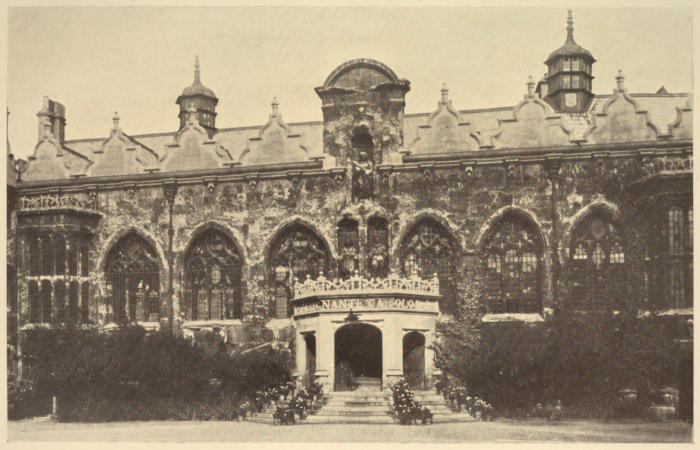
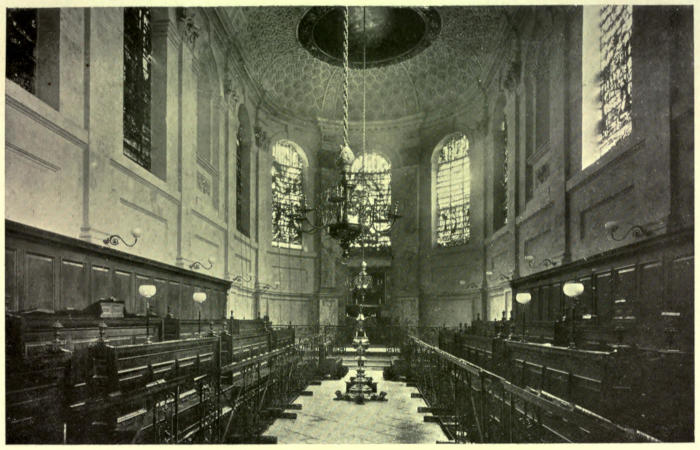
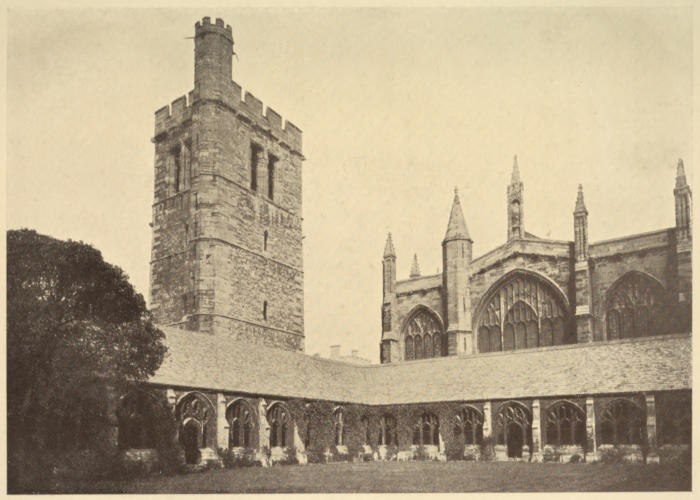
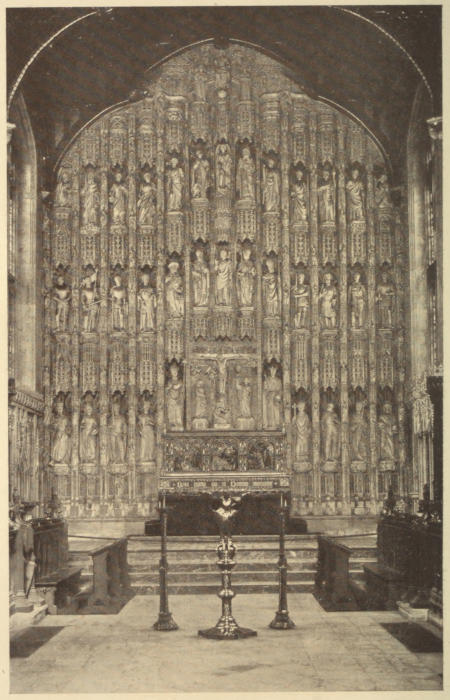
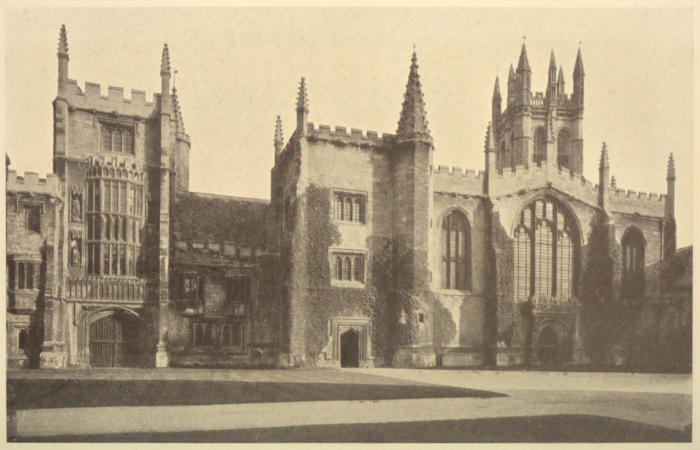
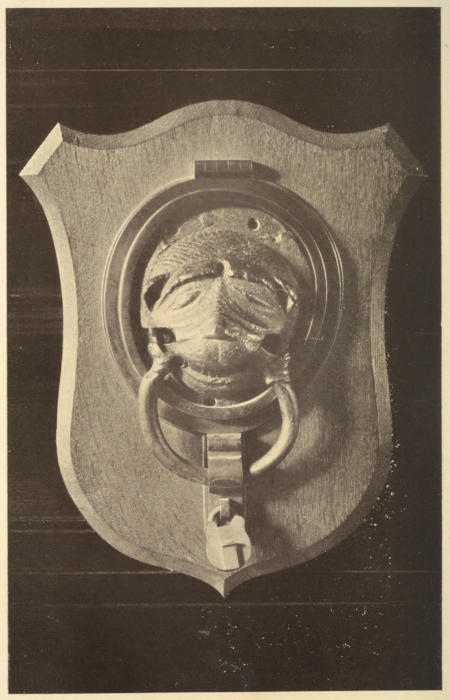
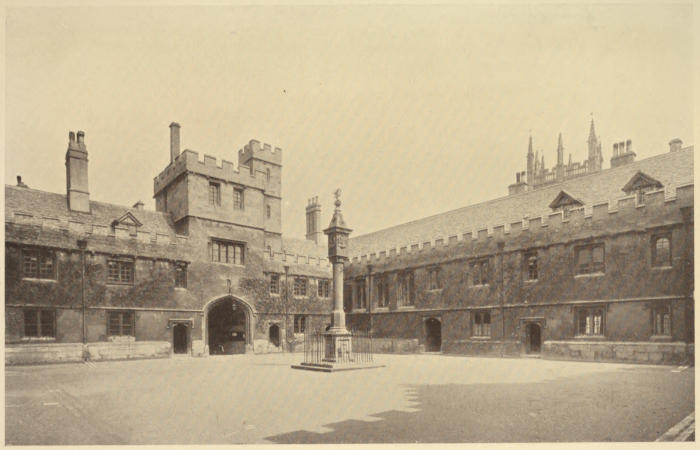
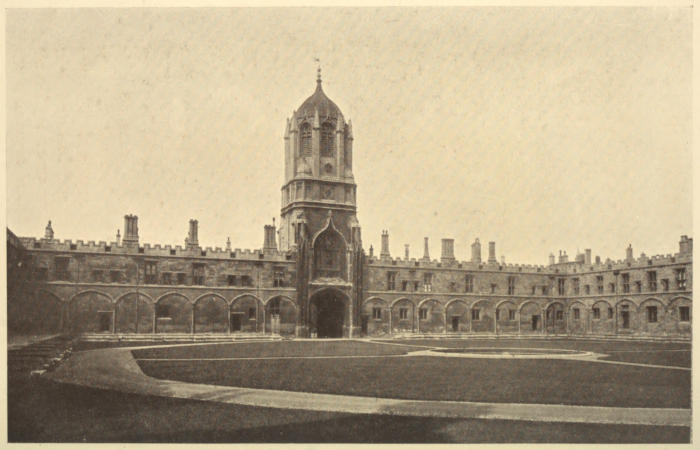
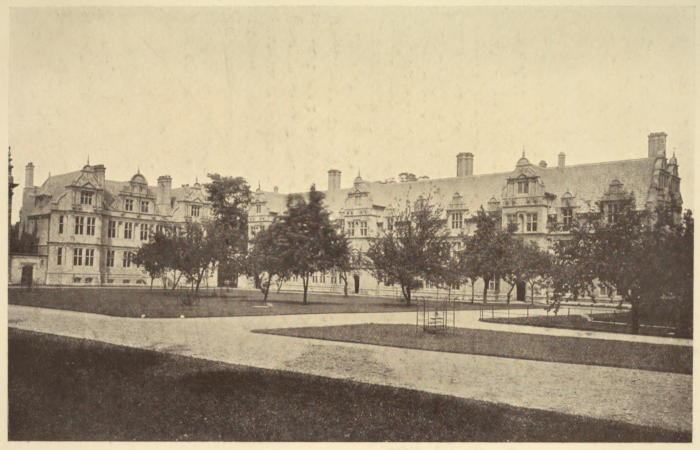
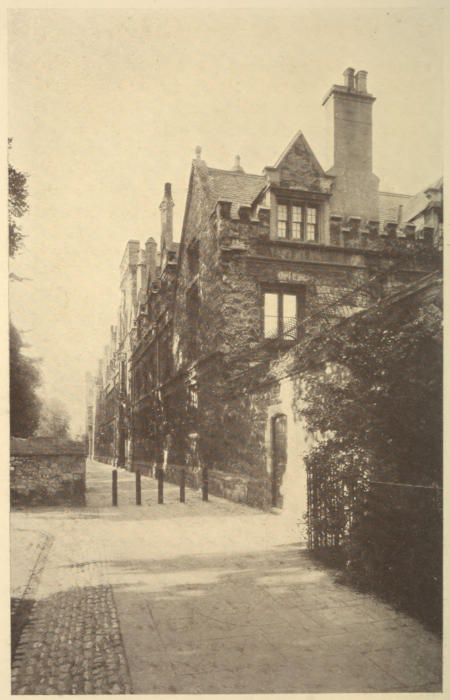
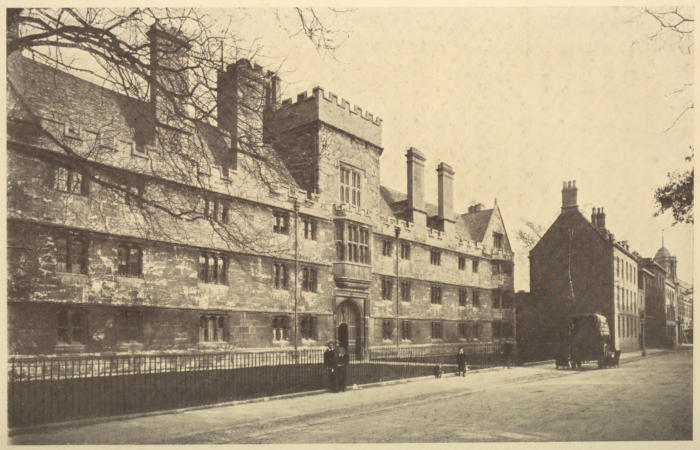
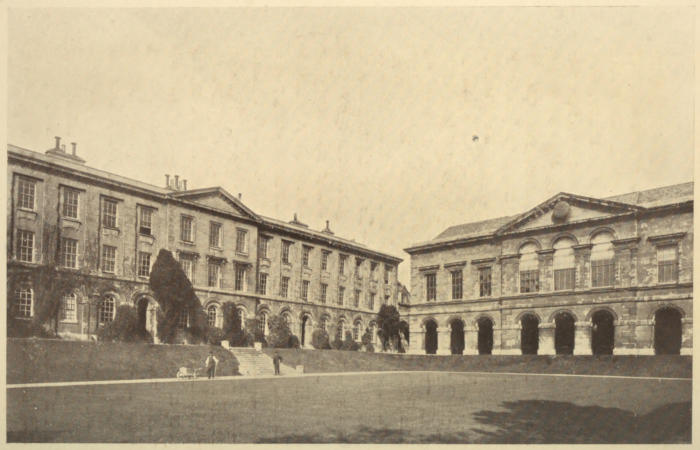
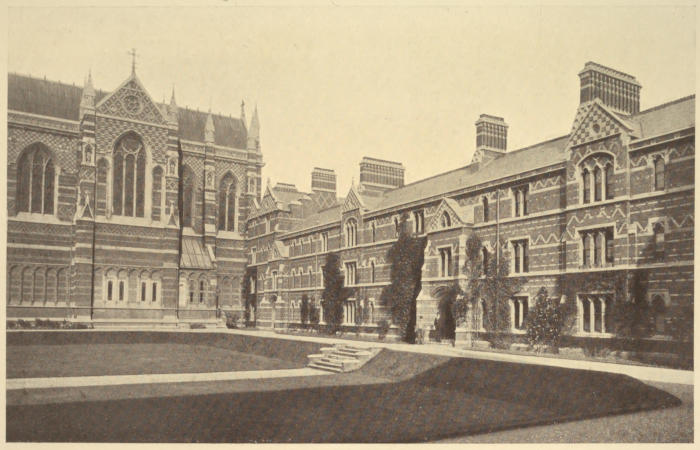
All the above are from photographs by Messrs. Hills & Saunders, Oxford.
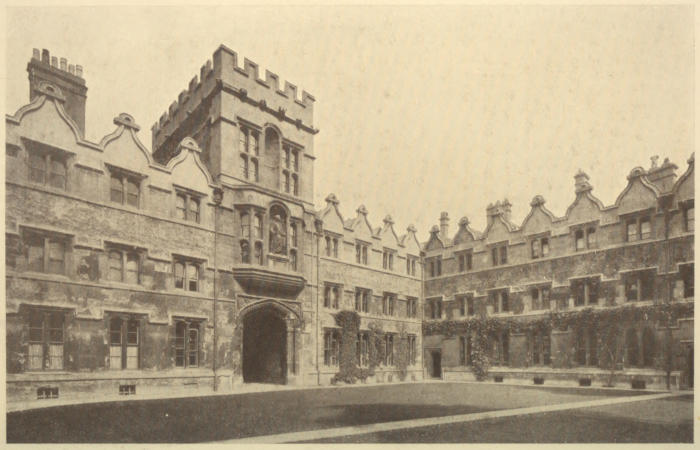
The Romance of the Oxford Colleges — UNIVERSITY COLLEGE
Founders and benefactors—Alfred the Great—William of
Durham—The Statutes—The conversion of Obadiah
Walker—Lord Herbert of Cherbury—Lord Eldon’s
examination in Hebrew—The screwing up of the
Senior Proctor—Shelley—A “Stinks Man”—His unpopularity
with the dons—His “printing freaks”—His
friendship with Hogg—His conversation with the
baby—His religious opinions—His publication of
“The Necessity of Atheism”—His expulsion.
It has often been asserted, but it has never
been proved, that University College was
founded by Alfred the Great.
The principal evidence for the statement
consists of a deed which is known to have been
forged and a quotation in Camden’s “Britannia”
from an alleged manuscript which cannot
be found and probably never existed. On
the strength of that testimony the Court of
King’s Bench ruled, in 1726, that Alfred was
the founder; but the judgment seems to have
been based upon sentiment rather than evidence.
“Religion,” it was argued by the
Fellows, “would receive a great scandal”
if the Court decided that “a succession of
clergymen” had, for many generations, made
the mistake of thanking the wrong benefactor
for their endowments. The Court was moved
by the plea and gave official sanction to the
legend; but history, as distinguished from
legend, recognises the founder in William of
Durham, who, dying in 1249, bequeathed
310 marks to the University for the benefit
of Masters of Arts studying theology. A
house was built for the students to live in
in 1253, and statutes for the governance
of the community were first drawn up in
1280.
UNIVERSITY COLLEGE.
[To face p. 17.
Fifty shillings a year was the stipend of a
student in those days, and the bursar received
a further five shillings a year for keeping the
College accounts. As rooms could then be
rented for 6s. 8d. a year, however, their condition
was less penurious than the figures
might seem to indicate. It was provided that
they should converse in Latin and comport
themselves “as becomes holy persons,” not
interrupting one another’s studies by “noise
or clamour,” and resisting the temptations of
such light literature as “Ballads or Fables
about Lovers”—with a good deal more, on
the same severe disciplinary lines, which one
need not trouble to recite.
The College, as Mr. Wells[1] states, “has
been famous in the history of Oxford rather
for the careers of its sons than for any movements
of which it has been the centre”; and
he might have added that the most notable
movement of which it has been the centre
was a movement for the expulsion of the
most illustrious of its sons.
[1] “Oxford and its Colleges.” By J. Wells (Methuen).
Other interesting things, no doubt, have
happened there. It was at University that the
junior members of the college resented the
conversion of their Master to Roman Catholicism
by chanting, outside his door, the
impertinent refrain:
“Old Obadiah
Sang Ave Maria,
But so would not I—a.
If you ask me for why—a,
I’d as soon be a fool as a knave—a”—
a course of conduct which must have been
very annoying to Obadiah Walker, and very
compromising to his dignity, if persisted in
for long.
It was to University, again, that Lord Herbert
of Cherbury brought a bride in his second
year of residence; “and now,” he writes in
his Autobiography, “I followed my book
more close than ever.” But this particular
stimulus to diligence in study is one with
which modern undergraduates must, as a rule,
dispense.
University, furthermore, was the scene of
Lord Eldon’s memorable examination in
Hebrew. “What is the Hebrew for ‘the
place of a skull’”? the examiner asked him.
“Golgotha,” he answered, and they let him
through, without even troubling him to translate
“Eloi, eloi, lama sabacthani” into
English.
At University, to continue, the Senior
Proctor—the “Big Shaver” as men called
him to distinguish him from his brother, the
Bishop of Liverpool, who is of smaller stature—awoke
one morning, some thirty years ago,
to find himself “screwed up.” He cut a
noble figure as he descended by a ladder into
the High, amid the encouraging cheers of the
populace; and the authors of the outrage were
not discovered until after the Master—the late
Dean Bradley, of Westminster—had sent the
whole College down.
Every one of these stories has its merits,
and some of them would be worth relating at
greater length if space allowed; but they all
seem trivial and local when set side by side
with the story of the expulsion of Shelley.
Shelley is not the only poet of whom the
College boasts. Father Faber, who believed
too much to please his College, was, curiously
enough, of the same household as Shelley, who
believed too little. So was Sir Edwin Arnold,
who is said to have found spiritual balm in
Buddhism, and so is Mr. Saint John Lucas,
whose conformity to the golden mean in
matters of faith may perhaps be inferred from
the fact that he was lately awarded a prize
for a poem on a sacred subject. But Shelley
was, of course, by far the greatest of the four,
as well as the only one of them who set the
dons deliberately at defiance.
His defiance of the dons, indeed, assumed
more forms than one, and the publication of
his notorious pamphlet, “The Necessity of
Atheism,” was, as it were, a last straw breaking
the back of a patience which had long
been too severely tried. So, at all events,
says Mr. Ridley, who was a junior Fellow at
the time, and so also says a Miss Grant, who
happened to be then on a visit to the Master.
“There were few, if any,” says Mr. Ridley,
“who were not afraid of Shelley’s strange
and fantastic pranks.”
“The ringleader,” says Miss Grant, “in
every species of mischief within our grave
walls was Mr. Shelley. He was very insubordinate,
always breaking some rule, the
breaking of which, he knew, could not be
overlooked.... He was slovenly in his
dress. When spoken to about these and other
irregularities, he was in the habit of making
such extraordinary gestures, expressive of
humility under reproof, as to overset, first the
gravity, and then the temper, of the lecturing
tutor.”
The dons would have been more than
human if they had liked an undergraduate
who received their admonitions in that style,
and they would have been in advance of their
times if they had been conciliated by Shelley’s
predilections for scientific study. His science
was of the crude, experimental sort which has
caused its devotees to be stigmatised as
“Stinks Men.” He charged the knob of his
door with electricity for the confusion of those
who tried to open it, and he demonstrated his
knowledge of chemistry by spilling a corrosive
acid on the carpet of a tutor who reprimanded
him. Naturally, therefore, authority
was disposed to seize the first handle that he
might give, and the first handle given was the
perverse pamphlet above referred to.
The pamphlet was not, of course, Shelley’s
maiden literary effort. While still at Eton,
he had written a “penny dreadful,” and found
a publisher willing to give him £40 for it;
and he had cherished the naïve hope of
achieving fame at a bound by the simple
device of bribing the reviewers. Of the staff
of the British Review in particular he had
written that they were “venal villains” who
might be relied upon, if well “pouched,” to
lavish the praise which he desired; and he
seems to have thought that £10, judiciously
distributed, would suffice to corrupt the whole
of Fleet Street.
Moreover, his literary ambitions were
smiled upon by a blameless and unsuspecting
father. Mr. Timothy Shelley, M.P., when
he brought his son to Oxford, took him to
the shop of Messrs. Munday and Slatter, booksellers,
in the High Street, and introduced him
to one of the partners.
“My boy here,” he said, pointing proudly
to the long-haired, wild-eyed youth—“my boy
here has a literary turn. He is already an
author, and do pray indulge him in his
printing freaks.”
Only a few months later, in that very
shop—— But we must not anticipate, but
must first present Mr. Thomas Jefferson Hogg,
also an undergraduate of University.
Hogg was Shelley’s most intimate friend—and,
indeed, practically his only friend—at
Oxford, and his “Life of Shelley” is our
principal authority for the incidents of
Shelley’s Oxford career. Trelawny speaks of
him as a hard-headed man of the world
who looked upon literature with contempt,
and he may have given that impression in
later life, when he was a Revising Barrister
and a Municipal Corporation Commissioner,
whatever that may have been. Even then,
however, he said that he regarded the Greek
language as “a prime necessary of life,” and
in 1810 he would have been remarked, not
only as an ebullient but also as a romantic
and chivalrous young man.
He and Shelley made each other’s acquaintance
by sitting next to each other in hall,
though Hogg assures us that “such familiarity
was unusual”—an interesting precedent for
the alleged rule that one Oxford man must
not presume even to rescue another from
drowning unless he has been introduced to
him. They fell into conversation on the
comparative value of German and Italian
literature, and, after hall, they continued
the discussion in Hogg’s rooms, and sat
up nearly all night over it. On the following
afternoon they met, by appointment, in
Shelley’s rooms—the typical rooms of a prehistoric
“Stinks Man,” furnished with “an
electrical machine, an air-pump, a galvanic
trough, a solar microscope, and large glass
jars and receivers,” and pervaded with “an
unpleasant and penetrating effluvium”; and
after that they were inseparable.
Their Oxford, it must be remembered, was
the early Oxford in which no games were
played. There was no “tubbing” in those
days, and no practising at the nets. Unless
men haunted the prize ring and the rat pit,
their one way of amusing themselves was to
walk and talk, and no sporting “shop” could
cast its monotonous shadow over their conversation.
The question whether the college
was more likely to bump or to be bumped
did not arise, and no man burdened his brain
with tables of “records” or “averages.”
The talk was about literature, about philosophy,
and, sometimes, about religion; and
daring young thinkers hammered out for
themselves a good many subjects in which
they were not called upon to be examined.
Shelley, as we have seen, began with literature,
but he soon got on to philosophy.
In particular he was fascinated by the Platonic
doctrine of the pre-existence of the soul—the
doctrine popularised in Wordsworth’s famous
“Ode on Intimations of Immortality from
Recollections of Early Childhood”; and he
proceeded, as one would expect a chemist to
do, to try, as it were, to test the doctrine by
experiment.
He snatched a baby, so Hogg tells us, out
of its mother’s arms, on Magdalen Bridge, and
while the mother clung desperately to its
swaddling clothes, in an agony of terror lest
it should be dropped into the Cherwell, he
gravely questioned her.
“Can your baby tell us anything about
pre-existence, madam?” he asked, in a
piercing voice and with a wistful look.
“He cannot speak, sir,” answered the
mother stolidly.
“Surely he can speak if he will,” Shelley
insisted, “for he is only a few weeks old.
He cannot have entirely forgotten the use of
speech in so short a time.”
But the mother was as firm as the poet.
“It is not for me to argue with college
gentlemen,” she rejoined, “but babies of that
age never do speak as far as I know”; and
with that she begged that her infant might
be returned to her before harm befell it, and
so the incident terminated.
The bearing of the baby story on the subject
before us is only indirect, but there is a
reason for telling it. It shows in what spirit
Shelley, as an undergraduate, approached
the profoundest problems of philosophy, and
there is no reason to suppose that the spirit
in which he approached the profoundest
problems of religion was widely different. Just
as he had got a “rise” out of the Oxford
matron, so he proposed to get a “rise” out
of the Oxford dons; and the dons being
clergymen, atheism was the obvious card
to play. A profession of atheism might fairly
be expected to affect clergymen as a red rag
affects a bull.
That he was not actually an atheist at this
time is as nearly demonstrable as anything
can ever be. The evidence is in his own
letters—not in one letter only, but in several.
“It is impossible,” he wrote, “not to
believe in the Soul of the Universe, the intelligent,
and necessarily beneficent, actuating
principle.”
“Can we suppose,” he asked in another
letter, “that our nature itself could be without
cause—‘First Cause’—a God?”
In these expressions, as they were not
written for publication, we may presume that
we see the real Shelley. But, on the other
hand—
1. Shelley, though not an atheist, fell short
of the contemporary standards of orthodoxy.
He had been reading Hume, and felt that the
current answers to Hume were insufficient.
2. Shelley had been conducting a philosophical
correspondence with his cousin,
Harriet Grove. The correspondence had been
broken off because his philosophical opinions
were unsatisfactory; and he was embittered,
being in love with his cousin, and regarded
himself as a persecuted martyr.
3. The temptation to exaggerate, and so
“pull the legs” of grave and reverend
seniors, was irresistible.
He began by writing, under an assumed
name, to strangers—the most grave and
reverend strangers whom he thought likely
to reply to him—submitting brief abstracts of
Hume’s arguments, and appealing for assistance
in rebutting them. If the person to
whom he wrote “took the bait,” says Hogg,
Shelley “would fall upon the unwary disputant
and break his bones.” Once, it is said,
by pretending to be a woman, he lured a
bishop into controversy, and handled him as
the impertinent have delighted to handle the
pompous from the beginning of the world.
It was splendid fun, he thought, but it would
be still better fun if he could “get a rise”
out of the Vice-Chancellor, the Proctors, the
Regius Professors, and the Heads of colleges
and halls. So, Hogg agreeing, he and Hogg
put their heads together, and “The Necessity
of Atheism” was produced, and advertised
in the Oxford Herald of February 9, 1811,
and copies of it were posted to several of the
dons, “with the compliments of Mr. Jeremiah
Stukeley.”
Nor was that all. There was the off-chance
that the dons, scenting a practical joke, might
ignore the outrage, and Shelley, avid of publicity,
was determined to compel them to take
notice. So he came down, with a bundle of
his pamphlets under his arm, to Messrs.
Munday and Slatter’s shop—the very shop in
which an indulgent parent had given out that
his “printing freaks” were to be encouraged.
He wished those pamphlets, he said, to be
offered for sale at sixpence each; he wished
them to be well displayed on the counter and
in the window; in order that the window
might be dressed properly, he proposed to
dress it himself.
He did so with an obliging readiness which
overwhelmed the amiable bookseller’s assistant.
In a minute or two “The Necessity of
Atheism” was displayed in Messrs. Munday
and Slatter’s shop, much as the first number
of a new magazine with a gaudy cover might
be displayed on one of the railway bookstalls
to-day.
It remained so displayed for about twenty
minutes; and then the Rev. John Walker, a
Fellow of New College, passed the shop,
looked into the window to see what new
publications had arrived, read the title of
Shelley’s pamphlet, and, after being surprised
and shocked, was moved to action.
He walked into the shop, demanded the proprietors,
and gave them peremptory instructions:
“Mr. Munday, and Mr. Slatter! What is
the meaning of this?”
“We beg pardon, sir. We really didn’t
know. We hadn’t examined the publication
personally. But, of course, now that our
attention is drawn to it——”
“Now that your attention is drawn to it,
Mr. Munday and Mr. Slatter, you will be
good enough to remove all the copies of it that
lie on your counter and in your window, and
to take them out into your back kitchen and
there burn them.”
Such was the dialogue, as one can reconstruct
it from Mr. Slatter’s recollections,
contained in a letter addressed to Robert
Montgomery, the poet.
Mr. Walker, of course, had no legal right to
give the instructions which he gave. From the
strictly legal point of view, he was ordering
a man over whom he had no jurisdiction to
destroy property which did not belong to him;
he would never have presumed to give such
orders in, say, Mr. Hatchard’s shop in Piccadilly.
At Oxford, however, his foot was firmly
planted on his native heath, and Messrs.
Munday and Slatter knew it. He might speak
to the Vice-Chancellor; and the Vice-Chancellor
might forbid undergraduates to deal
at their establishment. So they were all bows
and smiles and obsequious anxiety to oblige.
“By all means, Mr. Walker. An admirable
idea, sir! Just what we were ourselves
on the point of suggesting. You may rely on
us to carry out your wishes.”
“You will be good enough to carry them
out in my presence. I will accompany you
to your kitchen for that purpose.”
“That will be very good of you, Mr.
Walker. It will be a great honour to our
kitchen. Will you please walk this way, sir?”
So the holocaust was effected; and Messrs.
Munday and Slatter begged Shelley to call
on them, and told him what they had been
obliged to do.
“We are really very sorry, Mr. Shelley.
We really could not help ourselves. Mr.
Walker was so very firm in the matter; and
even in your own interest, you know——”
Et cetera. There was to be no further
publicity for Shelley through the instrumentality
of the booksellers; and as no one was
likely to trouble about the authorship of an
anonymous brochure which had been reduced
to ashes, that would have been the end of the
matter if Shelley had not circulated his
pamphlet through the post. But then he had
so circulated it, and the covering “compliments
of Jeremiah Stukeley” were very
obviously in his hand-writing; and the recipients
of the presentation copies, who included
every bishop on the bench, were saying that
something really ought to be done; and the
dons were not only willing but anxious, and
not only anxious but eager, to lay hold of
the handle which Shelley had given them.
He was a “Stinks Man,” and he was a
rowdy man; he made malodorous chemical
experiments, and he was impertinent when
he was “ragged.” The Senior Common-room
was not going to stand atheism or any other
nonsense from such a man as that. So
Shelley was sent for “with the Dean’s compliments”—those
compliments of evil omen—and
the rest of the story may best be told in
the words of that Mr. Ridley already quoted,
who is a less prejudiced witness than Hogg.
“It was announced one morning at a
breakfast party towards the end of the Lent
Term,” writes Mr. Ridley, “that Percy
Bysshe Shelley, who had recently become a
member of University College, was to be
called before a meeting of the common-room
for being the supposed author of a pamphlet
called ‘The Necessity of Atheism.’ This
anonymous work, consisting of not many
pages, had been studiously sent to most of the
dignitaries of the University and to others
more or less connected with Oxford. The
meeting took place the same day, and it was
understood that the pamphlet, together with
some notes sent with it, in which the supposed
author’s hand-writing appeared identified
with that of P. B. S., was placed before
him. He was asked if he could or would
deny the obnoxious production as his. No
direct reply was given either in the affirmative
or negative.
“Shelley having quitted the room, T. J.
Hogg immediately appeared, voluntarily on
his part, to state that, if Shelley had anything
to do with it, he (Hogg) was equally implicated,
and desired his share of the penalty,
whatever was inflicted. It has always been
supposed that Hogg wrote the Preface.
“Towards the afternoon a large paper
bearing the College seal, and signed by the
Master and Dean, was affixed to the hall door,
declaring that the two offenders were publicly
expelled from the college for contumacy in
refusing to answer certain questions put to
them. The aforesaid two had made themselves
as conspicuous as possible by great
singularity of dress, and by walking up and
down the centre of the quadrangle, as if
proud of their anticipated fate,”—and, in
modern times, they would doubtless have
driven to the station in triumph on the roofs
of hansoms, escorted by a long procession of
uproarious admirers, though, as it was, they
went away quietly on the coach.
That is all; for the subsequent picture of
Mr. Timothy Shelley, M.P., pursuing his
peccant son to his London lodging, sending
out for a bottle of port, and reading aloud
extracts from Paley’s “Evidences of Christianity”
while he drank it, belongs to
Shelley’s Life, but not to Oxford history.
Robert Montgomery, of Lincoln, who tried
to compensate by the piety of his sentiments
for his lack of distinction as a poet, has
recorded his opinion that the offenders
thoroughly deserved their punishment.
“Strange and unnatural as it may appear,”
he writes, “there are many in Oxford who
think that a University, based on the immortal
truths of the Gospel, ought not to license or
encourage blasphemy, however gilded by
genius.”
No doubt there are many, not in Oxford
only but elsewhere as well, who agree that
this limitation of the functions of Universities
is desirable. The general proposition, at any
rate, shall not be disputed here. Jowett himself,
an advanced thinker if the Church of
England ever included one, appears to have
endorsed it when circumstances brought him
face to face with an undergraduate who declined
to attend chapel on the ground that
he did not believe in a God. “If you do
not believe in a God by eight o’clock to-morrow
morning, you will be sent down,”
the Master of Balliol is said to have chirruped
on that occasion; and it is difficult
to applaud his keen sense of the necessity of
discipline and condemn that of the Master of
University.
It does not follow, however, that it is
necessary to take the grave Robert Montgomery’s
solemn view of Shelley’s offence.
His case was not that of the conscientious
and convinced blasphemer, but rather that
of a practical joker who over-reached himself
and accepted martyrdom rather than confess
that he had been joking. And that, one
concludes, was the view of those later dignitaries
of the college who permitted the erection
of a monument to Shelley within the
college precincts—albeit in a dark corner
of those precincts, only to be reached by
way of an obscure passage which looks as
if it led to a coal-hole wherein an unwary
visitor would run a serious risk of being
arrested and charged with loitering with intent
to commit a felony.
BALLIOL COLLEGE
The birching of Robert of Balliol by the Bishop of Durham—He
founds a College to make atonement for his fault—Insignificance
of the College in early times—Snell
Exhibitioners—Adam Smith—His scornful criticism of
Oxford—Southey—His introduction to Coleridge of
Jesus, Cambridge—Their joint dream of Pantisocracy—College
“rags” in the dark days—The dawn of
civilisation—Mastership of Parsons—Of Jenkyns—of
Jowett—Jowett as tutor—His reforms—His conversation—His
sermons—The inscrutable secret
which he guarded.
Balliol is the tangible and enduring product
of one of the most interesting of the abuses
(as Protestants esteem them) of the Roman
Catholic religion.
The story begins on the day on which
Robert of Balliol—a lord of many lands in
the North of England—“got drunk,” as the
chronicler puts it, “in a manner unbecoming
his station in life,” and insulted the Bishop
of Durham. It is resumed on the day on
which Robert apologised to the Bishop, and
consented to do penance. The Bishop then
“birched him in the presence of the populace
on the steps of the cathedral,” and sent him
forth with a tingling cuticle and an injunction
to make amends for his fault by spending
money on a benevolent undertaking. So he
hired a house for the accommodation of sixteen
poor scholars of Oxford, and allowed
them eightpence a day each for their expenses.
After his death, his widow, the Lady
Devorguilla of Balliol, bearing no malice
against the Bishop for his treatment of her
husband—having reason to know, perhaps,
that it had done him good—supplemented
the endowment by a further substantial
donation.
BALLIOL COLLEGE.
[To face p. 36.
Such were the picturesque beginnings of the
College in the reign of Henry III. Other
gifts and legacies enriched its chest from
time to time. The Snell Exhibitions connected
it with the University of Glasgow.
The Blundell Endowment introduced a
steady flow of scholars from Tiverton. But
the college remained unimportant. Its great
period—a period which began under the
mastership of Dr. Parsons and culminated
under the mastership of Benjamin Jowett—belongs
to the nineteenth century. Before
that time it has no history worth relating;
and the few great men who, by accident,
went there to be educated, owed nothing to
their tutors, but were left to educate themselves
as best they could.
Adam Smith, who was up from 1740 to
1746, was the greatest of them; and, if
Adam Smith’s ghost still haunts the Balliol
quadrangles, we may be quite sure that it is
an ungrateful and a growling ghost.
He was one of the Snell Exhibitioners
above-mentioned; and the Snell Exhibitioners
of the eighteenth century had a very uncomfortable
time. They came from Scotland;
and the College took Dr. Johnson’s view of
Scotsmen, regarding them as pauper aliens,
who ought to be repatriated, and “smugs,”
unfit to mix with civilised mankind. The
worst rooms in the college were invariably
allotted to them by the dons; and their weird
accents and barbarous dress were the subject
of the ribald mirth of undergraduates.
Things got, indeed, to such a pass, at one
time, that the Exhibitioners sent a formal
complaint to Glasgow, and Glasgow made
formal representations to the Master of the
College; but the Master’s answer was unsatisfactory
and curt. He said that he did
not particularly want the Snell Exhibitioners
at Balliol and would raise no objection if
they liked to transfer themselves to another
college. He even went so far as to suggest
that perhaps they would feel more at home
at Hertford; and as the hint was not taken,
his relations with them continued to be
strained.
Such was the tone of the college when
Adam Smith’s name was entered on the books.
The only friend whom he made there was
Douglas, afterwards Bishop of Salisbury, a
Snell Exhibitioner like himself. We know
little of the circumstances of his career except
that he habitually took tar-water as a
remedy for “an inveterate scurvy and shaking
of the head”; that undergraduates gibed
at him for his poverty, exhorting him to gorge
himself in the hall on the ground that his
long-delayed chance of eating a full meal
had come to him at last; and that a don
reprimanded him for reading Hume’s “Treatise
on Human Nature” and confiscated the
pernicious book. It is not much; but it is
enough to lead us to expect to find him
regarding his University with feelings of
disgust and contempt; and there is abundant
evidence that he did so.
Adam Smith, indeed, is a far more convincing
witness than Gibbon, who was at
Magdalen a few years after he had gone
down, of the deplorable state of learning at
Oxford in the eighteenth century. He was
older; he was longer in residence; he was
more anxious to learn. But he sought in
vain, he says, for “the proper means of being
taught the sciences which it is the proper
business of these incorporated bodies to
teach”; and his generalisation about the
college tutors is that “every man consented
that his neighbour might neglect his duty
provided he himself were allowed to neglect
his own.” Moreover he passed one criticism
on Oxford which is a delightful variant on
a more famous utterance of another Balliol
man of a later date.
Oxford, Matthew Arnold has told us, is the
home of “lost causes” and “impossible
loyalties.” Adam Smith said pretty much
the same thing, but he said it very differently,
speaking of the most venerable of our seats
of learning as “a sanctuary in which exploded
systems and obsolete prejudices find shelter
and protection after they have been hunted
out of every corner of the world.” The
sentiments are practically identical; and
there could be no more charming example
of truth changing its aspect as men change
their point of view.
The only other name which counts in the
annals of eighteenth century Balliol is that of
Southey, who was up in 1793.
He was by way of being a reading man;
but though the dark ages were almost over
and the dawn of civilisation was near at hand,
the College did little, if anything, to direct
his studies. “Mr. Southey,” said one of his
tutors in a burst of candour, “you won’t
learn anything from my lectures sir, so if you
have any studies of your own, you had better
pursue them.”
He did so. He rose at five in order to do
so, quickening his diligence with “negus.”
One suspects that he must have been drinking
negus on the morning of the day on which he
went on the river “in a little skiff which the
least deviation from the balance would upset,”
and “did not step exactly in the middle,”
with the result that “the boat tilted up” and
its occupant only saved himself from complete
submersion by clinging to the side of a barge.
The incident does certainly seem to give
colour to his reflection that “temperance is
much wanted at Oxford,” and that “the
waters of Helicon are too much polluted by
the wine of Bacchus.”
Nor did the studies pursued under the
cheering influence of matutinal negus belong to
the ordinary curriculum of the place. Southey
neglected his Aristotle. He preferred, he
says, “the brilliant colours of fancy, nature,
and Rousseau” to “the positive dogmas of
the Stagirite”; and though the Contrat
Social may serve as a substitute for the
“Politics,” the presumption is strong that
Southey preferred “La nouvelle Héloise”
which can by no means be regarded as a
worthy alternative to the “Ethics.”
We may let that pass, however; and we
may also let pass Southey’s denunciation of
the “waste of wigs and wisdom” which he
discerned among the dons and the “abandoned
excess” which he detected among those
undergraduates who did not rise early to
drink negus. The importance of Southey’s
Oxford career resides neither in these trifles
nor even in his refusal to have his hair
powdered by the college barber before sitting
down to dinner. The most significant thing
that happened to him was that he made the
acquaintance of a young man from a neighbouring
University—Mr. Samuel Taylor
Coleridge, of Jesus College, Cambridge, who
was introduced to him by a bookseller.
The young Cantab. and the young Oxonian
took to each other at once, and proceeded to
see visions and dream dreams in concert.
Rousseau and the Revolutionists, with their
cry of “Back to Nature!” and their belief
in the “perfectibility of the human race,”
appealed to their imagination and inspired
it. The world, they agreed, was weary of
the past. Why not escape from it? So they
sat in Southey’s rooms at Balliol—no doubt
with steaming tumblers of negus on the table—and
discussed the ways and means of doing
so.
America, of course, was to be the scene
of the experiment. They would cross the
Atlantic, and settle on the banks of the
Susquehanna—how could they fail to be
happy on the banks of a river with such a
melodious name? Land, they had been informed,
was cheap there. An American land
agent had offered to sell them some, and had
assured them that the danger alike from
buffaloes and from mosquitoes was much exaggerated.
So they would borrow money, and
get married, and go there. They themselves
would till the soil, and their wives should
“cook and perform all domestic offices.” It
would be delightful, Southey thought, “to go
with all my friends; to live with them in the
most agreeable and most honourable employment;
to eat the fruits I have raised, and
see every face happy around me; my mother
sheltered in her declining years from the
anxieties which have pursued her; my
brothers educated to be useful and virtuous.”
It came to nothing. The Pantisocracy, as
it was to be called, was never formed. Perhaps
“the females of the party” did not
take so kindly to the idea of cooking and
domestic offices—far away from bonnet-shops—as
had been expected; and there was, at
any rate, the difficulty that the capital required
was not forthcoming. But the dream was a
generous one and sheds a golden glamour on
the closing years of a dark age. Southey,
whether one cares about his poetry or not,
is the most engaging figure in eighteenth-century
Balliol.
The darkness of the dark age at Balliol
could be illustrated by many anecdotes of
many “rags.” On one occasion the Dean
was ragged—though it does not appear that he
was put on the bonfire, as once happened, in
quite recent times, to the Dean of an adjacent
college. On another occasion some Balliol
Jacobites celebrated the birthday of Cardinal
York by sallying forth into the streets and
ragging every notable Hanoverian whom they
met, including a Canon of Windsor, and
cheering for King James III.—an offence for
which, after the Master had let them off with
a Latin imposition, they were brought to trial
in the Court of King’s Bench, and sentenced
to two years’ imprisonment with hard labour.
It was exploits of that order, and not any
idle impulse to play upon words, which
first caused Balliol men to be spoken of as
Men of Belial. They were of frequent occurrence,
and the bad name which they gave
the College was not redeemed by any intellectual
distinction; but presently, in 1798,
Dr. Parsons became Master, and then a
memorable change began. Dr. Parsons organised
the tutorial system, and cast his vote
for throwing Balliol fellowships open to outsiders.
He also collaborated with the Provost
of Oriel and the Dean of Christ Church in the
institution of the Honours Schools, in which
firsts were presently taken by two very remarkable
Balliol men, Sir William Hamilton,
the philosopher, and J. G. Lockhart, the
author of the Life of Scott. And then
came Dr. Jenkyns.
Undoubtedly Jenkyns was a great man, as
much greater than Parsons as Jowett was to
be greater than himself. Judging him by
results, one is led irresistibly to that conclusion.
Yet how he managed to be so great, and
to accomplish such results, is a perplexing
puzzle; for among all the stories of him
which have been preserved there is hardly one
in which he does not cut a grotesque and
undignified figure.
There is the story, for example, of his
encounter with Blaydes of Balliol, who was
afterwards to change his name to Calverley.
Blaydes, it is said, was taking ladies over the
college, and wished to show them all the lions.
“That,” he said, pointing, “is the Master of
Balliol’s study window”; and he picked up
a stone and threw it. The missile went
crashing through the glass, and an angry
countenance became visible, glaring through
the aperture. “And that, I rather fancy,”
Blaydes continued calmly, “is the Master of
Balliol himself.”
Then there is the story of Jenkyns’s passage
of arms with Sir William Hamilton. Sir
William, it is related, coming hurriedly out
of his room, discovered Jenkyns listening at
the keyhole. Furious at this prying curiosity,
he clutched the spy by his coat collar, lifted
him over the balustrade, and held him
howling in mid-air. Then, having terrified
him sufficiently, he lifted him back again,
and apologised: “Good gracious, sir! I’m
so sorry, but I had no idea that it would
possibly be you!”
Finally, since there is no room for all the
stories, one may recall, on Jowett’s authority,
the story of Jenkyns’s comic sermon. He
gave out the text, “The sin that doth so
easily beset us”; and then he dropped into
bathos. “I mean,” he explained in severe
and acid tones, “the habit of contracting
debts.” The undergraduates looked at each
other and wondered. Had the Master
actually said this thing, or had he only seemed
to say it? They realised, at last, that he had
actually said it; and then, for the first and
only time in its history, the walls of the
College chapel shook with the inextinguishable
laughter of an insolvent congregation.
It was several minutes, Jowett tells us, before
the preacher could proceed with his discourse.
Decidedly it is not in anecdotes such as
these that the greatness of Jenkyns comes
out. But he took his position as Head of
a college very seriously, at a time when most
Heads of colleges preferred their wine, their
ease, or their theology; and he was an
astoundingly good judge alike of a competent
tutor and of a clever undergraduate. Hence
his success. The Balliol tutors, in his time,
were the best. They taught the men, with
rare exceptions, instead of worrying them
about “movements”; and the Balliol
scholarship became, at this time, the blue
riband for which the chief public schools most
eagerly competed. Presumably it is so still;
and it certainly was so when, after the colourless
interlude of Scott, Jowett succeeded to
the Mastership in 1870.
Jowett’s is the one name of supreme and
outstanding consequence in Balliol annals.
He was elected to a scholarship there from
St. Paul’s School in 1836; he was promoted
to a fellowship while still an undergraduate;
he became a tutor of the College
at the age of twenty-five; he continued to be
associated with its fortunes, without a break,
until his death in 1893. He not only did
more than any other man to make Balliol
just what Balliol is; he also aspired, as he
said, to “inoculate England with Balliol.”
In that ambition he succeeded, for Balliol
under Jowett was a nursery of almost every
kind of talent. Perhaps it was weak in
divinity—it was a Balliol man, according to
the story, who told the examiner that Gamaliel
was “a hill at the foot of which Paul was
brought up”—but it surpassed all the other
colleges in its “output” of statesmen, pro-consuls,
professors, and men of letters. Mr.
Asquith, Lord Lansdowne, and Lord Peel
are Balliol men; so are Lord Milner and Lord
Curzon. Balliol has largely staffed the Universities
of Scotland. At Jowett’s funeral
seven of the pall-bearers were Heads of
Oxford houses who had been at Balliol, and
the list of Balliol representatives in recent and
contemporary literature includes the names
of A. C. Swinburne, John Addington Symonds,
Mr. Andrew Lang, Mr. W. H. Mallock, Mr.
J. A. Godley, Canon Beeching, Mr. Anthony
Hope Hawkins, and the late G. W. Steevens—“the
Balliol prodigy,” as they called him—who
became a journalist and succeeded in
sounding a new note on the brazen trumpet
of the Daily Mail. One could easily extend
the list, but to what end? We have no need
of further witnesses.
Jowett, as the table of results proves, was
a great educator, and a great organiser and
director of education, but he was also something
more than that—a great personality,
who fought a hard fight and won it, wearing
down opposition and smiling down detraction.
He was not a particularly great scholar.
“Hullo! Another howler!” is said to have
been the refrain occasionally uttered automatically
in his presence by friends to whom
he submitted the manuscript of his translations
of Plato and Thucydides; and it was
maliciously said that his appointment to the
Regius Professorship of Greek was a case of
the “endowment of research”—a pecuniary
inducement held out to him to learn the language.
Nor was he a great philosopher, or,
in spite of “Essays and Reviews” and the
Commentary on the Epistle to the Thessalonians,
a great divine. But he was, nevertheless,
emphatically a great man, who grew
into a great institution. One could not hear
of Oxford without hearing of him; one could
not live at Oxford without feeling that his
presence pervaded it. He was, in the end,
the very genius loci, and one would no more
have spoken disrespectfully of him than of
the Equator.
It is said to have been Mrs. Grote who
christened him “the cherub.” His bust in the
Bodleian certainly looks like the bust of a
cherub, and the sound of his voice was like a
cherub’s chirp. It gave one the impression of
an innocent man who had never known anything
of the passionate temptations which distract
the young, and for whom all the riddles
of the painful earth could be solved, without
reference to such passions, by the dry light
of intellect alone. He seemed to come down
to breakfast from a higher plane of thought—an
intellectual tribunal before which his
guests were summoned, and from which there
was no appeal. He was criticism—as a rule
destructive criticism—incarnate. His praise
was approbation from Sir Hubert Stanley; his
blame could make the cleverest man feel a
fool.
It followed that he could not be widely
popular. Criticism, especially if it be
unemotional, is not very popular as a literary
art, and is still less popular as a social accomplishment;
and though, if we may believe the
biographers, the Master was not really unemotional,
he generally contrived to seem to
be so, being, in fact, very shy, and very much
afraid of his emotions. One may think of him
most justly, perhaps, as a man full of the
milk of human kindness, but profoundly
conscious that milk makes a mess when it boils
over, and firmly resolved to prevent that
catastrophe by keeping it in a refrigerator.
He gave generously out of his later abundance,
and with a positive shrinking from advertisement.
But he did not suffer fools gladly,
and he could even snub the deserving, if they
gave him the opportunity, in the knock-down
style of Dr. Johnson.
Nor was he an equally sound critic of all
kinds of intellectual promise. He divined,
for instance, the potentialities of Mr. Asquith,
but failed to discern those of Mr. Andrew
Lang. “Asquith is sure to succeed, he is so
direct,” was his verdict on the former; but to
the latter, as Mr. Lang has himself recorded,
he tendered the advice: “Don’t write as if you
were writing for a penny paper.” And there
is a story of a scholar of the eighties, now an
eminent teacher of youth, who shall be nameless
here, who suffered even more severely
at his hands.
It was at breakfast, and the conversation
flagged, as it was a little apt to do when parties
of undergraduates breakfasted with the
Master. The scholar tried to stimulate it by
a literary remark which he hoped might give
the silent Master something to talk about.
“Master,” he ventured, “I have been reading
Matthew Arnold’s poems, and I think he is
a great poet.” There was a dead silence
while the company waited for the Master to
follow up the theme. “We all think so, Mr.
X.,” he piped in his high treble, and it was
felt that he could not have blanketed the
conversation more effectively if he had left
the room, slamming the door behind him.
“If you have nothing more sensible to say
than that, you had better be silent altogether,”
is another of his recorded repartees to some
one who remarked upon the weather; and one
could make a long list of similar retorts of
deadly finality behind which the Master entrenched
himself. He probably did not know
how much they hurt, but fought, not aggressively,
but in self-defence, being sensitive,
and fearing to be drawn, having a lively recollection
of cases in which men had tried to
draw him by arguing, in their weekly essays,
in favour of atheism or anarchism, or setting
any other sort of pitfall into which it would
be pleasant to see one in authority stumbling.
At all events men seem to have accepted his
severe rejoinders in that spirit, and to have
had too profound a reverence for his high
intellectual standards to resent their rude
practical application. If they did not suffer
a rebuff from him gladly, at least they suffered
it, as something inherent in the mysterious
nature of things, something the reason for
which might thereafter, if they were patient,
be revealed to them.
For Jowett was not only a great man, but
also, like most great men, a great enigma.
Many wondered, and perhaps no one ever
knew, how he reconciled his position with his
conscience. He had subscribed to the Thirty-nine
Articles of the Church of England, and
then he had disproved them, or a good many
of them, and then he had subscribed to them
again. He had attached no condition to his
second subscription of them except the simple
one, “if you will give me a new pen.” There
was also a story current, though it is probably
untrue, as it is also told of Theodore
Hook, of St. Mary Hall, that he offered to
sign forty Articles if the signature of thirty-nine
did not suffice.
Why did he do these things? What
remnant of belief remained to him after he
had done them? By what chain of argument
was he bound to his office as a clergyman
of the Church of England? Those were the
problems posed, but he would have been a
bold man who ventured to press the Master
for the solutions.
His chief interests, at this stage, indeed,
were rather practical than speculative. He
gave large house parties of people who had
succeeded in life. He bought an organ, and
arranged for the Balliol Sunday evening concerts.
He shortened the chapel services, saying—or
so it is said—that if one could praise
God adequately in half an hour, it was an
absurd waste of time to devote three-quarters
of an hour to the proceeding. He allowed
Oxford to have a theatre—a thing forbidden
by the pious wisdom of the men of old. He
quoted “sat prata biberunt,” and negotiated
for the drainage of the Oxford swamps.
He also preached, of course, and his
sermons were always interesting, and sometimes
pleasingly satirical, as when he smote
Renan and Farrar with a double stroke, expressing
his desire to read a Life of Christ
which should be neither “sentimental” nor
“picturesque”; but it could hardly be said
that they settled the vexed question of his
personal attitude towards the creeds which he
recited without taking them too seriously or
the formulæ which he manipulated with a
sort of spiritual sleight-of-hand.
Possibly he argued that, as no clergyman
ever believed all the Articles of the Christian
Faith, one clergyman had as good a right as
another to pick and choose among them. Or
he may have felt that for a man to quit the
Church merely because he had demonstrated
some of its propositions to be erroneous was
as ridiculous as for a doctor to take down
his brass plate merely because he had
discovered a new treatment of a disease at
which the old-fashioned practitioners shook
their heads. But, if that was his view, he
never uttered it, preferring to go his own way,
possessing his own soul and guarding his own
secret.
One could almost see him guarding it;
so that our last glimpse may be of a quaint-looking
little old man in evening dress trotting
through the parks in that unusual costume
on a Sunday afternoon: an arresting figure,
with venerable white hair, a beautifully fresh
pink face, and the seal of inscrutable mystery
on his forehead.
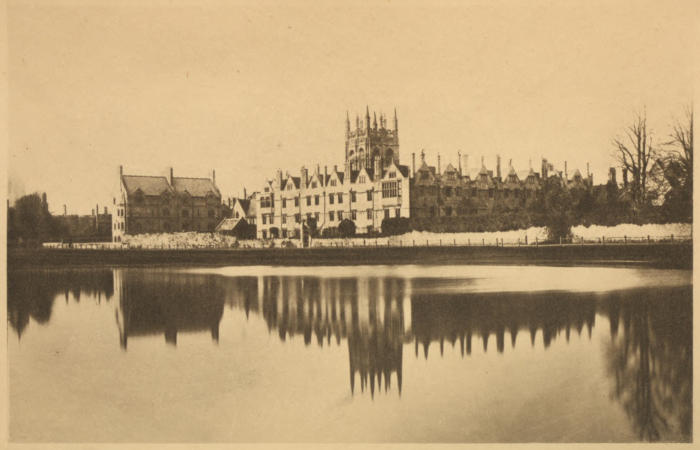
MERTON COLLEGE
Antiquity of Merton—The model of subsequent foundations—Friction
between the University and the town—The
great “town and gown row” of 1354—The scholars of
Merton save the University—The wardenship of Sir
Henry Savile—The visit of Queen Elizabeth—Oxford
during the Civil War—Queen Henrietta Maria at
Merton—How Merton ceased to be a reading college—Scandalous
proceedings in the gardens—Mandell
Creighton and Lord Randolph Churchill.
Though in this work, as in the Oxford University
Calendar, Merton stands third among
the colleges, there is a sense in which the
first place may be claimed for it. Both
University and Balliol got their endowments
at a slightly earlier date, but Merton was the
first College to be launched, in 1264, a year
before the meeting of the first English Parliament,
as a self-governing corporation.
The bequest of William of Durham, which
resulted in the foundation of University, was
in its origin merely a pension fund, and John
of Balliol, in the first instance, only paid for
the support of scholars in a hired house.
Walter de Merton, on the contrary, began at
once to build and to legislate, and his Statutes
were the model of the Statutes of subsequent
foundations, not only at Oxford, but at Cambridge
also. The founder of Peterhouse, the
first of the Cambridge colleges, expressly
decreed that the Peterhouse students were to
live according to “the rule of the scholars
of Merton at Oxford.”
It follows that the history of Merton is
more closely connected than that of any other
college with the earliest turmoils—which were
many; and the historian of Merton may properly
begin with a glance at those brawls
which a later civilisation came to know as
“town and gown rows.”
Discord between the town and the University
began as soon as the University became
important and powerful, and it owed its origin,
not to incompatibility of temper between
undergraduates and bargees, but to the mutual
jealousies of conflicting jurisdictions, ill-defined
and therefore liable to clash. Nowadays,
of course, the object of the authorities
on both sides—the police on the one hand
and the proctors on the other—is to keep the
peace between the combatants. In the Middle
Ages the seniors were as pugnacious as the
juniors, and joined as ferociously in the
affrays.
Theoretically it was the function of the
town to prevent, or punish, breaches of the
peace by townsmen, while the University had
a similar responsibility with regard to
breaches of the peace by gownsmen; but
when townsmen and gownsmen fell out, each
authority resented the interference of the
other. That was one cause of friction, and
further friction occurred in connection with
disputed points of sanitation and hygiene. The
gownsmen objected to the sale of stinking
fish and to the brewing of beer from water
contaminated by sewage; the townsmen
thought the objection fastidious, and were
very angry when the University appealed to
the King to interfere with these time-honoured
customs. Hence constant bickerings, and a
frequent exchange of abusive language; hence
ultimately open war and that bloody Battle of
Saint Scholastica’s Day, in which the townsmen
found the scholars of Merton their most
formidable foes.
The trouble began in a tavern, on February
10, 1354. Some scholars who were
drinking there found fault with the wine, and
the vintner said that it was quite good enough
wine for them. The scholars then threw the
wine at the vintner’s head, and the vintner
called his friends and neighbours to the
rescue. They rang the bell of the Church
of Saint Martin at Carfax, and the populace,
summoned by that tocsin, shot at the scholars
with bows and arrows. The Chancellor of
the University—the Lord Curzon of Kedleston
of his epoch—appeared upon the scene, ingeminating
peace where there was no peace,
and he also was shot at. Then the bell of
the University Church of Saint Mary began to
ring, and the gownsmen gathered, and the
mêlée became general and lasted until the
setting of the sun. No one was killed; the
gownsmen got the best of it, and the Chancellor
supposed that the riot was over. He
issued a proclamation bidding the scholars
go to their lectures as usual on the following
day.
They went, but found the townsmen lying
in wait for them. Reinforcements—two
thousand peasants carrying an ominous black
flag—had swarmed into the city from Cowley,
Headington, and Hinksey. The Carfax tocsin
pealed out a second time, just after the
dinner hour, and the tocsin of Saint Mary’s
responded as before. The townsmen, with
their bucolic allies, not only assailed the
scholars in the streets, but pursued them into
their lodgings, inns, and halls, beating down
the doors with improvised battering-rams,
killing all the gownsmen they could catch,
and stealing or destroying all the property
that they could lay their hands on.
The Friars came out, carrying their huge
crucifix and chanting their Litany, to try to
compose the strife, but their intervention was
in vain. They themselves became the objects
of the popular fury, and one scholar was struck
down even while clinging to the crucifix.
Other scholars were followed into the churches
and massacred at the foot of the altar. Dead
bodies were flung on to dunghills, the
wounded were hailed to prison, and even
torture was not spared. “The crown of some
chaplains,” says the chronicler, “viz., all the
skin so far as the tonsure went, these diabolical
imps flayed off in scorn of their clergy.”
At last the University could resist no more.
The gownsmen began to flee into the country—all
save the scholars of Merton. These had
their solid walls behind which they could
retire. Withdrawing to their college, while
the town triumphed without—the sole representatives
of learning in a deserted city which
the Bishop had laid under an interdict—they
waited for the day of vengeance and redress
of grievances.
It came. The King sent down a special
commission to investigate the matter. The
Mayor of Oxford and his bailiffs were sent
to prison; the sheriff was removed from
office; and presently the town was further
humiliated by the bestowal of fresh privileges
upon the University authorities. They
thenceforward, and not the townsmen, were
to decide whether fish stank, and if they
decided that it did, they were to send it to
the hospital for the consumption of the sick.
In addition to this privilege, they were to
receive pecuniary compensation for the
damage done in the riot, and their supremacy
was in various other ways established on a
firm constitutional basis.
Merton, that is to say, saved the University
at an hour when, but for Merton, the townsmen
would have wiped it out, and its clerks
would have been dispersed over the face of
the country.
As Merton was, through the scenes above
described, the first college to be interesting,
so, too, it was the first college to rise to
conspicuous dignity, and enjoy the glories of
a golden age. The supreme position achieved
by Christ Church towards the end of the
eighteenth and by Balliol in the middle of
the nineteenth century, was won by Merton
in the reign of Queen Elizabeth, under the
Wardenship of Sir Henry Savile, and at the
time when the founder of the Bodleian Library
was a Fellow of the College.
It may be that Savile’s name has not
echoed down the corridors of time quite as
loudly as the names of some other Oxford
men; but it is kept alive by the Savilian Professorships,
and one may fix his position fairly
well by saying that he was at once the Jowett
and the Liddell of his generation. He was,
that is to say, a great scholar and a great
teacher; a great innovator and a man of
great personal prestige; a link between the
academic world and the world of action; the
sort of man whom kings delighted to honour.
Elizabeth honoured him, and so also did
James I.
It was Savile who entertained Elizabeth on
her visit to Oxford in 1592. He presided
over the disputations held in her honour in
Saint Mary’s Church, and delivered a ringing
panegyric on her reign with the inevitable
reference to the British triumph over the
Armada: “Tuis auspiciis Hispania Anglum
non vidit nisi victorem, Anglia Hispanum nisi
captivum.” It was after enjoying his hospitality
at Merton that her Majesty, as she rode
away, paused on Shotover, and “looking wistfully
towards Oxford,” said: “Farewell, farewell,
dear Oxford! God bless thee and increase
thy sons in number, holiness, and
virtue!”
Elizabeth furthermore made Savile Provost
of Eton—an office which he held concurrently
with the Merton Wardenship. She gave him
the office in spite of the fact that the Statutes
reserved it for clergymen, and that Savile
was a layman. He suggested to her Majesty
that Statutes could not bind a sovereign, and
her Majesty agreed with him, and it was while
he was Provost of Eton that he entertained
James I. and was made a baronet.
The Fellows of Merton of those days were
already far removed from their early condition
of “poor scholars.” They could hold
their own at Court, and were well qualified
to serve their country as ambassadors. Elizabeth
sent one Merton man as Ambassador to
Madrid, and another to Venice, Switzerland,
and France; but the College did not lose touch
with learning because it had gained touch with
affairs. Sir Thomas Bodley, as all the world
knows, returned from his travels to found the
library which bears his name, and Savile
assisted in the preparation of the Authorised
Version of the Bible, produced an edition of
St. Chrysostom which cost him £8,000, and
founded the Professorships of Geometry and
Astronomy in order that the multitude might
no longer think “that the most useful
branches of Mathematicks were spells and her
professors limbs of the devil.”
He is said to have been a “very severe
governor”—one whose students “hated him
for his austerity.” He preferred the plodding
and persevering to the brilliant. “If I would
look for wits,” he said, “I would go to Newgate.
There be the wits.” And there is a
story of his own assiduous devotion to his
studies, which probably illustrates the attitude
of a good many homely wives towards learned
husbands.
“He was so sedulous,” we read, “at his
study that his lady thereby thought herself
neglected, and coming to him one day as he
was in his study, saluted him thus: ‘Sir
Henry, I would I were a book too, and then
you would a little more respect me.’ Whereto,
one standing by replied, ‘Madam, you must
then be an almanack, that he might change
every year.’ Whereat she was not a little
displeased.”
Those were the great days; but the times
were to be more exciting when the Civil War
broke out, and Oxford, after the battle of
Edgehill, became the Royalist headquarters,
garrisoned by the royal troops, surrounded
by fortifications which townsmen and gownsmen
helped to build, and beleaguered, more or
less—at first rather less than more, but finally
rather more than less—by the Parliamentary
forces under Fairfax, who threw a bridge over
the Cherwell, near Marston, and mounted a
battery on Headington Hill.
One cannot pause to tell that story at
length, or draw that picture in detail; but
a stray fact or two will indicate what Oxford
in general and Merton College in particular
then looked like.
Soldiers were, of course, encamped wherever
there was room for them. The New
College cloisters were turned into an arsenal,
and a powder factory was established at
Osney. New Inn Hall was the mint at which
the College plate was being melted down and
coined into money. A line of earthworks ran
from Folly Bridge across Christ Church
Meadows. Parliament—the Royalist section
of Parliament, that is to say—met in the
House of Convocation. Prisoners of war were
stowed away, and very nearly starved, in the
castle in which Queen Maud had once been
beleaguered by King Stephen. Charles I.
held his Court at Christ Church, and Queen
Henrietta Maria held hers at Merton, the two
royal apartments being connected by a secret
passage.
It followed, therefore, that Merton was the
centre of the light side of war. The Warden,
Nathaniel Brent, was a Parliamentarian, and
was absent, acting as Judge-Marshal in the
Parliamentary Army; William Harvey, of
Caius College, Cambridge, the discoverer of
the circulation of the blood, was thrust into
his place; and Merton, having accepted him
under protest, lived joyously, doing its best
to entertain the Queen and her ladies, who,
on their part, did their best to be gracious to
Merton. “Tota Academia morbo castrensi
afflicta” is one Mertonian’s summing up; but
that is a grumbler’s unkind way of putting it.
Regiments of University men were raised.
They did good service, but they could not
always be fighting. They sallied, and raided,
and cut up convoys, and then returned to
their headquarters; and, on their return,
the dust-soiled warriors were received by
smiling ladies in the Merton Gardens or the
Christ Church Broad Walk, or listened, with
the ladies, to concerts in the college chapels,
or played in a masque in one of the college
halls for their diversion.
It was a glorious time—a time when gaudily
apparelled boys swaggered about with the
assurance of men and the sincere conviction
that the only life worth living was the life of
the gallant who fought the King’s enemies
in the morning and made love to the Queen’s
ladies at night. But it was not a time at
which students could be expected to mind
their books; and the habit of study, when
once lost, is not easily recovered. Amid the
clash of arms Merton ceased to be a reading
college, and circumstances conspired to prevent
it from reverting to that character until
after the lapse of many generations.
Three later royal visits—two by
Charles II. and one by James II.—may
be supposed to have operated unfavourably
to study; and another cause of deterioration
can be detected in the measures which the
College took for the relief of its pecuniary
embarrassments. A resolution was passed to
the effect that the presence of poor men in
the College should be discouraged, and that
preference should be shown to postulants who
were willing to present the College with
silver tankards and subscribe heavily to the
replenishment of the College Library.
The plan served its purpose. The Merton
plate-chest was soon full to overflowing, and
the shelves of the Merton library were also
filled. But the College had, in the meantime,
become a College of rich men, bent upon
amusement rather than profit, and more eager
to kindle material bonfires in the quad than
to hand on the metaphoric torch of culture.
Perhaps it has, by this time, lived down
that reputation, but it certainly retained,
and even nursed it, long after most of
the other colleges had begun to take life
seriously.
In the eighteenth century, indeed, one does
not expect to find the age anything but
dark; but even in that scandalous period
Merton was distinguished by a special
scandal of its own. Ladies of more charm
than reputation came to Oxford in large
numbers in those days, and the gardens of
Merton were their favourite haunt. Their
presence there has been celebrated alike in
verse and prose. The prose censor rudely
complains of “that multitude of Female Residentiaries
who have of late infested our
learned retirements”; while the poetical
satirist exclaims:
“In vain his tutor with a watchful care
Rebukes his folly, warns him to beware,
Aspire above the common Merton crowd,
The vain, the lewd, the impudent and proud.
Beauty at Oxford is a thing so scarce
That all thy panegyrick turns to farce.”
From which state of things there resulted
“imprudent marriages”—and worse—with the
result that sleepy authority at last awoke to
what was going on, and locked the garden
gates.
The locking of the garden gates, however,
did not in itself suffice to make Merton a
hive of industry, or even a home of order;
and legends of stormy occurrences within its
walls continue to be frequent until a comparatively
recent date. “All that I can say,
gentlemen,” said the Warden, Dr. Marsham,
on one occasion, haranguing the undergraduates
in hall—“all that I can say is,
that if you want to behave like barbarian
savages, why—ahem! ahem!—you should
come and ask leave first”; and an authentic
story relates that Dr. Mandell Creighton, the
late Bishop of London, was once, while an
undergraduate, “employed to fetch in after
dinner a supply of penny whistles and other
musical instruments, armed with which, with
tea-trays as drums, making the most horrible
din, and letting off squibs and crackers as
they went, the undergraduates marched round
and round the Fellows’ quad.”
And, if Creighton did these things, what
may we suppose to have been done by Creighton’s
pupil, the late Lord Randolph Churchill?
That is a delicate subject on which Lord
Randolph’s biographers do not as a rule say
more than is strictly necessary; but there
is at any rate one story of his undergraduate
days which it seems right to tell, because the
delightful audacity of the future leader of the
Fourth Party is foreshadowed in it.
Lord Randolph, it is said, was once “sent
for” to be “ragged,” whether for cutting
lectures or for some other offence against
discipline. He was received by an indignant
don, who began to deliver stern expostulations
from the hearthrug, on which he stood,
warming his back at the fire. In the heat of
self-justification Lord Randolph advanced
boldly, and the don, intimidated, shrank away.
As the interview was approaching its conclusion,
another undergraduate, who had also
been summoned to the presence, knocked and
entered. He found Lord Randolph on the
hearthrug, with his coat-tails comfortably
drawn up, delivering a vehement harangue,
while the don cowered submissively in a
corner of the apartment listening to him.
Remembering that story, we cannot wonder
that Lord Randolph is still a hero with the
rising generation of the College which educated
him so imperfectly that when, as
Chancellor of the Exchequer, he was confronted
with some decimal fractions, he had
to send for a permanent official to tell him
“the meaning of those d—d dots.”
EXETER COLLEGE
The West Country College—A Whig College—“Debauched
by a drunken governor”—Eminent Alumni—“Parson
Jack”—His bout at fisticuffs—Garibaldi’s
Englishman—His prowess on the river—James
Anthony Froude—His innate Protestantism—The
burning of his “Nemesis of Faith”—Burne Jones and
William Morris.
Exeter is the College for whose founder’s
soul the author of this work is particularly
bound to pray; and he hereby renders grateful
homage to the memory of the Bishop of
Exeter and Lord High Treasurer of England
in the sorry reign of Edward II., whose benefaction
he enjoyed in the character of a
Stapledon scholar. If he says but little about
Walter de Stapledon, that is because there
is little to be said, except that he was a good
bishop and a King’s man who lost his head
in the King’s cause, being charged with the
defence of London when the King fled to
Wales, with the result that he was seized by
the mob and brought to the block in Cheapside.
EXETER COLLEGE: FELLOWS’ GARDEN.
[To face p. 70.
His period was one in which it was thought
proper to combine the patronage of learning
with the patronage of a particular locality.
He wished the scholars, and also the Fellows,
of his College to be taken from the counties
of Devon and Cornwall; and his patriotic
injunctions were faithfully observed until the
University commissioners interfered, happily
leaving a certain number of West Country
scholars, but condemning the West Country
fellowships to extinction. The last of the
West Country Fellows was the Rev. Charles
Boase, who piloted the present writer through
the ceremony of matriculation, and concerning
whom a statistician with a pencil once
computed that he talked in the course of
a single evening, on sixty-seven learned
subjects, ranging from the Chemistry of
Agriculture to the Philosophy of the Unconditioned.
Commoners, however, have followed where
scholars led the way; and Exeter has always
been recognised as the particular College of
West Countrymen. Even the connection between
Blundell’s School, Tiverton, and Balliol
has not broken down its claims to this distinction.
In “Westward Ho” we find Frank
Leigh, as a matter of course, sent there from
the Bideford Grammar School; and one of
the characters in “Tom Jones” went there,
equally as a matter of course, from Taunton,
in the dark days in which the College was
reputed to be given over to “nothing but
drunkenness and duncery.”
The College was, at that melancholy period,
known, equally with Merton, as a Whig
College; and one of the rectors is said to
have carried democratic principles to the
point of marrying the daughter of the College
cook. It distinguished itself, at one of the
borough elections, by inviting Whig voters not
only to pass through the College quadrangle
on their way to the poll, but also to taste the
College beer while passing. For several days,
it is said, the Hall was filled with “a smoking,
drinking, expectorating crowd,”—a spectacle
which it is indeed difficult to conjure
up in the decorous circumstances of contemporary
academic life.
But let that pass. The interest of a college—of
Exeter as of any other college—depends,
not upon the proceedings of the vulgar
herd, but upon its association with names
which have left a trail of glory behind them.
In the days when Exeter was, as Wood says,
“debauched by a drunken governor,” and
in the days immediately before and immediately
after that deplorable debauchery,
the most conspicuous Exeter names are hardly
names which the plain man recognises at the
first glance; but the nineteenth century introduces
names worthy of remark in more than
one department of endeavour.
Let “Parson Jack” come first.
To students of the Clergy List he is the
Reverend John Russell, Perpetual Curate of
Swymbridge. To the West Country he is
“Parson Jack”—the hunting parson who kept
the hounds and defied the Bishop who bade
him give up keeping them: a man, no doubt,
of more energy than intellect, but a clergyman—he
would not have thanked any one
for calling him a priest—whose parishioners
carefully minded what he said, holding, it
may be, that so good a judge of a horse must
be an equally good judge of a religion.
Parson Jack won no laurels for his College
in the schools, being contented with a pass
degree; but it is said that the supper-party
at which he bade the College farewell was
the noisiest supper-party ever given within
College walls, and that, as this chronicler
knows, is saying a good deal. For, if he had
not distinguished himself at his books, he
had at least distinguished himself with his
fists, in circumstances graphically described
by his biographer.
A certain gentleman-commoner named
Gordon, addicted to the society of out-college
men, had, it appears, been boasting in hall
of the superior prowess “with the gloves” of
some friends of his at Christ Church. A
certain Denne, lately from Eton, withstood
him, saying: “Bring your three best men
from Christ Church to my rooms, and if they
can only stand up in a fair set-to against
three of Exeter, we’ll give your heroes full
credit for all you say of them, but not till
then.”
Such a challenge, of course, could not be
declined; and while Gordon was accepting it
on behalf of his out-college friends, Jack
Russell, overhearing the conversation, rose
from his place and volunteered his services.
“Don’t forget me, Denne,” he said. “I’ll
be one of the three, mind that, and the sooner
we meet the better.”
So the meeting was arranged, and the result
of it may best be given in the words of
Russell’s biographer:
“Russell was deputed to open the ball,
the antagonist selected to meet him being the
second best of the Christ Church lot. It was
a brisk set-to while it lasted, but evidently a
one-sided affair from beginning to end; for
Russell’s long reach, and quick, straight blows,
which fell with tremendous thuds on his
adversary’s visage, brought the trial to a close
in little more than ten minutes.
“The latter, admitting himself over-matched,
then declined the unequal contest;
while Russell, self-reliant and still “fresh as
paint,” refused to take off his gloves, calling
stoutly for the next man to come on. Denne,
however, interposed, and would have his turn;
going in first with No. 1, then No. 3, and
finally polishing them both off with as much
ease as if they had been two old women.
“‘Now,’ said Russell, addressing Gordon
aside, ‘I think you had better take your
three fellows home; and don’t make such
fools of them again.’”
Another hero who flourished at a slightly
later date in the same field of prowess as
Parson Jack was James Whitehead Peard.
He had “the shoulders of a bull,” and when
he played his part in one of those town and
gown rows of which mention has just been
made in the account of Merton, the town, with
one accord, fled before him. He was to
become Colonel Peard, to distinguish himself
in a revolution in Italy, and to be known
to the whole world as Garibaldi’s Englishman.
At Exeter, however, he was principally a boating
man. He rowed against Cambridge; and
at a time when, as the Rev. J. Pycroft has
related, “the dons held the boat in abhorrence
and considered any man belonging to it as
keeping rather questionable company,” he insisted
that rowing was not only a manly but
a moral recreation.
In proof of his claim, he submitted the
rules of the Boating Club to Mr. Richards,
then a tutor, and afterwards the Rector, pointing
out that they forbade to men in training
the indulgences which one is accustomed to
couple in the pentameter line of elegiac verse
as “Bacchus et alma Venus.” Whereupon
Mr. Richards fell upon him crushingly.
“Exactly,” he said, “as I have always
maintained. These rules show plainly and
are a written confession of the wild character
of the men for whom you can anticipate the
necessity of such fines; no decent men would
want such rules.”
Let us hope that modern boating men, at
all events, are virtuous by instinct and need
no laws to keep them so; and then let us
cull a few other Exeter names, illustrious in
other fields.
James Anthony Froude was elected a
Fellow of Exeter from Oriel, in the days when
the Tractarians seemed likely to succeed in
their great task of turning Oxford upside
down. More brilliant than industrious in
those days, he had only taken a Second; but
he had the clean-cut intellect which “penetrates
through sophisms, ignores commonplaces,
and gives to conventional illusions
their true value,” and it was inevitable that,
while looking for his way in life, he should
come into violent collision with the Obscurantists.
He did so on at least two notable
occasions.
He began life in the shadow of his brother’s
greater name and of the expectation that he
would adopt his brother’s point of view and
echo his brother’s opinions. Richard Hurrell
Froude—a most imperious and dictatorial
personage—had bullied him into seeming acquiescence
in his doctrines. For the time
being he presumably believed that he believed
in them; and his vivid literary gifts marked
him out as an ideal contributor to Newman’s
projected series of “Lives of the Saints.”
Newman wanted to establish the continuity
of miracle within the Church; and he regarded
Froude as a man credulous of
miracles, and a dialectician capable of making
out a good case for them. His instructions
to his contributors were, not to try to find
out whether the alleged miracles had really
happened or not, but, in effect, to accept as
many of them as a man could swallow without
making himself too conspicuously ridiculous.
Froude accepted the commission; and there
is no reason to doubt that he accepted it in
good faith. The truth, however, was too
strong for him; the evidence was too weak;
and he had a turn for biting irony which he
could not suppress. Saint Neot was his
subject, and he ended his study with the remarkable
sentence: “This is all, and perhaps
rather more than all, that is known of the
life of the blessed Saint Neot.” It was as
if he had played a practical joke on Newman;
and there were those who considered that to
play practical jokes on Newman was almost
as bad as laying a profane hand on the
Ark of the Covenant. Newman himself
was almost certainly of that opinion; but
Protestantism “will out,” and Froude was
a Protestant in grain, and was to become
something more than a Protestant when he
matured.
He first matured into a deacon of the
Church of England; but that meant nothing.
The College Fellows of those days took orders
as normally as they took their degrees, and
without making more ado about it. There was
no more a question of a “call” to be a
shepherd of souls than of a “call” to be a
Master of Arts. In travelling so far, Froude
was only travelling the common road. The
desire to divagate from it did not come to
him until later; and, even so, no one would
have troubled much about his divagations if
he had not chosen to divagate in print.
Like most of the other “honest doubters,”
however, he could not keep his honest doubts
to himself. He wrote and published “The
Nemesis of Faith,” and then the fat was in
the fire. The publication cost him his fellowship,
and the book was burnt. The latter
incident is famous, and has been magnified
by legend. The belief prevails that there
was a solemn and formal auto da fé under
the direction of the University authorities.
There was, in fact, only a private display of
theological temper on the part of the Rev.
William Sewell.
Sewell, afterwards the founder of Radley
School, was a High Churchman, encompassed
by all the limitations of that intellectual
state. He was also a discursive lecturer
who stood with his back to the fire,
and made Aristotle’s “Ethics” or Virgil’s
“Georgics” an excuse for propounding his
opinions on matters of topical interest. He
did not set out to talk about “The Nemesis
of Faith,” but came to talk of it by accident,
and then proceeded to denounce it with the
vigour of a Quarterly or Saturday Reviewer.
Finally he inquired whether any member of
his audience possessed a copy of the book.
One of them admitted that he did.
“Then bring it here, sir,” thundered
Sewell.
It was brought; and Sewell stripped off
the binding, tore the pages across, pitched
the mutilated volume into the flames, and
stood over it, thrusting at it with the poker
until it was burnt to ashes.
Such was the actual occurrence, as related
by Mr. Boase, who was present at the lecture
at which it took place. There was no public
holocaust, but only a spasmodic explosion
of wrath on the part of a single excited
theologian. The act, however, gained
piquancy from the fact that Froude was
Sewell’s colleague. The witnesses went out,
and told what they had seen; and the story
lost nothing in the telling. In after years, as
we have seen, some of them recovered their
historical consciences and reduced it to its
true proportions; but, at the moment, they
indulged their mythopœic faculties to their
hearts’ content, and erected an enduring
edifice of romance on a scanty foundation of
fact.
And Froude, at any rate, had to go.
The Rector and the Fellows asked him
whether he would prefer to resign or to be
turned out; and he elected to resign. The
Visitor of the College—the Bishop of Exeter—applauded
their action; and Froude’s father,
the Archdeacon of Totnes, “conceiving,” as
Mr. Herbert Paul puts it in his Life of
Froude, “that the best remedy for free
thought was short commons, stopped his son’s
allowance.” Such was the message to him
of “the last enchantments of the Middle
Ages.”
Time passed. R. D. Blackmore, the immortal
author of “Lorna Doone” took his
degree at Exeter in the forties. He and
Charles Reade, of Magdalen, of whom more in
due course, are without dispute the two greatest
novelists whom Oxford has yet produced;
and there shall be no attempt here to prove
that either of them was greater than the
other. Has it not been written that, to a
West Countryman, “Lorna Doone” is
“almost as good as clotted cream”? Did
not the author reply that he was too fond of
clotted cream not to be gratified by the compliment,
but also too fond of it to admit
that any book whatever could successfully
challenge comparison therewith? He was a
modest man, however—so modest that hardly
anything is known of him; and as no stories
of his quiet passage through Exeter have been
preserved, we may pass on to our next interesting
names, which are those of William
Morris and Edward Burne Jones.
They came up in 1853; and Morris’ biographer,
Mr. J. W. Mackail, has given a good
deal of offence by his supercilious account of
the internal condition of Exeter at that period.
Himself a Balliol man, he appears to take
the view that outside Balliol there is no
academical salvation.
That is a proposition which we need not
turn aside to discuss at any length. It is
neither to be desired nor to be expected that
all the colleges of the University should resemble
each other like peas in a pod; and it
is not to be denied that there are some
functions which Balliol fulfils better than
Exeter. It dry nurses its men with more
success, takes greater pains to make them
conform to a type, and then lays itself out
to magnify the type to scale. The result is
conspicuous in the higher ranks of the most
efficient Civil Service that the world has ever
seen. It is an excellent system for its purpose;
but it has its limitations, and is not
equally suitable for all men, as even Jowett
recognised.
Jowett doubted whether, if a poet came
to Balliol, Balliol “would be able to hold
him.” But Balliol held Swinburne; and the
real danger is rather lest Balliol should turn
a poet into a Judge of the High Court, or a
stiff and starched Permanent Under-Secretary.
Perhaps it would be a good thing for
many poets to be thus transfigured; but it is
not good for all of them; and it would not
have been good for William Morris. What
Morris wanted was to be left alone and not
worried by pastors and masters who “generalise”
and try to compel exceptional men
to walk in conventional paths. Whatever may
be the case now, Exeter was, in no distant
past, a College in which a man might go his
own way without excessive admonition; and
William Morris was indubitably one of the
successes of the system.
His tutor described him as “a rather rough
and unpolished youth who exhibited no special
literary tastes or capacity but had no difficulty
in mastering the usual subjects of
examination.” The opinion which he, on his
part, entertained of tutors generally was not
more flattering. “The name of ‘don,’” says
his biographer, “was used by him as a
synonym for all that was narrow, ignorant,
and pedantic.” But the dons did him a good
turn, though neither he nor they knew it at
the time, by not going out of their way to
disturb his view of them, their interests, and
pursuits.
Except for Burne Jones, indeed, he had
hardly a friend in his own College. With the
reading men and with the uproarious men—and
Exeter has always had its share of these—he
had equally little in common. Men called
him “Topsy” on account of his uncombed
woolly head of hair; he accepted the nickname
and was not to be driven by it into
tidiness. Art, and beauty, and antiquities,
were the things which interested him; and
Oxford was for him, not a seat of learning,
but “a vision of grey-roofed houses, and a
long, winding street, and the sound of many
bells.”
His rooms were in Hell Quad, and his
favourite diversion was talking. Burne Jones
tells how, on one occasion, “Morris came
tumbling in and talked incessantly for the
next seven hours and a half.” Most of his
talking, however, was done at Pembroke,
where he had two great friends: Faulkner,
the mathematician who is said to have been
ploughed in Divinity for including the Prophet
Isaiah in a list of the Twelve Apostles, and
Dixon, afterwards Canon Dixon, the pre-Raphaelite
poet. He paid his tribute to the
influence of his ecclesiastical surroundings by
talking of devoting his entire private fortune
of £900 a year to the foundation of a
monastery; but he happily was wise in time.
And presently his friends discovered his
genius, though the dons did not.
“He’s a big poet,” Burne Jones one day
exclaimed.
“Who is?”
“Why, Topsy.”
So he took his degree, and went down;
and the rest of his career does not concern
us, except for the beginnings of his association
with Dante Gabriel Rossetti, who was
brought up to Oxford to decorate the ceiling
of the Union Debating Hall. He and Morris
and Burne Jones were always together in
Rossetti’s rooms in George Street; and a
fourth member of their coterie was Swinburne
of Balliol, the poet whom Balliol
“held.”
They talked and talked interminably. Their
talks were the beginning of that pre-Raphaelitism
which was, in due course, to develop
(or to degenerate) into the Æsthetic Movement;
and the most picturesque incident of
their alliance took place when they set out
together to accept an invitation to dine at
Christ Church.
Morris, who had with difficulty been persuaded
to dress for the banquet, happened
to remove his hat, and it was then discovered
that the connection between art and letters
was symbolised by an enormous daub of blue
paint on his hair. But for that accident, and
the hurried visit to the barber which followed
it, he would have sat at high table, illuminated
like a saintly figure in a missal or a stained-glass
window.
ORIEL COLLEGE
Foundation by Adam de Brome—Butler and his “Analogy”—Causes
of the efficiency of Oriel—The “Noetics”—Eveleigh—Coplestone—Whately—The
Tractarians—Who
started the Tractarian Movement?—What did
the Tractarians want?—The logical weakness of their
position—The attitude of the bishops—The stampede
to Rome—The honest doubters—Matthew Arnold and
Arthur Hugh Clough—Cecil Rhodes at Oriel.
Edward II.’s almoner, Adam de Brome,
obtained his charter for the foundation of a
new College at Oxford in 1324. Originally
called the House, or Hall, of the Blessed
Mary at Oxford, it took the name of Oriel
from La Oriole—a tenement included in the
premises. Among its endowments was included
the advowson and rectory of the
Church of St. Mary—a fact of which we shall
perceive the importance as we proceed. It
was a small College, and a poor one, but it
was to have its hour of signal intellectual
pre-eminence, though not until the early days
of the nineteenth century. Before that time
the noteworthy names are scarce.
ORIEL COLLEGE.
[To face p. 86.
The most noteworthy of them all, if one
could be sure of one’s facts, would be that
of Sir Walter Raleigh. Sir Walter is said to
have been an Oriel man, and one likes to
think that he was—if only to furnish an Elizabethan
Oriel precedent for Cecil Rhodes; but
the proofs offered are inconclusive. Of the
undisputed alumni of the darker ages the
greatest was Bishop Butler, of the “Analogy”—a
precedent, perhaps, if one is looking for
precedents, for those Oriel “Noetics” of
whom we shall have to speak; but Oriel owes
more to Butler than Butler owed to Oriel. He
is a witness—like Gibbon of Magdalen and
Adam Smith of Balliol—to the inefficiency
of Oxford teaching in the eighteenth century.
“We are obliged,” Butler wrote, “to mis-spend
so much time here in attending frivolous
lectures and unintelligible disputations that
I am quite tired out with such a disagreeable
way of trifling.”
He also threatened to leave Oxford and
migrate to Cambridge, though, as the historian
of Oriel writes, “it saves the blushes
of an Oxonian to reflect that the migration
was never carried out.” That is all that can
be said, however, for that is all that is known;
so we will leave Butler, and hasten on to the
really interesting epoch.
The fame of Oriel, at the time when Oriel
was famous, depended upon the distinction
of its Fellows. The Statutes allowed more
latitude to the electors there than at most of
the other colleges. They were not restricted
in their choice to their own men, to their
founders’ kin, or, except in the case of a
few specific fellowships, to candidates from
particular counties. A few happy selections
made the tuition exceptionally efficient. The
reputation for efficiency attracted a steady
supply of good men. The attraction was the
greater because the electors chose for themselves,
on principles of their own, and were
but little, if at all, influenced by records of
successes gained in other examinations. The
ideal man for them, they said, was a man
whose mind was “an instrument and not a
receptacle”; and they often, for that reason,
preferred men who had taken seconds to men
who had taken firsts, and their preference
was generally justified by developments.
Whately, Newman, Matthew Arnold, Arthur
Hugh Clough, and Richard Hurrell Froude
all took seconds, and became Fellows of
Oriel.
An Oriel fellowship became, in that way,
like a Balliol scholarship, the real “blue
riband” of the University. It marked a
man, not as a precocious scholar, but as
an intellectual force—a man who was expected
to make his mark on thought. Oriel,
in consequence, came to be recognised as a
great intellectual centre—the seething source
of the new ideas which Oxford would presently
diffuse through England. That was the great
and golden age of the Oriel Common-room.
It began under Provost Eveleigh, who was
jointly concerned with the Master of Balliol
and the Dean of Christ Church in the institution
of the Honours Schools. It continued
under Coplestone, who resigned to become
Bishop of Llandaff in 1826. It came to an
end, some time in the forties, under Hawkins.
The golden age, however, ought really
to be divided into three golden ages,
which ran into each other, but must here be
glanced at separately. The first period is
that of the so-called “Noetics,” who had
Whately for their prophet and leader. The
second is that of the Tractarians—the period
when the influence, first of Keble and then of
John Henry Newman, was paramount. The
third, following on the secession of some
of the Tractarians to Rome, and the defeat,
so far as Oxford was concerned, of those
who remained in the Church of England, may
be called the period of the Honest Doubters.
The names belonging to it, which all the
world knows, are those of Clough and
Matthew Arnold. First, then, of the
“Noetics.”
The word “Noetic” has gone out of use.
Our own generation hardly knows what it
means; and perhaps its meaning was not
very precise, even when it was bandied freely.
If we render it “Intellectuals”—with a
capital I—we shall get as near to it as
we need to go; but we must also remember
that the Noetics flattered themselves on being,
above all things, logicians. It was a common
saying, in the Oxford of their time, that the
Oriel Common-room “stank of logic.”
Provost Eveleigh, whom we have mentioned,
was not exactly a Noetic himself, but
it was his policy which brought the Noetics
together at Oriel. He was the first Provost
who insisted that the College should make a
proper use of its freedom in the choice of
Fellows. The tendency of the times was to
use that freedom to serve the ends of private
friendship, and bring clubbable and convivial
men together. Eveleigh took the line that
intellectual distinction was of more account
than good manners or geniality in social intercourse.
There were those who said that, by
doing so, he made the Oriel Common-room a
bear-garden; but that is only a way of saying
that it focussed heat as well as light.
Coplestone, afterwards Bishop of Llandaff,
Hampden, afterwards Bishop of Hereford,
Whately, afterwards Archbishop of Dublin,
Arnold of Rugby, Hawkins, presently to be
Provost, Baden-Powell, Savilian Professor of
Geometry—these are the principal Noetic
names. They formed no definite school of
thought; they had no common body of
doctrine. Some of them were more noetic
than others, and one or two of them ended by
relapsing into reactionary ways. Some of
them, again, were very polished, while others
were very rough diamonds. But they were,
all of them, very clever, and knew it, and
liked other people to know it. They brought
the dry light of logic to bear upon ecclesiastical
and other conundrums. Liberals in
theology, equally contemptuous of High
Church aridity and oleaginous Evangelicanism,
they liked to express their Liberalism
in terms of robust and aggressive common
sense.
Arnold and Whately are perhaps the only
two of them whose names now live; and
Arnold, of course, made his fame elsewhere
than at Oxford. Whately, however, was a
tutor at Oriel for a considerable time, and
afterwards became Principal of St. Alban
Hall. He was a Bohemian of Bohemians, an
eccentric of eccentrics, the least donnish of
dons, and the most carelessly defiant of all
academical etiquette. The Provost of Oriel,
who hated tobacco, was once shocked to discover
him on the roof of Oriel, smoking a
cigar among the leads.
In costume, too, as well as in conduct,
Whately outraged the prejudices of his fellow-men.
It is related that, when there were holes
in his archiepiscopal silk stockings he neither
bought new ones nor sent the old ones to be
darned, but tried to conceal the deficiencies by
affixing black sticking-plaster to his calves.
At a time when other dons were never seen in
Christ Church meadows except in cap and
gown, he walked there in his ordinary attire—described
as consisting of “pea-green coat,
white waistcoat, stone-coloured shorts, flesh-coloured
stockings.” He took a number of
dogs with him on his walks, and trained them
to climb trees and drop into the Cherwell;
and when Coplestone accompanied him, as
he sometimes did, that very dignified man was
quite appalled by his proceedings.
“Whately,” said Coplestone in a pained
tone, “really forgot himself during our walk
this afternoon; he actually, while in sight of
other passengers, picked up a stone and threw
it at a bird.”
In the lecture-room, again, Whately’s deportment
was all his own. He lectured, lying
on his back, on a sofa, with his legs dangling
over the end of it, puffing a large pipe. It
was in that attitude, no doubt, that he
delivered himself of his famous aphorism that
“woman is a creature that cannot reason and
pokes the fire from the top”—an alleged
example, of course, of definition per genus et
differentiam. As for his deportment at the
breakfast-table, it is recorded that “he would
scatter tea-leaves over the table while he
talked, and made rings on the tablecloth with
the wet bottom of his teacup”; while an
account of his demeanour in drawing-rooms
may be borrowed from Mr. Tuckwell’s
“Reminiscences of Oxford”:
“I remember,” Mr. Tuckwell writes, “my
mother’s terror when he came to call. She
had met him in the house of newly-married
Mrs. Baden-Powell, who had filled her
drawing-room with the spider-legged chairs
just then coming into fashion. On one of
these sat Whately, swinging, plunging, and
shifting on his seat while he talked. An
ominous crack was heard; a leg of the chair
had given way; he tossed it on to the sofa
without comment, and impounded another
chair.”
It was while Whately was a tutor of Oriel
that Newman was elected a Fellow, and the
two men saw a good deal of each other.
Newman, in those days, might have been
described, as Lord Morley during his Lincoln
days has been described by one of his unauthorised
biographers, as “somewhat of a
mooning evangelical.” He had lately been
converted, in strict accordance with the evangelical
programme; and Whately decided to
take him in hand, wake him up, and teach
him to think for himself. He did so, though
with results quite different from those which
he anticipated; for he was not other-worldly
enough for Newman. Newman thought that
he lacked spirituality and inwardness—that
he had too much common sense and too large
an appetite. He preferred the influence of the
saintly Keble and the “bright and beautiful”
Richard Hurrell Froude; and so he set out,
first as a disciple, presently as a leader, on
the long, straight road to Rome.
This brings us, of course, to the Tractarian
Movement; and we will glance, though space
hardly suffers us to do more, at the part which
Oriel played in it.
Keble, Newman, Pusey, Richard Hurrell
Froude—those are the great Oriel names in
this connection, though Pusey, at the time
when he joined the alliance, had left Oriel
and become a Canon of Christ Church.
Keble, if one may draw invidious distinctions,
was the saintliest of them, Newman the most
eloquent, Pusey the most learned, Richard
Hurrell Froude the most energetic. But for
Pusey’s learning, the Movement might never
have taken seriously; but for Froude’s
activity, it might never have been started.
Whether Froude had any firm intellectual
grip on religious problems may be questioned;
but there can be no disputing that he
was a very strong man, and a very practical
man, and a man who descended into the fray,
filled with the joy of battle. He reminds one,
a little, mutatis mutandis, of the “boss” in
American politics, directing and controlling
the “machine.” “Here,” one seems to hear
him saying, “is something movable—let us
have a Movement. Here is a ball—let us
set it rolling.” And he did set the ball rolling,
and it continued to roll, long after his
premature death, at the age of thirty-three,
had saddened his fellow-workers.
The Church, as it seemed to this little company,
was being assailed by dangers, alike
from without and from within. It was neither
sufficiently respected nor sufficiently worthy of
respect. Erastianism and Indifferentism were
in the air. There was a tendency, among
Churchmen as well as laymen, to regard the
Church, not as a Catholic Apostolic institution
of Divine origin, but as “a branch of the
Civil Service.” Bishops had been mobbed
in the riots which attended the passing of
the Great Reform Bill. A Liberal Statesman
had presumed to warn bishops to “set their
house in order.” Superfluous bishoprics in
Ireland—bishoprics supported at the expense
of a conquered people who did not want
them—were being suppressed; and that act
of justice and common sense was the “last
straw.” Keble thundered at justice and
common sense as “national apostasy.” His
thunder was the signal for the Movement,
and its first overt act.
What, then, did the Tractarians want?
The complete definition of their aims must
be left to theological controversialists, and
a layman can only presume to sketch the
roughest outline of their objects.
They insisted, in a general way, that the
Church of England was the creation, not of
Parliament, but of God—that it was the duty
of the State to recognise the Church, and do
it homage, and back it up, but that these
obligations carried with them no corresponding
right to dictate to the Church, or to interfere
with it in any way. In doubtful matters
of doctrine the Church must decide and the
State must accept its decisions. The Church
was the repository of truth, guaranteed by
apostolic succession, the sole interpreter of
the teaching of the Bible, and of its own
traditions and formulæ; and the true interpretation
of those traditions and formulæ was—the
interpretation which John Keble, John
Henry Newman, Edward Bouverie Pusey, and
Richard Hurrell Froude chose to give them.
The logical weakness of the position was
obvious. The Tractarians were not the
Church, but only members, more or less
worthy, of the rank and file of the Church.
Oriel College had no more right than Exeter
Hall to define the doctrines of the Church.
The doctrines of the Church had been defined,
once for all, by Act of Parliament; and there
was no authority within the Church empowered,
even by ecclesiastical law, to define
the definitions. It needed a secular tribunal
to “dismiss hell with costs,” as other English
Churchmen were presently to discover; and
a Church possessing the authority which the
Tractarians thought that a Church ought to
have was only to be found at Rome.
In due course the most logical of them
realised that fact and ’verted. They only
worked their way slowly, however, to their
conclusion; and, in the meantime, remaining
within the Church of England, they engaged
in vigorous propagandism. Their views were
spread partly by the famous Tracts from
which they derived their name, partly by
means of Newman’s sermons in St. Mary’s
Church, partly by their personal influence over
their juniors—partly also by their readiness
to take the lead in the persecution of the
“unsound.” They were in the thick of the
fight over Hampden’s preferment, by Lord
Melbourne, to the Regius Professorship of
Divinity; and it was one of them who denounced
Hampden in a sermon as “this
atrocious professor” because he had proposed
the opening of the University to
Nonconformists. Evidently they were too
conscious of meaning well to care to mince
their words.
Space forbids us to follow all the vicissitudes
of their fortunes. Enough to say
that they made rapid progress at first, but
presently ran upon the rocks. There was
a beauty in their holiness which aroused widespread
and sympathetic interest; it was
generally recognised that they were making
religion poetical; but points were discovered
in their doctrines, as they developed them,
which a Protestant people could not accept
even from the saintliest of men. When they
came to recommending “reserve” in the communication
of religious knowledge, and
argued, in the notorious Tract 90, that the
language of the Thirty-nine Articles was compatible
with Roman tenets, there was an
outcry through the length and breadth of
England. Arnold of Rugby called them
“Malignants,” and other theologians called
them other names, not less offensive. Shouts
of “No Popery!” assailed them; and, in the
midst of the din, the more clear-sighted of
them discerned how hopelessly impossible was
the position which they had occupied.
There was no way of escape for them from
the Erastian net. Whatever the Church of
England ought to be, it actually was, among
other things, a branch of the Civil Service.
The Tractarians were merely junior members
of the Civil Service, trying to ride rough-shod
over the senior members; and the heads of departments—which
is to say the bishops—had
no intention of allowing their subordinates to
dictate to them. They would neither follow the
Tractarians, nor allow the Tractarians to push
them along in front. On the contrary, they
snubbed the Tractarians, called them to order,
exhorted them to sit down and hold their
tongues, and practically stopped the publication
of the Tracts.
Nor is it easy to see what else they could
have done. The Church of England, by the
very nature of its constitution, lacked a
spiritual head exercising jurisdiction in
matters of faith. It could not, even in theory,
obtain such a spiritual head without the sanction
of King, Lords, and Commons; it could
not hope, in practice, to obtain such a spiritual
head by any means whatsoever. If individual
members of the Church of England tried to
recognise, or set up, such a head on their own
responsibility, they would cease to be members
of the Church of England, and would become
Dissenters—just as much Dissenters as those
Congregationalists and Methodists and Baptists
for whose exclusion from the Universities
they had fought with such bigoted bitterness.
The only Church so constituted that it could
legislate for itself in spiritual matters, binding
its own members, and expelling them if they
refused to be bound, was the Church of Rome.
That discovery was the rock on which the
Tractarian Movement split. Its more logical
adherents, scorning compromise, and “damning
consequences,” pursued the road to
Rome. Others, like Pusey and Keble, held
back in the Church of England by the chain of
old associations, either made the best of things,
or gravely pretended that the Church was
something which it was not. Others, like
Mark Pattison, who had found his Tractarian
opinions an obstacle to his election to a fellowship,
relapsed into Indifferentism, and rejoiced
that preoccupation with religion had ceased
to stand in the way of that sound learning
which it was the main business of a University
to promote.
So that, so far as Oxford in general and
Oriel in particular were concerned, the Movement
came to an end. It was, indeed, still
to exercise a certain æsthetic influence
throughout the country, and it was to colour
the churchmanship of such bishops as Samuel
Wilberforce, of such statesmen as Gladstone,
of such lawyers as Lord Selborne, of such
newspaper proprietors as Beresford Hope of
the Saturday Review. It was also to stimulate
the ritualistic innovations which brought
about the Public Worship Regulation Act, and
the persecution, and passive resistance, of the
Rev. Arthur Tooth. But Oxford—the intellectual
Oxford which counted—had done with
it, and was to give itself over to Liberalism
and Honest Doubt instead.
The most notable of the Honest Doubters,
Matthew Arnold and Arthur Hugh Clough,
have already been mentioned. They were
Arnold of Rugby’s most brilliant pupils,
and the pick of the Balliol scholars of their
period. Jowett once told John Addington
Symonds that Clough was the only man of
his acquaintance whom he knew for certain
to be a man of genius. On Matthew Arnold’s
remarkable talents and originality, no Oxford
man, writing for Oxford men, feels it in the
least necessary to insist. Yet both Arnold
and Clough missed their firsts; and the blame
for their failure is commonly, and not altogether
unjustly, attributed to the Tractarians.
They came into residence in the midst of
the Movement, and spent too much of their
time in considering whether they could move
with it or not. Clough, in particular, was,
for a time, conscious of the attraction, and
felt himself, as he put it, “like a straw drawn
up the draught of a chimney.” He was not,
indeed, drawn very far—a pupil of Arnold’s
hardly could be. His mind was so constituted
that “religion which has grown incongruous
with intelligence” appealed to his credulity
in vain. He shrugged his shoulders and withdrew—but
not before he had devoted to the
doctrine of the apostolical succession many
precious hours which were due to the Ethics
of Aristotle. The result was the painful surprise
which the class list had in store for him—a
surprise which seems to warrant the saying
that the great Tractarian leader was not only
a second-class man himself, but was the cause
of second classes in others.
The winning of an Oriel fellowship redeemed
Clough’s failure as it had redeemed
Newman’s. Like Newman, he became a tutor
of the College; and his connection with it,
like Newman’s, was severed by the development
of his theological opinions. Newman
had believed too much for Oriel, and Clough
believed too little. “I have given our Provost
notice,” he presently wrote to Arnold, “of
my intention to leave his service at Easter.
I feel greatly rejoiced to think that this is
my last term of bondage in Egypt.” And he
went on, speculating as to his prospects:
“One may do worse than hire oneself out as
a common labourer; ’tis at any rate honester
than being a teacher of Thirty-nine Articles.”
So he went his way—another of the
prophets, though by no means the last of
them, whom Oxford has first cast out with
unimpeachable solemnity, and then regretted
and made an idol of. No one needs to be
told that he is the “Thyrsis” of Matthew
Arnold’s famous poem; but a passage from
“Thyrsis”—a passage which conjures up the
picture of the Honest Doubter taking his
honest doubts very seriously, eating his heart
out, unable, as yet, to attain to that “Stoic-Epicurean
acceptance of life” which was the
ultimate philosophy of his friend—may
fittingly conclude this section:
“It irk’d him to be here, he could not rest.
He loved each simple joy the country yields,
He loved his mates; but yet he could not keep,
For that a shadow lour’d on the fields,
Here with the shepherds and the silly sheep.
Some life of men unblest
He knew, which made him droop, and fill’d his head.
He went, his piping took a troubled sound
Of storms that rage outside our happy ground;
He could not wait their passing; he is dead.”
And so we leave him, and come to Cecil
Rhodes; and it seems as though we had
taken a very long journey indeed.
Rhodes went up to Oriel, with some South
African experience behind him, in 1873. He
rowed for Oriel, in 1873, spent his long vacations
at the Cape, and ultimately took a pass
degree. To the Dean who warned him that
he might be ploughed if he persisted in cutting
his lectures, he replied, “Oh, I promise
you I’ll manage it. Leave me alone, and I
shall pull through.” And the Dean left him
alone, and in due course he did pull through.
It is also recorded of him that he looked so
little like an Oxonian that he was able to
deceive even the Proctor. This is the story
as he told it:
“The Proctor,” he said, “took off his cap
to me with the utmost politeness, and I did
the same to him. ‘Well, sir,’ said the Proctor
to me, ‘your name and college?’ ‘My name
is Rhodes,’ I replied, ‘and I have just come
here from the Cape of Good Hope, and am
making a short stay in Oxford; and now,
sir, may I ask your name and college?’”
Whereupon the Proctor apologised for what
he supposed to be his mistake, and Cecil
Rhodes escaped unfined.
That is practically the only story that there
is to be told of Cecil Rhodes’s undergraduate
days; and it would, of course, be superfluous
to relate how Oriel benefited by his will. One
of the statements in that will, however, was
to the effect that he regarded the Oriel dons
as “children” in matters of finance; and if
a man’s will were the proper place for pleasant
anecdotage, he might have illustrated and supported
that allegation by an Oriel story.
Once upon a time, it is recorded, the Bursar
discovered an inexplicable deficiency in his
accounts of something between £1,800 and
£1,900. He knew that he had not embezzled
the money, but he did not see how his
balance-sheet was to be explained to the
auditors except on the hypothesis that he had
done so. In his distress he took his accounts
to the Common-room, and asked his colleagues
to check the figures. They did so,
pored over them, and could find nothing wrong
in them, until, at last, the Provost solved the
mystery.
“Good gracious!” he exclaimed. “Don’t
you see what you’ve done?”
“No, Mr. Provost, I don’t see any
mistake.”
“Why, on the liability side you’ve added
the date of the year to the pounds, shillings,
and pence!”
QUEEN’S COLLEGE
What little Mr. Bouncer said of Queen’s—The inwardness
of his criticism—The boar’s head and the canticle—Another
song on the same subject—The Provost and
the alarm of fire—The Black Prince at Queen’s—Wiclif
at Queen’s—The first of the Oxford Movements
inaugurated by his poor preachers—Later
times—Jeremy Bentham—Walter Pater.
A Queen’s man observed lounging in the
portico of his own College is spoken of by
Little Mr. Bouncer in “Verdant Green” as
thus “openly confessing his shame”; and
the playful criticism doubtless mirrors the
public opinion of a period when social distinctions
were marked by more outward signs
than at present.
There were, and indeed there still are, at
Queen’s a considerable number of scholarships
and exhibitions tenable only by youths educated
at certain specified North Country
grammar schools. Religion and sound learning
may or may not have flourished in these
remote educational establishments, but they
certainly were not, in past times, schools of
polished manners. Civilisation, as it were,
filtered through to them, leaving a good many
of its graces in the filter. The undeniable virtues
of their alumni were of the rugged order.
They asserted themselves in the broad accents
of the fells and dales, and, in the matter of
dress, they supported the home industries of
provinces in which the art of tailoring was
in its infancy. Such is the inwardness of Little
Mr. Bouncer’s comment, set forth as expressing
the view of the “very gentlemanly set of
men” of the early Victorian Brasenose.
QUEEN’S COLLEGE CHAPEL.
[To face page 106.
All that, however, is ancient history.
Tempora mutantur, nos et mutamur in illis,
is doubtless the well-warranted reflection of
the Queen’s men of to-day. The old traditions
which they still keep alive fall under
the head, not of manners, but of customs.
There is the custom, for instance, of blowing
a trumpet to signify that dinner is ready;
there is the custom of using the founder’s
horn as a loving-cup on gaudy days; there is
the Bursar’s custom of presenting every guest,
on New Year’s Day, with a needle threaded
with silk, and wishing him prosperity in the
formula, “Take this and be thrifty.”
Finally there is the Christmas Day custom,
which never fails to get a paragraph in the
papers, of bringing in the boar’s head to
the accompaniment of music.
To this last custom, of course, a story is
attached, which may or may not be true.
A scholar of Queen’s, we are told, went, in
the remote past, for a walk on Shotover, and
there met a wild boar, which charged him.
Instead of running away, he thrust the Aristotle
which he was reading down the beast’s
throat and choked it; and then he cut off
its head and brought it home for supper—an
heroic act, emblematical of the triumph of
scholarship over brute force, which was duly
celebrated in a canticle, still sung every
Christmas night in the College hall while the
butler is bringing in the delicacy, and running
thus:
“The boar’s head in hand bear I,
Bedecked with bays and rosemary.
And I pray you, my masters, merry be yee,
Quot estis in convivio.
Caput apri defero,
Reddens laudes Domino.
The boar’s head, as I understand,
Is the bravest dish in all the land,
And thus bedecked with a gay garland
Let us servire cantico.
Caput apri defero,
Reddens laudes Domino.
In memory of ye King of Bliss
Which on this day to be served is
In Reginensi atrio.
Caput apri defero,
Reddens laudes Domino.”
Such is the carol which, at Queen’s, links
the present with the past; and if any reader
desires a more modern song on the same
subject, he may find one in “The Oxford
Sausage.” It may suffice to quote the last
three stanzas:
“So dreadful this bristle-backed foe did appear,
You’d have sworn he had got the wrong pig by the ear,
But instead of avoiding the mouth of the beast,
He rammed in a volume and cried—Græcum est.
In this gallant action such fortitude shewn is,
As proves him no coward, or tender Adonis,
No armour but logic, by which we may find,
That logic’s the bulwark of body and mind.
Ye squires, that fear neither hills nor rough rocks,
And think you’re full wise when you outwit a fox,
Enrich your poor brains and expose them no more,
Learn Greek and seek glory from hunting the boar.
Derry down, down, down, derry down.”
This boar’s head story is, beyond question,
the most picturesque item in the Queen’s
annals. In more recent times the College has
twice been seriously damaged by fire, and
each of the two outbursts invites a marginal
comment. One of them originated in the
bursary, and was attributed by the wits to
the action of the Bursar in cooking the
accounts. On the occasion of the other, the
Provost nearly perished in the flames as a
concession to dignity and decorum. The
Fellows and scholars, who had fled into the
quadrangle, missed him, and wondered what
had become of him. He had, in fact, lingered
in the blazing building to complete his toilet.
He did not emerge from it, like the others,
in his night-gear, but in his wig, and cap and
gowns, and bands, and complete ecclesiastical
trappings. A magnificent spectacle truly!
Having conjured it up, we may turn back
and call the roll of the names of which
Queen’s is most justly proud.
The eponymous Queen of the College was
Philippa of Hainault, the consort of
Edward III., whose chaplain and confessor
was the founder. It followed, most naturally,
that Edward the Black Prince was for a time
a student there, though no legends, whether
of his studies or his diversions, have been
handed down. It was, at any rate, on quite
other fields than those of learning that the
Black Prince was to win his fame; and the
first serious Queen’s man whose reputation
really counts is Wiclif.
Queen’s, it is true, has no exclusive claim
to him. He was also, for a period, Master
of Balliol, and, for another period, Master of
Canterbury Hall—an extinct establishment on
the site of the present Canterbury Quad, at
Christ Church. He is further said, though
on doubtful evidence, to have been, for a
while, a Fellow of Merton. The brief years,
however, during which he occupied rooms at
Queen’s were among the most important of his
life; for to those years belong the preparation
and inauguration of the first of the Oxford
Movements.
Personal details are almost entirely lacking—personal
details are nearly always to seek
in the biographies of the great men of the
Middle Ages. It may be that Wiclif was the
student who thrust the Aristotle down the
throat of the wild boar. It may also be—and,
on the whole, it is quite as likely—that
he was not. There is no evidence either
way, and the probabilities are nicely balanced.
But he was, at any rate, the Morning Star
of the Reformation. He translated the Bible;
he stood up against the Pope; and he called
upon the laity to reform the clergy. Nor was
that all. He also missed preferment through
his zeal, and organised “poor preachers” to
spread the light which he had kindled.
Oxford, indeed, was in those days the only
available centre for the dissemination of a
new idea. The light of Paris had temporarily
paled, and the light of Cambridge had hardly
yet begun to shine; so that Oxford was the
most important of the stages in the pilgrimage
of a wandering scholar. Then, if ever, there
was reason to hope that what Oxford thought
to-day England would think to-morrow. The
machinery for bringing this result about
existed, and Wiclif set it in motion, “pressing
the button,” as we moderns say, in his room
at Queen’s. The excesses of disciples who
joyously predicted the coming of a day when
“priests’ heads would be as cheap as sheeps’”
no doubt outran his intentions; but it is worth
while, in view of current political conflicts,
to note that this first Oxford Movement was
the occasion of an unsuccessful attempt on
the part of the House of Lords to usurp the
privileges of the House of Commons.
The Archbishop of Canterbury proposed,
the Lords passed, and the King assented to
a law to the effect, broadly speaking, that
the “poor preachers” should be arrested
wherever found, and locked up in whatever
house of detention was most convenient, until
they gave such an account of themselves as
satisfied Holy Church. The Commons represented
that this so-called Statute was not a
Statute, since it had not been laid before
them. They demanded its withdrawal, and
it was withdrawn; the privileges of the Lower
House being thus asserted, in the interest of
an Oxford Movement, as long ago as 1382.
Already at that date, however, the Movement
had had its martyrs. Some Fellows of
Queen’s had been expelled as Wicliffites in
1376; and it cannot be said that they had
departed in a blaze of glory, for it appears
that they had taken with them the common
seal, and some jewels and other valuable property
belonging not to them, but to the
College. That, too, may have been a picturesque
proceeding; but the details are
obscure, and the subject cannot be discussed
with profit.
Wiclif, of course, is eminent not only as
a Reformer, but also as a man of letters. His
version of the Bible helped, no less than
Chaucer’s “Canterbury Tales,” to fix the
English language; and so we are led on,
by a natural transition, to mention Wycherly,
the dramatist, who was also a Queen’s man,
and Addison, and William Collins, the poet,
who were both tempted by the offer of demyships
to migrate from Queen’s to Magdalen,
and Tickell, who contributed to Steele’s
Spectator—Steele himself being a Merton
man—and William Mitford, the historian of
Greece, and Jeremy Bentham, whose “mark
of everlasting light,” being “the greatest
happiness of the greatest number,” could
hardly be said to be “above the howling
senses’ ebb and flow,” and Francis Jeffrey, the
founder of the Edinburgh Review, and Walter
Pater, who is more interesting than any of
them.
Jeremy Bentham is, perhaps, most memorable
as the third of the great trio of Oxonians
who have “shown up” the inefficiency of
Oxford University teaching in the eighteenth
century. The comments of Adam Smith
on that branch of the subject have already
been quoted; those of Gibbon will have
to be quoted presently; those of Bentham,
of Queen’s, may as well be quoted now.
He learnt at Oxford, he said, nothing
except “mendacity and insincerity.” He
found his tutor, Joseph Jefferson, morose—“a
sort of Protestant monk,” who even
forbade him to play the innocent game of
battledore and shuttlecock. His lectures, and
the lectures of the other tutors also, were
“foolish,” teaching only “something of
logical jargon”; and Bentham listened even
to the law lectures of the great Blackstone,
Fellow of All Souls, “with rebel ears.”
Moreover, he tells us that he was afraid of
encountering ghosts on the solitary staircases
of the College.
His own ghost, dreading other ghosts, is
indeed one of the gloomiest that one meets
at Oxford. The pursuit of the greatest happiness
of the greatest number had not, in his
college days, begun; and there was but little
happiness for “number one.” Bentham went
up too young—he was only thirteen; he was
kept short of money, and he was badly
dressed. “I wish you would let me come
home very soon,” he wrote to his father, “for
my clothes are dropping off my back”; and
happiness is often a shy fugitive when chased
by a ragged man in the midst of more fashionably
attired companions. Indeed, the one
service which Oxford rendered Jeremy
Bentham was to cure him of a taste for
gambling. “They always,” he says, “forced
me to pay when I lost; and, as I could never
get the money when I won, I gave up the
habit”—a statement which sheds a queerly
lurid light upon the conduct of the gamesters
of Queen’s in the year 1761. They seem to
have bullied this lad of thirteen somewhat in
the style of Flashman in “Tom Brown.” We
can only pity him, and leave him.
Of Pater, of course, there will be more to
be said when we come to Brasenose, where
he won his fellowship and made his name.
Even at Queen’s, however, where his undergraduate
days were passed, he did not fail
to make some mark. He was conspicuous,
among other things, for ugliness—an ugliness
so extreme that it excited the sympathetic
attention of his friends, who formed themselves
into a Committee to Consider what
could be Done for the Improvement of Pater’s
Personal Appearance. A suggestion that he
should buy a new hat was discarded on the
ground that he could not be expected to wear
his hat in bed. What was wanted, it was
agreed, was an irremovable addition to his
features; and the Committee, after taking
all available evidence, reported in favour of
a moustache. The moustache, when ultimately
grown, was at least a palliative. It
was no longer necessary for Pater, when
examining himself in the mirror, to exclaim
that he would give ten years of his life to be
better looking. He acquired, according to
Mr. Edmund Gosse, the aspect of a benevolent
dragon.
His intellectual outlook, however, was
already beginning, even in those days, to
divide attention with his physical features.
He combined a sceptical disdain for the doctrines
of the Church of England with an
æsthetic sympathy for its ritual; and he made
no secret of either the sympathetic or the intellectual
attitude. His friends were interested,
intrigued, and ultimately excited. They
watched his spiritual development, much as
Lausanne watched the spiritual development
of Sainte-Beuve, when he was lecturing there
on the Jansenists, and Vinet was expected to
convert him to Protestantism. Some of them
even ended by quarrelling with him and renouncing
him.
The trouble was that, having gone up to
Oxford with a view of taking Orders, he still
proposed to take them, in spite of his effaced
beliefs. Others had done so, he said, so why
should not he? And, suiting the action to
the argument, he asked the Bishop of London
to ordain him.
The Bishop, not being in his confidence,
was aware of no reason why he should not do
so; but Pater’s friend, McQueen—who is only
famous because he was Pater’s friend—resolved
to stop the crime. He sought advice
on the matter from Canon Liddon, then Principal
of St. Edmund Hall; and Liddon’s
answer was: “Write to the Bishop of
London. You might be able to prevent
ordination, and if not you will have delivered
your soul.” He did write, and he did prevent
ordination; and no doubt it was well, for
Pater’s sake no less than for the sake of the
Church, that ordination was prevented.
Having said that, we will leave Pater until
we meet him again at Brasenose.
NEW COLLEGE
William of Wykeham—A self-educated man—His liberality
and his elaborate statutes—The College depressed by
too much Founder’s kin—“Golden Scholars, Silver
Bachelors, and Leaden Masters”—Notable new College
men—Sydney Smith—Sir Henry Wotton—Canon
Spooner and “Spoonerisms”—Stories of Warden
Shuttleworth and others.
William of Wykeham, the founder of New
College, was perhaps the greatest pluralist
in the history of the Church. Ecclesiastical
benefices were heaped upon him in unexampled
profusion as the reward for services
in no sense of an ecclesiastical character.
He served his King chiefly as a Clerk of the
Works—or perhaps one should say as a Chief
Commissioner of the Works—at Windsor and
elsewhere; and the King, instead of paying
him an adequate salary, bestowed upon him
prebends, canonries, deaneries, and archdeaconries.
No fewer than nine prebends
were given to him in a single year; he received
three more prebends a year or two
afterwards. While holding them, he also
held at least one deanery and two archdeaconries,
as well as several livings; and
in the end he became Bishop of Winchester.
The story that he established himself in the
royal esteem by persuading his niece to become
the King’s mistress may be the calumnious
invention of a later age; but it is
evident, at any rate, that he was more a man
of the world than a Churchman, and only
found that godliness was great gain because
he combined it with other qualities.
NEW COLLEGE CLOISTERS AND TOWER.
[To face page 118.
He was not himself a University man, but
had left school early and entered a notary’s
office. Perhaps he was the more deeply impressed
with the value of “educational
advantages” because he had enjoyed so few
of them. There are men who admire learning
for that reason, just as there are those who
despise it on the ground that it unfits a youth
for walking in the wily paths of commerce;
and William of Wykeham admired it sufficiently
to endow it in the grand style and
on a great scale, like the Rockefellers and the
Johns Hopkinses of a later age and a newer
continent. He endowed Winchester School
as well as New College—the former to feed
the latter, and “Manners makyth man” to
be the motto of both; and he gave his foundation
both more elaborate buildings and more
elaborate Statutes than any previous college
had had, with the result that Wiclif sneered
at him as a man “wise of building castles or
worldly doing, though he cannot read well his
psalter.”
While the Warden of Merton lived in a
“lodging” and kept only four horses, the
Warden of New College was to keep six horses
and have a house to himself. That was one
of the founder’s splendid provisions. He also
provided that there should be no fewer than
five Deans and three Bursars; and he made
many minor stipulations which have had an
enduring influence upon University development.
His sense that his soul stood in sore
need of the prayers of the faithful impelled
him to prescribe that daily attendance at the
chapel services—Masses, of course, in those
days—should be compulsory. He believed in
a simple and serious life, and therefore forbade
his scholars to play games. Not only
“wrestlings, dances, jigs,” &c., were forbidden
by his regulations, but the prohibition
extended to games of “ball” and games of
chess; while the interests of morality were
safeguarded by the direction that the College
laundress should be “of such age and condition
that no sinister suspicion can, or ought
to, fall on her.” Finally, by enacting that
there should be special teaching in the College
in addition to the teaching provided by the
University, he foreshadowed what is known as
the “tutorial system.”
The Statutes, it must be admitted, were,
on the whole, in advance of the times in which
they were drafted. The founder had clear
and, in the main, sound ideas on the subject
of educational reform. He understood, for
one thing, that classical Latin was better than
monkish Latin; and he understood that, in
order to shape students as he wished, it was
necessary to catch them young. That was the
significance of the linked endowment of the
College and the School; and no doubt it
seemed to William of Wykeham only an act
of common justice that, in the selection of
recipients of his bounty, a preference should
be shown to “founders’ kin.”
But he did not foresee. Or perhaps it
would be juster to say that he foresaw, and
provided for, too much. The world moved,
and New College could not move with it because
it was tied up and entangled. The
restrictions on the diversions of the students
did not, of course, matter much. They could
be, and were, ignored, when it was recognised
that they were obsolete and unprofitable. The
limitation of the choice of students to a narrow
field, and the provision of an income for them
for life whether they worked or were idle,
had more pernicious consequences. It condemned
New College, in spite of the magnificence
of its buildings, to insignificance in
the life of the University; and it now makes
the task of the historian in search of
interesting alumni an extremely hard one.
Nowadays, let it be ungrudgingly admitted,
New College is prosperous and successful.
Its scholars, and also its Fellows, have distinguished
themselves in many ways, and have
won particular distinction in the highest walks
of journalism. Mr. Buckle, the editor of the
Times, was a scholar of New College, and so
was Mr. E. T. Cook, who successively edited
the Pall Mall Gazette, the Westminster
Gazette, and the Daily News. Mr. W. L.
Courtney, whose signature is familiar to every
reader of the Daily Telegraph, was a Fellow;
as was also Viscount Milner, a journalist
before he became a pro-consul. In literature,
too, the College has been represented by
Lionel Johnson—one of the most subtle and
delicate poets of our generation, though one
whose course was brief like that of Young
Marcellus.
But all those names are modern names,
occurring subsequently to the cutting of the
entanglement by the University Commissioners.
To plunge into the past is to plunge
into a very different state of things. We
quickly get back to a time when it was justly
said of New College that it had “golden
scholars, silver bachelors, and leaden
masters”—a time when the College was
famous, not for its output of learning, but
for its consumption of negus. There was
once a dispute as to the comparative merits
of the negus of New College and of All Souls;
and a jury of Queen’s and Brasenose men
who were invited to decide the question gave
a unanimous verdict in favour of the New
College recipe. Balliol, where Southey drank
so much negus, was not in the competition.
The notable New College names in this
dark age, and in the ages hardly less dark
which preceded it, are names which mean little
to the University and less to the community at
large. There are the names of some respectable
divines among them, and even the names
of some more than respectable bishops—two,
for instance, of the seven who stood up
against James II; but there is hardly a single
name which burns like a beacon; as does,
say, the name of Shelley at University, or
the name of Dr. Johnson at Pembroke.
There is Sydney Smith; but of his Oxford
career hardly anything is known except that he
had to get through it on an allowance of £100
a year, and consequently could not afford to
play his part in the dissipations of the day.
He took his degree a year before Southey
came into residence at Balliol, “got into debt
to buy books,” and formed such a poor
opinion of his alma mater that he never,
throughout the remainder of his life, ceased
to sneer at her. When, for example, the
Honours Schools were instituted, he wrote:
“If Oxford is become at last sensible of
the miserable state to which it was reduced,
as everybody else was out of Oxford, and if
it is making serious efforts to recover from
the degradation into which it was plunged
a few years past, the good wishes of every
respectable man must go with it.”
And when he heard that a lady of his
acquaintance was sending her son to Oxford,
his comment was:
“I feel for her about her son at Oxford,
knowing, as I do, that the only consequences
of a University education are the growth of
vice and the waste of money.”
On which the only reasonable comment is
that, if Sydney Smith had been at another
college, he might have written less vituperatively.
Another name which arouses some, though
only a mild, interest is that of Sir Henry
Wotton, the diplomatist, who ended by becoming
Provost of Eton. He was not on the
foundation, but was a gentleman commoner—though
few gentlemen commoners were permitted
to enter at New College—and it may
be hoped that he behaved better there than
he did afterwards, when he lived, for a while,
in the house of Isaac Casaubon, at Geneva.
He was the great scholar’s “paying guest”;
and he not only went away without paying,
but pledged his host’s credit for the horse on
which he took his departure. Casaubon ultimately
got the money, but not until he had
written to nearly every classical scholar in
Europe to expose Wotton’s outrageous
behaviour.
For the rest the stories which centre around
New College are mainly about celebrities
whose celebrity is purely local. It would
be possible, of course, if reverence did not
forbid, to speak at some length on the alleged
Spoonerisms of Canon Spooner; but most
of those stories are probably untrue. It cannot
be true, for instance, that Canon Spooner,
at a dinner-party inadvertently stuck his fork
into the white hand of the lady sitting next
to him, murmuring, “Excuse me, I think
that is my bread.” It is still less credible
that Canon Spooner, when a lady of his family
was seeing him off at the railway-station, gave
the lady sixpence in mistake for the porter,
and kissed the porter in mistake for the lady.
And who believes that Canon Spooner, setting
out to propose the health of “our dear old
Queen,” found himself proposing the health
of “our queer old Dean” instead? The trail
of the mythmaker is over all these anecdotes;
and indeed it is said that the fabrication of
“Spoonerisms” is a favourite undergraduate
diversion on Sunday afternoons.
An earlier Warden, Dr. Shuttleworth, is
famous for a remarkable poem which he composed
while a Winchester boy—an Address to
Learning, which ends with the often-quoted
lines:
“Make me, O Sphere-descended Queen,
A Bishop, or at least a Dean.”
His prayer was answered, and he became
Bishop of Chichester, and, in that capacity,
made Manning an Archdeacon. He was, however,
an opponent of the Ritualists, and so
formidable a one that his death was saluted
by Pusey as “a visible token of God’s
presence in the Church of England”; whence
it appears that Pusey worshipped a God whom
he believed to be capable of killing off Broad
Churchmen in order that High Churchmen
might be spared the embarrassment of meeting
them in controversy.
A few stories of Shuttleworth, and a few
other stories of other New College notables
of the same generation, may be found in Mr.
Tuckwell’s entertaining “Reminiscences of
Oxford.” There is the story, for instance, of
Lancelot Lee, the incumbent of the College
living of Wootton, near Woodstock.
“Coming out of church one day, he found
two disreputable vagabonds in the churchyard.
“‘What are you doing here?’
“‘Oh, sir, we are seeking the Lord.’
“‘Seeking the Lord, are you? Do you
see those stocks? That is where the Lord will
find you if you stay here another minute.’”
Then there is the story of Christopher Erle,
who held a living in Buckinghamshire, in
the immediate vicinity of Lord Rothschild’s
estate. It seemed to Erle, as it has since
seemed to Mr. Lloyd George, that it was
possible to have “too much of Lord Rothschild,”
and he suppressed him:
“It was Erle’s whim to dress carelessly;
and the plutocrat, walking one day with a
large party and meeting his Rector in the
parish, had the bad taste to handle his sleeve
and say, ‘Rather a shabby coat, Parson, isn’t
it?’ Erle held it up to him—‘Will you
buysh? Will you buysh?’ There ensued an
exitus Israel, and Erle walked on, chuckling
and victorious.”
But perhaps the most characteristic of the
stories is that of the highway robbery:
“Some men were going to the Abingdon
ball; and in the common-room the conversation
turned on a highway robbery recently
perpetrated near Wheatley. The ball-goers
talked valiantly of their own courage, contemptuously
of brigand dangers; their fly
was announced, and off they drove. Coming
home, they were stopped in a dark part of
Bagley Wood by two masked men, one of
whom held the horses’ heads, while his mate
pointed a pistol into the fly with the conventional
highwayman’s demand. Meekly our
gallant travellers surrendered money, watches,
jewellery. One pleaded for a ring which had
belonged to his old mother; the deceased
lady was consigned to Tartarus, the ring was
taken, and the marauders rode away. Great
commiseration was shown to the victims when
they told their tale, great activity displayed
by the police; until on going into Hall the
next afternoon, they saw lying in a heap on
the centre of the high table the abstracted
valuables, including the maternal ring, while
mounting guard over them was a broken
candle-stick which had done duty as a pistol.
The two practical jokers had ridden to the
wood, tied their horses to the trees, waited
for the travellers, and played the wild Prince
Poins.”
And so forth; for all the best New College
stories are stories of that sort—stories of
which the heroes are jesters or eccentrics
rather than men of light and leading. The
future, no doubt, will be much richer in intellectual
glory; but the College has had but
a short time in which to assert itself since
the University Commissioners released it from
William of Wykeham’s Statutes.
LINCOLN COLLEGE
A small College with many outstanding names—Mr. D. S.
MacColl and his Newdigate—“Shifter” of the
“Sporting Times”—A reminiscence of “Shifter”—John
Wesley and the Methodists—Wesley’s meeting
with Beau Nash of Bath—Mark Pattison—His early
connection with the Tractarians—His abandonment
of superstition—His great learning—His treatment of
undergraduates.
For a small College—and it has always been
one of the smallest—Lincoln is associated
with a goodly list of outstanding names, notable
in very diverse departments of endeavour.
Mr. D. S. MacColl, of the National
Gallery, is, perhaps, the most distinguished
of its recent representatives. He won the
Newdigate; and is said to have won it, as
Dean Burgon did, by the supreme merit of
a single line. Burgon’s striking line was, as
all the world remembers:
“A rose-red city—half as old as time.”
To do full justice to Mr. MacColl’s line one
must also quote the few lines which precede
it:
“But better still, in slumber-slanting ease,
To be beside the falling of the seas,
To listen and to listen till the tune
Of all the life of all the afternoon
Deepens to one note of a long distress—
The monotone of everlastingness.”
To quote Mr. MacColl, however, is to begin
at the end. There are earlier names which
also scintillate with varying degrees of
brilliance, and make their appeal to hero-worshippers
of various temperaments. The
most remarkable are those of John Wesley,
“Ideal” Ward, more commonly associated
with Balliol, where he held a fellowship until
his conversion to Roman Catholicism, Mark
Pattison, Lord Morley, Cotter Morrison, and
“Shifter.”
It was a question, earnestly considered,
whether “Shifter” should be mentioned in
these pages. The question was finally put to
a representative assemblage of literary men—only
a minority of them from Oxford; and
the answer was unanimously in the affirmative.
The name of “Shifter,” it was agreed,
was by no means to be treated as if it had
been “writ in water.” If it had ceased to
be a household word, at any rate it was remembered.
His case was interesting, if only
because he had arrived at fame by a road not
commonly travelled by modern Oxford men;
and there were those, it was felt, who would
learn, with a sort of scandalised astonishment,
that “Shifter” was once Goldberg of
Lincoln.
The present writer once met “Shifter,”
and discovered that the vogue of his pseudonym
filled him with genuine pride. The
meeting-place was a printing office in the
purlieus of Fleet Street. A diminutive man
of rather drowsy manner was sitting at the
end of a long, bare table, engaged in slow
and careful literary composition. An impatient
boy was carrying off the sheets of
his copy as he finished them. He looked up
with affability, yet with an air of self-importance,
at the new arrival, and introduced himself.
“You know who I am, don’t you?”
he said. “I’m ‘Shifter.’ I’m writing the
Office Boy’s Diary”; and there followed an
invitation to partake of refreshment with him,
after his task was concluded. The invitation
was accepted, and there ensued some talk of
Oxford—a place which, in those rather sordid
surroundings, seemed very far away.
Oxford, in fact, used to figure, from time
to time, in “Shifter’s” contributions to the
sporting press. He liked to describe himself
as the enfant terrible returning to the
respectable bosom of alma mater and
creating a sensation there. He spoke, in
particular, of a “respectable brother,” in
residence at another College, whom he used
to visit—and to shock. The stock story was
that he stayed out all night, and came back
to College with the milk, and threatened to
report the milkman to the College authorities
for neglecting to mix rum with it.
Probably the story was untrue—such stories
generally are. It reads like the humorous
invention of a “fanfaron of vice.” Of
“Shifter’s” actual career at Lincoln there
are few authentic records except that he wore
plum-coloured clothes, and slopped about the
quad in slippers. He might easily, it is said,
have been a good scholar if he had been
industrious; he was a very tolerable scholar
in spite of his lack of industry, as, indeed,
were a good many members of the original
team driven by the famous “Master” of the
pink Sporting Times. But the “Master”
showed a good many clever young men how
the “fanfaron of vice” could make a living
out of the fanfaronade. Goldberg of Lincoln
was one of the cleverest of the young men who
learnt the “Master’s” cynical lesson. He
blossomed into “Shifter,” and his name was
more often in the mouths of men than those
of many worthier persons.
It is tempting to moralise; but the temptation
shall be resisted—or very nearly so.
“Shifter” was not, after all, an absolutely
unique Oxford product. One can find Oxford
parallels and Oxford precedents for his case.
There are several precedents in Elizabethan
Oxford, among the wits who came to town,
and wrote for the stage, and died young as the
result of too much tavern life—George Peele
of Christ Church, for example. “Shifter”
also died young, not, one fears, because the
gods loved him, being of the same year as
Oscar Wilde, and Mr. A. D. Godley, and Mr.
L. R. Farnell, and Dr. Horton, the Hampstead
preacher. His appeal, it must be granted, was
to the lower elements in our fallen nature;
but at least he appealed to them wittily, and
not like the vulgarians of the Winning Post.
Sit terra levis! One may wish that for him,
though one would not wish it for them; and
then one may pass on, striking a pleasant
note of contrast, to the very different case of
John Wesley.
Let us be fair to Wesley. Above all, let
us avoid the easy error of supposing that we
shall be helped to draw the picture of his
manner and deportment by visiting the nearest
Wesleyan chapel and listening to any
Wesleyan minister who may happen to conduct
the service there.
The modern Wesleyan organisation is democratic
in a sense in which the Church of
England is not. Its ministers are mostly men
of the people, fluent but shallow, good biblical
scholars but not otherwise highly educated,
and lacking in social polish. Their accents
are often broad; their gesticulations are often
violent; they are skilled in exhorting the
lower orders in language which the lower
orders understand.
Perhaps that is as it should be; perhaps
their limitations are included among the
sources of their strength. Their congregations
often think so, and say so. One may
sometimes hear Wesleyan Church members
accounting for their preference for Wesleyan
places of worship on the express ground that
Wesleyan ministers are not, as they themselves
choose to put it, “gentlemen.” The
priest of the Church of England, they aver,
patronises the artisan and small shopkeeper
and keeps them at a distance. The Wesleyan
minister treats them as his brothers and
sisters, and takes tea with them, in a friendly
way, in their back parlours. As the arrangement
pleases him, and pleases them, no one
else is called upon to criticise it. The matter
is only mentioned here for the purpose of removing
a possible misapprehension and pointing
out that Wesley of Lincoln was not that
sort of Wesleyan.
Wesley of Lincoln, who had been at
Charterhouse and Christ Church before his
election to a Lincoln Fellowship, was a gentleman
and a scholar, in the fullest sense of
the words. He had as much of the Oxford
manner as had been invented in his time, and
he was rather a reserved than an effervescent
man. One must picture him, to picture him
rightly, as a kind of High Church don,
of studious habits and ascetic inclinations, a
little more anxious than the other dons to
enroll undergraduates as his disciples. One
finds his closest counterpart in modern times,
not in any of the tub-thumpers of any of the
denominational tabernacles, but in some of the
Canons of Christ Church—say Canon Pusey,
or Canon King, or Canon Liddon. He was
the kind of man, in short, who, in slightly
different circumstances, might have inaugurated,
not an evangelical revival, but a Tractarian
Movement.
In order to understand him, one has to
understand, not only the England, but also
the Oxford of the eighteenth century. It is
not necessary to enter into the alleged
“aridity” of that century; but it is important
to remember that it was a century in which
spiritual problems were very generally waved
aside. And the tendencies of the country
as a whole were reflected in an exaggerated
shape at Oxford.
Oxford was comfortable, and was taking
no thought for the morrow. The dons, being
well provided for, liked to sit in coffee-houses
and read the papers, indolently jeering at the
House of Hanover. It did not occur to them
to concern themselves with the salvation of
their souls or of the souls of their pupils. It
hardly even occurred to them to concern themselves
with the education of their pupils.
Gibbon’s tutor, remembering that he had a
salary to receive but forgetting that he had
a duty to perform, was, in spite of the exceptions
which can be adduced, a typical don
of the date. Indifferentism, in short, was the
note; and enthusiasm, at Oxford, was regarded
as the abomination of desolation
standing where it ought not.
Such was the scene on which Wesley
entered. He came from a country parsonage
where, in spite of the general trend of theological
thought, the lamp of piety had been
kept burning. It was more natural to him
to work than to be idle, and he was keenly
conscious that he had a soul to be saved.
He did not quite know how to save it; but
he had picked up hints from the writings of
Thomas à Kempis, Jeremy Taylor, and John
Law. On the whole he was inclined to think
that the way of salvation lay in doing as the
Churchmen did, only more so, in redeeming
the time by industry, and in sedulously observing
the ritual prescriptions of the Book
of Common Prayer.
He made the acquaintance of a small group
of like-minded men. He, and his brother
Charles, and George Whitefield (of Pembroke),
and James Hervey (of his own
College), who was to win fame by meditating
among the tombs, and one or two others,
formed a Club. The rules of the Club,
which was called, in derision, the Holy
Club, were merely to the effect that the
members must order their lives regularly,
discharge all their duties punctually, and
receive the Sacrament at appointed intervals.
Because they were thus men of method,
they were nicknamed Methodists. The
name had no more recondite origin than
that. The actual thing—the spiritual point
of view distinctive of Methodism—was of later
date. The young Fellow of Lincoln and
“those about” him were only feeling their
way to it. Far from being Dissenters, they
were better Churchmen than their neighbours;
their purpose was not to rouse the country
but to rouse the Church.
Wesley, moreover, was, at this date, an
Oxonian of the type that clings to Oxford.
He could not bear the thought of “going
down,” even for the purpose of taking a cure
of souls. It was put to him that he ought,
for family reasons, to take over his father’s
country living; but he raised objections—just
the sort of objections which it is natural
for an Oxford man to raise. He knew, he
said, of “no other place under heaven, save
Oxford, where I can always have at hand
half a dozen persons of my own judgment
and engaged in the same studies.” The sociability,
that is to say, of Oxford appealed to
him. He enjoyed his position as the sovereign
ruler of a small coterie, even though that
coterie was unpopular with the rest of the
University.
The University, in truth, had no case
against the Methodists. If they were zealots,
they were not, as yet, schismatics. There was
nothing to be said against them except that
they rose early, kept regular hours, received
the Sacrament as often as possible, visited the
prisoners and the sick, and lived economically
in order that they might be able to afford to
be charitable—proceedings which it must have
been exceedingly difficult for other Churchmen
to indict. Yet the University did, as a matter
of fact, dislike them; and its displeasure
was justified by Dr. Johnson, and was manifested
in a variety of ways. “They were not
fit,” said Johnson, in his robust and ponderous
way, “to be in the University of Oxford.
A cow is a very good animal in the field,
but we turn her out of a garden.” And there
were others who said that the conduct of the
Methodists was only excusable if it could be
assumed that they were mad; others, again,
who pelted them with mud when they were
on their way to church. It is worth while to
remember that it was in the days when Oxford
was entirely in the hands of the orthodox
that communicants were pelted with mud near
the porch of Saint Mary’s Church as a protest
against the strictness of their religious observances.
And there we may leave them, for the story
of Methodism is much too long a story to
be repeated. How Wesley presently ceased
to make broad his phylacteries, and suddenly
awoke to a sense of the supreme importance
of the “inward witness” to the Christian propositions,
and founded the vast organisation
which numbered 12,000,000 adherents before
his death—all this is written in innumerable
biographies and need not be re-written
here. Here it is enough to indicate the personality
of the man: to point out that he
was no ranter, but a don on whom Oxford had
set its mark—a scholar, quiet, reserved, and
dignified, though with an immense fund of
strength and energy in reserve. And perhaps
one may conclude with a story of his passage
of arms with another Oxford man of a very
different type—a passage of arms in which his
quick wit and dignified demeanour easily won
him the victory.
The place was Bath, and the time was
near the beginning of Wesley’s missionary
journeys. A certain Nash of Jesus was there—the
Nash of Jesus whom the world knows as
Beau Nash, the King of Bath. The two men
met on a narrow pavement, and one of them
had to make way for the other.
“I never make way for a fool,” said Nash
of Jesus, insolently holding his ground.
“Don’t you? I always do,” replied Wesley
of Lincoln, quietly stepping on one side; and
the world is agreed that it was Wesley of
Lincoln who got the best of that encounter.
And now leaving Wesley, we will evoke
the memory of another notable Lincoln man,
Mark Pattison, so long the Rector of the
College.
Mark Pattison won his Lincoln fellowship
from Oriel; and he resembled Wesley in
beginning life as a High Churchman. He
was Newman’s curate, and, being much
attached to Newman, very nearly accompanied,
or followed, him into the Church of
Rome. He only failed to do so, according to
the commonly accepted story, because he
missed the train, or the omnibus, or whatever
conveyance it was by which he had arranged
to travel to the place appointed for his “reception.”
While waiting for the next train
or omnibus, it is said, he changed his mind
and decided to remain, provisionally at all
events, a member of the Church of England.
Nominally he remained a member of the
Church of England until the end; but it was
an open secret, confirmed by statements in
his “Memoirs,” that he believed in nothing
in particular and did not believe very profoundly
even in that. He is one of the many
men who have been credited with the pregnant
saying: “Nothing is new, and nothing is
true, but it doesn’t matter much.”
His reasons for not formally quitting the
Church in which he had ceased to believe need
not detain us. He is said to have said that,
as he had taken Orders in good faith, he
felt entitled to retain them through all
beliefs and none instead of facing an
unpleasant alternative; but it shall be left
to casuists to estimate the value of that
casuistry. The really interesting thing to
note is that, in later life, he looked upon the
years in which he had been religious in almost
exactly the same light as that in which the
Methodists of whom we have been speaking
looked upon the years prior to their assurance
of salvation. He came to think that as a
Christian—and more particularly as a Puseyite—he
had lived in outer darkness; and he
despised, and almost hated, himself for having
done so.
“Fanaticism,” he says, “was laying its
deadly grip around me.” He speaks of his
“fury of zeal” and his “abject prostration
of mind” and his “degrading superstition,”
and of the “time-wasting and mind-drowning
occupation” in which he was involved by his
too close attention to his devotional exercises.
He adds that he once “got so low by fostering
a morbid state of conscience as to go to
confession to Dr. Pusey”; and he continues:
“Years afterwards it came to my knowledge
that Pusey had told a fact about myself,
which he got from me on that occasion,
to a friend of his, who employed it to annoy
me.”
Presently, however, he began to discover
that the Puseyites were “not intellectually
equal companions,” and that Newman himself
was a man of limited philosophical
acquirements—a man to whom “all the grand
development of human reason from Aristotle
down to Hegel was a sealed book.” So,
though there was a struggle—due to “that
profound pietistic impression which lay
like lead upon my understanding”—reason
got its way, and Pattison’s intelligence
evolved. There was a day when he called
on James Anthony Froude, desiring “to
sympathise with his scepticism for the purpose
of helping him through it”; but
presently he travelled on the same road that
Froude had taken, and travelled farther on
it. The Tractarian became an Essayist and
Reviewer. The Essayist and Reviewer came
to regard all religions as vain guesses at the
answer of an unanswerable riddle.
He enjoyed, in his later years, one of
those great University reputations which,
recognised by instinct, and admitted by
universal assent, do not require to be based
on visible or tangible achievement. It was
commonly assumed that he knew everything,
not only on his own subject, but on all
subjects; also that he had thought out all
problems and was only restrained from throwing
light on them because he despised his
fellow-creatures and resented their impertinent
curiosity. He was too much absorbed, in
fact, in his thoughts to pay much attention
to his duties; and he ended his pilgrimage
as a somewhat weird figure—somewhat of an
enigma to the old and a formidable terror to
the young.
Undergraduates, in particular, were too
often the objects of a scorn which he was at
no pains to hide. The undergraduates of his
own College lived in an agony of apprehension
lest he should ask them to go for walks with
him; and it cannot be said that their fears
were altogether without warrant. He did not
speak when walking, but waited to be spoken
to; and the consequences of speaking to
him were incalculable—not unlike the consequences
of trying to make friends with some
strange and dangerous wild beast.
There is a stock story of an undergraduate
who ventured to break the embarrassing
silence by contrasting the irony of Sophocles
with the irony of Euripides; but he only
discovered that the irony of the Rector of
Lincoln was greater than either. “Quote,
sir, quote,” was the Rector’s only rejoinder;
and as the timorous youth was not prepared
with a quotation, nothing further was said,
on either side, on any subject, for the remainder
of the afternoon. But the undergraduate
who confined himself to simple topics
which he did understand—the state of the
weather, for example—was handled still more
roughly. “If that is all you have to say,
you are not a very intelligent young man,”
was the retort with which the Rector closured
him.
ALL SOULS
Peculiarities of the Constitution—A College without
undergraduates—Court favourites jobbed into fellowships—Fellowships
bought and sold—All Souls Fellows
a link between Oxford and the outside world—Sir
William Blackstone—Edward Young—The song of
the All Souls mallard and the scandal connected
therewith.
The founder of All Souls was Archbishop
Chichele, who had been educated on the
foundations of William of Wykeham at Winchester
and New College. The souls which
the name commemorates are those of the
soldiers who fell in Henry V.’s French wars—wars
for which the Archbishop’s pugnacious
patriotism was very largely responsible. The
distinctive feature of the College is that
it neither supports scholars nor harbours
commoners, its only undergraduate members
being a sprinkling of Bible clerks. The
purpose of the founder, that is to say, was
to endow study—not to endow teaching; and
the fact that the College was small prevented
undergraduates from creeping into it. There
was no provision for their instruction, and
there was no room for them. A few commoners
did, at one time, obtain admission,
but they were soon eliminated.
REREDOS, ALL SOULS CHAPEL.
[To face p. 145.
Various consequences have followed from
this state of things—some of them good, and
others not so good. The All Souls fellowships
did not, in practice, in the early days
at all events, become the rewards of studious
virtue. They were regarded, on the contrary,
as sinecures to be scrambled for, to be jobbed
into, to be bought and sold. No definite
obligations, unless it were of residence,
attached to them; they were merely positions
in which a man might draw a living wage
for doing nothing. Royal favourites were
pushed into fellowships, in the Stuart times,
as a cheap proof of royal favour, and
fellowships could be purchased in the open
market, just like commissions in the Army—an
abuse which was brought about in this way:
When a resignation created a vacancy, the
College co-opted a successor to it; but the
retiring Fellow shared with the other Fellows
the right to nominate a candidate. On the
principle of “scratch my back and I’ll
scratch yours,” the tacit understanding was
established that the retiring Fellow’s candidate
should always be elected. This was an opportunity
for any Fellow to offer to retire in
favour of a particular candidate in consideration
of a money payment; and many Fellows
availed themselves of the opportunity. Hence
the scandal of “corrupt resignations,” not
unknown, indeed, at other colleges, but
specially gross and glaring at All Souls, where
it flourished long, and was not suppressed
without great difficulty.
Jobbery and corrupt resignations, in fact,
combined to fill All Souls with Fellows of
a different stamp from the Fellows of the other
colleges; and the difference was, in some
respects, for the better, and in other respects
for the worse. The Fellows, having no
academic duties, were idle; and Satan provided
mischief for their idle hands. The
Punishment Book, and other official records,
show them comporting themselves more like
junior than senior members of the University.
We hear of several of them being dropped
upon for “noctivagation.” We find the
Visitor calling upon the Warden to “punish
such of your Society as do spend their time
in taverns and ale-houses to the scandal of
the House.” We discover a representation
that the College ale is too strong for students,
and that only small beer ought to be brewed
there. We read that one of the Fellows was
reprimanded for “beating the Under-Butler.”
Proof is abundant, in short, that the College
was by no means such a quiet resort of
industrious men as the founder had intended
it to be.
Such were the drawbacks of the system;
but it also, incidentally, produced advantages.
While many of the Fellows were worthless and
indolent persons, the loose mode of election
and the total absence of academic duties
resulted in the introduction of a type of Fellow
who served as a link, just as we have noted that
some of the Merton Fellows did, between the
University and the external world—the type
of Fellow whom the College porter appears
to have had in mind when he replied to the
visitor who inquired whether the Fellows read
the books in the College library: “Lord bless
you, sir! They don’t need to read books.
They’re gentlemen!”
“Well-born, well-dressed, and moderately
educated,” is the hackneyed description of a
Fellow of All Souls. The candidates for fellowships,
it used to be said, instead of being put
through an examination were invited to dinner
and given cherry-tart to eat; their fate depending
upon the manner in which they disposed
of the cherry-stones. The story is told of a
Fellow who was elected as a reward for his
delicacy in swallowing the cherry-stones. It
is not to be supposed that the story is literally
true; but no doubt a certain symbolical truth
is enshrined in it. The unmannerly bookworm
has never been wanted at All Souls. The
scholar who is also a gentleman has always
been preferred to him; and from the time
of Sir Christopher Wren to the time of Lord
Curzon of Kedleston, the College has generally
been able to boast of some Fellow of wide
fame, not of a rigidly academic character.
Those great physicians Linacre and Sydenham
were Fellows of All Souls; and Linacre,
in an age in which men could afford to
specialise in more than one subject, excelled
in Greek as well as medicine. Sir Christopher
Wren has just been mentioned. The College
owes to him its famous sun-dial, with the
motto: Pereunt et imputantur. It cost him
£32 11s. 6d.; and its exactitude was such
that Oxford watchmakers used to set their
clocks by it. General Codrington, to whom
the College owes the Codrington Library, went
from All Souls to be Governor of Barbadoes,
at the time when Admiral Benbow was beating
the French there; and other Fellows
whose names are known to all the world were
Blackstone, of the Commentaries, Edward
Young, the author of “Night Thoughts,” and
Bishop Heber.
Blackstone was Bursar of All Souls. The
Vinerian professorship was expressly founded
for him. His “Commentaries on the Laws of
England” were first delivered as a course of
professorial lectures. He took his position so
seriously that he declined to read his lectures
to the Prince of Wales on the ground that
he could not quit his duties at Oxford.
Campbell says of him that he was, after
Bacon, “the first practising lawyer at the
English bar who, in writing, paid the slightest
attention to the selection or collocation of
words.” He served his College by compelling
the executors of the Duke of Wharton to pay
over to it a donation promised by him at the
instance of Edward Young.
Wharton was a rake; and Young, in his
youth, was fond of consorting with rakes. In
later life, however, he repented and cancelled
the dedications of poems which he had
addressed to his more disreputable associates.
The College books describe him as poeta celeberrimus;
and he certainly had for a time a
vogue as great as that of Tennyson, or even
Martin Farquhar Tupper, though nowadays he
is only remembered for the single sentiment:
“Procrastination is the thief of time.” A
passage in Johnson shows that, though he
combined worldliness with his other-worldliness,
he could be effective as a Christian
controversialist.
“The other boys,” said the atheist, “I
can always answer, because I always know
whence they have their arguments, which I
have read a hundred times; but that fellow
Young is continually pestering me with something
of his own.”
Heber remains; but what there is to be
said about Heber may be better said when
we come to Brasenose. Here he is mentioned
principally because, in one of his letters home,
he describes how, looking out from Brasenose,
he saw the All Souls Fellows searching for the
All Souls mallard, and so introduces us to the
interesting legend of that bird.
The story is that, when the foundations of
the College was being dug, a mallard flew
out of a drain. Thereupon, or it may be at
a later date, a College poet wrote a song about
the mallard, of which the first and last verses
and the chorus may be given here:
“The griffin, bustard, turkey, capon,
Let other hungry mortals gape on,
And on their bones with stomach fall hard,
But let All Souls men have their mallard.
Chorus.
Oh, by the blood of King Edward,
Oh, by the blood of King Edward,
It was a swapping, swapping mallard.
Then let us drink and dance a galliard
In the remembrance of the mallard,
And as the mallard doth in poole,
Let’s dabble, dive, and duck in bowl.
Chorus.
Oh, by the blood of King Edward,
Oh, by the blood of King Edward,
It was a swapping, swapping mallard.”
The song is still sung at College gaudies.
In the old days the Fellows, after singing it,
used to make a solemn pilgrimage round the
College to look for the mallard; but though
the pilgrimage began solemnly, it was apt to
end uproariously. Bonfires were lighted;
furniture was smashed; the oaks of the unpopular
were forced—all on pretence of discovering
the undiscoverable bird. The
Fellows, in short, made their rounds “not on
the viewless wings of poesy, but charioted by
Bacchus and his pards”; and their proceedings
attracted the attention of their Visitor,
Archbishop Abbot, who wrote to them:
“The feast of Christmas drawing now to
an end both put me in mind of the great
outrage which, as I am informed, was the
last year committed in your College, where,
although matters had formerly been conducted
with some distemper, yet men did never before
break forth into such intolerable liberty as
to tear down doors and gates, and disquiet
their neighbours, as if it had been a camp or
a town in war. Civil men should never so far
forget themselves under pretence of a foolish
mallard as to do things barbarously unbecoming.”
MAGDALEN COLLEGE
The College which withstood James II.—President Routh—His
great age and eccentricities—Slackness of the
College—The careers of Addison—Of Gibbon—Of
Charles Reade—Oscar Wilde and the Æsthetic Movement
at Magdalen—Persecution of Wilde and suppression
of the movement.
“Little is known,” say the works of reference,
of William Waynflete, Bishop of
Winchester, the founder of Magdalen; and
the little that does happen to be known is of
no absorbing interest.
The event in its history of which the College
is officially proudest is its battle with James II.
The King, for purposes of his own, proposed to
nominate a President. The College demonstrated
that the royal nominee was an
unsuitable person to fill the office, and,
“having first received the blessed Eucharist,”
proceeded to elect a man of their own choice,
and successfully upheld their election in the
face of the royal displeasure. “Is that Magdalen
Tower?” asked the Prince Regent when
he visited Oxford with the allied sovereigns
in 1814. “Yes, your Royal Highness,”
replied his travelling companion, “that’s the
tower against which James II. broke his
head.”
MAGDALEN COLLEGE.
[To face p. 153.
A second object of the pride of Magdalen
is the long presidency of Dr. Routh, whose
long life was a link between historical and
modern times.
There must be many men still living in Oxford
who remember him, for he only died (at
the age of ninety-nine) in 1854. He, on his
part, remembered, and talked of, Dr. Johnson’s
visits to Oxford, had attained his majority
before the American Declaration of Independence,
was old enough to be at a dame’s school
when Wolfe was storming the Heights of
Abraham, and had an aunt who had known a
lady who had seen Charles I.
That he was either a great man or a great
college ruler it would be an exaggeration to
affirm. He was famous rather for wearing
a wig, defying University Commissions, and
favouring traditional abuses. His wig was
sent, after his death, to the Knaresborough
well to be petrified, and he himself was reverenced
chiefly as an interesting relic of that
remote past which his conversation could
recall. A crowd used to assemble daily to see
him shuffle from his lodgings to the chapel.
He recollected Gownsman’s Gallows, on which
he had seen undergraduate members of the
University hanged for highway robbery. His
politics, it is said, were those of Strafford,
and his religion was that of Laud. He spoke
currently of the Jacobite faction as a still
living force; and his favourite joke was to
inquire after people who had long been dead,
and express astonishment when informed of
their decease.
Among a mass of stories told about him
the best are perhaps those related by the
biographers of Charles Reade, who had been
elected to a demyship under his presidency.
In one of those anecdotes we see an undergraduate
hauled before him by the tutors.
The young man having delayed in town to
amuse himself, and not having arrived in
Oxford until three days after the commencement
of the term, the tutors represented to
the President that he ought to be rusticated.
“‘Three days late, is he?’ whimpered the
old fellow in his childish treble. ‘Well, sirs,
there has been an heavy fall of snow, and as
the gentleman resides in Norfolk, no doubt
the coaches have been detained along the road.’
“‘But,’ urged the tutors, ‘he could have
reached Oxford in a few hours by railway.’
“‘Railway?’ quoth Dr. Routh incredulously.
‘Ah, well, I don’t know anything
about that’; and so, with the typical flea
in its ear, minor authority was dismissed.”
Another story relates to the case of an
undergraduate who, after being in residence
for three years and three-quarters, had not
yet succeeded in passing “Smalls.” The
junior tutor called to propose that the young
man in question should be invited to remove
his name from the College books.
“The venerable President at once assumed
an expression of extreme astonishment. ‘I
don’t know anything about your examinations,’
he replied to the complaining don. ‘Have
you anything to say as regards the gentleman’s
moral character or conduct?’ The tutor
responded in the negative. ‘Then,’ cried the
President in an outburst of righteous indignation,
‘how dare you come here, sir, to attack
a respectable member of the College? His
father, sir, is a friend of my friend, the
Bishop of Bath and Wells; and I will not
listen, sir, to any such frivolous allegations.’”
And finally there is the story of the President’s
visit to London. He went there seldom,
and always by coach, and the day came when
competition compelled the reduction of the
fares:
“Dr. Routh alighted, as was his wont, in
Oxford Street, and was assisted respectfully
by the coachman, to whom he handed
£1 7s. 6d.—twenty-five shillings the fare, and
half a crown, the gratuity to John, who, as
the money was being paid to him, said, ‘The
fare, Mr. President, is reduced to a guinea.’
Dr. Routh paused and reflected. ‘Sir,’ he
replied, ‘I always have paid twenty-five
shillings, and I always shall.’”
Such is our picture—a picture of an
imperious old gentleman, constitutionally
opposed to progress, looking upon his College
as a Duke looks upon his estate, regarding
a reformer as a Duke regards a Radical
Chancellor of the Exchequer, convinced that
the general well-being depended upon his
being left at liberty to manage, or mismanage,
his own affairs.
And the point of view of the President
was also, for many generations, the point of
view of the Fellows under him. They had
a very fine piece of property to cut up, and
they carved it to their common satisfaction.
The endowment amounted to about £24,000
a year in all. The President took about
£4,000 a year, and the Fellows from £500
to £600 a year each; while the Demies, who
were nominated by the Fellows in their turn,
had a statutory right to succeed to the Fellowships
as vacancies occurred—the elections,
save in rare instances, being governed by
the sacred principles of nepotism. “Your
nominee, sir,” the President might occasionally
remark with sarcasm, “may be a very
excellent young man, but he is no scholar”;
but the excellence was almost invariably
allowed to compensate for the lack of scholarship.
It could only, in such circumstances, be by
accident that the names of good men were
entered on the College books; but such happy
accidents did, of course, occur from time to
time. Addison was the first accident, Gibbon
the second, and Charles Reade the third.
Addison, in fact, did get his demyship as
the reward of merit. He was originally at
Queen’s, but was invited to migrate to
Magdalen because his Latin verses were
admired. “Addison’s Walk” still keeps his
memory alive there. He is even said to have
planted some of the trees in the walk, though
he was not the sort of man who was likely
to spend much of his time in planting trees;
but little is recorded of the incidents of his
career, except that he “was always very
nervous,” and that he “kept late hours.” One
pictures him as sleek, correct, precocious,
grave, yet with a sound appreciation of good
claret.
Of Gibbon there is more to be said; for
the historian’s description of the manners and
tone of Magdalen society is one of the most
pleasant passages in his famous Autobiography.
It is well known, but it must nevertheless
be quoted:
“The fellows, or monks, of my time” (says
Gibbon) “were decent men who supinely
enjoyed the gifts of the founder: their days
were filled by a series of uniform employments;
the chapel and the hall, the coffee-house,
and the common-room, till they retired,
weary and well-satisfied, to a long slumber....
Their conversation stagnated in a round
of college business, Tory politics, personal
anecdotes, and private scandal: their dull
and deep potations excused the brisk intemperance
of youth.”
There were few lectures, he continues, and
the tutors did not insist upon attendance at
such lectures as there were. He gravely tells
us with what impunity he “cut” them:
“As they appeared equally devoid of profit
and pleasure, I was once tempted to try the
experiment of a formal apology. The apology
was accepted with a smile. I repeated the
offence with less ceremony; the excuse was
admitted with the same indulgence; the
slightest motive of laziness or indisposition,
the most trifling avocation at home or abroad,
was allowed as a worthy impediment; nor
did my tutor appear conscious of my absence
or neglect.”
Nor does it even appear to have been
necessary for Gibbon to apply for an exeat,
or to plead the necessity of consulting his
dentist or attending the funeral of his grandmother,
when he wished temporarily to absent
himself from Oxford. The tutor who, when
granting his pupil a grudging permission to
attend such a funeral, added that he “could
wish that it had been a nearer relative”
belongs to a later generation. Gibbon’s tutor
seems never to have known whether his pupil
was in residence or not.
“The want of experience, of advice, and
of occupation” (he says) “soon betrayed me
into some improprieties of conduct, ill-chosen
company and inconsiderate expense. My
growing debts might be secret; but my
frequent absence was visible and scandalous;
and a tour to Bath, a visit into Buckinghamshire,
and four excursions to London in the
same winter, were costly and dangerous
frolics.... In all these excursions I eloped
from Oxford; I returned to College; in a
few days I eloped again, as if I had been an
independent stranger in a hired lodging, without
once hearing the voice of admonition, without
once feeling the hand of control.”
This in the case of a boy of fourteen (for
Gibbon was no more when he matriculated)
and in a College in which religion, discipline,
and learning were jointly and severally endowed
with £24,000 a year! There could be
no clearer proof of the darkness of the dark
ages at Oxford; and, in spite of the testimony
of Adam Smith, already quoted, as to
the state of things at Balliol, it seems that
they were really darker at Magdalen than
elsewhere.
They were still dark, though not so dark
as they had been, when Charles Reade came
into residence.
Charles Reade, in a sense, got his demyship
by merit; but it was only by accident that
his merit was allowed to count. The nominee
of a nepotist had broken down so utterly in
the qualifying examination that President
Routh for once lost his temper and declared
that he would not consent to the election of
an absolute ignoramus. The examiners then
proceeded to look at the papers of the other
candidates; and Charles Reade’s English
Essay impressed them. “Look here!” one
of them was heard to shout into the deaf
President’s ear. “Here is a boy who gives
us his own ideas instead of other people’s!”
The President read the essay, and agreed that
it was so; and Charles Reade was duly
elected to a demyship, which led, in due
course, to a fellowship, tenable for life.
Even so, however, he still needed accident
to befriend him, and did not trust to accident
in vain. His election to the fellowship hung
upon his ability to pass an examination in the
Rudiments of Faith and Religion—an examination
which has since come to be known,
first as “Ruders” and latterly as “Divers.”
Candidates for that examination were required
to know all the Thirty-nine Articles by heart.
Charles Reade had only learnt three of them;
but he happened to be asked to recite one of
the three, and came off with flying colours,
though the odds, as can be shown by the
subtle processes of arithmetic, were thirteen
to one against him.
A little later he won the Vinerian Law
Scholarship; and that success also was a
triumph, if not of accident, at least of favour.
The election to that scholarship, in those days,
did not depend solely on the examiners, but
was decided, in the last resort, by the votes
of all the Masters of Arts whose names were
on the books. Charles Reade and his mother
instituted a careful canvass of the country
clergy and the country squires, and even
supplied conveyances to drive the voters to
the polling station. He was returned at the
head of the poll, and defended his corrupt
practices by an ingenious argument.
“The way,” he said, “in which my canvass
was organised and carried out was rather unusual,
but it argues a talent of the practical
kind superior to that of my competitors. The
University in its wisdom has chosen right.”
Thereafter he lived a good deal, from time
to time, in his Magdalen rooms, and did a
good deal of his work there. “The rooms
he occupied in No. 2, New Buildings,” say
his biographers, “were scantily furnished.
MSS. and books littering in heaps on the
floor, the walls being decorated with looking-glasses
instead of pictures.” He thought so
highly of the College cook that, when in
London, he often had his dinner cooked at
Magdalen and sent up to town in a set of
silver dishes. The cook, in return, thought
so highly of him that he spoke of “It is Never
Too Late to Mend” as “the fifth Gospel.”
Mr. Tuckwell relates that he “would beguile
acquaintances into his ill-furnished rooms, and
read to them ad nauseam from his latest MS.”
Though he was never a College tutor, he
held two College offices—those of Dean of Arts
and Vice-President. It is on record that he
performed the functions of Dean in a bright
green coat with brass buttons—a costume considered
objectionable by Professor Goldwin
Smith, who was then a Magdalen undergraduate.
It was also while Charles Reade
was Dean that John Conington, the future
Professor of Latin, known to his contemporaries
as “the sick vulture,” was put under
the College pump as a punishment for starting
a College debating society, and migrated in
consequence to University.
Whether this last incident is really typical
of the attitude of Magdalen Philistinism
towards culture may be arguable; but it
forms, at any rate, a fitting prelude to the
story which remains to be told of the great
Magdalen outburst which finally overthrew the
Æsthetic Movement.
The source of æstheticism is presumably
to be found in pre-Raphaelitism—that
interesting revolt against the Philistinism and
general ugliness of early and mid-Victorian
life. It established a new religion of beauty,
albeit on what must have seemed to the
Philistines a somewhat doleful basis. It
lacked laughter. The enemies of Philistinism
who laughed, as Matthew Arnold did, were
not pre-Raphaelites. The pre-Raphaelites
themselves were perhaps a little too conscious
that the overthrow of Philistinism was no
laughing matter. Ecstasy was perhaps their
substitute for hilarity. It was a disposition
to a sort of æsthetic ecstasy which they bequeathed
to their Oxford successors, specifically
known as Æsthetes, who had first
Walter Pater, a Fellow of Brasenose, and then
Oscar Wilde, a demy of Magdalen, for their
prophets.
A number of Oxford men not yet middle-aged
can well remember that Æsthetic Movement
and the strange jargon, initiated by
Oscar Wilde, and talked by the illuminés.
They were “utter,” they said; they were “too
too”; they were “all but.” And no doubt
the boast that they were “all but” was the
best founded, and received the most ironical
justification. They had not, that is to say,
the sincerity of conviction which could enable
them to stand firm in the day of persecution;
and that day of persecution came upon them
with the suddenness of a thunder-clap.
What happened, to be precise, was this:
Towards the end of a certain summer term,
and in the midst of the season of bump
suppers, a certain æsthete of some notoriety
brought forward a resolution at the Oxford
Union proposing that the Society should discontinue
its subscription to Punch, because
that journal was ridiculing the “New
Renaissance.” The proposal was rejected;
but the end of the matter was not in the
Debating Hall, but at the æsthete’s own
College, which happened to be Magdalen,
where a party of boating men were convivially
celebrating their success upon the river.
The harmony of the evening ended in an
attack upon the æsthete. His collection of
blue china was thrown out of his window,
and he himself, like John Conington, was put
under the College pump. It was threatened
that the same measures would be taken with
other æsthetes in other colleges, and in the
panic which ensued, the Æsthetic Movement
perished. The leading æsthetes hurried as
one man to the barber’s to get their hair cut,
and to the haberdasher’s to buy high collars.
Men who, on the previous day, had resembled
owls staring out of ivy-bushes now cultivated
the appearance of timid cows shyly peeping
over white walls; and all the available enthusiasm—since
Oxford must always have an
enthusiasm of some sort—was transferred to
Canon Barnett’s scheme for conveying the
higher life to the lower orders through the
medium of University Settlements in the slums
of London.
Such is the history of the Æsthetic Movement,
compressed into a nutshell, and related
with the irreducible minimum of reference
to Oscar Wilde; but there is not really, at
this time of day, any reason for leaving him
out. Magdalen, of course, is not proud of
him, though he took two firsts and won the
Newdigate; but visitors to Magdalen are
generally inquisitive about him. He was a
feature—an institution; and he belongs to
literary history.
Probably no undergraduate ever attracted
more attention while still an undergraduate,
or left a more enduring trail of legend behind
him when he went down. He understood, as
the pre-Raphaelites whom he succeeded had
not understood it, the great art of posing—the
art of challenging attention, not for what he
had done but for what he was. He was the
first to expound the art of life as the art of
“existing beautifully.” The conception appealed
to the âmes sensibles and the vain—especially,
no doubt, to the vain whose
vanity had no raison d’être in the way of
visible achievement. It supplied them with
passwords and shibboleths; and it filled
Oxford with a long, limp, languishing procession
of mild-eyed enthusiasts, who preferred
the easy morals of Greece to the stern
code of Palestine, and took their leader far
more seriously than he took himself.
His sayings were quoted, and anecdotes of
his strange doings were passed round. One
heard, and talked, of the blue china which
he “lived up to” in the most æsthetically
furnished rooms in Oxford, and of his discovery
of the “utter” loveliness of sunflowers.
One was particularly proud of
the stories of his contemptuous treatment of
the Professor of Poetry. Principal Shairp,
it was said, had read over his prize poem
with him and suggested alterations. He had
listened with the politeness of a potentate
negotiating with a rival potentate, and had
then printed his poem without adopting a
single one of the proposed amendments.
There was a time when he was “ragged”
on account of his eccentricities, but he was
ragged in vain. On one occasion eight
stalwart Philistines bound him with ropes and
trailed him along the ground to the top of a
hill. Instead of losing his temper, he expressed
himself as lost in admiration of the
view. After that, it seems to have been felt
that he had earned his right to be eccentric.
At all events, the Philistines troubled him no
more. He had founded his school. It continued
to flourish for some years after his
departure, and to feed itself upon stories of
his sayings and doings in the wider world.
There were the stories, for instance, of his
lecturing tour in America. He had gone “to
carry culture to a continent,” but he had been
“disappointed with the Atlantic Ocean.”
There was the story of his comment on the
case of the man—a brother poet named John
Barlas—who was reported to have gone mad
as the result of reading the Bible. “When
I think,” said Oscar, “of all the harm that
book has done I despair of ever writing anything
to equal it.” And, finally, there were
the innumerable stories which identified him
with Du Maurier’s Postlethwaite. A feeble
follower of his—one of those who ultimately
suffered martyrdom for the cause—was ridiculed
in the Union, in the course of the debate
above referred to, as “the least of all the a-Postlethwaites
and scarce worthy to be called
an a-Postlethwaite.”
Afterwards, of course—but why dwell upon
what happened afterwards?
Wilde’s biographer, Mr. Sherard, suggests
that he was “to a very large extent a victim
of the Oxford educational system, of the
Oxford environment.” He supports his view
by the statement that Oxford “produces side
by side the saint, the sage, and the depraved
libertine,” and “sends men to Parnassus
or to the public-house, to Latium or the
lenocinium.” But that will not do at all;
for precisely the same thing might be said,
with equal truth, of any curriculum through
which large masses of young men pass,
or any environment which they frequent.
The descent to Avernus is easy, and hell
has many gates quite as accessible from the
seats of ignorance as from the seats of
learning.
“With my brain,” Oscar Wilde once said
in later life, “I might have become anything
that I chose.”
Undoubtedly he might; and it is a great
tragedy that he chose so ill; but it would
be a gross injustice to hold Oxford responsible
for his choice. Oxford, as we have
seen, did its best to curb his wantonness by
trailing him on the ground to the top of a
hill; and even when he was no longer in
statu pupillari, Oxford planned a second
effort for his salvation.
He was at Oxford, on a visit to a friend
at University College on the night of the
riot, already spoken of, which put the
Æsthetic Movement down. He had even
accepted, for that night, an invitation to the
rooms of a Magdalen disciple; and the plot
had been laid to seize him, and submit him,
together with his disciple, to the discipline
of the College pump. One of the conspirators
privately warned him of his danger, and he
made an excuse, and stayed away.
Perhaps, if he had gone, the pump would
have saved him from himself; but that, after
all, is an idle speculation.
BRASENOSE COLLEGE
The eponymous nose—The Hell Fire Club and its ghost—The
Phœnix—Dean Hole as the typical Brasenose
man—Bishop Heber and his prize poem—His jeux
d’esprit—The note of satire in his missionary hymns—Richard
Heber the greatest bibliophile that the world
has never seen—The author of “Ingoldsby Legends”—Robertson
of Brighton—Oxford objections to private
initiative in religion—Walter Pater and his Philosophy
of Life.
There are two questions which every visitor
to Brasenose can be relied upon to ask:
What, he will demand, is the origin of the
eponymous nose? And what are the rights
of the story about the Hell Fire Club and its
ghost?
BRASENOSE KNOCKER.
[To face p. 171.
As regards the nose, two doctrines have
gained currency. The first is contained in the
works of the French traveller, Dr. Sorbière:
“I shall not take upon me,” writes the
Doctor, “to describe all the colleges to you.
There is one at whose gate I saw a great
brazen nose, like Punchinello’s vizard. I was
also told they call it ‘Brasen-Nose College,’
and that John Duns Scotus taught here, in
remembrance of which they set up the sign
of his nose at the gate.”
The other explanation is to be found in
that entertaining classic, “Verdant Green”:
“Mr. Larkyns,” we there read, “drew Verdant’s
attention to the brazen nose that is
such a conspicuous object over the entrance
gate. ‘That,’ said he, ‘was modelled from
a cast of the principal feature of the first
Head of the College, and so the College was
named Brazen-nose. The nose was formerly
used as a place of punishment for any misbehaving
Brasenosian, who had to sit upon
it for two hours.... These punishments
were so frequent that they gradually wore
down the nose to its present small
dimensions.’”
It is hardly necessary to add that Dr. Sorbière,
as well as Mr. Verdant Green, was
hoaxed. The nose seems originally to have
been a knocker of no importance, though, at
a later date, it came to be regarded almost
as a fetish or a mascot, and acquired an accretion
of legend. When, in the year 1334, some
members of Brasenose Hall (which preceded
Brasenose College) migrated from Oxford to
Stamford, in Lincolnshire, because Oxford was
too riotous a place to suit their tastes, they
took the knocker with them. The students
who stayed in Oxford procured another nose
in place of it; but the nose which had gone
astray was bought back by the College, 656
years after its removal, and now embellishes
the dining-hall.
That point cleared up, we may go on to
the story of the Hell Fire Club and the ghost.
The Brasenose Hell Fire Club was an imitation
of the more famous Hell Fire Club of
Medmenham Abbey. It flourished from 1828
to 1834, and its raison d’être was the defiance
of religion and mortality. The meetings
were held in the various members’ rooms. The
members sat at a table with a vacant chair
at the head of it—the theory being that their
chairman was the invisible but omnipresent
Enemy of Mankind—and they drank hard and
competed with one another in blasphemous
declamation and the telling of indecorous
stories. The dons, it appears, had some vague
inkling of their proceedings, but no precise
information on which it was possible for them
to act. They did not know how the Club
differed from other wine clubs, nor had they
a list of its members; but the truth was to be
revealed to them in a sudden and dramatic
manner.
One of the Brasenose dons had been dining
with the dons of Exeter—in the Senior
Common-room of which College an excellent
port is dispensed—and his way home took
him along Brasenose Lane, which, as strangers
will remark, is one of the darkest and loneliest
thoroughfares in Oxford. On one side of it
is the forbidding façade of Brasenose itself,
with savage iron bars fastened across all the
windows to prevent undergraduates from
climbing out of them and seeking adventures
at unseemly hours; on the other side
is the high, blank wall of the Exeter Fellows’
garden.
The hour was midnight, and as the don
pursued his solitary way he heard sounds of
revelry—and then sounds which were not of
revelry—proceeding from a room on the
ground floor in which the members of the
Hell Fire Club were assembled. He was
startled; he stopped; he looked up, and
saw an astounding and appalling spectacle.
The first figure which met his eyes was that
of Beelzebub, the Prince of Darkness—blue
fire, and horns, and hoofs, and all; and then
he perceived that Beelzebub was not alone.
An undergraduate, well known to the don
as a mauvais sujet, was in his grip, struggling,
resisting, with agony and terror in his face,
while the Evil One dragged his body in
mocking triumph through the bars.
Doubting the evidence of his senses, the
don took to his heels and ran all the way to
the College gate. He knocked and was admitted,
and staggered, in an almost fainting
condition, into the porch. At the same time
there was a cry and a rush of men from one
of the rooms on the right of the quadrangle.
They came from a meeting of the Hell Fire
Club, with the news that the owner of the
rooms in which the session had been held
had suddenly fallen dead—of apoplexy, as
one gathers—in the midst of a blasphemous
tirade.
The story is told by the Rev. F. G. Lee
in his “Glimpses of the Supernatural.” It
was current in his own Oxford days, Mr. Lee
says, “on what could not but be regarded as
good authority.” It is still current, whatever
be the value of the authority, and is invariably
recalled whenever a College debating society
discusses the motion, “That this House believes
in ghosts.” Probably, since the ghost
does not appear in the record of the circumstances
preserved in the Vice-Principal’s
Register, the supernatural element in the story
is a later accretion, due to the mythopœic
faculty of youth; but the sudden death of
the member of the Hell Fire Club is history.
Even that fact, indeed, has sometimes been
denied by rationalising sceptics, who have
gone so far as to declare that there was no
death in the College in the year in which the
Hell Fire Club was wound up; but the death
of Edward Leigh Trafford, the member in
question, is duly chronicled in the Register
above referred to, and the present writer has
even heard a contemporary witness, an aged
clergyman whose acquaintance he made in
a hotel smoking-room, relate that the dead
man’s coffin was solemnly laid out in the
College hall, and that all the undergraduates
in residence were paraded before it, and
warned of the judgment by which sinners
might at any hour be overtaken.
Another Brasenose Club, hardly less
famous than the Hell Fire Club, and much
more worthy of fame, is the Phœnix. It is
sometimes said that the Phœnix was so called
because it rose from the ashes of the Hell
Fire Club; but that is a mistake. The
Phœnix is the older society of the two, dating
from 1781 or 1782, and is, in fact, the oldest
social club in the University. Its traditions,
though convivial, are seemly. Many of its
members have risen to high places, alike in
the University and in Church and State. Five
of its original twelve members, indeed, became
Fellows of Colleges; and one of its later
members, Frodsham Hodson, became Principal
of Brasenose, and so great a man that,
according to Mark Pattison, when he returned
to College after the Long Vacation, he drove
the last stage into Oxford with post horses,
lest it should be said that “the first Tutor
of the first College of the first University of
the world entered it with a pair.”
Other members of the Phœnix were Bishop
Heber, R. H. Barham, the author of “Ingoldsby
Legends,” and the late Dean Hole.
The names are of high repute, a testimonial
in themselves; and we probably shall not be
wrong in saying that it is characteristic of
the tone of Brasenose that the most intellectual
as well as the least intellectual of its
alumni, its clerical as well as its sporting
prodigies, have seen no harm in filling, or in
emptying, the flowing bowl. That, at any
rate, has been one of the characteristics of
the College, though not, of course, the only
one.
“A very gentlemanly set” is the appreciation
of Brasenose men in “Verdant
Green”; and as the author of “Verdant
Green” speaks of an undergraduate of
another College as “openly confessing his
shame” by displaying himself in the porch
of that College, we may take it that he was
not using words at random but affirming a
proposition which he was prepared to defend
in argument. Most of the men, in fact,
have belonged to good and well-to-do families
in the northern counties, and have exhibited
both the qualities and the limitations to be
expected from such an origin.
They have been terribly in earnest about
athletic and other sports, but they have
seldom been very much in earnest about anything
else. Their scholarship, when they have
been scholarly, has been more often graceful
than profound; and, in the matter of religion,
they have shown a disposition to save themselves
the trouble of thinking by taking the
conventional for granted, accepting the religion
provided for them in the spirit in which
one accepts the plat du jour at a restaurant,
but accepting it in a hearty spirit,
without feeling that it implied any obligation
to pull long faces or to mortify the flesh.
We may find an exception to the rule in the
case of Robertson of Brighton, of whom more
presently; but if we desire an example of it,
we may find one in the case of Dean Hole.
The Dean was an excellent and breezy
person who, even as an octogenarian, gave
one the impression of a young man rejoicing
in his youth; but no one ever accused him
of endangering his intelligence by over-taxing
it, and he seems hardly to have been less at
ease in Zion than at the jovial gatherings of
the Phœnix. That is not only a critic’s
view of him; it is also his own view of himself
and his life, frankly expressed by him
in both prose and verse. “The reading men,”
he tells us in his delightful reminiscences,
“were not, as a rule, such cheery companions
as the men who rode, and drove, and played
cricket, and wore gay clothing, and smoked
fragrant regalias”; and when he drops into
poetry, it is:—
“How jollily, how joyously, we live at B.N.C.!
Our reading is all moonshine—the wind is not more free.”
The Dean also tells us that he went to
Brasenose with a serious intention of studying,
but soon found his energies diverted into other
channels. He read hard for two terms; but
one day he “met a friend in black velvet cap
and scarlet coat, a bird’s-eye blue tie, buff
kerseymere waistcoat, buck-skin breeches, and
pale brown tops,” and the splendid spectacle
aroused his envious ambition. He bought a
horse, and wrote home for his pink. It came,
and he enjoyed, and distinguished, himself in
the hunting field; and his attitude towards
the problems of the spiritual life became that
which seems generally to have found favour
at Brasenose.
Concerning the official attitude of Brasenose
towards such matters he tells two good
stories. Two Brasenose men, it appears, on
two different occasions, being perplexed by
religious doubts, ventured to lay their difficulties
before their tutor. The poor man was
amazed. Such a thing had never happened
to him before in the whole course of his
tutorial experience. He told one of the young
men that his digestion was probably out of
order, and that he had better see a doctor;
he told the other that, if he cherished this
desire for auricular confession, he had better
join the Church of Rome. The Dean himself,
one gathers, never laid himself open to
any such rebuke; but his comments on the
Romeward movement, of which he was a contemporary,
are eloquent as to his religious
mentality. The fish caught in the Roman
net, he says, were so poor and flabby that a
true sportsman would have thrown them back
into the water.
So much for the jolly and Philistine Dean.
It was worth while to dwell on him because
he seems to represent, better than any other
Brasenose man, the distinctive Brasenose point
of view; but when we proceed to the task of
praising famous men, there are other famous
men whom it is more imperative to praise.
Bishop Heber is beyond question the most
famous of them; and his Newdigate on
“Palestine” is the most famous Newdigate
ever written. That it is also the best will
be disputed by admirers of Dean Burgon’s
“Petra” and Mr. D. S. MacColl’s “Carthage,”
not to mention Sir Rennell Rodd’s “Sir
Walter Raleigh”; but that point of taste
cannot be debated here. “Palestine” has,
at any rate, been reprinted several times,
and derives a special interest from the fact
that it was amended at the suggestion of
Sir Walter Scott. The story is an old one;
but it must be repeated.
Scott was a friend of Heber’s half-brother,
Richard, the book-collector—“Heber the
magnificent,” he called him, “whose library
and cellar are so superior to all others in the
world.” Richard Heber took him to Oxford,
and they went together to see Reginald Heber,
whose poem had just won the prize.
“Scott observed,” says Lockhart, “that in
the verses on Solomon’s Temple, one striking
circumstance had escaped him, namely that no
tools were used in the erection. Reginald
retired for a few minutes to a corner of the
room, and returned with the beautiful lines:
“No hammer fell, no ponderous axes rung,
Like some tall palm the mystic fabric sprung.
Majestic silence!”
It may be added that Heber was not only
a serious but also a humorous poet. He
wrote a satire called the Whippiad, and was
also the author of a jeu d’esprit on the misfortunes
of the Dean of the College, a gentleman
nicknamed “Dr. Toe,” whose fiancée,
a Miss Belle H——, jilted him and married a
footman:
“’Twixt footman John and Doctor Toe
A rivalship befell,
Which of the two should be the beau
To bear away the Belle.
“The footman won the lady’s heart,
And who can blame her?—No man.
The whole prevailed against the part;
’Twas Foot-man versusToe-man.”
It will be agreed that there is something
piquant and refreshing in the discovery that
these lines are the product of the same pen
that wrote “From Greenland’s Icy Mountains”;
but even in that great missionary
hymn by a missionary bishop the hand of
the satirist has been detected. The hasty
generalisation that, in the Orient, “only man
is vile” is said to have found its way into a
devotional composition because Heber discovered
that a Cingalese tradesman had
cheated him. If so, the interpolation may be
accepted as a delightful example of what
may be styled “the Brasenose touch.”
Reginald Heber’s brother Richard has
already been mentioned; and there are those
who would consider him a greater man than
the Bishop. The Bishop, they would say,
was only one bishop among many, whereas
the bibliophile was the greatest bibliophile
that the world has ever seen. He was less
than sixty when he died, and he had already
accumulated a library of 146,827 volumes,
stored in six houses in various parts of
England and the Continent. He was so
occupied in collecting them that he quite
forgot to dispose of them by will, and his
executors had to sell them for the benefit of
his estate. The sales extended over a period
of three years, and the English sales alone
realised £56,774. One gets a glimpse at
the collection in the “Literary Reminiscences”
of a brother bibliophile, Dr. T. F.
Dibdin.
Dr. Dibdin had long been Richard Heber’s
friend, and, hearing of his unexpected death,
he hastened to his house in Pimlico, and was
admitted to the room in which he lay in his
coffin.
“And then,” he writes, “the room in which
he had breathed his last! It had been that
of his birth. The mystic veil, which for
twenty-five years had separated me from this
chamber, and which the deceased would never
allow me, nor any one else, to enter, was now
effectually drawn aside by the iron hand of
Death. I looked around me with amazement.
I had never seen rooms, cupboards, passages,
and corridors so choked, so suffocated with
books. Treble rows were there, double rows
were there. Hundreds of slim quartos—several
upon each other—were longitudinally
placed over thin and stunted duodecimos,
reaching from one extremity of a shelf to
another. Up to the very ceiling the piles of
volumes extended, while the floor was strewed
with them in loose and numerous heaps.”
A marvellous spectacle truly, and a case
to be quoted whenever it is said that all
Brasenose men are obtuse to the charms of
literature, though, of course, it may be said
that Richard Heber was not a typical Brasenose
man. Yet we may find the Brasenose
touch in the statement already quoted from
Scott, that his fine taste in books was combined
with an equally fine taste for port and
claret; and if we continue to seek that touch
through the later history of the College, we
may find it in the fact that Dean Milman,
another of the great men of Brasenose and
a winner of the Newdigate, began his literary
career by producing a play at a London
theatre, and we may further find it in the
one story which survives of the Oxford career
of the Rev. Richard Harris Barham.
The piety of the author of the “Ingoldsby
Legends” is described by his biographer as
“unostentatious.” It was, in fact, so little
ostentatious while he was at Brasenose that
he was “sent for” to explain his too frequent
absence from the College chapel.
“The fact is, sir,” urged his pupil, “you
are too late for me.”
“Too late?” repeated the tutor in astonishment.
“Yes, sir—too late. I cannot sit up till
seven o’clock in the morning; I am a man
of regular habits, and unless I get to bed by
four or five at latest I am really fit for nothing
next day.”
If any one desired still further examples
of the Brasenose touch, he might have them
by studying the career of Sir Tatton Sykes,
that excellent Yorkshire sportsman who used
to breakfast off “a jug of new milk and an
immense apple-pie,” who broke stones to
give him an appetite, thrashed impertinent
bargees for his amusement, and seldom missed
a day’s hunting till he had passed his seventy-sixth
birthday, and lived to be ninety-one.
It so happens, however, that though Sir Tatton
was classed with York Minster and Fountains
Abbey as one of the three great marvels of
his native county, his residence at Oxford has
left no trail of legend; so that we must
leave him and pass on to the two eminent men
of whom it may fairly be said that, though
they were in Brasenose, they were not of it.
They are F. W. Robertson—“Robertson of
Brighton”—and Walter Pater.
F. W. Robertson seems to have resembled
the mass of Brasenose men in one circumstance
only: he took a pass degree. No
doubt he would have obtained high honours
if he had sought them; but, like John Richard
Green, of Jesus, he did not seek them, and
this may therefore be the proper place in
which to recall the untrue story that when, in
the least intellectual period of the history of
Brasenose, the name of some commoner was,
by some accident, placed in a class list, the
other commoners proceeded to punish him
under the pump as a violator of the unwritten
law.
For the rest, F. W. Robertson, while at
Brasenose, resembled neither the average
Brasenosian nor the F. W. Robertson of later
days. He was the Broad Church philosopher
in the making, but he was not yet the Broad
Church philosopher fully made. His views,
according to Mr. Stopford Brooke, were
“those of the Evangelical school, with a decided
leaning to moderate Calvinism.” He
organised “a society for the purposes of
prayer and conversation on the Scriptures,”
but it languished and died, and he was
“chilled by the apathy and coldness of
Oxford.”
That one can understand and believe.
Oxford has been a place of many enthusiasms,
many of them of a religious character,
but private initiative in religious matters, however
devout, has never been encouraged there.
That sort of thing has always struck Oxford
as odd, and even a little disrespectful towards
the ample official provision of the means of
grace. We saw the attitude exemplified
when we spoke about the experiences of
the Wesleys at Lincoln, and there is a
characteristic story of a snub administered
by the Head of a college to an undergraduate
who had taken to preaching at the corners of
the streets.
The young man challenged the Head with
what he thought would prove an awkward
question. What answer would he be able to
make, he asked, if his Divine Master reproached
him on the Day of Judgment for
having neglected this means of diffusing a
knowledge of the gospel truth? But the Head
was equal to the occasion. “You need have
no anxiety about that,” he replied; “I myself
will take the entire responsibility.”
Robertson, one recognises, was the last man
likely to feel at home in an atmosphere in
which some things were not only said, but
said as a matter of course, and approved.
Probably they were heard with more approval
at Brasenose than at most other colleges;
and Robertson appears to have been hardly
less out of his element there than was
Nathaniel Hawthorne at Brook Farm. In
one field of Oxford activity, indeed, he did
distinguish himself. He was one of the
orators of the Union Debating Society, where
he maintained against John Ruskin, then of
Christ Church, that the theatre was not an
influence for good. “Pray for me,” he appealed
to the man sitting next to him when
he rose, rather nervously, to make his speech.
But it cannot be said that he was, either in
that or in any other respect, a typical Brasenose
man.
Still less was Walter Pater a typical
Brasenose man.
Pater came to Brasenose as a Fellow from
Queen’s, where he had been a Scholar. For
a time he was a lecturer and tutor, and all
the stories indicate that, in engaging in those
activities, he made a false start in life. A
pupil coming to him for advice as to his
reading was recommended to read the whole
of Plato and the whole of Kant—which, from
the point of view of the examinations, was
almost the worst counsel that could have been
given to him. His chief contribution to metaphysical
thought is said to have been an expression
of opinion that Plato was “not such
a fool as he looked.” His attitude towards
the discipline of the College was illustrated
by a commendation of the bonfires which
destroyed the statue of Cain and Abel, on
the ground that they “lit up the spire of
St. Mary’s so beautifully.” He once was
one of the adjudicators in a prize essay competition,
but when asked by the other adjudicators
for his opinion, he replied that he could
only remember that one of the essayists was
called Sanctuary, and that Sanctuary had impressed
him as a remarkably euphonious
name.
In spite of this, however—and even to some
extent because of it—Pater cut a considerable
figure, and exercised a considerable influence,
in the Oxford of his day; and he became the
hero of almost as many legends as either
Jowett or Mark Pattison. Mr. Edmund Gosse,
as has been mentioned, graphically described
his personal appearance as that of “a benevolent
dragon.” All the world knows that
he was the “Mr. Rose” of Mr. Mallock’s
“New Republic,” and his place may be defined
as that of the link between the pre-Raphaelites
and the Æsthetes.
The note in his work which found the most
eager listeners was the note of artistic Epicureanism;
the place in which it was most
definitely sounded was the “Conclusion” of
the “Studies in the History of the Renaissance.”
There was the exhortation to “burn
always with a hard gem-like flame”; there
was the eulogy of “great passions” as the
source of a “quickened sense of life”; there
was the declamation on the best way of
making the most of life, leading up to the
announcement that “the wisest” spend it “in
art and song”; there, finally, was the view
of art “professing frankly to give nothing but
the highest quality to your moments as they
pass, and simply for those moments’ sake.”
The essay containing those precepts became
the gospel of a considerable number of young
men, and it was an insidiously dangerous
gospel. The proclamation of it in a company
of money-grubbers might, indeed, have some
force, but, as a matter of fact, the audience
which had least need of it was precisely the
audience which heard it most gladly. It
appeared to them to set a seal upon a holy
alliance between debauchery and art; and
whereas few of them were much concerned
about art, a great many of them were
deeply interested in debauchery. Debauchery,
they now gathered, was being held up to
admiration as the duty which lay nearest to
them. They recognised it as an easy and
agreeable duty, and they made haste to discharge
it.
Perhaps that was not precisely what Pater
meant. He said that it was not, and he
ultimately struck the passage out lest it should
“mislead some of the young men into whose
hands it might fall.” But he might nevertheless
have found it difficult to reply effectively
to any controversialist who urged that,
if he had not meant what he had been taken
to mean he could not have meant anything
at all.
CORPUS CHRISTI COLLEGE
The foundation by Bishop Foxe—Compulsory Greek—Strict
discipline in early times—The visitation by the
Parliamentary Commissioners—The ejection of the
Fellows—Eminent alumni—The judicious Hooker and
his unhappy marriage—The Duke of Monmouth—General
Oglethorpe—Keble, and Arnold of Rugby—An
estimate of their work—Celebrities of modern
times.
Corpus Christi College was founded in
1516, by Bishop Foxe; and it may be necessary
to anticipate the questions of some
strangers by stating at once that he was not
the author of the “Book of Martyrs” but the
predecessor of Cardinal Wolsey in the
counsels of Henry VIII. He spoke of the
College as his “hive” and of the scholars
as his “bees” whom he expected to be “busy
bees” and to “make honey.”
CORPUS CHRISTI COLLEGE.
[To face p. 192.
They have made plenty of it. The output
of Corpus in the way of scholarship has been
out of all proportion to the small size of
the College. If it has never, like University,
had an opportunity of expelling a man of
genius, it has trained innumerable men of
talent; and if the distinction of the most
distinguished of its sons has not been, with
rare exceptions, of the sort that makes a
magnetic appeal to the imagination of mankind,
there is, at least, no breach in the continuity
of its long list of alumni illustrious
through their services to humane letters; a
list which begins with the Hooker whom it
is customary to call “judicious” and is by
no means ended when we come to Professor
Case, who alone, when Oxford seemed to be
given over to the Hegelians, maintained, with
the robust vigour of a true sportsman, his
belief in the reality of the external world.
The original note of Corpus was an insistence
upon compulsory Greek.
Modern reformers appear to think that,
in demanding that the study of Greek should
be optional at Oxford, they are marching
forward—“moving with the times.” As a
matter of fact, they are proposing to revert to
a condition of things which prevailed at Oxford
in the ignorant times prior to the Revival
of Learning. Greek was, in those times, in
the noble language of school prospectuses,
an “extra”; and men could only learn it
at their own expense from private tutors.
Bishop Foxe put it into the curriculum, endowing
a Reader in Greek, and required all
Corpus men to attend his classes on pain
of “loss of commons”—the loss, that is to
say, of their dinner—if they should fail to
do so.
That was one of his severe regulations;
and there were many others which show him
to have had a keen eye for discipline and
detail.
Every Fellow of Corpus, it was ordained,
was to share his bedroom with a Scholar;
the Fellow sleeping in a high bed, and the
Scholar in a truckle bed. One also gathers,
since the Statutes contain no provision for
scouts, that it was by the Scholars that the
beds were to be made and the slops emptied.
Dinner was to be eaten in hall, and the diners
were only to converse in Greek or Latin.
Those who went for walks were to go in
parties of three, carrying no weapons except
bows and arrows; and the only games permitted
were “games of ball” in the College
gardens. Certain prayers, private as well as
public, were obligatory. It was expressly
forbidden to any Scholar or Fellow—to any
one, in fact, under the grade of President—to
carry his own washing to the laundress;
and violations of this, or any other rule,
were to be punished in various ways. The
junior members of the society might, for
sufficient cause, be whipped; or they might
be compelled to sit at separate tables in
hall, consuming dry bread and water, while
the well-conducted dined.
Such were the sanctions of industry and
virtue; and the archives of the College are
full of records of their application. One of
the Scholars was once deprived of commons
for a fortnight for “attempted murder”—a
light sentence which suggests that the Senior
Common-room had but an imperfect sympathy
with the victim. Another, bearing the unusual
name of Anne, was castigated for writing
a satirical poem on the Mass. As he was
condemned to receive a stripe for every line
of his composition, he doubtless rose from
the block with a sincere conviction that brevity
is the soul of wit and crystallised epigram
the best form in which to exhibit poetry.
Save for incidents of that sort, however,
Corpus has not had a specially exciting
history; and the first really animated scene
in its annals occurs when Oxford, so to say,
changed hands, and Charles I. being a
prisoner, and the city having surrendered to
Fairfax, the Lords and Commons resolved
upon the Visitation and Reformation of Oxford
with a View to “the due correction of offences,
abuses, and disorders, especially of late times,
committed there.”
Corpus, curiously enough, is a College which
preserved its plate at a time when the plate
of most of the colleges was melted down
into money to reinforce the royal treasury.
The story goes that it was preserved—exactly
how, the story does not say—through the
devotion of a butler to the College interests.
The exploration of a secret cellar, or of an
old drain, according to the legend, discovered
the skeleton of a butler with the grip of his
bony fingers clenched upon a precious punch-bowl.
That is not the sort of story that one
would willingly give up; but the evidence for
it does not appear to be very solid; and the
conjecture of Dr. Fowler that the bowl was
first surrendered and afterwards redeemed
with a money payment has more of the ingredients
of plausibility.
Be that as it may, however, the Corpus
men suffered more than the members of most
colleges from the heavy hands of the Parliamentary
Commissioners; and we have to
picture “a Drum with a guard of musketeers”
marching through the gate into the quadrangle—the
drum beaten as a call for silence—the
affixing of the Visitors’ Orders in the
porter’s lodge—and the reading of a long
list of Fellows and Scholars who were to be
expelled.
It was a longer list than at some of the
other colleges because the Visitors had been
received in a contumacious spirit. They had
no sooner entered the name of the new President
of their choice, Dr. Staunton, in the
College Register than two Scholars of the
College—Will Fulman and Tim Parker—first
erased the entry, and then tore out the sheet
on which it had been made. When they proceeded
to break open the College Treasury,
which the Bursar would not unlock for them,
they found that its valuable contents had
already been removed. Whence resulted
wholesale evictions of a brutally precipitate
character.
The proclamation, according to one of its
victims, was to the effect that “whosoever
named in the Order should remain in Oxon,
or within five miles of it, after sunset, should
be taken and prosecuted as a spy.” This,
it is added, was taken to mean that they
would be hanged, “though many knew not
whither to go on so short warning, nor
could they have time to dispose their
books and such goods as they had”; while,
as an additional affront, “some were
searched for letters only to pick their
pockets.” It must have been a shocking
scene, though the relation of it can be relieved
by an anecdote which has the merit of exhibiting
Oliver Cromwell in a more human light
than usual.
One of the ejected, it appears, a certain
James Quin, was presented to the Lord Protector;
and the Lord Protector, having been
told that he had a good voice, called upon him
for a song. He sang so well that the Lord
Protector “liquor’d him with sack,” and bade
him ask a favour. He asked that his place
on the foundation of the College might be
restored to him, and his request was granted:
a quaint incident, judged by our modern
notions, but one for which there is a parallel
in the later annals of the College, during the
genial period of the Restoration.
Dr. Staunton had, by that time, been turned
out; and his predecessor, Dr. Newlyn, had
been brought back. This Dr. Newlyn was a
shocking nepotist. He filled all the profitable
places on the foundation with relatives of his
own, and was only moderately shocked by the
fact that one of them broke into the rooms of
one of the Fellows and tried to murder him
in his sleep; but there were some offences at
which he drew the line, as the occurrence of a
gross scandal was presently to prove.
This time there was a lady in the case. The
offender was Matthew Curtois, a Probationer
Fellow, a Master of Arts, and a Clerk in Holy
Orders; and the offence was committed within
the College walls. The punishment was a
refusal to confirm Matthew Curtois in his
Fellowship; but Matthew Curtois, instead of
submitting and slinking away, made bold to
appeal to the King. His weakness, he judged,
was one with which the lover of Nell Gwynne
and so many others was likely to sympathise;
and his judgment was correct. The King, acting
through the Visitor, George Morley, Bishop
of Winchester, not only decreed his fellow-sinner’s
restitution to his honours and emoluments,
but also ordered him to be paid a
pecuniary indemnity for his suspension: an
act of royal interference with academical
affairs which marks, as well as any other, the
difference between those times and these.
But now, before going farther, we must
turn back, and glance at the careers of a few
of the representative men of whom Corpus
is most justly proud.
Bishop Jewell should properly come first;
but he is less interesting than Bishop Hooker,
who comes next, and was introduced to Corpus
through Jewell’s patronage. First a Scholar,
he afterwards became a Fellow and a Lecturer
in Hebrew; and we read of him, in the Life
by Izaak Walton, that “in four years he
was but twice absent from the chapel
prayers.” Evidently he was just such a man
as good Bishop Foxe would have wished to
inhabit his “bee-hive”; and the tragedy
of his life, which Walton relates in sympathetic
detail, was his removal from it. The
story must be told, if only to show that it was
not in the conduct of his private life that
the illustrious author of the “Ecclesiastical
Polity” earned the fixed epithet of “judicious.”
He was, in fact, a pious don of the old-fashioned,
simple-minded sort; and, of course,
he was a bachelor, and in Holy Orders.
Appointed to preach certain endowed sermons
at Paul’s Cross, and coming up to London
from Corpus for that purpose, he lodged in the
house of John Churchman, sometime a draper
in Watling Street. He caught a chill on the
way; but Mrs. Churchman gave him “drink
proper for a cold,” and then proceeded to
admonish him in a motherly manner.
“Mr. Hooker,” she said—so Walton tells
us—“you are a man of tender constitution.
It would be best for you to have a wife that
might prove a nurse to you—such a one as
might both prolong your life and make it more
comfortable, such a one as I can and will
provide for you if you see fit to marry.”
It was, no doubt, in the abstract, good
advice. It seemed very good advice indeed
to Hooker as he sat by the roaring fire
and sipped the comforting possets which
Mrs. Churchman prepared for him. And
he knew too, as an earnest student of
the Bible, that a busy man might find
good precedents for entrusting the choice
of his wife to another. As Eleazar had
been trusted to seek a wife for Isaac, so
Mrs. Churchman should be trusted to choose a
wife for him. But Mrs. Churchman had a
daughter; and her chief anxiety was not to
make Mr. Hooker happy, but to get her
daughter off her hands. So she brought Joan
Churchman forward and presented her.
“Take her—she is yours,” she said; and
the simple-minded don forgot to be judicious,
but married Joan Churchman, as Mrs.
Churchman had meant him to do from the
beginning, and lived unhappily with her ever
afterwards.
“By this marriage,” Walton continues,
“the good man was drawn from the tranquillity
of his College, from that garden of
piety, of pleasure, of peace, and a sweet conversation,
into the thorny wilderness of a busy
world.” And he draws a pathetic picture of a
visit paid to the good man by two of his old
pupils, Edwin Sandys and George Cranmer,
in the country parsonage to which he retired
together with the lady described by another
biographer as “a clownish, silly woman and
withal a mere Xanthippe.”
The pupils found their tutor in a field
attached to the parsonage, looking after the
sheep; Mrs. Hooker having told him to do so,
as she wished to employ the shepherd as a
man-servant in the house. They went up to
the parsonage with him, hoping to enjoy his
conversation; but Mrs. Hooker immediately
called him away to rock the cradle. They
fled, driven out by Mrs. Hooker’s inhospitable
proceedings; and one of them condoled with
him, saying that his wife evidently was not
a very “comfortable companion.” Whereupon
Mr. Hooker made answer:
“My dear George, if saints have usually
a double share in the miseries of this life, I,
that am none, ought not to repine at what my
wise Creator hath appointed for me: but
labour—as, indeed, I do daily—to submit myself
to His will, and possess my soul in patience
and peace.”
The story, of course, is full of morals for
bachelor dons; only one imagines that the
dons of our own day do not need the moral,
but are much better able than was Hooker of
Corpus to take care of themselves in the
matters of the heart and the bonds of holy
matrimony.
Another Corpus man of a very different
character was the Duke of Monmouth, the
favourite, and reputed natural son, of Charles
II. He entered his name when the Court was
driven to Oxford by the plague in 1665; but
little is known about his term of residence
except that he gave the College a piece of
plate which the College is believed to have
melted down in order to express its disapproval
of the Monmouth rebellion. Dr.
Pocock, the Oriental traveller, should also be
mentioned, for he was the first of a long list
of Oxford men who have distinguished themselves
in the exploration of the Alps. He
and William Windham, meeting at Geneva,
in 1741, made up a party to explore the
glaciers of Chamonix—a place till then unknown
to tourists. General Oglethorpe, the
associate of the Wesleys, and the founder of
the State of Georgia, is a third who must not
be overlooked. And a passing word may be
given to Edward Young, afterwards Fellow
of All Souls, the pious author of “Night
Thoughts,” and the originator of the sentiment
that “Procrastination is the thief
of time.” “There are those,” we read, in a
biographical account of the doings of this
divine at Oxford, “who say that Young at
this time was not the ornament to religion
and morality which he afterwards became”;
and that is credible enough, for we all know
many ornaments of religion and morality
whose proceedings while in statu pupillari
invite a similar remark.
The remark, however, is, on the whole, less
applicable to the divines who have come from
Corpus than to the divines who have come from
a good many of the other colleges; so we
need not insist, but may pass on to the period
when the occurrence of more widely popular
names gives Corpus a blaze of glory perceptible
from afar. That period was in the
early days of the nineteenth century, when
Keble and Thomas Arnold—Arnold of Rugby—were
contemporaries. A third member of the
society at that time was John Taylor Coleridge—Mr.
Justice Coleridge—who defeated them in
some competitions for University and College
prizes, and lived to write Keble’s Life, and
to contribute a chapter of Corpus reminiscences
to the Life of Arnold written by Dean
Stanley.
Most of the time of the little company, when
they were not reading for their examinations,
appears to have been given to argument;
most of Coleridge’s recollections are recollections
of dialectical affrays. Oxford, at
this date, was beginning to think of other
matters besides political and academical
affairs. The old wrangles between Jacobites
and Hanoverians had ceased; and no one
any longer thought it worth while to provoke
authority by calling for cheers for the Young
Pretender. Though the older men could remember
such things, the younger men
regarded them as belonging to history. The
thing which was beginning to interest them
was religion—or in some cases irreligion;
and it interested them as an end in itself, and
not merely in its relation to preferment and
emolument.
Keble and Arnold of Corpus, it is instructive
to remember, were the contemporaries at
Oxford of Shelley of University; but Shelley
does not seem to have been known to the
others. Being orderly persons, scrupulous
observers of the regulations, well-conducted
reading men, they would probably have regarded
him, if they had known him, as a
dangerous and disreputable associate. Keble’s
business in life was to be to preach at, and
Arnold’s to summon to his study and flog,
those who were, like Shelley, “tameless and
swift and proud.” And yet he and they had
more in common than they knew. They all
represented, in their several ways, the new
spirit of the dawning century; they were
all, in their several ways, revolutionists, or
at least men definitely related to revolution.
Shelley was the revolutionist pur sang; Keble
was the counter-revolutionist; Arnold was
the practical man—the reformer with a reformer’s
turn for compromise and opportunism—who
knew how to make a little revolution go
a long way.
Keble may perhaps be classed as an
English analogue of Chateaubriand. Personally,
it is true, he bore not the faintest resemblance
to the religious reactionary who
“took up religion as a subject,” and has
been described as the Catholic Don Juan;
but he resembled Chateaubriand in being a
literary artist, with an artist’s feeling for the
“beauty of holiness,” and he launched the
English Movement which corresponds to the
return of the æsthetes and aristocrats to
their Catholic allegiance in France. The
principal story told of him at Corpus is that
he damaged the sun-dial in the quadrangle by
throwing a bottle at it; and we may permit
ourselves to discover a certain symbolism in
that performance. The great sermon on
National Apostasy—preached because reformers
proposed to curtail the scandalous
superfluity of Irish bishoprics—may similarly
be described as a weak man’s heroic attempt
to stop the clock.
The story of that attempt, however, and of
the consequences which ensued from it,
belongs more properly to the annals of Oriel
than of Corpus. Arnold as well as Keble
went on from Corpus to Oriel as a Fellow;
but what there is to be said about him may
best be said in the present chapter.
He and Keble became estranged in later
years; but they continued to respect each
other’s characters while examining each
other’s propositions. To Arnold it seemed
that Keble’s piety was no excuse for the
narrowness of his mind, and he would have
nothing to say to Keble’s view that a man
could only achieve salvation by running
in a groove. He believed in earnestness,
indeed—perhaps there never was a man in
more deadly earnest; but what he desired
was an earnest conduct of the common affairs
of life, not an earnest adherence to a complicated
series of ecclesiastical propositions.
Hence his success, and his fame, as a
schoolmaster. It was predicted of him, by
the Provost of Oriel, when he stood for the
Headmastership of Rugby, that he would, if
elected, “change the face of public school
education throughout England.” He was
elected, and he did change it. Many of the
changes which he introduced at Rugby were,
indeed, based upon a system of school government
already in force at Winchester; but
Arnold breathed a new spirit into the institutions
which he adopted. Members of the Sixth
Form, under his inspiration, held up their
heads with a new kind of pride. Rugbeians
were distinguished—and boasted that they
were distinguished—from other schoolboys by
their “moral seriousness.”
The other schoolboys, of course, have not
accepted the Rugbeian example without cavil
or criticism. It has even been remarked—most
notably by Etonians—that the difference
between the “moral seriousness” of Rugby
and the thing which is elsewhere called
“priggishness” is not always visible to the
naked eye. Possibly it is not. Possibly
Arnold “overdid it,” like many another valuable
innovator. But the thing which he
did needed doing. It was better to overdo
it than not to do it at all; and the pride
which Corpus takes in Arnold is amply
justified.
And so, of course, is the pride which Corpus
takes in many alumni of a later date, distinguished
in a great variety of fields—in
Henry Nettleship, Professor of Latin; in Professor
Fowler, the historian of the College,
whose lectures on Logic used to be as good
as a play; in Professor Case, to whose robust
faith in the external world a reference has
already been made; in Mr. F. T. Dalton,
who, as an editor, has struck out many purple
passages from the compositions of the present
writer; in Mr. Horace Hutchinson, the greatest
living authority on the game of golf; in Mr.
Henry Newbolt, the author of “Admirals
All”; in Mr. Herbert Paul; and in Mr.
A. B. Walkley, the dramatic critic who thrusts
Aristotle down the throats of the vulgar, and
concerning whom it was deposed by Mr.
Zangwill, before a Parliamentary Committee
on the Dramatic Censorship, that to him
“nothing is sacred except the dancing of
Adeline Genée.”
CHRIST CHURCH
Cardinal College—The fall of Wolsey—The foundation of
Christ Church—Notable scenes—The degradation of
Cranmer—The parliamentary visitation—The eviction
of Dean Fell, Mrs. Fell, and all the little Fells—Famous
Deans of Christ Church—John Fell—“I do
not like thee, Dr. Fell”—Aldrich—Atterbury—Cyril
Jackson—Gaisford—Eminent undergraduates—Sir
Robert Peel’s practical joke—Gladstone and Martin
Farquhar Tupper.
Cardinal Wolsey founded Cardinal College,
spent about £8,000 on it—say £100,000 of
our modern money—out of the proceeds of the
disendowment of the monasteries, and then fell
like Lucifer. Henry VIII. first stopped the
work, but presently refounded the College,
and united it with the new bishopric of
Oxford, which was removed to that site
from Osney. The Head of the College was
also to be the Dean of the Cathedral; and
the number of students on the foundation was
to be 101. The 101 strokes of Great Tom,
which are to be heard every evening of the
year at nine o’clock, were originally ordered
as a separate reminder to each one of the
students that it was time to go to bed. Five
minutes after the last stroke, the gates, not
of Christ Church only but of every college
in Oxford, are closed; though nowadays, as a
concession to the modern spirit, porters are in
attendance to open them to those who knock.
TOM QUAD AND TOWER, CHRIST CHURCH.
[To face p. 209.
That is as much as space permits to be said
concerning the “beginnings.” They were not
humble beginnings, like those of most of the
other colleges, but splendid and ostentatious.
Christ Church started with a flourish of
trumpets which has hardly yet ceased sounding
in our ears. Henry VIII. himself often
dined in its Hall; and it has ever since been
the frequent recipient of royal favours. It
is impossible to walk in Tom Quad without
feeling that this is the college of all others
which kings, to whom life is a pageant, would
delight to honour. Tom Quad, with its great
spaces, its fountain, its wide pavement, has
“an air about it” which no other college
even simulates. There is an indefinable
suggestion, not of study for study’s sake, but
rather of leisurely preparation for the leadership
of men. The very place, one would
say, for the training of statesmen and pro-consuls.
It seems incredible that the student
who has had the right to pace Tom Quad
should go away and fail in life. It does not
cease to seem incredible when one learns that
it has sometimes happened.
The history of Christ Church, indeed, is
more of a pageant—or is fuller of pageants—than
the history of any other college. Its
full history would fill a book—not a short
book, but a long one; but those whose historic
sense bids them conjure up the picturesque
features of the past will make their
first pause at the striking scene of the degradation
of Archbishop Cranmer, punished for
being a Protestant at a time when the majority
were Catholics: a shocking spectacle, though
an imposing ceremony, and one anticipating,
in all its meanest details of humiliation, that
ceremony of the degradation of Captain
Dreyfus which, not many years since, stirred
the civilised world to horror.
The exact locality of the degradation is
uncertain; but it took place, at any rate,
somewhere close to the cathedral, and probably
in the cloisters. Within the cathedral,
Cranmer was set up on the rood-screen and
made to listen to the recital of his iniquities.
Then he was dragged down again and invested
in episcopal robes made, in mockery, of rags
and canvas. Then, when he had been
declared, in the name of the Blessed Trinity
and by the authority of the Church, deposed,
degraded, and cut off from all the privileges
attached to his episcopal Order, he was
marched outside to endure the remainder of
his punishment.
“One by one,” writes his biographer, Dean
Hook, “all the ornaments and distinctions of
office were taken off.... A barber clipped
the hair round the Archbishop’s head; and
Cranmer was made to kneel before Bonner.
Bonner scraped the tips of the Archbishop’s
fingers to desecrate the hand which, itself
anointed, had administered the unction to
others. The threadbare gown of a yeoman
bedel was thrown over his shoulders, and a
townsman’s greasy cap was forced upon his
head. The Archbishop of Canterbury, or, as
he was now called, Thomas Cranmer, was
handed over to the secular power. In the
lowest and most offensive manner the innate
vulgarity of Bonner’s mind displayed itself.
Turning to Cranmer, he exclaimed: ‘Now
you are no longer my Lord,’ and he thought
it witty ever afterwards to speak of him as
‘this gentleman here.’”
And so to Bocardo, and thence to the
stake of martyrdom—a lamentable illustration
of the bitter saying that Cambridge
educated Reformers and that Oxford burnt
them.
Such might be the first striking scene in
a Christ Church pageant. A further scene—a
whole series of further scenes, less tragic,
indeed, but not less remarkable—may be
found at the time of that Civil War to which
it has been necessary to make so many
references.
The King, as has already been mentioned,
lodged at Christ Church, while the Queen’s
Court was at Merton. Almost all the Christ
Church men save the old and decrepit and
the few who, as Wood puts it, “retained their
sacred habit as a cloak for their sloth or
timidity,” were ready to fight for the King;
and they and many other men from other
colleges mustered at the Schools and were
marched through the High to Christ Church,
“where, in the great quadrangle, they were
reasonably instructed in the word of command
and their postures.” They fought valiantly—twenty
of them as officers—but with the result
which the world knows; and presently, of
course, when the city surrendered, and the
Parliament sent its Visitors, there was as much
trouble at Christ Church as anywhere.
Dean Samuel Fell, who was also Vice-Chancellor
of the University, did his best to
be dignified in extremely difficult circumstances.
The Earl of Pembroke and Montgomery,
who was Chancellor, harangued his
Vice-Chancellor in the coarse language of the
camp, and told him that he ought to be
flogged; but Samuel Fell was not to be
intimidated. These Visitors, he said, his
juniors in academic standing and position,
were too “inconsiderable” persons for the
Dean of Christ Church to parley with. He
therefore refused to parley with them; and
they haled him off to prison, and then proceeded
to the Deanery, where Mrs. Fell and
the children held the fort.
They knocked, and there was no answer.
They tried the door, and found that it was
locked and barred. They smashed their way
through it with sledge-hammers, entered, and
waited for Mrs. Fell to go. But Mrs. Fell
did not budge. Mrs. Fell even said that she
had no intention of budging. When the Earl
of Pembroke and Montgomery argued with
her, she argued back with equal vigour; and
there was nothing for it but to bid the soldiers
act. They strapped Mrs. Fell into a chair,
and they strapped all the little Fells on to
boards, and they lifted their living, screaming,
and protesting loads, and carried them out,
and deposited them in the middle of Tom
Quad, where they remained until three of the
canons came to the rescue, and conducted
them to a place of refuge in a neighbouring
apothecary’s house. It may be doubted
whether Tom Quad has ever witnessed so
strange a scene, before or since.
Enough of the picturesque, however. We
must next turn to personalities; and, as we
find more famous men among Deans of Christ
Church than among the Heads of any of the
other Houses, we may fitly begin by saying
something about some of them in the Mainly
about People style. Dr. Samuel Fell’s son
John has a fair title to come first. A popular
rhyme preserves his memory, and the story of
that rhyme must be told.
This second Dr. Fell was one of the first
of the deans to take not only himself but his
duties seriously. He insisted that Christ
Church men should read, and also that they
should wear academic dress; he raised the
standard of examinations, and was strict in
all matters of discipline. As he ruled in the
loose days of the Restoration, he inevitably
had trouble with some of the livelier spirits;
and one of the liveliest of the recalcitrant
was Tom Brown, an author and wit of some
note in his day, though now forgotten. Tom
Brown, having offended, was to be sent down;
but, at the last moment, the Dean partially
relented. He handed Tom Brown Martial’s
epigram beginning “Non amo te, Sabidi,”
and promised to allow him to remain in residence
if he could extemporise a satisfactory
English version of it. Whereupon Tom Brown
improvised the familiar quatrain:
“I do not love thee, Dr. Fell,
The reason why I cannot tell,
But this I know, and know full well,
I do not love thee, Dr. Fell.”
Hardly less famous is Aldrich—equally
famous, as a logician, as a writer of catches,
and as a smoker. His Logic remained the textbook
in common use at Oxford for more than
two centuries. Concerning his addiction to
tobacco a story is told of a bet made that he
would be found smoking at ten o’clock in the
morning—a bet lost because, at the moment
when the clock struck, he was not puffing at
his pipe, but refilling it. One of his most
popular catches was specially composed for
the use of smokers, being so arranged as to
give each singer a breathing time in which
to keep his pipe alight. Moreover, much as
the Dean loved his pipe, he loved his bowl no
less; and he was the author of a Latin epigram,
enumerating five excuses for the glass:
“Si bene quid memini, sunt causæ quinque bibendi:
Hospitis adventus, præsens sitis atque futura,
Aut vini bonitas, aut quælibet altera causa.”
Aldrich’s successor was Atterbury, who had
been a tutor under him; and Atterbury was
the most brilliant of the Oxford representatives
in the famous “Battle of the
Books” concerning the authenticity of the
“Epistles of Phalaris.” The ultimate victory
in that encounter rested, of course, with
Bentley of Trinity, Cambridge, for the Oxford
case had not a leg to stand upon; but the
Christ Church wits were at least successful
in obscuring the issue and throwing dust in
the eyes of their contemporaries: a cheap
success, no doubt, but better than none at
all. It is a pretty story; but the reader who
is curious about it must be referred to
Macaulay or Jebb, for there remain three other
deans with clamorous claims upon our space.
Cyril Jackson is the greatest of them. He
had been the tutor of the Regent and his
brothers, who had “imbibed” from him,
according to his biographer, “that elevation
of sentiment, that pride of soul, and that
generosity of spirit which teaches them, as
it were innately, to look down upon everything
which bears the semblance of mean, low, or
sordid feeling.” In that eulogy, no doubt,
the exaggerations of the courtier are combined
with those of the necrologist; but it
was not Cyril Jackson’s fault if the lovers
of Mrs. Fitzherbert and Mary Ann Clarke
failed to imbibe all the virtues which one
could wish them to have displayed. He
was an excellent tutor and an admirable Dean,
who raised the College to a pitch of efficiency
never before attained. He joined with
Parsons of Balliol and Eveleigh of Oriel in
originating honours examinations, and his
own men did strikingly well in them. Sir
Robert Peel was one of his double-firsts. He
was in correspondence with Sir Robert at the
beginning of his public career, and advised
him to perfect his oratorical style “by the
continual reading of Homer.”
His courtly dignity may be said to have
laid the foundation of the Christ Church
manner—of the manner, at all events, which
one associates with the Deans of Christ
Church. They, more than the Heads of any
other Houses, have aimed at fulfilling the
ideal of the “magnificent man” of Aristotle’s
“Ethics”—with what success those who have
seen the towering figure of Dean Liddell, filling
the aisles of the cathedral with the pageant
of his presence, are aware. This personal
majesty, it is understood, is rather the appanage
of the office than the accidental attribute
of any individual; and the serene and well-warranted
self-sufficiency of Cyril Jackson,
imitated, consciously or unconsciously, by his
successors, is its source.
Cyril Jackson was so satisfied with his
position that he refused all offers of ecclesiastical
preferment. Probably he felt that no
other office could be more exalted than that
which he held and adorned. At all events
he declined more than one bishopric, and his
reply to one of the offers is historical. “Nolo
episcopari. Try my brother Bill; he’ll take
it.” But he did not, on the other hand, cling
to the office from which he was unwilling to
be promoted. He retired from it, at the age
of sixty-three, when his reputation was at its
highest, and spent his last years quietly in the
country. Some Latin elegiacs in which he
expressed his preference for the simple life
are too delightful not to be quoted:
“Si mihi, si liceat traducere leniter ævum,
Non pompam, nec opes, nec mihi regna peto
Vellem ut divini pandens mysteria verbi,
Vitam in secreto rure quietus agam.
Curtatis decimis, modicoque beatus agello,
Virtutæ et pura sim pietate sacer.”
Dean Hall, who succeeded, may be passed
over. Dean Smith, who came next, was known
as “Presence of mind Smith.” While an
undergraduate, it was said, he had gone boating,
and had returned alone. His companion,
he explained, had fallen into the river, and
had clung to the side of the boat. “Neither
of us,” Smith said, “could swim; and if I
had not, with great presence of mind, hit him
on the head with the boat-hook, both of us
would have been drowned.” That story, however,
is only repeated, as the journalists say,
“with reserve.” Having repeated it, one
passes on to Gaisford, whose memory has
left more lasting traces.
Gaisford was a protégé of Cyril Jackson,
who is said to have said to him: “You will
never be a gentleman, but you may succeed
with certainty as a scholar.” That he was
not, at any rate, a man of the world, may be
inferred from his reply to the letter in which
Lord Liverpool offered him the Regius Professorship
of Greek. “My lord,” he wrote
bluntly, “I have received your letter and
accede to its contents. Yours, &c.” That he
succeeded as a scholar is attested by the fact
that when he went to Germany and called on
Dindorf, the great Teuton, though he had
never been introduced to him, fell on his neck,
and kissed him on both cheeks.
Discipline, however, did not flourish in
Gaisford’s time, or in that of his immediate
predecessors, as it had flourished in the time
of the great Cyril. This was the period in
which an undergraduate was killed in a
“rag”—his back broken across a chair by
the too athletic Lord Hillsborough, he who,
together with Peard of Brasenose (Garibaldi’s
Englishman), cleared the streets of bargees in
“town and gown rows.” This was also the
period when the Marquis of Waterford and
his company painted the door of the Deanery,
and the doors of the canons’ residences, red,
because of the objection taken to their hunting
in pink. It was the period, too, when the
flowers were dug up out of the Deanery
garden and scattered about the quad—whence
the expression “planting Peckwater” as a
picturesque synonym for a Christ Church rag.
It was the period, finally, when the statue of
Mercury, formerly standing in the centre of
the fountain in Tom Quad, was dressed in the
robes of a Doctor of Divinity. The thing
happened in the dead of winter, when the
water in the fountain was frozen hard. After
the deed had been done, the ice was broken,
so that none could get to Mercury without
wading through freezing water, five feet deep.
Though these things happened, however,
there was a dignity about Gaisford, none the
less. It came out when he received a letter
beginning: “The Dean of Oriel presents
his compliments to the Dean of Christ
Church”; on which communication Gaisford’s
classical comment was “Alexander
the coppersmith sends greeting to Alexander
the Great!” It came out again in
the sermon in which he exhorted his congregation
to the study of the Greek language
on the ground that a knowledge of that tongue
would enable them “not only to read the
oracles of God in the original, but also to
look down with contempt upon the vulgar
herd.”
Leaving the deans, and turning to the
undergraduates, one hardly knows where to
begin; for the great names are as thick as
bilberries, and belong to every department of
activity. One might begin a very miscellaneous
list with the names of Hakluyt, John
Locke the philosopher, and William Penn,
the founder of Pennsylvania—a list which
does not become any the less miscellaneous
by the addition of the names of John and
Charles Wesley, and Canon Liddon. Or one
may recall that Christ Church has educated
three successive Viceroys of India in Lords
Dalhousie, Canning, and Elgin, and three
successive Premiers in Gladstone and Lords
Salisbury and Rosebery, and various other
Prime Ministers, including Lord Liverpool,
and George Canning, and Sir Robert Peel.
Peel, it is to be remembered, was the first
Christ Church man to take a double first; and
he took it with remarkable éclat. The viva
voce part of the examination was much more
important in those days than in these. Theoretically
it still takes place in the presence
of spectators; but the benches are usually
empty. Then there often were crowded houses
to listen to the entertainment; and the
examining of Peel was a great occasion, like
a first night at an important theatre. There
was “standing room only”; and when the
examinee distinguished himself there was
“loud and prolonged applause,” if not actually
an encore and a “call.” One wonders
whether there were any who divined the
verbosity of the future orator when they heard
him render suave in suave mari magno, “It
is a source of gratification.”
Yet Peel, prematurely solemn as he was,
could sometimes unbend, and once played
a practical joke. The victim of it was
a timorous freshman, known to be a scholar
of poor quality. The unhappy youth received
a message to the effect that the
Vice-Chancellor, having heard of his ignorance,
and desiring to test it, proposed to
examine him privately, in his rooms, in
the Greek Testament. The supposed Vice-Chancellor,
who duly visited him, was Peel
in disguise, attended by a scout disguised as
an Esquire Bedell. Peel put the freshman
through his paces, denounced his blunders in
a severe tone of voice, and told him that he
would probably be expelled. The freshman,
so the story concludes, fled from the College
without waiting for the confirmation of this
sentence of expulsion, and was never heard
of again.
Gladstone, who was to be so ardent a
disciple of Peel in many things, imitated him,
in the first instance, by taking a double first—he
was one of the five first-class men in both
the classical and mathematical lists; but his
failures are quite as interesting as his successes.
He was beaten for a Divinity Prize
by Martin Farquhar Tupper, the proverbial
philosopher, whose acquaintance he had made
as the result of their common habit of attending
the Communion Service at the Cathedral.
He also competed unsuccessfully for the
Ireland; and he has related how one of the
examiners explained his defeat to him. “He
abused me,” he says, “for my essay, on which
he said his own memorandum was ‘desultory
beyond belief’; also for throwing dust in
the examiners’ eyes, like a man who, when
asked who wrote ‘God save the King?’ replied,
‘Thompson wrote “Rule, Britannia.”’”
That, it will be allowed, was characteristic;
and there is something not less characteristic
in the story which Lord Morley tells of his
“Greats” examination:
“The excitement,” Lord Morley writes,
“reached its climax when the examiner, after
testing his knowledge of some point of theology,
said: ‘We will now leave that part
of the subject,’ and the candidate, carried
away by his interest in the subject, answered:
‘No, sir; if you please, we will not leave
it yet.’”
One could tell other stories, of course, if
there were room for them; but Gladstone’s
life at Oxford was not, except for his success
in the schools, either sensational or eventful.
His diary shows that he gave, or went to, a
wine-party nearly every night; that he was
very pleased with himself when he succeeded in
making a speech of three-quarters of an hour’s
duration at the Union; and that he “haunted
sermons,” as the Consistory of Geneva ordered
the Prisoner of Chillon to do. That is practically
all that there is to be said; but one
may conclude by quoting Gladstone’s mature
opinion of his University. “Oxford,” he
wrote, two generations later, “had rather
tended to hide from me the great fact that
liberty is a great and precious gift of God,
and that human excellence cannot grow up
in a nation without it.”
Oxford, it is not to be denied, does sometimes
tend thus to confound and obscure the
human spirit. That is one of the defects of the
qualities of its atmosphere. It not only clings
to lost causes—it gets stuck to them, as it were
with glue; and it allows reactionary obscurantists
like Pusey—to take the first Christ
Church instance that occurs—to have too much
to say. Gladstone evidently came to feel that,
in later life, when he had left the “weeds,” as
he called them, of ecclesiasticism behind him.
But his deep love for his University was never
affected by the discovery. To say of any
one, he once declared, that he was “a typically
Oxford man” was to pay him the highest
possible compliment; and it will readily be
believed that that is not a proposition which
this work is written to dispute.
TRINITY COLLEGE
Founded with the spoils of monasteries—The sympathy of
Queen Elizabeth—President Kettell—His objection to
long hair—His trouble with the Court ladies during the
Civil War—Dr. Johnson’s love of the College—The
expulsion of Walter Savage Landor—Newman in his
evangelical days—The Gentlemen Adventurers—Richard
Burton’s revolt against discipline.
Trinity was founded with the spoils of
monasteries, in 1554; and the property of the
“buzzing monks” was thus put to better uses
than ever before. The founder, Sir Thomas
Pope, was Princess Elizabeth’s guardian at
Hatfield, in Queen Mary’s reign; and he interested
the Princess in his educational enterprise.
It is on record that our virgin ruler
interceded on behalf of two early Fellows of
Trinity who had got out of the College by
night by climbing over the wall—for what
purpose the chronicler does not relate. They
had been expelled; but—“at my Lady Elizabeth
her Grace’s desire”—they were readmitted
on payment of a fine.
TRINITY COLLEGE.
[To face p. 226.
The College, though a small one, and not
very richly endowed, has always had a claim
to distinction. If one cannot say of it,
as one can of some of the other colleges,
that, at a given moment, it stood for
Oxford, supplying the mind, or the energy,
which set the mass in motion, one can,
at least, say that it preserved its intellectual
activity in times of sloth, and has an
exceptionally long list of illustrious names
on its books—largely, perhaps, because it has
been less hampered than some other colleges
by “close scholarships” and provisions for
showing preference to “founders’ kin.” It
has educated statesmen like the Earl of
Chatham and Lord North; such prominent
Parliament men as Ludlow and Ireton; poets
of varying degrees of merit from Elkanah
Settle to Walter Savage Landor; divines,
of whom John Henry Newman is the most
famous; a number of gentlemen adventurers,
of whom more presently; a number of men
of letters, among whom Mr. Quiller Couch
must on no account be overlooked.
In the case of so small a College maintaining
so high a standard, one naturally looks
for Presidents of commanding personality;
and one finds such a President in Dr. Kettell,
who flourished in the reign of Charles I., and
whose memory is still preserved by Kettell
Hall in the Broad. Dr. Kettell, it is recorded,
“had a very venerable person and was an
excellent governor”; and the chronicle of
his governorship is happily full of those
picturesque details which make it interesting
to realise what the academic life of the past
was like.
In his gown and surplice and hood, he
had, says Aubrey, “a terrible, gigantic aspect
with his sharp grey eyes”; but the impressiveness
of his appearance must have been
of a different order when he was seen on
horseback, on Sundays, riding out to preach
at Garsington, “with his boy Ralph before
him, with a leg of mutton and some College
bread.” He loved his College, and lived for
it, and, where deeds of charity were concerned,
let not his right hand know what
his left hand did. One of the happy deeds
done by his left hand was to thrust money
secretly in at the windows of students whom
he knew to be poor; and one of his modes
of promoting sobriety was to see that the
Trinity beer was the best in Oxford, so that
no Trinity man should have any excuse for
visiting a tavern.
One of the best known of his idiosyncrasies
was his objection to long hair; for the wearing
of long hair was not, as is sometimes
carelessly assumed, first introduced into
Oxford by the æsthetes. Whereas they wore
their hair long as a mark of the sensibility of
their souls, the imitators of the Cavaliers had
done so, long before them, in vanity, and for
the purpose of proving themselves to be men
of fashion. President Kettell was “irreconcilable”
to the habit. He went about with
a pair of scissors for the purpose of cutting
men’s hair when he found it offensively long;
and when he happened not to have his
scissors with him, he used a knife.
“I remember,” says Aubrey, “he cut Mr.
Radford’s hair with the knife that chips the
bread on the buttery hatch, and then he sang,
“‘And was not Grim the collier finely trimm’d?
Tonedi, Tonedi.’”
That was at dinner in hall—a curious
incident; but times have changed, and many
things happened at Oxford in the reign of
Charles I. which happen there no longer.
Probably, too, when the Court came to Oxford
at the beginning of the Civil War, the President’s
hostility to long hair relaxed. His
principal trouble then was with the Court
ladies who attended Divine services in the
Trinity chapel, “half-dressed,” to the great
scandal of the undergraduates, and walked in
the Trinity Grove with their gallants. Some
of them, it seems, used to play the lute there—a
disconcertingly unacademical proceeding,
most disadvantageous to discipline; and the
climax was reached when two specially
audacious ladies—“my Lady Isabella Thynne
and fine Mistress Fenshawe, her great and
intimate friend”—carried frivolity to the point
of calling on the President.
That, indeed, is a scene worth picturing:
on the one hand the “Oxford character,”
neither accustomed to the society of ladies
nor desirous of it, a man of dignity and
authority, though unpolished, very wroth at
the intrusion of “minxes” in the paths of
academic peace; on the other hand high-spirited
and mischievous beauties, to whom
great academic names were nothing and great
academic potentates were only so many
“musty old professors.” Their idea,
apparently, was to ogle the President—to
make him flirt with them—and, failing that,
to overwhelm him with satirical reproaches
as a cross-grained old gentleman. And, no
doubt, the President was cross-grained, and
entirely indisposed to flirt; but he was a
match for his visitors none the less.
“Madam,” he said, addressing himself to
Mistress Fenshawe, “your husband and father
I bred up here, and I knew your grandfather.
I know you to be a gentlewoman, and I will
not say you are a baggage; but get you gone
for a very woman!”
And, so speaking, he drove the giggling intruders
from his presence, as summarily as
Benjamin Jowett, at a later date, expelled a
deputation of the Balliol washerwomen from
the Master’s lodge. He makes a characteristic
exit speech in that scene, and leaves
us free to call up ghosts of other men.
The ghost of Dr. Johnson would readily
appear if called. He stayed at Kettell Hall
while working at his Dictionary; he said that
he would rather live at Trinity than anywhere
else at Oxford; his young friends Bennet
Langton and Topham Beauclerk were both
Trinity men. Dr. Johnson, however, will be
waiting for us when we come to speak of
Pembroke; so we may put him on one side,
and recall the memory of the greatest of the
Trinity poets, Walter Savage Landor. He
was one of the many Oxford poets who,
like Shelley and Swinburne, have left the
University without a degree; and his manner
of leaving, like Shelley’s, was violent, and
the result of variance with the dons.
Landor of Trinity, be it observed, was the
contemporary of Southey of Balliol. Like
Southey, he distinguished himself by refusing
to have his hair powdered, in the conventional
style, for dinner; but Southey only knew
him by repute, as he told Humphry Davy
on the publication of “Gebir.” Landor,
Southey then wrote, was “notorious as a mad
Jacobin.” He would have sought his acquaintance,
he said, for the sake of the
Jacobinism, if the concomitant madness had
not deterred him; and he concludes, giving
chapter and verse for the madness: “He
was obliged to leave the University for shooting
at one of the Fellows through the
window.” But that was not quite true. The
story, after the way of stories, had both gained
and lost something on its short journey from
Trinity to Balliol; and Landor himself has
left a record of the rights of it in a letter
written shortly after the occurrence.
He was a Rugby man, of the days before
Rugby had gone in for “moral seriousness.”
He exhibited the roughness of Rugby, together
with a spasmodic uncertainty of temper which
was all his own; and, though he was an
excellent Grecian, he did not imitate the
Greeks in mixing water with his wine. In
the rooms opposite to his there lived a man
named Leeds whom he did not like—a man
of whom he writes that “with a figure extremely
disgusting, he was more so in his
behaviour,” and that “he was continually intruding
himself where his company was not
wanted.”
One evening it happened that Leeds and
Landor were both giving wines; Leeds’s
party consisting, according to Landor, of
“servitors and other raffs of every description.”
The weather was warm, and both
parties had their windows open. Neither
party, one suspects, was more than relatively
sober; and so, feelings running high, the two
parties began to express their opinions of
each other in a slanging match, until presently
Leeds’s party, tired of the wordy war, closed
the window, and fastened the shutters. Then
Landor, as a final expression of his contempt,
discharged a shot-gun at the shutters.
Nobody was hurt—nobody could have been
hurt; but Leeds complained and the President
sent for Landor; and Landor’s awkward
temper was his undoing. Availing himself of
the fact that the shot had proceeded, not from
the sitting-room, but from the bedroom, he
told the President that no gun had been fired
from the room in which his company were
assembled; and he added that, as no definite
person was accused of the offence, he did not
feel called upon to reply to this vague charge.
The President, however, as it happened, was
not the sort of man to be fooled or bluffed.
“Have you got a gun, Mr. Landor?” he
asked; and Landor admitted that he had.
“Will you show it to me?”
“Certainly.”
“Has it been fired lately?”
“Yes.”
“In that case, Mr. Landor, and as I
have also taken occasion to question your
guests——”
So the dialogue ran; and the cross-examination
established, if not the legal proof,
at least the moral certainty of Landor’s guilt.
But he still tried to bluff.
“Mr. President,” he said, “it is against
the law of England to require a prisoner
to incriminate himself”; but the President
retired to consult the Senior Common-room,
and returned to pronounce sentence.
“Mr. Landor,” he said, “it is the opinion
of the Fellows that you be rusticated for two
terms.” And so it happened; and Oxford
lost another of her poets—more through the
poet’s fault, it must be admitted, than through
her own.
The link of poetry, though there is no
other, may couple Landor’s name with Newman’s.
The most momentous events of
Newman’s Oxford career have been spoken
of in the Oriel chapter; but he was a Trinity
undergraduate, and Trinity’s claim to him
must be recognised. “Trinity,” he has
written, “has never been unkind to me”;
and in 1885 he presented the College library
with a set of his works, expressing the hope
that the yearly festival of the College might be
“as happy a day to you all as in 1818 it was
to me.”
Yet there are indications that Newman’s
happiness at Trinity was diversified by
spiritual distress, and by pained disapproval
of the frivolity of others. He had but lately
been “converted”; and his conversion
made him a wet blanket in merry company.
His thoughts, apart from his studies, were
not confined to the “snapdragon growing on
the walls opposite my freshman’s rooms” of
which he afterwards spoke with a poet’s grateful
recollection. His Evangelicalism (for he
was then an Evangelical) was shocked by the
too bibulous propensities of his fellow-men.
He could not share in such jollities, like
Landor; and at the approach of the College
Gaudy, his letters take the tone of a Commination
Service:
“To-morrow is our Gaudy. If there be
one time of the year in which the glory of
our College is humbled, and all appearance
of goodness fades away, it is on Trinity
Monday. Oh, how the angels must lament
over a whole society throwing off the allegiance
and service of their Maker, which they
have pledged the day before at His table,
and showing themselves the sons of Belial!”
Is it really well, one wonders, for a young
man to be quite so good as that at quite
such an early age? Probably not. The
sentences seem to echo the artificial ring of
the Evangelicalism of the decadence, which
is a displeasing sound; and one turns, not
without relief, from Newman to the Gentlemen
Adventurers.
It has been mentioned that the first Earl
of Chatham was once Pitt of Trinity; and
it was under his direction that England conquered
the Empire “in a fit of absence of
mind”—an Empire which, by the way, Lord
North of Trinity went the right way to lose.
His name, therefore, though no stories of his
Oxford adventures have been preserved, fittingly
introduces our list.
The first name on the list is that of Sir
Francis Verney, of whom many interesting
stories may be read in the “Memoirs of the
Verney Family”; he was, in turn, a galley-slave,
a common soldier, and a pirate on the
Barbary coast, and died miserably in the
hospital at Messina in 1615. The second
name is that of Calvert, of Trinity, who
became Lord Baltimore, and founded the
colony of Maryland. The third—to pass over
minor names—is that of Richard Burton.
“Readers must be prepared,” says Lady
Burton, writing of her husband’s Oxford curriculum,
“not to hear the recital of the College
course of a goody-goody boy of yesterday”;
and though Burton did row in the Trinity
torpid, and compete for two scholarships,
which he failed to win, his proceedings were,
on the whole, irregular. He had lived much
abroad, and came to Oxford with ideas somewhat
different from those of the ordinary
public school boy.
The first thing that happened to him on
his arrival was that the College authorities
requested him to shave off his moustache.
He declined to do so unless they put their
request in the shape of a formal written order.
Some undergraduates then laughed at his
moustache; and he handed them his card,
and called them out, though the threatened
duel was prevented from taking place. He
was next advised to sport his oak, lest he
should be ragged; but instead of doing that,
he left the door wide open, and thrust the
poker in the fire, prepared to give his persecutors
a warm reception if they came. The
opinion gained ground that he was a desperate
character, and he was left unmolested.
His studies were as unconventional as his
behaviour—he began to learn Arabic—and
so also were his recreations. Those were
the days of rowdyism—the days in which, as
has just been related, the Marquis of Waterford
painted the door of the Dean and Canons
of Christ Church red; and Burton thoroughly
enjoyed diversions of that order. He once
caused himself to be let down with a rope
into the garden of the Master of Balliol,
pulled up that old gentleman’s choicest
flowers, and planted staring marigolds in
their place. He also, when the Master of
Balliol was watering his flowers, shot at the
watering-pot with an air-gun. But, taking
one consideration with another, nothing was
quite so characteristic of his life at Oxford
as his leaving of it.
He had told his father, during the vacation,
that he would like to take his name off the
books; but his father had insisted on his
returning. He returned with the firm resolve
of overreaching the parental authority by
doing something that would bring about his
expulsion; and a race-meeting in the neighbourhood
gave him his opportunity.
Undergraduates were not only forbidden to
attend that race-meeting; they were ordered
to be present without fail at lectures, at
the hour at which the races took place.
“Tyranny! Unjustifiable interference with
the liberty of the subject!” exclaimed Burton
and a few other of the wilder spirits; and
they ordered tandems to be in waiting for
them, behind Worcester, and drove out of
Oxford at a spanking pace at the very hour
at which the roll was being called.
Of course they were missed; and of
course they were sent for, and asked for
explanations. The explanations of the others
were of a humble character; but Burton’s
explanations made matters worse. He
blurted out that he saw no harm in attending
a race-meeting, and was aware of no reason
why undergraduates should be treated like
babies in arms; and he not only said that, but
went on to moralise.
“Trust begets trust,” he solemnly said,
“and they who trust us elevate us”; and
it was not to be expected that the dons would
put up with that.
Nor did they. They expelled Burton, while
contenting themselves with rusticating his
companions; and he received the sentence
with the same imperturbably high moral tone.
He hoped, he said, “that the caution money
deposited by his father would be honestly
returned to him.” At that there was “movement.”
It seemed, for the moment, as if
the dons proposed to expel Burton not only
from the College, but from the room. He
brought his heels together, bowed to them in
the courtly Austrian fashion, wished them
happiness and prosperity, and withdrew.
Then he went down.
But not immediately, and not without a
demonstration; and the description of the
final scene may be taken from the Life by
Mr. Francis Hitchman:
“One of his rusticated friends—Anderson
of Oriel,” writes Mr. Hitchman, “had proposed
that they should leave with a splurge—‘go
up from the land with a soar.’ There
was now no need for the furtive tandem
behind Worcester College: it was driven
boldly up to the College doors. Richard’s
bag and baggage were stowed away in it, and,
with a cantering leader and a high-trotting
horse in the shafts, carefully driven over the
beds of the best flowers, they started for
the High Street and the Queen’s highway to
London, Richard energetically performing
upon a yard of tin, waving adieux to his
friends, and kissing his hand to the pretty
shop-girls.”
SAINT JOHN’S COLLEGE
Founded by Sir Thomas White—Raised to fame by Archbishop
Laud—Calvinistic opposition to Laud—He
triumphs over it and makes Oxford a High Church
University—His disciplinarian regulations—His magnificent
entertainment of royalty—The entertainment
of Admiral Tromp—He gets drunk and is taken home
in a wheelbarrow—Dean Mansel—His pugnacious
Bampton Lectures and his excruciating puns.
Saint John’s College was founded in the
reign of Queen Mary, a year after the foundation
of Trinity, by Sir Thomas White, a City
merchant of the Dick Whittington type, and
one of the originators of the Muscovy
Company. Its connection with the Merchant
Tailors’ School was early established; and
merchants generally recognised it as the most
fitting college for them to send their sons to.
It blossomed into glory under its second
founder, Archbishop Laud, who added, among
other things, that “garden front” which is
one of the architectural gems of Oxford.
ST. JOHN’S COLLEGE.
[To face p. 241.
Laud’s, in fact, is the chief name to be
reckoned with in the College annals. He
occupied almost every position there, from the
humblest to the highest. He was, successively,
commoner, Scholar, Fellow, Tutor, President.
While Tutor, he was also, for a time, Proctor.
After being President, he became Visitor of
the College and Chancellor of the University.
One associates his name, in politics, with reaction;
but he was, in University matters, a
reformer. He and his successor Juxon—the
Juxon who attended Charles I. on the scaffold—raised
the College to its highest pinnacle
of honour. It led the van in education, and
gave the country two successive Primates.
Born in 1573, Laud matriculated in 1589,
won his scholarship in 1590, was elected to
his fellowship in 1593, took deacon’s orders
in 1600 and priest’s orders in 1601, became
a Doctor of Divinity in 1608, and was chosen
President in 1611. He held that office until
he became Bishop of St. David’s in 1621;
but his interest in the College did not cease
with his preferment, as the new Statutes which
Oxford owed to him bear witness.
His period, as the dates show, was chiefly
that of the first two Stuart Kings; and the
Stuarts, whatever their defects, were always full
of regard for the most ancient of the English
seats of learning. They valued its loyalty
and liked to visit it in state; and Oxford repaid
the attention which it received from them
by modifying its theological point of view.
Laud was the moving spirit of the transformation.
The Oxford to which he went was a
Calvinistic Oxford. The Oxford which he
left was a High Church Oxford; and the
change was more due to his influence than to
that of any other man. He got his way there
by firmness and tact, wearing down opposition,
and making his enemies his friends.
The records of his early Oxford days are
scanty; but we know him always to have
been on the side of ceremony, alike in
academic and in religious observances. Of
the former kind of ceremony we find a
quotable example in the account preserved
of the reception of James I., on his visit to
Oxford, at the gate of Saint John’s:
“Three young youths” (we read) “in
habit and attire like nymphs confronted him,
representing England, Scotland, and Ireland,
and talking dialogue-wise each to other of
their state, at last concluding yielding themselves
up to his gracious government. The
scholars stood all on one side of the street,
and the strangers of all sorts on the other.
The Scholars stood first, then the Bachelors,
and at last the Masters of Arts.”
Laud, we cannot doubt, had a hand in that
performance; and we may also presume him
to have had something to do with the management
of the comedy which was played before
the King, two days later—not, it is true, with
such unqualified success as the company might
have desired:
“It was acted” (we are told) “much better
than either of the others that he had seen
before, yet the King was so over-wearied that
after a while he distasted it and fell asleep.
When he awaked, he would have been gone,
saying, ‘I marvel what they think me to be,’
with such other like speeches, showing his
dislike thereof. Yet he did tarry till they had
ended it, which was after one of the clock.”
It was in connection with religion, however,
that Laud’s appreciation of splendid
ceremony was most important. There is a
legend to the effect that he kept a set of
Roman vestments in his rooms, and dressed
up in them and admired himself before the
looking-glass when he thought that he was
alone and unobserved; but that story is
probably untrue. Certainly the fact that the
College treasures include Roman vestments is
no proof of it. Personally, Laud was a man
of very simple tastes. Fuller says so, and
illustrates the statement with an anecdote.
“Once” (Fuller writes) “at a visitation in
Essex, one in orders (of good estate and extraction)
appeared before him very gallant in
habit, whom Dr. Laud (then Bishop of
London) publickly reproved, showing to him
the plainness of his own apparel. ‘My Lord’
(said the minister), ‘you have better cloaths
at home and I have worse,’ whereat the
Bishop rested very well contented.”
That is not the language of a man who
desired priests to simulate birds of paradise;
and Laud’s chief anxiety was that the conduct
of public worship should be decent, decorous,
and dignified. He found the administration
of the Holy Communion conducted in a
slovenly manner. The table was kept in the
middle of the Church, and communicants had
acquired a habit of putting their hats and
sticks on it. Laud railed it off, at the East
end, so that it could no longer be used as a
hat-rack and umbrella-stand; and he also
preached sermons before the University in
favour of the doctrine of baptismal regeneration,
and of the divine origin of the
episcopacy.
This, at first, made him very unpopular.
His election to the office of President was
only effected in the face of strenuous opposition—one
vehement antagonist presuming to
seize the voting papers and tear them up, in
the vain hope of invalidating the election;
and he was preached at by the Regius Professor
of Divinity in the University Church.
“What!” exclaimed the preacher, pointing
at the future Archbishop. “Do you think
there be two heavens? If there be, get yourself
to the other, and place yourself there,
for into this where I am ye shall not come.”
To that sort of abuse Laud had to listen
for hours together. It is said that he listened
patiently. Perhaps he listened with a smile.
At any rate he was in a position to smile,
for he could see that he was winning.
Probably other people did not see it; for
Laud was neither overbearing in manner nor
formidable in appearance. Fuller describes
him as “low in stature, little in bulk.” When
he was Proctor, a citizen of Oxford, whom he
discovered drunk on a bench and accosted
with the voice of authority, addressed him as
“thou little morsel of justice” and bade him
go away. Apparently he went away. The
Proctor’s Black Book contains no record of
punishment in his time, and in his college he
had a reputation for lenity. One can only
in short, infer him to have been a disciplinarian
from the fact that he did, somehow or
other, enforce discipline.
He not only enforced discipline, indeed,
but conciliated the recalcitrant. The very
man who had tried to invalidate his election
to the Presidency by destroying the voting
papers became one of his most loyal
supporters, served as Vice-Chancellor during
his Chancellorship, and sent him regular
reports of the progress of University affairs.
In the end, therefore, he was able to carry
matters with a high hand, informing the
Heads of the other colleges that, if they did
not institute the reforms suggested to them,
“his Majesty’s commissions will reform whatsoever
you do not,” and “this breach once
made upon your privileges might lay open a
wider gap in many other particulars,” and “it
will be ordered in a sourer way not so agreeable
to your liberties.”
Laud, in short, was, like Lord Curzon, a
Chancellor who took his Chancellorship seriously;
and no matter was too great or too
little to receive attention from him. He
enriched the University with gifts of rare and
precious manuscripts; he procured fresh
privileges for the University Press; he
revised the relation of the colleges to the
University; and, in addition to all that, he
drafted regulations as to the conduct of junior
members of the University which we may
assume to have been as necessary in his time
as they would be out of place in ours.
He forbade, for instance, long hair, top
boots, and slashed doublets, and all garments
of “light and garish colours.” He also
forbade “the hunting of beasts with any sort
of dogs, ferrets, nets or toils,” and any use or
carrying of “muskets, crossbows or falcons,”
and prescribed that “neither rope-dancers,
actors, nor shows of gladiators” should perform
in the precincts of the University without
special leave. His schedule of prohibited
games included football and knuckle-bones;
and the sanction of his Draconian rules was
to be “corporal punishment if, by reason of
age, it be becoming, fines, postponement of
the degree, expulsion for a time or for ever”;
and though it is difficult for us to picture the
state of things which required to be amended
by this drastic code, there is testimony that
the change which it introduced was for the
better. Sir John Coke may be our witness.
“Scholars” (writes Sir John in 1636)
“are no more to be found in taverns nor
seen loitering in the streets or other places
of idleness or ill-example, but all contain
themselves within the walls of their colleges
and in the schools and public libraries.”
It is a picture of an Oxford very different
from the Oxford which we know—a picture
of an Oxford of old heads on young shoulders.
Let Laud be given all the credit that is due
to him for creating such an Oxford, even
though the elements of permanence were lacking
to his creation. He did not altogether
ignore the need for recreation, though he
thought rough games undignified, and would
have been appalled by the spectacle of an
undergraduate in a blazer. He admitted
plays and pageants; and as our account
of him began with a pageant, so it may
end with one. Only three years before his
arraignment and execution, he organised a
pageant of triumphant splendour for the
entertainment of the King and Queen, the
Elector Palatine, and Prince Rupert.
There was first a dinner of a unique
description, with “baked meats” disguised
by the cook to look like Archbishops, Bishops,
and Doctors of Divinity. Then there was a
play—“very merry,” Laud writes, “and without
offence.” He was very proud to think
that Saint John’s was able to stage the piece
without needing to borrow a single actor from
any other college; and the costumes were so
tasteful that the Queen borrowed them for
a subsequent performance by her own players
at Hampton Court. All things, in short, were
in such very good order that “no man went
out at the gates, courtier or other, but
content,” and all passed off “to the great
satisfaction of the King and the honour of that
place.”
It was a great day for Saint John’s, and a
great day for Laud. He proceeded to Oxford
for the occasion with a retinue of from forty
to fifty horsemen, and he defrayed the whole
cost of the entertainment—£2,666—out of his
own pocket. But the glory was like the glory
of the sunset which precedes the dark. Laud’s
further progress was to be to the prison and
the block; and the College was presently to
be called upon, like the other colleges, to
yield up its plate to the King, and to devote
a portion of its revenues to the payment of
the King’s soldiers. The King promised “on
the word of a king” to repay the money
advanced within a month; but he did not
keep his promise; and presently the Parliamentarians
began bombarding, and a cannon
ball which lodged in the gateway tower is still
preserved.
Having had its day, Saint John’s was never
again to be so pre-eminent a college as under
Laud’s administration. Intellectually, it was
to be surpassed by Balliol; socially it was
to be surpassed by Christ Church. The
Methodism of the eighteenth century was to
have no repercussion within its walls.
Ecclesiastically—though Mark Pattison speaks
of it as “corroded with ecclesiasticism”—it
was never to attain to the interest of Oriel.
It fell, in short, with the fall of Charles I.,
into that place in “the ruck” from which it
is given to few colleges to emerge for more
than a little while.
One distinction which may be claimed for
the days of its obscurity is that, once, it had
a soldier for its President. President Mews
had attained the rank of captain during the
Civil War, and it is related that, while
President, he lent the horses from his stable
to draw the royal artillery at the Battle of
Sedgmoor, and himself not only watched the
engagement from the top of a hill, but gave
advice as to the tactics—an example which
we may expect to see followed by Professor
Spenser Wilkinson (whose college was
Merton) if ever the necessity should arise.
Another incident which diversified the
annals of the College in the latter part of
the seventeenth century was a visit from the
Dutch Admiral Tromp. He is described by
a contemporary as “a drunken greasy Dutchman”;
but he did not get drunk alone. A
drinking match was arranged by Dr. John
Speed of Saint John’s, and five or six others,
“as able men as himself.” It is recorded
that, though the contest was a severe one,
the Oxonians triumphed, and at the close
of a merry evening, the ancient mariner was
conveyed to his lodgings in a wheelbarrow.
And so forth, there being no other name
on which it is necessary to pause until we
come to that of Dean Mansel.
Mansel is the divine whom Herbert Spencer
claimed for his philosophical ancestor. He
had, he said, carried the speculations of
Mansel a step further—that was how he had
arrived at the agnosticism expounded in
“First Principles.” Whether the one philosopher’s
conclusions are really deducible from
the other philosopher’s premises is a thorny
question about which the mere historian may
be contented to leave theologians and metaphysicians
wrangling. For him it is enough
that Mansel was a notable figure—a philosopher
whom the average undergraduate of
his period forgave freely for being incomprehensible
because he was so unmistakably
pugnacious.
In his examination for his degree, Mansel
distinguished himself by arguing with his
examiner, before an admiring audience, and
putting him to shame; and Dean Burgon’s
“Twelve Good Men” contains a delightful
description of the delivery of his controversial
Bampton Lectures. He was much too deep,
Burgon tells us, for his congregation—not one
in a hundred of them understood a word
of what he was saying. But they understood,
in a general way, what he was about.
“He was, single-handed, contunding a host
of unbelievers—some with unpronounceable
names and unintelligible theories; and sending
them flying before him like dust before
the wind. And that was quite enough for
them. It was a kind of gladiatorial exhibition
which they were invited to witness: the
unequal odds against the British lion adding
greatly to the zest of the entertainment;
especially as the noble animal was always
observed to remain master of the field in the
end. But, for the space of an hour, there was
sure to be some desperate hard fighting,
during which they knew that Mansel would
have to hit both straight and hard: and that
they liked. It was only necessary to look at
their Champion to be sure that he also sincerely
relished his occupation; and this completed
their satisfaction. So long as he was
encountering his opponents’ reasoning, his
massive brow, expressive features, and earnest
manner suggested the image of nothing so
much as resolute intellectual conflict, combined
with conscious intellectual superiority.
But the turning-point was reached at last.
He would suddenly erect his forefinger. This
was the signal for the decisive final charge.
Resistance from that moment was hopeless.
Already were the enemy’s ranks broken. It
only remained to pursue the routed foe into
some remote corner of Germany and to pronounce
the Benediction.”
Truly there must have been theological
giants in the land in those days; and the
spectacle must have been even more sublime
than that of Tatham of Lincoln contributing
to Christian apologetics his famous wish that
he might see “all the German critics at the
bottom of the German Ocean.” And the
curious thing is that, when Mansel was not
confounding the Teuton metaphysicians, he
was engaged in building himself up a second
reputation as the most brilliant punster in the
English language. Burgon credits him with
the delightful saying—sometimes attributed to
Douglas Jerrold—that “dogmatism is the
maturity of puppyism”; and Burgon, in fact,
fills several pages with Mansel’s puns, setting
them forth with a gusto which may partially
explain and justify the criticism once passed
on Burgon himself, to the effect that
“buffoonery was his forte and piety his
foible.”
JESUS COLLEGE
Statistics concerning the Joneses of Jesus—A Welsh
enclave—Rarity of great names at Jesus—Henry
Vaughan the “Silurist”—Sir Lewis Morris—Beau
Nash—John Richard Green.
The belief currently entertained about Jesus
College in the other colleges is that the
Principal, the Fellows, the Scholars, and the
Commoners—to say nothing of the porter, the
cook, and the scouts—are all alike called Jones.
It is also generally understood that such
Christian names as David and Llewellyn occur
too frequently to be of any use for the denotation
of individuals, with the result that it is
only possible to distinguish a given Jones
from other Joneses by means of a reference
to his personal idiosyncrasies. “I mean,”
people say, “the Mr. Jones who ...” &c.
Legends of that sort, though seldom literally
true, are seldom quite devoid of foundation
in fact; and the best thing to do is to take
a census. It appears from Foster’s “Alumni
Oxonienses” that, between 1715 and 1886,
there were 716 Joneses at Oxford, and that
299 of them were Joneses of Jesus. Jesus,
that is to say, whose just share of Joneses
would be one twenty-first, has, as a matter of
fact, educated rather less than one-half and
rather more than one-third of the total number
of Joneses available. Yet, by one of those
curious ironies which make life interesting,
it so happens that the greatest of the Oxford
Joneses—Sir William Jones, to wit—was not
at Jesus, but at University, and that the most
memorable of the Jesus ghosts are not the
ghosts of Joneses, but of a Vaughan, a Nash,
a Green, and a Morris, while only one Jones
has ever risen to the dignity of Principal.
So much for statistics. They are very
interesting, but they do not carry us very far.
Our next step must be to picture Jesus—not
the present Jesus, of course, but the unreformed
Jesus of old times—as a horrible
example of the evil (or perhaps it would be
better to say the undesirable limitations) of
what may be called “hole-and-corner” educational
endowments.
Jesus has always been, in a special sense,
the Welshman’s college—a Welsh enclave, as
it were, in the midst of England. Benefactors
made it so by confining their benefactions to
Welshmen; and one may feel that this was
a mistaken policy without speaking disrespectfully
of Welshmen—which has always, since
Shakespeare’s time, been a dangerous thing
to do. The results have been somewhat like
those which Matthew Arnold deplored in the
case of special schools for the education of
the sons of licensed victuallers and commercial
travellers. The Welshmen brought
their own atmosphere to Oxford and formed
their own circle there. Their peculiarities,
instead of being toned down, were crystallised;
and their many excellent qualities were
consequently lost upon Oxford. Men of other
colleges gazed at them, as it were, across a
social gulf, and regarded them pretty much as
they might have regarded Wild Men from
Borneo.
Nor did the Welshmen often bridge the
social gulf by means of intellectual achievement.
They might have done so if they had
been fairly representative of Wales; but they
were not. Jesus suffered more than almost
any other college from the dog-in-the-manger
policy of theologians in high places. While
the College was the preserve of Welshmen,
the University was the preserve of members of
the Church of England; and Wales, as all
the world knows, is a citadel of Nonconformity.
The intellect of Wales, therefore,
was not justly represented at Jesus; while
the intellect of England, Scotland, and Ireland
was hardly represented there at all.
It followed that even the people who
regarded the religion at Jesus as “true” could
not allow that the learning there was “sound.”
Fellowships were frequently awarded to men
who had taken only third or fourth-class
honours. The scholars could learn no more
than the Tutors could teach them; and the list
of alumni is singularly lacking in distinction.
A list of sixteen bishops can, indeed, be made
out—with not a Jones among them; and there
have been a good many Cymric lexicographers,
Cymric grammarians, and Cymric
antiquaries. But such names as a non-Cymric
public values are very scarce indeed. Archbishop
Ussher—he who computed that the
world must have been created in the year
4004 B.C.—had some connection with the
College, though the precise nature of that
connection cannot be discovered; and then
comes Henry Vaughan—the poet who called
himself “the Silurist,” because the country in
which he lived and worked was the ancient
territory of the Silures.
Henry Vaughan is a charming religious
poet, with a vein of mysticism. The Reverend
Alexander Grosart has written his life in a
prose style of his own, which suggests a
careful man picking his way across a muddy
road in patent-leather shoes. But the life,
when written, amounts to very little. Hardly
anything is known of the poet except that
he began to study law, but afterwards became
a country doctor, and practised in Brecknockshire;
and the most interesting statement
made concerning him is that, when the war
between King and Parliament broke out, he
suffered a short term of imprisonment as a
royalist, but afterwards went home and
“followed the pleasant paths of poetry and
philology.”
Some will, no doubt, denounce him, on that
account, as a poor, mean-spirited person; but
there are no known facts on which to base the
charge. Fighting, after all, is not an end in
itself; and a man may refrain from fighting,
not because he is afraid of being killed, but
because he does not feel strongly enough to
desire to kill the people who do not share his
opinions. A mystic, full of the belief that
God is manifested in all His creatures—King’s
men and Parliament men alike—might well
sigh for quiet in the midst of civic storms,
and prefer to realise his Pantheism in a lonely
place rather than draw the sword and let
himself be carried away by evil passions which
his heart told him were unprofitable and vain.
The Silurist was, we may take it, a “God-intoxicated”
man, and one on whom the
intoxication exercised a narcotic rather than
an exciting influence: a man, therefore, not
to be roused from meditative torpor by the
thought that the King’s rights or the people’s
liberties were in peril. He could see visions
and dream dreams which were worth infinitely
more to him than any of the objects of contention
between Cavaliers and Roundheads.
He not only fancied that he could see—he
actually saw:
“Dear, beauteous death! the jewel of the just,
Shining nowhere, but in the dark;
What mysteries do lie beyond thy dust;
Could man out-look that mark!
“If a star were confin’d into a tomb,
Her captive flames must needs burn there;
But when the hand that lock’d her up gives room,
She’ll shine through all the sphere!”
One does not picture the man who wrote
those lines galloping about with a sword in his
hand and charging with the drunken troopers
who followed Rupert of the Rhine. One could
not so picture him if one would, and one would
not if one could. He was of a finer as well
as a more sober temper than any of those
roystering men-at-arms; and in his “Retreate”
he anticipated Wordsworth’s more
famous “Intimations of Immortality.” Perhaps
it is not without significance that he and
Wordsworth both divined that “our birth is
but a sleep and a forgetting,” and that
“Heaven lies about us in our infancy,” in an
age in which progress seemed to have called
a halt while wild men cut each other’s throats.
All that, however, has nothing to do with
the career of Vaughan the Silurist at Jesus;
and, indeed, there is nothing to be said on that
branch of the subject, except that Vaughan left
the University without taking his degree. The
only other Jesus poet worthy of remark—one
has named, of course, Lewis Morris—not only
took his degree, but also took firsts in Moderations
and in Greats, and won the Chancellor’s
Prize for an essay on “The greatness and
decline of Venice,” and would have been
elected to a fellowship if he had not been
disqualified by the possession of private
means. “Perhaps,” writes the official historian
of Jesus, “what the College lost the
rest of the world may have gained by this disqualification.”
It may be so. Yet Sir Lewis Morris has left
it on record that he wrote most of his poetry
on the underground railway before it was
electrified; and if the atmosphere of Jesus
was less inspiring than that of the unreformed
District Line, it must have been more uninspiring
than that of any of the other colleges.
The essential thing is, however, that Morris
did write his poetry, and gained his knighthood,
and was at one time a possible poet
laureate.
He had been much admired. His admirers
had, at one time, numbered tens, if not
hundreds of thousands; and if the laureateship
had fallen vacant then, it would probably
have been given to him amid acclamations.
It fell vacant too late, however, and was
allowed to remain vacant too long to please
him. The demand for his poetical services
was not vociferous. It even seemed to him
that he was the victim of a conspiracy of
silence; and he said as much to Oscar Wilde.
“Oscar,” he asked, “what would you
advise me to do in the face of this conspiracy
of silence?”
“I would advise you to join the conspiracy,”
was his brother poet’s cruel reply.
Another—and one may even venture to say
an unexpected—Jesus man was Beau Nash,
the uncrowned King of Bath: the autocratic
dandy who directed the etiquette of the Bath
Assembly Rooms, where he ordered Duchesses
to take off their aprons and noblemen to
take off their boots. All things considered,
it seems improbable that Beau Nash was very
much like the other Jesus men, or that the
other Jesus men were very much like Beau
Nash; and it may be added that the example
which he set them was not an example which
it would have been good for them to follow.
The Beau, like the Silurist, left Oxford
without a degree, after having demonstrated,
as his biographer, Dr. Oliver Goldsmith of
Trinity College, Dublin, puts it, that “though
much might be expected from his genius,
nothing could be hoped from his industry.”
And Dr. Goldsmith continues:
“The first method Mr. Nash took to distinguish
himself at college was not by application
to study, but by his assiduity in intrigue.
In the neighbourhood of every University
there are girls who, with some beauty, some
coquetry, and little fortune, lie upon the watch
for every raw amorous youth more inclined to
make love than to study. Our Hero was
quickly caught, and went through all the
mazes of a college intrigue before he was
seventeen; he offered marriage, the offer was
accepted, but the whole affair coming to the
knowledge of his tutors, his happiness, or
perhaps his future misery, was prevented, and
he was sent home from college, with necessary
advice to him and proper instructions to his
father.”
His case, if correctly reported, is a warning
to those young men of the present day—supposing
that there still are such—who listen
to the lure of the siren in the photographer’s
shop; but the exactitude of the narrative
has been disputed. A contemporary reviewer
of Dr. Goldsmith’s work had heard from a
Fellow of Jesus that “Mr. Nash, being too
volatile to relish the sober rules of a college
life, took the opportunity of receiving his
quarter’s returns, and went off, leaving a debt
behind him of about three pounds eighteen
shillings, which remains undischarged on the
College books to this day.” Which of the two
stories is the true one it is, at this distance
of time, impossible to say; but the records
which remain of the Beau’s volatility do
certainly indicate a manner of life for which
a University city was no proper setting.
In the days before he went to Bath and
found his métier, he earned his living in very
curious ways, but chiefly by undertaking, for
a wager, to do some ridiculous thing. One of
his feats, accomplished from this pecuniary
motive, was to strip himself naked and ride
through the streets of a village on the back
of a cow. That, it will be generally admitted,
is a thing which it is better to do in the remote
country than in the High, or the Broad, or
even the Turl.
Next—and perhaps last—on the roll of
Jesus celebrities comes the name of John
Richard Green, the historian of the English
People; and his debt to Jesus—and even to
Oxford—does not seem to have been a heavy
one.
His place among the historians is undoubtedly
better assured than the place of
Lewis Morris among the poets; but as an
undergraduate he did not shape so well. Instead
of taking first class honours, he only
took a pass degree; instead of writing a prize
essay, he wrote for a local paper. His tutors
thought him idle, and his contemporaries had
some reason to complain of him. He was
part author of a satire—the “Gentiad,” an
imitation of the “Dunciad”—which ridiculed
some of the characteristics of Jesus men.
This brought him unpopularity, and he passed
through Oxford without making many friends.
One good and great friend, however, he
did make, almost by accident; and that story
may be best told in the words of the Life by
Leslie Stephen:
“During his University career Arthur
Penrhyn Stanley was Professor of Ecclesiastical
History. Green, during his last term,
went accidentally into the lecture-room where
Stanley was discoursing upon the Wesleys.
The lecture fascinated him, and he never
missed another. In one lecture Stanley concluded
with the phrase, ‘Magna est veritas et
prævalebit, words so great that I could almost
prefer them to the motto of our own
University, Dominus illuminatio mea.’ As
Stanley left the room, Green, who had been
deeply interested, exclaimed, ‘Magna est
veritas et prævalebit is the motto of the
town!’ Stanley was much pleased, invited
his young admirer to walk home with him,
and asked him to dinner. The day appointed
was early in November (1859), and the
‘town and gown’ riots of the period made
the passage through the streets rather
hazardous. ‘How could you come at all?’
asked Stanley. ‘Sir,’ replied Green in the
words of Johnson, ‘it is a great honour to
dine with the Canons of Christ Church.’”
The friendship thus formed was of great
importance to Green. It put heart into him,
as he afterwards told Stanley, at a time when
he “found no help in Oxford theology,” and
was apparently the influence which stimulated
him to the point of taking orders.
Afterwards, of course, he found that Oxford
theology was not the only theology which
puzzled instead of satisfying his intelligence.
He had very little of the theological mentality,
and he had a severe historical conscience.
He could neither believe what he
knew to be untrue, nor could he pretend to
believe it; and consequently—but that has
nothing to do with Jesus College.
And so the Jesus pageant passes—a pageant
in which, as we see, the apparently inevitable
name of Jones does not appear.
WADHAM COLLEGE
Nicholas and Dorothy Wadham—A miscellaneous list of
Wadham men—The story of the great Wadham “Rag”—Wadham
Evangelicalism—Stories of Warden
Symons—The Wadham Positivists—“Three Persons
and no God”—Richard Congreve—Comte, Clotilde de
Vaux, and the Positivist schism—The last Oxford
Movement—Canon Barnett and Toynbee Hall.
The founders were Nicholas Wadham and
Dorothy, his widow. Nicholas accumulated
the funds, and Dorothy applied them after
his death, at her discretion, in accordance with
his wishes. The discreet and delightful
Wadham Gardens are said to have been due
to her initiative; and she also had the happy
thought of exempting Fellows of the College
from the disconcerting necessity of taking
Holy Orders. Though one knows little else
of her, one cannot but be prepossessed in
her favour by the beautiful euphony of her
name. Mistress Dorothy Wadham—it is a
name which falls on the ear like the soft
melody of silver bells.
WADHAM COLLEGE.
[To face p. 267.
The date of the Charter is 1610—an early
year in the reign of the comic King who
loved learning almost as much as he hated
tobacco. Its Jacobean architecture is a serene
and perfect poem in grey stone, though the
grass in the quadrangle which contrasts so
effectively with the grey was added by one
of the Wardens at a later time. It seems
natural and proper that it should have been
the College of the two greatest of the Oxford
architects—Sir Christopher Wren and T. G.
Jackson. It is also the College of Admiral
Blake, Nicholas Love, the regicide, Thomas
Sydenham, the physician, Speaker Onslow, the
“wicked” Earl of Rochester, Lord Chancellor
Westbury, who won his scholarship
as a prodigy of fourteen in “jacket and
frills,” Dean Church, who, according to Mark
Pattison, was elected to an Oriel Fellowship
on account of his “moral beauty,” Father
Maconochie of Saint Alban’s, Holborn, those
great athletes, Messrs. T. A. Cook (now
the editor of the Field) and C. B. Fry,
Mr. F. E. Smith, and many other men of
note.
It is of the others that we will speak here,
prefacing comment with the remark that
Wadham has been successively a Whig
College, an Evangelical College, a Positivist
College—and also the College of the man who
launched the latest of the Oxford Movements,
and the College which was the scene of the
last of the really historic Oxford “rags.” It
may clear the ground if one begins by saying
a word about the “rag.”
The “rag” occurred as recently as
1880; and one must not pretend to disentangle
the rights and wrongs of it with the
precision of a scientific historian. In a
general way, however, one may say that it
originated in an attempt on the part of
authority to tighten the reins of discipline
at a time when pride at success on the river
had made the College restive. So first there
were skirmishes, and then there was a battle
royal.
A bonfire seems, as usual, to have been
the first overt act; and the lighting of a
bonfire on the grass—that beautifully kept
Wadham grass—is an act no more to be
condoned by the historian than by the dons.
The answer to it—surely a justifiable answer—was
the prohibition of the annual College
Concert. But then tempers were lost, and
fur began really to fly. The wrath of the
junior members of the College was vented
upon “Unbelieving Dick”—a don so called
because he professed himself sceptical of the
articles of the Christian Faith. There was
a sudden irruption of youth, flown with
insolence and wine, into Unbelieving Dick’s
apartments at the dead of night. Unbelieving
Dick had no power to eject his visitors, and
no time to dress in order to receive them.
He fled, it is related, across the quadrangle
in his night-shirt—for none, in those days,
wore pyjamas—pursued with missiles and
howls of execration.
Things, it was evident, could not be allowed
to rest there. The ring-leaders must be discovered
and an example must be made. An
appeal to them to surrender themselves, however,
met with no response; and the dons
presently engaged the services of a detective.
The detective was himself detected, and was
severely punished under the pump. It only
remained for the dons to play their last card
and send the whole College down. They did
so. Wadham, in the Autumn Term of 1880,
was a howling wilderness, with only a few
freshmen in residence—a sorrowful spectacle
indeed for Dorothy Wadham, if she looked
down on it from another world. The rehabilitation
of the College, though since fully
accomplished, was only a gradual process.
And now we will leave the rag, and speak
of the religious (and irreligious) history of
Wadham.
Religion, as has been said, appears at
Wadham chiefly in the form of Evangelicalism.
The College was the stronghold, or the
hotbed—whichever be the better word—of Evangelicalism
in the fiery days of the Tractarian
Movement. Warden Symons, who ruled over
it from 1831 to 1871, appears to have conformed,
so far as a scholar could, to the
type which one associates with missionary
meetings, tea, hassocks, and well buttered
crumpets. His wife held prayer meetings in
the drawing-room, and kept a “missionary
cow,” the proceeds of whose milk—supplied to
undergraduates at specially high terms—were
allocated to the propagation of the Gospel
in foreign parts. He himself altered the hour
of the services in the Wadham Chapel for
the express purpose of preventing his young
men from attending Newman’s sermons at
Saint Mary’s. On one occasion he knocked
at the door of Newman’s retreat at Littlemore
and asked if he might be shown over
the monastery. “We have no monastery
here,” was the reply; and the door was
slammed in his face.
The Warden’s scorn of ceremonial observance
was illustrated by his manner of receiving
the contents of the collection plate at
the Communion Service. It was his habit
simply to shovel the money into his pocket
and walk off with it; and this brusque and
indecorous proceeding naturally furnished the
basis of a legend. The Warden, it was said,
had annexed the offertory as a perquisite of
his office, and exhorted undergraduates to
generosity in order to gain his private ends.
“Gentlemen,” he was reported to have said,
“must really give a little more liberally; I
have been quite out of pocket by the last two
or three collections.” It was not true, of
course; but it served him right. Every
Warden becomes the hero of the myths that
he deserves. And, no doubt, it was largely
in consequence of the saponaceous slovenliness
of Wadham religion that, whereas the
serious undergraduates of other colleges went
over to Rome, the serious undergraduates of
Wadham, and the serious dons too, went over
to Paris and joined Comte in erecting Temples
of Humanity on the ruins of the Temples of
God.
Those were the days in which it was said
that Wadham was governed by a Trinity consisting
of Three Persons and No God; but
the three persons in question are differently
identified by different cynics. The names
of Richard Congreve, Edmund Spencer
Beesley, and Mr. Frederic Harrison are those
most commonly mentioned; but Mr. Harrison
has stated, in an autobiographical note,
that he did not definitely adopt the Positivist
Religion until some years after he had gone
down. It does not matter—or, at all events,
it does not matter very much. Wadham, in
fact, has harboured several generations of
Positivists, so that there generally have been
at least three heads there which the caps
fitted, right down to the time of the Unbelieving
Dick whose misadventures have
been referred to; and they all acknowledged
Richard Congreve as their spiritual
father.
He was a Rugby boy who acted, for a
time, as a Rugby Master. His case may be
taken as a fresh exemplification of that
“moral seriousness” of which Rugby boasts.
The beliefs in which he had been brought
up slipped away from him; but he continued
to respect the sacred impulse of
the human heart which impels people to
dress in their best and go somewhere to be
edified on Sundays. Just as Comte had
arranged for them to do so in Paris, so he
arranged for them to do so in Lamb’s Conduit
Street; and so, at a later date, Mr.
Frederic Harrison arranged for them to do so
in Fetter Lane. Really intellectual people,
he felt, having passed beyond theology and
beyond metaphysics, might nevertheless
kneel to Humanity—that abstraction of what
was noblest in their noblest selves—and invoke
Saints carefully selected from
“The choir invisible
Of the immortal dead who live again
In lives made better by their presence.”
At a later date there was to be trouble
among the Positivists—an outburst of heresy,
schism, and dissent. Comte, it turned out,
was not the easiest Master for rational
and self-respecting disciples to follow
blindly. He had been in a lunatic asylum
and was supported by the voluntary offerings
of the faithful. Fully persuaded that
he who preached the gospel was entitled
to live by the gospel, he solicited contributions
and quarrelled with subscribers
whose contributions seemed to him inadequate.
Moreover, being separated from his wife, he
fell in love with a lady who had been
separated from her husband, and insisted upon
incorporating his romance in his religious
system. The worship of Humanity in general
might, he claimed, be most happily symbolised
by the specific worship of Clotilde
de Vaux.
His relations with Clotilde de Vaux were,
his biographers tell us, “pure.” No doubt
they had his word for it, and perhaps they
also had hers; but that detail cannot have
mattered much to any one except the philosopher
and his affinity. To be called upon
to worship another man’s affinity, whatever
the precise nature of his relations with his
affinity, is always a strain upon devout allegiance.
It proved so in this instance. There
was a split, broadly speaking, between the
Positivists who had a sense of humour and
the Positivists who had none; but we need
not enter into the rights and wrongs of the
disruption. Enough to note the fact, and to
note also that, so far as England is concerned,
Positivism has been an Oxford Movement
which Wadham has practically monopolised.
This brings us to the last of the Oxford
Movements, with which Wadham is also very
definitely associated—the Social Movement
which succeeded the Æsthetic Movement, in
or about the year 1884.
Something has already been said about it
in the Magdalen chapter which related the
æsthetic collapse. The principal thing to be
added here is that the man who had most
to do with the launching of it was Barnett
of Wadham, who had taken a Second in
History in 1865, and was then the incumbent
of Saint Jude’s, Whitechapel.
Other forces were, indeed, indirectly at
work. Sir Walter Besant’s advocacy of a
People’s Palace in “All Sorts and Conditions
of Men” was one. Mr. George R. Sims’s
tract entitled “The Bitter Cry of Outcast
London” was another. Here, at all events,
were the elements of stir, if not of movement
in the narrow sense—the vague suggestion
that “something ought to be done,” and that
the people who had culture owed a debt of
some sort to the people who were trying to
get along without it. Barnett of Wadham,
with many earnest helpers from other colleges,
focussed the Movement at Oxford in a memorable
speech delivered in the Union Debating
Hall.
The only hope for the East End of London,
it was then laid down, was for Oxford men to
colonise it. They alone, or almost alone,
possessed the secret of culture. A number
of them, therefore, must settle there, and set
good examples, illuminating Whitechapel by
their shining influence. Forthwith they
jumped at the idea, and carried it out, almost
in the twinkling of an eye. Toynbee Hall
was the result, and Barnett of Wadham, now
Canon Barnett, was its first Warden.
Oxford, in those days, was, it must be
admitted, a very serious University indeed—as
serious a University as even the Rugby
men could have wished to see it. Even unbelievers
took to going to church, and gravely
envisaged the question whether a lack of belief
was really a sufficient excuse for not taking
Holy Orders. The Oxford Magazine became
the ponderous organ of the seriously minded,
and, for a season, no sermon was too tedious
to be reported verbatim in its columns, until
one day there appeared a protest in the shape
of a rhymed letter to the editor:
“Mr. Editor, surely some lightness of touch
Would be not unbecoming your famed magazine.
Of lectures and sermons you give us too much;
Toynbee Hall gets to pall, and I loathe Bethnal Green.”
The author of those lines was Mr. Quiller
Couch of Trinity, whom the world knows as
“Q.” The immediate effect of them was
to clear the air at Oxford; though Mr.
Barnett’s Oxonian procession continued to
carry the lamps of culture down the Mile
End Road, with results which, according to
the latest reports, are eminently satisfactory.
PEMBROKE COLLEGE
Broadgates Hall—Its illustrious and fashionable alumni—The
Hall becomes Pembroke College—Dr. Johnson
at Pembroke—He rags the servitors and argues with
the dons—His “spirited refusal of an eleemosynary
supply of shoes”—He shows Hannah More over the
College—George Whitefield at Pembroke—His
relations with the Methodists and his religious
excitability.
In the eyes of the average visitor to Pembroke,
one fact outweighs all other facts in
importance. Pembroke was the college of
Dr. Johnson. It is much more profitable to
tell a visitor that than to dwell on the circumstances
in which Pembroke College grew
out of the earlier Broadgates Hall.
Broadgates Hall, it is true, had cut a considerable
figure in the early social history of
Oxford. Christ Church men who could not be
accommodated in the House often had rooms
there—a fact which the modern Christ Church
men should remember when they are tempted
to their traditional gibe: “Is that Pembroke?
I always thought that was where the Christ
Church coals were kept.” John Pym, too,
the great Parliamentary leader, was at Broadgates
Hall; and the Hall was “a nest of
singing birds” long before the greatest of
her sons claimed that distinction for Pembroke.
George Peele, Francis Beaumont (of
the Beaumont and Fletcher combination), and
Sir Fulke Greville were all poets of Broadgates
Hall; but it is not easy to arouse the
curiosity of the visitor concerning them. He
keeps most of his curiosity for Dr. Johnson;
and if he has any curiosity left over, he
bestows it upon George Whitefield, the
Methodist preacher.
Let us consider Dr. Johnson first.
Johnson went up in 1728; but his career
was brief—about fourteen months from start
to finish. Carlyle says he was a servitor;
but he was, in fact, a commoner. A friend
who offered him financial help did not fulfil
his promise. His father fell into financial
difficulties, and he had to go home, leaving
his caution money to defray his dues.
Old Michael Johnson brought him up, and
took him to call upon his tutor. He
astonished the common-room, after a modest
silence, by interjecting a quotation from
Macrobius, thus proving himself to be precocious
and well-read, though he was not to turn
out to be the sort of model scholar whom
the donnish mind approves. Laziness was to
be his besetting vice through life. He was
already lazy while an undergraduate; and he
shared with many men of meaner intelligence
a disposition to cut his lectures, and to excuse
himself on grounds which the lecturers
could not but regard as inadequate. Of the
Christ Church man it has been written by
an Oxford humourist that “he goeth not to
lectures, for he saith: ‘How can a man lecture
in bags cut like that?’” Johnson was guilty
of a more outspoken rudeness. Summoned
to account for his absence from the classroom,
he explained that he had been skating
on Christ Church meadows. Fined for his
neglect of the obligation, he said: “Sir, you
have sconced me twopence for a lecture that
was not worth a penny.” And the biography
continues:
“Boswell: That, Sir, was great fortitude
of mind.
“Johnson: No, Sir; stark insensibility.”
He was poor; but the picture of his poverty
has sometimes been overdrawn. His account
for battells, which remains in the College
archives, shows that he had enough to eat
and drink, and that, in that important respect,
at all events, he lived on the same scale as
the majority of his compeers. Nor did his
lack of means compel him to an isolated and
unsociable existence. He joined with the
other commoners in ragging the servitors
whose duty it was to knock at the doors of
commoners and ascertain whether they were
in their own rooms at the appointed hour. He
hunted them down the stairs, it is recorded,
“with the noise of pots and candlesticks”;
and there are contemporary recollections
which show him to have been somewhat of
a leader of men.
“I have heard,” wrote Bishop Percy,
“from some of his contemporaries, that he
was generally to be seen lounging at the
College Gate with a circle of young students
round him, whom he was entertaining with
wit, and keeping from their studies, if not
spiriting them up to rebellion against the
College discipline, which in his maturer years
he so much extolled. He would not let these
idlers say ‘prodigious’ or otherwise misuse
the English tongue.”
Dr. Adams, too, then a tutor, and afterwards
Master of the College, told Boswell
that Johnson, as an undergraduate, was “a
gay and frolicsome fellow,” and was
“caressed and loved by all about him”;
but Boswell proceeds:
“When I mentioned to him this account,
he said: ‘Ah, Sir, I was mad and violent.
It was bitterness which they mistook for
frolick. I was miserably poor, and I thought
to fight my way by my literature and my wit;
so I disregarded all power and all authority.’”
Very likely, however, that recollection was
coloured by later memories of the struggle
for bread in Grub Street. Between the manifestations
of bitterness and frolic the average
undergraduate can, as a rule, discriminate;
and Pembroke was not a rich man’s college.
The pangs of poverty only became intense
when Johnson crossed the road to Christ
Church, to see his friend Taylor. Then contrast
made him conscious of his shabbiness.
As Boswell writes:
“Mr. Bateman’s lectures were so excellent
that Johnson used to come and get them at
second hand from Taylor, till his poverty
being so extreme that his shoes were worn
out, and his feet appeared through them, he
saw that this humiliating circumstance was
perceived by the Christ Church men, and he
came no more. He was too proud to accept
of money, and somebody having set a pair of
new shoes at his door, he threw them away
with indignation.”
This “spirited refusal of an eleemosynary
supply of shoes,” as Boswell calls it, is the
best known of all the stories of Johnson’s
Oxford career; but there is no evidence that
the memory of the incident mortified him in
after life. He never vilified Oxford, as did
Gibbon and Adam Smith. On the contrary
he was always proud to remember that he
was an Oxford man; he spoke very highly
of the tutors whose instruction he had
neglected; and he delighted to revisit the
University in his prosperous and famous
period. We have a graphic account of one
such visit from the pen of Hannah More:
“Who do you think is my principal
cicerone in Oxford? Only Dr Johnson!
And we do so gallant it about! You cannot
imagine with what delight he showed me every
part of his own College, nor how rejoiced
Henderson looked to make one of the party.
Dr. Adams had contrived a very pretty piece
of gallantry. We spent the day and evening
at his house. After dinner Johnson begged
to conduct me to see the College; he would
let no one show it me but himself. ‘This
was my room; this Shenstone’s.’ Then, after
pointing out all the rooms of the poets who
have been of his College, ‘In short,’ he said,
‘we were a nest of singing-birds. Here we
walked, there we played at cricket.’ He ran
over with pleasure the history of the juvenile
days he passed there.”
That may be, indeed, the language of a
man whose undergraduate days had been
passed in poverty; but it assuredly is not the
language of a man whose poverty had made
life unbearable in the manner which Carlyle
suggests. Johnson, it is hardly to be doubted,
enjoyed himself at Oxford as much as his
constitutional tendency to melancholia ever
permitted him to enjoy himself anywhere;
and one may even conjecture that the condition
of his shoe-leather was as much due
to untidiness as to indigence. To find a
Pembroke man who was really poor, and
really miserable and morbid, we have to turn
to the case of that eminent Methodist divine,
the Reverend George Whitefield.
Whitefield came up just after Johnson had
gone down; and there was one interesting
link between them—a link which also
associates them with that eminent Magdalen
man, the historian of the Roman Empire.
They both read, and were affected by, Law’s
“Serious Call to a Devout and Holy Life”;
and Law had been tutor to Gibbon’s father
and was to end his days as a sort of
domestic chaplain to one of Gibbon’s aunts.
It is curious to observe how differently his
exhortations influenced the minds of the three
men.
Gibbon devotes a good deal of space, in
his Autobiography, to Law’s “theological
writings which our domestic connection has
tempted me to peruse”; and he holds the
scales with a rigid impartiality. Law’s
“sallies of religious frenzy,” he says, “must
not be allowed to extinguish the praise which
is due to Mr. William Law as a wit and a
scholar.” He thinks that, “had not his
vigorous mind been clouded by enthusiasm,
he might be ranked with the most agreeable
and ingenious writers of the times.” His conclusion
is that:
“If he finds a spark of piety in his reader’s
mind, he will soon kindle it to a flame; and
a philosopher must allow that he exposes,
with equal severity and truth, the strange
contradiction between the faith and practice
of the Christian world.”
Gibbon, that is to say, looks at Law solely
with the eye of a literary critic, damns him
with faint praise, but leaves his propositions
unexamined as childish conceptions which he
has long since put away, and does not propose
to be concerned with any more. His
tone is that of a head-master who praises,
while he corrects, a set of Latin verses.
Johnson read the book, expecting it to afford
him ribald amusement, but was “over-matched”
by it, and even frightened by it
some distance along the road which leads to
religious mania. Whitefield read it with real
Methodistical enthusiasm.
About the Oxford Methodists in general
enough has already been said in the chapter
on Lincoln; but Whitefield is of sufficient importance
to be detached from the group and
considered separately.
He was not the originator of the movement,
though he came to be a force in it. The
Wesleys were several years his seniors, and
had set Methodism going before he came into
residence. But though he was their disciple
he was hardly of their type. They were
scholars, gentlemen, and organisers. He was
a man of the people, half-educated, brought
up in the tap-room of his mother’s inn, a
religious demagogue, a rhetorician, whose
mouth, foaming with sanctimonious phrases,
suggests the froth on the tankards of his
mother’s beer. The dignity which compels
even those who differ from the Wesleys to
respect them was entirely wanting in Whitefield.
He emerged from his humble station
with the defects of his origin clinging to him,
and he never shook them off. It is impossible
to think of him as a man whom one would
have liked to know at Oxford. It is, indeed,
difficult to think of him as anything but mad.
His position at Pembroke was that of a
servitor; and he was the exaggerated type
of the “pi-man” of his period. He had no
joy in his youth, and no power of concealing
his abject terror of hell-fire. He made himself
conspicuous about it; it is not too much
to say that he made himself ridiculous. Here
are a few extracts from his own admissions
on the subject:
“I always chose the worst sort of food,
though my place furnished me with variety.
I fasted twice a week. My apparel was mean.
I thought it unbecoming a penitent to have
his hair powdered. I wore woollen gloves,
a patched gown, and dirty shoes.”
“Satan used to terrify me much, and
threatened to punish me if I discovered his
wiles. It being my duty, as servitor, in my
turn to knock at the gentlemen’s doors by
ten at night, to see who were in their rooms,
I thought the devil would appear to me every
stair I went up. And he so troubled me
when I lay down to rest that, for some weeks,
I scarce slept above three hours at a time....
Whole days and weeks have I spent in
lying prostrate on the ground and begging
for freedom from those proud hellish thoughts
that used to crowd in upon and distract my
soul.”
“It was suggested to me that Jesus Christ
was among the wild beasts when He was
tempted, and that I ought to follow His example;
and being willing, as I thought, to
imitate Jesus Christ, after supper I went
into Christ Church walk, near our college,
and continued in silent prayer under one of
the trees for near two hours, sometimes lying
flat on my face, sometimes kneeling upon my
knees, all the while filled with fear and concern
lest some of my brethren should be overwhelmed
with pride. The night being stormy,
it gave me awful thoughts of the day of judgment.
I continued, I think, until the great
bell rung for retirement to the College, not
without finding some reluctance in the natural
man against staying so long in the cold.”
And so forth. All things considered, it is
not surprising that the “polite students,” as
Whitefield calls them, laughed, and even
“threw dirt,” or that his tutor advised him to
take medicine. Academic authorities are
seldom sympathetic towards undergraduates
who, as Whitefield did, neglect their studies
for their devotions—presumably because the
religious uneasiness of their pupils seems to
them a reflection on their own assured
composure.
WORCESTER COLLEGE
Early history of the buildings—Gloucester College—A
College for Benedictines—Its dissolution—Becomes
the Bishop’s Palace—Gloucester Hall—Endowment of
Worcester College—Remote situation of Worcester—Stories
bearing thereupon—Notable Worcester men—Samuel
Foote—Thomas de Quincey—Henry Kingsley—F. W.
Newman—Dean Burgon—Burgon’s famous
Newdigate.
The buildings and the site of what is now
Worcester College have in their time played
many parts.
First of all, in the very early days, a year
after the foundation of Merton, Gloucester
College was instituted there. It was a
monastic establishment for the benefit of
Benedictines who wanted to “live properly”
at Oxford, in cells, and with facilities for
praise and prayer, instead of mixing with the
common herd in inns or lodgings; but abuses
crept in, and the monks ceased to live as
properly as founders and benefactors could
have wished. We read of monks admonished
for “noctivagation,” for the haunting of
taverns, for theft, and for assault and battery,
to say nothing of the neglect of the Lenten
fast. On one occasion, it is recorded, “four
turbulent Benedictines” tried to kill the
Proctor; and a State Paper of 1539 exposes
the fact that another Benedictine, with a bookseller
to help him, got through “twenty legs
of mutton, five rounds of beef, and six
capons” between Ash Wednesday and Good
Friday.
WORCESTER COLLEGE.
[To face p. 289.
The dissolution of the monasteries implied,
of course, the dissolution of Gloucester College
as its corollary. It served, for a time, as a
Palace for the Bishop of Oxford, but was
afterwards separated from the see and turned
into Gloucester Hall—a Hall in which, at first,
not only students, but also miscellaneous
lodgers were allowed to have rooms. Even
women were permitted to reside within its
walls; and it had a bad name as a place of
refuge for Papists, open or concealed. It
prospered under these conditions for a season,
but, after the Restoration, fell upon evil days.
There came a time when there were absolutely
no undergraduates in residence, when the
grass overgrew the paths, when the Principal,
sitting alone in his glory, was distrained
upon for arrears of taxes, and when
burglars broke into the Hall and carried off
the plate.
In William III.’s reign, however, under the
principalship of Benjamin Woodroffe, the
Hall pulled up again. There was an attempt
to turn it into a special college for Greek
students from Constantinople, Alexandria,
Antioch, and Jerusalem—a kind of precedent,
though an imperfect one, for the endowment
of the Rhodes Scholars. The experiment
failed—partly for lack of funds, and partly
because the Principal offended his Oriental
pupils by trying to proselytise them; but
Gloucester Hall was not involved in the
collapse, for Woodroffe had other irons in
the fire. He found a benefactor in Sir
Thomas Cookes, who was proposing to bequeath
£10,000 to Oxford; and this £10,000
was devoted, after long negotiations, to the
transformation of Gloucester Hall into
Worcester College in 1714.
If Worcester is more famous for one thing
than another, it is for its remoteness from the
centres of academical activity; and there are
plenty of stories bearing on this branch of
the subject. Letters have been addressed to
Worcester College, near Oxford; the nickname
of Botany Bay has been bestowed. A
member of Gloucester Hall was once excused
for being late at a ceremony at Saint Mary’s
“because of the distance, and, the wind being
against him, he could not hear the bell.”
A Worcester Proctor, summoning offending
undergraduates to his presence at a later
period, had to find a means of coping with
similar excuses. The men whom he proctorised,
and bade call on him, always made
a point of asking him where Worcester was;
and when they kept the appointment, they
generally began with: “I’m so sorry, sir.
I fear I’m behind my time; but the fact is
I had the greatest difficulty in finding my way.
I made ever so many inquiries, but no one
was able to direct me.”
And, if Worcester seems remote now that
one can approach it on a tramcar by way
of Beaumont Street, it must have seemed much
more remote in the old days before Beaumont
Street was made. A graphic picture has been
preserved of Provost Landon, as Vice-Chancellor,
going and coming with difficulty.
Preceded, Coxe tells us, by his bedels with
their gold and silver maces, he proceeded:
“through Gloucester Green, then the
acknowledged site of the pig-market, and
down the whole length of Friars’ Entry, at
the risk of being besprinkled by trundled mops
in those straits of Thermopylæ, of stumbling
over buckets, knocking over children, of catching
the rinsings of basins, and ducking under
linen lines suspended across from the opposite
houses.”
Enough, however, of that ancient gibe. We
will next note that Worcester, the only Oxford
college founded in the eighteenth century, is
able to furnish a striking illustration of the
academic manners and customs of that age.
What reading men thought of Oxford, and
how they behaved themselves there, in the
eighteenth century, we have already remarked
in the cases of Adam Smith of Balliol, Gibbon
of Magdalen, Joseph Butler of Oriel, and
Jeremy Bentham of Queen’s. The attitude
and deportment of men of a different type is
illustrated by the career of Foote of
Worcester, who was no other than Samuel
Foote the comedian.
His great-grandfather having been the
founder’s second cousin, Foote put in a claim
to a scholarship as founder’s kin. The claim,
after consideration, was allowed. He came
into residence in 1737, and devoted the whole
of his time to the neglect of his duties and
the defiance of the dons. He acted Punch
through the streets of Oxford. Finding a
bell-rope hanging in a church porch which
opened on a field in which cattle were turned
out to graze, he tied hay round it, with the
result that a hungry cow, in her attempts to
eat the hay, set the bell tolling at the dead of
night, and the Provost, half fearing that supernatural
agencies were at work, sat up, with
the sexton, into the small hours, to solve the
mystery.
He solved it, and Oxford laughed at him.
He sent for Foote and reprimanded him; but
Foote was insolent, after an ingenious fashion
of his own.
The Provost, Dr. Gower, was a pompous
and pedantic person who picked his words
carefully and preferred polysyllabic vocables
to any others; and Foote appeared before
him carrying an enormous dictionary under
his arm. The reprimand began; but, as soon
as a long word occurred, Foote begged the
Provost to stop.
“One moment, if you please, sir. You
said ‘ebullitions,’ I think? It was ‘ebullitions,’
was it not? ‘Ebullitions’ means—ah,
yes, I have it. Now, if you will continue,
sir, I am at your service.”
And so forth. As often as the Provost
used a word of more than ordinary length,
Foote, with a gravely submissive and apologetic
air, arrested the harangue by pleading
ignorance of its meaning, searched for it in
the lexicon, read out the definition, and repeated
his formula: “Ah, yes, I see. That
means—— Now I am once more ready, sir,
and if you will please proceed——”
So that the lecture was turned into a farce;
and Foote might perfectly well have been sent
down for so transmuting it, though, as a
matter of fact, his disappearance was due to
an offence of a different character.
He kept joyous company, and he kept it
openly. In fact, he was one day discovered
driving a gay and painted “actress” through
the streets of Oxford, on the box seat
of a coach and six—himself attired in
garments so far removed from the “subfusc”
that he compelled the attention of all beholders.
It was useless for him, this time, to
try to brazen matters out with the help of a
dictionary; and the entry regarding his
conduct in the College Register runs as
follows:
“Whereas Samuel Foote, Scholar of
Worcester College, by a long course of ill-behaviour
has rendered himself obnoxious to
frequent censures of the society publick and
private, and having whilst he was under
censure for lying out of college insolently
and presumptuously withdrawn himself and
refused to answer to several heinous crimes
objected to him, though duly cited by the
Provost by an instrument in form, in not
appearing to the said citation for the above-mentioned
reasons, his scholarship is declared
void, and he is hereby deprived of all benefit
and advantage of his said scholarship.”
So Samuel Foote departed, though he does
not seem to have been actually expelled, and,
in due course, became a public buffoon—which
was what he was most fitted to become; and
though one would not venture to say, with
the example of Mr. Arthur Bourchier before
one, that Oxford is no proper place for
comedians, it can hardly be denied that
Oxford—even eighteenth-century Oxford—was
no proper place for Samuel Foote.
Our next interesting name is that of Thomas
de Quincey, essayist and opium-eater.
His mother sent him up in 1803, with fifty
guineas in his pocket, and liberty to choose
his own college. Professor Saintsbury, speaking
from the lofty standpoint of Merton,
protests that wise guardians would have
counselled him to go anywhere rather than to
Worcester; but one does not quite know why.
He was poor, and Worcester was one of the
cheaper colleges. In the matter of “caution
money,” in particular, it let its members off
lightly. That fact appears to have been the
determining consideration; and de Quincey
had too many queer experiences behind him
to be likely, in any case, or at any college,
to acquire the Oxford manner, and settle
down into a typical Oxonian.
He had run away from school and wandered
about Wales, with a duodecimo Euripides in
his pocket, camping out on the hillsides in a
tent, which he carried on his back during the
day. He had starved in a Soho lodging and
rubbed shoulders with the submerged tenth.
After that, it was hardly to be expected that
he would have either the notions or the
behaviour of the ordinary public schoolboy
who blossoms into the average University
man. There were three sets for him to choose
among—sets known respectively, according to
the manner of their lives, as the Saints, the
Sinners, and the Smilers; but though he sat
with the Smilers—with the men, that is to say,
who affected to be studious without being
glum—in hall, his soul dwelt almost as far
apart from them as from the others. “I,”
he has written, “whose disease was to meditate
too much and observe too little, upon my
first entrance upon college life, was nearly
falling into a deep melancholy, from brooding
too much on the sufferings I had witnessed
in London.”
It was while at Worcester, too, that de
Quincey first took to opium, as a remedy
against neuralgia, and continued to take it
because he liked it, and came to believe that
“here was the secret of happiness about which
philosophers had disputed for so many ages.”
And the opium habit, of course, like the more
modern morphia habit, tends to make a man
self-sufficing and uncompanionable, and careless
of clean collars and other particularities
of the toilet; and there are stories to show
that that was its effect upon de Quincey.
“I neglected my dress habitually,” he says,
“and wore my clothes till they were threadbare,
partly under the belief that my gown
would conceal defects, more from indisposition
to bestow on a tailor what I had destined for
a bookseller. At length, however, an official
person sent me a message on the subject.
This, however, was disregarded, and one day
I discovered that I had no waistcoat that was
not torn or otherwise dilapidated, whereupon,
buttoning my coat to the throat and drawing
my gown close about me, I went into hall.”
And, of course, undergraduate opinion was
not going to stand that sort of thing even from
a man of genius. It was an occasion for the
Smilers to smile, and they smiled—and also
chaffed. Evidently, they said, de Quincey had
seen the Order in Council, printed in the
Gazette, interdicting the use of waistcoats. It
would be a good idea if it were followed by
another Order interdicting the use of trousers.
Trousers were such costly garments, and so
very troublesome to put on. Et cetera, et
cetera, until de Quincey learnt his lesson.
Most curious also was de Quincey’s conduct
when the time came for him to try to
satisfy the examiners. He handed in remarkably
good papers. One of the examiners
spoke of him to one of the Worcester tutors
as “the cleverest man I ever met with.” But
then, just as he seemed about to triumph, he
“scratched” and disappeared. It has been
suggested that he had some imaginary grudge
against the examiners; but it seems more
likely that his nerves gave way before the
prospect of the viva voce. It was not in him
to face the trial with the theatrical self-assurance
of Sir Robert Peel. He feared that
his hair would stand up and his tongue cleave
to the roof of his mouth. So, without saying
anything to any one, he turned and fled; and
for that incident also the opium was probably
responsible.
The interest of the remarkable Worcester
names which remain to be mentioned is chiefly
theological.
Among novelists, indeed, the College educated
Henry Kingsley; but of him little is
recorded except that he was a boating man,
and presented the College with a pair of silver
oars, to be competed for. He was by way of
being the bad boy of the Kingsley family,
though most critics incline to think that he
was more inspired than his famous and earnest
brother Charles. Among economists, again,
the College can boast of both Bonamy Price,
who was Arnold’s favourite pupil at Laleham
and one of his assistant masters at Rugby, and
of Thorold Rogers, who quitted Holy Orders,
wrote a “History of Prices,” and was distinguished
for his Aristophanic humour.
People are interested in them up to a point;
but they are more interested in F. W.
Newman and Dean Burgon.
F. W. Newman, of course, was the famous
Cardinal’s brilliant younger brother—the
grave dialectician who shocked the world, at a
time when it was more easily shocked than it is
at present, by writing “Phases of Faith.” He
fought his way through theology as grimly
as men fight their way through the “Ethics,”
and, starting from the Evangelical standpoint,
ultimately arrived at a creed of which one need
say no more than that its exceeding vagueness
did not prevent him from being exceedingly
earnest about it.
How, in the days of his early orthodoxy, he
went out, together with a dentist and a stonemason,
as a missionary to Baghdad; how he
and the dentist and the stonemason sang hymns
together on the ship which conveyed them
to the scene of their labours; how he was
chased by a mob for distributing copies of the
New Testament in a Mohammedan centre;
how he was impressed by the remark of an
Aleppo carpenter that the English people,
though skilled in the mechanical arts, were
lacking in spiritual insight; how he came to
the conclusion that his hymn-singing was
making him ridiculous; how he found it impossible
to speak the evangelical jargon of his
associates; how he quarrelled with the dentist
and the stonemason, and separated from
them—all these matters may be studied by
the curious in his biography. It is not on
account of any of these exploits that Worcester
is proud of him. Worcester’s pride depends
upon the fact that he is, so far as is known,
the only undergraduate to whom the Public
Examiners ever made a present of books in
order to testify to their appreciation of his
exceptional attainments.
Similarly with Burgon. Though he was
a theologian, his theology has nothing to do
with Worcester, and Worcester has nothing
to do with his theology. His principal contribution
to theological thought was his
famous criticism of Darwin’s “Descent of
Man.” For his own part, he said, he was
quite content to look for his first parents in
the Garden of Eden; but if his opponents
preferred to look for theirs in the Zoological
Gardens, they were perfectly welcome to do
so. That is the mot which people generally
have in mind when they say of Burgon that
buffoonery was his forte and piety his foible.
Perhaps the one epigram fairly warrants the
other; but the fame of both epigrams is
eclipsed by the fame of Burgon’s Newdigate.
He won that prize for English verse in his
last year, having been beaten in previous years
by Matthew Arnold and Principal Shairp;
and it is hardly too much to say that his
Newdigate is the best Newdigate ever written.
The one wonderful line which made it famous
has already been quoted in a reference to
Newdigates contained in an earlier chapter;
but the present chapter may fairly end with
a presentation of the jewel in its setting:
“Not virgin white—like that old Doric shrine
Where once Athena held her rites divine:
Not saintly grey—like many a minster fane
That crowns the hill or sanctifies the plain:
But rosy red—as if the blush of dawn
Which first beheld them were not yet withdrawn:
The hues of youth upon a brow of woe,
Which men called old two thousand years ago.
Match me such marvel, save in Eastern clime—
A red-rose city—half as old as time.”
It will not be denied that Worcester has
every title to be proud of Burgon for writing
that.
HERTFORD COLLEGE
Hart Hall—The principalship of Dr. Richard Newton—Hart
Hall becomes Hertford College—Decline, fall,
and dissolution of the College—The buildings purchased
for Magdalen Hall—Magdalen Hall once more
transformed into Hertford College—Famous men at
Hertford and Magdalen Hall—Charles James Fox—George
Selwyn—Robert Stephen Hawker.
The present Hertford College is the heir and
successor of an earlier Hertford College, and
also of Hart Hall and Magdalen Hall; and
one must begin with a word on the strange
vicissitudes of these various foundations.
Hart Hall came first, dating from some
time in the thirteenth century; but the
founders of the halls of those days are no
more to be confounded with the benefactors
of learning than are the keepers of the
boarding-houses in which the majority of
University students reside on the Continent.
They were merely landlords who desired a
particular class of tenant; and the so-called
Principal of the Hall was not a person set
in authority over the students, but a student
reputed to be solvent and elected by his fellow
students, for that reason, to make himself
responsible to the landlord for the rent. It
was not until a later date that he was nominated
from outside and charged to direct the
studies and control the conduct of the inmates.
That was the first stage. The second began
with the appointment to the principalship of
Dr. Richard Newton. He was a man of
ambition and energy; and he made it the
object of his life to get Hart Hall incorporated
as a College. There was considerable opposition;
but, after a long fight, he got his
way; and Hart Hall became Hertford College
in 1737.
The College was a success as long as
Newton was at the head of it. He had a
reputation as a disciplinarian. Parents heard
of him as a Head who could compel even rich
young men to work and to behave themselves.
Hence the College attracted a good many
gentlemen-commoners, whose high fees kept
the place going. Two of those gentlemen-commoners
were George Selwyn and Charles
James Fox.
By degrees, however, after Newton’s death,
the fashion changed, and gentlemen-commoners
went elsewhere. The endowments
of the College were scanty, and it could not
stand the stress of evil times. The fellowships
were only worth £15 a year, and nobody
wanted them. The headship itself was only
worth about £60 a year, and the day came
when no fit and qualified person would be
satisfied with so small a stipend. So matriculations
ceased, and the men who had already
matriculated finished their course and left;
and presently there remained nothing but
an empty college building, devoid alike
of Principal, tutors, and undergraduates—devoid
of everything except an obstinate
elderly gentleman named Hewitt, who had
elected himself to the vice-principalship, and
clamoured to be allowed to die in the enjoyment
of that office. And then a strange thing
happened.
A certain solicitor named Roberson, having
no house of his own, but wanting one, boldly,
without asking any man’s leave, moved, with
his goods and chattels, into the late Principal’s
vacant apartments. To those who questioned
him as to his doings, he said that he had
assumed the office of caretaker of an ancient
building which seemed in danger of falling
into ruins. He had, of course, no shadow of
a right to be there; but he knew as a solicitor—a
master of useful knowledge—that, unless
and until the extinct corporation was reconstituted,
no one would have the right either to
turn him out or to compel him to pay rent.
His example was quickly followed by other
people, who argued that a legal position which
was good enough for a solicitor was good
enough for them. Any man who desired to
live rent-free proceeded to appoint himself
caretaker of one of the vacant sets of rooms
in Hertford College. Before very long, the
whole college was filled with self-appointed
caretakers, who took so little care that, at
last, one of the buildings—a lath and plaster
affair containing at least a dozen sets of rooms—collapsed
“with a great crash and a dense
cloud of dust.” Then, and not before it
was time, the University took it upon itself
to interfere.
A Commission was appointed to envisage
the extraordinary situation. It reported that
Hertford College, on a certain date, “became
and was dissolved” and its property escheated
to the Crown; and an Act of Parliament was
then obtained, enabling the Crown to grant
the escheated property to the University in
trust for Magdalen Hall.
The memory of Magdalen Hall is now
principally kept alive by scraps of humorous
rhyme. There is the rhyme which speaks of
“Whiskered Tompkins from the Hall
Of seedy Magdalene.”
There is also the rhyme which celebrates
“A member of Magdalen Hall
Who knew next to nothing at all;
He was fifty-three
When he took his degree,—
Which was youngish for Magdalen Hall.”
The rhymes obviously suggest a Hall populated
by the intellectual tagrag and bobtail
of the University—men for whom the obtaining
of a pass degree was the protracted labour
of a lifetime; and that was the condition to
which Magdalen Hall tended to lapse as the
nineteenth century ran its course.
It had had, indeed, a distinguished past.
Among the great men who took their degrees,
at a much earlier age than fifty-three, from
Magdalen Hall were included Jonathan Swift,
William Waller, the poet, Sir Matthew Hale,
the distinguished judge, and Thomas Hobbes,
the illustrious philosopher. But that is
ancient—or at all events it is not modern—history.
Towards the end of the eighteenth
century Halls went out of fashion. They
ceased to attract in virtue either of the luxury
of the life or of the laxity of the discipline.
Men of rank came to prefer Christ Church.
Men of brains were attracted to the Colleges
by the scholarships and exhibitions. The
Halls tended more and more to become
the refuges of the intellectually destitute—establishments
whose chief claim on the
loyalty and gratitude of their members was
that they allowed them to remain in residence
as long as they liked, whether they succeeded
in passing their examinations or not. Their
position, therefore, became precarious; and
the question of either merging them in
colleges or transforming them into colleges
gradually arose. Thanks to the munificence
of Mr. T. C. Baring, M.P., who provided an
ample endowment, Magdalen Hall was transformed
into Hertford College, and so entered
upon a new lease of life in 1874.
Such is the story; and it only remains to
glance at a select few of the distinguished
names which illustrate it. Two of them have
been already mentioned—George Selwyn and
Charles James Fox. A third—the Principal’s
private pupil—was Henry Pelham, the future
Prime Minister.
These three young men were young men
of pretty much the same sort. If they had
been contemporaries they would doubtless
have been found in the same set. For a
picture of the kind of life they lived—a typical
picture of the life of fellow-commoners of the
period—we may turn to the record of the first
Lord Malmesbury, who was up at the same
time as Fox, though not at the same college,
being, in fact, a Merton man.
“The men,” Lord Malmesbury says, “with
whom I lived were very pleasant, but very
idle, fellows. Our life was an imitation of
high life in London. Luckily drinking was
not the fashion; but what we did drink was
claret, and we had our regular round of
evening card-parties, to the great annoyance
of our finances. It has often been a matter of
surprise to me how so many of us made our
way so well in the world and so creditably.”
No doubt the description is faithful enough
in a general way—no statement which connects
Fox with cards or with claret is incredible;
but, as a matter of fact, nearly all
our detailed information points to him as
having been considerably less idle than his
associates. In later life, as we know, when
a friend remarked to him that it would be
agreeable to lie on the grass with a book,
he replied that it would be still more agreeable
to lie on the grass without a book; but,
in his Oxford days, his indolence was so
coloured by curiosity as to be hardly recognisable
as such.
There is a story to the effect that he once
took a “memorable leap” from an upper
window into the street in order to play his
part in a town and gown row; but that story
rests upon doubtful evidence. His letters, and
those of his correspondents, show him to have
read hard enough—especially in mathematics,
which, strange as it may seem, he found
“entertaining”—to make both his father and
his tutor anxious. The former removed him,
and took him abroad; the latter urged him
not to trouble about mathematics until his
return.
“As to trigonometry,” he wrote, “it is a
matter of entire indifference to the other
geometricians of the college whether they proceed
to the other branches of mathematics
immediately, or wait a term or two longer.
You need not, therefore, interrupt your amusements
by severe studies, for it is wholly unnecessary
to take a step onwards without you,
and there we shall stop until we have the
pleasure of your company.”
And Fox’s own letters from Oxford indicate
that he did indeed regard the University, not
as a haunt of dissipation, but as a seat of
learning.
“I did not,” he says, “expect my life
here could be so pleasant as I find it; but I
really think, to a man who reads a great
deal, there cannot be a more agreeable
place.”
If Fox was a credit to the college, however,
the same could by no means be said of George
Selwyn, who got into trouble with the
Proctors.
George Selwyn, indeed, took Oxford seriously
enough to read at the Bodleian, and to
seek the degree of B.C.L.; but the claret
which he drank went to his head, and he
behaved unbecomingly in his cups.
He was a leading spirit in a Wine Club—such
a society, no doubt, as that which one
remembers at Exeter, roaring out the jovial
refrain, with “the eternal note of sadness”
at the end of it:
“Edite, bibite,
Conviviales:
Post multa sæcula,
Pocula nulla.”
One day it came to the ears of the Vice-Chancellor
and the Proctors that, at a meeting
of this club in the house of a certain
Deverelle, an “unlicensed seller of wines,”
the rite of the administration of the Holy Communion
had been parodied. An actual eucharistic
chalice, it was said, had been procured;
Rhine wine had been handed round in it;
and George “did ludicrously and profanely
apply the words used by our Saviour at the
said Institution to the intemperate purposes of
the said club.”
Deverelle and the waiter were summoned to
give evidence; and so were several of George
Selwyn’s boon companions—Lord Harley, and
the sons of Earl Gower and the Earl of
Mansfield among them. Drunkenness was the
only possible defence; but the plea was not
presented in the shape in which it might have
carried conviction. Instead of deposing that
they had themselves been too drunk to remember
what had happened, the revellers
deposed that George Selwyn had been too
drunk to know what he was doing; and one
of them even went so far as to try to secure
his acquittal by deposing that he was normally
to be found in that condition after
dinner.
Whether inebriety is an extenuation or an
aggravation of the offence of blasphemy is
a question which might be argued; so also
is the question whether private blasphemy is
an offence of which public cognisance should
be taken. Neither of the questions need be
argued here, however, for neither of them was
argued at the time. The fact having been
established, the punishment followed as a
matter of course; and George Selwyn was
sentenced, in the noble language of the official
decree, “to be utterly expelled and banished
from our said University, and never henceforward
to be permitted to enter and reside
within the precincts of our said University.”
So much, then, for the Hertford men of the
first foundation. Of the Hertford men of the
second foundation, since it only dates from
1874, it would be premature to speak, though
one of them, Mr. G. H. Thring, is the Secretary
of the Incorporated Society of Authors. But
there is just one of the Magdalen Hall men
of the intervening half century of whom one
cannot choose but speak. If Magdalen Hall
had done nothing but afford a shelter to
Robert Stephen Hawker, the parson poet of
Morwenstow, on the northern coast of Cornwall,
its existence would be amply justified.
His case was curious. In the midst of his
career at Oxford, his father one day informed
him that he could not afford to keep him at
the University any longer; but the quick instinct
of genius showed the young man a way
out of the difficulty,—he would marry his godmother,
a lady twenty-one years his senior, who
had an income of £200 a year. Jumping on
his horse, he rode in hot haste from Stratton to
Bude, where the lady lived, proposed to her,
and was accepted. Then he returned to
Oxford, and, as they did not want married
undergraduates at Pembroke, which was his
original college, he migrated to Magdalen
Hall, where he won the Newdigate with a
poem on “Pompeii.”
That is all that there is to be said of
his Oxford days; and of his marriage there
is nothing to be related except that it turned
out happily, and that it was not out of disrespect
for his excellent wife’s memory that he
wore a pink hat without a brim at her funeral.
He was always eccentric in his dress; and
a pink hat without a brim was, at that period
of his life, his usual headgear. There was precedent
for it, he said, in the Eastern Church,
of the ceremonies of which he was always an
earnest student.
For the rest, he became Vicar of Morwenstow,
on the rock-bound shore of the Atlantic,
and lived there in complete isolation, five miles
from the nearest butcher’s shop, and more
than twenty miles from the nearest railway
station—the hero of many good stories which
this is not the place to relate—the author
of much true poetry, composed, it is said,
under the influence of opium, which may be
praised here, because praise of it is nowhere
out of place. And, if any reader demands
that the praise should be supported by quotation,
then let him read this:
“Forth gleamed the East, and yet it was not day:
A white and glowing steed outrode the dawn;
A youthful rider ruled the bounding rein
And he, in semblance of Sir Galahad shone:
A vase he held on high; one molten gem,
Like massive ruby or the chrysolite:
Thence gushed the light in flakes; and flowing, fell
As though the pavement of the sky brake up,
And stars were shed to sojourn on the hills,
From grey Morwenna’s stone to Michael’s tor,
Until the rocky land was like a heaven.
“Then saw they that the mighty quest was won:
The Sangraal swooned along the golden air:
The sea breathed balsam like Gennesaret:
The streams were touched with supernatural light:
And fonts of Saxon rock stood, full of God.”
That settles it, and we have no need of
further evidence. It was a great poet, and no
mere versifier, who wrote those lines; and,
in “The Quest of the Sangraal,” the Newdigate
prize-man from Magdalen Hall, who
drank opium and dreamt in the hut of driftwood
which he had built himself on the face
of the black cliff looking out across the
Atlantic to Labrador, competed with Tennyson
on his own ground and beat him.
KEBLE COLLEGE
“Keble College, near Rome”—A memorial of the author of
the “Christian Year”—The ideals of the College—How
far they have been realised—Diversified results
of the experiment—The Bishop of London and Mr.
Herbert Trench.
The last stage of our pilgrimage leads us
away from Oxford to the flaming bricks of
Keble, adjacent to the Parks. It was a Keble
man who once presumed to address a letter
to “Worcester College, near Oxford.” The
reply, so the story continues, was addressed
to “Keble College, near Rome,”—and did not
go astray. And these things, of course, are
an allegory.
How far the allegory is faithful—to what
extent Rome and Keble are in spiritual proximity—is
a debatable question which it shall
be left to others to debate. The College may
be regarded, at any rate, as a protest and a
reaction: a sectarian excrescence upon an
age which seemed to be beginning to be
liberal. One may regard it, according to
one’s point of view, either as a gaudy monument
to a lost cause or as a gaudy temple
erected to celebrate the renascence of a discredited
idea.
KEBLE COLLEGE.
[To face p. 316.
Tractarianism seemed to have had its hour
at Oxford. The secession of the Newmanites
had induced many Anglican Catholics to ask
themselves whether they were not living in a
fool’s paradise. The Essayists and Reviewers—the
Seven against Christ as the wit of the
orthodox party styled them—had set men reconsidering
their theological position. The
tendency of the hour was to look forward
instead of backward, to break down barriers
instead of building them, and to get rid of
formulæ instead of offering money prizes to
those who would subscribe to them. And
then came Keble, a “throwback,” as it were,
announced by a flourish of Puseyite trumpets.
The College was founded by public subscription
as a memorial of the author of the
“Christian Year,” and was designed to combine
plain living with High Church thinking.
Self-denying ordinances were to be imposed
in the cause of economy, and the advantages
of the institution were to be confined to
members of the Church of England. The
central idea of the College, in short, was to
be the government of members of the Church
of England by members of the Church of
England for the benefit of the Church of
England. “It is hoped,” ran the appeal for
help, “that it will prove, by God’s blessing,
the loyal handmaid of our mother Church,
to train up men who, not in the ministry only,
but in the manifold callings of the Christian
life, shall be steadfast in the faith.”
Such was the ideal; and it does not need
to be proved that it was an ideal as narrow
as it was lofty, reposing, not only upon piety,
but also upon confusion of thought. Religion
being a spiritual experience, and the Anglican
Church being a branch of the Civil Service,
it is only by loose thinkers that the two things
can be treated as one and indivisible; and
the implied proposition that Dissenters are
poisonous is not a logical corollary of any
exhortation to a devout and holy life. Loose
thinking has, however, in this instance, proved
a mainspring of generous giving, and has
resulted in an endowment of learning which
is not without value because it has concurrently
endowed the speculative opinions and
ritual practices of a particular school of
thought. The endowment of learning for the
exclusive benefit of Churchmen may not have
much more raison d’être than the endowment
of learning for the special benefit of albinoes,
or vegetarians, or anti-tobacconists; but it
is a vast deal better than no endowment of
learning at all.
Whether the wisdom of the founders and
benefactors of Keble has been justified of its
children is a delicate question of which it
would at present be premature to do more
than lightly touch the fringe; but certain
generalisations may be hazarded.
In the first place the economical advantages
have not been so marked as to attract
a class of men previously excluded from the
University. In the second place the College
has never been of the nature of a seminary,
and its particular influences have been largely
overshadowed by the general influences of the
University itself. Keble men, that is to say,
have been very much like other Oxford men;
and the test of Churchmanship has not winnowed
them to any really noticeable extent.
Thought has, in effect, been as free there as
elsewhere, in spite of the nominal restrictions
of orthodox authority. Some of the men have
thought as they were told to think, and others
have thought for themselves—encouraged, in
some instances, by unexpectedly latitudinarian
dons. The wind has blown where it listed,
with the usual diversified results.
There are those who would say that Keble
at its best and most characteristic is represented
by the present Bishop of London: a
high-minded and popular prelate whose portraits—especially
the portrait in which he is
to be seen beaming benignantly beside his
favourite crozier—are treasured by almost as
many ladies as the portraits of Mr. George
Alexander himself; a prelate also in such
a continual hurry to do good that he too
often gives the sober the impression of a man
who speaks before he thinks. But Keble is
also the College of Mr. Herbert Trench: a
poet whose visions of the ultimate stand in
no perceptible relation to the metaphysics of
the Establishment, and who resembles the
author of “The Christian Year” only in the
accidental circumstance that some of his compositions
have been set to music; and it
might puzzle the trustees of Keble, as it would
puzzle the writer of these pages, to find the
intellectual common denominator of Dr.
Winnington-Ingram and the manager of the
Haymarket Theatre.
EPILOGUE — A SELECTION FROM MILLS & BOON’S LIST OF GENERAL LITERATURE — THE EDUCATION OF JACQUELINE — A GOLDEN STRAW — CALICO JACK — THROUGH THE LOOPHOLES OF RETREAT — THE RAJAH’S PEOPLE — MILLS & BOON’S NET SHILLING NOVELS — LETTERS OF A MODERN GOLFER TO HIS GRANDFATHER — THE SWORD MAKER — MILLS & BOON’S COMPANION SERIES — THE KINGDOM OF EARTH — CUMNER’S SON — FIRST LOVE
The pilgrimage is over, and the “dreaming
spires” disappear into the plain as we depart.
It is time to say, as Queen Elizabeth said,
pausing, as has been told, on Shotover:
“Farewell, farewell, dear Oxford! God bless
thee, and increase thy sons in number, holiness,
and virtue!”
In numbers, truly, they have been increased,
and are still increasing. New buildings, seldom
as beautiful as the old ones, spring up
continually as witnesses and consequence of
the increase. As for holiness and virtue—well,
these are not things which can be weighed
or measured; and as the words mean different
things to different preachers, positive asseveration
would be out of place.
Those who associate virtue and holiness
with the domination of the Church of England
as by law established have some reason to
view the prospect gloomily. The religious
tests have gone—except from Keble; and
Oxford Methodists are no longer liable to be
pelted with mud in the High. Nonconformists
of all grades, from Romanists to Unitarians,
come to Oxford in battalions.
A few of them secede. There is a story
of a Wesleyan undergraduate, the son of a
Wesleyan minister, whose heart was so
touched by the doctrine of the apostolical
succession that whenever, from that time forward,
he corresponded with his father, he
refused him on principle the complimentary
title of “Reverend.” But that is an exceptional
case. The majority of the Oxford
Dissenters maintain their own point of view,
even when they come into contact with the
point of view of the University; and the profit
from the clash of opinions is mutual. Oxford
learns something from the new-comers, even
while it keeps up, with proper dignity, the
pretence of having nothing to learn from any
one; but Oxford also influences them, and so
indirectly extends its own influence into
corners of the world which previously it could
not reach. Even the City Temple has lately
become, by this means, a remarkable centre
of illumination.
For, after all, in spite of all that we hear,
and say, about Oxford Schools and Oxford
Movements, the secret of Oxford is not
wrapped up in any particular body of
opinions; and the attitude of Oxford towards
its Movements may fairly remind one of the
French Revolution devouring its own children.
The various Oxford Movements, though they
have succeeded, have not resembled one
another. On the contrary, they have clashed
with, and have extinguished, one another.
Oxford sent out Wiclif’s “poor preachers”;
but Oxford also burnt more than its fair
share of the Reformers. Oxford bred the
Tractarians; but Oxford also confounded the
Tractarians in “Essays and Reviews.” Oxford
nurtured the Æsthetes; but Oxford also
put the Æsthetes under the pump.
And so on to the end of the chapter.
Action, in Oxford, has always been followed
by reaction, and reformation by counter-reformation.
The bane and the antidote have
always grown side by side in the Oxford
meadows; and the survey of Oxford history—the
rapid evocation of typically illustrious
Oxford names—gives an impression of a
University as miscellaneously diversified as
the Universe itself. And yet, in the face of
all these divergencies, there is a something
in the atmosphere of Oxford which never
fails to affect the mentality of all the men
who breathe it.
A part of the secret lies, no doubt, in the
beauty of Oxford; a greater part, perhaps,
in the leisure, and the comparative isolation
and disinterestedness of the life. One is in
touch with the world there, without being of
it. One is not hustled or hurried. One can
acquire knowledge for its own sake, without
considering its immediate practical application.
One can pursue and possess one’s own
soul, and face, with help and sympathy, but
undisturbed, all those perplexing problems of
the painful earth which most of those busier
men who are bundled from a school to an
office can, as a rule, hardly so much as state.
And all that in the most impressionable years
of one’s life.
It is a great privilege—a privilege which
it would be impossible to overvalue. Among
those who have enjoyed it—even if they are
conscious of not having made so much of it
as they might—a kind of freemasonry exists,
even when they are engaged in confuting each
other’s doctrines. They are, or think they
are, the initiated. Hence the reserve, the
aloofness, the air of calm composure, and
the refusal to be startled into emotion or
surprise which go to the making of what
is commonly called the “Oxford manner”;
and if those characteristics are sometimes
too prominently displayed to give unmixed
pleasure in a mixed society, no one is
more ready than the Oxford man to admit
in the abstract the truth of Aristotle’s saying
that an excess of virtue is a vice.
And so once more: “Farewell, farewell,
dear Oxford! God bless thee, and increase
thy sons in number, holiness, and virtue!”
UNWIN BROTHERS, LIMITED, THE GRESHAM PRESS, WOKING AND LONDON.
THE COURT OF WILLIAM III. By Edwin and Marion
Sharpe Grew. With many Illustrations. Demy 8vo. 15s. net.
YVETTE GUILBERT: Struggles and Victories. By
Yvette Guilbert and Harold Simpson. Profusely Illustrated
with Caricatures, Portraits, Facsimiles of Letters, &c. Demy 8vo.
10s. 6d. net.
WAGNER AT HOME. Fully translated by Effie Dunreith
Massie from the French of Judith Gautier. Fully Illustrated.
Demy 8vo. 10s. 6d. net.
RAMBLES WITH AN AMERICAN. By Christian Tearle,
author of “Holborn Hill.” Fully Illustrated. 10s. 6d. net.
AN ART STUDENT’S REMINISCENCES OF PARIS
IN THE EIGHTIES. By Shirley Fox, R.B.A. With
Illustrations by John Cameron. Demy 8vo. 10s. 6d. net.
MY THIRTY YEARS IN INDIA. By Sir Edmund C. Cox,
Bart., Deputy-Inspector-General of Police, Bombay Presidency.
With 6 Illustrations. Demy 8vo. 8s. net.
HOME LIFE IN IRELAND. By Robert Lynd. Illustrated
from Photographs. Second Edition. Demy 8vo. 8s. net.
BRITISH MOUNTAIN CLIMBS. By George D. Abraham,
author of “The Complete Mountaineer,” Member of the
Climbers’ Club, &c., &c. Illustrated with Photographs and Diagrams.
Pocket size. Waterproof Cloth. 7s. 6d. net.
THE ROMANCE OF THE OXFORD COLLEGES. By
Francis Gribble. With a Frontispiece in Photogravure, and
16 Illustrations from Photographs. Crown 8vo. 6s.
THE BOLSTER BOOK. A Book for the Bedside. By Harry
Graham, author of “Deportmental Ditties.” With an Illustrated
Cover by Lewis Baumer. Crown 8vo. 6s.
A HANDBOOK FOR NURSES. By S. G. Welham, M.R.C.S.
(Resident Medical Officer, Charing Cross Hospital). Illustrated
with Diagrams. Crown 8vo. 3s. 6d. net.
KINGS AND QUEENS OF FRANCE: A Concise
History of France. By Mildred Carnegy. Crown 8vo.
3s. 6d.
IN PREPARATION.
THE ROMANCE OF THE CAMBRIDGE COLLEGES.
With 17 Illustrations. Crown 8vo. Uniform with “The Romance
of the Oxford Colleges.”
“Jacqueline is a darling.”—Observer.
BY
CLAIRE DE PRATZ (Author of “Elisabeth Davenay.”)
With Frontispiece in Photogravure. 6s.
Mr. James Douglas.—“It is not a vapid and insipid love story, but
a vividly imaginative study of the real growth of a real soul. Jacqueline
is a fascinating girl, and Mlle. de Pratz makes her live, with
her impetuous independence, her joyous freedom, and her incorrigible
coquetry.... The dramatic power of the episode in
Jerome’s studio is undeniable. It is the great culminating point of
the story, and Mlle. de Pratz handles the whole tragedy with absolute
mastery. A false touch would have ruined it, but the pathos of the
situation redeems it from any tinge or taint of coarseness. Altogether
‘The Education of Jacqueline’ is a novel that will delight everybody,
so fresh is its theme, so light is its style, and so charming is
its sentiment.”
Daily Chronicle.—“The book is extraordinarily well written
and full of wisdom.”
Times.—“A third novel by the author of ‘Eve Norris’ and
‘Elisabeth Davenay.’ We like ‘Jacqueline’ a good deal the best of
the three—both the heroine and the book. It is a well-written
story with thought in it, the scene mostly in Paris.”
Morning Leader.—“It is a real triumph for Mlle. Claire de
Pratz that she has presented a full-length portrait of a modern
Frenchwoman which English readers cannot but understand and
admire.”
Pall Mall Gazette.—“Jacqueline learns her mother’s secret in a
scene which is a masterpiece of emotional analysis.... The scene
at the opening of the book is a chef d’œuvre of dramatic intensity
and dramatic reticence.”
The 5 notices, of which only extracts can be given above, appeared within
24 hours of the publication of the book.
MILLS & BOON, Ltd., 49 WHITCOMB STREET, W.C.
BY
J. E. BUCKROSE
6/-
SECOND EDITION
With a Frontispiece in Photogravure.
Times.—“The story of the present book is only a little less well
written than the atmosphere. It is a story of a girl and her two
lovers, one of whom has robbed the other of a fortune and something
more; and of the secret reason why the girl was unable to
marry either of them. Miss Buckrose is so clever at keeping the
secret that it would be unfair to tell it here; but more important to
the book than its secret is the actuality of the handful of people
concerned in the story, who are all real and alive.”
T. P.’s Weekly.—“Walgate’s old uncle dies in the first chapter, a
piece of powerful writing that sets for the rest of this remarkable
novel a standard from which Miss Buckrose never descends.”
Standard.—“Miss Buckrose has great virtues. She writes
excellently. She has an acute feeling for scenery, and she never
exceeds a proper limit in her word-painting. She sees life for herself;
she goes on no personally conducted tours through the lands
of romance, and her observation is fresh and vivid.”
Daily Graphic.—“In some novels there is a mysterious bloom
and promise, such as belongs to youth. That sincere compliment
we can pay to Miss J. E. Buckrose’s ‘A Golden Straw’ (Mills & Boon,
6s.), which is a story of invincible freshness and charm. Averild,
the heroine, is an enchanting creature, the real young girl, drawn
with sympathy, but without sentimentality; and the springs of her
caprice are hidden so ingeniously that only when they are at last
revealed is the complete naturalness of the character justified. Old
Miss Walgate is a vigorously limned personality; and the speech
and atmosphere of Holderness are indicated with facility and
truth.”
Manchester Courier.—“Her story is as natural, as pretty, and
as exciting as a novel from her pen should be.”
N. Y. Herald (Paris).—“Will strike the most jaded novel reader
with its freshness and simplicity.”
MILLS & BOON, Ltd., 49 WHITCOMB STREET, W.C.
THE BEST ABUSED BOOK OF THE YEAR
By HORACE W. C. NEWTE
Third Edition. Crown 8vo, 6s.
Globe.—“Calico Jack, the music-hall sketch actor, is a host in himself,
something of a modern Crummles, with an added viciousness.
His endless stories concerning himself and the adoring ‘ladies,’ his
posturing, and his habit of coolly annexing the ‘fat’ from any of
the parts of his military sketches, make the most entertaining
reading. And one feels, too, that Calico Jack is no mere creature
of invention, but the real thing.”
Times.—“Given with that unflinching realism which does enable
Mr. Newte to make uninteresting people interesting.”
Manchester Guardian.—“We recommend it to the youth of
either sex who may, unwarranted by actual genius, be indulging
a dream of glory in the halls, and for whom plain and certain bread
and butter is more palatable than occasional fried ‘middle-bits’ in
the fingers, even to the accompaniment of Calico Jack’s thousand-and-one
‘love’ affairs.”
Sheffield Telegraph.—“Cellini’s surroundings, active and scenic,
are made to sustain a good programme, and the entertainment
works up to a capital curtain.”
Athenæum.—“A story of music-hall life told with much
lively humour. The author seems to know the world of which he
writes, and the book is full of quaint characters and interesting
details.”
Dundee Advertiser.—“The glare and glitter of the music-hall stage
obscure much that is shoddy, unreliable, and tragic. So at least
this very readable novel makes out. And Horace W. C. Newte
seems to know. The characters and incidents are such that some
of them may have been sketched from life. The tawdry hero,
John Cellini, is the most likely of the Company. His grandiose
bearing, his very eloquence, his belief in his irresistible attractions,
and the pathetic intensity of his convictions regarding the immense
drawing power of his ‘turns’—all belong to a real type.”
MILLS & BOON, Ltd., 49 Whitcomb St., London, W.C.
BEING A CHOICE OF PASSAGES
FROM THE LETTERS & POEMS OF
WILLIAM COWPER
SELECTED BY
HANSARD WATT
Fcap. 8vo. 3s. 6d. net
British Weekly (“A Man of Kent”).—“I have read ‘Through the Loopholes
of Retreat’ with the greatest delight. This Cowper book is a new thing in
literature, and it is executed with such loving care and such literary perception
that it ought to take its place among the very best of anthologies. Most of the
anthologies published nowadays are very bad indeed. They are chosen loosely
and carelessly from well-known books, and depend almost entirely for circulation
on the taste with which their publishers print and bind them. But we have a
few anthologists whose work stands on a level with original work of the best
kind, and of such is Mr Hansard Watt.... I cannot imagine the work being
better done, and it was well worth doing.”
Daily Chronicle.—“A pleasant and surpriseful storehouse of good things ...
a pleasure and a privilege to possess it.”
Westminster Gazette.—“In preparing parallel passages from the letters and
poems of Cowper for every day in the year, Mr Hansard Watt has paid a handsome
tribute to one of the most delightful of English letter-writers, and earned
the gratitude of many lovers of the poet for adding a fresh interest to his work....
‘Through the Loopholes of Retreat’ is a curious and fascinating little
book.”
Daily News.—“There is wit, wise seriousness, and a whimsical charm in
these pages. Mr Watt has prepared a very pleasant gift-book.”
Morning Post.—“One can be certain as one reads Cowper that taste will
return to him. It requires but some knowledge of life and some experience of
emotion to see what high lyrical power shines through his work, and Mr Watt
has done very well to present it in so novel and so striking a form to the modern
reader.”
Queen.—“This truly delightful book well illustrates the poet’s beautiful ideas
of domestic peace and happiness, and the volume should be on the bookshelves
of all those who have a love for natural, unaffected poetry.”
Sphere (C. K. S.).—“Mr Hansard Watt has won the gratitude of all who love
the work of the poet Cowper.”
Daily Graphic.—“A pleasant and companionable little volume, and one that
will receive a hearty welcome.”
Dundee Courier.—“A permanent calendar of wise and beautiful sayings from
one of the most lovable of English poets.”
Newcastle Journal.—“Cowper, in a busy and restless age, comes as a solace
indeed, and his admirers, not less than those who know at present little of the
high thought and literary beauty of the poet of Olney, will be grateful to Mr
Hansard Watt for his work.”
Manchester Courier.—“Admirably reflects the many-sidedness of a great and
too little read poet.”
Eastern Daily Press.—“As a feat of industry Mr Watt’s performance is
tremendous.”
MILLS & BOON, LTD., 49 WHITCOMB ST., W.C.
A NOVEL OF RARE MERIT
By I. A. R. WYLIE
Crown 8vo. 6s.
MILLS & BOON published on June 15, 1909,
the novel of the year in E. S. Stevens’ Story of
Tunisia, “THE VEIL,” which quickly ran through
seven editions, and scored a remarkable success from every
point of view. Fiction lovers who read “THE VEIL”
will remember that it was a first novel, and a tale of
wonderful story-telling qualities.
MILLS & BOON will issue on June 15, 1910,
“THE RAJAH’S PEOPLE,” by I. A. R. Wylie,
another first novel, and one which in their opinion is
certain to repeat the phenomenal success of E. S. Stevens’
“THE VEIL.” “THE RAJAH’S PEOPLE” is
an intensely interesting novel of Indian life, written with
striking originality and fascination.
MILLS & BOON will be glad if the date of
publication is noted, and they hope that “THE
RAJAH’S PEOPLE” will be received with as much
enthusiasm and interest as “THE VEIL.”
A souvenir chapter will be sent post free to any address.
MILLS & BOON, Ltd., 49 WHITCOMB STREET, W.C.
CUMNER’S SON (Entirely New Stories)
By Sir GILBERT PARKER
BEWARE OF THE DOG (Entirely New Long Novel).
By Mrs. BAILLIE REYNOLDS
THE DOLLAR PRINCESS (The Novel of the Play).
By HAROLD SIMPSON
ARSÈNE LUPIN (The Novel of the Play)
By EDGAR JEPSON & MAURICE LEBLANC
MARY
By WINIFRED GRAHAM
D’ARCY OF THE GUARDS (The Novel of the
Play).
By L. E. SHIPMAN
FOR CHURCH AND CHIEFTAIN
By MAY WYNNE
THE LADY CALPHURNIA ROYAL
By ALBERT DORRINGTON and A. G. STEPHENS
THE VEIL
By E. S. STEVENS
[June 15
THE ADVENTURES OF CAPTAIN JACK
By MAX PEMBERTON
[July
THE END AND THE BEGINNING
By COSMO HAMILTON
[July
SPARROWS: THE STORY OF AN UNPROTECTED GIRL
By HORACE W. C. NEWTE
[July
THE PRODIGAL FATHER
By J. STORER CLOUSTON
[August
MILLS & BOON, Ltd., 49 Whitcomb St., London, W.C.
MILLS & BOON WILL PUBLISH VERY SHORTLY A
REMARKABLE GOLFING BOOK ENTITLED
Being the Correspondence of
RICHARD ALLINGHAM, Esq.
Arranged by
HENRY LEACH
WITH A PHOTOGRAVURE PORTRAIT
Crown 8vo, 6s.
Six Reasons Why You Should Purchase This Book—
1. If you are a keen Golfer, then it is invaluable to you.
2. If you like worldly wisdom and common sense, then you can
safely buy it.
3. If you admire a charming love story, then be certain to get it.
4. If you want to improve your game, then you cannot do
without it.
5. If you have a Golfing friend, make him a present of it.
6. Both sexes will find this Golfing Book a great treat.
A Special Prospectus containing Gems from the Modern
Golfer’s Letters will be sent post-free to any address.
BY
ROBERT BARR Author of “Cardillac,” “The Countess Tekla,” etc., etc.
Crown 8vo. 6s.
Reader’s Report on The Sword Maker.
“A rousing and dramatic tale. A book like this
in which swords flash, great surprises are undertaken,
and daring deeds done, is a joy inexpressible in these
days of everyday fiction. The book has the supreme
merit of holding the reader’s attention from start to
finish.”
By “A Four-Inch Driver.” With 4 Plates and 5 Diagrams.
Waterproof cloth. Crown 8vo, 2s. net.
The Lady Motorist’s Companion.
By “A Four-Inch Driver.” With 12 Plates and Diagrams.
Crown 8vo, 2s. 6d. net.
The Gardener’s Companion.
By Selina Randolph. With an Introduction by Lady
Alwyne Compton. Crown 8vo, 2s. net.
The Six Handicap Golfer’s Companion.
By “Two of His Kind.” With Chapters by H. S. Colt,
“On Handicapping and Other Points,” and Harold H.
Hilton (ex open and amateur champion), on “Scientific
Wooden Club Play.” Fully Illustrated from Photographs of
Jack White (ex open champion). Crown 8vo, 2s. 6d. net.
The Mother’s Companion.
By Mrs. M. A. Cloudesley Brereton (Officier d’Académie).
With an Introduction by Sir Lauder Brunton, M.D.,
F.R.C.P., F.R.S. Crown 8vo, 2s. 6d. net.
The Rifleman’s Companion.
By L. R. Tippins. With 6 Illustrations. Crown 8vo,
2s. 6d. net.
The Poultry-Keeper’s Companion.
By Arthur Tysilio Johnson. With 60 Illustrations.
Crown 8vo, 2s. 6d. net.
The Nursery Nurse’s Companion.
By Honnor Morten. Crown 8vo, 1s. net.
The Aviator’s Companion.
By D. and Henry Farman and others. Crown 8vo,
2s. 6d. net.
IN PREPARATION.
The Bee-Keeper’s Companion.
By Stephen Abbott. Crown 8vo, 2s. 6d. net.
The Householder’s Companion.
By F. Minton.
The Food Reformer’s Companion.
By Eustace Miles, M.A. Crown 8vo, 2s. 6d. net.
MILLS & BOON, Ltd., 49 WHITCOMB STREET, W.C.
A Thrilling Adventure Library Volume
The Bristol Mercury says: “Messrs. Mills & Boon
are to be congratulated on the high standard attained
in their Thrilling Adventure Library.”
BY
ANTHONY PARTRIDGE
Crown 8vo. 6s.
Evening Standard.—“Here is another thundering
good story. Here are Ruritania in a new setting and
Socialism in a new light. Here is adventure piled on
adventure, and a story told with a dash and high spirit
which carry the reader along. Mr. Partridge makes
a most exciting business of it. He gives us hair-breadth
escapes, heroic fights, ingenious complications,
a sufficient love interest, and a little high diplomacy.
It is a breathless and attractive adventure—admirably
carried through—the very thing for the holiday mood.”
MILLS & BOON, Ltd., 49 WHITCOMB STREET, W.C.
“A WONDERFUL SHILLINGSWORTH” say the ‘World’ and
the ‘Observer.’
BY
SIR GILBERT PARKER
Cloth 1s. net.
Daily Telegraph.—“Sir Gilbert Parker has been very generous
in presenting this book to the reading public at so cheap a price, for
it contains some of his best work. How good that is we all know.
Better examples of his rare skill have never been given us than here.
Of the tales there is not one that does not hold us, not one which
has not real point and importance. They interest us as vividly as
do the pictures of the biograph, we sit entranced as the action
passes swiftly and clearly before our eyes. The author has not
given us anything so good for a long time.”
Punch.—“One does not recall any writer who possesses in larger
degree the gift of being able to reproduce glowing scenery by a few
strokes of the pen. This quality is supplemented by a greater one,
the power of creating and describing human character. Sir Gilbert
is indeed the Bret Harte of the South Seas, telling in a few pages
moving stories of the rough and ready folk who people the islands.
It is a charming volume, full of light and life and colour.”
Morning Post.—“Vivid pictures.”
Daily News.—“Workmanlike.”
Westminster.—“Heroic.”
Standard.—“Remarkable.”
Globe.—“Capital.”
Scotsman.—“Vivid realism.”
Daily Express.—“Admirable.”
Daily Mail.—“Imperial.”
Birmingham Post.—“Full of incident.”
Ladies’ Field.—“Fresh.”
MILLS & BOON, Ltd., 49 WHITCOMB STREET, W.C.
BY
MARIE VAN VORST
Price 6s.
Observer.—“Miss Marie van Vorst’s new novel deals with no boy
and girl idyll; it gives a vivid emotional picture of another very
common phase of first love, that of a young man for a woman many
years his senior. John Bennett is a fine example of a young lover,
tongue-tied and ardent, strong-willed, reckless, and very attractive.
He goes to stay with two college friends, and the swift growth of
his passion for their step-mother, Mrs. Bathurst, wife of the usual
brute in a fast New York sporting set, is painted in with firm and
telling strokes. He stakes all to win her, but, when at last she is
free, she ‘turns him down.’ The character of Virginia Bathurst is
so subordinated to the masculine element which dominates the story
that it is only at the end that one realises her lovely selflessness, for
it is indicated by touches as subtle and delicate as her own personality.
And it is only at the end, when Bennett has married a girl as
fresh and youthful as himself, that one sees where the real cruelty of
the situation lies. Miss van Vorst is an artist, and she knows
exactly how to give full value to the point she wishes to make.”
Daily Mail.—“‘First Love’ is in every way a good novel.”
Dundee Advertiser.—“Several stories by Marie van Vorst have
pleased me greatly by their living interest and literary excellence,
and this one most of all. The incidents are instinct with fine and
even exquisite sentiment, and lead on to a finish that would make
the fortunes of a play.”
Morning Post.—“It will appeal largely to the novel reading
public.”