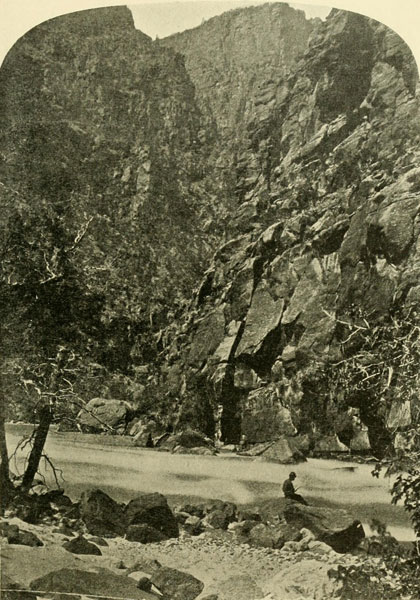
A Railway Proposed through the Canyons—The Brown Party, 1889, Undertakes
the Survey—Frail Boats and Disasters—The Dragon Claims
Three—Collapse of the Expedition—Stanton Tries the Feat Again,
1889-90—A Fall and a Broken Leg—Success of Stanton—The Dragon
Still Untrammelled.
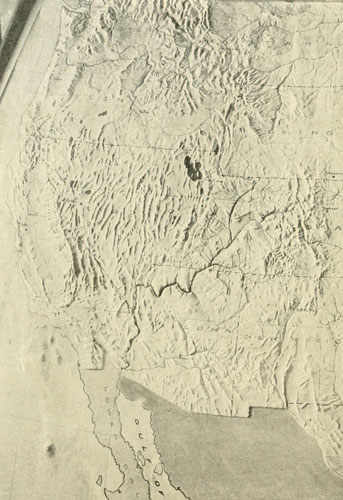
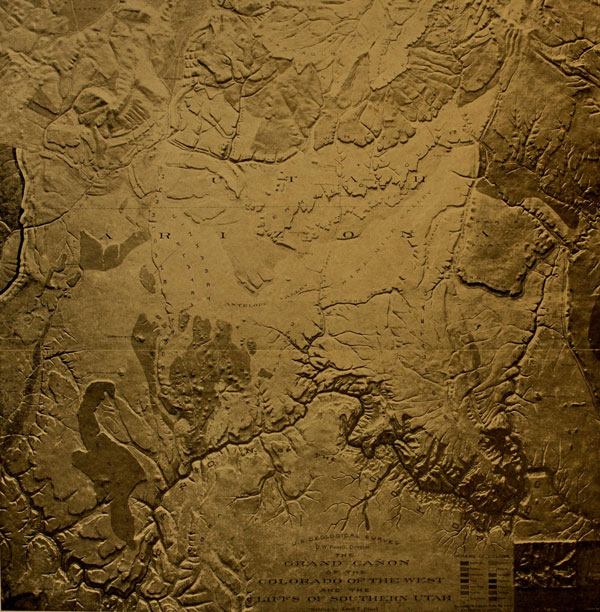
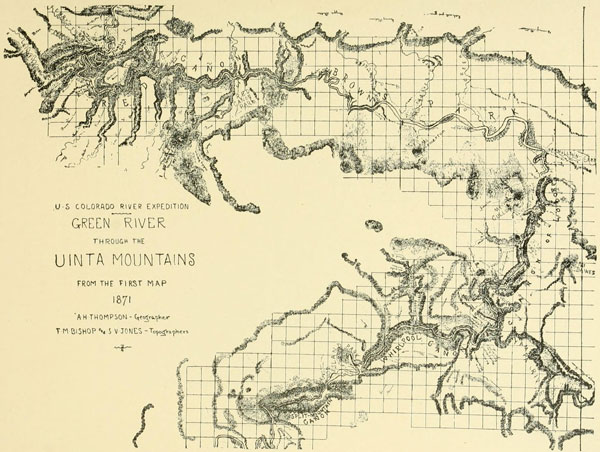
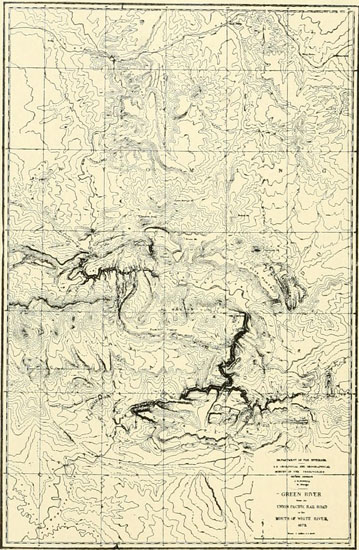
The topographic, geologic, and geodetic work of the survey did not cease with
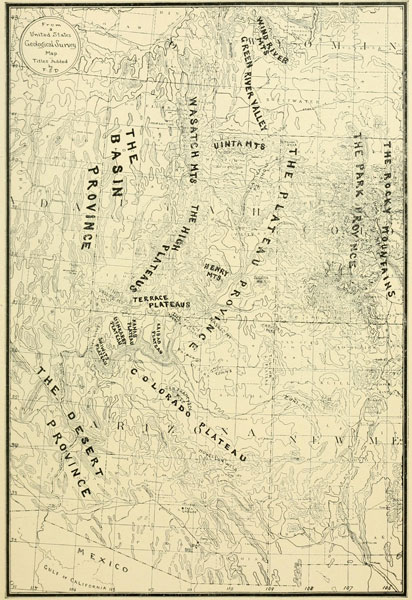
our departure from the river, but was continued in the remarkable country shown
in the relief map opposite page 41, till the relationships and distances of the
various features were established and reduced to black and white. That autumn,
while we were engaged in these labours, Wheeler, with an elaborate outfit,
entered the region, pursuing his desultory operations; and, drifting along the
north side of the Grand Canyon for a little distance, he proceeded to the
neighbourhood of St. George. The following year, for some unknown purpose, he
crossed the Colorado at the Paria, though he knew that Powell’s parties
had previously mapped this area. When the winter of 1872-73 had fairly set in
we established a permanent camp at Kanab, where, under Thompson’s always
efficient direction, our triangulations and topographic notes were plotted on
paper, making the first preliminary map of that country. When this was ready,
Hillers and I took it, and crossing the southern end of the High Plateaus, then
deep with snow, we rode by way of the Sevier Valley to Salt Lake, where the map
was sent on by express to Washington, whither Powell had already gone.
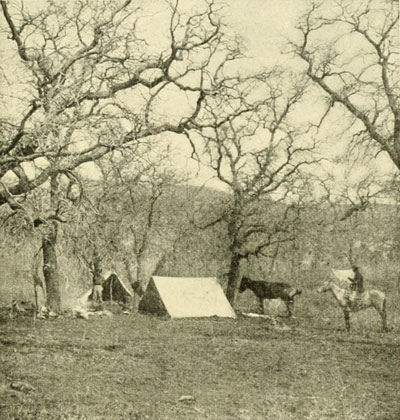
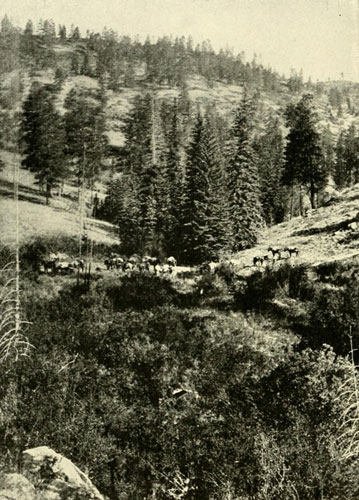
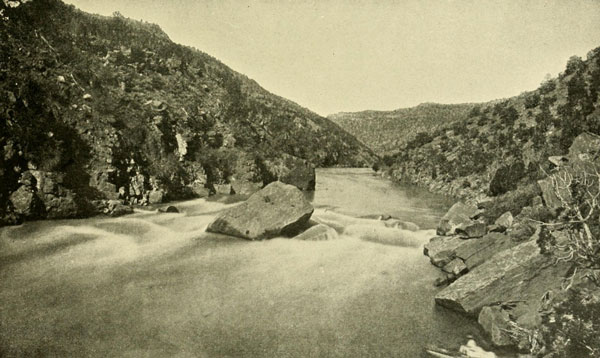
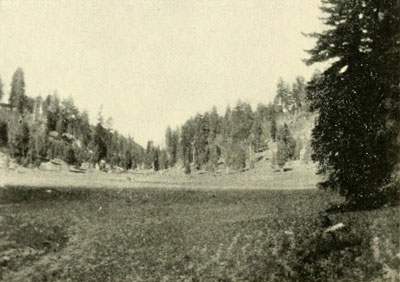
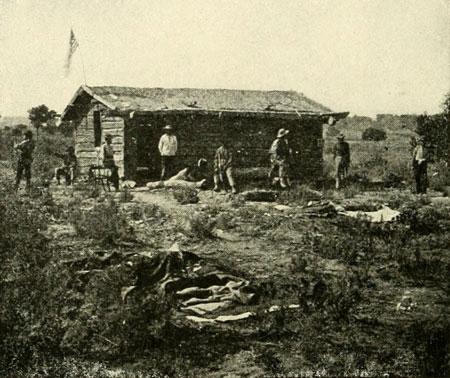
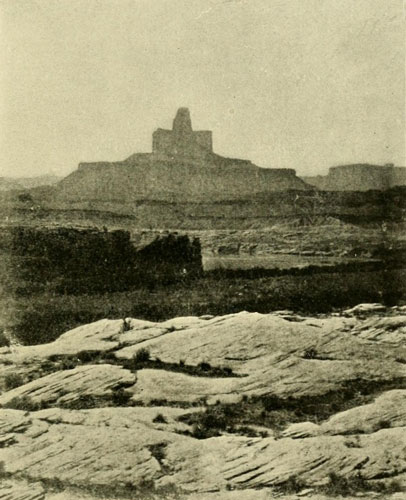
Camp at Oak Spring, Uinkaret Mountains.
Photograph by J.K. HILLERS, U.S. Colo. Riv. Exp.
Seventeen years passed away before any one again tried to navigate the
Colorado. The settling of the country, the knowledge of it Powell had
published, the completion of the Southern Pacific Railway to Yuma in 1877, and
of the Atlantic and Pacific from Isleta to The Needles, in 1880-83, and of the
Rio Grande Western across the Green at Gunnison Valley, simplified travel in
the Basin of the Colorado. A new railway was then proposed from Grand Junction,
Colorado, down the Colorado River, through the Canyons to the Gulf of
California, a distance of twelve hundred miles. At that time coal was a
difficult article to procure on the Pacific Coast, and it was thought that this
“water-level” road, crossing no mountains, would be profitable in
bringing the coal of Colorado to the Golden Gate. At present coal in abundance
is to be had in the Puget Sound region, and this reason for constructing a
Grand Canyon railway is done away with. There is nothing to support a railway
through the three hundred miles of the great gorge (or through the other two
hundred miles of canyon to the Junction), except tourist travel and the
possible development of mines. These are manifestly insufficient at the present
time to warrant even a less costly railway, which, averaging about four
thousand feet below the surface of the surrounding country, would be of little
service to those living away from its immediate line, and there is small chance
to live along the line. In addition the floods in the Grand Canyon are enormous
and capricious. Sometimes heavy torrents from cloudbursts plunge down the sides
of the canyon and these would require to be considered as well as those of the
river itself. To be absolutely safe from the latter the line would probably
require, in the Grand Canyon, to be built at least one hundred and twenty feet
above low water, so that for the whole distance through the Marble-Grand Canyon
there would seldom be room beside the tracks for even a station. But Frank M.
Brown had faith, and a company for the construction of the Denver, Colorado
Canyon, and Pacific Railway was organised. Brown was the president, and in 1889
he formed an expedition to Survey the line.
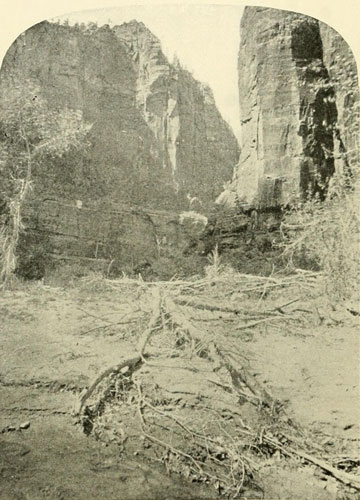
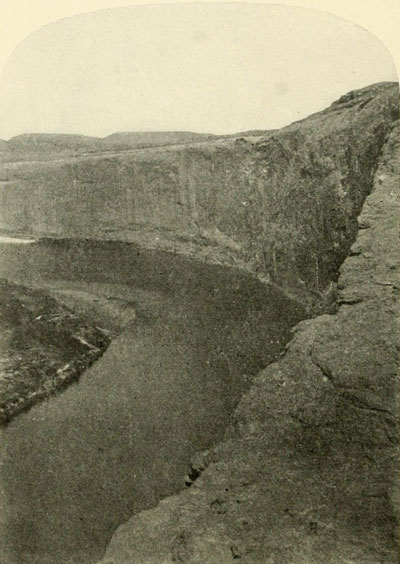
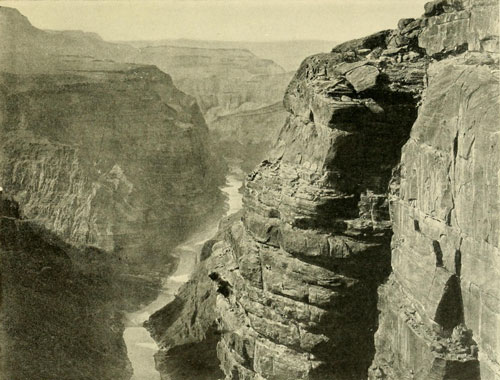
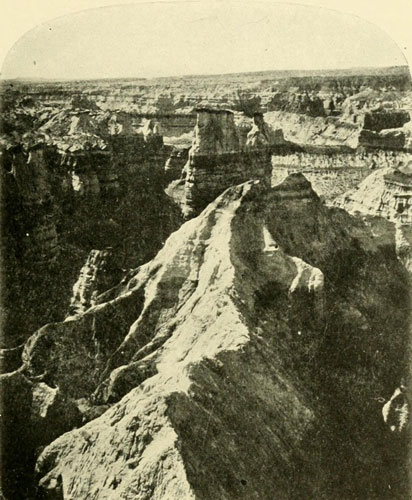
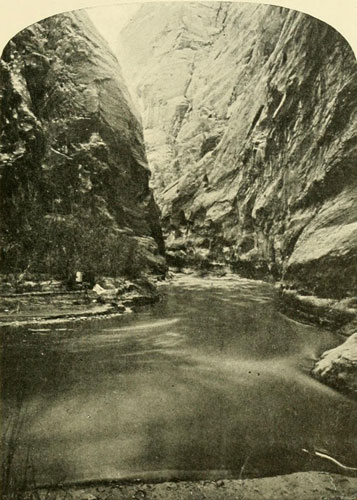
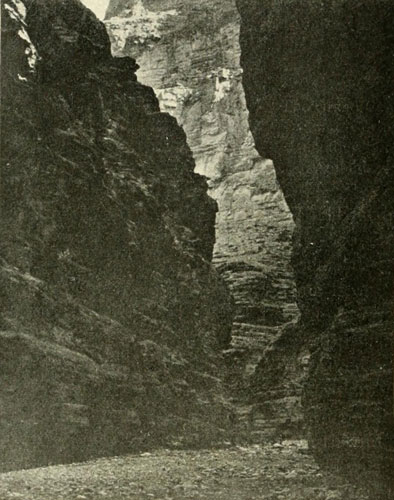
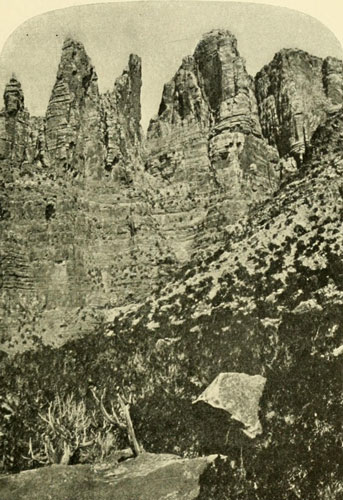
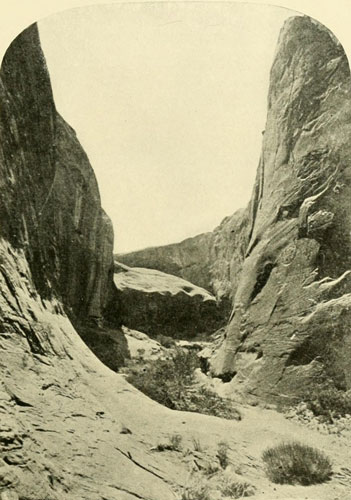
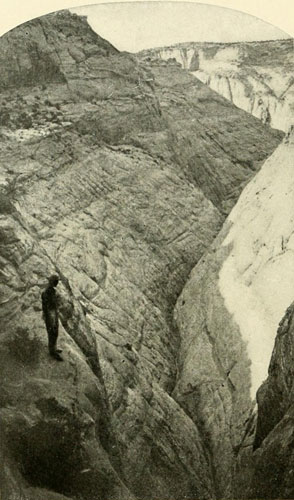
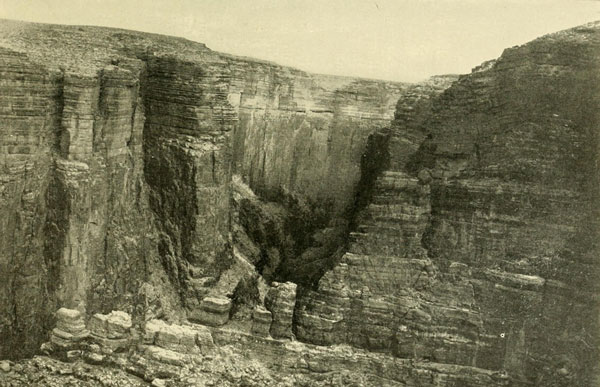
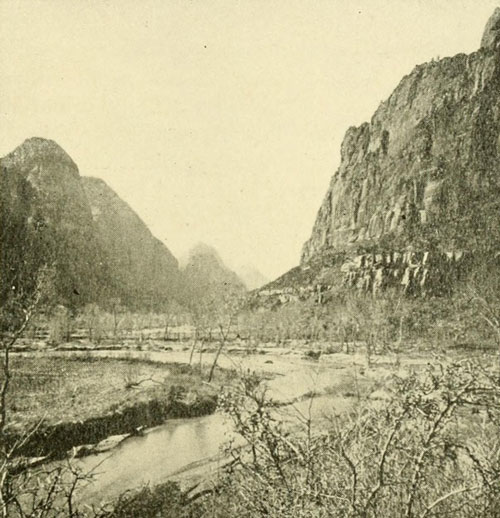
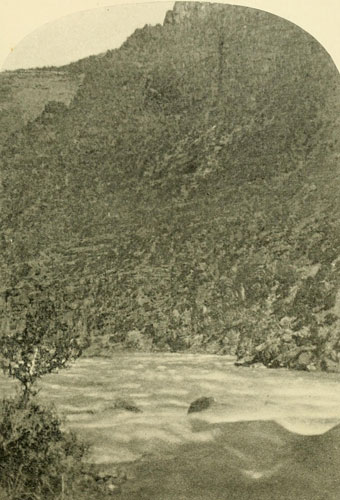
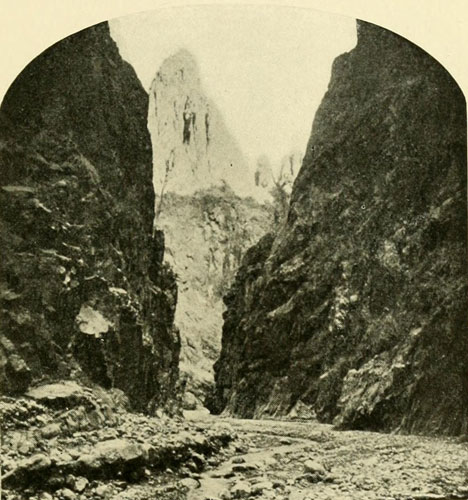
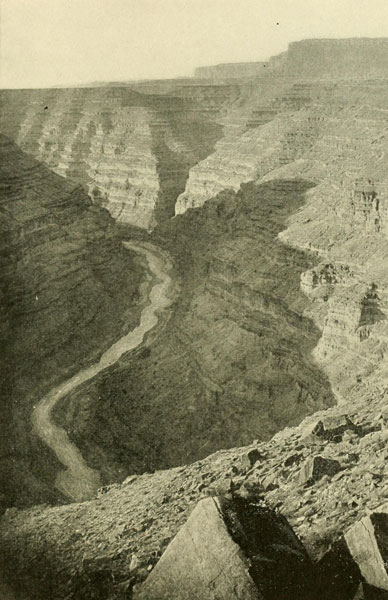
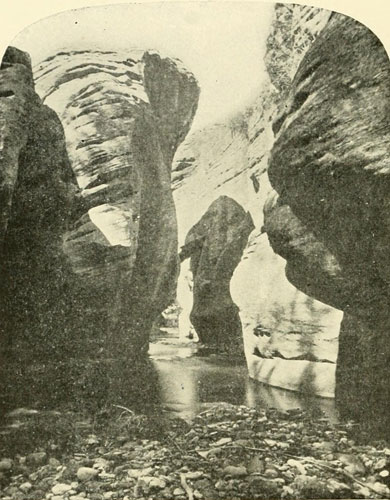
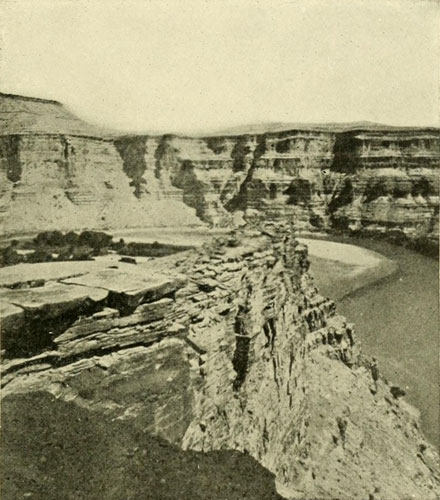
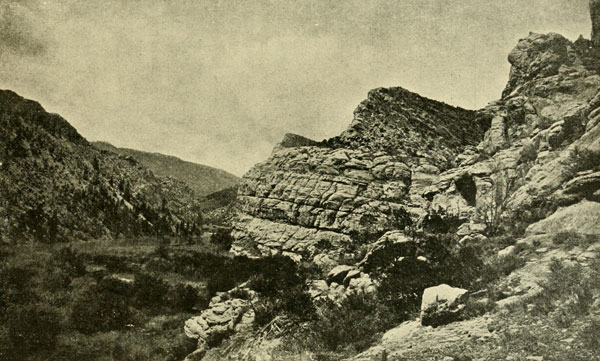
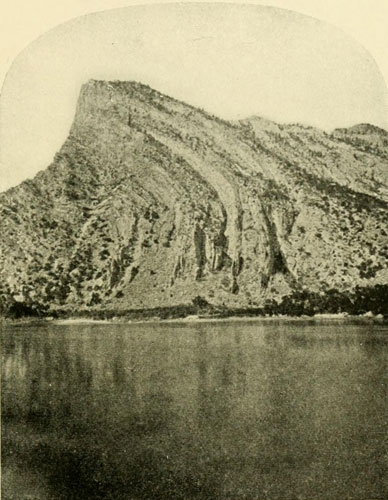
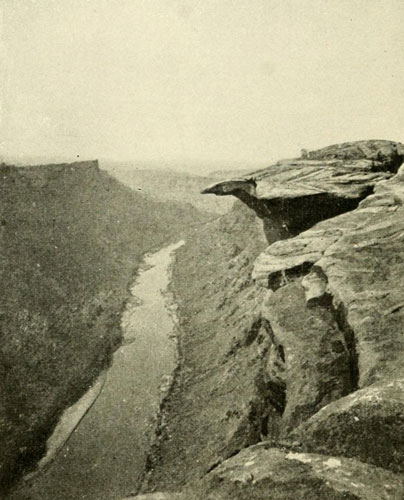
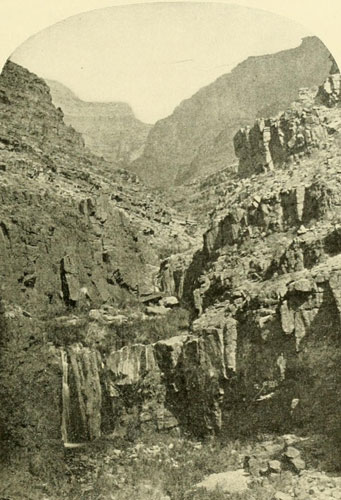
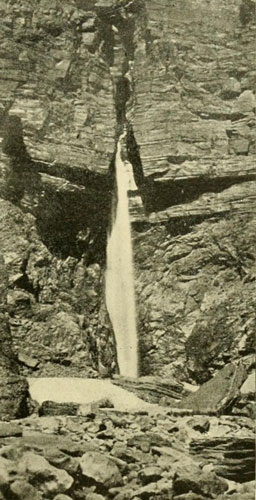
Mukoontuweap Canyon, North Fork of the Virgen.
Ten miles long, 3500 feet deep.
Photograph by J.K. HILLERS, U.S. Geol. Survey.
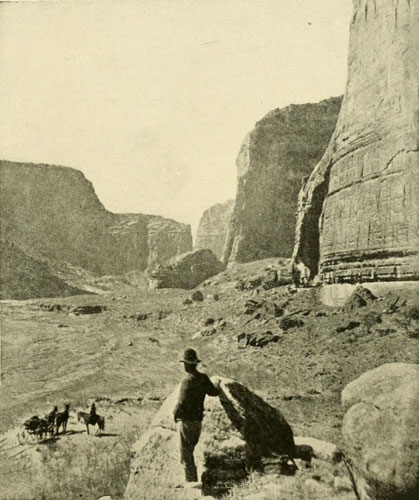
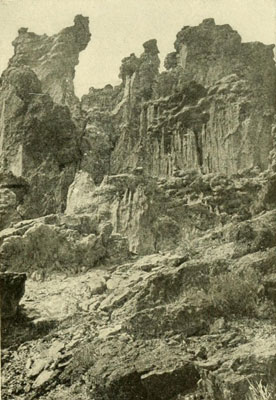
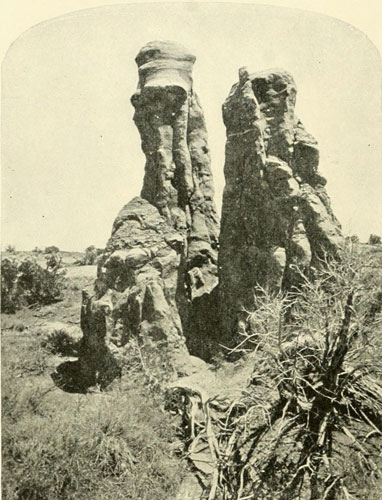
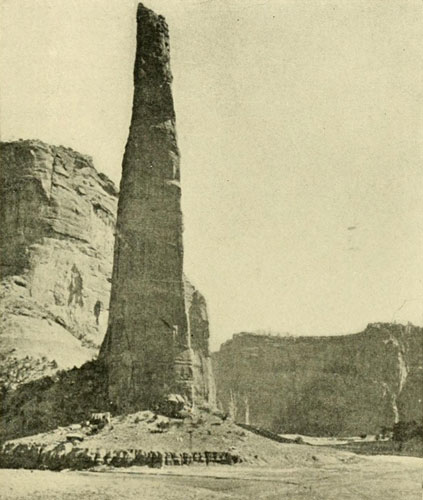
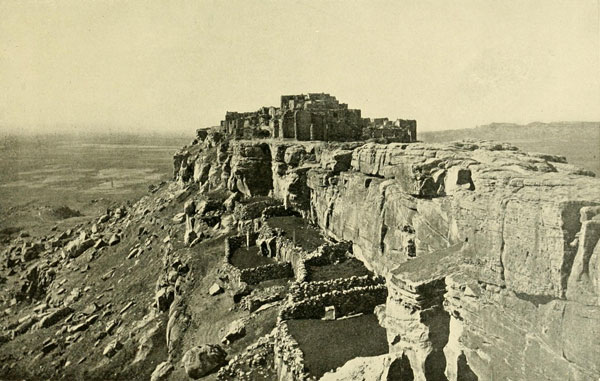
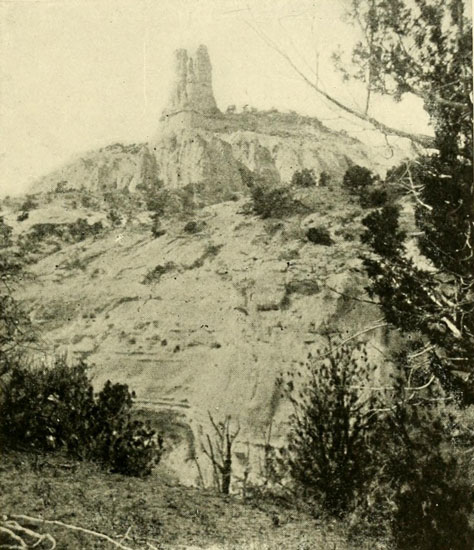
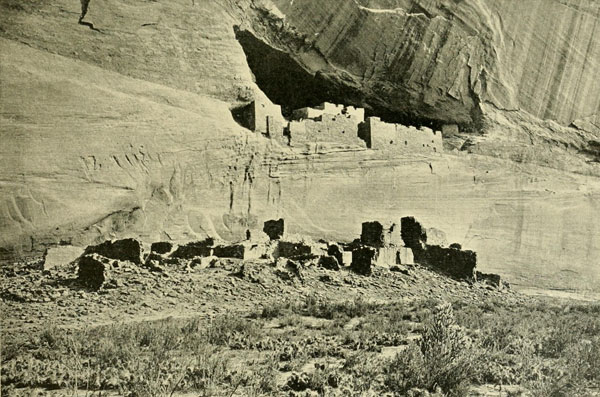
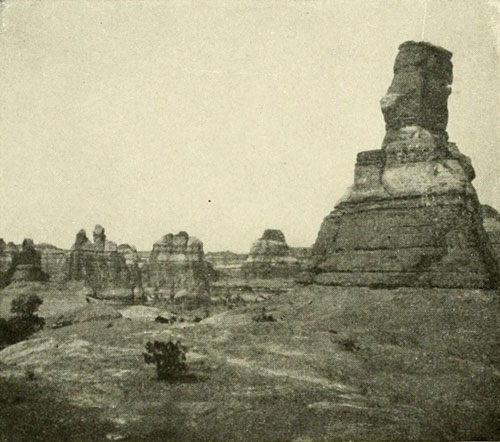
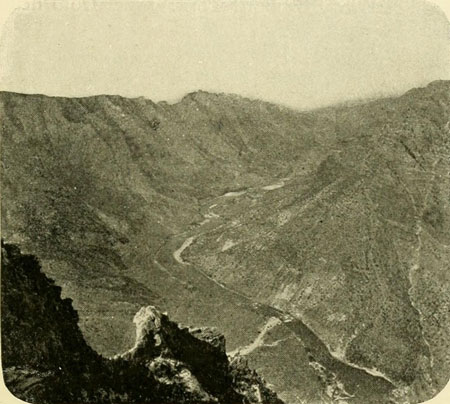
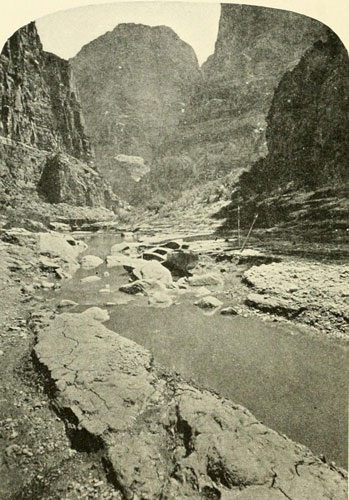
Looking down the Canyon de Chelly, a Tributary of the San Juan and Containing many Cliff Houses.
Photograph by BEN WITTICK.
On March 25th the preliminary party, consisting of F. M. Brown, F. C. Kendrick,
chief engineer, and T. P. Rigney, assistant engineer, left Denver for Grand
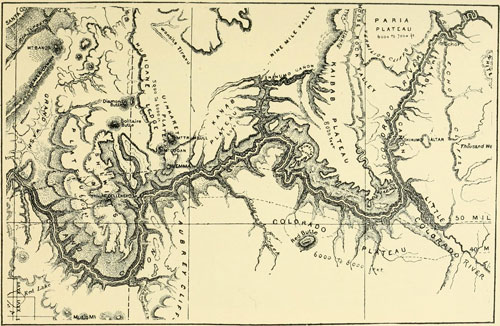
Junction, a station on the Rio Grande Western (near the C of Colorado, State
name on map, p. 51), and the next morning set the first stake for the new
railway which was to cost the president so dear. Then they bought a boat from
the ferryman, and after repairing it laid in a supply of rations, engaged some
men, and ran a half-mile down Grand River. Brown then left to go East in order
to perfect his arrangements for this attempt to survey a railway route through
the dangerous canyons. The boat party continued down Grand River to the head of
the canyon, twenty-four miles, and then more slowly descended over rougher
water, averaging five or six miles a day. At a distance of forty-three miles
from the start the rapids grew very bad, and at one place they were forced to
make a portage for twelve miles. At the end of one hundred miles they came to
the little Mormon settlement of Moab. From here to the Junction of the Grand
and Green was a distance of sixty miles, and the water was the same as it is
just above the Junction, in the canyons of the Green, Stillwater, and
Labyrinth, that is, comparatively smooth and offering no obstacles except a
rather swift current. Nowhere had the cliffs risen above one thousand feet, and
the river had an average fall of five feet to the mile. This was the first
party on record to navigate, for any considerable distance, the canyons of
Grand River. From the Junction they proceeded up the Green, towing the boat,
desiring to reach the Rio Grande Western Railway crossing, one hundred and
twenty miles away. By this time their rations were much diminished and they
allowed themselves each day only one-half the ordinary amount, at the same time
going on up the river as fast as possible, yet at the end of about eight days,
when still thirty miles from their destination, they were reduced to their last
meal. Fortunately they then arrived at the cabin of some cattlemen, Wheeler
Brothers, who, discovering their plight, put their own ample larder, with true
Western hospitality, at the surveyors’ disposal. Thus opportunely
fortified and refreshed, the men reached the railway crossing the following
night.
In reviewing all the early travels through this inhospitable region, one is
struck by the frequent neglect of the question of food-supplies. In such a
barren land, this is the item of first importance, and yet many of the leaders
treated it apparently as of slight consequence. Great discomfort and suffering
and death often followed a failure to provide proper supplies, or, when
provided, to take sufficient care to preserve them.
On the 25th of May, 1889, Brown’s party was ready and started from the
point where the Rio Grande Western crosses Green River. There were sixteen men
and six boats. Five of the boats were new; the sixth was the one Kendrick and
Rigney had used on the Grand River trip. The chief engineer of the proposed
railway was Robert Brewster Stanton, and that he was not in the very beginning
given the entire management was most unfortunate, for Brown himself seems not
to have had a realisation of the enormous difficulties of the task before him.
But the arrangements were completed before Stanton was engaged. All the men
were surprised, disappointed, dismayed, at the character of the boats Brown had
provided for this dangerous enterprise, and Stanton said his heart sank at the
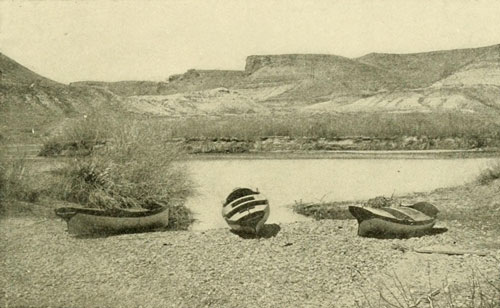
first sight of them. They were entirely inadequate, built of cedar instead of
oak, only fifteen feet long and three feet wide, and weighed but one hundred
and fifty pounds each. They would have been beautiful for an ordinary river,
but for the raging, plunging, tumultuous Colorado their name was suicide. Then
not a life-preserver had been brought. This neglect was another shock to the
members of the party and their friends. Stanton was urged to take one for
himself, but he declined to provide this advantage over the other men. Since
then he has been disposed to blame Powell for not telling Brown that
life-preservers are a necessity on the Colorado. It was also said that Powell
declared to Brown that they were not imperative and consequently he is censured
for the subsequent disasters. There was certainly a misunderstanding in this,
for Powell, knowing the situation from such abundant experience, never could
have said life-preservers were not necessary, though on his first trip there
was but one. In this connection Thompson writes me: “The Major sent for
me at once when Mr. Brown called at the office. I think we talked—we
three, I mean—for half an hour, then the Major said, ‘Professor
Thompson knows just as much about the river as I do, and more about what is
necessary for such a trip; you talk with him.’ I took Mr. Brown to my
room and we had a long talk. I think the next day Mr. Brown came again. I had
two interviews with him alone. I told him distinctly that life-preservers were
necessary. I probably told him we did not wear them all the time, but I told
him we put them on at every dangerous rapid, and I showed him the picture in
the Major’s Report where we were wearing them. I clearly remember telling
him to have one arm above and one below the preserver. I am positive about
this, for after we received word of the loss of Brown we talked it over and I
recalled the conversation. He impressed me as thinking we exaggerated the
dangers of the river. He made a memorandum of things I said. I think he also
talked with Hillers, and I have no doubt the latter told him to take
life-preservers. But he had the Report, and there is no excuse for his
neglecting so indispensable an article of the outfit. He was warned over and
over again to neglect no precaution. I distinctly remember that the Major told
him in so many words, ‘not to underestimate the dangers of the river, and
to never be caught off guard.’” On a previous page I have remarked
that proper boats and a knowledge of how to handle them are more important than
life-preservers, but that does not mean that a party should leave the
life-preservers behind. In descending the Colorado every possible precaution
must be taken. The first of these is the right kind of boats, second, proper
arrangement as to food-supplies, and, third, life-preservers, etc. The New York
Tribune, after the collapse of this Brown expedition, quotes Powell in
an interview as saying that he would not have ventured in the boats Brown
selected and that he thought Brown “failed to comprehend the significant
fact that nothing can get through the Colorado Canyon that cannot float. Boats
are repeatedly upset and inferior boats are mashed like egg-shells.”
Brown, undoubtedly, was rather inclined to look upon the descent somewhat
lightly. Being a brave, energetic man it was hard for him to believe that this
river demanded so much extra prudence and caution, when Powell had successfully
descended it twice without, so far as the water was concerned, losing a man.
However, the ill-fated expedition went on its way.
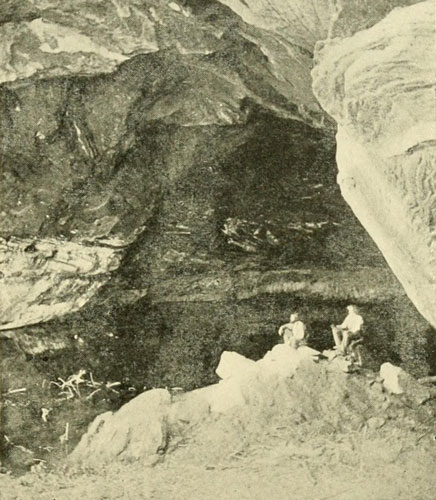
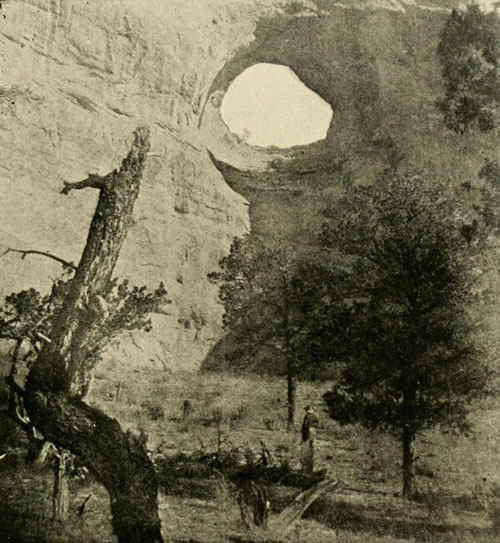
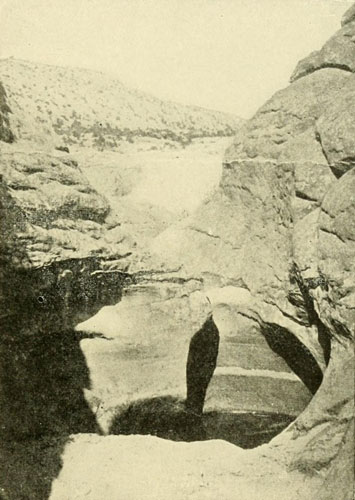
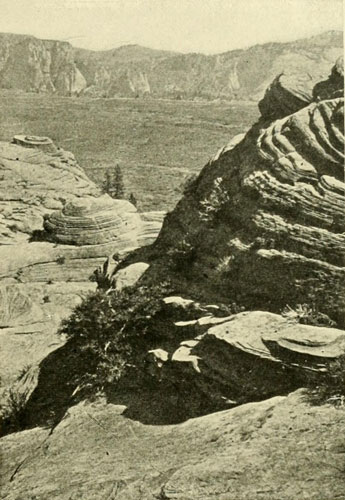
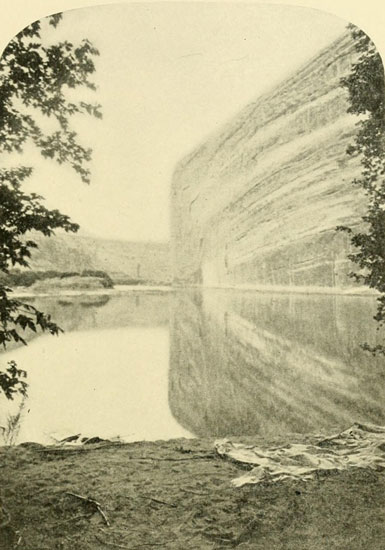
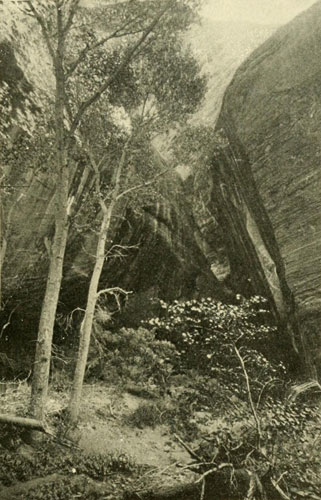
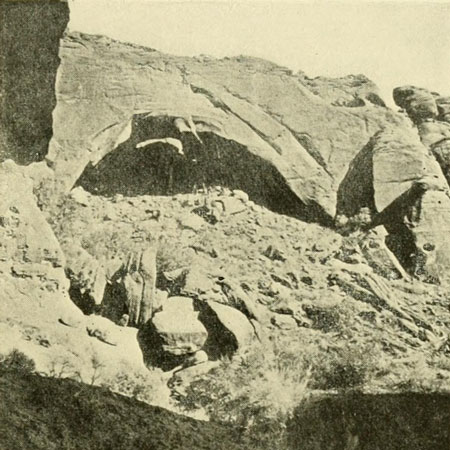
A Cave-Lake in a Sandstone Cliff near Kabab, S. Utah.
The depth from front to rear is about 125 feet. The outer opening is the whole
front of the arch. It belongs to the class of natural arches, alcoves, bridges,
“holes in the wall,” etc., common in this kind of sandstone
throughout the Southwest.
Photograph by J.K. HILLERS, U.S. Colo. Riv. Exp.
The boats were named the Ward, the Mason, after Brown’s sons, the Mary
after his wife, and the Denver and the Colorado. On arriving they were
recalked. The bottoms were covered with copper. The party consisted of the
following persons: Frank M. Brown, president; Robert Brewster Stanton, chief
engineer; John Hislop, first assistant engineer; C. W. Potter, T. P. Rigney, E.
A. Reynolds, J. H. Hughes, W.H. Bush, Edward Coe, Edward ——, Peter
Hansborough, Henry Richards, G. W. Gibson, Charles Potter, F. A. Nims,
photographer, and J. C. Terry. The baggage of each man was limited to
twenty-five pounds. The cargoes were packed in tight, zinc-lined boxes three
feet long, with one of which each boat was provided, but these were found to be
cumbersome and heavy, the boats being down to within one inch of the gunwales
in the water, so they were taken out and all lashed together, forming a sort of
raft. This carried about one-third of all the supplies, and all the extra oars
and rope, a most unwise arrangement from every point of view. The nondescript
craft hampered their movements, could not be controlled, and if once it got
loose everything was sure to be lost. It would have been better to throw these
boxes away at once and take what the boats could carry and no more, but this
was apparently not thought of. All things considered, it is a wonder this party
ever got through Cataract Canyon alive. At some little rapid, after leaving the
railway crossing, the first boat stove a hole in her side, but this was readily
repaired and the party ran without further accident over the smooth stretches
of river preceding the Junction, arriving at this latter point in four days.
They were now on the threshold of Cataract Canyon. Stopping to adjust
instruments and repair boats for a day, they proceeded to the battle with the
cataracts on May 31st. For forty-one miles they would now have their courage,
muscle, and nerve put to the full test. Stanton records seventy-five rapids and
cataracts, fifty-seven of them within a space of nineteen miles, with falls in
places of sixteen to twenty feet. This, then, was what they were approaching
with these frail craft. Two miles down they heard the roar of falling water and
the place was reconnoitred, with the result that a large rapid was found to bar
the way. The raft of provisions, and the boat that had towed it, were on the
opposite side of the river, which afforded no chance for a camp or a portage,
and a signal was made for the party to come over. A half mile intervened
between this boat and the head of the rapid, but with the encumbering raft it
was drawn down so dangerously near the descent that, to save themselves, the
rope holding the raft was cut. Thus freed the boat succeeded in landing just at
the head of the fall, but the raft went over, and that was the end of it. The
sections were found scattered all the way through the canyon. The next
twenty-eight miles were filled with mishaps and losses. Twelve miles farther
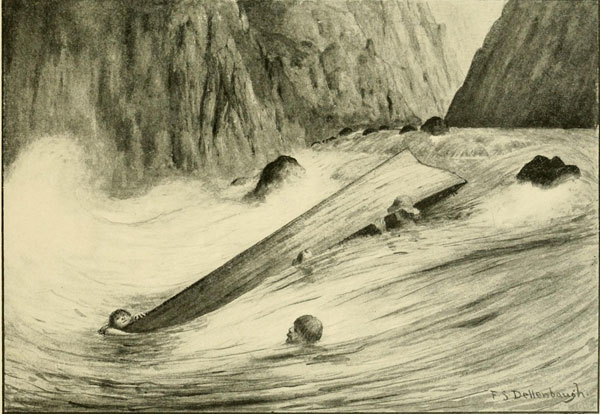
down, the boat in which Brown, Hughes, and Reynolds were running a rapid
capsized. The men clung to her for a mile and a half and then succeeded in
getting ashore. The rapids in this part are very close together, and to these
men it seemed like one continuous cataract, which it very nearly is. On the
same day another boat containing the cooking outfit struck a rock and went to
pieces. The provisions she carried were, most of them, contributed to the maw
of the dragon to follow those of the unfortunate raft. Sometimes the boats got
away from the men altogether, running wild, finally lodging somewhere below to
be found again with the contents missing. Soon they had so many large holes in
them that one, No. 3, had to be broken up to obtain materials for repairing the
others. Thus the party, by the time they had fairly arrived at the deepest and
worst portion of this splendid chasm, were in a sad plight, but a plight mainly
due to the original bad planning and mismanagement, and not necessary in
navigating this gorge. They seldom attempted to cross the river, working down
along one side and never entering the boats at all except where absolutely
necessary.[1] Thus they were greatly hampered in their
movements. With our boats we never gave the crossing of the river a thought,
and were in them continually, except where a portage was demanded. We could
therefore always choose our course with as much freedom as is possible. But it
must not be forgotten that the Brown party were in Cataract Canyon about the
time of high water, while we passed through at a lower stage. This would make a
difference, low water being in all the canyons far safer, though the work is
harder on the men and the boats. By the 15th of June all provisions had
disappeared except a sack and a half of flour, presumably one hundred pounds to
the sack, a little coffee, some sugar, and condensed milk. The flour was all
baked and divided equally, each man receiving two and one half pounds of bread,
one pound of sugar, and four ounces of coffee. At one point they fortunately
found a barrel of cut loaf-sugar amongst the driftwood. This had been lost from
some army-supplies crossing at Gunnison Valley up the Green, or up Grand River,
and they also found, a little below this, pieces of a waggon with the skeleton
of a man. These also had, of course, come from at least a hundred miles above
the Junction on the Green, or sixty miles up the Grand, as no waggon could get
to the river at any place nearer to Cataract Canyon. The waggon-box had
probably acted as a raft, bearing its gruesome passenger all these long miles
into the heart of the mighty gorge, where the dragon stored his prize, and for
many a year treasured it among the deep shadows.
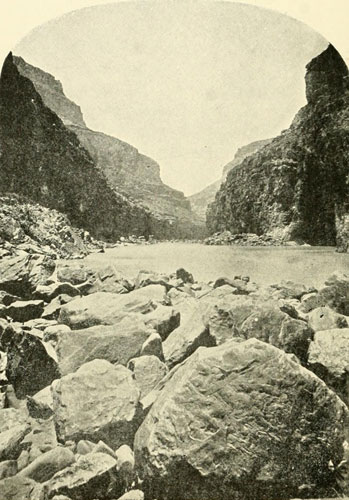
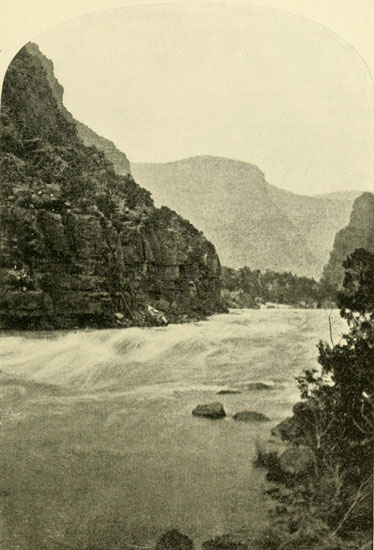
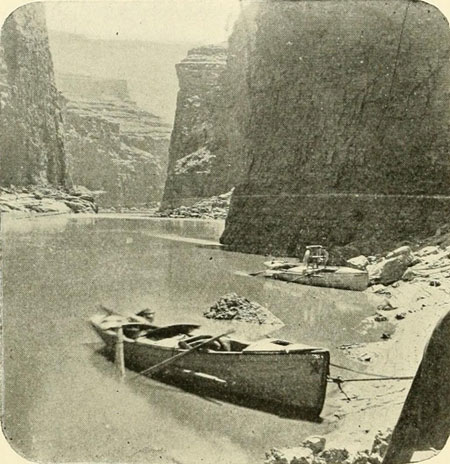
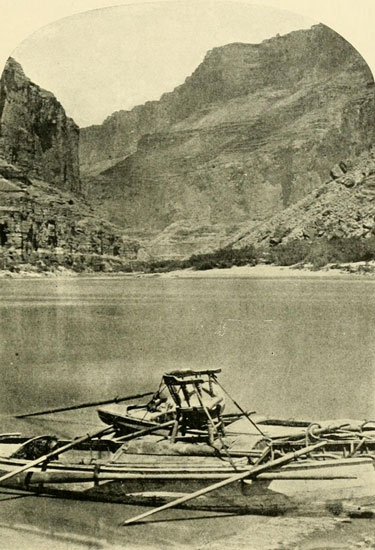
In Marble Canyon, about Midway between Paria and Little Colorado.
Photograph by J.K. HILLERS, U.S. Colo. Riv. Exp.
They had still fifteen miles of Cataract Canyon and the ten miles of the more
kindly Narrow before them, and Brown was now to hurry along and attempt to
reach some placer mines at Dandy Crossing, near the mouth of Frémont River,
where there were a few miners and where some food might be obtained. Ancient
dwellings were seen all along the gorge in the side canyons, some completely
ruined, others in a fair state of preservation, but the inhabitants had gone
long ago, and no help could be hoped for in this direction. Most of the men now
became thoroughly discouraged at the dismal prospect and wished to abandon
immediately and entirely the enterprise, but Stanton was not of that mind. The
difficulties showed him how hard it would be to do this part over again, and he
resolved to stay and finish the work as far as possible now. His first
assistant, Hislop, G. W. Gibson, the coloured cook, and the coloured steward,
H. C. Richards, volunteered to stand by him, and the next morning the eleven
others pushed on, leaving a boat for these five to follow with. For six days
this determined little crew worked along at the rate of about four miles a day,
with a ration of one small scrap of bread, a little coffee, and some condensed
milk for breakfast and supper, and three lumps of sugar for dinner. Stanton
says there was not a murmur of discontent from the men “carrying the
survey over the rocks and cliffs on the side of the canyon, and handling the
boat through the rapids of the river. At night, when they lay down on the sand
to sleep, after a meal that was nine-tenths water and hope and one-tenth bread
and coffee, it was without complaint.” Relief was had on the sixth day,
when they met a boat being towed up with provisions. This was near the end of
Narrow Canyon. At one point in the lower part of Cataract they passed a place
where, on a rock surface about six feet above the level of the water, they saw
the inscription, “D. JULIEN—1836.” They thought it could have
been cut only from a boat or raft, and concluded that it was done by a party of
Canadians which they heard had tried to explore this country at that early day.
This inscription occurs also in two other known places, near the lower part of
Stillwater Canyon (four or five miles above mouth of Grand River), and farther
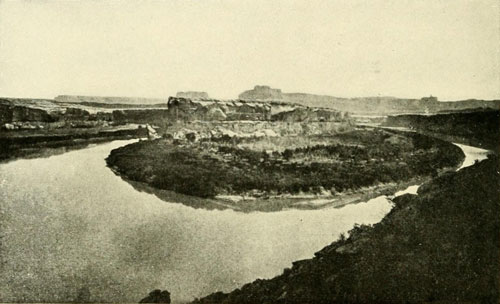
up, about the middle of Bowknot Bend, Labyrinth Canyon, Green River. (See cut,
page 352.) At Dandy Crossing, the party rested a few days, the boats were
repaired, and fresh supplies of food purchased. They met near here Jack Sumner,
of Powell’s first party. From this place to the head of Marble Canyon,
the mouth of the Paria, it is plain and easy going, at least for any one who
has been through Cataract Canyon. Brown and Stanton went ahead with six men,
the others coming along later with the survey.
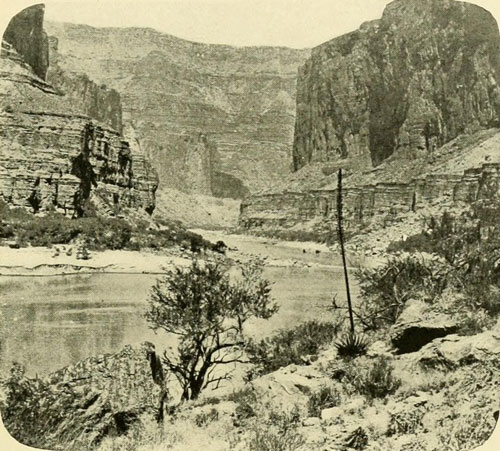
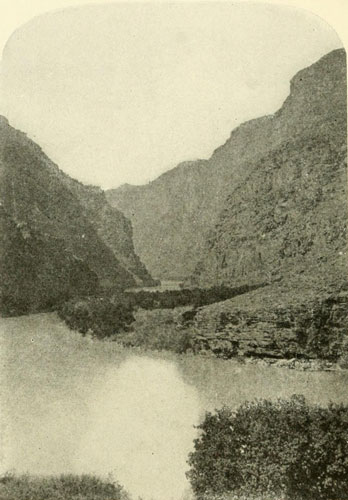
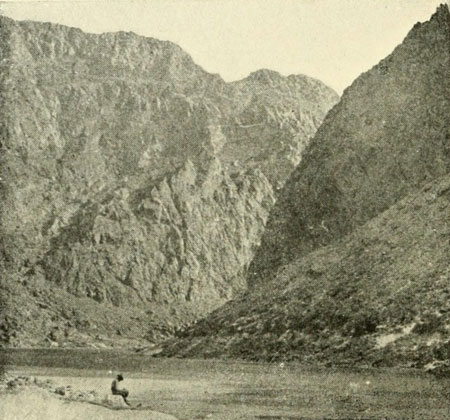
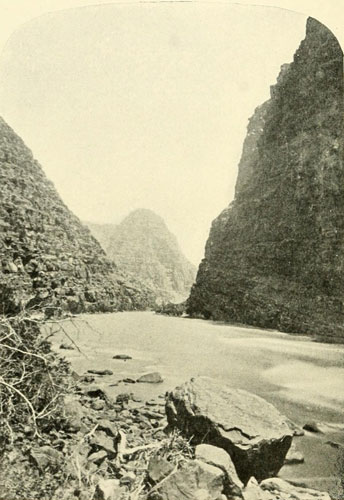
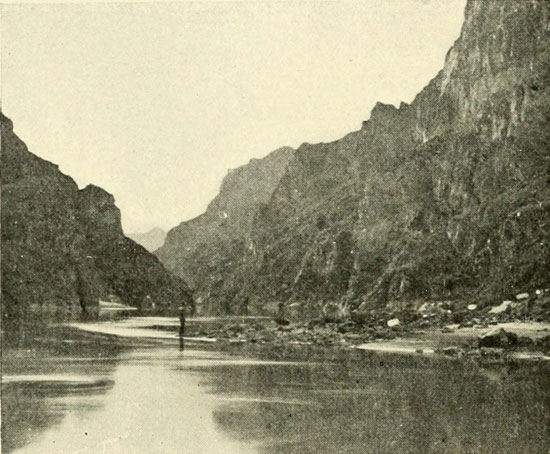
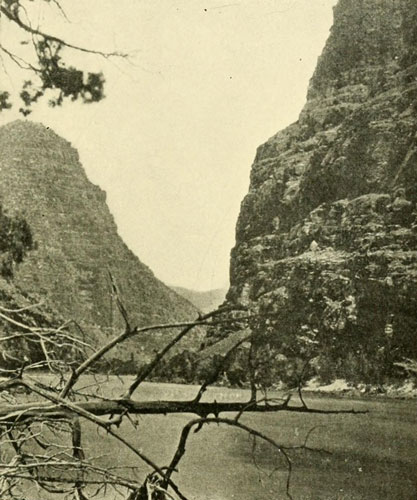
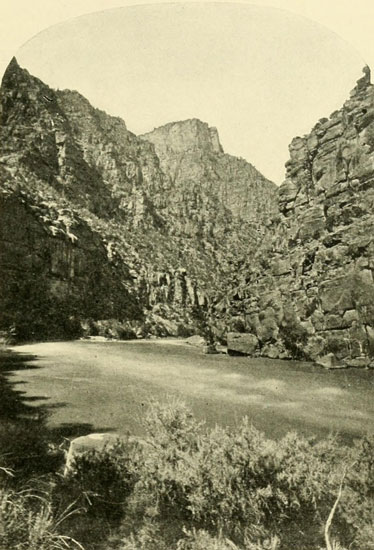
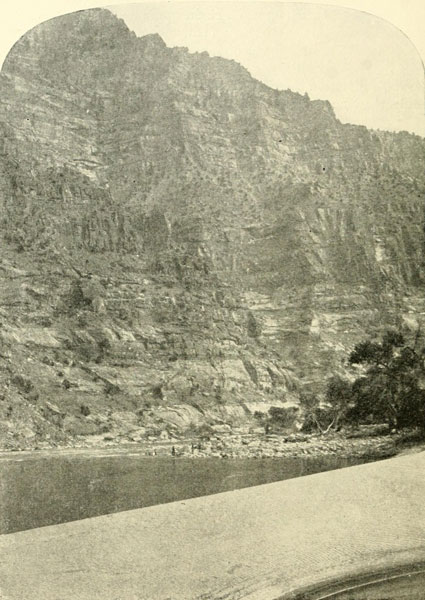
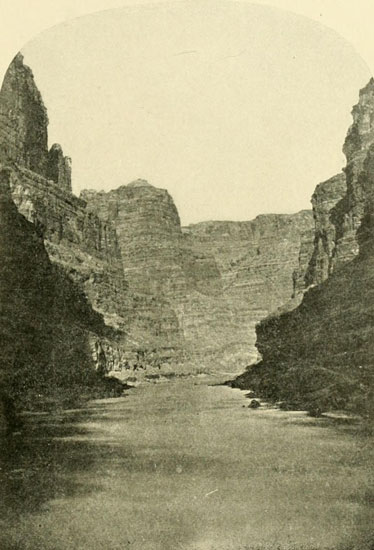
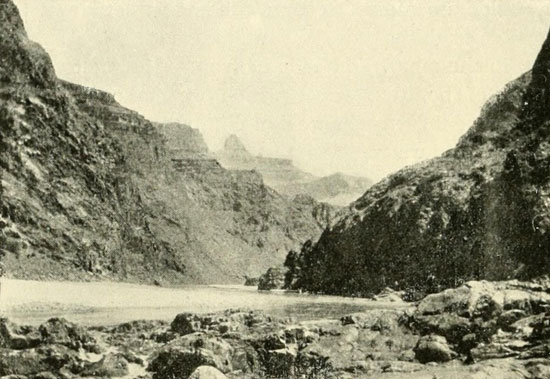
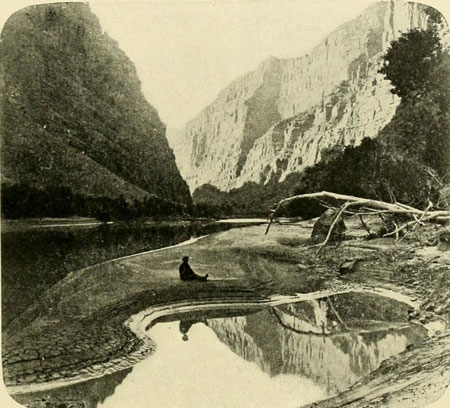
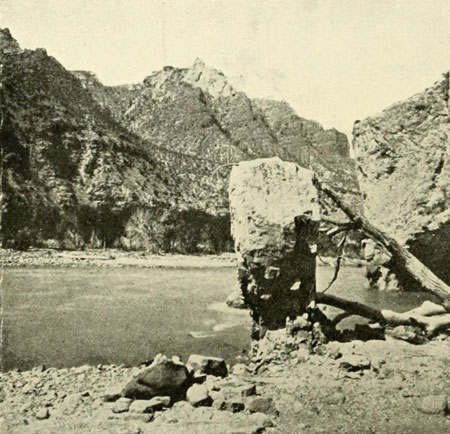
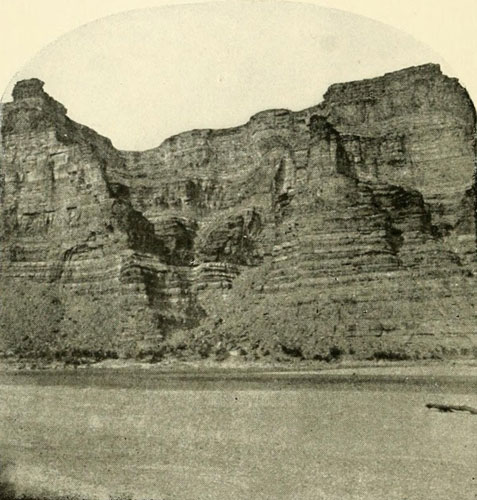
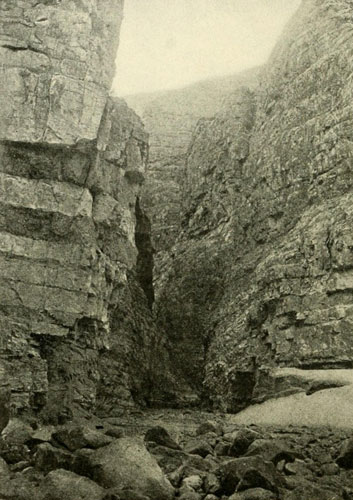
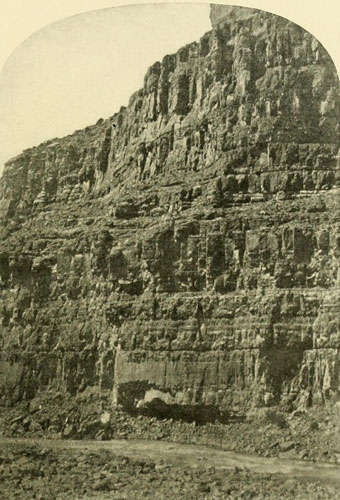
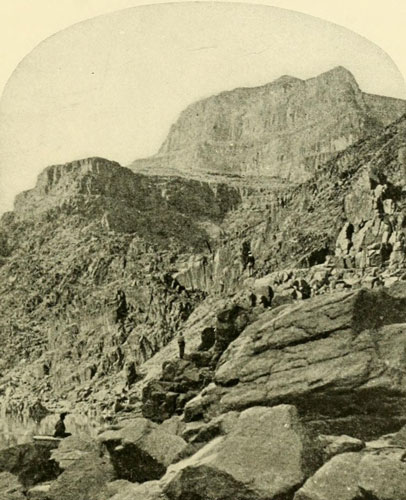
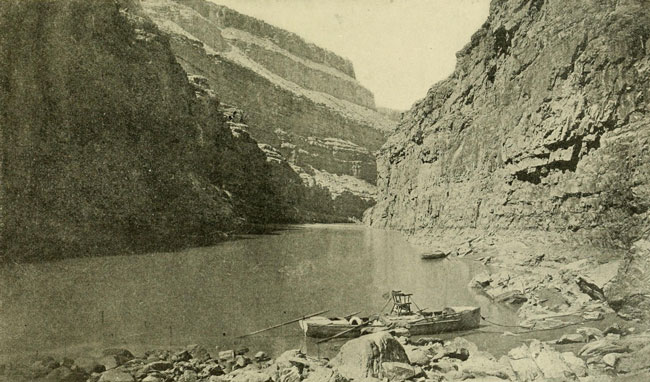
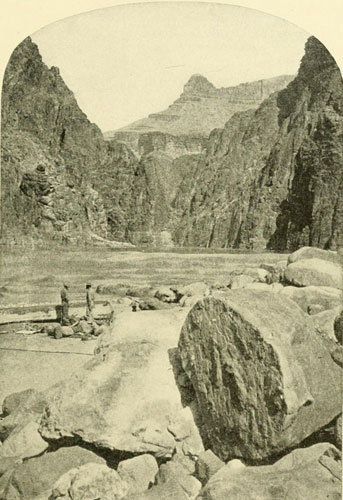
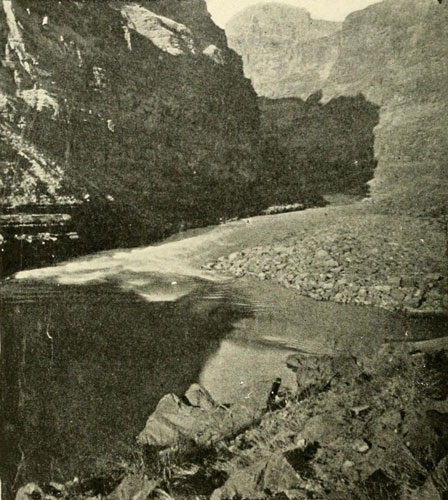
Marble Canyon, Lower Portion.
Walls about 3500 feet.
Photograph by J.K. HILLERS, U.S. Colo. Riv. Exp.
At Dandy Crossing three of the party left the river—J. N. Hughes, J. C.
Terry, and T. P. Rigney. One man joined the party, Harry McDonald, a
frontiersman and an experienced boatman. At Lee Ferry, Reynolds left and Brown
went to Kanab for supplies, for Dandy Crossing was not a metropolis, and more
rations were needed before venturing to enter the Grand Canyon. Only one
transit instrument was left, and it was decided that Brown, Stanton, Hislop,
McDonald, Hansborough, Richards, Gibson, and Nims, the photographer, should
form the party to proceed, making an examination, taking notes and photographs,
but not attempting an instrumental survey. Brown returned from Kanab by July
9th, and an immediate start was made with the three boats,—boats entirely
unfitted for the work in Cataract Canyon, and tenfold more inadequate for the
giant gorge, with its terrible descents, now before them. It seems a pity they
did not realise this and leave the continuation of the work till proper boats
could be had, but it appears as if they again underestimated the dangers of the
river. At any rate they went bravely forward with a courage that deserved a
better reward. The first ugly rapids in Marble Canyon are the two near together
about ten miles below Lee’s Ferry, where the prospectors met their
punishment early in July, 1872. These the Brown party reached safely, and made
the necessary portages, camping at the foot of the Soap Creek or lower fall.
Brown appeared to feel lonely and troubled, and asked Stanton to come and sit
by his bed and talk. They smoked and talked till a late hour about home and the
prospect for the next day. Brown’s wife and two children were at this
time travelling in Europe and probably the thought of them so far away made him
somewhat blue. Then, if he had before thought that this canyon would be easy,
the nature of the rapids around him served to undeceive his mind. The deepening
gorge, inadequate boats, and increasingly bad rapids probably affected his
nerves, for that night he dreamed of the rapids, and this troubled him so much
that he mentioned it to Stanton in the morning. Breakfast over, they went on.
We had camped at the head of the Soap Creek Rapids, and this party at the foot.
In the first rapid below, which was one of five that we easily ran before
stopping for dinner, Brown’s boat was capsized. He and his oarsman
McDonald, were thrown out on opposite sides, McDonald into the current and
Brown unfortunately into the eddy, where he was drawn under by one of the
whirlpools numerous in this locality, and was never seen again. A half-minute
later Stanton’s boat passed the spot, but all he saw was the lost
leader’s note-book on the surface of the angry waters which had so
suddenly swallowed up its owner. The whole day long the party sat sadly
watching the place to see if the treacherous river would give up the dead, but
darkness fell in the gorge, and the Colorado dashed along toward the sea as if
no boat had ever touched its relentless tide. What was one man more or less to
this great dragon’s maw! For three days after the others battled their
way along without further disaster, and then came Sunday, when they rested. On
Monday, while Stanton and Nims were making notes and photographs, the men were
to finish up the lower end of the second of two very bad rapids where portages
were made. Stanton’s boat, containing Hansborough and Richards, was
following the first boat, which had made the stretch with difficulty because
the current set against the left-hand cliff. The second boat was driven against
the foot of this wall under an overhanging shelf, and in the attempt to push
her off she was capsized and Hansborough never rose again. Richards, who was a
strong swimmer, made some distance down-stream, but before the first boat could
reach him he sank, and that was the end for him. This terrible disaster, added
to the death of Brown, and the foolhardiness of proceeding farther with such
boats as they had, forced the decision which should have been made at
Lee’s Ferry. Stanton resolved to leave the river, but with the
determination to return again to battle with the dragon at the earliest
opportunity. The next thing was to get out of the canyon. They searched for
some side canyon leading in from the north, by means of which they might return
to the world, and just above Vesey’s Paradise they found it and spent
their last night in Marble Canyon at that point. From the rapid where Brown was
lost, to Vesey’s Paradise, my diary records that on our expedition of
1872 we ran twenty-six rapids, let down four times, and made two portages, all
without any particular difficulty. I mention this merely to show the difference
proper boats make in navigating this river, for the season was nearly the same;
Brown was there in July and we in August, both the season of high water. The
night passed by Stanton and his disheartened but courageous band at
Vesey’s Paradise was long to be remembered, for one of the violent
thunderstorms frequent in the canyon in summer, came up. The rain fell in
floods, while about midnight the storm culminated in a climax of fury. Stanton
says that in all his experience in the Western mountains he never heard
anything like it. “Nowhere has the awful grandeur equalled that night in
the lonesome depths of what was to us death’s canyon.” The next day
was fair, and by two in the afternoon, July 19th, they were on the surface of
the country, twenty-five hundred feet above the river, and that night reached a
cattle ranch.
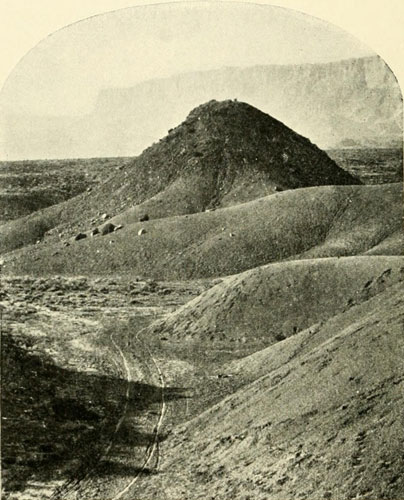
Looking West from Jacob’s Pool on Road to
Lee’s Ferry. Vermilion Cliffs in Distance.
The “Jacob” after whom the pool was named was Jacob Hamblin. This
is the country Stanton was in after leaving the river.
Photograph by W. BELL.
By November 25th of the same year (1889) the indefatigable Stanton had
organised a new party to continue the railway survey. He still had confidence
in the scheme, and he refused to give up. And this time the boats were planned
with some regard to the waters upon which they were to be used. McDonald was
sent to superintend their building at the boatyard of H. H. Douglas & Co.,
Waukegan, Illinois. There were three, each twenty-two feet long, the same as
our boats, four and one-half feet beam, and twenty-two inches deep, and each
weighed 850 pounds. They were built of half-inch oak, on plans furnished by
Stanton, with ribs one-and-one-half by three-quarters of an inch, placed four
inches apart, all copper fastened. Each boat had ten separate air-tight
galvanised-iron compartments running around the sides, and they were so
arranged that the canned goods could be put under the foot-boards for ballast.
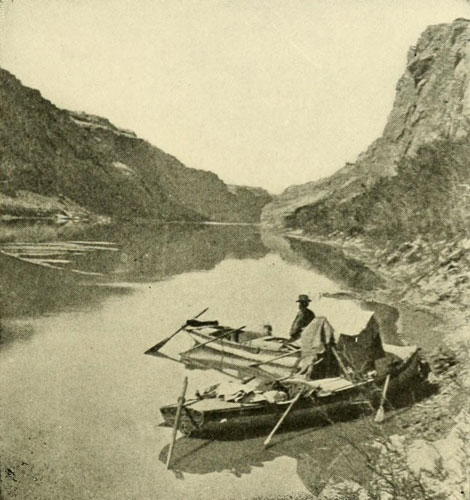
There was a deck fore and aft, and there were life-lines along the sides. They
were certainly excellent boats, and while in some respects I think our model
was better, especially because the two transverse bulkheads amidships in ours
tended to make their sides very strong and stiff, yet these boats of
Stanton’s were so good that the men would be safe as long as they handled
them correctly. Cork life-preservers of the best quality were provided, and the
order was for each man to wear his whenever in rough or uncertain water. All
stores and provisions were packed in water-tight rubber bags, made like ocean
mail-sacks, expressly for the purpose. The expedition was thus well provided.
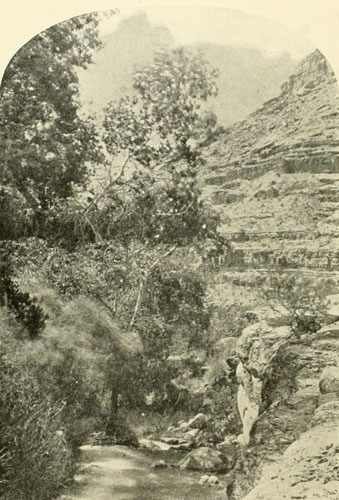
Tapeets Creek.
Character of some of the tributary valleys of the north side of the Grand
Canyon through the Kaibab section. The extreme height of the north wall is seen
in the distance. A considerable valley intervenes between it and the
river.
Photograph by J.K. HILLERS, U.S. Colo. Riv. Exp.
From the railway[2] the boats were hauled on waggons to the
mouth of Crescent Creek near Frémont River, so as to avoid doing Cataract
Canyon over again. There were twelve men, of whom four had been with the Brown
party. They were R. B. Stanton, Langdon Gibson, Harry McDonald, and Elmer Kane,
in boat No. 1, called the Bonnie Jean, John Hislop F. A. Nims, Reginald
Travers, and W. H. Edwards in boat No. 2, called the Lillie; and A. B.
Twining, H. G. Ballard, L. G. Brown, and James Hogue, the cook, in the
Marie, boat No. 3. Christmas dinner was eaten at Lee’s Ferry, with
wild flowers picked that day for decoration. On the 28th they started into the
great canyon, passed the old wreck of a boat and part of a miner’s
outfit, and on the 31st reached the rapid where Brown was lost. It was now the
season of low water, and the rapid appeared less formidable, though on entering
it the place was seen to be in general the same, yet the water was nine feet
lower. The next day Nims, the photographer, fell from a ledge a distance of
twenty-two feet, receiving a severe jar and breaking one of his legs just above
the ankle. The break was bandaged, and one of the boats being so loaded that
there was a level bed for the injured man to lie on, they ran down about two
miles to a side canyon coming in from the north. By means of this Stanton
climbed out, walked thirty-five miles to Lee’s Ferry, and brought a
waggon back to the edge. Nims was placed on an improvised stretcher, and
carried up the cliffs, four miles in distance and seventeen hundred feet in
altitude. At half-past three in the afternoon the surface was reached. Twice
the stretcher had to be swung along by ropes where there was no footing, and
twice had to be perpendicularly lifted ten or fifteen feet. No one was injured.
Nims was taken to Lee’s Ferry and left with W. M. Johnson, who had been a
member of our land parties during the winter of 1871-72, and who had come with
the Cañonita party through Glen Canyon. Nims was in good hands. After
this accident Stanton was obliged to assume the duties of photographer and took
some seven hundred and fifty views without previous experience.
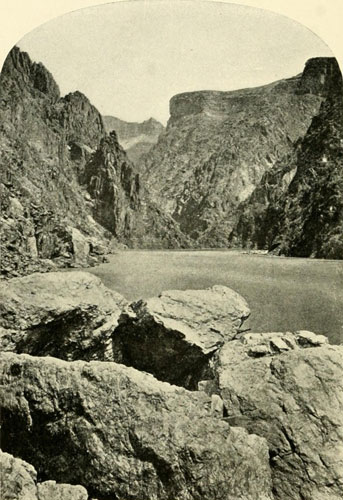
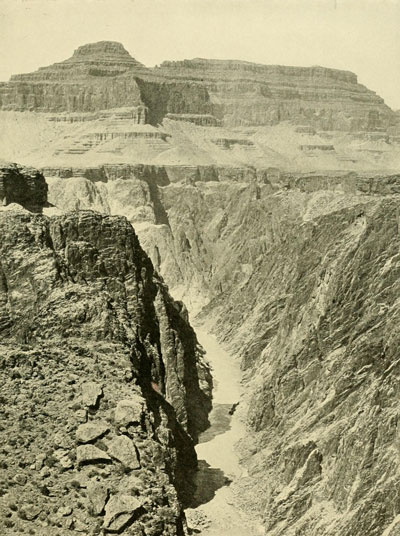
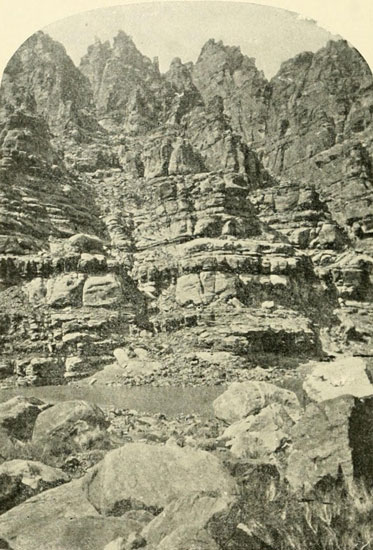
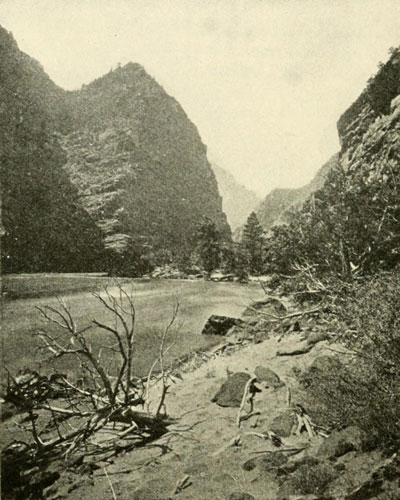
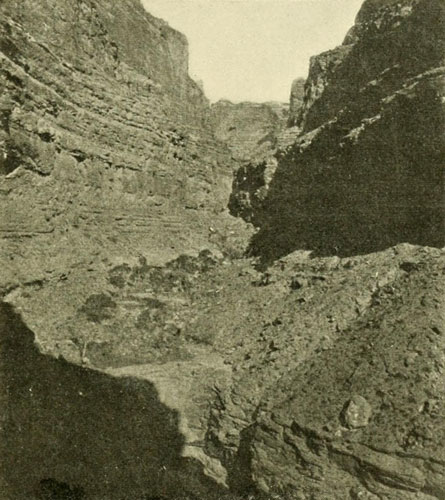
The Grand Canyon.
In the First Granite Gorge. Upper walls are not seen. Those in sight are 1000
to 1200 feet. Above they rise in terraces to between 5000 and 6000.
Photograph by J.K. HILLERS, U.S. Colo. Riv. Exp.
By January 13th they had arrived at Point Retreat, where the canyon had before
been abandoned, and here they found the supplies and blankets they had cached
in a marble cave in perfect condition. The new boats were so well suited to the
river work that they were able to run most of the rapids just as we had done,
often going at the rate of fifteen miles an hour, and sometimes by actual
measurement, twenty. Ten miles below Point Retreat, and twenty-five miles above
the Little Colorado, when they were going into camp one evening they discovered
the body of Peter Hansborough. The next morning, with a brief ceremony, they
buried the remains at the foot of the cliff, carving his name on the face of
the rock, and a point opposite was named after the unfortunate man. From Point
Hansborough the canyon widens, “the marble benches retreat, new strata of
limestone, quartzite, and sandstone come up from the river,” writes
Stanton, “and the débris forms a talus equal to a mountain slope. Here
the bottoms widen into little farms covered with green grass and groves of
mesquite, making a most charming summer picture, in strong contrast with the
dismal narrow canyons above.” They then passed the Little Colorado and
entered the Grand Canyon proper, meeting with a lone prospector in the wide
portion just below the Little Colorado, the only person they had seen in any of
the canyons traversed.
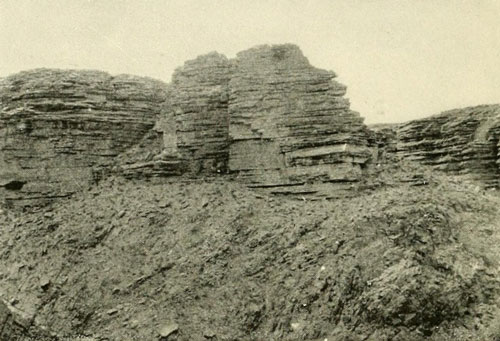
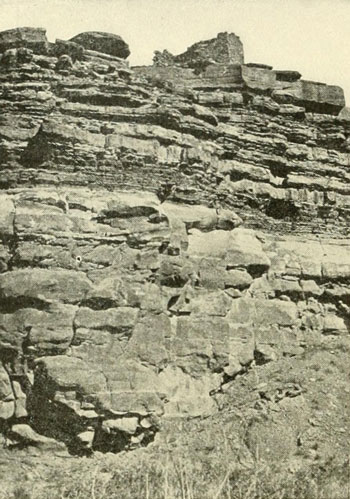
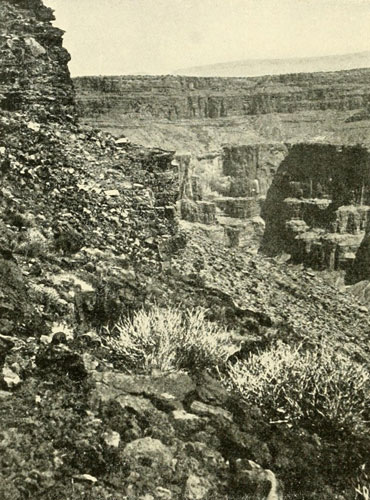
The Great Unconformity.
Top of the Granite, Grand Canyon.
Photograph by MITCHELL PRUDDEN.
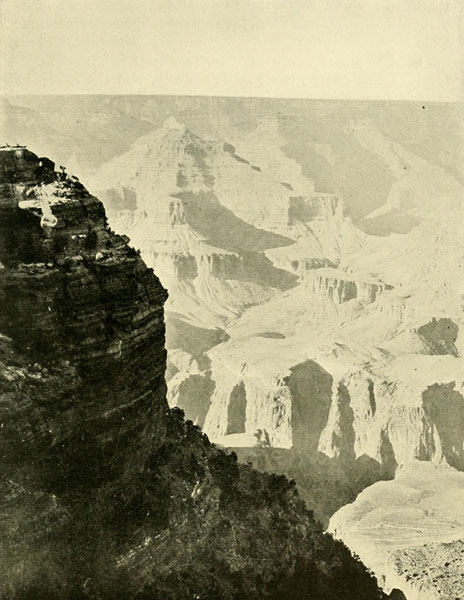
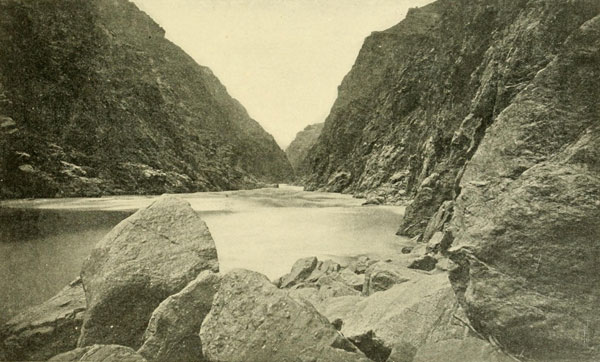
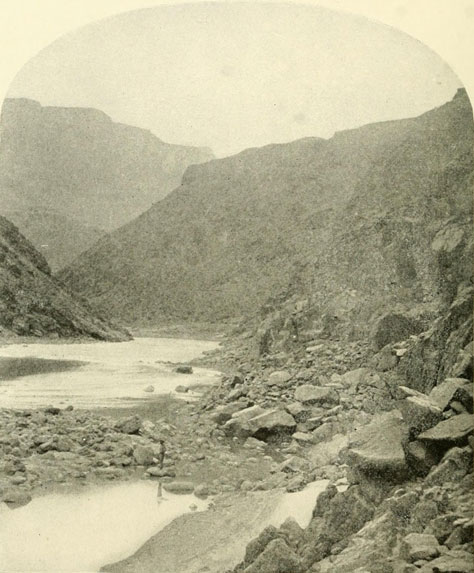
Arriving at the First Granite Gorge (Archæan formation), they were at the
beginning of the wildest stretch of river of all, perhaps the wildest to be
found anywhere, the fall in the first ten miles averaging twenty-one feet to
the mile, the greatest average except in Lodore and a portion of Cataract, and
as this descent is not spread over the ten miles, but occurs in a series of
falls with comparatively calm water between, it is not hard to picture the
conditions. Stanton also pronounces these rapids of the First Granite Gorge the
most powerful he saw, except two in the Second Granite Gorge. On January 29th
they had cautiously advanced till they were before the great descent some of
our party had called the Sockdologer, the heaviest fall on the river, about
eighty feet in a third of a mile. They proceeded all along in much the same
careful fashion as we had done, and as everyone who hopes to make this passage
alive must proceed. The water being low, they were able to let their boats by
line over the upper end of the Sockdologer with safety, but, in attempting to
continue, the Marie was caught by a cross-current and thrown against the
rocks, turned half over, filled with water, and jammed tightly between two
boulders lying just beneath the surface. In winter, the air in the canyon is
not very cold, but the river coming so swiftly from the far north is, and the
men with lines about their waists who tried to go through the rushing
waist-deep water found it icy. Taking turns, they succeeded with a
grappling-hook in getting out the cargo, losing only two sacks of provisions,
but though they laboured till dark they were not able to move the boat. Giving
her up for lost, they tried to secure a night’s rest on the sharp rocks.
Had a great rise in the river occurred now the party would have been in a
terrible predicament, but though it rose a few days later it spared them on
this occasion. It came up only two feet, and this was a kindness, for it lifted
the Marie so that they were able to pull her out of the vise. When they
saw her condition, however, they were dismayed for one side was half gone, and
the other was smashed in. The keel remained whole. By cutting four feet out of
the centre and drawing the ends together, five days’ hard work made
practically another boat. They were then able to proceed, and, going past
Bright Angel Creek, arrived on February 6th at what Stanton describes as
“the most powerful and unmanageable rapid” on the river. This, I
believe, was the place where we were capsized. Thompson at that time, before we
ran it, declared it looked to him like the worst rapid we had encountered but
at the stage of water then prevailing we could not get near it. Stanton wisely
made a portage, of the supplies and let the boats down by lines. His boat, the
Bonnie Jean, played all sorts of pranks, rushing out into the current,
ducking and diving under water, and finally floating down sideways. Then they
thought they would try what Stanton calls Powell’s plan of shooting a
boat through and catching it below. Such a harum-scarum method was never used
on our expedition, and I never heard Powell suggest that it was on the first.
Stanton cites as authority one of Powell’s statements in the Report. At
any rate in this instance it was as disastrous as might have been expected. The
poor Marie was again the sufferer, and came out below “in pieces
about the size of toothpicks.” The Lillie was then carried down
and reached the river beyond in safety. A day or two after this McDonald
decided to leave the party, and started up a little creek coming in from the
north, to climb out to the plateau, and make his way to Kanab. This he
succeeded in doing after several days of hard work and tramping through the
heavy snow on the plateau. The other ten men concluded to remain with Stanton
and they all went on in the two boats. Several days later they passed the mouth
of the Kanab. The terrible First Granite Gorge was well behind them. But now
the river began to rise. Before reaching the Kanab it rose four feet and
continued to rise for two days and nights, altogether some ten or twelve feet.
A little below the Kanab, where the canyon is very narrow, they came upon a
peculiar phenomenon. They heard a loud roar and saw breakers ahead. Thinking it
a bad rapid, they landed immediately on some rocks, and, going along these to
examine the place, the breakers had disappeared, but as they stood in amazement
there suddenly arose at their feet the same huge waves, twelve or fifteen feet
high and one hundred and fifty feet long, across the river, “rolling
down-stream like great sea waves, and breaking in white foam with a terrible
noise.” These waves, as was later ascertained, were the result of a
cloudburst on the headwaters of the Little Colorado, and indicate what might be
expected in here in the event of a combination of such waves with the highest
stage of water. The next day they were diminished, and the river fell somewhat,
but it was still so powerful they could barely control the boats and had a wild
and tumultuous ride, sometimes being almost bodily thrown out of the boats. By
this time their rations were getting low, but by pushing on as fast as possible
they reached Diamond Creek on March 1st, where supplies were planned to meet
them. Remaining there ten days to recuperate they went on with only eight men,
three concluding to leave at this place. The Second Granite Gorge begins about
eighteen miles above Diamond Creek, and is about thirty miles long. It is much
like the First Granite Gorge, being the same formation, excepting that it is
shorter and that the declivity of the river is not so great. From Diamond Creek
down to the end of the canyon is about fifty miles. It is a bad stretch, and
contains some heavy falls which, as the river was still somewhat high, were
often impossible to get around, and they were obliged to run them. The stage of
water in both these Granite Gorges makes a great difference in the character of
the falls. For example, in the Second Gorge, when Wheeler made his precarious
journey in 1871, he was able, coming from below, to surmount the rapids along
the sides with two of his boats, because the water happened to be at a stage
that permitted this, whereas Stanton found it impossible to pass some of them
without running, and Powell found the one that split his party the same way. So
it appears that one day finds these gorges easier or harder than another; but
at their easiest they are truly fearful places. At one of the worst falls
Stanton’s boat suddenly crashed upon a rock that projected from the
shore, and there she hung, all the men being thrown forward. The boat filled
and stuck fast, while the great waves rolled over her and her crew. Stanton
tried to straighten himself up, and was taken in the back by a breaker and
washed out of the craft altogether into a whirlpool, and finally shot to the
surface fifty feet farther down. He had on his cork jacket and was saved,
though he was ducked again and carried along swiftly by the tremendous current.
The second boat had better luck and came through in time to pick Stanton up.
The damaged boat was gotten off with a hole in her side ten by eighteen inches,
which was closed by a copper patch, at the first chance, the air chambers
having kept the craft afloat. After this the bad rapids were soon ended, and on
the morning of March 17th (1890) the party emerged into an open country and
upon a peaceful, quiet river. Continuing down through Black and the other
canyons, and through the intervening valleys, they reached, on the 26th of
April, the salt tide where Alarçon, three and a half centuries earlier, had
first put a keel upon these turbulent waters, the only party thus far to make
the entire passage from the Junction to the sea. And as yet no one has made the
complete descent from Green River Valley to the counter-current of the Tidal
Bore, so if there is any reader who desires to distinguish himself here is a
feat still open to him.
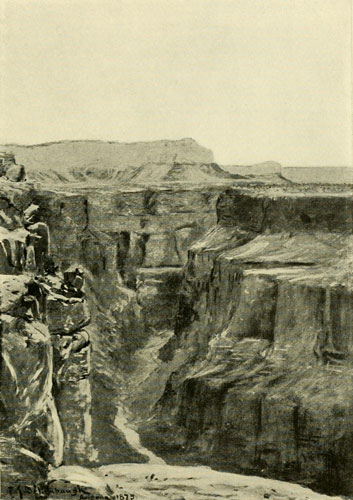
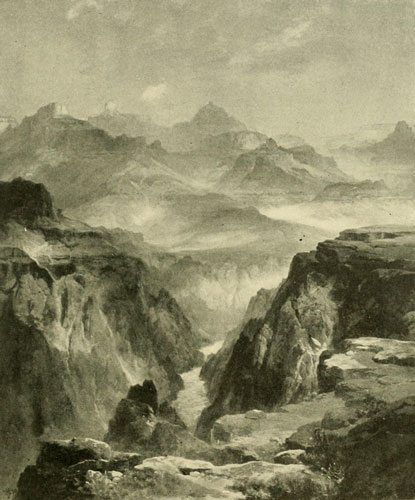
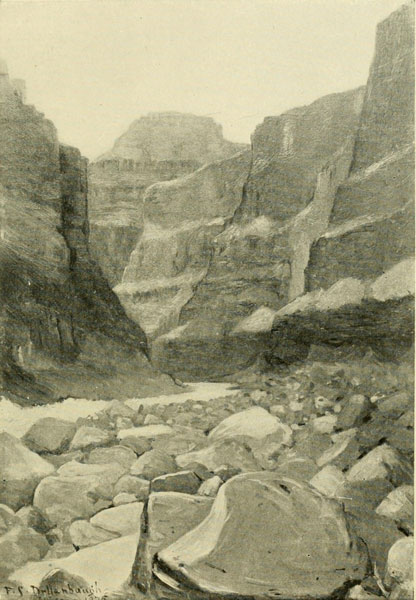
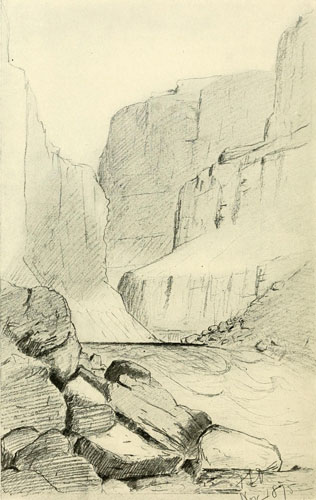
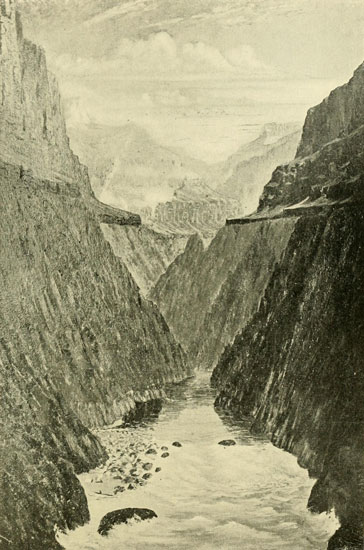
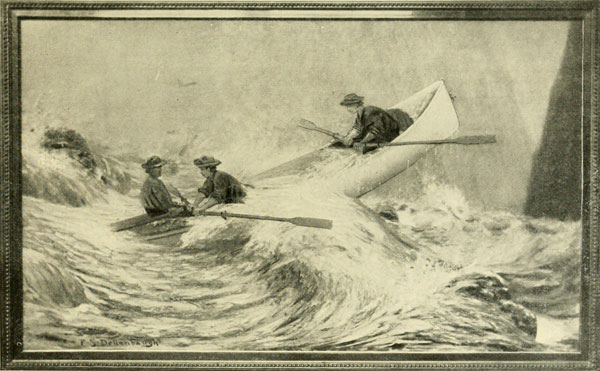
Looking up the Grand Canyon, at the Foot of Toroweap, Uinkaret Division.
Depth of inner gorge about 3000 feet—width, brink to brink, about 3500 feet.
Oil sketch by F.S. DELLENBAUGH.
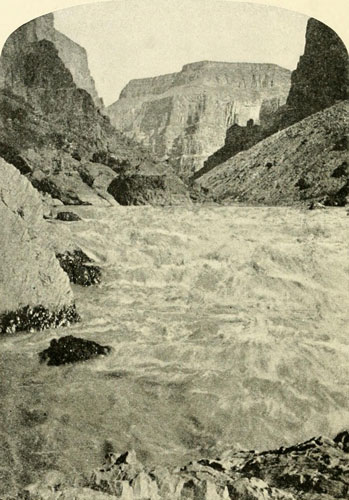
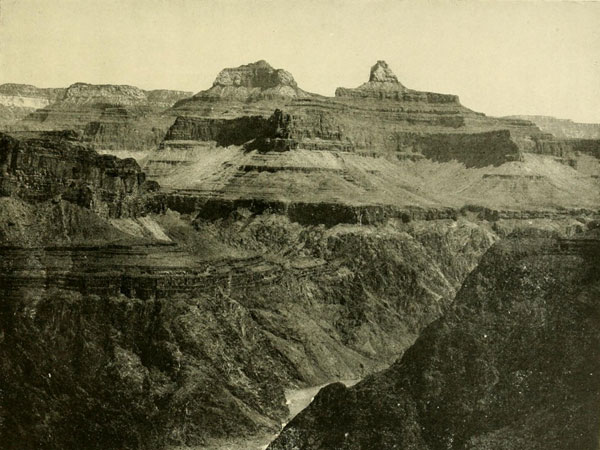
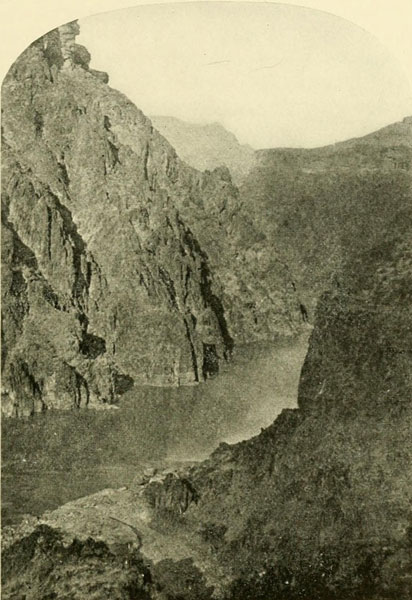
The Grand Canyon—Lava Falls.
Just below the Toroweap. Total depth of canyon about 4500 feet.
Photograph by J.K. HILLERS, U.S. Colo. Riv. Exp.
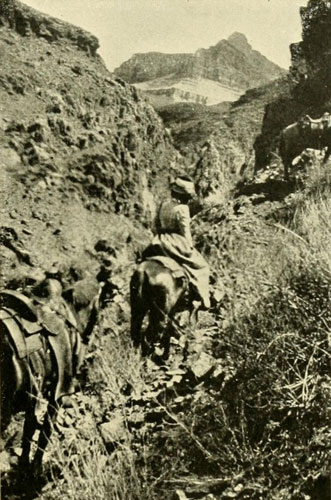
On the Bright Angel Trail.
Photograph by MITCHELL PRUDDEN.
Stanton deserves much praise for his pluck and determination and good judgment
in carrying this railway survey to a successful issue, especially after the
discouraging disasters of the first attempt. He holds the data and believes the
project will some day be carried out. From the foregoing pages the reader may
judge the probabilities in the case.
Since the Stanton party several descents successful and unsuccessful have been
made. The first was the “Best party,” representing the Colorado
Grand Canyon Mining and Improvement Company, with eight men and two boats
similar to those used by Stanton. The expedition left Green River, Utah, July
10, 1891. The members were James S. Best, Harry McDonald, John Hislop, William
H. Edwards, Elmer Kane, L. H. Jewell, J. H. Jacobs, A. J. Gregory, and J. A.
McCormick. Four of these, Hislop, McDonald, Kane, and Edwards had been with Mr.
Stanton, to whom I am indebted for this information. The men had cork
life-jackets. In Cataract Canyon one boat was wrecked but no one was lost, and
they made their way to Lee Ferry with the remaining boat and there abandoned
the expedition.
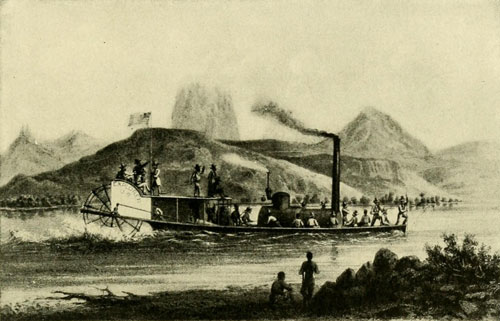
In 1891, a steam launch, the Major Powell, thirty-five feet long, with
two six-horsepower engines driving twin screws was brought out in the summer
from Chicago by way of the Rio Grande Western Railway to the crossing of Green
River, and there launched in September of that year. A screw was soon broken,
and the attempt to go down the river abandoned. In 1892 another effort was
made, but this also was given up after a few miles. But in 1893, W. H. Edwards,
who had been with the Stanton party, together with L. H. Johnson and some
others, took the Major Powell down to the Junction and back, making a
second trip in April. The round trip took fourteen days. They also went up the
Grand some distance. Entering the jaws of Cataract Canyon they went to the head
of the first rapid. On trying to return the current proved almost too much for
the power. With block and tackle to help the engines they finally got above the
swift water, and had no further serious trouble. Mr. Johnson says the launch
came near being wrecked. Several other steam craft were later put on the river,
the Undine being the most pretentious (see cut, page 390). She was wrecked
trying to run up a rapid on Grand River above Moab. In 1894 Lieut. C. L. Potter
made an unsuccessful attempt to go from Diamond Creek to the mouth of the
Virgin, September 20th, 1895, N. Galloway and William Richmond started from
Green River, Wyoming, and went down in flat, bottomed boats to Lee Ferry.
September, 1896, they started again from Henry’s Fork, Wyoming, and went
to the Needles reaching there February 10, 1897. Since that time Galloway has
made several successful descents. In August, 1896, George F. Flavell and a
companion left Green River, Wyoming, and successfully descended to Yuma in
flat-bottomed boats, reaching there December, 1896.
In 1907, three miners, Charles Russell, E. R. Monett, and Albert Loper, with
three steel boats each sixteen feet long, left Green River, Utah, September
20th, to make the descent. Loper and one damaged boat were left at Hite near
the mouth of Frémont river, while Russell and Monett proceeded. In the
beginning of the Grand Canyon they lost a boat, but with the remaining one
after various disasters, they finally made their exit from the Grand Canyon,
January 31, 1908. Their boats of steel were about the most unsuitable of any
ever put on the river. They carried a copy of this volume all the way through
and found it of value.
A view of the Grand Canyon may now be had without risk or discomfort of any
kind, as the Atchison, Topeka, and Santa Fé Railway runs trains direct to Hotel
Tovar at the very edge of the gorge at one of the grandest portions, opposite
Bright Angel Creek. There are several trails in this region leading down to the
river besides the one from the hotel. It is always a hard climb for those
unaccustomed to mountaineering. From the north, for any who are fond of
camping, an interesting trip may be made from Modena on the Salt Lake to Los
Angeles Railway via St. George to the Toroweap and the Kaibab country, though
this is a matter of several weeks, and necessitates an outfit.
The Grand Canyon may be crossed at two points, Bright Angel Trail and
Bass’s Trail, and the heights of the north rim gained in that manner
though it is not an easy trip.
In a general way we have now traced the whole history of the discovery and
exploration of this wonderful river, which after nearly four centuries still
flings defiance at the puny efforts of man to cope with it, while its furious
waters dash on through the long, lonely gorges, as untrammelled to-day as they
were in the forgotten ages. Those who approach it respectfully and reverently
are treated not unkindly, but woe and disaster await all others. The lesson of
these pages is plain, and the author commends it to all who hereafter may be
inspired to add their story to this Romance of the Colorado River.
Agreement made by Major Powell with men of his first expedition. From a copy in
the handwriting of one of the party.
(COPY) This agreement made this twenty-fifth day of February,
eighteen-hundred-and-sixty-nine, between J. W. Powell, party of the first part,
and J. C. Sumner, W. H. Dunn, and O. G. Howland, party of the second part,
witnesseth, that the said party of the second part agree to do the following
work, respectively, for the party of the first part, namely: J. C. Sumner
agrees to do all necessary work required with the sextant; W. H. Dunn to make
barometrical observations night and morning of each day, when required, also to
make observations when needed for determining altitude of walls of the Cañon,
also to make not more than sixty-two hourly series of not more than eight days
each, he to have the aid of an assistant for the last two mentioned classes of
observations; O. G. Howland to make a topographical drawing of the course of
the rivers. The above and foregoing work to be performed during the proposed
exploration of the Green River, from Green River City, Wyoming Territory, to
the Colorado River, and of the Colorado River from that point to Callville,
(blank space left here evidently for the insertion of the name of the territory
in which Callville was situated. F.S.D.) ———; the party of
the second part to perform the foregoing work to the best of their ability; the
party of the second part also agreeing to do a fair proportion of the work
necessary in getting supplies and boats safely through the channels of the
aforementioned rivers, for use of the expedition; and also agreeing to save for
specimens for stuffing, for the party of the first part, all suitable skins of
animals which they may collect while engaged in the above exploration of the
Green and Colorado rivers, J. W. Powell, party of the first part, agreeing to
allow the party of the second part five days at one time for prospecting for
gold and silver, if not too often; also to allow thirty days to the party of
the second part for hunting and trapping between the first day of September and
the first day of December, eighteen-hundred-and-sixty-nine, and sixty days
between the first day of January and the first day of June,
eighteen-hundred-and-seventy; the party of the first part also agreeing to pay
to the party of the second part, respectively, twenty-five dollars each per
month for the time employed in all such service, and also agreeing to pay in
addition the annexed prices for all skins procured for him by the party of the
second part; J. W. Powell, the party of the first part, to furnish boats,
supplies, ammunition, etc., sufficient for the use of the expedition. This
agreement to go into effect the first day of June
eighteen-hundred-and-sixty-nine, and not to continue over one year.
Should it be necessary to proceed on the journey, without delay on account of
disaster to boats or loss of rations, then the time specified for hunting may
not be required by either party, nor shall it be deemed a failure of contract
to furnish supplies should such supplies be lost in transit.
   J. C. Sumner               J.W. Powell
   William H. Dunn            In Charge of Col. River Ex.
   O. G. Howland
   Deer . .  $1.25 each  Martin .$1.50 each  Weasel                $.35 each
   Sheep .    1.25  "    Otter    3.50  "    Bear (grown grizzly) 10.00  "
   Antelope   1.00  "    Beaver   1.00  "    " cub   . . .         1.00  "
   Elk . .    2.00  "    Wildcat   .50  "    grown cinnamon        5.00  "
   Wolf (grey)1.00  "    Porcupine .50  "    " cub   . . .         1.00  "
   "  coyote   .50  "    Squirrel  .35  "    grown black . .       3.00  "
   Fox (cross)1.50  "    Rabbit    .35  "    " cub  . . .          1.00  "
   " red .  .  .75  "    Woodchuck .35  "
   Mink. .    1.50  "    Badger    .50  "

   and all other skins at proportionate rates.