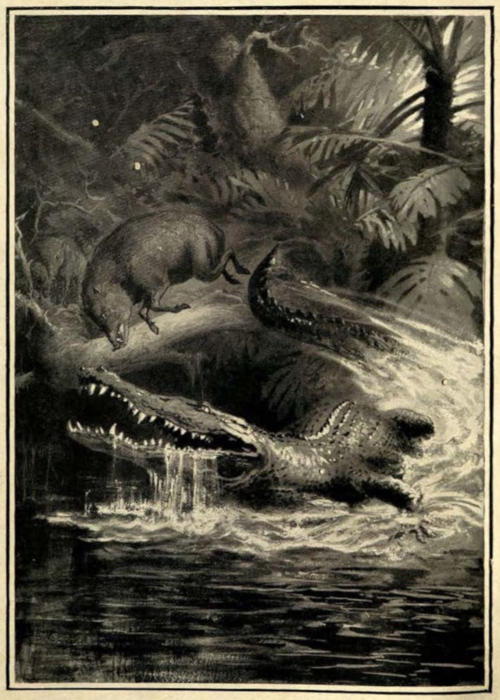
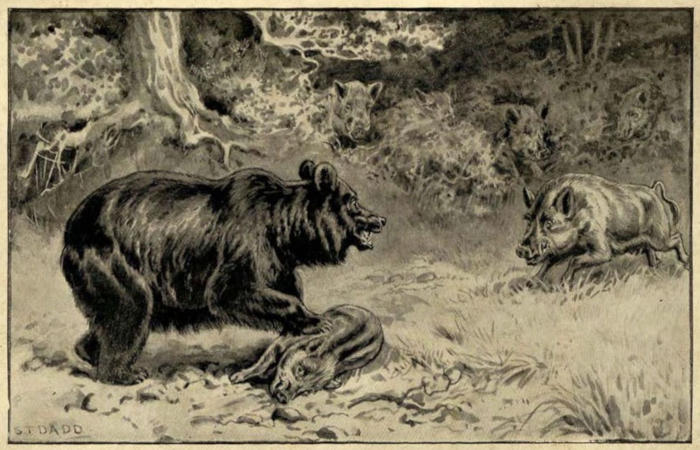
The peccary stood on the alligator’s tail, mistaking
it for a tree trunk. In a moment the alligator stretched its tail round
like a bow almost to its side: suddenly it let go, and whilst the peccary
thus shot up was still in mid-air, it swung its terrible tail again, and
knocked its now insensible prey almost into its own jaws.
NATURE’S PARASITES—PUSS-MOTH CATERPILLAR AND ICHNEUMON-FLY—CATERPILLAR
DEFENCES—WASPS AND THEIR VICTIMS—A
SPIDER CAUGHT—ANTS THAT ARE OGRES—OSPREY AND
EAGLE—GULLS AND SKUAS—PEEWIT AND BLACK-HEADED GULL
PROTECTIVE RESEMBLANCE IN NATURE—SPIDERS THAT LOOK LIKE
ANTS—A TRAP TO CATCH A BUTTERFLY—FALSE DEVOTEES—LEAF,
STICK, AND GRASS-RESEMBLING INSECTS—“CUCULLUS
NON FACIT MONACHUM”
SEALS AND THEIR WAYS—BREEDING HABITS OF THE SEA-BEAR—SEA-ELEPHANTS—THE
WALRUS AND THE POLAR BEAR—MATERNAL
AFFECTION UTILISED—A WINTER SLEEP IN A SNOW-HOUSE—A
DANGEROUS INTRUSION—BREAKFAST WITH AN
ALLIGATOR—THE CROCODILE AND THE TROCHILUS
THE GREAT CACHALOT OR SPERM-WHALE—HOW THE BULLS FIGHT—A
BATTLE OF MONSTERS—GIANTS THAT EAT GIANTS—ENORMOUS
CUTTLEFISH—THE KRAKEN A REALITY—DISAPPOINTED
PROFESSORS
WHALES AND THEIR ENEMIES—THE THRESHER AND THE SWORD-FISH—SPORT
AMONGST ANIMALS—THE SWORD-FISH AND ITS
WAYS—CANNIBALISM IN NATURE—THE SHARK AND THE
PILOT-FISH
THE SEA-SERPENT—MANY OCCASIONS ON WHICH IT HAS BEEN
SEEN—CONSCIENTIOUS SCEPTICISM OF SCIENTIFIC MEN—A
FIGHT BETWEEN MONSTERS—THE LARGEST LAND-SERPENT—SNAKES
AND SNAKE-STONES—MEDICAL EVIDENCE—A COLONIAL
REMEDY
HUNTING RUSES AMONGST THE HIGHER ANIMALS—WOLVES, FOXES,
AND JACKALS—UNTEMPERED JUSTICE—GESTURE-LANGUAGE IN
MEN AND DOGS—THE CAPE HUNTING-DOG AND HIS PREY
A MICROSCOPIC COMBAT—A SNAIL’S FRIENDSHIP—HERMIT-CRAB
AND SEA-ANEMONE IN PARTNERSHIP—A CRAB IN AMBUSH—CRABS
THAT EAT COCOANUTS.
Before there can be any romance—as I understand
the word—in animal life, there must be
some degree of intelligence in the romance-making
animals. The question, therefore, is, at what
stage in the ascending scale any conscious exertion of
brain-power—any evidence of what we call a mind—begins
to show itself. I say this because I have to begin
somewhere, and in my selection of subject-matter to
illustrate the title of this book, I had intended to pursue
a plan similar in principle to that resolved on by Koko,
in Mr. Gilbert’s Mikado, who, with a view to becoming
perfect as an executioner, was going “to begin with a
guinea-pig and work his way through the animal kingdom,
till he came to a second trombone.” Of course
I must begin much lower down than a guinea-pig, and
the nearest approach I can hope to make to a second
trombone will be a gorilla—but the principle is the
same. However, on further consideration, I think that
this scheme, if rigidly followed, may prove too exacting,
and also give an appearance of scientific pretension to
this humble little work, which it is entirely guiltless of.
I have decided, therefore, to soften and modify it by the
employment, when occasion offers, of another and somewhat
opposed principle, that, namely, of letting one
thing link itself to another as it does in ordinary conversation,
either through suggestion or association, quite
irrespective of whether there is any or no natural—that
is to say, systematic—connection between the two.
For instance, should alligators be the theme, and should
they, after lying like logs on the water, and so forth,
proceed, in the dramatic development of their character,
to seize and devour some unsuspecting mammal, I shall
use the incident as a convenient opportunity for treating
of that mammal—should there be anything to say about
it—without waiting for its proper turn to be treated of
to arrive, as upon the first-stated principle I should have
to do. But where opportunities of this sort do not
present themselves—if birds have only to do with birds,
insects with insects, and so forth—then I shall be systematic,
and so go on, letting the one method balance the
other. A third principle—that, namely, of paying no
attention to either of the other two—will also occasionally
be acted upon, and if, as a result of the three, no
principle at all should be discernible by the reader,
I would ask him to look upon that as a merit, since
“Summa ars est celare artem.” And now, having explained
my system, which I think is an easy and flexible
one, I will proceed to put it into practice in the best
way I can.
The lowest of all animals are the protozoa, yet even
here, as it appears to me, we begin to see the dawnings
of that intelligence, without which that kind of interest
which the life and acts of any creature should possess,
in order to make it the subject for a work like this, can
hardly be said to exist. The infusoria stand at the
very bottom even of the protozoa. Most of them are
so small as to be invisible, except through the microscope,
and they are not supposed ever to think. Yet
a creature belonging to this humble group, having
a cup-shaped body, with a grasping arm or tail to it,
has been seen to attach itself, with this, to the cup
of another individual of the same species, considerably
larger than itself, and cling there with a pertinacity very
suggestive of a firm intent. Upon this the larger one
became, to all appearance, very excited, and, moving
about in the water—for these creatures are aquatic—till
it came to some weed, fastened with its one limb on a
piece of this, and proceeded to jerk itself backwards and
forwards, with great suddenness and vigour, and with the
evident design, as it seemed, of ridding itself of the intruder.
The latter, however, held on like grim death, and
this hard-pitched battle, which had all the appearance of
being intelligently directed, went on between these two
microscopic and simply formed creatures, for quite a long
time. At length the smaller of the two was jerked off,
upon which it made a second attempt to establish itself
as before, but was defeated by the efforts of its more
powerful adversary. The witness of this interesting scene
tells us it was very difficult to believe that the two
lowly organisms engaged in it, though consisting but of a
single cell, without a head and with no trace of a nervous
system, properly so called, were not sentient beings, conscious
of what they were doing, and of why they were
doing it.
Coming to the earthworms, which stand higher than
the protozoa, though still very lowly, there seems little
doubt that they are capable of forming and carrying out
an intelligent purpose, since, when they pull leaves into
their holes, they always catch hold of them by the proper
part, so that they go down easily, and this they do even
with the leaves of foreign trees, of which they can have
had no previous experience. And if worms have experience,
snails have both that and something better, or, at any rate,
still more interesting to discover in a creature of this kind.
“They appear,” says Darwin, “susceptible of some degree
of permanent attachment. An accurate observer—Mr.
Lonsdale—informs me that he placed a pair of land-snails,
one of which was weakly, in a small and ill-provided garden.
After a short time the strong and healthy individual disappeared,
and was traced, by its track of slime, over a
wall and into an adjoining well-stocked garden. Mr.
Lonsdale concluded that it had deserted its sickly mate;
but after an absence of twenty-four hours it returned, and,
apparently, communicated the result of its successful exploration,
for both then started along the same track, and
disappeared over the wall.”
Both snails and worms, however, stand higher in the
scale than do the sea-anemones, amongst which latter
creatures—those flowers of ocean, rivalling with their
pillared stalks and many-coloured living petals the
proudest ones on earth—we yet find an instance of
what is called commensalism—the living together, that
is to say, in friendly community of two separate and
often widely sundered species, each thereby obtaining
some benefit for itself. The other party to the arrangement
is in this instance a crab—the hermit-crab—that
curious anchorite which by living and moving about in
the disused shell of another creature escapes the many
dangers which would otherwise threaten its soft and
palatable body. Indeed, the association may almost be
said to be between three, rather than two, different species,
each of them belonging to a separate and well-marked
division of the animal kingdom—viz. to the mollusca, the
crustacea, and the cœlentera respectively. As, however,
the mollusc is represented by its house only, and not by
itself—though, indeed, its house is structurally a part of
it—it will be safest to consider the alliance as a dual rather
than as a triple one. That the anemone establishes itself
on the shell, not by mere chance, as might sometimes
happen, did the crab allow of it, may be demonstrated in
a very delightful way; for if, when it is attached to a
stone, a hermit-crab should be placed in its vicinity, it
will, after a time, abandon its post, and gliding, like a
snail, to the hospitable portals of its friend’s domain,
proceed to attach itself there, much to the satisfaction of
the latter. For that the crab’s participation is of an
active kind, that he does not merely not mind the
anemone, and that the latter has more than his sanction,
is, likewise, a thing that can be proved. This discovery
was first made in 1859 by Mr. Gosse, the naturalist, for
up to that time it had always been imagined that the crab,
at any rate, was indifferent. Mr. Gosse, however, by the
simple expedient of detaching the anemone from the shell,
demonstrated that this was not the case, for on each occasion
that he did so the hermit-crab picked it up again in its
two claws, and pressing it against its shell, held it there
for about ten minutes, at the end of which time it was
sticking fast, as before. The crab, therefore, must derive
some advantage from the presence of the anemone in
return for the protection which he perhaps affords the
latter against certain enemies. Or possibly the constant
change of locality, with its increased chances of procuring
food, is the real or the principal benefit conferred. But
how does the crab benefit? This, at first sight, is not
quite so easy to see. The explanation usually given is
that it is “masked” or concealed by the sea-anemone,
which is by no means small in comparison with the size of
the shell, but often almost and completely covers it, forming
a sort of cloak round it at its base, and towering like
a pillar above it, so that of the two it is by far the more
conspicuous object, especially when the crab is withdrawn,
or partly withdrawn, into its shell. Nor is it always one
anemone only that is affixed to the shell; there may be as
many as two or three, or even more, and in some cases not
only the shell, but the crab’s own claws may be thus
utilised. Certainly, therefore, if concealment is a gain to
the crab, it obtains this advantage by the arrangement.
If, too, it has any special enemies of its own—as it is very
probable that it has—the stinging cells of its allies would
be likely either to incapacitate them or keep them at a
distance. Of one thing, at least, we may be certain, that
some advantage is obtained—and, no doubt, it is a substantial
one—by each of the individuals in this strange
copartnership—for throughout nature, in associations of
the kind, the principle expressed by the homely Scotch
saying of “giff, gaff”—Anglicè, “nothing for nothing”—obtains.
Apparent instances may indeed be found of one
species doing something for the benefit of another, since
the very nature of these arrangements is such as often to
give them this appearance. But such instances are apparent
only. Whatever it looks like, and whatever either or any
of the parties concerned may do, they always do it for
their own, and not for one another’s benefit.
Supposing that concealment is the principal advantage
accruing to the hermit-crab from its relations with the
sea-anemone, it seems likely that this is more for the sake
of securing prey than of avoiding enemies—though, indeed,
both objects seem fairly attained by the shell. Another
crab—the Hyas of Otaheite—arrives at similar results by
means which are somewhat similar, but which, in this
case, constitute a ruse which is all the creature’s own. It
deliberately loads on to its back a cargo of seaweed
mingled with the sand and débris of the coral, amongst
which it lives, and having done so, remains motionless,
awaiting the advent of anything that may serve as a meal.
The tips of the ready claws lie just within the weedy
thatch, whilst the eyes at the ends of their stalks are
raised above it, so as to obtain a full view. They are,
however, indiscernible, except in a fatally close proximity.
Time passes, the sun shines brightly down through waters
clear as the clearest crystal and bluer than the bluest sky.
Fishes, rainbow-hued and flashing, sometimes, with the
iridescent sparkles of the humming-bird—the jewels of
the tropic seas—pass and repass often quite near to the
unseen peril, but except by the motion of their own
bodies, or the throb of the waves, the weeds which
conceal it remain unstirred. Nothing happens: yet the
eyes observe, the claws may, perhaps, itch; but their
owner moves not. Such beings are not for him. They
are beyond his sphere, too bright, too beautiful, above all,
too quick. Medusæ, too, of substance translucent as the
waters they move in, and washed with the colours of the
sea itself, go by, sometimes in flocks, alternately expanding
and contracting their smooth, bell-like bodies, whilst threads
and filaments of varied form, and delicacy more exquisite
than that of the finest lace, stream in beauty behind them.
Sea-horses swim vertically like little mermaids, twining
their tails together, or around the long fronds of many-tinted
seaweeds, whilst strange and varied forms of mollusc
and crustacean move upon the shell-strewn sand, or amidst
the bright mazes of the coral—but still our crab makes
no sign. At length a small creature of the shrimp or
prawn kind—a crustacean like itself, and more active it
would seem, for it swims, though backwards and in a
curious jerky way—approaches the little heap; the crab’s
eyes glisten—they would, at least, were they capable of
doing so. Alternately shooting up and sinking down
again, the unsuspecting creature continues to play about
in the close neighbourhood of that deadly ambuscade, and
at length, in one of the latter movements, comes well
within reach. It is almost on the bottom, its tail stirs
the weeds and is about to bend again, when with a rush
the lurking enemy is upon it, seizes it between its fatal
claws, and retiring backwards amidst the shelter which
the violence of its sudden movement has partially removed,
proceeds to devour it at its leisure. Such is the stratagem,
and such the sure, if somewhat slow, result. All sorts of
creatures are thus secured by the crab, including, perhaps,
on special occasions, a small and less wary fish or so.
What makes the thing still more curious and interesting—from
the standpoint of the evolutionary naturalist—is
that the back of the clever strategist is covered all over
with a crop of stiff, wiry bristles, which, curving inwards,
maintain a firm hold of the weeds that lie upon them,
and prevent their slipping off. No doubt these bristles
have become more and more developed as the crab has
become more and more in love with the ruse, to the success
of which they now largely contribute: but which came
first, the ruse or the bristles, that no one can say. On the
one hand, the bristles, whilst yet small and but slightly
curved, might sometimes, catching amongst and holding
fragments of seaweed, etc., have suggested to the crab
the use to which these might be put; but, on the other,
as many creatures hide themselves in order to dart out on
their prey, and as a good way of doing so in the case of
a flat-backed creature would be by placing things on
its back, the crab may possibly have thought of this without
any structural facility to suggest the idea.
Both these crabs that we have been considering exhibit
their intelligence and live their lives in the sea, and it
is with salt water and the rocky pools of the sea-shore
that crabs, generally, are inseparably associated in our
minds. Nevertheless there are land crabs, and even
crabs that eat cocoanuts. Whether these latter are
also in the habit of climbing the lofty palms on which
the cocoanuts grow, throwing them down and then
ascending again with them, in order to break them by
repeating the process, having previously freed them from
their huge husky envelope, does not seem to be quite
certain, but such is the account explicitly given by
the natives of the Samoan Islands. “I inquired of
them,” says Mr. T. H. Hood, in his Notes of a Cruise
in H.M.S. “Fawn” in the Western Pacific, “about the
habits of the Ou-ou, or great cocoanut-eating crab,
common here, and found the reports previously received
from the natives corroborated. It ascends the cocoa
trees, and, having thrown the nuts down, husks them on
the ground; this operation performed, it again ascends
with the nuts, which it throws down, generally breaking
them at the first attempt, but, if not successful, repeating
it till the object is attained.” This account, Mr. Hood
goes on to say, was confirmed by every native subsequently
spoken to on the subject. It is difficult to see how the
natives should have been mistaken in regard to such a
noticeable and very remarkable habit, and on the other
hand, if they were inventing, why should they have all
invented in one and the same way? In the new edition
of Wood’s Homes without Hands this account of Mr.
Hood is still quoted without any qualifying statement in
the form of a footnote. On the other hand, Darwin,
when he visited the Keeling Islands, was told by Mr.
Liesk, an English resident on one of them, that the crabs
fed upon such nuts only as happened to fall from the
trees. The Keeling and Samoan Islands are, however,
some 5,000 miles apart, and it is at least possible that the
crabs of each, though of the same species, may have
learnt a different way of getting at the inside of the
cocoanut, especially as elsewhere they seem to practise
yet a third method.
To begin with Darwin’s account. Mr. Liesk, speaking
as an eye-witness, told him that the crab first shredded
off the husk, fibre by fibre, beginning always at that part
under which the three eyeholes of the nut lay. It then,
he said, hammered with its claws, which are heavy and
powerful, on one of the eyeholes and, having made an
opening, turned round and inserted its thin posterior legs,
which are also armed with small pincers, into it, and thus
extracted the kernel. This is a plain statement, and in it
we see the philosophy of the small and weak pair of claws
which are as useful in the last and most satisfactory part
of the process as are the larger ones in the pioneer work
preceding it. Just as plain, however, is the following
statement, which was made by two South Sea missionaries
(Mr. Tyerman and Mr. Bennett) at about the same time.
They say: “These animals live under the cocoanut trees,
and subsist upon the fruit which they find on the ground.
With their powerful front claws they tear off the fibrous
husk; afterwards inserting one of the sharp points of the
same into a hole at the end of the nut, they beat it with
violence against a stone until it cracks; the shell is then
easily pulled to pieces, and the precious food within
devoured at leisure.” Here, then, is quite a different way
of getting at the contents of the cocoanut, but the same
informants go on to say that “sometimes by widening
the hole with one of their round gimlet claws, or enlarging
the breach with their forceps, they effect sufficient
entrance to enable them to scoop out the kernel without
the trouble of breaking the unwieldy nut.” This, perhaps,
may mean the same as what Mr. Liesk tells us, but
nothing is said about the crab’s turning round. It is not
very clear from the account of the two missionaries
whether they speak as eye-witnesses or not. Mr. Liesk
does, but I should not myself think that his observations
had been very exhaustive, and as the Voyage of the Beagle,
in which they are referred to, was published nearly sixty
years ago, it seems to me a pity if the habits of the cocoanut-eating
crab have not been more carefully studied
since then. I think myself that a crab which lives on
cocoanuts, and may possibly climb the trees on which
they grow, is worth taking some trouble about. This,
however, is not all that the Birgus latro—for that is his
scientific name—does. Not only does he live upon land,
but he makes a deep burrow in the ground to dwell in,
and with the shredded fibres of the cocoanut husk, which
he has torn up, he makes a thick soft bed at the bottom
of it to lie on. One would think with all this that he
had said good-bye to the sea for good and all, and would
never want to go back to it. But this is not the case.
Like other crabs, these strange ones breathe through
branchiæ or gills, as a fish does, and in order for them
to do so these must be kept moist. The peculiarity of
all land-crabs is that their gills remain moist for a long
time, but at the end of this time, when they are beginning
to get dry, they have to moisten them again. Every
night, therefore, the cocoanut crab pays a visit to the sea,
and has a cool, refreshing bathe in it. For a little while
he is a marine creature again, as his ancestors were before
him, but when he has moistened his gills, he goes back to
his palm-trees and cocoanuts.
This great strange crab grows to two feet in length,
is stout in proportion, and has a fantastic appearance,
which it is difficult to describe. It walks very high on
two long stout pairs of legs, whilst a pair or two of little
ones behind them are too short to touch the ground, and
so dangle in the air. Its claws are enormous, its thorax
very peculiar, its antennæ are like those of a lobster, and
its body behind more like a hornet’s than a crab’s—at
least in a picture. What it really resembles is a hermit-crab,
to which it is closely related; only to see the resemblance
one must take the hermit-crab out of its
borrowed shell.
CHAPTER II
NATURE’S PARASITES—PUSS-MOTH CATERPILLAR AND ICHNEUMON-FLY—CATERPILLAR
DEFENCES—WASPS AND THEIR VICTIMS—A
SPIDER CAUGHT—ANTS THAT ARE OGRES—OSPREY AND
EAGLE—GULLS AND SKUAS—PEEWIT AND BLACK-HEADED GULL.
In the sea-anemone affixing itself to the shell of the
hermit-crab, who becomes its friendly and interested
landlord, we have seen one of the more pleasing
instances of association between two or more different
species of animals. There are many others, such as that
between the shark and the pilot-fish, the honey-guide and
the ratel, the rhinoceros and its little bird, etc., etc., which
we can dwell upon with equal pleasure. Some, however—and,
unfortunately, they are much more numerous—are
of a darker character, repelling us almost as much by the
picture which they present of nature’s unbending cruelty
as they arouse our admiration by their wonderful ingenuity
and adaptation of means to ends. The most
salient examples of this kind of living together—partnership
we can hardly call it—are to be found, perhaps, in
the insect world. Parasitism is the proper word for it,
and the most salient, or at least the most repulsive,
examples are furnished perhaps by the hymenoptera—that
genus of insects in which the bees, wasps, and ants
are included. Thus almost all caterpillars—perhaps all—are
victimised by some species of ichneumon-fly—a
wasp-like creature that seeks it out, pierces its soft body
with a long ovipositor, with which it is provided for the
purpose, and lays a number of eggs inside it. Having
done this, it goes away, and the caterpillar goes on
feeding. It is, however, doomed, and destined never to
enter into the moth or butterfly state of existence. In
due time the eggs are hatched by the warmth of its own
body, and on this body to which they are so highly indebted,
the young ichneumons, now in their own caterpillar
state, begin with unconscious ingratitude to prey.
They feast upon it day and night, but the creature,
ordained by the iron laws of nature to suffer in this way,
is long-lived, and though sickening from day to day, has
often sufficient strength to become full-fed, and make its
cocoon, and pass into the chrysalis, or pupal, state. How
long it lives after that it is difficult to say. Probably
some vitality remains as long, or almost as long, as any
part of itself does. All that we know is that after a
longer or shorter interval a score or so of ugly, evil-looking
ichneumon-flies issue from the dry shell of the
chrysalis, instead of the innocent and radiant creature
that would otherwise have done so.
It is curious—gratifying, too, if one allows oneself to
give way to a natural, though unreasonable feeling—to
learn that some of these very ichneumons themselves become,
in a similar manner, the victims of others of their
own species. Thus from two corpses, on the slowly dying
bodies of both of which it has directly, or indirectly, fed,
the third life in death emerges, like some ghoul from a
double tomb. Could the caterpillar know that the being
which so remorselessly preyed upon its tissues and juices
had a similar parasite within its own body, doing it to
death in the same horrid way, how relieved and almost
happy it might feel! But Nature, though she often
brings in her revenges, seldom grants to her suffering
children the proverbial sweetness of revenge. Caterpillars,
however, do not always submit to the machinations
of the ichneumon-fly without a struggle, and in
some cases they may be successful—how often it is not
easy to say—in guarding themselves against their attacks.
The puss-moth, for instance, which is especially liable to
them, is furnished, no doubt for that very reason, with
a special weapon for its defence. The end of its body
is forked, and each fork is prolonged into a sort of tail,
from which a red filament can be extruded and waved
about at the will of the creature. In this way, and by
its violent contortions, it may sometimes succeed in whipping
off, as it were, the ichneumon that is attacking it,
but it has another and more efficacious means of defending
itself. An aperture in the skin behind the head communicates
with a gland containing a clear fluid, forty per
cent. of which is formic acid, and the rest water. This
the caterpillar can eject with great force, and so pungent
is it that a few drops falling on an unwary ichneumon-fly
are sufficient to incapacitate, if not actually to kill it.
Lizards, indeed, and monkeys, as has been experimentally
ascertained, are affected by this powerful irritant, nor, as
far as we know, is there any other animal secretion which
contains so large a proportion of strong acid. It is
probable that the caterpillar of the puss-moth is not the
only one which has this power of spurting a noxious fluid
over its enemies, whilst many are protected in other ways:
some by their hairiness, others by being coloured like the
leaves they eat, or resembling, when at rest, a twig of the
plant on which they sit immovable. By these latter
means they certainly avoid being eaten by birds, and
there seems no reason why they should not sometimes
deceive the ichneumon-fly also. But in spite of all
defences, whether consciously or unconsciously brought
into play, a large proportion of most caterpillars yield
to destiny, and are slowly eaten alive by the special parasite
which Nature has provided for them.
Still worse, perhaps, though very similar, is the fate
which various insects—caterpillars, grasshoppers, etc.—as
well as spiders, experience at the hands of several
species of wasps. These wasps are not social, like the ones
we are familiar with, and make no nest other than a
cell in which to place their eggs, together with the
nourishment which the young, when hatched, will require.
This nourishment is the creatures aforesaid. In
the best-known instance the female wasp first makes
a long tunnel in the earth, with three or four separate
chambers or cells at the end of it, in which she deposits
her eggs. She then seizes an insect, which, if it is a
grasshopper, or something equally active, struggles violently
to escape, and being often as large as, or larger,
than the wasp herself, the contest may be a long one.
Invariably, however, the wasp—or sphex, to give her her
generic name—is victorious. She could, indeed, sting at
once, if she were so minded, but this she does not do.
She reserves her fire, so to speak, till, after more or less
violent exertion, she has succeeded in throwing her victim
on its back. Then she stings it in two particular spots,
the throat, namely, and between the thorax and abdomen.
Instantly the struggles of the wretched creature cease:
a ganglion, or nerve centre, has, with each sting, been
pierced—it is paralysed, but not by any means dead. To
kill it, indeed, is far from the intention of the sphex
herself, and, kind and thoughtful mother, she does not
allow the meat which she provides for her offspring to go
bad. It will last, as she has managed it, for the whole
time that it is wanted. All now is quite satisfactory.
She can be grateful for mercies vouchsafed. She rests for
a little, then seizing the helpless, living food by a leg or
a wing, she drags it—for it is usually too heavy for her to
fly with—to the mouth of her nursery larder. Here she
leaves it for a little, while she enters to see that all is
well. Re-emerging, she seizes it again, drags it down the
tunnel, deposits it in one of the chambers, plasters it up,
and leaves it for a while. In due time she returns with,
and inters, another paralytic, and, having thus successively
filled all the four chambers, she closes the mouth
of the tunnel and flies merrily away—doubtless
“With the gratifying feeling that her duty has been done.”
Of course, after a certain number of days, the eggs are
hatched, each young sphex caterpillar immediately falls
to, and the grasshoppers that have been previously buried
alive are now eaten alive—two kinds of deaths which are
equally unpleasant, and each of which lasts a long time.
However, they are paralysed—insensible, we may hope,
therefore, to such pain as insects feel. Whether the
paralysis is mental as well as corporeal it is impossible
to say, but it may, in any case, be doubted whether
grasshoppers can suffer through the mind. Assuming
that they cannot, the inability, though it would involve
another of an opposite nature, must yet here be considered
advantageous, since that sort of pleasure which
arises out of a just sense of the beautiful contrivances
and adaptations of nature, must always, we may suppose,
be beyond the capacity of an insect; and even were it
not, it is the sphex in this case whose mind would, in all
probability, be most open to such reflections.
The habits of the sphex have been studied in Europe
by “that inimitable observer,” as Darwin calls him,
M. Fabre, from whose writings the foregoing account
has been compiled. In India its place is taken by a
very large wasp of a uniform steely-blue colour and a
most venomous aspect. This kind makes a clay nest, of
about the size and shape of a very large Brazil-nut, on
the outside of some perpendicular surface, and often
chooses for this purpose the walls of houses or bungaloes.
I have watched it time after time flying in first with
little glistening round balls of moist clay, and afterwards
with curled up balls of caterpillars of about the same
colour, but larger. With these she filled up one large
cell, the entrance to which she then closed with more
mud. It was an interesting sight, but, to enjoy it
thoroughly, one ought to be an optimist.
In the above-mentioned instances the cell which serves
as cradle and tomb combined is made by the provident
mother. Some wasps, however, have learnt to save time
and trouble by walling the victim up in a cell of its own
manufacture, or, at least, of its own choosing. This
happens to a certain spider in South America, which
sits in a little hole in the ground waiting for insects
either to pass or come in. The wasp, which is blue like
the other, but smaller than our common one, goes about
from hole to hole, and when it finds one occupied by
a spider, goes a little way into it, and then rushes out,
hotly pursued by the owner. When on the point of
being overtaken it suddenly turns, grapples with the
spider, stings it, drags it back, paralysed, into its own
hole, lays an egg by it, and departs, having previously
blocked up the entrance with earth. The entrance of
the wasp into the spider’s hole, with its retreat, some
time afterwards, in feigned alarm, so as to draw the
spider out, is certainly an act of great intelligence. The
intelligence, however, is surpassed, or exhibited in a more
entertaining manner, in the case of another wasp which
has been seen to creep noiselessly round to the entrance
of a spider’s nest, and then wriggle one of its antennæ
in front of the opening. Upon this, the owner of the
nest, a very large spider, came out, and was at once
stung to death by the wasp. The latter then wriggled
an antennæ again, and upon no notice being taken,
entered the nest and killed all the young spiders, which
he then carried off at his leisure.
Other wasps lay their eggs in the nests of humble bees,
and the young growing up there prey upon the honey and
comb. Amongst ants, again, some of the smaller species
are parasitic upon the larger ones, an enforced association
which may be very much to the disadvantage of the
latter. Especially is this the case where an ant whose
Latin name is Solenopsis fugax—if it has an English
one I do not know it—is the unbidden guest. Lord
Avebury tells us that it “makes its chambers and galleries
in the walls of the nests of larger species, and is the
bitter enemy of its hosts. The latter cannot get at them
because they are too large to enter the galleries. The
little solenopses, therefore, are quite safe, and, as it appears,
make incursions into the nurseries of the larger ant, and
carry off the larvæ as food. It is as if we had small
dwarfs, about eighteen inches to two feet long, harbouring
in the walls of our houses, and every now and then carrying
off some of our children into their horrid dens.” The
insect world is particularly rich in these parasitic relations,
but space will not allow me to enlarge upon them further.
Turning to birds, we meet with instances not less
interesting, whilst very much less painful, since here the
victimised species is only robbed by the other, and not so
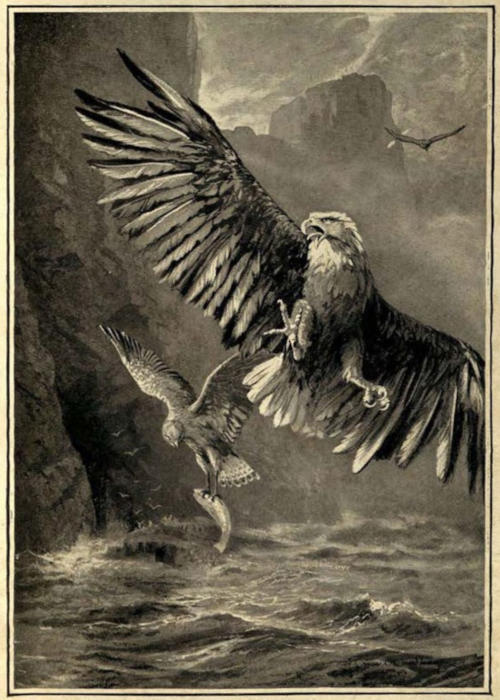
frequently as to prevent its making a living. The osprey,
for instance, which preys almost exclusively on fish, which
it hooks with its claws out of the water, is forced, though
itself a large bird, to give up much of its booty to the
still more powerful white-headed eagle. The latter sits on
some rocky crag or peak “that beetles o’er its base into
the sea,” and watches with a greedy eye the “inferior
fiend,” as, far below, it hovers on broad wings above its
destined prey. At once the wings are closed, and the
spray dashes over them as the bird precipitates itself upon
a gleaming light amidst the waves. For a moment it is
almost hidden in the foam and swirl, the next it emerges
out of it, and mounts with powerful beats into the air, its
head stretched shorewards, and its bent claws struck deep
into the body of a large fish, beneath the weight of which
it labours. Slowly at first, but gaining strength and
speed as it ascends, it heads towards the cliff’s face.
Already it can see the crag on which its eyrie hangs,
when, like a thunderbolt, and with the shriek or laugh of
a demon, the lonely watcher, who has marked it all, hurls
itself downwards on spoiler and spoil. With a quick turn
the startled bird avoids the furious rush, but almost at
the same moment another maniac laugh, answering the
first, drowns its own note of anger and despair, as the
mate of the eagle that has commenced the attack swoops
towards it from a neighbouring pinnacle. All striving now
on the osprey’s part is in vain. Like storm-clouds the
two strong robbers gather above him and descend like the
jagged lightning out of them. Their screams sound
almost in his ears, their claws have cut his feathers, when
his own reluctantly relax their grip, and the glittering
booty falls. Something falls with it—over it. There
is a rushing wind of wings, an overshadowing darkness in
the air, the trail of light is checked in its descent, and
out of that whirlwind of excessive speed an eagle soars
serenely to the sky bearing a fish in its claws. In their
eyrie, or on a ledge of the precipice, the pair of imperial
brigands share their meal, or distribute it to their eaglets.
The osprey tries again, and may, perhaps, catch another
fish before they have finished.
Highway Robbery.
The osprey rose with its prey when the eagle swooped,
but by swerving, the osprey momentarily escaped. The eagle is shewn
stopping himself against the wind, to swoop again with fiendish cries
until the osprey drops his prey in terror.
Other piratical plunderers are the skuas and some other
members of the gull family. With the former the practice
is more habitual, or, rather, it is pursued more to the
exclusion of other habits of feeding. In the more northern
parts of the British Isles—especially in the Orkneys
and Shetlands—the lesser or arctic skua may be seen all
day long during the breeding season, taking toll of the
various sea-fowl, as they fly with fish to feed their young.
One might think that when once the fish had been
swallowed there would be an end of the annoyance, and
that the rightful owner must, by the very nature of
things, now be safe. Such, however, is by no means the
case. Most birds have no difficulty in bringing up again
what they have swallowed down.[1]
The skua, when it swoops upon a gull, does so with
the deliberate intention of forcing it to disgorge the fish
it has swallowed, which it then, like the eagle, catches in
the air before it has touched the sea. Should it not
succeed in doing this, the fisherman asserts that it will not
touch it, but invariably leaves it lying on the water, or on
the land, should it chance to fall there. I have myself
seen skuas act in this manner, but am not so satisfied that
it is their invariable practice. Terns, should there happen
to be a colony in the neighbourhood, are particularly
persecuted by these skuas, insomuch that the gulls derive
a distinct benefit from their presence. Puffins and guillemots
are also pursued, and so ingrained is the habit of
piracy that the skuas will sometimes, as it were, play at
it, swooping at and chasing one another in the same
manner and with the same wild cries as when they practise
the art in earnest. Of course, under these circumstances
neither bird disgorges to the other, and it is easy to see
that neither expects the other to do so.
Though gulls uniformly suffer at the hands of the
skuas, they can be pirates too amongst each other, and in
harbour or where fishing-smacks are anchored nothing
is commoner than to see a bird that has seized on some
offal of fish thrown overboard mobbed by a host of
others, till the morsel reappears again de profundis.
Only one British gull, however, as far as I know, has
taken up piracy as a profession, and that is the black-headed
one. It is difficult in works of natural history to
find any reference to this interesting fact, but it seems to
be alluded to in one of the common or local names of this
species, viz. the peewit-gull. For here the parasitic relation
is between a sea-bird and a land-bird—the peewit,
namely—which to me makes it still more interesting. At
certain times of the year, and in certain parts of the
country, almost every field or piece of land near the sea-shore
in which peewits are feeding is sure to have a few
of these gulls scattered about it. They stand, apparently,
doing nothing, but are really keenly on the look-out, and
as soon as a peewit has found anything, come sweeping
down upon it. In the chase which ensues the pirate is
not always successful, but very generally the peewit drops
his booty, and the gull either catches it in the air or
picks it up off the ground.
In all the above kinds of robberies the young of the
piratical species are fed more or less frequently with the
food carried off by it from the various victims. This,
however, is only incidental to the main habit, so that
there is little in these bird doings to remind us of those
horrid relations between insect and insect, with some
examples of which this chapter opened, wherein one
species is wholly sacrificed for the sake of the young of
another. There is, however, a nearer approach to this—since
though the effects are less tragic, the governing
cause is the same—in that instinct which impels some
few birds to lay their eggs in the nests of other species.
Here, as the services of the foster parent are required,
it does not itself suffer, but its own young perish to make
place for the stranger. One most familiar example of
this more advanced and complicated kind of parasitism
is, of course, the cuckoo, but as the habits of this bird
have been treated of in so many books, I need say nothing
of them here.
CHAPTER III
PENGUINS AND THEIR WAYS—UNCROWNED KINGS AND EMPERORS—INNOCENT
ARMIES—SURF MISSED IN A BASIN—DARWIN AND
THE PENGUIN—HARANGUING THE PENGUINNERY.
Amongst the strangest and, as Buffon calls them,
the most unbirdlike-looking of all birds, are the
penguins—an aquatic family, numbering many
species, whose headquarters are the wide waters of the
southern seas, as far as to the remotest parts that have
yet been explored. Wherever, indeed, the land that lies
around the southern pole has a coastline, it is probable
that penguins lay their eggs and rear their young; and
the best hope for their continuing to do so is that some
parts of this area may be too remote, or have too rigorous
a climate to admit of its being often visited by mankind.
Wherever sailors go, these poor birds, besides being
plundered of their eggs, are destroyed in thousands,
so that if every one of their breeding-haunts were to be
visited each year, they would before long become extinct.
On some islands, indeed, they are protected, but a modicum
of protection accorded to a bird is not of much avail
as against a vast amount of slaughter. Independently of
what it may suffer in unequal warfare with the greed and
brutality of man, every species has to hold its own in the
general struggle for life, and when reduced to very small
numbers, it may be unable to do so. The Falkland
Islands, which lie far down off the western coast of South
America, were once amongst the most popular breeding-resorts
for various species of penguins, but “now,” says
Professor Newton, “owing doubtless to the ravages of
man, whose advent is always accompanied by massacre
and devastation on an enormous scale, it does not nearly
approach to what it is in other places—the habit of the
helpless birds, when breeding, to congregate by hundreds
and thousands in what are called penguin rookeries, contributing
to the ease with which their slaughter can be
effected. Incapable of escape by flight, they are yet able
to make enough resistance or retaliation (for they bite
powerfully when they get the chance) to excite the wrath
of their murderers, and this only brings upon them
greater destruction, so that the interest of nearly all the
numerous accounts of these rookeries is spoilt by the disgusting
details of the brutal havoc perpetrated upon
them.” It is to be hoped that the rising generation, by
having stronger views upon these things than have
hitherto been held by the great majority of people, will
gradually bring them to an end. Otherwise books like
this will become more and more difficult to write—for
there can be no romance of animal life when animal life
has disappeared, and the rapidity with which it is disappearing
all over the world is dreadful to think of.
In all the penguins the wings have been converted into
a pair of flippers or paddles, incapable of flight, but with
which the birds can propel themselves with wonderful
speed in the water. It is only, however, when they dive
that they use them in this way. Until then they swim
with their webbed feet alone, like a duck, but as soon as
they go down the wings are extended, and rapidly beat
the water as if it were the air, whilst the feet close
together and trail behind them like a tail. These birds,
in fact, fly through the water, as others do through the
air, but they do not look like birds at all, but much more
like seals; and indeed the whole shape of a penguin is
so much like that of a seal that one might almost mistake
him for one, if it were not for his long, narrow bill.
This, however, is only when he is in the water, and
especially whilst swimming under it—if ever one has
the chance of seeing him do that. When on land the
bird presents a very different appearance. He then stands
bolt upright, exposing, in a front view, the whole surface
of throat, chest, and the lower ventral region. For the
most part this is of a dazzling white, but in the king and
emperor penguins the white passes upon the chest into a
light but very lustrous yellow, which, intensifying as it
mounts upwards, shines, at last, like the very sun itself.
It is like a pale gold sunrise over pure white virgin snow,
and as the beams rise higher they get more golden by
degrees. Above this zone of colour the throat, as far
as the bird’s forehead, is black, but with a vivid golden
band on either side, whilst the beak is of a coral red.
This distribution and contrast of colouring, with the
beauty of the hues themselves, give to such large,
upright birds a very striking and distinguished appearance,
so that, though the purple robe and the diadem
be wanting, one may well think, as one looks at them,
that no real king or emperor, with these to help him,
ever looked the part to greater perfection than do these
two grand penguins who respectively bear their titles.
But if one by itself looks magnificent—and to acknowledge
that it does one has only to visit the Zoological
Gardens, where a specimen is kept in a basin—how must
hundreds of them look, standing side by side in long
rows, like so many regiments of soldiers? That, indeed,
is the general simile which those who have seen these
penguin birds in their antarctic dwelling-places make
use of, in order to describe their appearance to more
stay-at-home people, and the resemblance is increased by
their sometimes walking one behind the other in single
file, especially when coming up from the water to take
their place on the eggs. They walk upon their toes
alone, as do some of our own sea-birds—the puffin,
for instance, and often the guillemot—but when standing
sink down upon the shank—or tarsus, as it is called—that
bone which corresponds with our own ankle.
The regimental manner in which penguins, when
collected in large numbers, arrange themselves, and the
soldierly appearance which they then present, is remarked
upon by Dr. Bennett in his account of their habits, as
witnessed by him on Macquarie’s Island, in the South
Pacific Ocean. “The number of penguins,” he says—he
is speaking of the king penguin—“collected together in
this spot is immense, but it would be almost impossible
to guess at it with any near approach to truth, as during
the whole of the day and night thirty or forty thousand
of them are continually landing, and an equal number
going to sea. They are arranged, when on shore, in as
compact a manner, and in as regular ranks, as a regiment
of soldiers, and are classed with the greatest order, the
young birds being in one situation, the moulting birds in
another, the sitting hens in a third, the clean birds in
a fourth, etc., and so strictly do birds in similar condition
congregate that, should a bird that is in moulting
intrude itself amongst those which are clean, it is immediately
ejected from amongst them. The females
hatch their eggs by keeping them close between their
thighs; and if approached during the time of incubation,
move away, carrying their eggs with them. At this time
the male bird goes to sea and collects food for the female,
which becomes very fat. After the young one is hatched—for
these large penguins lay but a single egg—both
parents go to sea and bring back food for it: it soon
becomes so fat as scarcely to be able to walk, the old
birds getting very thin. They sit quite upright in their
roosting-places, and walk in the erect position.”
When arrived at the beach, preparatory to taking the
water, they fall forward on their breasts, and then shoot,
with the greatest ease, through the heavy surf which
breaks continually on these southern, though arctic shores.
It has been supposed by members of the Zoological Society
that these birds, when in confinement, miss this tumbling
surf, and that the absence of the exhilaration which they
experience in riding or plunging through it prevents
their being bright and happy. I can well believe that
they miss the surf, but as penguins at the Gardens are
allowed only a very small tank or basin, whilst some are
even kept in hutches without any at all, the probability is
that they miss the wide expanse of water they have been
accustomed to live in still more. I think if they had
something a little more like the sea they could do better
without the surf, and if I had anything to do with the
laws of the country I would make it illegal to keep either
penguins or any other kinds of swimming-birds without
giving them a sheet of water at least as large as a swimming
bath. Even that would be very small, but, at least,
it would be better for them than a wash-basin, which
is more like what they get now. Artificial rocks and
rocky shores, and ice, whenever they could get it, would
also be very good things for penguins in captivity.
Most of the penguins, as might be supposed, considering
the life on the ocean wave which they lead, are flesh-eaters,
but the king and the emperor prefer a diet of
crustacea, varied, according to the Rev. J. G. Wood, with
cuttlefish.
The skill with which the smaller kinds catch fish is
quite wonderful, but I do not know that it is more
wonderful than that displayed by other diving-birds that
live in the same way. The little puffin, for instance, that
with its white breast and gaily-coloured beak and feet,
may be called the penguin of our shores, flies in regularly
from the sea to feed its young with quite a number of
fish in its bill. I have counted almost a dozen sometimes,
and how it could have caught any one of them, except
the first, without letting the others go, I can hardly
imagine. I think, however, that each fish is killed as the
bird catches it, being ripped right across by the sharp,
razor-like beak. But even so, it seems wonderful that
the beak can be opened whilst the bird is swimming
rapidly without the force of the water carrying the fish,
either alive or dead, out of it. I do not know if the penguin
can add up fish in his bill in this way, but I rather
doubt it, because it is a long, thin bill, more like the
guillemot’s than the puffin’s, and I have not seen the
guillemot flying to feed its young with more than one
fish at a time. The razor-bill, however, whose beak, as its
name suggests, is flat and blade-like, is able to perform
this feat.
The king and emperor penguins are the two giants
of their race, but there are a number of species much
smaller, some of which are crested. These latter are
called “macaronis” by the sailors, perhaps because the
crest gives them a smart appearance, for “macaroni”
is the Italian word for a fine gentleman, and used to be
used a good deal in England once. Others are called
rock-hoppers, because when they are in a hurry, and want
to go quickly, they hop or jump with both feet off the
ground, and get, in this way, from rock to rock. It is
these smaller kinds of penguins that come to the Falkland
Islands to lay their eggs, whilst the two great penguins
breed only within the solitudes of the antarctic circle.
Captain Abbott, of the Falkland Islands Detachment, has
given a short account of the former, which contains some
interesting passages. Speaking of the rock-hopper penguins,
he says: “The space occupied by some of the
breeding-places is nearly 500 yards long, by about 50
broad, and their eggs lie so close together that it is
almost impossible to walk through without breaking some
of them. I have often wondered, on disturbing these
birds, and driving them away from their eggs, how, on
their return, they could pick out their own among so
many hundreds. Yet this they do, walking back straight
to their eggs and getting them between their legs with
the utmost care, fixing them in the bare space between
the feathers in the centre of the lower part of their belly
and gradually lowering themselves till their breasts touch
the ground, the male bird of each pair standing upright,
alongside of the female.”
In regard to another species, called the gentoo penguin,
he says: “Some of their breeding-places are near the sea,
and, generally, near a freshwater pond; others, however,
are several miles inland. Why they should select these
latter places—so far from salt water—is a mystery. The
grass from the sea to the breeding-ground is trodden
down and made into a kind of road by detachments of
these birds, of from ten to twenty, going to the sea and
returning. They make no nest, but lay in a hollow in the
earth; they occupy a square piece of ground and deposit
their eggs, two in number, as close to one another as they
can sit. When the young birds are old enough they all
go to sea, and only occasional stragglers are found on the
coast at any other time of the year.” Elsewhere Captain
Abbott tells us that the ground about these “rookeries”
is covered with small, round stones, which these birds
eject from the bill on coming up from the salt water,
in green masses, about the size of a shilling. It was on
the Falkland Islands that Darwin, the great naturalist
and philosopher, had an experience with a penguin, of
which he gives the following interesting account: “Another
day, having placed myself between a penguin and the
water, I was much amused by watching its habits. It was
a brave bird, and, till reaching the sea, it regularly
fought and drove me backwards. Nothing less than
heavy blows would have stopped him; every inch he
gained he firmly kept, standing close before me, erect and
determined. When thus opposed he continually rolled
his head from side to side in a very odd manner, as if the
power of distinct vision lay only in the interior and basal
part of each eye.” This bird that thus measured its
strength with the celebrated philosopher, was of a kind
called the jackass penguin, a name which it has received
“from its habit, whilst on shore, of throwing its head
backwards and making a loud, strange noise, very like
the braying of an ass; but while at sea, and undisturbed,
its note is very deep and solemn, and is often heard in the
night-time.”
Darwin further tells us that “in diving, its little wings
are used as fins; but on the land as front legs. When
crawling, it may be said, on four legs through the
tussocks, or on the side of a grassy cliff, it moves so
very quickly that it might easily be mistaken for a
quadruped. When at sea, and fishing, it comes to the
surface for the purpose of breathing with such a spring,
and dives again so instantaneously, that I defy anyone, at
first sight, to be sure that it was not a fish leaping for
sport.” These observations were made by Darwin during
his famous voyage round the world in the Beagle, which
lasted five years, and of which he has given us the delightful
account, from which this passage is taken. The commander
of the Beagle was Captain FitzRoy, who has
also told us something about the penguins. He says that,
when feeding its young, “the old bird gets on an eminence,
and makes a great noise between quacking and
braying, holding its head up in the air, as if it were
haranguing the penguinnery” (a much better word, I
think, than the “penguin-rookery”), “while the young
one stands close to it, but a little lower. The old bird,
having continued its chatter for about a minute, puts its
head down and opens its mouth widely, into which the
young one thrusts its head, and then appears to suck from
the throat of its mother for a minute or two, after which
the chatter is again repeated, and the young one is again
fed.”
CHAPTER IV
WONDERFUL BIRDS’-NESTS—A CITY OF GRASS—BIRD WEAVERS AND
TAILORS—BIRDS THAT MAKE POTTERY—EVOLUTION IN BIRD-ARCHITECTURE.
The penguins, like others of the diving sea-birds—our
own guillemots and razor-bills, for instance—make
no nests. Birds, however, taken as a class,
are remarkable, as we all know, for the wonderful structures
which they build, to lay and incubate their eggs in,
and sometimes, as we shall shortly see, for other purposes
as well. Chief, perhaps, amongst these wonderful
builders come the weaver-birds, and especially that
species which is named, par excellence, the sociable
weaver-bird or grosbeak—for most of them are sociable
in a greater or less degree. Though not more than about
five inches long and of a plain appearance, these little
birds, by uniting together, make, perhaps, the largest nest
or structure that any bird makes, it being large enough
to conceal four or five men from view, if they should get
behind it. It is built, however, in a tree, and entirely
of a very long, tough, and wiry kind of grass, called
Bushman’s or Booschmannie grass, because it is plentiful
where the Bushmen used to live—for the grass has
outlived the Bushman. This grass the birds pull out
of the ground, and when they have got a good bunch of
it they fly to the tree they have chosen—which is often
the pretty mimosa, or kameel-dorn of the Boers—and lay
it across a properly shaped branch, so that it hangs down
upon either side. Then they plait and weave each row
of ends together, and by constantly bringing more grass
and continuing the process, pushing it out, as they go, so
as to make it bulge, gradually, on each side of the branch,
they make, at last, a hollow, thatched structure, narrow at
the top, where it is supported by the branch, but getting
wider as it descends, like the thatched roof of a cottage,
which, indeed, it much resembles. It is higher, however,
in proportion to its length, and so has roughly the shape
of a beehive or diving-bell; or, again, it may be widened
out at the top and made more rounded, so as to resemble
the head of a gigantic mushroom. The structure is, of
course, continuous all round, the two rows of hanging
grass-stems having been woven together by the birds, at
either end. Inside this hollow dome, or roof, the actual
nests are now placed, each pair of birds building a separate
one, though as they are all woven together, the whole
of them, with the covering thatch, has the appearance of
one structure when finished. The nests descend within
the roof, to the same depth, so that the central hollow
becomes filled up with a mass of material, within which,
however, are a great number of smaller hollows—each
one the nest of a pair of weaver-birds—like the cells of
a honeycomb, but with wider spaces between each. A
sort of thatched honeycomb, indeed—though without the
honey—is what the completed structure may most be said
to resemble, but really to complete it, takes many years;
for it is not in one season, nor two, that the whole of the
roof, or dome, is filled up. Indeed, when it is, it may be
surmised that the numerous colony inhabiting it, which
may then amount to some two or three hundred souls, or
perhaps more, is shortly about to emigrate, since the
weaver-birds, like most other ones, do not care to occupy
the same nest, for two seasons in succession. Instead,
when the breeding-time comes round again they build
another one, and it is in this way that the whole space of
the dome is gradually taken up, though a large part of it
always remains unoccupied. As many as 320 nests have
been counted, which would make 640 birds, were there
a pair to each; but a considerable number of them—perhaps
half—must have been old ones, no longer in use.
What proportion such old nests bear to the new ones I
do not know, so when I say that a colony of weaver-birds
may number some two or three hundred souls only, it is
in order to be on the safe side.
But how delightful to see and be able to watch such
a colony as this, clouds of the birds continually flying
in and out, or clustering together amongst the branches,
or on the outside of the thatched roof of their common
house, all chirping and twittering, flying off every now
and then with a whirr, and descending again with another
one. Add to this, the ordinary daily vivacity of the
scene, the occasional approach of a hawk or a monkey—a
baboon, perhaps, or a whole party of baboons. How
great then would be the commotion, hundreds of incensed,
twittering little creatures flying out in swarms
and dashing about the intruder, who, being thus mobbed,
would probably soon find discretion to be the better part
of valour. The hawk, however, might, and probably frequently
does, take his toll before going. As in our own
country, he is no doubt accustomed to being mobbed, and
does not mind it much. With regard to the monkeys,
they would be extremely glad to get any of the weaver-birds’
eggs, and still more, perhaps, the birds themselves,
but the nest—to give the whole collective structure this
name—is built in such a way as to render this difficult.
It hangs in the air, and slants outwards as it descends, so
that a small monkey getting on the top of it might find
it difficult to avoid slipping down, whereas the massiveness
of the structure is such as to deter even the baboons
from trying to pull it to pieces. Whatever the reason,
they do not apparently endeavour to do so. Perhaps the
swarm of angry birds alone is sufficient to keep them off,
or possibly, being always accustomed to see these great
house-like structures amidst the branches, they look upon
them as a part of the tree itself. The birds, of course,
would not be likely to choose the most exposed branches
to build on, but still, judging from the illustrations one
sees, these nests cannot be said to be inaccessible. The
smaller monkeys, however, are not so very common in
South Africa—whilst baboons are less arboreal than
monkeys generally are. Some people write, indeed, as if
they had given up climbing altogether, but if they had
seen them, as I have, walking out along the branches
of high trees on the banks of the Limpopo, and on,
from tree to tree, they would not go as far as that.
However, it is to these two circumstances, as I believe,
that these great social nests of the Weaver-birds in South
Africa, principally owe their immunity.
Others of the family make separate nests, which they
attach to the end of leaves, twigs, small branches, or
slender swaying creepers that hang down over water—generally
a river—so that they cannot be got at by any
monkey, however small, or even by snakes, which are still
more redoubtable enemies. These graceful “pendent nests
and procreant cradles,” swung and danced by the lightest
air, are of all sorts of shapes—rounded, or gourd-shaped,
or rounded with a sort of stocking hanging down from
it—and are all of them beautifully woven with the stems
and blades of various grasses.
In this plaiting of the natural growing grass into a
fabric, one might think that the height of bird architecture
had been reached, but there is a Tailor-bird as well as
a Weaver-bird, and what he does is perhaps even more
wonderful, since he uses a needle and thread, his bill
doing duty for the needle. Having picked some holes
along the edges of two or more leaves that hang near to
one another, the bird passes a thread through them, in
and out, all the way along, and then draws them together
with it, tightening the thread, as we should do, and
making a knot at the end of it, so that it may not come
undone. It has previously made another knot, or bunch,
at the other end of the thread, to prevent that slipping
either; but how it does it, or how it makes the thread
that it uses (for it is said to manufacture it, not merely
to take a fibre or grass-stem, at least not always) nobody
seems to know. As the Tailor-bird is a native of India,
and is not shy, but comes into gardens and compounds,
where, no doubt, it often builds its nest, this want of information
is not much to the credit of naturalists in that
country. But perhaps it is a difficult thing to see, however
near the bird may come. Jerdon, in his Birds of
India, tells us that “it makes its nest of cotton, wool, and
various other soft materials,” and that “it draws together
one leaf or more—generally two leaves—on each side of
the nest, and stitches them together with cotton, either
woven by itself, or cotton thread picked up; and after
passing the thread through the leaf, it makes a knot at
the end of it.” This sounds as if the nest was made
first and the leaves drawn round it afterwards, but nobody
would suppose this, or, indeed, that it was possible,
so I am not going to believe it till somebody who has
seen the bird at work tells me that this is its modus
operandi.[2] The Tailor-bird is quite small and of sober
appearance. It has a long tail though, which, in the
illustrations, sticks right up, whilst the beak has a very
delicate tactile appearance, almost suggesting a needle,
though not quite the kind that we use. There is, too,
a certain little dapper, demurely self-satisfied look
about the bird—I mean in the illustrations, for I have
never seen it—as if it knew what it could do, and was
proud of being able to do it. If it is, nobody, I think,
need blame it.
Besides birds that weave or stitch their nests, thus
associating themselves, as it were, with two of the oldest
and most respectable guilds of human society—there are
others that belong to a third guild, and may be called
potters, inasmuch as they make theirs of clay, with only a
small admixture of other substances. The Oven-bird is,
perhaps, the chief of these, a bird allied to our own little
tree-creeper, but about the size of a lark. It lives about
the banks of South American rivers, and with the mud, or
clay, that it finds there, stiffened with grass, bits of straw,
or other vegetable fibres, it builds its very remarkable
nest, which, “in shape, precisely resembles an oven or
depressed beehive,” and is soon baked almost as hard as a
brick, by the heat of the tropical sun.
The outer clay wall of this strange nest is nearly an
inch in thickness, and, as there are two interior chambers,
the size of the whole is very considerable, in proportion to
that of the bird. It is, therefore, a conspicuous object in
itself, and not the slightest attempt is made by the bird
to conceal it. “It is placed,” says Darwin, “in the most
exposed situations, as on the top of a post, a bare rock, or
on a cactus.” The entrance is at one side, and in the
larger of the two compartments, which is the inner one,
the nest, which is a soft bed of feathers, is placed. What
the outer compartment is used for, or whether it has any
special use, I do not know. Wood says that the male
probably sits in it, whilst Darwin thinks it merely forms
a passage, or antechamber, to the true nest. As to a very
learned work written by several learned people, which
I am always looking at, and always to little or no purpose,
it says nothing, but merely tells you that so and so has
mentioned the bird and somebody else said quite a good
deal about it—and it evidently thinks this enough, though
I don’t.
Then there is the Pied Grallina, an Australian bird that
makes a nest which resembles a large clay bowl or pan,
and another, called the Fairy Martin, belonging to the
same country, whose nest, built wholly of clay and mud,
has very much the shape of an oil-flask with a rather
short neck, which projects forwards and downwards, and
has an aperture at the end, by which the bird enters.
Like those of other swallows and martins, these nests are
built several together, and are fixed to the face of a cliff
or the hollow of a large tree. Our own little martin-nests
are not quite so remarkable as these, but they
are sufficiently curious, and it is interesting that in the
swallow family we at last get to birds which make their
nests—I mean, of course, the exterior part—entirely of
mud, without any straw or grass being mixed up with it.
It is interesting, I think, because my own idea is that
mud came first to be used in nest-making, through its
adhering to the roots of grasses and water-plants, and
that in the bits of straw and fibre, mixed up in the pottery
of such accomplished mud-builders as, say, the Oven-bird,
we see the last traces of the way in which these structures
began. It was watching blackbirds build that first gave
me this idea, for the blackbird plasters the cup of its nest
with mud, as the thrush does with cow-dung and rotten
wood; yet this mud is procured in the way indicated, and
the plants to which it adheres form the bulk of the
burden, and are of more importance than it is in the
architecture of the nest. Gradually, as I believe, the
mud got more and more, and the vegetable alloy less and
less, till, at last, in the nests of some species mud only
came to be used.
But we reach a further stage where mud has been
given up, and something else adopted in its place. Thus
the thrush, whose nest, up to a certain point, much
resembles that of the blackbird, makes a cup to it, not of
mud, but of cow-dung and rotten wood mashed together.
That it once used mud, however, but that in civilised
lands, rich in cows, the other substance gradually took its
place, I have myself little doubt.
Finally, in the nest of the Edible Swallow, or rather
Swift, of India and the Malay Archipelago, we have, perhaps,
in its way, as wonderful an example of bird architecture
as any that exists. These nests are attached to
the face of precipices, and both in this and their general
appearance resemble those made by the house-martin,
who, before there were houses, no doubt chose precipices
too. They are open, however, not domed, so that the
resemblance is to a martin’s nest about three-quarters
finished, rather than to a completed one. Who can
doubt, having regard both to their shape and the site
chosen for them, that the bird that makes these nests, or
rather its ancestors, used, ages ago, to make them of mud.
But this mud was mixed with the salivary secretions—just
as in the case of the house-martin now—and these becoming,
as the glands developed, more and more viscous and
glutinous, as well as more copious, began at last to do
duty for the original material, so that now they have
entirely taken its place. The substance thus used is, at
first, in a semi-liquid state, but dries and hardens till
it becomes quite solid. On being steeped in hot water,
however, it again softens into a sort of jelly, which is
made into soup by the Chinese cooks, and eaten with the
greatest possible relish by the Chinese epicures.
CHAPTER V
BOWER-BIRDS AND GARDENER-BIRDS—HOW BIRDS SHOW OFF—A
MALAY TRAP—CRIMSON COMPETITION—LOVE IN A TREE-TOP.
As we have seen in the last chapter, some nests of
birds are very wonderful buildings, but there are
some birds which make much more wonderful
buildings than nests. These are the Bower-birds—a
family allied to that of our crows and starlings—whose
habitat is Australia and some of the adjacent islands. It
includes a good many species, and all of them, besides the
nest, make another and quite different structure, which
is known as the “bower,” but for which “playground” or
“garden” is, perhaps, a better name. All three words,
however, have something to commend them, for not only
do the birds play and sport in and about these rustic
buildings, and decorate them sometimes with leaves and
flowers; but it is here, also, that the sexes resort, to court
and choose one another before the more prosaic duties of
matrimony begin. Whilst the nest, therefore, is the
nursery, this other structure may be looked upon as the
bower of bliss. Generally the birds make it of sticks,
grasses, or other materials belonging to the vegetable
kingdom, but it differs in each species, so the best way is
to describe what it is like in a few of the more salient
instances. The Satin Bower-bird makes a sort of platform
of sticks, which it weaves together, so that they are firm
enough for it to run over. This is the floor of the bower,
and now come the walls, which are made of sticks too,
but of another kind—long, flexible twigs, which the bird
places upright and opposite to one another, on the two
longer sides of the platform, which is somewhat oblong
in shape. The thicker ends of these twigs rest on the
platform, or the ground on each side of it, whilst the
thin tips bend inwards till the two walls almost meet at
the top, to make a sort of vaulted thatched roof. The
whole forms a sort of rustic arbour, open at either end,
so that the birds can run through it. This they delight
in doing, and in order that the sticks may offer no
obstruction as they dart along, they are careful, when
minor twigs branch off from them, to place them so that
these point outwards. Having made their bower, the
next thing the birds do is to decorate it. Anything they
can find that is bright, or gaily-coloured, such as feathers,
bleached bones, snail-shells, leaves, flowers, etc., they pick
up and bring to their bower. The feathers, or flowers,
they hang about the rustic walls, whilst they drop the
bones and shells in a heap outside each of the entrances.
As the birds are always adding to these collections, and
keep up and repair their bowers from year to year, these
curious, white, glistening heaps grow and grow, until
sometimes they are large enough to fill a cart. Quite
a number of birds—perhaps a dozen or more—come to
play and sport at these bowers, or summer-houses. They
run through and in and out and round about them,
chasing one another, and having all manner of fun. The
cock of this species is a most beautiful bird, and it is here
that he shows off his glossy, blue-black body and velvety
wings to the female, who is of a sober green, and not
nearly so handsome. It is because the cock’s feathers are
so smooth and shining, that he is called the Satin Bower-bird.
The female has not this satiny appearance, but,
like other ladies, she has to take her husband’s name.
The size of the birds is about that of a jackdaw—at least
I have seen them in the gardens, and they looked to me
almost as large. Mr. Gould, speaking of the bower of
this bird, says: “It has now been clearly ascertained that
these curious structures are merely sporting-places in
which the sexes meet, and the males display their finery
and exhibit many remarkable actions, and so inherent
is this habit, that the living examples which have, from
time to time, been sent to this country, continue it even in
captivity. Those belonging to the Zoological Society
have constructed their bowers, decorated and kept them
in repair, for several successive years.” A gentleman who
kept these Bower-birds in captivity, writing to Mr. Gould,
says: “My aviary is now tenanted by a pair of satin-birds,
which for the last two months have been constantly
engaged in constructing bowers. Both sexes assist in
their erection, but the male is the principal workman.
At times the male will chase the female all over the
aviary, then go to the bower, pick up a gay feather or
a large leaf, utter a curious kind of note, set all his
feathers erect, run round the bower, and become so
excited that his eyes appear ready to start from his head,
and he continues opening first one wing and then the
other, uttering a low whistling-note, and seeming to pick
up something from the ground, until at last the female
goes gently towards him, when, after two turns round her,
he suddenly makes a dash, and the scene ends.”
I forgot to say that Mr. Gould once found a stone
native tomahawk, amongst the heap of things that this
bird had collected at its bower, and when, in Australia,
either a native or a white man loses anything in the least
ornamental—anything, in fact, that is not too heavy for a
Bower-bird to carry—the first thing he does is to go to
all the bowers in the neighbourhood, and see if it has
been taken to any of them.
The Spotted Bower-bird is as beautiful, perhaps, as the
last, and its bower or sporting-place is a still more
wonderful structure. Mr. Gould describes it as considerably
longer than that of the Satin Bower-bird—three
feet long sometimes—so that it is more like an avenue
than a bower. “Outwardly,” he says, “they are built of
twigs, and beautifully lined with tall grasses, so disposed
that their heads nearly meet” (others, however, who
have seen them, say that they are much more open at the
top); “the decorations are very profuse, and consist of
bivalve shells, crania of small mammalia, and other bones,
bleached by exposure to the rays of the sun, or from the
camp-fires of the natives. Evident indications of high
instinct are manifest throughout the whole of the bower
decorations formed by this species, particularly in the
manner in which the stones are placed within the bower,
apparently to keep the grasses with which it is lined fixed
firmly in their places; these stones diverge from the
mouth of the run, on each side, so as to form little paths,
while the immense collection of decorative materials are
placed, in a heap, before the entrance of the avenue, the
arrangement being the same at both ends. In some of
the larger bowers, which had evidently been resorted to
for many years, I have seen half a bushel of bones, shells,
etc., at each of the entrances.” Mr. Gould goes on to
say that he “frequently found these structures at a considerable
distance from the rivers, from the borders of
which the birds could alone have procured the shells, and
small, round, pebbly stones,” and that “their collection
and transportation must, therefore, be a task of great
labour.”
The “bower” or, rather, the little rustic village, made
by the beautiful Golden Bower-bird—a name which is as
good as a description—is still more wonderful than either
of the other two; indeed it is like a fairy-tale to read
about it. This species chooses out two trees that stand
near one another, and round the trunk of each it piles up
an enormous quantity of small sticks and twigs, in the
shape of a cone or pyramid. One of these stick pyramids
may be as much as six feet high, and bulky in proportion,
but the other is not nearly so large, standing only about
eighteen inches from the ground. Having reared the two
pillars, as it were, the birds—for several may join in the
labour—proceed to arch over the space between them.
For this purpose they search out the long stems of
creepers that grow in the woods, and having fixed them,
by an end, to the top of one pile, stretch them tight, and
trail them over the other, thus making a covered walk
between the two. Then they bring white moss, and
festoon the pillars with it, and into the leafy roof they
weave clusters of green fruit, like grapes, that hang down
from it, so that it looks as if they had trained a vine
over a trellis. Yet still the birds are not satisfied. All
around the great central arbour they make little dwarf
huts, or wigwams, of the growing grass, bending the
stems together till the ends meet, and then thatching
them over with a horizontal layer of twigs. When all is
finished, they chase each other through their trellised
arbour and round and round their little grassy wigwams—or
“gunyahs” as they are called by the natives—the
males, all resplendent in their beautiful golden plumage,
glancing in and out amongst them, like so many little
suns.
But the wonder of these things goes on increasing, and
at last we come to the Gardener-bird, who, as its name
implies, lays out a regular garden with a lawn and flower-beds,
and a summer-house in it, as well. The lawn, however,
is made of soft, verdant moss, and stuck about in it,
at various points, are the brightest blossoms and berries
that the country where the bird lives—which is New
Guinea—can afford. As these wither, the “gardener”
takes them away, and brings new ones in their place.
The summer-house, which is about two feet high, is built
of sticks round a small tree, which projects through the
top and makes a central support. From this the walls
radiate outwards, in the shape of a tent or wigwam, and,
to make them look smooth and pretty, they are all
covered over with orchid stems. On the top—either
round the projecting tent-pole, or over it—the birds put
moss, arranging it in the form of a sugar-loaf. At one
side the wigwam is left open, and it is in front of the
opening that the lawn and flower-beds are placed. The
birds can sit in their tent, or summer-house, and look out
at their garden, or walk about their garden and look at
their pretty summer-house; and if that is not romance in
animal life I am sure I do not know what is. The bird
that does all this is not very handsome itself, and this
makes its appreciation of the beauty of a garden and
summer-house—which must be much the same as our
own—all the more remarkable. Signor Beccari, an
Italian gentleman, was the first to discover and describe
the species, and he has made a drawing of it and its
garden, which may be seen in volume ix. of The
Gardener’s Chronicle, at p. 333. One can only hope that
he did not “obtain,” as they call it, any specimens—for
to kill a creature that makes a garden and looks after the
flowers in it, taking them away when they wither and
bringing fresh ones in their stead, is, to my mind, to do
something but little short of murder. Perhaps if it
watered them as well it really would be thought wrong
to take such a bird’s life: but where are we to draw the
line?
Many of these Bower-birds are wonderful mimickers,
and can reproduce all sorts of sounds so exactly that people
in Australia are often taken in by them. Mr. Morton,
of Benjeroop, relates how a neighbour of his had been
driving cattle to a certain spot, and on his way back
discovered a nest in a prickly needle-bush, or hakea tree.
While “threading the needle branches after the nest
(to take, that is destroy it, of course), he thought he
heard cattle breaking through the scrub, and the barking
of dogs in the distance, and at once fancied his cattle had
broken away, but could see no signs of anything wrong.
He heard other peculiar noises, and glancing at his dog,
as much as to say, ‘What does it mean?’ he saw the
sagacious animal, with head partly upturned, eyeing a
spotted Bower-bird, perched in the next tree.”
The structures which we have been here considering
are of so extraordinary a nature, that they more arrest
our attention than do those special activities relating to
courtship and matrimony, for the due performance of
which the birds have erected them. With all other
species, however, in which these rites are a special feature,
the exact converse is the case; or, rather, whilst a special
place is sought out for their indulgence, no structure in
connection with them is made. In some few cases, however,
we perhaps see the beginnings of this. The male
argus pheasant, for instance, displays before the hen in
a little open space in the jungle, to which, in the breeding
season, he day after day repairs, and though he builds
nothing, he is most assiduous in keeping this space clear
and clean, so that if a leaf or a twig, or anything else,
gets into it, he takes it up and drops it outside. So
pronounced, indeed, is this habit, that the Malays have
learnt to take advantage of it to the birds’ destruction.
They cut off a long shaving from the stem of a bamboo,
and tie one end of it to a peg, which they drive into
the ground in the centre of the clearing. Finding that
an ordinary pull will not remove the untidy-looking thing,
the irritated bird at length seizes it with his bill by the
free end, and twisting his neck two or three times about
it, makes a violent spring backwards, with the result that
he cuts his throat, for the thin edges of the bamboo are
almost as sharp as a razor.
The display, as it is called, of the argus pheasant is
a most interesting thing to see. The secondary quill
feathers of the male are immensely developed, and very
beautifully and æsthetically ornamented with a row of
circular spots, so finely shaded that they stand out in
perspective, like a real ball, as though drawn by a clever
artist. Under ordinary circumstances these lovely ornaments
are hidden, but when the wings are expanded they
make, together, a great circular shield, which is thickly
studded with them; and this starry firmament the male,
when he wishes to make an impression, offers suddenly and
with empressement to the gaze of the female. The lower
feathers meet together in front of the bird’s head, so that,
in order to judge of the effect he is making, he has to
thrust it between two of them, and thus peep out at the
hen. At the same time he fans his tail and elevates
it, so that the two very broad and very long plumes
which it contains nod above the soft splendour of the
wings. To see several of these magnificent birds—as
large almost, at least in their then appearance, as peacocks—contending
thus for the favours of the female, must
be a most magnificent sight, to be excelled only, perhaps,
by the similar rivalry of peacocks themselves in some
tiger-haunted jungle of India. Both these birds belong
to a family which is famous for displays of this sort.
They are striking enough in our own pheasant, which,
however, comes originally from the East, and rise to a
maximum, at least in Europe, in the blackcock and
capercailzie. I have myself seen both these birds exhibiting
to the females, in Norway.
The cock-of-the-rock offers another striking example
of the importance of courtship amongst birds. The male
of this species is, from beak to tail, of a deep orange, or,
more beautiful still, of a brilliant blood-red colour. From
the beak one may well say, for this, to the very tip, as
well as the head itself, is covered with, or rather buried
in, a magnificent crescent-shaped crest, which, by obscuring
the usual contour of that region, gives a touch of
bizarrerie to a tout ensemble sufficiently splendid. As
in the case of the argus pheasant, a little open space is
selected, the mossy turf of which soon becomes pressed
smooth by the tramplings of the birds’ feet. In it
the adorned males, to the admiration of their more
sombre-coloured lady-loves, dance and spring about, engaging,
from time to time, in fierce and valorous conflicts.
Whilst not in the ring, as one may say, the birds often
fly from one to another of the neighbouring trees, to
the trunks of which they sometimes cling, all in the
greatest excitement. As in all other cases of the sort,
the females are supposed to accept, by preference, those
males for their husbands, whose plumage, when thus
shown to advantage, creates the most dazzling effect.
This is the theory of sexual selection by which Darwin
accounts for most of the very beautiful colours and markings
throughout nature. But though his arguments have
never been shaken, whilst the evidence on which they
are based has been most effectively supplemented,[3] yet
naturalists, as a body, seem determined to ignore both
the one and the other, and to see in the most striking
patterns and conspicuous hues, a “protective resemblance”
to the surrounding landscape, which, if it really exist for
any man, must be due rather to some personal cause, such
as strong imagination or weak eyesight—or a combination
of the two—than to any objective reality. There
is no animal now, in fact, however conspicuous it may
be to the eye of the savage, that is not pronounced
almost invisible by some spectacled old gentleman or
another, and I feel confident myself that, were a red or
blue lion to step off a public-house and walk in full view
down the street, it would be thought to “blend wonderfully”
with the houses on either side, by these thorough going
advocates of the protective theory. Darwin, however,
who has pointed out so many cases of assimilative
colouring, all of which are accounted for on his theory
of natural selection, did not believe that the tiger or
zebra were protected in this way, nor would he, probably,
have endorsed the red lion.
It is amongst the birds of paradise, however—and
especially in the case of the great bird of paradise, the
loveliest, perhaps, of all—that we see the courting antics
of birds exhibited, if not in their greatest perfection,
at least in their most overpowering beauty. Here the
gathering-place, instead of being on the ground, is amongst
the tree-tops, and a tree of a specially lofty kind is chosen,
which, by virtue of its spreading head and scantiness of
foliage, is well adapted for the purpose. Here, in the
early morning, the birds assemble, and the males, which
alone possess those magnificent plumes, or, rather, fountains
of feathers, that spring from beneath the wings on
either side, display them now to the best advantage,
elevating them, spreading and shaking them out, and
keeping them all the while in a state of quivering, tremulous
vibration. Amidst this soft and spray-like shower,
tinted of a soft mauve and a deep golden orange, the
emerald feathers of the neck and the pale, straw-coloured
ones of the head, as the bird turns it excitedly from side
to side, gleam and sparkle, whilst the wings are raised
and opened, making, as it were, a basket out of which
the plume-jets spring. In the intervals between these
exhibitions, the birds fly from branch to branch of the
wide-spreading tree-top, their plumes now trailing behind
them, and looking as beautiful, almost, in another way, as
they did just before when specially exhibited. Not that
there is much order in the birds’ performances, or, rather,
it is order in disorder. Though rivals, emulous of one
another’s actions, yet each of them plays its own independent
part. No two, it is probable, out of, perhaps, a
score composing the assembly, acts in just the same way
at just the same time, and thus the whole space is filled,
each moment, with a varied scene of exquisite, ethereal
loveliness.
Professor Wallace—who does not, however, as it would
appear, speak from personal knowledge—tells us that,
“at the time of the bird’s greatest excitement, the wings
are raised vertically over the back, the head is bent down
and stretched out, and the long plumes are raised up and
expanded till they form two magnificent golden fans
striped with deep red at the base, and fading off into the
pale brown tint of the finely divided and softly waving
points. The whole bird is then overshadowed by them,
the crouching body, yellow head, and emerald-green
throat forming but the foundation and setting to the
golden glory which waves above. When seen in this
attitude the bird of paradise really deserves its name,
and must be ranked as one of the most beautiful and most
wonderful of living things.” Nothing is said about the
hens here, but in the following description—the only one
I know which comes from an eye-witness—they play
their part, as will be seen, and as I have no doubt they
should do in the other. The birds here seen belonged
to another species of the paradiseidæ—the red bird of
paradise, I think, which is almost as handsome, but of
this I cannot be sure. “The two hens,” says Mr. Chalmers,
who was travelling in New Guinea, “were sitting quietly
on a branch, and the four cocks, dressed in their very
best, their ruffs of green and yellow standing out, giving
them a handsome appearance about the head and neck,
their flowing plumes so arranged that every feather seemed
combed out, and the long wires (some curious shaftless
feathers characteristic of this family of birds) stretched
well out behind, were dancing in a circle round them.
It was an interesting sight. First one and then another
would advance a little nearer to a hen, and she, coquette-like,
would retire a little, pretending not to care for any
advances. A shot was fired, contrary to our expressed
wish; there was a strange commotion, and two of the
cocks flew away, but the others and the hens remained.
Soon the two returned, and again the dance began and
continued long. As we had strictly forbidden any more
shooting, all fear was gone: and so, after a rest, the
males came a little nearer to the dark brown hens.
Quarrelling ensued, and in the end, all six birds flew
away.”
There is not, it must be confessed, much power of
description shown here, but it is from life, and at any
rate the birds are not killed—a very redeeming point
indeed.
CHAPTER VI
BIZCACHAS AND BIZCACHERAS—INTERESTED NEIGHBOURS—A PROVIDENT
MOTHER—PRAIRIE-DOGS AND RATTLESNAKES—OWLS THAT
LIVE IN BURROWS.
That strange habit which the bower-birds have of
bringing all sorts of things—such as bleached bones,
shells, etc.—to the places they make, is practised
also by at least one species of mammal—the Bizcacha
or Vizcacha, namely, an animal whose home par excellence
is the pampas of South America, where it takes the
place of the allied prairie-dog, or marmot, of the northern
continent. It is a quaint-looking animal, something like
a rabbit, Darwin thought, but with larger gnawing teeth,
and a much longer tail. Like the rabbit, too, it is social
in its habits, and makes a burrow of huge size, with a
mound piled up all around it. It is to this mound that
the bizcacha brings almost everything that it finds lying
about, which is not too large for it to drag or carry, and
just as in Australia one looks for anything one has lost in
the habitations of the bower-birds, so on the pampas the
first thing to do is to search the neighbouring bizcacheras—to
use the Spanish word for a settlement or colony of
these animals.
Thus, if a Spanish gentleman should happen to drop
his watch whilst riding, or a herdsman his whip, he is not
much put out about it, even if it happened on a dark
night. Next morning he rides again along the track of
his horse’s hoofs, and comes back with the watch in his
pocket or the whip in his hand.
Nobody knows why the bizcacha does this, or, to talk
in a more scientific way, what is the origin of the habit.
There can be no doubt whatever that the flowers or shells
brought to the gardens or play-houses of the bower-birds
answer the purpose of decoration, and are thought pretty
by the birds. The bizcacha may have the same idea, but
if so it seems funny that no other member of his family,
and, indeed, as far as I am aware, no other mammal at
all, should act similarly, or seem attracted by objects in
themselves, independently of any use they can be put to.
Nor does the bizcacha play with these things—at least I
have not heard of his being seen to do so. He just pulls
them to his mound and then seems to pay no further
attention to them. Another explanation has been suggested[4]
which I think is more likely to be the real one.
The bizcacha is extremely careful in clearing the ground,
not only round its own burrow, but all about the village,
as a collection of bizcacha burrows may be called. This
he can only do by removing all objects, whether growing
or merely lying about, but it is his instinct instead of
dragging them away from the village into the country at
large, to drag them to his mound and get rid of them
there. Perhaps if he were to carry them off he would not
know when to stop. The mound gives him a definite
place to bring them to, and, moreover, he feels safer going
towards his burrow than away from it. However, whatever
may be his reason, this is what the bizcacha does.
He is an animal that makes a mound or hill of earth, and
then brings everything he can find to that mound, and
lays it on the top of it.
Though the bizcacha is not so very much bigger than a
rabbit yet he makes a very much bigger burrow to live in,
and the entrance to it especially is enormous, being five
or six feet across, and deep in proportion, so that if a man
were to jump into one he would lie hidden up to the
waist. It is from the earth that is dug out of this great
pit that the mound is made, and as bizcachas make their
burrows very close together, the mound round one becomes
part of that round another, so that at last there comes to
be one great mound like a low hillock, with several large
pits all over it, and this is the bizcachera, or village of the
bizcachas—the bizcacha warren as we should call it. But
though it is their village and they have made it, it is not
only the bizcachas who live in it. Quite a colony of birds
and animals dwell there, some of them not at all for the
good of the rightful owners. Chief amongst the latter are
the fox and the weasel of the pampas. The fox—a
beautiful, grey animal, something like a dog in appearance—comes
to the village, and having driven a pair of
the poor bizcachas out of their burrows, takes up his
abode in it himself. That, at present, is all the harm he
does, for the young bizcachas are not yet big enough to
come out of their burrows, and, beyond this first act of
spoliation, he does not interfere with the old ones. But,
by and by, the young bizcachas, who have grown to be
nice plump little things, begin to leave their burrows and
play about on the mound, and then day by day—or rather
night by night—the fox pounces upon them and eats
them. If the fox itself is a mother with a family of cubs
to feed, the havoc she does in the bizcachera is tremendous.
The poor little village children are chased
from one hole to another, and killed, often in their very
own nurseries, in spite of the efforts of their parents to
defend them—for a pair of grown bizcachas are no match
for a single fox. At length, when all the fat little succulent
things—the “marmots d’enfants,” as we may call them—have
been eaten off, and only the bereaved parents—who
are tough—remain, the fox—a good mother—collects
her own young ones about her, and leads them to the
next village, which she hopes will be better supplied.
The weasel, probably, behaves in much the same way as
the fox, but whether a pretty little burrowing owl that
makes the bizcachera his home—though he generally
makes his own burrow—does any harm to the young
ones, I cannot, for certain, say. I should think, however,
that, as he is quite a small bird, such a meal would be
beyond his strength, even though it might accord with his
inclinations. A pair of these little owls are often to be
seen sitting together, just at the entrance of one of the
bizcacha burrows, and when the bizcacha comes out he
may sit beside them, for a time, looking quite friendly,
and as though he had come to have a chat. One might
fancy that tea would be brought up soon by a servant.
This, however, is mere imagination. In reality the two
species are quite indifferent to one another, as is often
the case with different animals that yet live together.
Besides the owls, a lively, pretty little bird, called by the
Spaniards the minera, makes holes in the sides of the
pit, which forms the entrance to the bizcacha’s burrow,
and a little swallow uses these holes for itself, and lays its
eggs in them, when the mineras have flown away. It is
like a miniature sandpit, with owls and mineras as well
as sand-martins living in it, and it would all be very
comfortable and harmonious if it were not for the fox
and the weasel. The comfort is that it is not every
bizcachera that has a fox for its landlord. Absentee
landlordism is appreciated on the pampas. Most wonderful
of all, as it seems, all sorts of insects live in these
bizcacha villages, that are hardly seen anywhere else.
Thus quite a little zoetrope of varied life revolves about
the habitation that one animal has made for itself.
It is much the same with the little prairie-dog, or
marmot, that lives, as its name implies, on the prairies of
North America. This little creature is a burrower, too,
and, like the bizcacha, it throws up a mound of earth
outside the burrow, on which it sits up on its hind legs
and surveys the country, just as if it were a man. The
mound, however, is a more ordinary one than that made
by the bizcacha, and although the burrows are dug pretty
close to each other, each one of them seems to have its
separate mound. A great number of these—and the
prairies are sometimes studded with them as far as the eye
can reach—constitutes what is called a “dog-town” or
“village”; and a very interesting thing it is to come upon
such a town, with its tens or even hundreds of thousands
of inhabitants, a large proportion of whom are always
to be seen sitting up on their dome-like mounds, like
sentinels posted all about, to prevent the city being taken
by surprise.
Here, too, the city has an alien population. There are
burrowing owls, and probably foxes too, but the most
remarkable animal that takes up its abode in the burrows
of the prairie-dog, or marmot, is the dreaded and terrible
rattlesnake. As in the case of the fox with the bizcacha,
the possession, here taken, is forcible, or, at least, we may
assume that the poor little marmot would resist it if it
could. It would appear, however, that the legitimate
owners are not expelled by the rattlesnake, but with their
family continue to live in the same burrow—as long, that
is to say, as the family lasts, for of the relations subsisting
between it and the reptile there is now no doubt.
“It was generally thought,” says the Rev. J. G. Wood,
“on the discovery of owls and rattlesnakes within the
burrows of the prairie-dogs, that these incongruous beings
associated together in perfect harmony, forming, in fact,
a ‘Happy Family’ below the surface of the ground.
The ruthless scalpel of the naturalist, however, effectually
dissipated all such romantic notions, and proved that the
snake was by no means a welcome guest but an intruder
on the premises, self-billeted on the inmates, like soldiers
on obnoxious householders, procuring lodging without
permission, and eating the inhabitants by way of board.
The reason for the presence of the owls is not so evident,
though it is not impossible that they may also snap up an
occasional prairie-dog in its earliest infancy, while it is
still very young, small, and tender.” At this period,
however, the young would, no doubt, be vigilantly
guarded by the mother, and as the owl is quite a little
bird, it would not be likely to attack them under these
circumstances. Moreover, the existence of countless burrows,
all ready-made, is quite sufficient to explain the owl’s
presence in any of them, since it is not driven out by the
owner. In an illustration of the work from which the foregoing
passage is quoted, the owl is further represented
as itself having young ones, which it is defending from
the rattlesnake. Whether it really breeds in the burrows
I do not know, but with its habits I can see no reason
why it should not. For the rattlesnake, too, the burrows
must make splendid places of retirement, so that even if
it were a question of lodging only, and not board, I can
see nothing strange in its going into them. I believe
myself, indeed, that this is the principal good sought, and
the other only incidental to it. Wood writes as if it was
quite an unheard of thing for two or more animals of
different species to live together, without hurting one
another; but this—as no one knew better than himself—is
not the case, as we may see with the shark and pilot-fish,
or in an ants’ nest, or in the bizcacheras that we have
just been speaking about—for what harm do the swallows
or mineras do to each other or the bizcacheras? There
was really nothing so very romantic—if by that is meant
silly—in the idea of the “Happy Family.” Ordinary
people were not so much at fault, nor were naturalists so
very superior.
CHAPTER VII
THE PUMA AND THE JAGUAR—TWO FIERCE ENEMIES—A STRANGE
ATTACHMENT—A NIGHT ON THE PAMPAS—THE STORY OF
MALDONADA.
But the greatest enemy that either the prairie-dog
or the bizcacha has to contend with, is not the
fox or the rattlesnake, but the dreaded puma or
cougar, next to the jaguar the largest and most formidable
animal of the cat tribe that lives on the American continent.
It seems strange that a creature which kills
horses and cows, as well as the wild huanaco, the tapir,
deer, and American ostrich, should think of anything so
small as a bizcacha or prairie-dog, but the puma will kill
not only these, but even small birds, and the burrowing
armadillo if he happens to come across it. More curious
still, the dreaded jaguar, which one might have thought
secure from every enemy except man, is attacked and
vanquished by the puma. I have not heard of its being
killed by him, indeed, nor should I think that possible,
since if the two came to a grapple the jaguar would
certainly be the stronger. What the puma does is to
leap on the jaguar’s back, claw him savagely, and then
spring off again, before the tormented beast has had
time to do anything—for the puma is ever so much
quicker and more active, though not so strong as the
jaguar.
Why the puma should act thus I cannot tell, but both
the Indians and the half-breed Gauchos of the pampas
tell the same story, and as jaguars are often killed that
have their backs all over claw-marks, I suppose it must be
true—unless they have done it to one another. This
does, indeed, seem possible, and if it were only the male
jaguars that were found with their backs in this state I
should look upon it as the explanation. But there is no
distinction of this sort, as far as I know, so I think it
must be pumas, for a male jaguar would not fight with a
female one, nor would the females be likely to fight
together. The curious thing is that in that part of
America where there are no jaguars, but where the grizzly
bear is found, the puma is said to attack this huge and
powerful beast—so that we have the same kind of story
told by quite different people, separated from each other
by an immense tract of country. Just as with the jaguar,
the puma is supposed always to come off victorious in his
encounters with the grizzly, and it is even said that the
latter is sometimes killed by him. I must confess, however,
that I find this very difficult to believe. The puma
is immensely agile, and, like others of the cat tribe, very
muscular in proportion to its size. But a full-grown
grizzly bear is twice as large and twice as heavy as itself,
and its strength must be in proportion. How, then, does
the slight-built puma overpower and kill so ponderous an
animal, clad in a shaggy coat of fur? Once seized by the
grizzly I think it would have no chance, but it is possible,
perhaps, that by springing on its back and wrenching its
head suddenly round, it might be able to dislocate the
neck, as it does that of a horse. That, indeed, is the
puma’s usual method of attack, and we must remember
that, strength for strength, a horse of any size is almost
as much its superior as the grizzly bear itself. So
perhaps, after all, the thing is not quite so unlikely as
it, at first sight, appears. The wonderful thing is that
the puma should attack such animals as bears and
jaguars, instead of confining itself to the more timid and
peaceable creatures of the browsing kind, as do most
beasts of prey.
A Bear Beset by Wild Swine.
A wild pig, which had been seized by a bear, rescued
by its comrades.
But if this be wonderful, what are we to say of another
trait or quality, in which this strange creature seems to
stand alone amongst wild animals. It almost reads like a
fable, but it really does seem to be true that the puma,
fierce as he is, has yet a strange affection for mankind,
and that not only will he not attack a man himself, but
will even prevent other animals from doing so. There is
a story told by the Gauchos of a man who, whilst hunting
on the pampas, had his leg broken by a fall from his
horse, and was left out all night. During the whole time
he was guarded, as it seemed, by a puma, who, when a
jaguar drew near to attack him, as he thought, sprang
upon it, and prevented it from doing so. All through
the night the puma and jaguar fought about the man,
sometimes so near that he could see their shadowy forms
through the darkness, whilst at other times their presence
and actions were betrayed only by the fierce sounds which
issued from them. These, on the part of the jaguar, consisted
of growls and roars, but the puma has a peculiar
yelling cry which, in itself, is still more terrible, and
comes full of fear to all who do not know its habits. For
this dreadful sound the Gaucho kept listening, and when
it rang out, loud and shrill, he hailed it as an assurance
that the puma was victorious, or, at least, holding its
own, and took courage accordingly. But when it sank,
or seemed choked and muffled, then his heart sank with
it, and nervously grasping his long, curved knife—the
only weapon that remained to him—he sat each moment
expecting the jaguar’s spring, till once more that thrilling
cry—raised as in triumph—cheered his spirits, filling him
with hope. The sweetest music—from his wife’s or
children’s lips perhaps—had never fallen so sweetly on
his ears as did that savage sound. So much, in this world,
are we the creatures of circumstance, and so much are
things what they mean for us! This dreadful alternation
of hope and fear, or rather of fear relieved by hope, or
weighted with despair, continued till the dawn of morning,
when both the beasts disappeared, the combat
apparently having had no decisive issue. The man was
confident that he owed his life to the puma, which, as he
further related, had appeared first upon the scene, and
sat for some time near him, though without appearing to
notice him. It was not till after midnight that he first
saw the jaguar, which was crouching only a little way off,
but with its head turned in the opposite direction.
Doubtless it was watching the puma, for shortly afterwards,
when it had crawled farther off and had become
invisible, the dreadful sounds of strife rose suddenly out
of the darkness of the night.
There can be little doubt, I think, that the jaguar
would have seized and devoured the Gaucho had it not
been for the puma; but it does not, therefore, follow that
the puma, knowingly and of set purpose, protected the
man. As its enemy, he would have been likely to attack
the jaguar in any case, and if we suppose the latter to
have kept all night near the man, because it wished to
attack him, this would account for the fighting having
been always near him, too, instead of the scene of it
having gradually shifted; for the puma would have stayed
where the jaguar was, in order to fight with it. We have,
of course, only the Gaucho’s word for the truth of his
story; but I think myself that if he had been romancing
he would have made up a very different one, containing
much more varied incidents, wherein he himself would
have played a much more considerable part. It looks to
me like a true tale, but, as I say, it does not quite prove
that the puma stayed by the man all night, in order to
take care of him. His strange love of man might have
brought him there at first, and then all the rest would
have followed as it did. That for some reason or other,
perhaps to do with his scent—we must remember how
fond cats are of valerian—the puma really does like man,
and becomes quite mild in his presence, can hardly,[5] I
think, be doubted. All the Gauchos and all the Indians—the
two races of men that come most in contact with
the animal—assert that such is the case, and the very
name which the Gauchos give to the puma is “El amigo
del hombre” (“the friend of man”). They say that not
only will it never attack man, but that, if attacked by
him, it will allow itself to be slaughtered without making
any resistance. Why should they assert things so unlikely
in themselves, and which are in such contrast with
the known character of the puma where other animals are
concerned, and especially in regard to the jaguar, if they
were not the actual truth? The Spaniards, when they
first came to America, were not prepared for anything of
the sort, and if they had wished to invent they would
have been much more likely to have invented tales of the
puma’s fierceness, and of their own skill and courage in
hunting it. Perhaps they did at first, but gradually the
truth became manifest, so that such stories no longer
“went down,” as we say. Instances of the puma’s strange
attachment to mankind became more and more numerous,
until at last the matter ceased even to excite their wonder,
as the strangest things do when once they have become
familiar. Now, in South America at least, the fact is
notorious, and notoriety, here as elsewhere, ought, I
think, to be accepted as proof. Moreover, nobody has
the slightest fear of the puma. There is no record of
men having been seized by it, as they often are, or, at
least, as they often used to be, by the jaguar, and even if
a little girl or boy happens to be out on a dark night,
nobody is alarmed, if only pumas are supposed to be
about. When the Gaucho we have been reading about
told his strange story, nobody disbelieved him, or even
thought it was anything very remarkable. If, however, it
had been told in early colonial days, before the Spaniards
had left a race of half-breed descendants, whose life is
always bringing them into contact with wild animals, and
who are familiar with all their ways, in that case it would
either have been discredited or else put down to a miracle.
Whether the story of Maldonada, as told by the old
Spanish chronicler, Rui Diaz de Guzman, is true or false,
and whether, if true, it is in the nature of a miracle or
not, I will let my readers decide: but here it is.
In the early days of the Spanish conquest, Buenos
Ayres, which is now a large and beautiful city, the capital
of the Argentine Republic, was only a small town, with a
fort and some soldiers to guard it, and in the year 1536 it
was besieged by the Indians, so that, the provisions being
exhausted, a terrible famine set in. Eighteen hundred
people died of starvation, and the putrefying smell of
their bodies, which were disposed of hastily in shallow
trenches, only just outside the town, caused beasts to
assemble from the surrounding country, so that the risk of
being devoured by them was added to that of death at
the hands of the Indians, for any who might venture
beyond the palisades. Still, as the allowance of flour on
which the survivors were living had shrunk to six ounces
a day, whilst the flour itself had become almost putrid,
there were many who were content to run both these risks
for the chance of finding anything, either living or dead,
which hunger might enable them to eat, in the woods
surrounding the town. Amongst these was a young and
beautiful woman named Maldonada, who, losing her way,
and wandering amongst the woods, was at last taken by
the Indians, and received by them into their tribe. A few
months afterwards, however, the governor of the town, a
man named Ruiz, succeeded in ransoming her, and she was
brought back.
A Gallant Wild Animal.
For two whole nights an enormous puma defended the
girl from the attacks of countless wild beasts.
Little good, however, was intended to Maldonada by
this act. Upon her arrival Ruiz accused her of having
wished to betray the town to the Indians, and, in expiation
of this imaginary crime, ordered her to be taken
again to the forest, tied to a tree, and left either to starve,
or be devoured by any ravenous beast that might see
her. The cruel command was punctually obeyed, and
Maldonada, bound and helpless, was left to her terrible
fate. At the end of two days, the Governor, wishing to
have his ears gratified with an assurance of her death,
sent a body of soldiers to seek for her remains. They
found Maldonada herself, alive and uninjured, and the
story she told was the same as that of the Gaucho left
helpless, all night, on the pampas. An enormous puma,
she said, had appeared soon after sunset, on the day that
she had been left to die, and during the whole of that
night and the following one, had guarded her against the
assaults of numberless savage beasts that had raged
around. God, she thought, had sent the puma to protect
her, knowing her innocence; and this was the view that
the soldiers, sent to find her, took too, as did also the
townspeople, and, at last, the Governor, Ruiz, himself.
Maldonada, on being taken back, was proclaimed innocent,
and the war with the Indians being shortly brought to a
close, she lived the rest of her life in happiness and
prosperity. Whether she thought kindly of pumas ever
afterwards, and always wore a mantle made of their skins
in recognition of the service one had done her, I do not
know; but were this recorded of her, I should see no reason
to doubt the truth of the statement. The old chronicler
who tells the story says that he knew Maldonada; but,
instead of telling us anything more about her, he contents
himself with making an obvious, poor pun upon her name.
From this we may, perhaps, infer that, except when helped
by a puma, she was not a very interesting person.
CHAPTER VIII
BEES AND ANTS—A ROBBER MOTH—ANTS THAT KEEP COWS AND
SLAVES—ANTS THAT ARE HONEY-POTS—ANTS THAT SOW AND
REAP.
The most wonderful of all insects—that, at least,
would be the general opinion—are bees and ants.
As bees are so very well known, and kept by so
many people, I will not say much about them here, which
will leave more space for the ants. Of the two, bees
perhaps are the finer architects, for nothing quite so
wonderful as their rows of hexagonal cells is to be found
in an ant’s-nest. “He must be a dull man,” says Darwin,
“who can examine the exquisite structure of a comb,
so beautifully adapted to its end, without enthusiastic
admiration”; and he goes on to observe that “bees have
practically solved a recondite problem, and have made
their cells of the proper shape to hold the greatest
possible amount of honey, with the least possible consumption
of precious wax in their construction.” No
doubt these wonderful cells are now made instinctively,
yet the bees can adapt their architecture to special
circumstances, which shows the possession of reasoning
power. Thus, should a piece of the comb fall down,
they will not only fix it, by wax, in its new position, but,
what is much more extraordinary, will strengthen the
attachments of the other combs, lest they should fall too—for
there can be no other reason for such an act. Bees,
again, are sometimes much annoyed by the death’s-head
moth which enters the hive at night, and devours the
honey, apparently without danger to itself, though why
this should be the case we do not know. After having
suffered for some time, however, the bees barricade the
entrance by building behind it a wall of wax and propolis,
through which they make a hole large enough to admit
themselves, but which quite excludes the bulky body of
the moth. Here, too, we have reason and foresight in a
high degree, as much, I think—perhaps more so—as has
ever been observed in any occasional act of an ant, devised
to meet special circumstances. For it is only in years in
which the death’s-head moth is specially abundant that
the bees act in this way; and, moreover, when it seems
no longer required, they remove the barrier they have
made.
The puzzling thing is that acts like this seem to show
higher intelligence than, to judge by various experiments,
one would think either ants or bees possessed. The
results, for instance, of the experiments made by Lord
Avebury in this direction, are rather disappointing than
otherwise, especially with ants, creatures so far advanced
in civilisation, as we may call it, and the ways of man,
that they keep both cows and slaves, milking the one and
making the others work for them. The cows are represented
by little insects called aphides, one species of
which we are accustomed to see upon our rose trees, and
the milk is a drop of nectar which they exude from the
abdomen, upon the ants gently tapping them there with
their antennæ. Various kinds of ants milk various kinds
of aphides, and some keep them in their nests, where,
indeed, they are born, their eggs being tended with the
same care as those of the ants themselves. Thus we see
amongst ants a creature kept and used regularly for a
certain purpose, as domestic animals are amongst ourselves,
and this, as far as we know, is unique in the animal
world. The aphides, too, belong to a family of insects
quite distinct from the Hymenoptera, amongst which the
ants are included.
Ant-slaves, on the other hand, are ants themselves,
though belonging to another species than their masters.
The latter raid their nests and carry off, without injury,
the larvæ and pupæ, which they afterwards hatch out in
their own. These ants, therefore, are born into slavery,
so that they do not know their condition, if we could
suppose that that would disquiet them, and, moreover,
they are not ill-used, but treated in every respect as
well as though they belonged to the community in which
they have been born. The only thing that makes them
slaves is that they work for the ants by whom they have
been captured, but this they do con amore—ants love
working—so that there is no hardship in it. They work,
however, in varying degrees, some species of slave-making
ants being accustomed to do a certain amount for themselves,
whilst others even require to be fed, and are often
carried by their slaves, who, of course, do all the regular
household business of building, feeding the young, bringing
food to the nest, etc., etc. When Huber—the great
French observer of ants and bees—placed thirty of this
latter kind of slave-making ants in a box, with some of
their larvæ and pupæ and a supply of honey, but without
any slaves, “more than one half of them died of hunger
in less than two days.” The others were languid and
without strength, and appeared able to do nothing.
Commiserating their condition, Huber at length gave
them a slave. “This individual, unassisted, established
order, formed a chamber in the earth, gathered together
the larvæ, extricated several young ants that were ready
to quit the condition of pupæ, and preserved the life of
the remaining Amazons,” as Huber calls these slave-raiders,
in allusion to their sex. It is only the worker
ants of any species who are taken away by others, whilst
still immature, to be afterwards hatched out as slaves,
for they alone would be of use. Both ants and bees, as
is well known, are divided into three different sets or
castes, the males, the perfect females, who become queens
and are the founders of the community, and the immature
females or workers, who are the most interesting of the
three, and by whom the whole work of the hive or nest
is carried on.
One of the most extraordinary of all ants—and therefore
of all insects—is the honey-ant of Mexico (with
some adjoining regions) and Australia. Amongst these,
a certain section of the community take the place of
aphidæ amongst other ants. They live but to distribute
honey to the rest, and by reason of this, and the remarkable
way in which their purpose is accomplished, may be
said to be living honey-pots. In the first place, they are
themselves fed with honey by the workers, who swallow it
and bring it up from their stomachs in the way in which
a pigeon brings up food for its young—a process which
is called “regurgitation.” During this process the abdomen
of the honey-bearers begins to swell, and by degrees
becomes quite globular, and of such a disproportionate
size to the rest of the body that the latter projects from
it like a piece of stick, and is raised high above the
ground. When thus fully distended it is difficult for the
insect to walk—a feat which it can only accomplish sideways—but
it has, as a rule, no necessity to do so, and
only clings motionless to the vaulted roof of the cell or
chamber in which it is enclosed. This is of a roughly
circular shape, about three inches across, and an inch or
three-quarters of an inch in height. It is called the
honey-chamber, and in it a number of these honey-bearers
reside—if they may not rather be said to be
stored—hanging closely together, and looking like a
bunch of currants or small amber-coloured grapes—for
their abdomens are transparent, so that the honey shows
through them. It used to be thought that these ants
had no stomachs, so that the abdomen itself made the jar
for the honey. This, however, is a mistake. The honey
on being swallowed, is received into the stomach, and
this by swelling inordinately, causes the abdomen to swell
too. It is interesting that whilst the floors of these
honey-chambers are quite smooth, the roof is rough, so
that the ants, fixing their feet upon the granulated surface,
can cling there more securely. We need not suppose,
however, that the ants produce this result purposely,
for it is by their constantly walking over the floors of the
chambers that they become smooth and polished. Here,
then, we have the honey-jars. The workers when they
are hungry come to them, and lifting their mouths up to
the mouth of the jars, the honey from the latter is poured—or
regurgitated—into them. In doing this the honey-bearing
ant—or, as she is often called, from the shape of
her abdomen, the rotund—throws her head up, and a
drop of clear, amber fluid is then seen to exude from her
mouth, which is eagerly licked up by the workers.
It is to be presumed that the latter crawl up the walls
of the honey-chambers in order to be fed by the rotunds;
but I am not quite sure whether Mr. MacCook, who kept
these ants, and is the authority upon them, ever actually
saw them do this. On the other hand, he often saw them
fed upon the ground; but then, I think, he had put the
honey-bearing ants there. In his book he gives some
interesting illustrations of the feeding taking place. It
used to be thought that these poor honey-pot ants were
unable to walk, and lived all their lives in one place.
This, however, is not the case. Mr. MacCook tells us
that he has “frequently seen them coming out of their
chambers, ascending the galleries, and moving freely
about them.” They went sideways, and half slid and
half crawled along. Again, when he placed them on a
table, they were able to move “with no little agility.”
If, however, they happened to fall from the roof where
they were clinging, which sometimes they did through
people shaking them, they were not able to get up again,
but lay there helpless. It is not always, however, that
these honey-jars are full, and when they are half or three-quarters
empty they can walk very much better.
Some ants, it is now well known, are accustomed to
store up grain in their nests during the summer or
autumn, so as to have a supply of food during the winter.
Long ago this habit had been recorded by Solomon, who
says, “The ants are a people not strong, yet they prepare
their meat in the summer”; and again, “Go to the ant,
thou sluggard; consider her ways, and be wise: which
having no guide, overseer, or ruler, provideth her meat in
the summer, and gathereth her food in the harvest.”
Classic writers have also dwelt upon this interesting point
in ant economy, so that for a long time it was taken for
granted not only that some ants stored grain, but that all
of them did. However, when the European species began
to be observed very carefully, this opinion was found to
be erroneous, and Huber and other investigators, having
convinced themselves that grain in these instances was not
so stored, opinion began to go to the other extreme, and
the fact was denied altogether. It was supposed that
Solomon, and the ancient writers generally, had seen the
ants carrying their little white larvæ or pupæ—as anyone
may do who disturbs a nest—and that these had been
mistaken for seeds.
For my part, I think that this is very likely to have
been the case in some instances, for until lately it has not
been the custom to watch insects, or indeed any animals,
minutely, and it is not the business—and often not the
interest—of poets to verify matters of this kind. In the
Mishna, however, which is a collection of old Jewish
writings, we find a law relating to this grain stored up by
the ants, and the ownership of it; and anyone who had
read this might have known that the thing was a reality,
since minute regulations about the possession of something
can hardly exist, unless that something exists, too.
This is the law, which, as will be seen, dealt fairly by
everyone except by the ants—“The little caves of ants,
when in the midst of a standing crop, are adjudged to
the owner of the field; of those behind the reapers, the
upper part is the property of the poor, the lower of the
proprietor.” Rabbi Meir, however, decided that “all
belong to the poor, since whatever is in doubt, in gleaning,
goes to the gleaner.”
Yet in spite of the strong presumption in favour of ant
providence and foresight, which this piece of ancient legislation
raises, opinion was against it, and it was not till
1829 that the question was set at rest by Lieutenant-Colonel
Sykes, who, whilst at Poonah, in India, saw and
examined these “little caves of the ants” and also the
ants carrying the seeds, not into but out of them.
“Each ant,” he tells us, “was charged with a single seed;
but, as it was too weighty for many of them, and as the
strongest had some difficulty in scaling the perpendicular
sides of the cylindrical hole leading to the nest below,
many were the falls of the weaker ants with their
burdens, from near the summit to the bottom.” The
ants, however, that thus fell never relaxed their hold of
the grain they were carrying, and, with a perseverance
affording a useful lesson to humanity, “steadily recommenced
the ascent, after each successive tumble, nor halted
in their labour until they had crowned the summit and
lodged their burden on the common heap.” This observation
was made just after the heavy rains of the Indian
monsoon. The seeds had probably got wet, and the ants
were bringing them up to dry in the sun.
Here then, at last, the truth of the ancient opinion as
to ants storing grain was vindicated; but now came
another and still more wonderful discovery. A harvesting
ant—one, that is to say, that stored grain—was found to
inhabit Texas, and Dr. Lincecum, who lived for twelve
years in that country, came to the conclusion that this
species not only stored the grain, but planted it, too, so as
to have a crop of seeds next year, just as a farmer plants
wheat. In an account of this ant which Dr. Lincecum
sent to Darwin, who read it before the Linnean Society,
he says: “The species which I have named Agricultural,
is a large, brownish ant. It dwells in what may be termed
paved cities, and like a thrifty, diligent, provident farmer,
makes suitable and timely arrangements for the changing
seasons. When it has selected a situation for its habitation,
if on ordinary dry ground, it bores a hole, around
which it raises the surface three and sometimes six inches,
forming a low circular mound, having a very gentle inclination
from the centre to the outer border, which on an
average is three or four feet from the entrance. But if
the location is chosen on low, flat, wet land, liable to inundation,
though the ground may be perfectly dry at the
time the ant sets to work, it nevertheless elevates the
mound in the form of a pretty sharp cone to the height
of fifteen to twenty inches or more, and makes the
entrance near the summit. Around the mound, in either
case, the ant clears the ground of all obstructions, and
levels and smooths the surface to the distance of three or
four feet from the gate of the city, giving the space the
appearance of a handsome pavement, as it really is.
Within this paved area not a blade of any green thing is
allowed to grow except a single species of grain-bearing
grass. Having planted this crop in a circle around, and
two or three feet from, the centre of the mound, the
insect tends and cultivates it with constant care, cutting
away all other grasses and weeds that may spring up
amongst it, and all around, outside the farm-circle, to the
extent of one or two feet more. The cultivated grass
grows luxuriantly, and produces a heavy crop of small,
white, flinty seeds, which under the microscope very
closely resemble ordinary rice. When ripe it is carefully
harvested and carried by the workers, chaff and all, into
the granary cells, where it is divested of the chaff and
packed away. The chaff is taken out and thrown beyond
the limits of the paved area. During protracted wet
weather,” continues Dr. Lincecum, thus supporting the
observations of Lieutenant-Colonel Sykes, “it sometimes
happens that the provision stores become damp, and are
liable to sprout and spoil. In this case, on the first fine
day, the ants bring out the damp and damaged grain and
expose it to the sun till it is dry, when they carry it back
and pack away all the sound seeds, leaving those that had
sprouted to waste.”
In 1877 Mr. MacCook visited Texas on purpose to find
out whether the harvesting ants really sowed the seed, as
Dr. Lincecum had reported, for of course anyone may be
mistaken. He saw a good deal of what Dr. Lincecum had
seen, but not all, which is no wonder, since he only stayed
a few weeks, whereas Dr. Lincecum had lived in the
country for twelve years. Mr. MacCook could not make
up his mind upon the subject, but he saw no reason why
the ants should not sow their seed, nor has he given any
better explanation of their clearing a space and not
letting anything but their ant-rice grow upon it. There
can, I think, be very little doubt that Dr. Lincecum was
right in his opinion. We need have no difficulty in
believing that some ants have fields and raise crops upon
it, because there are other kinds, which, though they do
not do this, do other things which are quite as wonderful,
and demand quite as much intelligence. Mr. Belt, too, as
we shall see, in a little, believes that some ants in South
America grow mushrooms and make beds to grow them
on.
This is the description which Mr. MacCook gives of the
way in which a harvesting-ant carries its grain of rice—as
big almost and heavy as itself—to the nest. “At last a
satisfactory seed is found. It is simply lifted from the
ground, or, as often happens, has to be pulled out of the
soil, into which it has been slightly pressed by the rain or
by passing feet. Now follows a movement which at first
I thought to be a testing of the seed, and which, indeed,
may be partially that; but finally I concluded that it was
the adjusting of the burden for safe and convenient
carriage. The ant pulls at the seed-husk with its mandibles,
turning and pinching or feeling it on all sides. If
this does not satisfy, and commonly it does not, the body
is raised by stiffening out the legs, the abdomen is curved
underneath, and the apex applied to the seed. I suppose
this to be simply a mechanical action for the better adjusting
of the load. Now the worker starts homeward.
It has not lost itself in the mazes of the grass-forest. It
turns directly towards the road (one of the little roads
made by the ants, as they come and go to and from their
nest) with an unerring judgment. There are many
obstacles to overcome. Pebbles, pellets of earth, bits of
wood, obtruding rootlets, or bent-down spears of grass
block up or hinder the way. These were scarcely noticed
when the ant was empty-handed. But they are troublesome
barriers now that she is burdened with a seed quite
as thick, twice as wide, and half as long as herself. It is
most interesting to see the skill, strength, and rapidity
with which the little harvester swings her treasure over or
around, or pushes it beneath these obstacles. Now the
seed has caught against the herbage as the porter dodges
under a too narrow opening. She backs out and tries
another passage. Now the sharp points of the husk are
entangled in the grass. She jerks or pulls the burden
loose, and hurries on. The road is reached, and progress
is comparatively easy. Holding the grain in her mandibles
well above the surface, she breaks into what I may
describe with sufficient accuracy as a ‘trot,’ and with
little further interruption reaches the disk (the cleared
space round the nest, that is to say) and disappears within
the gate.”
The seeds, when thus brought into the nest, are stored
by the ants in long galleries, or in vaulted chambers, the
floors of which have been specially prepared for its
reception. It is a very curious thing that the stored
seeds, though they often become quite moist, do not
germinate, as would be the case under ordinary circumstances,
if we, for instance, were to lay them in some cave
or cellar. Were they to do so they would become bitter,
and, of course, unfit for food, so that it seems as if the
ants must have some way of stopping the process of
nature. What this way is we do not know, but if, out
of a great many thousands, some of the seeds do begin to
sprout, the ants bite off the little rootlet or radicle that
then makes its appearance, by which act the germination
is prevented from going farther. It is quite as wonderful
that the ants should have found out how to prevent the
seeds from growing in their nests—and do it in two ways—as
it is that they should plant it in fields specially prepared
for it to grow upon.
CHAPTER IX
ANT ARMIES—A SNAKE’S PRECAUTION—WONDERFUL BRIDGES AND
TUNNELS—MUSHROOM-GROWING ANTS.
We will next consider the foraging ants of such
tropical countries as Brazil and Western Equatorial
Africa. To the latter the name of driver-ants
has been given, because when they set out on their
invading marches they drive every living thing, including
man, before them. Everything they seize they devour,
and as they go in great numbers and constantly open out
into two or more columns so as to enclose patches of the
forest, hosts of creatures find it impossible to escape
destruction. Du Chaillu gives an interesting account of
these ants, which were called bashikonay by the natives
amongst whom he was living. He says: “This ant is
very abundant in the whole region I have travelled over
in Africa, and is the most voracious creature I ever met.
It is the dread of all living animals from the leopard to
the smallest insect. I do not think they build a nest or
house of any kind. At any rate, they carry nothing
away, but eat all their prey on the spot. It is their
habit to march through the forests in a long regular line—a
line about two inches broad, and often several miles
in length. All along this line are larger ants, who act as
officers, stand outside the ranks, and keep this singular
army in order. If they come to a place where there are
no trees to shelter them from the sun, whose heat they
cannot bear, they immediately build underground tunnels,
through which the whole army passes in columns, to the
forest beyond. These tunnels are four or five feet underground,
and are used only in the heat of the day, or
during a storm. When they grow hungry, the long file
spreads itself through the forest in a front line, and
attacks and devours all it overtakes with a fury which is
quite irresistible. The elephant and gorilla fly before
this attack. The black men run for their lives. Every
animal that lives in their line of march is chased. They
seem to understand, and act upon, the tactics of Napoleon,
and concentrate, with great speed, their heaviest forces
upon the point of attack. In an incredibly short space
of time the mouse, or dog, or leopard, or deer is overwhelmed,
killed, eaten, and the bare skeleton only remains.”
These terrible insects travel night and day. “Many
a time,” says Du Chaillu, “have I been awakened out of
a sleep and obliged to rush from the hut and into the
water, to save my life, and after all, suffered intolerable
agony from the bites of the advance-guard, who had
got into my clothes. When they enter a house they clear
it of all living things. Cockroaches are devoured in an
instant. Rats and mice spring round the room in vain.
An overwhelming force of ants kills a strong rat in less
than a minute, in spite of the most frantic struggles, and
in less than another minute its bones are stripped. Every
living thing in the house is devoured. When on their
march the insect-world flies before them, and I have often
had the approach of a bashikonay army heralded to me
by this means. Wherever they go they make a clean
sweep, even ascending to the tops of the highest trees in
pursuit of their prey. Their manner of attack is an
impetuous leap. Instantly the strong pincers are fastened
and they only let go when the piece gives way. At such
times this little animal seems animated by a kind of fury
which causes it to disregard entirely its own safety, and to
seek only the conquest of its prey. The bite is very painful.”
This latter statement it is easy to believe from
the figure given in Du Chaillu’s book of one of these
driver, or bashikonay ants. It is drawn twice the size of
the real insect, but, even so, this would make the latter
at least as large as a wasp. The head is enormous, larger
than the thorax and abdomen—which make the body—together,
and from it a huge pair of curved and pointed
mandibles project and cross each other at the tips. When
fairly covered with such creatures the effect would be that
of thousands of tiny pincers, all tearing out pieces of flesh
at the same time. No wonder that the negroes who are
naked, or nearly so, run for their lives. In old times,
Du Chaillu tells us, native criminals used to be tied down
in the path of these terrible ants, to be torn to pieces and
devoured by them—a shocking piece of cruelty which one
is glad to know even then (more than forty years ago) and
amongst savages, was a thing of the past. This terrible
fate, however, must sometimes overtake those who are too
old or ailing to escape by their own efforts, and to assist
whom there is no time, and possibly but little inclination.
But in spite of such catastrophes, and of the danger
and inconvenience which these driver-ants cause to the
negroes, they are yet, in reality, very useful to them,
since, several times a year, their huts are freed from the
vermin with which they at all times abound.
If the gorilla and elephant fly before these ants, one
can understand that snakes, however large, would also be
afraid of them; and accordingly we have a curious story
told by the natives, of the anxiety felt by the great
python lest he should be overtaken by their armies, whilst
lying torpid after a meal, and of the means which he
takes to avoid such a catastrophe. Having killed his
prey by crushing it in the great folds of his body, he
leaves it lying on the ground, and does not return until,
having made a circle of a mile or more in diameter, about
the body, he is assured that no ant-army is on the march.
Only then does he dare to swallow his prey and risk the
dangerous period of sluggish inactivity which is necessitated
by the process of digestion. If, however, the object
of fear should be met with the python glides off with all
possible speed, leaving the booty to be devoured by the
ants should they happen to come upon it.
The habit of these driver-ants of making a tunnel as
they march along, and thus sheltering themselves from
the heat of the sun, is very remarkable, but I cannot quite
understand how they drive it so deep under the ground as
Du Chaillu says. To do so must surely delay them for a
very long time, and the quicker and more expedient
course would seem to be to wait for the sun to go down,
and then to cross the open space. However, we should
never assume, in natural history, that a certain course will
be pursued by any animal, simply because it is the best
one. Often, however obvious this seems, they act otherwise.
From other accounts, however, it would seem as if
the ants threw up their tunnel on the surface of the
ground instead of excavating beneath it, and that,
sometimes, the structure reared by them is more of the
nature of an awning than a tunnel. The Rev. Dr.
Savage, for instance, says: “If they should be detained
abroad till late in the morning of a sunny day, by the
quantity of their prey, they will construct arches over
their path, of dirt agglutinated by a fluid excreted from
their mouth. If their way should run under thick grass,
sticks, etc., affording sufficient shelter, the arch is dispensed
with; if not, so much dirt is added as is necessary
to eke out the arch, in connexion with them.”
Sometimes a still more wonderful arch or tunnel is
made by the ants, for it is a living one composed of
the bodies of some of their number. These, apparently,
stand in two rows upon their hinder legs, and by interlocking
their jaws and intertwining their anterior legs
and antennæ make a covered way for the workers to
pass along. From this, it would appear that certain of
the ants feel the heat less than the ordinary workers.
Apparently, however, the ants only act in this way when
the sky is clouded, and when, as a consequence, one would
not have expected any covering to be necessary. Dr.
Savage, who gives this interesting account of ant body-building,
as one may call it, has not been sufficiently
explicit in regard to the details and circumstances attending
it.
More extraordinary even than their habit of making a
living arch or gallery, is the method which these ants
employ of passing rivers. To do this they climb a tree
upon one or other of its banks, and running out along
a branch overhanging the water, let themselves down by
clinging one to another, until a rope is formed of their
united bodies. This soon reaches the water, and becoming
constantly longer as fresh ants run down and affix
themselves, is swept out from the shore by the force of
the current, until at length its free end is washed against
the opposite bank. There is, now, a thin bridge of ants,
like a ribbon and of immense length, stretched slanting-wise
from shore to shore, and over it the main body of
the ants ceaselessly pass, till there are no more to come.
Only the bridge itself now remains, but the ants helping
to form this, on the nearer side of the stream, detach
themselves now from the tree, when the bridge changes to
a rope in the water, and this, being carried at once
down the stream, is soon washed against the further bank,
to which its corresponding end is attached.[6] As soon as
this has been accomplished, the living ants composing this
organic work of engineering skill, crawl on shore and
continue their march, bringing up the rear of the column.
It has been asserted, I know—for I have read it somewhere,
and well remember the accompanying illustration—that
the monkeys inhabiting the Brazilian forests are
accustomed to cross the smaller rivers that flow through
them, in the same way. As the ants do so, there seems
nothing absolutely impossible in the thing, but as years
have gone by and I have met with no reference to so
interesting a fact in any work of standing, I have got to
distrust the only authority I can remember for it—a boy’s
book, namely, by Mayne Reid.
Du Chaillu, whose account of the driver-ants, or bashikonays,
I have already quoted, describes their manner of
bridging streams in a slightly different way, which, if
correct, makes it still more remarkable. He says: “When,
on their line of march, they require to cross a narrow
stream, they throw themselves across, and form a tunnel—a
living tunnel—connecting two trees or high bushes on
opposite sides of the little stream, whenever they can find
such, to facilitate the operation. This is done with great
speed, and is effected by a great number of ants, each of
which clings with its fore claws to its next neighbour’s
body or hind claws. Thus they form a high, safe tubular
bridge, through which the whole vast regiment marches
in regular order. If disturbed, or if the arch is broken
by the violence of some animal, they instantly attack the
offender with the greatest animosity.” This presents the
matter in a still more interesting light, and as it is the
account of a man who professes to have seen what he
describes, it should rank, perhaps, before the other, which,
though I have taken it from a trustworthy source, was
not there given as a first-hand account. Both versions,
however, may be correct.
If streams are not sufficient to daunt the driver-ant,
neither are floods. When these occur, numbers of them
rush together and cling to one another, forming a ball-shaped
mass, that, being lighter than the water, floats
upon it, till such time as the flood has retired. The size
of these balls is, for the most part, that of an orange, but
they may be either larger or smaller—tangerine orange-balls
in the latter case. The natives say that the larger
and stronger ants form the outer circumference of the
globe, whilst the weakly ones—or, as they express it, the
women and children—are contained and guarded in the
centre.
I have never seen the real driver-ants, not having been
in any really tropical country. In South Africa, however,
I have often seen the armies, or, as the Kaffirs call them,
impis, of a black, stinging ant, that seems to take their
place. When these insects are disturbed in their march,
the whole column makes a hissing noise, which can be
very distinctly heard. How the sound is produced I do
not know, but it is more like a hiss than anything else,
and is accompanied, if I remember rightly, with a strong
smell of formic acid. Though these black ants are fierce
and bold, so that the Kaffirs admire them, call them
warriors, and compare them with themselves, their marches
are not attended with the striking sights which belong to
those of the drivers, nor have they the wonderful habits
or instincts of the latter. They are less than half their
size, moreover, and their chief weapon being a sting, the
mandibles are not extraordinarily developed. I never
myself happened to be stung by one, but have heard
others complain bitterly.
The driver-ants of Africa are represented in tropical
America by the Ecitons—a family containing numerous
species—of which we have some interesting accounts by
travellers who were, at the same time, naturalists. Speaking
of the Eciton drepanophora, Mr. Bates, in his well-known
Naturalist on the River Amazon, says: “When
the pedestrian falls in with a train of these ants, the first
signal given him is a twittering and restless movement
of small flocks of plain-coloured birds (ant-thrushes) in
the jungle. If this be disregarded until he advances a
few steps farther, he is sure to fall into trouble, and find
himself suddenly attacked by numbers of the ferocious
little creatures. They swarm up his legs with incredible
rapidity, each one driving his pincer-like jaws into his
skin, and, with the purchase thus obtained, doubling in
its tail and stinging with all its might. There is no
course left but to run for it.” However, it is almost
as easy to “fly from oneself” (a hard thing, Horace tells
us) as from ants that have once crawled up beneath one’s
garments and embedded their jaws in one’s flesh. Only
after a halt, and special attention paid to each individual,
are these to be got rid of, and then only by degrees, since
these determined little warriors—all undecorated, and
without even a thought of crosses or promotions—are
content to let their bodies be torn from their heads, as
long as they can leave the latter, with the jaws attached,
sticking in the wounds they have made.
“The errand,” continues Mr. Bates, “of the vast ant
armies is plunder, and wherever they move the whole
animal world is set in commotion, and every creature
tries to get out of their way. But it is, especially, the
various tribes of wingless insects that have cause for fear,
such as heavy-bodied spiders, ants of other species,
maggots, caterpillars, larvæ of cockroaches, and so forth,
all of which live under fallen leaves or in decaying wood.”
Unlike the bashikonay ants that we have been considering,
these Ecitons do not ascend trees to any great height,
so that young birds in their nests for the most part
escape. Both species consist, like other ant communities,
of males, females, and workers, but the differentiation
of the latter into two castes, differing both in size and
shape from one another, is most marked amongst the
Ecitons. The members composing these two classes are
known as the worker-majors and worker-minors respectively,
and whilst the latter make up the majority of the
host, and thus present the standard size and appearance,
the former are much larger, with heads disproportionately
big, and greatly lengthened jaws.
Both the African and American kinds hunt with method
and system, and each species has its own particular way
of setting to work. Of that employed by the one under
consideration, Mr. Bates gives us the following account.
“The main column, from four to six deep, moves forward
in a given direction, clearing the ground of all animal
matter, dead or alive, and throwing off, here and there,
a thinner column, to forage for a short time on the flanks
of the main army, and re-enter it again after their task
is accomplished. If some very rich place be encountered
anywhere near the line of march—for example, a mass
of rotten wood abounding in insect larvæ—a delay takes
place, and a very strong force of insects is concentrated
upon it. The excited creatures search every cranny, and
tear in pieces all the large grubs they drag to light.
It is curious to see them attack wasps’ nests, which are
sometimes built on low shrubs. They gnaw away the
papery covering, to get at the larvæ, pupæ, and newly
hatched wasps, and cut everything to tatters, regardless
of the infuriated owners which are flying about them.
In bearing off their spoil in fragments, the pieces are
apportioned to the carriers with some degree of regard
to fairness of load: the dwarfs taking the smallest pieces,
and the strongest fellows, with small heads, the heaviest
portions. Sometimes two ants join together in carrying
one piece, but the worker-majors, with their unwieldy and
distorted jaws, are incapacitated from taking any part in
the labour.”
The precise part in the life of the community which
is played by these great worker-majors, with the relation
which it no doubt bears to their superior size and modified
shape, has long been a puzzle to naturalists. The first
idea was that they formed a soldier caste—a natural
supposition in view of their great armour-plated heads,
and elongated twisted jaws. Observation, however, does
not bear out this theory. The jaws, in spite of their
size, are not so well adapted for seizing on a plane surface—the
skin, for instance, of an animal—as are those of the
smaller workers; and, moreover, these large ants seemed
to Mr. Bates to be less pugnacious than the others.
“The position,” he tells us, “of the large-headed individuals
in the marching column was rather curious.
There was one of these extraordinary fellows to about
a score of the smaller class; none of them carried anything
in their mouths, but all trotted along empty-handed and
outside the column, at pretty regular intervals from each
other, like subaltern officers in a marching regiment of
soldiers. I did not see them change their position, or
take any notice of their small-headed comrades marching
in the column, and when I disturbed the line, they did
not prance forth or show fight so eagerly as the others.”
Mr. Bates then hazards a conjecture that these big ants
may serve indirectly to preserve the community, by being
indigestible to birds, and that their great, twisted mandibles
may be effective, whilst lying in the crops or stomachs
of the latter. This seems possible, since a certain
number of unpalatable individuals in a community of
ants might make birds disinclined to eat any of them. I
think, myself, however, that it is premature to speculate on
the part in life which these curiously modified worker ants
may be designed to play, until we know something more
of their home economy, and particularly of their architecture.
This, it is true, is of a very rude kind, nor do these
marauding ants appear to have any permanent place of
abode. Still, they may do something in the shape of
building, and the peculiar jaws of the worker-major class
suggest that they are formed for seizing some special
object, or performing some special kind of labour.
These foraging ants show a good deal of sympathy
with one another, and if one is in distress the others will
do their best to relieve him from his embarrassment. Mr.
Belt, a naturalist who spent some time in Nicaragua,
made some experiments with a view to testing these
points. He took an ant, and placed it under a stone in
the line of the marching column. The first of the marching
ants that saw its plight hurried back, and soon
returned with several companions, to whom it had evidently
communicated the intelligence. Some seized and
tugged the ant, whilst others bit and pushed the stone,
and, between them, the prisoner was soon freed. Other
ants Mr. Belt covered up with clay, leaving only their
head or antennæ projecting, and all were rescued in the
same way. Lord Avebury has tried similar experiments
with our own English ants, but the results were not so
satisfactory. Both in sympathy and intelligence, these
foraging ants of America seem much superior to the
various European species. More experiments, however,
with a greater number of species are much to be desired.
Another ant of tropical America is the famous sauba
or leaf-cutting ant. All day long these insects seem occupied
in cutting out pieces of leaves, and carrying them
off to their nests. New arrivals in the country are astonished
to meet long columns of them marching down well-beaten
paths, and all carrying circular pieces of green leaf,
the size of a sixpence, held upright in their jaws. All
these are marching homewards, but beside them, empty-handed,
another stream goes hurrying back to the forest,
from which their comrades are returning laden. What
use do the ants make of these leaves, after they have
carried them down into their nests? In regard to this
there have been various opinions. Some naturalists used
to think that they used them as food simply, others that
they made a sort of underground roof to their nests with
them; but Mr. Belt has almost proved that what the
ants really do with their leaves, is to make them into
mushroom-beds, the mushrooms—not the leaves themselves—being
used as food by the community. He found,
on excavating their nests, that they consisted of a number
of chambers, as large, and almost as round, as a man’s
head. In each of these lay a brown mass of vegetable
matter, which, on examination, proved to be made of the
leaves themselves, now withered and cut into a number
of small pieces, amidst which, and holding them all
together, grew a minute white fungus—the mushrooms of
the ants. Mr. Belt proved that it was not the leaves
themselves which the ants ate, because he found deserted
chambers filled with these, which, now that their manuring
properties had become exhausted, no longer supported
any fungus. Yet that the ants require food in
their nests must be assumed, since they are never seen
feeding outside them; and, moreover, when they desert
the nest and establish themselves in another, they take
the fungus-bearing leaves, but not the others, with them.
Clearly, then, this fungus, which they cultivate themselves,
must be their food—the ants are mushroom-growers.
Mr. Belt concludes his very interesting account of the
sauba ants with one more instance of their intelligence.
“A nest,” he tells us, “was made near one of our tramways,
and, to get to the trees, the ants had to cross the
rails, over which the waggons were continually passing
and repassing. Every time they came along, a number
of ants were crushed to death. They persevered in crossing,
for some time, but at last set to work and tunneled
underneath each rail. One day, when the waggons were
not running, I stopped up the tunnels with stones; but
although great numbers carrying leaves were thus cut off
from the nest, they would not cross the rails, but set to
work making fresh tunnels underneath them. Apparently
an order had gone forth, or a general understanding
been come to, that the rails were not to be crossed.”
CHAPTER X
WHITE ANTS AND THEIR ARCHITECTURE—VERY WONDERFUL NESTS—“A
PRISON AND A PALACE”—THE AARD VARK AND THE ANT-EATER—HOW
ANTS ARE TRAPPED.
In the white ants, or termites—to use their more
scientific name—we have insects greatly resembling
ants in their general plan and mode of life, and also
much like them in general appearance, but which really
are not ants at all, but belong to another order, widely
distinct from them. They are Neuroptera, and thus allied
to the dragon-flies, may-flies, grasshoppers, etc., whereas
the real ants belong to the Hymenoptera, in which the
bees and wasps are included. Like the ants, the termites
are divided into males, females, and undeveloped females,
or workers, which last form two castes that work in
different ways, the one in building the nest, the other
in defending it from attack—the former are the masons
or architects, the latter the soldiers. In the matter of
the nest, these white or false ants surpass all real ones,
and therefore all other insects; it is built above, instead
of below, the ground, and attains such a size, and rises to
such a height, that these termite nests become a marked
feature of any landscape, and may almost be said to turn
a flat country into a hilly one. Rising in huge conical or
beehive-shaped mounds, of a red colour and with lesser
mounds dotted about them, they often support a more or
less dense vegetation, upon which, in South Africa, where
they are the largest, antelopes, or even buffaloes, may be
sometimes seen browsing. The base of such a structure
may be twenty yards in circumference, the height from
ten to twenty feet, or even more. The masonry composing
it is a sort of red clay, and seems, to the touch,
as hard and solid as brick; though that it is not really so,
is shown by its yielding to the stout curved claws and
muscular fore limbs of the aard vark, a creature who lives
almost wholly on the termites.
Outwardly, the termite-mound is dotted with little
round holes, which are the orifices of so many passages
leading into the interior, whilst the interior itself presents
the most wonderful arrangement of galleries, halls, nurseries,
cells, and chambers that exists in the insect world.
First, comes a well-aired, empty attic, situated in the
crown of the dome, or, rather, the peak of the sugar-loaf,
to take the more typical shape. Beneath it, with a
passage between them, is a nursery where, on shelves
round the walls, the young termites are hatched. Beneath
this, again, is a wide hall supported by lofty pillars, and,
lastly, upon the ground floor, a royal chamber, shaped
like a beehive, in which the king and queen—being
respectively the father and mother of the entire colony—are
confined. Around this palace-prison, as it may be
called, are clustered the much smaller cells of the workers,
from which, as from the other compartments, a number
of tunnels, or galleries, lead to the outer circumference of
the mound. From the floor[7] of the termitary—as the
nest is sometimes called—holes perforate the earth, becoming
larger as they descend; but these do not represent
any addition to the architecture of the building,
being merely the pits from which the materials that have
gone to make it, have been extracted. Except the royal
cell, the whole of this great edifice—equally remarkable
in regard to its size and its architecture—is reared by the
worker termites: but this, as being the foundation-stone
of the whole, must necessarily, it would seem, be the
work of the two founders, there being no one else to help
them till after the hatching of the eggs.
Both the male and female are at first winged—as is
the case with the real ants—but after the marriage flight
they voluntarily break them off, as do these, and then set
to work to found a colony. Whether the two entirely
immure themselves in the cell, or chamber, referred to, or
whether they only partially do so, and are assisted afterwards
by the workers yet unborn, I cannot state, inasmuch
as I have not watched the founding of a nest
myself, and such authorities as I have been able to turn
to, though writing as observers, say nothing on this head.
Evidently they don’t know, but they don’t tell you that,
either. However, be this as it may, the royal pair are,
at some point in the earlier part of their career, enclosed
in a compartment which may, at first, be roomy, but which,
in this case, rapidly becomes, by the swelling of the
queen’s body, now stored with thousands of eggs, only
just able to contain them. The queen herself, in fact,
whose abdomen has now become a long, white cylindrical
object, like the blown-out finger-stall of a white kid
glove, almost fills the space with this alone, her head
and thorax being, in comparison with it, of as contemptible
dimensions as are those of a bean-stalk, compared with
its bean. Yet, besides herself, there is room not only for
the male, but for some of the workers, which are very
small, and enter the cell through a line of small holes,
running round it, longitudinally, in the centre. Through
these holes the king and queen are fed by the workers,
which have probably bored them, since they but just
admit their own bodies.
This, however, is the least part of their duties. Very
soon the queen begins to lay her eggs, and continues to
do so day and night, without intermission, at the astonishing
rate of from sixty to eighty thousand in the twenty-four
hours. All are carried out by the workers, and
deposited, eventually, in the nursery which they themselves
have prepared for them. Since, however, the very workers
which do this have first to be born, it seems evident that
the earlier eggs must for some time lie where they fall,
and perhaps be afterwards stored somewhere else, whilst
the nursery is a-making. The great size that the nest
becomes seems to suggest that it is the gradual work of
many generations of termites, brought forth by successive
queens. It must, however, have had a beginning, and it
is this beginning, as made by a single royal pair, that I
have here been considering. It is quite possible that
nobody may yet have watched it, or both watched and
written about it. Probably it is most difficult—perhaps
impossible—to do so; but it is irritating to read that
the nest is founded in this way, and find not so much as
an allusion to these obvious difficulties. It is quite as
incumbent, I think, on those who watch creatures, to say
what they have not been able to find out, as what they
have.
The worker termite is about the size of a house-fly,
the soldier much larger, with a flat head, enormously
large in proportion to the size of his body, and long,
curved jaws. These, and the thorax, are of a yellowish
brown colour, and have a smooth, polished appearance,
whereas the abdomen is a good deal lighter, and soft-looking.
Only the soldiers fight. “They stand,” says
Professor Drummond, “or promenade about, as sentries,
at the mouths of the tunnels. When danger threatens,
in shape of true ants, the soldier termite advances to the
fight. With a few sweeps of its scythe-like jaws, it clears
the ground, and whilst the attacking party is carrying
off its dead, the builders, unconscious of the fray, quietly
continue their work.” The latter, besides building the
wonderful colossal nest, feeding the king and queen, and
storing the eggs, as described, bring food to the nest, and
feed and attend to the young, in all their stages. Besides
the king and queen that have founded the termitary,
other males and females are kept and attended to in it,
by the workers, and these, should anything happen to
the sovereigns, are ready to reign and lay eggs in their
stead.
White ants are enormously destructive, and a great
pest to civilised man, wherever the two come in contact.
Their food is, for the most part, vegetable, but they are
ready to destroy, if not to eat, almost anything. Their
habit is to bore into any solid substance, and eat out its
interior, leaving it hollow, with its outer surface, represented
by a thin shell, intact. Such an object may be
a chair, perhaps, or a table that was once, and still continues
to look, of massive build. Now, however, should
it be sat upon, or laid as usual, it collapses as though
made of tinder. White ants have established themselves,
to some extent, in Southern Europe, even in Southern
France, where they have done great mischief. The navy-yard
in Rochefort was, in part, destroyed by them, and
their ravages at the Prefecture of La Rochelle have been
minutely described by M. de Quatrefages. They extended
even to the archives. “One day it was discovered that
the archives of the Department were almost totally
destroyed, and that without the slightest external trace
of any damage. The termites had reached the boxes in
which these documents were preserved, by mining the
wainscoting; and they had then leisurely set to work to
devour these administrative records, carefully respecting
the upper sheets and the margin of each leaf, so that a
box which was only a mass of rubbish, seemed to contain
a pile of papers in perfect order.” I do not know if a
similar misfortune has ever occurred at any of the French
schools. A sudden discovery that all the class-books
were in the condition described must have caused great
lamentations amongst les élèves.[8]
Like ants, the termites, or white ants, have many
enemies, but all of these, save one (at least in Africa) are
content to seek them after they have issued from their
stronghold. Innumerable birds make prey of the males
and females, during their marriage flight, fowls leap into
the air to catch them, when flying low, whilst toads,
frogs, lizards, and some of the smaller insect-eating
mammals show their appreciation of their soft, succulent
bodies, whenever they alight on the ground. But one
large, strange creature there is that, specialised for their
destruction, assaults them in their fortress, and lives
almost wholly upon them. This is the aard vark, or
earth-hog, as the Boers of South Africa call him, an
uncouth, naked-looking animal about the size of a pig,
with tremendous claws, great, muscular, bowed fore legs,
a proboscis-like snout, and long, narrow ears like a
donkey’s. This gargoyle-like creature lies hidden during
the day, as though shunning, then, to reveal itself; but
when semi-darkness, by giving new, weird shapes to
familiar objects, has made earth more in harmony with
its portentous appearance, it issues forth and proceeds, in
course of time, to an inhabited termite mound. Jumping
up against this—now, perhaps, in the pale moonlight—it
digs its curved claws into the hard, baked crust, and
bowing in its strong forearms with a mighty effort, tears
a hole in the nest’s side, and lays bare its interior. The
indignant and ever-valiant soldiers rush out through the
ruins, prepared to grapple with any foe of any shape.
But the gristly snout and thick, hard skin, though but
scantily clothed with coarse hair, are impervious to all
their attacks, whilst from the tubular mouth is shot forth
constantly, and withdrawn again, a long, thin, worm-like
object, which, licking amidst the wreck of halls and
galleries, sweeps thousands back with it, in each retreat.
By morning the once proud edifice may be a mere shell,
from which the destroyer, filled to satiety with its whilom
inhabitants, now walks slowly away, to lie asleep and
digesting them, till the following evening calls him to
another meal.
The part which the aard vark plays in South Africa
is taken in South America by the great ant-eater, or ant-bear,
a creature about the same size, or even larger, and,
if possible, of still more extraordinary appearance. It is
something of the same general shape, but thinner and
narrower, the fore legs are even more bowed, enormously
powerful, and are armed with four curved claws so
extremely long that the animal has to walk on them,
for they turn inwards, instead of outwards like a dog’s.
The snout is like a very long tube—next to the elephant’s,
perhaps, it is the most elongated of any in the
animal kingdom—and out of it a tongue of corresponding
length is projected, which is always moist with a
glutinous liquid, emitted from two large glands situated
just below its root. Its body is covered with long, coarse
hair, which is especially thick on the back, and becomes
longer towards the hindquarters, till on the tail, which
is immense, it is like a great flowing mane. This huge
tail, which is not only long, but broad, can be turned
right over the animal’s back, so as to make a great umbrella,
or canopy, under which it is said sometimes to
walk. Whether it really walks with it held in this way,
I do not know. I have not seen it do so at the Zoological
Gardens; but there it is under cover, and the ant-eater is
said to put its tail to the use of a real umbrella. When
it sleeps, however, it, as it were, curls itself up in it, and
is thus concealed, or perhaps protected from a sudden
assault.
Waterton says of the ant-eater: “Without swiftness
to enable him to escape from his enemies, without teeth,
the possession of which would assist him in self-defence,
and without the power of burrowing in the ground, by
which he might conceal himself from his pursuers, he still
is capable of ranging through these wilds in perfect
safety, nor does he fear the fatal pressure of the serpent’s
fold, or the teeth of the famished jaguar. Nature has
formed his fore legs wonderfully thick and strong and
muscular, and armed his feet with three tremendous,
sharp and crooked claws. Whenever he seizes an
animal with these formidable weapons, he hugs it close
to his body and keeps it there till it dies through pressure
or through want of food. Nor does the ant-bear,
in the meantime, suffer much from loss of aliment, as it
is a well-known fact that he can go longer without food
than, perhaps, any other animal, except the land-tortoise.”[9]
Waterton also tells us that “the Indians have a great
dread of coming in contact with the ant-bear; and after
disabling him in the chase” (for they esteem his flesh
a dainty) “never think of approaching him till he be
quite dead.” It is with good reason that they are thus
cautious, for were they not so, their life might pay the
penalty, as the following account will show: “An Indian,
living near Rorainea, was hunting in the forest to the
north of that mountain, with some others, armed with his
long blow-pipe. In returning home, considerably in
advance of the rest of the party, it is supposed that he
saw a young ant-eater, and taking it up in his arms, was
carrying it home, when its mother gave chase, overtook
and killed him; for when his companions came up, they
found him lying dead on his face, in the embrace of the
ant-bear, one of its large claws having entered his heart.
In the struggle he had managed to stick his knife behind
his back into the animal, which bled to death, but not
before the poor fellow had succumbed to its terrible hug.
It was evident that he had only heard the ant-eater
coming when it was close upon him, and, in turning
round to look, his blow-pipe got caught across the path
in front of him, then, as he turned to run, it formed a bar
to his progress, and he fell over it as the animal seized
him. So firmly had the animal grappled him, that to
separate it from the corpse, the Indians had to cut off its
fore legs.”[10] Such a mishap as this, however, must be of
extremely rare occurrence.
A very different creature to the ant-bear or the ant-hog
(aard vark) is the ant-lion. In its mature state it is
like a dragon-fly, to which order of insects (for it is an
insect) it belongs, but whilst still in the larval or caterpillar
condition it looks something like a fat spider with
six, instead of eight, very feeble legs, with the last pair
of which, only, it is able to move, but only slowly, and
backwards instead of forwards. It is, therefore, quite
unable to chase and catch an ant, and yet on ants and
other equally active insects it manages to prey. To do
so it employs a stratagem which has long been known and
marvelled at. “Depressing,” says Wood, “the end of its
abdomen, and crawling backwards in a circular direction,
it traces a shallow trench, the circle varying from one to
three inches in diameter. It then makes another round,
starting just within the first circle, and so it proceeds,
continually scooping up the sand with its head, and jerking
it outside the limits of its trench. By continuing
this process, and always tracing smaller and smaller
circles, the grub at last completes a conical pit, and then
buries itself in the sand, holding the mandibles widely
extended. Should an insect, an ant, for example, happen
to pass near the pitfall, it will be sure to go and look
into the cavity, partly out of the insatiable curiosity
which distinguishes ants, cats, monkeys, and children, and
partly out of a desire to obtain food. No sooner has the
ant approached the margin of the pitfall than the
treacherous soil gives way, the poor insect goes tumbling
and rolling down the yielding sides of the pit, and
falls into the extended jaws that are waiting for it at
the bottom. A smart bite kills the ant, the juices are
extracted, the empty carcase is jerked out of the pit,
and the ant-lion settles itself in readiness for another
victim.”
CHAPTER XI
AQUATIC ARCHERY—THE ANGLER-FISH AND THE CUTTLEFISH—INSECT
ARTILLERY—EELS THAT GIVE ELECTRIC SHOCKS.
In the ant-lion that we have just been talking about it
might be thought that the summit of strategy, as
employed by one animal to prey upon another, had
been reached. Inasmuch as the archer-fish uses only the
weapon with which Nature has provided it, and does not
add to its efficacy by any artifice other than that of
simple stalking—as it constructs nothing, in a word—perhaps
its instinct is not really so extraordinary as that
of the insect in question. But there is something so
bizarre in it, so striking to the imagination—the idea is
so pretty and quaint—that when one first reads about it—for
only the far-travelled few are lucky enough to see
it—it impresses one even more.
This wonderful little fish—for it is not more than six
or seven inches long—is a native of Java and other parts
of the Indian Archipelago. It is of a curious appearance,
the body being much compressed—as though it had been
flattened out sideways—and its dorsal fin is spiny, like that
of the perch, but set much further back, so that it almost
touches the tail. The head is pointed, with the lower jaw
or lip projecting beyond the upper one, but the most distinctive
feature is the eye, which is extremely large and
round, so that it imparts a look of strange staring surprise,
to which, no doubt, the creature is a stranger. The
surprise is not on the part of the fish, but on that of any
insect of moderate dimensions which may happen to be
resting on a leaf or flower overhanging the water, and not
more than four or five feet above it. The archer-fish,
observing it there, swims as near as it can underneath it,
and then, approaching its mouth to the surface of the
stream, whilst it hangs stationary with pulsating fins,
squirts, all at once, out of it a little shower of water-drops,
which, striking the insect—bee, fly, moth, or grasshopper—knocks
it off into the river. As it falls, the successful
marksman lowers its head, and poising itself for a
moment, after a few backward strokes, darts on the floating
spoil, and devours it.
The aim is remarkably sure, nor is the feat a slight
one, seeing that the drops are projected to some eight or
ten times the length of the fish. By this curious sort of
archery, or, rather, water-fire—for the drops fly out, as
from the muzzle of a little live gun—an easy living is
procurable. Toxotes jaculator (that is its Latin name)
is not, like other fish, dependent on the chance of an
accidental immersion. Swimming quietly along, under
banks heavy with tropical foliage, it peers hopefully up
into that flowery firmament, from which its manna is to
fall. The keen eye, armed with a sight in proportion to
its uncommon size, examines each leaf, each petal, each
bending stem or pendent, swaying creeper—the fringe of
a world unknown beyond it—and carefully estimates
the distance at which an insect buzzes or settles. Anything
beyond six feet or so is a bright, particular star,
which it were hopeless to attempt—but within that
distance the fairest things are attainable; up spurts the
glistening shower and down with it, like Iris on her
rainbow, the radiant being comes. It is a pretty, clean
sort of shooting, without noise, wounds, or blood, much
superior to our own.
Several little fishes, besides the one to which in especial
the name of archer has been given, practise this curious
and, except for themselves, unique art. But they are all
nearly related—all belong to the Acanthopterigious
family of Squamipennes or Chætodontidæ—for those are
the sort of names that they call them in scientific works.
One of these other kinds is a favourite with the Chinese in
Java, who keep it in jars, and feed it with flies or other
insects, which they place on their edges for the little archers
to knock off. Possibly there may be some other animals,
besides these fishes, which obtain their prey by shooting
water at it, but I do not, myself, know of any before we
come to man. The Australian savages chase bees to their
hives, by encumbering their wings with cotton or something
similar, and they first catch the bees by filling their
mouths with water, and squirting it out over them. Thus
we find in man the nearest approach to the archer-fish,
and it is to him, too, that we must look for a parallel,
artificially brought about, to the natural art of another of
the great fish family, viz. the angler or sea-devil.
This wonderfully provided creature has an enormous
head, on the top of which grow three long filaments, two
forward, and close together, and the third a good deal
farther back. The front filament of all, bends forward
and seems to dangle from its end, in front of the angler’s
huge mouth, a little silvery tuft, or piece, of something, so
that the whole has a wonderful resemblance to a fishing-rod
and line, with a baited hook at the end of it. The
owner of this curious arrangement lies along the bottom
of the sea, near the shore, almost hidden in the sand, and
when a small fish, attracted by the shining appendage,
comes to nibble at it, makes a rush and engulfs, rather
than seizes, it in its cavernous jaws. The object, which
thus plays the part of a bait, is really an expansion of the
filament itself. The creature is thus provided with a
natural fishing-rod, which, however, is designed only to
attract the prey about the bait, and not to hook and haul
it up. In this way the game is lured within the angler’s
reach, and the actual catching of it is done by the mouth,
in the ordinary way.
In addition to this natural ruse, or, rather, as a supplement
to it, the angler-fish is said purposely to stir up the
sand, so as to dislodge the marine worms or other creatures
which dwell there, which then float about in the water, so
that they play the same part that ground-bait does when
thrown in around the float. The discoloured water, full
of living creatures or inorganic particles, brings numbers
of fish there, to feed on them, whilst the silvery filament
swaying and dancing in the middle of the cloud, becomes
to each one the more particular attraction. The angler-fish
is fairly common, about our own shores. It grows to
a length of some three or four feet, and appears to consist
of but head and tail—so huge is the size of the former,
into which the body seems to be absorbed. The wide
mouth is set with sharp teeth, and suggests, when opened,
a ravenous voracity, which is, indeed, the angler’s chief
characteristic.
As has been remarked, the principles on which the two
foregoing artifices are based, have been applied by man, in
an essentially similar manner, to meet the exigencies of
his own affairs, but I am not sure whether this is equally
the case in regard to another and well-known device
which is employed by the cuttlefish. This creature,
which, as will be seen in a later chapter, sometimes
grows to an enormous size, though popularly called a
fish, is not really one. It is a mollusc, and belongs to
the most perfectly organised family of that extensive
order of beings—viz. to the cephalopods. This is a word
which, in English, means the head-foots, and as a descriptive
term it is properly employed, since the limbs
of the cuttlefish—which can be used either as arms or
feet—grow from the orifice of the mouth, and so may
be considered, equally with the latter, as belonging to
the head. These limbs are the well-known tentacles,
and in number may be either eight—which makes their
possessor an octopod—or ten, by which it becomes entitled
to the rank of a decapod. In the latter case, two of
these organs have become specially modified, being much
longer than the other ones, and enlarged at their ends,
upon which alone the suckers are situated. On the
remaining eight—or on all the eight in the case of the
octopods—the suckers run along the whole length of
the limb, from base to tip, being disposed in two or
more rows, upon the inner surface of it. They are circular
discs, and if we wish to picture them and the office which
they perform, we cannot do better than imagine ourselves
with eight long lips, each of which is provided with so
many little miniature mouths that can suck very hard,
but not bite or swallow. In the centre of this wonderful
lip arrangement is our big mouth—the real one—only
slightly changed, so that the teeth are represented by
a great horny beak, shaped like a parrot’s and quite as
effective. As for the rest of us—to continue the illustration—all
our four limbs have gone, so that there is only
our body, which is now like a large sack or purse.
Changed in this way, we can no longer lead the life that
we have been accustomed to. We live in the sea, now,
and are usually at the bottom of it, holding on to rocks
or stones with some of our sucking tentacles, and often
getting our soft, unarmed bodies into holes and crevices,
the better to protect them. Our long lip-arms are
always waving about in the water, and when we are
hungry we throw them round anything that we care
about eating, suck on to it with all our little mouths,
and bite and swallow it with our big one. We need not
go very far to supply our wants. Our waving tentacles
look very like the seaweeds that we live amongst, so that
fish, crabs, starfish, and all sorts of other living creatures
are constantly swimming up against us, and when we like
them and are hungry, we always treat them in this way.
The shell of the crab must be hard that we cannot crack
with our great parrot beak, and the fish must be clever
that can avoid our embraces, since the faster it goes the
faster we go with it. We hug it till it stops, and then
eat it—we do not understand letting go.
Such and so strange a creature is the cuttlefish, but
perhaps the strangest, or at least the most interesting,
thing about it, is that device that it practises, and which
I began by alluding to. In its body there is a sort of
bag, containing a fluid from which ink and the pigment
known as sepia are prepared, and which is of a deep brown
colour. This bag or gland has an opening near the end
of the body, through which the fluid can be ejected
into the sea, which then becomes discoloured. There
is another opening near the creature’s mouth, and through
this water can be expelled by it, in the same way but
with greater violence. When, therefore, the cuttlefish
is alarmed, and wishes to “lie low,” it spurts out the
water with such force that its body flies backwards, and,
at the same time, empties the contents of its ink-bag,
thus making for itself a cloudy sanctuary, into the midst
of which it disappears. After a time the water clears
again, but the cuttlefish, in all probability, is nowhere
to be seen.
It would be difficult to think of anything more rusé
than this, within the limits of the animal kingdom; but
certain beetles play a trick which is quite as ingenious,
and perhaps even more remarkable. These are the
bombardier beetles, as they are very appropriately called,
little creatures not more than the third of an inch long,
and with nothing very remarkable about their appearance.
When, however, they are pursued by some larger beetle,
or other insect, of carnivorous habits, all at once, just
as they seem on the point of being overtaken, they fire
off a gun, and the pursuer rolls head over heels. That,
at least, is what it looks like. There is smoke and a
sudden bang that one can just hear, and it seems as if
the big beetle had been shot. What really happens is
this: the bombardier beetle discharges from a gland
in the posterior portion of the abdomen, with which
it is furnished, a very acid fluid, which, by a chemical
process, when it meets the air, volatilises into smoke, with
a slight explosion. Whether it is the explosion or the
acid properties of the fluid, or some disagreeable smell it
has, which upsets the beetle that is in pursuit, I am not
quite sure. If the latter, then the bombardier beetle is
something like the skunk, an animal we shall have something
to say about later on, but I think it is the actual
explosion, which, though weaker, acts in the same way
as an explosion of gunpowder does. Whatever may be
the reason, the effect is very remarkable, and in this
sudden discharge by the little beetle, with the consequent
instantaneous collapse of its enemy, we see one of the
most ingenious of Nature’s devices for protecting her little
children against her big ones. To look at, it is perhaps
the most wonderful of all, for it is just like real artillery—smoke,
an explosion, and then over rolls somebody—a
regular battlefield.
Angling, dyeing, archery, artillery—where will it end?
If it does not stop soon it will get to electricity; and,
sure enough, in the gymnotus—a large eel that inhabits
the rivers of Brazil and Guiana—we have a creature with
an electric battery inside it, with which it can deliver
shocks so powerful, that they are capable of killing a man
or stunning a horse. I do not know if the alligators that
live in the same rivers with it—for instance, the Orinoco—ever
attack this eel. It would be an interesting thing to
see one do so, but the probability is that the alligator
knows what the gymnotus is, and never touches it except by
accident. This, however, must sometimes occur, but what
the result would be in the case of so sluggish a reptile,
I cannot say. Of course, it is only the big eels that give
such severe shocks as these. The gymnotus grows to six
feet in length, and one of this size must be a more dangerous
creature, if one happens to run up against it, than
a man-eating tiger or a rogue elephant. Its habits are
sluggish, as one might expect, for it has no need to get
out of the way of anything, and it is a good deal easier
for it to kill its prey by lying still in the mud, and allowing
it to touch it, than it would be to pursue a fish, for
instance, and rub up against it in the water.
To receive the shock it is necessary that the creature,
whatever it may be—in most cases, probably, a fish—should
touch the eel’s body in two places, for otherwise
the electric circuit will not be completed, and there will
be no discharge. Merely to poke the eel, therefore, with
one finger would do one no harm, whereas to catch hold
of a large one might even cause death. Yet in spite of
the dangerous power it possesses, the torpedo is eaten by
the natives of the countries in which it is found, for it is
fat and succulent, and its electric battery, if once it can
be got rid of, does not affect its taste, which is excellent.
Once caught, this is not a difficult thing to do. It can be
cut out, though care must be taken in the way above-mentioned,
since the shock can be communicated not only
by a direct seizure of the creature, but indirectly through
any connecting substance held in the hand. But how are
the eels to be caught? The method employed by the
Indians is to make them exhaust their batteries by
delivering a series of shocks, after which they remain for
a long time innocuous, till re-stored with the electric
energy. When, therefore, any large shallow pool is discovered,
in which gymnoti are likely to be lying—such
being often produced by the overflowing of rivers and
subsequent withdrawal of their waters—a troop of half-wild
horses are collected about it, and then, with cries and
blows, urged to enter. A wild and horrible scene of confusion
instantly ensues. The alarmed eels dart hither
and thither amongst the legs of the horses, discharging
their batteries, and the horses, when struck, leap into the
air, and, if the shock has been violent, fall down stunned,
amongst the rest. Others, less injured, but mad with
pain and terror, lash out with their heels, or gallop wildly
about, no longer avoiding their fellows, and seeming to
have lost the sense of direction. Dashing together, one
horse is flung down by another—others fall over them—they
lie struggling in heaps. Many break back, or reach
the further shore, but each time that they do so, and
strive to leave the pool, they are driven into it again by
the Indians, and shock after shock continues to be poured
in amongst them. Each one, however, is weaker than
the last, till, at length, no more effect is produced, and the
scene, though still wild and disorderly, becomes partially
relieved of its horrors. Then, and not till then, are the
terrified animals—all those, that is to say, that are
capable of doing so—allowed to leave their inferno, after
which the Indians enter it, and secure the now powerless
eels, many of which have been more or less injured by the
trampling of the horses’ hoofs. Such is the account given
by Humboldt, which was given to him by the Indians.
It is right to add that it has not yet been confirmed, so
that many now hold it to be untrue, and think that the
great naturalist and traveller must have been imposed
upon. One professor, who writes very learnedly of the
gymnotus, and other electric fishes—for there are some
other ones—is so sure of this, that he thinks it high time
this story of Humboldt’s were forgotten. Well, I tried
to forget it, but I found it was too picturesque. So I
have remembered it, and forgotten the professor’s own
treatise, instead—which was much the easier thing to do.
CHAPTER XII
PROTECTIVE RESEMBLANCE IN NATURE—SPIDERS THAT LOOK LIKE
ANTS—A TRAP TO CATCH A BUTTERFLY—FALSE DEVOTEES—LEAF,
STICK, AND GRASS-RESEMBLING INSECTS—“CUCULLUS NON
FACIT MONACHUM.”
In previous chapters we have seen how spiders are
preyed upon in a peculiar way, and for a special purpose,
by various species of wasps, and how, in a more
general manner, they fall victims to ants. There are
spiders, however, who escape both wasps and ants, as well
as other enemies, against which they are not strong
enough to contend, not by running away, merely, or concealing
themselves, which are ordinary methods, but by
another plan not quite so common in nature, which some
people think is only resorted to by ourselves. We, for
instance, if we have committed a robbery or anything of
that sort, and it is known that we did it, disguise ourselves
like somebody else—it does not matter who—so as
to get to Spain or America, or anywhere we think best,
without being recognised. Or sometimes we do the disguising
first, and get the money in that way, dressing up
to resemble some person that we pretend to be, or someone
in his or her class of life—the nobility mostly—and living
in the way that they would do, so that we take people in
right and left, and they trust us in a way that they would
never think of doing if they knew that we were only poor,
honest people who paid our way, and made no sort of dash
or show. Now this is just what some animals, especially
insects, do, only whereas we have to dress up for each
occasion, and can assume different disguises, they are
always disguised in the same way, and whereas we know
what we are doing, and why we are doing it, they know
nothing at all about it, which last gives them a great
advantage, since even the finest acting does not quite
come up to nature. Some creatures, in fact, are cheats
all their lives through. Their “whole life is a lie,” as one
of the characters in one of Scott’s novels said once, a long
time ago, and as thousands of very different sorts of
characters in very different kinds of novels, have been
saying to or of one another or themselves—or words to
that effect—ever since.
And now for examples, which is the only way of getting
to understand anything, unless it is very simple indeed.
To begin with spiders. There are some that look exactly
like ants, so that anyone seeing them for the first time
would think that they were ants, and would only find out
that they were not, but spiders, by degrees, and perhaps
not at all if he were not something of an entomologist.
Ants, like all other insects, have six legs, whereas spiders,
which are not insects at all, have eight. But the spider,
by holding up one of its anterior pair of legs, either the
first or the second pair, and bending or pointing them to
suit the kind of ant it resembles, makes them look like a
pair of antennæ, springing not from its body but from
the head. The head itself looks much more like an ant’s
than a spider’s, and this is still more—or still more remarkably—the
case with the body, which is lengthened in
various degrees, and shaped in various ways, in accordance
with that of the model on which the make-up is founded.
But this is not all, or enough. However much the
spider might look like the ants that it lived amongst, yet
if it did not move in the same kind of way that they
do it would be detected, and in consequence devoured.
Spiders do not walk or run about like ants, not, that is to
say, with the same sort of mannerisms that they have.
Some of them jump, which is a thing that ants never
do, and all ants, when in search of booty, move in a
funny little zigzagging way from side to side, which gives
them a greater chance of finding things than they would
have by going straight forward. Now it is just in this
way that some of these ant-like spiders habitually walk,
and they do not jump any more than the ants themselves,
even though they may happen to belong to a family of
jumping spiders. Again, when they eat anything, instead
of sitting still, to do it, which is what spiders generally do,
they keep pulling the morsel, which is generally some live
thing, about, as though to divide it into parts, to be
carried to the nest separately, which is what ants often
do; and all the while they keep moving the two legs which
look like a pair of antennæ just in the way in which it is
proper for antennæ to move, sometimes tapping their prey
with them, and at other times waving them about. No
wonder then that the ants are taken in, for, to the boot of
all these resemblances, the spider is of the same size and
colour as themselves. The result of it all is, of course,
that not an ant of them ever thinks of molesting the
spider. He would be a nice tasty morsel for them if they
only knew it, and as he is soft and they are hard, they
would have no difficulty in overcoming him, even if it
were only one to one, instead of one to twenty or more.
But as they only see one of themselves running about—and,
for my part, I think the spider must feel like an ant,
as well as look like one—it never enters their head to
attack him, or even not to be polite, for ants of the same
nest are very polite to one another.
But here all sorts of questions arise, which, as far as I
know, have not yet been answered, and I think that the
ways of these spiders ought to be more closely observed.
Ants of the same nest, indeed, are quite friendly one with
another, but this is not the case if they belong to
different nests, whilst there is nothing but hostility, as a
rule, between ants of different species. Moreover, one ant
can always tell, by some means which we do not yet quite
understand, whether another one belongs to its own community
or not, and if it does not there is generally a fight
between them, unless one of the two runs away. It would
seem, therefore, as if, for its disguise to be of much use to
the spider, it would have to keep not only with one species,
but with one special community of ants, and even then it
ought to be found out, unless it lives with them as a
parasite in their nest, as some insects and other creatures
do. Is this the case, or does the spider take care not to
come into actual contact with the ants, so that just by looking
like one at a little distance, it is left alone? But, even
so, it would be only one species of ant that would be
inclined to let him alone, and as other species would be
hostile to the one he resembled, one can imagine inconveniences
as well as benefits arising through the disguise.
For the above reasons I think it would be very interesting
to find out a little more about the habits of these ant-resembling
spiders. Of course if they preyed upon the
ants they resembled, the thing would be easy to understand.
But this, as has already been said or implied, is
not the case.
Other kinds of spiders are protected in the same way
by resembling different kinds of things, which are not
good to eat, and as, in this way, they are saved not only
from ants, but from all sorts of other creatures, as well,—from
all those, for instance, that prey upon ants—this
seems to me a much better kind of disguise. One of
these spiders lives in Madagascar, and has the most
peculiar-shaped body that one can imagine. At the top
it runs up into a sort of pyramid, starting from a rounded
base and being higher at one side than another, whilst
round about it there are several smaller pyramids, or
spikey protuberances, quite babies compared to the large
one. On a table, perhaps, or in that horrid thing, a
cabinet, it might be difficult to say what this spider was
intended to look like, but when it sits motionless, according
to its habit, on the branch of a tree, it is impossible
to distinguish it from one of those woody knots which
often form themselves on the bark, and which the eye
rests on without particularly noticing. Another kind,
common in Wisconsin, lives upon the cedar trees, which
are a common feature—and a very picturesque one—of
the country. They are covered with lichens, and so much
does this spider, in its coloration and markings, resemble
a lichen, itself, that when it sits still amongst them the
eye is unable to pick it out from its surroundings.
But all this is as nothing compared to a Javanese
spider, the whole of whose energies seem bent to make
itself into a living facsimile of so mean an object as a
bird-dropping. To do this, it lies on its back upon a leaf,
over some part of which it has previously spread a film-like
web, which itself plays a part in the deception.
“Such excreta,” says Mr. Fobes, the discoverer of this
wonderful spider, and who was, himself, taken in by it,
“consist of a central and denser portion of a pure white
chalk-like colour streaked, here and there, with black and
surrounded by a thin border of the dried-up, more fluid
part.” The filmy web spread irregularly over the leaf,
presents this latter appearance, whilst the spider itself,
having a chalky-white abdomen and black legs, which, as
it lies, are crossed over it, exactly resembles the solid
mass in the centre of it. In the previous cases that we
have been considering, the resemblance is of a protective
nature—this, at least, is what seems more specially aimed
at—but here the design is darker and deeper. Many
butterflies—creatures typical of beauty generally—as if
resolved to carry on the allegory, are accustomed to feed
upon ordure. One of them, fluttering through the leaves
of the tropical forest, perceives, as she thinks, a rich
banquet spread out before her, and descending, in all her
radiant and ethereal beauty, to enjoy it, is caught and
feasted on herself.
Here, then, we have an aggressive, as well as a protective,
resemblance—for, no doubt, the two are combined—of
which principle we have another example in a certain
mantis of India, which resembles, in a manner equally
deceptive, if not quite so perfect, a more attractive object,
namely, a flower. Most of us have seen pictures of the
ordinary green praying mantis, a curious kind of insect,
allied to the grasshoppers, that has received its name owing
to its habit of sitting motionless with the fore part of its
body raised, and its fore legs extended, as though it were
praying. Really, however, it is waiting for its prey,
which, when it approaches, it cuts to pieces by pressing
together, as though it were shutting a knife, the flattened
and blade-like joints of the legs it has held out so holily;
first, of course, having got the victim between them.
The mantis in question does not look quite like the
praying one. Instead of rearing itself upright, it sits flat
on the leaf, and its body is not green, but pink. Being
rounded, it passes for the centre of a flower, whilst the
legs, which diverge from it at different angles, and are
flattened in the most extraordinary manner, bear a still
more striking resemblance to the petals. Sitting thus,
a flower amongst flowers, it is approached by many insects
which, too late, discover the real nature of that somewhat
strange-looking blossom.
Here, then, we have a flower-insect. Stick-insects—walking-stick
insects as we call them—or grass-insects, are
more common. They are especially abundant in Central
Africa. Anyone who sees one of these creatures for the
first time is infallibly taken in by them, though he may
have read about them often, and made up his mind not to
be. He is strengthening himself, perhaps, in this resolution,
at the moment when, having at last got to the
country where they abound, he happens to be brushing
away, with his hand, a small wisp of hay or dry grass that
he sees clinging to his coat. But that wisp of hay is
the very insect he has set himself to recognise, but which
now, even when his native servants point it out to him
and tell him what it is, he cannot for the life of him
make out to be anything but what it looks like. It is
just a slight stem of yellow, withered grass, from which
six still slighter pieces hang, at intervals, in pairs. Bend
the stem as you will, and twist the bits that hang from it
how you like, they all stay just as you put them, as long
as they have anything to rest against. But if you take
the thing, at any point, between your thumb and finger,
and hold it in the air, then the other parts of it will
either remain stiff or dangle down, just as you would
expect them to do, if it were a piece of grass that you
held. The insect seems jointed everywhere, so that, what
with this, and the thinness and ridiculous length of its
body and all its legs, it does not even look like a healthy
growing grass, but only a long, thin bit that has first been
broken off, then broken again, in all sorts of places, and,
finally, crushed up, squeezed and crumpled together in the
hand. Yet the insect which it really is, has a head, eyes,
antennæ, thorax, abdomen, and all the internal organs
like any other one, and it breathes, sleeps, eats, and
digests upon just the same principles. There are
thousands of these wonderful grass-insects, and almost as
many different species of them. All about, wherever the
grass springs up in patches, amidst the forests of equatorial
Africa, they form, as it were, a sort of second animal
crop, living amongst the vegetable one and indistinguishable
from it. When they leap from one stem to another,
then, all at once, they are seen; but the instant they
alight they become invisible again, vanishing under one’s
very eyes, whilst one looks at them, as if by magic.
What is most wonderful is that as the tintings of the
true grasses change with the season, so do those of the
false ones that cling to them. From the bright, vivid
green of the fresh spring crops, through the later darker
greens, and the golds and reds of autumn, all is mimicked,
the one change keeps pace with the other, but whether it
is a sequence of different imitative creatures—like the
rotation of crops—or whether it is not the species, but only
their colours, which change, does not appear to be certain,
though, probably, it is the latter.
Other insects imitate mosses or lichens, whilst a still
greater number, perhaps, are the counterparts of all kinds
of leaves—from the fresh young green ones to those
which are sere and yellow. To these belong the mantises
which we have just been talking about, besides a whole
host of locusts and grasshoppers. One of these latter
was seen by Mr. Belt, in Nicaragua, standing perfectly
still in the midst of an army of foraging ants, numbers
of which kept passing over its body, and would at once
have torn it to pieces, had they had the smallest idea that
it was not what it pretended to be. This locust had
wings, like others of its family, and could easily, by their
aid, have got away from the ants. This, however, would
not have saved its life, for the air and surrounding trees
were full of birds that were busily engaged in catching
such insects as the ants put up. Knowing, therefore,
that it would only be flying from danger to certain death,
it preferred, or, rather, its instinct taught it, to stay and
brave the former, which it might do with a very fair
chance, though not quite a certainty, of success. That
there was no choice in the matter we may, I think,
assume, because with all these creatures that imitate still
life, there is a strong instinct to be still themselves whenever
there is cause for alarm—and indeed generally, as
long as moving can be dispensed with. This is, indeed,
a part of the deception, since it is obvious to the meanest
capacity of bird or predaceous insect, that a leaf, for
instance, that walks about, cannot really be a leaf.
Neither can it, when it, all at once, comes off its stalk
and begins to fly about, in the shape of a butterfly, which
is what happens, sometimes, in India and the Malay
Archipelago, as we shall immediately see. In these
countries there is a butterfly that belongs to the same
family as our own purple emperor, and, as far as the upper
surface of its wings is concerned, it is a purple emperor,
and so looks like one, when it flies. But as soon as it
settles, it becomes a leaf, for then it raises its wings above
its back, in the way butterflies do, so that only their under
surface is seen, which is as like a dry brown leaf as anything
that is not one can be. The shape is exact, from
the extreme point, or tip, of the upper wing, to the little
swallow tail at the end of the lower one, which last just
touches the stem that the butterfly clings on, and makes
the stalk of the leaf. Between the tip and the stalk
there runs a well-marked dark line, which answers very
well for the leaf’s mid-rib, whilst on each side of it
thinner lines are traced, representing the lateral veins.
The slender legs of the butterfly, as it sits on the stalk,
are hardly to be seen, and its head lies just hidden between
the margins of the wings. The leaves of the bush
on which it has gone down are of the same shape and
colour as itself, for it takes care not to settle amidst
surroundings with which it would not be in harmony.
A bird, therefore, that has pursued this brilliant blue
butterfly into a bush, where it disappears, is completely
baffled; and so, too, is a grave scientific gentleman with
a butterfly-net in his hand.
The above, I believe, is the best example known of a
butterfly that escapes its enemies by looking like a leaf, or
any other inanimate object; but there are others where
the take-in is of a still more curious and unexpected
kind. Certain butterflies have bitter juices in their
bodies, and for this reason are let alone by birds and
other enemies. As a consequence, other butterflies belonging
to quite different families, have taken to mimicking
them—just as if they were leaves or sticks or grasses—so
that, being mistaken for them, they are let alone
too. If they were not so mistaken, they would be eaten
at once—or at least whenever they could be caught—for
their juices are very nice indeed. What seems still more
extraordinary is that, in some cases, the nasty butterfly is
mimicked only by the female of the nice one, and not by
the male. Thus there is a butterfly in Africa, the male
of which is a beautiful swallow-tail, but the female has
no tails to her wings, and both in shape and colouring she
is just like another butterfly, not nearly so handsome, and
which is not a swallow-tail at all. What can be the
reason of this? What can account for this favouritism
in Nature?—for that is what it seems like. Why should
only the nice-tasting female be protected, and not the
equally nice-tasting male? But the male, it appears,
can fly faster, and he is not bothered by having to lay
eggs, like the female. The female, with eggs in her body,
is heavier than he, and whilst she is laying them she has
to sit still. This is the explanation generally given for a
fact so remarkable. I confess that I don’t feel quite
satisfied with it, but it is difficult to think of a better
one. At any rate, there are the facts. Butterflies mimic
each other, and pretend to belong to families which they
really don’t belong to—just as adventurers do.
But it may be said, how can one tell which is which, or,
if two butterflies look exactly alike, how can we tell that
they do belong to two families, and not to one and the
same? But if one dissects a leaf-, or a walking-stick-insect,
one does not find that it is like a leaf, or a piece of
twig, inside, and just in the same way, though the difference
is not so great, the two butterflies that look so much
alike, are found to differ, on dissection. The internal
organs of the mimicking kind have not been changed in
the same way that its colouring and shape have been—for
that would have done it no good—and then, again, it is
not quite exactly like the other one; there is some difference,
a little more, perhaps, than that between Tweedledum
and Tweedledee, which would be enough for an
entomologist, when he had the two on a table, to be able
to tell.
It is not only amongst insects that these curious cases
of beneficial resemblance are to be found, that creatures
live, as it were, a false life, and are not what they seem to
be. The device, indeed, is not so frequently resorted to
in the case of any other order of animals, and when it is,
it is not, as a rule, so marked—not of such a definite
nature as with insects, and some other of the smaller class
of creatures, but still the principle is there. We have
seen the case of the mantis pretending, as it were, to be a
flower. There is a certain lizard that does much the same
thing, for the skin at the angle of its mouth, on each side,
is puckered up into a little red flower, just like one that
grows in the sand, where it lives. Insects, thinking to
come to the flower, come to the lizard’s mouth instead,
and are soon gobbled up. Insects are things which often
fly into manifest danger, but still, if they saw the lizard
they would be less likely to come to the flower. But now
this lizard’s body is exactly the colour of the sand that it
lies in, so that it can hardly be seen, and this sort of
general resemblance is much more common amongst birds
and mammalia than the more special ones that we have
been considering. I do not, indeed, know any case of one
quadruped escaping destruction, by being mistaken for
another, or for a rock or tree, but amongst birds there are
just a few instances of this. In the Malay Archipelago,
for instance, there are some loud, noisy birds which are
called “Friar-birds,” because some of the feathers on their
necks curl up over their heads, like a friar’s cape or cowl.
They have powerful beaks and claws, which they know
how to use, and, as they fly about in flocks, they are very
well able to take care of themselves. There are different
species of these friar-birds on each of the larger islands,
and in each of these islands—flying in the same flock with
them—is a bird of a quite different family, and as timid
and retiring as the others are bold and aggressive. Orioles
these attendant birds are, and the typical oriole is as
different from a friar-bird in appearance as it is in disposition.
But these particular ones resemble them so
exactly that they have been mistaken for friar-birds by
scientific gentlemen, with the two together in their hands,
and have even got mixed up with them in scientific works—flying
with them still, through those dry, dead leaves, as
though they were the living forests of their native land.
Thus in a great scientific French book, called Voyage de
l’Astrolabe, an oriole of Bouru is both described and
figured as a friar-bird, keeping up the joke, or the fiction,
to the very last. However, as far as that is concerned, I
have no doubt that the oriole thinks he really is a friar-bird,
or, at least, feels as if he was one, which would come
to much the same thing.
When first these cases of imitation, or mimicry as they
are called, began to be noticed,[11] nobody could tell what to
make of them. It seemed plain that one animal could not
purposely make itself like another one—or like a twig or
a flower—in the way that an actor dresses up to represent
some character on the stage. But how, then, had such
marvellous resemblances been brought about? Chance
seemed quite out of the question, but nobody had any
better explanation to give. The whole thing was a
mystery. Gradually, however, the subject came to be
better understood. One thing was clear: that the
animal—or one of the animals—presenting this extraordinary
likeness was always benefited by it. At last
came Darwin, who explained everything by natural selection,
the principle of which is this, that as no two individuals
of any species are born quite alike, some must
be born with some sort of an advantage over others, and
as these would live longer, and leave a greater number of
descendants to inherit this advantage—whatever it might
be—all living creatures must, gradually, be getting better
and better adapted for the kind of life they have to lead.
Supposing, therefore, that two different creatures, living in
the same country, had some slight resemblance to one
another—and this would not be wonderful—then if this
resemblance was an advantage to one of them, it would
gradually get more and more like the other, because those
individuals that were less like it would get killed off
sooner, whilst the others would live longer and leave a
greater number of offspring, to carry on the likeness.
Those orioles, for instance—to take our last example—which
least resembled the friar-birds, would get soonest
killed by hawks and kites, whilst those that most resembled
them would be most let alone, and so they would
lay more eggs, and rear more young birds, and of these
young orioles, some would be even more like the friar-birds
than their parents, and so it would go on. The gradually
increasing resemblance would be like a portrait that was
always being painted and painted, and having finishing
touches put to it, without ever being quite finished—an
eternal sitter with an eternal artist in front of him; for the
sitter, too, would change as time went on, and as he did, so
would his portrait have to. This is how Nature, the great
artist, paints her portraits, so that when, in speaking
of these cases, we say that one creature mimics another
we really mean something quite different. Still, mimic, we
are told, though it conveys a wrong meaning, is the best
word to use, because with it we can express this wrong
meaning in so many different ways, having at our disposal
“the convenient series of words—mimic, mimicry,
mimetic, mimicker, mimicked, mimicking.” So we should
not call something that is white, white, if, with more
flexibility, we could describe it as black—and this, indeed,
with the converse, is a principle very much in vogue.
The curious thing is, however, that when the likeness is
between some creature and a plant or inanimate object,
scientists do not say that the former mimics the latter,
but that it resembles it. They can put up with the right
word then, but not, it appears, in the other case. Yet
there is no essential distinction between the two, and the
process by which each has been brought about, is identical.
So, as one butterfly, say, does really resemble another, but
does not really mimic it, why cannot learned gentlemen
use the right word here too, instead of speaking a
language which neither accords with the fact, nor expresses
their real meaning? Even if it does come more
pat to describe a thing badly, is it not, nevertheless,
better to describe it well? So I say, with Hotspur—
“Oh, while you live tell truth and shame the devil.”
For my part I think it is only permissible to use the
word “mimic,” in this relation, in order to give a vivid
impression, not indeed of the thing, but of what the thing
seems to be—to arouse interest in it, in fact, which is why
I have done so here. But when the process is known the
word had better be dropped—at least, in works that
really profess to be scientific. This, of course, does not.
CHAPTER XIII
SPIDERS AND THEIR WEBS—TRAP-DOOR SPIDERS—SPIDERS THAT
EAT BIRDS—AQUATIC SPIDERS—BORN IN A DIVING-BELL.
Though we have already had something to say
about spiders, they are such interesting creatures
that we may as well devote a few pages more to
them—especially as the web, which is their most salient
peculiarity, has as yet hardly been mentioned. The
beauty and ingenuity of this wonderful fabric has always
aroused the interest and admiration of mankind, and will
doubtless continue to do so, as long as spiders and men
exist together on the earth. Our own common garden
or geometric spider is as good a web-spinner, perhaps, as
any that exists, or, if not, it is at least as good as any
that I can think of at the moment. Everyone is familiar
with the general appearance of the web and the mathematical
regularity of its outline, whilst all who have
watched its construction must have been astonished at
the skill displayed by the spider, both in the weaving and
placing of it. It is composed of two separate parts, the
first, or framework, consisting of a number of stout, yet
delicate, cables, which radiate outwards from a common
centre, whilst around them a finer thread, quite distinct
in its structure, is wound spirally, in wider and wider
circles, the last of which makes the circumference. The
quality of the thread, composing these two divisions of
the web, is as distinct as the parts themselves, for whereas
“the radiating lines are smooth and not very elastic, the
spiral one is thickly studded with minute knobs, and is
elastic to a wonderful degree, reminding the observer of a
thread of india-rubber. It is to the little projections that
the efficacy of the net is due, for they are composed of
a thick adhesive and viscid substance, and serve to arrest
the wings and legs of the insects that happen to touch
the net.”[12] “As the radii,” says Mr. Blackwell (a great
authority on British spiders), “are inadhesive, and possess
only a moderate share of elasticity, they must consist of a
different material from that of the viscid spiral line,
which is elastic in an extraordinary degree. Now, the
viscidity of this line may be shown to depend entirely
upon the globules with which it is studded, for if they be
removed by careful application of the finger, a fine glossy
filament remains, which is highly elastic, but perfectly
inadhesive. As the globules, therefore, and the line on
which they are disposed, differ so essentially from each
other, and from the radii, it is reasonable to infer that
the physical constitution of these several portions of
the net must be dissimilar. An estimate,” continues Mr.
Blackwell, “of the number of viscid globules distributed
on the elastic spiral line, in a net of Epeira apoclisa, of
a medium size, will convey some idea of the elaborate
operations performed by the Epeira in the construction
of their snares. The mean distance between two adjacent
radii, in a net of this species, is about seven-tenths of an
inch; if, therefore, the number seven be multiplied by
twenty (the mean number of viscid globules which occur
on one-tenth of an inch of the elastic spiral, at the ordinary
degree of tension), the product will be 140, the
mean number of globules deposited on seven-tenths of an
inch of the elastic spiral line. This product, multiplied
by twenty-four, the mean number of circumvolutions
described by the elastic spiral line, gives 3,360, the mean
number of globules contained between two radii; which,
multiplied by twenty-six, the mean number of radii,
produces 87,360, the total number of viscid globules in
a finished net of average dimensions. A large net, fourteen
or sixteen inches in diameter, will be found, by a
similar calculation, to contain upwards of 120,000 viscid
globules, and yet Epeira apoclisa will complete its snare
in about forty minutes, if it meet with no interruption.”
And yet, in the execution of these beautiful and elaborate
webs, the fine threads of which are placed with such
nicety, and at such regular distances one from another, that
they have procured for their manufacturers the specific
title of “geometric,” the spider is guided entirely by the
sense of touch. This is proved by the fact that when
confined in total darkness it will spin webs as truly as by
daylight; but the test is hardly necessary, since, as the
eyes of the spider are situated on the front part of its
head, whereas the threads issue from the spinnarets at the
extremity of its body and are guided by the hind pair of
legs, sight, it is evident, could hardly aid in the process.
Does reason, therefore, enter into the process of web-making,
or is it merely an instinctive one? This being
a difficult question to answer, instead of doing so I will
quote the minute and interesting account given by
Thompson in his Passions of Animals of how the spider
spins its web under ordinary conditions, premising, however,
that, in almost every point, different people, who all
write as though they had been witnesses of what they
describe, appear to differ in their opinion. This remark
applies also to the structure of the thread itself, for
whilst Wood and Blackwell, as we have just seen, say
that this differs essentially in the two parts of the web,
Kirby and Spence, who are followed by Professor
Romanes, believe it to be one and the same. Büchner,
too, speaks of the “high degree of elasticity” of the
radii as against the “moderate share” of it, which is all
that Blackwell allows them, and so on—ample encouragement
this, surely, to observe spiders for ourselves, since
whatever we may think, there is sure to be someone
respectable to agree with us.
Thompson’s account is as follows: “The web of the
garden spider—the most ingenious and perfect contrivance
that can be imagined—is usually fixed in a perpendicular
or somewhat oblique direction, in an opening between the
leaves of some plant or shrub; and as it is obvious that
round its whole extent lines will be required to which
those ends of radii that are farthest from the centre can
be attached, the construction of those exterior lines is the
spider’s first operation. It seems careless about the shape
of the area they are to enclose, well aware that it can as
readily inscribe a circle in a triangle as a square; and in
this respect it is guided by the distance or proximity of
the points to which it can attach them. It spares no
pains, however, to strengthen and keep them in a proper
degree of tension. With the former view it composes
each line of five or six, or even of more threads, glued
together; and with the latter it fixes to them from
different points a numerous and intricate apparatus of
smaller threads; and having thus completed the foundation
of its snare, it proceeds to fill up the outline. Attaching
a thread to one of the main lines, it walks along
it, guiding it with one of its hind legs, that it may not
touch in any part and be prematurely glued, and crosses
over to the opposite side, where, by applying its spinners,
it firmly fixes it. To the middle of this diagonal thread
which is to form the centre of its net, it fixes a second,
which, in like manner, it conveys and fastens to another
part of the lines including the area. The work now
proceeds rapidly. During the preliminary operations it
sometimes rests, as though its plan required meditation;
but no sooner are the marginal lines of the net firmly
stretched, and two or three radii spun from its centre,
than it continues its labour so quickly and unremittingly
that the eye can scarcely follow its process. The radii,
to the number of about twenty, giving the net the appearance
of a wheel, are speedily finished. It then proceeds
to the centre, quickly turns itself round, pulls each
thread with its feet, to ascertain its strength, breaking
any one that seems defective, and replacing it by another.
Next it glues immediately round the centre five or six
small concentric circles, distant about half a line from
each other, and then four or five larger ones each separated
by the space of half an inch or more. These last serve
as a sort of temporary scaffolding to walk over, and to
keep the radii properly stretched, while it glues to them
the concentric circles that are to remain, which it now
proceeds to construct. Placing itself at the circumference,
and fastening its thread to the end of one of the radii,
it walks up that one towards the centre to such a distance
as to draw the thread from its body of a sufficient length
to meet the next. Then stepping across and conducting
the thread with one of its hind legs, it glues it with its
spinners to the point in the adjoining radius to which it
is to be fixed. This process it repeats until it has filled
up nearly the whole space from the circumference to the
centre with concentric circles, distant from each other
about two lines. It always, however, leaves a vacant
interval around the smallest first-spun circles that are
nearest to the centre, and bites away the small cotton-like
tuft that united all the radii, which being held now
together by the circular threads have thus, probably, their
elasticity increased; and in the circular opening resulting
from this procedure it takes its station and watches for
its prey, or occasionally retires to a little apartment
formed under some leaf, which it also uses as a slaughter-house.”
The lair thus formed is connected with the web by
means of a thread along which the vibrations caused by
the struggles of any captured insect are carried, thus
apprising the spider, who, if angry, rushes out to seize
her victim. It is a very amusing thing to strike a tuning-fork
on some hard substance, and then touch the net with
it. The spider, full of excitement, darts towards the
area of disturbance, but is bewildered at finding nothing,
where the bag seemed so obvious. She may be thus
lured out several times in succession, but at length does
not come, showing that she can adapt her psychology to
an experience which must be for her altogether unprecedented.
I have compared her, on these occasions, with
a sceptic at a séance, when something had unmistakably
and unaccountably happened.
More interesting, perhaps, even than the making of
the web, is the way in which the spider will sometimes
weight it in order to make it steady when a high wind
is blowing. There is no doubt about this, as it has been
observed by many persons on as many different occasions.
I will therefore quote an account at second-hand, as it was
given to the late Mr. Wood by one of his friends who
was accustomed to watch spiders in his verandah. “One
day,” says Wood, “a sharp storm broke out and the wind
raged so furiously through the garden that the spiders
suffered damage from it, although sheltered by the
verandah. The mainyards of one of these webs, as the
sailors would call them, were broken, so that the web was
blown hither and thither, like a slack sail in a storm.
The spider made no fresh threads, but tried to help itself
in another way. It let itself down to the ground by a
thread and crawled to a place where lay some splintered
pieces of a wooden fence thrown down by the storm. It
fastened a thread to one of the bits of wood, turned back
with it, and hung it with a strong thread to the lower
part of its nest, about five feet from the ground. The
performance was a wonderful one, for the weight of the
wood sufficed to keep the nest tolerably firm, while it was
yet light enough to yield to the wind and so prevent
further injury. The piece of wood was about two and
a half inches long, and as thick as a goose quill. On the
following day a careless servant knocked her head against
the wood and it fell down. But in the course of a few
hours the spider had found it and brought it back to its
place. When the storm ceased, the spider mended her
web, broke the supporting thread in two, and let the
wood fall to the ground.” What, it may be asked, could
a man have done more? If people were really governed
by evidence in their opinions on a great many subjects—for
that they are is one of the greatest fallacies in the
world—this one case would be sufficient to establish the
reasoning powers of all animals standing not lower in the
scale than spiders, whilst other instances as good lower
down would take it up to them in the same way. But
one really believes according to one’s wishes, and it is
quite surprising that this fact—which can be verified by
anyone—is not more generally recognised than it is.
Wonderful as are the webs which are spun by many
spiders for the purpose of entrapping their prey, the
houses which some of them make and live in, are, perhaps,
even more extraordinary. The trap-door spiders inhabit
various parts of the world, but are found in most abundance,
or, at least, have attracted most attention, in the
island of Jamaica. They, all of them, make a long tunnel
or gallery, going down at a steep slant into the earth,
and round the sides of this they spin a close web, which
makes a strong, durable lining. This lining is double,
and whilst the inner layer is soft and smooth like silk,
the outer one, in which the spider lives, is so rough and
flaky that it both looks and feels more like felt, or rough
paper, or the bark of a tree, than a substance usually so
delicate as the web of a spider. This roughness, however,
is just what is required, since it enables the spider to run
up and down its little tube, or tunnel, with the greatest
ease. But the most wonderful part of this ingenious
dwelling is the trap-door, at its entrance, from which the
spider takes its name, and by which it has become famous.
This, also, is woven by the spider, and is one in substance
with the tube, to which it forms a little door, or lid, which
fits its orifice as exactly as does the lid of a neatly made
box. Like a box, too, it is attached to the tube by a
hinge, the web, at the jointure, being spun in such a
manner that we may well give it this name. Before the
spider can either enter or leave its tube, the lid of it has
to be lifted, and both the creature and its dwelling become,
then, conspicuous objects. Once in or out, however, the
lid drops, and as it fits into, as well as over, the orifice,
there is then no break in the surface of the ground.
Still, if the lid were made only of web, it would be discernible
by close observation, since a little round patch of
another material would be, as it were, let into the ground.
The spider, however, as if fearing this, covers the exterior
of the lid with earth which it brings from near about,
and by the use of a gummy secretion which it has the
power of exuding, causes to adhere to it. The lid, therefore,
becomes practically a part of the surrounding earth,
from which, when no longer raised above its surface, it is
impossible to distinguish it.
If, however, in spite of these artifices, its dwelling
should be discovered, the spider, ascending to the mouth
of the tube, pulls upon the lid so as to prevent, if
possible, its being raised. Mr. Moggridge, who made a
study of trap-door spiders, and has written a work upon
them, says: “No sooner had I gently touched the door
with the point of a penknife than it was drawn slowly
downwards with a movement which reminded me of the
tightening of a limpet on a sea-rock, so that the crown,
which at first projected a little way above, finally lay a
little below the surface of the soil. I then contrived to
raise the door very gradually, despite the strenuous efforts
of the occupant, till at length I was just able to see into
the nest and to distinguish the spider holding on to the
door with all her might, lying back downwards, with her
fangs and all her claws driven into the silk lining of the
under surface of the door. The body of the spider was
placed across, and filled up the tube, the head being away
from the hinge, and she obtained an additional purchase
in this way by blocking up the entrance.” When a trap-door
spider uses its claws like this to pull down the lid of
its tube, they make little holes all round the edge of the
inside of the lid. They can be seen, if one looks, quite
plainly, and look as if the points of little pins had been
stuck into the smooth surface of the web.
Some trap-door spiders are of a large size, and when
they lift up the lids of their tunnels, and look cautiously
out, they have quite a formidable appearance. During
the night, they leave their home, and hunt about for
insects of various kinds. As soon as they have caught
one they carry it into their dens and devour it there at
their leisure. The Rev. Mr. Wood gives an amusing
description of this spider’s actions. “New-comers,” he
says, “into the country which the trap-door spider inhabits,
are often surprised by seeing the ground open, a
little lid lifted up, and a rather formidable spider peer
about as if to reconnoitre the position before leaving its
fortress. At the least movement on the part of the
spectator, back pops the spider, like the cuckoo on a
clock, clapping its little door after it quite as smartly as
the wooden bird, and, in most cases, succeeds in evading
the search of the astonished observer, the soil being
apparently unbroken, without a trace of the curious little
door that had been so quickly shut.”
Some tropical spiders are of very great size, so that, in
Brazil, children sometimes tie one end of a piece of string
round their waist, and lead them about as if they were
dogs. This does not mean, of course, that they are quite
so big as dogs—even little ones—but the legs of a very
huge mygale, as these monsters are called, might have a
spread as big as a man’s hand, and the body would be
then, perhaps, not so very much smaller than a mouse’s.
That the webs made by such immense spiders as these
should be strong enough to hold a small bird, and that,
when caught, the bird should be eaten as flies are by
spiders here at home, does not seem so very remarkable—in
fact, it is just what one might reasonably expect.
Curious Pets.
Brazilian children tie one end of a piece of string
round the waist of Mygales and lead them about as if they were dogs.
But naturalists, for the most part, are a very unimaginative,
sceptical set of men, with whom not to believe a
thing, if it is, in the smallest degree, striking or picturesque,
is a sort of virtue, in which they hug themselves as long
as they can. Accordingly, when Madame Merian and
Palisot de Beauvois told them that these large spiders
really did eat birds, they all set their faces against it,
and were determined not to credit an account derived
from the reports of natives, who, of all people in the
world, were thought the least likely to know anything
about the animals which lived in their own country.
It is strange how this idea—or some other one which
comes to practically the same thing—prevails. It is
as strong to-day as ever, yet in ninety-nine cases out of
a hundred, what the natives say turns out to be true. At
last some European happens to see, once, what they have
seen and known all their lives. Then, perhaps, the
natives are believed, but only, as it were, in the wake of
the one European, who gets more credit for finding they
were right than they do for having always told the truth.
The one European, in this instance, was Mr. H. W. Bates,
who, in his well-known work The Naturalist on the River
Amazon, gives the following account of what he saw:
“At Cameta I chanced to verify a fact relating to the
habits of a large hairy spider of the genus Mygale, in a
manner worth recording. The species was M. avicularia,
or one very closely allied to it. The individual was
nearly two inches in length of body, but the legs expanded
seven inches, and the entire body and legs were covered
with coarse grey and reddish hairs. I was attracted by a
movement of the monster, on a tree-trunk; it was close
beneath a deep crevice in the tree, across which was
stretched a dense, white web. The lower part of the web
was broken, and two small birds—finches—were entangled
in the pieces; they were about the size of the English
siskin, and I judged the two to be male and female. One
of them was quite dead, the other lay under the body of
the spider, not quite dead, and was smeared with the
filthy liquor or saliva, exuded by the monster. I drove
away the spider and took the birds, but the second one
soon died.”
Several spiders have taken to a more or less aquatic
life. One of these—the raft-spider—makes, as its name
implies, a sort of raft of dry leaves, sticks, etc., which it
fastens together by means of its web, and then launches
itself on the water, where it is blown about as the wind
listeth. When an aquatic insect comes to the surface of
the stream, or when a moth or fly falls into it, the spider
runs along the water, and seizes it, after which it returns
to its raft; or it will run down the stems of the water-plants,
and seize what it finds clinging to them, returning
with them, or when it requires a fresh supply of air, as
before. If threatened with any danger it crawls underneath
its raft, and there remains until all is safe again.
Still more ingenious are the façons d’agir of the water-spider,
which weaves a nest like a diving-bell against some
sub-aquatic plant, and fills it with air from above, by
carrying down bubbles that cling to the hairs of its body.
It used to be thought that this air had exuded from the
stems of the plant itself, and so filled the nest affixed to
them, but the naturalist Bell, so long ago as 1856, proved
that this was not the case, and that the spider brings
down its own air, by experiments, of which he gave the
following interesting accounts:—
“No. 1. Placed in an upright cylindrical vessel of
water, in which was a rootless plant of Stratiotes, on the
afternoon of November 14th. By the morning it had
constructed a very perfect oval cell, filled with air, about
the size of an acorn, on this it has remained stationary up
to the present time.
“No. 2. November 15th. In another vessel, also furnished
with Stratiotes, I placed six Argyronetræ (water-spiders).
The one now referred to began to weave its beautiful web,
about five o’clock in the afternoon. After much preliminary
preparation it ascended to the surface, and
obtained a bubble of air with which it immediately, and
quickly, descended, and the bubble was disengaged from
the body and left in connection with the web. As the
nest was on one side, in contact with the glass, enclosed in
an angle formed by two leaves of the Stratiotes, I could
easily observe all its movements. Presently, it ascended
again, and brought down another bubble, which was
similarly deposited. In this way no less than fourteen
journeys were performed, sometimes two or three very
quickly one after another; at other times with a considerable
interval between them, during which time the little
animal was employed in extending and giving shape to
the beautiful transparent bell, getting into it, pushing
it out at one place, and amending it at another, and
strengthening its attachments to the supports. At
length it seemed to be satisfied with its dimensions, when
it crept into it, and settled itself to rest, with the head
downwards. The cell was now the size and nearly the
form of half an acorn cut transversely, the smaller and
rounded part being uppermost.... The manner,”
continues Bell, “in which the spider possesses itself of the
bubble of air is very curious, and, as far as I know, has
never been exactly described. It ascends to the surface
slowly, assisted by a thread attached to the leaf or other
support, below, and to the surface of the water. As soon
as it comes near the surface, it turns with the extremity
of the abdomen upwards, and exposes a portion of the
body to the air, for an instant, then with a jerk, it
snatches, as it were, a bubble of air, which is not only
attached to the hairs which cover the abdomen, but is
held on by the two hinder legs, which are crossed at an
acute angle, near their extremity, this crossing of the legs
taking place the instant the bubble is seized. The little
creature then descends more rapidly and regains its cell,
always by the same route, turns the abdomen within it,
and disengages the bubble.”
To its home thus ingeniously constructed the water-spider
brings whatever prey it catches. Here too it lays
and arranges its eggs, which are in due time hatched, so
that, though an air-breathing animal, it is both born and
passes the earliest days of its life beneath the surface of
the water—a curious apparent, though not a real, contradiction.
CHAPTER XIV
BEAVERS AND THEIR WORK—THE DAM AND THE POND—PRACTICE
WITHOUT PRINCIPLES—A USEFUL TAIL—HOW BEAVERS
CUT DOWN TREES.
The beaver may be said to occupy amongst mammals
the place that ants do amongst insects. Wood
says of him: “Of the Social Mammalia, he takes
the first rank, and is the best possible type of that group.
There are other social animals, such as the various marmots
and others; but these creatures live independently
of each other, and are only drawn together by the
attraction of some favourable locality. The beavers, on
the other hand, are not only social by dwelling near each
other, but by joining in a work which is intended for
the benefit of the community.” As everyone knows, the
beaver is an aquatic animal, as is sufficiently indicated
by his appearance. He has a dense, woolly coat, which,
as in the case of the otter and the still more water-loving
seals, is protected by an outer covering of long, smooth
hairs, which are of a reddish brown colour. The toes
of the hind feet are webbed, whilst the tail is broadened
out into the shape of a paddle, the blade of which,
however, lies flat on the water, so that it is not used
by the animal as we would use a scull or a paddle, but
with an upward and downward motion. When the beaver
moves his tail laterally—that is to say from side to side—as
he is very well able to do, it cuts the water, after
the manner and with the same effect that a scull does
when worked by a seaman at the stem of the boat,
instead of in the rowlocks as we use it.
Otter and Salmon.
This tail of the beaver is a very wonderful organ, and
by far the most conspicuous feature about the animal.
The late Mr. Morgan, who made a study of beavers
and their habitations, says of it: “It is nearly flat, and
covered with horny scales of a lustrous black. These
scales, which are such in appearance only, cover every
portion of the surface, both above and underneath. Its
principal uses are to elevate or depress the head, while
swimming, to turn the body and vary its direction, and
to assist the animal in diving. It is also used to give
a signal of alarm to its mates. When alarmed in his
pond, particularly at night, he immediately dives, in
doing which the posterior part of his body is thrown
out of water, and as he descends head foremost, the tail
is brought down upon the surface of the water, with a
heavy stroke, and deep below it with a plunge. The
violence of the blow is shown by the spray, which is
thrown up two or three feet high.”
Elsewhere the same authority says: “Whilst watching
upon their dams at night I have been startled by this
tremendous stroke, which, in the stillness of the hour,
seemed like a pistol-shot. I have heard it distinctly for
half a mile, and think it can be heard twice or three
times that distance, under favourable conditions.” That
must have been a splendid thing to hear—that sudden,
startling blow—in the dead silence of the night, and in
the loneliness of the North American wilderness; in the
Hudson’s Bay territories perhaps—the headquarters of the
beaver—where, for hundreds of miles around, there would
be no other white man, or even, perhaps, an Indian, within
a very great distance. Any other beaver that happened to
be about at the time—at any rate, all those that were
living in the same pond—when they heard that sound
of alarm would go down too in the same way, so that
there would be cracks like pistol-shots all about. That
would be a concert worth listening to.
But now, what is this pond of the beavers which is
referred to by Mr. Morgan in the above passage of his
book, The American Beaver and his Works—a most
interesting work, which should be read by anyone who
wants to know all about beavers? It is made, or rather
caused, by the beavers themselves, and this brings us
to the dam, which is their principal work, and which they
construct for the express purpose of having this pond
to live in. They are animals who simply cannot do
without water, and as the streams on which they take
up their abode are often small and shallow, it is of
the greatest consequence to them that they should never
run dry—which in a drought or dry summer they might
easily do. To prevent this, having first selected a part
of the stream where the water is not more than two or
three feet deep, they bring earth from the adjacent banks
and lay it down in mid-stream. Soft earth of a clayey
consistency is preferred, for this, penetrated as it is, and
partially held together, by roots and other vegetable
fibres, is not at once washed away by the force of the
water. The beavers have thus time to add to and
strengthen the dam, and the better to effect this object
they lay sticks and brushwood upon it, which they then
press down into the mud with their feet. To these stones
are added, and then more earth and sticks, till at last
the crest of the dam appears above the surface of the
water, and begins to rise higher and higher. It may
attain, at last, to a height of six feet, or even more, above
the level of the stream, whilst the length of some dams
is as much as two hundred, or even three hundred feet.
The stream itself, at the point where the dam intersects
it, may only be a few yards in breadth, but as the mass
of the flowing water cannot penetrate the solid embankment
of mud and sticks which the beavers have made,
it broadens out and begins to make a way on either side
of it. The beavers, however, to prevent this, keep
lengthening the dam, and in this way, as the stream can
no longer flow in its channel, and can only get by the
obstacle placed in its way, very slowly, by spreading out
and flooding the surrounding country, the result is that
a great pond or basin of water is formed on the up-stream
side of the dam, and this the beavers have all to themselves.
Of course, when the water is checked in its flow,
it begins to rise against the dam that confines it, and
as only a small quantity percolates through, it sinks
and runs away in a much smaller volume, on the other
side of the obstruction. When a flour-mill, which is
to be worked by water-power, is erected by the side of
one of our small streams, exactly the same principle is
employed, a dam being built across it, from bank to bank,
and the water running off by a side-channel.
Beavers, however, existed long before there were any
millers, and moreover, they make better dams than our
millers do, or, at least, they construct them upon more
scientific principles. The mill-dam runs, as a rule,
straight across the stream, but the beavers curve theirs
a little up into it, so that the water does not rush against
it so violently as it would if it were straight, but flows
smoothly off upon either side. This is how we make our
sea-dams—at least when it is possible—and where any
structure has to resist a great force of water, as, for
instance, the buttresses of a bridge across some large
river, it is always shaped like this, only more so; that is
to say, we turn the curve into an acute angle and present
a sharp edge, instead of a rounded surface, to the impetuous
rush of the stream. In this way the water is cut
in two, as if by a knife-blade, whereas, if the masonry
presented a broad surface for it to rush against, the first
flood might wash the strongest bridge away. Practical
experience seems to have led to the beaver’s employment
of the principle, though probably he has no very clear
ideas as to what the principle is. He could not “formulate
it”—as we say—and to say the truth, neither could
I myself at this moment.
Besides the first, or great dam, the beaver sometimes
makes a smaller one lower down the stream. This
smaller dam is perhaps a more interesting structure
even than the principal one, from the point of view of the
beaver’s intelligence. The pond which is formed above it
by the now diminished stream, is too small to be of much
use to the animal, but by increasing the height of the
water behind the great dam, it diminishes the pressure of
the stream against it, on the other side, so that there is
less fear of the dams bursting. This, too, is by a principle
which I should find it difficult to formulate myself—and
it can hardly be supposed that the beaver knows
anything about it. The surprising thing is that, somehow,
practically, he has found it out—that is to say, he
knows how to apply it, without having any idea of what
he is doing. In carrying the mud and sticks to the
water, the beaver walks, it would seem, upon his hind
legs, and in placing and working them together, he
generally also assumes the upright attitude. The massive
tail, by acting as a base or fulcrum, on which the animal
can lean back, enables it to do this with the greatest ease.
The toes of the forefeet are not webbed, as are those of
the hind ones, nor do they aid in swimming, being then
pressed against the body, but are used more as hands, at
least for the purposes of architecture. With them the
beaver scoops up the mud, and holding it between them
or pressed against his throat, walks upright to his dam
like a little mannikin in a brown fur coat. It used to be
thought that the broad, naked tail served the beaver as a
trowel, for the laying and plastering of the mud. This
was not so entirely an error as one generally reads it is,
since Mr. Morgan tells us that “he uses his tail to pack
and compress mud and earth, while constructing a lodge
or dam, which he effects by heavy and repeated down-strokes,”
and he adds, truly enough, “that it performs, in
this respect, a most important office, and one not unlike
some of the uses of the trowel.” This shows that there
was really something in the old idea, but it was imagined
also that the beaver, besides using his tail as a trowel,
actually prepared mortar with it, from mud. This was
a fable, but there was much more truth in the general
statement, of which this was only an item, than in the
learned ex cathedrâ denial, which denied everything—and
so it very often is. As we have seen, both wood and mud
enter into the construction of the beaver’s dam, besides
stones, which do not play so important a part. I have
called the wood “sticks” because that is the word usually
employed in America, where beaver-dams are often called
“stick-dams.” But these sticks may be of a considerable
size, so that we should often rather call them logs, or, at
any rate, branches. Branches, gnawed into various
lengths, is what they really are, and to obtain them
the beaver, which is a rodent, and armed with two
enormous chisel-like teeth in each jaw, is accustomed
to cut down trees, often of a surprising size, when its own
is taken into consideration.
Two or more beavers—according to Mr. Morgan—generally
assist in the cutting down of a tree. “Although,”
he says, “I have not succeeded in witnessing the act, I
have obtained the particulars from Indians and trappers
who have. The usual number engaged in the work is but
two of a pair; but they are sometimes assisted by two or
three young beavers. It thus appears to be the separate
work of a family, instead of the joint work of several
families. When but two are engaged they work by turns,
and alternately stand on the watch, as is the well-known
practice of many animals while feeding or at work. When
the tree begins to crackle they desist from cutting, which
they afterwards continue with caution until it begins to
fall, when they plunge into the pond, usually, and wait
concealed for a time, as if fearful that the crashing noise
of the tree-fall might attract some enemy to the place.
The next movement is to cut off the limbs, such as are
from two to five and six inches in diameter, and reduce
them to a proper length, to be moved to the water and
transported thence to the vicinity of their lodges, where
they are sunk in a pile as their store of winter provisions.
Upon this work the whole family engage with the most
persevering industry, and follow it up, night after night,
till the work is accomplished.”
CHAPTER XV
BEAVER “LODGES”—PRIMITIVE BEAVERS—INDIAN BEAVER STORIES—AN
ARABIAN NATURALIST.
The last chapter left off just as we were coming to
the family life of beavers; so to this and the
houses in which they live, with other matters
growing therefrom, we will devote the present one. Little
round huts is what the houses look like, but in America
they are called “lodges”; so, as everything we know
about beavers comes from that country, we will use the
American word. The “beaver-lodge,” then, is shaped
something like a beehive, but flatter and broader at the
base, and the walls and roof are very thick—from four to
five feet, as a general rule, but sometimes even thicker.
It is made of a mass of poles and sticks, the shoots and
branches of which the beavers gnaw off, and then strip
away the bark. They press and interweave them together,
and plaster them with mud, much in the same way as
they make their dams. They thus become fairly solid
structures, but still, as the mud cannot get into all the
interstices of the sticks, they are sufficiently porous to
answer the purposes of ventilation. Inside, the lodge
consists of a circular chamber, the floor of which is formed
of mud, which is soon pressed hard and worn quite smooth
by the feet of its occupants.
These consist of a pair of beavers and their young, and
sometimes the young of one or more of these, but the
Indians say that it is rare to find more than twelve
beavers living together, in the same lodge, because the
lodge is not large enough to accommodate more than that
number comfortably. From two to five young beavers are
born at one time, and when they are two years old, by
which time they are almost full-grown, they are not
allowed to continue any longer in the parent lodge, but
have to go out into the world, to find mates and make
lodges for themselves. This, at least, is what the Indians
say, and no doubt it must be so, in the greater number of
cases. Still as a family of five young beavers, with the
two parents, would only make seven in all, and as sometimes
more than seven beavers are found living together
in one lodge, it seems plain that in these cases some of
the young beavers must have stayed in the home circle a
little longer, and brought their mates there to live with
them. Probably the numbers are in accordance with the
size of the interior chamber, for if a beaver felt uncomfortable
in his lodge, he would, no doubt, leave it, as we
should leave our house or lodgings, but without giving
any notice. As I say, the floor of the beaver-house is of
mud, but round the outer border of it, next to the wall,
the beavers lay down grass, which they use, both to sleep
on and also to make nests for their young. The latter
are nourished, for six weeks, by their mother, after which,
and for the rest of their lives, they live principally on
bark. It is not the thick bark, at the base of the trunks
of trees, that beavers like, but that which clothes the
smaller limbs, for this is both tenderer and more nutritious.
This is one great reason for the cutting down of
trees, so that the beaver was, no doubt, a tree-feller before
he came to be a dam-builder, for food comes first, both
with men and animals, and houses and engineering works
afterwards.
It might be thought that, as there are trees to be felled
both in summer and winter, the beaver, though he does
not hibernate, would find no more difficulty in procuring
food in the one season than in the other, so that it would
not be necessary for him to store up a supply of it, for
winter consumption, either in his lodges or at the bottom
of his pond. In reality, however, there are difficulties,
and “they are compelled,” says Mr. Morgan, “to provide
a store of subsistence for the long winters of the north,
during which their ponds are frozen over, and the danger
of venturing upon the land is so largely increased as to
shut them up, for the most part, in their habitations.”
Mr. Morgan does not tell us what these dangers are, but
no doubt he is referring to various predaceous animals,
such as lynxes, pumas, gluttons, and particularly wolves, all
of which, by reason of their own difficulties in procuring
food, become more ravenous in the winter, and would, no
doubt, hail a beaver, away from his lodge, with delight,
and hasten to supply his temporary want, with an interior
chamber of their own. “In preparing for the winter,”
Mr. Morgan continues, “their greatest efforts in tree-cutting
are made. They commence in the latter part of
September, and continue through October and into
November the several employments of cutting and storing
their winter food and of repairing their lodges and dams.
Part of this winter supply the beaver, as we have seen,
brings into his dwelling, and for this purpose he makes a
special entrance to it, which facilitates his doing so.
Beaver-lodges are always situated on the edge of the
water, and it is by diving under water that the beaver
goes in and out of them. The lodge enters the water at
one point, and, within the space conterminous with it, there
are two or more entrances, which open out beneath its
surface at a sufficient depth for the water not to be frozen
during the winter; since, if this were the case, the inmates
would perish, the walls being, at this time, too hard
and solid even for a beaver’s teeth. These entrances are
made,” says Mr. Morgan, “with great skill and in the
most artistic manner. In new lodges there is generally
but one, but others are added, with their increase in size,
under the process of repairing, until in large lodges there
are sometimes three or four. These entrances are of two
kinds, one straight and the other sinuous. The first we
shall call ‘the wood entrance,’ from the beavers’ evident
design to facilitate the admission into their chamber of
the wood-cuttings upon which they subsist, during the
season of winter. These cuttings are of such size and
length that such an entrance is absolutely necessary for
their free admission into the lodge. The other, which we
shall call ‘the beaver entrance’” (not a very good name,
I think, as the wood does not enter by itself) “is the
ordinary one for the exit and return of the animal.”
As far as I can understand from reading Mr. Morgan’s
book, the floor of the lodge is extended down, from the
point where it touches the water, in a slanting line to the
bottom; but whether the wall goes down all the way with
it, and whether the entrances run right through the wall
or only just underneath it, is not very easy to make out,
either from the plates or the description. They apparently
come up through the floor of the lodge, though even that
is not quite easy to make out from the plates, though
these are evidently intended to make things very plain.
My own opinion is that nobody will quite know what a
beaver-lodge is like, or how its entrances are arranged,
until he has seen it for himself.
Some beavers make a trench all round their huts, and
let the water from the pond run into it. Then they
make one passage out into the water of this trench, and
another into that of the pond. Mr. Wood, in speaking
of the beaver-lodges, tells us that “they are nearly circular
in form, and much resemble the well-known snow-houses
of the Esquimaux, being domed, and about half as high
as they are wide, the average height being three feet, and
the diameter six or seven feet. These are the interior
dimensions, the exterior measurement being much greater
on account of the great thickness of the walls, which are
continually strengthened with mud and branches, so that,
during the severe frosts, they are nearly as hard as solid
stone. All these precautions, however,” he goes on to say,
“are useless against the practised skill of the trappers.
Even in winter time the beavers are not safe. The
hunters strike the ice smartly, and judge by the sound
whether they are near an aperture. As soon as they are
satisfied, they cut away the ice and stop up the opening,
so that if the beavers should be alarmed they cannot
escape into the water. They then proceed to the shore,
and by repeated soundings trace the course of the beaver’s
subterranean passage, which is sometimes eight or ten
yards in length, and by watching the various apertures
are sure to catch the beavers. This is not a favourite
task with the hunters, and is never undertaken as long
as they can find any other employment, for the work is
very severe, the hardships are great, and the price which
they obtain for the skins is now very small.” I heartily
wish it were nothing, for then this most interesting and
intelligent animal would not be in danger of extermination,
as I fear it is now.
The greater number of men and women are, unfortunately,
quite callous in regard to what is done to wild
animals. They do not see that it is a crime to rob a
being of its life—only a human being; though the distinction,
nowadays, is one without a difference. To read,
first, of what the beavers do, and then of what we do to
them, ought to upset one more than the fall of a ministry,
or people in one’s pew—but it doesn’t.
Besides his lodge, or hut, the beaver has his burrow,
and there are some beavers which only use their burrows
to live in, and do not make a hut at all. The European
beaver is now, unfortunately, almost extinct, at least in
civilised Europe, but where it does still exist it is not
often known to practise house-building. It could hardly
have done so in ancient times, since Pliny, the Roman
naturalist, who describes its habits, says nothing about
this one. He would have done so, we may be sure,
had he known of its existence, and as he was a most
eager inquirer, and beavers were common enough in Europe
then, he could have had no difficulty in finding out all
about them, even if he had not been able to study them
for himself. The European beaver, therefore, is in the
same state as those American beavers which do not make
huts, but just as these latter are exceptional in America,
so a few beavers here have been seen making huts, like the
American ones. The habit, no doubt, has been gradually
evolved, and may have begun by some beavers driving
their passages so far through the bank in an upward
direction, that at last they broke through the surface, and
had to be covered in. It is a curious fact that man, in
very early times, lived in caves, and after that made a sort
of house underground—a burrow, in fact—so that his
habitations may have gone through the same process of
development as have those of the beavers—only with him
it has been carried a little farther.
Beavers that do not build houses are called by the
French-Canadian trappers paresseux, or idlers. Such individuals
do not make dams either, for they live by
large and deep rivers, whose course it would be impossible
for them to stem. In the banks of these rivers they
make their burrows, and live a more or less solitary life.
I have just stated my own views in regard to these primitive
animals, but the Indians have another way of accounting
for them, which has nothing to do with evolution
or development. Their idea is that, after a certain time,
the young beavers are expelled from the family lodge
by their parents, who wish them to marry and have
children. If, however, they fail to do this, their parents
receive them back into the lodge again, but make them,
as a punishment, do all the work of repairing the dam.
On the following summer they are sent out again to
marry, but if again unsuccessful in their wooing, they
are not received a second time, but are expelled from
the community, and become “outcast beavers.” Thus,
according to the Indians—and their story is, or was,
confirmed by the trappers—there are both outcast
beavers and slave-beavers. Ants, as we know, make
slaves, and it would be curious if beavers, which so
much resemble ants in their social habits, joined to their
great architectural and engineering skill, were to imitate
them, also, in this the most remarkable of their institutions.
We cannot, with the example of ants before us,
say that this is impossible; but no real evidence of it, as
far as I know, has been adduced, unless we take the belief
of the Indians as such; Indians, like other savages, are
close observers of animals, but then, like other savages,
they have all sorts of wild legends and fairy-tales about
them, as well.
But this fairy-tale of the slave-beavers—if we consider
it as such—is told not only by the Indians, but by
another and very different people who live right away
from them, and whom they could never, in old times,
have seen, unless, indeed, the Arabs discovered America.
Six or seven hundred years ago, an Arabian author,
named Kazwini, wrote a work called the Wonders of
Creation, and in it he says, “The beaver (kundur) is a
land and water animal that is found in the smaller rivers
of the country Isa. On the banks of these he builds a
house, and in it he makes for himself an elevated place,
in the form of a bench; then on the right hand, about a
step lower, one for his wife, and, on the left, one for his
young ones, and, on the lower part of the house, one for
his servants. His dwelling possesses, in the lower part,
an egress towards the water, and another higher one
towards the land. If, therefore, an enemy comes on the
water side, or the water rises, he escapes by the egress
leading to the land; but if the enemy comes on the land
side, by that which leads to the water. He nourishes
himself on the flesh of fishes and the wood of the chelendech
(? willow). The merchants of that country are able
to distinguish the skins of the servants from those of the
masters; the former hew the chelendech wood for their
masters, drag it with their mouths, and break it in pieces
with their foreheads, so that, in consequence of this office,
the hair of the head falls out on the right and left side.
The merchants, who are aware of this fact, recognise in
the hair of the forehead, thus rubbed off, the skin of the
servant. In the skin of the master this mark of recognition
is wanting, as he employs himself with catching
fish.”
We do not quite know where the “country of Isa”
lay, but beavers, at that time, were common not only
in Europe, and the more northern parts of Asia—as
Siberia—but southwards, in Asia Minor, as well, as far
as to the river Euphrates. It is probably the beavers
in these southern parts, which were nearest to his own
country, that this Arabian writer was thinking of, and we
see that he makes the animal build a house. The probability
is that, over such a vast extent of country, the
habits of beavers differed a good deal, as perhaps they do
now, in the places where they still remain.
CHAPTER XVI
BEAVER-CANALS AND BEAVER-MEADOWS—ANTIQUITY OF BEAVER-WORKS—BEAVERS
AND RAILWAY COMPANIES—WHITE BEAVERS.
We have seen the beaver as a dam-maker and
a house-builder, but we have not yet considered
him as a maker of canals. This we
will now proceed to do. In the construction of the
dam and lodge, a great quantity of wood is, as we have
seen, required, and when the trees do not grow very
thickly, those on the edge of the pond are soon cut down
and made use of, and gradually, as more and more fall,
the beavers have to go farther and farther away from the
water, in order to procure fresh timber. To transport
this felled timber, overland, to the pond becomes a more
and more laborious task, and at last an impossible one,
many of the logs made use of being of considerable, or
even of great size, when compared with that of the beaver
itself. To overcome this difficulty, the beaver sets to
work and excavates a trench or cutting in the ground,
about three feet wide and as many deep. Commencing it
at the brink of the pond, he carries it on to the spot
where the trees he covets are growing, and when these, in
their turn, have been cut down, he lengthens it till it
reaches others, and so on, following the trees as they
gradually recede from the neighbourhood of the pond.
Of course the water runs up into the channel thus excavated,
so that now, when the beaver has cut up his logs,
he has only to float them down the canal that he has so
cleverly excavated. This he does by swimming with them
in his mouth, or pushing them in front of him with his
paws and nose; the water (though there is no current
to help) offers very little resistance, and it is now quite
an easy matter. Both the trappers and the Indians call
these cuttings canals; and canals they are, it is obvious,
just as much as those we make for barges to ply on.
According to the size of the pond, and the scarcity or
otherwise of the trees near its banks, will be the number
of the canals made from it by the beavers. A pond
figured in Mr. Morgan’s book has five, at different points,
all round it, and some might have a great many more. It
is wonderful the length to which some of these canals
extend. One that Mr. Morgan speaks of was close on
six hundred feet, and there are some that are longer.
Beavers live together, not in large numbers, as used to
be supposed, but two or three families in the same pond.
Such ponds, however, continue to be inhabited by the
descendants of such families, from generation to generation,
and as the dams are always being repaired and extended
by them, and the canals lengthened, they at last
become works of considerable magnitude. No one who
first saw one of these great, ancient beaver-dams would
suppose it to be the work of comparatively small animals,
or, indeed, of any animal at all, except man. As for the
canals, their banks soon become covered with moss and
vegetation, so that they look like natural sluggish streams,
oozing through the flat, marshy land. Mr. Morgan,
speaking of them, says: “When I first came upon these
canals, and found they were christened with this name,
both by Indians and trappers, I doubted their artificial
character, and supposed them referable to springs as their
producing cause; but their form, location, and evident
object showed conclusively that they were beaver excavations.”
Again, in considering these wonderful works of a
quadruped from the point of view of the intelligence
required for their production, the same writer says: “In
the excavations of artificial canals, as a means for transporting
their wood by water to their lodges, we discover,
as it seems to me, the highest act of intelligence and
knowledge performed by beavers. Remarkable as the
dam may well be considered, from its structure and
objects, it scarcely surpasses, if it may be said to equal,
these waterways, here called canals, which are executed
through the low lands bordering their ponds, for the purpose
of reaching the hard wood, and of affording a
channel for its transportation to their lodges. To conceive
and execute such a design presupposes a more
complicated and extended process of reasoning than that
required for the construction of a dam, and although
a much simpler work to perform, when the thought was
fully developed, it was far less to have been expected from
a mute animal.” However, I am not sure that I follow
Mr. Morgan here. To make a dam must have required
as much intelligence as to make a canal, if we suppose
that the beaver first said to itself, “I will put an obstacle
in the way of the stream, and thus by checking the
flow of the water, and causing it to flood its banks, I
shall have a nice large pond to live and play in.” That,
surely, would have been just as clever as for it to have
said or thought, “I will make a waterway from the
pond to the trees, and then I shall be able to float my
logs down by water instead of having to drag them over
the land.”
Beavers Tree Felling.
When the tree is about to fall the beavers make a dash
for the water to escape the unwelcome attentions of their foes, which will
be attracted to the spot by the crash of the falling tree.
But I think myself that the beaver never had either of
these ideas in its mind—at least not at first—but that it
found out by a lot of little accidents—or, as we say,
through practice—the advantages of both proceedings,
and then acted accordingly. I see, for instance, in the
plates which Mr. Morgan gives of the beaver-ponds, with
the canals running out of them, that there are some little
waterways which are not marked as canals. These, I
suppose, must be meant to be natural, and whether they
are or not, it is almost certain that there would be some
shallow and elongated depressions in the ground round
the pond, into which the water in it would run. It would
be quite natural for the beaver to take advantage of
these, and, in pulling large logs of wood into them, he
would have found that they moved more easily when the
ground near these little channels was muddy and sloppy.
But simply by pulling and tugging at them there, he
would have been making the ground muddier and
sloppier, and so, having found out, by accident, the good
he was doing, he might have gone on doing it on purpose,
and thus, little by little, have got to making a canal.
Now, perhaps, he knows exactly what he makes it for,
and works just as one of our own engineers would, but
even of this we cannot be quite sure. However, this is a
book about facts, so I will leave these speculative questions
for someone else (or for nobody) to decide.
There is one other thing that the beavers make, besides
their dams, their lodges, and their canals, and that is
their meadows; but beaver-meadows, as they are called,
are not the result of design on the part of the animal,
but only the necessary consequence of its actions in other
respects. Their appearance, and the way in which they
are caused, are thus described by Mr. Morgan: “Where
dams are constructed,” he tells us, “the waters first destroy
the timber within the area covered by the ponds.
When the adjacent lands are low, they are occasionally
overflowed after heavy rains, and are at all times saturated
with water from the ponds. In course of time the trees
within the area affected are totally destroyed; and in
their place a rank, luxuriant grass springs up. A level
meadow, in the strict and proper sense of the term, is
thus formed; although much unlike the meadow of the
cultivated farm. At a distance they appear to be level
and smooth; but when you attempt to walk over them,
they are found to be a series of hummocks, formed of
earth and a mass of coarse roots of grass rising about
a foot high, while around each of them there is a narrow
strip of bare and sunken ground. The bare spaces,
which are but a few inches wide, have the appearance of
innumerable watercourses, and through them the water
passes when the meadows are overflowed.”
These meadows, though not designed by the beavers,
are yet useful to them, for, as Mr. Morgan says: “In
addition to the nutriment which the roots of these
grasses afford to the beavers, the meadows themselves are
clearings in the wilderness, by means of which the light
as well as the heat of the sun is let in upon their lodges.”
Of course, when land that was once dry becomes overflowed
with water, when peculiar-looking meadows appear,
that were not there before, when canals wind about
through them, and when trees that were formerly abundant
grow thinner or even disappear, a considerable
change takes place in the appearance of the country;
and so numerous, till lately, were beavers in North
America, that a very large extent of territory may be
said to be the work, not, indeed, of their hands, but of
their paws and teeth. Sometimes the Indians have been
alarmed at the number of trees cut down by these
animals, thinking they would not have sufficient fuel for
their own encampments, but here, I think, they must
have feared without cause, since beavers and trees have
both been plentiful in the country from time immemorial.
On one occasion, however, by making a dam across a
small stream running parallel with one of the principal
railway lines of Canada, the beavers produced an
accumulation of water against the railway embankment.
As it was feared that the line might be flooded, or the
earth supporting it weakened, with possible disastrous
consequences, a cutting was made through the centre of
the dam, thus lowering the water to its original level.
The beavers, however, were accustomed to repairing their
dams, and did so in this instance. The company again
cut the dam, the beavers again repaired it, and this
conflict between an animal and one of the chief commercial
enterprises of the country continued, till the
dam, having been fifteen times cut through, was at length
abandoned by its architects. This shows, certainly, great
perseverance on the part of the beavers, but it shows also
that they are capable of learning by experience. Why
the dam should be always cut through, they could not,
probably, conceive, and experience had hitherto taught
them that the proper way of dealing with a breach was
by repairing it. It now taught them that there were
some breaches which it was no good to repair, and perhaps
it took them no longer to learn, or, rather, to infer
this, than, under similar circumstances, it would have
taken ourselves. A general will often try many assaults
upon a fortified place before he comes to the conclusion
that it is too strong to be taken.
As has been mentioned before, incidentally, the beaver
belongs to the order of rodents or gnawing animals, of
which our most familiar examples are the rat and the
mouse. He is the second largest animal of the order, the
first being the great capybara of South America, which
creature weighs as much as 90 or even 100 lbs. The
beavers, when full grown, may weigh as much as 50, but
it is rare for one to attain this size. Though usually of a
reddish brown, black beavers are sometimes met with, and
white ones, though extremely rare, are not absolutely
unknown. Traherne in his Journey to the Northern Ocean
says: “In the course of twenty years’ experience in the
countries about Hudson’s Bay, though I have travelled
six hundred miles to the west of the sea-coast, I never
saw but one white beaver-skin, and it had many reddish
and brown hairs along the ridge of the back. The sides
and the belly were of a glossy, silvery white.” Prince
Maximilian, too, who also travelled in North America,
says that he “saw one beautifully spotted with white,”
and that “yellowish white and pure white ones are not
unfrequently caught on the Yellowstone.” This, however,
was a long time ago. Not only white beavers, but
brown ones too are getting rare now.
Beavers are nocturnal, so that it is not so easy to see
them working at their dams and lodges as it might otherwise
be. However, it would not be very easy, even if
they worked in the day, for persecution has made them
extremely shy and wary, and perhaps has even had something
to do with their habits in this respect. On land
the beaver is somewhat awkward, and not at all fast, so
that, though he is able to gallop, an ordinary dog could
soon run him down. The water is his more natural
element, and here he is easy and graceful. His sight, at
least in the daytime, is not very good, but his smell and
his hearing are most acute. Upon the latter sense he
relies so much that he will often choose out some little
hillock or rising piece of ground, where he will sit up on
his hind legs like a sentinel, listening attentively. Then,
says Mr. Morgan, his best biographer, “he will retire,
but only to return at intervals, and repeat the observation
until satisfied whether or not danger is near.” With
this interesting trait we will take our leave of this most
interesting and badly treated animal.
CHAPTER XVII
SEALS AND THEIR WAYS—BREEDING HABITS OF THE SEA-BEAR—SEA-ELEPHANTS—THE
WALRUS AND THE POLAR BEAR—MATERNAL
AFFECTION UTILISED—A WINTER SLEEP IN A SNOW-HOUSE—A
DANGEROUS INTRUSION—BREAKFAST WITH AN ALLIGATOR—THE
CROCODILE AND THE TROCHILUS.
If the beaver has been to some extent structurally
modified in relation to its water-loving habits, we
have in the seals a group of marine carnivorous
animals whose ancestors, as we plainly see, must at one
time have been terrestrial, but whose limbs and bodies
have become almost entirely adapted for an aquatic
existence, and who are never found far from the vicinity
of the water. They lie, however, on the rocks or ice to
rest, and at certain seasons of the year repair to remote,
but, unfortunately, not inaccessible islands, for the purpose
of bringing forth their young. Seals are most
numerous in the arctic and antarctic regions, and to
render them impervious to the great cold of these latitudes
their bodies are covered with a thick, dense fur,
which, as with the beaver, is of two kinds, forming an
upper and an under coating. The under fur of some
species is very much sought after, and to obtain it, vast
multitudes of these poor animals are, every year,
slaughtered under circumstances of great barbarity. As
the value of sealskin is far more artificial than real, inasmuch
as there are few ladies who could not be quite warm
enough without wearing it, it is to be hoped that as they
become aware that almost every jacket represents a seal
that has been skinned alive, they will cease to make these
cruel purchases, and thus save millions of innocent and
interesting creatures from perishing off the face of the
earth.
These fur-bearing seals—or sea-bears as they are called—are
polygamous, and their breeding habits when
assembled on their far-off island nurseries are very curious
and interesting. The male sea-bears—or bulls as they
are called—are very much larger than the females—in
fact, they weigh almost six times as much. They are,
therefore, able to seize them in their teeth, and lift them
about almost as easily as a cat does its kittens, and each
bull gets for himself, in this way, as many females or
cows as he can, and guards them on a certain spot of
ground, which he looks upon as his own, and from which
he never stirs. If he were to stir from it he would be
attacked by some of the bulls round about, into whose
territory he would have to intrude—for they are all
packed very closely together. Each bull does his best to
keep his harem of cows to himself, but they all try to
steal from each other’s harems, and thus fights between
the bulls are continually taking place. They bite fiercely
at one another, and the whole air is full of the loud,
harsh roarings which they utter. Sometimes two males will
each seize hold of the same female, and then they both pull
and tug at her, until sometimes—as neither will relax his
hold—the poor animal is almost torn in half. The bulls
fight most on first landing on the island, and before the
harems have been got together by them. Afterwards
things grow quieter, but each bull is continually occupied
in guarding his harem.
One of the most interesting accounts of the breeding
habits of the fur-seal is given by a Mr. Elliott, who spent
a long time at their breeding stations, off the northern
coasts of Alaska. He says: “It appears to be a well-understood
principle among the able-bodied bulls that
each one shall remain undisturbed on his ground, which
is, usually, about ten feet square, provided he is strong
enough to hold it against all comers; for the crowding in
of fresh bulls often causes the removal of many of those
who, though equally able-bodied, at first, have exhausted
themselves by fighting earlier, and are driven, by the
fresher animals, back farther and higher up on the
rookery” (“rookeries” is the name given to these seal-breeding
stations, though it does not appear to me to be a
very good one). “Some of these bulls,” continues Mr.
Elliott, “show wonderful strength and courage. I have
marked one veteran who was among the first to take up
his position, and that on the water-line, where, at least,
fifty or sixty desperate battles were fought victoriously by
him with nearly as many different seals, who coveted his
position, and when the fighting season was over, I saw
him covered with scars and gashes, an eye gouged out,
but lording it bravely over his harem of fifteen or twenty
cows, all huddled together on the same spot he had first
chosen.”
As to the fighting itself, Mr. Elliott says it “is mostly
or entirely done with the mouth, the opponents seizing
each other with the teeth, and clenching the jaws.
Nothing but sheer strength can shake them loose, and
that effort almost always leaves an ugly wound, the sharp
canines tearing out deep gutters in the skin and blubber,
or shredding the flippers into ribbon-strips. They usually
approach each other with averted heads and a great many
false passes, before either one or the other takes the
initiative by gripping; their heads are darted out and
back as quick as a flash; their hoarse roaring and shrill,
piping whistle never ceases, whilst their fat bodies writhe
and swell with exertion and rage, fur flying in air and
blood streaming down—all combined make a picture
fierce and savage enough, and, from its great novelty,
exceedingly strange at first sight.” Sooner or later one
of the two combatants proves stronger than the other,
and when this becomes sufficiently apparent, the weaker
of the two withdraws. Instead of pursuing him, as
might have been expected, the victorious bull stays where
he was, fans himself with one of his hind flippers, as
though so much exertion had made him hot, and, with a
satisfied chuckle, seems to rejoice in his victory.
An older writer who visited the islands more than 170
years ago, and who calls the sea-bears sea-cats, says:
“When two of them only fight, the battle lasts frequently
for an hour. Sometimes they rest awhile, lying
by one another; then both rise at once, and renew the
engagement. They fight with their heads erect, and turn
them aside from one another’s stroke. So long as their
strength is equal, they fight with their fore paws; but
when one of them becomes weak, the other seizes him
with his teeth, and throws him upon the ground. When
the lookers-on see this, they come to the assistance of the
vanquished. The wounds they make with their teeth are
as deep as those made with a sabre; and in the month of
July you will hardly see one of them that has not some
wound upon him. After the end of the battle they
throw themselves into the water to wash their bodies.”
This account differs in some particulars from that of
Mr. Elliott, who says nothing about the seals fighting
with their flippers or entering the water afterwards. The
latter hardly seems likely, as the females would be then
left unguarded; but perhaps, the actions of the seals
differ a little, according as it is early or late in the season.
This latter informant, who was a Russian, tells us that
the females who may be present at such conflicts always
follow the victor. At the time when he lived, these poor
sea-bears were not persecuted in the way they are now.
People hardly ever went to their breeding islands then.
It is pleasanter to think of these strange, fierce battles
raging amidst ice and snow, in the far-off lonely regions
of the north, without anyone to see or interfere with
them, than amidst human surroundings of not at all a
pleasant character—for the men who skin the seals alive
for ladies are amongst the most brutal and debased of
mankind. There is always more of the romance of natural
history when animals are not interfered with.
The fur-bearing seal is only one of many species belonging
to the family. Some of them are very large
animals, the largest being the great elephant-seal or sea-elephant,
a creature which sometimes measures as much
as thirty feet in length, and fifteen or eighteen feet round
the largest part of the body, so that it is much larger
and heavier than the real elephant. They are polygamous,
like the animals we have just been speaking about; and
it must be a still more wonderful thing to see such huge
creatures fighting. This the males do with the greatest
fury; but the first descriptive word upon our title-page
receives a better illustration in the love and devotion
which they show towards the females. They will not
desert them when they are in any danger, and this fact,
so much to their credit, is taken advantage of by the
brutal seal-hunters, who attack the females first, and
the males, who remain with them, afterwards. Were
they to reverse the process of destruction, the harem
belonging to any male that was killed would immediately
take to the sea and disappear. Whilst he lives,
however, they connect their safety with his presence, and
so continue to crowd about him until he breathes his
last. My authority for this statement is the Rev.
J. G. Wood, but I have not been able to find anything
bearing upon it in the accounts of those having personal
experience of the habits of these animals, which I should
have liked to have done. If true, then we have here a
striking instance of affectionate solicitude in an animal,
as contrasted with that callousness and deadness of sympathy
on the part of man, which the slaughter of beasts
always and necessarily produces.
The sea-elephant is enormously fat, and the boiling of
its fat down into oil, with the subsequent sale of this, is
the industry with which its slaughter is connected. Some
time ago this industry was not known, and some years
hence it will have ceased with the life of the species. The
world, therefore, will have gained nothing permanently by
the oil, whereas it will have lost for ever an interesting
and wonderful creature. The sea-elephant is a denizen of
the southern seas, and used once to be very plentiful on
the coast of California and Mexico. Now, however, owing
to the persecution to which it has been subjected, one is
scarcely ever to be seen there.
Next, perhaps, to the sea-elephant in size, comes the
great morse, or walrus, of the arctic and antarctic oceans.
The principal peculiarity of this huge seal—the sea-horse
as it is sometimes called—is the pair of long tusks, reminding
one of those of an elephant, which it carries in
its upper jaw. The length of these tusks is about a
foot, and sometimes they weigh ten pounds apiece. The
Esquimaux use them in the making of fish-hooks—for
the fish-hooks of all savages are very different-looking
articles to our own, and made in a very different way,
though the principle is the same. But what does the
walrus itself use them for? Wielded by an animal of
such vast size and strength, they must, no doubt, be formidable
weapons of offence, but they cannot be used to
give a direct thrust forward, as the elephant uses his
tusks, since they hang down from the jaw instead of projecting
horizontally beyond it. Were one male walrus,
however, to succeed in rearing his head over the neck or
shoulder of another, he could inflict, it is evident, a formidable
wound by stabbing downwards with his two
curved ivory stilettoes. It would seem, however, that it
is mostly as an aid to the procuring of its food that
the walrus uses its great tusks. With them it digs and
scrapes amongst the sand and shingle on the bottom of
the sea, along the coast, thus stirring up various molluscs
and crustaceans, on which it principally feeds. In climbing
up upon the rocks or slippery shores, too, it finds its
tusks useful to hook on with, as has been related by
various eye-witnesses and denied by various professors.
The regions where the walrus dwells are equally the
abode of the white, or polar, bear, and it is possible that
these two great creatures sometimes come into collision.
Not that the walrus would ever interfere with the bear,
but, in spite of its size, the converse may sometimes be
the case, when the latter is pressed by hunger. In such
an encounter I should think, myself, that the walrus would
have the best of it. With his thick skin and still thicker
blubber underneath it, he could hardly be very much
injured by the teeth and claws of the bear, whereas a dig
of his own tusks might well put the latter hors de combat,
or even terminate his existence. For large and strong as
a polar bear is—and he exceeds even the grizzly in size—he
is inferior in both these particulars to the vast bulk and
huge, though unwieldy, strength of the walrus. Doubtless
he is aware of this fact, nor have I ever heard of
such a combat being witnessed. Still, as I say, it might
occur, and then what a sight it would be! What mighty
blows and buffets! what horrible growlings and roarings!—the
bear, no doubt, reared on its hind legs, striving
to tear at the throat or neck of the walrus as the most
vulnerable part. The great seal, however, swinging its
huge head from side to side, would shake off, each time,
the grasp of its shaggy assailant, and at length seizing
an opportunity to which the methods of the latter would
perhaps have contributed, might transfix his neck or
shoulder with a terrific downstroke of its tusks; crushing
him at the same time on to the ice or hardened snow,
now all bloodstained with the conflict. But we will not
pursue further an imaginary picture.
But though they can defend themselves when the
necessity arises, walruses are not of a combative disposition.
They go in herds, the members of which are
much attached to each other, so that an attack upon any
one arouses the resentment, and may even provoke the
retaliation, of the rest. When tamed, too, walruses have
shown themselves as affectionate towards human beings
as any dog could be. One brought alive from Archangel
to St. Petersburg, in 1829, became deeply attached to its
keeper—a lady, Madame Dennebecq by name.
One might expect that an animal thus capable of forming
friendships would also show great parental affection.
Accordingly we find this quality highly developed in the
walrus, and the usual sportsman has given the usual
account of how he witnessed it. A female, in this case,
being wounded, placed her right fore fin or flipper about
the body of her young calf, and endeavoured to shield
it from the harpoon, against which its years were no protection,
by the constant interposition of her own body.
The terror of the calf, with the look of anxiety upon the
mother’s face, accompanied with a reckless disregard of
her own danger, were, we are told, most affecting, but did
not, unfortunately, affect the result, both the poor animals
being slaughtered. Walrus-hunters do not often let their
feelings get the better of them, they prefer to get the
better of the walruses, through their feelings, which are
tenderer. Thus, having caught a young one, they induce
it to grunt, when the herd come to its assistance and are
shot or harpooned.
It is, however, to its habit of going in herds that
the walrus owes much of its safety. Even though half
famished, a polar bear would hardly venture to attack
one—even if only a young one—under these circumstances.
Indeed, though so large an animal, the polar
bear contents himself, for the most part, with the smaller
kinds of seals, which he catches when they are asleep
on the ice—perhaps, sometimes, even in the sea: for he
is a wonderful swimmer, though not shaped quite so
much like a fish as is a seal, and with feet only, and
not flippers, to swim with. So much is said about the
great size and strength of the grizzly bear that one might
think it was the largest of all the bear family, but this
is not the case. The largest of all bears are the polar
bears, and this proves that they get quite enough to eat,
even though they live in the cold, bleak north, where
there are no great forests full of birds and monkeys and
all manner of creatures; no plains or prairies with antelopes,
or bisons, or herds of wild horses or zebras bounding
over them, but only desolate icefields or dreary wastes
of snow. Life, indeed, in the far north or south, is poor
in species, but it is—or, at least, it was, until civilised man
came there to make it a solitude indeed—abundant in
individuals. The ice has its own herds in the shape of
numberless seals that lie upon it asleep or resting, enjoying
what sun there is, during the short summer. Even in
the winter, as these creatures must have air to breathe,
they are accustomed to come out of the sea through holes
in the ice, which they manage to keep open by constantly
coming up in the same place, and so always breaking the
ice, before it has time to get thick. The polar bears
watch at these seal-holes, as they are called, and seize the
seals as they come up, or else they wait till they have
crawled out, and stalk them as they lie asleep.
A Brave Mother.
The wounded walrus endeavoured recklessly to protect
her young calf from the harpoon.
In this way the male polar bear, at any rate, seems able
to keep himself in food during the winter, but the female
is said to hibernate, and this she does in a very interesting
and peculiar way. Where it is all ice and snow, there are
no caves for her to retire into, but she makes a cave by
utilising the materials around her in the simplest possible
way. She simply lies down in a snowstorm, and lets all
the rest take care of itself. Her weight presses down the
soft snow she is lying on, and she is soon covered up by
the flakes falling upon her. She now lies in a little cave,
for, by moving and rolling, she presses the snow away
from her back and sides, so that she has a comfortable
space, and does not feel cramped and confined. If it
were earth that had been flung over her, she would be
pressed down by its weight and soon suffocated, but it is
different with the soft yielding snow. Neither is she cold,
for the heat from her body warms the little cave that she
lies in, just as if she were a stove; and as the hot breath
from her nostrils rises up, it thaws the snow just above
them, and makes a hole by which it escapes, and through
which she is able to breathe. Here, then, in her little
vaulted chamber, with its breathing-hole in the ceiling,
the she polar bear lies snugly asleep, all through the cold,
dark winter, and when the summer comes and the sun
begins to melt the snow, out she gets, with a good appetite,
all ready to catch a seal.
I am not sure if the winter sleep of the polar bear is a
heavy or a light one, or whether the Esquimaux, who
live in these arctic regions, are bold enough to interfere
with it if they happen to come upon its sleeping-place.
The brown bear of Siberia, however, is sometimes attacked
whilst hibernating, and this is a very dangerous thing to
do, for this species—unlike the black bear of America—sleeps
lightly, and is very fierce when disturbed. The
way employed is for one man to descend into the bear’s
cave, at the end of a rope, the other end being held by
two or three men, who stand at the cave’s mouth. The
man who goes in has a torch, or a candle, fixed into his
cap—at least I think I have somewhere read this account—so
that he can both see before him, and carry his gun
in both hands. When he sees the bear lying asleep
he creeps cautiously up, and putting the muzzle of his
gun against the side of the animal’s head, pulls the
trigger. As soon as the men outside hear the roar of
the gun in the cave, they pull on the rope, and the assassin
starts running at the same time. If he stumbles or falls,
he is pulled along the ground, and in this way may avoid
the rush of the bear, supposing the shot has not killed it.
If the muzzle of the gun has been well placed, it ought,
of course, to be a certain thing, but the bear may wake
first, or move just at the critical moment, or it may be
difficult, in the dark cavern, only dimly illumined by the
flickering light of the candle, to see in what position it is
lying. All this has to be risked. Still, on the whole, the
chances are a good deal against the bear, and if its cavern—or
hibernaculum, to use the technical word—is once
found, it is pretty sure to be killed, even though it may,
sometimes, kill a man or two first. I forget, now, exactly
where I have read this account, but it was in a trustworthy
book, I feel sure, so I hope it is correct in the main, even
though I may have forgotten some of the particulars.
Bears are the largest animals that hibernate, unless
some very big crocodiles or alligators may be considered
to be larger still; and, perhaps, as these giants attain
a length of twenty or even thirty feet, they may weigh
as much or more. These creatures generally sleep in
holes under the river-bank, but the alligator of tropical
America will, sometimes, bury itself in the mud of a
swamp, which may then dry up altogether, so that an
encampment, or even a hut, may be raised upon it. In
time the rains fall, the ground begins to grow moist
again, and someone lying in his hammock, or just sitting
down to breakfast, may be startled, all at once, by a great
alligator rising up beneath him, out of the mud that makes
the floor of his hut.
It is not this alligator, but the crocodile of Egypt
and the Nile, that has long been famous for its friendship
with a little bird, which, when he lies on the shore, may
be seen not only running all about his body, but sometimes
even inside his mouth, which the reptile holds
purposely open for him. One snap of the great jaws,
and the bird would never more be seen, but this snap
is never made. The reason is that the bird is of great
service to the crocodile, by freeing it from certain small
animals which fix themselves on its body, or even within
its jaws. On the other hand, the bird is very glad to
get these creatures to eat, so that the friendship on both
sides is based upon utilitarian principles. Herodotus,
who visited Egypt over 2,000 years ago, relates as follows
concerning this intimacy: “It is blind in the water (!)
but very quick-sighted on land; and because it lives
for the most part in the water, its mouth is filled with
leeches. All other birds and beasts avoid him, but he
is at peace with the trochilus because he receives benefit
from that bird. For when the crocodile gets out of the
water on land, and then opens its jaws, which it does,
most commonly, towards the west, the trochilus enters
its mouth and swallows the leeches: the crocodile is so
well pleased with this service that it never hurts the
trochilus.”
CHAPTER XVIII
CROCODILES AND ALLIGATORS—DECEPTIVE APPEARANCES—AN UNFORTUNATE
PECCARY—AN AMBUSH BY THE RIVER—LIFE AND
DEATH STRUGGLES.
The most interesting thing I know about crocodiles
and alligators—and this is a remark which applies
to a good many animals—is the way in which they
procure their food. This they do mostly, and by preference,
in the water, but they have, also, a habit of lying
in wait upon the mud of river-banks, until some animal
approaches sufficiently near to be within their reach.
Lying sunk in the mud, and of the colour of mud themselves,
they may well be mistaken for a log or drifted
tree-trunk, for they make no movement, and seem to be
quite inanimate. Only their eye, if one happens to catch it,
proclaims that they draw the breath of life. A wild pig,
or some other animal fond of rooting in the mud, sees
the long, black, shapeless object, and bestows upon it,
at first, a scrutinising glance. “Looks like a log,” is
probably its internal comment; “still, from time to time,
I’ll keep my eye upon it.” It does so, but as the supposed
log is always precisely in the same place and position,
it becomes strengthened in its first conclusion, and soon
ceases to think anything more about it. By this, in the
course of grubbing and grazing—for there may be reed-beds,
or other delectable patches, scattered about over the
mud—our pig—one of a scattered herd—has got somewhat
nearer to the long, dark object, and with occasional
deviations and wanderings away into safety, continues,
on the whole, to get nearer still. It is by mere chance
that he does so. There is no need to, any other direction
would do as well, but fate is upon him, he is the foredoomed
one, the “one more unfortunate,” the one to “be
taken” amidst the many to “be left”—some for another
time. Looking up, suddenly, with the fresh-turned mud
upon his nose, he is surprised to see the log right beside
him, so near that he might jump on the top of it, were
he so minded, and—and by the jaguars!—he is so
minded. He will do it, he has run down logs before,
he rather likes it; sometimes, too, by ripping up the bark
one may get at something—that upon a log which he
thought, not long ago, in his overwariness, might get
at him. The recollection gives piquancy to the situation.
He brings all four legs together, and rises in a light,
elastic spring. In the very moment of doing so—a second
or so before, perhaps, but the motion cannot be arrested
now—he notices that a change has come over the supposed
log. It has moved; nay, it is moving. One end of it,
the longest, thinnest end, the tail end—oh, heavens! the
tail—is gliding away in a curve, till now its tip almost
touches the further side, not of a log, but of a gigantic
alligator, whose head, with grinning jaws, is at the same
time raised, and whose greeny, baleful eye, falling, like
death, upon the deceived animal, seems to claim him for
its own.
What can he do? All too late the fraud is revealed to
him; no log, but a cruel saurian that has, all along, been
waiting for its prey. What can he do now?—poor
miserable, cheated pig, so happy but a moment before,
and now—— He would stop himself if he could, but
he is in mid-air and cannot check the impetus. On
he must; but even so—even in mid-air thought may be
active. Our pig’s brain is working. He has escaped from
as great a danger. He remembers that time with the
jaguar. Courage! even now. Come down on the alligator’s
back, that he must do, but the instant he touches
it he will spring lightly up again, and far away on the
other side. Then—there is hope yet. One more spring,
a race, and a scamper, and—— But the tail of the
alligator is by this time bent round as tight as it will
go—it has not taken long—and suddenly, like a bow when
the arrow is loosed, it flies back, and then with a mighty
swing comes round in the opposite direction. It meets
the flying body of the pig, not directly, but with a
tremendous sideway blow; there is a heavy, dull sound,
a squeal, choked suddenly as for want of breath, and
hurled obliquely from its original course, the luckless
and now almost inanimate creature falls in a dead heap,
some yards beyond the saurian’s head. Recovery from
such a blow would be in any case doubtful, but the
pig has no time to recover. With a sudden, swift rush
the alligator is upon him, and seizing the body by the
skin, which it holds puckered up between its front teeth,
it shakes it furiously, as a terrier would a rat, and then
half drags, half pushes it before it, as it crawls through
the mud, to the water’s edge. The herd, alarmed by the
sudden commotion, yet scarcely knowing what has happened,
scatter at first, then rush all together and stand
still, gazing from a safe distance at the suddenly revealed
monster. Then, lowering their heads and whisking their
tails in the air, they dash in wild gallop from the scene
of the catastrophe.
The pig that has thus fallen a victim is most likely to
have been the little South American peccary, for this
habit of lying in wait upon the actual shore, and then
striking suddenly with the tail, seems more developed in
the American alligators than in the crocodiles of the Old
World. The force of such a blow, when delivered by an
alligator of any size, is tremendous, sufficient, says somebody,
writing to one of the papers, to break the leg of an
ox like a pipe-stem. According to this account, one of
the fierce bulls, common in Florida, was attacked by an
alligator, and his bellowings brought four other bulls to
his assistance. Two, if I remember, had their fore or hind
legs broken, but the other three succeeded, between them,
in goring their enemy to death. It was an exciting story.
I cut it out, and still keep it somewhere—I would quote
from it if I knew where. As it is, it would take me a
long time to find again, even if I knew in what paper to
look for it, for though I think it was in the Field I am
not quite sure—it was several years ago. However, there
was nothing in it which seemed to me at all impossible, or
even unlikely. I am not quite sure, now, how the fight
began. It would seem as if the bulls must have found the
alligator some way from the water, or probably he would
have succeeded in throwing himself into it. Perhaps the
bulls attacked him first, or perhaps he served the first one
in the same way that that other alligator did the pig.
The more usual plan, however, adopted by these great
amphibious reptiles for seizing their prey, is to lie just
under the bank, in the water, with only their eyes and
the breathing-holes of their nostrils above it, so that they
are quite invisible amidst the sedge or rushes, which commonly
fringe the shore. If an animal—an ox for instance—comes
down to drink where they lie—and they are
clever enough to select a good drinking-place—they spring
up and seize it by the muzzle, and then, joining their
strength to their weight, and with some powerful backward
strokes of the tail, in the water, they endeavour to
overbalance it, and make it topple down the bank.
Whether they are successful, or not, will depend on the
size and strength of the animal thus seized, and still more
on how much it may be taken at a disadvantage. A
powerful ox or a buffalo—except, perhaps, the giraffe, the
two largest animals that are at all likely to be attacked—will,
often, drag its assailant up the bank, retreating backwards,
and succeed, at last, in getting free from the
terrible jaws. But should it stumble, or make a false
step, which is very likely, the chances will be greatly
against it. Its own weight adds, now, to the drag of the
crocodile upon it; it slides or rolls down the incline, and,
once in the water, all is soon over—it is dragged beneath
the surface and drowned.
All the crocodile family are hatched from eggs, and
although the parent is so large—perhaps twenty or thirty
feet long—the eggs it lays are no larger than those of a
goose. Consequently, the young crocodiles and alligators,
in spite of their great mothers who try to look after them,
are preyed upon and devoured by a great number of
creatures, birds, fishes, various mammals, and even sometimes
their own fathers. But when they become large
and strong, there is only one wild animal I know of that
cares to interfere with them, and that is the savage jaguar
of South America. How large an alligator has to get
before the jaguar is afraid to attack it, I do not know,
but as Mr. Bates disturbed the creature at his meal on
one, which, he thought, had left the water to lay its eggs,
I suppose it was a fair size. Why Mr. Bates does not,
himself, tell us how large it was, and why he says nothing
more upon such an interesting subject—only just that he
frightened the jaguar and found the remains of the
alligator—I really don’t know; but it is an irritating way
which travellers sometimes have. They generally go on to
talk of something not nearly so interesting, and never turn
back to what you would like to hear more about. This
particular alligator had left the river-bank, and crawled
up into the forest which was some distance away from it.
This would have given the jaguar a great advantage, and
perhaps it is only under such circumstances that even he
would venture to attack an alligator of any size, since, if
the latter could get to the water, all his efforts would be
in vain.
When the jaguar attacks the alligator, he is said to
spring on its back, and then tear, with all his might, at
the root of its tail. This, possibly, is with the idea
of paralysing that member, thus rendering it incapable of
those mighty sweeps from side to side which are more,
almost, to be feared than even the great armed jaws.
The fear of both these weapons may deter the jaguar
from clawing the throat of the saurian, for were it to
be jerked off in the latter’s struggles, it would be more
exposed to either than if it fell farther back. But why
not disembowel the creature, since that could be done—or
attempted—from almost equally far down the back?
However, as far as I am aware, we have no real evidence
as to the modus operandi employed by the jaguar on these
occasions, nor do I know anyone who has come nearer
to witnessing such a scene than Mr. Bates, who, however,
was just too late.
Besides alligators, the jaguar, like the common cat, is
fond of a meal of fish, but unlike “the poor cat i’ the
adage,” he is not afraid of wetting his paws to get it.
Such, at least, is the story told by both natives and white
men in South America, according to which he will climb
out on the branch of a tree but just overhanging the
waters of some forest river, and lie crouched there, with
his paw suspended in air, till a fish swims by near the
surface, when he dexterously jerks it up and catches it in
his mouth. In Darwin’s Journal of Researches a picture
is given of a jaguar thus employed, and when one sees it,
one, of course, thinks that there will be a good description
of it, with, perhaps, an anecdote or two. But the same
disappointment is in store for us as in the case of the
jaguar and alligator in Mr. Bates’ book, for the grand
picture has hardly two lines of letterpress; which has
vexed me so that I should call it unfair if I were quite
sure Darwin had had nothing to do with it.
CHAPTER XIX
JAGUARS AND PECCARIES—A FOREST DRAMA—STRENGTH IN
NUMBERS—RETALIATION.
The little peccary that we have been speaking about
is the wild boar of America—especially of South
America—and though it is tiny compared to the
Indian wild boar, and sometimes gets into trouble, as
we have seen, yet it is a fierce and dangerous animal,
and, generally, knows how to take care of itself. Its
principal enemy is the jaguar, the largest, and, perhaps,
the most destructive, of the cat tribe, after the lion
and tiger of the Old World; feared by every animal
that scours the plains, or glides through, or sports
amongst, the trees of the great forests, in which it is
equally at home with the monkeys; feared, too, by man
himself. Except the puma and the great grizzly bear of
the north, all living things whose size makes them worthy
its attention stand in dread of this ferocious and destructive
beast. That is why I have made the peccary swear
by the jaguars, instead of by the gods, as people used to
once, in the days of old; for what would a pig be likely
to know about the gods? No more than the ancient
Greeks did. He might swear by the alligators, though,
sometimes, but not so often, as, on the whole, wild pigs
in America suffer more through jaguars than alligators;
so they would think them the strongest, and respect them
accordingly.
I have said that the peccaries, though small animals—they
are not more than about three feet long—are both
fierce and dangerous. They are dangerous because they
go in herds, and when any animal—such as a puma or a
jaguar—threatens them, they form in a semicircle with
all their heads turned outwards towards their foe, making
an unbroken row of little sharp, curved tusks for him to
leap upon, if he is so rash as to attack them. In that
case he would, probably, never come from their midst
again. They would surround him, squealing with rage,
and though several of their number would, no doubt, fall
victims to his teeth and claws, the rest—as many as could
get near him—would soon have ripped him to pieces with
their tusks. This need not be wondered at, since in India
one wild boar alone is sometimes a match for the mighty
tiger, and the two have been found lying dead together,
the tiger almost disembowelled with the terrible slashing
cuts delivered by the boar, and the latter with his back
or neck broken. True, the Indian wild boar is himself a
mighty beast, standing sometimes four feet high or more
at the shoulder, and with tusks very much longer, even in
proportion to his size, than are those of the peccary. Still,
a herd of peccaries is worse than the largest single boar
that ever stood, and all their tusks together are more
effective still.
Besieged.
The peccaries drove the large jaguar in terror
up into the tree trunk.
Occasionally, therefore, even the fierce jaguar itself,
with all its sinewy strength and lithe agility—armed, too,
with the weapons of its tribe, the long canine teeth and
hooked, retractile claws—falls a victim to the fury of these
fierce little pigs, when banded together in herds. Quite
recently, as I understand, a party of travellers found
themselves present, as spectators, at one of these tragedies
of the wilderness, of which wild nature is so full, but
which are so seldom witnessed by man, even by savage
man. In a clearing of the forest they came, suddenly,
upon a huge jaguar, maintaining with difficulty a precarious
foothold on the highest point of a fallen tree-trunk;
to which it clung like a shipwrecked mariner on
the mast of a sinking vessel, whilst, all around, there tossed
and raged and bristled the living waves of a tempestuous
sea of peccaries. Though just beyond the reach of his
foes, the jaguar was not so much so, but that individuals
of the herd, by leaping into the air, could sometimes
strike their tusks against the tree, so near to his feet as to
oblige, or, at any rate, to cause him to move them; nor
did the fierce beast, though growling horribly, dare to
strike at them in return, for fear of slipping on the smooth
wood, from which the bark that would have offered him a
securer footing, had long ago rotted.
As it was, the embarrassed, yet still savage, tyrant of
the forest slipped more than once, and was only enabled
by desperate agility to recover its vantage ground, in time
to avoid the fierce leaps of a dozen or more of the
peccaries. The latter sometimes leaped upon the trunk,
and ran along it as far as to a certain branch, which, by
dividing the narrow causeway, presented an obstacle which
it was beyond their utmost efforts to surmount. When
they essayed to do so, they invariably fell amidst their
comrades below, and as the attempt was renewed again
and again, there was, for some time, a constant stream of
ascending and then falling pigs, which presented a comic
appearance, in strange contrast to the serious nature of
the drama enacting. It would, generally, have been impossible
for any one peccary to return, after reaching the
branch in question, on account of those behind; but this
none of them tried to do, but uniformly endeavoured to
pass the branch by a leap round one or other side of it,
in which they as uniformly failed. The branch itself,
being not much more than a stump, ending in a sharp
point at the place of breakage, was of no use to the
jaguar, who, isolated on a narrow yard or so of horizontal
fallen timber, cast many a longing glance at stately trees
surrounding him on every side, and not far off, could he
only have leaped clear of the circle of white, gnashing
tusks. In this position matters remained for a considerable
time, during the latter part of which the peccaries
stood much more still, as though resolved to maintain a
dogged siege, yet filling the air continually with their
fierce squealing grunts, which mingled in a horrid manner
with the no less savage growlings of the jaguar. The
whole, we are assured, made a never-to-be-forgotten scene,
and produced a corresponding effect upon the interested
observers, who for some reason—perhaps because they
were not naturalists—were content, on this occasion, to
watch nature without interfering with her.
At length the end came. The jaguar, who had for
some time been stretched out, clinging to the trunk, made
a slip with one hind foot, which for a moment, with the
leg, hung down; and a peccary, leaping up at it, inflicted
a slight gash. This seemed to determine the jaguar, for
getting to its feet on the trunk, with a fierce roar, he took
a rapid glance round the ring, and fronting the part
where it seemed thinnest, crouched and then leaped suddenly
out—a tremendous bound; but he did not succeed
in clearing the circle. He fell amongst his enemies,
several of whom, with fierce squeals, leaped up at him,
and gashed him whilst yet in the air. For a moment
it seemed as though he would struggle through; the next
he was down, and the herd closed over him like the sea
upon a yellow sandbank. From the mêlée came choked
roars, and sometimes agonised as well as angry squealings,
which, no less than the violent heaving motion above a
certain central point, showed that a desperate struggle
was still going on. But the jaguar was never seen again—only
the wild tide of pigs, straining and struggling
against each other, each eager to become a personal agent
in the common act of death, the outer ones leaping on the
backs of their companions in their anxiety to get within
striking distance, whilst, ever and anon, one would appear
struggling up from the confused tumbling mass at the
centre of action, as though to avoid suffocation or urged by
unbearable pain. These had to run down over the rest,
and so join the outer circle, so closely were they packed;
whilst one that appeared badly wounded was, for some
time, tossed about on the unstable platform of its friends’
bodies, whilst lying struggling on its side.
At length all was over, though it was long before the
jaguar ceased to struggle, and still longer before the
peccaries trotted off. On repairing, then, to the scene of
the occurrence, the fortunate spectators of it found eleven
dead or dying peccaries, lying in an irregular circle on the
ground, and, scattered amidst them, the shredded skin and
torn and mangled carcase of the jaguar, which as an
anatomic whole might be said to have disappeared; with
such vindictive ferocity had its small but savage enemies
continued to assault it, long after life had become extinct.
The account, if I remember, goes still farther than this,
but, not having it at hand, I will not risk repeating inaccurately
a statement which might seem to some, very
remarkable. One should, however, remember that our
domestic pigs are omnivorous, or nearly so, and it would
not be particularly surprising if they inherited this quality
from their savage ancestry.
This incident of the peccaries and jaguar affords a
good illustration of the familiar adage that union is
strength, for individually the boldest of these fierce little
pigs would fall an easy prey to their redoubtable enemy,
as may be gathered from the havoc he was able to make
amongst them, even when surrounded and almost smothered
by their numbers. It may be said, however, that under
similar circumstances a tiger could, probably, account for
several of the big wild boars of India, though he may
occasionally be driven off, or even wounded to the death,
by one alone. The pressed mass of bodies, unable
through their own numbers to retreat or guard themselves,
must offer fatal facilities to the teeth and claws of a creature
capable of using them with effect, almost up to the
moment of death itself. It is conceivable, therefore, that
even a single full-grown male peccary might, for some
time, hold a jaguar at bay, if he were not taken by him
unawares. This, however, the jaguar almost always contrives
to do; and indeed it is essential that he should, and
also have a stronghold to retreat to, since it is but seldom
that a peccary is found alone.
The jaguar’s stronghold is a tree, and his modus operandi,
when a herd of peccaries come trotting through the
forest, as follows. Stealing cautiously through the underbrush,
he marks the direction in which the herd are going,
and then climbs a tree in their line of march. Crawling
out upon one of the lower boughs, he waits till one
passes underneath it, and then, leaping on its back, dislocates
the neck by a rapid wrench round of it with his
paw, and bounds into the tree again, leaving it dead on
the ground. The ill-fated animal’s companions rush up,
excited and irritated, and vengefully surround the tree.
The jaguar, however, within the ample domain of a large
forest tree—for such he will have chosen—is entirely at
home, and being, moreover, hardly discernible amidst the
foliage and creepers, has seldom to stand a long siege.
The restless little pigs, tired of inactivity and not having
their anger whetted by the sight, and near proximity, of
their enemy, soon go off, leaving their dead companion
where it was slain; upon which the jaguar descends, and
feasts upon it at his leisure. This is the account given
by the inhabitants of Brazil and Central America of the
way in which the jaguar procures a dinner of pork, nor,
since it is in itself probable and in accordance with the
habits of the animal, is there any reason to doubt it.
It need not be supposed, however, that the peccary
must always pass just under the chosen bough, so that the
jaguar can leap directly down upon it. This, no doubt,
would be the ideal state of things, but it is not always, or,
indeed, often, that things come up to one’s ideal. Failing
this, no doubt, the jaguar would drop to the ground as
near the peccary as he could manage, and develop a closer
intimacy afterwards. A rapid bound or two, and with
a growl or murderous roar, the “yellow peril” would be
upon him, nor would his own pigtail avail him aught—caught
unawares, all would soon be over. Still, even
under these less favourable conditions, a wary member of
the herd might, sometimes, save itself by making a dash to
its nearest companions, or even, perhaps, in the case of a
stout old boar, by resisting till these had run up. In
wild nature there is continual competition between the
attacking species and the one attacked by it, both attaining,
by this means, to the perfection of aptitude in opposed
directions.
CHAPTER XX
THE GREAT CACHALOT OR SPERM-WHALE—HOW THE BULLS FIGHT—A
BATTLE OF MONSTERS—GIANTS THAT EAT GIANTS—ENORMOUS
CUTTLEFISH—THE KRAKEN A REALITY—DISAPPOINTED
PROFESSORS.
A slight digression arising out of the subject took
me away from the seals, or rather from the cetaceans,
or whale tribe, which come next to them in
that orderly sequence by which land animals pass, gradually,
into water ones. Now, therefore, I will resume the thread.
One of the very largest, and, in the sense of our title-page,
most romantic of these great creatures is the sperm-whale
or cachalot. He may grow to seventy-six feet long,
with a girth round the hugest part of him of quite thirty-eight
feet. Or say, rather, that he has been known to
grow to that size. What he may sometimes grow to who
can say? Just as there are, or have been, elephants
standing twelve feet from the ground, though, as a
rule, this largest of the pachyderms does not attain to
much over ten feet, so amongst the giants of the deep,
there are, no doubt, giants too, though, owing to their
rarity, the chances are against the look-out man, in the
crow’s-nest of a whaling-ship, ever setting eyes on one.
Why should not one imagine so, since with much greater
facilities for observation, and much more variety, probably,
in the subject of it, one might walk about the
streets of London all one’s life, without ever seeing a
man seven feet high? Yet there are men seven feet high—yes,
and eight feet or nine feet, or at least there have
been—and so, perhaps, in the vast ocean solitudes that
they inhabit, there may, here and there, be a great bull
cachalot of eighty or ninety feet long—perhaps even a
hundred feet.
But take him at his more ordinary figure—fifty to
seventy feet or so—and what a gigantic monster he is!
In appearance, from the point of the nose—where he
seems to have been sawn through—to the middle of the
back, he is like an enormous black tree-trunk. From
here the body tapers, or rather slopes steeply, to the tail,
where first a shape is observable—that, namely, with
which we are familiar in the tail, or caudal fin, of almost
every fish. Unlike the latter, however, the tail or “flukes”
of the cachalot—as well as every other whale—lies flat-ways
in the water, with its two points shooting out at
right angles to the two sides, instead of to the back and
belly of the creature. The difference is like that between
the way a plank floats on the water, and the way
in which the keel of a boat cuts through it. It seems
curious that there should be such a difference here
between the whale and the fish tribe, seeing that in each
the tail has been gradually developed to meet the requirements
of a similar mode of life. This being so, one
might have supposed that the plan of the tail would
have been the same in each, on the principle that one way—as
represented by the whole class of fishes—must be
better than any other. Apparently, however, this is not
the case, since cetaceans, on the whole, swim as well and
as swiftly as fish. The tail in their case, and not the
two hinder limbs, as with seals, has been modified into
a fin, and it is curious that in the beaver, where it
has also been modified to a considerable extent, in this
direction the expansion has likewise been lateral and not
vertical. We see the same thing in the case of many
crustaceans, and throughout nature this principle of
attaining the same end by a variety of means is apparent.
This should teach us that it is a great mistake to think,
as people often do think, that the particular way in
which any animal does a certain thing is the only, or
best way, in which it might conceivably be done. Even a
man—if a clever one—might think of some improvement
in the structure of most animals, in relation to their habits
of life. Only he could not carry out these improvements.
Nature alone can do that, and in her own time and way
she is always ready to do so.
With this great tail of his—for it is in proportion to
his own size, and sometimes eighteen feet from point to
point—the cachalot, like other whales, can deliver the most
tremendous blows, curving it at first, as does the crocodile,
away from the object of its animosity, and then causing
it to leap back with an impetus in which the natural force
of the recoil is increased a hundredfold by the hearty
goodwill which the creature, whose strength is enormous,
puts into it. These dreadful blows are dealt with great
sureness of aim, and, considering the size of the instrument
inflicting them, with wonderful rapidity. Beneath their
flail-like vigour and fury the sea foams and spouts, the air
is rent by a succession of thundering roars, like the sound
of artillery, whilst about the mighty causer of all this vast
commotion, the waters heave mountainous, the white
waves break, the spray leaps, hisses, and flies till, huge and
rock-like as the mass is that forms the centre of the area
of disturbance, it is almost lost amidst the turmoil that
its own energies have raised. Such scenes may be
witnessed when two bull sperm-whales contend for the
favours of one or more females, for, in opposition to the
general rule prevailing amongst the cetaceans, these huge
creatures are polygamous, each full-grown male collecting
together a harem, with which he roams the deep, and
which is of greater or lesser extent, in proportion either
to his prowess as a fighter, or his personal attractions.
It is not with the tail only, however, that these battles
are maintained. The cachalot belongs to the toothed
order of whales, and his lower jaw, which is extraordinarily
thin and slight, in comparison with the upper one
and huge snout above it, is furnished with some fifty thick,
curved, and bluntly pointed fangs, each one of which fits
into a corresponding socket of the upper jaw, which latter,
contrary to what one might expect, is toothless. These
teeth, in old males, attain a weight of from two to four
pounds apiece, and being composed entirely of ivory, form
handsome as well as curious objects, upon which sailors
are fond of exercising their skill in carving. They are to
be seen, sometimes, upon the cottage mantelshelves of
retired old salts, or on those belonging to the parents of
younger ones, having been brought home to them from
one of their son’s trips. Thus furnished, the jaws of the
cachalot are a formidable weapon, even when used against
each other, nor does the absence of teeth from the
upper one seem much to diminish their effectiveness. For
some reason, however, possibly because it is easier, or
more effective, to bring the teeth down than to strike
them up, the sperm-whale, before he makes a bite, is
accustomed to turn on his back, as does a shark, and
in this position he has often been known to crush a
whaling-boat with, incidentally, a man or two that was in
it, between his jaws. With what effect, therefore, they
can be used against the softer substance of any denizen of
the deep that may have the temerity to attack their
owner, may be imagined.
Singly, unless it be the sea-serpent—for whose existence
there is a large and ever-increasing body of evidence—there
is no fish or aquatic mammal that has the least
chance with him, but as a sword-fish and two killers were
observed, on one occasion, to unite their efforts for his
destruction, it is possible that the principle of combination
may be sometimes more largely, and, perhaps,
successfully employed. On the occasion in question it
was certainly not successful. The sword-fish struck first,
aiming for the heart, but, with a quick movement, the
whale interposed his head, striking the weapon sideways,
and then, rolling over and sinking himself beneath the
aggressor, ere the latter had recovered from the shock of
the impact, gaped upwards with distended jaws, which,
closing like a scissors, on either side of the long, thin
body, cut it completely in half. Meanwhile the two
killers had dashed in on either flank, but sweeping
suddenly, amidst cataracts of foam, his enormous tail into
the air, the mighty cachalot delivered with it a blow that
stretched one of them dead on the sea, and then turning
like a mountain in the water, pursued the other, now
flying for its life. Here against three lesser giants—the
sword-fish alone was some sixteen feet long—the issue of
the combat was soon decided, but how many mighty
strokes must be delivered, how often, yet unavailingly,
must the vast jaws open and the huge teeth tear and rend,
before one of two well-matched cachalots has defeated the
other. Not infrequently, the under jaw of sperm whales
that have been harpooned is found wrenched and twisted
out of the straight line—sometimes to a remarkable
degree. Such injuries can only have been received in
fighting, and they are a proof of the fury with which such
combats are waged.
Himself a monster, the cachalot feeds on other monsters
of the deep, as huge, almost, and still more monstrous-looking
than himself. It has long been known that some
parts of the Pacific and Indian Oceans are inhabited by
cuttlefish of a size sufficient to make them at least an
annoyance, if not an absolute danger, to man. Captain
Cook, in his first voyage, fell in with the floating body
of one of these creatures, which, judging from the parts
that were brought home and placed in the Hunterian
Museum in London, must have attained a length of at
least six feet, measuring along the body to the tips of
the tentacles. Another, a larger one, was sighted by the
French voyager Peron off the coast of Tasmania. This
is described as rolling over and over in the water, but
whether alive or not, is not distinctly stated. It was,
however, taken on board, and, on measurement, the arms,
or tentacles, alone, were found to be seven feet in length.
They were eight in number—the usual complement of
the group to which this species belongs, and which is
thence called octopus—and had the appearance of so
many writhing and hideous-looking snakes.
Here, then, were ascertained facts, and if Nature could
have been held back by the discreditings and head-shakings
of learned professors, who piqued themselves
on sobriety of judgment, these ample measurements would
have remained the limit of her capacity, as far as cuttlefish
were concerned. Here, indeed, in a parrot-beaked, sack-bodied
cephalopod, with eight waving tentacles, seven feet
long and as many inches in circumference at the base,
we had a being—it might even be called a monster—quite
capable of seizing, drowning, and even of afterwards
devouring the most expert and stalwart of the Polynesian
pearl-divers. What more was wanted? Why would
people keep on talking about and even seeing cuttlefish
of much greater size, by which discoveries professors themselves
ran the risk of having, ultimately, to give their
sanction to, or even to make, statements which, in spite
of all their names and titles could do to make them look
sober, would still smack a little of imaginative wildness?
However, the thing continued—as, indeed, it had begun
long before. Pliny—or was it Aristotle—had started it,
by talking of tentacles thirty feet long, and thick in
proportion; but Pliny, though a sort of professor himself,
had lived so long ago that he need not be treated like
one. Later, in the Middle Ages, came rumours of cuttlefishes
that flung their vast sucker-armed feelers aloft
amidst the rigging of ships, and overwhelmed them in
the waves. But this, too, was pre-scientific, and though
the accounts of the great kraken of the Norwegian seas
belonged to the age in which scientific voyages had been
made, and cuttlefish actually measured, yet these were so
obviously fabulous that no sober-minded scientist, with
a reputation for incredulity to maintain, need trouble
himself about them.
It was in 1750 that Pontoppidan, a Danish writer, and
for the last seventeen years of his life Bishop of Bergen,
in Norway, first gave to the world his account of the
kraken and sea-serpent, and it must be admitted that
what he says of both of them—but especially of the
former—is sufficient to justify many a head-shake, on the
part of grave people. The kraken, according to the
bishop, has a back which, when it rises from the sea-bottom,
provides anyone who may be in the neighbourhood,
with a comfortable island of about a mile and a half
in circumference. For an island, accordingly, it is often,
and very naturally, mistaken. It may be landed upon
and walked over with ease and comfort, but has the disadvantage
of sinking slowly and leaving one in the water,
if anything of a disagreeable nature, such as the lighting
of a fire or the digging of a hole, is instituted upon it.
Upon provocation, moreover, or when the creature is
hungry, a forest of vast, snake-like trees, being its enormous
tentacles, rise from and wave over the supposed
island, seizing and overwhelming any vessel that may be
within their reach. As it sinks, too, a violent whirlpool
is caused, owing to the displacement of the water consequent
on the disappearance of so huge a body—in which
whirlpool ships are sucked down. The waters, for miles
about it, are discoloured with a turbid fluid—the well-known
inky discharge of the cuttlefish—and shoals of
fishes, that have been attracted by the monster’s musky
smell, and have lost their way in the darkness, are
received into its vasty maw.
Such was the kraken, and with such an example before
one it is no wonder that the learned world continued to
fight stubbornly against the admission of tentacles more
than seven or eight feet long, and eight inches round at
the base. However, they still went on growing, and have
become, at last, more authentic, so that there is now little
doubt that the cuttlefish, on which the great cachalot
habitually feeds, are sometimes of a size sufficient to bear
comparison with his own enormous bulk. That they ever
equal it—at least in weight—I should certainly hesitate to
affirm, but that there are mighty cephalopods, whose eight
or ten arms are capable of clasping the huge barrel of a
sperm-whale’s body, and must, therefore, be some thirty
feet in length, appears to be settled by ocular demonstration.
Mr. Bullen, to whose interesting work, The Cruise
of the Cachalot, I am indebted for most of this chapter,
was once looking over his ship’s side at midnight, when
there arose in the midst of that broad and shining pathway
which the full moon of the tropics flings down upon
the sea, a very large cachalot struggling with and, as it
soon appeared, devouring a squid, or cuttlefish, which
Mr. Bullen distinctly says was almost as large as itself.
The great arms of this eerie-looking creature were writhed
about the whale’s vast head, almost, if not quite, the
hugest part of him, and certainly so, when, as was
constantly here the case, the jaws were distended. As for
the head of the cuttlefish, Mr. Bullen, after a very careful
examination of it through the night-glasses—and it
must be remembered that there was the whale’s head beside
it, to compare it with—came to the conclusion that
it was, at least, as large as one of the ship’s pipes, holding
850 gallons, but probably a good deal larger. The eyes
alone he estimated as at least a foot in diameter. Huge
as was this cuttlefish, it had not the smallest chance in
its struggle with the cachalot. True struggle, indeed, as
between the two, there was none, for the whale was
simply eating the cuttlefish, nor did he experience any
difficulty in doing so.
Taking the softness of the cephalopoda into consideration,
and comparing it with the hard, solid, block-like
body of the whale, it is not easy to imagine that there
would ever be a different result to a rencontre between
the two. Still, this may be possible. By the mere
doctrine of chances, it is very unlikely that the largest
specimen of a creature but very seldom seen should
represent the greatest size to which it ever attains. Eight
great tentacles of, let us say, thirty feet long are, as we
have seen, incapable of holding a large bull cachalot
powerless in their embrace. But to what length may not
those tentacles grow, and would a length of fifty, seventy,
or eighty feet be sufficient to do so? Sixteen mighty
cables—for arms like these would wind at least twice
about their enemy—would make a net from which even
the hugest whale might find it difficult to free himself,
and even he might at last yield to that paralysing effect
which the suckers of the cuttlefish are supposed to have
upon their prey. Then, again, there are female cachalots
as well as males, and these are but half the size of the
latter. Upon them or the young, are the wrongs of the
giant octopus ever avenged?
I have speculated, in face of the incident here alluded
to, upon the possibility of a cuttlefish’s tentacles sometimes
reaching thirty feet in length, but there seems to be
better evidence—that of actual contact and measurement—of
their sometimes being longer still. Whilst in the
death agony the cachalot belches out the contents of his
vast stomach, which consist, for the most part, of huge-sized
fragments of such great cuttlefishes, which have
been bitten off and swallowed whole. Mr. Bullen fished
up and examined one of these fragments, which he found
to be a piece of an arm about five feet square, having on
it six or seven round sucking discs, of the size of saucers,
armed on their outer circumference with large sharp hooks
resembling a tiger’s claw. On a subsequent occasion, still
larger fragments were observed, their size being taken to
equal that of the ship’s hatch-house, which was eight
feet long, with a breadth and height of six feet. What
must have been the length of the entire tentacle, of
which such blocks as these were the component parts?
Since one of seven feet long measured only seven or eight
inches round the base, the calculation is not difficult to
make, but I will leave the making of it to someone else.
If we suppose, however, that these gobbets represented
portions of the expanded ends, only, of two greatly
elongated tentacles, which the various species of decapods
possess, over and above the other eight, this would make
their entire length immense: since such expanded part bears
but a small proportion to the tentacle as a whole, and is
not much more than twice its narrower circumference.
Look at it in what way we will, the creature that was
bitten into such fragments as these, must have been of
proportions so vast that the Bishop Pontoppidan himself
can hardly have erred more in overstatement, than our
grudging scientists have, in under-estimation. Seven feet
for an arm or a tentacle! That was enough—we were to
be satisfied with that. But no, neither we nor the
cachalots are going to be satisfied with short commons.
Though professors be virtuous there shall still be cakes
and ale in the world. We shall have our monsters—our
krakens and sea-serpents—let them bite their thumbs at
them as they will. The Prince of Monte Carlo, too, not
many years ago, found one for himself, and his naturalist
called it Lepidotenthis Grimaldii. With a Latin name
and a naturalist, there can surely be no more objection.
CHAPTER XXI
WHALES AND THEIR ENEMIES—THE THRESHER AND THE SWORD-FISH—SPORT
AMONGST ANIMALS—THE SWORD-FISH AND ITS
WAYS—CANNIBALISM IN NATURE—THE SHARK AND THE PILOT-FISH.
The sword-fish and killer, whose acquaintance we
made in the last chapter, are two of the principal
enemies of the larger whales; especially of those
that are provided with baleen, or whalebone, instead of
teeth, since they are more defenceless than the toothed
whales, as represented by the redoubtable cachalot.
Another of these enemies is the well-known thresher-fish,
a species of shark which grows to a length of some fifteen
feet, more than half of which is taken up by the tail, or
rather by the upper lobe of the caudal fin, which is extraordinarily
developed. In proportion to the bulk of the
shark, it is thin and flexible, but the integument which
forms its outer covering is so tough, and its edges so
sharp, that wielded, as it is, with enormous power, it can
cut almost like a razor. Armed with this formidable
weapon, the thresher, as soon as it sees a whale rise, swims
towards it, and leaping several yards into the air, delivers,
with it, as it comes down, a terrible blow across the giant’s
back. So great is the force exerted that the silence of the
ocean is suddenly broken by a report like that of a musket,
whilst the waters are instantly stained with the blood of
the whale. The latter, roused to fury with the pain,
endeavours to retaliate by striking with its own tail, in
the manner of the cachalot, but, though a single blow of
it would be fatal, the agility of the shark is such, and his
size, in proportion to his gigantic adversary, so small, that
he avoids this contingency, and continues to leap and to
ply his instrument of flagellation almost unceasingly.
No single thresher, indeed, could do more than discommode
a whale, but these attacks are usually delivered
by two or more in company, whilst often threshers and
sword-fish pursue their game, together, in packs. In this
case, whilst a constant volley of blows falls on the whale’s
devoted back, the sword-fish dive beneath his belly and
stab upwards with their much more formidable sword or
lance. As against the thresher, the whale’s best resource
is to dive, but this brings no relief from the attacks of the
other, and on his rising to breathe again, the flagellation
is renewed. It is no wonder that, weakened with loss of
blood, and covered with deep stabs, some of which, perhaps,
may be mortal, the whale has at last to succumb.
Possibly from amongst the pack of his enemies, he may
have succeeded in killing some, but this hardly helps him—the
wounds and stabs continue, and his blood flows
more and more.
Such is the story which repeated observations, on the
part of those best qualified for making them, have made
familiar; nor is there anything which should cause us
to doubt the truth of it, except the interesting nature and
picturesque character of the facts narrated—a very broken
reed for the sceptical naturalist to lean on. He, of course,
denies it, and is not at all impressed by such accounts
of eye-witnesses as, for instance, the following. “One
morning,” says Captain Arn, “during a calm when near
the Hebrides, all hands were called up at two a.m. to witness
a battle between several of the fish called threshers
or fox-sharks and some sword-fish, on one side, and an
enormous whale on the other. It was in the middle of
the summer; and the weather being clear and the fish
close to the vessel, we had a fine opportunity of witnessing
the contest. As soon as the whale’s back appeared
above the water, the threshers, springing several yards
into the air, descended with great violence upon the
object of their rancour, and inflicted upon him the most
severe slaps with their long tails, the sounds of which
resembled the reports of muskets fired at a distance. The
sword-fish, in their turn, attacked the distressed whale,
stabbing from below; and thus beset on all sides, and
wounded, when the poor creature appeared the water
around him was dyed with blood. In this manner they
continued tormenting and wounding him for many hours,
until we lost sight of him; and I have no doubt they,
in the end, completed his destruction. The master of
a fishing-boat has recently observed that the thresher-shark
serves out the whales, the sea sometimes being
all blood. One whale attacked by these fish once took
refuge under his vessel, where it lay an hour and a
half without moving a fin. He also remarked having
seen the threshers jump out of the water as high as the
masthead and down upon the whale, while the sword-fish
was wounding him from beneath, the two sorts of
fish evidently acting in concert.” As the fish are here
stated to have been close to the vessel, it is difficult to see
how a mistake could have arisen. Various professors,
however, deny the truth, and even the possibility of these
things; but the reckless negations of mere scientists
should always be received with extreme caution, when
opposed to the direct personal evidence of British seamen,
as accustomed to scan as to sail the ocean, and in the
constant, daily habit of keeping their weather-eye open.
As before remarked, the thresher is a species of shark,
nor can he be said to be a very large one, since without
the tail he would only be some six or seven feet long, and
that part of him, efficient though it is, is so thin and
supple that it adds but little to his bulk. Certainly one
would not expect such a creature to make whales his
habitual prey: nor is this the case, though common
observation makes it certain that he does very often
attack them. Usually, however, he feeds upon mackerels,
herrings, and other fish that swim in shoals. These, if
scattered, he drives together by threshing the water with
his tail, going round and about them as does a sheep-dog
with its flock, though with a purpose much less humane.
Then, when the sea is thick with a wedged and struggling
mass, he kills quantities at a time by a rain of flail-like
blows.
The thresher—or fox-shark, as it is also called—and
the sword-fish make, together, a strange pair of
creatures, the one being extraordinarily elongated at
the tail, and the other at the nose. It is curious to
find these two great fishes, developed thus in opposite
directions, if not upon opposite principles, combining
against a common object of attack, each helping the
other with a weapon very different from its own. Of
the two, that of the sword-fish is certainly the more
deadly when used against a creature of any size, and
since the thresher itself is doubtless good eating, one
almost wonders that it does not occur to its powerful ally
to kill it, rather than the whale. This it could probably
do with impunity, for one thrust would be sufficient, and
by striking from beneath, as it does with the whale, it
would stand in no danger of the thresher’s blows. Moreover,
it is one of the swiftest swimmers of ocean, as might
be gathered both from its powerful tail and the general
lines of its body, which is elongated, even if we do not
take the lance-like snout or upper jaw into consideration.
The sword-fish, however, seems to possess a natural instinct
for combination, since, on another occasion, we have
seen it leagued with two killers or grampuses, in an
unsuccessful attack on a sperm-whale. Possibly, therefore,
it makes the pursuit of these huge creatures—more
particularly of the whalebone whales, which are less dangerous—a
speciality, being, no doubt, induced to it by
the prospect of a rich and enduring banquet, and possibly
also by the mere love of sport.
It is quite a mistake to imagine that animals do not
enjoy killing, as we—that is to say, as some of us—do.
On the contrary, every creature experiences a natural
pleasure in doing that which it excels in doing, and when
this excellence consists in any form of destruction, we
have the very type of the sportsman amongst ourselves.
Thus many predaceous animals will always kill more than
they can devour, if the opportunity for their doing so
should occur. The stock instance given is the tiger, but
under the requisite conditions it would probably be the
same with all the Felidæ. They evidently find a pleasure
in killing their prey, independent of that which follows
when they feast upon its carcass. The same story is told
by all those whose hen-house has suffered through the
depredations of foxes; in fact, numberless instances are
to be found of this love of killing, for its own sake, in
animals formed to kill, but so scattered about in all sorts
of books that it would take a long while to collect a
good list of them. Now, the sword-fish is so swift and
so deadly, and the sea is so full of creatures which it
could, without any difficulty, despatch, that I cannot help
thinking it is more the pleasure of repeatedly stabbing
the huge whale, and seeing the blood rush out, which
induces it to attack it, than the anticipations of a feast.
It is just the same with the thresher, and I have, myself,
very little doubt that these two go whale-hunting, just
as people go elephant-shooting, and find the same sort
of excitement in it. What is curious is that men who
are accustomed to harpoon whales, and never have the
smallest sympathy with them whilst doing so, become
quite pitiful when they see them being killed in this way,
and they never seem to think themselves at all like the
sword-fish and threshers. The whale, no doubt, classes
them all together, but it may think the harpooners the
worst of the band.
The sword, as it is called, of the sword-fish—though it
is more like a long lance—is formed by the prolongation of
the bones of the upper jaw. It is wedge-shaped, sharp at
the end, and sometimes more than half the whole length
of the rest of the creature’s body—a most formidable
weapon, which its owner can drive through the body of a
porpoise or shark, or into the side of a whale, as easily as a
lady can stick a knitting-needle into a ball of worsted.
This may seem like an exaggeration, but it cannot be a
very great one, since a sword-fish has been known to run
its sword right through the timbers of a ship, though
sheathed with copper, so as to pierce an oil-cask lying,
with others, in the hold. Of course, under such circumstances,
it was unable to withdraw the weapon, which was
broken off, and remained so tightly wedged in the hole it
had made, that neither did any water enter the ship, nor
a drop of oil escape from the oil-cask. In the museum at
South Kensington, portions of the hulls of ships, or of
other hard substances, thus pierced, and with the broken
sword lying either in or beside them, are exhibited. Probably,
in these cases, the ship has been mistaken for a whale
by the sword-fish, and such incidents may be looked upon
as evidence both of his being able, as a rule, to distinguish
the one from the other, and of his habit of attacking the
whale in this way; for ships are so numerous that were
it by chance merely that such things happened, they
would probably happen more often.
I do not know if there is any record of men having
been attacked by sword-fish, but in natural history books
bathers are generally warned against them, and it is
difficult to imagine a more terrific creature coming to
attack one in the water. A man may kill a shark even
under these circumstances, and there are even negroes
who are said to be expert in doing so. As the shark
turns upon his back they dive underneath him, and then,
as he turns over again, they stab him with a long knife
in the belly, ripping him up. But then the shark is slow,
and he has to pause and turn over before he strikes, which
gives a man who is expert and keeps his presence of mind,
a chance to strike at him first. The shark comes near the
man—near him with its whole body, that is to say—but
the sword-fish would not. His sword projects three feet
in front of him, and so he would be three feet away, so
to speak, when he first pricked the man with it. Only
after he had been run right through would the man get
to proper striking distance, and then it would be too late.
Nor would there be any avoiding that sword-thrust—the
sword-fish is so very swift, and comes with such a tremendous
rush.
The sword-fish may attain a length of from twelve to
sixteen feet, and is then a most formidable monster, to be
feared by almost every inhabitant of the ocean, from the
whale downwards. But a still more terrible, because a
more cruel monster, is the saw-fish, a creature that grows
to an even larger size, and carries, as his name implies, a
saw, instead of a sword, in front of him. This terrific
implement may be as much as two yards in length—just
double the length of the other. It is flat and broad,
narrowing slowly towards the point; and all the way
down, upon each side, it is set with sharp quadrangular
teeth, each one being firmly fixed in a socket. The
creature’s real teeth are small and weak, so that it is
difficult for him to eat hard, firm flesh. He prefers
intestines, which are softer, and by means of his saw
he is able to procure them. This he does by sinking
beneath some unfortunate porpoise or dolphin—perhaps
even a shark or a whale—and striking violent lateral
blows at its belly; not spearing it with the keen, clean
thrust of the sword-fish, but ripping it from side to side.
In this way it tears out the entrails of its victim, and
then greedily devours them as they float in the water.
A more horrible thing can hardly be imagined. There
is only this to be said, that the creatures thus cruelly
used are as cruel themselves in pursuing and devouring
their own prey—or, at least, they are as cruel as they can
be. Whether that is a very consolatory reflection I really
don’t know, but I can think of no better one. In the
sea, even more than upon land, every creature lives by
killing and eating other creatures. There are no gentle
scenes, or, at least, not many; it is all a carnage. The
most peaceable and innocent creatures—the ones that we
can think about with most pleasure—are the great toothless
whales, for these, though so gigantic, have a gullet
too small for a fish of any size to pass down it, and live,
for the most part, on infusoria, which are creatures so
minute, and so low in the scale of life, that they may
almost be looked upon as belonging to the vegetable
kingdom.
The whales, indeed, with their great jaws, in which, in
a leisurely way, they enclose hosts of creatures so widely
distributed, yet at the same time so minute, that they
make, as it were, a part of the water, in which they are
often only distinguishable by the colour their numbers
impart to it, may be said to browse the sea, as oxen and
horses browse the fields. Yet these poor, peaceful giants
are persecuted, as we have seen, by packs of ravenous
creatures against whom their very size makes them almost
defenceless. As for the toothed whales, some of them—as,
for instance, the killer or grampus—are amongst the
most voracious of the dwellers of the sea, so that, from
the great cachalot down to the smallest fish, mollusc, or
crustacean, it may be said that all marine nature is at
fierce, carnivorous war. This war, too, is, for the most
part, cannibalistic in its nature, and this cannibalism is of
a peculiarly horrid description, since most fish devour
numbers of their own offspring, for which, by the laws of
nature, they feel no affection, and which they do not even
know.
In these latter practices, indeed, the cetaceans, being
mammals and very tender parents, do not participate; but
there is another honourable exception, and that where we
might least of all expect to find it. The sharks, so justly
dreaded for their voracity, to which, as is well known, man
himself not infrequently falls a victim, are solicitous of
their young, with whom, to the number of a dozen or
more, the mother swims about and does her best to provide
them with food. The pretty little flock gambol and
frolic about her, and should anything alarm them, they
dart at once into her great mouth, held open to receive
them, and disappear down her throat. There they remain
till their mother thinks the danger is over, when she
opens her mouth again, and they re-emerge. This privilege—and
it must sometimes be a valuable one—is also open
to the pretty little pilot-fishes which, to the number sometimes
of half a dozen, accompany the shark in all its
wanderings, and which everybody has read about.
It is generally said in natural history books, that the
relations existing between the shark and the pilot-fish are
not quite understood: but since it must be an inestimable
privilege to a little weakly fishlet that any large fish
might snap up, to have a shark for a protector, and a
shark-cavern to go into—not in the way that other
creatures go into it—and since there is nothing which
the shark eats that his friend may not have a share of,
if he wants to, I really do not see what more one need
understand, as far, at least, as the pilot-fish is concerned.
Then, too, if—as there seems little doubt is the case—the
pilot-fish acts as a scout for the shark, and brings him
to anything eatable that he may find floating about in
the sea, this fully explains the part which the shark plays
in this little amicable arrangement. He protects his
little guide and purveyor, not only by his presence but also
by offering him an asylum, and the habit of seeking such
an asylum has, no doubt, been acquired by the pilot-fish
through his seeing the young sharks do so. He has
lived in the nursery with them, and they have taught
him the trick. Of course, as the pilot-fish shares in
anything the shark gets, his wish to guide the latter to
whatever he may be the first to find, as well as the
trouble he takes to find it, is easily explained. It is not
an unselfish act, but one in his own interests, and thus
all the requisites of an association of this sort, between
two different species of animals, are fulfilled.[13]
When a shark is caught at sea, the poor little pilot-fish,
as he is hauled up on deck, will leap up after him out of
the water, in a vain endeavour to follow his life’s companion.
It is no use; he falls back again, the blue and
golden bands with which his bright little body is decorated
glittering in the sun—for there generally is a
sun in the regions where these things take place. This
certainly looks as though the pilot-fish were genuinely
attached to the shark. It seems like the act of a faithful
little friend, but it need imply no more than does his
habitual following and keeping company with the shark
in the sea. To be with the great fish has become
an instinct with the little one, and so when the latter
sees his convoy going somewhere where he has never
gone before, he endeavours to go with him. Still, that
a really friendly feeling may, through long association,
have arisen between the two companions, though differing
so from one another in size and appearance, does not seem
impossible, or even unlikely. Of course, in considering
a question of this sort, we should first get clear ideas
of what friendship really is—the essential elements of
which it consists. To do this is not, perhaps, so easy
a matter as it may seem. At any rate, it is too difficult
to be attempted in a work like this.
I make all these statements in regard to the relations
existing between the shark and the pilot-fish, and between
the mother shark and her young, upon the authority of
Mr. Bullen, author of two interesting works, The Cruise
of the Cachalot and Idylls of the Sea. In regard to the
reception by the shark into her stomach—or, at least,
down her throat—of both her young and the pilot-fish,
this certainly does seem surprising, but as Mr. Bullen
was, on various occasions, present when a shark was cut
open and her family and retainers found inside her, the
fact seems established. He writes, too—so I gather—as
an eye-witness of the habit au naturel. I do not
know, therefore, why there should be no reference to it
in works that are supposed to instruct, except that, as a
rule, the scientific naturalist has but two lines of conduct
in regard to the more picturesque doings of any animal.
First, he denies what is not in accordance with his ideas
and non-experience, and then he refuses to say anything
about such things—cuts them, as it were, even after they
have been properly introduced to him, and their respectability
vouched for. If he had a third line he might, in
time, frankly describe them, but generally he has only
those two.
CHAPTER XXII
THE SHARK’S ATTACHÉ—QUEER WAYS OF FISHING—HINTS FOR
NAVAL WARFARE—FISH THAT DO FLY.
The little pilot-fish is not the only friend that the
shark has. The remora, or sucking-fish, as we shall
soon see, is still more attached to him. This is
one of the queerest fish in the whole ocean. Others may
have a more extraordinary, or, at any rate, a more terrifying
appearance, but not one of them is constructed on
such an original principle, or has such a very quaint and
ingenious process of getting through the world. What
the process is may be guessed from the name of sucking-fish,
but the remora does not suck with its mouth, but
with its head. The whole upper surface of this consists of
“a large, flat, plate-like adhesive disc,” and whatever this
disc touches it adheres to with the greatest tenacity.
The reason is that the air between the plate and anything
it lies against is forced out, so that a vacuum is created,
and when once this is the case, two things that touch each
other always stick together. It is by virtue of this principle
that a fly is able to walk along the ceiling, for all its six
feet end in so many little adhesive discs or suckers, which
act as strongly, in proportion to their size, as does that of
the remora. But the remora, when it uses its sucker,
does not walk, or even swim, which is the equivalent of
walking in a fish; all that is done for it by the shark or
turtle, to which it attaches itself. It just swims underneath
it, and presses itself against its under side, and there
it is carried along as safely as if it were riding in its own
carriage—indeed, much more so, for there is less likely to
be an accident, and if ever there is, the remora can drop
off without being hurt, as people generally are when they
jump out of a carriage.
It is difficult to imagine a more secure and delightful
way of going about, and of all sea-fish, the remora, as it
seems to me, must have the easiest and safest time. To
all but him the fierce and greedy monsters of the deep—the
sword-fish and saw-fish, the threshers, the sharks, and
the killers—are a terror and a menace. But what can
any of them do against a little sucking thing that sticks
tight against them, in a place they cannot possibly get at.
The remora, if it liked, could fix itself to the very sword
or saw itself of these two redoubtable warriors. It would
not, probably, because when either were in action, it
would have to come off; but just behind one or the
other—on the hilt or the handle—it could manage quite
comfortably. It would then be just in front of their
owners’ mouth, but yet quite unreachable, so that, supposing
it to be a dainty, this would make a very good
illustration of Tantalus. With the saw-fish, at any rate,
such a situation would be quite possible, since there is
a considerable space between the mouth and the beginning
of the saw, and if there would not be room
enough for it there with the sword-fish, the under part
of the lower lip, or jaw, would do just as well.
It is as the friend—or attaché—of the shark, however,
that the remora is best known, and it is just in this
position, or approaching to it, that he is said to fix himself—on
the front or head part of the shark’s body, rather
than behind, or on the tail. Now, of course, when the
shark is eating anything—when he is tearing at a dead
whale, for instance—fragments of the feast will float about
in the water, and the nearer the remora is to the mouth
of the shark, the nearer these are likely to come to it.
This is the reason generally given for his choosing the
position on the shark which he is said to do, or for his
swimming at the shark’s mouth, when he chooses to swim
with, rather than cling to him. However, as the remora
is free to leave the shark whenever he chooses, and as the
latter swallows his food whole, I cannot quite see what
advantage he gains by being always in this advanced
position. It is not as if he could not leave the shark, for
then it might be a matter of life and death to him to be
there. But as he must always know when the shark gets
anything, and cannot well nibble the piece that goes down
his patron’s throat, as far as I can see he might as well sit
lower down, as at the head of the table.
For myself, therefore, I doubt the reason given for his
choosing the latter position, and I should doubt the fact
of his doing so, if there were not some evidence for it.
For the remora often attaches itself to the hull of a ship,
and it is natural to suppose that, in such cases, it mistakes
the ship for a large shark, or a whale. Now when it does
so, it either sticks to, or swims near, the fore part of the
vessel, but not behind, or astern. Thus, Professor Moseley
describes it as “swimming for weeks, near the water-surface,
just a foot in front of the cut-water,” and he
remarks on this that “if it swam just behind the stern, it
would get plenty of food, whereas in front of the bow it
gets nothing whatever.” “Nevertheless,” continues the
professor, “it stays on at what, in a shark, is, of course,
the right place, ready to be at the beast’s mouth directly
food is found.” This, therefore, seems to establish the
fact. As to the reason of it, it has just occurred to me
that when a shark bites a piece out of the living body of
any creature, there must be a great rush of blood, and the
remora would get the best benefit of this, if it was just by
the shark’s mouth, at the time. Or, again, the little fish
may feel more secure there than elsewhere. A shark is a
large thing—twenty, thirty, or forty feet long sometimes—and
many voracious fish that might prefer to keep
away from its head, might be bold enough, perhaps, to
approach its tail or the after part of its body. The
remora, apparently, is not in the habit of going inside the
shark’s mouth, as does the pilot-fish—so it may think the
next safest thing to that is to keep as near it as it can, on
the outside.
The wonderful power of adhesion, possessed by the
remora, has been put to practical use by the Chinese, who
actually employ it to catch turtles. A thin but very
strong line is attached to a little iron ring, which is fitted
round the base of the remora’s tail, which, as it becomes
very narrow just there, and then swells broadly out to
form the caudal fin, seems as if it were made for the purpose.
Thus armed, the fishermen row or sail about till
they see a turtle lying asleep on the water, and having
come as close up to it as they dare, they drop several of
these queer fishing-lines over the side of the boat—or sampan,
as it is called. Should the remoras attach themselves
to the sides or keel, they are dislodged with long bamboos,
to which the lines serve as a guide, and then, swimming
round about, before long they generally discover the
turtle, to which they at once become fastened. If there
were only one of them it might not be possible to draw
in so large and heavy a creature as a turtle—at least, a
large one—but with several it is not difficult to do so.
The remoras are then detached, and can be used in this
manner again and again, as well as to catch a fish or two,
should it be so desired. Afterwards, when they have
done their day’s work, they can be eaten themselves, for
that is the way of the world, not of the Chinese only, as
some people seem to think. The Chinese, it may be
remembered, fish also with cormorants, round whose
throats they weld a ring, to prevent their swallowing the
fish. Two more novel and ingenious methods of following
the gentle craft were surely never devised, but the
more ingenious of the two, perhaps—that which I have
just described—seems to have been practised by the
Indians of America, when the Spaniards, in an evil hour,
first landed on that continent. Columbus himself—or if
not he, one of his companions—has described the method,
and how, when the remora is thrown overboard, it shoots
“like an arrow out of a Bowe towards the other fish, and
then, gathering the bag on his head like a purse-net, holds
it so fast that he lets not loose till hal’d up out of the
water.”[14] The Indians, however, seem to have used but
one remora at a time, as apparently they do now, and if
it fixes itself to a turtle, instead of hauling it in, they
dive down, following the line, and swim with it to the
boat.
Three versus One
A sword-fish and two killers attacked the mighty
cachalot in vain. He first bit the sword-fish in two, then stretched
one killer dead upon the sea with a blow from his tail, and the other
fled for his life.
We do not read that the old Greeks or Romans ever
used the remora of the Mediterranean—for there are
several species—to fish with in this way. If they had, they
would probably have expected it to pull in anything—even
a whale—for their idea was that this little fish, by affixing
itself to a ship, could retard its progress through the
water, or even stop it if it wished to. Thus it was
believed that at the battle of Actium a remora held back
Antony’s ship, and thus contributed to his defeat. It
seems strange that no one should have thought of turning
such powers to practical account, not for fishing purposes
merely, but also in naval warfare. Even now, were the
story true, much might be done in this way. Instead of
torpedoes discharged at the enemy’s ships, we might read,
then, of remoras having been successfully affixed to them.
There are several different kinds of sucking fishes, and
some of them—like the common lump-sucker which frequents
our coasts—have the adhesive disc, or part, situated
on the under surface. Of the true remoras there are also
several species, the smallest being about eight inches long,
whilst the largest attains to three feet or more.
If the remoras, by virtue of their parasitic relations
with powerful and dangerous species, are the most protected
of all fishes, we may, perhaps, look upon the flying-fish
of the southern seas as the most persecuted. At any
rate, it is popularly supposed to be, and equally when it
leaps out of the water, or, after a long, skimming flight,
descends into it again, the bonito—a sort of large mackerel,
its principal enemy—is understood to be hungering
for it. For myself, upon general principles, I am inclined
to doubt this. Animals, it is well known, enjoy
doing what they do with ease and mastery. If they have
an art, they like to practise it—they do not seek to hide
their light under a bushel. Why, then, should not a fish
that can fly, fly, sometimes, for its own amusement? That
it should do so would be in accordance with all analogy;
so, as it is no more than an assumption to hold that it
does not, I shall hold that it does. One reads, often, about
the gaping jaws of a dolphin, or albacore, appearing above
the water, just as the flying-fish is about to descend into
it—and no doubt this may frequently occur. But were
the dolphin or albacore or bonito always expecting it—having
pursued it underneath, in the water, as we are
told—I believe the signs of this would be much more
frequent. It would be the usual thing then, I believe, to
see the jaws, or the whole body of the enemy, leap into
the air, or at least for there to be some disturbance in the
water, as the excursionist touched it. But this, as a rule,
one does not see—at least, I have not myself.
Again, one reads so much about sea-birds hovering in
the air, and ready to pounce upon the poor fish, as soon as
they issue from the waves. However, though I have
made three sea voyages—one in a sailing-ship—I have
never had the luck to see this; from which I gather that
there is at least a good deal of respite from this evil, to
which, moreover, other fishes are subject—for whether in
air or water, what matters it? No doubt, however, but
that the Exocetus volitans—to give it its Latin name—is
ardently pursued, and eaten, as it deserves to be, with the
greatest relish. That its fins have been developed into
wings, for the express purpose of escaping from such
pursuit, is equally probable; and therefore it would be
very strange if they did not often enable it to do so. A
good evidence of their efficacy is, I think, the enormous
abundance of the species possessing them; so that perhaps,
on the whole, these creatures of two elements, on
whom so much pity has been bestowed, have a better,
instead of a worse, time than the majority of their
fellows.
The most curious thing I know about the flying-fish
is that naturalists will keep on pretending that it can’t
fly. However, we must not be led astray by this, but go
by the name and what our gallant seamen tell us. Also
we should remember this, that a sailor, when he sees a
fish flying, or anything curious, is a free man, whereas
a naturalist, under similar circumstances, has his hands
more or less tied by a sort of professional etiquette,
which requires that he should not let an animal be more
interesting than he can help, or give in to any picturesque
fact, unless it can be stated in a dull kind of way. The
facility with which, in able hands, this compromise may
be effected, has led to many tardy admissions; but exceptional
cases arise, and this, perhaps, may be one of them.
For here is the tropic sea, blue as a sapphire, gleaming
like a diamond, glancing and throbbing with such jewels
of light that it looks as though thousands of silver fishes
were jumping in the meshes of a golden net, flung down
by the sun from the sky. All at once, from amidst these
myriads of sparkles a number flash higher, leap into the
air, and fly, like bright arrows, towards you. Onwards
they come, and from being light only, they pass into
form and substance, begin to live, to move with sense and
volition, and, all at once, they are fishes, flying with wings
over their home of the sea. They sink towards the water,
rise again, sink, rise, then dip for one moment, and, the
next, go glittering up into the air, and come spinning
round in a curve. Thus they gleam on for a most
astonishing distance, till, near you, they disappear into the
sea, or, far away, become again the sparkling jewels of
the sun. And all around, over the great, wide sea, these
showers of living gems are leaping in and out of it. It is
a most beautiful sight. The body of the fish is of a light,
gleaming blue, and the delicate film-like wings, springing
from just behind the gills, and extending backwards
almost to the tail, set it, as they rapidly quiver, in a
soft and silvery haze.
It is, of course, the pectoral fins that thus perform the
office of wings, and by moving them and steering a
course, their owner flies as truly, for the time, as does
either a bird or a bat. Those who deny this—the
naturalists aforesaid—say that the flying-fish never go for
a greater distance, without touching the water, than the
initial impetus of their leap out of it carries them to.
Now the swim-bladder of the flying-fish is so large that
when the creature distends it, as it has the power to do,
it occupies almost the whole cavity of the body, which
thus becomes full of air, and, besides this, it has another
sort of bladder in its mouth, which it can inflate through
the gills. Thus it is all air, and everybody knows how
difficult it is to throw a light, bladdery thing to any
distance—a stone goes much farther. What sort of
impetus must that be, which can, in this instance, throw
it to 500 or 1,000 yards, and is it not more likely
that a small fish (it is only about a foot long), whose
fins have become developed so as to support it in the air,
and whose body has been turned into an air-sac, should
have been enabled to fly, rather than leap, these wonderful
distances? When I first saw flying-fish myself, I felt
quite angry at the nonsense I had been made to believe
about them, through the natural history books, and from
that moment I resolved that I would be as cautious in
trusting to what are called sober statements, as to statements
that may seem to be exaggerated. Certainly it is
the sailors, here, and not the scientists, who best know
what they are talking about, and so, as they have seen
a great deal more of flying-fish than I have, instead of
repeating my own opinion, I will end the subject, and this
chapter, with that of one who, to all the advantages of a
sailor, adds those of being a careful observer and a very
picturesque writer. At any rate, I don’t see how he can
have been mistaken in such matters as these, and, if not,
there ought to be an end, at last, of that long-enduring
fallacy that the flying-fish cannot fly.
Mr. Bullen then—and I quote him as an authority—says
at page 188 of his Idylls of the Sea: “As the result
of personal observation extending over a good many years,
I assert that the Exocetus does fly. I have often seen
a flying-fish rise two hundred yards off, describe a semicircle,
and, meeting the ship, rise twenty feet in the air
perpendicularly, at the same time darting off at right
angles to its previous course. Then, after another long
flight, when just about to enter the water, the gaping
jaws of a dolphin gave it pause and it rose again, returning,
almost directly, upon its former course. This procedure
is so common that it is a marvel it has not been
more widely noticed. A flying-fish of mature size can fly
a thousand yards. It does not flap its fins as a bird, but
they vibrate like the wings of an insect, with a distinct
hum. The only thing which terminates its flight involuntarily
is the drying of its fin-membranes and their
consequent stiffening.”
CHAPTER XXIII
THE SEA-SERPENT—MANY OCCASIONS ON WHICH IT HAS BEEN
SEEN—CONSCIENTIOUS SCEPTICISM OF SCIENTIFIC MEN—A FIGHT
BETWEEN MONSTERS—THE LARGEST LAND-SERPENT—SNAKES
AND SNAKE-STONES—MEDICAL EVIDENCE—A COLONIAL REMEDY.
It used to be thought that the great whales—the cachalot,
the rorqual, and the Greenland whale—were the
largest of ocean’s dwellers, but if evidence is of any
value whatever, there is one marine creature that is larger
even than they—indeed, so much larger and more powerful
that he is able to make them his prey, conquering
them—even the mighty sperm-whale himself—by main
strength put forth in single combat. This portentous
monster is, of course, the great sea-serpent, which has
been seen, at intervals, probably from time immemorial,
and recorded also from, at least, as far back as 1734. In
1740 we have Bishop Pontoppidan’s word for its appearance—and
we know now that he was right about the
kraken—who describes it as having a length of 600 feet;
and in 1822 it was again seen off Norway, and again it
was 600 feet long; so, perhaps, it was the same one.
Then, in 1829, there is a description of such a creature,
seen in the Indian seas, which tallies, on the whole, with
the later joint account of Captain McQuhæ and Lieutenant
Drummond, of H.M.S. Dædalus, in 1848. Captain
McQuhæ describes the creature that he saw, as an
“enormous serpent, with head and shoulders kept about
four feet constantly above the surface of the sea,” and
“as nearly,” he says, “as we could approximate, by comparing
it with the length of what our maintopsail yard
would show in the water, there was, at the very least, sixty
feet of the animal à fleur d’eau, no portion of which
was, to our perception, used in propelling it through the
water, either by vertical or horizontal undulations. There
seemed to be as much as thirty or forty feet of tail, as
well.” This great serpent, which, however, by this computation,
would not have been so large as the largest
whales, “passed the ship rapidly, but so close under our
lee-quarter, that had it been a man of my acquaintance
I should easily have recognised his features with the naked
eye. It had no fins, but there was something like the
mane of a horse, or, rather, a bunch of seaweed, washing
about its back.” It swam at about the rate of fifteen
miles an hour, and was in sight for a full twenty minutes.
Lieutenant Drummond thought the creature looked more
like an eel than a snake. It had, he thought, “a back fin
ten feet long, and also a tail fin.” The head, too, he describes,
I think, as of a somewhat different shape, and says
that it was “rather raised and occasionally dipping.” Still,
there is nothing in the one account that is irreconcilable
with the other, nor is it often the case that two people,
seeing the same thing, describe it in just the same way. The
Dædalus at the time that this creature was seen, was somewhere
between the Cape of Good Hope and St. Helena.
Twenty-seven years later, in 1875, the officers and crew
of the barque Pauline, whilst sailing in the Indian seas,
had a still more interesting experience. They were, one
day, watching three large sperm-whales not far from the
ship, when a most enormous serpent, shooting suddenly
out of the water by the side of the largest one, encircled
it in two coils of its body, and in about fifteen minutes,
during which time there was a terrific struggle between
the two leviathans, succeeded in crushing it to death.
This, at least, may be assumed, for one by one the ribs of
the unfortunate whale were heard to crack, with a sound
resembling the report of a small cannon, and, at the end
of the time stated, the snake dived downwards, carrying
its victim with it, head first. When one thinks of the
enormous strength of a large bull cachalot, which may be
from fifty to eighty feet in length, one can form some
idea of that of the monster by whom it was overpowered,
yet possibly it was not so much the strength of the great
serpent as the application of it, by which the whale was
vanquished. Could it have got any portion of the
sinuous body within its vast toothed jaws, or could it
have delivered a blow upon it with its mighty tail, the
issue of the combat might have been different; but
enveloped in a double noose, each foot of which was
charged with enormous constricting power, its strength
was choked out of it; and as the serpent’s tail—or that
part of it beyond the folds on one side—no doubt hung
down in the water, whilst as much of the neck as was
disengaged on the other would have been equally out of
harm’s way, what could the whale, who was all the time
suffocating, do? Neither with jaws nor tail would any
effective reply have been open to him. He might almost
as easily have struck or bitten himself, as the preposterous
enemy that was wreathed so closely about him.
When one comes to think of it, it is most extraordinary
what powers are contained in the limbless body of a snake.
The ancestors of snakes had limbs, as can be proved by
dissection, for in some, even now, the minute bones of rudimentary
hind legs lie embedded in the flesh. They are,
of course, perfectly useless, and their presence can only
be explained on evolutionary doctrines. Snakes, then,
have lost their limbs, and the theory is that they have
lost them because they gradually came to require them
less and less, not because their body got to be better
adapted for the uses to which limbs are put. And yet to
a very large extent this has actually come to be the case.
For instance, one thing that the two forelegs, or arms,
seem specially fitted for, is to clasp or hug, as we see not
only with ourselves, but, to an even greater extent, with
the ant-eater of South America, or—according to popular
belief, at any rate—with the bears. A snake, however,
with its long rope-like body, can hug with infinitely
greater power and effect than can the strongest pair of
arms belonging to an animal of the same size—or, rather,
weight. But not only arms, but even hands, may be
eclipsed, for the whipster of America, by coiling two
different parts of its body round the body of another
snake, and then suddenly straightening out the portion
between them, which has hitherto been looped, can tear
the individual so attacked into halves. It is doubtful,
however, whether a monkey of comparable size could
do the same with hands and arms together. In both
monkeys and men, again, one of the most useful offices of
the hand—perhaps we may call it the chief office—is to
convey food to the mouth, but this a snake can do with a
coil of its own body, if not as well as ourselves, at least
a good deal better than can many animals, whose hands
are only paws.
Again, most animals can raise themselves on their hind
legs so as to survey the surrounding country, and they
walk with their heads raised more or less in the air.
These privileges snakes are supposed to have forfeited,
yet some of them can stand several feet high, if they wish
it, and they can even get over the ground—and that at
considerable speed—with the head and front part of the
body held thus high in the air. When a creature loses
certain highly developed organs, which it once possessed,
it is said to have degenerated—to have become a more
lowly organised being—and the theory is that as its wants
were lowly, it has gained by the change, for a complicated
structure is only an encumbrance when it is not required.
What good, for instance, would arms and legs be to a
man, if he only cared for crawling through mud? He had
much better lose them, and become like a worm. But if
snakes have lost their limbs in accordance with these
principles, on what principle is it that they can do as
much or more without them, as other animals can with?
For my part, I can’t help thinking that their wants,
instead of diminishing, increased, and that, as their limbs
didn’t improve, they used their bodies, and found they
did better with them.
The different people who had seen the sea-serpent on
board the Pauline went before a magistrate, and made
a statement to that effect, which was taken down in
writing. I have read it, and it agrees with all I have
said, except that there is nothing in it about the cracking
of the whale’s ribs. As, however, this is mentioned as
having occurred, both in Chambers’s Encyclopædia and
elsewhere, I suppose it really did—that is to say, that the
men who witnessed the combat, heard the loud noise like
a cannon-shot as each rib broke, and talked about it
afterwards, though they did not mention it before the
magistrate. The sea-serpent, as well as other huge
monsters of a less snake-like appearance, continued to be
seen at tolerably frequent intervals after this, and the last
time, I think, was only a year or two ago. Again it was
a serpent, and off the coast of Norway, and it came so
near, that the ship, which was not a large one, seemed endangered,
and someone who was on it fired a shot, on
which the monster sank.
From all this evidence it would appear that there are
various unknown creatures of vast size inhabiting the sea,
which are but rarely seen, and that one of these is a
gigantic serpent that crushes its prey to death, like a boa-constrictor
on land. When one thinks how vast the
expanse of ocean is, how profound are its depths, and
how inaccessible, compared to the land, is the floor over
which its waves roll, this does not seem very wonderful,
especially as, even on the land, new animals, sometimes of
considerable size, are from time to time discovered. The
real wonder is that the sea-serpent should have been disbelieved
in for such a very long time. Now, a great many
people do believe in it, even including some of the more
learned ones, who tell us so in solemn, pompous strains, as
if what they thought about a thing was almost as important
as the thing itself—or, indeed, quite, if not more so.
There are scientists, in fact, who seem really to fancy
that by giving their adherence to anything, they allow
it to be, and so, as it were, create it; nothing else, surely,
can explain the sense of awful responsibility under which
they seem to labour. No wonder, then, that they should
hesitate before saying, “Let there be sea-serpents!”
Any conscientious man would, taking their size and
voracity into consideration.
Next to the great sea-serpent, the largest and most
powerful constricting snake that we know of is the
anaconda of South America, which grows to at least
thirty feet long, and is said by the Spaniards to be
capable of overpowering and eating a bull. Hence the
Spanish name for it is matatoro, or bull-killer, but whether
the name is founded upon a fact or a fiction does not
appear to be certain. Waterton thought that the
Spaniards must have known what they were talking
about, and that the very name was an evidence of the
thing. He was told, moreover, that the matatoro grew
to a much greater length than thirty feet—more than
double as long, in fact—but of this, again, there is no
satisfactory evidence. It does not seem in itself impossible
that a snake of even thirty, or thirty-five, feet in
length should be able to destroy a bull; but there is one
thing which inclines me to doubt the anaconda’s doing so,
as well as its growing to such a size as the Spaniards
reported. Before South America was colonised by the
Spaniards there were no cattle in the country, so we must
assume that this great snake was not larger or stronger
than would be necessary to allow it to overcome the
largest wild animals with which it came in contact.
These would be the jaguar and the tapir, and as neither
of these are so large, or, I think, so strong as a Spanish
South American bull, the latter ought, one would think,
to be too much for an anaconda. This is not quite
conclusive, indeed, for the jaguar itself found no difficulty
in preying on horses and cattle as soon as they were
introduced, though it had had nothing larger to attack,
before, than the tapir or huanaco. Nay, more, the puma,
which is smaller and more slightly built than the jaguar,
at once began to attack these large animals, as though it
had been both “native and to the manner born.” Still,
in the manner in which these creatures secure their prey,
agility and skill—since they generally dislocate the neck—may
come more into play than sheer strength, whereas
it is the latter that would be most required by a serpent,
in the actual process of constriction, after the seizure had
once been made.
Be this as it may, the safest plan is to limit our ideas
in regard to the destructive powers of the anaconda, by
what it has been known to do, and I do not think that
there is any properly authenticated instance of its having
killed a bull—not for us, that is to say; there may be
cases known to the Spaniard. Now, the anaconda is very
fond of the water—indeed, it is almost, if not quite, as
amphibious as the crocodile; and I have sometimes
wondered if it does not prey upon the latter. If it does,
then we probably see in this the starting-point from which
the great oceanic anaconda, or sea-serpent, has been developed.
We have only to picture the remote ancestors
of the latter having got first to the mouths of the rivers,
and then further and further out to sea, proceeding from
crocodiles to sharks of about the same size, and so to
larger sharks, and thence, gradually, to more and more
gigantic marine forms, till at length, in fierce contention
with rorqual or cachalot, the zenith of power was attained.
Other snakes which live in the sea are small, or comparatively
small, and these, which, unlike the sea-serpent,
are very well known, are extremely poisonous. They, no
doubt, have had their origin in some water-loving viper,
or other kind of poisonous snakes, of which there are many
examples—most snakes, indeed, are fairly at home in the
water, and all, probably, are perfectly well able to swim.
Of venomous land-snakes the most deadly, perhaps, is the
well-known cobra, or hooded snake, of India. The skin of
the neck, in this species, is flattened out from just behind
the head. Under ordinary circumstances it lies loose, and
is not so very noticeable, but when angry or excited the
cobra can inflate it, and it then becomes very conspicuous.
To do so, it rears its head, together with the upper part
of its body, into the air—standing, as it were, on its tail,
and, hissing loudly, presents a both strange and terrifying
appearance.
This is the snake that the Indian snake-charmers lure
out of its hole by playing on a sort of pipe, and then catch
and handle with impunity. I, at least, believe that they
can do so, and also that they are able, should they chance
to be bitten, to cure the bite by applying to it a curious
substance, which is called a snake-stone. I believe it
because one of these snake-stones has found its way into
Africa—probably through the Portuguese—and there I
have seen it in the possession of a Dutch family of the
name of De Lange, who, though poor people, once refused
fifty pounds for it. This proves their belief in its efficacy,
and that belief has been founded upon a number of trials,
every one of which was successful. Here is one of them—I
quote it from my brother’s work, Travel and Adventure
in South-East Africa, pp. 14-15: “De Lange told us
that the value of the stone was well known in the district,
as it had saved the lives of so many people—whom he
named—and several horses. Amongst other names he
mentioned that of a daughter of an old elephant-hunter,
named Antony Fortman, who, he averred, had been bitten
by a cobra some years before, when quite a child. As the
stone had to be sent for, it had only reached her, he said,
just in time to save her life. Two years later, in 1877,
this story, at any rate, met with a curious confirmation.
At that time Antony Fortman was at Tati, in Matabililand,
with his family, his eldest daughter being a girl
about sixteen years of age. I had quite forgotten about
the snake-stone, when one day, the conversation turning
on snakes, Antony Fortman said to his daughter, ‘Turn
up your sleeve, and show Mr. Selous where the snake bit
you.’ This she did, and on the girl’s left arm, near the
shoulder, was a very large and ugly scar, as if a piece of
flesh had sloughed away, and the wound had then skinned
over. Fortman then proceeded to tell me how the girl
had been bitten, some years before, in Marico, when quite
a child, and that a horse had been saddled up at once, and
a messenger despatched for De Lange’s snake-stone, how
the little girl had become insensible and turned nearly
black before the stone arrived, and that it had been
twice applied before it drew out the snake-poison. Both
De Lange and Fortman described the action of the stone
in the same way. Friedrich de Lange told me that he
had brought this snake-stone with him from the Cape
Colony, and that it had been an heirloom in his family for
some generations.” Evidence like this appears to me
stronger even than the sneers of doctors, though that, too,
should be strong, considering how constantly they have
sneered at the truth in whatever new form it presented
itself—inoculation, mesmerism, and so forth—anything,
in fact, that they did not understand, so that they were
never at a loss for material.
Almost, if not quite as poisonous as the Indian cobra, is
the rattlesnake of America, and, again, the puff-adder of
Africa. However, I am not writing a book about snakes,
so as space obliges me to finish this chapter, I will only
add that I once walked right over a puff-adder without
stepping on it, and consequently without its biting me.
If it had done so it would have saved me a great deal of
worry and trouble—as is usual in such cases—for I was
alone on the top of a very steep hill, and the homestead
lay a long way off at the bottom. The brandy-bottle,
therefore—which is the colonial remedy for being bitten,
as well as for not being bitten, by a puff-adder—would
not have been forthcoming, and I had no snake-stone in
my pocket.
CHAPTER XXIV
HUNTING RUSES AMONGST THE HIGHER ANIMALS—WOLVES, FOXES,
AND JACKALS—UNTEMPERED JUSTICE—GESTURE-LANGUAGE IN
MEN AND DOGS—THE CAPE HUNTING-DOG AND HIS PREY.
In several of the preceding chapters we have seen something
of the stratagems and contrivances made use of
by various creatures—fish, insects, birds, or crustaceans—in
order to secure their prey. Similar devices, as
might be expected, are not unknown amongst the mammalia
also. The list, however, is not so long as one
might expect, considering the superior intelligence of this
class of animals, but we must remember that it is not so
easy to study the habits of wild quadrupeds as it is those
of insects and various small creatures. It is principally
with wolves, foxes, and jackals that the observations in
question have been made, no doubt because such animals,
owing to their abundance, or through other reasons, have
come more into contact with mankind.
All these three species, either habitually or occasionally,
hunt together in concert—that is to say, either two
or more carry out a certain plan, in which each helps the
other. Thus, in India, Mr. Elliott observed, one morning,
two wolves standing side by side as though in consultation,
whilst far off, upon the plain, grazed a small herd of
nylgaus—the typical Indian antelope—on which their
eyes were, from time to time, fixed with a greedy longing.
At length the plan of campaign was decided upon. One
of the wolves trotted quietly off to a small nullah or
ravine, where it lay down amidst the bushes with which its
sides were dotted, whilst the other, with a stealthier pace,
made a wide circle which brought him, at length, unobserved,
on the farther side of the antelopes, and at no
great distance from them. Further concealment was now
unnecessary, and suddenly flinging off the mask, the wolf
rushed down upon the startled creatures, and began to
drive them towards the nullah. This it did by continually
rushing round, either on one side or the other,
according as the herd showed a disposition to break away
to right or left of the line along which they were required
to go, exactly as a sheep-dog drives the sheep to the fold.
At length, when the nullah was reached, the wolf that lay
behind a bush on the very edge of it, leapt suddenly out,
and selecting a doe, sprang upon it, and being joined by
its fellow strategist, the two soon pulled it down, and
feasted on it at their leisure.
What would have happened had the wolf behind the
bush failed in securing an antelope, and had the herd in
consequence got away? We may surmise from the
following anecdote, as told by Jesse in his well-known
Gleanings from Natural History. “A sportsman—I
think it was in Scotland—had walked out one evening
with his attendant, hoping to shoot a hare. They proceeded
together to some rocky ground, part of which
formed the side of a very high hill, which was not
accessible for a sportsman, and from which both hares and
foxes took their way in the evening to the plain below.
There were two channels or gullies made by the rains,
leading from these rocks to the lower ground. Near one
of these channels the two men stationed themselves.
They had not been there long when they observed a fox
coming down the gully, and followed by another. After
playing together for a little time, one of the foxes concealed
himself under a large stone or rock which was at
the bottom of the channel, and the other returned to the
rocks. He soon, however, came back chasing a hare
before him. As the hare was passing the stone where the
first fox had concealed himself, he tried to seize her by a
sudden spring, but missed his aim. The chasing fox then
came up, and finding that his expected prey had escaped,
through the want of skill in his associate, he fell upon
him, and they both fought with so much animosity that
the parties who had been watching their proceedings came
up and destroyed them both,” thus making incomplete a
most interesting observation.
In all probability, therefore, the two wolves, had the
one that lay in ambush missed his spring, would have
fought too, and this makes me the more inclined to
believe a story which was told me—not, however, by an
eye-witness—of wolves in America: from which it would
appear that when the stratagem is carried out by more
than a pair of associates, the duty of seizing the prey, if
it devolves upon a single member of the band, may be a
very dangerous one indeed. In the case alluded to, the
wolf that had to do this lay down by a small stream, at a
place where it was fordable, and a wapiti was driven down
upon it, through woods that fringed the bank, by the rest
of the pack, amounting to a dozen or more. Knowing
the ford, the wapiti made straight for it, and the wolf,
springing up at the critical moment, either missed his
mark or was shaken off by the powerful quarry. He was
foiled, at any rate, and the wapiti, dashing into the water,
gained the opposite bank and got clean away. Hardly
had he disappeared when the pack, headed by a wolf of
great size and strength—evidently the leader—came up,
and now a most remarkable and, withal, tragic scene was
enacted. The wolf that had failed flung itself on its
back, and whining in the most pitiful way, appeared to
bespeak the mercy of its incensed fellows, and especially
of the grim-looking leader, whose action in the matter all
seemed to await expectantly. For a moment or two—during
which the whines and cries of the wretched
criminal rose to an agony—the latter seemed to waver,
but ferocity, or long-established custom, carried the day.
He sprang forward to execute justice, and his example
being instantly followed by the rest of the pack, the poor
penitent was quickly torn to pieces and devoured on the
spot. I cannot, as I say, vouch for this story, as I have
not read or heard the original account of the person who
is supposed to have witnessed the incident, but it tallies
very curiously with the other two, both of which are
authentic.
Awaiting Judgment.
The great leader of the wolf pack stood over the
wretched delinquent, hesitating whether to be merciful or to give the
signal for him to be torn in pieces.
Everybody is familiar with the way in which a dog,
when it wishes to propitiate its master and to deprecate
punishment when scolded, throws itself on its back with
its tail turned up between its legs. Now this is a habit
which every dog has brought with it from its wild
ancestry, and one may be often seen to employ it towards
another when it is afraid to fight, knowing that it would
be well beaten. It is the converse, as it were, of the
bristled back and elevated tail, with which dogs approach
each other when they really mean to fight, and with
neither of these two expressions, as one may call them,
can man have had anything to do. We now see to what
use the first of them is put by wild, canine species, and
if it was not on this occasion effective, we may be sure
that on many others it both has been and will be.
There is another very curious and interesting thing in
connection with this habit amongst domesticated dogs.
If man has not taught it to them, they possibly may
have taught it to him. Somewhere in the Odyssey of
Homer—I cannot give the place, but I have often read
references to it—it is told how when travellers come to
a village, and a lot of fierce dogs belonging to the inhabitants
rush out upon them, they immediately squat
down on the ground, and that then the dogs cease to
molest them. Now Dr. Schliemann, when he travelled
in the Ionian Islands, found that this was the regular
habit with the peasants on coming to strange villages, or
when they visited shepherds living, with their sheep, in
the open country. The same expedient is resorted to by
the peasantry of Hungary and Macedonia and other
countries of Europe, where the conditions of life are
more or less primitive; also, I believe, in the East, or
parts of it, and—most interesting of all, as showing the
habit to be almost universal—the Kaffirs of South Africa,
under similar circumstances, act in the same way. The
chief Lo Bengula, before he learnt, too late, the real ends
and aims of the Aryan, had some large, fierce dogs, which
used to rush out to attack any native that came to see
him, at his primitive palace. To offer any resistance to
their onset would have been death to anyone, and the
resource employed, just as in the other cases, was to
crouch on the ground, in which lowly and defenceless
position—though sometimes one of the men would get
a bite—they were generally let alone.
The dog, therefore, seems to understand this attitude
in a man, just as he does the still more prostrate one
employed by himself, for, in truth, it is very similar. A
man who meditates attack, or intends to defend himself,
stands firm and erect, with chest expanded and head
thrown back. When he sinks to the ground, with his
head hung, his arms resting passively, and his chest
drawn in—as follows naturally from the position—all this
is reversed, and the one posture as strongly expresses
submission, or, at least, a peaceable intent, as the other
does war and defiance. I do not imagine, however, that
man has really studied the dog’s method and made use
of it himself in order to disarm him, but rather that his
own mode of expression is governed by the same principle,
and that having been accustomed to deprecate the wrath
of a superior by crouching before him, he puts the same
plan in practice to mitigate canine fury.
The jackals of Ceylon—as no doubt of India and other
countries—employ the same kind of stratagem for the
securing of prey, as do wolves and foxes. A pack of
them will surround any covert having a limited area, into
which they have seen a hare or one of the smaller kinds
of deer enter, and some always take care to station themselves
about the path where the game entered, and by
which they know it will most likely come out again.
Possibly their places may be assigned to the various
members of the pack by the leader, for it is he, we are
told, who gives the signal for the attack to commence, by
first raising his voice in the loud and peculiar cry which
all who live in lands where jackals roam know so well.
“Okkay! okkay! okkay!” he repeats in howl upon
howl; “Okkay! okkay! okkay!” come the answering
cries of the rest, and into the jungle they all dash, and
out of it, shortly afterwards, at the expected place, dashes,
if all goes well, the terrified animal, to be pulled down
on the outskirts.
This is a good ruse, but a still more cunning one is
sometimes employed by the jackals of India—that is to
say, they have been seen to employ it, for no doubt other
jackals might act in the same way, under similar circumstances.
In this instance a considerable number ranged
themselves at intervals along a patch of jungle skirting
the shores of a lake, and just within it, so as to be concealed.
Here they quietly waited till, about midnight,
by the light of the moon, a fine axis deer was seen to
leave the jungle and advance over the narrow strip of
foreshore which separated it from the water. Just before
commencing to drink it turned and snuffed towards the
jungle, but either the wind must have been in the right
direction or its thirst overcame its caution, for turning
again and stooping to the cool stream that lay white and
still in the moonlight, it took a draught so deep and so
long that it seemed as though it would never be ended.
At last, however, it was satisfied, and walking back,
swollen now and distended through the inordinate amount
that it had swallowed, it was about to re-enter the jungle,
when a jackal, springing with a yelp from its outer fringe,
barred its further advance. The startled deer wheeled
suddenly round, ran for some distance along the open
space, and then again tried to enter the jungle, only to
be again driven back by the same sharp yelp and spring,
striking terror to its heart. A fresh attempt was frustrated
in the same way, and being followed by a longer run, the
deer now passed out of sight, but for a long time yelp
succeeded yelp at irregular intervals, growing fainter and
fainter till they were lost in the distance. The result of
the ruse was not, therefore, in this instance witnessed, but
in all probability it justified the sagacity of the jackals.
Forced to keep running whilst its stomach was swollen
with the water it had drunk, the deer must soon have
become exhausted, and as little able to fight as to escape
through speed—in which condition the pack would have
closed upon it and pulled it down.
But why were the jackals so anxious that the deer
should not enter the jungle? Any obstacles which the
thickness of the undergrowth might have offered to their
own pursuit would, one would think, have been still more
effective in checking the flight of their victim, in which
case they ought to have been able to tire it out, and then
pull it down all the sooner. Possibly, however, the axis,
being an animal many times larger and stronger than
themselves, might be able to plunge through covert which
they would be unable to penetrate, or, again, it might have
turned to bay under more favourable circumstances.
The witness of this very interesting scene was no other
than the “last man” of the ill-fated Afghan expedition
of 1841-2, who appears to have been an intelligent
observer and trustworthy recorder of the ways and habits
of animals. He was unable, as he thought, to estimate
the number of jackals engaged in the hunt, on account of
the possibility of each one having turned back the deer
many times, by running past it and posting itself again.
This does not appear to me likely, for if the jackals were
able so easily to outrun the deer, they might have pulled
it down then and there, if in large numbers, and if there
were only a few of them, it does not seem likely that they
could ever have overpowered so strong an animal. I think
it much more probable that there was a jackal to each
yelp, and that, seeing where the deer was about to turn in,
it was able to shift its position in time to meet it, if not
exactly posted, before. Indeed, all these ruses seem based
upon the superior speed of the animal against which they
are employed, for if two or more wolves or jackals can
run down a deer or an antelope, why should they not do
so together, instead of one hiding and the other driving
the prey? For this reason, though it is stated that the
one wolf drove the herd of nylgaus to the place where it
wished them to go, as a shepherd-dog drives a flock of
sheep, I must suppose either that it could not have overtaken
them, or that there is some flaw in the reasoning of
the animal when it lays the trap. No doubt a short
chase is better than a long one, but the idea which one
receives when one reads of a wolf running on this or that
side of an animal, so as to drive it just where it wants it
to go, is that it could overtake it if it pleased. With the
foxes, however, everything is plain and straightforward,
since, except by stratagem, they could not possibly catch
a hare.
All animals, however, like to take their prey by surprise,
if they can, and of this I have myself seen an interesting
instance in South Africa, where I lived for nearly three
years. I was once riding along the waggon-road—a
sandy trail winding amidst thick thorn-bush—somewhere
in Bechuanaland, when all at once there jumped out, upon
either side, a pair of Cape hunting-dogs in act to spring.
They were bending, indeed, and all elastic, on the very
point of making the leap, when, taking in the situation
both at the same time, they each stood a little up on their
hind legs, and with a curious look of having made an
awkward mistake, they turned and disappeared into the
bush again, the whole in silence—they did not utter one
sound. No doubt the dogs had heard the beat of the
horse’s hoofs along the road, and thinking it was wild
game, had hidden, one on each side, prepared to leap
together, as it passed, and pull it down. From the total
change of their whole demeanour, and their expression—very
like a dog’s when it has made some foolish mistake—I
feel quite sure that they had not expected a man to
be mixed up in the affair, nor is any instance of their
attacking one, even when in numbers, on record, so far as
I know. It seems evident, therefore, that they could not
have seen me before, as I came riding along, since one
glimpse would have shown them that a man was on the
horse.
But now a puzzle arises. It is not usual for game to
come trotting along the waggon-road, nor does the Cape
hunting-dog ever attack the oxen or horses of white
men in the interior—at least I have not heard of its
doing so. Why, then, did these two take up their
position on either side of the path as though to wait till
something passed along it, a thing which would only
happen at very long intervals, and then would be more
likely to be a mounted man, or a waggon, or oxen, than
anything else? Unless some antelopes are accustomed to
use the waggon-roads in South Africa, which I have never
heard of their doing, judgment here, on the part of the
two dogs, must have been at fault. For this reason,
though nothing seemed clearer than that this had been
their plan at the time, I do not now think that it was.
I believe they were governed entirely by their sense of
hearing, which was either so acute as to bring them both
to just the right place, and at just the right time for the
joint attack, or else that they judged, by the regularity of
the hoof-beats and the direction in which they were proceeding,
that the animal, whatever it was, was coming
along the road. The last, I think, is the most likely, and
this, again, would show that one of the wild indigenous
animals of South Africa has, by this time, learnt the
use and meaning of the waggon-roads that cross the
country.
All the above stratagems are of a collective nature—two
or more animals, that is to say, take part in them—and
these are more interesting than where merely one is
concerned, since the capacity to combine of itself shows
a high degree of intelligence. A simpler sort of ruse or
wile may be displayed in the manner in which a beast
of prey assaults and overpowers its victim, and this is
especially the case where it hunts alone, and the quarry
is much more powerful than itself. These two wild dogs
were prepared, evidently, to attack a large animal jointly,
but either of them, probably, would have been able to
run down and kill one of equal size, in the open. A
sable antelope is a larger animal, I should say, than the
Basuto pony I was riding—it stands higher, at any rate,
and has a very formidable pair of horns, which it can
use most adroitly, and with deadly effect. The Cape
hunting-dog knows this well, and when it overtakes its
dangerous quarry, which it can do with ease, instead of
holding on to it, in which case it would be immediately
transfixed, it springs up and inflicts just one bite in the
flank, letting go instantly and then pursuing it again. In
its next spring it gives another bite in just the same
place, and in this way it, at last, succeeds in tearing open
the poor beast’s flank, from which the entrails then protrude
and can be cruelly torn out and devoured. Of
course, under these circumstances, the poor antelope soon
dies, and is eaten by the dog—a process, however, which,
in all probability, is commenced by the latter some time
before life is extinct. Such is Nature, and as there is no
appeal from her ways, it is no use quarrelling with them.
The best plan is to be an optimist, and then everything
seems right in a trice.
As far as I know, there is only one published account
of a sable antelope being pursued by a single Cape
hunting-dog, in this way, nor was the incident, in this
case, witnessed to its natural conclusion. It has not been
absolutely proved, therefore, that such a chase may be
brought by the dog to a successful conclusion; but I
myself have no doubt whatever that it both can be and
sometimes is, for I do not believe that wild animals ever
attempt what it is not within their power to achieve,
though, of course, they may sometimes fail in the attempt.
They are guided by their experience, and though there
are exceptions to every rule, it is safe to assume that,
in the important concerns of their life, we never see a
grown wild animal either making a first experiment or
doing a foolish thing.
The End of the Chase.
Sable antelope attacked by Cape hunting dogs.
The account above alluded to is by my brother, and
as it is very interesting, I will conclude this chapter with
it. “We this day witnessed a very pretty sight, as we
were riding across a wide, open down, between the
Zweswe and Umfule rivers. We had a short time previously
noticed a solitary old sable antelope bull feeding
on the edge of a small strip of bush that intersected the
plain. Suddenly this antelope, which was six or seven
hundred yards distant, came running into the flat straight
towards us, on perceiving which we reined in our horses
and looked around for the cause of its alarm. This was
soon apparent, for before long we saw that an animal
was running on its tracks and, though still distant, overhauling
it fast, for the sable antelope, not being pressed,
was not yet doing its best, so that when it was about
two hundred yards from us, its pursuer, which we now
saw was a wild dog, was not more than fifty yards behind
it. The noble-looking antelope must just then have
seen us, for it halted, looked towards us, and then turning
its head, glanced at its insignificant pursuer. That glance,
however, at the open-mouthed dog, thirsting for its life-blood,
must have called up unpleasant reminiscences, for
instead of showing fight, as I should have expected it
to have done, it threw out its limbs convulsively and
came dashing past us at its utmost speed. It was, however,
to no purpose, for the wild dog, lying flat to the
ground, as a greyhound, its bushy tail stretched straight
behind it, covered two yards to its one, and came up with
it in no time. It just gave it one bite in the flank, and
letting go its hold instantly, fell a few yards behind; at
the bite the sable antelope swerved towards us, and upon
receiving a second in exactly the same place, turned still
more, so that, taking the point on which we stood for
a centre, both pursuer and pursued had described about a
half-circle around us, always within two hundred yards,
since the sable antelope had first halted. As the wild
dog was just going up the third time, it got our wind,
and instead of again inflicting a bite, stopped dead and
looked towards us, whilst about a hundred yards from it
the sable antelope also came to a stand. The baffled
hound then turned round and made off one way, whilst
the sable antelope, delivered from its tormentor, cantered
off in another.”[15]
CHAPTER XXV
MAN AND BEAST IN THE FAR NORTH—TRAPS THAT ARE SEEN
THROUGH—A NEW DISCOVERY—CUNNING OF ARCTIC FOXES—THE
TRAPPER AND THE WOLVERINE.
The various ruses mentioned in the preceding chapter
were all of an offensive character, employed, that
is to say, by one animal in order to entrap and
prey upon another. But as much cunning may be shown
by a creature in avoiding death as in inflicting it, or in
securing its food. The two kinds, indeed, are often combined,
as was seen in the last case mentioned, where, but
for its ingenious method of attack, the dog must soon
have been impaled on the horns of the sable antelope,
an animal in comparison with whose size and strength
its own are quite insignificant.
The same remark applies to those crowning instances
of animal strategy in which the endeavour—constantly
successful—is to avoid the artifices of man himself, since
the successful springing of the trap is followed by a
triumphant meal upon the bait with which it is set.
There is nothing, in its way, more interesting than that
keen, hard, close competition between the brain of man
and beast that is going on day by day and year by year
in the fur-bearing regions of the North, especially over
the snowy wastes of the Hudson Bay territories in the
far north of North America. The cunning shown by
the arctic foxes, especially in avoiding the various kinds
of snares laid by the trappers for their destruction, is truly
wonderful, and we should be justified in disbelieving many
of the facts narrated were they not well authenticated
and, indeed, notorious in those parts.
It is, for instance, quite a common “dodge” for a
trapper to set his spring-jaw traps upside-down, and
the reason for his doing so is that the foxes, having
discovered the principle of the mechanism, are accustomed
to scratch away the earth from under the trap, and then,
putting their paw up—through the jaws, indeed, but from
the outside, so that it cannot be enclosed between them,
as they fly up—to press upon the pan and start the trap.
When the trap is set upside-down, therefore, the fox is
taken by surprise, and for a short time the trapper may
have success. But very quickly the new experience is
gained, and the traps are now started from above instead
of from below. Another change may be resorted to, but
this is not likely to be successful unless some time has
gone by, and, of course, the natural result of continued
variation in the way of setting the traps, is to make the
foxes more and more observant of the way in which they
lie. They become, therefore, more and more difficult to
catch, and the trapper’s best plan is to keep moving from
one part of the country to another, in the hope of getting
a few skins in each. The reason why the foxes learn so
quickly by experience is that they are not solitary-living
animals, but go about either in pairs or small companies.
When, therefore, one is caught, its mate or its fellows are
witness of its misfortune, and have the dreadful incident
stamped upon their memory, not only by reason of the
fear which it inspires on their own account, but also
through the sorrow and sympathy which the sight of a
suffering and often, perhaps, a tenderly loved companion
arouses in them.
Another way of trapping, or of trying to trap, the
foxes is by setting a loaded gun, with a string tied, at
one end, to the trigger, and, at the other, to a piece of
meat. The meat lies some thirty yards from the muzzle
of the gun, with which, of course, it is in a straight line,
and the string, for the whole distance, is buried under the
snow, the gun being also concealed, either in the same
or some other way. All that appears is the piece of meat,
which lies, by itself, on the snow, as if it had nothing
to do with anything. When the fox seizes it, however,
he pulls the string, which in its turn pulls the trigger,
and the gun, going off, shoots him dead[16]—a very humane
sort of trap indeed. But it is just the same as with the
other kinds. After a very few foxes, or, sometimes, after
only a single one has been shot, no more are to be got in
this way. The first poor victim lies upon the bloodstained
snow, but over him bends his affectionate consort,
whining and wretched, yet not so given up to grief but
that the intellectual faculties are rather sharpened than
obscured by the bitterness of the loss. The fatal cord
attached to the meat, which, in despite of tears, she has
perhaps managed to swallow down, lies now exposed. She
follows it up, sniffing it and sometimes touching it with
her paw, and soon arrives at the evil-looking object,
which she knows has, for the time, exhausted its death-dealing
power. A careful examination imprints it on her
memory, and through life, now, in particular, she carries
a picture in her mind of that string attached to the
trigger. It was the pull that did it. With that there
came a sudden flame, and the roar of death was in her
ears. Three feet, at least, she leaped into the air—higher,
possibly, if perchance a pellet or two struck her—and
then raced away over the snow that was her husband’s
winding-sheet. She returned to find him dead, and there,
from his very jaws, from the protruded tongue that would
never be passed over her in kindness and affection again,
lay that thin dark line upon the snow, that connected him
visibly with death. Never, in all her earthly pilgrimage,
hereafter, will she forget that lumps of meat, though
seeming to lie loose upon the ground, may yet make part
of a trap, full twenty-five or thirty yards away, and that
to touch them, whilst they do make part of it, means swift
and certain death. But they may be disconnected. That
thin and subtle ligament from which the whole danger
proceeds is easy to sever; but how to sever it without
setting in motion the thing to which it is attached—that
little, insignificant-looking thing, which, as it is the part
that the string touches, must be the key to set in motion
the whole infernal machine? Smaller even than the pan
of the well-known toothed trap, which, by being pressed
on, causes the jaws to fly up, it must act on the same
diabolical principle. Something is set loose by it—something
that flies out to where the meat is, and kills the fox
that is eating it. Something—but what? No matter;
whatever it is, it is death. It comes and it kills, and it
can only come from that long, ominous-looking tube,
which is hollow at one end, and only one. Just from that
end it was—quite a long way in front of the trigger—that
the flame of fire flashed out. To be in front of that,
then, and to pull the string, is death; but once behind it,
the string may be pulled with impunity. Still, there
is the trigger. To be behind that must be safer still,
and if the string can be gnawed so as not to pull
the trigger at all, that will be the safest of all. As
for the string, there is no danger in it. It is to start
the trap merely. It is not the trap itself. That is
obvious. Even a cub might see that. The whole thing
lies in the trigger. If you pull that, you let off the trap:
but if you can gnaw through the string without pulling
it, you can take the meat without the trap going off, or if
you can let the trap off without its hurting you, you can
take the meat afterwards.
It may be thought that not even foxes, though they are
known to be cunning, could reason in this way; but if
facts are to be taken as evidence, they must reason still
more strongly. Not only do they draw the conclusion that
to be behind the muzzle of the gun is to be in safety, but
they even adopt a plan by which they are able, with
almost equal safety, to go up to the meat and let the gun
off, by taking it in their mouth. In the latter case, of
course, the string need not be cut at all—except, indeed,
afterwards, to eat the meat—but when it has to be, it is
always that part of it which is near the trigger, that the
fox gnaws through. This shows plainly that the danger
must be connected in the animal’s mind not only with the
string and trigger, but with the muzzle of the gun; but
though it must, therefore, know that, being where it is
the gun might be fired with impunity, the fox, having
decided to sever the string before seizing the bait, does
not do this, but leaves the trigger still on the cock. Now,
as it must be as easy to gnaw through the string without
discharging the gun, at one part as at another, it must be
as a precaution against a possible accident that the fox
does so at a point where, if it did go off, it could not hurt
him: since it assures itself doubly, it cannot be said that
it has not room for more than one idea in its head, at the
same time.[17]
But now comes the second plan—not quite so perfect as
the other, as the fox may get a pellet or two in its skin,
but, perhaps, involving even a greater degree of intelligence.
Instead of going to the gun, the fox, in this case,
digs a trench in the snow up to the meat, which it then
seizes and pulls into the trench, where it lies flat. The
gun goes off, but the fox is not hurt, for—and this is the
most wonderful part of it—it has drawn the trench at
right angles to the muzzle of the gun—to the line of fire,
that is to say—so that the shot, instead of raking the
channel, as it would do if it were in a straight line with
the gun and string, only strikes the edge of the cutting,
and goes flying over it. If men were besieging a hostile
town, and wished to approach it under cover of a trench,
so as to avoid, as much as possible, the bullets from the
walls, this is just how they would manage it. They would
not, any more than the foxes, draw it all in one line with
the line of fire, for then the bullets would fly down, instead
of over it, and every man in it would be killed.
The brain of the fox, therefore, as far as this particular
thing is concerned, is equal to that of man, and as the
trench is always drawn in the same way, we may be sure
that mere chance has nothing to do with it. The reason
why the fox is able to draw the meat into the trench
before the gun goes off, is that the cord which connects
the bait with the trigger is always a little longer than the
distance between the two, for if it were not, as it is liable
to shrink during changes of the atmosphere, when the
weather changes from dry to moist, the gun would sometimes
go off of itself. As a rule, therefore, the meat can
be moved five or six inches, without anything happening,
and this just allows the fox to pull it down into the
ditch, where he lies with it, out of harm’s way. So here
are two quite different ways—each as cunning as can well
be imagined—by which the fox gets the better of the
trapper, and though the human element enters into such
episodes as these, they still make part of the romance of
animal life, seeing that the life of an animal whose skin is
in demand is one long pitched battle with man.
But cunning as are these arctic foxes, there is one
animal which seems to outdo even them in its instinct,
as one may almost call it, for avoiding all danger, and
especially snares, traps, or pitfalls of any and every
description. This is the celebrated glutton or wolverine,
an animal which, as it is not only never to be taken itself,
but enjoys nothing so much as destroying all traps that it
finds set for other animals, is the very despair of the
trapper. It belongs to the weasel family, but in form
and general appearance is more like a bear than one of
these animals, being stout in the body, with long large
limbs and shaggy fur, whilst it walks on the soles of its
feet, which is an ursine mode of progression. Its tail,
however, is a conspicuous feature, being thick and bushy,
though short. In size it surpasses every other member of
the family to which it belongs, so that it is able to make
so large and strong an animal as the beaver its prey. It
is even said that it will occasionally attack and overpower
some of the larger species of deer, dropping upon them
from out of the branches of trees, and then tearing at
their throats. Whether this is true, however, I do not
know, nor, for our present purposes, does it much matter,
for it is only from the standpoint of its cunning, or, perhaps
one should rather say, of its intellectual competition
with man, that I am going to discuss the wolverine here.
It is not that the trapper has any wish to catch him—not
for his fur, at least, which is worth little or nothing.
The wolverine is not wanted, and would be let alone if he
would let other people alone, but this he will not do.
Nothing pleases him better than to come across a trapper
engaged in his occupation, for then he knows that for
some time to come he can have meat without the trouble
of killing it. Where he lives—in the great pine forests
of North America—the marten lives, too, and the fur of
the marten is very valuable indeed. The trapper goes
through the woods setting a long line of traps, and when
once the wolverine has come upon this line, he follows
it day by day, and never leaves off doing so till he has
destroyed every trap, eaten the bait, and sometimes the
marten that he finds inside it. These traps are not the
steel ones that are set for the foxes, nor are they the
spring guns either. The marten’s skin is so valuable and,
at the same time, so small, that the trapper does not want
it to be injured anywhere. The skin of a fox that has
been shot in the head or caught by one of the legs, is
almost as valuable as if it had not been damaged at all,
but it is not the same with the marten. His skin is
wanted intact—without a flaw upon any part of it.
The trapper, therefore, makes a curious trap of branches—or
“poles,” as he calls them—which are set in the
ground, so as to make a sort of little chamber or wigwam,
which has only one way into it, and across that way a
noose, or something, is arranged—I am not quite sure
what; they never tell one in the books—so as to kill the
marten, but without injuring his skin, as he gets inside.
The wolverine comes to one of these little wigwams,
and knows exactly what it means. There is something
inside to be got, and a door to walk in by. That something
he means to have, but he is not going in by the
door. He knows what would happen if he did. That is
one of man’s horrible treacheries—pretending to be kind
and nice to animals, but meaning to destroy them all the
while. It is a trap, and the way to get the better of a
trap is never to do what it asks you to do, or, at least,
not in the way that it asks you to do it. So, being asked
to go in by the door, the wolverine pulls out some of the
poles at the other end, and goes in that way, taking the
bait from behind. Having done this, he generally proceeds
to show his contempt of the whole thing, and
especially, perhaps, of the man who thought he could
take him in, by destroying the trap in toto, scattering the
poles all about, and then going off to do the same with
the next. In this way the whole line of traps are treated
one after another, and if a marten has been caught in
any of them, the wolverine eats as much as he wants and
hides the rest—for he is very fond of taking things away
and hiding them. One may imagine the rage of the
trapper when he comes back to look at his traps. Either
he must get rid of the wolverine in some way, or leave
that part of the country altogether. To lie in wait with
a gun, himself, would be a tedious business, and the
chances are that the wolverine would either smell him or
find out his whereabouts in some other way, and so take
care not to come near. He determines to trap him, or at
least to try to. Half a dozen traps of different sorts—acting
upon different principles of destruction—he makes
himself, with all the skill and ingenuity that his own
cunning, sharpened by a lifelong experience, can suggest,
and he sets several steel ones as well. Every three or
four days he comes to look at them, but always, if the
wolverine has been there at all, he finds one of two
things. Either the baits have been taken and the traps
pulled to pieces, or else both trap and bait have been left
severely alone. In this latter case the cunning animal has
feared to touch them. There are his tracks all about,
and in some places the marks of his body, where he has
lain down and gazed intently at the things he was trying
to understand. But he was not quite satisfied, had not
entirely grasped the principle, not penetrated as deeply
into the matter as, under the circumstances, he would like
to do. Therefore he would not touch it. Until he saw
clearly just what the idea was, the trapper must really
excuse him: he would much rather leave it alone. As
soon as he had discovered it, he might be relied upon—the
bait was most attractive—but until then he preferred
to go on with the marten-traps. They were quite simple:
no difficulty at all about them. For, of course, all the
while, the trapper, who cannot afford to lose time, and
hopes every day to catch the wolverine, keeps setting his
marten-traps as before.
At last he gives up what he has been trying, and determines
to set a spring-gun—not in such a way as he might
hope that an ordinary animal would get shot by it, but
more cunningly than he has ever done it before. So not
only does he lay the gun amidst bushes, so that it is quite
concealed by them, but blockades the way to it, as it
were, with a small pine-tree, so that it is neither to be
seen nor got at. The bait—a nice juicy piece of meat—lies
temptingly just on the top of a bank that rises from
a little lake where the wolverine goes sometimes—when
the trapper is not there—to drink. As he turns to walk
up the bank, he is sure to see it, and likely this time—as
the trapper would fain hope—to take it, too. So he
arranges everything, obliterates his footmarks by trailing
a bush over them, as he goes away, and comes again, a
day or two afterwards. There lies the bait, just as it was,
and close beside it are the tracks of the wolverine, where
he has stood and looked at it. It was a sore temptation,
doubtless, so near his nose, but he has resisted it, and
gone away to get a meal that is safe, though hard earned.
A Mischievous Beast.
A wolverine, finding a backwoodsman’s house empty,
will clear it of everything movable down to the gridiron.
Still the memory of such a lump of meat as that will
be sure to linger, so next day the trapper comes again,
hoping that the wolverine will have been there before him.
And so he has been, but he has gone, again, with the bait,
having first drawn the pine-tree out of the way, and then
cut the string—which, if pulled, would have fired off the
gun—only just behind the muzzle. His tracks lead down
to the shores of the lake, at a part where it stretches
out widely, so as to give a good view all round. There
he has eaten the meat, and there the trapper finds his
string, which he can use again if he likes. He does use
it again two or three times, first tying it where it has
been bitten through, and then arranging things in the
same way. But each time it all happens over again, just
as before, except that now the wolverine is careful to
gnaw the string a little behind the knot, where it has,
each time, been tied, as if it had thought that it might
be as dangerous to be in front of this as in front of
the muzzle of the gun. So the trapper, at last, thinking
that there must be a human spirit in the body of the
wolverine—and a very cunning and malicious one, too—gives
it up, and goes into another part of the country,
so far away that he is not likely to be followed.
It is not only traps that the wolverine is fatal to. If
he finds the house of a backwoodsman empty, he will get
into it through a hole which he makes in the wall—never
through the door, even if this should be open—and then
takes away whatever there may be inside. It does not
matter what the things are. Guns, kettles, knives, axes,
blankets, boxes, or cans of tinned meat, it is all the same
to the wolverine, he carries them all off or pushes them
along with his paws, to hide them in different places—for
he is like the magpie or the bizcacha in this; whatever
he sees seems to have an attraction for him. Thus it
has sometimes happened that a hunter and his family,
having been so imprudent as to leave their “lodge”
unguarded for a day or two—or perhaps having to go and
there being no one to leave there—have come back and
found it quite empty, only the bare walls with nothing
inside them. The misfortune, however, is not so great as
it seems, for the tracks of the wolverine, or sometimes
the pair of them, can be followed up, and, little by
little, everything is found hidden about in the bushes. It
is not often, however, that the animal itself is discovered.
Indeed the wolverine’s presence is much more often felt
than seen. One ill deed after another comes to light, and
is surely traced to his door, but their author remains, for
long periods, invisible. With a cunning that seems human,
he devises, plans, and executes, and with equal astuteness
he chooses his time. When he does happen to meet a
man, how does he act? He sits up on his haunches, like a
dog begging, and holding one of his big, flat fore paws
just above his eyes, so as to shade them from the light,
looks long and earnestly at the intruder—for as such he
considers him. This he will do, sometimes, three or four
times, before deciding that he had better go, unless,
indeed, he sees any special reason for alarm, in which case
he quickly disappears. There is no other known animal,
as far as I am aware, that has this odd human-like habit.
No wonder the American backwoodsman, besides looking
upon the wolverine (or carcajou as he calls him) as a very
malignant animal, thinks him a little uncanny as well.
CHAPTER XXVI
MAN-EATING ANIMALS—THE TIGER’S SLAVE—A SAVAGE LION-HUNT—WOLF-REARED
CHILDREN—MEN AND APES—A SHAM GORILLA—UNPROHIBITED
MURDER—A MONKEY’S MALISON.
We have seen how some animals are, by their
cunning and sagacity, able to compete even with
man himself. At an earlier period, when wild
animals were more numerous than they are now and when
man had nowhere risen above the savage state, this must
have been still more the case, and, even now, there are
parts of the world where the struggle between man and
beast can hardly be said to have been decided in favour of
the former. Thus in India, in spite of its old and, in
many respects, high civilisation, tigers have held their
own from time immemorial, and every year numbers of
the natives are killed by certain individuals amongst
them, that have acquired a taste for human flesh in
preference to any other.
These man-eaters, as they are called, become wonderfully
cunning, and never attack either a European or a
shikaree, or native hunter, who is always armed with his
matchlock. The poor labourers or cattle-herds, on the
other hand, who carry nothing, except perhaps a stick,
which, of course, is of no use, are totally defenceless
against these lurking fiends, which hang about the
villages, and sometimes quite depopulate them. A fearful
thing it must be, not to be able to stir beyond the
little collection of mud and straw-thatched huts which
make an Indian village without being liable to a sudden
and horrible death. Sometimes, indeed, the tiger will
come into the very village street and carry off a man or a
woman almost from the door of their hut. Or it will
lurk near the well or tank from which the water is drawn,
so that to procure the precious fluid, without which the
lives of the community could not be supported, individual
lives must constantly be risked. The only remedy for a
state of things like this is the arrival of a British officer
or, at least, of a native shikaree upon the scene, and this
in a country so large and densely populated as India, and
with such a small scattering of Europeans in it, is not an
everyday occurrence. Often, therefore, the people get
tired of waiting, and after losing a certain proportion of
their number, the remainder abandon the village and
migrate to another part of the country altogether.
No wonder all sorts of superstitions have sprung up in
the native mind concerning an animal so fierce and
terrible, against which men—at least poor men—are so
defenceless. One of these superstitions is that the tiger
has power over the body of the man slain by him, for as
long as he may care to come to it—that the man, under
these circumstances, becomes, as it were, the slave of the
tiger, and is bound to help his master and give him warning
of danger should he see it approaching. Thus a story
is told of a shikaree who went to watch by the remains
of a man that a tiger had killed, hoping to shoot the
murderer when it returned at sundown to complete its
repast on the body, as is the animal’s habit. In the still
of the afternoon, when the sun was low, the shikaree saw
the tiger approaching over the level ground, but while it
was still at a safe distance, the corpse, all mangled and
gory as it was, raised itself a little and held up a hand in
warning, on which the tiger slunk away. Twice it came
back, but each time it was warned in the same way by the
man that was now its slave, so the shikaree had to give it
up, and go without getting a shot. If the corpse had been
left there, then, even after it had become a skeleton, it
would have been obliged to help the tiger, had the latter
required its assistance; but no doubt it was taken away
and properly buried.
A Kaffir Lion Hunt.
The hunters surrounded the lion shouting and singing,
and the lion, confused by the noise and numbers, crouched and growled.
The circle grew smaller and smaller until a single warrior rushed forward,
the lion sprang upon him to be received on the point of his assegai, and
was soon dispatched by the brave hunter and his comrades.
The Hindoos would not suffer so much from tigers if
they were a more warlike race, for, although they have no
firearms, they might easily make spears, and a party of
men with spears can kill the fiercest beast of prey. Thus
the Kaffirs of South Africa if a lion should kill even an ox
belonging to them, much more one of themselves, never
rest until they have taken its life in return. The whole
village arm themselves with their spears—or assegais,[18] as
we call them—and follow up the track of the marauder
till they have at last found him, however far he may have
gone. They then form a circle round the lion, and holding
one assegai in the right hand, and some spare ones,
together with a shield large enough to cover the whole
body, in the left, they begin to close in upon him, singing
and shouting. The lion, when he sees so many men advancing
against him, crouches down and, growling fiercely,
makes ready to spring upon one of them, as soon as he
comes within a certain distance. He has not long to wait.
The men, continuing to advance, make the circle ever
smaller, and as he turns from side to side, doubtful on
which point in it first to charge, a single warrior—as
arranged probably by previous agreement—rushes forward
to the combat. Instantly, the lion’s attention, which has
been distracted amidst the numbers of his enemies, is fixed
upon this one, and, with concentrated fury, he comes
leaping towards him. Did the man stand to receive the
charge, he would be dashed to the ground by the mere
weight of the lion’s body; but, skilful as brave, he sinks
gracefully down, with his shield held over him, and stabs
up with his assegai from underneath it. For one blow—which
may or may not be fatal—the lion has time, but,
almost as he makes it, twenty or thirty assegais meet in his
body, as, with a tremendous yell, the rest rush down upon
him, each striving to be first to shield the comrade, who
has thus so splendidly performed his part. In the mêlée
which ensues many of the men may be more or less badly
mauled, whilst some may lose their lives, but when it is all
over—and it does not last many minutes—the lion lies
stretched on the ground, with hardly an inch of skin, in
his whole body, not cut by the blade of an assegai. Thus,
amongst the more warlike tribes of Africa, lions have no
chance of becoming habitual man-eaters, as do so many
tigers in India, but in those parts of the country where
the natives are timid, just the same thing happens,
though, even there, there is not often so long a lease of
life for the offending animal.
Most of the larger feline animals take, occasionally, to
man-eating, as leopards in Asia or Africa, and jaguars in
America. The puma, however, as we have seen before, is the
friend of man, and never behaves in this way. Wolves, when
they go in packs, are very dangerous to man, but I have
not heard of their showing a special predilection for his
flesh except in the province of Oude, in India, and here,
since they hunt separately, for the most part, and a grown
person—at least a man—would be often too strong for
them, it is children that they mostly attack. “Night
comes on,” says someone who has lived there, “the wolf
slinks about the village site, marking the unguarded hut.
It comes to one protected by a low wall, or closed by an
ill-fitting tattie (mat). Inside, the mother, wearied by
the long day’s work, is asleep with her child in her arms,
unconscious of the danger at hand. The wolf makes its
spring, fastens his teeth in the baby’s throat, slings the
little body across its back, and is off before the mother
is fully aware of her loss. Pursuit is generally useless.
If forced to drop its burden, the cruel creature tears it
beyond power of healing, while should it elude pursuit,
the morning’s search results in the discovery of a few
bones, the remnants of the dreadful meal.”
It would seem—that is to say, there is evidence which
makes it difficult not to believe so, so for my part, I do
believe it—that, every now and then, a child that has
been carried off in this way by a wolf, is not eaten, but
grows up with the young wolves, in the den to which it
has been brought, being suckled like them by the dam.
The evidence of which I speak comes from various
witnesses, both native and European, and whilst the
different stories told confirm one another, several “wolf-boys,”
as they are called, have been actually brought up
in orphanages or other charitable institutions in Oude,
into which they have been received, after having, according
to the account of those who brought them there,
been actually captured whilst in the company of wolves,
and going on all fours, like them. These boys, when first
caught, were just like animals in all their ways and habits,
ate only raw meat, and though they got a little less wolf-like
by degrees, can hardly be said to have ever become
human beings, and never learnt to speak.
Here is an account of the capture of one of these poor
wolf-boys. It appeared in the Annals and Magazine of
Natural History more than fifty years ago, and is quoted
by Professor Ball in his Jungle Life in India, where a
résumé of the evidence on this subject may be found. It
evidently seems as strong to him as it does to me, but
I was wrong to say that it was difficult not to believe in
the thing after reading the evidence for it, for the fact
is that evidence has not so much effect on people as it
ought to have. We believe a thing—or are inclined to
believe it—or not, according to the general inclination
of our mind, and then test the evidence by our belief,
instead of our belief by the evidence. However, here is the
account, and it is only one of several others: “Some time
ago two of the King of Oude’s sawars, riding along the
banks of the Gúmptji, saw three animals come down to
drink. Two were evidently young wolves, but the third
was as evidently some other animal. The sawars rushed
in upon them and captured all three, and to their great
surprise, found that one was a small, naked boy. He was
on all fours, like his companions, had callosities on his
knees and elbows, evidently caused by the attitude used
in moving about, and bit and scratched violently in resisting
the capture. The boy was brought up in Lucknow,
where he lived some time, and may, for aught I
know, be living still. He was quite unable to articulate
words, but had a dog-like intellect, quick at understanding
signs and so on.” Again, quoting from the same
paper: “There was another more wonderful, but hardly
so well authenticated, story of a boy who never could get
rid of a strong wolfish smell, and who was seen, not long
after his capture, to be visited by three wolves, which
came evidently with hostile intentions, but which, after
closely examining him, he seeming not the least alarmed,
played with him, and, some nights afterwards, brought
their relations, making the number of visitors amount
to five, the number of cubs the litter he had been taken
from was composed of.”
I quote these accounts as the two most interesting, and,
for their evidential value, refer again to the work I have
just mentioned. Then was the famous story of Romulus
and Remus true after all? Supposing the brothers had
been found and rescued by peasants, before they had been
long with the wolf, this does not seem to me impossible,
for then there would not have been time for those dreadful
dehumanising effects, recorded in these Indian cases.
But whether true or not, I have no doubt that the legend—and
it is only one of many such—grew out of observed
facts, and such facts were, no doubt, commoner in early
times than they are now. As a reason for the child being
sometimes suckled, after having been brought by one of
a pair of wolves to the common den, Professor Ball
suggests that if the other of them had, in the meantime,
brought home something else—as, say, a kid or goat—and
if this had been eaten first, the child, lying amongst the
cubs, might have been received as one of them, before
a fresh meal was required, in which case it would not
afterwards have been hurt. He thinks it more likely,
however, that the child should have been stolen by a she-wolf,
to replace the loss of one or other of her cubs. I
do not, myself, however, think this nearly so likely. Why
should it occur to a wolf, or any animal, to replace its own
young by a human child? If it wished to adopt, it
would surely adopt a wolf-cub. The first of these explanations,
therefore, is the one that I accept, and it
seems to me a probable enough one.
Children in Oude used to be so frequently carried off,
that there were people who made a livelihood by searching
the wolf-dens, on the chance of finding gold ornaments
there, for in India it is customary to deck children out in
jewellery, of which even the poorest people seem to have
a family stock. No wonder, therefore, if sometimes one
should have escaped being devoured in the way above indicated;
but whether the same state of things prevails at
the present time I do not know. Perhaps it does, for the
people who went about looking for the jewels, did not
want the wolves to be exterminated, for fear they should
not be able to make an honest living, just as our own
wreckers were very much opposed to the building of lighthouses,
or as some shipowners think it a wicked thing that
they should not be able to insure their vessels for four or
five times their value. Whether they still can do this, or
whether there are still professional wolf-den searchers in
India, I don’t quite know.
It seems possible, then, that man may sometimes live
with animals, and lead the life that they do—in fact, become
an animal to all intents and purposes. On the other
hand, there are animals that do not fall so very far behind
man, in his lowest and most savage state. I am thinking,
of course, of the great man-like or anthropoid apes, in
whose uncouth, satyr-like forms, and grotesque physiognomies,
we no doubt see, if not actual copies of what
our remote ancestors were, yet something very similar to
what they must have been. This was Darwin’s opinion,
though from the stress that is always being laid upon his
not having thought the existing apes our ancestors—as
some still think he did—but only our co-descendants from
a common progenitor, there is a danger of forgetting that
it was. Man, according to Darwin’s view, has very much
diverged from this common ape ancestor, whilst the existing
apes have not; but he has only so diverged through a
number of steps or stages, and could we trace these back,
we should soon reach beings—our real forefathers—differing
but little from the apes of the present day. This is
really not so very different from having descended from
those actual apes; but many people seem to find great
comfort in thinking they have not done that. It is only
tweedledum as against tweedledee, but they make the
most of it.
Midnight Assassins.
From the picture by Briton Riviere, R.A.
Chief amongst these interesting beings, whose general
appearance, in spite of their hairiness, their semi-quadrupedal
gait and their arboreal habits, distinguishes them
amongst all other animals, as being next-of-kin to man,
stands the great gorilla, who lives its life in the half-twilight
gloom of the forests of equatorial Africa. What
is this life? Unfortunately, the little we know of it is all
in connection with the persecution which these creatures,
like their relatives the orangs and chimpanzees, are always
liable to, and too frequently endure, at the hands of man;
so that very little concerning them, beyond how they behave
when shot, has as yet been made known to us. The
female gorilla, it would seem, makes a shelter of woven
branches amongst the trees (as do both the species above
mentioned) for herself and her young one; but whether
the male, who is less arboreal, does this too, I am not so
sure, and indeed Du Chaillu—who, though hardly ever
mentioned by writers on natural history who yet follow
him, knew more than anyone else about gorillas—does not,
as far as I remember, give this as one of their habits. Be
this as it may, the gorilla is the least arboreal of all the
anthropoid apes, not climbing nearly so well or so frequently,
even as the chimpanzee—its companion in the
African forests—much less the orang-utan of Borneo and
Sumatra, or the gibbon, another Asiatic species, which is
the most active of all. Its great bulk would, no doubt,
be against this, but as the size of any animal must stand
in some sort of relation to its habits of life, it seems
curious that a creature living in dense forests, and belonging
to a climbing family, should have become so large as
to impede its powers in this respect.
Now the male gorilla, standing, sometimes, six feet high,
and being much huger and bulkier than the largest man
of that height, is greatly superior in size to the female,
whose stature does not often exceed four and a half feet;
for which reason she appears to be, and probably is, more
fitted for nimbleness and activity, amongst the branches of
trees, than her huge and heavy-bodied mate. But what
has led to this great disparity of size between the male
and female gorilla—a disparity which does not exist to
anything like the same extent in the other man-like apes?
Both are nourished by the same food; both must lead—or,
if they do not now, must at any rate once have led—the
very same life; therefore, as it would seem, there must be
some special reason for their size and strength differing so
greatly. It does not seem to be quite certain whether
polygamy is, or is not, the custom amongst gorillas, but
there can be little doubt that the rival males often fight
together, for the possession of the females. The natives
showed Du Chaillu some skulls of these great apes, that
had the canine teeth of the upper jaw—which in the male
gorilla are almost as large as a lion’s—broken off, and
this, they said, had been done in some tremendous conflict
of this sort, in which their owners had been engaged.
Now if the male gorillas, besides being accustomed to fight
for the females, are also polygamous, this may be a reason
why they have become so much larger than the latter, for
the largest and strongest amongst them would always
have won, and so, by collecting together a more numerous
harem, would have left a greater number of offspring to
inherit their size and ferocity. The females, however, not
fighting, would not have grown larger in the same way,
for though, in nature, the qualities of one sex are often
transmitted to the other, this is by no means always the
case. Generally, indeed, if not always, where there is polygamy,
the sexes differ much both in size and appearance.
What a sight amidst these gloomy forests must be the
contention in fierce rivalry of two full-grown male gorillas!
We may imagine one—the more favoured suitor—sitting
on the ground, his back, as is usual, against the trunk of
a tree, and his arm flung carelessly about the object of
his regard; the great fingers of the wonderfully human
hand burying themselves in her fur. All at once the
peaceful nature of the scene is rudely disturbed by the
frowning presence of another male, whilst the silence is as
suddenly broken by a terrific barking cry, passing into
a long, loud, sullen, reverberating roar. The unwelcome
comer has been, at first, upon all fours, but now he rears
himself upon his short hind legs, and leaving the screen of
heavy frondage that has hitherto partially concealed him,
advances into the open space beneath this tropical trysting-tree.
As he does so, the female discreetly retires,
whilst her spouse, or lover, assuming also the erect posture,
comes forward to meet his rival. The two advance upon
each other with ferocious mien, they roar alternately, or
in unison, and beat, at intervals, with their doubled fists
upon the vast convexity of their chests, producing in
this way a deep, continuous, hollow sound, like the rolling
of a muffled drum. As the distance between them
decreases, the eyes of each seem to flash more fiercely,
whilst the crest of hair upon the forehead is drawn
rapidly up and down, with a twitching motion, by the
angry contraction of the facial muscles. At length, and
with a final roar, when separated by but a few paces, each
drops upon its knuckles,[19] and springs, almost at the same
time, upon the other. Were it a man that either encountered,
he would instantly be stretched dead or dying
upon the ground, but here terrific strength upon the one
side is met by force as great upon the other, and the
combat is as long and as dubious as it is furious and
violent.
After a heavy blow or two dealt with the open palm,
the aim of either champion would, probably, be to pull
the other towards him, so as to inflict a wound with the
powerful canine teeth. As a result there would soon be a
deadlock, in which the two great creatures, pressed together
and grappling in a close embrace, would gnash and tear
furiously at one another. As long as the limbs were not
free, the fighting would be entirely with the teeth, and as
these would probably be used to parry as well as to inflict
wounds, they would constantly clash together, and might
thus sometimes be broken off. How, or for how long,
such a combat would be likely to proceed, what might be
its result, whether the provoker of it—the bashful young
gorillaress—would be unconcerned during its continuance
or stand regarding it with an anxious eye from her retreat
amidst the undergrowth of the forest, whether, too, by
manifesting a choice she would become an active agent in
the life’s happiness, or otherwise, of the two grim pretendants
to her favours, or go off passively with either one
or the other, as mere spoils of the victor, it is not in our
power to say, nor will we here further consider. Had
there been as much desire to see and study the habits
of the great man-ape, as there has been to procure
specimens of him, which add but little to our knowledge,
and that in the least interesting way, we might be well
informed on all these points and many others, but, as it
is, we must wait till real naturalists—people, that is to
say, who love watching animals and hate killing them—go
out to these regions—they are wanted everywhere. Doubtless,
bad wounds are sometimes inflicted by male gorillas
upon one another, in these tremendous encounters, but
probably they are never fatal, since the huge framework
would be as potent to resist injury as the giant strength
would be to inflict it, and a gorilla that had not yet
arrived at maturity would never think of trying conclusions
with a full-grown one.
Though the above picture is merely imaginary, yet it is
not, perhaps, altogether void of foundation. It is natural
to suppose that in attacking one of his own species, the
gorilla would employ the same methods of warfare as he
does against his only extraneous enemy—man; and that
these are such as I have described them, the following
account will show. “We walked,” says Du Chaillu, “with
the greatest care, making no noise at all. The countenances
of the men showed that they thought themselves engaged
in a very serious undertaking; but we pushed on till
finally we thought we saw through the thick woods the
moving of the branches and small trees, which the great
beast was tearing down, probably to get from them the
berries and fruits he lives on. Suddenly, as we were yet
creeping along in a silence which made a heavy breath
seem loud and distinct, the woods were at once filled with
the tremendous barking roar of the gorilla. Then the
underbrush swayed rapidly just ahead, and presently
before us stood an immense male gorilla. He had gone
through the jungle on all fours; but when he saw our
party he erected himself and looked us boldly in the face.
He stood about a dozen yards from us, and was a sight
I think I shall never forget. Nearly six feet high (he
proved four inches shorter), with immense body, huge
chest, and great, muscular arms, with fiercely glaring, large,
deep grey eyes, and a hellish expression of face, which
seemed to me like some nightmare vision: thus stood
before us this king of the African forest. He was not
afraid of us. He stood there and beat his breast with
his huge fists, till it resounded like an immense bass-drum,
which is their mode of offering defiance; meantime giving
vent to roar after roar. His eyes began to flash fiercer
fire as we stood motionless on the defensive, and the crest
of short hair, which stands on his forehead, began to
twitch rapidly up and down, while his powerful fangs were
shown, as he again sent forth a thunderous roar. And
now truly,” exclaims Du Chaillu—upon whom, evidently,
no striking sight or impressive experience was thrown
away—“he reminded me of nothing but some hellish
dream-creature—a being of that hideous order, half man,
half beast, which we find pictured by old artists in some
representations of the infernal regions. He advanced
a few steps, then stopped to utter that hideous roar again—advanced
again, and finally stopped, when at a distance
of about six yards from us.” At this point the poor
gorilla, who, whatever his appearance may have been,
could not, certainly, in the malignity of his intentions have
surpassed Du Chaillu himself, was shot. In another
moment he would, no doubt, have launched himself upon
his assailants—for such the party really were—and the
picture would have been reversed, except that the “half
man” would have been guiltless of any premeditated
design against the life of an unoffending fellow-creature.
In another encounter we find the same distribution of
blame as between the whole man and the half one, but
luck here is on the side of the latter. “Our little party
separated, as is the custom, to stalk the wood in various
directions. Gambo and I kept together. One brave
fellow went off alone in a direction where he thought he
could find a gorilla. The other three took another course.
We had been about an hour separated when Gambo and
I heard a gun fired but a little way from us, and presently
another. We were already on our way to the spot, where
we hoped to see a gorilla slain, when the forest began to
resound with the most terrific roars. Gambo seized my
arms in great agitation, and we hurried on, both filled
with a dreadful and sickening alarm. We had not gone
far when our worst fears were realised. The poor, brave
fellow who had gone off alone was lying on the ground in
a pool of his own blood, and I thought at first quite dead.
His bowels were protruding through the lacerated abdomen.
Beside him lay his gun. The stock was broken, and the
barrel was bent and flattened. It bore plainly the marks
of the gorilla’s teeth. When the unlucky hunter revived
a little, he told the following story. He said that he had
met the gorilla suddenly and face to face, and that it
had not attempted to escape. It was, he said, a huge
male, and seemed very savage. It was in a very gloomy
part of the wood, and the darkness, I suppose, made him
miss. He said he took good aim, and fired when the beast
was only about eight yards off. The ball merely wounded
it in the side. It at once began beating its chest, and
with the greatest rage advanced upon him. To run away
was impossible. He would have been caught in the jungle
before he had gone a dozen steps. He stood his ground,
and as quickly as he could reloaded his gun. Just as he
raised it to fire, the gorilla dashed it out of his hands, the
gun going off in the fall; then in an instant, and with
a terrible roar, the animal gave him a tremendous blow
with its immense open paw, frightfully lacerating the
abdomen, and with this single blow laying bare part of
the intestines. As he sank bleeding to the ground the
monster seized the gun, and the poor hunter thought he
would have his brains dashed out with it. But the gorilla
seems to have looked upon this also as an enemy, and in
his rage almost flattened the barrel between his strong
jaws.”
It is not quite certain from either of these accounts
whether the gorilla made his final onslaught in the
upright or the quadrupedal attitude. It seems more
likely that the former is intended, but I cannot help
thinking myself that in the quick rush at the end of
the leisurely advance the creature would adopt his usual
mode of progression, which is a sort of shambling amble
on all fours, but with the fore part of the body so raised
above the ground, on account of the great length of the
fore arms, as to make it of a transitional character. If, for
instance, a man’s arms were so long that he could lean on
them when running, and merely stooped a little in order
to do so, we should hardly say that his gait was quadrupedal—and
this is how the gorilla walks or runs under ordinary
circumstances.
Du Chaillu tells us that the male gorilla is unmolested
except by man, and also that he has never known a full-grown
male to retreat upon his approach, or to act otherwise
than as recorded in the foregoing narratives. Now
gorillas live “in the loneliest and darkest portions of
the dense African jungle,” and to many of them man
must be unknown till he seeks them out for their destruction.
As a rule, when a male is discovered it is
sitting with its back against a tree—in the way I have
pictured it in my imagined scene of rivalry—whilst at
least one female feeds about, in its near neighbourhood.
Perhaps there will be a young one sitting on the ground,
or clinging to its mother’s breast. Now when, for the
first time in its experience, a man intrudes thus upon
a gorilla’s domestic privacy, and it rises and advances
upon him, for what does it take him? Most probably,
as it appears to me, for another and a rival gorilla—thus
more than returning the “half-man” compliment paid it
by Du Chaillu.
There is good evidence that monkeys of all sorts see, in
ourselves, but a larger species of monkey, and even the
various expressions of the human countenance seem, in
some degree, intelligible to them. The gorilla sees
suddenly before him, in the gloom of the forest, a
creature of the same general shape as himself—of his own
colour, too, for his skin is black, and so is that of a
negro—whilst in size it, at least, approaches him. Minor
differences, such as an unaccustomed slenderness of build,
and an inferior development of jaws and teeth, are,
probably, but imperfectly grasped. A peculiarly weak
and weedy-looking gorilla, that, no doubt, is the general
effect produced; but the masculine character is stamped
upon the figure, and its approach suggests rivalry. All
the details of the male gorilla’s behaviour, on the occasion
of these rencontres—as narrated by Du Chaillu—are
explained on the above supposition. We can see now, at
once, why he does not seek safety in flight, for such a
retreat would both derogate from his honour, nor does it
seem to be necessary. If, indeed, he saw and smelt
man, as any four-footed creature sees and smells him—but
instead of that it is only another gorilla that he
has to do with—an inferior and less agreeably smelling
one, no doubt—a degenerate—but still presuming to
rival him in the affections of his spouse. Upon this
hint he acts, and is, in consequence, shot by the being
that he takes for a very sorry specimen of his own
species.
A Gorilla Fight in the
Forest.
Space will not allow me to supplement this slight
account of the gorilla with a few remarks about those two
other large apes—the orang-utan and chimpanzee—which,
with himself, make the three nearest approaches to the
human species. Indeed, there are not very many remarks
to be made, for our knowledge of these most interesting
creatures is contained, for the most part, in certain
horrid descriptions of the way in which they act when
shot; complacent accounts—innocently worded, cheerfully
told—of what are really little better than so many cold-blooded,
hard-hearted murders. Everything, almost, that
we have heard at first hand, has been in connection with
these barbarous proceedings—how mothers, for instance,
behave when shot with their infants clinging to them, or
how the infants act when they find their mothers are dead:
how one mias or pappan will weave branches together, to
sit upon, whilst it is shot at, and another make a shift to
continue alive with legs and arms broken, the spine
shattered, and all sorts of other more or less important
parts injured in varying degrees: bullets flattened, here
and there, too—in the neck or jaws—as lesser, though
still piquant additions—enjoyable side-dishes—to the main
feast of maimings and manglings.
“Tenacity of life”—“Extraordinary tenacity of life”—is
the scientific heading under which cases of the last kind fall,
and everyone must have noticed the strange and horrid
sort of pleasure with which they are always recorded by
those responsible for them—how their spirits seem to rise
as the list of injuries grows longer—“the more the
merrier,” in fact, and the more harrowing the more
welcome. This is what anyone interested in the ways of
wild animals has to go through when he seeks for knowledge
concerning them—life written very small indeed,
and death, with contortions, in great flaring capital
letters. Seldom, indeed, do we get the light and joy of
the one unclouded by the gloom of the other. As Lady
Macbeth says, “Here’s the smell of the blood still.”
It is, I own, a mystery to me how a civilised man can
deliberately kill a monkey even—much less one of the
higher apes. There are many, indeed, who having shot a
monkey once, have been so thoroughly upset by its
reproachful and very human-like actions that they have
resolved never to do so again; but as it is better to be
warned through others than by one’s own experience, I
will conclude this small work by giving two striking cases
of this kind, both of which are quoted by Professor
Romanes in his interesting Animal Intelligence.
“I was once,” says Captain Johnson—to take the first
of these—“one of a party of Jeekary, in the Babor district;
our tents were pitched in a large mango garden,
and our horses were piquetted in the same garden, a
little distance off. When we were at dinner a Syer came
to us, complaining that some of the horses had broken
loose, in consequence of being frightened by monkeys
(i.e.Macacus rhesus) on the trees. As soon as dinner was
over I went out with my gun, to drive them off, and I
fired with small shot at one of them, which instantly ran
down to the lowest branch of the tree, as if he were going
to fly at me, stopped suddenly, and coolly put his paw to
the part wounded, covered with blood, and held it out for
me to see. I was so much hurt at the time that it has
left an impression never to be effaced, and I have never
since fired a gun at any of the tribe.”
The second case is to be found recorded by Sir W.
Hoste in his Memoirs, and is thus alluded to by Jesse
in Gleanings from Natural History: “One of his officers,
coming home after a long day’s shooting, saw a female
monkey running along the rocks, with her young one
in her arms. He immediately fired, and the animal fell.
On his coming up, she grasped her little one close to
her breast, and with her other hand pointed to the
wound which the ball had made, and which had entered
above her breast. Dipping her finger in the blood, and
then holding it up, she seemed to reproach him with
being the cause of her death, and consequently that of
the young one, to which she frequently pointed. ‘I
never,’ says Sir William, ‘felt so much as when I heard
the story, and I determined never to shoot one of these
animals as long as I lived.’”
Monkeys are supposed to be less intelligent than men;
and yet I never heard of a soldier, shot down in battle,
reproaching in this dumb but dreadful way the king or
cabinet ministers who had sent him out to be killed. But
then, when one comes to think of it, it is not quite such
an easy thing for soldiers to do as it is for monkeys.
Many a poor fellow, perhaps, may have had it in his
mind, and even got his finger ready; but when he looked
round, just before dying, for his king or his emperor or
the cabinet ministers—why, they were not there, so what
would have been the use of holding it up?
FOOTNOTES
[1] Many birds are accustomed to eject the indigestible portions
of their food—bones, fur, feathers, etc., or the shells and shards
of crustaceans and insects—in the form of balls or pellets, which are,
indeed, very interesting objects, and both scientifically and as not
leading to the extermination of the species, would make a far preferable
collection to one of birds’ eggs. Let anyone who doubts this
pick up upon some gull-haunted island a score or so of the curious
little globes made of fragments of crab-shells cemented together,
which lie all about, or some of the dried frog-pellets of owls, over a
marsh. He must then—or he ought to—confess that such objects
are more curious, if less pretty, than birds’ eggs—which, however, as
ornaments, nobody values in the least—whilst by their very nature
they teach us something in regard to the habits of each species,
which the latter do not. The pellets of rooks, for instance, which
I have found by the hundred, composed, some entirely of innutritious
vegetable materials, and others (almost entirely) of earth, are most
instructive from this point of view. In fact, the results and tendencies
springing out of this kind of collecting would be wholly advantageous
both to birds and to natural history; so that one of the most useful
things that could be started in these “killing times” would be a club
or fraternity of such collectors.
[2] The nest is contained within the hanging leaves, which are its
sole support—this, at least, is my impression. Now if the nest is
made first, on what does it rest—where is it—before the leaves wrap
it round?
In the tout ensemble the leaves correspond to the outer cup of the
nest, and the nest proper to the inner lining. It is the latter which,
in the ordinary building of a nest, comes last.
[3] Particularly and most remarkably in the case of spiders. In
one species, for instance, the males are of two patterns, as one may
say, each of which dances before the female, in its own way, which is
very different from that of the other (see Professor Poulton’s Colours
of Animals in the “International Scientific Series”).
[6] This last, I should say, is as I imagine. Nobody tells one how
the bridge itself gets over.
[7] This floor, however, according to Professor Drummond, may be
sunk considerably below the level of the ground, which would make
it, more properly speaking, a basement.
[8] In spite of the damage done by them, however, white ants, by
turning over the soil, play an important part in the economy of nature,
and take, in the tropics, the place of earthworms. See Professor
Drummond’s Tropical Africa.
[16] The gun is set with great exactitude and on a nice calculation, so
that the fox, if shot at all, is shot in the head. He dies, therefore,
suddenly, and without pain, whilst not expecting it—which some think
the best kind of death.
[17] The string must run, for a little way, behind the trigger (before
passing round a stick) in order to start the gun: and it is this part
of it that the fox gnaws. If we assume it to do so, as believing the
trigger to be the part of the gun from which the discharge comes,
still there are the two ideas—to gnaw the string, namely, thus preventing
the discharge, and to get behind the trigger whilst gnawing it.
[18] The word was used by the Portuguese in their great days, and
may have come from a West Coast tribe. It is unknown, I believe,
to the Kaffirs of South Africa.
[19] Or, as we are told now, the palm of the hand.