Nansen's Theories of Arctic Currents and Shipbuilding—His Theories
adopted—The Fram built—A Start made—The Kara Sea reached—Good
Hunting—The Ice Current reached—Frozen in—A Raid by a Bear—Will
the Fram stand the Pressure?—Preparing for Calamity—A
Conclusive Test—Causes of Ice Movements—Life on the
Fram—Nansen and Johansen leave the Fram—They reach their
"Farthest North"—Incidents of their Return Journey—Some Narrow
Escapes—The Meeting with Jackson—Arrival of the Fram.
In 1879 the Jeannette, an American yacht commanded by Lieutenant de
Long, of the United States Navy, was beset in the ice in latitude 71°
35' N. and longitude 175° 6' E. So firmly was she frozen that it was
found impossible to liberate her, and on June 12, 1881, she was so badly
crushed in a break up of the pack that she foundered. In the meantime
she had drifted with the ice to 77° 15' N. latitude and 154° 59' E.
longitude, a point to the north of the New Siberian Islands. In 1884
articles undoubtedly belonging to members of her crew were found in
floating ice off the coast of Greenland.
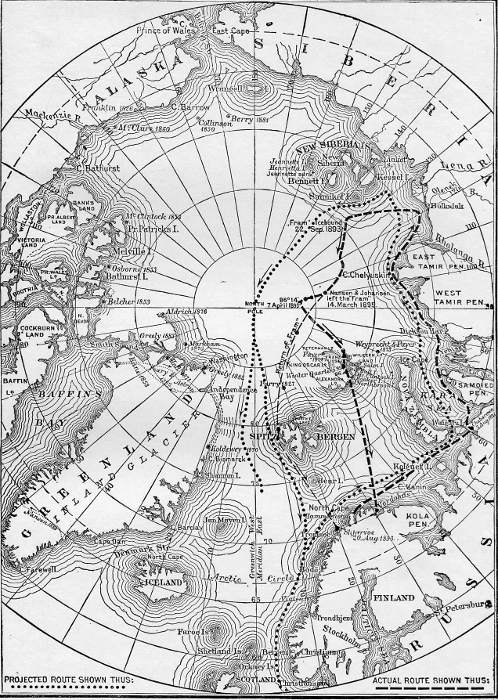
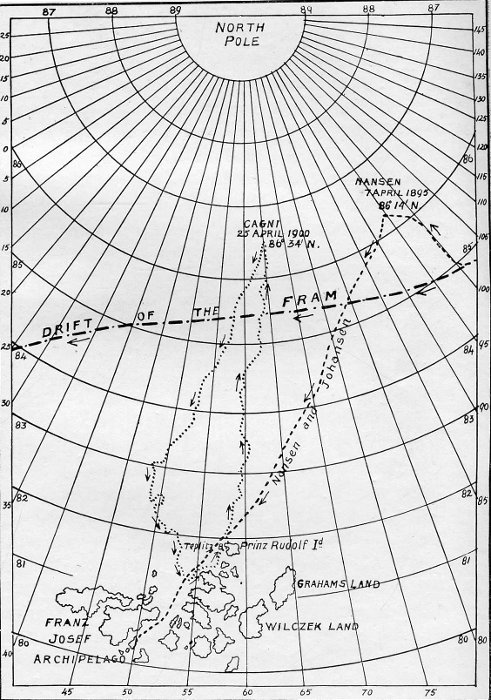
MAP OF THE ARCTIC REGIONS SHOWING ROUTE OF NANSEN AND THE FRAM.
These facts caused a very great deal of discussion among Arctic
explorers, and the general opinion expressed was that a strong and
steady current evidently flowed along the course taken first by the
Jeannette, and secondly by the relics. To arrive at that conclusion
was not very difficult; to utilise the knowledge thus gained, and profit
by it, was the point, and only one man in the world was possessed of the
necessary amount of insight, backed up by intellect and courage, to
enable him to do so. This man was Fridtjof Nansen.
As a student of Arctic phenomena, and as one who had crossed Greenland
from east to west, the existence of this current was full of suggestive
possibilities. It seemed to him that if a vessel were built of
sufficient strength to withstand the pressure of the winter ice, and
provisioned for a sufficiently long period, there was every chance of it
drifting along the entire course of the current, perhaps to within a
measurable distance of the Pole, and certainly well within that region
which had hitherto been unexplored. The area affected by the current
would have to be entered as near the outside edge as possible, so as to
participate in the full sweep of its curve, and, in order to avoid the
terrible crushing pressure of the winter ice, the vessel would have to
be so built as to enable it to slip upwards from the ice, when the
pressure became too severe, and rest always on the top.
On the publication of these views, they were not supported by the Arctic
veterans. Some went so far as to characterise the whole scheme as being
unworthy of serious consideration, while others, less overbearingly
prejudiced, were aghast at the daring and audacity of the scheme. The
possibility of the drift passing over the route suggested by Nansen was
not gainsaid by those whose close knowledge of Arctic problems, and
desire for general information, made them more tolerant than the keen
opponents of the scheme—the latter, strangely enough, being men whose
own exploits had not been the most successful in Polar exploration. The
hero of the Alert sledge journey admitted the feasibility of the drift
theory, but shook his head at the idea of any ship withstanding the
winter pressure of the great ice packs in the far North. A ship once
caught and frozen in became part of the ice itself, and when the
pressure crushed masses a hundred feet thick into minute fragments and
powder, what chance would a vessel, held in such a mass, have of escaping?
But Nansen was not to be discouraged. He had the true insight of genius,
that insight which gave him the confidence in his own idea and which
needed something more than verbal reasons to overthrow it. His idea also
recommended itself to a Norwegian shipbuilder, Mr. Colin Archer, who
expressed his readiness to construct such a vessel as Nansen had
described. The Norwegian Government also were impressed by the scheme
and voted over £11,000 towards the cost of carrying it out, and other
support being forthcoming, the intrepid explorer was at length able to
take definite steps to prove or disprove his contention.
The building of the Fram was at once commenced. She was built of wood
and of tremendous strength, her beams and sides being of the utmost
thickness, while on the outside of the hull not a single angle was
allowed to remain. Every projection was carefully rounded off and
smoothed, so that there should not be as much as half an inch protruding
and capable of affording the ice a holding place. Even the keel was
sacrificed to the general idea of avoiding possible holding places for
the ice. The lines of the ship were necessarily different from those of
the ordinary vessel. Her sides bulged outwards and the stern and stem
sloped away, so that whichever way the ice exerted the pressure, the
Fram would present a smooth surface to the ice, inclined in such a way
that the tendency of the ice would be to get under it and so lift the
vessel up. This did not improve her qualities as a sea boat, and the way
in which she pitched, plunged, and rolled, whenever she came into a
moving sea, tried the seafaring capacities of every one on board.
She was fitted with engines and a screw, and was rigged as a
three-masted fore-and-aft schooner. Electric light was laid on all over
her, the power being generated by a windmill when the engine was not
working. Every available crevice was utilised for the storing of coals and provisions.
By the middle of June 1893 the thirteen men who formed the expedition
had succeeded in finding a place for everything, though not without
some difficulty, for the quantity of the stores which had to be packed
was enormous. By a delay in delivery, just as they were congratulating
themselves that everything was stowed away, a shipment of dog biscuits
arrived. The ship was full already, but the biscuits had to be stored
somewhere, so one of the men wriggled right up into the bows, and
between the beams and the ribs he packed away the troublesome late
arrivals. Everything was at last on board and stored, and on June 24,
1893, the Fram started on her memorable journey.
Leaving North Cape, she headed for Kharbarova, on the Northern Siberian
coast, and the point where the team of Siberian sledge dogs were to be
taken on board. On July 29 she dropped anchor off the quaint little
settlement and found the dogs duly waiting. A ship with coal ought also
to have been there, but it did not arrive up to the time that the
Fram, having shipped the dogs, was compelled to leave. She would soon
be in the Kara Sea, where a year would have to be spent if she were
caught in the ice. The season was passing rapidly, and no time could be
lost if the Kara Sea were to be passed before winter set in, so the
anchor was weighed and the Fram steamed away without her extra supply of coal.
On August 4 the Kara Sea was reached. The ice, although not heavy enough
to prevent further progress, with the adverse currents caused
considerable delays, and the crew utilised their enforced leisure by
visiting the neighbouring land and laying in a store of fresh meat. They
were successful in obtaining reindeer venison and ducks, and it was here
also that the first bear was killed.
It happened on the Kjellman Islands. The Fram had come to anchor under
their shelter, when some one raised the cry that there were reindeer on
the shore. Immediately a hunting party was formed, and eight of the
members rowed ashore. They separated into couples and spread out in
search of the deer, which, however, were extremely shy. Two of the
hunters, failing to get near the herd, decided to sit down and wait
until the other members succeeded in stalking round the deer and turning
them back. Suddenly one of the two, looking round towards the shore,
espied a bear coming towards them. They waited for him to come within
easy range, when they fired together, striking him in the right foreleg.
He turned back at once towards the shore, and another bullet in one of
his hind-legs did not stop him. Fearing that he might escape, one of the
two ran after him and managed to put a bullet in his shoulder, which
brought him to the ground. The bear staggered to his feet again, and in
turning towards his assailants presented his unwounded side to them,
with the result that another bullet was discharged into it, and he fell
to the ground unable to move; but to make certain that he was not
"foxing," yet another bullet was put into his head.
The result of the day's shooting was excellent, the bag consisting of
bear, deer, seal, and duck, providing plenty of fresh meat for the
members of the expedition, as well as a good supply of food for the
dogs. Within a few days they were able to add to the larder by killing
some walrus, a feat which was not achieved without some danger and loss.
The Fram had come to anchor in consequence of the ice lying rather
thickly ahead, when a group of walrus was seen on a floating mass of
ice. A boat was immediately lowered, and with one man armed with a
harpoon in the bows, and Nansen armed with a rifle in the stern, it was
cautiously rowed towards the listless walrus. They did not show any sign
of life until the boat was close upon them, when the sentinel raised his
head and looked towards the boat. When a number are basking, one is
always on duty as a sentinel to give the alarm and warn the others of
approaching danger. Directly those in the boat saw which was the
sentinel, they kept a close watch upon him, remaining as still as
possible when he raised his head and only urging the boat forward gently
when he resumed his former lazy attitude. By very careful manœuvring
they were able to creep close up to the ice. The sentinel again raised
his head and looked at them, but as no one moved he seemed to be
satisfied and lowered his head once more.
A sharp stroke of the oars drove the boat right on to the ice, and the
man with the harpoon let drive at the group. Due, perhaps, to the
movement of the boat, his aim was too high, and instead of plunging into
the great body of the nearest monster, the harpoon glanced off his back
and over the backs of the others. They were roused at once and turned
upon the boat, bellowing loudly. Nansen fired upon the leader, a bull
with tremendous tusks, and he fell over, but the others did not stop.
The boat was pushed off, and at the same moment Nansen shot a second
bull. The remainder of the herd plunged into the water from off the ice
and swam after the boat, rising up alongside it and attempting to drag
it down with their huge tusks. For a time the fight was furious, but the
three men were too strong, and those of the walrus that were not killed
made off under water. The two shot on the ice were secured, but those
shot in the water sank before they could be reached.
As the men were getting the two from the ice into the boat, an
unfortunate lurch jerked the rifle Nansen had been using overboard. It
was a favourite weapon which he was very loth to lose, and for hours
efforts were made to drag it up, but without success. It was hopelessly
lost, and the first brush with the walrus thus became memorable. A year
or two later there was another adventure with them which was even more
memorable, but many were to be slain by the explorers in the meantime,
and many miles were to be covered before that adventure came to pass.
On September 10 the Fram had made her way through the ice-encumbered
sea as far as Cape Chelyuskin, the most northerly point of Europe. There
was great rejoicing on board, for the fact that such a point had been
reached meant that they would be in the region of the current before
winter set in, and that, when the Fram became frozen in, it would be
in the ice affected by the drift. A week later, the course was altered,
and the Fram was headed for the North. The ice became heavier and
closer as she advanced towards the limit of the ice-floes, and as the
sun was sinking nearer and nearer the horizon, the cold became more
intense at every mile. As long as there was open water ahead the
energetic crew kept working their vessel so as to get her as high up as
possible into the area affected by the current; but when they had passed
the line which marks the limit of the floes, they soon found that
further navigation was impossible. The Fram was soon fast in the ice
and, with winter upon them, the crew made themselves and the ship as
comfortable as they could.
The builder of the Fram had given attention not alone to the exterior
of the vessel; he had also made the internal arrangements as complete as
possible for the comfort of the explorers during the prolonged period
they were to remain in the ice. Now that they were in the pack, they
realised how well their comfort had been considered. For the matter of
that, they had always found their quarters cosy, even when the Fram
displayed her capabilities of rolling and tossing. The main cabin, in
which they lived, was always warm, and the passage-ways leading from it
to the outside were so skilfully arranged that those on board did not
experience the distressing moisture which was so troublesome on the
Alert and Discovery. The electric light as a substitute for lamps
was also an admirable innovation, for the interior of the cabin was
always brightly lit without the air becoming heavy, as would have been
the case with exposed lamps. A great deal of thought had also been given
to ventilation, with the result that the cabins were never close.
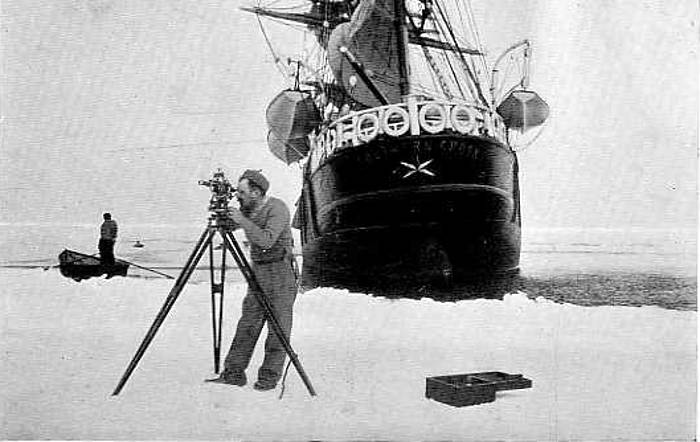
Over the deck a large screen was erected, tent shape, and above it there
was reared the windmill which drove the electric motor and generated the
electricity for the lights. As the ship was to remain in the ice until
it drifted out again, everything was made snug for a long stay. On the
ice alongside various observatories were erected and scientific
instruments placed to make complete records, and later, a row of
comfortable kennels was made for the accommodation of the dogs.
These animals at first had been somewhat troublesome. They were so
savage that it was necessary to keep them all tied up on deck, and
during the voyage along the coast they were frequently wet and
miserable, and incessantly howling. Once, rope muzzles were made, and
when each dog was fitted they were allowed loose; but an Arctic dog
requires something stronger than a rope to keep its jaws closed when let
loose among a lot of other Arctic dogs. The result of the experiment was
not a success, except from a dog-fight point of view; when at length the
struggling, snarling, snapping pack were separated, they were tied up
again to the deck until the ship was fast in the ice.
By that time they were somewhat reconciled to one another; when they had
been allowed to have a scamper or two, with plenty of opportunity to
find out who were the kings and who were not, they settled down into a
big happy family, even making common cause when a stray bear came on
board later in the winter.
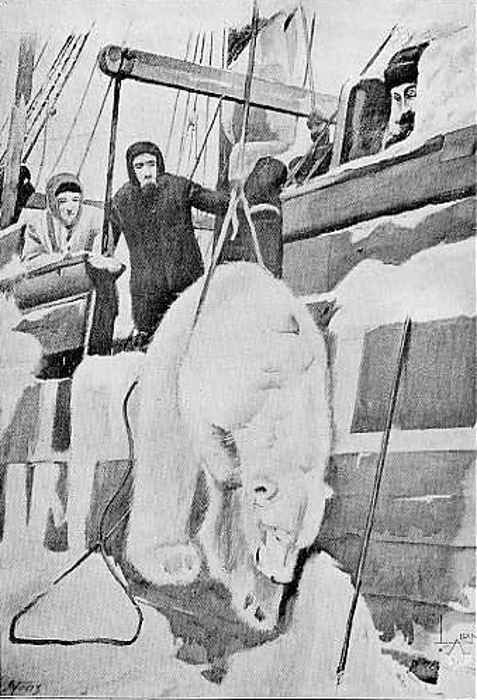
This happened at a time when every one was below in the cabin. Each man
took it in turn to look round the deck every now and again. The man
whose watch it was had not long returned to the cabin when a tremendous
hubbub started among the dogs. The watch returned on deck with a lamp,
but failed to see any cause for the disturbance, and attributed it to a
new election of a king or some other canine ceremony. Later it broke out
once more, and a further inspection was made, when it was discovered
that two dogs were missing.
The man on watch, carrying his lantern, and accompanied by another
member of the crew, set out over the ice, following what appeared to be
a track in the snow. They had not proceeded far when they found
themselves face to face with a bear. It was difficult to say which was
the more surprised, the bear or the men; but as the latter had no weapon
with them they decided that a return to the ship was the best course to
pursue. They turned and started at a run, the man with the lantern,
having heavier boots on, being the slower of the two. More than that, he
was not so agile as his companion, and stumbled frequently. Once he went
down full length, and when he regained his feet he was astounded to see
in the dim twilight, and between himself and the ship, the form of the bear.
For a moment they stood looking at one another, the dogs at a
respectable distance baying and howling. Then the bear advanced and made
a snap at the man, nipping him in the thigh. The lantern was not a very
heavy one, but it was all the man had with which to defend himself, and,
swinging it round with all his strength, he brought it down on the
bear's head. It made him let go his hold, and a few of the dogs rushing
nearer to him caused him to turn towards them, thus giving the man a
chance to resume his flight, which he immediately did.
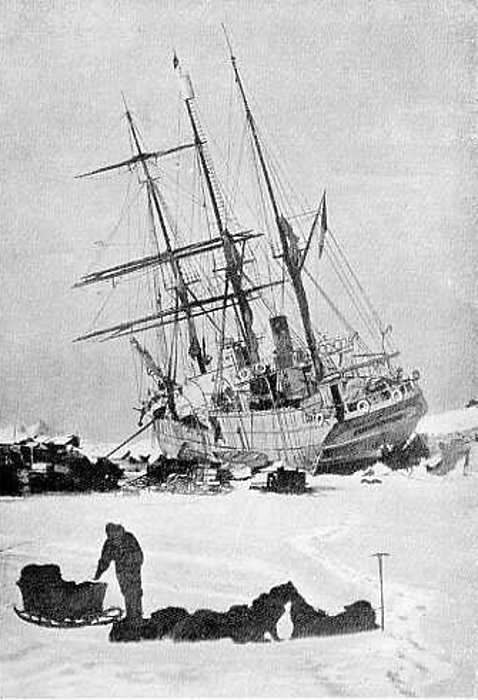
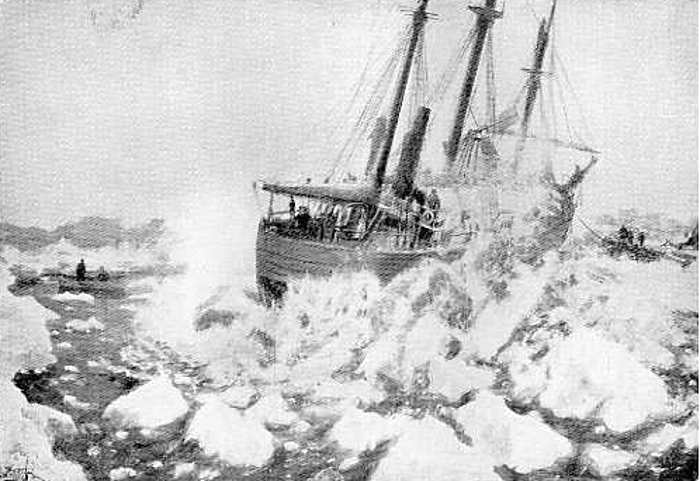
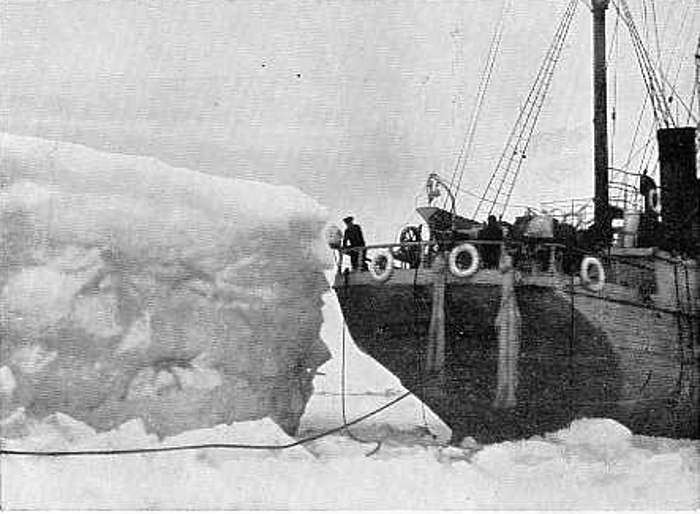
THE FRAM IN THE ICE.
"The Fram was in 78° 50' N. latitude when she was first frozen in" for
the beginning of the great drift.
By the time he was able to scramble up on to the vessel he found half of
the crew tumbling out of the cabin with rifles. They ranged themselves
along the side of the ship, and taking a steady aim at the bear, which
could be dimly seen in the twilight, all pulled their triggers. They had
forgotten, in the hurry of the moment, how well the firearms had been
greased to prevent them rusting, and so the volley failed to fire a
single shot. Meanwhile the dogs surrounded the bear, snarling and
barking, but not going near enough to bite or get bitten. He looked
wisely round the ring and then started off at a slouching walk, just as
Nansen reached the deck with his rifle. His weapon did not misfire, and
a bullet checked the bear's flight, and, some of the other guns now
being effective, several more were put into him and laid him low.
Subsequent search revealed the remains of the two dogs a little distance
away from the Fram, whither they had been dragged by the bear.
The Fram was in 78° 50' N. latitude when she was first frozen in, and
the observations for the next few days were watched with a good deal of
interest, as every one was anxious to know whether they were in the
drift, and at what rate they were travelling. A very great surprise was
therefore experienced when it became known that instead of travelling,
as they expected they would, in a north-westerly direction, they were
going south-east. For several days they speculated whether they had
misjudged the place where they would meet the north drift, and had,
instead, become fast in ice which would carry them away, rather than
towards their goal. It was a very unpleasant uncertainty, and when the
discovery was made that the direction had changed and the vessel was
slowly but surely drifting northward, there was general rejoicing on
board. The ice around the Fram was now over thirty feet in thickness,
and, as it was constantly moving in the drift, so was it also subject to
the pressure which made it heave and pile itself in great rugged broken
masses. There was a constant creaking and groaning in the vast pack
which made it evident that the pressure had begun. Throughout the winter
it would continue, getting more and more severe as the cold became more
intense. Would the Fram justify her designer and builder under the trial?
It was a very anxious question for those on board. One authority had
said she would become so securely frozen in as to be, to all intents and
purposes, a part of the ice body, and that then, if the ice immediately
in her vicinity began to move and work, nothing could save her from
being crushed into matchwood by the enormous pressure. Well, she was now
frozen into such a mass, and frozen so firmly that she did not budge an
inch when the groaning and creaking told of the straining that was going
on. The surface of the ice, as far as the explorers could see, was
constantly undergoing a change, as the force of the movement pressed
great blocks up in one place, and ground them away in another. Jagged,
rugged masses reared themselves up before the irresistible power, until
they stood forty and fifty feet high. Sometimes they were forced up so
high that they overbalanced and crashed down upon the lower masses with
the roar and rattle of thunder. And yet the Fram never moved.
Was the expert opinion going to be verified? Would the ship, held by the
grip of the pack, be slowly crushed into fragments directly she was
caught in the line of movement? It was evidently not impossible, and
precautions were taken so as to insure escape if she were to be caught
and crushed. All the boats were taken out on to the ice and filled with
provisions; the dogs were put in kennels also on the ice where they
would be free to escape, and every one was constantly on the alert for
the first sign of the "nip."
At last it came. They were all at meals when the increased uproar of the
moving ice told them that the movement was nearing the vessel. Then, for
the first time, they heard the ominous sounds of creaking timber. The
Fram was being "nipped."
Every one hurried out of the cabin to see to the boats and the dogs and
the stores. When they reached the open they found that, close upon her
port side, the ice was heaving and piling up into a great massive wall,
while all around the noise of the fracturing and cracking of huge blocks
was deafening. Slowly the wall rose in the air higher than the vessel's
deck, higher than the bulwarks, and then it began steadily to glide
towards her. For the moment it seemed that nothing could save her, and
that the stupendous weight of the gliding wall would soon grind her
solid timbers into splinters, while part of it crashed over her decks
and swept spars and everything away.
Silent the members of the crew stood on the ice on the starboard side
watching and expecting every second to see the moving mass creep up to
her and pulverise the bold little Fram, rendering them homeless and
shipless. Some of the crushed ice, pushed forward in a huge roll like a
frozen billow, was actually against her side and rising over the tent
covering on the deck. The line of pressure had now reached exactly where
she lay in the ice, and if she did not yield to it and slip from the
grip that held her, she was doomed.
There was a sound of rending; a groaning crash; the Fram shivered till
the breathless watchers thought they saw her spars tremble. Then, with a
mighty wrench, she broke from the bonds that held her, and slowly rose
from her nest in the ice, slipping upwards and away from the crushing
force. A cheer burst from the lips of every one as she moved, for it
meant not only the realisation of the hopes and ideals of those
concerned in her construction and the complete vindication of their
faith in her, but also the guarantee that the explorers were safely and
securely housed, whatever might transpire.
When the movement in the ice had subsided, it was found that the Fram
had slipped out of harm's way in a marvellous manner. So firmly had she
been frozen in that the spot from whence she had been driven contained a
complete mould of her shape, every seam and mark being reproduced in the
ice. This proved that the test had not only been a severe one, but
conclusive as well, since the vessel had really been frozen so solid
into a mass of ice as to be a part of the mass. Her escape was an
overwhelming disproof of the adverse theories expressed against her, and
an entire victory for Nansen. There was now no question in any one's
mind as to the result of the expedition; the Fram, having stood one
test, would stand any, and nothing could stop her emerging in due course
out on to the open sea again, having drifted very near to the Pole, if
not quite up to it.
With a feeling of absolute security against further pressures and
movements, the crew returned on board, and once more the cabin echoed to
the light-hearted laughter which had been interrupted by the "nip." The
hardy Norsemen who formed the party were as happy as they were brave,
and throughout the years they were together there was nothing but
good-humour and merriment among them. After the preliminary experience
of how the Fram conducted herself during a "nip," little attention was
paid to the ceaseless noise and roaring set up by the moving ice. Often
she was forced up out of the line of movement, but the men in her cabin
sat quiet; she was able to "sail herself" without any help on that ice-locked sea.
The existence of this constant movement of the ice formed a very
important discovery in Arctic knowledge. A brief explanation of the
causes and the effects may make this clear, and, at the same time, show
how it is that such huge mountains of ice are formed in the depth of
winter when the Polar Sea was currently supposed to be frozen into one
great silent moveless ice-field.
As winter sets in within the Arctic Circle, the sea which flows between
the northern coasts of Europe, Asia, and America becomes covered with
ice to the shores, thus forming an enormous field of ice some two
thousand miles across. This, lying on the surface of the water, often
having a thickness of from thirty to fifty feet, checks, but cannot
control the tides. The ebb, on one hand, leaves vast tracks of ice,
previously afloat, straining on the ground, cracking so as to form
enormous fissures and weakening the surface resistance. On the other
hand, the flood tide is welling and pressing against the overlying
barrier of ice and lifting it up until it cracks and opens, the pressure
underneath lifting the separated masses on to their neighbours, which in
turn resist with all their weight and grind back upon the masses beyond,
until with the turn of the tide the forced-up masses gravitate down
again, tumbling, crashing, bounding and rebounding one upon the other.
Meanwhile the ice lowered by the ebb tide has formed a restricted crust
against which the flood tide, backed up by the weight of the disturbed
masses, uses its energy as a man uses his shoulder to lift a load. It is
a battle between the resistance and the energy of nature, and usually
energy wins along the line of the least resistance. Here, when once a
point gives way, the accumulated energy concentrates. The "point" may be
an area of ice a hundred miles square and fifty feet thick, and this
tremendous mass, moved by the immeasurable force of the water pressure
beneath it, grinds upon its surroundings and upon itself. Huge masses
are pushed up on to the surface of the pack, crushing, grinding, and
splintering as they go, their weight causing the under ice to bend and
crack, and so add to the confusion of the struggle. Mass meets mass in a
test of strength, and, failing to climb over one another, crush
together, closer and higher, until there is a diminution of the pressure
from below and they surge back, shattering themselves in the commotion
and yet binding themselves into a single unit strong enough to resist
the next onslaught of the tidal energy.
Along the shores, where the solid compactness of beetling cliffs holds
back the sweep of the tide, the ice piles itself in mountainous ridges
and chains. Those of greater bulk, taking the ground, offer a resistance
against which the lesser masses can only strain and grind; but away out
in the unfathomable depths of the Polar Sea there is no chance of the
ice ever grounding. It is always floating, and so always susceptible to
the force of wind, tide, and current. Consequently it is always moving
and feeling the pressure of the water below, of the grinding strain of
the drift, and of the surface disturbances brought about by the constant displacement.
Any one who has seen a pond in winter, when the ice round the edge is
rotten and when a breeze blows across it, is aware how the loose sheet
which covers the centre creaks and groans as it is driven against the
bank. The edge is shivered into small flakes before the resistance can
stop the forward movement, and then the sheet moves back against the
breeze until once more the power of the wind controls it, and there is a
renewed straining along the bank, the previously broken flakes either
being forced up on to the bank, or else under, or over, the edge of the
sheet. Pieces a yard square slowly rise up on end before the pressure
and, falling back, shiver into fragments which scurry across the smooth
surface of the sheet until they are arrested and become frozen to the
main surface. Everywhere when the forward movement is on there is noise
of creaking, groaning, and cracking, and everywhere on the ice sheet
there is evidence of the force exerted.
The Arctic Ocean may be likened to such a pond, only two thousand miles
across and with ice upon its surface which never melts and is always
being forced one way or the other by tide, wind, or current. The rugged,
piled-up fragments of one winter's fight are smoothed over somewhat
later on by the heavy snows of spring and summer, or, more correctly
speaking, of the period of daylight, for in this region the year is
divided between the time when the sun is seen and when the sun is not
seen. Along the shores of the continents which surround it, open water
forms in the time of sunshine, and so there is room for the energy of
the tides to escape. The currents can also, from time to time, break off
great areas into floes and packs which drift away to the warmer South
until they melt, leaving more room for the enormous stretch of tumbled
ruggedness behind them to swing and drift in obedience to the driving
currents. It will be remembered that it was at this period of the year
when the Alert party travelled over the ice and found it so broken and
rugged that barely a mile a day was covered. It was while this sort of
ice was being formed that the Fram and her crew rested in the North,
the vessel braving every nip by slipping upwards from the pressure; the
crew, confident in her capabilities, living in merry good-humour in her
cabin. What the confusion of the ice was like may be gathered from the
opinion of those who saw it when the return of the sun enabled them to
do so, and also relieved the pressure. "Imagine a stormy sea, all broken
waves and flying billows, suddenly frozen solid into ice, and you have
some idea, on a small scale, of the piled-up hummocks on the pack."
And so the first winter passed, the members of the expedition keeping
not alone in good temper and spirits, but in good health also. There was
always something doing; observations of temperature and ice movements to
be taken, and records to be kept of the atmospheric and astronomical
phenomena, on the scientific side; and on the every-day side of life,
there were meals to get ready, stores to be overhauled and distributed,
dogs to be fed, and a dozen other items to attend to. One of the
happiest features of this expedition was the sincere and thorough
good-fellowship which existed between all the members. Some of them took
turn about in the cook's galley, each one trying to produce some dish
which would come as a surprise to the mess and a variety to the usual
bill of fare. Then they were excellently supplied with books to read and
indoor games to fill in the odd hours of leisure. A newspaper was
started, and although it was somewhat deficient in foreign news, there
was plenty of local intelligence to keep it going until the return of
the sun. Inside the cabin there was constantly heard the hearty laugh as
some jest passed round, and under the illumination of the electric light
and the spell of good-fellowship, but little heed was paid to the
constant noise made outside in the darkness of the Arctic night by the ever-moving ice.
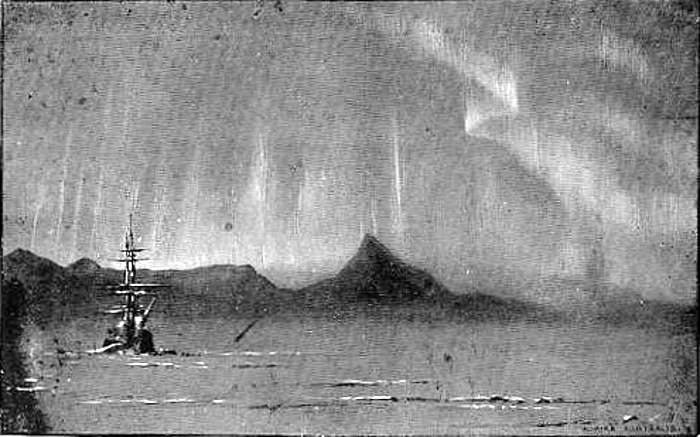
When the sun's approach was heralded by a gradually increasing twilight,
every one was full of curiosity to learn how far they had drifted in
the ice during the winter, and whether the current had maintained its
northerly direction. There was no chance of proving that during the long
hours of darkness, and when, with the appearance of the sun above the
horizon, observations were taken to verify calculations already made,
with the result that a great advance to the North was shown, there was
general rejoicing. If the direction were maintained during the coming
summer and the following winter, it was not impossible that in a year's
time the Fram might be drifting over the very Pole itself. The flag of
Norway was run up to the masthead in honour of the occasion, and at the
supper-table speeches were made foreshadowing the glory which would be
won if the direction of the current were maintained.
With the return of sunlight a great deal had to be done in the
verification of the observations taken during the winter. As the weather
became warmer it was possible to penetrate through the ice so as to
enable them to take soundings as to the depth of the sea. Photographs of
the ice-field were taken, so as to form companion pictures of what it
was before and after the winter pressure had been exerted, and short
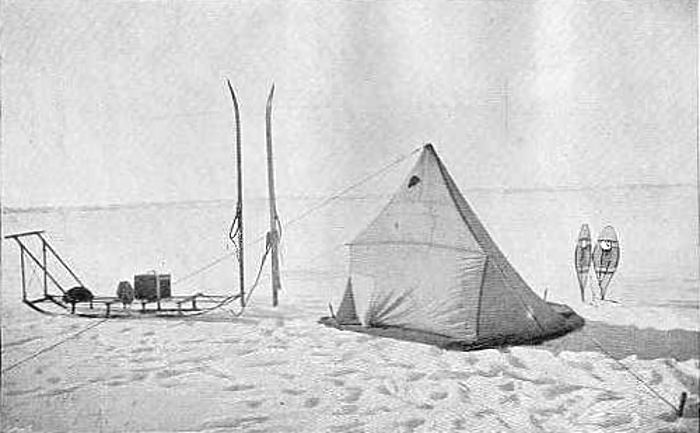
expeditions by dog-sledge and snow-shoes (ski, as the Norwegian form
is termed) were taken. A bear track was seen one day, but as Bruin did
not seem desirous of approaching the ship, Captain Sverdrup, who
commanded the vessel, set to work and devised a highly ingenious trap
for him. The trap was fixed up on a hummock in the vicinity, where it
could be watched from the Fram, but where it would be quiet enough to
tempt the bear. A strong-smelling bait was fastened to it, so that when
the bear seized the bait he would spring the jaws of the trap and get
caught round the neck. Then, when all was ready, a constant watch was
kept for Bruin to appear. He came when every one was about the ship, and
as he was seen slouching over the hummocks, all eyes were turned upon
him. Scenting the bait, he quickened his steps and went up to the trap,
holding his head high up and sniffing for the bait. Having caught sight
of it, he walked slowly round the trap until he came opposite the bait
again, when he slowly rose on to his hind-legs and reached out for the
morsel. Every one on board held their breath in anticipation of seeing
him caught, but there was something about the concern which aroused his
suspicions. Probably he had never seen such an animal before and doubted
its quality, for he drew his head back, lowered himself on to all-fours,
and slowly trotted away. The bear-trap was no success for killing bears,
but it afforded excellent entertainment during this occasion, and formed
a never-failing source of good-natured chaff afterwards.
As the short summer passed, the drift turned persistently to the west,
and in view of its continuing in that direction, preparations were made
for a dash by sledge to the North in the following period of sunlight.
The framework of two kayaks were on board, and these were brought out
and put together on the ice alongside the vessel. When they were covered
with skins, they were packed on two light sledges, and experiments were
made as to the amount of provisions that could be stored on the sledges
in addition. With a third sledge for stores, it was found that
twenty-eight dogs would be able to drag enough food to last two men for
one hundred days and the dogs thirty days, besides the kayaks, guns,
ammunition, and other necessaries.
It was a critical venture to undertake, for once the sledge party left
the ship and journeyed to the North, it was almost an absolute
impossibility that they would be able to find the ship again. All they
would be able to do was to go as far as they could and then turn back
again, shaping their course to the Spitzbergen Islands, where it was
anticipated the Fram would eventually drift. Whether they would be
able to traverse the distance before their food gave out, and whether
they would be able to replenish their provisions by shooting game, were
two very important problems, and, in addition, there was also the
question how they would be able to withstand the intense cold of the
winter if compelled to spend it on the ice.
As the darkness set in again, the discussion frequently turned to the
prospects of the dash being successful. Nansen decided that he should
be one of the two, selecting Lieutenant Hjalmar Johansen, of the
Norwegian Navy, as his companion. Lieutenant Johansen had joined the
expedition as stoker, subsequently acting as the meteorological
assistant, and his choice by the leader was amply justified by results.
The winter having passed without mishap, the reappearance of the sun
verified the fears as to the direction of the drift. All through the
winter they had travelled more to the West than the North. The dash by
sledge was imperative.
On March 14, 1895, the two adventurers, with their three sledges, two
kayaks, and twenty-eight dogs, bade adieu to their comrades, who had
come out a part of the way with them from the Fram, and started due
north along the 100th parallel of East longitude. The Fram had already
drifted to the 84th parallel of latitude, farther North than had yet been attained.
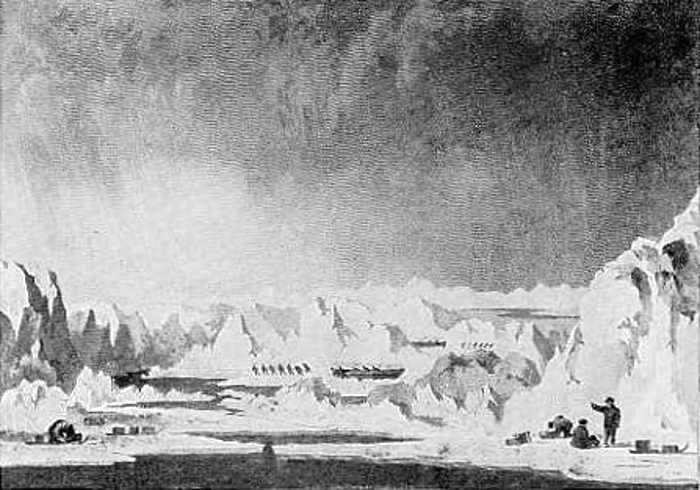
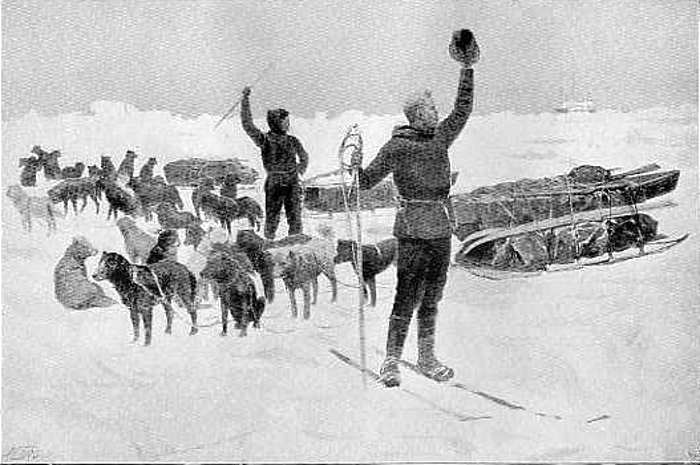
NANSEN AND JOHANSEN START ON THEIR DASH FOR THE POLE.
On March 14, 1895, they left the Fram, and returned to Norway in the
Windward on August 13, 1895, having reached 86° 14' N. lat., the
highest point, up to that time, attained by man.
For the first few days travelling was slow, heavy, and laborious, the
ice being excessively rough and rugged. Time after time the two men had
to haul the sledges, one after another, over the broken hummocks; but
always at the end of each period of travel when they formed their camp,
the Pole was nearer. On March 22 they reached 85° 10' N. lat. The ice
they were journeying over now was not only rough but was constantly
moving, the noise being incessant as the masses ground and strained
against one another. But still they pushed on, taking such rest as they
could and working hard, when not in camp, from the moment they started
until the moment the camp was made. On April 7 they had reached 86° 14'
N. lat., the highest point ever, up to that time, attained by man, and
only some two hundred miles from the Pole.
The ice was indescribably rugged and broken, necessitating the lifting
of the sledges at almost every yard; the temperature averaged 40° below
zero; their clothes were frozen into hard suits of mail, and their
sleeping-bags were also frozen stiff. They had to sleep in the frozen
bags out in the open, the temperature once being as low as 49° below
zero. They had reached the "farthest North," and had learned enough to
satisfy them that up to the Pole there was nothing but a continuation of
the broken, rugged ice, straining and breaking under the pressure of the
drift, and they decided to turn back, making towards the nearest land
for winter quarters.
This was Franz Josef Land, lying to the south-west of where they were,
and if they reached it in time to pass the winter on shore, they would
be able, they believed, to resume their journey to Spitzbergen in the
following summer. Arrived there, they did not anticipate any difficulty
in getting home on board a Norwegian whaler, if the Fram had not meantime arrived.
They were now travelling in continual daylight, with a task before them
every hour of surmounting the steep sides of hummocks. For hours they
toiled on, making as much progress as they could between the camps. The
work they were performing was scarcely, one would think, likely to make
them forget when it was time to sleep. And yet there was an occasion
when for thirty-six hours they struggled on without a sleep. The food
for the dogs was daily growing scarcer, and they were anxious to get on
as far as possible before it was finished. When, therefore, they came
upon a stretch of fairly smooth ice, they made the most of it, and only
when they and their dogs were dead tired did they stop. It was their
custom to always wind up their watches when they crept into their
sleeping-bag; on this occasion when they took them from under their
heavy clothing they discovered that both had stopped. In their anxiety
to push forward they had forgotten to wind them up, and the springs had
run down during the thirty-six hours. There was nothing to do but guess
at what the time ought to be, and so they overcame this difficulty as
they overcame all others, by making the best of it.
Their next trouble was the failure of the dog food. When the first dog
died they kept him, for unless they fell in with a bear and killed it,
the bodies of the weaker dogs was all that they could give the stronger
ones to keep them alive. At first the dogs turned away from the remains
of their comrade, but soon their hunger overcame their scruples, and the
ravenous creatures fought over the carcase as soon as it was offered to
them. Then came the necessity of killing one of them every now and again
to feed the others; much as it went against their natures to do it, the
explorers had to choose between it and death to themselves.
By the end of April they expected to reach land, but April passed and
May passed, and still only the rugged ice was in view. One by one the
dogs had to be sacrificed until only two remained. The weight of the
sledges was also very considerably reduced by this time. The third
sledge had been abandoned, and now each man, assisted by one dog,
dragged a sledge on which rested his kayak, his ski, firearms, and
other necessaries, as well as a moiety of the remaining stores. June
came in and still no land was in sight, but the character of the ice was
changing, though not very much for the better. It was not so rugged and
hummocky, but it was frequently intersected by channels mostly full of
floating pieces. It was useless taking to the kayaks to cross them, and
often impossible to go round, so they adopted the method of jumping from
piece to piece, and drawing their sledges after them. On June 22 they
came upon a seal, which they succeeded in shooting and securing, a fact
which was so memorable that they rested for a day, giving the dogs an
ample supply of the meat. But the rest was scarcely idleness, for they
were visited by three bears, all of which also fell under bullets. They
now had abundance of food, both for themselves and the dogs, to last a
few weeks if they did not come in sight of the land. Two days later,
however, they saw it, lying ahead of them, and they pushed on till a
wide, open channel stopped them.
It was evident that the kayaks would have to be used in getting across,
and they were taken from the sledges and examined. The result of the
rough handling they had undergone in the journey over the ice was
manifest in many a crack and hole in the skin-covering, but how to
repair them was a question which taxed even the ingenuity and enterprise
of the two intrepid Norsemen. They had enough skins to make patches, and
twine with which to stitch them on. It was the making of some waterproof
coating for the stitch-holes that puzzled them. They possessed a little
train-oil, and by fixing up an arrangement over their spirit cooking
stove, they obtained a little soot, which was mixed with the oil and
used as paint. It was not a very artistic compound, but it was the best
they could make, and it kept the water out. Then the kayaks were
carefully fastened together by the ski, and upon them was laid the
sledges and the stores.
When everything had been made fast, the explorers prepared to launch
them. Johansen was behind Nansen, and stooping down, when he heard
something moving at his back. Thinking it was only one of the dogs, he
did not look round, and the next thing he knew was that something hit
him beside the head, so that, in his own words, "he saw fireworks." He
fell forward, and immediately felt a heavy body upon him. He managed to
turn partly round, and saw just above his face the head of a huge bear.
Nansen, ignorant of what had occurred, was bending over his end of the
kayak, when he heard Johansen exclaim, "Get a gun." Glancing round, he
saw his comrade lying under the bear, gripping its throat with both hands.
With everything securely tied to the kayaks, it was no easy matter to
extricate the weapon, and Nansen was pulling and tugging at the cords to
get them loose, so as to drag the rifle from its place, when he heard
Johansen say, "You will have to hurry if you don't want to be too late."
The two dogs, all that were left of the twenty-eight, were standing
snarling at the bear, and as Johansen spoke the one which always
travelled with him approached nearer. The bear, having his attention for
the moment distracted, stepped off Johansen, who immediately wriggled
away and scrambled to his feet. Just as the bear turned on to the dog,
Nansen wrenched a gun from the piled-up stores. Swinging round, he found
the bear close beside him, and he pulled the first trigger he touched.
It fired the barrel loaded with shot, but so near was the bear that the
charge entered behind the ear without having time to scatter, and
brought him down dead between Nansen and Johansen.
The former was terribly afraid that his companion had been seriously
injured, but the only mark the bear had left was a streak across the
face where the dirt had been scraped away. As they had not washed their
faces since they left the Fram, there was a thick covering of dirt on
them, and the bear's claw, as it passed over Johansen's face, had
scraped this away, leaving the white skin to show through. The bear was
a mother, and had two cubs following it. The explorers took away the
skin and some of the meat, the cubs meanwhile standing some distance
away whining and growling. A shot was fired which wounded one, whereupon
they made off, though only to return and follow the travellers in the
distance, until a wide, long channel turned them back.
When the stores had been repacked, the two men, with the two dogs,
entered the kayaks and paddled away down the channel, landing some hours
later on the other side. The land they had first seen appeared to be the
outlying point of an island, but growing mists obscured it for a day or
so, and in the meantime they were somewhat puzzled to locate it. The
fact that their watches had stopped earlier on the journey made them
uncertain as to the exact locality they were in. The direction in which
they had noticed the land, and its appearance, also puzzled them, for
there was no land marked on their map at the place where they believed
they were. Possibly they might be near a hitherto undiscovered island,
and with that thought uppermost in their minds they hastened forward as
quickly as the broken character of the ice would allow. For the
remainder of June, and the whole of July, they were battling against
broken ice and irregular channels, and the distance covered was as
nothing compared with the amount of toil experienced. The land, whenever
it appeared, was still unlike anything previously recorded, for it now
seemed to be of considerable extent.
On August 6 they came upon a stretch of open water, on the other side of
which they saw four islands, the heights of which were covered with
glacier. They determined that they would winter on the shore of one of
the four, and the kayaks were launched and laden with everything for the
journey across the open water. It was more perilous than merely crossing
channels in the ice, and when they had stored all their provisions,
weapons, and other necessaries on the two frail little craft, they found
that it would not be safe to carry the dogs as well. But they could not
bring themselves to leave the faithful creatures on the ice; they
elected rather to shoot them, scanty as their supply of ammunition was,
and upon this decision they acted, each one shooting the dog which had
been the other's comrade. It was the saddest task that their
difficulties had imposed upon them, and only the absolute necessity for
their safety and the completion of their journey induced them to do it.
Sailing down the open water, they skirted along the coast of the strange
land, on the lookout for a favourable spot to pitch their camp. As soon
as they came to a place which recommended itself to them, they ran
ashore and landed their kayaks and stores. The place was merely a
barren, rocky coast, sheltered somewhat by the high ground behind, but
without a trace of vegetation. On the beach one piece of drift-wood was
found. In addition, there were plenty of small boulders, but such
material was scarcely sufficient for the building of a hut in which to
pass the dreary, cold, dark winter.
They overhauled their stores, and found they possessed two guns, some
cartridges, a small hatchet, and two knives. With the hatchet, after
considerable labour, they cut through the piece of drift-wood, and
rejoiced in the possession of a suitable ridge-pole for the centre of
the roof. Stones were collected and built into a low wall, within which
all their property, except the guns, kayaks, and knives, was placed.
Then, with the unstored articles, they set out along the coast and the
floating ice to seek the wherewithal to complete the house.
Walrus was the first essential, for the hide would afford a covering
for the roof, the blubber would furnish fuel for the stove, and the meat
would be useful as food. They spied two lying at the edge of a piece of
ice, and approaching with the utmost caution, succeeded in shooting
both. Their weight, however, as they fell over, caused them to slide
from the ice, and they were in the water before the men could reach
them. They secured the carcases, so as to prevent them from either
sinking or drifting away, and essayed to haul them up on to the ice
again so as to remove the hides and blubber. But the combined strength
of the two men was insufficient to pull one of the huge carcases up on
to the ice again, and they were compelled to strip the skin and blubber
off as the walrus lay in the water. This necessitated their lying upon
the floating carcases, and by the time the operation was completed,
their already travel-stained clothing was rendered still more
uncomfortable by being saturated with blood and fat.
Returning to the camp with their walrus hides and blubber, they explored
the ridge lying behind the spot, and were fortunate in finding some
moss, which they carefully gathered and carried away to assist in the
building of the hut. The walls they had made of the stones allowed for
an internal space of about ten feet long by not quite six feet wide. The
crevices between the stones they filled in with moss and gravel, and
then stretching the walrus hides over the ridge-pole, they weighted
them down with more stones. Over all of it they heaped snow and ice, and
in order to avoid suffocation by the smoke of their blubber cooking
stove, they constructed an ice-chimney, which, however, did not always
carry off the smoke, while it frequently thawed at the base, and made
the interior very draughty. Their guns, ski, and other articles and
stores, they placed inside the hut, leaving the kayaks outside; and when
everything was stored conveniently, they built a wall as a screen to
keep the wind from out of the door, and hung a curtain of skins across
the doorway. The floor of the hut was composed of stones which no
ingenuity of theirs could render smooth or even, and upon it their
sleeping-bag, the fur of which was almost worn entirely away, was stretched.
As soon as the hut was finished the two set out on foot in search of
bears for winter provisions, and were happy in finding sufficient to
enable them to fill their larder with enough meat to last them well into
the following summer. This they stored on the top of the hut, and during
the long winter night they often heard foxes over their heads gnawing at
the frozen mass. They had not enough cartridges to waste on shooting
them, and as there was more meat than they would want, they let the
foxes feed in peace. Bear's meat, fried at night and boiled in the
morning, was the only food they had; when the long dark night set in,
with the temperature inside the hut barely above freezing point, they
lay in their sleeping-bag side by side, generally for twenty-two hours
out of the twenty-four. The inside of the walrus-hide roof became
covered with frost and ice, upon which the black from the blubber-fed
stove settled; the stone floor was so uneven that they gave up trying to
make it smooth, and lay as comfortably as they could under the
circumstances, with their feet nearly touching one side of the hut and
their heads the other. From November until the following March they were
undisturbed, except by the sounds of the foxes on the roof and the
howling of the wind, and a picturesque glimpse is given by Nansen of
their life in his diary entry made on December 24, 1895, when the
temperature inside the hut was 11° below zero.
"And this is Christmas Eve; cold and blowy out of doors, and cold and
draughty indoors. How desolate it is here! We have never had such a
Christmas before. The bells are now ringing in the Christmas festival at
home; I can hear the sound of them swinging out through the air from the
church towers. How beautiful it sounds! Now the candles are being lit on
the Christmas trees, and flocks of children are let in and dance round
in exuberant glee. Must have a Christmas party for children when I get
home. We, too, are keeping the festival in our little way. Johansen has
turned his shirt, and has put the outer one inside. I have done the
same, and have changed my drawers as well, and put on the others which I
had wrung out in warm water. And then I have washed myself in a quarter
of a cup of warm water, using the discarded drawers as sponge and towel.
I feel like a new being; my clothes do not stick to my body as much as
they did. Then for supper we had fish 'gratin,' made of potted fish and
Indian meal, with train-oil for butter—fried or boiled both equally
dry—and as sweets we had bread fried in train-oil. To-morrow morning we
are going to have chocolate and bread."
Where a turned shirt and a bath in a tea-cup formed the physical
luxuries, and bread fried in train-oil and chocolate comprised the
feast, in celebration of Christmas Day, it is not difficult to picture
the amount of enjoyment available for every-day use, nor is it difficult
to understand that they sighed even for a railway time-table to peruse.
But yet they kept their health, their spirits, and their tempers. The
rough stones under their sleeping-bag seem to have been the only thing
they could not turn into a jest. When one snored too loudly to allow the
other to sleep, it was only necessary for the victim to move; they lay
so close together for warmth that a movement was equal to a dig in the
back, and that meant waking the snorer by changing his position on the
knobbly boulders from ease to discomfort.
At length the approach of the sun became manifest by the gradually
brightening twilight, and the arrival of a flock of little auks reminded
them that spring was at hand. They celebrated the occasion by boiling
their clothes, one article at a time, in the only pot they possessed,
and then scraping the grease and dirt from them by the aid of a knife,
so as to render them soft enough for travelling, as it was beyond the
question to get them clean. The sooty smoke from the winter's cooking
had thoroughly begrimed their faces, and all they could do to get clean
was first to try and scrape the dirt off with the knife, and then rub
themselves all over with bear's grease and wipe it off with moss.
By the middle of May the water along the shore was sufficiently open to
permit of their starting in the kayaks on the journey which they
expected would end at Spitzbergen. On May 19, 1896, they bade adieu to
their winter camp, having packed everything on the kayaks, which they
fastened together for convenience and stability. Sometimes they had to
get out on to the ice which blocked the channel and drag the kayaks over
to the open water on the other side; sometimes they sailed and sometimes
they paddled. They passed numbers of walrus lying on the ice, the great
monsters paying no heed to them whatever. Once they landed on a mass of
ice which rose high out of the water, in order to climb to the top of it
and examine the coast line, for they were still in very great doubt
whether they were off the shore of a hitherto undiscovered island or not.
They made the kayaks fast to a projecting piece of ice, and together
climbed up to the top of the hummocks. As they reached the summit they
looked back to the spot where they had left the kayaks, and were
horrified to see them adrift. Already they were some distance away from
the ice, and, being tied together, they were going rapidly down the
channel. For a moment the sight held the two men motionless, for the
kayaks represented their only means of escape. Everything beyond the
clothes in which they stood was stored on board, and to be left on the
ice without food, arms, or shelter, was almost certain death.
There was only one desperate means of salvation, and that Nansen took.
Dashing down the hummock, he plunged into the ice-cold water and struck
out after the retreating kayaks.
Weighted by his stiff, heavy, grease-sodden clothes, he had the utmost
difficulty in swimming at all; but there was a greater handicap even
than his clothes in the low temperature of the water. It struck through
him with a chill which reached to his bones, numbing his muscles, and
making his joints lose their suppleness. The breeze which was blowing
helped the kayaks along, but only increased his discomfort. Soon he felt
that the fight was only a matter of minutes for as the coldness numbed
him more and more, he realised that unless he overtook the kayaks
quickly he would go to the bottom like a stone. The cold penetrated to
his lungs, so that he gasped for breath; his hands and feet lost all
feeling, and his eyes were growing blurred as he nerved himself for a
final desperate struggle. Swimming as hard as his strength of will and
muscle could command, he succeeded in coming within touch of the light
drifting craft. The fact that the two were fastened together was of the
utmost importance under the circumstances, for had they been separate he
could never have clambered into one in his benumbed and exhausted
condition. As it was, he managed to get one arm over the ski which
formed the coupling between the kayaks. His hands were too cold to grip
and he hung for a few seconds resting, till the growing chill in his
limbs warned him of the danger he was in of becoming frozen. With a
superb effort of determination, he raised himself until he was able to
lift a leg over the side of one of the kayaks, and then struggled on
board, where he lay for a minute or so trying to recover his breath.
Still fearing the cold, he grasped a paddle and set to work vigorously
to force the kayaks back to the ice on which Johansen was standing. The
exertion caused his blood to circulate once more, and, by the time he
had reached the ice, the deadly chill was out of his frame. There were
no dry clothes to put on in place of his wet ones, and all that could be
done was to wring them out, and then, working hard to keep up his
circulation, wait till they dried on his back.
In order to prevent another such occurrence, the kayaks were freed from
each other, Nansen occupying one with half the provisions and stores,
and Johansen the other. Two days after the break away they had reason to
be thankful they had made this arrangement. They were skirting along the
ice at the time, and suddenly came upon a herd of walrus. Instead of
quietly watching them go past, as was usually the case, a huge bull slid
off the ice with a roar, and swam rapidly towards Nansen's kayak.
Diving as he came near to it, Nansen anticipated that he intended rising
immediately underneath it, and so capsizing it. He therefore paddled as
hard as he could, when the walrus rose by his side. It reared high out
of the water, towering over the kayak and its occupant, and only by the
quickest of manœuvres was Nansen able to avoid having it fall upon
him. Baulked in that attempt, the walrus swam alongside and, plunging
its tusks through the frail covering of the kayak, strove to upset it
with its flipper.
Nansen swung his paddle in the air, and bringing it down with all his
strength on the monster's head, caused it again to rear in the water.
Paddling furiously directly the brute's tusks were withdrawn, he
managed to elude it till it sank, when he made for the ice, reaching it
just in time, the water having almost swamped the kayak through the
holes the walrus had made with his tusks.
When the damaged kayak was taken out of the water, the injury was found
to be more extensive than at first supposed. The two explorers
determined to stay where they were for a few days, so as to thoroughly
overhaul and repair their kayaks, and have a good rest before commencing
the difficult journey which was to be negotiated before they could
arrive at Spitzbergen. They made as comfortable a camp as they could on
the ice, and, after supper, got into the sleeping-bag and rested
peacefully. Nansen was first awake, and, having crept out of the bag,
set to work preparing breakfast. It was ready before Johansen was, and
not wishing to disturb his comrade, Nansen put on his ski and set out
for a "constitutional" over the ice. He had not proceeded far when he
heard a sound which made his heart jump. It was the bark of a dog.
Hurrying back, he told Johansen, and then set out in the direction
whence the sound had come, in search of, as he believed, a whaling ship.
He had not gone very far when he saw in the distance two moving specks.
There was evidently a whaler in the neighbourhood, he told himself, and
redoubled his efforts. As he approached the two specks they became
clearer, until he saw distinctly that one was a man and the other a
dog.
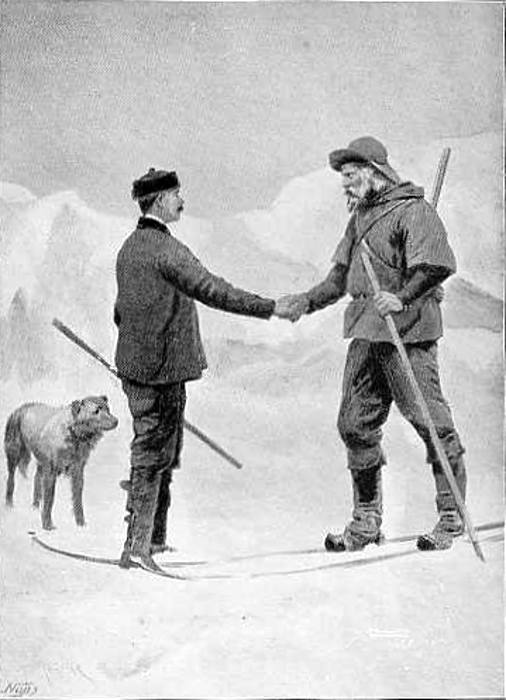
The man noticed him and waved his hat, to which Nansen replied by waving
his; as they came nearer, he heard the man speak to his dog in English.
"How do you do?" he said to Nansen when they met.
"How do you do?" Nansen answered, as they shook hands. "Are you
wintering near here?"
"Yes; our camp is over there. Won't you come across?" the other replied.
"I think we can find room for you, if you will."
Nansen, never dreaming but that he was recognised, assented, although he
wondered why the man did not ask him about the Fram. Presently his
companion looked at him closely and said: "Are you Nansen?"
"Of course I am," the explorer answered, and at once both his hands were
clasped in a hearty grasp as his companion quickly expressed his congratulations.
"I was not certain," he explained. "When I saw you in London you were a
fair man with light hair, but now your face and hair are black, and for
the moment I did not know you. My name is Jackson."
THE MEETING OF JACKSON AND NANSEN.
Nansen and Jackson returned to Norway in the Windward, the ship of the
Jackson-Harmsworth Expedition, on August 13, 1896.
Nansen had forgotten that his face and hair were still begrimed with the
dirt and grease of months of travel, and that his own family might have
been forgiven for not recognising in the unkempt, travel-stained,
long-haired man, the smart, well-set-up Norwegian doctor. Now, however,
that he was known, he listened with great interest to the information
that his companion, Mr. F. G. Jackson, leader of the Jackson-Harmsworth
expedition, was able to give him. When they reached the encampment of
the party on Cape Flora, every one turned out in answer to the leader's
call and gave the intrepid explorer a characteristic British greeting.
Then they photographed him, as he stood, before they took him into the
house and supplied him with the luxury he had not known for more than a
year—of a cake of soap and a change of clothes.
While he was enjoying his bath, his hosts exchanged opinions. The fact
that he had arrived on foot and alone suggested to them the idea that he
was the only survivor of the thirteen who had set out in the Fram, and
they decided to make no reference to what might be a very unhappy
memory. Consequently, when Nansen reappeared, clean and comfortably
clad, they had a meal ready for him, and urged him to set to at once. He
looked at them and asked where his comrade Johansen was. Had they not
brought him in? Of course they knew nothing about Johansen; they
believed Nansen was the only survivor, and he had been so long out of
the world that it had never occurred to him it was necessary to tell
them Johansen was waiting for him to return to breakfast. When two men
see no one else but themselves for more than a year, it is not to be
wondered at that they forget the rest of the world is not in touch with them.
As soon as he mentioned the fact that Johansen was in the neighbourhood,
a party at once started off to fetch him, and the worthy lieutenant was
as much surprised as they had been when they came upon him. They at once
took charge of him and his belongings, and a few hours later he and
Nansen, well washed, well clad, and well fed, were smoking cigars in
comfortable chairs in the dining-room of the hospitable Jackson's
quarters, the heroes of the occasion.
Three weeks later they were sailing south to Norway in the Windward,
and arrived at Vardo on August 13, 1896. A week later the Fram entered
the same port, with all her crew in good health, and with nearly three
years' supplies still on board.
The record of her voyage, after the departure of Nansen and Johansen on
March 14, 1895, was very satisfactory. She drifted steadily in the ice
towards the north-west until she touched as high as 85° 57' N. At the
end of February 1896 she became stationary, and remained so until the
middle of July, when the crew forced a passage through the ice into open
water, and from thence the Fram sailed to Norway. The first news the
crew received on arrival at Vardo was that Nansen and Johansen had
reached there just a week before. They had had some misgivings as to
the safety of their two adventurous comrades, and the news of their
return cleared away the only sign of uneasiness from the otherwise happy
minds of the men who formed one of the most successful expeditions that
has ever set out in search of the North Pole.