The vast subject of artillery in its modern form, including under this
head for convenience’ sake not only heavy ordnance but machine-guns
and small-arms, can of necessity only be dealt with most briefly in
this chapter.
It may therefore be well to take a general survey and to define
beforehand any words or phrases which are used technically in
describing the various operations.
The employment of firearms dates from a long-distant past, and it is
interesting to note that many an improvement introduced during the
last century is but the revival of a former invention which only lack
of accuracy in tools and appliances had hitherto prevented from being
brought into practical usage.
So far back as 1498 the art of rifling cannon in straight grooves
was known, and a British patent was taken out in 1635 by Rotsipan. The
grooves were first made spiral or screwed by Koster of Birmingham
about 1620. Berlin possesses a rifled cannon with thirteen grooves
dated 1664. But the first recorded uses of such weapons in actual
warfare was during Louis Napoleon’s Italian campaign in 1859, and two
years later by General James of the United States Army.
The system of breech-loading, again, is as old as the sixteenth
century, and we find a British patent of 1741; while the first United
States patent was given in 1811 for a flint-lock weapon.
Magazine guns of American production appeared in 1849 and 1860, but
these were really an adaptation of the old matchlock revolvers, said
to belong to the period 1480-1500. There is one in the Tower of London
credited to the fifteenth century, and a British patent of 1718
describes a well-constructed revolver carried on a tripod and of the
dimensions of a modern machine-gun. The inventor gravely explains that
he has provided round chambers for round bullets to shoot Christians,
and square chambers with square missiles for use against the Turks!
The word “ordnance” is applied to heavy guns of all kinds, and
includes guns mounted on fortresses, naval guns, siege artillery, and
that for use in the field. These guns are all mounted on stands or
carriages, and may be divided into three classes:—
(i.) Cannon, or heavy guns.
(ii.) Howitzers, for field, mountain, or siege use, which are
lighter and shorter than cannon, and designed to throw hollow
projectiles with comparatively small charges.
(iii.) Mortars, for throwing shells at a great elevation.
The modern long-range guns and improved howitzers have, however,
virtually superseded mortars. Machine-guns of various forms are
comparatively small and light, transportable by hand, and filling a
place between cannon and small-arms, the latter term embracing the
soldier’s personal armament of rifle and pistol or revolver, which are
carried in the hand.
A group of guns of the like design are generally given the name of
their first inventor, or the place of manufacture: such as the
Armstrong gun, the Vickers-Maxim, the Martini-Henry rifle, or the
Enfield.
The indifferent use of several expressions in describing the same
weapon is, however, rather confusing. One particular gun may be thus
referred to:—by its weight in tons or cwt., as “the 35-ton gun”; by
the weight of its projectile, as “a 68-pounder”; by its calibre,
that is, size of bore, as “the 4-inch gun.” Of these the heavier
breech-loading (B.-L.) and quick-firing (Q.-F.) guns are generally
known by the size of bore; small Q.-F.’s, field-guns, &c., by the
weight of projectile. It is therefore desirable to enter these
particulars together when making any list of service ordnance for
future reference.
No individual gun, whether large or small, is a single whole, but
consists of several pieces fastened together by many clever devices.
The principal parts of a cannon are:—
(1) The chase, or main tube into which the projectile is loaded;
terminating at one end in the muzzle.
(2) The breech-piece, consisting of (a) the chamber, which is
bored out for a larger diameter than the chase to contain the
firing-charge. (b) The breech-plug, which is closed before the
charge is exploded and screwed tightly into place, sealing every
aperture by means of a special device called the “obturator,” in order
to prevent any gases passing out round it instead of helping to force
the projectile forwards towards the muzzle.
The whole length of inside tube is termed the barrel, as in a
machine-gun, rifle, or sporting-piece, but in the two latter weapons
the breech-opening is closed by sliding or springing back the
breech-block or bolt into firing position.
Old weapons as a rule were smooth-bored (S.-B.), firing a round
missile between which and the barrel a considerable amount of the
gases generated by the explosion escaped and caused loss of power,
this escape of gas being known as windage.
In all modern weapons we use conical projectiles, fitted near the base
with a soft copper driving-band, the diameter of which is somewhat
larger than that of the bore of the gun, and cut a number of spiral
grooves in the barrel. The enormous pressure generated by the
explosion of the charge forces the projectile down the bore of the gun
and out of the muzzle. The body of the projectile, made of steel or
iron, being smaller in diameter than the bore, easily passes through,
but the driving-band being of greater diameter, and being composed of
soft copper, can only pass down the bore with the projectile by
flowing into the grooves, thus preventing any escape of gas, and being
forced to follow their twist. It therefore rotates rapidly upon its
own longitudinal axis while passing down the barrel, and on leaving
the muzzle two kinds of velocity have been imparted to it;—first, a
velocity of motion through the air; secondly, a velocity of rotation
round its axis which causes it to fly steadily onward in the required
direction, i.e. a prolongation of the axis of the gun. Thus extreme
velocity and penetrating power, as well as correctness of aim, are
acquired.
The path of a projectile through the air is called its trajectory,
and if uninterrupted its flight would continue on indefinitely in a
perfectly straight line. But immediately a shot has been hurled from
the gun by the explosion in its rear two other natural forces begin to
act upon it:—
Gravitation, which tends to bring it to earth.
Air-resistance, which gradually checks its speed.
(Theoretically, a bullet dropped perpendicularly from the muzzle of a
perfectly horizontal rifle would reach the ground at the same moment
as another bullet fired from the muzzle horizontally, the action of
gravity being the same in both cases.)
Its direct, even course is therefore deflected till it forms a curve,
and sooner or later it returns to earth, still retaining a part of its
velocity. To counteract the attraction of gravity the shot is thrown
upwards by elevating the muzzle, care being taken to direct the gun’s
action to the same height above the object as the force of gravitation
would draw the projectile down during the time of flight. The gunner
is enabled to give the proper inclination to his piece by means of the
sights; one of these, near the muzzle, being generally fixed, while
that next the breech is adjustable by sliding up an upright bar which
is so graduated that the proper elevation for any required range is
given.
The greater the velocity the flatter is the trajectory, and the more
dangerous to the enemy. Assuming the average height of a man to be six
feet, all the distance intervening between the point where a bullet
has dropped to within six feet of the earth, and the point where it
actually strikes is dangerous to any one in that interval, which is
called the “danger zone.” A higher initial velocity is gained by using
stronger firing charges, and a more extended flight by making the
projectile longer in proportion to its diameter. The reason why a
shell from a cannon travels further than a rifle bullet, both having
the same muzzle velocity, is easily explained.
A rifle bullet is, let us assume, three times as long as it is thick;
a cannon shell the same. If the shell have ten times the diameter of
the bullet, its “nose” will have 10 × 10 = 100 times the area of the
bullet’s nose; but its mass will be 10 × 10 × 10 = 1000 times that of
the bullet.
In other words, when two bodies are proportional in all their
dimensions their air-resistance varies as the square of their
diameters, but their mass and consequently their momentum varies as
the cube of their diameters. The shell therefore starts with a great
advantage over the bullet, and may be compared to a “crew” of cyclists
on a multicycle all cutting the same path through the air; whereas the
bullet resembles a single rider, who has to overcome as much
air-resistance as the front man of the “crew” but has not the weight
of other riders behind to help him.
As regards the effect of rifling, it is to keep the bullet from
turning head over heels as it flies through the air, and to maintain
it always point forwards. Every boy knows that a top “sleeps” best
when it is spinning fast. Its horizontal rotation overcomes a tendency
to vertical movement towards the ground. In like manner a rifle
bullet, spinning vertically, overcomes an inclination of its atoms to
move out of their horizontal path. Professor John Perry, F.R.S., has
illustrated this gyroscopic effect, as it is called, of a whirling
body with a heavy flywheel in a case, held by a man standing on a
pivoted table. However much the man may try to turn the top from its
original direction he will fail as long as its velocity of rotation is
high. He may move the top relatively to his body, but the table will
turn so as to keep the centre line of the top always pointing in the
same direction.
Up to the middle of last century our soldiers were armed with the
flint-lock musket known as “Brown Bess,” a smooth-bore barrel 3/4-inch
in diameter, thirty-nine inches long, weighing with its bayonet over
eleven pounds. The round leaden bullet weighed an ounce, and had to be
wrapped in a “patch” or bit of oily rag to make it fit the barrel and
prevent windage; it was then pushed home with a ramrod on to the
powder-charge, which was ignited by a spark passing from the flint
into a priming of powder. How little its accuracy of aim could be
depended upon, however, is proved by the word of command when
advancing upon an enemy, “Wait till you see the whites of their eyes,
boys, before you fire!”
In the year 1680 each troop of Life Guards was supplied with eight
rifled carbines, a modest allowance, possibly intended to be used
merely by those acting as scouts. After this we hear nothing of them
until in 1800 the 95th Regiment received a 20-bore muzzle-loading
rifle, exchanged about 1835 for the Brunswick rifle firing a spherical
bullet, an improvement that more than doubled its effective range. The
companies so armed became known as the Rifle Brigade. At last, in
1842, the old flint-lock was superseded for the whole army by the
original percussion musket, a smooth-bore whose charge was exploded by
a percussion cap made of copper. [That this copper had some commercial
value was shown by the rush of “roughs” to Aldershot and elsewhere
upon a field-day to collect the split fragments which strewed the
ground after the troops had withdrawn.]
Soon afterward the barrel was rifled and an elongated bullet brought
into use. This missile was pointed in front, and had a hollowed base
so contrived that it expanded immediately the pressure of exploding
gases was brought to bear on it, and thus filled up the grooves,
preventing any windage. The one adopted by our army in the year 1852
was the production of M. Minié, a Frenchman, though an expanding
bullet of English invention had been brought forward several years
before.
Meanwhile the Prussians had their famous needle-gun, a breech-loading
rifled weapon fired by a needle attached to a sliding bolt; as the
bolt is shot forward the needle pierces the charge and ignites the
fulminate by friction. This rifle was used in the Prusso-Austrian war
of 1866 some twenty years after its first inception, and the French
promptly countered it by arming their troops with the Chassepôt rifle,
an improved edition of the same principle. A piece which could be
charged and fired in any position from five to seven times as fast as
the muzzle-loader, which the soldier had to load standing, naturally
caused a revolution in the infantry armament of other nations.
The English Government, as usual the last to make a change, decided in
1864 upon using breech-loading rifles. Till a more perfect weapon
could be obtained the Enfields were at a small outlay converted into
breech-loaders after the plans of Mr. Snider, and were henceforward
known as Snider-Enfields. Eventually—as the result of open
competition—the Martini-Henry rifle was produced by combining Henry’s
system of rifling with Martini’s mechanism for breech-loading. This
weapon had seven grooves with one turn in twenty-two inches, and
weighed with bayonet 10 lb. 4 oz. It fired with great accuracy, the
trajectory having a rise of only eight feet at considerable distances,
so that the bullet would not pass over the head of a cavalry man.
Twenty rounds could be fired in fifty-three seconds.
Now in the latter years of the century all these weapons have been
superseded by magazine rifles, i.e. rifles which can be fired
several times without recourse to the ammunition pouch. They differ
from the revolver in having only one firing chamber, into which the
cartridges are one by one brought by a simple action of the breech
mechanism, which also extracts the empty cartridge-case. The bore of
these rifles is smaller and the rifling sharper; they therefore shoot
straighter and harder than the large bore, and owing to the use of new
explosives the recoil is less.
The French Lebel magazine rifle was the pioneer of all now used by
European nations, though a somewhat similar weapon was familiar to the
Americans since 1849, being first used during the Civil War. The Henry
rifle, as it was called, afterwards became the Winchester.
The German army rifle is the Mauser, so familiar to us in the hands
of the Boers during the South African War—loading five cartridges at
once in a case or “clip” which falls out when emptied. The same rifle
has been adopted by Turkey, and was used by the Spaniards in the late
Spanish-American War.
The Austrian Mannlicher, adopted by several continental nations, and
the Krag-Jorgensen now used in the north of Europe and as the United
States army weapon, resemble the Mauser in most particulars. Each of
these loads the magazine in one movement with a clip.
The Hotchkiss magazine rifle has its magazine in the stock, holding
five extra cartridges pushed successively into loading position by a
spiral spring.
Our forces are now armed principally with the Lee-Enfield, which is
taking the place of the Lee-Metford issued a few years ago. These
are small-bore rifles of .303 inch calibre, having a detachable box,
which is loaded with ten cartridges (Lee-Metford eight) passed up in
turn by a spring into the breech, whence, when the bolt is closed,
they are pushed into the firing-chamber. The empty case is ejected by
pulling back the bolt, and at the same time another cartridge is
pressed up from the magazine and the whole process repeated. When the
cut-off is used the rifle may be loaded and fired singly, be the
magazine full or empty.
The Lee-Enfield has five grooves (Lee-Metford ten), making one
complete turn from right to left in every ten inches. It weighs 9 lb.
4 oz., and the barrel is 30.197 inches long. The range averages 3500
yards.
We are now falling into line with other powers by adopting the “clip”
form instead of the box for loading. The sealed pattern of the new
service weapon is thus provided, and has also been made somewhat
lighter and shorter while preserving the same velocity.
We are promised an even more rapid firing rifle than any of these, one
in which the recoil is used to work the breech and lock so that it is
a veritable automatic gun. Indeed, several continental nations have
made trial of such weapons and reported favourably upon them. One
lately tried in Italy works by means of gas generated by the explosion
passing through a small hole to move a piston-rod. It is claimed that
the magazine can hold as many as fifty cartridges and fire up to
thirty rounds a minute; but the barrel became so hot after doing this
that the trial had to be stopped.
The principal result of automatic action would probably be excessive
waste of cartridges by wild firing in the excitement of an engagement.
It is to-day as true as formerly that it takes on the average a man’s
weight of lead to kill him in battle.
To our neighbours across the Channel the credit also belongs of
introducing smokeless powder, now universally used; that of the
Lee-Metford being “cordite.” To prevent the bullets flattening on
impact they are coated with a hard metal such as nickel and its
alloys. If the nose is soft, or split beforehand, a terribly enlarged
and lacerated wound is produced; so the Geneva Convention humanely
prohibited the use of such missiles in warfare.
Before quitting this part of our subject it is as well to add a few
words about pistols.
These have passed through much the same process of evolution as the
rifle, and have now culminated in the many-shotted revolver.
During the period 1480-1500 the match-lock revolver is said to have
been brought into use; and one attributed to this date may be seen in
the Tower of London.
Two hundred years ago, Richards, a London gunsmith, converted the
ancient wheel-lock into the flint-lock; he also rifled his barrel and
loaded it at the breech. The Richards weapon was double-barrelled, and
unscrewed for loading at the point where the powder-chamber ended; the
ball was placed in this chamber in close contact with the powder, and
the barrel rescrewed. The bullet being a soft leaden ball, was forced,
when the charge was fired, through the rifled barrel with great
accuracy of aim.
The percussion cap did not oust the flint-lock till less than a
century ago, when many single-barrelled pistols, such as the famous
Derringer, were produced; these in their turn were replaced by the
revolver which Colt introduced in 1836-1850. Smith and Wesson in the
early sixties improved upon it by a device for extracting the empty
cartridges automatically. Livermore and Russell of the United States
invented the “clip,” containing several cartridges; but the equally
well-known Winchester has its cartridges arranged in a tube below
the barrel, whence a helical spring feeds them to the breech as fast
as they are needed.
At the present time each War Department has its own special service
weapon. The German Mauser magazine-pistol for officer’s use fires
ten shots in ten seconds, a slight pressure of the trigger setting the
full machinery in motion; the pressure of gas at each explosion does
all the rest of the work—extracts and ejects the cartridge case,
cocks the hammer, and presses springs which reload and close the
weapon, all in a fraction of a second. The Mannlicher is of the same
automatic type, but its barrel moves to the front, leaving space for a
fresh cartridge to come up from the magazine below, while in the
Mauser the breech moves to the rear during recoil. The range is half a
mile. The cartridges are made up in sets of ten in a case, which can
be inserted in one movement.
Intermediate between hand-borne weapons and artillery, and partaking
of the nature of both, come the machine-guns firing small projectiles
with extraordinary rapidity.
Since the United States made trial of Dr. Gatling’s miniature battery
in the Civil War (1862-1865), invention has been busy evolving more
and more perfect types, till the most modern machine-gun is a marvel
of ingenuity and effectiveness.
The Gatling machine-gun, which has been much improved in late years
by the Accles system of “feed,” and is not yet completely out of date,
consists of a circular series of ten barrels—each with its own
lock—mounted on a central shaft and revolved by a suitable gear. The
cartridges are successively fed by automatic actions into the barrels,
and the hammers are so arranged that the entire operation of loading,
closing the breech, firing and withdrawing the empty cartridge-cases
(which is known as their “longitudinal reciprocating motion”) is
carried on while the locks are kept in constant revolution, along with
the barrels and breech, by means of a hand-crank. One man places a
feed-case filled with cartridges into the hopper, another turns the
crank. As the gun is rotated the cartridges drop one by one from the
feed-cases into the grooves of the carrier, and its lock loads and
fires each in turn. While the gun revolves further the lock, drawing
back, extracts and drops the empty case; it is then ready for the next
cartridge.
In action five cartridges are always going through some process of
loading, while five empty shells are in different stages of ejection.
The latest type, fitted with an electro-motor, will fire at the rate
of one thousand rounds per minute, and eighty rounds have actually
been fired within ten seconds! It is not, however, safe to work these
machine-guns so fast, as the cartridges are apt to be occasionally
pulled through unfired and then explode among the men’s legs. The
automatic guns, on the contrary, as they only work by the explosion,
are free from any risk of such accidents.
The feed-drums contain 104 cartridges, and can be replaced almost
instantly. One drumful can be discharged in 5-1/4 seconds. The
small-sized Gatling has a drum-feed of 400 cartridges in sixteen
sections of twenty-five each passed up without interruption.
The gun is mounted for use so that it can be pointed at any angle, and
through a wide lateral range, without moving the carriage.
The Gardner.—The Gatling, as originally made, was for a time
superseded by the Gardner, which differed from it in having the
barrels (four or fewer in number) fixed in the same horizontal plane.
This was worked by a rotatory handle on the side of the gun. The
cartridges slid down a feed-case in a column to the barrel, where they
were fired by a spring acting on a hammer.
The Nordenfelt.—Mr. Nordenfelt’s machine-gun follows this
precedent; its barrels—10, 5, 4, 2, or 1 in number—also being
arranged horizontally in a strong, rigid frame. Each barrel has its
own breech-plug, striker, spring, and extractor, and each fires
independently of the rest, so that all are not out of action together.
The gun has a swivelled mount easily elevated and trained, and the
steel frames take up the force of the discharge. In rapid firing one
gunner can work the firing-handle while another lays and alters the
direction. The firing is operated by a lever working backwards and
forwards by hand, and the gun can be discharged at the rate of 600
rounds per minute.
The Hotchkiss.—The Hotchkiss gun, or revolving cannon, is on a
fresh system, that of intermittent rotation of the barrels without any
rotation of breech or mechanism. There is only one loading piston, one
spring striker, and one extractor for all the barrels. The shock of
discharge is received against a massive fixed breech, which
distributes it to the whole body.
Like the Nordenfelt, however, it can be dismounted and put together
again without the need of tools. The above pattern throws 1 lb.
projectiles.
The Maxim.—Differing from all these comes the Maxim gun, so much
in evidence now with both land and sea service. It is made up of two
portions:—
(1) Fixed: a barrel-casing, which is also a water-jacket, and
breech-casing.
(2) Recoiling: a barrel and two side plates which carry lock and
crank.
This recoiling portion works inside the fixed.
The gun is supplied with ammunition by a belt holding 250 cartridges
passing through a feed-block on the top. Its mechanism is worked
automatically; first by the explosion of the charge, which causes
the barrel to recoil backwards and extends a strong spring which, on
reasserting itself, carries it forwards again. The recoiling part
moves back about an inch, and this recoil is utilised by bringing
into play mechanism which extracts the empty cartridge-case, and on
the spring carrying the barrel forward again moves a fresh one into
position. Under the barrel casing is the ejector tube through which
the empty cartridge-cases are ejected from the gun.
The rate of fire of the Maxim gun is 600 rounds per minute. Deliberate
fire means about 70 rounds per minute; rapid fire will explode 450
rounds in the same time. As the barrel becomes very hot in use the
barrel-casing contains seven pints of water to keep it cool. About
2000 rounds can be fired at short intervals; but in continuous firing
the water boils after some 600 rounds, and needs replenishing after
about 1000. A valved tube allows steam, but not water to escape.
The operator works this gun by pressing a firing-lever or button.
After starting the machine he merely sits behind the shield, which
protects him from the enemy, directing it, as it keeps on firing
automatically so long as the bands of cartridges are supplied and a
finger held on the trigger or button. By setting free a couple of
levers with his left hand, and pressing his shoulder against the
padded shoulder-piece, he is able to elevate or depress, or train the
barrel horizontally, without in any way interfering with the hail of
missiles.
We use two sizes, one with .45 bore for the Navy, which takes an
all-lead bullet weighing 480 grains, and the other with .303 bore, the
ordinary nickel-coated rifle bullet for the Army. But as the Maxim
gun can be adapted to every rifle-calibre ammunition it is patronised
by all governments.
The gun itself weighs 56 lbs., and is mounted for use in various ways:
on a tripod, a field stand, or a field carriage with wheels. This
carriage has sixteen boxes of ammunition, each containing a belt of
250 cartridges, making 4000 rounds altogether. Its total weight is
about half a ton, so that it can be drawn by one horse, and it is
built for the roughest cross-country work. A little machine, which can
be fixed to the wheel, recharges the belts with cartridges by the
working of a handle.
For ships the Maxim is usually mounted on the ordinary naval cone
mount, or it can be clamped to the bulwark of the deck or the military
“top” on the mast.
But there is a most ingenious form of parapet mounting, known as the
garrison mount, which turns the Maxim into a “disappearing gun,” and
can be used equally well for fortress walls or improvised
entrenchments. The gun is placed over two little wheels on which it
can be run along by means of a handle pushed behind in something the
fashion of a lawn-mower. Arrived at its destination, the handle, which
is really a rack, is turned downwards, and on twisting one of the
wheels the gun climbs it by means of a pinion-cog till it points over
the wall, to which hooks at the end of two projecting bars firmly fix
it, the broadened end of the handle being held by its weight to the
ground. It is locked while in use, but a few turns of the wheel cause
it to sink out of sight in as many seconds.
The rifle-calibre guns may also be used as very light horse artillery
to accompany cavalry by being mounted on a “galloping carriage” drawn
by a couple of horses, and with two seats for the operators. The
carriage conveys 3000 rounds, and the steel-plated seats turn up and
form shields during action.
It is interesting to notice that an extra light form of the gun is
made which may be carried strapped on an infantryman’s back and fired
from a tripod. Two of these mounted on a double tricycle can be
propelled at a good pace along a fairly level road, and the riders
dismounting have, in a few moments, a valuable little battery at their
disposal.
The Pom-pom, of which we have heard so much in the late war, is a
large edition of the Maxim automatic system with some differences in
the system. Its calibre is 1-1/2 inches. Instead of bullets it emits
explosive shells 1 lb. in weight, fitted with percussion fuses which
burst them into about twelve or fourteen pieces. The effective range
is up to 2000 yards, and it will carry to 4000 yards. An improved
Pom-pom recently brought out hurls a 1-1/4 lb. shell with effect at
a mark 3000 yards away, and as far as 6000 yards before its energy is
entirely exhausted. The muzzle velocity of this weapon is 2350 feet a
second as against the 1800 feet of the older pattern. They both fire
300 rounds a minute.
The Colt automatic gun is an American invention whose automatic
action is due to explosion of the charge, not to recoil. The force by
which the motions of firing, extracting, and loading are performed is
derived from the powder-gases, a portion of which—passing through a
small vent in the muzzle—acts by means of a lever on the mechanism of
the gun.
This is also in two parts: (a) barrel, attached to (b)
breech-casing, in which gear for charging, firing, and ejecting is
contained. The barrel, made of a strong alloy of nickel, has its
cartridges fed in by means of belts coiled in boxes attached to the
breech-casing, the boxes moving with the latter so that the movements
of the gun do not affect it. These boxes contain 250 cartridges each
and are easily replaced.
The feed-belt is inserted, and the lever thrown down and moved
backward—once by hand—as far as it will go; this opens the breech
and passes the first cartridge from the belt to the carrier. The lever
is then released and the spring causes it to fly forward, close the
vent, and transfer the cartridge from the carrier to the barrel, also
compressing the mainspring and opening and closing the breech.
On pulling the trigger the shot is fired, and after the bullet has
passed the little vent, but is not yet out of the muzzle, the force of
the expanding gas, acting through the vent on the piston, sets a
gas-lever in operation which acts on the breech mechanism, opens
breech, ejects cartridge-case, and feeds another cartridge into the
carrier. The gas-lever returning forces the cartridge home in the
barrel and closes and locks the breech.
The hammer of the gun acts as the piston of an air-pump, forcing a
strong jet of air into the chamber, and through the barrel, thus
removing all unburnt powder, and thoroughly cleansing it. The metal
employed is strong enough to resist the heaviest charge of
nitro-powder, and the accuracy of its aim is not disturbed by the
vibrations of rapid fire. It does not heat fast, so has no need of a
water-jacket, any surplus heat being removed by a system of radiation.
The bore is made of any rifle calibre for any small-arm ammunition,
and is fitted with a safety-lock. For our own pieces we use the
Lee-Metford cartridges. Four hundred shots per minute can be fired.
The gun consists altogether of ninety-four pieces, but the
working-pieces, i.e. those only which need be separated for
cleaning, &c., when in the hands of the artilleryman, are less than
twenty. It can be handled in action by one man, the operation
resembling that of firing a pistol.
The machine weighs 40 lbs., and for use by cavalry or infantry can be
mounted on the Dundonald Galloping Carriage. The ammunition-box,
containing 2000 rounds ready for use, carries the gun on its upper
side, and is mounted on a strong steel axle. A pole with a slotted end
is inserted into a revolving funnel on the bend of the shaft, the
limbering-up being completed by an automatic bolt and plug.
The gun-carriage itself is of steel, with hickory wheels and hickory
and steel shafts, detachable at will. The simple harness suits any
saddled cavalry horse, and the shafts work in sockets behind the
rider’s legs. Its whole weight with full load of ammunition is under
four hundredweight.
As with rifles and the smaller forms of artillery, so also with heavy
ordnance, the changes and improvements within the last fifty years
have been greater than those made during the course of all the
previous centuries.
These changes have affected alike not only the materials from which a
weapon is manufactured, the relative size of calibre and length of
bore, the fashion of mounting and firing, but also the form and weight
of the projectile, the velocity with which it is thrown, and even the
substances used in expelling it from the gun.
Compare for a moment the old cast-iron muzzle-loaders, stubby of
stature, which Wellington’s bronzed veterans served with round cannon
balls, well packed in greasy clouts to make them fit tight, or with
shell and grape shot, throughout the hard-fought day of Waterloo, from
a distance which the chroniclers measure by paces, so near stood the
opposing ranks to one another.
Or stand in imagination upon one of Nelson’s stately men-o’-war and
watch the grimy guns’ crews, eight or ten to each, straining on the
ropes. See the still smoking piece hauled inboard, its bore swabbed
out to clean and cool it, then recharged by the muzzle; home go
powder, wad, and the castor full of balls or the chain shot to
splinter the enemy’s masts, rammed well down ere the gun is again run
out through the port-hole. Now the gunner snatches the flaming
lintstock and, signal given, applies it to the powder grains sprinkled
in the touch-hole. A salvo of fifty starboard guns goes off in one
terrific broadside, crashing across the Frenchman’s decks at such
close quarters that in two or three places they are set on fire by the
burning wads. Next comes a cry of “Boarders!” and the ships are
grappled as the boarding-party scrambles over the bulwarks to the
enemy’s deck, a brisk musket-fire from the crowded rigging protecting
their advance; meanwhile the larboard guns, with their simultaneous
discharge, are greeting a new adversary.
Such was war a century ago. Compare with it the late South African
Campaign where the range of guns was estimated in miles, and after a
combat lasting from morn to eve, the British general could report: “I
do not think we have seen a gun or a Boer all day.”
The days of hand-to-hand fighting have passed, the mêlée in the ranks
may be seen no more; in a few years the bayonet may be relegated to
the limbo of the coat-of-mail or the cast-iron culverin. Yet the
modern battle-scene bristles with the most death-dealing weapons which
the ingenuity of man has ever constructed. The hand-drawn machine-gun
discharges in a couple of minutes as many missiles as a regiment of
Wellington’s infantry, with a speed and precision undreamt of by him.
The quick-firing long-range naval guns now in vogue could annihilate a
fleet or destroy a port without approaching close enough to catch a
glimpse of the personnel of their opponents. The deadly torpedo guards
our waterways more effectually than a squadron of ships.
All resources of civilisation have been drawn upon, every triumph of
engineering secured, to forge such weapons as shall strike the hardest
and destroy the most pitilessly. But strange and unexpected the
result! Where we counted our battle-slain by thousands we now mourn
over the death of hundreds; where whole regiments were mown down our
ambulances gather wounded in scattered units. Here is the bright side
of modern war.
The muzzle-loading gun has had its day, a very long day and a
successful one. Again and again it has reasserted itself and ousted
its rivals, but at last all difficulties of construction have been
surmounted and the breech-loader has “come to stay.”
However, our services still contain a large number of muzzle-loading
guns, many of them built at quite a recent period, and adapted as far
as possible to modern requirements. So to these we will first turn our
attention.
The earliest guns were made of cast-iron, but this being prone to
burst with a large charge, bronze, brass, and other tougher materials
were for a long time employed. Most elaborately chased and ornamented
specimens of these old weapons are to be seen in the Tower, and many
other collections.
In the utilitarian days of the past century cheapness and speed in
manufacture were more sought after than show. Iron was worked in many
new ways to resist the pressure of explosion.
Armstrong of Elswick conceived the idea of building up a barrel of
coiled iron by joining a series of short welded cylinders together,
and closing them by a solid forged breech-piece. Over all, again,
wrought-iron coils were shrunk. Subsequently he tried a solid
forged-iron barrel bored out to form a tube. Neither make proving very
satisfactory, steel tubes were next used, but were too expensive and
uncertain at that stage of manufacture. Again coiled iron was called
into requisition, and Mr. Frazer of the Royal Gun Factory introduced a
system of double and triple coils which was found very successful,
especially when a thin steel inner tube was substituted for the iron
one (1869).
All these weapons were rifled, so that there was of necessity a
corresponding difference in the projectile employed. Conical shells
being used, studs were now placed on the body of the shell to fit into
the rifling grooves, which were made few in number and deeply cut.
This was apt to weaken the bore of the gun; but on the other hand
many studs to fit into several shallow grooves weakened the cover of
the shells.
Various modifications were tried, and finally a gas-check which
expands into the grooves was placed at the base of the shell.
The muzzle-loader having thus been turned into a very efficient modern
weapon the next problem to be solved was how to throw a projectile
with sufficient force to penetrate the iron and steel armour-plates
then being generally applied to war-ships. “Build larger guns” was the
conclusion arrived at, and presently the arsenals of the Powers were
turning out mammoth weapons up to 100 tons, and even 110 tons in
weight with a calibre of 16 inches and more for their huge shells.
Then was the mighty 35-ton “Woolwich Infant” born (1872), and its
younger but still bigger brothers, 81 tons, 16-inch bore, followed by
the Elswick 100-ton giants, some of which were mounted on our defences
in the Mediterranean. But the fearful concussion of such enormous guns
when fixed in action on board ship injured the superstruction, and
even destroyed the boats, and the great improvements made in steel
both for guns and armour soon led to a fresh revolution. Henceforward
instead of mounting a few very heavy guns we have preferred to trust
to the weight of metal projected by an increased number of smaller
size, but much higher velocity. And these guns are the quick-firing
breech-loaders.
The heaviest of our up-to-date ordnance is of moderate calibre, the
largest breech-loaders being 12-inch, 10-inch, and 9.2-inch guns. But
the elaborateness of its manufacture is such that one big gun takes
nearly as long to “build up” as the ship for which it is destined.
Each weapon has to pass through about sixteen different processes:—
(1) The solid (or hollow) ingot is forged.
(2) Annealed, to get rid of strains.
(3) It is placed horizontally on a lathe and rough-turned.
(4) Rough-bored in a lathe.
(5) Hardened. Heated to a high temperature and plunged,
while hot, into a bath of rape oil kept cold by a water-bath.
It cools slowly for seven to eight hours, being moved about at
intervals by a crane. This makes the steel more elastic and
tenacious.
(6) Annealed, i.e. reheated to 900° Fahr. and slowly
cooled. Siemens’ pyrometer is used in these operations.
(7) Tested by pieces cut off.
(8) Turned and bored for the second time.
(9) Carefully turned again for shrinkage. Outer coil
expanded till large enough to fit easily over inner. Inside,
set up vertically in a pit, has outside lowered on to it,
water and gas being applied to make all shrink evenly. Other
projections, hoops, rings, &c., also shrunk on.
(10) Finish—bored and chambered.
(11) Broached, or very fine bored, perhaps lapped with
lead and emery.
(12) Rifled horizontally in a machine.
(13) Prepared for breech fittings.
(14) Taken to the Proof Butts for trial.
(15) Drilled for sockets, sights, &c. Lined and engraved.
Breech fittings, locks, electric firing gear, &c., added.
Small adjustments made by filing.
(16) Browned or painted.
When worn the bore can be lined with a new steel tube.
These lengthy operations completed, our gun has still to be mounted
upon its field-carriage, naval cone, or disappearing mounting, any of
which are complicated and delicately-adjusted pieces of mechanism, the
product of much time and labour, which we have no space here to
describe.
Some account of the principal parts of these guns has already been
given, but the method by which the breech is closed remains to be
dealt with.
It will be noticed that though guns now barely reach half the weight
of the monster muzzle-loaders, they are even more effective. Thus the
46-ton (12-inch) gun hurls an 850-lb. projectile with a velocity of
2750 foot-seconds, and uses a comparatively small charge. The famous
“81-ton” needed a very big charge for its 1700-lb. shell, and had
little more than half the velocity and no such power of penetration.
This change has been brought about by using a slower-burning explosive
very powerful in its effects; enlarging the chamber to give it
sufficient air space, and lengthening the chase of the gun so that
every particle of the powder-gas may be brought into action before
the shot leaves the muzzle. This system and the substitution of steel
for the many layers of welded iron, makes our modern guns long and
slim in comparison with the older ones.
To resist the pressure of the explosion against the breech end, a
tightly-fitting breech-plug must be employed. The most modern and
ingenious is the Welin plug, invented by a Swedish engineer. The
ordinary interrupted screw breech-plug has three parts of its
circumference plane and the other three parts “threaded,” or grooved,
to screw into corresponding grooves in the breech; thus only half of
the circumference is engaged by the screw. Mr. Welin has cut steps on
the plug, three of which would be threaded to one plane segment, each
locking with its counterpart in the breech. In this case there are
three segments engaged to each one left plane, and the strength of the
screw is almost irresistible. The plug, which is hinged at the side,
has therefore been shortened by one-third, and is light enough to
swing clear with one touch of the handwheel that first rotates and
unlocks it.
The method of firing is this: The projectile lifted (by hydraulic
power on a ship) into the loading tray is swung to the mouth of the
breech and pushed into the bore. A driving-band attached near its base
is so notched at the edges that it jams the shell closely and prevents
it slipping back if loaded at a high angle of elevation. The powder
charge being placed in the chamber the breech-plug is now swung-to and
turned till it locks close. The vent-axial or inner part of this
breech-plug (next to the charge), which is called from its shape the
“mushroom-head,” encloses between its head and the screw-plug the de
Bange obturator, a flat canvas pad of many layers soaked with mutton
fat tightly packed between discs of tin. When the charge explodes, the
mushroom-head—forced back upon the pad—compresses it till its edges
bulge against the tube and prevent any escape of gas breechwards.
The electric spark which fires the charge is passed in from outside by
means of a minute and ingenious apparatus fitted into a little vent or
tube in the mushroom-head. As the electric circuit cannot be completed
till the breech-plug is screwed quite home there is now no more fear
of a premature explosion than of double loading. If the electric gear
is disordered the gun can be fired equally well and safely by a
percussion tube.
This description is of a typical large gun, and may be applied to all
calibres and also to the larger quick-firers. The mechanism as the
breech is swung open again withdraws the empty cartridge. So valuable
has de Bange’s obturator proved, however, that guns up to the 6-inch
calibre now have the powder charge thrown into the chamber in bags,
thus saving the weight of the metal tubes hitherto necessary.
Of course several types of breech-loading guns are used in the
Service, but the above are the most modern.
The favourite mode of construction at the present time is the
wire-wound barrel, the building up of which is completed by covering
the many layers of wire with an outer tube or jacket expanded by heat
before it is slipped on in order that it may fit closely when cold. A
previous make, without wire, is strengthened by rings or hoops also
shrunk on hot.
The quick-firers proper are of many sizes, 8-inch, 7.5-inch, 6-inch,
4.7-inch, 4-inch, and 3-inch (12-pounders). The naval type is as a
rule longer and lighter than those made for the rough usage of field
campaigning and have a much greater range. There are also smaller
quick-firers, 3-pounders and 6-pounders with bore something over
1-inch and 2-inch (Nordenfelt, Hotchkiss, Vickers-Maxim). Some of the
high velocity 12-pounders being employed as garrison guns along with
6-inch and 4.7-inch, and the large calibre howitzers.
We still use howitzer batteries of 5-inch bore in the field and in the
siege-train, all being short, rifled, breech-loading weapons, as they
throw a heavy shell with smallish charges at a high angle of
elevation, but cover a relatively short distance. A new pattern of
8-inch calibre is now under consideration.
It is interesting to contrast the potencies of some of these guns, all
of which use cordite charges.
| Calibre. |
Charge. |
Weight of Shot. |
Muzzle Velocity in Foot Seconds. |
Number of Rounds per Minute. |
| 12 inch |
207 lbs. |
850 lbs. |
2750 |
1 |
| 8 inch |
52 lbs |
210 lbs |
2750 |
5 |
| 6 inch |
25 lbs |
100 lbs |
2775 |
8 |
| 4.7 inch |
9 lbs |
45 lbs |
2600 |
12 |
| 3 inch |
2 lbs. 9 oz. |
12.5 lbs |
2600 |
20 |
In the armament of our fine Navy guns are roughly distributed as
follows:—81-ton, 13-1/2-inch, and superseded patterns of machine-guns
such as Gatling’s, Gardner’s, and Nordenfelt’s, besides a few
surviving muzzle-loaders, &c., are carried only by the oldest
battleships.
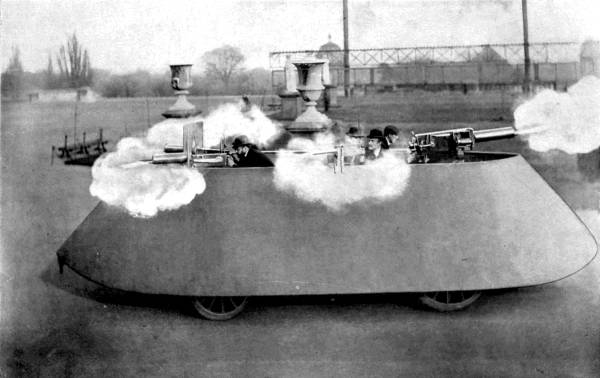
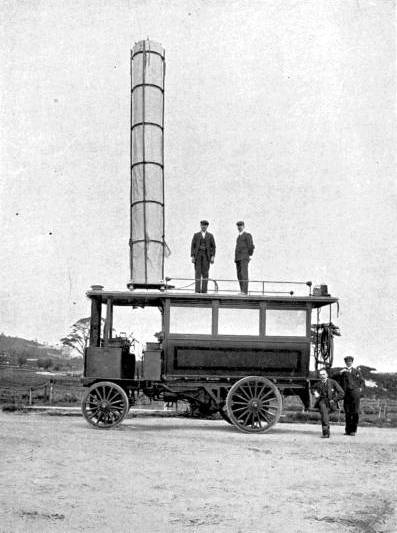
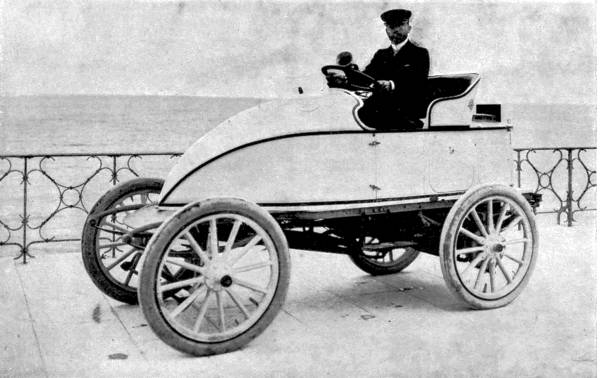
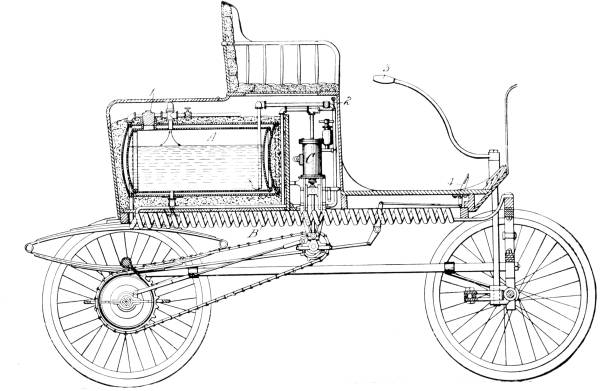
The Simms armour-clad motor-car for coast defence.
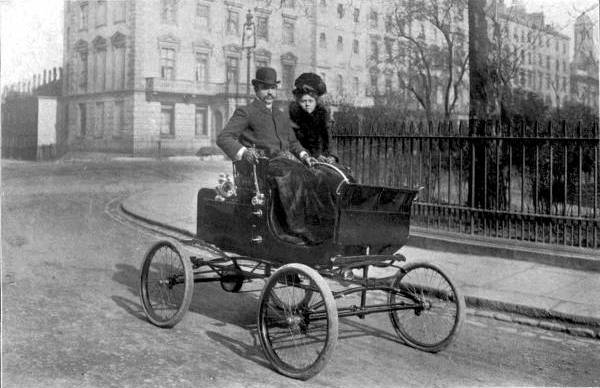
Maxim guns and Pom-pom in action.
The first-class battleships are chiefly supplied with four 12-inch
guns in barbettes, twelve 6-inch as secondary batteries, and a number
of smaller quick-firers on the upper decks and in the fighting tops,
also for use in the boats, to which are added several Maxims.
The first-class cruisers have 9.2 as their largest calibre, with a
lessened proportion of 6-inch, &c. Some of the newest bear only 7-1/2
or 6-inch guns as their heaviest ordnance; like the second-class
cruisers which, however, add several 4.7’s between these and their
small quick-firers.
Vessels of inferior size usually carry nothing more powerful than the
4.7.
All are now armed with torpedo tubes.
These same useful little quick-firers and machine-guns have been the
lethal weapons which made the armoured trains so formidable. Indeed,
there seems no limit to their value both for offence and defence, for
the battle chariot of the ancient Briton has its modern successor in
the Simms’ motor war car lately exhibited at the Crystal Palace. This
armour-plated movable fort is intended primarily for coast defence,
but can work off beaten tracks over almost any sort of country. It is
propelled at the rate of nine miles an hour by a 16-horse-power
motor, carrying all its own fuel, two pom-poms, two small Maxims, and
10,000 rounds of ammunition, besides the necessary complement of men
and searchlights for night use, &c., &c.
The searchlight, by the way, has taken the place of all former
inventions thrown from guns, such as ground-light balls, or parachute
lights with a time-fuse which burst in the air and remained suspended,
betraying the enemy’s proceedings.
In like manner the linked chain and “double-headed” shot, the
“canister”—iron balls packed in thin iron or tin cylinders which
would travel about 350 yards—the “carcasses” filled with inflammable
composition for firing ships and villages, are as much out of date as
the solid round shot or cannon-ball. Young Shrapnell’s invention a
century ago of the form of shell that bears his name, a number of
balls arranged in a case containing also a small bursting-charge fired
either by percussion or by a time-fuse, has practically replaced them
all. Thrown with great precision of aim its effective range is now up
to 5000 yards. A 15-pounder shrapnell shell, for instance, contains
192 bullets, and covers several hundred yards with the scattered
missiles flying with extreme velocity.
Common shell, from 2-1/2 to 3 calibres long, contains an explosive
only. Another variety is segment shell, made of pieces built up in a
ring with a bursting charge in the centre which presently shatters
it.
The Palliser shell has a marvellous penetrating power when used
against iron plates. But, mirabile dictu! experiments tried within
the past few months prove that a soft cap added externally enables a
projectile to pierce with ease armour which had previously defied
every attack.
Half a century ago gunpowder was still the one driving power which
started the projectile on its flight. It is composed of some 75 parts
of saltpetre or nitrate of potash, 15 parts of carefully prepared
charcoal, and 10 parts of sulphur. This composition imprisons a large
amount of oxygen for combustion and is found to act most successfully
when formed into rather large prismatic grains.
On the abolition of the old flint-lock its place was taken by a
detonating substance enclosed in a copper cap, and some time later
inventors came forward with new and more powerful explosives to
supersede the use of gunpowder.
By treating cotton with nitric and sulphuric acid reaction
gun-cotton was produced; and a year later glycerine treated in the
same manner became known to commerce as nitro-glycerine. This liquid
form being inconvenient to handle, some inert granular substance such
as infusorial earth was used to absorb the nitro-glycerine, and
dynamite was the result.
The explosion of gun-cotton was found to be too sudden and rapid for
rifles or cannon; it was liable to burst the piece instead of blowing
out the charge. In order to lessen the rapidity of its ignition
ordinary cotton was mixed with it, or its threads were twisted round
some inert substance.
When repeating-rifles and machine-guns came into general use a
smokeless powder became necessary. Such powders as a rule contain
nitro-cellulose (gun-cotton) or nitro-glycerine, or both. These are
combined into a plastic, gluey composition, which is then made up into
sticks or pellets of various shapes, and usually of large size to
lessen the extreme rapidity of their combustion. Substances such as
tan, paraffin, starch, bran, peat, &c., &c., and many mineral salts,
are used in forming low explosives from high ones.
To secure complete combustion some of the larger pellets are made with
a central hole, or even pierced by many holes, so that the fire
penetrates the entire mass and carries off all its explosive
qualities.
Our cordite consists of nitro-glycerine dissolving di-nitro
cellulose by the acid of a volatile solvent and a mineral jelly or
oil. This compound is semi-fluid, and being passed like macaroni
through round holes in a metal plate it forms strings or cords of
varying size according to the diameter of the holes. Hence the name,
cordite.
Many experiments in search of more powerful explosives resulted in an
almost universal adoption of picric acid as the base. This acid is
itself produced by the action of nitric acid upon carbolic acid, and
each nation has its own fashion of preparing it for artillery.
The French began with mélinite in 1885, this being a mixture of
picric acid and gun-cotton.
The composition of lyddite (named from its place of manufacture,
Lydd, in Kent) is a jealously-guarded British secret. This substance
was first used in 5-inch howitzers during the late Soudan campaign,
playing a part in the bombardment of Omdurman. The effect of the
50-lb. lyddite shells upon the South African kopjes is described as
astounding. When the yellow cloud had cleared away trees were seen
uprooted, rocks pulverised, the very face of the earth had changed.
Several attempts have been made to utilise dynamite for shells, some
of the guns employing compressed air as their motive power. The United
States some years ago went to great expense in setting up for this
purpose heavy pneumatic plant, which has recently been disposed of as
too cumbrous. Dudley’s “Aërial Torpedo” gun discharged a 13-lb. shell
containing explosive gelatine, gun-cotton, and fulminate of mercury by
igniting the small cordite charge in a parallel tube, through a vent
in which the partially cooled gases acted on the projectile in the
barrel. This was rotated in the air by inclined blades on a tailpiece,
as the barrel could not be rifled for fear of the heat set up by
friction. Some guns actuated on much the same principle are said to
have been used with effect in the Hispano-American war. Mr. Hudson
Maxim with his explosive “maximite” claims to throw half a ton of
dynamite about a mile, and a one-ton shell to half that distance.
But even these inventors are outstripped by Professor Birkeland, who
undertakes to hurl a projectile weighing two tons from an iron tube
coiled with copper wire down which an electric current is passed; thus
doing away entirely with the need of a firing-charge.
Let us pay a visit to one of our gun factories and get some idea of
the multiform activities necessary to the turning out complete of a
single piece of ordnance or a complicated machine-gun. We enter the
enormous workshop, glazed as to roof and sides, full of the varied
buzz and whirr and clank of the machinery. Up and down the long bays
stand row upon row of lathes, turning, milling, polishing, boring,
rifling—all moving automatically, and with a precision which leaves
nothing to be desired. The silent attendants seem to have nothing in
their own hands, they simply watch that the cutting does not go too
far, and with a touch of the guiding handles regulate the pace or
occasionally insert a fresh tool. The bits used in these processes are
self-cleaning, so the machinery is never clogged; and on the ground
lie little heaps of brass chips cut away by the minute milling tools;
or in other places it is bestrewn with shavings of brass and steel
which great chisels peel off as easily as a carpenter shaves a deal
board.
Here an enormous steel ingot, forged solid, heated again and again in
a huge furnace and beaten by steam-hammers, or pressed by hydraulic
power between each heating till it is brought to the desired size and
shape, is having its centre bored through by a special drill which
takes out a solid core. This operation is termed “trepanning,” and is
applied to guns not exceeding eight inches; those of larger calibre
being rough-bored on a lathe, and mandrils placed in them during the
subsequent forgings. The tremendous heat generated during the boring
processes—we may recall how Benjamin Thompson made water boil by the
experimental boring of a cannon—is kept down by streams of soapy
water continually pumped through and over the metal. We notice this
flow of lubricating fluid in all directions, from oil dropping slowly
on to the small brass-milling machines to this fountain-play of water
which makes a pleasant undertone amidst the jangle of the machines.
But these machines are less noisy than we anticipated; in their actual
working they emit scarcely the slightest sound. What strikes us more
than the supreme exactness with which each does its portion of the
work, is the great deliberateness of its proceeding. All the hurry and
bustle is above us, caused by the driving-bands from the engine, which
keeps the whole machinery of the shed in motion. Suddenly, with harsh
creakings, a great overhead crane comes jarring along the bay, drops a
chain, grips up a gun-barrel, and, handling this mass of many tons’
weight as easily as we should lift a walking-stick, swings it off to
undergo another process of manufacture.
We pass on to the next lathe where a still larger forging is being
turned externally, supported on specially devised running gear, many
different cutters acting upon it at the same time, so that it is
gradually assuming the tapering, banded appearance familiar to us in
the completed state.
We turn, fairly bewildered, from one stage of manufacture to another.
Here is a gun whose bore is being “chambered” to the size necessary
for containing the firing charge. Further along we examine a more
finished weapon in process of preparation to receive the breech-plug
and other fittings. Still another we notice which has been
“fine-bored” to a beautifully smooth surface but is being improved yet
more by “lapping” with lead and emery powder.
In the next shed a marvellous machine is rifling the interior of a
barrel with a dexterity absolutely uncanny, for the tool which does
the rifling has to be rotated in order to give the proper “twist” at
the same moment as it is advancing lengthwise down the bore. The
grooves are not made simultaneously but as a rule one at a time, the
distance between them being kept by measurements on a prepared disc.
Now we have reached the apparatus for the wire-wound guns, a principle
representing the ne plus ultra of strength and durability hitherto
evolved. The rough-bored gun is placed upon a lathe which revolves
slowly, drawing on to it from a reel mounted at one side a continuous
layer of steel ribbon about a quarter of an inch wide. On a 12-inch
gun there is wound some 117 miles of this wire! fourteen layers of it
at the muzzle end and seventy-five at the breech end. Heavy weights
regulate the tension of the wire, which varies for each layer, the
outermost being at the lowest tension, which will resist a pressure of
over 100 tons to the square inch.
We next enter the division in which the gun cradles and mounts are
prepared, where we see some of the heaviest work carried out by
electric dynamos, the workman sitting on a raised platform to keep
careful watch over his business.
Passing through this with interested but cursory inspection of the
cone mountings for quick-firing naval guns, some ingenious elevating
and training gear and a field carriage whose hydraulic buffers merit
closer examination, we come to the shell department where all kinds of
projectiles are manufactured. Shrapnel in its various forms,
armour-piercing shells, forged steel or cast-iron, and small brass
cartridges for the machine-guns may be found here; and the beautifully
delicate workmanship of the fuse arrangements attracts our admiration.
But we may not linger; the plant for the machine-guns themselves claim
our attention.
Owing to the complexity and minute mechanism of these weapons almost a
hundred different machines are needed, some of the milling machines
taking a large selection of cutters upon one spindle. Indeed, in many
parts of the works one notices the men changing their tools for others
of different size or application. Some of the boring machines work two
barrels at the same time, others can drill three barrels or polish a
couple simultaneously. But there are hundreds of minute operations
which need to be done separately, down to the boring of screw holes
and cutting the groove on a screw-head. Many labourers are employed
upon the lock alone. And every portion is gauged correctly to the most
infinitesimal fraction, being turned out by the thousand, that every
separate item may be interchangeable among weapons of the same make.
Look at the barrel which came grey and dull from its first turning now
as it is dealt with changing into bright silver. Here it is adjusted
upon the hydraulic rifling machine which will prepare it to carry the
small-arm bullet (.303 inch). That one of larger calibre is rifled to
fire a small shell. Further on, the barrels and their jackets are
being fitted together and the different parts assembled and screwed
up. We have not time to follow the perfect implement to its mounting,
nor to do more than glance at those howitzers and the breech mechanism
of the 6-inch quick-firers near which our guide indicates piles of
flat cases to keep the de Bange obturators from warping while out of
use. For the afternoon is waning and the foundry still unvisited.
To reach it we pass through the smith’s shop and pause awhile to watch
a supply of spanners being roughly stamped by an immense machine out
of metal plates and having their edges tidied off before they can be
further perfected. A steam-hammer is busily engaged in driving
mandrils of increasing size through the centre of a red-hot forging.
The heat from the forges is tremendous, and though it is tempered by a
spray of falling water we are glad to escape into the next shed.
Here we find skilled workmen carefully preparing moulds by taking in
sand the exact impression of a wooden dummy. Fortunately we arrive
just as a series of casts deeply sunk in the ground are about to be
made. Two brawny labourers bear forward an enormous iron crucible,
red-hot from the furnace, filled with seething liquid—manganese
bronze, we are told—which, when an iron bar is dipped into it, throws
up tongues of beautiful greenish-golden flame. The smith stirs and
clears off the scum as coolly as a cook skims her broth! Now it is
ready, the crucible is again lifted and its contents poured into a
large funnel from which it flows into the moulds beneath and fills
them to the level of the floor. At each one a helper armed with an
iron bar takes his stand and stirs again to work up all dross and
air-bubbles to the surface before the metal sets—a scene worthy of a
painter’s brush.
And so we leave them.