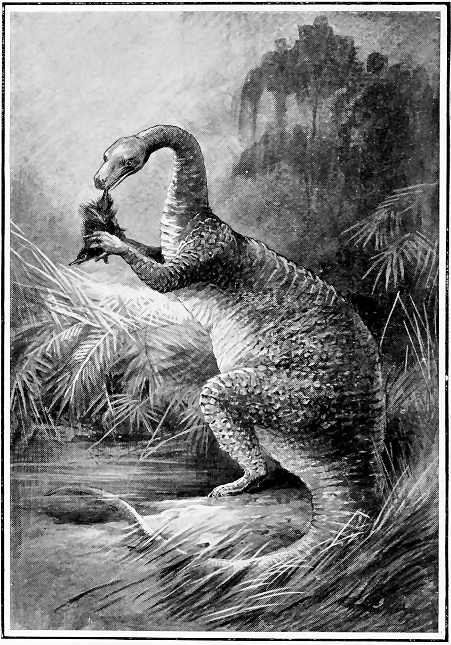
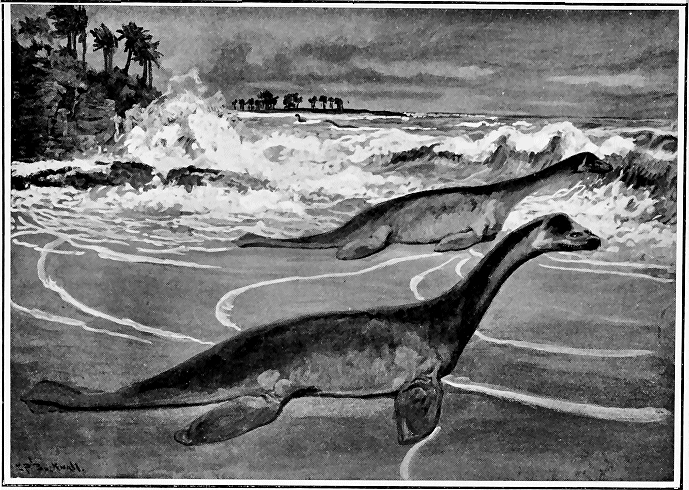
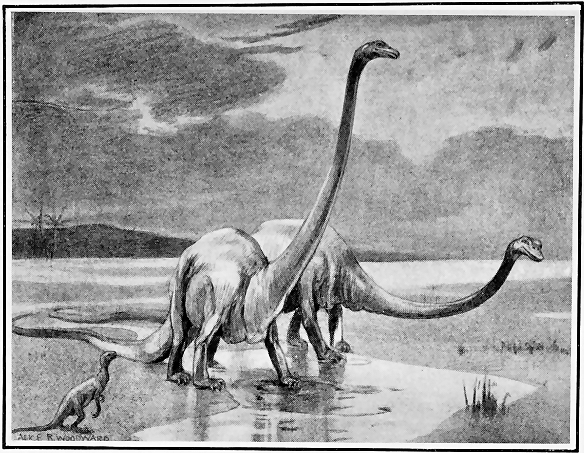
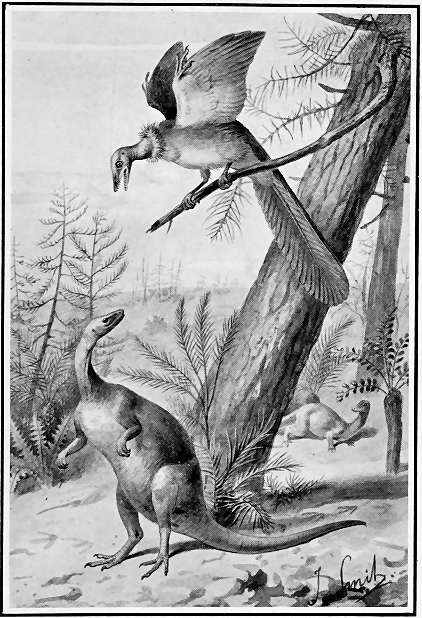
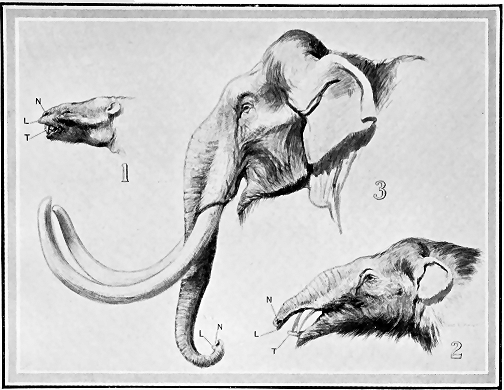
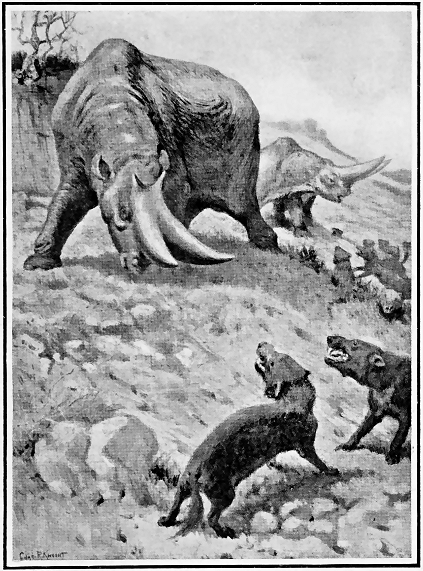
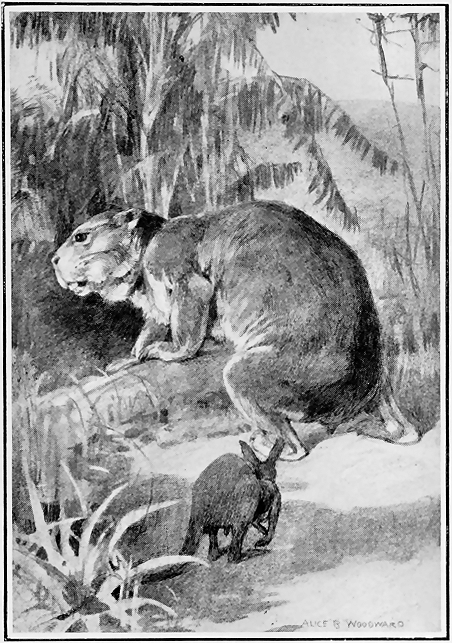
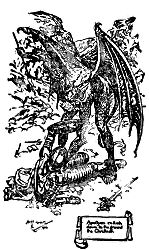
Megalosaurus
Total length about 25 feet.
(Remains found in England, France, South Africa, and India.)
DESCRIBING IN SIMPLE BUT EXACT
LANGUAGE THE MAKING OF THE
EARTH WITH SOME ACCOUNT OF
PREHISTORIC ANIMAL LIFE
BY
EDITOR OF "KNOWLEDGE"
AUTHOR OF "THE FAR EAST" &C., &C.
WITH TWENTY-FIVE ILLUSTRATIONS
LONDON
SEELEY AND CO. LIMITED
38 GREAT RUSSELL STREET
1909
UNIFORM WITH THIS VOLUME
THE LIBRARY OF ROMANCE
Extra Crown 8vo. With many illustrations. 5s. each
"Splendid volumes."—the Outlook.
"This series has now won a considerable and well deserved
reputation."—The Guardian.
"Each volume treats its allotted theme with accuracy,
but at the same time with a charm that will commend
itself to readers of all ages. The root idea is excellent,
and it is excellently carried out, with full illustrations and
very prettily designed covers."—The Daily Telegraph.
By Prof. G. F. SCOTT ELLIOT, M.A., B.Sc.
THE ROMANCE OF SAVAGE LIFE
THE ROMANCE OF PLANT LIFE
THE ROMANCE OF EARLY BRITISH LIFE
By EDWARD GILLIAT, M.A.
THE ROMANCE OF MODERN SIEGES
By JOHN LEA, M.A.
THE ROMANCE OF BIRD LIFE
By JOHN LEA, M.A., & H. COUPIN, D.Sc.
THE ROMANCE OF ANIMAL ARTS AND CRAFTS
By SIDNEY WRIGHT
THE ROMANCE OF THE WORLD'S FISHERIES
By the Rev. J. C. LAMBERT, M.A., D.D.
THE ROMANCE OF MISSIONARY HEROISM
By G. FIRTH SCOTT
THE ROMANCE OF POLAR EXPLORATION
By ARCHIBALD WILLIAMS, B.A. (Oxon.), F.R.G.S.
THE ROMANCE OF EARLY EXPLORATION
THE ROMANCE OF MODERN EXPLORATION
THE ROMANCE OF MODERN MECHANISM
THE ROMANCE OF MODERN INVENTION
THE ROMANCE OF MODERN ENGINEERING
THE ROMANCE OF MODERN LOCOMOTION
THE ROMANCE OF MODERN MINING
By CHARLES R. GIBSON, A.I.E.E.
THE ROMANCE OF MODERN PHOTOGRAPHY
THE ROMANCE OF MODERN ELECTRICITY
By EDMUND SELOUS
THE ROMANCE OF THE ANIMAL WORLD
THE ROMANCE OF INSECT LIFE
By AGNES GIBERNE
THE ROMANCE OF THE MIGHTY DEEP
By E. S. GREW, M.A.
THE ROMANCE OF MODERN GEOLOGY
SEELEY & CO., LIMITED
Grateful acknowledgment is due to Mr. Henry R. Knipe for his
kind permission to reproduce some of the illustrations of extinct
animals contained in his scholarly work entitled, From Nebula to
Man (J. M. Dent and Co.).
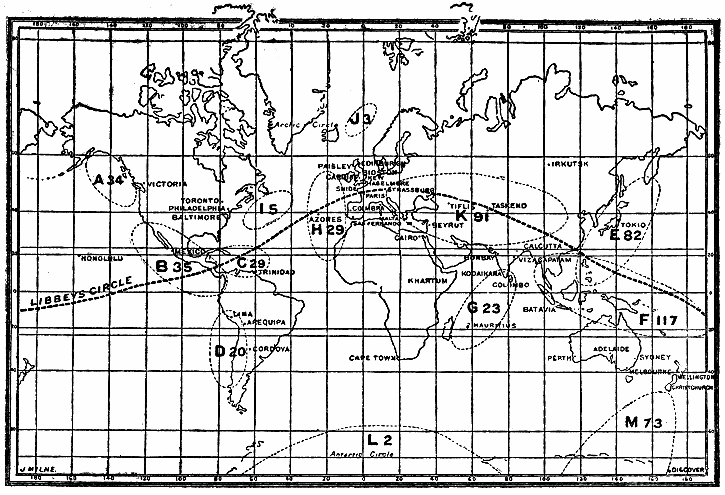
The Number of world-shaking earthquakes from 1899 to 1908
which have originated in districts marked A, B, C, &c., are shown by
figures. (See pp. 171 and 172.)
ERRATA
[Transcriber Note: Corrections have been applied!]
Page 19, line 9. For "Sir Thomas Holdich," read "Sir Thomas
Holditch."
Page 25, line 17. Read, "they are always, as it were, imperceptibly
quivering; and they are always liable, if the strain on them
should be increased in the slightest degree, to give way, or to
resettle the weight on their shoulders in some way."
Page 29, line 11. For "a greasy spot," read "a greasy shot."
Page 35, line 5. For "evidence," read "existence."
THE ROMANCE OF MODERN GEOLOGY
CHAPTER I — THE BUILDING OF THE EARTH
Everybody who has ever been to the coast of
these islands has become aware that changes in the
outline of the land are continually taking place.
In some parts of the east coast of England, such as that
which lies between Harwich and Walton-on-the-Naze, the
sea appears to be slowly encroaching on the land, so that
places which were grazing-fields twenty or thirty years
ago are now covered by the sea at high tide, and at low
tide are mere sandy wastes threaded by rivulets of sea-water.
On the south coast of the Isle of Wight, between
Sandown and the Culver Cliff, which is the most easterly
point, the same loss of land is going on in another way.
Some years ago a fort stood rather near the edge of the
cliff, and it would have been possible to climb round the
seaward wall of the fort. It is not possible now, for the
outer sea-wall of the fort has long ago slipped into the
sea; so have some of the inner fortifications: and it has
been necessary to dismantle the whole of this fort lest
every part of even the inner landward wall should follow
the outer parts and slip with the solid ground down the
cliff. It is easy to see what is happening here. The wind
and the waves are undermining and honeycombing the
cliff. They are weakening its base and its body, and so
the upper crust on which the fort was built, and into
which its foundations were dug, is slipping away. If we
imagine for a moment that nothing was done to save the
fort or protect the cliff, but that all was left to nature to
deal with, it would not be hard to picture what would
happen. The cliff would gradually be eaten away: its
gravel and clay would be drawn into the sea, and the
Isle of Wight would become a little smaller. The same
thing is going on at a good many places along the coast
of the British Isles, as well as on the coast of Florida and
in the Gulf of California in America.
The little islet of Heligoland in the North Sea, which
once belonged to Great Britain, but was some years ago
handed over to Germany, is so fiercely attacked by the
sea in this way, that it almost has to be armour-plated
in order to preserve its integrity. It is fenced in stone
in order to protect it. What is happening on the coasts
of islands like England and Heligoland is happening all
over the world. It has always happened. If it had not
happened in past ages there would be no British Isles at
all, because once England and Scotland and Ireland were
joined to Europe, and it would have been possible to walk
across the North Sea from Harwich to the Hook of
Holland. The North Sea was once dry land. But the
sea encroached on it from the north, and the Atlantic
Ocean battered a way through on the south, till the
English Channel was bored through into the shallow
waters of the newly-formed North Sea, and the lands
that had once been part of Europe became these "sceptred
isles set in the silver sea."
This is not all the story. What the sea takes away it
gives again. Sir Thomas Holditch is our authority for
saying that on some parts of the Pacific coast of America
you may at some points see on the one hand dry land
which by the shells found on it shows that the sea once
flowed over it; while side by side with this raised land
you may sail a boat over forests now sunk beneath the
sea. The loss of bits and corners of England is serious—so
serious that a Royal Commission on Sea Erosion, as
the process is called, was appointed to inquire into the
extent of the loss and the means by which it might be
remedied. But in some parts of our coast the land is not
losing, but gaining. If the sea takes away sand and
gravel, chalk and shale and clay from the cliffs, these
materials are not lost. Something is done with them.
They must at some points, where the tides and currents
of the sea deposit them, make the sea more shallow.
Perhaps the sea lays them down as beds or sand-banks.
Perhaps it carries them round the coast to some other
point and there drops them. Can you not see that in this
way the sea which at one point is dragging down the coast
may at other points be building it up, or may be even constructing
breakwaters made out of these stolen materials?
The sea is not the only carrier which is thus laying
down beds of material. The rivers are doing the same
thing. Every shower of rain washes some dirt—by which
we mean sand or gravel or loam or chalk—from the land
into the nearest rivulet. The rivulet hurries with it
down to the neighbouring river, and the river carries it
down to the sea. If the river is going very fast it carries
most of its dirt along with it, and we generally find the
river muddy after rain. But when the river slackens its
pace, as it usually does when it nears the sea and meets
the sea's tides, then it lets the dirt fall; and thus at the
river's mouth we find mud-banks or sand-banks. If a
river is left long enough to its own devices, these sand-banks
will so increase in bulk that the mouth of the river
will become shallower and shallower and will spread. It
silts up, and when a river is needed for the navigation of
ships large sums of money have to be spent, as in the
Scheldt or at the mouth of the Thames, in dredging this
mud so as to keep the channels clear.
There are many striking examples of this land-building
by rivers; and the deltas of rivers, so called from their
resemblance to the Greek letter Δ, form in some instances
great areas. The Mississippi, the Nile, and the Ganges,
for example, are surrounded by great tracts of land at
their mouths, which are formed entirely from matter
brought down by the rivers and deposited at lower levels
than those at which the rivers originated. The Mississippi,
which drains a river basin of 1,147,000 square
miles, has an annual discharge of sediment of no less
than 7,459,267,200 cubic feet. The Italian River Po,
draining an area of 30,000 square miles, discharges
1,510,137,000 cubic feet of sediment annually. This is
equivalent to a lowering of its whole drainage area
by 1/729th of a foot per annum, so that in a thousand
years the whole area over which it flows has been lowered
by the river by more than a foot. The Thames alone
carries down 5,000,000 tons of material each year. All
this must be redeposited somewhere. Where the redeposition
takes place we find new land forming, new
beds, new strata, in which in ages to come the future
tenants of the globe may find relics of the people and
animals living to-day.
Thus there are several evident ways in which the
coast-line of a country might be altered, either in the
direction of enlarging its boundaries by additions to it
made by the sea or by rivers; or in the direction of
losing parts of its territory by wear and tear. But
there are other changes going on which are not so easy to
perceive, and which are not so easy to account for. The
thing hardest to explain is why what is now dry land
should have risen out of the sea, as certainly it did. The
white cliffs of Dover are made of chalk, and chalk is
made of innumerable shells of tiny animals which once
lived in the sea and which at their death sank to the
sea's bottom. They steadily accumulated there for ages
in a grey ooze, and in course of time this grey ooze rose
above the waves. It dried and became land. But chalk
is not found in cliffs by the sea only. It is found far
inland. It is found, for example, in the North Downs,
which run from Guildford to Reigate and from Reigate
to Limpsfield and Westerham—a great ridge of chalk, at
some points 600 to 800 feet high. That ridge must at
one time have been at the sea bottom. And if we were
to examine the whole of England and sink borings in it,
we should at one point or another come to some remains
of rocks, or some "strata," as they are called, which are
of such make and material that we can only believe them
to have been laid down at the sea bottom. The only
conclusion we can come to, therefore, is that by some
means or other, and at some time or other, the islands of
England were slowly lifted above the sea, and that at
some other time the sea was slowly lifted above them.
What is true of England is true of nearly all the
regions of the world that have been closely examined by
geologists. Everywhere there is the evidence of different
stages of existence in the land's history—stages when it
was covered by the sea; stages when it was dry land
again; perhaps stages when it was covered by lakes,
by vast forests; stages when it may have been covered
by ice; stages when it was desert. Some of these
stages show far vaster upheavals than others, and the
changes wrought were of far greater extent. Everybody
has heard that the great Saharan desert was perhaps
once the bed of an ocean. That is an assertion to which,
perhaps, we may be a little chary of committing ourselves;
but there is excellent reason for believing that once some
of the great African lakes were connected with the sea;
and we are quite certain that once Africa was an island.
So that in the case of that vast continent we know that
it must have seen periods of great depression and elevation;
ages when it was much lower than it is now, and
ages when it was higher.
We will not at this moment stop to give further
examples. We will only try to see whether there is any
explanation which would make it possible to understand
why there should be these slow upheavals and subsidences
of the earth's surface. The chief and most important
reason is that the earth is not so solid as it looks, and
not so solid as it feels. It would be easier to realise this
if, instead of living in a part of the earth like Great
Britain, where there are very few earthquakes, we lived
in Japan, or Central America, or in the archipelago of
islands which runs from Java to Borneo and further
south. In these places, where never a year passes but
that the earth can be felt to quiver beneath one's feet,
and where earthquakes which wreck houses are at least
as common as eclipses of the moon, it is easier to believe
that the earth is a rather shaky body; or, as scientific
men would call it, a rather unstable body. But if, like
those scientific men who take up the study of earthquakes,
or "seismology," we equipped ourselves with instruments
to measure or record earthquakes, we should perceive even
in England that the earth is nearly always quivering.
Something is always snapping or giving way in its interior,
and producing trembling fits that sometimes can
be felt hundreds of miles away, and sometimes can be felt
all over the earth. There are on the average at least
twenty earthquakes a year which make the whole of this
round globe tremble.
It would seem, therefore, that either these shocks or
breakages in the earth's crust, or the earth's interior,
must be very great indeed, or else that the earth must
be composed of rather shaky materials. Well, perhaps
both these suppositions are true. We spoke just now
of the instruments which seismologists use to record
earthquakes. They are known as "seismometers," and
a great many of them are used in Japan and on the
Californian or Pacific coast of America. Now it is
perhaps scarcely necessary to say here (when we recollect
how many cyclones and anticyclones England receives
from the Atlantic) that a storm or rainy weather is
usually heralded or accompanied by a fall in the
barometer, or a depression. Now when there is a
depression in the barometer that means that the weight
of air above the barometer is less than it was before,
though it is not so great a difference that human beings
could tell it, unless it were accompanied by other signs.
But the earth can tell it, and the mere fall of the
barometer, owing to changes of the air, will make the
earth tremble or quiver slightly, as if it were a jelly.
We cannot perceive it; but the delicate seismometers
can; and when a storm is coming to Japan or to
California from the Pacific, the instruments show that
the earth feels the passage of it. The comparison of the
earth to a jelly—a very stiff jelly—is on the whole a
useful one.
If a very tall jelly is allowed to stand for some time, or
if the table on which it stands is shaken a good deal,
then, as we know, rifts will sometimes appear in the jelly.
The reason for these breakdowns in the jelly's composition
is that owing to the distribution of its weight it is always
in what we call a state of strain; and it is sometimes not
strong enough to support this strain, and, almost without
apparent cause, will sometimes give way. Much more
solid bodies than jelly act in the same way. The great
bridge near Quebec which collapsed in 1907 was to all
appearance quite sound and strong; but there were strains
in the iron girders, and without warning these strains suddenly
produced rifts in the iron and steel framework and
it broke down. Similarly the towers of churches and
cathedrals, which are built on arches, will give away
quite suddenly after standing to all appearance quite
firm for hundreds of years. There is an architect's
maxim which runs, "The arch never sleeps." That
means that the arches on which the great weight of
a church or cathedral tower rests are always in a state
of strain; they are always, as it were, imperceptibly quivering;
and they are always liable, if the strain on them should be
increased in the slightest degree, to give way, or to
resettle the weight on their shoulders in some way.
The whole of the great globe which we call the earth is
in this state of strain; and it is always liable to rifts
within itself and to readjustments of the weights of its
own parts. It is not so easy to understand how a great
globe spinning through space can be in a state of strain,
or can attempt to readjust the weight of its parts, as in
the instances we have just given of the quivering jelly or
the solid cathedral tower. Perhaps another illustration
may help us. We will presume that nearly everybody is
acquainted with the modern rubber-cored golf ball. The
modern golf ball, as those who are aware who either
intentionally or unintentionally have cut through its outer
cover, consists first of a small hard core. Round this is
wound very tightly some two hundred yards of elastic.
The tighter this is wound the better, or at any rate the
more "bouncing" will be the resulting ball of india-rubber
elastic. But consider what is the usual condition
of this rubber-wound ball. Like our jelly it is always
in a state of stretch or strain. Even when covered with
the outer shell which completes the golf ball, the whole
ball is still, we might say, in a state of strain or tension.
That is one of the reasons why it bounces, and why it
flies better than the old solid ball off the face of a golf
club. But if you were to keep a golf ball for a hundred
years these strains in its interior would alter and adjust
themselves. One result would certainly be that the golf
ball might lose its elasticity. Another result would be
that its shape would slightly alter.
Now a golf ball, however carefully it is made, is not
always evenly made. It weighs a little more on one side
than another; and the best golf balls, those which fly
truest and farthest, are those which are most evenly
made: so that we might say of them that the centre of
their weight was exactly the same as the centre of the
ball. If it is not, then the strains in the ball are always
pulling it a little more out of shape; and the ball, as
golfers say, flies badly. Now the earth is like a badly
made golf ball. The centre of its weight, or, as we call
it, the centre of gravity, is not quite at the centre of the
earth. Moreover, owing to the enormous pressures which
exist right through the earth, and which are by no means
the same at every place inside the earth, but are, in fact,
continually changing, owing to hundreds of causes, the
whole of the earth's interior is in a state of unequal
strain. What is the consequence that you would expect?
Is it not that the earth should always be making efforts to
adjust its weight, and, as it were, to distribute it evenly?
It has been doing this for millions of years. It has not
yet finished.
Lastly, the cover of a golf ball is comparatively a stiff
and unyielding substance which does not betray on its
surface, if it is allowed to lie at rest, the tensions and
strains of the rubber core inside. But the crust of the
earth, which we have compared to the golf ball's cover, is
not unyielding or rigid. It is practically a part of the
case of the earth; and it does show and reflect the strains
and tensions of the movements and rifts of the core. So
that as in the course of ages the straining core changes,
and gives way, alters itself and adjusts itself—so the
crust of the earth alters with it. Some of these changes
are sudden and violent. Some of them take place very
slowly, occupying thousands or hundreds of thousands of
years in the gradual process of change; and then perhaps
for ages the earth's crust will be slowly sinking in one
place and slowly rising in another. Thus, what was once
a depression in the earth's surface may be now an elevation;
what was once below the level of the sea may
be now a continent of land; and what was once land
may now have sunk beneath the incoming sea. Thus,
what was sandstone rock of the earth's surface may become
covered with forest, and the forest may sink below
the sea, only to be pushed up again and become dry
land a million years later. Each of these changes will
leave its mark, each will be accompanied by deposits.
The deposits may be vegetable matter, trees and mosses,
and the growth of swamps, such as coal was first made
of; or they may be the ocean sludge, which at last became
chalk or limestone.
CHAPTER II — THE EARTH'S SHAPE
We have compared the earth to a golf ball, and
as it spins through space, impelled by a force
millions of times greater than the strongest
driver ever imparted to the best-made "Haskell," its
flight and general appearance are not unlike those of the
rubber-cored ball. The earth, for one thing, is not
smooth; it has roughnesses and corrugations all over its
surface, similar to those of a golf ball, though much less
regular, and it spins as it flies. But let us now consider
the differences. Suppose the golf ball had a spot of
water clinging to it as water clings to a greasy shot.
Where would the water lie? The first answer that
occurs to one is that the water would be shaken off the
ball in the course of its flight; and that is, indeed, very
likely. But suppose the water were very sticky, or were
very much attracted by the golf ball (which is another
way of stating the same supposition), where would it lie
then? To that we can only say that there does not
seem any very evident reason why it should lie on one
part of the flying golf ball more than on any other—if
the golf ball were perfectly round.
That is, on the whole, a reasonable answer. But apply
the same reasoning to the question of where the waters
of the earth in the shape of oceans ought to lie as they
cling to the spinning globe. They cling to the globe,
not because they are sticky, but because of the attraction
which we say is due to gravity—the force which makes
everything in nature attract every other thing, and
which makes everything tend to fall to the earth (and
to stay there). They do so because the earth, being so
very heavy and bulky in comparison with anything in its
neighbourhood, has such an enormous pull. How great
that pull is may be dimly gathered from the reflection
that though the earth is spinning at the rate of a thousand
miles an hour, nothing is ever shaken off. The
oceans are not shaken off. They cling. But why is it
that they are not equally distributed all over the face of
the earth? If a map of the earth be examined, or still
better a globe with the oceans and continents correctly
drawn on it, it will be found that there is a great mass
of land all lying grouped together on one side of the
earth, and a great basin of waters on the other. Let
the reader imagine himself a thousand miles above the
earth, looking down at a point in it about midway
between Madeira and the Bermudas. What would he
see? He would see the Atlantic Ocean, but all around it
would be grouped great masses of land—Europe, Africa,
North America, Asia—and if it were his first sight of
the earth and he knew nothing of its geography, he
would be likely to suppose that the earth was nearly all
land, with one comparatively small stretch of unfrozen
ocean. But now let the reader move round the earth to
a point exactly opposite that at which he took his first
observations and look down again. He will now see the
Australian continent and the land which covers the
South Pole, but except for the pointed tail of South
America, and perhaps a glimpse of the blunter point of
South Africa, he will be looking down on a globe which
seems to be largely covered with water.
Why should this be? It must be due to the shape of
the earth. The fact is, the earth would make a very bad
golf ball. It is by no means of that perfection of symmetry
which they say enables a golf ball to fly well and
to run true on the putting greens. The earth is, in fact,
not perfect as a sphere, either within or without. Its
centre is not in the same place as the centre of its
weight, and it is not round in shape. Everybody has
heard that the earth is slightly flattened at the poles;
but its irregularity goes much further than that. If we
could strip it of its oceans, which fill up a good many
of its imperfections, we should find its shape not that of
a neat, round golf ball at all. The earth's actual shape
without its oceans, its "geoid," as it is called, is that
of a pear. The stalk of the pear is in the southern part
of Australia, and contains Australasia and the Antarctic
continent. This is surrounded on all sides but one
(towards South America) by a sort of belt of depression
in which the waters lie. That is the waist of the pear.
This again is surrounded on all sides but one (towards
the east of Japan) by a belt of elevation. That is the
protuberant part of the pear, and here the great continental
land areas rise. Finally, we find the nose of the
pear in the central Atlantic, between the Madeiras and
the Bermudas. Of course, the resemblance to a pear is
not a very marked one. Our observer a thousand miles
above the earth would not be able to perceive it, nor
would the astronomers in the moon, if any astronomers
existed there. But the earth is pear-shaped to a small
extent nevertheless, and in the case of such an enormous
mass a very slight deviation from rotundity will produce
very great effects.
Most of us have played at such ball games as bowls
or billiards; and I have assumed that everybody knows
something about golf. What happens in a game
at bowls to the bowl which is not evenly weighted
all through? It will not run straight. It has a bias.
What happens to a billiard ball which is not perfectly
round, or has lost its symmetry through age? It wobbles.
And what happens to a badly made golf ball? That
performs all sorts of exasperating antics. It ducks, it
soars, it curls, it takes a slice. It also wobbles. Now that
is exactly what the spinning, unevenly shaped globe which
we call the earth has been doing for millions of years.
It has been wobbling; and as we showed in the last
chapter, it has always been trying to right itself. Thus
the two poles have not always been in the same position;
the oceans have not always been where they are. The
waters have sometimes crawled up the land towards
the poles and sometimes receded. Regions that have
sometimes been frozen and cold have become warmer, and
have covered themselves now with oceans, and now with
forests, and now with deserts. There is no corner of the
whole world which has not undergone changes of climate.
These changes are very slow. There is no reason for
supposing, in spite of the laments we sometimes hear
about the loss of old-fashioned winters and old-fashioned
summers, that the climate of England, for example, has
changed in the least since Cæsar's legions landed on its
shores. The Roman settlers in Britain doubtless experienced
sloppy winters and wet summers now and
again, just as we do; and King Arthur's knights, no
doubt, had their saddening experiences of November
fogs. Yet slowly and surely changes of climate do
take place, and nothing except the winds influence them
more than does the presence of a neighbouring sea or
ocean. Most of us reckon the warmth of a locality's
climate by the distance it is from the pole. That is,
however, a very rough and ready method. Vladivostok
is roughly the same distance from the North Pole as
Venice; but there is a good deal of difference in the
temperature of the two places. In Manchuria when
the Russians and Japanese were entrenched before
Mukden men died of cold and were frozen at their
posts at a time when other people in Mentone and
Monte Carlo, at the same distance from the Arctic
Circle, were complaining of the heat. So that we see
that it must not be assumed that a place like England
(where for two thousand years we occasionally have
had winters that would kill trees like eucalyptus or
fig trees, and where oranges could never ripen in the
open air) was always equally cold. It may have been,
in fact we know it must have been, warm enough once to
encourage and support what resembled a tropical vegetation.
It must also have been at one time as cold as
Siberia in the winter.
Therefore we should expect to find, if we digged down
in the earth, or in any portion of the earth which had
undergone these changes, some traces of them. For
example, if at one time the sea covered England for
thousands or hundreds of thousands of years, depositing
the remains of millions of animals on the sea's
bottom during that period, we should expect to find some
traces of these remains—perhaps in the form of chalk,
seeing that the bones and shells of fishes dwelling in the
sea contain a good deal of lime. Or again, if a forest
covered England and grew and decayed there, not merely
for a period like that which has elapsed since the Romans
first set foot in Britain, but for a hundred times as long,
we should expect to find some sort of vegetable deposit,
hardened most probably by other layers above it. Do we?
Well, coal is a vegetable deposit. If there was a time
when ice covered the land we should expect to find traces
of that; if a time when the land was desert; or when it
was a lake—each and every one of these periods ought to
leave some remains, some epitaph of itself. So they do.
Let us for a moment consider with Sir Archibald
Geikie[1] the subsoil beneath cities that have been inhabited
for many centuries. In London, for example,
when excavations are made for drainage, building, and
other purposes, there are sometimes found, many feet
below the level of the present streets, mosaic pavements
and foundations, together with earthern vessels, bronze
implements, ornaments, coins, and other relics of Roman
time. Now if we knew nothing from actual authentic
history of the existence of such a people as the Romans
these discoveries deep beneath the surface of modern
London would prove that long before the present streets
were built the site of the city was occupied by a civilised
race which employed bronze and iron for the useful
purposes of life, had a metal coinage, and showed not
a little artistic skill in its pottery, glass, and sculpture.
But down beneath the rubbish wherein the Roman
remains are embedded lie gravels and sands from which
rudely fashioned human implements of flint, arrow-heads,
hammers, and the like have been obtained. From that
we learn that before the Romans came an earlier race had
been there which employed weapons and instruments of
roughly chipped flint.
[1] Sir Archibald Geikie's Introduction to Geology.
We have no doubt that this was the order of the
successive peoples occupying the site of London. It is
obvious. Why is it? We see that there are, broadly,
three layers or deposits. The upper layer is that which
encloses the foundations and rubbish of our own era and
times. Next below is that which encloses the relics of
Roman occupation. At the bottom lies that which
encloses the scanty traces of the early flint-folk. The
uppermost deposit is necessarily the newest, for it could
not be laid down until after the accumulation of those
below it; and those below it must be progressively older,
as they are traced deeper from the surface. By the mere
fact that the layers lie one above the other we are
furnished with a simple clue which enables us to determine
the order of their formation. We may know
nothing whatever as to how old they are, measured by
years or centuries. But we can be absolutely certain
that the bottom layer came first, and the top layer came
last. This kind of observation will enable us to find
proofs everywhere that the surface of the land has not
always been what it is to-day. In some districts, for
example, when the dark layer of soil in which vegetables
grow is turned up, there may be found beneath it sand
and gravel full of smooth, well-rounded stones. Such
materials are to be seen in course of formation where
water keeps them moving to and fro, as on the beds of
rivers, the margins of lakes, or the shallow shores of the
sea. Wherever smooth-rolled pebbles occur they point
to the influence of moving water, so that we conclude,
even though the site is now dry, that water once moved
above it. Again, below the soil in other regions lie
layers of oysters and other sea shells.
Pits, quarries, and mines that cut down still deeper
into the earth and lay it bare bring before our eyes most
impressive testimony regarding the ancient changes of the
land. Suppose, by way of further illustration, that underneath
a bed of sand full of oyster shells there lies a
dark brown band of peat. This substance, composed of
mosses and other water-loving plants, is formed in boggy
places by the growth of marshy vegetation. Below the
peat there might occur a layer of soft white marl full of
lake shells, such as may be observed on the bottom of
many lakes at the present time. These three layers—oyster
beds, peat, and marl—would be like a family
pedigree showing the history of the place. The bottom
layer of white marl would show that there was once a
lake. The next layer of peat would show that by the
growth of marshy vegetation the lake became choked up
and was gradually changed into a swamp and then a
morass. The other layer of oyster shells would show that
the ground was afterwards submerged by the sea. The
present condition of the ground would show that the sea
at last retired, and the place passed into dry land as it is
to-day.
By such a method of examination we may frame for
ourselves pictures of the earth's surface long before
history began, or before man roamed the earth. It is for
this reason that geology has been called the science that
investigates the history of the earth. The records in
which this history is chronicled are the soils and rocks
underneath our feet. It is the task of the geologist so to
arrange and interpret these records as to show through
what successive changes the globe has passed, and how
the dry land came to wear the aspect which it presents at
the present time.
To do this efficiently the geologist has to learn many
things. He has to observe very closely the changes which
are going on about him on the world's surface. Only in
so far as he makes himself acquainted with these sudden
changes can he hope to follow intelligently and successfully
the story of earlier phases in the earth's progress.
Nor is it sufficient to observe, however closely, inanimate
things. If he did not know the peculiarities of fresh-water
shells, how would he be able to say the shells in
the marl deposit were fresh-water animals (and that
therefore a lake once lay there) and not sea shells. If the
labour of the geologist were concerned merely with the
former changes of the earth's surface—how sea and land
have changed places, how rivers have altered their
courses, how valleys have been dug out, and how mountains
have been carved, how plains have been spread out,
and how all these things have been written on the framework
of the earth—he would still feel one very great
want, the want of living interest. But that also his
science gives him, for in these past eras living things
dwelt and moved and had their being. And it is one of
the most entrancing pursuits of the geologist to trace
their lives, their descent and ascent, and the relics of
themselves that they left.
CHAPTER III — EFFECTS OF WEATHER ON THE EARTH'S HISTORY
The same causes that produced the layers of peat
or sand, or limestone, or clay, which we find by
examination of the earth's surface, are acting
to-day. Coal is forming now; and so is limestone;
and so is sandstone; so even is granite. But these
layers or strata form very slowly, so that since man
has kept historical records the thickness of new strata
laid down could be measured in inches. Consequently
we are only able to see the beginnings of the processes.
After the materials were laid down by water
or the shifting winds, or by the decay of other materials
already in position, they underwent various changes. For
example, many layers, instead of consisting of loose materials
such as gravel, sand, or mud, are now hard stone.
Sometimes this consolidation has been the result of pressure.
As bed was piled over bed those at the bottom
would be more and more compressed by the increasing
weight of those laid down upon them; the water would
be squeezed out; the particles would stick closer together.
Mud, for example, might thus turn into clay;
and clay, pressed harder and harder, might be converted
into mudstone or shale. But there is another agency at
work. We have all seen mortar hardening and binding
bricks together; or cement hardening into concrete.
Similarly sedimentary deposits are bound together by
cements, of which there are many which exist naturally.
For example, silica is a natural cement; and so is carbonate
of lime; and so is peroxide of iron. All these will
bind other particles together. But how do they arrive at
the layers of particles? By the same action which lays
down the particles themselves. They are rubbed off the
places where they exist by the wind or by water. Perhaps
they were laid down among the deposited particles
of mud or sand. Perhaps they were brought to them by
streams or rivers or lakes, and sank with the water into
them. In a red sandstone, for example, the quartz grains
of the rock may be often observed to be coated with
earthy iron peroxide, which serves to bind them together
into a rather hard stone. On the other hand, the process
is often being reversed. The weather frequently conspires
by frost and wind and rain to remove the binding
cement, and thereby to allow the stone to return to its
original condition of loose sediment.
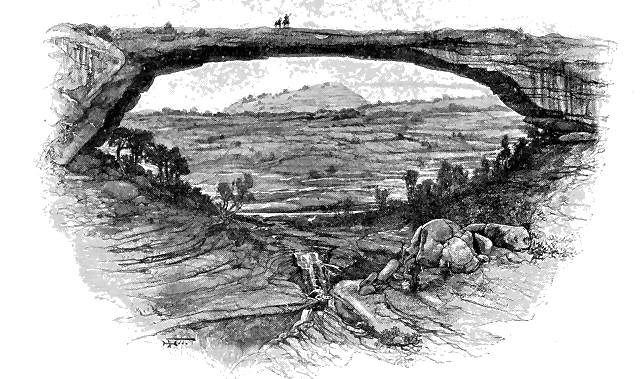
One of the Colossal Natural Bridges of Utah
This is an instance in which water has hollowed out the lower strata,
leaving a harder upper stratum partially intact.
For millions of years the winds have blown over the
surface of the earth, the rain has fallen on it, the sun
heated it by day, the frost cracked it. Consider the
winds that have circled the earth. All movements of the
air are due in the first place to the sun which heats the
atmosphere and causes it to expand. The sun's rays
passing through the air do not heat it at once, or
directly, but heat the land and the sea, which absorb
some of the rays and reflect others and so warm the air
in contact with them. But, as will readily be understood,
the land and the sea do not absorb and reflect the heat
rays in the same way or to the same extent; nor do the
sun's rays fall equally or constantly on all portions of
the earth's surface. So that from various causes one
part of the earth is always being warmed in a different
way from other parts, and the air above the earth is
being warmed in an immeasurable number of different
ways. Even if the earth's surface were all water or all
land, we should expect therefore that there would be
movements of the air due to unequal heating. If, however,
the earth's surface were quite even and uniform,
we should expect that there would be a certain evenness
and uniformity about the movements of the air. These
movements would be due partly to the regular heating
and regular cooling of the surface, and partly due to the
fact that the earth is spinning round taking the air with
it—but not taking it quite evenly. The air does not fit
tightly on to the earth. It is rather like a loose, baggy
envelope with a tendency to slip as the earth moves
round. Furthermore, a point situated on the Equator
has much farther to travel in twenty-four hours as the
earth spins round than a point situated in the Arctic Circle,
where a tape measure placed along one of the parallels of
latitude (let us say the eighty-sixth parallel, where Nansen
turned back in his search for the Pole) would show the
earth's girth there to be, not twenty-four thousand miles,
but only so many hundreds. This also would make a
difference in the way the air would be whirled round the
earth; but we could take this point into consideration,
and should be able, if, as we have said, our earth were
quite uniform, to say always and at all times of the year
in what direction the prevailing wind should blow.
Even with all the earth's irregularities we do know a
good deal with certainty about the earth's prevailing
winds: the trades; the anti-trades; the south-west
monsoon, which sets in so regularly in India that year by
year its advent hardly varies by more than a day; and,
in the descending scale of regularity, the east winds
that usually sweep England in March, and the prevailing
south-westerly to westerly winds which bend most of the
young trees of the country a little to the north-east.
Besides these regularly or irregularly defined winds,
there are certain paths along the earth's surface where
the winds always move like a trout stream with eddies
in it. These eddies of the air we call cyclones, and they
are continually travelling in one direction. No doubt
they arise from the air in one place becoming hotter or
moister than in the surrounding regions. As the air
grows hotter it becomes lighter and ascends, while the
heavier air round it pours in. These eddies always travel
eastwards and incline in the northern hemisphere towards
the north. They usually originate somewhere on the
North American continent, and move across the Atlantic
about the pace of a slow railway train, winds whirling
round them all the time at a much greater pace. Usually
the centres of these eddies bear northward past the north
coast of Scotland to the north-west of Norway. Sometimes,
however, they take a more southerly course,
keeping to the south of the British Isles and passing
over Central Europe on to Siberia, where they appear
to die away.
Such are the cyclones which are in the main part responsible
for British weather; and the winds that accompany
them vary a great deal in strength. They depend
on the size of the eddy. If the eddy is a very big one
(and sometimes the eddies are thousands of miles across)
the winds will not be so strong as in the smaller ones. It
is, therefore, the smaller ones which cause the violent
storms. In the tropical regions whirling eddies of a
rather different character occur. To quote Mr. J. H. N.
Stephenson: "Instead of being measured by some hundreds
or even thousands of miles, they are usually only
some hundreds of yards across; and as we found that the
smaller the cyclone the more violent the wind, we shall
not be surprised that the wind in these is more violent
than anything we ever experience in this part of the
world. They are called by many different names; in the
West Indies they are known as hurricanes, in the south-east
of Asia as typhoons, and in North America as
tornadoes. These hurricanes or tornadoes travel much
faster than the larger cyclones, and the winds blowing
into them are so violent that everything—trees, houses,
bridges—are swept before them, and so strong is the in-draught
of air in the centre that strong walls are sucked
in just as a piece of paper is in front of a grate when the
fire begins to blaze up; and even heavy metal objects are
carried upwards. Fortunately these tornadoes do not
travel continuously along the ground but bump along it,
so to speak, sometimes passing harmlessly overhead, then
striking the earth again and causing more havoc. Where
they pass over the surface of the sea the water is sometimes
sucked in just in the same way, causing what is
known as a waterspout. These may do even more damage
than a tornado on land, for the water is sometimes carried
bodily on to the land, sweeping everything away in a
deluge. This happened many years ago in the delta of
the Ganges, when thousands of people perished."
Now let us see how these winds might leave traces in
the geological record. When soil is exposed to the sun
its surface becomes dust, and the wind carries it off.
Even where turf protects the surface, bare places may
always be found whence this covering has been removed.
Rabbits and moles bring up the earth to the surface;
the earthworms sometimes bring as much as ten
tons of earth to the surface of a single acre of turf in
the course of a year. The earthworms bring up only the
finest particles of mould; and these, of course, are the
very particles readily converted into dust and borne
away by the wind if they are not washed away by rain.
In tropical countries the white ant conveys a prodigious
amount of fine earth up into the open air, building walls
sometimes sixty feet high. Although, therefore, the
layer of vegetable soil which covers the land appears to be
a permanent protection, it does not really prevent a large
amount of material from being removed even from grassy
ground. The wind carries this fine dust far and wide
over the land, and over the sea as well. After the eruption
of the island of Krakatoa in 1883, the dust which
was the product of that mighty explosion was carried
round the world, and even in England we saw the dust
particles furnishing extraordinary colours in sunset skies.
Stereo Copyright, Underwood & U.
London and New York
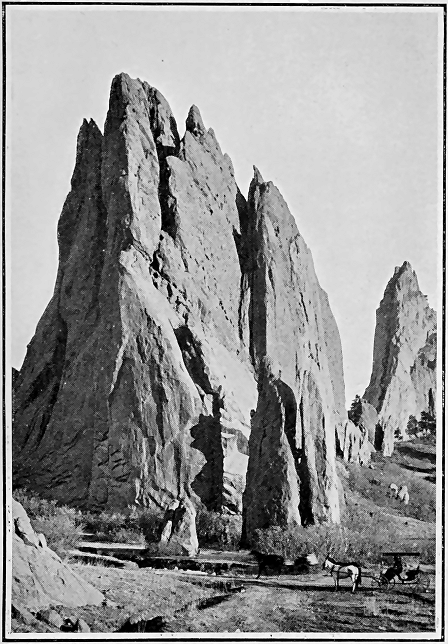
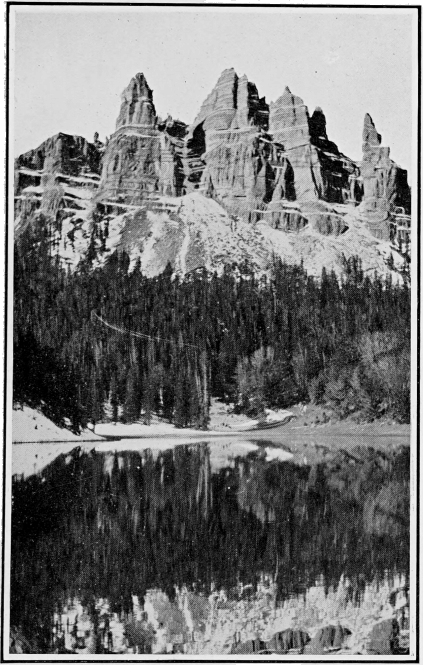
The Garden of the Gods, Colorado
These peaks exhibit the gradual wearing away of hard rocks by the action
of rain and wind.
In dry countries, especially in the large tracts of
Central Asia and of Africa, the air is often so thick
with a fine yellow dust that the sun's light struggles
through it as through a London fog. The dust settles
on everything, and after many centuries a deposit, which
may be hundreds of feet deep, is thus accumulated on the
surface of the land. Some of the ancient cities of the old
world, Nineveh and Babylon for example, after being long
abandoned by man, have gradually been buried under the
fine soil which the wind blew over them. Even in
England the Roman town of Silchester, not far from
Reading, after falling into decay when its inhabitants
left it, has been buried under the accumulations of two
thousand years, and its walls and floors now lie underground
and have to be carefully unearthed in order to
lay them bare. But we need not seek these exceptional
cases in order to perceive what the wind is doing with
sand and the fine dust of the earth's uppermost layers.
At many places round the coast are sand-dunes. On
sandy shores, exposed to the winds that blow off the
sea, the sand is dried and carried away from the beach,
gathering into long mounds or ridges which run parallel
to the coast-line. These ridges are often fifty or sixty
feet, sometimes even more than 250 feet high, with deep
troughs and irregular hollows between them, and they
sometimes form a strip several miles broad bordering the
sea. These sand-hills creep farther inland, till their
progress is stopped by the fields or woods they encounter,
or till, by seeds finding a root, vegetation springs up on
them and they harden and consolidate under the influence
of their own vegetation and move inland no farther. But
in many parts of Western Europe and Eastern America
the dunes are marching inland at the rate of twenty feet
a year. Off the coast of Friesland and North Germany
the danger has grown so threatening that scientific
attention has been given to the problem; and the
German scientific men have employed ingenious devices
of planting wind-stakes—something like the wooden
breakwaters that are to be found along every seaside
beach, but arranged at different angles,—of forcing the
sand-dune to heap itself up so as to form an obstruction
to further arrivals; or of sowing those plants in the sand
that will bind its particles together, in order to preserve
the land from further invasion.
Stereo Copyright, Underwood & U.
London and New York
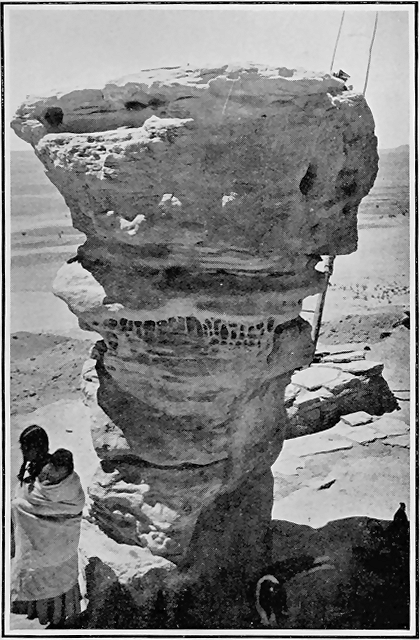
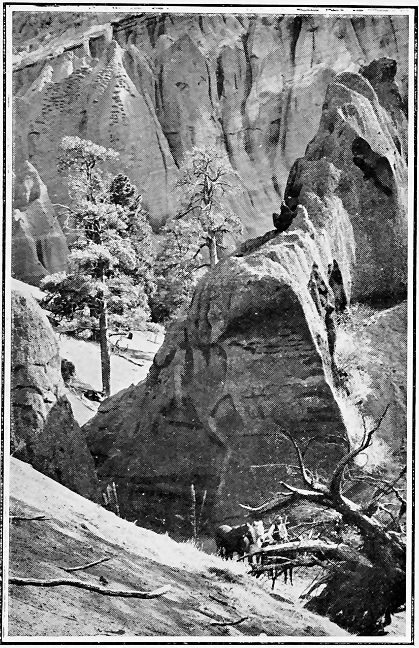
A Curious Rock greatly revered by the Natives
This is the Dance Rock of the Walpi Indians of Arizona. Its curious shape
is the result of weathering.
What goes on along the coast finds a parallel in the
interior of continents where, as in Arizona, in America,
or by the desert of Gobi, in Asia, or in the Karroo of
South Africa, or in Central Australia and Africa, there
is great dryness of climate and a continual disintegration
of the surface rocks. Sometimes the dust or sand
remains and gradually consolidates or hardens. More
often it is only a temporary visitor. Wind and rain are
continually removing it, sometimes in vast quantities,
into the sea; and in the course of time the most astounding
changes are wrought in the surface and appearance
of the land. The softer rocks are worn down; the
harder ones are left sticking out. Gradually the surface
is carved out into heights and hollows. The harder
rocks become the hills and ridges; the softer rocks are
worn into valleys and plains. If there were no water
left on the earth's surface a great deal of this process
would still go on. In some respects it might become
more violent, for owing to the absence of moisture the
winds of the earth would always be laden with fine
particles; and every one who has seen a "sand-blast"
at work, or even the modified sand-blast which is sometimes
used for cleaning the stonework of some of our
cities, will appreciate what a tornado laden with sand
grains might do in the way of destroying the surface
of any rock on which it was playing. But, as a matter
of fact, the action of water in carving the surface of the
earth is the most important of all the factors we have at
present to consider.
As rain falls from the clouds it absorbs the gases of the
air, including oxygen and carbonic acid. Now both these
are what we call corroding agents. If water is allowed to
fall on a steel knife the knife rusts; but it has been shown
by Dr. Gerald Moody, during the last few years, that if
there were no acid gas present, the rusting would not
take place. Oxygen and carbonic acid will rust other
things beside metal; they will rust stone. Moreover,
when the rain reaches the earth it absorbs any other
acids of the soil which rotting vegetation may afford,
and reinforced by these it goes on to attack the stones
over which it flows. When it rolls along as a brook or
a river it is no doubt attacking in this way the rocks
and stones of its channel, though this action is not very
strikingly shown. But sometimes the rusting or dissolving
action of water is very evident. When it issues
from a peat bog, for example, and is consequently highly
charged with acid, it will make a very great impression
on any limestones it may encounter; for as any schoolboy
knows who has ever put a piece of chalk in vinegar,
or in any of the stronger acids of the school laboratory,
all the limestones are peculiarly susceptible to this form
of chemical attack. Peat-water eats into limestone
rapidly, while the limestone above the stream escapes,
though it is a little (and much more slowly) dissolved by
rain. Hence arise some curious features in the scenery
of limestone districts. The walls of limestone above the
water are not eaten away so fast as their base over which
the water flows. Consequently they are undermined and
are sometimes cut into tunnels and caverns and caves.
The rivers carry away the dissolved material. The
carbonate of lime is taken to the sea; and this substance,
of which sea shells, for example, are principally formed, is
constantly supplied to the sea by the rivers that transport
it from the land. The rivers of Western Europe
have been known to convey one part of dissolved mineral
matter in every 5000 parts of water, and of this mineral
matter one half is carbonate of lime. The Rhine alone
bears enough carbonate of lime to the sea every year to
make 332,000,000,000 oyster shells of the usual size. The
Thames conveys 180,000 tons of sulphate of lime past
London every year. It has been computed that more
than 8,000,000 tons of dissolved mineral matter are removed
from the rocks of England and Wales in one year.
That is equivalent to a general lowering of the surface
of the country, by chemical solution alone, at the rate
of one foot in 13,000 years. That is not much, it may
seem; but in a million years, which is not a long period
in geological time, half the present towns of England
would be sunk under water by this cause alone.
CHAPTER IV — RECORDS LEFT BY RIVERS
When we come to examine more closely the work
which rivers do in removing mineral substances
from the land by washing particles of them
from the surface, we find that the records they leave in
geological history must be plainly marked. Every stream,
large or small, is always busy carrying mud, sand, or
gravel. Rivers are the "navvies" of geology. When they
are swollen by rain they sweep large stones away with
them. If we look at the bed of a mountain torrent we shall
often see huge blocks of stone that have fallen from the
cliffs on either side blocking the pathway of the stream.
To all appearance the stream is quite powerless to remove
these blocks, and has to circumnavigate them. But visit
such a torrent when the snows are melting, or heavy rain
has fallen, and you will hear the stones knocking against
each other or on the rocky bottom as they are driven
downwards by the flood. It is not easy to estimate the
driving power of water. M. Gustave le Bon has furnished
an illustration of its power which is very curious. In the
south of France a stream is led downwards from the
mountains to drive the turbine of some machinery at
a manufactory. It comes down several thousand feet. In
the manufactory there is a vent-hole, out of which the
water can be allowed to shoot. The vent-hole is about
an inch in diameter; and the water rushes out with such
swiftness and force that the water-jet becomes as rigid as
steel. It is impossible to cut through this water-jet; and
if any one were to try to do so with a sword, the sword
might break but it could never pierce or pass through
those swiftly moving particles of water. A more commonplace
illustration is the use that is sometimes made of
water-jets to break up the surfaces of rock in quarries;
nor must it be forgotten that horse-power of great value
and extent for electric lighting and other purposes is
always being drawn from waterfalls. Thus as a mechanical
force merely the river can be immensely powerful; and
must leave marks of its power on the rocks.
The aspect of its force with which we are, however,
most concerned is that which is directed to lowering
gradually the surface of the land. In the last chapter we
showed how much mineral might be dissolved in the
waters of rivers. If we are to include also the amount of
mud, sand, and other things classed altogether as silt
which a river carries down, the figures become much more
imposing. Sir Archibald Geikie says that, taking the
Mississippi as a typical river (it is as good an example as
would be found, because in its great length it passes
through many different kinds of land, soil, and climate),
we may assume that the average amount of sediment
carried down by a river is one part of sediment to every
1500 parts of water.
If now, says he, we assume that all over the world this
is the amount carried down, we can see how seriously the
level of the land is lowered by rivers. The Mississippi
carries from the land it drains every year the 1/6000th part
of a foot of rock. If we take the general height of the
land of the whole globe to be 2100 feet, and suppose it to be
continuously wasted at this rate, then the whole dry land
would be carried into the sea in 12,600,000 years. Or if
we assume the average height of the continent of Europe
to be 940 feet, and to be lowered by its rivers at the
same rate, then the last vestige of Europe would have disappeared
in 8,640,000 years. Such figures are of course
not exact; and it must always be remembered that
the rivers are merely robbing Peter to pay Paul, and
whatever they take away are always putting somewhere
else, but we may learn from the foregoing considerations
that the lowering of the land is much more rapid than is
sometimes supposed. Another thing about the excavating
work of rivers has to be remembered. The torrents
carry sand, shingle, and rock with them, and these very
materials act as agents of destruction on the beds of the
water-courses. If we want to polish brass or steel we mix
emery powder (or something finer or coarser) with the
polishing liquid. The torrent or river uses sand or
shingle as its polishing powder. It then wears out the
rock over which it travels, and sometimes carves it
into holes or caverns, gorges or ravines. Sometimes the
process is varied, as when a stream finds its way over a hard
rock which overlies a softer rock. If the arrangement is
like that of a series of steps (there may be only one or two
steps) it is possible for the river as it foams in a waterfall
over the hard step at the top to eat its way into the
lower softer step. The lower softer step will gradually
disappear, and then the waterfall, still eating its way in,
will begin to undermine the hard top step, and when that
has gone on long enough the hard top step will fall down
and the waterfall will have to begin a little farther up the
stream. In this way a waterfall, gorge, or ravine can be
constructed by a river.
Stereo Copyright, Underwood & U.
London and New York
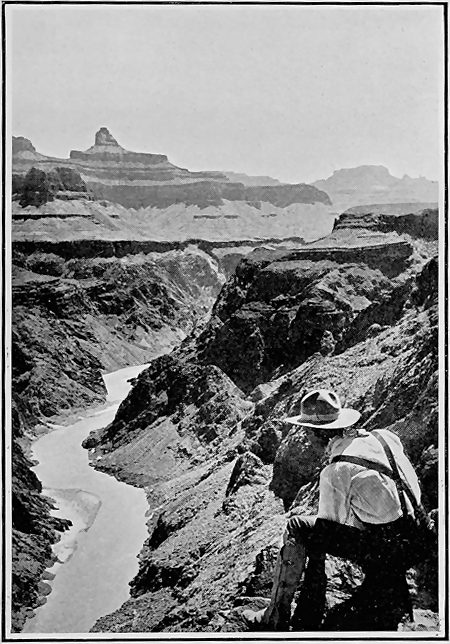
The Grand Cañon of Arizona
The Colorado River at this point is nearly 200 feet wide. The man is
seated about 1200 feet above the river's level. This whole cañon up to the
top of the mountains in the distance has been worn away by prehistoric
current; and the river has gradually cut its bed deeper.
The Falls of Niagara are an illustration of this method.
The river flows from Lake Erie through a level country
for a few miles, then begins to go faster as the path
becomes steeper, and finally plunges over a hard limestone
precipice. Beneath the hard limestone (the top step) are
softer beds of shale and sandstone. As the water eats
into them and removes them, large portions of the face of
the limestone precipice on the top fall into the stream below.
Thus gradually the Falls of Niagara are eating their way
back to Lake Erie, and have been doing so for hundreds
of thousands of years. In the process of doing so the
Niagara River has cut out below the Falls a gorge which
is not less than seven miles long, from two hundred to
four hundred yards wide, and from two hundred to three
hundred feet deep. There is no reason to doubt that the
Niagara gorge has been entirely cut out in this way, and
that at first the river fell over cliffs seven miles farther
down its course at Queenstown. The amount of rock
thus tunnelled would make a rampart about twelve feet
high and six feet thick going round the world at the
Equator. Still more gigantic are the gorges or caverns of
the Colorado and its tributaries in Western America.
The Grand Cañon of the Colorado is three hundred miles
long, and in some places more than six thousand feet deep.
The country traversed by it is a network of deep ravines,
at the bottom of which flow the streams that have dug
themselves down from the top of the Colorado tableland.
Now suppose that the river has dug itself in as far as it
can go. There must be a limit, and the limit is reached
when the slope of the bed has been made so slight that
the current can only go on languidly. In that case it
cannot sweep along stones, or shingle, or even coarse
gravel; and then the river so far from deepening its
channel begins to raise it by allowing more of the transported
sediment to settle down. If a fast stream meets a
slower one deposition of material will take place; and the
same thing will occur when the rivers meet a lake or a
sea. Whatever checks the swiftness of a current weakens
its carrying power and causes it to drop some of its
sediment to the bottom. Therefore accumulations of
sediment occur at the foot of torrent slopes along the
lower and more level ground. These deposits we call
alluvium, and sometimes when the mountain torrent ends
abruptly in the plain they may stand up in cones of silt.
They are sometimes called alluvium cones or fans. Quitting
the steep descents, and reinforced by tributaries on
either side, the stream ceases to be a torrent and becomes
a river. It goes fast enough at first to carry still coarse
gravel; but the big angular blocks of rock have been
dropped, and the stones it now leaves in its bed are
smaller, and become rounded and smoothed as it goes
farther and farther across the plain. At many places it
deposits gravel or sand, more especially at the inner side
of the curves which the stream makes as it winds down
the valley. When the stream runs low in summer, strips
of bare sand and shingle are seen at each of these bends;
and the stones are always well smoothed and lie on the
whole regularly. Those that are oblong are so placed
that the greater length of the stone points across the
stream; those that are flat usually slope upstream.
These facts, though apparently insignificant, are really of
importance, because they point to us a method by which
geology can determine, after a river has disappeared, the
slope of the bed and the direction of the curves which
once it had. If we examine the steep banks or cliffs by
the side of a river the layers of gravel or shingle in the
strata may be found to lie not flat on one another but in
sloping planes. That at once will furnish a clue to the
direction of the river. Another thing of great importance
are the terraces which a river forms by the side of
itself. When it overflows in floods it deposits mud on
either side, and when after the flood it subsides the mud
is left. If the reader will imagine the river in the course
of ages sinking lower into its bed he will see that successive
eras of flood-levels will leave their mark in a series of
steps, or river terraces as they are called, on either side of
the channel.
But besides the stones and gravel and mud carried
down by a river, we must also consider the fate of the
remains of plants and animals that are swept along by it,
especially in flood-time. In any ordinary flood trees and
shrubs, and the smaller animals like mice and moles and
rabbits, are drowned by the flood. In greater floods
birds and even large animals are drowned, and their
remains are buried in the sediment. If they are quite
covered over they may perhaps be preserved, and their
bones may last for an indefinite period. If, further, the
mud deposit hardens, these remains may be preserved so
well and so long that they become the fossil records of
creatures which lived before man emerged to dwell in the
world and to become the arbiter of many of its destinies.
What we have said of rivers is true also of lakes.
Rivers pour into lakes, bringing with them, especially
in flood-time, enormous freights of gravel, sand, and mud,
and mingled with them the remains of vegetation and of
animal life. Hundreds of thousands of tons may be
swept down by one storm. To the Lake of Lucerne, for
example, the River Reuss, which comes down from the
St. Gothard, brings seven million cubic feet of sediment
every year with it. Since the time of the Romans the
Rhone has so filled up part of the Lake of Geneva that
the Roman harbour, Port Valais, is now nearly two miles
from the edge of the lake. The ground between it and
the Lake first became marsh. It is now farm land.
And though these accumulations are most marked where
the rivers drain into the lake, there are deposits always
taking place from the hills all round the lake. Thus
lake bottoms become most interesting and valuable
receptacles of the life that has for ages lived by or
near their shores. These deposits are in many ways
peculiar. The snails that live in lake waters are distinct
from the land snails of the adjoining shores. Their dead
shells gather at the bottom of some lakes in such numbers
as to form there a deposit of white crumbling marl, sometimes
many yards in thickness. On the sites of lakes that
have been gradually filled up, or artificially drained, this
marl shows at once where the lake borders were, and,
roughly, the period of the lake. In some lakes also are
found concretions of iron-oxide, which are formed by the
chemical action of the water on some of the rocks by the
lake-side; and in several Swedish lakes this ironstone
forms so fast that the lakes are regularly dredged for it.
Stereo Copyright, Underwood & U.
London and New York
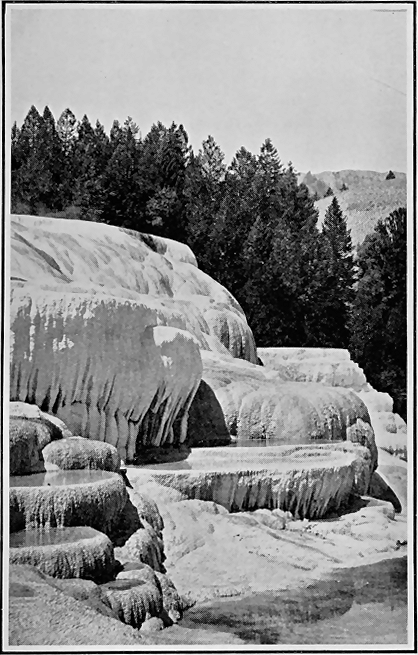
Cleopatra Terrace, with its Mirror-like Pools,
Yellowstone Park, U.S.A.
These beautiful basins are formed of incrustations of volcanic limestone.
They are of all colours: pink, orange-yellow, green, and blue. The water
in them is of a brilliant blue, caused by the growth of water plants
(algæ), which live in water with as high a temperature as 150 F.
Thus among the rocks which form the dry lands of the
globe there occur masses of limestone, sand, marl, and
other materials which we know were deposited in lakes,
because they contain types of plants and animals like
those found in the lakes of our own time. From this
kind of evidence we can mark out the places of great
lakes that have long ago vanished from the face of
Europe and North America.
There are also the so-called Salt Lakes to consider.
These are generally the lakes that have no outlet and
into which a small amount of water now flows, but never
enough to cause the lake now to overflow, whatever
it may have done in past times. The water that now
runs in escapes merely by evaporation. But just as the
bottom of a kettle in which hard water is constantly
boiled gradually becomes furred, so a lake bottom into
which water is continually pouring, bringing dissolved in
it all sorts of mineral salts, becomes coated with sediment.
The mineral salts are not evaporated, consequently the
lakes become gradually more mineral—or, for convenience,
let us say, become salter. Among the mineral salts
common salt and gypsum are most important; but
some bitter lakes contain sodium carbonate or magnesium
chloride. The Dead Sea and the Great Salt Lake of
Utah show by the deposits round them how they have
changed their shape and depth. In the upper terraces
of the Great Salt Lake, 1000 feet above the present
level of the water, fresh-water shells occur, showing that
the basin was at first fresh. The valley bottoms around
salt lakes are now crusted with gypsum, salt, or other
deposits, and their waters are without sign of life. Such
conditions help us to understand how great deposits of
salt or gypsum were once laid down in England, Poland,
and Germany, and in many other places where now the
climate would not permit of the necessary evaporation
and condensation of the water.
Stereo Copyright, Underwood & U.
London and New York
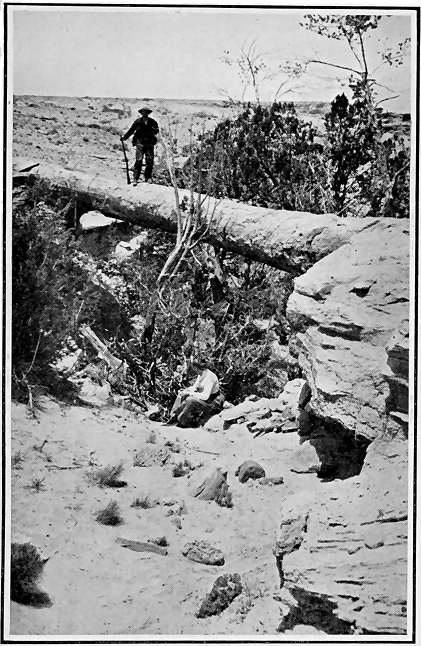
A Petrified Tree
This magnificent fossil is in the Petrified Forest of Arizona; and it
affords one of the most striking examples known of the solidification and
petrifaction of material by the infiltration of mineral salts. The trunk is
now not merely encrusted with stone: it is permeated by silica, and is, in
fact, itself a stone as hard as flint.
CHAPTER V — RECORDS LEFT BY THE SEA
We have already spoken of the story which the
sea writes in the annals of geology. It is a
story with two plots. In the first place, the sea
is always wearing away the land. In the second place, it
is arranging on its own bed the materials which it takes
from the land, either directly or indirectly. As a sequel
to both stories, the materials all neatly ranged, packed,
and folded are revealed when the sea subsides from them,
or when, in process of one of those great geological
changes, the origin of which we have already attempted
to account for, the sea bottom is raised to become the
land of a continent. The first part of the sea's belligerent
story is written so plainly for all eyes to see that one
scarcely need dwell on it. Every strip of coast around
these islands bears witness to it.
Off Shetland masses of rock twelve or thirteen tons in
weight have been cut out from the cliff seventy feet above
the smooth-water level. The sea's battering-rams are the
masses of shingle, gravel, and loose blocks of stone which
it carries with it; but it has subtler methods in the corrosive
action of its salts, for just as it rusts or wears away
iron, so its salts and acids must eat their way into many
rocks.
But, after all, the coast-line of the world is a small
fraction of the whole land surface of the globe; and a
smaller fraction of the sea's own wide area. On that area
are flung all the records and treasures which the sea has
wrested from the land. The rivers, as we have already
several times repeated, are the chief carriers of deposits
to the sea. By their deltas they may be known. The
deltas of the Ganges and Brahmaputra cover an area as
large as that of England and Wales. The delta has been
bored through to a depth of nearly five hundred feet, and
has been found to consist of numerous alternations of fine
clays, marls, and sands or sandstones, with occasional
layers of gravel. In all this accumulation of sediment
there are no traces of marine animals; but land plants
and the plants and animals of the river and of the surrounding
land have been discovered in quantity. The sea
most often destroys land; but it sometimes deposits
beaches; and, we might almost say, silts up the land. At
Romney Marsh, for example, a tract of eighty square miles
which was marsh in Julius Cæsar's time is now dry land,
and has become so partly by the natural increase of
shingle thrown up by the waves. The coarsest shingle
usually accumulates towards the upper part of the beach,
and the rest arranges itself generally according to size
and weight, that which is finest being nearest to low-water
mark.
It is often long before the stuff brought down by the
rivers settles on the floor of the ocean. The finer particles
may be carried out to sea for three hundred miles or more
before they settle. Within this three-hundred-mile zone
the land-derived materials are distributed over the floor
in orderly succession. Nearer the land we shall find
coarse gravel and sand. Beyond there will be tracts of
finer sand and silt, with patches of gravel here and there.
Still farther off will come fine blue and green muds, which
are made of the tiny particles of such materials as form
the ordinary rocks of the land. But when we are once
past this zone of land material we come upon deposits
which are the ocean's own freehold—materials which it
does not derive from the continents, but which may be
called oceanic in origin. First there are vast sheets of
exceedingly fine red and brown clay. Whence comes it?
It is by far the most common deposit in all the deeper
parts of the ocean. It may either be the dust of volcanic
fragments washed away from volcanic islands, or (which
is much more likely) it may be supplied by eruptions
under the sea. For it must be remembered that the sea
floor is two to five miles nearer the hot rocks that are in
the interior of the earth than the land surface is, and
that consequently the water coming into contact with
them may cause explosions arising from the action of
steam. This is a question we shall have to consider later,
and for the present we must ask the reader to accept the
fact—and read on.
There is one very curious thing about this red clay, and
it is that the accumulations of it appear to be built
up very slowly. Where it occurs farthest from land
great numbers of sharks' teeth with ear bones and other
bones of whales have been dredged up from it. Some of
these relics are quite fresh; others are coated with a crust
of brown peroxide of manganese. Some are covered with
this material and hidden in it. One haul of an ocean
dredge will bring up the bones in all these states, so that
they must be lying side by side. The bones are probably
those of many generations of animals, and it must take a
long time to cover them with the manganese deposit.
But the clay is deposited even more slowly than the manganese,
so that it must fall very slowly indeed.
But besides these things the bottom of the sea receives
deposits of the remains of all kinds of shells, corals, and
all sorts of marine creatures, great and small. As the
countless myriads of the animals of the sea die, the shells
with which they are covered, or the bones which form
their framework, fall continually to the bottom of the
oceanic gulfs in which they dwell. Then the ocean floor
is covered with the remains of tiny animals incomparably
more numerous than the stars of the sky; and this grey
slimy ooze of organic matter hardens by pressure into
sedimentary rock. In the course of ages, when the slow
decline of the water lays it bare, it may become part of
the land on which men dwell. But it is always forming,
has always been forming, since life first appeared on the
earth. It is on this ocean floor that man to-day lays his
telegraph cables. Mr. Rudyard Kipling, in his verses
"The Deep Sea Cables," has drawn a vivid picture of
the bed of the deep ocean:—
The wrecks dissolve above us: their dust drops down from afar—
Down to the dark, to the utter dark where the blind white sea-snakes are.
There is no sound, no echo of sound, in the deserts of the deep,
On the great grey level plains of ooze, where the shell-burred cables creep.
It is in these silent depths that for uncounted and innumerable
years the crust of the earth has been forming
and has been growing outwards, while it has been slowly
hardening inwards above the fires of its unplumbed
interior.
It has been calculated that in a square mile of the
ocean down to a depth of one hundred fathoms there
exist more than sixteen tons of carbonate of lime in the
form of the bones or shells of living animals. A continual
fine "snow-storm" of dead chalky animals is therefore
falling on to the bottom. Here and there, especially
among volcanic islands, portions of the sea-bed have
been raised up into land and masses of modern limestone.
Though these rocks are full of the same kinds of shells
as are still living in the neighbouring sea, they have been
cemented into hard rock. This cementing is due to the
water which has penetrated and permeated the stone,
dissolving chalky matter from the outside shells, and
depositing it once more lower down and farther in, like a
fine mortar, so as to bind the mass together.
Every one has heard of coral reefs. They are one of
the best and most familiar examples of the way in which
great masses of solid rock can be built up by the dead
bodies of animals. In the warmer seas of the earth, and
notably in the track of the great ocean currents, various
kinds of coral polyps, as they are called, take root on the
edges and summits of submerged rocks and peaks, as well
as on the shelving shores of islands. The coral polyp is
a jelly-like creature, but it has a hard chalky skeleton
inside its transparent body. It is a great colonist, with
no liking for a solitary life, but with, on the contrary,
a great fancy for its neighbours; in fact, the polyps grow
and thrive in clumps, and the clumps unite to form communities,
and the communities increase to colonies and
nations, till they unite to form what is called a reef. The
coral polyps are rather exigent in the choice of their residential
neighbourhoods. They cannot live at a greater
depth than fifteen or twenty fathoms, and in defiance of
the inclinations which rule human beings, they have the
strongest distaste for sun and air; in fact, they die when
exposed to it.
Now when the polyp dies its skeleton remains behind
it, and millions upon millions of these coral skeletons
make a layer of coral. These layers of coral
gradually lift the generations of polyps upwards to
the surface of the water. But as we have seen, the
living polyps die when they get so far, and consequently
the reef then spreads outwards. On the
outer edges of the reef the coral polyps flourish in
the most vigorous way. There they are as completely
provided for as in a County Council Utopia. The
breakers bring them the food on which they live; the
water and the climate suit them exactly. The only blot
on their lives are the occasional storms which break off
fragments of the coral foundation on which they live.
But even this, while it is disastrous to the individual
polyp, is for the good of the community, because these
blocks as they roll down form a new foundation on which
new generations of polyps can grow and feed. Moreover,
it is better for the polyp to take the risks of these evictions
than to vegetate inside the reef, for there in the calmer
water he will not have enough to eat, and will dwindle
and die. Thus the tendency of all reefs must be to grow
seawards, and to increase in breadth. Perhaps their
breadth may tell us roughly how old they are. But
there is another possibility to be taken into consideration,
which is that while the polyps are building the sea
bottom or island foundation may be slowly sinking. In that
case it is quite likely that the coral builders might just
keep pace with the subsiding foundations of their home,
and build up a great thickness of coral rock during the
countless years of change.
Sir Archibald Geikie has called attention to the swiftness
with which the structure of the coral polyp's skeleton
is effaced from the foundation and a compact mass of
rock put in its place. The sea-water's chemical and
dissolving action, and the vast amount of mud and sand
produced by the breakers are chiefly responsible for this.
As the rock is being formed it is always being cemented.
On the portion of a reef laid dry at low water, the coral
rock looks in many places as solid and old as some of
the ancient white limestones and marbles of the land.
In pools where a current of water keeps the grains of
coral sand in motion, each grain may be seen to be
rounded. This is because on each particle of coral the
dissolved carbonate of lime in the water is always being
deposited (like the sediment in the bottom of a kettle).
A mass of these rounded or egg-like grains all
gathered together in a lump is called oolite, from
the Greek word "oon" (Latin "ovum"), an egg. In
many limestones, now forming parts of agricultural
land, this oolitic structure is strikingly shown, and
there can be no doubt that in such cases it was produced
just as now coral reefs are being formed before
our eyes. In the coral tracts of the Pacific Ocean there
are nearly three hundred coral islands, besides extensive
reefs round volcanic islands. Others occur in the
Indian Ocean. Coral reefs abound in the West Indian
seas, where in many of the islands they have been upraised
into dry land—in Cuba to a height of 1100 feet
above the sea-level. The Great Barrier Reef that fronts
the north-eastern coast of Australia is 1250 miles long
and from ten to ninety miles broad.
It will thus be seen that, apart from any other consideration,
the animals of past ages leave permanent
records of their existence merely by the accumulation
of their dead bodies. Nevertheless, alike on land and
on sea, the proportions of organic remains thus sealed
and preserved is only a small part of the total population
of plants and animals living at any given time.
CHAPTER VI — COLD AND ICE ON THE EARTH
The astronomers who look at the planet Mars tell
us that at the Northern and Southern Poles there
are great areas of snow, very much greater than
the arctic regions of the earth, for the south polar area
alone occupies 11,330,000 square miles. But the geological
records of the earth show that our own arctic
regions once extended very much farther than they do
at present, a fact which need not in any way surprise
us, for as we have already remarked, snow and ice are
very largely a matter of the nearness of the sea to the
land. We may put the same thing in another way by
saying that winter cold and summer heat depend largely
on the distribution of sea and land. Thus Venice, which
is not very much farther from the North Pole than
Vladivostok, has an altogether different climate, and inhabitants
of the Shetland Isles have a very different kind
of climatic experience from those who delve by the
frozen Yukon. There is another consideration which is
sometimes overlooked. We do not think of the earth
as a very warm body. But at its very coldest part, where
the thermometer goes down to seventy or ninety degrees
below freezing, it is several hundreds of degrees warmer
than the space outside the earth. Midway between
the earth and the moon the temperature must be 430° F.
below freezing; so that if we take the surface of the
earth as a whole we may say that it is between four
hundred and five hundred degrees warmer than the space
by which it is surrounded. Every one knows what is
happening when he warms his hands at a fire. The fire
being hotter than its surroundings is giving out heat
towards them, and the hands catch some of this radiated
heat. Similarly the earth is radiating heat, and the
atmosphere round the earth catches some of it. So also
do the seas. While therefore it is certain that the heat
of the sun warms the earth and the air and the sea, and
so gives rise to currents of air and perhaps of water, so
also is it likely that the heat of the earth causes warm
air to rise, and so plays its part in forming the winds,
the currents of air, and the currents of water. When
the earth was warmer than it is now it had more and
greater effects in this direction. It caused more evaporation
of the water, more clouds, and therefore more rain,
and in winter more snow.
Suppose, then, a period when there was very much
more snow in winter than now. As the snow accumulated
layer on layer the lower part would become squeezed into a
mass half ice, half snow; and it is quite likely that the
heat of the summer sun (especially if, as we have supposed,
the atmosphere was much cloudier then than now) would
be unable to dissolve it. Thus the snow age would
gradually merge into an ice age, and we can imagine a
period when a great deal of Europe was covered with
snow or ice as Greenland is to-day. What records would
it leave behind? Now, on slopes the sheet of snow would
tend to slip just as it slips from sloping house-roofs. In
doing so it would push before it any loose material which
lay in front of it; and trees or bushes, stone or soil,
would be gradually pushed downhill. If the slopes were
steep enough the snow-sheets would occasionally break off
and sweep down as avalanches. Sometimes these great
masses are many thousands of square yards in area and
fifty feet thick, and in the late winter and early spring
often do immense damage, carrying away houses, trees,
and great masses of rocks in their progress. They
leave their imprint not only in ground swept bare,
but in huge mounds of debris piled up in the valleys
below.
But when the snow has taken the form of a glacier its
record is left in more unmistakable characters. Imagine
a great mass of snow and ice descending between the clefts
of mountains to lower levels. As it slips slowly down its
valley, like a very slow river—slower than a river of
thickest mud or pitch or lava would be—earth, sand, mud,
gravel, boulders, and masses of rock sometimes are washed
down on its surface from the slopes on either side.
Avalanches will occasionally bring other contributions.
Nearly all this rubbish accumulates on the edges of the
glacier nearest the slopes, and it is slowly borne to the
journey's end on the glacier's shoulders. Some of it falls
into rents or crevasses in the ice, and may be imprisoned
there and carried down as an inside passenger, or it may
reach the rocky floor over which the ice is sliding. Its
progress then resembles that of the Irish gentleman who
was travelling in a Sedan chair out of which the seat and
the bottom had fallen, and who said that if 'twere not for
the fashion of the thing he'd as lief walk. The rubbish
borne onward on the surface of the glacier is known as
moraine-stuff, and the mounds of it at the edge of the
glacier are called lateral moraines. Where two glaciers
unite like two rivers, their moraines, right-hand and left-hand,
will join, and in the new glacier a new moraine will
appear running down the middle, and so called a medial
moraine. Where a glacier has many tributaries bearing
a good deal of moraine-stuff, its surface may be like a
bare plain so covered with stones that the ice beneath can
hardly be discerned except here and there. At the end
of the glacier where the ice melts, the heaps of stones,
ever adding to their numbers, are deposited in heaps, to
which are given the name of the terminal moraine.
With such tokens of their existence as this, glaciers, as
will readily be understood, leave visiting-cards in history
that cannot easily be mistaken. Even existing glaciers
tell strange stories. Nowadays glaciers are carefully measured
and examined both in Switzerland and in Canada.
During the last decade of the nineteenth century and the
first decade of the twentieth the Swiss glaciers were found
to show signs of receding farther up their valleys. The
same thing has been observed about some of the Canadian
glaciers. There are several plausible reasons for this.
Professor Schaeberle says that the earth is growing cooler,
and that in the temperate regions the winter rainfall
(which would turn to falls of snow in the mountains) is
less than it has been. It is certain that a shortage of
winter rain over a number of years in succession would
account for the shrinkage of the glaciers, but it is not by
any means certain that a number of dry winters will not
be followed by wet ones, in which case the glaciers would
increase again. Some of the glaciers show that during
their existence they have shrunk and lengthened alternately
like gutta-percha in a variable climate. How do we
know that they have shrunk and lengthened? The
moraines of which we have spoken give us the testimony.
As a glacier shrinks either in length or in breadth and
depth it leaves the blocks of rock at its edges stranded on
the sides of the valley. Such perched blocks or erratics
are the best of glacier marks, and their great size, some of
them as large as a cheap villa residence, is such that no
current of water could have brought them there. They
are often poised on the tops of crags, on the very edges of
precipices, or on steep slopes, where they could never have
been left by any flood, even had the flood been able to
move them. The only thing that could have carried
them must have been a vehicle that moved very, very
slowly and deposited them very, very gently—in fact,
glacier ice. We can see blocks like this on the glaciers
now, and others stranded at the sides. In the Swiss
valleys the scattered ice-borne boulders may be seen by
hundreds far above the glaciers and far beyond the places
where the glaciers end. We know they must have been
left by glaciers, and by inference we surmise that when we
find a valley filled with them, then, though the valley
may have no glacier now, it must have once been occupied
by one.
These erratic blocks, now found all over Europe, tell
us a good deal about the ice on which they were transported.
The blocks that fall on the edges of the glacier
remain on the side where they descend. Hence, if there
is any notable difference in the composition of the rocks
on either side of the valley, the existence of this difference
will be preserved in the moraines. If, therefore, in a
country where the glaciers have disappeared we can trace
the scattered blocks up to their sources among the
mountains, we can say what was the track followed by
the prehistoric glaciers. In Europe there are several
examples of the uses of this detective evidence. Thus
the peculiar blocks of the Valais mountains can be
traced right on to Lyons; and this shows us that the
glacier from which the River Rhone sprang extended
once right across the east of France to Lyons, and
probably farther. It was therefore once at least 170
miles longer. Similarly, blocks which are exactly like
the characteristic rocks peculiar to Southern Scandinavia
are found in Northern Germany, Belgium, and East
Anglia; and we therefore believe that a great sheet of
ice once filled up the Baltic and the German Ocean,
carrying with it immense numbers of northern "erratics."
In our own country, in fact, glacier boulders are found in
nearly every county, and show that once the greater part
of the country was buried under ice.
But, as we have said, it is not only on its shoulders, but
in its interior and beneath its base that a glacier rolls
and pushes its rubbish along. It is not all stones.
Clay and earth mingle with it, often enclosing the stones;
and the debris left by extinct glaciers of ages ago is sometimes
called the boulder-clay. This is the deposit, earthy
and stony, that the glacier leaves on the floor of the
valley as it shrinks—unless the river which usually
springs from the end of glaciers sweeps it away. Most
of the stones thus left are smoothed or polished and
covered with scratches or ruts, such as would be made
by rubbing against other hard pointed fragments of stone.
This is to be explained by the fact that these stones
as they were carried on by the glacier were rubbed on
the floor of rock over which the glacier was slipping.
If their journey was long enough, they stood a chance
of being rubbed away altogether and of finishing their
existence as sand or mud. What the valley did to the
glacier's stones, the stones did to the valley. They
scratched it and scored it. Every promontory of rock
which stood in the path of the ice had its angles and
corners ground away. The polish and the directions of
the scratches are especially remarkable, because, whether
the marks are mere lines or deep-worn ruts, they are
all on smooth surfaces, and they all run one way. That
way is the direction in which the glacier moved. How
high a degree of polish or how deep the markings may
be depends a good deal on the kind of rock over which
the glacier moved. Tough, close-grained rocks, such as
hard limestone, are sometimes polished to look like
marble. But there is a great deal of difference between
the smoothing effected by a river or a torrent and that
which is produced by a glacier, because the river tosses the
rocks and stones in all directions, polishes them on every
side, and leaves no distinctive parallel scratches or grooves
on them. That can only be done by glaciers which hold
the rocks, the rubbers and the rubbed, pressed firmly
together and grind them continually in the same way.
These scratchings or striations of rocks, the smoothed
and grooved surfaces, and the deposited boulder-clay and
boulders enable us to trace the march of great ice-sheets
over regions of the earth which are now of totally
different aspect. From this kind of evidence we have
been able to find that the whole of Northern Europe was
once buried under a great expanse of snow and ice. The
sheet was, as we should expect, thickest in the north and
west, and thinned away southward and eastward. Over
Scandinavia it was between 6000 and 7000 feet in
thickness—as we can tell from the scratches on the sides
of the high mountains. Similar marks 3000 feet above
the sea-level in the Scottish Highlands lead us to believe
that over Scotland the glaciers were 5000 feet thick, and
even as far south as the Hartz Mountains in Germany
it could not have been far short of 1500 feet in thickness.
Imagine this great mass of ice ever slowly moving and
ever creeping solemnly down to the sea. By the markings
it left we can trace where the greater glaciers slid grandly
along. In Scandinavia it swept westwards to the Atlantic
and eastwards to the Gulf of Bothnia, then frozen as
solid as the Pole. Southward the ice ground its way
across Denmark to the Low Countries and North Germany.
The Baltic was choked with ice, and so was the
North Sea as far south as London. Ice in that day
flowed in glaciers from the British Isles, eastwards from
Scotland into the hollow of the North Sea, and westwards
down all the clefts of the mountains, burying the western
isles and breaking off in icebergs that drifted far into
the Atlantic. Sir Archibald Geikie says that the
western margin of the ice-fields from the south-west of
Ireland to the North Cape of Norway must have presented
a vast wall of ice 1200 to 1500 miles long and
hundreds of feet high—like that great barrier which the
Antarctic explorers tell us frown on the waters that lap
the boundaries of the south polar land. Northern Europe
must have been like North Greenland of to-day. The
rock scratches tell us (since even the southern coast of
Ireland is intensely ice-worn) that the edge of ice must
have extended some distance beyond Cape Clear, rising
out of the sea with a precipitous front that faced to the
south. Thence the ice-cliff swung eastwards, passing
probably along the line of the British Channel and keeping
to the north of the valley of the Thames. Its
southern margin ran across what is now Holland and
skirted the high grounds of Westphalia, Hanover, and the
Hartz Mountains—which probably barred its further
progress southward. "There is evidence that the ice
swept round into the lowlands of Saxony up to the chain
of the Erz, Riesen, and Sudenten Mountains, whence its
southern limit turned eastward across Silesia, Poland, and
Galicia, and then swung round to the north, passing
across Russia by way of Kieff and Nijni Novgorod to the
Arctic Ocean."
In North America there are similar traces of the great
ice-sheet, one of the branches of which streamed southward
into the basin of the Mississippi, the second moving westward
from Hudson Bay to the Rockies, and southward to
Iowa, and the third setting out from the great mountain
ranges of British Columbia. Right across North America
to-day for thousands of miles stretch accumulations and
mounds of rock which were pushed forward by the ice, and
were dropped by the glaciers when they reached "farthest
south." These accumulations are called, from their
origin, the great "terminal moraines" of the North
American Ice Age.
It must not be thought that these great ice-sheets of
both hemispheres remained constant in extent and thickness.
There were periods of retreat and advance, of progress
and shrinking, and the shrinkings of these took
place on a large scale, and perhaps lasted for hundreds or
thousands of years; so that mixed with the strata of
boulder-clay, which are the characteristic strata of the
glacial periods, are other strata of sand, ordinary clay,
and even peat. Remains of plants and animals are found
in these strata, showing that sometimes the glaciers
retreated so far and for so long that vegetation sprang
up and animals lived on the ground that they had
covered—in the intervals when the cold of centuries was
replaced by other centuries of mild and equable climate.
At last, after many of these swallow-like retreats and
advances, the warmer climate at length came to stay,
and the ice retreated farther and farther to the north.
It still remained among the mountains, so that we might
describe the glaciers of the Alps and of the Canadian
Rockies as the last relics existing to-day of the great Ice
Age of the past. The retreat to the Arctic Circle left
many other relics behind it, the great lakes, for example,
like Winnipeg and Manitoba, and the Great Salt
Lake of Utah. All were once mightier sheets, because
during the Ice Age their waters were held back. Other
smaller lakes formed by the dumping-heaps or terminal
moraines of the glaciers still exist, and are especially
noticeable in Finland. During the later stages of the Ice
Age the level of the land was lower than it is now in
Western Europe. When the ground began to rise—in
slow upheavals with long pauses for rest—it left its impress
in raised beaches, which can be seen on both sides
of Scotland and on the Norwegian coast. The climate
grew gradually milder, the animals and the plants
followed in the train of the retreating ice, and even the
traces of man's existence began to appear. The change
was not sudden; it was so gradual that the Ice Age
slipped as imperceptibly as its own glaciers into the age
in which Man's activities in Europe began.
CHAPTER VII — THE FIRE-HARDENED ROCKS
So far we have been considering the deposits laid
down, for the most part, in a leisurely and orderly
manner, by the action of air and water; by floods,
rivers, lakes, the sea, or by the slow movements of ice.
If these, however, had been the only agents by which the
earth's strata were accumulated, then it is clear that for
the most part these deposits and these strata would lie
evenly, one on top of the other, like the lines of print on
this page. But as a matter of observation the earth's
strata do not lie like that. If we were to tear this page
out and crumple it up in a ball, first having torn it in
half and shredded a few irregular pieces out of it, we
should get a truer picture of the way in which many of
the earth's strata are contorted, crumpled, and displaced.
They have not been so distorted by the action of the sea,
violent as are some of the sea's assaults on the land; nor
would the heat of the sun at its greatest ever produce
such effects. They must have taken place from some
causes which arise in the earth itself. These causes can
be summed up in one word—fire. Some of the strata
of which we have spoken, and which are called sedimentary
strata, although they were composed of soft
materials to begin with, have become very hard since,
in some cases owing to the enormous pressure of the
accumulated deposits above them, in other cases because
of chemical action. In a few cases they have become
hardened not so much by losing their water, as by direct
heat. But the hardest of them is not so hard as another
class of rocks with which we are all acquainted—rocks
like granite, or quartz, or basalt. And it will be evident
to any one who thinks about the subject for a moment
that no amount of pressure would make a rock as hard
as a diamond. Now how have these rocks been made?
The answer is that they have been made in some interior
furnace of heat deep down in the earth. Sometimes they
have boiled up, and we can trace them bursting their way
through the sedimentary strata above them. We do not
know very much about the furnaces or cauldrons whence
they have come; in fact, we know very little about the
depths of the earth. The deepest mine-shaft known is
near Lake Superior, and is only 5000 feet in depth. In
Silesia a bore-hole has been made by the Austrian
Government of a mile and a quarter in depth. It would
be by no means an easy task to sink a great boring.
The Hon. Charles Parsons has described some of the
difficulties.
The shaft would have to be sunk in a neighbourhood
where it would not be likely to encounter water on its
way down, because otherwise there would be the necessity
of pumping operations. In order to be of value for
purposes of observation, the shaft would be of the size
usual in ordinary mines and coal-pits. It would be sunk
in stages each of about half a mile in depth, and at each
stage there would be placed the hauling and other
machinery for dealing with the next stage below. This
machinery, in order to economise space and limit the
heat of the workings, would be electrical. Even so there
would have to be special arrangements for cooling; and
the depth of each stage in the boring would be restricted
to half a mile in order to avoid great cost in the hauling
arrangements, great weight of rope, and the great cost
of keeping the machinery and workings cool. At each
second or third mile down there would be air-locks to
prevent the air-pressure from becoming excessive, owing
to the weight of the superincumbent air. For when we
got between two and three miles down below the surface
of the earth the atmospheric pressure there would be
double what it is at the earth's surface, or, therefore,
about thirty pounds to the square inch. It would not be
easy to work under greater air-pressure than that, firstly
because of the strain on the workmen, and secondly
because of the rise of temperature which this increased
air-pressure would cause. Therefore special chambers
would have to be constructed to relieve the pressure, as
well as special pumps to provide ventilation, and other
machinery to carry the superfluous heat to the surface.
This last-named machinery would be of the nature of
brine-filled pipes, in which a freezing mixture would
always be kept circulating. (The arrangements suggested
by Mr. Parsons for keeping the underground workings
cool are rather too complicated for description here; but
no doubt the means he suggests would be effective, and it
would be possible, though with great difficulty, to keep
the workings cool.)
When the borings extended to a depth of some miles it
would be necessary to freeze the bottom of the shaft.
This is a thing which is sometimes now done when a shaft
is being sunk through quicksands that may be encountered
on its way down. Round the circle of the main
shaft a number of small bore-holes are driven, and into
them is poured very cold brine, which freezes the material
through which the shaft is to be driven. In the case of
the great boring we are considering this would have to be
done not only at the bottom of the shaft but also for
some time on the newly pierced shaft sides, until the
surrounding rock has been cooled for some distance from
the face.
What would such a shaft cost? How long would it
take to build? What would the temperature be that it
encountered on the way down? The following is the
estimate offered by Mr. Parsons:—
Cost £
Time in Years
Temperature of Rock
For
2
miles depth from the surface
500,000
10
122° F.
"
4
"""
1,100,000
25
152°
"
6
"""
1,800,000
40
182°
"
8
"""
2,700,000
55
212°
"
10
"""
3,700,000
70
242°
"
12
"""
5,000,000
85
272°
But this estimate does not include the cost of cooling
the shaft or of providing it with air-locks. Mr. Parsons in
delineating the scheme remarked on the vast amount of
information with which such a boring would furnish
engineers, miners, and geologists; but the point that we
wish to make is that even with this enormous expenditure
of time, industry, and money we should be as far as ever
from knowing anything about the core of the earth. We
should have only gone about a third of the way through
what geologists call the earth's crust.
Here, again, we are in a condition of difficulty. How
thick is the earth's crust? and what is there beneath it?
Well, as we are still such a long way from exploring it
we can only give a rather doubtful answer; and we must
therefore try to show not only what is thought about the
earth's interior but why we think it. From Mr. Charles
Parsons' table it will be seen that he calculates that as
the boring went deeper it would find a higher and higher
temperature among the rocks. At two miles down it
would be hotter than the hottest summer's day at the
earth's surface; at eight miles down water would boil by
itself; at twelve miles down, unless the cooling arrangements
were extremely good, the workmen would die like
flies. How does Mr. Parsons know that there would be
these temperatures, seeing that the deepest boring hitherto
made is only a mile? He bases his calculations on what
we know already of the ascending temperature at deepening
levels.
For ten years Professor Agassiz took observations concerning
a very deep mine in the United States called the
Calumet and Hecla Mine. He and Professor Chamberlin,
after examining all the observations very carefully, came
to the conclusion that in going down from the earth's
surface the temperature rose at a rate of about 1° of heat
(Fahrenheit) for every 125 feet.
At the North Garden Gully Mine, Bendigo, Australia,
and at the New Chum Mine a temperature of 99° F.
was reached at 3000 feet, and 107° at 3645 feet. The
rate of increase of temperature was reckoned to be 1° of
heat (Fahrenheit) for every 80 feet.
This rate of 1° for 80 feet was also found at a South
German mine, Maldon, as well as at a Ballarat mine, and
at a mine near Port Jackson.
In a French mine more than 3000 feet deep, at the
collieries of Ronchamp, the rate of increase was as high as
1° in 50 feet.
In the North Staffordshire mines Mr. Atkinson,
H.M. Inspector of Mines, found the increase to be on the
average 1° in 65 feet; whereas in the South Staffordshire
Hamstead Colliery Mr. F. G. Meachem found that the
increase was 1° F. for every 110 feet. The same rate
was obtained at the Baggeridge Wood Colliery, South
Staffordshire.
In South Wales, in the neighbourhood of Rhondda and
Aberdare, the rate is 1° for 95 feet; at Dowlais, in the
Merthyr coalfield, it was 1° in 93 feet; at the Niddrie
Collieries, near Edinburgh, the increase is at the rate of
1° in 99 feet.
It will thus be seen that all over the world there is an
increase of temperature at a rate which, on the average,
is about 1° for every 100 feet. There are 5280 feet in a
mile; therefore, if this rate of increasing temperature
were maintained, at a depth of 100 miles the temperature
would be perhaps 5000° F.; a temperature at which
steel would melt and boil away into vapour. At a depth
of 200 miles the heat would be greater than that of the
surface of the sun.[2]
[2] According to the calculations made by the late Mr. W. E.
Wilson, F.R.S., in Ireland, 5773° Centigrade above the lowest temperature
which is possible in space, or about 10,500° F.
Now at temperatures like that everything we know
on the surface of the earth would melt. Something else
would happen to it besides that. Those of our readers
who have ever seen experiments at the Royal Institution
in London by Sir James Dewar or Sir William Crookes
will know that if metals are made hot enough they will
not only melt but will boil away into vapour as water
boils into steam. And perhaps we need tell no one that
air, if it be subjected to a low enough temperature, can be
made a solid like ice. In fact, everything in nature,
whether we generally know it as a solid (like iron),
or a liquid (like water), or a gas (like air), can be
made to assume either of the two other forms. Thus
the solid iron can be turned into a liquid or a gas,
and the liquid water can be turned into a gas by boiling,
or into ice by freezing. The gaseous air can be
turned into a liquid by lowering its temperature to some
300° F. or more below the point at which water turns into
ice; while if we lower the temperature to about 390° F.
below freezing, it will turn into a solid. At a temperature
of about 490° F. below freezing everything in nature,
whether gaseous or liquid, would become a solid, and that
temperature, which is the lowest that can possibly exist,
is called Absolute Zero. But just as every gas becomes
a solid at that temperature, so there are temperatures at
which every solid becomes a gas. Gold, for instance,
begins to be a liquid at about 1900° F., and if we heat
it to 2000° it will become a gas.
Therefore it will be seen that if we were to suppose
that the earth grew steadily hotter all the way down to
its centre, we should comparatively soon come to a point
when everything would be trying to turn into a gas. But
there is one other thing to be thought of. Imagine what
the pressure of the weight of the rocks themselves must
be. At a depth of a mile pressure from above arising from
the weight of the overlying rock is about 6000 lb. to the
square inch. At three miles the weight has increased to
18,000 lb., at four miles to about 24,000 lb., and at five
miles to about 30,000 lb. to the square inch. Now the
average strength required to crush rocks has been shown to
be about 25,000 lb. to the square inch for granite, for
limestones about 16,000 lb. to the square inch, and for the
sandstones about 6000 lb. to the square inch. At a depth
of five miles, therefore, the weight above must be equal if
not greater than the resisting power of the rock. What
will happen lower than that? An experiment shown
some years ago by Sir William Roberts Austen at the
Royal Institution gives us some idea of what might
happen. He subjected iron to very great hydraulic pressure,
and he arranged the experiment in such a way that
the spectators could see an image of what was happening
projected by a beam of light on to a kind of magic-lantern
screen. The iron began to move like slowly melting
pitch, or very thick gum. In fact, at depths of about
six, seven, or eight miles, it is supposed by many geologists
that if the lower rocks had room to move they
would have a tendency to flow.[3]
[3]Geology: Earth History, p. 127. Chamberlin and Salisbury.
Suppose, however, they cannot flow, that there is no
room for them to flow, and that the pressure is not merely
thirteen or fifteen tons to the square inch, as it would be
at depths between five and six miles, but a hundred times
that amount, as it might be between five and six hundred
miles down. What would happen then? We can only
imagine what does happen by stating what does not
happen. It used to be supposed as late as half a century
ago that the earth consisted of a crust of hard rocks perhaps
thirty to fifty miles in thickness, and that below
this crust the whole earth was a mass of red-hot or white-hot
molten stuff with flaming gases mixed with it. If
that were the case it would explain a good deal of what
we see around us. It would explain the volcanoes, for
instance, which belch out fire and lava and ashes and
molten rock, and sometimes great fragments of rock.
Perhaps some of our readers may remember the great
eruption of Mount Pelée, which took place in Martinique
some years ago. At one stage of the eruption a great
obelisk of rock a thousand feet high was pushed upwards
out of the crater, and eventually sank back again. It
came out of the depths of the earth. It was like a vent-peg
plugging some boiling mass below. Similarly we
might suppose that all volcanoes were vent-holes for the
tremendous commotion of boiling fiery rocks below the
earth's surface. The only thing we can urge is that they
do not seem big enough for the purpose, if the earth
were indeed all molten except for a thin crust—thirty
miles thick. For that would leave a molten ocean more
than 7900 miles across any way it was measured: 7900
miles deep, 7900 miles broad, 7900 miles long, if we take
the diameter of the earth to be 8000 miles. We all
know what great tides the Moon and Sun by their attraction
raise in the earth's outer ocean of water. Think what
tides they would raise in this inner ocean of molten rock
and metal. The earth's crust would not be able to hold
such tides in. The molten stuff would be always breaking
through the flimsy thirty miles of outer solid rock as
if it were egg-shell. Twice a day there would be outbreaks
of lava vast enough to submerge continents.
No, that will not do. We will not confuse our readers
by telling them all the theories that have been formed,
but will only state what the late Lord Kelvin believed,
and most of the present generation of geologists believe.
It is that the heat of the earth's crust continues to increase
only for a certain distance of the way down, and
that owing to pressure the earth is solid (though very hot
except towards the surface) for two thousand miles down.
There remains a thickness of another four thousand miles
on either side of the earth's centre to be considered.
That might be molten, but the pressure would be so great
that it would behave as if it were a solid. We know the
earth cannot be solid all through because it does not
weigh enough. The earth cannot, of course, be weighed
in any scales, but there are methods of weighing it nevertheless.
One of two methods is by seeing how strongly
it attracts bodies to itself. But these things belong rather
to the romance of astronomy than to that of geology.
We need only trouble ourselves at present about the
results.
One word more about the deep interior of the earth.
Dr. J. J. See, an American astronomer, has found how
heavy and how hard the earth is, taken as a whole. He
finds that if it were built from surface to surface of
hardened steel it would be just about as heavy and as
hard—or as rigid. The steel would be like that used
for the armour-plate of battleships. Dr. See is not
prepared, however, to discard the idea that the earth has
a large fluid interior. If it were fluid, yet it would be
subjected to such enormous pressure by its own weight,
that if there were a moderately thick earth-crust, its
tidal surgings would be so "cabin'd, cribbed, confined,"
that they would be comparatively ineffectual. We must
not run away with the idea (against which Dr. See
specially warns us), that there is any free circulation of
currents within the fluid interior. The rigidity produced
by pressure (or weight) is too great for that. Indeed,
this pressure is so great that, as another scientific
authority, Professor Arrhenius, has pointed out, the
matter at the core of the earth might even be gaseous;
and yet would be so compressed by pressure that it
would possess a rigidity equal to the hardest steel. The
earth may be partly solid, partly liquid, partly gaseous,
but for all practical purposes Professor See would have
us regard it as a solid sphere having an average hardness
and weight and "rigidity" greater than that of
ordinary steel.
We are still some way off an explanation of how the
many igneous rocks which were and are being "boiled
up" in some inner molten cauldron came to the surface;
but the better to understand that we must ask our
readers to carry their imagination back to the very
beginning of the world when it was "without form and
void."
CHAPTER VIII — THE EARTH AT ITS BEGINNING
If we look up at the sky with the eye of knowledge
we can read in the celestial objects with which it is
strewn something of the history of our earth. We
can only read it dimly even with the aid of the greatest
telescopes, and it is quite possible that in some respects
we may read it wrongly. Let us, however, consider what
the eye and the telescope will reveal to us. The eye will
see the Sun—a great ball, into which the earth might sink
without greatly altering the Sun's appearance, and surrounded
with flaming gases hotter than the hottest furnace
man has ever been able to contrive. In that heat
every solid thing on the earth would melt and be turned
into vapour. The eye will also perceive the Moon—another
ball, much smaller than the earth, surrounded
by no gases at all, having as far as can be seen no water;
and being so cold during its long nights that all gases
and liquids of which we know would be frozen solid there.
The eye can also see a myriad of stars of varying
brightness, but for the most part only thus distinguishable.
If the telescope be now called in to aid, the eye
will, however, be able to discern differences and distinctions
in the stars. It will see that some are balls like the
Earth, the Sun, and the Moon. If these balls are studied
attentively we shall discover that one of them, Jupiter, is
a great deal hotter than the earth, though a great deal
cooler than the Sun; and that another of them, Mars, is
a great deal colder than the earth, but a great deal
warmer than the Moon. Perhaps we might now begin to
surmise that the Sun coming first, Jupiter next, the Earth
next, Mars next, and the Moon last, were all like stages
in the history of one of these balls; and that, for
example, any one ball began by being as hot as the Sun,
and ended, after passing through stages like Jupiter, the
Earth, and Mars, in being as cold and lifeless as the
Moon.
But if one had a very good telescope, and could
examine those more distant specks of light which we call
stars, we perhaps could spy a little earlier into the history
of these great balls. For example, among the blazing
lights of the heavens—the stars which we know to be
suns—there are others which are not balls at all. There
are the Pleiades, for instance, of whom the Prophet Amos
wrote, "Seek Him that maketh the seven stars and
Orion" (Amos v. 8). The seven stars (in the Authorised
Version rendered Pleiades),[4] when seen through a great
telescope, are caught in a mesh or a veil of something
that may be starry matter, but of the exact nature of
which we are uncertain. In other parts of the sky there
are great masses of this starry mist; and to these bright
patches astronomers have given the name of "nebulæ."
The most wonderful of them all is the great nebula in
Orion;[5] and one of the most beautiful is the great spiral
nebula of Andromeda. These objects are not only wonderful
and beautiful; they also give us a hint as to what
might have been the earliest state of our earth, and of
the Sun itself in those almost inconceivably distant ages
before order took the place of chaos.
[4] It has been cogently suggested that by the "seven stars" the
biblical writer meant the constellation of the Great Bear; but
Mr. E. W. Maunder, F.R.A.S., of Greenwich Observatory, is of opinion
that the Pleiades were signified.
[5] "God maketh Arcturus, Orion, and Pleiades, and the chambers
of the south" (Job IX. 9).
Let us ask the reader to imagine what would take place
if the earth were to come into collision with another
planet. Some of our readers, at any rate, will know that
the Sun and all its planets—the earth among them—is
moving swiftly to some unknown destination among the
stars.[6] Suppose that some great planet, not of the Solar
System, barred our path. We should not be taken wholly
unawares, for astronomers would know of the approach of
the star and our earth to one another months, and perhaps
years, beforehand. That would be because the light of
the Sun falling on it would be reflected, just as the reflection
of the Sun's rays light up the Moon for our eyes. If
the strange planet were a very large body, like the sun
for bigness, it would become visible far beyond the confines
of the Solar System. It might first be taken for
a new star such as sometimes blazes up in the sky and
then sinks into darkness again. But its steadiness would
make it an object of suspicion. There would be another
brief period in which it might be taken for a comet; but
comets have a light quite different from that of reflected
sunlight. So that anxious expectation would be dissipated,
and the world would begin to recognise the monster
for what it really was. If its size were the same as
that of the Sun, then it would first become visible to us
when 15,000,000,000 miles distant,[7] or let us say 1600
times farther away from us than we are from the Sun.
We and it would approach slowly at first. It would be
nearly ten years before the distance had been reduced to
6,000,000,000 of miles, and the intruder had begun to
be visible to the naked eye. In fourteen years it would
have reached the outer edge of the Solar System, and
would be the brightest star in the heavens. In another
year it would be twice as bright as Venus at her brightest,
and would be coming nearer with appalling swiftness.
In less than two months it would be as near the Sun as we
are. In a week more it would have plunged into the Sun
at the rate of 400 miles a second, and in the awful heat
born in that collision, Sun and earth and planets would
be molten, and the Solar System overwhelmed
In unremorseful folds of rolling fire.
[6] It is usually supposed that this movement, amounting to
perhaps ten miles a second, is in the direction of the constellation of
Vega.
[7] See an article by Mr. Ellard Gore in Knowledge,
November, 1905. The object would not be visible at this distance except
through large telescopes.
Suppose that this catastrophe were to take place.
Would that be the end of all things? No. Out of the
fiery mist many millions of miles across—like one of those
great nebulæ which the telescopes reveal to us—order
would be evolved. Two things would at once begin to
happen, since in the Universe nothing stands still. The
fiery mist would be giving out heat all about it, sending
out heat-waves as a fire or a red-hot poker will do. The
red-hot poker cools; so, too, would the fiery nebula.
Then the nebula would begin to condense; not quite in
the same way that a cloud of steam does, for it would be
whirling all the time, and its fiery particles would be all
trying to fall inwards, just as anything dropped from our
hands tends to fall towards the centre of the earth. As
this whirling mass of gas condensed some great masses
of it would become detached, and would begin to enjoy
separate existences of their own.
Let us imagine, for the sake of argument, that a mass
of gas vast enough, when it condensed, to form the earth
itself became detached from the parent nebula. Suppose
we follow its history. At first it may have been a globe
hardly distinguishable from a whirling flame. In brightness
it was like the Sun, and like the Sun, it was
covered with elemental gases. It was, in fact, in its
earliest days a sphere of gas continually giving out
heat, and continually cooling, till from a sphere
like the Sun it became a ball like Jupiter. It had
an intermediate stage when its gases were condensing
into liquids, as steam condenses into water; for
though the nebula as a whole was hot it was always
travelling through cold space. Gradually the earth
became partly liquid and partly gas. For millions of
years it continued to revolve as a ball of liquid—still
cooling—still being pressed very hard at its central parts
by the weight of all the gases and liquids round it, till
at last the first crust of solid matter began to form on
the liquid surface. This crust continued to thicken,
but it was subject to many appalling catastrophes and
breakages.
We have already used the occurrence of the tides of
the earth as an instance of the Sun's attraction. The Sun
(and the Moon) attract the waters of the earth, pulling
them up towards themselves. So would they also attract
the molten materials of which the early earth was composed.
The liquid mass would be continually surging
like a tide against its wall of solid crust, and the liquid
would now and again burst through. There must have
been a time when the thin solid crust covering the molten
interior became, owing to the solidification and contraction
of the crust, much too small to contain the
liquid material. The lava would then break through,
and would form huge craters, not unlike some of those
which we see on the Moon. We can faintly imagine these
terrible outbreaks in which the molten tide rose not
thirty or forty feet but many miles high!
Later, after some relief had been given by these outbreaks
and the crust thickened, the interior regions of the
earth by cooling shrank away from the solid shell, which
was now too large. This solid shell being insufficiently
supported sometimes caved in, and other great outflows
of lava resulted. These lava floods dissolved the original
solid shell whenever they came in contact with it. The
earth probably once had gigantic craters like those which
we can see in their extinct form on the Moon; but
they were destroyed by these outflows of lava of which
we have spoken.
Then, still cooling, the earth's crust grew thicker and
thicker. The great outflows and eruptions of molten
elements from underneath grew fewer, and more liquid
elements cooled into solids, and more gases condensed
into liquids. There was another thing happening of
which, as conscientious recorders of the history of the
earth's geology, we must take note; and it is that in
those early days meteorites were falling on the earth
in vastly greater numbers than they do to-day. Meteorites
are masses of cooled rock flying through space which
still occasionally fall on the earth, and specimens of them
are still to be found, many of them preserved in museums,
such as the Natural History Museum in Cromwell Road,
London. But the earth in its path has swept most of
them up, as the housemaid's dusting-pan collects the
fragments of dust. When the earth was young there
were incomparably more fragments to collect, and they
fell on the earth like rain.
Meanwhile the cooling water vapour became the
oceans; clouds and rain and cool winds and eventually
snow and ice became possible; and the hardening
lavas, or fire-born rocks, became subject to their influences,
till above them were raised the stratified rocks, of which
we have spoken in our earlier chapters, and the lineage and
descent of which is part of the study of geology. On the
earth most of the traces of its earlier history have been
removed, but there are some signs of them perceptible to
the comprehending eye. The earth is probably seamed
with great cracks that do not now reach to the surface,
but which are indicated by the presence of chains of
volcanoes. The volcanoes of the great chains of the
Andes lie along a straight crack reaching from Southern
Peru to Terra del Fuego, 2500 miles in length. The
volcanoes of the Aleutian Islands lie along a curved track
equally long. Other shorter lines of volcanoes are very
numerous, and since countless others existed in former
times, the cracks in the earth's crust must be exceedingly
numerous. There is one crack which comes to the surface
in various places in Eastern Asia and Western Africa,
and stretching from the Dead Sea to Lake Nyassa, reaches
the enormous length of 3500 miles.
From this brief sketch of the formation of the earth,
its progress and processes, and from the hints which the
volcanoes and earthquakes of to-day afford us, we may
obtain some idea of the underworld that lies far beneath
our feet. Not much, however, for we are ignorant of the
actual conditions which exist towards the centre of the
earth. But there seems a strong case for supposing that
there is an outer solid crust of earth and an inner
molten core of very great heat.
CHAPTER IX — THE CHILDHOOD OF THE EARTH
Let us now sum up the various stages in the early
growth of the earth, as most geologists believe
them to have occurred.
The first stage was that when the earth, shining like
a star, existed as a fluid globe surrounded by heavy
vapours of great thickness, which contained the future
waters of the globe.
Then began the second era of the earth's existence,
when it was a hot solid globe—solid at any rate at
the surface, and with a temperature of about 2500° F.
The globe's atmosphere still contained all the waters
of the earth. It contained all the carbonic acid gas
which now exists in the limestones and in coal and
other minerals containing carbon. It contained also
all the oxygen since shut up in the rocks and in
vegetation and in animal substances. Such an atmosphere
was probably at least two hundred times
as great as the atmosphere which now surrounds the
earth.
Then followed an epoch when great volcanic action
set in. We have partially described it already. Just
a thin solid crust was all that covered the molten interior
of the globe. It was too thin always to contain the
boiling liquid, and Titanic explosions, followed by
enormous overflows of lava, continually broke up the
crust. The pressure was relieved by these explosions,
and gradually the earth would settle down again to its
process of consolidation. Another explosion would follow;
again a great flow of lava; and again the effects of
the catastrophe would subside. After each explosion
and outflow the earth's crust would grow a little thicker.
All this time, and for long succeeding ages, the earth
was attracting to itself, as a magnet attracts iron filings,
all the small bodies which it encountered on its path
round the Sun. These little rocks or masses of matter,
some great and some small, would each add something
to the size of the earth, and, by the shock of collision
with it, something to the earth's heat—just as a bullet
flattening itself against a target melts in the heat of
collision. Just also as the bits of matter which we call
"shooting-stars" are set on fire by friction as they rush
into the earth's atmosphere. These meteorites, as they
are called when they are comparatively small bodies,
or "planetismals," as they are called when they are
large, still exist. But the earth, in the millions on
millions of years which it has been coursing round the
Sun, has swept up all the large ones that are likely to
fall into it, and there remain only the small ones which
occasionally cross its path. These are called "Leonids"
or "Lyrids" or "Perseids," and these meteor showers
occur at nearly the same time every year when the
earth runs through a swarm of them on its pathway
round the Sun. But they are very small. Some of
them are no bigger than a slate pencil. Few are as
big as brickbats, and nearly all are burnt up by
the air-friction before they reach the earth's surface.
Larger ones still fall on the earth, however, and it is
calculated that many hundreds reach us in fragments
every year. But when the earth was young many
thousands fell every day.
To this era, or immediately before it, belongs the birth
of the Moon. It is a subject of interest to geologists,
because it is admitted that the materials of which the
Moon is constituted are similar to those of the earth;
and it is believed that its history up to a certain point
was very like that of the earth. It had its great volcanic
era such as we have described; but its development
closed shortly afterwards. We are considering,
however, at this moment its origin. It was once part
of the earth. All of us have read of those little
animals, of which one form is the amœba and another
form the white corpuscles of the blood. If we watch
them under the microscope we may see one of them
slowly lengthen out, then break in two, and each part
go swimming away by itself, a perfect animal. It was
Sir G. H. Darwin, F.R.S., who proved mathematically in
1879 that the origin of the Moon was such that we
may properly compare it to the splitting up of the
little animals just described. The date of this event
cannot be fixed even approximately—beyond saying
that as astronomical events go it must have been
rather recent, though not less than fifty million years
ago. The Moon is therefore one of the younger members
of the Solar System. But no other catastrophe,
either before or since, has occurred on the earth to
compare with its prodigious birth. Five thousand
million cubic miles of material left the earth's surface
never again to return to it. Whether it all left at
once or whether the action was prolonged we do not
know, but we may try in vain to imagine the awful
uproar and fearful volcanic phenomena exhibited when
a planet was cleft in twain and a new moon was born
into the Solar System.
Then, life still being absent from the earth, the
Oceanic Era began. The waters condensed into an
ocean over the earth, or else collected in some great
oceanic depression. Lands presently emerged from it.
It was a hot ocean, steaming no doubt, for its temperature
was perhaps about 500° F. Some one may
ask—Why, then, did it not steam away into clouds? The
answer is that the atmosphere was still very heavy in
that past era, probably still exerting a pressure as much
as fifty times as great as to-day. The pressure of the
atmosphere at the earth's surface to-day is usually about
fifteen pounds to the square inch. In such circumstances
water boils rapidly away at the temperature of
212° F. But if the water be taken up to the top of
Mont Blanc, where the air pressure is less than that at
the sea-level (or if, which amounts to the same thing,
we reduce the pressure on the water's surface by placing
it under the receiver of an air-pump and partially exhaust
the air), it will boil at a lower temperature than
this. If, on the other hand, we increase the pressure on
the surface of the water by any means, such, for example,
as by placing it in a chamber of compressed air,
the water can be heated to a higher temperature without
boiling away. In the bygone era of which we are
speaking the pressure of the atmosphere on the water's
surface was 700 lb. or 800 lb. to the square inch; and
therefore it could be heated up to a high temperature
without evaporating rapidly.
Another thing began to happen in those days. All
bodies in space attract one another; the Sun attracts
its planets; the planets attract the Sun and their satellites;
and the satellites in their turn attract the planets.
Ages before the earth had a moon these forces were at
work. But the attractions of solid bodies for one another
do not bring about any very perceptible alterations in
their shapes; though if the bodies are spinning they
effect slow changes in their speed of rotation. It is
different when the bodies are liquid, or if they have
liquid surfaces. Then the attractions of a sun or a
moon on a planet begin to draw up the waters of the
planet and produce tides. The attraction of the earth
would produce tides on the Moon if an ocean existed
there; and, it is suspected, do produce something resembling
tides on the present surface of the Sun.[8] As
soon, therefore, as oceans appeared on the earth the
waters began to ebb and flow in tides. (Another consequence
of this constant ebb and flow was that the
friction of these movements began to diminish the speed
of the earth's rotation—just as a string that was placed
round the circumference of a spinning-top would, if
constantly pulled backwards and forwards, gradually
help to slow down the top.) Then oceanic waves and
currents would begin to eat a way into the land that
was on their borders, or which was emerging from their
depths. Rivers would begin to arise, and they would
carry on the work of erosion. Other causes tending to
break up the rocks would be the gases in the air—the
excessive quantities of carbonic acid and oxygen would
be active chemical agents in this work. Before the
close of this era the limestones and iron carbonates
began to form; sediments arose in the lifeless oceans,
and thus began the first formation of those sedimentary
rocks and strata which have been dealt with in
the earlier chapters.
[8] A paper read by Mr. E. W. Maunder before the Royal
Astronomical Society in 1907 gave reasons for believing that the earth
has perceptible effects on the movements of sun-spots.
After the lifeless era began the age when the lowest
forms of life came into existence. The initial stage was
perhaps the Era of the First Plants, Algæ, and later
still aquatic fungi or bacteria. This began when the
general temperature of the ocean may have been as high
as 150° F. (some water plants can now live in waters up
to and above 180° F.). Limestones began to form from
the secretions of plants, and deposits of silica from silica
secretions. Also where the conditions were favourable
there were large sedimentary deposits and accumulations.
In the second part of this æon the earth, still continuing
to cool, and going down in temperature to 115°, gave
opportunity to animal life. At the end of this era the
general temperature of the earth and its oceans was
as low as 90° F. The first animal life had begun to
appear; its activity greatly increased under what were
favourable conditions for it. This increase of animal life
had its effect on the earth's crust. We have already
spoken of the formation of limestones from the bodies
of sea animals. This was going on in those ages millions
of years ago before any of the higher forms of life had
appeared on the earth, and though it was not going
on so rapidly, still it must be remembered that at some
point of the world's history the oceans were of greater
extent than now, and consequently the deposits of lime
and the accumulations of sediment were more widespread.
The sedimentary rocks grew faster and faster, especially
on the floors of the oceans.
It will be understood by those who have read the
foregoing two chapters closely that the "igneous" or
fire-born rocks must lie underneath the sedimentary ones.
But that is only true in general terms, for a double
reason. In the first place, owing to the inestimable
forces which for millions of years were still continually
effective below the earth's crust, the igneous rocks over
and over again were able to burst their way through
the slow-forming sediment of other rocks laid down
above them. In the second place, the igneous rocks,
owing to their composition and superior hardness, were
much less worn by wind and weather than the less compact
"sedimentary rocks," and these remained, showing
themselves at the surface as coast-lines of oceans and in
mountain ranges, after the sandstones and shales and
limestones had disappeared.
Stereo Copyright, Underwood & U.
London and New York
The Crater of an Extinct Volcano
This is the entrance to the long extinct volcano of Red Mountain, Arizona.
The memorials of volcanic action remain, we had almost
said permanently, among the decay of other rocks,
though, of course, even hard volcanic or igneous rocks
will be worn down in time. In many cases volcanoes
themselves are left, though they may have been for
ages extinct. In some volcanic regions where no great
central cones have existed the vast floods of lava that
were poured forth extend to-day as vast black plains
of naked rock, mottled with shifting sand-hills, or as undulating
tablelands carved by running water into valleys
and ravines, between which the successive sheets of lava
are exposed in terraced hills. Beyond the limits over
which the lava sheets have spread there are often great
veins or parapets or sunken walls of lava to which are
given the names of igneous or volcanic "dykes." Dykes
vary from less than a foot to one hundred feet in breadth,
and often run in nearly straight courses sometimes for
many miles. They consist usually of very hard rock
like basalt, "andesite," or "diabase."
They were fissures in the earth's surface, and, after
the manner we have described, the molten rock welled
forth through these fissures, and spread out sheet after
sheet, till like a rising lake it has not only overflowed
the lower grounds but even buried all the minor hills.
Lava eruptions of this kind have taken place in recent
years in Iceland. On a small scale they can be seen to
take place in the island of Hawaii, where the outflows of
lava reproduce for us, like models in miniature, the great
outbreaks of the past. On the largest possible scale
similar effects may be seen on the great lava plains of the
Moon, where the giant craters that we can see through
telescopes are not the mouths of extinct volcanoes, but the
banked-up edges and shores of lava outflows.
On a much smaller scale than this, but still on a
gigantic scale, the same thing took place in Western
North America, where there are vast tracts of land which
are best to be explained by supposing that there were
once great outbreaks and overflows. The area which has
there been flooded with lava has been estimated to be
larger than that of France and Great Britain put together,
and the depth of the total mass erupted reaches
in some places as much as 3700 feet. Some rivers have
cut gorges in this plain of lava, laying bare its component
rocks to a depth of 700 feet or more. Along
the walls of these ravines we see that the lava is arranged
in parallel beds or sheets often not more than ten or
twenty feet thick, each of which, of course, represents a
separate outpouring of molten rock.
These are comparatively modern lava plains, although,
of course, the outpourings in North America occurred ages
before historic time, or, indeed, before there are any
traces of man's existence on the earth. Such lava outflows
can only occasionally be examined—as in the
instance just quoted when rivers have cut deep into them.
Consequently we have to speculate on the connection
between the dykes and fissures and the lava flood itself.
But in various parts of the world lava plains of much
older date have been so eaten into and worn by the action
of the elements that not only the successive sheets of lava
are exposed but the rock floor over which they poured.
Exposed also are the abundant dykes which served as the
channels by which the lava rose to the surface. In
Western Europe important examples of this structure
occur from the north of Iceland through the inner
Hebrides and the Faroe Islands to Iceland. This volcanic
belt presents a succession of lava sheets, which even yet,
in spite of enormous waste, are in some places more than
3000 feet thick. These sheets are nearly flat and rise in
terraces over one another into green grassy hills or into
the dark fronts of lofty sea-washed precipices. Where
sheets have been stripped off or worn down by wind and
weather thousands of volcanic dykes are exposed. These
dykes are, as it were, the roots of which the lava sheets
were the branches; and even where the whole of the
material that gushed up to the surface has been worn
away the dykes remain as evidence of the vigour and
energy of the volcanic forces.
CHAPTER X — THE EARTH AS THE ABODE OF LIFE
In the last chapter we spoke of the formation of the
atmosphere of the earth and of the growth of the
oceans. We must now consider the formation of
these more closely, and we must distinguish between the
great vaporous clouds which rolled about the earth in its
molten state and the settled atmosphere which formed
about it when it grew cooler.
After the earth had begun to solidify it was at first
covered with a collection of porous fragments of rock
covering the earth like a shell and containing the elements
of water. Such materials in general appearance
would be not unlike the pumice stone which is expelled
from volcanoes to-day. Those who have never had the
fortune to see volcanic eruptions for themselves usually
imagine that the volcano throws out nothing but fire and
smoke. As a matter of fact it throws out vast quantities
of vapour, of which, according to Sir Archibald Geikie,
999 parts in 1000 are steam. At the great eruption of
Mount Pelée the cloud of steam continually arising from
the volcano for months in succession was several cubic
miles in measurement. Consequently it will be seen that
the porous volcanic rocks with which the young earth was
covered contained all the materials for water-manufacture
within themselves. As the water began to form, squeezed
out of the porous rocks as we can squeeze it out of a
sponge (or as we might steam it out if we put the moist
sponge in an oven), it gathered itself into reservoirs
underground. As it increased in bulk it rose nearer to
the surface; because, of course, owing to the heat of the
inner portions of the earth it could never succeed in
sinking below a certain depth. Doubtless it first appeared
at the bottom of the pits which had been sunk by
volcanoes or volcanic action. There must have been innumerable
depressions in the earth's surface as widespread
and deeper than those which we can perceive on the
rugged surface of the Moon. We may gain an idea on a
very minute scale of what the first pits of water were
like from the examples (formed, however, at a much later
period and probably in a different way) of the crater lakes
that are left to-day. Some curious examples of "crater
lakes" are to be found in the Eifel district of Germany,
an ancient volcanic region which lies in the triangle
formed by the junction of the Rhine and the Moselle at
Coblenz. One of the pleasing peculiarities of this district
is that, owing to the volcanic nature of the soil, the
neighbourhood is seldom dusty, even in August or September,
after the dry continental summer. It is well
worth visiting for its castles as well as for its crater lakes
and other volcanic relics, and it is the scene of R. L.
Stevenson's romance Prince Otto. The chief crater
lakes are between Daun and Manderscheid. There are,
of course, many other and larger crater lakes in existence,
but we select these because they are so easily accessible.
The flow of the lakes into one another followed.
Innumerable lakelets developed into rivers or chains of
lakes on the surface of the young planet, continually
becoming larger bodies of water, till they developed into
the vast irregular oceans of to-day. This evolution is of
great importance from a geological point of view, because
it leads the way to the origin of the ocean basins and the
great platforms of land which we call continents. It is
easy to see that because of the weight of water in the
depressions the earth under the waters tended to become
more and more depressed, so that the water areas tended
to grow larger and deeper. The wash of earths from the
land tended to build its borders out into the water basins,
but the deepening and spreading of the water basins is
believed to have been the most marked feature of the
earth's early growth. All this time the earth was growing
in diameter and circumference.[9] When this growth
ceased other causes and effects came into play, and the
proportions of sea and land became better balanced.
[9] For reasons which are a little too complex to be considered
here. We can only indicate the general line of reasoning by saying
that the central heat as it moved outwards from the rocks nearer the
surface expanded them.
There is nothing in our human knowledge to tell
us with certainty when or how life first appeared on the
earth. We have already spoken of animal and vegetable
remains that for ages are preserved in the rocks. But
clearly no such remains could ever be found in the
volcanic or molten rocks of the earliest stages of the
earth's life. Think for a moment of what the simplest
forms of life are. A great deal has been heard of
microbes and bacteria during recent years, and we may
therefore assume that every one has some knowledge of
the structure of these simplest living things. They may
be compared to tiny bladders of jelly—so small that the
microscope is necessary in order to see them, and sometimes
so much smaller than this that the best microscopes
cannot distinguish them. Such forms of life are
called "unicellular organisms," because they consist of
a single cell, which contains the jelly-like substance called
protoplasm, and a smaller body, smaller even than these
tiny cells themselves, which is called the nucleus.
These are the simplest forms of life. But all the higher
forms of life, and we may say, roughly speaking, any
form of life that the unaided eye can see, is made up not
of one cell but of many cells. A human being, for
example, is made up of uncounted millions of cells; and
millions of cells go to the formation of a worm, a fish,
a gnat, or indeed to the formation of the simplest well-known
animal that the ordinary person could name.
Similarly millions of cells go to the formation of a leaf
or a twig. These higher forms of life are called "multicellular
organisms," because they have many cells, and
most often many different kinds of cells. For instance,
in the body of a man there are different kinds of
cells to form the skin, or the lining of the mouth,
or the substance of the eyes, or the red or white
corpuscles of the blood, or the grey matter of the
brain, or the roots of the hair—to name only a
few. Thus we see how complicated the structure of
animals has become since life first made its appearance
on the earth. The cells joined themselves to form tissues;
and the tissues joined themselves to form organs; and
these things had to happen before anything like a complete
animal of the higher type, or even a complete
vegetable, made its appearance. Suppose by some great
cataclysm, not so great as that which we have imagined
in an earlier chapter, but still world-wide in its effects,
the whole world should once again be swept by a great
outbreak of lava and molten rocks, which of all the living
things would leave traces of its existence? Perhaps a few
of the animals with great bones, or the great trees, might
leave an impress of themselves in the depths of the overwhelming
rocks, just as we can stamp the impress of the
skin of our finger-tips on hot sealing-wax; but it is fairly
evident that all the soft-tissued animals and vegetables
would disappear entirely and leave not a trace behind—certainly
no trace that anybody could recognise many
millions of years afterwards. It is still more certain that
the simplest forms of life, "the unicellular organisms,"
would leave no trace at all. We know that side by side
with the complicated organisms that we can see the
simplest organisms exist now; and must have existed at
the beginning of life. Yet when we examine the records
of living things in the rocks which were formed in the
youth of the world, and go back right to the earliest of
these forms of life that have ever been discovered, we
find that such specimens are all of the rather higher (if
not of the highest forms of life). From that we infer
that life must have existed many ages before the period
of such remains, though, as we should have expected, all
examples of the earlier forms have disappeared.
Where did this life come from? Lord Kelvin once
rashly committed himself to the notion that life might
have been brought to the earth on one of those flying
pieces of rock, which we have already spoken of, which
are named meteorites, or on a fragment of some other
planetary body that had been cast out into space. The
speculation is not so wildly improbable as it has sometimes
been considered to be, because recent researches
have shown that it is not impossible for life to survive at
the very low temperatures which a meteorite would experience
on its way through space, and also that the time
which a small body would occupy in travelling, let us say
from Mars to the earth, would not be too great for the
prolonged existence of some germ of life on the meteorite.
On the other hand, there is nothing in known meteorites
to suggest that they came from worlds where conditions
exist suitable for life as we know it; and, moreover, even
if we shut our eyes to these improbabilities, we are no
nearer to a solution of the problem of where and how
life began. To say that it was brought to earth on a
meteorite is merely to throw back the problem another
stage, for we have still to ask how life began on the
meteorite and on the planet from which it came. The
indirect evidence regarding the probable beginning of
the era of life on the earth is also extremely difficult to
examine, and we can only say that the best geological
authority leans to the idea that the conditions when life
would have been possible on the earth were finished long
before the earth had finished growing, and that these conditions
may have existed when the earth was about the
size of Mars. Consequently the first beginnings of life
may have existed at depths hundreds of miles below the
earth's surface of to-day. The life was then, however,
only of the very simplest kind; it was probably vegetable
life. Probably also the first life appeared in the ocean,
though it is not altogether unlikely that it may have
begun, and have gone on developing, in fresh water—in
those great pits which were first formed by volcanoes and
which afterwards became lakes and then seas.
For our purpose, however, it will be sufficient to say
that life began in the great bodies of water which were
accumulating on the globe, and which owing to the
washing down by rain and rivers and stream and
wave action of land materials were becoming "saltier,"
or more highly charged with mineral salts of various
kinds. The early forms of life were of the nature of jelly-fish,
or simple organisms which were permeated by the
fluid in which they dwelt. The sea was then warmer
than it is now, and there are reasons for believing
that it was something above 100° F., perhaps higher—perhaps
rather hotter than we should now care to bathe
in. It was also at the beginning an ocean which was
much less salt and had much less lime in it than now.
Its water was a good deal "softer." It was, however,
becoming much more hard, more like the Dead Sea,
which, as everybody knows, is a body of water so
charged with mineral salts and accumulations that a
bather cannot sink in it, and will emerge from his bath
encrusted with salty deposits. As the early ocean
became more and more saturated (with lime and carbonates,
etc.), the more vigorous of the living forms
in the water began to resist the change in various ways.
They tried to meet it, or to alter themselves so as not
to be incommoded by it.
This is a very familiar occurrence in natural life and
evolution. Perhaps the commonest example of it that
we can select is the formation of corns on the human
feet and hands. A corn, properly considered, is the
defence raised by the skin against unusual or discommoding
pressure or friction. When a boot is too tight,
or when a plough handle or a cricket bat or a golf
club is continually clasped tightly, a "callosity" or
horn-like defence is formed. In some cases a blister
is antecedent to the corn; and we may regard this not
only as showing the need for the hardening of the skin,
but as being a stage preliminary to it. There are many
other instances. Hair is formed as a protection to the
body, and owing to nature's economies is not usually
formed when clothing takes its place or heat renders
it unnecessary. If the heat is too great, or the light
beating on the unprotected skin is too strong, then
another form of protection takes the place of hair.
Why is it that races living near the Equator wear
"the burnished livery of the burning sun," and show
black or brown pigmentation of the skin? It is
because this pigmentation arrests the penetration of
the rays of the sun more effectively than a garment.
Lately Dr. Sambon has pointed out that the white
linen clothes which Europeans generally wear in the
tropics, though they look cool, are not sufficient screens
against the rays of light and heat, and has suggested
that white men's clothes, to be properly protective
against the sun, ought to be woven of threads of two
colours, so that the garments should be white outside
and black inside. Apply these principles to animals
in sea-water, who were distressingly affected by conditions
to which they had never been subjected. What
would happen? The weaker would probably be killed
by the change in the conditions, just as some fresh-water
fishes and animalculæ would be killed now if plunged
into sea-water. The stronger would, however, become
acclimatised, and would in the course of successive
generations struggle to adapt their bodies to the new
conditions.
Thus the living organisms in the earth's early sea
contrived to cut themselves off from being bathed with
the novel carbonaceous water. They cut themselves off
from it in the course of generations by closing themselves
off from it with skin or membrane. Many of
them stirred up their cells to secrete lime and exude
it so as to form for themselves a more or less impervious
covering or shell. Finally, as they grew to like the mineral
water less, they continually made fresh experiments to
avoid it, and the more enterprising and adventurous got
out of the ocean altogether, and migrated to the air
or the land, perhaps by way of the shore sands and
muds. This period, when the ocean seems to have
passed its best stage for supporting all forms of life,
appears to have been that which is geologically known
as the Cambrian. After this period there was a wealth
of ferns, of animals able to leave hard traces of themselves
in the fossil records. Before this period there
was no physiological need for either skin or shell. But
once the skin and shell had been developed, primarily
as a defence against the sea-water, their great advantages
for purposes of the struggle for life among all forms
of animals soon made themselves felt, and so they were
retained.
CHAPTER XI — LIFE IN OTHER WORLDS
If life was not brought to the earth from another
planet, then life was created, or originated, on the
earth. Some of the conditions which attended its
birth have been considered, and they amount to this:
that the temperature of the earth, the elements of the
earth, the conditions of the earth's surface, oceans, and
atmosphere were exactly those which favoured the origination,
the continuance, and the development of living
things. The earth, among all the heavenly bodies which
we can examine at all closely, is probably the only one
on which life, as we know it, would have much chance of
survival.
The Sun as an abode of life we may at once put out
of the question. Taking the planets in order of distance
from the Sun: of Mercury we know very little, but
astronomers like Schiaparelli and Lowell have pronounced
it to be an airless, dead planet with a surface cracked
in cooling untold ages ago. Venus is believed to be much
like the earth, not differing greatly in size, and probably
having an atmosphere of considerable extent;[10] but its
appearance is so bright, viewed from the earth, that it
has been surmised that what we see is not the planet itself
but its atmosphere always charged with clouds or possibly
snow. Of Mars as an abode of life, and of the Moon,
which is the body nearest to us, we shall speak more fully
in the present chapter. Coming to the outer major
planets, the giant Jupiter—with a bulk more than a
thousand times as great as the earth—has a constitution
by no means so solid. For many reasons the belief seems
justified that Jupiter must be a still hot, and almost gaseous
body, without a solid crust. If Jupiter's comparatively
small weight for its size and its wonderful and varying
system of cloud coverings are evidence of an early stage of
development and a high internal temperature, still more
is this the case with Saturn. In bulk it is not far inferior
to Jupiter; but it is so much lighter than water that if
some of its fragments fell into one of the earth's oceans
they would float there. Its outer coverings or envelopes
must consist of heated gases in active circulation. Of
Uranus and Neptune, still farther off, we know very little,
and the progress of knowledge concerning them is very
slow; but it is more probable that they are in the early
stage of development attributed to Jupiter and Saturn
than in the solid stage of planets like the earth. So that
we may fairly dismiss the probability of the existence
of life as we know it on any of them—and neglect
incidentally, therefore, any possibility that life could have
been carried in a meteorite from them to us. Whether
there are other forms of "life" than any we know is a
question hardly needing discussion.
[10] W. W. Bryant, A History of Astronomy (Methuen), 1907.
There remains the question of the probability of life
on the Moon or on Mars; and the question of possible
life on the Moon is specially worth consideration, because
the earth's satellite was once part of the earth's mass.
We may first repeat briefly the explanation which
Sir G. H. Darwin has given of the Moon's separation
from the earth. If a flexible hoop or ring is spun very
rapidly it will be seen to flatten itself at top and bottom
(or, as we might say, at its poles) and broaden itself out
at its middle or equator. The semi-liquid earth once
rotated so rapidly that its swelling equatorial belt was
almost at the point of separation from the parent body.
Before this occurred, however, the tension was so great
that one large portion of the protuberance, where it was
weakest, broke away, and began to move around the
earth at a considerable distance from it. There are
several estimates of the bulk of the earth thus shot
off; but we may assume that about one-fiftieth of the
earth escaped thus. It must have consisted of a considerable
portion of the earth's solid crust, and a much larger
quantity of the molten rocks of the earth's interior.
The Moon is much lighter than the earth. The earth
taken as a whole weighs about five and a half times as
much as water. If we consider its surface alone, this
weighs rather more than two and a half times the weight
of water—from which it can be seen that the interior of
the earth is very much denser than the earth's surface crust.
[11]
The Moon weighs rather less than three and a half
times its bulk in water. This shows clearly that the
Moon is composed of material scraped off from the outer
surface of the earth, rather than of matter obtained from
a considerable depth. At the same time the layer of
material removed had an appreciable thickness. The
volume of the Moon is equivalent to a solid body whose
surface is equal to the area of all the earth's oceans, and
whose depth would be thirty-six miles. It seems probable,
therefore, that at the time when the Moon was torn off,
or shot off, from the earth, the parent body had a solid
crust averaging at least thirty-six miles in thickness, while
beneath this crust the temperature was so high that the
materials underneath were molten or liquid, and in other
places were only kept solid by the enormous pressure of
the material above them. When the Moon separated
from the earth three-quarters of this crust was carried
away. It has sometimes been supposed that the remainder
was torn into two parts, one of which formed the
great land area of the Eastern Hemisphere and the other
the great land area of which North and South America
are the relics in the Western Hemisphere. These two
great areas, at that time, floated on the semi-liquid
surface like two large ice-floes. But they were, of course,
a good deal heavier than ice, and the molten stuff on
which they floated was a good deal heavier than water.
Later on this liquid stuff cooled and hardened. But
its bottom was still a good deal lower than the surface
of the great areas of land which had "floated" on it;
and therefore it formed great depressions all about and
surrounding them. Thus the depressions were there ready
formed, into which the waters of the earth, beginning as
rain and ending as rivers or lakes, could flow as into
reservoirs. On the whole scientific men incline to believe
that, according to a popular tradition, the Moon may
have been torn from the earth where the Pacific Ocean
now lies, and may have left that hollow behind it when it
went.
[11] The figures are: earth's specific gravity = 5·6. The specific
gravity of the surface material ranges from, in general, between 2·2 and
3·2, with an average of 2·7. The specific gravity of the Moon is 3·4.
Many people, scientific men and astronomers among
them, have imagined the possibilities of life on the Moon.
In his clever romance, The First Man on the Moon,
Mr. H. G. Wells has gathered together all the more
reasoned speculations on the subject. They all turn on
one point—Is there an atmosphere on the Moon which
would support life? There are gases of some kind
on the Moon. There must be gases, for example, shut
up in the moon's rocks; there may be gases in the
Moon's interior. Mr. Wells imagined that there was a
good deal of gas inside the Moon; indeed, he went so
far as to suppose that the Moon was partly hollow.
If it were we should perhaps be able to accept that
as an explanation of the fact that the Moon is, bulk for
bulk, considerably lighter than the earth, and is, in short,
rather lighter than we should expect it to be. If the
Moon were hollow there might be an atmosphere and
water inside it, and a race of beings might live there—in
the underworld of the Moon. The "Selenites," as
Mr. Wells called them, would probably be not in the
least like human beings, though they might be immeasurably
more intelligent, because, seeing that the earth
cooled at a later period than the moon, life might have
begun earlier on the Moon, and would have had, perhaps,
many hundreds of thousands of years in which to
develop. Mr. Wells therefore imagined the "Selenites"
to resemble in some respects a race of very large insects
with enormous brains. However, we need pursue these
romantic speculations no further, but must turn to
inquire not whether life might exist in the interior
of the Moon (which we can never see), but what would
be the kind of life that could exist on the part of the
Moon that we can see.
In the first place, we believe that the atmosphere
there would be very, very thin; as thin as the atmosphere
which is left in the bell-receiver of an ordinary
air-pump when the experimenter has done the best he
can to exhaust it of air altogether.[12] In the second place,
the atmosphere would not be one of oxygen and nitrogen
as that of the earth is, but of some heavy gas like
carbon-dioxide (which will not support animal life). The
question is whether it would support vegetable life.
Several astronomers (no less eminent a one than W. H.
Pickering, of Harvard University, among them) have
supposed that it might, and they have imagined great
jungles of vegetation springing up on the surface of the
Moon under the influence of the Sun's rays—jungles which
are stricken down again when they are four days old
under the oncoming of night. For the Moon's day is
equal to several of ours, and when night comes there
the temperature sinks to a level colder far than that
of the earth's Arctic regions; so cold, in fact, that even
gases would be turned to liquid and then frozen solid.
It is by no means certain that the gases we have mentioned
would support vegetable life, but assuming that
they would, we should then expect the vegetation to
spring up with extraordinary rapidity—because it would
be so little hampered by its own weight—when the
vertical rays of the Sun were beating down on the Moon.
When that was the case the temperature there would
be from 500° (F.) to 600° (F.) higher than during the
night.
[12] The exhaustion produced by an ordinary air-pump is never a
complete vacuum. Exhaustion which leaves only 1/2000th of the original
air is unusually efficient.
Perhaps we may here explain some of the reasons why
vegetation would be little hampered by its own weight
on the Moon. It is similar to the reasons why light
gases escape from the Moon. The mass of the Moon—that
is to say, the amount of matter it contains—is 1/80th
that of the earth. Therefore since the weight of a
body means the measure of the force by which gravity
attracts it (to the earth or to the Moon), bodies on
the Moon's surface are much lighter than they are here.
The ratio is almost exactly one-sixth; consequently a
man weighing 180 lbs. on the earth if transplanted to
the Moon would find that he only weighed 30 lbs. there,
and could carry two men at once on his back for twenty
miles much more easily than he could walk that distance
without a load here. He could throw a stone six times
as far as on the earth, and jump six times as high.
Indeed, jumping over a moderate-sized house would be
a gymnastic feat scarcely worth mentioning on the
Moon.
After consideration of all these facts; and despite the
belief of some distinguished astronomers that changes are
sometimes perceptible on the Moon's surface; and that
hoar frost can be perceived there; and perhaps volcanic
eruptions—the general conclusion arrived at by astronomical
authority is that organic life does not exist either on
the Moon or in it; and we may conclude this outline of
the speculations concerning it by quoting the American
astronomer, Professor N. S. Shaler: "It is naturally painful
to conclude that the Moon is and always has been
deprived of those features of existence which we deem the
nobler; that it has never known the stir of air or water
or the higher life of beings who inherit the profit of
experience, and thereby climb the way that has led upward
to man. That these large gifts have been denied to
the nearest companion of the earth has its lesson for the
naturalist. How vast are the effects arising from the interrelation
of actions.... If the gases could have been
retained in the Moon (by its attractive force) there is no
reason why it should not have had the history of a
miniature earth. As it is, from the beginning it appears
to have been determined that the Sun should not warm it
in the same way as the earth; that rain should not fall
on it, nor the stirrings of life and energy be visible on
it. There is no imaginable accident that can alter its
state. Just as it is, our Moon is likely to see the Sun
go out."
This chapter may be ended by a brief application of
some of these considerations to the case of the planet
Mars. Next to the Moon Mars is our nearest neighbour,
and the erection of great telescopes in America, one of
them at Flagstaff Observatory, Arizona, where the air is
extraordinarily clear and telescopic vision unusually penetrating,
has stimulated the observation of the planet to a
very great degree during recent years. Mars has an
atmosphere not nearly so dense as that of the earth, but
still dense enough in all probability to support some form
of organic life. It may, for example, support vegetation.
In some other respects Mars resembles the earth. It
has arctic circles; it has clouds, though whether these
are of vapour or of dust is not quite certain; and it has a
less variable temperature by far than that of the Moon.
There are, at any rate, some of the conditions to support
and perhaps to encourage life; and if we could be certain
that the atmosphere in Mars more nearly resembles that
of the earth, and that its temperature was such as to be
sometimes above that of our Arctic regions, then it would
be difficult to deny that life, and probably intelligent
beings, existed there. One very able and intelligent
astronomer is convinced that life and intelligent beings do
exist there. This is Professor Lowell, of Flagstaff Observatory,
who has devoted a number of years and a great
deal of money to the careful observation of the planet. He
has brought forward many cogent arguments to show that
Mars might be inhabited, and that great telescopes can
discover signs on it, and may discover further signs, which
are a reason for supposing it to be so. It is not, however,
within the range of this book to examine these reasons in
detail; and we need only say that in the first decade of
the twentieth century most astronomers, despite the close
examination of Mars and its markings, which had been
conducted for more than a generation, were still not
convinced that life as we know it could exist there.
CHAPTER XII — THE HARDENING OF ROCKS
After the time when the great overflows of lava
took place, spreading over continents and sometimes
seas, there was an era when the explosions
and outbursts began to diminish in violence, and the
world slowly settled down to conditions something like
those which we see in our own day. The seas were
forming; there was rainfall and summer and winter on
the earth. The rains and the winds, the summer heats
and winter snows were more violent than now, and
the volcanic activity of which we have spoken was much
more fierce than anything of which mankind has any
recollection. In the British Isles the rainfall in a year
averages something in the neighbourhood of thirty inches.
In some regions of the earth it is as much as four times
that amount, and deluges of fifteen inches have fallen in
a day. But in the era of which we have spoken deluging
rains that were to be measured in feet rather than inches
fell incessantly. The air was saturated with moisture,
and it no sooner descended on the warm earth than it
steamed back to the clouds again. For reasons not unlike
these, nor unconnected with them, the great currents of
air fed by the constant transference of vapour from the
earth to the skies, and the condensation of the vapour to
rain, falling again on the earth, were greatly magnified.
Thus the rocks of the earth, some of them only cooling
and not yet hardened, were subjected to "weathering" of
a kind of which it is hard to form any sufficient idea.
The key to all geology is that what is going on now on
the earth is similar to what always has been happening,
(differing in degree rather than in kind), and that consequently
the rocks of millions of years ago were washed by
rivers down to the lower levels and were deposited as sediment
in streams, in lakes, and in the sea. Thus the age of
the "sedimentary rocks" began while the earth was still
too warm to preserve any vestiges of life.
Earthquakes much more violent than now and volcanic
outbursts often upset the steady order of things, but the
earth was settling down. During this settling-down
process rocks, as we have seen, were being formed by
deposits; but they were very liable still to be invaded
by bursts of volcanic activity from the inner cauldron of
the earth, and they were very apt to be twisted out
of their regular shape by great earth movements. They
were also liable to be baked by the neighbourhood of the
restless, unconfined molten rocks, nearer then to the surface
than now. Geologists call the great period of time when
all the rocks continually flowed out on to the surface of
the earth, and were, in fact, all molten before they solidified,
the Archæan Era (from a Greek word signifying the
beginning). Next in order to these rocks are those which
were laid down in the agitated times when the earth was
still warm, and when the climate of the earth might be
described as a continual thunderstorm. In this period
earthquakes still had a great deal to do with the formation
of the rocks, but then, as now, the sea and lakes and
oceans laid them down. Geologists call this the Proterozoic
Era. There are great masses of these Proterozoic rocks in
North America. In Arizona the three periods of rock
formation are sometimes visible together, and may,
indeed, be perceived in some of our photographs; the
Archæan all jumbled together being the lowest; Proterozoic
lying crumpled or tilted over them, and the later
rocks resting more regularly on these strata. In America,
however, these separate ages of the Proterozoic rocks can
be identified, and each age is represented by rocks thousands
of feet in thickness. Three separate ages of rocks
are found in this great era in North America. It is not
very important to remember their names, which are merely
those of the localities where these great deposits are most
marked, but it is important not to forget that each of
these depositions of rocks represents a period in the
earth's history older than the lifetime of a river or a lake
and as old as the lifetime of a continent. The lowest of
these divisions consists of rocks that are much altered by
the heat of the rocks below. The topmost division is
hardly altered at all. In Scotland we have similar rocks.
The Torridonian sandstones, 8000 to 10,000 feet thick, are
believed to belong to this era. In France also, in Spain,
Germany, Finland, Sweden, India, and Brazil, the Proterozoic
rocks are found. In the lowermost of them are no
signs that living things ever existed, but in the upper ones
f life begin to appear. We may see in them to-day
the first fossils. A fossil means literally a thing dug up,
and was a term applied at first to all kinds of mineral substances
taken out of the earth. We use the word now
exclusively for the remains of plants and animals embedded
in any kind of rock. In later chapters of this
volume a good deal will have to be said about fossils, and
of the way in which they tell us the kind of life that
existed when they were first sunk in the rocks where now
they are found, and how also they give us information
about the climate and the distribution of land and sea, of
lake and of river, in those eras far "in the backward and
the dark abyss of time."
Stereo Copyright, Underwood & U.
London and New York
The Pinnacled Castle-like Peaks of the Ramshorn Mountains
Of Wyoming
The successive strata of sandstone are clearly evident in the peaks.
For the present, however, we may concern ourselves with
the condition of the earth and its rocks in Proterozoic
times, observing merely that the remains of animals
which we find there are of an order (Crustacea) which
shows that life had progressed a good deal from its earliest
beginnings in the age when the rocks containing these
crustacea were laid down. After these rocks had been
deposited they were subjected to many influences of which
we have only dim conceptions. In a previous chapter we
have compared the layers of the undermost and harder
rocks of the earth to the lines on a page of this book as
they would appear if the pages were crumpled up into a
ball. Sometimes the beds of solid rock have been so distorted
that they look like waves of the sea; sometimes
they have been completely overturned; hardly ever have
they been suffered to lie down flat. More than that has
happened to them. Their very nature has been changed.
This was done partly by heat, partly by pressure, partly
by shock.
Let us consider the heat first. When a mass of erupted
molten rock forces its way through the earth's crust, it
produces effects which are quite easily recognised on the
rocks it penetrates. Limestone becomes hard and crystalline.
Rocks with silica in them become glassy and
like quartz or other hard rocks which are sometimes
polished to make ornaments. Clayey strata become
baked into hard brick-like rocks. The changes are not
altogether due to the heat. The eruption of rocks is
accompanied by steam at high pressure and with all sorts
of acids in the steam, so that chemical changes are also
produced. It has been supposed by Sir William Crookes
that diamonds, which are crystals of carbon, were produced
by carbon being melted at some enormous heat
under great pressure. Given the requisite conditions of
heat and pressure, the parts of rocks which by their
chemical composition are susceptible to crystallisation will
form into enormous crystals—not unlike the intrusive
rocks themselves. They can, however, be readily distinguished
from the shapes which the intrusive rocks
(like basalt) assume. The basalt rocks which form, for
example, the Giant's Causeway in Ireland were volcanic
lavas. Sometimes the lavas were masses which had solidified
underground and had been thrust up by pressure
from below or have been exposed by the weathering of the
rocks above. Sometimes they have been lava poured out
on the surface. The black compact kinds most often are
seen in forms like columns. If these veins of volcanic
rock have been thrust up through a bed of coal, the
coal is changed or "metamorphosed" where the basalt has
pierced it. Sometimes it becomes hard coal like anthracite;
sometimes it is changed into graphite—the black rock
of which pencils are frequently made.
Limestone pierced by basalt becomes marble. When
sandstone is discovered in contact with ancient volcanic
rock it is found to have lost its reddish colour, and to
have become white, grey, green, or black. It separates
into crystals; it becomes glassy and hard. All these
instances are those of rocks which we can perceive to
have been altered by coming into contact with great heat.
But there is another kind of change of a very much more
widespread character which can be perceived among the
most ancient of those rocks which we know must have
been first quietly laid down as sediments. It is sometimes
spoken of as "general metamorphism."
This widespreading change may extend over great
regions and vast extents of country. The most striking
series of such rocks was first described by Sir W. E.
Logan, Director of the Canadian Geological Survey; and
he estimated the thickness of them at 30,000 feet. They
lie beneath all the unaltered rocks, and are (in North
America) the rocks which were the base or foundation
of the North American continent before the later sedimentary
rocks were laid down on them. They are called
the Laurentian rocks, because they were first found in the
neighbourhood of the St. Lawrence River; but they exist
in many places besides Canada and North America; and
the foundations of Scandinavia and of the Hebrides are
of the same texture and material. Now this change or
metamorphism does not appear to be the same as that
produced by the intrusion of hot eruptive rocks. Let
us take a simple instance. We have seen that limestone
is changed by heat into marble. Sometimes its fossils are
preserved; sometimes they completely disappear. Sometimes
it is threaded by veins of harder and more crystalline
rocks. But in the case of the white marble of
Carrara, which was once a bed of coral, the change seems
to have taken place less violently, less suddenly, more
gradually. The change was due, therefore, not to violent
heat suddenly applied, but to the penetrating action of
water, probably aided by sustained heat, and certainly
aided by pressure. When a rock is subjected to sufficient
pressure its very structure will alter; its original
constituents may be torn out of it, pressed out of it,
filtered out of it, and afterwards rearranged.
Once more let us call attention to the astounding
effects which great pressures can have. If pressure
enough be applied iron can be made to flow like
treacle; and the pressure of two or three miles of strata
is enough to crumple or shear or tear any rock however
hard. Now we have shown that in the earth's long
history some regions are always being denuded of materials
in order that these materials may be laid down as
sediments elsewhere. These movements may be compared
to those of a pair of scales, in which we are
continually taking weight from the scale pan that is
weighted in order to put it into the scale that is empty.
The scale that is weighted is the land from which material
is being removed by the rains and the rivers; the
scale that is empty is the sea, in which the eroded
material is laid down to form beds and strata. These
two scales are never quite balanced. But suppose a time
comes when we have taken all the material we can from
the weighted scale, so as to make the hitherto unweighted
one the heavier—what will happen? The newly weighted
scale will inevitably fall, and we shall have to begin to
reverse our system of taking from, and adding to, the
scales. Similarly there will always come a time when
there will be a flow of the earth-mass from the areas
which have been receiving great loads of sediments,
towards the areas which have been robbed to supply
them. Think for a moment how the weight of a mountain
set up in a plain might act if we can imagine some giant
force piling up the mountain higher and higher. The
mere weight of the mountain would tend to make it
settle, and begin to press outwards all round its base.
If you find a difficulty in seeing how this could be,
imagine the mountain to be made of pitch. In such
a case we can quite easily realise how it would spread.
Similarly mountains, or even great plains and plateaux,
of sediment built up for millions of years in the oceans,
would tend to spread; and they would spread towards the
land which in the first place had supplied them with materials.
At first, of course, the stiffness or rigidity of the land
would resist this spreading. But the masses thus built
up would become so great and so heavy in the course of
millions of years that no stiffness of the land could resist
their spread. They would begin to roll or slide towards
the land; the heavier parts must always roll towards the
lighter. The action would be as resistless as the slow
moving onward motion of those masses of ice called
glaciers; or as the movement of the great ice plains in
Greenland; or of those ice plains which in Antarctic
regions are always spreading towards the sea.
There are two views of it. There is the outward
pressure of the regions where the sediments of rock are
being laid down. There is the inward pressure towards
the regions which have lost soil. Sometimes these two
actions may conspire. A region where great denudation
is taking place may send its waste material towards the
sea, where it is deposited near the coast and not far
from the highlands or mountains or plateaux which
founded the soil. The shallows near the shore become
a belt which is being loaded; the big mountains near
by are a belt which is unloading; and thus there are
two strains set up together. It is not hard to see the
enormous crumpling effect which this would produce on
the lower strata one or two miles beneath the surface
of the sea and three or four miles below the topmost
crests of the mountains. These are circumstances which
may not be common; but the reader will find a quite
sufficient explanation of some of the crumpling, and
many of the changes in composition and appearance of
the deep-sunk rocks, if he remembers the great pressure
over them, and the fact that the high regions may
be supposed always to have a tendency to slip towards
the lowlands.
CHAPTER XIII — EARTHQUAKES IN GEOLOGY
It is more than likely that earthquakes in the geological
past were very much more violent, widespread,
and frequent than they are now; and they may
have had a more potent effect in overturning the rocks
of the earth. Even now their effects and the circumstances
which accompany them are tremendous and terrifying.
When the great earthquake comes, says Major
Edward Dutton in his book on Earthquakes, it comes
quickly and is quickly gone. Its duration is generally
a matter of seconds rather than of minutes, though instances
have been known in which it lasted from three
to four minutes. Perhaps forty-five seconds would be
a fair average. The first sensation is a confused murmuring
sound of a strange and even weird character.
Almost simultaneously loose objects begin to tremble
and clatter. Sometimes almost in an instant, sometimes
more gradually, but always quickly, the sound
becomes a roar, the clattering becomes a crashing. The
rapid quiver grows into a rude violent shaking of increasing
amplitude. Everything beneath seems beaten
with rapid blows of measureless power; loose objects
begin to fly about; those that are lightly hung break
from their fastenings. The shaking increases in violence.
The floor begins to heave and rock like a boat
on the waves. Plaster ceilings fall, the walls crack, the
chimneys go crashing down, everything moves, heaves,
tosses. Huge waves seem to rush under the foundations
as if driven by a gale. The swing now becomes
longer and still more powerful. The walls crack open.
A sudden lurch throws out the front wall into the street,
or tears off or shakes down in rubble the whole corner
of the building. Then comes a longer swaying motion,
not unlike a ship at sea, but more rapid; not alone from
side to side, but forward and backward as well, and both
motions combined with a wriggle which it seems impossible
for anything to withstand. It is this compound,
figure-8 motion which is so destructive, rending asunder
the strongest structures as if they were built of clay. It
is the culmination of the quake. It settles into a more
regular and less violent swing; then suddenly abates and
ceases.
Out in the open country the signs and portents are of
a different character. The first intimation is a strange
sound. Some have likened it to the sighing of pine
trees in the wind, or to falling rain; others to the distant
roar of the surf; others to the far-off rumble of the
railway train. It grows louder. The earth begins to
quiver, then to shake rudely. Soon the ground begins to
heave. Then it is actually seen to be traversed by visible
waves—something like waves at sea, but of less height
and moving much more swiftly. The sound becomes a
roar. It is difficult to stand, and at length becomes impossible
to do so. People fling themselves to the ground
to avoid being dashed against it. The trees are seen to
sway violently, sometimes so much that they touch the
ground with their branches.... As the waves rush past
the ground opens in cracks and closes again. As the
cracks close the squeezed-out air blows out sand and
gravel, and sometimes sand and water are spurted high
in air. The roar becomes appalling. Through its din
are heard loud, deep, solemn booms that seem like the
voice of some higher Power speaking out of the depths
of the universe. Suddenly the storm subsides, the earth
comes speedily to rest, and all is over.
And yet, says Major Dutton, this description suggests
but a single instance, or a few instances, of what earthquakes
are like. In some the full vigour of the shock
comes with explosive suddenness. People find themselves
suddenly thrown to the earth, the ground swept from
under their feet. Sometimes the rolling waves of earth
are absent, and the movement is a rude quiver, rapidly
vibrating in every direction—twisting, contorting, wrenching
the ground as if in a determined effort to shake it
into dust. Sometimes the most pronounced motion is up
and down, as if the earth beneath were being hammered
with giant strokes. Sometimes the growth, the climax,
the dying out of the earthquake movement are repeated
before the first shocks have ceased, or a few minutes afterwards,
or even with an interval of several hours. The
last-named case is, however, uncommon, though after the
first shocks of a great earthquake there are minor shocks
and tremblings for days, weeks, or months afterwards.
Some of these are of considerable force, though they do
not inflict the devastation of the principal earthquake.
The greatest earthquakes are not always those which
wreak the largest amount of destruction. Evidently an
earthquake, the centre of which is situated near a great
city, is more appalling in its effects than one which takes
place in some desert place like the steppes of Siberia.
Recent earthquakes in Italy and near San Francisco were
regarded as great earthquakes because they took place in
thickly populated neighbourhoods. In cities, writes Professor
W. H. Hobbs, to the rumbling of the earthquake
is quickly added the crash of falling masonry, and to this
succeeds an uncanny grey darkness as the air becomes
filled with the dust from broken bricks, mortar, and
plaster.... In places the ground opens and swallows
the objects which lie upon it. Ponds are sucked down
and disappear, and great fountains of water gush out
and flood the country. During the New Madrid earthquakes
of 1811 and 1812 water was shot upwards in
vertical sheets and carried to the tops of the highest
trees. Near Lake Baikal, during the earthquake on
January 26th, 1862, the surface of the steppe, over two
hundred square miles, was suddenly dropped; fountains
opened at many parts within the sunken area, and water
shot up to heights of twenty feet. The water gushed
also in great volume from the open wells, and where these
were tightly covered by wooden caps, their lids were shot
up into the air like corks from champagne bottles. On
the night of September 5th, 1896, during heavy earthquake
shocks in Iceland, a new warm spring suddenly
opened to the accompaniment of loud roaring and
whistling, and threw water, steam, and fragments of rock
to a height estimated at six hundred feet. The force of
the new geyser was, however, soon spent, and ten days
later it ceased to flow. Nearly all the Icelandic geysers
suffered changes during this earthquake, and the famous
Strokkur, which had been born during the earthquake
of 1789, suddenly ceased its eruption and came to
an end.
Stereo Copyright, Underwood & U.
London and New York
A Geyser in Action
In geysers the suggestion that the fountains of steam and hot water
originate by the contact of water with hot rock is irresistible.
In steep-walled mountain valleys earthquakes nearly
always cause landslips, and these may completely block
the course of a river. The lake formed in this manner
during the great earthquake of January 25th, 1348, in
Carinthia destroyed no fewer than seventeen villages, and
to-day, nearly six centuries afterwards, the area is a great
marsh. After the earthquake near Lake Baikal in Siberia,
of which we have spoken and in which the ground sank,
the sunken area was soon after invaded by the waters of
the lake. Sometimes when the earthquake takes place
near the mouth of a great river, the channels of the
streams are changed. After the Californian earthquake
of 1857 the current of the River Kern was turned upstream;
and the San Gabriel River left its bed to follow
a new course offered to it by an earthquake fissure. After
the Japanese earthquake of 1891 a former lake was cut in
half by one of the earthquake displacements, and one half
of the lake was left high and dry. Near Flagstaff, Arizona,
there is an old earthquake crack along which the waters
of several rivers which intersect it all disappear down the
crevice. The most remarkable revelation of the process
of lake draining during earthquake shocks was furnished,
however, according to Professor Hobbs, by the former
Lake Eulalie near New Madrid. After the shocks of
1812 the lake completely disappeared. On the lake
bottom thus exposed there was revealed a series of fissures
down the funnel-shaped openings which the waters had
disappeared.
It will be seen from many of the foregoing instances
that whatever are the principal causes of earthquakes,
they must have played a great part in the shaping of
events in the geological past; and the only limitation
which we can place in the importance of the part they
played will depend on whether we regard the earthquake
as having been caused by a movement of the
underlying strata, or whether we believe that the same
cause which produces earthquakes may produce alterations
in the lie of the strata themselves. In the next chapter
we shall describe some of the effects produced on land
by earthquakes. But impressive as some of these effects
are, it is by no means certain that the greatest earthquakes
take place on land at all. They may take place
at sea, deep underneath the ocean. Our opportunities for
observing such quakes, however, are much smaller than
are afforded by land earthquakes. The instruments
which have been devised for observing earth tremors will
measure the smallest of such disturbances, and will
record earthquakes the centres of which are thousands of
miles away. These delicate instruments often record
distant earthquakes, the exact locality of which is never
determined. No doubt, some of these distant tremors
originate in the ocean bed; but the seaquake can only be
localised when the water is put into a state of vibration
sufficiently energetic to rock the ship and its loose objects
and thus affect the senses. Vast waves are sometimes
rolled in on the shores of continents, and are undoubtedly
caused by some great disturbance beneath the ocean.
Such waves have been known through a long period
of history in the Eastern Mediterranean, where they have
ravaged the shores of Syria and Asia Minor; and it is
sometimes supposed that the great deluge on which the
Ark of Noah floated was accompanied by a mighty sea-wave,
rolled in upon the lands of Chaldea from the Persian
Gulf. Off the Pacific coast of South America these waves
arise most often and most mightily. They have been
especially formidable in the angle where the coast of
Peru meets that of Chili, and the harbours of Pisco,
Arica, Tacna, Iquique, and Pisagua have been repeatedly
subjected to these destructive invasions. Usually they
are foreshadowed by a violent earthquake, and the inhabitants,
taking warning, fly to the hills. The sea-wave
does not, however, always follow the earthquake,
but it appears often enough to arouse serious fear that
it may come whenever the ground is strongly shaken.
The first sign of the coming disaster is the withdrawal
of the sea from the shore, leaving bare the bed of the
harbour. A few minutes later the sea returns in a
high, irresistible wave, which overflows the adjoining
lands. Again it withdraws and again returns, and
these oscillations may last for many hours, slowly
diminishing in the amount of rise and fall till they
die out.
The most memorable seaquake of the Chilian coast
was that of August 13th, 1868, when the coast of South
America was shaken from Ecuador to Valdivia. In
the town of Arica most of the buildings were thrown
down. A few minutes later the sea began to retire
slowly from the shore, so that ships anchored in seven
fathoms of water were left high and dry. Then the
sea returned like a great wall of water, which caught
up the ships in the roadstead and swept them inland
like chips of wood. Among them was the United States
war vessel Wateree, which was carried inland nearly
half a mile and was left, little injured, on dry land
when again the wave receded. The wave of this catastrophe
was felt far away from Chili. It was perceived
on the coasts of Australasia, Japan, Kamchatka, Alaska,
and California. In the harbour of Hakodate, in Japan,
a series of waves was registered on the tide-gauge. The
ordinary tide in that port is only about two and a half
to three feet. On this occasion the water rose and fell
a height of ten feet in twenty minutes. It had taken
the first wave twenty-five hours to travel the distance
of 7600 miles from South America. On May 9th, 1877,
another seaquake almost as great as this was felt in
many of the same places. This was on the occasion
of the Iquique earthquake. At Arica the stranded hulk
of the Wateree, which had remained high and dry for
nine years, was picked up and swept farther inland.
Like its predecessor, the wave was felt all over the
Pacific. At Samoa the height of the waves varied from
six to twelve feet; in New Zealand from three to twenty
feet; in Japan from five to ten feet.
When a wave reaches shallow water it piles itself up
to a height, as any one knows who has watched the
waves coming in on the sea-shore, so that the height
of a wave measured on the tide-gauge of a seaport is
a good deal greater than that of the height of the wave
when it is far out on the ocean. In fact, the mid-ocean
height of the wave is likely to be inches while the in-shore
wave is measured in feet. An illustration of this
can be seen on the coast of Cornwall, where sometimes,
on quite a calm day the sea that looks so still breaks
on the shore in big rollers. We cannot tell exactly how
high an earthquake wave may be in mid-ocean, but we
know it cannot usually be very great, though it travels
at great speeds—sometimes as much as five miles a
minute, or three hundred miles an hour.
Thus we should not expect that ships far out at sea
would often notice seaquakes unless the quake took place
very near them. There are, however, some instances.
Captain Gales, of the ship Florence Nightingale, reported
that on January 25th, 1859, while near St. Paul's Rocks,
not far from the Equator, "we felt a strong shock of an
earthquake. It began with a rumbling sound like distant
thunder and lasted about forty seconds. I was quite well
acquainted with earthquakes, as I had experienced a good
many on the west coast of America, but never had I felt
so severe a one. Glass and dishes rattled so vigorously
that I was surprised to find them uninjured. A good
many objects fell down, and it was as if the ship were
grounding on a reef." Another report from a locality
not far from this speaks of a strange submarine noise not
unlike distant thunder, or still more like the distant
firing of heavy guns. At the same time there was a
vibration of the ship as though the anchor had been
let go.
The foregoing are representative of the large majority
of the reports of seaquakes. The ship quivers, vibrates;
loose objects clatter and tumble. There is a strange
thunderous noise in the sea. The first impression is as
if the ship were grinding upon the bottom, and there is
an instinctive rush of the crew to the deck to see if the
ship is not on a reef. In some instances there are some
forcible disturbances. M. Vulet d'Aourst speaks of a
seaquake so severe that "the Admiral feared the complete
destruction of the corvette." Heavy objects,
including cannon and their carriages, were thrown upon
the deck. The ship itself seemed to be hurled upwards.
One of the explanations offered of a phenomenon such
as the last described is that the vessel has been near a
submarine volcanic eruption of great power. The places
where some or most of the seaquakes have been observed
have been charted, and certain districts of the ocean have
been found to produce more of these disturbances than
others. Among the first to be thus determined were two,
located in the Atlantic Ocean, very near the Equator
and nearly midway between Cape Palmas on the southeastern
coast of Liberia and Cape St. Roque, Brazil.
One of them is the St. Paul's Rocks district, of which
mention has already been made. Another district from
which seaquakes have been reported with exceptional
frequency is the North Atlantic in the neighbourhood
of the Azores. Between these islands and the coast of
Portugal it may be remembered that the great quake
originated which, on November 1st, 1775, destroyed Lisbon.
The West Indian Deep, that profound basin of the
Atlantic lying north of the Lesser Antilles and east of
the Bahamas, where the Atlantic has its greatest depths
and where its bottom has its greatest inequalities, is
another district from which an unusual number of seaquakes
have been reported. The usual explanation of
their origin is that in these neighbourhoods, owing to the
great pressure of water above them, there are continual
slips and fractures of the sea bottom, like landslips on
land, and that into the great cavities thus produced the
water rushes, and thus sets up disturbances which show
themselves on the surface like waves, very much in the
same way that the water rushing through the escape of
a bath produces small disturbances on the surface of the
water in the bath. To satisfy the requirements of such
a wave as rolled in upon the South American coast at
Arica in 1868 would require the sudden drop of many
hundred square miles of sea bottom—perhaps of several
thousand square miles.
CHAPTER XIV — SOME FAMOUS EARTHQUAKES
Of all earthquakes perhaps the best known and
remembered is that of Lisbon on November 1st,
1755, and volumes have been written about it.
The first shocks of this earthquake came without other
warning than a deep sound resembling thunder, which
appeared to proceed from beneath the ground, and it
was immediately followed by a quaking which threw down
the entire city of Lisbon. In six minutes sixty thousand
persons perished. The day was almost immediately turned
into night, owing to the thickness of the dust from the
ruined city. A few minutes afterwards fire sprang up
among the ruins. The new Lisbon quay, which had
been built entirely of marble, suddenly sank down into
the bay with an immense crowd of people, who thronged
to it for safety, and it is said that none of the bodies
of the drowned were ever seen again. Following hard
on the first shocks the sea retired from the land, carrying
boats and other craft with it, only to return in
a great wave, which completed the destruction in and
about the city. This great sea wave, the mightiest that
has ever been described in connection with an earthquake,
is said to have washed not only the coasts of Portugal
and Spain, but to have extended with destructive violence
to other countries. At Kinsale, in Ireland, it was strong
enough to whirl vessels about in the harbour and to
pour into the market-place, and it was of great violence
also at the island of Madeira. Portions of the sea-coast
between Cape-da-Roca and Cape Carvociro fell away
into the sea, and the damage was very great along the
coast between Cape St. Vincent and the mouth of the
Guadiana. The great Sierra da Estrella, on the west of
the Tagus valley, was split and rent in a most remarkable
manner, and threw down avalanches of rock into the
valley.
The great earthquake which shook Calabria and North-Eastern
Sicily in the year 1783 stands out in rather
striking contrast with other disturbances of history, because
it was carefully studied by a great number of
skilled observers. Among them were Vivenzio, the court
physician of the King of Naples, who has supplied us
with a narrative of the events; Grimaldi, the Minister
of War, who at the King's command visited the region
and has left accurate measurements of the greater and
lesser fissures associated with the earthquake; Pignaturo,
a physician, who kept a record of the long-continuing
shocks, together with an estimate of their intensities;
the French geologist Dolomieu; and Sir William Hamilton,
who was the British Ambassador at Naples. The
Academy of Naples sent a special commission to the
scene of the earthquake's destruction, and prepared a
bulky report of great scientific value. Calabria is a
country which has many times been racked with earthquakes;
the disturbances being almost as conspicuous for
number as in Japan. The areas shaken have not usually
been great in extent, but as regards the geological
changes and the loss to life by which they have been
accompanied, they rank among the greatest in history.
The shocks of 1783, which cost thirty thousand lives,
came without warning on February 5th, and in two
minutes threw down the structures in hundreds of cities
and villages scattered through Calabria and North-Eastern
Sicily. The great central granite formation of Calabria,
which was but slightly disturbed by the first shock, was
more heavily shaken by those which followed; and it
was noted by the early writers on this earthquake that
the mountains had been a little raised in comparison
with the neighbouring plains at their bases. The fact
of the elevation of mountains by earthquakes or some
other underground disturbance has been elsewhere noted.
On November 19th, 1822, a great earthquake shook the
Chilian coast for a distance of twelve hundred miles north
and south. The greatest energy was shown about one
hundred miles north of Valparaiso, where the coast was
found to have risen suddenly from three to five feet for
a distance which has never been accurately ascertained,
but which is known to have exceeded thirty-five miles.
In 1835 and in 1837 similar elevations of the coast were
caused by earthquakes at Concepcion, about three hundred
miles south of Valparaiso, and at Valdivia, about two
hundred miles south of Concepcion. Charles Darwin,
in the Voyage of the "Beagle," says: "I have convincing
proofs that this part of the continent of South America
has been elevated near the coast at least from four to
five hundred feet, and in some parts from one thousand
to thirteen hundred feet, since the epoch of living
shells." Darwin finds his evidence in the raised beaches
near the coast on which these shells abound. That this
uplift has been going on by small and sudden movements,
from a foot to ten feet at each shock, for more
than two centuries is attested by good evidence. The
coast in many places is proven to be from twenty to
thirty feet higher to-day than it was in the middle of
the seventeenth century. Sir Charles Lyell, in his Principles
of Geology, gives a most interesting account of the
sudden upheaval of a portion of a mountain range, with
the accompaniment of a great earthquake, near Wellington,
in New Zealand, in January, 1855. Both the North
and South Islands of that colony have been affected by
upliftings during the nineteenth century, and these movements
have been attended by powerful and far-reaching
earthquakes. The changes wrought by these movements
on the shores and farther inland as well have been remarkable
during the last hundred years.
Another example of the same kind of activity is seen in
the occasional rise of islands from the sea; but to this we
shall refer again, and for the present we may return to the
Calabrian earthquake, which presented many curious and
many characteristic features. During the earthquake the
surface of the country heaved in great undulations, which
were productive of a feeling of sea-sickness, and which,
according to some observers, made the clouds appear to
stand still, as they will sometimes seem to do from the
deck of a tossing ship. The fissures which appeared in
the ground were numbered by thousands, and sometimes
the displacements of the earth amounted to as much as
ten feet. Houses were lifted high up; in other places
the land or the sea-floor sank several feet. Many of the
fissures opened, spurted out sand or water, and then
closed again; and some of the Calabrian plains after
the earthquake were found to be dotted with circular
hollows, on the average about the size of carriage wheels,
which were like wells, but were sometimes filled with sand
instead of water. These were afterwards found to be
V-shaped. In addition to these hundreds of small cone-shaped
hollows or wells there were other water basins
more deserving the name of ponds or lakes. One of these
in the neighbourhood of Seminara, to which the name of
Lago di Tolfilo was given, was about a third of a mile in
length, and was so copiously fed by the springs ranged in
a fissure in its bottom that all attempts to drain it proved
useless. Near Sitizam a valley was completely choked up
by the landslip from opposite sides, and behind this new
dam a lake was formed which was about two miles in
length and one mile in breadth. Vivenzio states that
fifty lakes arose at the time of the earthquake, and the
Government surveyors, who included ponds, counted no
fewer than 215. The first effect of the more violent
shocks was generally to dry up the rivers. Immediately
afterwards many of their beds were so blocked up over
them that the rivers overflowed. From the rock of Scylla
opposite to Charybdis, in the Straits of Messina, large
sections of cliff were broken off, in one instance for a
whole mile's length of coast. The sea and the neighbourhood
was greatly disturbed; and soon after the fall
of the cliffs of Scylla the sea rose to a height of twenty
feet, and the wave rolling over the coast-line drowned
1500 people.
Japan is perhaps as unstable an area as anywhere exists
on the earth, and the records of its earthquakes are more
complete than in any other country. The number of
destructive earthquakes recorded there in the last fifteen
hundred years is 223. Since the beginning of the seventeenth
century the records are fairly perfect, and it is
found that since then a destructive earthquake has
occurred somewhere in the Japanese islands nearly every
two and a half years. For the lighter shocks systematic
observation has become necessary, and the Japanese, with
that development of the scientific spirit which is so
remarkable an accompaniment of their progress during
the last generation, have organised an Earthquake
Recording Service—a Seismological Bureau—at which
such conspicuous meteorologists as Mr. John Milne and
Dr. Knott have worked, and which has produced great
seismologists among the Japanese themselves. As many
of our readers are aware, the earth is hardly ever still;
it trembles continually like a boiling kettle, though not
for the same reasons; and the delicate instruments for
measuring earthquakes, which are called seismometers,
show continual earth tremors or earth shivers. Since
1888 the earthquakes of all intensities recorded in Japan
give a yearly average of 1447 shocks, or a daily average
of four. Until the great earthquake of 1891, the greatest
shocks within the memory of living men were those of
1854-5.
The earthquake of October 28th, 1891, shook an area
of 243,000 square miles, or more than three-fifths of the
entire area of Japan, though the greatest damage was
done on the Mino-Owari Plain, a broad expanse of
country occupied by rice fields and surrounded by mountains.
Without the least warning the blow came, and
in the first shock 20,000 buildings fell, 7000 people were
killed and 17,000 were injured. Innumerable fissures
great and small appeared all over the plain, and the
houses in the thickly packed villages fell like packs of
cards. The plain is one of Japan's great gardens, and
supported almost 1000 people to the square mile.
Villages were thereabout continuous, and a narrow
lane of unusual destruction could be traced through
them for twenty miles. After the first shock there were
numerous smaller ones, and during the next five months
no fewer than 256 shocks were recorded in all.
Among the more remarkable effects of the earthquake
was the actual shifting of the country. Along a crack
many miles in length the plain after the earthquake was
some feet lower on one side than on the other. Reservoirs
and swamps were formed, as well as sand pits and
mud craters. The most conspicuous effect, however, from
a geological standpoint was the shifting and distortion of
the strata.
Photo, G. C. Niven
The Curious Eruption of Mount Asama, Japan
Mount Asama is nearly 8000 feet high, and the crater is nearly a
mile across, and has a depth of about 1000 feet. Steam is being
continually discharged. The above display was photographed from about
8 miles distance. The discharge was about 1½ miles high, and shot
up to that height in some ninety seconds. The evident inference
is either that water is being forced out of the rocks by volcanic
action, or that the eruptions are of the nature of steam explosions
caused by water which comes in contact with molten rock.
A few years later, on the 26th and 27th August, 1896,
occurred the remarkable Icelandic earthquake, which
affected a triangular plateau, bordered by high mountains,
including Mount Hecla and other well-known
volcanoes, in the south-western portion of the island.
During the shocks the earth's surface was thrown into
waves, so that neither man nor cattle could stand.
Persons who were lying on the ground near a cliff were
by the shock thrown bodily over the edge. A high hill
in the plain is described as shaken "like a dog coming
out of the water," and a thick mantle of loose soil which
had covered it was afterwards found distributed in heaps
about its base. The surface of the plain was scarred by
open fissures or by rock walls which had been caused by
the earth's rising on one side of a fissure. One of the
fissures was nine miles and another seven miles in length.
The mountains round the plains were riven by clefts, and
many landslips occurred. As we have mentioned elsewhere,
a new geyser was formed, throwing up water to an
enormous height, but soon spending its early force; and
many geysers and springs were violently disturbed.
An earthquake of a very different kind occurred the next
year in the province of Assam, India (June 12th, 1897).
Unlike the Icelandic earthquake, almost the whole
damage was here the result of the first shock. Everything
was destroyed within the first fifteen seconds of the
earthquake, and the heavy shocks had all passed before
two and a half minutes had elapsed. In this brief space
of time an area of 1,750,000 square miles had been
shaken and 150,000 square miles laid in ruins. A member of
the Geological Survey of India, who was in the town of
Shillong, says that a rumbling sound like near thunder
preceded the shocks by a second or so and increased in
loudness, so that when masonry began to fall the noise
and rattle of the falling stones were hardly to be perceived.
Unable to stand on his feet, this observer sat
down on the ground, and not only felt but saw the
ground thrown into violent waves as if "composed of
soft jelly." These waves seemed to run along the
ground. When the shocks had passed all the masonry
houses in Shillong had been levelled to the ground, and
over each hung a cloud of pink plaster particles and dust.
Some of the shocks seem to have occurred with a kind of
twist, and stone monuments were given the appearance of
corkscrews. There were left many fissures and depressions
in the ground, and the rivers and lakes and streams
were greatly affected. Thirty new lakes were formed;
along the great Brahmaputra River rolled a great wave
ten feet high. One great rent in the geological strata
at the earth's surface was twelve miles long. Important
changes of level of great blocks of country were clearly
shown by the alterations in the aspect of the landscape.
Ranges of hills which before had not been visible from
certain points now came into view for the first time, while
others had disappeared. Though the most destructive
shock was that felt during the first few seconds, there
were others which followed, lasting for nearly a week
afterwards. This earthquake is of special interest,
because it was the first one which was registered on the
earthquake instruments set up in Europe. Since that
date these instruments have been set up all over the
world, and, as we say elsewhere, a great earthquake is
now usually recorded on the seismometers and seismographic
instruments set up in observatories stationed
thousands of miles away.
All of our readers will recollect the Jamaica earthquake
which occurred comparatively recently. Port
Kingston, in Jamaica, has had its share of earthquake
disasters. In the year 1692 Port Royal, the then chief
city, was destroyed, and in rebuilding it the Jamaicans
moved it across the harbour, because the old town site
was largely submerged beneath the sea. It was a recurrence
of the settlement of the ground which in part
produced the earthquake of January 14th, 1907. There
were slight shocks preceding the earthquake, and subterranean
rumblings. The chief damage was done before
thirty-five seconds had gone by, and of course the catastrophe
was greater because the shocks were felt in the
neighbourhood of a city. Considered by itself the earthquake
was not of the order of "great" earthquakes, but
many of the effects were most curious. A statue of
Queen Victoria on a pedestal was partly turned round; a
series of steep terraces was formed by the side of the
harbour; a small spring was converted into a stream
eight feet wide; and, as we all know, very great destruction
was inflicted on life and property. Soundings which
have since then been made in the harbour show that its
depth has greatly increased in some parts, in one instance
by not less than twenty-seven feet. The greatest depression
occurred near Port Royal (the old city), where a
hundred yards or more of the ground was submerged by
water varying from eight to twenty-five feet in depth.
Proceeding northwards from the Antilles to North
America, we come to other famous areas of earthquake
disturbance. In 1811 and 1812 there were earthquakes
along the lower lands of the great Mississippi River,
which were felt throughout the whole of the eastern
portion of the United States and as far west as exploration
had gone. At New Madrid, which appears to have
been near the centre of the disturbance, "subterranean
thunder" appears to have been heard frequently for many
years preceding the earthquake, though it had ceased for
nearly a year. About two o'clock in the morning of
December 16th, 1811, there came a severe shock accompanied
by a noise which was like near thunder, and a few
minutes afterwards the air was filled with sulphurous
vapour. People thought that the end of the world had
come. Light shocks were felt till sunrise; and then
one more violent than the first occurred. But this was
not the end. For three months the shocks went on, and
in that time no fewer than 1874 shocks were recorded,
eight of them great ones. The shock of January 23rd,
though as violent as any that preceded it, was surpassed
by the so-called "hard shock," which came at about four
o'clock in the afternoon of February 7th. It was accompanied
by a discharge of sulphurous vapour in the atmosphere,
and an unusual darkness which added greatly to
the terror of the people.
Stereo Copyright, Underwood & U.
London and New York
A House destroyed by an Earthquake
This was Senator Stanford's house at Palo Alto, about 25 miles from San
Francisco, which is situated on a fault or ancient fracture of the earth's
surface.
The Mississippi seemed to
recede from its banks, and its waters gathered up like
mountains, leaving boats high up on the sands. "The
waters then moved inwards with a front wall fifteen to
twenty feet in height, tearing the boats from their moorings
and carrying them closely packed up a creek for a
quarter of a mile. The river fell as rapidly as it had
risen, and receded from its banks with such violence that
it took with it a grove of cotton-woods which hedged its
borders. These trees were broken off with such regularity
that it was hard to persuade people who had not
witnessed the catastrophe that it had not been brought
about by human agency." During all the greater shocks
the earth's surface was reported to have been raised in
great crumplings, the crests of which opened into fissures.
Some of these were six hundred to seven hundred feet
long and twenty to thirty feet wide, and water and sand
and even coal[13] were spouted out of them to a height of
forty feet. Many craters and holes in the ground were
formed, surrounded by rings of sand; and traces of them remain
to this day, a century-old monument of the destruction
wrought. Notable changes in the level of the country
were effected; new lakes and new islands came into existence;
some lakes disappeared; some of the lakes then formed
remain to this day. On the eastern bank of the Mississippi
a lake a hundred miles long, six miles wide, and ten
to fifty feet in depth was formed; and another lake, known
now as Reelfoot Lake, which came then into existence, is
twenty miles long, seven miles broad—larger than Windermere,
and deeper. The fishermen's boats to-day float
over the top of eighteenth-century cypress trees. In
addition to sections of country which were depressed
and submerged, an area of some twenty miles in
diameter was elevated into a low dune twenty to twenty-five
feet above the level of the plain of the Mississippi.
Many years after the great shocks, smaller ones were
felt; and even now scarcely a year passes without slight
tremors in this region, and small fissures are still formed
in the ground.
It must be repeated that the great earthquakes are not
those of which most is heard. The earthquake of San Francisco
which did such widespread damage because it took
place in the neighbourhood of a thickly populated city was,
after all, less in magnitude than the Sonora earthquake of
1887, which took place in a great expanse of desert country
in which few people lived and few towns had been built.
But this earthquake was felt all over the countries of
Mexico and the State of Arizona; and a range of mountains,
the Sierra Teras, was uplifted between faults which
opened upon either side. Millions of cubic feet of rock
were thrown down from the slopes of the mountains into
the deep cañons and water-courses, and cliffs of hard rock
were shattered and split as though by a charge of giant
powder. The Yakutat Bay earthquake in Alaska changed
the whole face of the country over thousands of square
miles during September, 1899; and along the shore of
the bay the shore showed that in some cases it had been
lifted from five to thirty and in some cases even fifty feet.
New reefs and islands were formed; and a study of the
country and the coast-line seems to show that from time
to time this neighbourhood, like the beaches south of Valparaiso,
is being lifted by some agency, perhaps the gradual
elevation of a continent, perhaps by continuous earthquake
action.
Stereo Copyright, Underwood & U.
London and New York
The Ruins of the Magnificent City Hall of San Francisco
The great earthquake of 1906 caused this destruction. Some of the distortive
effects of an earthquake movement can be perceived.
But if the San Francisco earthquake of April 18th,
1906, was not of itself a very great earthquake, it
brought about an enormous amount of damage. The
heavy shocks came without warning at about five o'clock
in the morning of April 18th. They lasted about a
minute, and then went off into lighter quakes, which
were felt till evening, and for many days after, gradually
growing smaller and smaller. The loss of life,
though great, was but a tenth of what it would have
been had the worst shocks come at a later hour when
men were at their places of business and the children
in school. As it was, the greatest loss was due to the
fire which was started by the earthquake, and which
was soon beyond control, because the water-main had
been snapped by the earth movement. The cause of
the earthquake has been generally assigned to the slipping
of the strata of California. Athwart the whole
state runs a straight furrow, like an ancient earthquake
crack of primeval times, which is about four hundred
miles long, and the rocks about which are still liable to
slip. As we have said, however, the Californian earthquake,
though accompanied by great destruction of
property, and by the characteristic accompaniments of
fissures in the ground, and slight elevations and depressions
of the country over a line sixty miles long, was
not a very profound earthquake.
Rather a curious coincidence may be here noted. We
have spoken of submarine earthquakes and volcanoes and
of islands which are raised by something akin to volcanic
action or earthquake action underneath the sea.
Some weeks after the Californian earthquake the
officers and crew of the U.S. Fish Commission steamer
Albatross, while on their way to investigate, with Professor
Charles H. Gilbert, the fisheries of Japan, passed
the group of islands known as the Bogoslofs, and to
their astonishment perceived that a third island had
been added to the other two. Professor Gilbert, in a
letter concerning the first sight of the island, on May
28th, wrote: "When I saw the Bogoslofs in 1890 there
were really two small islands about 1½ miles apart, one
of them steaming and the other cooled off. This has
been the condition for a number of years, so the hot
one had received the name of Fire Island, the cold one,
Castle Island. When they came in sight yesterday, we
were astonished to find that Fire Island was no longer
smoking, and that a very large third island had arisen
half-way between the other two. It was made of jagged,
rugged lava, and was giving off clouds of steam and
smoke from any number of little craters scattered all
over it. Around these craters the rocks were all crusted
with yellow sulphur. The new cone, occupying much
of the space between the two older ones, was somewhat
higher than either, but was certainly far from 900 feet
high—300 feet would be an extreme figure. There was
no evidence of a central crater. The steam and fumes
were given off most abundantly from cracks and fumaroles
on the slopes. About these were heavy incrustations
of sulphur. We saw no indications of boiling
water, nor did we believe that landing would be impossible."
All three of these Bogoslof islands, which are about
120 miles south of the Pribyloff Islands, belonging to
Russia in the Behring Sea, have risen above the waters
hot and steaming in the last 150 years. The oldest
Bogoslof, now called Castle Island, rose from the sea in
1796; and Kotzebue describes the first glimpse of it, as
seen by a trader, named Krinkof, who had been forced to
seek refuge from a storm on a neighbouring island. The
birth of the volcanic islet was accompanied by an earthquake
which shook the island where the trader had taken
refuge, and by an outburst of fire with thunderous explosions.
The island was said to emit fire for months afterwards,
and for eight years afterwards the water round it
was warm and its ashes unbearably hot. The eruption of
1883, in which the second Bogoslof, called Fire Island,
was born, had no witnesses; but in September of that
year great volumes of steam and smoke, accompanied by
showers of ashes, were thrown out from the summit and
through fissures in the sides and base, the bright reflections
from the heated interior being visible at night. At
the time of this eruption a severe earthquake was felt in
the sea off Cape Mendocino, apparently in the line of the
Californian furrow or rift.
The islands were visited in 1884 by the officers of the
U.S. revenue cutter Corwin, and Lieutenant J. C. Cantwell
and Surgeon H. W. Yemans made the ascent of New
Bogoslof. Lieutenant Cantwell thus describes his experience
in the Cruise of the Corwin:—
"The sides of New Bogoslof rise with a gentle slope to
the crater. The ascent at first appears easy, but a thin
layer of ashes, formed into a crust by the action of rain
and moisture, is not strong enough to sustain a man's
weight. At every step my feet crushed through the outer
covering and I sank at first ankle deep, and later on knee
deep, into a soft, almost impalpable dust, which arose in
clouds and nearly suffocated me. As the summit was
reached the heat of the ashes became unbearable....
On all sides of the cone there are openings through
which steam escaped with more or less energy."
Seven years after that Drs. Merriam and Mendenhall,
of the Behring Sea Seal Commission, found the newer
island still smoking, steaming, and occasionally roaring
like a giant steam escape. The older island had quite
cooled, and had become a sheer cliff or hill of cold ashes,
and was, and is, the home of countless sea birds, as well as
of a small herd of sea lions. Captain Cook, in the
eighteenth century, had passed by the neighbourhood of
this island. This was eighteen years, however, before it
was born, and he named a pillar of ash or rock which he
found there Ship Rock. Ship Rock fell in ruins five
years after the birth of Fire Island.
Since that time the new island has again sunk beneath
the waves. But it will probably rise again, or another
island somewhere in its neighbourhood will take its place,
for a great new submarine ridge of volcanic rocks is forming
in this neighbourhood and has been forming for many
hundreds of years. The Pribyloff Islands are known to
be volcanic from the materials of which they are composed,
and sprang up above the waves in the same way.
CHAPTER XV — THE CAUSES OF EARTHQUAKES
Now that we have before us some of the examples
of the changes which historic earthquakes have
brought about in the face of the country, it is
easy to see what an important effect they must have
exerted in geological history. But there are still weighty
questions to be answered about earthquakes. We have
seen that an earthquake can contort, upset, and twist
the surface strata of the earth as easily as we can
crumple a sheet of cardboard. We have yet to find
whether the crumpling of the strata is always produced
by earthquakes, or whether an earthquake is the culminating
symptom that some agency is at work crumpling
the strata. Let us try to imagine an example on a
small scale. Suppose we take the top of a pill-box,
and, holding it in the crook between our thumb and
forefinger, compress it very tightly on all sides. What
will happen? The lid of the pill-box, being subjected
to stress or strain on all sides, will presently buckle and
crack. We shall have produced an earthquake on a
small scale, and there will be an earthquake fracture—perhaps
an earthquake fissure. If the whole pill-box
had been used for the purpose of our experiment, and
had been packed to the brim with ointment or thick
liquid, and if it had been squeezed in a vice instead of
in our hands, then perhaps we should have provoked
still more striking symptoms of an earthquake. The
ointment might have broken out through the lid.
Perhaps even tiny jagged holes or craters would have
been formed in the lid. Thus we see how strain may
produce earthquakes. Take some more examples.
Suppose a cork is very tightly fixed in a wine bottle,
and in order to get it out we employ a very powerful
lever corkscrew. The neck of the bottle, under the effect
of the too powerful pressure put on the inside surface
of the glass, will crack or break. Similarly if we screw
down a microscope too hard on a slip of glass the
glass will often crack suddenly. Both these instances
recently occurred within the writer's experience, and
few readers can have escaped noticing one or other
of them. The breakage in these instances is always
caused because a strain is set up somewhere in the
glass—there is more pressure at one point than another,
and the glass, unable to resist this unequal pressure,
gives way.
Stereo Copyright, Underwood & U.
London and New York
The Track of an Earth Wave
Showing portion of a street in San Francisco after the terrible earthquake
of 1906. The resemblance of the break in the ground to the appearance of a
stationary wave should be noted.
What happens when it gives way? To answer this
question we had better carry our minds to the example
of the pill-box lid. If the top of the box were of
very brittle material, like pottery or glass, then after
the breakage we know that most likely one of the
broken pieces would be a little higher than the other—would
perhaps overlap it. That is what we often see
when examining the geological earth strata. One
stratum, instead of lying evenly with another where
a crack has occurred, rests a little above it or below
it. This inequality or unevenness geologists call a fault.
Now we can easily see that whenever, and by whatever
causes, a fault is produced, there is probably at the
same time an earthquake. The fault cannot be produced
without a great and shaking disturbance. Mr.
John Milne, the most distinguished of British authorities
on earthquakes, says that all large earthquakes
originate from the formation or extension of these
"faults" or great cracks in the strata.
The occurrences of these "faults" are most frequent
when the process of mountain building has been going
on over the earth. In other words, if we imagine a
period in which some great continental area of the
world's surface was slowly rising above the oceans, then
at that time we should expect that there would have
been great "faults" occurring in the strata, and great
earthquakes following them. To quote his words:
"If therefore we wish to know when earthquakes were
greatest and most frequent, we must turn to those
periods in geological history when mountain ranges
were built, when volcanic activity was pronounced, and
when great 'faults' were made. The first of these
periods would be coincident with the creation of the
Ural Mountains, the Grampians, and other mountain
ranges. This took place in the earliest geologic times.
Another period of mountain formation was when the
Himalayas and the Alps were slowly but intermittently
brought into existence. In both these periods
volcanic activity was pronounced, and beds of coal were
formed. When the crust of the earth was crumbling,
mountains grew spasmodically—(they sprang up, as it
were, from out of the giant forces which we have described
earlier in this book)—'faults' gave rise to earthquakes,
volcanic forces found their vents, and conditions
existed which gave rise to the accumulation of materials
to form coal."
But, the reader will naturally inquire, if "faults" gave
rise to earthquakes, and faults are the result of pressure,
what produces the pressure? And what produces the
mountains? Before we answer that we must again have
recourse to examples taken from common experience.
A sheet of glass or of marble we usually regard as a
thing that may break but does not bend. But all of us
have seen glass strips, if they are long enough, bend
under their own weight; and there are even marble
mantelpieces which, if examined, show that the slab of
marble has bent. Thus we can readily imagine that sometimes
the strata of the earth will bend by reason of the
weight put upon them. If that weight is not put on
them quite evenly the strata will be still more likely
to bend; it will go from bending to buckling, and from
buckling to breaking. As soon as it breaks there will be
a "fault" formed. Those who recollect what we have
said about the enormous weight of the rocks one above
the other will not have to search far for the cause of weight
sufficient to bend or buckle the rock strata of the earth.
And those who have followed carefully all that has been
written about the shifting of materials from the land to
the sea by the processes of denudation and erosion set
up by rain and wind and carried out by streams and
rivers, will easily discover where and how the shifting of
great weights of the earth's surface goes on. Little
by little great weights are taken from one place on the
earth's surface to another, as we might shift the weights
in balanced scale-pans grain by grain, till at last the
heavier scale-pan goes down quickly, or it may be with
a crash, and the "fault" occurs, while the earthquake
follows.
There remains another question, however, to be answered,
and it is, How were the mountains formed?
Mountains are very closely connected with earthquakes,
for nearly all the regions of the earth where the great
disturbances take place are in the neighbourhood of great
mountain ranges; and many, indeed most, of the students
of earthquakes believe this to be the case, because the
great weight of the mountains, especially when near the
deep sea, induces pressure on the rocks, and consequently
slipping and "faults." But the causes of mountain formation
are very difficult to show with certainty. One such
explanation, that of the continual shifting of portions by
weight of the earth, we have already given. There is
another one which may perhaps supply an additional
cause. It is that just as "faults" produce earthquakes,
perhaps in some cases earthquakes produce "faults." In
the illustration we gave of the bottle-neck being broken
by continual pressure, or the slide of a microscope
suddenly breaking with a crash, because the increasing
pressure of a screw was greater than it could bear, we
have considered cases where the pressure was slowly
applied. But a tap with a hammer or any sudden shock
would also produce a breakage—and "faults," and an
earthquake on a small scale—and it is possible that some
of the convulsions of nature and some of their permanent
effects are caused by sudden and violent causes.
One such cause might be the violent and sudden
formation of steam by the contact of water with rock
at a very high temperature. Everybody knows what
happens to the kitchen boiler after a severe frost. The
frost clogs the pipes with ice, so that the kitchen boiler
becomes dry because no water is reaching it; but it
continues to grow hotter and hotter till the iron plates
or iron lining become red-hot. Then the frost perhaps
gives way and a small amount of water finds its way into
the red-hot boiler. The water is converted instantly into
steam; and, as a result, the boiler, if it is a weak one, is
blown out into the kitchen, causing grave personal inconvenience
to the cook. If the boiler is a strong one,
it may merely crack. Now, apply these considerations
to the instance of the earth, its oceans, its thin crust,
and its hot rocks situated at a depth of not more than
thirty miles, and perhaps at a good deal less depth than
that. What would happen if the ocean leaked through
into the strata of red-hot or molten rocks? There would
be enormous quantities of steam formed; and if, owing
to the vast pressure of strata and water above, these
quantities of steam did not instantly produce violent
explosions, yet underneath there would be imprisoned,
peak, forces of tremendous power which would
only await a favourable opportunity in order to manifest
themselves. The hot steam until this favourable opportunity
arose would be absorbed by the rocks, just as hot
steel can be shown to absorb gases.
Stereo Copyright, Underwood & U.
London and New York
A Geyser at Rest in Yellowstone Park, U.S.A.
The encrusted deposits of mineral salts should be observed.
We are thus face to
face with the following situation, as it is expressed by
Dr. T. J. J. See, the American physicist:—The internal
temperature of the earth is extremely high with heated
rocks quite near the surface, while the crust is fractured
and leaky everywhere, and especially where the depth of
the sea is greatest. The sea covers three-fourths of the
earth's surface, and earthquakes are found to be most
violent where the sea is deepest, and volcanoes most
numerous on the adjacent shores. Can we then suppose
that both earthquakes and volcanoes depend on the explosive
power of steam which has developed in the heated rocks
of the earth's crust? We have said that earthquakes
and volcanoes are most common in regions where high
mountains are near deep oceans—as on the westward of
South and Central America, the Aleutian Islands, the
Kurile Islands, Japan, Sumatra, Java, and other islands
of the East Indies bordering on the deep waters of the
Indian Ocean, New Zealand, and the Lesser Antilles in
the West Indies, Iceland, Italy, and Greece. These are
also the regions where, owing to the existence of high mountains,
the weight, the pressure, the tear and stress on the
underlying strata are greatest, and where consequently
there is the greater chance of strata slipping or bending or
giving way. Mr. John Milne divides the world into
eleven such great "world-earthquake" districts; and he
has endeavoured to show that all the great convulsions
of the earth have their origin in one or other of these
areas—where usually a great mountain range slopes
steeply down to the sea. There are eleven such world-earthquake
districts. There is the Alaskan region,
where on the shore Mount Elias rises to a height of
18,000 feet and where the water is 7000 feet deep sixty
miles from the shore—altogether a drop of 25,000 feet
from the top of the mountain to the bed of the ocean
in 200 miles. This drop, without going into measurements,
may be taken as typical of the rest, which are
classified as the Cordillerean region, the Antillean region (in
the earthquake district of which Mount Pelée at Martinique
and the Soufrière in St. Vincent are situated); the Andean
district; the Japan district; the Javan district; the
Mauritius district; the Antarctic district; three submarine
districts of sunken ridges in the North-Eastern
Atlantic, the North-Western Atlantic, and the Northern
Atlantic; and one great land district, distant from the
sea, which lumps together all the mountains of the Alps,
the Balkans, the Caucasus, and the Himalayas. In thirteen
years, from the time in which earthquake investigation
has become a science, 750 great earthquakes originated in
these districts. On the average, about sixty great earthquakes
occur every year, or a little more than one a
week. In addition to these world-shaking effects there
are about 30,000 small earthquakes every year, England's
annual contribution to this number being about half
a dozen.
What is the meaning of a "great earthquake," and
how do we define "small" earthquakes? A small earthquake
is one such as we have described as taking place in
the valley of the Mississippi, and which, even though it
may produce considerable disturbance in its neighbourhood,
is not perceptible at any great distance away. A
great earthquake is one which sends its vibrations thousands
of miles. A very large earthquake, originating in
any part of the world, may be recorded in any other part
of the globe. Although only a few people in Great
Britain have been privileged to feel a home-made earth
tremor, every one of us is very many times a year moved
by earthquakes. We do not perceive them because the
back-and-forth motion of the ground is performed too
slowly, while if there is a movement of the ground the
undulations are so very flat that they cannot be perceived.
But at several places in England and at earthquake
observatories (seismological stations) all over the
world, from Japan to Australia and from South
Africa to Greenland, instruments are set up which are
sensitive enough to record these tremors, though not
always to locate them. Sometimes when Professor
Behar in Germany, or Mr. Milne from his observatory
in the Isle of Wight, telegraphs to the newspapers
that signs of a great earthquake have appeared
on their instruments, the world hears no more of
these disturbances. They have occurred we are certain,
but the place where the great cataclysm which has thus
shaken the whole round world took place has been fortunately
remote from inhabited portions of the earth, and
has very likely been beneath the waters of some ocean.
Earthquake waves start out from the great area where
the cataclysm took place, and begin to disturb the earth
in all directions, just as if we were to put a row of
marbles on a table and were to strike the end marble of
the row. The marble farthest from it would presently
receive the shock as it travelled along the row of marbles.
Any one of our readers who has ever seen a train of
luggage wagons being shunted is familiar with the way in
which the shock of a sudden pull or push on the part of
the engine travels all down the line of wagons, and we
may think of the shock of an earthquake as travelling
along and through the earth in the same way. Observation,
however, shows that these waves are propagated
farthest in one particular direction. For example, the
chief movement following the San Francisco earthquake,
which originated from fault lines running parallel to the
coast of California, was much more marked in countries
lying to the east or west of California than in countries
lying towards the south. England and Japan obtained
large records of the disturbance, while in Argentina the
records were extremely small. In the case of the Jamaica
earthquake, where the lines of origin ran east and west,
the phenomenon was reversed. Toronto received a large
quantity of motion, and England a very little. Another
peculiarity of this phase of earthquake motion is that it
may be propagated in one direction round the world
to a greater distance than in an opposite direction. The
suggestion is that the initial impulse was delivered in
the direction towards which motion was propagated
farthest. That which happens corresponds to what
we see if we dip the blade of a spade in water and suddenly
push the blade in some particular direction. The
water waves thus created travel farthest in the direction
of the impulse.
Another curious phenomenon connected with the large
waves of certain earthquakes is that they may be very
marked for one thousand miles round their origin, and
may be perceived on the exactly opposite side of the
earth (though, of course, much reduced in size), but
cannot be recorded on the earthquake instruments of the
regions in between. For example, an earthquake
originating near New Zealand may be recorded in
that country, but not in India, Egypt, West Asia,
or east of Europe, though in Britain it may make itself
evident on the seismometer's record. The phenomenon
may be compared to a water wave running down
an expanding estuary. At the mouth of such an estuary
it may have become so flat that it is no longer recognisable.
Should it, however, run up a second estuary, we
can imagine concentration taking place, so that near the
top of the second estuary it would eventually become
recordable on instruments. In these antipodean survivors
we see the final efforts of a dying earthquake. It is only
occasionally that the precursors and the followers of these
large waves have sufficient energy to reach their antipodes.
They die en route.
From the earliest times philosophers have held that the
causes of earthquakes were associated with the contact
between fire and water. Plato, Aristotle, Strabo, and
Pliny all held that water and air penetrate into the earth
through hollows, fissures, and crevices, thus developing in
the heated interior great vapour, a part of which is
expelled from volcanoes. Aristotle correctly associated
seismic sea waves with earthquakes, and even Homer
assigned these great disturbances of the sea to Poseidon's
trident, which was also the means employed for raising up
islands from the sea bottom. The withdrawal of the
water from the shore after an earthquake and its return as
a great wave were familiar to Aristotle, and are implied
in his description of the sinking of Helike in 373 B.C.
Before leaving the subject of earthquakes we may quote
some passages from Mr. John Milne on the influence
which these great disasters have exercised on the emotions.
Immediately after the Kingston earthquake we
read of the dazed and almost insane condition of the
people. Many were affected with an outburst of religious
ecstasy, thinking the last day had come. The negro
population camped on the racecourse and spent their time
in singing hymns. Somewhat similar scenes took place in
Chili; men and women ran hither and thither, mad with
terror and devoid of reason. Amid shrieks and sobs and
the wailing of a multitude an "Ora pro nobis" or a
"Pater noster" might now and then be heard. In early
civilisations underground thunderings have so far excited
the imagination that subterranean monsters or personages
have been conjured into existence, and these in many instances
have played a part in primitive religions. At the
time of an earthquake in Japan the children are told that
the shaking is due to the movement of a fish which is
buried beneath their country, and in Japan we find references
to this fish in the pictorial art, pottery and carving,
literature, and everyday conversation, all of which would
be unintelligible if we did not know the story of the earthquake
fish. In other countries the subterranean creature
will be a pig, a tortoise, an elephant, or some other animal.
The most interesting myths, however, relate to underground
personages. The forty-five Grecian Titans, who
were of gigantic stature and of proportionate strength,
were confined in the bowels of the earth. According to
the poets, the flames of Etna proceeded from the breath
of Enceladus, and when he turned his weary body the
whole island of Sicily was shaken to its foundations.
Neptune was not only a god of the oceans, rivers, and
fountains, but with a blow of his trident he could create
earthquakes at pleasure. The worship of Neptune was
established in almost every part of the Grecian world.
The Livians, in particular, venerated him, and looked
upon him as the first and greatest of the gods. The
Palici were born in the bowels of the earth, and were
worshipped with great ceremonies by the Sicilians. In a
superstitious age the altars of the Palici were stained with
the blood of human sacrifices. In Roman mythology two
very familiar deities are Pluto and Vulcan. These and a
host of other deities, the outcome of imagination, excited
by displays of seismic and volcanic activity, we meet with
every day in picture galleries, in museums, in literature,
and in our daily papers. Earthquakes have led to the
abolition of oppressive taxation, the abolition of masquerades,
the closing of theatres, and even to the alteration in
fashions. A New England paper, of 1727, tells us that
"a considerable town in this province has been so far
awakened by the awful providence in the earthquake that
the women have generally laid aside their hooped petticoats."
In the next chapter we shall consider more particularly
the terrible effects of earthquakes on geological history.
CHAPTER XVI — VOLCANOES AND MOUNTAIN FORMATION
The great prominence which we have given in the
preceding pages to earthquakes is owing to the
growing belief in the influence of earthquakes on
the appearance and structure of those portions of the
world's crust which are known to us. There are two
views which we can take of earthquakes. One is to
regard the larger number of them as being caused by
slipping movements of the earth's crust. Looking at
things in this way we should say that whenever there
was a sudden break in the earth's strata, such as might
occur (in accordance with an illustration given in a previous
chapter) if all the level strata were broken up
like a crumpled page of type—then that an earthquake
would result. So that whenever we saw what geologists
call a "fault" in strata we should know that an earthquake
had occurred there. And why did it occur?
Well, if we had a massive column of steel or of granite
five miles high, the steel or granite at the bottom of
the column would have to sustain such an enormous
weight of material above it that it would begin to
spread. If we had a pyramid of the same materials
five miles high, the tendency to spread would not be so
great, but still it would be there. Consequently, wherever
there are high mountains there is a tendency of
the earth strata beneath them to spread, perhaps slowly,
but inevitably; and if there is any weakness in the
structure of the rocks near the base of the mountain,
then these will give way with a crash. A great "fault"
will be produced, and with it an earthquake.
People living on the earth will only see the results of
the earthquake on the ground just immediately below
their feet; and there these results are often very destructive
to life and property; yet if they were all that
happened, we should expect them to be covered up in
time, and the "geological record" of an earthquake
would not be a very important or even discernible thing
a million years after it had happened. But are these
things, which the eye of man can perceive, the only
things that are happening during an earthquake? Is
nothing happening underneath the earth which will
leave its mark thousands of years after man has left
the spot where the earthquake took place? May it not
be that the earthquake is the outcome of some mighty
force deep down in the earth; and may not this force
cause both the earthquake and the geological "fault"
which remains as the witness of its occurrence? If this
be the case then the earthquake may be of enormous
importance in geology.
We regard an earthquake, as we see it, as a destructive
force. That is because it destroys the works of
man. But earthquakes are doing constructive work as
well; or, at any rate, they are usually present when
constructive work is being done. Destructive forces,
such as erosion, are wearing down the structure of the
globe, while earthquakes are the only known forces that
are building it up. It is true that when an earthquake
occurs rocks often fall, loose sediment is shaken down,
and other settlements occur, but the real constructive
work consists in upheavals, little by little, as it may be,
of beaches, islands, coasts, plateaux, and perhaps larger
areas. These elevations are actually witnessed in certain
earthquakes.
Many islands in the sea have been raised from time to
time within even living memory.
The south-western part of the island of Crete has been
elevated within the historical period.
The region about Pozzuoli and the Bay of Naples has
suffered both elevation and depression. There is the
famous instance cited by Sir Charles Lyell nearly eighty
years ago of the Temple of Jupiter Serapis. This
temple had many columns; and they are now situated
on dry land. The pillars are forty-two feet in height,
and for twelve feet upwards they are of smooth undisfigured
marble. Then for another twelve feet they are
pitted with the holes made by a marine shell-fish called
Lithodomus, the stone-dweller. What are we to judge
from this? The temple was first built on dry land.
Then the land sank taking the temple with it, and the
columns were submerged in sea sediment to a depth of
some thirty feet above their pedestals. The lower portions
of these pedestals were preserved intact, but the
marine shell-fish found a home in the upper part of
the marble columns, and pierced them with the channels
and grooves. After this had gone on for a number of
years the elevation of the land lifted the temple and
its columns clean out of the sea again, and the marine
shell-fish could no longer live in the columns. But the
traces of their habitation remain.
The elevation of this coast was actually witnessed at
the time of the eruption of Monte Nuovo in 1538.
Moreover, the raising of the land was perceived on a
larger scale round the whole of the Bay of Naples during
the eruption of Vesuvius in April, 1706. Professor
Lorenzo found the elevation of the land at Pozzuoli to
be six inches, and at Portici one foot.[14] The foundations
of both Etna and Vesuvius were ages ago laid in the sea.
[14] The coast about Pozzuoli is now sinking again.
In almost every part of the world there are raised
beaches, such as we have already mentioned in the neighbourhood
of Valparaiso, on the Chilian coast. The idea
has been put forward by Dr. T. J. See that the same
cause which produces earthquakes produces these elevations
of the land and produces also volcanoes. There
are many circumstances which favour this idea. Let
us consider what is happening at the bed of the sea.
Some years ago, when certain officers of the United States
Navy were making ocean surveys, it was found that if
hollow balls of thick glass were sunk to great depths
in the ocean, they came up more and more completely
filled with water in proportion as the depth increased,
though no breakage or cracking of the glass had occurred,
and no holes in it could be discovered even by the best
microscopes. In other words, it became evident that
the water had been slowly but bodily forced through
the thick walls of the glass (under a pressure of less than
15,000 lb. to the square inch) in less than an hour's
time. Evidently, then, even such a substance as glass
will be penetrated by water if the pressure is great
enough.
To make a practical application of these principles,
what shall we now say with respect to the ocean bottoms?
In deep places the pressure of the sea-water on them is
very great, sufficient to force water through glass.
Obviously most of these bottoms will leak, and leak at a
rapid rate under the enormous pressure operating in the
greatest depths of the sea. The bed of the ocean will
not leak with equal rapidity in all places; but almost
universal leakage will certainly develop, and the water
will be driven back into the earth at various rates.
Where the rock is volcanic and badly fractured, or sandy,
the leakage will be most rapid; and where the bed is
made of clay or unbroken granite the leakage will be
much more gradual. It will also depend on the depth of
the sea, and will be greatest where the ocean is deepest,
and quite insignificant in shallow water. A rapid rate of
leakage would mean that large quantities of water quickly
come in contact with the heated rock, and develop
correspondingly great steam pressure in the crust which
underlies that part of the ocean. One case in which we
may suppose a rapid leakage to be taking place is in the
case of volcanoes near the sea. In the case of lava
pouring from a volcano, it is observed that the molten
rock emits vast quantities of vapour, of which, according
to Sir Archibald Geikie, 999 parts in 1000 are steam.
The enormous volume of these has been brought home to
us in recent years by the behaviour of the volcano Mount
Pelée, from which for several years after the great eruption
which devastated Port au Prince the vapours rose
in clouds that were to be measured in cubic miles.
Similar observations about the quantities of vapour
ejected by volcanoes have been made in Japan.
While speaking of Mount Pelée we may recall another
phenomenon connected with it, which also appears to
bear out the supposition that in the volcano's activity
the action of steam takes a very large share. After its
first outburst Mount Pelée continued to pour out lava
and great quantities of vapour, as if like some gigantic
cauldron it were being fed with fresh supplies of water;
and there in the early March of the following year a
most amazing thing took place, under the very eyes of a
celebrated investigator of volcanoes, now dead, Professor
Angelo Heilprin, who was remaining on the island. A
great obelisk of andesite (a stone not unlike basalt) was
forced up from the crater. It rose rapidly, as much as
five feet a day; and it reached altogether a height of
840 feet above the crater's lip. It was calculated to be
about 300 feet in diameter at its base. It continued to
push itself up for some months, sometimes sinking a little,
sometimes rising like a colossal piston above a steam
boiler. Its greatest height was 1100 feet above the
height of Mount Pelée, and therefore at a height of
5143 feet above the sea-level.
The New Spine of Mont Pelée, showing Fissures
and Vertical Grooves
Photographed on March 15th, 1903. The spine was then 82 feet lower
than it became ten days later.
The New Spine of Mont Pelée, viewed from the
Basin of the Lac des Palmistes
The apex, 1174 feet above the rim directly in front; the remains of
Morne la Croix on the edge of the crater at the right.
A violent eruption would
reduce its mass and its steeple-like pinnacle; but after its
losses it generally pushed up again. Professor Heilprin
at last got near enough to observe it, and the obelisk was
found to be not of pumice stone, as had at first been
suspected, but of the hard rock we have mentioned. It
had, in fact, been comparable to a Titanic cork of rock
which had closed up some vent far down in the crust of
the earth, and which had at last been lifted by the steam
pressure beneath it. It finally sank back into the crater,
but it was replaced by a dome of rock which underwent
similar changes in height, though on a smaller scale, to
those of the obelisk. The dome of rock was, however,
on a more massive scale even than the obelisk, and at one
period of its career a spine, 100 feet in height, like a
smaller obelisk, was pushed up through its middle. This
dome was examined by the explorers, the Abbé Yvon and
M. Beaufroy, who found that the dome was a great mass
of andesite, while about it were fragments of the rock of
which the obelisk had been composed. They wrote at
the time:—
"It is an error to suppose that there exists in the
bottom of Mount Pelée a hole from which lava and gases
have come out. At present there is a tremendous cork of
andesite, which is called the 'Dome,' and which must
have as its dimensions a diameter half a mile across at its
base and a height of about 1200 feet. On all sides of
the dome there are fumaroles (small cone-like craters),
some of which throw out a reddish smoke, others of which
discharge white smoke, and others are still surrounded
with a carpet of sulphur several yards in depth."
After the great eruption of Mount Pelée in 1902 it was
found by measurement that a considerable portion of the
adjacent sea bottom had sunk down many fathoms. It
is impossible to believe that this sinking had been caused
by the mere shaking of the earthquakes accompanying
that eruption. We must, therefore, suppose that after
the dreadful explosions which destroyed St. Pierre and
devastated Martinique a subsidence near the roots of the
mountain (which is just by the sea) took place. What
we should judge to have happened is that by some means
an explosion took place below the sea bottom; that parts
of the molten rock, moved by the forces of the explosion,
were moved towards the mountain (Mount Pelée),
which thereupon broke into eruption, acting as an outlet
for the imprisoned rocks. When these molten rocks
were thus removed a great cavity was formed in the bed
of the sea, which accordingly caved in.
A similar explanation would account for the raising of
the Chilian coast-line after the great earthquakes of 1835,
of which we have already spoken. The coast and, indeed,
the whole country back to the Andes was slightly raised.
This could only be explained by the pushing in or forcing
in of a corresponding bulk of lava under the land; and
this lava could come from nowhere except from under
the bed of the great trough in the adjacent sea. After
an explosion (which is caused by the sea penetrating
through to the molten rocks) the trough, where the
"accident" first took place, would naturally deepen.
Stereo Copyright, Underwood & U.
London and New York
The Dead City of St. Pierre, Martinique
The town of St. Pierre was perhaps the most beautiful in the West
Indies. The volcano of Mont Pelée, which is seen in the background,
and which is five miles away, suddenly belched out deadly gases,
dust, steam, and boiling mud, which overwhelmed the town and
completely destroyed it. The houses were reduced to ruins, and the
people were killed by the wave of hot gases sweeping down from the
volcano.
Moreover, if we suppose that after a time the water again
penetrates, and again comes into contact with rocks that
have again become heated up, there will be another
explosion, and yet others. Each of these explosions will
push along the ejected streams of lava, step by step,
till they reach the land, and even till they reach the
mountains bordering the sea. The forces thus arising
would cause upheavals, even if they did not cause earthquakes.
Such forces might bend strata, contort the
rocks, and cause "faults."
But why, the reader may ask, do you suppose that all
these explosions of lava are directed to the land? We do
not suppose that they are. The lava may be forced away
from the land. Then if that occurs a ridge may be
upheaved, or possibly a submarine volcano.
"At the Hawaii Islands on 25th February, 1877,"
writes Sir Archibald Geikie, "masses of pumice during a
submarine volcanic explosion were ejected to the surface,
one of which struck the bottom of the boat with considerable
violence and then floated. At the same time,
when we reflect to what a considerable extent the bottom
of the great ocean basin is dotted over with volcanic
cones, rising often solitary from profound depths, we can
understand how large a proportion of the actual eruptions
may take place under the sea. The foundations of these
volcanic islands doubtless consist of submarine lavas and
fragmentary materials, which in each case continue to
accumulate to a height of two or three miles, till the pile
reaches the surface of the water and appears above it.
The immense abundance and wide diffusion of volcanic
ash, pumice, etc., over the bottom of the Pacific and
Atlantic oceans, even at distances remote from land, as
has been made known by the voyage of the Challenger,
may indicate the prevalence and persistence of submarine
volcanic action."
It is fairly clear, therefore, that the sea bottom is
leaky, and that volcanoes which are a consequence of
it are scattered freely over the deep ocean floor. In some
places, of course, very few eruptions occur, either because
the underlying rocks are less leaky or the sea is too
shallow for pressure.
We have pictured the water of the oceans thus sinking
down into the hot rocks. It will not always cause an
explosion at once. The steam may not immediately
become free, but will become absorbed in the hot rocks
till the lava grows so fully saturated by the hot vapour
that it swells and requires more space. When the tension
becomes great enough the crust begins to shake and
the paroxysm continues till the steam-saturated lava
moves along the nearest break or "fault" or vent.
When the underlying molten rock has thus obtained
more space the agitation ceases till the tension again
becomes too powerful for the crust to withstand, when
another readjustment takes place. A familiar illustration
of this process is seen in the lid of a tea-kettle when
the steam pressure accumulates till it sets the lid quivering.
As the steam escapes at the sides the agitation
slowly dies down and the lid then remains quiet till the
accumulating pressure again requires relief, when the
shaking is renewed. Thus the process is periodic, and
the period depends on the rapidity with which the steam
is developed. In the case of earthquakes, as already
remarked, the steam is not free, but absorbed in the
molten rock, and when the agitation begins this gives a
similar quivering motion to the block of the earth's crust
overlying it, and ceases only when readjustment occurs—usually
by the neighbouring "fault" slipping in some
way so as to give more space to the swelling lava beneath.
Of course, many of the cracks caused by this swelling are
never seen; and the molten lava seldom reaches the surface
except when through volcano vents or cracks in
mountains that are near the sea-shore; but such outbreaks
are probably more common in the deep sea.
To see how effective the pressure arising from the
depths of the ocean may be in driving water into the
crust of the earth, we may observe that the tendency to
penetrate is everywhere proportional to the depth of the
sea. Now everybody knows that if a cistern be placed at
the top of a house and connected with a fountain in the
garden the fountain ought to throw a jet as high as the
cistern because water, as the saying goes, always rises to
its own level. As a matter of practice the water does not
rise so high because of the resistance of the air. But for
theoretical purposes we may consider the proportion true,
and we might similarly say that the pressure in a sea one
mile deep would thus throw a stream a mile high; in a
sea two miles deep, two miles high; and so on. Now
some of the ocean depths exceed five miles, the greatest,
near Guam, being 5269 fathoms, almost exactly six
miles. Is it therefore any wonder that the deeps east of
Japan, near the Aleutian Island, west of South America,
near Guam, between Samoa and New Zealand, give rise
to enormous leakage of the sea bottom, and consequently
many world-shaking earthquakes? A comparatively feeble
pressure of water, such as hydraulic engineers use in
mining, rapidly cuts away hills and washes out all their
gold; in the same way the waters of Niagara, falling
through only 160 feet, slowly wear away the solid rock
over which they pour. What, then, may be expected of a
constant water pressure which will throw a jet five miles
high? Such is the pressure all over the bed of the
Tuscarora Deep, and it continues from year to year,
century to century. It is this pressure which forces the
water so rapidly into the earth, and gives rise to all the
great earthquakes and sea-waves with which Japan is
afflicted. No stone on earth, however thick its layers,
could withstand such a pressure; nay, under it the water
would go through the hardest metals, and sink down
deeper and deeper into the bowels of the earth. Thus
subterranean steam would arise beneath the crust and
accumulate till relief was afforded by a shaking of the
earth.
Thus we see how immensely important the same causes
that give rise to earthquakes may be in moulding the
outlines and contours of the rocks and the "everlasting
hills." In the present state of geological knowledge
we cannot say that these steam explosions are the sole
causes of mountain building, but it is evident that they
must play a great part in them. The action of the
submarine explosions may be compared to a man digging
out a trench. As he digs along the trench, the earth
that he excavates he throws on to either side of the
trench, so that a ridge appears on each side of the
excavation. The result is the same in the case of
the continuous lava explosions in deep seas, especially
in those deep seas like the waters off the west coast
of South America, where a great range of mountains
runs parallel to an ocean that is of great depth only
a short distance from the land. A trough or trench
is cut downwards by successive explosions and expulsions
of lava. As the trough is arched downwards like a
broad letter U, the steam pressure from beneath cannot
easily force it upwards. What will therefore happen?
Imagine what would happen in a steam saucepan or
kettle if the vapour could not get out at the top or
lid. It would tend to blow out at the sides. Or if you
think of a slab of dough rising under the effect of yeast.
Suppose the baker presses a flat board on the top of
the rising dough, and presses down on it so that it
cannot force its way upwards. It will then naturally
spread out to the sides. Similarly the rising yeasty lava
under the curved ocean bed has to force its way sideways
under the crust. It forces its way partly towards
the land—where the mountains run along the coast as
in the case of the Andes—or farther out underneath the
ocean. Generally the movement of the lava will be
towards the mountains till the trough gets broad and
deep and the mountains very far away, and so high
that their weight offers unexpectedly great resistance
to the underground stream of lava. Then the release
will at length become easier towards the ocean by the
forcing up of ridges or volcanoes along the other margin
of the trough. Ridges with peaks in them will usually
result, and this is the beginning of a new range of
mountains in the sea, which are destined to rise slowly
from it parallel to the great range of mountains on
the shore. There may thus be two parallel ridges,
perhaps hundreds of miles apart, with a valley between
them. This valley may be drained in the course of
ages, or filled in by the processes of erosion which we
have described in the earliest chapters of this volume.
It will be of interest to quote at this point what
Pliny nearly two thousand years ago said in his Natural
History (Book II) on islands which have been uplifted
from the Mediterranean, evidently as the result of
volcanic causes:—
"Land is sometimes formed in a different manner,
rising suddenly out of the sea, as if nature was compensating
the earth for its losses, restoring in one place
what she had swallowed up in another. Delos and
Rhodes, islands which have now been long famous, are
recorded to have risen up in this way. More lately
there have been some smaller islands formed: Anapha,
which is beyond Melos; Nea, between Lemnos and the
Hellespont; Halone, between Lebedos and Teos; Thera
and Therasia, among the Cyclades, in the fourth year
of the 135th Olympiad. And among the same islands,
130 years afterwards, Hiera, also called Automate, made
its appearance; also Thia, at the distance of two stadia
from the former, 110 years afterwards, in our own times,
when M. Junius Silanus and L. Balbus were consuls, on
the 8th of the Ides of July.
"Opposite to us, and near to Italy, among the Æolian
Isles, an island emerged from the sea; and likewise one
near Crete, 2500 paces in extent, and with warm springs
in it; another made its appearance in the third year
of the 163rd Olympiad, in the Tuscan Gulf, burning
with a violent explosion. There is a tradition, too, that
a great number of fishes were floating about the spot,
and that those who employed them for food immediately
expired. It is said that the Pithecusan Isles rose up in
the same way in the Bay of Campania, and that shortly
afterwards the mountain Epopos, from which flame had
suddenly burst forth, was reduced to the level of the
neighbouring plain. In the same island it is said that
a town was sunk in the sea; that, in consequence of
another shock, a lake burst out, and that, by a third,
Prochytas was formed into an island, the neighbouring
mountains being rolled away from it."
There are, no doubt, other causes which warp and
bend strata. We have compared the earth to the core
of a tightly wound golf ball—always in a state of strain.
The strain at great depths below the surface might
amount to several tons to the square inch, and it can
easily be understood that breaks might occur in consequence,
especially if some slight additional shock set
the rocks into vibration. In the deep copper mines of
the northern peninsula of Michigan the behaviour of
the whole earth, with respect to earthquakes and stresses
due to other causes, is well illustrated on a small scale.
At certain times during each day blasts are set off in
the solid rock at various places in each mine. Each
battery of blasts is a miniature earthquake. In that
particular spot, the earthquake centre, the rock is fractured
within a space limited by a radius of a few feet.
Within a large space, limited by a radius of a few
hundred feet, elastic vibrations are set up in the solid
rock which are sufficiently violent to be perceptible to
the touch and to the hearing. Within this larger space
no fracture of the rock occurs. Feebler vibrations doubtless
extend out for miles from the point of fracture, just
as vibrations extend over the whole earth from an earthquake
centre. Now it also happens that in the lower
levels of these deep mines, at a mile below the surface
of the earth, the solid rock is slowly yielding, in a non-elastic
manner, under the influence of the great weight
above it, so that the larger openings are gradually
closing up. This is so clearly recognised and progresses
so rapidly that it is proposed as routine practice, at the
deep levels in these mines, to take out the ore at the
distant end of each drift first. The miners will then
work back slowly toward the shaft from which the drift
is entered, while the spaces in which they have recently
laboured gradually close up behind them. The gradual
collapse known to be in progress occurs apparently by
imperceptible flow and by minor fracturing, but not,
as a rule, by catastrophes which close up any opening
suddenly. In this respect it is an epitome of what is
taking place every year in the failing earth as it yields
under such stresses.
There may be local tremors due to causes which are less
immense and world-wide. One such cause might be the
collapse of cavities in the earth. We are well acquainted
with some such caves near the surface of the earth. These
caves, especially in limestone, are commonly caused by the
action of springs. Even pure water will dissolve a minute
quantity of the substance of many rocks, and rain water
is far from being chemically pure water. It takes oxygen
and carbonic acid out of the air as it falls, and it abstracts
acids out of the soil through which it sinks. The presence
of this acid gives the water a greatly increased
power of attacking carbonate of lime. Now limestone is
a rock almost entirely composed of carbonate of lime. It
occurs in most parts of the world, covering sometimes
tracts of hundreds or thousands of square miles, and
often rising into groups of hills and ranges of mountains.
The abundance of this rock offers ample opportunity for
the display of the dissolving action of subterranean
water. The water trickles down the vertical fissures along
the planes below the limestone beds. As it flows on it
dissolves and removes the stone till in the course of centuries
these passages are gradually enlarged into clefts,
tunnels, and caverns. The ground becomes honeycombed
with dark subterranean chambers, and running streams
fall into these chambers and continue their course underground.
In England there are famous "pot-hole" caverns in Yorkshire
and the west of England. The Peak Cavern in
Derbyshire is believed to be 1200 feet long, and in some
places 120 feet high. The caverns of Adelsberg near
Trieste have been explored to a distance of several miles.
The River Poik has broken into one part of the labyrinth
of chambers through which it rushes before emerging
again to the light. "Narrow tunnels," says Sir Archibald
Geikie, "expand into spacious halls, beyond which egress
is again afforded by low passages into other lofty recesses.
The most stupendous chamber measures 669 feet in
length, 630 feet in breadth, and 111 feet in height. From
the roof hang white stalactites which uniting with the
floor form pillars showing endless varieties of form and
size." Still more gigantic is the system of subterranean
passages in the Mammoth Cave of Kentucky, the accessible
parts of which are believed to have a combined length of
about 150 miles. The caverns of Luray, in Virginia, are
scarcely less wonderful; and in their case American ingenuity
has hit on the idea of sucking the pure, dustless
air out of these caverns in order to ventilate a sanatorium.
Indeed, a book might easily be written on the wonders of
the limestone caverns of the world, but our only purpose
in mentioning them in this chapter is to indicate how the
rocks of the earth may be made unstable, so that a slight
shock may precipitate a catastrophe in them—a kind
of subterranean landslip which in its turn may give rise to
some of the symptoms of earth tremors.
A Yorkshire Pot-Hole: showing the Effects which can be
Produced in Limestone by Underground Water
The immense depth may be better realised by comparing the pot-hole with the
Nelson Monument, which is 162 feet in height.
CHAPTER XVII — FAMILIES OF ROCKS AND THEIR DESCENDANTS
Thus far, in accordance with the principles of the
great geologists from Sir Charles Lyell onwards, we
have tried to disclose the history of the earth's
crust by observing the processes which are going on
to-day under our eyes. That is not, however, the only
way in which history has to be written. The documents
on which history rests are often lamentably incomplete.
The records have great gaps in them, and very often the
gaps have to be filled by that exercise of the imagination
which Bishop Creighton once described as the rearrangement
of facts. We shall later in this book show how
naturalists can reconstruct the skeleton and even the
general appearance of an animal which for ages has not
been seen alive on the earth, from a consideration of fragments
of the bony structure. Similarly the archæologists
who inquire into the history of forgotten peoples
can picture to us their lives and habits and manners from
a consideration of the fragmentary weapons and pottery
and architecture which they left in their buried cities;
and similarly the geologist, knowing, or partly knowing,
how the forces of nature are at work to-day, can attempt
to describe the conditions under which rocks were laid
down before man ever trod them.
In speaking or writing of the earliest stages of the
world's history we have to adopt what seems to be the
most likely history, modestly qualifying what we say by
adding that these speculations are only the fruits of an
inquiry that man has pushed beyond the ascertained facts.
But we are on firmer footing when we come to deal with
that portion of the globe which we can examine. The
crust of the earth has been found to consist of successive
layers of rock which, though far from constant in their
occurrence, and though often broken and crumpled by
subsequent disturbances, have been recognised over a large
portion of the globe. They are the earth's own chronicle
of its history. Had these rocks of the Geological Record
remained in their original positions we should have
known little of them, because only the most recent would
have been visible. Owing, however, to the way in which
the earth's crust has been twisted and cracked and broken,
portions of the bottom layers have been pushed up to the
surface, and the lower rocks have been inclined so that we
can examine their upturned edges. Instead, therefore, of
being restricted to examining a few hundred feet of earth
crust we can examine many thousand feet. The total
thickness of the rocks of Europe which contain fossil
remains has been estimated at 75,000 feet, or fourteen
miles. This vast depth of rock has been laid open to our
observation by disturbances, twists, contortions, upsettings
of the crust.
We shall not press on the reader in a volume of this
kind any detailed classification of the strata, but he will
like to know the names of the five great periods into which
geologic time is divided.
The first period was the Archæan, embracing the periods
of the earliest rocks wherein few or no traces of life occur.
The second period was the Palæozoic (ancient life) or
Primary, which includes the long succession of ages during
which the earliest types of life existed.
The third period was the Mesozoic (middle life), comprising
a series of ages when more advanced types of life
flourished.
The fourth period was the Cainozoic (recent life) or
Tertiary period, when such types of life as we know and see
now appeared. This period, however, does not include man.
The fifth period is the Quaternary or Post-Tertiary and
Recent, and includes the time since man appeared on the
earth.
These divisions were not of the same length. The
Palæozoic ages were probably far, far longer than those of
any other division, while the Quaternary period is shorter
than any of those which preceded it. Each of these main
divisions is divided further into systems or shorter periods
(just as the dynasties of ancient Egypt could be subdivided
into reigns). Though the broad outlines of the
sequence of the living things which existed in those
periods has been the same all over the world, many local
differences may be traced in the nature and grouping of
the sedimentary materials in which the remains of the
living things of these epochs have been preserved.
To find the oldest rocks, we must seek those which
lie at the bottom or underneath all the others. Judged
by this test, the oldest rocks in Great Britain are certain
hard rocks (like gneiss, or the material of which volcanic
veins are composed) which crop out in the north-west of
Scotland, and which form the outer Hebrides. They are
also known in Anglesea, and in the extreme west of Wales,
at St. David's. Similar strata form the Malvern Hills of
Worcestershire, the Longmynd Hills, Caer Caradoc and
the Wrekin Hills of Shropshire, and the hilly district of
Charnwood Forest in Leicestershire. For a long time the
Cambrian rocks of Wales, so called from North Wales's
ancient name of Cambria, were believed to be the oldest
on the face of the earth. Up to the year 1830 even these
rocks had no name or recognition, for geologists believed
that it was impossible to classify them. But in 1831
Professor Adam Sedgwick, of Cambridge, began the diligent
study of the rocks in North Wales, and after five
years' work he was able to announce in 1836 that he had
determined the general order of succession in that district
of a certain ancient group of slaty, gritty, and flaggy
strata. However, eighteen years later, in 1854, Sir
William Logan, who was then engaged in mapping the
rocks of Canada, found along the River St. Lawrence an
enormous thickness (30,000 feet or more) of gneiss,
quartzite, schist,[15] limestone, etc., these rocks underlying—and
being, therefore, older than—the Cambrian strata,
which are also well developed in that country. To these
"bottom" rocks Logan gave the name of Laurentian.
For some time afterwards the same name was also applied
to the somewhat similar rocks which were found to underlie
the Cambrian formation in Britain, but it was felt
safer to give the English rocks a more general name.
They are therefore now usually called Pre-Cambrian,
which simply means older than the Cambrian strata, or
Archæan.
[15] Hard rocks are sometimes composed of different minerals, which
are arranged in a way that reminds us of a bed of fallen leaves, and
are called "foliated," from the Latin word folium, a leaf. Gneiss is a
good example of a foliated rock. It is composed of the three
minerals, quartz, felspar, and mica, arranged in this foliated manner.
Mica schist, talc schist, and other rocks have a similar structure,
and are sometimes briefly called "schists."
In Canada the total thickness of the Laurentian, Pre-Cambrian,
or Archæan rocks is now estimated at 50,000
feet. In Britain it is nothing like so great as this (though
still considerable); but the thickness of these extremely
old and altered rocks is a very difficult matter to determine,
for all signs of the original stratification in them
have often been destroyed, and the rocks have been
so bent and folded that it is possible the same beds
may have been measured more than once in the same
section.
It will be understood from some of the foregoing
sentences that the task of dating or classifying these early
rocks is one which is far from simple, and which has given
rise to many different opinions. We may here give
another example. "During the years between 1831 and
while Sedgwick was occupied in studying the rocks of
North Wales," writes Mr. W. Jerome Harrison, "another
geologist, Mr. (afterwards Sir) Roderick Murchison, was
engaged in the examination of the strata which occupy
the south-east of Wales and the adjoining border counties
of England. To these rocks Murchison gave, in 1835,
the name of Silurian, from the ancient British tribe of the
Silures, who inhabited that part of the country when the
Romans invaded Britain." Later in last century, in order
to distinguish more clearly the periods of the rocks which
began or ended in these areas, the name of another
ancient British tribe was called into requisition—the
Ordovics; and thus for certain strata which were neither
Silurian nor Cambrian Professor Lapworth proposed the
name Ordovician.
Let us, however, now leave these geological controversies,
enthralling as they are to those who have taken
part in them, to consider briefly what was the aspect of
the earth during the ages when these rocks were being
laid down. The earliest rocks do not generally contain
fossils, though there is no doubt that life existed during
the later part of the time when they were laid down.
The few fossils that have been preserved are those of
crustacea (the species from which shrimps, for example,
are derived), and there are certain tracks of two kinds of
burrowing worms. It is noticeable that crustacea, the
oldest definite fossils yet found, belong to a family which
is well up in the animal kingdom, and therefore we
know that lower forms of life must have been long in
existence. Since we can only draw conclusions of the
climate of a period from its fossil remains, and as these
fossil remains are so scarce, we cannot say really anything
of value about the world's climate in the earliest
eras.
When we come to the Cambrian, however, we are on
firmer ground. In the Cambrian rocks there is, for the
first time, a fair preservation in fossil form of the life
of the period. Even here the record is far from complete,
but it is an immeasurable advance on the records
of previous periods. The most striking thing about this
comparatively plentiful appearance of life is that while
the animal kingdom is fairly well represented the plant
remains are hardly to be recognised at all. Yet there
must have been plants if only to feed the animals, and
we have very good reasons for believing that the surface
of the land was clothed with some form of vegetation.
Not a few of the Cambrian animals were fixed to the
bottom of the sea, and therefore there must have been
enough matter of some organic kind floating in the
water to bring them their daily food. Possibly many
of the plants were of the minute kind which forms scum
on rivers and ponds, and so would not readily leave fossil
impressions. Turning to the record of animal life, it
appears that nearly every division of the animal kingdom,
except such as had backbones, had some kind of a representative
in Cambrian times. Crustaceans, molluscs, worms,
corals, jelly fish, sponges, quite a large variety of sea-animals,
suddenly make their appearance, and although
no traces of land animals have yet been found, we have
reason to believe that some land animals may have
existed. Our reason is that in the next era but one
(Silurian) scorpions and insects appear, and these are
such highly developed forms of land-life that they probably
had some primitive ancestors in the Cambrian. No
real fish have been found in the Cambrian rocks, but
they appeared in the next era (Ordovician). It is the
trilobite which is the characteristic animal of the Cambrian
times. They were crustaceans; they had eyes; and
they gave the promise of development; but there is no
reason for believing that they were as high in the order
of creation as the commonest lobster of the sea-shore.
Nothing remains to us of them except their bony structure,
but we believe that they could both swim and walk on the
sea-bottom; that some were swift of movement, and that
they acquired the habit of moulting their shell. They
may have been sociable animals, for the shells of trilobites
are sometimes found together in large numbers,
occasionally closely packed, "spoon fashion," and though
these may be moulted shells, we are warranted in supposing
that the early trilobites lived in colonies, hunted
for food, and made war like their descendants millions
of years after. What were the actual conditions of life
in this world of Cambrian days we do not know positively.
The first beginnings of life, the simple one-celled
plants, may have first dwelt in the deep ocean. The land
was barren, its lakes unfitted to support life. On the
other hand, it is equally likely that the first beginnings
of life may have been the simple plants growing in inland
waters and gradually spreading down to the sea. We
do not know, but it is most probable that life began
in some great body of water, where plants and insignificant
animals grew together, perhaps fought together,
and certainly in this environment became more and more
fitted for the business of living.
In Mr. Henry R. Knipe's scholarly and well-informed
volume, Nebula to Man (J. M. Dent & Co.), to which
we are indebted not only for several of our illustrations
but for many extremely valuable suggestions, the struggle
for existence in the early ocean is well summed up:—
Thus through the brine life manifold proceeds,
Impelled to higher states by growing needs;
And all these early life-types in the seas
Will branch in time to many species;
And some amid conditions too severe,
Must, after stress and struggle, disappear.
And when a species falls from Life's domain
It never gains a place on Earth again.
We may speculate with some approach to certainty on
the general appearance of the earth in those days. There
was far more water on the surface of the globe; the
land surfaces were small and infrequent. The seas may
have been shallower than those which we know, but they
were far greater in extent. There must have been far
more rain and a very much greater number of violent
storms arising from the constant condensation of the waters
by the rays of the sun. The sun was probably seen far
less often in those days, and there are some geologists
who believe the earth to have been perpetually covered
with cloud, as the planet Venus is now.
Europe as a continent did not exist. A few islands
showed their heads above the waves where Germany and
Switzerland, Eastern France and Spain now stand. Scotland's
rocky islets were probably visible, on the extreme
west, though these islands were destined to sink
again below the waves. Thence the ocean stretched
without a break, as at present, to Canada. A great
part of Canada's bleak lands was above the waters; but
the United States, except for a few great islands, were
submerged. In the southern hemisphere South America,
split into numerous long reefs and islands, gave promise
of the continent to be; and there were great stretches
of land over Brazil, extending to the west where the
great chains of mountains now rise. Asia was largely
covered with shallow waters, and the whole extent of
the northern plains of Africa was sea. So far as we
are able to judge the distinctions of climates were less
marked then than now, and the conditions seem to
have been much more uniform over all the northern
hemisphere. This equality of climate lasted into the
next or Ordovician period.
The Ordovician period glides insensibly into the Cambrian.
There was no distinct break in the succession
of life. The species seem to have slowly extended and
developed from one of these great periods into another.
But the life of the Ordovician era, which has been
preserved for us, is much more abundant. Land was
beginning to emerge from the sea in greater bulk; life
was springing up on the land and was emerging from
the sea, perhaps to take up its habitation there. The
first insect life appears in the Ordovician. It is not
an imposing relic except when seen through the eye
of imagination. It is just an obscure wing of an
insect which was found impressed on some shales found
in the upper Ordovician rocks of Sweden, and all we
can say of it is that it belonged to the same class of
insects as lady-birds. The existence of this insect shows
that there must have been land vegetation and an atmosphere
which was suited to active air-breathing things.
The other appearance of great interest in the Ordovician
rocks is that of the first fish. They were found in
Colorado, but they are very much shattered and tell us
very little about the animals they represent. These fish
were covered with plates, and were evidently thus defended
against attack, so that we may surmise the existence
of some other animal that preyed on fishes.
Whether these fishes were themselves ferocious we cannot,
however, say. But that which was the chief characteristic
of the Ordovician era was the climax of the trilobite.
More than half of all the known trilobites were present in
Ordovician times. Only a few of these came over from
the Cambrian, while the others make their first appearance
in this period. In the next period (Silurian) their
numbers fell to one half, and in later periods declined
still further, till they disappeared altogether at the close
of the Palæozoic era. Some of these curious animals
appear to have been able to move very quickly; others
would roll themselves up like hedgehogs to defend themselves
against attack; and some of the larger ones were
from eighteen inches to two feet in length. Next to
these in interest were the cephalopod types, marine
animals, that may have resembled the swimming nautilus
of to-day in some of their developments. They attained to
enormous sizes, some of the shells being twelve to fifteen
feet in length and a foot in greatest diameter. From
this maximum they ranged down to forms smaller than
a pipe-stem. Their habits are to be gathered only from
their structure and from the habits of their relations in
the present seas. Perhaps they floated, shell uppermost,
or crawled upon the bottom and preyed on a variety of
the weaker forms of life. There appear to have been
fewer worms, perhaps because the muddy and chalky
sea bottoms of the Ordovician period were less congenial
to them than the Cambrian sands.
The changes in the structure of the earth's crust which
brought the Ordovician period to an end marked also the
beginning of the Silurian period. These changes affected
sometimes small areas and were very intense; sometimes
they affected larger areas more slightly. It must not be
assumed, however, that these changes were necessarily
sudden or violent. In examining the rocks now, we see
merely the effects, and of these effects it is the more remarkable
alone which have survived the march of ages.
There was more water on the earth's surface then than
now; and side by side with continuous storms of tropical
violence, it is extremely likely that volcanoes and earthquake
movements were more frequent and more considerable
in their effects. The tide of movement by
material things may have been faster; and certain
it is that the land was now lifting itself up above the
shallow seas. Mountains were being built along the
coast-lines; behind the coast-lines the continents were
shouldering their way upwards in large land areas.
North America began to show in this period the first
signs of becoming a continent; Europe's countries, or
some of them, assumed a distinct existence. With the
advent of mountains came streams and rivers; and the
streams, fed by the abundant rainfalls, rushed down to
the seas in torrents that performed the work of erosion
with a rapidity perhaps unequalled by even the greatest
rivers of our present-day knowledge—though at first
the land areas were not large enough to give rise to
streams as long as great rivers like the Amazon or
Mississippi. We cannot say exactly what the areas and
localities of the water and the land were; but it is safe
to assume that at the beginning of the Silurian period
beds of sediment brought down by the rivers and the rain
were accumulating about the borders of the land, and as
far out as the waves and currents were able to convey the
earth materials. The climate was still equable and was
much the same over great areas of the world's surface, for
the forests of warm temperate latitude are, in part, the
same as those in Arctic regions. Certain parts of the land
appear to have been desert.
Life began to change a great deal in Silurian times.
The extensive withdrawal of the sea from great stretches
of submerged surface reduced the area of shallow water
available for the forms of life that had so richly peopled
it during the Ordovician period. Then there came an
age during which the sea invaded some of the regions of
the earth's crust, and again withdrew, leaving behind it
great stretches of water which gradually grew more
intensely salt. All these things had naturally a great
effect on the development of the plants and animals of
Silurian times. We cannot in a brief summary of this
kind do more than indicate some of the more conspicuous
features. Corals began to spread through the clearer
seas: and reef building on a great scale took place,
generally some distance from the shores of the land.
Other life in great abundance and variety gathered upon
or about these reefs, and they became rich depositories of
the animals of their day. The Crinoids, which, though
animals, are sometimes called the lilies of the sea,
developed strongly; sea urchins appeared, and forms akin
to barnacles. The ancestors of the pearl oyster and the
mussel date from Silurian times; and so do the first
Ammonites, those creatures known to the youngest
collectors of fossils, and deriving their names from the
Canaanitish god Ammon, which had a ram's head. Sea
scorpions, sand fleas, king crabs, sea squirts, and worms
and fishes of various kinds haunted the Silurian seas.
The Silurian fish were most of them armed for defence,
some with plates of bone; some of them had their tails
stiffly joined to their backbones; some had skin like a
prickly pear; some were not unlike the modern shark.
The plants have left us many records—liverworts, ferns,
and club-like mosses. The growing vegetation gave a new
impulse to insect life—plant-lice and cockchafers and the
scorpions we have named: and the vastness of their numbers
is shown by the fact that they have outlasted the
changes and vicissitudes of a myriad generations.
We may conclude this chapter by saying what we
imagine of the general appearance of our own islands to
have been. At the close of the Silurian period Britain
was probably an archipelago, ranging over ten degrees of
latitude, like many of the island groups now found in the
great Pacific Ocean; the old gneissic hills of the western
coast of Scotland, culminating in the granite range of Ben
Nevis, and stretching to the Southern Grampians, forming
the nucleus of one island group; the South Highlands of
Scotland, ranging from the Lammermuir Hills, another;
the Pennine chain and the Malvern Hills, the third and
most easterly group; the Shropshire and Welsh mountains,
a fourth; and Devon and Cornwall stretching far to
the south and west. Every spot of the island lying now
at a lower elevation than 800 feet above the sea was
under water at the close of the Silurian period, except in
those instances where depression by subsidence has since
occurred.
CHAPTER XVIII — HOW THE COAL BEDS WERE LAID DOWN
In following the history of the rocks, we shall have
presently to speak of that period which embraces the
strata which contain coal. The geologists who
lived in the early part of last century—William Smith
and others—noticed that beneath the coal-bearing strata
there lay a considerable thickness of red sandy beds
containing the remains of fresh-water fishes, shells, and
plants, while above the coaly strata they found another
thick mass of red sandstone. To the lower and older red
rocks they consequently gave the name of Old Red Sandstone,
and to the upper and newer ones the name of the
New Red Sandstone. The Old Red Sandstone formation,
therefore, lies between the Silurian rocks below and the
rocks of the coal period above. But in Devonshire we
find a considerable thickness of shales, slates, and limestones
containing marine fossils, and these also lie between
these two formations, and must therefore be somewhere
about the same period, or geological age, as the Old Red
Sandstone. The name "Devonian" has therefore been
given to these shales, slates, and limestones, which
were evidently being deposited in an open sea at or about
the same time at which the Old Red Sandstone strata
were being laid down on the floors of inland fresh-water
lakes.
In the west of England the Old Red Sandstone
stretches from Hereford and Monmouth into the neighbouring
Welsh counties of Brecknock and Glamorgan.
It is here at its greatest thickness of nearly two miles.
The lower part consists of red and yellow sandstones,
marls, and shales, with a certain kind of limestone concrete.
The red colour is due to iron, and wherever this
is abundant fossils are scarce, though remains of fishes
have been found in it. Scotland is the classic ground of
the Old Red Sandstone, for it was here that Hugh Miller,
when a working mason at Cromarty, first collected its
wonderful fossil fishes. Hugh Miller's discovery is one
of the romances of geological annals. "Let any one picture
to himself," wrote the late Mr. Bristow, "the surprise he
would feel should he, on taking his first lesson in geology,
and on first breaking a stone—a pebble, for instance,
exhibiting every external sign of a water-worn surface—find,
to appropriate Archdeacon Paley's illustration, a
watch, or any other delicate piece of mechanism, in its
centre. Now this, many years ago, is exactly the kind
of surprise that Hugh Miller experienced in the sandstone
quarry opened in a lofty wall of cliff overhanging the
northern shore of the Moray Frith. He had picked up a
nodular mass of blue Lias limestone, which he laid open
by a stroke of the hammer, when, behold! an exquisitely
shaped Ammonite was displayed before him. It is no
surprising that henceforth the half mason, half sailor,
and poet, became a geologist. He sought for information,
and found it; he found that the rocks among which
he laboured swarmed with the relics of a former age.
He pursued his investigations, and found, while working
in this zone of strata all around the coast, that a certain
class of fossils abounded; but that in a higher zone these
familiar forms disappeared, and others made their appearance.
"He read and learned that in other lands—lands of
more recent formation—strange forms of animal life had
been discovered; forms which in their turn had disappeared,
to be succeeded by others, more in accordance with beings
now living. He came to know that he was surrounded,
in his native mountains, by the sedimentary deposits of
other ages; he became alive to the fact that these grand
mountain ranges had been built up grain by grain in the
bed of the ocean, and the mountains had been subsequently
raised to their present level by the upheaval of
one part of its bed, or by the subsidence of another...."
The Old Red Sandstone, a book which was the result
of Hugh Miller's researches, is a geological classic.
There are three other regions in England and Scotland
where the Old Red Sandstone is conspicuous, and all of
them were probably old fresh-water lakes of great extent
in which sands accumulated. Sir Archibald Geikie has
named them the Welsh Lake, Lake Cheviot, Lake
Caledonia, Lake Arcadie, Lake Lorne. There are
similar sandy deposits in Russia, in North America,
near the Catskill Mountains, and in many parts of
Canada; and there is little doubt that in all these places
there were great lakes which gradually became the depositories
of rivers and developed a life of their own.
The most remarkable fossils of these deposits were the
fishes. The fishes began to appear in the later Silurian:
they are strikingly abundant in Devonian times. The
most remarkable of them are fishes which are only just
like fishes after having been developed out of, or perhaps
descending from, some other form of life. These fishes
are now called the Ostracoderm group, and they bear
strange resemblance to some of the trilobites and the
king crabs of previous eras. The Pteraspis is one of
the earliest of these strange creatures, and its "fins," very
much developed, were used as oars. Perhaps the most
curious of all these strange creatures were the Pterichthyds
or winged fish; though it is not at all likely that the
appendages we call wings were used for aerial flight. These
fishes were all small; their forms were clumsy and their
powers of moving about small. They had poor mouths
and eyes, and they probably ploughed the soft bottoms of
the sluggish waters, above which little besides their peculiarly
placed eyes and the backs of their plated bucklers
were habitually exposed. Another strange class of fish-like
creatures was represented by a little creature which
was found in Scotland and is sometimes supposed to be
the ancestor of the lamprey.
Besides the fresh-water fishes there were some which
dwelt in the sea; but in the Devonian era the fresh-water
fishes were far more numerous. We cannot mention them
all. The fish called Coccosteus and its allies had great bony
plates of considerable thickness on its head and shoulders
(some fine examples are to be seen at the Natural History
Museum, Cromwell Road, London), but its tail and middle
body were left unprotected. The sharks of to-day had
their representatives among the Devonian fishes. Sharks
have throughout geological time nearly always been sea-dwellers,
though they still occasionally live in fresh water,
as in Lake Baikal in Siberia and Lake Nicaragua. It seems
clear, however, that in the Devonian period they lived in
the open sea. But their remains are found in the Old Red
Sandstone, and therefore it is likely that they lived in
fresh and brackish waters also. In the same strata as
these remarkable fishes there are found some large and
peculiar crustaceans, something like our modern king
crabs, but reaching the enormous length of six feet.
There have also been mussels found and a few water
plants, but not many.
In the Devonian relics the land vegetation has for the
first time been fairly well preserved. The huge club
mosses made good their tenure on the land; and along the
flats and low-lying lands by the rivers there were dense
brakes of reedy calamites and masses of true ferns. The
club mosses and the calamites diminished from their giant
size eventually, but the ferns went on increasing, and
ancestral types of the pines and the yews began to
appear. The vegetation of Devonian times was sombre;
there could have been no flowers, and the insects were not
of the kind that speed from bloom to bloom. Insects
there were, gigantic dragon-flies and insects akin to the
many flies that haunt the water; but the myriad buzz of
insect life as we know it in field and forest was not yet
heard. It is rather an interesting fact that unmistakable
evidence has been collected of the existence in Devonian
times of those smallest of living things, the bacteria.
Of the general distribution of the land we cannot
speak with great certainty. The violent disturbances of
Silurian times seem to have ceased, but movements of the
land did not cease. Great parts of England were rising
from the water, and stretching out above the waves to
Belgium and Northern France. There was no German
Ocean and no St. George's Channel at the end of the
period; and Scotland, also rising above the waves,
was accumulating deposits of volcanic ash and lava.
While, however, the British Isles and great parts of
Belgium, Denmark, Scandinavia, and Western Russia, and
smaller areas in mid-France, mid-Germany, and the
Balkans were rising the rest of Europe was submerged
beneath the waters. In the United States there were
similar risings and sinkings of the land, but, on the whole,
the course of geological history seems to have been more
peaceful across the Atlantic. In Europe, as in America,
there do not seem to have been notable changes at the
end of the Devonian, though there was some alteration
in level in Russia, Bohemia, and Great Britain. The
rolling waste of waters south of the Bristol Channel
began to deepen.
The continental area in which the Old Red Sandstone
lakes lay (a kind of far Western Europe without a
Russia) began now to sink in its turn. All of the British
Isles, except a very thin slice just cut across the Midlands
from North Wales to Norfolk, was sunk beneath the sea.
The lakes disappeared, and above their deposits, as above
the rest of England and nearly all Europe except Scandinavia
and patches of Spain, Italy, and the Balkans, a
deep ocean rolled, and for many thousands of years
deposited a grey ooze of limestone. This limestone is
called the Carboniferous or Mountain Limestone. But as
time went on this old sea floor began to be slowly raised,
and in the shallower waters a great quantity of coarse
sand and stones and conglomerate—the Millstone Grit,
as it is called—was deposited. Limestone denotes clear
seas; but the borders of clear seas are often the
sites of accumulation of land rocks, and the clear waters
of the early Carboniferous sea which stretched from
Ireland to the north of Europe were bordered by
shores along which mud and shale, gravel and sand were
deposited.
The end of this period was marked in Europe by great
disturbances of the earth's crust—though perhaps these
disturbances, as we have shown in a previous chapter,
were not sudden or violent, but were slow upheavals,
lasting hundreds of thousands of years. It was at this
time that a great system of mountains, sometimes referred
to as the Palæozoic Alps, began to rise. This system of
mountains crossed the central part of Europe from the
Western Islands to the Sudetes Mountains in the east.
Their remnants are seen in the Vosges Mountains, the
Hartz Mountains, and the Black Forest at the present
time; and the development of the Ural Mountains was
contemporaneous with them. During this time a mild
climate spread all over Europe, and as far north as
Spitzbergen the waters were warm enough to support
coral reefs and plants which we associate with the seas
of genial latitudes. In time the Carboniferous sea became
quite filled up; and its floor was raised up to or a little
above the waters. Then in great swamps, marshes, and
low lands, the burgeoning vegetable life of the northern
hemisphere entered on its long-deferred reign. It was
then that the coal which we burn in our grates to-day
was laid down. Let us consider the circumstances in
which coal is to be found. The coal formations, as we
know them, are found in the same state, and evidently
laid down in the same era, from the Equator up to Melville
Island in the Arctic regions, where in our day it is
always freezing. They stretch from Nova Zembla to the
middle of China; and they are much the same in New
Zealand and New South Wales. Therefore the first
conclusion we draw was that nearly all over the globe
the climate was the same—hot, close, moist, muggy.
Whatever the climate was the growth of vegetation was
tremendous.
We shall have presently to say a little more about the
vegetation; but for the present we need only say that it
was very different from the vegetation with which most
of us are familiar. Imagine a hot, damp atmosphere, a
kind of perpetual warm fog through which the rays of
the sun struggled with difficulty, and where rain fell on
most days of the year—a perpetual steaming hothouse.
There was little variety in the appearance of the vast
forest swamps. It certainly possessed, wrote Louis
Figuier, the advantage of size and rapid growth; but
how poor it was in species—how uniform in appearance!
No flowers yet adorned the foliage or varied the tints of
the forests. Eternal verdure clothed the branches of the
Ferns, the Lycopods (club mosses), and Equiseta, which
composed to a great extent the vegetation of the age.
The forests presented an innumerable collection of individuals,
but very few species, and all belonging to the
lower types of vegetation. No fruit appeared fit for
nourishment; none would seem to have been on the
branches. Suffice it to say that few land animals seem
to have existed yet; while the vegetable kingdom occupied
the land, which at a later period was more thickly
inhabited by air-breathing animals. A few winged insects
gave animation to the air while exhibiting their variegated
colours; and many mollusca (such as land-snails)
lived at the same time.
Ultimately all this richness of vegetation became by
decay, by compression, by submergence, perhaps by being
buried under earthquake movements and volcanic outbreaks,
converted into coal; and we may now ask how
long did this process take. A vigorous growth of vegetation
has been estimated to yield annually about one ton
of dried vegetable matter per acre, or 640 tons to the
square mile. If this annual growth of vegetable matter
were all preserved for 1000 years, and compressed till it
was as dense and heavy as coal, it would form a layer
about seven inches thick. But a large portion of the
vegetable matter even in peat bogs escapes as gas in the
making of coal. Four-fifths of it escapes in this way.
If this be true the seven-inch layer would be reduced to
less than one and a half inches, and a layer a foot in
thickness would require between 8000 and 9000 years.
The aggregate thickness of coal is frequently as much as
100 feet (when all the thicknesses of the seams are added
together), and sometimes as much as 250 feet. At the
foregoing rate of accumulation periods ranging from
1,000,000 to 2,500,000 years would be needed for the
accumulation of such thicknesses of coal. It must be
borne in mind that much depends on the rate of growth
of Carboniferous vegetation, which may have been, and
probably was, much more rapid than any we know outside
tropical forests. On the other hand, we have been
speaking of the aggregate thickness of the coal beds
only. The greater part of the coal-bearing strata consists
of shale and sandstone with layers or seams of coal
like streaky bacon. Of the shale and sandstone there are
thousands of feet, even where the sediments are fine and
their accumulations therefore probably slow. For, as we
have said, this was a period of great change, in which
the forests were always sinking and rising again, being
submerged by lakes, being covered by the sea, and again
emerging as islands, to be overrun by vegetation.
As sinks some sylvan scene in all its pride
Changed to lagoons of overflowing tide,
Assiduous labours Land to win again
Her leafy breadths, invaded by the main.
Down bring the rivers to the flooded shore
Cargoes of shale and silt that slow restore
The sunken glebes, till they again can hold
Thick ferny brakes, and forests as of old.
(H. R. Knipe.)
It would hardly seem unreasonable to suppose that
these depositions, and the changes that brought them
about, might have occupied as much time as the formation
of the coal beds. This would double the figures,
and make this period last something between two million
and five million years.
In the coal as we know it are the remains of great
forest trees; gigantic tree-ferns for the most part, and of
many small plants forming a close thick sod, partially
buried in whole countries of marsh land.
Every one knows those marsh plants, which bear
the vulgar name of "mare's-tail." These humble plants
were represented during the coal period by trees from
twenty to thirty feet high and four to six inches in
diameter. Their trunks have been preserved to us: they
bear the name of Calamites.
The Lycopods of our age are humble plants, scarcely a
yard in height, and most commonly creepers; but those
of the ancient world were trees of eighty or ninety feet in
height. Their leaves were sometimes twenty inches long,
and their trunks a yard in diameter. Such are the
dimensions of some specimens which have been found.
Another Lycopod of this period attained dimensions
still more colossal. The Sigillarias sometimes exceeded
100 feet in height. Herbaceous Ferns were also exceedingly
abundant and grew beneath the shade of these
gigantic trees. It was the combination of these lofty
trees with the undergrowth of smaller vegetation which
formed the forests of the Carboniferous period. "What
could be more surprising," exclaims Figuier, "than the
aspect of this exuberant vegetation, these immense trees,
these elegant arborescent ferns with airy foliage, fine cut,
like delicate lace. Nothing at the present day can convey
to us an idea of the prodigious and immense extent of
never-changing verdure which clothed the earth, from
pole to pole, under the high temperature which everywhere
prevailed over the whole terrestrial globe. In the
depths of these inextricable forests parasitic plants were
suspended from the trunks of the great trees, in tufts or
garlands, like the wild vines of our tropical forests. They
were nearly all pretty, fern-like plants, they attached
themselves to the stems of the great trees, like the
orchids of our times." The margin of the waters would
also be covered with various plants with light and
whorled leaves, belonging, perhaps, to the Dicotyledons.
Before leaving the subject of the plants of the coal
measures, we should perhaps mention as one of the most
interesting discoveries of the present generation that
whereas the links between the fern-like trees of those
days and the cycads, or early group of seed-bearing plants,
were for long missing, they have been found by the
researches of Professor F. W. Oliver, F.R.S., who has
identified in the Lyginodendron a seed-bearing fern from
the coal measures.
We must now turn to the less interesting but not less
important topic of the animal life of the Carboniferous
period. At the beginning of the period when only a
small portion of the British Isles was above the waters,
and an ocean rolled from Ireland to China, the life of
which the most important relics were left was that of the
sea. In the early Carboniferous seas the rhizopods, some
small as dust, laid down with their tiny shells the foundations
of mountains yet to be; the "sea lilies" were at
the height of their pride, occupying vast areas in the
flowing tide; forms like the present-day nautilus began
to appear, and the "lamp-shells" attained their greatest
size. The trilobites, hitherto the most conspicuous and
noticeable animals of the earth's childhood, were beginning
to die out, vanquished in the struggle for life by
more adaptable forms, and the big sea scorpions were
waning fast. The king crabs and the water fleas still
throve, and the fishes, though most of them not very
large, were growing larger, some of them taking the
appearance of the dog-fish, some of the ray, some of the
shark; and, what is more important than the fact of
size, the fishes were growing speedier and more capable
of attacking weaker creatures.
In the course of these ages the sea invaded the land;
and shores where land-snails and millipedes and centipedes,
beetles and scorpions, spiders and cockroaches had
found a home became entirely changed, not only in their
appearance and character, but in the type which subsisted
on them. It is possible (for something of the
kind has been noticed in our own days in the West
Indies, where a sea-crab species is showing signs of
becoming a land animal) that some of the forms
of water animals became used to living in shallower and
shallower water as the generations went on till they
became partly land and partly water animals—amphibians,
as they are called. Thus small newt-like beings,
moving clumsily through the swamps, made their appearance,
and others with stronger limbs pushed onwards
through the forest. Others in form resembling snakes
crept through the mud and lived among the swamps
by the side of the sea. Not much is known of the food
and life-habits of any of these amphibians. From their
teeth we may perhaps judge that they lived on fish,
crustaceans, insects, and on one another, and their predatory
life sometimes led them to climb trees in search
of food. What, however, is most important about the
amphibian is that they were the pioneers of the march
of those creatures which had backbones—the vertebrates—from
the sea to the land.
CHAPTER XIX — THE AGE OF REPTILES
We have already said that in the many hundreds
of thousands of years which went by during
Carboniferous times the sea sometimes advanced
and sometimes receded, and nothing shows this
better than the great thickness of the deposits in which
the coal lies in seams. In America, as in Europe, Asia,
Africa, Australia, and New Zealand, South and Central
America, the Carboniferous system is found. In Arkansas,
in North America, the coal measures attain the remarkable
thickness of 18,000 feet; in the Wasatch
Mountains the Carboniferous strata have been estimated
to be 13,000 feet thick, and in silver-bearing Nevada
10,000 feet. The formations of the Western European
coal measures, like those of Eastern North America,
consist principally of shales and clays, with smaller
amounts of sandstone and limestone. They attain great
thickness, and, including 5500 feet of the Millstone Grit,
are 13,500 feet thick in Lancashire and several thousand
feet thick in many parts of Great Britain and Ireland.
The extraordinary thicknesses show that near our islands
must have been a very extensive and lofty area of land.
In Germany the same strata, thickly seamed with coal,
are 10,000 feet thick. There must also have been considerable
volcanic or earthquake action as we know,
because in Germany, near the Hartz Mountains and elsewhere,
there are many igneous rocks thrust into the
strata, and also because in Belgium and in France the
coal strata are very much twisted and contorted. The
same or similar beds are found in Siberia, in Japan, and
in China, where the coal beds are said to be thicker
than anywhere else in the world. The Carboniferous
system is also found in Africa, in the north, south-east,
and south of the continent; and in Australia and New
Zealand Carboniferous strata to the thickness of 10,000
feet are indicated.
At the close of this period the changes ever taking
place transformed the conditions of life in a way the
reverse of that which we have hitherto been examining.
So far each age has shown an increase of life on the age
preceding it. But when the great outburst of carboniferous
activity began to wane it was followed by a
lessening of the wave of life. As we said in the last
chapter, there lie on the top of the coal-bearing strata
beds to which the older geologists gave the name of New
Red Sandstone. But in 1841 the New Red Sandstone
was divided into two distinct geological formations. To
the lower and older part Murchison gave in 1841 the
name of Permian (from Perm or Permia, an ancient
kingdom in Russia, where red sandy rocks of this age
form nearly all the surface), but in Germany it is more
frequently called the Dyas (from Lat. duo, two), because
in that country it is composed of two well-marked
divisions—red sandstones below and magnesian limestones
above. Thus there are two types of this Permian
formation: the Permian type proper—a mixed series of
red sandstones, marls, shales, and limestones, with some
thin beds of coal, as found in Russia; and the Dyassic
type, as seen in Germany.
We do not know what brought about the change:
though we do know that during it there was great
volcanic activity over Europe and that the waning
forests of vegetation and the steaming swamps gave
place to desert plains. Vegetation sank lower and lower.
The forests disappeared or dwelt only in clusters. The
soft sappy trees gave place to hardy pines which clung to
the plains and the mountains, and other sterner types
began to appear, allied to the spruces, yews, and ginkgo.
The ginkgo tree is one of the oldest of the tree type which
now has a living representative. Any reader interested
enough in the matter to walk along Royal Hospital Road,
Chelsea, will find a ginkgo tree just outside the Old Physic
Garden; and of course a good many other examples are
preserved in botanic gardens. The cycads, offshoots of
the ferns, through the strange group of trees known as
the cycado-filices, spread through the woods.
The trilobites, to turn to animal life, all but disappeared,
though one elegant example remained; the
corals were changing; and the lamp-shells were dropping
out. There were a few new species of fishes, but none of
any great strength or capacity, and all preserving still the
tail which is part of the backbone. There was an all-round
impoverishment of life—so great, indeed, that the
early geologists used to believe that a complete destruction
of all life followed this, the closing stage of the Palæozoic
era, and that a re-creation followed. They would have
been confirmed in this belief had they but known that
intense cold and glaciation were setting in where the
tropics were situated and that the dryness of vast deserts
was sweeping away life elsewhere. But we now know
that life was not entirely lost; that many species survived,
and that others, altering to suit altering conditions,
became stronger in the process. Nevertheless, life was
greatly impoverished. A census made a few years ago
gave the known animal species of the Carboniferous
period as 10,000, while those of the Permian period were
only 300, or three per cent. Possibly the percentage was
larger than that, but still it was small.
But if the Permian was poor in life it was very interesting.
The amphibians had been growing in strength
during the later stages of the Carboniferous age, and may
possibly have been more numerous then than at any
other time, for the vast swamps were very favourable for
them. They diminished in the Permian, though the
Permian amphibians showed some advances, and began to
assume a likeness to reptiles. Perhaps the reptiles may
have first appeared in the Carboniferous, but they declared
themselves in the Permian age. Two great branches
of reptiles seem already to have defined themselves;
perhaps they had never formed a common group as
reptiles, but had separated while still amphibians. The
one bore resemblance to, and were perhaps the forerunners
of, the great hosts of lizards, crocodiles, dinosaurs,
ichthyosaurs, and flying saurians, which are the most
pronounced of the reptiles, and of which we shall have a
great deal to say presently. The other group were perhaps
the ancestors of the turtles and plesiosaurs which
appeared later, and possibly led the way to the mammals.
This rapid and diverse spreading out of the reptiles in
a period when life as a whole was at a low ebb is not a
little remarkable. These creatures seem to show the
arrival of a more pronounced form of air-breathing
animal; and that may have been the consequence of the
presence of more oxygen in the earth's atmosphere. Of
the Permian amphibians, one of the most interesting was
like the Sphenodon, which still creeps about the northern
islands of New Zealand. The most striking of the
reptiles was the Naosaurus, a beast-like creature with a
high back of spines webbed together like a solid porcupine.
It was from three to ten feet in length.
All these changes were brought about by the general
withdrawal of the sea, both in the North American continent
and in Europe. In both continents there are beds
which accumulated fresh water; in both beds which were
laid down in salt lakes or inland seas; and in both beds
which were laid down on the floor of seas washing the continents.
Great areas seem to have been sometimes dry
and sometimes submerged; other and greater areas,
bordered by ice and sometimes swept by icy blasts, or
subject to burning sun in summer, were deserts such as we
are aware of now in Asia or North Africa or mid-Australia,
but much larger in extent than any of these.
It was in conditions such as these that the ancient
or Palæozoic rocks came to an end and the Mesozoic
or Middle Period began.
The Middle period of strata and of the life which those
strata have preserved has usually been separated from the
older rocks because, owing to the great period of arid
desert conditions, the character of life changed a great
deal; but fuller knowledge shows that the links were
still there, and that ceaseless adaptation of animals to
their surroundings was ceaselessly going on. We need not
follow closely all the changes and relationships, and only
much greater knowledge than geologists yet possess will
enable them to trace all the alterations of the land and sea.
But we may trace the alterations in the appearance of the
continents in broad outline. Nearly the whole extent of
the British Isles was now above the sea, and was enjoying
a climate perhaps as cold as present-day Iceland. To the
south and east of Scotland was a great shallow inland lake,
while north of Great Britain a huge plain stretched across
Europe. To the south of the lake was a belt of land,
and farther south still the sea had invaded Italy and
reached to Southern Germany, and in this sea was being
laid down the limestone which in later eras was to be
elevated into the mountains of the Apennines, the Alps,
and the Pyrenees. North Africa was under water, but
farther south the uplifted lands were joining hands with
India. Sea swept part of Asia, but North America was
larger and broader than it is now, her western coast
stretching farther out into the ocean.
In this period, which is called the Triassic (the name
given to it by the German geologist Bronn because of the
three distinct beds he found in it, though the middle of
these, a shelly limestone, does not exist in Great Britain),
there was a wide development of large reptiles and
amphibians. We cannot enumerate them all, for not one
chapter nor one volume would suffice to deal adequately
with the reptiles of the Trias formations and of the
Jurassic rocks which followed them, and of the Permian
which preceded them. But we may speak of some of
them. One of the most striking was the Pareiasaurus,
which has been found in the Jurassic sandstones and limestones
of South Africa, of Russia, of India and Scotland,
and of middle England. The skeleton of the Pareiasaurus
looks like that of a gigantic pug dog eight feet
long; but it was a comparatively harmless animal, the
teeth of which show that it largely fed on vegetable
food.
In Sir E. Ray Lankester's lectures on "Extinct
Animals" he described the finding of a great many
of these fossil reptiles by Professor Amalitzky on the
banks of the River Dwina, near Archangel. There is
a cliff of Permian strata on the banks of the Dwina,
and in this cliff there is a peculiar pocket or accumulation
of sandy matter with large hard nodules embedded
in it. These nodules are removed and broken up for
mending the roads. The pocket seems to be in a fissure
and of Triassic age, later, that is to say, than the
Permian rocks on either side of it. However that may
be, the nodules are usually removed for road-mending,
and four or five years ago Professor Amalitzky on visiting
the spot was astounded and delighted to find that
when broken each nodule was seen to contain the skeleton
or skull of a great reptile. The Russian geologist
determined to make a most thorough investigation of
this wonderful deposit, and for years spent several thousand
pounds in having the nodules dug out by the
peasants after the year's farming work was over, and in
removing them to the University of Warsaw, where with
the finest instruments and greatest care the nodules are
opened, and each bone removed in fragments is put
together from its more or less broken parts, and firmly
cemented and set up in its natural position as a complete
skeleton.
These Pareiasaurs reconstructed by Professor Amalitzky
were about as big as well-grown cattle, but not
so high on the legs. Living at the same time, and its
skeleton now found near them, was an enormous and truly
terrible flesh-eating animal, with a skull two feet long
and enormous tiger-like teeth. This creature was named
Inostransevia. No doubt the vegetarian herds of Pareiasaurus,
whose small peg-like teeth indicate their harmlessness,
were preyed on by the terrible Inostransevia, as
were their brethren in South Africa devoured by other
carnivorous reptiles of that remote Triassic age. So we
see the co-existence of blood-sucker and victim—of the
destructive oppressor and the helpless oppressed—forced
on our attention in these two localities, Russia and South
Africa, in days long before man was. Other land forms
were grotesque and curious in shape, the Chelonians for
example, big birds and crocodiles rolled into one, and
clothed in lizard-like skin—queer pear-shaped brutes with
huge hind limbs, short fore limbs, narrow chests, and
pigmy skulls.
Both branches of the reptilian horde, those representing
the saurians and those which were the forerunners of the
mammals, sent delegations to the sea before the close
of the Triassic period. The Ichthyosaurs represented
the more pronounced reptilian line; the Plesiosaurs were
the representatives of the coming mammals. It is not
difficult to find good reason for this movement to the
sea. Besides the inevitable tendency of every masterful
race to invade all accessible realms, the renewed extension
of the sea that set in during the Triassic period and
became pronounced before its close, especially invited
this, for the shallow waters creeping out upon the land
with their now prolific life set tempting morsels before
the voracious reptiles, on the one hand, while on the
other, the reduction of the land area and the restriction
of their feeding-grounds, intensified by the multiplication
of the reptiles themselves, forced a resort to the sea.
One of the reptiles of this period, the Lariosaurus, shows
by its development how the change affected the reptiles.
In the earlier stages of the Trias it resembled a rather
swollen alligator with four limbs symmetrically situated
and used for crawling. In the later forms of these
reptiles the limbs were modified with paddles, and all
power to move about on land was lost.
CHAPTER XX — THE AGE OF REPTILES
(Continued.)
The Triassic period in its later stages was very like the
earlier period of the era which followed it, and the
reptiles which were characteristic of the close of the
first were continued in some cases with only slight differentiation
in the second. The Plesiosaurs and Ichthyosaurs
are associated with the Trias, and we may therefore
describe them now. Though some of these large aquatic
creatures must have measured thirty feet from snout to
tail, they do not equal in size the great aquatic mammals
of to-day—the whales. In life the Plesiosaur had a body
like the hull of a submarine with four great paddles
attached—the fore and the hind legs. It had a long
neck like a gigantic swan, and an elongated head provided
with powerful jaws armed with numerous pointed teeth.
It probably could swim under water as well as on the
surface, and when floating could snap small lizards from
the land. The paddles have a definite structure like
legs, with five toes, wrist or ankle, forearm or foreleg, and
upper arm or thigh. A great number of these Plesiosaurs
have been found in the Lias formation of the south of
England; and slabs containing whole skeletons have
frequently been obtained. They and two similarly
embedded and flattened skeletons of different kinds of
Ichthyosaurs may be seen in quantity on the wall of the
gallery of fossil reptiles in the Natural History Museum
at South Kensington.
The Ichthyosaurs were much more fish-like or whale-like
in form than the Plesiosaurs. "They were, indeed,"
says Sir E. Ray Lankester, "singularly like the porpoises
and grampuses among living whales and stand in the
same relation to land-living reptiles that the porpoises
do to land-living mammals. Their fish-like appearance and
fins are not primitive characters and do not indicate any
closer blood relationship to fishes than that possessed by
other reptiles. They are the offspring of four-legged terrestrial
reptiles which have become specially modified and
adapted to submarine life." Like many whales, they had
a fin on the back devoid of bony support. The Ichthyosaur
had a ring of bony plates supporting the eyeball
(as birds also have), and these are often preserved in the
fossil specimens.
At the end of the Triassic period some strata were laid
down which have been called "Beds of passage." We
have seen that the Triassic strata were probably deposited,
altogether or in part, in extensive salt lakes or inland
seas. At the close of the Triassic period the waters of
the ocean were admitted to these areas by the sinking of
the land at some point or other of their margins. With
the sea-water came many living things—fishes, shells,
etc.—and the very scanty life of the Triassic lake was
replaced by an abundance of marine life. These beds were
called the Rhætic beds because they were first found in
the old Roman province of Rhætia, which occupied an
Alpine district between Bavaria and Lombardy. Here
they were thickest, 3000 feet of limestones and shales;
but they have since been found either thicker or thinner
everywhere in England, and in the United States, as well
as in other parts of Europe wherever we can find the
Lias lying on the Trias. They are especially interesting,
because they contain the teeth of the earliest known traces
of the highest division of the animal kingdom—the
mammals. These early mammals belonged to the lowest
of all the mammalian tribes—the Marsupials, or pouched
animals, now so common in Australia. The little banded
ant-eater of South America, which lives upon insects and
is about the size of a rat, is probably something like the
first mammal, the Microlestes, in habit and appearance.
Let us now return, however, to the reptiles of the
Jurassic period. It is so called from the Jura Mountains
which occupy the north-west of Switzerland, separating
that country from France. They are composed of a
thick series of clays, shales, and limestones, to which, in
1829, the name Jurassic was given by the French geologist
Brogniart. It was soon found, however, that the
lower rocks of this period were very different from the
upper. The lower rocks were very shaly and clayey with
thinnish layers of limestone. These were called Lias. The
name Lias is derived from "layers"—pronounced broadly
by the Somerset quarrymen as "lyers"—a very suitable
name for the lower beds of the Lias especially, since the
alternation of thin beds of limestone and of shale gives
to the rock a banded or ribbon-like appearance, which
may well cause the workmen to describe it as occurring
in "lyers."
To the upper Jurassic beds, which contained much
more limestone and also occasional beds of sandstone,
the name of Oolite was given. The Oolitic strata have
a special interest for English geologists, for it was in
them that William Smith, the west of England surveyor,
first made out (about the year 1790) the order
of succession of the strata, and by this was led to his
great discovery that "strata could be identified by their
organic remains," that is by their fossils. He noticed
that some of the limestone beds of the strata we are
about to describe consisted of small rounded grains,
which made them resemble the roe of a fish—indeed,
they were called "roestone" by the workmen. Hence
Smith—when seeking a name for this set of strata—bethought
himself of the term "Oolite," which means
"egg-stone" (Gr. oon, an egg, and lithos, a stone).
Where the grains are very large the limestone is called
"pea-grit" or pisolite (Lat. pisum, a pea). Some beds
which contain numerous and irregularly shaped fragments
of shells, corals, etc., are called rag-stones.
Plesiosaurs
Different species ranged from ten to forty feet in length.
The Jurassic strata of Great Britain were sediments
laid down in warm seas surrounding an archipelago of
which Dartmoor, Wales, and Cumberland formed some
of the islands. The whole of Western Europe was
sinking and had sunk; and the waters of the open
ocean were admitted into and mingled with the salt
mineral waters of the great Triassic lakes. The change
was at first very like what would happen at the present
day if the coast of Palestine were depressed, so
that the waters of the Mediterranean flowed into the Dead
Sea. The few fish of the salt lakes were killed; and as
the land continued to sink, the sea at last flowed all
over Central and West England, bringing with it an
abundance of marine life. But the reptiles were far
from being finished with; and the progress of the small
mammals was extremely slow.
First, as to the reptiles. The whale-shaped Ichthyosaurs
continued to develop in the seas, and grew
larger and larger till some of which we have found traces
reached a length of forty feet. The long-necked Plesiosaurs
also advanced from strength to strength, and
some types grew larger. But by this time new breeds
were developing, with shorter necks and larger heads
(and consequently larger brain-power), which had a
better chance of surviving in the struggle for existence
than the unwieldy and slow-witted reptiles which preceded
them. The Ichthyosaurs became more and more
fish-like, and some of them developed the habit of breeding
at sea instead of having to return to the land to
deposit their eggs, as do the sea-going turtles and crocodiles.
Descended from quite a different stock, the
Plesiosaurs adapted themselves to sea life in their own
fashion. Instead of adopting the flowing lines of a fish,
the body took on a form more like that of a turtle,
while the lengthened neck gave rise to the description
applied to him since that they had the "body of a
turtle strung on a snake." At their longest their necks
had as many as seventy-six bones, or vertebræ, which is
more than any other animal living or extinct ever possessed.
A smaller order of crocodiles appeared and
flourished for a time; and the ancestors of the sea
turtles, which were to enjoy so long a reign, began to
make their first appearance.
Among the land animals the Dinosaurs[16] (or the "fearful"
saurians) attained remarkable size and diversity, and
their dominant species were easily lords of the reptile
horde. They developed not only as flesh-eating monsters,
but also in vegetable-eating species. Of the flesh-eaters
the Ceratosaurus was the most terrific. It was only seventeen
feet long, but when standing on its powerful hind legs
it could have looked in at most first-floor windows, and it
used its cruel fore limbs for seizing and holding prey.
Imagine a kangaroo with the teeth of a crocodile, the
size of an elephant, and the ferocity of a tiger and you
will have a fair idea of what you would have met in a
Ceratosaurus.
The vegetarian Dinosaurs first became known in this
system, but their development was so extraordinary that
they soon outranked the flesh-eaters both in size and
diversity. Among these the Brontosaurus attained the
extraordinary length of sixty feet, and possibly more. It
walked on its four legs, and is one of the largest known of
all land animals. This enormous creature in spite of all
its size and bulk was yet rather weak than strong. Its
general organisation was unwieldy; the head was very
small, and the brain hardly bigger than a walnut. The
task of providing food for such a body must have been a
severe tax on so small a head. The inconvenience of its
bulkiness was perhaps reduced by living in and about
water; but from the excellent preservation of some of the
skeletons it has been thought that its life was often ended
by sinking in some quicksand or shoal, from which its own
massiveness forbade that the Brontosaurus should extricate
itself.
OrnitholestesDiplodoci Carnegiei
From skeletons found in Jurassic strata in Wyoming, U.S.A.
(These reptiles attained a length of about 80 feet.)
Not greatly removed in habit or appearance from the
Brontosaurus was the Diplodocus, a magnificent specimen
of which has been set up in Pittsburg, and a fine replica,
owing to the generosity of Mr. Andrew Carnegie, in the
Natural History Museum. The Diplodocus, a harmless
placid beast, was over eighty feet from the tip of his snout
to the end of his enormous tail. It has been calculated that
impulses travel along the nerves to the brain at the rate
of about twelve yards a second. The rate may have been
less in the case of the sluggish Diplodocus, but in any case
it would evidently take at least two seconds for a nerve
impulse to travel the length of this reptile; so that if any
enemy attacked him at the end of his tail it would be two
seconds before the Diplodocus would realise the fact, and
perhaps four seconds before he could begin to turn round
to defend himself. Even larger than these was the tremendous
Brachiosaurus, who weighed as much as a steam-engine
and whose thigh-bone was nearly eight feet high.
These were the largest reptiles ever known, and may be
taken as reaching the point when bulk becomes a burden,
and as signalising an approach to the limit of evolution
in the line of size. Less bulky than these were the
Stegosaurs, which were also four-footed. They were
curiously armoured, and formed a group of very remarkable
creatures found in England and Western America.
While they were less gigantic than some of those we have
just described, they found compensation in protective
plates, spines, and similar modes of defence. A Stegosaurus
found in Wyoming was probably the most hideous
to look upon; but like his relatives he had an extraordinarily
small head and brain, and was a sluggish creature
depending on his ugliness and armour for protection.
Very likely this small size of the brain of great extinct
reptiles had to do with the fact of their ceasing to
exist. Animals with bigger and ever-increasing brains
outdid them in the struggle for existence.
It has already been noted that the crowding of the
land may have led some reptiles to take to the sea. The
same influence may have led others to take to the air and
thereby escape the monsters of the swamps, jungles,
and forests. Whatever the cause, the most striking and
wonderful feature of this period was the development of
flying reptiles. They had just been seen in the Trias.
In the Jurassic they appeared fully developed. They
doubtless sprang from some agile hollow-boned saurian,
more or less akin to the slender leaping Dinosaurs. Between
the ponderous Brontosaurs and the airy Pterodactyls
was the most striking of contrasts. At first these
bird-like reptiles were small, but later their wings had a
spread of as much as twenty feet, veritable flying dragons.
They were not adorned with feathers, but like bats had
leathery membranes stretched from the fore limbs to the
body and to the hind limbs. Their heads were bird-like,
and their jaws at first were set with teeth. They had
true powers of flight, as is shown by the discovery of their
remains in places where they must have been far out at
sea when they sank and were buried. Later Pterodactyls
had no teeth, and were, perhaps, milder in habits.
Archæopteryx (the earliest known fossil bird),
and Compsognathus (a small Dinosaur)
It seems natural to pass from the fossil reptiles to the
birds. But as a matter of fact the birds are not very
closely related to the Pterodactyls, and seem to have
been descended from some other very special form of
reptiles, so peculiar as to be considered a distinct class.
It may actually have been descended from those reptiles
among the Dinosaurs which walked on their hind
legs and had only three toes to the foot. The first bird
found belongs to Jurassic times; and its skeleton, found in
some slate remains at Solenhofen in Bavaria, is now to be
seen in the Natural History Museum. There is another
one in Berlin. This bird, called the Archæopteryx, was
of the size of a large pigeon, had a short head apparently
without a beak, and its jaws were armed with teeth.
Whereas living birds have the fingers of their "hands" tied
together in their wings, this bird has three distinct
fingers at the corner of its wings, each armed with a claw.
Its legs were like those of living birds, and it had four
toes. Its tail was unlike that of any living bird, and like
that of a lizard. Whereas the bony part of the tail of
living birds is very short and bears the tail feathers set
across it fanwise, the Archæopteryx had a long bony
tail made up of many bones, and the feathers were set in
a series one behind the other till the tail looked like the
leaf of a date palm in shape. Strange as this little
creature appears it was a genuine bird, for it had these
feathers well developed, as the two fossil specimens showed.
There are two sets of feathers forming the wings, and the
thighs were also covered with feathers.
CHAPTER XXI — THE CHALK PERIOD
Once again the European continent and with it Great
Britain began to sink. Great Britain at the beginning
of the era which followed the Jurassic system,
was joined to France, but south of this barrier was a great
fresh-water lake, into which rivers and streams poured
from the north and the east. Great forests grew on its
borders, forests still crowded with ferns and cycads as in
previous ages, but affording scope for pine trees to grow as
well. On its borders flourished the giant Iguanodon, a
great lizard-like animal which could raise itself on its
hind legs and lift a fifteen-foot body so as to feed on the
branches of the trees. The Iguanodon is a specially
interesting fossil reptile, because it was one of the first to
be discovered. The first bones and teeth of the Iguanodon
were found seventy years ago by a celebrated and most
delightful explorer of the earth's crust, Dr. Gideon
Mantell, in the strata known as the Wealden, in Sussex,
just below the chalk. Dr. Mantell was only a country
practitioner, and when he first produced before the Geological
Society his Iguanodon remains, and suggested that
they were those of a reptile, some doubt was thrown on
this conclusion, because geologists believed from the
appearance of the teeth that the animal must be of some
other animal family. But Dr. Mantell found that a little
lizard living in South America had teeth like those he had
discovered in his reptile remains, and he persisted in
his view. Many years later a wonderful find was made
near Brussels in a coal mine near Bernissart, the skeletons
of no fewer than twenty-two huge Iguanodons were found
complete and embedded in a fairly soft clay-like rock.
The authorities of the Government Museum took charge
of the place and most carefully removed the skeletons to
Brussels, where the complete skeletons of seven were with
enormous difficulty and care removed bit by bit from the
rock and set up as entire skeletons in the Brussels
Museum, where they may be seen. A replica of one of
them is at South Kensington. The fore feet of the
Iguanodon had five fingers, but the hind foot was very
much like that of a bird, and had only three toes, and the
bones of the pelvis or hip girdle were extraordinarily like
those of a bird. When Professor Huxley examined the first
fragments of the Iguanodon's remains he was inclined to
believe them to be those of a gigantic bird; and it is
generally believed now that it is from this extraordinary
reptile stock that the birds were derived.
But the great lake with all its varied stores was
doomed to sink lower and lower, till the great sea overwhelmed
England. Another ocean joining it to the east
overwhelmed Germany; and the whole of Europe, south
of a line drawn through Scotland, Christiania, and Moscow,
became sunk under salt water. There were patches standing
up here and there—Ireland, Brittany, Cornwall, Spain
or a good part of it, Switzerland, part of Italy (and also
part of what is now the Western Mediterranean), and
most of Turkey and Hungary. But elsewhere marine
animals succeeded the reptiles, and the foundations of
all the chalk hills and cliffs of modern Europe were laid.
Of what were they made? We may borrow a capital
suggestion from Mr. Jerome Harrison, of Birmingham
University. "Take," he says, "a piece of chalk and
brush it vigorously with a tooth-brush in a glass of water
until the liquid looks quite milky. Allow the greater
part of the sediment to subside, and then pour away the
water and wash the material which has sunk to the
bottom of the glass by pouring water on it two or three
times. Put the whitish powder which finally remains
under a microscope; and examine it with, say, the
quarter-inch power, which will magnify about 300 diameters.
The greater part of the white powder will
then be seen to be composed of the minute shells of
creatures called Foraminifera—little specks of jelly-like
matter which secrete for themselves a shell or covering
from the carbonate of lime dissolved in the sea-water in
which they live.
"Countless millions of foraminifera inhabit the waters
of the North Atlantic (and of other deep seas) at the
present day; and of these at least one species—Globigerina
bulloides—cannot be distinguished from one of the commonest
species found in the White Chalk. When these
tiny animals die their soft parts soon decay and disappear,
and their skeletons (or shells) fall on the sea floor,
where they form a whitish mud or 'ooze.' The time
required for the accumulation of so thick a deposit composed
of the remains of organised beings—the White
Chalk is in Norfolk quite 1200 feet thick—must have
been very great. If we allow that the tiny shells of
the foraminifera may have accumulated at the rate
of two feet in thickness in a century, then it would have
required 50,000 years to form the chalk of the south-east
of England, whose thickness we have estimated at
1000 feet."
Every one who has been on a chalk cliff or hill has
found, and perhaps thrown, chalk flints. Flints are made
of mineral called silica, and very often these flints,
or nodules of silica, surround some organism like a
sponge or a shell. During the formation of the chalk
the sea floor appears to have been covered at intervals
by a growth of sponges, which were composed of siliceous
matter, and their death and decay produced most of the
flint. Sometimes flint is found in bands, in which case
it may have been deposited by siliceous water trickling
through fissures or cracks in the chalk.
In the sea which thus existed the Plesiosaurs and
Ichthyosaurs still pursued the even tenor of their way,
growing larger and larger. They were of many shapes,
and probably of many habits. Some were certainly
fish-eaters, and with their enormous jaws must have been
most undesirable neighbours. Probably, however, they
had plenty of diversity in their lives, and may have had
many a bitter struggle with equally ferocious sea animals
of other types. The scaly saurians, for example, were
beginning to come on; and began in this era to assume
the size and appearance that have occasionally since been
attributed to sea serpents. These reptiles, known as
Dolichosaurs, were long-necked, lizard-like reptiles in the
beginning of their career, and grew longer and longer
in succeeding generations, till at last their descendants
were so long and snaky that geologists have called the
later specimens "serpents." These sea serpents were from
fifteen to forty-five feet in length, and their remains have
been found in the valley of the Meuse. They do not
seem to have had a very long career, for they do not
appear after the Chalk Age, and no direct descendants
are known; but while they lived they ranged from North
and South America to Europe and New Zealand.
The first true sea turtles appeared and lived and
extended their families in great variety. They had
broad flat forms, their shells only just covering their
ribs like a short Eton jacket; but they were very large.
The greatest of them, Archelon, had a skull larger than
that of a horse, and must have measured fully twelve
feet across the shell.
We may consider the birds at the same time as the
sea animals or sea reptiles, since they, perhaps, were
relations. Moreover, while the birds of Jurassic times
were land birds, those of the Chalk period were aquatic.
These birds belonged to two widely different classes, one
consisting of large birds which did not fly, the other of
small birds with great strength of wing and great powers
of flight. Of the first kind was the Hesperornis. This
was a large flightless bird, specially adapted to diving.
Its wings hardly existed, for they had only one bone left;
and that implies the passage of a very long flight of time,
during which the wings once in existence had become
more and more useless, till they had dwindled to a mere
nothing. But the Hesperornis had enormously strong
legs, which were used as paddles, and their efficiency was
increased by the bones of the foot being so joined to
the leg as to turn edgewise in the water when brought
forward. Any one who has ever paddled a Canadian
canoe will appreciate the advantage of this. But this
was not all, for the legs were so joined to the body-frame
as to stand out nearly at right angles (like a pair
of oars), instead of standing under the body as walking
legs do. Apparently walking as well as flying had been
abandoned, and this bird had become a diver and
swimmer merely. The head, neck, and body were long,
and admirably shaped for plunging through the water.
Favoured by the powerful hind limbs, the Hesperornis
must have been very swift both on and under the
water, and a formidable enemy to the fishes on which
it preferred to feed. Its jaws were armed with teeth
set in a groove, and, like the jaws of snakes, were
separable so as to admit large prey. As these strange
birds were sometimes six feet long, they must have been
able to account for fish and reptiles of considerable size.
They probably lived nearly altogether on and in the
water.
The second type of bird, Ichthyornis, were small birds,
scarcely larger than pigeons and a little like terns in
appearance. They were splendid fliers, and were armed
with teeth set in sockets. Their legs and feet were
small and slender, but their wings very strongly developed.
They frequented the same seas and places as
the Hesperornis, and yet the two were farther apart in
structure than any two types of birds now living.
Compared with the Archæopteryx, both these types
of birds show progress in the shortening of the long,
curiously feathered tail and the loss of the fingers and
claws; but both retained the teeth of primitive birds.
We may perhaps be allowed to depart from the strict
adherence to geologic chronology by tracing here, instead
of in the next chapter, the subsequent history of the
early birds. In the strata of the next era remains of
various birds were found. One of great interest, on
account of its enormous size, was the Pharorachus of
America. It was rather like, in type, a living bird
known as the Cariama or Screamer. But if the extinct
bird (of which the skull only has been found) had the
general proportions and habits of the Cariama it must
have been a terrible monster, standing some twelve feet
high, and far exceeding the most powerful eagles and
vultures in strength and the size of its beak and
claws. Great extinct wingless birds are found in the
quite recent "alluvial" deposits in New Zealand and
Madagascar.
Something more than half a century ago a piece of
bone was sent to Sir Richard Owen by a visitor to
New Zealand who had just arrived there, and who had
found it in his garden. Professor Owen, on examination,
was able to say, from the general make and structure
of the bone, that it was the bone of a bird. It was
about seven or eight inches long. On examining the
ridges and various marks on the bones, Owen was able
to say that it was identical with the middle of the
thigh-bone of an ostrich. He ventured then to publish
that this bone was a proof that there existed formerly
in New Zealand a huge land bird like the ostrich, only
bigger. After a few years more bones were sent to
Owen from New Zealand, which entirely confirmed what
he said; and in the course of a few years he was able
to put together from the bones sent a skeleton with
enormous legs and neck—the skeleton of the ostrich-like
bird the Moa of New Zealand. Since that time
a great number of these birds have been found buried
in the morasses and swamps of that country. The Moa
is allied to the ostriches of Africa, the emus and cassowaries
of Australia, and the rheas of South America.
The Moa of Madagascar was smaller, and is known as
the Æpyornis. But it lays the largest egg known, a
tremendous thing as big as a Rugby football. It was
this very large egg which inflamed the imagination of
ancient navigators, and led to the vast exaggeration in
describing the so-called "Roc," which Sindbad met with
in the Arabian Nights. In concluding these brief notes
on extinct birds we must also mention the present-day
"kiwi" in New Zealand, which resembles in some respects
the Apteryx, or most ancient of birds.
Let us now return to the land reptiles of the Chalk
period. These are chiefly found in America, which was
not submerged, as the greater part of Europe was, beneath
the ocean. The incursion of the sea was more limited in
the western hemisphere, and the land area was large
enough to allow the continued progress of the land
reptiles, though even here the sea reptiles seem to have
done best. The great Dinosaurs still kept in the forefront,
but they were not quite so pre-eminent as heretofore.
The flesh-eating forms were less abundant, though
among them an enormous kangaroo-like reptile, fifteen
feet long, made its appearance. The Dryptosaurus must
have been speedy, very powerful, and its habits must
have made it appear like an ogre in seven-league boots to
its smaller inoffensive neighbours. The Spoonbill Dinosaurs
(Hadrosaurus) were very curious creatures, who also
faintly resembled a kangaroo, but had enormous lower
parts and crocodile-like tails.
But the most singular development appeared in the
Ceratops family of the vegetarian reptiles, particularly in
the genus called Triceratops. These were very large
quadrupeds with enormous skulls which stretched back
over the neck and shoulders in an enormous cape or hood
of bone. Added to this was a sharp parrot-like beak, a
stout horn on the nose, a pair of large pointed horns on
the top of the head, and a row of projections round the
edge of the cape. The Triceratops wanted all the protection
it could get, for it had no intelligence worth mentioning.
Professor Marsh remarks that they had the
largest heads and the smallest brains of the reptile
race.
The heavy armour of the head of the Triceratops
must have been developed for purposes of attack and
defence, but we do not know whether it was for fighting
their own species or for protection against the carnivorous
reptiles. "So long," says Professor F. A. Lucas, "as
Triceratops faced an adversary he must have been practically
invulnerable, but, as he was the largest animal of
his time, it is probable that his combats were mainly
with those of his own kind, and the subject of dispute
some fair female upon whom rival suitors had cast
covetous eyes. What a sight it would have been to
have seen two of these big brutes in mortal combat, as
they charged upon each other with all the impetus to be
derived from ten tons of infuriate flesh! We may picture
to ourselves horn clashing upon horn, or glancing from
each bony shield until some skilful stroke or unlucky slip
placed one combatant at the mercy of his adversary....
"A pair of Triceratops's horns in the National Museum
(at Washington) bears witness to such encounters, for one
is broken midway between tip and base; and that it was
broken during life is evident from the fact that the stump
is healed and rounded over, while the size of the horns
shows that their owner reached a ripe old age."
In connection with the concluding part of the last
sentence it should be mentioned that reptiles, like fishes,
but unlike birds and mammals, continue to grow throughout
their entire span of life, so that unusually large
bodily size is, at all events as a rule, an indication of
advanced age. As regards general appearance Triceratops
may, perhaps, be best described as a reptilian rhinoceros,
with the proviso that the tail was much larger and thicker
than in that group of animals, and passed insensibly into
the body, as in reptiles generally, while the number and
arrangement of the horns were different.
The Pterosaurs, or flying reptiles, made, as we have
said elsewhere, a great advance. Williston regards
them as having come to excel all other flying vertebrate
animals. Some attained a wing-spread of twenty feet,
and they could fly far and fast. They were all short-tailed;
some of them probably could scarcely walk, and
the larger of them had no teeth. Their bills resembled
those of modern birds, and they have been styled the
kingfishers of the Cretaceous seas. Terrific to look upon,
they were probably not very deadly animals except to
small fishes. The lizards did not make much progress;
but the snakes made their first appearance, though they
remained small; and the mammals showed little progress
from the forms which were found in the previous era of
the Jurassic.
At the close of the geological period whose natural
physiognomy we have thus traced, Europe was still far
from displaying the configuration which it now presents.
A map of the period would represent the great basin
of Paris (with the exception of a zone of Chalk), the
whole of Switzerland, the greater part of Spain and Italy,
the whole of Belgium, Holland, Prussia, Hungary,
Wallachia, and Northern Russia as one vast sheet of
water. A band of Jurassic rocks still connected France
and England at Cherbourg—which disappeared at a later
period, and caused the separation of the British Islands
from what is now France.
CHAPTER XXII — THE AGE OF MAMMALS
The Geological Record is not perfect. There are
breaks in it such as have not and may never be
filled up; and it is because of these breaks that
some of the divisions are made in geologic time. At
present the earth's crust has only been scratched for
fossils. Great parts of Asia and of Africa and of South
America remain to be explored, and they may in some
future generation fill the gaps of our knowledge and
render superfluous some of the divisions which geologists
now place in the eras of the rocks and of the fossils.
But so far as we know at present there were real breaks
in the history of the continents, perhaps not swift or
sudden, but wholly changing the appearance and the
life, vegetable and animal, of half a world, perhaps the
whole world at a time. Many geologists believe that
the secret of these changes lies in the core of the earth;
and that, to use our old simile of the golf ball, when the
tension and pressures inside the earth grow too much for
its strength something gives way, and the whole world
begins to change, the continents sinking under the oceans
and new lands arising. We shall not again consider this
idea in all its bearings, or ask whether there is any
simpler explanation to be found in the never-ceasing
explosive tremors of the crust; but we shall only say
that the last of these great changes set in at the end of
the Chalk age. After that era we arrive at the period
among the rocks which, with all its subdivisions, Eocene,
Miocene, Pliocene, Quaternary, is classed as Cainozoic or
Modern.
Let us sum up the changes broadly. The Tertiary
period, which now begins, has been called the Age of Lakes:
but this merely means that there were great lake deposits,
and it is true to say that as contrasted with a period of
great waters, the Tertiary is to be considered as the
period of land. That does not mean that there were in
all the hundreds of thousands of years which it embraces
no advances and retreats of the sea, no submergings and
uprisings of the land. There certainly were. But the
land was dominant, and it is the land animals and the
land vegetation that are the most important and progress
most. After the earth movements which occurred at the
end of the Mesozoic or Secondary period there appears to
have followed a period of quiet. There was a considerable
area of land standing high above the waters; and
there began one of the minor but considerable encroachments
of the sea in North America. It is probable that
the Pacific and the Atlantic joined between North and
South America. At the end of this first period the sea
withdrew again, and what is called the Miocene period
began with a lowering of the temperature of the waters
of the Atlantic; and lastly followed the great extension
of the land towards the north, the great withdrawal of
the sea of Pliocene times, and the growing cold which
led to the glacial era of the Pleistocene period. In
Europe and in Asia we may note that the great
areas which are now covered by the Alps and the
Himalayas were at the beginning of the Tertiary
period still under water and only a few signs (in the
form of islands) of these mighty ranges were beginning
to appear.
Pre-eminently the age which comprises all these
periods is the Age of Mammals. But one of the
changes which European geologists first noticed was
the surprising change which took place in the marine
fossils. The animals of the sea which were familiar
during the Chalk period nearly all disappeared and were
replaced by new ones. The great saurian reptiles, from
the monsters of the land to the mososaurus serpents of the
sea, disappeared, and most other reptiles showed profound
changes, showing a revolution in the animals of the
land corresponding to that of the sea. Lastly, in this
first period, the Eocene, mammals suddenly appear in
force and occupy the first place among the animals.
The vegetation did not change so much as might have
been expected.
Whence came the mammals? That, again, is one of
the questions which time alone can completely answer.
But the opinion of most geologists is that they arose
and developed in Asia first of all, and then spread to
other continents. The rise of the mammals, which,
unlike the reptiles, bring forth their young relatively
mature and nourish and protect them, was contributing
to the downfall of the reptiles, though it cannot
be considered an actual cause. The mammals' young
had a better chance of living and surviving than had
the eggs of reptiles. Moreover, the mammals began
with superior agility and higher brain-power. It is not
surprising, therefore, that the invasion of the mammals
resulted in the clumsy, affectionless, small-brained reptiles
being driven either into extinction, or into the sedges and
rushes, the swamps and lagoons, the coverts of the
jungles, the crevices of the rocks, and the various by-ways
which the mammals cared least to frequent, and
that they have been kept there to this day.
At first the mammals were not very different in habit
or type from one another. Small animals, which, like
the shrews, moles, and hedgehogs lived on insects were
among the earliest. There were others whose toes were
turning to hoofs in order to fit them for fleetness; and
there were some curious creatures called Coryphodons,
which were like the modern tapir, though they were
tusked like boars. The Coryphodon was a slow beast,
with toes like those of an elephant, though it was much
smaller.
In America appeared a small animal not much bigger
than a fox-terrier, which was the ancestor of the horse,
and of which we shall have more to say. The birds
increased, and forms like those of the heron mingled in
the swamps with other goose-like birds that kept in
their serrated bills some traces of the teeth of their early
ancestors. Others, like kingfishers, flitted over the
streams; and the emu, ostrich, and moa, as well as
the albatross, find their earliest representatives in the
Eocene times.
It is impossible for us to follow, or even to enumerate,
all the varied ancestral lines which sprang up, some of
them already vigorous, in the early Tertiary times, and
which developed so mightily in the successive ages. We
can only trace the careers of a few such as are better and
more popularly known, while admitting that there
are many others equally interesting from a scientific or
from any other point of view. From a geologist's point
of view the most important, perhaps, of all the mammal
developments was that of the elephant. The first
mammal which geologists discovered that was like the
elephant was the Mastodon, the American variety of
which is called Tetrabelodon. But this Mastodon had no
proper trunk as has the elephant. Instead of that he
had a very long upper lip which apparently rested on his
projecting upper tusks. Mr. Kipling once suggested that
the elephant's trunk was originally formed by an accident—an
unfortunate young elephant before the days of
trunks having stopped to drink at a pool, and his nose
being seized by a crocodile, who pulled and pulled till
the nose lengthened out a trunk. There certainly was
some reason for the elephant's trunk, which has developed,
we do not quite know how, from a long nose.
But a great deal has been found out about the early development
of the elephant by Dr. Andrews of the British
Museum.
Evolution of the Head, Proboscis, Nostrils, and Tusks of
the Elephant
The drawings are to the same scale; the nostrils indicated by the letter N,
the upper lips by L, and the tusks by T.
1. Mœritherium of Eocene Libya, with a flexible upper lip and the
small incisor tusks.
2. Palæomastodon of Eocene Libya, with a short proboscis and
powerful upper and lower tusks.
3. Mammoth (Elephas Columbi) from the State of Indiana, with
gigantic upper tusks or ivories, and long proboscis with
nostrils at the tip.
Dr. Andrews was travelling in Egypt some years ago,
and joined a party of officers of the great survey of
Egypt in a visit to the Great Western Desert, the
rainless, sandy waste west of the Nile, not very far from
what is now called the Fayoum, and where in Roman
days was the great Lake Mœris, now dried up to a mere
brine pool, in the salt water of which the fresh-water
fishes of the Nile still live. The surveying party intended
to determine the geological age of these sands,
which stretch for hundreds of miles, often rising into
cliffs which are cut sharp by the wind and show horizontal
stratification. The geologists determined that the
sands of this region were of Eocene and Miocene Age,
and from them Dr. Andrews brought home some very
interesting bones. These included the remains of a more
primitive Mastodon than any as yet known, and of an
animal which he called Meritherium, which is a connecting
link between elephants and other mammals. The
collection included also remains of great flesh-eating
beasts, and of sea cows, of tortoises, and of a snake
sixty feet long!
However, in regard to the history of elephants, the
upshot of Dr. Andrews' most important discoveries is
that we find living here in the Upper Eocene period
(which is older than the age in which the Tetrabelodon
Mastodon was found) an elephant ancestor of the kind
to which Dr. Andrews gave the name of Palæomastodon
or "ancient mastodon." We thus arrive at an ancestral
elephant-like creature which serves to join the elephant
stock on to more ordinary mammals. This beast was not
so very big, perhaps about the same size as an ordinary
cart-horse.
Dr. Andrews' further triumph was the additional
discovery of the rather smaller animal which he called
the Meritherium, and which was undoubtedly an elephant
of sorts, though at first sight it has no resemblance
to one, and probably had no trunk at all. It certainly
had no big tusks; but its teeth make us certain that
it belonged to the elephant family. "Here, then,"
says Sir E. Ray Lankester, "we have arrived at a form
which undoubtedly was closely related to the ancestors
of all the elephants, if not actually itself that ancestor,
and in it we see the origin of the elephants peculiar
structure. From this comparatively normal pig-like
Meritherium, the wonderful elephant, with his upright
face, his dependent trunk, and his huge spreading tusks
has been gradually, step by step, produced. And we
have seen some, at least, of the intermediate steps—the
lengthening of the jaws and the increase in the size of
the teeth in the Palæomastodon—carried still further on
by the Tetrabelodon, and then followed by a shrinkage of
the lower jaw and final evolution of the middle part
of the face and upper jaw into the drooping, wonderful,
prehensile trunk."
The long-chinned elephant requires, however, a few
moments' consideration from an altogether different point
of view. This species appears to have had the widest
geographical distribution of any member of the family,
of which it may be regarded as the great colonising
or emigrant representative. First developed in North
Africa, where its remains occur in the early Miocene strata
of Mogara and Tunisia, this species ranged right across
Europe to the confines of North-Western India, having
probably reached Italy from Africa by means of a land-bridge
by way of Sicily, and thence travelling through
Greece into Asia. On the latter continent it appears
to have given rise to the modern elephants, as remains
of the former are unknown in any other part of the
world.
If this be true, it follows that elephants of the
modern type subsequently migrated into Europe and
thence to Africa, while in the other direction they
wandered by way of Behring Strait to America. Hence
we are led to the remarkable conclusion that while the
first elephants appeared in Africa, the modern African
elephant is of Asiatic parentage, and a comparatively
recent immigrant into the land of its forefathers. Next
to man and the carnivora, elephants appear to have been
the greatest travellers the world has ever produced, for,
starting from their North African birthplace, they
reached by the Behring Strait route nearly to the extremity
of South America, while to the north they
penetrated the Arctic circle, and to the south, on their
return journey, reached the coast in the neighbourhood
of Cape Town.
Another great traveller was the horse. The first undoubted
horse-like animal was Eohippus, a little creature
about eleven inches in height at the shoulder, and in
general rather more like the flesh-eaters than the horses of
the present day. The back was arched, the head and
neck were short, and the limbs of moderate length, showing
no remarkable adaptation for speed. This genus
had a remarkable range, having apparently originated in
England (then a part of Western Europe), and migrated
by way of Europe and Asia, and what is now Behring
Strait, to America, where it got as far east as New
Mexico. This migration of Eohippus shifted the scene
of evolution to the western hemisphere, for while
examples of it are continually and continuously found
there in succeeding strata it only appears occasionally
in Europe, as if the remains there had been those of mere
emigrants.
Later on the horse developed in America, growing
larger till it was first as big as a collie-dog, with signs
of being more adapted for speed. It then had four
toes on its foot. It continued, though very gradually,
to grow larger, and even more gradually its unnecessary
toes grew fewer and fewer till at last they disappeared.
At length appeared the horse which had only one toe.
This type, that of the modern horse, first becomes
known in the Upper Pliocene beds of Europe, and represents
the culmination of the race. The completeness
of the record of the evolution of the horse tells us something
of the enormous numbers of ancestral forms which
must have existed in the more than two million years
that have elapsed since the first diminutive horse appeared
in North America. While not strongly given to migration,
in the course of time these animals wandered over
the entire world, with the exception of such inaccessible
places as Australia and the Oceanic Islands.... It
would seem that the original stock was of Eurasian
derivation, though the great theatre of the evolutionary
drama was soon transferred to North America, the
Eurasian, African, and South American horses which
appear from time to time being in all probability of
North American origin. The ultimate fate of the horses
in both North and South America was extinction, all
wild horses of our own time, including the asses and
zebras, being confined to Asia and Africa. The apparently
wild bands of the American western plains, and those
which roam over the pampas of South America, are the
descendants of domestic horses that have escaped from
human bondage, largely from the early Spanish explorers.
The rhinoceroses of to-day, the one-horned Indian
variety and the two-horned African rhinoceros, were preceded
by a whole regiment of rhinoceroses in the Tertiary
period. One such was dug out in Fleet Street during the
excavation for the Daily Chronicle office. This rhinoceros
had a hairy coat like the Mammoth which lived much
later, and in Siberia is found sometimes side by side with
the later quadruped. Many of the extinct rhinoceroses
had two horns like the African square-mouthed rhinoceros,
which is sometimes misleadingly called the white rhinoceros.
One great extinct beast, the Elasmotherium, allied to
them, had a great horn carried on a huge boss in the
middle of its head instead of on the nose, while another
still huger animal called the Titanotherium and found in
North America had a pair of horns perched on either
side of its nose. As large as the rhinoceros but having
a very different arrangement of the bones of its ankles
and wrists and very different teeth and horns are the
extraordinary creatures known as Dinoceras, whole skeletons
of which have been disinterred from the Eocene
strata of Wyoming in the United States by Professor
Marsh. These creatures had three pairs of horns on the
top of the head and a pair of great tusks as well. Nearly
all these animals, though they were more brainy than the
reptiles, had much smaller brains in proportion to their
size than the bulk of the animals which now roam the
earth, from which we may surmise that though a small
brain suffices to guide a great animal machine in established
ways, yet in order to learn new things in its lifetime
an animal must have a big brain.
The last great mammal we must mention in this series is
the Arsinoitherium, which was found only a few years ago
by Dr. Andrews in Egypt, in the same strata whence he
obtained the fossil ancestors of the elephant. It was so
called because it was found near the palace of Arsinoë,
the name of the Egyptian queen of Greek race. But
Arsinoitherium was far from being a graceful ladylike
creature, and, resembling in general appearance a rhinoceros,
had two enormous bones, which grew out of its
nose on either side of it. The bones were hollow and
were probably covered with skin in life; and Arsinoitherium
had a wonderful and wonderfully even set of teeth. To
conclude, we must add a representative mammal of this
period, the Sivatherium, found in India, and the Samotherium,
found in the Isle of Samos, which were like
giraffes, and the beginning of the sloth-like animals,
whose appearance we must, however, deal with in another
chapter.
Two Arsinoitheriums (Prehistoric Rhinoceros) at Bay before
a Pack of Hyænodons
The Arsinoitherium stood 5 feet 9 inches at the withers, and measured
9 feet 9 inches from snout to rump. The hyænodons (hyæna toothed)
were no relation of the modern hyæna. They had bodies like the
Tasmanian wolf, and were wonderfully adapted to capture both land and
water living prey.
(Drawn under the direction of Prof. Osborn.)
The whales whose remains are found in the Pliocene
rocks differ little from those now living; but the observations
geologists have been able to make upon these gigantic
remains of the ancient world are too few to allow of any
very precise conclusion. It is certain, however, that the
fossil differs from the existing whale in certain characteristics
perceptible in the bones of the skull. The discovery
of an enormous fragment of a fossil whale, made at Paris
in 1779, in the cellar of a wine merchant in the Rue
Dauphine, created a great sensation. Science pronounced,
without much hesitation, on the true origin of these
remains; but the public had some difficulty in comprehending
the existence of a whale in the Rue Dauphine.
It was in digging some holes in his cellars that the wine
merchant made this interesting discovery. His workmen
found, under the pick, an enormous piece of bone buried
in a yellow clay. Its complete extraction caused him a
great deal of labour, and presented many difficulties.
Little interested in making further discoveries, our wine
merchant contented himself with raising, with the help of
a chisel, a portion of the monstrous bone. The piece
thus detached weighed 227 lbs. It was exhibited in the
wine-shop, where large numbers of the curious went to
see it. Lamanon, a naturalist of that day, who examined
it, conjectured that the bone belonged to the head of a
whale. As to the bone itself, it was purchased for the
Teyler Museum, at Haarlem.
Lastly, we must not omit to mention that in the Old
World the first true apes, Oreopithecus and Dryopithecus,
appeared. The first of these united some of the
characteristics of apes and monkeys; the second, about
the same size, was more closely related to the chimpanzee
and gorilla.
CHAPTER XXIII — THE ICE AGE
For some reason or reasons concerning which there
has been a great deal of speculation but not a
large amount of agreement, the closing stages of
the last geologic era which precedes our own and which
links the great past to the present, were distinguished by
great cold and by widespread fields of ice. Ice-sheets
spread over six or eight million square miles of the earth's
surface where not long before mild climates had prevailed.
Were it not for this great Ice Age and for its far-reaching
effects on the conditions under which Man has developed,
this period, which is sometimes called the Pleistocene,
(from Greek words meaning the "most recent"), would
be more properly joined to the era which we have just
been discussing, the two periods constituting a single
period of great land elevation and of ocean-shrinking.
This period, however, is now thought to be much more
important than it was formerly, and perhaps longer in
duration.
More than half the ice-covered land lay in North
America and more than half the rest in Europe. The
glaciation, therefore, was probably confined to certain
parts of the world and did not stretch all over the planet.
But the whole world felt its effects; even in tropical
regions ice and glaciers occurred on mountains where
they did not exist before and do not exist now, and on
mountains which now have glaciers the ice descended to
levels 5000 feet below the point where it now stops. The
southern hemisphere was affected as well as the northern,
but to a much less degree. In Patagonia and New
Zealand glaciers crept down from the mountains and
spread out on the plains. Glaciers formed on the mountainous
tracts of Tasmania and Australia where none
exist now. Most of the higher mountains of the southern
hemisphere bore glaciers. The Antarctic regions were presumably
buried beneath ice and snow as they are at
present, but of that we are not certain.
In Asia ice-fields far greater than those existing to-day
affected the higher mountains, and from the Lebanon to
the Caucasus and from the Himalayas to Siberia and China
traces of glaciers are found where they are not to be seen
now. Yet on the plateaux and lowlands of Asia ice-sheets
were far less extensive than in Europe and in North
America.
In Europe there were large glaciers in the southern
mountains and extensive ice-sheets on the southern
plains. Radiating from the Scandinavian highlands a
succession of great ice-sheets crept forth on the lowlands
of Russia, Germany, Denmark, Holland, and Belgium,
and crossing the shallow basin of the North Sea touched
the shores of Great Britain, where they were met by ice
radiating from the mountains of these isles.
From the Alps gigantic glaciers descended to the lowlands
in all directions. Then the Rhine glacier moved out
far beyond the mountains and joined with the glaciers of
Savoy and Dauphiny on the plains of France, while from
the Southern Alps glaciers invaded the fertile plains of
Italy.
Glaciers of similar size and extent descended into
the valleys of the Rhine and Danube. The Pyrenees,
some of the higher mountains of the Spanish plateau, the
higher mountains of France, the Apennines, the Carpathians,
the Balkans, the Urals, all had their ice-sheets.
Iceland and the Faroe Islands were buried under ice, and
even Corsica had snowfields and glaciers, some of which
were not small.
Nearly one half of North America was buried in ice.
Strangely enough, it was not the whole northern half,
but the north-eastern half that was specially ice-invaded,
and, more strangely still, not so much the mountainous
portions, though these were affected, as the plains.
Alaska was largely free from ice except on or about
the mountains: and there was less ice on the western
plains than in the valley of the Mississippi. Much the
greater part of the four million square miles of ice-field
lay on the plains of Canada and in the upper Mississippi
valley. The Missouri and Ohio rivers like two great
arms embraced the borders of the ice-fields to which they
owe their origin.
We do not propose to examine the several theories
which have been proposed to account for this extraordinary
cold, for none is completely acceptable or accepted,
but we may just mention them. Dr. Croll a
century ago suggested that the cold may have been
due to the alterations in the shape of the earth's orbit,
alterations which astronomers tell us take place regularly,
though very slowly and at intervals of millions of years.
If so, this glacial period was only the last of many
glacial periods; the traces of the earlier ones having,
however, been for the most part obliterated and destroyed.
Sir Charles Lyell has urged that geographical
changes (elevations and subsidences) would of themselves
be sufficient to bring about a glacial period, which (he
says) would be the result of a great continent being
formed round the North Pole while oceanic conditions
prevailed at the Equator. Another theory is that the
heat given out by the sun is not always equal, being
sometimes more (when even polar countries enjoy a warm
climate) and sometimes less (when only the equatorial
regions are habitable). The objection to this theory is,
of course, that we have no proof that our sun is of greatly
variable heat. Whatever may have been the cause of the
glacial period, we know as a proved fact that a long time
ago (as measured by years, although the event itself is
among the latest of the many changes recorded in the
geological history of the earth) the climate of the
British Isles was so intensely cold that the greater part
of this country was covered with ice and snow, and we
know also that this intense cold was sufficient to change
in many respects the habits and appearance of the
animals and vegetation of the earth. How much this
was the case can be gathered from the fact that in the
period which preceded it animals which now live in the
tropics roamed in the Arctic circle, and figs and magnolias
grew in Greenland.
The last word we shall have to say on the climatic
conditions of this period is that the Ice Age had its
sub-periods and divisions like all other epochs and in
them the ice sometimes retreated, and consequently in
parts of the earth where there had been snow and ice,
and where there were to be ice and snow again, the
wintry conditions retreated (for centuries, perhaps, at a
time), and the valleys and plains basked during these
intervals in sun and rain and warmth. These epochs are
called "inter-glacial epochs."
The life of the regions not much affected by the
rigours of snow and ice is gradually being ascertained
by geologists now. One of its most marked features
was the retreat of the northern and Asiatic animals
before the advancing ice towards the warmer tropics and
Equator; these animals journeyed back northward again
whenever the retreating ice would let them. The great
Proboscideans, the Mastodon and the Mammoth were
members of this group, and so were the bear, the bison,
the musk ox. With these mingled towards the south
several types (which were gradually becoming extinct in
North America) such as the horse, tapir, llama, and the
sabre-tooth cat. A second prominent feature was a
southern group in the western hemisphere, consisting of
gigantic sloths, armadillos, and water-hogs; and now for
the first time the interest of animal life shifts to South
America.
"There are many instances," says Sir Edward Ray
Lankester in his book on Extinct Animals, "in which
small living animals were represented in the past by
gigantic forms very close in structure to the little living
beasts, but of much greater size. Hence it is concluded
that these particular living animals are the reduced and
dwindled representatives of a race of primeval monsters.
There is some truth in this, as may be seen from the
history of the living sloths and armadillos of South
America, as compared with the extinct gigantic sloths
and armadillos dug up in that country. But it is a
great mistake to conclude from this that it is a law of
nature that recent animals are all small and insignificant
as compared with their representatives in the past. That
is simply not true. Recent horses are bigger than extinct
ones; recent elephants are much bigger than their earlier
elephantine ancestors. There never has been any creature
of any kind—mammal, reptile, bird, or fish—in any
geological period we know of, so big as some of the existing
whales, the Sperm Whale, the great Rorqual, and the
whalebone whales.
"It is true that there were enormous reptiles in the
past, far larger than any living crocodiles, standing fourteen
feet at the loins, and measuring eighty feet from the
tip of the snout to the end of the tail; but their bodies
did not weigh much more than a big African elephant,
and were small compared with whales. So let us be
under no illusions as to extinct monsters, and proceed
to look at those of South America with simple courage
and confidence in our own day."
The peculiar productions of South America in the way
of animals appear to be the members of the group of
mammals called Edentata found nowhere else. When,
however, South America, which once was an island,
joined on to North America, numbers of animals,
mastodons, horses, tigers, and tapirs, emigrated from
north to south, and perhaps proved too much for the
aboriginal or native beasts. At any rate, all the
big South American mammals died out, and now
there are left only the small tree sloths, the small
armadillos, and the strange-looking ant-eaters. But
in quite late geological deposits of South America
we find the bones of gigantic armadillos and of gigantic
ground sloths, which lasted on till the time when man
appeared on the scene.
The Glyptodon, of which there were several different
kinds, was an enormous armadillo as big as an ox. Like
their small, puny, modern descendants, they carried on
their backs a hard case of bones, something like the shell
of a tortoise. The modern armadillo's shell, however, is
jointed so that the little animal can roll itself up into
a ball, and in this direction, therefore, the armadillo,
though it has decreased so much in size, has advanced
in adaptability.
The Megatherium was nearly as big as an elephant, and
its skeleton, though so much larger, is very similar to
those of the small sloths of present-day South America.
Its teeth also are very much like theirs. But whereas
the living sloths climb trees, as they have learnt to do,
the Megatherium's method was more primitive though
quite as effective. It stood on the ground and pulled
the trees down in order to eat the young branches. The
Mylodon, which lived at the same time, was not so big,
and its habits were similar. It had a number of
little bony pieces scattered in its skin in the region of the
back, like the pieces forming the bony case of the ancient
armadillos; but the pieces in this case were not closely
fitted together.
It was supposed that the Mylodon, like all the peculiar
gigantic animals of South America, had become extinct
as long ago as the Mammoth (of which we shall say
more presently) or of the woolly rhinoceros which used
to haunt Fleet Street. All these extinct South American
animals were distinguished by peculiarly shaped teeth,
and had no teeth at all in front. They are called, therefore,
Edentata, and their representatives to-day are much
smaller.
But some years ago Dr. Nordenskjold, a Scandinavian
traveller, while exploring in Patagonia, found a vast cavern
called the Ultima Speranza cave, on the western coast.
From this cavern the settlers who lived close by had
removed an enormous piece of skin covered with greenish-brown
hair, and studded on its inner side with little knobs
of bone. The skin was dry but sound. When it was
placed in water it gave out a smell which, though unpleasant,
was very interesting, for it showed that the
animal which had worn it could not have been dead
thousands or even many hundreds of years. It was, in
fact, evidently a piece of the skin of a Mylodon, which
had survived in this region until modern times.
Further explorations were made in the cavern by Dr.
Moreno, of La Plata, and other naturalists, and an immense
quantity of bones was obtained, and more portions
of the skin of Mylodon with the hair on. The
cavern had been inhabited probably several centuries
ago by Indians, for human bones and weapons were
obtained.
The remains of as many as twenty Mylodons have
been obtained from the cavern, and many of the bones
are cut or broken in a way which leads us to suspect
that the human inhabitants of the cave cut up the dead
Mylodons for food, and split their bones to obtain the
marrow!
Some of the Mylodon bones, skulls, jaw-bones, leg-bones,
etc., are smeared with blood and have pieces of
cartilage and tendon attached. There are other evidences
which go to show that the Indians may have
kept the Mylodons alive in the cave and fed them with
hay brought from the outside. Anybody who would care
to see the last of the great extinct animals can inspect
some of these remains at the museum in Cromwell Road,
London.
Besides the relics of the Mylodon and of Man
the cavern has yielded bones and teeth, and many
horny hoofs belonging to a kind of extinct horses; and
this constitutes one of the puzzling things about this
cave treasure. The cave is in a part of the country very
difficult to reach, and though Sir Thomas Holdich and
Mr. Hesketh Prichard made efforts to reach it again
and explore it systematically and scientifically, there is
a great deal about it that seems likely to remain unexplained.
The bones that were found are not buried in lime or
any preserving stone; but lie in sand where one would
expect them to have perished long ago if they had
been of any great age. Yet side by side with them
are the bones of a long-extinct horse; and there is
no tradition among the Indians to-day of any huge
beast corresponding to the Mylodon. Sir E. Ray Lankester
has pointed out that the whole of South America
has been submerged and has risen (and is rising still)
for many centuries. Possibly the rocks and high lands
where the Mylodon cavern occurs formed an island during
the submergence, where a number of early animals took
refuge and survived until the re-elevation of the land—and
so lived on in the present condition of the land surface
until fifty or a hundred years ago. The great land
tortoises (like the Galapagan[17] tortoise) have similarly
survived on a few equatorial islands. Possibly, though
it does not seem very likely, the Mylodon is still living
in similar caverns in this region, as yet unvisited by
man.
In Australia, the land of the marsupials or mammals
with pouches, the bones of many gigantic creatures belonging
to that tribe of animal have been found. Giant
kangaroos, twice as tall as the biggest living kangaroo,
wombats and voles as big as a rhinoceros, have been
discovered. One of these is the Diprotodon, which Sir
Richard Owen reconstructed much in the same way that
he reconstructed the Moa, and of which Dr. Stirling has
since found complete specimens in a morass in South
Australia.
Diprotodon
Equal in size to a large rhinoceros. (Remains found in Australia.)
Last of all of the great extinct mammals which
we shall mention is the Mammoth, which has a
peculiar interest because, like the Mylodon, it certainly
survived until man was on the earth, as there are many
more evidences to prove.
In one of the caves of France inhabited by prehistoric
men and thickly strewn with the chipped flints which
they used as tools and weapons, as well as with the
bones of extinct animals which they ate, a piece of
Mammoth's tusk has been found on which is rudely but
cleverly carved, evidently by the men who lived there,
the picture of a Mammoth. (There are besides, antlers
on which a reindeer is very cleverly and artistically
outlined. Even the tuft of hair below the chin is
shown, and the great feet and the extra toes are correctly
pictured. Clearly the men who drew this reindeer
lived with the reindeer; and besides the reindeer, living
near these men in the south of France, was the great
Mammoth.)
The Mammoth was like an Indian elephant, but with
a coarse hairy pelt. It was rather bigger than the big
Indian elephant, and its tusks had a different curvature;
but we may dispose of the popular idea that it was
bigger than any elephant. No Siberian Mammoth has
yet been found higher at the shoulders than nine feet
six inches, whereas the African elephant stands eleven
feet and sometimes more at the shoulders. Among the
fossil elephants of Southern Europe and of North
America (Elephas imperator) there are two which stood
from twelve to thirteen feet high. The remains of the
Mammoth are left all over the north of Europe and
Asia and of the countries which were subjected to
glacial influences. Even in England its teeth and
tusks are constantly found, and in the Natural History
Museum there is a whole skull with enormous tusks,
which was dug up in a brickfield at Ilford. Probably
this animal continued to exist longer in Asia and Siberia
than in our own part of the world: and the cold and
ice preserved their remains so well that whole carcases
have been dug up.
One such instance is historic. In 1799 a native chief
near Lake Onkoul, in Siberia, while seeking for Mammoth
teeth, perceived a great shapeless mass among the ice.
He watched it for some years, till at the end of the fifth
year the ice melted and disclosed the carcase of a whole
Mammoth.
In the month of March, 1804, Schumakhoff cut
off the horns (the tusks), which he exchanged with
the merchant Bultunof for goods of the value of fifty
roubles (not quite eight pounds sterling). It was not
till two years after this that Mr. Adams, of the St.
Petersburg Academy, who was travelling with Count
Golovkin, sent by the Czar of Russia on an embassy
to China, having been told at Yakutsk of the discovery
of an animal of extraordinary magnitude on the shores
of the Frozen Ocean, near the mouth of the River Lena,
betook himself to the place. He found the Mammoth
still in the same place, but very much mutilated. The
Yakuts of the neighbourhood had cut off the flesh, with
which they fed their dogs; wild beasts, such as white
bears, wolves, wolverenes, and foxes, had also fed upon
it, and traces of their footsteps were seen around. The
skeleton, almost entirely cleared of its flesh, remained
whole, with the exception of one foreleg. The spine
of the back, one scapula, the pelvis, and the other three
limbs were still held together by the ligaments and by
parts of the skin; the other scapula was found not far
off. The head was covered with a dry skin; one of the
ears was furnished with a tuft of hairs; the balls of the
eyes were still distinguishable; the brain still occupied
the cranium, but seemed dried up; the point of the
lower lip had been gnawed and the upper lip had been
destroyed so as to expose the teeth; the neck was furnished
with a long flowing mane; the skin, of a dark-grey
colour, covered with black hairs and a reddish wool,
was so heavy that ten persons found great difficulty in
transporting it to the shore.
There was collected, according to Mr. Adams, more
than thirty-six pounds weight of hair and wool which
the white bears had trod into the ground while devouring
the flesh. This Mammoth was a male, so fat and
well fed, according to the assertion of the Tungusian
chief, that its belly hung down below the joints of
its knees. Its tusks were nine feet six inches in length,
measured along the curve, and its head without the
tusks weighed four hundred and fourteen pounds
avoirdupois. Mr. Adams took every care to collect all
that remained of this unique specimen of an ancient
creation, and forwarded the parts to St. Petersburg,
a distance of 11,000 versts (7330 miles). He succeeded
in repurchasing what he believed to be the
tusks at Yakutsk, and the Emperor of Russia, who became
the owner of this precious relic, paid him 8000
roubles.
The skeleton is deposited in the museum of the Academy
of St. Petersburg, and the skin still remains attached to
the head and the feet.
A very curious example of the Siberian Mammoth was
discovered only a few years ago by a Lamut of one of the
Arctic villages, and through the energy of Dr. Herz was
eventually removed in pieces to St. Petersburg. In the
Zoological Museum there the reconstructed Mammoth
now crawls out of a huge pit, for it was by falling into
a pit that this fine beast met his death hundreds of
generations ago. It was sunk in frozen ground, and
this cold-storage treatment had preserved it in an
extraordinary manner. If the Siberian natives who
discovered it partially buried in alluvial deposit had
not uncovered it, so that the sun was able to play on
the carcase and produced decay, this wonderful primeval
monster might almost have been got out whole. As
it was the frozen ground had so kept the remains that
Dr. Herz found well-preserved fragments of food between
the teeth, and the remains of a hearty meal in the
stomach. There is no doubt that the Mammoth fell
into the crevice or pit and damaged himself so much
in the fall that he could not crawl out. One cannot
help feeling some relief that he died after a short death-struggle.
A good deal of the very old meat of this body
was eagerly eaten by the native dogs.
CHAPTER XXIV — THE KINGDOM OF MAN
The greatest zoologist of his time, Sir E. Ray
Lankester, has said that man has differed from
all other inhabitants of the animal kingdom in
being able to resist the pressure of circumstances which
have altered and destroyed them. In all the cases of
the animals which we have been considering, these creatures
have been limited by the conditions of geography;
they have been killed by extremes of heat and cold;
they have been subject to starvation if one kind of diet
were unobtainable; and they have constantly altered in
shape, structure, and appearance, according to the requirements
of the new conditions in which they found
themselves. But man's mind and will have enabled him
to cross rivers and oceans by rafts and boats, to clothe
himself against cold, to shelter himself from heat and
rain, to prepare an endless variety of food by fire, and to
increase and multiply as no other animal without change of
form, and without submitting to the terrible axe of selection
wielded by ruthless circumstance over all other living
things on this globe. "And as he has more and more
obtained this control over his surroundings, he has
expanded that unconscious protective attitude towards
his mature offspring which natural selection had already
favoured and established among the mammals into a
conscious and larger love for his tribe, his race, his
nationality, and his kind. He has developed speech,
the power of communicating, and, above all, of recording
from generation to generation his thought and knowledge.
He has formed communities, built cities, and set
up empires; and at every step of his progress man has
receded farther and farther from the ancient rule exercised
by nature over the lower animals."
Whence comes this power? When and how did it
arrive? That we do not know. For the early beginnings
of man we can only grope among the relics of his progress
which he has left for the speculation of his more intelligent
descendants, in the shape of the rude implements
and dwellings which he used in the childhood of
the race.
From time to time actual remains of early man are
found buried among the uppermost strata, and from them
we can make some guesses at his age. Virtually three links
have been found in the chain of human ancestry. The
earliest is represented by the "Trinil Man" of Java, found
by Dubois in 1890, and named the Pithecanthropos erectus,
in reference to its likeness both to man as we know him
and to the great anthropoid apes, although it had a much
more erect carriage than any of them. This relic, man
or some other creature as it may have been, stands midway
between the chimpanzee and the more typical "Neandarthal
Man," the skull of which was found in a cave of
the Neander Valley, near Dusseldorf, in 1856. Thirty
years later the skulls of the "Spy men" of the same type
as this were found in Belgium. This type lived in what
we call the early Stone Age, and was a low type of meat-eating
hunter. The next higher type, the third type
of man, is that identified with what geologists and
anthropologists call the "Gibraltar skull," from the
place where the skull was found. But all we know of these
types of man we must judge from their skulls and from
the stone implements and the animals found near them.
The skulls of primitive men and of modern men show a
certain difference in shape. If we take two skulls, that
of a man and a monkey, and draw a line from the region
just over the nose to the place at the back of the skull
just above where it joins the backbone, there is left
above the line a great dome in the human skull, whereas
in the monkey the place left above is much flatter and
much shallower. Now the skull of the Pithecanthropos
erectus found in Java resembles the monkey's skull in this
shallowness; and the skulls of the Neandarthal and the
Spy men also had shallower brain-pans than the men of
to-day. They may, therefore, be either different creatures
or they may merely have had smaller brains. We can
only say that the creature called Man suddenly appears
among the lower animals with a brain some five or six
times the bulk (in proportion to his size and weight) of
that of any surviving ape. Great as is the difference,
it is one of the most curious facts in the history of man's
development that the bulk of his brain does not seem to
have continued to increase in any very marked degree
since the early Ages of Stone.
What were the Stone Ages? In the long years before
primitive man learned to weld iron or bronze he formed
his weapons and his tools from stone and flint; and
geologists and antiquarians have discovered several of
these "Ages of Stone" of different periods. For example,
the Stone Age which our grandfathers spoke of is now
called the Neolithic Age; and in the second quarter of
the last century it became gradually admitted that man
had existed earlier than that and had swung hammers
and chipped edges in what we now call Palæolithic times.
That would put man back to the age of the Mammoth.
But in the last quarter of last century a new claim arose.
The Palæolithic stone weapons and tools were made
150,000 years ago, and were manufactured with great
skill and even artistic feeling. Within the last ten years
much rougher flint implements of peculiar types have
been found in gravels which are 500 to 700 feet above
the level of the existing rivers—in the drift of which
Palæolithic implements were found. To these older,
clumsier weapons and tools—if, indeed, implements they
be—the name Eoliths was given by Mr. J. Allen Brown.
These Eoliths of the south of England and of Belgium
indicate a race of men of less developed skill than the
makers of the Palæoliths, and carry the antiquity of man
at least as far back beyond the Palæoliths as these are
from the present day. So much for speculation. But are
the Eoliths truly implements, or are they, as a determined
school of anthropologists assert, merely flints which fortuitously
resemble the rougher variety of true Palæolith?
The strongest attack made on their authenticity comes
from Professor Boule and M. Laville, of the French
School of Mines, who say that in the flint waste of a
cement factory at Mantes they have discovered "pseudo-Eoliths"
which are made by the action of the water of
the mill, and which resemble every known variety of the
so-called "Eolith." Their suggestion is that Eoliths
were not made by man at all but were produced by the
action of running water. To which the Eolithic anthropologists
retort that Eoliths ought surely to be produced
by running water now, and that some Seine-made Eoliths
would be more convincing. The differences between the
Mantes specimens and the "true" Eolith cannot be
detected by the untrained eye; but, spite of the French
sceptics, the school of believers in the genuineness of the
Eolith is growing.
We need not enter further into these controversies,
and we need only say that flint implements of various
kinds are found all over the world, in Egypt before the
Pharaohs, in Australia, in South Africa, and indeed in
every continent. They are being made even to-day by
aborigines in Australasia, and there is even a "flint
knapping" industry which survives to-day at Brandon, in
Suffolk, though these flints are not intended for use as
spear-heads or arrow-heads or anything so primitive.
There is little geological evidence to show the place where
man first appeared; but what we know of his frame and
constitution induces us to believe that somewhere in the
warm climate of Southern Asia was his first habitation.
From this, or from some similar tract in that quarter of
the globe, there seems to have been four great migratory
movements. These were complicated by reverse movements,
by cross migrations, and by wanderings, which
we shall probably never altogether understand; and
so we can only sum up briefly the chief features of
them.
The greatest movement appears to have been north-eastward
between the great desert and mountain tract of
Central Asia on the one hand, and the Pacific on the
other, attended by divergences eastward to many islands
(as they are now) of the Pacific. When the emigrants
got too far north to wish to explore further, they spread
out to east and west, forming a belt below the Arctic
regions and sending a branch down the whole length of the
American Continent. This movement embraced the Mongoloid
races, and included the old American Indians and
the Malayan races. Before the disturbing influences of
man's later development, this branch had three notable
centres of civilisation: the Chinese in Asia, the Mexican
in North America, and the Peruvian in South
America.
A second and much less numerous band of emigrants
struck out to the south-east, and reaching the southern
hemisphere gave rise to the Australian and New Zealand
aboriginal races—all peoples who never rose very much
or developed notable power.
To a third movement to the south-west is assigned the
peopling of Africa south of the Sahara with the negro
and similar races, which have become very numerous but
never very powerful or intelligent.
The fourth movement was north-westward across or
around the barriers of desert and mountain to Western
Asia, Europe, and North Africa. These emigrants were
the true adventurers, hardy, progressive, and energetic;
and their descendants have developed into the strongest
and most vigorous of the human family. The less progressive
of them remain still on the further side of the
mountains of Western Asia. The three passage-ways
used by the original emigrants seem to have been (1) the
Red Sea Nile-Valley path, in which the dusky white and
the Ethiopian races mingled; (2) the Euphrates Valley,
down which the Semitic races moved; and (3) the tracts
of the more northerly plateau, across which moved the
ancestral Aryan races. It is also quite certain that some
races moved backwards by this route and returned to India
to give rise to the Brahmins, the most learned race of that
country.
We have thus traced, so far as our limited knowledge
will allow us, the geographical spread of man's dominance.
But we cannot associate him with the history that in
previous chapters we have roughly traced, of the development
of the lower members of the animal kingdom. The
qualities which have developed in Man are of such an
unprecedented power and so far dominate everything else
in his characteristics and surroundings that they justify
the view that he forms a new departure in the gradual
unfolding of this world's predestined scheme. Knowledge,
Reason, Self-consciousness, Will, are the attributes of Man.
He goes on from strength to strength, and in the Divine
purpose which created him may lie the possibility that in
the future he may attain a fuller knowledge than any he
yet possesses. The great poet of the Victorian Age wrote
of Knowledge:—
Flower in the crannied wall
I pluck you out of the crannies;
I hold you there, root and all, in my hand,
Little flower—but if I could understand
What you are, root and all, and all in all,
I should know what God and man is.
The nearer approach to that understanding is the greatest
and truest aim of scientific investigation.
The End
INDEX
[ A ] [ B ] [ C ] [ D ] [ E ] [ F ] [ G ]
[ H ] [ I ] [ J ] [ K ] [ L ]
[ M ] [ N ]
[ O ] [ P ] [ Q ] [ R ] [ S ] [ T ]
[ U ] [ V ] [ W ]
Adelsberg, Caverns of, 195 Æpyornis, The, 252
"Age of Lakes," The, 257
Air, how it may become solid, 84
Aleutian Islands, Volcanoes of the, 97
Algæ, 103
Alluvium, 54
America in the Devonian Period, 217; in the Glacial Period, 271
Ammonites, 210
Amœba, The, 100
Andes, Volcanoes of the, 97
Andesite, 184
Andromeda, 92
Animal Life, The first, 104
Animal Species of the Carboniferous Period, 229
Ant, White, The work of the, 44
Anthracite, 133
Apes, The first, 268 Apteryx, The, 252
Archæan Era, 129, 199 Archæopteryx, The, 243 Archelon, The, 249
Arches, The strain on, 25
Aristotle and Earthquakes, 176
Armadillos, 275
Arrhenius, Prof., Theory of, 88 Arsinoitherium, The, 266
Assam, Earthquake in, 155
Atmosphere, has the Moon one? 123; of Mars, 126
Atmospheric pressure, 80, 101
Attraction of bodies, 102
Austen, Sir W. R., his experiment, 85
Avalanches, 69
Babylon, 45
Bacteria in Devonian Period, 217
Baikal, Lake, effects of earthquake, 140
Baltic, Ice in the, 74
Barometer, The use of the, 24
Basalt Rocks, 132
"Beds of Passage," 236
Birds of the Jurassic Period, 243
Bogoslof Islands, 162
Borings, Deep, 79
Boulder-clay deposited by glaciers, 73 Brachiosaurus, The, 241
Brahmaputra, The delta of the, 60
Britain in the Silurian Period, 211; in the Mesozoic Period, 231
British Isles, Ice in the, 75 Brontosaurus, The, 240
Cainozoic Period, The, 199
Calabria, Earthquake in, 149 Calamites, 222
Calumet and Hecla Mine, Temperature of, 82
Cambrian Hills, The, 200
Cambrian Period, 117; life in the, 202; surface of the globe in, 205
Carbonate of Lime, 40, 48
Carbonic Acid, The action of, 47
Carboniferous or Mountain Limestone, 218
Carboniferous Period, The atmosphere of, 219; insects, mollusca, vegetation, 220; fish, 224; strata, 226; animal species, 229
Carboniferous System, Extent of the, 227 Cariama, The, or Screamer, 251
Carinthia, Earthquake in, 141
Carrara marble, 134
Cephalopod types, 207 Ceratosaurus, The, 240
Chalk, what it is, 21, 248 Chelonians, The, 233
Climate, The changes of, 33
Coal, 219 Coccosteus, The, 215
Collision of planets, A, 93
Constructive work of earthquakes, 181
Coral Islands, 66
Coral reefs, 63
Coral reefs in the Silurian Age, 210 Coryphodon, The, 259
Cracks in the crust of the Earth, 97
Crater Lakes, 109 Crinoids, The, 210
Crustacea, 131, 202
Crust of the Earth, The study of the, 198
Cyclones, 42
Dead Sea, The, 58
Deltas of rivers, 20
Deposits, how they are made, 20, 45
Depths of the sea, 189
Devonian Period, 212; fishes of the, 216; vegetation, 216; insects, 216; Europe and America, 217
Diamonds, how they are produced, 132 Dinoceras, The, 266 Dinosaurus, The, 240 Diplodocus, The, 241 Dolichosaurs, 249
Dover, The chalk cliffs of, 21
Dredging, The necessity for, 20 Dryopithecus, The, 268 Dryptosaurus, The, 253
Dwina, Fossils in the banks of the, 232
Dykes, 105
Earth, The, not so solid as it looks, 23; its resemblance to a golf ball, 25; its uneven surface, 31
Earth, Weighing the, 88
Earthquake districts, 171
Earthquake, The sensation of an, 137; the cause of an, 166, 170
Earthquake waves, 174
Earthquakes, 23; San Francisco, 140; New Madrid, 140; Lake Baikal, 140; Iceland, 141; Carinthia, 141; Japan, 141; Ocean, 143; Lisbon, 148; Sicily, 149; Chili, 150; Assam, 156; Jamaica, 157; the Mississippi, 158; Sonora, 160; Yakutat Bay, 160
Earthquakes, "Great" and "Small," 172; their constructive and destructive work, 181
Earthworm, The work of the, 44 Edentata, The, 275
"Egg-stone," 236
Eifel District, Crater Lakes of the, 109 Elasmotherium, The, 265
Elephant, The, 260 Elephas Imperator, 280
Emu, The, 260
Encroachment of the sea on the shores of the British Isles, 17
Eocene Period, The, 257 Eohippus, The, 263
Eoliths, 287
Era of the First Plants, 103
Erosion, Sea, 19
"Erratic" blocks deposited by glaciers, 72
Eulalie, Lake, effect of earthquake on, 142
Europe in the Devonian Period, 217
Evolution, 115
Excavations and what they reveal, 34
"Faults," 167
Fish in the carboniferous period, 224
Flint, 248
Flint implements, 288
Florida, Encroachment of the sea on the coast of, 18
Flying Reptiles, 242
"Foliated" rocks, 200 Foraminifera, 247
Forests covered by the sea, 19
Fossils, 131; in the banks of the Dwina, 232
Fossil records, 56
Fumaroles, 185
Ganges, The Delta of the, 20
Gases, How metals may be converted into, 84
"General Metamorphism," 133
Geologist, The work of the, 37
Geology, 37
Germany, Sand-dunes in, 46; Ice in, 74
Geysers, 141
Giant's Causeway, 132
"Gibraltar Skull," The, 286
Ginkgo Tree, 228
Glacial Period, The, theories concerning, 272
Glaciers, 69, 270 Globigerina bulloides, 247 Glyptodon, The, 275
Gneiss, 200
Grand Cañon of the Colorado, 54
Graphite, 133
Great Barrier Reef, 66
Great Salt Lake, 57
Hadrosaurus, The, 253
Harwich, Encroachment of the sea at, 17
Hawaii, Lava eruptions in, 105, 187
Heat and Cold, 68
Heligoland, Encroachment of the sea on, 18 Hesperornis, The, 249
Horse, The, 259, 264
Hurricanes, 43
Ice in Scandinavia, Scotland, Germany, 74, 270
Iceland, Eruptions in, 106; Earthquakes in, 141, 154 Ichthyornis, The, 250 Ichthyosaurs, The, 234, 239
Igneous rocks, 104 Iguanodon, The, 245 Inostransevia, The, 233
Insect life in the Ordovician Period, 206; in the Devonian Period, 216
"Inter-glacial epochs," 273
Interior of the Earth, Theories concerning the, 87
Isle of Wight, Encroachment of the sea in, 17
Jamaica, Earthquake in, 157
Japan, Earthquake in, 141, 153
Jupiter, 91; as an abode of life, 119
Jupiter Serapis, The Temple of, 181
Jurassic Period, Reptiles of the, 237
Kelvin, Lord, Theory of, 87; concerning Life, 113
Kern, River, Effect of earthquake on, 141
Kingston, Jamaica, Earthquake at, 176
Kipling, Rudyard, 62 Kiwi, The, 252
Krakatoa, The eruption of, 45
Lago di Tolfilo, 152
Lakes, Deposits in, 56
Lakes produced by earthquakes, 152, 159
Land and Water, The distribution of, 31 Lariosaurus, The, 234
Laurentian Rocks, 133, 201
Lava eruptions, 105; in N. America, 106; plains, 107
Layers of strata which show the history of a place, 37
Leakage of the sea bottom, 190
Leonids, Lyrids, or Perseids, 99
Lias formation, The, 235, 237
Life, The simplest forms of, 111; theories concerning its origin, 113; early forms, 114; in the Cambrian Period, 202; in the Silurian Period, 203; in the Ordovician Period, 204
Lisbon, Earthquake at, 148
Llama, The, 273
London, What excavations have revealed concerning the site of, 35
Luray, Caverns of, 196 Lycopods, 222 Lyginodendrons, 223
Mammals, The development of, 234, 258
Mammoth, The, 279
Mammoth Cave of Kentucky, 196
Man, 284
Marble, how it is produced, 133
Marl in lakes, 57
Mars, 91; as an abode of life, 119; atmosphere, 126
Marsupials, 237
Martinique, Devastation of, by volcano, 186 Mastodon, The, 260 Megatherium, The, 275
Mercury as an abode of life, 118 Meritherium, The, 261
Mesozoic Period, The, 199, 231
Metals may be converted into gases, 84
Meteorites, 96
Microbes and Bacteria, 111 Microlestes, 237
Migrations of the human race, 290
Miller, Hugh, 213
Millstone Grit, 218
Miocene Period, The, 257
Mississippi, The Delta of the, 20; sediment deposited, 51; earthquake in region of, 159 Moa, The, 252, 260
Monsoons, 42
Moon, The, 90; its birth, 100, 120; volcanoes in, 106; as an abode of life, 119; weight, 120; temperature, 124
Moraines, 70
Moraine-stuff, 70
Mountain formation, 167
Mud-banks, how they are made, 19
Mussels, 210 Mylodon, The, 276
Myths concerning earthquakes, 177
Naosaurus, The, 230
Neandarthal man, 285
Nebulæ, 92
Negroes, Nature's reason for the dark pigmentation of, 116
Neolithic Age, The, 287
Neptune, 119
New Chum Mine, Temperature of, 83
New Madrid, Earthquake at, 140
Niagara Falls, The work of the, 52
Nile, The Delta of the, 20
Nineveh, 45
North America, Ice in, 76
North Garden Gully Mine, Temperature of, 83
North Sea, The, how it was formed, 19
North Sea, Ice in the, 75
Ocean deposits, 61; life, 114
Oceanic Era, The, 101
Old Red Sandstone, 212
Oolite, 66, 238
Ordovician Period, Life in the, 204; surface of the earth in the, 206; insect life in the, 206; fish in the, 207; the Trilobite, 207
Ordovician rocks, 202 Oreopithecus, The, 268
Organisms, Multicellular and Unicellular, 111
Orion, 92 Ostracoderm group, The, 215
Ostrich, The, 260
Oxygen, The action of, 47
Palæolithic Age, The, 287 Palæomastodon, The, 261
Palæozoic Period, The, 199
Palæozoic Alps, The, 219 Pareiasaurus, The, 232
Parsons, Hon. Charles, on the difficulties of deep boring, 79
"Pea-grit," 238
Peak Cavern in Derbyshire, 195
Pearl-oyster, The, 210
Peat-water, The action of, 48
Pelée, Mount, 86, 108; the obelisk, 184
Permian or Dyas formation, 227
Peroxide of Iron, 40
Perseids, 99 Pharorachus, The, 251 Pithecanthropos erectus, 285
Planetismals or Meteorites, 99
Plant life in the Silurian Period, 210
Plants, Era of the first, 103
Pleiades, The, 91
Pleistocene Period, The, 269 Plesiosaurus, The, 234, 239
Pliny on the upheaval of land, 192
Pliocene Period, The, 257
Po, Sediment deposited by the River, 20
Polyps, Coral, 65
"Pot-holes" in Yorkshire, 195
Pre-Cambrian, 201
Pressure, of air, 80; of the ocean, 190
Pressure and weight of rocks, 85; astounding effects of, 134
Pribylof Islands, 164 Proboscideans, The, 273 Proterozoic era, The 130
Pteraspes, The, 215 Pterichthyds, The, 215 Pterodactyls, 242 Pterosaurs, The, 255
Quartzite, 200
Quaternary Period, The, 199
Quebec, Collapse of the bridge of, 25
Rag-stone, 238
Rain, The influence of, 47
Rainfall on the British Isles, 128
Raised Beaches, 151
Red clay deposit in the ocean, 61
Red Sandstone Formation, 212
Reptiles and Amphibians of the Triassic Period, 232; of the Jurassic Period, 237
Reptiles in the Carboniferous Period, 229
Rhinoceros, The, 265
Rhizopods, The, 224
Rhætic beds, 237
Rivers and Streams in the Silurian Age, 209
River Terraces, 55
Rivers, Work done by, 20; records left by, 50
Rocks, how they are made, 79; igneous and sedimentary, 104, 129; "foliated," 200
Rocks, Pressure and weight of, 85
Roestone, 238
Romney Marsh, 60
Rorqual, The, 275
Royal Commission on Sea Erosion, 19
Sabre-toothed Cat, The, 273
Saharan desert, The, 22
St. Pierre, Destruction of, by volcano, 186
Salt Lakes, 57
Sambon, Dr., 116 Samotherium, The, 266
San Francisco, Earthquake at, 140, 161
San Gabriel River, effect of earthquake on, 141
Sand-banks and mud-banks, how they are made, 20
Sand-dunes, how they are made, 45
Saturn as an abode of life, 119
Scaly Saurians, 248
Scandinavia, Ice in, 74
Schist, 200
Scotland, Ice in, 74
Sea, depths of the, 189; in the Silurian Age, 210
Sea, The, encroachment on land, 17; Isle of Wight, 17; British Isles, 17; Florida, 18; Heligoland, 18; Erosion, 19; its work, 19
Seaquakes, 143; Chilian coast, 144; the Florence Nightingale, 145; sensation of, 145; origin of, 147
Sea-water, The action of, 65
Sediment deposited by rivers, 20, 51
Sedimentary rocks, 104, 129
See, Dr. J. J., his theory concerning the interior of the earth, 88
Seismology, 23; in Japan, 153
Seismometers, 24, 153
Shape of the Earth, The, 31
Sharks, 216
Shingle, how it accumulated, 60
Shells found on dry land, 19; forests covered by, 19
Shells in lakes, Deposit of, 57; in the ocean, 63
Shetland Islands, Action of the sea on the, 59 Sigillarias, 222
Silchester, 45
Silica, 40
Silurian Period, Scorpions and insects in the, 203; surface of the earth in the, 208; rivers and streams, 209; coral reefs, 210; fish, 210; plant life, 210; Britain, 211
Silurian rocks, 202 Sivatherium, The, 266
Snail-shells in lakes, 57
Snakes, First appearance of, 255
Snow and Ice Age, 68
Sonora, Earthquake at, 160
Sperm Whale, The, 274 Sphenodon, The, 230
"Spy men," 286
Stars, The, 91
Steam a cause of earthquakes Stegosaurus, The, 242
Stone Age, The, 287
Stones smoothed by water, 55
Strata, The earth's, 78 Strokkur geyser in Iceland, 141
Submarine volcanoes, 187
Subterranean caves, how caused, 195
Sun, The, 90; as an abode of life, 118
Tapir, The, 273
Temperature of borings, The, 83; of the Moon, 124; of Mars, 126
Temperature, Changes of, 33
Terminal moraines, 76
Tertiary Period, The, 257 Tetrabelodon Mastodon, The, 260
Thames, Sediment deposited by the, 21
Tides, 87, 102 Titanotherium, The, 265
Tornadoes, 43
Torrents, The action of, 52
Torridonian Sandstones, 130
Trade Winds, 42
Triassic Period, The, 231 Triceratops, The, 253
Trilobite, The, 204; in the Ordovician Period, 207
"Trinil Man," The, 285
Typhoons, 43
Ultima Speranza Cave, The, 276
Upheaval of land, 151, 181
Uranus, 119
Valais Mountains glacier, 72
Valparaiso, Earthquake at, 160
Vegetation on the Moon, 124; of the Devonian Period, 216; of the Carboniferous Period, 220; of the Jurassic Period, 245
Venus as an abode of life, 118
Vertebrates, Evolution of the, 225
Volcanoes of the Andes, 97; in the Moon, 106
Water, The action of, 47; its power, 51
Water, The formation of, 109 Wateree, The, carried inland by a vast wave, 144
Waterspouts: how they are caused, 44
Waves caused by earthquakes, 143, 144, 145; the Chilian coast, 144; Hakodate, 144; the ship Wateree, 144; Arica, 144; Samoa, 145; N. Zealand, 145; Japan, 145; speed of, 145; Lisbon, 148
Weather, The influence of the, 40
Whales, 267
Weighing the earth, 88
Wind-stakes for stopping sand, 46
Wind, The work of the, 40
WILLIAM BRENDON AND SON, LTD.
PRINTERS, PLYMOUTH
THE LIBRARY OF ROMANCE — THE ROMANCE OF SAVAGE LIFE — THE ROMANCE PLANT LIFE — THE ROMANCE OF THE ANIMAL WORLD — THE ROMANCE OF MODERN EXPLORATION — THE ROMANCE OF INSECT LIFE — THE ROMANCE OF MODERN MECHANISM — THE ROMANCE OF MODERN ELECTRICITY — THE LIBRARY OF ADVENTURE. — HEROES OF THE WORLD LIBRARY — EVENTS OF OUR OWN TIME. — POPULAR SCIENCE. — WORKS BY C. J. CORNISH. — BY THE REV. A. J. CHURCH. — BY THE REV. A. J. CHURCH. — HISTORICAL STORIES. — BY THE REV. E. GILLIAT. — SEELEY'S ILLUSTRATED POCKET LIBRARY.
Lavishly Illustrated. Ex. Crown 8vo. 5/- each volume
"Splendid volumes."—The Outlook
"Gift Books whose value it would be difficult to over-estimate."—The Standard
"These popular Natural History Publications are written by competent
authorities, and besides being entertaining are instructive and educative." —Liverpool Courier
"This series has now won a considerable and well-deserved
reputation."—The Guardian
THE ROMANCE OF
MODERN MECHANISM
by
ARCHIBALD WILLIAMS
B.A., F.R.G.S.
With thirty illustrations
"A genuinely fascinating book." Liverpool Courier
THE ROMANCE OF
ANIMAL ARTS & CRAFTS
by
H. COUPIN, D.Sc, & J. LEA, B.A.
With twenty-seven illustrations
"A charming subject well set forth." Athenæum
THE ROMANCE OF
MODERN EXPLORATION
by
ARCHIBALD WILLIAMS
B.A., F.R.G.S.
With twenty-six illustrations
"A mine of information and stirring
incident."—Scotsman
THE ROMANCE OF
EARLY EXPLORATION
by
ARCHIBALD WILLIAMS
B.A., F.R.G.S.
With sixteen illustrations
"Vivid and vigorous." Glasgow Herald
THE ROMANCE OF
MODERN ELECTRICITY
by
CHARLES R. GIBSON, A.I.E.E.
With forty-five illustrations
"Admirable ... clear and concise." The Graphic
THE ROMANCE OF
MISSIONARY HEROISM
by
JOHN C. LAMBERT, B.A., D.D.
With thirty-nine illustrations
"A most entrancing volume." Expository Times
THE ROMANCE OF
INSECT LIFE
by
EDMUND SELOUS
With twenty illustrations
"Well merits its alluring title." Daily Telegraph
THE ROMANCE OF
PLANT LIFE
by
G. F. SCOTT ELLIOT, M.A., B.Sc.
With thirty-four illustrations
"Intensely interesting." Leeds Mercury
THE ROMANCE OF
EARLY BRITISH LIFE
by
G. F. SCOTT ELLIOT, M.A., B.Sc.
With thirty illustrations
THE ROMANCE
OF THE ANIMAL WORLD
By EDMUND SELOUS
With sixteen full-page illustrations
"A very fascinating book."—Graphic
THE ROMANCE OF
BIRD LIFE
by
JOHN LEA, M.A.
With thirty illustrations
THE ROMANCE
OF MODERN GEOLOGY
by
E. S. GREW, M.A.
With twenty-five illustrations
SEELEY & COMPANY LIMITED
Each volume profusely Illustrated. Ex. Crown 8vo. 5s.
THE ROMANCE OF
SAVAGE LIFE
Describing the Habits, Customs, Everyday
Life, Arts, Crafts, Games, Adventures
and Sports of Primitive Man
By Prof. G. F. SCOTT ELLIOT
M.A. (CANTAB.), B.SC. (EDIN.),
F.R.G.S., F.L.S., &C.
With forty illustrations
THE ROMANCE OF
THE WORLD'S FISHERIES
With descriptions of the Many and
Curious Methods of Fishing in all
parts of the world
By SIDNEY WRIGHT
With twenty-four illustrations
THE ROMANCE OF
MODERN SIEGES
Describing the Personal Adventures,
Resource and Daring of Besiegers
and Besieged in all parts of the world
By the Rev. EDWARD GILLIAT
Sometime Master at Harrow School,
Author of "In Lincoln Green," &c.
With sixteen illustrations
THE ROMANCE OF
MODERN PHOTOGRAPHY
Its Discovery and its Applications
By CHARLES R. GIBSON, A.I.E.E.
Author of
"The Romance of Modern Electricity"
&c., &c.
With sixty-three illustrations
THE ROMANCE OF
MODERN INVENTION
Containing interesting descriptions in
non-technical language of Wireless
Telegraphy, Liquid Air, Modern Artillery,
Submarines, Dirigible Torpedoes,
Solar Motors, Airships, etc. etc.
By ARCHIBALD WILLIAMS
B.A., F.R.G.S.
With twenty-five illustrations
"There is no boy but will keenly
enjoy this admirable volume." Standard
THE ROMANCE OF
MODERN ENGINEERING
Containing interesting descriptions in
non-technical language of the Nile Dam,
the Panama Canal, the Tower Bridge,
the Brooklyn Bridge, the Trans-Siberian
Railway, the Niagara Falls Power Co.,
Bermuda Floating Dock, etc. etc.
By ARCHIBALD WILLIAMS
B.A., F.R.G.S.
With many illustrations
"Graphic and absorbing descriptions
of the wonderful inventions of
our day."—Graphic
THE ROMANCE OF
MODERN LOCOMOTION
Containing interesting descriptions of
the rise and development of the railroad
systems in all parts of the world
By ARCHIBALD WILLIAMS
B.A., F.R.G.S.
With twenty-five Illustrations
"Crisply written, brimful of incident.
To intelligent lads should be
as welcome as a Ballantyne story." Glasgow Herald
THE ROMANCE OF
MINING
Containing interesting descriptions of
the Methods of Mining for Minerals
in all parts of the World
By ARCHIBALD WILLIAMS
B.A., F.R.G.S.
With twenty-four illustrations
"We cannot praise this book too
highly."—British Weekly
THE ROMANCE OF
POLAR EXPLORATION
Adventures Arctic and Antarctic, from
the Earliest Times to the Voyage of the
"Discovery"
By G. FIRTH SCOTT
With twenty-four illustrations
Extra Crown 8vo. 5s.
"Thrillingly interesting." Liverpool Courier
THE ROMANCE OF
THE MIGHTY DEEP
A popular account of the Ocean, the
Laws by which it is ruled, its wonderful
powers and strange inhabitants
By AGNES GIBERNE
With illustrations
"Most fascinating; admirably
adapted for the young." Daily News
SEELEY & COMPANY LIMITED
DESCRIBING THE HABITS, CUSTOMS, EVERYDAY LIFE, &c.,
OF PRIMITIVE MAN
By Prof. G. F. SCOTT ELLIOT, M.A., B.Sc., &c.
With Thirty Illustrations. Extra Crown 8vo. 5s.
"Mr. Scott Elliot has hit upon a good idea in this attempt to set
forth the life of the primitive savage. On the whole, too, he has carried
it out well and faithfully.... We can recommend the book as filling a
gap."—Athenæum.
"A readable contribution to the excellent series of which it forms a
part. Mr. Scott Elliot writes pleasantly...he possesses a sufficiently
vivid imagination to grasp the relation of a savage to his environment."—Nature.
"There are things of remarkable interest in this volume, and it makes
excellent reading and represents much research."—Spectator.
DESCRIBING THE CURIOUS AND INTERESTING IN THE PLANT WORLD
By Prof. G. F. SCOTT ELLIOT, M.A., B.Sc, &c.
With Thirty-four Illustrations. Extra Crown 8vo. 5s.
"The author has worked skilfully into his book details of the facts
and inferences which form the groundwork of modern Botany. The
illustrations are striking, and cover a wide field of interest, and the style
is lively."—Athenæum.
"In twenty-nine fascinating, well-printed, and well-illustrated chapters,
Prof. Scott Elliot describes a few of the wonders of plant life. A
very charming and interesting volume."—Daily Telegraph.
"Mr. Scott Elliot is of course a well-known authority on all that
concerns plants, and the number of facts he has brought together will not
only surprise but fascinate all his readers."—Westminster Gazette.
SEELEY & CO., Ltd., 38 Great Russell Street
DESCRIBING THE CURIOUS AND INTERESTING IN NATURAL HISTORY
By EDMUND SELOUS
With Sixteen full-page Illustrations
"Mr. Selous takes a wide range in Nature, he has seen many wonders which he
relates. Open the book where we will we find something astonishing."—Spectator.
"It is in truth a most fascinating book, as full of incidents and as various in
interest as any other work of imagination, and, beyond the pleasure in the reading
there is the satisfaction of knowing that one is in the hands of a genuine authority on
some of the most picturesque subjects that natural history affords. Mr. Selous
method is strong, safe, and sound. The volume has numerous illustrations of a high
order of workmanship and a handsome binding of striking design.—School Government Chronicle.
"This is a very fascinating volume, full of picturesquely written descriptions of the
life, habits, and customs of a number of birds and beasts, including beavers, seals,
bears, penguins, crocodiles, and a host of other creatures."—Graphic.
"A fund of information and amusement will be found in the pages of this handsomely
bound book. From the lowest animals of all, the Infusoria, to the lion and
the elephant, all come within the range of Mr. Selous' observation, and he builds up
out of the vast material at his disposal a very readable narrative. The illustrations
are carefully drawn, and are very true to nature."—Education.
"The volume would make an excellent present for an intelligent boy, being full of
interesting and sometimes thrilling stories from the wide field of natural history. It
is well written in a clear, easy style which is to be commended. Mr. Edmund Selous
has made a most interesting collection of striking facts, and the book has one of the
prettiest covers that I have seen."—Daily News.
WITH DESCRIPTIONS OF CURIOUS CUSTOMS, THRILLING ADVENTURES, AND
INTERESTING DISCOVERIES OF EXPLORERS IN ALL PARTS OF THE WORLD
By ARCHIBALD WILLIAMS, B.A. (Oxon.), F.R.G.S.
With Twenty-six Illustrations
"A mine of information and stirring incident."—Scotsman.
"Mr. Williams is most catholic in his choice, taking his readers to soar in a balloon
with the luckless Andree, to wander in African forests and Australian deserts, to seek
for the North Pole with Nansen, and even to note such an up-to-date expedition as
that of the 'Discovery' in the Antarctic Regions, to cite but the most prominent. Mr.
Williams has done this work most judiciously,...a book which will delight
both young and old alike."—Graphic.
"The book unites strong natural attractiveness with valuable geographical information
to a degree probably unequalled by any other that might be offered as appropriate
for the purpose of a gift book or the recreative library."—School Government Chronicle.
"It is a kind of epitome of the best travel books of our time, and is exceedingly
well done."—Academy.
SEELEY & CO., Ltd., 38 Great Russell Street
DESCRIBING THE CURIOUS & INTERESTING IN THE INSECT WORLD
By EDMUND SELOUS
AUTHOR OF "THE ROMANCE OF THE ANIMAL WORLD," ETC.
With Sixteen Illustrations.Extra Crown 8vo.5s.
"An entertaining volume, one more of a series which seeks with much success to
describe the wonders of nature and science in simple, attractive form."—Graphic.
"Offers most interesting descriptions of the strange and curious inhabitants of the
insect world, sure to excite inquiry and to foster observation. There are ants white
and yellow, locusts and cicadas, bees and butterflies, spiders and beetles, scorpions
and cockroaches—and especially ants—with a really scientific investigation of their
wonderful habits, not in dry detail, but in free and charming exposition and narrative.
An admirable book to put in the hands of a boy or girl with a turn for natural science—and
whether or not."—Educational Times.
"Both interesting and instructive. Such a work as this is genuinely educative.
There are numerous illustrations."—Liverpool Courier.
"With beautiful original drawings by Carton Moore Park and Lancelot Speed, and
effectively bound in dark blue cloth, blazoned with scarlet and gold."—Lady.
"Admirably written and handsomely produced. Mr. Selous's volume shows careful
research, and the illustrations of insects and the results of their powers are well
done."—World.
INTERESTING DESCRIPTIONS IN NON-TECHNICAL LANGUAGE OF WONDERFUL
MACHINERY, MECHANICAL DEVICES, & MARVELLOUSLY DELICATE
SCIENTIFIC INSTRUMENTS
By ARCHIBALD WILLIAMS, B.A. (Oxon.), F.R.G.S.
AUTHOR OF "THE ROMANCE OF MODERN EXPLORATION," ETC.
With Twenty-six Illustrations.Extra Crown 8vo.5s.
"No boy will be able to resist the delights of this book, full to the brim of instructive
and wonderful matter."—British Weekly.
"This book has kept your reviewer awake when he reasonably expected to be otherwise
engaged. We do not remember coming across a more fascinating volume, even to
a somewhat blasé reader whose business it is to read all that comes in his way. The
marvels, miracles they should be called, of the modern workshop are here exploited by
Mr. Williams for the benefit of readers who have not the opportunity of seeing these
wonders or the necessary mathematical knowledge to understand a scientific treatise
on their working. Only the simplest language is used and every effort is made, by
illustration or by analogy, to make sufficiently clear to the non-scientific reader how
the particular bit of machinery works and what its work really is. Delicate instruments,
calculating machines, workshop machinery, portable tools, the pedrail, motors
ashore and afloat, fire engines, automatic machines, sculpturing machines—these are
a few of the chapters which crowd this splendid volume."—Educational News.
"It is difficult to make descriptions of machinery and mechanism interesting, but
Mr. Williams has the enviable knack of doing so, and it is hardly possible to open this
book at any page without turning up something which you feel you must read; and
then you cannot stop till you come to the end of the chapter."—Electricity.
"This book is full of interest and instruction, and is a welcome addition to Messrs.
Seeley and Company's Romance Series."—Leeds Mercury.
"A book of absorbing interest for the boy with a mechanical turn, and indeed for
the general reader."—Educational Times.
"An instructive and well-written volume."—Hobbies.
SEELEY & CO., Ltd., 38 Great Russell Street
DESCRIBING IN NON-TECHNICAL LANGUAGE WHAT IS KNOWN ABOUT
ELECTRICITY & MANY OF ITS INTERESTING APPLICATIONS
By CHARLES R. GIBSON, A.I.E.E.
AUTHOR OF "ELECTRICITY OF TO-DAY," ETC.
Extra Crown 8vo.With 34 Illustrations and 11 Diagrams.5s.
"Everywhere Mr. Charles R. Gibson makes admirable use of simple analogies which
bespeak the practised lecturer, and bring the matter home without technical detail.
The attention is further sustained by a series of surprises. The description of
electric units, the volt, the ohm, and especially the ampere, is better than we have
found in more pretentious works."—Academy.
"Mr. Gibson's style is very unlike the ordinary text-book. It is fresh, and is non-technical.
Its facts are strictly scientific, however, and thoroughly up to date. If we
wish to gain a thorough knowledge of electricity pleasantly and without too much
trouble on our own part, we will read Mr. Gibson's 'Romance.'"—Expository Times.
"A book which the merest tyro totally unacquainted with elementary electrical
principles can understand, and should therefore especially appeal to the lay reader.
Especial interest attaches to the chapter on wireless telegraphy, a subject which
is apt to 'floor' the uninitiated. The author reduces the subject to its simplest aspect,
and describes the fundamental principles underlying the action of the coherer in language
so simple that anyone can grasp them."—Electricity.
"Contains a clear and concise account of the various forms in which electricity is
used at the present day, and the working of the telephone, wireless telegraphy,
tramcars, and dynamos is explained with the greatest possible lucidity, while the
marvels of the X-rays and of radium receive their due notice. Now that electricity
plays such an all-important part in our daily life, such a book as this should be in the
hands of every boy. Indeed, older people would learn much from its pages. For
instance, how few people could explain the principles of wireless telegraphy in a
few words if suddenly questioned on the subject. The book is well and appropriately
illustrated."—Graphic.
"Mr. Gibson sets out to describe in non-technical language the marvellous discoveries
and adaptation of this pervasive and powerful essence, and being a most
thorough master of the subject, he leads the reader through its mazes with a sure
hand. Throughout he preserves a clear and authoritative style of exposition which
will be understood by any intelligent reader."—Yorkshire Observer.
"A popular and eminently readable manual for those interested in electrical appliances.
It describes in simple and non-technical language what is known about
electricity and many of its interesting applications. There are a number of capital
illustrations and diagrams which will help the reader greatly in the study of the
book."—Record.
SEELEY & CO., Ltd., 38 Great Russell Street
With 16 Illustrations.Extra Crown 8vo.Each 5s.
"Delightful books of adventure, beautifully printed and tastefully
got up."—Educational Times.
"Among the more interesting of gift-books—the kind of
material that suits the manly boy."—Athenæum.
ADVENTURES ON THE HIGH MOUNTAINS. By
Richard Stead, B.A., F.R.Hist.S., author of "Adventures
on the Great Rivers," &c.
ADVENTURES IN THE GREAT FORESTS. By G. W. F.
Hyrst, author of "Adventures in the Great Deserts," &c.
ADVENTURES IN THE GREAT DESERTS. By G. W. F.
Hyrst.
"Mr. Hyrst writes vigorously and well in this admirable book. Thoroughly absorbing
and extremely readable."—Liverpool Courier.
ADVENTURES ON THE GREAT RIVERS. By Richard
Stead, B.A., F.R.Hist.S.
"Attractive and fascinating. From beginning to end the volume is crowded with
extraordinary stories of heroism and adventure. It is capitally illustrated."—Western Daily Press.
Each volume fully illustrated.Extra Crown 8vo.5s.
HEROES OF MISSIONARY ENTERPRISE. True stories
of the intrepid bravery and stirring adventures of Missionaries
in all parts of the world. By the Rev. Claud Field,
M.A., sometime C.M.S. Missionary in the Punjaub. With
24 illustrations.
HEROES OF PIONEERING. By the Rev. Edgar Sanderson,
M.A., Scholar of Clare College, Cambridge, author
of "Outlines of the World's History," &c.
SEELEY & CO., Ltd., 38 Great Russell Street.
A Series of Volumes on the most Important Events of the last Half-Century,
each containing 320 pages or more, with Plans, Portraits,
or other Illustrations, in extra Crown 8vo. Cloth, 5s.
THE WAR IN THE CRIMEA. By General Sir Edward
Hamley, K.C.B. With Five Maps and Plans, and Four
Portraits on Copper. Seventh Edition.
THE INDIAN MUTINY OF 1857. By Colonel Malleson,
C.S.I. With Three Plans, and Four Portraits on Copper.
Seventh Edition.
THE AFGHAN WARS OF 1839-1842 AND 1878-1880. By
Archibald Forbes. With Five Maps and Plans, and Four
Portraits on Copper. Third Edition.
THE REFOUNDING OF THE GERMAN EMPIRE. By
Colonel Malleson, C.S.I. With Five Maps and Plans, and
Four Portraits on Copper.
THE LIBERATION OF ITALY, 1815-1870. By the Countess
Martinengo Cesaresco. With Portraits on Copper. Second
Edition.
OUR FLEET TO-DAY AND ITS DEVELOPMENT DURING
THE LAST HALF-CENTURY. By Rear-Admiral S.
Eardley Wilmot. With many Illustrations. New Edition.
Uniform with the above.
THE WAR IN THE PENINSULA. By Alexander Innes
Shand. With Four Portraits on Copper, and Six Plans. 5s.
"Admirably lucid and well proportioned."—Glasgow Herald.
GREAT BRITAIN IN MODERN AFRICA. By Edgar
Sanderson, M.A. With Four Portraits on Copper, and a
Map. 5s.
"Undoubtedly the best summary of modern African history that
we have had."—Pall Mall Gazette.
SEELEY & CO., Ltd., 38 Great Russell Street.
THE GREAT WORLD'S FARM. Some Account of Nature's
Crops and How they are Grown. By Selina Gaye. With
a Preface by Professor Boulger. With Sixteen Illustrations.
Second Edition. 5s.
"A fascinating volume of popular science."—Times.
SUN, MOON, AND STARS. A Book on Astronomy for Beginners.
By Agnes Giberne. With Coloured Illustrations.
Twenty-fifth Thousand. 5s.
THE WORLD'S FOUNDATIONS. Geology for Beginners. By
Agnes Giberne. With Illustrations. Seventh Thousand. 5s.
"The exposition is clear; the style simple and attractive."—Spectator.
THE OCEAN OF AIR. Meteorology for Beginners. By Agnes
Giberne. With Illustrations. Fifth Thousand. 5s.
"Miss Giberne can be accurate without being formidable, and unites a
keen sense of the difficulties of beginners to a full comprehension of the
matter in hand."—Saturday Review.
AMONG THE STARS; or, Wonderful Things in the Sky.
By Agnes Giberne. With Coloured Illustrations. Seventh
Thousand. 5s.
"An attempt to teach astronomy to small children ... it is very well
done."—Saturday Review.
THE STORY OF THE HILLS: A Popular Account of Mountains
and How they were Made. By the Rev. H. N. Hutchinson,
F.G.S. With many Illustrations. 5s.
"A charmingly written and beautifully illustrated account of the
making of the mountains."—Yorkshire Post.
WIRELESS TELEGRAPHY. Popularly Explained. By Richard
Kerr, F.G.S. With Preface by Sir W. H. Preece, K.C.B.,
F.R.S., and many Illustrations. Sixth Edition, Revised.
1s. 6d.
"The author has achieved conspicuous success in his attempt to give
the general public a good understanding of the principles underlying
the various systems of wireless telegraphy. Capitally illustrated."—Athenæum.
SEELEY & CO., Ltd., 38 Great Russell Street.
THE NATURALIST ON THE THAMES. With Thirty-eight
Illustrations. Demy 8vo. 7s. 6d.
"Will give great delight to any lover of natural history.... It is a
most fascinating volume, and is illustrated in a manner worthy of the
text."—Scotsman.
ANIMALS OF TO-DAY: Their Life and Conversation. With
Illustrations from Photographs by C. Reid, of Wishaw.
Crown 8vo. 6s.
"Quite one of the brightest books of popular natural history which
have appeared in recent years is Mr. Cornish's fascinating studies of
'Animals of To-day.'"—Leeds Mercury.
NIGHTS WITH AN OLD GUNNER, and other Studies of Wild
Life. With Sixteen Illustrations. 6s.
"Cannot fail to be interesting to any lover of wild nature. The
illustrations are numerous and excellent."—Pall Mall Gazette.
ANIMALS AT WORK AND PLAY: Their Emotions and
Activities. Illustrated from Photographs by Gambier Bolton,
F.Z.S., and others, and from Drawings. Third Edition. 6s.
"Such a book as Mr. Cornish's shows how much there is to repay the
intelligent observer of Nature."—Times.
WILD ENGLAND OF TO-DAY, and the Wild Life in It.
Illustrated with Original Drawings by Lancelot Speed, and
from Photographs. Third Edition. 6s.
"Those of us who are left in town in the dull days will seem, in
reading these pages, to sniff the fresh sea-breezes, to hear the cries of
the sea-bird and the songs of the wood-bird, to be conscious of the
murmuring stream and waving forests, and all the wild life that is
therein."—St. James's Gazette.
LIFE AT THE ZOO. Notes and Traditions of the Regent's Park
Gardens. Illustrated from Photographs by Gambier Bolton,
F.Z.S. Fifth Edition. 6s.
"Every lover of animals will find abundance of attraction and entertainment
in Mr. Cornish's delightful volume."—Times.
THE NEW FOREST. With many Illustrations. New Edition.
16mo. Cloth, 2s. net; or leather, 3s. net. Also super royal
8vo. With Four Copper-plates. Half-linen. 3s. 6d. net.
THE ISLE OF WIGHT. With Four Copper-plates and many
other Illustrations. Super royal 8vo. Half-linen. 3s. 6d. net.
SEELEY & CO., Ltd., 38 Great Russell Street.
HELMET AND SPEAR: Stories from the Wars of the Greeks
and Romans. With Eight Illustrations by G. Morrow. 5s.
STORIES OF CHARLEMAGNE, AND THE TWELVE PEERS
OF FRANCE. From the Old Romances. With Eight Illustrations
in Colour by G. Morrow. 5s.
HEROES OF CHIVALRY AND ROMANCE. With Illustrations
by G. Morrow. Second Edition. 5s.
WITH THE KING AT OXFORD: A Story of the Great Rebellion.
With Coloured Illustrations. Sixth Thousand. 5s.
THE COUNT OF THE SAXON SHORE: A Tale of the
Departure of the Romans from Britain. With Illustrations.
Fourth Thousand. 5s.
THE HAMMER: A Story of Maccabean Times. By A. J.
Church and Richmond Seeley. With Illustrations. 5s.
THE CRUSADERS. A Story of the War for the Holy Sepulchre.
With Eight Coloured Illustrations by George Morrow. Extra
Crown 8vo. 5s.
"An enthralling romance."—Athenæum.
TO THE LIONS: A Tale of the Early Christians. Sixth
Thousand. 1s. 6d.
STORIES FROM ENGLISH HISTORY. With many Illustrations.
Cheaper Edition, Revised, 3s. Gd.
THE STORY OF THE LAST DAYS OF JERUSALEM FROM
JOSEPHUS. With Coloured Illustrations. Ninth Thousand.
3s. 6d.
THREE GREEK CHILDREN. A Story of Home in Old Time.
With Illustrations. Ninth Thousand. 3s. 6d.
THE STORIES OF THE ILIAD AND THE ÆNEID. With
Illustrations. 1s. 6d.
A TRAVELLER'S TRUE TALE. From Lucian. With Illustrations.
3s. 6d.
HEROES AND KINGS. Stories from the Greek. 1s. 6d.
SEELEY & CO., Ltd., 38 Great Russell Street.
THE CHILDREN'S ÆNEID. With Coloured Illustrations. 5s.
THE CHILDREN'S ODYSSEY. With Coloured Illustrations.
5s.
THE CHILDREN'S ILIAD. With Coloured Illustrations. 5s.
STORIES FROM HOMER. With Coloured Illustrations.
Twenty-seventh Thousand. 5s.
STORIES FROM VIRGIL. With Coloured Illustrations.
Nineteenth Thousand. 5s.
STORIES FROM THE GREEK TRAGEDIANS. With Coloured
Illustrations. Twelfth Thousand. 5s.
STORIES FROM THE GREEK COMEDIANS. With Coloured
Illustrations. 5s.
STORIES OF THE EAST FROM HERODOTUS. With
Coloured Illustrations. Tenth Thousand. 5s.
"A very quaint and delightful book."—Spectator.
THE STORY OF THE PERSIAN WAR FROM HERODOTUS.
With Coloured Illustrations. Sixth Thousand. 5s.
THE STORY OF THE ILIAD. With Coloured Illustrations.
5s.
THE STORY OF THE ODYSSEY. With Coloured Illustrations.
5s.
"One of the most beautiful pieces of prose in the English language."—Spectator.
STORIES FROM LIVY. With Coloured Illustrations. Seventh
Thousand. 5s.
"A genuine classical treasure."—Scotsman.
ROMAN LIFE IN THE DAYS OF CICERO. With Coloured
Illustrations. Seventh Thousand. 5s.
THE BURNING OF ROME. A Story of Nero's Days. With
Illustrations. Cheaper Edition, 3s. 6d.
SEELEY & CO., Ltd., 38 Great Russell Street.
CAEDWALLA: or, The Saxons in the Isle of Wight. By
Frank Cowper. With Illustrations. Third Edition. 5s.
"A perusal of the book will give boys a truer idea of the manners and customs of
their rough forefathers than any other with which we are acquainted."—Standard.
THE ISLAND OF THE ENGLISH: A Story of Napoleon's Days.
By Frank Cowper. With Illustrations by George Morrow.
Cheaper Edition, 2s. 6d.
"A rattling story of old seafaring and naval days."—Academy.
FOR THE HONOUR OF THE FLAG. A Story of our Sea Fights
with the Dutch. By Commander Robinson, R.N., and John
Leyland. With Illustrations by Lancelot Speed. 5s.
"As reliable in its character of historical novel as it is interesting and exciting as a
story of adventure."—Spectator.
THE SIEGE OF NORWICH CASTLE: A Story of the Last
Struggle against the Conqueror. By M. M. Blake. With Illustrations.
5s.
THE CITY IN THE SEA. Stories of the Deeds of the Old
Venetians, from the Chronicles. With Coloured Illustrations.
By the Author of "Belt and Spur." 5s.
"A beautiful volume, instructive as well as entertaining."—Graphic.
FOREST OUTLAWS; or, St. Hugh and the King. With Sixteen
Illustrations. Third Edition. 5s.
"We cannot too strongly recommend this book. It is interesting from the first
page to the last."—School Guardian.
WOLF'S HEAD: A Story of the Prince of Outlaws. With Eight
Illustrations. 5s.
"Bright, cheery, and always entertaining, Mr. Gilliat's clever tale can be thoroughly
recommended."—World.
THE KING'S REEVE and How He Supped with his Master.
With Illustrations by Sydney Hall. 5s.
"We have read no other historical story so fascinating since we closed 'In Lincoln
Green.'"—St. James's Gazette.
IN LINCOLN GREEN: A Merrie Tale of Robin Hood. Illustrated
by Ralph Cleaver. Second Edition. 5s.
"One of the very best boy' books we have taken up for many a year. Here is a
story of the outlaws which positively rings with the merriment of greens."—Daily
Chronicle.
SEELEY & CO., Ltd., 38 Great Russell Street.
Crown 8vo. Cloth, gilt top, 2s. net; also in lambskin, 3s. net,
buffed leather yapp, in box, 5s. each.
COUNTRY STORIES. By Mary Russell Mitford. With
Sixty-eight Illustrations by George Morrow.
THE SPECTATOR IN LONDON. Essays by Addison and
Steele. With Fifty-six Illustrations by Ralph Cleaver, and
Headpieces by W. A. Atkin Berry, Clough Bromley, etc.
STRATFORD-ON-AVON. From the Earliest Times to the
Death of Shakespeare. By Sidney Lee. With Fifty-two Illustrations
by Herbert Railton and E. Hull.
THE TEMPLE. Sacred Poems and Ejaculations by George
Herbert. The Text reprinted from the First Edition. With
Seventy-six Illustrations after Albert Dürer, Holbein, and
other Masters.
THE BRITISH SEAS. By W. Clark Russell and other writers.
With many Illustrations.
OXFORD. By Andrew Lang. With many Illustrations by
A. Brunett Debaines and H. Toussaint.
THE INNS OF COURT. By W. J. Loftie. With many Illustrations
by Herbert Railton.
CAMBRIDGE. By J. W. Clark. Registrary of the University
of Cambridge. With many Illustrations.
PARIS. By P. G. Hamerton, Author of "Round my House," etc.
With many Illustrations.
SEELEY & CO. Ltd., 38 Great Russell Street.
Books for Young People
PUBLISHED BY
SEELEY & CO. LIMITED
THE LIBRARY OF ROMANCE
With very numerous Illustrations. Extra Crown 8vo. 5s. each
"Splendid volumes."—The Outlook
"This series has now won a considerable and well-deserved
reputation."—The Guardian
THE ROMANCE OF MODERN PHOTOGRAPHY
Its Discovery and its ApplicationsWith 63 Illustrations
By CHARLES R. GIBSON, A.I.E.E.
"Quite an excellent book."—Western Press
THE ROMANCE OF MODERN SIEGES
By the Rev. E. GILLIAT, sometime Master at Harrow School
With 16 Illustrations
"We have come across few more fascinating books than this."—Northern Whig
THE ROMANCE OF SAVAGE LIFE
By Professor G. F. SCOTT ELLIOT, M.A. (Cantab.), B.Sc., F.R.G.S.
With 45 Illustrations
"A perfect present for a boy."—Daily Mirror
RAT KANGAROOS BUILDING THEIR HOME From "Romance of Animal Arts & Crafts"
THE ROMANCE OF THE WORLD'S FISHERIES
By SIDNEY WRIGHT With 24 Illustrations
"Teems with interesting descriptions."—Dundee Courier
THE ROMANCE OF ANIMAL ARTS AND CRAFTS
By H. COUPIN, D.Sc., & J. LEA, B.A.
With 27 Illustrations
"Extremely fascinating."—Liverpool Courier
THE ROMANCE OF MISSIONARY HEROISM
By JOHN C. LAMBERT, B.A., D.D. With 39 Illustrations
"About 350 pages of the most thrilling missionary lives
ever collected in one volume."—Methodist Times
THE ROMANCE OF PLANT LIFE
By Prof. G. F. SCOTT ELLIOT, M.A. (Cantab), B.Sc., F.L.S., F.R.G.S. With 34 Illustrations
"Besides being entertaining, instructive and educative."—Liverpool Courier
Continued on next page
SEELEY & CO., LIMITED, 33 GREAT RUSSELL STREET, W.C.
GIFT BOOKS FOR YOUNG PEOPLE
THE LIBRARY OF ROMANCE—continued With numerous Illustrations. Extra Crown 8vo. 5s. each
THE ROMANCE OF MODERN MECHANISM By ARCHIBALD WILLIAMS, B.A. (Oxon.) With 30 Illustrations
"A splendid gift book."—Scotsman
THE ROMANCE OF INSECT LIFE By EDMUND SELOUS With 20 Illustrations
"Mr. Selous, the well-known naturalist, writes in purely informal style, and will be
liked all the better for it."—Globe
THE ROMANCE OF MODERN ELECTRICITY By CHARLES R. GIBSON, A.I.E.E. With 34 Illustrations
"Admirable ... clear and concise.... The various forms in which electricity is
used are explained with the greatest possible lucidity."—The Graphic
THE ROMANCE OF THE ANIMAL WORLD By EDMUND SELOUS With 16 Illustrations
"Mr. Selous takes a wide range in nature, and he has seen many wonders which
he relates. Open the book where we will, we find something astonishing."—Spectator
THE ROMANCE OF MODERN EXPLORATION Specimen of Romance Library Binding, which is in crimson, white,
and gold, on a rich blue cloth
THE ROMANCE OF THE MIGHTY DEEP By AGNES GIBERNE With Illustrations
"Most fascinating; admirably adapted for the young."—Daily News
THE ROMANCE OF MODERN EXPLORATION By ARCHIBALD WILLIAMS, B.A. (Oxon.), F.R.G.S. With 26 Illustrations
"A kind of epitome of the best travel books of our time, and exceedingly well done."—Academy
THE ROMANCE OF EARLY EXPLORATION By ARCHIBALD WILLIAMS, F.R.G.S. With 16 Illustrations
"A companion volume to 'The Romance of Modern Exploration,' and if possible, more full
of Romance."—Evening Standard
THE ROMANCE OF POLAR EXPLORATION By G. FIRTH SCOTT With 24 Illustrations
"Thrillingly interesting, excellently illustrated."—Liverpool Courier
THE ROMANCE OF MODERN INVENTION By ARCHIBALD WILLIAMS, B.A. (Oxon.) With 20 Illustrations
"There is no boy but will keenly enjoy this admirable volume."—Standard
THE ROMANCE OF MODERN ENGINEERING By ARCHIBALD WILLIAMS, B.A. (Oxon.) With 24 Illustrations
"Graphic and absorbing descriptions of the wonderful inventions of our day."—Graphic
THE ROMANCE OF MODERN LOCOMOTION By ARCHIBALD WILLIAMS, B.A. (Oxon.) With 26 Illustrations
"Crisply written, brimful of incident. To intelligent lads should be as welcome as
a Ballantyne story."—Glasgow Herald
THE ROMANCE OF MINING By ARCHIBALD WILLIAMS, B.A. (Oxon.)
"We cannot praise this book too highly."—British Weekly
SEELEY & CO. LIMITED, 38 GREAT RUSSELL STREET, W.C.
GIFT BOOKS FOR YOUNG PEOPLE
THE LIBRARY OF ADVENTURE
With many Illustrations. Extra Crown 8vo. 5s. each
"Delightful books of adventure, beautifully printed and tastefully
got up."—Educational Times
ADVENTURES IN THE GREAT DESERTS By G. W. F. HYRST. With 16 Illustrations
"As stirring as any story of fictitious adventure."—Glasgow Herald
"HE NEVER KNEW HOW HE ESCAPED ITS FEET" From "Adventures on the Great Rivers"
ADVENTURES ON THE GREAT RIVERS By RICHARD STEAD, B.A., F.R.Hist.S. With 16 Illustrations
"A wealth of healthy excitement and genuine enjoyment."—Northern Whig
ADVENTURES IN THE GREAT FORESTS By G. W. F. HYRST. With 16 Illustrations
ADVENTURES ON THE HIGH MOUNTAINS By R. STEAD, B.A., F.R.Hist.S. With 16 Illustrations
Heroes of the World Library
Each volume fully Illustrated. Extra Crown 8vo. 5s.
FIGHT WITH A SERPENT From "Heroes of Missionary Enterprise"
HEROES OF MISSIONARY ENTERPRISE By the Rev. CLAUD FIELD, M.A.
Sometime C.M.S. Missionary in the Punjaub
True stories of the intrepid bravery and
stirring adventures of Missionaries with uncivilized
people, wild beasts, and the forces of
nature in all parts of the world With 24 Illustrations. Extra Crown 8vo. 5s.
"Every chapter is an inspiration."—Northern Whig
HEROES OF PIONEERING By the Rev. EDGAR SANDERSON, M.A.
Scholar of Clare College, Cambridge
True Stories of the bravery and daring
adventures of pioneers with uncivilized man,
wild beasts, and the forces of nature the
world over With 16 Illustrations. Extra Crown 8vo. 5s.
"A splendid collection of true stories."—Dundee Courier
SEELEY & CO. LIMITED, 38 GREAT RUSSELL STREET, W.C.
GIFT BOOKS FOR YOUNG PEOPLE
By REV. ALFRED J. CHURCH
Formerly Professor of Latin in University College, London
"Professor Church's skill, his overflowing knowledge, and above all,
that cultured simplicity of style, in respect of which he has absolutely
no rival among contemporary writers for boys, enable him to overcome
all obstacles."—Spectator
Extra Crown 8vo. 5s. each. With many Illustrations
THE CHILDREN'S ILIAD. Told for Little Children. With 12 Illustrations in Colours
THE CHILDREN'S ODYSSEY.
Told for Little Children. With 12 Illustrations in Colours
THE CROWN OF PINE. A
Story of Corinth and the Isthmian Games
THE CYCLOPS From "The Children's Odyssey"
The illustrations in the book are printed
in three colours of delicate tone
THE COUNT OF THE SAXON SHORE
STORIES OF CHARLEMAGNE AND THE TWELVE PEERS OF FRANCE
THE CRUSADERS
STORIES FROM THE GREEK TRAGEDIANS
STORIES OF THE EAST
STORIES FROM THE GREEK COMEDIANS
THE HAMMER. A Story of Maccabean Times
THE STORY OF THE PERSIAN WAR
HEROES OF CHIVALRY AND ROMANCE
GREEK STORY
HELMET AND SPEAR
THE STORY OF THE ILIAD. With Coloured Illustrations. Also thin Paper Edition, cloth, 2s. nett; leather, 3s. nett. Cheap Edition, 6d. nett; also cloth, 1s.
ROMAN LIFE IN THE DAYS OF CICERO. With Illustrations
STORIES FROM HOMER
STORIES FROM LIVY
STORY OF THE ODYSSEY. With Coloured Illustrations. Also thin Paper Edition, cloth, 2s. nett; leather, 3s. nett. Cheap Edition, 6d. nett. Also cloth, 1s.
STORIES FROM VIRGIL. Also Cheap Edition, sewed, 6d. nett
WITH THE KING AT OXFORD. A Story of the Great Rebellion
Crown 8vo. 3s. 6d. each. With many Illustrations
THE FALL OF ATHENS
THE BURNING OF ROME. Also Cheaper Edition
THREE GREEK CHILDREN
THE LAST DAYS OF JERUSALEM. Also a Cheap Edition, sewed, 6d.
STORIES FROM ENGLISH HISTORY
Extra Crown 8vo. 2s. 6d. each. With many Illustrations
TO THE LIONS. A Tale of the Early Christians. And at 1s. 6d.
HEROES OF EASTERN ROMANCE
A YOUNG MACEDONIAN IN THE ARMY OF ALEXANDER THE GREAT
THE CHANTRY PRIEST. A Story of the Wars of the Two Roses
SEELEY & CO. LIMITED, 38 GREAT RUSSELL STREET, W.C.
GIFT BOOKS FOR YOUNG PEOPLE
BY EMMA MARSHALL
"Mrs. Marshall's imaginative pictures of the England of other days
are in reality prose poems."—Literature
Extra Crown 8vo. 5s. With many Illustrations
IN FOUR REIGNS. The Recollections of Althea Allingham, 1785-1842
IN THE CHOIR OF WESTMINSTER ABBEY. A Story of Henry Purcell's Days
IN THE EAST COUNTRY WITH SIR THOMAS BROWNE, Knight
IN COLSTON'S DAYS. A Story of Old Bristol
IN THE SERVICE OF RACHEL, LADY RUSSELL. A Story of 1682-94
A HAUNT OF ANCIENT PEACE. Memories of Little Gidding
KENSINGTON PALACE. In the Days of Mary II
THE MASTER OF THE MUSICIANS. A Story of Handel's Day
THE PARSON'S DAUGHTER, and How She was Painted by Mr. Romney
PENSHURST CASTLE. In the Days of Sir Philip Sidney. Also a Cheap
Edition. Demy 8vo, 6d.
WINCHESTER MEADS. In the Days of Bishop Ken. Also a Cheap Edition.
Demy 8vo. 6d.
UNDER SALISBURY SPIRE. In the Days of George Herbert. Also a
Cheap Edition. 6d.
UNDER THE DOME OF ST. PAUL'S. In the Days of Sir Christopher Wren
UNDER THE MENDIPS. A Tale of the Times of Hannah More
CONSTANTIA CAREW
TEMPLE BAR From "Under the Dome of St. Paul's"
Crown 8vo. 3s. 6d. each
CASTLE MEADOW. A Story of Norwich
EDWARD'S WIFE
AN ESCAPE FROM THE TOWER
JOANNA'S INHERITANCE NOW-A-DAYS
LIFE'S AFTERMATH. Also a Cheap Edition, Demy 8vo, 6d.
ON THE BANKS OF THE OUSE
THE WHITE KINGS DAUGHTER
WINIFREDE'S JOURNAL
BY BEATRICE MARSHALL
Extra Crown 8vo. 5s. With many Illustrations
HIS MOST DEAR LADYE. A Story of Sir Philip Sidney's Sister
THE SIEGE OF YORK
AN OLD LONDON NOSEGAY
OLD BLACKFRIARS. In the Days of Van Dyck
THE QUEEN'S KNIGHT-ERRANT. A Story of Sir Walter Raleigh.
SEELEY & CO. LIMITED, 38 GREAT RUSSELL STREET, W.C.
GIFT BOOKS FOR YOUNG PEOPLE
THE PRINCE'S LIBRARY
A Series of particularly handsome Gift Books for Young People. With
a handsome binding designed by the Carlton Studio
With a Coloured Frontispiece and many other Illustrations
Extra Crown 8vo. 3s. 6d.
DIANA SANK DOWN BESIDE THE SPINNING-WHEEL From "Diana Polwarth, Royalist"
THE LAST OF THE WHITE COATS. A Story of Cavaliers and Roundheads. By G. I. Whitham
DIANA POLWARTH, ROYALIST. By J. R. M. Carter
THE FALL OF ATHENS. By Prof. A. J. Church, M.A.
THE KING'S REEVE. By Edward Gilliat, M.A.
THE CABIN ON THE BEACH. By M. E. Winchester
THE CAPTAIN OF THE WIGHT. By FRANK Cowper
THE GOLDEN RECITER. Recitations & Readings in Prose & Verse from Rudyard Kipling, R. L. Stevenson, Conan Doyle, Maurice Hewlett, Christina Rossetti, Thomas Hardy, Austin Dobson, A. W. Pinero, &c. &c. With an Introduction by Cairns James, Professor of Elocution at the Royal College of Music and the Guildhall School of Music. Also Thin Paper Edition for the Pocket, with gilt edges and silk marker. Small Crown 8vo. 5s.
"An admirable collection in prose and verse."—The Spectator
THE OLIVE LIBRARY
A Series of Story Books for Boys and Girls With Three-colour Frontispieces and many other Illustrations Extra Crown 8vo. 2s. 6d. each Volume
1. A YOUNG MACEDONIAN. By Rev. A. J. Church
2. HEROES OF EASTERN ROMANCE. By Rev. A. J. Church
3. VIOLET DOUGLAS. By Mrs. Marshall
4. THE OLD GATEWAY. By Mrs. Marshall
5. LIONHEARTED. The Story of Bishop Hannington's Life. By Rev. E. C. Dawson
6. OLIVER OF THE MILL. By Miss Charlesworth
7. ENGLAND'S YEOMEN. By Miss Charlesworth
8. THE CHANTRY PRIEST OF BARNET. By Rev. A. J. Church, M.A.
9. MINISTERING CHILDREN. By Miss Charlesworth
10. THE SEQUEL TO "MINISTERING CHILDREN"
11. TO THE LIONS. By Rev. A. J. Church.
12. MILLICENT LEGH. By Mrs. Marshall
13. HELEN'S DIARY. By Mrs. Marshall
This series has proved very popular in its exceptionally handsome and striking
binding. All the volumes are of outstanding merit and the authors of the first rank
SEELEY & CO. LIMITED, 38 GREAT RUSSELL STREET, W.C.
GIFT BOOKS FOR YOUNG PEOPLE
THE PINK LIBRARY
A Series of Books for Boys and Girls With many Illustrations. Crown 8vo. 1s. 6d. each volume
1. LIONHEARTED. The Story of Bishop Hannington's Life told for Boys and Girls. By Rev. E. C. Dawson
2. THE OLD LOOKING-GLASS AND THE BROKEN LOOKING-GLASS. By M. L. Charlesworth. In one volume
3. TO THE LIONS. A Tale of the Early Christians. By Rev. A. J. Church
THE FIRST CHILD From, "The World before the Flood"
4. THE LIFE OF A BEAR. With 16 Illustrations
5. THE LIFE OF AN ELEPHANT. With 16 Illustrations
6. ONLY A DOG. By a Humble Friend. With 8 Illustrations
7. AGATHOS, THE ROCKY ISLAND, & OTHER SUNDAY STORIES. By Bishop Wilberforce
8. DAME WYNTON'S HOME. A Tale illustrative of the Lord's Prayer. By Mrs. Carey Brock
9. BROTHERS AND SISTERS. By Emma Marshall
10. A GREEK GULLIVER. By Rev. A. J. Church
11. THE WORLD BEFORE THE FLOOD. Simple Bible Stories for the Young. By E. Seeley
12. THE WILD MAN OF THE WOODS. By E. Berthet
13. BROOK SILVERTONE. By Mrs. Marshall
BY AGNES GIBERNE
THE ROMANCE OF THE MIGHTY DEEP. With Illustrations. Extra Crown 8vo, 5s. "Most fascinating."—Daily News
AMONG THE STARS; or, Wonderful Things in the Sky. With Coloured Illustrations. Eighth Thousand. Crown 8vo. 5s.
THE OCEAN OF AIR. Meteorology for Beginners. Illustrated. Crown 8vo. 5s.
THE STARRY SKIES. First Lessons on Astronomy. With Illustrations. Crown 8vo, 1s. 6d.
SUN, MOON, AND STARS. Astronomy for Beginners. With a Preface by Professor Pritchard. With Coloured Illustrations. Twenty-sixth Thousand. Revised and Enlarged. Crown 8vo, 5s.
THE WORLD'S FOUNDATIONS. Geology for Beginners. With Illustrations. Crown 8vo, 5s.
DUTIES AND DUTIES. Crown 8vo. 5s.
FATHER ALDUR. A Water Story. Illustrated. Crown 8vo, 5s.
THE CURATE'S HOME. Crown 8vo, 2s. 6d.
SEELEY & CO. LIMITED, 38 GREAT RUSSELL STREET, W.C.
GIFT BOOKS FOR YOUNG PEOPLE
The Illustrated Scarlet Library
Large Crown 8vo, cloth, gilt. Each volume with Eight Original Illustrations
by H. M. Brock, Lancelot Speed, and other leading Artists
Price 2s. per volume
THE PILGRIM'S PROGRESS. By John Bunyan
THE WIDE, WIDE WORLD. By Susan Warner
UNCLE TOM'S CABIN. By H. Beecher Stowe
BEN HUR. By General Lew Wallace
LITTLE WOMEN AND GOOD WIVES. By L. M. Alcott
THE HISTORY OF HENRY ESMOND. By W. M. Thackeray
CHRISTIAN'S CONFLICT WITH APOLLYON From "The Pilgrim Progress"
WESTWARD HO! By Charles Kingsley
JOHN HALIFAX. By Mrs. Craik
ROBINSON CRUSOE. By Daniel Defoe
THE SWISS FAMILY ROBINSON
HANS ANDERSEN'S FAIRY TALES
DON QUIXOTE. By Cervantes
GRIMM'S FAIRY TALES A New Translation
GULLIVER'S TRAVELS By Jonathan Swift
THE DAYS OF BRUCE By Grace Aguilar
POE'S TALES OF MYSTERY & IMAGINATION
TOM BROWN'S SCHOOLDAYS. By Thomas Hughes
TALES FROM SHAKESPEARE. By Charles Lamb
THE ARABIAN NIGHTS' ENTERTAINMENTS
THE SCALP HUNTERS. By Captain Mayne Reid
MINISTERING CHILDREN. By Miss Charlesworth
SEELEY & CO. LIMITED, 38 GREAT RUSSELL STREET, W.C.
Transcriber Note
Minor typos have been corrected. To prevent illustrations from
splitting paragraphs, they were moved. Three very long paragraphs
(pp. 158, 170 and 185) were split to accommodate placement of
anillustration. The two pages of advertising which were placed at
the front of the printed volume have been moved just below the end
of the text with the remaining advertisements. Formatting within the
advertisements has been standardized.