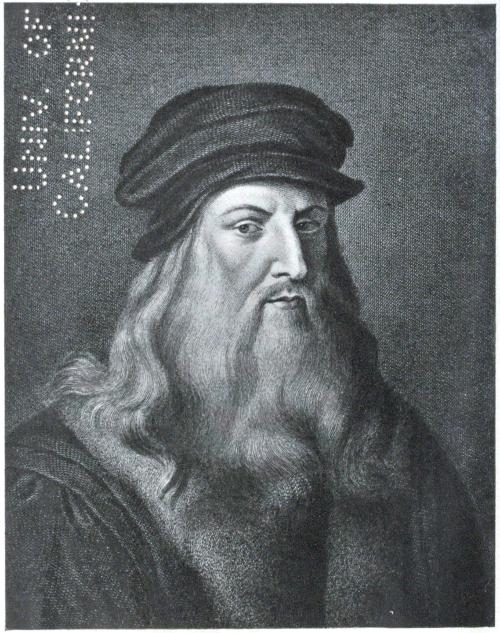
'I sensi sono terrestri, la ragione sta fuor di quelli, quando contempla.'
Leonardo da Vinci.
(The Senses belong to earth: Reason, when she contemplates, stands outside them.)
'Ούρανὁϛ ἀνω ούρανόϛ κάτω.'
(Heaven above—heaven below.)
Tabula Smaragdina.
'See here! On the map of the Indian Ocean, westward of
the island of Taprobane, we find a note—"The Sirens:
prodigies of the sea." Christopher Columbus told me that
having come there and found no sirens, he was greatly
astonished. But you smile. Why?'
'Oh, nothing! Go on, Guido; I am listening.'
'I know very well, Messer Leonardo, that you don't
believe in sirens! Well, and what would you say of the
skiapodes, who use their feet as parasols; or the pygmies,
whose ears are so large that they make one a bolster, the
other a blanket; or of the tree which bears eggs for its
fruit, from which come yellow downy chickens, so fishy-flavoured
they may be eaten on fast-days; or of that marine
monster upon which certain mariners, believing it an island,
disembarked and lighted a fire for the cooking of their
supper? This last is a very true tale, related by an aged
mariner from Lisbon, a man in no wise given to wine, and
who swore and swore again by the blood and the body of
Christ, that he spoke what was true.'
This conversation took place six years after the discovery
of the New World, on Palm Sunday, at Florence, in a room
above the storehouse of Messer Pompeo Berardi, a shipbuilder,
who had a branch establishment at Seville, and
superintended there the building of ships for sailing to the
New Continent. Messer Guido Berardi, Pompeo's nephew,
was an impassioned seaman; he had prepared to take part in
Vasco di Gama's expedition, when he was stricken by the
terrible disease called French by the Italians, and Italian by
the French; German by the Poles, Polish by the Muscovites,
Christian by the Turks. In vain he had consulted all
physicians, in vain he had made waxen offerings at every
wonder-working shrine; paralysed, condemned to eternal
immobility, he preserved an extraordinary activity of mind,
and by listening to sailors' stories, and sitting up all night
over books and maps, he sailed the oceans of imagination,
and made discoveries by proxy. His room, which sextants,
compasses, astrolabes, made like a ship's cabin, opened on to
a balcony, a Florentine loggia. The clear sky of a spring
evening was already darkening; the flame of the lamp
flickered in the wind; from the storehouse below were
wafted odours of spices—cinnamon, ginger, nutmeg and
cloves.
'And so, Messer Leonardo,' he concluded, rubbing his
unhappy legs under their coverlet, ''tis not meaningless the
saying that faith removes mountains. Had Columbus
doubted like you, he had accomplished naught. Confess,
I pray you, is it not worth grey hair at thirty to have found
the Earthly Paradise?'
'Paradise?' said Leonardo; 'nay, how is that?'
'What? Have you not heard? Know you not that by
observations on the Pole Star, taken by Messer Cristoforo
near the Azores, he has proved that the world has not the
shape of an apple, as is commonly supposed. 'Tis a pear,
with a protuberance like the nipple of a woman's breast.
On this nipple, a mountain so high that its summit leans
against the lunar sphere, lies the Earthly Paradise.'
'But, caro Guido, science....'
'Science!' cried the other contemptuously. 'Know you,
Messere, what Columbus says of science? I will quote you
his words in his Libro de las Profecias. He says: "Not
mathematics, nor the charts of geographers, nor the arguments
of reason, helped me to my deed, but solely the
prophecy of Isaiah touching a new heaven and a new
earth."'
Here Guido fell silent, for at this hour began the nightly
racking of his joints. He was carried to his bed; and
Leonardo, left alone, entertained himself verifying those
observations upon the Pole Star which had led to so singular
a delusion; and, in truth, he found errors so gross that he
could not believe his eyes.
'What ignorance!' he said to himself more than once; 'it
would seem he has discovered the New World by chance,
groping at random. He himself sees no more than a blind
man, nor doth he know what it is he has discovered; he
thinks it is China or Solomon's Ophir; or, by my faith, the
Earthly Paradise! Death will overtake him before he has
learned the truth.'
He read the first letter, dated April 29th 1493, in which
Columbus informed Europe of his discovery: 'the letter of
Christopher Columbus, to whom our age oweth much touching
the newly-found islands beyond the Ganges.'
Leonardo spent the whole night over the calculations and
the maps. At times he went out upon the loggia and looked at
the stars, thinking of this finder of the new heaven and the
new earth—that strange dreamer with the mind, and the heart,
of a child. Involuntarily he compared this man's destiny with
his own.
'How little he knew; how much he did! And I, with all
my knowledge, am helpless as the paralysed Berardi. I, too,
have aimed at unknown worlds, but have made no step
towards them. Faith, say they, faith! But is not perfect
faith the same as perfect knowledge? Cannot these eyes of
mine see farther than those eyes of Columbus, the blind
prophet? Or is it the caprice of Fate that men must see to
know; must be blind to act?'
Leonardo did not notice that the night was passing. The
stars went out one by one; rosy light overspread the sky and
shone upon the tiled roofs and the wooden cross-beams of
the old brick houses; the street became gay with the hum of
the people going forth to their daily toil. Presently a knock
came to the door, and Giovanni Boltraffio entered, to remind
his master that this was the day for the 'Trial by fire.'
'What trial?' asked Leonardo.
'Fra Domenico on behalf of Fra Girolamo, and Fra
Giuliano Rondinelli on behalf of his enemies, will pass
through the fire. That one who is unhurt will be proved by
God to be in the right.'
'Very good; you can go, Giovanni, and I wish you good
entertainment.'
'Will you not come also, Master?'
'No. I am busy.'
Giovanni took a step towards the door; then, trying to
appear indifferent, he said:—
'I am sorry you are so occupied. As I came hither I met
Messer Paolo Somenzi, who promised to bring us to a place
where we could see excellently. The trial is not till mid-day.
If you could finish your work by then, we might yet be in
time.'
Leonardo smiled. 'You want me so much to see the
prodigy? Very well, then; we'll go together.'
At the appointed time Messer Paolo Somenzi arrived. He
was a spy in the pay of the Duke of Milan, and a bitter enemy
of Savonarola's: a restless, fussy little man, with brains
of quicksilver.
'How is this, Messer Leonardo?' he began in a harsh
disagreeable voice, with much gesticulation. 'You thought
of refusing your presence? Has this physical experiment no
attraction for the devotee of natural science?'
'But will the magistrates really permit them to go into the
fire?' asked Leonardo.
'Chi lo sa? But one thing is certain, that Fra Domenico
will not shrink from the flames. Nor is he the only one!
More than two thousand of the citizens, rich and poor, wise
and simple, women and children, declared last night at the
Convent of San Marco that they were ready to follow Fra
Domenico to this singular test. I tell you there is such a
frenzy abroad that the most sensible feel their heads go
round. The very philosophers are taking fright, and asking
themselves if there is not a chance of neither champion being
burned. But for my part, I am wondering how the Piagnoni
will look when, on the contrary, the two poor fools are slain
before their eyes!'
'Does Savonarola really believe?' exclaimed Leonardo,
as if thinking aloud.
'I suspect he has his doubts and would fain draw back.
But 'tis too late. To his own hurt he has so debauched the
imagination of this people that now they require a miracle at
all costs. See you, Messere, 'tis a pure question of mathematics,
and of a kind no less interesting than yours: if God
really exist, why should he not do a miracle—why should he
not cause two and two to make five? as, verily, the faithful
daily request, that the impious like you and me, Messer
Leonardo, may be put to eternal confusion.'
'Well, let us set forth,' said Leonardo, interrupting Messer
Paolo with ill-concealed aversion.
'Soft, though,' said the other; 'one little whisper more.
You and I, Messer Leonardo, are of one mind in this matter;
and at the day's end we shall cry "Victory!" whether God exist
or no. Two and two will always make four. Viva la Scienza!
and long live logic!'
The streets were crowded, and on all faces was that air of
curiosity and happy expectation which Leonardo had already
remarked in Giovanni. The press was greatest in the Via de'
Calzaioli before the Orsanmichele, where was a bronze statue
by Andrea Verrocchio:—the apostle Thomas thrusting his
fingers into the wounds of his Lord. Here the eight theses,
the truth or falsity of which was to be demonstrated by the
fire, were appended to the wall, 'writ large' in vermilion
letters. Some of the crowd were spelling them out, others
listening and making their comments.
| I. | The Church of the Lord needs to be born again. |
| II. | God will chastise her. |
| III. | God will transform her. |
| IV. | After the chastisement, Florence also shall be renewed and shall rise above all peoples. |
| V. | The infidels shall be converted. |
| VI. | All this shall happen forthwith. |
| VII. | The excommunication of Savonarola by Pope Alexander VI. is invalid. |
| VIII. | He committeth no sin who holds this excommunication invalid. |
Jostled by the crowd, Leonardo and his companions stopped
to listen to the remarks of the people.
'It is all gospel truth,' said an old artisan; 'nevertheless
deadly sin may come of it.'
'What sin is stinking in your old nostrils, Filippo?' asked
a lad, smiling contemptuously.
'There can be no sin in it,' said another.
'It's a trap of the Evil One,' said Filippo undaunted.
'We are demanding a miracle. But we may be unworthy of
a miracle. Is it not written in Scripture, "Thou shalt not
tempt the Lord thy God?"'
'Hold your tongue, old man! Is not a mustard-seed of
faith able to raise mountains? God cannot avoid a miracle
once we have faith.'
'No! He can't! He can't!' cried many voices.
'But who is to go into the fire first? Fra Domenico or
Fra Girolamo?'
'The two together.'
'No, Fra Girolamo will only pray. He is not going in.'
'You don't know what you are talking about. 'Twill be
first Fra Domenico, then Fra Girolamo, and then all of us
who wrote ourselves down last night at the convent.'
Is it true that Fra Girolamo is going to raise a dead
man?'
'Of course it is true! First the trial by fire, and then the
resurrection of the dead. I, myself, have seen his letter to
the pope. He challenges him to send a man who shall
descend into a tomb with Fra Girolamo, and say to the dead,
"Come forth!" He who shall resuscitate the corpse shall be
the true prophet; and the other the deceiver.'
'Have faith, brothers, only have faith! Many miracles
await you. Ye shall see the Son of Man in his flesh and
bones coming on the clouds, and other wonders, of which
ancient times had not even the conception!'
At these words several cried 'Amen'; and all faces grew
pale, and all eyes burned with the wild fires of fanaticism.
The crowd moved on, carrying Messer Paolo and the others
with it. Giovanni threw one more look at Verrocchio's
bronze figure. In the good-humoured, half-contemptuous
smile of the incredulous apostle, he seemed to see the smile
of Leonardo.
As they approached the Piazza della Signoria, the press
was so great that Paolo requested one of the mounted guards
to escort them as far as the balcony, where places were
reserved for the orators, and for the more important of the
citizens.
Never, thought Giovanni, had he seen so great a multitude.
Not only was the square packed with spectators, but the
loggias, the towers, windows, and roofs of the houses. Like
limpets, they clung to the iron lamp-brackets, gratings,
gutters, eaves, rain-pipes. They hustled each other and
fought for room, and some fell and were trampled out of life.
All the approaches to the piazza were rigorously barred with
iron posts and chains; at three places only, men of full age
and unarmed were permitted to pass singly.
Messer Paolo explained to his companions the manner in
which the pyre was constructed. There were two long narrow
piles of wood smeared with tar and sprinkled with powder,
which extended from the Ringhiera or rostrum, where stood the
Marzocco (the ancient lion of Florence), as far as to the Tettoia
del Pisani. Between the two piles was a narrow lane, paved
with stones, sand, and clay, along which the two friars were
to pass.
At the appointed hour the Franciscans appeared from one
side, the Dominicans from the other; the procession was
closed by Fra Domenico, in a velvet habit of brilliant red,
and Fra Girolamo dressed in white, and bearing the Ostensorio,
which glittered in the sunlight. The Dominicans intoned a
Psalm:—
'Come and see the works of God, he is terrible in his
doing toward the children of men!'
And the crowd responded, 'Hosanna, Hosanna! Blessed
is he who cometh in the name of the Lord!'
The enemies of Savonarola occupied half the Loggia dei
Lanzi, his followers the opposite half, a partition having been
erected between them. All was now ready; nothing
remained but to light the fire and call forth the champions.
At last the judges of the trial came from the Palazzo
Vecchio, and every one held his breath and watched what
they would do; but after speaking a few words in a low voice
with Fra Domenico they retired again, and suspense reigned as
before. Fra Giuliano Rondinelli had gone out of sight. Then
the tension of spirit became almost insupportable, and the
crowd stood on tiptoe, and craned their necks, making the sign
of the cross and telling their beads, and murmuring childish
prayers: 'Lord, Lord! perform us a miracle!'
The air was sultry; a thunderstorm was drawing nearer,
and growls of thunder which had been heard at intervals all
day, were becoming louder and more insistent. Certain
members of the council, in long robes of red cloth, like the
togas of ancient Rome, issued from the Palazzo Vecchio and
took places on the Ringhiera; an old man with spectacles
and a quill behind his ear, evidently the clerk, tried to recall
them with shouts of:—
'Messeri! Messeri! the sitting is not ended! the voting
is in progress!'
'To the devil with the voting,' said one of the magistrates;
'I have had my fill of this stupid discussion. The noise
has broken my ear-drum.'
'What is the use of deliberation?' said another. 'If they
wish to burn themselves let them do it, and Good-night to
them!'
'By my troth, it were homicide!'
'And an excellent homicide, too! Two fools less on
earth.'
'But they must be burned according to the rule and canon
of the Holy Church. It's a delicate theological question.'
'Well, then, propose the question to the pope.'
'What have we to do with the pope? We are concerned
with the people. If by such means one could restore the
people to sanity, there would be no great evil in sending all
the priests and friars in the world, not only into the fire, but
into the water and under the ground likewise.'
'Water will serve. Throw them both into a tub of water,
and let him who comes forth dry be the victor. 'Twould be
a thought less dangerous than these pranks.'
'Have you heard, most honourable signiors,' said Messer
Paolo with deep reverences, 'that poor Fra Giuliano has
fallen sick in his stomach? 'Tis a malady caused by fear,
and he has been bled for it.'
'Sir,' exclaimed an old man of imposing aspect, his face
showing at once distress and intelligence, 'you make a jest of
everything. But I, when I hear such talk from the men
highest in the state, I ask myself whether it were not better
to die. Truly, if the founders of this city could rise from the
dead and see the folly and the infamy of this day's proceedings,
they would flee back into their graves for shame.'
The judges, meanwhile, came and went incessantly from the
Loggia to the Palazzo, from the Palazzo to the Loggia, and it
seemed as if the deliberations were to have no end.
The Franciscans first accused Savonarola of having
enchanted Fra Domenico's habit; he therefore removed it,
but it was alleged that sorcery might have influenced his
under garments. He retired into the Palazzo Vecchio,
stripped himself naked, and donned the vesture of another.
Then the Franciscans demanded that he should hold aloof
from Savonarola, lest his new garments should be enchanted;
and that he should give up the cross which he held. To this
Domenico consented, but protested that he would not enter
the flames without the Holy Sacrament in his hands. The
Franciscans at this swore that Savonarola's disciple wished
sacrilegiously to burn the body and blood of Christ. In
vain Domenico and Girolamo replied that the Holy Sacrament
could not be reduced to ashes; the material part (modus)
might indeed be burned, but not the eternal and incorruptible
part (substantia). An interminable scholastic dispute now
began between the two parties.
The crowd in the piazza was beginning to murmur, and
dense black clouds were spreading over the sky. Suddenly
from behind the Palazzo Vecchio and the Via de' Leoni
where the lions of Florence were kept in cages, a prolonged
and hungry roar was heard. The mob imagined that the
bronze Marzocco, indignant with his city, was roaring out his
wrath. They responded with a sound no less furious, no less
hungry.
'Have done! Have done! To the fire at once! Fra
Girolamo! We will have the miracle! We will have the
miracle!'
At this cry Savonarola, who had been kneeling in prayer,
rose, shook himself, approached the parapet of the Loggia,
and with imposing gesture commanded silence. But the
people refused to be silent. And then some one from under
the Tettoia de' Pisani cried:—
'He's afraid!'
And this cry was taken up and passed along.
A company of horsemen of the Arrabbiati tried to push
their way to the Loggia to fall upon Savonarola and seize
him, making their profit of the confusion.
'Kill him! Kill him! Down with the cursed schismatic!'
was the shout
Boltraffio closed his eyes that he might not see those
furious faces which had now lost all look of humanity;
nothing, he thought, could save Savonarola from being torn
to pieces.
At this moment the storm broke. Rain descended, the
like of which had not been seen in Florence.
It endured but a short time, and when it was over the trial
by fire had become an impossibility. For between the twin
piles of faggots the water ran with the fury of a channel
hemmed in between dykes.
Some laughed.
'Well done, friars! They undertook to tread the fire, but
they've got to swim for it! That's their miracle, eh?'
Cursed by the crowd, Savonarola on his return to his
convent was escorted by soldiers, and Giovanni's heart bled
as he watched the deposed prophet, kicked and buffeted,
making his way with faltering step, his eyes on the ground,
his white garb splashed with the mire of the streets. Leonardo
saw his disciple's wan face, and, as before at the 'Burning of
Vanities,' took his hand and led him away.
Next day in the Casa Berardi, sitting in the chamber
which was so like a ship's cabin, Leonardo tried to prove to
Messer Guido that Columbus had erred in locating Paradise
on a swelling upon a pear-shaped earth. At first Guido
listened and argued, then mournful silence fell on him. He
was vexed with his friend for telling him the truth. Presently
he discovered pains in his legs, and had himself carried away.
'Why have I hurt him?' thought Leonardo; 'He wants a
miracle too!'
Turning over his note-book, his eyes fell on the words he
had written that night when the Milanese mob had attacked
his house for the seizure of the Holy Nail: 'O marvellous
justice of Thee, Thou Prime Mover, who hast denied to no
force the order and the qualities of its necessary effect!'
'There!' he exclaimed, 'there is the miracle!'
And his thoughts turned to his Cenacolo and to the face of
Christ, still sought for, not yet found; and he felt that
between this inviolable law of Necessity, and the perfect
wisdom of Him who said, 'One of you shall betray me,'
there existed a deep correlation.
In the evening Giovanni came with the day's news. The
Signoria had exiled Fra Girolamo and Fra Domenico from
the city; and the 'Enraged,' brooking no delay, had besieged
San Marco with a countless throng of armed persons, and
had broken into the church where the brothers were at
vespers. They defended themselves, fighting with burning
tapers, candlesticks, and crucifixes; in the cloud of smoke
they seemed ridiculous as angry doves. One climbed on the
roof and hurled stones down from it. Another fired an
arquebus from the altar, shouting at each discharge 'Viva
Cristo!' Presently the monastery was taken by storm.
The brethren entreated Savonarola to flee, but he, together
with Domenico, gave himself up, and they were haled to
prison. The guards were unable or unwilling to defend them
from the insults of the crowd, who struck Fra Girolamo from
behind, crying:—
'Prophesy unto us, thou man of God, who is he that
smote thee?'
Others crawled at his feet as though seeking something,
and cried: 'The key? The key? Where is Fra Girolamo's
key?'
—in allusion to the key often spoken of in his sermons, with
which he would unlock the secrets of the abominations of
Rome.
The very children who had belonged to the Sacred Troop
of inquisitors now pelted him with apples and rotten eggs.
Those who could not penetrate the crowd howled from a
distance, reiterating their abuse till their throats were hoarse.
'Dastard! Coward! Judas! Sodomite! Sorcerer!
Antichrist!'
Giovanni followed him to the doors of the prison of the
Palazzo Vecchio, whence he was not to issue till the day of
his execution.
On the following morning Leonardo and Boltraffio quitted
Florence.
At once, on arrival in Milan, the painter set himself to the
task which had baffled him for eighteen years—the face of
the Christ in the 'Last Supper!'
On the very day of that trial by fire, which in Florence had
had such bad results—Charles VIII., King of France, died
very suddenly. The news was of sinister import to Il Moro,
for the Duke of Orleans, who was now to ascend the throne
as Louis XII., was descended from Valentina Visconti,
daughter of the first Duke of Milan. He claimed to be the
only legitimate heir of the dominion of Lombardy, and now
proposed to reconquer it, annihilating 'the robber nest of
the Sforzas.'
Shortly before the change of sovereigns in France, there
had taken place at the Milanese court what was called a
'scientific duel,' and Il Moro had found so much entertainment
that he proposed another for a day two months later.
Now that war was impending some supposed he would postpone
this duel, but Ludovico, who was an adept in the arts
of dissimulation, had no such intention. He wished his
enemies to think he cared little for their designs, but was
absorbed in that revival of art and learning, 'the fruit of
golden peace,' which flourished under his mild rule, and
brought him the fame of being the most enlightened Italian
potentate, the protector of the Muses, protected not merely
by the arms but by the admiration of his people.
Accordingly on the appointed day, in the Great Hall of the
Rocchetta, which was called the Sala per il giuoco della palla,
there assembled all the doctors, deans, and masters of the
University of Pavia, wearing their scarlet four-cornered
berrette, their ermine-bordered hoods, their violet gloves, and
pouches of gold embroidery. Ladies were present dressed in
sumptuous festal robes, amongst them Lucrezia and Cecilia,
sitting together at the foot of Ludovico's throne. The proceedings
were opened by a pompous oration from Giorgio Merula,
in which the Duke was likened to Pericles, Epaminondas,
Scipio, Cato, Augustus, Mæcenas, and other worthies, while
Milan was celebrated as the new Athens, of surpassing glory.
Then followed a theological dispute on the Immaculate
Conception, then medical discussions on the following
questions:—
'Is a handsome woman more prolific than an ugly one?'
'Was the healing of Tobias natural?'
'Is woman an incomplete creation?'
'In what part of the body was formed the water which
issued from the side of the crucified Christ?'
'Is woman more sensual than man?'
Then came the turn of the philosophers, on the unity or
the plurality of primal matter.
'Be good enough to expound me this apophthegm,' said a
toothless old man with venomous smile, and eyes dull and
troubled as those of a sucking babe; a great doctor of
scholastics, who thoroughly understood the confounding of
opponents by subtle distinctions (quidditas et habitus) which
nobody could understand.
Alone and thoughtful as was his custom, Leonardo was
listening, and now and then his lips curled.
Pointing to Leonardo, the Countess Cecilia whispered to
the Duke, who called up the artist, and begged him to take
part in the discussion.
'Be kind,' insisted the countess. 'Do it for my
sake——'
'Lay aside your bashfulness,' said Ludovico, 'and tell us
something entertaining. Speak to us of your observations
upon nature. Do we not know that your brain is always
stuffed with chimeras?'
'Your Excellency must excuse me. Madonna Cecilia, I
would gladly please a lady, but, truly, I cannot——'
Leonardo was not feigning. He was neither able nor
willing to speak before a crowd. An insuperable barrier
seemed to lie between his thought and his word, as if speech
must either exaggerate or be inadequate to the sense, modify
or vitiate it. In his note-books he continually cancelled,
erased, corrected, and revised; in conversation he stammered,
lost the thread, sought for words and could not find
them. He called both orators and authors 'babblers,' but in
secret he envied them. The frequent glibness of insignificant
persons was a wonder and an annoyance to him.
'That God should give such men such skill!' he would
say, with a kind of ingenuous admiration.
However, the more firmly Leonardo declined the task
offered him, so much the more did the ladies insist.
'We beseech you, Messere! We all pray you with one
voice. Tell us, tell us something entertaining!'
'Tell us how men are to fly!' suggested Madonna
Fiordiligi.
'Nay, but speak to us of sorcery!' cried Madonna
Ermellina; 'something of black magic! 'Tis so interesting,
this necromancy. Explain to us how they raise the dead
men from their graves!'
'I assure you, Madonna, I have never raised any dead
person from his grave.'
'Then take some other theme, so it be terrible, and have
no savour of mathematics.'
Leonardo was always hard put to it to refuse a beggar, and
he could only repeat with embarrassment:—
'Truly, Madonna, I am incapable——'
But Ermellina interrupted him, clapping her hands.
'He consents! He consents! Silence for Messer
Leonardo! Listen ye all!'
'Eh? Who? What?' asked the dean of the theological
faculty, who was deaf, and somewhat fallen into dotage.
''Tis Leonardo!' shouted his neighbour into his ear.
'Leonardo Pisano, the mathematical professor?'
'No, Leonardo da Vinci himself.'
'Is he doctor or master?'
'No, nor even bachelor. Leonardo, the painter of the
Cenacolo.'
'Is he going to speak of painting?'
'It seems he will speak of natural science.'
'Are the painters so learned? I have never heard of this
Leonardo. What has he written?'
'Nothing that I know of.'
'Nay,' said another, ''tis certain that he writes, for they
say he uses his left hand, and produces a caligraphy proper
only to himself, which none can read.'
'Which none can read? With his left hand?' said the
old dean.
'I take it, gentlemen, this speech will be some jest; an
interlude to entertain the Duke and the ladies.'
'Very like 'twill be ridiculous. We shall see.'
'Just so, just so. 'Tis necessary to amuse the folk of the
court. And painters are witty fellows enough. Buffalmacco,
now—they said he was a perfect jester. Well, let us see what
this Leonardo is good for.'
And the old man polished his spectacles, the better to
enjoy the comedy.
Leonardo was still looking supplicatingly at the Duke, but
though smiling, Ludovico was determined; and the Countess
Cecilia menaced the hesitant with her finger.
'If I refuse I shall offend them,' thought the artist; 'and
very soon I shall be requiring bronze for the Cavallo. Well,
I will say the first thing that comes into my head, just to be
quit of the business.'
And with desperate resolution he mounted the tribune and
threw a glance upon the learned assembly. Then, blushing
and stammering like a boy who does not know his lesson, he
began:—
'I must warn you, gentlemen, I am not prepared....
'Tis to please the Duke. I would say—I mean—in fine,
I will speak to you about shells.'
And he told of petrified marine animals, the imprints of
coral, and water-plants found on hills and in valleys far
removed from the sea, evidence of how the face of the earth
has been changing from time immemorial. There, where
now are hills and dry land, once was the ocean. Water,
the mover of Nature, her 'charioteer,' creates and destroys
the very mountains; the shores gradually remove into
the centre of the sea, and the inland seas lay bare their
beds, traversed by some river which ever hurries towards
the sea, scoring for itself a deep channel. Thus the Po,
which now rushes across the dried-up lake of Lombardy,
will eventually score itself a deep channel across the dried-up
Adriatic; and the Nile, when the Mediterranean has become
a country of hills and plains like Egypt and Libya, will empty
itself into the Atlantic Ocean beyond the Pillars of Hercules.
'I am convinced,' said Leonardo in conclusion, 'that
the study of petrified plants and animals, which we have
hitherto neglected, will lay the foundation of a new science
of our earth; of its past, and of its future.'
Notwithstanding the awkwardness of his delivery,
Leonardo's ideas were so clear and precise, his faith in
knowledge was so sure, all he had said was so unlike the
Pythagorean ravings of the previous disputant, and the dry
bones of logic in the mouths of the learned doctors, that when
he stopped speaking a stupor of amazement was seen on the
faces of the audience. Were they to laugh or to applaud?
Was this talk of a new science the vain chatter of a
presumptuous fool?
'Truly, my Leonardo,' said the Duke condescendingly,
as if speaking to a child, 'it would be famous fun if
the Adriatic were to dry up and leave our enemies, the
Venetians, stranded like crabs on a sandbank.'
At this they all laughed, well pleased to be told the line
they were to take, for courtiers are ever weathercocks turned
by the wind. Messer Gabriele Pirovano, the Rector of the
University of Pavia, an old gentleman with silver hair, fine
manners, and a dignified but somewhat foolish face, thus
delivered himself, reflecting in his smile the condescending
kindness of the Duke:—
'Messer Leonardo, the information you have given us is
very interesting; but were it not perhaps simpler to explain
the origin of these little shells, as a charming (we might even
say poetic) but wholly accidental freak of nature, rather than
as the foundation of an entire new science? Or, as others
have done before us, we might account for their presence by
the catastrophe of the universal Deluge.'
'Oh, the Deluge!' said Leonardo, who had conquered his
shyness and now spoke with a freedom which to many
appeared excessive and even irreverent; 'I know that explanation,
but it won't do at all. Judge for yourself, Messer
Gabriele. According to the man who measured it, the level
of the waters of the flood exceeded by ten cubits the tops of
the highest mountains. The shells would have settled on
the summits, not on the sides or the feet of the mountains,
nor within caverns; and, withal, they would have settled at
haphazard according to the pleasure of the waters, and not
everywhere at the same level, not in consecutive layers, as we
find by observation. And further, here is a wondrous thing.
We find collected together all those creatures which are used
to live in societies, such as oysters, cuttlefish, molluscs; while
those which are used to be solitary are scattered singly in
their fossil state just as we find their descendants now on the
seashore. I myself have often noted the position of these
petrified shells in Tuscany and in Lombardy and in Piedmont.
And if you tell me 'twas not the waves carried them,
but that of themselves they gradually rose in crowds above
the water as it grew higher, that, too, is easily refuted, for a
shellfish is as slow a beast as a snail. It floats not, but crawls
with its valves over sand and stones, and the furthest it can go
in a day's hard journeying is some three or four arm-lengths.
How then, Messer Gabriele, would you explain, that in the
forty days of the flood's duration, your shellfish could creep
the two hundred and fifty miles which divide the hills of
Monferrato from the shores of the Adriatic? Only he who,
despising experiment and observation, judges of Nature from
books, can maintain such an argument; not he who has had
the curiosity to see with his own eyes those things of which
he speaks.'
An uncomfortable silence followed; all felt that the Rector's
reply had been a trifle weak. Then the court astrologer,
Ambrogio da Rosate, a great favourite of the Duke's, advanced
another explanation based on Pliny's natural history; which
was that the petrified shapes which looked like marine
animals had been formed in the interior of the earth by the
magic working of the stars.
At the word magic, a resigned smile played over Leonardo's
lips. 'Then, Messer Ambrogio,' he replied, 'how would you
explain the fact that the stars in the one place should make
animals not only of many kinds but of various ages? (for the
age of shells can be ascertained no less than the age of horns
or of trees). What say you to finding some of these shells
entire, some broken, some mixed with sand, mud, the claws
of crabs, fish-bones, and rubble, such as you may see any day
on the seashore; and the delicate imprint of leaves on the
rocks of the highest mountains, and marine weeds clinging to
the shells, petrified and blended into one lump with them?
From the working of the stars, say you? If this is to be
our reasoning, Messere, then in all Nature there will be no
phenomenon for which you cannot account by the starry
influences, and all science outside astrology is useless.'
Here an old Doctor of scholastic interposed, saying that the
dispute was irregular.
'For,' he exclaimed, 'either this question of fossils belongs
to a vulgar, mechanical science, alien to metaphysic, and
hence not to be discussed in an assembly met to contend
solely about philosophical questions, or it verily pertains to
the true, the sublime science of dialectic; in which case it
must be discussed according to the laws of dialectic, which
alone allows theory to ascend to the sphere of pure speculation.'
'I understand you, Messere,' said Leonardo patiently; 'I
have thought of what you say. But the alternative is not as
you state it.'
'Not as I state it?' cried the veteran smiling angrily, 'not
as I state it? Then, sir, pray let us hear how you propose
to state it!'
'Nay, nay; I had no wish to offend. In fine, I spoke but
of shells. I think—nay, Messere, but there is no vulgar
science, nor is there sublime science. There is but one
science; that which is based upon the experience of the
senses.'
'The experience of the senses? Then where would you
put the metaphysic of Aristotle, of Plato, of Plotinus, and
of all the ancient philosophers who speculated upon God,
upon the soul, and upon the essences? Would you say of
all this——?'
'That it is not science,' replied Leonardo calmly. 'I
recognise the greatness of the ancients, but not in that
respect. In science they mistook the road. They wished to
learn what was beyond the reach of knowledge, and what was
within their reach they despised. They led men astray for
many ages. Discussing matters which admit not of proof,
it is impossible for men to agree; the less so if they would
make up for the lack of proof by vehemence of clamour.
He who truly knows has no occasion to shout. The voice
of truth is unique; and when it has spoken, all the noise
of dispute must be hushed. If the cries continue, it means
that the truth has not yet been found. Do we need mathematical
dispute as to whether twice three be six or five?
or whether the angles of a triangle be or be not equal to two
right angles? In these instances doth not contradiction cease
in the presence of truth? and is not truth to be enjoyed as
it never can be enjoyed in sophistical and imaginary
sciences?'
Leonardo would have spoken further, but after a glance at
the face of his opponent he became silent.
'Ah!' said the doctor of scholastic, ironically, 'I thought
we should arrive at an agreement! You and I were certain
to understand one another! But one thing I do not understand.
Pardon the ignorance of an old man! If our knowledge
of God and of a future life, not being confirmed by
the testimony of our senses, but by the testimony of Holy
Writ——'
'I spoke not of this,' interrupted Leonardo; 'I leave out
of the dispute the books inspired by God, for they are of
the substance of supreme truth.'
He was not allowed to continue; uproar ensued. Some
shouted, some laughed; some, springing from their chairs,
turned wrathful faces on him, while others, shrugging their
shoulders, left the assembly.
'Make an end! Make an end!'
'But, gentlemen, permit me to reply——'
'There is no occasion for reply.'
'When things are stated contrary to sense——'
'I desire to speak!'
'Plato and Aristotle!' ...
'Not worth a rotten egg!'
'But I ask, shall this be permitted? The truth of our
Holy Mother Church——'
'Heresy! Heresy! Atheism!'
Leonardo remained silent, his face calm and sad. He was
alone among these men who believed themselves the servants
of knowledge, and he saw the impassable gulf which separated
him from them. He was displeased, not with his opponents,
but with himself for having broken his accustomed silence, and
become entangled in an argument; for having conceived (in
defiance of experience) that it were possible to reveal the
truth unto men, or that they were able to receive it.
As for the Duke, though he had long lost the thread of
the argument, he continued to follow the disputation with
delight.
'Good! Really good!' he applauded, rubbing his hands.
'Madonna Cecilia, will they not, think you, presently come
to blows? Look at that old fellow, shaking all over, brandishing
his cap, clenching his fists! And the little black one
behind him, foaming at the mouth! And all about a few
fossil shells! Fine madmen, these scholars! kittle cattle!
And our Leonardo, who pretended to be possessed by a
dumb devil!'
And they laughed, watching the scientific duel as if it were
a cock-fight.
'I shall have to save my Leonardo,' said Il Moro at last,
'or these red-capped folk will claw him.'
And he rose and passed through the crowd of infuriated
philosophers, who suddenly were hushed into silence as they
made way for him. Soothing oil had been poured upon stormy
waves; one smile from the prince sufficed for the reconciliation
of metaphysics and natural science. He closed the discussion
by a courteous invitation to supper.
'I am glad,' he said with his usual gaiety, 'that the
Adriatic is not yet dry; because I trust that its oysters,
which I have had cooked for your entertainment, may give
rise to less contention than the shells of Messer Leonardo.'
During the supper Fra Luca Pacioli, who was sitting beside
Leonardo da Vinci, whispered in his ear:—
'Forgive me, friend, that I kept silence when they attacked
you. They did not understand your meaning, but you might
easily make an alliance with them, for the one opinion does
not exclude the other. Avoid extremes.'
'I entirely agree with you, Fra Luca,' replied Leonardo.
'That's the way; love and concord. What is the object
of dissension? Metaphysics are good, and mathematics are
good! Room for both. Is it not so, dear friend?'
'Precisely so, Fra Luca.'
'I was sure you would agree. You give in to me, I give
in to you; we are allied, you with us, we with you.'
Leonardo looked at the astute countenance of the mathematical
monk, who reconciled Pythagoras and Thomas
Aquinas so easily; and he thought—
'The calf sucks from two dams.'
Then the alchemist, Galeotto Sacrobosco, raising his glass
and bending towards Leonardo with the air of an accomplice,
said—
'To your good health, Master! How skilfully you played
them on the line! What a subtle allegory!'
'Allegory?' repeated Leonardo, stupefied.
'To be sure, Messere. No call for mystery with me.
We shall not betray one another. By dry land you meant
sulphur; by the sun, salt; by the ocean which overflowed
the mountains, quicksilver. Do I catch your meaning?'
'Precisely, Messer Galeotto.'
'You see even we are good for something! As for the
shells, by them you intended the philosopher's stone, the
alchemist's secret, composed of what? why of sulphur, salt,
and quicksilver!'
And he laughed his jolly childlike laugh, raising his forefinger
and arching his brows, which were scorched by the
fury of his immense furnaces.
'And all these great doctors with their red caps understand
not a word of it! To your health, Messer Leonardo, and to
the glory of alchemy, our common mother!'
'I honour the toast, Messer Galeotto. And as I see
nothing can be concealed from you, I will vex you with no
further mysteries.'
After supper the party broke up: only a small and selected
company were invited by the Duke into a cool snug room,
where wine and fruits were served.
'Most charming! Insurpassable!' cried Madonna Ermellina.
'I should never have conceived it could be so diverting.
Better than a festa! How they shouted at Leonardo! Pity
he might not finish—he would have told us of his spells and
necromancy.'
'Perchance 'tis calumny,' said an old courtier; 'but I am
told the infection of heresy has so taken hold of Leonardo,
that he scarce credits the existence of God. He holds it of
greater moment to be a philosopher than a Christian.'
''Tis mere babble,' said the Duke. 'I know the man
well, and I swear he has a heart of gold. He is violent in
word, but in practice would not hurt a flea. He dangerous!
Would that all dangerous ones were as he! The Father
Inquisitors would have him, but let them roar! None shall
hurt a hair of my Leonardo!'
'And our posterity will praise your Excellency for having
protected a genius so extraordinary,' said Messer Baldassare
Castiglione, a very elegant cavalier from the court of Urbino.
''Tis pity,' he added, 'that the man should neglect his art
to give himself to dreams and chimeras.'
'True, Messer Baldassare; I have often reproached him.
But painters, you know, are an unmanageable race.'
'Your Excellency speaks well,' said the Commissioner of
the Salt Tax, who was burning to tell a tale of Leonardo;
'painters are impracticable folk. T'other day I came to his
studio seeking an allegorical drawing for a marriage chest.
"Is the master at home?" say I. "No," is the reply, "he
hath gone forth, greatly busied, to measure the weight of the
air." Truly, I thought the youth mocked me; but when I
met Leonardo himself and taxed him with this folly, he
confessed it, looking at me as if he thought I were a fool.
Ladies, how like you the notion? and how many grains will
you find in the spring zephyr?'
'I know worse of him than that,' said a young lord with
a vulgar self-complacent face; 'he has invented a boat which
travels up stream, yet without oars.'
'How doth it travel?'
'On wheels, by steam.'
'A boat with wheels? Nay, sir, this must be your invention
of this moment!'
'I had it of Fra Luca Pacioli, who had seen the design.
Leonardo conceives that in steam lies a force able to move
large ships, let alone little boats.'
'You see! You see! Did I not tell you!' cried Madonna
Ermellina, 'this is his necromancy, black magic pure and
simple!'
''Tis not to be denied he is mad!' said the Duke with his
urbane smile; 'for all that I wish him well. In his company
I never weary!'
Leonardo went homewards by the quiet suburb of Porta Vercellina. It was a lovely evening. Goats were contentedly browsing along the edge of the road; and a rugged sunburnt little lad was driving a flock of geese. Storm-clouds, lined with gold, were rising in the north over the unseen Alps, and high up in the clear sky there burned a single star.
The artist walked slowly; he was thinking of the scientific dispute which he had just left, and then his thoughts went back to the trial by fire at which he had been present in Florence. He could not but think the two duels resembled each other like twins.
A little girl of six was eating rye-bread and onions on the outside staircase of a cottage. He called her, and after a moment's hesitation, reassured by his smile, she trotted to him, smiling herself. He gave her a sugared and gilded orange which he had brought from the supper.
'Gold ball!' said the child.
'No, not a ball. A sort of apple. Try it; 'tis sweet within.'
She continued to stare ecstatically at the unfamiliar dainty.
'What is your name?' he asked.
'Maia.'
'I wonder, Maia, if you know how the cock, the goat, and the donkey went a-fishing together?'
'No.'
'Shall I tell you?'
And he fondled her soft wild curls with his delicate, almost womanish, hand. 'Come here then! Let us sit down! Wait a minute, though, I think I have some nice cakes also, as you won't try my golden apple!' And he turned out his pockets. A young woman now appeared, looked at Maia and at the stranger, nodded approvingly, and seated herself with her distaff. Then came also the grandmother, a bent old woman with eyes like Maia's. She, too, looked at Leonardo; but suddenly, as if recognising him, she made a sign with her hands and whispered to her daughter, who sprang up saying:—
'Maia! Maia! Come away at once!'
The child hesitated.
'Come, run, naughty one; unless you wish——'
The little girl was frightened and fled to the grandmother, who snatched the orange from her and flung it over the wall to the pigs. The child cried, but the old woman whispered something in her ear which at once checked her sobs, and she sat gazing at Leonardo with wide eyes full of terror. The painter turned away, well understanding. The old woman thought him a sorcerer capable of bewitching the child. A sad smile on his lips, still mechanically searching for the cakes no longer needed, pained at heart by the little one's needless fear, he felt himself more of an outcast than in face of the crowd which had sought to kill him, the learned men who fancied his truths the ravings of a madman. He felt himself as far removed from his fellows as was that solitary star shining in the still undarkened sky.
He went home and shut himself into his study. With
its dusty scientific instruments and its dull books, it seemed
to him gloomy as a prison. However, he lighted a candle,
seated himself, and became immersed in his latest research,
in inquiry into the laws of the motion of bodies travelling
on an inclined plane. Like music, mathematics had ever for
him a soothing influence; and to-night, they brought him
the hoped-for consolation. Having finished his calculations,
he took his diary, and writing with his left hand, and from
right to left, so that reading must be in a mirror, he recorded
a few thoughts roused by the scientific disputation.
'The disciples of Aristotle, men of words and of books,
because I am not a letterato like themselves, think me incapable
of speech on my own subjects. They perceive not
that my matters are to be expounded rather by experience
than by words; experience, which truly was mistress of all
those who have written well; which I will take for my mistress,
by which, in all cases, I will stand or fall.'
The candle had burned low; and the cat, faithful comrade
of his sleepless nights, sprang on the table, purring and rubbing
herself against him. The solitary star, seen through the
undusted windows, seemed still farther away, still less attainable.
He remembered Maia's frightened eyes, but he had
vanquished his melancholy. He was solitary, yes, but undaunted
and serene. Nevertheless, unknown to himself,
there was bitterness in the secret depth of his heart like a
hot spring beneath the ice of a frozen river; there was
almost remorse, as if, verily, he were guilty concerning Maia;
as if there were something for which he was unable entirely
to forgive himself.
Next morning Leonardo, with Astro carrying sketch-books,
paint-boxes and brushes, was on his way to the monastery
for a day's work on the figure of the Saviour. He stopped
in the courtyard to speak to Nastasio, who was busily grooming
a grey mare.
'Bravo!' said the master, 'and how is Giannino to-day?'
Giannino was his favourite horse.
'Giannino is all right,' answered the groom, 'but the
piebald is lame.'
'The piebald?' said Leonardo, vexed; 'and since when?'
'Since four days agone,' replied Nastasio surlily; and without
looking at his master, he continued curry-combing the
mare's hindquarters with such energy that she changed her
feet.
Leonardo, however, wished to see the piebald, and the
groom took him to the stable. When Giovanni Boltraffio, a
few minutes later, came to the courtyard fountain for his
morning wash, he heard the master talking in loud piercing
tones almost feminine in their shrillness, which he used in
rare passions of sudden, violent, but not dangerous anger.
'Tell me this instant, you fool, you drunken ape, tell me
who bade you summon the horse-leech?'
'I pray you, Messere, could a sick horse be left without
a leech?'
'A pretty leech! Think you, fool, that stinking plaster——'
''Tis not so much a plaster as a charm. You are not
learned in these matters, and that is why you are so
wroth.'
'The devil take you and your charms together! How
could that ignoramus cure anything when he knows naught
of the structure of the body, and has never heard the name
of anatomy?'
'Anatomy, forsooth!' said Nastasio, raising lazy contemptuous
eyes to his master.
'Ass!' shouted the latter; 'take yourself off out of my
service!'
The groom did not move an eyelash.
'I was on the stroke of leaving you on my own account.
Your Excellency owes me three months' wages; and as regards
the oats, 'tis no fault of mine. Marco gives me no money
for oats.'
'What's the meaning of all this? Once I issue my
orders——'
Nastasio shrugged his shoulders and returned to his
grooming of the grey mare, working violently as if venting
his spleen on the dumb animal.
Meantime Giovanni, amused by the altercation, was smiling
as he scrubbed his face with a coarse towel.
'Shall we set out, Master?' asked Astro, wearied by
the delay.
'Wait,' replied Leonardo; 'I must ask Marco about the
oats. I would know how much truth is in the words of this
scoundrel.'
And he returned to the house, Giovanni following him.
Marco was in the studio, working as usual by rule and
with mathematical accuracy, perspiring and panting as if
he were rolling a weight uphill. His closely compressed
lips, the disorder of his red hair, his red fat ineffectual fingers,
seemed to say, 'Patience and perseverance will conquer all
things.'
'Marco! Is it true you give out no money for the horses'
oats?'
'Of a surety it is true.'
'How is that, friend?' exclaimed the painter, his look
having already become timorous before the stern face of him
who was steward of the household. 'I bade you, Marco,
take heed to remember the oats. Have you forgotten?'
'No, I have not forgotten; but there is no money.'
'I guessed as much. There is always this lack of money.
None the less, Marco, I ask you, can horses live without
oats?'
Marco threw his brush away angrily. And Giovanni
noticed how the master and the scholar seemed to have
changed places.
'Hearken, Master!' said Marco. 'You bade me take
charge of the housekeeping, and not trouble you. Why
do you yourself re-open the matter?'
'Marco!' said Leonardo, with gentle reproach, ''twas but
a week ago that I gave you thirty florins.'
'Thirty florins! Pr'ythee count it up. Of this thirty, four
were a loan to Pacioli, two to that eternal sponge, Messer
Galeotto Sacrobosco; five went to the body-snatchers for
your anatomy studies; three for mending the glass and the
stoves in the hot room for your reptiles and fishes; and
six golden ducats went for that spotted devil——'
'Do you mean the camelopard?'
'Precisely; the camelopard. We have nothing to eat
ourselves, but we feed that cursed beast. And whether we
feed him or not, 'tis clear that he will die.'
'Never mind, Marco,' said Leonardo gently; 'if he die I
will dissect him. The neck vertebræ of these animals are
very curious.'
'The neck vertebræ! Oh, Master! Master! if you had
not all these fancies for horses, and corpses, and giraffes, and
fish, and every sort of beast, we might live as lords, asking
alms of no one. Is not daily bread better than caprices?'
'Bread? Have I ever asked for anything better than
bread? Oh, I know very well, Marco, you would like to see
the death of all my creatures, though they cost me so much
trouble and expense to obtain. They are indispensable
to me—more so than you can imagine. You want to have
everything your own way.'
Helpless injury trembled in the voice of the Master; and
Marco maintained a sulky silence.
'But what is to become of us?' continued Leonardo.
'Already a famine of oats? We were never in such straits
before.'
'We have always been in straits,' said Marco, 'and we
always shall be. What can you expect? For a year we have
not had a quattrino from the Duke. Messer Ambrogio
Ferrari says daily, "to-morrow! to-morrow!" and to my
thinking he but mocks us.'
'Mocks us! Well, I will show him how to mock at me!
I will complain to the Duke! I will give that scurvy piece,
Ambrogio, a lesson he shall not forget! the Lord send him
an evil Easter!'
Marco made a vague gesture, as if to say it was not
Leonardo who would teach lessons to the Duke's treasurer.
Then an expression of kindness and love came over his hard
features, and he added soothingly:—
'No, no, Master, let it be! God is merciful, and we shall
get along in some fashion. If you really take it to heart, I
will find the money even for your oats.'
And Marco reflected that he could use some of his own
money, a little hoard he had been making for his mother.
'The oats are not the major question,' said Leonardo,
sinking wearily on a chair, and defending his eyes as if from
a cruel wind. 'Hearken, friend, there is a thing I have not
yet told you; next month I shall absolutely require eighty
ducats, which I have had on loan. There is no need to stare
at me with those eyes, Marco.'
'Of whom had you the loan?'
'Of the money-changer, Arnoldo—'
'Of Arnoldo! Oh, Master! what have you done? Don't
you know he is worse than any infidel or any Jew? Why
did you not tell me at once?'
Leonardo hung his head.
'I wanted the money—be not so wroth, Marco!' he said;
and added piteously, 'Bring the reckonings, perhaps we shall
be able to devise something.'
Marco was convinced they could devise nothing; however,
finding absolute obedience the best way of influencing the
Master, he fetched the account-books. Leonardo's brow
contracted in a look of disgust, and he watched the opening
of the too familiar green volume with the air of one looking into
a gaping wound; then together they plunged into calculations,
and it was wonder and pity to see the great mathematician
making the blunders of a child in the additions and the
subtractions. Now and then he suddenly remembered some
mislaid account of a thousand ducats, sought it, fumbled in
cases and boxes, and dusty piles of papers, but found in its
place trifling and useless memoranda written in his own
hand, such, for instance, as that one of Salaino's cloak:—
| Silver brocade, | Livre | 15 | soldi | 4 |
| Crimson velvet for trimming, | " | 9 | " | 0 |
| Braid, | " | 0 | " | 9 |
| Buttons, | " | 0 | " | 12 |
He tore them angrily, and blushing and swearing threw them
under the table.
Giovanni, seeing on the great man's face these marks of
human weakness, murmured to himself:—
'A new Hermes Trismegistus halved with a new Prometheus?
Nay, neither god nor Titan, but a simple mortal
like the rest of us! And to think that I feared him! the
poor kind soul!'
Two days passed, and as Marco had foreseen, Leonardo
forgot the money question completely. He demanded three
florins for the purchase of a fossil with so confident an air
that Marco lacked courage to refuse him, and handed out the
money from his private hoard. The ducal treasurer, deaf to
Leonardo's entreaties, had still not paid the year's salary, and
was the less likely to do so that Ludovico himself required
great sums to spend in preparation for war with France.
Leonardo was obliged to borrow wherever he could, even
from his own pupils.
Nor was the money forthcoming for the completion of the
Sforza monument. The plaster cast, the mould, the receiver
for the molten metal, the furnace—all were ready; but when
the artist presented his estimate for the bronze, Il Moro was
alarmed, and even refused him an interview.
At last, in the end of November, urged by want, he wrote
a letter to the Duke; sentences fragmentary, disconnected,
like the stammering of one overcome by confusion, who does
not know how to beg.
'Signore, knowing that the mind of your Excellency is
occupied with affairs of greater moment, yet fearing that
silence may be a cause of anger to my most gracious patron,
I take freedom to remind your Excellency of my humble
necessities, and of the needs of my art, now condemned to
inactivity.... Two years have passed since I have received
my salary....
'Some persons in your Grace's service can afford to wait,
since they have other revenue, but I with my art, which,
however, I would gladly abandon for one more lucrative....
'My life is at your Excellency's service; and I shall always
be prompt in obedience.
'I speak not of the monument, for I know that the
times....
'It irks me that owing to the necessity of earning my
livelihood I must break off my work, and occupy myself with
trivialities.
'I have had to provide for six persons during fifty-six
months, with only fifty ducats....
'I know not to what I must dedicate my activity....
'Am I to study glory, or only my daily bread ...?'
One November evening, after a day spent in soliciting the
munificent Gaspare Visconti, and Arnoldo the usurer, and in
coming to terms with the hangman—who demanded payment
for two corpses (used by the artist for studies), threatening in
default to denounce the purchaser to the Holy Inquisition—Leonardo
came home greatly wearied and out of heart.
Having dried his clothes by the kitchen fire, and received the
key of his workshop from Astro, he was proceeding thither when
he was surprised by the sound of voices behind the door.
'What?' he said, 'is it not locked? Can it be thieves?'
Recognising the tones of his pupils, Giovanni and Cesare,
he suspected them of prying into his private papers. About
to throw open the door, he was arrested by a vivid imagination
of their confusion, and the wide eyes of terror with which
they would greet him. He felt ashamed for them, and went
away, walking on tiptoe as if himself the culprit; presently he
called from the studio:—
'Astro! Astro! Bring me a light! Where have you all
got to? Andrea! Marco! Giovanni! Cesare!'
The voices in his room were silenced, some glass thing fell
with a crash, there was a shutting of windows. Leonardo
still hesitated, unable to resolve upon entry. In his heart
was not so much anger as disgust.
His suspicions were not amiss. Having entered by the
courtyard window, Giovanni and Cesare had searched his
drawers and opened his papers, drawings, and diaries.
Boltraffio, very pale, held a mirror, and Cesare read the
master's inverted writing:—
'Laude del Sole. I cannot but blame Epicurus, who maintained
that the sun's magnitude is no other than it seemeth.
Socrates astounds me, who, depreciating so great a light, calls it
but a molten stone. And would I had vocables strong enough to
confound those who prefer the apotheosis of man to the apotheosis
of the sun!'
'Shall we pass on?' asked Cesare.
'Read to the end,' said Giovanni.
'Those who worship men for gods,' continued the reader,
'are greatly in error; for man, though he were of the magnitude of
the earth, would appear smaller than the smallest star, a scarce
visible spot upon the universe; and seeing, further, that men in
their sepulture are subject to putridity and decay—'
'Strange,' observed Cesare, 'that he can reverence the sun,
but appears not to recognise Him who, dying, was the
vanquisher of death.'
He turned the page. 'Let us try this.'
'In all parts of Europe, by great peoples, will be bewailed this
day the death of a man who died in Asia—'
'You don't understand, Giovanni. I will explain: he
treats of Good Friday. Shall I go on?'
'O mathematicians, throw light upon this error! Spirit exists
not without body, and where is no flesh, nor blood, nerves, tongue,
bone, and muscle, can be neither voice nor movement.'
'I can't make it out; the next lines are erased. We will
pass to the end.'
'Other definitions of spirit I leave to the Holy Fathers,
who know the secrets of Nature by revelation from above.'
'H'm, I would not be Messer Leonardo if these lucubrations
should fall into the hands of the Holy Fathers! Here
we have another of his prophecies.'
'Enough shall there be, who, leaving the ascesis of labour and
poverty, think to serve God by living luxuriously in buildings
like palaces, and in amassing visible wealth at the expense of
the wealth invisible.'
'I conclude he here treats of Indulgences. Quite in
Savonarola's vein! A stone slung at the pope.'
'Those who have been dead a thousand years will be the food
of the living.'
'That passes me! Nay, though, the thousand-year dead
must be the saints in whose name the monks collect money.
A pretty riddle!'
'They shall adore those who do not hear; they shall burn
lamps before those who do not see.'
'Images of saints.'
'Women shall disclose to men their passions, their secret and
shameful deeds.'
'The confessional! How does it like you, Giovanni? A
strange man, is he not? But there is no real malice in these
riddles. It is only jest—sporting with blasphemy.'
'Many who cozen the simple by dealing in pretended miracles,
punish those who unmask their deceits.'
'The trial by fire, of which the reckless Savonarola was the
victim.'
He laid down the book and looked at his companion.
'Well, is it enough? or do you want further proof?'
Boltraffio shook his head: 'No, Cesare, it is not enough.
Could we but find a place where he speaks plainly!'
'Plainly? Ask not for that. Such is his disposition. He
deals ever double, conceals himself, feigns like a woman.
Riddles are his nature. Nor does he know himself. He is
his own greatest enigma.'
'Cesare is right,' thought Giovanni. 'Better open blasphemy
than these mockings—this smile as of the unbelieving
Thomas, who thrust his fingers into the wounds of the Lord.'
Then Cesare showed a drawing in red chalk, tossed carelessly
among the machines and the tables of calculations—the
Virgin with the Child in the desert; seated on a stone, she
was drawing triangles and circles with her finger on the
sand—the Mother of God teaching the Divine Son geometry,
the principle of all knowledge.
Giovanni gazed long at this strange drawing; then he held
it to the mirror that they might decipher the inscription.
Cesare had scarce read the first words, 'Necessity, the eternal
teacher,' when Leonardo's call was heard:—
'Astro! Bring me a light! Andrea! Marco! Giovanni!
Cesare!' Then Giovanni turned pale. The mirror fell from
his hands, breaking into pieces.
'An evil omen,' said Cesare with a smile.
Like thieves caught in the act they pushed the papers
into their places, picked up the fragments of the mirror,
opened the window, sprang to the ledge and, clinging to
the water-pipe and the branches of the vine, dropped into the
court. Cesare missed his hold, fell, and sprained his foot.
That evening Leonardo did not find his accustomed solace
in his mathematics. He walked the room, seated himself,
began a drawing, flung it aside. His mind was vaguely
uneasy; there was something he must decide, yet could not.
His thought reverted continually to the same thing; how
Boltraffio had fled to Savonarola, had returned, and for
a time had settled down to work, recovering his calm
in the pursuit of art; but ever since that disastrous trial
by fire, and especially since the news of the prophet's
approaching execution had reached Milan, he had again
been racked by doubts and regret. Leonardo understood
how he suffered; how again he felt the necessity to go away,
yet could not make up his mind to leave; how terrible was
the struggle in a nature too deep not to feel, too weak to
overcome its own contradictions. Sometimes Leonardo
fancied he must himself drive his disciple away in order to
save him.
A bitter smile came to his lips as he thought:—
'It is true that I—I only—have ruined him! 'Tis a just
accusation that I have the evil eye! How am I to help
him?'
He rose and mounted the steep dark stair, knocked at a
door, and receiving no answer opened it and went in. In the
narrow room the darkness was scarce broken by the little
lamp burning before the figure of the Madonna; rain was
splashing on the roof, and the autumn wind howled mournfully.
A black crucifix was suspended against the white wall.
Giovanni, still dressed, his face hidden in the pillow, lay in
the unrestful position of a suffering child.
'Are you asleep?' asked the Master, bending over him.
He started up, with a faint cry, gazing with the same
terror-struck eyes and defensive hands that Leonardo had
seen with the little Maia.
'Why, Giovanni! Giovanni! What is the matter? It is
only I!'
Boltraffio came to himself, passing his hand slowly over
his eyes.
'Ah! it is you, Messer Leonardo! I fancied—I have had
a terrible dream! But is it really you?' he repeated, his
brows contracted as if he could hardly believe his eyes.
The Master sat on the bedside and touched the lad's
forehead.
'You have fever. Why did you not tell me?'
Giovanni would have turned away, but looking afresh at
Leonardo, and joining his hands supplicatingly, he said:—
'Drive me out! Drive me from you, Master! I shall never
myself have the courage to go. I am guilty towards you—a
vile traitor.'
For answer Leonardo embraced him, drawing him to his
breast.
'What say you, my son? Do you think I have not seen
your distress? If there is anything in which you think you
have wronged me, I pardon it. Perhaps some day you will
be asked to pardon me!'
Astonished, Giovanni gazed at him with dreaming eyes,
then suddenly hid his face in his breast, sobs shaking his
frame as he murmured:—
'If ever again I am obliged to leave you, oh, Master, do
not think it is for lack of love! I myself know not what has
happened to me. Sometimes I fear I am losing my reason.
God has forsaken me! Oh, never, never suppose—for truly
I love you more than all else in the world! I love you more
than Fra Benedetto, who is as my father. Never will any one
love you as do I!'
Leonardo soothed him like a child. 'Enough! Enough!
Think you I credit not your love, my poor lad? Has Cesare
suggested—but why do you heed Cesare? He is clever, and
he, too, loves me well, for all he thinks to hate me; but there
are matters beyond him.'
The disciple had become calm, and his tears were dry.
Raising himself, and fixing scrutinising eyes on the Master, he
shook his head.
'No; it was not Cesare. 'Twas I myself. And yet no; it
was not I, but he.'
'Who is he?'
Giovanni again trembled, and pressed closer to his friend.
'No, no! For God's sake let us not speak of him!'
'Listen, my son,' answered Leonardo, in that soothing yet
severe and almost rough tone in which a doctor speaks to a
sick child; 'I see you have a weight upon your heart. You
must tell me all; all, do you hear? Thus only shall I be
able to help you;' and after a pause he added: 'Tell me of
whom you spoke just now.'
Giovanni looked round as if in fear; then whispered in low,
awestruck tones:—
'Of your Semblance.'
'My Semblance? How mean you? Did you see it in a
dream?'
'No; in reality.'
For a moment Leonardo thought him delirious.
'Messer Leonardo, three nights ago you, yourself, came to
me as you have come to-night?'
'No, I did not come. Why do you ask? Can you not
remember yourself?'
'I do remember. Master, now I am certain it was he!'
'But what has given you this idea? What happened?'
He felt that Giovanni wished to speak, and sought to force
him to do so, in the hope it would afford him relief.
'This is what happened. Three nights ago he came to me
as you have come to-day at this very hour, and he sat on the
edge of the bed as you do now, and in every word, in every
motion he was as you; and his face was like yours, only as
if seen in a glass, nor was he, like you, left-handed, so I
thought at once within myself, perchance it was not you; and
he knew my thought, yet dissembled and made no sign, but
pretended that we both knew naught. Only on leaving he
turned himself round to me and said: "Hast thou never,
Giovanni, seen that one in my likeness? If so be thou dost
see him, be not at all afraid." And from his saying this I
understood all.'
'And you still believe this, my poor boy?'
'How should I not believe it, when I saw him as now I see
you? Ay, and he spoke with me!'
'Of what did he speak?'
Giovanni covered his face with his hands, and did not
answer at once.
'It was not good,' he said at last in deprecating tones; 'he
said terrible things to me. He said that there was nothing in
the world but Mechanics—things like that terrible spider
with the bloody revolving arms, which he—no, not he—which
you have invented.'
'What spider? Ah yes, yes! I understand; you have
seen my drawing of the scythed chariot?'
'And he said,' resumed Giovanni, 'that what men call God
is the eternal force by which the hideous spider is moved, by
means of which its blood-stained arms revolve; and that this
God cares nothing for truth or untruth, for good or evil, for
life or death. And that praying to him is bootless, for he is
inexorable as mathematics; two and two will never, never
make five.'
'I see. I see. You torture yourself uselessly. I know
how it is.'
'No, Messer Leonardo, you do not yet know all. He said
that Christ had died in vain, had not risen triumphant from
the grave, had not vanquished death, but that His body lay
mouldering in the tomb. And when he said this, I burst into
weeping, and he had compassion on me, and tried to bring
me comfort. And he said: "Weep not! There is no Christ,
but there is Love, Great Love, the daughter of Great Knowledge.
Who knoweth all, loveth all." Master, he used your
very words! "Of old," he said, "they taught that love came
of weakness, of wonder, of ignorance; but I tell you it comes of
strength, of truth, of wisdom; for the serpent lied not when
he said, Eat of the tree of the knowledge of good and evil,
and ye shall be as gods." And then I knew him that he
came of the devil! I cursed him, and he withdrew himself;
but he said he would come again.'
Leonardo listened with as much interest as if this were no
longer the delirium of sickness. He felt the gaze of his
disciple, now almost calm, but terribly accusatory, sink into
the secret depths of his soul.
'And the most fearsome thing,' continued Giovanni, slowly
withdrawing himself from the Master, and looking him full in
the face with fixed and piercing eyes; 'the most fearsome was
that, as he spake to me thus, he smiled. Yes, he could smile!
He smiled, as you smile upon me now—you!'
And his face became suddenly pale as wax, and with
starting eyes and contorted features, he pushed Leonardo
from him, and cried in a wild shout of terror:—
'Thou! Thou again! Thou hast cozened me! In the
name of God, begone. Get thee behind me, Accursed
One!'
At these words the Master rose, and with compelling eyes
fixed on his disciple, he said:—
'Giovanni, of a truth you will do well to leave me. You
remember it is said in the Scripture, "He that feareth is not
made perfect in love." If you loved me with perfect love
you would have no fear; you would know that all this is
delusion and madness; that I am not what men suppose;
that I have no Semblance; and that, perchance, I believe more
truly in Christ my Saviour than do those who call me Antichrist.
Farewell, Giovanni.'
His voice shook with inexpressible bitterness, which was,
however, unresentful. He rose to go.
'Have I spoken truth?' he asked himself, and felt that if
his pupil could only be saved by lies, he still was unable
to lie. Boltraffio flung himself upon his knees at Leonardo's
feet.
'Master! pardon me. Nay, I know it is madness! I
will drive away these hideous thoughts! Only forgive me.
Let me stay!'
Leonardo looked at him, his eyes glistening with tenderness;
then he bent over him and kissed his brow.
'Then forget not, Giovanni, that you have promised!'
he exclaimed; and added calmly, 'Now let us go down; the
cold is too nipping here. I cannot leave you in this room
till you are completely cured. I have some urgent business
on hand, in which you can help me.'
He took his disciple into his own sleeping-chamber, which
adjoined the studio, blew up the fire, and when the crackling
flame had diffused a pleasant light upon everything, bade
Giovanni prepare him a panel for a picture. He hoped that
work would calm the sick youth, nor was he mistaken;
by degrees Giovanni became completely absorbed in his
occupation.
With concentrated and serious attention, as if the task
were of the most curious and important in the world, he
helped the Master to soak the wood in acquavita, bi-sulphate
of arsenic and corrosive sublimate, to keep it from becoming
worm-eaten; they filled in the dents and chinks with
alabaster, cypress lac, and mastic, and smoothed the unevenness
with a plane. As usual, under the hands of Leonardo,
the work went on easily as child's play. He talked also,
and gave instruction on the making of brushes, the coarser
of pigs' bristles fixed in lead, and the finer of squirrels' hair
set in goose-quill; of varnish also, and the driers to be
used, of Venetian green and ferruginous ochre. A pleasant,
pungent, business-like scent diffused itself through the room,
and as Giovanni rubbed the panel lustily with linseed oil,
the exertion made him hot. His fever had disappeared.
Once, stopping to take breath, he looked at Leonardo, but
the latter cried:—
'Make haste! make haste! if you let it grow cold the oil
won't sink in!'
And Giovanni, bending his back, compressing his lips, and
straining his legs, rubbed on with increased energy and good
will.
'How do you feel now?' asked Leonardo.
'Well!' replied the other smiling.
The rest of the pupils gathered also in the bright room.
The comfort and warmth within was redoubled by the howl
of the wind and the patter of the rain outside. Salaino
came, shivering but light-hearted; Astro, the one-eyed
Cyclops; Jacopo and Marco; but Cesare da Sesto, as usual,
kept aloof from this friendly circle.
Then the panel was laid aside to dry, and Leonardo discoursed
on the purest oil for painting. An earthen dish was
brought, in which was white walnut juice covered with
amber-coloured grease. Long coils, like lamp-wicks, were laid in it
and allowed to drip into a glass vessel.
'See, see!' cried Marco, 'what purity! Mine is always
turbid, however often I strain it!'
'Do you skin your nuts?' said Leonardo; 'if you do not,
your colours will turn black.'
'Then,' said Marco, 'the thin peel of a nut might ruin the
best painting in the world! Hear you, lads? you who mock
me because I carry out the Master's instructions with mathematical
rigidity!'
The pupils laughed and talked and jested while they
watched the preparation of the oil. It was late, but no one
cared for sleep, and without heeding the protests of Marco
the steward, they continually threw new logs upon the fire.
All were unaccountably merry.
'Let us tell stories,' said Andrea; and began with the tale
of the priest who on Holy Saturday took upon himself to
sprinkle a particular picture with holy water. 'Why so?'
asked its painter. 'Because it is written that for a good work
one shall receive a hundredfold,' replied the priest. And
presently, as he left the house, the painter from an upper
window poured a pail of water on his head and cried—'Here
is the hundredfold for the good you have done me in
spoiling my best picture.'
Other tales followed, and none enjoyed them more than
Leonardo, who indeed laughed like a child, nodding his head
and wiping tears from his eyes, and cackling with a strange
thin laugh, incongruous with his great height and powerful
build.
About midnight they agreed it were impossible to go to bed
without eating, especially as they had supped sparingly, for
Marco kept them on short commons. Astro brought all there
was in the pantry, some stale ham, cheese, a few olives, and
some bread. Wine there was none.
'Have you tilted the cask?'
'In all directions. There is not a drop.'
'Ah, Marco! Marco! what are we to do? How can we go
without wine?'
'Can I buy wine without money?' said Marco.
'There is money, and there shall be wine!' cried Jacopo,
tossing a gold piece.
'How got you it, imp of the devil? Marry, stealing again.
I suppose! Come here and I'll box your ears for you,' said
Leonardo, shaking his finger at him.
'I swear by God, Master, I did not steal it. Cut out my
tongue and send me to the pit if I did not win it at dice.'
'Well, stolen or not, fetch us some wine.'
Jacopo ran off to the Golden Eagle hard by, much frequented
by the Swiss mercenaries, and kept open all night; presently
he returned with pewter cans. The wine increased the
mirth; the little Ganymede holding the vessel high so that
beaded bubbles winked on the red liquid; and overflown
with pride in entertaining the company at his own expense,
he played pranks and jested and jumped; and mimicking the
hoarse voice of a confirmed toper, he sang the song of the
unfrocked monk:—
'To the devil with cowl and with frock, oh!
With hood and with scapularie!
Pretty nun, the lord Abbot bemock, oh!
And dance at the junket with me!
Ha! ha! ha! Ho! ho! ho!'
and then the solemn chorus from the Bacchanalian Mass,
written in Latin, and sung by the students on festive occasions:—
'Who waters wine at this high feast supernal
Shall drown in it for ages sempiternal,
And after roast at fires of realms infernal!'
They drank toasts to the Master's health, to the glory of his
studio, to the hopes of future wealth; and Giovanni never
supped so much to his liking as at this beggars' feast, on
cheese hard as rock, stale bread, and Jacopo's stolen wine.
Presently Leonardo said with a smile—
'I have heard, friends, that St. Francis called melancholy
the worst of sins, and preached that whoso wished to please
God must be cheerful. Let us drink to the wisdom of
Francis and to eternal cheerfulness in God.'
These words were surprising to all the youths except
Giovanni, who understood their intention.
'Eh, Master,' said Astro, shaking his head, 'it is very well
to speak of cheerfulness, but how can we be cheerful while
we crawl along the ground like grave-worms? Let the others
toast what they please, but I will drink to wings and to the
flying-machine. May the devil carry away the laws of gravity
and of mechanics which interfere with us.'
'Without mechanics you won't fly far, my friend,' said the
Master laughing.
After this the party broke up, and Leonardo would not
allow Giovanni to return to his cold attic; he aided him to
improvise a bed in his own room as near as might be to the
hearth, where a few cinders still glowed red.
Giovanni had learned from Cesare that the master had all
but finished the face of the Christ in the 'Last Supper'; he
had asked several times to be allowed to see it, but Leonardo
had always postponed the matter.
At last, one morning he took the lad to the Refectory, and
there, in the place which had been vacant for sixteen years,
between St. John and St. James, against the square of the open
window, with the background of the quiet evening sky and
the blue hills of Zion, Giovanni saw the Christ.
A few days later Leonardo sent him for a rare mathematical
book to the house of the alchemist, Sacrobosco. He was
returning late in the evening. The air was frosty and still,
after a day of high wind and thaw; the pools and the ruts of
the road were coated with ice; the low clouds seemed to
cling motionless to the purple tops of the larches, in which
were a few ruined and deserted nests. Darkness came on
apace; on the dim verge of the horizon stretched the long
copper and golden streak where the sun had gone down.
The water in the Cantarana Canal, still unfrozen, seemed
heavy, black as iron, and unfathomably deep.
Giovanni did not own it to himself, and indeed used every
effort to suppress the thought, but he was comparing, not
without dismay, Leonardo's two renderings of the Lord's face.
If he shut his eyes, both rose before him like living things;
the one face that of a brother, and full of human weakness,
the face of Him who had agonised in bloody sweat, and prayed
a childlike prayer for a miracle; the other, superhuman, calm,
wise, alien, and terrible.
And Giovanni thought that, perhaps, notwithstanding their
inexplicable contradiction, the one was a likeness no less true
than the other.
He grew confused, as if delirium were returning, and sitting
on a stone above the black canal waters, he bowed himself in
exhaustion, and buried his head in his hands.
'What are you doing here, like a shade on the banks of
Acheron?' cried a mocking voice; and he felt a hand
on his shoulder, turned, and saw Cesare, like some ill-omened
ghost, in the wintry twilight; a long, lean figure,
with a long, lean, pale face, and muffled in a long grey cloak.
Giovanni rose, and they moved on together, the dead leaves
rustling under their feet.
'Does he know we ransacked his papers?' asked Cesare.
'Yes.'
'And is not angered. That I expected;' and Cesare
laughed maliciously. 'Everlasting pardon, of course!'
There was a silence; a crow flew across the canal, cawing
hoarsely.
'Cesare,' said Boltraffio in a loud voice, 'have you seen
the face of the Christ in the Cenacolo?'
'I have,'
'And—what think you of it?'
'What think you?' said Cesare, turning abruptly to his
companion.
'I can hardly say; but it seems to me——'
'Speak frankly. It does not satisfy you?'
'That is not what I mean. But it seems to me, perhaps,
that it is not Christ.'
'Not Christ? Who then else?'
Giovanni did not reply; his eyes were on the ground,
and without knowing it, his pace slackened. At last he
said—
'That other sketch in coloured chalk, the young Christ—have
you seen that?'
'Yes. A Jewish boy with chestnut curls, full lips and
a low brow; the son of old Barucco. You like it better?'
'No. But I was thinking how little alike they are, those
two pictures!'
'Little alike? But it is the same face—fifteen years older,
that is all! However, it may be you are right. They may be
two Christs, but as like each other as a man and his own
phantom.'
'As a man and his own phantom!' echoed Giovanni,
shuddering and stopping. 'What say you, Cesare? A man
and his own phantom?'
'Well, what is so alarming in those words? Don't you
agree with me?'
They walked on.
'Cesare!' cried Boltraffio suddenly and impulsively, 'do
you not see what I mean? How could He, the Omnipotent,
the Omniscient, whom Leonardo has painted in the Cenacolo,
how could He have been tortured on the Mount of Olives,
not a stone's throw away, till He sweated blood and prayed
a human prayer for a miracle? "Let not that take place,
to accomplish which I came into the world, that which I
know cannot fail to be! Father, let this cup pass from me!"
Cesare, everything is contained in that prayer! Without it
there is no Christ, and I would not relinquish it for all the
wisdom of Solomon! The Christ who prayed not that prayer
was never a man; He did not suffer and die like us!'
'I see your meaning,' replied Cesare slowly; 'certainly the
Christ of the Cenacolo never prayed that prayer.'
The darkness was falling around them, and Giovanni could
not accurately see the face of his companion, which, however,
seemed strangely illuminated. Suddenly Cesare stopped,
raised his hand, and spoke in a low solemn voice.
'You wish to know whom he has painted, if 'tis not
the weaker Christ who prayed for a hopeless miracle in the
garden of Gethsemane? Well, I will tell you. Remember
that beautiful invocation of Leonardo's when he spoke of
the laws of the mechanical sciences, "O divine justice of
Thee, Thou Prime Mover!" His Christ is the Prime
Mover, who, principle and centre of every movement, is
Himself moveless. His Christ is the eternal necessity, which
is divine justice, which is the Father's will. "O righteous
Father, the world hath not known Thee, but I have known
Thee and I have declared unto these Thy name, that the
love wherewith Thou hast loved Me may be in them,
and I in them." Do you see? Love born of knowledge.
'Grande amore è figlio di grande sapienza.' Great love is the
child of great knowledge. And Leonardo, who alone of men
has understood this saying of the Lord's, has incarnated it in
his Christ, who loves all because he knows all.'
Cesare ceased, and for long they walked silently in the
profound calm of the winter twilight. At last Boltraffio
said:—
'Do you remember, Cesare, how four years ago, you and
I, walking along this path together, were discussing the
Cenacolo? Then you mocked at the Master, and said he
would never finish the face of the Christ, and I contradicted
you. Now it is you who defend him against me. Of a
surety I should never have believed that you—you! would
one day speak of him as now you have spoken!'
And Giovanni tried to see his companion's face, but the
other turned away.
'Now, I see with joy, Cesare, that you also love him! Yes,
you love him, you who wish to hate him; you love him
perhaps better than do I!'
'Did you imagine anything else?' replied Cesare, slowly
turning to his companion a pale moved face; 'and yet I
would indeed be glad to hate him, but instead I must love
him, for he has done, in the 'Last Supper,' what no one has
ever done, what perhaps he himself does not understand so
well as I—I, his most mortal enemy.' And Cesare laughed
a forced laugh. 'How odd is the human heart!' he went on.
'I will confess the truth, Giovanni; perhaps I love him less
to-day than I did at the time you have alluded to.'
'Why so, Cesare?'
'Perchance because I value my own individuality. To be
lowest among the lowest—yes, better that than to be but
a member of his body, a toe of his foot! Let Marco find
contentment in ladles for the measuring out of paint, and
rules for the proportions of noses. I should like to ask with
which of these Leonardo made that countenance of Christ!
True, he does his best to teach us, poor chickens, to fly like
eagles from the eagles' nest; for he is compassionate, and
sorry for us, as he is sorry for the blind pups in the yard, or
for a lame horse, or for the criminal whom he accompanies
to execution that he may watch his dying convulsions. Like
the sun, he shines upon everything. Only, see you, my friend,
each man hath his own fancy; you may like to be the worm
which, in St. Francis' fashion, Leonardo lifts from the highway
and sets on a green twig; I'd sooner be crushed by him!'
'Then, Cesare, if you feel thus, why do you not leave
him?'
'And you—why do you not leave him? You have burnt
your wings like a moth in a candle, and still you flutter
round the flame. Perchance I also am fain to burn myself
in that flame. Yet, maybe, one hope remains to me!'
'What hope?'
'A foolish hope. The dream of a madman! Yet I often
dwell upon it. The hope that one day a man shall arise,
unlike him, yet his equal; not Perugino, nor Borgognone,
nor Botticelli, nor the great Mantegna—Leonardo surpasses
all these; but another, one who is still unknown, reserved
for a later day. I would fain see the glory of this new one
immense! I would fain look in the face of Messer Leonardo
and remind him that even a spared worm like me can prefer
another to him, can be pleased in the humiliation of his pride;
for, Giovanni, he is proud as Lucifer, in spite of his lamb-like
meekness and his universal charity.'
He broke off abruptly, and Giovanni felt his hand tremble.
'Hark you, Giovanni,' he said in a changed voice, 'who
told you I loved him? You never guessed it?'
'He told me himself.'
'He? Then he believes——'
His voice broke. Nothing remained to be said, and each
was lost in his own thoughts, his own griefs. At the next
cross-road they parted.
Giovanni, with eyes on the ground, walked mechanically
along the narrow path skirting the canal in whose dark
waters no star was reflected. He repeated to himself, scarce
consciously, 'As like as a man and his own phantom! His
own phantom!'
At the beginning of March 1499, and at the moment when he
least expected it, Leonardo received his salary, which had been
for two years unpaid. It was reported at this time that Il
Moro, overwhelmed by the news of the alliance concluded
against him by the Doge of Venice, the Pope, and the King
of France, intended to flee to the German Emperor upon the
first appearance in Lombardy of the French forces; and that
it was in order to secure the fidelity of his subjects during his
absence that he lightened the taxes, paid his creditors, and
heaped largesses upon his friends. A little later Leonardo
received a fresh mark of his patron's favour: the gift of sixteen
perches of vineyard land, acquired from the monastery
of San Vittore near the Porta Vercellina, 'which,' so ran the
deed of gift, 'Ludovico Maria Sforza, Duke of Milan, confers
on Leonardo da Vinci, the Florentine, most famous of
painters.'
Leonardo went to express his thanks to the Duke, and was
not granted an interview till very late in the evening, owing
to the pressure of state affairs. Il Moro had passed the
whole day in tedious conversation with secretaries and
treasurers, in verifying accounts for munition of war, in
loosing old knots and tying new ones in that web of deceit
and treachery, which had pleased him well when he had been
the spidery master of the threads, but which was another
matter now he found himself in the position of a fly.
His business despatched, the Duke went to the Gallery of
Bramante, which looked down upon the castle moat. The
stillness of the night was broken at times by the blare
of a trumpet, by the challenge of sentinels, by the clank of
the drawbridge chains. As soon as he had entered the
gallery, his page, Ricciardetto, fixed torches in iron sconces
against the wall, and handed his master a gold platter with
small pieces of bread. These Ludovico threw to the swans
which, attracted by the reflection from the windows, had
come sailing over the black mirror of the water in the moat.
Isabella d'Este, his lost Beatrice's sister, had sent him these
swans from Mantua, where the flat shores of the Mincio, thick
with reeds and willow-trees, were a renowned breeding-place
for great flocks of these beautiful birds. Feeding them was
his chief recreation after the business and anxieties of the day.
They reminded him of his childhood, by the weed-grown pools
of Vigevano; and here in the gloomy castle moat, among
frowning embrasured walls, high towers, cannon balls, and
bombards, the noiseless snow-white creatures, gliding like
phantoms through the silver moonlit mist upon the scarce
visible water in which stars were reflected, seemed to him full
of mystery and charm.
Leaning out of the window, and still absorbed in his
amusement, the Duke did not hear the creak of a small door,
nor notice the approach of a chamberlain, until, with a deep
reverence, the man had handed him a paper.
'What is this?' asked the Duke.
'Messer Borgonzio Botta sends your Excellency the account
for munition of war, powder and bullets; he is grieved that
he must trouble your lordship, but at dawn the convoy starts
for Mortara.'
Il Moro snatched the paper angrily, crumpled it, and threw
it aside.
'How many times have I said I transact no business after
supper? Good God! soon I shall not be allowed even to
sleep!'
The chamberlain, still bowing, retreated backwards,
announcing in a low voice which the Duke need not hear
unless it so minded him:
'Messer Leonardo.'
'Leonardo! Why not have brought him in before?
Conduct him hither at once.'
And returning to the feeding of his swans, he added to
himself, 'Leonardo will not worry me!'
When the painter entered, Il Moro smiled at him much as
he smiled at his pets; and when Leonardo would have knelt,
restrained him, and kissed his forehead.
'Welcome! 'Tis long since I have seen you. How fare
you, friend?'
'I have to thank your Excellency——'
'Enough! Enough! You are worthy of better gifts.
Give me time, and I will recompense you properly.'
Then they talked of the diving-bell, the shoes for walking
the water, the wings. But when Leonardo would have diverted
the conversation to business, to the fortifications, the Martesana
Canal, the casting of the great Cavallo, Ludovico evaded
the subject with an air of disgust. Suddenly, as if remembering
something, he fell into a fit of abstraction, oblivious of his
companion's presence, sitting quite silent, with eyes on the
ground, and Leonardo, supposing himself dismissed, would
have taken his leave. The Duke nodded absently, but when
the painter had reached the door he recalled him, and laying
both his hands on his shoulders, looked at him with a long
sad gaze.
'Farewell, my Leonardo. Who knows if ever again we shall
see each other, we two alone, face to face, as at this minute!'
'Is your Excellency going to abandon us?'
Il Moro sighed heavily and paused before replying.
'We have been together for sixteen years,' he said at last,
'and in all that time I have never disapproved you, nor,
I think, have you disapproved me. The vulgar may murmur;
yet I think in after ages, when they speak of Leonardo,
they will have a good word for Il Moro, his friend.'
The painter, who did not like outbursts of tenderness,
replied in the one courtly phrase which he reserved for
moments of necessity:—
'I would I had more than a single life to dedicate to the
service of your Highness.'
'I believe it,' said Ludovico; 'some day, Leonardo,
perhaps you will remember me, and will weep——'
And himself scarcely restraining a sob, he embraced him,
kissing his lips.
'Leave me now, and may God go with you!' he said; and
after Leonardo had gone he remained long in the Bramante
Gallery, where no sound broke the stillness save the slow
droppings from the torches, watching his swans, and thinking
strange thoughts. He fancied that across his dark, and even
criminal, life Leonardo had passed like these white swans
across the black waters of the castle moat, under those
embrasured walls, towers, and magazines; Leonardo, useless
as they, delightful, immaculate, and pure.
Late as was the hour, the artist, having left the Duke, went
to the Convento of Saint Francis to inquire for his pupil,
Giovanni Boltraffio, who was lying there grievously sick of
a brain fever.
Visiting his former teacher, Fra Benedetto, in December
1498, Giovanni had found Fra Paolo, a Dominican from
Florence, with him, and this man had given them the account
of Savonarola's death.
The execution—thus Fra Paolo related—had been
appointed for nine of a May morning, to take place in
the Piazza della Signoria, exactly where had been the
burning of vanities and the ordeal by fire. A pyre was
raised at the end of a long platform; and above it a
gibbet—a stout beam driven into the ground, with a crosspiece,
from which dangled three halters and iron chains.
No effort of the carpenters could prevent this erection from
looking like a cross. The square, the loggias, the windows
and roofs of the houses were thronged by as great a multitude
as had assembled for the trial by fire. The condemned—Fra
Girolamo Savonarola, Fra Domenico da Pescia, and Fra
Silvestro Maruffi—issued from the Palazzo Vecchio, advanced
along the platform and stood before the Bishop of Pagagliotti,
the papal nuncio. The bishop rose, took Savonarola's hand,
and in trembling tones, not daring to meet the unfaltering
gaze of the monk, he pronounced the ritual of degradation.
Almost hesitatingly he uttered the concluding words: 'Separo
te ab Ecclesia militante atque triumphante.' (I cut you off from
the Church militant and triumphant.)
To which Fra Girolamo replied:—'Militante, non triumphante;
hoc enim tuum non est.' (From the Church militant,
yes; from the Church triumphant, no; that is not within
your power!)
The three brothers were unfrocked; then, covered merely
with their under-tunics, they advanced further and stood
before the tribune of the Apostolic Commissaries who
pronounced them heretics and schismatics; and then again
before the 'Otto Uomini della Repubblica Fiorentina' (The
Eight of the Florentine Republic), who solemnly, in the name
of the people, pronounced the death sentence. During this
last progress, Fra Silvestro stumbled and nearly fell, and
Fra Domenico and Savonarola likewise were seen to totter.
Later it was discovered that this was due to a jest of certain
of the Sacred Troop of Youthful Inquisitors, who had crept
under the planks and run nails through them, so as to
wound the naked feet of the condemned.
Fra Silvestro, the imbecile, was the first taken to the
scaffold. With his customary apathetic expression, seemingly
unconscious of what was befalling him, he ascended the
steps; yet when the hangman put the noose upon his neck
he cried, raising his eyes to heaven: 'Lord, into Thy hands I
commend my spirit.' And not waiting for the executioner's
thrust, he leaped deliberately and fearlessly from the ladder.
Then Fra Domenico, who had expected his turn with joyous
impatience, immediately on receiving the signal, sprang to
the scaffold smiling ecstatically as if summoned to Paradise.
Fra Silvestro's body hung from one end of the crossbeam,
Fra Domenico's from the other; the centre was for
Savonarola. As he neared the place, he stood still, and
looked down upon the crowd. Then there was a silence,
profound as once in the Cathedral of Santa Maria del
Fiore, when his expectant followers awaited the commencement
of his preaching. But now he said no word; and the
halter was adjusted; then a voice called out (and no one
knew if it were mockery or the wild cry of agonising faith):
'Perform a miracle, O prophet! Perform a miracle!' But
the executioner had already swung off the martyr from the
ladder.
Then an old workman, whose face was resigned yet full
of ascetic fervour, and who for several days had had the
custody of the pyre, crossed himself hurriedly and threw
the lighted torch upon the pile, ejaculating, as Savonarola
had done when he had set fire to the 'vanities and
anathemata'—'In the name of the Father, the Son, and the
Holy Ghost!'
The flames leaped into the air; but the wind blew strongly
and drove them in the contrary direction from the scaffold.
Wherefore the crowd, smitten with a sudden fear, fell into
tumult, and swayed hither and thither, pressing upon and
trampling one another, and bursting into the cry: 'They burn
not! Lo! a miracle! a miracle!' But the wind fell and the
flames rose straight and high, and licked round Fra Girolamo's
corpse. And the cord wherewith his hands had been tied was
sundered by the fire, and the hands fell loose and dropped
and moved in the flame; and to many of the people it seemed
that for the last time he blessed them.
When the fire was spent, and of the three brothers there
remained only charred bones and morsels of blackened flesh
quivering on the iron chains, then the faithful pressed forward
and would have collected relics of the martyrs. But
the guards, driving them away, piled the ashes into a cart
and took them to the Ponte Vecchio with intent to cast
them into the river. And on the way thither the Piagnoni
succeeded in snatching some few handfuls of the sacred
ashes, and certain rags of flesh which they believed to have
been the heart of their murdered prophet.
Fra Paolo ended his recital; and he showed his hearers
a little purse in which he had saved some of these sacred
ashes. Fra Benedetto kissed it again and again, watering it
with his tears; then the two monks went together to vespers.
When they returned to the cell, they found Giovanni lying
senseless on the ground before the crucifix, clutching the
little casket of ashes in his frozen fingers.
For three months the young man lay between life and
death; and Fra Benedetto never left him day nor night.
He was long delirious, and the good monk shuddered as
he listened to his wanderings. He raved of Savonarola,
of Leonardo, of that blessed Mother of God, who, drawing
with her finger on the sand of the desert, taught the divine
Child geometrical figures and the laws of eternal necessity.
'For what dost Thou pray?' the sick man would repeat
with unutterable grief: 'Knowest Thou not that there is no
relief—no miracle—? The cup cannot pass from Thee;
even as a straight line cannot fail to be the shortest way
between two points.'
He was haunted by the vision of the two faces of the
Lord, unlike, yet like as a man and his own phantom; the
one overborne with human woe and weakness, who in His
agony had prayed for a miracle; the other the face of the
Omnipotent, of the Omniscient; of the Word made flesh,
of the Prime Mover. They were turned towards each other
like irreconcilable and eternal foes. And while Giovanni
gazed at them, gradually the one Face, that of the Lamb
of God, gentle, sorrowful, long-suffering, became obscured;
and changed into the face of the demon which Leonardo had
once drawn, caricaturing Savonarola. And this demon-face,
denouncing the semblance of the Omnipotent, named him
Antichrist.
Fra Benedetto's loving care saved the life of his adopted
son. By the beginning of June Giovanni had so far recovered
as to be able to walk; and then, notwithstanding all the
warnings and the entreaties of the affectionate monk, he
returned to Leonardo's studio.
Towards the close of July the army of Louis XII. of
France, commanded by Marshal d'Aubigny, Louis of Luxemburg,
and Gian Giacomo Trivulzio, crossed the Alps and
burst down upon the plains of Lombardy.