E-text prepared by Chris Curnow and the Online Distributed Proofreading Team ( http://www.pgdp.net ) from page images generously made available by Internet Archive ( http://www.archive.org )
Transcriber's Note: Images have been moved from the middle of a paragraph to the closest paragraph break.
No other changes have been made from the original text.
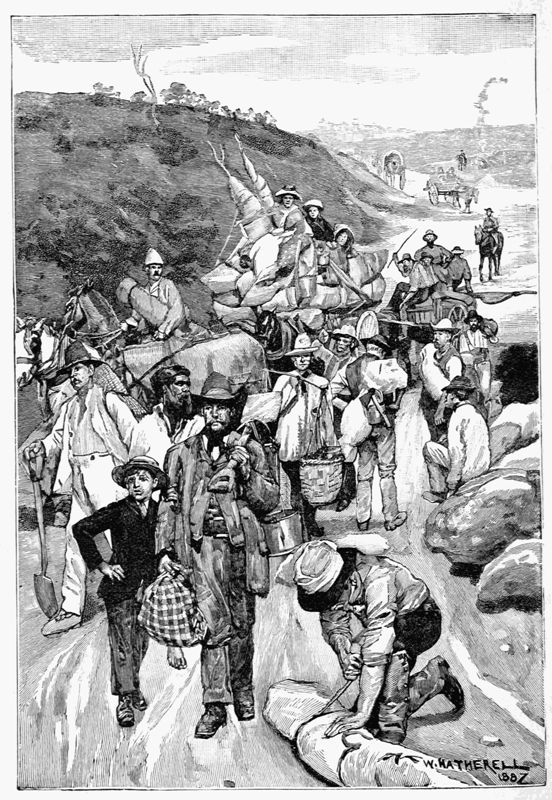
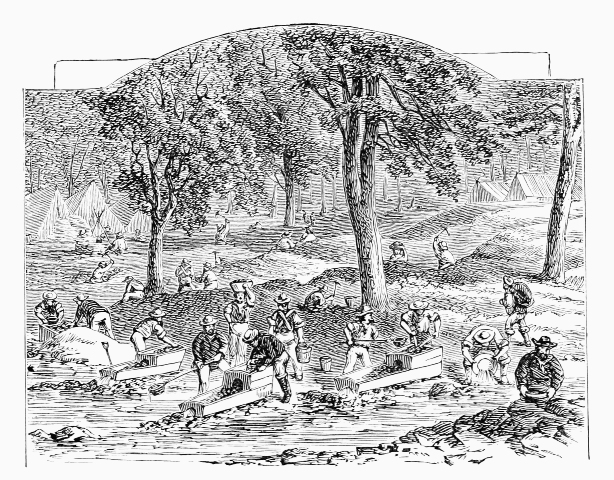
The Rush for the Gold-fields.
the Romance of Industry and Invention — ROBERT COCHRANE — PHILADELPHIA J. B. LIPPINCOTT COMPANY 1897
SELECTED BY
EDITOR OF
'GREAT THINKERS AND WORKERS,' 'BENEFICENT AND USEFUL LIVES,' 'ADVENTURE
AND ADVENTURERS,' 'RECENT TRAVEL AND ADVENTURE,' 'GOOD
AND GREAT WOMEN,' 'HEROIC LIVES,' &C.
Edinburgh:
Printed by W. & R. Chambers, Limited.
PREFACE. — LIST OF ILLUSTRATIONS.
Our national industries lie at the root of national progress.
The first Napoleon taunted us with being a nation
of shopkeepers; that, however, is now less true than that
we are a nation of manufacturers—coal, iron, and steel,
and our textile industries, taken along with our enormous
carrying-trade, forming the backbone of the wealth of the
country.
A romantic interest belongs to the rise and progress of
most of our industries. Very often this lies in the career
of the inventor, who struggled towards the perfection and
recognition of his invention against heavy difficulties and
discouragements; or it may lie in the interesting
processes of manufacture. Every fresh labourer in the
field adds some link to the chain of progress, and brings
it nearer perfection. Some of the small beginnings have
increased in a marvellous way. Such are chronicled under
Bessemer and Siemens, who have vastly increased the
possibilities of the steel industry; in the sections devoted
to Krupp, of Essen; Sir W.G. Armstrong, of the Elswick
Works, where 18,000 men are now employed alone in the
arsenal; Maxim, of Maxim Gun fame; the rise and progress
of the cycle industry; that of the gold and diamond
mining industry; and the carrying-trade of the world.
Many of the chapters in this book have been selected
from a wealth of such material contributed from time to
time to the pages of Chambers's Journal, but additions and
fresh material have been added where necessary.
Wool.—What is Wool?—Chemical Composition—Fibre—Antiquity
of Shepherd Life—Varieties of Sheep—Introduction
into Australia—Spanish Merino—Wool Wealth of Australia—Imports
and Exports of Wool and Woollen Produce—Woollen
Manufacture
Cotton.—Cotton Plant in the East—Mandeville's Fables
about Cotton—Cotton in Persia, Arabia, and Egypt—Columbus
finds Cotton-yarn and Thread in 1492—In Africa—Manufacture
of Cloth in England—The American Cotton Plant
Gold.—How widely distributed—Alluvial Gold-mining—Vein
Gold-mining—Nuggets—Treatment of Ore and Gold in the
Transvaal—Story of South African Gold-fields—Gold-production
of the World—Johannesburg the Golden City—Coolgardie Gold-fields—Bayley's
discovery of Gold there
Woolwich Arsenal—Enfield Small-arms Factory—Lord Armstrong
and the Elswick Works—Testing Guns at Shoeburyness—Hiram
S. Maxim and the Maxim Machine Gun—The Colt
Automatic Gun—Ironclads—Submarine Boats
Early Shipping—Mediterranean Trade—Rise of the P. and O.
and other Lines—Transatlantic Lines—India and the East—Early
Steamships—First Steamer to cross the Atlantic—Rise of
Atlantic Shipping Lines—The Great Eastern and the New
Cunarders Campania and Lucania compared—Sailing-ships
Rowland Hill and Penny Postage—A Visit to the Post-office—The
Post-office on Wheels—Early Telegraphs—Wheatstone
and Morse—The State and the Telegraphs—Atlantic Cables—Telephones—Edison
and the Phonograph
CHAPTER I. IRON AND STEEL. — BESSEMER STEEL. — SIR HENRY BESSEMER. — SIR CHARLES WILLIAM SIEMENS AND THE SIEMENS PROCESS. — KRUPP'S IRON AND STEEL WORKS AT ESSEN.
Pioneers of the Iron and Steel Industry—Sir Henry Bessemer—Sir
William Siemens—Werner von Siemens—The Krupps of Essen.
rancis Horner, writing early in this
century, said that 'Iron is not only the soul
of every other manufacture, but the mainspring
perhaps of civilised society.' Cobden
has said that 'our wealth, commerce, and
manufactures grew out of the skilled labour of men working
in metals.' According to Carlyle, the epic of the
future is not to be Arms and the Man, but Tools and the
Man. We all know that iron was mined and smelted in
considerable quantities in this island as far back as the
time of the Romans; and we cherish a vague notion that
iron must have been mined and smelted here ever since
on a progressively increasing scale. We are so accustomed
to think and speak of ourselves as first among all
nations, at the smelting-furnace, in the smithy, and amid
the Titanic labours of the mechanical workshop, that we
open large eyes when we are told what a recent conquest
all this superiority is!
There was, indeed, some centuries later than the Roman
occupation, a period coming down to quite modern times,
during which English iron-mines were left almost unworked.
In Edward III.'s reign, the pots, spits, and frying-pans of
the royal kitchen were classed among his majesty's jewels.
For the planners of the Armada the greater abundance
and excellence of Spanish iron compared with English
was an important element in their calculations of success.
In the fourteenth and fifteenth centuries, the home market
looked to Spain and Germany for its supply both of iron
and steel. After that, Sweden came prominently forward;
and from her, as late as the middle of the eighteenth
century, no less than four-fifths of the iron used in this
country was imported!
The reason of this marvellous neglect of what has since
proved one of our main sources of wealth lay in the
enormous consumption of timber which the old smelting
processes entailed. The charcoal used in producing a
single ton of pig-iron represented four loads of wood,
and that required for a ton of bar-iron represented seven
loads. Of course, the neighbourhood of a forest was an
essential condition to the establishment of ironworks; but
wherever such an establishment was effected, the forest
disappeared with portentous rapidity. At Lamberhurst,
on the borders of Kent and Sussex, with so trifling a produce
as five tons per week, the annual consumption of
wood was two hundred thousand cords. The timber
wealth of Kent, Surrey, and Sussex—which counties were
then the centres of our iron industry—seemed menaced
with speedy annihilation. In the destruction of these
great forests, that of our maritime power was supposed to
be intimately involved; so that it is easy to understand
how, in those days, the development of the iron manufacture
came to be regarded in the light of a national calamity,
and a fitting subject for restrictive legislation! Various
Acts were passed towards the end of the sixteenth century
prohibiting smelting-furnaces within twenty-two miles of
London, and many of the Sussex masters found themselves
compelled, in consequence, to break up their works.
During the civil wars of the seventeenth century, a severe
blow was given to the trade by the destruction of all
furnaces belonging to royalists; and after the Restoration
we find the crown itself demolishing its own works in the
Forest of Dean, on the old plea that the supply of shipbuilding
timber was thereby imperilled. Between 1720
and 1730 the ironworks of Worcestershire and the Forest
of Dean consumed 17,350 tons of timber annually, or five
tons for each furnace.
'From this time' (the Restoration), says Mr Smiles, 'the
iron manufacture of Sussex, as of England generally, rapidly
declined. In 1740 there were only fifty-nine furnaces in
all England, of which ten were in Sussex; and in 1788
there were only two. A few years later, and the Sussex
iron-furnaces were blown out altogether. Farnhurst in
Western, and Ashburnham in Eastern Sussex, witnessed
the total extinction of the manufacture. The din of the
iron hammer was hushed, the glare of the furnace faded,
the last blast of the bellows was blown, and the district
returned to its original rural solitude. Some of the
furnace-ponds were drained and planted with hops or
willows; others formed beautiful lakes in retired pleasure-grounds;
while the remainder were used to drive flour-mills,
as the streams in North Kent, instead of driving
fulling-mills, were employed to work paper-mills.' The
plentifulness of timber in the Scottish Highlands explains
the establishment of smelting-furnaces, in 1753, by an
English company at Bunawe in Argyllshire, whither the
iron was brought from Furness in Lancashire.
Few of our readers can be unacquainted with the fact
that iron-smelting at the present day is performed not
with wood but with coal. It will readily, then, be understood
that the substitution of the one description of fuel
for the other must have formed the turning-point in the
history of the British iron manufacture. This substitution,
however, was brought about very slowly. The prejudice
against coal was for a long period extreme; its use for
domestic purposes was pronounced detrimental to health;
and, even for purposes of manufacture, it was generally
condemned. Nevertheless, as wood became scarcer and
dearer, a closer examination into the capabilities of coal
came naturally to be made; and here, as in almost every
other industrial path, we find a foreigner acting as our
pioneer. The Germans had long been experienced in
mining and metallurgy; and it was a German, Simon
Sturtevant, who first took out a patent for smelting
iron with coal. But his process proved a failure, and
the patent was cancelled. Other Germans, naturalised
here, followed in Sturtevant's footsteps, but with no better
results; until at last an Englishman, Dud Dudley (1599-1684),
took up the idea, and gave it practical success.
The town of Dudley was even then a centre of the iron
manufacture, and Dud's noble father, Lord Dudley, owned
several furnaces. But here, also, the forest-wealth of the
district was fast melting away, and the trade already
languished under the dread of impending dissolution.
In the immediate neighbourhood, meanwhile, coal was
abundant, with ironstone and limestone in close proximity
to it. Dud, who, as a child, had haunted and scrutinised
his father's ironworks with wondering delight, was placed
just at this juncture in charge of a furnace and a couple of
forges, and immediately turned his energetic mind to
the question of smelting with coal. Some careful experiments
succeeded so well that he wrote to his father,
requesting him to take out a patent for the process;
and this patent, registered in Lord Dudley's name,
and dated the 22d February 1620, properly inaugurated
the great metallurgic revolution which had made the
English iron trade what it now is. Andrew Yarranton
was another pioneer in the iron and tin-plate industry, and
wrote a remarkable work on England's Improvement by
Sea and Land (1677-81).
Nevertheless, even with this positive success on record,
the inert insular mind long refused to follow the path
cleared for it. Dud's discovery 'was neither appreciated
by the iron-masters nor by the workmen;' and all schemes
for smelting ore with any other fuel than wood-charcoal
were regarded with incredulity. His secret seems to
have been bequeathed to no one, and for many years
after his death the old, much-abused, forest-devouring
system went tottering on. Stern necessity, however,
taught its hard lesson at last, and a period insensibly
arrived when the employment of coal in smelting processes
became the rule rather than the exception, and
might be seen here and there on an unusually large
scale—especially at the celebrated Coalbrookdale works,
in the valley of the Severn, Shropshire.
The founder of the Coalbrookdale industries was a
Quaker—Abraham Darby (1677-1717). A small furnace
had existed on the spot ever since the days of the Tudors,
and this small furnace formed the nucleus of that
industrial activity which the visitor of Coalbrookdale
surveys with such wonder at the present day.
In Darby's time, the principal cooking utensils of
the poorer classes were pots and kettles made of cast-iron.
But even this primitive ware was beyond native
skill, and most of the utensils in question were imported
from Holland. Exercising an effort of judgment, which,
moderate as it was, seems to have been hitherto unexampled,
Darby resolved to pay that country a visit,
and ascertain in person why it was that Dutch castings
were so good and English so bad. The use of dry
sand instead of clay for the moulds comprised, he found,
the whole secret.
On returning to England, Darby took out a patent
for the new process, and his castings soon acquired
repute. The use of pit-coal in the Coalbrookdale furnaces
is not supposed, however, to have become general until
the worthy Abraham had been succeeded by his son;
but when it once did become so, the impetus thereby
given to the iron trade and to coal-mining was immense.
It is the latter industry which may pre-eminently claim
to have called the steam-engine into existence. The
demand for pumping-power adequate to the drainage
of deep mines set Newcomen's brain to work; and
the engine rough-sketched by his ingenuity, and perfected
by the genius of Watt, soon increased enormously the
production of iron by rendering coal more accessible
and the blast-furnace more efficient.
A son-in-law of Abraham Darby's, Richard Reynolds by
name, made a great stride towards the modern railway
by substituting iron for wood on the tramways which
connected the different works at Coalbrookdale; and
it was a grandson of the same Abraham who designed
and erected the first iron bridge.
England, we have seen, borrowed the idea of her
smelting processes and iron-castings from Germany and
Holland; but the discovery of that important material,
cast-steel, belongs, at least, to one of her own sons. Yet
even here the relationship is a merely conventional one,
for Benjamin Huntsman (1704-1776) was the child of
German parents who had settled in Lincolnshire.
Huntsman's original calling was that of a clock-maker;
but his remarkable mechanical skill, his shrewdness, and
his practical sense, soon gave him the repute of the
'wise man' of the district, and brought neighbours to
consult him not only as to the repair of every ordinary
sort of machinery, but also of the human frame—the
most complex of all machines! It was his daily experience
of the inferior quality of the tools at his command
that led him to make experiments in the manufacture of
steel. What his experiments were we have no record
to show; but that they must have been conducted with
Teutonic patience and thoroughness there can be no doubt,
from the formidable nature of the difficulties overcome.
England, however, long refused to make use of Huntsman's
precious material, although produced in her very
midst. The Sheffield cutlers would have nothing to do
with a substance so much harder than anything they
were accustomed to, and Huntsman was actually compelled
to look for his market abroad! All the cast-steel
he could manufacture was sent over to France, and the
merit of employing this material for general purposes
belongs originally to that country. The inventions of
Henry Cort (1740-1800) for refining and rolling iron
(1785) were the mainspring of the malleable iron trade,
and made Great Britain independent of Russia and Sweden
for supplies of manufactured iron. One authority has
stated that since 1790, when Cort's improvements were
entirely established, the value of landed property in
England had doubled. But he was unfortunate in business
life, and in 1811 upwards of forty iron firms subscribed
towards a fund for the assistance of his widow and nine
orphan children. David Mushet (1772-1847) did much
for the expansion of the iron trade in Scotland by his
preparation of steel from bar-iron by a direct process,
combining the iron with carbon, and by his discovery of
the effect of manganese on steel.
Steel is the material of which the instruments of labour
are essentially made. Upon the quality of the material,
that of the instrument naturally depends, and upon the
quality of the instrument, that, in great measure, of the
work. Watt's marvellous invention ran great risk, at one
time, of being abandoned, for the simple reason that the
mechanical capacities of the age were not 'up' to its
embodiment. Even after Watt had secured the aid of
Boulton's best workmen, Smeaton gave it as his opinion
that the steam-engine could never be brought into general
use, because of the difficulty of getting its various parts
made with the requisite precision.
The execution by machinery of work ordinarily executed
by hand-tools has been a gigantic stride in the path of
material civilisation. The earliest phase of the great
modern movement in this direction is represented, probably,
by the sawmill. A sawmill was erected near
London as long ago as 1663—by a foreigner—but was
shortly abandoned in consequence of the determined
hostility of the sawyers; and more than a century elapsed
before another mill was put up. But the sawmill is
comparatively a rude structure, and the material it
operates upon is easily treated, even by the hand.
When we come to deal, however, with such substances
as iron and steel, the benefit of machinery becomes
incalculable. Without our recent machine-tools, indeed,
the stupendous iron creations of the present day would
have been impossible at any cost; for no amount of
hand-labour could ever attain that perfect exactitude of
construction without which it would be idle to attempt
fitting the component parts of these colossal structures
together.
The first impulse, however, to the improvement of
machine-tools for ironwork was given by a difficulty
born not of mass but of minuteness.
Up to the end of the last century, the locks in common
use among us were of the rudest description, and afforded
scarcely any security against thieves. To meet this universal
want, Joseph Bramah set his remarkable inventive
faculties to work, and speedily contrived a lock so perfect,
that it held its ground for many a day. But Bramah's
locks are machines of the most delicate kind, depending
for their efficiency upon the precision with which their
component parts are finished; and, at that time, the attainment
of this precision, at such a price as to render the lock
an article of extensive commerce, seemed an insuperable
difficulty. In his dilemma, Bramah's attention was directed
to a youngster in the Woolwich Arsenal smithy, named
Henry Maudsley, whose reputation for ingenuity was
already great among his fellows. Bramah was at first almost
ashamed to take such a mere lad into his counsels;
but a preliminary conversation convinced him that his
confidence would not be misplaced. He persuaded
Maudsley to enter his employment, and the result was
the invention, between them, of the planing-machine,
applicable either to wood or metal, as also of certain
improvements in the old lathe, more particularly of that
known as the 'slide-rest.'
In the old-fashioned lathe, the workman guided his
cutting-tool by sheer muscular strength, and the slightest
variation in the pressure necessarily led to an irregularity
of surface. The rest for the hand is in this case fixed,
and the tool held by the workman travels along it. Now,
the principle of the slide-rest is the opposite of this. The
rest itself holds the tool firmly fixed in it, and slides along
the bench in a direction parallel with the axis of the work.
All that the workman has to do, therefore, is to turn a
screw-handle, by means of which the cutter is carried
along with the smallest possible expenditure of strength;
and even this trifling labour has been since got rid of, by
making the rest self-acting.
Simple and obvious as this improvement seems, its
importance cannot be overrated. The accuracy it insured
was precisely the desideratum of the day! By means of
the slide-rest, the most delicate as well as the most
ponderous pieces of machinery can be turned with
mathematical precision; and from this invention must
date that extraordinary development of mechanical power
and production which is a characteristic of the age we live
in. 'Without the aid of the vast accession to our power
of producing perfect mechanism which it at once supplied,'
says a first-class judge in matters of the kind, 'we could
never have worked out into practical and profitable forms
the conceptions of those master-minds who, during the
past half-century, have so successfully pioneered the way
for mankind. The steam-engine itself, which supplies us
with such unbounded power, owes its present perfection
to this most admirable means of giving to metallic objects
the most precise and perfect geometrical forms. How
could we, for instance, have good steam-engines if we
had not the means of boring out a true cylinder, or
turning a true piston-rod, or planing a valve-face?'
It would perhaps be impossible to cite any more
authoritative estimate of Maudsley's invention than the
above. The words placed between inverted commas are
the words of James Nasmyth, the inventor of that wonderful
steam-hammer which Professor Tomlinson characterises
as 'one of the most perfect of artificial machines and
noblest triumphs of mind over matter that modern English
engineers have yet developed.'
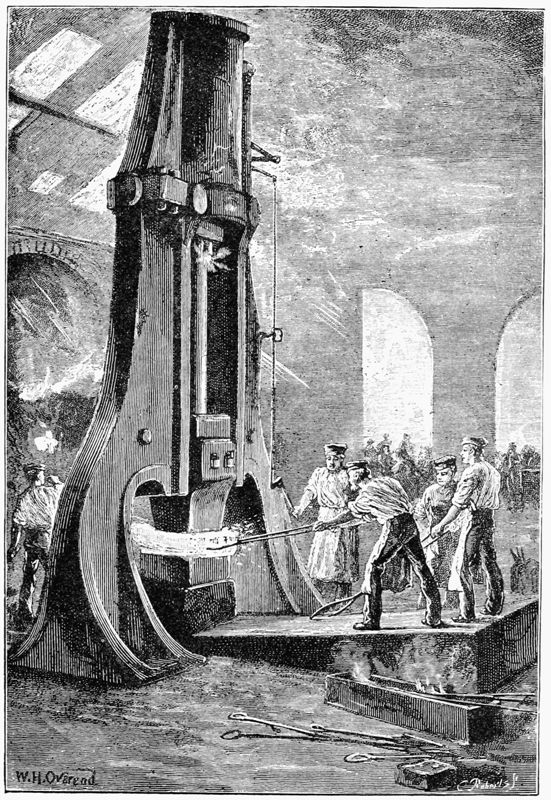
Nasmyth's Steam-hammer.
This machine enlarged at one bound the whole scale
of working in iron, and permitted Maudsley's lathe to
develop its entire range of capacity. The old 'tilt-hammer'
was so constructed that the more voluminous
the material submitted to it, the less was the power attainable;
so that as soon as certain dimensions had been
exceeded, the hammer became utterly useless. When the
Great Western steamship was in course of construction,
tenders were invited from the leading mechanical firms for
the supply of the enormous paddle-shaft required for her
engines. But a forging of the size in question had never
been executed, and no firm in England would undertake
the contract. In this dilemma, Mr Nasmyth was applied
to, and the result of his study of the problem was this
marvellous steam-hammer—so powerful that it will forge
an Armstrong hundred-pounder as easily as a farrier forges
a horse-shoe, and so delicately manageable that it will crack
a nut without bruising its kernel!
In 1722, Réaumur produced steel by melting three parts
of cast-iron with one part of wrought iron (probably in a
crucible) in a common forge; he, however, failed to produce
steel in this manner on a working scale. This
process has many points in common with the Indian
Wootz-steel manufacture.
As we have seen, to Benjamin Huntsman, a Doncaster
artisan, belongs the credit of first producing cast-steel
upon a working scale, as he was the first to accomplish
the entire fusion of converted bar-iron (that is, blister-steel)
of the required degree of hardness, in crucibles or clay
pots, placed among the coke of an air-furnace. This
process is still carried on at Sheffield and elsewhere, and
is what is generally known as the crucible or pot-steel
process. It was mainly supplementary to the cementation
process, as formerly blister-steel was alone melted in the
crucibles; but latterly, and at the present time, the
crucible mode of manufacture embraces the fusion of
other varieties and combinations of metal, producing
accordingly different classes and qualities of steel.
In 1839, Josiah Marshall Heath patented the important
application of carburet of manganese to steel in the
crucible, which application imparted to the resulting
product the properties of varying temper and increased
forgeability. He subsequently found out that a separate
operation was not necessary to form the carburet—which
is produced by heating peroxide of manganese and carbon
to a high temperature—but that the same result could be
attained by simply in the first instance adding the carbon
and oxide of manganese direct to the metal in the crucible.
He unsuspectingly communicated this after-discovery to
his agent—by name Unwin—who took advantage of the
fact that it was not incorporated in the wording of the
patent, and so was unprotected, to make use of it for
his own advantage. The result was one of the most
remarkable patent trials on record, extending over twelve
years, and terminating in 1855 against the patentee—a
remarkable instance of the triumph of legal technicalities
over the moral sense of right.
A very important development of the manufacture of
steel followed the introduction of the 'Bessemer process,'
by means of which a low carbon or mild cast-steel can be
produced at about one-tenth of the cost of crucible steel.
It is used for rails, for the tires of the wheels of railway
carriages, for ship-plates, boiler-plates, for shafting, and a
multitude of constructional and other purposes to which
only wrought iron was formerly applied, besides many for
which no metal at all was used.
Sir Henry Bessemer's process for making steel, which
is now so largely practised in England, on the continent
of Europe, and in America, was patented in 1856. It was
first applied to the making of malleable iron, but this has
never been successfully made by the Bessemer method.
For the manufacture of a cheap but highly serviceable
steel, however, its success has been so splendid that no
other metallurgical process has given its inventor so great
a renown. Although the apparatus actually used is somewhat
costly and elaborate, yet the principle of the operation
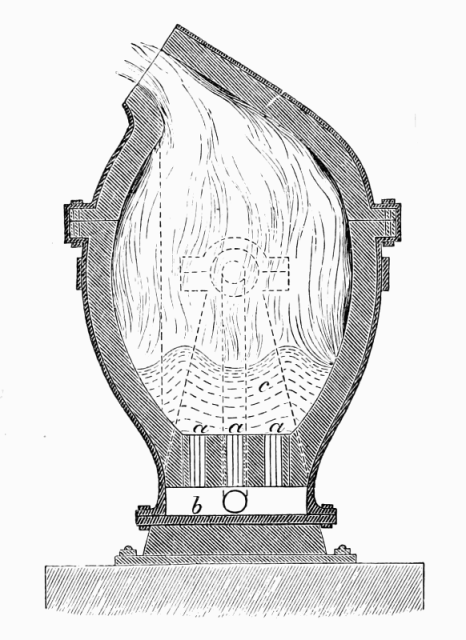
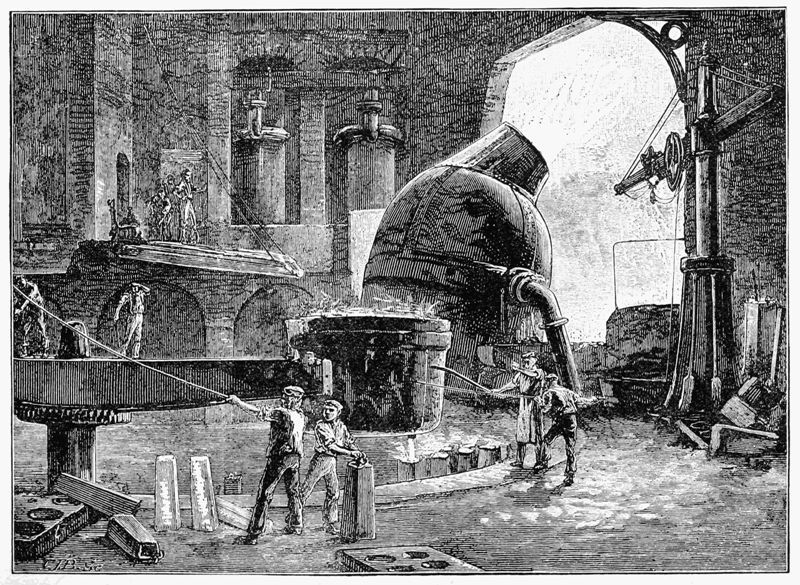
is very simple. A large converting vessel, with
openings called tuyères in its bottom, is partially filled up
with from 5 to 10 tons of molten pig-iron, and a blast of
air, at a pressure of from 18 to 20 lb. per square inch, is
forced through this metal by a blowing engine. Pig-iron
contains from 3 to 5 per cent. of carbon, and, if it has
been smelted with charcoal from a pure ore, as is the
case with Swedish iron, the blast is continued till only
from .25 to 1 per cent. of the carbon is left in the metal,
that is to say, steel is produced. Sometimes, however,
the minimum quantity of carbon is even less than .25 per
cent. In England, where a less pure but still expensive
cast-iron—viz. hæmatite pig—is used for the production
of steel in the ordinary Bessemer converter, the process
differs slightly. In this case the whole of the carbon
is oxidised by the blast of air, and the requisite quantity
of this element is afterwards restored to the metal by
pouring into the converter a small quantity of a peculiar
kind of cast-iron, called spiegeleisen, which contains a
known quantity of carbon. But small quantities of manganese
and silicon are also present in Bessemer steel.
The 'blow' lasts from 20 to 30 minutes. Steel made
from whatever kind of pig-iron, either by this or by the
'basic' process, is not sufficiently dense, at least for most
purposes, and it is accordingly manipulated under the
steam-hammer and rolled into a variety of forms. Bessemer
steel is employed, as we have said, for heavy
objects, as rails, tires, rollers, boiler-plates, ship-plates,
and for many other purposes for which malleable iron
was formerly used.
Basic steel is now largely made from inferior pig-iron,
such as the Cleveland, by the Thomas-Gilchrist process
patented in 1878. It is, however, only a modification
of the Bessemer process to the extent of substituting for
the siliceous or 'acid' lining generally used, a lime or
'basic' lining for the converter. Limestone, preferably
a magnesian limestone in some form, is commonly
employed for the lining. By the use of a basic lining,
phosphorus is eliminated towards the end of the 'blow.'
Phosphorus is a very deleterious substance in steel, and
is present, sometimes to the extent of 2 per cent., in pig-iron
smelted from impure ore.
The four inventions of this century which have given the
greatest impetus to the manufacture of iron and steel were—the
introduction of the hot blast into the blast-furnace
for the production of crude iron, made by J. B. Neilson, of
the Glasgow Gas-works, in 1827; the application of the
cold blast in the Bessemer converter which we have just
described; the production of steel direct from the ore, by
Siemens, in the open hearth; and the discovery of a basic
lining by which phosphorus is eliminated and all kinds of
iron converted into steel. This last was the discovery of
G. J. Snelus, of London, and it was made a practical
success by the Thomas & Gilchrist process just described.
In 1883, Mr Snelus was awarded the Bessemer gold medal
of the Iron and Steel Institute 'as the first man who made
pure steel from impure iron in a Bessemer converter lined
with basic materials.'
Sir Henry Bessemer, the inventor of the modern
process of making steel from iron, which has just
been described, was the son of Anthony Bessemer,
who escaped from France in 1792, and found employment
in the English Mint. He was born in 1813,
at Charlton, Herts, where his father had an estate, was
to a great extent self-taught, and his favourite amusement
was in modelling buildings and other objects in clay.
He came up to London 'knowing no one, and no one
knowing me—a mere cipher in this vast sea of enterprise.'
He first earned his living by engraving a large number
of elegant and original designs on steel with a diamond
point, for patent medicine labels. He found work also
as designer and modeller. He has been a prolific inventor,
as the volumes issued by the Patent Office show.
It has been said that he has paid in patent stamp duties
alone as much as £10,000. At twenty he invented a
mode of taking copies from antique and modern basso-relievos
in such a way that they might be stamped on
card-board, thousands being produced at a small cost.
His inventive faculty also devised a ready method
whereby those who were defrauding the government by
detaching old stamps from leases, money-bills, and agreements,
and by using them over again, could be defeated
in their purpose.
His first pecuniary success was obtained by his invention
of machinery for the manufacture of Bessemer gold and
bronze powders, which was not patented, but the nature
of which was long kept secret. Another successful invention
was a machine for making Utrecht velvet. He also
interested himself in the manufacture of paints, oils, and
varnishes, sugar, railway carriages, ordnance, projectiles,
and the ventilation of mines. In the Exhibition of 1851
he exhibited an ingenious machine for grinding and
polishing plate-glass.
Like Lord Armstrong, Bessemer turned his attention
to the subject of the improvement of projectiles when
there was a prospect of a European war in 1853. He
invented a mode of firing elongated projectiles from
smooth-bore guns, but received no countenance from
the officials at Woolwich.
Commander Minié, who had charge of the experiments
which Bessemer was making on behalf of the Emperor of
the French, said: 'Yes, the shots rotate properly; but if we
cannot get something stronger for our guns, these heavy
projectiles will be of little use.' This started Bessemer
thinking and experimenting further, and led up, as we will
see, to the great industrial revolution with which his name
stands identified. He informed the Emperor that he
intended to study the whole subject of metals suitable for
artillery purposes. He built experimental works at St
Pancras, but made many failures, furnace after furnace
being pulled down and rebuilt. His prolonged and expensive
experiments in getting a suitable ordnance metal were
meanwhile using up his capital; but he was on the eve of
a great discovery, and began to see that the refinement of
iron might go on until pure malleable iron or steel could
be obtained. His wife aided and encouraged him at this
time as only a true wife can. After a year and a half, in
which he patented many improvements in the existing
systems of manufacture, it occurred to him to introduce a
blast of atmospheric air into the fluid metal, whereby the
cast-iron might be made malleable. He found that by
blowing air through crude iron in a fluid state, it could
thus be rendered malleable. He next tried the method of
having the air blown from below by means of an air-engine.
Molten iron being poured into the vessel, and
air being forced in from below, resulted in a surprising
combustion, and the iron in the vessel was transformed
into steel. The introduction of oxygen through the fluid
iron, induced a higher heat, and burned up the impurities.
Feeling that he had succeeded in his experiment, he
acquainted Mr George Rennie with the result. The
latter said to him: 'This must not be hid under a bushel.
The British Association meets next week at Cheltenham;
if you have patented your invention, draw up an account
of it in a paper, and have it read in Section G.' Accordingly
Bessemer wrote an account of his process, and in
August 1856, he read his paper before the British Association
'On the Manufacture of Malleable Iron and
Steel without Fuel,' which startled the iron trade of the
country.
On the morning of the day on which his paper was to
be read, Bessemer was sitting at breakfast in his hotel,
when an iron-master to whom he was unknown, laughingly
said to a friend: 'Do you know that there is somebody
come down from London to read us a paper on making
steel from cast-iron without fuel? Did you ever hear of
such nonsense?'
Amongst those who spoke generously and enthusiastically
of Bessemer's new process was James Nasmyth, to
whom the inventor offered one-third share of the value
of the patent, which would have been another fortune to
him. Nasmyth had made money enough by this time,
however, and declined.
In a communication to Nasmyth, Sir Henry Bessemer
thanked him for his early patronage, and described
his discovery: 'I shall ever feel grateful for the
noble way in which you spoke at the meeting at
Cheltenham of my invention. If I remember rightly,
you held up a piece of malleable iron, saying words
to this effect: "Here is a true British nugget! Here
is a new process that promises to put an end to all
puddling; and I may mention that at this moment there
are puddling-furnaces in successful operation where my
patent hollow steam-rabbler is at work, producing iron of
superior quality by the introduction of jets of steam in
the puddling process. I do not, however, lay any claim
to this invention of Mr Bessemer; but I may fairly be
entitled to say that I have advanced along the roads on
which he has travelled so many miles, and has effected
such unexpected results, that I do not hesitate to say that
I may go home from this meeting and tear up my patent,
for my process of puddling is assuredly superseded."'
After giving an account of his failures, as well as
successes, Sir Henry proceeded to say: 'I prepared to
try another experiment, in a crucible having no hole in
the bottom, but which was provided with an iron pipe put
through a hole in the cover, and passing down nearly to
the bottom of the crucible. The small lumps and grains
of iron were packed round it, so as nearly to fill the
crucible. A blast of air was to be forced down the pipe
so as to rise up among the pieces of granular iron, and
partly decarburise them. The pipe could then be withdrawn,
and the fire urged until the metal with its coat of
oxide was fused, and cast-steel thereby produced.
'While the blowing apparatus for this experiment was
being fitted up, I was taken with one of those short but
painful illnesses to which I was subject at that time. I
was confined to my bed, and it was then that my mind,
dwelling for hours together on the experiment about to be
made, suggested that instead of trying to decarburise the
granulated metal by forcing the air down the vertical
pipe among the pieces of iron, the air would act much
more energetically and more rapidly if I first melted the
iron in the crucible, and forced the air down the pipe below
the surface of the fluid metal, and thus burnt out the carbon
and silicum which it contained.
'This appeared so feasible, and in every way so great
an improvement, that the experiment on the granular
pieces was at once abandoned, and as soon as I was
well enough, I proceeded to try the experiment of forcing
the air under the fluid metal. The result was marvellous.
Complete decarburation was effected in half an hour.
The heat produced was immense, but unfortunately more
than half the metal was blown out of the pot. This led
to the use of pots with large, hollow, perforated covers,
which effectually prevented the loss of metal. These
experiments continued from January to October 1855.
I have by me on the mantelpiece at this moment, a small
piece of rolled bar-iron which was rolled at Woolwich
Arsenal, and exhibited a year later at Cheltenham.
Bessemer Converting Vessel: a, a, a, tuyères; b, air-space; c, melted metal.
'I then applied for a patent, but before preparing my
provisional specification (dated October 17, 1855), I
searched for other patents to ascertain whether anything
of the sort had been done before. I then found your
patent for puddling with the steam-rabble, and also
Martin's patent for the use of steam in gutters while
molten iron was being conveyed from the blast-furnace
to a finery, there to be refined in the ordinary way prior
to puddling.'
Several leading men in the iron trade took licenses for
the new manufacture, which brought Bessemer £27,000
within thirty days of the time of reading his paper. These
licenses he afterwards bought back for £31,000, giving
fresh ones in their stead. Some of the early experiments
failed, and it was feared the new method would prove
impracticable. These experiments failed because of the
presence of phosphorus in the iron. But Bessemer
worked steadily in order to remove the difficulties which
had arisen, and a chemical laboratory was added to his
establishment, with a professor of chemistry attached.
Success awaited him. The new method of steel-making
spread into France and Sweden, and in 1879 the works for
making Bessemer steel were eighty-four in number, and
represented a capital of more than three millions. His
process for the manufacture of steel raised the annual
production of steel in England from 50,000 tons by the
older processes to as many as 2,000,000 tons in some
years. It was next used for boiler-plates; shipbuilding
with Bessemer steel was begun in 1862, and now it is
employed for most of the purposes for which malleable
iron was formerly used. The production of Europe and
America in 1892 was over 10,000,000 tons, of a probable
value of £84,000,000, sufficient, as has been remarked, to
make a solid steel wall round London 40 feet high, and
5 feet thick. It would take, according to the inventor,
two or three years' production of all the gold-mines
in the world to pay in gold for the output of Bessemer
steel for one year. The price of steel previous to Huntsman's
process was about £10,000 per ton; after him,
from £50 to £100. Now Bessemer leaves it at £5 to
£6 per ton. And a process which occupied ten days can
be accomplished within half an hour.
Bessemer Process.
In his sketch of the 'Bessemer Steel Industry, Past and
Present' (1894), Sir Henry Bessemer says: 'It is this
new material, so much stronger and tougher than common
iron, that now builds our ships of war and our mercantile
marine. Steel forms their boilers, their propeller shafts,
their hulls, their masts and spars, their standing rigging,
their cable chains and anchors, and also their guns
and armour-plating. This new material has covered with
a network of steel rails the surface of every country in
Europe, and in America alone there are no less than
175,000 miles of Bessemer steel rails.' These steel rails
last six times longer than if laid of iron.
Bessemer was knighted in 1879, and has received many
gold medals from scientific institutions. In addition he
has, to use his own words, received in the form of
royalties 1,057,748 of the beautiful little gold medals
(sovereigns) issued by her Majesty's Mint. The method
chosen by the Americans to perpetuate his name has been
the founding of the growing centre of industry called
Bessemer in Indiana, while Bessemer, in Pennsylvania,
is the seat of the great Edgar Thompson steel-works.
Thus the man who was at first neglected by government
has become wealthy beyond the dreams of avarice, and
his name is immortal in the annals of our manufacturing
industry.
Another pioneer in the manufacture of steel and
iron was Charles William Siemens, the seventh child
of a German landowner, who was born at Lenthe, near
Hanover, 4th April 1823. He showed an affectionate
and sensitive disposition while very young, and a strong
faculty of observation. He received a good plain education
at Lübeck, and in deference to his brother Werner he
agreed to become an engineer, and accordingly was sent
to an industrial school at Magdeburg in 1838, where he
also learned languages, including English; mathematics
he learned from his interested brother. He left Magdeburg
in 1841 in order to increase his scientific knowledge
at Göttingen, and there he studied chemistry and physics,
with the view of becoming an engineer. Werner, his elder
brother, was still his good genius, and after the death of
their parents counselled and encouraged him, and looked
upon him as a probable future colleague. They corresponded
with one another, not only about family affairs,
but also about the scientific and technical subjects in
which both were engrossed. This became a life-long
habit with the brothers Siemens. One early letter from
William described a new kind of valve-gearing which he
had invented for Cornish steam-engines. Then the germ
of the idea of what was afterwards known as the 'chronometric
governor' for steam-engines was likewise communicated
in this way. Mr Pole says that his early
letters were significant of the talent and capacity of the
writer. 'They evince an acuteness of perception in
mechanical matters, a power of close and correct reasoning,
a sound judgment, a fertility of invention, and an ease
and accuracy of expression which, in a youth of nineteen,
who had only a few months' experience in a workshop, are
extraordinary, and undoubtedly shadow forth the brilliant
future he attained in the engineering world.'
Werner in 1841 had taken out a patent for his method
of electro-gilding, while William early in 1843 paid his
first visit to England, travelling by way of Hamburg. He
took up his abode in a little inn called the 'Ship and
Star,' at Sparrow Corner, near the Minories. In an address
as President of the Midland Institute, Birmingham, on 28th
October 1881, he related his first experiences in England,
and how he secured his first success there.
Mr Siemens said: 'That form of energy known as the
electric current was nothing more than the philosopher's
delight forty years ago; its first application may be traced
to this good town of Birmingham, where Mr George
Richards Elkington, utilising the discoveries of Davy,
Faraday, and Jacobi, had established a practical process
of electroplating in 1842.... Although I was only a
young student of Göttingen, under twenty years of age,
who had just entered upon his practical career with a
mechanical engineer, I joined my brother Werner Siemens,
then a young lieutenant of artillery in the Prussian service,
in his endeavour to accomplish electro-gilding.... I tore
myself away from the narrow circumstances surrounding
me, and landed at the East End of London, with only a
few pounds in my pocket and without friends, but an
ardent confidence of ultimate success within my breast.
'I expected to find some office in which inventions
were examined into, and rewarded if found meritorious,
but no one could direct me to such a place. In walking
along Finsbury Pavement I saw written up in large letters,
"So-and-So"—I forget the name—"undertaker," and the
thought struck me that this must be the place I was in
quest of; at any rate, I thought that a person advertising
himself as an "undertaker" would not refuse to look into
my invention, with the view of obtaining for me the sought
for recognition or reward. On entering the place I soon
convinced myself, however, that I came decidedly too soon
for the kind of enterprise there contemplated.' By dint of
perseverance, however, Siemens secured a letter from
Messrs Poole and Carpmaell, of the Patent Office, to Mr
Elkington of Birmingham. Elkington and his partner
Josiah Mason both met the young inventor in such a spirit
of fairness that, as he says, he returned to his native
country, and to his mechanical engineering, 'a comparative
Crœsus.' After the lapse of forty years his heart
still beat quick when thinking of this determining incident
in his career.
The sum which Elkington paid him for his 'thermo-electrical
battery' for depositing solutions of gold, silver,
and copper was £1600, less £110 for the cost of the
patent. Although quite successful at the time, other and
cheaper processes speedily supplanted it; but the young
German had gained a footing and the money he needed
for future experiments. When he came back to Germany
he was looked upon as quite a hero by his admiring family
circle. It was indeed a creditable exploit for a youth of
twenty. When he returned to England again in February
1844, he received so much encouragement from leading
engineers and scientific men for his 'chronometric
governor,' that he decided to settle permanently there, and
he became a naturalised British subject in 1859. He
joined with a civil engineer, named Joseph Woods, for the
promotion and sale of his patents. 'Anastatic printing'
was one of his early inventions, which, however, never
became profitable. Then came schemes in paper-making,
new methods of propelling ships, winged rockets, and
locomotives on new principles, all of which were a continual
drain on his own and his friends' resources without
a corresponding return, so that in 1845 he took a situation
and earned some money by railway work, which enabled
him to pay another visit to Germany. In 1846, undaunted
by previous failures, he threw himself heartily into the
study of the action of heat as a power-giving agent, and invented
an arrangement known as the 'regenerator' for saving
certain portions of this waste. As afterwards applied to
furnaces for iron, steel, zinc, glass, and other works, it was
pronounced by Sir Henry Bessemer a beautiful invention,
at once the most philosophic in principle, the most
powerful in action, and the most economic of all the contrivances
for producing heat by the combustion of coal.
He now secured an appointment in 1849 with Fox &
Henderson, Birmingham, at a fixed salary of £400 a
year, and his interest in his patent. Here he profited
largely by the experience gained, but the engagement
terminated in 1851, when he afterwards settled as a
civil engineer in 7 John Street, Adelphi, in March
1852.
His next great achievement was the production of steel
direct from the raw ores by means of his regenerative
furnace, which the President of the Board of Trade in
1883 mentioned in the House of Commons as one of the
most valuable inventions ever produced under the protection
of the English patent law, and he said further that it
was then being used in almost every industry in the kingdom.
Siemens had spent fourteen years in perfecting this
regenerative furnace, and it took him other fourteen to
utilise it, and perfect it in making steel direct from the raw
ores. Martin of Sireil, who made one or two additions to
the Siemens steel furnace, has been termed its inventor,
but this claim has no foundation. What is known, however,
as the 'Siemens-Martin process' is now competing
very effectively with the Bessemer process. It consists
essentially in first obtaining a bath of melted pig-iron of
high quality, and then adding to this pieces of wrought-iron
scrap or Bessemer scrap, such as crop ends of rails,
shearings of plates, &c. These, though practically non-infusible
in large quantities by themselves, become dissolved
or fused in such a bath if added gradually. To the bath
of molten metal thus obtained spiegeleisen or ferro-manganese
is added to supply the required carbon and to
otherwise act as in the Bessemer converter. The result
is tested by small ladle samples, and when it is of the
desired quality a portion is run off, leaving sufficient bath
for the continuation of the process.
Siemens took out his patent for the 'open hearth' process
of steel-making (the Forth Bridge is built of steel
made in this way) in 1861, and four years later erected
sample steel works at Birmingham. The engineer of the
London and North-Western Railway adopted his system
at Crewe in 1868, and the Great Western Railway works
followed. In 1869 this process was being carried out on
a large scale at the works of the Landore-Siemens Steel
Company and elsewhere in England, as well as at
various works on the Continent, including Krupp's, at
Essen.
In 1862, Siemens was elected a Fellow of the Royal
Society, and in 1874 was presented with the Royal Albert
Medal, and in 1875 with the Bessemer Medal in recognition
of his researches and inventions in heat and metallurgy.
He filled the president's chair in the three principal engineering
and telegraphic societies of Great Britain, and in
1882 was President of the British Association. As manager
in England of the firm of Siemens Brothers, Sir William
Siemens was actively engaged in the construction of overland
and submarine telegraphs. The steamship Faraday
was specially designed by him for cable-laying. In addition
to his labours in connection with electric-lighting, Sir
William Siemens also successfully applied, in the construction
of the Portrush Electric Tramway, which was opened
in 1883, electricity to the production of locomotion. In
his regenerative furnace, as we have seen, he utilised in an
ingenious way the heat which would otherwise have
escaped with the products of combustion. The process
was subsequently applied in many industrial processes,
but notably by Siemens himself in the manufacture of
steel.
The other inventions and researches of this wonderful
man include a water-meter; a thermometer or pyrometer,
which measures by the change produced in the electric
conductivity of metals; the bathometer, for measuring
ocean depths by variations in the attraction exerted on a
delicately suspended body; and the hastening of vegetable
growth by use of the electric light. He was knighted in
April 1883, and died on November 19 of the same year.
There is a memorial window to his memory in Westminster
Abbey.
As the elder brother of Sir William Siemens was so
closely connected with him in business life, and may be
said to have encouraged and led him into the walk of life
in which he excelled, he also deserves a notice here.
Werner Von Siemens, engineer and electrician, was
born December 13, 1816, at Lenthe in Hanover. In
1834 he entered the Prussian Artillery; and in 1844 was
put in charge of the artillery workshops at Berlin. He
early showed scientific tastes, and in 1841 took out his
first patent for galvanic silver and gold plating. By selling
the right of using his process he made 40 louis d'or,
which supplied him with the means for further experiments.
During the Schleswig-Holstein war, he attracted considerable
attention by using electricity for the firing of the
mines which had been laid for the defence of Kiel
harbour. He was of peculiar service in developing the
telegraphic service in Prussia, and discovered in this connection
the valuable insulating property of gutta-percha for
underground and submarine cables. In 1849 he left the
army, and shortly after the service of the state altogether,
and devoted his energies to the construction of telegraphic
and electrical apparatus of all kinds. The well-known
firm of Siemens and Halske was established in 1847 in
Berlin, and to them the Russian government entrusted the
construction of the telegraph lines in that country. Subsequently
branches were formed, chiefly under the management
of the younger brothers of Werner Siemens, in St
Petersburg (1857), in London (1858), in Vienna (1858),
and in Tiflis (1863). In 1857, Siemens accomplished the
remarkable feat of successfully laying a cable in deep
water, at a depth of more than 1000 fathoms. This was
between Sardinia and Bona. Shortly after he superintended
the laying of cables in the Red Sea; and these
successful experiments soon led to the greatest undertaking
of all, the connection of America with Europe. Besides
devising numerous useful forms of galvanometers and
other electrical instruments of precision, Werner Siemens
was one of the discoverers of the principle of the self-acting
dynamo. He also made valuable determinations
of the electrical resistance of different substances, the
resistance of a column of mercury, one metre long, and
one square millimetre cross section at 0°C., being known
as the Siemens Unit. His numerous scientific and technical
papers, written for the various journals, were republished
in collected form in 1881. In 1886 he gave
500,000 marks for the founding of an imperial institute of
technology and physics; and in 1888 he was ennobled.
He died at Berlin, 6th December 1892. A translation
of his Personal Recollections by Coupland appeared in
1893.
Space forbids us mentioning other worthy names in the
steel and iron trade, although we cannot pass by Sir John
Brown, founder of the Atlas Steel-works, Sheffield (1857),
and one of the first to adopt the Bessemer process. He
was also the pioneer of armour-plate making. The
immense strides he made in business may be judged from
the fact that when he started in 1857 his employees
numbered 200, with a turnover of £3000 a year; in 1867
they numbered 4000, and the turnover was £1,000,000.
The weekly pay roll amounted to £7000 in 1883, and
when he handed over the business to his successors, he
was paid £200,000 for the goodwill.
One of the largest iron and steel manufacturing establishments
in the world is that founded by the late Alfred
Krupp, the famous German cannon-founder, whose name
is so well known in connection with modern improvements
in artillery. His principal works are situated at Essen, in
Prussia, in the midst of a district productive of both iron
and coal. The town of Essen, which at the beginning of
the present century contained less than four thousand
inhabitants, has become an important industrial centre,
with a population of nearly eighty thousand persons, this
increase being chiefly due to the growth of the ironworks,
and the consequent demand for labour. In the vicinity of
the town, numerous coal and iron mines, many of which
are owned by the Krupp firm, are in active working, and
furnish employment to the large population of the surrounding
district. Much of the output of iron ore and
coal from these mines is destined for consumption in the
vast Krupp works within the town. Those works had
their origin in a small iron forge established at Essen in
the year 1810 by Frederick Krupp, the father of Alfred
Krupp. The elder Krupp was not prosperous; and a
lawsuit in which he became involved, and which lasted
for ten years, though finally decided in his favour, reduced
him nearly to bankruptcy. He died in 1826, in impoverished
circumstances, leaving a widow and three sons, the
eldest of whom was Alfred, aged fourteen. The business
was continued by the widow, who managed, though with
difficulty, to procure a good education for her sons. When
the eldest, Alfred, took control of the works in 1848, he
found there, as he himself has described, 'three workmen,
and more debts than fortune.'
Krupp's subsequent career affords a remarkable instance
of success attained, despite adverse circumstances, by
sheer force of ability and energy, in building up a colossal
manufacturing business from a humble beginning. On
his death in 1887 his only son succeeded him. At the
present time, Krupp's works within the town of Essen
occupy more than five hundred acres, half of which area
is under cover. In 1895, the number of persons in his
employ was 25,300, and including members of their families,
over 50,000. Of the army of workers, about 17,000 were
employed at the works in Essen, the remainder being
occupied in the 550 iron and coal mines belonging to the
firm, or at the branch works at Sayn Neuwied, Magdeburg,
Duisburg, and Engers; or in the iron-mines at Bilbao, in
Spain, which produce the best ores. In Krupp's Essen
works there are one hundred and twelve steam-hammers,
ranging in weight from fifty tons down to four hundred
pounds. There are 15 Bessemer converters, 18 Martin-furnaces,
420 steam-engines—representing together 33,150
horse-power—and twenty-one rolling trains; the daily consumption
of coal and coke being 3100 tons by 1648
furnaces. The average daily consumption of water, which
is brought from the river Ruhr by an aqueduct, is 24,700
cubic metres. The electric light has been introduced, and
the work ceases entirely only on Sunday and two or three
holidays. Connected with the Essen works are fifty
miles of railway, employing thirty-five locomotives and
over 1000 wagons. There are two chemical laboratories;
a photographic and lithographic studio; a printing-office,
with steam and hand presses; and a bookbinding room,
besides tile-works, coke-works, gas-works, &c.
Though, in the popular mind, the name of Krupp is
usually associated with the manufacture of instruments of
destruction, yet two-thirds of the work done in his establishment
is devoted to the production of articles intended
for peaceful uses. The various parts of steam-engines,
both stationary and locomotive; iron axles, bridges, rails,
wheel-tires, switches, springs, shafts for steamers, mint-dies,
rudders, and parts of all varieties of iron machinery, are
prepared here for manufacturers. The production is, in
Dominie Sampson's phrase, 'prodigious.' In one day the
works can turn out 2700 rails, 350 wheel-tires, 150 axles,
180 railway wheels, 1000 railway wedges, 1500 bombshells.
In a month they have produced 250 field-pieces,
thirty 5.7-inch cannon, fifteen 9.33-inch cannon, eight
11-inch cannon, one 14-inch gun, the weight of the last
named being over fifty tons, and its length twenty-eight
feet seven inches. Till the end of 1894 the firm has
produced 25,000 cannon for thirty-four different states.
Alfred Krupp devoted much attention to the production of
steel of the finest quality, and was the first German manufacturer
who succeeded in casting steel in large masses. In
1862 he exhibited in London an ingot of finest crucible
steel weighing twenty-one tons. Its dimensions were nine
feet high by forty-four inches diameter. The uniformity of
quality of this mass of metal was proven by the fact that
when broken across it showed no seam or flaw, even when
examined with a lens. The firm can now make such
homogeneous blocks of seventy-five tons weight if required.
Such ingots are formed from the contents of a great
number of small crucibles, each containing from fifty to
one hundred pounds of the metal. The recent developments
of the manufacture of steel by the open-hearth
process have removed all difficulty in procuring the metal
in masses large enough for all requirements, and of a
tensile strength so high as thirty-three to thirty-seven tons
to the square inch. Crucible steel, however, though more
expensive, still holds its place as the best and most
reliable that can be produced; and nothing else is ever
used in the construction of a Krupp gun. By the perfected
methods in use at the Essen works, such steel can
be made of a tensile strength of nearly forty tons to the
square inch, and of marvellous uniformity of quality. The
ores used in the Krupp works for making the best steel
are red hæmatite and spathic ore, with a certain proportion
of ferro-manganese. The crucibles employed are formed
of a mixture of plumbago and fire-clay, shaped by a mould
into a cylindrical jar some eighteen inches in height, and
baked in a kiln. When in use, they are filled with small
bars of puddled metal, mixed with fragments of marble
brought from Villmar, on the Lahn. They are then
shovelled into large furnaces, whose floors are elevated
three or four feet above the ground-level. In the earthen
floor of the immense room containing the furnaces are two
lines of pits, one set to receive the molten metal, the other
intended for the red-hot crucibles when emptied of their
contents. When the crucibles have undergone sufficient
heating, the furnace doors are opened simultaneously at a
given signal, and the attendant workmen draw out the
crucibles with long tongs, and rapidly empty them into
the pits prepared for the reception of the metal. The
empty crucibles when cooled are examined, and if found
unbroken, are used again; but if damaged, as is usually
the case, are ground up, to be utilised in making new
ones.
The production of steel by this method furnishes employment
for eight or nine hundred men daily in the
Krupp works. The Bessemer process for converting iron
into steel is also largely used there for making steel for
certain purposes. All material used in the different
classes of manufactures is subjected at every stage to
extreme and exact tests; the standards being fixed with
reference to the purpose to which the metal is to be
applied, and any material that proves faulty when suitably
tested is rigorously rejected.
The guns originally manufactured by the Krupp firm
were formed from solid ingots of steel, which were bored,
turned, and fashioned as in the case of cast-iron smooth-bore
cannon. With the development of the power of
artillery, the greater strain caused by the increased
powder-charges and by the adoption of rifling—involving
enhanced friction between the projectile and the bore—had
the result of demonstrating the weakness inherent in
the construction of a gun thus made entirely from one
solid forging, and that plan was eventually discarded.
Artillerists have learnt that the strain produced by an
explosive force operating in the interior of a cannon is
not felt equally throughout the thickness of the metal from
the bore to the exterior, but varies inversely as the square
of the distance of each portion of the metal from the seat
of effort. For example, in a gun cast solid, if two points
be taken, one at the distance of one inch from the bore,
and the other four inches from the bore, the metal at the
former point will during the explosion be strained sixteen
times as much as that at the distance of four inches. The
greater the thickness of the material, the greater will be
the inequality between the strains acting at the points
respectively nearest to and farthest from the interior.
The metal nearest the seat of explosion may thus be
strained beyond its tensile strength, while that more
remote is in imperfect accord with it. In such a case,
disruption of the metal at the inner surface ensues, and
extends successively through the whole thickness to the
exterior, thus entailing the destruction of the gun.
This source of weakness is guarded against by the construction
of what is termed the built-up gun, in which the
several parts tend to mutual support. This gun consists
of an inner tube, encircled and compressed by a long
'jacket' or cylinder, which is shrunk around the breech
portion with the initial tension due to contraction in
cooling. Over the jacket and along the chase, other
hoops or cylinders are shrunk on successively, in layers,
with sufficient tension to compress the parts enclosed.
The number and strength of these hoops are proportionate
to the known strain that the bore of the gun will have to
sustain. The tension at which each part is shrunk on is
the greater as the part is farther removed from the inner
tube; the jacket, for example, being shrunk on at less
tension than the outer hoops. The inner tube, on receiving
the expansive force of the explosion, is prevented
by the compression of the jacket from being forced up to
its elastic limit; and the jacket in its turn is similarly
supported by the outer hoops; and on the cessation of
the internal pressure the several parts resume their normal
position.
This system of construction originated in England, and
is now in general use. The first steel guns on this principle
were those designed by Captain Blakely and Mr J.
Vavasseur, of the London Ordnance Works. At the
Exhibition of 1862, a Blakely 8.5-inch gun, on the built-up
system, composed wholly of steel, was a feature of
interest in the Ordnance section. The plan devised by
Sir W. Armstrong, and carried into effect for a series of
years at Woolwich and at the Armstrong Works at Elswick,
consisted in enclosing a tube of steel within a jacket of
wrought iron, formed by coiling a red-hot bar round a
mandrel. The jacket was shrunk on with initial tension,
and was fortified in a similar manner by outer hoops
of the same metal. The want of homogeneity in this gun
was, however, a serious defect, and ultimately led to its
abolition. The difference in the elastic properties of the
two metals caused a separation, after repeated discharges,
between the steel tube and its jacket, with the result that
the tube cracked from want of support. Both at Woolwich
and at Elswick (described on a later page), therefore, the
wrought-iron gun has given place to the homogeneous
steel built-up gun, which is also the form of construction
adopted by the chief powers of Europe and by the United
States of America.
The failure of some of his solid-cast guns led Krupp,
about 1865, to the adoption of the built-up principle.
With few exceptions, the inner tube of a Krupp gun is
forged out of a single ingot, and in every case without any
weld. The ingot destined to form the tube has first to
undergo a prolonged forging under the steam-hammers, by
which the utmost condensation of its particles is effected.
It is then rough-bored and turned, and subsequently
carefully tempered in oil, whereby its elasticity and tensile
strength are much increased. It is afterwards fine-bored
and rifled, and its powder-chamber hollowed out. The
latter has a somewhat larger diameter than the rest of the
bore, this having been found an improvement. The
grooves of the rifling are generally shallow, and they
widen towards the breech, so that the leaden coat of the
projectile is compressed gradually and with the least
friction. The jacket and hoops of steel are forged and
rolled, without weld, and after being turned and tempered,
are heated and shrunk around the tube in their several
positions, the greatest strength and thickness being of
course given to the breech end, where the force of explosion
exerts the utmost strain. The completed gun is
mounted on its appropriate carriage, and having been
thoroughly proved and tested and fitted with the proper
sights, is ready for service. The testing range is at
Meppen, where a level plain several miles in extent affords
a suitable site for the purpose.
For many years all guns of the Krupp manufacture have
been on the breech-loading system, and he has devoted
much time and ingenuity to perfecting the breech arrangements.
The subject of recoil has also largely occupied
his attention. In the larger Krupp guns the force of
recoil is absorbed by two cylinders, filled with glycerine
and fitted with pistons perforated at the edges. The
pistons are driven by the shock of the recoil against the
glycerine, which is forced through the perforations. In
England a similar arrangement of cylinders, containing
water as the resisting medium, has been found effective;
and in America, petroleum is employed for the same
purpose. The advantages of the use of glycerine are that
in case of a leak it would escape too slowly to lose its
effect at once, and it is also more elastic than water, and
is less liable to become frozen.
The resources of Krupp's establishment are equal to the
production of guns of any size that can conceivably be
required. He has made guns of one hundred and nineteen
tons weight. The portentous development of the
size and power of modern ordnance is exemplified by
these guns and the Armstrong guns of one hundred and
eleven tons made at Elswick. Amongst the class of
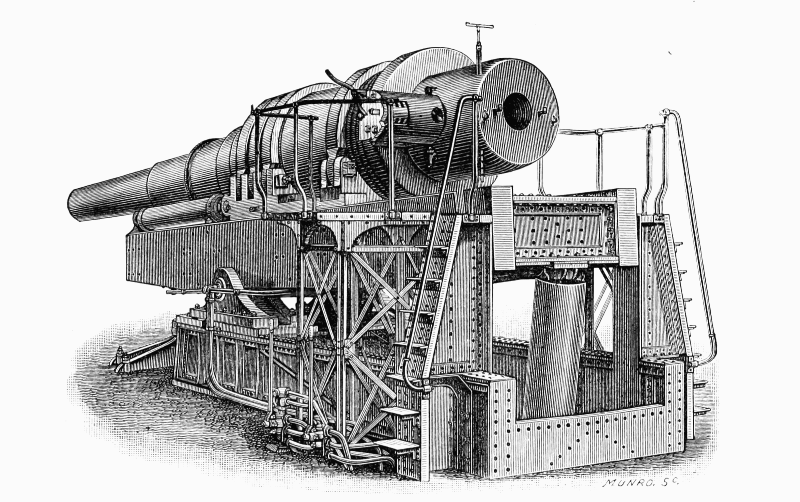
modern cannon, one of the most powerful is Krupp's
seventy-one-ton gun. This, like all others of his make,
is a breech-loader. Its dimensions are—length, thirty-two
feet nine inches; diameter at breech end, five feet six
inches; length of bore, twenty-eight feet seven inches;
diameter of bore, 15.75 inches; diameter of powder-chamber,
17.32 inches. The internal tube is of two
parts, exactly joined; and over this are four cylinders,
shrunk on, and a ring round the breech. Its rifling has a
uniform twist of one in forty-five. It cannot possibly be
fired until the breech is perfectly closed. Its maximum
charge is four hundred and eighty-five pounds of powder, and
a chilled iron shell of seventeen hundred and eight pounds.
Krupp's 15.6 Breech-loading Gun (breech open).
Krupp did much to promote the welfare and comfort
of his workpeople. For their accommodation, he erected
around Essen nearly four thousand family dwellings, in
which more than sixteen thousand persons reside. The
dwellings are in suites of three or four comfortable rooms,
with good water-arrangements; and attached to each
building is a garden, large enough for the children to play
in. There are one hundred and fifty dwellings of a better
kind for officials in the service of the firm. Boarding-houses
have also been built for the use of unmarried
labourers, of whom two thousand are thus accommodated.
Several churches, Protestant and Catholic, have also been
erected, for the use of his workmen and their families.
There have likewise been provided two hospitals, bathing
establishments, a gymnasium, an unsectarian free school,
and six industrial schools—one for adults, two for females.
In the case of the industrial schools, the fees are about
two shillings monthly, but the poorest are admitted free.
A Sick Relief and Pensions Fund has been instituted, and
every foreman and workman is obliged to be a member.
The entrance fee is half a day's pay, the annual payment
being proportioned to the wages of the individual member;
but half of each person's contribution is paid by the firm.
There are three large surgeries; and skilful physicians and
surgeons, one of whom is an oculist, are employed at
fixed salaries. For a small additional fee each member
can also secure free medical aid for his wife and children.
The advantages to members are free medical or surgical
treatment in case of need, payment from the fund of
funeral expenses at death, pensions to men who have been
permanently disabled by injuries while engaged in the
works, pensions to widows of members, and temporary
support to men who are certified by two of the physicians
as unable to work. The highest pension to men is five
pounds monthly, the average being about two pounds
sixteen shillings monthly. The average pension to widows
is about one pound fourteen shillings monthly.
The firm have made special arrangements with a number
of life insurance companies whereby the workmen can, if
they choose, insure their lives at low rates. They have
formed a Life Insurance Union, and endowed it with a
reserve fund of three thousand pounds, from which aid is
given to members needing assistance to pay their premiums.
An important institution in Essen is the great
Central Supply Store, established and owned by the firm,
where articles of every description—bread, meat, and
other provisions, clothing, furniture, &c.—are sold on a
rigidly cash system at cost price. Connected with the
Central Store are twenty-seven branch shops, in positions
convenient for the workpeople, placing the advantages of
the system within the easy reach of all.
The original name, 'Frederick Krupp,' has been retained
through all vicissitudes of fortune as the business
title of the firm. The small dwelling in which Alfred
Krupp was born is still standing, in the midst of the huge
workshops that have grown up around it, and is preserved
with the greatest care. At his expense, photographs of it
were distributed among his workmen, each copy bearing
the following inscription, dated Essen, February 1873:
'Fifty years ago, this primitive dwelling was the abode of
my parents. I hope that no one of our labourers may
ever know such struggles as have been required for the
establishment of these works. Twenty-five years ago that
success was still doubtful which has at length—gradually,
yet wonderfully—rewarded the exertions, fidelity, and
perseverance of the past. May this example encourage
others who are in difficulties! May it increase respect
for small houses, and sympathy for the larger sorrows they
too often contain. The object of labour should be the
common weal. If work bring blessing, then is labour
prayer. May every one in our community, from the
highest to the lowest, thoughtfully and wisely strive to
secure and build his prosperity on this principle! When
this is done, then will my greatest desire be realised.'
Germany has become a formidable competitor to Great
Britain in the iron and steel trade, and German steel rails,
girders, and wire come in freely to this country. From
reports we learn that Great Britain produced in 1882
8½ million tons of iron and 5 million tons of finished iron
and steel, while the production of Germany was then less
than 3½ and 2½ million tons respectively. English production
had fallen to 7½ million tons of iron and 4 million
tons of finished iron and steel in 1895, while Germany had
risen to 5 million tons and 6 million tons respectively.
Contrary to what has been commonly believed, it
appears that the difference all round in wages amongst
ironworkers, as between England and Germany, is not
great.
Chicago, Pittsburg, Buffalo, and New York are the chief
centres of the American iron and steel trade, the production
of pig-iron in 1895 being about 9¼ million tons, whereas
in 1880 it was well under 4 million. At present over 4
millions of tons are produced of Bessemer pig-iron.
CHAPTER II. POTTERY AND PORCELAIN. — WORCESTER PORCELAIN.
Josiah Wedgwood and the Wedgwood Ware—Worcester Porcelain.
hen Mr Godfrey Wedgwood, a member of
the famous firm of potters at Etruria, near
Burslem, Staffordshire, went to work about
forty years ago, his famous ancestor and
founder of the world-famed Wedgwood ware
was still named amongst the workmen as 'Owd Wooden
Leg.' A son of Mr Godfrey Wedgwood, now in the firm,
is the fifth generation in descent, and the manufactory is
still carried on in the same buildings erected by Josiah
Wedgwood one hundred and twenty years ago.
One hundred years ago Josiah Wedgwood, the creator
of British artistic pottery, passed away at Etruria, near
Burslem, surrounded by the creations of his own well-directed
genius and industry, having 'converted a rude
and inconsiderable manufacture into an elegant art and
an important part of national commerce.' His death
took place on 3d January 1795, the same year in which
Thomas Carlyle saw the light at Ecclefechan, and one
year and a half before the death of Burns at Dumfries.
During fifty years of his working life, largely owing to
his own successful efforts, he had witnessed the output of
the Staffordshire potteries increased fivefold, and his wares
were known and sold over Europe and the civilised world.
In the words of Mr Gladstone, his characteristic merit lay
'in the firmness and fullness with which he perceived the
true law of what we may call Industrial Art, or, in other
words, of the application of the higher art to Industry.'
Novalis once compared the works of Goethe and Wedgwood
in these words: 'Goethe is truly a practical poet.
He is in his works what the Englishman is in his wares,
perfectly simple, neat, fit, and durable. He has played in
the German world of literature the same part that Wedgwood
has played in the English world of art.'
JOSIAH WEDGWOOD.
Long ago, in his sketch of Brindley and the early
engineers, Dr Smiles had occasion to record the important
service rendered by Wedgwood in the making of the
Grand Trunk Canal—towards the preliminary expense
of which he subscribed one thousand pounds—and in
the development of the industrial life of the Midlands.
Since that time Smiles has himself published a biography
of Wedgwood, to which we are here indebted.
More than once it has happened that the youngest of
thirteen children has turned out a genius. It was so in
the case of Sir Richard Arkwright, and it turned out to be
so in the case of Josiah Wedgwood, the youngest of the
thirteen children of Thomas Wedgwood, a Burslem potter,
and of Mary Stringer, a kind-hearted but delicate, sensitive
woman, the daughter of a nonconformist clergyman.
The town of Burslem, in Staffordshire, where Wedgwood
saw the light in 1730, was then anything but an attractive
place. Drinking and cock-fighting were the common
recreations; roads had scarcely any existence; the
thatched hovels had dunghills before the doors, while
the hollows from which the potter's clay was excavated
were filled with stagnant water, and the atmosphere of
the whole place was coarse and unwholesome, and a most
unlikely nursery of genius.
It is probable that the first Wedgwoods take their
name from the hamlet of Weggewood in Staffordshire.
There had been Wedgwoods in Burslem from a very early
period, and this name occupies a large space in the parish
registers during the seventeenth and eighteenth centuries;
of the fifty small potters settled there, many bore this
honoured name. The ware consisted of articles in common
use, such as butter-pots, basins, jugs, and porringers. The
black glazed and ruddy pottery then in use was much
improved after an immigration of Dutchmen and Germans.
The Elers, who followed the Prince of Orange, introduced
the Delft ware and the salt glaze. They produced a kind
of red ware, and Egyptian black; but disgusted at the
discovery of their secret methods by Astbury and Twyford,
they removed to Chelsea in 1710. An important improvement
was made by Astbury, that of making ware white by
means of burnt flint. Samuel Astbury, a son of this
famous potter, married an aunt of Josiah Wedgwood.
But the art was then in its infancy, not more than one
hundred people being employed in this way in the district
of Burslem, as compared with about ten thousand now,
with an annual export of goods amounting to about two
hundred thousand pounds, besides what are utilised in
home-trade. John Wesley, after visiting Burslem in 1760,
and twenty years later in 1781, remarked how the whole
face of the country had been improved in that period.
Inhabitants had flowed in, the wilderness had become a
fruitful field, and the country was not more improved than
the people.
All the school education young Josiah received was
over in his ninth year, and it amounted to only a slight
grounding in reading, writing, and arithmetic. But his
practical or technical education went on continually, while
he afterwards supplemented many of the deficiencies of
early years by a wide course of study. After the death of
his father, he began the practical business of life as a
potter in his ninth year, by learning the throwing branch
of the trade. The thrower moulds the vessel out of the
moist clay from the potter's wheel into the required
shape, and hands it on to be dealt with by the stouker,
who adds the handle. Josiah at eleven proved a clever
thrower of the black and mottled ware then in vogue,
such as baking-dishes, pitchers, and milk-cans. But a
severe attack of virulent smallpox almost terminated his
career, and left a weakness in his right knee, which
developed, so that this limb had to be amputated at
a later date. He was bound apprentice to his brother
Thomas in 1744, when in his fourteenth year; but this
weak knee, which hampered him so much, proved a
blessing in disguise, for it sent him from the thrower's
place to the moulder's board, where he improved the
ware, his first effort being an ornamental teapot made
of the ochreous clay of the district. Other work of this
period comprised plates, pickle-leaves, knife-hafts, and
snuff-boxes. At the same time he made experiments in
the chemistry of the material he was using. Wedgwood's
great study was that of different kinds of colouring matter
for clays, but at the same time he mastered every branch
of the art. That he was a well-behaved young man is
evident from the fact that he was held up in the neighbourhood
as a pattern for emulation.
Wedgwood at Work.
But his brother Thomas, who moved along in the old
rut, had small sympathy with all this experimenting, and
thought Josiah flighty and full of fancies. After remaining
for a time with his brother, at the completion of his
apprenticeship Wedgwood became partner in 1752, in a
small pottery near Stoke-upon-Trent: soon after, Mr
Whieldon, one of the most eminent potters of the day,
joined the firm. Here Wedgwood took pains to discover
new methods and striking designs, as trade was then
depressed. New green earthenware was produced, as
smooth as glass, for dessert service, moulded in the form
of leaves; also toilet ware, snuff-boxes, and articles coloured
in imitation of precious stones, which the jewellers of that
time sold largely. Other articles of manufacture were
blue-flowered cups and saucers, and varicoloured teapots.
Wedgwood, on the expiry of his partnership with Whieldon,
started on his own account in his native Burslem in 1760.
His capital must have been small, as the sum of twenty
pounds was all he had received from his father's estate.
He rented Ivy House and Works at ten pounds a year,
and engaged his second-cousin, Thomas, as workman
at eight shillings and sixpence a week. He gradually
acquired a reputation for the taste and excellence of
design of his green glazed ware, his tortoiseshell and
tinted snuff-boxes, and white medallions. A specially
designed tea-service, representing different fruits and
vegetables, sold well, and, as might be expected, was
at once widely imitated. He hired new works on the
site now partly occupied by the Wedgwood Institute,
and introduced various new tools and appliances. His
kilns for firing his fine ware gave him the greatest trouble,
and had to be often renewed. James Brindley, when
puzzled in thinking out some engineering problem, used
to retire to bed and work it out in his head before he got
up. Sir Josiah Mason, the Birmingham pen-maker, used
to simmer over in his mind on the previous night the work
for the next day. Wedgwood had a similar habit, which
kept him often awake during the early part of the night.
Probably owing to the fortunate execution of an order
through Miss Chetwynd, maid of honour to Queen
Charlotte, of a complete cream service in green and
gold, Wedgwood secured the patronage of royalty, and
was appointed Queen's Potter in 1763. His Queen's ware
became popular, and secured him much additional business.
An engine lathe which he introduced greatly forwarded
his designs; and the wareroom opened in London for the
exhibition of his now famous Queen's ware, Etruscan
vases, and other works, drew attention to the excellence
of his work. He started works besides at Chelsea,
supervised by his partner Bentley, where modellers,
enamellers, and artists were employed, so that the cares
of his business, 'pot-making and navigating'—the latter
the carrying through of the Grand Trunk Canal—entirely
filled his mind and time at this period. So busy was he,
that he sometimes wondered whether he was an engineer,
a landowner, or a potter. Meanwhile, a step he had no
cause to regret was his marriage in 1764 to Sarah Wedgwood,
no relation of his own, a handsome lady of good
education and of some fortune.
Wedgwood had begun to imitate the classic works of the
Greeks found in public and private collections, and produced
his unglazed black porcelain, which he named
Basaltes, in 1766. The demand for his vases at this
time was so great that he could have sold fifty or one
hundred pounds' worth a day, if he had been able to
produce them fast enough. He was now patronised by
royalty, by the Empress of Russia, and the nobility
generally. A large service for Queen Charlotte took
three years to execute, as part of the commission consisted
in painting on the ware, in black enamel, about twelve
hundred views of palaces, seats of the nobility, and
remarkable places. A service for the Empress of Russia
took eight years to complete. It consisted of nine
hundred and fifty-two pieces, of which the cost was
believed to have been three thousand pounds, although
this scarcely paid Wedgwood's working expenses.
Prosperity elbowed Wedgwood out of his old buildings
in Burslem, and led him to purchase land two miles away,
on the line of the proposed Grand Trunk Canal, where
his flourishing manufactories and model workmen's houses
sprang up gradually, and were named Etruria, after the
Italian home of the famous Etruscans, whose work he
admired and imitated. His works were partly removed
thither in 1769, and wholly in 1771. At this time he
showed great public spirit, and aided in getting an Act of
Parliament for better roads in the neighbourhood, and
backed Brindley and Earl Gower in their Grand Trunk
Canal scheme, which was destined, when completed, to
cheapen and quicken the carriage of goods to Liverpool,
Bristol, and Hull. The opposition was keen: and Wedgwood
issued a pamphlet showing the benefits which would
accrue to trade in the Midlands by the proposed waterway.
When victory was secured, after the passing of the Act
there was a holiday and great rejoicing in Burslem and the
neighbourhood, and the first sod of the canal was cut by
Wedgwood, July 26, 1766. He was also appointed
treasurer of the new undertaking, which was eleven
years in progress. Brindley, the greatest engineer then
in England, doubtless sacrificed his life to its success,
as he died of continual harassment and diabetes at the
early age of fifty-six. Wedgwood had an immense admiration
for Brindley's work and character. In the prospect
of spending a day with him, he said: 'As I always edify
full as much in that man's company as at church, I
promise myself to be much wiser the day following.'
Like Carlyle, who whimsically put the builder of a bridge
before the writer of a book, Wedgwood placed the man
who designed the outline of a jug or the turn of a teapot
far below the creator of a canal or the builder of a city.
In the career of a man of genius and original powers,
the period of early struggle is often the most interesting.
When prosperity comes, after difficulties have been surmounted,
there is generally less to challenge attention.
But Wedgwood's career was still one of continual progress
up to the very close. His Queen's ware, made of the
whitest clay from Devon and Dorset, was greatly in
demand, and much improved. The fine earthenwares
and porcelains which became the basis of such manufactures
were originated here. Young men of artistic
taste were employed and encouraged to supply designs,
and a school of instruction for drawing, painting, and
modelling was started. Artists such as Coward and
Hoskins modelled the 'Sleeping Boy,' one of the finest
and largest of his works. John Bacon, afterwards known
as a sculptor, was one of his artists, as also James Tassie
of Glasgow. Wedgwood engaged capable men wherever
they could be found. For his Etruscan models he was
greatly indebted to Sir W. Hamilton. Specimens of his
famous portrait cameos, medallions, and plaques will be
found in most of our public museums.
The general health of Wedgwood suffered so much
between 1767 and 1768 that he decided to have the
limb which had troubled him since his boyhood amputated.
He sat, and without wincing, witnessed the
surgeons cut off his right leg, for there were then no
anæsthetics. 'Mr Wedgwood has this day had his leg
taken off,' wrote one of the Burslem clerks at the foot
of a London invoice, 'and is as well as can be expected
after such an execution.' His wife was his good angel
when recovering, and acted as hands and feet and
secretary to him; while his partner Bentley (formerly
a Liverpool merchant) and Dr Darwin were also kind;
and he was almost oppressed with the inquiries of many
noble and distinguished persons during convalescence.
He had to be content with a wooden leg now. 'Send
me,' he wrote to his brother in London, 'by the next
wagon a spare leg, which you will find, I believe, in
the closet.' He lived to wear out a succession of wooden
legs.
Indifference and idleness he could not tolerate, and his
fine artistic sense was offended by any bit of imperfect
work. In going through his works, he would lift the
stick upon which he leaned and smash the offending
article, saying, 'This won't do for Josiah Wedgwood.'
All the while he had a keen insight into the character
of his workmen, although he used to say that he had
everything to teach them, even to the making of a table
plate.
He was no monopolist, and the only patent he ever
took out was for the discovery of the lost art of burning
in colours, as in the Etruscan vases. 'Let us make all
the good, fine, and new things we can,' he said to Bentley
once; 'and so far from being afraid of other people
getting our patterns, we should glory in it, and throw
out all the hints we can, and if possible, have all the
artists in Europe working after our models.' By this
means he hoped to secure the goodwill of his best
customers and of the public. At the same time he
never sacrificed excellence to cheapness. As the sale
of painted Etruscan ware declined, his Jasper porcelain—so
called from its resemblance to the stone of that name—became
popular. The secret of its manufacture was kept
for many years. It was composed of flint, potter's clay,
carbonate of barytes, and terra ponderosa. This and the
Jasper-dip are in several tones and hues of blue; also
yellow, lilac, and green. He called in the good genius of
Flaxman in 1775; and, for the following twelve years, the
afterwards famous sculptor did an immense amount of
work and enhanced his own and his patron's reputation.
Flaxman did some of his finest work in this Jasper porcelain.
Some of Flaxman's designs Wedgwood could
scarcely be prevailed upon to part with. A bas-relief
of the 'Apotheosis of Homer' went for seven hundred
and thirty-five pounds at the sale of his partner Bentley;
and the 'Sacrifice to Hymen,' a tablet in blue and white
Jasper (1787), brought four hundred and fifteen pounds.
The first named is now in the collection of Lord Tweedmouth.
Wedgwood's copy of the Barberini or Portland
Vase was a great triumph of his art. This vase, which
had contained the ashes of the Roman Emperor Alexander
Severus and his mother, was of dark-blue glass, with white
enamel figures. It now stands in the medal room of
the British Museum alongside a model by Wedgwood.
It stands 10 inches high, and is
the finest specimen of an ancient
cameo cut-glass vase known. It
was smashed by a madman in
1845, but was afterwards skilfully
repaired. Wedgwood made fifty
copies in fine earthenware, which
were originally sold at 25 guineas
each. One of these now fetches
£200. The vase itself once
changed hands for eighteen hundred
guineas, and a copy fetched
two hundred and fifteen guineas
in 1892.
Portland Vase.
Josiah Wedgwood now stood at the head of the potters
of Staffordshire, and the manufactory at Etruria drew
visitors from all parts of Europe. The motto of its
founder was still 'Forward;' and, as Dr Smiles expresses
it, there was with him no finality in the development of
his profession. He studied chemistry, botany, drawing,
designing, and conchology. His inquiring mind wanted
to get to the bottom of everything. He journeyed to
Cornwall, and was successful in getting kaolin for chinaware.
Queen Charlotte patronised a new pearl-white teaware;
and he succeeded in perfecting the pestle and
mortar for the apothecary. He invented a pyrometer
for measuring temperatures; and was elected Fellow of
the Royal Society. Amongst his intimate friends were
Dr Erasmus Darwin, poet and physician (the famous
Charles Robert Darwin was a grandson, his mother
having been a daughter of Wedgwood's), Boulton of
Soho Works, James Watt, Thomas Clarkson, Sir Joseph
Banks, and Thomas Day.
We have an example of the generosity of Wedgwood's
disposition in his treatment of John Leslie, afterwards
Professor Sir John Leslie of Edinburgh University. He
was so well pleased with his tutoring of his sons that he
settled an annuity of one hundred and fifty pounds upon
him; and it may be that the influence of this able tutor
led Thomas Wedgwood to take up the study of heliotype,
and become a pioneer of photographic science, even
before Daguerre. How industrious Wedgwood had been
in his profession is evident from the seven thousand
specimens of clay from all parts of the world which he
had tested and analysed. The six entirely new pieces of
earthenware and porcelain which, along with his Queen's
ware, he had introduced early in his career, as painted
and embellished, became the foundation of nearly all the
fine earthenware and porcelains since produced. He had
his reward, for besides a flourishing business, he left more
than half a million of money.
The Worcester Royal Porcelain Works.
One of the most artistic and interesting industries in this
country is the manufacture of porcelain in the ancient city
of Worcester. There is no special local reason for the
establishment of such works there, but Worcester has been
noted as the home of the famous porcelain for more than
a century. It was in 1751 that Dr Wall, a chemist and
artist, completed his experiment in the combination of
various elements, and produced a porcelain which was
more like the true or natural Chinese porcelain than any
ever devised. This was the more remarkable because
kaolin had not then been discovered in this country. The
inventor set up his factory in Worcester, close to the
cathedral, and for a long time he produced his egg-shell
and Tonquin porcelain in various forms, chiefly, however,
those of table services. Transfer-printing was introduced
later on, and was executed with much of the artist's spirit
by experts who attached themselves to the Worcester
works after the closing of the enamel works at Battersea.
It was a remarkable century in its devotion to ceramic
art; and it was characteristic of the ruling princes of the
Continent that they should patronise lavishly various
potteries of more or less repute. Towards the end of the
century the first sign of this royal favour was vouchsafed
to Worcester. George III. visited the factories, and under
the impetus given by his patronage, the wares of the city
advanced so much in popularity that, in the early part of
this century, it is said, there were few noble families which
had not in their china closets an elaborate service of Worcester,
bearing the family arms and motto in appropriate
emblazonment. In 1811, George IV. being then Prince
Regent, several splendid services of Worcester porcelain
were ordered to equip his table for the new social duties
entailed by his regency, and one of these alone cost
£4000. In the museums at the Worcester works there
are specimens of many beautiful services, designed in
accordance with the contemporary ideas of pomp and
stateliness. The porcelain artists in those days must have
been well versed in heraldry; for their chief duties seem
to have been the reproduction of crests and coats-of-arms.
Some of the services have interesting stories. There is
one of deep royal blue, beautifully decorated, and bearing
in the centre an emblematical figure of Hope. The story
ran that it was ordered by Nelson for presentation to the
Duke of Cumberland, and that the figure of Hope was
really a portrait of Lady Hamilton. This, however, was
an error: the service was ordered by the Duke himself in
the ordinary way, and though Lord Nelson did order a
service of Worcester porcelain, he died before it could be
completed, and it was afterwards dispersed. Another
story attaches to a plate adorned with a picture of a ship
in full sail approaching harbour. The Imaum of Muscat
sent many presents to the Prince Regent, and hinted that
he would like a ship of war in return. The English authorities,
however, did not see fit to give attention to this
request, and sent him instead many beautiful things, including
a service of Worcester ware, bearing on each piece
a scene showing the royal yacht which bore the gifts
entering the cove of Muscat. When the potentate heard,
however, that his dearest wish had been thwarted in this
way, he refused to allow the vessel to enter the harbour,
and all the presents had to be brought back again. The
picture on the plate, therefore, is more imaginative than
accurate.
The Worcester porcelain began to develop in fresh
directions soon after the Great Exhibition of 1851, which
gave an impulse to the efforts of the artists, and the
decorative side of the work was brought into a much
more prominent position. For instance, the 'Worcester
enamels,' in the style of those of Limoges, were introduced,
and an illustration of this work is to be seen in a
pair of remarkable vases, bearing enamel reproductions of
Maclise's drawings, founded on the Bayeux tapestries.
About this time, too, after several years of experiment, the
ivory ware—an idea inspired by the lovely ivory sculptures
in the Exhibition—was brought to perfection. It is a
beautiful, creamy, translucent porcelain, singularly fitted
for artistic treatment, and it is now the most characteristic
of the later developments of the Worcester work. In fact,
the art directors of the enterprise will not issue now any
new wares in the style of those which found favour at an
earlier period, for they know that they would instantly be
palmed off on the unwary as the genuine products of the
bygone times.
To trace the process of the manufacture, from the
mixing of the ingredients to the burning of the last wash
in the decorated piece, is very interesting. It is a process
freely shown to visitors, and forms one of the principal
lions in the sober old town which has lain for so many
centuries on the banks of the Severn. The materials are
brought from all parts of the world. Kaolin, or china
clay, which is the felspar of decomposed granite washed
from the rocks, is brought from Cornwall, so is the Cornish
or china stone; felspar is brought from Sweden, and
though of a rich red, it turns white when burnt; marl and
fire-clay come from Broseley, in Shropshire, and Stourbridge;
flints are brought from Dieppe; and bones—those
of the ox only—come all the way from South
America to be calcined and ground down. The grinding
is a slow matter; each ingredient is ground separately in
a vat, the bottom of which is a hard stone, whereon other
hard stones of great weight revolve slowly. From twelve
hours' to ten days' constant treatment by these remorseless
mills is required by the various materials, some needing to
be ground much longer than others before the requisite
fineness is attained. It is essential that all the ingredients
should be reduced to a certain standard of grain; and the
contents of each vat must pass through a lawn sieve with
four thousand meshes to the square inch. When the
materials are sufficiently ground to meet this test, they are
taken to the 'slip-house,' and mixed together with the
clays, which do not need grinding. A magnet of great
strength is in each mixing trough, and draws to itself every
particle of iron, which, if allowed to remain in the mixture,
would injure the ware very much. When properly
mixed, the water is pressed out, and the paste or clay is
beaten so that it may obtain consistency. Then it is
ready to be made into the many shapes which find popular
favour.
The process of manufacture depends on the shape to be
obtained. A plain circular teacup may be cast on a
potter's wheel of the ancient kind. When it is partly dried
in a mould, it is turned on a lathe and trimmed; then the
handle, which has been moulded, is affixed with a touch of
the 'slip'—the porcelain paste in a state of dilution is the
cement used in all such situations—and the piece is ready
for the fire. A plate or saucer, however, is made by flat
pressing; a piece of clay like a pancake is laid on the
mould, which is set revolving on a wheel; the deft fingers
of the workmen press the clay to the proper shape, and it
is then dried. But the elaborate ornamental pieces of
graceful design are made in moulds, and for this process
the clay is used in the thin or 'slip' state. The moulds
are pressed together, the slip is poured into them through
a hole in one side, and when the moisture has been
absorbed by the plaster moulds sufficiently, the piece is
taken out. It is often necessary, in making a large or
complicated piece, to have as many as twenty or thirty
castings. In moulding a figure, for instance, the legs and
arms and hands, even the thumbs in many cases, are cast
separately, and with many other parts of the design are
laid before a workman, who carefully builds up the complete
figure out of the apparent chaos of parts, affixing
each piece to the body with a touch of slip. When these
wares are complete, they have to be fired for the first
time; and they are taken to a kiln, and placed with great
care and many precautions in the grim interior. The
contraction of the clay under fire is a matter to which the
designers must give much study; and the change which
takes place during forty hours' fierce firing in the kiln is
shown by contrasting an unburnt piece and a piece of
'biscuit' or burnt ware, and marking the shrinkage. Your
ware must be calculated to shrink only so much; if it
shrink a shade further, the whole process may be spoiled.
There is a loss of twenty-five per cent. sometimes in these
kilns, in spite of the assiduous care of the workmen.
When the biscuit ware has cooled, it is dipped in the
glaze, which is a compound of lead and borax and other
materials—virtually a sort of glass—and then it is fired for
sixteen hours in the 'glost oven.' There is no contraction
in this ordeal; but there is a risk none the less from other
causes. In fact, there is the danger of injury every time
the ware goes to the fire, and as the highly decorated
pieces have to go to the kiln many times, it may be
inferred that the labour of weeks and even months
is sometimes nullified by an untoward accident in the
burning.
It is during the process of decoration that the ornate
vases and figures make so many trips to the fire. The
artist department is a very large and important one. The
designers, however, are a class of themselves. They project
the idea; it is the business of the artist, in these
circumstances, to execute it. The painters are taken into
the works as lads and trained for the special service.
What you remark chiefly in going through the decorating
rooms is the great facility of the artists. You see a man
with a plate or vase on which he is outlining a landscape,
and you marvel at the rapid, accurate touches with which
he does the work. Flowers, birds, and figures they can
reproduce with great skill, and many of them are artists
not merely in facility but in instinct. They work with
metallic colours only. They rely on copper, for instance,
to give black and green, on iron to yield red hues, and so
on; and the gold work is done with what seems to be a
dirty brown paste, but is really pure gold mixed with flux
and quicksilver. When the first wash is put on, the piece
must be fired, so that the colours shall be burnt into the
glaze. Then it returns to the painter, who adds the next
touches so far as he can; the firing again follows; the piece
is returned to him once more; and so on it goes till the
work is complete.
It is therefore a highly technical business, especially as
the colours change very much in the fire, and the painter
has to work with full knowledge of the chemical processes
in every firing. There is one form of the decorative process
which is very singular—that is, the piercing work.
The artist has the vase in the dried state before the firing,
and with a tiny, sharp-pointed knife he cuts out little pieces
according to the design in his mind, and produces an
extremely beautiful perforated ware, the elaborate pattern
and the lace-like delicacy of which almost repel the idea
that the work is done by the unaided hand of man. In
the colour processes, the work is virtually complete when
the dull gold has been burnished; and the porcelain is
then ready to be transferred to the showrooms, or exported
to America, which is the greatest patron, at present, of
Worcester art. America, however, failed to retain one
lovely vase no less than four feet high, the largest ever
made in the works; it was taken to the Chicago Exhibition
and back without accident, and was then sold in England
for one thousand pounds.
It is important to remember the distinction between
'pottery' and 'porcelain:' the porcelain is clay purified
by the fire, whereas pottery leaves the oven as it entered
it—clay. The purification of the ware is really an illustration
of the process which sustains the artistic inspiration
of the work. The gross, the vulgar, the mean are eliminated;
a standard of beauty is set up, and to it every
article must conform. It is to this ideal, sustained by
a long succession of artists through a century and a half,
that Worcester owes its world-wide reputation as the birthplace
of some of the loveliest porcelain ever burnt in a
kiln.
Chinese Porcelain Vase.
CHAPTER III. THE SEWING-MACHINE.
Thomas Saint—Thimonnier—Hunt—Elias Howe—Wilson—Morey—Singer.
lthough the sewing-machine has not put
an end to the slavery of the needle, and
although 'The Song of the Shirt' may be
heard to the accompaniment of its click and
whirr, just as it was to the 'stitch, stitch' of
Tom Hood's time, yet has it unquestionably come as
a boon and a blessing to man—and woman. Its name
now is legion, and it has had so many inventors and improvers
that the present generation is fast losing sight of
its original benefactors. Indeed, we take the sewing-machine
to-day as an accomplished fact so familiar as to
be commonplace. And yet that fact is a product of as
moving a history as any in the story of human invention.
It is the growth of the last half-century, prior to which
the real sewing-machine was the heavy-eyed, if not tireless,
needlewoman, whose flying fingers seemed ever in vain
pursuit of the flying hours. Needlework is as old as
human history, for we may see the beginnings of it in the
aprons of fig-leaves which Mother Eve sewed. What
instrument she used we know not, but we do know from
Moses that needles were in use when the tabernacle was
built. Yet, strange to say, it was not until the middle of
last century that any one tried to supersede manual labour
in the matter of stitching. It is said that a German tailor,
named Charles Frederick Weisenthal, was the first to
attempt it, but for hand-embroidery only—with a double-pointed
needle, eyed in the middle. This was in 1755,
and fifty years later, one John Duncan, a Glasgow
machinist, worked out Weisenthal's idea into a genuine
embroidering machine, which really held the germ of the
idea of the 'loop-stitch.' But neither of these was a
sewing-machine, and before Duncan's invention some one
else had been seized with another idea.
This was a London cabinetmaker called Thomas Saint,
who in or about 1790 took out a patent for a machine for
sewing leather, or rather for 'quilting, stitching, and
making shoes, boots, spatterdashes, clogs, and other
articles.' This patent, unfortunately, was taken out along
with other inventions in connection with leather, and it
was quite by accident that, some eighty years later, the
specification of it was discovered by one who had made
for himself a name in connection with sewing-machines.
Even the Patent Office did not seem to have known of its
existence, yet now it is clear enough that Thomas Saint's
leather-sewing-machine of 1790 was the first genuine sewing-machine
ever constructed, and that it was on what is
now known as the 'chain-stitch' principle. Rude as it
was, it is declared by experts to have anticipated most of
the ingenious ideas of half a century of successive inventors,
not one of whom, however, could in all human
probability have as much as heard of Saint's machine.
This is not the least curious incident in the history of the
sewing-machine.
In Saint's machine the features are—the overhanging
arm, which is the characteristic of many modern machines;
the perpendicular action of the Singer machine; the eye-pointed
needle of the Howe machine; the pressure surfaces
peculiar to the Howe machine; and a 'feed' system
equal to that of the most modern inventions. Whether
Saint's machine was ever worked in a practical workshop
or not, it was unquestionably a practicable machine, constructed
by one who knew pretty well what he was about,
and what he wanted to achieve.
Now note the date of Thomas Saint's patent (1790),
and next note the date of the invention of Barthelmy
Thimonnier, of St Etienne, who is claimed in France as
the inventor of the sewing-machine. In 1830, Thimonnier
constructed a machine, principally of wood, with an
arrangement of barbed needles, for stitching gloves, and
in the following year he began business in Paris, with a
partner, as an army clothier. The firm of Thimonnier, Petit,
& Co., however, did not thrive, because the workpeople
thought they saw in the principal's machine an instrument
destined to ruin them; much as the Luddites viewed steam-machinery
in the cotton districts of England. An idea of
that sort rapidly germinates heat, and Thimonnier's workshop
was one day invaded by an angry mob, who smashed
all the machines, and compelled the inventor to seek
safety in flight. Poor Thimonnier was absent from Paris
for three years, but in 1834 returned with another and
more perfect machine. This was so coldly received, both
by employers and workmen in the tailoring trade, that he
left the capital, and, journeying through France with his
machine, paid his way by exhibiting it in the towns and
villages as a curiosity. After a few years, however, Thimonnier
fell in with a capitalist who believed in him and
his machine, and was willing to stake money on both. A
partnership was entered into for the manufacture and sale
of the machine, and all promised well for the new firm,
when the Revolution of 1848 broke out, stopped the
business, and ruined both the inventor and the capitalist.
Thimonnier died in 1857, in a poorhouse, of a broken
heart.
This French machine was also on the chain-stitch principle,
but it was forty years later than Saint's. In between
the two came, about 1832, one Walter Hunt, of New
York, who is said to have constructed a sewing-machine
with the lock-stitch movement. Some uncertainty surrounds
this claim, and Elias Howe is the person usually
credited with this important, indeed invaluable invention.
Whether Howe had ever seen Hunt's machine, we know
not; but Hunt's machine was never patented, seems never
to have come into practical working, and is, indeed, said
to have been unworkable. There is, besides, in the
Polytechnic at Vienna, the model of a machine, dated
1814, constructed by one Joseph Madersberg, a tailor of
the Tyrol, which embodies the lock-stitch idea—working
with two threads. But this also was unworkable, and
Elias Howe has the credit of having produced the first
really practical lock-stitch sewing-machine.
His was a life of vicissitude and of ultimate triumph,
both in fame and fortune. He was born at a small place
in Massachusetts in 1819, and as a youth went to Boston,
there to work as a mechanic. While there, and when
about twenty-two years old, the idea occurred to him at
his work of passing a thread through cloth and securing it
on the other side by another thread. Here we perceive
the germ of the lock-stitch—the two threads. Howe
began to experiment with a number of bent wires in lieu
of needles, but he lacked the means to put his great idea
to a thorough practical test. Thus it slumbered for three
years, when he went to board and lodge with an old
schoolfellow named Fisher, who, after a while, agreed to
advance Howe one hundred pounds in return for a half
share in the invention should it prove a success. Thus
aided, in 1845 Howe completed his first machine, and
actually made himself a suit of clothes with it; and this
would be just about the time of Thimonnier's temporary
prosperity in alliance with the capitalist, Mogrini.
Feeling sure of his ground, Howe took bold steps to
'boom' his invention. He challenged five of the most
expert sewers in a great Boston clothing factory to a
sewing match. Each of them was to sew a certain strip of
cloth, and Howe undertook to sew five strips, torn in
halves, before each man had completed his one strip. The
arrangements completed, the match began, and to the
wonder of everybody, Howe finished his five seams before
the others were half done with one seam. But murmurs
instead of cheers succeeded the victory. He was angrily
reproached for trying to take the bread out of the mouth
of the honest working-man, and a cry was raised among
the workers (as it has been heard time and again in the
history of industrial development) to smash the machine.
Howe, indeed, had much difficulty in escaping from the
angry mob, with his precious machine under his arm.
In Howe's experience we thus see one parallel with
Thimonnier's; but there was another. The American
was quite as poor and resourceless as the Frenchman, and
the next step in Howe's career was that he went on tour to
the country fairs to exhibit his machine for a trifling fee, in
order to keep body and soul together. People went in
flocks to see the thing as a clever toy, but no one would
'take hold' of it as a practical machine. And so, in
despair of doing any good with it in America, Elias Howe,
in 1846, sent his brother to England to see if a market
could not be found for the invention there. The brother
succeeded in making terms with one William Thomas,
staymaker, in Cheapside, London, and he sent for Elias to
come over.
The price to be paid by Thomas for the patent was two
hundred and fifty pounds, but Howe was to make certain
alterations in it so as to adapt it to the special requirements
of the purchaser. While engaged in perfecting the
machine, he was to receive wages at the rate of three
pounds per week, and this wage he seems to have received
for nearly two years. But he failed to achieve what
Thomas wanted, and Thomas, after spending a good deal
of money over the experiments, abandoned the thing altogether.
Howe was thus astrand again, and he returned
to America as poor as ever, leaving his machine behind
him in pawn for advances to pay his passage home. And
yet there were 'millions in it.'
This was in the year 1849, and just about the time
when Howe was returning to America, another American,
named Bostwich, was sending over to England a machine
which he had invented for imitating hand-stitching, by
means of cog-wheels and a bent needle. And a year or
two after Howe's return, one Charles Morey, of Manchester,
attempted to carry out the same stitch on a somewhat
different plan, but failed to find sufficient pecuniary
support. Indeed, poor Morey had a tragic end, for,
taking his machine to Paris in the hope of finding a
purchaser there, he incurred some debt which he could
not pay, and was clapped into the Mazas prison. While
there, he inadvertently broke the rules, and was shot by
the guard for failing to reply to a challenge which he did
not understand.
When Howe got back to the United States, he found a
number of ingenious persons engaged in producing or
experimenting in sewing-machines, and some of them were
trenching on his own patent rights. He raised enough
money, somehow, to redeem his pawned machine in
England, and then raised actions against all who were
infringing it. The litigation was tremendous both in
duration and expense, but it ended in the victory of Elias
Howe, to whom, by the finding of the court, the other
patentees were found liable for royalty. It is said that
Howe, who as we have seen left London in debt, received,
before his patent expired in 1867, upwards of two million
dollars in royalties alone.
But ingenious men were now busy in both hemispheres
in perfecting what, up till about fifty years ago, was regarded
as nothing better than a clever toy. Besides Morey, the
Manchester man we have mentioned, a Huddersfield
machinist, named Drake, brought out a machine to work
with a shuttle. About the same time, or a little later, a
young Nottingham man, named John Fisher, constructed
a machine with a sort of lock-stitch movement, which he
afterwards adapted to a double loop-stitch. But Fisher's
machine was intended rather for embroidering than for
plain sewing.
Passing over some minor attempts, the next great
development was that of Allen Wilson, who, without
having heard either of Howe's or of any other machine,
constructed one in 1849, the design of which, he said, he
had been meditating for two years. His first machine had
original features, however much it may have been anticipated
in principle by Howe's patent. In Wilson's second
design, a rotary hook was substituted for a two-pointed
shuttle, and by other improvements he achieved a greater
speed than had been attained by other inventors. Later
still, he added the 'four-motion feed,' which is adopted on
most of the machines now in general use.
This idea was an elaboration of a principle which seems
to have first occurred to the unfortunate Morey. In
Morey's machine there was a horizontal bar with short
teeth, which caught the fabric and dragged it forward as
the stitches were completed. It took nearly thirty years,
however, to evolve the perfect 'feed' motion out of
Morey's first crude germ.
While Wilson was working away, perfecting his now
famous machine, an observing and thoughtful young
millwright was employed in a New York factory. One
day a sewing-machine was sent in for repairs, and after
examining its mechanism, this young man, whose name
was Isaac Singer, confidently expressed his belief that he
could make a better one. He did not propose either to
appropriate or abandon the principle, but to improve upon
it. Instead of a curved needle, as in Howe's and Wilson's
machines, he adopted a straight one, and gave it a perpendicular
instead of a curvular motion. And for propelling
the fabric he introduced a wheel, instead of the toothed
bar of the Morey design.
It need hardly be said that the Singer machine is now
one of the most widely known, and is turned out in countless
numbers in enormous factories on both sides of the
Atlantic. It is not so well known, perhaps, that Singer,
who was a humble millwright in 1850, and who died in
1875, left an estate valued at three millions sterling—all
amassed in less than twenty-five years!
The machines of Howe, Wilson, and Singer were on
the lock-stitch principle, and the next novelty was the
invention of Grover and Baker, who brought out a machine
working with two needles and two continuous threads.
After this came the Gibbs machine, the story of which
may be briefly told.
About the year 1855, James G. Gibbs heard of the
Grover and Baker machine, and having a turn for
mechanics, began to ponder over how the action described
was produced. He got an illustration, but could make
nothing of it, and not for a year did he obtain sight of a
Singer machine at work. As in the case of Singer with
Wilson's machine, so Gibbs thought he could improve
on Singer's, and turn out one less ponderous and complicated.
He set to work, and in a very short time
took out a patent for a new lock-stitch machine. But he
was not satisfied with this, and experimented away, with
an idea of making a chain-stitch by means of a revolving
looper. This idea he eventually put into practical form,
and took out a patent for the first chain-stitch sewing-machine.
Since the days of Elias Howe, the number of patents
taken out for sewing-machines has been legion—certainly
not less than one thousand—and probably no labour-saving
appliance has received more attention at the hands both of
inventors and of the general public. There is scarcely a
household in the land now, however humble, without a
sewing-machine of some sort, and in factories and warehouses
they are to be numbered by the thousand. Some
machinists have directed their ingenuity to the reduction
of wear and tear, others to the reduction of noise, others
to acceleration of speed, others to appliances for supplying
the machine in a variety of ways, others for adapting it to
various complicated processes of stitching and embroidering.
Some users prefer the lock-stitch, and some the
chain-stitch principle, and each system has its peculiar
advantages according to the character of the work to be
sewn.
A recent development is a combination of both principles
in one machine. Mr Edward Kohler patented a
machine which will produce either a lock-stitch or a
chain-stitch, as may be desired, and an embroidery stitch
as well. By a very ingenious contrivance the machinery
is altered by the simple movement of a button, and (when
the chain-stitch is required) the taking out of the bobbin
from the shuttle. If the embroidery stitch is wanted,
the button is turned without removing the bobbin, and the
lock-stitch and chain-stitch are combined in one new
stitch, with which very elaborate effects can be produced.
It is said that the Kohler principle can be easily adapted
to all, or most, existing machines.
CHAPTER IV. WOOL AND COTTON. — WOOL. — COTTON.
Wool.—What is Wool?—Chemical Composition—Fibre—Antiquity
of Shepherd Life—Varieties of Sheep—Introduction into Australia—Spanish
Merino—Wool Wealth of Australia—Imports and
Exports of Wool and Woollen Produce—Woollen Manufacture.
Cotton.—Cotton Plant in the East—Mandeville's Fables about
Cotton—Cotton in Persia, Arabia, and Egypt—Columbus finds
Cotton-yarn and Thread in 1492—In Africa—Manufacture of Cloth
in England—The American Cotton Plant.
hat is wool? 'The covering of the sheep,
of course,' replies somebody. Yes; but what
is it? Let us ask Professor Owen. 'Wool,'
he says, 'is a peculiar modification of hair,
characterised by fine transverse or oblique
lines from two to four thousand in the extent of an inch,
indicative of a minutely imbricated scaly surface, when
viewed under the microscope, on which and on its curved
or twisted form depends its remarkable felting property.'
At first sight this definition seems bewildering, but it will
bear examination, and is really more tangible than, for
instance, Noah Webster's definition of wool: 'That soft
curled or crisped species of hair which grows on sheep
and some other animals, and which in fineness sometimes
approaches to fur.' It is usually that which grows on
sheep, however, that we know as wool, and the number
of imbrications, serratures, or notches indicates the quality
of the fibre. Thus, in the wool of the Leicester sheep
there are 1850—in Spanish merino, 2400—in Saxon
merino, 2700, to an inch, and the fewer there are the
nearer does wool approach to hair.
Wool-sorters at Work.
Here is a still more minute description by Youatt,
a great authority on wool: 'It consists of a central
stem or stalk, probably hollow, or at least porous, and possessing
a semi-transparency, found in the fibre of the hair.
From this central stalk there springs, at different distances
in different breeds of sheep, a circlet of leaf-shaped projections.
In the finer species of wool these circles seemed
at first to be composed of one indicated or serrated ring;
but when the eye was accustomed to them, this ring was
resolvable into leaves or scales. In the larger kinds, the
ring was at once resolvable into these scales or leaves,
varying in number, shape, and size, and projecting at
different angles from the stalk, and in the direction of
the leaves of vegetables—that is, from the root to the
point. They give to the wool the power of felting.'
This is the estimate of the chemical composition of
good wool: Carbon, 50.65; hydrogen, 7.03; nitrogen,
17.71; oxygen and sulphur, 24.61. Out of a hundred
parts, ninety-eight would be organic, and two would be
ash, consisting of oxide of iron, sulphate of lime, phosphate
of lime, and magnesia. What is called the 'yolk' of wool
is a compound of oil, lime, and potash. It makes the pile
soft and pliable, and is less apparent on English sheep
than on those of warmer countries, the merino sheep
having the most 'yolk.'
The fibre of wool varies in diameter, the Saxon merino
measuring 1⁄1370 of an inch, and the Southdown, 1⁄1100.
Lustrous wool, it is said, should be long and strong; but
if it is very fine it is not long. Strong wool may be as
much as twenty inches in length. The wool of the best
sheep adheres closely, and can only be removed by
shearing; but there are varieties of sheep which shed
their wool, as, for instance, the Persian, which drop the
whole of their fleeces between January and May, when
feeding on the new grass.
This, then, is wool, the first use of which for cloth-making
is lost in antiquity. There is no doubt that the
pastoral industry is the oldest industry in the world;
for even when the fruits of the earth could be eaten
without tillage and without labour, the flocks and herds
required care and attention. The shepherd may be
regarded as the earliest pioneer of industry, as he has
been for centuries the centre of fanciful romance, and
the personification of far from romantic fact. The old
legend of Jason and the Golden Fleece is in itself evidence
of the antiquity of the knowledge of the value of wool; and
much as the mythologists make out of the legend, there
are some who hold that it merely is meant to record how
the Greeks imported a superior kind of sheep from the
Caucasus and made money thereby.
Australia is now the land of the Golden Fleece, and
millions of money have been made there out of the
docile sheep. It is not indigenous, of course, to the
land of the Southern Cross, where the only mammal
known when Europeans discovered it was the kangaroo.
Mr James Bonwick, a gentleman well known in Australian
literature, gathered together many records of the introduction
of the sheep into Australia, and of the marvellous
development of the pastoral industry there in his very
interesting book, The Romance of the Wool-trade.
But, first, as to the different kinds of sheep. The
Bighorn is the wild-sheep of Kamchatka, and it may be
taken for granted that all species of the domestic sheep
were at one time wild, or are descended from wild tribes.
When the Aryan Hindus invaded India, it is recorded that
they took their flocks with them; but whether the wild-sheep
still to be found on the hills of Northern India are
the descendants of wanderers from these flocks, or
descendants of the progenitors of them, we do not pretend
to say.
Chief among the domesticated sheep of the British Isles
is the Southdown, whose characteristics used to be—although
we are told they are changed somewhat now—thin
chine, low fore-end, and rising backbone, a small
hornless head, speckled face, thin lips, woolled ears,
and bright eyes. The wool should 'be short, close,
curled, fine, and free from spiry projecting fibres.' Then
there are the Romney Marsh, the Cotswold, the Lincoln,
the Leicester, and the Hardwick sheep, each with its
distinctive marks and value. The Welsh sheep have
long necks, high shoulders, narrow breasts, long bushy
tails, and small bones; the wool is not first class, but
the mutton is excellent. The Irish native sheep are of
two kinds, the short-woolled and long-woolled; but Southdowns
and Leicesters have been so long crossed with them
that their idiosyncrasies are no longer marked. The Shetland
sheep are supposed to have come from Denmark, but
have also been crossed with English and Scotch varieties.
In Scotland, the Cheviot and the Blackfaced are the two
ruling types. The Cheviot is a very handsome animal,
with long body, white face, small projecting eyes, and
well-formed legs. The wool is excellent, as the 'tweed'-makers
of the Border know, but is not so soft as that of
the English Southdowns. The Blackfaced is the familiar
form we see in the Highlands, supposed to have come
originally 'from abroad,' but now regarded as the native
sheep of Scotland. It is a hardy animal, accustomed to
rough food and rough weather, with a fine deep chest,
broad back, slender legs, attractive face, and picturesque
horns. The wool is not so good as that of the Cheviot
variety, but the mutton is better. Of course, English
varieties have been largely crossed with the two native
Scotch kinds; yet these still remain distinct, and are
easily recognisable.
As long ago as the time of the Emperor Constantine,
the wool of English sheep had a high reputation, and had
even then found its way to Rome. Of English monarchs,
Edward III. seems to have been the first to endeavour to
stimulate the pastoral industry by the manufacture of
woollen cloths and the export of raw wool. But Henry
VIII. thought that sheep-breeding had been carried too
far, and the farmers were making too much money out of
it; so he decreed that no one should keep more than two
thousand four hundred sheep at one time, and that no man
should be allowed to occupy more than two farms. In
the time of Charles II. the export of both sheep and wool
was strictly prohibited. As late as 1788, there were
curious prohibitory enactments with reference to sheep;
and the date is interesting, because it was the date of the
settlement of New South Wales. There was a fine of
three pounds upon the carrying off of any sheep from the
British Isles, except for use on board ship; and even
between the islands and the mainland of Scotland, or
across a tidal river, sheep could not be transported
without a special permit and the execution of a bond
that the animals were not for exportation. Indeed, no
sheep could be shorn within five miles of the sea-coast
without the presence of a revenue officer, to see that the
law was not evaded.
It is not surprising, then, that the first sheep settled in
Australia—the only great pastoral country that has never
had a native variety—did not go from England. It is
very curious that in Australia, New Zealand, and Tasmania,
where now lies a great portion of the pastoral wealth of
the world, there never was any animal in the smallest
degree resembling a sheep until some enterprising Britons
took it there.
The first sheep introduced into Australia were from the
Cape and from India. The ships which went out with
the convicts of 1788 had a few sheep on board for the
officers' mess, which were presumably consumed before
the Cape of Good Hope was reached. There, some
animals were procured for the new settlement. The
Cape at the time was in the hands of the Dutch, who
had large flocks of sheep and immense herds of cattle.
The sheep they had were not imported from Europe, but
were the native breed they had found in the hands of the
aborigines when the Dutch colony was founded one
hundred and thirty years previously.
The native African sheep is of the fat-tail kind. Wool
was not then an item of wealth in the Dutch colony; but
the fat tails were appreciated as an excellent substitute for
butter. All over Africa and over a large part of Asia,
varieties of the fat-tail species are still to be found.
In Tibet they abound; and the Turcomans have vast
flocks of them. But Tibet has also other varieties,
and notably one very like the llama of Peru, with a very
soft and most useful fleece, providing the famous Tibetan
wool. In Palestine and Syria the fat-tail sheep is abundant;
and of the Palestine breed it is recorded that they
'have a monstrous round of fat, like a cushion, in place of
the tail, which sometimes weighs thirty or forty pounds.
The wool of this sheep is coarse, much tangled, and felted,
and mixed with coarse dark-coloured hair.'
Although the first sheep taken to Australia were from
the Cape, the most important of the earlier consignments
were from India, the nearest British possession to the new
colony. Indeed, for over thirty years Australia was ecclesiastically
within the see of the Bishop of Calcutta, and
letters to England usually went by way of the Indian
capital.
The Bengalee sheep are described as 'small, lank, and
thin, and the colour of three-fourths of each flock is black
or dark gray. The quality of the fleece is worse than the
colour; it is harsh, thin, and wiry to a very remarkable
degree, and ordinarily weighs but half a pound.' Not a
very promising subject, one would think, for the Australian
pastures, but the flesh was excellent; and climate and
crossing of breeds work wonders.
That which gave value to the Australian breed of sheep,
however, was the introduction of the Spanish merino,
which in time found its way to the Cape, and thence
to Australia. There is an old tradition that the famous
merino sheep of Spain came originally from England; but
it appears from Pliny and others that Spain had a reputation
for fine wool long before the Roman occupation.
The Spanish word merino originally meant an inspector of
sheepwalks, and is derived from the Low Latin majorinus, a
steward of the household. Some writers believe that the
merino came originally from Barbary, probably among
the flocks of the Moors when they captured Southern
Spain. The merinos are considered very voracious, and
not very prolific; they yield but little milk, and are very
subject to cutaneous diseases. Youatt describes two
varieties of them in Spain, and the wool is of remarkable
fineness.
About the year 1790, the Spanish merino began to be
imported into the Cape, and a few years later a certain
Captain Waterhouse was sent from Sydney to Capetown
to buy stock for the colonial establishment. He thought
the service in which he was engaged 'almost a disgrace to
an officer;' but when he left the Cape again, he brought
with him 'forty-nine head of black-cattle, three mares, and
one hundred and seven sheep'—arriving at Port Jackson
with the loss of nine of the cattle and about one-third of
the sheep. Three cows, two mares, and twenty-four of
the sheep belonged to that officer, and with this voyage he
founded not only his own fortune, but also the prosperity
of the great Australian colony. Further importations
followed; and a Captain Macarthur, early in the present
century, went home to London to endeavour to form
a company to carry on sheep-rearing on an extensive
scale. He did not succeed, and returned to Port Jackson
to pursue his enterprise himself. Eventually he obtained
the concession of a few square miles of land, and thus
became the father of Australian 'squatting.' He located
himself on the Nepean River, to the south-west of Sydney;
and to his industry and sagacity is attributed in great part
the origin of the immense wool-trade which has developed
between the colony and the mother-country.
And what is now the wool wealth of Australasia? In
1820 there were not more than ten thousand sheep of 'a
good sort' in New South Wales; and in the same year,
wool from the colony was sold in London at an average of
three shillings and sevenpence the pound. This led to
the circulation of fabulous reports of the profits to be made
out of sheep; and there was quite a run for some years on
the squatting lots. In 1848 some Australians started
sheep-running in New Zealand; and by 1860 the sheep
in these islands had increased to 2,400,000. In 1865
the number there had grown to 5,700,000; in 1870, to
9,500,000; and in 1894, to 19,000,000.
In 1886 the pastoral wealth of the whole of the Australian
colonies consisted of 84,222,272 sheep. At only ten
shillings per head, this represents a capital of over forty-two
millions sterling, without counting the value of the
land. The number of sheep in 1894 was over 99,000,000.
But now as to the yield of the flocks. The value of the
wool for 1884 was £20,532,429.
The total importations of wool into England in 1885-86
were 1,819,182 bales, of which no fewer than 1,139,842
bales, or nearly three-fourths of the whole, came from
Australasia. The rest came from the Cape and Natal,
India, the Mediterranean, Russia, other European countries,
China, and the Falkland Islands. The imports in
1894, from all quarters, consisted of 705 million pounds,
of a value of £25,000,000.
It would transcend the limits of our space to attempt to
sketch the history and growth of the woollen industry in
the manufacture of cloths. It is an industry, if not as old
as the hills, at least very nearly as old as the fig-leaves of
Eden; for we may assume as a certainty that the next
garments worn by our forefathers were constructed in
some way from the fleecy coats of these bleating followers.
We exported woollen and worsted yarns of a
value of over four million pounds sterling in 1894, and of
woollen and worsted manufactures, a value of 14 millions
sterling.
In the middle ages all the best wool was produced in
England, and the woollen manufacture centred in Norfolk,
although both the west of England and Ireland had also
factories. There are in existence specimens of cloth made
in these medieval days which show that the quality of the
wool employed was not equal to that which we now use.
The art of weaving is supposed to have been brought from
the Netherlands; at any rate there were strong political
alliances between the English sovereigns and the weavers
of Bruges and of Ghent. In these old days, when Norwich,
Aylsham, and Lynn had the lion's share of the
woollen trade, the great mart for English and foreign
cloths was at Stourbridge, near Cambridge, where a fair
was held which lasted a month every year.
There were 2546 woollen and worsted mills in the
United Kingdom in 1890. The chief seats of the wool
manufacture in England in the 14th century were Bristol,
London, and Norwich. Now Wiltshire and Gloucestershire
are famous for broadcloths, while the towns of Leeds
and Huddersfield in Yorkshire are important centres.
Galashiels and Hawick are noted for their tweeds.
The Father of History, in writing about India—'the
last inhabited country towards the East'—where every
species of birds and quadrupeds, horses excepted, are
'much larger than in any other part of the world,' and
where they have also 'a great abundance of gold,' made
the following remarkable statement. 'They possess likewise,'
he said, 'a kind of plant, which, instead of fruit,
produces wool of a finer and better quality than that
of the sheep, and of this the natives make their clothes.'
This was the vegetable wool of the ancients, which many
learned authorities have identified with the byssus, in
bandages of cloth made from which the old Egyptians
wrapped their mummies. But did Egypt receive the
cotton plant from India—or India from Egypt—and
when? However that may be, there is good reason to
believe that cotton is the basis of one of the oldest
industries in the world, although we are accustomed to
think of it as quite modern, and at any rate as practically
unknown in Europe before the last century. As a matter
of fact, nevertheless, cotton was being cultivated in
the south of Europe in the 13th century, although
whether the fibre was then used for the making of cloth
is not so certain. Its chief use then seems to have been
in the manufacture of paper.
The beginning of the Oriental fable of the Vegetable
Lamb is lost in the dateless night of the centuries. When
and how it originated we know not; but the story of a
Plant-Animal in Western Asia descended through the ages,
and passed from traveller to traveller, from historian to
historian, until in our time the fable has received a
practical verification. Many strange things were gravely
recorded of this Plant-Animal: as, that it was a tree
bearing seed-pods, which, bursting when ripe, disclosed
within little lambs with soft white fleeces, which Scythians
used for weaving into clothing. Or, that it was a real flesh-and-blood
lamb, growing upon a short stem flexible enough
to allow the lamb to feed upon the surrounding grass.
There were many versions of the marvellous tale as it
reached Europe; and the compiler and concocter of the
so-called Sir John Mandeville's travels, as usual, improved
upon it. He vouched for the flesh-and-blood lamb
growing out of a plant, and declared that he had both
seen and eaten it—whereby the writer proved himself a
somewhat greater romancer than usual. Nevertheless,
he has a germ of truth amid his lies, for he relates of
'Bucharia' that in the land are 'trees that bear wool, as
though it were of sheep, whereof men make clothes and
all things that are made of wool.' And again, of Abyssinia,
that mysterious kingdom of the renowned Prester John,
he related: 'In that country, and in many others beyond,
and also in many on this side, men sow the seeds of
cotton, and they sow it every year; and then it grows into
small trees which bear cotton. And so do men every
year, so that there is plenty of cotton at all times.' This
statement, whencesoever it was borrowed, may be true
enough, and if so, is evidence that, eighteen centuries after
Herodotus, cotton was still being cultivated, as the basis
of a textile industry, both in Western Asia and in Africa.
It is said that in the Sacred Books of India there is
evidence that cotton was in use for clothing purposes
eight centuries before Christ.
The expedition of Alexander the Great from Persia into
the Punjab was a good deal later, say, three hundred and
thirty years before Christ. On the retreat down the Indus,
Admiral Nearchus remarked 'trees bearing as it were flocks
or bunches of wool,' of which the natives made 'garments
of surpassing whiteness, or else their black complexions
make the material whiter than any other.' The Alexandrine
general, Aristobulus, is more precise: he tells of a
wool-bearing tree yielding a capsule that contains 'seeds
which were taken out, and that which remained was carded
like wool.' And long before Pliny referred to cotton in
Egypt—'a shrub which men call "gossypium," and others
"xylon," from which stuffs are made which we call xylina'—Strabo
had noted the cultivation of the plant on the
Persian Gulf.
At the beginning of the Christian era we find cotton in
cultivation and in use in Persia, Arabia, and Egypt—but
whether indigenous to these countries, or conveyed westward
during the centuries from India, we know not.
Thereafter, the westward spread was slow; but the
plant is to be traced along the north coast of Africa
to Morocco, which country it seems to have reached
in the 9th century. The Moors took the plant, or
seeds, to Spain, and it was being grown on the plains
of Valencia in the 10th century; and by the 13th century
it was, as we have said, growing in various parts of
Southern Europe.
Yet, although the Indian cloths were known to the
Greeks and Romans a century or two before the Christian
era, and although in the early centuries Arab traders
brought to the Red Sea ports Indian calicoes, which
were distributed in Europe, we find cotton known in
England only as material for candle-wicks down to
the 17th century. At any rate, M'Culloch is our
authority for believing that the first mention of cotton
being manufactured in England is in 1641; and that
the 'English cottons,' of which earlier mention may be
found, were really woollens.
And now we come to a very curious thing in the
Romance of Cotton. Columbus discovered—or, as some
say, rediscovered—America in 1492; and when he reached
the islands of the Caribbean Sea, the natives who came
off to barter with him brought, among other things, cotton
yarn and thread. Vasco da Gama, a few years later
than Bartholomew Diaz, in 1497 rounded the Cape of
Good Hope and reached the Zanzibar coast. There the
natives were found to be clothed in cotton, just as
Columbus found the natives of Cuba to be, as Pizarro
found the Peruvians, and as Cortes found the Mexicans.
These Europeans, proceeding from the Iberian Peninsula
east and west, found the peoples of the new worlds clothed
with a material of which they knew nothing. Cotton was
king in America, as in Asia, before it began even to be
known in Western Europe.
Not only that, but cotton must have been cultivated
in Africa at the time when the mariners of Prince Henry
the Navigator first made their way cautiously down the
west coast. It is, at any rate, upwards of four hundred
years since cotton cloth was brought from the coast
of Guinea and sold in London as a strange barbaric
product. Whether the plant travelled to the Bight of
Benin from the land of Prester John, or from the land
of the Pharaohs, or across from the Mozambique coast,
where the Arabians are supposed to have had settlements
and trading stations in prehistoric days, who can now
say? But it is curious enough that when Africa was
discovered by Europeans, the Dark Continent was actually
producing both the fibre and the cloth for which African
labour and English skill were afterwards to be needed.
The cotton plantations of Southern America were worked
by the negroes of Africa in order that the cotton-mills
of Lancashire might be kept running. And yet both
Africa and America made cotton cloth from the vegetable
wool long before we knew of it otherwise than as a
traveller's wonder.
Even in Asia, the natural habitat of the cotton plant, the
story has been curious. Thus, according to the records
above named, cotton has been in use for clothing for three
thousand years in India, and India borders upon the
ancient and extensive Empire of China. Yet cotton was
not used in China for cloth-making until the coming of
the Tartars, and has been cultivated and manufactured
there for only about five hundred years. This was
because of the 'vested interests' in wool and silk,
which combined to keep out the vegetable wool from
general use.
To understand aright the romance of cotton we must
understand the nature of the plant in its relation to
climate. It has been called a child of the tropics, and
yet it grows well in other than tropical climes. As Mr
Richard Marsden—an authority on cotton-spinning—says:
'Cotton is or can be grown (along) a broad zone
extending forty-five degrees north to thirty-five degrees
south of the equator. Reference to a map will show that
this includes a space extending from the European shores
of the Mediterranean to the Cape of Good Hope, from
Japan to Melbourne in Australia, and from Washington in
the United States to Buenos Ayres in South America, with
all the lands intermediate between these several points.
These include the Southern States of the American Union,
from Washington to the Gulf of Mexico, and three-fourths
of South America, the whole of the African Continent, and
Southern Asia from the Bosphorus to Pekin in China. The
vast area of Australia is also within the cotton zone, and
the islands lying between that country and Asia.'
The exact period at which the manufacture of cotton
was begun in England is not known with absolute certainty.
But as we have said, the first authentic mention
of it occurs in 1641; and it is in a book called Treasure
of Traffic, by Lewis Roberts. The passage runs thus:
'The town of Manchester, in Lancashire, must be also
herein remembered, and worthily for their encouragement
commended, who buy the yarne of the Irish in great
quantity, and weaving it, returne the same again into
Ireland to sell. Neither doth their industry rest here;
for they buy cotton-wool in London that comes first from
Cyprus and Smyrna, and at home worke the same, and
perfect it into fustians, vermilions, dimities, and other such
stuffs; and then return it to London, where the same is
vended and sold, and not seldom sent into foreign parts,
who have means, at far easier terms, to provide themselves
of the said first materials.'
But here it should be explained that from the first introduction
of the cotton fibre into this country, and until about
the year 1773, in the manufacture of cloth it was only the
weft that was of cotton. Down to about 1773, the warp
was invariably of linen yarn, brought from Ireland and
Germany. The Manchester merchants began in 1760 to
employ the hand-loom weavers in the surrounding villages
to make cloth according to prescribed patterns, and with
the yarns supplied by the buyers. Thus they sent linen
yarn for warp, and raw cotton—which the weaver had
first to card and spin on a common distaff—for weft.
Such was the practice when, in 1767, James Hargreaves
of Blackburn inaugurated the textile revolution by inventing
the spinning-jenny, which, from small beginnings,
was soon made to spin thirty threads as easily as one.
The thread thus spun, however, was still only available
for weft, as the jenny could not turn out the yarn hard
and firm enough for warp. The next stage, therefore,
was the invention of a machine to give the requisite
quality and tenuity to the threads spun from the raw
cotton. This was the spinning-frame of Richard Arkwright,
the story of which every schoolboy is supposed
to know.
Here, then, we reach another point in our romance.
The manufacture of cotton cloths in England from raw
cotton is older than the cotton culture of North America.
It is, in fact, only about one hundred years since we began
to draw supplies of raw cotton from the Southern States,
which, previous to 1784, did not export a single pound,
and produced only a small quantity for domestic consumption.
The story of the development of cotton-growing
in America is quite as marvellous as the story
of the expansion of cotton-manufacturing in England.
In both cases the most stupendous extension ever reached
by any single industry in the history of the world has been
reached in less than a hundred years.
And yet Columbus found the Cubans, as Pizarro found
the Peruvians, and Cortes found the Mexicans, clothed
in cotton. Was it from the same plant as now supplies
'half the calico used by the entire human race' (as an
American writer has computed)? This estimate, by the
way, was arrived at thus: In 1889-90 the cotton crop
of the world was 6094 millions of pounds, and the population
of the world was computed at 1500 millions. This
gave four pounds of raw cotton, equal to twenty yards of
calico, per head; and the proportion of raw cotton provided
by the Southern States was equal to eleven and a
half yards per head. The raw cotton imported by Great
Britain in 1894 had a value of nearly 33 million pounds
sterling; the exports of cotton yarn and manufactured goods
amounted to about 66 millions sterling.
There are several species of the cotton plant; but those
of commercial importance are four in number. Herbaceous
Cotton ('Gossypium herbaceum') is the plant
which yields the East Indian 'Surat' and some varieties
of the Egyptian cotton. Its habitats are India, China,
Arabia, Egypt, and Asia Minor. It is an annual: it grows
to a height of five or six feet, it has a yellow flower, and it
yields a short staple. Tree Cotton ('Gossypium arboreum'),
on the other hand, grows to a height of fifteen or
twenty feet, has a red flower, and yields a fine silky wool.
Its habitats are Egypt, Arabia, India, and China. Hairy
Cotton ('Gossypium hirsutum') is a shrub of some six or
seven feet high, with a white or straw-coloured flower, and
hairy pods, which yield the staple known as American
'Upland' and 'Orleans' cotton. Another variety, called
'Gossypium Barbadense,' because it was first found in
Barbadoes, grows to a height of about fifteen feet, and has
a yellow flower, yielding a long staple, and fine silky wool
known as 'Sea Island' cotton. This now grows most
extensively on the coasts of Georgia and Florida; but
has been experimented with in various parts of the world,
notably in Egypt, where it has succeeded; and in the
Polynesian islands, where, for some reason or another, it
has failed.
The cotton plant of the American cotton plantations is
an annual, which shoots above ground in about a fortnight
after sowing, and which, as it grows, throws out flower-stalks,
at the end of each of which develops a pod with
fringed calyces. From this pod emerges a flower which,
in some of the American varieties of the general species,
will change its colour from day to day. The complete
bloom flourishes for only twenty-four hours, at the end of
which time the flower twists itself off, leaving a pod or
boll, which grows to the size of a large filbert, browns and
hardens like a nut, and then bursts, revealing the fibre or
wool encased in three or four (according to the variety)
cells within. This fibre or wool is the covering of the
seeds, and in each cell will be as many separate fleeces as
seeds, yet apparently forming one fleece.
Upon the characteristics of this fleece depends the
commercial value of the fibre. The essential qualities of
good and mature cotton are thus enumerated by an
expert: 'Length of fibre; smallness or fineness in
diameter; evenness and smoothness; elasticity; tensile
strength and colour; hollowness or tube-like construction;
natural twist; corrugated edges; and moisture.' The
fibre of Indian cotton is only about five-eighths of an inch
long; that of Sea Island about two inches. Then Sea
Island cotton is a sort of creamy-white colour; and some
kinds of American and Egyptian cotton are not white at
all, but golden in hue; while other kinds, again, are snow-white.
Although the term 'American Cotton' is applied to all
the cotton produced in the United States of America, it
really applies to a number of different varieties—such as
Texas, Mobile, Upland, Orleans, &c.—each one known
by its distinctive name. The differences are too technical
for explanation here; but, generally speaking, the members
of the 'hirsutum' species of the 'Gossypium' tribe now
rule the world of cotton.
They are the product of what is called the 'Cotton-belt'
of the United States, an area stretching for about
two thousand miles between its extreme points in the
Southern States, which are North and South Carolina,
Georgia, Alabama, Mississippi, Florida, Louisiana, Arkansas,
and Texas. Over this area, soil and climate vary considerably.
The 'Cotton-belt' lies, roughly speaking,
between the thirtieth and fortieth parallels of north
latitude. As an American expert says: 'Cotton can be
produced with various degrees of profit throughout the
region bounded on the north by a line passing through
Philadelphia; on the south by a line passing a little south
of New Orleans; and on the west by a line passing
through San Antonio. This is the limit of the possibilities.'
The cotton plant likes a light sandy soil, or a black
alluvial soil like that of the Mississippi margins. It requires
both heat and moisture in due proportions, and is
sensitive to cold, to drought, and to excessive moisture.
The American cotton-fields are still worked by negroes,
but no longer slaves, as before the war; and, in fact, the
negroes are now not only free, but some of them are considerable
cotton-growers on their own account. On the
other hand, one finds nowadays little of the old system of
spacious plantations under one ownership. Instead, the
cultivation is carried on on small farms and allotments,
not owned but rented by the cultivators. Large numbers
of these cotton farmers are 'financed' by dealers, by landowners,
or even by local storekeepers.
The cotton factor is the go-between of the grower and
the exporting agent in Galveston or New Orleans, or other
centre of business. After the crop is picked by the
negroes—men, women, and children—and the harvest is a
long process—the seeds are separated from the fibre by
means of a 'gin;' and then the cotton-wool is packed into
loose bales for the factor, while the seeds are sent to a
mill to be crushed for cotton-seed oil and oil-cake for
cattle-feeding. The loose cotton bales are collected by
the factors into some such central town as Memphis,
where they are sorted, sampled, graded, and then compressed
by machinery into bales of about four hundred
and forty pounds each, for export. In calculating crops,
&c., a bale is taken as four hundred pounds net.
The cotton then passes into the hands of the shipping
agent, who brands it, and forwards it by river-steamer to
one of the Southern ports, or by rail to New York or
Boston, where it is put on board an ocean steamer for
Europe. The beautiful American clippers with which some
of us were familiar in the days of our youth are no longer
to be seen; they have been run off the face of the waters
by the 'ocean liner' and the 'tramp.' Arrived in Liverpool,
cotton enters upon a new course of adventures altogether,
and engages the thoughts and energies of a wholly
new set of people.
Cotton Plant.
CHAPTER V. GOLD AND DIAMONDS. — NUGGETS. — METHODS OF MINING. — TREATMENT OF ORE AND GOLD IN THE TRANSVAAL. — STORY OF THE SOUTH AFRICAN GOLD-FIELDS. — JOHANNESBURG—THE GOLDEN. — GOLD-FIELDS OF COOLGARDIE. — DIAMONDS. — THE HON. CECIL J. RHODES, THE DIAMOND KING.
Gold.—How widely distributed—Alluvial Gold-mining—Vein Gold-mining—Nuggets—Treatment
of Ore and Gold in the Transvaal—Story
of South African Gold-fields—Gold-production of the World—Johannesburg
the Golden City—Coolgardie Gold-fields—Bayley's
discovery of Gold there.
Diamonds.—Composition—Diamond-cutting—Diamond-mining—Famous
Diamonds—Cecil J. Rhodes and the Kimberley Mines.
n the getting of gold—the metal—for the purpose
of possessing gold—as money—there
has always been an element of excitement
and romance.
'How quickly nature falls into revolt when
gold becomes her object!' as Shakespeare says:
For gold the merchant ploughs the main,
The farmer ploughs the manor.
There is a vast difference between the way in which the
precious metal is now extracted and the primitive methods
which were considered perfect in the earlier part of the
century. The miner of fifty years ago never dreamt of
machinery, costly and magnificent, capable of crushing
thousands of tons of quartz per week. He 'dollied,' or
ground, his little bits of rock by means of a contrivance
resembling a pestle and mortar, and it was only the very
richest stone that repaid him for his labour. In fact, there
was very little crushing in those days, quartz not being
easily found sufficiently rich to make such work a paying
concern, and it was therefore alluvial gold which was
chiefly sought for. The gold-seeker having decided on
the place where he was to make his first venture, provided
himself with a shovel and pick and started for the
'diggings.' Gold-mining was then carried on all over
California, and he had his choice of many camps.
The Hand-cradle Method of extracting Gold.
But what a wild and lawless place was California in
those days! Here in these gold-fields were gathered
together thousands of the greatest desperadoes that the
earth could boast of, and thousands of needy, if harmless,
adventurers from every country in the world. Fortunately
with them were mixed thousands of honest hard-working
men, of every condition in life, from the peer to the
peasant, men who had been doing well, or fairly well,
at their professions, or in their business offices at home,
but for whom the attractions of this El Dorado had proved
too powerful.
Gold is perhaps the most widely and universally sought
product of the earth's crust. In the very earliest writings
which have come down to us gold is mentioned as an
object of men's search, and as a commodity of extreme
value for purposes of adornment and as a medium of
exchange. The importance which it possessed in ancient
times has certainly not lessened in our day. Without the
enormous supplies of gold produced at about the time
when the steam-engine was being brought into practical
use it is difficult to imagine how our commerce could
have attained its present proportions; and but for the
rush of immigrants to the gold-fields in the beginning of
the second half of this century Australia might have
remained a mere convict settlement, California have become
but a granary and vineyard, and the Transvaal an
asylum of the Boers who were discontented with the Cape
government.
On the score of geographical distribution, gold must be
deemed a common metal, as common as copper, lead, or
silver, and far more common than nickel, cobalt, platinum,
and many others. Theorists have propounded curious
rules for the occurrence of gold on certain lines and belts,
which have no existence but in their own fancy. Scarcely
a country but has rewarded a systematic search for gold,
though some are more richly endowed than others, and
discoveries are not always made with the same facility.
The old prejudices, which made men associate gold only
with certain localities hindered the development of a
most promising industry even within the British shores.
Despite the abundant traces of ancient Roman and other
workings, the gold-mines of Wales were long regarded
as mythical; but recent extended exploitation has
proved them to be rich. This is notably the case
in the Dolgelly district, where considerable gold occurs,
both in alluvial gravels and in well-formed quartz veins
traversing the Lower Silurian Lingula beds and the
intruded diabasic rocks called 'greenstone' in the Geological
Survey. A peculiarity of the veins is the common
association of magnesian minerals. The gold is about
20 or 21 carats fine, and often shows traces of iron
sesquioxide. So long ago as 1861 some £10,000 worth
of gold per annum was taken out of the Clogan mine by
imperfect methods. Some samples have afforded 40 to 60
ounces per ton—a most remarkable yield. There are
probably many veins still waiting discovery.
A calculation was made in 1881 that the total gold
extracted from all sources up to that date from the creation
had been over 10,000 tons, with a value of about 1500
millions sterling. California, to the end of 1888, was
reckoned to have afforded over 200 million pounds' worth,
and this figure is exceeded by the Australian colony of
Victoria.
The origin of gold-bearing mineral veins is inseparably
connected with that vexed question, the origin of mineral
veins generally. By far the most common matrix of vein-gold
is quartz or silica, but it is not the only one. To
pass by the metals and metallic ores with which gold is
found, there are several other minerals which serve as an
envelope for the precious metal. Chief among them is
lime. Some of the best mines of New South Wales are
in calcareous veins. Sundry gold-reefs in Queensland,
New South Wales, Victoria, and Bohemia are full of calcite.
Dolomite occurs in Californian and Manitoban mines;
and apatite, aragonite, gypsum, selenite, and crystalline
limestone have all proved auriferous, while in some
cases neighbouring quartz has been barren. Felspar in
Colorado and felsite magnesian slate in Newfoundland
carry gold.
Welcome Nugget.
The physical conditions under which gold occurs are
extremely variable. Popularly speaking, the most familiar
form is the 'nugget,' or shapeless mass of appreciable size.
These, however, constitute in the aggregate but a small
proportion of the gold yielded by any field, and were
much more common in the early days of placer-mining in
California and Australia than they are now. One of the
largest ever found, the 'Welcome' nugget, discovered in
1858 at Bakery Hill, Ballarat, weighed 2217 ounces 16
dwt., and sold for £10,500, whilst not a few have exceeded
1000 ounces. One found at Casson Hill, Calaveras
county, California, in 1854, weighed 180 pounds. The
'Water Moon' nugget, found in Australia in 1852, weighed
223 pounds. The origin of these large nuggets has been
a subject for discussion. Like all placer or alluvial gold,
they have been in part at least derived from the auriferous
veins traversing the rocks whose disintegration
furnished the material forming the gravel beds in which
the nuggets are found.
The famous nugget known as the 'Welcome Stranger'
was discovered under singular circumstances in the
Dunolly district of Victoria, which is one hundred and
ten miles north-west of the capital, Melbourne, by two
Cornish miners named Deeson and Oates. Their career
is remarkable, as showing how fortune, after frowning for
years, will suddenly smile on the objects of her apparent
aversion. These two Cornishmen emigrated from England
to Australia by the same vessel in 1854. They
betook themselves to the far-famed Sandhurst Gold-field
in Victoria; they worked together industriously for years,
and yet only contrived to make a bare livelihood by
their exertions. Thinking that change of place might possibly
mean change of luck, they moved to the Dunolly
Gold-field, and their spirits were considerably raised by
the discovery of some small nuggets. But this was only a
momentary gleam of sunshine, for their former ill-luck
pursued them again, and pursued them even more relentlessly
than before.
The time at last came, on the morning of Friday,
February 5, 1869, when the storekeeper with whom they
were accustomed to deal refused to supply them any longer
with the necessaries of life until they liquidated the debt
they had already incurred. For the first time in their lives
they went hungry to work, and the spectacle of these two
brave fellows fighting on an empty stomach against continued
ill-luck must have moved the fickle goddess to pity
and repentance. Gloomy and depressed as they naturally
were, they plied their picks with indomitable perseverance,
and while Deeson was breaking up the earth around the
roots of a tree, his pick suddenly and sharply rebounded
by reason of its having struck some very hard substance.
'Come and see what this is,' he called out to his mate.
To their astonishment, 'this' turned out to be the 'Welcome
Stranger' nugget; and thus two poverty-stricken
Cornish miners became in a moment the possessors of the
largest mass of gold that mortal eyes ever saw, or are likely
to see again. Such a revolution of fortune is probably
unique in the annals of the human race. Almost bewildered
by the unexpected treasure they had found at
their feet, Deeson and Oates removed the superincumbent
clay, and there revealed to their wondering eyes was a
lump of gold, a foot long and a foot broad, and so heavy
that their joint strength could scarcely move it. A dray
having been procured, the monster nugget was escorted by
an admiring procession into the town of Dunolly, and
carried into the local branch of the London Chartered
Bank, where it was weighed, and found to contain 2268½
ounces of gold. The Bank purchased the nugget for
£9534, which the erstwhile so unlucky, but now so fortunate,
pair of Cornish miners divided equally between
them. Whether the storekeeper who refused them the
materials for a breakfast that morning apologised for his
harsh behaviour, history relates not, but the probability is
that he was paid the precise amount of his debt and no
more; whereas, had he acted in a more generous spirit
towards two brothers in distress, he might have come in
for a handsome present out of the proceeds of the 'Welcome
Stranger.'
The 'Welcome' nugget above mentioned, found at
Bakery Hill, Ballarat, in Victoria, on June 15, 1858, was
nearly as large as the one just described, its weight being
2217 ounces 16 dwts. It was found at a depth of one
hundred and eighty feet in a claim belonging to a party of
twenty-four men, who disposed of it for £10,500. A
smaller nugget, weighing 571 ounces, was found in close
proximity to it. After being exhibited in Melbourne, the
'Welcome' nugget was brought to London and smelted in
November 1859. The assay showed that it contained
99.20 per cent. of gold.
Another valuable nugget, which was brought to London
and exhibited at the Crystal Palace, Sydenham, was the
'Blanche Barkly,' found by a party of four diggers on
August 27, 1857, at Kingower, Victoria, just thirteen feet
beneath the surface. It was twenty-eight inches long, ten
inches broad in its widest part, and weighed 1743 ounces
13 dwts. It realised £6905, 12s. 6d. A peculiarity
about this nugget was the manner in which it had eluded
the efforts of previous parties to capture it. Three years
before its discovery, a number of miners, judging the place
to be a 'likely' locality, had sunk holes within a few feet of
the spot where this golden mass was reposing, and yet they
were not lucky enough to strike it. What a tantalising
thought it must have been in after-years, when they reflected
on the fact that they were once within an arm's
length of £7000 without being fortunate enough to grasp
the golden treasure! Kingower, like Dunolly, from which
it is only a few miles distant, is a locality famous for its
nuggets. One weighing 230 ounces was actually found on
the surface covered with green moss; and pieces of gold
have frequently been picked up there after heavy rains, the
water washing away the thin coating of earth that had
previously concealed them. Two men working in the
Kingower district in 1860 found a very fine nugget, weighing
805 ounces, within a foot of the surface; and one of
715 ounces was unearthed at Daisy Hill at a depth of
only three and a half feet.
A notable instance of rapid fortune was that of a party
of four, who, having been but a few months in the colony
of Victoria, were lucky enough to alight on a nugget
weighing 1615 ounces. They immediately returned to
England with their prize and sold it for £5532, 7s. 4d.
The place where they thus quickly made their 'pile,' to
use an expressive colonialism, was Canadian Gully, at
Ballarat, a very prolific nugget-ground. There was also
found the 'Lady Hotham' nugget, called after the wife of
Sir Charles Hotham, one of the early governors of Victoria.
It was discovered on September 8, 1854, at a depth of 135
feet. Its weight was 1177 ounces; and near it were found
a number of smaller nuggets of the aggregate weight of
2600 ounces, so that the total value of the gold extracted
from this one claim was no less than £13,000. As
showing the phenomenal richness of this locality, it may
be added that on January 20, 1853, a party of three
brought to the surface a solid mass of gold weighing 1117
ounces; and two days afterwards, in the same tunnel, a
splendid pyramidal-shaped nugget weighing 1011 ounces
was discovered; the conjoint value of the two being
£7500.
A case somewhat similar to one already described was
that of the 'Heron' nugget, a solid mass of gold to the
amount of 1008 ounces, which was found at Fryer's Creek,
Victoria, by two young men who had only been three
months in the colony. They were offered £4000 for it in
Victoria; but they preferred to bring it to England as a
trophy, and there they sold it for £4080.
The 'Victoria' nugget, as its name suggests, was purchased
by the Victorian government for presentation to
Her Majesty. It was a very pretty specimen of 340
ounces, worth £1650, and was discovered at White Horse
Gully, Sandhurst. Quite close to it, and within a foot of
the surface, was found the 'Dascombe' nugget, weighing
330 ounces, which was also brought to London, and sold
for £1500.
Just as a book should never be judged by its cover, so
mineral substances should not be estimated by superficial
indications. A neglect of this salutary precept was once
very nearly resulting in the loss of a valuable Victorian
nugget. A big lump of quartz was brought to the surface,
and, as its exterior aspect presented only slight indications
of the existence of gold, it was at first believed to be
valueless; but as soon as the mass was broken up, there,
embedded in the quartz, was a beautiful nugget of an oval
shape.
New South Wales, the parent colony of the Australian
group, has produced a considerable quantity of gold, but
not many notable nuggets. Its most famous nugget was
discovered by a native boy in June 1851 at Meroo Creek,
near the present town of Bathurst. This black boy was in
the employ of Dr Kerr as a shepherd, and one day, whilst
minding his sheep, he casually came across three detached
pieces of quartz. He tried to turn over the largest of the
pieces with his stick; but he was astonished to find that
the lump was much heavier than the ordinary quartz with
which he was familiar. Bending down and looking closer,
he saw a shining yellow mass lying near; and when he at
last succeeded in lifting up the piece of quartz, his eyes
expanded on observing that the whole of its under surface
was of the same shining complexion. He probably did
not realise the full value of his discovery; but he had
sufficient sense to break off a few specimens and hasten
to show them to his master. Dr Kerr set off at once to
verify the discovery; and when he arrived at the spot, his
most sanguine anticipations were fulfilled by the event.
He found himself the possessor of 1272 ounces of gold;
and he rewarded the author of his wealth, the little black
boy, with a flock of sheep and as much land as was needed
for their pasture.
The more common form of alluvial gold is as grains, or
scales, or dust, varying in size from that of ordinary gunpowder
to a minuteness that is invisible to the naked eye.
Sometimes indeed the particles are so small that they are
known as 'paint' gold, forming a scarcely perceptible
coating on fragments of rock. When the gold is very fine
or in very thin scales, much of it is lost in the ordinary
processes for treating gravels, by reason of the fact that it
will actually float on water for a considerable distance.
From what has been already said it will be evident that
gold-mining must be an industry presenting several distinct
phases. These may be classed as alluvial mining, vein-mining,
and the treatment of auriferous ores.
In alluvial mining natural agencies, such as frost, rain,
&c., have, in the course of centuries, performed the
arduous tasks of breaking up the matrix which held the
gold, and washing away much of the valueless material,
leaving the gold concentrated into a limited area by virtue
of its great specific gravity. Hence it is never safe to
assume that the portion of the veins remaining as such
will yield anything like so great an equivalent of gold as
the alluvials formed from the portion which has been
disintegrated. As water has been the chief (but not the
only) agent in distributing the gold and gravel constituting
alluvial diggings or placers, the banks and beds of running
streams in the neighbourhood of auriferous veins are likely
spots for the prospector, who finds in the flowing water of
the stream the means of separating the heavy grains of
gold from the much lighter particles of rock, sand, and
mud. Often the brook is made to yield the gold it
transports by the simple expedient of placing in it obstacles
which will arrest the gold without obstructing the lighter
matters. Jason's golden fleece was probably a sheepskin
which had been pegged down in the current of the Phasis
till a quantity of gold grains had become entangled among
the wool. To this day the same practice is followed with
ox-hides in Brazil, and with sheepskins in Ladakh, Savoy,
and Hungary. This may be deemed the simplest form of
'alluvial mining.' If the gold deposited in holes and
behind bars in the bed of the stream is to be recovered,
greater preparations are needed. Either the river-bed
must be dredged by floating dredgers, worked by the
stream or otherwise; or the gravel must be dug out for
washing while the bed is left dry in hot weather; or the
river must be diverted into another channel (natural or
artificial) whilst its bed is being stripped. The first-named
method is best adapted to large volumes of water, but
probably is least productive of gold, passing over much
that is buried in crevices in the solid bed-rock. The
second plan is applicable only to small streams, and entails
much labour. The third is most efficient, but very liable
to serious interference by floods, which entail a heavy loss
of plant.
In searching for placers it is necessary to bear in mind
that the watercourses of the country have not always
flowed in the channels they now occupy. During the
long periods of geological time many and vast changes
have taken place in the contour of the earth's surface.
Hence it is not an uncommon circumstance to find beds
of auriferous gravel occupying the summits of hills, which
must, at the time the deposit was made, have represented
the course of a stream. In the same way the remains of
riverine accumulations are found forming 'terraces' or
'benches' on the flanks of hills. Lacustrine beds may
similarly occur at altitudes far above the reach of any
existing stream, having been the work of rivers long since
passed away.
Another form of alluvial digging occurs in Western
America and New Zealand, where the sea washes up
auriferous sands. These are known as 'ocean placers' or
'beach diggings,' and are of minor importance.
Whilst most placers have been formed by flowing water,
some owe their origin to the action of ice, and are really
glacial moraines. Others are attributed to the effects of
repeated frost and thaw in decomposing the rocks and
causing rearrangement of the component parts. Yet
another class of deposits is supposed to have been accumulated
by an outpouring of volcanic mud. And,
finally, experts declare that some of the rich banket beds of
the Transvaal became auriferous by the infiltration of
water containing a minute proportion of gold in solution.
In all cases the recovery of alluvial gold is in principle
remarkably simple. It depends on the fact that the gold
is about seven times as heavy, bulk for bulk, as the
material forming the mass of the deposit. The medium
for effecting the separation is water in motion. The
apparatus in which it is applied may be a 'pan,' a 'cradle,'
or a 'tom,' for operations on a very small scale, or a
'sluice,' which may be a paved ditch or a wooden 'flume'
of great length, for large operations. The method is the
same in all: flowing water removes the earthy matters,
while obstructions of various kinds arrest the metal. As a
rule, it is more advantageous to conduct the water to the
material than to carry the material to water. In many
cases a stream of water, conveyed by means of pipes, and
acting under the influence of considerable pressure, is
utilised for removing as well as washing the deposit. This
method is known as 'piping' or 'hydraulicing' in America,
where it has been chiefly developed, but is now forbidden
in many localities, because the enormous masses of earth
washed through the sluices have silted up rivers and
harbours, and caused immense loss to the agricultural
interest by burying the rich riverside lands under a deposit
that will be sterile for many years to come. The plan
permits of very economical working in large quantities,
but is extremely wasteful of gold. The water-supply is of
paramount importance, and has led to the construction of
reservoirs and conduits, at very heavy cost, which in many
places will have a permanent value long after gold-sluicing
has ceased. These large water-supply works are often in
the hands of distinct parties from the miners, the latter
purchasing the water they use. To give an example of
the results attained in alluvial mining, it may be mentioned
that in a three-months' working in one Victorian district in
1888, over 33,500 tons of wash-dirt were treated for an
average yield of 18½ grains of gold per ton, or, say, one
part in 700,000. Where water cannot be obtained recourse
is had to a fanning or winnowing process for separating
the gold from the sand, which, however, is less efficacious.
Hydraulic Gold-mining.
Vein-mining for gold differs but little from working any
other kind of metalliferous lode. When the vein-stuff has
been raised it is reduced to a pulverulent condition, to
liberate the gold from the gangue. In some cases roasting
is first resorted to. This causes friability, and facilitates
the subsequent comminution. When the gold is in a very
fine state, too, it helps it to agglomerate. But if any
pyrites are present the effect is most detrimental, the gold
becoming coated with a film of sulphur or a glazing of iron
oxide. The powdering of the vein-stuff is usually performed
in stamp batteries, which consist of a number of
falling hammers. While simple in principle, the apparatus
is complicated in its working parts, and is probably
destined to give way to the improved forms of crushing-rolls
and centrifugal roller mills, which are less costly,
simpler, more efficient, and do not flatten the gold particles
so much. One of the most effective is that by Jordan.
When the vein-stuff has been reduced to powder, it is akin
to alluvial wash-dirt, and demands the same or similar
contrivances for arresting the liberated gold and releasing
the tailings—that is, mercury troughs, amalgamated plates,
blanket strakes, &c.; but, in addition, provision is made
for catching the other metalliferous constituents, such as
pyrites, which almost always carry a valuable percentage
of gold. These pyrites or 'sulphurets' are cleansed by
concentration in various kinds of apparatus, all depending
on the greater specific gravity of the portion sought to be
saved.
Of the metals and minerals with which gold is found
intimately associated in nature are the following: Antimony,
arsenic, bismuth, cobalt, copper, iridium, iron, lead, manganese,
nickel, osmium, palladium, platinum, selenium,
silver, tellurium, tungsten, vanadium, and zinc, often as
an alloy in the case of palladium, platinum, selenium,
silver (always), and tellurium. The methods of separation
vary with the nature of the ore and the conditions of the
locality.
The method of treatment of ore and gold in the Transvaal,
the most perfect and effective known at the present
time, has thus been described by Arthur Stenhouse:
The rock when hoisted out of the mine is first assorted,
the waste rock being thrown on one side and the gold-bearing
ore broken into lumps by a stone-breaker. The
lumps of ore now pass by gravitation and feeders through
a battery (or stamp mill), each stamp of which weighs
about 1150 pounds, every stamp being lifted and dropped
separately by the cam shaft at a speed of about 95 drops
a minute. A stream of water is introduced, the ore is
crushed into fine sand, and is carried by the water over a
series of inclined copper plates, which are coated with
quicksilver. The free gold in the sand at once amalgamates
with the quicksilver on the plates, and the sand-laden
stream continues on its course.
The sand, having now passed over the plates, is carried
by launders on to the concentrators, or frue vanners.
These concentrators separate and retain the heavy sand
(or concentrates), whilst the lighter sand is carried by
gravitation through a trough (or launder) to the cyanide
vats.
The stream of water carrying the lighter sand empties
itself into the cyanide vats, and as each successive vat is
filled up, the water is allowed to drain through the sand.
A solution of cyanide of potassium is then pumped up and
evenly distributed (by distributors) over the sand, and
dissolves the gold in its progress, leaving pure sand alone
in the vat. The gold-containing liquid (or solution) having
left the vat, is led into a series of boxes filled with zinc
shavings, the gold separates from the liquid, and settles on
the zinc shavings in the shape of a small black powder.
The cyanide solution now freed from the gold runs into
the solution vats, and is restrengthened and ready for
further use.
Gold Recovery.—In the mill or battery the copper plates
are scraped daily, and the amalgams (that is, quicksilver and
gold) are weighed and placed in the safe in charge of the
battery manager. This amalgam is generally retorted once
a week, that is to say, the quicksilver is evaporated (but
not lost) and the gold is left in the retort. This retorted
gold is then smelted into bars.
The concentrates recovered by the frue vanners are
generally treated by chlorination (roasted). This process
is gone through so that the iron can be separated from
the gold. Concentrates are sometimes treated by cyanide,
but the process, if cheaper, is slow and less effective.
Chlorinated gold is also smelted into bars.
Cyanide.—The gold from the zinc shavings is recovered
by retorting. It is afterwards melted into bars and called
'cyanide gold.'
Slimes (or float gold) are generally conserved in a
dam, and when the quantity is sufficient they are
treated by chlorination, or by a solution of cyanide of
potassium.
After treatment all sand is still retained, and is really a
small unbooked asset of the various gold-mining companies.
The Rand undoubtedly is the best field to-day
for students who wish to acquire the details of gold recovery.
In no other country has science produced such
excellent results. At least 95 per cent. of the gold in the
ore can now be recovered, and scientific men from all
countries are resident on the fields, and advantageous
discoveries in the treatment of various ores are of almost
daily occurrence.
There is material for the philosopher in the fact of gold-finding
having occurred in connection with a part of the
world to which King Solomon the Wise sent for supplies
of gold and 'almug-trees,' for the mysterious Ophir has
been located in Mashonaland, and the Queen of Sheba
identified with the Sabia districts, which, though not in
'the Randt,' are curiously connected with the rise and
progress of the mania.
Let us briefly trace that romantic history, merely mentioning
by the way that, even in European history, African
gold is no novelty, for the Portuguese brought back gold-dust
(and negro slaves) from Cape Bojador four hundred
and fifty years ago. The ruins of Mashonaland were
discovered in 1864 by Karl Mauch, who also discovered
the gold-field of Taté on the Zambesi, of which Livingstone
had reported that the natives got gold there by washing,
being too lazy to dig for it. When Karl Mauch came
back to civilisation, people laughed at his stories of ruined
cities in the centre of Africa as travellers' fables, but a
number of Australian gold-diggers thought his report
of the Taté gold-field good enough to follow up. So
about 1867, a band of them went out and set up a small
battery on the Taté River for crushing the quartz. This
may be called the first serious attempt at gold-mining in
South Africa since the days of the lost races who built the
cities whose ruins Karl Mauch discovered and which Mr
Theodore Bent has described. A Natal company assisted
the Taté diggers with supplies, and enough gold was found
to justify the floating of the Limpopo Mining Company
in London. This was in 1868, and was practically the
foundation of the 'Kaffir Circus,' though its founders knew
it not. Sir John Swinburne was the moving spirit of this
enterprise, and went out with a lot of expensive machinery,
only to meet with a good deal of disappointment. The
diamond discoveries in Griqualand soon drew away the
gold-seekers, who found the working expenses too heavy
to leave gold-mining profitable, and for a time the Taté
fields were deserted. They were taken up again, however,
twenty years later by a Kimberley enterprise, out of which
developed the Taté Concession and Exploration Company,
to whom the unfortunate potentate Lobengula granted a
mining concession over no less than eight hundred thousand
square miles of Matabeleland.
Just as the Australians were breaking ground on the
Taté, Thomas Baines, the traveller, was making up his
mind to test the truth of tales of gold in the far interior,
which the Portuguese from Da Gama onwards had received
from natives. In 1869 he set forth from Natal with a
small expedition, and in 1870 received from Lobengula
permission to dig for gold anywhere between the rivers
Gwailo and Ganyona. Some seventeen years later this
same concession was repeated to Mr Rudd, and became
the basis from which sprang the great Chartered Company
of British South Africa.
In the course of his journey, Baines encamped on the
site of the present city of Johannesburg, without having
the least idea of the wealth beneath him, and intent only
upon that he hoped to find farther inland. On the map
which he prepared of this journey is marked the 'farm of
H. Hartley, pioneer of the gold-fields,' in the Witwatersrandt
district. Hartley was known to the Boers as 'Oude
Baas,' and was a famous elephant-hunter, but as ignorant
as Baines himself that he was dwelling on the top of a
gold-reef. And it was not in the Witwatersrandt, foremost
as it now is, that the African gold boom began.
While the Taté diggers were pursuing their work and
Baines his explorations, a Natalian named Button went,
with an experienced Californian miner named Sutherland,
to prospect for gold in the north-east of the Transvaal.
They found it near Lydenburg, and companies were
rapidly formed in Natal to work it. Such big nuggets
were sent down that men hurried up, until soon there
were some fifteen hundred actively at work on the Lydenburg
field. The operations were fairly profitable, but the
outbreak of the Zulu war, and then the Boer war, put an
end to them for some years.
And now we come to one of the most romantic chapters
in the golden history of South Africa, a history which was
marked by hard and disheartening days what time the
lucky diamond-seekers at Kimberley were swilling champagne,
as if it were water, out of pewter beer-pots. There
is more attraction for adventurers, however, in gold-seeking
than in diamond-mining, for gold can be valued and
realised at once, whereas diamonds may not be diamonds
after all, and may be spoilt, lost, or stolen, before they
can find a purchaser.
It is to be noted that much as the Transvaal Republic
has benefited from gold-mining, the Boers were at first
much averse to it, and threw all the obstacles they could
in the way of the miners. And it was this attitude of the
Boers, especially towards the Lydenburg pioneers, that led
to the next development.
One of the tributaries of the Crocodile River (which
flows into Delagoa Bay) is the Kaap River, called also the
River of the Little Crocodile, which waters a wide deep
valley into which projects the spur of a hill which the
Dutch pioneers called De Kaap (the cape). Beyond this
cape-like spur the hills rise to a height of three thousand
feet, and carry a wide plateau covered with innumerable
boulders of fantastic shape—the Duivel's Kantoor. The
mists gather in the valley and dash themselves against De
Kaap like surf upon a headland; and the face of the hills
is broken with caves and galleries as if by the action of the
sea, but really by the action of the weather. Upon the
high-lying plateau of the Duivel's Kantoor were a number
of farms, the chief of which was held by one G. P. Moodie.
One day a Natal trader named Tom M'Laughlin had
occasion to cross this plateau in the course of a long trek,
and he picked up with curiosity some of the bits of quartz
he passed, or kicked aside, on the way. On reaching
Natal he showed these to an old Australian miner, who
instantly started up-country and found more. The place
was rich in gold, and machinery was as quickly as possible
got up from Natal, on to Moodie's farm. On this farm
was found the famous Pioneer Reef, and Moodie, who at
one time would gladly have parted with his farm for a
few hundreds, sold his holding to a Natal company for
something like a quarter of a million. Then there was a
rush of diggers and prospectors back from the Lydenburg
district, and the De Kaap 'boom' set in. The beginning
was in 1883, and two years later the whole Kaap valley
and Kantoor plateau was declared a public gold-field.
Two brothers called Barber came up and formed the
centre of a settlement, now the town of Barberton. Every
new reef sighted or vein discovered was the signal for
launching a new company—not now in Natal only, but
also in London, to which the gold-fever began to spread
(but was checked again by the De Kaap reverses).
Some fifteen Natalians formed a syndicate to 'exploit'
this country on their own account. Some were storekeepers
in the colony, some wagon-traders, and some
merely waiters on fortune. Only eleven of them had any
money, and they supplied the wherewithal for the other
four, who were sent up to prospect and dig. After six
months of fruitless toil, the money was all done, and word
was sent to the four that no more aid could be sent to
them. They were 'down on their luck,' when as they
returned to camp on what was intended to be their last
evening there, one Edwin Bray savagely dug his pick into
the rock as they walked gloomily along. But with one
swing which he made came a turn in the fortunes of the
band, and of the land, for he knocked off a bit of quartz so
richly veined with gold as to betoken the existence of
something superexcellent in the way of a 'reef.' All now
turned on the rock with passionate eagerness, and in a
very short time pegged out what was destined to be known
as 'Bray's Golden Hole.'
But the syndicate were by this time pretty well cleaned
out, and capital was needed to work the reef, and provide
machinery, &c. So a small company was formed in Natal
under the name of the Sheba Reef Gold-mining Company,
divided into 15,000 shares of £1 each, the capital of
£15,000 being equitably allotted among the fifteen
members of the syndicate. Upon these shares they
raised enough money on loan to pay for the crushing
of 200 tons of quartz, which yielded eight ounces of gold
to the ton, and at once provided them with working
capital. Within a very few months the mine yielded
10,000 ounces of gold, and the original shares of £1
each ran up by leaps and bounds until they were eagerly
competed for at £100 each. Within a year, the small
share-capital (£15,000) of the original syndicate was worth
in the market a million and a half sterling. This wonderful
success led to the floating of a vast number of hopeless
or bogus enterprises, and worthless properties were landed
on the shoulders of the British public at fabulous prices.
Yet, surrounded as it was by a crowd of fraudulent
imitators, the great Sheba Mine has continued as one of
the most wonderfully productive mines in South Africa.
Millions have been lost in swindling and impossible
undertakings in De Kaap, but the Sheba Mountain,
in which was Bray's Golden Hole, has really proved a
mountain of gold.
The De Kaap gold-field had sunk again under a cloud
of suspicion, by reason of the company-swindling and
share-gambling which followed upon the Sheba success,
when another startling incident gave a fresh impetus to
the golden madness.
Among the settlers in the Transvaal in the later seventies
were two brothers called Struben, who had had some
experience, though not much success, with the gold-seekers
at Lydenburg, and who took up in 1884 the farm
of Sterkfontein in the Witwatersrandt district. While
attending to the farm they kept their eyes open for gold,
and one day one of the brothers came upon gold-bearing
conglomerates, which they followed up until they struck
the famous 'Confidence Reef.' This remarkable reef at
one time yielded as much as a thousand ounces of gold
and silver to the ton of ore, and then suddenly gave out,
being in reality not a 'reef' but a 'shoot.' There were
other prospectors in the district, but none had struck it so
rich as the Strubens, who purchased the adjacent farm to
their own, and set up a battery to crush quartz, both for
themselves and for the other gold-hunters. The farms
were worth little in those days, being only suitable for
grazing; but when prospectors and company promoters
began to appear, first by units, then by tens, and then by
hundreds, the Boers put up their prices, and speedily
realised for their holdings ten and twenty times what they
would have thought fabulous a year or two previously.
And it was on one of these farms that the city of Johannesburg
was destined to arise as if under a magician's wand,
from a collection of huts, in eight years, to a city covering
an area three miles by one and a half, with suburbs
stretching many miles beyond, with handsome streets and
luxurious houses, in the very heart of the desert.
Prospecting for Gold.
It was one Sunday evening in 1886 that the great 'find'
was made which laid the base of the prosperity of the
Johannesburg-to-be. A farm-servant of the brothers
Struben went over to visit a friend at a neighbouring farm,
and as he trekked homeward in the evening, knocked off
a bit of rock, the appearance of which led him to take it
home to his employer. It corresponded with what
Struben had himself found in another part, and following
up both leads, revealed what became famous as the Main
Reef, which was traced for miles east and west.
A lot of the 'conglomerate' was sent on to Kimberley
to be analysed, and a thoughtful observer of the analysis
there came to the conclusion that there must be more
good stuff where that came from. So he mounted his
horse and rode over to Barberton, where he caught a
'coach' which dropped him on the Rand, as it is now
called. There he quietly acquired the Langlaagte farm
for a few thousands, which the people on the spot thought
was sheer madness on his part. But his name was J. B.
Robinson, and he is now known in the 'Kaffir Circus'
and elsewhere as one of the 'Gold Kings' of Africa. He
gradually purchased other farms, and in a year or two
floated the well-known Langlaagte Company with a
capital of £450,000, to acquire what had cost him in all
about £20,000. In five years this company turned out
gold to the value of a million, and paid dividends to the
amount of £330,000. The Robinson Company, formed
a little later to acquire and work some other lots, in five
years produced gold to the value of one and a half million,
and paid to its shareholders some £570,000 in dividends.
With these discoveries and successful enterprises the name
and fame of 'the Rand' were established, and for years
the district became the happy hunting-ground of the
financiers and company promoters. The Rand, or Witwatersrandt,
is the topmost plateau of the High Veldt of
the Transvaal, at the watershed of the Limpopo and the
Vaal; and on the summit of the plateau is the gold-city
of Johannesburg, some five thousand seven hundred feet
above the sea.
Soon the principal feature in Johannesburg was the Stock
Exchange, and the main occupation of the inhabitants was
the buying and selling of shares in mining companies, many
of them bogus, at fabulous prices. The inevitable reaction
came, until once resplendent 'brokers' could hardly raise
the price of a 'drink;' though, to be sure, drinks and
everything else cost a small fortune. To-day the city is
the centre of a great mining industry, and the roar of the
'stamps' is heard all round it, night and day. From a
haunt of gamblers and 'wild-catters,' it has grown into a
comparatively sedate town of industry, commerce, and
finance, and the gold-fever which maddened its populace
has been transferred (not wholly, perhaps) to London and
Paris.
The Stock Exchange of Johannesburg sprang into existence
in 1887, and before the end of that year some sixty-eight
mining companies were on its list, with an aggregate
nominal capital of £3,000,000. During the 1895 'boom'
in the market for mining shares in London and Paris, the
market value of the shares of the group of South African
companies was in the aggregate over £300,000,000! It
is true that these are not all gold-mining shares, but the
great majority are of companies either for or in connection
with gold-mining. In 1887 the Transvaal produced only
about 25,000 ounces of gold; in 1894 the output was
2,024,159 ounces; in 1895 it was 2,277,633 ounces.
Just before the Californian discoveries—namely, in
1849, the world's annual output of gold was only about
£6,000,000. Then came the American and Australian
booms, raising the quantity produced in 1853 to the value
of £30,000,000. After 1853 there was a gradual decline
to less than £20,000,000 in 1883. This was the lowest
period, and then the De Kaap and other discoveries in
Africa began to raise the total slowly again. Between
1883 and 1887 the El Callao mine in South America and
the Mount Morgan in Australia helped greatly to enlarge
the output, and then in 1807 the 'Randt' began to yield
of its riches. The following are the estimates of a mining-expert
of the world's gold production during 1890,
£23,700,000; 1891, £26,130,000; 1892, £29,260,000;
1893, £31,110,000; 1894, £36,000,000; 1895,
£40,000,000.
As to the future of the South African sources of supply,
it is estimated by Messrs Hatch and Chalmers, mining
engineers, who have published an exhaustive work on
the subject, that before the end of the present century
the Witwatersrandt mines alone will be yielding gold to
the value of £20,000,000 annually; that early next
century they will turn out £26,000,000 annually; and that
the known resources of the district are equal to a total
production within the next half century of £700,000,000,
of which, probably, £200,000,000 will be clear profit over
the cost of mining.
These estimates are considered excessive by some
authorities; nevertheless it is to be remembered that the
productivity of deep level mining has not yet been properly
tested, that even the Transvaal itself has not yet been
thoroughly exploited, and that there is every reason to
believe that Matabeleland and Mashonaland are also rich
in gold. But we have not to look to Africa alone. In
Australia, besides the regular sources of supply which are
being industriously developed, new deposits are being
opened up in Western Australia at such a rate that some
people predict that the 'Cinderella of the Colonies' will
soon become the richest, or one of the richest, members
of the family.
The following shows the contributions towards the
world's gold supply on the basis of 1894:
United States
£7,950,000
Australasia
8,352,000
South Africa
8,054,000
British Columbia and South America
2,000,000
Russia
4,827,000
Other Countries
4,807,000
—————
£35,990,000
The railway journey from Capetown to Johannesburg of
about three days is through a seemingly endless sandy
country, with range succeeding range of distant mountains,
all alike, and strikes a greater sense of vastness and desolation
than an expanse of naked ocean itself. First and
second class have sleeping accommodation, the third being
kept for blacks and the lowest class Dutch. Well, we reach
Johannesburg, which has not even yet, with all its wealth,
a covered-in railway station; whilst by way of contrast in
the progress of the place, just across the road is a huge
club, with tennis, cricket, football, and cycling grounds,
gymnasium, military band, halls for dancing, operas, and
oratorios, &c., which will bear comparison with any you
please. Its members are millionaires and clerks, lodgers
and their lodging-house keepers, all equal there; for we
have left behind caste, cliques, and cathedral cities, and
are cosmopolitan, or, in a word, colonial. An institution
like this gives us the state of society there in a nutshell,
for, as wages are very high, any one in anything
like lucrative employment can belong to it; and the
grades in society are determined by money, and money
only.
Johannesburg, the London of South Africa, which was
a barren veldt previous to 1886, is now the centre of some
one hundred thousand inhabitants, and increasing about as
fast as bricks and mortar can be obtained. It is situated
directly on top of the gold, and on looking down from the
high ground above, it looks to an English eye like a huge,
long-drawn-out mass of tin sheds, with its painted iron
mine-chimneys running in a straight line all along the
quartz gold-reef as far as you can see in either direction.
The largest or main reef runs for thirty miles uninterruptedly,
gold-bearing and honeycombed with mines
throughout. This, even were it alone, could speak for
the stability and continued prosperity of the Transvaal
gold trade. In a mail-steamer arriving from the Cape
there is sometimes as much as between £300,000 and
£400,000 worth of gold, and the newspapers show that
usually about £100,000 worth is consigned by each mail-boat.
As we enter the town we find fine and well-planned
streets, crossed at places with deep gutters—gullies rather—to
carry off the water, which is often in the heavy
summer rains deeper than your knees. Crossing these at
fast trot, the driver never drawing rein, the novice is shot
about, in his white-covered two-wheeled cab with its large
springs, like a pea in a bladder. Indeed, one marvels at
the daintily dressed habitué of the place being swung
through similarly, quite unconcerned, and without rumpling
a frill. We pass fine public buildings, very high
houses and shops—somewhat jerry-built, it is true—but
now being added to, or replaced by larger and more solid
buildings. Indeed, bricks cannot be made fast enough
for the demand, both there and in some of the outlying
Transvaal towns where the 'gold boom' is on. There
are lofty and handsome shops, with most costly contents,
which can vie with London or Paris.
Let us watch from the high-raised stoep outside the
Post-office, looking down over the huge market-square.
What strikes us first are the two-wheeled two-horse cabs
with white hoods, recklessly driven by Malays in the
inseparable red fez, and these with the fast-trotting mule
or horse wagons show the pace at which business or
pleasure is followed. As a contrast comes the lumbering
ox-wagon with ten or twelve span of oxen, a little Kaffir
boy dragging and directing the leading couple by a thong
round the horns, and the unamiable Dutch farmer revolving
around, swearing, and using his fifteen-foot whip
to keep the concern in motion at all. Then passes a
body of some two hundred prisoners, Kaffirs, and a few
whites leading, marched in fours by some dozen white-helmeted
police and four or five mounted men, all paraded
through the main streets, innocent and guilty alike, to the
court-house, and many escaping en route as occasion offers.
Well-dressed English men of business, and professional
men, women in handsome and dainty costumes, hustle
Jews of all degrees of wealth; carelessly dressed miners,
and chaps in rags come in from prospecting or up-country,
with the Dutchman everywhere in his greasy soft felt and
blue tattered puggaree, Chinese shopkeepers, Italians,
Poles, Germans; whilst outside in the roadways flows a
continual stream of Kaffirs in hats and cast-off clothing of
every sort imagination can picture, who are not allowed by
law to walk upon the pavement.
It was at one time generally believed that the unexplored
regions of the vast Eastern Division of Western
Australia consisted merely of sandy desert or arid plains,
producing at most scrub and spinifex or 'poison plants.'
In recent years, however, a faith that the interior would
prove rich in various mineral resources began to dawn,
and rose in proportion as each report of a new 'find' was
made to the government. But only a few ventured to
cherish a hope that tracts of fertile country were lying
beyond their ken, awaiting the advent of the explorer
whose verdict upon the nature of the soil, or possibilities
of obtaining water, would result in settlement, and prosperity,
and civilisation.
By the opening up of the country surrounding Coolgardie—situated
at a distance of three hundred and sixty-eight
miles inland from Fremantle, the port of Perth—it
has been proved that not only thousands of square miles
of auriferous country are contained in these once despised
'back blocks,' but also large areas of rich pasturage and
forest-lands.
At Coolgardie the country is undulating; and in the
distance Mount Burgess makes a bold and striking feature
in the landscape, isolated from the neighbouring low hills.
A few miles to the south lies the vigorous little town,
surrounded by a halo of tents. It is situated thirty-one
degrees south, one hundred and twenty-one degrees east;
the climate is therefore temperate, though very hot during
the dry season. It has been judiciously laid out, and
promises to be one of the prettiest inland towns in the
colony. In the principal street all is bustle and activity:
teams arriving from Southern Cross; camels unloading or
being driven out by picturesque Afghans; diggers and prospectors
setting out for distant 'rushes;' black piccaninnies
rolling in the dust, or playing with their faithful kangaroo
dogs—their dusky parents lolling near with characteristic
indolence—and men of every nation and colour under
heaven combine to give the scene a character all its own. In
March 1896 Coolgardie was connected by rail with Perth.
There are good stores, numerous thriving hotels; and
a hospital has lately been started in charge of two trained
nurses. The spiritual needs of the population are supplied
by Wesleyan services and Salvation Army meetings, and
other agencies. As yet the public buildings are not
architecturally imposing; the principal one is a galvanised-iron
shed which does duty for a post-office. When the
mail arrives, the two officials, with the aid of an obliging
trooper, vainly endeavour to sort the letters and newspapers
quickly enough to satisfy the crowd, all eager for
news from home. During the hot dry months, Coolgardie
has been almost cut off from the outside world. It
was found necessary to limit the traffic between it and
Southern Cross, owing to the great scarcity in the 'soaks'
and wells along the road. Condensers have been erected
at various stations close to the salt lakes, and the water is
retailed by the gallon; by this means the road can be kept
open till the wet season sets in.
Prospectors are energetically exploring the country in
every direction around Coolgardie, and from all sides
come glowing accounts of the quality of the land, which,
besides being auriferous, is undoubtedly suitable for agricultural
and pastoral purposes. To the eastward lie many
thousands of acres of undulating pasture-land, wooded like
a park with morrell, sandalwood, wild peach, zimlet-wood,
salmon-gum, and other valuable timbers. The soil is a
rich red loam, which with cultivation should equal the
best wheat-growing districts of Victoria. So green and
abundant is the grass that it has been described as looking
like an immense wheat-field before the grain has formed.
Several kinds of grass are to be found: the fine kangaroo
variety; a species of wild oats; and a coarse jointed grass,
all of which stock eat with relish, and thrive, it is said.
A Water-supply Department has been formed by the
Western Australian government, and measures are being
taken to obtain supplies of artesian water, as well as to
construct a system of reservoirs and dams on a large scale.
Mr Bayley's discovery of Coolgardie might serve as an
apt illustration of the 'early-bird' theory. While on a
prospecting expedition in September 1892, he went one
auspicious morning to look after his horse before breakfast.
A gleaming object lying on the ground caught his
eye. It was a nugget, weighing half an ounce. By noon,
he, with his mate, had picked up twenty ounces of alluvial
gold. In a couple of weeks they had a store of two
hundred ounces. It was on a Sunday afternoon that they
struck the now world-famed Reward Claim, and in a few
hours they had picked off fifty ounces. Next morning
they pegged out their prospecting area. But whilst thus
profitably employed, they were unpleasantly surprised by
the arrival of three miners who had followed up their
tracks from Southern Cross. The discoverers worked on
during the day at the cap of the reef, and by such primitive
methods as the 'dolly-pot,' or pestle and mortar, easily
obtained three hundred ounces of the precious metal.
The unwelcome visitors stole two hundred ounces of the
gold, a circumstance which obliged them to report their
'find' sooner than they would otherwise have done,
fearing that, if they delayed, the thieves would do so
instead, and claim the reward from the government.
On condition that they would not molest his mate
during his absence, Mr Bayley agreed to say nothing
about their having robbed him, and set out on his long
ride to Southern Cross. He took with him five hundred
and fifty-four ounces of gold with which to convince the
Warden that his discovery was a genuine one. The field
was declared open after his interview with the authorities.
The diamond is a natural form of crystallised carbon,
highly valued as a precious stone, but of much less value
than the ruby. The lustre of the diamond is peculiar to
itself, and hence termed 'adamantine.' In a natural
condition, however, the surface often presents a dull,
lead-gray, semi-metallic lustre. The high refractive and
dispersive powers of the diamond produce, when the
stone is judiciously cut, a brilliancy and 'fire' unequalled
by any other stone. A large proportion of the incident
light is in a well-cut diamond reflected from the inner
surface of the stone. The diamond, especially when
coloured, is highly phosphorescent, that is to say, after
exposure to brilliant illumination it emits the rays which it
has absorbed, and thus becomes self-luminous in the dark.
Its excessive hardness serves to distinguish the diamond
from other gem-stones: any stone which readily scratches
ruby and sapphire must be a diamond. Notwithstanding
its hardness the diamond is brittle, and hence the absurdity
of the ancient test which professed to distinguish the
diamond by its withstanding a heavy blow struck by a
hammer when placed on an anvil.
In recent years, highly refined researches on this subject
have been made by Dumas, Stas, Roscoe, and Friedel, all
tending to prove that the diamond is practically pure
carbon. Chemists have generally experimented, for the
sake of economy, with impure specimens, and have thus
obtained on combustion a considerable amount of ash, the
nature of which has not been well ascertained. It has
been shown, however, that the purer the diamond the
smaller is the proportion of ash left on its combustion.
Square-cut Brilliant.
Round-cut Brilliant.
Rose-cut Diamond.
The art of cutting and polishing the diamond is said to
have been discovered in 1456 by Louis de Berguem of
Bruges. As now practised, the stone is first, if necessary,
cleaved or split, and then 'bruted' or rubbed into shape.
The faces of the stone thus 'cut' are ground and polished
on flat metal discs, fed with diamond dust and oil, and
revolving with great rapidity by steam-power. Antwerp
comes first, then Amsterdam as the chief home of
this industry, and the trade is chiefly in the hands of
Jews; but diamond cutting and polishing are also
now extensively carried on in London, Antwerp, &c.
The common form of the diamond is either the
brilliant or the rose cut. The brilliant resembles two truncated
cones, base to base, the edge of the junction being
called the girdle, the large plane on the top is the table,
and the small face at the base the culet; the sides are
covered with symmetrical facets. The rose has a flat base,
with sides formed of rows of triangular facets rising as a
low pyramid or hemisphere; but this form of diamond is
daily becoming less fashionable, and is therefore of comparatively
little value.
Although the term 'carat' is applied to diamonds as
well as to gold, it does not mean the same thing. Used
with regard to the metal, it expresses quality or fineness—24-carat
being pure gold; and 22-carat equal to coined
gold. But applied to the diamond, carat means actual
weight, and 151½ carats are equal to one ounce troy.
India was formerly the only country which yielded
diamonds in quantity, and thence were obtained all the
great historical stones of antiquity. The chief diamond-producing
districts are those in the Madras Presidency, on
the Kistna and Godavari rivers, commonly though improperly
termed the Golconda region; in the Central
Provinces, including the mines of Sumbulpur; and in
Bundelkhand, where the Panna mines are situated.
At present the diamond production of India is insignificant.
It is notable, however, that in 1881 a fine diamond,
weighing 67⅜ carats, was found near Wajra Karur, in the
Bellary district, Madras. The stone was cut into a
brilliant weighing 24⅝ carats, and is known as the 'Gor-do-Norr.'
Brazil was not regarded as a diamond-yielding country
until 1727, when the true nature of certain crystals found
in the gold washings of the province of Minas Geraes was
first detected. Diamonds occur not only in this province,
but in Bahia, Goyaz, Matto Grosso, and Paraná. The
geological conditions under which the mineral occurs have
of late years been carefully studied by Professors Derby,
Gorceix, and Chatrian. The diamonds are found in the
sands and gravels of river-beds, associated with alluvial
gold, specular iron ore, rutile, anatase, topaz, and tourmaline.
In 1853 an extraordinary diamond was found by
a negress in the river Bogagem, in Minas Geraes. It
weighed 254½ carats, and was cut into a brilliant of perfect
water, weighing 125 carats. This brilliant, known as the
'Star of the South,' was sold to the Gaikwar of Baroda for
£80,000.
Both the Indian and the Brazilian diamond-fields have
of late years been eclipsed by the remarkable discoveries
of South Africa. Although it was known in the last
century that diamonds occurred in certain parts of South
Africa, the fact was forgotten, and when in 1867 they were
found near Hopetown, the discovery came upon the world
as a surprise. A traveller named O'Reilly had rested
himself at a farm in the Hopetown district, when his host,
a man named Niekerk, brought him some nice-looking
stones which he had got from the river. O'Reilly, when
examining the pebbles, saw a diamond, which afterwards
realised £500. Niekerk afterwards bought a diamond from
a native for £400 which realised £10,000. The principal
mines are situated in Griqualand West, but diamonds are
also worked in the Orange River Free State, as at Jagersfontein.
The stones were first procured from the 'river
diggings' in the Vaal and Orange rivers. These sources
have occasionally yielded large stones; one found in 1872
at Waldeck's Plant on the Vaal weighed 288⅜ carats, and
yielded a fine pale yellow brilliant, known as the 'Stewart.'
Kimberley Diamond-mine.
It was soon found that the diamonds of South Africa
were not confined to the river gravels, and 'dry diggings'
came to be established in the so-called 'pans.' The
principal mines are those of Kimberley, De Beer's, Du
Toit's Pan, and Bultfontein. The land here, previously
worth only a few pence per acre, soon rose to a fabulous
price. At these localities the diamonds occur in a
serpentinous breccia, filling pipes or 'chimneys,' generally
regarded as volcanic ducts, which rise from unknown
depths and burst through the surrounding shales. The
'blue ground,' or volcanic breccia containing fragments
of various rocks cemented by a serpentinous paste,
becomes altered by meteoric agents as it approaches the
surface, and is converted into 'yellow earth.' At Kimberley
the neighbouring schists, or 'reefs,' are associated with
sheets of a basaltic rock, which are pierced by the pipes.
About 2000 white men are employed in the industry, and
about 4000 blacks, who earn, on an average, about £3
a week. In the year 1887 the production of the principal
mines was over £4,000,000. The production for 1894
was somewhat less, while the total value of diamonds
exported from 1867 to 1894 was about £70,000,000.
The great number of large stones found in the mines of
South Africa, as compared with those of India and Brazil,
is a striking peculiarity. In the earliest days of African
mining a diamond of about 83 carats was obtained from a
Boer. This stone, when cut, yielded a splendid colourless
brilliant of 46½ carats, known as the 'Star of South Africa,'
or as the 'Dudley,' since it afterwards became the property
of the Countess of Dudley, at a cost of £25,000. Some
of the African stones are 'off coloured'—that is, of pale
yellow or brown tints; but a large gem of singular purity
was found at Kimberley in 1880. This is the famous 'blue-white'
diamond of 150 carats, known from the name of its
possessor as the 'Porter Rhodes.' At the De Beer's Mine
was found, in 1889, the famous stone which was shown at
the Paris Exposition. It weighed 428½ carats in the rough,
and 228½ carats when cut. It measured one inch and
seven-eighths in greatest length, and was about an inch and
a half square.
Even larger than this remarkable stone is a diamond
found in the Jagersfontein Mine in 1893, and named the
'Jagersfontein Excelsior.' This is now the largest and
most valuable diamond in the world. It is of blue-white
colour, very fine quality, and measures three inches at the
thickest part. The gross weight of this unique stone was
no less than 969½ carats (or about 6½ oz.), and the following
are its recorded dimensions: Length, 2½ inches;
greatest width, 2 inches; smallest width, 1½ inches; extreme
girth in width, 5⅜ inches; extreme girth in length,
6¾ inches. It is impossible to say what is the value of
so phenomenal a gem. We do not know that an estimate
has been even attempted; but it may easily be half a
million if the cutting is successful. The diamond has,
however, a black flaw in the centre. It is the property of
a syndicate of London diamond merchants. The native
who found it evaded the overseer, and ran to headquarters
to secure the reward, which took the form of £100 in gold
and a horse and cart.
Previous to this discovery, the most famous of the African
diamonds was, perhaps, the 'Pam' or 'Jagersfontein'
stone, not so much from its size, as because the Queen
had ordered it to be sent to Osborne for her inspection
with a view to purchase, when the untimely death of the
Duke of Clarence put an end to the negotiations. The
'Pam' is only of 55 carats now; but it weighed 112 carats
before being cut, and is a stone of remarkable purity and
beauty. Its present value is computed at about twenty-five
thousand pounds sterling.
The most valuable diamond in the world is (if it is a
diamond) the famous 'Braganza' gem belonging to
Portugal. It weighed in the rough state 1680 carats, and
was valued at upwards of 5½ millions sterling.
It has long been known that diamonds occur in
Australia, but hitherto the Australian stones have been all
of small size, and it is notable that these are much more
difficult to cut, being harder than other diamonds. Although
Victoria and South Australia have occasionally
yielded diamonds, it is New South Wales that has been
the principal producer. The chief diamond localities have
been near Mudgee, on the Cudjegong River, and near
Bingera, on the river Horton.
Borneo also yields diamonds. The stone known as the
'Matan' is said to have been found in 1787 in the Landak
mines, near the west coast of Borneo. It is described as
being an egg-shaped stone, indented on one side, and
weighing, in its uncut state, 367 carats. Great doubt,
however, exists as to the genuineness of this stone, and
the Dutch experts who examined it a few years ago pronounced
it to be simply rock-crystal. Among other
diamond localities may be mentioned the Ural Mountains
and several of the United States. The largest diamond
yet recorded from North America was found at Manchester,
Chesterfield county, Virginia. It weighed 23¾
carats, and yielded, when cut, a brilliant known as the
'Ou-i-nur,' which weighed, however, only 11¾ carats.
A few special diamonds, from their exceptional size or
from the circumstances of their history, deserve notice.
Of all the great diamonds, the 'Koh-i-nur' is perhaps the
most interesting. While tradition carries it back to
legendary times, it is known from history that the Sultan
Ala-ed-din in 1304 acquired this gem on the defeat of the
Rajah of Malwa, whose family had possessed it for many
generations. In 1526 it passed by conquest to Humaiun,
the son of Sultan Baber. When Aurungzebe subsequently
possessed this stone, he used it as one of the eyes of the
peacock adorning his famous peacock throne. On the
conquest of Mohammed Shah by Nadir Shah in 1739, the
great diamond was not found among the Delhi treasures,
but learning that Mohammed carried it concealed in his
turban, Nadir, on the grand ceremony of reinstating the
Mogul emperor on the throne at the conclusion of peace,
offered to exchange turbans, in token of reconciliation,
and by this ruse obtained possession of the gem. It was
when Nadir first saw the diamond on unfolding the turban,
that he exclaimed 'Koh-i-nur,' or 'Mountain of Light,' the
name by which the gem has ever since been known. At
Nadir's death it passed to his unfortunate son, Shah Rokh,
by whom it was ultimately given to Ahmed Shah, the
founder of the Durani Afghan empire. By Ahmed it was
bequeathed to his son, Taimur Shah; and from his descendants
it passed, after a series of romantic incidents, to
Runjit-Singh. On the death of Runjit, in 1839, the
diamond was preserved in the treasury of Lahore, and on
the annexation of the Punjab by the British in 1849, when
the property of the state was confiscated to the East India
Company, it was stipulated that the Koh-i-nur should be
presented to the Queen of England. It was consequently
taken in charge by Lord Dalhousie, who sent it to England
in 1850. After the Great Exhibition of 1851, where it
had been exhibited, it was injudiciously re-cut in London
by Voorsanger, a skilful workman from Messrs Coster's
factory at Amsterdam. The re-cutting occupied 38 days
of 12 hours each, and the weight of the stone was reduced
from 1861⁄16 to 1061⁄16 carats.
The form is that of a shallow brilliant, too thin to display much fire.
According to Lady Burton, it is believed to bring ill-luck to its
possessor.
The 'Nizam' is the name of a stone said to have been
found in the once famous diamond-mines of Golconda.
Sir William Hunter, however, gives us to understand that
there were really no diamond-mines at Golconda, and that
the place won its name by cutting the stones found on the
eastern borders of the Nizam's territory, and on a ridge
of sandstone running down to the rivers Kistna and Godavery,
in the Madras Presidency. However that may
have been, both regions are now unproductive of valuable
stones. The 'Nizam' diamond is said to weigh 340
carats, and to be worth £200,000; but we are unable to
verify the figures.
The 'Great Table' is another Indian diamond, the
present whereabouts of which is not known. It is said to
weigh 242½ carats, and that 500,000 rupees (or at par,
£50,000) was once refused for it. The 'Great Table' is
sometimes known as 'Tavernier's' diamond. It was the
first blue diamond ever seen in Europe, and was brought,
in 1642, from India by Tavernier. It was sold to Louis
XIV. in 1668, and was described then as of a beautiful
violet colour; but it was flat and badly cut. At what
date it was re-cut we know not, but, as possessed by Louis
Le Grand, it weighed only 67½ carats. It was seized
during the Revolution, and was placed in the Garde
Meuble; but it disappeared, and has not been traced
since. Some fifty years later, Mr Henry Hope purchased
a blue diamond weighing some 44½ carats (now known as
the 'Hope' diamond), which it was conjectured may
have been part of the 'Great Table.' It is preserved in
the Green Vaults, Dresden, and is regarded as one of the
most superb coloured diamonds known.
Another famous Indian diamond is the 'Great Mogul,'
which appears to have been found about 1650, in the
Kollur mine, on the Kistna. It was seen by the French
jeweller Tavernier at the court of Aurungzebe in 1665,
and is described as a round white rose-cut stone of 280
carats. Its subsequent history is unknown, and it is
probable that at the sacking of Delhi by Nadir Shah in
1739 it was stolen and broken up. Some authorities have
sought to identify the Great Mogul with the Koh-i-nur,
and others with the Orloff.
Some of the Principal Diamonds of the World: a, Great Mogul; b, Star of the South; c, Koh-i-nur; d, Regent; e, Orloff.
All actual size.
The 'Orloff' is an Indian stone which was purchased at Amsterdam
in 1776 by Prince Orloff for Catharine II. of
Russia. The stone at one time formed the eye of an idol
in a temple in the island of Seringham, in Mysore, whence
it is said to have been stolen by a French soldier, who
sold it to an English trader for £2000. The Englishman
brought it home, and sold it for £12,000 to a Jew, who
passed it on at a profit to an Armenian merchant. From
the Armenian it was acquired, either by Catharine of
Russia, or, for her, by one of her admirers, for £90,000
and a pension. It is now valued at £100,000. It weighs
193 carats, is about the size of a pigeon's egg, and is
mounted in the imperial sceptre of the Czar.
Other famous stones are: The 'Austrian Yellow,' belonging
to the crown of Austria, weighing 76½ carats, and
valued at £50,000; the 'Cumberland,' belonging to the
crown of Hanover, weighing 32 carats, and worth at least
£10,000; the 'English Dresden,' belonging to the Gaikwár
of Baroda, weighing 76½ carats, and valued at
£40,000; the 'Nassak'—which the Marquis of Westminster
wore on the hilt of his sword at the birthday
ceremonial immediately after the Queen's accession—which
weighs 78½ carats, and is valued at £30,000.
The 'Regent' is a famous diamond preserved among
the national jewels in Paris. It was found in 1701, at the
Parteal mines, on the Kistna, by a slave, who escaped
with it to the coast, where he sold it to an English skipper,
by whom he was afterwards treacherously killed. Thomas
Pitt, grandfather of the first Earl of Chatham, at that time
governor of Fort St George, purchased the stone, and had
it re-cut in London, whence it is often known as the
'Pitt.' Its original weight was 410 carats, but it was
reduced in cutting to 136¾; the result, however, was a
brilliant of fine water and excellent proportions. Pitt sold
it in 1717, through the financier John Law, to the Duke
of Orleans, then Regent of France during the minority of
Louis XV. The price paid was £135,000, and its
value has since been estimated at £480,000. The
stone is now among the French jewels in the Museum
of Paris.
The large 'Sancy' is an historical diamond, about which
many contradictory stories have been told. It appears
that the Sancy was an Indian stone, purchased about 1570
by M. de Sancy, French ambassador at Constantinople. It
passed temporarily into the possession of Henry III. and
Henry IV. of France, and was eventually sold by Sancy
to Queen Elizabeth of England. By James II. it was disposed
of to Louis XIV., about 1695, for £25,000. At
the beginning of the 19th century it passed to the Demidoff
family in Russia, and by them it was sold in 1865 to Sir
Jamsetjee Jeejeebhoy. In 1889 it was again in the market,
the price asked being £20,000.
The Russian diamond, 'Moon of Mountains,' is set in
the imperial sceptre, weighs 120 carats, and is valued at
450,000 roubles, or, say, about £75,000. The 'Mountain
of Splendour,' belonging to the Shah of Persia, weighs 135
carats, and is valued at £145,000. In the Persian regalia
there is said to be another diamond, called the 'Abbas
Mirza,' weighing 130 carats, and worth £90,000.
We get a good insight into the character of Mr Rhodes
from all his utterances and public acts; and an anecdote
about him when busy with the work that made him famous
as the 'Diamond King,' the amalgamation of the diamond-mines,
shows up the man. He was looking at a map of
Africa hung in the office of a Kimberley merchant. After
looking at it closely for some time, he placed his hand
over a large part of Southern and Central Africa, right
across the continent, and turning to a friend at his
side, said, 'There, all that British! That is my dream.'
'I give you ten years,' said his friend. When he was in
power at the Cape, and the times were ripe, his dream was
realised, and the shield of the great White Queen was
thrown over North and South Zambesia, and railway and
telegraphic communication was being pushed on towards
the equator.
The Right Hon. Cecil John Rhodes is the fourth son of
a clergyman, of Bishop Stortford, where he was born in
1853. He was educated at the local school, but his
health being far from good, he was sent to Natal to join
his elder brother, a planter there. Both brothers made
for Kimberley at the first diamond rush, Cecil going into
partnership as a diamond digger with Mr C. D. Rudd,
who had also gone out to South Africa for his health.
While at Kimberley, young Rhodes read sufficiently to
enable him to pass at Oxford. His crowning achievement
of the union of the De Beers Company and the Kimberley
Central Company was not the work of a day, but it was
accomplished largely through Mr Rhodes's financial skill,
and became known as the De Beers Consolidated Mines,
of which he was elected chairman and one of the life
governors. The capital valuation of the company now
stands at about twenty-five millions. Regular dividends of
twenty-five per cent. have been paid for some years. It
was natural that an influential man like Mr Rhodes should
be sent to the Cape Parliament, and in 1889 he rose to
be a member of the Cabinet. Another successful attempt
at company promoting was his association with Mr Rudd
in the Transvaal gold-fields. At first their mines on the
Witwatersrandt did not turn out well; but it is long since
they began to pay enormously, the net profits of 1894
being over two millions, while the market value of the
concern is ten millions sterling.
Several gold prospectors had dealings with and concessions
from Lobengula, in Matabeleland, before Mr
Rudd and Mr Rhodes joined forces in 1888 and secured
mineral concessions covering the whole of his kingdom.
Then came the launching of the Chartered Company,
incorporated in October 1889, with a capital of one
million, which has since been raised to two and a half
millions. Then Mashonaland was prospected, and forts
built and roads were made, and the telegraph was carried
on to Salisbury, giving connection with the Cape. When
it was found that the settlers could not live in peace with
Lobengula, a force under Dr Jameson, the administrator,
broke the power of the Matabele in the autumn of 1893.
The only serious affair was the deaths of forty-nine men of
Wilson's column. Since that time the country has been
slowly settled, and the railway is being pushed on to
Buluwayo. Mr Rhodes has interested himself also
in pushing on the telegraph system towards the Great
Central African lakes, by way of Zumbo, in the Central
African Protectorate, under the capable rule of Sir H. H.
Johnston. Matabeleland is an excellent pastoral country,
and if a sufficient number of agricultural emigrants could
be got to remain and develop the territory, its future
would be secured. Unfortunately, this class of emigrant
has hitherto been lacking in South Africa—the gold and
diamond fields have been too tempting—but in time,
doubtless, the slow and sure sort of emigrant will find it to
his interest to develop the land.
The residence of Mr Rhodes is at Groote Schnur,
Rondebosch, near Cape Town. In the twelve hundred
acres which surround the house there are charming views,
and a natural Zoo, upon which he is said to have spent at
least one hundred thousand pounds. He has thrown this
place open to pleasure-seekers from the Cape for all time
coming. He enjoys riding over his estate, and watching
the visitors enjoying themselves. Lord Salisbury once
termed him a 'remarkable man.' This is well borne out
by all who have come in contact with him. 'He presents,'
says the African Review, 'a character that is well worthy
of analysis—that is a curious compound of generosity and
almost repellent cynicism, of disinterestedness and ambition,
of large aims that are dependent on things that are
essentially trivial; the keen, hard-tempered character of a
self-made man who has carved a career out of Kimberley
finance and Cape Colonial politics.... Of giant force of
mind and will, with practised judgment that nearly amounts
to intuitive perception, with a grasp of cause and effect
that is founded upon a microscopic observation of the laws
of nature, he is decidedly a big man. He is a rarely
accurate critic of his fellow-mortals.'
Dr Jameson prophesied, when in this country in 1895,
that the annexation and occupation of Matabeleland and
Mashonaland meant more than mere annexation of territory,
but would lead to a commercial union, amalgamation,
or federation of South African states. In Rhodesia, a
country nearly as large as Europe, white men and women
could live, and white children could be reared in health
and vigour. Gold was to be found there, and coal and
iron. The country has been settled since the power of
Lobengula was broken, and the road and railway are doing
their beneficent work. The revenue for 1894 nearly
balanced the expenditure.
When Mashonaland and Matabeleland needed the railway,
Mr Rhodes was still the key of the position. 'Krüger
will not let us take the Kimberley line into his country?
Very well,' in effect said Mr Rhodes, 'we will take it
round him, and beyond, on the way to the Transvaal of
the Zambesi.' And so the matter was arranged between
the Imperial and Colonial government and the Chartered
Company. So much land was to be given for taking the
line to Vryburg, so much to Mafeking, in connection with
the main trunk line from the Cape.
Dr Jameson's raid into Transvaal territory, early in 1896,
ostensibly taken for the purpose of helping the people of
Johannesburg, who complained of their treatment by the
Boer government, and the complications which ensued, led
to the resignation of Mr Rhodes as a member of the Cape
government, when he turned his attention to the development
of Rhodesia, the new and promising territory, which
has been so named after him.
African Village.
CHAPTER VI. BIG GUNS, SMALL-ARMS, AND AMMUNITION. — WOOLWICH ARSENAL. — THE ENFIELD SMALL-ARMS FACTORY. — LORD ARMSTRONG AND THE ELSWICK WORKS. — TESTING GUNS AT SHOEBURYNESS. — HIRAM S. MAXIM AND THE MAXIM MACHINE GUN. — IRONCLADS. — SUBMARINE BOATS.
Woolwich Arsenal—Enfield Small-arms Factory—Lord Armstrong
and the Elswick Works—Testing Guns at Shoeburyness—Hiram
S. Maxim and the Maxim Machine Gun—The Colt Automatic Gun—Ironclads—Submarine
Boats.
ince early days, Woolwich has been an important
centre for warships and war-material.
Here ships were built and launched when
England first began to have a navy of specially
constructed men-of-war, for Henry VIII. established
the Woolwich dockyard, and also appointed Commissioners
of the navy, and formed the Navy Office.
Some of the earliest three-deckers, or, as we may almost
call them, five-deckers, were built at this dockyard; and
of these the most famous was the Great Harry, so named
after the king, which was launched here in 1514. For the
period, the ship was a large one, being of a thousand tons
burden; though we should not think much of her size now,
when we have ironclads of over eleven thousand tons.
There are models of her in the Greenwich Naval Museum,
which is not far from Woolwich; and a curious lofty
wooden castle she is, rising far up above the water-line,
and offering a fair target, if the cannon of those days had
any accuracy.
The Great Harry.
On June 3, 1559, Queen Elizabeth came down to Woolwich
to witness the launch of a large ship called after her
name. In 1637 a ship half as large again as the Great Harry
was launched at Woolwich. She was the marvel of her
days, and though named the Royal Sovereign, was more
often called the Golden Devil, from the amount of mischief
she wrought in the Dutch fleet. Her guns were probably
of small size; but she carried enough of them on her three
flush-decks, her forecastle, her half-deck, her quarter-deck,
and in her round-house; for in her lower tier were sixty
ports; in the middle, thirty; in the third, twenty-six; in
her forecastle were twelve; in her half-deck were fourteen.
She was decorated in the emblematical style of the time
with gilding and carvings; and these designs were the
work of one Thomas Haywood, an actor, who has left us
an account of the ship which he adorned, in a quarto
volume published the same year in which she was
launched. We can imagine what she looked like, with
her lofty forecastle and poop, the latter provided with
five lanterns, one of which, we are told, was large enough
to contain ten persons.
Old Samuel Pepys gives us many references to Woolwich
in his famous Diary. He paid frequent visits to the
dockyard on his duties as Secretary to the Admiralty, and
seems to have looked after his business well. For instance,
on June 3, 1662, he writes: 'Povy and Sir W.
Batten and I by water to Woolwich; and there saw an
experiment made of Sir R. Ford's Holland yarn, about
which we have lately had so much stir; and I have much
concerned myself for our rope-maker, Mr Hughes, who
represented it so bad; and we found it to be very bad,
and broke sooner than, upon a fair trial, five threads of
that against four of Riga yarn; and also that some of it
had old stuff that had been tarred, covered over with new
hemp, which is such a cheat as hath not been heard of.'
The next month he is looking after the hemp again, and
writes: 'To Woolwich to the rope-yard, and there looked
over several sorts of hemp, and did fall upon my great
survey of seeing the working and experiments of the
strength and charge in the dressing of every sort; and I
do think have brought it to so great a certainty, as I have
done the king some service in it, and do purpose to get
it ready against the Duke's coming to town to present to
him.' He adds pathetically: 'I see it is impossible for
the king to have things done as cheap as other men.'
Of as early date probably as the dockyard, was the
'Warren,' the name by which the Arsenal was formerly
called. This establishment seems to have begun as a
cannon-foundry, and such, indeed, it chiefly continues
to be. Moreover, in other days when the dockyard
flourished, stores of ships' cannon were kept here, ready
to be placed on ships as soon as commissioned. But now
that the dockyard is a thing of the past, and now that the
large building-slips, workshops, and ropewalk are empty,
the cannon at the Arsenal are chiefly those for the royal
artillery and for forts. The dockyard has been closed
since 1869; its broad roads are deserted, its workshops
are silent, and its large sheds are only used for stores; but
the Arsenal has increased in magnitude; and the 'Warren,'
in which, before the establishment of the Plumstead magazines,
powder was proved ('before the principal engineers
and officers of the Board of Ordnance, to which many of
the nobility and gentry were often invited, and afterwards
sumptuously entertained by them'), has now become an
enormous establishment, covering acres of ground, and
containing workshops provided with the most complicated
machinery, and foundries of enormous size. It is round
this Arsenal that we propose to take the reader.
Having gained admittance, the visitor is put in charge
of a guide. The tapping of the great furnace is a remarkable
sight. A stream of molten steel runs into a huge
tank which can contain four or five tons of metal, and
this tank is dragged off by some score of men to fill
the various moulds. It is remarkable, also, to see a huge
steam-hammer of some forty tons' force welding a mass of
metal at white-heat.
The Arsenal is divided into four departments—the
Laboratory, the Gun Factory, the Gun-carriage Department,
and the Stores; and of these four divisions, the first
two contain the chief things not to be found in very many
other places.
The Gun-carriage Department has workshops both for
metal and wood work, and each branch contains many
subdivisions. There is nothing, however, in this department
which is peculiar to the Arsenal, with the exception,
of course, of the special articles which are manufactured;
that is to say, forging, steam-carpentering, wheel-making,
and so on, are carried out as they would be executed
elsewhere. The guides always make a point of showing
the wheel-shoeing pit, as it is called, in which the tyre is
put on a gun-wheel. The machinery in this department is
very complete, especially in the carpenters' shops, where
the lathes which work automatically, and turn wheel-spokes
and such things according to a given pattern, and
the steam-saws for cutting dovetails for sides of boxes, and
other machinery, are all constructed on highly ingenious
principles. With regard to the articles constructed, the
trail of a gun may be followed in all stages of its construction
until it appears complete with its wheels, and
ready for the gun to be placed on it. Here, too, may be
seen the ingenious Moncrieff gun-carriage, by which the
gun is only raised above a fortification at the moment
when it is fired, the 'sighting' being done from below by
an arrangement of mirrors.
The Stores, again, are remarkable only for the quantity
of material stowed away ready for use. For instance,
there are ten thousand complete sets of harness for guns
and baggage wagons always kept in stock. But when the
visitor has just walked once through these storehouses, he
will probably have seen all that he cares to see there.
It is, however, when we come to the Gun Factory that
the special interest of the Arsenal begins. Imagine a huge
mass of steel welded—for casting would not give sufficient
strength—into the form of the trunk of a large fir-tree, and
you have the first stage of a gun's existence. This solid
mass is to form the tube of a cannon, and the solid core
has to be removed by ingenious and powerful machinery.
It takes a week or two to bore the interior of some of the
larger guns. Some of the machines are constructed to
bore a hole which is continually enlarged by successive
tools; while others actually cut out a round solid mass
from the interior. The tube has also to be subjected to
the process of being turned both within and without, and
it is then fit for the next process, which is that of cutting
the grooves within it which give the required spin to the
projectile, commonly called rifling. This is a delicate and
intricate process, for the utility of the gun of course
depends largely on the accuracy with which the grooves
are made. The actual cutting is performed by a machine
which travels up the tube at the required spiral; but as
the work proceeds, the man in charge carefully examines
the grooves along their whole length with the aid of a
candle fixed at the end of a long rod which he pushes up
the tube.
But when the tube has been bored, turned, and rifled,
the gun is by no means finished. The tube by itself
would be far too delicate for the large charges of powder
employed; and, consequently, it has to be fitted at the
breech end with two or three outer cases or jackets, the
outside one of which bears the trunnions on which the
gun rests. At last the gun is completed; and the next
thing is to subject it to a severe test by firing from it a
charge of powder proportioned to its size. For this
purpose, it has to be taken to Plumstead Marshes, a
portion of which forms the testing-ground and powder-magazines
connected with the Arsenal. Lines of railway
run down to the marshes, and the gun is mounted on a
truck and dragged off by a locomotive to the place
appointed for its trial. It may be mentioned that lines of
railway run in all directions through the Arsenal, one of
narrow gauge being introduced into most of the workshops,
so that the visitor has to keep a lookout lest a tiny locomotive
with a train of what may almost be called toy
trucks should bear down upon him as he is walking
along.—But to return to the gun. When it has been
finally tested, cleaned, polished, and stamped, it is coated
with a particular varnish, and is fit for service.
The next most interesting place to the Gun Factory is
the Laboratory, where shells and bullets are manufactured.
Shells are cast rough, and then finished off in a lathe. A
band of copper now usually takes the place of the copper
studs which were formerly inserted to enable the shell to
fit into the rifled grooves. This band is expanded by the
force of the explosion when the gun is fired, and fills up
the grooves, so as to give the necessary spin to the shells.
Shells are charged with their interior bullets at the
Laboratory; but the powder is added down at the
marshes. A shell when completed has become a very
expensive article, especially if it is a large one. Some of
those projectiles are so heavy that the guns from which
they have to be fired are provided with small cranes for
lifting them up to the breech. The shells are, like the
guns, beautifully finished off and varnished, and then sent
off to the stores.
Perhaps the most interesting place in the Laboratory
department is the Pattern Room, which is a sort of
museum where shot and shells of all sorts are to be seen,
from the old-fashioned chain-shot, made of round balls
fastened together, to the most perfect specimens of modern
shells. Here, also, are to be seen those strange weapons
of modern warfare called torpedoes, amongst them the
famous 'fish torpedo,' which with its complicated mechanism
may be almost described as an under-water ship.
It is so constructed that it finds its way unseen and
unheard, with its terrible charge of dynamite, to the side
of a hostile vessel.
It is at Enfield, on the river Lea, some twelve miles
down the Great Eastern Railway, that small-arms are
manufactured, almost entirely, as required by our army.
Enfield Factory has not, like Woolwich Arsenal, an
ancient history of its own. In the days of Henry VIII.
and of Elizabeth, of the Duke of York and his faithful
secretary, Samuel Pepys, Woolwich was famous for the
production both of ships and of guns; but the small-arms
factory on the borders of Essex dates only from the early
part of this century. Its site seems to have been chosen
regardless of any peculiar advantages for manufacturing
purposes. It is simply a collection of workshops built in
the flat meadows through which run the various branches,
natural and artificial, of the lazy Lea; and the nearest
town, about a mile and a half distant, is quiet and remote
little Waltham, chiefly known for its Abbey Church, the
burial-place of King Harold, which rises in its midst.
The situation of the Enfield Factory is, however, advantageous
in this way: the canals form a safe means of water
transit for the gunpowder which is manufactured in the
adjacent mills at Waltham, and which is required at
Enfield for use in the proving of the barrels of firearms;
while the far-stretching marshes provide an apparently
interminable range for carrying out the necessary experiments
and trials with regard to the accuracy of the
weapons manufactured.
Where one of the canals has been conducted into
a square-shaped basin, the older and principal buildings
of the manufactory have been located. They form a
quadrangle of some extent; and here, too, are situated
the offices and the quarters of the executive staff, which is
composed partly of civilians and partly of military officers.
Behind these, on the east side of the enclosure, and on the
banks of one of the canals, are rows of workmen's cottages.
Near the entrance gates are situated schools for the workmen's
children; and at the other end of this street, as we
may call it, is a church, which is served by the clergy of
the parish of Enfield. On the west side extend north and
south the flat meadows or marshes which form so convenient
a spot for the testing and proving of the rifles.
All sorts of personal weapons required for the arming of
a soldier in the English army are made here, not only
firearms, such as rifles and revolvers, but lances, swords,
and bayonets, the last having now become a sort of short
sword. There is also one class of weapons which occupies
a sort of intermediate position between those carried by
the soldier himself and those drawn by horses—that
of machine guns, as they are called, which, though not
carried by men on their shoulders or in their hands, are
drawn about by them on small carriages. These machine
guns are classed with personal arms, because they are
usually employed in connection with infantry; and also
because—which is a far more important reason—the
ammunition required for them is similar to that used
in rifles. In fact, they are in principle only a collection
of infantry rifles fastened together, or, as we shall see,
a single rifle barrel with machinery attached which enables
it to discharge with great rapidity.
There is one more general principle which we shall do
well to bear in mind before we enter the factory. It is
this, that of course the manufacture of small-arms is in as
much a condition of uncertainty as that of larger warlike
weapons in these days. What we see now may become
obsolete in a very short time, and we shall be shown
specimens of firearms which formed the universal weapons
of the British army only a very few years ago, but are now
as much out of date for practical purposes as cross-bows.
Remembering this, let us go first when we enter to one of
the offices, where we shall see arranged in a rack against
the wall, amongst others, specimens of the old Enfield
muzzle-loader, of the same weapon converted into a
breech-loader, of the Martini-Henry rifle, and of the
latest pattern of all, the magazine rifle. While, stored
away in some out-of-the-way corner, it is just possible
we might come across a specimen of the old smooth-bore
or 'Brown Bess,' which formed the weapon of
certain English linesmen so late as the beginning of the
Crimean War.
The Enfield workshops are of course in appearance
much like other workshops. There are the same processes
of forging and casting, and the same machinery for
hammering and turning and boring and drilling which we
see elsewhere.
A rifle, as every one knows, consists of three portions—the
wooden stock, the barrel, and the lock. The stock is
usually made of walnut wood, and is manufactured in
what we should perhaps describe as a carpenter's shop.
Formerly, the stock of a rifle was formed out of one long
piece of timber; but now the complicated machinery of
the breech and lock cannot be contained in a hollow in
the wood, as was formerly the case, but has to be enclosed
in a steel case, to which the wooden butt and barrel
support are screwed. To the rifles of the newest pattern
there hangs, just below the lock, the magazine, in which
are carried five or, in some cases, ten cartridges, which
spring up into place in turn, ready to be discharged. In
short, the rifle has become, as regards its rapidity of action,
something similar to a revolver pistol. We shall find that
a lock has in its manufacture to pass through an almost
infinite number of processes, each part having to be forged
or beaten out till the whole can be fitted together.
Let us pass on to the barrel-making shop. Rifle barrels
are made from a solid round bar of steel, which is at first
considerably shorter and stouter than the finished barrel
will be. This steel bar is heated red-hot, and is passed
between several pairs of rollers, which convert it outwardly
into the required form. It has, however, afterwards to be
bored and then rifled—that is, furnished with the spiral
grooves within, which gives the bullet the necessary spin.
Of course the barrel is by far the most important portion
of a firearm, and the barrels of rifles are, at Enfield, tested
and proved in the most ingenious and searching manner.
The first proof takes place after the barrel has been bored,
but before it is rifled. The barrels are loaded with cartridges
of considerably greater weight both in powder and
bullet than those which will be used in them when they
are ready for service, and are enclosed in a sort of strong
box which has one side open. They are then discharged
through the open side into a heap of sand, and examined;
but it is a rare event to find a barrel that has not been able
to bear this test. The second proof, which takes place
after the rifling, is of a similar character.
But these proofs are only to test the strength of a barrel;
the test of its accuracy is a much more delicate operation.
Of course the machinery by which it is bored and rifled
works with the most admirable precision; but yet it is
necessary to put this machine-work to trial. There are,
amongst others, two highly ingenious methods for doing
this. In the one case it is placed on a stand which is so
constructed that on it the barrel can be made to revolve
rapidly. The barrel is pointed towards a window, and in
front of it is a fixed sight. The workman looks through it
while it is revolving; and if the sight remains steady to his
eye, that is a proof that the barrel may be said to be
straight. But there is yet another method. The mechanism
of this testing apparatus is rather difficult to describe,
but is something of this fashion. The barrel is made to
revolve as before; but this time there is inserted in it a
spindle, on which is fixed a short arm with a point which
touches very lightly the interior of the barrel. If there is
any inequality, or if the barrel is not perfectly straight,
this short arm is of course shaken, and when this is the
case, the motion is further communicated to a long arm at
the end of which is an indicator, which is looked at by the
workman through a magnifying glass.
Gatling Gun on Field Carriage.
Barrel, stock, and lock being at last completed and
tested, the rifle is put together; but even then it is subjected
to one more trial. This is carried out on the proof-ground
in the marshes, and takes the form of an actual
discharge of the weapon at a target. The rifle is screwed
to a fixed and firm support, and then a certain number of
rounds are fired at ranges of five hundred and one thousand
yards respectively. In this test the hitting of the centre
of the target, or 'bull's-eye,' is not the end in view, as it is
in ordinary target practice. That sort of shooting depends
of course on the steadiness with which the marksman holds
the rifle. In this case, however, the fixed rest may be
directed on any portion of the target, and the grip will
always be the same. The only object of the test is to see
whether the rifle throws the bullet at each round on or
near the same spot. A marker at the butt examines the
position of each shot, and the smaller the space on which
they strike, the better the weapon.
We have not yet spoken of the machine guns. These
weapons are, as part of the regular equipment of armies,
quite modern, though the idea of binding together a
quantity of barrels and then discharging them at once, or
with great rapidity one after another, is not altogether
novel. Sometimes, instead of a number of barrels, one
only is required, and the cartridges are discharged from
short barrels or chambers which are brought in turn into
position with the longer one. This is the ordinary
revolver system; but modern machine guns are a great
improvement on this method, and entirely dispense with
the necessity of loading separate chambers. Machine
guns have succeeded one another with extraordinary
rapidity, and a gun seems only to be adopted in order
to be superseded. Thus we have had during the last few
years a series of these weapons bearing the names of
Gatling, Gardner, Nordenfelt, and Maxim, described on a
later page.
Nordenfelt-Palmcrantz Gun mounted on Ship's Bulwark.
As we walk about the factory we see, besides the workmen,
here and there groups of men in military uniform.
These are armourer sergeants, who attend classes at
which they are taught the mysterious mechanism of
the breech-loaders and machine guns. In former days,
Tommy Atkins could be instructed how to keep his
weapon in order, lock and all; but now its complications
are beyond the power of his understanding or of his
fingers, perhaps of both, and he has to hand over his rifle
to a more skilled superior when it is out of order. Truly,
military matters, from the movement of the vast army
corps of the present day down to the mechanism of the
soldier's weapons, have become a highly technical matter.
Sir W. G. Armstrong, the chairman and founder of this
great firm of warship builders and makers of big guns at
Elswick, Newcastle-on-Tyne, is the son of a Cumberland
yeoman, and born at Newcastle in 1810. He early showed
a turn for mechanical contrivances, and delicate youth as
he was, when confined to the house he was quite happy
making toys of old spinning-wheels and such-like things.
He would also spend hours in a joiner's shop, copying
the joiner's work, and making miniature engines. He had
ample opportunity in his father's house of making himself
acquainted with chemistry, electricity, and mechanics. In
spite of his turn for mechanics, he was articled to a solicitor,
who, at the finish of his apprenticeship, made him
his partner. In his leisure hours he conducted his experiments.
Fishing was also a favourite pastime with him,
and in 1836, while rambling through Dent Dale, he saw a
stream descending from a great height and driving only
one single mill. This led him to think that there might
be a more economical use of this water hydraulically, with
the result that he produced a hydraulic engine, which was
followed by the invention of a hydraulic crane for raising
weights at harbours and in warehouses. It was soon
adopted at the Albert Dock, Liverpool, and elsewhere.
LORD ARMSTRONG.
Next he invented an apparatus for extracting electricity
from steam, afterwards introduced into the Polytechnic
Institution, London. Napoleon III. heard of this famous
machine, and sent experts to examine it. Armstrong
began to receive recognition; he was elected a member
of the Royal Society in 1846, and a year later,
aided by some friends, he began on a small scale the
Elswick Engine-works in the suburbs of Newcastle, which
have grown to be the largest concern of the kind in the
country. At first the enterprise chiefly consisted in the
manufacture of hydraulic cranes, engines, accumulators,
and bridges.
The addition of ordnance and shipping, for which
Armstrong became chiefly known, came later. Previous to
the year 1853, the weapon used by the infantry portion of
the British army was a clumsy smooth-bore musket, which
was only effective up to three hundred yards at the
farthest; the usual distance at which practice was made by
the soldier seldom exceeding one hundred yards. In the
above-named year, an arm was brought into use, termed,
from the locality of its manufacture, the Enfield rifle.
This weapon being lighter, and possessing a much greater
range than the old small-arm, Brown Bess, as it was called,
threatened very seriously to diminish the effect of field-artillery,
if not to abolish that arm entirely, as, indeed,
many infantry officers were sanguine enough to predict.
Nor were they without good reason for their boasting, the
only field-artillery consisting of 6-pounder brass guns for
horse-artillery, 9-pounder guns for field-batteries, and sometimes
12-pounder and 18-pounder guns as batteries of
position—that is to say, batteries used when the general
of a force meant to make any stand in a suitable position;
on these occasions, the guns were taken to the requisite
places, and there left. Now, all these guns were smooth-bored;
and as the range of the 6 and 9 pounders was limited
in practice to about one thousand yards, it was a fair
enough supposition that a company of concealed riflemen
with their Enfield rifles could pick off the gunners and
remain themselves comparatively secure, especially as their
muskets being sighted up to, and effective at, eleven
hundred yards, the guns also would be a good mark to aim
at, and the riflemen hard to see, even if exposed.
Such was the state of affairs when Armstrong stepped in
to the rescue of the artillery, and provided the British
government with the rifled cannon now in use, and about
which so much has been written.
Armstrong, during the Crimean War, made an explosive
apparatus for blowing up ships sunk at Sebastopol. This
led him to turn his attention to improvements in ordnance.
He invented a kind of breech-loading cannon, and soon
had an order for several field-pieces after the same pattern.
He began with guns throwing 6 lb. and 18 lb. shot and
shells, and afterwards 32 lb. shells; and the results at the
time were deemed almost incredible. He had both
reduced the weight of the gun by one-half, reduced the
charge of powder, and his gun sent the shell about three
times farther. His success led to his offering to government
all his past inventions, and any that he might in the
future discover. A post was created for him, that of Chief
Engineer of Rifled Ordnance for seven years provisionally.
The founder of this great firm was knighted by the
Queen in 1858, and made C.B. In 1887 he was raised to
the peerage as Baron Armstrong of Cragside. His mansion
and estate of Cragside is at Rothbury, and it is fitted up
with the electric light and every convenience of wealth and
taste. Armstrong's peculiar partnership between government
and the Elswick Works was brought to a close in
1863, since which time the progress of the firm has been
continuous. In 1882 an amalgamation took place between
the Elswick Works and the firm of Charles Mitchell & Co.,
shipbuilders at Low Walker. Dr Mitchell, who was a
native of Aberdeen, and a munificent donor to Newcastle
and Aberdeen, was one of the directors of Armstrong,
Mitchell, & Co. till his death in 1895.
This firm are now the leading warship builders in the
world. Krupp's works at Essen (described in the earlier
part of this book) are the only parallel to them in Europe.
The engineering works, begun, as we have seen, in 1847,
now occupy about nine acres; the ordnance works,
founded ten years later, occupy about forty acres; while
about five thousand men are employed. The shipbuilding
yards are at Low Walker, nearer the sea. The hydraulic
machinery for the Tower Bridge and the Manchester Ship
Canal were both produced by this great firm.
Some years ago one of his biographers wrote: 'He
entertains the great institutes of England when they visit
his native city on royal lines, in regal splendour. His
works at Elswick enjoy all modern improvements. His
home at Jesmond is the abode of art, literature, and
luxury. When his health complained under its heavy
load, he cultivated agriculture, botany, and forestry for
recreation; bought an estate at Rothbury, where the
kindly invigorating air had healed him in days gone
by; converted the barren hills into an earthly paradise;
lighted his Cragside mansion with Swan's lamp and his
own hydraulic power; applied water-power to his conservatory,
that his plants might secure the sun. But amid
all the luxuries which surround him, his life is as simple as
nature; and now, at the ripe age of seventy-three, he
maintains the freshness and elasticity of youth. He was
wont to run like a deer along the moors of Allenheads to
examine the target fired at by the original Armstrong gun.'
Lord Armstrong has been honoured both at home and
abroad, and has done much for the amenity of Newcastle;
and Jesmond Dene, part of his Jesmond estate, was
thrown open to the public by the Prince of Wales while
his guest at Cragside. The high-level bridge, giving easy
access to the park for the town, cost £20,000. Other
benefactions have been £12,500 towards a museum; a
hall for the literary society, a mechanics' institute, schools
at Elswick, &c.
A recent purchase was at Bamborough, the ancient
capital of the Northumbrian kings, where, nearer our
own time, Grace Darling was born and died. Already
great improvements are in progress there in the shape of
workmen's houses; and the parish church is being restored.
Bamborough Castle, which is also included in the purchase,
is an imposing mass of masonry, standing on a pile of
columnar basalt, which is mentioned early in history;
there was a castle here as early as the fifth century. By
the will of Lord Crewe it had been devoted as far back
as 1721 to charitable purposes.
In the autumn of 1893, Lord Armstrong told the Elswick
shareholders that he believed the time was coming when
armoured ships would be as obsolete as mail-clad men.
'Do what we will,' he said, 'I believe that the means of
attack will always overtake the means of defence, and that
sooner or later armour will be abandoned.' His reason
for this statement was the use of high explosives and
quick-firing guns. In the future, light vessels of great
speed, armed with quick-firing guns, are likely to be the
order of the day. The life of a battleship, he also said,
was far too valuable to be staked on the use of its ram;
special ships should therefore be built for ramming. On
another occasion he discussed the improvements in the
manufacture of cordite which had made it possible to
secure enormous power even with moderate-sized guns.
With a 6-inch gun of 45 calibre, and a 100 lb. projectile,
a velocity of nearly 3000 feet per second has been reached,
giving an energy of 5884 tons, as against the 5254 tons
of the 8-inch gun of ten years ago. This last gun could
only fire four rounds in five minutes; now we hear of ten
and eighteen rounds in three minutes. As to speed,
some warships built for the Argentine Republic and for
Japan had reached a speed of 26¼ miles an hour, and were
at the time the fastest war-vessels afloat.
At the annual meeting of shareholders in 1895, Lord
Armstrong said that the war-material which they supplied
for the great naval war in the East thoroughly stood the
test, and the quick-firing guns of the Japanese navy had
greatly helped their victory. The heavily-armed high-speed
cruisers also deserve a share of the credit, and these
had been built by their firm.
In connection with an official inquiry it was found that
in 1896 there were 18,000 men employed in the arsenal
at Elswick alone, and that 13 ironclads and cruisers, and
1400 guns were being built.
It is at Shoeburyness, in the county of Essex, that
experiments are carried out with the guns, large and
small, manufactured at Woolwich and Enfield.
Shoeburyness has become a military centre, not because
of any advantages afforded by its position on the sea, but
because it consists of a large tract of dreary marshes
flanked to the south and east by the far-stretching Maplin
sands, which are almost entirely uncovered at low-water.
These sands form the attraction from a scientific point of
view.
The first connection of Shoeburyness with modern
military matters appears to have been made so lately as
the time of the Crimean War, when the flat rough marshland
was employed as a camping ground for men and
horses with the view of accustoming both to the hard work
which lay before them in the East. This tract of country
has thus become the property of the War Department, and
that administrative body soon found another use for it, in
which the half-submerged sands were to bear an important
part. The idea was conceived that targets might be
erected on these sands, and that the projectiles which
were fired at them might be recovered at low-water.
Hence the first connection of Shoeburyness with the
artillery of the present day. A safe range can be found
across the sands to almost any distance, and these marshes
have therefore become the stage on which our great guns,
such as Armstrongs and Whitworths, have made, so to
speak, their first début.
To reach Shoeburyness we take the railway which runs
along the south coast of Essex and the northern bank of
the Thames. As we near the mouth of the estuary
we pass Southend, beloved of trippers, with its pier
stretching out in its length of over a mile, and then cross
the base of the ness itself, when we reach the sea again.
On the south-eastern face of the ness we are at our
journey's end, and the railway also, so far as the general
public is concerned, has come to a full stop. We walk
through the little town or village, and on the farther side
find what we may call the original settlement of gunnery
experiments, now for the most part a group of barracks
and quarters such as we might find at any military station.
A few differences we notice, however, for, as we pass
through the barrack-yard, we observe that one building is
labelled 'Lecture-room,' and other evidences there are
here and there that the artillerymen who are quartered
here are not altogether engaged in their ordinary duties.
We shall probably not linger long at the barracks, but we
shall not fail to observe that the officers' quarters and
mess-room occupy an extremely pleasant position on a
wooded bank above the sea, and that at high-water the
waves come rippling up to the very trees themselves.
Farther on are the houses appropriated to married officers,
all alike situated on the pleasant sea-bank.
We see in front of us huge wooden erections standing
on the edge of the shore. These are conning-towers from
which, when practice is going on, a view is obtained of the
direction of the shot. Beneath them are the batteries from
which the guns are fired, and here go on the courses of
instruction in practical artillery work, which are necessary
for newly joined officers.
But we have by no means seen the most important part
of Shoeburyness when we have visited the barracks and
the batteries. We notice that a line of rails winds its way
in and out amongst guns and storehouses, and if we have
timed our visit right we shall find a little miniature train
just about to start for what is called The New Range.
Taking our places in this train we shall be carried first
through the village and past the terminus of the public line,
and then along a private railway which winds along
amongst the corn-fields, until we reach a retired spot on
the sea-shore hemmed in by lofty trees. In this private
place are carried on all the experiments for which Shoeburyness
is famous, and here both guns and explosives are
tested to their utmost capability.
It is not altogether an unpicturesque spot at which
we have arrived. Grouped together in this immediate
neighbourhood are certain nice old farmhouses and
other buildings which have been taken possession of by
the military. The space in front would no doubt be an
admirable rabbit-warren, only the whole ground is now
covered by guns of various sizes, targets, shields, breastworks,
and models of portions of ironclad and other
vessels. Amongst these run lines of rails by which guns
and materials can be moved to any part of the ground;
and in places there are overhead travelling cranes by which
heavy cannon may be hoisted on to or off from their
carriages or into trucks, as need may require; and we
again see lofty conning-towers, though target practice at a
distance is not carried on here to the same extent as it is
in that portion of the establishment which we first visited.
The work at The New Range is connected rather with
experiments as to the force of explosives and the penetrating
power of projectiles than with accuracy of aim and the
direction of the shot.
We ought first to say a few words about modern explosives.
Old-fashioned gunpowder, or black powder as it is
now usually called, is composed, as everybody knows, of
saltpetre, charcoal, and sulphur mixed together in the
proportion usually of seventy-five, fifteen, and ten parts
respectively.
Two chief varieties of the new brown powders are now
made, and are known as 'slow-burning cocoa'—from the
fact that cocoa-nut fibres were first employed in the experiments—and
'Prism brown I.' The former contains about
four per cent. of sulphur, and burns rather more rapidly
than the latter, which contains only two per cent. Baked
straw is the material now used to supplant the charcoal, as
it provides a form of cellulose which may be readily
reduced to a fine state of division. The shape is still the
perforated hexagonal prism introduced in America.
The burning of these powders is steady and the increase
of pressure gradual, attaining a maximum when the bullet
is about half-way down the barrel of the gun. The
damage inflicted on the firing-chamber is very slight;
perhaps as slight as ever will be obtained with such large
charges of powder.
Uniformity of velocity is secured by ensuring that in
the making the proportions employed shall be accurate
and the mixing complete. The prisms of any given class
of powder are made exactly the same in weight and composition,
and in consequence, a charge composed of a
given number of prisms will give in every case almost
exactly the same propelling force. It is thus that fine
aiming adjustments are made possible, as two consecutive
bullets of the same weight may be propelled almost exactly
the same distance—varying only a few yards in a range of
several miles—by equal weights of powder of uniform
composition.
But explosives of the present day are composed of other
substances. Cordite, of which we now hear so much,
is made of nitro-glycerine, gun-cotton, and mineral jelly in
the proportion of fifty-seven, thirty-eight, and five parts.
It is also steeped in a preparation of acetone. Gun-cotton
itself is dipped in a mixture of three parts of sulphuric to
one of nitric acid. The force of cordite over gunpowder
may be judged from the following facts. A cartridge containing
seventy grains of black powder fired in the ordinary
rifle of the army will give what is called a muzzle velocity
of one thousand three hundred and fifty feet a second,
while thirty grains only of cordite will give a velocity of
two thousand feet. In larger arms, a little less than a
pound of cordite fired in a twelve-pounder gun will give
more velocity than four pounds of black powder fired in
the same weapon. It need hardly be said that in the
experiments at Shoeburyness it is the new-fashioned explosive
which is chiefly used.
Let us examine one of the guns, a breech-loader, and
see what improvements have been made which may
conduce to rapidity of fire. We see that in the older
pattern three motions were necessary to open the breech.
First the bar which is fixed across the base of the block
had to be removed, then a half turn had to be given to
the block to free it in its bed, and then it had to be pulled
forward. Firstly, it had to be thrown back on its hinge so
as to open the gun from end to end. We are shown that
in later patterns the cavity or bed into which the block
fits is made in the form of a cone, so that the breech-block
itself can be turned back without any preliminary
motion forward. In artillery work, time is everything, and
any one motion of the gunner's hands and arms saved is a
point gained. Now let us look at the mechanism by
which the recoil or backward movement of the gun is
checked at the moment of firing. The gun slides in its
cradle, and its recoil is counteracted by buffers which work
in oil, something in the fashion of the oil springs which we
see on doors. Iron spiral springs push the gun back again
into place. Another interesting piece of mechanism is the
electric machinery by which the gun is fired. When the
recoil has taken place, the wire, along which runs the
electric current, is pushed out of place, so that it is
impossible to fire the gun, even though it be loaded, until
it has been again fixed in its proper position on the cradle.
Truly a modern cannon is a wonderful machine, and yet it
is only a development from the sort of iron gas-pipe which
was used in the middle ages. Hard by is a gun which has
come to grief. In experiments which are carried on at
Shoeburyness, guns are charged to their full, or, as in this
case, more than their full strength. There is an ugly gash
running down the outer case or jacket, as it is called, of
the gun, and the latter has broken, and nearly jumped out
of its cradle. Nursery phraseology certainly comes in
strongly in the technical slang of gunnery when we have
to do with Woolwich Infants.
After looking at the guns we naturally go on to look at
the targets at which they are fired. Targets at The New
Range are not so much marks as specimens of armour-plates
and other protections. Some of these are built up
with a strength which to the uninitiated appears to be proof
against any attack. Here, for instance, we find a steel
plate of eighteen inches in thickness, and behind this six
inches of iron, the whole backed up by huge balks of
timber. But notwithstanding its depth, the enormous mass
has been dented and cracked, and in places pierced.
When we look at plates which are not quite so thick, we
see that the shells have formed what are pretty and regular
patterns, for small triangles of metal have been splintered
off and turned back, so that the aperture is decorated with
a circle of leaves, and resembles a rose with the centre
cut out. Where the shell has entered the plate before it
bursts, the pattern remains very perfect; but when it
explodes as it touches the surface, some of the encircling
leaves are entirely cut off.
One target is pointed out to us which represents the
iron casing of the vulnerable portions of a torpedo boat,
consisting of engine-room, boilers, and coal-bunkers.
These compartments have been riddled again and again.
Even a service-rifle bullet can penetrate one side, and a
shell of the smallest size will go through both, for torpedo
boats are not very heavily built.
Statisticians inform us that the entire loss of life in wars
between so-called civilised countries from the year 1793
down to 1877 had reached the enormous amount of four
million four hundred and seventy thousand. To many
persons these figures convey a sad and salutary lesson.
But, leaving the sentimental part of the subject aside, all
will readily unite in admiring the wonderful mechanism
which makes the Maxim Machine Gun an engine of
terrible destructiveness. Stanley provided himself with
this formidable weapon, to be used defensively in the
expedition on which he started for the relief of Emin Bey.
It obtained a gold medal at the Inventions Exhibition, and
has been approved of, if not actually adopted, by many
governments.
Rifle-calibre Maxim Gun.
Its rate of firing—770 shots a minute—is at least three
times as rapid as that of any other machine gun. It has
only a single barrel, which, when the shot is fired, recoils
a distance of three-quarters of an inch on the other parts
of the gun. This recoil sets moving the machinery which
automatically keeps up a continuous fire at the extraordinary
rate of 12 rounds a second. Each recoil of the
barrel has therefore to perform the necessary functions of
extracting and ejecting the empty cartridge, or bringing up
the next full one and placing it in its proper position in
the barrel, of cocking the hammer, and pulling the trigger.
As long as the firing continues, these functions are repeated
round after round in succession. The barrel is provided
with a water jacket, to prevent excessive heating; and is
so mounted that it can be raised or lowered or set at any
angle, or turned horizontally to the left or to the right.
The bore is adapted to the present size of cartridges; and
the maximum range is eighteen hundred yards. The gun
can therefore be made to sweep a circle upwards of a mile
in radius.
Nor is the gun excessively heavy, its total weight being
only one hundred and six pounds, made up thus: Tripod,
fifty pounds; pivot (on which the gun turns and by which
it is attached to the tripod), sixteen pounds; gun and
firing mechanism, forty pounds. The parts can be easily
detached and conveniently folded for carriage, and may be
put together again so quickly that, if the belt containing
the cartridges is in position, the first shot can be delivered
within ten seconds. It would therefore be extremely
serviceable in preventing disaster through a body of troops
being surprised. Reconnoitring parties, too, would deem
it prudent to pay greater deference to an enemy's lonely
sentry on advanced outpost duty if the latter were provided
with this new Machine Gun, instead of the ordinary
rifle.
Immediately below the barrel of the gun, a box is
placed, containing the belt which carries the cartridges.
The belts vary in length. Those commonly used are
seven feet long, and capable of holding three hundred and
thirty-three cartridges; shorter ones hold one hundred and
twenty cartridges; but the several pieces can be joined
together for continuous firing. Single shots can be fired
at any time whether the belt is in position or not—in the
former case by pressing a button, which prevents the
recoil; in the latter, by hand-loading in the ordinary way.
To start firing, one end of the belt is inserted in the gun,
the trigger is pulled by the hand once, after which the
movement becomes continuous and automatic as long as
the supply of cartridges lasts. At each recoil of the barrel,
the belt is pushed sufficiently onward to bring the next
cartridge into position; the mechanism grasps this cartridge,
draws it from the belt, and passes it on to the
barrel. Should a faulty or an empty cartridge find its way
in, and the gun does not go off in consequence, there is
of course no recoil to keep up the repeating action, and
the mechanism ceases to work until the obstruction is
removed.
To devise and adjust the necessary parts of the machine
with such precision that each part performs its proper
function at the exact moment pre-arranged for it—to do
all this while the gun fires at the enormous rate of six
hundred rounds a minute, must have cost an immensity of
thought, of labour, and of time.
The 'Colt Automatic Gun,' a new machine gun manufactured
by the Colt Firearms Company, of Hartford,
Connecticut, promised in 1896 to be a rival to the Maxim,
as it fired 400 shots a minute.
Hiram S. Maxim was born in the state of Maine in 1840,
and in his fourteenth year was apprenticed to a carriage-builder.
From his father, who had a wood-working factory
and mill, he learned the use of tools and derived his
inventive turn of mind. After some experience in metal-working
in his uncle's works at Fitchburg, he was in
turn a philosophical instrument maker, and on the staff
of some ironworkers and shipbuilders. About 1877 he
became a consulting electrical engineer, a branch of science
which he studied and became master of in a short time.
Some of the earliest electric lights in the States were
devised and erected by him. He was in England and
Europe in 1880 in order to investigate electrical methods
there. He was back in London in 1883, and after that
visit, like Siemens, he made it his headquarters. What
leisure he now had (1883-4) on hand he devoted to inventing
his automatic machine gun, which should load
and fire itself, and the British government was the first
to recognise its merits and adopt it. The making of it
has been taken over by the Maxim-Nordenfelt Gun
Company, which has a capital of about two millions
sterling.
Like Edison he has taken out about a hundred different
patents, some of which are connected with oil motors and
smokeless gunpowder. His flying-machine, as described
in his paper at the British Association in 1894, burns oil
fuel, which developed three hundred and sixty horse-power.
It was driven at sixty miles an hour horizontally, and the
machine contained an aeroplane sloping six degrees to
the horizon. The weight to be lifted was eight thousand
pounds. After running nine hundred feet, the machine
exerted an upward thrust of two thousand pounds greater
than its own weight. The machine, after one thousand
feet, broke loose; the steam was shut off, and it fell. The
experiments have been conducted at Bexley, in Kent,
where Mr Maxim had a light track of railway laid down,
sixteen hundred feet long, on which the machine moved.
The back part of the machine having been liberated from
the check-rail too soon caused the accident at the experiment,
and sent the whole machine off the track. There
is sufficient evidence that it did rise from the ground, and
Lords Rayleigh and Kelvin have become believers in its
possibilities. This machine, as described at the time, with
its four side sails and aeroplanes set, is over one hundred
feet wide, and looks like a huge white bird with four wings
instead of two. It is propelled by two large two-bladed
screws, resembling the screw-propellers of a ship, driven
by two powerful compound engines.
A modern ironclad is an enormous piece of complicated
mechanism. In order to protect this mechanism from
hostile shot, the greater part of it is placed under water
and covered by a thick steel deck; the remainder above
water being protected by vast armour-plates varying from
eight to twenty-four inches in thickness. From the exterior,
an ironclad is by no means a thing of beauty; one
writer has described it as 'a cross between a cooking
apparatus and a railway station;' but in place of this
ingenious parallel, imagine a low flat-looking mass on the
water; from the centre rises a huge funnel, on either side
of which are a turret and a superstructure running to the
bow and stern; two short pole masts, with platforms on
the top for machine guns, complete an object calculated to
bring tears to the eyes of the veteran sailor who remembers
the days of the grand old line-of-battle ship, with its tall
tapering masts and white sails glistening in the sun. A
stranger going on board one of our newest types of ironclads
would lose himself amid the intricacies and apparent
confusion of the numerous engines, passages, and compartments;
it is a long time, in fact, before even the sailors
find their way about these new ships; and the Admiralty
allow a new ironclad to remain three months in harbour
on first commissioning before going to sea, in order that
the men may become acquainted with the uses of the
several fittings on board, each ironclad that is built now
being in many ways an improvement on its predecessor.
Those who have not been on board a modern ironclad
can form no idea of the massiveness and solidity of the
various fittings; the enormous guns, the rows of shot and
shell, the huge bolts, bars, and beams seem to be meant
for the use of giants, not men. Although crowded together
in a comparatively small space, everything is in perfect
order, and ready at any moment to be used for offensive
or defensive purposes. It is not, perhaps, generally known
that the captain of a man-of-war is ordered to keep his
ship properly prepared for battle as well in time of peace
as of war. Every evening before dark the quarters are
cleared and every arrangement made for night-battle, to
prevent surprise by a better prepared enemy. When at
anchor in a harbour, especially at night, the ship is always
prepared to repel any attempts of an enemy to board or
attack with torpedoes or fireships. In addition to the
daily and weekly drills and exercises, once every three
months the crew are exercised at night-quarters, the time
of course being kept secret by the captain, so that no
preparations can be made beforehand, the exercise being
intended to represent a surprise. In the dead of night,
when only the officers of the watch and the sentries posted
in the various parts of the ship are awake, the notes of a
bugle vibrate between the decks; immediately, as if by
magic, everything becomes alive; men are seen scrambling
out of their hammocks, and lights flash in all directions;
the huge shells are lifted by hydraulic power from the
magazines, placed on trucks, and wheeled by means of
railways to the turrets; men run here and there with rifles,
boarding-pikes, axes, cases of powder and ammunition;
others are engaged laying fire-hose along the decks, others
closing the water-tight doors; while far down below, the
engineers, stokers, and firemen are busy getting up steam
for working the electric-light engines, turrets, &c. At the
torpedo ports, the trained torpedo-men are placing the
Whiteheads in their tubes; others are preparing cases of
gun-cotton for boom-torpedoes. In ten minutes, however,
all is again silent and each man stands at his station ready
for action. The captain, followed by his principal officers,
now walks round the quarters and inspects all the arrangements
for battle, after which various exercises are gone
through. A bugle sounds, and numbers of men rush away
to certain parts of the ship to repel imaginary boarders;
another bugle, and a large party immediately commence to
work the pumps; another low, long blast is a warning that
the ship is about to ram an enemy, and every man on
board stretches himself flat on the decks until the shock
of the (supposed) collision takes place. After a number of
exercises have been gone through, the guns are secured,
arms and stores returned to their places, the men tumble
into their hammocks again, and are soon fast asleep.
One of the 'Wooden Walls of Old England.' The Duke of Wellington
Screw Line-of-Battle Ship. One hundred and thirty-one Guns.
It would be interesting to glance at some of the
principal offensive and defensive capabilities of a modern
ironclad. The first-class line-of-battle ship of fifty years
ago carried as many as a hundred and thirty, what would
be called in the present day, very light guns; in contrast
to this, her Majesty's armour-plated barbette ram Benbow
carries two guns weighing a hundred and ten tons each.
These enormous weapons are forty-three feet eight inches
long, and are capable of sending a shot weighing three
quarters of a ton to a distance of seven miles. The effect
of a shell from one of these guns piercing the armour of a
ship and bursting would be very disastrous, and there are
few, if any, ships whose armour, when fairly hit at a
moderate distance, could withstand such a blow.
Guns, however, although terrible in effect, are now
supplemented by other and more deadly means of offence.
Foremost amongst these stands the Whitehead or Fish
Torpedo. This infernal machine can be discharged from
tubes in the side of a ship to a distance of a thousand
yards under water at a speed of twenty-five miles per hour.
Armed with its charge of gun-cotton it rushes forth on its
mission; and, if successful in striking the ship against
which it is aimed, explodes, and rends a large hole in her
side, through which the water pours in huge quantities.
In order to protect a man-of-war from this danger, she can
be surrounded at short notice with thick wire-nettings,
hanging from projecting side-spars, against which the
torpedo explodes with harmless effect. These nettings
are, however, principally intended for use when ships are
at anchor in harbour at night; they could not well be
employed in action with an enemy, as they offer such
resistance to the water as to reduce the speed of the ship
by four or five knots, and so encumber her as to render
her liable to be rammed by a more active opponent.
All large ironclads now have two or three torpedo boats.
These craft are constructed of steel one-sixteenth of an
inch thick, and steam at a speed of sixteen knots, some of
the larger kind reaching twenty or twenty-one knots an
hour. Carrying two Whiteheads, they are valuable auxiliaries
to the parent ship; their rapid movements, together
with their dangerous freight, distracting the attention of an
enemy.
The Majestic.
Machine-guns, however, form a very effective remedy
for them; a single torpedo boat attacking an ironclad
would, directly she got within range, be riddled with
Gardner and Nordenfelt shot, and sunk in about fifteen
seconds. It is only when three or four approach in various
directions, or during night attacks, that they become really
dangerous. The electric search-lights, with which most
large men-of-war are now provided, will show a torpedo
boat at the distance of a mile on the darkest night; but
there is of course always a chance of their getting close
enough to a ship to discharge a torpedo before they are
discovered.
The bow of many of our ironclads is constructed for the
purpose of ramming (running down and sinking) an
antagonist. To use a ram requires great speed and
facilities for turning and manœuvring quickly; for the
latter purposes, short ships are better than long ones. It
would be a comparatively easy thing for a ship steaming
fourteen knots to ram another that could only steam ten;
a small ship might also outmanœuvre and ram a long one;
but it would be extremely difficult, in fact almost impossible,
for a ship to ram another vessel of equal speed and
length. To secure facilities in turning and manœuvring,
all our modern ships are built as short as possible, and
have two screws, each worked by entirely separate sets of
engines, so that one can go ahead whilst the other goes
astern. If one set of engines is disabled, the other can
still work independently, and a fair speed be maintained.
We always think that two ships at close quarters trying to
ram one another, must be like a game at chess, requiring
the closest observation of your opponent's movements and
the nicest judgment for your own, a wrong move being
fatal to either.
It is the opinion of many naval men of authority that a
modern naval battle would only occupy about half the
time of a fight in the old Trafalgar days; that half the
ships employed would be sunk, and that most of the
remainder would be so battered as to be unfit for further
service for months to come.
In connection with the Navy Estimates for 1896-7 it
was announced in the House of Commons that the following
vessels would be constructed: 13 first-class battleships,
10 first-class cruisers, 16 second-class cruisers, 7 third-class
cruisers, and 48 torpedo-boat destroyers.
In 1864, during the American civil war, a submarine
boat succeeded in sinking the Federal frigate Housatonic.
This boat, however, was hardly an unqualified success, as,
running into the hole made by its torpedo, it went down
with the ship; and three crews had previously been lost
while carrying out its initial experiments. Since then,
many methods of submersion have been tried; but it is
only within recent years that naval powers have awakened
to the fact that a submersible boat, though by no means
so formidable for offensive purposes as its name at first
leads one to believe, is a factor which might have to be
taken into consideration in the next naval war.
Modern types of these boats are the Holland, Nordenfelt,
Tuck, and Goubet. The Holland boat comes to us
from over the Atlantic, and is peculiar in its weapon of
offence. It is fifty feet long, eight feet in diameter, and
is driven by a petroleum engine carrying sufficient fuel
for two days' run. The diving is effected by means of
two horizontal rudders, one on each side of the stern.
This only allows of submersion when the boat is in
motion; and the boat cannot be horizontal while submerged.
It carries ten-inch gelatine blasting shells, fired
from a pneumatic gun twenty feet long, whose radius
of action is two hundred yards under water and one
thousand yards above. The use of gelatine is also objectionable,
as the confined space and the vibration of the
boat prevent such explosives being carried without some
risk of premature explosion. It is for this reason that gun-cotton
is adopted in torpedo work, as it will not explode on
concussion, and is little affected by change of temperature.
The principal features of the Nordenfelt boat are its
method of submersion and its propulsion by steam. The
boat is one hundred and twenty-five feet long, twelve
feet beam, and displaces two hundred and fifty tons when
entirely submerged, one hundred and sixty tons when
running on the surface. Her propelling machinery consists
of two double cylinder compound engines, with a horse-power
of one thousand, and propelling the boat at fifteen
knots on the surface. The submersion of the boat is
effected by means of two horizontal propellers working in
wells at each end. Two conning-towers project about two
feet above the deck, of one-inch steel, surmounted by glass
domes, protected with steel bars, for purposes of observation.
The boat usually runs on the surface with these
towers showing, unless the buoyancy, which is never less
than half a ton, is overcome by the horizontal propellers,
when the boat becomes partially or totally submerged
according to their speed. To ascend to the surface it is
only necessary to stop the horizontal propellers, which
also stop automatically on reaching a set depth. In the
forward tower are the firing keys, machinery and valves
necessary for driving or steering the vessel, for controlling
the horizontal propellers, and for discharging the Whitehead
torpedoes. Four of these are carried, and they are
discharged with powder from two tubes in the bows. In
the conning-tower are also placed the instruments indicating
the depth, level, and course. When the boat is awash,
the funnels have to be unshipped and the boat closed up
before submersion. The length of time, twenty-five
minutes, required for this operation is an objection to
this boat, though when submerged it does not get unpleasantly
hot. The temperature after a three hours'
submerged run was only ninety degrees Fahrenheit. The
crew consists of a captain and eight men.
The Tuck also comes from America. It is of iron,
cigar-shaped, thirty feet long and six feet in diameter. It
is submerged by means of a horizontal rudder in the stern
and a horizontal propeller acting vertically amidships
beneath the boat. It is driven by electricity, supplied
from storage batteries packed closely in the bows. Compressed
air is carried in reservoirs, but a supply is usually
obtained when the boat is not far from the surface, by
means of an iron pipe twenty feet long, which usually lies
on deck, but which can be raised to an upright position by
gearing from within. The top then rises above the surface
of the water, and by opening a valve in the foot and
attaching a pump, fresh air is drawn into the interior.
The crew need not exceed three men.
Section of the Goubet Submarine Boat.
The Goubet class are of iron, sixteen feet long, three
feet wide, and about six feet deep. The motive power is
a Siemens motor driven by storage batteries. Fifty of
these boats were purchased by the Russian government.
They have no rudder, but a universal joint in the screw
shaft permits of the screw being moved through an arc of
ninety degrees. The torpedo is carried outside the boat,
secured by a catch worked from inside. On arriving
under the enemy, the torpedo is released, and striking the
ship's bottom, is held there by spikes. The boat then
withdraws, unreeling a connecting wire; and when at a
safe distance, fires. The absence of a rudder, however,
causes erratic steering, and the spikes with which the
torpedo is fitted might fail to stick in steel-bottomed ships.
Submarine boats cannot be driven under water at a
speed exceeding six knots. If driven beyond, they are
inclined to dive, and in deep water, before the corrective
forces against a dive have had time to act, might reach a
depth where the pressure would drive in the sides or compress
them to a sufficient extent to seriously reduce the displacement.
In shallow water, the boat might be driven
on to the bottom, and if it be clay, held there, an accident
attended with fatal consequences in the case of one boat.
It is also difficult to direct the course of a submarine
boat; and it is doubtful whether the advantage of not
being seen counteracts the disadvantage of not being able
to see. According to Mr Nordenfelt in a lecture on Submarine
Boats, 'The mirror of the surface throws a strong
light into the boat; you cannot see forward at all, and
you cannot see far astern; it is as black as ink outside;
you can only see a sort of segment.' This means that you
cannot safely advance at a great speed under water. It is
impossible to think of a submarine boat as a boat that
actually manoeuvres and does its work under water. The
boat should run awash, and you can then see where you
are. When we consider, then, that a boat totally submerged
cannot be driven over six knots, and cannot be
properly directed; when we consider the speeds of seventeen
and eighteen knots attained by modern battleships,
we arrive at the conclusion that boats totally submerged
are useless against modern battleships in motion. Running
awash, they could be tackled by torpedo catchers and
torpedo boats.
CHAPTER VII. EVOLUTION OF THE CYCLE. — CYCLING.
In praise of Cycling—Number of Cycles in Use—Medical Opinions—Pioneers
in the Invention—James Starley—Cycling Tours.
ir Walter Scott once told a friend that
if he did not see the heather once a year he
would die. He saw it much oftener than
once a year. When the building and planting
of Abbotsford had become a passion with him,
and when the vacation came round in connection with his
duties in the Court of Session, he would not stay ten
minutes longer in Edinburgh than he could help. Sometimes
his carriage would be waiting in Parliament Square
to bear him off as swiftly as possible to Abbotsford.
John Locke says there is a good vein of poetry buried
in the breast of most business men; there is at least
in the breast of most men, strong or latent, a longing,
a passion for freedom, for change. When the buds swell
and burst; when the May-blossom breaks forth on the
hawthorn, and makes a spring snowstorm in the valley;
when the cuckoo is heard, and the lark rains down his
drops of melody above the springing clods; when the
lambs gambol in the green fields, and the hives are
murmurous with their drowsy insect hum—the awakening
comes in man, too, for freedom, freshness, change. They
are happy who can enjoy such, and be rested and refreshed;
for millions are chained to the oar, and know not
what they miss, and millions more have not had their eyes
or their desires awakened to what they miss. Lowell expresses
the feeling:
What man would live coffined with brick and stone, Imprisoned from the healing touch of air, And cramped with selfish landmarks everywhere,
When all before him stretches, furrowless and lone,
The unmapped prairie none can fence or own?
What man would read and read the self-same faces, And like the marbles which the windmill grinds, Rub smooth for ever with the same smooth minds,
This year retracing last year's, every year's, dull traces,
When there are woods and unpenfolded spaces?
To change and change is life, to move and never rest:
Not what we are, but what we hope, is best.
The wild, free woods make no man halt or blind; Cities rob men of eyes and hands and feet.
We want, then, to recover our eyes, and hands, and feet,
remembering the story of eyes and no eyes. For this end,
few things are better than a day now and then in the open
air, in order to bring a man to himself. The best stimulant
in the world is mountain air, and the grandest restorative
music the rhythmic beat of the waves along the shore.
The cyclist covers a wonderful stretch of country, going
and returning, and comes back refreshed too, though tired,
thinking that nobody in the universe can have had a better
or pleasanter holiday than he has enjoyed. He has
whizzed along leafy lanes, with glimpses of running streams
to right and left; he has heard the musical monotony of
the hill burns as he rested on the bridge; he has awakened
sleepy villages, and enjoyed his repasts at country inns.
And so the cyclist has a ready power to give himself the
requisite and healthful change of scene.
The pastime of cycling, at first only patronised by
athletic youth, has now spread to every class of the
community. The vast improvement in machines, and the
health and exhilaration to be gained by the exercise, have
had much to do with its popularity alike with aristocracy
and democracy. Like golf, it has come to stay, although
many who take cycling up for amusement will drop it again
as they would do anything else. But there will always
remain a strong and increasing contingent, fully aware, by
practical experience, of its health and pleasure giving
powers, who will place it second to no existing recreation.
And so the cyclist gets gleams and glances of beauty
from many a nook and corner of the land, where railway,
coach, or his unaided pedestrian powers would never carry
him. It has widened a twenty-mile radius to a forty-mile
radius, and increased man's locomotive powers threefold.
Let no one imagine that there is not a considerable amount
of exertion and fatigue, and sometimes hardship. But it is
of a wholesome kind, when kept within limits, and physically,
morally, and socially, the benefits that cycling
confers on the men of the present day are almost unbounded.
Truly, we have here a great leveller; as one says: 'It
puts the poor man on a level with the rich, enabling him
to "sing the song of the open road" as freely as the
millionaire, and to widen his knowledge by visiting the
regions near to or far from his home, observing how other
men live. He could not afford a railway journey and
sojourn in these places, and he could not walk through
them without tiring sufficiently to destroy in a measure the
pleasure which he sought. But he can ride through twenty,
thirty, fifty, even seventy miles of country in a day, without
serious fatigue, and with no expense save his board and
lodging.' This is very well put. Another enthusiast has
said: 'If you want to come as near flying as we are likely
to get in this generation, learn to ride on a pneumatic
bicycle.' 'Sum up,' says another, 'when summer is done, all
the glorious days you have had, the splendid bits of
scenery which have become a possession for ever, your
adventures worth telling, and see how you have been gladdened
and enriched.'
An enthusiastic journalist who had been burning the
candle at both ends betook himself to the wheel, and
found it of so much service to body and mind that he
straightway, in the columns of his newspaper, began to
advise the whole world to learn the bicycle. He could
hardly tell the difference it had made to his feelings and
general health, and he knew of no exercise which brought
so easily such a universal return in good health, good
spirits, and amusement. Mr G. Lacy Hillier, of the
Badminton volume on Cycling, confirms this. The cyclist
seems to enter into the spirit of Emerson's saying as
thoroughly as Thoreau might have done: 'Give me health
and a day, and I will make the pomp of empires ridiculous.'
Many overdo the exercise, then renounce it, or give it a
bad name; others, by over-rapid riding in towns, make
themselves public nuisances, and vastly increase the
dangers of overcrowded streets. The sensible cyclist
rides for health, increase of knowledge, and amusement.
Though at one time Mr Ruskin was prepared to spend
all his best bad language in abusing the wheel, the world
has gone its own way, and the careering multitudes in
Battersea Park and elsewhere, on country and suburban
roads, in crowded towns, have been the means of creating
new manufactures, which have vastly benefited our home
industries. Mr H. J. Lawson, inventor of the rear-driving
safety, lately estimated the annual output of cycles at over
a million, and the money spent at over ten millions. But
in the absence of statistics this is only guesswork. The
periodical called Invention has stated that in 1884 there
were 8 bicycle factories, which turned out 6000 machines.
In 1895 there were about 400 factories, with an estimated
output of 650,000 bicycles. The bicycle tax in France is
said to yield not less than £80,000 a year. In the United
States, where cycling has become a greater craze than with
us, two hundred and fifty thousand cycles at least were
purchased in 1894; in 1895 more than four hundred
thousand changed hands. When the proposal was made
some time ago to impose a tax on cycles, it was calculated
that there were at least eight hundred thousand riders in
the United Kingdom. Now the number is estimated at
over a million. The past few seasons have witnessed quite
a 'boom' in cycling and a great increase in the number of
riders. Ladies have taken more rapidly to the pastime in
America and France than in England. The rubber and
then the pneumatic or inflated tyre have wrought a marvellous
revolution; the high 'ordinary,' the tricycle, and the
heavy 'solid,' and even the 'cushion,' have in most cases
been relegated to the home of old iron. The Pneumatic
Tyre Company, with a capital of four millions sterling,
when in full swing, turns out twenty-five thousand tyres
per week. The profits of this concern in 1896 were at the
rate of £432,000 a year. Coventry, Birmingham, Wolverhampton,
London, and other towns, have largely benefited
by the cycle trade.
Sir B. W. Richardson has often called attention to the
benefit of cycling in the case of dwellers in towns. Dr
Turner finds that nothing neutralises better the poison
introduced into the blood through faulty digestion than
gentle and continued exercise on the wheel. Mr A. J.
Watson, the English amateur one-mile and five-mile
champion in 1895, declared that he never suffered from
any ill effects, save perhaps during the hard days in
winter, when prevented from riding. Dr Andrew Wilson
once quoted a budget of correspondence from ladies who
had tried the wheel, all of which was in the same direction,
provided that overstrain was avoided. Where the heart is
weak, cycling should be left alone. The muscles of the
legs are developed and the circumference of the chest increased
in the case of healthy riders.
Here are a few hints by a medical man: 'Never ride
within half an hour of a meal, either before or after. Wheel
the machine up any hill the mounting of which on the
wheel causes any real effort. See that the clothing round
the stomach, neck, and chest is loose. Have the handle-bar
sufficiently raised to prevent stooping. Be as sparing
as possible of taking fluids during a long ride. Unless the
wind, road, &c., be favourable, never ride more than ten
miles an hour, save for very short distances, and never
smoke while riding.'
The cycle as we know it did not burst upon the world
in all its present completeness, but has been a gradual
evolution, the work of many a busy hand and brain,
guided by experience. As far back as 1767 we find that
Richard Lovell Edgeworth had something of the nature of
a velocipede; and about the same date, William Murdoch,
inventor of gas for illuminating purposes, had a wooden
horse of his own invention upon which he rode to school
at Cumnock.
The French appear to be entitled to whatever of credit
attaches to the original invention of the hobby-horse, a
miserable steed at best, which wore out the toes of a pair
of boots at every journey. M. Blanchard, the celebrated
aëronaut, and M. Masurier conjointly manufactured the
first of these machines in 1779, which was then described
as 'a wonder which drove all Paris mad.' The Dandy-horse
of 1818, the two wheels on which the rider sat
astride, tipping the ground with his feet in order to propel
the machine, was laughed out of existence. In 1840, a
blacksmith named Kirkpatrick Macmillan, of Courthill,
parish of Keir, Dumfriesshire, made a cycle on which he
rode to Glasgow, and caused a big sensation on the way.
This worthy man died in 1878, aged 68. The notable
fact regarding Macmillan's cycle is, that he had adapted
cranks and levers to the old dandy or hobby-horse. Gavin
Dalziel, of Lesmahagow, Lanarkshire, had a bicycle of his
own invention in daily use in 1846. The French are
probably justified, moreover, in claiming as their own
the development of the crude invention into the present
velocipede, for, in 1862, a M. Rivière, a French subject
residing in England, deposited in the British Patent Office
a minute specification of a bicycle. His description was,
however, unaccompanied by any drawing or sketch, and
he seems to have taken no further steps in the matter than
to register a theory which he never carried into practice.
Subsequently, the bicycle was re-invented by the French
and by the Americans almost simultaneously, and indeed,
both nations claim priority in introducing it. It came
into public notoriety at the French International Exhibition
of 1867, from which time the rage for them
gradually developed itself, until in 1869 Paris became
enthusiastic over velocipedes. Extensive foundries were
soon established in Paris for the sole purpose of supplying
the ironwork, while some scores of large manufactories
taxed their utmost resources to meet the daily increasing
demand for these vehicles.
There was a revival of cycling between 1867-69.
An ingenious Frenchman, M. Michaux, had some years
before fitted pedals and a transverse handle to the front
wheel of what came to be irreverently known as the 'bone-shaker.'
This embryo bicycle had a considerable vogue,
and was introduced to Mr Charles Spencer's gymnasium
in London in 1868. Spencer was in Paris in 1868, in
company with Mr R. Turner, representative of the
Coventry Machinists' Company, and they were each
admiring the graceful evolutions of Henri Tascard on
his velocipede over the broad asphalt paths of the
Luxemburg Gardens. 'Charlie, do you think you could
do that?' said Turner. Spencer said he thought he would
have a trial, and would take home a machine that very
night. He accordingly brought over a machine to London,
practised riding stealthily in some of the most out-of-the-way
London streets, and soon gained sufficient confidence
to appear in public. Mr John Mayall, jun., photographer,
Regent Street, witnessed the arrival of one of the first
bicycles at Spencer's gymnasium, in Old Street, St Luke's.
'It produced but little impression upon me,' he says, 'and
certainly did not strike me as being a new means of
locomotion. A slender young man, whom I soon came
to know as Mr Turner of Paris, followed the packing-case
and superintended its opening. The gymnasium was
cleared, Mr Turner took off his coat, grasped the handles
of the machine, and, with a short run, to my intense
surprise, vaulted on to it, and putting his feet on the
treadle made the circuit of the room. We were some half-a-dozen
spectators, and I shall never forget our astonishment
at the sight of Mr Turner whirling himself round the
room—sitting on a bar above a pair of wheels in a line,
that ought, as we inadvertently supposed, to fall down as
soon as he jumped off the ground.'
It is almost laughable, now, to read how Spencer at first
always rode on the pavement, and how politely everybody
cleared out of his way. Even Policeman X helped to
make a passage for him. Some wiseacre, on being quizzed
as to the uses of this strange new machine, would reply,
'Why, it is a machine for measuring roads, of course;'
and a street arab would shout, 'Oh, crikey, Bill, 'ere's a
lark. A swell a ridin' on two wheels. Mind how you fall,
sir,' &c. Spencer's speed at first was but five miles an
hour. Soon there were many inquiries for this wonderful
new aid to locomotion. Spencer and Turner entered
heartily into the business. An order for 500 machines was
given to the Coventry Machinists' Company in the end of
1868. This was the firm with which Mr James Starley,
inventor of the 'Coventry Tricycle,' was connected, and
this order helped the start of what has grown to be an
enormous and beneficial industry to the town of Coventry.
The account of feats of long-distance riding, of forty
and fifty miles a day, got abroad—the feat by Turner,
Spencer, and Mayall particularly, in riding to Brighton
and back in a day, in February 1869, further popularised
cycling. Charles Dickens and James Payn were amongst
those who were bitten by the velocipede 'mania.'
Yet the bone-shaker craze might have died a natural
death but for the introduction of the rubber tyre and other
improvements. Mr James Starley, of Coventry, through
whose inventive genius the tricycle was evolved from the
bicycle, was also an improver and pioneer. Starley says of
his improvements: 'I regarded the rider as the motive
force; and believing it absolutely necessary that he
should be so placed that he could exert the greatest
amount of power on his pedals, with the least amount of
fatigue to himself—believing, also, that the machine of the
future must be so made that such essentials as the crank-shaft,
pedals, seat, and handles could easily be made
adjustable—I decided to change my shape, make my
wheels of a good rolling size, place my crank-shaft as near
the ground as safety would permit, connect my back wheel
with my crank by means of a chain, so that the gear might be
adjusted and varied at pleasure, and a short, strong man
could ride with a fifty, a sixty, a seventy, or even a higher
gear, while a tall, weak man could ride with a lower gear
than the short, strong one; to give my saddle a vertical
adjustment so that it could be raised or lowered at will;
so to place my handles that they could be set forward or
backward, raised or lowered, as might be desired; and
finally, to make it impossible for the pedalling to interfere
with the steering.' In the 'Rover' bicycle he gave an
impetus to the early history of the machine, which has been
crowned in the pneumatic tyre, the invention of John Boyd
Dunlop, born at Dreghorn, Ayrshire, in 1840. Mr Dunlop
was engaged as a veterinary surgeon near Belfast, where he
built himself an air-wheel from ordinary thin rubber sheets,
with rubber valve and plug. Mr C. K. Welch followed
with the detachable tyre. The big, ungainly looking
wheels were at first laughed at, but when pneumatic tyred
machines won race after race, they became the rage. And
when the company formed to make the Dunlop tyre sold
their interest in the concern, in 1896 it was worth about
£3,000,000. The capital originally subscribed was
£260,000, and £658,000 had been paid in dividends.
A cycling tour is health-giving and enjoyable when gone
about rationally and prudently. It is pleasant to plan, and
no less so to carry out, as it is always the unexpected
which happens. There are halts by the wayside, conversations
with rustics, fine views; and every part of the brain
and blood is oxygenated, giving that kind of wholesome
intoxication which Thoreau said he gained by living in the
open air. One's own country is explored as it has never
been explored before. Some wheelmen have been credited
with seven and eight thousand miles in a single season.
Others, more ambitious, have made a track round the
globe. Mr Thomas Stevens, starting from San Francisco
in April 1884, occupied three years in going round the
world. Mr T. Allen and Mr L. Sachtleben, two American
students, as a practical finish to a theoretical education,
occupied three years in riding round the world—15,404
miles on the wheel. They climbed Mount Ararat by the
way, and interviewed Li Hung Chang, the Chinese viceroy.
The wheel ridden by these 'foreign devils' was described
by one Chinaman as 'a little mule that you drive by the
ears, and kick in the sides to make him go.'
Mr Frank G. Lenz, who started from America in June
1892 to ride round the world, was unfortunately killed by
six Kurds, sixty-five miles from Erzeroum, between the
villages of Kurtali and Dahar, on May 10, 1894. There
have been many interesting shorter rides. Mr Walter
Goddard of Leeds, and Mr James Edmund of Brixton,
started from London and rode entirely round Europe on
wheels; Mr Hugh Callan rode from Glasgow to the river
Jordan; Mr R. L. Jefferson, in 1894, rode from London
to Constantinople, between March 10 and May 19. In
1895 the same gentleman rode from London to Moscow,
4281 miles, and had nothing good to say of Russian inns
or roads. A lady of sixty has done seventy miles in one
day; while an English lady tourist did twelve hundred
miles in her various ups and downs between London and
Glasgow during one holiday.
The lighter the machine, the more expensive it is.
Racing-machines are built as light as twenty pounds in
weight. Some of the swiftest road-riders patronise
machines of twenty-six or twenty-seven pounds; but for
all-round work, one of thirty-three pounds, without lamp
or bell, is a good average machine. As to speed, we have
had 460 miles in the twenty-four hours on the racing-track,
and 377 miles on the road. Huret, a French rider,
has done 515 miles between one midnight and another;
the Swiss cyclist Lesna has done 28 miles an hour; while
Mr Mills and Mr T. A. Edge, in a ride from Land's End
to John o' Groat's on a tandem, beat all previous records,
doing the journey in three days four hours and forty-six
minutes.
A very sensible American rider, when on tour, starts
shortly after breakfast, and with a brief rest for lunch, has
his day's work of about fifty miles over by four P.M. Then
he changes underclothing—a most important and never-to-be-forgotten
matter—has dinner, and an enjoyable ramble
over the town or village where he stays over-night. But
he is a luxurious dog, and not many will carry such an
abundant kit in the triangular bag below the handle bar.
Imagine three light outing shirts, three suits, gauze underclothing,
a dark flannel bicycle suit, laced tanned gaiters,
light-weight rubber coat, comb; clothes, hair, and tooth
brushes; soap and towel, writing-pad and pencil, map and
matches, and tool bag! Many a cyclist carries a hand
camera, and brings home a permanent record of his
journeys.
It has been well said that many a boy will start in life
with a more vigorous constitution because of the bicycle,
and many a man who is growing old too fast by neglect of
active exercise will find himself rejuvenated by the same
agency. Only let the getting over a certain distance
within a certain time not be the main object. And
winter riding, when the roads permit, need not be
neglected, for nothing is more invigorating than a winter
ride. The doctors tell us that as long as one can ride
with the mouth shut, the heart is all right. A fillip should
be given to the appetite; whenever this is destroyed, and
sleeplessness ensues, cycling is being overdone.
Cycling, of course, as we have already said, is not all
pleasure or romance. There is a considerable amount of
hard work, with head-winds, rain, mud, hills, and misadventures
through punctures of the tyre. This last may
happen at the most inopportune time; but the cyclist is
generally a philosopher, and sets about his repairs with a
cool and easy mind.
A word in closing about accidents, which are often due
to carelessness and recklessness. A cyclist has no right
to ride at ten or fourteen miles an hour in a crowded
thoroughfare. He takes his life—and other people's!—in
his hands if he does so. No less is caution needed on
hills, the twists and turns in which are unseen or unfamiliar,
and where the bottom of the incline cannot be
seen. As the saying goes, 'Better be a coward for half
an hour than a corpse for the rest of your lifetime.' But
experience is the best guide, and no hard-and-fast rules
can be laid down for exceptional circumstances.
The Dandy-horse.
CHAPTER VIII. STEAMERS AND SAILING-SHIPS. — THE CARRYING-TRADE OF THE WORLD. — THE FIRST STEAMER TO CROSS THE ATLANTIC. — THE NEW CUNARDERS. — SAILING-SHIPS.
Early Shipping—Mediterranean Trade—Rise of the P. and O. and
other Lines—Transatlantic Lines—India and the East—Early
Steamships—First Steamer to cross the Atlantic—Rise of Atlantic
Shipping Lines—The Great Eastern and the New Cunarders Campania
and Lucania compared—Sailing-ships.
f all the industries of the world, that which is
concerned with the interchange of the products
of nations is suffused with the most interest for
the largest number of people. Not only is
the number of those who go down into the
sea in ships, and who do business on the great waters,
legion, but three-fourths of the population of the globe are
more or less dependent on their enterprise. The ocean-carrying
trade we are accustomed to date from the time of
the Phœnicians; and certainly the Phœnicians were daring
mariners, if not exactly scientific navigators, and their
ships were pretty well acquainted with the waters of Europe
and the coasts of Africa. But the Phœnicians were rather
merchant-adventurers on their own account than ocean-carriers,
as, for instance, the Arabians were on the other
side of Africa, acting as the intermediaries of the trade
between Egypt and East Africa and India. In the early
days, too, there is reason to believe that the Chinese were
extensive ocean-carriers, sending their junks both to the
Arabian Gulf and to the ports of Hindustan, long before
Alexander the Great invaded India. But there is nothing
more remarkable in the history of maritime commerce than
the manner in which it has changed hands.
Even down to the beginning of the present century,
almost the whole of the carrying-trade of the Baltic and
the Mediterranean was in the hands of the Danes, Norwegians,
and Germans, while our own harbours were
crowded with foreign ships. This was one of the effects of
our peculiar Navigation Laws, under which foreigners were
so protected that there was hardly a trade open to British
vessels. It is, indeed, just ninety years since British
ship-owners made a formal and earnest appeal to the
government to remove the existing shackles on the foreign
trade of the country, and to promote the development of
commerce with the American and West Indian colonies.
One argument of the time was the necessity for recovering
and developing the Mediterranean trade, as affording one
of the best avenues for the employment of shipping and
the promotion of international commerce. It was a trade
of which England had a very considerable share in the
time of Henry VII., who may very fairly be regarded as
the founder of British merchant shipping. He not only
built ships for himself for trading purposes, but encouraged
others to do so, and even lent them money for the purpose.
And it was to the Mediterranean that he chiefly
directed his attention, in eager competition with the
argosies of Venice and Genoa. There resulted a perfect
fleet of what were called 'tall ships' engaged in carrying
woollen fabrics and other British products to Italy, Sicily,
Syria, and the Levant, and in bringing home cargoes of
silk, cotton, wool, carpets, oil, spices, and wine.
Steam has worked a change in favour of this country
nowhere more remarkable than in the Mediterranean
trade. When the trade began to revive for sailing-vessels,
by a removal of some of the irksome restrictions, Lisbon
was the most important port on the Iberian Peninsula for
British shipping. There was a weekly mail service by
sailing-packets between Falmouth and Lisbon, until the
Admiralty put on a steamer. Some time in the 'thirties,'
two young Scotchmen named Brodie Wilcox and Arthur
Anderson had a small fleet of sailing-vessels engaged in
the Peninsular trade, and in the year 1834 they chartered
the steamer Royal Tar from the Dublin and London
Steam-packet Company. This was the beginning of the
great Peninsular and Oriental Steam Navigation Company,
destined to revolutionise the carrying-trade both of the
Mediterranean and the East. When the Spanish government
negotiated for a line of steamers to be established
between England and Spain, Wilcox and Anderson took
up the project, organised a small company, and acquired
some steamers, which at first did not pay. They persevered,
however, until shippers saw the superiority of the
new vessels to the old sailers, and at last the Peninsular
Company obtained the first mail-contract ever entered
into by the English government. This was in 1837; the
Cunard and Royal Mail (West Indian) lines were not
established until 1840. In a couple of years the Peninsular
Company extended their line through the Straits to
Malta and Alexandria, and again to Corfu and the Levant.
In 1840 they applied for and obtained a charter as the
Peninsular and Oriental Steam-navigation Company, with
the object of establishing a line of steamers on the other
side of the Isthmus of Suez, from which have developed
the great ramifications to India, China, Japan, the Straits
Settlements, and Australia. It was, indeed, through the
Mediterranean that we obtained our first hold on the
Eastern carrying-trade.
In considering the development of maritime commerce,
it is always to be remembered that the design of Columbus
and the early navigators in sailing westwards was not to
find America, but to find a new way to India and Far
Cathay. Mighty as America has become in the world's
economy, its first occupation was only an incident in the
struggle for the trade of the Far East. But with the
occupation of America came two new developments in
this carrying-trade—namely, one across the Atlantic, and
one upon and across the Pacific. To the eventful year in
which so many great enterprises were founded—namely,
1840—we trace the beginning of steam-carrying on the
Pacific, for in that year William Wheelwright took or sent
the first steamer round Cape Horn, as the pioneer of the
great Pacific Steam-navigation Company. Within about
a dozen years thereafter, the Americans had some fifty
steamers constantly engaged on the Pacific coast of the
two Continents, besides those of the English company.
Out of one of those Pacific lines grew Commodore
Vanderbilt's Nicaragua Transit Company, a double service
of two lines of steamers, one on each side of the Continent,
with an overland connection through Nicaragua.
Out of another grew the New York and San Francisco
line, connecting overland across the Isthmus of Panama—where
M. de Lesseps did not succeed in cutting a Canal.
And out of yet another of those Pacific enterprises, all
stimulated by Wheelwright's success, grew in the course of
years a line between San Francisco and Hawaii, and
another between San Francisco and Australia. Some
forty years ago the boats of this last-named line used to
run down to Panama to pick up passengers and traffic from
Europe, and it is interesting to recall that at that period
the design was greatly favoured of a regular steam service
between England and Australia viâ Panama. A company
was projected for the purpose; but it came to nothing, for
various reasons not necessary to enter upon here. But as
long ago as the early fifties, when the Panama Railway
was in course of construction, there were eight separate
lines of steamers on the Atlantic meeting at Aspinwall, and
five on the Pacific meeting at Panama. Later on, when
the Americans had completed their iron-roads from ocean
to ocean across their own dominions, they started lines of
steamers from San Francisco to China and Japan. And
later still, when the Canadian Pacific Railway was completed
across Canada, a British line of ships was started
across the Pacific to Far Cathay, and afterwards to
Australia and New Zealand. So that the dream of the
old navigators has, after all, been practically realised.
The repeal of the corn laws gave an immense impetus
to British shipping, by opening up new lines of traffic in
grain with the ports of the Baltic, the Black Sea, and
Egypt; and the extension of steamer communication
created another new carrying-business in the transport of
coals abroad to innumerable coaling stations. Thus
demand goes on creating supply, and supply in turn
creating new demand.
From the old fruit and grain sailers of the Mediterranean
trade have developed such extensive concerns as the
Cunard line (one of whose beginnings was a service of
steamers between Liverpool and Havre), which now covers
the whole Mediterranean, and extends across the Atlantic
to New York and Boston; the Anchor line, which began
with a couple of boats running between the Clyde and the
Peninsula, and now covers all the Mediterranean and
Adriatic, and extends from India to America; the Bibby
line, which began with a steamer between Liverpool and
Marseilles, and now covers every part of the Mediterranean
(Leyland line), and spreads out to Burma and the Straits.
These are but a few of many examples of how the great
carrying-lines of the world, east and west, have developed
from modest enterprises in mid-Europe. And even now
the goods traffic between the Mediterranean and the
United Kingdom, North Europe and America, is less in
the hands of these great lines than in that of the vast fleets
of ocean tramps, both sail and steam.
One of the most wonderful developments in the carrying-trade
of the world is the concern known as the
Messageries Maritimes of France—now probably the
largest steamer-owning copartnery in the world. Prior to
the Crimean War, there was an enterprise called the
Messageries Impériales, which was engaged in the land-carriage
of mails through France. In 1851 this company
entered into a contract with the French government for
the conveyance of mails to Italy, Egypt, Greece, and the
Levant; and as years went on, the mail subsidies became
so heavy that the enterprise was practically a national one.
During the war, the Messageries Company's vessels were
in such demand as transports, &c., that the company had
to rapidly create a new fleet for mail purposes. With
peace came the difficulty of employing the enormously
augmented fleet. New lines of mail and cargo boats were
therefore successively established between France and the
Danube and Black Sea; Bordeaux and Brazil and the
River Plate; Marseilles and India and China, &c. In
fact, the Messageries Company's ramifications now extend
from France to Great Britain, South America, the whole of
the Mediterranean, the Levant, the Black Sea, the Red
Sea, the Indian Ocean and the China Seas, and the South
Pacific.
Few people, perhaps, have any conception of the
numbers of regular and highly organised lines of steamers
now connecting Europe and America. Besides the
Messageries, the Austro-Hungarian Lloyd's and the Italian
mail lines run between the Mediterranean and the River
Plate. Argentina and Brazil are connected with different
parts of Europe by about a dozen lines. Between the
United States and Europe there are now about thirty
distinct regular lines of steamers carrying goods and
passengers; and about a dozen more carrying goods only.
Four of these lines are direct with Germany, two with
France, two with Holland, two with Belgium, one with
Denmark, and two with Italy, one of which is under the
British flag. All the rest of the passenger lines and most
of the cargo lines run between the United Kingdom and
the United States. As for the 'tramps' steaming and
sailing between North America and Europe, they are of all
nations; but again the majority fly the British flag, though
once upon a time the American-built clippers, of graceful
lines and 'sky-scraping' masts, used to monopolise the
American carrying-trade under the stars and stripes. Once
upon a time, too, these beautiful American clippers had
the bulk of the China tea-trade, and of the Anglo-Australian
general trade. But they were run off the face
of the waters by the Navigation Laws of America and the
shipping enterprise of Britain. The great and growing
trade between the United States and India, too, is now
nearly all carried in British vessels; and a large part of
the regular steam service between New York and the West
Indies is under the British flag. That a change will take
place when America repeals the laws which forbid Americans
to own vessels built abroad or manned by foreigners
is pretty certain.
With regard to India, the growth in the carrying-trade
has been enormous since Vasco da Gama, four hundred
years ago, found his way round the Cape of Good Hope
to Calicut. For an entire century, down to 1600, the
Portuguese monopolised the trade of the East, and as
many as two and three hundred of their ships would often
be gathered together in the port of Goa, taking in cargo
for different Eastern and European ports. To-day, Goa
is a deserted port, and the Portuguese flag is rarely seen—a
ship or two per annum now being sufficient for all the
trade between Portugal and India. In the century of
Portuguese prosperity the English flag was hardly known
in Eastern waters. It was the Dutch who drove out the
Portuguese; and the reason why the Dutch were tempted
out to India was because the rich cargoes brought home
by the Portuguese could not be disposed of in Portugal,
and had to be taken to Amsterdam, or Rotterdam, or
Antwerp, where the opulent Dutch merchants purchased
them for redistribution throughout Europe. This is how
the Dutch came into direct relations with the Indian trade
before the English, and why Barentz and others tried to
find a near way to India for the Dutch vessels by way of
the north of Europe and Asia. Failing in the north, the
Dutch followed the Portuguese round the Cape, and
reaching Sumatra, founded the wide domain of Netherlands-India.
This occupation was effected before 1600;
and between that year and 1670 they expelled the Portuguese
from every part of the Eastern Archipelago, from
Malacca, from Ceylon, from the Malabar Coast, and from
Macassar.
The Dutch in turn enjoyed a monopoly of the Indian
trade for about a hundred years. Then with the rise of
Clive came the downfall of the Dutch, and by 1811 they
were stripped of every possession they had in the East.
Later, we gave them back Java and Sumatra, with
which Holland now does a large trade, reserved exclusively
to Dutch vessels. But in India proper the Dutch have not
a single possession, and it is doubtful if in all the Indian
Peninsula there are now a hundred Dutchmen resident.
Two immense streams of trade are constantly setting to
and from India and Europe through the Suez Canal and
round the Cape. Not only is the bulk of that trade conducted
by the well-known Peninsular and Oriental, British
India, City, Clan, Anchor, and other lines (though the
Messageries Maritimes, North German Lloyd's, and other
foreign lines have no mean share), but the whole coast-line
of India is served by the steamers of the British-India
and Asiatic lines; and British vessels conduct the most of
the carrying-trade between India and Australia, China,
Japan, the Straits, Mauritius, &c.
A new carrying-trade was created when the Australasian
colonies were founded one after the other—in the taking
out of home manufactures, implements, machinery, &c.,
and bringing back wool and tallow; and then gold, wheat,
fruit, and frozen meat. This colonial trade is now divided
between sailers and steamers, and in the steamer traffic
some of the foreign lines are eagerly bidding for a share.
Similarly, a new carrying-trade has been of quite recent
years developed by the opening up of South Africa, and
this is practically all in British hands.
An important item of international carriage of recent
development is the mineral oil of America and Russia.
The carriage of these oils is a trade of itself. Another
special branch of the world's carrying-trade is connected
with the sea-fisheries. All the fishing-grounds of the
Atlantic and North Sea may be said to be now connected
with the consuming markets by services of steamers.
The cod-fishers off the Banks of Newfoundland transfer
their dried and salted fish to vessels which speed them to
the good Catholics of Spain and France and Italy, just as
the steam auxiliaries bring to London the harvests gathered
by the boats on the Dogger Bank.
Of late years not unsuccessful efforts have been made,
especially by Captain Wiggins, to establish direct communication
between Great Britain and the arctic coasts of
Russia once every summer. And hopes are entertained
that on the completion of the railway from Winnipeg to
Fort Churchill, the greatly shorter sea-route viâ Hudson
Strait and Hudson Bay may greatly facilitate communication
with Manitoba and the Canadian North-west.
It is computed that on the great ocean highways there
are not fewer than ten thousand large and highly-powered
steamers constantly employed. If it be wondered how
sailing-vessels can maintain a place at all in the race of
competition in the world's carrying-trade, a word of explanation
may be offered. Do not suppose that only
rough and low-valued cargo is left for the sailers. They
still have the bulk of the cotton and wheat and other
valuable products, not only because they can carry more
cheaply, but because transport by sailing-vessels gives the
merchant a wider choice of market. Cargoes of staple
products can always be sold 'to arrive' at some given
port, and it is cheaper to put them afloat than to warehouse
them ashore and wait for an order.
What, then, are the proportions borne by the several maritime
nations in this great international carrying-trade? The
question is not one which can be answered with absolute
precision, but the tables of the Marine Department of the
Board of Trade enable one to find an approximate answer.
In 1893 the tonnage of steam and sailing vessels of all
nationalities in the foreign trade entering and clearing at
ports in the United Kingdom was 74,632,847, of which
54,148,664 tons were British, and 20,484,183 tons were
foreign. In the foreign total, the largest proportions were
Norwegian, German, Dutch, Swedish, Danish, and French.
The Teutonic races have thus the most of the ocean-carrying;
the United States proportion of the above total
was small.
So far the United Kingdom. Now let us see what part
British shipping plays in the foreign trade of other
countries. We find that the total tonnage of the British
Empire was 10,365,567. The other principal maritime
countries owned 12,000,000 tons. Therefore,
roughly speaking, the British Empire owns about five-elevenths
of the entire shipping of the world. Even so
recently as thirty years ago, about two-thirds of the ocean-carrying
trade was performed by sailing-vessels; to-day,
about four-fifths of it is performed by steamers.
The earliest steamers the world ever saw, not reckoning
the experimental craft constructed by such men as Fulton,
Bell, Symington, and Watt, were those employed in the
transatlantic trade. As far back as the year 1819, the
Yankee paddle-steamer Savannah, of three hundred tons
burden, crossed from the port of that name, in Georgia,
to Liverpool. She occupied twenty-five days upon the
passage; but, as she was fully rigged, and under all sail
during at least two-thirds of the voyage, the merit of her
performance, as an illustration of the superiority of the
engine over canvas, is somewhat doubtful. Yet she was
beyond dispute the first steamer to accomplish a long sea-voyage,
and to the Americans belong the credit of her
exploit. Indeed, from the time of their last war with us,
down to within a quarter of a century ago, our Yankee
neighbours generally seemed to be a little ahead of this
country in maritime matters. They taught us a lesson in
shipbuilding by their famous Baltimore clippers, and they
were the first to demonstrate in a practical manner, and to
the complete capsizal of the learned Dr Lardner's theories,
the possibility of employing steam for the purposes of
ocean navigation.
Although in 1838 the Sirius and the Great Western
successfully made the journey from England to America,
yet five years before that date, Canadian enterprise accomplished
the feat of bridging the Atlantic Ocean with a little
vessel propelled wholly by steam. This was the Royal
William, whose beautiful model was exhibited at the
British Naval Exhibition in London, where she attracted
the attention and curiosity of the first seamen in the
empire. The Royal William—named in honour of the
reigning sovereign—was built in the city of Quebec by a
Scotchman, James Goudie, who had served his time and
learned his art at Greenock. The keel was laid in the
autumn of 1830; and her builder, then in his twenty-second
year, writes: 'As I had the drawings and the form
of the ship, at the time a novelty in construction, it devolved
upon me to lay off and expand the draft to its full
dimensions on the floor of the loft, where I made several
alterations in the lines as improvements. The steamship
being duly commenced, the work progressed rapidly; and
in May following was duly launched, and before a large
concourse of people was christened the Royal William.
She was then taken to Montreal to have her engines, where
I continued to superintend the finishing of the cabins and
deck-work. When completed, she had her trial trip, which
proved quite satisfactory. Being late in the season before
being completed, she only made a few trips to Halifax.'
The launching of this steamer was a great event in
Quebec. The Governor-general, Lord Aylmer, and his
wife were present, the latter giving the vessel her name.
Military bands supplied the music, and the shipping in
the harbour was gay with bunting. The city itself wore a
holiday look. The Royal William, propelled by steam
alone, traded between Quebec and Halifax. While at the
last-named place, she attracted the notice of Mr Samuel
Cunard, afterwards Sir Samuel, the founder of the great
trans-continental line which bears his name. It is said
that the Royal William convinced him that steam was
the coming force for ocean navigation. He asked many
questions about her, took down the answers in his note-book,
and subsequently became a large stockholder in the
craft.
The cholera of 1832 paralysed business in Canada, and
trade was at a standstill for a time. Like other enterprises
at this date, the Royal William experienced reverses, and
she was doomed to be sold at sheriff's sale. Some Quebec
gentlemen bought her in, and resolved to send her to
England to be sold. In 1833 the eventful voyage to
Britain was made successfully, and without mishap of any
kind. The Royal William's proportions were as follows:
Builder's measurement, 1370 tons; steamboat measurement,
as per Act of Parliament, 830 tons; length of keel, 146
feet; length of deck from head to taffrail, 176 feet; breadth
of beam inside the paddle-boxes, 29 feet 4 inches; outside,
43 feet 10 inches; depth of hold, 17 feet 9 inches. On
the 4th of August 1833, commanded by Captain John
M'Dougall, she left Quebec, viâ Pictou, Nova Scotia, for
London, under steam, at five o'clock in the morning. She
made the passage in twenty-five days. Her supply of coal
was 254 chaldrons, or over 330 tons. Her captain wrote:
'She is justly entitled to be considered the first steamer
that crossed the Atlantic by steam, having steamed the
whole way across.'
About the end of September 1833, the Royal William
was disposed of for ten thousand pounds sterling, and
chartered to the Portuguese government to take out troops
for Dom Pedro's service. Portugal was asked to purchase
her for the navy; but the admiral of the fleet, not thinking
well of the scheme, declined to entertain the proposition.
Captain M'Dougall was master of the steamer all this time.
He returned with her to London with invalids and disbanded
Portuguese soldiers, and laid her up off Deptford
Victualling Office. In July, orders came to fit out the
Royal William to run between Oporto and Lisbon. One
trip was made between these ports, and also a trip to Cadiz
for specie for the Portuguese government.
On his return to Lisbon, Captain M'Dougall was ordered
to sell the steamer to the Spanish government, through
Don Evanston Castor da Perez, then the Spanish ambassador
to the court of Lisbon. The transaction was completed
on the 10th of September 1834, when the Royal
William became the Ysabel Segunda, and the first war-steamer
the Spaniards ever possessed. She was ordered
to the north coast of Spain against Don Carlos. Captain
M'Dougall accepted the rank and pay of a Commander,
and, by special proviso, was guaranteed six hundred
pounds per annum, and the contract to supply the
squadron with provisions from Lisbon. The Ysabel
Segunda proceeded to the north coast; and about the
latter part of 1834 she returned to Gravesend, to be
delivered up to the British government, to be converted
into a war-steamer at the Imperial Dockyard. The crew
and officers were transferred to the Royal Tar, chartered
and armed as a war-steamer, with six long thirty-two
pounders, and named the Reyna Governadoza, the name
intended for the City of Edinburgh steamer, which was
chartered to form part of the squadron. When completed,
she relieved the Royal Tar and took her name.
In his interesting letter, from which these facts are
drawn, to Robert Christie, the Canadian historian, Captain
M'Dougall thus completes the story of the pioneer Atlantic
steamer: 'The Ysabel Segunda, when completed at Sheerness
Dockyard, took out General Alava, the Spanish
ambassador, and General Evans and most of his staff
officers, to Saint Andero, and afterwards to St Sebastian,
having hoisted the Commodore's broad pennant again at
Saint Andero; and was afterwards employed in cruising
between that port and Fuente Arabia, and acting in
concert with the Legion against Don Carlos until the
time of their service expired in 1837. She was then sent
to Portsmouth with a part of those discharged from the
service, and from thence she was taken to London, and
detained in the City Canal by Commodore Henry until
the claims of the officers and crew on the Spanish government
were settled, which was ultimately accomplished by
bills, and the officers and crew discharged from the Spanish
service about the latter end of 1837, and Ysabel Segunda
delivered up to the Spanish ambassador, and after having
her engines repaired, returned to Spain, and was soon
afterwards sent to Bordeaux, in France, to have the hull
repaired. But on being surveyed, it was found that the
timbers were so much decayed that it was decided to
build a new vessel to receive the engines, which was built
there, and called by the same name, and now [1853] forms
one of the royal steam-navy of Spain, while her predecessor
was converted into a hulk at Bordeaux.'
This, in brief, is the history of the steamer which played
so important a rôle in the maritime annals of Canada,
England, and Spain. Her model is safely stored in the
rooms of the Literary and Historical Society of Quebec,
where it is an object of profound veneration. At the
request of the government, a copy of the model was
made, and formed part of the Canadian exhibit to the
World's Fair at Chicago in 1893.
It was not, however, until five years later that the
successful passages of two memorable vessels from England
to America fairly established the era of what has been
called the Atlantic steam-ferry. These ships were respectively
the Sirius and the Great Western. The former was
a craft of about 700 tons burden, with engines of
three hundred and twenty horse-power: she sailed from
Cork on the 4th of April 1838, under the command of
Lieutenant Roberts, R.N., bound for New York. The
latter vessel was a steamer of 1340 tons, builders' measurement,
with engines of four hundred and forty horse-power:
she was commanded by Captain Hoskins, R.N., and sailed
from Bristol on the 8th of April in the same year, bound
likewise for New York. The Sirius, it was calculated, had
a start of her competitor by about seven hundred nautical
miles; but it was known that her utmost capabilities of
speed scarcely exceeded eight knots an hour; whilst the
Great Western, on her trial trip from Blackwall to Gravesend,
ran eleven knots an hour without difficulty.
The issue of the race was therefore awaited with the
utmost curiosity on both sides of the Atlantic. Contemporary
records usually afford good evidence of the significance
of past events, and the interest in this novel ocean
match was prodigious, to judge from the accounts with
which the Liverpool and New York papers of the day
teemed. The following is in brief the narrative of the
voyage of these two famous ships across the Western
Ocean. The Sirius, after leaving Cork on the 4th of
April, encountered very heavy weather, which greatly
retarded her progress. She arrived, however, off Sandy
Hook on the evening of Sunday, the 22d of April; but
going aground, she did not get into the North River
until the following morning. When it was known that
she had arrived, New York grew instantly agitated with
excitement.
'The news,' ran the account published by the Journal of
Commerce in the United States, 'spread like wildfire
through the city, and the river became literally dotted
all over with boats conveying the curious to and from the
stranger. There seemed to be a universal voice in congratulation,
and every visage was illuminated with delight.
A tacit conviction seemed to pervade every bosom that a
most doubtful problem had been satisfactorily solved;
visions of future advantage to science, to commerce, to
moral philosophy, began to float before the "mind's eye;"
curiosity to travel through the old country, and to inspect
ancient institutions, began to stimulate the inquiring.
'Whilst all this was going on, suddenly there was seen
over Governor's Island a dense black cloud of smoke
spreading itself upward, and betokening another arrival.
On it came with great rapidity, and about three o'clock in
the afternoon its cause was made fully manifest to the
accumulated multitudes at the Battery. It was the steamship
Great Western, of about 1600 tons burden (sic) [the
difference probably lies between the net and the gross
tonnage], under the command of Lieutenant Hoskins, R.N.
She had left Bristol on the 8th inst., and on the 23d was
making her triumphant entry into the port of New York.
This immense moving mass was propelled at a rapid rate
through the waters of the Bay; she passed swiftly and
gracefully round the Sirius, exchanging salutes with her,
and then proceeded to her destined anchorage in the East
River. If the public mind was stimulated by the arrival of
the Sirius, it became almost intoxicated with delight upon
view of the superb Great Western. The latter vessel was
only fourteen clear days out; and neither vessel had
sustained a damage worth mentioning, notwithstanding
that both had to encounter very heavy weather. The
Sirius was spoken with on the 14th of April in latitude 45°
north, longitude 37° west. The Great Western was spoken
on the 15th of April in latitude 46° 26´ north, longitude
37° west. At these respective dates the Great Western
had run 1305 miles in seven days from King Road; and
the Sirius 1305 miles in ten days from Cork. The Great
Western averaged 186½ miles per day, and the Sirius 130½
miles; Great Western gained on the Sirius fifty-six miles
per day. The Great Western averaged seven and three-quarter
miles per hour; the Sirius barely averaged five and
a half miles per hour.'
Such was the first voyage made across the Atlantic by
these two early steamships, and there is something of the
true philosophy of history to be found in the interest
which their advent created. It is worthy of passing note
to learn what ultimately became of these celebrated vessels.
The Sirius, not proving staunch enough for the Atlantic
surges, was sent to open steam-communication between
London and St Petersburg, in which trade she was for
several years successfully employed. The Great Western
plied regularly from Bristol to New York until the year
1847, when she was sold to the Royal Mail Company, and
ran as one of their crack ships until 1857, in which year
she was broken up at Vauxhall as being obsolete and
unable profitably to compete with the new class of steamers
being built.
The success of these two vessels may be said to have
completely established steam as a condition of the transatlantic
navigation of the future. 'In October 1838,' says
Lindsay, in his History of Merchant Shipping, 'Sir John
Tobin, a well-known merchant of Liverpool, seeing the
importance of the intercourse now rapidly increasing
between the Old and New Worlds, despatched on his
own account a steamer to New York. She was built at
Liverpool, after which place she was named, and made the
passage outwards in sixteen and a half days. It was now
clearly proved that the service could be performed, not
merely with profit to those who engaged in it, but with a
regularity and speed which the finest description of sailing-vessels
could not be expected to accomplish. If any
doubts still existed on these important points, the second
voyage of the Great Western set them at rest, she having
on this occasion accomplished the outward passage in
fourteen days sixteen hours, bringing with her the advices
of the fastest American sailing-ships which had sailed from
New York long before her, and thus proving the necessity
of having the mails in future conveyed by steamers.'
In fact, as early as October 1838, the British government,
being satisfied of the superiority of steam-packets
over sailing-ships, issued advertisements inviting tenders
for the conveyance of the American mails by the former
class of vessels. The owners of the Great Western, big
with confidence in the reputation of that ship, applied for
the contract; but, not a little to their chagrin, it was
awarded to Mr (afterwards Sir Samuel) Cunard, who as far
back as 1830 had proposed the establishment of a steam
mail service across the Atlantic. The terms of the original
contract were, that for the sum of fifty-five thousand pounds
per annum, Messrs Cunard, Burns, and MacIver should
supply three ships suitable for the purpose, and accomplish
two voyages each month between Liverpool and the
United States, leaving England at certain periods; but
shortly afterwards it was deemed more expedient to name
fixed dates of departure on both sides of the Western
Ocean. Subsequently, another ship was required to be
added to the service, and the amount of the subsidy was
raised to eighty-one thousand pounds a year. The steam
mail service between Liverpool, Halifax, and Boston was
regularly established in 1840, the first vessel engaged in
it being the Britannia, the pioneer ship of the present
Cunard line.
We get an admirable idea of what these early steamships
were from Dickens's account of this same Britannia,
which was the vessel he crossed to America in on his
first visit to that country in 1842. In one of his letters
to John Forster, describing a storm they were overtaken
by, he unconsciously reflects the wondering regard with
which the world still viewed the triumphant achievements
of the marine engine. 'For two or three hours,' he writes,
'we gave it up as a lost thing. This was not the exaggerated
apprehension of a landsman merely. The head-engineer,
who had been in one or the other of the Cunard
vessels since they began running, had never seen such
stress of weather; and I afterwards heard Captain Hewitt
say that nothing but a steamer, and one of that strength,
could have kept her course and stood it out. A sailing-vessel
must have beaten off and driven where she would;
while through all the fury of that gale they actually made
fifty-four miles headlong through the tempest, straight
on end, not varying their track in the least.' What would
the skipper of one of the modern 'Atlantic greyhounds'
think of such a feat? And, more interesting speculation
still, what must Dickens himself have thought of the
performances he lived to witness as against this astonishing
accomplishment on the part of the old Britannia?
There exists a tendency to ridicule the early steamers
as they appear in portraits, with their huge paddle-boxes;
tall, thin, dog-eared funnels; and heavily-rigged masts,
as though their engines were regarded as quite auxiliary
to their sail-power, and by no means to be relied upon.
Contrasted with some of the leviathans of the present
day, the steamers of half a century ago are no longer
calculated to strike an awe into the beholder; but, in
truth, some very fine vessels were built whilst the marine
engine was still quite in its infancy. In a volume of
the Railway Magazine for 1839 is an account of what
are termed colossal steamers. 'An immense steamer,'
runs the description, 'upwards of two hundred feet long,
was lately launched at Bristol, for plying between England
and America; but the one now building at Carling & Co.'s,
Limehouse, for the American Steam-navigation Company,
surpasses anything of the kind hitherto made. She is to
be named after our Queen, the Victoria; will cost from
eighty to one hundred thousand pounds, has about one
hundred and fifty men now employed daily upon her, and
is expected to be finished in November next. The
extreme length is about 253 feet; but she is 237 feet
between the perpendiculars, 40¼ feet beam between the
paddle-boxes, and twenty-seven feet one inch deep from
the floor to the inner side of the spar-deck. The engines
are two, of 250 horse-power each, with six feet four inch
cylinders, and seven feet stroke. They are to be fitted
with Hall's patent condensers, in addition to the common
ones. She displaces at sixteen feet 2740 tons of water;
her computed tonnage is 1800 tons. At the water-line
every additional inch displaces eighteen and a half tons.
The average speed is expected to be about two hundred
nautical miles a day, and consumption of coal about thirty
tons. The best Welsh coal is to be used. It is calculated
she will make the outward passage to New York
in eighteen days, and the homeward in twelve, consuming
540 tons of coal out, and 360 home. Expectation is on
tiptoe for the first voyage of this gigantic steamer, alongside
of which other steamers look like little fishing-boats.'
The next route on which steam-navigation was opened,
following upon that of the North Atlantic passage, was
between Great Britain and India. The steamers of
the Honourable Company had indeed doubled the Cape
nearly two years before the Sirius and Great Western
sailed upon their first trip. The Nautical Magazine for
1836 contains the original prospectus issued by a
syndicate of London merchants upon the subject of
steam-communication with the East Indies. As an
illustration of the almost incredible strides that have been
made in ocean travelling since that period, this piece of
literature is most instructive. The circular opens by
announcing that it is proposed to establish steam traffic
with India, extending, perhaps, even to Australia! It
points out in sanguine terms how those distant parts of
the earth, by the contemplated arrangement, 'will be
reached at the outset in the short period of seventy-three
days; and, when experience is obtained, this time will
in all probability be reduced by one-third; shortening
the distance by the route in question, from England to
Australia, in forty days' steaming, at ten miles an hour.
If two days be allowed for stoppages at stations, not
averaging more than a thousand miles apart throughout
the line, the whole time for passing between the extreme
points would only be sixty days, but a relay of vessels
will follow, if the undertaking be matured, in which case
twenty-four hours will be ample time at the depots, and
a communication may be expected to be established, and
kept up throughout the year, between England and
Australia, in fifty days. It is reasonably expected that
Bombay will be reached in forty-eight days, Madras in
fifty-five, Calcutta in fifty-nine, Penang in fifty-seven,
Singapore in sixty, Batavia in sixty-two, Canton in sixty-eight,
and Mauritius in fifty-four days.'
The Nautical Magazine writer gravely comments upon
this scheme as quite plausible. He is indeed inclined
to be anticipatory. Instead of seventy-three days to
Australia, he is of opinion that the voyage may ultimately
be accomplished in fifty, and that the table of time
generally may be reduced by about one-third throughout;
although, to qualify his somewhat daring speculations,
he admits that it is well to base the calculations on the
safe side. But the Honourable East India Company
asserted their prerogatives, and put a stop to the scheme
of the New Bengal Steam Company, as the undertaking
was to have been called. This raised a strong feeling of
dissatisfaction, and the Court of Directors was obliged
to provide a substitute in lieu of the new line they had
refused to sanction. Their own homely, lubberly craft
were quite unequal to the requirements of 'prompt
despatch' which even then was beginning to agitate the
public mind. The possibility of establishing steam-communication
between England and India had been
clearly demonstrated as early as the year 1825, when
the Enterprise, of 480 tons and 120 horse-power, sailed
from London on the 16th of August, and arrived in
Calcutta on the seventh of December. She was the first
steamer to make the passage from this country to our
great Eastern Empire; the first, indeed, ever to double
the stormy headland of the Cape.
But it was not until the people of India began to
petition and the merchants of London to clamour for
the adoption of steam-power in the Indian navigation
that the conservative old magnates of John Company
were stimulated into action. Lieutenant Waghorn's Overland
Route had almost entirely superseded the sea-voyage
by way of the Cape; but the want of an efficient packet
service between London and Alexandria, and Suez and
Bombay, was greatly felt. Accordingly, in December
1836, the steamship Atalanta was despatched from
Falmouth to ply on the Indian side of the route. She
was a vessel of 630 tons burden, with engines of 210
horse-power, and was built at Blackwall by the once
famous firm of Wigram & Green. The orders of
Captain Campbell, who commanded her, were that he
was to steam the whole distance, only resorting to sail-power
in case of a failure of machinery, in order fully to
test the superiority of the marine engine over canvas.
She sustained an average speed of about eight knots
an hour during the entire passage, and but for her
repeated stoppages would undoubtedly have accomplished
the quickest voyage yet made to India. She was followed,
in March 1837, by the Bernice, of 680 tons and 230
horse-power. This vessel, which likewise made the run
without the assistance of her sails, left Falmouth on March
17, and arrived at Bombay on the 13th of June.
As the race between the Sirius and the Great Western
may be said to have inaugurated the steam-navigation
of the Atlantic, so did the voyages of the Atalanta and
Bernice first establish regular communication by steamers
between Great Britain and India. True, there had been
desultory efforts of enterprise prior to this time, and the
pioneer of the Peninsular and Oriental steamers, the
Royal Tar, had sailed some three years before; but
there was no continual service. The Times of November
11, 1838, pointed out the approaching change.
'Scarcely,' it says, 'has the wonder created in the world
by the appearance of the Great Western and British Queen
begun to subside, when we are again called upon to
admire the rapid strides of enterprise by the notice of
an iron steamship, the first of a line of steamers to ply
between England and Calcutta, to be called the Queen
of the East, 2618 tons, and 600 horse-power. This
magnificent vessel is designed by Mr W. D. Holmes,
engineer to the Bengal Steam Committee, for a communication
between England and India. Great praise
is due to Captain Barber, late of the Honourable East
India Company's service, the agent in London for the
Steam Committee in Bengal, who has given every
encouragement to Mr Holmes in carrying forward his
splendid undertaking. When these vessels are ready,
we understand the voyage between Falmouth and Calcutta
will be made in thirty days.'
From this time ocean steamers multiplied rapidly. One
after another of the now famous shipping firms sprang
up, beginning with the Cunard and the Peninsular and
Oriental lines. The first British steamship was registered
at London in the year 1814: in 1842 there were 940
steamers registered; and already was the decay of the
sailing-ship so largely anticipated, that Mr Sydney Herbert,
in a Committee of the House of Commons, had this
same year pointed out 'that the introduction of steamers,
and the consequent displacement of the Leith smacks,
Margate hoys, &c., would diminish the nursery for seamen
by lessening the number of sailing-vessels.'
Less than fifty years ago the Eastern Steam-navigation
Company having failed to obtain the contract to carry the
mails from Plymouth to India and Australia—in vessels
of from twelve hundred to two thousand tons, with engines
of from four to six hundred horse-power, which were never
built—began to consider a new enterprise, suggested by
the late Isambard K. Brunei. This was to build the
largest steamer ever yet constructed, to trade with India
round the Cape of Good Hope. The general commercial
idea was, that this leviathan vessel was to carry leviathan
cargoes at large freights and great speed, to Ceylon, where
the goods and passengers would be rapidly trans-shipped to
smaller swift steamers for conveyance to various destinations
in India, China, and Australia. The general
mechanical idea was, that in order to obtain great velocity
in steamers it was only necessary to make them large—that,
in fact, there need be no limit to the size of a vessel
beyond what might be imposed by the tenacity of material.
On what was called the tubular principle, Brunei argued—and
proved to the satisfaction of numerous experts and
capitalists—that it was possible to construct a vessel of six
times the capacity of the largest vessel then afloat that
would steam at a speed unattainable by smaller vessels,
while carrying, besides cargo, all the coal she would require
for the longest voyage.
Thus originated the Great Eastern, which never went
to India, which ruined two or three companies in succession,
which cost £120,000 to launch, which probably earned
more as a show than ever she did as an ocean-carrier—except
in the matter of telegraph cables—and which
ignobly ended a disastrous career by being sold for
£16,000, and broken up at New Ferry, on the Mersey.
We are now entering upon a new era of big ships, in
which such a monster as the Great Eastern would be no
longer a wonder. Two additions to the Cunard fleet, the
Campania (1892) and Lucania (1893), are within a trifle
as large as she, but with infinitely more powerful engines
and incomparably greater speed.
We need not suppose, however, that the idea of big
ocean steamers has been the monopoly of this country.
So long ago as 1850 or thereabouts, Mr Randall, a famous
American shipbuilder, designed, drafted, and constructed
the model of a steamer for transatlantic service, 500 feet
long by 58 feet beam, to measure 8000 tons. A company
was formed in Philadelphia in 1860 to carry out the
project; but the civil war broke out soon after, and she
was never built.
The Great Eastern was launched in January 1858,
and her principal dimensions were these: Length between
perpendiculars, 680 feet; breadth of beam, 83 feet; length
of principal saloons, 400 feet; tonnage capacity for cargo
and coals, 18,000 tons; weight of ship as launched, 12,000
tons; accommodation for passengers, (1) 800, (2) 2000, (3)
1200 = 4000; total horse-power, 7650. She had both
screw and paddles for propulsion, and her displacement
was 32,160 tons.
By this time the Cunard Company had been eighteen
years in existence. They started in 1840 with the
Britannia—quickly followed by the Acadia, Columbia,
and Caledonia, all more or less alike—which was a
paddle-steamer of wood, 207 feet long, 34 feet broad,
22 feet deep, and of 1156 tons, with side-lever engines
developing 740 indicated horse-power, which propelled
the vessel at the average speed of nine knots an hour.
There was accommodation for 225 tons of cargo and 115
cabin passengers—no steerage in those days—who paid
thirty-four guineas to Halifax and thirty-eight guineas to
Boston, for passage, including provisions and wine.
At the time of the Great Eastern the latest type of
Cunarder was the Persia, and it is interesting to note the
development in the interim. This vessel was 380 feet
long, 45 feet broad, 31 feet deep, of 3870 tons, with
engines developing 4000 indicated horse-power, propelling
at the rate of thirteen and a half knots an hour. The
Persia and the Scotia, sister-ships, were the last of the
Atlantic side-wheelers. In 1862 the first screw-steamer
was added to the Cunard fleet. This was the China,
built by the Napiers of Glasgow, 326 feet long by 40½
feet broad, and 27½ feet deep, of 2600 tons, and with an
average speed of about twelve knots.
Such was the type of Cunarder in the early days
of the Great Eastern, whose dimensions have now been
nearly reached. The Campania, however, was not built
with a view to outshine that huge failure, but is the outcome
of a wholly different competition. The Campania
and the Lucania represent the highest development of
marine architecture and engineering skill, and are the
product of long years of rivalry for the possession of the
'blue ribbon' of the transatlantic race.
The Great Eastern and the Persia.
The competition is of ancient date, if we go back to the
days when the American 'Collins' Company tried to run
the Cunard Company off the waters; and during the
half-century since the inauguration of steam service the
Cunard Company have sometimes held and sometimes
lost the highest place for speed. The period of steam-racing—the
age of 'Atlantic greyhounds'—may be said to
have begun in the year 1879, when the Cunard Gallia, the
Guion Arizona, and the White Star Britannic and Germanic
had all entered upon their famous careers. It is matter of
history now how the Arizona—called the 'Fairfield Flyer,'
because she was built by Messrs John Elder & Company,
of Fairfield, Glasgow—beat the record in an eastward run
of seven days twelve and a half hours, and a westward run
of seven days ten and three-quarter hours. To beat the
Arizona, the Cunard Company built the Servia, of 8500
tons and 10,300 horse-power; but she in turn was beaten
by another Fairfield Flyer, the Alaska, under the Guion
flag. The race continued year by year, as vessels of
increasing size and power were entered by the competing
companies. While all the lines compete in swiftness,
luxury, and efficiency, the keenest rivalry is now between
the Cunard and the White Star companies. And just as
the Campania and Lucania were built to eclipse the renowned
Teutonic and Majestic, so the owners of these
boats prepared to surpass even the two Cunarders we
describe.
Let us now see something of these marvels of marine
architecture. They are sister-ships, both built on the
Clyde by the Fairfield Shipbuilding and Engineering Company,
and both laid down almost simultaneously. They
are almost identical in dimensions and appointments,
and therefore we may confine our description to the
Campania, which was the first of the twins to be ready
for sea.
This largest vessel afloat does not mark any new departure
in general type, as the Great Eastern did in differing
from all types of construction then familiar. In outward
appearance, the Campania, as she lies upon the water, and
as seen at a sufficient distance, is just like numbers of
other vessels we have all seen. Nor does her immense
size at first impress the observer, because of the beautiful
proportions on which she is planned. Her lines are
eminently what the nautical enthusiast calls 'sweet;'
and in her own class of naval art she is as perfect a
specimen of architectural beauty as the finest of the grand
old clippers which used to 'walk the waters as a thing of
life.' The colossal size of St Peter's at Rome does not
strike you as you enter, because of the exquisite proportions.
And so with the Campania—you need to see
an ordinary merchant-ship, or even a full-blown liner,
alongside before you can realise how vast she is.
Yet she is only 60 feet shorter than the mammoth Great
Eastern, and measures 620 feet in length, 65 feet 3 inches
in breadth, and 43 feet in depth from the upper deck.
Her tonnage is 12,000, while that of the Great Eastern
was 18,000; but then her horse-power is 30,000 as against
the Great Eastern's 7650!
This enormous development of engine-power is perhaps
the most remarkable feature about these two new vessels.
Each of them is fitted with two sets of the most powerful
triple-expansion engines ever put together. A visit to the
engine-room is a liberal education in the mechanical arts,
and even to the eye of the uninitiated there is the predominant
impression of perfect order in the bewildering
arrangement of pipes, rods, cranks, levers, wheels, and
cylinders. The two sets of engines are placed in two
separate rooms on each side of a centre-line bulkhead
fitted with water-tight doors for intercommunication. Each
set has five inverted cylinders which have exactly the same
stroke, and work on three cranks. Two of the cylinders
are high-pressure, one is intermediate, and two are low-pressure.
Besides the main engines, there are engines for
reversing, for driving the centrifugal pumps for the condensers,
for the electric light, for the refrigerating chambers,
and for a number of other purposes—all perfect in appointment
and finish. In fact, in these vast engine-rooms
one is best able to realise not only the immense size and
power of the vessel, but also the perfection to which
human ingenuity has attained after generations of ceaseless
toil—and yet it is only half a century since the Britannia
began the transatlantic race.
Each of the various engines has its own steam-supplier.
The main engines are fed by twelve double-ended boilers,
arranged in rows of six on each side of a water-tight
bulkhead. The boilers are heated by ninety-six furnaces,
and each set of six boilers has a funnel with the diameter
of an ordinary railway tunnel. In the construction of
these boilers some eight hundred tons of steel were
required, the plates weighing four tons each, with a
thickness of an inch and a half. From these mighty
machines will be developed a power equal to that of
30,000 horses! Compare this with the Great Eastern's
7650 horse-power, or even with the later 'greyhounds.'
The greatest power developed by the two previous additions
to the Cunard fleet, the Etruria and Umbria, is
about 14,000 horses, which is the utmost recorded by any
single-screw engines. The City of Paris has a power of
18,500, and the Teutonic a power of 18,000 by twin-screw
engines. The Campania, therefore, is upwards of half as
much again more powerful than the largest, swiftest, and
most powerful of her predecessors.
These engines of the Campania work two long propeller-shafts,
each carried through an aperture in the stern
close to the centre-line, and fitted to a screw. Unlike
other twin-screw vessels, the propellers and shafts are, as
it were, carried within the hull, and not in separate structures.
Abaft of the screws, the rudder is completely
submerged, and is a great mass of steel-plating weighing
about twenty-four tons.
With a straight stem, an elliptic stern, two huge funnels,
and a couple of pole-masts—intended more for signalling
purposes than for canvas—the Campania looks thoroughly
business-like, and has none of the over-elaborated get-up
of the Great Eastern, with her double system of propulsion
and small forest of masts. The bulwarks are close fore
and aft; and from the upper deck rise two tiers of houses,
the roofs of which form the promenade deck and the
shade deck. In the structure of the hull and decks
enormous strength has been given, with special protection
at vital parts, as the vessel is built in compliance with the
Admiralty requirements for armed cruisers. Below the
line of vision are four other complete tiers of beams,
plated with steel sheathed in wood, on which rest upper,
main, lower, and orlop decks. The last is for cargo,
refrigerating-chambers, stores, &c.—all the others are
devoted to the accommodation of passengers.
The Campania is fitted to carry 460 first-class passengers,
280 second-class, and 700 steerage passengers—in
all, 1440, besides a crew of 400. She has cargo-space for
1600 tons, which seems a trifle in comparison with her
size, but then it is to be remembered that the fuel consumption
of those 96 furnaces is enormous, and requires
the carrying of a very heavy cargo of coals for internal
consumption.
The accommodation for passengers is probably the most
perfect that has yet been provided on an ocean steamer,
for here the experience of all previous developments has
been utilised. The dining-room is an apartment 100 feet
long and 64 feet broad, furnished in handsome dark old
mahogany, to seat 430 persons. The upholstery is tastefully
designed, and the fittings generally are elegant; but
the peculiar feature is a splendid dome rising to a height
of thirty-three feet from the floor to the upper deck, and
designed to light both the dining-room and the drawing-room
on the deck above it. The grand staircase which
conducts to these apartments is of teak-wood; the drawing-room
is in satin-wood relieved with cedar and painted
frieze panels. The smoking-room on the promenade deck
is as unlike a ship's cabin as can be imagined; it is, in
fact, a reproduction of an old baronial hall of the Elizabethan
age, with oaken furniture and carvings. The
other public apartments, library, boudoir, &c., are all
more remarkable for quiet taste and artistic effect than for
the gorgeousness of gilded saloons affected on some lines,
but the prevailing feeling is one of luxurious comfort.
The staterooms for first-class passengers occupy the main,
upper, and promenade decks, and they are as much like
real bedrooms as the old type of 'berths' are not.
Besides the single bedrooms, there are suites of rooms for
families or parties, finely appointed with ornamental woods,
rich carpets, and with brass bedsteads instead of the old
wooden bunks. All the sleeping-rooms are as light, lofty,
and well ventilated as the sleeping-rooms on the old liners
were the reverse.
The Campania.
The first-class passengers are placed amidships; the
second-class are placed aft; and the steerage, forward.
The steerage accommodation is superior to anything yet
provided in that class; while the second-class accommodation
is quite up to the usual first-class, with spacious,
beautifully furnished staterooms, a handsome dining-room
in oak, an elegant drawing-room in satin-wood, and a cosy
smoking-room. Indeed, some of the second-class apartments
look as if they were intended to be utilised for first-class
passengers in times of extra pressure.
These are details of interest to possible passengers and
to those who have already experienced the comforts and
discomforts of the Atlantic voyage. But the great interest
of the ship, of course, is in her immense size and enormous
power. The navigating-bridge from which the officer in
charge will direct operations, is no less than sixty feet
above the water-level, and from there one obtains a
survey unique of its kind. The towering height, the vast
expanse of deck, the huge circumference of the funnels,
the forest of ventilators indicative of the hives of industry
below, the great lighthouse structures which take the place
of the old angle-bedded side-lights—everything beneath
you speaks of power and speed, of strength and security.
The following table shows at a glance how the Campania
compares with her largest predecessors in point of
size and power:
Tonnage.
Length in feet.
Breadth in feet.
Horsepower.
Great Eastern
18,900
682
82
7,650
Britannic
5,000
455
46
5,500
Arizona
5,150
450
45
6,300
Servia
8,500
515
52
10,300
Alaska
6,400
500
50
10,500
City of Rome
8,000
545
52
11,890
Aurania
7,270
470
57
8,500
Oregon
7,375
500
54
7,375
America
5,528
432
51
7,354
Umbria
7,700
501
57
14,320
Etruria
7,800
520
57
14,500
City of Paris
10,500
560
63
18,500
Teutonic
9,860
582
57½
18,000
Normannia
——
520
57¼
16,350
Campania Lucania
12,950
620
65
30,000
As to speed, the record of course has been broken. In
1850 the average passage of a Cunarder westward was
thirteen days, and eastward twelve days sixteen hours; in
1890, the average was reduced to seven days fifteen hours
twenty-three minutes, and seven days four hours and fifty-two
minutes, respectively. The fastest individual passages
down to 1891 were made by the Etruria, westwards in
six days one hour and forty-seven minutes; and by the
Umbria, eastwards in six days three hours and seventeen
minutes. But these were beaten by the Teutonic, which
reduced the homeward record to five days and twenty-one
hours; and by the City of Paris, which reduced the
outward passage to five days and sixteen hours. Roughly
speaking, these new Cunarders are about ten times the
size and forty times the power of the pioneers of the fleet,
and the Campania will run every twenty minutes almost as
many miles as the Britannia could laboriously make in an
hour.
Is it possible that within the next fifty years we shall be
able to make the voyage to New York in three days?
The old Britannia took fourteen days to Boston, and it
was not until 1852 that the ten days' record to New York
was broken by the 'Collins' Company. If, then, in forty
years we reduced the record from ten to five, who can say
that the limit of speed has yet been reached?
A modern sailing-ship replete with labour-saving appliances
is a veritable triumph of the naval architect's art, and
an excellent object lesson on man's power over the forces
of nature. If Christopher Columbus could revisit our
planet from the shades, he would doubtless be astonished
by a critical comparison between the tiny wooden caravel
with which he discovered a New World, and a leviathan
four-masted steel sailing-ship, now navigated in comparative
comfort to every possible port where freight is obtainable.
Wooden cargo-carrying craft impelled by the unbought
wind are surely diminishing in numbers; and in the
near future it is not improbable that a stately sailing-ship
will be as seldom seen on the waste of waters as a screw
steamship was half a century ago. Even looking leisurely
backward down the imposing vista of the last thirty years
of the Victorian era, it will be readily perceived with what
marvellous mastery iron and steel have supplanted, not
only wood in the hulls, masts, and yards of sailing-ships,
but also hemp in their rigging.
Clipper Sailing-ship of 1850-60.
A radical revolution has been effected in the form, size,
and construction of these cargo-carriers during such a relatively
insignificant interval, and the end is not yet. The
old-fashioned type of wooden merchantman remained practically
invariable for more than a hundred years; but
change is all-powerful at present, so that a vessel is almost
of a bygone age before she shall have completed her
maiden voyage. It would appear, however, that the limit
of size has been reached. Ship-owning firms and shipbuilders
will probably soon be compelled to keep the
modern steel sailing-ship within more moderate dimensions.
Vessels of exceptionally large carrying capacity are
in demand owing to the fact that experience proves them
to be the best kind for affording a fair return to the capital
invested. Salvage appliances and docks do not keep pace
with the requirements of such leviathans; so that underwriters
evince an increasing dislike to big ships, and the
premium for insurance rises accordingly, to compensate for
extra risk.
Many mariners and some shipbuilders were at one time
quick to express a pronounced opinion that it was quite
unnatural for an iron ship to remain afloat. Wood was
made to swim, but iron to sink, said these sincere but mistaken
admirers of the good old days. Their misgivings
have proved to be without foundation in fact, for iron ships
have ousted wooden craft almost utterly from the ocean-carrying
traffic. Iron has also reached its meridian altitude,
and steel is rapidly rising above the horizon of progress.
The shipbuilding yards of Nova Scotia, Canada,
the United States of America, and British Columbia, however,
still launch wooden sailing-vessels, although in decreasing
numbers, and, as a rule, of inconsiderable tonnage.
It seems scarcely credible that only as recently as 1870
there were not more than ten sailing-ships afloat of two
thousand tons register and upwards under the red ensign
of the British mercantile marine. To-day we have more
than that number of splendid steel sailing-ships, each
having a register tonnage in excess of three thousand.
During the twelve months of 1892 there were turned out
from one yard alone on the Clyde, that of Messrs Russell
& Co., no fewer than thirteen huge sailing-vessels, varying
in register tonnage from two thousand three hundred to
three thousand five hundred! One of the largest wooden
sailing-ships afloat in 1870 was the British Empire, of two
thousand seven hundred tons register, which, under the
command of Captain A. Pearson, was an ark of safety to
the families of European residents in Bombay during the
Indian Mutiny. She had been originally intended for
a steamship, and this will account for her exceptional
dimensions. The shipbuilding firm of A. Sewall & Co., of
Bath, Maine, U.S.A., in 1889 built the Rappahannock, of
3054 tons register; in 1890, the Shenandoah, 3258 tons; in
1891, the Susquehanna, 2629 tons; and in 1892, the
Roanoke, of 3400 tons register.
Several cities claim to be the birthplace of Homer, and
there exists similar rivalry with respect to the first iron
ship. This at least is certain, that the first iron vessel
classed by Lloyd's was the British barque Ironsides, in
1838. She was but 271 tons register. The Clyde stands
facile princeps in this most important branch of industry.
Vessels built on the banks of that river have rendered a
praiseworthy account of themselves on every sea and under
every flag. No other country, save ourselves, launched
any iron or steel ships of 2000 tons register or above, but
preferred to obtain them from our shipbuilding yards. The
so-called protection of native industry principle prevailing
in America precludes ship-owners over there from taking
advantage directly of the cheapest market. Several of the
large sailers, however, built on the Clyde for citizens of
the United States are therefore necessarily sailed under the
British, Hawaiian, or some flag other than that of the
country to which they actually belong.
The number of seamen carried per one hundred tons in
the modern four-masted sailing-ship is cut down to the
uttermost limit consistent with safety; and, as a consequence,
dismasting and tedious passages are not infrequent.
The Hawaiian Isles, 2097 tons register, a
United States ship under a foreign flag, bound to California
with a cargo of coal, found it impossible to weather
Cape Horn by reason of violent westerly gales. She was
turned round, ran along the lone Southern Ocean, before
the 'brave west winds' so admirably described by Maury,
and eventually reached her destination by the route leading
south of Australia. She was one hundred and eighty-nine
days on the passage, and no fewer than sixty guineas
per cent. had been freely paid for her re-insurance. A
similar ship, the John Ena, carrying a substantial cargo of
4222 tons of coal from Barry to San Francisco, also
encountered bad weather, made a long passage, and
twenty guineas per cent. was paid on her for re-insurance.
Another new ship, the Achnashie, 2476 tons register, got
into still more serious difficulty under like circumstances.
She had to put back to Cape Town, damaged and leaky,
after attempting in vain to contend against the bitter blast
off Cape Horn. There, her cargo was discharged, and she
went into dry-dock for the absolutely necessary repairs.
The Austrasia, 2718 tons register, was almost totally dismasted
near the island of Tristan da Cunha, in the South
Atlantic, on her maiden passage, while bound from Liverpool
to Calcutta with a cargo of salt. By dint of sterling
seamanship she was brought to Rio Janeiro in safety, returned
to Liverpool under improvised masts, discharged
her cargo, refitted, took in quite a different cargo at
London, and sailed for California. The Somali, 3537
tons register, the largest sailing-ship launched in 1892, was
dismasted in the China Sea. Everything above the lower
masts had to be made for her on the Clyde; yet, within
fifteen days of the order being received by Messrs Russell
& Co., the spars and gear were completed and shipped for
passage to the Somali at Hong-kong. Underwriters suffer
severely with such ships.
One of the largest sailing-ships afloat is the French five-master,
La France, launched in 1890 on the Clyde, and
owned by Messrs A. D. Bordes et Fils, who possess a large
fleet of sailing-vessels. In 1891 she came from Iquique to
Dunkirk in one hundred and five days with 6000 tons of
nitrate; yet she was stopped on the Tyne when proceeding
to sea with 5500 tons of coal, and compelled to take
out 500 tons on the ground that she was overladen.
There is not a single five-masted sailing-ship under the
British flag. The United States has two five-masters, the
Louis of 830 tons, and the Gov. Ames of 1778 tons, both
fore-and-aft schooners, a rig peculiar to the American
coast. Ships having five masts can be counted on the
fingers of one hand; but, strange to say, the steamship
Coptic, of the Shaw, Savill, & Albion Co., on her way to
New Zealand, in December 1890, passed the Gov. Ames
in fourteen degrees south, thirty-four degrees west, bound
for California; and two days later, in six degrees south,
thirty-one degrees west, the French five-master, La France,
bound south. Passengers and crew of the Coptic might
travel over many a weary league of sea, and never again be
afforded two such excellent object lessons in the growth of
sailing-ships in quick succession.
Some large sailing-ships experience a decided difficulty
in obtaining freights that will repay expenses, even ignoring
a margin for profit, and we are reluctantly compelled
to confess that the days of sailing-ships are almost
numbered. The cry for huge sailers is an evidence that
steam is determining the dimensions of the most modern
cargo-carriers under sail.
La France.
CHAPTER IX. POST-OFFICE—TELEGRAPH—TELEPHONE—PHONOGRAPH. — THE STORY OF ROWLAND HILL AND PENNY POSTAGE. — A VISIT TO THE POST-OFFICE. — THE POST-OFFICE ON WHEELS. — EARLY TELEGRAPHS. — THE TELEGRAPH OF TO-DAY. — ATLANTIC CABLES. — THE STATE AND THE TELEGRAPHS. — THE TELEPHONE. — THOMAS ALVA EDISON AND THE PHONOGRAPH. — THE END. — BOOKS COMPILED BY
Rowland Hill and Penny Postage—A Visit to the Post-office—The
Post-office on Wheels—Early Telegraphs—Wheatstone and Morse—The
State and the Telegraphs—Atlantic Cables—Telephones—Edison
and the Phonograph.
he story of Penny Postage and its inception
by Sir Rowland Hill is full of romantic
interest, and that great social reform, introduced
more than fifty years ago, has unquestionably
spread its beneficial influence over
every country in which a postal system of any kind exists.
The Hill family were, we know, in those bygone days
far from being well off, and were often hard put to to
find the money to pay the high postage on letters which
they received. Born in 1795, Rowland Hill was considerably
past middle life before he entertained any idea of
practising his reforming hand on the Post-office, and had
passed a busy existence chiefly as a schoolmaster, in which
capacity he had indulged in many schemes, scholastic and
otherwise, with more or less success. At the time that
his attention was first directed to Post-office matters, he
was employed as Secretary of the Commissioners for the
Colonisation of South Australia. He was no doubt
attracted to the subject of postal reform by the frequent
discussions which were then taking place in parliament in
regard to the matter. Mr Wallace of Kelly, the member
for Greenock, who was the champion of the cause in the
House of Commons, was fierce in his denunciation of the
existing abuses and irregularities of the post, and subsequently
proved a strong and able advocate of the
scheme for postage reform.
Once arrested by the subject which has since made his
life famous, Rowland Hill went to work in a very systematic
manner. Firstly, he read very carefully all the Reports
relative to the Post-office; then he placed himself in
communication with Mr Wallace and the Postmaster-general,
both of whom readily supplied him with all
necessary information. In this manner he made himself
acquainted with his subject, with the result that, in 1837,
he published his famous pamphlet on Post-office Reform:
its Importance and Practicability, the first edition being
circulated privately amongst the members of parliament
and official people; while some months later a second
edition was published which was given to the public.
We have to remember that at this time the postage
charges were enormously high, that they depended not
upon weight alone, but also upon the number of enclosures,
and that they varied according to distance. Thus, for
example, a letter under one ounce in weight and with one
enclosure (that is, sheet or scrap of paper) posted in
London for delivery within the metropolitan area, or even,
we believe, fifteen miles out, cost 2d.; if for delivery thirty
miles out, 3d.; eighty miles out, 4d.; and so on. Again,
as showing how the charges according to enclosure
operated, a letter with a single enclosure from London to
Edinburgh was charged 1s. 1½d.; if double, 2s. 3d.; and
if treble, 3s. 4½d. Moreover, the charges were not
consistently made, for whereas an Edinburgh letter (posted
in London) was charged 1s. 1½d., a letter for Louth,
which cost the Post-office fifty times as much as the
former letter, was only charged 10d.
The public, however, found means of their own of
remedying the evil, which, if not wholly legitimate, were
under the circumstances to be regarded with some degree
of leniency. Letter-smuggling was a not unnatural result
of the high and disproportionate charges referred to, and
was almost openly adopted to an extent that is hardly
credible. Thus, many Manchester merchants—Mr Cobden
amongst the number—stated before the Post-office Inquiry
Committee appointed in 1838, their belief that four-fifths
of the letters written in that town did not pass through the
Post-office. A carrier in Scotland confessed to having
carried sixty letters daily for a number of years, and knew
of others who carried five hundred daily. A Glasgow
publisher and bookseller said he sent and received fifty
letters or circulars daily, and added that he was not
caught until he had sent twenty thousand letters otherwise
than through the post! There were also other methods
of evading the postage rates at work. Letters were
smuggled in newspapers, which in these days passed free
within a stated period through the post, the postage being
covered by the stamp-duty impressed on the papers.
Invisible ink, too, was used for inditing messages on the
newspapers themselves; while the use of certain pre-arranged
codes on the covers of letters was likewise
systematically adopted, the addressees, after turning the
letters over and learning from the covers all they desired
to know, declining to take in the letters on the ground
that they could not afford to pay the postage.
The system of 'franking' letters in the high-postage
days led to an appalling abuse of that privilege, which
belonged to peers and members of the House of Commons.
It was no doubt originally allowed to enable members to
correspond with their constituents; but under the circumstances
it is perhaps not surprising that the plan soon
became abused, and was ultimately used to cover all kinds
of correspondence, not only members' but other people's
as well. At one time, indeed, all sorts of curious packages
passed free under the franking privilege, such as dogs, a
cow, parcels of lace, bales of stockings, boxes of medicine,
flitches of bacon, &c. Sometimes, indeed, franked covers
were actually sold; and they have even been known to
be given in lieu of wages to servants, who speedily converted
them into ready money.
This abuse, taken together with the illicit traffic in
letters, so openly and widely carried on, formed of course
a most important argument in favour of the proposals for
cheap postage formulated by Rowland Hill, and no doubt
did much to damage the cause of his opponents. But
there is one other abuse to which Londoners were subject
which may just be mentioned. At that time the Twopenny
Post was in operation in the English metropolis,
and would have fairly served the inhabitants in postal
matters if it had not been for the practice which existed
of allowing commercial houses and other firms who were
willing to pay for the privilege to have their letters picked
out from the general heap and delivered by special
postmen, and so enable them to get their correspondence
an hour earlier than those who did not pay the 'quarterage,'
as it was called, of five shillings (per quarter), and
which, it appears, went into the pockets of the postmen
concerned, many of whom, we are told, and it can easily
be understood, thus made incomes of from three to four
hundred pounds a year. However beneficial such a
system was to commerce and trade in London, it operated
most unfairly on ordinary correspondents, and it was
certainly not the least of the evils which the introduction
of Penny Postage swept away.
It is not necessary to enter at any length into all the
arguments that weighed with Rowland Hill in propounding
his great scheme. It need only be very briefly stated
that the great point to which he applied himself was the
cost to the Post-office of receiving, transmitting, and
delivering a letter. Having roughly and, as subsequently
proved, not inaccurately calculated the average postage at
sixpence farthing per letter, he then went to work to
ascertain the expenses of management; and the result of
his investigations showed that, no matter what distance
had to be traversed, the average cost of each letter to the
government was less than one-tenth of a penny! From
this there was only one conclusion that could well be
forced on his mind, and that was a uniform rate of postage.
Having solved this great problem, there were many other
matters of adjustment and improvement to which his
attention had to be given. He was, for example, not long
in deciding that the charge according to enclosures was
an iniquitous one, and that a just and fair tax could only
be made according to weight. Then, again, he clearly
saw that the principle of throwing the postage on the
recipients of letters was an improper one, while it was also
a burden on the Post-office employees. The prepayment
of postage became necessarily a feature of his plan; but
he experienced some difficulty in arriving at a feasible
method of adopting it. At first he considered that this
might be carried out by payment of money over the
counter; but he subsequently came to the conclusion that
the purposes of the public and the Post-office would be
better served by the use of some kind of stamp or stamped
covers for letters, and this arrangement he brought forward
and fully explained before the Commissioners of Post-office
Inquiry, referring to it as 'Mr Knight's excellent suggestion.'
Charles Knight had suggested the idea of stamps
for prepayment in 1833-34. The following extract from
the Commissioners' Report, which gives a brief description
of the proposed arrangement, may perhaps be read with
interest at the present time:
'That stamped covers, or sheets of paper, or small
vignette stamps—the latter, if used, to be gummed on the
face of the letter—be supplied to the public from the
Stamp-office, and sold at such a price as to include the
postage. Letters so stamped to be treated in all respects
as franks. That each should have the weight it is entitled
to carry legibly printed upon the stamp. That the stamp
of the receiving-house should be struck upon the superscription
or duty stamp, to prevent the latter being used a
second time. The vignette stamps being portable, persons
could carry them in their pocket-books.'
The proposed arrangement met with approval from the
Commissioners, and also from the Committee on Postage
in 1837 and 1838; and, in consequence, the Penny
Postage Act of 1840 contained a clause providing for the
use of such stamps and stamped covers.
Such were the main points of Rowland Hill's plan,
which was so logical and reasonable in all its features, and
so intelligible to the popular mind, that it can be readily
understood how heartily it was embraced by the general
public. But popular as his scheme was with the mass of
the people, it encountered the bitterest opposition from
many quarters; and in successfully carrying it through,
Rowland Hill had, like most other great reformers, to
overcome huge difficulties and obstacles. It is very
amusing at this distance of time, when we have become so
accustomed to the immense advantages of Penny Postage
as to view them almost as part of the ordinary conditions
of life, to recall some of the arguments used fifty years
ago against the measure. Lord Lichfield, as Postmaster-general,
in adverting to the scheme in the House of Lords,
described it thus: 'Of all the wild visionary schemes
which I have ever heard of, it is the most extravagant;'
and endorsed this statement six months later when he
had given more attention to the subject, being 'even still
more firmly of the same opinion.' On a subsequent
occasion he contended that the mails would have to carry
twelve times as much in weight as before, and therefore
the charge would be twelve times the amount then paid.
'The walls of the Post-office,' he exclaimed, 'would burst;
the whole area in which the building stands would not be
large enough to receive the clerks and letters.' Outside
the Post-office, too, as well as by both the government
and opposition, much animosity was exhibited against the
proposal.
If, however, the opposition against the introduction of
Penny Postage was strong, the advocacy of the plan was
no less powerful, while, moreover, it was thoroughly
backed by popular opinion. Complaints as to the high
rates of postage flowed in, and parliament was nearly
inundated with petitions in favour of the scheme, which
also received much literary support. The Mercantile
Committee during all the time of agitation actively spread
information of the progress of the measure, with a view to
rouse the public to a sense of its importance. The Post
circular kept circulating; and handbills, fly-sheets, and
pictorial illustrations were freely distributed. One print
took a dramatic form, representing 'A Scene at Windsor
Castle,' in which the Queen, being in the Council
Chamber, is made to say: 'Mothers pawning their clothes
to pay the postage of a child's letter! Every subject
studying how to evade the postage without caring for the
law!'—(To Lord Melbourne): 'I trust, my lord, you have
commanded the attendance of the Postmaster-general and
Mr Rowland Hill, as I directed, in order that I may hear
the reasons of both about this universal Penny Postage
plan, which appears to me likely to remove all these great
evils.' After the interview takes place, the Queen is made
to record the opinion that the plan 'would confer a great
boon on the poorer classes of my subjects, and would be
the greatest benefit to religion, morals, to general knowledge,
and to trade.' This jeu d'esprit, which was
published by the London Committee, was circulated by
thousands, and proved extremely useful in bringing the
burning question home in an attractive form to the masses
of the nation.
The agitation as to Rowland Hill's scheme lasted for
two years, and with such vehemence that the period has
become an epoch in the history of this country. The end
of the story of this memorable reform is soon told; for an
agitation which may be said to have shaken the nation to
its core and was felt from end to end of the kingdom
could have but one conclusion, and that a successful one.
A Parliamentary Committee was appointed to inquire into
the whole matter; and after a session of sixty-three days,
reported in favour of Penny Postage. That was in
August 1838. Next year a Bill for Cheap Postage passed
through parliament with slight opposition; and on the
12th of November 1839 the Treasury issued a Minute
authorising a uniform rate of fourpence for inland letters.
This was, however, merely a temporary measure, in which
Rowland Hill concurred, and was resorted to chiefly to
accustom the Post-office clerks to a uniform rate and the
system of charging by weight. The full measure of the
Penny Postage scheme was accomplished a few months
later on, when, on the 10th of January 1840, the uniform
rate of One Penny for letters not exceeding half an ounce
in weight was officially introduced.
Such in brief is the story of Penny Postage, which has
caused such a revolution not only in the postal arrangements
of this country, but in the conditions of all sections
and grades of society. In the first year of its operation
the number of letters posted was more than doubled, the
number sent in 1840 being 169,000,000, as against
82,000,000 posted in 1839, including 6,500,000 letters
sent under the franking privilege, which was abolished
with the introduction of the Penny Postage system. In
1851 the number of letters posted in Great Britain
and Ireland had risen to 670,000,000; while in 1895
the quantity sent reached the fabulous number of 1771
millions, or about forty-five letters per head of the population.
This refers to letters pure and simple. If we
take into account post-cards, newspapers, book-packets,
&c., the aggregate number of postal packets posted in
1895 will be found to fall not far short of 1134 millions.
Truly may it be said that the results of Penny Postage
have been stupendous. But more than this; the net
revenue derived from postage has long, long since exceeded
that which accrued under the old system.
The story of Penny Postage would be incomplete if we
did not add a word as to how the great reformer fared at
the hands of his country. With the introduction of his
scheme he of course became associated with the Post-office,
although at first he held a Treasury appointment,
from which, however, after about three years' service, he
was dismissed on the ground that his work was finished.
Public indignation was aroused at this treatment of one
who had already done so much for his country; and the
nation seemed to think that the right place for Rowland
Hill was at the Post-office, where further useful reforms
might well be expected to follow from one who had begun
so well. At all events, in 1846 he was restored to office,
being appointed Secretary to the Postmaster-general, and
eight years later he became Chief Secretary of the Post-office,
an appointment which he held for ten years, when,
from failing health, he retired with full pay into private
life, full of years and honours. Soon after his dismissal
from the Treasury, a grateful country subscribed and presented
him with the sum of fifteen thousand pounds; and
on his retirement, parliament voted him the sum of twenty
thousand pounds. In 1860 he received at Her Majesty's
hands the dignity of Knight Commander of the Bath; and
both before and after his retirement he was the recipient
of many minor honours. In 1879 Sir Rowland Hill was
presented with the freedom of the City of London; but he
was an old man then, and only lived a few months to
enjoy this civic honour. He had a public funeral, and
was accorded a niche in the temple of fame at Westminster.
Without a personal visit to the Post-office, it is perhaps
difficult to gain any correct impression of its immensity,
or of the perfect discipline and order which prevade the
buildings devoted to postal and telegraphic work. It
is a visit which should be made by every one interested,
if possible. They would then marvel that we get our
letters and papers in the short time we do, if they were
to see the thousands upon thousands that are poured
into St Martin's-le-Grand day by day. The General Post-office
never sleeps save on Sunday between twelve and
half-past one. The work is never at a standstill.
We began our visit to St Martin's-le-Grand by inspecting
what is known as the 'blind' department, where letters
with indistinct, incomplete, and wrongly spelt addresses
are puzzled out by those specially trained in solving
such mysteries. Scrap-books are kept in this department,
into which the curious and amusing addresses originally
inscribed on the face of letters transmitted through the Post-office
are copied and preserved. Whilst we were looking
at these a post-card was handed in to one of the officials
merely addressed Jackson. Whether the sender thought
it would go around to the various Jacksons in London,
we know not, but anyway it was decided to take the
trouble to return it to the sender, advising him that it
was insufficiently addressed. The trouble careless persons
give the Post-office is inconceivable, and the way some
try to cheat in the manner of registering letters needs to be
seen to be believed.
From the 'blind' department we were conducted to the
'hospital,' where badly done up letters and parcels which
have come to grief are doctored and made sufficiently
secure to reach their destination. When it is recollected
that postage is so cheap, the outside public might at least
take the trouble to do up letters and parcels properly
without putting the Post-office to the enormous trouble
thus caused—needless trouble sustained without a murmur
and without extra charge. Some are put into fresh envelopes,
others are sealing-waxed where slits have occurred,
and others are properly tied up with string. All this trouble
might be saved by a little forethought on the part of
the senders.
The number of samples that different firms send through
the post each day is astonishing. It is said that 1,504,000
pattern and sample packets are posted annually in the
metropolis. In addition to those just mentioned, alpaca,
corduroy, gloves, ribbons, plush, whalebone, muslin, linen,
biscuits, oilcakes, pepper, yeast, toilet soap, sperm candles,
mustard, raisins, &c., are sent by sample post. One firm
alone posted 125,418 packets containing spice.
The time to visit the sorting process at the Post-office is
between half-past five and eight o'clock in the evening.
At closing time the letters are simply poured by thousands
into the baskets waiting to receive them, and each one as
soon as full is wheeled off in an instant to the sorters and
other officials waiting to deal with them. When they
have been deposited on the innumerable tables, the first
process is to face the letters—not so easy a task when
the shapes and sizes of the letters are so varied. As
soon as the facing process is over, they are passed as
quick as lightning on to the stampers, who proceed to
deface the Queen's head. The noise whilst this process is
being gone through is deafening. Some stampers have
a hand-machine, whilst others are making a trial of a
treadle stamping-machine which stamps some four hundred
letters per minute. From the stampers the letters pass on
to the sorters. Whilst all this is proceeding, the visitor
should step up into the gallery for a minute or two and
look down on the busy scene below. It is a sight well
worth seeing and not likely to be forgotten—the thousands
of letters heaped on the tables, and the hundreds of
workers as hard at work as it is possible for them to be.
The envelopes are separated and placed in the several
pigeon-holes which indicate the various directions they
are to travel. Liverpool, Manchester, Birmingham, Edinburgh,
and Glasgow have special receptacles for themselves,
as the first three cities have on an average fifteen thousand
letters a day despatched to each; and further, there are
eight despatches a day to these places, eleven thousand
per day go to Glasgow, and between eight and nine
thousand to Edinburgh. All official letters—that is, 'On
Her Majesty's Service'—have a special table to themselves.
Some eighty-nine thousand Savings-bank books pass
through St Martin's-le-Grand daily. Some sorters get
through between forty and fifty letters a minute, whilst
a new-comer will not be able to manage more than
twenty or thirty.
The nights on which various mails go out are extra
busy ones, especially Friday evening, when the Indian,
Chinese, and Australian mails are sent. The reduction
of the postage has made an enormous difference in the
contents of the mail-bags to these parts of the world.
It may be interesting here to note how the mails are
dealt with at Brindisi. Van after van conveys the mail-bags
from the train to the ship, where two gangways
are put off from the shore to the ship's side. Lascars
run up one and down the other with the bags. Each
lascar has a smooth flat stick like a ruler, and as he
deposits his mail-bag on a long bench over the hold,
he gives up his stick to a man standing by. When
five lascars have arrived, the sticks go into one compartment
of a small wooden box; and when the box is full—that
is, when a hundred have been put in—the box is
carried off and another brought forward. Three hundred
and ninety-two bags is a good average, and they take
just under forty minutes to put on board. The French
and Italian mails are included in these; but no other
European mails go by the Peninsular and Oriental
Company. At Aden, two sorters come on board and
spend their days in some postal cabins sorting the mails
for the different parts of India, &c. The bags in which
these mails are enclosed are only used once. They
are made in one of our convict prisons, and fresh ones
are distributed each week both outward and homeward.
Turning from the General Post-office South, which is
now exclusively utilised for letters and papers, we proceed
to the General Post-office North, which is devoted solely
to the telegraph department. The Savings-bank department
was originally in the same building as the telegraph;
but owing to the rapid increase in both departments, the
Savings-bank has been removed to Queen Victoria Street.
Coldbath-Fields Prison was converted into a home for the
Parcel Post. Some three thousand male and female clerks
are employed in the telegraph department alone. The
top floor of the building is devoted to the metropolitan
districts. A telegram sent from one suburb of London
to another is bound to pass through St Martin's-le-Grand;
it cannot be sent direct. The second floor deals with the
provinces. The pneumatic tube is now used a great deal;
and by means of it some fifty telegrams can be sent on at
once, and not singly, as would be the case if the telegraphic
instrument was the only instrument in use. The tube is
mostly used at the branch offices.
The press is a great user both of the postal and
telegraphic department. In the postal department the
representatives can call for letters at any hour, provided
their letters are enclosed in a distinctive-coloured
envelope, such as bright red or orange. Of course
this privilege has to be paid for. In the telegraph
department the press can obtain their 'private wires'
after six in the evening, as the wires are no longer
required for commercial purposes. The plan adopted
in sending the same message to every provincial town
which has a daily journal is the following: all along the
route the operators are advised of the fact, and whilst
the message is only actually delivered at its final destination,
the words are caught as they pass each town by means of
the 'sounder.' By this ingenious arrangement, dozens of
towns are placed in direct communication with the central
office whence the message is despatched. To carry on
our telegraphic arrangements three miles of shelves are
needed, on which are deposited forty thousand batteries.
The particular portion of the 'Post-office on Wheels'
which we purpose describing is the Special Mail which
leaves London from Euston Station daily. We have selected
this mail, not only because all the duties appertaining to
the Travelling Post-office are performed therein, but also
because it is the most important mail in the United
Kingdom, probably in the whole world. In the Special
Mail, the post-office vehicles are forty-two feet in length,
and one of thirty-two feet. There is a gangway communication
between all the carriages, so that the officers
on duty can pass from one to another throughout the
entire length without going outside. All the carriages
are lighted with gas.
The pair-horse vans which convey the London bags
for provincial towns come dashing into the station in
rapid succession, and as there are only fifteen minutes
before the train starts, no time is to be lost. The bags
are quickly removed from the vans, the name of each
being called out in the process, thus enabling an officer
who stands near to tick them off on a printed list with
which he is provided. They are then stowed away in
the respective carriages in appointed places.
Having proceeded to the principal sorting carriage,
we see that there are some thousands of the letters which
have come from the London offices still to be disposed
of. They lie on the desks in large bundles; but every
minute there is a perceptible diminution of their numbers
by means of the vigorous attacks of the men engaged.
From end to end of one side of the carriage—that farthest
from the platform—rows of sorting-boxes, or 'pigeon-holes,'
are fixed nearly up to the roof, starting from the sorting-table,
which is about three feet from the floor. The boxes
into which the ordinary letters are sorted are divided into
sets, numbered consecutively from 1 to 45, and one sorter
works at each set. The numbers on the boxes are in
accordance with a prescribed plan, each number representing
the names of certain towns, and into such boxes the
letters for those towns are sorted. The plan mentioned
is carried out as follows: Suppose we say that No. 10
represents Rugby, of course when the mail-bag for that
town is despatched the box is empty. It is then used,
say, for Crewe, and when the bag for that place is gone
the box again becomes empty. It is then used for
some other town farther down the line, and so on to the
end of the journey. The set of boxes nearest the fore-end
of the carriage is used by the officer who deals with the
registered letters. This set can be closed by means of
a revolving shutter, which is fitted with a lock and key;
so that, should the registered-letter officer have to quit
his post for any purpose, he can secure the contents of
his boxes, and so feel satisfied that they are in a safe
place. This officer also disposes of all the letter-bills
on which the addresses of the registered letters are
advised.
The set of boxes into which the newspapers and book
packets are sorted is about twice the size of an ordinary
letter set, and occupies the centre part of the whole box
arrangement. This space is assigned to the newspaper
boxes for two reasons: the set is exactly opposite the
doorway through which the bags are taken in at the
stopping station, so that they lie on the floor behind the
sorter who opens them; he has therefore simply to turn
round and pick them up one by one as he requires
them, thereby saving both time and labour. Again, as
the bags are opened, the bundles of letters which are
labelled No. 1 and No. 2 respectively, in accordance with
the list supplied to postmasters for their guidance, have to
be distributed to the letter-sorters—No. 1 bundles to the
left, No. 2 to the right; and this distribution could not be
so conveniently performed with the newspaper or bag-opening
table placed in a different position. Most of the newspaper
boxes, as we have said, are about twice the size of a
letter box; some, however, such as those used for large
towns like Liverpool, Manchester, Birmingham, &c., are
four times the size; and the necessity for this can be
readily understood.
We will now look at the other side of the carriage—or
that nearest the platform. Along the whole length
of that side, strong iron pegs are fixed about an inch
apart, and on these pegs the bags to be made up and
despatched on the way are hung. Most of the bags
used in the Travelling Post-office are of one size—three
feet six inches long, and two feet four inches wide; but
for the large towns, bags of greater dimensions are
required. Each bag is distinctly marked on both sides
with the name of the town to which it is to be forwarded,
the letters forming the name being an inch and a quarter
in length. The name is also stencilled inside the mouth
of the bag, so that the sorter has it immediately before his
eyes when putting the letters, &c., away. On reaching
its destination the bag is emptied of its contents, is
turned inside out, and then the name of the Travelling
Post-office from which it was received appears in view.
The bag is then folded up and kept ready for the return
despatch on the following night. In this way it passes
and repasses until it is worn out, when it is withdrawn,
and a new one takes its place.
We will now assume the train is fairly on its way, and
that we are approaching Harrow, the first station at which
the mail-bags are received by means of the apparatus.
As the machinery constituting the apparatus is of great
importance in the system of working, we shall here
endeavour to describe it.
We may say that the apparatus in the Special Mail is
worked in a separate carriage which runs immediately
behind the one to which we have referred in the preceding
details. A large and very strong net is firmly fixed on
the side of the carriage on the near end, and the woodwork
being cut away, an aperture is formed through which
the pouches containing the bags are taken into the carriage.
The net is raised or lowered by pressing down a lever
very similar in structure and appearance to the levers
which are seen in a signalman's cabin. When the net is
lowered, a strong rope is seen to stretch across from the
fore-part, and this rope, being held in position by a
chain attached to the back-part of the net, forms what
is called a detaching line in the shape of the letter
V placed thus, <; and as the carriage travels along, the
rope at the point forming the angle strikes the suspended
pouch, and detaches it from the standard, when it falls
into the net, and is removed by the officer attending
to the apparatus. The machinery is also arranged so
that a bag can be despatched as well as received. A
man doing this work should possess keen eyes, steady
nerves, and a full average amount of strength. On a
dark or foggy night it is difficult to see the objects
which serve as guides to the whereabouts of the train, and
which are technically known in the office as 'marks.'
The net is now lowered for the receipt at Harrow.
In a second or two, a tremendous thud is heard, and a
large pouch comes crashing into the carriage through the
aperture, the men meanwhile keeping a respectful distance.
I should perhaps explain that in the Special Mail a new
form of net is used. The bottom of it is flush with the
carriage floor, and as the lower portion is constructed
with an angle of about forty-five degrees, the pouches
roll into the carriage by their own weight.
We will now see what the pouch from Harrow contains.
It is quickly unstrapped; the bags are taken out; and
it is then laid aside, to be used for despatch at a
subsequent station. There are three bags for the
Travelling Post-office received in this pouch—two containing
correspondence for England and Scotland, and one
for Ireland. The bags are immediately opened by the
proper officers. The first duty is to find the letter-bill;
and if there are any registered letters, to compare them
with the entries on the bill, when, if correct, the bill is
signed and passed over, together with the registered
letters, to the officer who disposes of that class of
correspondence, and by whom an acknowledgment of
the receipt of the letters is at once given to the bag-opener.
It is in this way that a hand-to-hand check is established
which ensures the practical safety of such letters.
The bag-opener then proceeds to pick out from amongst
the mass of correspondence the bundles of ordinary letters,
and to pass them to the right or left according as they
are labelled No. 1 or No. 2. These bundles are cut open
by the respective sorters who work at the several sets
of boxes, the letters being laid in a row on the desk,
and the men then proceed to sort them in accordance
with the addresses they bear. As the boxes (each of
which will hold about one hundred and fifty) become
full, the letters are tied up securely in bundles, and the
sorters, turning round, drop them into the bags which hang
along the other side of the carriage. And so the work
goes on in the same way throughout the entire journey.
Let us now try to show to how great an extent the
Travelling Post-office has contributed to the acceleration
of correspondence from place to place. On an
examination of the letters received from Harrow, it is
found that there are three for Aberdeen; and a similar
number for that city will be received from the several
towns between London and Rugby, and so on. Of
course, the number of letters mentioned would not be
sufficient for a direct bag between each of these places
and Aberdeen; but the small numbers referred to being
brought together in the Travelling Post-office, it is
found that when the train arrives at Carlisle a sufficient
amount of correspondence for the northern city has
been received to fill a large bag. This bag is therefore
closed at that point, and a fresh one hung up, to contain
the correspondence for that city received northwards of
Carlisle. The same may be said of the other large towns
in Scotland. Now, if there were no Travelling Post-office,
how would the few letters for Aberdeen emanating
from the various towns in England be dealt with? In
the first place, they would have to be picked up by
a stopping train, and even if this train ran direct to
Aberdeen, there would be a difference in the time of
arrival of at least eight hours. But the letters could not
go direct in such a case, as that would mean the making-up
of separate bags at each place; and we have already
shown that the letters are too few in number to justify
such an arrangement. They would have to be collected
at some central office, say at Birmingham, where they
would of necessity be detained some time; so that
altogether it is probable they would not arrive at their
destination early enough to be delivered on the day
following that of posting. What, however, is the case
now? Thanks to the Travelling Post-office with its
mail-bag apparatus, the letters are whirled along at close
upon fifty miles an hour without intermission, thus
admitting of the delivery of letters from London at so
remote a place as Aberdeen long before noon on the
following day.
We will now assume that the train has arrived at
Rugby—the distance eighty-four miles. At this station
mails for Coventry, Birmingham, &c., are left to be
forwarded by a branch train. After a stop of four
minutes, the train again speeds on its way, the next
stopping-place being Tamworth. Here a large number
of mail-bags are despatched, including those for the
Midland Travelling Post-office, going north to Newcastle-on-Tyne,
which serves Derbyshire, Yorkshire, and the
whole country-side bordering on the north-east coast;
for the Shrewsbury mail-train, which serves the whole of
Mid-Wales; and for the Lincoln mail-train, which serves
Nottinghamshire and Lincolnshire.
The next halt is at Crewe, where formerly a large
exchange of bags took place, having been passed without
stopping. Crewe is, for Travelling Post-office purposes, by
far the most important junction in the kingdom. Within
three hours—that is, between half-past eleven at night and
half-past two in the morning—over a dozen mail-trains,
each with sorting-carriages attached, arrive and depart;
whilst the weight of mails exchanged here within the hours
mentioned is not less than twenty tons. A great amount
of labour is involved in receiving and delivering such an
immense weight of bags, the work being all done by hand,
and the mail-porters have to exercise great care in keeping
them in proper course for the respective trains. Nevertheless,
these responsible duties are remarkably well
performed, mistakes very rarely occurring.
The Irish mail which runs from London to Holyhead,
and in which correspondence for Ireland is almost exclusively
dealt with, branches off at Crewe, the remainder of
the journey being run by way of Chester and North Wales.
Leaving Warrington, the next stoppage is at Wigan.
Here the mails for Liverpool are despatched, and the
receipt includes bags which have been brought through a
long line of country, stretching from Newcastle-on-Tyne
through York, Normanton, and Stalybridge, and thence to
Wigan. The mails for Preston and East Lancashire are
left at Preston, and, running through Lancaster, Carnforth
is soon reached. At this station the mails for North-west
Lancashire and West Cumberland are despatched, and
this is the last stopping-place before arriving at Carlisle,
which is the terminal point of the North-Western
Railway.
Mention should be made of the noteworthy despatch of
mails by apparatus at Oxenholme, the junction for Kendal,
Windermere, and the Lake District. It is the largest
despatch by that method in the kingdom, as many as nine
pouches being delivered into two nets. Each pouch at
this station weighs on an average fifty pounds, so that
altogether four hundred and fifty pounds of mail-matter
is despatched at this one station—no inconsiderable
feat.
At Carlisle the mails for the Waverley route country and
for the whole of the south-west of Scotland, including Ayrshire,
are left. There is another long run over the Caledonian
Railway—about seventy-eight miles—without a
stop, the apparatus being worked seven times in that
distance until Carstairs is reached. Here, one of the
sorting-carriages is detached, and proceeds to Edinburgh;
and a few miles farther on three more are detached, and
proceed to Glasgow from Holytown Junction. From that
point, therefore, only two sorting-carriages remain in the
train, and these go on to Aberdeen.
The next stop is at Stirling, where the bags for the
Western Highlands are left; and we then run on to Perth.
At Perth, the mails for Dundee and the northern Highlands
are despatched, the latter being forwarded by a
mail-train which runs on the Highland Railway viâ
Inverness. Again the Special Mail starts on its way, there
being only one stop—at Forfar—before arriving at Aberdeen,
where the journey ends. Here the last bags are
despatched. The carriage is clear. The sorting-boxes
are carefully searched, to see that no letters have been left
in them; and the carriage is then taken charge of by the
railway officials, to be thoroughly cleansed and made ready
for the return journey on the following day. The duties
on the way to London are performed in a precisely
similar manner to those on the journey northwards.
The ancient Greeks and Romans practised telegraphy
with the help of pots filled with straw and twigs saturated
in oil, which, being placed in rows, expressed certain
letters according to the order in which they were lighted;
but the only one of their contrivances that merits a detailed
description was that invented by a Grecian general
named Æneas, who flourished in the time of Aristotle,
intended for communication between the generals of an
army. It consisted of two exactly similar earthen vessels,
filled with water, each provided with a cock that would
discharge an equal quantity of water in a given time, so
that the whole or any part of the contents would escape in
precisely the same period from both vessels. On the
surface of each floated a piece of cork supporting an
upright, marked off into divisions, each division having a
certain sentence inscribed upon it. One of the vessels
was placed at each station; and when either party desired
to communicate, he lighted a torch, which he held aloft
until the other did the same, as a sign that he was all
attention. On the sender of the message lowering or
extinguishing his torch, each party immediately opened the
cock of his vessel, and so left it until the sender relighted
his torch, when it was at once closed. The receiver then
read the sentence on the division of the upright that was
level with the mouth of the vessel, and which, if everything
had been executed with exactness, corresponded with that
of the sender, and so conveyed the desired intimation.
We must here pause a moment to point out one great
advantage that this contrivance, simple as it undoubtedly
was, will be seen to possess over the more scientific ones
that follow, and that was, its equal efficacy in any sort of
country and in any position, whether on a plain, on the
summit of a hill, or in a sequestered valley.
To descend to more modern times. Kessler in his
Concealed Arts advised the cutting out of characters in the
bottom of casks, which would appear luminous when a
light was placed inside. In the Spectator of December 6,
1711, there is an extract from Strada, an Italian historian,
who published his Prolusiones Academicæ in 1617. In the
passage referred to, the modern system of telegraphy is
curiously indicated. It is as follows: 'Strada, in one of
his Prolusions, gives an account of a chimerical correspondence
between two friends by the help of a certain
loadstone, which had such virtue in it, that if it touched
two several needles, when one of the needles so touched
began to move, the other, though at never so great a
distance, moved at the same time and in the same manner.
He tells us that the two friends, being each of them
possessed of one of these needles, made a kind of dial-plate,
inscribing it with the four-and-twenty letters, in the
same manner as the hours of the day are marked upon the
ordinary dial-plate. They then fixed one of the needles
on each of these plates in such a manner that it could
move round without impediment so as to touch any of the
four-and-twenty letters. Upon their separating from one
another into distant countries, they agreed to withdraw
themselves punctually into their closets at a certain hour
of the day, and to converse with one another by means of
this their invention. Accordingly, when they were some
hundred miles asunder, each of them shut himself up in
his closet at the time appointed, and immediately cast his
eye upon his dial-plate. If he had a mind to write anything
to his friend, he directed his needle to every letter
that formed the words which he had occasion for, making
a little pause at the end of every word or sentence, to
avoid confusion. The friend, in the meanwhile, saw his
own sympathetic needle moving of itself to every letter
which that of his correspondent pointed at. By this
means they talked together across a whole continent, and
conveyed their thoughts to one another in an instant over
cities or mountains, seas or deserts.
It was not till near the close of the seventeenth century
that a really practical system of visual signalling from hill
to hill was introduced by Dr Hooke, whose attention had
been turned to the subject at the siege of Vienna by the
Turks. He erected on the top of several hills having a
sky-line background three high poles or masts, connected
at their upper ends by a cross-piece. The space between
two of these poles was filled in with timbers to form a
screen, behind which the various letters were hung in
order on lines, and, by means of pulleys, run out into the
clear space between the other two, when they stood out
clear against the sky-line. The letters were thus run out
and back again in the required order of spelling, and were
divided into day and night letters—the former being made
of deals, the latter with the addition of links or lights;
besides which there were certain conventional characters
to represent such sentences as, 'I am ready to communicate,'
'I am ready to receive.' In his description of
the device, read before the Royal Society on the 21st of
May 1684, Dr Hooke, after claiming for it the power of
transmitting messages to a station thirty or forty miles
distant, said: 'For the performance of this we must be
beholden to a late invention, which we do not find any of
the ancients knew; that is, the eye must be assisted with
telescopes, that whatever characters are exposed at one
station may be made plain and distinguishable at the
other.' A cipher code was subsequently added by an
ingenious Frenchman named Amontons.
In 1767 we find Mr Richard L. Edgeworth, the father
of Maria Edgeworth, employing the sails of a common
windmill for communicating intelligence, by an arranged
system of signals according to the different positions of the
arms. The signals were made to denote numbers, the
corresponding parties being each provided with a dictionary
in which the words were numbered—the system in vogue
for our army-signalling till 1871, when the Morse alphabet
was substituted for it.
A great stride was made in 1793 by M. Chappe, a
citizen of Paris, when the French Revolution directed all
the energies of that nation to the improvement of the art
of war; reporting on whose machine to the French Convention
in August of the following year, Barère remarked:
'By this invention, remoteness and distance almost disappear,
and all the communications of correspondence are
effected with the rapidity of the twinkling of an eye.' It
consisted of a strong wooden mast some twenty-five feet
high, with a cross-beam twelve feet by nine inches jointed
on to its top, so as to be movable about its centre like a
scale-beam, and could thus be placed horizontally, vertically,
or anyhow inclined by means of cords. To each
end of this cross-beam was affixed a short vertical indicator
about four feet long, which likewise turned on pivots by
means of cords, and to the end of each was attached a
counterweight, almost invisible at a distance, to balance
the weight of it. This machine could be made to assume
certain positions which represented or were symbolical of
letters of the alphabet. In working, nothing depended on
the operator's manual skill, as the movements were regulated
mechanically. The time taken up for each movement
was twenty seconds, of which the actual motion
occupied four; during the other sixteen, the telegraph was
kept stationary, to allow of its being distinctly observed
and the letter written down by those at the next station.
All the parts were painted dark brown, that they might
stand out well against the sky; and three persons were
required at each station, one to manipulate the machine,
another to read the messages through a telescope, and the
third to transfer them to paper, or repeat them to No. 1 to
send on. The first machine of this kind was erected on
the roof of the Paris Louvre, to communicate with the
army which was then stationed near Lille, between which
places intermediate ones from nine to twelve miles apart
were erected, the second being at Montmartre. The
different limbs were furnished with argand lamps for
night-work.
Shortly after this, our own government set up lines of
communication from the Admiralty to Deal, Portsmouth,
and other points on the coast, which we find thus reported
in the Annual Register for 1796:
March 28th. 'A telegraph was this day erected over
the Admiralty, which is to be the point of communication
with all the different sea-ports in the kingdom. The
nearest telegraph to London has hitherto been in St
George's Fields; and to such perfection has this ingenious
and useful contrivance been already brought, that one day
last week information was conveyed from Dover to London
in the space of only seven minutes. The plan proposed
to be adopted in respect to telegraphs is yet only carried
into effect between London and Dover; but it is intended
to extend all over the kingdom. The importance of this
speedy communication must be evident to every one; and
it has this advantage, that the information conveyed is
known only to the person who sends and to him who
receives it. The intermediate posts have only to answer
and convey the signals.'
The machines used consisted of three masts connected
by a top-piece. The spaces between the masts were
divided into three horizontally, and in each partition a
large wooden octagon was fixed, poised upon a horizontal
axis across its centre, so that it could be made to present
either its surface or its edge to the observer. The octagons
were turned by means of cranks upon the ends of
the axles, from which cords descended into a cabin below.
By the changes in the position of these six octagonal
boards, thirty-six changes were easily exhibited, and the
signal to represent any letter or number made: thus, one
board being turned into a horizontal position so as to
expose its edge, while the other five remained shut or in a
vertical position, might stand for A, two of them only in a
horizontal position for B, three for C, and so on. It was,
however, found that the octagons were less evident to the
eye at a distance than the indicators of Chappe's machine,
requiring the stations to be closer together; nor could
this telegraph be made to change its direction, so that
it could only be seen from one particular point, which
necessitated having a separate machine at the Admiralty
for each line, as well as an additional one at every branch-point.
It was, moreover, too bulky and of a form unsuitable
for illumination at night.
Here we may notice that in 1801 Mr John Boaz of
Glasgow obtained a patent for a telegraph which effected
the signal by means of twenty-five lamps arranged in five
rows of five each, so as to form a square. Each lamp was
provided with a blind, with which its light could be
obscured, so that they could be made to exhibit letters and
figures by leaving such lamps only visible as were necessary
to form the character.
The next improvement again came from France, in
1806, when an entirely new set of telegraphs on the
following principle was established along the whole extent
of the coast of the French empire. A single upright pole
was provided with three arms, each movable about an
axis at one end—one near the head, the other two at
points lower down, all painted black, with their counterpoises
white, so as to be invisible a short way off. Each
arm could assume six different positions—one straight out
on either side of the pole, two at an angle of forty-five
degrees above this line, and two at forty-five degrees below
it. The arm near the head could be made to exhibit
seven positions, the seventh being the vertical; but as this
might have been mistaken for part of the pole, it was not
employed. The number of combinations or different
signals that could be rendered by this machine, employing
only three objects, was consequently three hundred and
forty-two against sixty-three by that of our Admiralty just
described, and which employed six objects.
It was not long, however, before we copied the advancement
of our neighbours across the Channel, and in some
respects improved upon it, the main differences being that
only two arms were employed—one at the top, the other
half-way down, and that the mast was made to revolve on
a vertical axis, so that the arms could be rendered visible
from any desired quarter. Its mechanism, the invention
of Sir Home Popham, enabled the arms to be moved by
means of endless screws worked by iron spindles from
below, a vast improvement on the old cords, the more so
as they worked inside the mast, which was hollow,
hexagonal in section, and framed of six boards bound
together by iron hoops, and were thus protected from the
weather. Inside the cabin he erected two dials, one for
each arm, each having an index finger that worked
simultaneously with its corresponding arm above, on the
same principle as the little semaphore models to be seen
nowadays in our railway signal cabins.
We have now described the most prominent of the
numerous contrivances which, prior to the application of
electricity to that end, were devised and made use of for
telegraphic communication, all of which, unlike that subtle
power that is not afraid of the dark and can travel in all
weathers, possessed a common weakness in their liability
to failure through atmospheric causes, fog, mist, and haze.
To us who live in this age of electrical marvels, when that
particular science more than all others progresses by leaps
and bounds, it appears passing strange and almost incredible
that so many years were allowed to elapse before
the parents of the electric telegraph, the electrical machine
and magnetic compass, were joined in wedlock to produce
their amazing progeny, which now enables all mankind,
however distant, to hold rapid, soft, and easy converse.
A veil of mystery still hangs around the first plan for an
electric telegraph, communicated to the Scots Magazine
for 1753 by one 'C. M.' of Renfrew. Even the name of
this obscure and modest genius is doubtful; but it is
probable that he was Charles Morrison, a native of
Greenock, who was trained as a surgeon. At this period
only the electricity developed by friction was available for
the purpose, and being of a refractory nature, there was no
practical result.
But after Volta had invented the chemical generator or
voltaic pile in the first year of our century, and Oersted, in
1820, had discovered the influence of the electric current
on a magnetic needle, the illustrious Laplace suggested to
Ampère, the famous electrician, that a working telegraph
might be produced if currents were conveyed to a distance
by wires, and made to deflect magnetic needles, one for
every letter of the alphabet. This was in the year 1820;
but it was not until sixteen years later that the idea was
put in practice. In 1836 Mr William Fothergill Cooke,
an officer of the Madras army, at home on furlough, was
travelling in Germany, and chanced to see at the university
of Heidelberg, in the early part of March, an experimental
telegraph, fitted up between the study and the lecture
theatre of the Professor of Natural Philosophy. It was
based on the principle of Laplace and Ampère, and
consisted of two electric circuits and a pair of magnetic
needles which responded to the interruptions of the
current. Mr Cooke was struck with this device; but it
was only during his journey from Heidelberg to Frankfort
on the 17th of the month, while reading Mrs Mary Somerville's
book on the Correlation of the Physical Sciences, that
the notion of his practical telegraph flashed upon his mind.
Sanguine of success, he abandoned his earlier pursuits and
devoted all his energies to realise his invention.
The following year he associated himself with Professor
Wheatstone; a joint patent was procured; and the Cooke
and Wheatstone needle telegraph was erected between the
Euston Square and Camden Town stations of the London
and Birmingham Railway. To test the working of the
instruments through a longer distance, several miles of
wire were suspended in the carriage-shed at Euston, and
included in the circuit. All being ready, the trial was
made on the evening of the 25th of July 1837, a memorable
date. Some friends of the inventors were present,
including Mr George Stephenson and Mr Isambard Brunel,
the celebrated engineers. Mr Cooke, with these, was
stationed at Camden Town, and Mr Wheatstone at Euston
Square. The latter struck the key and signalled the first
message. Instantly the answer came on the vibrating
needles, and their hopes were realised. 'Never,' said
Professor Wheatstone—'never did I feel such a tumultuous
sensation before, as when, all alone in the still room,
I heard the needles click; and as I spelled the words I
felt all the magnitude of the invention, now proved to be
practical beyond cavil or dispute.'
It was in 1832, during a voyage from Havre to New
York in the packet Sully, that Mr S. F. B. Morse, then an
artist, conceived the idea of the electro-magnetic marking
telegraph, and drew a design for it in his sketch-book.
But it was not until the beginning of 1838 that he and his
colleague, Mr Alfred Vail, succeeded in getting the
apparatus to work. Judge Vail, the father of Alfred, and
proprietor of the Speedwell ironworks, had found the
money for the experiments; but as time went on and no
result was achieved, he became disheartened, and perhaps
annoyed at the sarcasms of his neighbours, so that the
inventors were afraid to meet him. 'I recall vividly,' says
Mr Baxter, 'even after the lapse of so many years, the
proud moment when Alfred said to me, "William, go up to
the house and invite father to come down and see the
telegraph-machine work." I did not stop to don my coat,
although it was the 6th of January, but ran in my shop-clothes
as fast as I possibly could. It was just after
dinner when I knocked at the door of the house, and was
ushered into the sitting-room. The judge had on his
broad-brimmed hat and surtout, as if prepared to go out;
but he sat before the fireplace, leaning his head on his
cane, apparently in deep meditation. As I entered his
room he looked up and said, "Well, William?" and I
answered: "Mr Alfred and Mr Morse sent me to invite
you to come down to the room and see the telegraph-machine
work." He started up, as if the importance of
the message impressed him deeply; and in a few minutes
we were standing in the experimental room. After a short
explanation, he called for a piece of paper, and writing
upon it the words, "A patient waiter is no loser," he
handed it to Alfred, saying, "If you can send this, and Mr
Morse can read it at the other end, I shall be convinced."
The message was received by Morse at the other end, and
handed to the judge, who, at this unexpected triumph, was
overcome by his emotions.' The practical value of the
invention was soon realised; by 1840 telegraph lines were
being made in civilised countries, and ere long extended
into the network of lines which now encircle the globe and
bring the remotest ends of the earth into direct and
immediate communication.
A year or two before the first attempt to lay an Atlantic
cable, there were only eighty-seven nautical miles of submarine
cables laid; now, the total length of these wonderful
message-carriers under the waves is over 160,500 English
statute miles. There are now fourteen cables crossing the
Atlantic, which are owned by six different companies.
The charter which Mr Cyrus W. Field obtained for the
New York, Newfoundland, and London Telegraph Company
was granted in the year 1854. It constructed the
land-line telegraph in Newfoundland, and laid a cable
across the Gulf of St Lawrence; but this was only the
commencement of the work. Soundings of the sea were
needed; electricians had to devise forms of cable most
suitable; engineers to consider the methods of carrying
and of laying the cable; and capitalists had to be convinced
that the scheme was practicable, and likely to be
remunerative; whilst governments were appealed to for
aid. Great Britain readily promised aid; but the United
States Senate passed the needful Bill by a majority
of one.
But when the first Atlantic cable expedition left the
coast of Kerry, it was a stately squadron of British and
American ships of war, such as the Niagara and the
Agamemnon, and of merchant steamships. The Lord-lieutenant
of Ireland, Directors of the Atlantic Telegraph
Company, and of British railways, were there, with representatives
of several nations; and when the shore-end had
been landed at Valentia, the expedition left the Irish coast
in August 1857. When 335 miles of the cable had been
laid, it parted, and high hopes were buried many fathoms
below the surface.
The first expedition of 1858 also failed; the second one
was successful; and on the 16th of August in that year,
Queen Victoria congratulated the President of the United
States 'upon the successful completion of this great international
work;' and President Buchanan replied, trusting
that the telegraph might 'prove to be a bond of perpetual
peace and friendship between the kindred nations.' But
after a few weeks' work, the cable gave its last throb, and
was silent.
Not until 1865 was another attempt made, and then the
cable was broken after 1200 miles had been successfully
laid. Then, at the suggestion of Mr (afterwards Sir)
Daniel Gooch, the Anglo-American Telegraph Company
was formed; and on 13th July 1866 another expedition left
Ireland; and towards the end of the month, the Great
Eastern glided calmly into Heart's Content, 'dropping her
anchor in front of the telegraph house, having trailed
behind her a chain of two thousand miles, to bind the Old
World to the New.'
But the success of the year was more than the mere
laying of a cable: the Great Eastern was able, in the
words of the late Lord Iddesleigh, to complete the 'laying
of the cable of 1866, and the recovering that of 1865.'
The Queen conferred the honour of knighthood on
Captain Anderson, on Professor Thomson, and on Messrs
Glass and Channing; whilst Mr Gooch, M.P., was made a
baronet. The charge for a limited message was then
twenty pounds; and it was not long before a rival company
was begun, to share in the rich harvest looked for;
and thus another cable was laid, leading ultimately to an
amalgamation between its ordinary company and the
original Anglo-American Telegraph Company.
The Great Eastern paying out the Atlantic Cable.
Then, shortly afterwards, the Direct United States Cable Company
came into being, and laid a cable; a French
company followed suit; the great Western Union Telegraph
Company of America entered into the Atlantic trade, and
had two cables constructed and laid. The commencement
of ocean telegraphy by each of these companies led to competition,
and reduced rates for a time with the original
company, ending in what is known as a pool or joint purse
agreement, under which the total receipts were divided
in allotted proportions to the companies. These companies
have now eight cables usually operative; and it
was stated by Sir J. Pender that these eight cables 'are
capable of carrying over forty million words per annum.'
In addition to the cables of the associated companies,
the Commercial Cable Company own two modern cables;
and one of the two additional ones was laid by this company—the
other by the original—the Anglo-American
Company. But the work is simple now to what it was
thirty years ago. Then, there were only one or two
cable-ships; now, Mr Preece enumerates thirty-seven, of
which five belong to the greatest of our telegraph companies,
the Eastern. The authority we have just named
says that 'the form of cable has practically remained
unaltered since the original Calais cable was laid in 1851;'
its weight has been increased; and there have been
additions to it to enable it to resist insidious submarine
enemies. The gear of the steamships used in the service
has been improved; whilst the 'picking-up gear' of one of
the best known of these cable-ships is 'capable of lifting
thirty tons at a speed of one knot per hour.' And there
has been a wide knowledge gained of the ocean, its depth,
its mountains, and its valleys, so that the task of cable-laying
is much more of an exact science than it was.
When the first attempt was made to lay an Atlantic cable,
'the manufacture of sea-cables' had been only recently
begun; now, 140,000 knots are at work in the sea, and
yearly the area is being enlarged. When, in 1856, Mr
Thackeray subscribed to the Atlantic Telegraph Company,
its share capital was £350,000—that being the estimated
cost of the cable between Newfoundland and Ireland;
now, five companies have a capital of over £12,500,000
invested in the Atlantic telegraph trade. The largest
portion of the capital is that of the Anglo-American
Telegraph Company, which has a capital of £7,000,000,
and which represents the Atlantic Telegraph Company, the
New York, and Newfoundland, and the French Atlantic
Companies of old.
Though the traffic fluctuates greatly, in some degree
according to the charge per word (for in one year of
lowest charges the number of words carried by the
associated companies increased by 133 per cent., whilst
the receipts decreased about 49 per cent.), yet it does not
occupy fully the carrying capacity of the cables. But their
'life' and service is finite, and thus it becomes needful
from time to time to renew these great and costly carriers
under the Atlantic.
Since the telegraphs of the United Kingdom passed into
the hands of the State, the changes which have taken
place during that period in the volume of the business
transacted, the rapidity in the transit of messages, and
the charges made for sending telegrams, are little short
of marvellous. It was in the year 1852 that the acquisition
of the telegraph system by the State was first suggested,
but not until late in the year 1867, when Mr
Disraeli was Chancellor of the Exchequer, did the government
definitely determine to take the matter up. At that
time, as Mr Baines, C.B., tells us in his book, Forty Years
at the Post-office: 'Five powerful telegraph companies
were in existence—The Electric and International, the
British and Irish Magnetic, the United Kingdom, the
Universal Private, and the London and Provincial Companies.
There were others of less importance. Terms
had to be made with all of them. The railway interest
had to be considered, and the submarine companies to be
thought of, though not bought.' With strong and well-organised
interests like these fighting hard to secure for
themselves the very best possible terms, the government
had not unnaturally to submit to a hard bargain before
they could obtain from Parliament the powers which they
required. However, after a severe struggle, the necessary
Bill was successfully passed, and the consequent Money
Bill became law in the following session. As the result of
this action, the telegraphs became the property of the State
upon the 29th of January 1870, and upon the 5th of the
following month the actual transfer took place. The step
seems to have been taken none too soon, for under the
companies the telegraphs had been worked in a manner
far from satisfactory to the public. Many districts had
been completely neglected, and even between important
centres the service had been quite inadequate. Moreover,
charges had been high, and exasperating delays of frequent
occurrence.
Six million pounds was the sum first voted by Parliament
for the purchase of the telegraphs, and this was
practically all swallowed up in compensation. The
Electric and International Company received £2,938,826;
the Magnetic Company, £1,243,536; Reuter's Telegram
Company, £726,000; the United Kingdom Company,
£562,264; the Universal Private Company, £184,421;
and the London and Provincial Company, £60,000.
But large as these amounts were, they only made up
about one-half of the expenditure which the government
had to incur, and the total cost ultimately reached the
enormous sum of eleven millions. Some idea of the
manner in which the extra five millions was expended
may be gathered from the fact that between October 1869
and October 1870, about 15,000 miles of iron wire, nearly
2000 miles of gutta-percha-covered copper wire, about
100,000 poles, and 1,000,000 other fittings were purchased
and fixed in position, 3500 telegraph instruments and
15,000 batteries were acquired, and about 2400 new
telegraphists and temporary assistants were trained. The
total expenditure was so vast that the Treasury eventually
took fright, and in 1875 a committee was appointed 'to
investigate the causes of the increased cost of the telegraph
service since the acquisition of the telegraphs by
the State.'
This committee found that the following were the three
main causes of the increase: The salaries of all the
officials of the telegraph companies had been largely
increased after their entry into the government service;
the supervising staff maintained by the State was much
more costly than that formerly employed by the companies;
and a large additional outlay had been forced
upon the government in connection with the maintenance
of the telegraph lines. 'It would not,' they say in their
report, 'be possible, in our opinion, for various reasons,
for the government to work at so cheap a rate as the
telegraph companies, but ... a reasonable expectation
might be entertained that the working expenses could
be kept within seventy or seventy-five per cent. of the
gross revenue, and the responsible officers of the Post-office
telegraph service should be urged to work up to
that standard. Such a result would cover the cost of
working, and the sum necessary for payment of interest on
the debt incurred in the purchase of the telegraphs.' In
regard to this question of cost, Mr Baines most truly
remarks that the real stumbling-block of the Department
was, and still is, 'the interest payable on £11,000,000
capital outlay, equal at, say, three per cent, to a charge of
£330,000 a year.'
The transfer of the telegraphs to the State was immediately
followed by a startling increase in the number of
messages sent. In fact, the public, attracted by the
shilling rate, poured in telegrams so fast, and were so well
supported by the news-agencies, who took full advantage
of the reduced scale, that there was at first some danger
of a collapse. Fortunately, however, the staff was equal
to the emergency, and after the first rush was over, everything
worked with perfect smoothness.
During the next four years the enlargement of business
was simply extraordinary. In 1875 the rate of increase
was not maintained at quite so high a level, but nevertheless
nearly 1,650,000 more messages were dealt with than
during the previous year. The quantity of matter transmitted
for Press purposes was also much greater than it
had ever been before, and amounted to more than
220,000,000 words.
In 1895 the number of telegraph offices at post-offices
was 7409, in addition to 2252 at railway stations, or a
grand total of 9661. The number of ordinary inland
messages sent during the year was 71,589,064.
In regard to the great increase of pace in the transmission
of telegraphic messages, Mr Baines tells us that,
'looking back fifty years, we see wires working at the rate
of eight words a minute, or an average of four words per
wire per minute, over relatively short distances. Now,
there is a potentiality of 400 words—nay, even 600 or
700 words—per wire per minute, over very long distances.
As the invention of duplex working has been supplemented
by the contrivances for multiplex working (one line
sufficing to connect several different offices in one part of
the country with one or more offices in another part), it is
almost impossible to put a limit to the carrying capacity
of a single wire.' In 1866 the time occupied in sending a
telegram between London and Bournemouth was two
hours, and between Manchester and Bolton, two hours
and a quarter; while in 1893 the times occupied were ten
minutes and five minutes respectively.
Press telegrams have enormously increased in number
and length since the purchase of the telegraph system by
the State. When the companies owned the wires, the
news service from London to the provinces was ordinarily
not more than a column of print a night. At the present
time the news service of the Press Association alone over
the Post-office wires to papers outside the metropolis
averages fully 500 columns nightly. Since 1870 this
Association has paid the Post-office £750,000 for telegraphic
charges, and in addition to this, very large sums
have been paid by the London and provincial daily papers
for the independent transmission of news, and by the
principal journals in the country for the exclusive use,
during certain hours, of 'special wires.' Some of the
leading papers in the provinces receive ten or more
columns of specially telegraphed news on nights when
important matters are under discussion in Parliament; and
from this some idea may be formed of the amount of
business now transacted between the Press and the
Telegraph Department.
So much have times altered in the last fifty years, that
the electric telegraph itself, which now reaches its thin
arms into more than six thousand offices, is threatened in
its turn with serious rivalry at the hands of a youthful but
vigorous competitor, the telephone. Its advantages are
such that its ultimate popularity cannot be a matter of
doubt. It is no small benefit to be able to recognise
voices, to transact business with promptitude by word of
mouth, to get a reply, 'Yes' or 'No,' on the spot, instead
of having to rush to the nearest telegraph office.
Great inventions are often conceived a long time before
they are realised in practice. Sometimes the original idea
occurs to the man who subsequently works it out; and
sometimes it comes as a happy thought to one who is
either in advance of his age, or who is prevented by
adverse circumstances from following it up, and who yet
lives to see the day when some more fortunate individual
gives it a material shape, and so achieves the fame which
was denied to him. Such is the case of M. Charles
Bourselle, who in 1854 proposed a form of speaking-telephone,
which, although not practicable in its first
crude condition, might have led its originator to a more
successful instrument if he had pursued the subject
further.
The telephone is an instrument designed to reproduce
sounds at a distance by means of electricity. It was believed
by most people, and even by eminent electricians,
that the speaking-telephone had never been dreamed of
by any one before Professor Graham Bell introduced his
marvellous little apparatus to the scientific world. But
that was a mistake. More than one person had thought
of such a thing, Bourselle among the number. Philip
Reis, a German electrician, had even constructed an
electric telephone in 1864, which transmitted words with
some degree of perfection; and the assistant of Reis
asserts that it was designed to carry music as well as words.
Professor Bell, in devising his telephone, copied the human
ear with its vibrating drum. The first iron plate he used
as a vibrator was a little piece of clock-spring glued to a
parchment diaphragm, and on saying to the spring on the
telephone at one end of the line: 'Do you understand what
I say?' the answer from his assistant at the other end came
back immediately: 'Yes; I understand you perfectly.'
The sounds were feeble, and he had to hold his ear close
to the little piece of iron on the parchment, but they were
distinct; and though Reis had transmitted certain single
words some ten years before, Bell was the first to make a
piece of matter utter sentences. Reis gave the electric
wire a tongue so that it could mumble like an infant; but
Bell taught it to speak.
The next step is attributed to Mr Elisha Gray of Chicago,
who sent successions of electrical current of varying strength
as well as of varying frequency into the circuit, and thus
enabled the relative loudness as well as the pitch of sounds
to be transmitted; and who afterwards took the important
step of using the variations of a steady current. These
variations, positive and negative, are capable of representing
all the back-and-fore variations of position of a
particle of air, however irregular these may be: and he
secured them by making the sound-waves set a diaphragm
in vibration. This diaphragm carried a metallic point
which dipped in dilute sulphuric acid; the deeper it dipped
the less was the resistance to a current passing through
the acid, and vice versâ: so that every variation in the
position of the diaphragm produced a corresponding
variation in the intensity of the current: and the varying
current acted upon a distant electro-magnet, which accordingly
fluctuated in strength, and in its attraction for a piece
of soft iron suspended on a flexible diaphragm: this piece
of soft iron accordingly oscillated, pulling the flexible diaphragm
with it; and the variations of pressure in the air
acted upon by the diaphragm produced waves, reproducing
the characteristics of the original sound-waves, and perceived
by the ear as reproducing the original sound or
voice. Mr Gray lodged a caveat for this contrivance in
the United States Patent Office on 14th February 1876;
but on the same day Professor Alexander Graham Bell
filed a specification and drawings of the original Bell
telephone.
Bell's telephone was first exhibited in America at the
Centennial Exhibition in Philadelphia in 1876; and in
England, at the Glasgow meeting of the British Association
in September of that year. On that occasion, Sir William
Thomson (now Lord Kelvin) pronounced it, with enthusiasm,
to be the 'greatest of all the marvels of the
electric telegraph.' The surprise created by its first
appearance was, however, nothing to the astonishment
and delight which it aroused in this country when Professor
Bell, the following year, himself exhibited it in
London to the Society of Telegraph Engineers. Since
then, its introduction as a valuable aid to social life has
been very rapid, and the telephone is now to be found
in use from China to Peru.
The Phonograph is an instrument for mechanically
recording and reproducing articulate human speech,
song, &c. It was invented by Mr T. A. Edison in the
spring of 1877, at his Menlo Park Laboratory, New
Jersey, and came into existence as the result of one of
the many lines of experiment he was then engaged upon.
Thomas Alva Edison, this notable American inventor,
was born at Milan, Ohio, 11th February 1847, but his
early years were spent at Port Huron, Michigan. His
father was of Dutch, and his mother of Scotch descent;
the latter, having been a teacher, gave him what schooling
he received. Edison was a great reader in his youth, and
at the age of twelve he became a newsboy on the Grand
Trunk Line running into Detroit, and began to experiment
in chemistry. Gaining the exclusive right of selling newspapers
on this line, and purchasing some old type, with
the aid of four assistants he printed and issued the Grand
Trunk Herald, the first newspaper printed in a railway
train. A station-master, in gratitude for his having saved
his child from the front of an advancing train, taught him
telegraphy, in which he had previously been greatly
interested; and thenceforward he concentrated the
energies of a very versatile mind chiefly upon electrical
studies.
Edison with his Phonograph.
Edison invented an automatic repeater, by means of
which messages could be sent from one wire to another
without the intervention of the operator. His system of
duplex telegraphy was perfected while a telegraph operator
in Boston, but was not entirely successful until 1872. In
1871 he became superintendent of the New York Gold
and Stock Company, and here invented the printing-telegraph
for gold and stock quotations, for the manufacture
of which he established a workshop at Newark,
N.J., continuing there till his removal to Menlo Park, N.J.,
in 1876. Ten years later he settled at Orange, at the foot
of the Orange Mountains, his large premises at Menlo
Park having grown too small for him.
His inventive faculties now getting full play, he took
out over fifty patents in connection with improvements
in telegraphy, including the duplex, quadruplex, and
sextuplex system; the carbon telephone transmitter;
microtasimeter; aerophone, for amplifying sound; the
megaphone, for magnifying sound. Thence also emanated
his phonograph, a form of telephone, and various practical
adaptations of the electric light. His kinetoscope (1894)
is a development of the Zoetrope, in which the continuous
picture is obtained from a swift succession of instantaneous
photographs (taken 46 or more in a second), and printed
on a strip of celluloid. Of late he has devoted himself to
improving metallurgic methods. He has taken out some
500 patents, and founded many companies at home and in
Europe.
Following up some of his telegraphic inventions, he had
developed a machine which, by reason of the indentations
made on paper, would transfer a message in Morse characters
from one circuit to another automatically, through
the agency of a tracing-point connected with a circuit-closing
device. Upon revolving with rapidity the cylinder
that carried the indented or embossed paper Mr Edison
found that the indentations could be reproduced with
immense rapidity through the vibration of the tracing-point.
He at once saw that he could vibrate a diaphragm
by the sound-waves of the voice, and, by means of a stylus
attached to the diaphragm, make them record themselves
upon an impressible substance placed on the revolving
cylinder. The record being made thus, the diaphragm
would, when the stylus again traversed the cylinder, be
thrown into the same vibrations as before, and the actual
reproduction of human speech, or any other sound, would
be the result. The invention thought out in this manner
was at once tried, with paraffined paper as the receiving
material, and afterwards with tinfoil, the experiment proving
a remarkable success, despite the crudity of the
apparatus. In 1878 Mr Edison made a number of
phonographs, which were exhibited in America and
Europe, and attracted universal attention. The records
were made in these on soft tinfoil sheets fastened around
metal cylinders. For a while Mr Edison was compelled
to suspend work on this invention, but soon returned to it
and worked out the machine as it exists practically to-day.
It occupies about the same space as a hand sewing-machine.
A light tube of wax to slide on and off the
cylinder is substituted for the tinfoil, which had been
wrapped round it, and the indenting stylus is replaced by
a minute engraving point. Under the varying pressure of
the sound-waves, this point or knife cuts into the tube
almost imperceptibly, the wax chiselled away wreathing off
in very fine spirals before the edge of the little blade, as
the cylinder travels under it. Each cylinder will receive
about a thousand words. In the improved machine Mr
Edison at first employed two diaphragms in 'spectacle'
form, one to receive and the other to reproduce; but he
has since combined these in a single efficient attachment.
The wax cylinders can be used several hundred times, the
machine being fitted with a small paring tool which will
shave off the record previously made, leaving a smooth
new surface. The machine has also been supplemented
by the inventor with an ingenious little electric motor with
delicate governing mechanism, so that the phonograph
can be operated at any chosen rate of speed, uniformly.
This motor derives its energising current either from an
Edison-Lalande primary battery, a storage battery, or an
electric-light circuit.
The new and perfected Edison phonograph has already
gone into very general use, and many thousands are
distributed in American business offices, where they
facilitate correspondence in a variety of ways. They are
also employed by stenographers as a help in the transcription
of their shorthand notes. Heretofore these notes
have been slowly dictated to amanuenses, but they are
now frequently read off to a phonograph, and then written
out at leisure. The phonograph is, however, being used
for direct stenograph work, and it reported verbatim
40,000 words of discussion at one convention held in
1890, the words being quietly repeated into the machine
by the reporter as quickly as they were uttered by the
various speakers. A large number of machines are in use
by actors, clergymen, musicians, reciters, and others, to
improve their elocution and singing. Automatic phonographs
are also to be found in many places of public
resort, equipped with musical or elocutionary cylinders,
which can be heard upon the insertion of a small coin;
and miniature phonographs have been applied to dolls and
toys. The value of the phonograph in the preservation of
dying languages has been perceived too, and records have
already been secured of the speech, songs, war-cries, and
folklore of American tribes now becoming extinct. It is
also worthy of note that several voice records remain of
distinguished men, who 'being dead yet speak.' Their
tones can now be renewed at will, and their very utterances,
faithful in accent and individuality, can be heard
again and again through all time.
Improvements are being made in the wholesale reproduction
of phonographic cylinders, by electrotyping and
other processes; and the machine, in a more or less
modified form, is being introduced as a means of furnishing
a record of communications through the telephone.
Phonographic clocks, books, and other devices have also
been invented by Mr Edison, whose discovery is evidently
of a generic nature, opening up a large and entirely new
field in the arts and sciences.
Edinburgh:
Printed by W. & R. Chambers, Limited.
ROBERT COCHRANE — London and Edinburgh.
PUBLISHED BY W. & R. CHAMBERS, Limited.
ADVENTURE AND ADVENTURERS. Being True Tales of
Daring, Peril, and Heroism. Illustrated.
GOOD AND GREAT WOMEN. Lives of Queen Victoria,
Florence Nightingale, Jenny Lind, &c. Illustrated.
BENEFICENT AND USEFUL LIVES. Lives of Lord Shaftesbury,
George Peabody, Sir W. Besant, Samuel Morley,
Sir J. Y. Simpson, &c. Illustrated.
GREAT THINKERS AND WORKERS. Lives of Thomas
Carlyle, Lord Armstrong, Lord Tennyson, Charles
Dickens, W. M. Thackeray, Sir H. Bessemer, James
Nasmyth, &c. Illustrated.
RECENT TRAVEL AND ADVENTURE. Travels of H. M.
Stanley, Lieutenant Greely, Joseph Thomson, Dr Livingstone,
Lady Brassey, Arminius Vambéry, Sir Richard
Burton, &c. Illustrated.
GREAT HISTORIC EVENTS. Indian Mutiny, French
Revolution, the Crusades, Conquest of Mexico, &c.
Illustrated.