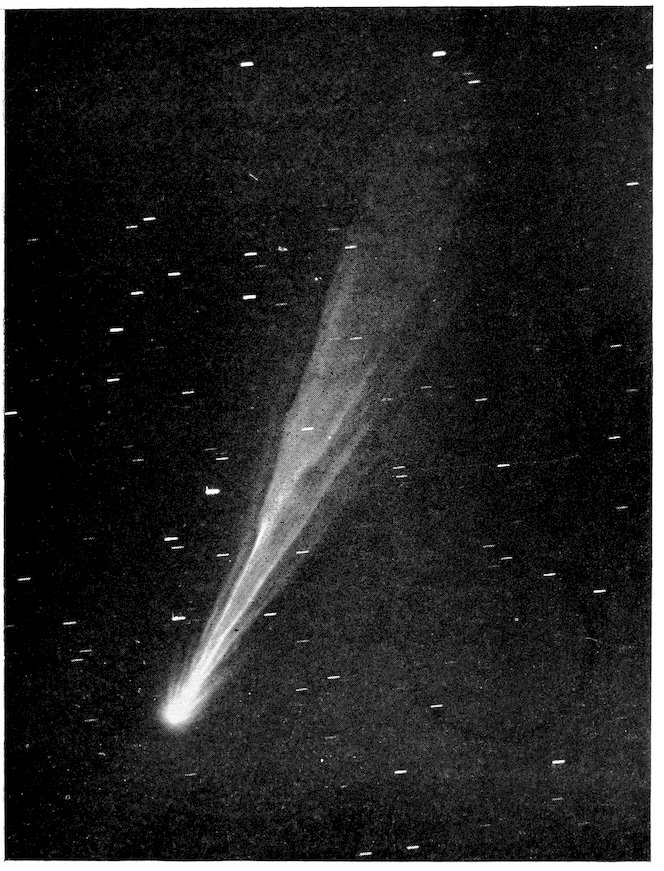
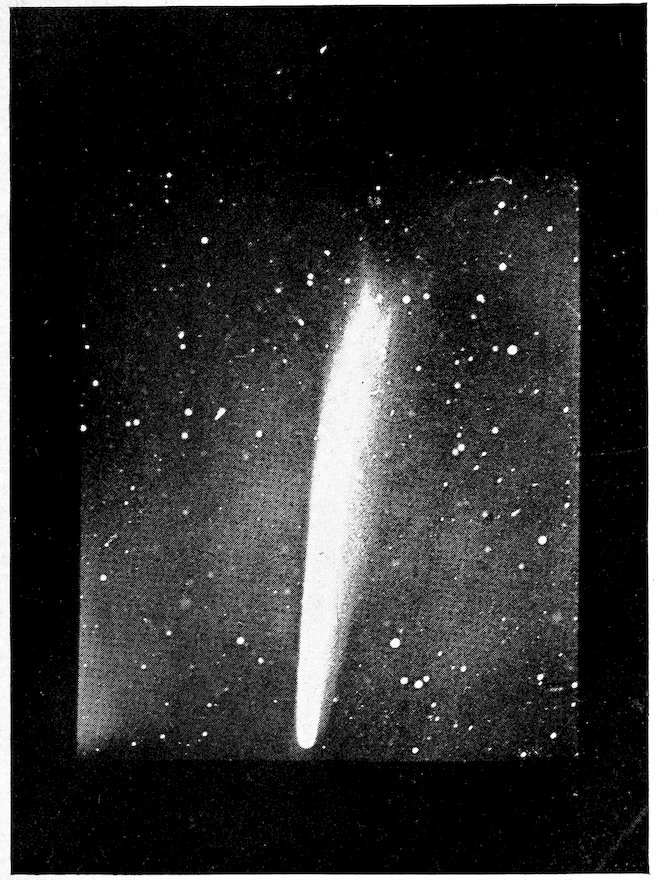
New original cover art included with this eBook is granted to the public domain.
THE ROMANCE OF COMETS
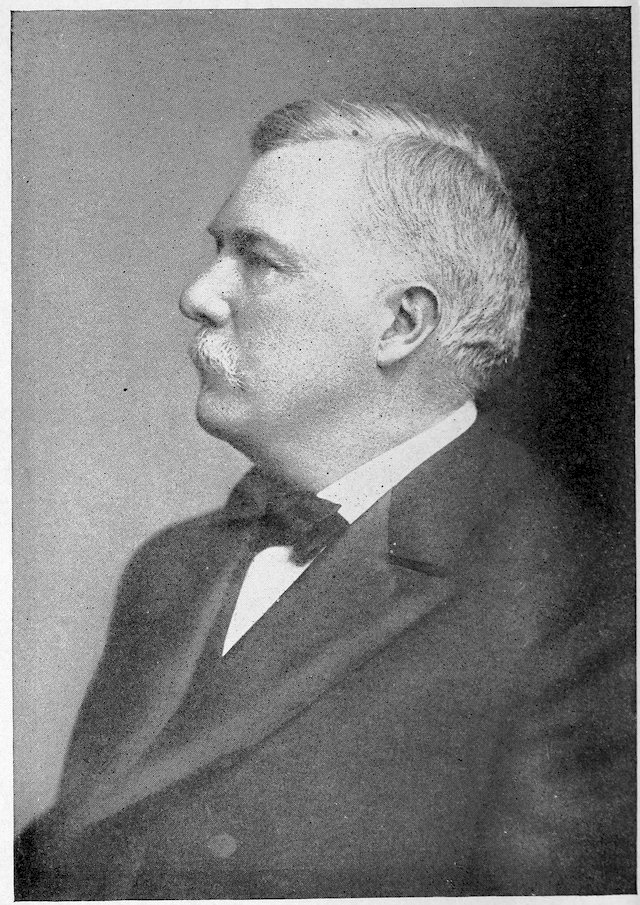
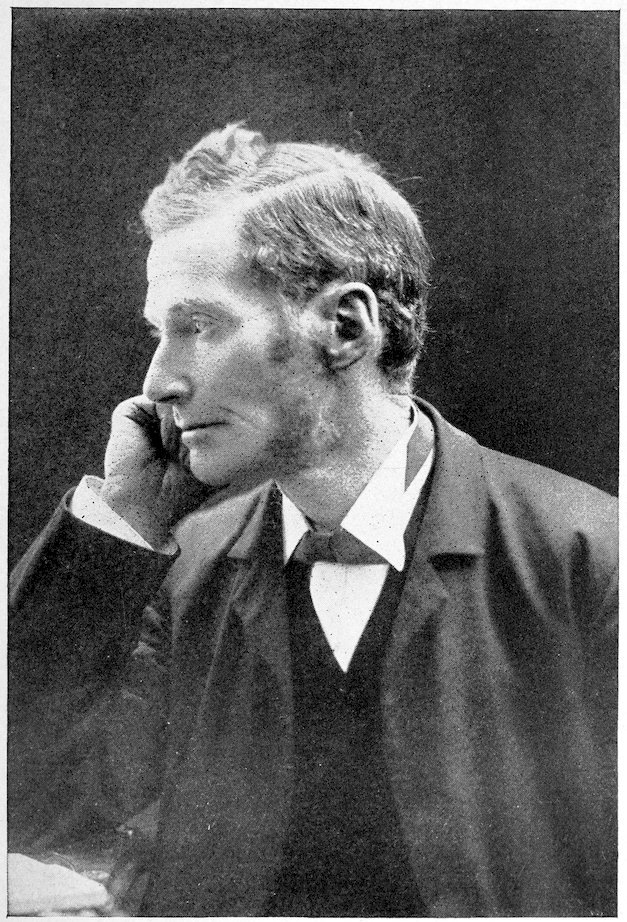
Professor E. E. Barnard
By MARY PROCTOR, F.R.A.S., F.R.Met.S.
(Daughter of the late Richard A. Proctor)
Author of “Evenings with the Stars,” “Stories of Starland,” “Giant Sun and His Family,” “Legends of the Stars,” “The Children’s Book of the Heavens,” Etc.
This book contains an account of some of the
quaint ideas entertained regarding comets,
meteors, and shooting stars in the days of long
ago, when they were looked upon with apprehension
and fear. Their appearance was supposed to
herald coming disaster, until Science lifted the veil
which obscured their real meaning from view. As
soon as it was known that these visitants from the
star-depths were composed of such airy texture
that, as Sir John Herschel once expressed it, they
could be easily packed in a portmanteau, tail and
all, the fear of comets was at an end, and their
appearance is nowadays hailed with delight.
Possibly no one appreciated this fact more
strongly than the late Professor Barnard of the
Yerkes Observatory, at Williams Bay, Wisconsin;
and as Professor Frost, the director of the observatory,
remarks, in a letter granting the author a
permit for the use of several photographs of
comets taken by him, “it is most appropriate that
your book should be dedicated to him, as he certainly
xiihad an ardor in observing and studying
comets that has seldom been equaled.”
In the chapter on “Comet-hunting as a Hobby,”
after describing how popular it was some years
ago, when cash prizes were offered to successful
finders, an instance is given thereof in the story
related by the late Professor E. E. Barnard, entitled
“The House that was Built with Comets.”
As a matter of fact, it was built by means of financial
aid obtained in this way. Shooting stars also
come in for their due share of attention, as well as
fireballs which present rather an alarming aspect
until one realizes that the sudden blaze of light
indicates their annihilation.
The book is illustrated with prints, charts, drawings,
and photographs, and permits for their use
are gratefully acknowledged to the Astronomer
Royal, in connection with photographs obtained
at the Royal Observatory, Greenwich; and to the
directors of the Cape of Good Hope and Johannesburg
Observatories in Africa, and the Yerkes
Observatory in U. S. A. Also for permission
kindly given by the director of Harvard College
Observatory, U. S. A., to make a copy from a
drawing of Donati’s comet, made by Professor
Bond in the year 1858.
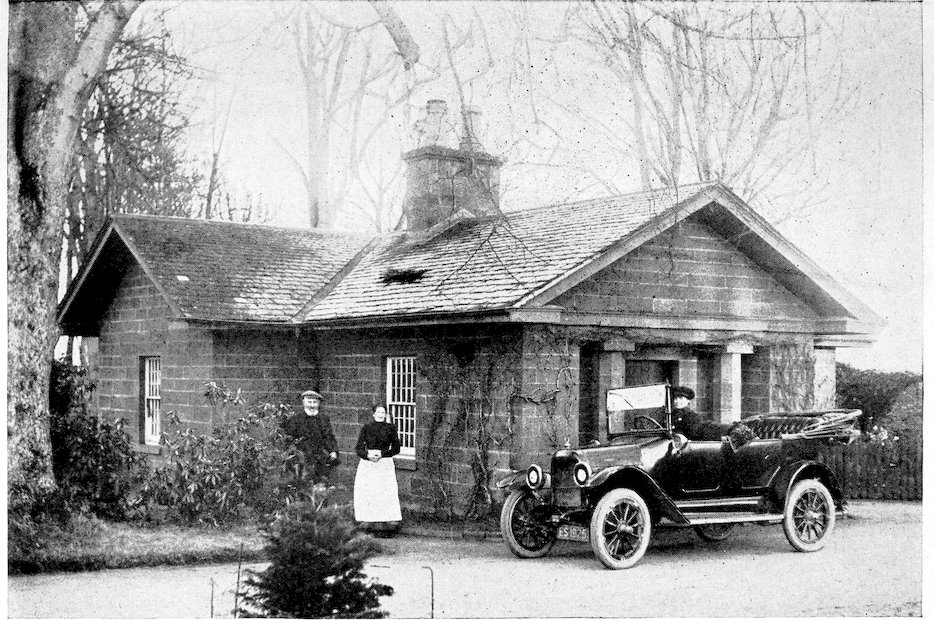
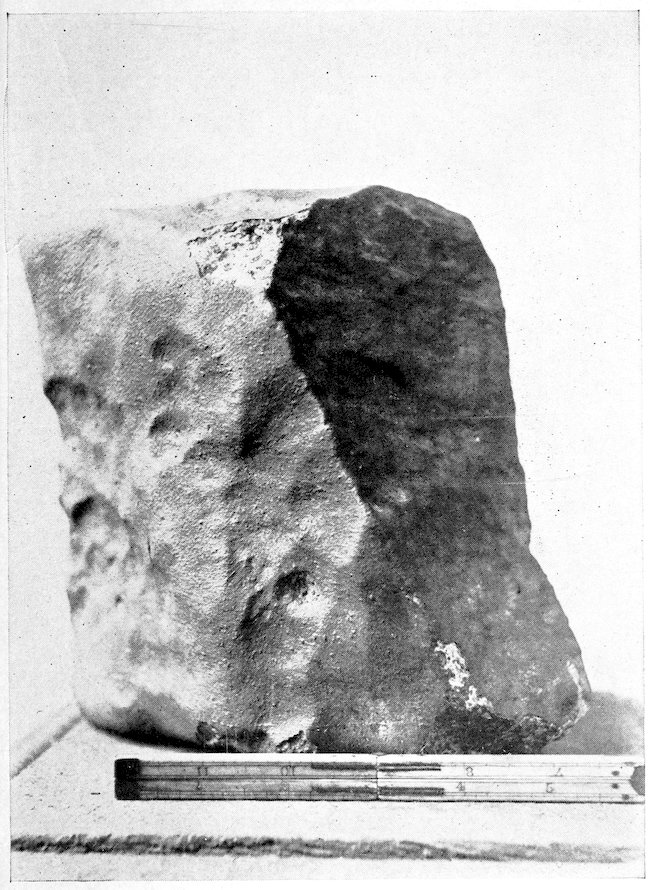
Grateful acknowledgment is made to Mr. W.
xiiiF. Denning (Bristol) for the loan of the photograph
of the Strathmore meteorite, which fell
December 3, 1917, making a hole in the roof of
Outh Lodge, Keithwick.
The author is specially indebted to Mr. Denning
for his kindness in looking over the MS. of
Chapter VIII, which deals with “Meteor Streams
and Shooting Stars”; and to Dr. A. C. D. Crommelin
for a like favor in connection with the chapters
dealing with “Halley’s Comet as Seen in
1910,” and the “Origin of Comets and Meteors,”
the most important chapter in the book. It incorporates
the views advanced by my father some
thirty-five years ago, concerning the ejection
theory of comets, stanchly advocated by Dr.
Crommelin, as compared with the more modern
capture theory. The chapter is also of special
interest, as, in a way, it partly supplies the missing
chapter in my father’s unfinished work, Old and
New Astronomy.
Mary Proctor.
London, April, 1926.
CHAPTER ONE COMETS AS PORTENTS
1
“Lo! from the dread immensity of Space,
Returning with accelerated pace,
The rushing comet to the sun descends:
And, as he shrinks below the shading Earth,
With awful train projected o’er the Heavens,
The guilty nations tremble.”
—Thomson.
Can there be anything more awe-inspiring to
the superstitious than the stealthy approach
of a comet as it wends its way among the stars,
finally blazing out with a marvelous train as it
draws near to the sun to pay homage? As a distant
relative of that luminary, it comes for an occasional
visit from far-off realms, and after a brief display
during which it adorns itself with a splendor befitting
the momentous occasion, it withdraws into the
obscurity from which it emerged. In these enlightened
days a comet is greeted with enthusiasm, and
the camera keeps a faithful record of its varying
appearance, but in olden times it was regarded as
a portent of evil.
Comets have sometimes been pictured as
2dragons, and according to Pliny the shape of a
comet indicated its character as a portent. Thus,
some were shown as arrow heads, sea monsters,
swords, lances, and flames. In A.D. 69, according
to Josephus, several signs appeared in the sky
announcing the destruction of Jerusalem.
“Amongst other warnings, a comet, one of
the kind called Xiphias, because their tails
appear to represent the blade of a sword, was
seen above the city for the space of a whole
year.”
Regarding the comet of A.D. 79, it is said to
have preceded the death of the Roman Emperor
Vespasian. When the physicians reproved the
emperor for continuing to live as usual, attending
to the business of the state, although attacked by a
serious malady, he replied, “It is fitting that an
emperor should die standing.” Then perceiving
some courtiers who were conversing together in a
low tone of voice about the comet, gazing significantly
in his direction meanwhile, he remarked:
“This hairy star does not concern me; it menaces
rather the King of the Parthians, for he is hairy
and I am bald.” Feeling his end approach, he
observed, “I think that I am becoming a god.”
3Virgil compares a hero in his shining armor to a
comet, and makes another allusion to these objects
at the end of the first Georgic (Bk. I, 487–488)
in the couplet thus rendered by the Rev. Canon
Newbolt:
“At no other time did more thunderbolts
fall in a clear sky, nor so often did dread
comets blaze.”
In the natural history of Pliny we find several
passages relating to the significance attached to
comets by the ancients. For instance, when referring
to the comet of 48 B.C., he observes:
“We have in the war between Cæsar and
Pompey an example of the terrible effects
which follow the apparition of a comet....
That fearful star, which overthrows the
powers of the earth, showed its terrible locks.”
The superstitious dread in which comets were
held in the Middle Ages is exemplified in the
gloomy forebodings of disaster, such as wars,
pestilence, and the death of kings, when these
apparitions were seen in the heavens. Well known
is Shakespeare’s allusion to comets in Act II, Sc.
2 of “Julius Cæsar”:
4“When beggars die, there are no comets seen;
The heavens themselves blaze forth the death of princes.”
In “Henry VI” we find the following passage
in Part I, Act I, Sc. 1:
“Comets, importing change of times and states
Brandish your crystal tresses in the sky;
And with them scourge the bad revolting stars
That have consented unto Henry’s death.”
The comet of A.D. 451 or A.D. 453 announced
the death of Attila, and the comet of A.D.
455 that of the Emperor Valentinian. So widely
spread was the belief in the connection between the
death of the great, and these menacing signs in
the heavens, that the chroniclers of old appear to
have recorded comets which were never seen, such
as the comet of A.D. 814, which was supposed to
have presaged the death of Charlemagne.
When the end of the world was expected in
A.D. 1000, the most simple phenomena assumed
terrible proportions. We are told of earthquakes,
and a comet visible for nine days.
“The heavens having opened, a kind of
burning torch fell upon the earth, leaving
behind it a long train of light similar to a
flash of lightning. Such was its light that it
5frightened not only those who were in the
open country, but those who were within
doors. As this opening in the heavens closed
imperceptibly there became visible the figure
of a dragon, whose feet were blue, and whose
head seemed continually to increase.”
However, this was more likely the momentary
appearance of a shooting star or fireball, than the
comet which the chronicler records as remaining
visible for nine days.
A terrible picture accompanies the description,
showing a meteor track so arranged as to resemble
the outline of a dragon, and lest the resemblance
might not seem convincing enough, a fearsome
looking dragon to match is set beside the celestial
apparition labeled “Serpens cum ceruleis pedibus.”
Fortunately, people were too busy in those
“good old times” fighting and plundering one another
to pay much heed to these omens in the sky.
Moreover, with regard to the threatened end of
the world, many contented themselves with the
reflection that they could not be much worse off,
even if the world should perish at that period.
Consequently, a comet scare was averted, and we
have clear evidence that, as far as the predicted
catastrophe was concerned, everything went on as
6usual. A.D. 1000 came and went, and still the
world endured.
Great importance has been attached to the seeming
connection between Halley’s famous comet
and the portent theory, with striking events which
have occurred upon the occasion of its several
returns. For instance, at its return in A.D. 66 it
was probably the sword of fire described by Josephus
as suspended over Jerusalem not long
before the destruction of that city by Titus. Its
appearance in A.D. 451 coincided with the defeat
of Attila at Châlons, and it was pictured in the
Nuremberg Chronicle for A.D. 684.
It is well known in connection with the famous
Bayeux tapestry into which Queen Matilda wove
the story of William the Conqueror’s defeat of
Harold on the memorable occasion of the battle
of Hastings, A.D. 1066. People are shown pointing
to an object in the sky, which is labeled Isti
Mirant Stellam, the wonderful so-called “hairy
star” which supposedly heralded the success of the
Conqueror.
On an adjoining panel is pictured the dejected
Harold about to topple off his throne, and a
solitary attendant expressing alarm at the defeated
monarch’s precarious position, but apparently
offering no assistance of value. Thus the comet
7on this occasion served the double purpose, it
would seem, of announcing success on the one
hand and defeat on the other. Undoubtedly it
caused great alarm on account of its brightness and
rapid motion.
In 1456 it returned at a period of great anxiety,
when the Turks, having taken possession of Constantinople
three years before, now turned their
attention to Belgrade, which they were besieging.
It happened that the moon was passing through
the crescent phase at the time, and Halley’s comet
presented the appearance of a sword. The
crescent moon, resembling the Turkish emblem, is
said to have been considered an evil omen by the
Turks, contributing eventually to their defeat.
Coming to our own times, it is surprising the
amount of fear and distress which was caused at
the return of Halley’s comet in 1910. Insanity
and even cases of suicide followed at its approach,
and there is a well-authenticated case of an enthusiastic
young lady in New Jersey, U. S. A., who
declared her intention of following the comet
wheresoever it went, but was restrained by her
friends, and temporary seclusion in an asylum,
from this perilous pursuit.
As the time drew near for the comet to pass
from the morning to the evening sky, when, according
8to calculations, it would cross the plane of
the earth’s orbit at a point exactly between the
earth and the sun, fresh alarm was caused lest the
earth, in plunging through the débris of the
comet’s train, might come to grief in consequence.
A report that we should be asphyxiated by the
poisonous gases, such as cyanogen, of which the
train was said to be partly composed, did not tend
to lessen the alarm. Cautious folk laid in a supply
of bottles of oxygen to sustain life during the fatal
night, and one or two of a pessimistic turn of mind
actually forestalled the expected tragedy by committing
suicide. Yet nothing happened, for the
simple reason that on the night of the great adventure
the comet obligingly spread its tail so widely
apart, that we passed unharmed between two sections
thereof.
Drawn by M. Proctor
Daylight Comet 1910 a
As seen at Newcastletown Moor, January 28, by the author
9Nevertheless, despite a few tragedies consequent
upon fear at the comet’s near approach, the
lurking dread of evil it might have had in store
for us was considerably less on the occasion of the
return of Halley’s comet in 1910, than was usual
in the gloomy, prognosticating period of the
Middle Ages. Yet certain events occurred which
made some people wonder if there was not a
kernel of truth in the so-called portents after all.
For instance, during the month of January (in the
eventful year 1910) the so-called Daylight comet—a
totally unexpected visitor to the sun’s domain—blazed
out in the evening sky and the people of
Paris saw its reflection in the flood which threatened
to destroy their city. In May, while Londoners
were watching for Halley’s comet, which
proved to be a very disappointing spectacle in this
part of the world, the body of King Edward the
Seventh lay in state at Westminster. “What
wonder,” as Mr. Arthur R. Hinks observes in his
book entitled Astronomy, “that the imagination
seizes upon these deplorable coincidences and the
fear of comets dies hard among us?”
Tennyson thus refers to Halley’s comet in his
poem “Harold”:
“Lo! there once more—this is the seventh night
You grimly-glaring, treble-brandished scourge of England.
· · · · ·
Look you, there’s a star.
· · · · ·
It glares in heaven, it flares upon the Thames,
The people are as thick as bees below,
They hum like bees—they cannot speak—for awe,
Lord Leodwin, dost thou believe that these
Three rods of blood-red fire up yonder mean
The doom of England and the wrath of Heaven?”
Milton in “Paradise Lost” compares Satan to a
comet:
10“That fires the length of Ophiuchus huge
In the Arctic sky, and from his horrid hair
Shakes pestilence and war.”
It has been suggested that the poet was doubtless
referring to the comet of 1618, which was
held responsible for the great Thirty Years’ War.
Milton was only ten years old at the time, but the
impression made on his mind by this magnificent
comet with a train 104° long (or over twenty
times the distance separating the pointers in the
constellation of the Great Bear), “may well have
lasted until he wrote the above lines as a man of
fifty.”[1]
Elsewhere, in “Paradise Lost,” Milton refers
to a comet as the brandish’d sword of God:
“... before them blaz’d
Fierce as a Comet: which, with torrid heat,
And vapours as the Lybian air adust,
Began to parch that Temperate clime.”
According to the translation by Longfellow,
Dante in his “Paradiso,” Canto XXIV, refers to
comets as “souls beatified.”
“Thus Beatrice: and those souls beatified
Transformed themselves to spheres on steadfast poles
Flaming intensely in the guise of Comets.”
11Turning to the Avesta writings, we find that
the Parsees of ancient Persia classified comets as
parihs, or fairies. Pari is the Iranian word for
fairy, and is derived from the word “par,” meaning
to tempt, to enchant. The English word
“fairy” also comes from a similar root, “fier,” to
enchant.
Nevertheless, these cometary fairies are not the
dainty beings of English folk-lore, but are described
in the Avesta as “ill-born fairies,” their
appearance in the sky inspiring terror, since they
are supposed to bring disease, calamity, and death
in their wake. In the picturesque language of the
Persian writer, “the distress of the earth becomes
as that of a sheep when a wolf falls upon it.”
The following quaint account of the influence
of a comet is given in the Avesta.
“A hairy comet appeared in the year 662,
Hijri, and the increase of the splendour of
the world was in Leo. The strange thing was
that it appeared to be of the proportion of
the head of a big man and emitted steam
from the front. It passed over the countries
of Tibet, Turkestan, China, Kashgar and remained
visible for 85 days. In all these
12countries there arose rebellions. In Khorassan
calamities of thunder and lightning and
other such phenomena appeared.
“Many years and many months had passed
over this event, and then in 803, a tailed
comet appeared in the zenith of Constantinople.
Astrologers informed Timur that
from what the wise and the experienced have
said, it appears that an army coming from the
direction of the east will be victorious in that
country, and a general from that country will
assist him. Timur (literally: the illuminator
of the face of fortune), who was always
expecting an invasion of the country, but
whose companions of poor intelligence did
not acquiesce, attended to that prediction and
convinced the great and small of his court, of
the truth and insight of the star-seers. The
learned in the mysteries of the heavens are
convinced of this, that if the comet appears
within the boundaries of a country, its king
dies. If it is inclined towards the boundary,
the country of the governor passes away from
his hands, and plague and disease add to the
afflictions of the country.”[2]
13Some of the Pahlavi books refer to a comet as
“the thievish Mushpar provided with tails.” The
comet was classified as an evil spirit in company
with planets and meteors which wandered hither
and thither; while the sun, moon, and fixed stars
were considered good spirits, because they were
always to be found at appointed times in their
places in the sky.
In the mythology of China and Japan we find
that comets were supposed to be celestial representatives
of every country on the earth, and occupied
the important position of ambassadors journeying
from one celestial region to another, and giving
forecasts of terrestrial events of importance. For
this reason, careful records were kept of the dates
of their appearance and the paths along which they
traveled, thus enabling astronomers of to-day to
trace back the path of Halley’s comet, for instance,
to a very remote era. Whatever the motive that
prompted the accumulation of records, they have
proved of the utmost value.
Comets are called “broom stars” in China, a
name derived from the form of their tails, which
have the very prosaic name of brooms (sui or
soui). A comet without a tail was referred to as
merely a star, or a guest star, from its visiting the
14provinces and taking up its abode in different
places, as at an inn.
“Their home was in the vestibule of the
celestial palaces; there, under an invisible
form, they awaited the order of departure,”
says Pingré, “the order sent, they became
visible and commenced their journey. If,
whilst on their way they put forth a tail, the
star was said to have become a comet.”
The above quotation, remarks the same author,
explains:
“the foolish and singular idea that the Chinese
formed of the heavens. According to
them, the heavens represented a great empire,
composed of kingdoms and provinces;
these provinces were the constellations; there
was decided all that would happen for good
or ill to the great terrestrial empire, that is,
to China. The planets were the administrators
or superintendents of the celestial republic,
the stars were their ministers, and the
comets their couriers or messengers. The
planets sent their messengers from time to
time to visit the provinces for the purpose of
15restoring or maintaining order, but all that
was done in the heavens above was either the
cause or the forerunner of what was to happen
below.”
The ideas of the Chinese were not more foolish
than the extravagant myths of the ancients, and
of the Europeans in the Middle Ages. Nevertheless,
although comets are no longer regarded with
superstitious awe, mystery still clings to them.
For those who are unaware of the fact that astronomers
can trace their paths, predict the periodic
returns of these wanderers, and even analyze the
substance of which they are composed, there are
many problems concerning them still awaiting
solution.
CHAPTER TWO COMET-HUNTING AS A HOBBY
16
“I have the greatest admiration for a man or woman
who discovers a comet, because I know of the hard
and thorough work which the success implies.”
—W. R. Brooks, the noted American comet-hunter.
To hunt for a comet in the ocean of space is
as fascinating a hobby in its way as angling
for a wily fish, requiring in either case an unlimited
supply of perseverance, patience, and spare
time. In place of fishing tackle one requires a
telescope with an aperture of four or six inches,
though excellent work has been accomplished with
smaller instruments. It should be erected in a
position commanding a clear view of the horizon
either eastward or westward, as comets travel in
the wake of the rising or setting sun. During the
daytime a glance at a map showing the region of
the sky to be examined in the evening will save
an endless waste of time, to say nothing of the
disappointment when the suspected object proves
to be a nebula and not a comet. On the other
hand, fuzzy-looking objects resembling comets
17have been mistaken for nebulæ when in reality
they were comets. For instance, in looking over
Sir William Herschel’s list of 1,000 nebulæ and
clusters, presented by him to the Royal Society in
1786, suspicion is aroused by the following entry:
“Some of the shape of a fan, resembling an electric
brush, issuing from a lucid point, others of the
cometic shape, with a seeming nucleus in the
center, or like cloudy stars surrounded with a
nebulous atmosphere.” (Philosophical Transactions,
Vol. LXXIV, p. 442.) As we shall see later
on, the descriptions tally with the appearance of
comets which have been photographed.
Nebulæ and clusters likely to be on the list of
“suspects” have been charted in my father’s New
Star Atlas, edition 1915, containing maps of all
the stars down to the sixth magnitude (that is, all
stars which can be seen with the naked eye), as
well as the positions of nebulæ, clusters, and
fainter stars which become visible with the aid of
a small telescope. It is a compact, handy volume,
serving as an excellent guide for the amateur
comet-hunter in his rambles through starland in
search of cometary prey.
Provided with a copy of this book, and allowed
the privilege of using the Brashear (name of the
maker), Comet-Seeker, which is stationed on the
18main roof of the Yerkes Observatory at Williams
Bay, Wisconsin, U. S. A., the writer spent many a
delightful evening during the summer of 1910,
scanning the evening sky for celestial wanderers.
Unable to resist the temptation to linger by the
way in admiration of double stars, clusters, and
nebulæ strewn along the highways and byways of
starland, comets missed recognition.[3] Nevertheless,
the evenings spent with the little comet-seeker
were a source of unqualified delight, though no
comet hove in sight.
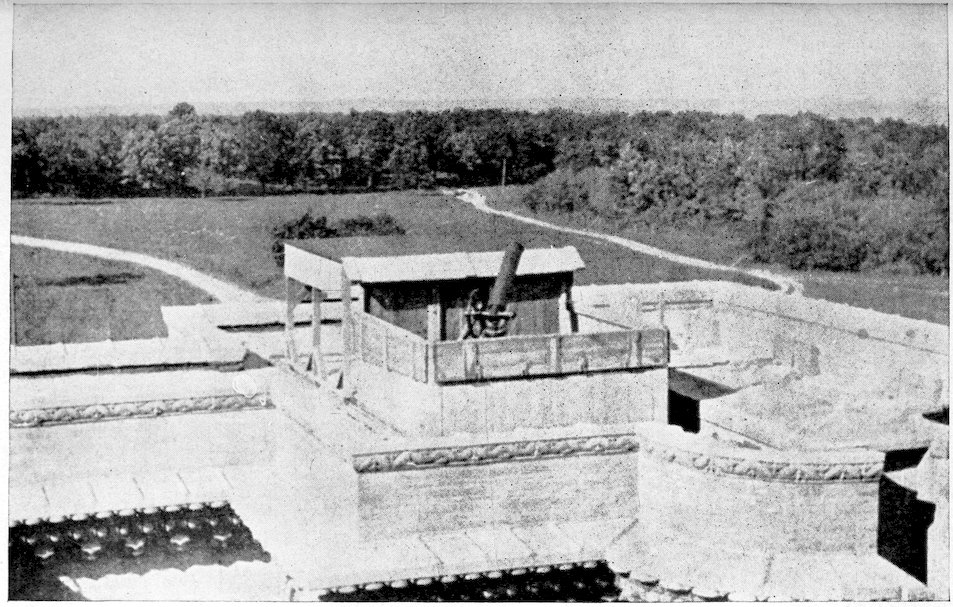
The telescope of six inches aperture, easily
handled, is inclosed in a sort of cabin which rolls
on wheels. This can be pushed backward a certain
distance, leaving the instrument out in the open
air. Fortunately, the width of the cabin was such
that it was just possible for the writer to catch
hold of the rods on each side, drawing them backward
the distance required; while shutting it was
an easier matter, requiring as a rule a gentle push,
sending the cabin back on the rollers provided for
this purpose. Before doing so, however, the telescope
was leveled and carefully wrapped up to
keep it free from any moisture or dampness which
might penetrate from the outside, and anyone who
has passed a winter in Wisconsin knows something
of the deep snowdrifts which must settle several
feet deep in such an exposed site as the main roof
of the Yerkes Observatory building. After the
cabin has been closed, it is hooked at the sides and
remains so until the services of the telescope within
are once more required.
The Comet-seeker on the Roof of the Yerkes Observatory, at Williams Bay, Wisconsin
19Then the cabin is reopened and the wrappings
are removed from the telescope, which is turned
in the direction of a specially selected star. This is
kept in the center of the field of view, which is
marked by the intersection of two threads made
from a spider’s web. As there is no clockwork
attachment, the telescope is guided by means of a
small screw like a miniature wheel or helm, enabling
the observer to pilot his or her way through
the ocean of space. Then a keen search is made
in the surrounding region, and if nothing in the
way of a comet “stands revealed” to the searching
eye of the telescope, another region is explored, so
that a more or less extended expanse of sky comes
under observation during the course of the evening.
On one eventful occasion a supposed comet
was glimpsed and its position duly charted with
regard to neighboring stars. However, on reference
to the star map the fuzzy-looking object
proved to be a nebula. Supposing by any possibility
20the suspected object had been a comet, this
could have been proved beyond doubt by watching
it for two or three evenings in succession. The
presence of a comet can be detected as it slowly
drifts against a background composed of the stars,
while the nebula is at a distance so remote that an
observer would have to watch for centuries before
he detected any perceptible motion.
Nevertheless, there is a close resemblance
between the hazy-looking objects known as nebulæ
and comets when they emerge from obscurity.
For this reason, they gave a great deal of trouble
to Messier, a French astronomer of the eighteenth
century. So keen was he on capturing comets that
Louis XV nicknamed him “the Ferret of Comets.”
Consequently, we can imagine his annoyance, after
discovering a supposed comet, at finding it was
merely a cloudy-looking object which he termed a
nebula. He kept a careful record of these “embarrassing
objects,” so that he might not be led
astray by them again, and labeled them Messier 1,
Messier 2, and Messier 3, in the order of discovery,
and these are usually briefly recorded on star
maps as M1, M2, M3, etc. In this way, Messier
made a list of forty-five nebulæ, which he entered
in a catalogue published at Paris in 1771. A century
later (1871) the list had been enlarged by
21one hundred and three discoveries. For the listing
of these “embarrassing objects,” as Messier termed
them, we are greatly indebted, since in recent years
photography has revealed the fact that they are
among the most marvelous objects in the heavens.
With the assistance of a small two-foot telescope
of two and a half inches aperture, magnifying
five times, and with a field of view covering
four or five degrees, Messier discovered thirteen
comets. His first comet dates from 1760, and
another French astronomer named Pons, who discovered
a comet in 1802, joined him in the pioneer
work of making a systematic search for comets.
It is interesting to note that Pons was a doorkeeper
at the Observatory at Marseilles, and, owing to
the teaching and encouragement he received from
Thulis, the director, he achieved phenomenal success
as a comet-hunter. A third name must be
added to the list of these enterprising searchers
after cometary prey, viz., that of Montaigne, between
whom and Messier existed a keen rivalry.
The following story shows the importance attached
by the latter to each comet captured.
It seems that on one occasion Messier, who had
discovered twelve comets, was looking for his thirteenth,
when his wife was taken seriously ill and
died. While attending to her he was hindered in
22his search for the comet which was found by his
rival, Montaigne. When some one sympathized
with him about the loss he had sustained he said,
“Alas! Montaigne has robbed me of my thirteenth
comet!” Then realizing that he should be mourning
the loss of his wife, he added the remark, “Ah!
poor woman!” but he continued grieving for his
lost comet.
Apparently Messier’s path was beset with difficulties,
for in his book entitled Planetary Worlds
Breen tells us that on one occasion while Messier
was walking in President Saron’s garden he was
doubtless looking up at the sky on the chance of
detecting a comet, when he fell into an icehouse,
and was temporarily disabled. Later on, we are
told in the same book, the revolution deprived
Messier of his little income and every evening he
was wont to repair to the house of the noted
astronomer Lalande to replenish the supply of oil
for his midnight lamp. The political storm made
it necessary for him to remove to another neighborhood,
“where he no longer heard the clocks of
forty-two churches sounding the hours during the
night watchings.”
Possibly his most trying experience occurred in
connection with the expected return of Halley’s
comet in 1758. It was first observed by a farmer
23named Palitzsch, living at Prohlis, near Dresden,
who saw it on Christmas Day, 1758, with a telescope
of eight-foot focus. He was an amateur
astronomer possessed of keen sight, and was in
the habit of searching the heavens with the naked
eye, which seems to have given rise to the statement
that he found Halley’s comet with the naked
eye at a time when the professional astronomers
were searching for it in vain with their telescopes.
Meanwhile, Messier had been carrying on a
prolonged watch of the heavens, extending over
the whole of the year 1758, but he did not actually
get a view of Halley’s comet until January 21,
1759, when he observed it regularly for three
weeks. He was the first noted astronomer to do
so, but according to the account given by J. Russell
Hind, in his book on The Comets (page 41):
“Delisle, then director of the Observatory
at Paris, would not allow him to give notice
to the astronomers of that city that the long-expected
body was in sight, and Messier remained
the only observer before the comet
was lost in the sun’s rays. Such a discreditable
and selfish concealment of an interesting
discovery is not likely to sully again the
annals of astronomy. Some members of the
24French Academy looked upon Messier’s observations,
when published, as forgeries, but
his name stood too high for such imputations
to last long, and the positions were soon received
as authentic, and have been of great
service in correcting the orbit of the comet at
this (1835) return.”
The name of J. R. Hind, by the way, is the only
English one included in the list of those who
received a gold medal given to the discoverer of
telescopic comets by Frederick VI, King of Denmark,
who instituted the distribution of this award
in the year 1835. The gold medal was also won
by an American astronomer, Maria Mitchell, who
discovered a comet, October 1, 1847, while engaged
in making observations from the roof of the
Nantucket Athenæum. When eighteen years old
she was appointed librarian at the Athenæum,
which position she held for twenty years. The
roof of the building was her observatory. In 1865
she became professor of astronomy at Vassar College,
a position she retained until her health permitted
her to do so no longer.
The grant of the medal by King Frederick VI
was discontinued after the death of his successor,
Christian VIII, in 1848. The Vienna Academy of
25Sciences formerly gave a gold medal to the discoverer
of every new comet, but this also was discontinued
in 1880. Then Mr. H. H. Warner, a
wealthy American, came to the rescue and offered
a prize of two hundred dollars for every unexpected
comet found by an observer in Canada or
U. S. A., which brings us to the story told in the
autobiography of the late Professor E. E. Barnard,
one of the most successful competitors. He
had nineteen comets to his credit, resulting in the
erection of what he quaintly termed “The house
that was built with comets.”
“Times were hard in the last of the ’seventies
and the first of the ’eighties, and money
was scarce. It had taken all that I could save
to buy my small telescope. I had been
searching for comets for upward of a year
with no success, when a prize of two hundred
dollars for the discovery of each new comet
was offered (in 1880) by the founder of the
Warner Observatory through the agency of
Dr. Lewis Swift, its director. Soon after
this it happened that I found a new comet
and was awarded the prize. Then came the
question, ‘What shall we do with the money?’
After due deliberation it was decided that we
26[referring to Mrs. Barnard] would try to get
a home of our own with it. I had always
longed for such a home where one could
plant trees and watch them grow up and call
them our own. So we bought a lot with part
of the money, which was on what was afterwards
called Belmont Avenue, but which
was not then even a road. It was hard to
find the lot after it was bought, for it was
out in the open common. The place was in
the midst of a scattered settlement of negro
shanties, where the negroes had ‘squatted’
after the war, though on beautiful rising
ground which I had selected in part because it
gave me a clear horizon with my telescope.
“After some saving and some borrowing,
and mainly a mortgage on the lot, we built a
little frame cottage where my mother, my
wife, and I went to live. Those were happy
days, though the struggle for a livelihood was
a hard one, with working from early to late
for a bare sustenance (and the hope of paying
off the mortgage), and sitting up all the rest
of the twenty-four hours, hunting for
comets.
“We could only look forward with dread to
the meeting of the notes that must come due.
27However, when the first note was due a faint
comet was discovered wandering along the
outskirts of creation, and the money went to
meet the payments, and this continued after
we had gone to other scenes. The faithful
comet, like the goose that laid the golden egg,
conveniently timed its appearance to coincide
with the advent of those dreaded notes. And
thus it finally came about that the house was
built entirely of comets. This fact goes to
prove the great error of those scientific men
who figure out that a comet is but a flimsy
affair after all, infinitely more rare than the
breath of the morning air, for here was a
strong compact house, albeit a small one, built
entirely out of them. True, it took several
good-sized comets to do it, but it was done,
nevertheless.”
In connection with the prize offered by Dr. H.
H. Warner, Professor W. H. Brooks discovered
twenty comets; Barnard, nineteen, as already
stated; Perrine, thirteen; and Swift, eleven.
Awarding this prize was given up after a while,
but the idea was again revived by a wealthy
American, the late Mr. J. M. Donohoe, in the
year 1890, with the result that a bronze medal is
28now presented to the discoverer of any new comet,
on the report of a committee of the Astronomical
Society of the Pacific. There were two awards
for the year 1923. Comet A was discovered independently
by Sr. Dr. Arturo Bernard, Colmenarejo,
Madrid, Spain, on October 11, 1923; and
by Alexander D. Dubiago, of Kasan, Russia, on
October 14, 1923. The medal was awarded to
each of these two discoverers. On November 10,
1923, Mr. W. Reid, of Rondebosch, South Africa,
who has been awarded several of the medals for
his discoveries of comets, added another to his list
of captures.
Regarding the ease with which comets may be
discovered in the clear skies of America, Professor
H. H. Turner, in his lecture on Halley’s comet,
given before the British Association in 1908 at
Dublin, referred to a meeting which took place at
Albany, New York, of the Board of Visitors. A
discussion arose as to the value of some desk work
which the director was carrying on, as compared
with the discovery of a comet, which it was suggested
would surely add to the reputation of
the observatory. Professor Boss (the director)
promptly remarked that nothing was easier, if
they would sanction the outlay of certain sums
of money to be used as salary for a person of
29average intelligence, while devoting himself to the
search.
“The challenge was accepted on the spot,”
remarked Professor Turner, “the money subscribed,
the searcher set to work, and within
the allotted time a fine comet was found.
Professor Boss undoubtedly took a certain
risk in undertaking to catch a comet, just as
a man who would undertake to catch a fish
within a definite time. But he was anxious
to indicate his views of the relative importance
of different kinds of work, and deserved
the success he ventured to count upon.”
One wonders if this was the occasion referred
to when it is said that the comet-hunter, after a
preliminary search for a comet, returned to the
room where the Visitors were awaiting his report,
announcing that he had discovered a comet in such
and such a part of the sky. It was immediately
claimed by Professor Barnard, who was present on
this occasion, as one that had already been discovered
by him last spring, or a year or so ago, as
the case might be. After this had occurred two
or three times, it is said, the comet-hunter remarked
to Professor Barnard, “Why don’t you
30keep your comets chained?” However, it may be
as well to take this story cum grano salis.
The cloud-laden skies of England are not
encouraging, as far as comet-hunting is concerned.
It may be possible, when the moon is absent, to
get a glimpse of a comet low down in the vapors
after sunrise or sunset, if the chances are favorable.
Then follows a week of cloud and misty
skies during which period the comet has vanished.
For this reason the discovery of comets in England
is rare, but all the more credit to those who eventually
succeed in making a capture.
Our veteran comet-hunter is Mr. W. F. Denning,
of Bristol, who has specialized in the observation
of comets and meteors. In his book on
Telescopic Work on Starlight Evenings he gives
an instance of two experiences he had in the year
1881, showing how he missed one comet, but succeeded
in finding another, just before sunrise,
when comet-hunting is not nearly as attractive,
one imagines, as in the evening.
It seems that on July 11, 1881, after a night’s
observation of the stars, Mr. Denning, just before
daylight and preparatory to ceasing work, looked
in the direction of the constellation Auriga, the
Charioteer. The idea occurred to him that it
might be worth while to sweep the surrounding
31region with his comet eyepiece, but he hesitated,
not thinking the prospect sufficiently inviting.
There is a well-known saying that he who hesitates
is lost, and on this occasion Mr. Denning
undoubtedly missed an opportunity for finding a
comet. Three nights later a bright comet in
Auriga was discovered by Schaeberle, an American
astronomer at Ann Arbor, Michigan!
That same year, on October 4, Mr. Denning
had been observing the planet Jupiter before sunrise,
when once more he hesitated as to the advisability
of making an attempt at comet-seeking,
but, profiting by his former experience, he made
use of the comet eyepiece with good results. To
quote his own words—
“at almost my first sweep I alighted upon a
suspicious object which afterwards proved
itself a comet of short period,”
which means that it is a frequent visitor to the
neighborhood of the sun. These facts are encouraging,
and still more so when we remember that
Kepler said, “there are as many comets in the sky
as there are fishes in the sea.”
The first woman to discover a comet was Caroline
Herschel, the sister of the famous astronomer,
32Sir W. Herschel, and she had eight to her
credit. In her diary, which has been most carefully
preserved by Miss Francesca Herschel at
Observatory House, Slough, there is an account
of her first discovery which occurred on August 1,
1786. During the absence of her brother in Germany
she availed herself of the opportunity to
make use of a small Newtonian telescope he had
given her, in “sweeping the skies.” Her “sweeper,”
as she termed it, was of 27-inch focal length,
a power of about 20, and a field of view 2° 12′.
Miss Herschel had been observing nebulæ when
she saw what she believed might prove to be a
comet. At one o’clock on the morning of August 2
she made the following brief note in her diary:
“The object last night is a comet,” and she
wrote to Dr. Blagden of the Royal Astronomical
Society, asking him to take the comet under his
protection “in regard to its right ascension and
declination,” which correspond to latitude and
longitude of a place on earth. The right ascension
of a heavenly body is measured eastward along
the celestial equator, from the vernal equinox to
the hour circle on which the object lies. Declination
of a heavenly body is its distance north or
south of the celestial equator, measured on a great
33circle passing through the pole and the celestial
body.
Caroline Herschel sent drawings she had made,
showing the position of the suspected object with
regard to certain stars in the same field of view,
to Dr. Blagden. He was thus enabled to locate
the comet and confirm her observation. When
this discovery of a comet was followed by seven
more, Caroline Herschel succeeded in making for
herself a European reputation for what was called
“her eccentric vocation.”
In 1828 she received the gold medal of the
Royal Astronomical Society, and in 1835 was
elected an honorary member thereof. The personal
interest she took in her cometary captures
is evidenced by a neat little packet found among
her papers after her death, containing the account
of her discoveries. It was labeled “Bills and
Receipts of my Comets.” This also has been carefully
preserved by Miss Francesca Herschel (the
granddaughter of Sir William Herschel) who
showed it to the writer during the summer of
1922.
Searching for comets is not part of the
defined programs of observatories, as it involves
an immense amount of time with results which
only present themselves at intervals. However,
34when an amateur succeeds in discovering a comet
and has made known the fact to a professional
astronomer, the latter completes the work of computing
its orbit and other elements, which is not
usually undertaken by the discoverer, unless he
has the requisite mathematical knowledge.
Yet it is advantageous, if he possesses a ring
micrometer (an instrument used for the measurement
of small angles), to learn how to make
use of it during the first few observations, which
are usually made before the comet has been seen
elsewhere. These observations, if precise, will
prove of the greatest value. The news of the
discovery of a comet should be sent at the first
opportunity to the director of the nearest observatory,
who will communicate with the director
(Elis Stromgren) of the Bureau Centrale Astronomique
de l’Union Astronomique Internationale,
Observatoire de Copenhagen, from which center
it will be sent broadcast all over the world. The
discoverer will then experience the delight of having
a comet named after him, which he can claim
forthwith as his own individual celestial treasure
trove. As a matter of fact, newly discovered
comets are now usually referred to by their date
and order of discovery, as Comet 1, 1924, saving
much confusion as to the name of the actual discoverer.
35This was exemplified in the case of a
comet found by Pons in 1819 (III of that year),
which Encke showed to be revolving in an ellipse
with a periodic time of three and one-half years.
Hence its name of Encke’s comet. It was again
renamed after Winnecke, who rediscovered it in
1858, but actually he had no more claim to the
title than Caroline Herschel, who discovered it in
1795—her seventh comet—or Méchain by whom
it had been previously seen in January, 1786.
The majority of comets travel in an ellipse,
and those of short period, like Encke’s comet,
make short journeys and may be considered frequent
visitors to the neighborhood of the sun.
Others are long-period comets, such as Donati’s
(described in the following chapter), since it
requires nearly two thousand years for the round
trip. Finally there is a third class of adventurous
comets which dash in from outer space, swinging
swiftly round the sun in the focus of its curve,
and darting off again with no prospect of returning,
since they cannot possibly get round the other
focus. Whence they have come or whither they
have gone, no man knows! They are like the
sparrow referred to in a simile used by a courtier
in the days of King Edwin, who compared its
fleeting visit to the life of a man:
36“It is as a sparrow’s flight through the
hall when you are sitting at meat in winter
tide, with the warm fire lighted on the hearth,
but the icy rain storm without. The sparrow
flies in at one door, and tarries for a moment
in the light and heat of the hearth fire, and
then flying forth from the other, vanishes
into the wintry darkness whence it came.”
CHAPTER THREE THE STORY OF DONATI’S COMET
37
Hast thou ne’er seen the comet’s flaming flight?
Th’ illustrious stranger, passing terror sheds
On gazing Nations, from his fiery train
Of length enormous, takes his ample round
Thro’ depths of ether; coasts unnumbered Worlds,
Of more than solar glory, doubles wide
Heaven’s mighty cape; and then revisits Earth,
From the long travel of a thousand years.
—Young. “Night Thoughts.”
When a comet draws near to pay its
respects to its ruler, the sun, it usually
assumes a splendor befitting this momentous occasion.
It adorns itself with a glittering train millions
of miles in length, and composed of myriads
of particles reflecting the sun’s light. The head is
often enveloped in a multiplicity of transparent
veils, through which bright jets may be seen emanating
from the star-like nucleus within. Some
comets have been seen with five or six trains,
spread out like that of a peacock, the camera
revealing rapid and marvelous changes in their
appearance, during the course of a few hours. No
fair débutante, about to be presented to royalty,
38could vie with a comet in capriciousness regarding
her raiment, nor could she equal it in splendor,
even though she owned the mystic lamp of
Aladdin.
The brief assumption of splendor on the part
of a comet is very unlike its usual humdrum existence
when it is as yet so far distant as to be
not only invisible to the comet-hunter, but beyond
range of the far-reaching eye of the telescope or
the entrapping power of the camera. Not the
slightest impression is made on the photographic
plate, and as far as an observer on planet earth is
concerned the comet might have ceased to exist. It
is only when it begins to draw near to the sun
that we are enabled to obtain a record of the
marvelous changes produced in its appearance,
until at its nearest approach it has sometimes been
known to vibrate as though with intense excitement.
For instance, in the case of Biela’s comet,
concerning which a special account is given further
on, it was apparently so overcome at its last
appearance in 1846, that it split in two and literally
went to pieces.
Quite a different story is told concerning the
magnificent comet which greeted us in the summer
of 1858, and was first seen at Florence on the 2d
of June by Giambattista Donati, after whom it
39was named. At the time it was merely a nebulous
mass about one-twentieth the diameter of the
moon, and for some weeks it retained about the
same brightness except for a gradual increase in
the central star-like point, the only indication of
its coming splendor. At the end of August it had
increased so rapidly in brightness that by September
it was visible to the unaided eye, resembling a
hazy-looking star adorned with a small tail.
Gradually, as it drew nearer to the sun, it
increased in size and splendor, reaching its maximum
brightness in October. Its train extended
over an arc of forty degrees, or eight times the
distance separating Alpha and Beta—the so-called
pointers in the constellation of Ursa Major, the
Great Bear. Its real length was then about forty-five
million miles, with a width of ten million.
The nucleus varied in diameter from five hundred
miles to three thousand, or nearly half that of
our planet earth.
The comet was kept under accurate observation
for fully nine months, and during part of that
time it was visible to the naked eye. Professor
G. P. Bond, the director of the Harvard College
Observatory, availed himself of the opportunity
thus presented, of making a series of drawings of
the comet which convey an excellent idea of its
40changing appearance, and the delicate shadings and
misty outlines of this marvelous visitant from the
star-depths. These drawings are of all the more
value, since it will be nearly two thousand years
before Donati’s comet visits these realms again.
To go back to the earlier history of the comet,
before these drawings were made, we find that its
tail was not observed telescopically until seventy-three
days after Donati’s discovery. It was seen
on August 14, 1858, by astronomers at Copenhagen
and Vienna, but not at Harvard until the
20th of that month. The brilliancy of the comet
was somewhat impaired by a strong twilight and
its low altitude. This may account for the fact
that it was described as ruddy in hue, and concentrated,
and having a mere suggestion of a tail.
On August 23 the tail was still so faint as to be
easily overlooked in the moonlight, the record
being: “Bright, but no trace of a tail; the sky
clear, but the moon nearly at full.” On August
30, according to the record in the Times (London),
of observations made by J. Russell Hind,
“The comet was just perceptible to the naked eye;
its nucleus is strongly condensed and brilliant, and
the tail is thrown off in the ordinary form, without
bifurcation.”
During the month of September the tail of the
41comet showed a tendency to curve, and by September
7 it was recorded as being very conspicuous
to the naked eye. September 12 it had increased
wonderfully in brilliancy, and on September 16
the first sketch was made by G. P. Bond, showing
a view of it with the naked eye. The tail was now
estimated as being 7° long, thus exceeding the distance
(of 5°) separating the pointers. A tangent
to the convex edge near the nucleus prolonged
would pass through Delta in Ursa Major, and it
was noticeable that this side was the brightest in
all the sketches. A narrow dark channel extending
from the nucleus up the axis of the tail was very
remarkable, and its edges were surprisingly well
defined, especially very near the nucleus. In fact,
the comparatively sharp definition of the eastern
edge of the tail was in marked contrast to the
softness of outline on the western side. (See
Monthly Notices, R. A. S., Vol. XIX, pp. 88–89.)
By September 27 the length of the tail as
observed with the naked eye was about 9° or 10°.
It was curved, convex toward the star Cor Caroli,
being much better defined on the side near the star
than on the concave side. The narrow dark stripe
in the axis of the tail was still very marked, and
the outline of the tail could be traced from the
nucleus halfway to Delta in Ursa Major, and a
42degree or so further. It was now strongly curved
and its upper outline well defined and bright as
compared with the inner. A straight ray or secondary
tail could be seen faintly suggested on the
eastern side and reaching northward from the
main tail.
By October 3 a marvelous change had taken
place in the appearance of the comet. The train
had increased in length and brightness, extending
nearly as far as Eta in Ursa Major, and the
straight ray or secondary train was still very much
in evidence. It was supplemented by another
slender ray, as shown in drawings made by Professor
Bond on October 4 and 5, but it had vanished
by October 6, although its position was indicated,
for that date, in the faint suggestion of a
ray between the main tail and the outer or secondary
tail. The bright star to the left of the nucleus
of the comet is Arcturus (in the constellation
Boötes), over which the comet passed without perceptibly
diminishing its brightness, thus showing
of what airy texture the train of a comet is composed.
Was it not Sir John Herschel who said
that a comet could be easily packed in a portmanteau,
and in the recent edition of The Vault of
Heaven Sir Richard Gregory gives the following
unique illustration of the insignificance of the
whole mass of a comet:
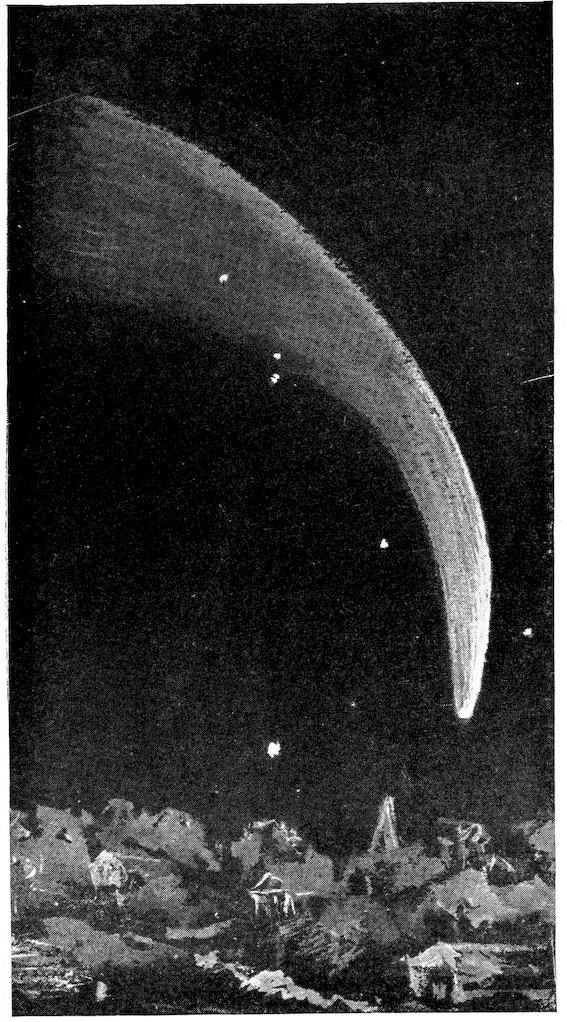
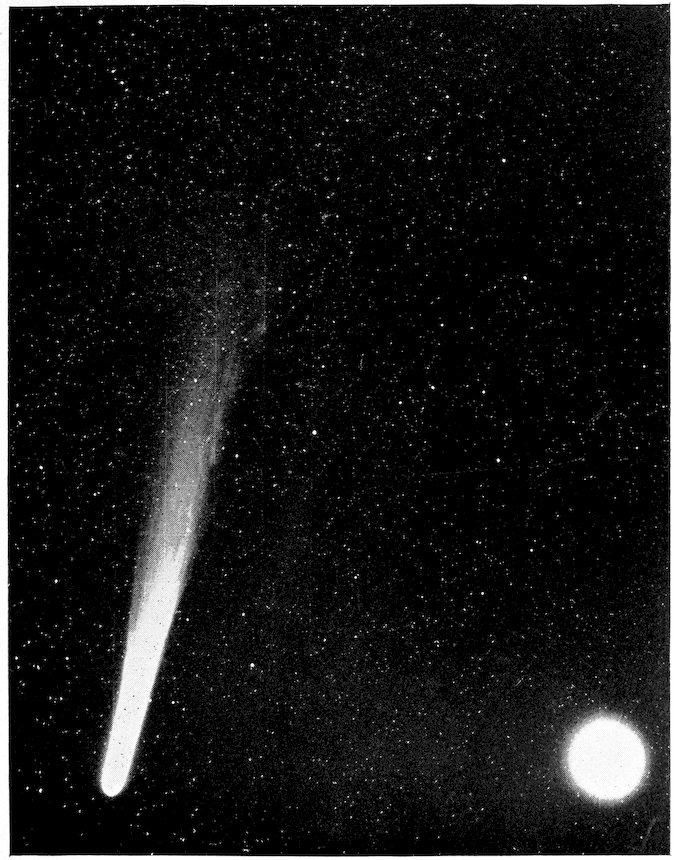
Comet of Donati
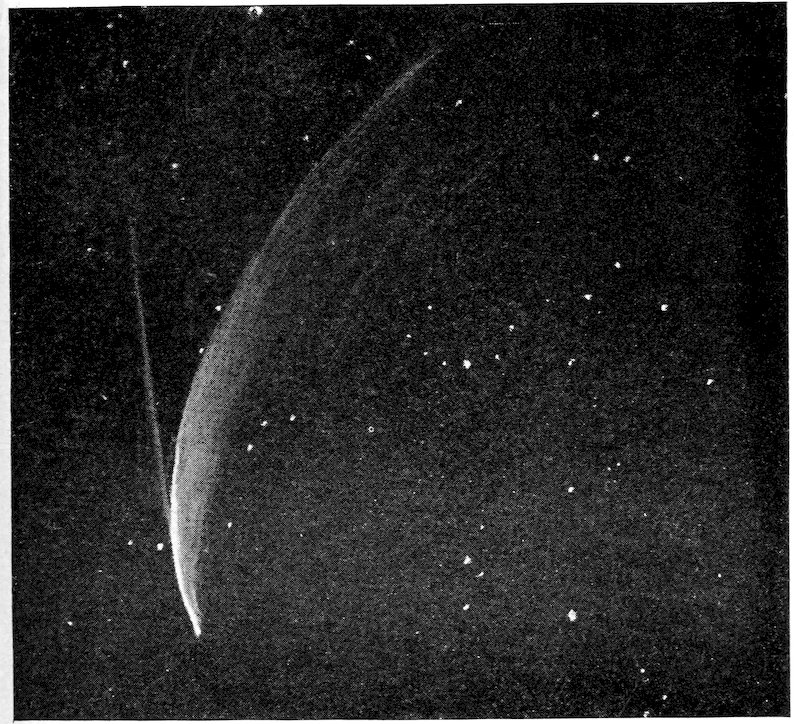
Photograph taken October 10, 1858, at Harvard College Observatory
43“Suppose we could take a comet, head, tail
and all, and put it in one pan of a balance,
and we could carve out from the air which
surrounds us an object of the same size to put
in the other pan, we should find that our
aërial body weighed four or five thousand
times more than the comet. But though a
comet as a whole is lighter than air, it must
not be concluded that comets consist solely of
gases in a state of extreme tenuity. The head
may be, and very probably is, composed of a
large number of small but solid bodies;
nevertheless, when a comet is taken in its
entirety, the mean density is extremely low.”
By October 10, the comet was receding from
the neighborhood of Ursa Major, drifting across
the constellation of Boötes. On this date the
comet made its nearest approach to the earth. Its
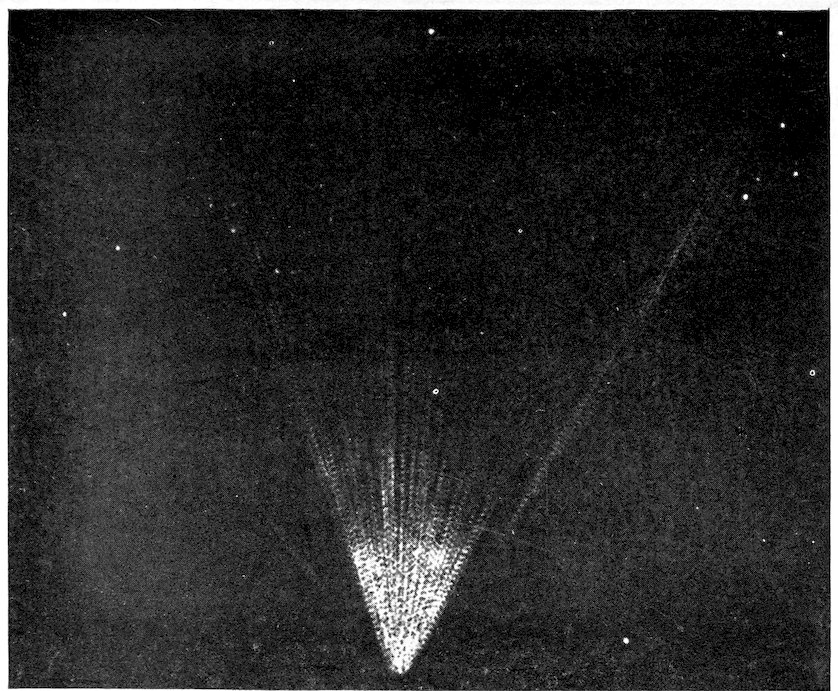
train now resembled that of a widely opened fan,
but its outline was already growing dim. It
showed strange alterations of dark and bright
bands, resembling the streamers which are sometimes
seen to break up the continuous outline of an
44auroral arch. The extreme length of the tail was
nearly 64°, the greatest extent observed during
the apparition of the comet. The secondary tail
was still visible, but extremely faint.
October 11, the dark stripe in the tail had
almost vanished, the secondary tail was no longer
to be seen, and the main tail was curved like an
ostrich plume. Its length was now judged to be
about 30°, and the nucleus had somewhat diminished
in brightness. By October 15 the comet was
considerably fainter and smaller, as seen with the
naked eye, and it was bent southward like a sail
wafted by a celestial breeze. After the middle of
October, the comet was best seen from the southern
hemisphere, and the last glimpse obtained in
the northern hemisphere was on October 25, when
it was at an altitude of 3°, the sky fortunately
being very clear. The nucleus was still bright,
but the tail was only 1° long.
Its course was then followed by Maclear, Royal
Astronomer at the Cape of Good Hope, who
reported that on December 23 the comet was
merely a faint nebulous body, about 90″ in diameter,
with a slight central condensation of light and
no trace of a tail. Thus, it vanished in the remote
depths of space, in the same undecorated condition
as when it first made its eventful début to gladden
45the eyes of mortals on planet earth. Its visit
lasted but one hundred and seventy-seven days,
from the time of its first appearance until it took
its departure along a track which will not bring it
within our ken again until nearly two thousand
years have rolled away.
Biographical Note.—G. B. Donati, the Italian
astronomer, was born at Pisa, in 1826. At the
age of twenty-six, he obtained a post in the observatory
at Florence, and there by his superior abilities,
acquirements, and unwearied application to
duty soon gained a high reputation among the men
of science of his native country. He became
known to the world in 1858, by his discovery of
the magnificent comet called by his name. In
1864 he was appointed director of the observatory
in which he had worked so efficiently for twelve
years. He then undertook the arduous task of
superintending the erection of a new and more
convenient observatory on the site of Arcetri, near
Florence. All difficulties were conquered, the new
observatory was in working condition, and the
director had entered upon a new series of observations
when his labors were suddenly cut short by
death. He died at his home in Arcetri, September
29, 1873.
CHAPTER FOUR COMETS IN DISTRESS
46
“Thou comest whence no mortal seer can know,
Thou goest whither nothing human dreams.”
—Anon.
Until the photographic eyes of Science
detected the peculiarities of comets, and
mathematicians calculated with unerring accuracy
their comings and goings, they were looked upon,
as we have already seen, with more or less suspicion
and dread. Nowadays, we know that these
“airy nothings,” as Sir John Herschel termed
them, have been unjustly maligned. Were they
given the power of speech, they could a tale
unfold of adventurous thrills and overwhelming
disasters encountered during their voyages in
space, far exceeding in interest any story of terrestrial
adventure. It would take the pen of a
Jules Verne and an author gifted with his vivid
imagination to describe the erratic career of a
comet.
Take for instance the tragic fate of the headless
47comet of 1887, which was described by Dr. Thomé
of the Cordoba University as:
“a beautiful object with a narrow, straight,
sharply defined graceful tail over fifty
degrees long. It was shining with a soft
starry light against a dark sky, beginning
apparently without a head, and gradually
widening and fading as it extended upwards.”[4]
Now the popular idea of a well-regulated comet
is a star with a tail, but a tail without an accompanying
star seems preposterous, yet a headless
comet this object remained as viewed with the
naked eye. The why and the wherefore of the
tragedy is unknown, and whether it ever had a
head and what became of it remains one of the
many unsolved problems of the sky.
Still more remarkable is the career of the
famous comet of Biela, from its first appearance
as viewed by mortal eyes on March 8, 1772, until
its final disappearance, a century later, in a veritable
blaze of celestial fireworks. Its story reads
like a novel, and is far more fascinating because it
is fact and not fiction. The hero is a faint, insignificant-looking
48object which was discovered by
Montaigne of Limoges, already referred to as the
comet-hunter who so indiscreetly found the thirteenth
comet for which his colleague Messier was
industriously searching. Little did Montaigne
guess that this foggy speck of light which was so
faint that it could only be seen with the aid of
his small telescope would one day attract worldwide
attention. Its nondescript appearance, with
a tail only one-eighth the diameter of the moon,
made it apparently scarcely worthy of more than
passing notice. Had Montaigne concentrated his
efforts on finding out its peculiarities and tracing
its path, his name would have been forever connected
with the little wanderer, instead of being
entered in the annals of astronomy as merely the
first to see it.
The introductory chapter in its story is connected
with a letter written by Montaigne to the
director of the observatory at Paris, announcing
his discovery. This arrived in time to give the
astronomers an opportunity for seeing the comet
three or four times ere it vanished on its way
outward bound. Little more was thought of the
celestial visitor until it was glimpsed again thirty-three
years later, in November, 1805, by Pons,
49who, as we have already seen, shared honors with
Messier and Montaigne in the “eccentric vocation”
of comet-hunting. The comet remained visible in
the northern heavens for only a month, when it
sank below the horizon and was no longer visible
to observers in the northern hemisphere.
However, on this occasion the comet came very
close to the earth, for we are told that it was visible
to the naked eye, even in the strong twilight.
Then it remained hidden from view until twenty
years later, when it was again rediscovered, this
time by an Austrian officer named Biela, in February,
1826. He was determined that the wily
object should not be lost sight of again, as far as
its orbit was concerned, and by means of careful
observations and calculations he was enabled to
announce that it was traveling along the same
route as the comet seen by Montaigne in 1772, and
that seen by Pons in 1805. Therefore, he concluded
that it was one and the same comet, and
predicted its return in 1832.
However, when it was announced by the great
French astronomer, Arago, that the comet at this
return would cross the orbit of the earth, widespread
was the consternation among those who did
not know what an orbit was. Possibly, imagining
that it was something tangible, we can picture them
50looking at one another in dismay, and whispering
in awed tones, “Does this mean the comet will hit
the earth, and if so what will happen to us?” A
possible collision with the comet was an alarming
thought to the ignorant and superstitious, and the
fear caused by Arago’s announcement was so great
that it resulted in the first of the many comet-scares.
People in dread of the threatened calamity
sold their goods and chattels, and thronged the
churches as a fit preparation for the end of the
world. There they awaited the expected crash
and doubtless were surprised when nothing unusual
happened. The earth still continued to roll
on its appointed path, without jolt or jar to disturb
the “even tenor of its way.” The nervous gave a
sigh of relief when the comet withdrew once more
into the obscurity of space, and those who had
parted with their belongings must have felt somewhat
annoyed.
The so-called devout astrologers who had made
use of Arago’s announcement to their own advantage,
when upbraided by those whom they had
warned, did a skillful kind of “hedging,” by stating
that events announced by a comet might be
postponed for one or more periods of forty years
or even as many years as the comet had appeared
days. Consequently, one which had appeared for
51six months would not produce any effect, evil or
otherwise, for 180 years.[5] Thus these wise soothsayers
allowed a wide margin for possible results.
To give an idea of the filmy structure of the
comet, the cause of such unnecessary alarm, it was
described by Sir John Herschel, who observed it
on September 23, 1832, as a round hazy-looking
object without a tail. It was moving in the direction
of a small group of faint stars, which were
undimmed when overtaken by the comet, so that
it resembled a fog-like mist sprinkled with stars,
this veil of cometary matter being estimated by
Herschel as fifty thousand miles thick. Yet, only
a month later, the remote prospect of a collision
with this celestial cobweb caused a panic in
Europe!
The comet was first seen on August 23, 1832,
but owing to its excessive faintness was not generally
observed till two months later, when at its
nearest to the sun. This occurred during the
month of November, within twelve hours of the
time predicted by an astronomer named Santini.
At its next return, in 1839, the comet was not well
placed for observation, as it was too near the sun,
and therefore lost in the glare of its light. As
computations had shown that the comet was
52traveling in an orbit requiring six and two-thirds
of a year, it was due to return in 1845.
The first to bid it welcome was an astronomer
at Rome named De Vico, on November 28 of that
year. Two days later it was observed by Dr.
Gallé at Berlin, but it was not generally seen until
December. It appeared as a single comet on November
28, but on December 19 it was seen distinctly
pear-shaped, and ten days later it amazed
all observers by splitting in two. This marvelous
transformation was first detected by two Americans,
Mr. Herrick, then librarian at Yale College,
and Mr. Francis Bradley, a clerk in the New
Haven City Bank. The two were watching the
comet on January 29, 1845, taking turns in looking
through a telescope which had been erected in
the Athenæum tower.
Suddenly one of the observers exclaimed that
he could see a small comet accompanying the
larger one, and we can imagine his friend making
some remark concerning defective eyesight.
However, when both saw the duplicity of the
comet, all doubts were dispersed. But what did
it mean? Had the comet a satellite, just as the
earth has its accompanying moon, or had the comet
actually split in two? However, the twin comets
were seen two weeks later by Lieutenant Maury
53and Professor Hubbard at Washington, D. C., and
two days later it came within the ken of European
astronomers. Incidentally, three weeks before the
twin comets were observed, Mr. J. Russell Hind
(England) noticed a peculiar lump near the upper
part of the nucleus of the main comet, which may
be regarded as the first symptom indicating that
something was amiss.
On January 15, Professor Challis, then director
of Cambridge Observatory (England), had his
suspicions aroused when he saw the complete
severance of the little comet from the big one, and
the description of his experience is best given in a
letter he wrote to the president of the Royal Astronomical
Society:
“On the evening of January 15, when I sat down to observe
it [Biela’s comet], I said to my assistant, ‘I see two comets.’
However, on altering the focus of the eyeglass and letting in
a little illumination, the smaller of the two comets appeared
to resolve itself into a minute star, with some haze about it.
I observed the comet that evening but a short time, being in
a hurry to proceed to observations of the new planet.”
Presumably he here refers to the search for
Neptune. Alas! had he but given his whole attention
to that task, instead of dispersing his energy—as
it were—by pursuing a flimsy comet, England
54might have been acknowledged as first in the
actual discovery of that planet.
Resuming his observations of the comet on January
23, Professor Challis again saw two comets,
but clouds hid them from view for the next half-hour,
and when they had cleared away he was
convinced that the comets had moved during the
interval. This suspicion was afterward confirmed,
and, moreover, Professor Challis found that they
had moved in unison, retaining their relative positions
meanwhile. He wondered what could be
the meaning of this strange procedure, and
whether they were two independent comets, a
double comet, or that his glass was deceiving him.
“But I never heard of such a thing,” wrote
Professor Challis. “Kepler supposed that a
certain comet separated in two, and for this
Pingré said of him, ‘Aligreando bonus dormitat
Homerus.’ I am anxious to know
whether other observers have seen the same
thing.”
In a subsequent letter he shows by his remarks
that “the two comets are not only apparently, but
really near each other, and that they are physically
connected.”[6]
55The comets continued traveling along in this
sociable manner for four months, at an almost
unvarying distance of about 165,000 miles, each
developing meanwhile a very bright nucleus and
diminutive tail half a degree in length, or one
tenth the distance separating the pointers in Ursa
Major. Sometimes one comet would be devoid of
a tail, sometimes the other, so that one might
almost imagine the tail exchanging owners, for
the comets were rarely both adorned therewith at
the same time.
During the latter part of February, Lieutenant
Maury, at Washington, D. C., saw an arc of light
extending from the large comet to the small one,
forming a sort of bridge between the two, this
occurring when the small comet was at its brightest.
When the large comet had regained its superiority
it threw out new rays, which gave it the
appearance of having three tails, each adjacent tail
making an angle of 120 degrees with its neighbor,
one of the tails being the bridge to the new comet.
This produced the effect of an arch in the heavens,
through which the stars were seen to pass.
One can imagine messages passing to and fro
along this bridge of light between the twin comets,
and a possible farewell as they drifted further
apart. At their return in August, 1852, they were
56separated by about one million five hundred thousand
miles, and as so often happens in the case of
twins it was impossible to tell which was which.
The comets were not seen at their next return, in
May, 1859, because they were lost in the glare of
sunlight, for the same reason that we are unable to
see stars in the daytime.
At the next expected visit when the comets were
looked for, in January, 1866, they were nowhere
to be seen. What had happened in the interval
no one knows, but in 1872 the whole astronomical
world was startled by a telegram from an
astronomer named Klinkerfues of Göttingen, on
November 30, to Pogson, the government astronomer
at Madras, which read as follows:
Biela touched earth on 27th, search near Theta Centauri.
Accordingly, a search was made, with the extraordinary
result that a comet was found, but not the
comet. Observations were obtained of it on December
2 and 3, but bad weather and the advance
of twilight made further search impossible. When
the track of the new comet, for such it proved to
be, was eventually followed, it was found to be
moving along a different route from the one
previously followed by the comet of Biela.
Nevertheless, by a remarkable coincidence it happened
57to be passing by or near the place where this
comet was wont to wander, until he took unto
himself a companion comet, which seems to have
led him astray.
To be lost is interesting, especially for a comet,
when one considers the vast expanse of highways
and byways in starland, but the climax of the
tragedy in connection with this special comet was
not reached until its orbit crossed that of the earth
on November 27, 1872. On that eventful night
the sky seemed to be literally ablaze with meteors,
which fell in swarms and showers of dazzling
gleams of light, the downpour lasting from seven
o’clock in the evening until one o’clock next morning,
the maximum being attained at nine o’clock.
We are told that the total number observed in
England was estimated at a hundred and sixty
thousand. They all came from the same part of
the sky, radiating from a point near the beautiful
double star Gamma in the constellation of Andromeda.
But what was the meaning of the display?
Had it been caused by an encounter of the
earth with the scattered fragments of the lost
comet? It certainly could not have had any connection
with the comet itself, which, providing it
still existed, had passed that way three months
before. It was more likely the débris of its train
58scattered along its path after its breaking up in
1846.
There seems to be no doubt of the identity of
this swarm of meteors with the comet of Biela, for
on November 27, 1885, a similar encounter took
place, providing a magnificent display of meteors
observed all over Europe, just at the moment
when the earth was due at a crossing in the former
path of the comet. On that same evening, a piece
of meteoric iron fell at Mazapil, in northern Mexico,
during the course of the shower, and according
to Professor Young, “the coincidence may be accidental,
but is certainly interesting. Some high
authorities speak confidently of this piece of iron
as a piece of Biela’s comet itself.” (General Astronomy,
C. A. Young.)
In 1892 and 1898, when the earth again crossed
the former path of the comet, a similar display
occurred, though on a minor scale, and some of
the scattered cometary fragments may still be
looked for on the evenings from November 17 to
27. They are recognizable from their slow motion,
short trains, and from the fact that they all
radiate from the second-magnitude star Gamma in
Andromeda. (Incidentally, this is the star so
charmingly dealt with by Dr. Holmes, in the Poet
at the Breakfast Table, really the astronomer of
59the breakfast table, as suggested by conversations
and correspondence between my father and Oliver
Wendell Holmes.)
The star Gamma in Andromeda is easily located,
as it is almost overhead between the dates November
17–27, at a convenient hour in the evening. It
is in a line with Epsilon, the star at the left-hand
corner of the W-shaped group in the constellation,
Cassiopeia, and with Polaris, the Pole Star. The
meteors radiating from this point are variously referred
to as the Andromedæ, Andromedids, and
the Bielids, on account of their supposed connection
with the Comet of Biela. As a matter of fact
it matters little what they are called, as long as we
know their appearance and when and where to
look for them. They may be looked upon as supplementary
to the story of the comet, and possibly
some of the particles may eventually find a resting-place
on planet earth.
According to Dr. Crommelin of the Greenwich
Observatory:
“the career of a comet may be said to be over
when its meteors have lost all their gas, or
when they have been scattered by perturbations
over so wide a space that its unity and
visibility are lost. These disrupting causes
60are most effective when a comet is fairly near
the sun; therefore the oftener that a comet
approaches the sun, the shorter the period of
its existence as a comet. I think, therefore,
that we can ascribe the great prevalence of
long-period comets to the principle of the
survival of the fittest.”
Long-period comets are those which sometimes
require hundreds of years before they return sunward,
as, for instance, Donati’s comet with its
period of about two thousand years. Others of
short period, like Encke’s comet, are regular visitors
to the sun, returning after a short interval of a
few years along a well-known path. Once upon a
time they may have been long-period comets,
which have had their paths restricted, owing to the
strong attractive pull of the giant planets Jupiter,
Saturn, Uranus, and Neptune. As a result of the
disturbances (or perturbations, as they are technically
called) thus caused, according to the so-called
capture theory, Jupiter has annexed fifty
comets, including the Comet of Biela. Uranus and
Saturn, according to the same theory, own a limited
family of two, while Neptune has four, including
Halley’s famous comet. Its least distance
from the sun is 56 million miles at its point of
61nearest approach, and 3,200 million miles when
at the opposite end of its orbit. But the great
majority of these strange bodies appear to travel
in parabolas, open curves leading from infinite
space to and around the sun, and thence back into
the region of the fixed stars.
There is a notable instance of a comet traveling
about the sun in an immense ellipse, but, like the
moth, hovering around a flame which finally
causes its destruction, this comet returned once too
often to the neighborhood of the giant planet
Jupiter, and in an encounter between a large and
a small body, the latter usually comes to grief.
Its path was curtailed at first, and subsequently it
was shunted on to another line. Jupiter, acting as
pointsman on the cometary railway, is suspected of
opening the branch of the ellipse along which the
comet had formerly traveled in peace and quiet,
with the result that it was ignominiously sidetracked
and sought for in vain.
The comet was first discovered in June, 1770,
by Messier, who described it as a rather insignificant
object without a tail, but resembling a nebula
with a star-like nucleus. Early in July it had
greatly increased in size, the nucleus and surrounding
haze extending over a space more than
five times the diameter of the moon. At this time
62it came very near the earth, remaining visible until
October, when it grew small and faint, and finally
faded away. Meanwhile, astronomers did their
best to determine its path, notably Mr. Lexell, of
the Academy of Sciences at St. Petersburg. He
became so interested in clearing up the past history
of this quaint little comet, that it is usually referred
to as Lexell’s comet. He came to the
conclusion that the comet of 1770 required five
years and seven months for its elliptic tour, but he
was such a long time in getting at this result, that
by the time he obtained it in 1778 the comet was
two years overdue. Messier made a careful search
for it, but without success.
Lexell was of the opinion that at the end of
May, 1776, the comet came so close to Jupiter that
the attractive pull of that planet was three times
greater than that of the sun. When a comet rushes
around the sun it has to go full speed ahead, so
as to resist being drawn upon its surface, but as it
recedes from the danger zone it gradually slackens
its pace, with the result that by the time it is
crossing the orbit along which Jupiter travels, it is
going at reduced speed. Probably Jupiter was
not far from the part of its orbit crossed by the
comet in 1776, with the result that the unfortunate
wanderer was exposed for a longer period
63to the powerful attraction of the giant planet.
This may have caused an important change in the
comet’s path, with the result that it escaped from
what has been termed the sphere of activity early
in October, 1779.
At this period, according to Lexell, the comet
was moving in an ellipse with a period of more
than sixteen years, and at such a distance there
would be no hope of our seeing it again. He finally
considered the comet of 1770 as definitely
lost. However, when Brooks, the famous comet-hunter
of Geneva, New York, discovered a comet
in 1889, which is known as Comet 1889 V, as it
was the fifth comet discovered that year, it was
supposed to be the long-lost Lexell comet of 1770.
For that reason it is known as the Lexell-Brooks
comet.
Previous to 1886, the comet discovered in 1889
was traveling around the sun in an immense ellipse,
taking it out beyond the planet Uranus.
Around and around the sun it went, as a moth
flutters around a lamp, until in the year 1886 it
came under the magic spell of Jupiter. Unable to
resist this planet’s persuasive influence, the path
of the comet was reduced to a smaller one requiring
only seven years for its completion. Apparently
on this occasion the comet passed too near
64Jupiter for safety, and was reduced to four fragments
in consequence. When it approached the
sun in 1889, and was discovered by Brooks, it may
probably have been one of the four fragments;
at any rate, this is the opinion of Dr. Charles Lane
Poor, of New York, who made a careful and most
exhaustive study of the comet and its eccentricities.
It remained visible with telescopes of ordinary
power until March, 1890, after which date it
could only be seen with the great telescope at the
Lick Observatory, at Mount Hamilton, California.
With this magnificent instrument Professor
Barnard followed the comet until January,
1891.
The path of its next return was calculated so
accurately that when it was rediscovered on June
20, 1896, by Javelle, it was seen within a distance
less than one quarter the diameter of the moon
from its predicted place. By this time the comet
had grown fainter, as though enfeebled by its
long wanderings and the vicissitudes of its career,
and it remained visible for only a few months,
finally disappearing in February, 1897. For a
third time the comet came near enough for us to
see it, and this occurred during the summer of
1903, when it remained visible until the following
January. It was then so faint, it could only be
65observed with the largest telescopes. The future
of the comet seems as likely to be as interesting as
its past.
“Unless it become wholly disintegrated by the
pulling and hauling of the sun and planets, it will
be seen again in 1910, and yet again in 1917,”
wrote Dr. Poor in 1908, but as a matter of fact it
was not observed on either occasion. Dr. Poor
also predicted that early in 1921 it would again
come into close approach with Jupiter, “and beyond
that point its history cannot be predicted.
This collision will probably end its story as far
as the earth is concerned, for it will undoubtedly
be still further broken up, and its orbit may be so
changed that it will never afterwards be seen.”
And we must leave it with this unsatisfactory conclusion,
as it did not reappear in 1921, and nothing
more has been seen or heard of this comet. By
now (1925) it may be merely a derelict in space,
at the mercy of any disturbing planet it may happen
to pass on the way.
These instances give some idea of the dangers to
which comets are subjected as they drift like frail
barks on the ocean of space. Whence they have
come and whither they vanish, no one knows, but
it has been suggested that there is a home of
comets. This has been described as a shell of
66nebulous matter accompanying the sun and planets,
though at a distance some thousands of times
greater than that of the earth from the sun, yet
much closer than the nearest star. “However, we
have no direct evidence of any such comet-dropping
envelope,” according to Professor C. A.
Young.
Yet supposing it does exist, we see in imagination
baby comets cradled therein in nebulous mist
until they are able to take care of themselves.
Then they are presumably launched forth on their
perilous career, as they make their way towards
their ruler, the sun, to pay their respects. Woe
betide them should they cross the path of one of
the giant planets at an inauspicious moment, or
approach too near the sun, which would prove
equally disastrous.
CHAPTER FIVE PHOTOGRAPHY AS APPLIED TO COMETS — Hints for Amateur Photographers
67
“With its three eyes—the eye of keenness, the eye
of patient watchfulness, and the eye of artistic truth,
photography promises to be a Cerberus to the science of
the future, whose watchfulness will prevent the admission
of error and detect truths which would otherwise
escape us.”
—R. A. Proctor.
These words written by my father, in his
book entitled The Universe of Suns, shortly
after the appearance of the comet of 1882, have
since been amply confirmed, not only in connection
with the sun, moon, and stars, but still more
so regarding the hitherto unknown peculiarities of
comets. So far we have gained some idea of the
appearance of a comet as seen with the naked eye,
or with the aid of a telescope, but it now remains
to be shown what can be accomplished by means of
photography.
Pictures of the ever-varying transformations,
for instance, which took place in the appearance
of the celebrated Morehouse comet of 1908,
opened out new vistas in cometary wonders, hitherto
68beyond our ken. Successive photographs
taken during the course of a night, pictured for us
the unfolding of the comet’s train, its spreading
outward like a gigantic fan of gauze-like texture,
and eventual closing up till it resembled a sheaf.
By means of the revelations thus made by the
camera, we became aware of the marvelous quick-change
effects produced in the appearance of this
comet not only from night to night, but sometimes
during the brief interval of less than an hour.
Nevertheless, as seen with a telescope, the Morehouse
comet appeared inconspicuous and was invisible
to the naked eye.
The first attempt at taking a photograph of a
comet was made by Bond at Harvard College Observatory
in 1858, in connection with the magnificent
comet of that year, but his efforts only met
with partial success. The next venture was made
in 1881, by Sir William Huggins, in our country,
and Dr. Henry Draper, of New York, but entirely
satisfactory photographs of a comet were not obtained
until 1882, when the great Daylight comet
became a conspicuous object in southern skies.
This comet was first seen on September 3, by
some employees of the railroad in Auckland, New
Zealand, and by other persons whose duties required
them to rise before daylight. The names
of these fortunate observers are unknown, but
what a privilege to obtain the first glimpse of the
comet.
Photograph of Morehouse Comet, 1908 c
Taken on November 19, 6 h. 4 m., at the Royal Observatory, Greenwich
69Anyone acquainted with the clear, limpid blue
of the skies at dawn in New Zealand, and the
brilliancy of the stars despite the near approach of
sunrise, may gain some idea of the vivid appearance
of the little comet in their midst as seen on
this occasion. The writer, who spent a year in
New Zealand (1913–14), has vivid recollections of
the beauty of the dawn ushering in daylight during
the course of her travels to and fro, and has
almost an envious feeling with regard to those
fortunate people “whose duties required them to
rise before daylight,” thus enabling them to obtain
the first view of the comet. As in the case of the
brilliant star in the East, which guided the three
wise men of old to Bethlehem, doubtless they likewise
“rejoiced and were exceeding glad.”
The news of the discovery of a comet was soon
made known, for on September 6 Dr. Gould,
director of the Cordoba Observatory in South
America,[7] received information that a bright comet
was visible in the east before sunrise. His informant
had seen it on the morning of September
5, when it was described as being as bright as
70the planet Venus. At Reus, near Tarragona, it was
bright enough to be seen at one time through a
passing cloud when at a distance of only three
times the diameter of the sun from its edge, or
“limb,” as it is technically termed. According to
the report of Dr. Gould regarding the weather
conditions prevailing at Cordoba, the morning of
September 7 was cloudy and the eastern sky overcast
on every morning during a whole week.
Nevertheless, on one occasion it was thought that
a part of the comet’s tail could be seen. It was
not until September 14 that conditions were again
favorable for observing the comet.
Fortunately the link in the chain of observations
was supplied by an enthusiastic amateur astronomer,
Mr. John Tebbutt, who watched the comet
from his observatory at Windsor, New South
Wales. On September 8, he received a telegram
from the Government Astronomer at Melbourne,
to the effect that a large comet was reported due
east at four o’clock in the morning. Other messages
were received during the day from different
parts of the colony, and from the information thus
supplied Mr. Tebbutt was enabled to observe the
comet on the mornings of September 9 and 10.
By this time the nucleus of the comet was large
and remarkably brilliant, and the tail about 3° or
4° in length, not quite the distance separating the
pointers in Ursa Major.
John Tebbutt, Noted Comet-hunter of Windsor, N. S. W.
71Mr. Tebbutt had already distinguished himself
as a successful comet-hunter, and in addition had
vainly endeavored to form a society such as existed
for comet-hunting in the northern hemisphere,
but his efforts only ended in disappointment. As
he wrote in his Memoirs, “although several astronomers
owned telescopes suitable for the work,
there was obviously a distaste for systematic observation.”
He took great pride in his miniature
observatory at Windsor, actually his own handiwork,
for he was his own bricklayer, carpenter,
and slater combined. During a visit to the observatory
in 1912 the writer was shown numberless
books containing the records of fifty-five observations
of the comet of 1882, extending from September
8 of that year to March 2, 1883. These
observations were made by Mr. Tebbutt with his
four and a half inch equatorial, with the exception
of four made with the transit instrument in
full sunlight. Moreover, Mr. Tebbutt was the
first to see the comet in full daylight with the
unaided eye.
The second series of observations of the comet
in full daylight were made at the Government
Observatory, Melbourne, but it was not seen in
72Europe, owing to cloudy weather, until September
17, one Sunday morning. It happened that
Dr. A. A. Common, the well-known amateur
astronomer at Ealing, had directed his telescope
to the sun for the purpose of observing sun-spots,
when he had a glimpse of the comet. This was at
a quarter to eleven, at which time the comet was
rapidly approaching the sun. Unfortunately,
clouds intervened, rendering further observations
for the time being impossible.
Dr. Common sent a telegram to Dunecht (Lord
Crawford’s observatory near Aberdeen) so that
the astronomers there might be on the lookout for
the comet, with the result that it was observed by
them on the following day. In England bad
weather, as usual, had baffled all attempts at seeing
the comet, and the clouds seemed to be in league
with the powers of darkness in keeping it hidden
from view. Those who can recall watching in
vain in England, for Halley’s comet at its return
in 1910, can fully sympathize with the disappointed
watchers of the sky in 1882. (In those
days the writer was not nearly so enthusiastic as she
should have been at the brief view of the comet
obtained early one chilly morning. Admiration
was slightly tinged with wonder at all the excitement
over “a small white star with a train a yard
73long” which scarcely seemed worth the trouble of
getting up for during the wee sma’ hours. Nevertheless,
there is comfort now in the thought, that
this—her first comet—was one long afterward to
be remembered.)
Day after day the comet grew in splendor, until
by September 12 it was almost the cause of a
momentary panic on the occasion of the attack at
Tel-el-Kebir. The story is told by Colonel E.
Major, somewhat as follows, in his book entitled
Lord Wolseley: It seems that each morning Sir
Garnet in the early dawn had reconnoitered the
enemy’s position from the high ground above their
lines, and he had noticed that their pickets only
came out beyond the defenses at daybreak. He
therefore decided upon a night attack, which must
be sudden and decisive, so that the enemy might be
crushed and scattered early in the day. This
would enable the cavalry to make an immediate
dash for Cairo, while the infantry occupied Zagazig.
After making all arrangements, we are told:
“The troops set off in silence, no smoking
or giving of orders aloud being permitted.
The engineers had set up directing posts as
guides in the earlier part of the march, but
in the deep darkness of a moonless night
74these were not easy to find. Only the North
Star and the Little Bear, shining through the
drifting clouds, gave the leaders some fixed
point by which to find the way. Sir Garnet
sent his own naval aide-de-camp, Lieutenant
Rawson, R. N., who was accustomed to steer
by the stars, to act as a guide with Sir Edward
Hamley’s division. Even with this help the
flanks of the Highland Brigade in the course
of the night march lost their direction after
a short halt, and circled round until a crescent-like
formation was the result.
“A second halt was necessary to remedy
the confusion. Soon after, a strange light
appeared upon the horizon, and Sir Garnet
feared it was the first sign of the coming
dawn. If so, the night attack had failed.
But no rising sun followed that long streak
of light, and later on they learned that a
comet had been observed in the heavens for
the first time on that eve of Tel-el-Kebir.”
On September 27, the comet was seen at Vienna,
according to a telegram received by the Astronomer
Royal at Greenwich, but meanwhile it had
been observed continuously at the Cape of Good
Hope Observatory since September 8. It was
75seen on this date by Mr. Finlay, a member of the
observatory staff, while he was going homeward
after working all night at the dome. Happening
to glance eastward, his attention was at once attracted
by the comet. Returning hastily to the
observatory, he proceeded to make the necessary
measurements for recording its position with regard
to a small star in its neighborhood. One can
imagine the anxiety with which its reappearance
was awaited next morning by Sir David Gill, the
director of the observatory, and by those who may
have heard the good news of a comet in the offing.
The following morning the comet was again
observed, and Sir David Gill sent a telegram to
Sir James Anderson, chairman of the Eastern
Telegraph Company:
Kindly tell Astronomer Royal, Greenwich, that bright
comet was observed here yesterday morning by Finlay. Right
ascension this morning, nine hours, forty minutes, increasing
hourly, nine minutes. Declination one degree south, increasing
half degree south daily.
Unfortunately, the telegram failed to reach its
destination, and was doubtless delayed or mislaid
in the confusion of numberless war messages. The
first news that reached Europe about the comet
was obtained by means of a telegram on September
12, from Dr. Cruls, director of the observatory of
76the Emperor of Brazil. Sir David Gill was
anxious to prove Mr. Finlay’s claim to priority
in discovering the comet, but, as we have already
seen, he had been forestalled by astronomers in
Australia, and some claim should be allowed for
the “early railroad workers” in Auckland, New
Zealand, who were actually the first to see the
comet, though their observation thereof had no
practical value. For a while the comet was known
as the Cruls comet, but now it is generally referred
to as the great comet of 1882, or the Daylight
comet. However, later on, as we have already
noted, it had a rival as a Daylight comet in 1910,
when a fine comet resembling the plume-like
appearance of the comet of Donati was seen to
advantage in England.
The great comet had another rival in popularity
in the year 1882, for on May 17, when Dr. Schuster
was developing photographic plates taken during
a total eclipse of the sun which occurred on
that date, he found a miniature comet seemingly
entangled in the outer rays of the corona. This
is the sun’s crown of glory which can be seen only
during the time the glare of sunlight is hidden
from view by the moon coming directly between
the sun and the earth. The consequent darkness,
or totality, as it is called, can never exceed a duration
77of eight minutes, and on this occasion during
a still briefer interval of time the little comet was
captured by means of the camera. Thus, a permanent
record was secured of its presence near the
sun, but as it had not been seen before nor was it
seen afterward, its motion must have been extremely
rapid, and it may possibly have been
drawn inward and consumed by the intense solar
heat. Despite its small size and brief career, it is
distinguished by the name of Tewfik, after the
then Khedive of Egypt. It has been suggested
that the comet may be kin to, or one and the same
with, a comet which had its photograph taken during
the total eclipse of the sun, April 16, 1893,
having a period like that of the sun-spots, of
about eleven years.
Possibly Sir David Gill may have had the
photograph of Comet Tewfik in mind when he
heard of attempts which had been made by Mr.
Shoyer of Cape Town, and Mr. Simpson of Aberdeen,
to photograph the comet of 1882. The results
had been so far successful as to prove that the
comet was capable of giving a distinct impression
after sufficiently long exposure. But it was owing
to the cordial and enthusiastic assistance of Mr.
Allis, photographer of Mowbray, that the first
pictures of the comet were obtained. When Mr.
78Allis, under the direction of Sir David Gill, fastened
a simple portrait camera upon the tube of
one of the Cape telescopes, and pointed it at the
great comet, little did he dream that the experiment
would eventually lead to such great results
in the future. One can imagine the thrill of
triumph as the experimenter watched the gradual
process of development on the photographic plate,
until, as if by magic, a fine comet was revealed
outlined against a starry background. Thus, three
or four photographs were obtained, which excited
the greatest interest among astronomers in the
northern hemisphere. Possibilities were suggested
with regard to the construction of a self-recording
photographic star chart, thus replacing the painstaking
hand-drawn star charts of the Herschels,
Argelander, my father, and other astronomers at
various times engaged in such work.
The gigantic undertaking was ultimately
divided among nineteen observatories situated in
northern and southern climes, which will eventually
result in a marvelous collection of star charts.
These will include millions of stars, forming a
celestial library which may be consulted at leisure
either now or a century hence when the makers
thereof may have become a mere memory. If a
supplementary set is made in the future, comparisons
79between the two series may result in important
information with regard to star drift. (It
was by comparing star charts thus made a century
apart, that my father originated the star-drift
theory, by his observations in connection with the
five stars of Ursa Major in 1868, a theory confirmed
by the spectroscopic investigations of Dr.
Huggins.) Celestial photography, owing to Dr.
Gill’s suggestion with regard to the star-gemmed
photographs of the comet of 1882, may add
greatly to our knowledge in connection with such
problems, the records of the past thus becoming
the star-lettered volumes for the students of the
future. Undoubtedly this achievement, the result
of the photographs taken of the great comet of
1882, ranks high among those which make astronomy
appeal so vividly to the imagination.
Now let us see how Mr. Allis went to work in
obtaining the portrait of this memorable comet.
To secure a perfect picture of its delicate detail,
an exposure of not less than half an hour was
required. To obviate the difficulty caused by the
rotation of the earth, Mr. Allis attached his camera
with a rapid portrait lens and sensitive dry plate
to the declination axis of a large equatorial, and
then turned both the telescope of the equatorial
and the camera in the direction of the comet.
80Matters were so arranged that in whatever direction
the telescope was turned, the small camera
would turn exactly with it, and thus by means of
clockwork and proper small motions for delicate
adjustment, the comet was kept accurately in the
field of view during the whole time of exposure.
The camera was therefore also pointed during the
whole exposure to precisely the same point of the
comet, and in this way, after one preliminary failure,
three very beautiful and quite invaluable
negatives of the comet were obtained. These
three negatives will remain of permanent value as
a scientific record of one of the most glorious
comets ever seen.
To follow the progress of the comet as it increased
in splendor day by day, let us return to
the record of Dr. Gould, director of the Cordoba
Observatory. On September 16, we are told that
the brightness of the comet was such that it was
visible with the finding telescope throughout the
day. The next day it was so bright that it could
be easily observed in full sunlight, and at eleven
o’clock that morning the sun and the comet were
in the same field of view. Then the comet was
hidden for a while, as it passed between us and the
disk of the sun.
The Great Daylight Comet, September, 1882
Photograph taken at the Royal Observatory, Cape of Good Hope
81On Monday, September 18, the brilliancy of
the comet attracted popular attention throughout
the country, and the “blazing star” near the sun
was the one topic of conversation. In the small
telescope it presented the aspect of a brilliant nebulous
mass, having on each side curved appendages
like horns or wings, nearly as large as the central
body, and at their base quite as brilliant, the general
form of the whole reminding one of the
winged globes carved on ancient monuments. This
appearance, doubtless due to the outbreak of glowing
vapors from the nucleus, was also exhibited,
although to less extent, on the following two days,
during both of which the comet remained visible
to the naked eye.
Observations made of the comet with large
telescopes showed that the nucleus had separated
into six or eight star-like knots strung like pearls
along a luminous streak some fifty thousand miles
in length. The largest of these knots was some
five thousand miles in diameter, an interesting
fact as compared with the size of the earth, which
is 7,925 miles, according to the British Astronomical
Association Handbook for 1925.
A faint straight-edged beam of light, or
“sheath,” accompanied the comet, enveloping the
head and projecting like a hood three or four
degrees in front. Besides this, three or four irregular
82shreds of cometary matter were detected,
escorting the comet, as it were, like airplanes, at a
distance of three or four degrees when first seen,
but gradually receding from it, and at the same
time growing fainter. The actual length of the
comet’s train at one time exceeded one hundred
million miles, more than the distance of the sun
from the earth. (If the head of the comet had
rested on the earth, and its train stretched outward
toward the sun, it would have extended seven million
miles beyond that luminary.)
The trains of comets have been grouped under
three types, viz., the long straight rays as shown
in the photograph of Halley’s comet, though this
was only one of the many outlines assumed; the
second is the curved, plume-like train resembling
that of the comet of Donati; and thirdly the short
stubby brushes violently curved. The great Daylight
comet had a greatly curved train belonging
to the second type, and it was mainly composed of
carbon compounds. The curvature of the train
was due to matter for which the repulsive force is
only a fraction of the gravitational force. The
pressure of light from the sun was a most important
factor in the formation of its train.
When the fierce pressure of the sun’s light
strikes upon the particles forming the train, it
83drives the particles which are of the same relative
size as the particles of light along with them, just
as when the waves of the sea break against a beach
they tend to drive small pebbles and sand upward
along the beach.
To an amateur photographer who desires to
obtain the picture of a comet which may appear
perchance in the near future, their capricious
appearance at unexpected periods being one of
their charms, the following hints may be most
acceptable. For work of this kind an equatorial
telescope is used with a photographic lens and
camera strapped thereon. The telescope is
mounted on an axis that is parallel to the earth’s
axis, and is made to rotate westward by what is
called a driving-clock just as fast as the earth
turns to the east. It will follow the motion of the
sky (which apparently drifts westward), and keep
every star approximately fixed in the field of
view, or on the photographic plate in the attached
camera.
Otherwise, the stars will appear as trails of
light, caused by the rotation of the earth as it
moves onward at the rate of nineteen miles a
84second, which is rather disturbing to an astronomer
who may be desirous of obtaining a photograph of
the stars overhead. What is he to do? Here is
our planet turning eastward and the stars apparently
drifting westward, and unless the telescope
is made to keep up with the stars by means of
clockwork the results are disastrous. Consequently,
the telescope is made to follow the star,
comet, or whatever the desired celestial trophy
may be, and it is kept in such a position that the
object in view is centrally placed at the intersection
of two threads obtained from a spider’s web. For
this reason, spiders are treated with due respect in
observatories, and may explain the expression of
dismay the writer saw on the face of an Indian
assistant at the Kodaikanal observatory in southern
India, when she nearly dispatched one of these
noxious insects, which succeeded, however, in
deftly eluding destruction.
Photograph of a Bright Meteor by Dr. W. J. S. Lockyer
85The star trails shown in the photograph taken
by Dr. W. J. S. Lockyer give an excellent idea of
what happens to a photograph of the stars when
the clockwork is allowed to run down. In this
instance the telescope, with the accompanying
camera, was stationary during the exposure of a
little over two hours, with the result that the stars
photographed are not points of light, but bright
and faint lines in sections of circles, since the telescope
was pointed to the pole of the heavens. The
interest in this photograph is increased by the fact
that a meteor dashed across that part of the sky
during the course of the exposure, thus resulting
in one of the finest photographs of a meteor ever
obtained.[8] Had the exposure lasted during
twenty-four hours, and the photograph been taken
in Norway some time during the course of their
long winter night, the trails would have been
complete circles. By this means we do not get a
picture of the stars, but simply a photograph illustrating
the rotation of the earth. To obtain a
picture of the stars, therefore, an equatorial attachment,
as above described, is an absolute necessity.
Some people have an idea that all an astronomer
has to do in making photographs of a comet, or
other celestial object, is to turn the telescope in
the direction wanted, strap on the camera, wind
up the clock, and then go homeward for a good
night’s rest. Unfortunately, no driving-clock has
yet been devised so perfect as to move the telescope
exactly with the stars. According to Professor
86E. E. Barnard, who was an expert on such
matters—
“There is always more or less irregularity of
motion, all of which would be recorded on
the plate, and the stars, instead of showing as
merely points of light, would be elongated
and blurred. The fainter ones would not
show at all, because they could not be still
long enough to have their pictures taken.
That is why you see in the photograph the
observer with his eye ‘glued to the telescope,’
watching a star, a guiding star which he constantly
keeps behind the intersection of two
illuminated spider threads in the eyepiece,
by the slow-motion rods which are controlled
by his hands.”
Thus, every star or comet is kept immovable on
the sensitive plate, and it paints its own portrait
as long as the telescope is made to turn westward
as fast as the earth rotates eastward. That is why
a driving clock is absolutely necessary for the amateur
comet photographer who is desirous of obtaining
accurate results. Many hours are required in
obtaining a successful photograph of such comets
as the Morehouse comet, the sensitive plate requiring
87sometimes an exposure of many hours before it
reveals satisfactory results. The observer must
sit patiently hour after hour, guiding the instrument,
and the writer has some idea of what this
must mean, from a brief five minutes’ experience
at Mount Wilson in connection with the sixty-inch
reflector. As a great favor she was allowed to
hold the bulb in her hand which by the slightest
pressure brought back an erring star which had
attempted to stray momentarily from the center
of the field of view of the telescope.
When one considers the hours spent by the
late Professor Barnard in this nerve-racking work,
the patient endurance of the astronomers who
specialize in celestial photography becomes evident.
It is an arduous task, and one doubtless
subject to many disappointments, to avoid which
Professor Barnard tried to formulate some set of
rules that would be dependent on the local time
and position of the comet, but these were finally
rejected.
“So much would depend on the purity of
the atmosphere at the time, the size and light
ratio of the lens, the kind of plate used, etc.,
that they would probably lead to the very
errors against which we wish to guide.”
88The position of the comet with respect to the
point of sunrise or sunset, and freedom from any
form of haze in the sky, are important factors in
the exposure of comet plates. Moreover, it is
necessary that they should not be exposed too early
in the evening or too late in the morning, in either
case resulting in unsatisfactory negatives. The
best of all rules is the judgment of the observer at
the moment, but only long experience will warn
one by a glance at the sky when there is danger of
failure in this class of work. It is the few moments
at the beginning or end of the exposure that
will injure or ruin the plate.
With a small portrait lens (the most useful size
is about six inches) essentially everything about a
comet will be shown as quickly as with a larger
one. The main advantage of the large lens would
lie in its greater scale—which of itself is of great
importance. Another source of danger is moonlight,
especially in the case of a long exposure.
Nevertheless, according to Professor Barnard,
important results may be obtained in full moonlight,
if the comet is not too near the moon. Much,
however, will depend upon the clearness of the
atmosphere; the purer it is the less will the moonlight
affect the plate. In this case a dew-cap helps
much. On an ordinary moonlit sky an exposure of
89half an hour with a quick portrait lens will not
ruin a fast plate if the comet is not too near the
moon. In full moonlight, however, a longer exposure,
unless under exceptional conditions, will
seriously injure or ruin the plate. With the half-hour
exposure the plate will be fogged, and of
course the best quality of negatives cannot be obtained
therefrom. All plates should be backed to
prevent halation. A backing made of sugar and
burnt sienna is recommended as entirely satisfactory,
and can be kept in stock.
The formula as supplied by the Cramer Dry
Plate Company is as follows: Cook two pounds of
granulated sugar in a saucepan, without the addition
of any water, until it is nearly in the caramel
or fudge stage. Then stir in one pound of burnt
sienna and cook a little longer, stirring well. Do
not let the backing get sticky, or it will be difficult
to handle and will not soften so readily when removed
from the plate. Finally add about half an
ounce of alcohol to each pint as a drier. Put
away in a wide-mouthed stoppered bottle or jar.
When needed for use, dilute a little of this with
water to the consistency of a thick but not too wet
paste. Apply (not wet enough to run) to the back
of the plate with a wide camel’s hair brush. It is
not necessary to back heavily. A sheet of soft
90paper (an old newspaper) pressed on the backed
surface will prevent injury to the plate, which
should be freshly backed when ready for use. If
kept in stock a long time after being backed, an
unequal fogging is likely to occur.
Before developing, remove the backing while it
is still damp, with a moist piece of absorbent cotton.
Should a small amount remain it will not
affect the developer seriously. The plates should
be carefully dusted with a broad soft camel’s hair
brush, after being put in the plate-holder. The
camera tube should be wiped out frequently with a
damp cloth to free it from dust. It should also
have a tight-fitting cover at the plate end to keep
it closed when the plate-holder is not in position.
There should be four springs, one at each corner,
on the back of the plate-holders, to press the plate
forward in a constant position.
On account of its greater sensitiveness the Lumière
Sigma plate is recommended by Professor
Barnard, although he draws attention to the fact
that this plate has frequently been found defective
in having small, round, transparent and opaque
spots. It is also more subject to “chemical fog”
than the Cramer or Seed. Otherwise, it is a beautiful
and very rapid plate.
When the comet is at its brightest, the Seed 27
91Gilt Edge plates are recommended on account of
their general freedom from defects and finer
grain. With these few suggestions in respect to
photographing comets, made by Professor Barnard
in Popular Astronomy, No. 170, the amateur
comet-hunter is enabled to make an attempt, at
any rate, at photographing those wonders of the
heavens which have proved so attractive on account
of their varying appearance from night to night.
For those who may not have a ready access to
astronomical libraries, the above condensed account
from Professor Barnard’s article on the subject
should prove invaluable.
In an account of his life-work given by Professor
Barnard during the course of an after-dinner
speech in January, 1907, at Nashville, and entitled
by him, “Some Unastronomical Experiences of a
Lecturer,” he referred to his interest in comets as
follows:
“I have always been interested in comets.
These remarkable objects, which sometimes
sweep across the heavens with their wonderful
trains of light, and which in all ages have
been objects of superstition and terror, are
among the most interesting in the heavens.
Little by little the mystery attached to them
92is being solved. This has been done mainly
through the aid of photography. Many of
the physical phenomena of the tails of comets
are too faint to be seen with the eye, although
it may be aided by a powerful telescope; but
the photographic plate secures a permanent
record of these in all their complexity and
beauty. These photographs show that the
form and other peculiarities of a comet’s tail
are often utterly transformed from night to
night. It is therefore highly important that
a continuous series of photographs should be
obtained of every active comet that can be
observed, for their phenomena are as evanescent
as smoke itself.
“In 1892, at the Lick Observatory, I was
engaged in photographing a comet (Swift’s)
then visible in the morning sky just before
daylight. Every morning’s picture increased
the interest and importance of the work.
Unfortunately, I had arranged for a lecture
in the Normal School at San José for the
night of May 6. I did not want to disappoint
the people, and I certainly could not let the
comet go by unphotographed. San José was
nearly a mile below us in vertical height and
twenty-seven miles distant by stage road.
The only possible way for me to secure my
photograph and not disappoint my audience
was to return to Mt. Hamilton that night
after the lecture. At ten o’clock I hired a
horse and buggy in San José and drove up
that lonely mountain road, the journey taking
five hours, and arrived at the summit at
three o’clock in the morning, in time to make
a photograph of the comet.
Comet 1893 IV Brooks
Exposures of October 21, 22, and 23, showing probable encounter with some medium which shattered the tail. Taken at Lick Observatory by Professor E. E. Barnard
93“The picture that I got proved to be a very
important one, as the comet was then undergoing
the most remarkable changes. I must
say that a good many thrills passed over me
during that lonely mountain ride in the dead
of night—some for the chance that I might
drive over into a cañon to death, and others
for the possible interruption of my terrestrial
existence through an encounter with
some hungry, roaming mountain lion. In the
main, the journey was a most impressive one.
Alone in the mountains, with only the horse
in front and my friends the stars above me,
I doubt if my courage had not failed me entirely
if the friendly stars had not encouraged
me with their presence.”
CHAPTER SIX RETURN OF HALLEY’S COMET IN 1910
94
“It would have been a gratification to know that
everyone who saw this wonderful object, did so with the
same feeling of elation and wonder—one would almost
say veneration—with which the average astronomer
regarded this beautiful and mysterious object stretching
its wonderful stream of light across the sky.”
—E. E. Barnard.
While Halley’s comet, at its return in
1910, was undoubtedly a marvelous object
as seen in the clear skies of America and in
southern climes, yet it was more or less of a disappointment
to watchers of the sky in England,
because the view was impaired by twilight and
low altitude. Nor did it come up to the expectations
of those whose hopes had been aroused by
the fine series of ever-varying appearances, recorded
by the camera in connection with the Morehouse
comet, referred to in the last chapter.
Nevertheless, according to Professor Barnard, expert
in photography of celestial objects, had it not
been for the remarkable phenomena recorded by
the camera in connection with the Brooks comet of
1893 (see photograph), and the Morehouse comet
of 1908, the numerous photographs obtained of
Halley’s comet would have placed it in the first
rank among the records of these bodies. Yet
while it lacked much of interest as seen with the
eye of the sensitive plate, it left a lasting impression
on the human eye, adding renewed interest to
its long life history of more than two thousand
years. The train of the comet reached the prodigious
length of 140°, owing to its being so near
the earth, and its great curvature was shown by
the fact that it remained visible in the morning
sky for two days after the head had become visible
in the evening sky.
Halley’s Comet
From photograph taken at Union Observatory, Johannesburg, May 5, 1910. Exposure 60 minutes.
95Halley, by whose name the comet is known,
was the first definitely to establish the fact, suspected
before, that certain comets are regular visitors
to the domain of the sun, returning at stated
intervals. For this reason they are termed
periodic comets. After Halley had calculated the
paths of twenty-four comets, he found that three
were moving in orbits almost identical. From
this he assumed that the three comets must be one
and the same, just as, when a train passes through
a station at regular stated intervals, one is led to
infer that it must be the same train. Naturally
allowances must be made for delays due to fog
96or stormy weather, but these factors are taken into
account should the train arrive after scheduled
time. In the case of a comet it may be delayed by
means of the disturbing effects of the giant planets
Jupiter, Saturn, Uranus, and Neptune, but in
Halley’s day the presence of the last two planets
in the solar system was as yet unknown (Uranus
was discovered in 1781, and Neptune in 1846).
Therefore the following prediction made by Halley,
when he was convinced that the paths of the
comets which appeared in 1531, 1607, and 1682
were identical, is all the more wonderful, since
only an approximate allowance had been made for
these disturbing factors. Referring to the comet
of 1682, he said: “If it should return according
to our predictions about the year 1758, impartial
posterity will not refuse to acknowledge that this
was first discovered by an Englishman.”
This was certainly the most extraordinary prediction
ever made, for cometary investigations
were then in their infancy, and Halley was the
only man living who could have computed the
orbit of this comet. Newton had his doubts regarding
the suggestion that a comet seen on one
side of the sun might be identical with another
seen on the other side some weeks later, but Robert
97Hooke, in a letter addressed to Newton in 1679,
suspected that a comet could reappear after a definite
period. He declared that, if gravity
decreased according to the reciprocal of the square
of the distance, the path of a projectile would be
an ellipse.
As the year 1758 approached, one can imagine
the interest aroused among astronomers, and the
calculations which were made for determining as
accurately as possible the disturbing effects of the
larger planets within the sphere of whose influence
the comet might pass. It is impossible to convey
an idea of the labor involved in making the required
computations of the perturbations of this
comet throughout a period of two revolutions, or
one hundred and fifty years. It is with a feeling
of pride that the author notes the important part
taken in this work by Madame Lepaute,[9] wife of
one of the assistants of the great mathematician
Lalande. Her work proved of inestimable value
according to the following remarks made by her
husband on the subject:
98“During six months we calculated from
morning till night, sometimes even at meals;
the consequence of which was that I contracted
an illness which changed my constitution
during the remainder of my life. The
assistance rendered by Madame Lepaute was
such that without her we never should have
dared to undertake the enormous labour with
which it was necessary to calculate the distance
of each of the two planets, Jupiter and
Saturn, from the comet, separately for every
degree, for one hundred and fifty years.”
Amid all these difficulties, the computers toiled
on, and finally, as the time was drawing near for
the return of the comet, Clairaut, who was working
in conjunction with Lalande, announced that
the expected comet would be delayed one hundred
days by the influence of Saturn, and five hundred
and eighteen days by the action of Jupiter, and
therefore fixed its nearest approach to the sun for
April 13th, 1759. These results were presented
to the Academy of Sciences on November 14,
1758, and as we have already seen in an earlier
chapter of this book, on December 25th of that
year the first glimpse of the long-expected wanderer
was obtained by George Palitzsch, a farmer
99of Saxony. His telescope was small, his vision
keen, but the enthusiasm of a devoted amateur
made up for his lack of suitable equipment. Observations
were made of the comet, and astronomers
were soon able to prove that the perihelion
passage would take place on March 13, 1759,
thirty-two days before the epoch calculated by
Clairaut. Such a triumphant success of the theory
produced a deep impression in the scientific world,
and, as Lalande enthusiastically remarked:
“The universe beholds this year the most
satisfactory phenomenon ever presented to us
by astronomy; an event which, unique until
this day, changes our doubts to certainty, and
our hypotheses to demonstration.... M.
Clairaut asked one month’s grace for the
theory; the month’s grace was just sufficient,
and the comet has appeared after a period
of 586 days longer than the previous time of
revolution, and thirty-two days before the
time fixed; but what are thirty-two days to
an interval of more than 150 years, during
only one two-hundredth part of which observations
were made, the comet being out of
sight all the rest of the time! What are
thirty-two days for all the other attractions
100of the solar system which have not been included;
for all the comets, the situations and
masses of which are unknown to us; for the
resistance of the ethereal medium which we
are unable even to estimate, and for all those
quantities which of necessity have been neglected
in the approximations of the calculation?”
Twenty-five years before the comet was again
due, its expected return in 1835 began to arouse
the interest of astronomers, and prizes were
offered by two academies for the most accurate
forecast of its nearest approach to the sun. The
successful competitors were Baron Damoiseau and
M. Pontecoulant, and several astronomers undertook
and completed the task of computing the
planetary perturbations. Although the computers,
as might be expected, differed slightly as to the
time when the comet would make its nearest
approach to the sun, yet the difference was not due
to any defects in the methods of computation, but
to the imperfections of the data employed, especially
with regard to the unknown disturbing factor,
the planet Neptune.
Not only was the time for the nearest approach
of the comet computed, but its exact path among
101the stars was worked out with such accuracy that
directions could be given as to the precise point
toward which the telescope must be directed when
the comet came within range of observation. On
August 5, 1835, when M. Dumouchel, director of
the observatory of the Roman College, turned
his telescope in the direction indicated and looked
through the tube, to his great delight he saw the
comet as a faint and almost invisible stain of light
on the deep blue of the heavens. Thus did science
triumph in a most remarkable manner, the comet
making its nearest approach within nine days of
the predicted time. It appeared as a nearly circular
misty object near to the predicted place, and
began to develop a tail about the middle of September,
which attained a length of about twenty-four
degrees, or nearly five times the distance
between the pointers, Alpha and Beta, in the constellation
of Ursa Major. To the naked eye the
head of the comet resembled a reddish star rather
brighter than Antares in the constellation of the
Scorpion. Bessel compared it to a blazing coal,
and called attention to the peculiar fan-like haze
of luminous matter forming the train, which
seemed to sway to and fro like a pendulum across
the radius vector, an imaginary line joining the
sun and the nucleus of the comet. This oscillation
102took place during a period of four and three-fifths
days. He came to the conclusion that a repulsive
force about twice as powerful as the attractive
force of gravity was responsible for the production
of these remarkable effects, thus anticipating
the theory according to which the very fine particles
forming the train of a comet may be driven
away from the direction of the sun by radiation
pressure.
Meanwhile Halley’s comet was passing through
a remarkable series of transformations, first appearing
as a nebula, then as a well-regulated comet
with nucleus and train, next shining as a star, and
finally dilating till it resembled a ball, then assuming
paraboloidal form about May 5, 1836, after
which it vanished as if melting into adjacent space
through the excessive diffusion of its light. Moreover,
it lost its tail previous to its arrival at perihelion
on November 16, nor did it begin to recover
its elongated shape until more than two
months later.
At the return of Halley’s comet in 1910 it was
conjectured that it would probably be greatly disturbed
by the influence of the planet Jupiter, and
that of Uranus and the newly discovered planet
Neptune. It was therefore possible for Dr. P. H.
Cowell and Dr. A. C. D. Crommelin (both of the
103Royal Observatory, Greenwich) to make a prediction
so exact that the comet was found within
six minutes of arc in R. A., and four minutes in
declination of its predicted place, as shown on the
first photograph obtained. This was equivalent
to an angular distance in the sky less than one quarter
of the diameter of the moon. (Incidentally,
a prize of 1,000 marks, which had been
offered by Mr. Lindemann for the most accurate
prediction of the comet’s arrival at perihelion,
was won and divided between the two mathematicians.)
De Pontecoulant had made calculations
regarding the return of the comet many years
earlier which were fairly near the truth, but one
month too late. It was action of Jupiter about
the 1835 perihelion that had such an effect on the
1910 return. The action of Jupiter at any return
does not produce a notable effect till the following
return.
One of the first photographs obtained of Halley’s
comet at this return was due to the foresight
of Herr Max Wolf of the Heidelberg Observatory,
in exposing a photographic plate for several
weeks beforehand, so as to entrap the wanderer
at the first opportunity. It was caught at 2 A.M.
in the morning of September 12, 1909, engraving
its image on the photographic plate, a welcome
104message announcing its advent to the astronomical
world. (The first photograph obtained of Halley’s
comet was taken at Helwan on August 24,
but Herr Wolf was the first to identify the comet’s
image on the plate. There were also many early
photographs taken at Greenwich.) For thirty-two
years it had remained beyond the orbit of
the outermost planet Neptune, then, obedient to
the attractive power of its lord and master the
sun, it had started on the return trip. Despite its
enormous distance from our planet, and the fact
that it was beyond reach of telescope or camera,
it was possible for mathematicians to trace its path
with unerring accuracy. It had approached the
orbit of Neptune after the year 1888, the orbit
of Uranus about ten years later, crossing that of
Saturn in 1908. The following year it arrived at
the orbit of Jupiter, thus bringing it within the
range of both the photographic plate and giant
telescopes. Its actual return to perihelion in 1910
differed by two and seven-tenths days from the
prediction which can be explained only by the
existence of forces which are not pure gravitation,
or the possibility of another planet beyond Neptune,
as yet undiscovered, acting as a disturbing
factor.
When the news of Herr Wolf’s success in
105obtaining a photograph of the comet had been
announced on September 12, it was followed on
September 15 by a message from the Lick Observatory
to the effect that a photograph of the comet
had been obtained by Dr. Heber D. Curtis with
the aid of the Crossley reflector. On Wednesday
morning, September 15, Professor S. W. Burnham
of the Yerkes Observatory at Williams Bay,
Wisconsin, sighted Halley’s comet by means of
the great refractor with its forty-inch lens, while
at the same time it was photographed with the
two-foot reflector in an adjacent dome, by Dr.
Oliver J. Lee. The comet was again detected by
Professor Burnham the following morning, September
16, and it was also registered on the photographic
plate by Dr. Lee.
Then came the morning of September 17, one
of the most eventful in the life of the writer, who
had arrived the previous day as the guest of the
Barnards. That night the great refractor with its
forty-inch lens was in the care of Professor Barnard,
who courteously invited the writer to come
to the observatory the next morning at 3 A.M.,
escorted by his niece, Miss Calvert, for the purpose
of looking through the telescope and obtaining
a view of Halley’s comet. Making a first visit
to the observatory in the darkness preceding dawn
106was an experience in itself, but the glimpse of the
comet after its absence of seventy-five years is one
never to be forgotten, nor is it easy to describe.
For the first second or so, all seemed darkness as
I gazed down the length of that great tube (63½
feet) into the opening beyond. I saw nothing,
and an intense feeling of disappointment overwhelmed
me as I realized and stated this fact, but
Professor Barnard remarked in his whimsical way:
“Surely you did not expect to see the comet with
a tail?” Then he advised me to keep on looking,
and even while he spoke I saw a faint, very misty
outline. “Is it exactly in the center of the field of
view?” queried Professor Barnard when I told
him that I had seen a nebulous-looking object,
and when I replied in the negative, he informed
me that that faint object I was looking at was the
comet, which eight months later I saw in all its
splendor from the tower at the top of the Times
Building in New York City.
Meanwhile, the comet had been slowly increasing
in size, and by March 4, 1910, it presented
the appearance shown in a remarkable photograph
obtained at the Helwan Observatory. It
was then suggestive of the nebulous-looking
objects which had been catalogued as such by
Herschel and Messier, but the latter, being more
107interested in comets, would soon have recognized,
by means of the method already referred to, the
difference as the comet slowly moved against the
background of the stars. This is no reflection on
the marvelous sight of Herschel, but when one reflects
on the enthusiasm with which Messier hunted
for comets, we may be sure any suspicious-looking
object he came across was subjected to keen scrutiny
before it was catalogued finally as one of those
“embarrassing objects” he named “nebulæ.” During
the autumn of 1909 and the early part of the
year 1910 the comet was photographed and observed
visually at all the great observatories. At
the Royal Observatory, Greenwich, a fine series
of photographs were obtained despite the trying
climate of our country. Up on the heights, at the
Government Observatory at Kodaikanal in southern
India, the progress of the comet was recorded
by telescope and camera, so that our planet might
be said on this occasion to have kept its Argus eye
constantly directed toward the celestial visitant.
According to Professor Barnard, who made a
special study of the comet, its first appearance
resembled that of a small and rather faint speck
of light, very much like a faint stellar nebula.
The increase in brightness was not very rapid, and
as late as the final observations in February, 1910,
108before the comet passed behind the sun, it gave
very little promise of the splendid display it was
destined to make later on in the month of May.
However, its reappearance from behind the sun
in the morning skies of April and May could not
have been under more unfortunate circumstances
for observation at the Yerkes Observatory. According
to Professor Barnard:
“that part of the year is always unpropitious
here, and it seemed as if everything combined,
on this particular occasion, to hide from us
the growth of the comet and its approach to
the earth. Forest fires in the northern part
of the State (Wisconsin) produced a densely
smoky sky, which, even when the clouds were
merciful to us and would have let us see the
comet, cut off with a thick yellow veil all but
a glimpse of the bright head.”
The comet was seen for the first time with the
naked eye at the Yerkes Observatory on April 29,
the nucleus being bright and of the second magnitude.
The tail was visible for a couple of
degrees, but with field-glasses it could be traced
for four or five degrees. On May 3, at 3 h. 40 m.
(civil time), the comet was seen for about one
109minute in a thin streak of clearer sky, but the next
morning at about the same hour it was a beautiful
object with a long tail streaming upward toward
the right, as shown on the magnificent photograph
obtained by Professor Barnard. The photograph
facing Chapter VI, taken at the Union Observatory,
Johannesburg, on May 5, 1910, may give
some idea of what was expected but not realized by
watchers of the sky in England.
When it was announced on April 29 that the
comet had come within range of naked-eye observations,
it occurred to the writer, who was in New
York City at the time, that a desperate attempt
must be made to see the comet, despite the smoke,
and electric lights turning night into day. “When
there’s a will there’s a way,” and while walking
along Broadway on the afternoon of April 30,
wondering how these difficulties might be overcome,
a glance in the direction of the Times Building
solved the problem. On explaining to Mr.
Van Anda, the assistant editor of the Times, what
a very desirable spot the summit of the Times
Building would be for observing the comet, a
permit was obtained to be handed to the janitor
the next morning at 3 A.M. on May day. It was
indeed a case of “Call me early, mother dear,”
110but an alarm clock served the purpose equally
well on this momentous occasion.
Promptly at three o’clock the permit was presented
to the janitor, and the writer, ascending
in the lift, was transported to the twenty-third
story, and escorted up a spiral staircase leading to
the tower. The door was unlocked by the janitor,
and the writer, stepping out on to the parapet
surrounding the tower, gazed eastward for the
comet, which failed to materialize, owing to a
dense haze. Awaiting until dawn, the idea of seeing
the comet was given up, but, nothing daunted,
the same program was carried out at the same
hour on May 2, and May 3, but without avail.
Halley’s Comet
Photograph taken on May 4, 1910, by Professor E. E. Barnard at the Yerkes Observatory, Williams Bay, Wisconsin
111Then came May 4, a bitterly cold morning;
but the stars shone brightly and there was every
hope of the comet being visible from the tower
heights. These hopes were confirmed, for on
stepping out on to the parapet the writer saw the
comet in all its splendor. The hazy-looking object
seen on September 17, 1909, had developed into
a full-grown comet with a head shining as a star
of about the second magnitude, and surrounded by
a nucleus. Extending outward like the beam of
a searchlight gleamed the tail nearly fifteen degrees
in length. Calling down to the janitor to
make known the good news, the balcony was soon
filled with eager members of the Times staff,
who were thus enabled to obtain a view of the
comet. By means of a field-glass thoughtfully
provided by Mr. Van Anda, it was possible to see
a further extension of the train, making it in all
thirty degrees in length. Spurts of light like tiny
waves seemed to flow out from the nucleus to a
distance of two or three degrees. At twenty
minutes to four, the writer, on looking downward
at the horizon, was startled by what appeared to
be a streak of flame, but as it rose higher it proved
to be the crescent moon, which with the comet
and the planet Venus, completed a wonderful trio.
The comet remained visible, resembling a bright
star with a slender stream of silvery mist trailing
a few degrees after. By four o’clock it had faded
in the light of approaching dawn. A glance at
the photograph of Halley’s comet obtained by
Professor Barnard at the Yerkes Observatory on
May 4 will give an idea of its splendor.
For the next few mornings observations of the
comet were disappointing, owing to heavy mists
in the eastern skies. The comet was almost completely
hidden from view, except on the morning
of May 8, when occasional glimpses were obtained
of it through rifts in the clouds. On May 10,
the nucleus of the comet, from which extended a
112diminutive train eight degrees in length and fan-like
in appearance, could be seen for a few brief
moments, after which it remained hidden behind
clouds until dawn, making further observations
impossible.
It was not until the morning of Friday, May
13, that the comet once more deigned to reveal
itself to the straining eyes of the lonely watcher
on the tower. The first glimpse was obtained at
ten minutes past three. The comet then resembled
a faint white streak drifting in the sky. A minute
or so later the planet Venus came into view,
gaining in brilliancy as it rose above the mists near
the horizon. At twenty-five minutes past three
the train of the comet was twenty degrees in
length, and by half past three it extended to a
distance of thirty-five degrees, or seven times the
distance between the pointers (Alpha and Beta in
Ursa Major). It spread out like a partly opened
fan, its greatest width at the extreme end being
about five degrees or more. The nucleus shone
brightly as a star of the second magnitude, but by
half past three it began to grow less distinct, and
at twenty minutes past four the comet had faded
from view on the arrival of the first few streaks
of dawn.
113The comet was barely visible the next few
mornings, though watched for anxiously, since
there was always the possibility that it might reveal
itself, but these hopes were not realized. A glance
at the cloudy skies on the morning of May 18
suggested the impossibility of seeing the comet,
and for the first time since the morning of May
1, the writer missed her vigil at the tower.
Interest was revived, however, on learning that
Professor Barnard had seen that morning
“a narrow twilight (which later proved to be
the tail of the comet) which seemed to extend
along the eastern horizon.... The head of
the comet could not be seen when it rose,
with either the five-inch or the forty-inch
telescope, because of the thick sky near the
horizon.... The observations show that
the tail was at least 109° long on that date.
(Astrophysical Journal, vol. XXXIX, no 5,
pp. 387–388, June, 1914.)
Now despite the fact that an astronomer at Columbia
University had declared the comet would
be in the evening sky, and it was useless looking
for it in the morning sky of May 19, the writer
decided, nevertheless, to watch for the comet at
114about the usual hour, and with the most gratifying
results.
The parapet surrounding the tower was crowded
to its utmost capacity by a favored few on the
eventful evening of May 18, awaiting they knew
not what, for a report had gone forth that we
were scheduled to pass through the train of the
comet. Below us we could see comet parties in
progress on the roof gardens of some of the leading
hotels. Sounds of merriment occasionally
reached us, but by half past ten we—that is, Miss
L., who had offered to share the lonely vigil with
the writer until dawn—were the only watchers on
the tower. The hush of a great silence had gradually
fallen over the city, and in silence, too, we
watched the eastern sky for any further trace of
the comet.
Notes made by the writer on this occasion
record 11.10, red flash (auroral); 11.22, flash
resembling an arch of glowing white surmounted
by a crest of crimson. The display occurred above
a low-lying bank of mist and rose to about five
degrees above the horizon. It was not of any
considerable breadth, and resembled rather a glow
of color against the dark background of the sky
than a wide band of light. The moon, which was
shining brightly, interfered seriously with the
115observations of auroral displays which appeared
faint in its light. About 12.15 a mist appeared to
spread over the city, and the air had become damp
and chilly. By 1.30 the mist had cleared away.
At 2 o’clock a meteor flashed across the eastern
sky, downward in the direction of the star Gamma
in the constellation Pegasus. It was bluish-green
in color, pear-shaped in appearance, leaving a
streak five degrees in length behind it as it flashed
to within ten degrees above the horizon. It remained
visible for about five seconds, and the
display was vivid while it lasted. At 2.30 the
moon, low down in the western sky, appeared of
a ruddy hue as it “sank in a sea of gloom.”
Turning eastward, we saw a soft glow in the
sky spreading from below Pegasus and upward
as far as the stars of Cassiopeia. At 2.34 a glow
of grayish hue extended over the northeastern
sky. At 2.43 a bright meteor was seen by Miss
L., but she made no note of its direction, except
that it was eastward, and a brief glimpse obtained
by the writer showed its color as bluish.
At 2.45 streamers, which later proved to be
the comet, were observed reaching from the eastern
horizon, below Gamma Pegasi, and curving upward
through Aquarius as far as Altair, and
brighter in appearance than the Milky Way. At
116its widest part, just beneath the first-magnitude
star Altair, the width of the band was about ten
degrees, and throughout its length it had a brilliancy
equal to that of the Milky Way, near which
it terminated. The path of this band of light
was very nearly that along which the comet was
last seen, and the writer was convinced that it was
the outer boundary of the tail through which the
earth was passing. Beneath this streamer, and
apparently resting along the southeastern horizon,
was a secondary band resembling a haze-like misty
streamer. This was not as clearly defined as was
the upper band, and, moreover, it merged into the
mists of the horizon.
In connection with a sketch made by the writer
on this occasion, and shown to Professor Barnard,
he referred to it as follows in his account of
“Visual Observations of Halley’s Comet in 1910,”
published in the Astrophysical Journal for June,
1914:
“With the exception of a sketch by Miss
Mary Proctor in New York City, and a newspaper
account by Professor D. P. Todd of
Amherst (whose observation seemed to refer
to May 16th), I have seen no reference from
northern observers to the second, fainter and
117broader tail shown in my drawings of May
17 and 18, south of the bright beam and
separated from it by a distinct dark space,
perhaps ten degrees wide. The head of the
comet was of course invisible, being below the
horizon.”
This was all the more pleasing to the writer,
as doubts had been expressed in no uncertain terms
by a well-known authority, according to the following
statement published in an afternoon paper.
“Some one thinks she saw the comet in the eastern
sky, when it is really in the west.” One can imagine
the anxious time experienced while awaiting
confirmation of the observation, but it came in due
course from Yerkes, Lick, Argentine Republic,
South Africa, and the writer felt rewarded for
the many dreary waits in the tower during the
“wee sma’ hours” since May 1.
On the morning of May 20, the writer again
watched from the Times tower, in the hope of
seeing some straggling streamers trailing along the
sky, denoting the presence of the comet. Between
half past two and a quarter past three a
ghostly apparition resembling a slender band of
light was seen extending upward, though almost
parallel with the northeastern horizon. It seemed
118to rest on a darker band of luminous haze beneath.
Surely this was the last fragment of the train of
the comet, outlined faintly against the dark void
of space.
That same morning Professor Barnard at
Yerkes detected a hazy luminous streak about five
degrees broad extending from Aquilæ to the east
and onward toward Alpha Pegasi. “This resembled
the comet’s tail,” recorded Professor
Barnard,
“but was doubtless a strip of haze. I looked
at it several times, taking it for a strip of
haze, but it did not seem to move. There
were masses of moving haze overhead toward
the north. To all appearance it looked like
the comet’s tail of the mornings of May 18
and 19. I cannot be certain that it was not
haze, but it was a singular coincidence of
position, appearance, etc., if it was. It remained
visible for fully fifteen or twenty
minutes.”
Comet 1861, July 2, as Seen and Drawn by R. A. Proctor
The tail of the comet was near the earth, which passed through it on this occasion
119The train may have been fan-like, as in the
case of the comet of 1861, discovered on May 13,
by Mr. John Tebbutt of Windsor, New South
Wales, already referred to in the chapter on
“Comet-hunting as a Hobby.” In my father’s
book, Mysteries of Time and Space, he records as
follows his view of that comet in connection with
the drawing here given:
“The first recorded observations (of the
comet of 1861, in Europe) were made on the
evening of June 30, nineteen days after it
had passed its point of nearest approach to
the sun. I remember well observing it on
the morning of July 2, 1861. For some
reason I found it impossible to sleep that
morning, and getting up about three (the
exact hour I do not remember, but it must
have been very early), I saw in the east what
looked at first like the rays of an aurora
borealis. But presently I noticed that these
rays proceeded (unlike those of the aurora)
from a bright center, which had been hidden
by clouds when my observations began. I
used at that time to keep a four-inch telescope,
mounted on a three-legged stand, in my bedroom.
This I had quickly ready for action
(noting that the object, owing to the approach
of sunrise, was getting fainter every minute),
and turning it on the comet, I drew a picture
of the nucleus and coma, so closely resembling
120that which appeared a week or two later in
the Illustrated London News, that I might
have supposed my picture had been surreptitiously
sent to the office of the Illustrated,
had I not found it resting just where I had
put it in my scientific portfolio.”
Returning to the discussion of Halley’s comet,
it was seen on May 21, at 4.30 A.M., by Professor
Evershed, (then director of the Kodaikanal Observatory,
Southern India), appearing no broader
than on May 18, but fainter. He described it
as passing centrally through the square of Pegasus,
which was nearly filled with the faint light. The
tail could be traced, as before, right up to the
Milky Way. The star ε Pegasi was nearly in
the center of the band of light, and the star
α Aquilæ near its southern edge. This was the last
observation Professor Evershed made before dawn.
He considered it remarkable that the tail of the
comet should have remained visible in the morning
sky as a narrow band of light, nearly two days
after the head of the comet had passed to the other
side of the sun. He suggested that this might be
due to the fact that the tail may have been strongly
curved and very broad in the direction of the
comet’s motion, although narrow and straight in
121the direction at right angles thereto. If so, the
passage of the earth through the tail, if it occurred
at all, must have been delayed one or two
days and probably occupied more time than a single
day. There is some doubt whether the tail did
actually touch the earth, for observations of its
position in the sky on May 11 and 15 show that its
axis was inclined very considerably northward
from the direction of the radius vector, a straight
line drawn from the nucleus of the comet to the
sun of the comet.
In the forenoon of May 19 certain peculiarities
observed suggested that our planet may have been
actually immersed in the cometary débris of the
train of Halley’s comet. These consisted of a
peculiar iridescence and unnatural appearance of
the clouds near the sun, and a bar of prismatic
colors on the clouds in the south. This, combined
with the general effect of the sky and clouds—for
the entire sky had a most unnatural and wild
look—would have attracted marked attention at
any other time than when one was looking, as on
this occasion, for something out of the ordinary.
According to the observations made by Professor
Barnard at the Yerkes Observatory, the sky had
been watched carefully during the forenoon of
this date, but nothing unusual had appeared until
122close to noon, when the conditions became abnormal.
Later on in June, and for at least a year
afterward, slowly moving strips and masses of
luminous haze were observed in the sky, which
were not confined to any one part. Reports of like
unusual phenomena were received from the Transvaal,
and from elsewhere in southern climes.
On the evening of May 21 the comet made its
first appearance in the west, as seen by watchers on
the Times tower, but it failed to be very impressive.
It was to the left and a few degrees north
of the star Betelgeuse in the constellation of Orion,
and it resembled a star of the third magnitude.
It was surrounded by a hazy cloud-like mist that
made it appear nearly as large as the space covered
by the moon. To the left of it, and extending
outward about three or four degrees, were three
or four fan-like streamers. At 8.25 the nucleus
seemed brighter and more star-like in the center,
but the streamers had faded from view and the
mist surrounding the nucleus had become hazy
and ill-defined. Five minutes later only the star-like
nucleus could be seen, doubtless owing to the
combination of the glare of moonlight and the
haze that reflected the city lights below.
On May 24 the comet appeared hovering for a
brief interval over the western horizon, resembling
123a faint star enveloped in mist, and adorned with a
short fan-like tail. On May 25 the comet could
not be seen, owing to the mist and a drizzling rain,
but on May 26 it was visible on two occasions for
intervals of about five minutes. It then resembled
a fairly bright star of the third magnitude, surrounded
by a misty halo, but was devoid of a tail.
It seemed that our chances of seeing the comet
again under favorable conditions were slight, but
on the evening of May 27 we were once more
regaled with a fine view, which proved to be final
as far as the writer was concerned.
At a few minutes past eight the nucleus of the
comet appeared, as usual, hazy and ill-defined, but
gradually it brightened until it equaled the glow
of the first-magnitude star Regulus, in the constellation
of Leo near by. Only a few degrees
of tail were visible at first, but as the twilight
deepened into night more and more came into
view. By 8.40 P.M. it stretched outward about
twenty degrees in the direction of the planet
Jupiter. The train was long and slender, and
not more than five degrees at its greatest width.
By 9 o’clock it was clearly visible, a dark streak
apparently dividing it just beyond the nucleus;
the edges were more or less sharply defined for a
distance of about three or four degrees. By 10.30
124the train of the comet had almost faded from
view; at 10.40 it had become invisible and the
nucleus was barely perceptible. Within three
minutes the nucleus was almost lost to sight in
the haze and mist near the horizon.
Meanwhile, the moon had risen in the eastern
sky, and by eleven o’clock it was several degrees
above the horizon. Its arrival on the scene was
the climax of an evening rich in glory, as far as
the celestial display was concerned. The view of
the comet on this occasion was the best that had
been obtained since May 20, and settled beyond
doubt the vexed question that had arisen as to
whether the comet had lost its tail or had divided
in two. Nevertheless, a glance at a photograph
taken by Professor Barnard on June 6, shows an
apparently smaller comet nestling to the left of
the larger, keeping it company, as it were, in its
celestial voyage outward from the neighborhood
of the sun. By this time the comet had faded
sadly, as Professor Barnard expressed it, and,
though a noticeable object, was only the ghost
of its former self.
Halley’s Comet
From photograph taken by Professor E. E. Barnard, June 6, 1910, at the Yerkes Observatory, Williams Bay, Wisconsin
125Where is it now in its outward journey, at the
present time of writing (1925)? Science can
answer the question as definitely as though it were
actually possessed of magic glasses, enabling it to
follow the path of the retreating comet, although
it has long since passed beyond our range of view.
It is now approaching the orbit of the planet Neptune,
crossing it in 1933, and reaches its greatest
distance outward from the sun in 1943, or 3,200
million miles. In 1964 it draws near to Neptune
again, and will be halfway between Neptune and
Uranus in 1974, arriving at the orbit of Saturn in
1984. Once more it will gladden the eyes of mortals
as it approaches the planet Jupiter, and draws
near to pay its respects to its mighty ruler, the sun.
At its return in 1758 the prediction erred on the
side of thirty-two days; at the return in 1835, by a
margin of only two days; and in 1910, by the
amount of two and one-half days. Perchance,
ere it makes its next appearance in 1985,[10] the
presence of another planet beyond Neptune may
have been detected, explaining the disturbing factor
resulting in that small discrepancy. The
astronomers at that remote date (1984) may succeed,
therefore, in making a prediction so exact
that the comet may “swim into their ken” promptly
to scheduled time. Few, if any, of the present-time
readers of this book (unless it falls into the
hands of a very youthful enthusiast) will be here
to welcome the comet at its next return, and even
the youthful enthusiast may have the distressing
experience of the American astronomer Dr. Lewis
Swift, who saw Halley’s comet in 1835, and was
able to welcome it at its return in 1910, but, owing
to failing eyesight, was unable to see it, much to
his regret.
126
The orbit of Halley’s Comet, which it passes over in 75 to 77 years, showing where the comet is to be found now, and during its course until its next return in 1985.
127With regard to my first visit to the Yerkes
Observatory, the following facts regarding the
great refractor may be of interest, as well as the
incident narrated to me by Miss Calvert while we
were awaiting Professor Barnard’s invitation to
look for Halley’s comet, on that momentous occasion.
The story was deferred, in my account,
to the final part of this chapter, so as not to break
the thread of the actual account of my first view
of the comet. Following the description of the
telescope, the story of a catastrophe which nearly
ended its career is best told in Professor Barnard’s
own words, as quoted from the after-dinner speech,
in January, 1907, at Nashville, already referred
to in this book.
“The tube of this instrument is about
sixty-four feet long. In the farther end of
this tube is placed the great object glass,
forty inches clear in aperture. When one is
128looking overhead with this giant telescope, he
must be at a point some thirty feet or more
lower than when the tube is pointed toward
the horizon. To avoid the use of a high
ladder to reach the observing end of the telescope
in its various positions, the floor of the
dome itself is made into a giant elevator,
sixty-five feet in diameter. The rising and
lowering of this floor—which is done by
electric motors—always keeps the observer in
a convenient and safe position with reference
to the eye-end. This floor is suspended by
heavy steel cables which go over wheels at
the tops of four towers attached to the inside
walls of the dome. The floor is counterpoised
by heavy iron weights at the other ends
of the cables.
“Within a little over a week after the
completion of the instrument and when we
had seen through it only once or twice, the
two south cables pulled out of their sockets
and the floor fell through fifty feet to the
ground and was destroyed. It was a terrible
wreck. This was on the morning of May
29, 1897, at 6.30 o’clock. Mr. Ellerman
and I had been working all night observing
with the telescope. When we quit at daylight
129we left the floor at its highest point for the
convenience of some workmen who were to
be at work on the tube in the morning. When
the floor fell there was not a soul in the building,
and no one was injured. A couple of
hours either way, and death in all probability
would have come to one or the other of us.
Only a few nights before this accident the
president of the University of Chicago and
thirty or more trustees and prominent men
of the university had seen through the telescope,
and the floor had been up and down
with them on it. If it had fallen then a
heavy loss of life would have been almost
certain. A few days before that, Mr. Clark,
who made the great glass, had unpacked the
forty-inch disks on the floor at its highest
point, and had put them in the cell which he
finally bolted to the end of the telescope. If
the floor had fallen then, the great lens would
have been destroyed, with the probability
that no one would be able to make another,
for Mr. Clark died within a few days after
he returned to Cambridge. It was providential,
then, that the floor fell when it did;
for the fault in the attachment of the cables
made it certain that it must soon have fallen.
130“But this is not the end of the story.
When the floor fell, it lurched against the
great iron pier of the telescope and must have
given it a violent blow. There was some fear
that the great glass might have been injured
by the shock. It was nearly a hundred feet
up in the air and could not be reached to see
if it was unharmed. By climbing up on the
dome (which is one hundred and ten feet
high) and looking down at the glass, it was
seen to be apparently uninjured. Still, the
test could only be made by examining the
stars through it, which was not possible until
the floor was replaced by a new one. Four
months were occupied in taking out the wreck
and putting in the new floor.
“There was great anxiety to see the sky
through the glass, and the first night available
it was turned to the stars. To our consternation,
there was a great, long flare of light
running through every bright star we examined.
This was so strong and conspicuous
that it would make the instrument utterly
useless. It looked as if the lens had been
injured by the shock of the floor against the
pier. We examined it in all positions of the
instrument, but we could not get rid of the
131glaring defect. As I had used the glass more
than anyone else before the accident, my
statement that the defect did not then exist
made the matter all the more serious. It
was with heavy hearts that we waited for day
to again critically examine the lens. The
next day we all examined the great glass very
carefully, but could see nothing wrong with
it. Then Professor Hale noticed that just
back of the glass in the tube was a thick mass
of spider webs stretched across the tube, all
running in the same direction. Upon comparing
notes we found that the direction of
the spider webs coincided with that of the
flare of light seen the night before. It
seemed that a spider had evidently got in the
tube before the object glass was put on by
Clark, and had been unable to get out; for
there was no opening in the tube. During the
time the tube remained at rest, while the
new floor was being put in, he had climbed
up to the great glass in the direction of the
light; and when he found his egress barred
by the great window, he spun his web, perhaps
as a signal of distress, or maybe in the
hope that some unlucky fly might get in
through the glass that he could not get out
132of—anyway, with the result that he caused
several astronomers the most uneasy time of
their lives. When these webs were swept
out by one of the astronomers climbing up
in the tube with a feather duster, it was found
that night, when the stars were examined,
that the flare had vanished and the mighty
glass was uninjured.”
CHAPTER SEVEN ORIGIN OF COMETS AND METEORS
133
(THEORIES ADVANCED BY THE LATE RICHARD A. PROCTOR.)
Among the author’s most treasured possessions
is a clipping from the Cincinnati Daily
Gazette for February 18, 1874, containing a report
of a lecture given by her father, on “Comets and
Meteors,” from which the following is an extract:
“In this lecture on comets and meteors, I
promised to give some account of what is
expelled from the sun when great explosions
take place. If I were to say that the comets
were shot out from the sun you might be
startled, or if I asserted that they were also
thrown out of Jupiter and Saturn. But the
evidence in connection therewith is very
curious. In the first place, we know that
matter is shot out from the sun, with a
velocity so great as to be carried away from
him altogether and so would travel into space.
That has only been observed a few times,
134but the occurrence is probably very frequent.
The matter which was expelled, if it struck
the earth at all, would strike in the daytime.
The side of the earth facing the sun will be
the illuminated side. The meteoric matter
coming from the sun can only strike the
illuminated part, and this can only happen in
the daytime. You throw a stone at any
object, and it must strike the side of the object
you aim at, that is turned toward you. Humboldt
affirmed that the largest number of
meteoric masses had fallen in the daytime.
The larger aërolites have been examined and
their microscopic structure studied. Sorby of
Sheffield, who examined some of them, says
they consist of a number of small globules
and were originally in a vaporous state before
assuming their present condition. Then came
a chemical analysis by Professor Graham
and Chandler Roberts of London. They
found in the iron of the meteoric mass more
hydrogen than iron in a natural condition.
Professor Graham said that in his opinion
meteors certainly contained iron, and that
probably they had been expelled from one of
the stars that people space. He drew attention
to the fact that stars contained hydrogen
135in their atmosphere. These are some of the
facts concerned with the larger meteoric
masses.
“How shall we account for those meteoric
streams which travel close to the path of
Jupiter? All comets of short period have
paths closely approaching some of the large
planets. The comet of 1680 went close to
Jupiter, long before the explosive power
of the sun was noticed. I call them Jupiter’s
family of comets. Sir John Herschel said
that it was very curious that they had that
relation. If we put forward the theory that
Jupiter expelled these comets, we have a very
startling theory, but many of the theories
which have been propounded, some of the
most important character and which have been
proved to be true, have been the most startling.
It is said that as Jupiter, Saturn, and
Uranus go along their paths, they draw in
the comets which travel close to them, and
capture them.
“I made a calculation about the November
meteors to see how close they must go to the
path of Uranus in order to be captured, and
found that they must approach nearly as close
as the nearest satellite. Only those which
136came almost in contact with the planet could
be captured. Now, if they were shot out
when Uranus was in a sun-like condition,
then it would be explained, whereas we find
great difficulty in imagining that a comet
coming out of space would be captured bodily
by a planet like Uranus. Let us consider the
matter thus: if comets are expelled from a
planet, they will be carried along with the
forward motion. If it could appear that some
of them went backward, then we would have
no evidence of the theory I have been advancing.
If most of them travel forward, then
we would have some evidence for the theory.
Now there is the curious fact that among the
comets of short period the whole of Jupiter’s
family travel forward. They do not travel
in all directions of slope; all have a very
moderate slope to the paths of the planets.
They do not have the slope even of the
asteroids. That is precisely what we notice—that
they travel very much with Jupiter.
Taking the balance between the two theories—that
of expulsion and that of capture—it
seems to be in favor of the more startling
one—that Jupiter has had the power to expel
these objects.”
137It is interesting, in connection with this extract
from the report of a lecture given by my father
some fifty years ago at present time of writing
(1925), to turn to a passage in the chapter on
comets, by Dr. A. C. D. Crommelin, in the
Splendour of the Heavens, page 414, where he
refers as follows to the capture theory:
“The fact that the members of the Jupiter
family (of comets) have direct motion in all
cases appears to give a fatal blow to the
capture theory. Practically as many comets
would approach the planet with retrograde
motion as with direct; there is, indeed, the
point that those travelling in the same direction
as the planet would remain longer in its
neighbourhood, and so have more time to be
perturbed, which would have some weight;
but that out of some fifty comets there is
not a single retrograde one is too remarkable
a fact to pass over, and it clearly suggests that
Jupiter played a different part from that of a
mere enslaver, and was concerned with the
origin of these bodies in a more intimate
manner.
“Many of the considerations I have
brought forward were stated by Mr. R. A.
138Proctor some fifty years ago; they have therefore
been accessible to astronomers, who
nevertheless have been, as a rule, quite unaffected
by them, so that it is time to state
them afresh. The consideration that the life
of a short-period comet is limited by the
rapid wastage to which it is subject by the
joint action of the sun and Jupiter was not,
I think, so fully realised, when Proctor wrote
as it is now. It serves further to invalidate
the capture theory, since it prevents our assigning
to these bodies such extended lives as
that theory demands.”
According to my father’s theory, the giant
planets are themselves the parents of their comet-families,
and he pictured their birth as having
occurred in a remote past, when the planets were
more sun-like than they are to-day. We have a
great amount of evidence as to the energy of the
processes that are at work on Jupiter, as evidenced,
for instance, by the great Red Spot (though some
have hinted at the possibility of its being an early
stage in the formation of a new satellite);
Saturn, Uranus, and Neptune also indicate vast
upheavals, though distance in their case hinders
observation, and even on our own planet we have
139some striking instances of the power of volcanic
energy, as at the eruption of Krakatoa in 1883.
Sounds of the explosion were heard three thousand
miles away, and a huge volume of dust was blown
to the highest regions of the atmosphere, but we
are entitled to expect much vaster convulsions in
Jupiter, which outweighs the earth three hundred
times and is in a much hotter state, judging by
the deep envelope of vapours surrounding it, and
the rapid changes that are constantly taking place
in its appearance, on an enormous scale, as shown
by the fine series of photographs which have been
obtained of the planet with the giant telescopes.
Writing in his magazine, Knowledge, for January
1, 1887, page 64, my father states:
“The theory of ejection was adopted as
the only theory by which the chemical, physical,
and microscopic structure of meteorites
of all orders—from bolosiderites to asiderites—can
be accounted for. They were certainly
once exposed to such conditions as exist only
in the interior of large orbs—suns or planets.
And as certainly they have somehow come
forth from such interiors. The expulsive
force shown by observation to reside in the
only sun-like body we can examine, indicates
140the only way in which such expulsion can
conceivably have been effected. Hence, I
infer (for my own part I feel assured of the
weight of evidence) that all orders of meteorites
were expelled from some orbs at some
time when such orbs were in the sun-like
stage. Generalizing, I include in this theory
all orders of meteors, and find all their most
characteristic peculiarities explained, and all
orders of meteor systems or comets, finding
their several orders thus and thus only explicable
(if we include all suns now and in
the past, all planets in all solar systems, in
their past sun-like state, among the sources
of meteors and comets). No other general
theory seems to me possible.”
Again, in an article in Knowledge for April,
1887, page 135, my father makes the following
statement regarding his theory concerning comets
and meteors:
“All comets and meteors are sun-born.
But it is not to our own sun, nor to those
other suns, the stars, that I attribute all comets
and meteor systems. Many millions have
come doubtless from our sun during the many
141millions of years he has been a sun, though
few of his cometic children are known to
terrestrial astronomers. Millions of millions
have come from the many millions of suns in
our galaxy during the many millions of years
of their sun-like existence. But the giant
planets were once suns,[11] and in their sun-like
state, which must have lasted millions
of years, they must have ejected their smaller
comets and meteor systems which even now,
after millions of years, have paths passing
near the orbits of their parent orbs. Our
earth and her fellow terrestrial planets had
their sun-like stage of life, too, and it must
have been while the earth was a sun that the
meteors explained specially by Tschermak’s
theory were expelled.”
According to his theory, Tschermak, noting the
resemblance of structure between meteorites and
volcanic products, suggests that meteors of all
orders (which would include meteor streams, and
therefore comets) were shot out from the earth in
the days when she was young. But though this
142is better than the other theories, in at least suggesting
some sort of an origin for comets and
meteors, it will not account for comets which do
not approach within many millions of miles of the
earth’s orbit,[12] and a theory which fails for some
among the comets cannot be the true general theory
for meteors either.
Mr. Sorby of Sheffield, the eminent mineralogist
already referred to, deduced from the microscopic
structure of certain meteorites the startling
theory that they had once been inside the sun; for
there is evidence that their substance once existed
in the form of globules of molten metal, which
aggregated with large masses, which in turn were
exposed to violent friction, indicating conflicting
motions of very high velocities.
“Where else,” wrote Sorby, in 1864, “could
such conditions exist, except first in the interior,
and afterwards in the immediate neighborhood of
our sun!” But it is absolutely certain that the
theory as thus suggested cannot possibly be true,
either as a general explanation of comets and
meteors, or even as an explanation of any known
meteor system or comet, unless, perhaps, a few of
the comets whose orbits pass very near the sun
143were sun-born, and subsequently disturbed by
planetary attractions so as not to return to their
parent orb.
According to my father’s views on the subject:
“A flight of meteors shot out from the sun,
as Sorby suggested, might have velocity
enough to get away from him forever, in
which case we should never see a trace of it
again, even though we waited for millions
of years. If, however, it could not get away,
then it must return to its starting-place—that
is, back to the sun’s globe—unless, passing
near enough to one of the giant planets,
it were so far disturbed as only to return by
grazing past the sun’s surface. (The comets
of 1843, 1880, and 1882, which all traveled
in paths near the sun, almost grazing his
surface, may well have been parts of a single
meteor-flight shot out from his interior millions
of years ago.)”
After the appearance of the new comet of 1887
in the southern skies, it was found to be following
along the same track as the comets of 1843, 1880,
and 1882, thus confirming my father’s theory that
144these comets were parts of one large comet, dissipated,
doubtless, some millions of years ago.
These comets were so bright when near the sun
that they could be seen at noon with the naked
eye. As regards the heat experienced by the comet
of 1843 when near the sun, Sir John Herschel
remarked:
“Imagine a glare 25,000 times fiercer than
that of an equatorial sunshine at noonday. In
such a heat there is no solid substance we
know of which would not run like water—boil—and
be converted into smoke or vapor.”
From Knowledge
The Southern Comet of January, 1887
145In Knowledge for November 1, 1887, an account
is given of the remarkable southern comet
first observed in January of that year, and as it is
the last article on this topic written by my father
for his magazine, giving a more or less detailed
account of his views on the subject, the author of
this book has deemed it advisable to quote it in
full. It is of special interest, not only on account
of its giving his theories on the subject, but for the
reason that it helps to supply part of the missing
chapter on “Comets and Meteors,” which he had
planned for his final but unfortunately unfinished
work, Old and New Astronomy. This work had
been in course of preparation for thirty years, and
that the material for such a chapter was partially
compiled the writer knows from the fact that she
has a keen recollection of clippings, MSS., and
notes which she saw apparently awaiting classification
and arrangement, a short while before her
father’s departure from Florida, September 8,
1888. What became of them after his sudden
death in New York a few days later, it is impossible
to conjecture, unless A. C. Ranyard, who
completed the book, found the chapter on comets
too difficult to arrange satisfactorily. Yet even the
fragments so arduously arranged and collected by
my father would have been better than a missing
chapter on a subject in which he was so deeply
interested and to which he had devoted so much
attention.
To return to my father’s account of the comet
of January, 1887:
“The comet was first seen by a farmer and
a fisherman of Blauwberg, near Cape Town,
on the night of January 18–19. The same
night it was seen at the Cordoba University
by M. Thomé. On the next night Mr. Todd
discovered it independently at the Adelaide
Observatory, and watched it till the 27th.
146On the 22d Mr. Finlay detected the comet
and was able to watch it till the 29th. At
Rio de Janeiro, Mr. Cruls observed it from
the 23d to the 25th, and at Windsor, New
South Wales, Mr. Tebbutt observed the
comet on the 28th and 30th. Moonlight
interfered with further observations.
“The comet’s appearance was remarkable.
Its tail, long and straight, extended over an
arc of thirty degrees, but there was no appreciable
condensation which could be called the
comet’s head. The long train of light, described
as nearly equal in brightness to the
Magellanic clouds, seemed to be simply cut
off at that end where in most comets a nucleus
and coma are shown.
“This comet has helped to throw light on
one of the most perplexing of all the puzzles
which those most perplexing of all the heavenly
bodies, comets, have presented to astronomers.
In the year 1668, a comet was seen
in the southern skies which attracted very little
notice at the time, and would probably
have been little thought of since had not
attention been directed to it by the appearance
and behavior of certain comets seen during
the last half-century. Visible for about three
147weeks, and discovered after it had already
passed the point of its nearest approach to the
sun, the comet of 1668 was not observed so
satisfactorily that its orbit could be precisely
determined. In fact, two entirely different
orbits would satisfy the observations fairly,
though only one could be regarded as satisfying
them well.
“This orbit, however, was so remarkable
that astronomers were led to prefer the other,
less satisfactory though it was, in explaining
the observed motions of the comet. For the
orbit which best explained the comet’s movements
carried the comet so close to the sun
as actually to graze his visible surface.
Moreover, there was this remarkable and,
indeed, absolutely unique peculiarity about
the orbit thus assigned: the comet (whose
period of revolution was to be measured by
hundreds of years) actually passed through
the whole of that part of its course during
which it was north of our earth’s orbit plane
in less than two hours and a half! though
this part of its course is a half-circuit around
the sun, so far as direction (not distance of
travel) is concerned. That comet, when at
its nearest to the sun, was traveling at the
148rate of about 330 miles per second. It passed
through regions near the sun’s surface commonly
supposed to be occupied by atmospheric
matter.
“Now, had the comet been so far checked
in its swift rush through those regions as to
lose one-thousandth part of its velocity, it
would have returned in less than a year.
But the way in which the comet retreated
showed that nothing of this sort was to be
expected. I am not aware, indeed, that any
anticipations were ever suggested in regard
to the return of the comet of 1668 to our
neighborhood. It was not till the time of
Halley’s comet, 1682, that modern astronomy
began to consider the question of the possibly
periodic character of cometic motions with
attention. (For my own part, I reject as
altogether improbable the statement of Seneca
that the ancient Chaldean astronomers could
calculate the return of comets. The comet of
1680, called Newton’s, was the very first
whose orbital motions were dealt with on the
principles of Newtonian astronomy, and Halley’s
was the first whose periodic character
was recognized.)
“In 1843, another comet came up from
149the south, and presently returned thither. It
was, indeed, only seen during its return, having,
like the comet of 1668, been discovered
only a day or two after perihelion passage.
Astronomers soon began to notice a curious
resemblance between the orbits of the two
comets. Remembering the comparative
roughness of the observations made in 1668,
it may be said that the two comets moved in
the same orbit, so far as could be judged from
observation. The comet of 1843 came along
a path inclined at apparently the same angle
to the earth’s orbit plane, crossed that plane
ascendingly at appreciably the same point,
swept round in about two hours and a half
that part of its angular circuit which lay north
of the earth’s orbit plane, and, crossing that
plane descendingly at the same point as the
comet of 1668, passed along appreciably the
same course towards the southern stellar regions!
The close resemblance of two paths,
each so strikingly remarkable in itself, could
not well be regarded as a mere accidental
coincidence.
“However, at that time no very special
attention was directed to the resemblance between
the paths of the comets of 1843 and
1501668. It was not regarded as anything very
new or striking that a comet should return
after making a wide excursion round the sun;
and those who noticed that the two comets
really had traversed appreciably the same
path around the immediate neighborhood of
the sun, simply concluded that the comet of
1668 had come back in 1843, after 175 years,
and not necessarily for the first time.
“It must be noticed, however, before leaving
this part of the record, that the comet of
1843 was suspected of behaving in a rather
strange way when near the sun. For the first
observation, made rather roughly, indeed,
with a sextant, by a man who had no idea of
the interest his observations might afterwards
have, could not be reconciled by mathematicians
(including the well-known mathematician,
Benjamin Pierce) with the movement
of the comet as subsequently observed. It
seemed as though when in the sun’s neighborhood
the comet had undergone some disturbance,
possibly internal, which had in
slight degree affected its subsequent career.
“According to some calculations the comet
of 1843 seemed to have a period of about
thirty-five years, which accorded well with
151the idea that it was the comet of 1668, returned
after five circuits. Nor was it deemed
at all surprising that the comet, conspicuous
though it is, had not been detected in 1713,
1748, 1783, and 1818, for its path would
carry it where it would be very apt to escape
notice except in the southern hemisphere, and
even there it might quite readily be missed.
The appearance of the comet of 1668 corresponded
well with that of the comet of
1843. Each was remarkable for its long tail
and for the comparative insignificance of its
head. In the northern skies, indeed, the
comet of 1843 showed a very straight tail,
and it is usually depicted in that way, whereas
the comet of 1668 had a tail showing curvature.
But pictures of the comet of 1843,
as seen in the southern hemisphere, show it
with a curved tail, and also the tail appeared
forked toward the end, during that part of
the comet’s career. However, the best observations,
and the calculations based on them,
seemed to show that the period of the comet
of 1843 could not be less than 500 years.
“Astronomers were rather startled, therefore,
when, in 1880, a comet appeared in the
southern skies which traversed appreciably the
152same course as the comets of 1668 and 1843.
When I was in Australia in 1880, a few
months after the great comet had passed out
of view, I met several persons who had seen
both the comet of that year and the comet
of 1843. They all agreed in saying that the
resemblance between the two comets was very
close. Like the comet of 1843, that of 1880
had a singularly long tail, and both comets
were remarkable for the smallness and dimness
of their heads. One observer told me
that at times the head of the comet could
barely be discerned.
“Like the comets of 1668 and 1843, the
comet of 1880 grazed close past the sun’s
surface. Like them it was but about two
hours and a half north of the earth’s orbit
plane. Had it only resembled the other two
in these remarkable characteristics, the coincidence
would have been remarkable. But of
course the real evidence by which the association
between the comets was shown was of a
more decisive kind. It was not in general
character only, but in details that the path
of the comet of 1880 resembled those on
which the other two comets had traveled. Its
path had almost exactly the same slant to the
153earth’s orbit plane as theirs, crossed that plane
ascendingly and descendingly at almost exactly
the same points, and made its nearest
approach to the sun at very nearly the same
place.
“To the astronomer such evidence is decisive.
Mr. Hind, the superintendent of the
Nautical Almanac, and as sound and cautious
a student of cometic astronomy as any man
living, remarked, so soon as the resemblance
of these comets’ paths had been ascertained,
that if it were merely accidental the case was
most unusual; nay, it might be described as
unique. And, be it noticed, he was referring
only to the resemblance between the comets
of 1880 and 1843. Had he recalled at the
time the comet of 1668, and its closely similar
orbit, he would have admitted that the double
coincidence could not possibly be merely
casual.
“But this was by no means the end of the
matter. Indeed, thus far, although the circumstances
were striking, there was nothing
to prevent astronomers from interpreting
them as other cases of coincident, or nearly
coincident, comet paths, had been interpreted.
Hind and others, myself included, inferred
154that the comets of 1880, 1843, and 1668 were
simply one and the same comet, whose return
in 1880 probably followed the return in 1843
after a single revolution.
“In 1882, however, two years and a half
after the appearance of the comet of 1880,
another comet came up from the south, which
followed in the sun’s neighborhood almost
the same course as the comets of 1668, 1843,
and 1880. The path it followed was not
quite so close to those followed by the other
three as these had been to each other, but yet
was far too close to indicate possibly a mere
casual resemblance; on the contrary, the resemblance
in regard to shape, slope, and those
peculiarities which render this family of
comets unique in the cometary system, was of
the closest and most startling kind.
“Many will remember the startling ideas
which were suggested by Professor Piazzi
Smyth respecting the portentous significance
of the comet of 1882. He regarded it as
confirming the great pyramid’s teaching (according
to the views of orthodox pyramidalists)
respecting the approaching end of the
Christian dispensation. It was seen under
very remarkable circumstances, blazing close
155by the sun, within a fortnight or three weeks
of the precise date which had been announced
as marking that critical epoch in the history
of the earth.
“Moreover, even viewing the matter from
a scientific standpoint, Professor Smyth (who,
outside his pyramidal paradoxes, is an astronomer
of well-deserved repute) could recognize
sufficient reason for regarding the comet
as portentous. Many others, indeed, both in
America and in Europe, shared his opinion in
this respect. A very slight retardation of the
course of the comet of 1880, during its passage
close to the surface of the sun, would
have sufficed to alter its period of revolution
from the thirty-seven years assigned on the
supposition of its identity with the comet of
1843, to the two and a half years indicated by
its apparent return in 1882, and if this had
occurred in 1880, a similar interruption in
1882 would have caused its return in less than
two and a half years.
“Thus, circling in an ever-narrowing (or
rather shortening) orbit, it would presently,
within a quarter of a century or so, perhaps,
have become so far entangled among the
atmospheric matter around the sun, that it
156would have been unable to resist absolute
absorption. What the consequences to the
solar system might have been none ventured
to suggest. Newton had expressed his belief
that the effect of such absorption would be
disastrous, but the physicists of the nineteenth
century, better acquainted with the laws associating
heat and motion, were not so despondent.
Only Professor Smyth seems to have
felt assured (not being despondent but confident)
that the comet portended, in a very
decisive way, the beginning of the end.
“However, we were all mistaken. The
comet of 1882 retreated on such a course, and
with such variation of velocity as to show
that its real period must be measured not by
months, as had been supposed, nor even by
years, but by centuries. Probably it will not
return till 600 or 700 years have passed. Had
this not been proved, we might have been
not a little perplexed by the return of apparently
the same comet in this present year
(1887). A comet was discovered in the south
early in January, whose course, dealt with by
Professor Kruger, one of the most zealous of
our comet calculators, is found to be partially
identical with that of the four remarkable
157comets we have been considering. Astronomers
have not been moved by this new visitant
on the well-worn track, as we were by
the arrival of the comet of 1882, or as we
should have been if either the comet of 1882
had never been seen, or its path had not been
shown to be so wide ranging. Whatever the
comet of the present year may be, it was not
the comet of 1882 returned. No one even
supposes that it was the comet of 1880, or
1843, or 1668. Nevertheless, rightly apprehended,
the appearance of a comet traveling
on appreciably the same track as those four
other comets is of extreme interest, and
indeed practically decisive as to the interpretation
we must place on these repeated
coincidences.
“Observe, we are absolutely certain that
the five comets are associated together in
some way; but we are as absolutely certain
that they are not one and the same comet
which had traveled along the same track and
returned after a certain number of circuits.
We need not trouble ourselves with the question
whether two or more of the comets may
not have been in reality one and the same
body at different returns. It suffices that they
158all five were not one; since we deduce precisely
the same conclusion whether we regard
the five as in reality but four or three or two.
But it may be mentioned, in passing, as appearing
altogether more probable, when all
the evidence is considered, that there were
no fewer than five distinct comets, all traveling
on what was practically the selfsame track
when in the neighborhood of the sun.
“There can be but one interpretation of
this remarkable fact—a fact really proved,
be it noticed (as I and others have maintained
since the retreat of the comet of 1882), independently
of the evidence supplied by the
great southern comet of the present year.
These comets must all originally have been
one comet, though now they are distinct
bodies. For there is no reasonable way (indeed
no possible way) of imagining the separate
formation of two or more comets at
different times, which should thereafter
travel in the same path.
“No theory of the origin of comets ever
suggested, none even which can be imagined,
could account for such a peculiarity. Whereas,
on the other hand, we have direct evidence
showing how a comet, originally single, may
159be transformed into two or more comets
traveling on the same, or nearly the same,
track.
“The comet called Biela’s, which had circuited
as a single comet up to the year 1846
(during a period of unknown duration in the
past—probably during millions of years),
divided then into two, and has since broken
up into so many parts that each cometic fragment
is separately indiscernible. The two
comets into which Biela’s divided, in 1846,
were watched long enough to show that, had
their separate existence continued (visibly),
they would have been found, in the fullness
of time, traveling at distances very far apart,
though on nearly the same orbit. The distance
between them, which in 1846 had increased
only to about a quarter of a million of
miles, had in 1852 increased to five times that
space.
“Probably a few thousand years would
have sufficed to set these comets so far apart
(owing to some slight difference of velocity,
initiated at the moment of their separation)
that when one would have been at its nearest
to the sun, the other would have been at its
farthest from him. If we could now discern
160the separate fragments of the comet, we
should doubtless recognize a process in progress
by which, in the course of many centuries,
the separate cometic bodies will be disseminated
all round the common orbit. We know,
further, that already such a process has been
at work on portions removed from the comet
many centuries ago, for as our earth passes
through the track of this comet she encounters
millions of meteoric bodies which are traveling
in the comet’s orbit, and once formed part
of the substance of a comet doubtless much
more distinguished in appearance than Biela’s.
“There can be little doubt that this is the
true explanation of the origin of that family
of comets, five of whose members returned
to the neighborhood of the sun (possibly their
parent) in the years 1668, 1843, 1880, 1882,
and 1887. But it is not merely as thus explaining
what had been a most perplexing
problem that I have dealt with the evidence
supplied by the practical identity of the orbits
of these five comets. When once we recognize
that this, and this only, can be the explanation
of the associated group of five
comets, we perceive that very interesting and
161important light has been thrown on the subject
of comets generally.
“To begin with, what an amazing comet
that must have been from which these five,
and we know not how many more, were
formed by disaggregative processes—probably
by the divellent action of repulsive
forces exerted by the sun! Those who remember
the comets of 1843 and 1882 as they
appeared when at their full splendor will be
able to imagine how noble an appearance a
comet would present which was formed of
these combined together in one. But the
comet of 1880 was described by all who
saw it in the southern hemisphere as most
remarkable in appearance, despite the faintness
of its head. The great southern comet
of the present year (1887) was a striking
object in the skies, though it showed the
same weakness about the head. That of 1668
was probably as remarkable in appearance as
even the comet of 1882. A comet formed by
combining all these together would certainly
surpass in magnificence all the comets ever
observed by astronomers.
“And then, what enormous periods of time
must have been required to distribute the
162fragments of a single comet so widely that
one would be found returning to its perihelion
more than two centuries after another!
When I spoke of one member of the Biela
group being in aphelion, when another would
be in perihelion, I was speaking of a difference
of only three and one-third years in
time; and even that would require thousands
of years. But the scattered cometic bodies
which returned to the sun’s neighborhood in
1668 and 1887 speak probably of millions of
years which have passed since first this comet
was formed. It would be a matter of curious
inquiry to determine what may have been the
condition of our sun, what even his volume,
at that remote period in history.”
In view of our present knowledge of the status
of the sun as a comparative dwarf in the stellar
system, may it not have been a giant star at that
remote period of its existence above referred to,
rivaling in volume the giant star Betelgeuse with
its diameter exceeding two hundred million miles.[13]
At that period of the evolution of the sun, how
163terrific must have been the force of the upheavals
which rent its surface, flinging forth cometic material
with incalculable speed, to distances far exceeding
any known in connection with the comets
with which we are familiar.
Regarding the solar origin of comets, Dr. A. C.
D. Crommelin writes as follows in Splendour of
the Heavens, page 407:
“When we note that the orbit of the great
comet of 1882 almost grazes the sun’s surface,
there is a natural tendency to attribute
a solar origin to it. We know from the
phenomena of the solar prominences that
the sun is continually erupting torrents of
matter with very high speeds; a speed of 270
miles per second would suffice to send the
matter round the sun in a circular orbit; if it
rose to 382 miles per second the orbit would
be parabolic; while for any intermediate
speed it would be elliptic. By combining the
observed speed of ascent of the prominence
matter with the speed of approach or recession
that is indicated by the shift of the lines
in the spectrum, we conclude that speeds of
this order are quite common, so that no difficulty
arises on that account. I feel rather
164more difficulty from the consideration that
the meteoric masses that compose a comet’s
head could not exist in the sun in a solid state;
the heat would suffice to vaporize them. The
materials would solidify in the cold of space,
but as they would be under no pressure, I
imagine that the resulting solid particles
would be microscopically small, not of the
size required to form reservoirs for a large
amount of gas. All objects ejected by the
sun would move in orbits that intersect the
sun, except in so far as their orbits are modified
by planetary action. This latter might
readily be large enough to change the orbit
to one just outside the sun (like those of the
sun-grazing comets of 1680, 1843, 1882,
etc.). However, the great majority of known
comets have orbits whose least distance from
the sun is so large that we cannot imagine an
origin for these by simple solar eruption.
“The question arises, Can the comets have
existed for so long a period in view of the
wastage that they undergo? According to
the geologists the date of the approach of
another sun to ours (as suggested in the
planetesimal hypothesis) must be put at least
a thousand million years ago; in such an interval,
165even the comets of longest period would
have returned thousands of times, and I
gravely doubt whether they could continue
to be such compact bodies as they appear to
be; I frankly admit that I have no plausible
suggestion to offer for evading the difficulty;
it is one of the numerous cases in astronomy
(the status of the spiral nebulæ is another)
in which we must be content for the present
to record observed facts and suggested interpretations,
leaving full understanding to
come at a later date, if at all.”
According to the same authority, in connection
with his views on the subject, as expressed after
reading the MSS. prepared for this chapter, he
writes, as follows:
“I have noted a paper by A. A. Newton
(see Observatory for 1894, page 250), in
which he says, that out of 1,000 million
comets approaching the sun, 126 comets will
have periods reduced to 6 years, 839 to 12
years, 1,701 to 18 years, and 2,670 to 24
years. Further, of the 839 no less than 203,
or a quarter of the whole, will have retrograde
orbits after perturbation. I think these
166results go very strongly against the capture
hypothesis. There would only be one short-period
comet in something like 2 million
years; whereas the experience of Biela’s,
Brorsen’s (and perhaps also Tempel 1 and
Holmes), suggests that several of them have
become extinct in a century, so an equal number
of new ones is required to keep up the
supply. It is a matter of surprise to me that
the difficulty is not more generally recognized.”
The following brief abstract, condensed from
an article written by Professor W. W. Payne, for
Popular Astronomy, April, 1906, page 221, regarding
“Jupiter’s Family of Comets,” with accompanying
chart, may be of interest in connection
with the matter under discussion in this
chapter:
“This notable family of comets is more
and more of a wonder, the further its study
is pursued. It is remarkable on account of its
size, and—if the capture theory be correct—of
the power of Jupiter to capture comets and
make them members of his family, if they,
in their wild flights through space, happen
167to come too near to him as they sometimes
do in certain parts of his orbital path around
the sun. But a close study of the chart showing
the paths of Jupiter’s family of comets
would seem to indicate that nearly all the
farthest points of the comet’s orbits from the
sun are on one side of Jupiter’s orbit. These
points are marked by short cross lines. Now
if Jupiter obtained his family by capture, why
should he be more successful on one side of
the orbit than the other?
Moreover, the motions of all these bodies
about the sun, and about Jupiter, are direct,
that is, contrary to those of the hands of a
watch. Does not this fact of the comets
traveling in the same direction, point to the
supposition that they were originally ejected
from the planet rather than that they were
captured by Jupiter?”
CHAPTER EIGHT METEOR STREAMS
168
Whence come these uncounted millions of bodies, rushing
through space with inconceivable velocity? What purpose do
they fulfill in the economy of the solar system? Are they the
chips in the great workshop of Nature, the sparks which have
flown from the mighty grindstone, the shreds of clay which the
giant potters, Attraction and Repulsion, have cast aside as
useless?
—R. A. Proctor.
So far, we have traced the story of comets
and meteors, and theories concerning their
origin, but there still remains the fascinating chapter
regarding those meteor streams which cross
the earth’s path in uncounted thousands and at
regular intervals. For instance there are the great
November showers unsurpassed by any, except
perhaps the August meteor system. From recent
investigations it has been shown that the independent
particles of which these systems are composed
form part of a great throng moving in orderly
paths around the sun. They have proved their
right to a place in the “obedient family” which
Copernicus recognized as forming the solar system.
169In those days meteors were regarded as a species
of exhalation from the earth and consumed during
some processes of change in the upper regions of
the atmosphere. Later on, they had attained to
the rank of volcanic missiles ejected from the
moon, and ascending still higher they were said
to be stones falling from the sky, not only on land,
but “in the great sea, where they remained concealed.”
It was not until the impressive meteoric shower
of 1833 that suspicions were aroused concerning a
connection between these apparently erratic wanderers
in the sky and comets. When Professors
Twining and Olmsted of New Haven, U. S. A.,
observed that the paths of all the meteors during
the November shower of 1833 could be traced back
to what is termed a “radiant,” and Olmsted went
so far as to call the densest part of the swarm a
“comet,” these objects attained a new interest in
the astronomical world. Olmsted and Twining
were the first to show that the meteors are not
terrestrial and atmospheric, but bodies truly cosmical.
Could Kepler and Copernicus have revisited the
former scene of their labors and listened to the
discussions concerning the theories advanced in
connection with comets and meteors during the
170latter part of the nineteenth century, they would
scarcely have recognized the scheme of the solar
system thus unfolded to their view! Not only has
the claim of meteorites to membership in that
system been firmly established, but the definite
seasons for their appearance, and the well-known
orbits along which certain meteor streams travel,
can now be confidently predicted by astronomers.
It is true, unfortunate circumstances may cause
delay, as in the case of the failure of the expected
return of the November meteor-shower in 1899,
November 14–15, but this was undoubtedly due to
the disturbing influence of Jupiter and Saturn.
However, there could be no delay and consequent
disappointment at the return of this meteor
swarm in 1833, which was not only totally unexpected,
but furnished a scene of such splendor
that words fail to convey an idea of its impressive
character. We are told, by those who were so
fortunate as to witness it, that the meteors fell as
thickly as snowflakes. My father used to relate
the following story regarding one of the planters
of South Carolina who gave a most impressive
account of the consternation caused among the
negroes on this occasion. To quote the words of
the planter:
171“I was suddenly awakened by the most
distressing cries that ever fell on my ears.
Shrieks of horror and cries for mercy I could
hear from most of the negroes of the three
plantations, amounting in all to about six or
eight hundred. While earnestly listening for
the cause, I heard a faint voice near the door
calling my name. I arose and, taking my
sword, stood at the door.
“At this moment I heard the same voice
still beseeching me to rise, assuring me that
the world was on fire. I then opened the
door, and it is difficult to say which excited
me the most, the awfulness of the scene or
the distressed cries of the negroes. Upward
of a hundred lay prostrate on the ground,
some speechless and some giving utterance to
the bitterest cries. With hands upraised, they
implored God to save the world and them.
The scene was truly awful, for never did
rain fall much thicker than the meteors fell
towards the earth—east, west, north and
south, it was the same.”
Renewed interest was taken in the subject as the
year 1866 drew near, for Professor Newton of
New Haven, U. S. A., had found, after a careful
172examination of records in 1864, that there had
been a number of great autumnal meteoric star-showers
separated by periods of about thirty-three
years. As a result of his investigations, he predicted
that a shower would occur in 1866, and
conjectured that the path along which the meteor
stream would travel might have one of five different
orbits; one with a period of thirty-three and a
quarter years, two with periods of one year plus or
minus eleven days, and two with periods of half a
year plus or minus five and a half days.
Professor John Couch Adams, with the same
patience and accuracy which had enabled him to
discover the planet Neptune, concentrated all his
efforts in tracing by means of the most laborious
calculations the disturbing effects of the planets
upon the November meteor stream in connection
with each of the five orbits suggested by Newton.
He came to the conclusion that the true orbit must
be the largest, viz., the one having a period of
thirty-three and a quarter years. Accordingly, he
confirmed the prediction that the meteoric shower
was due to return in 1866, and not only was that
prediction confirmed, but the meteor stream was
seen again in 1867, the procession stretching out
along the orbit for such a distance that it required
three years to pass a given point.
173Unfortunately, as far as Professor Newton and
his fellow-countrymen in America were concerned,
they were unable to witness the wonderful
display, for on this occasion it favored our side of
the world. In other words, the encounter between
the earth and the dense part of the meteor stream
which had caused such a spectacular display in
1833, preceded the time predicted for it only by
the brief interval separating the successive passages
of England and America across a given rotation
space.
“If we imagine that from some distant orb,
a being were watching the event, knowing the
nature of Newton’s prediction and uncertain
as to the result, then this being would have
seen the meteor swarm rushing onwards to
the scene of encounter on the one part, and
the earth sweeping towards the same point on
the other. He could see that all over Europe
and the western parts of Asia, and in a less
degree over the foreshortened Atlantic, the
meteors were already falling, the display
would grow richer and richer, but after a
while it would diminish in splendor. Finally,
just as America began to show on the exposed
hemisphere, the encounter would come to an
174end, the earth passing onwards to the relatively
barren portions lying beyond the meteor
orbit.” (R. A. Proctor, The Orbs
Around Us, pp. 180–181.)
Such was the occurrence which astonished the
world on the nights of November 13–14, 1866,
according to Sir Robert Ball’s experience, which he
has portrayed in such vivid language in The Story
of the Heavens:
“The night was fine; the moon was absent.
The meteors were distinguished not only by
their enormous multitude, but by their intrinsic
magnificence. I shall never forget that
night. On the memorable evening, I was
engaged in my usual duty at that time of
observing nebulæ with Lord Rosse’s great
reflecting telescope. I was of course aware
that a shower of meteors had been predicted,
but nothing that I had heard prepared me for
the splendid spectacle so soon to be unfolded.
It was about ten o’clock at night when an
exclamation from an attendant by my side
made me look up from the telescope, just in
time to see a fine meteor dash across the sky.
It was presently followed by another, and
175then again by others in twos and in threes,
which showed that the prediction of a great
shower was likely to be verified.
“At this time, the Earl of Rosse (then
Lord Oxmantown) joined me at the telescope,
and after a brief interval we decided to
cease our observations of the nebulæ and
ascend to the top of the wall of the great
telescope, from whence a clear view of the
whole hemisphere of the heavens could be
obtained. There, for the next three or four
hours, we witnessed a spectacle which can
never fade from my memory. The shooting
stars gradually increased in number until
sometimes several were seen at once. Sometimes
they swept over our heads, sometimes
to the right, sometimes to the left, but they
all diverged from the east. All the tracks of
the meteors radiated from Leo.
“Sometimes a meteor appeared to come
almost directly towards us, and then its path
was so foreshortened that it had hardly any
appreciable length, and looked like an ordinary
fixed star swelling into brilliancy and
then as rapidly vanishing. Occasionally luminous
trains would linger on for many minutes
after the meteor had flashed across, but
176the great majority of the trains in this shower
were evanescent. It would be impossible to
say how many thousands of meteors were
seen, each one of which was bright enough to
have elicited a note of admiration on any
ordinary night.”
Soon after the remarkable display of meteors in
1866, Schiaparelli of Milan, whose interest had
been aroused by the researches of Newton and
Adams, published a paper upon the Perseids, or
August meteors, in which he drew attention to the
fact that they were moving in the same path as
that of the bright comet of 1862, known as Tuttle’s
comet. Shortly after this Leverrier published
his orbit of the Leonid meteors derived from the
observed position of the radiant (within the sickle-shaped
group of stars in Leo), in connection with
the periodic time assigned by Adams; and almost
simultaneously, but without any idea of a connection
between them, Oppolzer published his orbit
of Tempel’s comet of 1866, and the two orbits
were at once seen to be practically identical.
Now a single case of such a coincidence as that
pointed out by Schiaparelli might possibly be accidental,
but hardly two. Then five years later in
1872 came the meteoric shower of the Bielids, the
177disintegrated particles following in the track of
Biela’s comet, and since then scores of meteor streams
have been apparently detected with “a
comet annexed,” firmly establishing the theory regarding
the connection between comets and
meteor streams as a well-proved fact.
The longer a comet has been in the solar system,
the more widely scattered will be its accompanying
meteor stream. According to this theory, the Perseids
which are scattered more or less uniformly
along their orbit of enormous extent ranging far
beyond the orbit of the outermost planet Neptune,
are undoubtedly old inhabitants of the solar system.
The Leonids, on the contrary, are comparatively
newcomers introduced into the solar system
(according to the calculations of Leverrier, and
admitting the capture theory, though the ejection
theory is far more plausible), in A.D. 126, when
Tempel’s comet, of which they formed part,
passed very near Uranus.
Since the mystery regarding these celestial wanderers
has been cleared, it might almost seem as if
every comet of distinction had its own special host
of meteoric attendants following closely in its
wake, their number constantly increased by the
addition of discarded fragments forming the train
of the comet at each visit paid by it to the sun.
178The following is a list compiled by Mr. W. F.
Denning of the chief meteoric displays of the year.
Name of shower
Date of maximum
Radiant point
Appearance of meteors
R.A. Dcl.
Quadrantids
January 3
230° + 52°
Slowish, long paths
Lyrids
April 21
270° + 33°
Swift, streaks
η Aquarids
May 2–6
338° − 2°
Swift, very long paths
Draconids
June 28
228° + 54°
Very slow, short paths
δ Aquarids
July 28–30
339° − 120°
Slow, long paths
α Capricornids
July 25-August 4
303° − 10°
Very slow, brilliant, long
Perseids
August 11
45° + 57°
Swift, streaks
Orionids
October 19
92° + 15°
Swift, streaks
Leonids
November 14–15
151° + 23°
Very swift, streaks
Andromedids
November 17–27
25° + 44°
Very slow, short, trained
Geminids
December 11–12
110° + 33°
Swift, white, short paths
The Lyrids are connected with Comet 1861 I,
having a period of about 415 years.
The Perseids are connected with Comet 1862
III, having a period of about 120 years.
The Leonids are connected with Comet 1866 I,
having a period of 33⅓ years.
The Bielids, or Andromedids, are connected
with Biela’s comet, and have a period of 6¾ years.
We are now aware of meteor streams which at
certain stated intervals, cross the earth’s orbit.
179They are regular visitors for which we may watch
with every certainty that a few, if not thousands,
will be captured by too near an approach to the
atmospheric net encircling our planet. The whole
of the solar domain may be alive with meteors, but
by no possibility can we become aware of their
presence until they take the fatal plunge which
ultimately causes their destruction. The space
actually traversed by the earth in its journey
around the sun, is but the minutest fraction of that
vast sphere over which the sun holds sway,
“yet it has been estimated by Professor Newcomb
of America, on grounds which are perfectly
reliable, that in including telescopic
meteors (that is, meteors so small as only to
be visible when they happen to pass across the
field of view of a telescope), no less than
146,000 millions of meteoric bodies fall each
year upon the earth. If one in a thousand
struck a human being the inhabitants of the
earth would be decimated in a single year.”
(R. A. Proctor, The Expanse of Heaven, p.
164.)
Fortunately for us, the earth is protected by the
surrounding air, which offers a most effective resistance
180to the swift motion of the celestial missiles
with which it is bombarded from above. The
swifter their motion, the more effective the resistance.
When meteors are first seen they are mostly at
a height of seventy miles, vanishing at a height of
about fifty miles. But the actual course they pursue
through the air is nearly always much longer,
because they do not descend vertically, but aslant.
Mr. Denning remarks, in his account of meteors
for Splendour of the Heavens, “there are comparatively
few astronomers, either professional or
amateur, who cultivate the meteoric branch. They
evidently do not regard it as an attractive study.
In any case, it does not appeal to them sufficiently
to enlist their sympathies, and so it has been comparatively
neglected in recent years. A few ardent
observers have, it is true, continued to devote
themselves to the subject,” and he cites instances
where two English ladies, Miss A. Grace Cook,
director of the Meteoric Section of the B. A. A., in
1922, and the late Mrs. Fiammetta Wilson, endeavored
to arouse more enthusiasm in this field
of work by both practical example and advice. As
an instance of the splendid enthusiasm of the latter,
she has to her credit for meteoric observations
carried on during an interval of ten years, the
181record of about ten thousand meteors. This is an
average of a thousand a year, and anyone who has
attempted to keep a steady watch on a starlit night
in the hope of observing an evanescent meteor will
realize what such a record means. It must have
required an immense amount of patience, endurance,
and untiring vigilance, for the wily meteor is
so apt to take us unawares.
The writer has had but one experience of the
kind, and it was upon the occasion of the expected
display of Leonids in 1899. The night was extremely
cold, as one might expect during the
month of November, when with two friends, Miss
Harpham and Miss Tarbox, I stationed myself on
the roof of an apartment house in New York City,
on November 15, at 12.55. The record of our
observations, which were continued until 6.00 A.M.
at the hour of dawn, was afterward printed in
Popular Astronomy, Vol. IX, 1901, pp. 82–83.
During that time we observed sixty-eight meteors,
of which, as the account shows, a few were
intruders.
Never was dawn so welcome to the weary
observers, who were not nearly so much chilled by
the November weather, as by the disappointment
at the meager display. Possibly the bright moonlight
in the earlier part of the watch had dimmed
182the splendor of many of the Leonids, but where
were the tens of thousands which were said to
have fallen in 1833, or even the thousands which
were observed in 1866, for not even one hundred
rewarded us for our vigil in 1899? However, we
were told to watch again the following year, when
possibly we might meet with better luck, but our
record as given in Popular Astronomy, Vol. IX,
1901, shows that only forty-four meteors were
seen between midnight and dawn, and of these,
seven were intruders. The cause of the failure of
the return of the Leonids in 1899 was due to the
fact that the planet Jupiter had so much disturbed
the orbit of the meteor group of 1866, that from
calculations made it was estimated that it would
pass about two millions of miles outside of the
earth’s orbit, and thus escape collision with our
atmosphere. For this reason, few meteors were
seen in 1899 and 1900, though in 1901 and 1903
pretty brisk showers of Leonids were visible,
though they were nothing like the magnificent displays
of 1799, 1833, and 1866. A new shower
derived from Pons-Winnecke’s periodical comet
was witnessed from Bristol on June 28, 1916. A
very brilliant and abundant return of this display
may occur during the last week of June, 1927,
183when the earth and comet will be exceedingly near
each other.
The following suggestions may be helpful to
those who may feel inclined to make a hobby of
recording meteors which are far more plentiful
(quite a number making their appearance on any
clear night) than comets, which are, comparatively
speaking, rare visitors. Practically no appliances
of any kind are required. The main essential
is a knowledge of the various constellations and
of the stars visible to the naked eye, a knowledge
soon acquired by a study of some good atlas of the
heavens, such as my father’s Half Hours with the
Stars. This contains twelve charts, one for each
month of the year, with accompanying letter press.
A beginner generally finds great difficulty in
locating the beginning and ending of the course of
a meteor, as these seldom occur close to any well-known
star. It will always be found useful to
have a straight rod about four feet long. This
should be held up so that it seems to lie along the
path of the meteor. A rapid glance along the rod,
backward and forward, will generally be sufficient
to enable one to detect some stars within the radius
of a circle. The beginning and ending of the trail
of the meteors can then be recorded, as the eye
easily estimates the length of the arc between
184various points of the heavens. In this way one
records the observation made—let us say, at 4.39,
for November 15, 1899. The direction followed
by the meteor was from the radiant toward Castor
and Pollux, the streak remaining visible for three
seconds. The meteor was very bright, meaning
that it equaled a first-magnitude star, and the train
was 5° in length. Though the color was not recorded
at the time, yet it is possible to make a very
sure guess, that it was blue, the usual color of
Leonids.
It is not advisable to look for meteors very far
from the radiant, as that is the main point from
which they are seen to emanate. Therefore, it
will be sufficient to confine the attention to a region
within 30° to 40° from the radiant. Meteors
appearing near the radiant have short trains, while
those at a greater distance have generally longer
trains. When a meteor is observed, the time,
magnitude, beginning and ending of course, duration
of flight, and any special characteristics should
be recorded as quickly as possible, using a system
of abbreviations. Possibly the writer, at the next
display which is expected in 1933, may be prepared—with
the assistance of a few enthusiasts—to carry
out this elaborate program, but it is impossible for
one or even three to make an accurate record of so
185many happenings regarding a meteor which may
have remained on view but a second or so.
In judging the time of flight a stop-watch is
very useful, but in the case of slow meteors it is
easy to estimate the time approximately by counting
at a certain rate, say 180 to the minute. The
writer was told to recite a nursery rhyme at a certain
pace, such as hickory-dickory-dock, and note
the syllable or word uttered at disappearance of
meteor, but in the case of the Leonids the word
“hickory” had scarcely been uttered before the
Leonid had vanished, so that the simpler method
of counting “one, two, three,” was adopted, proving
entirely satisfactory, when we remembered to
count!
It might be a good idea, before making the
observations, to mark off on the rod, with luminous
paint or radium, such as is used with watches, 3°,
the distance between the three stars in the belt of
Orion; 5°, the distance between the pointers in
Ursa Major; 10°, the distance from Alpha to
Delta in the same group of stars; 15° from Delta
through Alpha; and 26° from Alpha to Eta, at
the extremity of the Bear’s tail, or the Dipper
handle, according to the popular nomenclature
used in America, where the seven stars of the
186Plough, or Charles’s Wain, are usually referred to
as the Great Dipper.
Special attention should be given in recording
very bright meteors or fireballs. In many cases
fireballs may be seen by other persons, and the
data supplied by any two observers situated at
different places. Their combined observations are
sufficient to determine the real path, radiant, etc.,
of the celestial object.
We have a fine illustration of this in the drift
of a meteor trail which was observed by Mr.
Denning at 7.33 P.M. on February 22, 1909, passing
in a southwest direction over the northern
coast of France. The luminous trail left in its
wake persisted as a visible object for over two
hours, during which time it drifted in a northwest
direction at 120 miles an hour, under the influence
of a violent wind in the upper atmosphere. As
usual on every clear starlit night there are a number
of enthusiastic observers keeping close watch
of the sky, ready to trap with their cameras any unwary
meteor which may flash into view. On this
occasion there were at least 250 observers in different
parts of the country watching the phenomenon
during the whole two hours the meteor trail
remained visible.
There is a branch of the British Astronomical
187Association which deals with records and observations
of meteors, and it is known as the Meteor
Section. “Mr. Denning has proved a faithful
friend,” as Miss A. Grace Cook remarks in her
report of the Section for 1922, “and has encouraged
the Section in every possible way.” Sometime
one of the enthusiastic observers in search of
meteors may be rewarded by a discovery of larger
prey, in the form of a comet. Imagine the delight
of having a comet one could thus claim, as it were,
as one’s own personal property!
Fireballs differ vastly from shooting stars in
exposing a larger surface to the opposing atmosphere,
as they make their downward plunge from
space therein. It is when they suddenly come in
contact with the particles of which the air surrounding
our planet is composed, that their presence
is first made known to us. When a shooting
star finally blazes out, owing to the friction caused
by the encounter, it is at a height of from thirty
to fifty-five miles above the ground. It is then
dissipated in vapor, and vanishes. No wonder
these balls of fire caused terror among the ignorant
and superstitious in the days when their meaning
was unknown. In Mr. Denning’s book, Telescopic
Work for Starlight Evenings, page 269,
there is a drawing made by J. Plant of Salford,
188as an illustration, giving an excellent idea of the
imposing aspect of a fireball, seen by this observer
on November 23, 1877, as it emerged from behind
a cloud. Judging from the date, it might have
been one of the Bielids, provided its radiant was
in the constellation Andromeda. It was, however,
in Taurus.
Fireballs are usually silent, but sometimes they
have been known to explode with a loud noise.
The fireball which was observed (as above) in
November, 1877, is said to have “given a sound
like salvos of artillery, and doors and windows
were violently shaken.” As a rule, however, there
is no audible explosion, the bright nucleus fading
out until it is reduced to a mere spark before
disappearing.
Occasionally fireballs have been known to give
out three or four brilliant flashes before fading
from view. These flashes, often of startling intensity,
have been described as “coming less swiftly
than flashes of lightning.” They remind one
forcibly of moonlight breaking through the clear
intervals in passing clouds. There is always
something mysterious about these luminous objects
as they emerge so stealthily from the darkness,
vanishing as silently as they came.
During the month of August fine meteoric displays
189may be looked for, between the 10th and
13th of that month. They are sometimes referred
to as “the tears of St. Lawrence,” since the
10th of August is dedicated to the memory of that
saint. However, they are more generally known
as the Perseids, their radiant being in the constellation
Perseus. As this group of stars has risen
tolerably high about nine o’clock in the northeastern
sky during the month of August, watching
for Perseids is an easier matter than in the case
of the Leonids, which do not appear at their best
until “the wee sma’ hours.”
The meteors belonging to the Perseid family
are yellow in color, moving at the rate of thirty-eight
miles a second, as compared with the swift
onrush of the November meteors at forty-four
miles a second, the latter flashing into view with
the rapidity of a skyrocket, and as swiftly disappearing.
The Bielids, on the contrary, travel
with medium velocity, their stately glide at ten
miles per second, being in marked contrast to the
speed of the Perseids or Leonids. The Bielids,
also called the Andromedids, are due November
23–27, and, as already noted, may be seen to
radiate from a point near Gamma in the constellation
Andromeda. In the case of the Perseids, a
few brilliant streaks often herald their approach,
190usually giving promise of an especially fine display.
The August meteor showers yield the
smallest shooting stars and the largest type of fireballs.
Observers startled by the sudden appearance
of the latter are rather apt to give exaggerated
accounts of their appearance, neglecting to note
the direction whence they came, the time or duration
of their flight, and other necessary data,
rendering the observations, in consequence, practically
useless.
We now come to shooting stars, the kindergarten—as
it were—of the meteoric system.
Weighing practically but a few ounces at the most,
they can be easily handled or put into one’s pocket
without discomfort. Analysis of those which have
sunk to rest on our planet, as a result of successfully
penetrating right through the atmospheric
net surrounding our domain, has shown that they
are composed of iron and many of the chemical
elements, such as sodium and carbon, which are
to be found on the earth.
For vast periods of time they may have been
pursuing a seemingly endless voyage along the
highways and byways of the solar system, wending
their way in safety amid the intricate paths traversed
by the planets. They have been traveling
at a speed far exceeding that of the swiftest cannon
191ball, and doubtless with an average velocity of
about twenty-five miles a second. A shooting star
moving at such a rate would pass from the earth
to the moon in a couple of hours, or from London
to Edinburgh in about ten seconds. All goes well
with the little traveler as long as it keeps at a discreet
distance from the aërial torpedo net surrounding
our planet, seemingly set for the purpose
of entrapping such intruders. However, should
the shooting star venture too near, plunging
through the atmosphere at the pace which kills, it
is bound to come to grief. Rubbing against every
particle it meets on the way, friction is caused,
resulting in the blaze of glory which makes its
presence known to us, swiftly followed by its exit
when it is reduced to ashes.
Some of the particles, if any are left (for
usually they are dissipated in vapor in the upper
regions of the air), sift down upon our planet
in the form of fine dust. From the top of a high
mountain Dr. Reichenbach collected dust which
had never been touched by spade or pick-ax; and
in analysis he found this dust to consist of almost
identically the same elements as those of which
meteoric stones are composed—nickel, cobalt, iron,
and phosphorus. Dr. Phipson, in his interesting
192work on Meteors, Aërolites, and Shooting Stars,
remarks that
“when a glass covered with pure glycerine is
exposed to a strong wind, late in November,
it receives a number of black angular particles,
which can be dissolved in strong hydrochloric
acid, and produces yellow chloride of iron
upon the glass plate.”
It is a strange thought that the air which sifts in
through the window, and settles on the tables and
chairs, nay even the very air we breathe, may contain
particles of matter which have at one time
circled in meteoric form around the sun!
Should this be the case, and if, as Professor
Newcomb, the American astronomer, tells us, no
less than 146,000 million meteoric particles fall
on the earth during the course of a year, may we
not infer that this means an increase in its mass?
In my father’s book, The Orbs Around Us (page
195), he writes:
“If we assign a single grain as the weight
of each meteor visible to the naked eye, we
deduce fifteen millions of grains as the earth’s
daily increase of weight. This is rather less
193than a ton. So that in the course of about
three years the earth’s weight must increase
(even on the very low value here assigned to
a meteor’s weight) by a thousand tons; and
in the course of the three thousand years
during which astronomy has been a science the
earth’s weight must have increased a million
tons. This is a mere trifle compared with
the earth’s own weight, which is 6,000 millions
of millions of times greater. Indeed,
it may easily be shown that the actual increase
of the earth’s radius in this interval of 3,000
years, would be about the 70,000,000th part
of an inch.”
From time immemorial legend and superstition
have interwoven themselves around these small
members of the solar system as they silently and
swiftly sweep across the vault of heaven, vanishing
mysteriously as though extinguished by some
invisible hand. Dante describes them:
“As oft along the still and pure serene
At nightfall glides a sudden trail of fire,
Attracting with involuntary heed
The eye to follow it, erewhile it rest
And seems some star that shifted place in heaven.”
194For the Oriental believer, the shooting stars
are the fiery darts hurled by the angels at the evil
spirits or genii when the latter are caught eavesdropping
at the gates of heaven. This legend is
to be found in the Koran, and is referred to by
Moore in his “Paradise and the Peri,” in the
lines:
“Fleeter than the starry brands
Flung at night from angel hands,
At those dark and daring sprites
Who would climb th’ empyreal heights.”
According to a Lithuanian myth as told by
Grimm in his Deutsche Mythologie, the spinstress
Werpega spins the thread of a child’s life at birth,
and each thread ends in a star. When death
approaches, the thread breaks and the star falls to
earth, quenching its light.
In Galicia, the province northeast of Hungary,
the peasants believe that when a star falls to earth
it is at once transformed into a rarely beautiful
maiden with long, glittering, golden hair. She
is supposed to exert a magical influence on all who
come in contact with her, but the effect is evil
unless certain words are uttered ere the star falls
to earth. From this superstition doubtless springs
the custom of “wishing” while a shooting star is
195seen gliding swiftly eastwards. The wish will
surely come true, it is said, if fully expressed before
the star fades from view. Finally, we have
the fanciful idea suggested in the following lines
by Fiona Macleod:
“A star was loosed from heaven;
All saw it fall, in wonder,
Where universe clashed universe
With solar thunder.”
CHAPTER NINE DID LIFE FIRST COME TO THIS EARTH IN A METEOR?
196
Among the most startling suggestions recently thrown out
by men of science, not one, perhaps, has seemed more amazing to
the general public than the idea put forward by Sir William
Thomson in the able address with which he inaugurated the
meeting of the British Association (1871)—that life on the
earth may have had its origin from seeds borne to our planet
by meteors, the remnants of former worlds.
—R. A. Proctor.
The quaint suggestion thus advanced by
Lord Kelvin regarding the possibility of the
first germs of life reaching our planet in the form
of “a fragment of an exploded world,” was taken
seriously at the time by some, but was undoubtedly
merely a jest on the part of the able speaker. As
my father remarked in the book from which the
above quotation is made (The Orbs Around Us):
“I can scarcely bring myself to believe that the
eminent professor was serious in urging his
hypothesis of seed-bearing meteors. Englishmen
speak sometimes of the slowness with which a
Scotsman apprehends a jest; but the Scotsman may
197return the compliment, so far, at least, as the
southern estimate of Scottish humor is concerned.
For a true Scot makes his jest with a gravity and
aplomb unequaled among Sassenach humorists. It
is far from improbable that the seriousness with
which the seed-bearing meteorites have been discussed
proved infinitely amusing to the gathering
of the clans in Edinburgh.”
Nevertheless, that there were some believers
who were convinced that Lord Kelvin would not
have advanced such a theory without some solid
basis for its foundation, was shown by the fact
that the great Swedish scientist, Svante Arrhenius,
considered it worth while, in his book entitled
The Life of the Universe, to refer to the various
difficulties which have made it next to impossible
to establish the theory, which he compares (from
the standpoint of arousing popular interest) with
the problem of perpetual motion. He concluded
his remarks on the subject by the statement (which
has already been confirmed) that the problem of
spontaneous generation in the actual form of a
meteor will, “it is to be expected, be eliminated
from the scientific program, just as the problem
of perpetual motion has been discarded.”
Nevertheless, there is something fascinating
198about this myth which appealed strongly, at the
time it was advanced, to the imagination, though it
led to queries which when answered led nowhere.
If the worlds by bursting supplied space with seed-bearing
meteors, how were they themselves
peopled with living beings? “This circumstance
of itself throws an air of doubt over the new
hypothesis,” according to my father’s views on the
subject, “as a seriously intended account of the
origin of life on our earth.”
It recalls the cumbersome way in which the
Hindu accounted for the support of our planet in
space, supposing it rested upon the back of a
tortoise, but the Hindu student of science might
well ask how is the tortoise itself supported? Or
again, supposing life-bearing meteorites reached
our planet from exploded worlds, what would be
their condition by the time they were deposited on
a soil favorable for their development?
According to Flammarion regarding the possibility
of meteoric fragments coming to our planet
from an ancient satellite of the earth which was
shattered to pieces, the germs shut up in the interior
of the meteorite would remain in a kind of
lethargic sleep without losing any of their germinative
qualities during their plunge through interplanetary
199space. In fact, the author lends a
seductive air of plausibility to the myth, suggesting
that the fragments would reach our planet
fresh and cold, to be again rejuvenated and come
to life, but even Flammarion is compelled to
acknowledge that we have found nothing to prove
such a theory true. But if this new theory should
be accepted, as my father wrote in 1871, “we have
reason to regard with apprehension the too close
approach of one of these visitants; because, if one
meteor supplied the seeds of the living things now
existing on the world, another may supply myriads
of seeds of undesirable living things; and perhaps
the sequent struggle for life may result in the
survival of the fittest.”
It may seem superfluous to add that, in a collision
by which a world was shivered into fragments,
the seeds of life would have what may be
described as a warm time, since the collision could
hardly fail to vaporize the destroyed world. The
fiery heat generated by the collision, followed by
a voyage during myriads of millions of ages
through the inconceivable cold of space, and the
effect of the fierce heat which accompanies the fall
of meteoric masses upon our earth, would seem
so unfavorable to the germs of life that we may
accept with confidence the belief that all such
200germs had been completely destroyed before
reaching this planet.
Arrhenius reversing the seed-bearing-meteor
theory in connection with a meteorite bringing the
seeds of life to our planet, makes a neat calculation
showing the time which would be required for
a tiny particle, drawn from our planet and hurled
into space, to arrive at the surface of a planet
circling around the star Alpha in the constellation
of the Centaur. It would be twenty days on its
way to Mars (traveling at the usual rate of speed
assigned to meteors, viz., some twenty-six miles
a second.) A year would elapse before it reached
the outermost planet Neptune, which travels on
the confines of the solar system, and some nine
thousand years ere it plunged through the atmosphere
surrounding a planet circling round the
nearest star, and finally crashed on its surface.
Endless are the speculations which might thus be
indulged in regarding the celestial voyages of
meteors through interplanetary space, but though
the misguided ones which have rashly ventured
too near our planet have been trapped in its atmosphere,
landing on its surface before suffering
complete annihilation, have been weighed, measured,
and tested by chemical analysis, the past
history of their excursions into space is enshrouded
in a mysterious silence as unbroken as that of the
Sphinx.[14]
Outh Lodge, Keithick, Where the Strathmore Meteorite Fell Through the Roof, December 3, 1917
Photograph of the lodge and Mr. and Mrs. Hill taken by H. Coates
201The writer at one time had a paper weight to
which she attached great value, despite the fact
that it was an apparently insignificant metallic
stone weighing a few ounces, but there was a fascination
in the conjecture as to where it had come
from. That was the query which could never be
answered, for all that was actually known of the
past history of this celestial visitor dated from one
eventful evening when it was seen for a few brief
seconds as a momentary streak of light, revealing
the course of its descent, so that a fortunate mortal
here below was enabled to locate it after its swift
plunge to earth. After it had cooled sufficiently to
bear handling, it was carefully examined and its
substance was found to be thickly interspersed
with carbon particles, revealing, like so many telltale
imps, that this inert mass had once known better
days when its life was filled with activity until
it took the fatal plunge which ended so disastrously.
“If you only knew what I have seen,
202and where I have been during my wanderings in
space,” one could imagine the meteorite saying in
reply to the numerous queries, regarding its origin,
in the mind of the writer; until this fascinating
little visitor in space vanished as mysteriously as
it had come, through too great a confidence placed
in an audience in the Far West, where the meteorite
was passed round for inspection and never
returned.
However, the writer was enabled to resume her
study of the subject on a larger scale while visiting
the famous Foyer collection of meteorites at the
American Museum of Natural History, New
York, where the specimens are a little too hefty
for transportation. No one, for instance, would
be able to depart with the Ahnighito, the great
Cape York meteorite, which was found on the
north coast of Melville Bay near Cape York,
Greenland, by Commander Robert E. Peary, in
1894, without attracting a considerable amount of
attention. It is the largest and heaviest meteorite
known, weighing over thirty-six tons. It possibly
weighed more up to the date of its fall, as the
guide Tallakoteah, who enabled Peary to discover
the meteorite, informed him that up to the early
part of the nineteenth century, members of the
Eskimo tribe had found it very useful in providing
them with material for knives and hatchets.
Strathmore Meteorite, Essendy Fragment
Photograph taken December 3, 1917, by H. Coates
203There are really three masses, the largest already
referred to being ten feet eleven inches
long, six feet nine inches high, and five feet two
inches thick. It was called Ahnighito after the
name of the daughter of the explorer. The next
larger mass weighing about three tons was named
“The Woman,” because the shape suggested the
idea of a woman seated on the ground with a babe
in her arms and a shawl around her shoulders.
The third and smallest mass weighing about 1,000
pounds, was called “The Dog,” and the three
meteorites were known as a group to the Eskimo
under the name of “Saviksue,” or “The Great
Irons.”
The Woman and The Dog were visited by
Peary in 1894, and were obtained the following
year after much difficulty and exciting work, an
incident of which was the breaking up of the cake
of ice on which The Woman had been ferried
from the shore to the ship, just as the mass was
about to be hoisted aboard. Fortunately there
was enough tackle around the meteorite to prevent
its loss. In 1895 Commander Peary visited
Ahnighito, which lay on an island only four miles
from the two smaller masses, but he could do little
204toward its removal. The next year he made another
voyage for the purpose of getting the Great
Iron, but was again unsuccessful. This third
attempt was made in 1897, when the meteorite
was brought in safety to New York in the ship
Hope.
In the Foyer collection is also the famous Willamette
meteorite, which weighs more than fifteen
tons. Its height is over six feet, its width four
feet, and its length ten feet. It is one of the most
interesting meteoric fragments in the collection,
though not the largest. Nevertheless, its appearance
tells a wondrous story of the experience it
must have had during its swift rush through the
air. The deep hollows in its surface were probably
caused by friction with the particles encountered
during its swift flight through the
atmosphere surrounding our planet. This resulted
in the melting of part of the metallic substance
of which it is composed, chemical analysis showing
that it contains an admixture of iron, nickel, a
small amount of cobalt, and in addition some phosphorus
and sulphur. To give an idea of the depth
of the hollows, the curator of the Museum showed
the writer a photograph of two boys seated in two
of the largest.
The Willamette was discovered in the autumn
205of 1902, in the forest about nineteen miles south
of Portland, by a Welsh miner named Ellis
Hughes. At first he thought he had discovered
an iron mine, but on digging away the earth surrounding
it, he found that it was a meteorite.
The miner, who was well acquainted with the
handling of such masses, constructed a low wooden
truck, on to which he managed to overturn the
fifteen-ton mass, and then, with no other motive
power than an old horse windlassing a rope round
a capstan as a winch, which had to be moved and
reanchored as the truck with its load was drawn
up to it, he and his fifteen-year-old son, working
so quietly during the winter that not even the
nearest neighbor suspected what they were doing,
dragged the mass three-quarters of a mile on to
his own land.
Apparently this mass of iron was known before
the discovery above related, as an Indian relic,
revered from time immemorial by the Siwash
Indians. When the Portland Land Company, who
owned the land on which the meteorite was found,
instituted legal proceedings in the matter, claiming
the right of possession, the lawyer engaged by
Ellis Hughes to plead his cause was of the opinion
that the meteorite was not “real estate,” but “discarded
personal property,” belonging to whoever
206might find it. In support of this statement he
called a very old Siwash Indian as a witness, who
testified that the mass of iron had long been known
to members of his tribe, who attributed to it magic
virtue. As a youth, he said, he had been conducted
to it by one of the medicine-men, and informed
that if arrows were dipped in the water which
collected in the hollows they would always wing
their way to the heart of the game shot at. However,
the judge ruled that the meteorite went with
the land, and an order was issued giving possession
thereof to the Portland Land Company. It
was purchased later on by Mrs. William E. Dodge,
and presented to the Museum of Natural History
in New York City.
Near the Willamette meteorite is one called the
Canyon Diablo, famous chiefly on account of the
fact that it contains diamonds. It was found in
1891, near Coon Butte, Arizona, in the neighborhood
of the town of Canyon Diablo. The original
size of the mass is not known, but thousands of
fragments have been collected, varying in weight
from a fraction of an ounce up to 1,087 pounds.
More than sixteen tons of this material are said to
have been found within a radius of two and a half
miles of Coon Butte, a conical hill rising from 130
to 160 feet above the surrounding plain, and containing
207a crater-like hollow about three-quarters
of a mile in diameter and probably originally 1,460
feet deep. The appearance of this region seems at
first sight, to the casual visitor, far more suggestive
of a terrific explosion at a remote period of the
past, resulting in an upheaval causing the vast crater
from which the meteoritic-looking masses scattered
over the surrounding plain had been ejected, but
Dr. Hovey is of the opinion that their presence has
been caused by the downfall of an immense
meteorite from above. According to his investigations
of the scene, “there is no lava of any kind in
Coon Butte or in its immediate vicinity, such as is
found in volcanic regions.” He also asserts that
the main part of the mass has not yet been discovered,
the fragments so far found being only the
portions separated from the original mass during
its passage through the atmosphere and at the time
of its impact with the earth. There are two fragments
of the Canyon Diablo meteorite in the Foyer
collection, and the largest piece discovered is the
one weighing 1,087 pounds, to which reference has
already been made. A slice of the meteorite, in
which a diamond was found, undoubtedly attracts
the greatest amount of attention from visitors to
the museum. “Diamonds falling from the sky,”
they have been heard to remark, “then why not
208make a search for the missing fragment which may
be a depository of unknown wealth?” However,
the possibilities are that it has buried itself to such
a depth in its crash to earth, that a search for it
would be a stupendous undertaking, with possibly
no results as far as diamonds are concerned.
The importance attached to the discovery of diamonds
in the Canyon Diablo meteorite hinges upon
the well-known fact that the diamond is the purest
carbon in nature. Charcoal is almost pure carbon,
and, as everyone knows, common charcoal is the
product of combustion, the residue from the burning
of a piece of woody tissue excluded from the
air. This is the everyday teaching of chemistry in
the college laboratory. According to Dr. Hovey,
regarding the fact that the Canyon Diablo meteorite
contains diamonds, “This gem-stone diamond
has been definitely proved to occur in only two
meteorites, the other being a Russian fall, although
many masses are known to contain carbon in the
form of a soft, black powder.” The discovery of
diamonds in Canyon Diablo was made in 1891, by
Professor G. A. Koenig of Philadelphia, and was
afterward confirmed by Dr. George F. Kunz of
New York, Professor Moissau of Paris, and other
investigators. In 1905, Moissau dissolved a fragment
of Canyon Diablo weighing several pounds,
209and obtained not only recognizable crystals of the
diamond, but also crystals of a mineral corresponding
exactly in composition to the extremely hard
artificial silicide of carbon known as carborundum.
The new mineral has been named Moissauite, and
this is the first time that it has been found in
nature.
Geology teaches us not only that charcoal and
the mineral coals are different forms of that wonderful
element we call carbon, but also that bituminous
and anthracite coals are the transformed products
of ancient vegetation, through the combined
agencies of heat, enormous pressure, and the slow
transmuting effect of ages. This talismanic element
is ever found associated in some form with
organic substance, and organic substance is life substance,
animal as well as vegetable.
Hence comes the all-engrossing conclusion that
wherever carbon exists there organic matter exists
or has existed; and, if organic matter, then its essential
companion life! Does the meteoric fragment
Canyon Diablo, which fell from the sky upon
our planet, come from a world now or at one time
the abode of life? Seemingly, we have drifted
back to the original argument, Did life first come
to this earth in a meteor? and we are no nearer a
solution of the problem unless—as some one facetiously
210remarked, an enterprising individual inclosed
a message within a meteor ere it took its
departure for our planet from some distant world.
As Flammarion says in his book on The Plurality
of Worlds: “The problem remains the same.
We want to know how life first appeared, and this
problem has not been advanced in the slightest degree
by the theory adopted by Lord Kelvin and
Arrhenius.” But, as already stated, no one
dreamed of taking the suggestion made by Lord
Kelvin, seriously.
2. Journal of the Bombay Branch of the Royal Asiatic Society,
vol. xxiii. Account of comets given by Mohammedan historians.
3. This disposes of the story according to which, when the
reporter of a Sydney newspaper asked the writer if she had discovered
any comets, she modestly replied, “Yes, a few.”
5. See Flammarion’s History of the Heavens, p. 348.
6. Monthly Notices, R.A.S., vol. vii, p. 73, March, 1846.
7. See Astronomische Nachrichten, vol. 104, p. 129.
8. The camera with which the meteor was photographed by
Dr. W. J. S. Lockyer is placed specially for recording meteors. It
is orientated to the polar stars simply for the purpose of being
able to identify the stars to deduce the path of the meteor, should
one be recorded. Otherwise, no interest is attached to the polar
star trails, as such.
9. In Rebièrés’ Les Femmes dans la Science he writes as follows
about Madame Lepaute: “A little girl of six years when taunted
one day by her sister with the remark, ‘I am prettier than you,’
made the ready rejoinder, ‘But I am wiser.’ The future
career of Nicole Rêine Étable de la Briére, afterwards wife of
the famous clock-maker, Jean André Lepaute, proved the truthfulness
of her boast.”
10. Perihelion about February, 1986. The comet probably will
be first seen during the spring of 1965.
11. It is now thought that the temperature of such small bodies
will never have been high enough to call them suns. Eddington
says a mass one-eighth of that of the sun would be required for
this.
12. Perturbations will make very great changes in the orbits.
The perihelion distance of Pons-Winnecke has increased twenty
million miles or more in the past sixty years.
13. Recent papers tend to the conclusion that the transformation
from giants to dwarfs is very slow. Jeans and Jeffreys both
think that the change in the sun in 1,000 million years has been
slight.
14. On rare occasions meteors have fallen on houses, as in the
case of the Strathmore meteorite, photographed by H. Coates. He
also took a photograph of Outh Lodge, Keithick, on which the
meteorite fell, December 3, 1917. It made a hole in the roof
of the house. The owners thereof, Mr. and Mrs. Hill, are included
in the photograph, which was sent to the writer by Mr.
W. E. Denning.