While the Wright brothers, lacking both funds and
encouragement to continue their remarkable project,
remained, from 1905 to 1908 in almost total obscurity—their
wonderful flying machine packed away ignominiously
in a barn,—in France a number of eager experimenters
were working assiduously to outstrip them,
and it was only by great good fortune that when Wilbur
Wright arrived in France in 1908 he did not find
himself beaten from the field. Actually the Wright
machine was far in advance of the early French models,
and although the French, with true spirit of sportsmanship,
were quick to admit it when the fact was
demonstrated, yet prior to 1908 they had no idea that
such was the case, and were enthusiastically proud of
their home-made models.
Among the very first of the French pioneers of
flight was that gallant little Brazilian, Santos-Dumont,
whose exploits with the dirigible had done so much to
popularize air sports. His name was a household
word with the French, who literally lionized him. Impatient
of the limited opportunities for adventure
presented by the dirigible, Santos-Dumont cast about
in his mind for some means of procuring a more agile
steed on which to perform his aerial tricks. In 1904
he became deeply interested in the subject of gliding,
and made up his mind to try a few gliding experiments
of his own. Like everything else he had attempted his
method of attacking this new problem was startlingly
original. Lilienthal and the other gliders had all made
their flights above the solid ground. Santos-Dumont
liked the idea of rising from the water much better.
He ordered built for him a glider of his own design for
this particular purpose. On every clear day when the
wind was favorable, the plucky little aeronaut was out,
learning to use his new-found wings. His glider,
which floated on the surface of the water, had to be
towed swiftly for some distance by a boat in order to
give it the initial speed which Lilienthal secured by
taking advantage of the force of gravity in his downward
jump from the hilltop. Once he felt his speed
to be sufficient, Santos-Dumont gently inclined his
wings upward to catch the air current. To the surprise
of every one he was remarkably successful. He
actually succeeded in soaring short distances, and after
a series of efforts he acquired a fair amount of skill in
the use of his glider apparatus.
The next step was to attach some motive power to
his flying machine. Before very long he had ready for
trial a much more pretentious biplane glider, equipped
with an 8 cylinder motor which drove a two-bladed
aluminum propeller, and fitted with several original appliances
to increase its soaring powers and its stability.
In front was a curious arrangement resembling a box-kite,
which was intended to fulfil the same purpose as
the elevating plane which the Wright brothers placed in
front of the two main planes of their machine. Santos-Dumont
had experienced the same trouble as all the
other gliders: the difficulty of keeping his machine in
a horizontal position. The tiniest gust, blowing from
one side or the other, was sufficient to cause it to lose
its balance, and over it would topple sidewise. To
overcome this obstacle the Wright brothers had
adopted the ingenious method of wing-warping, imitated
directly from the habits of birds. Santos-Dumont
was not nearly of so scientific a turn of mind as
the two great American pioneers. Without having
gone so deeply into the subject, he determined to place
upright planes between his main planes, to ward off
gusts and increase the lateral stability. The idea was
not a bad one, though far from being the best. In the
summer of 1906 he flew with his glider successfully
very short distances. In October of the same year he
accomplished a demonstration flight of 200 feet at Bagatelle,
near Paris. At the present day when airplanes
go soaring above our heads faster than express trains,
making long, continuous cross-country flights, that
journey of 200 feet seems humorous, but at the time it
was the European record. It aroused a great deal of
popular enthusiasm, for the French, with their vivid
powers of imagination, were quick to see the possibilities
in this new, heavier-than-air contrivance. At once
the Brazilian set to work to outstrip this first achievement.
This time his originality took an entirely new
turn. Instead of the biplane type he decided on a monoplane,
and he began laying out plans for a monoplane
so tiny, yet so efficient, that it was destined to become
famous. But it was several years before this miniature
flier was ready, and so for a while the idol of the
French public dropped almost completely out of sight.
In the meantime others were up and doing in France.
Henry Farman, who already had made his name famous
in motor car racing, was the next to win popular
acclaim for exploits in the air. Farman was known as
a man of the most consummate daring, cool-headedness
in emergency, and quick judgment. An Englishman
by birth, he had resided all his life in France,
where with his brother Maurice he had achieved an
enviable reputation as a sportsman. Farman afterward
designed and constructed airplanes of his own,
but it was in one built by the Voisin brothers that he
first took to the air.
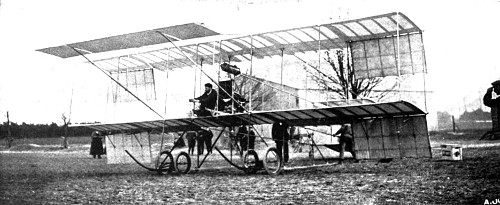
The Voisins were very ambitious indeed in their first
airplane project. The machine which they built was
both large and heavy, and possessed of many unscientific
features. Like the Wrights' machine it had two
large horizontal planes, in front of which was placed a
small elevating plane, which could be inclined up or
down to lift the airplane into the air or bring it to earth
again. Unlike the Wright model it had a large “tail,”
or horizontal plane at the rear, intended to give it increased
longitudinal stability. This feature represented
an improvement. The Wrights had to keep
their machine on the level by raising or lowering the
front elevating plane in such a way as to counteract
any pitching motion, but the tail of the Voisin biplane
gave it a great deal more steadiness in the air. Fitted
to the tail was a rudder, by which turning to right or
left was accomplished. But the Voisin brothers had
no wing-warping device on their large flier. Instead
they used the upright curtains or planes between the
main planes, which we have already seen on the machine
designed by Santos-Dumont. Their airplane
was equipped with an 8-cylinder motor, which turned
a large propeller.
In this large and unwieldy machine, weighing possibly
1400 pounds, Henry Farman made a short flight
in a closed circuit in 1908. At the time it was the
record flight in Europe, and the French people fondly
imagined it was the best in the world. That same year
Wilbur Wright arrived on French soil and showed
them in a few astounding experiments what the Wright
biplane could do.
The successes of this tall, untalkative American, who
had come over to France and with ease made the aerial
adventures of Santos-Dumont and Farman seem like
the first efforts of a baby learning to crawl, greatly as
they surprised, and, perhaps, disappointed the French
people, in the outcome had the result of spurring
Frenchmen on to greater effort in the problem of airship
design. Before the end of 1908 Henry Farman,
in an improved Voisin, had wrested back the lost honors
by flights which were longer than those made by
Wilbur Wright.
And other Frenchmen were hard at work. After
building a number of machines and meeting with many
accidents and failures, Blériot emerged in the summer
of 1909 with a successful monoplane. At almost the
same time the Antoinette monoplane made its appearance,
and soon these two similar machines were pitted
against each other in a famous contest.
The London Daily Mail, with the intention of stimulating
progress in aviation, put up a prize of £1000 for
the first machine to fly the British Channel. In July,
Blériot brought his monoplane to Calais; and Hubert
Latham appeared as his antagonist, with an Antoinette
machine. Both of the contestants were skilled pilots,
and both were men of fearless daring. The feat which
they were about to attempt required men with those
qualities, for in these pioneer days of aviation it was
not the easy task to fly the Channel which at first glance
it might seem to be. Over the Channel the winds were
almost always very severe, and they represented the
greatest danger the airman had to face. The first airplanes
had so small a factor of stability that it was
almost impossible to fly them in even the gentlest
breeze. The most intrepid aviators never once thought
of attempting flight in unfavorable weather. To be
overturned in crossing the Channel meant taking a big
risk of death, and both Blériot and Latham realized
that they were taking their lives in their hands in undertaking
the trip. They had a long wait for calm
weather, but on July 24th conditions seemed right for
a start the next morning. Just at dawn Latham flew
out across the sea and disappeared in the distance.
Not very long behind him, Blériot, having tested with
the utmost care every part of his little machine, climbed
into the pilot's seat, and with a “Good-by” to the little
group of mechanics and friends who stood about, sped
away, hot on the trail.
On and on flew Latham in his larger Antoinette monoplane,
and the hope of victory began to loom big.
Far out over the Channel however, his engine suddenly
“went wrong,” as engines in those days had a habit of
doing, and the much feared thing happened: he began
to fall. In a very few moments the plucky pilot was
clinging to his airplane, as it floated for a few moments
on the choppy sea. Before it could sink a vessel had
hurried to the rescue, and Latham was hauled on board,
disappointed, but safe.
Blériot, meanwhile, was far from being sure of his
course as he flew on steadily through the early morning
haze. But his engine continued to run smoothly,
and finally far ahead, the white cliffs of England began
to emerge out of the distance. With joy in his heart
the Frenchman flew proudly in over the land and
brought his airplane to the earth in the vicinity of
Dover Castle. He was greeted as a hero by the British
and the glad message of his triumph was speeded back
to Calais.
Loth to be behindhand in airplane activities, America
was also busily at work developing the heavier-than-air
machine, and another famous name had by this time
been added to that of the Wright brothers. By 1909
Glenn Curtiss with a group of distinguished co-experimenters
had succeeded in constructing several very interesting
flying machines. Curtiss' story is an interesting
one. In 1900 he was the owner of a small
bicycle shop in Hammondsport, New York. He had
a mania for speed, having ridden in many cycling
races, and it was he who first thought of attaching a
motor to a bicycle for greater speed. He soon sprang
into the limelight as a motorcyclist and a manufacturer
of motorcycles. A small factory went up at Hammondsport,
and achieved a reputation for the very good
motors it turned out.
Curtiss first became interested in flying through an
order he received from Captain Thomas Scott Baldwin
for a motor to be used in a dirigible balloon. He
set to work on the problem of constructing a motor
suitable for the purpose, and, as might be expected, he
became fascinated with the possibilities of flight. Curtiss
and Baldwin made some very interesting experiments
with the dirigible. Then, in 1905, Curtiss made
the acquaintance of Dr. Alexander Bell. The famous
inventor of the telephone was engrossed in the study
of gliding machines, and had been carrying on a series
of experiments with kites by which he hoped to evolve
a scientific airplane. To further these experiments he
had called in as associates in the work two engineers,
F. W. Baldwin, and J. A. D. McCurdy, while Lt.
Thomas Selfridge of the U. S. Army was also greatly
interested.
Thus it came about that in the summer of 1907 this
group of capable men formed what they were pleased
to call the “Aerial Experiment Association,” of which
Curtiss was perhaps the moving spirit. The first machine
built by the Association was christened the Red
Wing, the second the White Wing; the third was called
the June Bug, and it proved so successful a flier that on
July 4th, 1908, it was awarded the Scientific American
trophy for a flight of one kilometer, or five-eighths of
a mile.
While, in France, Farman and the Voisin brothers,
Latham and Blériot were pushing steadily along the
rough road to aviation successes,—in America, the
Wright brothers and Curtiss with his associates, were
demonstrating to the public on this side of the water
what flying machines could do.
In fact, the airplane had definitely begun to assert its
superiority as master of the air, and many eyes in all
parts of the world were fixed on it and on the great
future possibilities for which it stood. Everywhere,
warm interest had been aroused, and, at least in France,
the military importance of the heavier-than-air machine
was coming to be realized.
Now the time was ripe for the great public demonstration
of the world's airplanes which took place at
Rheims in August, 1909. The Rheims Meeting is
probably the most memorable event in the history of
aviation. It placed the work of a dozen or more
earnest experimenters definitely in the limelight, and
gave the chance for comparisons, for a summing up of
knowledge on the subject of flight, and for a test of
strength, which resulted in the mighty impetus to aerial
progress which followed immediately afterward.
Here at Rheims were gathered many famous flying
men who already had made their names known
throughout Europe and America. There were Farman,
Latham, Paulhan, Blériot, Curtiss, and the three
who flew Wright machines, the Comte de Lambert,
Lefevre and Tissandier,—as well as many others, for
there were thirty contestants in all. Many unusual
feats delighted the spectators. Lefevre, a student of
the Wrights, and up to that time unknown, amazed the
assemblage by his wonderful aerial stunts. He circled
gracefully in the air, making sharp, unexpected
turns with the utmost skill, and winning round after
round of applause.
Curtiss and Blériot emerged as contestants for the
speed prize over 10 kilometers, and after several
breathless attempts in which records were made and
broken, the honor was finally carried off by Blériot,
who covered the distance of 10 kilometers (about 6¼
miles) in 7 minutes, 47.80 seconds. Curtiss replied by
beating his famous opponent in the contest for the
Gordon Bennett Cup, offered for the fastest flight over
20 kilometers; and Curtiss also was the winner of the
30 kilometer race.
It was Farman, in a biplane of his own design, who
surprised every one by his remarkable performance,
and turned out to be the victor of the occasion. Flying
for three hours without stopping, round the course,
he covered 112 miles without the slightest difficulty,
and was only forced to make a landing because of the
rapidly approaching dusk. For his feat he was
awarded the Grand Prize, and was hailed as the most
successful of all the contestants.
Finally Latham, in an Antoinette monoplane, proved
he had the machine with the greatest climbing powers,
and carried off the Altitude prize on the closing day
of the meeting.
Among those who looked on at the famous Rheims
Meeting of 1909 there were none more keenly and intelligently
interested than the representatives of the
French military authorities. They had come for two
reasons: to ascertain at first hand which were the best
machines and to order them for the French Government;
on the other hand, to encourage to the fullest extent
possible all those men present who were earnestly
working in the interests of aviation. France was
ready and willing to spend money freely for this purpose,
and the Rheims Meeting resulted in orders for
machines of several makes. Some of these were regarded
as having great possibilities from a military
point of view; and others, though not looked on so favorably,
were purchased as a sign of goodwill and support
to future experiment. It was this far-seeing patronage
which paved the way for France's later aerial
triumphs, for it gave her a diversity of machines and
a devoted coterie of workers all following original
lines of experiment.
Let us glance for a moment at the little group of
machines which stood out by their merits most prominently
at that Rheims Meeting of 1909, and which gave
the greatest promise for the future. To-day they seem
antiquated indeed, but for all their rather curious appearance
they were the legitimate forefathers of our
powerful modern airplanes. Among the biplanes,
those especially worthy of note were the Farman, the
Wright, and the Voisin; while the Blériot and Antoinette
monoplanes gave a most excellent account of
themselves.
Farman, who had first learned to fly in a machine
designed and built by the Voisin brothers, was far from
satisfied with his sluggish, unmanageable steed and at
once set to work on a design of his own. His one idea
was to construct a biplane of light weight, speed and
general efficiency. He did away with the box-kite tail
of the Voisin model and substituted two horizontal tail
planes with a vertical rudder fitted between them. Instead
of the vertical planes or “curtains” between the
main planes by which the Voisins attempted to preserve
the lateral stability of their airplane, Farman adopted
the “wing-warping” plan of the Wrights in a somewhat
modified form. The Wright machine, it will be
remembered, had wings whose rear portions were flexible,
so that they could be drawn down at the will of the
pilot. If the latter felt that the left side of his machine
was falling he simply drew down or “warped” the
rear edges of the wings on that side. The air rushing
under the wing was blocked in its passage and the
greater pressure thus created forced the wing upward
on the left side until balance had been restored. Acting
on this principle, Farman attached to the rear edges
of the main planes at each side a flap, or as it is called
to-day, an aileron, which worked on a hinge, so that it
could be raised or lowered.
Another novel feature of this first Farman biplane
was its method of starting and landing. Below the
planes had been placed two long wooden skids, and to
these small, pneumatic tired wheels had been attached
by means of strong rubber bands. In rising, the airplane
ran along the ground on these wheels until it had
acquired the momentum necessary to lift it into the air.
When a descent was made, the force of contact with the
ground sent the wheels flying upward on their flexible
bands, and allowed the strong skids to absorb the shock.
This underbody or chassis was a distinct improvement
on anything that had yet been devised, for it was light
in weight and efficient.
In one other important respect the Farman machine
was superior to all those demonstrated at Rheims in
1909, and that was in its engine. Airplane engines up
to this time had been nothing more or less than automobile
engines built as light in weight as possible. But
in France a new engine had made its appearance, designed
especially for airplane needs. Hooted as a
freak at the first, and rejected by experts as “impossible,”
it carried Farman round the course on his three
hour flight without a hitch and made him the winner
of the Grand Prize. This remarkable engine was the
Gnome and the reason for its excellence lay in its unusual
system of cooling. The overheating of his
motor was a thorn in the flesh of many an early aviator.
An engine which gave good service in an automobile
would invariably overheat in an airplane because
of the constant high speed at which it must run.
Now motor car engines of whatever type, and whether
water-cooled or air-cooled, had fixed cylinders and a
revolving crankshaft. In the Gnome motor the cylinders
revolved and the crankshaft was stationary. Flying
through the air at tremendous speed they necessarily
cooled themselves. This was the secret of the
perfect running of the Farman biplane. Though Farman
had been the first to recognize the merits of the
Gnome and install it in his machine, he was not the last,
for after the Rheims Meeting it rapidly became the
favorite of practically all builders.
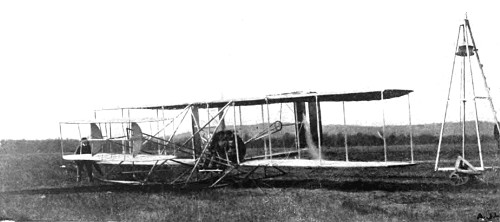
Next to the Farman, the Wright machine was probably
the best for all-around service of the many demonstrated
at the great meeting. Its one greatest disadvantage
was the fact that it had to be launched from a
rail. It carried no wheels—merely skids for landing—and
so to gain initial momentum it had to be placed
on a small trolley which ran down a rail. Such a
method of gaining speed was exceedingly complicated,
and the question at once arises: What would the pilot
do if forced to make a landing far from his starting
point? Of course it would have been quite impossible
for him to have risen into the air for a return trip, and
his machine, though in perfect condition, would have
to have been packed and carted back home.
The Voisin biplane, though improved since Farman
had piloted it in 1908, was still in 1909 an overly heavy,
slow flying machine, more or less difficult to steer. It
still had its “box-kite” tail and its upright curtains
between the main planes. And it carried a rather
weighty landing chassis built of hollow metal tubing, to
which were attached pneumatic-tired bicycle wheels.
Small wheels were also placed under the tail, to support
it when running along the ground.
The Blériot monoplane could have claimed the honors
for simplicity. It had a body built up of light
woodwork, over part of which fabric had been
stretched. On either side of the body extended the
two supporting planes, supported above and below by
wires. In the front of the body was the engine and at
the rear extremity a small stabilizing plane. At the
ends of the stabilizing plane, on either side, were two
small planes which could be moved up and down.
They took the place of the front elevating plane employed
on the other machines. Just behind the stabilizing
plane was the vertical rudder, which turned to
right or left. The wings of the Blériot had the Wright
brothers' wing warping arrangement. The pilot sat
just behind the engine, operating the controls.
Larger in wing span and longer in body than the
Blériot was the Antoinette monoplane. Like the Blériot
it had its elevating planes at the rear, and carried
its engine in the bow. Instead of the wing warping
device it made use of movable flaps or ailerons at the
rear edges of the wings. Another idea had been incorporated
in this machine for the purpose of maintaining
lateral stability. Its wings, instead of extending
in a horizontal position from the body were inclined
slightly upward,—a plan which met with serious condemnation
from the engineering experts.
These five then, were the machines which claimed
most attention in 1909, although many others,—as for
instance the R. E. P. monoplane, built by M. Esnault-Pelterie,
and the Breguet biplane—were flown at the
famous meeting.
The Rheims event had been hugely successful, and
the news of the splendid achievements of the airplane
spread like wildfire throughout the world. Smaller
meetings were arranged for in other cities, and everywhere
the great aviators were called for to give exhibition
flights. In September Santos-Dumont came
once more before the public with the tiniest monoplane
in existence, a little machine which he called the Demoiselle,
and in a series of experiments proved its remarkable
capabilities. Santos-Dumont had been residing
for some time at St. Cyr, where he had worked on
his designs for the Demoiselle. One of his aviator
friends, M. Guffroy, was also experimenting at Buc,
five miles away. The two men agreed that the one
who first completed an airplane should fly in it to the
home of the other and collect £40. In 6 minutes and
1 second Santos-Dumont covered the five miles on the
14th of September and claimed his reward.
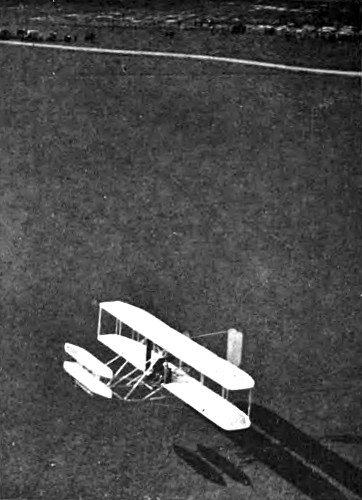
WRIGHT MACHINE RISING JUST AFTER LEAVING THE RAIL
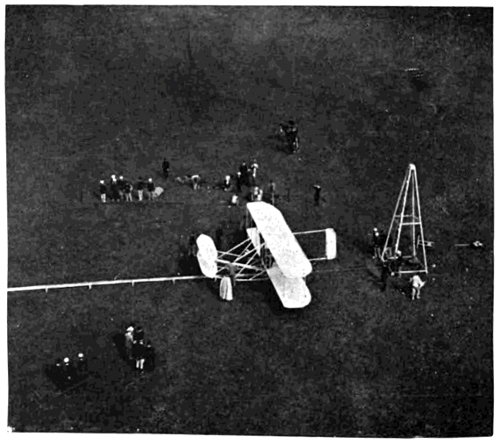
AN EARLY WRIGHT MACHINE, SHOWING ITS METHOD OF STARTING FROM A RAIL
Orville Wright at about this time was exhibiting his
airplane in Berlin and winning new laurels before the
Crown Prince and Princess of Germany. By the middle
of October he was in France, and was present at the
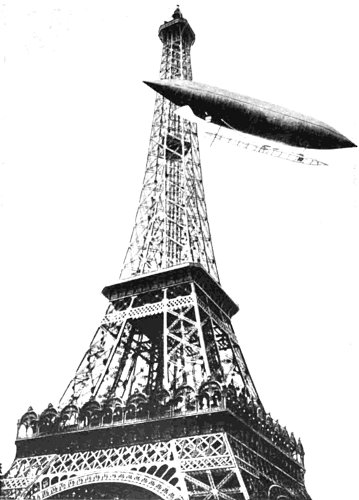
Juvisy Meeting, when the Comte de Lambert, leaving
the course unexpectedly, made his sensational flight
over Paris, circling round the Eiffel Tower at a height
of 1,000 feet. Paris was filled with amazement and
delight at the sight of an airplane soaring over the
city. It was almost an hour before the Comte de Lambert,
flying with the greatest ease, arrived once more
at the course, to be overwhelmed with congratulations.
Copyright Underwood and Underwood
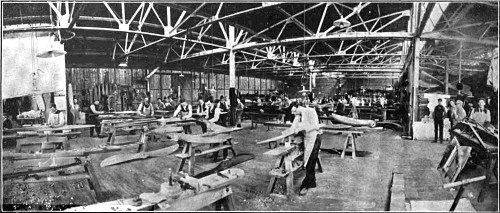
THE PROPELLER DEPARTMENT IN ONE OF THE GREAT CURTISS FACTORIES
On November 3rd, Henry Farman made a world's
record of 144 miles in 4 hours, 17 minutes and 53 seconds,
wresting from Wilbur Wright the coveted Michelin
Cup. In December Blériot attempted an exhibition
of his monoplane in Constantinople, but his machine
lost its balance in the severe wind which was
blowing and came crashing to earth. Though severely
wounded, the great aviator recovered rapidly, justifying
the oft-repeated superstition that he was possessed
of a charmed life.
Thus the year which had meant so much in the forward
march of aviation drew to a close. Beginning at
Rheims, the reputation of the heavier-than-air machine
had spread in ever widening circles throughout all civilized
lands. Most important of all, the military authorities
of several nations had opened their eyes to
tremendous importance of the airplane as an implement
of warfare, and their realization of this fact was
destined to bring about new and weighty developments
within the next few years. Among the great European
states only one nation slept while the rest were up
and doing, and she saw the day when, with the shadow
of war looming on the horizon, she had cause for bitter
regrets.
The beginning of 1910 saw the famous aviator Paulhan
in the United States for a series of exhibition
flights. On January 12th he made a world's record
for altitude, climbing at Los Angeles to a height of
4,140 feet, in a Farman machine.
In the Spring there occurred in England a memorable
contest between Paulhan and a young flier who up
to that time was unheard of, but who rapidly made a
reputation for himself in aviation. The London Daily
Mail, which had already done so much to arouse enthusiasm
for the airplane in the British Isles, now offered
a prize of £10,000 for the first cross-country
flight from London to Manchester. There arose as
England's champion Claude Grahame-White, and Paulhan
with his Farman biplane was on hand to dispute
the honors with him. The distance to be covered was
about 183 miles, and the task seemed almost impossible,
largely owing to the nature of the country over
which the flight must be made. It was rough and hilly
and thickly sprinkled with towns, making the task of
a forced landing a very perilous one. Engines in 1910
were none too reliable and were apt to play strange
tricks. To be forced to descend over a town or in
rough country meant a chance of serious accident or
death. Rough country moreover is apt to be windy
country, with sharp, unlooked-for gusts blowing from
unexpected quarters. It was these above all things
which filled the airman's heart with dread, for he knew
only too well the limited stability of his pioneer craft.
Late in the afternoon of April 27th, Paulhan, whose
biplane, in perfect repair, was awaiting him at Hendon,
near London, ascertained that the wind was favorable,
and at once rose into the air and started on his long
trip. Grahame-White had assumed that it was too late
in the day to make a start, and had left his machine, all
ready for flight, at Wormwood Scrubbs, intending to
make a start in the early morning. Shortly after six
the news was brought to White that Paulhan was on
his way, and he immediately rushed to his starting
point and hurried after his rival.
Paulhan had studied every inch of the ground and
knew what conditions to expect. His earlier start
gave him a great advantage, for he managed to get
farther before nightfall, and also before any adverse
winds arose. With darkness both pilots were forced to
make landings, but Paulhan was far ahead, and the
prospect of victory began to wane for the plucky young
English flier. In the emergency he determined on a
desperate attempt to overcome his handicap. Night
flying then was a thing unheard of, but Grahame-White
prepared to try it, however risky. At half past two
in the morning, by the wan light of the moon he arose
from the field where his machine had been landed and
flew off into the murky night.
Disappointment awaited the dauntless pilot, however.
He had a stern struggle with the wind, his engine
began to give trouble, and finally he was compelled
to come to earth.
Paulhan got away at dawn and being the more experienced
pilot of the two, managed, after a sharp tussle
with the wind, to arrive intact at his destination.
He was greeted with wild enthusiasm and was indeed
the hero of the day.
But England was not without gratitude to her defeated
airman, who in the face of enormous difficulties,
had persisted so gallantly in his effort to uphold his
country's honor in the records of aviation. Though
official England was slow to recognize the airplane's
claims, the British public showed keenest interest in all
the exploits of their sportsmen of the air, and before
long there was quite a fair-sized group of such men
demanding attention.
America also had a remarkable feat to record in the
summer of 1910. The New York World had offered
a $10,000 prize for a flight down the Hudson River
from Albany to New York. The difficulties were
even greater than those of the London-Manchester contest,
for here the airman had to fly the entire distance
over a swift stream. The high hills on either side
meant increased peril, for there were sure to be powerful
wind gusts rushing out between the gaps in the
hills and seeking to overturn the machine. If the engine
should give out, there was no place to land except
in the water itself, with slight chance of escape for
either the pilot or his airplane.
Nevertheless, Glenn Curtiss, whose accomplishments
at the Rheims Meeting we have already witnessed,
determined to try for the prize. His machine
was brought from Hammondsport to Albany
ready for a start, and on May 31, after a long wait
for favorable atmospheric conditions, he was on his
way. A special train steamed after him, carrying
newspaper reporters and anxious friends, but he left
it far in the distance while he flew swiftly down the
Hudson. Villagers and boatmen waved and shouted
to him as he passed. At one point he encountered an
air “whirlpool” that almost sucked him down, but he
succeeded in righting his machine and getting on his
way again. Near Poughkeepsie he made a landing to
obtain more fuel, and from there he flew straight on to
his journey's end, reaching New York City and descending
in a little field near Inwood.
In July of 1910 came the second big Rheims Meeting,
to show what unprecedented advances had been
made in one short year. Almost 80 contestants appeared,
as compared with the 30 of 1909. Machines
were in every way better and some very excellent records
were made. The Antoinette monoplane flew the
greatest distance (212 miles), and also reached the
greatest height; while a new machine, the Morane monoplane,
took the prizes for speed.
Meanwhile the French Army had been busy training
aviators and securing new machines. In the Fall these
were tried out at the Army Maneuvers in Picardy, and
for the first time the world saw what military airplanes
really could accomplish. In the sham warfare the
army pilots flew over the enemy's lines and brought
back astonishingly complete reports of the movements
of troops, disposition of forces, etc. The French military
authorities themselves, enthusiastic as they had
been over the development of the airplane, had not anticipated
such complete success. They were delighted
with the results of their efforts, and a strong aerial policy
was thereupon mapped out for France.
England at this date possessed one military airplane,
and it was late before she awakened to the importance
of aviation as a branch of warfare.
Germany, Italy, Russia, and America were looking
on with keen interest, but for a while France maintained
supremacy over all in her aerial projects. By
the end of the following year she had over 200 military
machines, with a competent staff of pilots and observers.
To follow the course of aviation achievement we
must now go back to England, where in July, 1911,
another big Daily Mail contest took place. This time
the newspaper had put up a prize of £10,000 to be won
by flying what was known as the “Circuit of Britain.”
This had been marked out to pass through many of the
large cities of England, Scotland and Ireland. There
were seventeen entrants for the contest, which was won
by a lieutenant of the French navy, named Conneau.
Cross-country flights were growing longer and longer,
keeping pace with the rapid strides in the development
of the airplane. Still another contest during 1911 was
the “Circuit of Europe,” which lay through France,
Belgium and England; while a flight from Paris to
Rome and one from Paris to Madrid served to demonstrate
the growing reliability of the aircraft.
Money had always flowed freely from French coffers
for this favorite of all hobbies. At the Rheims
Meeting in October of 1911 the Government offered
approximately a quarter of a million dollars in prizes
for aerial feats and in orders for machines. Representatives
from many countries visited the meeting to
witness the tests of war airplanes.
In the two years since the first Rheims Meeting many
vast changes had taken place. Pilots no longer feared
to fly in high winds; machines were reliable, strong and
swift. A number made non-stop flights of close on to
200 miles, and showed as well remarkable climbing
abilities.
It was the Nieuport monoplane which led all others
at this Rheims Meeting. To-day the name of Nieuport
is familiar to every one, for the little scout machines
carried some of the bravest pilots of France and
America to victory in the air battles of the Great War.
Even in 1911 the Nieuport monoplane was breaking all
records for speed. Carrying both a pilot and a passenger
it flew as fast as 70 miles an hour at Rheims.
Another new machine that attracted attention was
the Breguet biplane, a heavy general service machine
weighing 2420 pounds and carrying a 140 h. p. Gnome
motor. The Gnome had so far outdistanced all competitors
that it had virtually become the universal
motor for airplanes, and, many of those seen in 1911
were equipped with it. Since then vast improvements
have been made in stationary engines but at that time
they almost entirely failed to meet the requirements of
light weight, high power and reliability.
One development in the biplanes of 1911 cannot be
passed over, for it bears a very interesting relation to
their efficiency as war machines. Any one who has
seen a photograph of one of the early biplanes must
have been struck by the curious kite-like appearance it
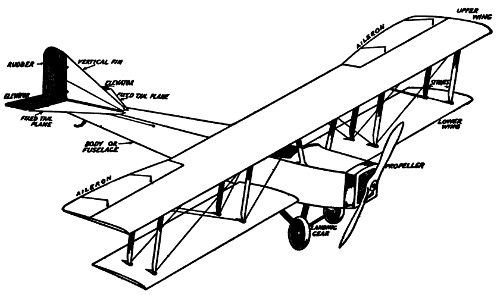
presented, due to the fact that it had no body or fuselage,
but only two large planes, connected by strong
wooden supports, and usually with a seat for the pilot
in the center of the lower plane.
It was in the monoplane that a car or airplane body
first made its appearance, and to it the wing surfaces
of the monoplane were strongly braced with wires.
Many of the biplanes of 1911 had adopted the idea and
in consequence began to take on a more modern appearance.
It was a thoroughly good idea, for by means of
its greater stability and strength, protection for the pilot
and general efficiency were obtained. Biplanes of this
type now carried their engines in the fuselage bow with
the pilot's seat just behind it, while instead of the front
elevating plane of the earlier models, the elevating surfaces
were at the rear of the fixed tail plane. The
Breguet was one of these progressive type biplanes of
1911. Constructed very largely of steel, it had a long,
tapering body with its controlling planes—rudder and
elevators—at the rear. Instead of a number of
wooden supports between the planes the Breguet had
exactly four reliable struts.
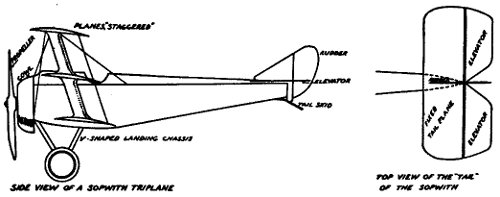
Henry Farman developed a military biplane in 1911
which had one particularly new feature. Instead of
the upper main plane being placed exactly above the
lower it had been moved slightly forward or “staggered”—giving
it an overhang in front. The idea
was that this gave a greater climbing power and was
helpful in making descents, though the point has never
been satisfactorily proved.
Until 1911 Germany had pinned her faith almost
wholly to the Zeppelin as the unit for the aerial fleet
which she had hoped to build up, and she had confidently
expected it to prove its superiority to the heavier-than-air
machine in the event of war. No funds
had been spared to rush the work of designing and
constructing these huge air monsters. Carefully and
quietly the perfecting and standardizing of the Zeppelin
under government supervision had moved forward,
and German engineers had not been behindhand in
designing engines particularly suitable to aircraft.
While France was amusing herself with the clever little
monoplanes and biplanes of the pioneer days—machines
which could fly but a few yards at low altitude,
Germany, possibly with the dream of world conquest
tucked away in her mind, was sparing no expense to
get ready her fleet of lighter-than-air craft. Imagine
her chagrin when the feeble winged birds of 1908 and
1909 became the soaring eaglets of 1911, swiftly circling
the sky, swooping, climbing and performing
aerial tricks which made the larger and clumsier Zeppelin
appear as agile as a waddling duck.
Whatever the feelings of the German military authorities
were on the subject, they wasted no time in
crying over spilt milk, but at once began a policy of
construction by which they hoped soon to outstrip their
brainier French neighbors. As in everything German,
method was the characterizing feature of the airplane
program they instituted. France had sought to encourage
makers of all types of planes, and thus obtain
a diversity of machines of wide capabilities. The plan
did not appeal to Germany. From the very beginning
she aimed at reducing everything to a fixed standard
and then turning out airplanes in large numbers.
When the War broke out it seemed for a time that she
had been right, but it was not long before she looked
with sorrow upon the sad lack of versatility of her
fleet of standardized biplanes. They were hopelessly
outdistanced and outmaneuvered by the small, fast
fighting machines of the French, while they were by no
means so strong as the heavy service planes the French
could put into the air.
Italy, Austria, Russia, America and Japan began
also to make plans for the building of aerial fleets about
1911. The Italian Government relied at first on machines
secured from France, or on those copied from
French designs. Soon her own clever engineers began
to be heard from and she was responsible for developing
several of the powerful modern types. Russia
would scarcely seem a country where aerial progress
might be expected, yet she has given a good account
of herself in aviation, and one of her machines, the
giant Sikorsky did splendid work on the several fronts
during the war.
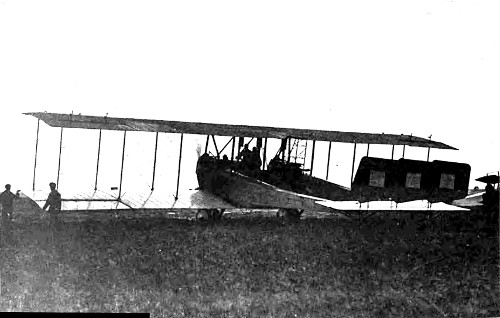
I. I. Sikorsky, the inventor of the big Sikorsky machine
was a little while ago merely a clever student at
the Kieff Polytechnic. Like many other young men he
dreamed of aerial conquest, but received little encouragement
in carrying out his projects. At twenty-four,
however, he became a student aviator, and almost immediately
began work on original airplane designs.
He succeeded in building a small monoplane which in
some ways resembled the Blériot, except in its habits
of flight. In these it was quite balky, refusing to fly
except in short hops and jumps. Sikorsky's friends
good-naturedly nicknamed it The Hopper. But the
young student was not one wit daunted. He plugged
along steadily at new designs, and in the autumn of
1910 he actually took to the air in a tractor biplane of
his own construction. Several other machines of somewhat
the same type followed, and his efforts finally won
the attention of the great Russo-Baltic Works. They
offered him financial assistance to carry on his study of
the airplane problem. With this backing Sikorsky
moved forward to sure success. In the meantime he
had secretly prepared plans for an enormous airplane
which at first he dared not divulge for fear of ridicule
and disappointment. Finally he took courage and laid
them before his friends at the Russo-Baltic Works.
Whatever they may have thought of his wild scheme
of air supremacy they consented to give it a tryout,
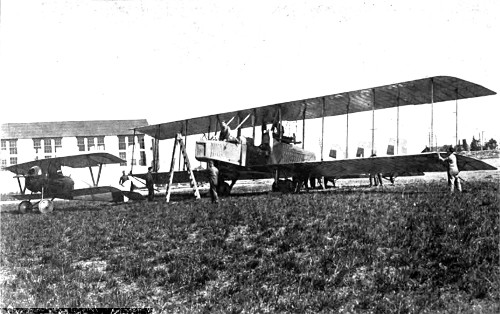
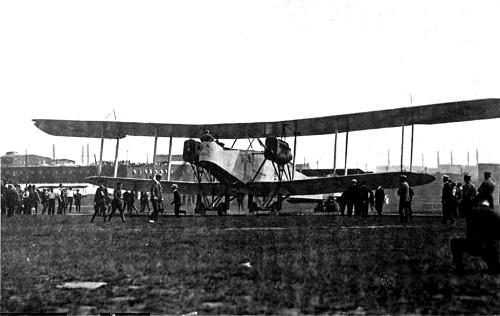
and in the Spring of 1913 the first of the giant “Sikorsky”
machines stood awaiting a flight. It was viewed
with grave misgivings by a number of experts, but to
their frank surprise it took to the air with ease and flew
well. The sight was a strangely impressive one. In
wing span the big machine measured almost 92 feet,
while the body or fuselage was over 62 feet long. The
weight of the amazing monster flying machine was 4
tons. In the forward part of the fuselage cabins had
been fitted, with a small deck on the bow. The fuselage
construction was of wood, with a strong 8-wheeled
landing chassis beneath it. Four 100 h. p. German
“Argus” engines, driving four tractor propellers sent
it racing triumphantly through the air. Its weight lifting
ability was enormous, and it made a world record
for flight.
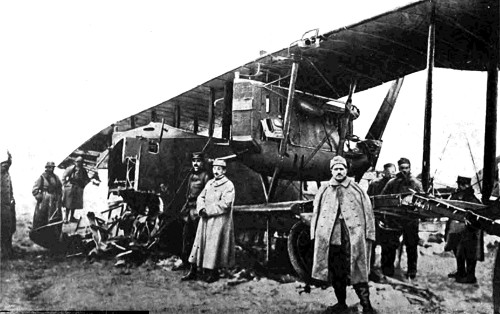
Prodigious as this first great master of the air had
seemed it was followed in 1913 by one still larger.
The new machine was to the fullest extent an aerial
wonder. Its enormous body consisted of a wooden
framework covered with canvas, and in its interior a
series of cabins were provided. There were three
decks: the main one in the center of the fuselage, designed
to carry heavy armament of machine guns and
a searchlight; a small deck at the stern; and one set
in the undercarriage, where additional heavy armament
could be placed. Only a few months before the storm
of war broke over Europe this Air Leviathan was born,
and at the time no one suspected it would so soon be
called into active service. In the Spring of 1914 it
made flight after flight, scoring a succession of triumphs
by its record breaking performances, and winning
for its designer a decoration from the Emperor.
Sikorsky was a man of wealth but so recklessly did
he lavish his personal funds on his airplane ventures
that on many occasions he came very near to want as a
result. It was no unusual thing to see him during
those years of reckless experiment, braving the bitter
winter weather of Russia in threadbare garments,
shivering, but grimly and sternly determined. Then
came the War, and at the first call his machines were
ready to prove themselves in the battle against the Hun.