I like to think of modern business as a huge, great single machine; or
better still, a group of little machines gathered together and
functioning as one. It is a simile that I have used time and time again.
To feel that some single achievement of industry—of manufacturing or of
merchandising—is as well organized and as well balanced as the many
mechanisms that are laboring in its behalf, seems to bring the most
single complete picture of modern business of the sort that our press
has ofttimes been pleased to term "big business".
And sometimes I like to think of these "big businesses"—with their
hundreds and thousands of human units—as armies. At no time is this
last comparison more apt than when one comes to apply it to the modern
department-store, as we today know it in America. For, even if you wish
to grant an entire dissimilarity of purpose, one of these huge
institutions has more than one point of similarity with an army. Not
alone in numbers can this parallel be made, but quite as quickly in
organization. While, to return to our first simile, it, too, is a big
machine—humanized. Its parts are carefully co-ordinated so that the
whole will function with the least possible friction. Like an army it
is officered with its generalissimo, its under generals, its colonels,
its captains, its lieutenants, its sergeants and its corporals. The
difference is only in nomenclature. The structure is quite the same.
For, when you come to analyze, you will find the divisions of labor and
of authority quite corresponding to similar divisions in the army.
Officer, "non-com" and private—each contributes his more or less
important part; each is a necessary factor in the success of the
enterprise.
Like an army, the department-store of modern America is designed to move
constantly forward. The "big-chief" scans his balance sheets, the rise
and fall of the curves of his outgo and income averages, the
tremendously meaningful jagged red lines of his graphic charts, quite as
carefully as the army general keeps track of the movement of his forces
upon the maps which his topographists send him. He gathers his officers
roundabout him and plans the strategy of business with the same shrewd
foresight that must be observed by the successful military leader. He
must be a promoter of morale throughout his forces, even down to the
newest and the lowest-paid clerk. There must be constant liaison between
the general and the private in the ranks.
In considerable detail this parallel can be carried out. Soon, however,
it must come to an end. That is, it ends in so far as Macy's is
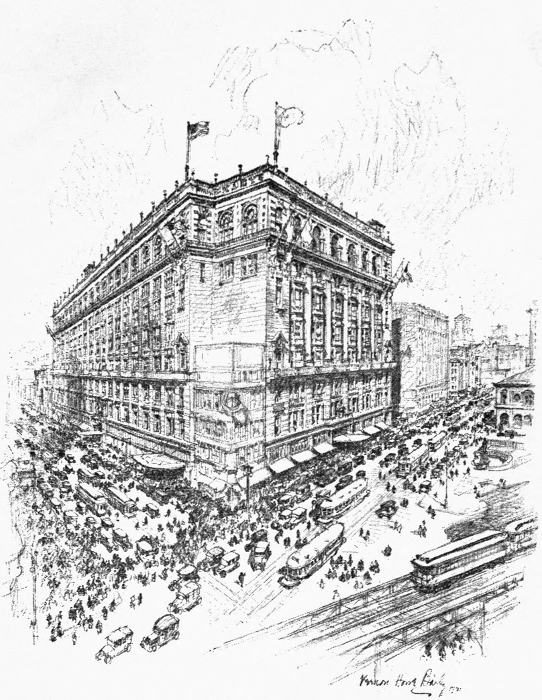
concerned. For the army at Broadway and Thirty-fourth Street is neither
an army of offense nor of defense. Its sole position always is upon the
front line of service.
At the head of the organization there are the three brother partners who
inherited their original interest in the great business from their
father, the late Isidor Straus, who, with their mother, lost his life in
the supreme catastrophe of the sinking of the Titanic. In 1914 they
acquired Nathan Straus' interest by purchase. These men, Jesse Isidor,
the president, Percy S., the vice-president, and Herbert N., the
secretary and treasurer, are its triple head and front. While each has
trained himself to be a merchandise specialist of the highest order,
there is none that knows the details of Macy's better than his
brothers—they share equally in the supreme authority that directs the
business. Directly responsible to them, in turn, is its general manager,
its merchandise council and its advertising and financial departments.
As I write these paragraphs, the great chart of the Macy organization
lies upon my desk. It is a vast and fascinating thing. With the lines
extending upon it here and there and everywhere from the box which holds
the triple-head, branching and rebranching here and there and again, it
looks not unlike a giant map; a chart, if you prefer to have it so. And
so it is, a chart upon which the steersmen of so vast and so responsible
an enterprise safely pick their course upon a seemingly unending
journey.
"Government by draughting-board," sniffed an old-time business man to me
once, when I was trying to explain to him in some detail how a great
steel manufacturing plant of the Middle West attempted to accomplish
its huge job, economically and efficiently, by the use of graphic
charts. And he added: "I'd like to see myself held down by blue-print
authority."
To which, after all this while, I should like to reply:
"I should like to see a concern, as big and as successful as Macy's,
operated without a careful charting of its always difficult path."
Yet, as a matter of hard fact, Macy's, any more than any other big and
well-planned business organism of today, never binds itself to go
blindly and unthinkingly upon the lines of the charts—and nowhere else.
The real trick of executive direction seems to be to know when to follow
these lines and when more or less to completely disregard them.
Rule-of-thumb can never again overcome the rules of averages, of
percentages or of economic laws. But the rule of wit and of human
understanding can ofttimes be used to temper this first group and
sometimes with astonishingly successful results.
A glance or two at this imposing organization chart lying before me
begins to show the many, many ramifications of the huge Macy business
tree. It shows, for instance, how, under the direction of the
merchandise council, are four large branches of store activity more or
less inter-related: the handling of Macy's own merchandise (meaning
particularly that which is either made in the store's own factories or
at least made under its direct supervision); the work of the large force
of buyers; the comparison department (an important phase of the
business to which we shall come in our own good time); and the foreign
offices.
In the financial department, the controller is the quite logical chief.
His general duties are fairly obvious. To help him in them, he has,
under his direction, the chief cashier, the salary office, the auditing
department, the depositors' account department—this last a most
distinctive Macy feature—and a statistical department.
Obvious, too, is the greater part of the work of the publicity
department. It includes in addition to the advertising manager—always
an important factor in the modern department-store and particularly so
in the case of Macy's—a display manager. It is the job of the first of
these men to tell the public of the merchandise being offered for sale
at the sign of the red star; the job of his compeer to see that it is
properly displayed to them.
And, finally, there is the general manager—last but not least.
Connected by an exceedingly direct and much-traveled line with the
general offices upon the seventh floor of the store are Mr. W. J. Wells,
the store's general manager, and his advisory council. For the G. M.,
big as he is always, has need of much advice. Upon his broad and
efficient shoulders are placed such a tremendous array of
responsibilities that one cannot but marvel at the sheer efficiency of
the man—to say nothing of his reserves of physical and mental
strength—who can hold down such a job. Yet, at Macy's, the man himself
disclaims any superhuman powers.
"I am merely the automatic governor to this big machine," he will tell
you, in his own simple, direct way. "In fact, if the machine always
functioned one hundred per cent. efficient, there really would be no
need either of me or of my job. It is because no machine that is built
of human cogs and cams and levers and pulleys may ever work at one
hundred per cent. efficiency that I, or some other man, must sit in this
office. It is our job to meet the unusual and the unforeseen. We take up
slack here and loosen there."
The translation of this is unmistakable. If the three men upon the high
seventh floor of the institution are its steersmen, this man, who has
his office at the rear of its broad mezzanine balcony, is at least its
chief engineer. And to assist him he has five assistant
engineers—assistant general managers, in reality. The habit of simile
leads one into odd designations of title. Each of these five assistant
general managers—we shall stand by the nomenclature of the store—in
turn has a large number of departments reporting to him. While in
addition to them and ranking as virtual assistant managers are the
superintendent of the detective bureau and that of the building, itself.
The general manager, himself, is charged with the general duty of
engaging, training and educating employees. He regulates salaries. He
controls the transfer and discharge of employees. He is charged with the
enforcement of all rules and regulations. He is the final authority to
decide whether or not merchandise is returnable, for refund, exchange or
credit. He also is the authority who adjusts all claims or
controversies with customers. And he is the one to whom employees may
appeal if they feel they are being treated unfairly by their superiors.
A man-sized job truly! And because no one man, short of a superhuman at
any rate, could ever perform all of its various and perplexing
functions, Mr. Wells has his five assistants. In the event of his
absence as well as that of any one of them the man below rises
temporarily into his immediate superior's job.
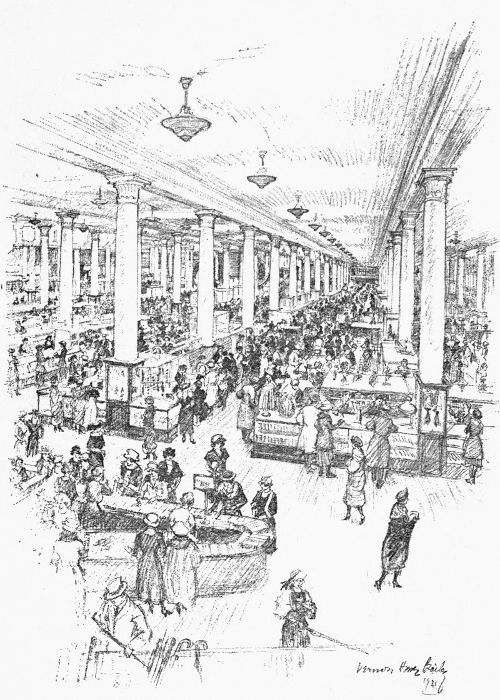
WHERE MILADY OF MANHATTAN SHOPS
The vast ground floor of Macy's is, in itself, a mark of much interest
and variety
It is the major task of the first of these assistants to direct the work
of the floor superintendents—eight of these—and through them that of
the section managers and the actual sales forces; nearly two thousand
people all told. In other words, his job is the selling. To this great
force and to the countless problems that must arise in its day-by-day
direction there is added the oversight of the personal shoppers'
service. Which means in turn the furnishing of guides throughout the
departments to shoppers who ask for them; finding translators for folk
to whom the intricacies of our tongue are unsolved mysteries and, in
certain specific and necessary cases, the sending of merchandise with a
member of the sales force into the homes of Macy's patrons.
The second and the third assistant managers are the heads of non-selling
organizations within the store, the fourth and the fifth handle the
training and the educational departments, respectively. The second
assistant has, as his especial responsibility, the merchandise checkers,
the collectors, the stock clerks, the cashiers and the interior mail and
messenger service. The other non-selling assistant general manager
supervises the receiving department, the department of money orders and
adjustments, the supply department, the delivery, the receiving, the
time office, the manufacturing, and sundry other smaller specialties of
the store; small, however, only in a comparative sense. Taken by
themselves they quickly would be seen to be sizable indeed.
The tasks of most of these departments are fairly obvious from their
names. Some of the others we shall see in a bit of detail as we go
further into the store and its workings. In other chapters we shall
describe what the great delivery department is supposed to accomplish,
and actually does accomplish, the scope and plan and reach of the
departments of training and of employment, and some others, too. It
takes no great strain upon the imagination to conceive of the importance
of the detective bureau's work, nor that of the superintendent of
buildings.
So much, then, for a preliminary bird's-eye view of a mammoth machine,
not a machine for turning out shoes or typewriters or paper, but for
buying and selling all these things and many, many more. And as you read
in the earlier part of this book, the huge mechanism did not spring into
its being in a year, or in a decade, or even in a generation. It
represents slow, hard, steady growth; and slow, hard, steady growth it
is still having.
There are now one hundred and eighteen departments in Macy's and yet,
out of many thousands of separate and distinct items, there are some
things that the store does not sell. Some of these commodities are
handled by other great department-stores. But while Macy's may and does
follow a charted path, it is its own chart and its own path. It never
follows blindly the pathways of others. So, for instance, it does not
sell pianos. In this particular case, at least, the reason is not hard
to discover. Remember, all the while, that Macy's sells for cash and for
cash alone—always and forever; and then consider that in ninety-nine
cases out of a hundred, pianos are sold upon the installment plan. The
installment plan is entirely outside of the Macy scheme of salesmanship.
It may or may not be a good plan. But to adopt it Macy's would either
have to change its selling policy or else dispose of so few pianos that
it would not be profitable to maintain a department for them. This is
the alpha and the omega of the piano, as far as Macy's is concerned. It
has no intention either of changing its deep-rooted and well-founded
selling policy, nor, on the other hand, of establishing a little-used
and possibly unprofitable department. Upon this decision it stands quite
content.
Yet assuredly Macy's is organized to sell nearly all of the necessities
of life—and an unusually large number of the luxuries in addition. From
hosiery to ice cream, from women's suits to artists' materials, from
eye-glasses to sausages, and from petticoats to ukeleles, the list of
the store's wares is almost without limit. Other furniture is not hedged
about by the same merchandising traditions and restrictions as are
pianos; there are in the upper floor of this great market-place pieces
of household furnishings whose prices run well into the hundreds and
even thousands of dollars, to say nothing of rare Oriental rugs, fine
paintings and other works of art.
These one hundred and eighteen departments have been arranged after long
study and experience and well thought out plans. In fact, so many
conflicting and intricate features have entered into their planning that
it is hardly possible within the space of these pages to give more than
the broad general policy of the department organizations of the store.
Yet it is another of these fairly obvious principles that upon its main
floor—where its space, square foot by square foot, is by far at its
highest value, and where there is a maximum of accessibility—should be
displayed the items that sell the most quickly and the most readily.
This follows the very reasonable theory that goods for which there is
the most popular demand should at all times be the most accessible.
Varying slightly in specific cases and conditions, as one ascends into
the five upper selling floors of the store, the merchandise falls more
and more into classifications that call for care and deliberation in the
purchasing. Thus, upon the main floor, one will find such articles as
umbrellas, books, candy, notions, and the like—to make but a few
instances out of many—while upon the second, there will be yardage
goods, linens, shoes and so forth.
Parenthetically, it may be set down that in older days, yardage
goods—meaning cloths and weaves of almost every sort—never used to be
found above the ground floor of any department-store. Retail
merchandising tradition in New York suffered a body blow some years ago
when Macy's sent them upstairs. Even the men who worked in the
department protested against the change. A sizable proportion of their
income was and is in their commissions upon their total volume of sales.
They could not see the sales upstairs.
"For two cents I'd resign," said one of the veterans, just as the change
was announced.
No one offered him the two cents, however, and he remained. And the
following year saw the department reach a new high level for total sales
in its yard goods.
One large reason for this in Macy's is the unusual accessibility of the
upper floors from the street level. It required little or no effort for
the customer to get to the second floor, or, for that matter, to the
sixth. The store's unusual and fairly marvelous system of escalators,
well-placed, smooth running, always available, and to be safely used by
even a rheumatic or a cripple, bring these self-same upper floors at all
times within easy reach of the street, and without the use of the firm's
generous plant of elevators. With the exception of the abnormal stress
and strain of the holiday season, the vertical system of Macy's
transportation is never very seriously taxed.
To those upper floors, also, go the folk whose purchases necessitate the
fitting of something or other to the human frame. As we have just seen,
shoes are upon the second floor. On the third is the women's wearing
apparel, with special dressing-room facilities for trying on and
fitting. Similar conveniences are to be found in the men's clothing
department upon the fifth floor.
Rugs, upholstery and art objects generally require more time for
selection than do shoes and socks, more room for display as well. They
go, then, quite naturally to the broad spaces of the fourth floor. The
same qualities, only somewhat emphasized, apply to furniture, which is
shown and sold upon the sixth. That the restaurant is relegated to the
eighth floor is due in large part to the necessity for having cooking
odors where they can be carried away without reaching other parts of the
store; as well as to considerations in regard to the economy of floor
space for an enterprise that is active during only a part of the day.
Minor changes in the arrangement of all these departments are constantly
and forever under way. A great market-place like Macy's never stays
entirely put. Special considerations, special problems, unforeseen
merchandising plans may at any moment make it not only advisable but
necessary to change the location or the relative space of any or all the
departments. At Christmas-time the unusual pressure upon some of them,
accompanied by a slacking in others—unfortunately (or fortunately?)
shoppers cannot be everywhere and at the same moment—means many
temporary changes—so one department must give some of its space for a
time to its neighbor—a debt possibly to be repaid at some other season
of the year, when thoughts are not on toys, or candies or jewelry, but
upon such serious things as carpets or refrigerators.
An interesting sidelight upon the intensive study that Macy's gives the
psychology of its interior arrangements is furnished in the fact that,
on the theory that the less deadly of the species has an inherent
aversion to department-stores, men's furnishing goods in these emporiums
should generally be displayed upon the main floor, and just as close to
a street entrance as is possible. Macy's has been no exception to this
rule. A man, even when he is in a mood for spending, wants it over with
as soon as possible. He is impatient of the slightest delay. On the
other hand, his wife or daughter will make of shopping a kind of ritual.
And, perhaps, because of that, she is often the more intelligent and
discriminating buyer.
Today, however, space on the main floor of the larger stores in New York
is proving so valuable for goods that appeal to women shoppers, that
some of them are trying to find a new method of appealing to the
man-in-a-hurry. And so there has come to be a distinct trend toward
putting men's goods upon a high upper floor, but with special express
elevator service, so that their purchasers can get in and out with a
minimum use of their valuable time.
That part of the organization of Macy's which always has, always has
had, and always will have the chief visual appeal to the public, is the
staff of sales people with whom it comes in constant contact. Again and
again, as we come to consider the minute workings of this great machine
of modern business, we shall find its human factor looming larger before
our very noses. We can not dodge it. We have no desire to dodge it. In
fact, we find it at all times the most fascinating feature of our study.
It is no part of this narrative to decide which part of the whole corps
of workers in the store is the most important to it—it would be similar
and quite as easy to try to give an opinion as to the relative
importance of the mainspring and the balance-wheel of a watch—but it is
enough to say here, as we shall say again and again, that the girl
behind the counter—to say nothing of the man—is an absolutely
indispensable feature. By her it rises; by her it might easily come
tumbling down.
Let me illustrate by the testimony of a young woman who recently was a
girl behind the counter at Macy's:
"It surely is true," she says, "that we salespeople can do a great deal
to increase the business and the number of customers. Some of these last
are, of course, nearly hopeless—they would try the patience of Job,
himself—and then again there are the others who are most appreciative
of your services. It was interesting to me, when first I went behind the
counter, to see how many of my customers would say 'thank you.' I found
that nearly all of them will, if only you make a real effort to please
them. And the majority of the Macy salesforce does try to help a
customer in any way that she needs help. One day I observed this
incident, which is almost typical: A customer approached our counter and
put her bag down upon it. A saleswoman went to her at once, saying:
"'May I help you, madam?'
"The customer shook her head, a negative; she was merely trying to
adjust her veil, she explained. But our saleswoman was resourceful in
her tact.
"'Well, maybe, I can assist you with that,' she insisted, and
straightway proceeded to do so. That was her notion of the service of
our store."
It is incidents just like this—seemingly small when you take them apart
and place them out by themselves—but in the aggregate very real and
very important, that make for a store its lifelong customers. Let the
young woman continue. Like a good many other young women in the store
she is a college graduate and also possessed of a power for shrewd
observation.
" ... One woman bought some gloves from me and while she waited for her
change showed me her shopping-list. It was miles long, seemingly, and
appeared to include everything from a safety-pin to a toy submarine. As
she conned it, she said that she had shopped in Macy's for years, and
nowhere else. In fact, I remember that she said that she would be
completely lost in any other store.... Others came back, bringing a
single glove that they had purchased a year or more before and wanting
another pair just like them, they had been so satisfactory....
"Not all of them are quite so cheery, however. Occasionally some
unreasonable and irate customer would appear, storming at having to wait
a few precious moments for her change, or at not being able to find the
same glove that her friend purchased the week before—the chances being
quite good that her friend might have bought the glove in another store.
These are the times that test the wit and diplomacy and resource of the
girl behind the counter.
"A day behind a counter is filled to the brim with experiences—you have
your finger on the pulse of a part of the life of New York—you are a
part of a huge and important organization, and you come into contact
with the world in general. Even customers coming to our glove counter
furnished us with interesting moments. One in particular came to me to
get some of our children's woolen gloves. He was a robust old man—about
fifty-five, I'd have said—but he told me he was sixty-nine. He said he
had just bought the same gloves elsewhere for over twice as much. (I
said I didn't doubt that in the least.) And then he went on to say his
wife and daughters shopped in stores where the name meant a great deal,
but that he always came to Macy's because he came for the merchandise he
got. He ended by saying he was a happy man, with three romping
grandchildren, that he daily handled over two thousand men, but couldn't
handle one woman. I should like to see him try to run Macy's and have to
handle some six thousand men and women."
The personnel of each of the selling floors of the store is under the
direction of an organization captain, whose precise title is floor
superintendent. He has an understudy—or, as he is known in the parlance
of the place, a relief—so that the floor is never, even for a minute,
without an executive head.
This floor superintendent is a man of considerable discretionary powers.
He must be. These powers are being constantly brought into play as he is
called upon to decide the merits of this or that customer's claim. He is
a man of tact and judgment, both of which qualities are kept in
constant operation. Upon his floor he is the direct representative of
the management and so looks out for its interests. From his desk upon
the floor headquarters he directs and supervises, yet he constantly
circulates throughout his various departments and sees to it himself
that the matters for which he is responsible are thoroughly carried out.
The orderliness of the floor is his special concern, and when, from time
to time, it becomes necessary to shift salesclerks from one department
to another—as in the case of the numberless special sales requiring
extra help—it is he who engineers the details of the transfer.
Acting as lieutenants to the floor superintendents are the section
managers, who, as we have already seen, were in the store of yesterday
known as "floorwalkers." But in the Macy's of today something
considerably different is meant from the superannuated and somewhat
pompous gentleman who used to condescend, when we asked for the location
of silverware, to wave us away with a cryptic
"second-aisle-to-the-right-rear-of-the-store." It now means a live,
up-to-date, agreeable gentleman, with a man's-size job to fill.
Not only must he ascertain the customers' needs and direct all of them,
plainly and courteously, but he has direct supervision over all of the
employees within his section. He is held responsible for their
deportment and it is his duty to observe, as far as possible, their
mental, moral and physical condition. He must be able to detect errors
in the methods used by his salesclerks, and in order that he may be in a
position to teach them correct methods, he must, himself, be master of
the store system. Parts of this constantly are being changed, so that in
addition to all of these other qualities, the successful section manager
must possess an alert mind. The importance of his work may be visualized
to some slight extent at least by the manual which is prepared for his
guidance. This is a loose-leaf book of some fifty closely printed pages;
the number varying according to the changes in the store system which
are made from time to time. Just to give you a slight idea of what this
captain of a merchandising army has upon his mind, consider that under
the division entitled "Section Managers' Daily Duties" there are
forty-six different items, and under "Miscellaneous Duties" thirteen.
Moreover, he must have at his instant command all the technical
procedure regarding transactions and forms, refunds, complaints,
transfers, employees' shopping, the Internal Revenue Law, accidents, and
then some more. I submit this as a job requiring all that a man has of
fortitude and delicacy!
Salesmanship is the thing that really made R. H. Macy & Company and it
therefore is patent that they should consider the actual sellers of
their goods as the very backbone of their organization. In another place
it is related how, in the department of training, employees are taught
to sell, and in another something of the working out of the psychology
of the customer and the salesclerk. Education counts. It helps to make
the salesclerk a vital factor of the store organization.
Macy policy sees to it that the clerk is, in so far as it is possible,
kept interested in his or her work. There are, as we have already begun
to understand, as few rules governing their conduct, dress and liberties
as are consistent with the smooth, economical operation of the business.
On the other hand, there is all possible encouragement for them to
become familiar and even expert with the things that they sell. In many
of the departments special booklets have been prepared as aids in
selling the particular line of merchandise carried. That for the
stationery department, for instance, covers: Paper, with its history
from the earliest times, its manufacture, sizes and characteristics;
engraving, with a full description of the processes connected therewith;
fountain-pens and their manufacture; desk accessories, commercial
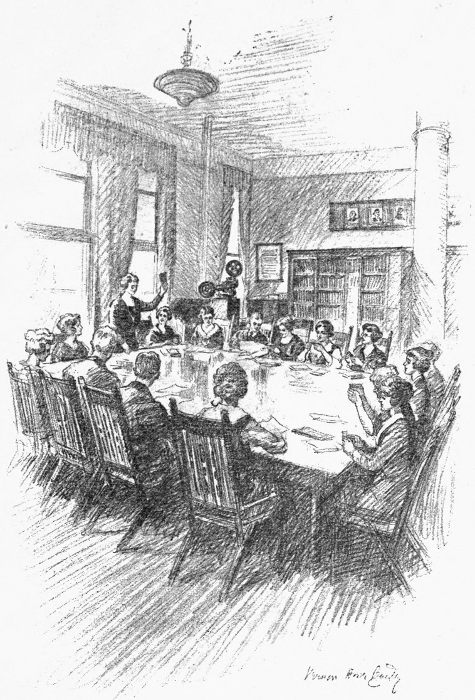
stationery and the like. Ambition to excel in salesmanship is further
stimulated by taking clerks through factories where their lines are
made, and by exhibiting motion pictures of the manufacturing of these
goods.
Here, then, is the store's most direct contact with its patrons. There
are others, however, to be classed as at least fairly direct. Take that
big and comfortable restaurant up on the eighth floor. It is one of the
real landmark's among eating-places of New York, a world city of good
eating.
Its own magnitude may easily be guessed from the fact that in a single
business day it feeds more people than almost if not any other in the
town. Translated into cold figures this means that there is an average
of twenty-five hundred lunches bought by customers each day that the
store is open; with a maximum on extremely busy days reaching as high
as five thousand. Figures are impressive. Yet these do not include
either afternoon teas or late breakfasts for both of which there is a
considerable clientele.
To serve these hungry folk who come to Macy's there are two hundred
waitresses, buss-boys and other employees upon the floor, besides fifty
in the general kitchen, twenty in the bakery and eight in the ice cream
factory. And if you still try to doubt that this restaurant is not of
itself a real business and one to be reckoned with, consider that in the
course of an average year its patrons consume—among other things—two
thousand barrels of flour, fifty-two tons of sugar, seven hundred and
fifty thousand eggs, ninety-three thousand six hundred pounds of butter,
two thousand bags of potatoes, and nearly half a million quarts of ice
cream. This latter item, however, covers the ice cream used at the soda
fountain and in the employees' and men's club restaurants.
The employees' lunchroom—conducted on the cafeteria plan—serves four
thousand men and women each working day. It provides tasty and wholesome
food at a cost that makes it entirely possible to eat to repletion for
twenty cents or less. Soups, for instance, are three cents a portion,
and meat dishes six, while other items, such as sandwiches, vegetables,
desserts and the like are correspondingly low.
Nor is this luncheon the sole restaurant resource of the employees
within this institution. In the men's club nearly a thousand more of the
Macy family eat their midday meal each day; and eat very well indeed.
Here the meal is served at a flat rate: at the uniform and moderate cost
of thirty cents.
Under the same general management direction (the third assistant general
manager) as the restaurant is the store's supply department—not
different very much from the supply department of a big railroad or
manufacturing unit—which supplies everything for its consumption, from
coal to string; the manufacturing departments in which are produced
glass, mattresses, printing, engraving, custom-made shirts, millinery,
picture frames and paper novelties; the candy factory over near Tenth
Avenue and Thirty-fifth Street, which completely fills a big modern
six-story building; the telephone service; and the so-called public
service department.
These last facilities command our attention for a passing moment. The
telephone is, of course, the nerve-system of the Macy organization;
nothing else. Its chief ganglion is a far-reaching switchboard on which
little lights twinkle on and off and at which at a single relay sit nine
competent operators in addition to a corps of inspectors and
supervisors. The big board, from which run fifty-nine trunk-wires to the
neighboring Fitzroy exchange, is none too large. Year in and year out it
handles an average of nine thousand calls a day. And in the Christmas
season this number easily is doubled and trebled.
The public service department means exactly what it is called. It is at
the service of the public. In concrete form it is a free information
bureau, where theater seats and railroad and Pullman tickets may be
purchased at face value—and not one cent beyond, not even the usual
moderate fifty-cent advance of the hotel agencies—where astute and
marvelously informed young men and women, with a miniature library of
reference books at their immediate command, stand ready and willing to
answer all the reasonable questions that may be thrust at them. To it is
added a postal office, a telegraph office and public telephones for both
local and long distance service.
The third assistant general manager of the store also has within his
bailiwick the important department of mail orders and adjustments.
Although in the technical sense of the word Macy's today has no mail
order department—having been forced to abandon its once promising
beginning along this line because of a sheer lack of room in which to
handle it—the store each year actually receives thousands of orders for
its goods by mail, from folk who, for one reason or another, find it
inconvenient to visit it. These are received and systematically handled
in this very department. Under its adjustment division comes the
extremely interesting bureau of investigation, which concerns itself
with all complaints, and the correspondence bureau, which handles more
than ninety-five per cent. of the mail of the house.
It requires no particular keenness of imagination to see that, even with
complaints reduced to a minimum and letter-writing and handling to a
fine science, there is an infinite amount of detail in these two
departments alone—detail that reaches into every part of the store and
that necessitates a clever combination of system and diplomacy.
The exposition of the workings of the Macy organization is yet to lead
us into other chapters in which various separate subjects of interest
will be treated at greater length than here; but now is the time and
place to focus our attention upon one of the small, but extremely
important, departments that works unseen—but not unfelt—behind the
scenes. It is known as the comparison department and the work that it
does is of vast importance in the operation of the store. Its functions
are unending—and continuous. Macy's policy of underselling its
competitors is an unhalting one.
I have before me a Macy advertisement from a New York newspaper of
recent date. In a conspicuous place in it there is a card which says:
"For sixty-two years we have sold dependable merchandise at lowest in
the city prices. We are doing so now and shall continue to do so." This
was published at a time when the recent reaction from the extremely high
prices of the war period already had begun to set in; and yet this was
the big store's sole acknowledgment of the deflation sentiment—to say
nothing of hysteria—which was sweeping the town. Its competitors had
been offering their wares at reductions of from twenty to fifty per
cent. from their topmost prices, but, serene and secure in the knowledge
that its policy in selling had been consistently adhered to, Macy's only
reiterated that its prices would continue to be the lowest in the
city—quality for quality.
To hold fast to this policy, through thick and thin, has not always
been easy. Macy's has fought some royal battles in its behalf—yet not
so much because it was a policy as because with the big store in Herald
Square it has become a principle of the most fundamental sort.
More than twenty years ago the principle became extremely difficult to
maintain, because of the growing tendency of the proprietors of
articles, so patented or copyrighted as to make their imitation
practically impossible, to attempt to fix their final retail sales
price. It no longer became the mere question of whether Macy's or any
other store would have the right to undersell its competitors; it became
the fundamental question of whether the great centuries-old open market
of the world could continue to remain an open market, in the interest of
the consumer; and not a closed market, in the interest of the producer.
To maintain the first of these positions, in behalf of its patrons,
Macy's entered upon and won, almost single-handed, one of the notable
legal battles in the history of this country.
As far back as 1901—if you are a stickler for exact dates—this whole
question of price maintenance became an acute issue with Macy's. It came
to pass that when the prominent publishers of America formed an
association, one prime purpose of which was to fix the prices at which
their books would sell at retail, the store quickly saw that if this
trust agreement was permitted to stand unchallenged, its cardinal
principle of underselling its competitors, would have to be sacrificed.
Macy's did not propose to make such a sacrifice—to permit its customers
to be sacrificed—without a protest. And such a protest it prepared to
make.
Isidor Straus, then the head of the business, sat in the office of his
friend and counsel, Edmond E. Wise, in a downtown office. Mr. Wise put
the thing frankly and without equivocation before his client. He said
that it would be a hard legal fight, no doubt of that, but that a great
principle was at stake; the keen mind of the lawyer was convinced of the
economic fallacy of the position of the publishers' association.
Quietly Mr. Straus told his attorney to go ahead. He said that he would
fight the fight, to the last ditch. No expense was to be spared. The
case would be carried, if necessary, in every instance to the highest
court of appeal.
Accordingly, Mr. Wise prepared a suit against the American Publishers'
Association which holds the record for appeal in the history of
jurisprudence in this country. Three times it went up to the Court of
Appeals of the State of New York; finally, after nine years of legal
battle, it was carried to the United States Supreme Court, which, after
due deliberation, decided every point in favor of R. H. Macy & Company.
That was in December, 1913. Early in the following May the firm had the
satisfaction of having the publishers hand over a check on the Park
National Bank for $140,000. This sum represented a settlement for the
difficulties that Macy's had had to undergo for more than a dozen years
past in getting stock for its book department. Ofttimes it was
necessary to follow devious paths indeed to gain this end—and still
hold fast to the fundamental underselling policy of the store. Sometimes
the store had to go so far as to send to other retail stores to buy a
certain volume, at the full retail price, and then resell it to its
patrons, at its customary ten per cent. off the price of the store at
which it had just purchased it. So much if you please for the expense of
standing by a principle!
A short time after this signal victory of Macy's, certain large
manufacturers of patented articles, who for a time had sustained in the
lower courts their claim to a fixed retail price standard, sought
definitely to control Macy retail prices upon their products. Macy's,
however, defied them, and the Victor Talking Machine Company, one of the
leading adherents of price maintenance, brought an action in the United
States courts to compel Macy's adherence to the rules for resale at a
certain price. Again there was a royal battle and again Macy's triumphed
signally, for on final appeal, the United States Supreme Court again
decided in favor of the store in Herald Square, on every one of its
contentions. Macy's then retaliated and brought suit against the Victor
Company, under the Sherman Law. In a bitterly contested action, which
culminated in one of the longest trials before a jury on
record—consuming more than ten weeks—Macy's recovered a judgment of
$150,000, and a counsel fee of $35,000; after which no paths apparently
were left open to the manufacturers who sought to maintain the retail
prices that suited them best. Court decisions seemingly blocked all
possible pathways.
One path did remain, however—legislation. Effort was made to pass a
measure down at Washington to permit and sustain retail price
maintenance, which in reality meant the emasculation of the Supreme
Court's decisions. When that measure came to a hearing before the
Interstate Commerce Committee of the House one of the Macy partners,
accompanied by Mr. Wise, the store's counsel, and Mr. E. A. Filene, the
well-known Boston merchant, came before it in opposition. Up almost to
that hour, Macy's had gone it alone. Now the attention of the country
was focussed upon its fight and the National Retail Dry Goods
Association came in with both its sympathy and its active
co-operation—hence the appearance of Mr. Filene, who made a most
excellent argument in support of the Macy contention.
It was shown definitely to the members of this House committee that
many, if not all, branded and patented articles took a retail profit of
from fifty to seventy-five per cent. The member of the Macy firm took a
watch nationally advertised at $2.50 and duplicated it with a watch
which his store sold at sixty-five cents, going so far as to take the
two watches apart so as to show conclusively that the one was quite as
good as the other. Certain other commodities went under similarly
critical analyses. When the hearing was completed, the committee laughed
the bill out of court. Since then the question of price maintenance by
the original producer has been permitted to drop. Macy's had won its
hard-fought fight; won it cleanly and honestly. By performance it had
made good its statements that it proposed wherever it was humanly
possible to undersell its competitors. That was no idle phrase.
It is indeed one thing to make a statement—whether in print or by word
of mouth—and another and ofttimes a far more difficult thing to make
good that statement by performance. No one knows this better than
Macy's. Having set down such a definite and distinct statement it must
be prepared to make good. It must be so covered and protected at every
possible point that if challenged it can give a good account of itself.
In fact, challenges come in every day—they have been coming in every
day for a good many years now—and the house continues to make good its
statement willingly—even joyfully. Here it is, then, that the
comparison department functions; here it is that the original
fundamental policy of Rowland H. Macy—to buy and sell only for
cash—strictly adhered to during the sixty-four years' life of the
business—makes it possible for the house to make good.
How, then, is it done?
The answer is easy.
Suppose, if you will, that Smith, Brown & Jones are having a special
sale of Mother Hubbard wrappers. There are advertised as their regular
$4.97 stock, marked down (at a heartbreaking sacrifice) to $3.79.
Manifestly, it is up to R. H. Macy & Company to sell the same quality of
Mother Hubbard for less than $3.79, if they are to live up to their
oft-stated policy. It is quite as patent that Macy's must know just
what kind of wrappers Smith, Brown & Jones are selling, if it is to
compete on an exact basis. Nothing simpler. One of the Macy staff of
shoppers is hurried forthwith to the scene of the bargain and,
purchasing one of the garments, brings it back post-haste to the Macy
comparison department. Furthermore, it is in this department by ten
o'clock of the morning of the sale. It is then matched as closely as
possible with a Mother Hubbard from the Macy stock, and the two garments
compared, point by point. If, after careful examination, it is found
that Macy's is charging more, or even the same price, for equal quality,
then its prices are immediately marked down to a figure at least six per
cent. lower than that advertised by the other store. And this, mind you,
is not an exceptional performance but a daily procedure in the carrying
out of which an exceptionally alert woman manager and twenty expert
shoppers are constantly kept busy.
If you make inquiry regarding the ins and outs of this remarkable policy
you will find that it is far broader than you may have imagined. Here,
again, is proof of the pudding. It is a typical letter, received from a
customer and copied verbatim, with only the name left out:
November 12, 1920.
R. H. Macy & Co.,
New York City.
Dear Sirs:
I purchased a banjo clock at $13.89 from you on Tuesday. Yesterday
I saw the same clock, with same works, etc., identical in every
way, at ——'s, for $11.25. Now, inasmuch as you claim that you
sell goods at the very lowest figure, I think that is too much
difference in price to overlook. I trust that I shall receive your
check for the difference in the amount, otherwise please call for
the clock at once. I purchased clock in the basement.
Yours very truly,
———————
This letter was received by the store and acknowledged that very day. It
then was turned over to the comparison department, from which a shopper
was despatched to the store at which the customer claimed to have seen
the clock for less money. The shopper reported that the claim was
correct, and a check was immediately forwarded to the customer for the
difference between the price which she paid for the clock and six per
cent. less than the other store's price for it. Nor did the matter end
there. All this kind of clocks in the basement were at once repriced to
conform to the adjustment made with the customer.
There are, too, the occasional tests made by customers who, while they
are not dissatisfied, cannot believe that the low-price policy can be
consistently carried out. As an example, this half-jocular letter:
November 15, 1920.
R. H. Macy & Company,
Broadway & 34th Street,
New York.
Gentlemen:
Lest you regard this as a complaint from an ordinary .22 calibre
chronic kicker let me say in the first place that I merely want to
see to what extent you will make good on your brazen claim to sell
goods at a lower price than other stores. Now then:
On November 10th, I purchased a toy "cash register" bank in your
toy department for $1.98. (I want the kid to learn frugality better
than I did.) On November 14th my wife saw the same toy at Hahne's
in Newark, N. J., for exactly the same price. So far, so good. It
was worth it. But, Mr. Macy, you said your prices were less.
Besides, I have an account at Hahne's. By the time I would have
needed to pay for that bank there would have been enough in it to
settle the bill.
Here is your chance, but I'm from Missouri.
Yours,
———————
The answer to this complaint was prompt and to the point. It reads:
R. H. MACY & CO.
Herald Square, New York
December 4, 1920.
Mr. ———————
———————
———————
Dear Sir:
We acknowledge your letter of November 24th, with regard to a
toy-bank, which you purchased from us for $1.98. We have
investigated your complaint and find, as you state, Hahne & Co. in
Newark are selling this article at the same price at which you
purchased it from us. Our price on these banks is now $1.89, in
keeping with our claim that we sell dependable merchandise for
"lowest-in-the-city" prices.
We appreciate your courtesy in calling this matter to our attention
and also for the opportunity to demonstrate the upholding of our
policy. A refund of nine cents in stamps is enclosed.
Yours very truly,
(Signed) R. H. Macy & Co.
——————— Mgr.
Bureau of Mail Order and Adjustment.
Of course this complaint was trivial, the sum involved small, and Macy's
must quickly have realized that the man who wrote the letter was not
particularly serious. Yet that made no difference. The matter was
adjusted; even though the process of adjustment involved a shopper's
trip to Newark and considerable clerical work—in all several times the
cost of the tiny bank. Yet the matter was adjusted and all the
toy-banks of that kind were at once reduced in price, to say nothing of
a satisfied patron made for the store.
There is another sort of complaint that, at times, keeps the comparison
department pretty busy. Women frequently will stop at a counter in the
store, examine an article and then exclaim:
"Hm-m—$6.74 for that! Why, I saw the same thing today at Jinx, Bobb &
Company's for $5.90."
A mere passing comment which, in the old days of merchandising, might
easily have been ignored. In Macy's it is not ignored. The clerk who
hears this remark makes a note of it and sends through to the comparison
department what is technically known as a customer's complaint.
Immediate investigation is made, the prices checked up, and, if the
casual shopper is right, Macy's prices are at once readjusted to the six
per cent. below the competitor's charges. It has been found, however,
that nearly ninety per cent. of this sort of complaints are incorrect.
Two articles, in separate stores, may look so nearly alike that a casual
inspection will not reveal any difference, and, therefore, competing
goods must often be subjected to expert examination and even to
analysis. A magnifying glass is used to count the threads in a fabric;
woolens are boiled in chemical solutions to determine whether there is
any adulteration; and cotton goods, such as sheets and pillow cases, are
weighed, washed and weighed again to ascertain to what extent they are
loaded. For Macy's is just to itself, as well as to the public.
As has been indicated already, there are some things that the store as a
matter of policy does not sell—pianos, chief of all. But that does not
mean that there is, in the minds of its managers, the slightest excuse
for its shelves not holding the things that it ought to sell. A large
difference, this, and one which is constantly being checked by members
of the shopping staff of the comparison department—going through its
floors and inquiring in the various departments for goods for which
there is little ordinary demand, and so a considerable likelihood of
their not being found in stock. If an article requested is not found in
stock, the shopper immediately buys something else—so as to get the
number of the salesclerk. Then a report is made to the department buyer
in order that he may see whether or not the clerk has followed up the
inquiry.
Incidentally, the shopper's report upon this entire transaction takes
into account all the details regarding the manner in which the sales are
handled and even notes the speed with which the parcel is wrapped and
the change returned. It is not a spying system, but part of the store's
honest effort to keep its efficiency at the highest notch. Naturally the
shoppers of its comparison department are not known as such to its
salesforce—for this reason the personnel of the corps must be under
constant change—and it is equally evident that their anonymity is
carefully preserved in their dealings with other stores. They are all
well-bred young women, ranging in type from the flapper to the matron,
and each is so carefully trained to act her part that it is quite
impossible to distinguish them from the store's bona fide shoppers.
Another of their duties is to report upon the speed of Macy deliveries.
Once a month, at a certain prearranged time of day, a similar purchase
is made at each of the largest stores in the city, including Macy's.
These are all ordered sent to the same address and a record is made of
the length of time it takes each to arrive. In the report that is
finally made of the test details are included showing the manner in
which all the packages are wrapped in order that Macy service may at all
times be held up at least to the standard of its competitors.
In the highly scientific machine of modern business, the test is as
valuable as in other machines. I have stood in a great sugar refinery
and watched the workmen from time to time draw off tiny phials of the
sweetish fluid in order that they might show under laboratory
examination that the machine was functioning at its highest point. And
so are the tiny phials of Macy service drawn from the machine. If they
show that, even in the slightest degree, the great machine of retail
merchandising is functioning below its highest efficiency, it becomes
the immediate business of the management to correct the loss.
"I tell my people not to come to me with reports that everything is
going well," says its general manager, "I only want to know when things
begin to slip. Then it is my job to set them straight once again."
One thing more, before we are quite done with this sketch of the
organization of a great merchandising institution. It is, in this case,
a most important thing:
With the credit system in force in nearly, if not quite, every other
large store in the New York metropolitan district, Macy's for years has
had to encounter a considerable sentiment against its policy of doing a
cash business only. For there always has been a desirable class of trade
represented by customers who, for one reason or another, find it most
inconvenient to pay their bills monthly—people whose means and credit
are unimpeachable. At one time it looked as if R. H. Macy & Company
would either have to forego their custom or else make exceptions to
their long established rule. The former they could do; the latter they
would not. But—
Out of this very need for furnishing customers with the convenience of
some sort of a charge account grew a great Macy specialty—the
depositors' account department which, while making no concessions to the
store's rock-ribbed principle of selling for cash, solved a very great
problem in its touch with its public. It turned the costly credit
privilege into an asset both for the customer and for the store. The
very thought was revolutionary! What, ask a customer to pay in advance;
to have money on deposit with R. H. Macy & Company, private bankers, to
pay for normal purchases for a whole thirty days to come! It couldn't be
done. New York would never, never stand for it. Every one outside of the
store was sure that it never could be done. And a good many inside, as
well. Yet the thing deemed impossible has come to pass. The idea was
sound. The plan today is successful, even beyond the dreams of its
promoters. With fifteen thousand depositors, its total deposits—money
placed into the store to be drawn against solely for merchandise
purchases—have reached as high as $2,750,000 at a single time.
Interest at four per cent. annually is paid upon these deposits, so that
the customer's money does not lie idle in the Macy till. Moreover, the
money may be withdrawn at any time, and without previous notice being
given. Further than this, it has been a custom—not, however, to be
considered invariable—to pay a bonus of two per cent. on net sales
charged to the depositors' account department throughout the year.
Compare the thrill of receiving a bonus check from your
department-store, instead of a bill for dead horses!
It has been estimated that in some of New York's most representative and
most elegant department-stores something like eighty-five per cent. of
all retail transactions are upon the credit accounts. Assuming even that
all of these accounts are promptly collectible—or collectible at
all—the expense of the machinery of their collection becomes no small
item in store management cost. This item Macy's saves—entirely and
completely. And so, to no small extent, the store justifies itself in
that other rigid rule—the pricing of its merchandise at a uniform
rating of six per cent. less than that of its competitors. Upon this
thought, alone, a whole book might be written.