(1) The Geographical Standpoint.
The coming revival of the Roman
Empire will for our present purpose
be best considered from the geographical,
political, and religious standpoints.
Any forecast of the exact delimitations
of the ten kingdoms constituting the reconstructed
Empire must necessarily be
largely conjectural. That their aggregate
area will precisely conform to that of the
ancient Roman Empire does not necessarily
follow from the fact of its revival,
and cannot be definitely concluded from
Scripture. An extension of the territories
of the Empire in its resuscitated form
would be quite consistent with the retention
of its identity. Moreover, if Roman
imperialism may be considered to have continued
in the hands of Teutonic monarchs
after the fall of the western part of the
Empire in 476, if, for instance, Charles the
Great, of whom we have spoken (p. 58),
ruled as a Roman Emperor, despite the
passing away of the actual Empire itself,
then the dominions which were under the
rule of these later monarchs may yet be
found incorporated in the Empire, and so
form parts of the ten kingdoms. In that
case Germany and Holland would be included.
Possibly, too, the Empire will
embrace all the territories which belonged
to the three which preceded it, the Grecian,
Medo-Persian, and Chaldean. Certainly
when the stone fell on the toes of the image,
the whole image, representing these former
three as well as the fourth, was demolished.
Suggestive also in this respect is the fact
that the beast in the vision recorded in
Revelation 13. 2 was possessed of features
of the leopard, the bear, and the lion, the
same beasts which represented in Daniel's
vision the Grecian, Medo-Persian, and
Chaldean kingdoms (Dan. 7. 4-6), the
order in Revelation 13 being inverted.
While political characteristics are doubtless
chiefly in view in these symbols, there may
at the same time be an indication of the
eventual incorporation of the first three
empires in the fourth. It must be remembered,
too, that the authority of the
federal head of the ten kingdoms is to be
world-wide: "There was given to him
authority over every tribe and people and
tongue and nation" (Rev. 13. 7). It is
probable, therefore, that while the ten
kingdoms will occupy a well defined area,
their dependencies and the countries which
are allied with them will embrace practically
the remainder of the world.
If, on the other hand, the Roman Empire
is to be reconstructed in exact conformity
territorially with its ancient boundaries—such
a reconstruction is, of course,
not inconceivable—we must consider what
period of the conquests of the ancient
Empire to take, whether under the first
emperor, Augustus, or during the Apostolic
Age, or later. We may, perhaps, be
helped by the facts already mentioned,
that prophecy relating to Gentile dominion
is focussed upon the Jews and Palestine,
and has especially in view the presence of
the nation in their land. Now, shortly
after their overthrow, in A.D. 70, their
national recognition as possessors of the
land ceased. This period, moreover, corresponds
broadly to the close of the Apostolic
Age. The dispersion of the Jews
among the nations was completed by
Adrian in the next century. He desolated
the whole of Palestine, expelling all the
remaining Jewish inhabitants.
We will therefore now review the limits
of the Empire and of some of its provinces at
that time, noticing certain circumstances
of past and present history suggestive of
future issues. In doing so we are not predicting
that the boundaries of the revived
Empire will be those of the ancient.
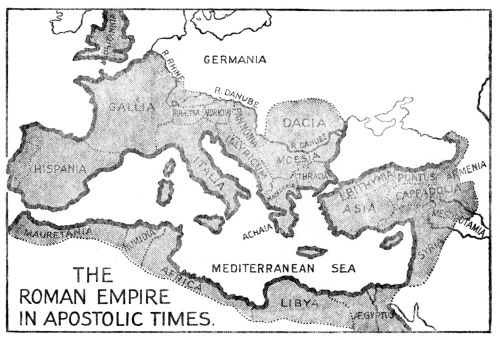
Commencing with North Africa, it will
be observed, on referring to the map, that
practically the same strip of territory
which belonged to the Roman Empire in
the times of the apostles has passed directly
under the government of countries which
were themselves then within the Empire.
For Spain rules over Morocco, France over
Algeria and Tunis, Italy recently seized
Tripoli, and Britain has, since Turkey's
entrance into the great war, virtually
taken possession of Egypt. It seems not
a little significant that no country which
was outside the limits of the Empire
at the time under consideration has been
permitted by God to annex these North
African territories since the Saracens and
the Turks were dispossessed of them.
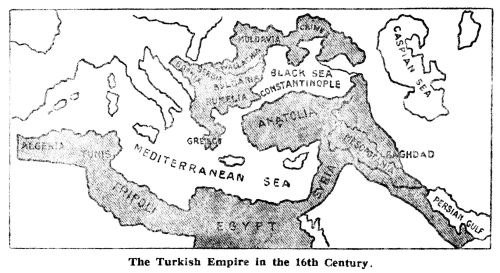
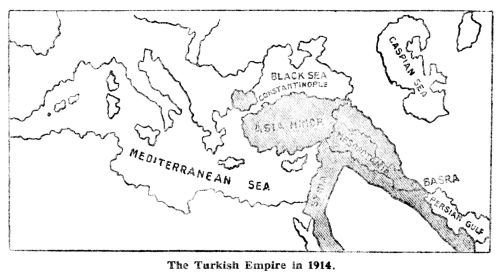
Passing now to Asia, the territory in
that continent which belonged to Rome in
the first century is approximately what
remained to Turkey immediately prior to
the present war. Mesopotamia and most
of Armenia were included. The war has
already seen Turkey dispossessed of portions
of these. The downfall of the Turkish
Empire would almost certainly involve
territorial rearrangements of deepest import
in the light of prophecy, especially
as regards Palestine.
The 8th chapter of Daniel apparently
indicates that the Asiatic territories of the
Empire will be divided much as they were
under the Greeks after the death of Alexander
the Great. He was obviously symbolised
by the great horn (v. 22). The
four horns which came up in its place (v.
8) are clearly, too, the four generals who
succeeded Alexander, and among whom
his dominions were divided, Cassander
ruling over Macedonia and Greece, Lysimachus
over part of Asia Minor and
Thrace (the extent of the latter province
was almost exactly what now belongs to
Turkey in Europe), Seleucus over most of
Syria, Palestine, Mesopotamia, and the
east, and Ptolemy over Egypt. Next
follows a prediction carrying us to events
which are evidently yet future. It is said,
for instance, that these events will take
place "in the latter time of their kingdom
(not, it will be observed, in the time of the
four kings themselves who succeeded
Alexander, but of the kingdoms over
which they ruled), when the transgressors
are come to the full" (v. 23). The expressions
in this chapter, "the time of the
end" (v. 17), "the latter time of the indignation,"
"the appointed time of the
end" (v. 19), and "the latter time of their
kingdom" (v. 23), all point to a period still
future, namely, to the close of the present
age. Again, in reference to the "king of
fierce countenance," while much of the
prophecy can be applied to Antiochus
Epiphanes in the second century B.C., yet
no man has hitherto arisen whose character
and acts have been precisely those related in
verses 9-12 and 23-25. We may also compare
what is said of "the transgression
that maketh desolate" (v. 13) with the
Lord's prophecy concerning the abomination
of desolation (Matt. 24. 15-22), a
prophecy which also manifestly awaits
fulfilment.
Possibly, therefore, these Asiatic territories
will be similarly divided in the
coming time. In regard to the first of the
above-mentioned four divisions, the recent
extension of Greece to include the ancient
province of Macedonia is remarkable. This
was an outcome of the Balkan War of 1912.
The boundaries of Greece are now approximately
what they were under Cassander
in the time of the Grecian Empire, what
they were also later as the provinces of
Macedonia and Achaia in the Roman
Empire. There has lately, therefore, been
a significant reversion to ancient conditions
in this respect.
Coming now to the dual-monarchy of
Austria-Hungary, reference to the map of
the Roman Empire in the Apostolic Age
will show that what are now Hungary,
Transylvania, Bessarabia, and other states
of the present monarchy were without the
Roman boundaries, while Pannonia, or
what is now Austria west of the Danube,
was within; even when in the next century
Dacia (now Transylvania, Bessarabia, &c.)
was annexed, the two parts of the present
dual kingdom were separate. The separation
of Hungary from Austria has for
a considerable time been a practical
question of European politics, and may be
hastened by present events.
The northern and north-eastern boundaries
of Italy embraced the Trentino and
the peninsula of Istria. Noticeable, therefore,
are the present efforts of Italy to
acquire these very districts, efforts which
seem likely to achieve success. Roman
states north of Italy covered what are now
Baden, Wurtemberg, Luxemberg, and a
large part of Bavaria. The possibility
of an eventual severance of these from
Prussian domination has been much discussed
of late.
The Rhenish provinces of Alsace and
Lorraine, originally portions of the Roman
province of Gallia (now France), were
snatched from France by Germany in the
Franco-Prussian war of 1870-71. Their
recovery is a supreme object of the efforts
of the French in the present war, and not
without hope of success.
As to Britain, at the time under consideration
the greater part of the island
was definitely included in the Roman
Empire. Ireland and most of Scotland
were never conquered by the Romans.
Should Britain form one of the ten kingdoms,
there is nothing to show that Ireland
or any other part of the British Empire
must of necessity be absolutely separated
from it. Self-government may yet be
possessed by those territories which have
not yet received it, and it is significant
that Ireland has now practically obtained
it. That the lands which are linked with
Britain as dependencies, or as in possession
of self-government, should remain as integral
parts of the Empire is but consistent
with the coming world-wide authority of
the potentate who will be the federal head
of the ten kingdoms. And that each state
in the British Empire should have its own
local government is, on the other hand,
consistent with the establishment of a
closer and complete confederacy of ten
kingdoms, the area of which may correspond
largely to that of the ancient Roman
Empire. In contrast to the self-government
of the other countries of the world at
the coming period, the ten united kingdoms
will eventually be absolutely under
the control of the final emperor just
mentioned, for the ten kings over these
states, who receive authority as kings
with him, will be of one mind to give their
power and authority and their kingdom
to him (Rev. 17. 12, 13, 17).
What has been said of the British
Empire may be true also of others of the
ten kingdoms which have colonies or dependencies,
and thus, while the ten kingdoms
will themselves constitute an Empire,
their alliances and treaties with other
countries of the world will apparently
involve an extension of the authority of
the controlling despot "over every tribe
and people and tongue and nation" (Rev.
13. 7). If, for instance, the United States
of America were at that time in alliance
with Britain (quite a possible contingency),
their joint influence would probably extend
to the whole of the American continents,
which would thereby acknowledge his
authority.
We may observe, too, the way in which
the continent of Africa has come under
certain European influences in modern
times. The mention of this is simply
suggestive. That the Scripture will be
absolutely fulfilled is beyond doubt; the
exact mode of its accomplishment is known
to God.
(2) The Political Standpoint.
Agencies are already at work for the
establishment of a confederacy of European
States—not the least significant of the many
signs that the end of the age is approaching.
The movement towards confederacy is
doubtless receiving an impetus from the
great upheaval in Europe. A circular
issued in December, 1914, and distributed
far and wide, announced the formation of
a committee of influential men with the
object of promoting a "European Federation."
The circular says: "In sight of the
present situation of ruin it ought to be the
general opinion that a firmer economical
and political tie is of utmost importance
for all nations without exception, and that
particularly for Europe the narrower bond
of a federation, based on equality and interior
independence of all partaking states,
is of urgent necessity, which public opinion
ought to demand."
A pamphlet published by the Committee
recommends that the union of states shall
be economical, political, and legal, with
an international army as a common
guarantee, and that European Federation
should become the principal and most
urgent political battle-cry for the masses
of all European nations, and declares that
"when the Governments are willing, when
the public opinion of all peoples forces
them to be willing, there is no doubt but
that a reasonable and practical union of
nations will prove to be as possible and
natural as is at present a union of provinces,
cantons, territories, whose populations
often show more difference of race and
character than those of nations now at
hostilities." The Committee calls upon
the peoples of Europe to suffer the diplomatists
no longer to dispose of them like
slaves and by militarism to lash them
to fury against each other. It calls upon
them to see to it that never and nowhere
should a member of any body or Government
be elected who is not an advocate
of the Federation, and that the trade
union, society, or club to which any individual
belongs should express sympathy
with the movement in meetings and in
votes. "The people," it is said, "have it
now in their power, more than ever before,
to control the Powers."
The formation of ten federated states,
covering at least the area of the ancient
Empire at the end of the first century of
the present era, may be effected in two
ways, either by the peaceful methods of
arbitration and treaty, or as a result of
strife and confusion. That the present
European War will be succeeded by
efforts for the creation of permanent international
harmony and universal peace is
probable, as is also some attempt at such a
federation as is proposed by the above-mentioned
Committee. On the other hand,
sinister indications abound to-day which
point to industrial strife and revolution
rather than peace. The condition of the
industrial world presents a gloomy prospect
indeed. There are ominous signs of
keener conflict than ever between capital
and labour. The forces of Socialism,
Syndicalism, Communism, &c., are rapidly
increasing in power and in international
activity, and their avowed aims presage
anything but peace in the near future. We
may take, for example, the declared objects
of "The Alliance of the Social Democracy"—now
incorporated in the International
Working Men's Association—"To destroy
all States and all Churches with all their
institutions and laws, religious, political,
juridical, financial, magisterial, academical,
economical, and social, and to establish
in their place industrial co-operation
and collective ownership of land and
capital." All this sounds very pretentious,
and would probably fail of complete accomplishment,
but the agencies at work for it
are strong. Attempts on a large scale
would certainly lead to unprecedented
disorder and chaos.
Not improbably the ten kingdoms of
the reconstructed Roman Empire will
arise as a result of political and social confusion.
Thus it was in the case of the
French Revolution and the consequent
uprising of Napoleon. A repetition of
such events on a far wider scale in the
future is quite conceivable. In the prophetic
vision given to the Apostle John,
the beast was seen "coming up out of the
sea" (Rev. 13. 1). Now the sea is in
Scripture used figuratively of the nations,
its characteristic restlessness symbolising
their commotion and strife. Compare the
words of Isaiah: "Ah, the uproar of many
peoples, which roar like the roaring of the
seas; and the rushing of nations, that rush
like the rushing of many waters! The nations
shall rush like the rushing of many waters:
but He shall rebuke them" (Isa. 17. 12, 13;
see also Psa. 65. 7; and Ezek. 26. 3). To
national unrest the Lord Jesus applied
similar language when He foretold to the
disciples that there would be "upon the
earth distress of nations, in perplexity for
the roaring of the sea and the billows; men
fainting for fear, and for expectation of the
things which are coming on the world"
(Luke 21. 25, 26). So also the waters
which John had seen in his vision are described
by the angel as "peoples, and
multitudes, and nations, and tongues"
(Rev. 17. 15). Daniel, too, saw the four
great beasts come up from the sea as a
result of the breaking forth of the four
winds of the Heaven upon it, an undoubted
representation of a condition of national
disturbance (Dan. 7. 2, 3). That the beast
of Revelation 13. 1 was seen coming up out of
the sea points, therefore, to the probability
that the ten kings who will have brief
authority over the revived Empire will
be raised to their kingdom, not by
constitutional methods, but as the
result of revolutions and the collapse of
present-day governments and institutions.
Should any great measure of success
attend the syndicalist and communist
movements of the day, and especially if
they are internationalised, the inevitable
revolutions and disorder would almost
certainly issue, as revolutions have so
frequently issued, in despotism and autocracy,
and perhaps in this way the ten
kings would arise. The overthrow of the
governments in the countries involved
would remove what has certainly been the
great restraint upon lawlessness[A] from the
times of the apostles until now. Everything
would be ripe for the appearance of a
universal potentate. The cry would arise
for "a man," a controlling organiser to
bring order out of chaos. The unstable
character of the rule of the ten kings, and
the impoverishment of their kingdoms,
would lead them, as a matter of diplomacy,
to hand over their authority to him.
The political constitution of the successive
empires during "the time of the
Gentiles" was indicated in the image of
Nebuchadnezzar's vision by the various
substances of which the parts of the image
were composed. While the regular deterioration
in the relative value of these
substances is noticeable, we are concerned
now with those of the legs and feet. The
legs were of iron, and the feet part of iron
and part of potter's clay, not moist or
miry clay, but "earthenware" (Dan. 2.
41, R.V., margin), and consequently
brittle (v. 42, margin).
That the iron symbolised militarism
seems clear from what is said of the fourth
kingdom, that "as iron breaketh in pieces
and subdueth all things: and as iron that
crusheth all these, shall it break in pieces
and crush" (v. 40). Nations are broken
and crushed by military power, and thus
the nations were treated by the Romans.
This was further signified by the iron
teeth of the fourth beast, as is definitely
stated in Daniel 7. 19, 23: "And shall
devour the whole earth, and shall tread it
down, and break it in pieces."
The supposition that the clay represents
democracy is gratuitous and arbitrary.
The early Roman Empire, symbolised by
the legs of the image, was built up under
democratic rule. When republicanism
was superseded by imperialism, democratic
principles still prevailed. Democracy,
therefore, played its part from the very
commencement of the fourth kingdom,
and had it been symbolised by the clay,
not only the feet and toes but the legs
themselves would have consisted of mingled
iron and clay. Moreover, democracy in
the generally accepted sense of the term
has not always been found to be of an
unstable or brittle character; witness the
republicanism of the United States. Democracies,
too, may be established on
strictly constitutional principles.
Another explanation, therefore, of the
symbolism of the clay must be sought,
and it is not unlikely to be found in those
revolutionary principles to which we have
already referred, which were evidenced at
the time of the French Revolution, and
are finding expression, though in greater
variety to-day, in such projects as those
of the International Working Men's Association.
Certainly the masses of the
people of Europe are being permeated
both by militarism and by the revolutionary
doctrines of which we have spoken.
Should these principles spread among the
civil services and forces, everything would
be in a complete state of preparedness for
which would effect the overthrow of present
forms of government. From the world's
point of view the situation would require
a consummate genius with powers of world-wide
organisation. Doubtless Satan's
masterpiece of infidel ingenuity would be
at hand for the occasion.
We are not predicting that this is to be
the manner of the revival of the Empire
and of the advent of its imperial head.
We have merely suggested possible circumstances
in the light of Scripture and
present-day movements. The actual circumstances
attending the rise of the ten
kings and their Emperor must for the time
remain conjectural. Certainly these kings
will receive authority with him for one
hour (Rev. 17. 12), a phrase which may be
translated "at the same time;" and
certainly they will agree to give their
power and authority to him (v. 13).
(3) The Religious Standpoint.
We will now note the religious conditions
which are to prevail for a time
upon the resuscitation of the Empire.
These are plainly indicated for us in
Revelation 17. The apostle sees a woman
sitting on the seven-headed and ten-horned
beast. The woman is gorgeously
arrayed, holds in her hand a golden cup
full of abominations, and is drunken with
the blood of the saints. Her name, written
on her forehead, is
"the mother of the harlots and of the
abominations of the earth" (vv. 3-6).
The woman is symbolically described as
the city of Rome (v. 18), and that leads
on to a second mention of Babylon, in
chapter 18, and a new description. Now
to the description of the woman in chapter
17 nothing more closely corresponds than
the Papacy. But if the Babylon of chapter
17 is to be identified with that of chapter 18,
the Papacy answers to the whole description
only to a limited extent. While,
however, there is much in common in the
two descriptions in these chapters, yet the
two Babylons are possibly to be distinguished.
The Babylon of chapter 17 is
a "mystery," not so that of chapter 18.
Again, the destruction of the one is different
from that of the other. The first will be
destroyed by the ten kings and their
emperor (17. 16), the second by the direct
judgment of God (18. 5, 8, 20); the first as
the result of human antagonism, the
second by famine, fire and earthquake.
We are perhaps, therefore, justified in
taking the more limited view in connection
with the circumstances of chapter 17.
Even so the woman may be regarded as
representing the apostate sacerdotal systems
which have sprung from the Papacy
as well as that system itself.
The position of the woman indicates an
exercise of power which is voluntarily
supported by the beast. That she sits upon
the waters implies her religious dominion
over the nations; that she is carried by the
beast, who rules over the nations politically,
implies that there will be a complete
alliance between her and the ten kings
with their chief, and that the sphere of her
influence will be co-extensive with the
dominions of the beast.
Now though the Papacy lost its temporal
power in 1870, it is far from having lost its
political influence. Ecclesiastically, too,
though it has received various set-backs, it
is manifestly gaining power. This is
especially observable, for example, in
Britain, the overthrow of which as a
Protestant Power is undoubtedly the
object of the persistent aggressiveness of
Romanism. This aggressiveness is manifest
in all the dominions of the British
Empire, as well as in other lands.
Again, while certain governments have of
late shaken off the ecclesiastical yoke, and
infidelity has spread among the people of
Roman Catholic lands, the number of
Roman Catholics has increased with great
rapidity. They were estimated at somewhat
over 200,000,000 twenty years ago,
they are now said to number about
300,000,000.
Indications are not wanting of a tendency
towards
which would be facilitated by a willingness
on the part of the Papacy to adapt itself
to the impulse of the time.
Present events, therefore, point to a
great renewal of Papal power involving
the fulfilment of the prophecy relating
to the woman and the beast that carries
her. This renewed alliance between the
political and the ecclesiastical powers
will, however, be of brief duration.
The successful efforts of governments in
recent times to liberate themselves from
Papal authority, as in the case of France
and Portugal, are but foreshadowings of
the eventual entire destruction of ecclesiasticism
and sacerdotalism under the
revived Roman Empire. "The ten horns
... and the beast, these shall hate the
harlot, and shall make her desolate and
naked, and shall eat her flesh, and shall
burn her utterly with fire" (Rev. 17. 16).
Thus it would seem that, when at the
very zenith of its power and ambition,
the Papacy, at the head of amalgamated
Christendom, will suddenly meet
its doom.
Its accumulated wealth would probably
be an incentive in determining the ten
kings to take this step, owing possibly to
the impoverishment of their kingdoms as a
result of wars and political and social
upheavals. An additional cause will
doubtless be the widespread spirit of
antagonism against all religion.
Submission to the Papal yoke has invariably
had an aftermath of infidelity;
similarly the temporary subservience of
the beast to the woman will issue in the
casting off of all religious restraint and in
the universal acknowledgment of the
presumptuous claims of the world-ruler.
The authority of this final emperor of
the Roman kingdom will be Satanic. "The
dragon gave him his power, and his throne,
and great authority" (Rev. 13. 2); "the
beast ... was, and is not; and is about
to come up out of the abyss, and to go into
perdition" (Rev. 17. 8). This implies that
he has been on the earth in the past. The
same thing is indicated in the interpretation
of the seven heads. Topographically they
are described as seven mountains, personally
as seven kings (v. 9). Of these,
five had fallen, the sixth was in power in
John's time, the seventh had not then
come (v. 10). The beast (clearly here
symbolising, not a kingdom, but a person)
would be an eighth, and yet would be of the
seven (v. 11). These heads have been regarded
by some as forms of government, by
others as empires, or again, as emperors.
There seems to be no reason why they are
not to be regarded as emperors, though
doubtless their empires are in view, as
being associated with them. Accordingly,
the fact that the eighth is also one of the
seven indicates his reappearance on the
scene. Various suggestions have been
made as to his identification, but this
must remain uncertain until his advent.
With him the ten kings for a time receive
authority (v. 12), subsequently handing it
over to him with their kingdom (v. 17),
but not before they have together with him
crushed the great religious system symbolised
by the woman (v. 16). His
stupendous power and brilliant abilities,
the evidence of his superhuman origin,
his phenomenal capacity for organisation,
and the consolidation of the empire under
his absolute control will cause the whole
world to marvel at him (Rev. 13. 3; 17. 8).
To the world, in its divinely inflicted and
therefore retributive delusion, he will
appear like a god who has come to deliver
from woe, and to introduce the long-looked-for
age of peace and prosperity. Wonder
will be succeeded by worship, both of the
man and of Satan. "They worshipped the
dragon, because he gave his authority unto
the beast; and they worshipped the beast,
saying, Who is like unto the beast? and
who is able to war with him?" (13. 4).
The world is now in course of rapid
preparation for all this:
has of late become a much discussed topic
in various classes of society and in the
press, and the idea is supported by the
theories of evolution which are receiving
increasingly wide acceptance. A spirit
of expectancy is being thus aroused which
will undoubtedly facilitate the recognition
of the man himself at his advent, and the
acknowledgment of his claims to divine
honour. But this will involve the worship
of Satan, and to this end the effective
agency of
has been long at work. Spiritism leads to
devil worship. It must do so; its energising
power is Satan himself. Both spiritism
and theosophy, and similar forms of error,
all of which are rapidly on the increase
to-day, are paving the way for world-wide
worship of the dragon.
The imperial power and worship of this
emperor will be promoted by another
potentate similarly energised by Satan.
This latter is the second beast, described
in Revelation 13. 11-end. Later on in the
book he is called
(Rev. 16. 13; 19. 20; 20. 10), indicating
that his activities are chiefly of a religious
character, and perhaps that he will be
more closely connected with Jewish affairs.
He will make "the earth and them that
dwell therein worship the beast," the
emperor of the ten kingdoms (13. 11),
deceiving the world by supernatural signs
wrought in the presence of the first beast
(v. 12), and enforcing the worship of his
image (v. 15), the abomination of desolation
set up in the temple at Jerusalem
(Matt. 24. 15). With the worship of an
image the times of the Gentiles began
(Dan. 3. 1), and with similar idolatry
they will end. In the days of the early
Roman emperors their deification was
celebrated by the adoration of their images.
Then, as formerly under Nebuchadnezzar,
those who refused to worship suffered
death. So will it be under the final
emperor and his colleague.
Various opinions are held regarding these
two beasts of Revelation 13, as to which is
the Man of Sin spoken of by Paul in 2
Thessalonians 2, which the Antichrist
mentioned in John's Epistles, and which of
the two is the wilful king described in
Daniel 11. Limitations of space preclude
our entering into the subject in detail here.
The present writer holds the view that all
three are the same person, and that they
are also the same as the horn in Daniel
7. 8, 11, and as the first beast of Revelation
13, and that these are all different
descriptions of the final head of the
revived Empire. The Old Testament
passages somewhat briefly announce the
arising of this world-wide ruler; the New
Testament passages unfold and expand the
preceding predictions concerning him,
among the additional details given in the
New Testament being the fact that he is to
have a prophet who will assiduously support
his claim to deity and his administration.
It is the world-emperor, and not his
prophet, who is to be worshipped, and who
therefore proclaims himself as God (2
Thess. 2. 4). His prophet, the second
beast of Revelation 13, in the exercise of
all the power of the first, will cause the
world to worship him (13. 12). As his
prophet and prime minister he would not
himself endeavour to usurp the position
of him whose avowed deity he seeks to
support.
The similarity of the details in the above-mentioned
passages indicates that the same
person is in view in each case. His blasphemies,
for instance, and his assumption
of deity are mentioned in Daniel 7. 25;
11. 36, 37; 2 Thessalonians 2. 3, 4, and
Revelation 13. 5, 6, and his war with the
saints in Daniel 7. 21, 25 and Revelation
13. 7. Further, the blasphemous proclamation
of himself as God is consistent
with what is said in John's Epistles concerning
the Antichrist. For in his self-deification
he is directly "antagonistic to
Christ," he denies that Jesus is the Christ,
and therefore denies the Father and the
Son (1 John 2. 22).
The two potentates will establish not
only a universal religion, but also a
The second beast "causeth all, the small
and the great, and the rich and the poor,
and the free and the bond, that there be
given them a mark on their hand, or upon
their forehead; and that no man should be
able to buy or to sell, save he that hath
the mark, even the name of the beast or the
number of his name" (Rev. 13. 16, 17).
This indicates a world-wide protectionist
system, such a system as, for instance,
might conceivably be established under
some form of syndicalism. Undeniably,
circumstances in the industrial world to-day
manifest an increasing tendency in
this direction. The principles previously
mentioned, as now making for industrial
and international revolution, and the
present stupendous movements towards
amalgamation, are clearly preparing for
the fulfilment of this prophecy by facilitating
the eventual establishment of the unrighteous
commercial system of the reconstituted
Empire.