"That's a good bluff, Selim," rejoined Schoverling
coolly, "but it won't go down with me.
You might as well give in."
The other shook his head, still smiling. But at
this instant Jack, who had listened with intense
interest to the duel of words, struck in and cut the
Gordian knot.
"Look here, General, and Mr. ben Amoud," he
said, leaning forward earnestly. "There's no
sense in getting hot-headed over this. As near's I
can see, we've each got a mighty good excuse to
scrap, and we can do a whole lot of damage once
we start. But this country isn't the place to start
a row, not to my notion.
"You hold on, Gen'ral, till I get through. We
might shoot things up consid'able, both of us, an'
when we got through there wouldn't be enough of
us left to get back home with. If you start anything,
Selim, we'll raise you the limit; but there's
no sense to it. I say, let's each of us divvy up the
loot an' dig out for home."
That Schoverling had not considered any division
of the cache was evident, and he considered
Jack's speech silently. Selim, however, smiled
again.
"My young friend, you are very wise. Mr.
Schoverling, perhaps we might agree on that basis.
A fight would be costly to each of us, and might
leave us unable to get home, as is suggested. I am
none too anxious to stay in this land after the
tales you tell. I recognize the fact that you have
the advantage of having the treasure in your
power, and see no reason why we shoud not share
it and be gone."
Schoverling hesitated as Selim spoke. He
plainly realized the force of the argument, and yet
to give up even a share of the ivory and dust went
against the grain. Perhaps he doubted the good
faith of his friend the enemy, but in any case von
Hofe's grunt of approbation decided him.
"It iss goot," said the doctor anxiously. "We
haf come for elephant, please."
"All right," and the American's face cleared
as he held out his hand to the Arab. "We'll split
even, Selim!"
"Hurray!" shouted Charlie in delight.
"Bully for you, General! Good work, Jack!"
"That is entirely agreeable," smiled Selim, as
he gripped Schoverling's hand. "Now, my
friends, we have been in this country for two days,
and I have many affairs to get back to. There is
no reason why we should delay here for an hour.
It is still two hours to sunset, and our camels
could cover much ground before then. So, if you
are willing, let us divide the spoils and I will
trouble you no more."
"That suits us," exclaimed the explorer,
springing to his feet. "Come along and we'll
have a look at the stuff."
Casting a glance opposite as they arose, Charlie
saw that the Arabs had started a fire and
seemed to be eating, while the camels grazed. The
party left the zareba and moved over to the stockade.
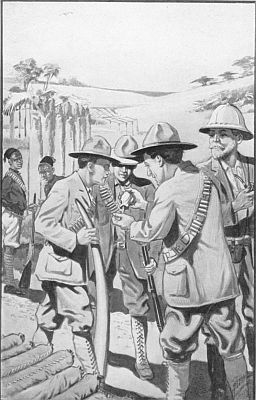
Jack threw the canvas from the two piles,
and for a moment the Arab's eyes glittered as he
surveyed the great heap of ivory.
"Those tusks," he said, "will be hard for us
to carry off. We had thought to sling them on our
camels, but after our experience of that desert to
the north it would make hard work, I fear."
"Well," suggested Charlie, "you might swap
your share of the ivory for some of our gold-dust.
That would make it easier to carry."
"Yes," added the General thoughtfully. "We
can carry the tusks easily enough in the wagon.
There are sixteen each, Selim, and the same number
of bags. Here's one I cut open."
The Arab ran the soft gold-dust through his
fingers for a moment.
"There is no use stopping to count or weigh
all this, Schoverling. Each tusk must be worth, at
an average, some fifteen pounds at the coast.
Each of these bags seems to be of a size, and they
are probably weighed to the same amount. My
share of the ivory is worth, at a guess, some two
hundred and forty pounds, or twelve hundred of
your dollars. What would you say the dust
weighs?"
"That is a little hard to say," returned the
American. "I rather think, however, that an estimate
of about two hundred and fifty dollars—or
fifty pounds a bag—would be just about right.
If that suits you, I'm agreeable."
"I think that is nearly correct," smiled Selim,
nodding. "It is, I believe, slightly an under-estimate,
but that matters little. Then, at the rate we
figure, I would have twenty-one bags as my share,
leaving you all the ivory. That is correct?"
"Perfectly," returned Schoverling. "It looks
to me like a fair split, and if the gold runs over
that figure, I won't kick. I'll throw in an odd bag
for good luck, Selim; that leaves us an even ten
and the ivory. There must be more gold where
that came from, just the same. You might come
back here with a good force and make a clean-up,
old man."
"Perhaps I will," said the other seriously.
"Now, will you help me get these bags into my
saddle-bags? I have no fancy to remain overnight
by this lake."
All pitched in and helped to carry the twenty-two
little bags of precious metal over to the camel,
which was kneeling and chewing stolidly. Jack
stepped too near with his burden, and the vicious
head swung about to snap. He leaped back amid
the laughter of the rest, who remained at a safe
distance.
"Well, I suppose we must part," smiled Selim,
holding out his hand as the last of the bags was
laced in the leathern flaps. "It would be insincere
to say that I am not sorry at finding you
here before me, but I am really very glad we did
not have to fight. To tell the truth, my men were
almost too frightened to remain here, and had it
come to fighting, they would have refused point-blank."
"Well," laughed Schoverling whimsically, "I
might as well show under true colors, since you
have led the way," and he called in all the men.
At sight of their real numbers, Selim gave a shout
of laughter.
"Good, brother, good!" he cried as he urged
his camel forward from its knees. "We played
the game well, you and I." He waved a hand as
the camel plunged into the water at the ford.
"Abqa'la kheir!"
"Abqa'la kheir," shouted the American, and
the two boys waved their hats with attempts at
the Arabic, which drew a last laughing wave from
Selim. Then his camel went up the farther bank.
"That means 'until the next time,'" laughed
Schoverling. "Well, I'm glad that we got out
of that as we did."
"So am I," declared von Hofe, smiling broadly.
"See, they are going."
So it appeared, for as Selim joined the rest
there was an immediate bustle. The camels were
unpicketed, the saddles adjusted, and the camp
broken. All twelve Arabs were now in camp, and
one by one the awkward steeds rose to their feet.
"They're mighty fine beasts," declared Schoverling.
"No common camels there, but picked
racers, worth a fortune apiece. Selim does things
up right, no doubt about that."
"He come pretty near doing us up right,"
grinned Jack. Then came a flutter of the burnouses,
those on the island waved, and the group
of camels moved away at an amazing speed, to
the southwest.
"Probably going to circle around the hills and
strike for the north," commented Charlie.
While daylight remained they did nothing save
store the ivory in the wagon and place the gold-dust
in the brass trunk belonging to von Hofe.
It was decided to place the traps along the shore
of the island near the mainland, and all the men
were called upon to make note of where they were
placed, as they would be left in position until the
camp was abandoned.
The injured Masai were slowly recovering from
their hurts, for although their wounds rapidly
healed, the broken bones took longer. As they sat
around the dinner-table that night the four explorers
decided that every day spent in that country
added to their danger, and that the search
for the rogue elephant should begin the next
morning.
"I'm kind of disappointed," muttered Charlie
to Jack, as they rolled up that night with Schoverling
on guard. "Aren't you? I thought that
stuff would be worth heaps o' coin, but according
to the General's figures it doesn't come to more'n
five thousand iron men."
"What're you looking for?" retorted Jack
wearily. "Four or five million? S'pose we split
up on that, it means a thousand each, easy. Why,
I never saw a thousand dollars in my life. It
looks mighty good to me, Chuck."
"Oh, it looks good," admitted Charlie hastily.
"But when you talk about treasure you reckon in
big figures. I'm not kicking, though,—not on
your life! Good thing you came in when you did
with that splitting proposition. How'd you happen
to think of it?"
"Who wouldn't?" returned Jack. "Made me
tired to hear 'em sit there and argue back and
forth, making threats and so on. No sense in it."
Nothing occurred that night to disturb the
camp, although the Masai kept up until late a
dance and chant in triumph at having, as they supposed,
put the Arabs to flight. But in the morning
Schoverling made an announcement that
roused everyone.
"About eleven last night," he said at breakfast,
"I heard a big crashing north of us, farther
toward the head of the lake. Then came snorts,
and a single trumpet. Sounded as if the rogue
elephant was out on a stroll and had run into a
buffalo or something."
"Then I feel very sorry for that buffalo,"
smiled von Hofe. "We shall all go out this morning,
no?"
"You don't have to go, Doctor," said the explorer
earnestly. "At best you could only take
one of the rifles, for we'll have to carry the big
guns."
"Pouf!" grunted the German. "It is my
party, and I shall go."
"We might as well go on foot," declared the
American. "Now, boys, we can put a little tracking
into play. The Masai won't do us any good.
As near as I can see, we'll have to catch that fellow
when he isn't looking for trouble. And remember,
under no circumstances fire at his head."
"How about the bull you killed back at
Kenia?" objected Charlie. "You put a bullet
in each eye, an' laid him out cold."
"He was within ten feet of me then, and I had
no choice in the matter. No, when we do get a
shot just you aim to cripple him—in the shoulder
or leg. If he charges, hit his trunk or break his
leg. One of those bullets, big as they are, would
simply flatten out on his skull and stun him."
Von Hofe, who still wished to kill one of the
giant buffalo himself, took a 30-30, and Akram
Das had perforce to take his Snider or go weaponless.
The three hunters carried their own heavy
guns, for they might be needed at an instant's notice,
and filled their bandoliers to the limit.
Gholab Singh was left in charge of the camp with
five Masai, Bakari and the other five accompanying
the party as flankers and scouts.
An hour after sunrise they waded across the
strip of water between the island and shore, and
turned toward the head of the lake, as it was in
this direction that the explorer had heard the elephant
during the preceding night. There seemed
to be no sign of any game around them, for once,
at which Jack wondered.
"Scared out," said the explorer grimly, "if
that rogue was around."
Ahead, the country did not appear so densely
wooded as they had thought. It ascended toward
the hills beyond in gentle, rolling swells, and they
had no difficulty in advancing through the knee-deep
grass. On every hand were trees in clumps
or singly, but no sign of elephant spoor could
they see.
"Maybe we'd better strike in a little from the
river," suggested Charlie. "Jack and I could
have a look, anyhow, an' we might pick up a
trail."
"I don't think there's much danger that he'd
be here, so go ahead," returned Schoverling to
their delight. "Circle around for a couple of
hundred yards, but don't get out of sight. If
he was here last night, he was probably drinking,
and has gone in to feed."
The two boys left the party, followed by Akram
and Amir Ali, their gun-bearers. But although
they searched the ground well, no sign
of a trail did they see. Getting a little farther
from the party all the time, they proceeded for
nearly a mile, and found the forest verging into
a jungle of bamboo.
"Jack," exclaimed Charlie quietly, stopping,
"come over here."
Jack and the Indians joined him, and he pointed
to the ground a yard ahead. There, deep in the
soft soil, was the fresh spoor of an elephant—and
at its size the Indians gave a gasp of wonder.
It was the rogue!
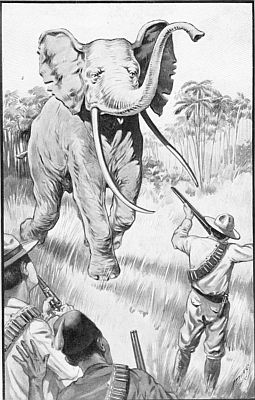 It seemed that the great beast was towering over him, reaching for him with that terrible trunk. Then he drew a careful bead on the left fore-shoulder.