A brief book for the boys. God gives you
work to do in the world. He gives you
honourable work. There is much done that
is mean and dishonourable. Depend upon
it, that is not His. In the beginning of your work,
character grows out of it; as you go on, your character
goes into it. Therefore the Bible declares that
"God, without respect of persons, judgeth according
to every man's work." We judge in the same way.
This little book will show you how much the practice
of the virtues, the humbler virtues, has to do with
making good work.
But keep ever in mind that these virtues, however
useful and important for your work in this world,
have no saving power in them—they form no plea
for the favour of God; the key which unlocks the
door of Heaven is not found among them. Like the
young man in the Gospel, you may have the loveliness
of every natural virtue, and yet be lost.
As sinners in the sight of God, you need the atoning
blood of the Redeemer; you need repentance and
faith in that blood. Make Jesus Christ, therefore,
the corner-stone of your character; on that foundation
build your character. Cultivate the graces of the
Gospel. Baptize the virtues with your Saviour's love.
A noble Christian manhood can only be attained by
the slow and steady endeavours of a heart fixed on
God, and a hand diligent and delighting in the work
He has given it to do.
What useful little fellow is this, carrying his
father's dinner to him at the coal-pit? He
takes care, also, of his little brothers and
sisters, keeping them clear of the coal-waggons,
which run to and fro before the cottage
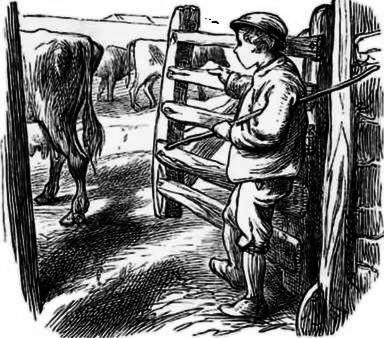
door. Then he is seen tending a neighbour's cows.
Now, he is moulding mud engines, putting in hemlock
sticks for blow-pipes; besides cutting many a good
caper, and uttering all sorts of drolleries for the benefit
of other little boys, who like himself swarm round,
too poor to go to school, if school there were—but
schools there were none.
The boys called him "Geordie Steve."
A lad is wanted to shut the coal-yard gates after
work is over. Geordie offers his services and gets
the post, earning by it twopence a day. A neighbour
hires him to hoe turnips at fourpence. He is thankful
to earn a bit, for his parents are poor, and every
little helps. He sees work ahead, however, more to
his taste. What? He longs to be big enough to go
and work at the coal-pits with his father. For the
home of this little fellow, as you already perceive, is
in a coal region. It is in the coal district of Newcastle,
in the north-eastern part of England.
EARLY WORK.
I suppose you never visited a colliery? Coal is
found in beds and veins under
ground. Deep holes are made,
down which the miners go and
dig it out; it is hoisted out by
means of steam-engines. These
holes are called shafts. The
pit-men have two enemies to
encounter down in the coal-pits—water,
and a kind of gas
which explodes on touching
the flame of a candle. The
water has to be pumped out;
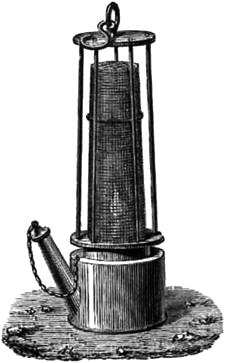
and miners are now provided
with a lamp, called a safety-lamp, which is covered
with a fine wire gauze to keep the gas away from the
flame.
SAFETY LAMP.
The coal is brought up from the pit in baskets,
loaded on waggons running on tram-roads, and sent to
the sheds. Tram-roads were a sort of wooden railway.
A colliery is a busy and odd-looking spot.
Geordie's family lived in one room—father, mother,
four boys, and two girls. Snug quarters, one would
think; but the working-men of England at that time
had smaller wages and poorer homes than they now
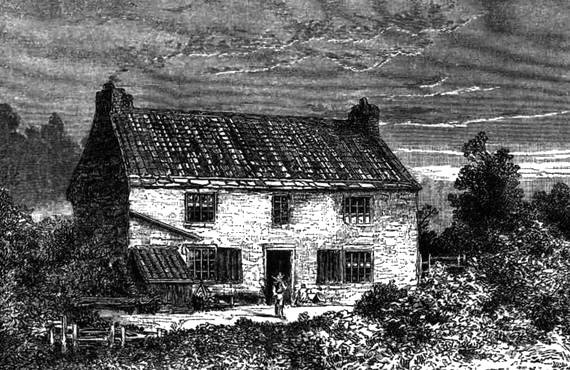
have—for Geordie was born in 1781, in the little village
of Wylam, seven miles from Newcastle, and his
full name is George Stephenson.
BIRTHPLACE OF GEORGE STEPHENSON.
James, an elder brother, is "picker;" and by-and-by
George is old enough to be a picker too, going with
his father and brother to their daily tasks, like a man.
To clear the coal of stones and dross is their business.
There are a number of pits around, and each one has
a name,—"Dolly Pit," "Water-run Pit," and so on.
I do not know how long he was picker, but we
next find him driving a gin-horse, at a pit two miles
off, across the fields. Away he goes in the early
morning, gladdened all along by many bird songs.
George and the birds are fast friends. He knows
where their nests are in the hedgerows, and watches
over them with fatherly affection. At home he has
tame birds, whose pretty, knowing ways are the wonder
of the neighbourhood. For many years a tame
blackbird was as much one of the family as George
himself, coming and going at pleasure, and roosting
at night over his head. Sometimes it spent the
summer in the woods, but was sure to come back with
cold weather, to share his care and crumbs through
the winter.
George, too, had a famous breed of rabbits; and as
for his dog, it was one of the most accomplished and
faithful creatures in the district. In fact, the boy had
an insight into dumb-brute nature, as we shall find he
had into other things, that gave him power over it—a
power which he never abused, but used kindly and well.
George next rose to be assistant fireman with his
father, at a shilling a day. He was fourteen, but so
small of his age that he used to hide when the
inspector came round, lest he should be thought too
small for his wages. If small in body, he was large
in heart, intent in all things to do his best. And this
made his work so well done, that it could not escape
the notice of his employers. When he went to the
office on Saturday night to receive his wages, double
pay was given him—twelve instead of six shillings!
George could scarcely believe in his good luck. When
he found it was really no mistake, he took the money
and rushed out of the office, exclaiming, "I am now a
made man for life!"
George rapidly shot ahead of his father, a kind old
man, who always stayed fireman, while his boy climbed
one round after another up the ladder of promotion.
At seventeen we find him plugman. What duty is
that? A plugman has charge of a pumping-engine,
and when the water in the pit is below the suction-holes,
he goes down the shaft and plugs the tube, in
order to make the pump more easily draw. The post
required more skill and knowledge of machinery than
any he had filled before, and he proved himself equal
to it.
Indeed, he loves his engine as he loves his birds.
It is a pet with him. He keeps it in prime order.
He takes it to pieces, and cleans it, and studies it;
pries into the whys and wherefores, and is never satisfied
until he understands every spring and cog of the
machinery, and gets the mastery of it. You never
find him idling away his time. In leisure moments
he is at his old kink, moulding clay engines, and
putting new thoughts into them.
He wished to know the history of engines, and how
they were thought out at first. Somebody told him
about Watt, the father of steam-power, and that there
were books which would satisfy his curiosity. Books!
what good would books do poor George? He cannot
read. Not read? No. He is eighteen, and hardly
knows his letters. Few of the colliers did. They
were generally an ignorant, hard-working, clannish set
of men, whose pay-day was a holiday, when their
hard-won earnings were squandered at cock-fights and
in ale-houses.
If one was found who did read, what a centre of
light was he! At night the men and boys gathered
around him, when, by the light of his engine fire, he
would give them the news from an old newspaper, or
a scrap of knowledge from some stray magazine, or a
wild story from an odd volume; and on these occasions
no one listened with more profound attention
than George.
Oh! it was so wonderful to read, he thought. It
was to open the gates into great fields of knowledge.
Read he must. The desire grew upon him stronger
and stronger. In the neighbouring hamlet of Welbottle,
old Robin Cowens taught an evening school.
"I'll go," cried George.
"And I too," echoed Tommy Musgrove, a fellow-workman,
quite carried away by George's enthusiasm.
Now they went to Robin's school three evenings a
week. I do not know how it was with Tommy, but
old Robin never had a better scholar than George;
indeed, he soon outlearned his master! His schooling
cost him threepence a week, and, poor as it was, put
into his hand the two keys of knowledge, reading and
writing.
These mastered, he longs to use them. Andrew
Robertson opens an evening school nearer than Welbottle,
and Andrew proposes to teach arithmetic, a
branch George is anxious to grapple with next. "And
he took to figurin' wonderful," said Master Andrew,
speaking of his new scholar, who soon left his classmates
far behind. And no wonder. Every spare
moment to George was more precious than gold dust,
and was used accordingly. When not on duty, he sits
by his engine and works out his sums. No beer-shop
ever enticed him to its cups; no cock-fight ever tempted
him to be its spectator. He hated everything low and
vulgar.
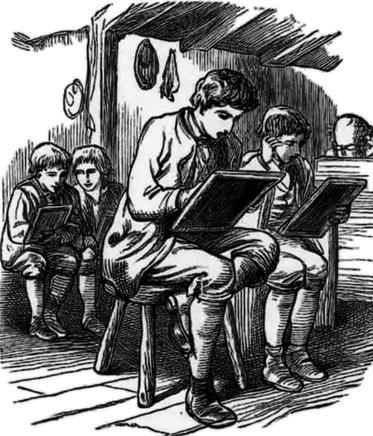
AT SCHOOL.
Andrew was proud of his pupil, and when George
removed to another pit, the old schoolmaster shifted
his quarters and followed him. His books did not
damage his interest in business. Was the plugman
going to stay plugman? No. Bill Coe, a friend of
his advanced to be a brakeman, offered to show George.
The other workmen objected. And one in particular
stopped the working of the engine when George took
hold of it; "for," he cried angrily, "Stephenson can't
brake, and is too clumsy ever to learn."
A brakeman has charge of an engine for raising
coal from a pit. The speed of the ascending coal,
brought up in large hazel-wood baskets, is regulated
by a powerful wooden brake, acting on the rim of the
fly-wheel, which must be stopped just when the
baskets reach the settle-board, where they are to be
emptied. Brakemen were generally chosen from experienced
engine-men of steady habits; and in spite
of the grumbling of older colliers, envious perhaps at
his rise, it was not long before George learned, and
was appointed brakeman at the Dolly Pit. This was
in 1801.
CHAPTER II. MENDING AND MAKING—LITTLE BOB.
George was now twenty—sober, faithful, and
expert. Finding a little spare time on his
hands, he took to cobbling to increase his
gains, and from this source contrived to save
his first guinea. To this greater diligence he was
urged by his love for Fanny Henderson, a fine sweet-tempered
girl, whom he shortly married, and began
housekeeping in the upper room of a small cottage in
Wellington, six miles from Newcastle. Happy were
they in each other, and in their simple, industrious, and
frugal habits; and when a little son was born to
them, George, who loved birds, rabbits, and dogs so
well, welcomed with all the tenderness of a father's
heart the little Bobby.
Robert he was named, after the old fireman his
grandfather.
Accidents, they say, will happen in the best-regulated
families. Fanny's family was not an exception.
One day the cottage chimney got on fire, and
the neighbours, with friendly zeal, not only poured
water enough down the chimney to put out a much
bigger and more alarming fire, but enough to deluge
the poor little home of the brakeman with soot and
water, making a pitiful sight to the young husband
when he reached it. His eight-day clock, the choicest
bit of furniture the young couple had, was completely
smothered by ashes. What was to be done? Sending
it to a clock-maker for repairs was quite out of
the question—it would cost too much.
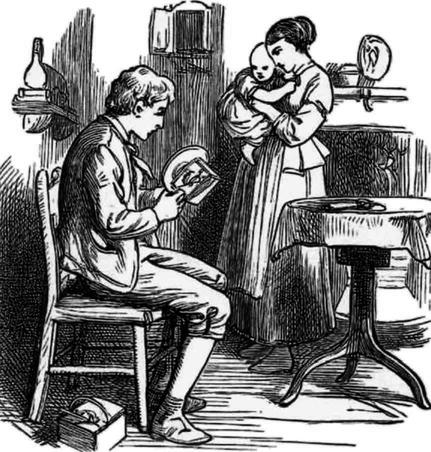
"I'll try my own hand on it," said George. After
righting everything else, he attacked the clock, took
it to pieces, carefully cleaned it, put it together, set it,
and it ticked—ticking on as faithfully and soberly as
ever! The astonished neighbours sent him their
clocks, and George became one of the most famous
clock doctors thereabouts.
The young man's reputation for business soon won
him a situation in Killingworth—the best and largest
colliery in the region. But his brightened worldly
prospects were soon clouded by a dark sorrow—the
death of his young wife, after three happy years of
married life. Poor George felt it deeply, which was
perhaps one reason for accepting a situation in Scotland,
hoping in a change of scene to change the
mournful current of his thoughts.
MENDING THE CLOCK.
Leaving his little boy in kind hands, he set off to
the north with his pack on his back, afoot and
alone, for Montrose—a long journey in those days.
Good wages he received, and good friends he no doubt
made, for everybody loved his honest and generous
character; yet by the end of the year he yearned to
get back to the friends and scenes of his early days.
It was not home in Scotland; for it is only home
where the heart is. With his savings in his pocket—twenty-eight
pounds—back he trudged to Killingworth;
and not before his friendly presence was
greatly needed to comfort his aged parents, plunged
in debt and affliction. By a terrible accident his
father had lost his eyesight. No longer able to work,
and receiving little or no help from his other children,
who were barely able to maintain themselves, the old
couple had a hard battle with life. But George is
back again; all will be righted. He paid off their
debts, and removed them to comfortable lodgings
beside his own. He has father, mother, and Bobby
to look after, and is thankful and happy in doing it.
Those were dark days, however, for the working-men
of England. War was draining the country of
men and money. Taxes were high, wages low, bread
scarce, and able-bodied men were liable at any time
to be impressed for the army or naval service. George
himself was drawn; and go he must, or find a substitute.
He found one, but it cost all he had to hire
him.
Poor George was in straits. His spirits were much
damped by the prospect of things around and before
him. All business was in a discouraging condition.
Some of his friends were about to emigrate to America,
and he at one time nearly concluded to join them.
It was a sore trial to the young man. He loved his
English home; and bitter tears did he in secret shed
as he visited old haunts—the fields and lanes and
scenes of his boyhood—feeling and fearing that all
too soon the wide Atlantic might roll between him
and them. But the necessary funds for such an enterprise
were not forthcoming. George gave it up,
therefore, and went to work for what wages the
times would allow. Better times would come.
The thing nearest his heart was to afford his little
son an education. Keenly alive to his own early
deficiencies and disadvantages, he determined to make
them up in Robert. Every spare moment was of
two-fold value to him, and all the work he could
pick up he cheerfully did. Besides tinkering old
clocks and cobbling old shoes, he took to cutting out
the pitmen's clothes. Never was there such a fit, for
George acted fully up to the principle that everything
which was worth doing was worth doing well.
Busy as were his hands, his mind was no less
busy, catching up and using every scrap of knowledge
which came in his way. And it was a perpetual surprise
to his fellow-workmen to see what a knack he
had at bettering things. Everything improved in
his hands. There was always progress on his track.
A new pit was opened at one of the collieries.
Streams of water rushed in, which the most vigorous
strokes of the pump could not lower. On the engine
went pumping, pumping, pumping for a year, and the
water continued to flow in, until it was nearly concluded
to give up the pit as a failure. George's
curiosity and interest were much excited, and always,
on seeing the men, he asked how matters were
coming on.
"Drowned out, drowned out," was the one and the
same answer.
Over he went to the poor pit, as often as he could,
to see for himself; and over he turned in his mind
again and again the whys and wherefores of the
failure.
"Weel, George," said his friend Kit one day, "what
do you mak' o' her? Do you think you could doctor
her?"
"Man," answered George, "in a week's time I could
send you to the bottom."
The regular engineers were in high dudgeon with
the forth-putting brakeman. What right had he to
know how to cure an evil that had baffled them?
His words, however, were reported at head-quarters;
and the contractor was not long in hastening over to
see if he could make his words good.
"Well, George," he said, "they tell me you think
you can put that engine to rights."
"Yes, sir," replied the young man modestly; "I
think I can."
As matters could be no worse, Mr. Dodds was ready
to let him try; and George agreed, on condition that
he should choose his own men to help him. The old
hands were highly indignant, but there was no help
for it. So they were ordered off, and George with his
gang went on.
The engine was taken to pieces, examined, righted,
and put together again. It was set to work. Did it
go? Many a looker-on shook his head doubtfully,
and prophesied in his inmost heart, "No go." It
pumped and pumped. The obstinate water found it
had an antagonist that could master it. In less than
two days it disappeared from the pit, and workmen
were sent to the bottom. Who could gainsay George's
skill?
Mr. Dodds, of course, was delighted. Over and
above his wages he put a ten-pound note into the
young man's hand, and engaged him to superintend
his works for the future.
A profitable job was this.
The fame of this engineering exploit spread far and
wide. As an engine doctor he took the lead, and
many a wheezy old thing was brought him to cure.
Envious engineers tried to put him down. But real
merit cannot be put down. It is stern stuff.
George's cottage showed the bent of his tastes. It
was like an old curiosity shop, full of models of
engines, complete or in parts, hanging and standing
round; for busy as he had need to be—eking out his
means by engineering, by clocks, and by coats—the
construction and improvement of machinery for the
collieries was his hobby.
Likeness of taste drew a young farmer often to the
cottage—John Wigham—who spent most of his
evenings in George's society. John had a smattering
of chemistry and philosophy, and a superior knowledge
of mathematics, which made him a desirable
companion. George put himself under his tuition,
and again took to "figuring." Tasks set him in the
evening were worked out among the rough toils of
the day. And so much honest purpose did not fail
to secure progress. Drawing was another new line of
effort. Sheets of plans and sections gave his rude
desk the air of mind-work somewhere. Thus their
winter evenings passed away.
Bobby was growing up in a little thought-world by
himself; for he could not fail to be interested in all
that interested his father—that father always making
his son the companion of his studies, and early introducing
him into the curious and cunning power of
machinery.
Ah, that was a proud day when little Bob was old
enough, and knew enough, to be sent to the academy
at Newcastle. He was thirteen. His father's means
had happily been increased. The old engine-wright
of the colliery having died, George Stephenson was
promoted to the post, on the salary of a hundred
pounds a year. This was in 1812.
The new office relieving him from incessant hard
work, and the necessity of earning a shilling by extra
labours, he had more time for study and for verifying
his plans of practical improvement; and the consequence
was very considerable improvement in the
machinery of the colliery to which he was attached.
Meanwhile Robert's education went on apace. The
boy was hungry for knowledge, not only for himself,
but to satisfy the voracious appetite of his father, and
the no less keen one of John Wigham.
Robert joined a literary and philosophical society at
Newcastle, whose fine library opened a rich storehouse
of material. Here the boy spent most of his time out
of school, storing his mind with principles, facts, and
illustrations, to carry home on Saturday afternoon.
Books also. The "Edinburgh Encyclopædia" was at
his command. A volume of that at the cottage unfolded
a world of wonders. But the library had some
books too choice to be trusted away. How was
Robert to get the gist of these home? His father
had often said that a "good drawing and a well-executed
plan would always explain itself;" and many
a time he had placed a rough sketch of machinery
before his son, and told him to describe it. Robert,
therefore, when he could do no better, put his drilling
to the test, and copied diagrams and drew pictures,
thus taking many an important and perhaps rare
specimen of machinery and science to Killingworth,
for his father's benefit.
We can well imagine Saturday afternoon was as
much a holiday to father as to son. Robert's coming
was hailed with delight. John did not lag far behind.
Some of the neighbours dropped in to listen to discussions
which made the little room a spot of lively
interest and earnest toil. A wide-awake mind allows
nothing stagnant around it.
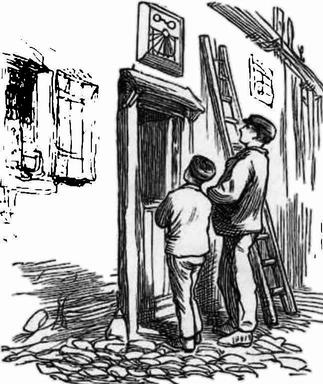
THE SUN-DIAL.
Among the borrowed books of the day was Ferguson's
"Astronomy," which put father and son to
calculating and constructing a sun-dial for the latitude
of Killingworth. It was wrought in stone, and fixed
over the cottage door; and there it is still, with its
date, August 11, 1816—a year or two before Robert
left school—a fair specimen of the drift of his boyish
tastes.
CHAPTER III. WHO BEGAN RAILROADS?—"PUFFING BILLY."
Familiar as it has become to us, who does
not stop to look with interest at the puffing,
snorting, screaming steam-horse? And who
does not rejoice in the iron-rail, which binds
together, with its slender threads, the north and the
south, and makes neighbours of the east and the
west?
"Who began railroads?" ask the boys again and
again.
The first idea of the modern railroad had its birth
at a colliery nearly two hundred years ago. In order
to lighten the labour of the horses, the colliers laid
straight pieces of wood into the road leading from
the pit to the river, where the coal was discharged;
and the waggons were found to run so much easier,
that one horse could draw four or five chaldrons. As
wood quickly wore out, and moreover was liable to
rot, the next step was nailing plates of iron on the
wooden rails; which gave them for a time the name of
"plate-way roads." A Mr. Outram making still
further improvements, they were called "Outram
roads," or, for shortness' sake, "tram-roads;" and
tram-roads came into general use at the English collieries.
"There's mischief in those tram-roads," said a large
canal owner, foreseeing they would one day drive
canal stock quite out of the market.
Improvements thus far had centred on the roads.
To convoy heavy loads easier and faster was the point
aimed at. Nobody had yet thought of self-going
trains. Watt, the father of steam-engines, said steam-carriages
might be built. He, however, never tried
one, but rather left the idea to sprout in the brain of
an old pupil of his, William Murdock, who did construct
a very small one, running on thin wheels, and
heated by a lamp. It was a curious success in its
way, and set other minds thinking.
One of these was a tin-miner of Cornwall, Captain
Trovethick, a friend of Murdock, who joined a cousin
of his in getting a patent for building a steam-carriage.
It was built, and an odd piece of machinery
it was. It ran on four wheels over a common road,
looked like a stage-coach, and delighted both the inventor
and his friends.
They determined to exhibit it at London. While
on its journey, driving it one day at the top of its
speed, they saw a toll-gate in the distance. Not
being able to check it in time, bump it went against
the gate, which flew open in a trice, leaving the
affrighted toll-man, in answer to their inquiry, "How
much to pay?" only able to gasp out, "No—nothing
to pay! Drive off as fast as you can! Nothing
to pay!"
It reached London in safety, and was some time on
exhibition. Multitudes flocked to see it, and some
called it a fiery dragon.
"Ah," said Sir Humphrey Davy, very much interested
in the invention, "I hope to see the captain's
dragons on all the roads of England yet."
But the captain exhibited it only as a curiosity,
the unevenness of the roads rendering it for all practical
purposes a failure; and he had neither pluck nor
genius enough to lay or clear a track for it himself.
This was in 1803.
The idea, however, was in England, lodging itself
here and there in busy brains; until, at last, a colliery
owner in Newcastle, seeing the great advantage
of having a locomotive on his tram-roads, determined
to try what he could do. Accordingly, he had one
built after the Cornish captain's model. It burst up
at starting. Noways baffled, he tried again. The
engine proved a clumsy affair, moved at a snail's pace,
often got off the rails, and at length, voted by the
workmen a "perfect plague," it was taken off. The
unsuccessful inventor was called a fool by his neighbours,
and his efforts an apt illustration that "the fool
and his money are soon parted." In spite of failure,
Mr. Blackett had faith that the thing could be done.
He built a third, and ran it on the tram-road that
passed by old Bob Stephenson's cottage door. And
George at his colliery, seven miles off, as you may
suppose, listened to every account of it with profound
interest. Over he went, as often as he could, to see
"Black Billy," as the locomotive was called—a rough
specimen of machinery at best, doing very little service
beyond what a good horse could do.
George carried "Black Billy" back in his mind to
Killingworth, studying its defects, and laying plans to
improve it. I do not know how long he was in coming
to it, but he at length gave it as his opinion that he
could make a better "travelling engine" than that.
Tidings came to Killingworth about this time that
the trial of a new engine was to take place on a
certain day at Leeds, and George did not lose the
chance of being present. Though the engine moved
no faster than three miles an hour, its constructer
counted it a success. It proved, however, unsteady
and unreliable, and at last blew up, which was the
end of it.
What did George think then? He more than ever
wanted to try his hand at the business. Lord Ravensworth,
knowing enough of Stephenson to have faith
in him, hearing of this, advanced means for the enterprise.
Good tools and good workmen were alike
wanting; but after much labour, alteration, and
anxiety, in ten months' time the engine was completed
and put on the railway, July 25, 1814.
Although the best yet made, it was awkward and
slow. It carried eight loaded waggons of thirty tons
weight at a speed not above four miles an hour. The
want of springs occasioned a vast deal of jolting,
which damaged the machinery, and at the close of a
year's trial it was found about as costly as horse-power.
How to increase the power of his engine? that was
the puzzling question which George studied to answer.
He wrestled with it day and night, and at length
determined to try again. In due time another was
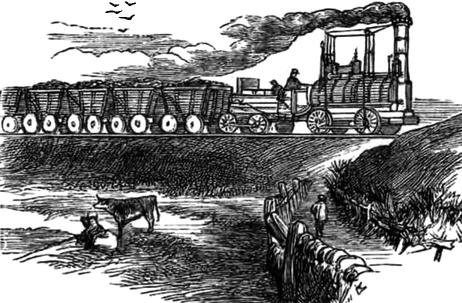
built, "Puffing Billy," which most persons looked upon
as a marvel; but, shaking their heads, they prophesied
it would make a terrible blow-up some day. "Puffing
Billy," however, went to work, and worked steadily
on—a vast advance on all preceding attempts. It
attracted little or no attention outside the narrow
circle of the collieries. The great men of England
did not know that, in a far-off nook of the realm,
there was slowly generating a power, under the persistent
thought of an humble working-man, which
before many years would revolutionize the trade of
the kingdom, and create a new source of wealth.
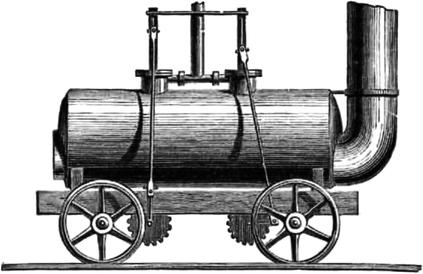
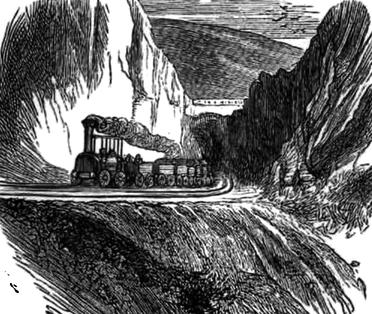
GEORGE STEPHENSON'S FIRST ENGINE.
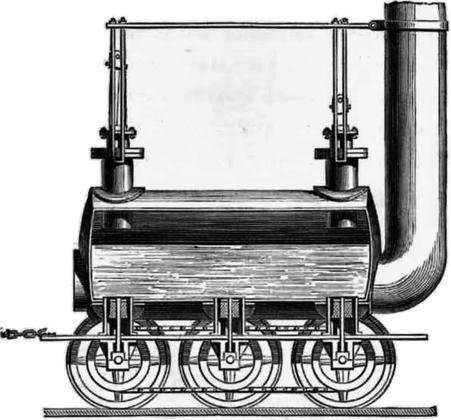
"Puffing Billy," in fact, humble as its pretensions
were, has proved to have been the type of all locomotives
since.
"PUFFING BILLY."
Had George Stephenson satisfied himself? No.
His evenings were chiefly spent at home with his son
Robert, now under him in the colliery, studying and
discussing together how to evoke the hidden power
yet pent up in "Puffing Billy." The son was even
more sanguine than his father, and many an amendment
had "Billy" to undergo to satisfy the quick
intellect and practical judgment of the youth.
Mr. Stephenson, delighted with Robert's scientific
tastes and skill, and ever alive to the deficiencies of
his own education, was anxious to give him still
further advantages. For this purpose he took him
from a promising post at the colliery, and sent him to
the University of Edinburgh.
Here he enjoyed a six months' course of study;
and so well prepared was he for it by his well-formed
habits of application and thinking, that he gained in
six months as much as many a student did in three
years. Certain it was his father felt amply repaid
for the draft it made on his purse, when Robert reappeared
at the cottage, in the spring, with a prize
for successful scholarship in mathematics. He was
eighteen then.
CHAPTER IV. TWO CITIES THAT WANTED TO GET NEAR EACH OTHER—A NEW FRIEND.
Manchester, thirty miles north-east of Liverpool,
is the great centre of the cotton trade
in England. Its cloths are found in every
market of the world. Cotton coming to
Liverpool is sent to the Manchester mills; and the
goods which the mills turn out are returned to Liverpool
to be shipped. The two cities, therefore, are
intimately connected by constant intercourse and
mutual interest.
Two water communications existed between them;
one by the rivers Mersey and Irwell, the other by the
famous Bridgewater Canal, which did an immense business
at an enormous profit. But the Manchester mills
were fast outgrowing these slow and cumbersome
modes of travel. Liverpool warehouses were piled
with bales of cotton waiting to go, and the mills at
Manchester had often to stop because it did not come.
Goods also found as much difficulty in getting back.
Merchants and manufacturers both grumbled. Business
was in straits. What was to be done? Carting
was quite out of the question. Canal owners were
besought to enlarge their water-power. No, they
would do nothing. They were satisfied with things
as they were. Their dividends were sure.
But want demands supply; need creates resources.
Something must be done to facilitate the transit of
goods between the two cities. What? Build a tram-road,
or rail-road. Nobody, however, but a very
fast man would risk his good sense by seriously advising
a rail-road. Solid men would certainly shun
him. A tram-road was a better understood thing.
The collieries had used small pieces of them for years.
A tram-road then. Business men put their heads
together and began earnestly to talk of a tram-road.
William James, a rich and enterprising man,
entered heartily into the project, and undertook to
make surveys for a suitable route. And not long
after a party of surveyors was seen in the fields near
Liverpool. Their instruments and movements excited
attention. People eyed them with anxiety; suspicions
were roused; the inhabitants became alarmed. Who
were they, making such mysterious measurements and
calculations on other people's land? A mob gradually
gathered, whose angry tones and threatening gestures
warned the surveyors of a storm brewing over their
heads. Wisely considering that flight was better than
fight, they took themselves off, and by-and-by turned
up farther on.
The landowners, who might be supposed to have
known better, told the farmers to drive them off;
and the farmers, with their "hands," were only too
ready to obey. They stationed themselves at the
field gates and bars with pitch-forks, rakes, shovels,
and sticks, and dared the surveyors to come on. A
poor chain-man, not quite so nimble as his pursuers,
made his leap over a fence quickened by a pitch-fork
from behind! Even women and children joined the
hue and cry, pelting the strangers with stones and
dirt whenever they had a chance. The colliers were
not behind the farmers in their foolish hostility. A
stray surveyor was caught and thrown into a pit.
At a sight of the theodolite their fury knew no
bounds. That unoffending instrument they seemed to
regard as the very Sebastopol of the enemy, to seize
and destroy which was to win the day. Tho surveyors,
therefore, were obliged to hire a noted boxer to carry
it, who could make good his threats on the enemy. A
famous fighter among the colliers, determined not to
be outdone, marched up to the theodolite to capture
it. A fist-and-fist fight took place; the collier was
sorely beaten, but the rabble, taking his part against
the poor instrument, pelted it with stones and smashed
it to pieces.
You may well suppose that surveying under such
circumstances was no light matter. What was the
gist of the hostility? It is hard to tell. The canal
owners might have had a hand in scattering these
wild fears; fears of what, however, it is not so easy
to find out. There was nothing in a simple horse
rail-road, or tram-road, as it is called, to provoke an
opposition so bitter from the people. It was a new
thing; and new things, great improvements though
they may be on old ones, often stir up a thousand
doubts and fears among the ignorant and unthinking.
Nor did the project generally take among those
who would be most benefited by it. Mr. James and
his friends held public meetings in all the towns and
villages along the way; enterprising men in Liverpool
and Manchester talked it up, and tried to create a
public interest; but there was a holding back, which,
while it checked all actual progress in the enterprise,
did not cause it to be altogether given up. The time
had not come; that was all.
Mr. James had a secret leaning towards the use of
steam on the new road. He would have immediately
and unhesitatingly advocated a rail-road run by locomotives.
But that was out of the question. The
public were far behind that point, and to have openly
advocated it would have risked his judgment and good
sense in the opinion of the best men. Therefore Mr.
James wisely held his tongue. But hearing of the
Killingworth locomotives, and of a collier who had
astonished the natives by his genius, he determined to
make a journey to Newcastle, and see the "lions" for
himself.
Stephenson was not at home. "Puffing Billy" was;
and "Billy" puffed in a way that took Mr. James's
heart at once. He seemed to see at a glance "Billy's"
remarkable power, and was struck with admiration
and delight. "Here is an engine," he exclaimed, "that
is destined before long to work a complete revolution
in society."
The image of "Puffing Billy" followed him home.
"Why," he wrote to Stephenson's partner in the
patent, "it is the greatest wonder of the age, and the
forerunner, I believe, of most important changes in
the modes of travel in the kingdom."
A few weeks later he made another visit to Killingworth,
taking his two sons with him. "Puffing Billy"
was at work, as usual.
The boys were frightened at the sight of the snorting
monster; but Stephenson encouraged them to
mount, with their father, and see how harmless and
manageable the monster was.
The second visit was even more gratifying than the
first.
"Mr. Stephenson," said James, "is the greatest
practical genius of the age. His fame will rank with
that of Watt."
Mr. James lost all hesitation now about speaking
his mind. "Puffing Billy" had driven the backwardness
out of him, and he was willing, at all hazards,
boldly to advocate rail-roads and the steam-horse. No
more tram-roads; steam or nothing. This was in 1821.
Mr. James entered heart and soul into the new idea
of the age. On his return to Liverpool, it was everywhere
his theme; and wherever he had influence, he
tried to stir up men's minds to the benefits and blessings
puffing out in "Puffing Billy."
THE VISIT TO "PUFFING BILLY."
Stephenson rejoiced in such a friend. It was just
what he and "Billy" most needed—somebody to
introduce them into the great world. And Stephenson
and his partner offered him a share in the profits of
whatever business he could secure to them.
But what can one man, or a few men, do in an
enterprise like this, depending upon the verdict of
that important power, Public Opinion? And Public
Opinion had not yet made up its mind to it.
A thousand difficulties bristled in the way. There
were both the indifference of friends and the opposition
of enemies at home. In addition to this, a violent
opposition was foreseen in Parliament, which it needed
all the strength and courage of a united constituency
to meet.
Under these discouraging circumstances, there were
not enough men of pluck to push the matter through.
So everything about the new road went by the
board. It was laid on the shelf, at least for the
present, and Liverpool and Manchester trade jogged
on as before.
CHAPTER V. HUNTING UP HIS OWN WORK—AN ENTERPRISING QUAKER—WHAT WAS THE RESULT?
It appears strange to us that so simple a thing
as the laying of a rail seems to be should
have taken years of thought and experiment
to do it. Nothing looks easier to prepare
than the straight, smooth track of a railway, such as
we now see in use; and yet it was only arrived at by
slow steps through two hundred years.
In pondering upon the powers of "Puffing Billy,"
George Stephenson saw that the efficiency of locomotives
must, in a great measure, depend on what
kind of roads they had to run upon. Many were
sanguine that steam-carriages would some day come
into use on common roads. After a long series of
experiments, George Stephenson said, "No; the thing
wouldn't pay." For a rough surface seriously impairs
the powers of a locomotive; even sand scattered upon
the rails is sufficient to slacken, and even stop an
engine. The least possible friction is desirable, and
this is found on the smooth rail.
Could they ever be laid uphill, or on "ascending
gradients", as the scientific term is? No; as nearly
level as possible, Stephenson's experiments showed,
was the best economy of power. Then how to get rid
of the jolts and jars and breakages of the rails as they
were then laid. He studied and experimented upon
both chairs and sleepers, and finally embodied all his
improvements in the colliery railway.
"Puffing Billy" was in every respect a most remarkable
piece of machinery, and its constructer one of the
most sagacious and persistent of men. But how was
the public, ever slow in discovering true merit or
accepting real benefits, to discover and appreciate them?
Neither influence, education, nor patronage had Stephenson
to command mind and means, or to drive his
engine through prejudice, indifference, and opposition,
to profit and success.
But what he could not do, other men could do, and
did do. Find a hook, and there is an eye to fit it
somewhere. Yes; there were already men of property
and standing alive with the new idea. While he
worked, they talked—as yet unknown to one another,
but each by himself clearing the track for a grand
junction.
One of these men was Edward Pease, a rich Quaker
of Darlington, who, his friends said, "could look a
hundred miles ahead." He needed a quicker and
easier transit for his coals from the collieries north of
Darlington to Stockton, where they were shipped; and
Mr. Pease began to agitate, in his mind, a railroad.
A company for this purpose was formed, chiefly of his
own friends, whom he fairly talked into it. Scarcely
twenty shares were taken by the merchants and shipowners
of Stockton, whose eyes were not open to the
advantage it would by-and-by be to them. A survey
of the proposed road was made, when to the indifference
of the many was added the opposition of the few.
A duke was afraid for his foxes! Shareholders in the
turnpikes declared it would ruin their stock. Timid
men said it was a new thing, and that it was best to
let new things alone. The world would never improve
much under such counsel. Edward Pease was hampered
on all sides. Nobody convinced him that his
first plan was not the right one by all odds; but what
can a man do in any public enterprise without supporters?
So he reluctantly was obliged to give up his rail-road,
and ask Parliament for liberty to build a tram-road—horse-power
instead of steam-power: he could seem to
do no better, and even this was gotten only after long
delay and at considerable cost.
Among the thousands who carelessly read in the
newspapers the passage through Parliament of the
Stockton and Darlington Act, there was one humble
man whose eye kindled as he read it. In his bosom
it awakened a profound interest. He went to bed
and got up brooding over it. He was hungry to have
a hand in it; until at last, yearning with an irrepressible
desire to do his own work in the world, he felt
he must go forth to seek it.
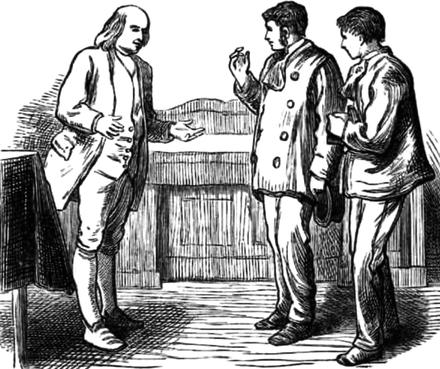
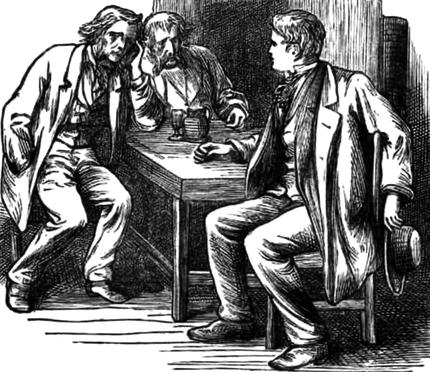
One night a couple of strangers knocked at the
door of Edward Pease's house in Darlington, and
introduced themselves as two Killingworth colliers.
One of them handed the master of the mansion a
letter of introduction from a gentleman of Newcastle,
recommending him as a man who might prove useful
in carrying out his contemplated road.
To support the application, a friend accompanied him.
The man was George Stephenson, and his friend
was Nicholas Wood. It did not take long for Edward
Pease to see that Stephenson was precisely the man
he wanted.
THE TWO STRANGERS.
"A railway, and not a tram-road," said Stephenson,
when the subject was fairly and fully opened.
"A horse railway?" asked Pease.
"A locomotive engine is worth fifty horses," exclaimed
Stephenson; and once on the track, he launched
out boldly in its behalf.
"Come over to Killingworth and see my 'Puffing
Billy,'" said George; "seeing is believing." And Mr.
Pease, as you may suppose, was quite anxious to see a
machine that would outride the fleetest horse. Yet
he did not need "Puffing Billy" to convince him that
its constructer knew what he was advocating, and
could make good his pledges. The good Quaker's
courage rapidly rose. He took a new start, and the
consequence was that all other plans and men were
thrown aside, and Stephenson was engaged to put the
road through much in his own way.
The first thing to be done was to make an accurate
survey of the proposed route. Taking Robert with
him, who had just come from college, and who entered
as heartily into the enterprise as his father, with two
other tried men, they began work in good earnest.
From daylight till night the surveyors were on duty.
One of the men going to Darlington to sleep one night,
four miles off, "Now, you must not start from Darlington
at daybreak," said Stephenson, "but be here, ready
to begin work, at daybreak." He and Robert used to
make their home at the farm-houses along the way,
where his good-humour and friendliness made him a
great favourite. The children loved him dearly. The
dogs wagged their approving tails at his approach.
The birds had a delighted listener to their morning
songs, and every dumb creature had a kind glance
from his friendly eye.
But George was not quite satisfied. He wished
Mr. Pease to go to Killingworth to see "Puffing Billy,"
and become convinced of its economical habits by an
examination of the colliery accounts. He promised,
therefore, to follow George thither, along with a large
stockholder; and over they went in the summer of
1822.
Inquiring for Stephenson, they were directed to the
cottage with a sun-dial over the door. George drove
his locomotive up, hoisted in the gentlemen, harnessed
on a heavy load, and away they went. George no
doubt showed "Billy" off to the best advantage.
"Billy" performed admirably; and the two wondering
stockholders went home enthusiastic believers in locomotive
power.
A good many things had to be settled by the Darlington
project. One was the width of the gauge;
that is, the distance between the rails. How wide
apart should they be? Stephenson said the space between
the cart and waggon wheels of a common road
was a good criterion. The tram-roads had been laid
down by this gauge—four feet and eight inches—and
he thought it about right for the railway; so this
gauge was adopted.
One thing which hampered Stephenson not a
little was the want of the right sort of workmen—quick-minded,
skilful mechanics, who could put his
ideas into the right shape. The labour of originating
so much we can never know. He had nothing to
copy from, and nobody's experience to go by. Happily
he proved equal to his task. We can readily
imagine his anxiety as the work progressed. Hope
and fear must have in turn raised and depressed him.
Not that he had any doubts in regard to the final
issue of the grand experiment of railroads. They
must go!
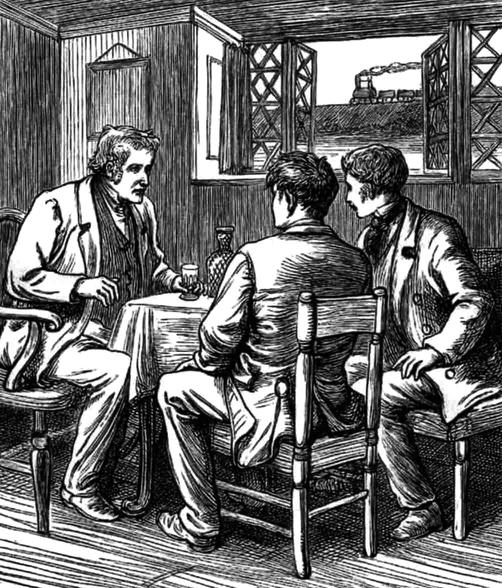
Dining one day at a small inn with Robert, and
John Dixon, after walking over the route, then nearly
completed—"Lads," he said, "I think you will live
to see the day when railroads will be the great highway
for the king and all his subjects. The time is
coming when it will be cheaper for a working-man to
travel on a railway than to walk on foot. There are
big difficulties in the way, I know; but it will surely
come to pass. I can hardly hope to live to see that
day, much as I should like to do so; for I know how
slow all human progress is, and how hard it is to
make men believe in the locomotive, even after our
ten years' success in Killingworth."
While the father roughed it through, Robert's
health failed. His close application to business made
sad inroads upon a frame naturally more delicate than
his father's; and an offer to go out and superintend
some mining operations in South America was thankfully
accepted, in the hope that a sea-voyage and less
exciting labours might restore him.
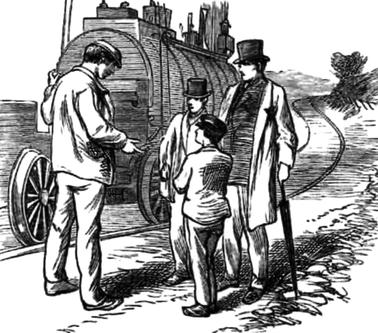
A TALK ABOUT RAILWAYS.
Robert shortly sailed; and his father pushed on
alone, with that brave spirit which carried him through
many a darker hour.
On the 27th of September the Stockton and Darlington
Railway was finished and opened. A great
many came to see the new mode of travelling, which
had proved a fruitful subject of talk, far and near, for
many months;—some to rejoice; some to see the
bubble burst; some with wonder, not knowing what
to think; some with determined hostility. The opposition
was strong: old England against young England;
the counter currents of old and new ideas.
The road ran from Stockton to Darlington, a distance
of twelve miles, and thence to the Etherly
collieries—in all, thirty-two miles.
Four steam-engines were employed, and two stationary
engines to hoist the train over two hills on the
route. The locomotives were of six-horse power, and
went at the rate of five or six miles an hour. Slow
as this was, it was regarded with wonder. A "travelling
engine" seemed almost a miracle. One day a
race came off between a locomotive and a coach running
on the common highway; and it was regarded as
a great triumph that the former reached Stockton first,
leaving the coach one hundred yards behind.
The road was built for a freight road, to convey
lime, coal, and bricks from the mines and kilns in the
interior to the sea-board for shipment abroad. Carrying
passengers was not thought of. Enterprise, however,
in this direction took a new start. A company
was soon formed to run two coaches on the rails
between Darlington and Stockton by horse-power.
Each coach accommodated six inside passengers,
and from fifteen to twenty outside; was drawn by
one horse; and went at the rate of nine miles an
hour.
"We seated ourselves," said a traveller of those
days, "on the top of the 'Defence' coach, and started
from Stockton highly interested with the novelty of
the scene and of this new and extraordinary conveyance.
Nothing could be more surprising than the
rapidity and smoothness of the motion." Yet the
coach was without springs, and jerked and jolted over
the joints of the rails with a noise like the clinking of
a mill-hopper.
"Such is the first great attempt to establish the
use of railways," writes a delighted editor, "for the
general purposes of travelling; and such is its success,
that the traffic is already great, and, considering that
there was formerly no coach at all on either of the
roads along which the railroad runs, quite wonderful.
A trade and intercourse have arisen out of nothing,
and nobody knows how."
Such was their small and imperfect beginning, we
should say, now that railroads, improved and perfected,
have fulfilled Stephenson's prediction uttered in the
little inn, and have become the great highways of the
civilized world.
CHAPTER VI. THE TWO CITIES TRYING AGAIN—BUGBEARS.
One, two, three years passed by, and the Liverpool
and Manchester project started up again.
It was not dead, it had only slept; and the
three years had almost worn out the patience
of both merchants and manufacturers. Trade between
the two cities must have speedier and easier transit.
Trade is one of the great progressive elements in the
world. It goes ahead; it will have the right of way;
it will have the right way—the best, safest, cheapest
way of doing its business. Yet it is not selfish; its
object is the comfort and well-being of men. To do
this, it breaks down many a wall which selfishness
has built up, it cuts through prejudices, it rides over a
thousand "can't be's" of timid and learned men; for
learned men are not always practical. They sometimes
say things cannot be done, when it only needs a
little stout trying to overcome difficulties and do
them.
A learned man once said that crossing the Atlantic
by steam was impossible.
"For the good of the race, we must have something
truer than wind and tougher than sails," said Trade.
And it was not many years before ships steamed into
every port.
"Carriages travelling at twelve, sixteen, eighteen,
twenty miles an hour! Such gross exaggerations of
the power of a locomotive we scout. It can never
be!" cries a sober Quarterly.
"You may scout it as much as you please," rejoins
Trade; "but just as soon as people need a cheaper,
pleasanter, swifter mode of travel, it will be done."
And now the railway carriages thread the land in
their arrowy flight.
"The magnetic telegraph! a miserable chimera,"
cries a knowing statesman. "Nobody who does not
read outlandish jargon can understand what a telegraph
means."
"You will soon find out," answers Trade. And
now it buys pork by the hundred barrels, and
sells grain by the thousand bushels; while armies
march and fleets sail at its bidding. Treaties are
signed at its word; and the telegraph girdles the
world.
You see Trade is a civilizer; and Christian civilization
makes all the difference in the world between
Arabs and Englishmen.
Liverpool merchants were now fairly awake. "What
is to be done?" was the question. Something. Could
there be a third water-line between the two cities?
No; there was not water enough for that.
Would the Bridgewater Canal increase its power
and reduce its charges? No.
A tram-road or a rail-road, then. There was no
other alternative.
Mr. James, who was so much interested before, had
failed and left the country. When he left, he said to
his friends, "When you build a road, build a railroad,
and get George Stephenson to do it."
The Darlington and Stockton enterprise could not
fail to be known at Liverpool; and a drift of opinion
gradually began to set in strongly in favour of the
railway. People talked about it in good earnest.
"A railway!" cried the canal owners. "It is
absurd; it is only got up to frighten us; it will
slump through, as it did before." They were easy.
"Let us go to Darlington and Killingworth and see
for ourselves," said the merchants; and four gentlemen
were sent on a visit of inquiry. They went first to
Darlington, where the works were in vigorous progress,
though not done. It was in 1824, the year before
they were finished. Here they met Stephenson. He
took them to Killingworth to see "Puffing Billy."
Seeing was believing. "Billy's" astonishing feats
won them completely over; and they went back to
Liverpool warm for a railroad. Their clear and candid
report convinced merchants, bankers, and manufacturers,
who gave a verdict in its favour. Public
opinion was now coming over.
Books were opened for funds. There was no lack
of subscribers. Money was ready. To be sure of the
safety of locomotive power, a second deputation was
sent to Killingworth, taking with them a practical
mechanic, better able to judge about it than themselves.
The man had sense enough to see and to own
that while he could not insure safety over nine or ten
miles an hour, there was nothing to be afraid of
slower than that. Then a third body went. The
enterprise required caution, they thought.
Yes, it did.
Having decided upon steam-power, the next thing
was to secure the right sort of man to carry on the
work. Stephenson was that man. His energy and
ability were indispensable. Before trying to get a
charter from Parliament, the route needed to be surveyed
again, and a careful estimate of expenses made.
The Stockton road done, Stephenson was free to
engage in this new enterprise; his success in that
proving his principles true on a larger scale.
The canal owners now took alarm. They saw
there was a dangerous rival, and they came forward
in the most civil and conciliatory manner, professing
a wish to oblige, and offering to put steam-power on
their canals. It was too late. Their day had gone by.
You know the violent opposition made to a former
survey. How would it be again? Did three years
scatter the ignorance out of which it grew? Ah, no.
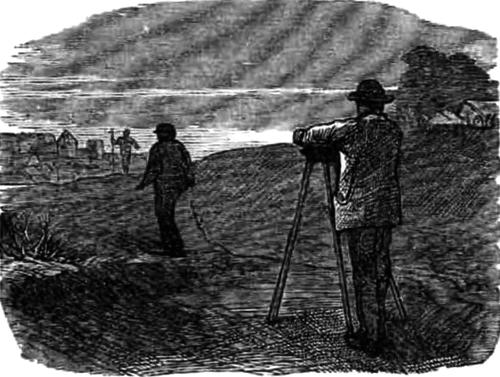
There was little if any improvement. The surveyors
were watched and dogged by night and by day. Boys
hooted at them, and gangs of turbulent men threatened
them with violence. Mr. Stephenson barely
escaped duckings, and his unfortunate instruments
capture and destruction. Indeed, he had to take with
him a body-guard to defend them. Much of the surveying
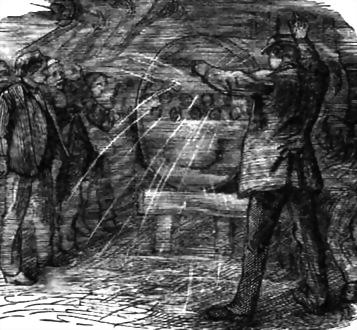
had to be done by stealth, when people were
at dinner, or with a dark lantern at night.
When dukes and lords headed the hostility, you
cannot wonder that their dependants carried it on.
One gentleman declared that he would rather meet a
highwayman or see a burglar on his premises than an
engineer; and of the two he thought the former the
more respectable! Widows complained of damaged
corn-fields, and gardeners of their violated strawberry-beds;
and though Stephenson well knew that in many
cases not a whit of damage had been done, he paid
them for fancied injuries in the hope of stopping their
tongues.
SURVEYING AT NIGHT.
A survey made under such circumstances must needs
have been imperfect; but it was as good as could be
made. And no time was lost in taking measures to
get a Bill before Parliament.
A storm of opposition against railways suddenly
arose, and spread over every corner of the kingdom.
Newspapers and pamphlets swarmed with articles
crying them down. Canal and turnpike owners spared
no pains to crush them. The most extraordinary
stories were set afloat concerning their dangers.
Boilers would burst, and passengers be blown to
atoms; houses along the way would be burned; the
air would become black with smoke and poisoned by
cinders; and property on the road would be stripped
of its value.
The Liverpool and Manchester Bill, however, got
into Parliament, and went before a Committee of the
House of Commons to decide upon it, in March 1825.
First, its friends had to show the necessity of some
new mode of travel between the two cities; and that
it was not difficult to do.
But when it came to asking for liberty to build a
railway and run a locomotive, the matter was more
difficult to manage. And to face the tremendous
opposition rallied against it, the pluck of its friends
was severely tried.
The battle had to be fought inch by inch.
Stephenson, of course, was the chief witness for
locomotives. But what headway could he, an uneducated
Northumbrian mechanic, make against members
of Parliament, backed by all the chief engineers of the
kingdom? For very few had faith in him; but those
few had strong faith. He was examined and cross-examined.
They tried to bully him, to puzzle him, to
frighten him. On the subject of locomotives his
answers were clear. He declared he could drive an
engine, and drive it safely, at the rate of twelve miles
an hour!
"Who can believe what is so notoriously in the teeth
of all experience?" cried the opposition; "the witness
is a madman!"
Famous engineers were called on the stand. What
had they to say? One declared the scheme a most
wild one. He had no confidence in locomotives. They
were affected by wind and weather; with difficulty
were kept on the track, and were liable to constant
accidents; indeed, a gale of wind would render it impossible
to start a locomotive, either by poking the
fire or keeping up the steam till the boiler should
burst: they could never be relied on.
The proposed route had to cross an ugly quagmire,
several miles in extent, called Chat Moss, a very shaky
piece of land, no doubt; and here the opposition took
a strong stand. "No engineer in his senses," cried
one, "would think of going through Chat Moss. No
carriage could stand on the Moss short of the bottom."
"It is absurd to hold out the notion that locomotives
can travel twice as fast as stage-coaches," said
another; "one might as soon trust himself to a rocket
as to the mercy of a machine going at that rate."
"Carriages cannot go at anything like that speed,"
added another; "if driven to it, the wheels would
only spin on their axles like a top, and the carriages
would stand stock-still!"
So much for learned arguments against it.
Then came the dangers of it. "The dumb animals
would never recover from the sight of a locomotive;
cows would not give their milk; cattle could not
graze, nor horses be driven along the track," cried the
opposition.
"As to that," said Stephenson, "come to Killingworth
and see. More quiet and sensible beasts cannot
be found in the kingdom. The farmers there never
complain."
"Well," asked one, "suppose, now, one of those
engines to be going along a railroad at the rate of
nine or ten miles an hour, and that a cow were to
stray upon the line and get in the way of the engine;
would not that, think you, be a very awkward circumstance?"
"Yes," answered Stephenson, with a droll twinkle
in his eye; "very awkward indeed—for the coo!"
The fellow, as you may suppose, backed off.
The danger in other respects was thus dwelt on:
"In addition to the smoke and the noise, the hiss and
the whirl which locomotive engines make, going at the
rate of ten or twelve miles an hour, and filling the
cattle with dismay, what," asked an honourable
member, "is to be done with all those who have
advanced money in making and mending turnpikes?
What with those who may still wish to travel in their
own or hired carriages, after the fashion of their forefathers?
What is to become of coach-makers and
harness-makers, coach-masters and workmen, inn-keepers,
horse-breeders, and horse-dealers? Iron
would be raised one hundred per cent., or more probably
exhausted altogether! The price of coal would
be ruinous. Why, a railroad would be the greatest
nuisance, the biggest disturbance of quiet and comfort,
in all parts of the kingdom, that the ingenuity of man
could invent."
Not content with belittling his engine, they could
not stop short of abusing Stephenson himself. "He
is more fit for Bedlam than anywhere else," they
cried; "he never had a plan—he is not capable of
making one. Whenever a difficulty is pressed, as in
the case of a tunnel, he gets out of it at one end; and
when you try to catch him at that, he gets out at the
other."
"We protest," they said, "against a measure supported
by such evidence and founded upon such calculations.
We protest against the Exchange of
Liverpool striding across the land of this country. It
is despotism itself."
What had the friends of locomotive power to say?
"We beseech you," they pleaded to the Committee,
"not to crush it in its infancy. Let not this country
have the disgrace of putting a stop to that which, if
cherished, may in the end prove of the greatest advantage
to our trade and commerce. We appeal to you
in the name of the two largest towns in England; we
appeal to you in the name of the country at large;
and we implore you not to blast the hopes that this
powerful agent, Steam, may be called in for the purpose
of aiding land communication: only let it have a
fair trial, and these little objections and private prejudices
will be done away."
Flaws were picked in the surveys, and the estimate
of costs based on them. The surveys, quite likely,
were imperfect; indeed, how could they be otherwise,
when every mile of the line had to be done at the risk
of life?
The battle lasted two months, and a very exciting
one it was. It was skilfully and powerfully carried
on. Who beat?
The opposition. The Bill was lost.
Matters looked dark enough. Judging from appearances,
the enterprise was laid on the shelf, and the
day of railways long put off. As for poor Stephenson,
his short day of favour seemed about gone. His being
called a madman, and regarded as a fool, as he had
been by the opposition, was not without its effect upon
his newly-made friends. Their faith in him sensibly
cooled. But he did not lose faith in himself, not he.
He had waited long for the triumph of his engine, and
he could wait longer. A great blessing to the nation
was locked up in it he well knew; and the nation
would have it some time, in spite of everything.
Was the enterprise a second time to be abandoned?
No, no. Taking breath, its friends again started to
their feet. "Never give up," was their motto, for
they were in earnest. They rallied, and met in
London to consult what to do next.
Mr. Huskisson, a member of Parliament for Liverpool,
came into the meeting and urged them to try
again—to try at the next session of Parliament.
"Parliament must, in the end, grant you an Act,"
he said, "if you are determined to have it." And try
they determined to, for a horse railroad at least.
For this purpose another and more careful survey
had to be made.
Stephenson was left out. A known man must be
had. They meant to get surveyors and engineers
with well-established reputation to back them up.
Stephenson was too little known. He had no fame
beyond a little circle in one corner of the kingdom.
How did he feel to be thus thrown in the back-ground?
George was not a man to grumble; he was too noble
to complain. In fact, you see, he was ahead of the
times; too far ahead to be understood and appreciated.
He could afford to wait.
Two brothers of the name of Rennie were appointed
in his stead. In time the new survey was finished;
the plans drawn, and the expenses reckoned up.
Changes were made in the route. Ill-tempered
landowners were left on one side, and every ground of
complaint avoided that could be.
The new Bill was then carried to Parliament, and
went before the Committee in March the next year.
The opposition was strong, indeed, but less furious.
Much of its bitterness was gone. It made a great
show of fears, which the advocates of the Bill felt it
was not worth while to waste words in answering.
They left it to the road to answer them. Build it,
and see.
Mr. Huskisson and others supported it in a strong
and manly tone; and after a third reading, the Bill
passed in the House of Commons. So far, so good.
It then had to go to the House of Lords. What
would befall it there? The same array of evidence
on both sides was put forward. The poor locomotive
engine, which had proved such a bugbear in the House
of Commons, was regarded as quite a harmless affair
by most of the lords; and the opposition made such
poor work in showing off its dangers, that no plea in
its behalf was called for. They were satisfied, they
said; and the Bill passed almost unanimously. Victory!
victory!
The victory cost more than twenty thousand pounds!
For a first cost it looked large. But nothing worth
doing can be done without effort, and effort made in
faith. Nothing done, nothing have.
CHAPTER VII. GRAPPLING WITH DIFFICULTIES—THE BOG—A PUZZLE—THE PRIZE OFFER.
The real work was now to be done. Hopes
and fears had yet to be verified.
At the first meeting of the directors, a
man to put the enterprise through was to be
chosen. Who? The Rennies were anxious to get
the appointment. They naturally expected it. They
had made the survey, and their name had had weight
in getting the Act of Parliament. But they could not
superintend the details of the work. They had other
enterprises on foot.
Stephenson, no doubt, was the man. The directors
felt him to be so. No one could long be with him
without feeling his power. Besides, what he had done
had been ably done. At the risk of offending the
Rennies and their friends, they chose him, and the
result proved the wisdom of their choice.
On receiving the appointment, he immediately
moved to Liverpool, and the work began in good
earnest. It was a stupendous undertaking for those
days. Chat Moss had to be filled in, sixty-three
bridges built, excavations made, tunnels cut, and all
the practical details carried out, with very little past
experience to profit by. Neither was the kind of
labour well understood, nor was there that division of
labour between contractors and engineers which relieves
one man of too heavy a responsibility. In fact,
tools and men had to be made; and Stephenson had
to make both!
The great quagmire was first grappled with. "No
man in his senses would undertake to make a road
over Chat Moss," opposers said in Parliament; "that
were to undertake the impossible." Stephenson, however,
meant to try. Formidable it certainly was.
Cattle ploughing on farms bordering the bog, where it
ran underneath the tilled land, had to wear flat-soled
boots in order to keep their hoofs from sinking down
into the soft soil.
The proposed route ran four miles across it, and the
way had to be drained and filled in with sand and
gravel. The drainage tasked their ingenuity to the
utmost, and almost baffled the workmen. After that
was in some degree accomplished, waggon-load after
waggon-load of earth was thrown on for weeks and
weeks: but it only sank into the mire and disappeared—not
an inch of solid footing seemed gained; and
on they went, filling and filling, without apparently
having made the least impression on the Moss,—the
greedy bog only cried out for more.
CHAT MOSS.
Stephenson's men began to have their doubts. The
opposition might have judged more correctly after all.
They asked him what he thought. "Go ahead!" was
his answer. By-and-by the directors began to have
their fears. It looked to them like a very unpromising
job. So it was. After waiting and waiting in
vain for signs of progress, they called a meeting on
the edge of the Moss, to see if it were not best to
give up. The bog, they were afraid, might swallow
up all their funds, as it had done everything else.
Stephenson lost not a whit of his courage. "Go
ahead!" was his counsel. He never for a moment
doubted of final success. And considering the great
outlay already made, they wisely gave in to him.
Monstrous stories were afloat of the terrible accidents
taking place there. Every now and then the
stage drivers brought into Manchester the astonishing
news of men, horses, carts, and Stephenson himself
submerged and sunk for ever in the insatiable quagmire!
Time corrected one only to publish another.
Newsmongers were kept in a state of delightful excitement,
and tea-table gossip was spiced to suit the
most credulous and marvel-loving taste, until the Moss
was conquered, as conquered it was acknowledged to
be, when, six months after the directors had met to
vote to leave it to its original unproductiveness, they
were driven over it on a smooth and secure rail to
Manchester!
Another tough job was tunnelling Liverpool—excavating
a mile and a third of road through solid
rock. Night and day the boring, blasting, and hewing
were kept in vigorous execution. Sometimes the
miners were deluged with water, sometimes they were
in danger of being overwhelmed by heavy falls of
wet sand from overhead. Once, when Stephenson
was gone from town, a mass of loose earth came
tumbling on the heads of the workmen, frightening
them, if nothing more. On his return they were in
a most refractory state, complaining of the dangers,
and stoutly refusing to go back to work. Wasting
no time on words, Stephenson shouldered a pick-axe,
and called for recruits to follow. Into the tunnel he
marched, and the whole gang after him. Nothing
more was heard of fears, and the work went bravely
and steadily on.
Besides laying out all the work, Stephenson had to
make the tools. All the waggons, trucks, carriages,
switches, crosses, signals, were planned and manufactured
under his superintendence, besides meeting and
providing for a thousand exigencies constantly occurring
in a new enterprise like this, giving full scope to
all the sagacity, invention, and good-humour which
naturally belonged to him.
The expenses of the road were heavy, and money
was not always forthcoming. If the works lagged in
consequence of it, the hopes of the directors fell; so
that Stephenson's energies were taxed to the utmost
during the four years of the work; and he showed,
what observation and history both teach us, that
efficient men are men of detail as well as men of
great plans.
Remember this, boys—for we sometimes despise
little particulars and the day of small things—that
the secret of effective doing lies not only in making
wise plans, but in filling up the minutest parts with
promptness and fidelity. There must be detail, to
achieve any great and good work. If you would
possess the fruits of learning, you must get them by
the toil of daily drudgery. If you undertake to
become rich, you must not despise the small gains
and little economies by which a fortune is made. If
you would obtain a noble Christian manhood, you must
not neglect hourly self-restraint, watchfulness, and
prayer, or the daily exercise of those humbler virtues
and godly industries which make the woof of character.
Stephenson strikingly illustrated the practical force
of this principle. The minutest detail of every plan
in this new enterprise was thought out and carried
on by himself, or under his direct supervision. Both
in summer and winter he rose early. Before breakfast
you might find him on a morning round, visiting
the extensive workshops where the machines and tools
were made; or perhaps Bobby is brought to the door,
and mounted on this his favourite horse, he is off
fifteen miles to inspect the progress of a viaduct—a
ride long enough to whet the appetite for a tempting
breakfast, one would think. But nothing tempts him
from his frugal habits: he eats "crowdie"—and that
made by himself—which is nothing more or less than
oatmeal hasty-pudding and milk. Again he is off,
inspecting the labours of his men all along the line
from point to point, pushing the works here, advising
there, and inspiring everywhere. Bobby is a living
witness that one beast, at least, is not to be scared by
a locomotive. He can face the snorting monster
without so much as a shy step, or a prick of the ears.
He afraid! not Bobby.
Returning home, pay-rolls are to be examined, perhaps,
when every item of expense must be accounted
for; or drawings are to be made, or directions given,
or letters written.
Several young men were received into his family
to be trained for engineers. A second wife—frugal,
gentle, and friendly—superintended his household.
Their evenings were passed in study and conversation,
brightened by the genial humour of the remarkable
man whose genius drew them together, and whose
good-tempered pleasantries relieved the heavier tasks
of mind and body. The compendium of all his instruction
was,—Learn for yourselves, think for yourselves,
master principles, persevere, be industrious, and
there is no fear for you. It is an indication of the
value of these instructions, that every young man
trained under him rose to eminent usefulness. "Ah,"
he sometimes said, on relating a bit of his own early
history, "you don't know what work is in these days."
And yet work is work all the world over.
In spite of the best Stephenson could do, the directors,
looking at their unproductive capital, and not
fully comprehending all the difficulties to be overcome,
sometimes urged greater despatch.
"Now, George," said Friend Cropper one day, "thou
must get on with the railway; thou must really have
it opened by the first of January next."
"Consider the heavy nature of the works, sir,"
rejoined George, "and how much we have been delayed
by want of money, to say nothing of the bad weather.
The thing is impossible."
"Impossible!" cried Cropper. "I wish I could get
Napoleon to thee; he would tell thee there is no such
word as 'impossible.'"
"Tush!" exclaimed George, "don't tell me about
Napoleon. Give me men, money, and material, and
I'll do what Napoleon couldn't do—drive a railroad
over Chat Moss."
He might have retorted more significantly by asking
the directors what they meant to do; for Liverpool
was tunnelled and Chat Moss railed before they
could agree what kind of power to put on it. There
were some who insisted upon using horse-power; but
the majority thought that was out of the question.
Meeting after meeting was held, debate followed
debate, and the whole body became more and more
puzzled as the road itself neared completion.
Some kind of machine; but what?—ah, that was
the question. You would naturally have thought, "A
locomotive, of course." But no; since Parliament
opposition raged against it, steam had lost ground in
the public estimation, and it was very slow in getting
back to favour. Locomotives, or "travelling engines,"
as they were called, were hid in a cloud of doubts,—and
more than ever since the Parliament debates.
"They were dangerous, they were frightful, they
could never go fast enough,—their utmost speed
would not be ten miles an hour." Some of the most
distinguished engineers would give no opinion of them
at all. They had none. It was certainly hard to
patronize them in spite of their indifference, and
possibly their sneers. Certainly, if the poor locomotive
depended on their verdict, its fate was sealed.
GOOD SERVICE.
One stanch friend remained. Stephenson stood
faithfully by "Puffing Billy," puffing away in his far-off
Northumberland home. He never flinched advocating
its principles, and urged the directors to try
one on the road. They at last ordered one to be
built,—one that would be of service to the company,
and no great nuisance to the public. It was built,
and excellent service it did, drawing marl from the
cuttings and excavations to fill up the bogs and hollows.
Nevertheless, it settled nothing, and convinced
nobody not already convinced.
Meanwhile the directors were deluged with projects,
plans, and advice for running their road. Scheme
upon scheme was let loose upon them;—some engines
to go by water-power, some by gas, some by cog-wheels.
All the engineering science in the kingdom
was ready to engineer for them in its own way; but
who among all could pronounce the best way, and upon
the whole decide which was the right motive power?
A deputation was despatched to Darlington and
Stockton to inspect the fixed and locomotive engines
employed on that road; but the deputation came
back differing so among themselves, that the directors
were more puzzled than ever. Two professional
engineers of high reputation were then sent, who, on
their return, reported in favour of fixed engines—for
safety, speed, economy, and convenience, fixed engines
by all odds; reiterating again and again all the frightful
stories of danger and annoyance charged upon
steam. They proposed dividing the road into nineteen
stages, of a mile and a half in length, and having
twenty-one stationary engines at different points to
push and draw the trains along. The plan was carefully
matured.
Poor Stephenson! how did he feel? "Well," he
said, with the calm earnestness of a man of faith,
"one thing I know, that before many years railroads
will become the great highways of the world."
Could the directors accept the project without consulting
him? Again they met. What had he to say
concerning it? Fight it he did. He dwelt upon its
complicated nature, the liability of the ropes and
tackling to get out of order, the failure of one engine
retarding and damaging and stopping the whole line;
a phase of the matter which did not fail to make an
impression. The directors were moved. The rich
Quaker, Cropper, however, headed the stationary-engine
party, and insisted upon adopting it. "But,"
answered the others, "ought we to make such an
outlay of money without first giving the locomotive a
fair trial?" And Stephenson pleaded powerfully, as
you may suppose, in its behalf. "Try it, try it," he
urged; "for speed and safety there is nothing like it."
And the words of a man with strong faith are strong
words. "Besides," he said, "the locomotive is capable
of great improvements. It is young yet; its capacities
have never been thoroughly tested. When
proper inducements are held out, a superior article
will be offered to the public."
Never were directors in a greater strait. There
was no withstanding Stephenson, for he knew what
he was talking about. All the rest were schemers.
At last one of the directors said, "Wait; let us offer
a prize for a new locomotive, built to answer certain
conditions, and see what sort of engine we can get."
That was fair. It was right his engine should be
properly tested. All agreed; and in a few days proposals
were issued for the building of one. There
were eight conditions, two of which were that if the
engine were of six tons weight, it should be able to
draw twenty tons, at a speed as high as ten miles an
hour. The prize was five hundred pounds.
The offer excited a great deal of attention, and
many people made themselves merry at its expense.
The conditions were absurd, they said; nobody but a
set of fools would have made them: it had already
been proved impossible to make a locomotive-engine
go at ten miles an hour. And one gentleman in his
heat even went so far as to say that if it ever were
done, he would undertake to eat a stewed engine-wheel
for his breakfast! As that condition was
fully answered, it is to be hoped that he was generously
relieved from his rash promise and his indigestible
dish.
More candid minds turned with interest to the
development of this new force struggling into notice.
Stephenson felt how much depended on the issue;
and the public generally concluded to suspend their
verdict upon the proper working of railways, until
time and talent gave them better means of judging.
CHAPTER VIII. ROBERT'S RETURN—A CURIOUS ENCOUNTER—THE PRIZE ENGINE.
One step forward; yes, a great one too, Stephenson
thought. His beloved locomotive
was to have a chance of being properly
introduced to the great English public, and
he felt that it needed only to be known to be valued.
The building of it was a matter of no small moment,
and he wanted, above all things, a tried and skilful
hand to superintend and put into its construction
every conceivable improvement. It must be the best
engine yet built.
Where should he find the right man? No one
would answer like his son Robert, so Robert he determined
to send for. Robert, you remember, went
to South America three years before. There he had
regained his health, and on receiving his father's letter,
he made immediate preparations to return to England.
A CURIOUS ENCOUNTER.
On his way, at a poor little comfortless inn, in a
poor little comfortless sea-port on the Gulf of Darien,
where he was waiting to take ship, he met two
strangers, one evidently an Englishman, who by his
shabby appearance looked as if the world had gone
hard with him. A fellow-feeling drew the young
man towards his poor countryman, and on inquiry
who should it prove to be but the old Cornwall tin-miner,
Captain Trovethick, whose first steam-carriage
had awakened so much curiosity in London nearly a
quarter of a century before!
He had sown his idea to the winds. Others had
caught it up, cherished it, pondered over it, examined
it, dissected it, improved it, embodied it, and by
patient study and persistent endeavour had reduced it
to a practical force. And Robert Stephenson was
now on his way to inaugurate it as one of the great
commercial values of the kingdom, and of the world.
The poor inventor, what had he done meanwhile?
While others worked, had he slept? Oh no. He
had tried an easier and a shorter cut to fame and fortune.
You remember he left his "dragon," as some
people called his locomotive, in London, quite careless
what became of it, and went scheming and speculating
in other things. Several years after, in a shop
window, it attracted the attention of a French gentleman
passing by. He was from Peru, and had just
come to England to get a steam-engine for pumping
water from some gold-diggings in the New World.
Delighted with the model, he bought it for twenty
guineas. Taking it with him to Lima, an engine was
built on the plan of it, which worked admirably.
The gentleman was then sent back to England to
hunt up and bring out the inventor himself. The
captain was found, and came forth from his obscurity
into sudden notice and demand. The gentleman
engaged him to make five pumping-engines according
to his model; which he did, and shipped them to
Lima, the captain himself soon following.
At Lima he was received with great honours and a
public rejoicing. A guard of honour was appointed
to wait on him; and, in view of the wealth he was
supposed to be able to engineer from their mines, a
massive silver statue of him, as the benefactor of
Peru, began to be talked of.
Of course poor Trovethick thought his fortune
made, and no doubt looked back with pity on his
humble English life. Friends at home spread the
news of his successes; and when they stated that the
smallest estimate of his yearly income amounted to
one hundred thousand pounds, no wonder he was pronounced
a success! Tardier steps to fortune seemed
tedious, and many of his old associates perhaps sighed
over the wholesome toil of a slower-paced prosperity.
Years passed on, and the poor captain next turns
up at Cartagena, penniless and pitiable! In crossing
the country, he had lost everything. Fording rivers,
penetrating forests, and fighting wild beasts, had left
him little else than a desire to reach England again;
and Robert Stephenson gave him fifty pounds to get
home with. Sudden fortunes are apt as suddenly to
vanish, while those accumulated by the careful husbandry
of economy, industry, and foresight reward
without waste: so character is stronger than reputation—for
one is built on what we are, the other on
what we seem to be; and, like a shadow, reputation
may be longer or shorter, or only a distorted
outline of character. One holds out because it is
real; the other often disappears because it is but a
shadow.
Robert reached home in December 1827, right
heartily welcomed, we may well believe, by his father,
who was thankful to halve the burden of responsibility
with such a son. To build the prize locomotive
was his work.
Stephenson had long been a partner in a locomotive
factory at Newcastle, which had hitherto
proved a losing concern to the owners. There was
little or no market for their article; but they struggled
on, year after year, waiting for better times.
Nobody saw better times but Stephenson. He saw
them ahead, shooting through the gloomy clouds of
indifference and prejudice. And now he calculated it
was very near. So he sent Robert to Newcastle to
take charge of the works there, and construct an
engine that would make good all his words.
It was a critical moment, but he had no fears of
the result. Robert often came to Liverpool to consult
with his father, and long and interesting discussions
took place between father and son concerning
the best mode of increasing and perfecting the powers
of the mechanism. One thing wanted was greater
speed; and this could only be gained by increasing
the quantity and the quality of the steam. For this
effect a greater heating surface was necessary, and
mechanics had long been experimenting to find the
best and most economical boiler for high-pressure
engines.
Young James, son of that Mr. James who, when
the new Liverpool and Manchester route was talked
of, was the first to discover and acknowledge George
Stephenson's genius, made the model of an improved
boiler, which he showed to the Stephensons. Perhaps
he was one of the boys who went to Killingworth
with his father to see the wonders of "Puffing Billy,"
and whose terrors at the snorting monster were only
soothed by a pleasant and harmless ride on his back.
Whether this gave him a taste for steam-engines we
do not know. At any rate he introduces himself to
our notice now with a patented model of an improved
boiler in his hand, which Stephenson thinks it may be
worth his while to make trial of. "Try it," exclaimed
the young inventor—"try it, and there will be no
limit to your speed. Think of thirty miles an hour!"
SECTION OF THE FIRST BOILER IN USE.
"Don't speak of thirty miles an hour," rejoined
Stephenson; "I should not dare talk about such a
thing aloud." For I suppose he could hardly forget
how Parliament committees had branded him as a
fool and a madman for broaching such beliefs.
SECTION OF A TUBULAR BOILER.
The improved boiler was what is called a multi-tubular
boiler. You do not understand that, I suppose.
An iron boiler is cast, six feet long, and three
feet and a third in diameter. It is to be filled half
full of water. Through this lower half there run
twenty-five copper tubes, each about three inches in
diameter, open at one end to the fire, through which
the heat passes to the chimney at the other end.
You see this would present a great deal of heating
surface to the water, causing it to boil and steam off
with great rapidity. The invention was not a sudden
growth, as no inventions are. Fire-tubes serving this
use started in several fertile minds about the same
time, and several persons claimed the honour of the
invention; but it was Stephenson's practical mind
which put it into good working order and made it
available. For he told Robert to try it in his new
locomotive.
He did. The tubes were of copper, manufactured
by a Newcastle coppersmith, and carefully inserted
into the ends of the boiler by screws. Water was
put into the boiler, and in order to be sure there was
no leakage, a pressure was put on the water; when,
lo, the water squirted out at every screw, and the
factory floor was deluged! Poor Robert was in
despair. He sat down and wrote to his father that
the whole thing was a failure.
A failure indeed! Back came a letter by the next
post telling him to "go ahead and try again!" The
letter, moreover, suggested a remedy for the disaster—fastening
the tubes into the boiler by fitting them
snugly into holes bored for the purpose, and soldering
up the edges. And it proved to be precisely what
Robert himself had thought of, after the first bitter
wave of disappointment had subsided. So he took
heart and went to work again. Success crowned his
efforts. A heavy pressure was put on the water, and
not a drop oozed out. The boiler was completely
water-tight.
This is precisely the kind of boiler now in use:
some have fifty tubes; the largest engines one hundred
and fifty.
THE FAILURE.
Various other improvements were incorporated into
the new engine, which, as you do not probably understand
much about machinery, would not particularly
interest you.
At last the new engine was finished. It weighed
only four tons and a quarter—little less than two tons
under the weight required by the offer of the directors.
The tender, shaped like a waggon, carried the
fuel in one end and the water in the other.
It was forthwith put on the Killingworth track,
fired up, and started off. Robert must have watched
its operations with intense anxiety. Nothing could
have met his expectations like the new boiler. It in
fact outdid his highest hopes. The steam made
rapidly, and in what seemed to him then marvellous
quantities. Away went a letter to Liverpool that
very evening.
TUBES OF A MODERN ENGINE.
"The 'Rocket' is all right and ready," wrote the
young man joyfully. That was the engine's name,
"Rocket,"—on account of its speed, perhaps. "Puffing
Billy" was quite cast into the shade.
It was shortly afterwards shipped to Liverpool, in
good time for the grand trial.
THE "ROCKET."
The trial, rapidly approaching, elicited a great and
general interest. The public mind was astir. The
day fixed was the first of October. Engineers, mechanics,
and scientific men, from far and near, flocked to
Liverpool. The ground where the exhibition was to
take place was a level piece of railroad two miles
long, a little out of the city. Each engine was to
make twenty trips, at a rate of speed not under ten
miles an hour, and three competent men were appointed
as judges.
Four engines were entered on the list,—the
"Novelty," the "Sans-pareil," the "Rocket," the
"Perseverance."
Several others were built for the occasion in different
parts of the kingdom, or rather projected and
begun, but were not finished in time.
In order to afford ample opportunity for their
owners to get them in good working order, the directors
postponed the trial till October 6th. The day
arrived, and a glance at the country around showed
that an unusual occasion was drawing people together.
Multitudes from the neighbouring towns assembled
on the ground at an early hour. The road was
lined with carriages, and a high staging afforded the
ladies an opportunity of witnessing the novel race.
The "Novelty" and "Sans-pareil," though first on
the list, were not ready at the hour appointed. What
engine was? The "Rocket." Stephenson, next on
the roll, was called for by the judges, and promptly
the little "Rocket" fired up at the call. It performed
six trips in about fifty-three minutes.
The "Novelty" then proclaimed itself ready. It
was a light, trim engine, of little more than three
tons weight, carrying its fuel and water with it. It
took no load, and ran across the course sometimes at
the rate of twenty-five miles an hour. The "Sans-pareil"
also came out.
The "Perseverance," not able to go faster than five
or six miles an hour, withdrew from the contest. As
the day was now far spent, further exhibition was
put off till the morrow.
What exciting discussions must have taken place
among rival competitors and their friends! What a
scrutiny of the merits and demerits, the virtues and
defects of opposing engines!
Before the appointed hour the next day, the bellows
of the "Novelty" gave out; and as this was one of
its merits—a bellows to increase the draught of the
air-blast—its builders were forced to retire from the
list.
Soon after, a defect was discovered in the boiler of
the "Sans-pareil." Mr. Hackworth begged for time
to mend it; as there was no time, his request could
not be granted, and he too withdrew his claims.
The "Rocket" alone stood its ground. The
"Rocket," therefore, was again called for. Stephenson
attached to it a carriage large enough to hold a
party of thirty, and drove his locomotive along the
line at the rate of twenty-five and thirty miles an
hour, to the amazement and delight of every one
present.
The next morning it was ordered to be in readiness
to answer the various specifications of the offer. It
snorted and panted, and steamed over the race-ground
in proud trim, drawing about thirteen tons weight.
In twenty trips, backward and forward, its greatest
speed was twenty-nine miles an hour—three times
greater than Nicholas Wood, one of the judges, declared
to be possible. Its average rate was fifteen
miles—five miles beyond the rate specified for the
prize. The performance appeared astonishing. Spectators
were filled with wonder. The poor directors
began to see fair weather; doubts were solved, disputes
settled; the "Rocket" had cleared the track for
them. There could no longer be any question how
to run the road. George Cropper, who had steadily
countenanced stationary engines, lifted up his hands
exclaiming, "Stephenson has at last delivered himself!"
The two other locomotives, however, were allowed
to reappear on the stage; but both broke down, and
the "Rocket" remained victor to the last. It had
performed and more than performed all it promised,
fulfilled all the conditions of the directors' offer, and
was accordingly declared to have nobly earned the
prize—five hundred pounds.
But the money was little, compared with the profound
satisfaction which the Stephensons felt at this
public acknowledgment of the worth of their lifelong
labours. George's veracity, skill, intelligence,
had all been doubted, denied, derided by men of all
classes. Even old friends turned against him, and
thought his mind was crazed by "one idea." He
had to struggle on alone; faithful to his convictions,
patiently biding his time, yet earnestly pleading his
cause on every suitable occasion. He had a blessing
for the world; and he knew when it felt its want of
it, it would have it. That time had come. The
directors flocked around him with flattering congratulations.
All shyness and coolness vanished. Friends
were no longer few. The shares of the company
immediately rose ten per cent. Men and means were
at his disposal. George Stephenson was a happy man.
The "Rocket" had blown stationary engines to the
winds. And Steam that day, on the land as well as
on the water, took its place as one of the grand moving
powers of the world.
CHAPTER IX. OPENING OF THE NEW ROAD—DIFFICULTIES VANISH—A NEW ERA.
There was no more waiting for work at the
locomotive factory in Newcastle. Orders
immediately arrived from the directors to
build eight large engines for the new road,
and all the workshops were astir with busy life. The
victorious little "Rocket" was put on the road, and
sensibly helped to finish it. Neither faith, nor men,
nor means were now wanting, and the labour in every
part went heartily on.
In June a meeting of the directors was held in
Manchester, when the "Rocket" made a trip from
Liverpool to that city with a freight and passenger
train, running through in two hours. Chat Moss
never quivered. And the directors, I dare say, would
have been very glad to forget their disconsolate meeting
on the edge of it, when they nearly voted themselves
beaten by the bog, only Stephenson would not
let them.
On the 15th of September 1830, there was to be
a public opening of the road, and preparations were
made at each end, and all along the way, for the
grand event. The occasion awakened a deep and
universal interest. It was justly regarded as a national
event, to be celebrated with becoming honours. The
Duke of Wellington, then Prime Minister, was present;
also Sir Robert Peel, and Mr. Huskisson, whose stirring
words had revived the drooping spirits of the directors
after their defeat in Parliament, and whose influence
had served to get their Bill successfully through at
last. No one, perhaps, had watched the progress of
the enterprise with deeper interest than Mr. Huskisson,
or rejoiced more in the vanquishing of one difficulty
after another to its final finishing. Great numbers
came from far and near, who, assembling by the
slow mode of travel of those days, took time accordingly.
Carriages lined the roads and lanes; the river was
crowded with boats; and soldiers and constables had
their hands full to keep the people from the track.
OPENING THE LINE.
The new locomotives, eight in number, having been
carefully tested, steamed proudly up. The "Northumbrian,"
driven by George Stephenson, took the lead.
Next the "Phœnix," under Robert's charge. The
"North Star," by a brother of George. The "Rocket,"
and the rest, with their trains, followed. Six hundred
persons were in this procession, flying at the rate of
twenty-five miles an hour! Oh the wonder and
admiration which the spectacle excited! These noble
steam-horses, panting, prancing, snorting, puffing,
blowing, shooting through tunnels, dashing across
bridges, coursing high embankments, and racing over
the fields and far away! England and the world
never saw before a sight like that.
But the joy and the triumph of the occasion were
destined to be damped by a sad disaster. At Parkenside,
seventeen miles from Liverpool, the "Northumbrian,"
which carried the Duke and his party, was
drawn up on one track, in order to allow the other
trains to pass in review before them on the other.
Mr. Huskisson had alighted, and, standing outside,
was talking with the Duke, when a hurried cry of
"Get in! get in!" went up from the bystanders. For
on came the "Rocket," steaming at full speed. Mr.
Huskisson, startled and confused, attempted to regain
the carriage an instant too late: he was struck down,
and the "Rocket" went over him.
"I have met my death!" exclaimed the unfortunate
man; which, alas! proved but too true, for he died
that evening.
A sad confusion prevailed. The wounded gentleman
was lifted into the carriage, and the "Northumbrian"
took him over the track home, a distance of
fifteen miles, in about twenty minutes. So swiftly
and easily done! The use rather than the abuse of
the new power made the strongest impression.
The mournful accident threw a cloud over the
occasion. The Duke wished to stop the celebration,
and immediately return to Liverpool. Mr. Huskisson's
friends joined with him in the wish. Others felt
that Manchester should not be disappointed in witnessing
the arrival of the trains, and that the accident
might become magnified and misrepresented, and thus
operate mischievously upon public sentiment in relation
to railroads; the party therefore consented to
proceed to their journey's end, but were unwilling
to mingle in any of the rejoicings common to such
occasions.
But the railroad needed no such demonstrations to
publish or to prove its worth. It had within itself
more substantial proof. Time was saved; labour was
saved; money was saved. Coal, cotton, and every
article of merchandise useful to men, could be carried
cheaper, could be had cheaper than ever before; and,
what was better, had in quantities sufficient to satisfy
the industry and necessities of men. And with cheapness
were combined comfort and safety. The first
eighteen months, 700,000 persons were carried over
the road, and not an accident happened!
But were not people frightened by the smoke,
cinders, fire, and noise of the engines, as the opposition
in Parliament had declared they would be? No, no.
It was not long before everybody wanted land near
the track; and land, therefore, near the road rapidly
rose in value. The farmers who had driven the surveyors
from their fields, now complained of being left
on one side; and those who had farms near the
station to rent, rented them at a much higher rate
than ever before. Barren lots became suddenly profitable,
and even Chat Moss was turned into productive
acres!
In 1692, an old writer states, "There is an admirable
commodiousness both for men and women of the
better rank to travel from London, the like of which
has not been known in the world; and that is, by
stage-coaches, wherein one may be transferred to any
place, sheltered from foul weather, with a velocity
and speed equal to the fastest posts in foreign countries;
for the stage-coaches called 'Flying-coaches'
make forty or fifty miles a day."
An English paper, bearing the date of January
1775, has this advertisement: "Hereford Machine,
in a day and a half, twice a week, continues flying
from the Swan in Hereford, Monday and Thursday,
to London."
In the Scriptures we find Isaiah, with prophetic
eye, looking over the centuries to these later times
and penning down: "Every valley shall be exalted,
and every mountain and hill shall be made low; and
the crooked shall be made straight, and the rough
places plain;" and "swift passengers" are seen executing
the world's affairs—no meagre description of the
great means of intercourse in our day, the railway
and the telegraph. The prophet saw in it a clearing
of the way for the coming kingdom of the Redeemer,
which is some time to spread over the whole earth as
"the waters cover the sea." Men make good tools
and instruments for themselves. They forget they
are perfecting them for God also, who is using them,
and who will use them, to make known the precious
gospel of his Son, "peace on earth, and good-will to
men."
What powerful preachers for the Sabbath are the
railway and the telegraph, doing away with all
necessity and every excuse for Sabbath travelling as
they do! Long journeys and the most urgent business
can be done between Sabbath and Sabbath, giving a
rest-day to the nation. And this view of them is
deserving of more and more regard.
The institution of the Sabbath was founded with
the human race. It was meant to be the rest-day of
the entire world. It was set up as a blessing: "The
Lord blessed the Sabbath-day, and hallowed it." The
bodies of man and beast need it. The muscles, bones,
nerves, sinews, and brain cannot endure the strain of
constant and uninterrupted work. It is the day for
making up the waste of the animal frame caused by
continual labour and excitement. Night rest is not
enough. The God of Nature and of the Sabbath has
fitted the one to the other.
When the knowledge of God had faded out of the
earth, and he had chosen a people to restore and preserve
it, besides a code of national laws particularly
for them, he enacted from Sinai a code of moral laws
for man. Among them was the rest-law of the
Sabbath. It is the fourth commandment of the Decalogue,
taught in all our Sabbath schools, pulpits, and
homes: "Remember the Sabbath-day, to keep it holy:
in it thou shalt do no work," man nor beast. Further,
God promises a great reward to those who call
"the Sabbath a delight, the holy of the Lord, honourable;
not doing thine own ways, nor finding thine
own pleasure, nor speaking thine own words, but delighting
thyself in the Lord;" showing not only the
rest-use of the Sabbath, but its soul-use, as a day of
special intercourse with God.
"The Sabbath was made for man," says Jesus
Christ; and the Christian Sabbath has incorporated
into it the finishing of the great plan of our redemption,
when Christ,
"Who endured the cross and grave,
Sinners to redeem and save,"
arose from the dead, according to the Scriptures.
Thus it is appropriately called "the Lord's day;" the
day when our worldly business is to be set aside, and
when Christ presses his claims upon the hearts and
consciences of men. It is a break in the hurrying
whirl of this life's interests, to consider the solemn
issues of eternity, and that atoning love which is
mighty to save all who by repentance and faith accept
its terms of mercy.
We find it was on the observance or desecration
of the Sabbath that the prosperity of the Hebrew
nation hung. "You bring wrath upon the nation,"
cried Nehemiah to the Sabbath-breaking traders.
"This very profanation has been the cause of our disasters
in times past." For Sabbath profanation leads
to forgetfulness of God; and God left out, what becomes
of man? Ruin stares him in the face. "The
ungodly shall not prosper." What becomes of a
nation? Ruin! They shall be left to their own
doings. The French nation blotted out the Sabbath,
and showed what it was to be left of God.
When an African prince sent an embassy to Queen
Victoria with costly presents, and asked her to tell
him in return the secret of England's greatness and
England's glory, presenting him with a copy of the
Bible, the Queen replied, "Tell your prince that this
is the secret of England's greatness."
For all our institutions, all our civil and religious
interests, we need the morality of the Bible, the conscience
and the self-restraint which the Bible enjoins;
and for this purpose we must vigorously support the
institutions of the Bible. Foremost in the foreground
is the Sabbath. It has come down to us through the
ages, the great commemoration-day of a finished creation
and a completed atonement, summoning men to
call on the name of the Lord, and bless and praise his
holy name.
On its observance the highest moral education of
the people depends. Every railroad corporation is
bound to be a Sabbath-keeping corporation. It makes
time enough to do its work. The nature of its work
demands responsible men. An immense amount of
property is in its hands, requiring officers of scrupulous
integrity to manage its interests. The gross
receipts of eight railways terminating in London are
over £200,000 a week.
It has the life and limbs of thousands upon thousands
intrusted to its charge, at the mercy of its
employés, engineers, firemen, brakemen, switchmen,
the recklessness or unfaithfulness of any of whom
may bring sudden death to scores, and plunge a nation
into mourning. These men, to be kept the right men,
need the Sabbath. To be honest, responsible, vigilant,
true, God-fearing men, fit for their posts of duty,
they must have the Sabbath.
Many roads are Sabbath-keeping. Some of those
which do run on that day are poorly paid. Carrying
the mail helps them out. They run, perhaps, for
that purpose. But is it necessary to keep up Sabbath
violation on our great routes in order to forward the
mail? Does not the Saturday telegraph do away
with that necessity? Every important item of business
can be put through on the wires in time.
The side of the Sabbath is the side of God.
What became of George Stephenson and his son
Robert? the boys will have the curiosity to ask.
George and Robert Stephenson took their rank
among the great men of England—that class of great
men who contribute to the true prosperity of the
world, by giving it better tools to do its labour with.
A good tool is a great civilizer. The more perfect
the instrument, the better the work. The more perfect
the instrument, the greater the number of persons
benefited; for the sagacity necessary to invention and
discovery, and the intelligence required to mature
them, are large-hearted and broad-minded. They
work for the many, not for the few.
The history of railways in England it is not my
object to give you, and that enters largely into the
remaining period of George Stephenson's life; you
will find it fully detailed in Smiles's Life of him. He
became rich and famous, yet he always preserved the
simple habits and tastes of his early days. Though
asked to dine at the richly-spread tables of lords and
baronets, no dish suited his taste better than his frugal
oat-meal "crowdie," and no cook served it better than
himself. Kings and queens thought it a privilege to
talk with him. Liverpool erected a statue of him.
The King of Belgium knighted him. But he cared
little for honours. When somebody, wishing to dedicate
a book to him, asked what his "ornamental
initials" were, "I have to state," replied he, "that I
have no flourishes to my name, either before or after.
I think it will be as well if you merely say, 'George
Stephenson.'"
Young men beginning life often called upon him
for advice and assistance. He hated show and
foppery, and a weakness in that direction often got
reproof. One day one came flourishing a gold-headed
cane. "Put by that stick, my man," said Stephenson,
"and I will talk with you."
"You will, sir, I hope, excuse me," he said on
another occasion to a very gaily dressed youth; "I
am plain-spoken, and am sorry to see a clever young
man like you disfigured by that fine-patterned waistcoat
and all these chains and fang-dangs. If I, sir,
had bothered my head with these things when I
was of your age, I would not have been where I now
am."
Wholesome as were his reproofs, his counsel was as
reliable, and his help as timely. From the mine of
his own rugged experience he had gathered truths
richer than grains of gold; and he never allowed any
good opportunity to pass without insisting upon the
practice of those homelier and sterner virtues which
form the strong woof of character. When building a
road between Birmingham and London, Robert walked
twenty times over the entire route, illustrating the
patient assiduity taught him by his father. No slipshod
work could escape their eye. "Neglect nothing,"
was their motto. As a Killingworth collier he put
his brains and his heart into his work. As a master-builder
he put his conscience into it. All his work
was honest, representing the actual character of the
man.
WHOLESOME REPROOF.
When the rough and tumble of life began to subside,
and he became a more stationary engine, with
greater leisure for the enjoyment of his now ample
home, his old love of birds, dogs, horses, and rabbits
revived. There was not a bird's nest upon his grounds
that he did not know, and he often watched the
nest-building operations with a builder's interest; a
blade of grass, a bit of bark, a nest of birds, an ant
tugging for one poor grain, were all to his mind
revelations of the wonderful mechanism and creative
power of God.
LATER DAYS OF GEORGE STEPHENSON.
He died in August 1848, in the sixty-seventh year
of his age.
Robert proved himself worthy of such a father.
They were alike in character, intimately associated in
the great engineering enterprises of their day, and
bound to each other by the fondest affection.
George built roads, Robert bridges to run them
over; for railroads have given birth to the most stupendous
and splendid bridges the world ever saw.
The famous Tubular Bridge over the Strait of Menai—connecting
Holyhead with the mainland—and the
High Level Bridge at Newcastle, built by him, are
monuments of engineering skill. You often see pictures
of them. The most remarkable work of his
genius, however, is on the other side of the Atlantic
Ocean.
It was desirable that the Grand Trunk Railway of
Canada, terminating at Montreal, should be connected
with the sea-board; and the road was accordingly
extended from Montreal to Portland, Maine. But the
river St. Lawrence, deep and broad, sweeping down
its mighty current the waters and ice of the great
lakes, broke the line and separated the road into two
parts. The river must be spanned. A bridge must
be built. It was a stupendous undertaking, but
"Robert Stephenson can do it." Robert Stephenson
did do it. It is thrown from Languire to a point half
a mile below the city, a distance of nearly two miles.
It is composed of twenty-four spans, and has three
million feet of solid masonry in it. The road runs
through iron tubes, sixty feet above the river, and the
train is nine minutes going across. There are ten
thousand tons of iron in the tubes. It was six years
in building. It is called the Goliath of bridges; and
is named the Victoria Bridge, in honour of Queen
Victoria.
VICTORIA BRIDGE, MONTREAL.
Robert drafted, calculated, estimated, and superintended
section after section of this immense work,
and yet never visited the scene of labour! photographs
were sent him of its progress step by step. It
was finished December 1859, and opened with all the
festal honours possible in that season of the year. At
the entertainment given there was one toast—"Robert
Stephenson, the greatest engineer the world ever saw"—followed
by no cheers. A deep hush swept over
the assembly.
For Robert Stephenson was dead. He died on the
12th of October, two months before the completion of
the work, in the rich prime of a noble manhood. His
death was looked upon as a public calamity; and
England, with a true sense of his worth, laid him side
by side with her most honoured dead. He was buried
in Westminster Abbey, with her kings and queens,
her princes and poets, her warriors and statesmen.
The funeral procession was between two and three
miles long; thousands lined the streets, and thousands
pressed into the Abbey. Tickets were necessary in
order to get entrance; and one of the most pressing
applicants was an humble working-man, who years
before had driven the first locomotive-engine from
Birmingham to London, with Robert Stephenson at his
elbow.
The humble Newcastle collier-boy crowned his life
with honourable toil; and at his death a nation
mourned a great man fallen.
CHAPTER X. THE STEPHENSON CENTENARY—HONOUR TO WHOM HONOUR IS DUE.
George Stephenson was born on the 9th
of June 1781.
The year 1881 was therefore the hundredth
since his birth,—completed "the centenary;"
and it occurred to many thoughtful and influential
persons as a right thing to do that it should be
marked by some special mode of public celebration.
For the man born just one hundred years before had
done a great work in his day; a work the full benefit
of which we are only now beginning to enjoy.
England is not ungrateful to the memory of her
distinguished sons, and keeps many anniversaries with
a good deal of pomp and circumstance. She does not
forget a Shakespeare and a Burns, or a Wellington
and a Nelson; she loves to remember the establishment
of the first printing-press, and the victories at
Trafalgar and Waterloo. Such being the case, it cannot
be denied that there was a peculiar fitness in her
doing honour to "the Father of Railways,"—to the
man whose successful patience, energy, and courage
have so largely added to the national wealth and
developed the national resources.
A century ago, when Stephenson was born, no one
had dreamed of or imagined such a thing as railway
traffic. That great idea was reserved for the brain of
the son of a colliery engine tenter; and we have seen
in the foregoing pages under what discouragement,
and in the face of what colossal difficulties, he conceived
and carried it out. The steam-engine in use in
his youth and manhood was a crude, awkward, and
disjointed affair, always coming to grief, and incapable
of any important work. The locomotive, as Stephenson
found it, was nothing more than a clumsy stationary
engine put on a clumsy truck, which rattled and
shook as it crept along at the rate of four miles an
hour, so that every moment it seemed about to tumble
to pieces. And the railway on which it ran was not
less imperfect; it was nothing more than a system of
light thin rails, which rested, or at least were intended
to rest, upon blocks of stone or rough wooden sleepers.
Stephenson, as we have seen, resolved upon reforming
all this. He soon improved the track, giving
it greater solidity and firmness; and then he turned to
the engine, which he continued to perfect almost to
the day of his death. There was much in the circumstances
of the time to stimulate his activity. The
coal trade was increasing largely, and those engaged
in it were anxious to send their "black diamonds"
over the country with all possible speed. They could
no longer tolerate engines that rattled and jolted to
and fro at the rate of only four miles an hour! They
were ambitious, and wanted a speed of ten miles.
Well, we know what Stephenson did: he invented an
engine that attained fifteen miles an hour; and then,
unresting and unhasting, he addressed himself to the
task of extending—or, rather, creating—our railway
system.
He succeeded: and now there are eighteen thousand
miles of railway in England;[1] and our ordinary
trains make thirty miles, our express trains fifty and
sixty miles an hour; and millions of men and women
travel where formerly only hundreds went; and journeys
that occupied a day and a night, like the journey
from London to Exeter, are accomplished in half-a-dozen
hours. Why, we leave London at ten, and reach
Edinburgh at seven the same evening; a journey
which, when Stephenson was born, could not be performed
under a couple of days and nights!
1: At the close of 1880 there were 17,700 miles, employing 300,000
persons, and 13,174 locomotives. In this vast net-work of iron roads a
capital of not less than £70,000,000 is sunk, yielding an annual return of
£30,000,000. Upwards of 600,000,000 journeys are made on the average
every year.
So marvellous a tale reads like a romance from
some Eastern fairy-book. Yet it is literally true, and
the work has been done in the sight and memory of
thousands of living men. Was it not a work which
deserved "a centenary"?
And the man: did he not deserve it? If ever indomitable
perseverance merited public applause, it was that
of George Stephenson. We will say nothing more of
the trials and labours of his early years; but even
after he had made his engine, and undertaken to construct
the first English railway, what obstacles he
had to conquer, what difficulties to surmount! Both
Houses of Parliament were against him; the world
was against him. People were horrified at the thought
of "turning the locomotive loose on the country."
They drew dreadful pictures of the evil it would do.
Families sitting by their own firesides, it was said,
would not be safe. A runaway engine, twenty tons
in weight, would dash through a whole line of houses,
toppling them down one after the other like houses
built of cards. How was such a monster to be controlled?
A screw loose, or a wrong turn of the
handle, and it would bound out of the control of its
driver. Then, again, others would ask, who wanted
to travel more than ten miles an hour? Who wanted
to rush through the country at a rate which would
take away the breath? Was it not "flying in the
face of Providence"? Moreover, these new "trains"
were to start exactly to the minute, and what could
be more inconvenient? "It was the regular thing in
those days to keep the carriage and four a whole hour
waiting at the door, till every room of the house had
been gone through several times to see that nothing
was left behind."
But Stephenson was not to be daunted. Possessed
with one great thought, he kept to it manfully, and
laboured day by day and night by night with unsurpassable
energy. Such a man—the author of so great
a work—surely deserved a centenary.
And a noble centenary it was. Both at Newcastle
and at Chesterfield—the two towns with which
Stephenson was most closely connected—the day was
observed as a holiday, and thousands took part in the
different ceremonies.
At Newcastle, the streets of which were gaily
decorated with tall Venetian masts covered with red
cloth, and each surmounted by a trophy of flags,—with
ornamental mottoes, wreaths and festoons of
glossy foliage, and a brave show of banners and garlands,
there was a grand procession of modern railway
engines, which started from the Central Railway
Station, and proceeded, amidst the cheers of thousands,
to Wylam, George Stephenson's birth-place, eight miles
distant. These engines, sixteen in number, were the
finest modern science could construct: some of them
had driving-wheels six feet in diameter, and outside
cylinders which measured in diameter nearly a foot
and a half. How bright they were with their shining
copper and polished steel, and how the sunlight
flashed from them as, linked together, they rolled
along the iron way! On reaching Wylam they were
placed for exhibition along with the five old original
locomotives—namely, the Killingworth (the first that
Stephenson ever made), the Hatton Colliery engine,
the old Darlington engine, No. 1 Locomotive from
Darlington, and Stephenson's old "Victor" from the
North-Eastern Railway.
A special train followed, carrying the Mayors of
Newcastle and other towns, with many persons of
local celebrity. Opposite George Stephenson's birth-place
it stopped; the Mayor of Newcastle alighted
with his friends, and in honour of the day planted an
oak-tree. The return journey was then made, and the
engines we have named were thrown open to public
inspection.
The next event was a procession of members of the
corporations, public bodies, trade societies, and workmen
of Newcastle, Gateshead, Jarrow, and South
Shields, together with the miners of Northumberland
and Durham—some 40,000 altogether—who, through
the garlanded and bannered streets, marched to the
town moor. There three platforms had been erected,
from which the various trade representatives delivered
appropriate addresses.
In the evening a grand banquet took place, at
which the Mayor of Newcastle presided; and the day's
festivities concluded with a brilliant display of fireworks.
At Chesterfield the public rejoicings, if necessarily
on a less extensive scale, were not less cordial. Of
course, there was a procession; there was also a special
choral service in the parish church; and we read of
a banquet, a concert, and a fireworks finale.
But all this was temporary,—belonged only to the
day, and with the day passed away. So it was resolved
to raise funds for the establishment of a permanent
memorial, which, it is to be hoped, may be in
existence, active and prosperous, when a bi-centenary
and a tri-centenary in their turn come round. This
will be a "Stephenson College of Physical Science," to
be erected at Newcastle, at a cost of £20,000. And
a Stephenson Scholarship Fund is also being raised,
which will place the higher education within the
reach of youths of Stephenson's social rank imitating
Stephenson in his perseverance, energy, love of knowledge,
and patient industry.
Transcribers note.
Spelling, Punctuation and Hyphenation have been kept as the original.