When Archy went below, after dining in the Admiral's cabin, he was
distressed to find that Langton had grown worse instead of better during
the day, and was in a high fever. As the night wore on it increased to
delirium. His injuries in the shipwreck began to trouble him again,
especially his three broken ribs, and the mere motion of the ship at
anchor gave him poignant pain. Towards morning Dr. MacBean, who had
watched him, with Archy, all night, said:
"Mr. Langton must be taken ashore immediately, and there will be no more
cruising for him for a good long time."
Archy heard this with mixed pleasure and regret. He was truly distressed
at Langton's sufferings. But the idea that he would have his friend's
company at Gibraltar, for what he thought would be a short and rather
interesting period, was undeniably pleasing to him. They got Langton
ashore early that morning and established him in the old stone building
which served for a hospital, and there Archy nursed him faithfully, but
very awkwardly, for many days. Langton was desperately ill; and,
although it was known that he would probably recover, it was out of the
question that he should leave with the fleet, which was to sail the
first fair wind after the 10th of February.
Archy's sole recreation in those dreary days of watching Langton's
sufferings, when the issue might be life or death, was a solitary
evening walk up to Europa Point and back. He did not forget his new
friends, the Curtises, and their kindness and sympathy were grateful to
him. One of the first things Captain Curtis said to him was:
"The Spanish lines are advancing so rapidly that I make no doubt they
will soon get the range of the hospital, and if your friend has to be
moved you could not do better than come up here. It is safe, and it is
healthier, I think, than the spots lower down."
Archy thanked him warmly, and immediately went to work to have a hut set
up, like Mrs. Curtis's, and very close to it. He got some blankets and
mattresses from the ship, and in a day or two he had a place to take
Langton whenever the hospital shared the fate of most of the buildings
in the lower town, and began to fall about their ears.
On the morning of the 13th of February, the wind being fair, Admiral
Rodney's fleet picked up their anchors, and, amid a roar of cheers and
the thunder of guns, the ships took their way towards the open sea. The
garrison, refreshed and encouraged, and with supplies for many months,
yet with sorrow, saw them go; and as Archy, standing on the mole, caught
sight of the Royal George rounding Cabrita Point in her usual grand
style and leading the fleet, as she always did, his heart gave a great
thump of regret—vain as most regrets are. He had been a prisoner on
her—he had not been a free man for many long months—but he had been
kindly treated, he had made friends, and it seemed more natural to him,
sailor that he was, to be afloat than ashore. But he had readily adopted
the sanguine view of the officers of the fleet, and most of those of the
garrison, that the siege was nearing an end; nor was this pleasing
delusion shattered until sunset of the day that had seen the British
fleet sail away.
Just as the sun was sinking he left Langton in charge of a nurse and
climbed to the top of Jacob's-ladder. When he found himself on the
highest point of the Rock, he thought he had never seen a lovelier
sight, except on that evening, four months before, when he had caught
the first glimpse of Gibraltar from the deck of the Seahorse. Deeply
blue and deliciously calm lay the Mediterranean, spread before him in
the soft glow of evening. The little British squadron which was
stationed at Gibraltar lay motionless at anchor, the work of the day
done. From the batteries below him he could hear the faint commotion of
relieving the guard, and the mellow notes of a single bugle floated up.
Then the sunset gun boomed over the waters, and the salute was sounded
on the ships; but the exquisite silence, the hour, the scene, the
distance, made it all seem like the music of a dream.
Archy was of a nature susceptible to these charms, and from impetuous
actions and uproarious spirits he often fell into moments of soft and
not unpleasing melancholy. He was thinking of the history of the
Rock—the valor that had won it, the patriotic anguish of the Spaniards
that another nation should possess it, the gallant lives laid down on
either side in the effort to take it or to keep it—when he heard a
step behind him, and Captain Curtis was standing near him.
"Good-evening, Mr. Baskerville. I see we have the same taste in
selecting this spot for an evening walk. Usually, I find it quite
deserted at this time of day."
"I find my only chance of air and exercise is at this time, when I can
leave my friend and cousin, Mr. Langton, for an hour or two. He is
better now than he has been, and I hope in a week or two I may be able
to leave him and get through the Spanish lines, on my way to France."
"Do you think the Spaniards will let you through?"
"Of course," cried Archy, amazed and disconcerted at Captain Curtis's tone.
"I hope so, for your sake, but I question it. You can undoubtedly get to
the headquarters of the Spanish commander, Don Martin de Soltomayer, at
any time you like, under a flag of truce; but I have very little
expectation that they will let you through their lines—certainly not
now, when the fortress has just been revictualled, and you would
probably represent to the outside world that we are in no danger of
starvation for a long time to come. It is the Spanish policy to make
their people think that we are on the verge of surrender. Besides, they
will at once suspect you to be a spy, and it takes a long time to remove
suspicion from the Spanish mind. And what object have they in letting
any one out of here? Not the smallest. So, Mr. Baskerville, I think that
your anticipation of getting away, like that of some of our military and
naval friends here and abroad, who believe the siege will shortly be
raised, is a mistake. You are in for a good long term—that you may
depend upon."
Archy was staggered by this, and walked along in silence by Captain
Curtis's side, wondering at his rash presumption that he could get out
of Gibraltar as easily as he had got in. Suddenly he burst out:
"What folly was mine! I should have remained with the fleet!"
Archy's heart sank lower and lower as Captain Curtis continued:
"I know the temper of the Spanish people, and they mean to take
Gibraltar if it is in the power of mortal man. They will soon have the
assistance of the French; and a French engineer is a very dangerous
person to his enemies, I can tell you. The garrison is relieved at
present—but I look for an attack by land and sea that will test our
mettle. Luckily, we have a Governor who does not know the meaning of the
word surrender. He set the example to the garrison of having his own
horse killed and distributed for food, and has lived, for some time
past, on a few ounces of rice a day, and the little fish we catch, that
are no larger than sprats."
Archy was silent with disappointment and consternation after this. At
last he said, determinedly:
"At all events, I shall do my best to get Don Martin de What's-his-name
to let me out."
"Come," said Captain Curtis, feeling sorry for him, "let us go up to my
hut and see my wife and little girl. You are a prime favorite with them
both already."
As they neared the hut they heard the sound of singing—a man's
barytone, full and rich, and a child's treble, shrill but sweet.
"That is my little girl," said Captain Curtis, with a smile, "and my man
Judkins. He carried Dolly in his arms when she was a baby, and, I
believe, loves her better than anything on earth. Her first playthings
were his cap and belts, and he is still her favorite playfellow. He has
a fine voice, as you can tell, and has taught Dolly every song in the
British army, but none of the navy songs; for Judkins was in the army
before he was a marine."
"I understand," replied Archy, laughing. "There is no love lost between
sailors and marines."
Presently they could distinguish the two companions—the old marine and
the little girl—sitting together on a rock, Dolly wrapped up in a huge
cloak of Judkins's, and both of them singing, at the top of their
voices, the fine old song "The British Grenadiers."
"Whene'er we are commanded to storm the palisades,
Our leaders march with fuses and we with hand-grenades;
We throw them from the glacis about the enemy's ears.
Sing tow, row, row, row, row, row, row, for the British Grenadiers."
Just then the singers became aware of their audience. Judkins stopped
short in the midst of a "tow, row, row," and jumped as if he were shot,
while Dolly ran and swung around her father's legs, and then turned her
attention to Archy.
"I haven't been hungry since you came," she said, "and Judkins and I can
sing a great deal louder and better when we aren't hungry—can't we,
Judkins?"
"Yes, miss," replied Judkins, standing rigidly at "attention," and
deeply embarrassed.
Archy begged them to continue, and Dolly quite readily, and Judkins
blushing very much, evidently enduring agonies of sheepishness, yet
obeyed orders, and gave "The Lincolnshire Poacher," "The Dashing White
Sergeant," and other famous songs of the British army.
Nothing could exceed the kindness and sweetness of Mrs. Curtis towards
Archy. In some way she at once divined that he was motherless, and his
tenderness to Dolly showed that he had a good heart. As for Archy
himself, in spite of his fondness for "seeing life" and his adventurous
disposition, he felt all the sweetness and charm of domestic life, and
was quite happy to be even a chance partaker in the home circle that was
yet to be found in the rude shelter to which the Spanish cannonade had
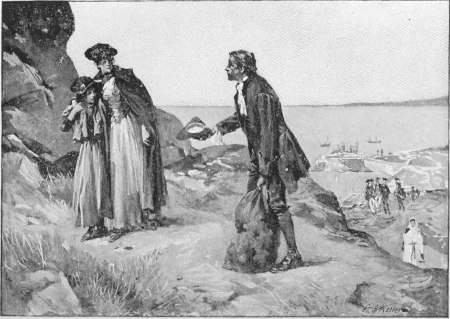
driven his new-found friends. He remained until it was time for Captain
Curtis to return to his ship, and after a cordial invitation from Mrs.
Curtis to visit them often, and an affectionate good-night from Dolly,
Archy returned to his quarters at the hospital.
He lay awake that night, troubled by what Captain Curtis had told him;
but in the morning his irrepressible spirits reasserted themselves, and
he began to think that, after all, he might get away.
That day Langton was much better in health, but low in his mind over the
departure of the fleet, and Archy very indiscreetly let out Captain
Curtis's opinion as to the length of the siege.
"Then we shall lose Gibraltar, I am afraid," said Langton, sadly.
"What are you talking about?" cried Archy. "It takes a lot of beating to
whip an Englishman—we know it to our sorrow. But, nevertheless, we
will soon chase all of your beggarly redcoats out of America; then you
can turn your whole attention to the Don Spaniards; and then—Lord help
'em! And you will be going back to England and be adopted by Lord
Bellingham in lieu of me, while I shall be captain of a smart little
frigate under the American colors, and I'll call and see you at
Bellingham Castle. Oh, great guns, what fun I'll have! You ought to know
your venerable grandfather, my boy; you'll often wish, when you are
rolling in splendor at Bellingham, that you were at Gibraltar living on
rice and salt fish. Uncle Baskerville is a trump—as fine an old chap
as I know, if he would but leave off his sermons to me about returning
to my allegiance to my king and country, and taking my place as the
prospective heir and head of the Baskerville family. But our
grandfather—oh, ye gods!"
Langton laughed feebly at this, and Archy, hauling a letter out of his
pocket, said, "Here is a copy of the letter I sent by the fleet, and I
shall send this copy by the first expedition to the African coast, in
hopes that in one way or the other it may reach Bellingham Castle. This
is to my grandfather." And Archy read with a great flourish:
"'Honored Sir,—I take the first opportunity of communicating with
you and my uncle, after my singular disappearance from York, at the
Assizes. The story of my adventures is briefly this: A press was
organized at York, and I, happening to be in the tavern when it
took place, got my head cracked, and knew no more until I found
myself aboard of His Majesty's ship of the line Royal George, in
Biscay Bay, bound for Gibraltar, in Rodney's fleet, with a convoy
for the relief of the garrison. And here I am, sir, on Gibraltar
Rock, preferring to take my chances of getting to France from here
than with the fleet, which goes to the Leeward Islands. This place
has been hotly besieged, and some think we have not seen the worst
of it yet; but my expectation is that Great Britain will shortly
abandon her hopeless attempt to coerce the independent American
colonies—'
"The footstool will fly, and everything else handy, when the old
gentleman reads this paragraph," interrupted Archy in his reading.
—"'and then the fortress will be relieved. But no one dreams of
surrender, and all reports of that kind reaching England must be
discredited.
"'You perhaps know by this time, from the Gazette, that your
grandson, Trevor Langton, Esq., was saved, and not lost, at the
wreck of the Seahorse, and behaved with the greatest gallantry in
the action of the 16th of January with Admiral Juan de Langara's
fleet. An old wound, reopened, has given him great pain, and he was
in grave danger for a while, but is now convalescing. Being unable
to sail with the fleet, he is now here in hospital, and there is no
immediate prospect of his getting away. We are better friends than
ever since finding out our relationship, and he is so fine a young
gentleman, and so good an officer, that I think you could not do
better than to make him your heir in lieu of my unworthy self.'
"My boy, I am afraid I have murdered all your chances by that sentence,
for our respected grandfather goes by the rule of contrary.
"'Please present my uncle with my most respectful compliments, and
assure him of my warmest affection. I shall endeavor to remember
and profit by all his kind counsels except one—to abandon my
country; but I was born an American and I mean to die one.'"
"You could not help putting that in, could you?" languidly remarked
Langton. "You are a great fellow for proclaiming what everybody knows,
and thereby showing yourself very, very young."
"And you are so prudent and oyster-like that you appear very, very old,"
retorted Archy, good-naturedly, "but not so very, very wise. However,
see how respectfully I end my letter:
"'With sincere good wishes for your lordship's health and
happiness, and high appreciation of your lordship's extreme
kindness to me, I beg leave to subscribe myself your lordship's
affectionate grandson and obedient servant,
"'Archibald Baskerville,
"'Midshipman in the Continental Navy.'"
The cannonade from the Spanish lines had been booming all the time Archy
and Langton were talking, but it sounded strangely near just then; and
when Archy went to the window and looked towards the isthmus he saw that
a new battery had been unmasked in the advanced lines of the Spaniards.
Suddenly a deafening crash resounded behind him. A round shot had burst
through the wall, and, amid the débris, lay the cot on which Langton was
lying. He was unhurt, but Archy said:
"Come, it is too hot here for us. I must get help and carry you up to
the hut in the rocks." And in an hour Langton lay under the rude but
safe shelter provided for him under the rocks at Europa Point.
For the first week or two Archy was taken up with caring for Langton,
and trying to make their cranny in the rocks comfortable. In this effort
he met with the greatest kindness from Mrs. Curtis; and the deftness
with which, out of their few belongings, she made them really a
tolerably comfortable place to live, caused Archy to exclaim with
enthusiasm:
"I have always heard, ma'am, that one woman could do as much as twelve
men and a boy; and now I know it!"
Judkins's help was by no means to be despised, however, and with the
resources of an old campaigner he showed them marvels. Archy was eager
to begin the effort for his exchange immediately, but the garrison knew
that Don Martin, the Spanish Commander-in-Chief, after the departure of
the British fleet, had gone away for a few weeks to recover his health,
and both Captain Curtis and General Eliot, to whom Captain Curtis
introduced Archy, advised him to wait until Don Martin's return, as the
second in command would probably do nothing in his absence. Archy
acquiesced in this, and settled himself to spend the intervening time as
patiently as he could. He was courteously, and even kindly, treated by
everybody, and with his gay and jovial nature he soon became
hail-fellow-well-met with the whole garrison and population, with one
exception. This was the officers of the Hanoverian regiment, for King
George had let some of his German troops for hire to fight the Spanish,
as he had hired Hessians to fight the Americans. Archy found that the
English officers and soldiers had but little more liking for the
Hanoverians than he had, although it could not be denied that the
Germans did their duty, and suffered and fought along with the rest.
Archy took a malicious delight in telling how, in America, the Hessians
were chiefly good for eating up the provender, and when there was
fighting for dinner these prudent Teutons usually retired, and left the
British to settle with the Americans. Archy, boy-like, although he had
the stature of a man, avoided the Hanoverian officers ostentatiously,
mimicked their droll accent whenever he had a chance, and took a vast
amount of trouble to let them know how lightly he esteemed them—of
which the stolid Germans were generally unconscious, and to which they
were always indifferent.
The bombardment kept up steadily, but the loss of life was singularly
small. The people grew accustomed to it in the day, but those who had
fled southward in the beginning, to temporary shelter, were still
alarmed by it during the night, and so remained in their miserable huts.
As the case always is, after the first horror people began to see the
amusing side of even very dreadful events, and it became a relief to
laugh at the grotesque things that happened.
One evening, in the spring, about twilight, Archy Baskerville and
Captain Curtis were walking soberly through one of the narrow streets of
the upper town, passing the barracks of Colonel Schlippersgill's
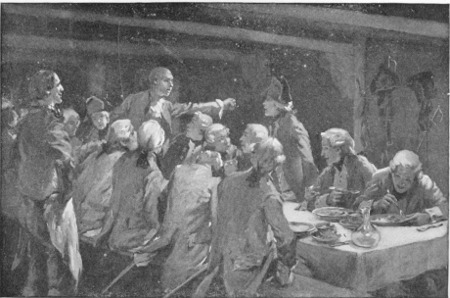
Hanoverian regiment. The windows of a small room, used as a mess-hall,
were open, and around the table in the middle of the floor they could
see a dozen burly German officers wreathed in smoke from their long
pipes, and with great mugs of beer before them—for a supply of beer had
been laid in especially for them.
"Look at them," said Archy, in a tone of deep disgust, "smoking and
guzzling—guzzling and smoking—nothing but that."
"Nonsense," replied Captain Curtis, briskly. "Those poor Hanoverians can
do nothing to please you. Their smoking is harmless, and their guzzling
is of beer, which is much better for them than the rum and grog we give
our men."
Just then they noticed, in the soft dusk of evening, a two-legged black
shadow moving around the parapet of the long, low building in which was
the mess-hall.
"It is a peacock," said Archy, after watching this mysterious creature
for a while, "and a big one, too. Where do you suppose such a creature
could come from?"
"It is some one's pet peacock, no doubt," was Captain Curtis's reply, in
a low voice—"some one who has managed to conceal it all this time." For
animal pets had disappeared long before this, and had, generally
speaking, been made into broth.
The peacock tiptoed gingerly along the ledge, and then, going towards
the centre of the roof, peered curiously down a small skylight that had
been left open in the mess-room for the benefit of the air.
"The peacock knows where to go for company," whispered Archy. "I always
thought those German officers, with their everlasting strut, first
cousin to the peacock family."
The peacock, as if satisfied with his view, came back to the parapet,
and then a voice was heard in an eager whisper from the street, saying,
in Italian:
"Pippo! my Pippo! Come back to me. Come back to me, Pippo. Ungrateful
bird! For you I have nearly starved myself, and have remained in my
cellar when I might have been safe elsewhere. Dear Pippo, come back!"
A dark spot against the wall, under the window, resolved itself into the
figure of an old Genoese woman, well known as Mother Nina, whose pet the
peacock had been for many years, and who had miraculously kept the bird
out of sight for months.
Pippo seemed totally disinclined to accept this cordial invitation to
return to his foster-mother, and showed his indifference by again
tipping cautiously towards the open skylight. Archy, however, felt sorry
for the poor old woman crouching under the window, and, seeing a
trellis-work covered with vines by the side of the building, he quickly
swung himself up on the roof, and moved softly towards the peacock,
which seemed absorbed in contemplation of Colonel Schlippersgill and his
companions under the skylight. Some words now floated up from the deep,
guttural German throats. Archy did not understand German, but presently
Colonel Schlippersgill himself spoke in English:
"Eef it were not for dose damned golonies in Ameriga, der blace would
haf been reliefed long ago. I would be glad der see der defel himself
eef he would shtop der bang, bang—"
That allusion to "damned golonies" was too much for Archy's temper. He
seized the huge old peacock by the legs, and, giving it a vicious swing,
which brought a frantic and ear-piercing squawk from the creature and an
agonized shriek from the old woman, dashed the bird down the skylight
into the laps of the German officers; and, at the same moment, the last
shell of the day's bombardment struck a corner of the building with a
loud explosion, hurling the old woman through the open window, where her
yells, the peacock's screams, and the violence of the explosion made
Bedlam. The uproar raised the whole street, and a crowd collected as if
by magic. The German officers, wildly excited, rushed about bawling in
German and English, while the old woman and the peacock maintained a
duet of screams that could be heard half a mile.
Meanwhile Archy, as innocent as a lamb, was at Captain Curtis's side,
who, leaning up against the wall, added his robust haw-haws to the
general commotion.
In the midst of the racket and confusion, Colonel Schlippersgill rushed
to the door, and, raising his hand for silence, bellowed out:
"Mine friends, 'twas der peacock."
At this a clear, boyish voice on the edge of the crowd rang out:
"The peacock was looking for company." The people roared with laughter,
except the German officers, while Colonel Schlippersgill shouted,
angrily:
"Arrest dot man!"
To this the voice replied:
"You'd better arrest the peacock."
Another roar saluted this, but the old Genoese woman, supposing the
peacock was about to be taken from her, began to screech:
"Arrest my Pippo! Pippo mio—" and then poured out, at the top of her
lungs, in English and Italian, the story of Pippo, varied with calling
down maledictions on the head of Colonel Schlippersgill, whom, in some
way, she held accountable for Pippo's misfortunes. She was interrupted
by a file of soldiers marching down the narrow street in double time,
with orders to investigate the disturbance. It did not take them half a
minute to arrest the old woman and catch the peacock. Colonel
Schlippersgill and his officers, swelling with rage, accompanied them
voluntarily to the Provost Marshal's office. Captain Curtis and Archy
followed, and the procession took its way towards headquarters. General
Eliot happened to be there when the party appeared, and the
investigation began. Colonel Schlippersgill and the old woman began
their respective stories in English, but it soon resolved itself into a
verbal duel in which the Colonel took to his native German and the old
woman to her native Italian, with the result that even General Eliot's
stern face resolved itself into a smile, the auditors were convulsed,
and the soldier who held the peacock by the legs inadvertently let it
go. When Pippo flew out of the window the old woman flew out of the door
after it, and the investigation turned into a roaring farce, except so
far as Colonel Schlippersgill was concerned, who went off swearing that
he "would be damned but dat rapscallion dot galled der Cherman officers
a beacock shouldt be arrested." The culprit, meanwhile, took his way
gleefully up to Europa Point with Captain Curtis, and told the story in
whispers to Mrs. Curtis and Langton. Judkins, who was cooking supper
over a meagre fire, managed to catch it, and for once his hard features
relaxed into a grin. After the scanty supper was over, when Archy, with
a look of seraphic innocence was walking out of the hut, Judkins caught
his eye, and, touching his cap, said, in a grim whisper:
"Sarved them Dutchmen right, sir."