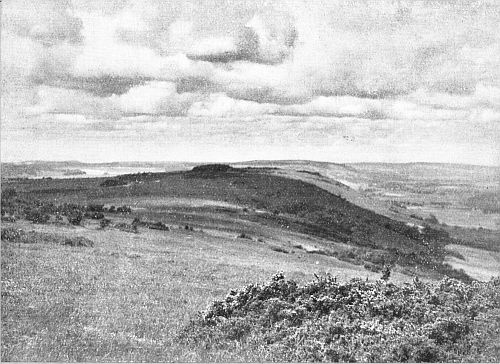
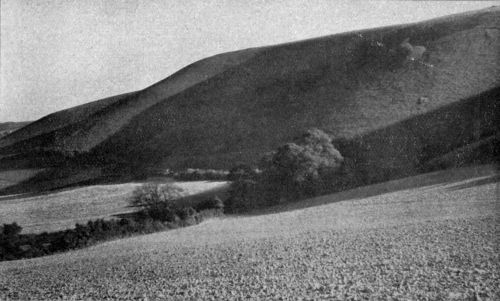
Rolling stretches of cloud-shadowed down |
Frontispiece |
| |
TO FACE PAGE |
The white winding road |
2 |
The solitary cottage |
6 |
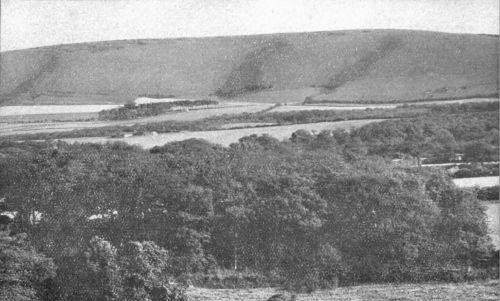
The little church at the foot of the grey-green down |
8 |
My niche under the stunted hawthorn |
10 |
Æolus shepherding his white sheep |
12 |
A little lonely cottage whose windows peered and blinked under overhanging brows of thatch |
26 |
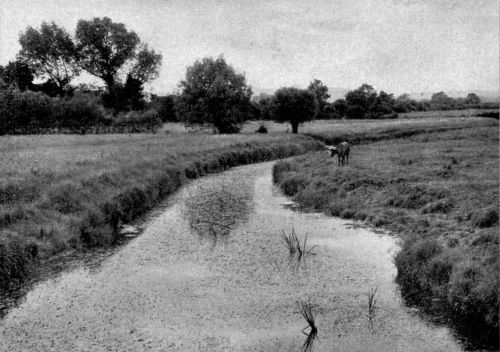
The reeded waters of the sequestered pool |
32 |
The monastery where the Bedesmen of St Hugh watch and pray |
34 |
The sun stretched the long shadows in slanting bars across the white highway |
38 |
The great wheel was at rest |
40 |
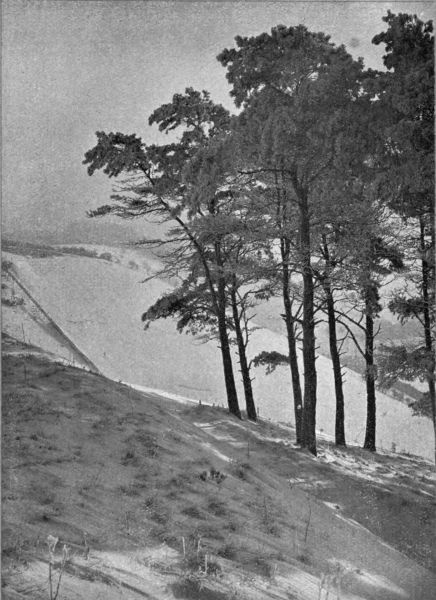
The crisp rime of winter's breath |
48 |
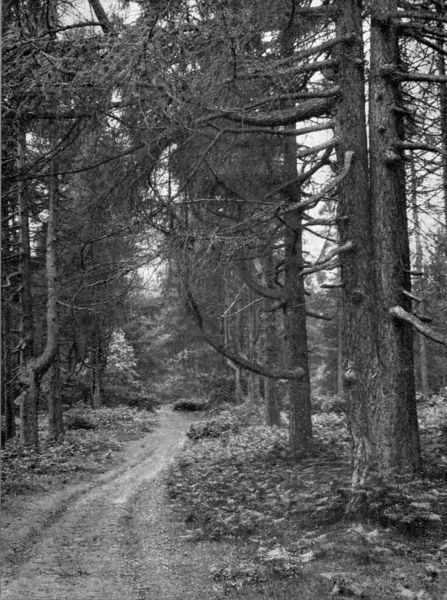
The aloneness of a great forest |
50 |
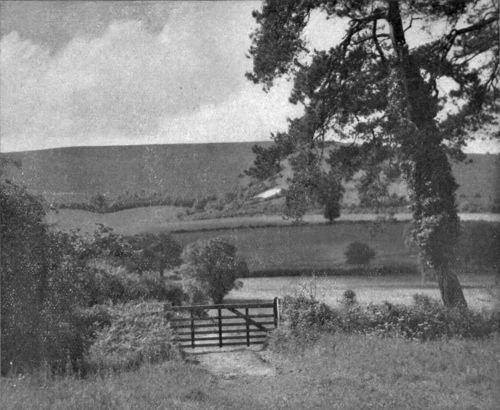
The field-gate that leads to the lower meadows |
72 |
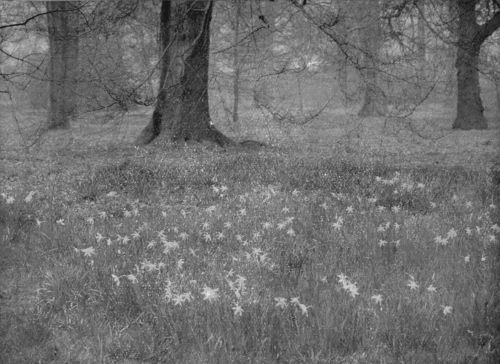
A host of joyous yellow trumpeters |
74 |
In the distance rise the great lone heavenward hills |
84 |
The line of the untroubled hills strong and still in the broad sunshine |
94 |
Below the low hedge lies pasture bright with buttercups, where the cattle feed |
100 |
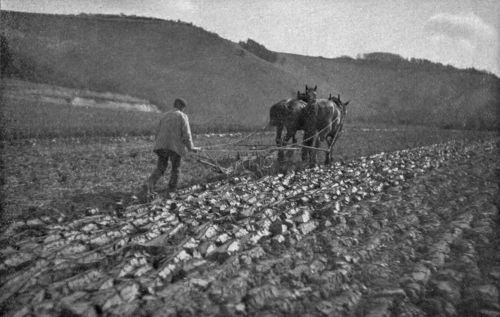
The great horses moving in slow steady pace as the farmer turns his furrow |
102 |
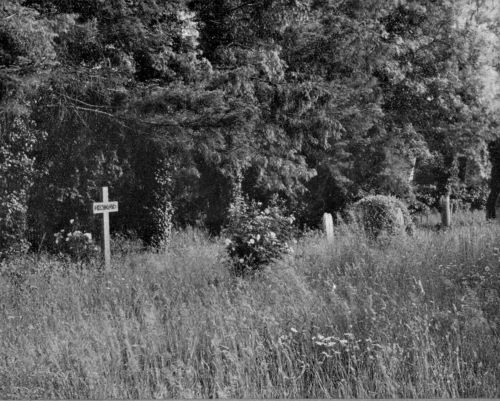
There is a place waiting for me under the firs in the quiet churchyard |
104 |
THE ROADMENDER
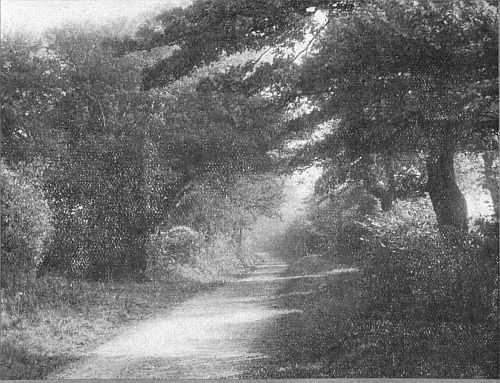
The white winding road
I have attained my ideal: I am a roadmender, some
say stonebreaker. Both titles are correct, but the one
is more pregnant than the other. All day I sit by the
roadside on a stretch of grass under a high hedge of
saplings and a tangle of traveller's joy, woodbine,
sweetbriar, and late roses. Opposite me is a white
gate, seldom used, if one may judge from the trail of
honeysuckle growing tranquilly along it: I know now
that whenever and wherever I die my soul will pass
out through this white gate; and then, thank God, I
shall not have need to undo that trail.
In our youth we discussed our ideals freely: I
wonder how many beside myself have attained, or
would understand my attaining. After all, what do
we ask of life, here or indeed hereafter, but leave to
serve, to live, to commune with our fellow-men and
with ourselves; and from the lap of earth to look
up into the face of God? All these gifts are mine
as I sit by the winding white road and serve the footsteps
of my fellows. There is no room in my life for
avarice or anxiety; I who serve at the altar live of the
altar: I lack nothing but have nothing over; and
when the winter of life comes I shall join the company
of weary old men who sit on the sunny side of the
workhouse wall and wait for the tender mercies of
God.
Just now it is the summer of things; there is life
and music everywhere—in the stones themselves, and
I live to-day beating out the rhythmical hammer-song
of The Ring. There is real physical joy in the rise
and swing of the arm, in the jar of a fair stroke, the
split and scatter of the quartz: I am learning to be
ambidextrous, for why should Esau sell his birthright
when there is enough for both? Then the rest-hour
comes, bringing the luxurious ache of tired but not
weary limbs; and I lie outstretched and renew my
strength, sometimes with my face deep-nestled in the
cool green grass, sometimes on my back looking up into
the blue sky which no wise man would wish to fathom.
The birds have no fear of me; am I not also of the
brown brethren in my sober fustian livery? They
share my meals—at least the little dun-coated Franciscans
do; the blackbirds and thrushes care not a
whit for such simple food as crumbs, but with legs
well apart and claws tense with purchase they disinter
poor brother worm, having first mocked him with sound
of rain. The robin that lives by the gate regards my
heap of stones as subject to his special inspection.
He sits atop and practises the trill of his summer song
until it shrills above and through the metallic clang
of my strokes; and when I pause he cocks his tail, with
a humorous twinkle of his round eye which means—"What!
shirking, big brother?"—and I fall, ashamed,
to my mending of roads.
The other day, as I lay with my face in the grass,
I heard a gentle rustle, and raised my head to find
a hedge-snake watching me fearless, unwinking. I
stretched out my hand, picked it up unresisting, and
put it in my coat like the husbandman of old. Was
he so ill-rewarded, I wonder, with the kiss that reveals
secrets? My snake slept in peace while I hammered
away with an odd quickening of heart as I thought
how to me, as to Melampus, had come the messenger—had
come, but to ears deafened by centuries of
misrule, blindness, and oppression; so that, with all
my longing, I am shut out of the wondrous world
where walked Melampus and the Saint. To me there
is no suggestion of evil in the little silent creatures,
harmless, or deadly only with the Death which is
Life. The beasts who turn upon us, as a rule maul
and tear unreflectingly; with the snake there is the
swift, silent strike, the tiny, tiny wound, then sleep
and a forgetting.
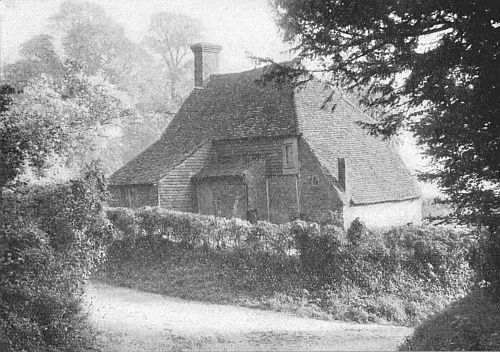
The solitary cottage
My brown friend, with its message unspoken, slid
away into the grass at sundown to tell its tale in unstopped
ears; and I, my task done, went home across
the fields to the solitary cottage where I lodge. It
is old and decrepit—two rooms, with a quasi-attic
over them reached by a ladder from the kitchen and
reached only by me. It is furnished with the luxuries
of life, a truckle bed, table, chair, and huge earthenware
pan which I fill from the ice-cold well at the back
of the cottage. Morning and night I serve with the
Gibeonites, their curse my blessing, as no doubt it
was theirs when their hearts were purged by service.
Morning and night I send down the moss-grown bucket
with its urgent message from a dry and dusty world;
the chain tightens through my hand as the liquid
treasure responds to the messenger, and then with
creak and jangle—the welcome of labouring earth—the
bucket slowly nears the top and disperses the
treasure in the waiting vessels. The Gibeonites were
servants in the house of God, ministers of the sacrament
of service even as the High Priest himself; and I,
sharing their high office of servitude, thank God that
the ground was accursed for my sake, for surely that
curse was the womb of all unborn blessing.
The old widow with whom I lodge has been deaf
for the last twenty years. She speaks in the strained
high voice which protests against her own infirmity, and
her eyes have the pathetic look of those who search in
silence. For many years she lived alone with her son,
who laboured on the farm two miles away. He met
his death rescuing a cart-horse from its burning stable;
and the farmer gave the cottage rent free and a weekly
half-crown for life to the poor old woman whose dearest
terror was the workhouse. With my shilling a week
rent, and sharing of supplies, we live in the lines of
comfort. Of death she has no fears, for in the long
chest in the kitchen lie a web of coarse white linen,
two pennies covered with the same to keep down tired
eyelids, decent white stockings, and a white cotton
sun-bonnet—a decorous death-suit truly—and enough
money in the little bag for self-respecting burial. The
farmer buried his servant handsomely—good man, he
knew the love of reticent grief for a 'kind' burial—and
one day Harry's mother is to lie beside him in the
little churchyard which has been a cornfield, and may
some day be one again.
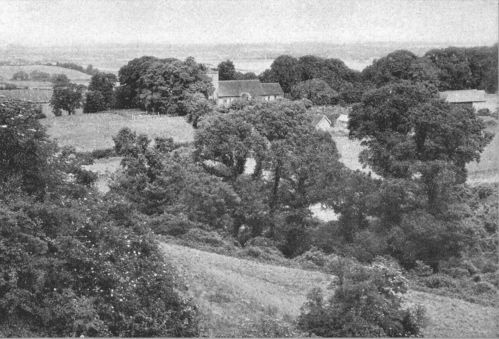
The little church at the foot of the grey-green down
On Sundays my feet take ever the same way. First
my temple service, and then five miles tramp over the
tender, dewy fields, with their ineffable earthly smell,
until I reach the little church at the foot of the grey-green
down. Here, every Sunday, a young priest from
a neighbouring village says Mass for the tiny hamlet,
where all are very old or very young—for the heyday
of life has no part under the long shadow of the hills,
but is away at sea or in service. There is a beautiful
seemliness in the extreme youth of the priest who
serves these aged children of God. He bends to communicate
them with the reverent tenderness of a son,
and reads with the careful intonation of far-seeing
love. To the old people he is the son of their old age,
God-sent to guide their tottering footsteps along the
highway of foolish wayfarers; and he, with his youth
and strength, wishes no better task. Service ended,
we greet each other friendly—for men should not be
strange in the acre of God; and I pass through the little
hamlet and out and up on the grey down beyond.
Here, at the last gate, I pause for breakfast; and then
up and on with quickening pulse, and evergreen memory
of the weary war-worn Greeks who broke rank to
greet the great blue Mother-way that led to home. I
stand on the summit hatless, the wind in my hair,
the smack of salt on my cheek, all round me rolling
stretches of cloud-shadowed down, no sound but the
shrill mourn of the peewit and the gathering of the
sea.
The hours pass, the shadows lengthen, the sheep-bells
clang; and I lie in my niche under the stunted
hawthorn watching the to and fro of the sea, and Æolus
shepherding his white sheep across the blue. I love
the sea with its impenetrable fathoms, its wash and
undertow, and rasp of shingle sucked anew. I love
it for its secret dead in the Caverns of Peace, of which
account must be given when the books are opened and
earth and heaven have fled away. Yet in my love
there is a paradox, for as I watch the restless, ineffective
waves I think of the measureless, reflective
depths of the still and silent Sea of Glass, of the dead,
small and great, rich or poor, with the works which
follow them, and of the Voice as the voice of many
waters, when the multitude of one mind rends heaven
with alleluia: and I lie so still that I almost feel the
kiss of White Peace on my mouth. Later still, when
the flare of the sinking sun has died away and the
stars rise out of a veil of purple cloud, I take my way
home, down the slopes, through the hamlet, and across
miles of sleeping fields over which night has thrown
her shifting web of mist—home to the little attic, the
deep, cool well, the kindly wrinkled face with its listening
eyes—peace in my heart and thankfulness for the
rhythm of the road.
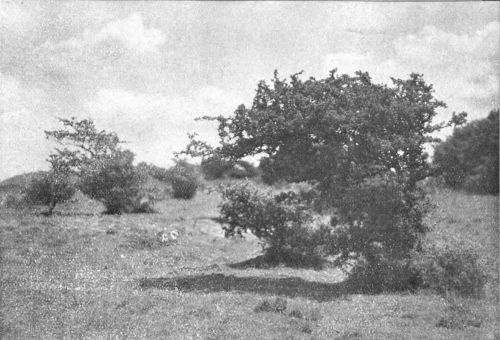
My niche under the stunted hawthorn
Monday brings the joy of work, second only to the
Sabbath of rest, and I settle to my heap by the white
gate. Soon I hear the distant stamp of horsehoofs,
heralding the grind and roll of the wheels which reaches
me later—a heavy flour-waggon with a team of four
great gentle horses, gay with brass trappings and scarlet
earcaps. On the top of the craftily piled sacks lies
the white-clad waggoner, a pink in his mouth which
he mumbles meditatively, and the reins looped over
the inactive whip—why should he drive a willing team
that knows the journey and responds as strenuously
to a cheery chirrup as to the well-directed lash? We
greet and pass the time of day, and as he mounts the
rise he calls back a warning of coming rain. I am
already white with dust as he with flour, sacramental
dust, the outward and visible sign of the stir and beat
of the heart of labouring life.
Next to pass down the road is an anxious ruffled
hen, her speckled breast astir with maternal troubles.
She walks delicately, lifting her feet high and glancing
furtively from side to side with comb low dressed.
The sight of man, the heartless egg-collector, from whose
haunts she has fled, wrings from her a startled cluck,
and she makes for the white gate, climbs through,
and disappears. I know her feelings too well to intrude.
Many times already has she hidden herself, amassed
four or five precious treasures, brooding over them
with anxious hope; and then, after a brief desertion
to seek the necessary food, she has returned to find
her efforts at concealment vain, her treasures gone.
At last, with the courage of despair she has resolved
to brave the terrors of the unknown and seek a haunt
beyond the tyranny of man. I will watch over her
from afar, and when her mother-hope is fulfilled I will
marshal her and her brood back to the farm where
she belongs; for what end I care not to think, it is of
the mystery which lies at the heart of things; and we
are all God's beasts, says St Augustine.
Here is my stone-song, a paraphrase of the Treasure
Motif.
[Transcriber's Note: You can play this music (MIDI file) by clicking here.]
What a wonderful work Wagner has done for
humanity in translating the toil of life into the readable
script of music! For those who seek the tale of
other worlds his magic is silent; but earth-travail
under his wand becomes instinct with rhythmic song
to an accompaniment of the elements, and the blare
and crash of the bottomless pit itself. The Pilgrims'
March is the sad sound of footsore men; the San Graal
the tremulous yearning of servitude for richer, deeper
bondage. The yellow, thirsty flames lick up the willing
sacrifice, the water wails the secret of the river and
the sea; the birds and beasts, the shepherd with his
pipe, the underground life in rocks and caverns, all
cry their message to this nineteenth-century toiling,
labouring world—and to me as I mend my road.
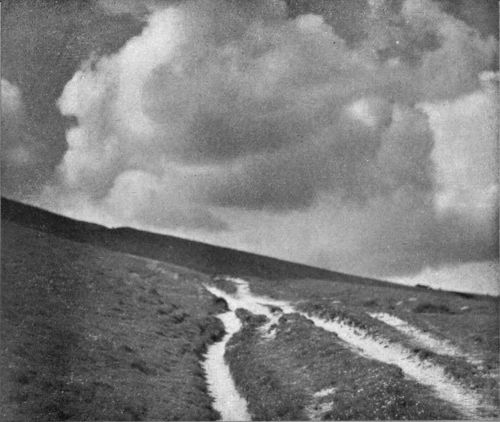
Æolus shepherding his white sheep
Two tramps come and fling themselves by me as I
eat my noonday meal. The one, red-eyed, furtive,
lies on his side with restless, clutching hands that tear
and twist and torture the living grass, while his lips
mutter incoherently. The other sits stooped, bare-footed,
legs wide apart, his face grey, almost as grey
as his stubbly beard; and it is not long since Death
looked him in the eyes. He tells me querulously of a
two hundred miles tramp since early spring, of search
for work, casual jobs with more kicks than halfpence,
and a brief but blissful sojourn in a hospital bed, from
which he was dismissed with sentence passed upon
him. For himself, he is determined to die on the road
under a hedge, where a man can see and breathe. His
anxiety is all for his fellow; he has said he will "do
for a man"; he wants to "swing," to get out of his
"dog's life." I watch him as he lies, this Ishmael
and would-be Lamech. Ignorance, hunger, terror, the
exhaustion of past generations, have done their work.
The man is mad, and would kill his fellow-man.
Presently we part, and the two go, dogged and footsore,
down the road which is to lead them into the
great silence.
Yesterday was a day of encounters.
First, early in the morning, a young girl came down
the road on a bicycle. Her dressguard was loose, and
she stopped to ask for a piece of string. When I had
tied it for her she looked at me, at my worn dusty
clothes and burnt face; and then she took a Niphetos
rose from her belt and laid it shyly in my dirty disfigured
palm. I bared my head, and stood hat in hand
looking after her as she rode away up the hill. Then
I took my treasure and put it in a nest of cool dewy
grass under the hedge. Ecce ancilla Domini.
My next visitor was a fellow-worker on his way to
a job at the cross-roads. He stood gazing meditatively
at my heap of stones.
"'Ow long 'ave yer bin at this job that y'ere in such
a hurry?"
I stayed my hammer to answer—"Four months."
"Seen better days?"
"Never," I said emphatically, and punctuated the
remark with a stone split neatly in four.
The man surveyed me in silence for a moment;
then he said slowly, "Mean ter say yer like crackin'
these blamed stones to fill 'oles some other fool's made?"
I nodded.
"Well, that beats everything. Now, I 'ave seen
better days; worked in a big brewery over near Maidstone—a
town that, and something doing; and now,
'ere I am, 'ammering me 'eart out on these blasted
stones for a bit o' bread and a pipe o' baccy once a
week—it ain't good enough." He pulled a blackened
clay from his pocket and began slowly filling it with
rank tobacco; then he lit it carefully behind his
battered hat, put the spent match back in his pocket,
rose to his feet, hitched his braces, and, with a silent
nod to me, went on to his job.
Why do we give these tired children, whose minds
move slowly, whose eyes are holden that they cannot
read the Book, whose hearts are full of sore resentment
against they know not what, such work as this to do—hammering
their hearts out for a bit of bread? All
the pathos of unreasoning labour rings in these few
words. We fit the collar on unwilling necks; and
when their service is over we bid them go out free;
but we break the good Mosaic law and send them away
empty. What wonder there is so little willing service,
so few ears ready to be thrust through against the
master's door.
The swift stride of civilisation is leaving behind
individual effort, and turning man into the Dæmon
of a machine. To and fro in front of the long loom,
lifting a lever at either end, paces he who once with
painstaking intelligence drove the shuttle. Then he
tasted the joy of completed work, that which his eye
had looked upon, and his hands had handled; now
his work is as little finished as the web of Penelope.
Once the reaper grasped the golden corn stems, and
with dexterous sweep of sickle set free the treasure of
the earth. Once the creatures of the field were known
to him, and his eye caught the flare of scarlet and blue
as the frail poppies and sturdy corn-cockles laid down
their beauty at his feet; now he sits serene on Juggernaut's
car, its guiding Dæmon, and the field is silent
to him.
As with the web and the grain so with the wood and
stone in the treasure-house of our needs. The ground
was accursed for our sake that in the sweat of our brow
we might eat bread. Now the many live in the brain-sweat
of the few; and it must be so, for as little as
great King Cnut could stay the sea until it had reached
the appointed place, so little can we raise a barrier to
the wave of progress, and say, "Thus far and no further
shalt thou come."
What then? Tins at least; if we live in an age of
mechanism let us see to it that we are a race of intelligent
mechanics; and if man is to be the Dæmon of a machine
let him know the setting of the knives, the rise of the
piston, the part that each wheel and rod plays in the
economy of the whole, the part that he himself plays,
co-operating with it. Then, when he has lived and
served intelligently, let us give him of our flocks and
of our floor that he may learn to rest in the lengthening
shadows until he is called to his work above.
So I sat, hammering out my thoughts, and with them
the conviction that stonebreaking should be allotted to
minor poets or vagrant children of nature like myself,
never to such tired folk as my poor mate at the cross-roads
and his fellows.
At noon, when I stopped for my meal, the sun was
baking the hard white road in a pitiless glare. Several
waggons and carts passed, the horses sweating and
straining, with drooping, fly-tormented ears. The men
for the most part nodded slumberously on the shaft,
seeking the little shelter the cart afforded; but one
shuffled in the white dust, with an occasional chirrup
and friendly pressure on the tired horse's neck.
Then an old woman and a small child appeared in
sight, both with enormous sun-bonnets and carrying
baskets. As they came up with me the woman stopped
and swept her face with her hand, while the child,
depositing the basket in the dust with great care, wiped
her little sticky fingers on her pinafore. Then the
shady hedge beckoned them and they came and sat
down near me. The woman looked about seventy, tall,
angular, dauntless, good for another ten years of hard
work. The little maid—her only grandchild, she told
me—was just four, her father away soldiering, and the
mother died in childbed, so for four years the child
had known no other guardian or playmate than the
old woman. She was not the least shy, but had the
strange self-possession which comes from associating
with one who has travelled far on life's journey.
"I couldn't leave her alone in the house," said her
grandmother, "and she wouldn't leave the kitten for
fear it should be lonesome"—with a humorous, tender
glance at the child—"but it's a long tramp in the heat
for the little one, and we've another mile to go."
"Will you let her bide here till you come back?"
I said. "She'll be all right by me."
The old lady hesitated.
"Will 'ee stay by him, dearie?" she said.
The small child nodded, drew from her miniature
pocket a piece of sweetstuff, extracted from the basket
a small black cat, and settled in for the afternoon.
Her grandmother rose, took her basket, and, with a nod
and "Thank 'ee kindly, mister," went off down the road.
I went back to my work a little depressed—why had
I not white hair?—for a few minutes had shown me
that I was not old enough for the child despite my forty
years. She was quite happy with the little black cat,
which lay in the small lap blinking its yellow eyes at
the sun; and presently an old man came by, lame and
bent, with gnarled twisted hands, leaning heavily on
his stick.
He greeted me in a high, piping voice, limped across
to the child, and sat down.
"Your little maid, mister?" he said.
I explained.
"Ah," he said, "I've left a little darlin' like this at
'ome. It's 'ard on us old folks when we're one too
many; but the little mouths must be filled, and my son,
'e said 'e didn't see they could keep me on the arf-crown,
with another child on the way; so I'm tramping
to N——, to the House; but it's a 'ard pinch, leavin'
the little ones."
I looked at him—a typical countryman, with white
hair, mild blue eyes, and a rosy, childish, unwrinkled
face.
"I'm eighty-four," he went on, "and terrible bad
with the rheumatics and my chest. Maybe it'll not be
long before the Lord remembers me."
The child crept close and put a sticky little hand
confidingly into the tired old palm. The two looked
strangely alike, for the world seems much the same to
those who leave it behind as to those who have but
taken the first step on its circular pathway.
"'Ook at my kitty," she said, pointing to the small
creature in her lap. Then, as the old man touched it
with trembling fingers she went on—"'Oo isn't my
grandad; he's away in the sky, but I'll kiss 'oo."
I worked on, hearing at intervals the old piping voice
and the child-treble, much of a note; and thinking of
the blessings vouchsafed to the simple old age which
crowns a harmless working-life spent in the fields.
The two under the hedge had everything in common
and were boundlessly content together, the sting of
the knowledge of good and evil past for the one, and
for the other still to come; while I stood on the battlefield
of the world, the flesh, and the devil, though,
thank God, with my face to the foe.
The old man sat resting: I had promised him a lift
with my friend the driver of the flour-cart, and he was
almost due when the child's grandmother came down
the road.
When she saw my other visitor she stood amazed.
"What, Richard Hunton, that worked with my old
man years ago up at Ditton, whatever are you doin'
all these miles from your own place?"
"Is it Eliza Jakes?"
He looked at her dazed, doubtful.
"An' who else should it be? Where's your memory
gone, Richard Hunton, and you not such a great age
either? Where are you stayin'?"
Shame overcame him; his lips trembled, his mild
blue eyes filled with tears. I told the tale as I had
heard it, and Mrs Jakes's indignation was good to see.
"Not keep you on 'alf a crown! Send you to the
House! May the Lord forgive them! You wouldn't
eat no more than a fair-sized cat, and not long for this
world either, that's plain to see. No, Richard Hunton,
you don't go to the House while I'm above ground;
it'd make my good man turn to think of it. You'll
come 'ome with me and the little 'un there. I've my
washin', and a bit put by for a rainy day, and a bed
to spare, and the Lord and the parson will see I don't
come to want."
She stopped breathless, her defensive motherhood in
arms.
The old man said quaveringly, in the pathetic,
grudging phrase of the poor, which veils their gratitude
while it testifies their independence, "Maybe I might
as well." He rose with difficulty, picked up his bundle
and stick, the small child replaced the kitten in its
basket, and thrust her hand in her new friend's.
"Then 'oo is grandad tum back," she said.
Mrs Jakes had been fumbling in her pocket, and
extracted a penny, which she pressed on me.
"It's little enough, mister," she said.
Then, as I tried to return it: "Nay, I've enough,
and yours is poor paid work."
I hope I shall always be able to keep that penny;
and as I watched the three going down the dusty white
road, with the child in the middle, I thanked God for
the Brotherhood of the Poor.
Yesterday a funeral passed, from the workhouse at
N——, a quaint sepulture without solemnities. The
rough, ungarnished coffin of stained deal lay bare and
unsightly on the floor of an old market-cart; a woman
sat beside, steadying it with her feet. The husband
drove; and the most depressed of the three was
the horse, a broken-kneed, flea-bitten grey. It was
pathetic, this bringing home in death of the old father
whom, while he lived, they had been too poor to house;
it was at no small sacrifice that they had spared him
that terror of old age, a pauper's grave, and brought
him to lie by his wife in our quiet churchyard. They
felt no emotion, this husband and wife, only a dull
sense of filial duty done, respectability preserved; and
above and through all, the bitter but necessary counting
the cost of this last bed.
It is strange how pagan many of us are in our
beliefs. True, the funeral libations have made way for
the comfortable bake-meats; still, to the large majority
Death is Pluto, king of the dark Unknown whence no
traveller returns, rather than Azrael, brother and friend,
lord of this mansion of life. Strange how men shun
him as he waits in the shadow, watching our puny
straining after immortality, sending his comrade sleep
to prepare us for himself. When the hour strikes he
comes—very gently, very tenderly, if we will but have
it so—folds the tired hands together, takes the wayworn
feet in his broad strong palm; and lifting us in
his wonderful arms he bears us swiftly down the valley
and across the waters of Remembrance.
Very pleasant art thou, O Brother Death, thy love
is wonderful, passing the love of women.
To-day I have lived in a whirl of dust. To-morrow
is the great annual Cattle Fair at E——, and through
the long hot hours the beasts from all the district
round have streamed in broken procession along my
road, to change hands or to die. Surely the lordship
over creation implies wise and gentle rule for intelligent
use, not the pursuit of a mere immediate end, without
any thought of community in the great sacrament of life.
For the most part mystery has ceased for this working
Western world, and with it reverence. Coventry
Patmore says: "God clothes Himself actually and
literally with His whole creation. Herbs take up and
assimilate minerals, beasts assimilate herbs, and God,
in the Incarnation and its proper Sacrament, assimilates
us, who, says St Augustine, 'are God's beasts.'" It
is man in his blind self-seeking who separates woof
from weft in the living garment of God, and loses the
more as he neglects the outward and visible signs of a
world-wide grace.
In olden days the herd led his flock, going first in
the post of danger to defend the creatures he had weaned
from their natural habits for his various uses. Now
that good relationship has ceased for us to exist, man
drives the beasts before him, means to his end, but
with no harmony between end and means. All day
long the droves of sheep pass me on their lame and
patient way, no longer freely and instinctively following
a protector and forerunner, but driven, impelled by
force and resistless will—the same will which once went
before without force. They are all trimmed as much
as possible to one pattern, and all make the same sad
plaint. It is a day on which to thank God for the
unknown tongue. The drover and his lad in dusty
blue coats plod along stolidly, deaf and blind to all but
the way before them; no longer wielding the crook,
instrument of deliverance, or at most of gentle compulsion,
but armed with a heavy stick and mechanically
dealing blows on the short thick fleeces; without evil
intent because without thought—it is the ritual of the
trade.
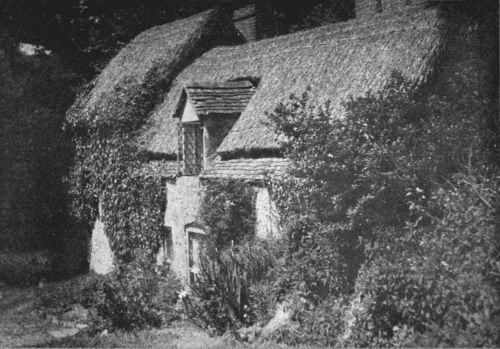
A little lonely cottage
Of all the poor dumb pilgrims of the road the bullocks
are the most terrible to see. They are not patient,
but go most unwillingly with lowered head and furtive
sideways motion, in their eyes a horror of great fear.
The sleek cattle, knee deep in pasture, massed at
the gate, and stared mild-eyed and with inquiring
bellow at the retreating drove; but these passed
without answer on to the Unknown, and for them it
spelt death.
Behind a squadron of sleek, well-fed cart-horses,
formed in fours, with straw braid in mane and tail,
came the ponies, for the most part a merry company.
Long strings of rusty, shaggy two-year-olds, unbroken,
unkempt, the short Down grass still sweet on their
tongues; full of fun, frolic, and wickedness, biting
and pulling, casting longing eyes at the hedgerows.
The boys appear to recognise them as kindred spirits,
and are curiously forbearing and patient. Soon both
ponies and boys vanish in a white whirl, and a long
line of carts, which had evidently waited for the dust
to subside, comes slowly up the incline. For the most
part they carry the pigs and fowls, carriage folk of the
road. The latter are hot, crowded, and dusty under
the open netting; the former for the most part cheerfully
remonstrative.
I drew a breath of relief as the noise of wheels died
away and my road sank into silence. The hedgerows
are no longer green but white and choked with dust,
a sight to move good sister Rain to welcome tears.
The birds seem to have fled before the noisy confusion.
I wonder whether my snake has seen and smiled at
the clumsy ruling of the lord he so little heeds? I
turned aside through the gate to plunge face and hands
into the cool of the sheltered grass that side the hedge,
and then rested my eyes on the stretch of green I had
lacked all day. The rabbits had apparently played
and browsed unmindful of the stir, and were still
flirting their white tails along the hedgerows; a lark
rose, another and another, and I went back to my
road. Peace still reigned, for the shadows were
lengthening, and there would be little more traffic
for the fair. I turned to my work, grateful for the
stillness, and saw on the white stretch of road a lone
old man and a pig. Surely I knew that tall figure
in the quaint grey smock, surely I knew the face,
furrowed like nature's face in springtime, and crowned
by a round, soft hat? And the pig, the black pig
walking decorously free? Ay, I knew them.
In the early spring I took a whole holiday and a
long tramp; and towards afternoon, tired and thirsty,
sought water at a little lonely cottage whose windows
peered and blinked under overhanging brows of thatch.
I had, not the water I asked for, but milk and a bowl
of sweet porridge for which I paid only thanks; and
stayed for a chat with my kindly hosts. They were
a quaint old couple of the kind rarely met with nowadays.
They enjoyed a little pension from the Squire
and a garden in which vegetables and flowers lived
side by side in friendliest fashion. Bees worked and
sang over the thyme and marjoram, blooming early
in a sunny nook; and in a homely sty lived a solemn
black pig, a pig with a history.
It was no common utilitarian pig, but the honoured
guest of the old couple, and it knew it. A year before,
their youngest and only surviving child, then a man
of five-and-twenty, had brought his mother the result
of his savings in the shape of a fine young pig: a
week later he lay dead of the typhoid that scourged
Maidstone. Hence the pig was sacred, cared for and
loved by this Darby and Joan.
"Ee be mos' like a child to me and the mother, an'
mos' as sensible as a Christian, ee be," the old man had
said; and I could hardly credit my eyes when I saw
the tall bent figure side by side with the black pig,
coming along my road on such a day.
I hailed the old man, and both turned aside; but
he gazed at me without remembrance.
I spoke of the pig and its history. He nodded
wearily. "Ay, ay, lad, you've got it; 'tis poor Dick's
pig right enow."
"But you're never going to take it to E——?"
"Ay, but I be, and comin' back alone, if the Lord
be marciful. The missus has been terrible bad this
two months and more; Squire's in foreign parts;
and food-stuffs such as the old woman wants is hard
buying for poor folks. The stocking's empty, now
'tis the pig must go, and I believe he'd be glad for
to do the missus a turn; she were terrible good to
him, were the missus, and fond, too. I dursn't tell
her he was to go; she'd sooner starve than lose poor
Dick's pig. Well, we'd best be movin'; 'tis a fairish
step."
The pig followed comprehending and docile, and as
the quaint couple passed from sight I thought I heard
Brother Death stir in the shadow. He is a strong
angel and of great pity.
There is always a little fire of wood on the open hearth
in the kitchen when I get home at night; the old
lady says it is "company" for her, and sits in the
lonely twilight, her knotted hands lying quiet on her
lap, her listening eyes fixed on the burning sticks.
I wonder sometimes whether she hears music in the
leap and lick of the fiery tongues, music such as he
of Bayreuth draws from the violins till the hot energy
of the fire spirit is on us, embodied in sound.
Surely she hears some voice, that lonely old woman
on whom is set the seal of great silence?
It is a great truth tenderly said that God builds
the nest for the blind bird; and may it not be that
He opens closed eyes and unstops deaf ears to sights
and sounds from which others by these very senses
are debarred?
Here the best of us see through a mist of tears men
as trees walking; it is only in the land which is very
far off and yet very near that we shall have fulness of
sight and see the King in His beauty; and I cannot
think that any listening ears listen in vain.
The coppice at our back is full of birds, for it is far
from the road and they nest there undisturbed year
after year. Through the still night I heard the
nightingales calling, calling, until I could bear it no
longer and went softly out into the luminous dark.
The little wood was manifold with sound, I heard
my little brothers who move by night rustling in grass
and tree. A hedgehog crossed my path with a dull
squeak, the bats shrilled high to the stars, a white
owl swept past me crying his hunting note, a beetle
boomed suddenly in my face; and above and through
it all the nightingales sang—and sang!
The night wind bent the listening trees, and the stars
yearned earthward to hear the song of deathless love.
Louder and louder the wonderful notes rose and fell
in a passion of melody; and then sank to rest on that
low thrilling call which it is said Death once heard,
and stayed his hand.
They will scarcely sing again this year, these nightingales,
for they are late on the wing as it is. It seems
as if on such nights they sang as the swan sings, knowing
it to be the last time—with the lavish note of one who
bids an eternal farewell.
At last there was silence. Sitting under the big
beech tree, the giant of the coppice, I rested my tired
self in the lap of mother earth, breathed of her breath
and listened to her voice in the quickening silence
until my flesh came again as the flesh of a little child,
for it is true recreation to sit at the foot-stool of
God wrapped in a fold of His living robe, the
while night smoothes our tired face with her healing
hands.
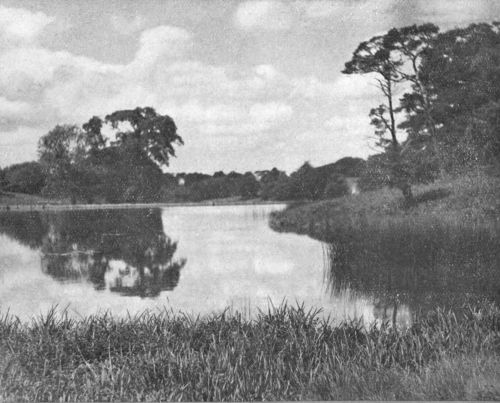
The reeded waters of the sequestered pool
The grey dawn awoke and stole with trailing robes
across earth's floor. At her footsteps the birds roused
from sleep and cried a greeting; the sky flushed and
paled conscious of coming splendour; and overhead
a file of swans passed with broad strong flight to the
reeded waters of the sequestered pool.
Another hour of silence while the light throbbed
and flamed in the east; then the larks rose harmonious
from a neighbouring field, the rabbits
scurried with ears alert to their morning meal, the
day had begun.
I passed through the coppice and out into the fields
beyond. The dew lay heavy on leaf and blade and
gossamer, a cool fresh wind swept clear over dale and
down from the sea, and the clover field rippled like a
silvery lake in the breeze.
There is something inexpressibly beautiful in the
unused day, something beautiful in the fact that it
is still untouched, unsoiled; and town and country
share alike in this loveliness. At half-past three on
a June morning even London has not assumed her
responsibilities, but smiles and glows lighthearted and
smokeless under the caresses of the morning sun.
Five o'clock. The bell rings out crisp and clear
from the monastery where the Bedesmen of St Hugh
watch and pray for the souls on this labouring forgetful
earth. Every hour the note of comfort and warning
cries across the land, tells the Sanctus, the Angelus,
and the Hours of the Passion, and calls to remembrance
and prayer.
When the wind is north, the sound carries as far
as my road, and companies me through the day; and
if to His dumb children God in His mercy reckons
work as prayer, most certainly those who have forged
through the ages an unbroken chain of supplication
and thanksgiving will be counted among the stalwart
labourers of the house of the Lord.
Sun and bell together are my only clock: it is time
for my water drawing; and gathering a pile of mushrooms,
children of the night, I hasten home.
The cottage is dear to me in its quaint untidiness
and want of rectitude, dear because we are to be its
last denizens, last of the long line of toilers who have
sweated and sown that others might reap, and have
passed away leaving no trace.
I once saw a tall cross in a seaboard churchyard,
inscribed, "To the memory of the unknown dead who
have perished in these waters." There might be
one in every village sleeping-place to the unhonoured
many who made fruitful the land with sweat and tears.
It is a consolation to think that when we look back
on this stretch of life's road from beyond the first
milestone, which, it is instructive to remember, is
always a grave, we may hope to see the work of this
world with open eyes, and to judge of it with a due sense
of proportion.
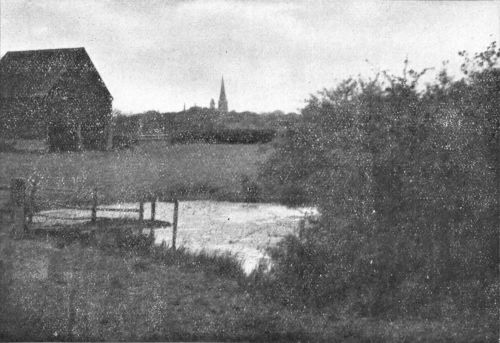
The monastery where the Bedesmen of St. Hugh watch and pray
A bee with laden honey-bag hummed and buzzed
in the hedge as I got ready for work, importuning the
flowers for that which he could not carry, and finally
giving up the attempt in despair fell asleep on a
buttercup, the best place for his weary little velvet
body. In five minutes—they may have been five
hours to him—he awoke a new bee, sensible and clear-sighted,
and flew blithely away to the hive with his
sufficiency—an example this weary world would be
wise to follow.
My road has been lonely to-day. A parson came
by in the afternoon, a stranger in the neighbourhood,
for he asked his way. He talked awhile, and with
kindly rebuke said it was sad to see a man of my
education brought so low, which shows how the outside
appearance may mislead the prejudiced observer.
"Was it misfortune?" "Nay, the best of good
luck," I answered, gaily.
The good man with beautiful readiness sat down
on a heap of stones and bade me say on. "Read me
a sermon in stone," he said, simply; and I stayed my
hand to read.
He listened with courteous intelligence.
"You hold a roadmender has a vocation?" he asked.
"As the monk or the artist, for, like both, he is
universal. The world is his home; he serves all
men alike, ay, and for him the beasts have equal honour
with the men. His soul is 'bound up in the bundle
of life' with all other souls, he sees his father, his
mother, his brethren in the children of the road. For
him there is nothing unclean, nothing common; the
very stones cry out that they serve."
Parson nodded his head.
"It is all true," he said; "beautifully true. But
need such a view of life necessitate the work of roadmending?
Surely all men should be roadmenders."
O wise parson, so to read the lesson of the road!
"It is true," I answered; "but some of us find
our salvation in the actual work, and earn our bread
better in this than in any other way. No man is
dependent on our earning, all men on our work. We
are 'rich beyond the dreams of avarice' because we
have all that we need, and yet we taste the life and
poverty of the very poor. We are, if you will, uncloistered
monks, preaching friars who speak not with
the tongue, disciples who hear the wise words of a
silent master."
"Robert Louis Stevenson was a roadmender,"
said the wise parson.
"Ay, and with more than his pen," I answered.
"I wonder was he ever so truly great, so entirely
the man we know and love, as when he inspired the
chiefs to make a highway in the wilderness. Surely
no more fitting monument could exist to his memory
than the Road of Gratitude, cut, laid, and kept by
the pure-blooded tribe kings of Samoa."
Parson nodded.
"He knew that the people who make no roads are
ruled out from intelligent participation in the world's
brotherhood." He filled his pipe, thinking the while,
then he held out his pouch to me.
"Try some of this baccy," he said; "Sherwood of
Magdalen sent it me from some outlandish place."
I accepted gratefully. It was such tobacco as falls
to the lot of few roadmenders.
He rose to go.
"I wish I could come and break stones," he said,
a little wistfully.
"Nay," said I, "few men have such weary roadmending
as yours, and perhaps you need my road less
than most men, and less than most parsons."
We shook hands, and he went down the road and
out of my life.
He little guessed that I knew Sherwood, ay, and knew
him too, for had not Sherwood told me of the man he
delighted to honour.
Ah, well! I am no Browning Junior, and Sherwood's
name is not Sherwood.
Awhile ago I took a holiday; mouched, played
truant from my road. Jem the waggoner hailed
me as he passed—he was going to the mill—would
I ride with him and come back atop of the full
sacks?
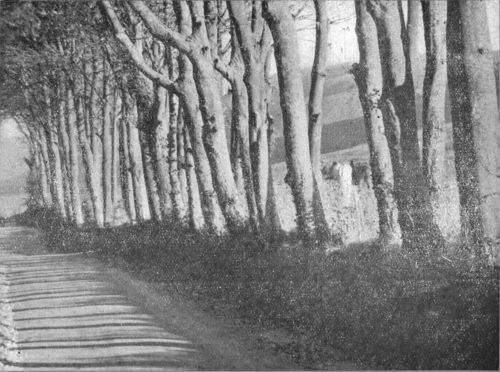
The sun stretched the long shadows in slanting bars across the white highway
I hid my hammer in the hedge, climbed into the
great waggon white and fragrant with the clean sweet
meal, and flung myself down on the empty flour bags.
The looped-back tarpaulin framed the long vista of
my road with the downs beyond; and I lay in the cool
dark, caressed by the fresh breeze in its thoroughfare,
soothed by the strong monotonous tramp of the great
grey team and the music of the jangling harness.
Jem walked at the leaders' heads; it is his rule
when the waggon is empty, a rule no "company"
will make him break. At first I regretted it, but soon
discovered I learnt to know him better so, as he plodded
along, his thickset figure slightly bent, his hands in
his pockets, his whip under one arm, whistling hymn
tunes in a low minor, while the great horses answered
to his voice without touch of lash or guiding rein.
I lay as in a blissful dream and watched my road
unfold. The sun set the pine-boles aflare where the
hedge is sparse, and stretched the long shadows of
the besom poplars in slanting bars across the white
highway; the roadside gardens smiled friendly with
their trim-cut laurels and rows of stately sunflowers—a
seemly proximity this, Daphne and Clytie, sisters
in experience, wrapped in the warm caress of the god
whose wooing they need no longer fear. Here and
there we passed little groups of women and children
off to work in the early cornfields, and Jem paused
in his fond repetition of "The Lord my pasture shall
prepare" to give them good-day.
It is like Life, this travelling backwards—that
which has been, alone visible—like Life, which is after
all, retrospective with a steady moving on into the
Unknown, Unseen, until Faith is lost in Sight and
experience is no longer the touchstone of humanity.
The face of the son of Adam is set on the road his
brothers have travelled, marking their landmarks,
tracing their journeyings; but with the eyes of a child
of God he looks forward, straining to catch a glimpse
of the jewelled walls of his future home, the city
"Eternal in the Heavens."
Presently we left my road for the deep shade of a
narrow country way where the great oaks and beeches
meet overhead and no hedge-clipper sets his hand
to stay nature's profusion; and so by pleasant lanes
scarce the waggon's width across, now shady, now
sunny, here bordered by thickset coverts, there giving
on fruitful fields, we came at length to the mill.
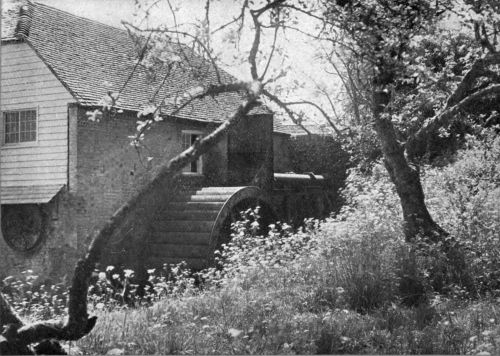
The great wheel was at rest
I left Jem to his business with the miller and wandered
down the flowery meadow to listen to the merry clack
of the stream and the voice of the waters on the weir.
The great wheel was at rest, as I love best to see it
in the later afternoon; the splash and churn of the
water belong rather to the morning hours. It is the
chief mistake we make in portioning out our day that
we banish rest to the night-time, which is for sleep and
recreating, instead of setting apart the later afternoon
and quiet twilight hours for the stretching of weary
limbs and repose of tired mind after a day's toil that
should begin and end at five.
The little stone bridge over the mill-stream is almost
on a level with the clear running water, and I lay there
and gazed at the huge wheel which, under multitudinous
forms and uses, is one of the world's wonders, because
one of the few things we imitative children have not
learnt from nature. Is it perchance a memory out of
that past when Adam walked clear-eyed in Paradise
and talked with the Lord in the cool of the day? Did
he see then the flaming wheels instinct with service,
wondrous messengers of the Most High vouchsafed
in vision to the later prophets?
Maybe he did, and going forth from before the
avenging sword of his own forging to the bitterness
of an accursed earth, took with him this bright memory
of perfect, ceaseless service, and so fashioned our
labouring wheel—pathetic link with the time of his
innocency. It is one of many unanswered questions,
good to ask because it has no answer, only the suggestion
of a train of thought: perhaps we are never so receptive
as when with folded hands we say simply, "This is
a great mystery." I watched and wondered until
Jem called, and I had to leave the rippling weir and
the water's side, and the wheel with its untold secret.
The miller's wife gave me tea and a crust of homemade
bread, and the miller's little maid sat on my knee
while I told the sad tale of a little pink cloud separated
from its parents and teazed and hunted by mischievous
little airs. To-morrow, if I mistake not, her garden
will be wet with its tears, and, let us hope, point a
moral; for the tale had its origin in a frenzied chicken
driven from the side of an anxious mother, and pursued
by a sturdy, relentless figure in a white sun-bonnet.
The little maid trotted off, greatly sobered, to look
somewhat prematurely for the cloud's tears; and I
climbed to my place at the top of the piled-up sacks,
and thence watched twilight pass to starlight through
my narrow peep, and, so watching, slept until Jem's
voice hailed me from Dreamland, and I went, only
half awake, across the dark fields home.
Autumn is here and it is already late. He has
painted the hedges russet and gold, scarlet and black,
and a tangle of grey; now he has damp brown leaves
in his hair and frost in his finger-tips.
It is a season of contrasts; at first all is stir and bustle,
the ingathering of man and beast; barn and rickyard
stand filled with golden treasure; at the farm the sound
of threshing; in wood and copse the squirrels busied
'twixt tree and storehouse, while the ripe nuts fall
with thud of thunder rain. When the harvesting
is over, the fruit gathered, the last rick thatched, there
comes a pause. Earth strips off her bright colours
and shows a bare and furrowed face; the dead leaves
fall gently and sadly through the calm, sweet air;
grey mists drape the fields and hedges. The migratory
birds have left, save a few late swallows; and as I
sit at work in the soft, still rain, I can hear the blackbird's
melancholy trill and the thin pipe of the redbreast's
winter song—the air is full of the sound of
farewell.
Forethought and preparation for the Future which
shall be; farewell, because of the Future which may
never be—for us; "Man, thou hast goods laid up
for many years, and it is well; but, remember, this
night thy soul may be required"; is the unvoiced
lesson of autumn. There is growing up among us a
great fear; it stares at us white, wide-eyed, from the
faces of men and women alike—the fear of pain, mental
and bodily pain. For the last twenty years we have
waged war with suffering—a noble war when fought in
the interest of the many, but fraught with great danger
to each individual man. It is the fear which should
not be, rather than the 'hope which is in us,' that
leads men in these days to drape Death in a flowery
mantle, to lay stress on the shortness of parting, the
speedy reunion, to postpone their good-byes until
the last moment, or avoid saying them altogether;
and this fear is a poor, ignoble thing, unworthy of those
who are as gods, knowing good and evil. We are still
paying the price of that knowledge; suffering in both
kinds is a substantial part of it, and brings its own
healing. Let us pay like men, our face to the open
heaven, neither whimpering like children in the dark,
nor lulled to unnecessary oblivion by some lethal
drug; for it is manly, not morbid, to dare to taste
the pungent savour of pain, the lingering sadness of
farewell which emphasises the aftermath of life; it
should have its place in all our preparation as a part
of our inheritance we dare not be without.
There is an old couple in our village who are past
work. The married daughter has made shift to take
her mother and the parish half-crown, but there is neither
room nor food for the father, and he must go to N——.
If husband and wife went together, they would be
separated at the workhouse door. The parting had to
come; it came yesterday. I saw them stumbling
lamely down the road on their last journey together,
walking side by side without touch or speech, seeing
and heeding nothing but a blank future. As they
passed me the old man said gruffly, "'Tis far eno';
better be gettin' back"; but the woman shook her
head, and they breasted the hill together. At the top
they paused, shook hands, and separated; one went
on, the other turned back; and as the old woman
limped blindly by I turned away, for there are sights
a man dare not look upon. She passed; and I heard
a child's shrill voice say, "I come to look for you,
gran"; and I thanked God that there need be no
utter loneliness in the world while it holds a little child.
Now it is my turn, and I must leave the wayside
to serve in the sheepfolds during the winter months.
It is scarcely a farewell, for my road is ubiquitous,
eternal; there are green ways in Paradise and golden
streets in the beautiful City of God. Nevertheless,
my heart is heavy; for, viewed by the light of the
waning year, roadmending seems a great and wonderful
work which I have poorly conceived of and meanly
performed: yet I have learnt to understand dimly
the truths of three great paradoxes—the blessing of
a curse, the voice of silence, the companionship of
solitude—and so take my leave of this stretch of road,
and of you who have fared along the white highway
through the medium of a printed page.
Farewell! It is a roadmender's word; I cry you
Godspeed to the next milestone—and beyond.