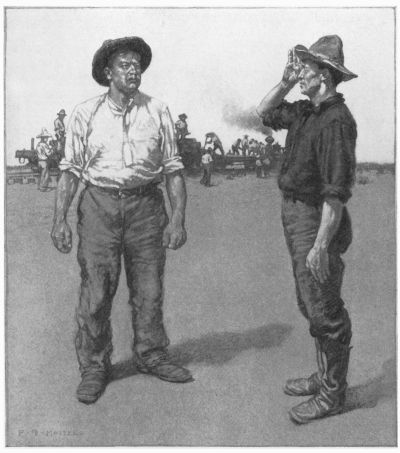
“How’s my pony?” said Young Van. “You haven’t told me.”
“I shot him.”
“Not yours too? Didn’t I see you riding Texas this morning? I—I’m a
little hazy about what I have and haven’t seen these days.”
“Yes; Texas pulled through. He’s hitched on just behind us.”
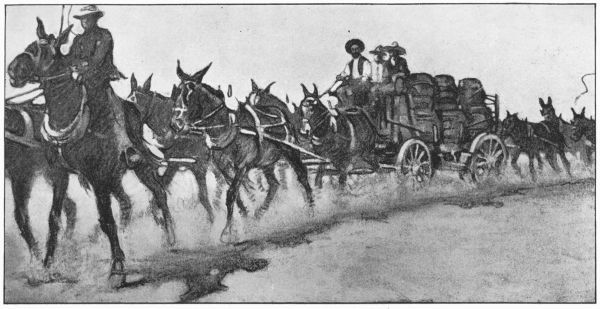
The wagon train, with every barrel full, was drawing slowly toward Mr.
Carhart’s camp. Young Van and Carhart were riding on the leading
wagon, and the former was gazing off dejectedly to the horizon, where
he could see a few moving black specks and the gray-yellow line of the
grade. “I don’t know what you’ll think of me, Mr. Carhart,” he said,
after a time. “I don’t seem to be good for much when it comes to real
work.”
“Better forget about it, Gus,” the chief replied. “I’m going to. This
isn’t railroad building.”
The long line of wagons wound into camp, and Carhart made it his first
business to get his assistant undressed and comfortably settled on his
cot. It would be a day or so before the young man would be able to
resume his work. Then Carhart stepped out, walked part way down the
knoll, and looked about him, and became conscious of an unusual stir
about the job. Peering out through dusty spectacles, he saw that a
party of strangers were coming up the slope toward him.
At the head walked Old Van, in boiled shirt and city clothes, with a
tall man in frock coat and top hat whom Carhart recognized as
Vice-president Chambers. After them came a party of ladies and one or
two young men to whom Tiffany was explaining the methods of
construction. It seemed that Mr. Chambers had thought it worth while
to adopt Tiffany’s suggestion that the vast quantities of dry bones in
the desert be gathered up and shipped eastward to be ground up into
fertilizer.
Carhart was presented to Mrs. Chambers and to the two Misses Chambers
and the other young women. He took them in with a glance, then looked
down over his own outrageously attired person and restrained a smile.
Tiffany was the one he wished to see, and he told him so with a barely
perceptible motion of the head.
Tiffany caught the signal, made his excuses, and walked off with this
dusty, inconspicuous man on whose shoulders rested the welfare of the
whole Sherman and Western system. He had observed that the young women
drew instinctively away from the dingy figure, and his smile was not
restrained. He was thinking of his first meeting with Paul Carhart, in
Chicago,—it was at the farewell dinner to the Dutch engineers,—and
of his distinguished appearance as he rose to speak, and of his
delightfully humorous enumeration of the qualities required in an
American engineer. Thinking of these things he almost spoke aloud:
“And they never knew the difference,—not a blessed one of ’em! Even
Mrs. Chambers don’t know a gentleman without he’s tagged. Ain’t it
funny!” And the chief engineer of the S. & W., being a blunt, and not
at all a subtle man, wisely gave up the eternal question.
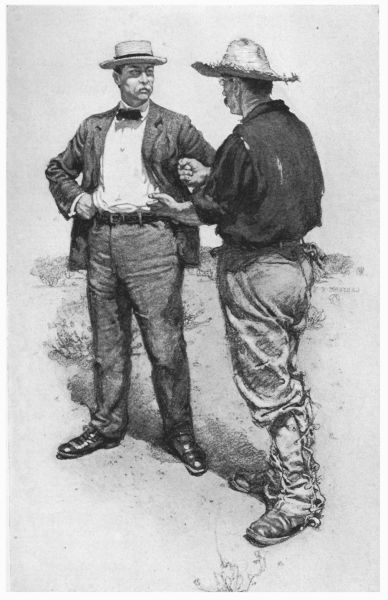
“Look here, Tiffany,” Carhart began, “something’s going to happen to
this man Peet.”
Tiffany plucked a straw from a convenient bale, and began meditatively
to chew it. “I haven’t got a word to say, Carhart. You’ve got a clear
case against us, and I guess I can’t object if you take it out of me.”
“No; I understand the thing pretty well, Tiffany. You’re doing what
you can, but Peet isn’t.”
“Are you sure about that?”
“Perfectly.”
“He’s having the devil’s own time himself, Carhart. The mills are
going back on us steady with the rails. They just naturally don’t ship
’em. I’m beginning to think they don’t want to ship ’em.”
Carhart stopped short, plunged in thought. “Maybe you’re right,” he
said after a moment. “I hadn’t thought of that before.”
“No, you oughtn’t to have to think of it. That’s our business, but
it’s been worrying us considerable. Then there’s the connections, too.
The rails have to come into Sherman by way of the Queen and
Cumberland,—a long way ‘round—”
“And the Queen and Cumberland has ‘Commodore Durfee’ written all over
it.”
“Yes, I guess it has.”
“And knowing that, you fellows have been sitting around waiting for
the Commodore to deliver your material. No, Tiffany, don’t tell me
that; I hate to think it of you.”
“I know we’re a pack of fools, Carhart, but—” the sentence died out.
“But what can we do, man? We can’t draw a new map of the United
States, can we? We’ve got our orders from the old man—!”
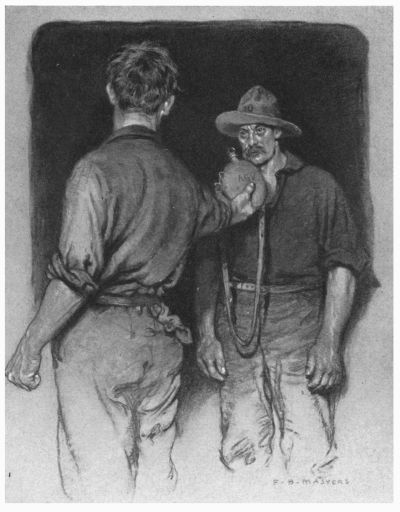
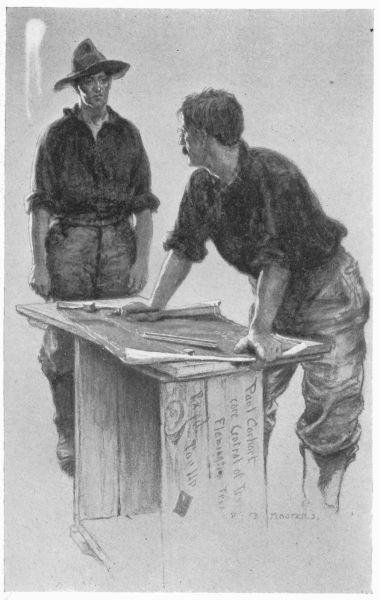
“‘Look here, Tiffany,’ Carhart began, ‘something’s going to happen to this man Peet.’”
“Could you have the stuff sent around by the Coast and Crescent, and
transferred over to Sherman by wagon?”
“Wait a minute; who owns the Coast and Crescent? Who’s got it all
buttoned up in his pants pocket?”
“Oh,” said Carhart. They stood for a little while, then sat down on a
pile of culls which had been brought up by the tie squad for
supporting tent floors. “It begins to occur to me,” Carhart went on,
“that we are working under the nerviest president that ever—But
perhaps he can’t help it. He’s fixed pretty much as Washington was in
the New Jersey campaign; he’s surrounded by the enemy and he’s got to
fight out.”
“That’s it, exactly,” cried Tiffany. “He’s got to cut his way out. He
ain’t a practical railroad man, and he’s just ordered us to do it for
him. Don’t you see our fix?”
“Yes,” Carhart mused, “I see well enough. Look here, Tiffany; how far
can I go in this business,—extra expenses, and that sort of things?”
Tiffany’s face became very expressive. “Well,” he said, “I guess if
you can beat the H. D. & W. to Red Hills there won’t be any questions
asked. If you can’t beat ’em, we’ll all catch hell. Why, what are you
thinking of doing?”
“Not a thing. My mind’s a blank.”
From Tiffany’s expression it was plain that he was uncertain whether
to believe this or not.
“It comes to about this,” Carhart went on. “It all rests on me, and if
I’m willing to run chances, I might as well run ’em.”
Tiffany’s eyes were searching the lean, spectacled face. “I guess it’s
for you to decide,” he replied. “I don’t know what else Mr. Chambers
was thinking of when he the same as told me to leave you be.”
“By the way, Tiffany,”—Carhart was going through his pockets,—“how
long is it since you people left Sherman?”
“More than a week. Mr. Chambers wanted some shooting on the way out.”
“Do you suppose he knows about this?” And Carhart produced the torn
sheet of the Pierrepont Enterprise.
Tiffany read the headlines, and slowly shook his head. “I’m sure he
don’t. There was no such story around Sherman when we left. But we
found a message waiting here to-day, asking Mr. Chambers to hurry
back; very likely it’s about this.”
“If it were true, if Commodore Durfee does own the line, what effect
would it have on my work here?”
“Not a bit! Not a d—n bit!” Tiffany’s big hand came down on his knee
with a bang. “This line belongs to Daniel De Reamer, and Old Durfee’s
thievery and low tricks and kept judges don’t go at Sherman, or here
neither. It’s jugglery, the whole business; there ain’t anything
honest about it.” Carhart looked away, and again restrained a smile;
he was thinking of where the money came from. “And I’ll tell you
this,” Tiffany concluded, “if anybody comes into my office and tries
to take possession for Old Durfee, I’ll say, ‘Hold on, my friend, who
signed that paper you’ve got there?’ And if I find it ain’t signed by
five judges—five, mind!—of the Supreme Court of the United States
sittin’ in Washington, I’ll say, ‘Get out of here!’ And if they won’t
get out, I’ll kick ’em out. And there’s five hundred men in Sherman, a
thousand men, who’ll help me to do it. If it’s court business, I guess
our judges are as good as theirs. And if it comes to shooting, by God
we’ll shoot!”
“I agree with you, on the whole,” said Carhart. “Mr. De Reamer and Mr.
Chambers have put me here to beat the H. D. & W. to Red Hills, and I’m
going to do it. But—”
“That’s the talk, man!”
“But let’s get back to Peet. He could help us a little if he felt like
it. You told me last month, Tiffany, that Peet had given you a list
of the numbers of all my supply cars, with an understanding that they
wouldn’t be used for anything else. Have you got that list with you?”
“No; it’s in my desk, at Sherman.”
“All right. I’ll call for it day after to-morrow.”
“At Sherman?”
“Yes. Peet isn’t sending those cars out here, and I’m going to find
out where he is sending them.”
“There’s one thing, Carhart,” said Tiffany, as they rose, “I’m sure
Peet don’t know how bad off you were for water. He was holding up the
trains for material.”
“He ought to understand, Tiffany. I wired him to send the water
anyway.”
“I know. But that would be wholesale murder. He didn’t realize—”
“I’m going to undertake the job of making him realize, Tiffany.”
The whistle of the vice-president’s special engine was tooting as they
started back. On the one hand, as far as human beings could be
distinguished with the naked eye, the groups and the long lines of
laborers were shuffling to and from their work on the grade; the
picked men of the iron squad, muscular, deep chested, were working
side by side with the Mexicans and the negroes, as also were the
spikers and strappers and the men of the tie squad. On the other hand,
the ladies of the vice-president’s party were picking their way
daintily back toward Mr. Chambers’s private car, where savory odors
and a white-clad chef awaited them.
Carhart had time only to wash his face and hands before rejoining the
party at the car steps. His clothing was downright disreputable, and
he wanted the physique, the height and breadth and muscle display,
which alone can give distinction to rough garments. Even his clean-cut
face and reserved, studious expression were not positive features, and
could hardly triumph over the obvious facts of his dress. Mrs.
Chambers and the young women again glanced toward him, and again they
had nothing to say to him. To the truth that this ugly, noisy scene
was a resolving dissonance in the harmony of things, that this rough
person in spectacles was heroically forging a link in the world’s
girdle, these women were blind. They had been curious to come; and now
that they were here and were conscious of the dirtiness and meanness
of the hundreds of men about them, now that the gray hopelessness of
the desert was getting on their nerves, they were eager to go back.
And so the bell rang, the driving-wheels spun around, slipping under
the coughing engine, the car began to rumble forward, the ladies
bowed, the vice-president, taking a last look at things from the rear
platform, nodded a good-by, and the incident was closed.
There were a number of things for Carhart to attend to after he had
eaten supper and dressed, and before he could get away,—some of which
will have to find a place in a later chapter,—and it was eleven
o’clock at night when he finally put aside his maps and reports. He
then wrote a note to Scribner, telling the engineer of the second
division that the last report of his pile inspector was not
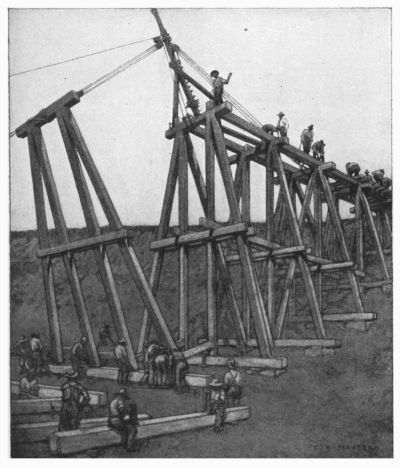
satisfactory,—the third bent in the trestle over Tiffany Hollow on
“mile fifty-two” showed insufficient resistance. He left for Young
Van’s attention a pile of letters with memoranda for the replies. He
sent for Old Van, and went over with him the condition of the work on
the first division. And finally he wrote the following letter to John
Flint:—
Dear John: I’m sending forward to-morrow the extra cable and
the wheelers you asked for. I have to run back to Sherman
to-night, possibly for a week or so, but there’ll be time
enough to look over your plans for cutting and filling on the
west bank when I get back. I haven’t figured it out yet, but
I’m inclined to agree with you that we can make more of a fill
there. But I’ll write you again about it.
Thanks to our friend Peet I nearly killed Texas on a ride for
water. Got to have another riding horse sent out here. My
assistant’s pony had to be shot—that little brown beauty I
pointed out to you the morning you started, with the white
star.
Yours,
P. C.
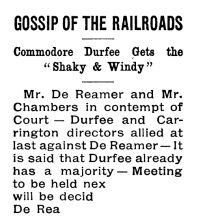
P. S. By the way, that Wall-street fight was only the opening
skirmish. The Commodore is raiding S. & W. for business. I
guess you know how he does these things. The Pierrepont
Enterprise says he has already got control of the board, so
it will probably be our turn next. If you haven’t plenty of
weapons, you’d better order what you need at Red Hills right
away. And don’t forget that you’re working for Daniel De
Reamer.
P. C.
He folded the letter, slipped it into an envelope, addressed it, and
then tipped back and ran his long fingers through his hair. He was
surprised to find that his forehead was beaded with sweat. “Lovely
climate, this,” he said to himself; adding after a moment, “Now what
have I forgotten?” For several minutes he balanced there, supporting
himself by resting the fingers of one hand against a tall case
labelled, “A B C Spool Cotton,” in the flat, glass-fronted drawers of
which he kept his maps and papers. Finally he muttered, “Well, if I
have forgotten anything, I’ve forgotten it for good,” and the front
legs of his chair came down, and he reached across the table for his
hat.
But instead of rising, he lingered, fingering the wide hat-brim. The
yellow lamplight fell gently on his face, now leaner than ever. “I
wonder what they think a man is made of,” thought he. “Nothing very
valuable, I guess, from what an engineer gets paid. I’m in the wrong
business. It’s my sort of man who does the work, and it’s the
speculators and that sort who get the money,—God help ’em!” Again he
made as if to rise, and again he paused. “Oh!” he said, “of course,
that was it.” He clapped his hat on the back of his head, reached out
for a letter which he had that evening written to Mrs. Carhart, opened
the envelope, and added these words:—
“Have Thomas Nelson plant the nasturtiums along the back fence.
There isn’t enough sunshine out in front for anything but the
honeysuckle and the Dutchman’s pipe. And he’d better screen the
fence with golden glow, set out pretty thick the whole way,
between the nasturtiums and the fence. The crab-apple tree will
be in the way, but it’s so near dead that he’d better cut it
down. I like your other arrangements first rate.”
This, and a few other east-bound letters, he put in his handbag. Then
he looked at his watch. “Hello!” said he, “it’s to-morrow morning.” He
pulled his hat forward, took up the lamp, and stepped out through the
tent opening, holding the lamp high and looking down, through the
night, toward the track.
The silence, in spite of a throbbing locomotive, or perhaps because of
it, was almost overwhelming. There was not a cloud in the sky; the
stars were twinkling down.
“How horribly patient it is,” he thought. “We’re slap bang up against
the Almighty.”
“Toot! Too-oo-oot!” came from the throbbing locomotive.
“All right, sir!” he muttered. “Be with you in a minute.”
He went back into the tent, put down the lamp, picked up his handbag,
took a last look around, and then blew out the lamp and set off down
the slope to the track.
The engineer was hanging out of his cab. “All ready, Mr. Carhart?”
“All ready, Bill.” The chief caught the hand-rail of his private
car, tossed his bag to the platform, and swung himself up after it.
“You was in something of a hurry, Mr. Carhart?”
“In a little of a hurry, yes, Bill.”
They started off, rocking and bumping over the new track, and Carhart
began stripping off his clothes. “It isn’t exactly like Mr.
Chambers’s,” he said, “but I guess I’ll be able to get in a little
sleep; that is, if Bill doesn’t smash me up, or jolt me to death.”
Three days later, at five o’clock in the afternoon, Carhart was
writing a letter in the office of the “Eagle House,” at Sherman.
Sitting in rows along three sides of the room was perhaps a score of
men, and in a corner by herself sat one young woman. The men were a
mixed assortment,—locomotive engineers, photographers, travelling
salesmen of tobacco, jewellery, shoes, clothing, and small cutlery,
not to speak of an itinerant dentist and a team of “champion banjo and
vocal artists.” As for the young woman, if you could have taken a peep
into the sample case at her feet, you would have learned that she was
prepared to disseminate a collection of literature which ranged from
standard sets of Dickens and Thackeray to a fat volume devoted to the
songs and scenes of Old Ireland, an illustrated life of the Pope, and
a work on the character and the splendid career of Porfirio Diaz.
Outside, at the window, stood or sat another score of men, each of
whom bore the unmistakable dress and manner of the day laborer. And
every pair of eyes, within and without the smoky room, was fixed on
the back of the man who was writing a letter at the table in the
corner.
But Carhart’s mind was wholly occupied with the work before him. He
was travel-stained,—it was not yet an hour since he had come in from
Crockett, the nearest division town on the H. D. & W.,—but there were
few signs of weariness on his face, and none at all in his eyes. “How
much had I better tell him?” he was asking himself. “I wonder what he
is up to, anyway? Possibly he has an interest in the lumber company,
or maybe Durfee’s men have bought him up.” For several minutes his pen
occupied itself with dotting out a design on the blotter; then
suddenly a twinkle came into his eyes, and he wrote rapidly as
follows:—
Dear Mr. Peet: I beg to enclose herewith a list of the cars
which were assigned to me at the beginning of the construction
work. I am sure you will agree with me that I can spare none of
these cars, least of all to supply a rival line. And in
consideration of your future hearty cooperation with me in
advancing this construction work, I will gladly take pains to
see that my present knowledge of the use that has been made of
these cars shall not interfere in any way with your continued
enjoyment of your position with the Sherman and Western.
Yours very truly,
P. Carhart.
He folded the letter, then opened it and read it over. “Yes,” he told
himself, “it’s better to write it. Seeing the thing before him in
black and white may have a stimulating effect.” He found in his pocket
the worn and thumbed list of cars, enclosed it in his letter,
addressed an envelope, and looked around. At once he was beset by the
agents and the applicants for work, but he shoved through to the
piazza, and called a boy.
“Here, son,” he said, “do you know Mr. Peet, of the railroad?”
The boy nodded.
“Take this letter to him. If he isn’t in his office, go to his house,
but don’t come back until you have found him.”
“Will there be any answer?”
“No—no answer. Don’t give the letter to anybody but Mr. Peet himself.
When you have done that, come to me and get a quarter.”
The boy started off, and Carhart reëntered the building, slipped past
the office door, and walked up two flights of stairs to his room.
“And now,” thought he, “I guess a bath will feel about as good as
anything.”
The Eagle House did not boast a bathroom, and so he set about the
business in the primitive fashion to which he had learned to adapt
himself. He dragged in from the hall a tin, high-backed tub, called
down the stairway to the proprietor’s wife for hot water, and,
undressing, piled his clothes on the one wooden chair in the room,
taking care that they touched neither floor nor wall. The hostess
knocked, and left a steaming pitcher outside the door. And soon the
chief engineer of the Red Hills extension of the Shaky and Windy was
splashing merrily.
The water proved so refreshing that he lingered in it, leaning
comfortably back and hanging his legs over the edge of the tub. And as
was always the case, when he had a respite from details, his mind
began roving over the broader problems of the work. “I’ve done a part
of it,” he said to himself, “but not enough. It won’t do any good to
have the cars if we haven’t the materials to put in ’em.” He had been
absently pursuing the soap around the bottom of the tub, had caught
it, and was now sloping his hands into the water, and letting the cake
slide back into its element.
There was a knock at the door. Carhart looked up with half a start.
“Well, what is it?”
“It’s me, sir,” came from the hall.
“Who’s me?”
“The boy that took your letter.”
“Well, what about it? There was no answer.”
“But there is an answer, Mr. Carhart. Mr. Peet came back with me.”
“What’s that?”
“He’s here—he came back with me. He’s waiting downstairs.”
Carhart hesitated. “Well—tell him that I’m very sorry, but I can’t
see him. I’m taking a bath.”
“All right,” said the boy; and Carhart heard him go off down the
stairs.
For some little time longer he sat in the tub. His mind slipped again
into the accustomed channel. “If it does come to warfare,” he was
thinking, “the first thing they’ll do will be to cut me off from my
base. They’d know that I shall be near enough to Red Hills to get food
through from there by wagon,—that’s what I should have to do,—but
there won’t be any rails coming from Red Hills. I’m afraid—very much
afraid—that Durfee has got us, cold. That’s the whole trick. If he’s
going to seize the S. & W., he’ll cut me off first thing. There’s five
to six hundred miles of track between the job and Sherman. It would
take an army to guard it. And that much done, he’d be in a position
to take his time about completing the H. D. & W. to Red Hills.”
And then suddenly he got out of the tub, snatched up a towel, and,
half dry, began hurriedly to draw on his clothes. A moment later a
thin, spectacled, collarless man darted out of a room on the third
floor of the Eagle House, looked quickly up and down the hall, ran
halfway down the stairs, and leaned over the balustrade.
“Boy,” he said.
“Yes, sir.”
“You didn’t get your quarter.” But it was a half dollar that he tossed
into the waiting hands. “Run after Mr. Peet and bring him back here.
Mind you catch him.”
The boy started to obey, but in a moment he was back and knocking at
Carhart’s door. “He’s down in the office now, Mr. Carhart. He didn’t
go at all.”
“He didn’t, eh?” The engineer was standing before the cracked mirror,
brushing his hair. “All right, I’ll be down in a minute. Hold on
there!” He stepped to the door. The first coin his fingers encountered
in his pocket was another half dollar. He took it out without glancing
at it and handed it to the now bewildered boy. Then he returned to the
mirror and brushed his hair again, and put on his collar and tie.
“I’ll have to thank Tiffany,” ran his thoughts. “It’s odd how that
car-stealing story has stuck in my head. I’m glad he told it.”
Peet’s expression was not what might be termed complacent. He was
standing on the piazza when he heard Carhart’s quick step on the
stairs. His teeth were closed tightly on a cigar, but he was not
smoking.
“How are you, Mr. Peet?” said the engineer. Peet looked nervously
about and behind him, and then faced around. “Look here, Mr. Carhart,
I want to tell you that you haven’t got that straight—”
“Where’s Tiffany?” said Carhart.
At this interruption Peet turned, if anything, a shade redder. “He’s
gone home.”
“Let’s find him. Would you mind walking over there?”
“Certainly not,” Peet replied; and for a moment they walked in
silence. Then the superintendent broke out again. “You didn’t
understand about those cars, Mr. Carhart. I know—the boys have told
me—that you’ve thought some hard things about me—” He paused:
perhaps he had better keep his mouth shut.
As for Carhart, he was striding easily along, the hint of a smile
playing about the corners of his mouth. “I think I understand the
situation pretty well, Peet,” he said. “I was a little stirred up when
my men began to go thirsty, but that’s all past, and I’m going to drop
it. I guess we both understand that this construction is the most
important thing Mr. De Reamer has on hand these days. And if we’re
going to carry him through, we’ll have to pull together.”
They found Tiffany, coat thrown aside, hat tipped back, weeding his
garden.
“Come in—glad to see you,” he said, only half concealing his
curiosity over the spectacle of Carhart and Peet walking together in
amity. “Didn’t succeed in getting back, eh, Carhart?”
“Not yet, Tiffany. I had to run up to Crockett.” He said this in an
offhand manner, and he did not look at Peet; but he knew from the
expression on Tiffany’s face that the superintendent was turning red
again.
“You ain’t had supper, have you?” said Tiffany. “You’re just in time
to eat with us.”
“Supper!” Carhart repeated the word in some surprise, then looked at
his watch.
“You hadn’t forgotten it, had you?” Tiffany grinned.
“To tell the truth, I had. May we really eat with you? It will save us
some time.”
“Can you? Well, I wonder! Come in.” And taking up his coat, Tiffany
led the way into the house.
More than once during that meal did Tiffany’s eyes flit from Peet’s
half-bewildered countenance to that of the quiet, good-natured
Carhart. He asked no questions, but he wondered. Once he thought that
Peet threw him an inquiring glance, but he could not be certain. After
supper, as he reached for the toothpicks and pushed back his chair, he
was tempted to come out with the question which was on his mind, “What
in the devil are you up to, Carhart?” But what he really said was,
“Help yourselves to the cigars, boys. They’re in that jar, there.”
And then, for a moment, both Peet and Tiffany sat back and watched
Carhart while he lighted his cigar, turned it over thoughtfully, shook
the match, and dropped it with a little sputter into his coffee cup.
Then the man who was building the Red Hills extension got, with some
deliberation, to his feet, and turned toward Tiffany. “Would it spoil
your smoke to take it while we walk?” he asked.
“Not at all,” replied the host. “Where are we going?”
“To the yards.”
Peet, for no reason whatever, went red again; and Tiffany, tipped back
in his chair and slowly puffing at his cigar, looked at him. Then he
too got up, and the three men left the house together. And during all
the walk out to the freight depot, Carhart talked about the new
saddle-horse he had bought at Crockett.
The freight yard at Sherman extended nearly a mile, beginning with the
siding by the depot and expanding farther on to the width of a dozen
tracks. Carhart came to a halt at the point where the tangle of
switches began, and looked about him. Everywhere he saw cars, some
laden, some empty. A fussy little engine was coughing down the track,
whistling angrily at a sow and her litter of spotted, muddy-yellow
pigs which had been sleeping in a row between the rails. From the
roundhouse, off to the left, arose the smoke of five or six resting
locomotives. Nearer at hand, seated in a row on the handle of the
turn-table, were as many black negroes, laughing and showing their
teeth and eyeballs, and discussing with much gesticulation and some
amiable heat the question of the day. Carhart’s sweeping glance took
in the scene, then his interest centred on the cars.
Peet fidgeted. “There ain’t any of your cars here, Mr. Carhart,” he
said uneasily.
Already Carhart knew better, but he was not here to squabble with
Peet. “How many have you here all together?” he asked; and after a
moment of rapid counting he answered his own question: “Something more
than a hundred, eh?”
“Yes, but—”
“Well, what?”
“Look here, Carhart, I don’t know what you’ve got in mind, but I can’t
let you have any of these cars.”
“You can’t?”
“Not possibly. Half of ’em are foreign as it is. I’m so short now I
don’t know what I’m going to do. Honest, I don’t.”
Carhart turned this answer over in his mind. After a moment he looked
up, first at Peet, then at Tiffany, as if he had something to say; but
whatever it may have been, he turned away without saying it.
“What is it, old man?” cried Tiffany, at last. “What can we do for
you, anyway?”
Still Carhart did not speak. His eyes again sought the long lines of
cars. Finally, resting one foot on a projecting cross-tie, he turned
to the superintendent. “Suppose you do this, Peet,” he said, speaking
slowly; “suppose you tell your yard-master that I am to be absolute
boss here until midnight. Then you go home and leave me here. Tiffany
could stay and help me out—this isn’t his department.”
This brought Peet close to the outer limit of bewilderment. “What
in—” he began; but Carhart, observing the effect of his request,
interrupted.
“I don’t believe Mr. Peet understands the situation very well,
Tiffany. Tell him where we stand—where Mr. De Reamer stands.” And
with this he walked off a little way.
Tiffany came to the point. To Peet’s question, “What is he talking
about, Tiffany?” the veteran replied: “He knows and I know, Lou, that
the only thing that will save the old man is a track to Red Hills. I
haven’t the slightest idea what Carhart’s up to, but I’ll tell you
this, I’ve seen him in one or two tight places, and I never saw him
look like this before. He’s got something he wants to do, and he’s
decided that it’s necessary, and it ain’t for you and me to stand in
his way. When you come to know Paul Carhart, you’ll learn that he
don’t do things careless. What do you suppose the Old Man meant when
he told you to back him up to the limit with cars and engines, and
told me to keep out of his way?”
Peet did not reply for a moment. He took off his hat and brushed back
the hair from a forehead that was moist with sweat. He looked from
one man to the other, and from both to the roundhouse, and the depot,
and the waiting cars. Finally he walked over toward Carhart. “Go
ahead,” he said queerly, “I’ll stay with you.”
“Good enough.” And with these two words Carhart wheeled around and
surveyed the nearest line of cars—box, flat, and gondola. “Most of
those are empty, aren’t they?” he asked.
“About half of them. But here’s Dougherty, the yard-master. Dougherty,
this is Mr. Carhart. You can take your orders from him to-night.”
Carhart extended his hand. “Glad to meet you, Mr. Dougherty. I’m
afraid we’ll all have to make a night of it. I want you to keep steam
up in three engines. And pick up all the men you can find and start
them unloading every car in the yard. Keep ’em jumping. I want to have
three empty trains at Paradise by midnight.”
“By mid—” Dougherty’s mouth opened a very little, and his eyes, after
taking in Paul Carhart’s face and figure, settled on the
superintendent.
But Peet, with an expressive movement of his hands, turned away; and
Tiffany, after a glance about the little group, went after him.
“Brace up, Lou,” said Tiffany, in a low voice; “brace up.”
Peet’s hands were deep in his pockets. His eyes were fixed on the
rails before him. “Dump all that freight on the ground!” he moaned.
“Look here, Tiffany, I suppose he knows what he’s doing, but—but
what’ll the traffic men say!”
“Never you mind the traffic men.”
“But—dump all that freight out here on the ground!”
Tiffany passed an unsteady hand across his eyes. If Peet had looked at
him, he would not have felt reassured; but he did not look up.
Dougherty, with a gulp, obeyed Carhart. And half an hour later the
chance observers and the yard loafers were rubbing their eyes.
Laborers were busy from one end of the yard to the other, throwing out
boxes and bales and crates, and piling them haphazard between the
tracks. The tired, wheezy switch engine, enveloped in a cloud of its
own steam, was laboriously making up the first train. And moving
quietly about, issuing orders and giving a hand here and there,
followed by the disturbed eyes of the general superintendent and the
chief engineer of the Shaky and Windy, Paul Carhart was bossing the
work. Once he stepped over to the two men of the disturbed eyes, a
thoughtful expression on his own face. “Say, Tiffany,” he asked, “how
much business does the Paradise Southern do?”
Tiffany started, and looked keenly at Carhart. There was a faint
glimmer in his eyes, but this was followed immediately by uncertainty.
“None,” he replied; “that is, none to speak of. They run a combination
car each way every day—two cars when business is brisk. The Old Man
would have abandoned it years ago if it hadn’t been for the stock
scheme I told you about.”
“Yes,” mused Carhart, “that’s what I understood. But if it’s such a
mistake, why was it built in the first place?”
“Oh, they were going to run it through to Bonavita on the Emerald
River, but the B. & G. got all there was of that business first, and
so the P. S. never got beyond Total Wreck. Mr. De Reamer never built
it. The old Shipleigh crowd did that before Mr. De Reamer bought up
this property.” The faint glimmer had returned to Tiffany’s eyes; he
was searching Carhart’s face. “You want these trains sent on through
to your camp, don’t you?” he asked abruptly.
“No, they are to go down over the P. S.”
Tiffany’s expression was growing almost painful. Carhart went on.
“There are sidings at Total Wreck, aren’t there, Peet?” he asked.
“Oh, yes, quite a yard there; but it’s badly run down.”
“What other sidings are there along the line?”
“Long ones at Yellow House and Dusty Bend.”
“How long?”
“Nearly two miles each.”
“How long is the line?”
“Forty-five miles.”
“Good Lord!” The exclamation was Tiffany’s. He was staring at Carhart
with an expression of such mingled astonishment, incredulity, and
expansive delight, that Peet’s curiosity broke its bounds. “For God’s
sake, Tiffany,” he cried, “what is it? What’s he going to do?”
But Tiffany did not hear. He was gazing at Paul Carhart, saying
incoherent things to him, and bringing down a heavy hand on his
shoulder. He was somewhat frightened—never before, even in his own
emphatic life, had his routine notions received such a wrench—but his
eyes were shining. “Lord! Lord!” he was saying, “but there’ll be
swearing in Sherman to-morrow.”
“The time has come when I ought to know what”—this from the purple
Peet.
“Don’t ask him, Lou,” cried Tiffany, “don’t ask him. If we smash, it
won’t be your fault. Ain’t that right, Paul?”
“Yes,” replied Carhart, “it is just right. Don’t ask any questions,
Peet, and don’t give me away. I don’t want any swearing in Sherman
to-morrow. I don’t want a whisper of this to get out for a week—not
for a month if we can keep it under.”
Tiffany quieted down; grew thoughtful. “It will take a lot of men,
Paul. How can you prevent a leak?”
“I’m going to take them all West with me afterward.”
“I see. That’s right—that’s right! And the station agents and train
crews and switchmen—yes, I see. You’ll take ’em all.”
“Every man,” replied Carhart, quietly.
“If necessary, you’ll take ’em under guard.”
Carhart smiled a very little. “If necessary,” he replied.
“You’ll want some good men,” mused Tiffany. “I’ll tell you,—suppose
you leave that part of it to me. It’s now,—let’s see,—seven-forty.
It won’t be any use starting your first train until you’ve got the men
to do the work. I’ll need a little time, but if you’ll give me an hour
and half to two hours, say until nine-thirty, I’ll have your outfit
ready. I’ll send some of my assistants along with you, and a bunch of
our brakemen and switchmen. There’ll be the commissariat to look out
for too,—you see to all that, Lou, will you?”
Peet inclined his head. “For how many men?” he asked.
“Oh, five hundred, anyway, before we get through with it.” Nothing
could surprise the superintendent now. He merely nodded.
“And rifles,” Tiffany added. “You’ll want a case of ’em.”
“No,” said Carhart, “I shan’t need any rifles for the P. S., but I
want five hundred more at the end of the track, and, say ten thousand
rounds of ball cartridges. Will you see to that, Peet?”
The superintendent grunted out, “Who’s paying for all this?” and then
as neither of the others took the trouble to reply, he subsided.
“All right, then,” said Tiffany. “I’ll have your crew here—enough for
the first train, anyhow. You can trust to picking up fifty or a
hundred laborers in the neighborhood of Paradise. See you later.” And
with this, the chief engineer took his big person away at a rapid
walk.
Carhart turned to Peet and extended his hand. Dusk was falling. The
headlights of the locomotives threw their yellow beams up the yard.
Switch lights were shining red and white, and lanterns, in the hands
of shadowy figures, were bobbing here and there. There was a great
racket about them of bumping cars and squeaking brakes, and of
shouting and the blowing off of locomotives. “I don’t blame you for
thinking that everything’s going to the devil, Peet,” said Carhart.
“But I don’t believe they’ve let you in on the situation. If I’m
running risks, it’s because we’ve got to run risks.”
Peet hesitated, then accepted the proffered hand. “I suppose it’s all
right,” he replied. “Tiffany seems to agree with you, and he generally
knows what he’s about. But—” he paused. They were standing by a heap
of merchandise. The heap was capped by a dozen crates of chickens
which, awakened from their sleep, were fluttering about within their
narrow coop and clucking angrily. He waved his hand. “Think of what
this means to our business,” he said.
Carhart listened for a moment, then looked back to Peet. “If I were
sure it would come to nothing worse than a slight disarrangement of
your business, I’d sleep easy to-night.”
“It’s as bad as that, is it?”
“Yes,” Carhart replied, “it’s as bad as that. If I lose, no matter
how the fight in the board turns out, you know what it will mean—no
more De Reamer and Chambers men on the S. & W. Every De Reamer fireman
and brakeman will go. It’ll be a long vacation for the bunch of you.”
Peet was silent. And then, standing there where he had so often and so
heedlessly stood before, his sordid, moderately capable mind was torn
unexpectedly loose from its well-worn grooves and thrown out to drift
on a tossing sea of emotion and of romantic adventure. The
breathlessness of the scene was borne in on his consciousness on a
wave that almost took away his breath. Carhart was the sort of man
whom he could not understand at all. He knew this now, or something
near enough to it, clear down to the bottom of his subconscious self.
And when he turned and looked at the thin man of the masterful hand,
it was with a change of manner. “All right,” he said, “go ahead. Just
say what you want me to do.”
At five minutes to ten that night a locomotive lay, the steam roaring
in clouds through her safety valve, on the siding by the freight
depot; and stretching off behind her was a long string of empties.
Carhart, Tiffany, and Peet, walking up alongside the train, could
distinguish, through the dark, men sitting on brake wheels, or
swinging their legs out of box-car doors or standing in groups in the
gondola cars. Once, during a brief lull in the noise of the yard, they
heard a gentle snore which was issuing from the dark recesses of one
of the box-cars. The three men halted beside the locomotive.
“You’d better go, Paul,” said Tiffany.
Carhart looked at Peet. “I’ll rely on you to keep things coming,” he
said.
“Go ahead,” replied the superintendent. “I’ll have the three trains
and all the men at Paradise before morning.”
“And we’ll look out for the commissariat too, Paul,” added Tiffany.
“All right,” said Carhart. “But there’s another thing, Peet. I
haven’t cars enough yet. As soon as enough come in to make up another
train, send it out to me.”
“That’ll be sometime to-morrow afternoon, likely,” Peet replied
soberly.
Carhart nodded, shook hands with the two men, and mounted to the
engine.
“Go ahead,” said Peet. “You’ve got a clear track.”
The whistle blew. Somewhere back in the night a speck of light swung
up in a quarter circle. The engineer opened his throttle.
“Bong Voyage to the Paradise Unlimited!” said Tiffany.
Carhart was not surprised, when the third train rolled into Paradise
on that following morning, to see Tiffany descending from the caboose.
Between them they lost no time in completing the preparations for the
journey down to Total Wreck. Of the two regular trains on the line,
No. 3, southbound, was held at Paradise, and the lone passenger was
carried down on Carhart’s train; the northbound train, No. 4, was
stopped at Dusty Bend.
Then for a time a series of remarkable scenes took place along the
right of way of the Paradise Southern. Men by the hundred, all
seemingly bent on destruction, swarmed over the line and tore it to
pieces. Trains ran north and west laden with rusty old rails,
switches, ancient cross-ties of questionable durability, with
everything, as Carhart had ordered, excepting the sand and clay
ballast.
“Some poor devils lost their little fortunes in the old P. S.” said
Tiffany, on the first morning, as the two engineers stood looking at
the work of ruin. “I sort of hate to see it go.”
Carhart himself went West on the first train, leaving Tiffany to carry
the work through. He was satisfied that everything would from now on
work smoothly at Paradise and Sherman, and he knew that not a man of
those on the work would slip through Tiffany’s fingers to bear tales
back to civilization of the wild doings on the frontier. At Sherman
they said that owing to insufficient business the P. S. trains would
be discontinued for a time, and no one was surprised at the news. Far
off in New York, in the Broad Street office of Daniel De Reamer, it
was some time before they knew anything about it. The little world was
rolling on. Men were clasping hands, buying and selling, knifing and
shooting. Durfee’s plans were marching forward, as his plans had a way
of doing. De Reamer’s mind was coiling and uncoiling in its
subterranean depths. General Carrington was talking about a hunting
trip into the mountains with pack-animals and good company and many,
many bottles.
Yes, the world was rolling on about as usual; but the Paradise
Southern was no more. Forty-five miles of grade, trampled, tie-marked;
a few dismantled sheds which had once been known as stations; a lonely
row of telegraph poles stretching from one bleak horizon to another;
a rickety roundhouse or two: this was all that was left of a railroad:
this, and a long memory of disaster, and an excited ranchman at Total
Wreck who was telegraphing hotly to his lawyer.