Brightly was speechless.
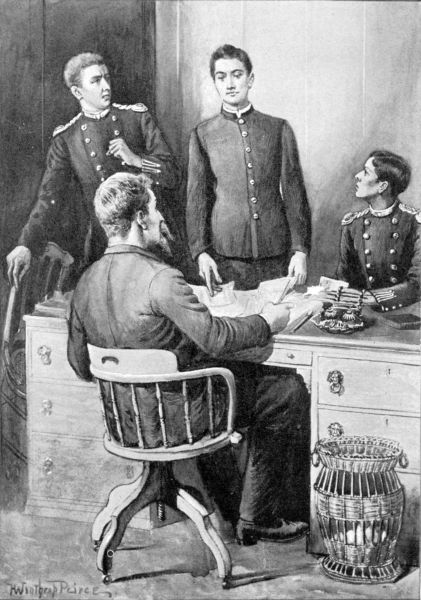
He looked from one to the other of
the persons present in unfeigned astonishment.
Beginning to recover his presence
of mind, he took up the papers and examined
them. Surely enough, there was the
erasure, and there the substitution. The
work had not been neatly done, either.
The original figures were still discernible.
He laid down the lists, more perplexed
than ever. He was sure he had
not made the alterations himself, and he
could not understand why any one else
should have made them,—especially why
they should have been made in his favor.
Glancing around again on the occupants
of the room, he noticed that Colonel
Silsbee and Finkelton were looking steadfastly
at him, but that Brede sat with his
eyes turned away.
In the next moment the explanation was
suggested to Brightly’s mind. He knew
that Brede had handled the reports that
day; he knew that Brede would go any
length to injure him. The plot, its conception,
its object, its fulfilment, were as
plain to him now as sunlight.
A sudden hatred flared up in his heart
against the author of so cowardly a scheme,—such
a hatred as impels the hand of the
assassin. Hot words came to his lips; an
indignant denial was on his tongue, a
passionate charging of malice and crime
against his implacable enemy.
But in the midst of his wrath he took
counsel of his judgment, and checked the
utterance. What would Brede care for his
anger or his arraignment? He would have
anticipated that. He would only curl his
lips more scornfully than usual, and invite
proof of the accusation. That would not
do.
Suddenly a new thought flashed into
Brightly’s mind. It was the conception
of a scheme completely to checkmate his
enemy,—a scheme so bold and novel and
unprincipled that it swept conscience like
a feather before it, and impetuously floated
its lie to the lad’s lips.
For one moment he hesitated; then he
placed his finger on the altered list, and
said: “These figures are correct. That is
my true standing.”
Brede turned in his chair and started to
his feet, gazing upon the speaker incredulously.
The lie was so unexpected, so
deliberate, so audacious, that it staggered
him.
“Why!” he exclaimed impulsively, “I—”
Another word would have betrayed
him hopelessly. He saw his mistake in
time, checked himself, and dropped into
his chair in red-faced confusion.
Colonel Silsbee waved his hand toward
the door.
“That is all, Brightly,” he said. “The
figures will stand as they are. You are
excused.”
Brightly bowed, left the office, and returned
to his place in the schoolroom. A
few minutes later Brede came out also.
His countenance had greatly changed.
Instead of the scornful smile of self-satisfaction,
his face bore marks of humiliation
and of bitter disappointment. He shot one
angry glance at the enemy who had outwitted
him, and passed to his seat. But
his books were nothing to him; he had
been baffled, crushed, out-Heroded. He
smarted and writhed with a sense of
ignominious defeat.
The night passed and the morning came,
and the days went by; but this feeling
remained with him,—he could not shake
it off.
To know that his intended victim had
been guilty of an offence so enormous
that its mere disclosure would bring down
upon the offender punishment and permanent
disgrace, and yet to be powerless,
to see this unblushing liar go scot-free
from the penalty of a crime which he
did not dare to bring to light, hurt him,
galled him, exasperated him almost beyond
endurance.
It made him careless at drill, neglectful
of his studies, violent in temper.
He spoke lightly of rules; he sought the
society of boisterous fellows; he fraternized
with the ruder and disorderly element.
His demoralization was so marked
and rapid that it became the talk of the
school.
He never spoke to Brightly; he tried to
ignore him; but whenever these two met
in those days, whether in the drill-hall, the
classroom, or the corridor, each felt that
the other knew to a certainty the guilt of
both.
And Brede, measuring his enemy’s feeling
by his own, had no conception of the
true state of Brightly’s mind.
Had he known what this young fellow
suffered, he might have asked no greater
revenge. The lie was scarcely cold on
the lad’s lips before he regretted having
spoken it. Within ten minutes from the
time he uttered it he would have given
much to be able to recall it; but that was
clearly impossible. He felt that it would
only make the matter so much the worse.
His exultation at Brede’s discomfiture
was short-lived. After that night it never
gave him a moment’s pleasure. He sought
to drown the memory of it in idle thought,
in boisterous fun, in hot discussion with
his fellows; but all expedients were vain.
It was a veritable Banquo’s ghost. He
lost strength, hope, courage, ambition.
Before the utterance of that fatal falsehood
he had not thought but that he should
soon regain his office, his honor, and his
old position in the school. Now he did
not even wish to do so.
But of Brede he had scarcely a thought
now, except the occasional flashing up of
that old hatred and disgust in his heart.
They were little more to each other than
strangers.
Once they met and exchanged words.
It was in the drill-hall, while they were
waiting for supper. There was a small
boy at the school who was called by his
companions “Apache,” or, more briefly,
“Patchy.” He had come there from an
army post in the far West, where his
father, a government officer, was stationed;
and it had pleased his fellows to pretend
that they supposed him to belong to the
Apache tribe of Indians.
Brede was annoying this boy, who liked
play well enough so long as it was not too
boisterous, but who felt that he was being
handled a little too roughly now, and who
called, still half in fun, to Brightly, who was
passing at the time, to come to his aid.
Brede had not intended to hurt the lad,
and would not have done so; but this
appeal to his enemy angered him, and he
gave the child’s arm a twist that caused
the little fellow to cry out with a pain not
now assumed.
Brightly had stopped for a moment, uncertain
whether to respond; but when the
cry came, he advanced a step toward the
two, and said to Brede, “Let the boy
alone.”
The captain loosed his hold of Patchy,
who immediately made his escape, and
thrusting his hands in his pockets, stared
for a moment in feigned contempt at his
adversary.
“I don’t take orders from disgraced
officers!” he said.
Brightly answered, trying to be calm,
“A person who has been guilty of forging
records shouldn’t talk to others about
disgrace.”
Brede’s face grew white with passion.
“Nor do I take advice from common
and contemptible liars,” he responded
scornfully.
It is uncertain what would have been
said or done next, had not Harple seized
Brightly’s arm and hurried him away. He
had chanced to notice the two boys in
conversation, had hurried across the hall
in time to hear the last words, and, acting
on the urgent necessity of the moment,
now rescued his friend from further trouble
by removing him from the scene.
Harple had made it his business during
these days to be with or near his chum as
much as possible. He felt somehow that
Brightly was no longer responsible for his
own conduct, and that some one should be
on hand to keep him from bringing further
disgrace upon himself. In this case, at
least, his vigilance had been amply rewarded.
He shuddered to think what the
result would have been if the quarrel with
Brede had gone on.
But Harple suffered much by reason of
his anxiety for his friend. It pained him
deeply to see Brightly sinking into such a
deplorable state; he was beginning to feel
that he was powerless to save him. He
had exhausted his powers of logic, of
entreaty, even of abuse. He could do
nothing now except to stand by and extend
such aid and comfort as he might.
Brightly was still as friendly with him and
apparently as fond of him as of old; but he
would not listen to reproof or advice.
Harple watched with alarm the demoralization
also of Brede. He felt and knew
that there were strong and co-operating
influences at work on these two long-time
rivals and enemies that were dragging
them both, surely and rapidly, to degradation;
but what these influences were he
could not even guess.
Almost every movement made by either
was an act of retrogression. Perhaps the
change was more marked in respect to the
society they chose than in any other way.
Boys with whom Brightly had had nothing
in common in the better days, and
whom Brede had utterly disdained, appeared
now to be the friends of both.
Colonel Silsbee’s hope that the deepening
spring-time would put to rest the spirit
of unquietness and discontent among his
boys was not realized. There was neglect
of lessons; there were breaches of military
discipline, infractions of academy rules,
private quarrels, boisterous conduct.
A half-dozen of the older boys had been
discovered one day in a secluded nook
smoking cigars and pipes, and had been
promptly disciplined. There had been an
incipient riot in the upper dormitory at
night after taps, the participants in which
had been severely punished. Half the
school was on delinquency, and of half that
number the delinquency was perpetual.
The principal and teachers were quite
at a loss what course to pursue. One
thing only seemed feasible, and that was
to draw the lines with still greater strictness,
and to compel the utmost obedience
by the severest discipline.
Thus matters stood at the close of a
beautiful May day. It was one of those
languid, luxuriant days on which every
lover of Nature longs to be in the woods
and fields, breathing without stint air
sweetened by the touch of bursting buds
and growing leaves and springing grass.
It was after supper and before the time
for the evening session. The boys were
strolling about the grounds, playing quiet
games, or lounging on the lawn. A group
of them, however, had gathered near the
eastern porch of the building, and were
shouting and singing boisterously. Some
one had composed a few doggerel verses
containing little of either rhyme or metre,
and had entitled them “The Noble Army
of Delinquents.” It was the chorus of this
song that the members of the little group
were shouting out with rude vigor. They
tired of this finally, and then one, Fryant,
spoke up.
“What we want and need, fellows,” he
said, “is a holiday. It’s a shame for Old
Sil to put us on delinquency and keep us
shut up here such a day as this.”
“True enough!” responded Belcher.
“Last year we had a holiday long before
this time. The old man’s trying to spite
us because we happen to belong to the
noble army of delinquents. That’s what’s
the matter now, and I, for one, don’t
propose—”
“Let’s petition him to go to-morrow,”
broke in a third speaker. “The woods
are splendid now; Beach and Valentine
were over the river yesterday, and they
said so.”
“Yes, let’s petition him!” exclaimed
two or three at once.
Some one threw up his cap and cried
out, “A holiday! holiday!”
In a moment others took up the cry,
and sent it out through the twilight.
Boys, separately and in groups, came hurrying
toward the little party, attracted by
the unusual sound. When they heard
what the proposition was, they were mostly
in favor of it.
It had been the custom of Colonel
Silsbee to give his boys a holiday every
spring. They usually went in a body to
the groves across the river, taking luncheon
with them, and spending the day in
rowing, in athletic games, or in roaming
about the woods.
Such a day could not fail to have charms
for any boy; but for these delinquent lads,
who were not allowed to leave the grounds,
save as they were marched discreetly to
church on Sunday mornings and evenings,
the very thought of pleasure like this was
intoxicating.
The holiday idea was infectious; it
spread like a swift contagion. Everybody
was shouting for it now.
Some one turned to Brightly, saying,
“Here, Bright, you draw the petition; you
can do it.”
“Yes,” cried some one else, “let Bright
draw it; he’s literary; he can put it in
better shape than any other fellow in
school.”
Now Brightly was not averse to compliments;
and in no way was his vanity
more easily flattered than by favorable
comment on his literary ability, which,
indeed, was not slight.
Moreover, he felt a certain grim pleasure
in the fact that although he had been
suspended and disgraced by the authorities,
yet when anything was to be done
requiring peculiar mental skill and art, he
was unanimously selected by the boys of
the school to do it. So, followed by a
score or more of them, he led the way to
the vacant schoolroom, intent on the accomplishment
of their desires, thoughtless
and careless of what the result might be
to himself.
Hastily scribbling what he considered a
good form for a petition, he read it to the
boys.
“’Taint strong enough,” said one.
“We don’t want so much beggarly humility
in it,” said another. “We’ve got a
right to a holiday, and we’d best let him
know’t we know it.”
“Put it to him fair and square, Bright,”
said Fryant. “There’s no use mincing
matters; he’s bearing down heavy on us,
and we’ve got to meet him on his own
ground.”
Thus conjured, Brightly made another
effort, this time apparently with better
success; for when he read what he had
written, they all cried, “Good! that’s good!
now copy it!”
Six months before he would never have
thought of writing such a paper at the
dictation of this lawless crowd; but now,
with jealousy stinging him, with conscience
torturing him, with disgrace hanging
over him, he had only his self-respect
to fall back upon,—and that, alas! was
already following in the wake of hope and
ambition, both of which had left him
weeks ago.
When the petition was copied, it read
as follows:—
To Col. Jonas Silsbee,
Principal of Riverpark Academy.
The petition of the undersigned cadets and students
of Riverpark respectfully represents:
That, whereas it has been the custom yearly to devote
one day of the spring season to a whole holiday
for the entire school, with games, lunches, etc., in the
groves across the river, and whereas the time has fully
come when such holiday should be enjoyed;
Now, therefore, we, the undersigned, designate to-morrow,
the tenth day of May, as the day of our
choice for said holiday; and we herewith make known
our proposition for celebrating the same, to the end
that the proper arrangements may be duly made and
the programme carried out according to the usual
custom.
(Signed) ______
At the moment when the paper was
ready for signature, Brede entered the
room.
“Here!” cried a dozen boys at once.
“Brede, captain! sign the petition!”
“What for?” asked Brede, surlily.
“A holiday! We’re going to have a
holiday; sign the petish!”
The captain took the paper and read it.
“Haven’t you put it pretty strong?”
he asked.
“It’s got to be strong,” was the reply,
“or we won’t get the holiday.”
Plumpy, the fat boy, waddled hastily
toward the group, crying out in his falsetto
voice: “A horse! a horse! my kingdom
for a mule!”
“Plumpy wants a mule!” shouted
Patchy, hilariously. “What you want a
mule for, Plumpy?”
“To cross the raging Helles-py-ont and
picnic in the groves of doodle dell,” responded
Plumpy, in mock heroics.
“Oh, shut up!” cried some one, but
Plumpy continued: “Why, then, without
a mule, I’ll swim the raging flood me selluf
to bask—”
“Oh, shut up! shut up!” sounded a
chorus of voices. “Put him out! Sit
on him!”
This last suggestion was promptly acted
on; a half-dozen lads pounced on the unfortunate
fat boy, dragged him to the floor,
rolled him over and over like a bulging
barrel, and smothered his squeals by placing
their combined weight on his elastic
body. But they did not hurt him. Indeed,
it seemed almost impossible by any
course of treatment to give Plumpy more
than the suggestion of physical pain.
Brede was still scanning the petition.
“Oh, come, captain!” said some one at
his elbow, “sign the petition. If you
don’t sign it we won’t stand a ghost of a
show.”
“And if you do,” continued another,
“we’ll have a dead sure thing.”
Brede’s vanity was flattered.
“Well, I don’t care,” he said sharply.
“What’s the use? If a fellow gets into
trouble, all he’s got to do is to lie out of
it, and Silsbee’ll coddle him back to virtue.
There’s no use trying to be decent here
any more. Where’s your pen?”
The pen was given to him, and he signed
his name. His was the first signature to
the petition. Then Harple was sought;
but he could not be found, and there was
no time to be lost, so others affixed their
signatures without regard to the order in
which they came.
Brightly signed the paper, of course. He
could do no less after having drawn it.
Not that he cared about the holiday; but
he had become too weak and indifferent to
resist any pressure, or to count the cost of
any action.
The evening session interfered with a
further circulation of the petition; but before
tattoo was sounded there was another
opportunity to sign it, and at reveille on
the following morning it was again on
its rounds.
At inspection a committee of two was
appointed to present it to the principal.
These two, Robinson and Miller, had been
selected on account of their popularity and
their high standing; one of them, indeed,
was an honor-grade man.
They selected the time immediately after
breakfast to approach Colonel Silsbee with
the petition. He was in his office, and they
went there. They were gone but a few moments.
When they came out, they were
surrounded by a group of eager questioners.
“What did he say?” “Are we going?”
“Did he read it?” They were all asking
at once.
“Keep still a minute,” said Robinson,
“and I’ll tell you. He took the paper
and just glanced at it, and then he folded it
up again. He said he’d take the matter
into consideration, and whatever he conceived
to be for the best interests of the
school, that he’d do. He said he’d let us
know at the opening of the session. Now
that’s as near as I can remember it. Isn’t
that about what he said, Miller?”
“Just about. It’s as close as you can
get to it, anyway. I tell you what, boys,
he looked mighty favorable.”
“Do you think we’ll get it, honest?”
asked an eager bystander.
“Yes,” replied Miller, “I do.”
“Hurrah for the holiday!” shouted an
enthusiastic delinquent. “We’re going
to get the holiday! hurrah!”
The good news spread, and as it passed
from lip to lip, the holiday was spoken of
as an assured fact. Indeed, many of the
boys hastened to their rooms to make
preparations for going.
As the long file wound up into the
schoolroom at the usual hour for the
morning session, the flow of good feeling
was manifested by so much good-natured
mischief that the officers found it difficult
to keep order in the ranks.
The morning was beautiful. Nature was
propitious; there was not a cloud to be
discovered either in the blue sky or on
the bright hopes of the students. Everybody
was jubilant. Even Brightly had
awakened to an unusual degree of enthusiasm,
and Brede was smiling and
swaggering with much of the old-time
manner.
Colonel Silsbee entered the room, read
the Scripture lesson as usual, and offered
the morning prayer. Then, seating himself
again in his chair, he looked down for
a moment on the bright and expectant
faces before him. In that look, kindly
but stern, his pupils discovered the first
cloud upon the horizon of their hopes.