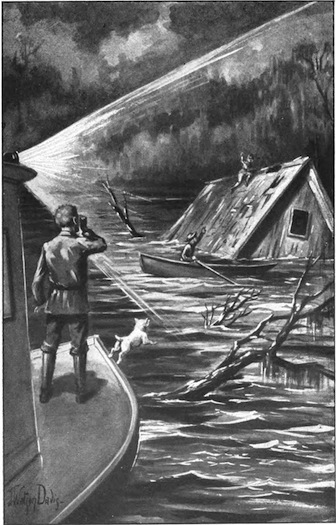
While Case talked with the young man Clay
went back into the cabin to talk with Alex., who
was now changing into dry clothing.
“Do you think the story that man is telling is
all right?” he asked.
“I think he is telling the truth about the river
thieves,” Alex. replied.
“I was wondering if that wasn’t just a bait to
help them get on board.”
“It may be, but there are river robbers in this
section. They told us that where we bought the
gasoline. These may be the robbers, for all I know,
but we ought to make sure of that before turning
them down. They’ll starve here, if they have lost
their boat and provisions. Of course they can get
wild game, but I don’t see how they are going to
cook it. We ought to give them a chance, anyway.”
Clay went back to the deck and listened to the
conversation between Case and the visitor, who
seemed a little annoyed at the doubting of his word.
“Where did you live in Chicago?” he heard Case
ask.
“In furnished rooms on Elizabeth street, near
Washington boulevard,” was the reply.
“Where did you work?” was the next question,
impertinent and personal, but seemingly necessary
at that time.
“At a machine shop on Clinton street, not far
from West Madison.
“Then you are machinists?”
“Yes, all of us. Business is dull in our line just
now, and we thought we’d make a hit with ourselves
by spending a winter in the south.”
“When did you leave Chicago?”
“We left Chicago last September,” answered the
man, turning toward the rail. “We expect to get
back sometime during the next century, if all
Chicago boys are as hospitable as you are! Now,
with your permission, I’ll go back to my friends.”
“How do you know we are from Chicago?”
asked Clay, stepping forward.
The other laughed lightly and pointed to the
boat’s name on articles scattered about.
“But, aside from that,” he said, “we’d know you
anywhere. The Chicago newspapers carried a lot of
feature stuff about your boat and your trips.”
“All right, stranger,” one of the three answered,
in rather a pleasant tone of voice. “Just as you
say!”
“What do you want?” asked Alex., still shivering
from his cold bath.
“We want a ride out of this consarned swamp,”
was the reply.
“How did you get in here?” asked Clay. “Get
out the way you got in!” he added.
“Our shanty boat is smashed to flinders and our
grub is gone,” complained the other. “It don’t
look as if we could walk out of here, does it?”
“Was that your fire we saw?” asked Case, drawing
closer to the gunwale.
“We had a fire before the flood pounced down
upon us,” was the reply.
“What shall we do?” asked Clay, facing the
others. “If they are on the square we can’t leave
them here. They would starve!”
“They may be pirates!” suggested Jule.
“I don’t believe it,” Case declared. “They don’t
look the part. Besides, if they had designs on the
boat, they could have picked us off in the darkness,
and we’d never have known where the bullets came
from. They’re all right!”
“One of you come aboard,” Clay instructed,
“and we’ll see what you look like.”
In plain view of the boys the man who had done
the talking handed his gun to a companion and
struck out for the boat, walking on logs part of the
way, wading part of the way, and swimming when
he could do neither. In a moment he was on deck.
“The three of us,” he explained, “were out of
work at Chicago. We had a little cash, and decided
to come down here and spend the winter where we
wouldn’t have room-rent or restaurant bills to pay.
We thought we could cut and market enough fish-poles
out of the brake swamps to pay our way back
in the spring.”
“That wasn’t a bad idea!” Jule declared.
“We were getting along all right,” the other
went on, “until the river thieves began troubling us.
They stole our food, and at last began stealing our
poles. We were getting ready to go out when the
flood smashed our shanty boat into smithereens.
Now we are up against it, unless you take us with
you. And,” he added, with a quick glance around,
“you’d better take us on board, for the thieves are
back there in the swamp, with their envious eyes
fixed on this boat. They are mostly negroes, and
escaped convicts.”
“You ought to know that we’ve got to be careful,”
Clay said, as the man was about to leave the
boat. “We don’t know anything about you, except
what you have told us, but we’re going to take a
chance on you. Tell your friends to come on
board.”
In five minutes the three were in the cabin, trying
on some of Clay’s clothes, for their own were not
only wet but they oozed black muck. When they
were dressed again they passed their revolvers over
to Clay, with the statement that they wouldn’t need
them unless the river pirates took a hand in the
game that night.
“Have the ruffians been here long?” asked Clay.
“About a month ago,” was the reply, “a lot of negroes
broke away from a convict camp off to the west
somewhere. They came into this swamp and built
a camp on a knoll, which must, by the way, be under
water now. They are murderers, housebreakers
and sneak thieves of the most desperate kind. We
tried to make friends with them, but it was of no
use. They think their camp is unknown, and so
object to our getting out and telling where it is. I
half believe they will try to keep you from getting
out for the same reason.”
“If it is all the same to you boys,” another of the
visitors said, “we’d like something to eat. We were
half starved when we came on board. I think I can
catch a fish or shoot a duck, so our supper won’t
cost you anything only the bother of having us
around. What do you say? Do we eat?”
“I should say so!” cried Alex., sticking his head
out of the cabin, “and when you are out after game
get enough for me a little lunch. I haven’t had anything
to eat since dark!”
“Is that rowboat at the side all right?” asked
the visitor, pointing to the boat which had been
found up the river. “If it is, I’ll get a little ways
from the motor boat, in the shadows, and see what
I can do getting ducks.”
“The boat is all right,” Alex. answered, “and
I’ll go with you. I’m beginning to feel the lack of
adventure. I get awfully tired of this monotony
sometimes!”
They all laughed at the idea of there being any
monotony in the situation, there in the swamp, with
the river roaring around them and the watchful
thieves in the thicket, and Alex. seemed quite annoyed
at the thought that they regarded his remark
as a joke.
“Perhaps something will happen before you get
back,” Clay grinned.
“The boat may smash,” said Jule, cheerfully.
“It has been banged about quite a lot since we got
it. Or you may find some of the robbers. There’s
no knowing what streak of good luck you may get
into!”
“I’m not looking for any good luck of that
kind!” the visitor said, as he drew the rowboat
around and clambered into it. “I’ve had all the
cheerful incidents of that character I care to have.
When I get back to Chicago, I’m going to get a
room next to the Desplaines street police station and
go to bed at seven o’clock every night.”
“What’s your name?” asked Alex., abruptly as
he pushed off from the Rambler.
“Gregg Holder,” was the reply. “I’m just
Gregg to all my friends, but I’m Bully Gregg on
South Halstead street. The others are Eddie Butler
and Hank Quinn.”
“That settles it!” grinned Alex. “I’m going
back.”
“What for?” asked Gregg, in surprise. “Don’t
you want a duck or a fish?”
“Sure I do,” was the reply, “but I’m afraid!
You’re the man that fought Murphy to a draw?
What? And Eddie Butler is the boy that bested
Murray!”
“You’ve got that right, kid,” was the reply.
“We’ve all been in the prize ring, but we’re no slum
toughs. If you think the bears and snakes and robbers
are better company than we are,” he added,
“we’ll get out of your boat!”
“You’re just the lads to give the pirates a good
drubbing!” Alex. laughed, “and so we’ll ask you
to remain with us and learn something of the rules
of polite society! Let me take one oar, unless you
want to keep on going round in a circle!”
“There’s something pulling on the boat,” Gregg
said. “I can’t keep it on a straight line. See if you
can find out what has tangled us.”
Alex. turned on his searchlight and cast its rays
on the water ahead. Then he dropped his light in
the bottom of the boat and stuck his hands out
straight. Gregg looked up as the light fell, then
dropped the oars and stuck his hands out straight!
“This is the adventure you wanted!” Gregg said,
as half a dozen negroes showed on a hummock only
a few feet away. “We’re held up by the river
thieves!”
“What do you fellows want?” Alex. demanded,
looking straight into the muzzle of a gun that
seemed to have a bore as large as the Hudson river
tunnel.
“We want that boat, so we can get on board the
motor contraption,” said a voice.
“That’s no negro!” whispered Alex. “It is a
white man blacked up!”
“Right you are!” replied Gregg.
“What are you boys talking about?” demanded
the holder of the threatening gun.
“We were telling each other how glad we were
to meet you!” Alex. snarled.
“You’re a nervy kid, anyhow,” said the other.
“Push the boat up here, so we can get in. We were
raised as pets, and don’t want to get wet.”
There was nothing to do but obey instructions.
They knew the desperate character of the men they
were facing. If they followed orders and waited
for an opportunity to turn the tables on their captors,
they might get out of the mess with whole
skins, but if they forced a fight there and then there
would be little hope for them. When there were
four of the pirates in the boat, crouching down
under the gunwales, who made the fifth, the spokesman
gave his orders.
“Now you boys row back. When we get close up
I’ll show myself and put the whole party under
cover. See? My men will also have their guns,
and if you disobey instructions in the slightest particular,
you’ll be shot in the back.”
“That’s where you like to shoot, I take it!”
growled Gregg. “If I had one of you out on the
bank I’d break him in two pieces and feed him to
the snakes.”
“Cuss if you want to!” commented the robber.
“We can settle all that after a time. Just now, get
over to that boat, and call out that you’ve found
another castaway in the swamp! We’ll be on board
before they can say a word.”
This looked like turning the Rambler over to
thieves, but there was no way in which the boys
could reverse conditions just then, so they rowed
toward the motor boat, calling out that they had
found a sick man in the jungle. The robber prodded
them with the muzzle of his gun when they did not
give the right inflection to their voices.
When the boat entered the circle of light the boys
on board the Rambler were all leaning over the gunwale,
looking for the boys and the rescued individual.
There were no weapons in sight, and Alex.
feared that all the revolvers were stowed away in
the cabin, and that the Rambler would be taken
without a shot being fired in her defense.
When the boat touched the hull of the Rambler
the robber sprang to his feet, presenting two long
guns as he did so.
“I’ll empty these guns into the crowd of you,” he
said, in a low, even voice, “if there is one move on
deck. We are coming aboard, and the better you
use us the better we shall use you. Just sit still,
boys,” he added, addressing his men, “until I get on
deck.”
He was lithe and strong, and was on the deck in
an instant, without opposition, his guns threatening
the amazed boys and their visitors. Captain Joe
gave forth a volley of ugly growls, and would have
attacked the man, but Clay ordered him back.
“Never mind the dog,” he said. “He won’t
bite!”
“If he does, he’ll get a chance to bite lead!” the
robber exclaimed. “Now, men,” he went on,
“climb up into the boat. Leave the rowers where
they are.”
Four husky negroes, all with traces of whisky
in their breath, began climbing over Alex. and
Gregg to reach the motor boat. As they were
steadying the rocking craft, they carried no weapons
in their hands.
Then something happened which was as much of
a surprise to the boys as it was to the men who were
trying to capture the Rambler!
A rope with a wide noose at one end came whirling
out of the sky and fell over the robber’s head,
resting for an instant in a neat coil on his shoulders!
He clutched his weapons closer and looked up.
Then the line tightened about his muscular neck
until his feet left the deck and his face grew red
with the blood of strangulation, then grew white.
The revolvers clattered to the floor, and the man’s
figure toppled and fell as the rope slacked.
When this strange thing happened, Alex. and
Gregg were bending their heads down to permit the
negroes to clamber over them. Still they saw the
rope fall, saw the man gasp as it closed about his
neck, and felt the negroes springing back in dismay.
Then they arose with their heavy oars in their
hands and struck slashing, crunching blows at the
heads below them! One negro lifted an arm to
shoot, but it fell with the bones of the shoulder
crushed to pulp. One by one they dropped out of
the boat, some with broken arms, some with broken
heads. After they had all disappeared, either under
the surface of the lagoon or into the darkness of the
swamp, a shrill voice came from the tree where
Mose had taken refuge from the snakes and the
alligators:
“Go on, white folks,” it said, “Ah goin’ hang
dis immitation coon up on dis tree!”