THE geographer tells us that the mouth of the Missouri is about
seventeen miles above St. Louis, and that the mouth of the Yellowstone
is near Buford, North Dakota. It appeared to me that the fact is
inverted. The Missouri's mouth is near Buford, and the Yellowstone
empties directly into the Mississippi!
I find that I am not alone in this opinion. Father de Smet and other
early travelers felt the truth of it; and Captain Marsh, who has piloted
river craft through every navigable foot of the entire system of rivers,
having sailed the Missouri within sound of the Falls and the Yellowstone
above Pompey's Pillar, feels that the Yellowstone is the main stem and
the Missouri a tributary.
Where the two rivers join, even at low water, the Yellowstone pours a
vast turbulent flood, compared with which the clear and quieter
Missouri appears an overgrown rain-water creek. The Mississippi after
some miles obliterates all traces of its great western tributary; but
the Missouri at Buford is entirely lost in the Yellowstone within a few
hundred yards. All of the unique characteristics by which the Missouri
River is known are given to it by the Yellowstone—its turbulence, its
tawniness, its feline treachery, its giant caprices.
Examine closely, and everything will take on before your eyes either
masculine or feminine traits. Gender, in a broad sense, is universal,
and nothing was created neuter. The Upper Missouri is decidedly female:
an Amazon, to be sure, but nevertheless not a man. Beautiful, she is,
alluring or terrible, but always womanlike. But when you strike the
ragged curdling line of muddy water where the Yellowstone comes in, it
is all changed. You feel the sinewy, nervous might of the man.
So it is, that when you look upon the Missouri at
Kansis City, it is the
Yellowstone that you behold!
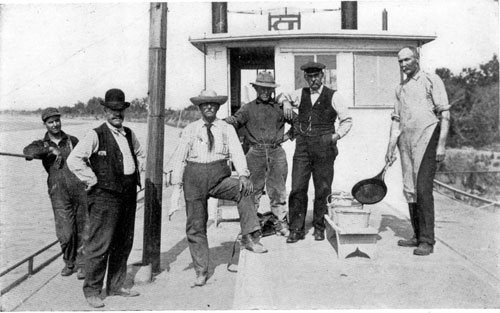 On the Hurricane Deck of the "Expansion"; Capt. Marsh
Third from the Left.
On the Hurricane Deck of the "Expansion"; Capt. Marsh
Third from the Left.
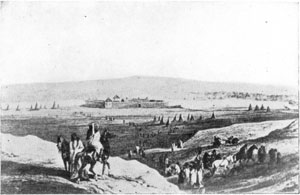 Fort Union in
 1837.
|
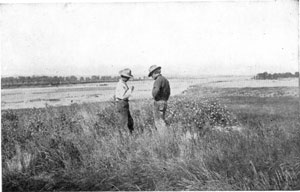 Site of Old Fort Union.
|
But names are idle sounds; and being of a peace-loving disposition, I
would rather withdraw
my contention than seriously disturb the
geographical status quo! Let it be said that the Upper Missouri is the
mother and the Yellowstone the father of this turbulent Titan, who
inherits his father's might and wonder, and takes through courtesy the
maiden name of his mother. There! I am quite appeased, and the
geographers may retain their nomenclature.
At Mondak, Luck stood bowing to receive us. The Atom I had suffered
more from contact with snags and rocks than we had supposed. For several
hundred miles her intake of water had steadily increased. We had toiled
at the paddles with the water halfway to our knees much of the time;
though now and then—by spasms—we bailed her dry. She had become a
floating lump of discouragement, and still fourteen hundred miles lay
ahead.
But on the day previous to our sailing, a nervous little man with a
wistful eye offered us a trade. He had a steel boat, eighteen feet long,
forty inches beam, which he had built in the hours between work and
sleep during the greater part of a year.
His boat was some miles up the Yellowstone, but he spoke of her in so
artless and loving a manner—as a true workman might speak—and with
such a wistful eye cast upon our boat, that I believed in him and his
boat. He had no engine. It was the engine in our boat that attracted
him, as he wished to make a hunting trip up river in the fall. He stated
that his boat would float, that it was a dry boat, that it would row
with considerable ease. "Then," said I, "paddle her down to the mouth of
the Yellowstone, and the deal is made." After dark he returned to our
camp with a motor boat, ready to take us to our new craft, Atom II.
Leaving all our impedimenta to be shipped by rail, that is, Bill, the
tent, extra blankets, phonograph—everything but a few cooking-utensils,
an ax, a tarp, and a pair of blankets—the Kid and I got in with the
little man and dropped down to the Yellowstone. The new boat was moored
under a mud bank. I climbed in, lit a match, and my heart leaped with
joy. She was staunch and beautiful—a work of love, which means a work
of honesty. Fore and aft were air-tight compartments. She had an oil
tank, a water tank, engine housing, steering wheel, lockers. She was
ready for the very engine I had ordered to be shipped to me at Bismarck.
She was dry as a bone, and broad enough to make a snug bed for two.
The little man and the motor boat dropped out into the gloom and left us
gloating over our new possession, sending thankful rings of tobacco
smoke at the stars. When the first flush of triumph had passed, we
rolled up in the bottom of the boat, lulled to sleep by the cooing of
the fusing rivers, united under our gunwale. Such a sleep—a dry
sleep! and the sides of the boat protected us against the chill night
wind.
And the dawn came—shouting merrily like a boy! I once had a chum who
had a habit of whistling me out of bed now and then of a summer morning,
when the birds were just awakening, and the dew looked like frost on the
grass. And the sun that morning made me think of my old boy chum with
his blithe, persistent whistling. For the first hard stage of the
journey was done; all had left me but a brave lad who would take his
share of the hardships with a light heart. (All boys are instinctively
true sportsmen!) And before us lay the great winding stretch of a savage
river that I had loved long—the real Missouri of my boyhood.
A new spirit had come upon us with the possession of the Atom II—the
spirit of the forced march. For nearly a month we had floundered,
trusting to a sick engine and inefficient paddles. Now we had a staunch,
dry boat, and eight-foot oars. We trusted only ourselves, and we were
one in the desire to push the crooked yellow miles behind us. During the
entire fourteen hundred miles that desire increased, until our progress
was little more than a retreat. We pitched no camps; we halted only when
we could proceed no further owing to sandbars encountered in the dark;
we ate as we found it convenient to do so. Regularly relieving each
other at the oars, one sat at the steering wheel, feeling for the
channel. And it was not long until I began to note a remarkable change
in the muscles of the Kid, for we toiled naked to the waist most of the
time. His muscles had shown little more than a girl's when we first swam
together at Benton. Now they began to stand out, clearly defined, those
of his chest sprawling rigidly downward to the lean ribs, and little
eloquent knots developed on the bronzed surface of his once smooth arms.
He was at the age of change, and he was growing into a man before my
eyes. It was good to see.
All the first day the gods breathed gently upon us, and we made fifty
miles, passing Trenton and Williston before dark. But the following day,
our old enemy, the head wind, came with the dawn. We were now sailing a
river more than twice the size of the Upper Missouri, and the waves were
in proportion. Each at an oar, with the steering wheel lashed, we forged
on slowly but steadily. In midstream we found it impossible to control
the boat, and though we hugged the shore whenever possible, we were
obliged to cross with the channel at every bend. When the waves caught
us broadside, we were treated to many a compulsory bath, and our clothes
were thoroughly washed without being removed. An ordinary skiff would
have capsized early in the day, but the Atom II could carry a full
cargo of water and still float.
By sunset the wind fell, the river smoothed as a wrinkled brow at the
touch of peace. Aided by a fair current, we
skulled along in the hush of
evening through a land of vast green pastures with "cattle upon a
thousand hills." The great wind had spread the heavens with ever
deepening clouds. The last reflected light of the sun fell red upon the
burnished surface of the water. It seemed we were sailing a river of
liquefied red flame; only for a short distance about us was the water
of that peculiar Missouri hue which makes one think of bad coffee
colored with condensed milk.
Slowly the colors changed, until we were in the midst of a stream of
iridescent opal fires; and quite lost in the gorgeous spectacle, at
length we found ourselves upon a bar.
We got out and waded around in water scarcely to our ankles, feeling for
a channel. The sand was hard; the bar seemed to extend across the entire
river; but a thin rippling line some fifty yards ahead told us where it
ended. We found it impossible to push the heavy boat over the shallows.
The clouds were deepening, and the night was coming rapidly. Setting the
Kid to work digging with an oar at the prow, I pushed and wriggled the
stern until I saw galaxies. Thus alternately digging and pushing, we at
last reached navigable depths.
It was now quiet and dark. Low thunder was rolling, and now and then
vivid flashes of lightning discovered the moaning river to us—ghastly
and forbidding in the momentary glare. We decided to pull in for the
night; but in what direction should we pull? A drizzling rain had begun
to fall, and the sheet lightning glaring through it only confused
us—more than the sooty darkness that showered in upon us after the
rapid flashes. We sat still and waited. In the intermittent silences,
the rain hissed on the surface of the river like a shower of innumerable
heated pebbles. Ahead of us we heard the dull booming of the cut banks,
as the current undermined ponderous ledges of sand.
Now, a boat that happens under a falling cut bank, passes at once into
the region of forgotten things. The boat would follow the main current;
the main current flows always under the cut banks. How long would it
take us to get there? Which way should we pull? Put a simpler question:
In which way were we moving? We hadn't the least conception of
direction. For us the night had only one dimension—out!
Finally a great booming and splashing sounded to our left, and the boat
rocked violently a moment after. We grasped the oars and pulled blindly
in what we supposed to be the opposite direction, only to be met by
another roar of falling sand from that quarter.
There seemed to be nothing to do but have faith in that divinity which
is said to superintend the goings and coming of fools and drunkards.
Therefore we abandoned the oars, twiddled our thumbs, and let her drift.
We couldn't even smoke, for the rain was now coming down merrily. The
Kid thought it a great lark, and laughed boisterously at our
predicament. By flashes I saw the drenched grin under his dripping nose.
But for me, some lines written by that sinister genius, Wainwright, came
back with a new force, and clamored to be spoken:
"Darkness—sooty, portentous darkness—shrouds the whole scene; as if
through a horrid rift in a murky ceiling, a rainy deluge—'sleety flaw,
discolored water'—streams down amain, spreading a grisly spectral
light, even more horrible than that palpable night."
At length the sensation of sudden stopping dizzied us momentarily. We
thrust out an oar and felt a slowly sloping bar. Driving the oar
half-way into the soft sand, we wrapped the boat's chain about it and
went to bed, flinging the tarp over us.
A raw dawn wind sprinkled a cheerless morning over us, and we got up
with our joints grinding rustily. We were in the midst of a desolate
waste of sand and water. The bar upon which we had lodged was utterly
bare. Drinking a can of condensed milk between us, we pushed on.
That day we found ourselves in the country of red barns. It was like
warming cold hands before an open grate to look upon them. At noon we
saw the first wheat-field of the trip—an undulating golden flood,
dimpled with the tripping feet of the wind. These were two joys—quite
enough for one day. But in the afternoon the third came—the first
golden-rod. My first impulse was to take off my hat to it, offer it my
hand.
That evening we pulled up to a great bank, black-veined with outcrops of
coal, and cooked supper over a civilized fire. For many miles along the
river in North Dakota, as well as along the Yellowstone in Montana,
these coal outcrops are in evidence. Doubtless, within another
generation, vast mining operations will be opened up in these
localities. Coal barges will be loaded at the mines and dropped down
stream to the nearest railroad point.
We were in the midst of an idyllic country—green, sloping, lawn-like
pastures, dotted sparsely with grotesque scrub oaks. Far over these the
distant hills lifted in filmy blue. The bluffs along the water's edge
were streaked with black and red and yellow, their colors deepened by
the recent rains. Lazy with a liberal supper, we drifted idly and gave
ourselves over for a few minutes to the spell of this twilight
dreamland. I stared hard upon this scene that would have delighted
Theocritus; and with little effort, I placed a half-naked shepherd boy
under the umbrella top of that scrub oak away up yonder on the lawny
slope. With his knees huddled to his chin, I saw him, his fresh cheeks
bulged with the breath of music. I heard his pipe—clear,
dream-softened—the silent music of my own heart. Dream flocks sprawled
tinkling up the hills.
With a wild burst of scarlet, the sunset flashed out. Black clouds
darkened the visible idyll. A chill gust swept across the stream,
showering rain and darkness. Each at an oar, we forged on, until we lost
the channel in the gloom. At the first peep of day we were off again,
after a breakfast of pancakes, bacon, and coffee.
We were gradually becoming accustomed to the strain of constant rowing.
For at least sixteen hours a day we fought the wind, during which time
the oars were constantly dipping; and very often our day lengthened out
to twenty hours. We had no time-piece, and a night of drifting was
divided into two watches. These watches we determined either by the
dropping of a star toward the horizon, or by the position of the moon
when it shone. On dark nights, the sleeper trusted to the judgment of
his friend to call when the watch seemed sufficiently long. Daily the
water fell, and every inch of fall increased the difficulty of
traveling.
We were now passing through the country of the Mandans, Gros Ventres,
and Ricarees, the country through which old Hugh Glass crawled his
hundred miles with only hate to sustain him. To the west lay the barren
lands of the Little Missouri, through which Sully pushed with his
military expedition against the Sioux on the Yellowstone. An army flung
boldly through a dead land—a land without forage, and waterless—a
labyrinth of dry ravines and ghastly hills! Sully called it "hell with
the lights out." A magnificent, Quixotic expedition that succeeded! I
compared it with the ancient expeditions—and I felt the eagle's wings
strain within me. Sully! There were trumpets and purple banners for me
in the sound of the name!
Late in the evening we reached the mouth of the Little Missouri. There
we found one of the few remaining mud lodges of the ancient type. We
landed and found ourselves in the midst of a forsaken little frontier
town. A shambling shack bore the legend, "Store," with the "S" looking
backward—perhaps toward dead municipal hopes. A few tumble-down frame
and log shanties sprawled up the desultory grass-grown main street, at
one end of which dwelt a Mandan Indian family in the mud lodge.
A dozen curs from the lodge resented our intrusion with canine
vituperation. I thrust my head into the log-cased entrance of the
circular house of mud, and was greeted with a sound of scolding in the
Mandan jargon, delivered by a squaw of at least eighty years. She arose
from the fire that burned in the center of the great circular room, and
approached me with an "I-want-your-scalp" expression. One of her
daughters, a girl dressed in a caricature of the white girl's garments,
said to me: "She wants to know what you've got to trade." To this old
woman of the prairie, all white men were traders.
"I want to buy," I said, "eggs, meat, bread, anything to eat."
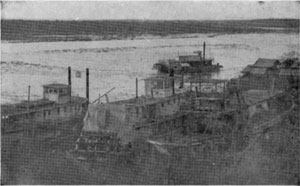 Boats Laid Up for the Winter at Washburn, N.D.
|
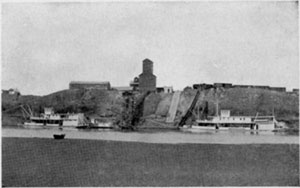 Washburn, N.D.
|
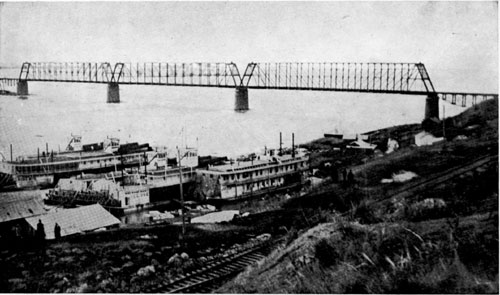 The Landing at Bismarck, N.D.
The old woman looked me over with a whimper
of amused superiority,
and disappeared, soon reappearing with a dark brown object not wholly
unlike a loaf of bread. "Wahtoo," she remarked, pointing to the dark
brown substance.
I gave her a half-dollar. Very quietly she took it and went back to her
fire. "But," said I, "do you sell your bread for fifty cents per loaf?"
The girl giggled, and the old woman gave me another piece of her Mandan
mind. She had no change, it appeared. I then insisted upon taking the
balance in eggs. The old woman said she had no eggs. I pointed to a
flock of hens that was holding a sort of woman's club convention in the
yard, discussing the esthetics of egg-laying, doubtless, while
neglecting their nests.
The old lady arose majestically, disappeared again, and reappeared with
three eggs. I protested. The Mandan lady forthwith explained (or at
least it appeared so to me) all the execrable points in my character.
They seemed to be numerous, and she appeared to be very frank about the
matter. My moral condition, apparently, was clearly defined in her own
mind. I withdrew in haste, fearing that the daughter at any moment might
begin to translate.
We dropped down river a few miles, prepared supper, and attacked the
dark brown substance which the Indian lady had called "wahtoo." At the
first bite, I began to learn the Mandan tongue. I swallowed a chunk
whole, and then enlightened the Kid as to a portion of the Mandan
language. "Wahtoo," said I, "means 'indigestible'; it is an evident
fact." Then, being strengthened by our linguistic triumph, we fell upon
the dark brown substance again. But almost anything has its good points;
and I can conscientiously recommend Mandan bread for durability!
Once more we had a rainy night. The tarp, stretched across the boat,
sagged with the water it caught, and poured little persistent streams
upon us. The chief of these streams, from the point of size, seemed
consciously aiming at my ear.
Thirce I turned over, shifted my position;
thrice I was awakened by the sound of a merry brooklet pouring into that
persecuted member.
Somewhere in the world the white cock was crowing sleepily when we put
off, stiff and soaked and shivering.
Early in the day the fine sand from banks and bars began to lift in the
wind. It smarted our faces like little whip lashes. Very often we could
see no further than a hundred and fifty yards in any direction. Only by
a constant, rapid dipping of the oars could the boat be held
perpendicular to the choppy waves. One stroke missed meant hard work for
both of us in getting out of the trough.
Fighting every foot of water, we wallowed through the swells—past Elbow
Woods, past Fort Berthold, past the forlorn, raggedy little town,
"Expansion." (We rechristened it "Contraction"!)
During the day the gale swept the sky clear. The evening air was crisp
and invigorating. We cooked supper early and rowed on silently over the
mirroring waters, between two vast sheets of stars, through a semilucent
immensity. Far ahead of us a high cliff loomed black and huge against
the spangled blue-black velvet of the sky. On its summit a dark mass
soared higher. We thought it a tree, but surely a gigantic one.
Approaching it, the soaring mass became a medieval castle sitting
haughtily with frowning crenellations upon an impregnable rock; and the
Missouri became for the moment a larger Rhine. At last, rowing up under
the sheer cliff, the castle resolved itself into a huge grain elevator,
its base a hundred feet above the stream.
Although it was late, we tied our boat, clambered up a zigzag path, and
found ourselves in one of the oddest little towns in the
West—Manhaven—one of the few remaining steamboat towns.
The main street zigzagged carelessly through a jumble of little houses.
One light in all the street designated the social center of the town, so
we went there. It was the grocery store—a general emporium of ideas and
canned goods.
Entering, we found ourselves in the midst of "the rustic cackle of the
burg." I am sure the municipal convention was verbally reconstructing
the universe; but upon our entrance, the matter was abruptly laid on the
table. When we withdrew, the entire convention, including the
grocery-man, adjourned, and accompanied us to the river where the
general merits of our boat were thoroughly discussed by lantern light.
Also, various conflicting versions of the distance to Bismarck were
given—each party being certain of his own infallibility.
There is something curious about the average man's conception of
distance. During the entire trip we found no two men who agreed on this
general subject. After acquiring a book of river distances, we created
much amusement for ourselves by asking questions. The conversation very
often proceeded in this manner:
"Will you please tell us how far it is to So-and-So?"
"One hundred and fifty-two and a half miles!" (with an air of absolute
certainty).
"But you are slightly mistaken, sir; the exact distance is sixty-two and
seven-tenths miles!" (Consternation on the face of the omniscient
informant.)
Once a man told us that a certain town was one hundred and fifty miles
down stream. We reached the town in an hour and a half!
However, we had more success with the Indian. One day we came upon an
old Mandan buck and squaw, who were taking a bath in the river,
doubtless feeling convinced that they needed it. The current took us
within fifty yards of them. Upon our approach, they got out of the water
and sat in the sand quite as nude and unashamed as our first parents
before the apple ripened.
"Bismarck—how far?" I shouted, standing up in the boat.
The buck rose in all his unclothed dignity, raised his two hands, shut
and opened them seven times, after which he lowered one arm, and again
opened and shut a hand. Then with a spear-like thrust of the arm toward
the southeast, he stiffened the index finger in the direction of
Bismarck. He meant "seventy-five miles as the crow flies." As near as I
could figure it out afterward, he was doubtless correct.
At noon the next day we reached the mouth of the Knife River, near which
stood the Mandan village made famous by Lewis and Clark as their winter
quarters. Fort Clark also stood here. Nothing remains of the Fort but
the name and a few slight indentations in the ground. A modern steamboat
town, Deapolis occupies the site of the old post. Across the river there
are still to be seen the remains of trenches. A farmer pointed them out
to us as all that remains of the winter camp of the great explorers.
In the late evening we passed Washburn, the "steamboat center" of the
upper river, fifty water miles from Bismarck. It made a very pretty
appearance with its neat houses climbing the hillside. Along the water
front, under the elevators, a half-dozen steamboats of the good
old-fashioned type, lay waiting for their cargoes. Two more boats were
building on the ways.
Night caught us some five miles below the town, and, wrapping ourselves
in our blankets, we set to drifting. I went on watch and the Kid rolled
up forward and went to sleep. After sixteen hours of rowing in the wind,
it is a difficult matter to keep awake. The night was very calm; the
quiet waters crooned sleepily about the boat. I set myself the task of
watching the new moon dip toward the dim hills; I intended to keep
myself awake in that manner. The moon seemed to have stuck. Slowly I
passed into an impossible world, in which, with drowsy will, I struggled
against an exasperating moon that had somehow gotten itself tangled in
star-sheen and couldn't go down.
I awoke with a start. My head was hanging over the gunwale—the dawn was
breaking through the night wall. A chill wind was rolling breakers upon
us, and we were fast upon a bar. I awakened the Kid and we put off. We
had no idea of the distance covered while sleeping. It must have been at
least twenty miles, for, against a heavy wind, we reached Bismarck at
one o'clock.
We had covered about three hundred and fifty miles in six days, but we
had paid well for every mile. As we passed under the Bismarck bridge,
we confessed that we were thoroughly fagged. It was the thought of the
engine awaiting us at this town that had kept us from confessing
weariness before.
I landed and made for the express office three miles away. A half-hour
later I stood, covered with humility and perspiration, in the awful
presence of the expressman, who regarded me with that lofty "God-and-I"
air, characteristic of some emperors and almost all railroad officials.
I stated to the august personage that I was looking for an engine
shipped to me by express.
It seems that my statement was insulting. The man snarled and shook his
head. I have since thought that he was the owner of the Northern Pacific
system in disguise. I suggested that the personage might look about. The
personage couldn't stoop to that; but a clerk who overheard my insulting
remark (he had not yet become the owner of a vast transportation system)
condescended to make a desultory search. He succeeded in digging up a
spark-coil—and that is all I ever saw of the engine.
During my waiting at Bismarck, I had a talk with Captain Baker, manager
of the Benton Packet Line. We agreed in regard to the Government's
neglect of duty toward the country's most important natural
thoroughfare, the Missouri River. About Sioux City, the Government
operates a snag-boat, the Mandan, at an expense ridiculously
disproportionate to its usefulness. The Mandan is little more than an
excursion boat maintained for a few who are paid for indulging in the
excursions. A crew of several hundred men with shovels, picks, and
dynamite, could do more good during one low water season than such boats
could do during their entire existence.
The value of the great river as an avenue of commerce is steadily
increasing; and those who discourage the idea of "reopening" navigation
of the river, are either railroad men or persons entirely ignorant of
the geography of the Northwest. Captain Marsh would say, "Reopen
navigation? I've sailed the river sixty years, and in that time
navigation has not ceased."
Rocks could and should be removed from the various rapids, and the banks
at certain points should be protected against further cutting. A natural
canal, extending from New Orleans in the South and Cincinnati in the
East to the Rockies in the Northwest, is not to be neglected long by an
intelligent Government.
As a slow freight thoroughfare, this vast natural system of waterways is
unequalled on the globe. Within another generation, doubtless, this
all-but-forgotten fact will be generally rediscovered.
Having waited four days for the engine, we put off again with oars. It
was near sundown when we started, hungry for those thousand miles that
remained. When we had pulled in to the landing at Bismarck, we were like
boxers who stagger to their corners all but whipped. But we had
breathed, and were ready for another round. A kind of impersonal anger
at the failure of another hope nerved us; and this new fighting spirit
was like another man at the oars. Many of the hard days that followed
left on our memories little more than the impress of a troubled dream.
We developed a sort of contempt for our old enemy, the head wind—that
tireless, intangible giant that lashed us with whips of sand, drove us
into shallows, set its mighty shoulders against our prow, roared with
laughter at us when, soaked and weary, we walked and pushed our boat for
miles at a time. The quitter that is in all men more or less, often
whispered to us when we were weariest: "Why not take the train? What is
it all for?" Well, what is life for? We were expressing ourselves out
there on the windy river. The wind said we couldn't and our muscles said
we shouldn't, and the snag-boat captain had said we couldn't get
down—so we went on. We were now in full retreat—retreat from the
possibility of quitting.
During the first night out, an odd circumstance befell us that, for some
hours, seemed likely to lose us our boat. As usual, we set to drifting
at dark. The moon, close on its half, was flying, pale and frightened,
through scudding clouds. However, the wind blew high and the surface of
the water was unruffled. There could be nothing more eerie than a night
of drifting on the Missouri, with a ghastly moon dodging in and out
among the clouds. The strange glimmer, peculiar to the surface of the
tawny river at night, gives it a forbidding aspect, and you seem
surrounded by a murmuring immensity.
We were, presumably, drifting into a great sandy bend, for we heard the
constant booming of falling sand ahead. It was impossible to trace the
channel, so we swung idly about with the current. Suddenly, we stopped.
Our usual proceeding in such cases was to leap out and push the boat
off. That night, fortunately, we were chilly, and did not fancy a
midnight ducking. Each taking an oar, we thrust at the bar. The oars
went down to the grip in quicksand. Had we leaped out as usual, there
would have been two burials that night without the customary singing.
We rocked the boat without result. We were trapped; so we smoked awhile,
thought about the matter, and decided to go to bed. In the morning we
would fasten on our cork belts and reach shore—perhaps. Having reached
shore, we would find a stray skiff and go on. But the Atom II seemed
booked for a long wait on that quicksand bar.
During the night a violent shaking of the boat awakened us. A heavy wind
was blowing, and the prow of the boat was swinging about. It soon
stopped with a chug. We stood up and rocked the boat vigorously. It
broke loose again, and swung half-way around. Continuing this for a
half-hour, we finally drifted into deep water.
The next day we passed Cannon Ball River, and reached Standing Rock
Agency in the late evening. Sitting Bull is buried there. After a late
supper, we went in search of his grave. We found it after much lighting
of matches at headstones, in a weed-grown corner of the Agency
burying-ground. A slab of wood, painted white, bears the following
inscription in black: "In Memory of Sitting Bull. Died Dec. 15, 1890."
Perched upon the ill-kept grave, we smoked for an hour under the flying
moon. A dog howled somewhere off in the gloomy waste.
That night the Erinnyes, in the form of a swarm of mosquitoes, attacked
us lying in our boat. The weary Kid rolled and swore till dawn, when a
light wind sprang up astern. We hoisted our sail, and for one whole
day cruised merrily, making sixty miles by sunset. This took us to the
town of Mobridge.
I was charmed with the novelty of driving our old enemy in harness. So,
letting the Kid go to sleep forward under the sail, I cruised on into
the night. The wind had fallen somewhat, but it kept the canvas filled.
The crooning of the water, the rustling of the sail, the thin voices of
bugs on shore, and the guttural song of the frogs, shocking the general
quiet—these sounds only intensified the weird calm of the night. The
sky was cloudless, and the moon shone so brightly that I wrote my day's
notes by its glow.
The winking lights of Mobridge slowly dropped astern and faded into the
glimmering mist.
Lonely seamen all the night
Sail astonished amid stars.
The remembered lines gave me the divine itch for quoting verses. I did
so, until the poor tired Kid swore drowsily in his sleep under the mast.
The air was of that invigorating coolness that makes you think of cider
in its sociable stage of incipient snappiness. Sleepy dogs bayed far
away. Lone trees approached me, the motion seeming to belong to them
rather than to me, and drifted slowly past—austere spectral figures.
Somewhere about midnight I fell asleep and was awakened by a flapping
sail and a groaning mast, to find myself sprawling over the wheel. The
wind had changed; it was once more blowing up-stream, and a drizzling
rain was driving through the gloom. During my sleep the boat had gone
ashore. I moored her to a drift log, lowered sail, flung a tarp over us,
and went to sleep again. And the morning came—blanketed with gray
oozing fog. The greater part of that day we rowed on in the rain without
a covering. In the evening we reached Forest City, an odd little old
town,
looking wistfully across stream at the youthful red and white
government buildings of the Cheyenne Agency.
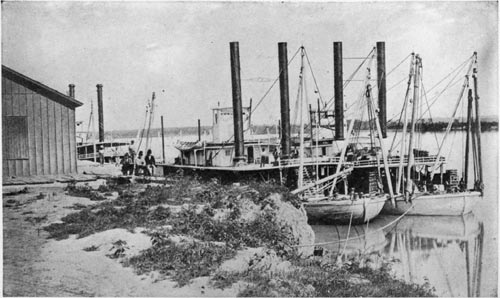 The Yankton Landing in the Old Days.
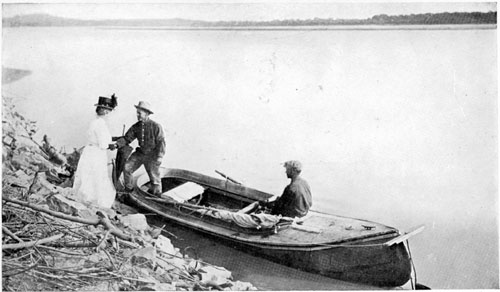 "Atom II" Landing at Sioux City.
Despite its name, this town is utterly treeless! I once knew a
particularly awkward, homely, and freckled young lady named "Lily." The
circumstance always seemed grimly humorous to me, and I remembered it as
we strolled through the town that couldn't live up to its name.
We were ravenously hungry, and as soon as possible we got our feet under
the table of the town's dingy restaurant. A long, lean man came to take
our orders. He was a walking picture of that condition known to patent
medicine as "before taking." I looked for the fat, cheerful person who
should illustrate the effect of eating at that place, but in vain. When
the lean man reappeared with the two orders carefully tucked away in the
palms of his bony hands, I thought I grasped the etiology of his
thinness. It was indeed a frugal repast. We took in the situation at a
glance.
"Please consider us four hearty men, if you will," I said kindly; "and
bring two more meals." The man obeyed. My third order, it seems, met
objections from the cook. The lean man, after a half audible colloquy
with the presiding spirit of the kitchen, reported with a whipped
expression that the house was "all out of grub." I regretted the matter
very much, as I had looked forward to a long, unbroken series of meals
that evening.
Setting out at moonrise, just after sunset, we reached Pascal Island,
fifteen miles below, before sleep came upon us in a manner not to be
resisted. All night coyotes yelped from the hilltops about us,
recounting their immemorial sorrows to the wandering moon.
At sunset of the fifth day from Bismarck, we pulled in at Pierre.
Although I had never been there before, Carthage was not more hospitable
to storm-tossed Æneas than Pierre to the weather-beaten crew of the
Atom. At a reception given us by Mr. Doane Robinson, secretary of the
State Historical Society, I felt again the warmth of the great heart of
the West.
During the first night out of Pierre, the Kid, having stood his watch,
called me at about one o'clock. The moon was sailing high. I grasped the
oars and fell to rowing with a resolute swing, meaning, in the shortest
possible time, to wear off the disagreeable stupor incident to arising
at that time of night. I had been rowing for some time when I noted a
tree on the bank near which the current ran. Still drowsy, I turned my
head away and pulled with a will. After another spell of energetic
rowing, I looked astern, expecting to see that tree at least a mile
behind. There was no tree in sight, and yet I could see in that
direction with sufficient clearness to discern the bulk of a tree if any
were there.
"I am rowing to beat the devil!" thought I; "that tree is away around
the bend already!" So I increased the speed and length of my stroke, and
began to come out of my stupor. Some time later, I happened to look
behind me. The tree in question was about three hundred yards ahead of
the boat! I had been rowing up-stream for at least a half-hour in a
strenuous race with that tree! The Kid, aroused by my laughter, asked
sleepily what in thunder tickled me. I told him I had merely thought of
a funny story; whereat he mumbled some
unintelligble anathema, and
lapsed again into a snoring state. But I claim the distinction of being
the only man on record who ever raced a half-hour with a tree, and
finished three city blocks to the bad!
The next day we rounded the great loop, in which the river makes a
detour of thirty miles. Having rowed the greater part of the day, we
found ourselves in the evening only two or three miles from a point we
had reached in the morning.
In a drizzling rain we passed Brule Agency. In the evening, soppy and
chilled, we were pulling past a tumble-down shanty built under the
bluffs, when a man stepped from the door and hailed us. We pulled in.
"You fellers looks like you needed a drink of booze," said the man as we
stepped ashore. "Well, I got it for sale, and it ain't no harm to
advertise!"
This strenuous liquor merchant bore about him all the wretched marks of
the stuff he sold.
"Have your wife cook us two meals," said I, "and I'll deal with you."
"Jump in my boat," said he. I got in his skiff, wondering what his whim
might mean. After several strokes of the oars, he pulled a flask from
his pocket, took my coin and rowed back to shore. "Government license,"
he explained; "got to sell thirty feet from the bank." "Poor old
Government," thought I; "they beat you wherever they deal with you!"
We went up to the wretched shanty, built of driftwood, and entered. The
interior was a mêlée of washtubs, rickety chairs, babies, and flies. The
woman of the house hung out a ragged smile upon her puckered mouth,
etched at the lips with many thin lines of worry, and aped hospitality
in a manner at once pathetic and ridiculous. A little girl, who looked
fifty or five, according to how you observed her, dexterously dodged the
drip from the cracks in the roof, as she backed away into a corner, from
whence she regarded us with eyes already saddened with the ache of life.
After many days and nights in the great open, fraternizing with the
stars and the moon and the sun and the river, it gave me a heartache to
have the old bitter human fact thrust upon me again. "What is there left
here to live for?" thought I. And just then I noted, hanging on the wall
where the water did not drip, a neatly framed marriage certificate. This
was the one attempt at decoration.
It was the household's 'scutcheon of respectability. This woman, even in
her degradation, true to the noblest instinct of her sex, clung to this
holy record of a faded glory.
Two days later, pushing on in the starlit night, we heard ahead the
sullen boom of waters in turmoil. For a half-hour, as we proceeded, the
sound increased, until it seemed close under our prow. We knew there
was no cataract in the entire lower portion of the river; and yet, only
from a waterfall had I ever heard a sound like that. We pulled for the
shore, and went to bed with the sinister booming under our bow.
Waking in the gray dawn, we found ourselves at the mouth of the Niobrara
River. Though a small stream compared with the Missouri, so great is its
speed, and so tremendous the impact of its flood, that the mightier, but
less impetuous Missouri is driven back a quarter of a mile.
Reaching Springfield—twelve miles below—before breakfast, in the
evening we lifted Yankton out of a cloud of flying sand. The next day
Vermilion and Elk Point dropped behind; and then, thirty miles of the
two thousand remained.
In the weird hour just before the first faint streak of dawn grows out
of dark, we were making coffee—the last outdoor coffee of the year. Oh,
the ambrosial stuff!
We were under way when the stars paled. At sunrise the smoke of Sioux
City was waving huge ragged arms of welcome out of the southeast. At
noon we landed. We had rowed fourteen hundred miles against almost
continual head winds in a month, and we had finished our two thousand
miles in two months. It was hard work. And yet——
The clang of the trolleys, the rumble of the drays, the rushing of the
people!
I prefer the drifting of the stars, the wandering of the moon, the
coming and going of the sun, the crooning of the river, the shout of the
big, manly, devil-may-care winds, the boom of the diving beaver in the
night.
I never felt at home in a town. Up river when the night dropped over me,
somehow I always felt comfortably, kindly housed. Towns, after all, are
machines to facilitate getting psychically lost.
When I started for the head of navigation a friend asked me what I
expected to find on the trip. "Some more of myself," I answered.
And, after all, that is the Great Discovery.
Transcriber's Note:
The original text has a number of typographical errors and spelling
inconsistencies, which have been maintained in this text. The following
list details these errors:
Inconsistent spellings
cross-cut / crosscut
Encleadus / Enceladus
færie / faërie
half-way / halfway
Hole-in-the-Wall / Hole-in-the-wall
log-book / logbook
mid-stream / midstream
sand-bar / sandbar
"Texas" / Texas
wind-like / windlike


