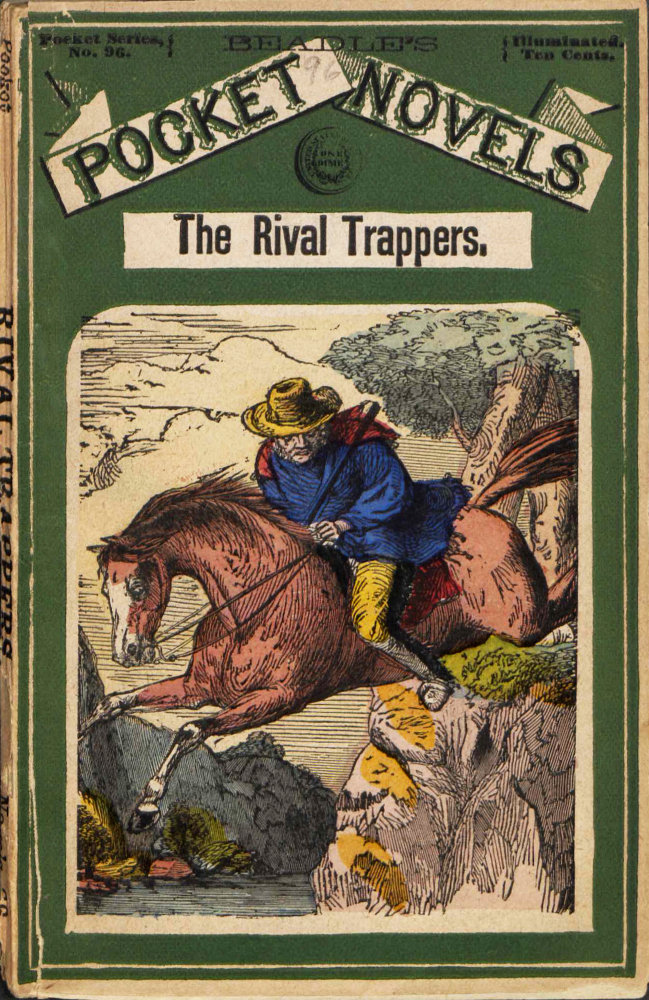
Hush! Is that a footstep coming up the canon? It came
nearer and nearer, and a man of strange appearance suddenly
stepped into view, rounding a bend in the canon. At the first
glance it seemed that he was a dwarf in stature, but as he advanced,
it was plainly to be seen that this was a mistake, for
those broad shoulders and herculean arms never belonged to a
dwarf. In hight he would scarcely have reached five feet, but
his girth of shoulder and hip was something wonderful. In
short, he had the body of a giant, set upon a pair of legs so
crooked and misshapen that it seemed as if he had borrowed
those limbs from some one else.
He came on with a peculiar, sidelong, hitching gait, swinging
out his left leg and throwing forward the shoulder upon
that side in an irresistibly ludicrous way, but getting over the
ground at a very fair pace.
His dress was that of the mountainman, of greasy buck-skin,
yet showing the careful hand of woman in the manner
in which it was made. He wore fringed leggins, moccasins
of ponderous size, and a high bear-skin cap, which added considerably
to his ludicrous “make-up.” His weapons were a
carefully-polished rifle, a pair of splendid revolvers, a knife
and a hatchet.
His face was broad, ruddy and good-natured, fringed by a
russet-brown hair and beard, slightly sprinkled with gray. A
single look at the high forehead, merry brown eyes and smiling
10
mouth, about which a whimsical look would linger in
spite of himself, showed that he was a merry, reckless soul,
but a man of undaunted courage.
“Hyar we come and hyar we go, pegging along the canon,”
he half-sung. “Thar was some mistake in my make-up, I
reckon, or I’d be a different man. But who keers, ez long ez
I am happy ez a buck Digger in grasshopper time? Oh,
Lordy, yes.”
He stopped and cast a penetrating glance about him, at the
same time dropping one leg a little, showing that it was
shorter than the other by some two inches. He seemed to
listen, and his leonine head was thrown to one side in an attitude
of profound attention. The next moment, by a movement
of wonderful rapidity, he threw himself out of sight into
one of the crevices with which the ravine abounded, and
dropping to the earth behind a bowlder, awaited the event.
To the casual observer there had been no break in the
usual sounds in mountain and forest, but a moment more
showed that the wanderer was not at fault, for the sound of
hoofs could be plainly heard, coming up from the east. Nearer
and nearer they came, and the rapidity of the hoof-beats
showed that the horseman, whoever he might be, was coming
at the top of his speed; and directly the head of a horse appeared,
and a single rider came thundering down the pass,
half-lying on the animal’s back, and urging him on with knife
and spur, while behind him sounded other hoof-beats, showing
that he was pursued.
It was a white man, and that was enough for the old hunter,
who started out from his place of concealment and checked
the flying steed.
“Hi, thar, stranger—what’s up?”
The rider reined in his furious horse and grasped a weapon,
but, seeing that it was a white man who barred the way,
dropped his hand and answered, hurriedly:
“Indians!”
“After you?”
“Looks like it, old man.”
“Get down quick, then—take yer weepens, and send the
hoss on. You’ve got ter lose him, or yer sculp.”
The man did not hesitate, but flung himself from the saddle
11
and scored his knife-point sharply across the flank of the
horse, which fled on lightly, being freed from its rider, and
without a word the hunter led the way into the crevice which
he had just left.
The horse had just made the last turn in the canon when
about twenty of those Arabs of the plains, the Blackfeet, suddenly
came in view, riding with loosened reins, their mustangs
scrambling like cats along the bed of the canon, and the riders,
bending forward like huntsmen in the chase, urging them
on by word and blow. They passed like a whirlwind, and
were gone; then the hunter bounded to his feet.
“Thar they go, the painted riptiles, like bed-bugs armed fur
war! Come on, stranger; the quicker we git up these yer
rocks the better.”
“I am a poor footpad,” said the stranger, with a light
laugh; “but lead the way, old True Blue, and I’ll follow.
That was a close shave, I tell you.”
“Clust enuff fur comfert,” replied the hunter. “This
a-way.”
He began to climb the rugged side of the ravine with the
agility of a cat, swinging his huge body from ledge to ledge
by the power of his gigantic arms, and then turning to assist
his companion, who, although younger, was by no means so
agile.
Again and again, but for the timely aid of those muscular
arms, the younger man would have fallen headlong into the
gulf below, but at last they reached the top of the ledge, fifty
feet above the canon bottom.
“Down—fur yer life—down!” hissed the hunter, as they
reached the top of the ledge.
Both men fell prostrate, and not a moment too soon, for
the Indians were coming back at a flying gallop, leading
among them the horse which had so lately been abandoned
by the rescued man. They came to a halt directly beneath
the ledge, sitting erect and grim upon their panting mustangs,
without uttering a word.
No body of men on earth can present a more warlike appearance
than the Blackfeet—a nation brave even to desperation.
Their bronzed bodies, shimmering ornaments and flaunting
feathers; their long lances glittering in the sun; the ease
12
and grace with which they sat their horses, as if horse and man
were one piece, combined to make the appearance of this
body at once imposing and threatening.
The chief was a man of gigantic size, armed with lance,
hatchet, knife and a sort of mace—which he carried slung at
the pommel of the high Mexican saddle, with which he rode.
He spoke, and at the sound of his sonorous voice the hunter
started, for he knew the voice well. It was that of Whirlwind,
a chief who had made himself a terror throughout that
region, and the deadly enemy of white men, under all circumstances.
“Let the braves scatter and search the canon,” cried
Whirlwind. “The white dog has leaped from his saddle
and is hidden among the rocks like a rabbit. We must have
his scalp, for he has killed Flying Cloud the son of Natal—Nemissa.
Can we return to the Blackfoot lodges with empty
hands?”
The majority of the warriors, leaving their horses in
charge of the rest, sprung down and began the search, but
the feet of their flying steeds had obliterated all signs of a
trail, had there been one, and the place where the white
men had ascended was a rock which would not leave the
mark of a foot. The old hunter was lying on the earth,
literally convulsed with laughter at the manner in which he
had outwitted Whirlwind, an enemy to the death, when,
turning his eyes upon the man he had saved, he saw him in
the act of thrusting forward the rifle with the intention of
killing the chief. Rolling over quickly the hunter grasped
the rifle, and after a struggle succeeded in tearing the weapon
from the young man’s grasp. In doing so, however, a
small piece of rock was detached and fell over the cliff upon
the head of an Indian below, who was knocked senseless by
the blow. The chief started and cast a quick glance upward,
but at this moment the hunter while holding his companion
down, managed to give an exact counterfeit of the
bleat of a Bighorn. So perfect was the imitation that the
chief at once concluded that the Bighorn in moving about
had knocked down the stone upon the head of the stricken
warrior, and seeing that his men were puzzled he called
them in and they moved up the pass together searching
13
every crevice for the man who had escaped them. When
the sound of hoofs came faintly back from the upper part of
the ravine, the hunter released his companion and stood up
while the other bounded to his feet, flushed and excited.
“It is a good thing for you that you have just saved my
life, old man, or we should quarrel. What did you mean
by stopping me when I was going to shoot that old thief,
Whirlwind?”
“Look yer, young ’un,” demanded the hunter, “d’ye know
who I am?”
“No.”
“Mebbe you don’t want to?”
“Of course I wish to know the name of the man who
has just saved my life, but let me warn you never to attempt
again what you did just now.”
“You’d mount me ez a spider mounts a fly, I ’spose?”
said the hunter, coolly. “My young fr’end, never let yer
angry passhins git the best ov you, and by all means never
hop on a man untel you ar’ tollable sartin you kin lick him.
I don’t want to put you in mind ov the fac’ thet I hev just
saved yer life—I’d do that ag’in, any way—but, what was
you going ter do ef you hed killed Whirlwind?”
“There would have been one less scoundrel on the face of
the earth.”
“Sartin; I agree; but, look yer, my lad; kin we two lick
nineteen Blackfeet?”
“I don’t suppose we could.”
“No, sirree! I’ve fou’t Injuns ever sence I was knee high
ter a grasshopper, and I want ter hev it sot down thet an
Injun in his own kentry and well fixed, is an or’nary and
orkard cuss to manige; he is, by thunder! I’ve hern tell ov
one man sending ten or twelve to grass, but he can’t do it
every day, bet yer life.”
“But they could not get at us here—”
“I ’spose not. An Injun can’t climb ez well ez the next
man, I ’spose. Now did ye ever hear tell ov Old Pegs?”
The young man started and looked at him keenly.
“Old Pegs the guide—Old Pegs the hunter, Old Pegs the
Indian terror? I should think so.”
“Them’s my handles, stranger; I’m Old Pegs.”
14
“I beg your pardon for saying what I did then, for I have
no desire to quarrel with a man of your reputation. Perhaps
it is for the best that Whirlwind should escape at this
time, but my hour will come, and when it does—let him beware
of me.”
“All hunky; rub him out the fust chaince you git. Now
what’s your handle, young man?”
“People who know me well, call me Rafe Norris.”
“I don’t keer what people call you. Is Rafe Norris yer
handle?”
“Yes.”
“What’s yer biz?”
“I can’t tell you that just now, my good friend. I—”
He did not finish the sentence, for Old Pegs caught him
by the shoulders and flung him heavily to the ground, falling
beside him from the impetus of his own exertions. The
hand of the old guide was outstretched, and catching up a
heavy stone he flung it with deadly aim at the feathered
head of an Indian which at this moment rose above the ledge
and who was poising a lance for a throw. Straight between
the eyes the heavy stone struck, and, spreading his arms
abroad, the Indian plunged head-foremost into the depths
below, where his skull was shattered out of the semblance of
humanity upon the rocks. So quickly was it done that Rafe
Norris had no idea why he had been so rudely assailed, and
seizing upon Old Pegs, began to pommel him about the head
and shoulders.
“See yer, my boy,” said Old Pegs, “ef you hit me and I
find it out, I’ll be darned ef I don’t send fer ye once, jest fer
fun—now you hear me. Confound each individual wolverine
in these tempestuous wilds ef I knows what’s the matter
with you.”
“What did you pitch into me for?” hissed Rafe, in an
angry tone.
“Come hyar, you fool, ef I must say it,” replied Old Pegs.
“Creep to the edge of the cliff and look over.”
Considerably awed by the manner of the hunter, Rafe
crawled to the edge of the cliff, and looking down cautiously
saw the dead form of the savage below, while the rattle of
hoofs told that some of the Indian’s comrades were coming
15
back to look for him. The unfortunate savage, suspecting
something wrong and desirous of distinguishing himself, had
come back to search again for Rafe Norris, and hearing
voices, had scaled the cliff unheard just in time to meet his
fate.
“Come along,” whispered Old Pegs. “Show a leg and
foller me.”
CHAPTER II. OLD PEGS’ TREASURE.
The country through which Old Pegs led his new friend
was one of the most difficult and dangerous in the portion of
the foothills in which they were placed. No one, save a man
who loved solitude, and would have chosen it from all others
as a home, would have thought of spending so many years of
his life in this lonely place. They passed through defile after
defile, clambered over ridges and forded mountain streams in
which the trout were so abundant that their feet touched them
as they passed.
On the march, Old Pegs had a chance to observe his companion
closely, and he did so without allowing him to think
that he was watched. Rafe might have been thirty years of
age, of an erect, stately figure, with very black hair and eyes.
His hair was suffered to grow long, and curled slightly at the
ends; he wore a heavy mustache—the point dropping nearly
to his collar as he stood erect—and a long imperial. His eyes
were of that vivid black so seldom seen, and looked wicked
and bold. Although in mountain garb, there was a sort of
dandyism even in this dress which did not strike Old Pegs favorably.
“I don’t know whether I’m doing the right thing in showing
you this road,” said the hunter. “I’m a plain man and
in a humble station, and I’ve got a treasure to guard.”
“A treasure?”
“You bet!”
“Have you found a gold-mine?”
16
“No; gold ain’t no use ter me, or I could find it soon
enough.”
“It can not be diamonds?”
“Better’n diamonds, young ’un; better’n gold; better’n
beaver, even.”
“What can you be talking of?” said Rafe, impatiently.
“Never you mind about that. I know what I’m talking
about, and when I get home I’ll show you my treasure.”
At a turn in the path they were traversing they came suddenly
upon a huge bear, which reared upon its haunches and
sat, in a silly way, looking at them, with its tongue hanging
out. Rafe Norris, who had no love for close companionship
with a grizzly, dropped his rifle into the hollow of his hand,
and was about to fire, when Old Pegs struck up the weapon.
“Don’t shoot that b’ar, confound you!” he cried. “He’s
mine.”
“A pet bear! Is that your treasure, then?”
“Not a bit of it,” replied Old Pegs. “Kinder inquisitive,
ain’t you?”
“You have aroused my curiosity, I must confess,” replied
Rafe.
“Bruin! Bruin!” cried a clear, sweet voice. “Come here,
sir!”
Down dropped the bear upon all fours, and waddled away
in the direction of the voice, while Rafe stopped and looked
at Old Pegs in amazement.
“That is your treasure, eh?” he demanded. “I thought
you were too old a man to care for a woman.”
“I’m a nice figger fur a lady’s man, ain’t I?” replied the
hunter, scornfully. “I orter hit you, but I guess I won’t.
Here we ar’.”
The path led out of the narrow ravine through a thicket,
and they entered a small, sheltered valley, containing hardly
an acre of bottom-land, a sort of oasis scooped out by the
hand of nature from the bosom of the eternal hills. There
was no sign of human habitation anywhere, but their ears
were saluted by a burst of song and the tinkle of a guitar.
The voice of the singer was so wonderfully pure, rich and
sweet that Rafe stopped in utter amazement and looked at
Old Pegs.
17
“What does this mean, old man?” he cried; “that is not
the voice of an Indian woman.”
“Ska’cely; oh, no—I reckon not. And see yer, feller—thet
gal is under my pertection, and the man thet lays a finger
on her, or insults her by look or word, may git out the papers
fur his funeral—and I’ll see thet they hev a corpse. D’ye understand?”
“Why should I try to harm her?” said Rafe. “Hush!
let us hear her song.”
It was a song of chivalry—a song of the old days—that
seemed to speak the clash of spears and the rattle of steel armor.
The voice rung out full and clear, not a note was slurred
or hurried, and the two stood spell-bound until she had
finished, when Old Pegs called out: “Myrtle!”
The sound of the guitar was hushed; there came the rush
of flying feet, and the singer appeared and flung her arms
about the neck of the old man and kissed him.
“I am glad you have come, father, for I was getting lonely.
You—”
She paused suddenly, for her eyes just then rested upon the
face of Rafe Norris, who was gazing at her with a look of
undisguised admiration. What did he see? A fair young
creature in the flush of early womanhood, with a face and
form which might have driven a painter mad. She was
slightly framed, but every line was in perfect symmetry, and
her face was perfection itself. A touch of peach-bloom in
either cheek, ripe-red lips and lustrous brown eyes; short,
ambrosial locks, clinging about a neck which rivaled in whiteness
the snows of the mountain, and a look of perfect innocence
beautifying all.
Why did Rafe Norris gaze at her as if he had seen a vision
from the grave?
“Don’t be skeered, little ’un,” said Old Pegs. “This yer
is Rafe Norris, a gentleman thet run from some cussid Blackfeet
and got away. I brung him here fur the night, and expect
you to treat him well. This is my darter, Rafe—I kain’t
mister any one, ye know—and she’s the best and pootiest gal
in the kentry.”
Rafe Norris bowed low, and uttered a well-framed compliment,
which the girl received coldly.
18
“It is somewhat strange, Mr. Norris, that you should be
alone here,” she said.
“I was separated from my party,” he answered, blandly,
“and the Indians set upon me before I was aware. I would
accept the danger gladly for the honor of this introduction.”
“Draw it kinder mild, Rafe—kinder mild,” said Old Pegs.
“We raally can’t stand too many nice speeches, out hyar.”
“That speech came from my heart,” replied Rafe. “I
hope that the lady will not consider it an unmeaning compliment.”
“That’ll do,” said Old Pegs, dryly. “Now, Myrtle, gal,
will you git us suthing to eat? Ez fur me, I’m pesky hungry.
I could eat a hull antelope to my own cheek this hyar
blessid minnit. What hav you got fur us?”
“I caught some trout awhile ago, and have them ready to
broil,” replied Myrtle.
“I cannot consent to allow Miss Myrtle to perform such
menial service for me,” said Rafe. “Let me do the cooking,
for which such hands were never intended.”
Myrtle broke into a merry laugh. “You betray yourself,
Mr. Norris,” she said. “You are a gentleman born and bred,
for none of our own mountaineers would object to my cooking
a meal for them.”
He looked a little vexed, and she glided away, and Old
Pegs sat down on a great rock and signed to his companion
to do the same.
“Let me go and assist Miss Myrtle,” said Norris. “It really
pains me to suffer her to do such work.”
“Sit down, stranger,” said Old Pegs, shortly. “I won’t
hev any one, I don’t keer who he is, try ter make the gal discontented
with her life hyar. She’s the darter of a mount’in
man, and ef she ever marries—which I hope she won’t—she’ll
be the wife of a mount’in man; thet’s ez good ez swore
to.”
“I hope you do not doubt me, Mr.—”
“Old Pegs! Thet’s my name—Old Pegs. I don’t want
no other handle, and I won’t hev it. Ef I knowed you well
I wouldn’t keer so much, but yer a stranger, and so we won’t
hev any sort of familiarity until I does know you.”
“You are particular, sir,” replied Norris, knitting his brows.
19
“It is sad that I did not bring my pedigree with me when I
came here.”
“Don’t be ridiculous, stranger,” replied Old Pegs, “or we
may part company afore you know it. I won’t have no foolishness
about hyar ef I know it; no discount on thet ar’.”
“I beg your pardon again, but really you are very hard
on me. I claim to be a gentleman, and hope I am so. Perhaps
that would make me lose your good esteem.”
“Oh no; I’ve knowed lots of gentlemen thet was bully boys,
and many’s the high old time I’ve had with ’em, right about
hyar. But, they was gentlemen, and I knowed it. Now I
don’t know any thing about you.”
“I hope you will know me better sometime,” replied Rafe,
in such a peculiar tone that Old Pegs looked up at him
quickly, as if to detect the lurking menace in his face. But
that face expressed nothing except polite desire to make
friends, and the old hunter dropped his eyes again and whistled.
A lumbering tread was heard; the pet bear appeared
and came rolling up at that peculiar gait so common to his
race, and placing his head upon the ground, turned a sort of
summerset, erected himself upon his hind feet, and came forward,
extending his paw, which Old Pegs shook heartily.
“Glad ter see you, Bruin, my boy,” he said. “Hev ye
taken good keer of yer young mistress while I’ve been gone?”
The bear nodded in a singularly grotesque manner, and
Rafe could not repress a laugh.
“You have trained that fellow well, old man,” he said.
“I suppose he will obey you in any thing now?”
“Ef you was to lay a finger on me and he thought you
was in ’arnest, it would take a hull brigade to gether yer fragments
from the a’jacent kountry round abowt.”
“I’ll be ‘keerful’ how I handle you then,” said Rafe.
“Did I understand you to say that Miss Myrtle is really your
daughter?”
“Ain’t no ways anxious ter know, be you, stranger?” said
Old Pegs, frowning. “Git up hyur, Bruin—stand on yer
he’d!”
The grizzly at once threw his quarters into the air, and in
that attitude walked up to his master, and planting his head
upon the earth, remained in that position until ordered to
20
come down, which he did at once and rolled himself rapidly
over and over until he was quite out sight behind the bushes.
“You dislike to talk about your daughter, I see,” said Rafe,
persistently.
“No I don’t—no sech thing,” replied Old Pegs, belligerently.
“Don’t tell me no sech foolishness. She’s a good
gal, but she ain’t fur gentlemen to consort with, mind you.
And look yer; ef you kain’t manige ter git along ’thout
making yourself too familiar, then all I kin say is, we’d better
part kump’ny now.”
What Rafe might have said in reply it is impossible to say,
but at this moment Myrtle appeared and called to them. Old
Pegs arose in his slow and easy manner, and led the way
through a screen of thick bushes until they came upon a cabin
so artistically concealed that a person might have passed it a
hundred times without suspecting its presence. It was built
of small logs dovetailed at the corners in frontier fashion,
and chinked with a sort of blue clay. It had two small
windows, each containing four panes of glass—for that article
was difficult to transport to the mountain region. The door
was heavy and swung upon iron hinges, manufactured from
strap iron, in a rude way. The interior of the little place
was as neat as hands could make it, and the little table and
stools actually shone with scrubbing. A guitar stood in a
little curtained recess, and, to the utter surprise of Rafe Norris,
a rude bookcase in one corner contained a supply of books
which had evidently been much used. The table was set in
the middle of the room, the plain crockery arranged to the
best advantage. They had venison steaks, fresh broiled trout,
pone bread and fragrant coffee. Norris at the invitation of
Old Pegs drew up his stool and was helped liberally. Myrtle
poured the coffee, and all enjoyed a hearty meal.
“Thar,” said Old Pegs, “I dunno ez I keer fur any more.
What a thing it is to hev a gal like Myrtle ter make the little
cabin bright! She killed that deer and caught them trout
herself, and thet’s what I call being ginerally useful. What
do you say?”
“I can appreciate the home qualities of your daughter,”
said Rafe, “but from the appearance of that book-case and
the guitar I should say that she has other good qualities.”
21
“And so she hez, Rafe—so she hez. She kin sing like a
bird—kin Myrtle—and when the old man comes home tired
from the hunt, mebbe she don’t make his life pleasant by singing
and reading. She’s a master reader—is Myrtle.”
“I should think that it would be hard to find a teacher in
this section, but, from the quality of the books which I see
she must be considerably advanced.”
“Oh she’s got a teacher,” replied Old Pegs with a sly look
at Myrtle, whose cheek flushed like the rose. “A mighty
good teacher, I mout say.”
“I was about to offer my poor services in that capacity,”
said Rafe, “and I am sorry to hear that I am in some degree
forestalled.”
“Yer cut out intirely,” replied Old Pegs. “The gal won’t
take to no other teacher ez she does to this one.”
“Where is this wonderful teacher now, if I may ask?”
said Rafe with a look of annoyance.
“Gone down ter the fort, I reckon. It’s about time fur a
lesson, too, and I kin see thet the gal is getting anxious.”
“Father!” cried Myrtle.
“Thet is gospel truth, gal,” replied Old Pegs with a grin.
“I kin see it in yer eye, whenever I look at you.”
Rafe was puzzled to understand the manner in which
Myrtle received the bantering speech of her father. She
seemed ill at ease, and her eyes wandered to the door from
time to time as if in expectation. Just then the bear, which
had been lying upon the threshold, raised his muzzle and
snuffed the air in a peculiar manner, and then rising heavily,
started away on an awkward shambling trot in the direction
of the entrance to the valley.
“The critter smells suthing,” said Old Pegs, drawing his
rifle nearer, “and I’ll take a walk outside and see what’s up.”
He started out quickly, leaving Rafe Norris with Myrtle.
He at once began to improve the opportunity.
“It seems strange to me that a lady to all appearance so
refined as you are should pass her life in the midst of this
desolation.”
“I am not ‘a lady’ and I am far from refined, Mr. Norris.
Is it lady-like to go out and shoot a deer, bring home steaks
and saddle, and catch and cook a mess of trout? I am very
22
much afraid that you are mistaken in me, and think me one
of those white-handed misses who mince along the streets of
Leavenworth and St. Joseph; but I am not.”
“You belie yourself in this, Miss Myrtle. While you stay
here of course you must conform to the usages of the society
in which you live. But you are fitted to adorn—”
She lifted her finger in a playful manner.
“No nice speeches, if you please, Mr. Norris, for I am not
used to them, and should not know how to appreciate them
in the least. I am afraid your intercourse with the fine
ladies who dwell in cities, has unfitted you for the realities
of life as we find them in the mountains.”
“I pray not, for I hope to win your good opinion some
day, and to be able to prove to you that such ladies are not
to my taste. I admire your spirit—”
“I think we had better change the conversation as I am
not egotistical enough to wish to talk of myself, and nothing
else. Perhaps you play the guitar.”
“A little,” he replied, “but I am not going to expose myself
by trying to play now. I heard your music as I came
up and was literally enthralled by it.”
She brought the guitar, and began to clear away the table
while he touched the keys and strings lightly, bringing the
instrument into tune, while he kept his eyes upon her steadily.
There was an elasticity and grace in every movement
which spoke of perfect health, and he was obliged to confess
that he had never seen her equal. The man was susceptible
to female grace and beauty, and was touched now
as he never been before, and knew it. Once or twice she
met his eyes and was startled by the bold look of admiration
in them. He continued to drum upon the strings,
merely striking chords and watching her intently. He seemed
about to speak, but at this moment the sound of voices
could be heard and Old Pegs, accompanied by a young man
in a tasteful hunting garb, entered the room. Myrtle sprung
forward with a glad cry and gave him both hands while giving
him a welcome.
“Is that her teacher, I wonder?” muttered Rafe, below his
breath. “We shall see. I will not be foiled when the prize
for which I play is almost in my grasp.”
23
CHAPTER III. DAVE FARRELL. BRUIN SCOUTING.
The young man who had entered was the beau ideal of a
Western scout, and Rafe was obliged to confess that he
would have made a hard customer to meet in the midst of
a border struggle. About five feet and ten inches in hight,
straight as a cedar, with curling brown hair, and eyes of
the same color, a brown but well-cut face, firm lips and
white teeth; dressed as a leader of scouts in the neat fringed
hunting-shirt belted at the waist, high horseman’s boots and
sombrero; and armed with the rifle, two first-class revolvers
and a heavy knife. He carried a bundle in one hand which
he dropped to meet the extended hands of Myrtle, and stood
there with a smile upon his handsome face.
“Rafe Norris,” said Old Pegs, “this hyar chap is Dave
Farrell, a real out and outer, at present captain of a trapping
brigade of the North-west Company. Ef you meet any one
thet asks you, be keerful to tell ’em thet Old Pegs sez he’s a
roarer! You kin realize money on that, every time.”
Dave Farrell turned to acknowledge the introduction with
a peculiar look upon his face.
“It seems to me, although I may be wrong—that I have
seen you before.”
“I don’t remember, Captain Farrell,” replied Rafe, coolly.
“Still, I’ve been in many places, and we might have met
without recollecting it.”
“I think it was in Fort Garry, in the year ’53.”
“Scarcely; I have not been in that country for nearly four
years.”
“We are all liable to mistakes,” said Dave; “but of course
you have some kind of business up this way?”
“Of course.”
“Do you object to mentioning what business?”
“I am not in a position to give you any information upon
the subject just now as I do not recognize your authority.
24
I have been chased by Indians and escaped by means of
your friend here, who has offered me a shelter and has not
insulted me by asking impertinent questions.”
“Impertinent!” said Dave, slowly, turning his eyes full
upon the face of the speaker. “I said that I would like to
know your business, having stated mine.”
“And I tell you that I am not in a condition to gratify
your curiosity in the least.”
“Let’s have no quarreling hyar, boys,” said Old Pegs.
“Mr. Norris goes away to-morrer to find his party, and thet’s
the end of it. Let’s treat him like a gentleman while he
stays.”
“I have no more to say at present,” said Dave. “If I
had thought my simple question would be regarded as an insult
I should not have asked it.”
“You are excused,” said Rafe, coolly, “but I don’t allow
any man to interfere with my affairs.”
Dave said no more, but dropping upon one knee began to
undo the bundle which he had dropped, and Myrtle clapped
her hands joyfully as he displayed a number of well-selected
books and literary papers. The two were soon occupied
over them to the utter exclusion of the rest, for the efforts
of Rafe Norris to take part in the business were put aside with
an ease which showed that Dave considered himself master
of the situation.
“Oh, let up, Dave,” said Old Pegs; “drop them cussid
books and talk to us. What did you hear new at the
fort?”
“I heard that the Hudson Bay are going to trap on our
side this year, in spite of our men.”
“Hey! Now it looks like our boys will let ’em, don’t
it?”
“They are not the kind of men easily trodden underfoot,
as you know well,” replied Dave, grimly. “I’ve fought the
Hudson Bay for ten years and I’m not going to be driven out
of my way by them now.”
“I’ve heard that the Hudson Bay was very strong this
year in the number of their men,” said Rafe Norris.
“Scissors!” roared Old Pegs. “You don’t ’spose we keer
fur thet, do you? Hark; what’s thet?”
25
They heard a fierce growl from the bear, and then a cry
of mortal agony. The three men grasped their weapons,
and darting away in the direction of the sound, found the
bear locked in a close grapple with an Indian, while another
was running rapidly across the opening.
“Spies!” cried Old Pegs, pointing after the flying man.
“Stop him, Dave!”
Dave Farrell brought his rifle to his shoulder, and fired,
apparently without aim. The flying savage paused suddenly,
made a leap into the air and fell upon his face.
“Euchered!” said Old Pegs, quietly. “I don’t want no Injins
in my camp, you bet! Let’s look arter this chap Bruin
hez harnessed.”
The teeth of the bear were fastened in the shoulder of the
Indian with whom he struggled, and his claws were tearing
him limb from limb. Old Pegs caught the brute by the neck,
and by the exercise of all his muscular power, coupled with
a loud command, managed to separate the two, and the Indian,
a horrible object to look at, sunk back upon the sod,
bleeding at every vein.
Old Pegs stooped to raise him, but at this moment his eyes
opened and rested upon the face of Rafe Norris, who had followed
the rest. A look of recognition passed over his face,
and he seemed about to speak, when Norris drew a pistol and
shot him through the heart as coolly as if he had been a dying
brute.
“It is better to put him out of his misery,” he said, quietly;
“and, as you say, it won’t do to have spies about us.”
“That was a coward shot,” cried Dave, angrily. “How
dare you kill a wounded man before us?”
“My young friend,” replied Rafe, in his smooth tone,
“don’t let us make any mistakes or have a quarrel out here,
for I am quick on the trigger and might shoot.”
“Our boys don’t scare very easy,” was the answer, “and
are always ready to take and give. If you are inclined that
way, I don’t know but it is just as well to humor you.”
“Hold on, boys,” cried Old Pegs. “I take a hand in this
game, myself. The fust man that lifts a weepen hez got ter
stand a shot from me.”
“I will not be bullied by any man alive,” cried Rafe Norris.
26
“If I shot this savage, it was only to put him out of
pain, for any man can see that he would have been dead in
five minutes.”
“Mout be you are right, Rafe,” replied Old Pegs; “but,
why didn’t you let him die the nat’ral way? It almost
seemed to me thet the cuss know’d you, and was going ter
speak.”
“Pshaw; what will you suspect next, I wonder? I never
saw the fellow in my life.”
“I ain’t going to conterdict you, Rafe, acause it won’t pay,
ez I hain’t got no proof. Howsumever, thar lies the critter
with a bullet in the heart, and he’s rubbed out, easy. But,
what I want ter know is this: what is this yer Modoc Sioux
doing in this kentry?”
“Modoc Sioux!” cried Dave, looking more closely at the
dead savage. “You are right, old man, and it is a surprise
to see a party of that tribe in the heart of the Blackfoot
country.”
Rafe Norris started; an angry look came into his face, for
he thought he saw suspicion in the eyes of the two men.
That branch of the great Sioux nation known as the Modoc
Sioux were notorious for their hostility to the whites, and their
country was far away.
“Let’s look at the other chap,” said Old Pegs. “This hyar
gets me, it does; it gets me dead ter rights.”
They hurried to the side of the Indian who had been so
suddenly stricken by the fatal bullet of Dave Farrell, and
turned him over. The ball had entered the back just below
the left shoulder, and passed through his heart, so that his
death was instantaneous. His face was calm and peaceful,
and both the mountainmen started as they recognized “Half-breed
Jack,” a man who was known far and wide as one of
most trusted employes of the Hudson Bay Company—a villain
who was capable of any crime.
“Now this begins to look like business,” said Dave. “Old
Pegs, you and I must talk this matter over alone.”
“Why alone, my mountain hero?” demanded Rafe, in a bantering
tone. “Am I to understand that you do not consider
me a trustworthy person?”
“We never trust strangers with our business,” replied Dave.
27
“You do not seem in the least surprised to see Half-breed
Jack lying here.”
“Half-breed Jack, eh? And who, pray, is Half-breed
Jack?”
“If you don’t know now, you never will,” was the ambiguous
reply. “Here, old man, let’s you and I have a
talk.”
“I see that you are disposed to set my friends against me,”
said Rafe, angrily. “Beware, young man. I am one who
never forgets or forgives an injury, and one day I may take
occasion to remind you of this one.”
“All right; will you be kind enough to leave us alone
now?”
Rafe stood for full two minutes looking with a dark scowl
into the face of the young captain of the “Trapping Brigade,”
and then, turning on his heel, he walked toward the cabin,
his heart torn by contending passions. Old Pegs and Dave
remained over the body of the half-breed, looking very ill at
ease.
“This man is not to be trusted,” said Dave, quickly. “I
can not place him, but I am certain that I have seen him under
circumstances of peculiar significance. I can not for my
life remember any thing except the place, and that was Fort
Garry.”
“He mout hev been thar jest ez you were, Dave. Beavers
and bufflers! you don’t go back on a man acause he’s bin in
Fort Garry, does you?”
“I’ll wager my existence that he is a bad man,” replied
Dave, hotly. “He has a nasty drop in his eye that I don’t
like, and one day you will find that I am right. Why should
the Modoc Sioux be here? Don’t you know that no man on
earth has as much influence among them as Half-breed
Jack?”
“Thet don’t hurt Rafe Norris, my boy.”
“But that Indian he killed knew him, I am almost willing
to swear; and, God forgive me if I do him wrong, but I think
he killed him fearing that the Sioux might say something to
betray him.”
“I had the same thort in my mind, Dave, I allow,” said
Old Pegs. “Now, what do you perpose to do?”
28
“I’m going to put a spy on him when he leaves this place
that will trail him through to Oregon but he’ll find out who
he is.”
“Agreed, Dave; but don’t rile up at the man acause he’s
taken a fancy ter my little gal. I see whar the harniss is
tight onto you, but, buttermilk and molasses! you don’t
think I’d give my gal ter sech ez him!”
“It would have been better if you had let the Indians
have their way anyhow. You’ve broken with Whirlwind, a
man who is capable of doing you a great deal of harm, for
the sake of a man you don’t know.”
“Whirlwind never see’d me at all, Dave. But, look yer;
I never thort I’d hear Dave Farrell tork in thet way abowt
saving a feller white man’s life.”
“I was wrong, and I beg your pardon,” said Dave. “Perhaps
I am unreasonably jealous, but I thought that Myrtle
looked with some favor upon him. If I thought so—”
“You’d raise Kain, wouldn’t you? Now don’t be an
idjiot, Dave, acause I kain’t stand it. Let’s plant these
chunks of kussidness som’ers, and git ’em out of the way.”
It did not take long by means of a shovel which Old Pegs
brought out of the copse, to dig a shallow grave, in which
they laid the two Indians, piling a heap of stones upon the
bodies to guard them from the wolves. This done, they
went back to the cabin, where they found Myrtle and Rafe
Norris seated rather close together, while he was explaining
a book which Dave had brought. If the young captain had
a fault it was jealousy, and the blood started into his face as
he noted the position of the pair. Deeply interested as she
was in the explanation, in her eager desire for knowledge,
Myrtle did not look up as they came in, and even her father
looked a little vexed, for he did not like to see her becoming
interested in Rafe Norris.
“Oh, Dave!” she cried, looking up at last. “You would
be interested in the account which Mr. Norris is giving of the
Aleutian Islands. He was there on a voyage not long ago.”
“I fear Mr. Farrell does not appreciate my poor endeavors
to entertain you, Miss Myrtle,” said Rafe, who interpreted
rightly the expression of David Farrell’s face. “But, if you
have no objections, we will go on.”
29
“I reckon we’d better postpone the study, jest now,” said
Old Pegs. “Dave hez a good ’eal to tell you about his visit
to civilization, Myrtle.”
“By no means,” replied Dave, taking up his weapons.
“While Miss Myrtle is so pleasantly engaged, I can not find
it in my heart to interfere.”
With these words he hurried out of the cabin before Myrtle
could stop him, and Old Pegs started up to follow. When
he reached the door, Dave was half-way across the opening,
moving on at the long, swinging pace into which a man insensibly
falls, who is used to long marches over the prairie.
The old hunter hurried after him, calling him by name.
“Let him go, the jealous boor,” said Rafe, quickly. “We
can dispense with his company easily enough.”
“Mr. Norris,” said Myrtle, flushing, “you forget yourself
when you call my friends hard names. I am very sorry for
what has happened, for no one can be better, braver or more
true hearted than the man you call a boor.”
“I beg your pardon,” said Norris in a tone of contrition.
“The word slipped out before I had time to think, for of
course it would be ungentlemanly in me to thus stigmatize a
friend of yours. But, he is something of a dog in the manger,
and seems to arrogate to himself the right to your society, to
the complete exclusion of men as good as himself. Let us
go back to our book.”
“I am tired of it now,” she replied, pushing it aside.
“Let me alone, sir; how dare you touch my hand.”
“Unintentional, upon my honor, Miss Myrtle. Surely you
do not propose to follow our sulky young friend and beg him
to come back?”
“I ought to do so, but I fear that I am not brave enough,
sir. All that I am, as far as education goes, he made me.
He has ridden many miles through a hostile country to bring
me these books, and now I have driven him away when night
is coming on.”
“Let me replace him,” he said. “Such beauty as yours
need not go begging, and you will do well to trust me; better
than you think, if you knew all.”
She brushed by him angrily, and made for the door, but
he caught her by the wrist to detain her.
30
“Release me, sir!” she cried, the blood mounting into her
cheek. “You insult me.”
“I think I am going mad indeed,” he replied in a hoarse,
strained voice, dropping her hand. “I can not bear to have
you leave me for his sake. I never have yielded so completely
to woman’s witchery in an hour, and I am thus bold
in speaking to you, because I may never have the opportunity.
I love you as well as if I had known you for years, and you
must listen to me.”
“You are perfectly in the right, Mr. Norris, in saying that
you are mad, for nothing else could prompt you to speak in
this manner. Let me hear no more of it—I beg.”
“I do not ask you to love me, now,” he replied earnestly.
“Give me a chance; let me show you what I will do for the
woman I love; that is all I ask.”
“I shall not notice this foolishness upon your part, by telling
my father what you have said, sir, for I would not answer
for what he would do. But, let me hear no more of it,
I beg you. Hush; father is coming back.”
He sunk back on a stool, his face absolutely ghastly with
intense passion, as the door was flung open and Old Pegs
hurried in alone.
“Don’t say any thing to me, Myrtle, fur I ain’t in good
humer,” he said in an almost angry tone. “I never thought
you a flirt before, but ef you drive away Dave Farrell, you
drive away the best man in the mount’ins, that’s all I’ve got to
say.”
“Has he gone?” she said anxiously.
“He’s out thar in the pass. And stranger, I warn you to
keep out of his way, because he ain’t in a heavenly temper.
Hark!”
Swift steps were heard, the door was flung open, and Dave
rushed into the room, pale and nearly breathless with a long
arrow sticking in his shoulder. “Indians!” he gasped. “Get
Myrtle out of the way, quick!”
31
CHAPTER IV. WHIRLWIND.
With the cat-like quickness which he always showed in
moments of danger, Old Pegs sprung to the door and dropped
the heavy bars in their places, while Myrtle closed and
barred the blinds. It was not done a moment too soon, for
they heard the rapid beat of hoofs and could tell by the
sounds that a large party of Indians were in the valley.
Rafe Norris stepped to one of the loop-holes always left when
a cabin is built in an Indian country, and looked out and
saw that it was the band of Whirlwind.
“Now then, what’s the ticket?” demanded Old Pegs. “Is
it going ter be a b’ar-fight?”
“There seems to be no other course,” replied Norris.
“Oh, yes, thar is,” replied the old hunter. “I’ve got more
than one string to my bow, and we kin fight or hide, jest ez
you like.”
“My plan would be to get the lady into the hiding-place
you speak of, and then teach these Indians what it means to
attack three well-armed white men.”
“Jest my plan,” said Old Pegs. “Wait a minnit.”
He turned to assist Dave who was trying to draw out the
arrow which had lodged in the fleshy part of the shoulder.
But it had not passed quite through, and the barbs would not
permit him to draw it out.
“Let me take hold,” said Old Pegs. “Look the other way,
Myrtle.”
He grasped the shaft of the arrow, and by a quick movement
forced it through the flesh, so that the head appeared.
Dave bore the pain without even wincing, and the old man
broke off the arrow, threw down the head, and drew out the
broken shaft.
“It don’t amount to any thing,” said Dave, cheerily.
“Come with me, Myrtle; it won’t be long before the Blackfeet
pitch in, and I want a hand in the game.”
32
“I don’t want to go away,” she answered. “I never
raised a rifle against a human being yet, but in a cause like
this, I can do good service.”
The red-skins had not yet seen the cabin, but half a dozen
were out of the saddle running to and fro in search of Dave—who
they knew must be concealed somewhere near at
hand.
“They don’t see us yet, I believe,” said Dave, stepping to
a loop-hole, “but it won’t be long before they nose us out.
Shall I give that skulking fellow a shot, old man?”
“Not yit,” replied Old Pegs. “I don’t want ter hit the
fust blow.”
Just then one of the savages discovered the cabin, and set
up a yell which quickly called the attention of the rest. Not
a few of them had rifles, and dismounting they began to
creep up toward the mountain house.
“Wait a minnit, boys,” said Old Pegs. “We’ll give ’em
a most immortal thrashing afore sundown or my name ain’t
Old Pegs. Thunder; what’s that?”
A rattling volley was suddenly poured into the Blackfeet
from the rear, and the scouts who had been seen crawling
up to the cabin went back with wild yells of surprise, and
sprung into the saddle, while counter yells arose from the
front and flanks.
“Je—whitteker!” yelled Old Pegs. “Hear the onnatril
varmint sound ther loud alarums. Who be they—who in
thunder be they?”
“Perhaps it is the brigade,” said Myrtle, hopefully.
“’Tain’t so; d’ye think the boys in Farrell’s brigade yell
like that? Them’s Injuns, but what tribe and why they ar’
sailing in on the Blackfeet, the devil may know. Let’s rush
out and help ’em, anyhow.”
The wound of Dave Farrell was at best but a slight one,
and rushing out with Old Pegs and Rafe Norris, all armed
with heavy rifles, they began to blaze away at the now retreating
Blackfeet. Assailed thus in front, flank and rear,
these gallant men did not give up but fought with a devotion
to their leader which would have done credit to men of a
higher civilization. One by one they dropped from their
saddles until only five were left, and among these the brave
33
chief Whirlwind, who had passed unscathed through the
hail-storm of leaden balls.
“Dogs!” cried the chief, shaking his lance in the air.
“Whirlwind will go, but when he comes again his vengeance
will be terrible.”
Calling to the few men who surrounded him he wheeled
his horse and dashed away across the little valley, making no
further effort to force his way through the pass which was so
closely environed by his enemies. Many dusky figures darted
from the bushes on every hand, and shot after shot was
sent after the flying horsemen, and while they were yet within
short rifle range three of Whirlwind’s men dropped bleeding
to the earth. But the chief seemed to bear a charmed
life and disappeared behind a clump of trees near the center
of the glade. Many Indians were seen racing after him on
foot, and it needed but a glance to show Old Pegs that they
were Modoc Sioux, the inveterate enemies of the Blackfeet.
“Git cover, quick!” cried the old hunter. “They’ll see
us.”
“It is of no use to hide,” replied Rafe Norris. “I, for
one, mean to yield myself a prisoner, and I advise you to do
the same.”
The words had scarcely left his lips when he experienced
a strange sensation. A vise-like grip fell upon his shoulder,
and the steel muzzle of a pistol was pressed against his temple.
This pistol was held by Dave Farrell, whose teeth were
firmly set and whose eyes seemed to emit flashes of light.
“Move a step until I order you, wag a finger even, and
you die.”
“What means this conduct?” hissed Rafe, white with contending
passions. “Do you mean to murder me in cold
blood?”
“Not a bit of it. You see those Indians coming this way,
don’t you?”
“What of that?”
“Order them to halt.”
“I don’t know what you mean. Am I to be killed like a
dog, you old villain? Why do you stand there like a stone
and make no effort to aid me?”
34
“Better do as Dave asks you, Rafe. It ain’t a bad plan
to try the ’speriment.”
“But I know nothing of these Indians.”
“Ef Dave hez made a mistake he’s ter make it right with
you,” answered Old Pegs.
“One more chance before I scatter your brains upon the
sod,” hissed Dave. “Will you stop those Indians? Speak
their language—you know how.”
Rafe Norris cast one look at the stern face of the captain
of scouts, and saw that a refusal would be death to him. He
turned and shouted to the advancing Indians, and to the surprise
of Old Pegs, who thought that Dave had made a mistake,
they halted immediately, while cries of surprise could be
heard among them, and the others came running up. Those
who had been halted by the command of Rafe Norris pointed
him out as he stood in the grasp of Dave, and it was plain
that they knew him and were surprised to see him in his
present position.
“Do you see that, Old Pegs?” cried Farrell. “Now doz
you tell me that this fellow knows nothing of the Modoc
Sioux?”
“Stranger,” said Old Pegs, “I’ve warmed a viper in my
buzzum. Now then, order them pizen sarpints ter git. The
quicker they go, the longer they’ll hev the satisfaction on
knowing that you ar’ alive.”
“Why should they obey me?” replied Rafe. “You are a
couple of cowardly hounds to attack an unsuspecting man in
this way.”
“‘Unsuspecting’! Oh, yes—thet’s a good word, but you
jest send ’em away all the same or I’ll pulverize you—I will,
by the sacred groves of Ireland. You hear me a-talking?”
Rafe saw that the game was up, and that he might as well
save his life if possible.
“What shall I tell them?”
“Tell ’em to go down to the sulphur spring at the base of
the North Canon, and wait fur you thar.”
Rafe hesitated, but the circle of cold steel upon his temple
cowed him for the time, and he shouted the required order.
Signal cries were heard, and the pursuers of Whirlwind came
back on the run, having been unsuccessful in their attempt to
35
overtake that redoubted chief who had found some avenue of
escape. The orders of Rafe Norris were repeated, and the
whole party trooped away down the pass, leaving Rafe still
in the hands of Farrell.
“I suspected you from the very start, my good friend,”
said Dave, “and this is not the first time I have earthed a
fox of your breed. It is useless for you to attempt to deceive
us, for we know you now. You are a Hudson Bay man, and
I know it.”
“You lie.”
“Be careful, my boy. You are a prisoner, and I don’t
like to injure a man who is so completely in my power, but
don’t use bad language. Your fellows have done us such
good service in breaking up the party of Whirlwind that I am
inclined to be rather lenient with you, but at the same time
we won’t stand every thing.”
“Do you mean to keep me a prisoner?”
“I have not decided what to do with you yet. No doubt
our old friend here will give you house room for to-night,
and after that we will see what can be done.”
“You shall repent this if I can escape from your hands,
as you may be sure I will do some day. I will never rest
until I have your life.”
“Enough of that. Have you got a piece of good buck-skin
handy, old man? I think we had better tie this feller’s
feet.”
“Do not dare to degrade me with bonds,” cried Rafe, savagely.
“If you do my revenge will be terrible.”
“All right; we’ll tie you up all the same. You might
take it into your head to go after your Indian friends and
bring them back on us.”
“I will speak no more,” replied Norris. “Do with me as
you will.”
Old Pegs drew from the bosom of his hunting-shirt, two
or three stout buck-skin thongs which he used in tying the
hands of Norris behind his back. Having performed this
service to his satisfaction, he linked the feet of the prisoner
together at the ankles in such a way that he could take a step
of about six inches, but no more.
“Thet’s all right, Dave,” he said. “Now, who in thunder
is thet chap?”
36
A man in greasy buck-skin was seen running rapidly toward
them with the pet bear, Bruin, close at his heels, evidently
bent on mischief. Old Pegs ran up to meet him,
shouting to the bear, and managed to interfere before Bruin
could clutch his prey—a proceeding which the bear resented
with low growls of discontent, while the new-comer sat down
puffing, with a very red face and looked at his rescuer.
“Durn the b’ar!” he growled. “What d’ye keep sech a
pheroxious beast fur, stranger?”
“Jest fer greens, my boy,” replied Old Pegs. “Seems ter
me strangers ar’ gitting rather thick in this hyar clearing.
Who the devil be you?”
“I’m a poor critter that’s jest got away from the pizen
Injuns and I come mighty nigh bein’ swallowed by a b’ar
by gracious. I don’t hanker a’ter sich, but ef I’d ’a’ hed my
weepons I’d ’a’ give him Jesse, you bet.”
The speaker would never have been “hung for his good
looks,” although he might have suffered for irreclaimable
homeliness. He was a tall, thin specimen of the mountainman,
with shaggy hair and beard, and a snaky eye which was
far from pleasant to look at.
“What Injuns did you git away from, stranger?” demanded
Old Pegs.
“Them cussid Modoc Sioux. Oh, I know ’em—I know
’em from stern to gizzard—I know ’em arternoons. You see,
they ketched me up hyur, by the big spring when I was trying
to find the trapping brigade, and they tuk traps, rifle and
all ez clean ez a whistle. I ain’t got hide nor h’ar left.”
The man did indeed look forlorn enough. His clothing
hung in tatters; he had no hat, and the blood was flowing
from a ragged cut across his forehead, where a bullet had
grazed the skin.
“Thet was a clust rub, stranger.”
“It were, mate, mighty clust. Ye see I made a break
when they pitched inter the Blackfeet and one of them fired
at me, and gev me this beauty spot.”
“Very kind in him, I must say. What are these Sioux
doing here at this time?”
“I dunno; they ar’ out of ther stamping-ground a smart
heap.”
“You bet; who is ther leader?”
37
“I dunno his name; but I think they called him Curly-headed
Ned. Anyhow, thet’s a name he’s got on the border.”
“Did you see him?”
“He didn’t show hisself while I was thar. I say, boss,
who’s that you’ve got in that outlandish hitch?”
“Thet chap, we think, knows too much about these Modoc
Sioux and konsekently we jist tuk the liberty of kinder hitching
him up.”
“The varmint! Let me get at him and I’ll chaw him up,
audacious. Yah—hip! I want his ha’r. Lend me a knife,
some one; a hairpin, a toothpick—any cussid thing. I will
hev his wool.”
“You don’t say thet you are so hot arter blood ez thet ar’,
stranger? No—I reckon not; he’s our meat, and we don’t
’low nobuddy else to tech him.”
“Tain’t fa’r, anyhow, boss. Hyar I stand jest out of ther
blasted hitch and it hurts my feelin’s powerful bad, because I
ain’t let to mount him. Say, you pizen sarpint,” he cried,
shaking his clenched hand under Rafe’s nose, “why kain’t I
chaw ye up?”
“You are a fit associate for these two ruffians,” replied
Norris, proudly. “It would not surprise me if they allowed
you to murder me while my hands are tied.”
“Oh, thunder, ef they only would! Say, boss, kain’t I hit
him once, fur luck?”
“You are over zealous in the cause,” said Farrell, coldly.
“Stand aside and let the prisoner alone.”
“Little boy,” replied the escaped man, “you hurt my feelin’s
awful when you talk that way, and I shill feel obliged to
jump on ye with both feet.”
“That’s enough, my man,” replied Farrell, laying his hand
upon a pistol. “What is your name?”
“I ain’t heeled—that’s what’s the matter with me—an’
you’ve got the gaffs on. It ain’t ekal—that’s what I say—it
ain’t ekal, and you know it ain’t. Let me hev a fourteen
inch toothpick in my hand, and ef I don’t crow loud, my
name ain’t Velveteens.”
“Is that your name? Come, come; you should not quarrel
with us, if you want help.”
38
“Velveteens, the boys call me, and they call me that becoz
I’m nat’rally so soft and tender-hearted. I be—by gracious.
I’m too good fur this wicked, wicked world.”
“What do you want?”
“I was gwine to jine the brigade, but I’m afeard thar ain’t
no chance now. I’ve lost my traps and shootin’-irons.”
“That will not trouble you if you can prove yourself a true
man. However, you can pass the night here, and in the
morning we’ll see what can be done.”
“Much obliged; who be you?”
“Captain Farrell of the trapping brigade.”
“Whew! And to think I lowered myself to rile up at
you. It was durned ridiculous.”
Dave Farrell took the prisoner in charge, led him to the
cabin and put him in a small room in the rear. Rafe did
not look up as he heard Myrtle’s exclamation of surprise, but
passed on sullenly to his prison, where he sunk down upon
the floor and dropped his head upon his arms. The moment
the door closed upon Farrell he sprung to his feet and laughed
scornfully, for he knew his power well. Yet he listened
earnestly while Dave told Myrtle the story to which she listened
with a look of horror.
“Revenge is sweet,” he muttered. “My hour will come.”
CHAPTER V. A COWARD’S DEED.
By the time the Indian dead were buried, darkness had
come and the party were gathered in the large room of the
cabin at supper. They were quite merry and Rafe listened
with a grim smile as the man who called himself Velveteens
recounted the manner of his capture and escape at length,
going into particulars as to time and place.
“The rascal!” muttered Rafe. “Oh, he is a precious villain
if his story is true.”
39
Shortly after Old Pegs brought the prisoner something to
eat, removing his bonds while he did so, in order to give
him the use of his hands.
“I want my strength for the work before me,” said Rafe,
“or I would not again break bread under your roof.”
“I’ll break a head under my roof if you don’t keep quiet
you bruiser,” replied Old Pegs. “Thunder and blood; one
would think you was an innercent cuss to hear you tork.”
“And so I am.”
“So’s yer grandmother! I ain’t going ter tork about it
now, I tell you fa’r; so shet up.”
Rafe ate in gloomy silence, when he was carefully tied up
again by Old Pegs and left alone. Velveteens was entertaining
Dave Farrell and Myrtle by an account of the country in
the region of the “big pines” of California, and Old Pegs
dropped into the circle to listen. Bruin was there, too, and
strangely enough seemed to have taken a decided dislike to
Velveteens, and showed a disposition to attack him from
time to time. It was only the authority of his master which
served the unfortunate ex-captive from trouble.
“I don’t know what’s got inter you, Bruin,” said his master.
“I’m ashamed of you; don’t you know yer friends?”
“That b’ar ain’t safe,” said Velveteens; “and I reckon
you’d better shoot him.”
“Shoot him? I’d raise that man’s ha’r that did it, by
gracious. Go on with yer bird’s-egging, stranger; spin another
yarn about them big pines.”
“You keep the b’ar off me, then. I don’t half injy myself
while he’s foolin’ around me.”
To please the fellow, Old Pegs put the bear out of the
cabin and came back.
“What do ye do with that b’ar o’ nights, boss?” Velveteens
asked.
“We leave him outside; a mighty good watch-dorg, is
Bruin. He don’t ’low no one to go slashing round this house,
arter dark.”
The countenance of Velveteens fell several degrees and he
lost his usual loquacity. The subject of the bear seemed to
trouble him, and he returned to it again, insisting upon it that
such an animal ought to be chained during the night.
40
“I reckon yer skeery about b’ars,” said Old Pegs. “I’ll
humor you this time, and shut the b’ar up behind the house.”
This was done and Velveteens seemed more at ease, though
Bruin kept up a fearful growling in his prison, tearing at the
logs and snapping at his chain. Old Pegs went out on a
scout, taking his new friend with him, and leaving Dave with
Myrtle. I don’t know how it was done, but before half an
hour had passed the two had forgotten their little “tiff” of
the morning and were sitting side by side, hand clasped in
hand, as only lovers sit, while through the chinks in the walls
of the prison Rafe Norris glared at them.
“How long must I wait for revenge?” he muttered. “Oh,
I will make him repent in dust and ashes the hour he led me,
bound like a dog, into her presence. And you, proud rustic
beauty, shall know what it is to scorn the love of such a man
as I!”
Old Pegs very wisely kept out of the way for over two
hours. Those hours were hours of agony to Rafe Norris. To
see the woman he loved sitting with her head upon the bosom
of the man he hated, while his strong arm encircled her
slender waist, was torture. If his hands had been free, and
he could have reached a weapon, that moment had been death,
perhaps to both the lovers.
Old Pegs came back at last, and announced that they had
seen no signs of Indians, and had reason to believe that they
had decamped entirely. He found the young couple very
much engaged over a book which Dave had brought from the
fort, and grinned widely as he saw the trouble was over.
Dave had begged her forgiveness but a moment before, and
she had sealed it with a loving kiss.
“Hev you looked at the pris’ner while I’ve been gone?”
demanded Old Pegs.
Dave looked a trifle foolish, for, if the truth must be told,
he had forgotten that such a person as Rafe Norris existed.
Old Pegs laughed and opened the door of the room, where he
saw Rafe extended on the floor, apparently asleep. Velveteens
looked over his shoulder, as he did so.
“He’s a desprut mean cuss, that, I’ll bet on,” he said. “D’ye
mean to stand guard all night?”
“No; he kain’t git away.”
41
“Then I wish ye’d show a place to sleep, fur I’m ’most
mortal tired. I’ve hed a hard time, lately.”
The hunter gave the man a blanket, and he wrapped it
about him and lay down on the floor, quite near the door of
the room in which Rafe Norris was confined. The lovers
paid but little attention to him and sat, until quite late, talking
in low tones, which he could not hear if he had been inclined
to do so. Old Pegs stepped into a sort of alcove in
one corner, and, satisfied that all was safe, soon fell asleep.
Some hours after, Dave came in to share his blanket, while
Myrtle went into the curtained recess where she slept.
Two hours later, Velveteens, who had been not only asleep
but snoring, raised his head softly and looked about him.
The moon was shining brightly, and he could see every object
in the room distinctly.
The loud snoring of Old Pegs and the heavy breathing of
Dave Farrell satisfied him that they were asleep, and raising
himself softly—for, as we have said, he slept quite close to
the prison-door—he pulled the latch-string, and the door swung
open without noise.
It looked as if Rafe Norris had expected to see him, for he
lay upon the floor with his head close to the door, and when
Velveteens lay down again, shifted his position so as to keep
his hands in view.
Some steel instrument gleamed in the moonlight, and the
bonds fell from the hands of the prisoner; a moment more,
and his feet were also free. He now sat up and began to rub
his feet and ankles vigorously, to restore the lost circulation,
while Velveteens lay down and began to snore in such a perfect
manner that no one would have dreamed for a moment
that he was not asleep.
Ten minutes later, Rafe Norris stood in the main room and
took up Old Pegs’ knife, which lay upon a stool, and seemed
about to rush into the recess where the two men slept, when
Velveteens threw his arms about him and held him fast.
“What’s that?” demanded the gruff voice of Old Pegs.
Quick as thought, Rafe darted back into the room and closed
the door, just as the huge head of Old Pegs was thrust out of
the recess.
“I wanted a drink,” said Velveteens.
42
“Thar’s some in the bucket; but why in thunder do you
wake a feller up this way? I don’t like it, not to speak of,”
growled the hunter.
“I was awful dry,” replied Velveteens, as he took up the
gourd. “I won’t trouble you again to-night.”
Old Pegs went back with a snort of disapproval, and again
fell asleep. When satisfied of this, Velveteens tapped once
on the door, and it swung open as softly as before. Rafe
Norris had seen that it was idle to attempt revenge upon his
enemies now, as both of them slept so lightly, and following
Velveteens, he crept toward the door, when they heard a deep
growl and the rattle of a chain.
Bruin had in some way broken loose and dragged himself
to the door, lying across the threshold. The two men looked
at each other in confusion and dismay, for they dared not
pass out while that gigantic sentinel lay in the way.
“Go back to yer room,” whispered Velveteens. “I’ve got
some wolf-bait hyar, and I’ll fix the black cuss.”
Rafe slipped back to the room, and Velveteens took down
from the wall a piece of venison, which might have weighed
four pounds. This he cut open, and from a pocket of his
ragged hunting-shirt he now took a bottle, from which he
shook into the cut a quantity of a whitish substance and then
closed up the orifice he had made.
The window was partially raised, and thrusting out his
hand, he dropped the meat under the nose of Bruin, who
snapped it up greedily and devoured it in the twinkling of an
eye. Having done his work, Velveteens lay down again,
while Rafe watched from the open door of the room in which
he had been confined, ready to make a rush if either Dave or
Old Pegs came out of the recess.
A few moments later, they heard a scuffling, confused sound
and the rattle of a chain, as if the bear was running away at
the top of his speed.
Velveteens chuckled and beckoned to Rafe, who again came
out softly, and the two stood in the middle of the room a moment;
and then, opening the door carefully, they went out
together, closing the door after them, while the others, never
dreaming of the escape, slept profoundly.
It was nearly morning when Old Pegs rose, took up his
43
rifle—which always lay within reach of his hand—and went
out into the main room.
He saw that the blanket of Velveteens was empty, and the
door of the prison open. Springing to the door, he looked in,
and his cry of rage awoke Dave, who started up and came
out, to find Old Pegs dancing wildly about the room, swearing
like a trooper.
“He’s a nice cuss, that Velveteens, he is!” he screamed.
“He ’scaped from the Sioux—he did! Oh, knives and razor-grinders!
Oh, dog every button on my shirt, he’s cheated
us!”
“Gone!” cried Dave, in dismay.
“Yaas, gone; gone like a thief in the night. Fled like a
shadder, leaving no sign to mark the spot whar he laid down.
Oh, how it grinds me that I didn’t let old Bruin chaw him up.”
“He is evidently in league with the Sioux and Rafe Norris,”
said Dave. “Shall we try to follow them?”
“And what makes me so cussid mad,” continued Old Pegs,
paying no attention to the question, “he got me ter chain up
Bruin over night. He knowed right well, the owdashus cuss,
thet the b’ar would never hev let him out. I git so mad
sometimes when I think of it I c’u’d eat my shirt. Oh mortal
pizen, ef I ever meet him!”
“What shall we do?” demanded Dave. “It isn’t safe to
waste any time if these Modoc Sioux are really his men.”
“What is the matter, father?” cried Myrtle from her sleeping
apartment.
“They’ve dug out, both them low-lived skunks,” snarled
Old Pegs. “Git up and dress, gal; we must git out’n this
mighty quick. Dave, come with me.”
They ran out of the house, and quickly found the trail
which led out of the little valley to the south. Following it
rapidly, they soon satisfied themselves that their enemies had
really left the valley, going toward the “Sulphur Spring,”
where Rafe had appointed the rendezvous.
“They’ve gone ter jine the Injins,” said Old Pegs. “Won’t
you be so good ez to give me a big kick astarn, Dave? I
desarve it.”
“What is done—is done,” replied Dave, “and we can not
avoid it. What is that by the spring yonder?”
44
“It looks like Bruin,” replied Old Pegs. “The black thief
got away arter all, and I wonder he let ’em go.”
“Probably he did not break away until after their departure,”
replied Dave. “Let us call him.”
He gave a shrill whistle, the call which Bruin always answered,
but to their surprise the bear did not move. Running
up hastily, they found the bear lying by the side of the spring,
his tongue hanging out of his mouth, and a white foam lying
thick upon the grass.
“He’s dead, by the rock of Gibraltar!” roared the bear’s
master. “Them mean cusses hev killed him, but whar’s the
blood?”
“He has died in a different way,” replied Dave. “Look
at his mouth.”
Old Pegs saw at a glance how his bear had died. He had
killed too many wolves with strychnine, to have any doubt
of the cause of his death, and his anger broke out afresh.
“Thar’s going to be war when that Velveteens and Old
Pegs come together ag’in,” said the old man in an unusually
quiet tone, which he only used in moments of intense passion.
“I’ll raise his ha’r, or my name ain’t what it is. Come
along; it is only a half day’s walk ter the spring, and they
ar’ thar afore now. They’ll be up hyar by noon, the hull
b’iling, and we’ve got ter be ready.”
As they turned to move away there was a movement in the
bushes close to them, and a savage face looked out at them,
his eyes burning with intense passion. It was Whirlwind,
the Blackfoot chief. He held in his hand a long bow and
seemed about to fit an arrow to the string, but upon second
thought replaced the bow and called to Old Pegs by name.
“Let Short Legs turn back and have a talk with a great
chief,” he cried.
“Durn my hide,” said Old Pegs. “Whar did he come
from? Shill we humor him, Dave? He seems ter be alone.”
“It may benefit us much if we can make friends with him,”
replied Dave.
The two turned back hastily, and Whirlwind came quietly
out of his place of concealment and met them. He seemed
to have no fear of them, strongly armed as they were, and
advanced boldly to meet them.
45
“Whirlwind is welcome,” said Old Pegs in the Indian
tongue. “Why is he here?”
“Last sun Whirlwind had many braves,” replied the Indian,
“but now, he has not one. The Sioux dogs trapped
them like beaver, and they fell.”
Old Pegs was silent, because he did not know how the Indian
might regard his share in the battle of the day before.
“My brothers fought against the Blackfeet, too,” continued
the chief. “That was well, because the Blackfeet struck
first when they did not know who they fought. Whirlwind
would be a friend to Short Legs and the Beaver Captain.”
“I am willing to be friends,” replied Dave, “but you put
an arrow through my shoulder, yesterday.”
“Yesterday we were enemies, to-day we will be friends.”
“And to-morrow enemies again.”
“Not if Whirlwind smokes a pipe with his white brothers.
See; Whirlwind seeks vengeance on the Modoc Sioux, who
have come into his country and killed his men. Short Legs
and the Beaver Captain shall help him.”
“Do you wish to be a friend to the man who was with us
last sun?”
“No!” replied the chief, sullenly. “Whirlwind will not
smoke a pipe with him.”
“I am glad of that,” continued Dave, “for he is our enemy.
Let Whirlwind bring a pipe and we will smoke.”
The smoking of the peace-pipe was a binding obligation to
the Indians, who would not begin a war again until the men
with whom they had smoked had been fairly warned. A
pipe was lighted and passed from mouth to mouth, and the
ceremony was complete.
“Whirlwind will go now,” said the chief. “Let my
brothers trap beaver in the hills in peace when winter comes,
the Blackfeet will not harm them. Look for my warriors
when the sun sets twice by the three great rocks.”
He waved them farewell, and started away at a quick pace,
taking a direction across the mountain. For two hours the
whites were occupied in carrying out of the house for concealment,
every article they wished to keep safe, and by the
time the sun was at meridian the work was done, and they
waited quietly for the coming of the Modoc Sioux. An hour
46
later they came trooping into the pass, when Old Pegs, who
was on the watch, quietly retired into the cabin and shut the
door.
CHAPTER VI. A GREAT SURPRISE.
The Modoc Sioux seemed to know the situation of the
house well and scattered the moment they reached the front,
and remained still as death, waiting for the order to advance.
The shutters were closed upon the windows of the cabin,
and the heavy door in its place, but not a sound was heard.
It was plain that the Modocs knew the desperate character
of the men in the house for they made no effort to advance
as yet. They were well aware of the fact that such a building
defended by two such renowned Indian-fighters as the
“Beaver Captain” and Old Pegs would hold out for a long
time unless taken by stratagem.
They did not like the silence which reigned about the
building, for it seemed to them the silence of desperation.
Unwilling to waste their men, one was sent forward with a
flag. He was a half-breed and spoke a sort of mixture of
French and English.
“Ah, you; in ze house.”
No reply; the same dreadful silence reigned.
“Vill you open door?” cried the envoy, again. “Let us
in; smoke pipe.”
Still no reply. Nothing about the house showed that a
human being occupied it, and the man retreated in alarm,
fearing a shot. But either the defenders considered him too
insignificant to fire at or they respected a flag, even in such
hands as these.
The leaders of the savages did not make their appearance,
but it soon become apparent that some movement was on
foot. The sound of axes could be plainly heard, and about
twenty Indians appeared carrying a small tree from which
the limbs had been lopped within a foot of the trunk, leaving
47
a good hold for the hands. This was a battering ram
with which to beat down the door. Keeping behind the
bushes as much as possible, they reached a place within a
hundred paces of the door, when they laid the log down and
took breath before the final effort. A man in Indian garb
with a hideously painted face directed their movements.
“Remember, sons of the Sioux,” the leader said, “that
these men killed Half-breed Jack and Tuscalo. Avenge these
brave men who fell for the honor of the tribe. Now!”
They took up the log and at the signal word sprung out
of the thicket with the butt of the log directed toward the
door. All expected to hear the rifles speak the moment they
came in view, but to their utter surprise not a shot was fired
and the heavy log struck the door with a dull thud. It resisted
bravely, but a second blow made the bars crack and
the moment after the stout door fell into the room and the
course was clear. Foremost among those who poured in
over the shattered door was the painted wretch who had
said that Old Pegs and Dave had killed the two Sioux the
day before. He held a hatchet in one hand and a pistol in
the other, and uttered a cry of triumph as they entered, unopposed.
But, to his dismay the place was empty! Nearly
all the furniture had been removed. Even the books were
gone, and those he sought had vanished utterly. Weapons
in hand they rushed through the deserted rooms hoping to
find the man they hated concealed somewhere, but they looked
in vain. There was no door at the back of the house,
and even if there had been it would have been next to
impossible to climb the rugged rock in the rear of the building.
“The white men are great medicine,” said one of the Indians
with a shudder. “Where have they gone?”
“We came too late,” replied the leader, angrily. “While
we loitered on the way they have fled.”
“Shall we burn the house?”
“No; if you destroy the nest the birds will not return to
it. Leave all as it is and some day they will come back and
we shall have them.”
The Indians loitered for some time about the place, picking
up such articles as suited their fancy and appropriating
48
them without remorse. It was nearly an hour after the
first assault when they made ready to depart after they had
sounded the walls of the house thoroughly, seeking to fathom
the mystery of the escape. They gave up in despair, and
marched away through the pass, leaving the cabin in peace.
They had scarcely been gone ten minutes when Old Pegs
stepped over the threshold, rifle in hand and followed on
their trail. He was gone nearly half an hour, and when he
returned Dave had already repaired the broken door, and
replaced the furniture, while Myrtle was setting the table for
a meal.
“Haw, haw, folks!” roared Old Pegs. “Did you ever
see a more ’stonished set of varmints in your born days? It
was ez good ez a play.”
“They were taken by surprise,” replied Dave, “but if
Myrtle had not been with us I could not have resisted the
temptation of giving them a shot. Rafe Norris was not with
them, after all.”
“Durn him, he knowed he’d git a shot on sight and so
did that cussid Velveteens. That b’ar he killed was worth a
hundred sech copper-toed varmints ez him. It were murder,
my boy—jest murder and nothing else.”
“Poor Bruin,” said Myrtle; “he was great company for
me when you were absent, father.”
“I know he were, and he hed an advantage over some humans
I’ve knowed—you c’u’d trust him! The devil won’t
allus guard his own, and some day I’ll git ekal to thet Velveteens,
bet yer life!”
The party reoccupied the house as a matter of course, and
seemed to think nothing of the late raid. After eating a
hearty meal Old Pegs started out on a scout, leaving Dave to
guard Myrtle. He followed the trail of the savages by devious
ways for nearly six miles over a rugged road, part of
which he had never trod before.
“They’ve got a camp some’ers nigh at hand,” he muttered,
“and I’m going ter find out whar it is ef it takes a leg.
I know the Hudson Bay people, and I’ll be darned ef they
ever sot ther men ter do this kind of work. The trail
freshens a bit; I’ll hev ter look out.”
He hitched along at his usual rate of speed, throwing out
49
his shoulders in his peculiar manner until the low murmur
of voices could be heard coming up from the foot of the
slope below him. Old Pegs at once left the trail and plunged
into the bushes, following the sounds which he heard and
advancing by slow degrees, for he knew that his life was not
worth a moment’s purchase if he should be taken. But
scouting was life itself to him, and he kept on until he was
satisfied that he must be close upon the camp, for he was approaching
a clearing of some kind.
Suddenly, almost without warning, he came to the edge of
a high bluff, and parting the bushes which fringed the bank,
looked down. It was one of those valleys so common among
the foot-hills, and so surrounded by inaccessible mountains as
to be a safe refuge.
The valley was now a great camp, for not less than two
hundred men were scattered about at various points, engaged
in different ways. Poker-playing seemed to be a specialty,
but one ambitious individual had a “monte” game, and was
throwing for the amusement and loss of a large party. Two-thirds
of the whole force were Indians, to all outward appearance,
but seeing a painted brave seated under a tree reading
a book, convinced Old Pegs that all were not Indians who
wore the garb.
The remainder of the men were of all nationalities, chiefly
French Canadians and half-breeds. A very few were English,
but these kept apart, and seemed to have little intercourse
with the rest.
Who were these men, and what were they doing in the
grounds of the North-west Company? The strife between
those great monopolies, the Hudson Bay and North-west, was
at this time at its hight, and Old Pegs knew who they were
and what their object was in coming here.
“Thar’ll be a b’ar-fight when Dave’s boys git wind of this
yer,” thought the old hunter. “It’s all fa’r, long ez they only
bring whites ag’in’ whites, but when it comes ter Injuns,
thet’s cutting it too fat. Oh, thunder! thar’s thet cussid Velveteens.”
It was indeed that individual, who at this moment turned
so that Old Pegs had a fair view of his face. He was no
longer dressed in the ragged garb which he had worn in the
50
rescue of Rafe Norris, but in a jaunty hunting-dress with black
belt and silver buckles, armed to the teeth, and looking what
he really was—a desperado of the first class.
“I’d like ter pop him over,” thought Old Pegs, as he threw
forward his rifle. “He sartingly desarves it. But what a
wassups’ nest I’d bring about my ears ef I did shoot. Oh,
you precious skunk, don’t you desarve to die?”
The fingers of the old man itched to take a shot at the man
who had cheated him out of his prisoner and killed the pet
bear in such a cowardly way. It made his blood boil to see
him swaggering about in his gaudy dress, giving orders
here and there with the air of a man in authority. At length
he paused and stood with one hand grasping his rifle, the
hand out of the line of his body, and stooped to speak with
the Indian who was reading.
“Durn him,” growled Old Pegs, “I won’t kill him, but I’ll
score his knuckles for him.”
The rifle came up slowly, for he wished to make an accurate
shot. Slowly, slowly, the keen eyes looking through the
double sights, until the right hand of Velveteens was fully in
range.
Crack!
The rifle dropped from the hand of the desperado; he uttered
a wild yell of rage and pain, and the band ran up to him
in wonder to find his right hand minus the index finger, which
had been cut completely away by the ball. Old Pegs had
clapped his hand instantly over the muzzle of his rifle, and
stopped the vent, so that the smoke could not betray his presence,
and without waiting to note more than that his bullet
had reached the mark, plunged into the mountain defiles at
the top of his speed, and, short and crooked as his legs were,
that speed was something wonderful. He got over the ground
at a pace which would have shamed a first-class pedestrian,
taking paths which were known to but few in the mountains,
over a stony way which left no trail. In the mean time,
Velveteens, wild with passion, was giving vent to a series of
atrocious oaths which would have disgraced a Thames barger
in his most furious moods.
“Only one man in the kentry could do it,” screamed the
injured man, “and that man is Old Pegs. What d’ye stand
51
gauping at me fur, you skunks of misery? Git up thar, half
a hundred of ye, and chase the old thief to his hole. I’ll give
a hundred dollars to the man, white or red, that brings me
his scalp.”
There were men in the party to whom a hundred dollars
was ample payment for taking a human life, and in the twinkling
of an eye a score of swift runners were on the track of
Old Pegs.
“See here,” said one of the ruffians, “we mout ez well
chase the wind. Let’s you and I git hosses and go round to
his place and meet him.”
The plan pleased all, and rapidly descending the slope, four
of the most desperate villains in the party mounted and rode
away at a rapid trot by the shortest roads they knew, to reach
the little valley in advance of Old Pegs, who they knew
would return to it before the day was out. But they had
eight miles to go, and the route taken by Old Pegs was only
four; and when the men rode into the valley they were surprised
to see the old hunter before them, running rapidly toward
the house. Two or three shots were fired without effect,
and Old Pegs disappeared behind the bushes. Dave Farrell
heard the shots and darted out, rifle in hand, meeting his
friend at the doorway.
“Only four of the cusses, Dave,” he said, contemptuously.
“We ain’t going to run from sech ez they.”
“Not if we know it,” replied the young man, fitting a cap
on his rifle with great care. “You take the man on the right
as they come in sight, and I’ll see after the one on the left.
Then get cover and load.”
The horsemen came on at a mad gallop, for they seemed
to have Old Pegs in a trap. But, rounding the point of the
thicket, they found themselves looking into the muzzles of two
deadly rifles, and before they could even check the headlong
speed of their horses, two saddles were empty and the borderers
had disappeared behind the bushes. Their own rifles
were empty, for they had fired at Old Pegs, and had not since
loaded, but there was no time to stop and turn.
“Forward!” cried one of the men. “We are man to
man.”
Seeing that they did not attempt to use their rifles, and
52
knowing by this that the weapons were empty, Old Pegs
stepped out into the open space and cried “halt!” The command
enforced by the leveled revolvers was too much for
the two men, and they pulled their horses to a halt.
“Git down!” was the next command. “Throw up.”
This brief speech meant that they were not only to halt,
but to raise their hands above their heads. The men obeyed
without demur, for, though the tone of the old hunter was
quiet, they felt that it meant business and acted accordingly.
“Come hyar.”
The two ruffians marched up to the muzzles of the revolvers,
each face showing that they felt the tenure of life to be precarious
in a high degree. Dave Farrell came forward and
took away the weapons of the two men, and bound them
hand and foot, while Old Pegs overlooked the work with a
cocked revolver in his hand.
“Now don’t you seem ter be a couple of low-lived galloots,
you two?” growled the hunter, “don’t you seem mean ez
pizen?”
They looked it certainly, and stood with downcast eyes,
evidently uncertain what their fate was to be.
“You come hyar ter kill me—kill Old Pegs, a man thet hez
tramped these hills for thirty year, man and boy. Didn’t
you, now? String ’em up ter thet bush, Dave; we’ll make
it hot fur ’em.”
The two scoundrels were stripped to the skin, and some
stout switches cut, with which the ruffians were belabored
until they roared for mercy. This border vengeance being
accomplished, they were tied on their horses with the face to
the tail, and led to the mouth of the ravine.
“You got off mighty easy this time gents,” said Old Pegs.
“I’m mighty ’shamed ter let you go so easy, but don’t come
ag’in. You don’t want any more off me, do you?”
“No,” replied one of the men sincerely. “I’ve got enough.”
“Well, we kin keep yer weepons to remember you by, and
we’ve give you suthing to make us dear to you. Who sent
you arter me?”
“Velveteens.”
“Did he know who shot at him?”
“You bet.”
53
“Giv’ him my love, and say I’ll meet him some day and
squar’ accounts. Now git.”
A cut from the switches upon the flanks of each horse, sent
them thundering down the ravine, bobbing about in a grotesque
manner, to the intense amusement of the two hunters,
who watched them laughingly, until they turned an angle in
the pass and were lost to view.
CHAPTER VII. CATCHING A TARTAR.
A week passed by, and nothing more was heard of the
band who had made their camp in the valley which Old Pegs
had reached upon the day when he tried his skill upon Velveteens.
They had decamped suddenly, and where they had
gone and what they meant to do was still a subject of debate.
Old Pegs did not give up his caution, and never entered the
passes without first satisfying himself that they did not conceal
an enemy. But, as day after day passed, and nothing
suspicious occurred, he began to think that all was safe.
“Tell you what it is, Dave,” he said. “You seem to hev
forgotten thet thar is sech a thing ez a trapping-brigade in
the world; by gracious, yes.”
Dave looked a little disconcerted; for, to tell the truth, he
had not been able to break away from Myrtle, who seemed
more beautiful day by day.
“I—I did not like to go away while there was danger,” he
stammered.
“Jess so; but that bird won’t fight no longer, and I guess
you’d better go down and see the boys. I don’t keer ef I go
with you.”
“And leave Myrtle alone?”
“She knows what ter do ef any one comes,” replied Old
Pegs. “Don’t you, gal?”
“I am not afraid,” was the reply. “Besides, I don’t think
that we shall be troubled any more.”
54
“Perhaps not, but it is best to be on the safe side. Keep
a bright look-out, and if you see any one, let them find an
empty house.”
“I will keep my carbine handy, too,” replied the spirited
girl. “But, father is right, Dave; you have a duty to perform,
and have no right to leave it for me. I like to have you
attend to the work which is given you to do.”
Old Pegs prudently departed, and the lips of the lovers
met in a long, clinging kiss. Then she pushed him away
with a hightened color, and watched them as they passed out
of the valley, leaving her alone. She missed the tame bear
greatly, for, in her solitary hours she had derived much amusement
from his antics. The day passed slowly, although much
of it was spent in study. After dinner she look her carbine—a
weapon with the use of which she was familiar—and
leaving the house went up the mountain in pursuit of game.
An antelope was not long in presenting itself, and quickly
fell before her unerring aim. Loading again she was engaged
in putting on a cap, when two men suddenly started up in the
sage-bush beside her, in the foremost of whom she recognized
Velveteens—his hand bound up in a bloody cloth. The other
was an Indian in the dress of the Modoc Sioux.
“Hyar’s luck, Anatole!” bawled Velveteens. “Little gal,
how ar’ ye?”
“None the better for meeting you,” she replied, with her
hand still upon the lock of the carbine, which she cocked by
a quick movement. “What do you want?”
“Nothin’, nothin’, gal; only we’d like to hev ye take a
walk with us. Thar’s a young man in our camp lit’rally
spilin’ to see ye.”
“I am afraid he will ‘spile’ altogether, then,” she answered,
“for I am not going with you.”
“Ho, ho, ho! jest hear her, Anatole! Ain’t she a bu’ster
and no mistake? I’ll back that gal,” he continued in a tone
of great admiration, “ag’inst any gal in these hyar foot-hills—ag’in
the world! But, ye’ve got to go, little gal; we kain’t
git along without ye.”
“You will be obliged to do so, let me tell you,” she answered,
in the same undaunted tone. “I am not going with
you, at any rate.”
55
“Ketch hold ov her, Anatole!” replied Velveteens. “I’d
do it myself but my hand ain’t railly well yit.”
The Indian made a step in advance but halted quickly as
Myrtle lifted the carbine and pointed it at his naked breast.
There was a look in her face which he did not like and
which puzzled him for he had seldom met a white girl who
could use a rifle.
“What ar’ ye doin’ girl?” roared Velveteens. “P’int thet
thing another way; it mout go off an’ hurt the Injun.”
“It will go off if he takes another step,” she answered, in
the same cool tone she had used throughout. “I do not intend
to become your prisoner.”
The face of the Indian turned to a sickly white, for he saw
death in the eyes of this brave young girl. Velveteens was
startled, too, and began to think that it might not be so easy
to capture her as he had imagined.
“Take keer!” he cried. “Ef ye hurt the Injun b’ar in
mind that I am hyar and kin make ye trouble. Jump at her,
Anatole; she kain’t hit ye.”
The Indian made a leap and instantly fell, shot through
the shoulder. The ball had no sooner left the barrel than
Velveteens bounded forward with a panther-like spring, but
stopped in dismay as he met the shining barrel of a cocked
revolver pointed at his head.
“Back!” she cried, sternly; “fall back, I say! I would
not have your blood upon my hands, but for my honor’s
sake I would kill a hundred such men and think I had done
the world good service. Put up your hands! If you try to
draw a weapon I will kill you. Up; higher still!”
The ruffian hesitated, but, as she was about to fire, he
raised his hands quickly at their full stretch and she advanced
with the revolver pointed at his heart and her finger
on the trigger and took his revolvers from his belt and
dropped them on the sod. His knife and hatchet followed
and she stepped back a little, still transfixing him with her
eyes.
“Fall back a little,” she said.
“But, Miss—”
“Fall back! I will not bid you three times before I
fire.”
56
He stepped back about six paces, when she again called
him to a halt and advancing, picked up the weapons he had
dropped and hurled them down a deep ravine close at hand.
The weapons of the Indian followed, rifle and all, and the
two were weaponless and at the mercy of a girl.
“You have made a slight mistake in the character of the
woman with whom you are dealing, my good sir,” she said.
“Send that Indian away; he is not so badly wounded but he
can walk.”
“What ar’ ye goin’ to do?”
“Obey my orders; I am not here to answer questions.”
“You kin go back to camp, Anatole,” said Velveteens,
“but don’t you say any thing about this yer or I’ll kill ye
when I come back; now ye hear me.”
The Indian staggered to his feet and hurried away down
the mountain path.
“I won’t forgit this yer, gal,” said Velveteens, in a tone
of deadly menace, “you may be right sure of that.”
“I don’t mean that you shall, sir,” she answered, calmly.
“There is the antelope I have killed which I wish to have
carried home. Pick it up and go in front.”
“Do you think I’m a pack-mule?” he roared, angrily.
“Your ears are long enough and your skull does not want
in thickness, but it is not proof against a bullet, as you will
find if you do not obey me at once,” was the answer. “Do
not waste any time, sir, I have none to lose.”
Groaning in spirit but seeing no way out of his dilemma,
the scoundrel picked up the carcass of the antelope and led
the way down the hill, while Myrtle followed closely, holding
her revolver ready. Once or twice he was tempted to drop
his load and take the chances of a bullet, but when he remembered
the fall of Anatole he dared not attempt it. Yet
his pride as a mountaineer was touched to the quick, and he
treasured up the malice of his heart.
“I’ll git even with you yit, my gal,” he thought. “Who’d
hev thought she’d turn on a man with shootin’-irons? Thunder!
I dassent show my head in camp ef this yer is found
out.”
It was nearly an hour’s walk to the cabin, but she would
neither suffer him to pause nor lay down his load. At last
57
they went down the path into the valley and he dropped his
burden at the door.
“Thanks,” she said. “I was afraid I should be obliged
to leave the greater part of my game on the mountain, but
you happened along so luckily that I am delighted. Does it
occur to you at this moment, Mr. Velveteens, that you are
most beautifully sold?”
“You’ve got the whip hand, now, I reckon,” was the answer;
“but that won’t always last. One of these yer days
my chaince may come, an’ when it does no one, not even Rafe,
shill stop me when I want my revenge.”
“I am not yet satisfied that I shall let you go,” she answered.
“You came here under false colors, and betrayed
those who thought that they were giving you aid in time of
need while you were only studying a way to effect the release
of Rafe Norris.”
“He’s my pard,” was the reply. “You wouldn’t ask a
man to go back on his pard, would ye?”
“No; I can not blame you so much for that but you did
a wicked and cruel act when you poisoned my pet bear.”
“Who sez I did?”
“No matter; you did the deed, for your face betrays you.
Why should I not keep you here until my father returns, to
meet his vengeance?”
“He’s marked me fur life,” replied Velveteens, holding up
his maimed hand. “Ain’t that enough?”
“If I let you go, your first act will be to study new wrongs.
I am afraid I must keep you a prisoner.”
“Don’t do it, gal,” he pleaded, eagerly. “I must go back;
I’m ruined forever ef I don’t, ye see—and I’ll promise any
thing—any thing, ef ye’ll only let me go.”
“And you would break your promise as readily as it is
made,” she answered. “I do not know what to do in your
case.”
“See thar, gal; yender comes Whirlwind and his gang.
Oh, let me git off fur he’ll take my scalp, sure.”
“Away with you, then; save yourself if you can, but never
let me see your face again.”
He sprung away eagerly and began to clamber up the
mountain rapidly, for Whirlwind and two of his chief warriors
58
were already in view. Myrtle did not attempt to fly,
but waited calmly the approach of the chief, who dismounted
and came forward, starting back in surprise at her great
beauty.
“Short Legs’ squaw, eh?” he said, in broken English.
“No ’fraid of Whirlwind; he good friend to Short Legs and
Beaver Captain.”
“I am not afraid of the great Blackfoot chief,” replied
Myrtle, who had been told what to do in case Whirlwind
came. “My father has left a message for him.”
“Good; Whirlwind will read it.”
She went into the cabin and came out with two pieces of
bark inscribed with strange hieroglyphics. The chief looked
at them intently and seemed to understand them.
“It is good; tell Short Legs that Whirlwind will meet
him at the place with many braves. Who is the man who
goes up mountain; friend, eh?”
Myrtle hesitated, for, bad and cruel as she knew Velveteens
to be, she could not find it in her heart to expose him
to the tender mercies of the Blackfoot chief. Yet, she did
not wish to lie to him, for that was a crime which he would
never forgive. She did the best thing under the circumstances—told
the truth.
“He was my prisoner, but I have given him liberty, and
allowed him to go.”
“Brave man, eh!” said the chief, contemptuously. “Girl
take him?”
“If the Blackfeet know a brave of the Sioux who is called
Anatole, he can tell whether he is a brave man or not.”
“Anatole is a dog; but, he is brave,” replied the chief.
“Anatole and this man would have made me a prisoner.
I shot the Sioux and took this man prisoner, and made him
carry the deer from the mountain.”
“Good!” said the chief, briefly. “Can the white girl
shoot straight?”
“I will show you,” replied Myrtle, not in the spirit of
bravado but because of the effect it might have upon the Indians
if they should become enemies again. “Does Whirlwind
see the bird on the bush?” she pointed to a wood thrush,
nearly ninety yards distant.
59
“Whirlwind sees.”
She stepped to the front and lifted the carbine, which was
one of the best make, or was, rather, a short rifle. She felt
that it was necessary to make a good shot after what had been
said and was very careful. Indians as a rule are not good
marksmen, and none of the warriors had any idea that she
would hit the bird, but to their utter surprise it fell at the
crack of the rifle and one of the warriors scurried away to
pick up the game. Throwing himself out of the saddle
hanging by one foot, he swooped up the dead bird and
brought it in. The head had been severed from the neck as
neatly as if it had been done by a knife.
“My daughter can shoot,” said the chief. “I believe that
she shot Anatole and took the white man prisoner. A brave
warrior must make the white girl his wife.”
He said no more, but calling to his men they rode away
rapidly, leaving the girl alone. It might have been an hour
later when Old Pegs came into the valley.
“I’ve seen the brigade and they ar’ having trouble,” he
said. “They’ve hed four men killed this week by the cussid
Sioux.”
“What do they want, father?” said Myrtle. “Why should
they seek to drive our men away?”
Old Pegs explained, and it is well to give the substance
of his remarks to explain the feeling which existed between
the men of the “Hudson Bay Company” and the “North-west.”
It was simply a question of boundaries. The Northern
Company claimed the right to send their trapping
parties where they pleased, and the North-West disputed that
claim. The parties which came out this season of the year
were not trapping but “prospecting,” in order to know the
best places for trapping in the coming winter.
Both sides had men to whom fighting was a pastime, and
it was known that they would shed blood sooner than suffer
a rival to encroach upon their trapping-grounds. “The brigade”
of which Dave Farrell was captain was composed of
men who were the pick and flower of the mountaineers, and
who came out with the expectation of fighting. Perhaps
they exceeded their instructions, sometimes, for they were
not likely to study the boundaries very closely, and good
60
trapping-ground whether north or south of the line was, to
use a border expression, “their meat.”
It would be bootless to tell all that Old Pegs said and did
when Myrtle told him what had happened since his departure.
He raved, stamped, and launched all manner of invectives at
the unlucky Velveteens.
“No buddy but a gal would hev let the cuss go,” he
grumbled. “Why didn’t you keep him until Whirlwind
came?”
“Father! could I do that? Bad as he is I could not give
him up to Indian vengeance.”
“I don’t know but yer right, Myrtle. You’ve got a tender
heart even fur the meanest skunk on the face of the
creatid ’arth, and thet’s this same Velveteens. But, don’t
you hunt any more till we’ve cleaned out this truck. Keep
out ov sight. Don’t show yourself even to the Blackfoot,
’cause he mout turn ag’in’ us. Let’s fodder up; I’m gitting
mighty hungry.”
Myrtle went into the cabin and prepared a meal and the
two sat down to eat. When they had finished they were
startled by the rattle of firearms away in the east. “Ther at
it,” cried Old Pegs. “I’ve got ter take a hand.”
CHAPTER VIII. A BORDER BATTLE.
The “brigade” had hailed with pleasure the return of
their captain, for they had been in trouble. Men who had
wandered away from the camp had been seen no more, until
their lifeless bodies were found in some dark ravine, or on
the prairie, scalped and gory. Fate seemed to be against
them, and nothing they could do to detect the murderers was
of any avail. The brow of the Beaver Captain clouded as
he heard the names of those who had fallen, four or five of
his best men.
“This won’t do, boys,” he said. “Where is Boston Dick?”
61
“Dead!” replied one of the men. “Shot down and skulped
up in the North gulch.”
“Is Reddy here?” demanded the captain, with a sort of
groan.
“Reddy’s handed in his checks, too,” replied the same man.
“Tell you what it is, Cap, the boys’ll spile ef they don’t git
a chance at them cusses mighty soon.”
“They shall have a chance,” was the stern reply. “I’ll
teach the cowardly hounds what it is to murder my men in
cold blood. Where is Massy?”
“Right side up, Cap,” replied the man called Massy, a light,
active borderer in buck-skins and beaver cap. “What can I
do?”
“I want a trailer—one who will track these dogs to their
den. Will you do it?”
“I kin try, Cap; but ef I go under, jest send word to my
wife that I did my duty, and git my pay fur her. Kin I
take out Pat Dada with me?”
“Just as you like. Have you got fresh sign to follow anywhere?”
“Yes; I’ve got the trail they left when Boston Dick went
under, last night.”
“That’s enough; now boys, listen to me. There must be
no straggling until we find out where these fellows hive.
They think to drive us out of the Indian country, but if they
do they must fight for it. What do you say?”
A ringing cheer was the only reply, and the men broke up
into knots, canvassing the chances of meeting with the murderers
soon. The brigade altogether numbered about seventy
men, far less in number than the band of Velveteens, but
every man was a dead shot, brave as a lion, and knew the
country by heart. Like all trapper bands they were composed
of a sprinkling of all nationalities—chiefly, however, of
American birth. From the gray-haired mountaineer of sixty
years to beardless boys scarcely twenty, but upon whose
youthful faces the wild life of the border had set its mark.
Massy and Pat Dada stole out of the camp, and as night came
on Dave set his guards and took precautions which the others
had neglected, and which had resulted so fatally. He felt
tolerable certain that the calamities which had fallen upon
62
them could be laid only to the blame of Velveteens and Rafe
Norris, but was not sure.
Scarcely had the sun gone down, when the moon rolled up
in the sky and shed a mellow radiance on the scene. Dave
made the circuit of the pickets about the edge of the strip of
timber in which the camp was made, when he noticed, out
upon the plain, a sort of wavering which rested on the grass
and seemed to move slowly up. These black spots whatever
they were puzzled him extremely, and he called the attention
of the guard to them.
“I’ve hed my eye on those spots for the last ten minnits,”
replied the man, “and I’ll be cussed if I can make ’em out.
What was that?”
Both had caught the gleam of some metallic substance in
the moonlight. Dave uttered a low exclamation, and caught
the guard by the arm.
“There they come, by heaven! Stand firm now, and don’t
fire unless they make a rush.”
Dave was right, for those dark shadows creeping up so
slowly were the forms of their enemies gathering for a rush
upon the camp. They were crawling along the short prairie
grass, shading themselves as much as possible behind the hummocks,
and getting as near as was safe to the line of woods
before the rush was made. Velveteens was there, crouching
upon the sod, and nursing in his heart the most bitter hatred
of all who were dear to Myrtle. There, too, crouched the
two men who had been flogged by the borderers, crouching
like tigers ready for the spring, each man with a rifle in his
grasp and his revolvers in the belt. Mixed with these were
their red allies, the Modoc Sioux, eager for scalps, and caring
but little from whom those scalps were taken. It seemed impossible
that the trappers could withstand the rush of this
powerful body.
Hark! They are gathering for the rush now, and weapons
are tightly grasped as the whispered word of command goes
down the line. The signal will be a shot from a rifle, and
Velveteens is to give it. Rising slowly to his knees, he
brought the deadly rifle to his shoulder, and pointed it at the
motionless form of the guard who was talking with Dave
Farrell, but, as the rifle came to a level, the man glided suddenly
63
behind a tree, and Velveteens lowered the weapon in
surprise.
“Lucky fur ye, my man,” he muttered. “Thar; come
on!”
The rifle cracked, and the bullet was buried in the tree behind
which the guard was stationed, and the band rushed
forward like leaping grayhounds. But, the rifle-shot seemed
to be a signal to the others, and the whole front of the strip
of woods is in a blaze, so rapid is the discharge of rifles about
it. The trappers have not been caught napping, and the
tables are turned upon the assailants who go down, man by
man, fearfully decimated by the deadly fire. Prairie men do
not waste bullets. They take deadly aim, and generally
speaking the man drops at whom the ball is sped, and when
the band of outlaws reached the woods, nearly one third of
their number were beyond the reach of human aid. They
stood in the moonlight, exposed to that dreadful fire, while
the trappers were covered by trees. No wonder the British
crew were rent asunder as if by an earthquake, and scattered
both ways, leaving the front of the trappers clear.
“Whoop!” yelled one of the hunters. “Give ’em Hail
Columby, boys, and durn the odds.”
Half a dozen men leaped out to follow the discomfited assailants,
unheeding the stern orders of Dave Farrell. They
had scarcely showed themselves when four of them went
down, for, although so many had fallen, the enemy was not
yet beaten, but had paused for breath before a new attack,
shuttered by the band in the timber on either flank.
“Spread out there on the left and cover the corral,” cried
Dave. “They’ll stampede the horses next.”
The order did not come too soon, for the party who moved
to the left in obedience found themselves face to face with
forty or fifty Indians creeping up toward the corral. A hand-to-hand
struggle began, and as both sides were reinforced, a
battle royal began between the corral and the prairie. In
these wood battles the hand and eye must be trained to take
in every incident and change in the scene, for it is impossible
to say from what point a blow may come. The weapons
are deadly, the revolver, knife and hatchet playing the principal
part. Neither party would give way an inch now, and
64
it was impossible to say who would conquer, when a shrill,
peculiar whistle was heard high above the tumult. Instantly
the assailants gave way, and were seen scattered about the
prairie in headlong flight, leaving their dead and wounded
gasping upon the sod. The trappers would have followed,
but Dave would not permit it.
“Enough has been done, boys,” he cried. “We have given
them a lesson which they will not soon forget, and I doubt
if they will try their powers on us again. But, what made
them give up so suddenly? They seemed to be holding us
well when they broke away.”
“It was nip and tuck,” replied one of the men. “Durned
ef I understand it.”
“I heerd a whistle,” replied another. “Thet’s all I know
about it, and they quit on that.”
“I heard the signal too,” said Dave. “Two or three of
you fellows run out and see what they are doing.”
Volunteers were plenty, and picking their way carefully
through the dead and dying, they saw that the marauders
were already in the saddle and headed for the foot-hills. The
horse-guards had kept the animals well together, and they
were not impeded in their flight. But, hardly had they disappeared
when the scouts saw another line of horsemen streaming
out from a distant pass, heading toward the timber, and
they came back to report.
“A large force, boys?” demanded Dave.
“Nigh a hunderd, Cap.”
“Load up again, boys,” said the Beaver Captain, “for we
may have another tussle. Keep out of sight, and let every
bullet find a mark. Be steady.”
Just issued from a fierce struggle, and while some of their
friends lay dead at their feet, these men cheerfully prepared
for a new battle. The long line of horsemen came on in Indian
fashion, until about three hundred yards from the timber,
when they halted, and two men rode out toward the
camp, evidently with peaceful intent. As they came nearer,
Dave recognized Old Pegs and Whirlwind.
“It’s all right, boys,” he cried; “lay down your guns
and get torches. Some of our poor fellows need our
aid.”
65
While the men were making preparations he slipped out
to meet the new-comers.
“Don’t tell me I ain’t in time, Dave,” growled Old Pegs,
“acause I’d be like enuff ter hit ye. Them cusses bin at you,
eh?”
“They gave us a benefit, just now. If you want fun,
Whirlwind, you may overtake them before they get very deep
into the foot-hills.”
“Which way?” cried Whirlwind, his nostrils dilating.
“Whirlwind will go.”
“Set some scouts on them if you can’t bring them to a
fight, for we want to know where they go. The country has
got to be cleared of this scum, somehow.”
Whirlwind made no reply, but calling to his men they
went off like the wind in the direction taken by the outlaws.
Old Pegs looked after them wistfully.
“I’d like ter go with ’em, Dave, only if they ketch them
critters I’m afraid Whirlwind will find himself in the position
of the man that caught the Tartar. Lost some of yer
boys?”
“Yes, too many, I am afraid,” replied Dave. “Let us
join them and see what the loss really is.”
A careful search revealed the fact that five of his men
had been killed and twice that number wounded. Of the
assailants twelve were killed and five mortally wounded left
upon the ground. The burial service was brief, each rough
man bidding good-by to his friend in his rough way as they
were laid beneath the sod, friend and foe together in a trench
which was hastily thrown up by the men, who knew their
duty well.
“Whirlwind has caught his Tartar, I reckon,” said Dave,
as the sound of rifles came up on the wind. “What a dressing
those fellows will give the Blackfeet!”
The firing receded, growing fainter and fainter in the
distance, and they began to think that the Blackfeet were
driving the enemy before them.
“Dave,” said Old Pegs, “I’ve bin thinking ’bout my
gal and made up my mind. I’d hate to lose her but I
won’t keep her here no more and she’s got ter go to the
fort.”
66
“I am glad to hear you say so,” replied Dave, eagerly.
“What made you come to that conclusion?”
Old Pegs related the adventure with Velveteens and Anatole.
“And you see, boy, this yer mout happen any day. Now
give me ten men and I’ll go up to-morrow and git her and
we’ll send her home with the brigade.”
The plan suited Dave well, and early next morning the
old hunter with ten men rode up to his cabin home, searching
every pass before they entered it. The ride was a long
one and it was ten o’clock when Old Pegs dismounted at his
door and went in.
The room was empty, but that did not seem to trouble
him, for, after calling Myrtle’s name once or twice, he pushed
aside the curtains of the recess in which she slept and went
in. A sort of clicking sound was heard directly after, and
he was not seen for ten minutes, when the noise was again
repeated and he sprung out into the empty room with a wild
look on his face.
“She’s gone!” he screamed. “Who hez robbed me of
my child?”
“Hyar’s a bit of paper, old man,” said one of the trappers.
“We found it on a split stick near the door.”
Old Pegs cast it from him with a roar of anger.
“D’ye think I kin read now? Whar’s Myrtle; thet’s
what I want ter know.”
“I can read,” said one of the scouts, picking up the paper.
“Shall I, old man?”
Old Pegs nodded with a savage look on his face, and the
young man read the paper.
“This is to certify, that having come to the conclusion
that the man known as Old Pegs is not lawfully the guardian
of his lovely daughter—so called—therefore I, Rafe Norris,
assume the guardianship, with the intention of making her
my wife.
Rafe Norris.”
The old man took up the letter and looked at it grimly.
“I’ll wad it round a bullet, one day,” he muttered. “God
help him, when we meet ag’in. He’ll git this paper back.”
67
CHAPTER IX. UNBIDDEN GUESTS.
We left Myrtle in the cabin when her father rushed out
as the crack of rifles announced the attack on the camp of
the brigade. She felt no fear at being left alone, but closing
the doors she read for some hours in her book and then retired
for the night. She was up early, for the scoundrels
might pass the cabin on their return and she was always on
her guard. Stealing out while it was yet dusk, with her
rifle ready, she spent an hour in scouting and satisfied herself
that no one was lurking about. Returning to the cabin
she laid her rifle and revolvers on a bench by the door and
went down to the spring after a bucket of water. For half
an hour she dallied there by the spring. Then taking up
the bucket she returned to the cabin and was putting the
bucket on its bench when she heard a voice say:
“Good-morning, my dear; you look like an angel—you
really do.”
She uttered a low cry and looked for a weapon, for there,
just within the door and leaning against the post, stood Rafe
Norris, with a provoking smile upon his face.
“You are looking for a weapon,” he said, quietly, “and
I have no doubt would use it on me as readily as you did on
Anatole. I have the truth of that story now.”
“Why are you here?” she gasped. “What do you
seek?”
“Revenge!” he hissed. “My band has been scattered,
beaten, trampled under foot by these thrice-accursed trappers.
My men have been butchered in this very valley by your so-called
father and Dave Farrell, and those who were spared
suffered the ignominy of the lash at their hands. I myself
have been disgraced by bonds.”
“Let me pass,” said Myrtle. “I will not stay to bandy
words with you.”
“Listen to me, my girl,” cried Rafe Norris, sternly. “If
68
you leave this house alive you leave it as my prisoner. I am
determined to punish these two men, and I can think of no
better way to do so than by taking you with me. I shall act
fairly with you, and at the first station we reach you shall be
my wife, for I cannot live without you.”
“Let me pass,” she repeated, trying to force her way by
him, with the design of reaching her carbine, which lay on
the bench outside. “I will not stay here to be insulted.”
“I am afraid you will have to stay until I give you leave
to pass, my girl,” replied Norris, pushing her back. “Do
you think I do not know that if you reached the carbine my
life is not worth a moment’s purchase? I honor your spirit,
but you meet a man whose will is stronger than your own.”
Myrtle sunk back on a stool and looked at him steadily.
There was something in her dark eyes which did not bode
well for him if she reached a weapon, and he laughed aloud.
“You little tiger-cat,” he said. “What would you give
for a pistol, now?”
“I only wish I had one,” she gasped, clenching her hands
hard.
“Here is one,” he said, drawing the weapon from his belt
and presenting the butt to her. “Let us see what use you
will make of it.”
She grasped the revolver with eager fingers, and quick as
thought pointed it at his breast and pulled the trigger. The
cap snapped but there was not a cartridge in the chambers
and he laughed until the cabin rung again.
“You would do it, my fine girl,” he said. “There; drop
it—the weapon is not loaded, and I should be a fool to trust
myself in your hands.”
He had made a mistake in giving her any weapon. Throwing
her hand back, she hurled the heavy revolver at his head,
and it struck him fairly between the eyes, and for a moment
he reeled blindly to and fro, half-stunned by the sudden and
terrible blow. This was the moment for Myrtle, and darting
past him she caught up her carbine and cocked it quickly.
By the time he had somewhat recovered from the blow, he
saw her standing armed and ready, the carbine pointed at his
heart.
“There is a load in this weapon, Mr. Rafe Norris,” she said
69
with a merry laugh. “The tables are turned, I think. Take
care! If you have any desire to live, do not dare to move
hand or foot.”
The tables were turned indeed, and by his own folly. He
had not dreamed that this weak girl could so suddenly become
the assailant, and he staggered back, still weak and
confused, looking at her with a wild, questioning stare.
“You dare not fire,” he hissed. “Down with the carbine,
girl.”
“Dare not! You do not know what a woman will dare
for her honor which is dearer to her than life.”
The base man saw that he was conquered, and that the
eyes which flashed along the tube of the carbine were lurid
with a baleful light. He had laughed at Velveteens when
the story of his capture and escape was made known, and now
he was in the same quandary.
“Shoot,” he said, fiercely. “I will not turn in my tracks
to save my life, and am ready to die. Why do you hesitate?”
“I do not seek your life, Rafe Norris,” replied Myrtle. “I
only protect myself from wrong, and that I will do, no matter
what happens. If you had taken me to your camp I would
have killed you with the first weapon I could reach.”
“I would have risked that,” was the reply. “But enough
of this. I am conquered, and wish to know what you require
of me.”
“You have come back voluntarily, and you must remain a
prisoner. Go into that room behind you.”
“I will not.”
“Go in; it is the only way to save your life.”
At this moment the light of hope came into the eye of
Rafe Norris. He had seen something which boded well for
him.
“It is foolish to throw my life away,” he said, quietly.
“Since you insist upon it and will take my life if I refuse, I
will go as your prisoner. I could not ask for a fairer jailer.”
“Go in there; I have no time to waste in idle words.”
He retreated slowly, still facing her, and speaking in the
same careless tone which he had assumed lately.
“I never thought, my dear girl, that I should ever become
your prisoner in this particular way. I did hope that at some
70
time you would hold me in a willing and sweeter bondage,
the bondage of those who love and are beloved again. I
have not yet given up hope.”
“You will force me to fire at you yet,” she said, raising the
carbine a little.
“Don’t do it, my sweet; I don’t like it and it would be
foolish to shed the blood of one who loves you to the confines
of desperation. In fact, I yet indulge the hope that—hurrah!”
Myrtle suddenly felt herself seized from behind, and inclosed
in a strong grasp, while the carbine was thrown into
the air and went off without injury to any one. Slightly
turning her head she saw the leering, evil face of the man
called Velveteens close to hers.
“Ha, ha, ha, Rafe! You got it this time! The little cuss
is pizen—pizen of the cussidest kind, ain’t she?”
The man had crept up while she was engaged in parley
with Norris, and seized her before she could turn. It was
vain to struggle and Myrtle allowed the carbine to be taken
from her hand without a word of objection.
“Order your man Friday to take his hands off me,” she
said. “I am not used to such treatment as this.”
“You desarve wuss,” hissed Velveteens. “See yer, Rafe,
ye’d better give her to me, an’ ef I don’t tame her then my
hand is out, that’s all.”
“Be quiet, Velveteens,” was the reply. “This girl is mine
and I mean to make her my wife, so beware what you say or
do. If I order the man to release you, will you promise not
to get a weapon?”
“Yes,” replied Myrtle. “I won’t try to kill you again to-day,
but I may to-morrow. What unmanly scoundrels you
must be when it takes two of you to conquer one weak girl.”
“A weak gal shoots mighty clust, an’ throws pistols bully,”
said Velveteens, releasing her at a sign from Norris, but remaining
between her and the door.
“I am somewhat like yourself, Mr. Norris,” said Myrtle,
quietly. “I yield to persuasion which I can not resist. I
suppose you wish me to go with you?”
“I have some slight wishes pointing in that direction,” replied
Rafe, mockingly.
71
“Then I will go. Will you allow me to get my hat, or
must I go bareheaded?”
“Where is it?”
She pointed to the curtained alcove where she slept. He
opened the curtains and looked in to satisfy himself that there
was no door by which she could escape, and stepping back
made a sign to her to pass in. She did so, and a moment later
they heard a sharp, clicking, metallic sound, followed a moment
later by another.
“By the Six Devils!” screamed Velveteens, “she’s got hold
of a rifle some’rs. Didn’t ye hear her cock it?”
Both men sprung toward the recess, and drawing aside the
curtains looked in, but to their rage and dismay, Myrtle was nowhere
in sight. The bed was one of the common camp sort,
which are used for their ease in transportation. Several articles
of clothing, a chair or two, and a small table comprised
all the furniture of the little place, and there was only one
window which had not been touched, yet Myrtle had disappeared.
“Done!” said Velveteens, with an expression of supreme
amazement upon his face. “Done exceedin’ brown; I donno
ez I ever see the like in all my born days.”
Rafe Norris could not speak for passion. He ran to and
fro in the little alcove, pounded the walls, shook the bed, and
searched in places where a rat could hardly have taken refuge,
with a dim idea that she might be there, while Velveteens
looked on quietly.
“That gal is smart, Rafe,” he said. “One time I thort ye
was a durned fool to marry anybuddy, but ef ye kin git a
gal like that it’s diffrunt, I reckon. But whar in thunder hez
she gone?”
“Why don’t you help me search?” cried Rafe. “Fool
that we were to let her out of our hands for a moment.”
“It was stupid,” replied Velveteens, “but that won’t bring
her back.”
They searched thoroughly everywhere but their search
was vain. They were literally left without a clue of any
kind, for the little room had no article of furniture which
would have furnished a hiding-place for a rabbit.
“It looks almost like a supernatural act,” muttered Rafe
72
below his breath. “Where can she have gone? I’ve a good
mind to set fire to the cabin and take the chances of finding
her.”
“Let’s do it,” said Velveteens, eagerly.
“I believe you would, old fellow,” said Rafe, laughing.
“You don’t seem to care much whether you kill or cure—but
remember thet I love the girl.”
“Love! oh, yes; that’s a nice word for Rafe Norris to
speak. But, it won’t do to set a light to ther cabin fur
that would bring the ‘brigade’ on us, right smart. We’ve
got ter git out’n this place anyhow, before Old Pegs comes
back. He’d make it hotter than hotness fur us.”
“I only wish he would come back,” replied Rafe, grating
his teeth. “Curse him, he has been the cause of all our
trouble. Now we won’t be able to get those Indians into a
square fight again, this season. They were whipped too bad,
curse the luck.”
As he spoke he gave the bed a kick. A clicking sound
was heard and the floor seemed to rise beneath their feet,
disclosing a cavity about four feet square and a flight of
steps leading downward. “Hurrah!” cried Rafe. “We’ve
got her after all. In with you!”
Velveteens sprung down the steps and ran through a narrow
passage into a little cave scooped out of the solid earth
where Myrtle stood with a rifle in her hand. She was
again brought to bay.
CHAPTER X. ON THE TRAIL. A TREACHEROUS ACT.
“Boys,” said Old Pegs, “they’ve got her, de’d or alive,
and we’ve got to find out which—to resker her ef she’s alive
and to revenge her ef she’s dead. Duz thet kind ov tork
please you?”
The men did not speak, but he read in their eyes that
they would be with him to the death. He beckoned them
to follow, and entered the cabin, tearing down the curtain
73
which concealed the recess in which Myrtle had slept. He
caught hold of the bed and gave it a swing, and, turning as
if upon a pivot it showed the opening and the steps leading
downward.
“Two or three of you come with me,” said Old Pegs. “I
don’t want too many; they’ll spile the trail.”
They ran down the steps and entered the little passage
which led to the cave. The place was dark, but Old Pegs
took a taper from the wall and lighted it.
“I called her and she didn’t answer so I didn’t stay to
light up,” he said. “Let’s see what all this amounts to.”
The moment the taper was lighted the men uttered cries
of surprise, for there, close against the wall, lay the man called
Velveteens, bathed in blood.
“I’ll bet a thousand dollars the gal killed him,” cried
Old Pegs, as he turned the villain over on his back. “Thar’s
the mark of her bullet, but—thunder! He’s got a knife in
his breast.”
It was true. A long knife had pierced the bosom of Velveteens,
just above the collar-bone, and slanting downward.
The hand which planted that knife knew how to direct a
fatal blow. The rifle-ball had pierced him through the neck
but such a wound was not necessarily fatal, and the
knife had finished the bloody work.
“The gal never done that,” said one of the men. “Seems
ter me thar’s life in the low cuss, old man.”
“Giv’ us yer flask, then. Whisky’ll bring this critter out
of his grave a’most. He don’t desarve it but I want ter
question him a bit before he goes under.”
The man handed over the flask, and Old Pegs bathed the
lips of the wounded wretch with the strong liquor, and raising
his head managed to get a little down his throat. A
moment after he gave a gasp and his eyes flared open, gazing
with a wild look upon the faces bent above him.
“Whar am I?” he gasped. “Oh, I know now; I’ve got
my gruel.”
“You ain’t got long ter live, Velveteens,” said Old Pegs,
“and yer mout ez well make a clean breast of it.”
“I’ll tell,” he muttered. “Give me some more whisky—I
want strength.”
74
A few mouthfuls of the fiery liquor gave him life and he
spoke more freely.
“Rafe Norris hez got her, curse him!”
“Whar is he?”
“Up among the foot-hills—by the Spirit Spring.”
“Ho; thet’s it, eh? Did the gal do this?”
“She shot me,” gasped the dying man, “and Rafe—thought
I’d die—and stabbed—me—the dog—let him die—a
dog’s—death! Curse him, dead or alive!”
As he spoke he caught the knife by the handle and drew
it from the wound. A great gush of black blood followed,
and Velveteens, the henchman of Rafe Norris who had done
his evil work for many a year was dead.
“Tell yer what, boys,” said Old Pegs, “this man wouldn’t
’a’ died ef he’d bin let alone. Thet shot through the neck
wouldn’t ’a’ killed him by no means, but the dirty thief hed
done with him and so finished him. Now then, lift him
up and we’ll plant him outside. He ain’t going ter stay
hyar, ye know.”
They lifted the limp and bleeding form and carried it up
the steps into the open air. Little time was spent upon his
burial; a shallow trench was dug in which they laid him in
his blood, and heaped the fresh earth above him as quickly
as they could.
“We’ll go back to camp,” said Old Pegs. “It’ll take all the
boys ter do this job, but they’ll do it right smart. Come on.”
They sprung into their saddles and rode back to the camp
of the brigade, and the word passed from man to man that
the outlaws had taken Myrtle, the beautiful child of the old
hunter. Not a man in the brigade but had chivalry enough
in his nature to peril his life for the girl, and they hailed
with delight the order to march. Dave Farrell led them, a
look of stern determination upon his handsome face. Woe
to Rafe Norris if they met to-day!
They knew the ground well where the enemy had made a
shelter, and that it was a natural fortress, from which it
would be no child’s play to drive a party of determined men.
Yet they cared not for the danger or difficulty, but were
stirred—one and all—by the impulse to save Myrtle at whatever
cost.
75
An hour’s march brought them to the foot-hills, at a point
where the hand of Nature had hurled the rocks together in
grand confusion, piling rock on rock, forming a grand barricade
which it seemed impossible to scale. As they approached
the dark defile which formed the only entrance to this gloomy
place, Dave Farrell touched Old Pegs upon the arm.
“There is the scene of our first battle, old man,” he said.
“Rafe Norris is too old in mountain lore to leave such a
place undefended. Call the men to a halt, Jim,” he added
aloud, speaking to his second in command.
He had scarcely spoken when a mounted man shot out of
the dark defile, followed by another and another, until eight
horsemen, mounted admirably and armed to the teeth, were
seen to form under the rocky wall. Enemies as they were
Dave could not but admire the manner in which they fell into
line, nor doubt that they were fearless and well-trained men.
No time was wasted and no questions asked, for, as this body
of brave men began to form, the trappers spread out to left
and right and opened a telling fire upon them at the distance
of three hundred yards. Massed as they were against a wall
of gray rocks, upon which their forms stood out in bold relief,
there was no such thing as missing, and their men were
dropping on every side under the murderous fire before they
were ready for the charge and the command to advance rung
out. The same command might have served for the brigade
for they closed in at the same moment, slung their rifles, drew
their revolvers and charged!
An equal number of the most daring fighters, the best
horsemen and best armed must make a terrible fray, and one
or the other must break soon. It was the band of Rafe Norris
which “could not stand the pressure,” and after a bloody
engagement of five minutes’ duration, during which many a
blow was given and taken and many revolvers emptied—not
without effect, the broken band of Norris reeled backward
and fled for the entrance of the ravine, with the men of the
brigade upon their haunches. The deep glen swallowed them
up, when, as if by magic, the entrance to the glen bristled
with lances held by Indians, who well know how to use them,
forming an impenetrable obstacle to any further advance.
A single shout from Dave Farrell and his men broke to
76
left and right, one half led by Old Pegs and the other by
himself, and making a circuit they met upon the spot where
the battle had commenced.
“Hot work, boys,” said Dave as he passed his hand across
his heated brow. “If it had not been for those cursed lances
we would have been on their cruppers yet, but no horsemen
in the world could break through those lances as they are
posted now; but we can drive them out.”
“I’ll take the job,” said Old Pegs. “I only want ten men.”
“Take them,” cried Dave, shortly, “and when the pass is
clear signal us to advance.”
Old Pegs picked out his men and rode away at a cracking
pace, accompanied by two men to bring back the horses. In
the meantime the British force were grouped in the rear of
their Indian allies, ready to meet the attack should the enemy
attempt to break through. What was their surprise to see
the trappers dismount and begin to lounge about, just out of
rifle range, making no effort to advance.
“They’ve sent for help, I reckon,” said a dark-browed, ruffianly
looking fellow who had command of the whites in the
detachment who guarded the pass. “What d’ye say, Injun?”
Injun John, who since the death of Half-breed Jack had
command of the Sioux, nodded gravely in reply.
“He has gone for Whirlwind and the Blackfeet. Wagh;
the Sioux do not fear the Blackfeet dogs.”
“That must be it,” replied the white leader, evidently puzzled,
“but I don’t know why he took twelve men with him.
We might make another dash at them, boys.”
“No you don’t!” replied one of the men. “I didn’t enlist
for this sort of work, and though I’ll go as far as any man
in the interest of the Company, I don’t feel called on to lose
my scalp.”
“You’re a dreadful cautious boy, Ned,” said the leader.
“So cautious that it looks almost like cowardice.”
“I think I can prove I ain’t a coward,” said the man addressed,
drawing a revolver and covering the form of his
leader. “Back yer opinion, Jim Diggs; draw iron.”
“I cave!” said Jim Diggs, waving aside the obnoxious
weapon. “I didn’t say you was a coward, but I said you
was dreadful cautious—and so you be.”
77
“Caution is a good thing ain’t it, Jim?” said the man, still
covering him with the deadly weapon.
“Caution is bully!” was the reply of Jim Diggs; “don’t
p’int that thing at me—it might go off.”
The man returned the weapon to his belt, satisfied with the
lesson which he had given, but certain at the same time that
he would have to answer for the act at some future day. The
Indians looked calmly on, expecting a fray, and were rather
disappointed when they saw Jim Diggs bottle up his wrath
and say no more.
The position they occupied was a strange one. The pass
was not more than twenty paces wide, bordered by perpendicular
rocks twenty feet high without lateral passes on either
side. No movement was made by the trappers, and their enemies
did not care for another close grapple by daylight. An
hour of inaction passed, and the ruffians began to gather
courage and talk of another attack.
“Say,” cried a voice overhead. “Won’t you please go
’way frum hyar? I ask it on my knees.”
They looked up and saw Old Pegs standing calmly on the
summit of the rock, looking earnestly down at them.
“Won’t you please go ’way?” he repeated. “We wanter
come through this yer pass, ourselves.”
“Why don’t you come, then?” demanded Jim Diggs, restraining
some of his companions who were about to fire on
the old hunter.
“Acause you’ve got some chaps down thar with long poles,
and the cattle kain’t come through,” replied Old Pegs.
“That’s bad!” said Jim Diggs, “and they are a dreadful
obstinite lot of men, too, and I’m afraid they’ll want to stay
whar they are.”
“Can’t we persuade ’em ter go ’way?” said Old Pegs.
“I’m afraid not, old man.”
“I’ll try what I kin do!” roared Old Pegs. “Go to work,
boys.”
The ravine was narrow as we have said, and the sides very
precipitous. The old man suddenly disappeared, and scarcely
had he done so when the sky began to rain large stones about
the size of a man’s head, which came rattling down about the
skulls of the enemy in a dreadfully unpleasant way, while
78
nothing could be seen of the men who were throwing them,
and who lurked far enough back of the verge to be out of
range.
“Kain’t we persuade yer?” yelled Old Pegs, as stone after
stone came crashing down. “Oh, yes, we kin. Git up and
dust, you scum of mortality. You children of evil, git!”
It was death to remain, for, hemmed in that narrow pass,
while the rocks continued to come down like rain upon their
heads, four men already lay dead, and others were desperately
wounded, while the mocking laughter of the trappers, perched
upon the rocks, rung in their ears. Worst of all, they could
not see their assailants, who prudently kept back out of reach
while they continued to send the stones flying over into the
pass.
There was nothing for it except retreat, for no man could
live long under that terrible avalanche. There seemed to be
no lack of ammunition, for the hail-storm increased instead of
diminished. Having done all that men could do, they retreated,
and Old Pegs signaled the trappers from the top of
the rocks. They at once threw themselves into the saddle
and came on at a mad gallop. As the Hudson Bay men
showed a disposition to return, those on the rocks took their
rifles and gave them two withering volleys, which quickly sent
them back into the valley beyond. Running along the crest
of the ravine at the head of his men, Old Pegs gained a position
from which he could guard the advance of his friends
at little hazard to himself. The enemy were now hastily retreating
across the valley, moving toward a dark pass two or
three miles distant, where they proposed to make another
stand. Old Pegs rapidly descended the rocks and joined his
friends, as they debouched from the ravine, with Dave Farrell
at their head.
“Well done, Old True Blue!” he said. “That trick saved
us twenty men, at least.”
“We hain’t got men to spare, either,” replied Old Pegs.
“Them devils kin fight, and you bet yer life they will fight,
too, cuss ’em. Thet pass they ar’ gittin’ inter now is mighty
strong.”
“Can’t we turn it, as we did the last?”
“Ska’cely! They won’t be sech durned fools this time,
79
and we may kalkilate on finding some of ther men roosting on
the sides of the ravine, ef we play thet game. ’Sides thet,
the pass is wider, and they could keep away from the stuns.”
“Then we must attack them in front,” said Dave, quietly.
“I’ll back my boys to do the work clean.”
“I guess we kin do better’n thet,” replied the old hunter.
“Whar’s my hoss? What wuz it old Solomon said ’bout a
beggar on hossback, eh? I’m one ov them chaps myself, jest
now, but I feel more at hum. Hold on; what d’ye say ef I
go out and hev a talk with them critters?”
“It might do some good, but I doubt it,” replied Dave.
“I guess I’ll try it. They hev hed a right smart chaince
ter know what kind of stuff we ar’ made of, and mebbe they’ve
got enuff. Anyhow, I kin only try it. Who’s got a han’kercher?
Don’t all speak ter onc’t, ’cause I knows yer don’t
blow yer noses onc’t a week. Not thet one, Granny; they’ll
think it’s a black flag and shoot at me. No, Pipes, old boy;
they’d kick on thet, too; they’ll think it’s a battle-flag, full
ov holes. Hyar’s one will do.”
He took the handkerchief which Dave presented, fastened
it on a ramrod and rode away toward the pass. At first the
Indians showed a disposition to fire at him, but at a word from
the man who acted as leader of the whites, Jim Diggs, they
lowered their weapons, and the leader stepped a few paces to
the front and waited for the coming of the hunter, who rode
on, shaking out his hastily-improvised flag.
“Hullo, Jim,” he said, coolly. “Durn my cats ef I’ve seen
ye sence the day Captain Burns hed ye hosswhipped out’n
Laramie fur stealing his blankets. I’m mighty glad ter see
ye.”
“Play yer game a little more keerful, old man,” said Diggs,
playing with the butt of his revolver. “I kain’t ante or foller
suit when ye lead that way.”
“Pass it, then,” replied Old Pegs; “but don’t try ter skeer
me by laying hands on a weepen, or I’ll come down on yer
like a roaring lion and devour ye, body and bonos. I’m mighty
hungry, anyhow.”
“This ain’t business,” replied Diggs, seeing that bravado
was of no avail. “What d’ye mean by pitching inter us, this
way?”
80
“Jimmy—Jimmy Diggs!” said Old Pegs, “whatever ye
do, play fa’r. Didn’t you try to wipe us out, over north,
night afore last?”
“I guess you’ve made a mistake, old man. We don’t seek
to harm no one.”
“No more Velveteens didn’t, nor yet Rafe Norris, eh?
Come, Jim, don’t be so cussid foolish. Whar’s my gal?”
“Your gal! I dunno what ye mean; we hain’t got no gal,
ez I knows on.”
“Mebbe I’d better ask yer another question. Whar’s Rafe
Norris?”
“Dunno any such person,” replied Jim Diggs, quietly.
“You don’t?”
“No sirree; ain’t no sech person in this yer camp, nor yet
no Velveteens. I guess you’ve barked up the wrong tree,
boss.”
“It seems as ef we didn’t understand one another’s game,”
said Old Pegs, frowning. “Now look yer: I want to know
whar Rafe Norris is—the man thet stole my gal. You know
who I mean durned well, you cussid skunk, and you’d better
tell me now while I keep my temper.”
“Don’t know any Rafe Norris.”
“Whar is Curly-headed Ned, then? Does thet seem ter
suit yer complaint?”
Jim Diggs started and turned pale, as the old hunter pronounced
that name. It told him that he was not to be deceived,
and that he knew well the character of Rafe Norris.
“You size my pile, Old Pegs,” said Diggs, quietly. “I know
that name well enough, and I kin find him mighty easy.”
“Find him, then.”
Diggs turned about and whistled, and a man showed himself
at the mouth of the pass.
“The capt’in,” cried Diggs. “Say Old Pegs wants ter see
him.”
The man disappeared, and ten minutes later a man rode
out of the pass, at the sight of whom Old Pegs loosened his
revolver in his belt, while an ominous look passed over his
face. It was Rafe Norris, clad in a half-Indian garb, with a
plumed head-dress flaunting the eagle-feather of a chief. It
was a strangely picturesque garb, and he looked noble in it,
81
wicked man as he was. There was a look of reckless daring
on his face as he dashed up.
“Ho, Old Pegs,” he said. “My worthy father-in-law that
is to be, I greet you. To what may I ascribe the honor of
this meeting?”
“Don’t chaff any more then you kin help, Rafe, acause I
ain’t in the right temper ter b’ar it. You lying skunk, whar
is my gal, Myrtle?”
“Safe enough, my dear sir, safe enough,” replied Rafe.
“I have come to the conclusion that you are not the right
person to take charge of a beautiful girl like Myrtle, and so
I have taken her off your hands. You ought to be thankful
for it.”
“I want that gal, Rafe Norris.”
“So do I!” replied Norris, calmly. “Let us understand
one another, my good old friend. I love that girl and intend
to make her my wife. I love her so well that nothing earthly,
past, present or to come, can turn me from my purpose. The
fear of death, all that any enemy can do, weigh as feathers
in the balance against my love for her, and I will not give
her up. I have another reason, too, which I will not tell you
now.”
“You’d ruther die, eh?” cried Old Pegs, in a tone of deadly
fury. “Then stand out thar like a man, take yer rifle and
fight it out.”
“Thanks,” replied Rafe. “I’d much prefer not to do that.
But, don’t you want to see your child?”
“Yes,” replied Old Pegs.
“You shall. Now Jim! Down with him.”
And regardless of the flag, the two men threw themselves
upon Old Pegs and attempted to bear him to the earth.
82
CHAPTER XI. THE HEROINE A CAPTIVE.
This cowardly act, while it was a surprise to Old Pegs,
did not find him utterly unprepared. He suffered himself
to slip from the saddle, and in doing so, dragged his two assailants
with him, each encircled by one of his powerful
arms. Once upon the ground they realized that it was not
an easy work which they had undertaken, for those great
arms enfolded them with a gripe which literally drove the
breath from their bodies, strong men as they were. A moment
more and Jim Diggs was down with the huge foot of
the hunter planted on his breast, while above him stood
the stalwart old man with Rafe Norris in his grasp, shaking
him until it seemed as if he would tear him limb from limb.
“Turn on a flag, would yer?” hissed the old man. “I
orter kill yer—I orter cut yer heart out, by Jinks; why
shouldn’t I?”
Rafe made frantic efforts to get at a weapon, but his efforts
were vain, and Jim Diggs was utterly powerless under
the pressure of that heavy foot. The outlaws in the pass,
seeing the terrible danger of their leaders, advanced at a
wild gallop, while a party of the trappers about equal in
numbers, charged in return. But, before they could reach
the combatants Old Pegs was standing alone in a sea of tossing
steel, set upon at once by twenty foes. His wild whoop
of defiance rung out above the tumult and a terrible commotion
was made in their midst. Horses careered away riderless,
shouts of wild rage were heard, and out of the tempest of
steel rode Old Pegs, whirling above his head the rifle which
served him for a mace. More than one Indian cabin was
empty from that hour, for the warriors would never more return
from the battle or the chase.
“Yah—hip!” yelled Old Pegs, as he still struck right and
left. “Old Pegs is thar, every time. Whoop! Sock it to
’em, boys; give ’em Bunker Hill!”
83
His friends are hardly a hundred paces away, when the
brave old hunter dropped his hands to his side attacked by
an unlooked-for weapon, and one against which he had not
time to guard, the lasso! He feels the deadly noose settle
over his shoulders and tighten about his arms, still another
and another follows—and he is dragged from the saddle
into the center of his enemies, who, satisfied with what they
have done, turn their horses’ heads and fly, bearing the hunter
in their midst. Close upon the crupper, dropping a man
at almost every stride, ride the bold trappers, so close indeed
that they sweep into the pass with the pursued so near that
they can not turn and defend themselves. Man after man
falls and still they press on.
“Keep up the pace, boys!” screamed Dave, wild with the
delight of battle. “Down with the cut-throats.”
Rafe Norris heard his voice and made a half-turn in his
saddle with a revolver in his hand. Without checking his
horse in the least he fired and the bullet passed through
Farrell’s cap, absolutely cutting a track through his thick
hair, so close a shave was it. Dave returned the fire quickly,
but a man who happened to swerve a little from his course
received the bullet and fell with a hoarse cry of agony,
stricken through the collar-bone.
But this pace could not last forever, and the outlaws burst
out of the pass in advance and were half-way across the
level valley which lay in front when the headmost trapper
rode out of the pass. Here there was room to turn, and
Rafe Norris was the man to take advantage of it. Forty
of his bravest men wheeled out and joined him and they
formed a line to protect the retreat of the rest, held the trappers
in check for five minutes and then fell back slowly,
their faces ever turned to the foe and their rifles playing
upon their scattered files. In this order the rear guard disappeared
in the next pass, leaving the trappers in the valley,
a place of small extent with a narrow strip of timber crossing
it from side to side. Under the shadow of this timber
Dave called his men to a halt, to breathe the horses which
had been severely blown in the desperate chase.
“We have lost a good man, boys,” he said, raising his cap
reverently, “for these villains will murder him beyond a
84
doubt. Taken while bearing a white flag! By Heaven, the
Sioux alone would not have been guilty of a breach of faith
like that. What are we to do now we have lost our guide?”
“I know the passes well enough, Cap,” replied one of the
men, “but upon my word we’ve got heavy work before us.
They can hold that pass against us for twenty years.”
“We’ll try it, however,” replied Dave. “At best we can
only fail and I for one have given my life to the cause.”
Old Pegs was a prisoner in the hands of a foe as relentless
as death, a man who respected nothing, not even the
sanctity of a flag. The lassoes had not been removed from
his arms but he was lifted bodily into the saddle of a man
who had fallen under the sweep of his powerful arm, while
on one side rode Jim Diggs and on the other a man equally
cruel, holding a revolver ready for a shot.
“The Hudson Bay must be proud of its men,” said Old
Pegs. “Ef a North-west party hed done this, not one of
’em could ’a’ stayed in ther kentry.”
“The Company don’t know all we do,” replied Diggs,
with a grin. “Our instructions are gineral and we take lots
of latitude.”
“Looks like it,” said the old hunter. “You run fast
enough.”
“It’s a good thing to know when to run, old man,” replied
Diggs.
They entered the pass in safety and were quickly followed
by the rear guard. Rafe Norris came last and leaped from
his horse quickly.
“Lances to the front,” he cried. “Joe Beaver, take ten
men up the east side of the pass and don’t let any one come
up. Boston Jake, take the same number of men up the
west side with the same instructions. If you had done this
before, Jim, you would have saved some men.”
“I know it, now,” said Diggs. “D’ye want to save this
prisoner? He ain’t wuth much to keep.”
“I have not fully made up my mind,” replied Rafe Norris.
“Shoot me, why don’t you?” cried Old Pegs. “You shot
the Indian and Velveteens, good friends of yours, and why
not Old Pegs?”
85
“Dog!” hissed Rafe Norris. “You don’t know how near
to death you are at this moment. Breathe a word of that kind
again and you are a dead man.”
“I don’t keer much how soon I go under,” was the undaunted
reply, “but I don’t believe even your men would
stand a murder like that. Why don’t you try it?”
“’Twon’t do, Cap,” whispered Diggs, with a side glance at
the men. “Thar’s over twenty of our boys gone under, and
some of ’em ar’ alive, probably. If we kill him now thar
ain’t no chance for them.”
“See that he does not escape, that is all. If he does, your
life will answer for it. I am satisfied that, without him for
a guide, the devils can’t get at us, and our taking him was a
sore stroke to them. I am going up to see my intended bride,
Old Pegs.”
Rafe Norris laughed scornfully, leaped into the saddle and
rode away swiftly up the pass, which ended in a sort of amphitheater,
hemmed in by giant rocks, an approach to which
by any thing except the opening by which he had entered
seemed almost impossible. Six men were in the place, seated
upon a flat rock, four of them engaged in a little game of
“draw poker,” and the fifth looking on deeply interested. A
little way off, Myrtle sat upon a stone, and a stalwart man
stood near, watching her closely. Her countenance was downcast,
and she did not look up when Rafe Norris rode
into the glade and dismounted. The players suspended operations
and looked at their leader in some doubt.
“Away with those painted darlings,” he cried. “Your
business was to watch the prisoner, not to play poker. We
are beset by this accursed Brigade, and it is impossible to say
whether we will ever escape. Over twenty of the boys have
gone under, but we’ll hold the pass now—no matter what
happens, until the last man drops.”
He left them and advanced hurriedly to the side of Myrtle,
making a signal to the guard that he might go. The fellow
seemed glad to be released, and walked hastily away, while
Rafe took a seat upon a stone close to Myrtle.
“How have you passed the hours of my absence, darling?”
he said in his blandest tone. “I hope you have not grieved
that I did not return sooner.”
86
“My deepest grief was in the thought that you would come
back sooner or later,” was the reply. “It can not last long,
for your master will surely claim his own soon.”
“My master? Oh; you refer to the Supreme Master of
the realms below,” replied Rafe with a light laugh. “Have
no fears, my sweet one. He never interferes with those who
are doing his work on earth if he can possibly avoid it. I
came to bring you a little news?”
“You can bring me none that will please me,” was the
cool reply, “unless it is that the day of your hanging is appointed!”
“Hardly that, dear girl. How you must love me by this
time.”
“Yes, as I love adders, toads and rattlesnakes.”
“You will go too far, my girl,” he said, knitting his dark
brows. “I warn you to be careful, for although I am a man
who can bear much from one I love, my temper is not of the
sweetest at all times. Do you know that your father is in
my hands?”
She started and look at him wildly. She had hoped for
much at the hands of Old Pegs, and if he were indeed taken
her hope was vain.
“I can hardly believe that you speak the truth,” she said.
“By what treachery has he fallen into your hands? He never
was taken by fair means.”
“It matters little,” was the reply, “as long as I have him
safe—and intend to make him the means of extorting a promise
from you which I know you will not break. Ha; your
friends are getting impatient, but my boys will teach them
that it is not good to rouse the lion in his lair.”
The battle had recommenced in the pass beyond.
“The lion! Do not shame that noble brute by comparing
yourself with him. Say rather the coyote—sly, treacherous
and cowardly—and the simile may apply.”
“My patience is going fast,” he said, savagely. “Now
hear me, and be careful of your answers. When we have
beaten off your friends, the trappers, we take our march for
Fort Garry, as we have done our work here for the present.
I am rich now, and will turn my back forever on the mountains
and plains of the West, and lead a new life in the region
87
of the tropics. There our lives will pass as a summer idyl,
peaceful and calm, and we will forget that this life of ours
has ever been. There is a chaplain at Fort Garry who will
marry us—”
“Never!”
“Hear me out. Give me your promise to go with me, and
no harm shall come to him you call your father. I know
that it is false—that he is not your father, but that is nothing
now. Refuse, and he shall die with the utmost refinement
of savage torment.”
“You would not do that?” she gasped.
“I? Oh no, that is not my business, but you must understand
that the Modoc Sioux—my allies—have lost many
friends, and they claim a victim. And, in short, I shall consider
myself bound to give them one if you are obdurate.
What do you say?”
“I must see my father.”
“Oh, no; I know that the old knave would only strengthen
you in your obstinacy, and that would not pay. Without seeing
him, you must either accept or refuse.”
“You say that the Modoc Sioux demand a victim. Let it
be so, then, for I will not see my father perish.”
“Do you accept?” he cried, eagerly, for he knew that she
would keep a promise once made, if it broke her heart.
“You misunderstand me, sir. What I propose is this: let
the Sioux have their victim in me, and let that brave old man
go free.”
“You—you!” he stammered. “Saints of mercy, what do
you take me for?”
“I owe a happy life to Nicholas Fletcher, him you know
as Old Pegs. Even in this wild region, he has made me
happy for twenty years. Nothing which he could do has
been wanting, and I owe him so much that I am ready to give
up my life for his sake.”
At this moment a rattling volley was heard at the entrance
of the valley, followed by wild yells of savage vengeance.
The fire was returned, but as Rafe Norris listened breathlessly
he knew that his men were falling back. What could it
mean? Why had they been so suddenly ousted from their
strong position by a force not nearly as large as their own?
88
CHAPTER XII. DROPPING THE MASK.
While Dave Farrell was deploying his forces for an attack
upon the pass, he heard behind him the rattle of advancing
hoofs, and quickly drew his men back into the shelter of the
trees, for it might be an enemy. But, to his delight, the first
man who rode out of the pass was Whirlwind, the Blackfoot,
and behind him a hundred picked men of his nation. They
had followed the outlaws after the repulse at the trapper
camp, and attacked their rear, but they had taken shelter in
one of the passes and had driven the Indians back. But,
hearing the sound of the combat, Whirlwind, who was on his
way to join his forces with those of Dave Farrell, at once
turned back and now came on eager for the fray.
The reinforcement was needed, for the trappers were somewhat
worn by the battles and skirmishes of the day. Dave
rode out to meet the chief and greeted him warmly.
“My brother has fought well,” said the warrior, reproachfully;
“but, why did he not wait for the Blackfeet, who seek
revenge upon the Modoc Sioux and their friends?”
“We did not know where you were, chief,” replied Dave;
“but we’ll give you fighting enough before we have done with
this business, that I tell you. There is the enemy, but if you
join us, you must fight as I tell you.”
“Whirlwind is not ashamed to fight under the Beaver Captain,”
replied the chief. “He will listen to the words of wisdom.”
“Dismount your men and picket the horses here behind
the woods. Five men will do to guard them.”
The order was promptly obeyed, and the Blackfeet advanced
on foot. They were an active-looking, stalwart body
of men, and Dave was delighted with their appearance.
“We are here,” cried Whirlwind. “Let the Beaver Captain
tell us what to do, and we are ready.”
“Good!” replied Dave, adopting the laconic manner of the
89
Indians. “Remember that Short Legs is a prisoner among
our enemies, and be careful to do him no harm. Speak to
your men and tell them this.”
The chief did so, and then drawing him aside, Dave gave
him instructions how to proceed. His plan was to separate
the Indians and send them up the hills to drive out the two
parties detached by Rafe Norris to guard the flanks of his
forces, and then assail them from the cliff, while the trappers
attacked the front.
The Indian, pleased with the duty assigned him, quickly
separated his men, placing one half under the command of a
man whom he could trust, and then, keeping under cover of
the strip of woods, marched to the right and left until they
reached the confines of the valley, and began to steal up
through the dark defiles, climbing from rock to rock, toward
the place where the flanking-parties lay.
It was some time before these men understood the movement,
but when they did so, every thing was done which men
could do to make their position good. But the savages, sheltering
themselves in every conceivable way, gradually closed
in until scarcely a hundred yards separated them, when they
rose from the cover and rushed in with hatchet and knife to
do the work assigned them. A desperate struggle followed,
hand to hand and foot to foot; but numbers triumphed, and
of the twenty-two men who had been appointed to guard the
flanks, only eight, and three of these wounded, reached the
level where their comrades stood.
These had their hands full, for the trappers were advancing,
firing as they ran, and a large party had already effected
a lodgment among the scattered bowlders which lay about the
mouth of the pass, while the Blackfeet were raining down
every possible missile on the heads of the astounded British.
The Sioux, unable to stand the attack, were falling back in
confusion, with great loss, and the whites opened to permit
them to pass through, while they closed in sullenly to cover
the retreat. Sadly thinned in numbers, the band showed a
gallant front still, and walked calmly back, pausing now and
then to take a shot at the Blackfeet on the rocks, who showed
themselves at times, shaking the scalps they had taken in the
air, and waking the echoes with their shouts of triumph.
90
“Look hyar; some one is going to git hurt if this
goes on. You’d better let me loose,” Old Pegs said.
“I’ll see you skulped first,” roared Jim Diggs.
“Good-by, then,” replied Old Pegs, tauntingly, as he flung
himself out of the saddle suddenly and sprung into a deep
fissure which ran close beside the road. “I’m off!”
“Shoot him, durn ye, shoot!” yelled Diggs, as he emptied
his revolver into the fissure up which the old hunter was
climbing, his form scarcely distinguishable. A volley rattled
upward and Old Pegs who had reached a ledge at least
twenty feet above them threw up his hands and fell upon the
ledge out of sight.
“Done fur!” said Jim, coolly. “He would hev it, ye see.
Jump up thar, Boston Jake, and lift his ha’r.”
The man was about to obey, but at this moment the trappers
burst in upon them and Boston Jake was forced to go
with the rest, and in some haste, for the bullets of the trappers,
“deadly aimed and hot,” rattled through the crowded
ranks. The slow retreat turned almost to a rout, long before
they reached the mouth of the ravine, but at this moment,
wild eyed and savage, Rafe Norris broke a way through
the ranks of his own men and reached the front.
“Turn, curse you, turn!” he screamed, striking one of
his own men a furious blow which brought him to the
ground. “Turn, cowards and dogs! Never let it be said
that you fled from such as these.”
There was certainly personal magnetism about this man,
for those who were to all outward seeming beaten beyond
recall, turned at his slightest word and for a moment bore
back the rushing tide of the trappers. But the Blackfeet,
creeping from ledge to ledge, again reached a place from
which they could rain destruction on the heads of their enemies,
who were again forced to retire, but sullenly, contesting
every foot of ground.
“That cursed Blackfoot has ruined us, Jim,” groaned
Rafe, looking up at the cliffs. “But for him they never
could have broken through.”
“The boys fought like devils, I tell ye,” said Jim Diggs.
“Oh, I forgot to tell ye thet ‘Old Pegs’ tried to leg it and
we had to pop him over.”
91
“Let him go,” replied Rafe, quietly. “If it had been
Dave Farrell I would have felt better, and yet the old man
has done me wrong. Look out!”
A great rock hurled from the hand of Whirlwind, struck
Jim Diggs on the head and brought him to the earth with a
hollow groan, while a wild triumphant yell pealed up from
the throat of Whirlwind as he noted the result of the throw.
The last and most unscrupulous of the lieutenants of Rafe
Norris had gone to his last home. Rafe shook his clenched
hand at the Indians on the cliff, and ordered his men to fall
back to the mouth of the pass which opened into the Spirit
Spring Valley, resolved to hold it to the last.
The Modoc Sioux, greatly thinned by the battles of the
last two weeks, sullenly took their stations behind the bowlders,
ready to die in their tracks if need be. The whites
looked over their cartridges, saw to it that every weapon
was in order, and stood ready to obey the commands of their
chief.
“I’d like to revenge myself on them, boys,” hissed Rafe
Norris. “If it did not look like deserting you, I have a way
yet if it would suit you.”
“Let’s hear it, Cap,” said Boston Jake. “We’ll do any
thing for you.”
“I don’t doubt it, Jake. Come with me and I’ll tell you
my plan.”
The two stood in close conference for a moment and then
Jake passed to and fro among the men, telling them what
the captain meant to do and they agreed to it at once. Then
leaving them to keep off the forces of Dave Farrell as long
as possible, Norris stepped hastily to the side of Myrtle.
“Come, my darling,” he said, mockingly. “It is time that
we were on the way.”
“I am not going anywhere with you,” was the answer.
“Really, you do yourself wrong by such conduct as this.
You are going somewhere with me and at once.”
“I will not.”
“I have no time to waste. Will you go with me quietly
or shall I call some of the Indians to carry you? They are
not very courteous knights, and perhaps—”
“I will go with you,” she said, quickly, “but woe to you
92
if you cherish any evil thought against me, for with the first
weapon I can reach I will kill you.”
He made no answer but took her hand and led her at a
rapid pace up the little valley until he reached the south
end. Two Indians bearing a number of new lariats accompanied
them and they stopped at the base of the almost perpendicular
cliff and began to climb like cats until they
reached a ledge fifty feet above the bottom of the canon.
Then they sent down the ends of a doubled lariat which was
formed into a sort of chair at the bottom, and at a sign
from Rafe, Myrtle took her place in it and was raised to the
ledge above. The rope was lowered again and Rafe came
up, hand over hand, and reached the ledge panting for
breath. The Indians slid down the lariats, which Rafe flung
down to them and the two departed, leaving Rafe and Myrtle
standing on the ledge.
“It will trouble your good friends to follow us here,”
said Rafe, laughing. “Capital scouts they may be but I
doubt if they could track us up this cliff.”
“You will find it hard to deceive my father,” she replied,
“if he once takes your trail.”
“I don’t think he will trouble me any more,” replied Rafe,
with a grim smile, turning away his head. “Your father was
a plucky and keen-witted man, but it is out of his power to
harm me now.”
“Have you murdered him?” she gasped, looking at him
wildly.
“I am not a murderer,” was the calm answer. “He tried
to escape from my men while I was basking in the sunlight
of your smiles, and got hit. That is all I know about it.”
“I will remember how it was done,” cried Myrtle, with a
lurid gleam in her beautiful eyes. “But I will speak to you
no more until the time comes for you to die.”
He took her hand again and led her by wild paths across
the mountain, until she was nearly ready to sink from fatigue.
Through all this, he had shown a certain chivalrous care of
her which was hardly to be looked for after all that had happened.
When he saw that she was tired, he stopped and
pulled moss from the rocks, which he spread to make her a
couch.
93
“Do not fear me,” he said, as she seemed to shrink from
his touch. “I would not do you a wrong, for I worship the
ground your feet have trod.”
“It may be so,” she said, quietly. “Let us say that you
really love me, then. But, do you not take a strange way of
showing it?”
“I will change all that,” he cried. “Look you, Myrtle
Forrester—you start at the name, do you?—I will show you
that I know more of you than you suppose. On the fourteenth
of June, twelve years ago, a train was run into by
Sioux on the plain toward the Three Buttes. It was supposed
that every person was killed, but as it turned out, an old prairie-man,
known as Old Pegs, was some miles from camp, having
in charge a child six years of age, the daughter of an Indian
agent named Forrester, who was going to Bent’s Fort.
These two were all who escaped, and Old Pegs came back to
find the camp in ruins, and every man and woman killed and
scalped.”
“You know all this? Will you tell me how it came to
your knowledge?”
“No matter; I know that it is true, and so do you. Forrester
was not quite dead, and after leaving his daughter to
the care of Old Pegs, with an injunction to guard her as his
life, Forrester died. Old Pegs kept his word, and Myrtle Forrester
is now my prisoner, and destined soon to be my
wife.”
“You dare not say that my brave guardian did not keep
his promise well,” cried Myrtle. “No father could be more
tender or true than he has been to me, and I can not bring
myself to think that he has been foully murdered.”
“You still cling to that word, Myrtle. If I had been his
prisoner, and had attempted to escape, he would not have hesitated
to fire at me.”
“Doubtless you are right,” she said; “but I shall not
pardon you for that. Why have you told my story to me
here?”
“That you may know that I am not entirely unacquainted
with your history, and that I knew who and where you were
before I came to the Indian country. Myrtle, I came to find
you and win your love!”
94
“You came here for that!” she cried, with dilating eyes,
“Who and what are you, then?”
“Rafe Norris, at your service! Curly-headed Ned, so called
at the forts upon Hudson Bay; and Edward Forrester within
the realms of civilization. But come—have you rested
enough?”
She rose at once and followed him, but the name which he
had given last troubled her. “Curly-headed Ned” she knew
by report, as a chief over one section of the Modoc Sioux, and
a man whose name was stained by a hundred crimes. But,
why did he lay claim to the name of Forrester?
“I see that you are puzzled,” he said, with a smile. “I am
afraid that you doubt that the name of Forrester is really
mine. Is it not so?”
“I can not see why you claim it.”
“Because it is my right name. I have the honor to be
your cousin, my dear girl, and this will in some sort account
for the affection which I bear you.”
“You claim kindred with me, and yet seek to wrong me
in the basest manner. There—I believe that it is all false,
and— Where are you taking me? I have been in this pass
before.”
He smiled in a superior sort of way, and turning a sharp
angle, stepped suddenly into the path down which she had
forced Velveteens on the day when she made him prisoner.
Her captor was taking her to her former home! A great fear
came into her heart, for she knew that he would not dare to
bring her to the cabin of Old Pegs unless that brave man had
ceased to breathe.
CHAPTER XIII. A DREADFUL ORDEAL—FINIS.
Boston Jake and his men did not resist very long after the
departure of Rafe Norris. They stood out long enough to give
a good excuse for yielding, and then sent out a flag to sue for
peace. The Sioux would not trust to that, but took to the
95
mountain at once, and sought to find their way back to their
own country in small parties. Boston Jake surrendered his
party in person, and Dave received his submission.
“Where is the man who was captured while carrying a
flag?” he demanded. “You know well whom I mean.”
“Yes—I know that well enough, boss, but he’s pegged out.
’Tain’t my fault, you know.”
“Who, then, is to blame?”
“Jim Diggs shot him on the jump, trying to escape. It
were rough, but Jim couldn’t help it.”
“I shall hang three of your men for the murder,” replied
Dave, quietly, “and they will be selected by lot.”
“That ain’t according to Hoyle, boss,” said Boston Jake.
“I kain’t see that play of yours, after we guv up.”
“He was taken with a white flag in his hand.”
“It were cussid mean, I know,” replied Jake; “but it ain’t
right to do evil acause some one else did, eh?”
“Enough; where is Rafe Norris, better known as Curly-headed
Ned?”
“Curly? Why, he went away, two hours ago. He don’t
hanker arter you chaps, you understand; they don’t suit him,
nohow.”
“The scoundrel! It will go hard with him when we once
lay hands on him. Where is the daughter of Old Pegs?
Tell me quickly before I put a bullet through your head.”
“You needn’t rare up that ar’ way,” said Boston Jake,
sullenly. “I don’t keer two cents what you do with me, and
I don’t skeer at all so you mout as well let me down easy.
That’s the way I talk it. Curly-headed Ned hez got the
gal.”
The forces of Whirlwind satisfied that their sworn enemies—the
Sioux—were scattered in the mountains, at once set out
in pursuit, breaking up into squads of ten or less for that purpose.
Woe to the Modoc Sioux whom they ran down. His
scalp quickly adorned the belt of some son of the Blackfoot
tribe, and hung afterward in the smoke of his lodge. The
prisoners were quickly bound, and leaving ten men as a guard
the rest of the trappers began to search for the trail of Rafe
Norris. But they missed the keen eyes and subtle skill of
Old Pegs, the man who could read in rocks and sod the slightest
96
pressure of the human foot, and the search for a long time
was vain, and Dave Farrell began to despair of success. They
could find no trail.
In the meantime, Myrtle was a prisoner in the hands of
Rafe Norris. He rapidly descended the slope which led to the
hunter’s cabin, holding her by the hand, and led her in at
the open door of her former home.
“Here we are, my dear,” he said quietly. “You see that
it becomes my province to make you welcome to the home
which was once yours. Do not mistake me, sweet girl. I
will do you no wrong, unless it is wicked in me to wish to
make you my wife.”
“It is more than wicked—it is cruel and unmanly. Oh,
if my hands could reach a weapon your life would be short.”
“Doubtless you are right, Myrtle,” he said mournfully.
“You would slay one who stands ready to lay down his life
in your service, and who is willing to devote that life to make
you happy. Can I say nothing to make you change your
purpose, my darling?”
“Can you bring the dead to life? Will you be able to
call Nicholas Fletcher from the bloody grave your hounds
have given him? Oh, how base I should be if I ever forgot
or forgave this last crowning crime!”
“Enough,” he cried, harshly. “I see that good words are
but thrown away upon you, and that harsh measures are necessary.
My mind is fully made up, and you will find that I
can be harsh if it seems to be needful and can compel obedience
to my wishes. Hold out your hands; I must bind you
or you will attempt to escape.”
She put out her hands as if to comply, but as he stooped
to take up the buck-skin thong from the table, she bounded
past him, and the sharp click announced that she had
opened the trap beneath the bed. Before he could reach it
the second click announced that it was closed again. Furious
with passion he tugged at the light couch, and literally tore
it from its place, but the trap remained firm in its place and
all his efforts could not move it in the least. Dashing out
into the next room he caught up a heavy ax and darted back.
“Stand out of the way below,” he cried, “or you may be
hurt.”
97
The boards flew asunder under his furious strokes, and in
an inconceivably short space of time he had made an opening
large enough to permit him to descend. As he was about to
step upon the stairs he heard the clear voice of Myrtle.
“For your life—stand back!”
He looked once—and obeyed! She was standing in the
little passage, holding a lighted taper in her hand. Just in
front of her stood a small keg of powder with the head
knocked out, and as he saw her pale, determined face by the
light of the taper, he knew that she would destroy herself
sooner than fall into his hands again.
“Mad woman,” he screamed. “What would you do?”
“You can find out readily by coming down,” was the
quiet reply. “If you set your foot upon that step again it is
the signal for your death.”
“And yours—also!”
“And mine. I think that I should be doing good service in
killing you even though I lose my life.”
The man hesitated and stepped back into the room with a
look of absolute terror on his face. He had not lied when
he said that he loved her dearly, and it was terrible to him
to think that she hated him so much that she would sooner
die than be his wife. He tried persuasion, but to that she
would not answer, standing statue-like, holding the taper in
her unshaking hand.
“What good can it do you?” he said. “You must yield
in time.”
“If I feel that I am growing weak,” she replied, “at that
moment I will fire the powder. At the least I shall go to my
Maker pure, and send you to your Judge at the same moment.
From this time I will not answer you a word.”
She drew a block close to the side of the keg and sat
down with a bundle of tapers by her side. The one she held
burned low, and she lighted another and waited as calmly as
before, while above her the hungry eyes of Rafe Norris looked
down at the prize he could not reach. He hoped that she
would sleep, but the peculiar brightness of her eyes convinced
him that it was impossible. Only fatigue, hunger or thirst
could overcome her, and she had sworn that when that time
came she would fire the train.
98
Twice he called to her as the hours passed on, but neither
by sign, word or look did she show that she knew any thing
of his presence, although her eyes never left the opening in
the floor. In his madness he revolved in his mind a thousand
plans to get her away from the powder if but for a moment,
but it was useless; none of his plans were feasible while he
could not draw from her a single look or sign of recognition.
He felt that he could not bear this suspense much longer, but
it must be borne. Hour after hour crept on; the tapers
burned out, one by one, and as the first gray streaks of the
morning light showed themselves in the east she took up the
last taper and calmly lighted it.
“Ha! ha! ha!” he cried, exultantly; “your lights are
gone. In a moment I shall have you in my power.”
She spoke now for the first time since she had sealed her
lips.
“It will burn for an hour,” she said. “I will spend that
hour in praying to God to take me in mercy to his rest, and
when the taper burns low I will fire the powder.”
“You dare not, girl,” he hissed. “It is murder. You
cannot destroy yourself in that cruel way. Oh, heaven, what
shall I do? I will give you up—do you hear? I will give
you up.”
“I cannot trust you. If I throw away the taper, you will
treat your word as you did when my guardian fell into your
hands.”
“I will not—I swear by everything I hold holy and pure.
I will go away and never come back if you will throw away
the taper. I swear it, on my soul.”
“Swear by something else. I will not trust you. Keep
silent, base man, and let me at least spend my last hour
in quiet.”
“You shall not do it,” he screamed. “Here are my weapons,
and I have no others—my revolvers. Take them, and
then you can surely consider yourself safe.”
“Will you give them?” she cried, eagerly. “If you do
that, I may put some trust in your promises, for I shall be
able to enforce obedience.”
He hesitated for a moment, but as she advanced the light
in the direction of the keg, he took the weapons from his
99
belt and threw them down to her. Shifting the taper into
her left hand, she caught up a weapon and glanced at it, her
quick look assuring her that it was ready for service, and she
sprung to her feet, hastily hurling away the taper which was
burned half-way down. Myrtle was young, and life was in
its bloom for her, and she was happy in her escape.
“Go outside,” she said, “and let me see your face at the
window of my room.”
He hurried out at once, and looking up through the trap,
she caught sight of his pale face peering through the little
window. In an instant she was out of the passage and at
the door, holding her revolvers cocked in each hand.
“It is over now, Rafe Norris,” she said. “Go, before I
forget myself and avenge in your person my murdered friend,
my more than father, Nicholas Fletcher.”
But he folded his arms and looked at her fixedly, the light
of a strange resolve in his eyes.
“You think you have conquered,” he said, “because I have
given up my weapons. But not yet, my dear, not yet. I
swear that you shall either kill me where I stand or go with
me.”
He made a step in advance, and she brought down her
right-hand pistol with a stern, decided movement. Thus they
stood at bay, each looking into the eyes of the other.
“If you miss!” he hissed, speaking through his set teeth.
“I shall not miss,” was the stern reply. “Beware what
you do.”
He was doubling himself for a spring, and her bright eyes
were glancing resolutely along the barrel of the deadly weapon,
when a calm voice said:
“Hold on! I meander in and take a hand.”
Myrtle turned with a wild cry of delight. Old Pegs in
the body, to all appearance sound in every part, stood before
her.
“Come hyar while I hug yer!” cried the old man, with a
suspicious catch in his voice. “Rafe Norris, I’ll attend to
you, right soon, I will.”
He passed his strong arm about the slender form of Myrtle,
and pressed his lips to her fair cheek.
“Give them yer playthings ter me, darlin’,” he said, taking
100
the revolvers from her. “I ain’t got ne’er a weepon. Now
stand one side and see me mount this cuss.”
“Don’t fight him, father,” she said. “I’m not afraid of
him, and beyond the fact that he has kept me prisoner he has
done me no wrong.”
“It won’t do,” replied Old Pegs, fiercely. “I’m going
ter wipe him out, sure, and I don’t want you to interfere
or you and I’ll hev words. Look hyar, Rafe Norris, Curly-headed
Ned, Sarpint, whatever yer name is, you’ve got ter
fight me.”
“I am willing,” he cried, anxiously. “I’ll fight you in
any way you name.”
“Wait; I wanter leave the gal safe in case I go under.
I don’t wanter, but then I mout. Whar’s yer carbine, Myrtle?”
“In the cabin.”
“Git it and put a new charge in. You’ve got ter boss
this skrimmage, you understand, and see fa’r play. This yer
skunk hez lived long enuff, I kalkilate, and the sooner he’s
wiped out the better.”
Myrtle knew the determined character of the old hunter
well and that it was useless to oppose him. She hurried
into the house and brought out her carbine, discharged it and
put in a new load. She had the utmost confidence in her
guardian and believed that he was able to overcome Rafe
Norris in a fair fight. When she had loaded, Old Pegs
turned to Norris.
“We’ll stand off at about twenty paces and begin ef you
hev no objections. Thar’s a shooter.”
He tossed one of the revolvers to Rafe, who snatched it up
eagerly.
“Ef I go under, gal, take to ther foot-hills and don’t
come out till you find Dave or some of the boys. Now
we’ll stand back to back, walk ten paces and wheel when
you give the word. After that let the best man win, but ef
one of us tries to turn till you do give the word—send fur
him, thet’s all.”
“I’ll do it,” replied Myrtle, quietly, “and you may be sure
I will not miss. Get ready.”
The men placed themselves back to back.
101
“March,” she said.
They advanced ten paces each with his revolver ready.
“Ready—turn!”
The pistols exploded at the same moment. Old Pegs
staggered a little, but quickly recovered himself and fired
again. Rafe Norris spun round upon his heel, uttered a
short, quick cry and fell upon his back while the revolver
dropped out of his hand. They ran to raise him and he
made a feeble effort to lift his weapon but his hand refused
its office and dropped heavily to his side.
“I’m done for,” he groaned, “and it served me right for
all my villainy. Old Pegs, open my coat and take out the
paper you will find there.”
Old Pegs obeyed and found two or three letters and a
legal-looking document.
“I told you the truth, Myrtle, when I said I was your
cousin. That paper is a copy of our grandfather’s will
which you will find in the hands of Justin Lawrence, attorney,
at St. Louis. When you read the will you will understand
why I wished to make you my wife. Never fear for me; I’ll
die as I have lived—game to the last. Here’s luck to the
Hudson Bay!”
He shook his hand above his head and with the effort
his life went out. The will when read was found to be in
favor of the heirs of Edward Forrester, or, failing that, all
was left to a benevolent institution at St. Louis. To Edward
Forrester, Jr., the only child of his youngest son, the
testator left one dollar “on account of his dissolute and unmanly
conduct.” The secret of his persistent effort to make
Myrtle his wife was explained.
There is little more to tell. They buried the unhappy
man in the little valley next day, and just as Old Pegs had
laid the last sod upon him Dave Farrell, followed by a portion
of his men, rode into the place. The yell which the
trappers gave as they saw Old Pegs and Myrtle alive made
the mountains ring again, and Myrtle with a glad cry threw
herself into the arms of her “teacher,” brave Dave Farrell,
the Beaver Captain.
A few days later the party set out for the fort, Old Pegs
taking charge of the papers left in his hands by Myrtle’s father
102
by means of which her identity was easily established,
and she took possession by the will of a property valued at
one hundred thousand dollars.
But, prosperity did not spoil her; she still remained the
same, and loved her guardian and her trapper lover as of
yore. Six months after their return there was a quiet wedding
and Dave Farrell with his beautiful wife started for the
East. Old Pegs left them in St. Louis, resisting all entreaties
to spend his life with the woman who had been a
daughter—more than a daughter to him. He could not
leave the mountain yet, but promised that when old age
comes on him Myrtle shall smooth his pathway to the grave.
So promising he turned his face to the west and was gone.
Whirlwind was killed in an attack upon a trapping camp,
some years since. The men who had followed Edward Forrester
in his last expedition scattered, and the time has nearly
passed when the two great companies strive for the possession
of the trapping-grounds. But often by the trapper’s
fire some gray-haired man will tell the tale of the old days
when he took sides in this strange struggle.
Every year Old Pegs comes down to St. Louis and spends
a month in the company of his son and daughter—for he so
regards them—and tells the boys wild stories of the plains
and mountains where he has lived so long. May the day be
far distant when he must lay his armor down.
THE END
104
DIME POCKET NOVELS. PUBLISHED SEMI-MONTHLY, AT TEN CENTS EACH.
1—Hawkeye Harry. By Oll Coomes.
2—Dead Shot. By Albert W. Aiken.
3—The Boy Miners. By Edward S. Ellis.
4—Blue Dick. By Capt. Mayne Reid.
5—Nat Wolfe. By Mrs. M. V. Victor.
6—The White Tracker. By Edward S. Ellis.
7—The Outlaw’s Wife. By Mrs. Ann S. Stephens.
8—The Tall Trapper. By Albert W. Aiken.
9—Lightning Jo. By Capt. Adams.
10—The Island Pirate. By Capt. Mayne Reid.
11—The Boy Ranger. By Oll Coomes.
12—Bess, the Trapper. By E. S. Ellis.
13—The French Spy. By W. J. Hamilton.
14—Long Shot. By Capt. Comstock.
15—The Gunmaker. By James L. Bowen.
16—Red Hand. By A. G. Piper.
17—Ben, the Trapper. By Lewis W. Carson.
18—Wild Raven. By Oll Coomes.
19—The Specter Chief. By Seelin Robins.
20—The B’ar-Killer. By Capt. Comstock.
21—Wild Nat. By Wm. R. Eyster.
22—Indian Jo. By Lewis W. Carson.
23—Old Kent, the Ranger. By Edward S. Ellis.
24—The One-Eyed Trapper. By Capt. Comstock.
25—Godbold, the Spy. By N. C. Iron.
26—The Black Ship. By John S. Warner.
27—Single Eye. By Warren St. John.
28—Indian Jim. By Edward S. Ellis.
29—The Scout. By Warren St. John.
30—Eagle Eye. By W. J. Hamilton.
31—The Mystic Canoe. By Edward S. Ellis.
32—The Golden Harpoon. By R. Starbuck.
33—The Scalp King. By Lieut. Ned Hunter.
34—Old Lute. By E. W. Archer.
35—Rainbolt, Ranger. By Oll Coomes.
36—The Boy Pioneer. By Edward S. Ellis.
37—Carson, the Guide. By J. H. Randolph.
38—The Heart Eater. By Harry Hazard.
39—Wetzel, the Scout. By Boynton Belknap.
40—The Huge Hunter. By Ed. S. Ellis.
41—Wild Nat, the Trapper. By Paul Prescott.
42—Lynx-cap. By Paul Bibbs.
43—The White Outlaw. By Harry Hazard.
44—The Dog Trailer. By Frederick Dewey.
45—The Elk King. By Capt. Chas. Howard.
46—Adrian, the Pilot. By Col. P. Ingraham.
47—The Man-hunter. By Maro O. Rolfe.
48—The Phantom Tracker. By F. Dewey.
49—Mocassin Bill. By Paul Bibbs.
50—The Wolf Queen. By Charles Howard.
51—Tom Hawk, the Trailer.
52—The Mad Chief. By Chas. Howard.
53—The Black Wolf. By Edwin E. Ewing.
54—Arkansas Jack. By Harry Hazard.
55—Blackbeard. By Paul Bibbs.
56—The River Rifles. By Billex Muller.
57—Hunter Ham. By J. Edgar Iliff.
58—Cloudwood. By J. M. Merrill.
59—The Texas Hawks By Jos. E. Badger, Jr.
60—Merciless Mat. By Capt. Chas. Howard.
61—Mad Anthony’s Scouts. By E. Rodman.
62—The Luckless Trapper. By Wm. R. Eyster.
63—The Florida Scout. By Jos. E. Badger, Jr.
64—The Island Trapper. By Chas. Howard.
65—Wolf-Cap. By Capt. Chas. Howard.
66—Rattling Dick. By Harry Hazard.
67—Sharp-Eye. By Major Max Martine.
68—Iron-Hand. By Frederick Forest.
69—The Yellow Hunter. By Chas. Howard.
70—The Phantom Rider. By Maro O. Rolfe.
71—Delaware Tom. By Harry Hazard.
72—Silver Rifle. By Capt. Chas. Howard.
73—The Skeleton Scout. By Maj. L. W. Carson.
74—Little Rifle. By Capt. “Bruin” Adams.
75—The Wood Witch. By Edwin Emerson.
76—Old Ruff, the Trapper. By “Bruin” Adams.
77—The Scarlet Shoulders. By Harry Hazard.
78—The Border Rifleman. By L. W. Carson.
79—Outlaw Jack. By Harry Hazard.
80—Tiger-Tail, the Seminole. By R. Ringwood.
81—Death-Dealer. By Arthur L. Meserve.
82—Kenton, the Ranger. By Chas. Howard.
83—The Specter Horseman. By Frank Dewey.
84—The Three Trappers. By Seelin Robins.
85—Kaleolah. By T. Benton Shields, U. S. N.
86—The Hunter Hercules. By Harry St. George.
87—Phil Hunter. By Capt. Chas. Howard.
88—The Indian Scout. By Harry Hazard.
89—The Girl Avenger. By Chas. Howard.
90—The Red Hermitess. By Paul Bibbs.
91—Star-Face, the Slayer.
92—The Antelope Boy. By Geo. L. Aiken.
93—The Phantom Hunter. By E. Emerson.
94—Tom Pintle, the Pilot. By M. Klapp.
95—The Red Wizard. By Ned Hunter.
96—The Rival Trappers. By L. W. Carson.
97—The Squaw Spy. By Capt. Chas. Howard.
98—Dusky Dick. By Jos. E. Badger, Jr.
99—Colonel Crockett. By Chas. E. Lasalle.
100—Old Bear Paw. By Major Max Martine.
101—Redlaw. By Jos. E. Badger, Jr.
102—Wild Rube. By W. J. Hamilton.
103—The Indian Hunters. By J. L. Bowen.
104—Scarred Eagle. By Andrew Dearborn.
105—Nick Doyle. By P. Hamilton Myers.
106—The Indian Spy. By Jos. E. Badger, Jr.
107—Job Dean. By Ingoldsby North.
108—The Wood King. By Jos. E. Badger, Jr.
109—The Scalped Hunter. By Harry Hazard.
110—Nick, the Scout. By W. J. Hamilton.
111—The Texas Tiger. By Edward Willett.
112—The Crossed Knives. By Hamilton.
113—Tiger-Heart, the Tracker. By Howard.
114—The Masked Avenger. By Ingraham.
115—The Pearl Pirates. By Starbuck.
116—Black Panther. By Jos. E. Badger. Jr.
117—Abdiel, the Avenger. By Ed. Willett.
118—Cato, the Creeper. By Fred. Dewey.
119—Two-Handed Mat. By Jos. E. Badger.
120—Mad Trail Hunter. By Harry Hazard.
121—Black Nick. By Frederick Whittaker.
122—Kit Bird. By W. J. Hamilton.
123—The Specter Riders. By Geo. Gleason.
124—Giant Pete. By W. J. Hamilton.
125—The Girl Captain. By Jos. E. Badger.
126—Yankee Eph. By J. R. Worcester.
127—Silverspur. By Edward Willett.
128—Squatter Dick. By Jos. E. Badger.
129—The Child Spy. By George Gleason.
130—Mink Coat. By Jos. E. Badger.
131—Red Plume. By J. Stanley Henderson.
132—Clyde, the Trailer. By Maro O. Rolfe.
133—The Lost Cache. By J. Stanley Henderson.
134—The Cannibal Chief. By Paul J. Prescott.
135—Karaibo. By J. Stanley Henderson.
136—Scarlet Moccasin. By Paul Bibbs.
137—Kidnapped. By J. Stanley Henderson.
138—Maid of the Mountain. By Hamilton.
139—The Scioto Scouts. By Ed. Willett.
140—The Border Renegade. By Badger.
141—The Mute Chief. By C. D. Clark.
142—Boone, the Hunter. By Whittaker.
143—Mountain Kate. By Jos. E. Badger, Jr.
144—The Red Scalper. By W. J. Hamilton.
145—The Lone Chief. By Jos. E. Badger, Jr.
146—The Silver Bugle. By Lieut. Col. Hazleton.
147—Chinga, the Cheyenne. By E. S. Ellis.
148—The Tangled Trail. By Major Martine.
149—The Unseen Hand. By J. S. Henderson.
150—The Lone Indian. By Capt. C. Howard.
151—The Branded Brave. By Paul Bibbs.
152—Billy Bowlegs, The Seminole Chief.
153—The Valley Scout. By Seelin Robins.
154—Red Jacket. By Paul Bibbs.
155—The Jungle Scout. Ready
156—Cherokee Chief. Ready
157—The Bandit Hermit. Ready
158—The Patriot Scouts. Ready
159—The Wood Rangers.
160—The Red Foe. Ready
161—The Beautiful Unknown.
162—Canebrake Mose. Ready
163—Hank, the Guide. Ready
164—The Border Scout. Ready
BEADLE AND ADAMS, Publishers, 98 William Street, New York.
Transcriber’s Notes
Silently corrected a few typos.
Retained publication information from the printed edition: this eBook is public-domain in the country of publication.
In the text versions only, text in italics is delimited by _underscores_.
Created a Table of Contents based on the chapter headings.