Down the green campus they strolled, a motley
group of sturdy freshmen, talking excitedly. In
their midst was a tall, good-looking lad, who
seemed to be the center of discussion. Yet, in
spite of the fact that the others appeared to be
deferring something to him, he regarded them with
rather an amused and cynical smile on his face.
He paused to brush an invisible bit of dust from
his well-fitting clothes.
“Well, aren’t we going to make a try for it to-night?”
asked one youth, whose hat was decorated
with a silk band, yellow and maroon in color. “My
uncle, who used to be a football coach here, says
the freshmen always used to get it the first week
of the term. My uncle——”
“Oh, let up about your uncle, Fenton!” exclaimed
the lad on whose word the others seemed
to depend a great deal. “I’ve heard nothing but
your uncle, your uncle, ever since you came here.
Give us something new.”
“That’s all right, Fred Langridge, but my
uncle——”
“There you go again!” interrupted Fred. “I
guess I know what the custom is, as well as your
uncle. He hasn’t been here in fifteen years.”
“I know that, but he says——”
“Say, if you speak uncle again, I’ll land you
one on the jaw, and that’ll keep you quiet for a
while.” The words, in spite of their aggressiveness,
were good-natured enough, and were spoken
with a smile. Ford Fenton, who seldom took part
in any conversation about college sports or frolics
without mentioning his relative, who had been a
well-known coach at Randall, looked first surprised,
then hurt, but as he saw that the sympathies of
his companion freshmen were with Langridge, he
concluded to make the best of it.
“I guess I know what the customs are here,”
repeated the well-dressed lad. “Didn’t I get turned
down at the exams, and ain’t I putting in my second
year as freshman? I helped get the clapper
last year, and I’ll help again this term. But I know
one thing, Fenton, and that’s not two.”
“What’s that?” eagerly asked the youth who
had boasted of his uncle.
“That’s this: You may not get the clapper, but
you’ll get something else.”
“Why, what’s the matter?”
For answer Langridge silently pointed to the
gay hatband of the other.
“Take it off—take it off,” he said. “Don’t you
know it’s against the sacred customs of Randall
College for a freshman to wear the colors on his
hat until after the flagpole rush? Don’t you know
it, I ask?”
“Yes, I heard something about it.”
“Better strip it off, then,” went on Langridge.
“Here come Morse and Denfield, a couple of
scrappy sophs. They’ll have it off you before you
can say ‘all Gaul is divided into three parts,’ which
you slumped on in Latin to-day.”
Fenton looked up, and saw approaching the
group of freshmen which included himself, two
tall lads, who walked along with the swagger that
betokened their second year at college. The hand
of Fenton went to his hat, to take off the offending
band, but he was too late. The sophomores
had seen it. They turned quickly and strode over
to the group of first years.
“Would you look at that, Morse!” called Denfield
in simulated wrath.
“I should say so,” came the answer. “The
nerve of him! Hi, fresh, what are you doing with
that hatband?”
Then Fenton did something totally opposed to
the spirit of Randall College. He, a freshman,
dared to talk back to a sophomore.
“I’m wearing it,” replied he pertly. “Does it
look as if I was playing ping-pong with it?”
The sophomores could hardly believe their ears.
There was no imitation in the surprise that showed
on their faces.
“For the love of Mike! Listen to him!” gasped
Morse. “Grab him, Denfield! Wow! But things
are coming to a pretty pass when a fresh talks like
that the first week. Look out now, youngster,
you’re going to get a little lesson in how to behave
to your betters.”
The two sophomores reached out their hands
to grab Fenton. He made a spring to get behind
a protecting wall of his comrades, and for a moment
it looked as if the second year lads would be
bested, for there were at least fifteen freshmen.
But Langridge knew better than to let his friends
get into trouble that way.
“Let ’em have him,” he advised in a low voice.
“It’s the custom, and he knew it. He deserves it
all.”
Thereupon the freshmen divided, and offered
no opposition to the twain, who gathered in their
man. Morse snatched off the hat with the offending
band, and, while Denfield held the struggling
Fenton, ripped off the ribbon. Then with his
knife Morse began cutting the hat to pieces.
“Here, quit that!” yelled Fenton. “That’s a
new hat!”
“Softly, softly, little one,” counseled Denfield.
“I pray thee speak softly.”
Though Fenton struggled to escape, the other
easily held him, and the freshman was forced to
witness the destruction of his nice, new soft hat.
Having thus, as he believed, wiped out the insult
offered, Morse carefully folded the ribbon and
placed it in his pocket.
“Maybe you’ll get a chance to wear it—after the
pole rush,” he said calmly. “I don’t believe you
will, for we’re going to wipe up the ground with
you freshmen this term. But if you do, I’ll give
you back your ribbon—er—what’s your name,
freshman?”
“Fenton,” answered the humiliated one.
“Fenton what?”
“Ford Fenton.”
“Say ‘Fenton, sir,’” counseled Langridge in the
other’s ear.
“Don’t you know how to reply to a gentleman?”
asked Denfield fiercely, shaking Fenton from a
neckhold he had. “Say sir, when you speak to a
soph.”
“Sir!” cried Fenton, for the grip hurt him.
“That’s better. Now remember, no more ribbons
until after the pole rush, and maybe not
then. This to all you freshies,” added Morse.
“Oh, we know that,” put in Langridge. “But
we’ll all be wearing them after next week, and
we’ll be wearing something else, too.”
“Nixy on the clapper, old chap!” called Denfield.
“We won’t stand for that.”
“We’ll see,” responded Langridge. “All is not
gold that doesn’t come out in the wash.”
“Ha! He speaks in parables!” cried Morse.
“Well done, old chap! But come on, Denfield.
I’ve got a date.”
The youth holding Fenton gave him a sudden
turn and twist that sent him spinning to the ground,
and as he picked himself up the two sophomores
walked off, as dignified as senators.
“Confound them!” muttered Fenton as he
brushed the dust off his clothes. “I’ve a good
mind to——”
“Easy, now,” advised Langridge. “They’re
sophs, you know. Go easy!”
“But that’s no reason why we should let them
walk all over us!” exclaimed a sturdy lad, who had
watched, with rising anger, the attack on Fenton.
“I don’t see why a crowd of us fellows should take
whatever mean things they want to inflict.”
“That’s all right, Clinton,” declared Langridge.
“It’s college custom, just the same as it is for
us to take the clapper out of the chapel bell, have
it melted up, and cast into watch charms. It’s
college custom, that’s all.”
“That’s all right, it may be; but I like to see a
fair fight!” went on Phil Clinton. “I could have
tackled Morse alone, and he’s bigger than I am.”
“Maybe you could, but you’d have the whole
sophomore class down on us if you did, and you
know what that means. No, let it go. Fenton
brought it on himself by wearing the band.”
“I wish they’d tackled me,” murmured the
sturdy Clinton.
“I wish they had,” echoed Fenton. “Look at
my hat.”
“That’s all right, my uncle says I can have a
new one!” piped up a shrill voice, in imitation of
Fenton’s usual tones.
“Holly Cross, or I’m a Dutchman!” exclaimed
Langridge, turning quickly to glance at a newcomer,
who had joined the ranks of the freshmen.
“Where’ve you been, Holly?”
“Down by the boathouse, watching the crew
practice. I’ll give you an imitation of Billy Housenlager
pulling,” and Holly, or Holman, Cross,
began a pretense of rowing in grotesque style.
“That’s Dutch all over,” admitted Langridge.
“He goes at it like a house and lot.”
“What’s up?” demanded Holly, for he had seen
from afar the little rumpus. “Has ‘my uncle’ been
cutting up?” and he winked at Fenton.
“That’s all right,” began the aggrieved one,
who did not seem to know when he was being
made fun of. “Look at my hat,” and he held up
the felt article, which was in tatters.
“New style,” commented Holly casually. “Good
for hot weather. Fine for a souvenir. Hand it
around and we’ll all put our initials on it, and you
can hang it in your room. But say, is there anything
doing?”
“There may be, to-night,” answered Langridge.
“So—so?” asked Holly with a wink, the while
he pretended to ring an imaginary bell.
“Keep it mum,” was Langridge’s answer. “You
fellows want to meet at the boathouse to-night,”
he went on, as if giving orders. “Don’t forget
what I told you, and don’t walk as if you had new
shoes on. Take it easy. Be there at eight o’clock.
Come along, Holly. I want to talk to you.”
Langridge linked his arm in that of the newcomer,
and the two strolled off to one side of the
college campus, while the group of freshmen made
their way toward one of the two large dormitory
buildings.
“He orders us around as if we were working
for him,” objected Phil Clinton. “Langridge
takes too much for granted.”
“Well, he’s been here a year, and I s’pose he
feels like a soph,” remarked Sid Henderson.
“Maybe, but that doesn’t make him one. He
thinks because he’s got plenty of money, and comes
from Chicago, that he can run things here, but
he’s not going to run me,” and Phil stuck out his
square, well-formed jaw in a manner that betokened
trouble.
“Aren’t you going to help get——” began Ed
Kerr, who was quite a chum of Langridge.
“Easy!” cautioned Sid. “Here are some
sophs.”
A group of second-year students passed the freshmen
with suspicious glances, but, seeing no offending
colors, nor any other evidences of anything
that could be taken to mean that their traditional
prey had violated any rules, they saw nothing objectionable.
“Don’t mention clapper,” went on Sid.
“That’s right,” agreed Ed Kerr. “But I was
going to say that Fred knows the ropes better than
we do. If we stick to him we’ll come out all
right. It’s no fun to try for—for it, and have the
sophs give us the merry ha-ha.”
“Oh, we’ll try to get it,” assented Phil Clinton,
“but I don’t like being ordered around.”
“Langridge doesn’t mean anything by it,” spoke
his friend.
“Well, I don’t like it.” And with that the lads
passed into the dormitory, for it was nearly time
for supper, and the rule was that they must come
to the tables neatly dressed.
A little later Langridge and Holly strolled up
to the buildings where the three hundred students
of Randall College were housed.
“Then you’ll be on hand, eh?” asked Langridge.
“Oh, yes, I reckon so. But it seems like a lot
of work for what we get out of it.”
“Get out of it! You old anthropoid!” exclaimed
Langridge. “What’s the matter with you? Going
back on the college customs?”
“What’s an anthropoid?” asked Holly Cross,
as he deftly juggled three stones with one hand.
“How’s that for good work?” he asked irrelevantly.
“An anthropoid is a second cousin to a cynic,”
answered Langridge, “and a cynic is a fellow whose
liver is out of order, which makes him have a bad
taste in his mouth and get out of the wrong side
of bed.”
“Get out, you camel-backed asteroid!” cried
Holly. “There’s nothing the matter with my
mouth, and I can get out of either side of my cot
without knowing which side it is.”
“Are you coming to-night?”
“Sure, I’ll be there.”
“All right; that’s what I want to know.”
Holly and Langridge passed into the east dormitory,
where they had been preceded by the other
group of freshmen. This building was given over
to rooms for the first year and senior students,
while in the west dormitory the sophomores and
juniors, as being the least likely to indulge in
hazing and horse-play, did their studying and
sleeping.
There are few institutions of learning better
known throughout the Middle West than Randall
College. It had been established several decades
before, and though small at first, and unimportant,
the thorough methods used soon attracted attention
from parents who had sons to educate. Many
a well-known man of to-day, who has made his
mark in the world, owes part of his success, at
least, to Randall College, and he is proud to acknowledge
it. In time, because of liberal endowments,
and because the institution became better
known, its influence spread, until, from a small
seat of learning, it became a large one, and now
students from many States attend there.
Randall College was most fortunately situated.
It was on the outskirts of the town of Haddonfield,
and thus was connected by railroad with the
outside world. It was far enough away from town
to be rid of the distractions of a semi-city life, yet
near enough so that the advantages of it could be
had.
The buildings composing the college consisted
of several in addition to the main one, containing
the classrooms, lecture halls, laboratories, study
rooms and the like. There was Biology Hall, a
magnificent gift from an alumnus, and Booker
Memorial Chapel, a place of worship, containing
some wonderful stained-glass windows. The
chapel was the gift of a lady, whose only son had
died while attending the school. Back of the main
college building, and somewhat to the left, was
a modest structure, where the faculty, including
Dr. Albertus Churchill, the venerable president,
had their living apartments.
Farther to the rear of the main structure were
two buildings that contained dormitories and rooms
for the three hundred or more students. There
were two dormitory buildings, the east and the
west, and, for obvious reasons, one, the eastern,
was inhabited by the freshmen and seniors, while
the juniors and sophomores lived, moved and had
their being in the other.
The gymnasium, which was well equipped, was
located a little to the left of the west dormitory,
and it adjoined the baseball diamond and the football
gridiron. Skirting the edges of this big,
level field were the grandstands and bleachers, for
sports had a proper and important part in life at
Randall.
Standing on the knoll in front of the main building,
one looked down a gentle, grassy slope to
Sunny River, which twisted in and out, lazily
enough, around a hill that contained the college
and the grounds. The campus swept down, in a
sort of oval, to the very edge of the stream. And
there is no finer sight in all this country than to
stand on the steps of the main building some fine
summer day (or, for that matter, a wintry one)
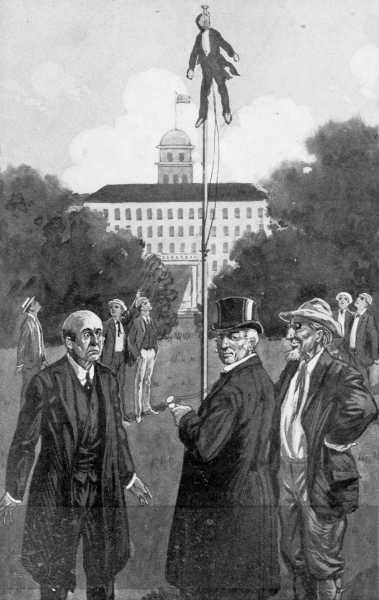
and look off to the river. If you are patriotic, and
of course you are, you will take off your hat to
the colors that fly from a tall flagpole in the center
of the campus.
Sunny River was a beautiful stream, not as broad
as some rivers, but sufficiently so to provide boating
facilities for the Randall students. On it, every
year, was held the annual regatta, Randall and
some other institutions participating. There was
a large boathouse on the edge of the river, located
on your left as you stood on the campus, facing the
water.
Sunny River flowed into Lake Tonoka, which
was about a mile below the college, and in the
midst of the lake was Crest Island. What exciting
times that lake and river have seen during the
summer season! What rowing races! What
swimming races! What jolly picnics! And, let
us whisper, what mysterious scenes on nights when
some luckless candidate was initiated into a secret
society!
On the farther side of the river from the village,
and near the junction with the lake, was a sort of
park, or summer resort. A trolley line ran from
it to the town of Haddonfield, but the students
more often preferred to walk to the village, rather
than wait for the cars, which ran on uncertain
schedules.
At the lower end of Lake Tonoka, just over the
line in another State, was Boxer Hall, a college
somewhat smaller than Randall, while to the west,
fifteen miles away, was Fairview Institute, a co-educational
school that was well patronized. The
three institutions had a common interest in sports,
and there was a tri-collegiate league of debating
clubs that often furnished milder, if more substantial,
excitement.
It was an evening in early April, of the new
term after the Easter vacation, that a number of
freshmen, who had taken part in the lively scene
of the afternoon, and some students who had not,
met silently and stealthily back of the boathouse
on the back of Sunny River. The night was cloudy,
and thus it was darker than usual at that hour.
“Have you fellows got the rope?” asked Langridge
in a whisper, as he took his place at the head
of the little force.
“Of course,” answered Phil Clinton.
“There’s no ‘of course’ about it,” retorted Langridge
arrogantly. “I’ve seen the time it’s been
forgotten.”
“What are we going to do with it?” asked Sid
Henderson.
“Use it to hang a soph with,” spoke Holly
Cross. “Prepare to meet thy doom!” he added
in a sepulchral voice.
“Cut it out, Holly,” advised Langridge. “I’m
afraid the sophs are on to us as it is.”
“Then we’ll rush ’em!” exclaimed Phil Clinton
aggressively.
“No, that won’t do any good. We’d never get
the clapper, then.”
“I know a good way,” spoke Fenton. “My
uncle says——”
“Say, you and your uncle ought to be in a glass
case and in the museum,” called Holly. “Dry up,
Fenton!”
“Where’s the Snail?” asked Langridge.
“Here,” replied Sam Looper, who, from his
slow movements, and from the fact that he loved
to prowl about in the dark, for he could see well
after nightfall, had gained that nickname. “What
do you want?”
“Will you climb up the rope after I get it in
place?”
“Sure.”
“Then come on,” whispered Langridge. “I
guess it’s safe now. There don’t appear to be any
one stirring.”
The mysterious body of freshmen moved off
in the darkness toward the Booker Memorial
Chapel. Their object, as you have probably
guessed, was to climb to the steeple and remove
the clapper from the bell, a prank that was sanctioned
by years of custom at Randall College.
Once the big tongue of iron was secured, it would
be taken to a village jeweler, who would have it
melted up and cast into scores of miniature clappers.
These, when nickel-plated, made appropriate
watch charms for the freshmen class, and suitably,
they thought, demonstrated their superiority over
their long-time rivals, the sophomores. For it was
the duty of the second-year students, if possible,
to prevent the taking away of the clapper. The
purloining of it must always be done the first week
after the Easter vacation, and if this passed by
without the freshmen being successful, the clapper
was safe, immune and inviolate. Hence the need
of haste, as but two more nights were left. Once
the clapper was taken the class had to contribute
money enough to buy another for the voiceless
bell.
Silently, as befitted the occasion, the lads made
their way from the rendezvous at the boathouse
toward the chapel. Their plan was simple. On
top of the cupola which held the bell was a large
cross. It was the custom to tie a stone, or some
weight, to a light cord, throw the weight over the
cross, and by means of the thin string haul up a
heavy rope. Up this rope some freshman would
climb, remove the clapper, and slide down again,
while his comrades stood guard against any attack
of sophomores.
“Who’s going to throw the stone?” asked Ed
Kerr, as he walked along beside Langridge.
“I am, of course.”
“Oh, of course,” repeated Clinton in a low
voice. “You want to run everything.”
“Well, Fred Langridge is a good pitcher,”
spoke Sid Henderson. “He’s likely to make the
’varsity this year.”
“Um!” was all Phil said.
The boys reached the chapel, and, under the direction
of Langridge, the cord and rope were made
ready.
“Got a good stone?” asked the leader.
“Here’s a hunk of lead,” replied Ed. “I made
it on purpose. It’s not so likely to slip out as a
stone.”
“That’s good. Hand it over.”
The lead was soon fastened to the cord.
“Look out, now, here goes!” called Langridge.
“I’m going to pitch it over. Be all ready, Snail.”
He stepped back, and tossed the lead, intending
to make the cord fall across one arm of the cross.
But either his aim was poor, or he could not discern
well enough in the darkness the outlines of
the cross.
“Missed it!” exclaimed Clinton.
“Well, so would you,” growled Langridge.
“Some one stepped on the cord.”
“Let Snail try,” suggested Henderson.
“I’m doing this throwing,” declared Langridge
curtly.
“It doesn’t look so,” murmured Phil.
Langridge tried again, but with no success.
“Hurry,” spoke Kerr. “The sophs will be out
soon.”
Langridge made a third attempt, and failed.
Then Snail Looper called out in an excited whisper:
“Here come the sophs! Cut it!”
“No!” cried Langridge. “Hold on! I’ll get
it over now. Fight ’em back, boys!”