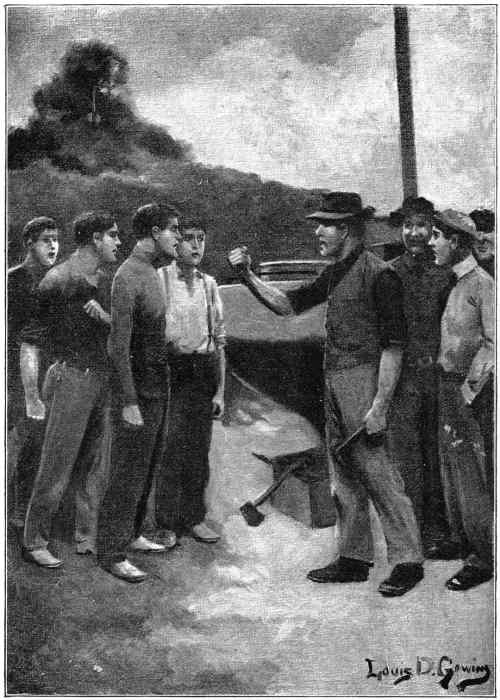
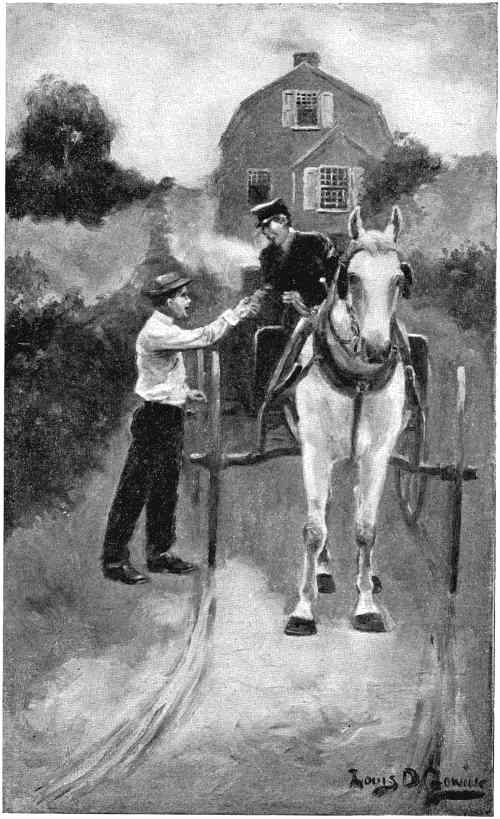
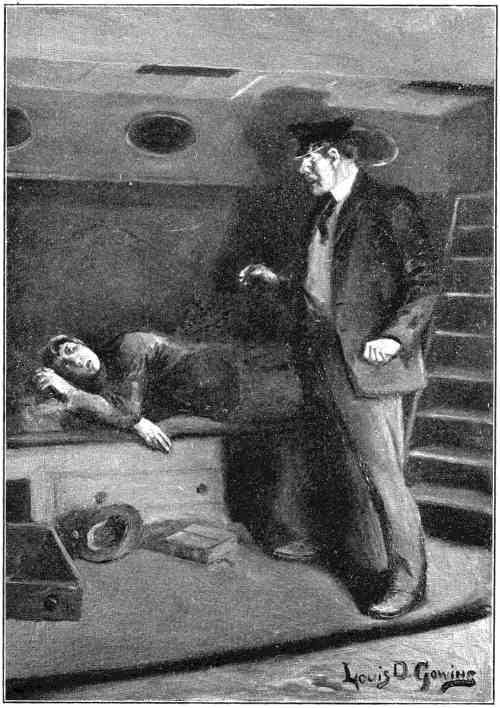
It was a pleasant afternoon in the early part of the
month of June. The Samoset River, winding
down prettily through hills and sloping farm
lands to the bay of the same name, gleamed in the sunlight,
now with a polished surface like ebony in some
sheltered inlet, or again sparkling with innumerable
points of light where its surface was whipped up into
tiny waves by a brisk moving wind.
There had been rain for a few days before, and the
weather was now clearing, with a smart westerly
breeze that had come up in the morning, but was
swinging in slightly to the southward. The great
white cloud-banks had mostly passed on, and these
were succeeded at present by swiftly moving clumps
of smaller and lighter clouds, that drifted easily across
the sky, like the sails below them over the surface
of the water.
[2]
There were not a few of these sails upon the river,
some set to the breeze and some furled; some of
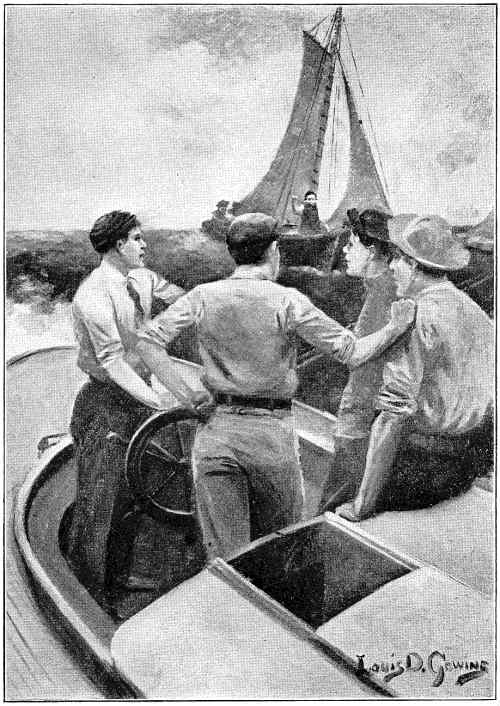
the craft going up with the tide toward the distant
city of Benton, the head of vessel navigation; some
breasting the tide and working their way down toward
Samoset Bay; other and larger craft, with sails snugly
furled, tagging along sluggishly at the heels of blustering
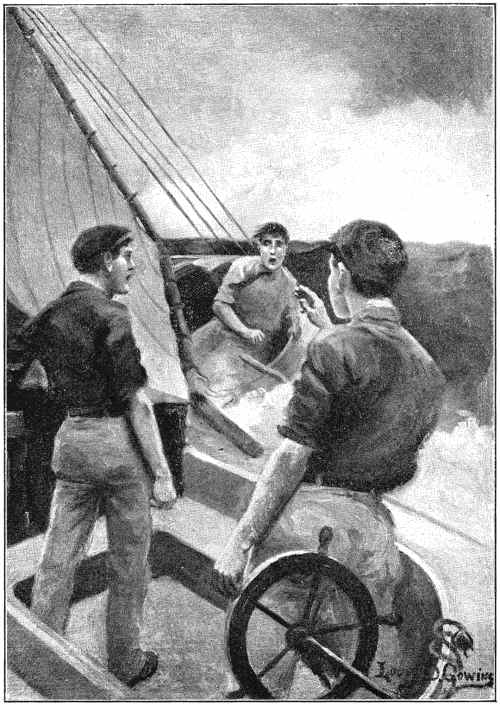
little tugs,—each evidently much impressed with
the importance of its mission,—and so going on and
out to the open sea, where they would sail down the
coast with their own great wings spread.
The river was, indeed, a picture of life and animation.
It was a river with work to do, but it did it
cheerfully and with a good spirit. Far up above the
city of Benton, it had brought the great log rafts
down through miles of forest and farm land. Above
and below the city, for miles, it had run bravely
through sluice and mill-race, and turned the great
wheels for the mills that sawed the forest stuff into
lumber. And now, freed from all bounds and the
restraint of dams and sluiceways, and no longer
choked with its burden of logs, it was pleased to float
the ships, loaded deep with the sawed lumber, down
and away to other cities.
There was many a craft going down the river that
afternoon. Here and there along the way was a big
three or four masted schooner, loaded with ice or
lumber, and bound for Baltimore or Savannah. Or,
it might be, one would take notice of a trim Italian
bark, carrying box-shooks, to be converted later into
boxes for lemons and oranges. Then, farther southward,
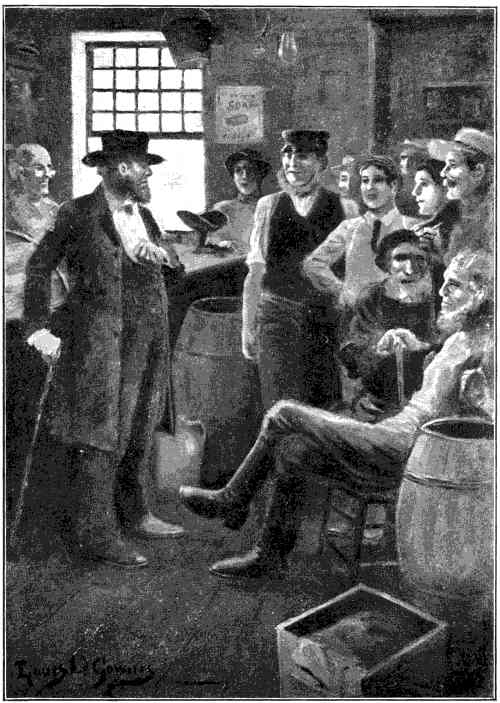
a schooner that had brought its catch to the
Benton market, and was now working out again to
the fishing-grounds among the islands of the bay.
[3]
Less frequently plied the river steamers that ran
to and from the summer resorts in Samoset Bay; or,
once a day, coming or going, the larger steamers that
ran between Benton and Boston.
Amid all these, at a point some twenty miles down
the river from Benton, there sailed a craft that was,
clearly, not of this busy, hard-working fraternity of
ships. It was a handsome little vessel, of nearly forty
feet length, very shapely of hull and shining of
spars; with a glint of brass-work here and there; its
clean, white sides presenting a polished surface to the
sunbeams; its rigging new and well set up, and a
handsome new pennant flung to the breeze from its
topmast.
The captain of many a coaster eyed her sharply
as she passed; and, now and then, one would let his
own vessel veer half a point off its course, while he
took his pipe from his mouth and remarked, “There’s
a clean craft. Looks like she might go some.” And
then, probably, as he brought his own vessel back to
its course, concluded with the usual salt-water man’s
comment, “Amateur sailors, I reckon. Humph!”
That remark, if made on this particular occasion,
would have been apparently justifiable. If one might
judge by their age, the skippers of this trim yacht
should certainly have been classed as amateurs. There
were two of them. The larger, a youth of about sixteen
or seventeen years of age, held the wheel and
tended the main-sheet. The other, evidently a year
or two younger, sat ready to tend the jib-sheets on
either side as they tacked, shifting his seat accordingly.
The yacht was beating down the river against the
last of a flood-tide.
[4]
“We’re doing finely, Henry,” said the elder boy,
as he glanced admiringly at the set of the mainsail,
and then made a general proud survey of the craft
from stem to stern and from cabin to topmast. “She
does walk along like a lady and no mistake. She
beats the Surprise—poor old boat! My, but I often
think of that good little yacht I owned, sunk down
there in the thoroughfare. We had lots of fun in her.
But this one certainly more than takes her place.”
“Who would ever have thought,” he continued,
“when we saw the strange men sail into the harbour
last year, with this yacht, that she would turn out to
be a stolen craft, and that she would one day be put
up for sale, and that old Mrs. Newcome would buy her
for us? It’s like a story in a book.”
“It’s better than any story I ever read, Jack,” responded
the other boy. “It’s a story with a stroke
of luck at the end of it—and that’s better than some
of them turn out. But say, don’t you think you better
let me take my trick at the wheel? You know you
are going to teach me how to sail her. I don’t expect
to make much of a fist of it, at the start; but I’ve
picked up quite a little bit of yacht seamanship from
my sailing with the Warren boys.”
[5]
“That’s so,” conceded the other. “You must have
got a pretty good notion of how to sail a boat, by
watching them. Here, take the wheel. But you’ll
find that practice in real sailing, and just having it in
your head from watching others, are two different
things. However, you’ll learn fast. I never knew
any one who had any sort of courage, and any natural
liking toward boat-sailing, but what he could pick it
up fast, if he kept his eyes open.
“The first thing to do, to learn to sail a boat, is to
take hold in moderate weather and work her yourself.
And the next thing, is to talk to the fishermen and
the yachtsmen, and listen when they get to spinning
yarns and arguing. You can get a lot of information
in that way that you can use, yourself, later on.”
The younger boy took the wheel, while the other
sat up alongside, directing his movements. But first
he took the main-sheet and threw off several turns,
where he had had it belayed on the cleat back of the
wheel, and fastened it merely with a slip-knot, that
could be loosed with a single smart pull on the free
end.
“We won’t sail with the sheet fast until you have
had a few weeks at it, Henry,” he said. “There are
more boats upset from sheets fast at the wrong time,
or from main-sheets with kinks in them, that won’t
run free when a squall hits, than from almost any
other cause. And the river is a lot worse in that way
than the open bay, for the flaws come quicker and
sharper off these high banks.”
Henry Bums, with the wheel in hand and an eye
to the luff of the sail, as of one not wholly inexperienced,
made no reply to the other’s somewhat patronizing
manner; but a quiet smile played about the
corners of his mouth. If he had any notion that the
other’s extreme care was not altogether needed, he
betrayed no sign of impatience, but took it in good
part. Perhaps he realized that common failing of
every yachtsman, to think that there is nobody else
in all the world that can sail a boat quite as well as
himself.
[6]
He knew, too, that Jack Harvey had, indeed, had
by far a larger experience in sailing than he, though
he had spent much of his time upon the water.
In any event, his handling of the boat now evidently
satisfied the critical watchfulness of Jack Harvey;
for that youth presently exclaimed, “That’s
it. Oh, you are going to make a skipper, all right.
You take hold with confidence, too, and that’s a good
part of the trick.”
At this point in their sailing, however, the yacht
Viking seemed to have attracted somewhat more than
the casual attention of an observer from shore. A
little less than a quarter of a mile down the river,
on a wharf that jutted some distance out from the
bank, so that the river as it ran swerved swiftly by
its spiling, a man stood waving to them.
“Hello,” said Henry Burns, espying the figure on
the wharf, “there’s a tribute to the beauty of the
Viking. Somebody probably thinks this is the president’s
yacht and is saluting us.”
“Well, he means us, sure enough,” replied Jack
Harvey, “and no joke, either. He’s really waving.
He wants to hail us.”
The man had his hat in hand and was, indeed, waving
it to them vigorously.
[7]
They had been standing across the river in an opposite
direction to the wharf; but now, as Jack Harvey
cast off the leeward jib-sheets, Henry Burns put
the helm over, and the yacht swung gracefully and
swiftly up into the wind and headed off on the tack
inshore. Jack Harvey let the jibs flutter for a moment,
until the yacht had come about, and Henry
Burns had begun to check her from falling off the
wind, by reversing the wheel. Then he quickly
trimmed in on the sheets, and the jibs began to draw.
“Most beginners,” he said, “trim the jib in flat
on the other side the minute they cast off the leeward
sheet. But that delays her in coming about.”
Again the quiet smile on the face of Henry Burns,
but he merely answered, “That’s so.”
They stood down abreast the wharf and brought
her up, with sails fluttering. Jack Harvey, looking
up from the side to the figure above on the wharf,
called out, “Hello, were you waving to us?”
“Why, yes,” responded the man, “I was. Are you
going down the river far?”
“Bound down to Southport,” said Harvey.
“Good!” exclaimed the stranger, and added, confidently,
“I’ll go along with you part way, if you don’t
mind. I’m on my way to Burton’s Landing, five
miles below, and the steamboat doesn’t come along
for three hours yet. I cannot get a carriage and I
don’t want to walk. You don’t mind giving me a
lift, do you? That’s a beautiful boat of yours, by the
way.”
The man had an air of easy assurance; and, besides,
the request was one that any yachtsman would
willingly grant.
“Why, certainly,” replied Harvey, “we’ll take you,
eh, Henry?”
[8]
“Pleased to do it,” responded Henry Burns.
They worked the yacht up alongside the wharf,
and the stranger, grasping a stay, swung himself off
and leaped down on to the deck. Then he pushed
the boat’s head off with a vigorous shove and advanced,
smilingly, with hand extended, to greet the
boys. The Viking gathered headway and was once
more going down-stream.
The stranger was a rather tall, well-built man, light
on his feet, and handled himself as though he were
no novice aboard a boat. He descended into the cockpit
and shook hands with Jack Harvey and Henry
Burns.
His voice, as he bade them good afternoon, was
singularly full and deep, and seemed to issue almost
oddly from behind a heavy, blond moustache. As
Henry Burns expressed it afterward, it reminded him
of a ventriloquist he had seen once with a travelling
show, because the man’s lips seemed hardly to move,
and the muscles of his face scarcely changed as he
spoke. His eyes, of a clear but cold blue, lighted up,
however, in a pleasant way, as he thanked them.
He wore a suit of navy blue, and a yachting-cap
on his head.
“This is the greatest luck in the world for me,” he
said. “You see, I want to catch the train that will
take me down to Bellport, and I can get it at the Landing
below. This fine craft of yours will take me—”
[9]
He stopped with strange abruptness. If the attention
of Jack Harvey and Henry Burns had, by chance,
been directed more closely to him, and less upon the
handling of their yacht, they might have observed a
surprised and puzzled look come over his face. They
might have observed him half-start up from his seat,
like a man that had suddenly come, all unwittingly,
upon a thing he had not expected to see.
But the two boys, intent upon their sailing, noticed
only that the man had left a sentence half-finished.
They turned upon him inquiringly.
“What were you going to say?” asked Henry
Burns.
The man settled back in his seat, reached a hand
calmly into an inner coat-pocket, and drew forth a
cigar-case.
“I dare say you don’t smoke,” he said, offering it
to them. “No, well, I didn’t think so. You’re a little
bit young for that. Let me see, what was I saying?—oh,
yes, I was about to remark that this boat would
take me down to the Landing on time. She does walk
along prettily, and no mistake.”
With which, he lighted the cigar and began puffing
enjoyably. But his eyes darted here and there, quickly,
sharply, over the boat. Through a cloud of cigar
smoke, he was scrutinizing it from one end to the
other.
“You handle her well,” he said. “Had her long?”
“Why, no,” replied Harvey. “The fact is, though
we have had other boats—that is, I have—and we
have handled others, this is our first sail in this one.
You see, we got her in an odd way, last season—just
at the close of the season, in fact; and she was not in
shape for sailing then. So we had to lay her up for
the winter. This is really the first trying out we have
given her.”
[10]
“Indeed, most interesting,” replied the stranger,
arising from his seat and advancing toward the cabin
bulkhead, where he stood, apparently gazing off
across the river. Then, as he returned to his seat
again, he added, “That’s rather an elaborate ornamenting
of brass around the companionway.”
“Isn’t it, though!” exclaimed Harvey, proudly.
“You don’t see them much handsomer than that
often, eh?”
“Why, no, now you speak of it,” replied the man.
“You don’t, and that’s a fact.
“In fact,” he added, stealing a sidelong glance at
the two boys, “it’s the only one just like it that I ever
saw.
“Pretty shore along here, isn’t it?” he remarked a
few moments later, as they stood in near to where
the spruces came down close to the water’s edge, with
the ledges showing below. “What’s that you were
saying about coming by the boat oddly? She looks
to me as though your folks must have paid a good
price for her.”
“Why, that’s the odd part of it,” answered Harvey.
“The fact is, our folks didn’t pay for her at
all. An old lady bought her for us. Made us a present
of her. Perhaps you’d like to hear about it.”
“Indeed I should,” replied the stranger. “It will
while away the time to the Landing.”
“You tell it, Henry,” said Harvey.
So Henry Burns began, while the stranger stretched
his legs out comfortably and listened.
“Well,” said Henry Burns, “this yacht, the Viking,
was named the Eagle when we first saw her.”
[11]
The stranger’s cigar was almost blazing with the
vigour of his smoking.
“She came into the harbour of Southport—that’s
on Grand Island, below here, where we are bound—one
day last summer, to pick up a guest at the hotel.
There were two men aboard her, and it turned out that
these two men, and the man they were after at the
hotel, had committed a robbery at Benton. That’s
way up the river.
“Well, it’s a long story how they were discovered;
but they were, and some jewels they had hidden were
recovered. I said they were captured—but one, a
man named Chambers, got away in this very yacht.
But he came back, later, and set fire to the hotel for
revenge.
“That was along toward the end of the summer.
Then it happened that Jack, here,—Jack Harvey,—captured
the man, Chambers, in this yacht, down in
a thoroughfare below Grand Island. Jack’s boat,
the Surprise, was sunk there, when the two yachts
crashed together, bow on.”
“Poor old Surprise!” interrupted Jack Harvey.
“Well, then,” continued Henry Burns, “there is a
man over at Southport, Squire Brackett, that hates all
us boys, just because he is mean. He told Witham,
the hotel proprietor, that he had seen us boys in the
hotel basement, shortly before the fire; and he and
Witham had us accused of setting it, although everybody
in Southport was indignant about it. And all
this time, Jack was on the right track, because he had
seen the man running from the fire and had followed
him over to the other shore of the island, and recognized
the boat he sailed away in.
[12]
“So Jack sailed down the other side of the island,
and captured the man, Chambers, in the thoroughfare;
that is, Jack and his crew did. And they brought
Chambers back just at the right time—and Squire
Brackett and Witham were so ashamed they wanted
to go and hide away somewhere.”
The man they had taken aboard looked smilingly
at Henry Burns.
“That is certainly a remarkable story,” he said,
knocking the ashes carelessly from the end of his
cigar.
“Yes, but the rest of it is the oddest part of it,”
responded Henry Burns. “There was an old lady
named Mrs. Newcome, whose life we saved at the fire.
She was furious at the squire and Witham for blaming
us, and thankful enough when Jack got us out
of it.
“Now, when Chambers was tried, he was so bitter
against the other two who had got him into trouble,
he confessed the yacht did not belong to any one of
them. So the yacht was taken over by the sheriff,
and advertisements were sent out all around to try
to find the rightful owner. But they never did find
him, and finally the yacht was condemned and put up
for sale. There is where old Mrs. Newcome came in.
She has no end of money, and no one to spend
it on except herself and a cat. The yacht went
cheap, and what did she do but buy it in and give it
to us.”
[13]
Henry Burns paused, and there was silence for a
few moments aboard the Viking. The stranger
smoked without speaking, apparently lost in his own
thoughts.
“That’s all of the yarn,” said Henry Burns, at
length.
The man started to his feet, tossed his cigar away,
and walked forward, with his hands in his pockets.
“That’s one of the oddest stories I ever heard,”
he said. “You’re lucky chaps, aren’t you? Sounds
like some novels I’ve read. By the way, isn’t that
Burton’s Landing just ahead there?”
He seemed eager to get ashore.
“Yes, that is the Landing,” answered Harvey.
A few moments more and they were up to it,
and the stranger was stepping ashore upon the
pier.
“Well,” he said, shaking hands with them again,
“I’m much obliged to both of you—really more than
I can begin to tell you. Perhaps I can return the
favour some day. My name is Charles Carleton.
Live around at hotels pretty much, but spend most of
my time in Boston. Hope I meet you again some
day. Perhaps I may be down this way later, down
the bay somewhere, if I like the looks of it, and the
hotels. Good day.”
“Good day; you’re very welcome,” called out
Henry Burns and Jack Harvey.
Again the yacht swung out into the river, gathering
headway quickly and skimming along, heeling
very gently.
The strange man stood watching her from the
pier.
[14]
“No,” he said, softly, to himself, “I never saw but
one boat just like her before. But who would have
thought I should run across them the first thing? That
was a stroke of luck.”
[15]
CHAPTER II. THE COLLISION
“Pleasant sort of a man, wasn’t he?” commented
Harvey, as the Viking left the pier
astern, and the stranger could be seen walking
briskly up the road toward the town.
“Why, yes, he was, in a way,” responded Henry
Burns. “Most persons manage to make themselves
agreeable while one is doing them a favour. Really,
though, he isn’t one of the open, hearty kind, though
he did try to be pleasant. I don’t know why I think
so, but he seemed sort of half-concealed behind that
big moustache.”
Harvey laughed.
“That’s a funny notion,” he said.
“Well,” responded Henry Burns, “of course it
wasn’t just that. But, at any rate, he is the kind of
a man that has his own way about things. Did you
notice, he didn’t exactly ask us to take him into the
boat. He said, right out at the start, that he was
going along with us—of course, if we were willing.
But he was bound to come aboard, just the same,
whether we were willing or not.”
[16]
“Hm!” said Harvey. “You do take notice of
things, don’t you? I didn’t pay any attention to what
he said; but, now I think of it, he did have that sort
of way. However, we shall probably never set eyes
on him again, so what’s the odds?”
They were getting down near to the mouth of the
river now, and already, a mile ahead, the bay broadened
out before their eyes.
The wind was blowing brisk, almost from the south
by this time, and the first of the ebb-tide running down
against it caused a meeting between the two that was
not peaceful. At the point where river and bay
blended, and for some distance back up the river,
there was a heavy chop-sea tumbling and breaking in
short, foam-capped waves. Farther out in the bay
there was considerable of a sea running.
Harvey, lounging lazily on the seat opposite Henry
Burns, suddenly sprang up and uttered an exclamation
of surprise. Then he pointed on far ahead, over
the port bow, to a tiny object that bobbed in the
troubled waters of the river, low lying and indistinct.
“What do you make of that, Henry?” he cried.
“Why, it looks like a log from one of the mills up
above,” replied the other, after he had observed it
with some difficulty. “Oh, no, it isn’t,” he exclaimed
the next moment. “There is something alive on it—or
in it. Say, you don’t suppose it can be Tom Harris
and Bob White, do you? That is a canoe, I believe.”
Without waiting to reply, Jack Harvey dodged
quickly down the companionway, and returned, a moment
later, from the cabin, holding a spy-glass in one
hand.
“Hooray! clap that to your eye, Henry,” he cried,
when he had taken a hasty survey ahead with it.
[17]
“That’s it!” exclaimed Henry Burns, taking a
long look through the glass, while Harvey assumed
his place at the wheel. “There they are, two of them,
paddling away for good old Southport as hard as
ever they can. There are two boys, as I make them
out. Yes, it’s Tom and Bob, sure as you live. Won’t
it seem like old times, though, to overhaul them?
You keep the wheel, Jack. We can’t catch up with
them any too soon to suit me.”
“Shall we give them a salute?” cried Harvey.
“No, let’s sail up on them and give them a surprise,”
suggested the other. “They know we own
the boat, but they haven’t seen her under sail since
we have had her. They may not recognize us.”
While the yacht Viking was parting the still moderate
waves with its clean-cut bows, and laying a
course that would bring it up with the canoe in less
than a half-hour, the occupants of the tiny craft were
bending hard to their paddles, pushing head on into
the outer edge of the chop-sea. They were making
good time, despite the sea and the head wind.
“There go a couple of them Indians from away
up the river yonder,” sang out a man forward on a
stubby, broad-bowed coaster to the man at the wheel,
as the canoe passed a two-master beating across the
river. The boys in the canoe chuckled.
“Guess we must be getting good and black, Bob,”
said the boy who wielded the stern paddle to the other
in the bow. “And our first week on the water, at
that, for the season.”
[18]
“Yes, we’ve laid the first coat on pretty deep,”
responded his companion, glancing with no little pride
and satisfaction at a pair of brown and muscular arms
and a pair of sunburned shoulders, revealed to good
advantage by a blue, sleeveless jersey that looked as
though it had seen more than one summer’s outing.
“What do you think of the bay, Tom?” he added,
addressing the other boy. This youth, similarly clad
and similarly bronzed and reddened, was handling his
paddle like a practised steersman and was directing
the canoe’s course straight down the bay, as though
aiming fair at some point far away on an island that
showed vaguely fifteen miles distant.
“Oh, it’s all right,” answered Tom. “It’s all
right for this evening. Plenty of rough water from
now until seven or eight o’clock to-night, but it’s just
the usual sea that a southerly raises in the bay. We
won’t get into any such scrape as we did last year,
when we came down here, not knowing the bay nor
the coast of Grand Island, and let a storm catch us
and throw us out pell-mell on the shore. We’ll not
give our friends, the Warren boys, another such a
fright this year. We can get across all right—that
is, if you don’t mind a bit of a splashing over the
bows.”
“It won’t be the first time,—nor the last, for that
matter, I reckon,” responded Bob.
“And I always get my share of it, in the end, too,”
said the other boy; “because when it sprays aboard
it runs down astern and I have to kneel in it. Well,
on we go, then. It’s fifteen miles of rough water, but
think how we’ll eat when we get there.”
[19]
“Won’t we?” agreed Bob. “Say, now you speak
of it, I’m hungry already. I could eat as much as
young Joe Warren used to every time he took dinner
at the hotel. He used to try to make old Witham
lose money—do you remember?—and I think he
always won.”
“Hello!” he exclaimed, a moment later, as he
looked back for an instant toward the stem. “Just
glance around, Tom, and take a look at that yacht
coming down the river. Isn’t she a beauty? I
wouldn’t mind a summer’s cruise in her, myself.”
“Whew!” exclaimed the other, as he held his
paddle hard against the gunwale and glanced back.
“She is a pretty one, and no mistake. She’s about
as fine as we often see down this way. I don’t recall
seeing anything handsomer in the shape of a yacht
around the bay last summer, unless it was the one
Chambers had—you know, the man that set the
hotel afire.
“I believe it is the very yacht,” he continued.
“There isn’t another one like it around here. You
remember the boys wintered her down the river.”
“Yes, but wouldn’t they hail us?” asked Bob.
“Perhaps not,” answered Tom. “Henry Burns
likes to surprise people. They are due down the bay
about this time. At any rate, we shall have a chance
to see the yacht close aboard, for she is heading dead
up for us.”
The yacht Viking was indeed holding up into the
wind on a course that would bring her directly upon
the canoemen, if she did not go about. She kept on,
and presently the boys in the canoe ceased their paddling
and watched her approach.
“She won’t run us down, will she, Tom?”
[20]
“No, they see us, all right.”
There was evidence of this the next moment, for
a small cannon, somewhere forward on the deck of
the yacht, gave a short, spiteful bark that made the
canoemen jump. There followed immediately the
deep bellowing of a big fog-horn and the clattering of
a huge dinner-bell; while, at the same time, two
yachtsmen aboard the strange craft appeared at the
rail, waving and blowing and ringing alternately at
the occupants of the canoe. A moment later, the
yacht rounded to a short distance up-wind from the
canoe, and the hail of familiar voices came across the
water:
“Ahoy, you chaps in that canoe, there! Come
aboard here, lively now, if you don’t want that cockle-shell
blown out of water. Hurry up before we get
the cannon trained on you! We know you, Tom
Harris, and you, Bob White, and you can’t escape.”
“Well, what do you think!” exclaimed Tom Harris,
raising himself up from his knees in the stem of
the canoe, with a hand on either gunwale, “if there
isn’t that old Henry Burns and Jack Harvey. Say,
where in the world did you fellows steal that yacht,
and where are you running off to with it? Don’t tell
us you own it. You know you don’t.”
“Just hurry up and come alongside here and we’ll
show you,” cried Henry Burns, joyfully. “Our ship’s
papers are all right, eh, Jack?”
[21]
The boys in the canoe needed no urging. A few
sharp thrusts with the paddles brought them under the
lee of the Viking; a line thrown aboard by Bob White
was caught by Harvey and made fast; and the next
moment, Bob White and Tom Harris were in the
cockpit, mauling Henry Burns with mock ferocity—a
proceeding which was received by that young
gentleman serenely, but with interest well returned—and
shaking hands with the other stalwart young
skipper, Jack Harvey.
The bow-line of the canoe was carried astern by
Harvey and tied, so that the canoe would tow behind;
and the yacht was put on her course again.
“You don’t mind taking a spin for a way in the
good ship Viking, do you?” asked Harvey. “I have
hardly seen you since we got this yacht, you know, as
my folks moved up to Boston the last of the summer.”
“We will go along a little way till we strike the
worst of the chop,” replied Tom Harris. “Our
canoe will not tow safely through that. That is, we
will, if you allow Indians aboard.”
“Yes, and by the way, before anybody else has the
chance to apply,” said Bob White, “you don’t want
to hire a couple of foremast hands, do you, off and
on during the summer? I’d be proud to swab the
decks of this boat, and wages of no account.”
“We’ll engage both of you at eighteen sculpins a
week,” answered Henry Burns. “But of course you
know that the laws against flogging seamen don’t
go, aboard here. Harvey there, he is my first mate;
and I make it a rule to beat him with a belaying-pin
three or four times a day, regular, to keep him up
to his work. Of course you forecastle chaps will get
it worse.”
Harvey, surveying his more slender companion,
saluted with great deference.
[22]
“How do you fellows happen to be up here?” he
asked. “Haven’t you gone to camping yet?”
“Yes,” replied Bob. “The old tent is down there
on the point. We have had it set up for three days.
We had an errand that brought us up here.”
“And the Warren boys?” inquired Henry Burns.
“Oh, they are down there in the cottage, sort of
camping out, too; that is, the family hasn’t arrived
yet. George and Arthur are working like slaves trying
to keep young Joe fed.”
“He’s a whole famine in himself,” remarked Henry
Burns.
“Say, how is old Mrs. Newcome’s cat, Henry, the
one you saved from the fire?” asked Tom Harris.
“Why, the cat hasn’t written me lately,” answered
Henry Burns. “But I got a letter from Mrs. Newcome
a few weeks ago; said she hoped we would
have a good summer in the yacht, lots of fun, and all
that.”
“My! but you are lucky,” exclaimed Bob. “I
have been as polite as mice to every cat I’ve seen all
winter, but I haven’t received any presents for it.”
Renewing old acquaintanceships in this manner,
they were shortly in rougher water.
“Here!” cried Tom Harris at length, “we must
be getting out of this. That canoe will not stand
towing in this chop much longer. We shall have to
leave you.”
“Pull it in aboard,” said Jack Harvey.
“No, it would be in the way,” replied Tom Harris.
“Just as much obliged to you. We’ll meet you at
the camp. Say that you will come ashore and eat
supper with us, and Bob will have one of those fine
chowders waiting for you; won’t you, Bob?”
[23]
“Ay, ay, sir,” replied Bob.
“You mean that you will cook one while we sit
by and watch you, don’t you?” asked Harvey. “We
shall get there before you do.”
“Perhaps not,” returned Bob. “You have got to
beat down, while we push right through. It is four
o’clock now, and there’s some fourteen miles to go.
We can do that in about three hours, because when
we get across the bay we can go close alongshore
under the lee, in smooth water; while you will have
to stick to the rough part of the bay most of the time.”
“All right,” said Harvey, “we will have a race to
see who gets there first. But we’ll do it in half that
time.”
So saying, he luffed the Viking into the wind, while
Bob White drew the dancing canoe alongside. The
canoeists and the yachtsmen parted company, the
Viking’s sails filling with the breeze, as she quickly
gathered headway, throwing the spray lightly from
her bows; the canoe plunging stubbornly into the
rough water, and forcing its way slowly ahead, propelled
by the energy of strong young arms.
[24]
The Viking stood over on the starboard tack, while
the canoe made a direct course for the island; and
the two craft were soon far apart. In the course of a
half-hour the canoe appeared from the deck of the
Viking a mere dancing, foam-dashed object. But,
in the meantime, another boat had appeared, some
way ahead, that attracted the attention and interest
of the yachtsmen. It was a small sailboat, carrying a
mainsail and single jib. The smaller yacht was coming
up to them from the direction of Grand Island,
and was now running almost squarely before the wind,
with its jib flapping to little purpose, save that it
now and then filled for a moment on one side or the
other, as the breeze happened to catch it.
“There’s a boat that is being badly sailed,” exclaimed
Harvey, as the two watched its progress.
“Look at it pitch; and look at that boom, how near
it comes to hitting the waves every time it rolls.
There’s a chap that doesn’t know enough, evidently,
to top up his boom when running in a seaway. What
does he think topping-lifts are made for, anyway, if
not to lift the boom out of the reach of a sea like this?
“And let me tell you, running square before the
wind in a heavy sea, with a boat rolling like that, is
reckless business, anyway. It is much better to lay
a course not quite so direct, and run with the wind
not squarely astern, with the sheet hauled in some.
That’s no fisherman sailing that boat.”
“It may be some one caught out who doesn’t know
how to get back,” said Henry Burns. “See, there
he is, waving to us. He is in some trouble or other.
Let’s stand on up close to him and see what the
matter is.”
“Well, I’ll take the chance,” replied Harvey.
“There, he’s doing better now. He is pointing up
a little bit. We’ll keep on this tack and run pretty
close to him, and hail him. I’ll just sing out to him
about that topping-lift, anyway; and if he doesn’t
like our interfering, why he can come aboard and
thrash us.”
[25]
As the sailboat drew nearer, there appeared to be
a single occupant, a youth of about Harvey’s age,
perhaps a year older, holding the tiller. His hat was
gone and he was standing up, with hair dishevelled,
glaring wildly ahead, in a confused sort of way. The
boom of the sailboat was well out on the starboard
side. Harvey kept the Viking on the starboard tack,
and near enough to have passed quite close to the other
boat.
A little too close, in fact, considering that the youth
at the tiller of the oncoming boat had, indeed, completely
lost his head. Suddenly, without warning, he
put his tiller over so that the sailboat headed away
from the Viking for an instant. Then, as the wind
got back of his sail, and the boat at the same time
rolled heavily in the seas, the boom jibed with terrific
force. The sailboat swung in swiftly toward the
starboard beam of the Viking, and the wind and sea
knocked it down so that the water poured in over the
side, threatening to swamp it. At the instant, Jack
Harvey had thrown the Viking off the wind to avoid
a crash with the other boat. The boom of the sailboat
swept around with amazing swiftness, and then, as
the boat careened, threatening to founder, the end
of the boom brought up with a smashing blow against
the Viking’s starboard quarter, breaking off several
feet of the boom and tearing the sail badly.
“THE BOOM BROUGHT UP WITH A SMASHING BLOW AGAINST THE VIKING’S STARBOARD QUARTER.”
The sailboat, half-filled with water, fell heavily into
the trough of the sea and rolled threateningly; while
at every pitch the boom struck the waves as though
it would break again.
[26]
The Viking, under Jack Harvey’s guidance, stood
away a short distance, then came about and beat up
in to the wind a rod or two above the wreck.
“Get that mainsail down as quick as ever you can!”
shouted Jack Harvey to the strange youth, who had
dropped the tiller, and who stood now at the rail,
dancing about frantically, as though he intended to
jump overboard.
“I can’t,” cried the youth, tremulously. “Oh,
come aboard here quick, won’t you? I’m going to
sink and drown. This boat’s going down. I don’t
know how to handle her.”
“We guessed that,” remarked Henry Burns, and
added, reassuringly, “Don’t lose your head now.
You know where the halyards are. Go ahead and get
your sail down, and we’ll stand by and help you.”
Henry Burns’s calm manner seemed to instil a
spark of courage into the youth. He splashed his
way up to the cabin bulkhead, where the halyards
were belayed on cleats on either side, and let them
run. The sail dropped a little way and then stuck.
The youth turned to the other boys appealingly.
“Pull up on your peak-halyard a little,” said Jack
Harvey, “and let the throat drop first a way. Then
the throat won’t stick.”
The youth made another attempt and the sail came
nearly down, hanging in bagging folds.
“Lucky that’s not a heavy sail nor a heavy boom,”
exclaimed Jack Harvey, “or the boat would be over
and sunk by this time. I think I could lift the boom
inboard if I could only get aboard there.”
[27]
“Here,” cried Harvey, coiling up a light, strong
line that he had darted into the cabin after, “catch
this and make it fast up forward—and mind you
tie a knot that will hold.”
He threw the line across, and it was clutched by the
boy aboard the smaller boat. The boy carried it forward
and did as Harvey had directed.
“Now,” said Harvey to Henry Burns, as he made
fast the line astern, “the moment we get near enough
so that I can jump aboard, you bring the Viking right
on her course, with a good full, so she won’t drift
back on to the wreck completely.”
He, himself, held the wheel of the Viking long
enough to allow the yacht to come into the wind a
little. Thus it lost headway sufficiently so that the
seas caused it to drift back, without its coming about
or losing all steerageway. Then, as the Viking
drifted within reach of the smaller boat, he leaped
quickly and landed safely on the deck. At the same
time, or an instant later, Henry Burns threw the wheel
of the Viking over so that the yacht gathered headway
again and tautened the rope that connected the two
boats.
[28]
CHAPTER III. A RESCUE UNREWARDED
Harvey, having landed on the deck of the
sailboat, steadied himself by grasping the
starboard stay, and took a quick, comprehensive
glance over the situation. A foot and a half or
so of the boom had split off from the end, and the
mainsail was badly torn. The main-sheet had been
snapped by the jibing of the boom, but the break in
the boom was beyond the point where the sheet was
fastened. The broken end of the sheet was trailing
in the water. The boat could be got in hand if that
were regained.
Seizing the end of the main-sheet that remained in
the boat, and casting it loose from the cleat, Harvey
found he had still the use of a rope of considerable
length. Coiling this up, and hanging it over one
arm, he regained the deck, over the small cabin, and
took up his position on the port side of the boat. The
stay on that side had been saved from carrying away
only because the quarter of the Viking had arrested
the force of the boom. Having this stay, then, to
hold fast to, Harvey leaned over the side, as far as
he was able, passed an end of the rope about the
boom, took a turn, and made it fast.
[29]
Carrying the other end aft, Harvey handed it to
the youth, who stood gazing at his efforts stupidly,
evidently knowing not in the least what to do.
“Now you hold on to that,” said Harvey, “and
when I tell you to, you haul as hard as ever you can.”
The youth took the rope silently and sullenly.
Harvey sprang again upon the deck, caught the
flying ends of the halyards and ran the mainsail up.
It was slow work, for the sail was soaked with water,
and the tear in it began to rip more when the strain
was brought to bear. When Harvey had hoisted
the sail sufficiently so that the topping-lift would
have lifted the boom, he started for that; but it had
parted, and was of no use.
“Well,” said Harvey, “we’ll get the boom up a
little more, with the sail, no matter if it does tear.
We can’t help it.”
So he took another pull at the peak-halyard. The
boom lifted a little.
“That’s enough,” said Harvey. “Now haul in on
that sheet lively, before the sail tears any more. Get
that boom in quick!”
The youth, with no great spirit nor heartiness in
his movements, did as directed, and the boom came
inboard. Then Harvey once more dropped the sail.
He was brim full of life, was Jack Harvey, and now
that there was something here worth doing, and necessary
to be done quickly, he was eager with the
spirit of it.
[30]
“Have you got anything aboard here to bail with?”
he asked, hurriedly; and, without waiting for the
more sluggish movements of the other, he darted forward,
through the water in the cockpit, to where
he had espied a pail half-submerged under the seat.
With this he began bailing furiously, dipping up the
pailfuls and dashing them out over the side, as though
the boat were sinking and he had but one chance for
life in a hundred.
Harvey was working in this way, with never a
thought of his companion, when presently there came
a hail from the Viking. He paused and looked across
the water to where Henry Burns was standing at the
wheel of the larger craft, with a look of amusement on
his face.
“I say, Jack,” called Henry Burns, drawling very
slightly, as was his habit at times when other youths
of more excitable temperament would speak quickly,
“that other chap aboard there is just dying to help
bail the boat. Why don’t you let him do his share
of it?”
Harvey glanced back astern at his companion of
the sailboat. What he saw caused an angry flush
to spread over his face. But the next moment the
cool effrontery of it made him laugh.
The youth whom Harvey’s surprised gaze rested
upon was a rather tall, thin, sallow chap, with an
expression on his face that looked like a perpetual
sneer. He wore no yachting costume nor clothing of
any sort fit for roughing it. Instead, he was rather
flashily dressed, in clothes more often affected by
men of sporting propensities than youths of any age.
In a scarf of brilliant and gaudy tint he wore a large
pin in the form of a horseshoe, with imitation brilliants
in it. In fact, his dress and whole demeanour
were of one who had a far more intimate knowledge
of certain phases of life than he should. A telltale
smear upon the fingers of his right hand told of the
smoking habit, which accounted for his thin and sallow
appearance—and which habit was now in evidence.
[31]
It was this latter that particularly angered Harvey,
as he paused, perspiring, from his work.
The youth had seated himself calmly on the edge
of the after-rail, with an elbow rested on one knee.
In this comfortable attitude, and smoking a cigarette,
he was aimlessly watching Harvey work.
Harvey glared for a moment in amazement. Then
his face relaxed.
“I say!” he exclaimed, throwing down the pail,
wiping his brow, and advancing aft toward the other
youth, “this seems to be a sort of afternoon tea, or
reception, with cigarettes provided by the host.”
“No, thanks,” he added, shortly, as the other
reached a hand into his pocket and proffered a box
of them. “You’re just too kind and generous for
anything. But I don’t smoke them. Some of my
crew used to. But I tell little Tim Reardon that that’s
what keeps him from growing any. He’s at them all
the time. Guess you are, too, by the looks of you.”
Harvey glanced rather contemptuously at the lean,
attenuated arm that the other displayed, where he
had rolled his cuffs back.
“Well, you don’t have to smoke them if you don’t
want to,” said the other, surlily. “But don’t preach.
I’m as old as you are. My smoking is my business.”
[32]
“Of course it is,” said Harvey. “I don’t care
whether you smoke or not. But what I object to is
your doing the smoking and letting me do the work.
Your smoking is your business, and so is bailing out
your own boat your business—that is, your share
of it is. Now, if you want any more help from me,
you just break up this smoking party and take that
pail and go to bailing. I’ve got enough to keep me busy
while you are doing that.”
The youth glanced angrily at Harvey, but made
no reply. Harvey’s stalwart figure forbade any unpleasant
retort. Sullenly, he tossed away the half-finished
cigarette, slumped down once more into the
cockpit, took up the pail that Harvey had dropped,
and went to work.
“He looks like a real man now,” called out Henry
Burns.
The youth, with eyes flashing, shot one glance at
the smiling face of Henry Burns, but deigned no reply.
Harvey, without further notice of his companion,
proceeded to hoist the sail a little so that he could
take two reefs in it. This brought the sail down so
small as to include the torn part in that tied in. The
sail would, therefore, answer for the continuation of
the trip.
“Say,” asked Harvey finally, “why didn’t you reef
before, when it began to blow up fresh and the sea
got a bit nasty? You might have saved all this.”
The youth hesitated, glanced at Harvey sheepishly,
and mumbled something that sounded like he didn’t
know why he hadn’t.
“Hm!” said Harvey, under his breath. “He didn’t
know enough.
[33]
“Well,” he continued, after a little time, “you’re
all right to start off again, if you think you can get
along. That sail is down so small it won’t give you
any more trouble, and there is plenty of it to keep
headway on the boat; that is, if you are going on up
the bay. Where are you bound for, anyway?”
“Up to Springton,” replied the other. “Straight
ahead.”
“All right,” said Harvey, “you can get there if
you will only be a little more careful. Don’t try to
run straight for the town. Keep off either way—do
you see?” And Harvey designated how the other
could run in safety.
“Run on one course a way,” he said, continuing,
“and then put her about and run on the other. But
look out and don’t jibe her. Let her come about into
the wind. Now do you think you can get along?”
“Yes,” answered the youth, shortly. He had by
this time finished his bailing, and the cockpit floor
was fairly free of water.
“Well, then, I’ll bid you an affectionate farewell,”
said Harvey, who had taken mental note of the fact
that the youth had not offered to thank him for all
his trouble. “Sorry to leave you, but the best of
friends must part, you know. Good day.”
“Good day,” answered the youth, without offering
even to shake hands.
Harvey lost little time in regaining the deck of the
Viking. Henry Burns was still smiling as Harvey
took the wheel from him.
“We seem to have made a very pleasant acquaintance,”
he said.
[34]
“Haven’t we though!” exclaimed Harvey. “If
we were only in some nice, quiet harbour, where the
water wasn’t very deep, I’d just see whether that
young chap can swim or not. He’d get one ducking—”
“Oh, by the way,” called Henry Burns, as the two
boats were separating, “you’re entirely welcome to
our assistance, you know. You needn’t write us a
letter thanking us. We know your feelings are just
too deep for thanks.”
“Little thanks I owe you,” snarled the other boy.
“’Twas all your fault, anyway. If you had kept off,
my boat wouldn’t have gone over.”
Jack Harvey sprang from his seat and shook his
fist in the direction of the disappearing boat.
“Hold on there, Jack,” said Henry Burns, catching
him by the arm. “Don’t get excited. Do you
know the answer to what he just said? Well, there
isn’t any. Just smile and wave your hand to him,
as I do. He’s really funnier than Squire Brackett.”
“Oh, yes, it is funny,” answered Jack Harvey,
scowling off astern. “It’s so funny it makes me sick.
But perhaps you’d think it was funnier still, if you
had gone at that bailing the way I did, and had
looked up all of a sudden and seen that chap sitting
back there at his ease, smoking. I’ll just laugh about
it for the rest of the week. That’s what I will.”
Jack Harvey certainly did not appear to be laughing.
“Above all things,” he said at length, “what do
you suppose he meant by saying it was our fault?
That’s the last straw for me. We didn’t jibe his boat
for him.”
[35]
“No,” said Henry Burns, “but he probably owns
the bay, and was mad to see us sailing on it. He
acted that way.”
“Well, it has cost us about an hour and a half
good time,” exclaimed Harvey—“though I should
not begrudge it if he hadn’t acted the way he did.
We won’t win that race in to Southport, by a long
shot. It’s about half-past six o’clock, and we cannot
make it in less than two hours and a half, even if
the wind holds.”
This latter condition expressed by Harvey was,
indeed, to prove most annoying. With the dropping
of the sun behind the far-distant hills, the wind perceptibly
and rapidly diminished. They set their club-topsail
to catch the upper airs, but the last hour was
sluggish sailing. It was a few minutes to ten o’clock
when the Viking rounded the bluff that guards the
northeastern entrance to the snug harbour of Southport.
“There’s no show for that warm supper to-night,
I’m afraid,” said Harvey, as they turned the bluff
and stood slowly into the harbour.
The immediate answer to this remark was an
“Ahoy, there, on board the Viking!” from across
the water. The next moment, the familiar canoe
shot into sight and Tom Harris and Bob White were
quickly on deck.
“We beat you fellows by a few minutes,” said
Tom Harris, laughing at Harvey.
[36]
“Look out for Jack,” said Henry Burns, with a
wink at the other two. “He has been having so much
fun that he doesn’t want any more. And, besides, he’s
starving—and so am I; and we might eat little boys
up if they plague us.”
“Why, what’s the matter?” asked Tom, observing
that Harvey was half-scowling as he smiled at
Henry Burns’s sally.
“Oh, we have been entertaining a friend up the
bay,” answered Henry Burns, “and he didn’t appreciate
what Jack did for him. Seriously now, I don’t
blame Jack for being furious.” And Henry Burns
gave a graphic account of the adventure.
When he had finished, both Tom Harris and Bob
White gave vent to whistles of surprise.
“Say,” exclaimed Bob White, “you couldn’t guess
who that young chap is, if you tried a hundred years.”
“Why, do you know him, then?” cried Jack Harvey.
“Yes, and you will know him, too, before the
summer is over,” replied Bob White. “That’s Harry
Brackett, Squire Brackett’s son.”
“Didn’t know he had any,” exclaimed Harvey.
“Neither did we till this summer,” said Bob White.
“He dropped in on us one day, early, and wanted to
borrow some money. That was up in Benton. He
said he must have it, to get right back to Southport;
and Tom’s father let him have a little. But we saw
him several days after that driving about the streets
with a hired rig. So that’s where the money went,
and I think Mr. Harris will never see the money
again. He’s been off to school for two years, so he
says; but if he has learned anything except how to
smoke, he doesn’t show it.
[37]
“But, never mind that now,” added Bob. “Let’s
get the Viking in to anchorage and made snug, for
you know there’s something waiting for you over to
the camp.”
“What! You don’t mean you have kept supper
waiting for us all this time?” cried Henry Burns,
joyfully.
“Oh, but you are a pair of bricks!” exclaimed
Harvey, as Bob White nodded an affirmative. “I
can smell that fish chowder that Bob makes clear out
here.”
A few minutes later, the four boys, weighting the
canoe down almost to the gunwales, were gliding in it
across the water to a point of land fronting the harbour,
where, through the darkness, the vague outlines
of a tent were to be discerned. Soon the canoe grazed
along a shelf of ledge, upon which they stepped.
Tom Harris sprang up the bank and vanished inside
the tent. Then the light of a lantern shone out, illuminating
the canvas, and Tom Harris, as host, stood
in the doorway, holding aside the flap for them to
enter.
Inside the tent, which had a floor of matched
boards, freighted down from up the river for the purpose,
it was comfortable and cosy. Along either side,
a bunk was set up, made of spruce poles, with boards
nailed across, and hay mattresses spread over these.
There were two roughly made chairs, which, with the
bunks, provided sufficient seats for all. At the farther
end of the tent, on a box, beside another big wooden
box that served for a locker, was an oil-stove, which
was now lighted and upon which there rested an
enormous stew-pan.
[38]
The cover being removed from this, there issued
forth an aroma of fish chowder that brought a broad
grin even to the face of Jack Harvey.
“Hooray!” he yelled, grasping Bob White about
the waist, giving him a bearlike embrace, and releasing
him only to bestow an appreciative blow upon his
broad back. “It’s the real thing. It’s one of Bob’s
best. It is a year since I had one, but I remember
it like an old friend.”
“You get the first helping, for the compliment,”
said Bob White, ladle in hand.
“And only to think,” said Henry Burns, some moments
later, as he leaned back comfortably, spoon in
hand, “that that was Squire Brackett’s son we helped
out of the scrape. He certainly has the squire’s pleasing
manner, hasn’t he, Jack?”
“Henry,” replied Jack Harvey, solemnly, “don’t
you mention that young Brackett again to me to-night.
If you do, I’ll put sail on the Viking and go out after
him.”
“Then I won’t say another word,” exclaimed Henry
Burns. “For my part, I hope never to set eyes on
him again.”
Unfortunately, that wish was not to be gratified.
[39]
CHAPTER IV. SQUIRE BRACKETT DISCOMFITED
“But say,” inquired Henry Burns, in a somewhat
disappointed tone, as they were about to
begin, “where are the fellows? It doesn’t
seem natural to me to arrive at Southport and not
have them on hand. Didn’t you tell them we were
coming?”
“Didn’t have a chance,” replied Bob. “We went
up to the cottage, but there wasn’t anybody there.
Then we met Billy Cook, and he said he saw all three
of them away up the island this afternoon.”
Henry Burns went to the door of the tent and looked
over the point of land, up the sweep of the cove.
“They have come back,” he exclaimed. “There’s
a light in the cottage. Come on, let’s hurry up and eat,
and get over there.”
But at that very moment the light went out.
“Hello!” he said. “There they go, off to bed.
Guess they must be tired. Too bad, for I simply cannot
stand it, not to go over to the cottage to-night—just
to look at the cottage, if nothing more. And I
am afraid if I do, I may make a little noise, accidentally,
and wake one of them up.”
[40]
Henry Burns said this most sympathizingly; but
there was a twinkle in the corners of his eyes.
“Come on, Henry,” cried Harvey, “you are missing
the greatest chowder you ever saw.”
“Looks as though I might miss a good deal of it,
by the way you are stowing it aboard,” replied Henry
Burns, reëntering the tent and observing the manner
in which Harvey was attacking his dish, while Tom
and Bob looked on admiringly.
“Never mind, Henry,” said Bob. “There’s enough.
And, besides, Harvey is a delicate little chap. He
needs nourishing food and plenty of it.”
Harvey squared his broad shoulders and smiled.
“I’m beginning to get good-natured once more,”
he said.
The campers’ quarters were certainly comfortable
enough to make most any one feel good-natured. The
tent was roomy; the stove warmed it gratefully against
the night air, which still had some chill in it; the
warm supper tasted good after the long, hard day’s
sailing; and Tom and Bob were genial hosts.
Outside, the waves, fallen from their boisterousness
of the afternoon to gentle murmurings, were rippling
in with a pleasing sound against the point of land
whereon the camp stood. The breeze was soft, though
lacking the mildness of the later summer, and the night
was clear and starlit.
It had passed the half-hour after ten o’clock when
the boys had finished eating. They arose and went
out in front of the tent.
[41]
“It is all dark over yonder at the Warren cottage,”
said Tom. “What do you think—had we better
go over? The fellows are surely asleep.”
“Yes, indeed,” said Henry Burns. “Why, they
would never forgive me if I didn’t go over the first
night I arrived here. We can just go over and leave
our cards at the front door. Of course we don’t have
to wake them up if they are asleep.”
“Oh, of course not,” exclaimed Harvey. “But just
wait a moment, and I’ll go out aboard and bring in
that fog-horn and that dinner-bell.”
“We’ll get them in the canoe, Jack,” said Bob. He
and Harvey departed, and returned shortly, bringing
with them a fog-horn that was not by any means a
toy affair, but for serious use, to give warning in the
fog to oncoming steamers; likewise, a gigantic dinner-bell,
used for the same purpose aboard the Viking.
“We haven’t anything in camp fit to make much of
a noise with,” said Tom, almost apologetically. “We
keep our tent anchored in a fog, you know.”
“Who said anything about making a noise?” inquired
Henry Burns, innocently; and then added,
“Never mind, there’s stuff enough up at the cottage.”
They proceeded without more delay up through the
little clump of spruce-trees which shaded the camp on
the side toward the village, and struck into the road
that led through the sleeping town. Sleepy by day,
even, the little village of Southport, which numbered
only about a score of houses, clustered about the harbour,
was seized with still greater drowsiness early of
nights. Its inhabitants, early to rise, were likewise
early to bed; and the place, before the summer visitors
arrived, was wont to fall sound asleep by nine
o’clock.
[42]
It was very still, therefore, as the boys went on up
the main street. Presently they turned off on a road
to the right that led along the shore of the cove, and
back of which was a line of summer cottages, now
for the most part unopened for the season.
“There’s Captain Sam’s,” remarked Henry Burns,
as they passed a little frame cottage just before they
had come to the turn of the road. “I’d like to give
him one salute for old time’s sake. He’s the jolliest
man in Southport.”
“He is not at home,” said Tom. “We asked about
him to-day, when we got in. He started up the bay
this afternoon. Queer you did not see him out there
somewhere.”
“Why, we saw one or two boats off in the distance
at the time of the collision,” said Harvey; “but we
were pretty much occupied just about that time, eh,
Henry? I didn’t notice what boats they were.”
They were approaching the Warren cottage by this
time, and their conversation ceased. The cottage was
the last in the row that skirted the cove, somewhat
apart from all the others, occupying a piece of high
ground that overlooked the cove and the bay, and
affording a view away beyond to the off-lying islands.
This view was obtained through a thin grove of
spruces, with which the island abounded, and which
made a picturesque foreground.
The cottage itself was roomy and comfortable, with
a broad piazza extending around the front and one
side. Upon this piazza the boys now stepped, quietly—“so
as not to disturb the sleepers,” Henry Burns
put in.
[43]
“Well, Henry, what’s up? You are master of ceremonies,
you know,” said Tom.
“Why, we want to wake them very gently at first,”
replied Henry Burns. “You know it is not good for
any one to be frightened out of his sleep. They might
not grow any more; and it might take away young
Joe’s appetite—No, it would take more than that
to do it,” he added.
They stepped around cautiously to the front door.
As they had surmised, the peacefulness of Southport
made locks and keys a matter more of form than usage,
and the Warren boys had not turned the key in the
lock. They entered softly.
“Hark! what’s that?” whispered Bob.
They paused on tiptoe. A subdued, choky roar, or
growl, was borne down the front stairway from above.
“You ought to know that sound by this time,” said
Henry Burns. “It’s young Joe, snoring. Don’t you
remember how the other boys used to declare he would
make the boat leak, by jarring it with that racket,
when we had to sleep aboard last summer? Why, he
used to have black and blue spots up and down his
legs, where George and Arthur kicked him awake, so
they could go to sleep.”
The sound was, indeed, prodigious for one boy to
make.
[44]
“We may as well have some light on the subject,”
said Henry Burns, striking a match and lighting the
hanging-lamp in the sitting-room. It shed a soft glow
over the place and revealed a room prettily furnished;
the hardwood floor reflecting from its polished surface
the rays from the lamp; a generous fireplace in one
corner; and, more to the purpose at present, some big
easy chairs, in which the boys made themselves at
home.
But first a peep into the Warren kitchen pantry rewarded
Bob with a mighty iron serving-tray, and Tom
with a pair of tin pot-covers, which, grasped by their
handles and clashed together, would serve famously as
cymbals.
“Now,” said Henry Burns, when they were all assembled
and comfortably seated, “you remember how
we used to imitate the village band when it practised
nights in the loft over the old fish-house? Well, I’ll
be the cornet; Tom, you’re the bass horn—”
“He is when his voice doesn’t break,” remarked
Bob, slyly.
“That’s all right,” replied Henry Burns. “Every
musician strikes a false note once in awhile, you
know.” And he continued, “You are the slide-trombone,
Jack; and you, Bob, come in with that shrieking
whistle through your fingers for the flute.”
“Great!” exclaimed Bob. “What shall we try?”
“Oh, we’ll give them ‘Old Black Joe’ for a
starter,” said Henry Burns, “just out of compliment
to young black Joe up-stairs.”
Presently, there arose through the stillness of the
house, and was wafted up the stairway, an unmelodious,
mournful discord, that may perhaps have borne
some grotesque resemblance to the old song they had
chosen, but was, indeed, a most atrocious and melancholy
rendering of it.
[45]
Then they paused to listen.
There was no answering sound from above, save
that the snoring of young Joe was no longer deep and
regular, but broken and short and sharp, like snorts
of protest.
“Repeat!” ordered Henry Burns to his grinning
band.
Again the combined assault on “Old Black Joe”
began.
Then they paused again.
The snoring of young Joe was broken off abruptly,
with one particularly loud outburst on his part. There
was, also, the creaking of a bed in another room, and
a sound as of some one sitting bolt upright.
“Here, you Joe! Quit that! What on earth are you
doing?” called out the voice of George Warren, in
tones which denoted that he had awakened from
slumber, but not to full consciousness of what had
waked him, except that it was some weird sound.
Then another voice, more sleepily than the other:
“What’s the matter, George? Keep quiet, and let
a fellow go to sleep.”
“Why, it’s that young Joe’s infernal nonsense, I
suppose,” exclaimed the elder brother. “Now, that
will be enough of that, Joe. It isn’t funny, you
know.”
“That’s it! always blaming me for something,”
came the answer from the youngest boy’s room.
“You fellows are dreaming—gracious, no! I hear
a voice down-stairs.”
It was the voice of Henry Burns saying solemnly,
“Repeat.”
[46]
“Old Black Joe,” out of time, out of tune, turned
inside out and scarcely recognizable, again arose to the
ears of the now fully aroused Warren brothers.
There was the sound of some one leaping out of
bed upon the bare chamber floor.
“Now you get back into bed there, Joe!” came the
voice of George Warren, peremptorily. “Let those
idiots, Tom and Bob, amuse themselves till they get
tired, if they think it’s funny. We are not going to
get up to-night, and that’s all there is about it. Say,
you fellows go on now, and let us alone. We’re tired,
and we are not going to get up.”
“Too dictatorial, altogether,” commented Henry
Burns, softly. “Give them the full band now, good
and lively.”
So saying, he seized the huge dinner-bell; Harvey
took up the great fog-horn; Tom and Bob, the pot-covers
and serving-tray, respectively. A hideous din,
that was the combined blast of the deep horn, the
clanging reverberation of the tray beaten upon by
Bob’s stout fist, the bellowing of the dinner-bell and
the clash of cymbals, roared and stormed through the
walls of the Warren cottage, as though bedlam had
broken loose. The rafters fairly groaned with it.
Down the stairway appeared a pair of bare legs.
Then the form and face of young Joe came into view.
He stared for a moment wildly at the occupants of
the Warren easy chairs, and the next moment let out
a whoop of delight.
“Oh, hooray!” he yelled. “Come on, George.
Come on, Arthur. Hurry up! Oh, my! but it’s
Henry Burns.”
[47]
A small avalanche of bare feet and bare legs poured
down the stairs, belonging in all to Joe, Arthur, and
George Warren. Three sturdy figures, clad in their
night-clothes, leaped into the room, whooping and yelling,
and descended in one concerted swoop upon the
luckless Henry Burns. That young gentleman went
down on the floor, where he afforded a seat for two
of the Warren boys, while young Joe, with pretended
fury, proceeded to pummel him, good-naturedly.
The three remaining boys were quickly added to the
heap, dragging the Warrens from off their fallen
leader; and the turmoil and confusion that raged
about the Warren sitting-room for a moment might
have meant the wreck and ruin of a city home, adorned
with bric-à-brac, but resulted in no more serious damage
than a collection of bruises on the shins and elbows
of the participants.
Out of the confusion of arms and legs, however,
each individual boy at length withdrew his own, more
or less damaged.
“You’re a lot of villains!” exclaimed George Warren.
“Wasn’t I sound asleep, though? But, oh! perhaps
we are not glad to see you.”
“I tell you what we will do,” cried young Joe.
“We will hurry up and dress and go out in the kitchen
and cook up a big omelette—”
The roar that greeted young Joe’s words drowned
out the rest of the sentence.
“Isn’t he a wonder, though!” exclaimed George
Warren. “Why, he had his supper only three hours
and a half ago, and here he is talking about eating.”
[48]
“I don’t care about anything to eat,” declared
young Joe. “I thought the other fellows would like
something.”
“He’s so thoughtful,” said Arthur.
Young Joe looked longingly toward the kitchen.
“Well, we are not going to keep you awake,” said
Henry Burns at length, after they had talked over the
day’s adventures. “We thought you would like to
have us call. We’ll be round in the morning, though.”
But the Warrens wouldn’t hear of their going.
There were beds enough in the roomy old house for
all, as the rest of the family had not arrived. So up
the stairs they scrambled. Twenty minutes later, the
fact that young Joe was sleeping soundly was audibly
in evidence.
“He can’t keep me awake, though,” exclaimed Harvey.
“I have had enough for one day to make me
sleep, haven’t you, Henry?”
But Henry Burns was asleep already.
The next afternoon, as the crowd of boys sat about
the Warren sitting-room, talking and planning, the
tall figure of a man strode briskly up the road leading
to the cottage. He was dressed in a suit of black,
somewhat pretentious for the island population, with
a white shirt-front in evidence, and on his head he
wore a large, broad-brimmed soft hat. In his hand he
carried a cane, which he swung with short, snappy
strokes, as a man might who was out of temper.
George Warren, from a window, observed his approach.
“Hello!” he exclaimed. “Here comes the squire.
Doesn’t look especially pleasant, either. I wonder
what’s up.”
[49]
That something or other was “up” was apparent
in the squire’s manner and expression, as he walked
hastily across the piazza and hammered on the door
with the head of his cane.
“Good morning, Captain Ken—” began young
Joe.
But he got no further. “Here, you stop that!”
cried the squire, advancing into the room and raising
his cane threateningly. “Don’t you ever call me ‘Captain
Kendrick’ again as long as you live. It’s no use
for you to say you mistake me for him, for you don’t.”
Young Joe disappeared.
“Confound that Joe!” said Arthur. “He always
says the wrong thing.”
Captain Kendrick was the squire’s bitterest enemy;
and it was a constant thorn in the squire’s side that
they really did resemble each other slightly.
“Good morning, squire,” said George Warren,
politely. “Won’t you have a seat?”
“No, I won’t!” said Squire Brackett, shortly. “I
don’t need any seat to say what I want to say. I want
to talk with those two young scamps over there.”
Squire Brackett pointed angrily toward Jack Harvey
and Henry Burns.
“What can we do for you, squire?” inquired Henry
Burns, quietly.
“Do for me!” repeated the squire, his voice rising
higher. “You have done enough for me already, I
should say. What do you mean by running down my
sailboat in the bay yesterday? Hadn’t you done
enough to annoy me already, without smashing into
the Seagull and tearing a brand-new sail and ripping
things up generally?
[50]
“What can you do for me, indeed! Well, I’ll tell
you what you can do: you can pay me forty dollars
for a new sail; and you can pay for a new boom to
replace the broken one. And there’s some rigging that
was carried away. That is all I think of now.”
The squire paused for breath.
“Yes, I guess that is about all,” remarked Henry
Burns.
But Jack Harvey was on his feet and facing the
angry squire. “See here,” he began, “do you mean
to say that that young chap we helped out of his scrape
blames us for the wreck? Just bring him—”
“Hold on, Jack,” said Henry Burns. “Take it
easy. We were not to blame, so let’s not get into a
quarrel with the squire. Perhaps he has not heard
just how it did happen.”
“Haven’t I?” roared the squire. “That’s impudence
added to injury. Didn’t my son, Harry, tell
me all about it—how you ran him down; how you
steered in on to him when he was trying his best to
keep clear of you? Haven’t I heard of it, indeed! I
have heard all I want to about it. Now, there is only
one thing left for you two young men to do, and that
is to settle for the damages. That is all I want of
you—and no impudence.
“It won’t do you any good to try to lie out of it,”
he added, as he started for the door. “I’ve got no
time to waste listening to denials. You can just come
down to Dakin’s store and settle to-day or to-morrow,
or there will be a lawsuit begun against both of you,
or whoever is responsible for you. I guess my son
Harry’s word is good as a dozen of yours. He’s told
me all about it. Good morning to you.”
[51]
The squire swung himself angrily out of the door
and strode away down the road, flipping off the grass-tops
with his cane.
Harvey and Henry Burns sat back in their chairs in
amazement.
“And to think that I helped that young cub bail
out his boat!” groaned Jack Harvey.
Henry Burns snickered.
“It’s no joke, Jack,” he said. “But I can’t help
thinking of that young Brackett, sitting up there on
the rail and watching you work.
“It is a bad scrape, too,” he added, more seriously.
“It does mean a real lawsuit. The squire is in the
mood for it; and, the worst of it, there weren’t any
witnesses. It is his word against ours. It’s a bad
start for the summer, and no mistake.”
A half-hour later, a procession of sober-faced boys
strolled down into the village. Villagers, who had
always liked Henry Burns, and had come to like Jack
Harvey since he had atoned for many past pranks by
gallantry at the end of the last season, greeted the
new arrivals cordially.
“See you boys got into a leetle trouble with the
squire,” remarked one of them. “Well, that’s too
bad. He’s a hard man when it comes to money matters.
What’s that? You say young Brackett was the
one to blame? Pshaw! Well, I do declare. Hm!”
[52]
Down in Rob Dakin’s grocery store there was the
usual gathering of the villagers and fishermen, lounging
about, with elbows on counters, half-astride sugar
and cracker barrels, and a few of the more early
comers occupying the choice seats about the sheet-iron
stove. This inevitable centre of attraction, having
done its duty faithfully throughout the winter, was,
of course, now cold and not an object of especial
beauty; but it still possessed that magnetic quality
that pertains to a stove in a country store, to draw all
loungers about it, and make it the common meeting-place.
There was Billy Cook, from over across the cove,
who was always barefoot, although a man of forty.
There was Dave Benson, from the other side of the
island, who had deposited a molasses-jug on the floor
in a corner, and who now stood, apparently extracting
some nourishment, and at least comfort, from a straw
held between his teeth. There was Old Slade, from
over on the bluff opposite, slyly cutting a sliver of salt
fish from one in the bale upon which he sat. Also a
half-dozen or more others.
To this assembled group of his townsfolk, the squire,
accompanied now by his hopeful son, Harry, was holding
forth, as the party of boys entered the door.
“Here they be now, squire,” remarked Dave Benson.
“Hello, boys! Ketchin’ any lobsters lately?”
“Yes, here they are, and here they shall pay!”
cried the squire, turning upon them.
Jack Harvey advanced toward young Brackett.
“Do you dare say we ran you down?” he inquired,
angrily.
“Yes, you did,” answered young Brackett, sullenly,
and sidling up close to his father.
[53]
“Why, of course they did!” exclaimed the squire.
“And it won’t do them any good—”
But at this point his remarks were interrupted.
A strongly built, heavy-shouldered man entered the
store, gave a loud, good-natured “Haw! Haw!” for
no apparent reason except that his natural good spirits
prompted him to, and bade everybody good evening
in a voice that could be heard a quarter of a mile away.
“Why, hello, Cap’n Sam,” said Dave Benson, hailing
him as he entered the doorway. “Haven’t seen
you much lately.”
Captain Sam Curtis roared out a salutation in return.
If there was a voice within a radius of twenty
miles about Southport that could equal that of Captain
Sam Curtis, no one had ever heard of it. It had
a reputation all its own, far and wide.
“Why, hello, squire,” cried Captain Sam. He had
failed to notice Harvey and Henry Burns for the moment
in the crowd. “Good evening, squire, good
evening. Guess you’re glad to get that ’ere boy of
yours back again, ain’t yer?”
“Yes,” answered the squire, irritably.
“Well, I guess you better be!” exclaimed Captain
Sam. “I thought he was a goner there, yesterday,
when I saw the Seagull go kerflop.”
“What!” cried the squire. “You saw it? How is
that? I thought you said there weren’t any other
boats around, Harry.”
The squire turned to his son; but young Harry
Brackett was vanishing out the store door.
[54]
“See it? I rather guess I did see it,” bawled Captain
Sam, warming up to his subject, while the villagers
sat up and paid attention. “Why, I had the
spy-glass on that ’ere youngster for twenty minutes
before he did the trick. He was a-sailing that ’ere boat
like a codfish trying to play ‘Home, Sweet Home’ on
the pianner.”
“Nonsense!” roared the now infuriated squire, who
observed the audience in the store snickering and
nudging one another. “Nonsense, I say. He can
sail a boat just as good as you can. Why, he told me,
only the other day, before I let him have the Seagull
at all, how he won races last summer in a yacht
off Marblehead.”
“‘NONSENSE,’ ROARED THE INFURIATED SQUIRE, ‘HE CAN SAIL A BOAT AS GOOD AS YOU CAN.’”
“Mebbe so, squire,” retorted Captain Sam. “But
he was a-sailin’ this ’ere boat of yours like a mutton-head.
Haw! Haw! That’s what he was a-doin’,
squire.
“Why, sir, squire, he was a-standing up in that
boat, with his hat blown off, lookin’ as scared as you
was last summer when you and old Witham took that
sail down the bay with me. Haw! Haw! And that
’ere boom was a-jumpin’, and that ’ere sail was a-slattin’
around like an old alpacker dress out on a clothes-line.
“‘Gracious goodness!’ says I to myself, ‘that
youngster is a-scared out of his wits. He’ll jibe her,
as sure as a hen sets.’ And he done it, too. Bang!
she went, and the boom slat up against that other boat
that was comin’ down ’tother way—and I says, ‘It’s
all up with poor Harry.’ And so it would have been
if it hadn’t been for the chaps in that other boat—
[55]
“Why, hello, Henry Burns! And if there ain’t
young Harvey, too,” cried Captain Sam, interrupting
himself, as he espied the two boys. “Why, that was
your boat, eh? Well, I guess the squire is mightily
obliged to you, both of yer.
“Reckon you’ve thanked these young chaps, good
and hearty, for saving young Harry, eh?” cried Captain
Sam, advancing to the squire.
But, to the utter amazement of Captain Sam, the
squire turned upon his heel, with an exclamation of
disgust, dashed out of the store, and disappeared in
the direction taken shortly before by his son, while a
roar of laughter from the assembled villagers followed
after him.
[56]
CHAPTER V. HARVEY GETS BAD NEWS
Harvey and Henry Burns left the store together
in high spirits, surrounded by their
companions, loudly jubilant over the turn
affairs had taken. It was growing dusk, and Rob
Dakin was preparing for the usual illumination of his
store with one oil-lamp. Harvey and Henry Burns
started for the shore, but were stopped by a hail from
George Warren.
“Come on over to the post-office with me,” he said.
“You’re in no hurry for supper. It’s my turn to go
for the mail, and we are expecting a letter from father
up in Benton.”
So the two boys retraced their steps, and the three
friends went along up the road together.
“We haven’t a very extensive correspondence to
look after, eh, Jack?” remarked Henry Burns; “but
we’ll go along for company’s sake. My aunt never
writes to me, and I think I never received but two
letters in my life. They were from old Mrs. Newcome.”
[57]
“I never got any,” declared Harvey. “My dad
says to me at the beginning of the summer, ‘Where
are you going?’ and I say, ‘Oh, down in the bay,’ or
wherever it is I am going. Then he says, ‘Well, take
care of yourself,’ and forgets all about me, except he
sends money down to me regularly—and more when
I ask him.”
The boy’s remark was, in fact, an unconscious criticism
of the elder Harvey, and accounted, perhaps, for
some of Harvey’s past adventures which were not
altogether commendable. Harvey’s father was of the
rough and ready sort. He had made money in the
Western gold-fields, where he had started out as a
miner and prospector. Now he was enjoying it in
generous fashion, and denied his family nothing. He
had a theory that a boy that had the “right stuff in
him,” as he put it, would make his way without any
particular care taken of him; and he was content to
allow his son, Jack, to do whatever he pleased. A
convenient arrangement, by the way, which also left
Mr. Harvey free to do whatever he pleased, without
the worry of family affairs.
The boys walked through the fields, up a gentle incline
of the land, which led to the general higher level
of the island, overlooking the bay and the islands in
the distance. They gazed back presently upon a pleasing
prospect.
There was the cove, sweeping in to the left, along
the bluff opposite, which was high and rock-ribbed.
At the head of the cove the shores were of clean, fine
sand, broken here and there at intervals by a few
patches of clam-flats, bared at low water. Out from
where the boys stood, straight ahead rolled the bay,
with an unbroken view away across to the cape, some
five miles off. A thoroughfare, or reach, extended
south and eastward from the cape, formed by the
mainland and a chain of islands. Then, to the south,
the bay extended far, broken only by some islands a
few miles away.
[58]
At anchor in the cove lay the Warren boys’ sailboat,
the Spray, and the larger yacht, the Viking.
“Well, George,” said Henry Burns, with his right
arm over the other’s shoulder, “it looks like some fun,
now that the trouble with Squire Brackett is cleared
away.”
“Great!” exclaimed George Warren.
The post-office, called such by courtesy, the office
consisting of the spare room of whatsoever fisherman
or farmer happened to be honoured with Uncle Sam’s
appointment, was about a mile from the harbour of
Southport. It was, in this case, in the house of one
Jerry Bryant, and was about a quarter of a mile, or
less, from the western shore of the island, where a
small cove made in from that bay.
“Good evening, Mr. Bryant,” said George Warren,
as they arrived at the post-office door. “Mail in yet?”
“Be here right away,” replied the postmaster. “I
saw Jeff’s packet coming in a moment ago. There he
comes now up the lane.”
Jeff Hackett, whose commission it was to fetch the
mail across from the mainland in a small sloop daily,
now appeared with a mail-sack over his shoulder.
The formality of receiving the attenuated mail-sack
and sorting its somewhat meagre contents, being duly
observed, Postmaster Bryant threw open a small sliding
door, poked his head out, and was ready for inquiries.
[59]
“Anything for the Warren cottage?”
“Not a thing.”
“Anything for the neighbours, a few doors below?”
“Nothing for them, either.”
“Looks as though we had come over for nothing,”
said George Warren. “Too bad, but you fellows
don’t mind the walk, do you?”
“Not a bit,” answered Henry Burns.
They were departing, when the postmaster hailed
them.
“Say,” he called out, “who is Jack Harvey? He
is the chap that caught Chambers, isn’t he? Doesn’t
he stop over near you, somewhere?”
“Here I am,” said Harvey, taken by surprise.
“What do you want?”
“Why, I’ve got a letter for you,” said the postmaster.
“It has been here three days. I couldn’t
find out where you were.”
“Well, that’s odd,” exclaimed Harvey, stepping
back and receiving the envelope. “I never got one
before. Say, we came over for something, after all.”
He tore open the envelope and read the letter enclosed.
“Whew!” he exclaimed as he finished. “That’s
tough.” And he gave a disconsolate whistle.
“What’s the matter? Nothing bad, I hope,” asked
Henry Burns.
In reply, Harvey handed him the letter. It was
dated from Boston, and read as follows:
[60]
“My dear Jack:—Sorry to have to write you
bad news, but you are big enough to stand it, I had
to work hard when I was a boy, and perhaps you may
now, but you’ll come out all right in the end. I don’t
know just where I stand, myself. Investments have
gone wrong, and Saunders has brought suit in court,
claiming title to the land where the mine is. May
beat him out. Don’t know. He is a rascal, but may
win.
“Now I haven’t got a dollar to send you, and don’t
see where I’ll get any all summer for you, as I shall
need every cent to pay bills. I have got to go out to
borrow money to pay lawyers, too, to fight the case.
“Too bad, but you will have to come home, or shift
for yourself for the summer. Let me know, and I’ll
send money for your fare, if you are coming.
“Affectionately, your dad,
“William Harvey.”
An hour later, Jack Harvey and Henry Burns sat in
the comfortable cabin of the Viking, talking matters
over. The yacht swung lazily at anchor in the still
cove. A fire burned in the little stove, and the smoke
wreathed out of a funnel on the starboard side. The
boys were superintending the baking of a pan of
muffins in a sheet-iron oven, while two swinging-lanterns
gave them light.
“I declare I don’t know what to do about it,” said
Harvey. “You see, I never thought about getting
along without money before. All I have had to do
is just ask for it. Now, you see, I’m behind on my
allowance. We paid Reed thirty-five dollars, you
know, for wintering and painting the boat, and something
more for some new pieces of rigging. That,
and what I’ve spent for clothes, has cleaned me
out.”
[61]
“Yes, but I owe you twelve dollars on the boat
account, which I’m going to pay as soon as I receive
my own allowance from my aunt,” said Henry
Burns.
“Well, that won’t go very far,” responded Harvey,
gloomily. “We owe—or shall owe—for the freight
on that box of provisions that’s coming from Benton;
we have got to hire a tender to take the place of the
old one I sold last fall. We can’t keep on borrowing
this one all summer—”
“Never mind,” interrupted Henry Burns. “You
know it costs us scarcely anything to live down here.
We can catch all the fish and lobsters we want, dig
clams, and all that sort of thing. All we need to buy
is a little meal and flour and coffee and sugar from
time to time, and we’ll do that all right on my allowance.”
“That’s kind in you, Henry,” said Harvey, warmly,
“but I don’t quite like the idea of living all summer
on you.”
“Why not?” demanded Henry Burns, and added,
quickly, “You used to provide everything for all your
crew last summer, didn’t you?”
“Why, yes, I did,” replied Harvey. “Ha! ha!
catch one of them buying anything. But of course
they couldn’t buy much of anything, anyway. They
hadn’t any money. But somehow this is different.
You see,—well—the fact is, I’m not quite used to
being hard up. And I don’t exactly like to take it.
Of course, I know just how you mean it, too.”
[62]
“Yes, but think how small our expenses need be if
we are careful,” urged Henry Burns. “We live right
aboard here all the time, you know.”
“Yes,” answered Harvey, “but it all counts up
more than you think, especially when one is short of
money. You can’t run a big boat like this all summer
without expense. It’s a rope here and a block there,
and a spare anchor we need, and a lot of little
things all the time. I know how it was on the Surprise.”
Their conversation was interrupted at this point by
a voice close alongside. The canoe had glided quietly
up, and the next moment Tom and Bob were descending
into the cabin.
“My, but you chaps have elegant quarters down
here,” exclaimed Tom. “We envy you your summer
aboard here, don’t we, Bob?”
Henry Burns and Harvey, somewhat taken aback,
made no reply, and looked embarrassed.
“Why, what’s up?” asked Tom, observing something
was wrong. “No more trouble, I hope.”
Harvey explained the situation.
“That need not be so bad,” said Tom. “It doesn’t
cost but little to live here. We spend scarcely anything,
do we, Bob? We can lend you something to
help you through. You don’t want to think of giving
up the summer.”
“I dare say I could stick it out all right,” said
Harvey, “if I was just camping once more. That
doesn’t cost much. It is this boat that bothers me.
We can’t run it for nothing.”
[63]
“Well, then,” exclaimed Henry Burns, vigorously,
with more demonstrativeness than was usual with him,
“I’ll tell you what we will do. We’ll make the boat
work. We will make it pay its own way, and pay us
something besides. We’ll fit out and go down among
the islands fishing, and take our fish over to Stoneland
and sell them, the same as the fishermen do. There
won’t be a fortune in it, with a boat no bigger than
this, but it will support us, and more too, after paying
all expenses.”
“Henry,” cried Harvey, gratefully, “you’re a brick!
I thought of that once, and I’d have proposed it if
this had been the old Surprise; but I didn’t know as
you would be willing to do it with this boat. It
dirties a craft up so.”
“That doesn’t hurt a boat any,” said Henry Burns.
“The fishermen down around Wilton’s Harbour take
out sailing parties all summer, and their boats are
always handsome and clean, and they don’t smell
fishy. And the men always use them for fishing in
the fall and spring, when the fishing is at its best. It
simply means that we have got to take out all the
nice fittings from the cabin, stow them away somewhere
on shore, fit out with some tackle, and go ahead.
At the end of the summer we will overhaul the Viking
from deck to keelson, take out every piece of ballast
in her, clean it and dry it and put it back, and paint
the yacht over after we wash everything inside and
out. She will be just as fine as she was before.”
“That’s great!” exclaimed Tom Harris. “You
can do it all right, too. I wish we had a boat. We’d
go along with you, wouldn’t we, Bob?”
“I’d like nothing better,” answered Bob.
[64]
“Then come along with us,” said Harvey. “We
really need two more to handle this boat properly.
You can fit yourselves out with fishing-tackle, and
we’ll all share in the catch.”
“Hooray! we’ll do it,” cried Bob. “But we don’t
want a share of the catch. We will be glad enough
to go for the fun of it.”
“Yes, but this is part business,” said Henry Burns.
“You must have some share in every trip you make
with us. How will two-thirds for us and a third for
you do, as we own the boat?”
“That is more than fair,” replied Tom.
“Then it’s a bargain, eh, Jack?” said Henry; and,
as the other gave hearty assent, he added, “We’ll go
about it right away to-morrow, if the weather is
good.”
When George Warren heard of the plan the next
day, however, he was not equally elated. “It’s the
thing to do, I guess,” he said, but added, “It’s going
to keep you away from Southport; that is the only
drawback.”
“No, only part of the time,” said Henry Burns.
“We are not going to try to get rich, only to support
ourselves. We shall be back and forth all summer.
We’ll have some fun here, too.”
Then the boys went and hunted up Captain Sam
Curtis.
[65]
“Yes, you can do it all right,” said Captain Sam,
when he had heard of the plan. “But it’s rough work.
You can count on that. You want to get right out
to big Loon Island—you know, with the little one,
Duck Island, alongside. There’s where the cod are,
out along them reefs; and you can set a couple of
short trawls for hake. May get some runs of mackerel,
too, later. I’ll get you a couple of second-hand
pieces of trawl cheap. They’ll do all right for one
season. But it ain’t just like bay-sailing all the time,
you know, though you may not get caught. When
it’s rough, it’s rough, though.
“And there’s one thing you’ve got to look out for,”
added Captain Sam. “Of course the men around this
coast will be fair to you and won’t bother. But there’s
a rough crowd that comes up from the eastward.
They may not take kindly to a pack of boys coming
in on the fishing-grounds. Just keep your weather
eye out; that’s all.”
The boys went about their preparations eagerly.
Already they had begun removing the fine fittings
from the cabin of the Viking, carrying them up to the
Warren cottage, and putting the yacht in condition
for rougher usage. They worked hard all day. At
night, however, an unexpected event occurred, which
delayed their fishing-trip until the next week.
George Warren came down to the shore that evening
with another letter for Jack Harvey, much to the
latter’s amazement.
“Hang it!” he exclaimed, as George Warren
handed the letter over. “They say troubles never
come singly. I wonder if here’s more. I hope things
are no worse at home—Hello, it isn’t from Boston.
It’s from Benton. Who can have written me from
there?”
He tore open the envelope hastily. The letter,
badly written in an uncouth scrawl, read thus:
[66]
“Dear Jack:—You remember you told us fellows
last year that we could come down to the island again
this year and live in the tent, the same as we did before
you got the boat, and you would see that we got along
all right. Me and George Baker have got the money
to pay our fares on the boat, and Tim and Allan will
work part of their passage. Dan Davis, who’s on the
boat, told us you was down there. So we’ll be along
pretty soon if you don’t write and stop us.
“So long,“Joe Hinman.”
“Well, here’s a mess,” said Harvey, ruefully, and
looking sorely puzzled. “I’d clean forgotten that
promise I made to the crew last year, that they could
come down, and I’d take care of them. You see, I
thought I was going to have plenty of money; but
I don’t know just what to do now. Would you write
and tell them not to come?”
“No, let them come,” said Henry Burns. “They’ll
get along somehow. We will help them out, and
they’ll have your tent to live in.”
“All right,” said Harvey. “I hate to disappoint
them. They don’t get much fun at home. I’ll send
them word to come, as long as you are willing.”
So it happened that a few days later there disembarked
from the river steamer a grinning quartette
of boys. The youngest, Tim Reardon by name, was
barefoot; and the others, namely, Joe Hinman,
George Baker, and Allan Harding, were not vastly the
better off in the matter of dress. This was Harvey’s
“crew,” who had sailed the bay with him for several
years, in the yacht Surprise, and had camped with
him on a point that formed one of the boundaries
of a little cove, some three-quarters of a mile down the
island from where Tom and Bob were encamped.
[67]
The united forces of the boys, including the Warrens,
made things comfortable for the new arrivals in
short order. Harvey’s old tent, which had been stored
away in Captain Sam’s loft for the winter, was
brought out and loaded aboard the Viking; and the
entire party sailed down alongshore, and unloaded at
Harvey’s former camping-ground, where there was a
grove of trees and a good spring close by. The tent
was quickly set up, the bunks fashioned, a share of
the Viking’s store of provisions carried ashore, and
everything made shipshape.
“Now,” said Harvey, addressing his crew, after he
had confided the news of his embarrassed circumstances,
“I’ll help you out all I can, and you’ll get
along all right, with fishing and clamming. But, see
here, no more shines like we had before. I know I
was in for it, too. But no more hooking salmon out
of the nets. And let other people’s lobster-pots alone,
or I won’t look out for you.”
“Oh, we’ll be all right, Jack,” cried the ragged
campers, gleefully; while little Tim Reardon, standing
on his head and hands in an ecstasy of delight,
seemed to wave an acquiescence with his bare feet.
“That’s your doing,” said Harvey, thoughtfully,
turning to Tom and Bob. “Since you saved my life
the crew really have behaved themselves.”
[68]
Two days later, the bare feet of Tim Reardon bore
him, breathless, to the door of the other tent, where
Harvey and Henry Burns sat chatting with Tom and
Bob.
“Say, Jack,” he gasped out, “you just want to
hurry up quick and get down into the Thoroughfare.
They’re going to raise the Surprise. I got a ride on
behind a wagon coming up the island this morning,
and two men were talking about it. One of them
said he heard Squire Brackett say that that yacht
down in the Thoroughfare was anybody’s property
now, as it had been abandoned, and he calculated it
could be floated again, and he’d bring it up some day
and surprise you fellows. But he hasn’t started to do
it yet, and so it’s still yours, isn’t it? If he can raise
it, we can, can’t we?”
Harvey sprang to his feet.
“Raise it!” he exclaimed. “Why, I’ve thought
all along of trying it some day. Captain Sam said
last fall he thought it might be done. But I had this
other boat to attend to, and then I was called home.
We’ll go after it this very afternoon. What do you
say, Henry?”
“Yes, and I think I have a scheme to help float
her,” replied Henry Burns.
Acting on Henry Burns’s suggestion then, the boys
proceeded to the store, where, in a spare room, Rob
Dakin kept a stock of small empty casks which he
sold to the fishermen now and then for use as buoys.
They hired the whole supply, some twoscore, agreeing
to pay for the use of them and bring them back
uninjured. These they loaded hastily aboard the
Viking, having sent word in the meantime to the
Warren boys. They, joining in heartily, soon had
sail on their own boat, the Spray, and went on ahead,
down the coast of the island.
[69]
Completing the loading of the Viking, and taking
aboard an extra supply of tackle, borrowed for the
occasion, Henry Burns and Harvey got up sail and
set out after the Spray, stopping off the cove below
to pick up the others of Harvey’s crew. They overhauled
the Spray some miles down the coast, later in
the afternoon, and thence led the way toward the
Thoroughfare. They had the wind almost abeam
from the westward, and went along at a good clip in
a smooth sea.
That evening at sundown they sailed into the
Thoroughfare. This was a stretch of water affording
a somewhat involved and difficult passage between
the Eastern and Western Bays, the two bays being
so designated according to a partial division of these
waters by Grand Island. The island was some thirteen
miles long, lying lengthwise with its head pointing
about northeast and the foot southwest.
The waters of the Thoroughfare were winding,
flowing amid a small chain of islands at the foot of
Grand Island. The channel was a crooked one, the
deeper water lying along this shore or that, and known
only to local fishermen and to the boys who had
cruised there.
Henry Burns, on the lookout forward, presently
gave a shout of warning.
“There she is, Jack,” he cried, pointing ahead to
where the mast of a yacht protruded above water
some three-fourths of its length. “There’s the ledge,
too. Look out and not get aground.”
[70]
“Oh, I know this channel like a book,” said Harvey,
and demonstrated his assertion by bringing the
Viking to, close up under the lee of the submerged
yacht, in deep water.
The yacht Surprise, sunken where it had been in
collision with the very yacht that had now come to
its rescue, lay hung upon a shelving reef, with its bow
nearer to the surface than its stern. The tide was at
the last of its ebb, and it was clear that by another
hour there would be only about two feet of water over
the forward part of the boat and about five feet over
the stern.
“We are in luck,” cried Harvey. “She has
worked up higher on the reef, somehow, since last
year, either by the tides, or perhaps some ice formed
here in the winter and forced her up. She was deep
under water when I last saw her.”
“But it’s a wonder the mast did not go,” he added.
“The bobstay went when we smashed into the Viking;
and the mast wasn’t any too firm when we
last saw it. It wouldn’t have stood after we struck
if we hadn’t let the mainsail go on the run.”
Evening was coming on, but the boys lost no time
in going to work. Getting into the dory that they
had hired for the season as a tender, Henry Burns
and Harvey stepped out carefully on to the reef, and
made their way down its slippery sides to the bow of
the Surprise. Then, with trousers rolled up and divested
of jackets and shirts, they proceeded, as soon as
the tide had fallen, to nail some strips of canvas over
the hole smashed in the bow. They fastened it with
battens, putting several layers on, one over another.
[71]
“It isn’t a handsome job,” said Henry Burns,
finally; “but the water will not run in there as fast
as we can pump it out. It’s a fair start.”
The yacht Spray came in now and brought up
alongside the Viking.
“What are you going to do?” inquired George
Warren.
“Why, everybody has got to go in for a swim,”
answered Henry Burns, setting the example by throwing
off his remaining garments. The others, willing
enough at all times for that, followed.
Henry Burns next brought forth several coils of
rope, which he had busied himself with, on the voyage
down, knotting it at regular intervals into loops.
“There,” said he, “the Surprise lies, luckily, on
these irregular rocks. We have got to duck under
and pass these ropes underneath the keel, wherever
there is a chance. Then we’ll bring the ends up on
either side and make them fast aboard, wherever there
is a thing to hitch to. Then we’ll attach the kegs to
the loops. See?”
“Good for you, Henry!” cried Harvey, enthusiastically.
“You always have some scheme in your
head, don’t you?”
“Wait and see if it works,” said Henry Burns,
modestly.
“Ouch!” cried young Joe, as the boys splashed
overboard. “This water is like ice.”
“Oh, shut up, Joe!” said Arthur Warren. “Just
think of that hot coffee we are going to have for
supper.”
[72]
The boys worked eagerly and hurriedly, for the
waters of Samoset Bay had not, indeed, fully recovered
from their long winter’s chill, and the sun had
sunk behind the distant hills. The ropes, passed beneath
on one side, were grasped by numbed but skilful
hands on the other. In a quarter of an hour they
had some six or eight of these passed under and made
fast, and the empty casks, tightly stopped with cork
bungs, tied into the loopholes. This, in itself, was no
easy task. The buoyant casks persisted in bobbing
up to the surface, escaping now and then from their
hands. Two of the boys would seize a cask by the
lashings that had been passed about it and fairly ride
it below the surface with their united weight. Then,
holding their breath under water, they would make
it fast to a loop.
It was dark when they had finished; and a hungry,
shivering crowd of boys they were, as they danced
about the decks and scrambled into their clothes. But
the cabins of the Viking and the Spray were soon
made inviting, with warmth and the odours of hot
coffee and cooking food. They were only too glad
to go below and enjoy both.
“Hello, Henry,” called young Joe from the deck
of the Spray, some time later, as the boys were hanging
their lanterns forward to warn any stray fisherman
that might sail through in the night; “the Surprise
doesn’t seem to come up very fast.”
“Well, wait till to-morrow and see,” answered
Henry Burns.
They were soon sleeping soundly, weary with the
day’s hard work.
[73]
CHAPTER VI. OUT TO THE FISHING-GROUNDS
While the boys were thus concerned down
in the Thoroughfare, at the foot of Grand
Island, certain events were happening away
over across the Western Bay that might perhaps affect
them later.
If a direct line were drawn across the middle of
Grand Island, and extended straight across the Western
Bay to the neighbouring mainland, it would touch
that shore in about the locality of the town of Bellport.
This was a little community, dull in winter, and
flourishing in summer with the advent of cottagers
and visitors from the little city of Mayville, some
miles up along the shore of the bay, and from the
towns farther north up the river. It was a favourite
resort of yachtsmen in a modest way.
On the afternoon that young Harry Brackett had
quietly withdrawn from the crowd of villagers in the
store at Southport, coincident with the disclosures of
Captain Sam regarding his adventure in the squire’s
sailboat, he had not seen fit to return to the shelter
of his father’s roof. Instead, he had taken the night
boat over to Mayville, and thence, the following morning,
made his way to Bellport, where he had some
bosom friends after his own heart.
[74]
What this meant was that, instead of entering into
the healthful sports that made the place of especial
attraction, he and they were more often to be found
loitering about the office of the principal hotel, the
Bellport House, or playing at billiards in a room off
the office, or occupying the veranda chairs, with their
feet upon the railing.
Young Brackett had been engaged one afternoon,
soon following his arrival, in a game of billiards with
a companion, when he was accosted by another acquaintance.
“Hello, Brackett,” said the newcomer. “You’re
quite a stranger. How are things over at Southport?
Going to stay at home now for awhile?”
This salutation, commonplace as it was, had, it
seemed, an effect upon a tall, light-complexioned man,
who was seated in a corner of the room, where he had
been enjoying his cigar and idly watching the game.
For he looked up quickly toward the boy addressed,
and, during the continuation of the game, certainly
paid more attention to Harry Brackett than to the
play itself.
At the conclusion of the game, young Brackett’s
companions bade him good day and departed. Thereupon
the stranger arose and advanced toward Harry
Brackett, smiling pleasantly. Stroking a heavy blond
moustache with the fingers of his left hand and picking
up one of the cues with the other, he said:
“You play a good game, don’t you? Shall we have
another? I’ll be pleased to pay for it, you know. Glad
to have some one that plays as well as you do for an
opponent.”
[75]
It being inbred in young Brackett’s nature never to
decline to enjoy himself at another’s expense, he accepted
the invitation at once. Moreover, he was
pleased at the compliment—which was, perhaps,
more in the nature of flattery, as he was but indifferently
skilful at best.
“Do you come from around this way?” asked the
stranger, as they proceeded to play.
“Yes,” answered young Brackett. “My home is
at Southport. Harry Brackett is my name. I’m
Squire Brackett’s son.”
“Indeed!” said the stranger, as though the answer
was a matter of information, whereas he had distinctly
heard the boy’s companion refer to him as
coming from Southport. “But you are not an
islander. You’ve been about some, I can see.”
Most persons would have said that it would have
been better for the boy if he had had more of the
sturdy qualities of the islanders and less of those
manners to which the stranger referred. But young
Brackett took the remark as a compliment, as it was
intended, and answered, “Oh, yes, I’ve been about a
good deal—up Boston way and that sort of thing—Benton
and different cities. But I live at Southport.
My father owns a good deal of the place, you see.”
“Well, I’m glad to know you, Mr. Brackett,” said
the stranger, with a renewed show of cordiality. “My
name is Carleton. I come from Boston, too. I am
just living around at any place I take a fancy to for
the summer. Oh, by the way, I came here to look
at some boats. Do you know of a good one over
your way that a man might buy?”
[76]
“Why, no, I don’t know as I do,” replied young
Brackett. “That is, not what you would want.
There’s only one elegant boat, and I guess she is not
for sale. She belongs to some boys. They’d better
sell her, though, if they get the chance. They think
they are smart, but they can’t sail her a little bit.”
“Hm!” ejaculated Mr. Carleton, and made a
mental note of the other’s evident antipathy to the
boys he referred to.
“You don’t mean the Viking?” he inquired.
“Somebody in the town here was speaking about her
the other day.”
“Yes, that’s the one,” replied young Brackett. “But
I don’t think you can buy her.”
“Oh, most any one will sell a thing, if you only
offer him enough,” said Mr. Carleton, carelessly.
“Somehow I think she is about the boat I want. I
had a talk with a captain here the other day, and he
said she was the best sailer about here.
“Oh, by the way,” he added, apparently intent upon
his game and studying a shot with great care, “did
you ever hear of anything queer about that yacht—anything
queer discovered about her?”
“Why, no!” cried young Brackett, in a tone of
surprise. “Is there anything queer about her? Do
you know about her? That is a funny question.”
If Mr. Carleton, making his shot unmoved, had got
exactly the information he was after, he did not betray
the least sign of it. Instead, he laughed and said:
[77]
“No, no. You don’t understand. I mean any ‘out’
about the boat. Has she any faults, I mean. Does
she sail under? Run her counters under? Knock
down in a wind and heavy sea? Carry a bad weather
helm—or still worse, a lee helm? You know what
I mean. When a man is buying a boat he wants to
know if she is all right.”
He said it easily, in his deep, full voice, that seemed
to emerge from behind his heavy moustache, without
his lips moving.
“Oh, I understand,” said young Brackett. Then
he added, mindful of his anger at the owners of the
Viking, “I guess the boat is good enough—better
than the crowd that owns her.”
“Well, I want you to do something for me,” continued
Mr. Carleton. “I think I want her. When
you return to Southport, I wish you would make them
an offer for me. Do you know what they paid for
her?”
“Why, I think she brought only about eight hundred
dollars,” said young Brackett. “She’s worth
twice that, I guess. But there wasn’t anybody to buy
her. She went cheap.”
“Tell them you know of a party that will give them
fifteen hundred dollars for the boat,” said Mr. Carleton.
“And if you buy her for me for that price I
will give you two hundred dollars. The boat is worth
all of that from what I hear.”
Young Brackett’s eyes opened wide in surprise.
“Oh, I am in earnest,” said the man. “I can
afford it. I’m out for a good time this summer. I’ll
be much obliged if you will do the business for me.
Business is business, and I don’t ask you to go to the
trouble for nothing. Here’s something on account.”
[78]
He handed young Brackett a ten-dollar bill, which
the boy pocketed promptly. It seemed a queer transaction,
but he was satisfied.
“And, say, don’t mention my name,” said Mr.
Carleton, carelessly. “You see, if a man that has
any money is known to be looking for a particular
boat, they always put the price up.”
“All right, I won’t,” replied Harry Brackett.
“I hate to tackle that fellow, Harvey,” he thought,
as he turned the matter over in his mind. “But it’s
worth trying for two hundred dollars.”
Then, in great elation, he proceeded to beat Mr.
Carleton at the game; though that person’s intimate
friends, wherever they might be, would have laughed
at his attempts to make poor shots instead of good
ones. It pays to be a loser sometimes, was his way of
looking at it. At least, he and Harry Brackett parted
excellent friends.
The day came in warm and pleasant down in the
Thoroughfare, and the boys were early astir.
“Any more swimming to do to-day, Henry?” inquired
George Warren, as the fires were building in
the cabin stoves, preparatory for breakfast.
“Only a plunge for one of us,” answered Henry.
“I’ll do that. And that reminds me; I’d better do it
before breakfast, for one doesn’t want to swim right
after eating. Just throw us a line and trip your
anchor, and we will draw you up close astern of the
Surprise, opposite us.”
[79]
The Warren boys did as he requested, and the two
boats were soon almost side by side, astern of the
sunken yacht. Then Henry Burns, getting George
Warren to unhook the tackle from the throat of the
mainsail of the Spray, did likewise aboard the Viking.
Taking the two pieces of tackle in hand, while the
boys let the halyards run free, he ducked down at the
stern of the sunken yacht and hooked in the tackle
to one of the stout ropes that had been passed under
the boat’s keel.
“That will do till after breakfast,” he said, coming
to the surface and clambering out aboard the
Viking.
“No, let’s have a pull on the thing now,” exclaimed
Harvey. “I’m eager to see the old Surprise above
water—that is, if she is going to float.”
“All right,” said Henry Burns. “Come on, fellows.”
The boys on each yacht caught hold of the halyards
with a will, and hoisted as they would have done to
raise the throat of the mainsail. The tackle, hooked
on to the stern of the sunken yacht, was at first as
so much dead weight on their hands. Then, of a
sudden, it began to yield ever so little, and the halyards
began to come home.
“She’s coming up, boys!” cried Harvey, gleefully.
“Pull now, good and hard.”
But the next moment something seemed to have
given way. The ropes ran loose in their hands, and
the boys that held the ends sprawled over on the
decks.
“Oh, confound it! The rope must have slipped
off the stern,” exclaimed Harvey.
[80]
“No, it hasn’t,” cried Henry Burns, joyfully.
“There she comes to the surface. Look! Look!
Quick, get in the slack of the ropes and make them
fast.”
The yacht buoyed by the numerous casks and lifted
by the tackle, had, indeed, hung on bottom only for
a moment. Then, released by the strain from the
ledge and the seaweeds and slime that had gathered
about it, it had come to the surface with a rush.
Loaded with ballast as it was, however, and with the
weight of water still within it, it could not rise above
the surface. Its rail showed just at the top of water,
and the cabin deck slightly above.
“Hooray! that’s great!” cried Harvey, slapping
Henry Burns on the shoulder. “That will do now.
Let’s have some breakfast.”
“It’s about time,” said young Joe.
They spent little time at breakfast, however, for
they were eager to resume. With each yacht alongside
the Surprise, they began bailing that yacht out
with pails tied to ropes, which they slung aboard.
When they had lightened her sufficiently, two of them
sprang over into the cockpit and bailed to better advantage
there.
Then, while they took turns at the pump, the others
got up a part of the floors, and began lifting out the
pieces of pig-iron ballast, passing them aboard the
other two yachts. Finally they rigged the tackle on to
the mast of the Surprise and, with great care so as
not to wrench the boat, lifted it clear and lowered it
into the water alongside.
[81]
Now it would be safe to beach the yacht; and this
they did at high tide that afternoon, towing it in on
to a beach that made down in a thin strip between
the ledges, and drawing it up as far as it would float,
where they made it fast with a line passed ashore to
a small spruce-tree.
It had been a good job, and Henry Burns surveyed
it proudly. But he merely remarked to young Joe,
“Well, she’s up, isn’t she?”
The yacht Surprise was at present a sorry-looking
sight. The bottom was very foul, covered with long
streamers of slimy grass and encrusted with barnacles.
These had fastened, too, upon the mast and spars;
and inside the yacht was in the same condition. The
sails were slime-covered and rotten. Everything was
snarled and tangled, twisted and broken about the
rigging. The bowsprit had been broken off short in
the collision of the fall before. This, with the carrying
away of the bobstay, necessitated the taking out
of the mast now. Rust from the iron ballast had
stained much of the woodwork.
“There’s a job,” said Harvey, eying the wreck.
“There’s a good week’s work, and more, in scraping
and cleaning her, and cleaning that ballast. We
wanted to get to fishing, too.”
“Well, you go ahead and leave us to begin the
work,” said Joe Hinman, speaking for himself and the
crew. “It’s no more than fair that we should do it,
seeing as we are to have the use of the yacht this
summer. Just leave us a little coffee and some cornmeal
and some bread and a piece of pork and one of
the frying-pans. We’ll catch fish, and live down here
for a week, till you come for us.”
“Where will you stay?” inquired Harvey. “The
other yacht is going back to Southport, you know.”
[82]
“Up in the old shack there,” replied Joe, pointing
back to where there stood a tumble-down shelter that
had been used at some time to store a scant crop of
hay that the island produced. “Give us a blanket
apiece and we’ll get along. You’ve got to go back
to the harbour before you go fishing, and you can get
ours down at the camp.”
“All right,” said Harvey, “I guess we’ll do it.
You can run things, Joe, and there won’t anybody
trouble you.”
So with this prophecy—which might or might not
hold good—Harvey proceeded to install his crew in
temporary possession of the yacht Surprise, and of the
little island where they had dragged it ashore, which
was one of the chain of narrow islands that lay off
Grand Island.
Late that afternoon the two yachts sailed out of the
Thoroughfare and went on to Southport, leaving the
crew masters of their island domain and of the wreck.
The next morning Henry Burns and Jack Harvey
were up before the sun, for Harvey had waked and
found a light west wind blowing, and this was a fair
one for the trip down the bay. They roused the campers
in the tent on the point, and soon Tom and Bob,
their canoe loaded with blankets and provisions, were
paddling out to the Viking. They made two trips,
and then, leaving the canoe up on shore alongside the
tent, fastened that good and snug. Henry Burns took
them aboard the Viking in the tender.
The mooring which they had put down for the
season was slipped, the sail hoisted, a parting toot-toot
sounded on the great horn in the direction of
the Warren cottage, and the Viking’s voyage in
search of work had begun.
[83]
The course the Viking was now shaping was about
due south from the harbour they had just left. Far
away to the southward, some twenty-two miles distant,
lay the islands they were seeking, at the seaward entrance
to East Samoset Bay. Some six miles ahead on
the course lay a group of small islands, on one of which
was erected a lighthouse. Beyond these, to the southwest,
a few miles away, lay two great islands, North
Haven and South Haven. Off to the eastward from
the foot of these, across a bay of some six miles’
width, lay Loon Island, with little Duck Island close
adjacent.
As the day advanced, the promise of wind did not,
however, have fulfilment. It died away with the
burning of the sun, and when they had come to within
about a mile of the first group of islands, it threatened
to die away altogether. It sufficed, however, to waft
them into a little cove making into one of these islands
at about two hours before noon.
“Well, we’ve got to Clam Island, anyway,” said
Harvey. “We’ll load up our baskets, and be in time
to catch the afternoon’s southerly.”
Clam Island well merited its name. Its shores were
long stretches of mud-flats, corrugated everywhere
with thousands of clam-holes. It would not be high
tide until three in the afternoon, and the flats were
now lying bare.
Equipped with baskets and hoes, the boys set to
work, with jackets off and trousers rolled up. In two
hours’ time, each one of them had filled a bushel
basket to the brim, for the clams were thrown out by
dozens at every turn of a hoe.
[84]
“That’s enough bait for a start,” said Harvey,
wiping his forehead. “We can buy more of the fishermen
if we run short.”
“My!” exclaimed Henry Burns, straightening
himself up with an effort. “My back feels as though
it had nails driven into it. I don’t wonder so many
of these old fishermen stoop.”
The day was very hot, and the boys went in for a
swim. Then, when they had eaten, they stood out
of the little harbour; but the wind had dropped almost
entirely away, and, with the tide against them, they
scarce made headway.
“I’m afraid we won’t make Loon Island to-day,”
said Tom.
“Oh, perhaps so,” said Harvey. “See, there’s a
line of breeze way down below.”
A darkening of the water some miles distant showed
that a southerly breeze was coming in. They got the
first puffs of it presently, and trimmed their sails for
a long beat down the bay.
The Viking was a good boat on the wind, the seas
did not roll up to any great size, as the wind had come
up so late in the day, and it was easy, pleasant sailing
in the bright summer afternoon. Still, the breeze was
too light for any good progress, and they had only
reached Hawk Island, on which the lighthouse stood,
and which was fifteen miles from Loon Island, by two
o’clock.
[85]
They were going down a long reach of the bay
now that rolled some six miles wide, between North
and South Haven on the one hand, to starboard, and
a great island on the other. Back and forth they
tacked all the afternoon, with the tide, turning to ebb
just after three o’clock, to help them.
By six o’clock they were two miles off the southeastern
shore of South Haven, with great Loon Island, its
high hills looming up against the sky, four miles
across the bay.
“Well, shall we try for it?” asked Harvey, eagerly
scanning the sky.
It looked tempting, for there had come one of those
little, deceptive stirrings of the air that happen at
times before sundown when the wind makes a last
dying flurry before quieting for the night. The sun,
just tipping the crests of the far-off western mountains
across the bay, had turned the western sky into
flame. Loon Island looked close aboard. So they
kept on.
Then by another hour the glow had faded from the
sky and the waters blackened and the shadows began
to die away on the hills of Loon Island, and all the
landscape grew gray and indistinct. They were two
miles above the harbour, when the bluffs that marked
it blended into the dark mass of its surroundings and
there was no guide left for them to follow. The wind
had fallen almost to nothing.
“We can’t miss it,” said Harvey, stoutly. “I’ve
been in there once before.”
“No, we’re all right,” said Henry Burns. He went
forward and stood looking off eagerly for some sign
of light on shore. The island grew black in the twilight,
and then was only a vague, indefinite object.
[86]
They were in great spirits, though,—so they made
out,—but it was just a bit dreary for all that, almost
drifting down with the tide, and only a few puffs of
wind now and then, with not even a light in a fisherman’s
cabin showing on that shore.
Then, too, the very calmness of the night made
sounds more distinct. And just a little to seaward, a
mile or two below where the harbour should be, there
sounded the heaving of the ground-swell against the
reefs that lay about Loon Island so thickly. And the
sound of the shattering of a wave as it drops down
upon a reef in the night, amid strange waters, is not
a cheerful thing to hear.
Perhaps it was this doleful, ominous sound more
than anything else that somehow took the enthusiasm
out of them. It was such an uncertain sound, that
subdued crashing upon the reefs. Was it a half-mile
away? Was it a mile? Was it near? It was hard to
tell.
Just how uncertain they did feel, and just how
anxious they had grown in the last half-hour of darkness,
was best revealed by Henry Burns when, from
his watch forward, he said suddenly, but very quietly,
“There are the lights, Jack. We’re close in.”
It was his manner of expression when he was most
deeply affected—a calm, modulated tone that had a
world of meaning in it.
“A-h-h!” exclaimed Harvey. There was no mistaking
the relief in his expression. “I knew they
ought to be here, but they were a long time showing.”
[87]
“Well, I don’t mind saying they could have showed
before and suited me better,” said Bob. “Say, those
reefs have a creepy, shivery sound in the night, don’t
they? I’d rather be in the harbour.”
There was a twinkling of lights to guide them now,
for a little flotilla of fishing-boats lay snug within,
each with its harbour light set; and the lamps in the
fishermen’s houses that were here and there straggling
along the shores of the large and small island facing
the harbour gleamed out from many a kitchen window.
They drifted slowly in under the shadow of the
hills of Loon Island and entered the little thoroughfare
that ran between the two islands, at a quarter to
nine o’clock.
“We are in luck at the finish, at any rate,” said
Henry Burns, presently, picking up the boat-hook.
“Jack, there’s a vacant buoy to make fast to.”
The buoy, a circular object painted white, showed
a little way off the windward bow, and Jack Harvey
luffed up to it. Henry Burns caught the mooring;
Tom and Bob had the mainsail on the run in a twinkling;
and a moment more they were lying safe and
snug at their voyage’s end.
Fifteen minutes later, the sound of heavy sweeps,
labouring and grinding in rowlocks, told them that
another boat was coming into the harbour from outside
with the aid of an “ash breeze,” the wind having
died wholly away. The boat came in close to
where they were lying. From their cabin, as they
sat eating supper, they could hear a man’s voice, rough
and heavy, complaining apparently of the bad luck
he had had in getting caught outside, deserted by the
breeze.
[88]
The next moment the young yachtsmen got a rude
surprise. The dishes they had set out on the upturned
leaves of the centreboard table rattled, and the
yacht shook with the shock caused by the other boat
clumsily bumping into them astern. Then the rough
voice sounded in their ears:
“Git away from that mooring! Don’t yer know
I have the right ter that? What are yer lyin’ here
for?”
The yachtsmen rushed out on deck. The boat they
saw just astern was a dingy, odd-shaped little sailboat,
about twenty-five feet long, sharp at both ends, with
the stern queerly perked up into a point like the tail
of a duck. A thickly bearded, swarthy man stood at
her tiller, where he had been directing, roughly, the
efforts of two youths, who had worked the boat in
with the sweeps.
“What’s the matter with you?” cried Harvey,
angrily. “What do you mean by bumping into us?
We’ve got our lights up.”
“You git off from that mooring, I tell you!” cried
the man, fiercely. “Ain’t I had it all summer? What
right have you got interfering?”
The man’s manner was so threatening and his voice
so full of the fury that told of a temper easily aroused,
that a less aggressive youth than Harvey might have
been daunted. But Harvey had got his bearings and
knew where he was.
“No, you don’t!” he replied, sharply. “You can’t
bully us, so it won’t do you any good to try. This
is a government buoy, and the first boat up to it has
the right to use it unless the revenue men complain.
You can push your old tub out of the way.”
[89]
“Better tell him we will give him a line astern if
he wants it,” suggested Henry Burns. “That won’t
do any harm.”
“I won’t,” exclaimed Harvey. “He’s taken
enough paint off the Viking already, I dare say. But”—he
added—“you can if you want to. I don’t
care.”
So Henry Burns made the offer.
The answer the man made was to order the two
youths to work the “pinkey,” as the fishermen call
his style of craft, up to the buoy, where he could cut
the yachtsmen adrift.
Harvey sprang to the bow of the Viking, drew her
up close to the buoy by taking in on the slack of the
rope, and held her there by a few turns. Then he
snatched up the boat hook. Henry Burns and Tom
and Bob likewise armed themselves with the sweeps
of the Viking and a piece of spar. They stood ready
to repel an attack.
It looked serious. But at this point the two youths
aboard the strange boat failed to obey orders. There
arose, thereupon, a furious dispute aboard the other
craft, the youths remonstrating in what seemed to be
a broken English, and the man railing at them fiercely
in English that was plain, but still had not just the
Yankee accent; in the course of which the man at the
tiller rushed upon one of them, and would have struck
him had not the other youth interfered.
It ended in the wrathful stranger taking his craft
ahead, quite a distance up the harbour, ignoring
Henry Burns’s offer to moor astern of the Viking.
[90]
“Just as well he didn’t stay,” commented Henry
Burns. “I don’t think he would improve on longer
acquaintance, do you, Jack?”
“Well, hardly,” said Harvey. “I guess he must
be one of those chaps Captain Sam spoke of.”
“I wonder if he will make us any more trouble to-night,”
remarked Bob.
“No, he’ll have to fight it out with his own crew
first,” said Harvey. “But I’ll just keep an eye out
for a little while. You fellows can turn in.”
And Harvey kept vigil till eleven o’clock, muffled
in a greatcoat, outside, until he nearly fell over asleep
in the cockpit. Then he rolled in below, and was
sound asleep before he could get his boots off.
The Viking was not molested through the night,
though so wearied were the yachtsmen with their day’s
sailing that a man might have come aboard blowing
a fog-horn and not have aroused them from their deep
slumber.
[91]
CHAPTER VII. NEAR THE REEFS
The sound of voices calling cheerily over the
water and the creaking of blocks awoke the
boys a little after four o’clock the next morning.
Henry Burns dragged himself drowsily to one
of the cabin ports and looked out. It was a picturesque
sight, for a small fleet of fishing-craft, of all
sorts and shapes and sizes, was passing out of the
thoroughfare, on its way to the fishing-grounds, with
a light morning breeze that just filled the sails.
Back of the harbour the land went up gradually for
a way, dotted here and there with the snug, tidy
homes of the fishermen, until it rose in the centre of
the island, forming hills of some considerable height—the
first landfall for ships coming in from sea at
that point. Now the tops of the hills glinted with the
rays of the morning sun, which soon streamed down
the slopes and made the whole island glow with
warmth and brightness.
The pleasing landscape had at that moment, however,
no particular attraction for Henry Burns. He
gave a groan of self-commiseration, tumbled back into
his warm blanket, and remarked:
[92]
“Oh, but these fishermen do begin the day early!
Say, we don’t have to, do we, Jack? I vote for another
hour’s sleep.”
“Make it four,” said Bob, who had been eying
Henry Burns with apprehension.
Harvey and Tom muttered an assent that was not
distinguishable.
By five o’clock, however, the sounds of men and
boats had them awake again; and by another half-hour
they were breakfasting on their way out of the
harbour, beating against a light southerly.
“Do you know the fishing-grounds, Jack?” inquired
Henry Burns.
“Only in a general way,” replied Harvey. “But
we’ll follow the others, and get in somewhere near
them.”
They stood out of the harbour and headed down
the coast of the island, which extended seaward thus
for some four miles. Harvey, at the wheel, was
studying carefully a chart of the waters; Henry
Burns and Tom and Bob, arrayed in oilskins, were
busily engaged in “shucking” clams into some
wooden buckets.
Presently an unexpected hail came across the water
to them from a sailboat they had overhauled.
“Why, hello,” called Harvey, and added to his
companions, “Here’s luck. It’s Will Hackett, Jeff’s
brother. You know Jeff, who carries the mails in
his packet.”
[93]
“What are you chaps doing way down here?
Aren’t you lost?” asked the other, a stalwart, red-faced
youth, who, with a crew composed of one small
boy, was navigating a rough-looking sloop that looked
as though it had seen a score of hard summers.
Harvey explained.
“Well, you won’t get rich,” said Will Hackett,
bringing his craft in to head along with them. “But
I’ll show you where to fish. The depth of water
makes all the difference around here. They call me
lucky, but there’s something in knowing where to
drop a line. I’m down only for the day, but you
follow me around and you’ll know where to go next
time.”
When they had told him of the adventure of the
night before, Will Hackett slapped a heavy fist down
upon his knee.
“Good for you!” he cried. “So you’ve run foul
of old Jim Martel, have you? Why, I offered to
thrash him and his two boys only three weeks ago,
for hanging around after dark where I had a trawl
set. They come from over eastward, and quarrel with
everybody; and I wouldn’t trust one of them with a
rotten rope. You’d better keep away from them,
though. He’s got a hot temper, has Jim Martel.”
They were in the swell from the open sea now,
and the Viking and its companion, the Gracie, were
lifting and dipping amid the long, rolling waves.
About them, and ahead here and there, clouds of
spray, cast like chaff into the air, told of reefs; sometimes
marked with a spindle, or a cask set on the top
of a pole, if it lay near the course; sometimes with
a thin point of the ledge rising a few feet above
water.
[94]
Some three miles down the coast of Loon Island
a reef of several rods in length broke the force of the
waves from seaward; and as these dashed in upon it
they crashed into a thousand particles, which gleamed
transiently with the colours of the rainbow as the sun
shone upon the drops. Close under the lee of this
reef went Will Hackett, and cast anchor a few rods
away, not far from another boat, already at anchor.
The Viking followed, and likewise anchored at a little
distance, and sails were furled.
Quickly the heavy cod-lines, equipped with two
hooks each, and bulky sinker, were dropped overboard;
and the boys waited expectantly, their baits
close to bottom.
“A prize to the one that gets the first cod,” said
Harvey.
“What’s the prize?” asked Bob.
“Why, he can keep the cod’s head,” said Henry
Burns. “Hello!” he exclaimed a moment later.
“I’ve hooked on bottom, I guess. No, it must be
seaweed.”
Henry Burns began hauling in with considerable
effort.
“Why, it’s a fish!” he exclaimed the next moment.
“There’s something moving on the end of the line.
But he doesn’t fight any. Comes up like so much
lead.”
“That’s the way they act,” said Harvey. “They
don’t make any fuss. But you’ve got a big one.”
Henry Burns, hauling with all his might, hand
over hand, presently brought to the surface an enormous
cod.
[95]
“There’s a whole dinner for a hotel in that fellow,”
said he. And, indeed, the fish would weigh fully
twenty pounds.
“Not quite so lively sport as catching mackerel, is
it?” he remarked, looking at his hands, which were
reddened with the chafing of the hard line.
“No, this is more like work,” said Harvey. “But
they won’t all run anywhere near as big as that.
You’ve caught one of the old settlers.”
The fish were biting in earnest now, and the boys
were bringing them in over the rail almost as fast
as they could bait and cast overboard. By noon they
had two great baskets full, stowed away in the cabin
out of the sun, and were glad enough to take a long
hour for rest, feasting on one of the smallest of their
catch, rolled in meal and fried to a tempting crispness.
Then near sundown they were among the first to
weigh anchor and run for harbour, tired but elated
over their first day’s rough work.
Will Hackett had advised them how to dispose of
their catch. A trader at the head of the harbour
bought for salting down all that the fishermen did
not sell alive to the schooners that carried them in
huge wells, deep in their holds, to the Portland or
Boston markets.
So they ran in with the other craft, and took their
catch in to his dock in their dory.
The trader, a small, wiry, bright-eyed Yankee,
scrutinized Henry Burns and Jack Harvey sharply, as
they entered the little den which bore the imposing
word “Office” over its door.
[96]
“So you’re fishermen, eh?” he remarked. “Rather
a fine craft you’ve brought down for the work. Guess
you might manage to keep alive somehow if you didn’t
fish for a living.”
He was interested, though, when they told him
their circumstances.
“Good!” he exclaimed. “Well, I’m paying a dollar
a hundredweight for cod caught on hand-lines, and
less for trawl-caught. But you don’t calculate to do
trawl-fishing, I reckon.”
“Not just yet,” answered Harvey.
They hitched the tackle at the end of the pier on to
the baskets of fish, and the cod were hoisted up to the
scales.
“Three hundred and sixty pounds, I make it,” said
the trader. “That’s three dollars and sixty cents.”
The boys went away, clinking three big silver dollars,
a fifty-cent piece, and a dime, and passing the
money from hand to hand, admiringly.
“That never seemed like very much money to me
before,” said Harvey, thoughtfully. “It makes a difference
whether you earn it or not—and how,
doesn’t it?”
“It’s all right for the first day,” said Henry Burns.
“We’ll do better as we get the hang of it. And then
later, if we get a catch of mackerel on the first run of
the fish, why, we’ve got the boat to make a fast trip
over to Stoneland, and sell them to the hotel. There’ll
be money in that.”
The next morning, beating out of the harbour early,
they had an unpleasant experience.
[97]
They had anchored off the dock at the head of the
harbour, and had just begun to work their way out
through the channel, which was there quite narrow,
against a light southwest breeze. Henry Burns had
the wheel, with Harvey tending sheet, and Tom and
Bob working the single jib that they had set. A little
way ahead of them a boat was coming in, running
free.
“There’s our friend,” remarked Henry Burns, noting
the pinkey’s sharp, queer stern. “It’s old Martel
coming in from under-running his hake-trawls. We’ll
try to keep clear of him.”
But it seemed this was not wholly possible.
The Viking was standing up to clear a buoy a short
distance ahead, which marked the channel, and would
just barely fetch by it if she was not headed off any.
It became apparent soon, however, that the skipper
of the pinkey was heading so that, if one or the other
did not give way, there would be a collision.
“Better give him the horn,” suggested Tom, as
the boys watched the oncoming boat.
“No, I don’t think we need to,” said Henry Burns.
“They see us. Look, there they are pointing. Old
Martel knows what he is doing. It’s just a case of
bullying. We’ve got the right of way over a boat
running free, and he knows it.”
“That’s right, Henry,” exclaimed Harvey. “We
might as well show him we know our rights. Keep
her on her course, and don’t give way an inch.”
There was plenty of water on the pinkey’s starboard
hand, and the course was free there; but for
the Viking to head off the wind meant failure to clear
the buoy, and another tack, with loss of time. It was
all a mere trifle, of course, but they knew the skipper
of the pinkey was trying to crowd them; and they
were bound to stand on their rights.
[98]
The pinkey came up perilously close; then, just
barely in time, sheered off so that its boom almost
came aboard the Viking. Henry Burns, unmoved,
had held the Viking close into the wind, without giving
way an inch even when it had looked as though
the two boats must come together.
“We might as well fight it out right now with old
Martel,” he said, quietly. “Perhaps he will let us
alone if he finds we’re not afraid of him.”
THE CREW OF THE VIKING MEET SKIPPER MARTEL.
Captain Jim Martel’s anger at being outmanœuvred
was not lessened by the figure of Jack Harvey standing
up astern and grinning at him derisively. He
glared back angrily at the young yachtsmen.
But Harvey’s blood was up, too.
“Why don’t you learn to sail that old tub of
yours?” he called out, sneeringly.
Martel’s answer was to put his helm hard down,
bring his boat about, and stand up on the track of the
Viking.
“Come on, we’ll give you a tow out to sea again,”
cried Harvey.
“Go easy, Jack,” said Henry Burns. “He’s the
pepperiest skipper I’ve seen in all Samoset Bay. Better
let him alone. He’s angry enough already.”
“Yes, but he’s to blame,” said Harvey. “When
anybody hits me, I hit back.” And forthwith he made
gestures toward the other boat, as of urging it to
hurry, by beckoning; and he coiled a bit of the free
end of the main-sheet and threw it back over the stern,
indicating that it was for the other craft to pick up,
so as to be towed by the Viking.
[99]
The effect on Skipper Martel was, indeed, amusing.
He sprang up from his seat, handed the tiller
to one of his boys and rushed forward, where he
stood, shaking a fist at the crew of the Viking and
calling out angrily.
He made a comical figure, with his black, shaggy
head wagging, and with his angry sputtering and his
pretence of pursuit, whereas the Viking was leaving
the pinkey rapidly astern. Henry Burns joined in
the laughter, but he repeated his warning: “Better
let him alone, Jack.”
Which warning, now that the skipper of the pinkey
strode aft again, Jack Harvey finally heeded.
“Funny how that fellow gets furious over nothing,”
he said. “We’ll have to have some fun with him.”
“You like an exciting sort of fun, don’t you, Jack?”
said Henry Burns, smiling. But it was plain he took
it more seriously.
They fished for four days more with varying success,
and with a Sunday intervening. They were
getting toughened to the work; their hands growing
calloused with the hard cod-lines; their knowledge
of working their boat in rough water and heavy
weather increasing daily; their muscles strengthened
with the exercise; and their appetites so keen that
young Joe might have envied them.
One day it rained, but they went out just the same,
equipped for it in oilskins, rubber boots, and tarpaulins,
and made a good haul.
[100]
“Well, here’s our last day for a week or so,” said
Henry Burns, as they stood out one morning for the
fishing-grounds. “It’s back to Southport to-morrow.
We mustn’t get too rich all at once.”
It was a day of uncertain flaws of wind, puffy and
squally, after a day of heavy clouds. They were sailing
under reefed mainsail, for at one moment the
squalls would descend sharp and treacherous, though
there would succeed intervals when there was hardly
wind enough to fill the sails. They worked down to
the fishing-grounds and tried several places, but with
no great success. Some of the boats put back to harbour
early in the afternoon, dissatisfied with the conditions,
as it was evidently an off day for cod. Others,
including the Viking, held on, hoping for better luck.
Then, of a sudden, the wind fell away completely
two hours before sunset, and the sea was calm, save
for the ground-swell, which heaved up into waves that
did not break, but in which the Viking rolled and
pitched and tugged at anchor.
“Perhaps we will get a sunset breeze and be able
to run back,” said Harvey.
But evidently the fishermen, more weather-wise,
knew better; for some of the lighter, open boats furled
their sails snug, got out their sweeps, and prepared to
row laboriously back the three long miles. Others
of the big boats made ready to lie out for the night.
“Well, we’ve got a good anchor and a new line,”
said Harvey. “There’s nothing rotten about the
Viking’s gear. We’ll lie as snug out here as in the
harbour.”
[101]
They tripped the anchor just off bottom, got out
the sweeps, and worked the Viking back a dozen rods
or so from the shallow water about the reef. Then
they dropped anchor again, with plenty of slack to
the rope, to let the yacht ride easy with less strain
on the anchorage. There were a half-dozen boats
within hailing distance, similarly anchored, including
Skipper Martel and his pinkey.
“We’re in good company,” said Henry Burns,
laughing. “But I’m glad Jack isn’t near enough to
stir him up.”
Evening came on, and the little fleet resembled a
village afloat, with the tiny wreaths of smoke curling
up from the cabin-funnels. The night was clear overhead
and the hills of Loon Island shone purple in the
waning sunlight, streaked here and there with broad
patches of black shadow. The ground-swell broke
upon the reef heavily, sending up a shower of spray
high in air, weird and grimly beautiful in the twilight.
“That’s good music to sleep by,” said Bob, as the
booming from the reef came to their ears while they
sat at supper.
“Yes, it’s all right on a night like this,” assented
Harvey. “You’ll sleep as sound as in the tent.”
It grew dark, and the little fleet set its lanterns,
though it was mere conformance to custom in this case,
since no craft ever made a thoroughfare where they
lay.
“What do you think?” asked Henry Burns two
hours later, as he and Harvey stood outside, taking
a survey of the sea and sky, and making sure once
more that their anchor-rope was clear and well
hitched—“What do you think, Jack, do we need to
keep watch?”
[102]
He had quite a bump of caution for a youth who
did not hesitate at times to do things that others considered
reckless.
“Oh, it’s still as a mill-pond,” replied Harvey.
“We’ve had the clearing-off blow, and there are the
clouds banking up off to southward, where the breeze
will come from in the morning. See, there isn’t a man
out on any of the other boats. No, we’ll just turn
in and sleep like kittens in a basket.”
So they went below.
The roaring of the reef was, in truth, a not all unpleasant
sound to those who felt safe and snug in its
lee, securely anchored. To be sure, there was a grim
suggestion in the crashing of the swell against its
hollows and angles at first, but the steady repetition
of this became in time almost monotonous. There
was the heavy, roaring, thudding sound, as the swell
surged in against its firm base. Then this blended into
a crisp rushing, as the waters raced along its sides;
and then a crash as of shattered glass as the mass
thrown up broke in mid-air and fell back in countless
fragments of white, frothing water upon the cold rocks.
The boys went off to sleep with this ceaseless play of
the waters in their ears.
The hours of the night passed one by one. And if
any boy aboard the Viking roused up through their
passing and heard the surf-play upon the reef, there
was no more menace in it than before. Just the same
steady hammering of water upon rock.
Yet Harvey’s prophecy of sound sleep was not
wholly borne out—at least, in the case of Henry
Burns. He was a good sleeper under ordinary conditions,
but he roused up several times and listened to
the wash of the seas.
[103]
“It may be grand music,” he muttered once, drowsily,
“but I can’t say I like it quite so near.”
Something awoke him again an hour later. His
perception of it as he half-sat up was that it sounded
like something grating against the side of the Viking.
He sat still for a moment and listened. The sound
was not repeated.
“I thought I heard something alongside,” he said
aloud, but talking to himself. “Did you hear anything,
Jack?” he inquired in a louder tone, as Harvey
stirred uneasily.
There was no reply. Harvey had not wakened.
“Hm! guess I’ve got what my aunt calls the
fidgets,” muttered Henry Burns, rolling up in his
blanket once more. “It’s that confounded reef. No,
it’s no use. I don’t like the sound of it at night.
Pshaw! I’ll go to sleep, though, and forget it.”
Something just alongside the Viking that looked
surprisingly like a dory, with some sort of a figure
crouched down in it,—and which may or may not
have caused the sound that had awakened Henry
Burns,—lay quiet there for ten, fifteen, twenty minutes,—a
good half-hour in all. Then it moved away
from the side of the boat, passed on ahead for a
moment, and stole softly away over the waves.
The booming of the seas upon the reefs! How the
hollow roar of it sounded far over the waters. How
the thin wisps of spray, like so much smoke, shot up
through the darkness, white and ghostlike!
[104]
A strange phenomenon! But if by chance there had
been some shipwrecked man clinging to that reef, he
might have fancied that the rocks to which he clung
were drifting in the sea—strangely shifting ground
and drawing up closer to a yacht at anchor.
Or was it something different? Was the yacht
really no longer lying anchor-bound? And was it
drifting, drifting slowly down upon the rocks, soon
to be lifted high upon a crest of the ground-swell—and
then to be dropped down heavily upon one of the
streaming, foam-covered points of ledge?
Crash and crash again! Was it louder and heavier
than before?
Henry Burns’s eyes opened wearily.
The sound of the sea seemed stunning. What was
it about the noise that seemed more fearful, more terrifying,
more dreadful than before?
He sprang up now. Yes, there could be no doubt.
Something was wrong. The sea rising, perhaps. The
wind blowing up. There it came, again and again. It
was louder—and louder still. A mind works slowly
brought quickly from sleep; but Henry Burns was
wide awake now.
The boys had turned in half-undressed, to be ready
for an early start in the morning. Henry Burns
slipped on his trousers, scrambling about in the darkness.
“Jack, get up!” he cried, seizing his sleeping comrade
and shaking him roughly. “Wake up, fellows—quick!
Something’s the matter.”
He burst open the cabin doors and rushed out on
deck.
[105]
No, there was no delusion here. The reef lay close
aboard. The din of the beating, crashing waters
seemed deafening. The Viking, dipping and falling
with the long swells, was going slowly but surely
down upon it.
Henry Burns reached for a short sheath-knife that
he carried when aboard the yacht, moved quickly
along from the stern to the foot of the mast, and cut
the stops with which the sail had been furled. Then
he dashed to the bulkhead, and, without stopping to
cast off the turns from the cleats, seized the throat
and peak halyards and began hauling desperately.
The next moment, Tom and Bob had tumbled forward
and caught hold with him; while Harvey,
emerging half-awake from the companionway, seized
the wheel.
Three athletic pairs of arms had the mainsail up
quicker than it had ever been set before.
“Quick now with the jib!” cried Harvey. “That
will head us off, if there’s any breeze to save us. Jump
it for dear life, boys.”
They needed no urging. It was set almost before
Harvey had finished speaking. Tom, holding it off
as far as he could reach to windward, stood on the
weather-bow, shivering in the cool night air and glaring
fearfully at the rocks close ahead. The white
spray, writhing up half as high as the mast, seemed
to be coming nearer and nearer.
Henry Burns, having seen the mainsail and jib set,
and realizing there was nothing left to do only to
hope that there was wind enough stirring to fill the
sails, dashed down into the cabin. He brought up
the spare anchor, which he proceeded to bend on to
a coil of rope. But the danger had passed before he
had it ready to cast astern.
[106]
The yacht, like a living thing, seeming to feel its
own peril, had caught just the faintest of the wandering
night airs in its great white sail. The tide, ebbing,
was urging it down to destruction. Then, as the
wind caught the sail, the boat responded slightly, but
began to head up, pointing fair at the black rocks.
Harvey let the sheet run off. The jib, held far out
to windward, caught another faint puff of air and
headed the yacht slowly but surely off the wind.
The yacht had saved itself. Gliding ever so slowly,
it skirted along the edge of the reef for a moment,
till Harvey had brought it around fairly before the
wind. Then there was one final contest between
breeze and tide. The yacht hung upon the waves
sluggishly, so close in upon the reefs that the spray,
dashing over, wetted the boys aboard.
Then it moved slowly up against the tide, rising
and falling heavily upon the seas, but gaining a little,
and then more.
It was enough. The spare anchor went overboard,
the yacht brought up and held. They dropped the
sails once more, unharmed, with the black, hungry
reef stretching out its white arms of foam and spray,
vainly, balked of their prey.
“O-oh!” said Harvey, sinking down on a seat.
“That was a close shave. But what could have made
that rope part? That’s what I can’t understand. It
was a brand-new one.”
[107]
They found out a half-hour later, after they had
gone below and put on their jackets and warmed themselves
and had returned on deck. They drew the end
of the line aboard and examined it by a lantern in the
cabin.
It was not broken. The end was clean, without a
frayed strand in it. It had been severed with a single
sweep of a fisherman’s knife, sharp as a razor-blade.
“Ah!” ejaculated Harvey. “We might have
guessed. It’s old Martel’s work. We’ll have the law
on him for this.”
But when they peered across the water with the
coming daylight there was no pink-stern sloop to be
seen, because it had gone out with the tide long before,
just as they went adrift, and was out upon the sea
now, standing off to the eastward.
“Well, we have learned two lessons,” said Henry
Burns. “One is to have the spare anchor where it
can be got at quicker when it’s needed. I’d have gone
for that first if I hadn’t remembered that we had it
buried under that lot of stuff forward.”
“And what’s the other lesson?” asked Bob.
“It’s to be never without a knife when you are
sailing a boat,” answered Henry Burns. “I heard a
fisherman say that once, and so I bought one to wear
in a belt aboard here. But I never thought just what
it would mean to be without one when every second
counts.”
“I wish young Joe were here,” remarked Tom.
“Why’s that?” asked Harvey.
“He would have the coffee on by this time,” replied
Tom. “That night air sent the shivers through me.”
“Something else sent the shivers through me,” remarked
Henry Burns. “I’ll go and start the fire.”
[108]
CHAPTER VIII. LITTLE TIM A STRATEGIST
Joe Hinman, with his crew of three, composed
of George Baker, Allan Harding, and little Tim
Reardon, did not intend to be idle during the
absence of the yacht Viking. The yacht Surprise, when
it should be patched up, cleaned, and once more
floated, and equipped with a spare set of sails that
had been left in the Viking when she came into the
possession of Harvey and Henry Burns, was to become
the property for the summer of Joe and the rest of
the crew. The morning after the Viking had left the
Thoroughfare, in company with the Spray, the boys
set to work in earnest upon the hull of the Surprise,
with the tools that had been left for them.
It was hard work, for the barnacles and sea-grasses
had covered the yacht everywhere, not only below,
but on deck and even in the cabin. They got some
pieces of joist that had been cast up ashore with a lot
of other riffraff and shored the yacht up on an even
keel, so they could work to better advantage, without
getting in one another’s way.
[109]
They worked industriously to the noon hour, only
Little Tim knocking off work an hour before the others,
in order to go down on the rocks and catch a mess
of cunners for their dinner. He had these cleaned
and cooking by the time the other three were ready,
and they ate the meal heartily, in sight of their labours.
Then they were at it again shortly, and worked hard
till sundown. The yacht had begun to have a different
appearance.
The next three days they made even better progress,
and had the most of the deck scraped down, so that it
began to look bright again, as Harvey and his crew
had always kept it.
“She’ll be the fine old boat she was before,” exclaimed
Joe Hinman, joyfully, as they stood that next
evening eying their work approvingly. “Jack won’t
know her when he gets back.”
But the following morning, when Joe had arisen
and dressed and taken a peep out of the old shed in
which they had found shelter, he could scarce believe
his eyes. His first thought was, however, when he
had begun to think at all, that the yacht Spray had
returned, and that the Warren boys had surprised them
by coming to lend a hand, and that they had begun
work early.
Then he saw that the yacht that lay anchored close
in shore was not the Spray, but a strange boat; and
furthermore that the four persons who were busily
engaged at work upon the hull of the Surprise were
not the Warren boys, but larger youths, and strangers.
[110]
No, they were not all strangers, either. For there
was one with whom they had a slight and brief acquaintance.
It was Harry Brackett. What had happened
was this:
When Harry Brackett had ventured finally to return
to his father’s home, he had not received that fond
welcome that one might expect from an indulgent
parent. In fact, Squire Brackett was so incensed at
having been led to make the exhibition of himself
in the store before his fellow townsmen that he
stormed roundly at his son, and he made some remarks
about having wasted his money for the last
few years in sending young Brackett to the city to
school, an assertion which perhaps Harry Brackett
knew the full truth of even better than the squire.
“Now,” said the squire at length, “let’s see if you
can’t make yourself of some use, instead of just spending
my money. You get Tom Dakin and Ed Sanders
and John Hart, and take the Seagull and get down
there in the Thoroughfare and see if you can’t raise
up that yacht that those young scamps wrecked there
last fall. She’s abandoned, and she belongs to anybody
that can get her. I’d just like to fetch her back
here and rig her up handsome, and let them see what
they might have done. I’ll show them a thing or two.
“Now you work smart,” continued the squire, “and
get that boat, and I’ll give her to you to use while
you are at home; and I’ll get John Hart to teach you
how to sail her. And see here, don’t you go fooling
around with the Seagull any. You let John Hart sail
her. That was a pretty story you told me about winning
races around Marblehead! Now clear out and
see what you can do.”
[111]
It might be said that if young Harry Brackett had
had any knowledge of boat-sailing he could not have
gained it from the squire, for, whereas that gentleman
had property interests in several sailing-craft, by
way of business, he knew nothing of seamanship
himself, and was invariably seasick when he went out
in rough water.
Harry Brackett was not wholly disinclined to the
task imposed upon him, although he had certain misgivings
as to how it would coincide with the commission
imparted to him by the man, Carleton, whom
he had met at Bellport. He figured, however, that the
Surprise, if she could be floated, would be worth
vastly more than the promised two hundred dollars.
So he went about the village hunting up the youths his
father had named. These three were rough fellows,
whose worth the squire had well in mind in selecting
them. They were strong and able-bodied, older by
some years than Harvey and his companions; youths
who went alternately on short fishing-voyages and
hung about the village at other times, ready equally
for work or mischief.
The four accordingly embarked at evening and
sailed down to the Thoroughfare that night. Great
was their surprise to find, on coming to anchor, that
the yacht they had expected to see deep under water
lay out on shore, with evidences of having been
worked upon.
[112]
Not to be defeated so easily, however, they resolved,
on the spur of the moment, to lay claim to the yacht,
especially as they saw no boat of any description anchored
anywhere in the Thoroughfare. They would
take possession of the Surprise and, if it should prove
that a party of the campers had raised her,—and not
any of the villagers,—they would swear that they
themselves had found her in shoal water and had
dragged her out.
As to the future possession of her, they would trust
to the squire to fight a lawsuit, if necessary, to retain
her. It was a lonely place, down there in the
Thoroughfare, and there could be no outside witnesses.
Therefore, before the sun was up, they had rowed
ashore and begun work upon the yacht. They began
differently, however, than the boys had done. They
realized that the first thing for their purpose was to
get the Surprise afloat. Once in possession of the
yacht, afloat and towed back to harbour, whoever
should claim it then might have trouble in making
their claim good.
John Hart was something of a shipwright in a
small way, and they had brought carpenter’s and
calking tools along.
They, in turn, busily engaged at their work, were
taken by surprise all of a sudden at the appearance
of Joe Hinman and his crew, tearing down upon them,
half-dressed, and their eyes wide with amazement and
indignation.
“Here, that’s our boat,” cried Joe, rushing up to
them, panting for breath. “You’ve got no right to
touch it. We raised it.”
“‘HERE, THAT’S OUR BOAT,’ CRIED JOE, ‘YOU’VE GOT NO RIGHT TO TOUCH IT.’”
John Hart, with sleeves rolled up, displaying a pair
of brawny arms, looked at the crew sneeringly. They
were certainly not formidable as against himself and
his two comrades, to say nothing of young Harry
Brackett.
[113]
“You raised it!” he exclaimed, roughly. “That’s
a likely story. What did you raise her with—your
hands? You’re a fine wrecking-crew. Why, we had
this boat out on shore two days ago. What are you
interfering with us for?”
“Now, see here,” said Joe Hinman, “that won’t
work, so you better not try it. There are too many
on our side.” And he narrated, rapidly, the history
of the raising of the Surprise by the Warrens and
Henry Burns and Harvey and himself and crew.
John Hart and his comrades seemed a bit nonplussed
at this. It did put a different phase upon the
matter. They looked at one another inquiringly for
a moment. But they were rough fellows, not given
to weighing evidence critically. Might was right
with them if it could be carried through.
“That’s a lie!” exclaimed John Hart, suddenly,
advancing toward Joe Hinman. “You think you can
fool us with your city ways, but you’d better look out.
Where are all these fine youngsters that you say raised
the boat? This boat is ours, because we saved her.
You get out and don’t come around bothering, because
we won’t stand any nonsense.”
There was no present hope for Joe and his crew.
They were clearly outmatched. They withdrew,
therefore, to the shed, cooked their breakfast and ate
it with diminished appetites.
“What will Jack say,” remarked Little Tim, ruefully,
“if he gets here and finds the boat gone? We
can’t get away to give the alarm, either. We’ve got
to stay here till he comes back.”
[114]
“Never mind,” exclaimed Joe, bitterly. “They
can’t keep it long. We’ll prove in the end that we
saved her.”
“Yes, but that means half the summer wasted in
fighting over it,” said George Baker, despondently.
“You see, when one person gets hold of a thing, that
gives him some advantage. They will have that boat
afloat, and rigged, before they can be sued.”
The task of making the Surprise tight enough to
float was, however, not to be so easy as it might appear
at first glance. It was a nice and particular job
fitting in new planking where the hole had been stove.
It took a good part of the day, though John Hart
and his comrades worked industriously.
Then it was apparent that the yacht had strained
all along her bilge badly and about the centreboard,
so that it would require all of another day to calk
her and set the nails that had been wrenched loose.
By evening of the next day, however, she was ready
for hauling off, in the opinion of John Hart; and
they would do that in the morning and tow her back
to Southport.
But they had not reckoned wholly with Joe and his
crew. Finding themselves outmatched in strength,
these youngsters had wandered disconsolately about
the little island for the last two days, fishing and
swimming and passing the time as best they could;
watching eagerly out through the Thoroughfare, in
hopes that Harvey and Henry Burns and the others
might put in an appearance; and all the while keeping
sharp watch of the progress of work upon the
Surprise.
[115]
Hart and the other three, fearing no interruption
from the boys, had ignored them. At night they went
out aboard the Seagull, where they had provided temporary
quarters for all four of them by stretching the
mainsail over the boom for a shelter, and tying it to
the rail at the edges.
“They’re all ready to haul her off in the morning,
I think,” said Joe Hinman, as the boys sat
gloomily by the door of the shed on the evening
of the second day after the arrival of the men. “I
heard them singing and laughing out aboard, and
saying something about ‘to-morrow’ and ‘Southport.’
Oh, if there was only another day’s work on
her, the boys might get here in time yet.”
“Then I’ll keep her here another day,” exclaimed
Little Tim, “if they beat me black and blue for it.”
“You can’t do it,” said Joe.
“Can’t I, though?” responded Tim. “Well, watch
me and see. Will you fellows help?”
The boys assented, not to be outdone in courage
by the smallest one of them.
“We can do it,” said Little Tim. “They leave their
tools aboard the cabin of the Surprise at night. I
saw John Hart put the box in there before he went
out aboard. He said another hour’s work would fix
something or other. I couldn’t hear what. But we’ll
fix her so it will take longer than that, I reckon.”
“O-o-oh!” exclaimed George Baker. “But we’ll
catch it, though, when they find it out.”
“All right,” said Tim. “I’ll take my share if the
rest will.”
Again the others assented somewhat dubiously.
[116]
Toward midnight, the four lads stole cautiously
down to the shore, and climbed noiselessly aboard
the Surprise. As Little Tim had described it, there,
tucked away in the cabin, was a box of carpenter’s
tools.
“Here’s what we want first,” said Little Tim,
softly, producing a big auger from the box. “We’ll
use this for awhile, because it doesn’t make any
noise.”
“Great!” exclaimed Joe Hinman, whose imagination
was now fired with the idea of mischief. “Let
me have the first turn at it.”
Little Tim yielded him the precedence.
Climbing out of the yacht again, Joe Hinman proceeded
to bore into the planking of the Surprise, on the
opposite side from the shore. This served to hide
their operations and also to deaden what little sound it
made. He went laboriously along the length of one
plank, and then turned the auger over to Little Tim,
who went to work with a subdued squeal of delight.
“Keep to the same plank,” said Joe. “We don’t
want to ruin the whole bottom of the boat.”
They bored the holes in turn, close together, all
around one plank, and then began on another. It was
tiresome work, but they served three long pieces of
planking the same way.
Then they brought out a great chisel and pried off
the planking, fearful of the noise it made. But they
had done their work well, and the sound of the tearing
wood was not sharp. No one stirred out aboard
the yacht.
[117]
“That’s enough,” said Joe, as the third plank came
away. “They’ll have hard work to match that up
in two days. They’re short of wood now, by the way
they patched the other place.”
“We’ll take away the pieces of planking we’ve cut
out, to make sure, and bury them in the sand up alongshore,”
suggested George Baker.
“Why not take the box of tools, too?” said Little
Tim, whose blood was fired, and who would have
stopped at nothing.
“Not much!” exclaimed Joe. “We’re in for it
enough as it is. Tim, I didn’t know you had so much
pluck.”
“I wish it was over with,” said Tim, looking apprehensively
toward the Seagull.
They stole softly away again, back to the shanty.
But it was long before they dropped off to sleep.
When Tim Reardon awoke, the next morning, he
was dreaming that he had jumped up suddenly in the
cabin of the Surprise and had bumped his head against
the roof of the cabin. It was a hard bump, too. Then
it seemed as if the boat was turning upside down, and
jumping out of water, and the floor rising up and
hitting him. The next moment, however, he realized
that he was in the shanty, where he had gone to sleep,
but that a strong hand held him fast, and was shaking
him roughly, while another hand was cuffing him
over the head and ears.
He let out a lusty yell for mercy, and the others
jumped up, fearful of what was coming.
[118]
Little Tim, in the grasp of John Hart, was receiving
the soundest cuffing and mauling that had ever
fallen to his lot in a somewhat varied experience with
the world. It had been his misfortune, lying nearest
the entrance, to be the one on whom John Hart’s
heavy hand had fallen, as he entered, followed by the
other three, Harry Brackett bringing up the rear.
“Oh, I’ll larn ye to scuttle other people’s boats!”
cried John Hart, wrathfully. And he cuffed young
Tim again, whereat that youngster howled for mercy.
“You’re a coward!” cried Joe Hinman, hotly.
“Licking a boy half your size.”
“Well, you’re nearer my size,” exclaimed John
Hart, dropping Little Tim and making a rush for Joe.
They clinched, but the younger boy was no match for
Hart, who was, too, reinforced by his three companions.
Though it was noticeable that Harry Brackett
discreetly held aloof until one of his companions had
overpowered an adversary, when he essayed to put
in a blow or two.
There was no help for them. The boys got what
they had expected—and worse. They were soundly
thrashed when John Hart and his companions had
satisfied their vengeance.
“Now, see here,” said John Hart, wrathfully, shaking
a rough fist at the boys. “What you have just
got is like a fly lighting on you compared to what
you’ll get the next time, if you lay another hand on
that boat.”
“We won’t,” blubbered Little Tim.
And he meant it.
“Ouch!” groaned Allan Harding, as he tried to
rub a dozen places at once with only one pair of
hands. “You got us into a nice mess; that’s what
you did, Tim.”
[119]
“Yes,” wailed Little Tim. “But, o-o-h, it’s over
now. And,” he added, sniffling and chuckling at the
same time, “the boat stays, doesn’t it? You knew
we’d catch it, so what’s the use blaming me?”
“I didn’t think it would be such a dose,” said Joe
Hinman. “But I’ll stand it all right, if Jack only
gets here in time. Let’s have something to eat. We’ll
feel better.”
The yacht Surprise did, sure enough, stay. They
had done their part well. Try as best they could,
the workers could not fasten her up again before
sundown. They finished the job, however, by the
aid of a lantern-light, and, taking no more chances,
got some pieces of old spars for rollers and dragged
the yacht down into the water, where they moored
her close to land, a few rods away from the Seagull.
There was no sleep for the boys that night. They
were stiff and sore, for one thing. But it was the
last chance for rescue. It was the seventh day since
the Viking had sailed away. They took turns watching,
away down on the point of the little island, an
eighth of a mile below where the Seagull and the Surprise
lay. Nor did they watch in vain. Along about
eleven o’clock, Little Tim saw the moonlight shining
on a familiar sail away down the Thoroughfare.
With the return of daylight, following their narrow
escape, Henry Burns and his friends, wide awake, had
begun fishing early. It proved a record morning for
them. They filled their baskets with cod, and piled
the cockpit deep with them, and only hauled in their
lines finally, about the middle of the forenoon, when
they had exhausted the supply of herring which they
had purchased for bait of the trader. They had about
six dollars’ worth of fish when they weighed in their
catch at the trader’s dock.
[120]
It had been a satisfactory trip, on the whole, and
had showed them what they could do. Deducting the
money they had paid out for bait and for some provisions,
they had netted nearly eighteen dollars, having
fished a part of five days. The division of this
gave six dollars to Tom and Bob and left twelve dollars
to the two owners of the Viking. True, they
would have a new anchor and some new line to buy
out of this; but that was, in a way, an incidental of
yachting, and might have happened in some other
manner.
There was a southwesterly blowing, with some
prospect of its holding on late. So, after clearing
up accounts with Mr. Hollis, the trader, and having
an early supper in the harbour, where they were free
from the pitching of the sea outside, they got under
way and stood up once more for Grand Island, running
free before a good breeze. It was about five
o’clock in the afternoon, and, if the wind held, they
would make the foot of Grand Island by nine o’clock.
They were impatient to be back at Southport, and
were willing to sail at night if need be.
And yet it was a mere chance that should bring
them in to the Thoroughfare on time; for, just north
of North Haven, and before they had come to the
group of islands beyond, some one suggested that
they stand on for Southport and go down to the
Thoroughfare the next morning. Harvey half-assented,
and then, with a fondness that still lingered
for his old boat, was doubtful.
[121]
“What do you say, Henry?” he had asked of
Henry Burns. “I’ll do as you think about it.”
“Oh, better go down to-night and relieve the crew,”
said Henry Burns. “They’re probably sick of staying
there by this time, all alone. At any rate, we’ll
leave them a new supply of food.”
But Henry Burns himself would rather have gone
to Southport.
The wind held on for all of the eighteen miles they
had to run; but it dropped away to a very light
breeze just at sundown, then freshened a little soon
after. It was not until near eleven o’clock, however,
instead of nine, as they had expected, that they entered
and sailed up the Thoroughfare.
Tom Harris, as lookout forward to watch the
shoaling of the channel, saw, all at once, something
that made his flesh creep. A stout, wholesome lad
was Tom Harris, too, with no superstition about
him. Yet he had heard sailors’ yarns of ghostly
things in the sea—and he might almost have been
warranted in thinking he now beheld something of that
sort.
There, off the port bow, about an eighth of a mile
from shore, was something that did look strangely
like a human head bobbing along; and if there wasn’t
an arm lifted again and again from the water, as of
some one swimming a side-stroke, why, then Tom
Harris was dreaming, or seeing some seaman’s phantom.
He had to believe his own eyes, though; and
yet how could it be, away down at this end of the
island, where there were no cabins of any sort—and
the crew up beyond?
[122]
“Jack, Henry, Bob,” he whispered, excitedly,
“there’s a queer thing swimming just ahead there. It
may be a big fish or a seal, but it looks different to
me.”
“That’s no fish,” cried Harvey, springing to his
feet. “It’s some one swimming. I’ll bet it’s one of
the crew. Little Tim Reardon, most likely. Just like
the little chap to try to surprise us. He’s the best
swimmer I ever saw. Learned it around the docks
up the river before he was seven years old.”
If there was any doubt in their minds it was dispelled
by a faint halloo from the swimmer, accompanied
by a warning cry for them to make no noise.
“That’s queer,” said Harvey. “Something’s up
when Tim doesn’t want a noise. I wonder if anything
has gone wrong.”
Little Tim, climbing aboard a few moments later,
and telling his story in excited tones, quickly apprised
them that things were decidedly wrong up the
Thoroughfare. Wrong indeed! The yachtsmen were
thunderstruck.
Jack Harvey brought the Viking into the wind as
near shore as he dared.
“Bully for you, Tim!” he exclaimed. “Now take
the dory and get ashore quick, and bring the rest of
the crew down here.”
Tim was away for shore in a twinkling. A few
minutes later the four could be seen coming down
on the run. They piled aboard the Viking in a heap,
and the yacht stood along up the Thoroughfare once
more.
[123]
“Well, what are we going to do, Jack?” inquired
Henry Burns, as they turned a bend of the shore and
came in sight of the mast of the Seagull.
“I’m going to fight for that boat!” cried Harvey,
angrily. “I’ll die for it, but they sha’n’t get it away
from me.”
“Of course we’ll fight for it if we need to,” said
Henry Burns, calmly. “We will all stand by you, eh,
fellows?”
“Yes, sir,” exclaimed Tom and Bob together, feeling
of their muscles, developed by canoeing and gymnastics.
The crew also assented, less warmly. They had
had their taste of it already.
“All the same,” said Henry Burns, “it would be
a huge joke on them, after they have gone to work
and patched her up and floated her for us, to sail in
and tow her out without their knowing it. Just imagine
them waking up in the morning and finding the
boat and the crew both gone.”
“Yes, and we’ll catch it for that, too, I suppose,”
groaned George Baker.
“No, we’ll stand by you,” said Henry Burns. And
he added, “Let’s try the easiest way first, Jack. We’ll
run in as quietly as we can, come up alongside the
Surprise and take her in tow. If they wake, we’ll
stand by you and fight for the boat. But I think we
may get away with her. They’re bound to be sound
sleepers.”
[124]
Carefully stowing away every pail or oar or stick
that could be in the way at the wrong time and make
a noise, the yachtsmen brought the Viking close in
upon the dismasted Surprise. Then, as Harvey made
a wide sweep to bring the Viking about into the wind,
Henry Burns and Tom Harris dropped astern in the
dory and picked up the line with which the Surprise
had been moored. They were ready for Harvey when
he had come about. Throwing the line aboard as
the Viking rounded to, close in, they rowed quickly
alongside and sprang over the rail. The line had been
caught by Bob, who made it fast astern.
The Viking had not even lost headway, so skilfully
had the manœuvre been carried out. Standing away
on the starboard tack, the Viking’s sails filled and the
line brought up. The wind was fairly fresh and the
weight of the unballasted Surprise did not stop the
Viking. The Surprise, its long, lonely stay down in
the Thoroughfare ended, had at last begun its homeward
journey toward Southport.
“I don’t see but what your friends on the Seagull
did us a good turn in trying to rob you of the Surprise,”
said Henry Burns, smiling. “They seem to
have made the old boat pretty fairly tight. They’ve
saved us time.”
“Oh, yes, we owe ’em something for that,” exclaimed
Little Tim, feeling around for a sore spot,
“but I hope they don’t try to collect any more of the
debt from me.”
“Tim, you were a brick to do what you did!”
cried Harvey. “And the rest of you, too. You had
the real pluck. But Tim suggested it, and he’s first
mate of the Surprise after this, and next to Skipper
Joe. That’s fair, isn’t it?”
George Baker and Allan Harding agreed.
[125]
“What do you think,” asked Harvey, as they sailed
on up the bay, “will they keep up the fight for the
boat? Will the squire take it to court, or will they
quit, now they find themselves outwitted?”
“They’ll give it up,” said Henry Burns. “They
would have tried to lie it through if they could have
got the boat away from here. But now that we have
it, they will look at it differently. They’ll find, when
they get back to the village, too, that the Warren
boys were down here, and that will settle it.”
Henry Burns was right.
John Hart and his comrades, astounded, on awakening,
to find the Surprise nowhere to be seen, had
jumped to the conclusion that the crew had stolen
down and cut her loose.
“We’ll take it out of them!” he had cried, fiercely;
and, followed by his no less irate comrades, had dashed
up to the old cabin. Another disappointment. And
still another, when they had searched all the shores
of the Thoroughfare and examined its waters, and
realized that the boat was gone.
“Well, we’ll get it yet, if they have carried it off,”
young Brackett ventured to suggest.
“We’ll do nothing of the kind,” cried John Hart,
angrily. “You idiot! Can’t you see we’re beaten?
Some one has been down in the night and helped them.
That must have been true, what they said about the
other chaps. The best thing we can do is to keep
quiet about what we have done, or we’ll have the
whole town laughing at us for working on their boat.”
Young Harry Brackett looked pained.
[126]
CHAPTER IX. HARRY BRACKETT PLAYS A JOKE
Southport, albeit not a place of great hilarity,
took a night off once a fortnight or so, and enjoyed
itself in rollicking fashion. Up the island,
about a mile and a half from the harbour, there was
a small settlement, consisting of a half-dozen houses
clustered together, overlooking a pretty cove that made
in from the western shore. They were a part of the
town of Southport, though separated from the rest.
It had been, in fact, the original place of settlement,
and there was a church and town hall there.
This town hall, bare and uninviting in appearance
for the most of its existence, brightened up smartly on
these fortnightly occasions, putting on usually some
vestments of running pine and other festoons of trailing
vines, and adorned with wild flowers in their
season.
A glittering array of lamps, some loaned for the
occasion, made the hall brilliant; while a smooth birch
floor, polished and waxed as shining as any man-o’warsman’s
deck, reflected the illumination and offered
an inviting surface for dancing.
[127]
Overhead, on the floor above, it was often customary
to serve a baked bean supper before the dancing,
with its inevitable accompaniment of pie of many
varieties.
Everybody took part in the dances, from Benny
Jones, who had one wooden leg, but who could hop
through the Boston Fancy with amazing nimbleness,
to old Billy Cook, who arrayed his feet, usually bare,
in a pair of heavy boots that reached to his knees, and
in which he clattered about the hall with a noise like
a flock of sheep. Even the squire consented to unbend
from his dignity on some of these occasions, stalking
through a few dances stiffly, as a man carved out of
wood.
As for young Harry Brackett, he would have been
welcomed, also, and indeed had formerly taken part
in the festivities. But, since his return from Boston
and from some of the livelier summer resorts, he had
referred to the island dances contemptuously as
“slow.”
The campers usually went up to see the fun; and
Henry Burns, who was a favourite about the island,
and George Warren were usually to be seen among the
dancers.
By far the most important functionary of all, however,
was a quaint, little, grizzled old man, who was
not a resident of the island, but lived six miles away,
over across on the cape. “Uncle Bill” Peters, with
his squeaking fiddle and well-resined bow, was, in fact,
the whole orchestra. He was the one indispensable
man of all. He had a tireless arm that had been
known to scrape the wailing fiddle-strings from twilight
to early morning on more than one occasion,
inspiring the muse now and then with a little tobacco,
which did not hinder him from calling off the numbers
in a singsong, penetrating voice.
[128]
Early in the day, when a dance was arranged, it
was the duty of some one to sail across to the cape
and fetch “Uncle Billy” over, his arrival being the
occasion for an ovation on the part of a selected committee.
“You’re goin’ up to the dance, I see,” remarked
Rob Dakin to Billy Cook, one evening shortly following
the adventures down in the Thoroughfare, just
narrated.
“Well, I reckon,” answered Billy, reaching into a
cracker-barrel and abstracting some odds and ends
of hardtack.
It was easy enough for anybody to see, for Billy’s
boots occupied a large part of the store doorway, as
he seated himself in a chair, and crossed one leg over
the other.
“I just saw Uncle Bill Peters go by,” continued
Billy Cook. “I should think he’d be scared to fetch
that ’ere fiddle clear across the bay here. Jeff Hackett
says it’s one of the best fiddles this side er Portland.
Cost seven dollars, I hear.”
Just then a crowd of boys, including Henry Burns
and Harvey, Tom and Bob and the Warrens, went
by the door, coming up from shore, where they had
been at work on the hull of the yacht Surprise.
“Hello, Billy!” cried young Joe, spying the biggest
pair of boots of which the island boasted, filling
up the doorway. “Are you going up to the dance,
Billy?”
“Yes, I be,” responded Billy, rather abruptly.
[129]
“Hooray!” cried young Joe. “So am I.”
“Well, I don’t know as I’m so overpowering anxious
to have yer go,” asserted Billy; “at least, unless
you mend your ways. You boys have got ter quit
your cutting up dance nights, or there’ll be trouble.”
Young Joe grinned.
“I didn’t fill up your boots, Billy,” he said.
“Honour bright, I didn’t.”
He might have added that the reason why was
because somebody else thought of it first.
Billy Cook’s memory of the preceding dance was
clouded by one sad incident. It seems that, by reason
of his habit of going barefoot at other times except
funerals and dances, and of dispensing with the conventionality
of socks when he did wear boots, it was
a relief to Billy to step out-of-doors, once or twice during
the evening, remove the cumbersome boots, and
walk about for a few moments barefoot.
It fell out that, at the previous dance, after one of
these moments of respite, Billy had returned to find
his boots filled with water, and that young Joe’s deep
sympathy had directed suspicion against him.
“No, sirree,” said young Joe now, in response to
Billy’s rejoinder. “We didn’t have anything to do
with that. And we didn’t put the lobster in the squire’s
tall hat, either. ’Twas some chaps from down the
island that did that. You know how they like the
squire down there, Billy.”
“Guess I know how some folks up here like him,
too,” muttered Billy.
[130]
Early that evening, the lights glimmering from the
well-cleaned windows of the town hall shone out as
so many beacons to guide the islanders from far and
near. They came from up and down the island, rattling
along the stony road in wagons that must have
been built at some time or other—though nobody
could remember when they were new. Moreover,
whereas a boat must be painted often to keep it sound
and at its best, the same does not apply to farm
wagons. Hence, the conveyances that came bumping
along up to the town hall shed were certainly not
things of beauty.
But each carried, nevertheless, its load of human
happiness and merriment. There sprang out rosy-cheeked,
buxom island girls and sturdy young fishermen,
healthy, hearty, and full of life, eager for the
first weird strains of Uncle Billy’s seven-dollar fiddle.
He was soon in action, too. Seated on a high platform
at the end of the hall, resining his bow, was
Uncle Billy, smiling like a new moon upon the company.
For the hall was used, likewise, by troupes of
wandering theatrical companies; and, on this very
stage where Uncle Billy was now seated, the villagers
had gazed upon the woes of Little Eva and Uncle
Tom, and had beheld Eliza Harris flee in terror, with
a lumbering mastiff (supposed to be a bloodhound)
tagging after her, crossing the little stage at two
heavy bounds, and yelping behind the scenes, either
from innate ferocity or at the sight of a long-withheld
bone.
[131]
Uncle Billy was off now in earnest, with a squeaking
and a shrieking of the catgut. Captain Sam
Curtis, his hair nicely “slicked,” and wearing a gorgeous
new blue and red necktie, led the grand march
as master of ceremonies, with Rob Dakin’s wife on his
arm. Rob Dakin, escorting Mrs. Curtis, followed
next. The squire was somewhere in line, leading a
stately maiden sister of his wife. Billy Cook clattered
along, with a laughing damsel from down the island.
Henry Burns and George Warren, with comely partners,
were also to be seen, entering heartily in the
fun.
At the end of the hall nearest the doorway stood
a group of islanders who didn’t dance, or hadn’t partners
at present. Included in these were the other two
Warren boys and the most of the campers. Included,
also, was young Harry Brackett, scowling enviously
at a youth from the foot of the island, who led to the
dance a certain black-haired, bright-eyed, trim little
miss, who smiled at her escort sweetly as they promenaded
past the entrance where Harry Brackett stood.
It had happened that this same young lady had been
invited by Harry Brackett to accompany him to the
dance as his partner; but that she had coolly snubbed
him, with the remark that he was “stuck-up,”—an
unpardonable offence in the eyes of a resident of Southport,
as elsewhere.
So it came about that Harry Brackett, after glaring
malevolently upon the general merriment for a few
minutes, took his departure.
If any one had followed this young man, they would
have observed him footing it up the main road of the
island for about half a mile, at a surprising pace for
one no more energetically inclined than he. Then, at
a certain point, Harry Brackett left the road, crawled
through some bars that led into a pasture, and made
his way by a winding cow-path into a clump of bushes
and small trees, some distance farther.
[132]
Harry Brackett evidently was not travelling at random,
but had some fixed destination. This destination,
shortly arrived at, proved to be a large, cone-shaped,
grayish object, hanging from the branch of
a tree, near to the ground. The boy approached
it cautiously, pulled a cap that he wore down about
his ears, tied a handkerchief about his neck, turned
up his coat-collar, and put on a pair of thick gloves.
If any one had been near, they might have heard
a subdued humming, or droning sound coming from
the object on the branch. It was a wasp’s nest of
enormous size.
Harry Brackett next proceeded to take from his
pocket a small scrap of cotton cloth and a bottle, from
which, as he uncorked and inverted it, there issued
a thick stream of tar and pitch, used for boat calking.
Having smeared the cloth with this, he was ready
for business.
He stole quietly up to the nest, clapped the sticky
cloth over the orifice at the base of it, dodged back,
and awaited results.
A sound as of a tiny windmill arose within the
nest—an angry sound, which indicated that the fiery-tempered
inmates were aware of their imprisonment
and were prepared for warfare. But Harry Brackett
had accomplished his design, unscathed. A few tiny
objects, darting angrily about in the vicinity, showed
that some of the insects still remained without the
nest, and were surprised and indignant at finding their
doorway thus unexpectedly barred.
[133]
Somewhat uncertain as to how these might receive
him, Harry Brackett screwed up his courage and
dashed up to the nest, which he severed from the tree
by cutting off the branch with his clasp-knife. His
venture proved successful, and, swinging his hat about
his head to ward off any chance wasp that might come
to close quarters with him, he emerged triumphantly
from the thicket, bearing his prize, and without paying
the penalty of a single sting.
“My! but that’s a mad crowd inside there,” he
exclaimed. “Sounds like the buzz-saw over at Lem
Barton’s tide-mill. Guess they’ll liven things up a bit
at the dance. Perhaps some other folks will be
stuck-up to-morrow.”
The furious buzzing quieted, however, after he
had gone about a quarter of a mile, and he reflected
that perhaps the wasps, cut off from a fresh supply of
air, might die on the way. So he took out his knife
again and stabbed several holes in the nest, with the
thick blade; whereupon the angry remonstrances of
the prisoners was resumed, to his satisfaction.
This time, however, he did not venture along the
highway, but made his way slowly back to the town
hall through the woods and pastures. After a time
he came to where the lights of the hall gleamed through
the bushes, and the thin but vigorous scraping of
Uncle Billy’s fiddle sounded from the stage. He put
down his burden and made a stealthy reconnaissance
as far as the rear sheds of the hall. Some men were
about there, so he waited for a favourable opportunity.
[134]
This opportunity did not present itself for some
time, as now and again some one would come out to
see if his horse was standing all right, and possibly
suspicious that some prank might be played with the
wagons; for the young fishermen of Southport were
not above playing practical jokes of their own on these
occasions. So it was not until Harry Brackett had
waited fully a half-hour that he fancied the coast
clear.
It was then half-past nine o’clock, or when the dancing
had been in progress about an hour, that Harry
Brackett, bearing his burden of pent-up mischief, stole
slyly up to the rear of the hall, where a window,
opened to give a circulation of air through the place,
afforded him an entrance back of the stage.
It happened, not all opportunely for the young man,
however, that some of the islanders came to these
dances, not for the dancing itself, but because of the
opportunity it offered to meet socially and discuss
matters. Of this number, long Dave Benson, who
lived on the western shore, and Eben Slade, commonly
called Old Slade, who lived across from the harbour
settlement on the bluff, had withdrawn from the hall
to talk over a dicker about a boat.
After a friendly proffer of tobacco on Dave Benson’s
part, the two had adjourned to one of the sheds
at the rear of the hall, to get away from the noise of
the music and the dancers, and had seated themselves
in an old covered carryall, from which the horse had
been unharnessed.
From this point of vantage, they presently espied
a solitary figure emerge from the dark background
and go cautiously on to the rear window.
[135]
“S-h-h!” whispered Dave Benson to his companion,
“what’s going on there? Some more skylarking,
I reckon. Well, there won’t be any wheels taken off
from my wagon to-night.”
“Why, it looks like that ’ere young good-for-nothing
of the squire’s,” said Old Slade. “Thinks he’s
a leetle too good for dancing, perhaps, but don’t mind
takin’ a peek at the fun from the outside. Seems to
be carrying something or other, though. What do
you make that out to be?”
“Looks like a big bunch of paper to me,” replied
Dave Benson. “But I allow I can’t see in the dark
like I used to—however, it don’t matter, I guess.
Now as to that ’ere boat of mine, she’s a bit old, I’ll
allow, but you can’t do better for the money.”
Harry Brackett, all unconscious of his observers,
vanished through the open window. When he reappeared,
a few moments later, he was minus the object
he had carried. Moreover, that object no longer bore
upon its base the piece of tarred cloth. Harry Brackett
had snatched that away as he made his hasty departure,
after depositing the nest among the faded scenery
stored behind the stage. Then, from a side window,
he watched the effect of his plan.
The dancing was in full swing. Uncle Billy, warmed
to his task, and keeping time with his foot, was calling
off the numbers.
“Balance your partners! Gentlemen swing! All
hands around!” sang out Uncle Billy.
[136]
The dancers were in great fettle. Billy Cook, boots
and all, was doing gallantly. Captain Sam’s laugh
could be heard clear to the woods beyond the pasture.
Squire Brackett was actually breaking out in a smile.
Henry Burns and his friends were gathered near the
doorway, watching the surprising play of Billy Cook’s
boots.
But at this happy moment something happened to
Uncle Billy Peters. His fiddle-bow, scraping across
the strings in one wild, discordant shriek, dropped
from his hand. His half-articulated call for a position
of the dance blended into a startled yell, that brought
the dancing to an abrupt stop; while Uncle Billy, his
fiddle discarded, had leaped from his seat and was
now dancing about the stage and describing the most
extraordinary gyrations, waving his arms in the air
and slapping at his face and the back of his neck, as
though his own music had driven him stark, staring
mad.
“What on earth!”—ejaculated Billy Cook. He
got no further. Something that felt like a fish-hook,
half-way down his boot-leg, occupied his attention;
and the next moment a dozen or more of the same
animated fish-hooks were buzzing about his head.
Billy Cook made one frantic clutch at his boot-leg;
and, failing to find relief, yanked the boot off. Swinging
this wildly about his head, one foot bared and the
other clattering, poor Billy fled from the hall.
The squire’s expansive smile faded away in an expression
of anguish and wrathful indignation. Slapping
madly at the bald patch at the crown of his head,
and uttering fierce denunciations upon the author of
the mischief, he ignominiously deserted his partner
of the dance and likewise fled precipitately.
[137]
The campers had already scuttled before the storm,
and in a twinkling the hall was cleared. The angry,
buzzing swarm was in complete and undisputed possession.
“I’ll give five dollars to any one that will discover
who did this outrage!” cried Squire Brackett, dashing
across the road to where a group of dancers had
gathered. “Where’s that Burns boy and that Harvey—and
that little Warren imp? He had a hand in
it, I’ll take my oath. Whoever they are, they’ll get
one horsewhipping that they’ll remember for the rest
of their lives. Get those horsewhips out of the
wagons! We’ll teach the young rascals a lesson.”
The squire had not observed that still another group
of stalwart fishermen had had a word with Dave Benson
and Old Slade and had already, of their own
accord, provided themselves with horsewhips.
The squire only knew, at this time, that a party
of the men were off down the road, with a hue and
cry. He did not know that his own son was fleeing
before them on the wings of fear, and being fast overtaken
by his pursuers, themselves borne onward on
the wings of pain and wrath.
What the campers, joining in the pursuit, saw
shortly, was the figure of young Harry Brackett, fleeing
down the highway toward the harbour, bawling
loudly for mercy, as first one whip-lash and then another
cut about his legs; and receiving no mercy, but,
instead, as sound and thorough a horsewhipping as
the squire himself had recommended for the guilty
wretch.
[138]
Some time later, there limped into Southport village
a sadder, if not wiser youth, stinging as though
the whole nest of wasps had broken loose and settled
upon him.
On the following morning, this same saddened
youth, walking painfully, and somewhat dejected in
mind, resulting from an interview with the elder
Brackett, turned the corner where the main street was
intersected by the road leading up to the Warrens’ cottage,
and came most unexpectedly upon Jack Harvey.
It was his first face-to-face meeting with Harvey
since the episode out in the bay, and the subsequent
accusation he had made against Harvey and Henry
Burns.
It was disconcerting, but Harry Brackett resolved
to put on a bold face.
“Hello there, Harvey,” he said, eying the other
somewhat sheepishly despite his resolution.
“Hello, yourself,” replied Harvey, grinning at the
doleful appearance presented by the other. Secretly,
Jack Harvey had promised himself that he would
thrash him at the first opportunity; but he had seen
that done so effectively, only the night previous, that
he was fully satisfied. He couldn’t have done it half
so well himself.
“Say, you had a lot of fun last night, didn’t you?”
said Harvey. “You did that in fine style. But say,
what did you want to keep all the fun to yourself for?
Why didn’t you let us in on it?”
Harry Brackett flushed angrily at the bantering, but,
realizing he could not resent it, made no reply.
“How’d the squire like it?” continued Harvey.
“Look here, you wouldn’t think it any fun if you
got what I did,” exclaimed Harry Brackett.
[139]
“No, but I think it good fun that you got it,” said
Harvey; “and I’ll tell you right now that it saved
you one from me.”
Harry Brackett eyed Harvey maliciously; but he
had a mission to perform, and he was bound to go
through with it.
“Say, I know it wasn’t the square thing to lay that
upset out there in the bay to you fellows,” he said,
with an effort. “But, you see, I knew father would
be furious about the boat—and, well, I told him the
first thing that came into my head about it. I didn’t
think he would try to make trouble for you, though.”
“No?” replied Harvey, skeptically. “Probably
you don’t know him as well as some of the rest of us
do.”
“Well, here, don’t go yet,” said Harry Brackett,
as Harvey started to brush past him. “I’ve got something
I want to talk to you about.”
Harvey paused in surprise.
“It’s about the boat,” explained Harry Brackett.
“You fellows don’t need two boats—and two such
good ones as the Viking and the Surprise—”
Harvey’s wrath broke forth again at the mention
of the Surprise.
“That was a fine trick you tried to play on us,
stealing the Surprise after we had her up,” he said.
“I didn’t want to do it,” said Harry Brackett. “I
told John Hart you fellows must have floated her in
there, but he wouldn’t believe it.”
“Any more than I believe you,” sneered Harvey.
Harry Brackett twisted uneasily. He was making
poor progress.
[140]
“Say, Harvey,” he said, abruptly, “I want to buy
that new yacht of yours, the Viking.”
“You mean you want to steal her if you get a
chance, don’t you?” retorted Harvey.
“No, I don’t,” cried Harry Brackett, the perspiration
standing out on his forehead. “I mean just what
I say. I want to buy her, in dead earnest. You’ve
got the Surprise back, and you don’t need the other
one. I’ll pay you fifteen hundred dollars for the Viking.
Come, will you sell her?”
“Who wants to buy her?” asked Harvey.
“I do, myself,” replied Harry Brackett. “I tell
you I’ll pay you fifteen hundred dollars in cash for
her.”
Harvey winked an eye, incredulously.
“You must be a millionaire,” he said.
“Well, I can afford to pay that much for a good
boat,” said Harry Brackett, with a well-feigned air of
indifference as to money matters.
“And have you talked it over with the squire since
last night?” inquired Harvey, whose curiosity was
now aroused.
“I haven’t talked it over with anybody,” replied
Harry Brackett, impatiently. “I don’t have to. It’s
my money.”
Harvey gave a whistle denoting surprise. “Well,”
he said, “the Viking is not for sale. Besides, Henry
Burns owns half of her. You’ll have to talk with
him. He won’t sell, though, I know, because the boat
was a gift to us.”
“Perhaps he would, if you urged him to,” suggested
young Brackett.
[141]
“Well, I won’t urge him,” said Harvey, abruptly.
“But I tell you what I will do,” he added, “I’ll sell
you the Surprise. She’s a grand good boat, too; and
she’ll be as good as ever when she is put in shape.—No,
I won’t do that, either,” he exclaimed, after a
moment’s thought. “That is, not this summer. I’ve
promised her to the crew, and I won’t go back on it.
No, I won’t sell you the Surprise, either.”
“Would you let me hire either of them for the
season?” ventured Harry Brackett.
Harvey hesitated for a moment, with visions of the
money it would bring temptingly before his mind’s
eye. But the remembrance of the loyalty of his crew
was still fresh in his mind.
“No,” he said, determinedly. “I won’t do it.”
Which was a lucky determination, if he had but
known it.
“See here,” said young Harry Brackett, lowering
his tone, and making one final desperate effort to
shake Harvey’s resolution, “I’ll make you a better
offer than that. I’ll pay you and Henry fifteen hundred
dollars for the boat between you. You can get
him to do it if you only try. And I’ll give you seventy-five
dollars for yourself, and you needn’t say
anything about it.”
A moment later, Harry Brackett was picking himself
up off the ground and rubbing one more sore
spot.
“Hang it all!” exclaimed Jack Harvey, as he
strode away, “I needn’t have hit him—but he made
me mad clear through. I owed it to him, anyway.”
[142]
And so Harry Brackett, eying the other angrily,
swore a new resolve of revenge on Harvey and all
the crowd of campers and cottagers.
“Why, Jack,” said Henry Burns later that day,
when he and Harvey were talking it over, “don’t
you suppose it was some kind of a queer joke on Harry
Brackett’s part? What does he want of the Viking?
He couldn’t sail her if he had her, and in the second
place, I don’t believe he ever had so much money in all
his life.”
“That’s just the queerest thing about it,” replied
Harvey. “He wasn’t joking and he was in dead
earnest. He either wants the boat, or knows somebody
else who does. It is queer, but he meant it.”
“Well, I can’t guess it,” said Henry Burns. “Let’s
go and catch a mess of flounders for supper.”
[143]
CHAPTER X. MR. CARLETON ARRIVES
“How d’ye do, squire,” bawled Captain Sam
Curtis to Squire Brackett, a morning or two
later, as the squire stopped for a moment at
the door of the captain’s shop, where he was busily
engaged sewing on a sail which he was refitting for
the yacht Surprise, for the boys.
“Good morning, Captain Sam,” replied the squire.
“You’re busy as usual, I see.”
“Yes,” said Captain Sam, “just helping the boys
out a little. Smart chaps, those youngsters. Why,
they went to work and raised that ’ere yacht down
there in the Thoroughfare, and they’re cleaning her
up in great shape; and I vow, when they get her
painted and these good sails on her, she’ll be every bit
as good as new. And she was always a right smart
boat.”
The squire scowled at Captain Sam, who kept on
with his work; but the squire made no reply.
“I should er thought some of you vessel-owners
that have got the rigging handy would have dragged
her out for yourselves,” continued Captain Sam. “I
had a mind to do it myself this spring, but I was too
busy.”
[144]
The squire sniffed as though exasperated at something.
But Captain Sam, stitching away, with an
enormous sailmaker’s needle strapped to his palm, was
apparently unmindful. No one would have thought,
to look at his serious face, that he had heard the whole
history of the squire’s venture down in the Thoroughfare,
through the expedition of Harry Brackett, and
that he was indulging in a little quiet fun at the squire’s
expense.
“Why, what on earth should I do with another
boat?” inquired the squire. “The one I own is one
too many for me now. I’d like to sell her if I got
a good offer.”
“Would yer?” queried Captain Sam. “Well,
you’ll get a good boat in her place if you get the
Viking. I hear you are trying to buy her.”
“Nonsense!” exclaimed the squire. “Who told
you that?”
“Why, Jack Harvey; he was in here a little while
ago. He said as how your son, Harry, offered him
fifteen hundred dollars for the boat.”
“Fifteen hundred fiddlesticks!” roared the squire.
“If he’s got fifteen hundred cents left out of his allowance,
he’s got more than I think he has. That’s
a likely story. Well, you can just put it down in
black and white that I don’t pay any fifteen hundred
dollars for a boat for a lot of boys to play monkey-shines
with. I’ll see about that.”
“Perhaps it’s one of Harry’s little jokes, squire,”
suggested Captain Sam. “Boys will have their fun,
you know.”
[145]
Captain Sam threw his head back and gave a loud
haw-haw. His recollection of Harry Brackett’s most
recent fun was of seeing that youth tearing along the
highway at night, with a dozen fishermen after him,
armed with horsewhips.
The squire’s conception of it was not so pleasant,
however, and he took his departure.
“Harry,” he said, at the dinner-table that day,
“what’s this I hear about your trying to buy that boat
of Jack Harvey?”
Harry Brackett, taken somewhat by surprise, hesitated
for a moment. “Why—why—that was a sort
of a joke,” he answered, finally, forcing himself to
smile, as though he thought it funny.
“A joke, eh?” retorted the squire, sharply. “Well,
don’t you think you have had joking enough to last
you one spell? Here it is getting so I can’t go down
the road without folks looking at me and grinning.
Haven’t you any respect for your father’s dignity?
Don’t you know I’m of some consequence in this
town?”
“Yes, sir,” replied the son, dutifully. “But I didn’t
bring your name into it. I didn’t say you wanted it.”
“Well, what did you do it for?” repeated the
squire.
“Just for fun,” insisted Harry Brackett.
“May be so,” said the squire, eying his son with
some suspicion; “but I’m not so sure of that, either.
Now don’t you go getting into any mischief. You’ve
had just about fun enough lately.”
“All right, sir,” answered Harry Brackett.
[146]
Nevertheless, it was not exactly all right, from the
squire’s standpoint. Not altogether above taking an
unfair advantage of others, he was naturally suspicious
of everybody else; and this lack of faith in humanity
extended to his son. So he said no more, but kept
his eyes open.
Chance favoured him the very day following, when
young Harry Brackett, having some work to do about
the garden, threw off his jacket and waistcoat and
left them carelessly over the back of a chair in the
kitchen. The squire, passing through the room, espied
a letter exposed from an inner pocket of the waistcoat.
With no compunctions, he took it out, opened it and
read it. The letter was addressed to “Mr. Harry
Brackett, Southport, Grand Island, Me.,” and read
as follows:
“If you have not already made the offer for the
Viking, don’t bother about it; for I am planning a
visit to Southport, myself. Much obliged to you for
your trouble, in any case. Please don’t mention the
matter, however.
“Hoping I may be of service to you at some time,
“Very truly yours,“Charles Carleton.”
“So, ho!” exclaimed the squire, softly. “Been
lying to me again, has he? I am not so surprised at
that. But what did he do it for?”
[147]
The squire’s first impulse was to call Harry into the
house and demand an explanation. Then his curiosity
led him to alter that determination. Who was this
Mr. Carleton? Why was he trying to buy a boat
through his son? Why didn’t he want the matter mentioned?
What were the relations between this Mr.
Carleton and his son? Well, Mr. Carleton, whoever
he was, was coming to Southport. The squire would
wait and see him for himself.
He did not have long to wait, either, for the very
next day he met Mr. Carleton face to face. The squire
was waiting in the post-office for the evening mail
when there came in with Jeff Hackett, in whose packet
he had sailed across from Bellport, a tall, gentlemanly
appearing man, dressed in a natty yachting-suit of
blue, his face chiefly characterized by a pair of cold,
penetrating blue eyes and a heavy blond moustache.
“Good evening, sir,” he said, with the easy air of
a man of the world, and, withal the least deference to
the pompous individual whom he addressed, which was
not lost on a man of the squire’s vanity. “Beautiful
place, this island. You should be proud of it, sir.”
“Good evening,” replied the squire, formally, but
warming a little. “Yes, sir, we are proud of Southport.”
“True,” he continued, swelling out his waistband,
“it does not afford all the opportunities for a man of
capital to exert his activities; but it has its advantages.”
“Which I judge you have made some use of, sir,”
remarked the stranger, in an offhand, easy way, smiling.
The squire beamed affably.
“Are you going over to the harbour?” he inquired.
“If so, I should be pleased to take you over in my
carriage.”
[148]
“Why, you are very kind; I should like to ride,”
responded the stranger. “I’ll just leave word to have
my valises sent over, and I’ll go along with you.”
He presently reappeared, sprang lightly into the
wagon, and the squire drove down the road.
The stranger proved most agreeable to Squire
Brackett. He was an easy, fluent talker, though, to
one of finer discernment than the squire, it might have
been apparent that he was not a man of education,
but rather of quick observation and who had seen
something of the world. He pleased the squire by an
apparent recognition of him as the great man of the
place, without ever saying so bluntly. He spoke of
business matters as of one who was possessed of some
means, and finally, intimating that the squire should
know the name of one to whom he was showing a
courtesy, handed him his card.
To say that the squire was surprised, would be putting
it mildly, for he had not thought of Mr. Carleton
arriving by other than the boat from Mayville. Yet,
so it was engraved upon the card, “Mr. Charles Carleton,”
with the address below of a Boston hotel.
The squire was, however, somewhat relieved. It
flashed through his mind now, quickly, just what it
all meant. Harry had met this man at Bellport and
had been commissioned by him to purchase the boat.
He had seen fit to pose as the real purchaser to create
an impression on the minds of the other boys that he
had that amount of money. As for this gentleman,
Mr. Carleton, he evidently had the means to buy as
good a boat as the Viking if he chose.
[149]
“I wish you would tell me the best boarding-house
in the village,” said Mr. Carleton. “I hear the hotel
is burned down.”
“Indeed it is!” cried the squire, warmly. “And
a plague on the rascal that set it, and all his kind! It’s
a terrible loss to the place; and I say it, though I
opposed its being built.”
“What a shame!” responded Mr. Carleton from
behind his heavy moustache. But his eyes were coldly
unsympathetic.
“There isn’t any regular out-and-out boarding-place
this summer,” said the squire; “but I guess
Captain Sam Curtis will put you up. He takes a
boarder occasionally, and feeds ’em right well, too,
I’m told.”
So, at length, arriving at the harbour and alighting
at the house of Captain Sam, Mr. Carleton bade the
squire good evening. He went in at once, engaged
a room, cultivated the captain and his wife studiously
for a time, and was soon at home, after the manner
he had of getting on familiar terms with whomsoever
he desired. A curious trait in Mr. Carleton, too; for,
at first approach to strangers, he seemed cold and
almost reserved, whom one might set down as a man
of nerve, that would not be likely to lose his head
under any conditions.
If Mr. Carleton had made up his mind to put himself
on friendly terms with the youngsters of Southport,
despite his natural inclinations, he certainly knew
how to go about it. Witness his appearance, the following
day, in the course of the forenoon, at the camp
of Joe Hinman and the rest of Harvey’s crew, as they
were making their preparations for dinner.
[150]
“Well, you boys certainly have it nice and comfortable
down here,” he said, cheerily, advancing to
where Joe Hinman was stirring a bed of coals, ready
for the fry-pan, while two of the boys were finishing
the cleaning of a mess of fish down by the water’s
edge. “I’ve done this sort of thing myself, and I
declare I believe I’d like a week of it now better than
living at a hotel or a boarding-house. Good camp
you’ve got there.
“That makes me hungrier than I’ve been for a long
time,” he added, as Joe proceeded to cut several slivers
of fat pork and put them into the fry-pan, where they
sizzled appetizingly.
“Better stop and take dinner with us,” suggested
Joe. “We’ve got plenty to eat, such as it is. We’ll
give you some of the best fish you ever tasted, and
a good cup of coffee, and a mess of fritters.”
“Fine!” exclaimed Mr. Carleton. “You’re lads
after my own heart. I’ll watch you do the work and
then I’ll help you eat up the food.” And Mr. Carleton,
smiling, seated himself on the ground, with his back
against a tree, lighted a cigar, and watched operations
comfortably.
He proved very good company, too, at dinner. For
he had a fund of stories to amuse the campers; and
he was heartily interested in their own exploits—and
particularly in their account of recent adventures
down in the Thoroughfare, where Harry Brackett and
his companions had been defeated.
[151]
“Now I’ll tell you what we’ll do,” he exclaimed,
enthusiastically, as they were finishing their camp-fire
meal, “I’m in for some fun, just as much as you
are. If you will go ahead and dig some clams this
afternoon, I’ll go up to the store and order a lot of
fruit and nuts and that sort of stuff, and anything else
that I see that looks good.
“I saw some chickens hanging up there, too, that
will do to broil. I’ll get enough for a crowd. You
tell the fellows up above in that camp there,—you
know them, I suppose,—well, you get them and anybody
else you like. And we’ll build a big fire down
here this evening and have the time of our lives.”
“Hooray!” cried young Tim Reardon. “Joe
Warren and the others would like to come in on that.
How about two more, besides—two fellows that own
that yacht, the Viking?”
“Just the thing,” replied Mr. Carleton. “As many
as you like.”
There was no more work on the Surprise for the
rest of that day. A man who was willing to buy good
things for the boys with that recklessness didn’t come
to town every day, nor once in a summer.
“He says his name is Carleton,” explained young
Tim to Henry Burns and Jack Harvey, some time
later. “He says he’s in for a good time, and I guess
he is by the looks of things.”
“We know him,” replied Harvey. “He’s an old
friend of ours, eh, Henry?”
“Yes, indeed,” said Henry Burns; “he was the
Viking’s first invited—no, uninvited—guest.”
[152]
Mr. Carleton was as good as his word, and more.
The canoe, manned by Tom and Bob, went down
alongshore that afternoon loaded with a conglomerate
mixture of oranges, bananas, bottled soda, pies, other
sweet stuff, and extra dishes from the campers’ stores.
And Mr. Carleton, arriving on the scene in the course
of the afternoon, brought a lot more. He paid for
everything.
“My!” exclaimed young Joe, eying the stuff as the
Warren boys put in an appearance about five o’clock.
“I hope he stays all summer, don’t you, Arthur?”
“Hello, I’m glad to meet you once more,” cried
Mr. Carleton, heartily, advancing to greet Henry
Burns and Harvey as their dory landed at the shore.
“I thought I might get down this way. How’s that
fine boat of yours?”
“Fine as ever,” answered Harvey.
“Good! I’ll go out for a sail with you to-morrow,”
cried Mr. Carleton, clapping a hand on Harvey’s
shoulder. “Say the word, and I’ll have the soda and
ginger ale and a new pail for some lemonade. We’ve
got to make the time pass somehow, eh?”
“Suits me all right,” assented Harvey. “What do
you say, Henry?”
“Bully!” said Henry Burns.
The fire of driftwood, which was plentiful everywhere
along the shores of Grand Island, roared up
cheerily against the evening sky. When it had burned
for an hour or more, Jack Harvey deftly raked an
enormous bed of the coals out from it, on which to
set fry-pans and broilers and coffee-pot, still keeping
the great fire going at a little distance, for the sake of
its cheer.
[153]
They feasted, then, by the light of blazing timbers
and junks of logs, borne down from the river, as only
hungry campers can. Young Joe ceased laughing uproariously
at Mr. Carleton’s stories only when his
sixth banana and fourth piece of pie precluded loud
utterance. And when it was over, and they went their
several ways by woods and alongshore, they voted Mr.
Carleton a generous provider.
He was ready again, was Mr. Carleton, the following
afternoon, with the promised luxuries, alongside
the Viking; and he was as much a boy as any of them
when he and the owners of the yacht and Tom and
Bob set out on a sail up the bay.
The wind was fresh and fair from the southward,
the bay furrowed everywhere with billows breaking
white, with just enough sea running to make it good
sport. The Viking, with sheets well off, made a fine
run to Springton, and bowled into that harbour with
the spray flying.
They cast anchor and went up into the old town,
which was quite a little settlement clustered on a steep
bank overhanging the harbour, and which boasted of
a fine summer hotel and several smaller ones. And
when it got to be late afternoon, Mr. Carleton wouldn’t
hear of their departing; but they should all stay to
supper at the hotel. If the wind died down with the
sun, why, they could stay all night. What did it
matter, when they were out for a good time?
So they ate supper in style in the big hotel dining-room,
and came forth from there an hour later to see
the waters calm and the wind fallen.
“Never mind, we’ll sleep aboard the Viking,” said
Henry Burns. “There’s room enough, though we
have taken out some of the mattresses so as to put in
the fishing-truck.”
[154]
But Mr. Carleton would not hear of this. Not for
a moment. He liked roughing it, to be sure, as well
as any of them. But they were his guests now for the
night. They must remain right there at the hotel, and
he would see about the rooms. And they should
breakfast at the hotel and then sail back the next day
at their ease.
They were not unwilling. It was an unusual sort
of a lark, but so long as Mr. Carleton was enjoying
it and was ready to pay the bills, they were satisfied.
So they sat on the veranda for several hours, enjoying
the music of the orchestra in the parlour and
watching the dancing through the windows. Then,
when Mr. Carleton had bade them good night and
had gone up to his room, they followed shortly, Tom
and Bob occupying one room together and Harvey
and Henry Burns, likewise, one adjoining.
“Jack,” said Henry Burns, suddenly, pausing in
the act of divesting himself of his blue yachting-shirt,
“hang it! but I’ve forgotten to lock the cabin.”
“Oh, let it go,” said Harvey, who was already in
bed and was drowsy with the sea air and good feeding.
“No, I don’t like to,” said Henry Burns. “There’s
a lot of boats lying close by; and you know how easy
it is for one of those fishermen to slip aboard, and
sail out at four o’clock in the morning, with one of
our new lines and that compass that cost more than
we could afford to pay just now; and there’s a lot of
things that we couldn’t afford to lose just at this time.
No, I’m going to run down and lock up.”
[155]
“It’s a good half-mile,” muttered Harvey. “Better
take the chance and let it go.”
“Yes, but you wouldn’t say so if you had forgotten
it,” said Henry Burns. “I’m to blame. And if you
don’t see me again, why, you’ll know I’ve stayed
aboard.”
Henry Burns said this last half in fun, as he departed.
As for Harvey, it mattered naught to him
whether Henry Burns returned or stayed away. He
was asleep before his comrade had closed the hotel
door behind him.
If it had chanced that Mr. Carleton, too, being a
man of shrewd observation, had noticed the omission
on the part of Henry Burns, who was the last one
overboard, to slip the padlock that made the hatch
and doors of the companionway fast, he had not seen
fit to mention the fact. Instead, he had been most
talkative as they rowed away, pointing out various
objects of interest up in the town.
And now that the yachtsmen had retired for the
night and Mr. Carleton had withdrawn to his room,
it is just barely possible that he may have recalled that
fact. At all events, he did not make ready to retire,
but sat for a half-hour smoking. Then he arose,
turned down the light, and went quietly down the
stairs.
[156]
It was about eleven o’clock, and the hotel was beginning
to grow quiet. Few guests remained in the
parlour, and most of the lights were out about the
hotel and the grounds. Down in the town, as Mr.
Carleton strolled leisurely along the streets, there were
few persons stirring. Yachtsmen aboard their craft
in the harbour had ceased bawling out across the
water to one another, and no songs issued forth from
any cabin. Only the harbour lights for the most part
gleamed from the little fleet.
The yacht Viking lay some half-mile down below
the village, toward the entrance to the harbour, and
was hidden now from Mr. Carleton’s view by a little
strip of land that made out in one place, and on which
some tumble-down sheds stood leaning toward the
water.
Mr. Carleton went down confidently to the shore;
but when he had arrived at the place where they had
drawn the dory out, he met with a surprise, for there
was no dory there.
He looked about him, thinking he might have happened
upon the wrong place; but there could be no
mistaking it. There were the same sheds, with nets
hung out, and the same boats in different stages of
repair that he had observed with a careful eye when
they had come ashore.
He went along the beach for a little distance, to
where a lamp gleamed in one of the sheds, and knocked
at the door.
“Some one seems to have taken our tender,” he
said to a man that opened to his knock. “Do you
know where I can borrow one or hire one for an hour
so I can go out aboard? My yacht lies down there
below that point. Anything you say for pay, you
know.”
[157]
“I’ve got a skiff you’re welcome to use, if you only
fetch it back before morning,” replied the man, good-naturedly.
“I don’t want pay for it, though. Just
drag it up out of the reach of the tide when you come
in.”
He pointed to the boat, and Mr. Carleton, dragging
it into the water, stepped in and sculled away.
He was alert enough now, and he worked the little
boat with a skilled stroke and a practised arm. There
were a pair of oars aboard, but it sufficed him to use
the scull-hole at the stern, with a single oar, which
gave him the advantage of being able to look ahead.
He put his strength into it, and the skiff worked its
way rapidly through the fleet of yachts. The evening
was warm, and Mr. Carleton threw off jacket and
waistcoat and unbuttoned his collar. He was a strong,
athletic figure as he stood up to his work, peering
eagerly ahead.
Something gave him a sudden start, however, just
as he cleared the point that had lain between him and
the Viking. Watching out for a glimpse of the yacht,
there seemed to be—or was it a trick of the eyes, or
some reflection from across the water—there seemed
to be a momentary flash of light from the cabin windows.
Just a gleam, or an apparent gleam, and then
all was dark.
Mr. Carleton had stopped abruptly, straining his
eyes at the yacht ahead.
“Strange,” he muttered softly, resuming his sculling
and watching the yacht more eagerly, “I could
have sworn that was a light in the cabin. If ’twas
a light, though, it must have been in one of the other
boats.”
He proceeded vigorously on his way.
[158]
At this very moment, however, there came another
surprise to Mr. Carleton, greater than the other.
Henry Burns, going down to the shore and sculling
out to the Viking, had found the cabin unlocked,
as he had recalled; but everything was safe. It was
comfortable aboard the yacht, and he decided to remain,
planning to go ashore early in the morning in
time for breakfast at the hotel. He sat up for some
little time, however, and it was, indeed, his cabin
light that Mr. Carleton had seen, the moment before
he had extinguished it, to turn in for the night.
Mr. Carleton, sculling on now cautiously toward
the Viking, suddenly heard a noise aboard the yacht.
He paused again, then seated himself quickly at the
stern of the skiff, as a boyish figure emerged from the
companionway of the Viking and came out on deck.
It was Henry Burns, taking one last look at the anchor-line,
and a general look around, before he went off to
sleep.
There was nothing within sight to excite Henry
Burns’s interest. Everything was all right aboard the
Viking. There were the few lights still left, up in
the village streets. There were a few yachts anchored
at a little distance. There was the dark shore-line,
with its tumbling sheds huddled together here and
there. And, also, there was the lone figure of a man,
seated at the stern of a small skiff, sculling slowly
down past, some distance away. It was all clear and
serene in Henry Burns’s eyes, and he went below,
rolled in on his berth, and went to sleep.
[159]
The lone figure that Henry Burns had seen in the
skiff had ceased sculling now. He seemed to have no
destination in view. The oar was drawn aboard and
the skiff drifted with the tide. What the man in the
skiff was thinking of—what he contemplated—no
one could know but he.
But he resumed his sculling, very softly and slowly,
after the lapse of a full half-hour. Noiselessly he
described a circle about the yacht, drawing in nearer
and nearer. Then he paused irresolutely, once more,
and waited. Only he could know what would happen
next. Perhaps he, too, was racked with uncertainty
and irresolution. For once he seized the oar and
worked the skiff up to within twenty feet of the gently
swinging yacht. Then he paused again and waited.
Henry Burns’s sleep might, perchance, have been
troubled could he have dreamed of the man now, waiting
and watching just off the starboard bow of the
Viking, while he slept within. But no dreams disturbed
his sound slumbers.
Nor did aught else disturb them. For, presently,
there came out from shore another boat, a rowboat
with three men in it. They were laughing and joking
about something that had happened ashore.
Mr. Carleton, resuming his oar, sculled gently away
from the Viking, worked his way back again through
the fleet of yachts whence he had come, drew the skiff
out of water where he had embarked, dragged it up
on the beach, and cast it from him roughly. Then he
strode away up the bank to the hotel, muttering under
his breath, and looking back out over the water once
or twice as he ascended the hill, like a man that has
suffered an unexpected defeat.
[160]
CHAPTER XI. SQUIRE BRACKETT IS PUZZLED
Henry Burns was up early the next morning,
as he had planned. He rowed the dory
quickly in to the landing-place, and was in
Harvey’s room before that young gentleman was out
of bed.
“Why, I didn’t hear you get up,” said Harvey.
“That’s not so surprising,” replied Henry Burns,
“seeing as I got up aboard the Viking. I slept there.”
“Is that so?” exclaimed Harvey. “I wonder how
Mr. Carleton would like that if he knew it. He
needn’t have hired so big a room just for me. Say,
but he’s a jolly good fellow, though, isn’t he?”
“He is certainly a generous one,” answered Henry
Burns.
Harvey smiled at his companion.
“What is it you don’t like about him, Henry?” he
asked.
“Why, nothing,” replied Henry Burns. “Who
said I didn’t like him? I never did.”
[161]
“No, you didn’t,” admitted Harvey. “But I know
you well enough by this time to tell when you really
like a person. Now, if I asked you if you like George
Warren, you’d come out plump and flat and swear
he is a fine chap, and all that. But you don’t seem
quite sure about Mr. Carleton. I think he’s the best
man that ever came down here. He likes to have
a good time with us boys—which is more than most
men do; he enters into things; he buys everything,
and he tells good stories. What fault do you find with
him?”
“Not any,” laughed Henry Burns. “He’s everything
you say he is, and I think he is one of the most
generous men I ever met. There, don’t that satisfy
you? But I’ll tell you one thing, Jack. I was just
thinking I shouldn’t want to be in Mr. Carleton’s way
if he had made up his mind to do a certain thing. He’s
the kind of a man that wouldn’t be interfered with
when once he was decided.”
“How do you make that out?” asked Harvey.
“Oh, just by a lot of little things,” answered Henry
Burns, “not any of them of any particular consequence
of themselves. By the way, do you remember
inviting him to sail down the river?”
“Why, not exactly,” replied Harvey, somewhat
puzzled.
“Well, you didn’t,” said Henry Burns, laughing
quietly. “He invited himself. He said, ‘I’ll sail
down with you,’ or ‘I’ll go along with you,’ or something
of that sort.
“And do you remember inviting him to go out
sailing on this trip?” continued Henry Burns.
“No,” replied Harvey, a little impatiently.
[162]
“That’s because he invited himself,” said Henry
Burns, still smiling. “I remember that he said, ‘I’ll
go out sailing with you to-morrow.’ That settled it
in his mind.”
“Well, what of it?” asked Harvey.
“Nothing,” replied Henry Burns. “I’m just as
glad as you are that he proposed it. I’ve enjoyed his
company and his generosity. I only say he is a man
that I’d rather have for a friend than an enemy.”
Jack Harvey laughed.
“Well, you may be right,” he said. “I never
think of looking at anybody as deep as that. If a man
comes along and wants a sail and wants some fun,
and is willing to do his share, why, that’s enough
for me. And if he’s up to any tricks, why, he and I’ll
fight and have it over with. I don’t worry about what
might happen.”
“Did you ever see me worry about anything?”
asked Henry Burns.
“Why, no,” said Harvey, emphatically, “I never
did. I meant that I don’t think about things just as
you do.”
Which was certainly true.
If Mr. Carleton had any notion in his head that he
had, as Harvey had suggested, hired a larger room
for him and Henry Burns than was really needed—or
if he had any notion in his head that he had wasted
his money in hiring any rooms at all at the hotel—he
showed no sign of it when he appeared in the office
and they went into the dining-room. Indeed, he
thought it a good joke on Henry Burns that he should
have had to go off to the yacht for the night, and he
laughed very heartily over it, behind his big moustache.
[163]
The wind was blowing fresh from the south as the
party went out on the hotel piazza. It had started
up early in the morning, along with the beginning of
the flood-tide, which meant, in all likelihood, that it
would blow fresher from now on until sundown.
There were already whitecaps to be seen over all the
bay, and the yachts that were out under sail were
lying over to it and throwing the spray smartly. It
was a good morning to show the fine sailing qualities
of a boat, and they were eager to be off.
They went down through the town, then, to where
the dory was tied.
As they took hold to drag it down the beach, a
fisherman, weather-beaten, and smoking a short stub
of a clay pipe, approached them. Addressing Mr.
Carleton, he said, good-naturedly, “Well, you got out
and back safe, I see. Found your own boat again all
right, eh?”
Mr. Carleton, glancing coolly at the man that had
accommodated him the night before, said, carelessly,
“Guess you’ve got the advantage of me, captain. I’m
afraid I haven’t the pleasure of your acquaintance.”
The man slowly removed his pipe and stared at
Mr. Carleton in amazement.
“Wall, I swear!” he ejaculated. “D’yer mean
to say it wasn’t you that borrowed my skiff last night
to go out to your yacht?”
Mr. Carleton laughed heartily.
[164]
“Well,” he replied, “seeing as I haven’t any yacht
to go out to, in the first place, and seeing as I was
up at the hotel all last night, I think you must indeed
have me mixed up in your mind with somebody else.
However, if anybody has been using my name around
here to hire a boat, I’m willing to pay, if you’re a
loser.”
“Oh, no, sir,” said the man, apologetically. “I
don’t want no pay. I just accommodated somebody,
and it looked surprisingly like you. Excuse me. Guess
I must have made a mistake.”
“Ho! that’s all right, no excuse needed,” said Mr.
Carleton, lightly. “You’re going to row us out, are
you, Harvey? Well, I’ll push her off and sit down
astern. I’m the heaviest.”
They rowed out to where the Viking was tossing
uneasily at her line, as though eager to be free and
away from the lee of the land, amid the tumbling
waves.
It was quite rough outside, and the wind increasing
every minute; so they put a reef in the mainsail
and set only the forestaysail and a single jib. Then,
with anchor fished, they were quickly in the midst
of rough weather, with the spume flying aboard in
a way that sent them scuttling below for their oilskins.
The harbour out of which they were now beating
made inland for a mile or two. The waters ran back
thence in a salt river for several miles more, before
they grew brackish, and then were merged into a
stream of fresh water that had its origin in a pond
back in the country. It followed, that the waters of
the harbour flowed in and out with much swiftness
and strength; and now, the flood-tide and the south
wind being coincident, coming in together strongly,
it was slow working out, even with as good a boat
as the Viking. There was a heavy sea running, too,
which served to beat them back. They tacked to and
fro, but they drew ahead of the landmarks ashore very
slowly.
[165]
“I say, my lad,” cried Mr. Carleton all at once,
stepping aft to where Harvey held the wheel, “let me
take her a few minutes and see what I can do, will
you? Oh, you needn’t be afraid that I’ll upset you,”
he added, as Harvey somewhat reluctantly complied.
“I’ve owned boats and sailed them, too,—as good
as this one, if I do say it.”
It was clearly evident, as he seated himself astride
the helmsman’s seat, that he was no novice. He held
the yacht with a practised hand, and, moreover, asserted
himself with the rights of skipper.
“Haul in on that main-sheet a little more,” he said
to Harvey.
“She won’t do as well with the boom so close aft
in a heavy sea,” replied Harvey.
“Oh, yes, she will,” answered Mr. Carleton, coolly.
“You are right as a general proposition, but I’ll show
you something. I’ve been watching the run of the
tide.”
Harvey, not agreeing, still acquiesced in the order,
and hauled the boom aft.
“A little more,” insisted Mr. Carleton. “There,
that will do. Now you will see us fetch out of the
harbour.”
[166]
To Harvey’s surprise, and that of the other boys,
the yacht certainly was doing better. Mr. Carleton
held her so close into the wind that the sail almost
shook. Every now and then it quivered slightly.
But they surely were making better progress.
“Well,” admitted Harvey at length, “that goes
against what I’ve been taught about sailing. The
sheet a little off in a heavy sea and keep her under
good headway is Captain Sam’s rule.”
“Quite correct,” said Mr. Carleton, smiling. “But,
if you notice, the tide sets swift around that point
ahead and we get the full force of it. Now, with the
boat heading off as you had it, don’t you see we were
getting the head wind and head tide both on the same
side—both hitting the port bow and throwing her
back? Now, do you see what we are doing? She’s
heading up into the wind so far that the force of
the tide hits the starboard bow. So we’ve got the
wind on one side and the tide on the other; and,
between the two forces, we go ahead.”
Harvey’s respect rose for Mr. Carleton.
“That’s right,” he said. “I’ve heard something
of that kind, too. But I never thought much about
it.”
“Well, the tide is three-fourths of sailing,” responded
Mr. Carleton. “Now as we clear this point
we’ll start the sheet off once more a little. It’s
rougher, and we’ll need all the headway we can
make.”
It was evident Mr. Carleton was no hotel piazza
sailor. He was as happy as a boy out of school, as
he held the wheel with a firm, strong hand, heading
up for the deep rollers and pointing off again quickly,
keeping the yacht under good headway, and watching
the water ahead, and the drawing of the jib, with a
practised eye. They had never seen him so enthusiastic.
[167]
He was, somehow, a picture of particular interest
to Henry Burns, who had a way of observing how
persons did things, and who conceived some impression
of them accordingly, beyond a mere surface one.
It being a fact, to a degree, that a boat has as many
peculiarities—one might almost say individualities—all
its own as a human being, or a horse, it was
interesting to see how quickly Mr. Carleton took note
of them and handled his boat accordingly. He seemed
to realize at once just how she would take the wind;
how stiffly she would stand up in a flaw; just how
much the jib and forestaysail needed trimming to be at
their best; just how to humour the boat in several
little ways to get the most out of her. And he did
it all very confidently.
That he was a man of sharp discernment, and quick
to learn things, was the impression he made on Henry
Burns. And if there should come a time when Henry
Burns, remembering many things which he now observed,
but attached no particular importance to,
should put them all together and form a conclusion
regarding them and of Mr. Carleton, why certainly
there was nought of that in his mind now.
[168]
He did observe one thing, however, in particular,
and it was in accord with what he had told Harvey
concerning Mr. Carleton. The man had aggressiveness
and determination. Mr. Carleton surely believed
in holding a boat down to its work. There was no
timidity, even to a point that bordered on recklessness,
in the way he met the heavier buffetings of the
wind. Where a more cautious man would have luffed
and spilled a little of the wind, Mr. Carleton held the
wheel firm and let the Viking heel over and take it,
seeming to know she would go through all right; as
though he should say, “You can stand it. Now let’s
see you do it. I’ll not indulge you. I know what
you can stand. You can’t fool me.”
Henry Burns rather liked him for this. There was
something that he admired in his skill and courage.
The yacht Viking was weathering the seas grandly.
She was a boat that did not bury deep in a smother,
and flounder about and pound hard and lose headway,
but rode the waves lightly and went easily to windward.
“Splendid, better than ever—better than she did
coming down the river, and yesterday,” responded
Mr. Carleton. “She’d almost stand a gaff-topsail
even with this breeze. That’s a good clean stick, that
topmast. However, I guess we’re doing well enough.
We won’t set it, eh?”
“Here, you take the wheel,” he said the next moment
to Henry Burns, whom he had observed eying
him sharply. “Let’s see what kind of a sailor you
are.”
One might have thought it was Mr. Carleton’s own
boat. He said it with such an air.
[169]
Henry Burns acquiesced calmly and with that confidence
he had when he knew he could do a thing
right. Here was another individual who could learn
things quickly, too; and if Harvey had had more
experience than he in actual sailing and handling a
boat, Henry Burns more than matched him in coolness
and resource.
“You’ll do,” said Mr. Carleton at length. “I’ll
risk my life with you and Harvey any day. How’s
the crew—are they pretty good sailors, too?”
“First class,” said Henry Burns. “We’ll show you
there isn’t a lubber aboard.” And he turned the wheel
over first to Tom and then to Bob, who acquitted
themselves very creditably, showing they had picked
up the knowledge of sailing wonderfully well.
“Good!” exclaimed Mr. Carleton. “That’s the
way to run a boat. Give every man a chance to get
the hang of it. One never knows what’s going to
happen to a sailboat and who’s going overboard, or
get tangled up in a sheet, or something the matter;
and then it pays to have a crew any one of whom can
take hold at a moment’s notice and lend a hand.”
So, having established himself in their confidence,
and with mutual good feeling aboard, Mr. Carleton
declared himself well pleased with their trip, as they
beat up to Southport harbour. He hadn’t enjoyed
himself so much in years, he said. And he thanked
them cordially for his good time, as they rowed him
ashore.
“We’re much obliged to you, too,” replied Harvey,
“for the fun you’ve given us.”
“Oh, that don’t amount to anything,” said Mr.
Carleton.
Mr. Carleton, oddly enough, had occasion to make
Henry Burns and Jack Harvey an apology not many
hours afterward.
[170]
The afternoon and evening had passed, and the two yachtsmen, leaving
Tom and Bob to spend the night ashore in their tent, had gone out
aboard the Viking.
They had sat up reading until about half-past ten
o’clock,—rather later than usual,—when a most
unexpected visitor appeared. It was none other than
Mr. Carleton, rowing alongside in a small rowboat
belonging to Captain Sam. He made this fast now
and climbed aboard.
“Really this is imposing on your hospitality,” he
said, appearing at the companionway. “But the fact
is, I’m in a bit of a scrape. I’ve left my key in another
pair of trousers in Captain Curtis’s house, and
the door is locked there, and they’re evidently all fast
asleep, as it’s getting on to eleven. I hated to wake
them up, so I came down on the point and looked
in at your friends’ tent. They were sleeping like good
fellows, too, and I couldn’t see any extra blanket to
roll up in. Then I spied your light out aboard here.
Do you think you can spare me a bunk and a blanket
for a night?”
“We’ll be only too glad to return your favour of
last night,” replied Henry Burns.
“Though you didn’t make use of it yourself, eh,”
said Mr. Carleton, smiling.
They were off to sleep then in short order, Henry
Burns and Harvey occupying the cushioned berths
amidships, and their guest one of the same just forward,
where Tom or Bob usually slept.
There was really nothing of consequence occurring
in the night, to be recorded, except a slight incident
that showed Mr. Carleton to be a bad sleeper.
[171]
Perhaps it was the strange quarters he was in that
made him restless, so that he lay for an hour or two
listening to the deep breathing of the boys, himself
wide awake. Yet he was considerate, was Mr. Carleton,
and made no move to arouse them.
Even when he sat up, after a time, and threw the
blanket off, and lit a match under the cover of the
blanket to read the face of his watch by, he did it
very softly. Perhaps, even then, he was solicitous lest
their sleep be disturbed; for he stole quietly along
to where they lay, and made sure he had not aroused
them.
By and by, Mr. Carleton made another move. Taking
the blanket that had covered him, he pinned it
up so that it hung from the roof of the cabin as a sort
of curtain. Then he lighted one of the cabin lamps,
turning it down so that it shone only very dimly.
“Hang it, I don’t know what makes me so wakeful,”
he said, in a low voice. “That light doesn’t
disturb either of you boys, does it?”
There was no answer. But Mr. Carleton, apparently
to make certain, repeated the question two or
three times, very softly, so as not to arouse them if
they were sleeping, but to be overheard in case one
of them should be awake. And he repeated also the
remark several times about his sleeplessness.
And also did he mutter to himself, so that none
other could by any possibility have overheard, “Perhaps
a light will show. I couldn’t make anything out
by daylight.”
[172]
A moment or two after that, Henry Burns, opening
one sleepy eye to an unusual though faint ray of
light, escaping from behind the blanket, beheld the
figure of Mr. Carleton moving about the forward part
of the cabin. He lay still for a moment wondering,
drowsily, what was the matter. Perhaps he might
have observed the figure for some time in silence,
but of a sudden he was seized of an overpowering
impulse to sneeze, and did so lustily.
The figure with the lantern jumped as though it
had received a blow. Then, by the light of the lantern,
the blanket being whisked aside, Mr. Carleton was
revealed, with a paper-covered novel in one hand,
seating himself in the attitude of one reading.
“That’s too bad,” he said, softly. “I thought the
blanket would hide my light. I got restless, you see,
and have been reading a bit. I’m all right now
though, I think. I’ll douse the light and try again.
Sorry I disturbed you.”
The light went out. Hence neither Henry Burns
nor any one else could by any possibility have seen the
look of anger and disappointment on the face of Mr.
Carleton as he turned in and lay down to sleep—this
time in earnest.
While thus living his boyhood over again with
his new youthful acquaintances, Mr. Carleton did not
neglect to establish friendly relations with older persons.
Squire Brackett admired him greatly. As
matter of fact, to a designing person, the squire was
the easiest man in the world to win admiration from.
[173]
He had an inordinate vanity and love of flattery,
which, united with a pompous manner, made him unbearable
to those of discrimination; and this entrance
to his good graces was quickly espied by Mr. Carleton.
The squire liked that quiet, but perceptible,
deference that came to him from a person of such
apparent means.
There was, however, another reason that appealed
even more strongly to the squire why he should cultivate
Mr. Carleton, and that was a hint the squire
had gained that his new acquaintance might prove
profitable to him.
“Squire Brackett,” said Mr. Carleton, seated for
the evening on the squire’s front porch, “that’s a
pretty little island just below here, close to shore,
between here and where those four boys are camping.
Do you know, I’d like to own that. I have an idea
a man could throw out a neat, rustic bridge from
shore, just big enough to take a horse and carriage
across, build a cottage out there, and have the most
beautiful place about here.”
“Well, why don’t you buy it?” replied the squire.
“It would, indeed, be a rare cottage site—prettiest
spot around here, I say.”
“I think perhaps I will,” said Mr. Carleton; “that
is, if it is for sale. Do you know anything about
that?”
“Why,” answered the squire, “I guess I come
about as near as anybody to owning it. You see, I
hold a mortgage on it.”
“How much do you value it at?” asked Mr. Carleton.
“Why, let me see,” said the squire; “about twenty-five
hundred dollars, I should say.”
[174]
“Cheap enough!” exclaimed Mr. Carleton. “I’ll
just write up to my lawyers and see how some investments
I have are turning-out. I think we can make
a trade later on.”
He said it as though it was a trifling matter, and
the squire, who had named an exorbitant figure, was
sorry he had not put it higher. He also had neglected
to explain that his hold on the land was of the slightest,
consisting, as it did, of a mortgage of eight hundred
dollars against Billy Cook, the owner, who had
paid off all but two hundred dollars of the incumbrance.
However, he had no doubt he could easily
buy it of Billy Cook—indeed, he had had it offered
to him for only four hundred dollars above the entire
mortgage the year before.
“You ought to have a good boat to cruise around
here with,” said the squire. “You’re fond of sailing,
I see. Reckon you know how to handle a boat pretty
well yourself.”
The squire knew he hadn’t any boat to sell that
would suit Mr. Carleton, calling to mind his son’s
letter from him about the Viking; but he had a purpose
in suggesting the buying of one. He considered
that if Mr. Carleton should make such a purchase,
and become fascinated with the sailing about Southport,
he would be more likely to want the land to
build a cottage on.
“Yes, I am very fond of sailing,” responded Mr.
Carleton, “but I haven’t got so far as to think about
buying a boat just yet.”
“Oh, ho! you haven’t, eh?” said the squire to
himself. “Reckon I know something about that.”
[175]
The squire was vastly tickled. Here was a position
that just suited his crafty nature. It didn’t signify
anything, to be sure, Mr. Carleton’s dissembling,—probably
that he might get a better bargain by keeping
quiet and not seeming anxious to buy,—but it
pleased the squire to have this little advantage in the
situation.
“I think you might buy the Viking,” he suggested.
Mr. Carleton had his own doubts about this, having
been informed by Harry Brackett of the failure of
his attempt, but he merely said, “That so? Well,
she might do. Ever hear of anything queer about
her—any outs about her?”
“No,” replied the squire, “nothing queer about her,
except the way they got her. I don’t know of any
faults that she has.”
“Well, I might buy her if they didn’t hold her too
high,” said Mr. Carleton, meditatively. “I suppose
she’s worth fifteen hundred dollars easy enough.”
“Yes, and more if you had her up Boston way,”
answered the squire. “You haven’t had any idea of
buying her, then?”
“No,” responded Mr. Carleton. “Still, I might
like to. But please don’t say anything about it.”
“Oh, no,” replied the squire, chuckling to himself.
Mr. Carleton, bidding him good night and taking
his departure, was more than ever an object of interest
to the squire. Here was a man that spoke in the
most casual and nonchalant way of investing twenty-five
hundred dollars in a piece of land that he liked,
and of buying a fifteen-hundred-dollar boat. The
squire’s curiosity, always keen in other persons’ affairs,
was aroused. He wondered—in the usual trend of
such personal curiosity—how the other man had made
his money.
[176]
This curiosity was not abated, to say the least, by
a comparatively trifling incident that occurred a day
or two following. The squire had, in the cupola of his
house, which he used as a vantage-point for surveying
the bay far out to sea, and the surrounding country up
and down the island, a large telescope. It was a
powerful glass, with which he could “pick up” a
vessel away down among the islands, and read the
name on the stern of one a mile away. The squire
had some interests in several small schooners plying
between the coast cities and Benton, and was in the
habit of going up to his lookout two or three times
each day.
On this particular occasion, the squire, after sweeping
the bay with the glass, turned it inland and took
a look down the island. He could distinguish several
familiar wagons passing along the main road, but
nothing unusual. But, when he happened to turn the
glass almost directly back inland from the direction
of the town, he caught an object in its sweep that
arrested his attention. It was the figure of his new
acquaintance, Mr. Carleton, leaning against some
pasture bars about a quarter of a mile away, intently
reading a letter.
There was surely nothing unusual nor exciting
about this, and yet the squire was interested. Perhaps
it was due just to the novelty of observing a man a
quarter of a mile away, reading a letter, when he
could by no possibility be aware that he was being
observed.
[177]
But if the squire’s attention was drawn to Mr.
Carleton in the act of reading the letter, it was certainly
doubled and trebled when the latter, having
finished his perusal of it, waved the letter in a seemingly
triumphant manner about his head and then
tore it into many little pieces and dropped the pieces
at his feet. Squire Brackett, through the spy-glass,
watched Mr. Carleton come down through the fields
toward the village.
He knew the exact spot to the inch where Mr.
Carleton had stood. It was at the bars that divided
a pasture belonging to the postmaster and a piece of
town property. The squire shut the sliding glass
windows that protected his lookout, hurried out-of-doors,
walked briskly up through the fields, making
a detour to avoid meeting Mr. Carleton, and arrived,
somewhat short of breath, at the bars. He gathered
up the pieces of the letter carefully. He put them into
his coat-pocket, and walked briskly back to his house.
He hadn’t got them all, for the wind had carried
some away. But the letter had evidently been a brief
one. When the squire took the pieces out that afternoon
at his desk in a little room that he called his
office, there were only eleven scraps that he could
assemble. Mr. Carleton had torn the letter into small
bits.
[178]
The squire was disappointed. He had hoped to
gratify his curiosity and be able to pry into Mr. Carleton’s
private affairs a little. And withal, there were
two words that interested him greatly and made his
disappointment all the more keen. These were two
words that followed, one the other, in the sequence in
which they had been written. They were the words,
“aboard yacht.” All the others had been so separated
in the destruction of the letter that the squire despaired
of ever being able to make anything out of
them, or to restore them to anything like their original
consecutive form.
However, he arranged the words and scraps of
words by pasting them on a sheet of paper, as follows:
lock
ey
must be
sound
mbers
aboard yacht
starboa
still
under
ays
third
“Well, there’s a puzzle for you!” he exclaimed,
dubiously. “How in the world shall I ever be able
to make anything out of that?” But the next moment
he gave a chuckle of exultation. “I’ve got part
of it already!” he cried. “Lucky I happened to set
them down just this way. Those letters, ‘mbers’
must have been part of the word ‘timbers.’ So that,
after the first three scraps that I have put down, it
reads, ‘sound timbers aboard yacht.’ I’ll get something
out of this yet. There’s ‘starboa,’ too. That’s
‘starboard,’ of course. And ‘ays’ below may be
‘stays.’ That might make ‘starboard stays.’”
A look of perplexity came over the squire’s face the
next moment.
[179]
“The queer thing about this,” he said, reflectively,
“is that somebody away from here is writing him
about this yacht. Perhaps they don’t mean the Viking.
However, I believe that is the boat referred
to. Well, he may be only getting advice from some
one as to how to examine the yacht—how to look
her over. The remark about ‘sound timbers’ sounds
like that, anyway. So ho! he isn’t thinking about
buying a yacht, eh?”
The squire chuckled.
“I’ll study this over at my leisure,” he said, as he
placed the paper with the letters pasted on it carefully
away in a drawer. “I’ll figure it out.”
[180]
CHAPTER XII. THE SURPRISE SETS SAIL AGAIN
The work on the Surprise had gone on famously,
though it had been a hard task. The
labour of cleaning her, inside and out, had
been well begun down in the Thoroughfare, but there
remained still much to be done after she had been
floated up into the harbour of Southport.
First, the boys had brought her in on the beach, at
a point a little way up the cove from the Warren
cottage, where there was a break in the rocky shore,
and a clean strip of sand extended back from the
water’s edge. There they had raised her on blocks
and shored her up so they could work to advantage.
They swarmed over and in and out of her then
like ants in an ant-hill, every boy lending a hand,
from the Warren brothers to the campers down below.
They scrubbed and scraped her, inside and out,
and washed her insides with soap and hot water.
[181]
Then, following Captain Sam’s advice, they built
a fire on the shore and melted a kettle full of pitch
and tar. When they had gone over the entire planking
of the boat, setting up the nails that had slackened
with the straining it had undergone, and had
driven many new ones in between, Harvey, equipped
with an enormous brush, and having taken up the
cabin flooring, smeared the inner part of the boat’s
planking with the tar and pitch, filling all the seams
with it.
Then they went over the entire hull on the exterior,
tightening it up, scraping, sandpapering, and rubbing
until their hands were blistered and their arms ached.
Then came the painting of the cabin and outer hull,
and the scraping and varnishing of the decks. The
mast and ballast they had brought up from the
Thoroughfare. The latter, cleansed of its rust and
given a coating of hot coal-tar, was ready to be
stowed aboard. The mast, scraped and varnished till
it glistened once more, had been carefully stepped
and fastened above and below. The yacht Surprise,
with clean, shining spars, with polished, glistening
decks, and with hull spotless white, was ready once
more for the water. Long before they had tested
their work with innumerable buckets of water thrown
aboard, and had found her tight and not a leak remaining.
Jack Harvey eyed the yacht admiringly, as he
paused, half-way up the bank from where she stood.
His companions in the day’s work had gone on
ahead.
“She’s a fine old boat,” he said, “and she’s just
as good as new. I’ve had a lot of fun in her, too.
I’ll never have any more fun in the Viking than I’ve
had in her, though the Viking is bigger and handsomer.
I’d be satisfied with the Surprise if I hadn’t
got the other one.”
[182]
The moment seemed almost opportune for the offer
that followed.
“That’s a fine craft there,” cried a voice so close
in Harvey’s ear that it made him jump, for he had
been so lost in the admiration of the Surprise that he
had not heard the sound of any one approaching. He
turned quickly, and there was Mr. Carleton.
“Doesn’t look much as though she had been under
water all winter, does she?” asked Harvey.
“I should say not,” replied Mr. Carleton. “Looks
as though she was just out of the shipyard. I don’t
see what you need of the Viking when you’ve got such
a boat as this. You’d better let me hire the Viking
from you for the rest of the summer.”
“Sorry,” replied Harvey, “but I can’t do it. You
see, I’ve promised to let the crew have this boat, and
they have set their hearts on it. I wouldn’t disappoint
them now for a hundred dollars.”
“How about two hundred dollars?” suggested Mr.
Carleton.
Harvey hesitated for a moment.
“No!” he cried, determinedly, “not for a thousand
dollars. There! I’ve said it, and I mean it.
I want the money bad enough, too. But the crew
are going to have this boat. We’ve made all the arrangements,
and we are using the Viking for fishing,
and we’ve got to be off for another trip, too, for we
have been about here, earning nothing, for quite
awhile now.”
“I’ll give you eighteen hundred dollars if you will
sell the Viking,” said Mr. Carleton.
Harvey shook his head stubbornly.
[183]
“No use,” he said. “But,” he added, “you can
arrange with the crew to take you sailing easy enough
when we aren’t around here. They’ll be glad to have
you go.”
“Hm!” exclaimed Mr. Carleton. “Well, all
right; but if you change your mind, let me know.
“When are you going to launch this one?” he
added.
“Why, I think we’ll put her into the water this
evening,” replied Harvey. “That is, if we don’t
get a shower. The moon will be up and the tide right.
That’s why we are coming away so early now. We’re
going up to the Warren cottage to get out some
Japanese lanterns, and get the cannon ready. When
we launch her, we are going to run a line from the
masthead to the stern, and hang a chain of the lanterns,
light them, and tow the Surprise around to the
wharf in style, and fire a salute. Then she’ll be ready
for Captain Sam to fit the sails in the morning. Better
come around and see the fun.”
“Will you all be over here?” inquired Mr. Carleton.
“The whole crowd,” answered Harvey.
“Then I’ll be on hand sure,” said Mr. Carleton—but
added to himself, “if I don’t have something else
to do.”
There seemed to be no prospect of anybody taking
part in a launching on this particular evening, however,
for the dark clouds that had warned Harvey
spread over the sky, and a quickly gathering summer
shower was soon upon them. Harvey hurried up to
the Warren cottage for shelter, and Mr. Carleton
started back on the run toward Captain Sam’s.
[184]
A rowboat or two out in the harbour put hurriedly
in to shore. The occupant of one of these latter craft,
scurrying in and dashing homeward, had, it seems,
been noticed by Squire Brackett through his glass
from his observation-tower.
“Harry,” he said, as that young man came into
the house, somewhat red in the face and out of breath,
“what were you doing just now out around the
Viking? I saw you row out behind her, and it took
you at least three minutes or more to come in sight
again. You didn’t go aboard her, did you?”
“No, I didn’t go aboard,” replied Harry Brackett,
sulkily.
“Well, see that you don’t,” said Squire Brackett,
emphatically. “You might not mean any harm by
it, but you’ve had some trouble with those boys already
this summer, and they wouldn’t like having you
aboard unless they invited you.”
“Hm! well, if I wait for that I’ll never step aboard
that boat,” exclaimed Harry Brackett. “And what’s
more, I don’t want to go aboard. I wouldn’t go if
they asked me.”
Having thus declared himself, Harry Brackett
bolted his supper and vanished.
The shower, of rapid approach, was of equally
brief duration. It had begun raining big, splashing
drops about half-past four o’clock. Now, an hour
later, it was brightening again, the sun darting its
rays forth from the breaking cloud-banks, and the
rain-drops dripping only from eaves and tree-branches.
[185]
Henry Burns and Harvey were vastly elated. The
launching need not be put off, for the evening would
be fair. They left the Warren cottage and hurried
down alongshore to where they had left their tender,
rowed out to the Viking, and began their preparations
for supper.
“Henry,” said Harvey, “there’s some sunlight
left yet, and just enough breeze to dry the sails nicely
before we leave. The sooner they are dried the less
likely they are to mildew. Shall we run them up?”
“Yes, let’s be quick about it,” replied Henry Burns.
“The fire’s ready for the biscuit.”
They seized the halyards, one the throat and the
other the peak, and began hauling. The sail went up
smartly—when, all at once, there was an ominous,
ripping sound.
“Hold on!” cried Harvey, “something is caught.”
“Well, I should say there was!” exclaimed Henry
Burns, when he had made his halyard fast, and
started to examine. “Cracky! but there are two big
tears in the sail.”
“I don’t see how that can be,” said Harvey, joining
him. “It’s a stout, new mainsail.”
“Why, I see what did the mischief,” he exclaimed,
the next moment. “The reefing-points are caught
in two places. That’s funny. We shook all the reefs
out the last time we brought her in.”
“Look and see if it’s funny,” said Henry Burns,
quietly. “I suppose somebody thought it was funny.
Those knots didn’t tie themselves.”
Harvey examined them, while his face reddened
with anger.
[186]
“I’ll bet I could guess who did that!” he cried.
“We’ll attend to his case if you guess right,” responded
Henry Burns.
The knots certainly could not have caught themselves.
There had been design in the act. In two
places along the sail, one of the points for the fourth
reef had been tied with one of the first. The consequence
of this was, that when the united strength of
the boys had come to bear directly on these two places,
instead of being exerted evenly along the entire sail,
the canvas had given away.
Harvey clinched his fist for a moment, opened his
lips, as though about to give vent to his anger, and
then suddenly subsided, with an expression on his
face that half-amused Henry Burns.
“Say, Henry,” he said, “I’ve played the same kind
of a joke myself before this, so I guess I might as
well grin and bear it. But,” he continued, doubling up
his fist once more, “perhaps I won’t take it out of
that young Harry Brackett just the same, if I find out
he did it.”
Henry Burns smiled assent.
“Never mind,” he said. “We can mend the tears
so they won’t show much.”
They untied the knots, raised the sail, and let it
dry while they ate their supper.
“Say, Tim,” said Harvey, an hour later, as they
stood on shore by Tom and Bob’s tent, where the
campers from down below had also assembled, “will
you do something for me?”
“Sure,” replied Little Tim. “What is it?”
[187]
“Well, we want you to stay out aboard the Viking
while we go up the cove and get the Surprise off and
float her around,” said Harvey. “You see, Henry
and I have decided not to leave the Viking deserted
at night after this—that is, unless we have to. But
what we want to-night particularly is for you to stay
aboard and keep watch, and see if you notice Harry
Brackett around the shore or the wharf, looking off
toward the Viking. He’s played us a fine trick, and
made us tear our mainsail—that is, we think he did
it. But whoever it was will probably be around to
see if the trick worked. You don’t mind, do you?”
“No-o-o,” answered Tim; “but don’t fire the cannon
till you get around the point.”
“We won’t,” said Harvey. “Here’s the key to the
cabin.”
Little Tim rowed out aboard.
It seemed, however, as though his vigil was to be
a fruitless one. Certainly, Harry Brackett failed to
put in an appearance. Little Tim stretched himself
out on the seat and waited impatiently.
“I don’t see what Jack wanted to make me stay
here for,” he remarked, when eight o’clock had come
and gone and it was close upon nine, and the moon
was rising.
Presently, however, he sat up and listened. Yes,
there was somebody rowing out from shore. Tim
strained his eyes eagerly. Then shortly he made out
a somewhat familiar figure.
“Hello, Mr. Carleton,” he called; “I thought they
said you were going up to the launching.”
[188]
The man in the boat stopped rowing abruptly, and
turned in his seat. But if he was surprised to find
anybody aboard the Viking he did not show it.
“So I am,” he replied. “Don’t you want to go
up with me?”
“Can’t do it,” replied Little Tim. “I’m on watch.
You’d better hurry, though. The tide is about up.
She’ll be afloat soon now.”
Mr. Carleton rowed away. But he was not over-impatient,
it would seem, for he rowed leisurely. In
fact, he did not get up to the place of the launching
at all, but paused off the wharf and sat idly in the
stern of his boat, smoking and enjoying the beauty
of the rising moon.
The yacht Surprise was at last afloat in all its glory
of new paint and shining spars. She came around the
point presently, towed by two boats filled with the
boys, the string of lanterns, with candles lighted,
swaying almost dangerously in the night breeze. The
rowers halted abreast the Viking, the report of the
cannon rang out over the waters and up through the
quiet town, and the Surprise, now at anchor, lay waiting
for the morrow, when Captain Sam should stretch
the sails.
“Great success, wasn’t it?” cried Tom Harris to
the occupant of a rowboat that had drifted up to
them.
“Great!” replied Mr. Carleton. “Great! Sorry
I didn’t get over in time to see her go into the
water.”
[189]
Mr. Carleton made up for his delinquency the next
day, however, for he was on hand early, and was
much interested in the work of Captain Sam. He
knew something of reeving rigging, too, it seemed,
and lent a hand now and then. Joe Hinman and the
crew liked him better than ever for it.
He was down again after dinner, too, and ready
as ever to be of assistance.
“Hello,” he said, looking over toward the Viking,
“are the other chaps going to play truant this afternoon,
and leave us to rig the Surprise? I see they’ve
got sail up.”
“Oh, they’re off for a week’s fishing down among
the islands,” said Joe. “Jack said for us to go ahead
and run the Surprise as soon as Captain Sam gets
her ready. There they start now. They’ve cast off.”
The Viking was, indeed, under way, with Henry
Burns and Harvey and Tom and Bob waving farewell.
“Where are you bound?” called Mr. Carleton,
springing to the rail and hailing the Viking.
“Down the bay, fishing,” answered Harvey.
“Great!” cried Mr. Carleton. “Bring her up a
minute, and I’ll come aboard and make the trip with
you.”
Harvey looked at Henry Burns inquiringly.
Henry Burns glanced back at Mr. Carleton, but
without altering the course of the yacht.
“Good-bye,” he called, pleasantly. “Sorry, but
we’ve got a full crew. Couldn’t pay you high enough
wages, anyway. Next trip, perhaps. Good-bye, fellows.”
Mr. Carleton watched the yacht, footing it fleetly
southward; and there was a look of genuine disappointment
on his face.
[190]
“Never mind,” said Joe Hinman, “come along
with us. We’re off for a little cruise ourselves, in the
morning. We’d like to have you go.”
“No, thanks,” replied Mr. Carleton. “I think I
will wait ashore this trip—yes, I will go, too,” he
said in the next breath. “I tell you where we will
go. We’ll sail down to Stoneland. I haven’t been
down that far yet. I’m with you.”
“All right,” said Joe. As a matter of fact, he had
not contemplated so long a trip until the sails had
been fully stretched and fitted under Captain Sam’s
eye. But there was something positive about Mr.
Carleton’s assertion. He said it with an assurance
that seemed to take it for granted that that settled
it. So Joe good-naturedly acquiesced.
“By the way,” said Mr. Carleton the next morning,
when they had met outside Rob Dakin’s store, “have
you got a chart of these waters aboard?”
“No,” answered Joe. “Jack has all that stuff
aboard the Viking. But we don’t need a chart around
this bay, do we, fellows? Not to go as far as Stoneland
even. We know the bay all right.”
“Well, I don’t doubt that,” responded Mr. Carleton;
“but I like to see where I am sailing for my
own information. I’ll get one in the store.”
Mr. Carleton providing not only a chart for the
voyage, but a quantity of provisions as well, they set
out in high feather. It certainly was a stroke of
luck, now that Harvey’s pocket-money was low, to
have so liberal a passenger.
[191]
He was an interested and discerning sailor, too,
was Mr. Carleton. He had a sailor’s interest to read
the depth of water on the chart as they sailed, and to
note the points of land off at either hand, and the
islands by name, as they went southward. And he
traced it all accurately on the chart as they progressed,
with a little pencilling, especially when they sailed
between some small islands at the foot of Grand Island.
“I like to know where I am, don’t you?” he asked
of Joe Hinman. “I may buy a yacht of my own
down here some day.”
He was interested in the harbour of Stoneland, too,
and in the town; and he took them all up to a store
there and bought them bottled soda, and bought
their supper the night of their arrival there—which
was the second night after their departure from Southport.
Then, at his suggestion, they cruised a little way
down the channel that was the thoroughfare out to
sea, on the following morning, and would have liked
to go farther, but that Joe Hinman declared they must
be getting back, as the crew had an idea of doing
some fishing on their own account, to help Harvey
out with expenses.
“There!” exclaimed Mr. Carleton, as they headed
about finally, “there’s our course by the chart, laid
down as fine as you please. I’m going to give this
chart to you—after I amuse myself with it awhile.”
But be it recorded that when the trip had been
ended, several days later, Mr. Carleton did not leave
the chart aboard the Surprise, but took it ashore with
him.
[192]
CHAPTER XIII. STORMY WEATHER
“Too bad we couldn’t take Carleton along with
us,” said Harvey, as the yacht Viking, with
all sail spread, was beating down the bay.
“He ought to have asked us sooner. We might have
managed to make room for him.”
“You mean, he ought to have said he was going
sooner,” said Henry Burns, slyly.
“Oh, I suppose so,” replied Harvey, half-impatiently.
“I see, you never will quite like our new
friend. By the way, that reminds me, he wants to
buy the Viking. He says he will give us eighteen
hundred dollars. That’s the second offer we’ve had
this summer.”
“Are you sure it isn’t the same one?” suggested
Henry Burns.
“Why, of course it is,” cried Jack Harvey. “Sure
enough, that’s what Harry Brackett was up to. He
was buying for Mr. Carleton—just trying to show
off, and make us think he had all that money.”
“That’s queer, too,” remarked Henry Burns, “that
Mr. Carleton should try to buy the Viking after just
that one short sail down the river.”
[193]
“Oh, I don’t know,” returned Harvey; “he saw
what the boat could do—at least, in smooth water.
No, that wouldn’t quite answer, either. He must have
heard about her from some of the fishermen over at
Bellport.”
“Well, do you want to sell?” inquired Henry
Burns.
“Not much!” replied Harvey, emphatically. “I
know you don’t, either, although you don’t say so.”
“Well, that’s true; I’d rather not,” admitted Henry
Burns.
The wind was light, and they had only reached
Hawk Island by six o’clock. So, not caring to risk
another experience making Loon Island Harbour in
the night, they anchored, and sailed over the next
morning. They had provided bait for two days’ fishing
before they left Southport, so they stood on past
Loon Island Harbour and ran out direct to the fishing-grounds.
They had a fair afternoon’s fishing, and also set two
short pieces of trawl, for hake, a few fathoms off
from one of the reefs. Captain Sam had provided
them with these. They were long lines, each with
about a hundred hooks attached at intervals by short
pieces of line. At either end of the trawl-line was
a sinker, and also a line extending to the surface of
the water where it was attached to a buoy. This,
floating conspicuously on the water, would mark the
spot where the trawl had been set.
Baiting these many hooks all along the trawl with
herring, bought for the purpose at Southport, they
set them at a point lying between two reefs, in about
twenty-five fathoms of water, where Will Hackett
had informed them there was a strip of soft, muddy
bottom, a feeding-ground frequented by these fish.
[194]
Then they ran in to harbour with their catch of cod,
and took them up to the trader’s wharf.
“We’re going to have some hake for you, too,”
said Henry Burns. “That is, we expect to. What
are you paying for hake these days?”
The trader, Mr. Hollis, eyed the young fisherman
with an amused expression.
“Going right into the business, aren’t you?” he
said. “Well, I like to see you young fellows with
some spunk. Don’t fetch in so many that I can’t
handle ’em,” he added, with a twinkle in his eye;
“and if you underrun your trawls twice a day, so
the fish will come in here good and fresh, I’ll pay
you half a cent a pound. You’ll find it some work,
though, when the sea is running strong. Got to take
the fish off the hooks in the morning, and then underrun
again at evening and bait up all the hooks for the
night’s catch.”
“We’ll do that all right,” responded Henry Burns.
“We’ll bring them in fresh.”
They put in hard, busy days now, rising at the
first of daylight and going outside as soon as the
wind would allow. They had only one dory with
which to tend the trawls, so two of the boys usually
tended one, and then the other two took their turn.
It proved, indeed, hard work when the sea was high.
[195]
If the night’s catch had been good, the trawls came
up heavy; and there was ever the danger, with the
pitching of the boat, of running one of the innumerable
hooks into the hands. But they soon became
expert at it, learning how to sit braced in the boat and
hold the trawl with a firm grasp, so that it might not
slip through the hands, and how to unhook the fish.
Then, when they had underrun both trawls, they
would stand off in the Viking for a different feeding-ground
for the cod, and fish until it was time to bait
up the trawls for the night.
By degrees, they came to learn other feeding-grounds
than the few Will Hackett had shown them,
by following the little fleet; and they went now,
occasionally, clear across the bay that lay between
Loon Island and South Haven Island. This was
often rough water, for they were at the very entrance
to the bay, at the open sea, and the waves piled in
heavily, even when the wind was light, showing there
had been a disturbance far out. This took them to
the shoal water in about the reefs at the foot of South
Haven Island, a protected spot from the north, under
the lee, but open to the full sweep of the sea from the
south.
It was in this place at about five of the afternoon,
on the fourth day following their arrival, that they
experienced a sudden and startling change of weather.
They had gone out in the morning, with a light
southerly breeze blowing, which had held steadily
throughout the day. But now, near sundown, it had
died away, so that they had weighed anchor and were
about to beat back slowly across the bay, toward harbour.
They had scarcely got under way, however, when
the wind, with extraordinary fickleness, fell off altogether,
a strange and unusual calm succeeding.
[196]
“That’s queer!” exclaimed Harvey, glancing
about with some apprehension. “Looks as though
we were hung up here for the night. It won’t do to
try to anchor near these reefs, and we can’t fetch
bottom where we are. I guess we are in for a row
of a mile to get under the lee of one of those little
islands where we can lie safe.”
They were about half a mile out from the nearest
line of reefs, floating idly on the long swells, with
the sails flapping and the boom swinging inboard in
annoying fashion.
Henry Burns groaned.
“Oh my!” he exclaimed. “What a beastly stroke
of luck. I’m tired enough to turn in now. Don’t
you suppose we’ll get a little evening breeze?”
“We may,” replied Harvey, “but there’s something
queer in the way the wind dropped all of a
sudden. I’m afraid we’ve seen the last of the breeze
for to-day.”
But Jack Harvey’s prophecy was refuted with
startling suddenness.
“Jack,” said Bob, almost the next moment,
“there’s something queer about the water just along
the line of the reefs and the shore back of them.”
He pointed, as he spoke, to a strange, white light
that lay in a long, thin line just off the land, a half-mile
ahead. It was almost ghostly, with a brilliant,
unnatural whiteness. And, even as they gazed, its
area rapidly extended and broadened.
Harvey shot a quick glance ahead. Then he sprang
from the wheel and seized the throat-halyard.
[197]
“Get the peak—quick!” he cried to Bob. “Head
her square as you can for the light, Henry. Tom,
cast off the jib-halyards and grab the downhaul. It’s
a white squall, I think.”
Henry Burns seized the wheel, while the two boys
at the halyards let the mainsail go on the run. There
was no steerageway on the Viking, as they had been
drifting; but Henry Burns managed, by throwing
the wheel over quickly and reversing it moderately,
to swing the boat’s head a little.
They were not a moment too soon. Out of a clear,
cloudless sky, there came suddenly rushing upon them
a wind with such fury that, sweeping across the bow,
it laid the yacht over; while there flew aboard, from
the smother about the bow, a cloud of fine spray that
nearly blinded them.
The Viking, its head thrown off by the squall, that
struck the outer jib, which they had not been able to
lower, careened alarmingly. Then Henry Burns
brought her fairly before it, just as a sea began to
roll aboard. The cockpit was ankle-deep with water;
but they were scudding now safely out to sea,
drenched to the skin, as the squall, whipping off the
tops of the long rollers, filled all the air with a flying
storm of spray.
The blast had fallen upon them so unexpectedly,
and with such incredible quickness, that they scarce
knew what had happened before they were running
before it toward the open sea.
[198]
They got the hatches closed now, after Tom had
dashed below and brought up the oilskins. True,
they were soaked through and through, but the wind
had a sharp, cold sting to it, and the oilskins would
protect them from that. They got the outer jib down,
too. Then, when they saw there was no immediate
danger, as the Viking was acting well, they collected
their wits and discussed, hurriedly, what they should
do.
“My! but that was a close call,” said Bob. “How
did you know what was coming, Jack?”
“I didn’t, exactly,” said Harvey. “But I’ve heard
the fishermen tell of the white squalls, and I thought
that was one.”
“Don’t they say they are worse when they come
between tides?” asked Henry Burns, quietly.
“Seems to me they do,” answered Harvey. “I
guess we’re in for it. Lucky we are running out to
sea, instead of in on to a lee shore, though.”
“They don’t last long, I’ve heard say,” said Henry
Burns. “We may be able to face it by and by, and
work back; though it will be a long beat, by the way
we are driving.”
They were, indeed, being borne onward with great
force. Moreover, a quick transformation had taken
place over the surface of the waters; for the fury of
the squall, continuing as it did for some time from
the west, had calmed the waves, and there was almost
a smooth sea before them.
[199]
Then, presently, there came another strange alteration
of the wind. The violence of the squall abated,
and the breeze fell away again. But only for a brief
length of time. As often happens, with the white
squall as its forerunner, the wind now changed from
the southerly of the morning and afternoon, to northeasterly;
and already, as they proceeded to get sail
again on the Viking, the water darkened away to the
north and eastward, showing that a new breeze was
coming from that quarter. They were fully two miles
out to sea.
“Looks downright nasty, don’t it, Jack?” said
Henry Burns. “Better reef, hadn’t we?”
“Yes, and in a hurry, too,” replied Harvey. “It’s
coming heavy before long.”
“Here, you take the wheel,” said Henry Burns.
“I’m quick at tying in reef-points. Come on, Tom.
Bob will set the forestaysail. How many reefs do
you want, Jack?”
“Two, I think,” replied Harvey. “We’ll watch
her close, though. I’m afraid we shall need a third.
But we’ll work her back as far as we can before we
tie another. It’s growing dark, and we must make
time.”
It was true, and ominously so. With the alteration
of the wind the sky had darkened, and was becoming
overcast. Night would soon be upon them,
and a stormy one.
Nor had they beaten back more than a half-mile,
in the teeth of the wind, before Harvey luffed and
hauled the main-sheet in flat.
“We’ve got to put in a third reef,” he said, soberly.
“We don’t need it quite yet, but we shall very soon,
and we don’t want to have to reef out here in the
night.”
[200]
They lowered the sail a little and tied in the reef,
and the Viking stood on again. But already the sea
was beginning to roll up heavily from the northeast,
having a long sweep of water to become agitated in—the
stretch of bay that lay between Loon and
South Haven Islands. The wind had become a
storm, a black, heavy nor’easter. In another half-hour,
rain began to drive upon them.
But the good yacht Viking stood it well, and they
had worked up to within about half a mile of the foot
of Loon Island, though still a mile away from it out
in the bay, when the wind and sea perceptibly increased.
“We can’t make the harbour,” muttered Harvey.
“We’ll try for the little harbour at the head of the
island.”
The inhabitants of Loon Island called that end the
head which fronted seaward, and there was a good
harbour there; that is, not what the fishermen called
a “whole” harbour, protected on all quarters, but
good as the wind now blew. They headed more to
the eastward and stood up for that.
But when, at length, Harvey peered ahead, straining
his eyes in the gathering darkness for a favourable
moment to come about, he could see no apparent difference
in the seas. They were all huge, and they
beat over the bows of the Viking in one steady, dashing
spray.
“She won’t do it,” said Harvey.
But he eased her and headed off, while the Viking
rolled dangerously. Then he put the helm hard down.
“Ready, about,” he cried.
But his fears were realized. The seas were too
heavy, with the sail that they could carry.
[201]
“Well, we’ll wear her about,” said Harvey.
“Drop the peak, Henry; and climb to windward,
boys, when the boom comes over.”
There was peril in this manœuvre, jibing a boat
in such a sea and wind; but it was clearly the only
thing to be done. There was scant sail on, with the
peak lowered; and Harvey did the trick pluckily and
sailor-fashion. The sheet was well in and the boat
almost dead before the wind, before he threw the
wheel over and let the wind catch the sail on the
other side. The yacht came around against a flying
wall of foam and spray, with the boys clinging for
one moment to the weather rail, and throwing all
their weight on that side. Then Tom and Henry
Burns, with united strength, raised the peak of the
sail, though it filled in the gale and was almost too
much for them.
They stood up again toward harbour.
“What do you think, Jack?” asked Henry Burns,
finally.
“I don’t think—I know!” exclaimed Harvey,
doggedly. “We can’t make the harbour. We’ve got
to ride it out somehow. I don’t know but what the
best thing, after all, is to leave just a scrap of sail
on, to steady her, and ran to sea again. We’ve got
to decide pretty soon, though.”
“Wait a minute,” said Henry Burns, quietly.
“I’ve got a scheme. If it doesn’t work, we’ll scud
for our lives again.”
Making a quick dash into the cabin, he emerged
with a spare line, a heavy anchor-rope. Then he
made a second trip and brought forth some smaller
and shorter pieces.
[202]
“Get the sweeps and the boat-hook,” he cried to
Tom and Bob, “and fetch up that water-cask and the
big wooden fish-box.”
The boys waited not a moment to inquire the
reason, though Henry Burns’s design was an enigma
to them. They scrambled forward and then below,
handed the sweeps aft, and tumbled the box and cask
out on deck.
“Pass some lashings around the cask and the box,”
commanded Henry Burns.
The boys lost no time in obeying orders, while
Henry Burns, himself, quickly took a hitch around
either end of one of the sweeps, with one of the short
pieces of rope. He then tied the spare anchor-line
at the centre of this rope, so that, if the sweep were
cast overboard, it would be dragged through the
water horizontally, offering its full resistance.
To this sweep he then rapidly hitched the other
one, and then the boat-hook; and, finally, he hitched
to this the big box and the cask, by their lashings.
“What in the world are you going to do with that
stuff, Henry?” inquired Bob.
But Harvey had perceived the other’s purpose.
“Good for you, Henry!” he exclaimed. “Where
did you ever hear about a sea-anchor?”
“Read about it in a book, once,” responded Henry
Burns, coolly. “What do you say—shall we try
it? We lose all the stuff if it don’t work. We’ll have
to cut it loose.”
[203]
“You bet we’ll try it,” said Harvey, hurriedly.
“We can’t be in much worse shape than we’re in.
Get it up aft now, fellows; and Tom, you and
Bob be ready to jump for the halyards and lower the
sail, when it goes overboard. Then we’ll tie in that
fourth reef in a jiffy.”
The other end of the spare anchor-rope, to which
the stuff was tied, was yet to be made fast forward.
This was a dangerous task, with the yacht pitching
heavily, as it was, and the seas flying aboard. So
Henry Burns passed a line about his waist, which was
held by Tom and Bob, while he scrambled forward
in the darkness and accomplished the feat.
Then they got the mass of stuff which they had
tied together up to the stern rail, and, at the word,
heaved it overboard. Harvey kept the yacht away
from it for a few moments, so that the attraction
that floating objects have for one another should not
bring it in alongside; and then, when the line had
nearly run out, brought the Viking as close into the
wind as the seas would allow, and held her there.
The yacht lost headway, and drifted back. Lowering
the mainsail, they hurriedly tied in the fourth
and last reef. The forestaysail had been taken in,
long before.
The line brought up; the clean-built, shapely hull
of the yacht drifting back faster than the bulky mass
of stuff at the other end of it; and, as the tension
came on the line, the bow of the Viking swung
around, and she was heading fairly up into the seas,
which broke evenly on either side.
“It’s great!” cried Harvey, exultantly. “You’ve
got a wise head on you, Henry Burns. Now let’s
get the scrap of a mainsail up, and she will lie
steadier.”
[204]
They hoisted the shred of sail, hauled the boom
inboard so that it was as nearly on a line with the
keel as they could bring it, and lashed it securely.
The sail, thus getting the wind alike on either side,
served to steady the yacht, and she rolled less. They
had given the improvised sea-anchor the full length
of the line, which was a long one, so that the strain
would be lessened; and the yacht was riding fairly
well.
“She’ll stay like a duck, if the gear only holds,”
said Henry Burns.
They waited, watching anxiously, till a half-hour
had gone by. The yacht was standing it well. The
great seas lifted her bows high and dropped her heavily
into the deep, black furrows, and the rain and
spray drove aboard in clouds. But the yacht held
on.
“She’ll stay, I think,” said Henry Burns; and
added, yawning wearily, “if she don’t, I hope she
will let us know right away, for I’ll fall asleep here
in the cockpit pretty soon. Oh! but this is hard work.
I don’t know but what I’ll quit and dig clams for a
living.”
“Turn in and take a wink of sleep,” said Harvey.
“She’s riding all right. We’ll call you if anything
goes wrong.”
“Go ahead,” urged Tom and Bob.
“I believe I will,” said Henry Burns. “But it
won’t be a wink, when I get started. You’ll have
hard work to wake me. Let me know, though, when
it’s my turn to take the wheel, and give one of you
fellows a chance.”
[205]
With which, Henry Burns, satisfied in his mind
that his scheme was working well, went below and
fell asleep, unmindful of the bufferings of the seas,
the straining of the Viking’s cabin fixtures, and the
heavy pitching and tossing that shook the yacht from
stem to stern.
“Go ahead, one of you,” said Harvey, addressing
Tom and Bob. “Two of us can watch, and if we
need you we’ll call you.”
But they shook their heads.
“I’m dead tired,” admitted Bob; “but I couldn’t
sleep a wink down in that cabin in this storm. We’ll
stick it out till morning, won’t we, Tom?”
“I’d rather,” replied Tom.
“So would I,” said Harvey. “But that’s just like
Henry Burns. When he takes a notion a thing is
so, he believes it out-and-out. I honestly believe he
thinks he is as safe as he would be on an ocean liner.”
Evidently, Henry Burns was satisfied with the situation;
and clearly he was a good sleeper. For daybreak
found him still wrapped in slumber. Nor did
he waken when, the storm abated and the Viking
safe at anchor in the harbour at the head of Loon
Island, Jack Harvey and the others tumbled below
and laid their weary bones beside him.
But, to make return for their kindness in not arousing
him to help work the boat, he was up before them,
and had dinner piping hot when they opened their
eyes at noontime.
[206]
CHAPTER XIV. THE MAN IN THE CABIN
The storm that had so suddenly overtaken the
Viking had raged over all of Samoset Bay.
The yacht Surprise, running up before the
afternoon southerly, had been becalmed when near
the foot of Grand Island, a mile or so out, and had
felt the first force of the succeeding nor’easter. But
the squall that so nearly inflicted disaster upon the
Viking had passed over them.
They only knew that the wind changed with startling
abruptness, and most capriciously, and that the
sea began to roll up from the northeast in an unusually
brief time.
They were in no danger, apparently, there being
good anchorage in a harbour formed by the foot of
Grand Island and a small island adjacent, where they
could lie snug till the threatening weather had cleared.
Still, their apparent safety did not prevent their
receiving a momentary shock of alarm, when they
were within less than a half-mile of shelter.
[207]
The yacht Surprise was beating ably up to the lee
of the islands, thrashing about some and throwing
the spray, as the waves came spitefully chopping and
tossing under the spur of the wind, when suddenly
she struck, bow on. There was a mild shock from
one end to the other, and an ominous grating sound
along the bottom. At the same time, the centreboard
rod, hit by some object, was forced part way
upward through its box.
Joe Hinman, in great alarm, threw the yacht up
into the wind, and glanced anxiously about for
breakers. But none was in sight.
“We can’t be in on the rocks,” he gasped. “Why,
we’ve been down here with Jack fifty times, if we
have once. There aren’t any reefs out here.”
“I’ll get that chart and take a look,” said Mr.
Carleton.
“Better wait and see if we’ve stove a hole in the
bottom,” said Joe.
But the next moment the mystery was explained.
There was a continued grating sound along bottom,
and presently a bundle of floating laths drifted out,
clearing the rudder. Coincident with this, the yacht
struck again very slightly at the bows. Then, as
they scanned the water all about, the boys saw that
they had run into a mass of drifting, half-submerged
laths, tied into bundles. It was clear that, in some
blow, or storm, the deck-load of a coaster had been
carried overboard.
By their water-soaked appearance, the laths had
been afloat for many days. The coasters that ran
from Benton to the smaller towns down the bay
often carried these for a superficial cargo; and evidently
some one of them, hit by a squall, had run its
deck well under and the stuff had floated off.
[208]
Joe Hinman sprang forward, seized the boat-hook,
and caught one of the bundles by the rope that bound
it at one end. He drew it alongside and hauled it
aboard with some difficulty, as it was heavy with
water. Then he took out his pocket-knife and proceeded
to cut a sliver from one of the laths. Though
darkened a little by its exposure, and with trails of
slimy, green seaweed clinging to the bundle, the laths
were sound, and the wood bright as ever beneath the
surface.
“Hooray!” he cried. “They’re worth several
dollars a bundle. We’re in luck. We’ll gather them
all in.”
They picked up seven or eight of the bundles, stowing
them in on either side of the cockpit.
“Makes us look like a cargo-carrier,” said Allan
Harding.
“Yes, and a good cargo, too,” replied Joe Hinman.
“They are worth several dollars each, to sell.
But we won’t sell ’em. I’ve got an idea. We’ll earn
as much money as Jack and Henry Burns.”
“How’s that?” asked Mr. Carleton, curiously eying
the enthusiastic speaker.
Joe looked at him, beaming, and in reply exclaimed
briefly, but triumphantly, “Lobster-pots!”
“That’s so,” laughed Mr. Carleton. “I guess if
you can make those queer, bird-cage sort of things,
you can catch all the lobsters you want around here.”
“Oh, yes, there’s money in it,” responded Joe,
“though the lobsters aren’t so plenty as they used to
be, the fishermen say. But we couldn’t afford to buy
any pots to fish with, because it costs so much to
make them nowadays.”
[209]
Joyfully, they put the Surprise on its course again
and gained the shelter of the little harbour.
Three days later, the crew might have been seen,
at a point about three miles down the island from
their camp, busily at work out on shore, with axe
and saw and hammer and nails.
“Going to build some lath-pots, eh?” Captain
Sam had queried, when they consulted him. “Yes,
you can do it all right. Just go out and fetch one of
mine in shore, and go by that.” Then he added, with
a twinkle in his eye, and a shrewd Yankee smile,
“You don’t need all them ’ere laths anyway. You
give me one of them bundles, and I’ll go to work
and make three of the slickest lath-pots you ever saw,
for myself; and you can see just how I do it.”
“It’s a bargain,” replied Joe, “if you will let us
take your tools after you get the pots made.”
“Reckon I will,” said Captain Sam, smiling.
It was a good bargain for the boys, at that; for
Captain Sam was a clever workman at whatever he
set his hand to do.
“One of these ’ere lath-pots,” said the captain next
day, as he set to work, “is just as long as the length
of a lath—four feet. Now we want three strips of
board, two feet long, to lay down crosswise for the
bottom pieces, at equal distances apart.”
He illustrated his remarks by splitting off the
requisite pieces from a chunk of board. Next he
took an auger and bored a hole in each end of the
three pieces.
[210]
“Now,” he said, “we want three pieces of spruce
that will bend up like you was going to make a bow
to shoot arrows with. Here they be, too, and I’ve
had ’em soaking in water all the morning, so they’ll
bend better.”
Whereupon, Captain Sam, having whittled the ends
of the pieces of spruce down so they would fit snugly
into the holes he had made, bent them and inserted the
ends in the holes of the three strips of board. The
three bows stood up like the tiny beams for a miniature
house, with a rounded roof, instead of a peaked
one.
“Now, we’ll nail on our laths, top and bottom,”
said Captain Sam, “and then we’ve got the frame-work
for a lobster-pot.”
He nailed them on to the three strips of board at
the bottom and to the three hoops of spruce at the
top, making a cage with a flat bottom and a rounded
roof. Then, in the same way, he made a lath door,
three laths in width, running the entire length of the
pot. This was fitted with leather hinges and a
wooden button to fasten on the inside, so that, when
closed, the door formed part of the roof of the pot.
“That’s the front door where Mr. Lobster always
comes out,” remarked Captain Sam. “It’s more
work, though, making the end doors for him to walk
in at.”
These end doors, that the captain referred to, he
now proceeded to fit into place. Each consisted of a
funnel-shaped mesh made of knotted cord, the larger
end fastened snugly all around to the end frame of
the pot, and leading into a small opening, six inches
in diameter, made of a wooden hoop. This hoop was
held in place by Captain Sam’s tying it fast with
strings to the centre of the frame.
[211]
So that the entrance, for a hungry lobster seeking
the bait inside, would be the entire end of the frame,
or what Captain Sam called the “street entrance,”
and narrowing to an opening only six inches in diameter,
where the lobster would enter the cage.
“Why don’t they walk out again?” inquired
young Tim, whose experience in fishing had been
limited mostly to catching flounders and cunners.
“Well, they would, I reckon, if they swam like
fish,” replied Captain Sam. “But when they have
followed down the slope of the mesh, and once
squeezed in through that small opening, they don’t
know how to get back again, because their claws
spread out so. The slope of the mesh helps them to
get in, and there isn’t any on the inside to help them
get out. But they will crawl out again sometimes, too,
if you leave the pots too long and they get all out of
food.”
He next proceeded to set up, in the bottom of the
pot, a small, upright post for a bait-holder. This was
spear-shaped, with a barb whittled in it, after the
style of a fish-hook, so that a fish once impaled
thereon could not work off with the action of the
water.
“There!” exclaimed Captain Sam, when he had
driven the last nail and tied the last cord. “Reckon
it’s done. You boys can be chopping yourselves out
some buoys, to mark your pots with, while I make
the other two. You come up to the house to-night,
and I’ll show you how to knot that twine to make
the meshes. So it won’t cost you much to make your
pots, only for a little twine and some nails.”
[212]
The crew, having thus gained their experience and
the use of Captain Sam’s tools, carried their stuff
some three miles down the shore the next day, and
proceeded to construct their own lath-pots. The intermediate
waters had been fished so much by the
townsfolk that they reckoned on better success farther
away. Then, too, much of the water lying between
was taken up with the pots of other fishermen, as
was shown by their buoys floating here and there.
They constructed four of the pots the first day.
“Let’s quit for the afternoon now, and get these
set,” suggested Little Tim, along about half-past four
in the afternoon.
“All right, if you will trot up to town and get some
rope,” said Joe. “That’s the only thing we forgot.
We’ll need the boat, though, to catch some bait with.
You’ll have to foot it.”
“I’ll go,” replied Tim; “but, say, who’s got any
money?”
“Not any of us,” said Joe. “You’ll have to get
Rob Dakin to trust us for it. Tell him Jack will pay,
if we can’t. But we can pay all right, if we have
any luck. Let’s see, we want a lot of rope. This
water is ten feet deep at low tide off those ledges,
and the tide rises eight or nine feet. We’ll need
about twenty-five or thirty feet of line for each pot.
That will allow for its snagging, too. Come on,
fellows, we’ll catch some bait.”
[213]
There was a cove just below, with mud-flats making
out into it, but covered now with water. They
rowed around to this, in a small boat borrowed from
Captain Sam. Baiting their hooks with clams, they
dropped their lines overboard; but the fish bit slowly.
“Guess they aren’t hungry,” said Joe. “Hand
me up the spear, George, and the oil. I’ll make a
‘slick,’ and we’ll see what we can do.”
The spear was a long, light pole of spruce, with
a trident at one end—three sharp prongs, the middle
blade with a clean point, the outer blades barbed.
They rowed into shallow water, but the bottom
could not be seen, because of a slight ruffling of the
surface by the wind. Taking the bottle of fish-oil
that George Baker handed to him, Joe Hinman poured
some of it out on to a rag tied to the end of a stick.
With this, he scattered the oil for some distance
about the boat. The oil spread out over the surface
of the water, smoothing its tiny chopping, so that
through it the bottom could be plainly seen.
Joe Hinman lay flat at the bow of the boat, holding
the spear down in the water. Presently he gave
a jab with it, into the mud, and brought to the surface
a huge sculpin, wriggling, but fast on the prongs.
“They aren’t exactly handsome,” he remarked, as
he dropped the sculpin into the bottom of the boat,
“but lobsters aren’t particular about looks.”
The next jab brought up a big flounder that had
wriggled its head into the mud, and fancied itself
safe. The bottom of the boat was soon covered with
them.
By the time young Tim was back with the rope,
they had enough fish to bait the four pots, and more,
and a mess of flounders for supper.
[214]
They cut the line into proper lengths, tied one end
of each length to the end frame of a pot, and fastened
a wooden buoy, previously boiled in coal-tar to prevent
its becoming water-logged, to the other end.
Then they took the pots, one by one, and rowed out
with them to the off-lying ledges.
They baited each pot, by impaling the fish on the
wooden spear-head sticking up from the bottom,
closed the door, turned the wooden button that fastened
it, and dumped it overboard. The pots,
weighted with stones, sank slowly to the bottom.
“Great!” exclaimed Joe, as the last of the four
went overboard. “Everything complete, except we
might have painted a sign, ‘Walk in,’ on each one.
What do you think about that, Tim?”
“No, they don’t need it,” said Tim, emphatically.
“You might want me to go to the store again for the
paint.”
They were down bright and early the next morning
to haul the pots. In three of them, their efforts
had been rewarded. In the fourth, the bait had been
untouched. But one of the pots had begun as a
money-maker in earnest. There were three good-sized
lobsters in it. The other two had one each.
They had saved some fish from the catch of the
night before, so they baited up the pots again, put
them overboard, and resumed their occupation ashore
of constructing more pots, delegating young Tim to
sell their catch among the cottagers, who had nearly
all arrived for the summer.
[215]
Young Tim was gone not a great while, either.
He came back, whooping hilariously, and opened a
small and rather begrimed fist, to disclose to their
admiring gaze the sum of a dollar and twenty-five
cents in silver money.
“Hooray!” cried Joe Hinman, throwing up his
cap. “At this rate, we’ll have the rope paid for, and
the nails, and something more besides, when Jack and
Henry Burns get back. We’ll come pretty near taking
care of ourselves for the rest of the summer.”
Already the crew, with visions of being self-supporting,
began to have an increased respect for themselves.
It was an agreeable sensation.
They soon found, however, that they were handicapped
by the need of a car to store their catch in;
for, on some days when they had lobsters to sell, the
cottagers didn’t happen to want any; and again it
happened that they hadn’t any on hand when they
were wanted. They began the construction of a car,
therefore, out of some old packing-boxes, after they
had finished a few more pots, and were hard at work
on it when the yacht Viking hove in sight on an
afternoon.
The Viking, following its frightful experience in
the storm, had had a prosperous trip. The boys had
made some heavy catches, and were returning with
twenty-two hard-earned dollars.
There was a joyful celebration down on the shore
that evening, in honour of the Viking’s return, and
to commemorate their luck as fishermen.
“You’ve been buying the stuff for us all along,”
Joe Hinman had said to Jack Harvey. “Just come
down to the camp to-night, and bring Tom and Bob
and the Warren boys. We’ll get the food this time.”
[216]
And they did, in generous style. There were seven
of the biggest and fiercest-looking lobsters that they
had caught in the last two days, broiling over a bed
of red coals, when the visitors arrived. There were
two tins of biscuit, baked in the sheet-iron oven.
There were provisions that the crew had been able
to buy with their own earnings. There were potatoes
baked in the ashes, and coffee, steaming hot.
“Yes, and what’s more, Jack,” said Joe Hinman,
as they sat about the fire on the shore, “there’s
enough stuff left to make about seven more pots.
You fellows can go ahead and make the rest, if you
want to; and we’ll take turns tending them and getting
the bait.”
“All right,” replied Harvey; “and if we get a
bigger stock in the car than we can dispose of around
here, we’ll load up the Viking, when we get a strong
westerly some day, and run down to the big hotel at
Stoneland. They’ll pay bigger prices than we can
get at the market.”
“My! but this lobster is good,” said young Joe
Warren. “Henry, pass over that melted butter and
vinegar.”
“Isn’t it a great feast, though?” exclaimed young
Tim. “Beats city grub all hollow.”
And, indeed, it probably did surpass the sort of
living Tim got at home.
“How’s our friend, Mr. Carleton?” asked Bob.
“It’s a wonder he hasn’t been around to welcome us
back.”
“Perhaps he is offended with me for not taking
him aboard on our fishing trip,” said Henry Burns.
[217]
“Why, he hasn’t been to see us for two days,”
replied Joe. “By the way, though, last time I met
him he asked me if I had seen anything of a ruby
scarf-pin aboard the Surprise. Said he’d lost one.”
“He asked me that, too,” said Arthur Warren.
“He was up near the cottage yesterday. Said he
thought he might have dropped it out aboard the
Viking.”
“I think not,” said Harvey. “If he had we should
have found it, for we air that bedding out every clear
day.”
“I don’t recall seeing him wear one,” said Henry
Burns.
It is quite possible that Mr. Carleton might have
been on hand to greet the fishermen on their return,
had he not been away down the island for the day,
in a rig he had hired of Captain Sam. The horse,
though well recommended by Captain Sam, was
modelled somewhat on the same generous lines as the
captain’s boat, the Nancy Jane; that is, broad and
beamy, solid and substantial, but not especially
speedy; more inclined to thrash up and down, with
considerable clatter, than to skim along and make
time. The result on this occasion was, that it was
about half-past nine o’clock when Mr. Carleton drove
into Captain Sam’s dooryard, rather weary, and not
in the best of temper.
However, good-hearted Mrs. Curtis had supper
waiting for him, and he lost no time in stretching his
legs under the table, where, at his ease over a hot cup
of tea, he was inclined to improve in spirits and rally
the captain on the slowness of his horse.
[218]
“Well,” said Captain Sam, with imperturbable
good humour, “I’m sorry the old nag didn’t fetch
you up a little quicker. She’s a safe, steady driver,
though. Reckon the youngsters would have liked
to see you over to their shore supper. They’re all
over there. Guess you must have seen their fire down
on the shore as you drove up. You know the Viking
got in this afternoon. Had real good luck, too, so
Henry Burns was saying.”
Mr. Carleton, leaning back in his chair and leisurely
passing his cup for another serving of tea, straightened
up suddenly at this remark. But he only said,
indifferently, “That so? I’ll have to look them up in
the morning. I’m afraid I’m too tired to walk down
there to-night.”
“Oh, they will be coming up before long now,”
said Captain Sam.
“Why, don’t seem as if you was eating much,” he
added, as Mr. Carleton rose from the table.
Mr. Carleton had swallowed his last cup of tea in
two gulps.
“First rate, first rate,” he said. “Had a good
supper. I’ll take a little stroll with a cigar, before
turning in.”
Mr. Carleton walked leisurely out of the yard; but,
when he had passed down the road a few steps, he
quickened his pace and reached the shore almost running.
Taking the first boat that came to hand, at
random, he pushed off and rowed out to the Viking
with a few quick, powerful strokes. Then, pausing
for a moment alongside, he listened for the sounds of
any one approaching. It was still. Mr. Carleton
sprang aboard.
[219]
He rushed to the companionway. But the hatch
was drawn, the cabin doors shut, and the lock set.
Mr. Carleton uttered an exclamation of anger. Stooping
over, he felt along under the seats on either side
of the cockpit. His search was rewarded, for his
hand rested presently on the blade of a small hatchet,
which was used by the yachtsmen for all sorts of
work, from chopping bait to splitting kindling.
Mr. Carleton sprang to his feet, gave one quick
glance about, then rushed to the companionway and
smashed the lock with two smart blows. The next
moment, he shoved back the hatch, opened the doors,
and vanished below.
But, though unseen, Mr. Carleton had not been unheard.
Only a few moments before this, Tom and Bob and
Henry Burns and Harvey had gone down to the shore,
after bidding the crew good night.
“How did you happen to bring the canoe, Jack?”
inquired Allan Harding. “I thought you wasn’t
going to use that any more.”
“Well, I did say so last year,” replied Harvey. “I
thought I had come too near drowning ever to enjoy
it again. But Tom and Bob were coming down in
theirs, so Henry and I got mine down from the Warren’s
shed.”
“We’ll race you up,” said Tom.
“All right,” said Harvey. “I think you can beat
us, though.”
[220]
For a short distance, however, Henry Burns and
Harvey held their own. Then the skill of the other
two, and their long practice of paddling together, began
to tell, and their canoe forged ahead.
“It’s no use, Henry,” said Harvey, good-naturedly.
“I can’t handle a paddle with Tom Harris. They
have kept a straight line, but I can’t keep this craft up
to her course.”
They slowed down, accordingly, and the other
canoe left them considerably astern. Then Tom,
turning and discovering that the others had fallen
back, spoke to Bob, and they waited for the second
canoe to come up.
It was at this very moment that Mr. Carleton,
hatchet in hand, had smashed the lock.
“Hark! what was that?” exclaimed Bob White.
“Did you hear it? That was out aboard the Viking.”
“It sounded like it, sure enough,” said Tom.
“Say, fellows,” he cried as the other canoe came near,
“did you leave anybody aboard the yacht? We just
heard somebody out there.”
“No, we didn’t,” replied Harvey. “Come on, let’s
get up to her quick.”
If Tom and Bob had beaten them before, they could
not do it now. Harvey’s paddle went into the water
with a strength that was well-nigh doubled with excitement.
Moreover, if there had been any possible
doubt in their minds as to whether there was really
anybody aboard the Viking, that doubt was dispelled
by a faint gleam of light showing from out the cabin
door.
“How can that be?” exclaimed Harvey. “I
sprung that lock, myself.”
[221]
They were alongside, next moment, and aboard,
with the light lines that held the canoes quickly made
fast.
Rushing to the companionway, Harvey cried, angrily:
“Here! Who’s that down there? What are you
doing?”
The man, springing up, and holding the lantern in
one hand, disclosed the features of their friend, Mr.
Carleton.
“Hello!” he said. “Say, this is too bad.”
“You bet it’s too bad!” cried Harvey, interrupting
him. “What do you mean by breaking in here?”
Mr. Carleton, setting down the lantern, emerged
from the cabin.
“I really must apologize,” he said, coolly. “I simply
couldn’t wait—”
“Yes, but you could wait!” Harvey broke in, hotly,
and advancing toward Mr. Carleton. “It’s no way
to do, to sneak out here in the night and smash our
things.”
“See here, young man,” exclaimed Mr. Carleton,
himself warming a little, though his voice was calm
and modulated, “I wouldn’t try to threaten me, if I
was you, don’t you know. I might get angry, too.
I—”
“Do it!” cried Harvey, excitedly. “Get angry.
I’d just like to have you. Just give us a chance and
see what happens.”
“And what might that be?” demanded Mr. Carleton,
sharply.
“We certainly will,” answered Henry Burns,
calmly.
“Say the word, Jack,” said Bob.
The four boys approached Mr. Carleton. He eyed
them for a moment threateningly. They were certainly
sturdy opponents. And that his intended threat
had been without avail, and that they were thoroughly
fearless and ready to act, there could be no doubt.
Mr. Carleton’s demeanour altered.
“Good! I like your pluck,” he laughed. “Really,
I think I’d do the same thing if I were in your place.
I don’t blame you, and I was sorry I was so hasty, the
moment I had done it. You see, I’ve lost a very
valuable ruby scarf-pin somewhere—a keepsake, too,
don’t you know. I’ve worried myself just about frantic
over it. Now I thought it must have fallen out
when I was aboard here. So, when I found your
cabin locked up, I simply couldn’t stand it any
longer.
“But I’ll make any amends in my power,” he
added. “I’ll come out to-morrow, and I’ll bring the
best lock that money will buy over in Bellport. I’ll
send over for it first thing.”
“Hadn’t you better go ashore now?” suggested
Henry Burns.
“Why, yes,—good night,—I will,” replied Mr.
Carleton. “Good night—I’m sorry it happened—I’ll
fix it all right, though.”
And, stepping into his boat alongside, he put out his
oars and rowed away.
[223]
“Never mind about that lock,” Henry Burns called
out.
“What!” exclaimed Mr. Carleton, pausing for a
moment.
“I say, never mind the lock,” repeated Henry
Burns. “We’ll attend to that, ourselves. We’d just
as lieves you would keep away from the Viking after
this.”
Mr. Carleton made no reply as he rowed away.
“I wonder if we were too rough on him,” said Jack
Harvey to his companion, a little later, as they were
undressing, preparatory to turning in for the night.
“I don’t see why,” answered Henry Burns.
“That’s a pretty high-handed proceeding, to come
aboard here and smash into our cabin.”
“Well, perhaps he was worried about that pin,”
said Harvey. “Some persons do lose their heads
just that way.”
“Yes, but he isn’t one of the kind that lose their
heads,” said Henry Burns. “And for my part, I can’t
recall for the life of me ever seeing him wear any such
kind of a pin.”
[224]
CHAPTER XV. MR. CARLETON GOES AWAY
Squire Brackett, having received sufficient
encouragement from Mr. Carleton to warrant
action on his part, hitched up his horse one
afternoon and drove around the road back of the cove,
turning off at length at the pasture lane that led in to
Billy Cook’s farmhouse. Billy, barefoot, as usual, was
busy hoeing in a small garden patch at a little distance
from the house.
“How d’ye do, Billy,” said the squire, sauntering
out, with his hands tucked under his coat-tails.
“Afternoon, squire,” responded Billy; and added,
to himself, “Wonder what he’s up to.”
“Quite a stranger, squire,” said he. “What brings
you way ’round here?”
“Oh, nothing,” replied Squire Brackett, seating
himself on the handle of the wheelbarrow that was
loaded with garden-truck. “I was driving by and
thought I’d just drop in and say good day.”
“Humph! guess not,” thought Billy to himself. He
knew the squire was not in the habit of making social
visits.
[225]
“Well, glad to see you, squire,” he declared, cordially.
“Nice summer we’re having. Wouldn’t like
to take home a couple dozen fresh eggs, would you?
Hens doing right well lately. I can spare you some,
I reckon, store price.”
“Why, yes, I should,” answered the squire.
“Those hens of yours do lay the finest eggs I know
of.”
The squire, watching Billy at his work, discoursed
of this and that; of the weather, the fishing, politics,
and the prospect of the hay crop.
“Wonder what he’s driving at,” was Billy’s inward
reflection.
“Have a smoke, Billy?” asked the squire, proffering
the other one of Rob Dakin’s best and biggest five-cent
affairs.
“Don’t care if I do,” replied Billy, and made a
further mental observation that something was coming
now, sure.
“By the way, Billy,” remarked the squire, presently,
“how do we stand on that mortgage on the
island down yonder?”
He said it in an offhand way, just as though he
didn’t know, even to the fraction of a cent, the amount
of principal and interest due to that very hour.
“Why, I guess you know better than I do, the
amount of interest up to date,” replied Billy. “But it
ain’t due just yet, eh, squire?”
“Why, no, it isn’t,” replied Squire Brackett; “and
I was thinking perhaps we might fix it up between us
so there wouldn’t be anything due, and so that you
would have something in your own pocket, besides.
How would you like that?”
“P’r’aps,” said Billy.
[226]
“Well, now,” continued the squire, “there’s two
hundred dollars and interest due. Seems to me, if I
remember right, you offered to sell the island to me,
a year ago or so, for twelve hundred dollars. That’s
a pretty big price, but I’ve been thinking it over some
lately, and I reckon I’ll come pretty near that figure,
if you’d like to make the trade.”
A year ago, Billy Cook would have jumped at the
offer. But Billy, boots or no boots, had a vein of
Yankee shrewdness in him.
“There’s something in the wind,” he thought.
“The squire told me I was crazy when I offered it
to him for that, last year.”
“Well, squire, I’ll tell you,” he replied. “Guess I
did name something like that as a figure, a year ago.
But I dunno about letting it go for that now, when
things are looking up so. They tell me some of them
New York and Boston real estate fellers have been
down here lately, looking over land. However, I’ll
just talk it over with the old lady, and let you know
in a day or two.”
The squire was taken aback.
“Well,” said he, rising to go, “of course I don’t
leave that offer open. That’s a whole lot of money
for the land. But I’ve got a little money just come
due, and I thought I might put it into that. Maybe I
won’t have it to spare by the time you get ready.”
“Well, I reckon the land won’t blow away, squire,”
chuckled Billy. “It’s anchored pretty reasonably
firm, I guess. I’ll just go in and get those eggs.”
[227]
It did not take Billy Cook long, following the
squire’s departure, to come to a conclusion regarding
the true inwardness of the affair. There was only
one man, at present, in the village, who would be
likely to be offering anything like that amount of
money for the island; and that man was Mr. Carleton.
So Billy lost no time in hunting the gentleman
up.
But, when he had found Mr. Carleton and suggested
the matter to him, he was surprised to meet
with a curt denial. Mr. Carleton, being in a bad
humour, and having, moreover, as much an intention
of purchasing the land as he had of buying the
bay, replied, very shortly, in the negative.
“Hm! p’r’aps I guessed wrong,” commented Billy.
“But there’s something up. That’s sure. I’ll just
jump the squire on the price, anyway. I may catch
him.”
With which resolve, Billy visited the squire the following
day, offered him the land at an advance of
three hundred dollars, and, much to his own surprise,
got it.
“It’s a fearful price, fifteen hundred dollars for
that land,” exclaimed the squire, after he had tried
in vain to beat down the figure. “I’ll never get a
cent out of it; but I’m just fool enough to do it.”
“P’r’aps you be,” thought Billy.
“I don’t like to part with that island, squire,” he
said. “If you want it, you’d better draw up the
papers, right away to-day, and we’ll go over to Mayville
and have everything filed straight and regular.
Else I might get sorry and back out.”
“All right,” said Squire Brackett.
“We can’t do it any too soon to suit me,” he
thought.
[228]
So Uncle Billy and Squire Brackett went to Mayville,
and the squire generously paid the fares.
“Guess I can stand it, at a thousand dollars profit,”
said the squire to himself.
Henry Burns and Jack Harvey, arising on the
morning following their adventure with Mr. Carleton,
proceeded at once to restore the yacht to its
former condition, by purchasing at Rob Dakin’s a
strong lock for the cabin. It was heavier and clumsier
than the one that had been broken, but, as Henry
Burns remarked, it was good enough for fishermen.
Then they sailed down alongshore to where the
crew had made their lobster-pots, went to work, and,
in a few days, completed the making of the remainder
to the extent of their material. This proved easier
fishing, too, in a way, than the outside cod and hake
fishing, and involved, of course, no danger, as the
pots were set near shore. And, as they had got their
lath-pots practically without expense, it was likely to
prove even more profitable, while it lasted.
The car that they had made, to keep the lobsters
alive in, was a big, square boxlike affair, with the
slats nailed on just far enough apart so the lobsters
could not escape, but affording a flow of sea-water
through the car almost as free as the sea itself. The
two trap-doors in the roof of the car, through which
the lobsters were put in and taken out, were fastened
with heavy padlocks. The car was moored in a sheltered
nook alongshore, a little distance above the
area of water covered by the lath-pots.
[229]
They learned how to pack the live lobsters for
shipping, too, and sent lots, now and then, by steamer,
over to the Bellport and Mayville markets, and to
Stoneland. They learned how to stow them into a
flour-barrel with their tails curled snugly under, and
their backs uppermost, so they could not move; and
that a barrel would hold just fifty-five, by actual
count, stowed in that way, allowing for ice at the
top, and all covered securely with a piece of coarse
sacking. They received as much as twelve and fifteen
cents a pound for these, shipped so that they would
arrive alive at market, and began to feel quite prosperous.
They listened to many a learned discussion, in Rob
Dakin’s cracker and sugar-barrel forum, over the
habits of the lobster; how it was generally conceded
by the local fisherman that the lobster took the bait
better at night; but that other wise men among the
catchers argued stoutly that flood-tide, whether it
served by night or day, was the more favourable
time; and how both the ebb and flow of the tides
doubtless carried the lobsters back and forth across
the feeding-grounds.
They heard discussed, too, the relative merits of
flounder and sculpin and cod’s heads as the more
attractive baits, and whether these, fresh or old, were
the more enticing.
Billy Cook had a theory that a lobster has as keen
a scent as a hound, and that a fish of somewhat
gamy odour was the better lure; while Long Dave
Benson “allowed” that a lobster has an eye like a
fish-hawk, and that what was needed was a fish with
a gleam of white showing at a distance, like the
flounder.
[230]
In all, there was a greater and more varied amount
of natural philosophy and fish-lore dispensed, free,
within the walls of Rob Dakin’s grocery store, than
one might hear in a lifetime at any university.
Be it recorded, however, that the suggestion made
by young Joe Warren, at one of these discussions,
that the lobster regarded one of these lath-pots as
some sort of a summer-house, thoughtfully provided
for homeless wanderers of the sea, was received with
merited and unanimous contempt.
They saw little of Mr. Carleton, these days. He
had, at first, attempted to retain the favour of Harvey’s
crew, but they would have nought to do with
him, following the example of their recognized leader.
So it came about that Mr. Carleton, left much to
himself, and not caring, seemingly, to cultivate the
friendship of the elder persons among the summer
arrivals, spent the greater part of his time in driving
about the island, and in hiring Captain Sam’s sailboat,
for short cruises about the bay.
He took Harry Brackett out with him occasionally,
and, being a man of shrewd observation, startled that
young man one day not a little, by bursting suddenly
into laughter when the yacht Viking sailed past, at
a little distance.
“I see your two beauty-spots on the sail,” he said,
laughing heartily, and pointing to the places where
the sail had been neatly mended. “That was a clever
trick. Ha! ha! How did you happen to think of
that little dodge of tying up the reef-points? Guess
you know more about a sailboat than some folks
seem to think, eh?”
[231]
Harry Brackett, taken by surprise, made a feeble
attempt at denial, but Mr. Carleton wouldn’t listen
to it. He had an assertive, positive way, that Harry
Brackett could not withstand. So the boy ended by
admitting the act, vastly relieved to find that a man
like Mr. Carleton, of whom his father spoke so highly,
regarded it as a really good joke.
“Makes me feel like a boy again, for all the world,”
chuckled Mr. Carleton. “Count me in on the next
one. I’m a good deal of a boy, myself.”
Also, did the astute Mr. Carleton feign to regard
as a joke an incident that occurred some days later,
of a more serious nature, and which he discovered
quite by chance.
It had come on foggy, with a lazy wind from the
southeast, and for several days the island and the
bay had been obscured by thick banks of fog, so that
one could not see a boat’s length ahead. The steamers
came in cautiously, sounding their whistles, to note,
if they were near land, how quick the echo, or an answering
fog-bell, came back to them.
There was no sailing, and the boys remained ashore,
mostly up at the comfortable Warren cottage, or
within the tents. They tended the lobster-pots when
the fog did not roll in too thick; but for two entire
days it was too heavy for them to find the buoys, and
they did no fishing.
It happened on one of these days that, finding it
dull in the town, Mr. Carleton invested in a suit of
oilskins and rowed down along the shore, where he
dropped a line off the ledges and fished for cunners.
He was a smart fisherman, and caught a good mess
in a short running of the flood-tide.
[232]
“I’ll get the captain to clean them, and have Mrs.
Curtis make me one of those fine chowders for supper,”
he said, as he pushed the basket of fish under
the seat, put the oars into the oar-locks and proceeded
to row in.
But Mr. Carleton miscalculated a little, in the fog,
and rowed some distance down the shore before he
discovered his mistake. He was turning to row back,
when the sound of some one else rowing attracted his
attention. He was close to shore, out of sight.
Presently the boat came dimly into view through
the fog, and Mr. Carleton made out the occupant to
be Harry Brackett. He was about to hail him, when
the rower turned his boat inshore and stepped out.
Then Mr. Carleton observed that the object at which
Harry Brackett had arrived was the lobster-car owned
by the campers. Mr. Carleton quietly stepped out of
his own boat, and walked up into the bushes.
Harry Brackett reached for the line with which the
car was moored, and drew the car in to shore. Then,
taking from his pocket a ring on which several keys
dangled, he proceeded to try them, one by one, in the
padlock of one of the trap-doors. A certain key
finally answered his purpose, and the next moment
Mr. Carleton saw the door lifted. Harry Brackett,
using a short-handled net, lifted out half a dozen lobsters,
dropped them into his boat, and, relocking the
trap-door, got into his boat, and started to row
away.
[233]
But he nearly fell over in his seat with fright, when
the sound of laughter close on shore greeted him.
The next moment, Mr. Carleton stepped into view.
“Ha! ha!” laughed Mr. Carleton. “Oh, you’re
a sly dog. I see what you’re up to. Little bake going
on among some of you island chaps, eh? No reason
why our friends should not contribute something to
the fun. Oh, I’ve been a boy, myself. Look out they
don’t catch you, though. Heavy fine, you know, for
that sort of thing.”
Harry Brackett, terrified, rowed ashore to where
Mr. Carleton was standing. He must explain. He
had no idea of stealing the lobsters—which was
met with derisive laughter from Mr. Carleton, and
the assurance that he was a bold young chap.
From which effort at dissimulation, Harry Brackett
came, at length, to beg and implore Mr. Carleton
that he would say nothing about it.
Now, if Mr. Carleton had had any notion that
young Harry Brackett might at some time be useful
to him, he certainly went about the manner of gaining
an ascendency over him most admirably. For didn’t
Mr. Carleton promise that he would say nothing about
the affair? And didn’t he feign to treat it as a huge
joke? He certainly did. But how cunningly, also, in
all his making light of it, did he convey to young
Harry Brackett’s mind the fact that he knew it was a
criminal thing; and that it would meet with heavy
punishment, if discovered. And how cunningly did
he play upon first the one, and then the other idea;
the idea of a practical joke, and the idea of the penalty
for it, if it should be known; until young Harry
Brackett would gladly have promised to do anything
in all the world that Mr. Carleton might ask, to buy
his silence.
[234]
“Then you won’t let on about it?” urged Harry
Brackett, apprehensively, for the tenth time or more,
as he started to row away.
“Never a word from me,” said Mr. Carleton.
“Ho, you rascal—I’ve been a youngster, too. But
you’re taking pretty big chances of getting into
trouble. Look out for yourself. Ho! ho!”
“I’ll never take another chance like it,” whined
Harry Brackett.
For the remainder of Mr. Carleton’s stay on the
island, there was one more youth that avoided him
now, though for a different reason than that of the
others. This was young Harry Brackett. He was
ashamed to look Mr. Carleton in the face. Perhaps,
on the other hand, it was rather Mr. Carleton who
avoided meeting the young yachtsman. And perhaps
he, too, was ashamed of what he had done.
However, this newly developed modesty on Harry
Brackett’s part did not prevent Mr. Carleton, driving
along the road an afternoon or two later, from overtaking
him and insisting that he get in and ride.
“Glad to see you,” said Mr. Carleton, as affably
as he knew how. “Haven’t seen you around much
for a day or two. Lobsters didn’t make you chaps
sick, did they? Ha! ha!”
Harry Brackett flushed, and felt decidedly uncomfortable.
But he tried to laugh it off, and said he was feeling
first rate.
[235]
“Well,” said Mr. Carleton, “you’re all right. I
like to see a boy of spirit. I’m glad to have met you.
I’m going to leave, to-morrow, by the way.”
Harry Brackett wouldn’t, for the world, have said
how glad he was to hear of it. On the contrary, he
said he was sorry; and added, that his father, the
squire, would be sorry, too.
“I’ll be sorry to lose the squire’s company,” replied
Mr. Carleton. “But don’t say anything to him
about my going. That’s a peculiarity of mine; I don’t
like to say good-bye to people. Sort of distresses me,
don’t you know. That is, don’t say anything about
it until after I am gone. Like as not, I shall not speak
of it to anybody but you. Captain Sam, even, won’t
know of it until I settle up with him, to-morrow.”
“How about Harvey and Henry Burns and that
crowd?” inquired Harry Brackett.
“Why, the fact is,” replied Mr. Carleton, “we
have had a little falling out. I’m sorry about it, too.
They’re not such bad young chaps—except that
Burns boy. He’s too notional—don’t you think
so?”
“Yes,” said Harry Brackett, decidedly.
“Well, I broke a lock on their cabin door,” continued
Mr. Carleton, “because I was desperately worried
about the loss of a pin that was worth most as
much as their boat—to say nothing of a cheap lock.
Of course I was going to get them another, and a
better one. They wouldn’t have made much fuss,
either, I think, if it hadn’t been for young Burns.
Harvey was hot-headed about it, but he would have
got over it. The other young chap, he was cool as
ice; but I could see he was the one I couldn’t make
friends with again, so I gave it up.”
[236]
“Humph!” exclaimed Harry Brackett—“and
after all you have done for them, too.”
“That’s it,” said Mr. Carleton; “though I don’t
care anything about that. I was glad to give them
a good time.”
“Say,” he exclaimed, suddenly, as though an idea
had just come to his mind, “I tell you what you do.
I’m going over to Bellport for a few days, and then
down the coast somewhere. But I’ll leave word at
Bellport for my letters to be forwarded. I want you
to write to me once a week or so. Let me know
where the Viking is, and what the boys are doing,
and what you are doing. If we get a chance, you and
I will play a little joke on them, just to show them
they’re not so smart—might just tie in a few more
reef-points, or something of that sort, eh?”
Mr. Carleton laughed as he spoke.
“I’ll do it,” said Harry Brackett. “Are you in
earnest, though?”
“Yes, sir, honour bright,” replied Mr. Carleton.
“You keep me informed, and we’ll have a joke on
them yet.”
“Well, good-bye,” said Harry Brackett, getting
down from the wagon and shaking hands with Mr.
Carleton.
“Good-bye,” said the other. “And if any one inquires
about me, after I am gone, just tell them you
heard me say I was going back to Boston.”
“‘JUST TELL THEM THAT YOU HEARD ME SAY I WAS GOING BACK TO BOSTON.’”
[237]
“Harry,” said Squire Brackett, the second evening
following this, “I want you to go over to Captain
Sam’s and take this note to Mr. Carleton. It’s about
a little business transaction, so be careful and don’t
lose it. You’re pretty careless sometimes.”
“Why, he’s gone away,” answered Harry Brackett.
“No use taking that over to Captain Sam’s.”
“Gone away!” shouted the squire, seizing his son
by the collar. “Gone away! When did he go?”
“Captain Sam says he went yesterday.”
“Why didn’t you tell me about it before?” cried
Squire Brackett, shaking his son vigorously.
“Why, how did I know anything about it?”
whined Harry Brackett. “How did I know you
wanted to see him before he went? You’re always
blaming me for things. I’m not to blame.”
On second thought, Squire Brackett came to the
same conclusion. Still, it being his habit of mind
invariably to blame somebody else for his own misfortunes,
he had to vent his irritation on his son.
“Well, clear out of here!” he cried. “You never
know anything except at the wrong time.”
Harry Brackett disappeared.
One would have thought that the squire had lost
his dearest friend on earth, in the departure of Mr.
Carleton, judging by the deep and profound melancholy
that fell upon him, for a fortnight. Or, on
the other hand, one might have thought that Mr.
Carleton was his bitterest foe, if any one had seen
him rage and fume in secret, whenever he thought of
Mr. Carleton or pronounced his name. Mrs. Brackett
overheard him mutter, on one or two occasions,
“Fifteen hundred dollars tied up in an island!” But,
when she inquired what he meant, she received a
reply that was both incommunicative and not wholly
courteous.
[238]
As for Billy Cook, the squire wouldn’t speak to
him, when next they met—nor for half the summer.
“Never mind,” said Uncle Billy to himself, “I’ll
buy a new pair of Sunday boots, and I’ll pay as much
as two dollars and a half for ’em.”
[239]
CHAPTER XVI. SEARCHING THE VIKING
“Where are you fellows going?” asked
George Warren, from a comfortable seat
on the Warren veranda, of Henry Burns
and Jack Harvey, as they were passing the cottage
of an afternoon. The two yachtsmen were carrying,
between them, a big basket of clams, which they had
just dug on the flats at the head of the cove.
“Going fishing, down the shore a way,” replied
Henry Burns. “We’ve just got the bait. We have
to keep our lobsters fat and contented, you know, so
they’ll look pleasant when they get to market.”
“Don’t you think you humour them too much?”
asked George Warren, quizzically. “You’ll spoil
them with overfeeding, the way Colonel Witham did
his boarders.”
“No, we feed them the same way he did,” answered
Henry Burns; “give them lots of fish, because they
are cheap. And we hope they’ll get tired of fish, by
and by, the way Witham’s boarders used to, and not
eat so much. Then we’ll take it easy. Come on,
though, and help us catch some. We’ve got bait
enough for the whole crowd.”
“All right,” responded George. “You go ahead,
and we’ll take our boat and come out and join you.”
[240]
The three Warren boys, launching their boat in the
cove, rowed down to the point and joined the party,
consisting of Henry Burns and Harvey and Tom and
Bob, who were just putting off in the Viking’s tender.
When they had rowed down the shore a way, they
were met by Harvey’s crew, and all proceeded in the
three boats a short distance farther, a half-mile or
more below the crew’s camp. They baited up their
hooks and threw out.
“This looks nice and social,” said George Warren,
surveying the three boats, with their eleven occupants.
“It’s the first time we have all been out here together
this year. We ought to make this a prize
contest.”
“Good!” exclaimed Harvey. “What do you say
to one of those new dollar yachting-caps at the store,
for the one that catches the most fish? We’ll each
put in nine cents to pay for it. Got any money, fellows?”
“Lots of it,” replied young Tim. “We’re in for
it.”
“They’re regular millionaires, nowadays, since
they made those lobster-pots,” remarked Henry
Burns.
“There’ll be one cent left over,” said young Joe
Warren. “What do we do with that?”
“That goes with the hat,” said Henry Burns.
“You can buy peanuts with it, if you win, Joe.”
“Well, I’ve got the first fish, anyway,” cried young
Joe, who had felt a tremendous yank on his line.
Up came a big flounder, which was skittering about,
the next moment, in the bottom of the boat.
[241]
“I’ve got a bigger one,” cried Joe Hinman, excitedly;
but, when he began to haul in, nothing came
of it.
Little Tim Reardon, who had given a sly tug at
Joe’s line when the other wasn’t looking, snickered.
“That would have beaten Joe’s, if you’d got him,”
he said, grinning.
“I’ll beat you, if you try that trick again,” exclaimed
Joe Hinman, eying Tim sharply.
The fish began coming in lively, from little harbour
pollock to sculpins with monster heads and attenuated
bodies, and cunners, that stole the bait almost as fast
as the boys could throw overboard.
“Everything counts,” said Henry Burns, as he
drew in a huge skate; and added, as he took the
hook out of the fish’s capacious mouth, “Wonder how
Old Witham would have liked him for a boarder.”
“Hello!” exclaimed Harvey, “here comes another
boat; and it looks like Squire Brackett in the
stern.”
“Yes, and it’s young Harry, rowing,” said Arthur
Warren. “First time I’ve seen him working, this
summer.”
The squire and his son were, indeed, coming out
to the fishing-grounds.
“Something new for the squire to be doing his
own fishing,” remarked Arthur Warren. “He must
be saving money.”
“Well, we ought to salute him, anyway,” said
Henry Burns. “Say, fellows, one, two, three, all together,
‘How d’ye do, squire,’ just as he comes
abreast.”
[242]
The chorus that greeted Squire Brackett made him
jump up in his seat.
He didn’t reply to the salutation, but glared at the
boys, angrily.
“Always up to their monkey-shines!” he muttered.
“I’ll teach ’em to have respect for me, some
day yet.”
“Better stop and drop in a line here, squire,” said
George Warren, good-naturedly. “We’ve got them
tolled around, with so many baits out.”
And he demonstrated his remark by pulling out a
big cunner.
“Bah!” ejaculated the squire. “I should think
you would scare all the fish between here and the
cape, with your confounded racket.”
The squire directed his son, and the latter rowed
past the other boats and tied up, at length, at a spar
buoy, with red and black horizontal stripes, which
marked a ledge in the middle of a channel.
“We’ll get a mess of cunners about these rocks,”
the squire remarked, as he and Harry made ready.
Luck in fishing, always capricious, seemed to have
deserted the boat in which were Harvey’s crew, although
the boys in the other two boats continued to
pull in the fish at intervals.
“Let’s give it up,” said Joe Hinman, at length,
winding in his line and removing a clam-head.
“What do you say to going down now and hauling
the lobster-pots? We’ll take down our fish, and some
from the other boat, to bait them up with.”
[243]
“Guess we might as well,” said George Baker, reluctantly.
“We can’t catch up with the other fellows
now.”
So they drew up alongside of the Viking’s tender,
and the boys threw their catch into the crew’s boat.
“Twenty-six, twenty-seven,” counted Henry
Burns, as the last one went over. “Keep that score
in mind, George, when we come to reckon up. Tom’s
ahead in our boat. He’s caught ten of them. But we
want to see which boat wins, too.”
The crew rowed away, down alongshore.
An hour and a half later, the boys in both boats
stopped fishing, to reckon up their catch.
“Tom’s got nineteen fish,” called out Henry Burns.
“It’s a tie,” cried young Joe, excitedly. “I’ve got
just nineteen.”
“Then we’ll give you each five minutes more,”
said Harvey, pulling out a silver watch. “Say when
you’re ready to throw overboard, fellows.”
Tom and young Joe baited up for the final effort,
and the lines went out together.
They waited expectantly. Two, three, four minutes
went by, without a bite.
“Guess they’ll need five minutes more,” said
Henry Burns.
But the words were hardly uttered before young
Joe gave a whoop, and began hauling in vigorously.
“I’ve won!” he shouted.
“No, you haven’t,” cried Tom, pulling in rapidly,
hand over hand.
“You’re just within the time-limit,” said Harvey,
as Tom’s fish came in over the gunwale. “It’s another
tie; you’ll have to try it over again.”
[244]
“All right,” said young Joe. “I got mine first,
though—No, hold on here. Hooray! I’ve won,
after all.”
Young Joe, who had been in the act of disengaging
his bait from the mouth of a sculpin, stopped suddenly,
and made a grimace of delight.
“Pull up the anchor, George,” he said to his eldest
brother. “Let’s row alongside the other boat,
and I’ll prove that I win.”
George Warren looked at Joe’s catch, and laughed.
“I guess you’re right,” he said.
They rowed up to the other boat.
“What did you do—catch two at once, Joe?”
asked Tom, as Joe produced his catch.
“That’s what!” exclaimed young Joe.
“I don’t see but one,” said Tom.
“Well, look here,” said young Joe. He reached
his fingers cautiously down the throat of the big sculpin,
holding the jaws open with a piece of stick.
Then, triumphantly, he dragged forth by the tail a
smaller fish, that had in fact been swallowed the moment
before Joe had caught the larger one.
“The cannibal!” exclaimed Tom Harris. “That’s
the meanest trick I ever had played on me by a fish.”
But he added, smiling, “I give up, Joe. You’ve won.
I wouldn’t catch a fish as mean as that sculpin. And
to think that he’d gobble a clam before he had a fish
half-swallowed! He’s a regular Squire Brackett.”
Mention of that gentleman called attention to the
fact that the squire and his son had ceased fishing
also, and were casting off from the buoy, preparatory
to rowing in. At the same moment the boys noticed
that the crew’s boat was coming in sight from down
below, and that the crew were waving for them to
wait.
[245]
They pulled up anchor, and rowed a little way in
the direction of the other boat.
Squire Brackett’s curiosity over the success of the
crew was perhaps aroused, for he, too, waited a few
moments. Then, when the crew had come up, Harry
Brackett rowed near enough for the squire to look
into the boat, with the others.
The crew had certainly made a successful haul.
There were a score of fine lobsters in the bottom of
their boat—a score of good-sized ones, and one
other. That one other caught the squire’s watchful
eye.
“Want to sell a couple of them?” he asked.
“Yes, certainly,” replied Joe Hinman.
“Well, give me that one,” said Squire Brackett,
pointing to one of large size, “and that one, there,”
pointing to the small one.
Joe handed them over.
“Those will cost you thirty-five cents, squire,” he
said.
“That small one will cost you more than that,”
chuckled the squire to himself, as he paid the money.
Then the squire, reaching a hand into his pocket
and producing a folding rule, opened it and laid it
carefully along the length of the lobster.
“Ha!” he exclaimed, turning in triumph to the
boys, “that lobster will cost you just twenty dollars.
That’s a short lobster—a half-inch shorter than the
law allows. You know the fine for it.”
[246]
“Why, you don’t mean that, do you, squire?”
asked Joe Hinman, dismayed at seeing the profits of
their fishing thus suddenly threatening to vanish.
“We haven’t shipped a single short lobster all this
summer. But we don’t stop to measure them down
here. We wait till we get up to the car. We have
a measuring-stick there, and if a lobster is under the
law we set him free, near the ledges off the camp.
We throw out some old fish around those ledges, to
see if we can’t keep them around there, and be able
to catch ’em later—perhaps another year, when
they’ve got their growth.”
“No, you don’t!” exclaimed the squire. “Can’t
fool me that way. There’s the evidence!” And he
held up the incriminating lobster, triumphantly.
As matter of fact, the squire well knew that the
fishermen around Grand Island, when they wanted
a lobster for a dinner, took the first one that came to
hand, long or short. They figured out that the law
was devised to prevent the indiscriminate and wholesale
shipping of lobsters before they had attained a
fair growth; and the local custom about the island
was to catch and eat a lobster, long or short, whenever
anybody wanted one. Nor was the squire an
exception to this custom. But the law answered his
purpose now.
He and his son rowed up alongshore, the latter
grinning derisively back at the chagrined crew.
“Hello, what luck?” bawled a voice, as the crew
ruefully pulled in to land and proceeded to stow their
catch in the car.
[247]
“Mighty bad luck, Captain Sam,” replied Joe Hinman,
dolefully, to the figure on shore.
Little Tim, the first to jump from the bow of the
boat, narrated their adventure with the squire. Captain
Sam snorted.
“Ho, the shrewd old fox!” he exclaimed. “Why,
he’s eaten enough short lobsters in the last two years
to cost him a thousand dollars. Only trouble is, he’s
eaten the proof. We can’t catch him on those. Wait
till I see him, though, I’ll give him a piece of my
mind about raking up laws that way.”
Perhaps the utterance about law, on Captain Sam’s
part, refreshed his memory, however; for, the next
moment, he burst into a roar of laughter.
“Oh, yes, it’s funny, I suppose,” said Little Tim;
“but you don’t have to pay the fine.”
Captain Sam roared again.
“No, and you won’t, either, I reckon,” he laughed.
“See here.”
He whispered something in Little Tim’s ear.
“Don’t let on that I told you, though,” he said.
“The squire owes me a grudge already. Ha! ha!
I was watching all of you out there fishing. Ho! the
old fox!”
Captain Sam walked away, chuckling to himself.
“He will rake up laws just to pay a spite with,
eh?” he muttered.
Little Tim was off like a shot.
Twenty minutes later, a barefoot figure, panting
and perspiring, accosted Squire Brackett, as the latter,
bearing his precious evidence in the shape of the
offending lobster, walked up the village street.
[248]
“We’ll just show this lobster to the fish-warden,
my son,” said the squire. “Then we’ll go home to
supper.”
“Squire Brackett, you aren’t really going to complain
on us, are you?” piped Little Tim, out of
breath. “We didn’t mean to break the law, you
know.”
“Get out of here, you little ragamuffin!” exclaimed
the squire, reddening and waving Tim out
of his path. “Somebody’s got to teach you youngsters
a lesson—playing your pranks ’round here, day
and night. Somebody’s got to uphold the law.
Sooner you boys begin to have some respect for it, the
better for honest folks on the island.”
“Well, if a chap breaks the law without thinking,
do you want him to ‘catch it’ just the same?”
queried young Tim. “P’r’aps you have eaten short
lobsters, yourself.”
“Certainly, any person that breaks the law ought
to be punished—every time,” replied the squire.
“That’ll teach ’em a lesson. I’ll show you boys that
when you come down here you’ve got to behave, or
suffer for it.”
“Because,” continued young Tim, “you were
breaking the law, yourself, this afternoon—you and
Harry.”
Little Tim dodged back out of reach, in a hurry;
for the squire made a dart at him, turning purple with
anger.
“What do you mean, you young scamp!” cried
the squire. “Just let me get you by the ear once.
Accusing me of breaking the law!”
[249]
Little Tim’s nimble bare feet carried him out of
the way of the squire’s arm. From a safe distance,
he continued:
“Yes, you and Harry were breaking the law, out
there in the boat. You were tied up to one of the
spar-buoys. They belong to the gov’ment. I’ve
heard a fisherman say so; and it’s fifty dollars fine
for any one to moor a boat to one of ’em. Didn’t you
know that, squire?”
Little Tim asked this question with a provoking
innocence that nearly threw the squire into an apoplectic
fit.
“Pooh!” he exclaimed. “Pooh!” He turned
a shade deeper purple, feigned to bluster for a moment,
and then, realizing, with full and overwhelming
consciousness, that what Little Tim had said was
true, subsided, muttering to himself.
The squire stood irresolutely in the street, holding
the lobster in one hand, and glaring in a confused
sort of way at Little Tim, who was now grinning
provokingly.
“Here, you young scamp,” he said at length,
“come here.”
Little Tim approached, discreetly.
“Now,” said the squire, hemming and hawing,
and evidently somewhat embarrassed, “on second
thought, I—I’m going to let you youngsters off this
time. I guess you didn’t intend to do anything
wrong, did you?”
“No, sir,” replied Little Tim, looking very sober
and serious, but chuckling inwardly.
[250]
“Well,” said the squire, “I think I won’t complain
of you this time. We’ll just drop the whole affair.
Of course a mere nominal fine of fifty dollars wouldn’t
be anything to me; but I reckon twenty dollars would
be kind of a pinch for you boys, and you have been
working pretty industriously. You go along now—but
look out, and don’t do anything of the sort again.”
Little Tim bolted for the camp.
The squire stood for a moment, scowling after the
vanishing figure, and glancing out of the corner of
an eye at his son, Harry, to see if that young man
was treating the incident in its proper light—to
wit, with respect to his father. Harry Brackett was
discreetly serious.
“Harry,” said the squire, finally, handing over the
piece of incriminating evidence, “you take those
lobsters up to the house and tell your mother to boil
them for supper.”
“The short one, too?” asked Harry Brackett.
“Yes, confound you!” roared the squire. “Take
them both along. Do you think I buy lobsters to
throw away? Clear out! And, look here, if I hear
of your saying anything about this affair to any one,
you’ll catch it.”
Harry Brackett departed homeward, while the
squire, muttering maledictions on Harvey, his crew,
and Henry Burns, entered the village store.
“Those boys have altogether too much information,”
he said. “I’d like to know if that young Henry
Burns put him up to that.”
[251]
As for Henry Burns, his mind had been given over
for some time to the consideration of a different matter.
He, himself, couldn’t have told exactly just
when and where he had formed a certain impression;
but, once the idea had impressed him, he had turned
it over and over, looking at it from all sides, and trying
to recall any incident that would shed light on it.
He had a habit of thinking of things in this way,
without saying anything to anybody about them until
he had made up his mind. And what he had been
considering in this way, for a week or more, was
nothing less than the yacht Viking, and their departed
friend, Mr. Carleton.
“Jack,” he said, as he and Harvey sat cooking
their supper on the stove in the cabin, the evening
following this same afternoon’s fishing, “do you
know I believe there is something queer about the
Viking.”
“Not a thing!” exclaimed Harvey. “She’s as
straight and clean a boat, without faults, as any one
could find in a year.”
“No, that isn’t what I meant,” said Henry Burns,
smiling. “I almost think there’s something about
her that we haven’t discovered. Did you ever think
there might be something hidden aboard the boat
that’s valuable?”
“Cracky! no,” replied Harvey. “What in the
world put that into your head?”
“Mr. Carleton did,” answered Henry Burns.
“Mr. Carleton!” exclaimed Harvey. “Why, I
never heard him say anything like that.”
“Neither did I,” said Henry Burns. “It’s what
he did—breaking into our cabin, and that sort of
thing.”
[252]
“What sort of thing?” asked Harvey, somewhat
incredulous, despite his having considerable faith in
the ideas of his companion.
“Why, he tried to do it once before,” said Henry
Burns.
“He did?” queried Harvey, in amazement.
“You never said anything to me about it.”
“No; because I didn’t think so, myself, at the
time,” replied Henry Burns. “You see, it was over
there that night at Springton. Do you remember the
man on the beach next morning?”
“Go ahead,” said Harvey. “Perhaps I’ll see it
when you tell it.”
“Well,” continued Henry Burns, “I mean the old
fisherman that spoke to Mr. Carleton just as we were
pushing off. Don’t you remember, he spoke about
Mr. Carleton’s borrowing his skiff to go out to his
yacht the night before? Now you just think how
Mr. Carleton looks—tall and nicely dressed—and
that big blond moustache—and then that heavy, deep
voice of his. That fisherman wasn’t mistaken. He
remembered him. It was only the night before, too,
mind you.
“And, besides, the fisherman asked him if he had
found his own boat all right in the morning. Now,
don’t you see, whoever it was that borrowed the
fisherman’s boat had gone down to the place where
we had left our tender, expecting to find a boat at
that very spot. You put the two things together, and
it looks like Mr. Carleton. I didn’t think of it then,
but I’ve been thinking of it since.”
Harry gave a whistle of astonishment.
[253]
“And he hadn’t lost that pin at that time, either,”
said Henry Burns. “Nor had he lost the pin he told
about, the night after, when he was looking about
the cabin with a light, while we were asleep. Then,
I don’t believe he had lost any pin at all when he
broke into our cabin; and if he had, why didn’t he
wait till we came up? He knew we would be back
in an hour or two. No, sir, he was after something
in that cabin.”
“Well, if you don’t think of queer things!” exclaimed
Harvey. “Anything else?”
“Nothing of itself,” replied Henry Burns, thoughtfully.
“But isn’t it kind of queer that he should have
tried to buy the Viking when he had seen her only
once? I’m sure Harry Brackett was making an offer
for him. He had just come from Bellport, you know;
and that’s where Mr. Carleton was staying. Now a
man doesn’t usually buy a boat offhand that way.”
“That’s so,” assented Harvey. “Well, what do
you make of it all?”
“Why, that’s what puzzles me,” said Henry Burns.
“But you know how we came by the boat, in the first
place. Supposing the men that owned her, and who
committed that robbery up at Benton, had hidden
something valuable aboard her, and that Mr. Carleton
had heard of it. Naturally, he would try to get hold
of it, wouldn’t he?”
“Whew!” ejaculated Harvey. “But how could
he hear of it? The men that committed the robbery
are in prison.”
[254]
“Yes, that’s true,” said Henry Burns. “But persons
can visit them on certain days, in certain hours.
There are ways in which Mr. Carleton could have got
the information.”
Jack Harvey was by this time wrought up to a
high pitch of excitement.
“We’ll overhaul her this very night,” he cried.
“We’ll light the lanterns and go over her from one
end to the other. Say, do you know, it might be
hidden in the ballast—in a hollow piece of the pig-iron,
I mean. Of course the ballast was taken out
of her last fall.”
Henry Burns gave a quiet smile.
“It might be,” he said, “but more likely somewhere
about the cabin. We better wait till morning,
though, and do the job thoroughly. We’ll get Tom
and Bob out then, to help—especially if you want
to go through the ballast.”
“I’ll turn her upside down, if necessary,” cried
Harvey, who was fired with the novelty of the adventure.
“Well, perhaps we better wait till morning.
But I don’t feel as though I could go to sleep.”
“I can,” said Henry Burns, and he set the example,
shortly.
“Well, if he can’t think of weirder things, and go
to sleep more peacefully than anybody I ever heard
of!” exclaimed Harvey, as he put out the cabin lantern
and turned in for the night.
On his promise of secrecy, they let George Warren
into the scheme next morning. The other Warren
boys had gone up the island. So, at George’s suggestion,
they took the Viking up the cove, alongside
the Spray, and lashed the two boats together.
[255]
“Now you can take the ballast out on to the deck of
our yacht, if you want to,” said George Warren.
“Let’s overhaul the cabin, first,” said Henry
Burns.
As for Jack Harvey, he wanted to overhaul the
whole boat at once, so filled was he with the mystery
and the excitement of the thing. He threw open this
locker and that, piled their contents out on to the
cabin floor, and rummaged eagerly fore and aft, as
though he half-expected to come across a hidden
fortune in the turning of a hand.
“Look out for Jack,” said George Warren, winking
at Henry Burns. “With half a word of encouragement,
he’ll take the hatchet and chop into the fine
woodwork.”
“I’ll bet I would, too,” declared Harvey, seating
himself, red-faced and perspiring, on one of the
berths. “Say, Henry, where do you think it is?”
“Probably under where you’re sitting,” replied
Henry Burns, slyly, winking back at George Warren.
Harvey jumped up, with a spring that bumped his
head against the roof of the cabin; whereupon he
sat down again, as abruptly, rubbing his crown, and
muttering in a way that made the others double up
with laughter.
“That’s a good suggestion, anyway,” he said, making
the best of it. And he fell to tossing the blankets
out of the cabin door. He searched in vain, however,
for any hidden opening in the floor of the berth, and
sounded fruitlessly for any suspicious hollow place
about its frame.
[256]
“I’ll tell you what we’ll do,” suggested Henry
Burns; “you and Tom start forward, and George
and I will start aft, and we’ll work toward one another,
examining everything carefully as we go.
We’ll pass the stuff to Bob and he can carry it outside.”
Setting the example, Henry Burns began with the
provision locker on the starboard side, next to the
bulkhead. He took everything out, scrutinized every
board with which the locker was sealed, and tapped
on the boards with a little hammer. But there was
no unusual fitting of the boards that suggested a hidden
chamber, nor any variance in the sound where
the hammer fell, to warrant cutting into the sides of
the locker. He examined top, sides, and bottom, with
equal care and with no favourable result.
Next, on the starboard side, was the stove platform
and the stove. There was no use disturbing that, so
he passed it by.
A chamber, sealed up and lined with zinc for an
ice-box, afforded a likewise unfavourable field for
exploration.
Then came a series of lockers, with alcoves and
shelves between, which occupied the space above the
berths. These, and the drawers beneath the berths,
were searched, but yielded no secrets.
George Warren, on the port side, searched likewise,
but with equally discouraging results.
Harvey, forward, had the hatch off and the water-casks
and some spare rigging thrown out on deck.
The cabin deck and cockpit of the Viking looked as
though the boat had been in eruption and had heaved
up all its contents.
[257]
“My!” exclaimed George Warren, “this is hot
work. I feel like a pirate sacking a ship for gold.”
“Only there isn’t any gold,” said Harvey; “but
I’ll try the ballast before I quit.”
“I’m afraid that’s not much use,” said Henry
Burns. “They wouldn’t go so deep as that to hide
anything. I’m afraid I’ve raised your hopes for
nothing.”
But Harvey was not for giving up so soon; and,
seeing his heart was set on it, the others took hold
with a will and helped him. They took up the cabin
floor and lifted out the sticks of ballast.
“Glad there isn’t very much of this stuff,” said
George Warren, as he passed a heavy piece of the iron
out to Harvey.
“Well, so am I,” responded Harvey. “There’s
lead forward, so we won’t disturb that. But I’ve
heard of hiding things this way, and there might
be a hollow piece of the iron, with a cap screwed in
it, or something of that sort.”
“He must have been reading detective stories,”
said Henry Burns.
Perhaps Harvey, himself, came to the conclusion
that he was a little too visionary; for, after he
had sounded each piece with the hammer until they
had a big pile of it heaped outside, he grinned rather
sheepishly and suggested that they had gone far
enough. The boys needed no second admission on his
part. They passed the stuff in again, and it was
stowed away as before.
[258]
“Say, Henry,” said Jack Harvey, when, after another
half-hour, they had restored the yacht to its
former order, “this wasn’t one of your jokes, was it—this
hidden treasure idea?”
Henry Burns sat down by the wheel, wearily.
“No, it wasn’t, honour bright,” he replied. “But
I guess it is a kind of a joke, after all. You four can
pitch in and throw me overboard, if you like.”
But they were too tired to accept Henry Burns’s
invitation.
[259]
CHAPTER XVII. A RAINY NIGHT
The summer days went by pleasantly now, with
naught to interrupt the enjoyment of the
yachtsmen. The three yachts, the Viking, the
Surprise, and the Spray, went on a friendly cruise
around Grand Island, putting in at little harbours
overnight, and the crews waking the stillness of many
a small hamlet with their songs and skylarking at twilight.
They had races from port to port, the largest
boat giving the other two time-allowance. They
fished and swam and grew strong.
Toward the middle of August, the crew gave up
lobster catching and stored the lath-pots away for
another year. The Surprise took to going on voyages
down the bay, fishing on its own account. In
fact, Harvey’s four charges had developed a surprising
and most commendable ability to look out for
themselves, without assistance from him and Henry
Burns.
The Viking, too, went on a ten days’ fishing voyage
to the outer islands, cleaned up a good catch of
cod and hake, and came back, with all the gear neatly
packed away, ready to store for the winter.
[260]
There had been only one thing lacking for the
season’s complete financial success. The mackerel had
not appeared around the coast. It was getting near
the first of September, and the local fishermen had
lost hope of their coming.
“Guess it’s going to be an off year,” remarked
Captain Sam. “They’re uncertain fish. One year
you can almost bail ’em out with a pail, and another
year they just keep away. They’re getting a few
down around Cape Cod, I hear, but I reckon the
seiners have cleaned ’em out so there won’t be any
’round these parts.”
Nevertheless, the young fishermen were alive to the
possibility of their coming. They scanned the water
eagerly for signs of a school whenever they were
cruising, and, at early morning, watched the harbour
entrances in the hope they might see the fish breaking.
“If we could only get the first run of them,” said
Little Tim, “we’d just make a fortune. The big
hotels down the bay haven’t had any this season, except
those they’ve sent to Boston and Portland for.
They’d take the whole boat-load.”
Little Tim was, in fact, the greatest optimist to be
found around Grand Island. Perhaps it was because
he knew less about signs and indications of fish, and
trusted only to his own hopes. The old salts shook
their heads and agreed it was surely an off year. But,
wherever the Surprise cruised, if there was not a sea
on, and the yacht was sailing slowly enough to admit
of it, Little Tim had a line overboard, trolling far
astern. The jig was baited with a white strip of fish,
to catch the eye of any hungry mackerel that might
have ventured into the bay, despite the predictions of
the islanders.
[261]
Then, early one afternoon, Little Tim’s faith was
rewarded. They were sailing lazily along, with a
light west wind, in the lee of the small islands back
of Hawk Island, some six or seven miles below
Southport. Little Tim, seated on the after-rail, had
his usual line astern, and the crew had had their
usual jokes at his expense—especially when, now
and then, a tug at the line, which had set Tim’s heart
jumping, had proved to be only a floating bunch of
seaweed, greatly to the chagrin of Tim, and to the
amusement of the others.
There came a smart tug at the line, and Little Tim
was up like a rabbit out of its hole. He seized the
line and began hauling in rapidly.
“Tim’s got some more seaweed,” said Allan Harding.
“Too bad there isn’t money in that. He’s pulled
enough up alongside the boat to make us all rich.”
“No, it isn’t!” cried Tim, excitedly. “Look,
there’s a fish coming in—hooray! It’s a mackerel,
too. See him shine.”
Little Tim yanked the fish out of water, with a
jerk that sent fish and mackerel-jig higher than his
head. But there was no mistake about it. There
was a mackerel, flopping and jumping in the bottom
of the boat, glistening and gleaming, with its mingled
shades of green and black and white.
“Isn’t he a beauty?” exclaimed Tim, dancing
about in wild excitement. “It isn’t a No. 1 size—only
a ‘tinker;’ but it’s a mackerel sure enough, and
they don’t come alone, these fellows. There are more.
Get out the lines.”
[262]
But his companions, no longer scoffing, were as excited
as he. Joe Hinman had the boat up into the
wind, in a twinkling. The other two boys had the
sail down on the run, and furled, with a couple of
stops about it, and they were drifting slowly, the next
moment, with lines out on every hand.
However, Little Tim proved to be more of a discoverer
than prophet. The fish, if there were more of
them about, were not running in large numbers. They
caught a few more scattering ones, but they could see
no school in sight. They stuck to it, however, till the
middle of the afternoon.
“They’re coming in, though,” said Joe Hinman;
“and we are the only ones that know it. We haven’t
the bait for much fishing, anyway; so let’s run up to
harbour while the wind lasts, tell Jack and Henry
Burns, and we’ll all come down here again early in the
morning, before the other boats get out.”
Little Tim, winding up his line reluctantly, drew
one more fish in before they set sail, well-nigh going
overboard in his excitement.
They reached Southport Harbour about five o’clock,
and ran close alongside the Viking, which lay at its
mooring.
“We’ve got something good for supper, Henry,”
said Little Tim to Henry Burns, who was busily engaged
cleaning up the decks of the yacht, with a broom
which he dipped overboard now and then.
[263]
“Better send up and invite young Joe down,” said
Henry Burns, paying little attention to the new arrivals.
“Jack and I are going into the tent, to eat
supper with Tom and Bob.”
“All right,” said young Tim. “It may be your
only chance, though, to eat one of these this summer.”
Henry Burns glanced up from his work at the
string of six mackerel which Tim proudly displayed.
Then he flung down his broom and ran to the companionway.
“Jack, come out here,” he cried. “They’ve got
some mackerel. They’ve come at last.”
Harvey emerged hurriedly from the cabin, and gave
a whoop of exultation when he saw the fish.
“We want to go down first thing in the morning,”
said Joe Hinman, “before any of the other boats get
out. There’ll be money in the first catch, if we have
any luck.”
“We won’t wait till morning,” said Henry Burns,
decidedly. “We’ll start to-night, and be on the
grounds first thing. I’ll get Tom and Bob out. You
fellows get your lines ready and we’ll go and catch
some bait right off.”
Henry Burns, while not of excitable temperament,
had a way of doing things sharply and promptly when
occasion demanded. He went below and presently
gave a signal of three short toots on the fish-horn, in
the direction of the camp. Bob was alongside next
moment, in the canoe.
“What’s up?” he asked.
“Get ready for a trip down the bay,” replied Henry
Burns. “We’re off to-night, just as soon as we get
the bait. The mackerel are in. Tim’s found them at
last.”
[264]
Tim showed the crew’s catch.
“Fine!” exclaimed Bob. “I’ll tell you what,” he
added, “I’ve got supper under way. Let me take
those fish, and I’ll cook them, too, and get supper
ready for all of us, while the rest of you catch the
bait. Tom will come out and help you.”
Tim tossed the fish into the canoe, and Bob hastened
ashore.
They were all out in the cove shortly, with lines
down close to the muddy bottom, for flounders and
sculpins. The tide, at half-flood, served them fortunately,
and soon the fish began to come aboard. Then,
when they had their catch, they rowed around to the
wharf, dropping Henry Burns ashore near the Warren
cottage.
The Spray was gone from harbour; but Henry
Burns left word for the Warren boys to follow, in the
morning, impressing the importance of secrecy on
Mrs. Warren, with a solemnity as great as if they
were going after hidden gold.
At the wharf, near the beach, a huge sort of coffee-mill
was set up, which the mackerel fishermen used for
grinding bait—but which had had no service thus
far this year. Chopping the fish into pieces, they
threw these into the mill, whence they dropped into
a big wooden bucket, ground into a mess that might,
as Little Tim remarked, look appetizing to a mackerel,
but didn’t to him.
“There, we’ve got ‘chum’ enough,” said Harvey,
when the bucket was two-thirds filled. “We’ll need
the rest of the fish to bait the hooks. Come on, before
any of the fishermen see what we are doing.”
[265]
They rowed around quickly to the camp, whence
the odours of supper emerged, appetizingly. Bob had
been as good as his word, and everything was ready.
They sat about the opening of the tent, and did full
justice to Bob’s cooking.
“Lucky it’s going to be a good night,” said Henry
Burns, glancing off at the sea and sky. “Looks like
a little breeze, doesn’t it, Jack?”
“I hope so,” replied Harvey. “We’ll start, anyway.
It’s clear, and it won’t be like drifting about
down off Loon Island, if we get becalmed.”
“Can’t stop to clean up dishes to-night,” said Bob,
as he piled the stuff into the tent, as soon as they were
finished. “We usually leave things more shipshape,
don’t we, Tom?”
They tied the flap of the tent carefully, saw that
the tent-pegs were firm, and the guy-ropes all right,
and departed. By half-past seven o’clock they were
out aboard, and the two yachts were under way.
“Too bad the Spray isn’t coming along,” said
Henry Burns; “but I’ve left word for them to follow
in the morning.”
There was a light westerly breeze blowing, which
was favourable for a straight run to the islands, with
sheets started a little, and everything drawing. They
set the forestaysail and both jibs and the club-topsail
on the Viking; and, there being no sea, with the wind
offshore, they made fast time.
The Surprise, with everything spread, followed in
the wake of the larger yacht.
“We’ll tell the mackerel you are coming,” called
Henry Burns to the crew.
[266]
“They know it already. We told them we were
coming back. We saw ’em first,” responded Tim.
They were among the islands by ten o’clock, though
the wind had fallen. They anchored in the lee of one,
and prepared to turn in.
“We ought to be out early,” said Harvey; “but
how are we going to wake up? I’m sure to sleep till
long after sunrise, unless somebody wakes me. We
ought to have some alarm to set, to wake us.”
“Don’t need it,” replied Henry Burns. “I’ll set
myself. I don’t know how I do it, but if I go to bed
thinking I want to wake up at a certain hour, I
almost always do wake at about that time. How will
four o’clock do?”
“Early enough,” said Harvey; “but don’t over-sleep.”
Sure enough, Henry Burns was awake next morning
by a few minutes after four o’clock; but he was
not ahead of Little Tim, this time, who was so excited
that he had slept all night with one eye half-open,
and who had been up once or twice in the dead of
night, thinking it must be near morning. He was
over the rail of the Viking, at the first appearance of
Henry Burns, and, between them, there was no more
sleep for anybody.
It was dead calm over all the bay; and, one thing
was certain, there was as yet no news of the mackerel
having come in, for there were no boats out.
“We’ve stolen a march on the fishermen for once,”
exclaimed Tom, as they ate a hurried breakfast and
got the lines ready. “I wonder if the mackerel are
looking for breakfast, too.”
[267]
They put out, shortly, in the two dories, rowing
down a half-mile to where the crew had seen the fish
the night before. There was no sign of the water
breaking, anywhere, to denote the presence of a
school.
“Never mind, we’ll throw out, anyway,” said Harvey.
“Sometimes they’re around when they don’t
break. They may be feeding deeper.”
Taking a long-handled tin dipper, he filled the
bucket of bait nearly to the brim with sea-water, and
stirred it vigorously for a moment. Then he took a
dipper of the stuff and threw it as far from the boat
as he could, scattering it broadly over the surface of
the water.
They waited, watching eagerly, but the bits of
ground fish sank slowly, undisturbed.
“Don’t seem to be at home,” muttered Harvey.
“Row out a little farther, and we’ll try them again.”
They repeated the manœuvre several times, but
each time the bait was untaken. It sank slowly, each
tiny particle clearly defined in the still water, settling
in odd little patches of discoloration.
Then, of a sudden, there was a sharp severance of
one of these patches, as though an arrow had been
shot through it. The next moment, there was a darting
here and there and everywhere. The pieces of
fish disappeared in tiny flurries. At the same time,
the surface of the water broke into myriads of tiny
ripples, as though whipped up by a breeze.
“They’re here,” whispered Harvey. “Get out the
lines.” He filled the dipper once more and threw it
broadcast, but this time nearer the boats. They
threw out the lines, baited with the shining pieces of
flounder.
[268]
It seemed as though every bait was seized at once;
for, in a moment, every boy was pulling in, and a
half-dozen mackerel came over the gunwales together.
They baited up anew, then, knowing that no bait
serves so well for mackerel as a piece cut from the
under side of the fish, itself. This, white and shiny,
and pierced twice through the tough skin with the barb
of the hook, would indeed often answer several times
in succession, without rebaiting.
They rigged two lines for each fisherman, tying an
end of each line to the gunwale, so that, when a bite
was felt, one of the lines could be dropped while the
fish on the other was hauled aboard. The mackerel,
indeed, bit so ravenously that it was hardly necessary
to stop to see if a fish was hooked, but only to catch
up one line, as quick as a fish had been removed from
the other and that line thrown out, and haul in again.
Nine times out of ten there would be a mackerel on the
hook. Standing up in the dories, to work to better
advantage, they were soon half knee-deep in the fish.
“We’ll fill the boats, if they keep this up,” said
Harvey. “Tom, you’re nearest the oars; just row
back toward the yacht, easily, and we’ll toll them up
that way.”
He threw out more bait, as Tom worked the dory
back, and the whole school followed, hungrily. In a
few minutes the boys had climbed aboard the yachts
and were fishing from them, to better advantage.
[269]
A half-hour went by, and the fish had not ceased
biting. The boys were drenched to the skin from
their hips to their feet, with the drippings from the
wet lines; for, in their haste, they had not stopped to
don their oilskin breeches.
“We ought to have known better, with all the experience
we have had this summer,” said Henry
Burns; “but never mind, we’ll make enough out of
this catch to buy new clothes, if the wind only serves
us, later.”
By the end of an hour, the sun was up and gleaming
across the water.
“They’re likely to leave us soon, now,” remarked
Harvey; but, oddly enough, the fish still remained
about the boats in such numbers that the water seemed
fairly alive with them. However, with the warmth
of the sun’s rays, the voracity of the mackerel abated
somewhat, and they began pulling them in more
slowly.
“I’m just as glad,” exclaimed Tom, whose arms,
bronzed and muscular, were nevertheless beginning to
feel the novel exercise. “My arms and wrists ache,
and I know I’ll never be able to stand up straight
again. My back is bent, and frozen that way, with
leaning over this rail.”
Suddenly, after a quarter of an hour more, the fish
began making little leaps half out of water, breaking
the surface with little splashings and whirls.
“They’ll be gone now,” said Harvey. “Some bigger
fish are chasing them. That’s what makes them
act that way.”
[270]
This seemed to be true, for presently the water that,
a moment before, had been alive with the darting
fish, became still and deserted. They took one or two
more, by letting their baits sink deep in the water, but
the big catch was ended.
“It’s pretty near a record for hand-line fishing in
a single morning around here, I guess,” said Harvey.
“How many do you think we’ve caught, Henry?”
“Nearly five hundred, I should say,” answered
Henry Burns.
“More than that, I’ll bet,” exclaimed his enthusiastic
comrade. And for once, at least, Harvey was
nearer correct than Henry Burns; for, when they
had counted them, some hours later, there were five
hundred, and eighteen more, in the Viking’s catch;
and as for the crew of the Surprise, they were only
fifty below this figure.
“Oh, but I’m hungry!” exclaimed Bob, dropping
on to the seat. “And, say, it’s somebody’s else turn to
cook breakfast.”
“I’ll do it,” said Tom.
“Well, you go ahead,” said Henry Burns, “and
the rest of us will stow these fish down below, out of
the sun.”
They went to work with a will, the crew of the
Surprise doing likewise.
“Too bad to stow fish in this nice, clean cabin,”
said Joe Hinman; “but never mind, we’ll have to turn
to, by and by, and scrub it, that’s all.”
They had the luck with them, again; for hardly had
they begun to prepare breakfast, than the water rippled
with a second day’s westerly breeze. They got
the two yachts under sail, without a moment’s loss
of time.
[271]
“See here, Joe,” called Harvey, as the yachts began
to fill away, “we’ll play fair with you. We can
outsail you some, and we shall get to Stoneland before
you do. We’ll take the big hotel in the harbour,
and then the market. The market will buy all that
either of us have left. We’ll leave you the other hotel,
a half-mile up the shore. There are ’most as many
guests there, and they’re all summer boarders, so
they’ll take as many fish. If we break a stay on the
trip over and get delayed, you give us the same
chance, eh?”
“Ay, ay,” responded Joe. “Good luck!”
The wind not only came sharp and strong, an hour
later, but there were thunder-clouds in the sky, down
near the horizon-line, and the breeze was full of quick
flaws and was treacherous. Before they were half-way
over to Stoneland, they were sailing under two
reefs and making the water fly.
“It’s great!” cried Harvey, hugging the wheel, in
his delight. “Let her blow good and hard as long
as it doesn’t storm. We’ll do the fifteen miles in an
hour and a half, at this rate.”
The two yachts were lying well over in the water,
crushing it white under the lee-rail, and making fast
time.
“We’ll get a storm, too, by nightfall,” said Henry
Burns, looking weather-wise at the sky. “But we
shall have sold our fish first, and we’ll be snug behind
the breakwater. So let it come.”
The yachtsmen were in great spirits. Even Henry
Burns betrayed symptoms of excitement as they ran
into the harbour, early in the forenoon, and brought
the Viking up neatly at the hotel wharf.
[272]
A few minutes later, Henry Burns and Jack Harvey
approached a somewhat important-appearing person
on the hotel veranda, who had been pointed out
to them as the proprietor.
“Fish? No, I don’t buy fish,” he answered, shortly,
in reply to Henry Burns’s question. “See the steward.
He attends to that.”
Harvey reddened, but Henry Burns smiled and
said:
“That’s all right, Jack. We’re only fishermen, you
know. Come on, we’ll see the steward. We’ll make
him pay more for the fish, just because the proprietor
was haughty.”
Henry Burns was fortunate enough to catch the
steward in the hotel office, where he stated his errand,
coolly, before some of the guests.
“Good!” exclaimed one of them. “You’d better
get ’em, Mr. Blake. You haven’t given us any fresh
mackerel this season.”
“He’ll have to buy some, now, whether he wants
to or not,” said Henry Burns to Harvey, as they followed
the steward into his private office.
“Now see here,” said the steward, “I’ve got some
six hundred guests in this house, and I need about
three hundred fish. I want a fairly easy price for that
many.”
“Twenty cents apiece, right through,” answered
Henry Burns, promptly.
“Ho! That’s too much,” said the steward. “Can’t
do it. Try again.”
[273]
“That’s the figure,” insisted Henry Burns. “You’ll
have to pay more, if we sell them to the market, you
know. Then there’s the hotel up the shore. What
would your boarders say if we took them up there
and sold them?”
Steward Blake looked at Henry Burns sternly for
a moment; then a grim smile played about the corners
of his mouth.
“You’re kind of sharp, aren’t you?” he asked.
“Well, I guess you’ve got me there, as these are the
first of the season. Throw in an extra dozen for good
measure, and it’s a bargain.”
“All right,” said Henry Burns.
A few moments later, with three twenty-dollar bills
tucked away in a wallet in his inner waistcoat pocket,
Henry Burns, with Harvey, was going briskly down
to the wharf, where he and his comrades were soon
engaged in loading the fish into the hotel wagon.
“We can be haughty now, ourselves,” he said, as
they got under way once more and stood down for
the market.
Ten cents apiece was the marketman’s figure, and
they let the remainder go for that. Then, with
eighty dollars for the entire morning’s catch, they
went aboard the Viking and punched and pummelled
one another like a lot of young bears, from sheer
excess of joy.
“I wonder how the crew will come out,” said Harvey.
“I’m afraid they won’t do as well at a bargain
as you did, Henry.”
“Perhaps so,” said Henry Burns. “They’ve got
Little Tim aboard, and he’s pretty shrewd, sometimes.”
[274]
And indeed, it was at Little Tim’s suggestion that
the Surprise went on up the coast, after the crew had
done business with the hotel left for them according
to the agreement, and they sold the remainder of their
catch at the hotel at Hampton, three miles farther on.
And they, too, found themselves rich at the end of
their bargaining, with sixty dollars to divide among
the four of them.
Then, as the day wore on threatening, with the
thunder-clouds slowly mounting higher, and the wind
coming in fiercer gusts, the yachts, each in a safe
harbour, laid up for the day. The respective crews
wandered about the towns as if they were each, individually,
the mayor, or at least were a party of the
selectmen.
The Warren boys, having returned on the previous
evening, and being apprised by Mrs. Warren of the
news confided to her care, were disappointed not to
have joined the party; but they made ready, the next
morning, to follow. Then the early morning steamer
from Bellport brought them a letter, saying that Mr.
Warren, senior, would arrive on the night-boat from
Benton, and had arranged for a week’s cruise with
them, among the islands. So they changed their plans
to a short run down toward the foot of Grand Island,
to be back at nightfall.
There, again, the fortune of sailing was against
them. By mid-afternoon, when they would have put
back, the storm threatened.
“No use,” said George Warren, reluctantly.
“We’ll have to wait for it to blow over. We’ll be
glad enough of this good harbour in a half-hour
more.”
[275]
The storm broke soon after, heavily. By five
o’clock it was pouring in torrents, with sharp flashes
of lightning illumining the darkened waters of the
bay. By six o’clock it eased up a little.
“Well, one of us is in for it,” said George Warren.
“Somebody’s got to tramp up the island, home.
Father will be down, and he won’t like it, to find us
gone. The other two can sail the yacht up in the
morning. We’ll draw lots to see who goes.”
To the immense relief of his brothers, the lot fell
to him. They consoled him, but with satisfaction not
all unconcealed. He took it in good part, however.
“Don’t feel too bad about it, Joe,” he said, as he
bade them good night. “I know you wanted to go
home, but I’ll tell the folks you’re comfortable.”
He started off in the drizzle. They had run down
about seven miles, and there was that length of muddy
road ahead of him. It was not his fortune to accomplish
much of his journey, however. Three miles up
the island, the storm resumed its fury, blowing the
rain fiercely in his face, while the whole island seemed
to shake with the crashing of the thunder. It was
useless to contend against it, and, at length, he turned
in at a farmhouse by the roadside, and sought shelter.
“Yes, indeed,” said the housewife, to his request.
“There’s the spare room at the end of the hall up-stairs
for you, and welcome. There’s wood in the
wood-box, too, and you can build up a fire in the fireplace
and dry your clothes. You’re as wet as a
drowned cat. When you’re dried out, come down-stairs
and I’ll have a cup of tea for you. We’ve had
a boarder for two days in that room, but he went
away yesterday; and I’m glad he’s gone, for your
sake.”
[276]
George Warren scrambled up the stairs, at the risk
of the lamp which the woman had handed to him,
lighted. Inside the room, he took a handful of kindling
from the wood-box, and soon had it ablaze, with
the aid of a few scraps of old newspaper. Then he
laid some larger pieces of driftwood across, and
quickly had a cheerful fire roaring up the chimney.
He threw off his wet clothing, wrapped a blanket
about him, and crouched by the fire to enjoy its
warmth—for he had been chilled through.
The huge, old-fashioned fireplace would seem not
to have been used for a long time; for, in the corners
of it were odds and ends and scraps of paper, that had
evidently been swept up from the floor and thrown in
there, as the most convenient place for their disposal.
George Warren poked some of this stuff into the fire
and watched it blaze. He picked up a few scraps of
paper and threw them in.
Then, as he repeated this action, there was the half
of an envelope that the light of the fire illuminated,
as he held it in his hand. Part of the address remained,
and, even as he consigned it to the flames,
he read it clearly:
“Carleton,
“Bellport,
“Me.”
“Hello! that’s funny,” he remarked. “That’s
Mr. Carleton’s name—and he was over at Bellport,
too. I thought he had gone away to Boston. I’ll
have to ask about him in the morning.”
[277]
But, in his hurry next morning, George Warren
forgot about the letter until he was a half-mile up the
road.
“I’ll have to tell Henry Burns and Harvey about
that, anyway,” he said, as he walked along. “Henry
Burns likes mysteries. He’ll have some queer notion
about why Mr. Carleton was down there, I’ll bet.”
But George Warren failed to inform either Henry
Burns or any one else about his discovery; for he
went on a week’s cruise, next day, and when he returned
it had passed out of his mind. At least, he
didn’t think of it till about two weeks later.
[278]
CHAPTER XVIII. TWO SECRETS DISCOVERED
Squire Brackett sat in his office, deep in
thought. To say that he was out of temper,
would be putting it mildly. Something that
he was trying to do baffled him; and, being thwarted,
he was irritable and unhappy. Now when Squire
Brackett was unhappy, he usually succeeded in making
everybody else with whom he came in contact likewise
unhappy. Therefore, when he betook himself
to his office, of an afternoon, and sat himself down
at his desk, to attempt to solve a certain puzzle, as he
had done now for several weeks, at intervals, the
members of his household kept discreetly aloof.
Before the squire, on the shelf of his desk, lay the
paper on which he had pasted the scraps of Mr. Carleton’s
letter. The first effort at a solution of the puzzle
had been one more of curiosity than aught else on
his part. He had thought it would be rather a smart
achievement, to discover something which another
man had attempted to destroy, though it probably
would be of no particular importance to the discoverer.
But, from that condition of mind, he had progressed
to a state wherein he thought he saw, hidden
in the fragments of the letter, something of more than
ordinary import.
[279]
As Squire Brackett had arranged them, the words
and parts of words now lay before him thus:
lock
ey
must be
sound
mbers
aboard yacht
starboa
still
under
ays
third
The squire’s increase of curiosity had resulted
largely from his interpretation of the first two fragments.
At a casual glance, he had decided that the
first four letters were a part of the word, “locker,”—which
would be natural if the writer were referring
to a yacht. But he arrived at a different and
more exciting conclusion, when it suddenly dawned
upon him that the first word was really complete as
it stood; that it was the word, “lock.” This, because
the next two letters clearly were part of the word,
“key.”
“Of course,” he exclaimed. “If I hadn’t been stupid
I’d have thought of that before. Aha! I have a
whole sentence now, by simply supplying a few of the
missing words.” He wrote as follows, picking out
these words that the letter, as he had it before
him, contained: “key — lock — must be still aboard
yacht.”
[280]
“That’s plain enough for a boy to read,” said
Squire Brackett. “The sentence was, ‘The key to
the lock must be still aboard yacht.’”
“Hm!” he exclaimed, rubbing his forehead, reflectively.
“That’s interesting; and it’s queer.
Somebody knows a thing or two about that boat—and
that somebody, whoever he is, has been writing
it to Carleton. Still, I don’t see how that helps me.
I can’t make much out of it.”
The letter, having yielded up this much of its secret
to the squire, became immediately of greater interest
to him; but, at the same time, an object of greater
annoyance and perplexity. He couldn’t get the thing
off his mind. It became a sort of continual nightmare
to him. Why, he asked, should any one write to Mr.
Carleton about a key to a lock aboard the Viking?
Being somewhat heavy-witted, in spite of a certain
natural shrewdness, the squire did not answer his own
question readily.
On this particular afternoon, however, he advanced
a step farther.
“Perhaps,” he said to himself, “that word, ‘sound,’
does not refer to timbers at all. It might be Long
Island Sound, where this yacht has been at some
time, probably. Oh, I wish I had the rest of the
letter.”
“I tell you what!” exclaimed the squire, “this
thing is queer. That’s what it is. Who should know
anything about this yacht, and who would be writing
to Mr. Carleton about it? It couldn’t be the men that
had it before the boys got it. They were a band of
thieves. What’s that? Hello! Why not? This man
Carleton has cleared out. He didn’t buy that land of
me. He never intended to; that’s what.”
[281]
“I’ve got it!” he cried, jumping up excitedly and
thumping his desk with his fist. “Chambers! Chambers!
That’s the man. He’s the man that set fire to
the hotel. He’s the man that Jack Harvey captured
down in the Thoroughfare. He’s the man that knows
about the Viking—and there’s his name in the letter—or
a part of his name.
“Those letters, ‘mbers,’ don’t mean ‘timbers’ at
all. They were a part of the name ‘Chambers.’ Yes,
and those letters at the end of the list, ‘ays,’ don’t
mean ‘stays,’ either, as I thought they did. That
word is ‘says.’
“‘Chambers says’ something—now what does
he say? I have it:
“‘Chambers says key to the lock must be still
aboard yacht.’
“Wait a minute,” said the squire to himself.
“That word, ‘starboard’ comes in here somewhere.
Starboard—starboard—oh, I see; ‘starboard
locker.’ That first word is ‘locker,’ just as I thought
in the beginning.”
The squire wrote his translation of the letter, as he
had thus far evolved it, as follows:
“Chambers says the key to the starboard locker
must be still aboard yacht.”
“Now let me see,” reflected Squire Brackett, “that
leaves only three more words—‘sound,’ ‘third,’ and
‘under.’ Well, I don’t know what they have to do
with it. They probably referred to something else
in the letter. But what on earth can that be in the
starboard locker,—that’s what I’d like to know.”
[282]
Deeply agitated, he arose from his chair and strode
up and down the room. He rubbed his hands together
in a self-satisfied way.
“Looks like I’d get even with some of ’em yet,”
he exclaimed, softly. “There’s something aboard
that yacht that’s valuable—and what’s more, that
man Carleton came all the way down here on purpose
to get it. I see it—I see it. They had a locker
where they hid valuables, and there’s something there
yet worth getting. Oh, I wish I had the rest of that
letter!”
The squire, forming a sudden resolve, put the
precious paper in a drawer, locked it therein, and hurried
down to the tent on the point. By good luck, he
met Henry Burns coming away from it.
“How d’ye do, my boy?” he said, trying to smile
agreeably and to conceal his excitement, at the same
time.
“How do you do, Squire Brackett?” replied Henry
Burns, reading easily something of more than ordinary
significance in the squire’s shrewd face. “Nice
day, sir.”
“Yes—yes, so it is,” returned the squire. “See
here, I’d like to hire that yacht of yours for a few
days—possibly a week. I won’t sail her, of course.
I’m no skipper. I’ll get John Hart to run her for
me.”
[283]
“Sorry to disappoint you, squire,” said Henry
Burns, “but we can’t let the Viking. The season is
most over, you see, and we want to have some fun
with her the rest of the time. We’ve begun cleaning
her out and washing her insides, ready for painting.
Perhaps the crew will let you have the Surprise,
though. I guess Harvey will be willing.”
“Well, now,” said the squire, “supposing I pay
you ten dollars for her, just for four days. I’ll
take—”
“No, sorry to refuse,” said Henry Burns, “but I
don’t see how we can do it. Besides, we’ve got lots
of money, ourselves, you know. We’ve been mackereling.”
The squire continued his urging, but Henry Burns
was obdurate. The Viking couldn’t be hired—by
Squire Brackett, at least. He went home, fuming inwardly.
“If I only had the rest of that letter,” he kept repeating.
“I don’t dare to offer them very much, on
a mere chance. It might turn out like that land I
bought of Billy Cook.”
The squire, having his mind thus tantalized, began
to worry over the mystery and even to dream of it.
One night he dreamed that he had hired the yacht,
and that he had found a bag filled with twenty dollar
gold pieces in it; and, when he woke up, he was so
angry to find it was only a dream that he scandalized
poor Mrs. Brackett with his exclamations.
Young Harry Brackett was made to feel the effects
of his father’s mental disturbance. The squire assailed
him with questions about Mr. Carleton, which puzzled
the son exceedingly. Finally the squire demanded,
point-blank, to know what Mr. Carleton had said to
him when he commissioned him to buy the yacht.
[284]
“And you needn’t deny that he did get you to try
to buy it, either,” he exclaimed, warmly, “because I
know all about that.”
Harry Brackett, taken aback, but concluding that
Mr. Carleton had told his father about it, admitted
the commission, but could not recall anything in particular
that Mr. Carleton had said at that time.
“Didn’t he want to know something about the
yacht that he was intending to buy?” demanded the
squire. “Now just wake those sleepy wits of yours
up and try to think.”
Harry Brackett, much confused, endeavoured to
obey.
“No, I don’t remember that he did,” said he,
finally, “only he wanted to know, of course, if I’d
heard anything wrong about the yacht—anything
queer about her—or something of that sort—seems
to me he asked if there was anything queer about the
boat—anything ever discovered about her.”
The squire concealed a thrill of satisfaction by
scowling, and exclaimed:
“Well, why didn’t you say so before? I might
want to buy that boat, myself, sometime. I want to
find out about her.”
A night or two after this, Squire Brackett awoke.
He had had another dream: that he and Mr. Carleton
had stolen aboard the Viking, in the dead of night,
and had broken into the cabin. There, after the
strange and impossible fashion of dreams, they had
discovered the man, Chambers, at work, tearing up
the cabin floor. Then, the dream progressed to a
stage wherein Mr. Carleton and Chambers were
handing out bags of money to the squire, piling his
arms full of them.
[285]
By degrees, these bags grew heavier, until the
squire sank under their weight. But, to his horror,
Carleton and Chambers did not cease heaping the bags
of money upon him until he was smothering under
them. They covered his face, his nose, the top of his
head. He woke up in the midst of a vain endeavour
to call for help, in which he could not utter a sound.
Possibly the squire’s dream was explained by the
fact that he found himself submerged beneath the bed-clothes,
which he had drawn completely over his head,
almost stifling himself. His pillow, which he clutched
tightly in his arms, rested also on his left ear, like one
of the imaginary bags of gold.
“Oh! oh!” he groaned, freeing himself from the
weight of clothing, “that was a terrible nightmare.
Confound that yacht! I wish it was sunk in the
middle of Samoset Bay, and I’d never set eyes on it
again.”
But, with this awakening, the old subject of the
mystery of the Viking returned to torment him. He
lay awake for a half-hour or more, vainly trying to
forget it and go to sleep, but finding the paper with
the cryptogram forever flitting before his eyes.
Then, of a sudden, he sprang out of bed, with a
yell that awakened poor Mrs. Brackett in terror. Her
first thought, naturally, was of burglars.
“I have it! I have it!” cried Squire Brackett,
dancing about like a certain philosopher of old, “I
have it—it’s ‘money!’”
[286]
“James Brackett!” exclaimed his wife, sitting up
and glaring at him indignantly, “I believe you’re going
crazy over money. That’s all you think about, is
money—and all you talk about is money; and now
here you are dreaming about money. Aren’t you
ashamed of yourself, jumping out of bed in the middle
of the night and screaming ‘money,’ and frightening
me almost to death? You come back to bed!”
But the squire did seem to have gone actually
crazy, for it was evident he was fully awake. He
continued to prance about excitedly, exclaiming, “It’s
money! I’ve got it! I’ve got it!” until poor Mrs.
Brackett was at her wit’s end.
Ignoring alike her entreaties and her scornful remarks,
he descended to his office, drew forth the mystical
paper, eyed it triumphantly for a moment, and
then wrote as follows:
“Chambers says MONEY must be still aboard
yacht.”
“Hooray!” cried the squire. “There it is. Oh,
I reckon I’m pretty deep, myself. Yes, and I see the
rest of it now.” The squire finished the letter
thus:
“Sound under third starboard locker.”
“That’s right,” he said. “That means there’s
some sort of a secret chamber in one of the starboard
lockers, and that by sounding, or hammering, on the
right spot, it will echo hollow, or give some sound
different from the other boards. Oh, I’ll get that
yacht, no matter what I have to pay—and I’ll get
the money, too. I reckon I haven’t cut my eye-teeth
for nothing.”
[287]
The squire could hardly close his eyes for the rest of
the night. By daybreak he was out alongside the
Viking.
“Look here,” said Squire Brackett, as he opened
the doors of the cabin, and peered in at Henry Burns
and Harvey, who were at breakfast, “I want you
boys to do me a little favour.”
Harvey’s face betrayed his astonishment.
“Oh, I’ll make it worth your while, too,” continued
the squire. “I’m willing to pay handsomely for it.
You see, I’ve got a party of friends coming down the
bay, and I want to meet them at Mayville and give
them a few days’ cruising. I’ll admit there’s a little
business in it for me, too. Now I want to do the thing
up in good shape, and my boat isn’t fit for putting on
style. I want the Viking for just one week, and I’ll
pay you twenty dollars for it.”
There was no immediate response. Henry Burns
and Harvey looked at each other doubtfully. The
offer was almost tempting.
“Well,” cried the squire, seizing the opportunity,
“I’ll not stand at five dollars at a time like this. Say
twenty-five dollars for a single week, and the money
is yours.”
“In advance?” asked Henry Burns.
“Yes, sir,” replied Squire Brackett, “in advance—though
I reckon my name on a piece of paper is good
for that amount anywhere in this county. Yes, and
I’ll do more. I’ll sign an agreement to deliver the
yacht back to you in this harbour, one week from the
time of hiring it, in as good condition as when I get
it, or pay for the difference.”
[288]
Henry Burns looked at Harvey, inquiringly. Harvey
nodded.
“Well,” said Henry Burns, “on those conditions
I think we’ll let you have her—but only for one
week. You’ll have to wait two days, though. We’ve
got some fresh enamel on part of the woodwork, and
some of the mahogany finish has been scraped and
newly oiled, and it isn’t quite dry enough for hard
usage yet. Let’s see, to-day is Wednesday. You
may have her on Saturday morning, if you’ll bring
her back the next Saturday, any time before night.”
“Here’s the money,” said Squire Brackett,
promptly. “We’ll consider the bargain closed, eh?”
“Yes,” assented the two yachtsmen.
“Now what do you make of that?” exclaimed
Harvey, as the squire rowed awkwardly ashore.
“Why, I think he has some land deal on hand,”
replied Henry Burns, “and he wishes to make a grand
impression on the persons he is going to meet. He
calls them his friends, but he’s friendly to any one
that he thinks he can make money out of. They probably
are from the city, and he wishes to have them
enjoy the sights of the bay in a fine boat. There’s
money in it in some way for the squire, you can depend
on it, or he wouldn’t do it.”
Henry Burns was certainly right, in part.
“Well, we will have the yacht in fairly good shape
for him by Saturday,” said Harvey. “We’ll bring
down the fine cushions and fixings from the Warren
cottage, Friday night.”
[289]
The boys worked industriously through this and
the two succeeding days, putting the Viking in shape.
The outer body of the boat had not received hard
usage, even in their fishing, and the decks had been
kept carefully scrubbed. So, with the cleaning and
painting and oiling of the cabin woodwork, and varnishing,
where needed, they had got the yacht in fairly
good condition before the squire had applied for her.
Now, with the finishing touches, and the rubbing up
of brass work, the Viking was beginning to shine and
glisten as of old.
“I am almost sorry we agreed to let the squire have
her,” said Henry Burns, as he and Harvey lay rolled
in their blankets, the former on the starboard, the
latter on the port berth, in the midship section of the
yacht, on Friday night. They had finished a hard
day’s work, had extinguished the cabin lantern, and
were having a quiet chat before going off to sleep.
“Oh, well, a week will soon pass,” said Harvey,
“and twenty-five dollars will swell our bank-account
and put a finishing touch to the season’s balance.
We’ll have to go and figure up with Rob Dakin, pretty
soon, and see how we stand.”
Rob Dakin, the storekeeper, was the boys’ banker.
They had deposited their earnings in his safe, from
time to time, keeping an account with him for groceries
and rigging, and drawing out what they needed.
“Yes,” responded Henry Burns, “we’ve got a good
balance coming to us—and we’ve had a good time,
too.”
“I’ve had the best time I ever had here,” said Harvey,
enthusiastically.
[290]
They were talking in this way, growing drowsy,
and speaking in low tones, when Henry Burns suddenly
uttered a warning “hush” to Harvey, and half
arose, resting on one elbow.
“What’s the matter?” whispered Harvey.
Henry Burns laughed, softly.
“The boat is bewitched,” he said. “You needn’t
get nervous, though. It’s just a funny little, squeaky
kind of witch-noise. I heard it the other night when
I was lying here; but, when I sat up and listened, the
sound stopped.”
“What sort of a noise is it?” asked Harvey, not
much interested.
“Why, I’ll tell you,” answered Henry Burns, “I
suppose the witchcraft is really something loose about
this berth, or about one of those shelves, or lockers;
and that it works with the swinging of the boat in
some way, and makes a squeaking noise.”
“I don’t see anything very mysterious about that,”
muttered Harvey.
“I don’t, either,” replied Henry Burns. “Only the
queer thing about it seems to be, that when I get up
and listen for it, it stops.”
“Well, if any witches fly out of that locker, just
wake me up to take a look at them,” laughed Harvey,
preparing to roll up in his blanket again for the night.
Henry Burns, also, lay down again, and the cabin
was still. In about five minutes more, Henry Burns
reached down quietly for one of his shoes and rapped
with it on the shelf, above his head.
“What’s that?” demanded Harvey, roused from
the early stages of slumber—“some more of your
witches? Say, you can’t make me nervous, so you
better let me go to sleep.”
[291]
“Jack,” said Henry Burns, arising and stepping
over beside his companion, “go over and try my berth
awhile. Don’t go to sleep, but keep still, and listen—and
tell me what you hear.”
Harvey, grumbling a little at his comrade’s oddity,
complied, yawning ferociously.
“If I see a witch I’ll eat him up,” he exclaimed.
“I’m dead tired.”
“Keep quiet,” was Henry Burns’s admonition.
Harvey was silent, and again they lay still for almost
ten minutes. Then, of a sudden, Harvey raised
himself on an elbow. Henry Burns was all attention.
“Did you hear it?” he asked, softly.
“Sh-h-h,” whispered Harvey. He lifted his head
close to the door of the locker and listened intently.
Then, presently, he burst into laughter.
“You’re right, Henry,” he cried. “They’re
witches—four-legged ones—and we’ll have to clear
’em out of this cabin before they do any mischief.
There’s a nest of young mice in there somewhere,
and it’s them we hear squeaking.”
“Well, to tell the truth, I thought of that, too,”
said Henry Burns; “but I didn’t suppose mice ever
got into a boat like this in the summer-time, when it’s
in use.”
“Well, I don’t know as I ever heard of it,” responded
Harvey, “though I don’t see why they
shouldn’t. The schooners and fishermen have them
in the hold, often. But sure enough they’ve got in
here somehow. Let’s have a look.”
The boys got up, lighted two of the cabin lanterns,
and proceeded to investigate.
[292]
The berth on which Henry Burns had lain, and
from which Harvey had just arisen, was in the middle
of the boat. It was about six feet long by two feet
wide, and sufficiently raised from the cabin floor to
admit of two good-sized drawers occupying the space
beneath. There was a locker in the side of the cabin,
opening by a door close by the head, and one of the
same size at the foot, of the berth. Between these
was an alcove with some shelves.
The door of the forward locker was so disposed
that, if one were lying on the berth with his head
forward, the door could not be opened without its
coming in contact with his head. Therefore, the
sound, if it came from within the locker, would be
immediately in the ears of any one occupying the
berth.
Holding a lantern in one hand, Henry Burns opened
the door of the locker and looked within. There was
no sign of anything alive there.
“We gave this cabin a pretty good overhauling
before, after that treasure,” said Harvey. “It looks
just the same now as it did.”
“Well, it must be underneath, then,” said Henry
Burns.
“Yes, and we looked there, too,” said Harvey.
“Well, we’ll do the job more thoroughly, this
time,” replied Henry Burns. “Hand me one of those
candles, and I’ll look underneath.”
So saying, he set down his lantern, and pulled out
one of the drawers directly underneath the berth
where he had lain. As he did so, he gave an exclamation
of surprise.
[293]
“What is it?” asked Harvey, appearing with the
candle.
“I think we’re on the right track,” said Henry
Burns. “Look, there’s where the witches get
through.”
Close to the cabin floor, where a support of the
cabin roof came down, a few inches below the lower
edge of the drawer, was a small hole, large enough
to admit of a mouse.
“That looks like the front door, sure enough,” said
Harvey.
They looked within the drawer, but there was no
sign of occupancy there.
“We’ll take the drawer completely out,” said
Henry Burns. “I don’t believe we did that, before.
Perhaps it doesn’t fill the entire space.”
“All right, I’ll take the other one out, too,” responded
Harvey. “We’ll look behind both.”
He drew the drawer out and set it down on the
cabin floor. Henry Burns pulled out the drawer he
had been examining, and set it down on top of the
other. Then, as he glanced at them by the light of
the candle which he held, he said, abruptly:
“Look there, Jack. We’ve found it. As sure as
you live, this drawer is six or seven inches shorter
than the other. There’s a chamber behind it. Say,
you don’t suppose—”
Henry Burns did not conclude his sentence. Instead,
he got down on hands and knees, held the
candle under the berth, and peered within. As he
did so, he uttered a cry of triumph.
[294]
“Here, Jack, look inside,” he said, hastily, withdrawing
his head, and handing the candle to his companion.
Harvey ducked his head, and peered within.
What he saw, in the chamber behind the space
taken up by the drawer, was a little boxlike object,
fastened in some manner to the under side of the
bottom of the locker.
Harvey, in turn, handed the candle over to Henry
Burns.
“Here,” he said. “You found it. It’s your right
to have the first look at whatever is there.”
Henry Burns, as near the point of actual excitement
as he ever got, took the candle, eagerly, and
looked again. The boxlike object was clearly a
drawer of some sort, for, on closer scrutiny, there was
revealed a tiny knob by which it might be drawn
out.
“The mice are here, anyway,” said Henry Burns,
as he reached in and set the candle down, preparatory
to extending his arm at full length to draw out the
box. “I see a hole in one corner where they can get
in and out.”
Then, as he seized the knob and pulled the little
drawer open, there darted out a small object that ran
across his hand and disappeared in the darkness beyond
the lantern lights.
Henry Burns laughed, the next moment, for he had
dodged back, bumping his head and letting go of the
knob.
“Run for your life, Jack,” he cried. “Here comes
the witch.”
[295]
Then, before Harvey’s astonished eyes, Henry
Burns drew forth into the light of the cabin lantern
a little drawer; and, within it, a nest fashioned of
odds and ends of paper and soft stuff; and, within
the nest, a family of tiny mice, lying as snug as the
proverbial bug in a rug.
The drawer was about a foot in length, six inches
deep, and perhaps four inches in height. It contained
no apparent treasure—only a litter of paper that mice
had torn and gnawed into pieces. There was no gold
nor jewels therein.
“Hm!” exclaimed Harvey, with an expression of
chagrin overshadowing his face, “Don’t look as
though there was anything there to make us rich—or
to have warranted Carleton in breaking into our
cabin, eh?”
“There isn’t now,” replied Henry Burns, calmly,
but with a shade of disappointment in his voice.
“There isn’t now, but there was. The mice have
got here before us, that’s all.”
He held up to the light a scrap of the torn paper.
It was no ordinary paper that the lantern-light revealed
to the eyes of the astonished Harvey—far
from it. It was the paper that no man may make for
himself—the paper of a national bank-note—and
there were, on this particular fragment, yet to be
seen, a full cipher and the half of another. Harvey
fairly gasped.
“That was a hundred-dollar bill!” he exclaimed.
“Yes, or a thousand,” said Henry Burns.
Harvey groaned.
“Better drop those mice overboard, hadn’t we?”
said he.
[296]
Henry Burns scooped the family up in his hand
and passed them over.
“I believe you said if you saw a witch you’d eat
her,” he remarked, slyly.
“Ugh!” ejaculated Harvey, as he dropped the
mice alongside. “Say, you take it coolly enough,
don’t you?”
“I don’t know whether it would or not,” responded
Henry Burns. “We’d have to turn it over to the
authorities, I suppose, to see if any one claimed it—hullo!
what’s this?”
Running the litter through his fingers, he turned
up from the very bottom a piece of the paper that
had escaped entire mutilation. He held it up triumphantly
to the light.
“We’ve got one prize,” he cried. “It’s the only
one that isn’t destroyed—but it’s fifty dollars, and
that’s something.”
“But there’s only a piece of it,” said Harvey.
“More than half,” said Henry Burns, joyfully.
“That’s enough. We can redeem it.”
“Oh, but isn’t that awful?” groaned Harvey, gazing
ruefully at the litter of paper that filled the drawer.
“Just think of all that money going to make a nest
for mice.”
[297]
“It’s what you might call extravagance,” replied
Henry Burns. “I wonder how much there was.
We’ll never know, though. But there was enough
to make it worth while for Mr. Carleton to come
down here after it.”
“Say,” exclaimed Harvey, suddenly, “do you suppose
that’s what the squire’s after?”
Henry Burns smiled, and stood for a moment thinking,
before he replied.
“Possibly,” he answered. “But I don’t see how
he could know of it. Where could he have learned
of it? At any rate,” he added, with a twinkle in his
eyes, “I don’t see as we are under any obligation to
tell him about it. We don’t have to assume that he
is hiring our yacht to steal something out of the
cabin. He has told us what he wants the boat for.
We’ll take him at his word.”
“Oh, by the way,” he added, “did we throw those
lobster shells overboard after we finished supper?”
“All but one claw that I didn’t eat,” replied the
astonished Harvey. “Why, what do you want of
it?”
In reply, Henry Burns, his eyes twinkling more
than ever, and with a quiet smile playing about the
corners of his mouth, went and got the lobster-claw
from the ice-box. Emptying out the scraps of now
worthless paper, he deposited the lobster-claw in their
place, took the candle, and once more replaced the
drawer in the secret chamber. Then he shoved in the
larger drawer.
“Whoever finds that may keep it,” he said, as he
rolled himself in his blanket and blew out the lantern
nearest him.
[298]
CHAPTER XIX. THE LOSS OF THE VIKING
Squire Brackett was for once in rare good
humour, as he came down to the breakfast-table
on Saturday morning. He was beaming like
a harvest moon, and a look of satisfaction overspread
his heavy face. He even smiled affably on his son
Harry, and was, withal, so pleased with himself, and
so off his guard, that his son took advantage of the
opportunity to ask him for ten dollars—and got it.
By the time Squire Brackett had repented of his generosity,
young Harry had disappeared.
“The scamp!” reflected the squire. “Smart
enough to see something is up, wasn’t he? Well, I
reckon I’m glad of it. He comes by his smartness
honestly, I vow. I wonder how the wind is.”
He was, indeed, a bit apprehensive on this score,
for he was a bad sailor. He had, moreover, a vivid
recollection of the last time he went threshing down
the bay in Captain Sam’s Nancy Jane, and of how
sick and frightened he was.
“However,” he thought, “I guess I can stand it.”
And he added, chuckling, “It will be worth my while,
or my name isn’t Brackett.”
[299]
Mrs. Brackett was perplexed. She couldn’t, for
the life of her, understand what had come over the
squire, to induce him to venture forth on a yachting
trip.
“Why, you just hate the water—you know you
do, James,” she exclaimed, as the squire was bustling
about, getting out his greatcoat and preparing otherwise
for his departure. “You said, a year ago, when
you got back from that chase after those boys, that
you’d had enough sailing to last you the rest of your
life. And I don’t see why you don’t use your own
boat. Here you’ve been talking about selling her for
the last three years, because every time you go out in
her you’re dreadfully sick. You’d better get some
use out of that boat while you have it.”
“Well! well!” responded Squire Brackett, somewhat
impatiently. “This is a business trip. You
can’t understand, because it’s business—important
business. I guess I know my affairs, or I wouldn’t
be the richest man on Grand Island. You just get
that lunch ready, so I can start before the wind grows
any stronger.”
Mrs. Brackett complied, obediently, but wondering.
“Morning! morning! Nice day, my lads,” said
the squire with unwonted cordiality, some minutes
later, as he appeared alongside the Viking, accompanied
by John Hart and Ed Sanders, who were to
constitute his crew.
“Good morning, squire,” responded the yachtsmen,
catching the painter of his boat and making it fast.
“You’re going to have a glorious day to start off
in.”
[300]
“Think so?” queried the squire. “Not going to
blow much, eh?”
“Not this morning, by the looks,” replied Henry
Burns; “just a nice little easy southerly that will
take you up to the head of the island in fine style.
Then all you’ve got to do is to beat down the western
side, a mile or so, and you can stand right over to
Mayville without touching a sheet—isn’t that so,
Captain Hart?”
John Hart, having the prevailing contempt of the
born and bred fisherman for the amateur sailor,
grunted a curt affirmative.
“Well, take good care of the Viking,” said Harvey,
as the squire’s crew cast loose from the mooring and
stood away, leaving the boys in their tender astern.
“We’ll do that,” replied the squire, assuringly.
“And if we don’t, why, you’ve got it in black and
white that I’ll make it good to you. A bargain’s a
bargain. That’s my principle.”
The Viking, under a gentle breeze, was soon out
of the harbour, clear of the bluff, and was running
up alongshore. Jack Harvey and Henry Burns rowed
ashore, to the tent, where Tom and Bob were awaiting
them. Something that Henry Burns and Harvey
confided to them, as they sat together on the point,
sent the campers off into roars of laughter.
“Oh, but I’d give my shoes to see the squire when
he finds that lobster-claw—if that’s what he’s after,”
cried Tom, punching Henry Burns in an ecstasy of
mirth. “Do you suppose that’s really what he’s hired
her for, though?”
[301]
“Don’t know,” replied Henry Burns, solemnly.
“No; Squire Brackett wouldn’t do anything like
that.”
“Well, let’s go up to the store and see how we
stand,” suggested Harvey. “Come on, fellows.
You’re interested in this.”
“How much do you think we have earned, Jack?”
asked Henry Burns, as they walked up the street
toward Rob Dakin’s store.
“Oh, more than two hundred dollars—quite a
little more, before taking out expenses,” replied Harvey.
“Yes; nearer three hundred, counting Tom’s and
Bob’s share, I think,” said Henry Burns.
“Well, that’s reckoning in the fifty dollars we
found in the cabin, isn’t it?” asked Harvey.
“Yes, I guess it is,” said his companion. “It remains
to be seen, of course, whether we can keep that
or not. We’ll ask Rob Dakin what he thinks about
that.”
“Well, I’ll tell you what I think about it,” said Rob
Dakin, some minutes later, after the boys had seated
themselves in his store. “You say you found that
piece of a bill in a locker in the cabin of your boat.
Now there are two things to consider about that:
“In the first place, if the owner of the boat—supposing
she was stolen—put that money in there,
and he should turn up and claim the money, why, you
might have to give it up. Of course the boat was
taken over by the sheriff and sold, according to law;
and if the owner claimed the boat I reckon he’d have
to pay Mrs. Newcome what it cost her. But nobody
has ever claimed her, and there isn’t really any danger
of that. So far as that goes, the money seems to be
yours.
[302]
“Now, in the second place, the men that had this
boat, and who were sent to prison, might have had
this money. Well, if it was their own money, why,
the State would take it and keep it and restore it to
them after they are set free. If it was stolen money,
and the owner couldn’t be found, I can’t just say
whether you could keep it or whether it would belong
to the State. I’m not quite lawyer enough for that.
But if they should deny knowing anything about it,
why, I reckon it would belong to you, as you found
it aboard your own boat.”
“Well, we will figure it in, anyway,” said Henry
Burns.
So, at their request to draw them up a statement
of their affairs, real “shipshape,” as Henry Burns
expressed it, Rob Dakin set to work and, after some
minutes’ figuring, produced a sheet at which they
gazed with pride and satisfaction. It was as follows:
[303]
LEDGER OF THE VIKING—FISHING SLOOP
Earnings
1st trip to Loon Island$18.00
2d trip to Loon Island22.00
3d trip to Loon Island35.00
Lobsters—apart from crew45.00
Big mackerel catch80.00
Other mackerel30.00
Other fishing15.00
Paid by the Squire25.00
Found in the cabin50.00
———
Total earnings$320.00
Expenses
Tom’s and Bob’s share first three trips$25.00
Tom’s and Bob’s share mackerel36.66
Tom’s and Bob’s share other fish5.00
Bait purchased9.50
Anchor5.00
Extra rigging15.00
Hooks and lines10.00
Provisions25.00
Hire of tender10.00
Paid Captain Sam for labour11.50
Incidentals13.50
———
Total expenses$166.16
———
Balance$153.84
Henry Burns’s share76.92
Jack Harvey’s share76.92
“Hooray!” cried Harvey, waving the paper, triumphantly.
“I wonder what my dad would say to
that. I’ll bet he’d be pleased. That’s the first money
I ever earned.”
“Well, why don’t you write him about it?” suggested
Henry Burns, with a wink at Tom. “You’re
feeling pretty strong after the summer’s sailing.”
“Say, I never thought of that,” exclaimed Harvey.
“I’ll do it—that is, I’ll do it some day—say—well,
some rainy day when I’ve nothing else to do.”
“You like to write letters about as well as I do,”
said Henry Burns, laughing. “But I’ll tell you what
I’ll do. You write to your father, and I’ll write and
tell old Mrs. Newcome what we’ve done this summer
with the boat. She’d be pleased to know about it.”
[304]
“All right,” said Harvey. “It’s a bargain—that
is, some day when it’s raining good and hard and
nothing else to do. Perhaps you’ll let me read your
letter over first. It will sort of give me an idea what
to say.”
“We’re much obliged to you, Mr. Dakin,” said
Henry Burns, as they left the store. “You keep the
money for us till we go home. We’ll want a few more
provisions, too.”
“Oh, you’re welcome,” responded Rob Dakin,
good-naturedly. “You’re good customers, and I’m
glad to oblige you. I hope you can keep that fifty
dollars.”
And, to look ahead a little, they did keep it. Some
days later, Mr. Warren, who had been communicated
with at Benton, and who had looked into the matter,
wrote them a letter that contained good news. It
was, simply, that the men in prison, questioned regarding
it, had denied flatly knowing anything about
a secret drawer or hiding-place anywhere aboard the
Viking. Perhaps they had their own good reasons
for doing this. Perhaps it was, that they feared the
consequences of the disclosure. Perhaps the money
had really been stolen and concealed there by them.
Perhaps they feared their admission of such a hiding-place
would put them at the mercy of the authorities—who
might have unearthed more about it than had
been told—and that it might convict them of still
another crime.
Whatever their reason, it was known to them alone.
But their denial left the money to the finders.
[305]
To return, however, to the day of their reckoning,
the yachtsmen, in high spirits, invaded the Warren
cottage; and, later, the party, augmented by the
three brothers, travelled down to the camp of Harvey’s
crew, where they held carnival till late into the
night.
Squire Brackett’s adventures throughout the day
had been, on the whole, rather more exciting than
those of the campers and the yachtsmen. The squire
had gone aboard the Viking with mingled feelings
of exultation and misgiving. But, as he had looked
abroad over the surface of the bay, his courage had
been restored somewhat, for there were no waves of
any size discernible to his eyes, and the wind was still
light.
He seated himself nervously near the stern, where
John Hart was holding the wheel, while Ed Sanders
managed the jib-sheets. The jibs soon ceased to
draw, however, as they were beginning to run
squarely before the wind; so Ed Sanders contented
himself with hauling up the centreboard, and then
betook himself to the cabin, for a nap.
This was a sad blow to the squire. He was fairly
consumed with eagerness to go below and hunt about
in the cabin, undisturbed, and without attracting attention.
But he couldn’t do it while Ed Sanders remained
awake. So he was constrained to sit out in
the sun, and listen to John Hart’s explanations of the
art of sailing—which didn’t interest the squire at all—and
hope for slumber on the part of Ed Sanders.
Finally there came a welcome sound to his ears, a
hearty snore from the cabin.
[306]
“I declare, that makes me sleepy, too,” said Squire
Brackett, simulating a yawn and stretching his arms
above his head. “I believe I’ll go below for a few
moments, myself, and see if I can’t get a nap. It’s
hot, this morning.”
The morning was, in fact, unusually sultry for
September, and the wind showed no signs of increasing
and cooling the air.
“Well,” replied John Hart, “this is a good morning
to sleep, but I don’t know as I would go below
if I were you, squire. You know, if a man has any
tendency to be squeamish, that is apt to send him
off.”
“Yes, I know,” answered the squire; “but it seems
so nice and still that I think it won’t disturb me. I’ll
just drop off to sleep as easy as a kitten.”
He accordingly descended the companion, looked
sharply at Ed Sanders, to satisfy himself that he was
sound asleep, and went to the forward end of the
cabin.
“Let’s see,” he muttered, “I wonder if the ‘third
starboard locker’ means the third from the stern or
the third from the bow.”
The squire began opening the lockers along the
starboard side, at random, and peering inside.
“We’ll see what sort of an equipment these youngsters
have left us,” he exclaimed, aloud.
But, just at this moment, the squire felt a queer
sensation, like a strange, quick spasm of dizziness,
accompanied by a slight shiver. It was gone the next
moment.
[307]
“Nonsense!” he exclaimed to himself. “Funny
how a man’s imagination works in a cubby-hole like
this. I almost thought I was dizzy for a moment.
Confound that John Hart! I wish he hadn’t said
anything about being seasick. Of course a man can’t
be seasick on a quiet day like this. Pooh!”
The squire perhaps had not taken into account, as
had John Hart, that, whereas the sea was not ruffled
by any chop-sea or breakers, there was still an exceedingly
long, almost imperceptible undulation of the
bay; a moderate but continuous heaving of the
ground-swell, that swayed the boat gently from beam
to beam or rocked it slowly from stem to stern. The
squire did not realize that it was this that had set his
brain momentarily awhirl.
Like many another sailorman, John Hart, having
given his advice and finding it disregarded, considered
it no longer his business whether the squire fared
well or ill. Likewise, he did not see fit to warn him
of the near approach of a big tramp steamer that was
on its way, a little farther out in the bay, to Benton,
to load with spool-wood.
The big tramp was making time, with black smoke
pouring out of its two funnels; and, as it went along,
it sent a heavy cross-sea rolling away from its bows
and stern.
A few moments later, just as the squire had opened
the lower drawer beneath the third locker from the
starboard end of the yacht, something extraordinary
happened to him. His feet were suddenly knocked
from under him. At the same time, it seemed as
though the cabin roof had fallen down; for the
squire’s head came in violent contact with it. Likewise,
it seemed as though the yacht was standing on
its bowsprit and kicking its stern into the air; and,
likewise, as though it were performing, at the very
same instant, as violent a series of antics as the craziest
bronco that ever tried to buck its rider.
[308]
The immediate result was, that Squire Brackett first
bumped his head against the roof of the cabin. Then
he fell over sidewise and hit a corner of the centreboard
box. Finally, he found himself lying on the
cabin floor, rolling about in highly undignified and
uncomfortable fashion.
But, saddest to relate, when he had in a measure
recovered from his amazement and endeavoured to
pick himself up from the floor, his head was swimming
round and round like a humming-top. Poor
Squire Brackett was, indeed, as addle-brained as a
sailor that has had a day’s shore leave and has spent
it among the grog-shops. With a groan of anguish,
he relinquished all hope of treasure-hunting and
crawled upon one of the berths, where he lay helpless,
and muttering maledictions on the head of John
Hart for not warning him of what was coming.
“Hello, what’s the matter?” cried Ed Sanders,
sitting up and addressing the squire, whose sudden
downfall had awakened him.
“The matter!” roared the squire, in a burst of
energy and indignation—“the matter is, that you
were down here sleeping like a mummy instead of
attending to business on deck. Here’s a sea hit us
and nearly turned the yacht upside down, and my
neck nearly broken.”
[309]
“Ho, we’re all right,” said Ed Sanders, intending
to be reassuring. “Just a little swash from a steamer,
I guess. She’s rocking a little, but there ain’t any
harm in it.”
The squire was so unutterably disgusted that he
couldn’t find words to reply. What could he say to a
man that assured him he was all right when he was
beginning to feel the qualms of seasickness? There
were no words in the language to do the occasion
justice.
Nor was he mollified or comforted by the appearance,
the next moment, of John Hart at the companionway,
also declaring that really nothing had
happened—nothing of any consequence—and that
he would be feeling as fine as an admiral in a few
minutes.
The squire tried to reply, but could only choke and
sputter.
“Nothing of any consequence, eh?” he groaned.
“Oh, my head! O-h-h! If I die I hope they’ll indict
John Hart for murder, and hang Ed Sanders for
criminal negligence. Nothing of any consequence—but
I know I’ll never live to see the end of this voyage.”
The squire’s agitation was not abated with the
rounding of the head of the island; for, with this,
what slight sea was running was soon broadside on,
so that it rolled the Viking from side to side—not
roughly, but enough to cause him untold misery.
Finally, at John Hart’s solicitation, he was induced
to return to the outer air, where he sat, wrapped up
in two heavy blankets, shivering, and with his teeth
chattering, although the day was exceedingly hot.
[310]
When, at the close of the afternoon, they had arrived
at Mayville, the squire had had enough yachting.
He staggered ashore and took a carriage to the
hotel, rather than spend the night aboard the Viking.
“Well, sir,” said John Hart, some time the next
forenoon, when the squire, improved in appearance
and temper, had come down to the dock, “when do
you expect that yachting party to arrive?”
“What yacht—” began the squire. He had forgotten
for the moment the alleged object of the trip
to Mayville. “Oh, you mean my party?” he said.
“Why, they won’t be here until night. I won’t need
you two at all to-day. You can have the day off.
Here’s fifty cents to buy both of you your dinners.
You needn’t come back until night.”
“Well,” said Ed Sanders as he and John Hart
departed from the dock and went on up the main
street of Mayville, “I thought the squire wasn’t hurt
much by that bump he got yesterday in the cabin, but
I declare if I don’t think it injured his brain. Did
you ever know of his giving anybody fifty cents
before?”
“No, never did,” answered John Hart; “but if
getting seasick has that effect on him, we’ll make him
sick every time he goes out. Next southerly we get,
with the tide running out, we’ll sail into the worst
chop-sea we can find and give him a dollar’s worth.”
Squire Brackett, however, watched them disappear
with a satisfaction equal to theirs. He rubbed his
hands like a money-changer, and stepped from the
wharf aboard the Viking with the assurance of a
buccaneer. He almost imagined he was a sailor when
a man on the wharf accosted him.
[311]
“Fine boat you’ve got there,” said the stranger—evidently
from the city.
“She’s pretty good, if I do say it,” replied Squire
Brackett, swelling out his chest and looking nautical.
“Looks as though she might carry sail some,” continued
the stranger, admiringly.
“Ha!” exclaimed the squire. “The harder it
blows the better we like it. My men say to me, time
and time again, ‘Most too much wind, Captain
Brackett; better reef, hadn’t we?’ ‘Not much,’ is
what I say. ‘Let a topsail go if it wants to. I’ll buy
another when that’s gone. Keep her down to her
work. She’ll stand it.’ What’s the use of having a
good boat if you keep her in a glass case, eh, sir?”
“Well, I suppose that’s so,” replied the stranger,
much impressed. “But you’ve got to have the nerve
to do it.”
“It’s nothing when you’re accustomed to it,” said
Squire Brackett, taking a nautical survey of the sky,
and rolling toward the companionway like an old
salt.
Before he began operations, however, he returned
on deck, took the bow-line and drew the yacht close
in to the pier, stepped off and cast loose the end of
the line where it was made fast to a spiling. There
was another line out astern, to which an anchor was
attached, and which had been dropped at some distance
from the boat. This was to keep the yacht from
getting in too snug to the pier and scraping the paint
from its sides. The squire took hold of this rope and
drew the yacht out farther from the pier, so that no
one could step aboard from there.
[312]
Thus safe from interruption, he again went below
and sprang breathlessly to the drawer.
“Here’s the third starboard locker from the bow,”
he muttered. “‘Money is still aboard yacht,’ eh?
Ha! ha! I’ll show ’em a thing or two. He didn’t
intend to buy my land—the rascal. Well, I’ll get
his treasure. They will run down my sailboat, will
they? Well, I’ll pull a prize out of their own boat.
They’re a smart lot, the whole of them; but I’ll show
’em who’s smarter.”
Squire Brackett’s hand shook with excitement as he
drew out the large drawer.
He looked into it earnestly, but there was clearly
nothing of value in it, nor anything queer in its construction.
He opened the door to the locker, and
pounded on the bottom of that.
“There’s nothing odd about that, so far as I can
see,” he exclaimed. “Well, it’s in behind there.
That’s where it is. I’ll just get a light and take a
look.”
The squire hurried to the provision locker, rummaged
therein, and found the stub of a candle. He
nearly burned his fingers in lighting it, so wrought
up was he.
Returning to the opening whence he had withdrawn
the drawer, he got down on his hands and knees and
peered within. The candle-light flickered on the little
drawer that fitted snugly to the under side of the
locker’s bottom. The squire felt a queer, almost choking
sensation come over him. He thought of the
jewel robbery of the year before, up at Benton. He
thought of the men that had had the Viking. The
possibilities of his find swept through his excited
brain, till the fancy fired his imagination beyond his
hitherto wildest dreams.
[313]
In a delirium of expectation, and breathing short
and quick like a man that has run a race, the squire
snatched at the tiny knob, grasped the little drawer
with eager hands, drew it forth, and rushed with it
to the cabin door.
For one brief, ecstatic moment he paused exultantly.
Then a strange, remarkable change came over
him and he stood like a man stiff frozen. The look
of anguish, of rage, of disappointment, of amazement
that distorted his features was like that which an
ingenious South Sea Islander might give to an image
he had carved out of a very knotty and cross-grained
junk of wood.
He held the drawer out at arm’s length, as though
he was demanding that some imaginary person should
look and behold the contents. And the contents, that
the squire’s own eyes rested upon, were indeed not
silver nor gold nor precious jewels, nor even the
tawdriest trinkets, but—of all abominations—Henry
Burns’s lobster-claw!
A moment later, the squire uttering an exclamation
that shall not be recorded here, lifted the drawer
above his head, hurled it down upon the floor, and
crushed it with his heel. Once, twice, thrice he
stamped upon it, shattering it to pieces, and crunching
the lobster-claw into a shapeless mass. And then—why
then, all at once, it flashed into his mind that he
had, in his fury, done precisely the wrong thing; the
very thing he should not have done.
[314]
If any one had put that claw in there for him to
find, why, of course, they would look for it when the
Viking was returned. It was bad enough to be
cheated, defrauded, robbed—thought the squire.
But to know that Henry Burns and Jack Harvey and
all the rest of the scamps would look for that drawer,
and find it missing, and laugh themselves sick to
think of his discomfiture, why, that was not to be
thought of.
Squire Brackett stooped down and gathered up the
pieces of the shattered drawer. Fortunately, they
were of common pine, and were mostly wrenched
apart where they had been nailed together. The
squire hunted for hammer and nails in the yachtsmen’s
stores, and hammered the drawer together as
best it would go. He cast loose the line astern and
pushed the yacht in to the pier again. Then he hunted
around, outside of a boat-shop near by, till he found,
a small piece of wood that would do, with proper
shaping, to supply one of the parts he had broken.
Altogether, with his clumsiness in the matter of
reconstruction, the squire consumed the rest of the
morning repairing the drawer he had wrecked.
Then, when he had finished his work, he strode
away up the street and made a purchase. The purchase
was a fine, big boiled lobster—just a shade
redder than the squire’s face as he paid for it. But,
having paid for it, he took it back to the yacht and
ate it for his dinner—all but one claw. That claw
he wished to save. He was so careful of it, indeed,
that he put it away in a certain secret drawer under
the third locker on the starboard side.
[315]
“No, they’re not coming,” he said, that evening,
to John Hart and Ed Sanders, on their return. “Too
bad. Got a telegram saying they can’t come. The
sailing party’s given up. Shame, isn’t it? However,
I’ve got some business I’m going to attend to before
I go home. We’ll stay the week out. Your pay goes
on just the same. So you needn’t say anything to
the boys about my not using their yacht. They might
think they got a shade the best of me. It’s all right,
though. I can make use of the time.”
The squire, in truth, was too ashamed to return so
suddenly. He spent the week in Mayville; and of all
miserable weeks in his existence, that week was the
most dismal of any.
Saturday came, and it was a day of fitful weather.
Part of the day it rained. Then there were signs of
clearing, with the wind sharp and squally from the
west. They waited till mid-afternoon, and then the
weather improving a little, the squire gave the order
to start. He dreaded the sail, but he would wait no
longer. They went across the bay under two reefs,
and the squire’s hair stood on end all the way.
It was shortly after supper, and Henry Burns and
Jack Harvey sat with their friends, the Warren boys,
on the veranda of the Warren cottage. The wind was
still high, and now and then there came a brief rain-squall.
“I wonder if the Viking will be in,” said George
Warren.
[316]
“Possibly,” replied Harvey; “but, if she isn’t, we’ll
give the squire another day. It’s stiff wind for him
to sail in. What worries me, is whether the crew are
all right or not. They’ve been gone a week almost,
and they’re way down ’round Stoneland somewhere.”
“Oh, they are all right,” said Henry Burns.
And yet, if Henry Burns could have seen the position
of the good yacht Surprise, at that precise moment,
he might not have thought she was exactly all
right. For the yacht Surprise was hung up on a
sand-bar, some ten miles below Stoneland, among the
islands; and the crew had already worked an hour,
in vain attempts to get her off.
There came a driving squall of wind and rain, presently,
and the boys went inside.
“The Viking won’t be in to-night, I guess, after
all,” said Harvey.
Then, as it grew dark, they busied themselves till
they were taken all by surprise by a knock at the door.
There stood Ed Sanders, his clothes dripping.
“We’re in,” he said. “The squire sent me up to
tell you. He’s gone home. The Viking’s fast at her
mooring, and all right. Come out and you can see
her lantern that I set at the foremast. She don’t need
a light, safe in the harbour here, but I thought you
might like to see it and know she is there.”
“We’ll go down right away,” said Henry Burns.
“Much obliged to you.”
“No, you won’t,” cried George Warren. “You
don’t stir out of this house to-night. You’re going to
stay with us. The boat is all right.”
They stepped to the door and looked out upon the
bay. It was clearing, but it was not pleasant. Everything
was soaked with the rain, and the wind was
blowing.
[317]
“What do you say, Jack?”
“Oh, I think we might as well stay,” answered
Harvey.
So they stayed. And they slept soundly, too, with
the night-breeze whistling past their window. But it
is certain they would not have slept soundly, nor slept
at all, if they had but known of a certain letter that
young Harry Brackett had written and sent to Bellport,
three days before, and of the significance it had
to the man who received it.
It was about six o’clock the next morning that Jack
Harvey, still sleeping soundly, was rudely awakened.
Henry Burns was shaking him violently.
“Jack, wake up!” cried Henry Burns. “Wake up
and get your clothes on. There’s something the matter.
The Viking’s gone. Yes, she’s really gone out
of the harbour; for I’ve been clear down to the shore
to see. It isn’t any joke. Hurry up. I’ll get the fellows
out.”
A few moments later, Henry Burns, followed by
Harvey and the three Warren boys, was running for
the shore.
[318]
CHAPTER XX. FLEEING IN THE NIGHT
Southport was very quiet of a Sunday morning,
the sleepy aspect of its weather-beaten, low
buildings taking on an even more drowsy appearance
with the Sabbath calm, and without the sign
of any activity along the shore and in the harbour to
interrupt its rest. The faint tinkle of a cow-bell, or
the mild bleating of a few sheep coming in from a
near-by pasture, only served to accentuate the stillness.
The whole island sparkled with the morning sunlight,
the rain-drops of the night before gleaming on
bushes and grass before they vanished under its
warmth and with the drying wind. The waters of the
bay rolled away clear and blue, ruffled a little by the
freshening breeze, and here and there showing patches
of a darker hue, where a wind-flaw bore down quick
and sharp and flayed the water.
On the point, in front of the tent, stood the boys
that had dashed down from the Warren cottage, with
Tom and Bob, rudely aroused from their morning nap,
and hastily dressed in trousers and sweaters.
[319]
There was no comfort nor hope in the view that
extended before them. Down between the islands, a
schooner was running to sea, winged out before the
favouring breeze. Nearer, a coaster, light and drawing
little water, was beating up the bay, bound for
Benton, to load with lumber. Over toward the Cape
was a fisherman, with stubby mast and no topmast,
skirting alongshore.
But there was no yacht, sailing or drifting. There
was no yacht Viking anywhere to be seen. Nor could
she have sunk at the mooring, for at that depth of
water her topmast would be showing. However, half
suspecting some trick might have been played on them,
and the yacht taken out into deeper water and sunk,
they went out in a rowboat and the canoe, and examined
the water for quite a distance, all about.
“We’re losing precious time, though,” said Henry
Burns. “The Viking’s been stolen. The first thing
we’ve got to do, is to run over to the mainland and
send a telegram down to Stoneland—though I’m
afraid, with this breeze blowing all night, she’s got
past there long before this. We’ll telegraph on to
Portland, and to Boston, too, and have the police on
the watch.”
“Oh, if the Surprise was only here,” groaned Harvey.
“We might stand some chance in a long chase.
Confound the crew! Here they are, gone, at the one
time in the whole summer that we need them most.”
“Isn’t it just barely possible, though, that John
Hart or Ed Sanders didn’t make her good and fast to
the mooring, and that she went adrift? If that is so,
she would have gone clear across to the islands in the
night, or even past them, out to sea.”
[320]
“That’s possible,” replied Henry Burns, “but it
isn’t likely. That’s one thing a good sailor does, always,
by sheer habit—leave a boat secure. We’ll get
them out, though.”
A hurried search brought forth Ed Sanders and
John Hart, who stoutly protested the yacht had been
left as fast as human hands could tie her. Moreover,
they intimated, in no uncertain language, that the
yacht had been turned over to the possession of the
owners, according to agreement; and that, if they had
not seen fit to look after their own property, it was not
the fault of John Hart or Ed Sanders or Squire
Brackett.
And the yachtsmen realized there was no answer to
this.
“Jack,” said Henry Burns, as they hurried back
again to the shore, “there’s no use trying to fool ourselves
with false hopes. The Viking’s stolen—and
you and I know who took her. He came back for
the treasure in the cabin.”
In the same breath, they uttered the name of Mr.
Carleton.
Then, to their amazement, George Warren gave an
exclamation of dismay and self-reproach; for there
had come back to him again, for the first time, the
memory of that rainy night down the island, and of
the envelope he had found in the fireplace, with the
name of Mr. Carleton upon it. He told them now of
the discovery he had made.
“Oh, if I’d only thought of it last night,” he cried,
“I shouldn’t have urged you to stay at the cottage.
You see, the cruise we’ve been on put the thing clean
out of my mind. I hadn’t thought of Carleton since
that night. Hang it! I feel as though I was to blame—and
you’d have gone aboard last night if it hadn’t
been for me.”
[321]
Poor George Warren looked the picture of dismay.
“There’s nothing for you to blame yourself about,”
said Henry Burns. “You couldn’t suspect Carleton
was coming back.”
They had been running all the while, and had come
by this time to Captain Sam’s door.
“Now,” said Henry Burns, quick and sharp, “we’ve
got to jump lively and be off. You fellows will all
help, of course. Tom, you and Bob have got to go to
Bellport. The canoe will do it twice as quick as any
boat could beat up around the head of the island and
sail over.”
“We’re off,” replied Tom Harris. Without another
word, he and Bob dashed for the shore, had
their sweaters off, in a twinkling, snatched up the
canoe as though it were a feather’s weight, launched
it, and started down along the island for the Narrows.
The light craft darted ahead swiftly, impelled by
bronzed and muscular arms. The boys were trained
to hard work, in rough water and smooth; and they
wasted no effort now in starting off at any frenzied
pace, under the excitement. They set, from the first,
a strong, steady, even stroke, that could be sustained
for hours if need be, knowing, as does a trained athlete,
that the long distance race is to the man that
sustains, and does not exhaust, his strength in useless
haste.
[322]
“You fellows make for the islands in the Spray,
will you?” said Henry Burns, turning to the Warren
boys. “There’s a man in back of Hawk Island that
owns a big fishing-boat; and if they’ve seen the
Viking go down through that way, perhaps he’ll go
along for us. Every man around this bay will help,
when he knows there’s a yacht been stolen.”
“We’ll start just as soon as we can get a jug of
water and some food aboard,” said George Warren.
“I’ll go back to the house for the food,” said young
Joe.
The Warren boys started off on the run.
Henry Burns and Jack Harvey, their faces drawn
and anxious-looking, but determined to keep up their
courage, knocked at the door of Captain Sam.
“Come in,” was the hearty response.
They opened the door, which admitted directly
into the dining-room, where sat Captain Sam, with
Mrs. Curtis about to pour his coffee.
“You’re just in time. Sit right down,” cried Captain
Sam hospitably. “Baked beans and brown bread
is what you get, you know. I can always tell it’s Sunday
morning, as soon as I wake up, by the smell from
the oven. Haw! haw!”
“Hello, what’s the matter?” he added, seeing the
expressions of distress on their faces. “Nothing
gone wrong, is there?”
They told him, hurriedly.
Captain Sam Curtis raised his brawny right hand,
which clutched an iron knife with which he had been
dexterously engaged in conveying beans from his dish
to his mouth, and brought it down on the table with a
smash that made the coffee-cups jump in their saucers.
[323]
“I knew it and I said it!” he cried. “I didn’t like
the looks of that Carleton from the first—did I,
Nancy Jane?”
“No, you didn’t, Sam,” responded Mrs. Curtis.
“You declared he had a queer way with him—though
I couldn’t see it.”
“The villain!” roared Captain Sam. “A boat-thief,
is he? We’ll catch him, if we have to sail to
New York after him. Nancy Jane, throw some bread
and cheese and that cold meat and brown bread into
a box, and we’ll get away quicker’n scat.”
He bolted a cup of coffee at one swallow and unloaded
his plate of beans with a rapidity truly marvellous,
urging the boys, between gulps, to do likewise.
But they had not much appetite and ate only a little,
hastily.
“He’s the man—the scoundrel!” exclaimed Captain
Sam, wrathfully, as they gathered his belongings
and prepared to leave the cottage. “And didn’t I see
him night before last, as sure as a man can see? I
was coming down through the pasture from the post-office,
about dusk, and there was a man ahead in the
path; and when he heard me coming behind him, he
slips off into the bushes and cuts across lots. Once he
looks back for a moment, over his shoulder, and I
says, ‘Why, that looks as much like that man Carleton
that boarded at my house as one pea looks like
another.’ But he didn’t answer when I called to him;
only pushed ahead, out of the way. And I thought
it was queer—and now I know it.”
[324]
The Nancy Jane, Captain Sam’s big fishing-boat,
named for his wife, and, like that good woman, plump
and sturdy of build, and not dashing, was swinging
idly at its mooring. They jumped aboard, lifted the
tender aboard also, so it would not drag and delay
them, ran the mainsail and jib up, cast off, and stood
down alongshore. The chase of the Viking had
begun.
The yacht Spray, which had been under way for
some minutes, was off about half a mile, heading for
the islands. The canoe had already reached the Narrows,
a little more than half a mile below, and was not
to be seen. The Nancy Jane was doing her best. Jack
Harvey and Henry Burns looked at each other, their
faces set and anxious. They could hardly speak.
Only Henry Burns managed to say, “Keep up your
courage, Jack. We’ll get him, yet.”
Jack Harvey shook his head, dubiously.
“He’s got a long start,” he said; “and you know
how the old Viking can sail.”
As for Captain Sam, he must have had his own convictions
about the relative merits of the Nancy Jane
and the Viking; but he refrained from expressing
them. He merely drew out his pipe and sent up such
clouds of smoke that it might have seemed as though
the Nancy Jane was propelled by an engine.
Tom Harris and Bob White lost little time in reaching
the Narrows. At this point, the waters of the
Eastern and Western Bays came so near together that
only a narrow strip of the island prevented the sea
from flowing between and making two islands, instead
of one. The boys lifted the canoe on their shoulders,
carried across and launched it again in the Western
Bay. They had now some six miles of water to cross.
[325]
Heading somewhat above their destination, so as to
allow for the setting of the tide, they proceeded vigorously.
With the precision bred of long practice, their
paddles cut the water at the same moment; while, under
the guidance of Tom’s stern paddle, the canoe sped
on an undeviating course, leaving a wake as straight
as though a line had been drawn for them to follow.
Then, when they came to within the last mile of
Bellport, Tom gave the word, and they finished at racing
speed. In upon a clean strip of sandy beach they
ran; nor had the bow scarcely grated upon the shore,
before they were out and were carrying the canoe up
above the reach of tide-water, or the wash of any passing
boat. Then, still stripped for the race, with arms
and shoulders bared, they started on a run for the
telegraph office. They had set out at about half-past
six, and it was now eight o’clock.
Oh, but the minutes seemed hours now. The little
office, where the one operator did whatever business
came that way, was locked, when they arrived. It was
Sunday morning, and the operator was being shaved
at a near-by hotel. They fairly dragged him out of
the barber’s hands, however, and got him to send their
messages: one to Stoneland, another to Boston, and
another to Portland. They were brief:
“Yacht Viking; thirty-eight feet, six; sloop; foresail,
two jibs; painted white; new sails. Stolen last
night. Stop her.”
The messages were directed to the harbour-master
at each port.
[326]
The boys, donning their sweaters, sat in the shade
by the roadside, to rest. The pace had been so swift,
and their intent so absorbing, that they had not fairly
considered until now the real extent of the loss. But
now they groaned with sympathy for their comrades.
“Isn’t it awful?” exclaimed Bob. “Just think of
losing a boat like the Viking.”
“Yes, and think of the start he’s got,” replied Tom.
“He’s had a smashing breeze all night. He must
have got past Stoneland. Only the despatch to Portland
or Boston will catch him.”
“Well,” said Bob, “what next?”
“Breakfast, the first thing,” said Tom. “Then
let’s go down the bay toward Stoneland and see
what’s happened.”
They had, indeed, eaten nothing since Henry Burns
had awakened them with the dire news.
An hour later, they were paddling leisurely down
alongshore.
In all the village of Southport, through which the
exciting and unusual news had spread, there was but
one man who regarded the loss of the Viking with
anything approaching satisfaction. Having assured
himself that no legal blame could attach to him, Squire
Brackett was far from being downcast over the event.
He thought of the secret drawer and the lobster-claw.
“I’m glad she’s gone,” he muttered. “Serves ’em
right. And they can’t blame me for it. I brought her
back all safe.”
And yet, if the squire had known it, he was, by reason
of having a son, in that measure responsible for
the Viking’s strange disappearance.
[327]
Since Mr. Carleton’s sudden departure from Southport,
there had been a desultory correspondence carried
on between him and young Harry Brackett, unknown
to any one but themselves. Harry Brackett,
indeed, felt rather flattered to receive attention from
so important a person; and he had become convinced
that Mr. Carleton did, in truth, regard certain things
that the boy had done as practical jokes, instead of
putting a worse interpretation on them.
Moreover, in furtherance of this idea, Mr. Carleton
in all his letters spoke of a certain indefinite time when,
if occasion offered, he should return to Southport, and
the two would have some quiet joke of their own at
the expense of the yachtsmen.
“And when I come, I shall stay into the fall,” he
wrote, in one letter. “I expect to buy some land of
your father. But say nothing to him about my coming.
My plans might fall through and I should not
wish to disappoint him.”
Thus it had happened that when, on Thursday,
Harry Brackett’s letter of the day before reached Mr.
Carleton at Bellport, it was a letter of much importance
to that gentleman. He sat on the veranda of the
hotel, holding the letter in his hand, thinking deeply,
and uttering his thoughts softly to himself.
“So the squire’s got the boat,” he murmured. “I
wish it was I that had her. I was a fool to start off
so soon down this way, and not see Chambers, myself.
It’s funny, too, about that secret drawer with the
money. There wasn’t any when Chambers and I and
French owned her. But it must be there, for Chambers’s
friend, Will Edwards, told me about it in Portland.
And didn’t he write me from Boston that
Chambers says it is still there? And isn’t it queer,
and lucky, too, that there’s only Chambers and I left
to share it, since Will Edwards has been put where he
won’t need money for ten long years?”
[328]
Mr. Carleton arose and paced the veranda, still talking
to himself.
“He said I was the one to get it, did Will Edwards,
because I appear like a gentleman, and can meet people—and,
besides, I had the money to spend. But
there’s little enough of that left. I’ve spent a lot.
Somebody’s got to pay me. It’s the last chance, and
I’ll have the boat if—”
Mr. Carleton did not finish the sentence. But behind
the heavy moustache, that had seemed like a disguise,
almost, to Henry Burns, Mr. Carleton’s teeth
were clenched tight; and his eyes looked away across
the bay to Grand Island, with an expression in them
that was cold and resolute.
Harry Brackett got an answer to his letter, next
morning, and the secret it contained filled him with
expectation and excitement.
“A capital scheme for us, he says,” exclaimed
Harry Brackett, tearing the letter into little pieces and
casting them to the winds. “I wonder what it is?
I’m to meet him in the pasture to-morrow night.
Cracky! but I guess something’s going to happen. I’d
like to get even with Jack Harvey and Henry Burns
for once. I’ll dare to do anything that Mr. Carleton
will, too; for he’ll get the blame, if there’s any trouble,
because he’s a man.”
[329]
Thus it happened that Captain Sam Curtis had not been
mistaken when, on Friday night, he thought he
saw his former lodger, Mr. Carleton, stealing through
the bushes in the pasture, as he was coming from the
post-office. Indeed, Captain Sam might have seen
more, if he had been sharper-eyed. He might have
seen Harry Brackett dodge quickly out of sight at the
sound of his voice, then throw himself on the ground
and lie still until he had passed.
What took place between Harry Brackett and Mr.
Carleton, on this Friday night, was an agreement,
merely, to meet there again on the succeeding night;
after which, Mr. Carleton proceeded some three miles
down the island, where he had engaged a room at a
farmhouse.
“And what’s the joke?” Harry Brackett had asked,
eagerly.
“Leave that to me,” Mr. Carleton had replied. “It
won’t hurt the boat any; I promise you that. But they
may have to mend their sail a little after it. You
know what that means, eh, you young rascal?”
Mr. Carleton chuckled.
“Keep watch for the Viking,” were his parting
words.
There was little need for Harry Brackett to watch
for the Viking’s return. He knew of it by the arrival
home of Squire Brackett, in the worst humour he had
ever been in—if there could be degrees of such bad
humour as the squire’s. He knew of it by his father’s
ordering him to “clear out,” when he asked about the
trip. So, his supper finished, he lost little time in
obeying.
[330]
Harry Brackett hurrying up the road and turning
off at length into the pasture, and Mr. Carleton walking
rapidly up the island, and coming at length to the
same spot, they met, shortly after eight o’clock. Great
news had Harry Brackett to impart: the arrival of the
Viking. Important enough it was to Mr. Carleton,
but he took it coolly—or seemed to.
“Well, well,” he said, laughing, “you’re in for fun,
aren’t you? I didn’t half expect you; the night started
in so bad. I shouldn’t have come, if I hadn’t promised
you I would. However, we’re in for it. Ha! ha! I
declare it makes me feel like a boy again. We’ll have
a laugh on them to-morrow, for I’m coming back to
Captain Sam’s to-morrow afternoon, to stay.”
“Now,” he continued, “you get back to the shore
as quick as you can, and keep a watch on the Viking,
to see whether the boys go aboard. If they do, we’ll
have our little joke some other night. If they don’t—ho!
ho! I’m too old to play jokes like a boy—but
I’m in for a good time. I’ll be down to the shore by
ten o’clock.”
“He’s a queer sort of a man,” said Harry Brackett,
as he started on a jog-trot back to the village.
“I wish I didn’t have to use him,” said Mr. Carleton,
as he watched the retreating figure. “But I don’t
dare keep watch, myself; and I need some one to help
run the boat.”
It was a long and somewhat dreary wait for Harry
Brackett, down by the shore. The sky was clearing,
but it was wet and soggy underfoot, and the night
was depressing. He almost fancied that he was sorry
he had entered into the scheme, though he didn’t know
exactly why. However, if Mr. Carleton, who had
money to spend like a gentleman, and who was going
to buy his father’s land, could indulge in such a prank,
why shouldn’t he?
[331]
Yet he jumped, and sprang up almost frightened,
when a hand was laid suddenly on his shoulder and a
low voice spoke in his ear:
“Well, anybody appeared?”
Mr. Carleton had come very quietly. The boy had
not heard a footfall.
“No,” he replied. “But how you startled me.
What time is it?”
“A little after ten,” replied Mr. Carleton. “We’ll
wait till nearer eleven, to make sure.”
He was not especially companionable, was Mr.
Carleton, during their vigil. He screened himself behind
a thin clump of alders, lighted a cigar, and
smoked silently. Harry Brackett quivered with impatience.
He wondered what it was about Mr. Carleton
that so changed his appearance. Why, of course, it
was the dress. Mr. Carleton, the night being bad, had
discarded his light yachting costume, and wore a
heavy, almost shabby-looking suit, with a rough felt
hat.
“What are we going to do?” inquired Harry
Brackett, once more.
“Wait till we run her down alongshore between
here and the crew’s camp,” replied Mr. Carleton.
“Then you’ll see.”
It was a quarter to eleven, by Mr. Carleton’s watch,
when he at length arose and motioned for the boy
to follow him.
“Any skiffs along the beach?” he asked.
“There are, ’most always,” replied Harry Brackett.
“The cottagers have them.”
[332]
They found what they wanted, shortly, a little flat-bottomed
affair, that just sufficed to float the two.
They got in and rowed out to the yacht. Stepping
aboard, Mr. Carleton dragged the light skiff also
aboard after him. Then he paused abruptly, as
though a thought had occurred to him. He shot one
quick glance at Harry Brackett, and another off
through the darkness.
“We need another small boat,” he said. “When
we get down alongshore we’ll use them both.”
“There’s a rowboat moored off that cottage just
below,” said Harry Brackett.
“Get it,” said Mr. Carleton, “when we sail up to
it.”
Harry Brackett expressed surprise.
“Oh, we’ve got to put them back where we get them
from, when we are through,” laughed Mr. Carleton.
“Let’s untie the stops in this mainsail now. We’ll
run it up only a little way, enough to drift down out
of sight of any one from shore here. I want to light
a cabin lamp, and I shouldn’t dare to do it here,
though I guess every one’s gone to bed.”
There was certainly no sign of life in and about the
town. There was not a fisherman in the harbour. Not
even a light gleamed from a cottage window. Southport
had gone to bed. It was a gloomy sort of night,
too, with the black clouds wheeling along overhead,
and only the uncertain glimmering of the stars in the
shifting patches of blue to relieve the dreariness.
Harry Brackett wondered what time he would get
back home.
“It’s getting late,” he suggested.
[333]
“Well, it won’t take us long,” replied Mr. Carleton.
“There, the sail’s free. Get forward and cast that
mooring off, while I start the sail up a bit.”
Harry Brackett quickly gave the word that the
Viking had dropped its mooring. Mr. Carleton gave
another vigorous haul on the halyards, made them
fast, and sprang to the wheel. They ran down to
where the rowboat lay, and picked that up. But then,
Mr. Carleton, strangely enough, ran the sail up more
than “a little way.” In fact, as it bagged out with
a sharp flaw of the night-wind, the Viking shot ahead
quickly and was almost instantly under full headway,
gliding rapidly out from the shore.
“We’ve got to get that sail up still more,” exclaimed
Mr. Carleton. “We don’t need it, but it’s
dangerous sailing this way. However, we will get
there all the quicker. You pull on those halyards
when I head up into the wind.”
Harry Brackett, knowing little of what he was
doing, complied.
“Now break into that cabin,” commanded Mr.
Carleton. “There’s a hatchet under that seat. It’s
all right. It’s a cheap lock. We’ve got to get in
there.”
Harry Brackett hesitated. Was it going a bit too
far?
“Hurry up, there!” exclaimed Mr. Carleton, impatiently.
“We mustn’t lose any time.”
There was something in his voice that made Harry
Brackett hesitate no longer. He took the hatchet and
smashed the lock from the staple.
[334]
“Now,” said Mr. Carleton, quickly, “we’re down
’most far enough. We’ll need some rope. There’s
some light spare line up forward in the cabin, usually.
You just go below and look for it. Don’t light a
lantern, though. It isn’t safe yet.”
Harry Brackett stumbled below.
There were two reefs in the sail, but the wind was
squally; and there was sail enough on to make the
water boil around the stern, as the Viking sped swiftly
onward. Harry Brackett, fumbling and groping
about in the cabin, could hear the rush of the water
along the yacht’s sides. They were sailing fast.
Moreover, had Harry Brackett been on deck, he
would have seen, now, that they were not running
down alongshore, but, instead, were standing directly
out from it, and rapidly leaving it astern.
“I can’t find any rope,” he called, at length.
“Look again. It must be there,” replied Mr.
Carleton.
Harry Brackett rummaged some more.
“Light a lantern if you want to,” called Mr. Carleton,
finally. “We’re most ready to drop anchor now.
But turn the wick down low first.”
The light glimmered for a moment or two—and
then Harry Brackett, dashing out of the cabin as
though he had seen an evil spirit in some dark corner,
and giving one wild, terrified glance across the waters,
rushed up to and confronted Mr. Carleton.
“Here!” he cried, “What does this mean?
You’re not going down alongshore! Why, we’re
half a mile out! What are you doing? Don’t you
get me into a scrape—oh, don’t you!”
[335]
The boy was trembling; and the chill night air,
seeming to penetrate to his very marrow all at once,
with his fright, set his teeth to chattering.
In answer, Mr. Carleton, holding the wheel with
his right hand, reached out suddenly with the other
hand and clutched the boy by an arm. He held him
in a powerful grasp.
“See here,” he said, “you keep quiet. Do you
understand? It’s a long swim from here to shore,
and the water’s cold. One cry from you, and overboard
you go. Sit down!”
Harry Brackett fell upon the seat, all in a heap.
He tried to speak; to beg; to implore this cruel, evil
man that was now revealed to him, to stop—to let
him go ashore. But something rose in his throat that
seemed to choke him; while the tears rolled down
his cheeks. He could only gasp and utter a few sobs.
He shook and shivered as though it had been a winter’s
night.
“Get out of here!” exclaimed Mr. Carleton,
sharply. “Go below and stop that whimpering.
You’re not going to be hurt. And when you get your
spunk back, come on deck again. I need you to help.”
“‘GET OUT OF HERE,’ EXCLAIMED MR. CARLETON, SHARPLY.”
Harry Brackett stumbled below and threw himself
on a berth, groaning in anguish.
The Viking, with Mr. Carleton sitting stern and
silent at the wheel, sped on through the night.
[336]
CHAPTER XXI. A TIMELY ARRIVAL
Would they be pursued this night? Would
before the dawn, to race with him? Thus
there be any yacht set sail from Southport,
thought Mr. Carleton. Thus he questioned himself,
and answered, “No.”
And yet the good yacht Viking was, all unknown
to any one, running a race. The goal was Stoneland—and
the competitor, the yacht Surprise.
Thirty miles apart, these two yachts had entered
upon this race—and no one knew it. At about the
time the Viking had got under way from out Southport
Harbour, so had the yacht Surprise floated clear.
Should they try to beat back to Stoneland before
morning? Why not? The night need not stop them.
The crew knew the way. The yacht Surprise began
the long, ten-mile beat for Stoneland at about twelve
o’clock. The yacht Viking was already under way.
Would they meet or would they pass?
[337]
Harry Brackett, lying miserably on the cabin berth,
was suddenly aware that the yacht had ceased running
and had swung up into the wind. Then he heard
the sound of the sail dropping. He sat up in wonder.
The next moment, Mr. Carleton descended into the
cabin. The yacht Viking was drifting before the
wind at its own will. There was little sea on, and Mr.
Carleton had abandoned the wheel.
“What—what’s the matter?” stammered poor
Harry Brackett.
“Nothing,” replied Mr. Carleton, shortly. He paid
no heed to the forlorn figure on the berth, but hastily
proceeded to light another lantern. He turned the
wick up so that it shone brightly, and, carrying it,
went direct to the third starboard locker that had
been Squire Brackett’s undoing. He stooped down
and pulled out, first, the larger drawer, and then the
smaller and secret one. By the lantern light, he
looked within.
Harry Brackett, gazing at him in amazement, saw
a strange and unaccountable thing. He saw the man’s
face, in the lantern’s gleam, pale to a deathly hue.
He saw the drawer that he held drop from his fingers
and fall to the floor. He saw the man stagger back,
like one that has been struck a blow. Then, the man’s
face, turned toward him, was so full of fierce passion
and wrath that he shrank back, terrified, and dared
not speak to ask him what it might mean. Now Mr.
Carleton advanced to where he lay.
“Get up! I want you to help me,” was all he said.
But Harry Brackett, to his dying day, would never
forget that voice. He scrambled up and followed the
man outside.
“Get that sail up!” said Mr. Carleton.
Harry Brackett seized the halyards. The yacht
Viking went on its course again. But precious moments
had been lost.
[338]
The man’s face was something fearful to look into.
He threw the wheel over and back, as though he
would twist it apart. But he uttered not a word.
Now they were running near a thin chain of islands.
Mr. Carleton brought forth a chart and spread it out
upon the cockpit floor, with the lantern on one corner.
“Do you know this bay at all?” he inquired, suddenly.
“Ye-es,” answered the boy. “Those are the Pine
Islands just ahead, I think.”
“Right,” exclaimed Mr. Carleton. “I thought so.
I’ll go through like a book.”
Presently he muttered something else, inaudible to
Harry Brackett—and mercifully so. “I’ll do it,”
he said. “The boy’s in the way. I’ve got to go it
alone.”
It was quiet water in the channel between the
islands, and the Viking skimmed through like a phantom
yacht.
“Here, hold this wheel,” said Mr. Carleton, suddenly,
turning to Harry Brackett. “Keep her just
as she’s going.”
As the boy obeyed, Mr. Carleton seized the line by
which the rowboat was towing and drew it up close
astern.
“Get into that boat!” he said, the next moment.
Harry Brackett gave a howl of terror, and shrank
away.
“No, no, oh don’t!” he cried. “Don’t you leave
me here. I might have to stay a week. I’d starve.
I’ll do any—”
[339]
Harry Brackett’s words were choked off, abruptly.
He felt himself gathered up in two powerful arms.
He was half-dragged, half-lifted, over the stern of the
yacht, and tumbled into the boat, headlong. Then,
as he scrambled to his feet, howling for mercy, a
knife flashed in the hand of Mr. Carleton. The rope
was severed. The Viking shot ahead. The rowboat
dropped astern. Harry Brackett, alone in the night,
beheld the yacht speeding away like a shadow. A
few rods away, the light waves moaned in upon a
sandy beach. There was only the black, desolate
island, untenanted save by sea-birds, to turn to. Like
a lost and hopeless mariner, he got out an oar and
paddled in to land, where, upon the beach, abandoned
and overcome, he sank down and wept—a faint-hearted
Crusoe, monarch of all the shadows and
dreariness that he surveyed.
And now that he was in turn alone and in sight
of no man, Mr. Carleton, at the wheel of the Viking,
engaged in strange pantomime. He clenched his fist
and shook it at imaginary foes. He struck his hand
again and again upon the wheel, as though that were
alive and could feel the pain of the blow. If he had
suddenly lost his wits he would not have done stranger
things.
“But I’ve got the yacht!” he cried, angrily.
“She’ll pay me for what I’ve spent. I’ll put her
through.”
And then a sudden thought struck him. He
brought the Viking abruptly into the wind again,
dropped the wheel, and rushed down the companionway.
He threw open the door of the provision locker—and
uttered a cry of rage. It was empty.
[340]
Back at the wheel now was Mr. Carleton. The
lights of Stoneland Harbour shone faintly, far, far
ahead. He sat, grim and troubled.
“More time wasted!” he muttered. “But I’ve
got to stop. And ’twill be three o’clock before I get
in. If they’ve got word there, I’m lost. And where
can a man buy food at that hour of the night? I have
it—the big hotel. There’ll be somebody on watch.
I’ll get it by four at the latest. I’ll play the gentleman
yachtsman in distress, and pay handsomely.”
But he had lost time. The night had hindered
him. By day, he could have laid a straighter course.
And there had been delays. It was nearly half-past
three when the yacht Viking, feeling its way into the
harbour of Stoneland, rounded to off the wharves,
and the anchor went down. Leaving his sail set,
and giving the yacht plenty of sheet, to lie easy, Mr.
Carleton lifted the skiff over the rail, jumped in, and
rowed ashore.
All safe and clear thus far. No sign of disturbance
in the town, as he rowed in. No launch darting
out to seize him. Only a few sluggish coasters lying
near peacefully at anchor. Only a fishing-boat or two
making an early start for the outer islands. Only,
far down below, a red and a green light indistinctly
to be seen, as of a small craft beating up to harbour.
Mr. Carleton rowed in to the wharf, tied his boat
in a slip, and vanished up into the town.
A red and a green light, showing from port and
starboard respectively, came to be seen more distinctly
as the time went by. Close to, one might have seen
now that it was a trim yacht, but beating in slowly,
as one goes carefully in darkness, where shipping
may lie.
[341]
There was also to be seen—if there had been
any one to look—that a weary youth sat at the
wheel; that a smaller, but brighter-eyed, nimble
youngster was standing up forward, peering ahead
into the darkness.
“I think we can anchor most anywhere here now,”
said the boy astern. “I guess the water isn’t too
deep to fetch bottom.”
“Wait a minute, Joe,” answered the boy forward,
rubbing one bare foot against his trousers leg. “I
say, there’s a sail, on ahead a few rods. Luff up a
little more, and we’ll run in near to that.”
“All right, Tim, tell me when we’re heading right,”
responded the other boy. But he stared at his small
companion in astonishment, a moment later, when
the latter, deserting his post, darted aft, uttering a
warning “hush.”
“What on earth is the matter with you, Tim Reardon?”
exclaimed the boy at the wheel.
“Let her come up and take a look for yourself,”
was Tim Reardon’s reply. “It’s the Viking, as sure
as you’re alive. They must be asleep. We’ll get
aboard and give Henry Burns one good toot on the
horn. He’s fond of that sort of thing, so he can’t
say anything to us. But I wonder what they’ve left
the sail up for. Won’t they be surprised to see
us?”
Joe Hinman, bringing the Surprise up into the
wind at the other’s words, himself gave an exclamation
of surprise to see the sail set on the Viking.
[342]
“That’s queer,” he said. “Tim, you take the
tender and go aboard, while I hold the Surprise where
she is. Don’t be a fool, though, and blow any horn.
If they’re as tired as we are, they’ll be mad enough
to throw you overboard.”
Tim Reardon made no reply, as he rowed alongside
the Viking, but a mischievous twinkle danced in
his eyes.
When he had stepped softly aboard, however, and
had crept down into the cabin, he darted swiftly on
deck again.
“Joe,” he called, “this is great! They’ve gone
ashore. And they must be coming back soon. That’s
why they’ve left the sail up.”
Then Little Tim Reardon, scampering forward, did
a strange thing. Tugging away at the rope, he
brought the anchor off from bottom and clear to the
surface of the water. Taking a few turns of the rope
around the bitts, to secure it, he darted astern, seized
the wheel of the Viking, and put her under way.
“Here, you Tim, quit that!” cried Joe Hinman in
disgust, from the stern of the Surprise. “You don’t
want to be too free with your tomfoolery with Jack
and Henry Burns. Just remember whose yacht we’re
sailing. They’ll be mad clean through, too. It’s no
joke to think you’ve lost a fine yacht.”
Little Tim only chuckled derisively, realizing that
his larger companion could not compel obedience
from the deck of another boat.
[343]
“I’m doing this,” he said. “We don’t get a chance
to play a joke like this on Henry Burns every day.
Wouldn’t he do it quick, himself, though? Besides,
I’m not going far—only up around the end of that
long wharf. We can watch from there and see what
happens.”
“You’re a meddlesome little monkey; that’s what
you are,” exclaimed Joe Hinman, too sleepy and
weary to see fun in anything. “You’ll catch it from
Jack—and you’ll get what you deserve.”
And yet Joe Hinman, so long as somebody else
would smart for it, had just enough interest in the
plot to follow along with the Surprise. Together, the
two yachts turned in under the lee of a long wharf,
less than an eighth of a mile ahead, lowered the sails
so they should not be visible, and came to anchor.
“You’ve got to take the blame for this, Tim,” said
Joe Hinman, as they waited together on deck.
“I’ll do it,” chuckled Tim Reardon. “I like a joke
as well as Henry Burns does. He’ll take it all right,
too. You see if he don’t.”
They woke the two boys who were sleeping in the
cabin of the Surprise—to see the fun. George Baker
and Allan Harding came on deck, sleepy and grumbling.
Nor did the joke take on a more hilarious
aspect, as the time went by and no Jack Harvey and
no Henry Burns put in an appearance.
“I’m going to turn in,” said Joe Hinman, at length.
“You can have all the fun to yourself, Tim.”
He went below, the two other boys following his
example.
[344]
Little Tim, himself, began to lose heart in the joke—when,
suddenly, in the faint gray of the approaching
dawn, he espied a boat coming out from shore
toward where the Viking had lain. It was four
o’clock. The boat was a small skiff. There was only
one person in it. Whoever he was, he was rowing
furiously. There seemed to be a box of some sort
on the seat in front of him.
Suddenly the man ceased rowing. His head was
turned for a moment. Then he sprang to his feet in
the small skiff, with a jump that almost upset the
craft. He peered wildly about him and seemed to be
rubbing his eyes, like a person in a dream or one
rudely aroused from sleep. Then he sat down and
rowed a way down the harbour—then across to one
side—then in toward shore again.
“That isn’t either Jack or Henry Burns,” said Tim
Reardon; “and yet he acts as though he had lost
something—his head, I guess.”
Little Tim was nearer correct than he knew.
“He looks familiar, too,” thought Tim Reardon.
“What man does he look like? I can’t think.”
But what happened next was more extraordinary
than before. The man suddenly sprang up, gave one
glance about on all sides, then picked up the box on
the seat before him and dumped it overboard. He
resumed his seat, seized the oars, and began rowing
furiously down the harbour. At a point some way
below where he had first appeared, he ran the boat
in to shore, sprang out, left the boat without tying
it or dragging it up on the beach, and started off,
running desperately.
“That’s a crazy man,” said Little Tim to himself—and
again spoke not far from the truth, unwittingly.
[345]
“Hang the joke!” cried Tim, finally. “I wish I
hadn’t done it now. It don’t seem so funny after
waiting all this time. I’m going to bed, too. I guess
I will catch it, just as Joe said I would.”
He went below, in the cabin of the Viking. His
companions were aboard the Surprise.
Morning came, and Little Tim awoke with something
disturbing his mind. Oh, yes; now that he was
wide awake, he knew. It was that joke. He wished
he hadn’t played it. He wished so more and more
when Joe Hinman awoke and found that Jack and
Henry Burns had not put in an appearance.
“You’ve made a nice mess of it, Tim,” he exclaimed.
“I wouldn’t be in your shoes, when Jack
gets you. Like as not they’ve come down in sight
of shore and seen that the yacht was gone, and have
given out an alarm. The best thing we can do is to
go up into the town and find them, and try to square
things.”
Little Tim, looking very sober, scampered off, followed
soon by the others. More puzzling than ever
it became, when a search through the town failed to
yield any trace of the missing yachtsmen. The boys
returned to the yachts, and waited.
Somewhere near eleven o’clock there was a curious
coincidence. Joe Hinman, looking off on the water,
suddenly uttered an exclamation of surprise and
pointed to a sailboat that was coming in.
“That’s Captain Sam’s old tub,” he said. “I know
her as far as I can see her.”
[346]
But they received a greater surprise, the next moment.
A man in some sort of uniform, passing along
by the wharves, also uttered an exclamation and
stopped short.
“Well, if that don’t beat me!” he said. “Of all
fool things, to steal a yacht and bring her in here.
That’s her, though: about thirty-eight feet; white;
two jibs, and there’s the name, ‘Viking.’ Well, I
never saw the like of this before.”
The man stepped to the edge of the wharf and
jumped down on to the deck of the Viking.
“Who’s in charge here?” he asked.
“I am,” replied Little Tim Reardon, emerging
from the cabin.
The man laughed.
“You’re the youngest boat-thief on record,” he
said, eying Tim wonderingly. “What put you up
to it, boy? Been reading dime-novels?”
“Well, it’s all right, anyway,” replied Little Tim,
who had, however, turned pale beneath his coating
of tan. “They’re our friends that own the yacht.
We’re waiting for ’em. Just let ’em know we’re here
with the boat, and they’ll come down and tell you it’s
all right.”
The man grinned.
“Say, you’re pretty slick, if you are small,” he
said. “But the trouble is, your friends don’t happen
to be in town. They sent a telegram from Bellport.
I guess you’ll have to wait somewhere else for them.”
Little Tim’s eyes bulged out and his jaw dropped.
But the next moment he was standing on his head,
with his bare toes twinkling in the air, for sheer
delight.
[347]
“Hooray; ’twas the man in the skiff that had her,”
he cried—to the utter amazement of the stranger
and of his own companions. “Just wait a minute,
anyway, till that sailboat gets in. It comes from
Southport, and perhaps Captain Sam can explain
things.”
But there was some one besides Captain Sam aboard
the good old Nancy Jane, to explain things. There
were Jack Harvey and Henry Burns, standing up forward
and peering ahead eagerly. And how they did
yell when they saw the crew of the Surprise standing
on the wharf, waving to attract their attention.
And then, ten minutes later, when the Nancy Jane,
waddling in like a fat, good-natured duck of a boat,
had come alongside, and had let Jack Harvey and
Henry Burns scramble aboard the Viking—almost
with tears in their eyes—why then, Little Tim stepped
forward and said he was under arrest for stealing the
boat. And wouldn’t they please pardon him, and get
the man to let him go; he wouldn’t do it again; oh,
no. He had just found the yacht down below, with
the sail up, and had run it up here for a joke—he
was sorry—
But Little Tim didn’t get any farther, for Henry
Burns had him lifted clear up on his shoulder. And
Jack Harvey had him, the next minute, and between
the two he was mauled and hugged and slapped till his
shoulders smarted—and he was almost in tears, too,
to discover what he had accomplished.
[348]
As for the official, who had made such an important
discovery, he hardly knew at first whether
to be angry or not, at finding that his discovery was
really of a yacht that had already been recovered.
But he finally relented, and patted Little Tim on the
back, too, and said he was a good boy. Then he took
Mr. Carleton’s description and hurried up into the
town.
He got trace of Mr. Carleton, too, after a time, at
the big hotel, where Carleton had succeeded in buying
some provisions. He traced him from there, down
through the town, to the wharf. Later, he found a
man who had seen such a person come ashore from
a skiff, and leave her adrift and run up the shore.
And lastly, the station agent had seen a man answering
that description take the early morning train out
of town.
Mr. Carleton had, indeed, vanished—a disappointed,
wrathful, frightened man. A strange and
most complete disappearance, too, for neither Stoneland
nor Southport heard of him more. True, there
came a message from the police, a day later, that a
man who was much like the missing Mr. Carleton,
had had some trouble over a ticket with the conductor
of a train entering Boston; but the man had got
away from the station, and no arrest had been made.
But it was all one to Henry Burns and Jack Harvey,
what should become of Mr. Carleton, when they
had the Viking back. And there, in the course of the
afternoon, when they were preparing to depart, was
a canoe to be seen, coming down alongshore. So they
sailed up and met it, and had Tom and Bob aboard.
And there was Little Tim, whom they had taken with
them, to be congratulated. And then, there were the
Warren boys in the Spray, to be hunted up among the
islands, and told the good news.
[349]
Oh, yes, and there was Captain Sam, roaring like
a sea-lion over the good news. And there were the
two yachts, the Viking and the Surprise, going up the
bay together, to meet the Spray wherever they should
find her.
Then, late that afternoon, as Captain Sam was
nearing Grand Island, on his return voyage, he espied
in the distance, close to shore, a forlorn figure, rowing
wearily in the direction of Southport.
“I’m blest if that don’t look like young Harry
Brackett,” exclaimed Captain Sam. “It is, as sure
as you’re alive. Ahoy, don’t you want a tow,
there?”
But the boy, turning his head in the direction of
the Nancy Jane, shook his head mournfully, and resumed
his rowing.
“Well, you don’t have ter,” was Captain Sam’s
comment.
Harry Brackett, sore, sleepless, and weary, had his
own reasons for not wishing to face the captain.
One week later, Jack Harvey, sitting on the step
of Rob Dakin’s store, received a letter. He opened
and read:
“My dear Jack:—I’ve won the lawsuit and you
shall have some money as soon as things are settled.
I wonder how you have got along this summer. Too
bad to cut you off, but I’ll make it up to you by and
by. Let me know how much money you need.
“Affectionately,
“Your father,
“William Harvey.”
For once in his life, Jack Harvey was prompt with
an answer. This is what he wrote:
“Dear Dad:—Glad you won. Much obliged for
offering me the money. I don’t need it. I’ve been
earning some, and if you want some ready money I’ll
lend you twenty-five dollars.
“Affectionately,
“Your son,
“Jack.”
They were all aboard the yacht Viking, one evening
not long after—Henry Burns and Jack Harvey, the
crew, Tom and Bob, and the Warren boys.
“Fellows,” said Harvey, “Henry’s got us all together
to tell us a secret—something he’s discovered,
he says. Come on, Henry, out with it.”
Henry Burns, holding one hand in his coat pocket,
and looking as grave as though his communication
was to be one of the greatest importance, turned to
his companions, and said:
“I thought, because you were all such warm friends
of Squire Brackett, you might like to know whether
he was after that secret drawer in the Viking, and
whether he found the lobster-claw.”
The outburst of elation and surprise that followed
assured Henry Burns he was not mistaken.
[350]
“Well, I’ve found out,” said Henry Burns. “You
see, when we got the yacht back we saw the drawer
on the floor, and the claw, too. That was Carleton’s
work, of course. I didn’t think about the squire’s
having the drawer out, till later. We were all so
upset, you know.”
“Jack,” he continued, “do you remember our eating
that lobster—the one that owned the claw we
put into the drawer?”
“Why, yes, of course,” replied Harvey.
“And do you remember saying that you’d have
eaten both claws if the one you left hadn’t been so
big?”
“Why, yes, I remember that, too,” replied the puzzled
Harvey.
“Well, now, which claw was it that you didn’t eat,
and that we put into the drawer?” asked Henry
Burns.
“The right one,” answered Harvey. “I remember
breaking off the left one to eat because it was smaller.”
“That’s just as I remember it, too,” said Henry
Burns. “Now look here.” He withdrew his hand
from his pocket and produced the claw they had found
on the cabin floor. A roar of laughter greeted its
appearance.
It was the left claw of a lobster that Henry Burns
held up to view.
THE END.
BOOKS FOR YOUNG PEOPLE
THE LITTLE COLONEL BOOKS (Trade Mark)
By ANNIE FELLOWS JOHNSTON
Each, 1 vol., large 12mo, cloth decorative, per vol. $1.50
The Little Colonel Stories.
(Trade Mark)
Illustrated.
Being three “Little Colonel” stories in the Cosy Corner
Series, “The Little Colonel,” “Two Little Knights of Kentucky,”
and “The Giant Scissors,” put into a single volume.
The Little Colonel’s House Party.
(Trade Mark)
Illustrated by Louis Meynell.
The Little Colonel’s Holidays.
(Trade Mark)
Illustrated by L. J. Bridgman.
The Little Colonel’s Hero.
(Trade Mark)
Illustrated by E. B. Barry.
The Little Colonel at Boarding School.
(Trade Mark)
Illustrated by E. B. Barry.
The Little Colonel in Arizona.
(Trade Mark)
Illustrated by E. B. Barry.
The Little Colonel’s Christmas Vacation.
(Trade Mark)
The Little Colonel, Maid of Honour.
(Trade Mark)
Illustrated by E. B. Barry.
Since the time of “Little Women,” no juvenile heroine
has been better beloved of her child readers than Mrs.
Johnston’s “Little Colonel.”
The Little Colonel.
(Trade-Mark)
Two Little Knights of Kentucky.
The Giant Scissors.
A Special Holiday Edition of Mrs. Johnston’s most
famous books.
Each one volume, cloth decorative, small quarto, $1.25
New plates, handsomely illustrated, with eight full-page
drawings in color.
“There are no brighter or better stories for boys and girls than
these.”—Chicago Record-Herald.
“The books are as satisfactory to the small girls, who find
them adorable, as for the mothers and librarians, who delight in
their influence.”—Christian Register.
These three volumes, boxed as a three-volume set to complete
the library editions of The Little Colonel books, $3.75.
In the Desert of Waiting:The Legend of Camelback Mountain.
The Three Weavers:A Fairy Tale for Fathers and Mothers as Well as for Their Daughters.
Keeping Tryst.
Each one volume, tall 16mo, cloth decorative $0.50 Paper boards .35
There has been a constant demand for publication in
separate form of these three stories, which were originally
included in three of the “Little Colonel” books, and the
present editions, which are very charmingly gotten up, will
be delightful and valued gift-books for both old and young.
Joel: A Boy of Galilee. By Annie Fellows Johnston. Illustrated by L. J. Bridgman.
New illustrated edition, uniform with the Little Colonel
Books, 1 vol., large 12mo, cloth decorative $1.50
A story of the time of Christ, which is one of the author’s
best-known books, and which has been translated into many
languages, the last being Italian.
Asa Holmes;or, At the Cross-Roads. A sketch of Country Life and Country Humor. By Annie Fellows Johnston. With a frontispiece by Ernest Fosbery.
Large 16mo, cloth, gilt top $1.00
“‘Asa Holmes; or, At the Cross-Roads’ is the most delightful,
most sympathetic and wholesome book that has been published
in a long while. The lovable, cheerful, touching incidents,
the descriptions of persons and things, are wonderfully true to
nature.”—Boston Times.
The Rival Campers;or, The Adventures of Henry Burns. By Ruel P. Smith.
Square 12mo, cloth decorative, illustrated by A. B. Shute $1.50
Here is a book which will grip and enthuse every boy
reader. It is the story of a party of typical American lads,
courageous, alert, and athletic, who spend a summer camping
on an island off the Maine coast.
“The best boys’ book since ‘Tom Sawyer.’”—San Francisco Examiner.
“Henry Burns, the hero, is the ‘Tom Brown’ of America.”—N. Y. Sun.
The Rival Campers Afloat;or, The Prize Yacht Viking. By Ruel P. Smith, author of “The Rival Campers.”
Square 12mo, cloth decorative, illustrated $1.50
This book is a continuation of the adventures of “The
Rival Campers” on their prize yacht Viking. Every
reader will be enthusiastic over the adventures of Henry
Burns and his friends on their sailing trip. They have a
splendid time, fishing, racing, and sailing, until an accidental
collision results in a series of exciting adventures,
culminating in a mysterious chase, the loss of their prize
yacht, and its recapture by means of their old yacht, Surprise,
which they raise from its watery grave.
The Young Section-hand; or, The Adventures of Allan West. By Burton E. Stevenson, author of “The Marathon Mystery,” etc.
12mo, cloth, illustrated by L. J. Bridgman $1.50
Mr. Stevenson’s hero is a manly lad of sixteen, who is
given a chance as a section-hand on a big Western railroad,
and whose experiences are as real as they are thrilling.
“It appeals to every boy of enterprising spirit, and at the
same time teaches him some valuable lessons in honor, pluck,
and perseverance.”—Cleveland Plain Dealer.
The Young Train Despatcher. By Burton E. Stevenson, author of “The Young Section-hand,” etc.
Square 12mo, cloth decorative, illustrated $1.50
A new volume in the “Railroad Series,” in which the
young section-hand is promoted to a train despatcher.
Another branch of railroading is presented, in which the
young hero has many chances to prove his manliness and
courage in the exciting adventures which befall him in the
discharge of his duty.
Jack Lorimer. By Winn Standish.
Square 12mo, cloth decorative. Illustrated by A. B. Shute $1.50
Jack Lorimer, whose adventures have for some time
been one of the leading features of the Boston Sunday
Herald, is the popular favorite of fiction with the boys and
girls of New England, and, now that Mr. Standish has
made him the hero of his book, he will soon be a favorite
throughout the country.
Jack is a fine example of the all-around American high-school
boy. He has the sturdy qualities boys admire, and
his fondness for clean, honest sport of all kinds will strike
a chord of sympathy among athletic youths.
The Roses of Saint Elizabeth.By Jane Scott Woodruff, author of “The Little Christmas Shoe.”
Small quarto, cloth decorative, illustrated and decorated in color by Adelaide Everhart $1.00
This is a charming little story of a child whose father
was caretaker of the great castle of the Wartburg, where
Saint Elizabeth once had her home, with a fairy-tale interwoven,
in which the roses and the ivy in the castle yard
tell to the child and her playmate quaint old legends of the
saint and the castle.
Gabriel and the Hour Book.By Evaleen Stein.
Small quarto, cloth decorative, illustrated and decorated in colors by Adelaide Everhart $1.00
Gabriel was a loving, patient, little French lad, who assisted
the monks in the long ago days, when all the books
were written and illuminated by hand, in the monasteries.
It is a dear little story, and will appeal to every child
who is fortunate enough to read it.
The Enchanted Automobile. Translated from the French by Mary J. Safford.
Small quarto, cloth decorative, illustrated and decorated in colors by Edna M. Sawyer $1.00
The enchanted automobile was sent by the fairy godmother
of a lazy, discontented little prince and princess to
take them to fairyland, where they might visit their old
story-book favorites.
Here they find that Sleeping Beauty has become a famously
busy queen; Princess Charming keeps a jewelry shop;
where she sells the jewels that drop from her lips; Hop-o’-My-Thumb
is a farmer, too busy even to see the children,
and Little Red Riding Hood has trained the wolf into a
trick animal, who performs in the city squares.
They learn the lesson that happy people are the busy
people, and they return home cured of their discontent and
laziness.
Beautiful Joe’s Paradise;or, The Island of Brotherly Love. A sequel to “Beautiful Joe.” By Marshall Saunders, author of “Beautiful Joe,” “For His Country,” etc. With fifteen full-page plates and many decorations from drawings by Charles Livingston Bull.
One vol., library 12mo, cloth decorative $1.50
“Will be immensely enjoyed by the boys and girls who read
it.”—Pittsburg Gazette.
“Miss Saunders has put life, humor, action, and tenderness
into her story. The book deserves to be a favorite.”—Chicago
Record-Herald.
“This book revives the spirit of ‘Beautiful Joe’ capitally.
It is fairly riotous with fun, and as a whole is about as unusual as
anything in the animal book line that has seen the light. It is a
book for juveniles—old and young.”—Philadelphia Item.
’Tilda Jane. By Marshall Saunders, author of “Beautiful Joe,” etc.
One vol., 12mo, fully illustrated, cloth, decorative cover, $1.50
“No more amusing and attractive child’s story has appeared
for a long time than this quaint and curious recital of the adventures
of that pitiful and charming little runaway.
“It is one of those exquisitely simple and truthful books that
win and charm the reader, and I did not put it down until I
had finished it—honest! And I am sure that every one, young
or old, who reads will be proud and happy to make the acquaintance
of the delicious waif.
“I cannot think of any better book for children than this. I
commend it unreservedly.”—Cyrus Townsend Brady.
The Story of the Graveleys. By Marshall Saunders, author of “Beautiful Joe’s Paradise,” “’Tilda Jane,” etc.
Library 12mo, cloth decorative, illustrated by E. B. Barry $1.50
Here we have the haps and mishaps, the trials and triumphs,
of a delightful New England family, of whose devotion and
sturdiness it will do the reader good to hear. From the kindly,
serene-souled grandmother to the buoyant madcap, Berty, these
Graveleys are folk of fibre and blood—genuine human beings.
PHYLLIS’ FIELD FRIENDS SERIES
By LENORE E. MULETS
Six vols., cloth decorative, illustrated by Sophie Schneider.
Sold separately, or as a set.
Per volume $1.00 Per set 6.00
Insect Stories.
Stories of Little Animals.
Flower Stories.
Bird Stories.
Tree Stories.
Stories of Little Fishes.
In this series of six little Nature books, it is the author’s intention
so to present to the child reader the facts about each
particular flower, insect, bird, or animal, in story form, as to
make delightful reading. Classical legends, myths, poems, and
songs are so introduced as to correlate fully with these lessons,
to which the excellent illustrations are no little help.
THE WOODRANGER TALES
By G. WALDO BROWNE
The Woodranger.
The Young Gunbearer.
The Hero of the Hills.
With Rogers’ Rangers.
Each 1 vol., large 12mo, cloth, decorative cover, illustrated,
per volume 1.25 Four vols., boxed, per set 5.00
“The Woodranger Tales,” like the “Pathfinder Tales” of J.
Fenimore Cooper, combine historical information relating to
early pioneer days in America with interesting adventures in
the backwoods. Although the same characters are continued
throughout the series, each book is complete in itself, and, while
based strictly on historical facts, is an interesting and exciting
tale of adventure.
Born to the Blue. By Florence Kimball Russel.
12mo, cloth decorative, illustrated $1.25
The atmosphere of army life on the plains breathes on
every page of this delightful tale. The boy is the son of a
captain of U. S. cavalry stationed at a frontier post in the
days when our regulars earned the gratitude of a nation.
The author is herself “of the army,” and knows every
detail of the life. Her descriptions are accurate, which
adds to the value and interest of the book.
Pussy-Cat Town. By Marion Ames Taggart.
Small quarto, cloth decorative, illustrated and decorated in colors $1.00
“Pussy-Cat Town” is a most unusual, delightful cat story.
Ban-Ban, a pure Maltese who belonged to Rob, Kiku-san,
Lois’s beautiful snow-white pet, and their neighbors Bedelia
the tortoise-shell, Madame Laura the widow, Wutz Butz
the warrior, and wise old Tommy Traddles, were really and
truly cats, and Miss Taggart has here explained the reason
for their mysterious disappearance all one long summer.
The Sandman:His Farm Stories. By William J. Hopkins. With fifty illustrations by Ada Clendenin Williamson.
Large 12mo, decorative cover $1.50
“An amusing, original book, written for the benefit of very
small children. It should be one of the most popular of the
year’s books for reading to small children.”—Buffalo Express.
“Mothers and fathers and kind elder sisters who take the
little ones to bed and rack their brains for stories will find this
book a treasure.”—Cleveland Leader.
The Sandman:More Farm Stories. By William J. Hopkins.
Large 12mo, decorative cover, fully illustrated $1.50
Mr. Hopkins’s first essay at bedtime stories has met
with such approval that this second book of “Sandman”
tales has been issued for scores of eager children. Life on
the farm, and out-of-doors, is portrayed in his inimitable
manner, and many a little one will hail the bedtime season
as one of delight.
Transcriber’s Notes
Silently corrected a few typos (but left nonstandard spelling and dialect as is).
Rearranged front matter (and moved illustrations) to a more-logical streaming order.