The lapse of 500 years found the principles of settled
hereditary government in much the same condition in
Russia as they had been when the infant Sviatoslav succeeded
to the throne of Kiev under the guardianship of his
mother. Despite the fact that two of the late Sovereign’s
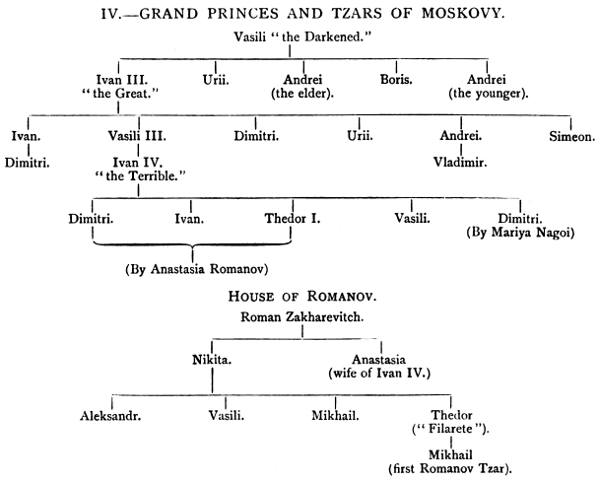
brothers were yet living, Elena Glinski assumed the regency
on behalf of her three-year-old son, supported by a knot
of boyarin-princes, whom the circumstances of the time
suddenly threw into prominence. The over-shadowing
figures of the last two Moskovite monarchs had almost
obliterated the fact that there were persons of importance in
the land besides the members of the princely family. Now
a whole crop of nobles emerges from the background, like a
ready-made second chamber from the brain of an Abbé
Sieyés. Ivan Oblenski, an offshoot of the House of
Tchernigov, the Bielskis, the Glinskis, and the Shouyskies,
form the aristocratic nucleus round which revolve the
intrigues and faction vicissitudes which seem the natural
accompaniments of queen-mothers and minorities. Necessarily
the Princess Regent had a lover, in the person of
Oblenski, and equally as a matter of course, the latter had
personal enemies. Of these he proceeded to dispose with
all expediency; Urii Ivanovitch, uncle of the Grand Prince,
suspected of plotting against the Existing Order of Things,
was lodged in a state dungeon, where he died of hunger
some two and a half years later.[133] A more celebrated, if less
august victim was the kniaz Mikhail Glinski, who had
expostulated with his niece anent her unseemly intimacy
with Oblenski, and was thrown into prison, where he “died
unhappily.” 1534From which it would appear that the old
saying concerning the unwisdom of intervening between
husband and wife might be applied with equal truth to
a less recognised connection. Andrei Ivanovitch, Vasili’s
remaining brother, took fright at the irreverent procedure of
the Regent and her favourite (who caged Princes of the
Blood as unconcernedly as though they were linnets or
human beings), and stole off one day, with all his household
and retainers, towards Novgorod. 1537The farther he got from
Moskva the more his courage rose, and ere long he had
drifted into open rebellion against the boyarin-wielded
authority. Numbers of disaffected landowners sped to his
support, but the gates of Novgorod remained shut and the
Oblenskie were hard upon his track with the best-mounted
Moskovite cavalry. Andrei surrendered without striking a
blow, and was escorted back to the city of his deep dislike,
leaving behind him at intervals along the Novgorodskie road
the swinging corpses of thirty of his adherents. His remaining
followers died by torture or in prisons, and the latter
fate disposed of the last surviving son of the great Ivan.
Meanwhile the success of Elena’s regency had justified
the means taken to retain it. Vasili’s death had encouraged
the King of Poland to renew with threatening insistency his
demands for the restitution of the territories conquered by
the late Prince and his father; refusal on the part of Moskva
led to hostilities in which the Lit’uanian forces were unable
to obtain any advantages, and a prolongation of the truce,
on the terms “as you were,” ensued (1537). A skilful
balancing of the conflicting interests which agitated the Krim
and Kazan Hordes maintained the Moskovite peace in those
directions, and a renewal was also effected of the truces with
Sweden and the Livlander knights. Nor was the inner
administration of the regency wanting in beneficial activity.
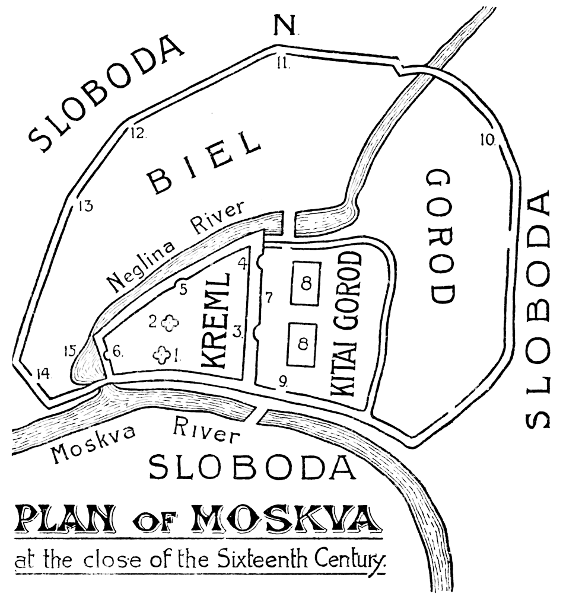
The Kitai-gorod of Moskva (after the Kreml the most important
quarter of the city, containing the houses of the boyarins
and the principal bazaars and trading stores) was surrounded
by walls and towers which added greatly to the security of
the capital.[134] Vladimir, Tver, Novgorod, and other provincial
towns were newly fortified and in some cases rebuilt; the
state coinage was also put upon a more satisfactory footing.
Under these circumstances the severities and loose morals of
Elena Glinski might well be overlooked by her subjects.
Her greatest offence was yet to come. She died. Ap. 1538Of poison,
said many-tongued rumour, on which the only rational comment
must be the useful Scotch verdict, “not proven.” Her
untimely death left Oblenski in precarious possession of the
supreme authority, which his enemies were already preparing
to wrest from him. Foremost among these was the veteran
Vasili Shouyskie, nick-named “the Silent,” the head of
an important Souzdalian family. For seven days lasted
Oblenski’s regency, and then himself and his sister were
seized and thrown into prison, where the fashionable death-by-starvation
awaited them. The silent Shouyskie assumed
the regency, which he held till his decease in the October of
the same year, when it passed to his brother, Ivan Shouyskie,
who displayed his newly-acquired power by packing the Metropolitan
Daniel off to the cloister, and installing in his place
Ioasaf, hegumen (abbot) of the Troitza monastery. Hard
and brutal was the rule of the Shouyskies; “fierce as lions,”
bemoaned the Pskovskie chronicle, “were the voevodas, and
as wild beasts their people against the peasants.” The only
check on the absolute supremacy of the dominant family was
the ever-present apparition of the kniaz, Ivan Bielski—Ivan
and Vasili were fashionable names among the Moskovite
aristocracy of that period—who was a formidable competitor
for the possession of the regency. Bielski justified the
nervous apprehensions of the Shouyskies (who had kept him
in prison for several years and only released him at the intercession
of the new Metropolitan), by taking advantage of the
disaffection bred by their arrogance to oust them from the
head of affairs. As Regent his rule was milder and less overbearing
than that of the kniaz he had supplanted, and a firmer
front was shown against the Tartars of Kazan and the Krim
Horde, who were continually devastating the frontiers. Possibly
the increased activity was rather forced by their side,
for in the year 1541 both Hordes set themselves in motion
against Moskva. The Krim Tartars brought a formidable
force into the field, augmented by cannon, musketeers, and
some squadrons of Ottoman cavalry—the first warriors of
that nation who had fought against the Russians. The
double danger stifled for the moment the bickerings of the
Shouyskie and Bielski factions, and the Moskovites found
themselves strong enough, when thus united, to repel the
incursion of both Hordes. Safa-Girei and the Kazanese were
chased out of the neighbourhood of Mourom, which town they
had fruitlessly attacked; Saip-Girei, confronted by a powerful
army on the yonder bank of the Oka, dared not attempt to
force the passage, and retired to the Don. The jealousy
which existed between the leading boyarins made it impossible
for the Russians to follow up their advantage by a
campaign in Tartar territory, and Ivan Shouyskie turned
instead to his own advantage the employment of the troops
which the war had placed at his disposal. Secretly supported
by many of the notables of Moskva, and openly by those of
Novgorod, he resolved upon a bold bid for the recovery of
his ascendency. 1542On a dark night in January Petr Ivanovitch
Shouyskie rode into Moskva with a picked body of soldiers
from Vladimir, and before morning the Kreml was in his
hands. Bielski was seized in his bed, and the Metropolitan
was disagreeably awakened by showers of stones hurtling
through his windows and weapons hammering against his
door. The chief of the Church barely escaped with his life
to the shelter of the Troitza, an unpleasant exercise for an
early morning in mid-winter. At daybreak Ivan Shouyskie
entered the city and resumed his old position of authority.
Bielski and the Metropolitan were sent off to safe keeping
at Bielozero, the lonely stronghold on the waters of the lake
of that name, where the Grand Princes’ treasures and
prisoners were securely stored away.[135] This time Shouyskie
took good care that his rival should not emerge from prison
to trouble him, and the soul of Bielski put on immortality.[136]
A new Metropolitan, the second who had been nominated
by the Shouyskies, was elected to fill the place of the shifty
Ioasaf, who had leisure, in the seclusion of the Kirillov
monastery at Bielozero, to reflect on the unwisdom of being
all things to all men in sixteenth-century Moskva. The
Novgorodskie had supported the coup d’etat, and their Archbishop
Makarie was rewarded with the vacant post. In the
meantime, while these various Ivans were ruling the State
and crushing one another in turn, how fared it with the other
Ivan in the background? The much-prayed-for princeling
had not, since the death of his mother, spent a very happy
or altogether comfortable childhood. The chief boyarins
and their followers appear to have treated their Sovereign
with a curious mixture of neglect, disrespect, and superstitious
awe. Surrounded exclusively by the partisans of whichever
faction happened to be uppermost, the friendless orphan
could only brood in silent resentment over the wrongs he
sustained at the hands of his temporary masters. The rude-mannered,
tyrannical, gold-greedy Ivan Shouyskie was an
especial object of his dislike. A letter written by the monarch
in after days to Prince Andrei Kourbski, comments
bitterly on the fact that though, in the lifetime of the Princess
Elena, Shouyskie had possessed only one cloak, green silk
trimmed with marten fur, “and that a very old one,” during his
regency he was able to have cups of gold and silver fashioned
him, with his initials graved thereon.[137] The despotic jealousy
of Shouyskie and of his supporters in the State Council robbed
the young Ivan of friends as well as treasure. For one of
their number, a boyarin named Vorontzov, the Prince had
betrayed a marked partiality, a dangerous compliment, which
brought down on the recipient’s person the practically-expressed
dislike of his fellow-councillors. In solemn conclave,
and in the presence of Prince and Metropolitan, the
angry men of State fell murderously upon the courtier whom
the Sovereign had delighted to honour, and Ivan’s entreaties,
backed up by those of Makarie, could scarcely obtain a
mitigation of his fate to one of exile and imprisonment.
The amusements of the boy Prince, besides religious devotions,
at which he was an adept, and the more legitimate forms of
hunting, consisted in chasing dogs and cats over the battlements
of the Kreml, and in wild gallops with his allotted
companions through the streets of Moskva, in which the old
and unwary were ruthlessly trampled underfoot.[138] The days
of his repression were, however, drawing to a close. The
fearsome Regent Ivan died in 1543, and left a commission
of his sons and relatives to replace him. But the reign of
the Shouyskies was doomed. The manly exercise of the
chase is a valuable school for inculcating self-reliance and a
will to overcome the obstacles of life. It was straight from
a day’s sport in the woods of Vincennes that the grand young
Louis, whip in hand, strode in upon the Parliament of Paris
and quenched it with an epigram; it was after the autumn
hunting at Voloko-Lamsk that Ivan Vasilievitch first showed
his teeth and gave evidence of that cold-blooded severity
which was to gain for him the distinctive adjective “Groznie”
(Terrible). At Moskva, where the Court had assembled for
the festival of Noel, the Prince suddenly accused the ruling
boyarins of misgovernment and abuse of their powers; many
had been guilty, but he would content himself with one
example. Calling to his kennel-men he bade them seize
Andrei Shouyskie and throw him to the dogs. Out into the
street they dragged the unhappy man, and there, before the
mute, disconcerted boyarins and the long-time Shouyskie-ridden
citizens, the Prince’s hounds worried the offending
kniaz to pieces in the reddening snow. “The little tin gods”
had missed “the hour when great Jove wakes”; Andrei
Shouyskie paid dearly for the oversight. The youth of Ivan
still necessitated a regency, and his mother’s relatives, the
Glinskies, next came into power; but from the day of the
red Noel no liberties were taken with the young monarch.
His new counsellors, indeed, encouraged him in his savage
inclinations, and the chronicles give instances of callous
brutalities inflicted upon Russian subjects by both Ivan and
the Glinskies. A party of Novgorodskie arquebusers, who
had interrupted one of the Prince’s hunting expeditions with
importunities respecting their pay, were punished for their
presumption by being tortured to death, and a similar ghastly
fate awaited some petitioners from Pskov, upon whom was
poured blazing spirits, which ignited their hair, beards, and
clothes.[139]
When Ivan was in his eighteenth year he celebrated
with much pomp and circumstance the double event of
his coronation and his marriage with Anastasia, daughter
of Roman Zakharin-Koshkin, member of a family which
had migrated from Prussia to Moskva in the fourteenth
century.[140] Jan. 16, 1547In the hallowed Ouspienskie Cathedral the
Metropolitan crowned him with the title of Tzar, which
was here used for the first time at the coronation of a
Russian ruler. The old style of Velikie-kniaz dies out
from this moment, and as the customary chant, “In
plurimos annos,” swells through those dim frescoed arches,
the old order seems to pass away with the wafted incense
fumes. A new figure is borne into Russian history amid
the striking of bells and shouting of a myriad throated
multitude. The Tzar comes!
The fact of Ivan’s coronation caused no immediate
change in the government of Russia, which continued to
be directed by the “Vremenszhiki,” or men-of-the-season,
that is to say, by the Glinskies. That their administration
was iniquitous to an insupportable degree may be gathered,
not only from the possibly exaggerated accounts of the
chroniclers, but from the fact that long-suffering Moskva
was goaded to the brink of revolution. Ivan amused
himself with his religious hobbies and other less respectable
diversions, and only assumed the part of Sovereign when
he wished to “make an example” of some offending
subject. The purging of Moskva from the vampire brood
that afflicted it, and the simultaneous “reformation” of
the young Tzar, form a curious episode in the history of
this time. The summer of 1547 was signalised by
disastrous conflagrations in the capital, the first of which
broke out on the 12th April; the last and most serious
occurred in June. The flames on this occasion reduced to
ashes a large portion of the Kreml, the Kitai-gorod, and the
outer town, and destroyed 1700 of the adult inhabitants,
besides children, “who were not counted.” Amid blazing
streets and rolling smoke-clouds, falling roofs and crashing
cupolas, panic and anarchy reigned supreme. The
populace, rendered unreasonable by terror and hatred,
loudly denounced the Glinskies as the authors of the
calamity; in particular, Anna Glinski, Ivan’s maternal
grandmother, was accused of sprinkling the streets of
Moskva with a decoction of boiled human hearts, which
apparently possessed inflammable qualities unknown to
science. Urii Glinski, the Tzar’s uncle, was seized by the
enemies of his party and slain in the sanctuary of a sacred
building, and the infuriated townsfolk penetrated into
the country palace at Vorobiev, whither Ivan had retreated,
with a demand for more Glinskies. At this moment a
thing happened which, in the accounts of the earlier
Russian historians, recalls Edinburgh before the battle
of Flodden. A “holy man of Novgorod,” one Silvestr,
appeared on the scene and quietly annexed the soul of
the Tzar. The people had attributed the conflagrations
to the Glinskies; more critical and dispassionate examiners
have been inclined to suspect the Shouyskie faction of
complicity in the matter. Silvestr, however, put a different
complexion on the affair and announced that the partial
destruction of the town and burning of the 1700 inhabitants
and unenumerated children was the work of God. As
he supported this theory by producing “visions,” there
could be no further doubt on the matter—none, at least,
with Ivan, who saw the visions.[141] The conscience-stricken
young man, convinced that the Glinski administration was
as unpopular with heaven as it was with the Moskvitchi,
since such heroic measures had been taken to displace it,
surrendered himself, body and soul, into the hands of
Silvestr, who, needless to say, made a clean sweep of the
Vremenszhiki and replaced them with his own friends.
Without ruthlessly disturbing the halo of romance and
sanctity which has been fastened upon the man of
Novgorod, it is not unreasonable to conjecture that the
monk was an old acquaintance of Ivan—who was a
frequent visitor to all the religious establishments within
his reach—and took advantage of the popular excitement
and general disorder to upset the palace intrigues of both
the Glinski and Shouyskie factions. That Silvestr, and
the equally nebulous layman, Adashev, whom he associated
with him in the new government, exercised a restraining
and beneficent influence on the young Prince may well
be believed; with an opposition of watchful and resentful
nobles in the background, circumspection was essential,
and Ivan, who had seen a consuming fire, an angry
populace, and a frowning Providence threatening him on
all sides, was likely to be a docile pupil. For the time. The
austere and monkish repression of the latest Vremenszhiki
was the finishing touch necessary to perfect the education
of the Terrible Tzar.
The early part of Ivan’s reign, and the whole of the
preceding one, are characterised by the recurrence at
irregular periods of a deliberate campaign against Kazan.
The Russians seem to have borrowed the tactics of the
wolves which inhabited their steppes and forests, and to
have leisurely and persistently wearied their quarry down,
without caring to rush in and dispatch it. Again and
again did the Tzar summon from the far corners of his
dominions an enormous army, trail forth his ponderous
siege-pieces and sacred banners, take an affecting farewell
of his capital, and march upon the Tartar city. The
wooden walls were relentlessly battered down, the garrison
reduced to the last extremity, and then the Moskovite hosts
would return home in good order. The walls were easily
rebuilt and the Kazanese would pursue the even tenor
of their way. It would almost appear as though the
Russians were loth to irrevocably destroy the only enemy
against whom they warred with any comfort. A more
feasible explanation is that the Kazanese supplemented
their feeble defences by a judicious outlay of the metal
which corrupts, and that some of the Moskovite voevodas
did not return empty-handed from these abortive expeditions.
In 1552 Ivan determined to set once more in
motion the huge army which had been left quartered on
the frontiers of Kazan, a locality which had had a demoralising
effect on the troops, many of whom had shaved
off their beards to please the Tartar maidens who for the
time being under-studied their wives, “to prove,” remarked
a scandalised messenger from the Metropolitan, “by the
indecent nudity of your faces, that you have shame to be
men.” Familiarity had bred contempt, and the dwellers
in the city by the Volga’s shore scornfully refused to
open their gates at the approach of the 150,000 footmen
and the 150 cannon which the Tzar brought against them.
The Moskovites prepared for a long and obstinate resistance,
and by way of a beginning erected and dedicated
three pavilion churches in their camp. Events justified
their expectations; the Kazanese held out stoutly against
both the assaults of the besiegers and the offers of the
Tzar. August and September passed in continual sorties and
battles without the walls, skirmishing attacks by the Kozaks
in the tzarskie army, and mining operations by the German
engineers. The overwhelming forces and superior artillery
which Ivan was able to bring against the city at length
beat down the heroic defence, and the triumphant Moskovites
put their stubborn and still resisting enemies to the
sword. The Tzar is said to have been moved to tears
at the sight of so many Tartar corpses; “they are not
Christians,” he observed, “but yet they are men.” The
reduction of Kazan was an event of the first importance
in Russian annals. It marked an epoch. “The victory
of Ivan the Terrible is the first great revenge of the
vanquished over the vanquishers ... the first stage reached
by European civilisation in taking the offensive towards
Asia.”[142] Prudence suggested that Ivan should remain on
the scene of his conquest until his authority over the
neighbouring districts was assured; a desire to return to
his capital in the full flush of triumph prompted him to
disregard more solid considerations. He was still very
young. The newly-acquired territory was therefore left
under the united protection of the Christ, the Virgin, the
Russian intercessory saints, and Aleksandr Shouyskie.
Ivan, on his homeward way, received the welcome intelligence
that his wife had given birth to a son, the Tzarevitch
Dimitri, first of a series of Ivanovitches so named. The
prolonged rejoicings, banquetings, and thanksgivings which
ensued at Moskva were followed by a disagreeable sequel;
Kazan, despite the august protection under which it had
been left, rose in revolt, and the Russian ascendency was
seriously imperilled. 1553The Tzar’s health at the same time
broke alarmingly down, and another long minority seemed
to threaten the State. The boyarins and princes, summoned
to take an oath of allegiance to the infant Dimitri, showed
a strong reluctance to bind themselves down in the manner
required; the succession of Ivan’s child to the Tzardom
would mean a Romanov regency and a repetition of the
faction intrigues which had attended the early years of
the present reign. Urii, the Tzar’s brother, appears to have
been a weakling in mind and body, too feeble even to
decorate with the divine attributes of monarch; in Vladimir
Andreievitch, the Tzar’s first cousin, however, there existed
a possible candidate for the throne, and even Silvestr and
Adashev hesitated between the claims of the hereditary and
collateral succession. The oath, whatever its value might
be, was exacted from the unwilling courtiers, but Ivan’s
recovery prevented the necessity of testing it. The convalescent
Tzar, in spite of the remonstrances of his advisers,
set off on a course of shrine visiting, taking with him his
unfortunate offspring, who was scarcely of an age to stand
such energetic piety. In fact he died on the journey. The
pilgrimage of Ivan was, if the chroniclers and some of the
later historians are to be believed, disastrous in another
fashion. Among the religious establishments visited was
the Piesnoshkie monastery, wherein was caged an interesting
prisoner. Vassian, Bishop of Kolumna in the reign of
Vasili, had been deprived of his episcopal office during the
time of the regencies on account of his evil life; now, in the
decrepitude of age, he is represented as harbouring with
unquenched passion the unholy frettings of a sin-warped
mind. Ivan desired an interview with the hoary reprobate;
perhaps after a course of devotions among a community of
irreproachable saints, living and departed, he was attracted
by the rare personality of a sometime bishop who was no
better than he should be. The monk-with-a-past seized
the grand opportunity to poison the monarch’s mind
against his boyarins, his relations, and his subjects, and
Ivan drank in with greedy ears the vicious counsels of the
unhallowed recluse. It is a fascinating picture, the aged
priest who had eaten his heart out in helpless bitterness
these many years, and chafed against the restraint of his
prison-cell, given at last one deadly moment of revenge in
which to work a superb evil against the society that had
mishandled him. And as the Tzar went out from his
presence a changed man, might not the ex-prelate have
flung a crowning blasphemy at his heaven and chanted
exultingly nunc dimittis? Ivan, indeed, in the hands of
the chroniclers, is a creature easily swayed; a monk from
Novgorod tells him to be good, and he straightway abandons
the wrong-headed sins of his wayward youth and becomes
an exemplary monarch, till a monk of Piesnoshkie gives
him dark and evil counsel, and sends him forth upon the
world with a cankered, blood-lusting soul.
The Tzar’s return to health was accompanied by a return
of Moskovite prosperity. Another Tzarevitch, Ivan, replaced
the dead Dimitri; Kazan was gradually Kozaked into submission,
and received a bishop as a mark of special favour.
Another conquest equally important was achieved without
bloodshed. The Astrakhanese having insulted the envoys
of Moskovy, a small but well-equipped army was sent against
them, with the result that this khanate, once the head-country
of the redoubtable Golden Horde, acknowledged Ivan’s
sovereignty and yielded equal rights in the Volga fishery to
his Great Russian subjects. 1554The Nogai Tartars, occupying
the intermediate steppes, submitted at the same time to the
Moskovite dominion, and the Russian state, still cut off from
the Black Sea, to which in the tenth century it had given its
name,[143] wriggled its way down to the Kaspian.
The acquisition of the two Tartar sovereignties, while
giving increased importance and security to Ivan’s dominions,
and opening up a valuable trade with Persia and other
eastern countries, did not tend to make Moskovy less Asiatic,
or bring her closer into the European family. The Tzar’s
political ambitions turned naturally towards the west. With
a sagacity equal to that of his most celebrated successor, and
in opposition to the advice of his counsellors, he wished to
find a free outlet for communication with the great Empire-Republic
(which, though decaying in organisation, was at
this moment so instinct with life), and with Europe generally.
The death of Sigismund of Poland (1548) and the accession
of his son, Sigismund-August, had scarcely affected the
grudgingly pacific relations between the two countries, though
their common grievance against the Krim Tartars seemed to
warrant the hope of a more cordial understanding. With
Sweden the Moskovites waged one of those short inconclusive
wars, in which neither party seemed to have any definite
object in view, beyond the fact that they “lived unhappily”
as neighbours. 1557A forty years’ truce concluded the hostilities
between these ancient enemies. It was about this time that
some adventurous merchant-seamen of the city of London
“discovered” Moskovy, by way of the White Sea, and opened
up a commercial and diplomatic intercourse between the two
isolated nations who were one day to come face to face with
each other on the roof of the world. The country, however,
towards which Ivan’s thoughts were chiefly turned was the
uniquely governed Baltic land, comprising Estland, Livland,
and Kourland, and the adjacent islands of Dago and Oesel.
The extinction of the Prussian section of the Order had
necessarily weakened the Livlandish branch, and the spread
of Lutheran ideas had further added to the confusion which
reigned throughout the Baltic burghs. Nowhere, perhaps, in
Europe did bishops wield such extensive temporal powers,
and the fact that local opinion ran strongly in the direction
of the reformed principles and of secularisation made the
immediate future of these districts a very open question.
Ivan had a solution of the difficulty which he was not loth
to put into practice. A grievance he undoubtedly had
against the Livlanders, who had hindered his intercourse
with the Hansa League and prevented free immigration of
artificers and craftsmen from the Empire into Russia. Consequently
he suddenly bethought him of the clause in the
original truce with von Plettenberg, whereby an annual
tribute from the town of Dorpat had been agreed to, and
promptly lost sight of. The Tzar reminded the Livlandish
envoys of this unremembered pledge, and refused to renew
the truce until the arrears had been paid in full. 1557The representatives
of the Land-Master and the sovereign bishops
argued and promised, but they did not pay, and Ivan
prepared for war. Von Fürstenberg vainly endeavoured to
rouse his subordinates and coadjutors to a sense of the
coming danger. The Bishop of Dorpat hastily declined the
offer of a few companies of lanzknechts, whose loosely disciplined
habits he well remembered; he had forgotten the
Russians. 1558In January three divisions of Moskovite, Tartar,
and Tcherkess troops, under the command of a Glinski, a
Romanov, and an erstwhile Khan of Kazan, rode into the
Order territory and wasted Livland and Estland to within
four miles of Revel.[144] The outskirts of Dorpat were burnt,
and the invaders returned from this preliminary winter
campaign with a heavy spoil of cannons, church bells,
treasure, and captives. A contemporary account accuses
the Tartars of fiendish cruelties upon the hapless inhabitants
who fell into their clutches; among other fantastically
devised tortures, men were fastened on to the ground, holes
punctured into their sides, and gunpowder poured therein,
which being ignited, sent the victims into shreds.[145] Ivan’s
object in sending war and desolation careering through the
land was to bring the various factors which composed its
government into subjection to his authority, as the Prussian
State had been brought under the sovereignty of Poland.
The Livlanders still imagined that peace might be bought,
and at a Landtag held at Wolmar in March it was resolved
to send envoys to the Tzar with an offer of 60,000 thalers.
Ivan refused to receive the ambassadors, and the chances of
reconciliation were still further lessened by an outbreak of
hostilities between the opposing fortresses of Narva and
Ivangorod, the former of which was captured by the Russians.
The war recommenced with renewed vigour on the part of
the invaders; the defending forces were too hopelessly disorganised
to offer an effective resistance to the Moskovite
attack. Churchmen and Ordermen, nobles and burghers,
blamed each other mutually, and the luckless peasantry
(who since their conversion to Christianity by the Sword
Brethren had scarcely been surfeited with the peace and
goodwill which had been officially promised them) suffered
at the hands of all. Dorpat, Neuhausen, Ringen, and many
other strongholds fell before the assaults of the Moskovites,
and Ivan’s troops extended their ravages into Kourland.
But meanwhile significant events had been taking place at
the headquarters of the Order. Von Fürstenberg had resigned
his office to a younger man, Gotthard Kettler, and
this new chief had inaugurated vigorous measures whereby
to save, if possible, some fragment from the ruin of the
rapidly dissolving anachronism which had held together for
over 300 years. The Kings of Poland, Sweden, and Denmark
were appealed to for assistance, and a more spirited
opposition was shown to the Tzar’s voevodas. A half-hearted
irruption of the Krim Khan, Devlet Girei, into Moskovite
territory towards the close of the year did not materially
weaken Ivan’s grip upon the struggling provinces, but in the
following May, through the mediation of the new King of
Denmark (Frederick II.), an armistice of six months was
granted to the distressed Livlanders. 1559Kettler, the Archbishop
of Riga (Wilhelm Hohenzollern), and the various representatives
of the Order, the cathedral lands, and the cities
sought to turn this respite to good account. Like vultures
swooping down from an empty sky, the agents of the neighbouring
northern powers appeared suddenly on the scene
now that they understood that the Baltic Bund really meant
dying. The Empire, torn and exhausted by the religious
warfare which had attended the progress of the Reformation,
was unable to take effective part in the obsequies of its
detached colony. Other interested waiters upon Providence,
however, there were in plenty. Magnus of Holstein, brother
of the King of Denmark, was elected successor to Johann
Munchausen, Bishop of Oesel and Wiek, who was willing,
for a substantial recompense, to evacuate a bishopric which
had become neither Catholic nor safe. Revel and the Estlandish
barons turned their eyes Swedenward, while in
September an alliance was formed between Poland and the
expiring Order, which showed in which direction Kourland
and Livland were likely to fall. The truce came abruptly
to an end in the midst of all these schemings, and the Order
knights fought their last campaign amid depressing circumstances.
The strongly fortified town of Fellin, in which
ex-Master von Fürstenberg had entrenched himself, was
captured—or bought—by the Moskovite voevoda Kourbski,
and another disaster overtook the Cross warriors at Ermes,
where a whole detachment was surrounded by an overpowering
force of the enemy and all who were not slain
taken as prisoners to Moskva. The Tzar who had wept
over the dead Kazanese did not on this occasion permit his
triumph to soften his feelings towards the wretched captives,
who were flogged through the streets of the capital with
whips of wire and then beheaded.[146] Hatred and fear of the
Tartar-tinged and autocratic Moskovite sovereignty, heightened
by acts such as this, drove the Baltic folk more speedily into
the arms of the various foreign powers who were able and
willing to absorb them. Oesel had already come under
Danish influence; in June 1561 Erik XIV. of Sweden
(who had succeeded Gustavus Vasa the preceding September)
took Estland formally under his protection. Sigismund-August
completed the partition by taking over from the
Order Kourland and as much of Livland as was not in the
hands of the Russians. Mar. 1562The former province was erected
into a hereditary duchy dependent on the Polish crown, and
bestowed upon the ci-devant Master, Gotthard Kettler, who
was transformed into Duke of Kourland; the ecclesiastical
lands of the Kourlandish bishopric of Pilten, however, “went
with” the territory of Oesel, which also comprised the
church-lands of Wiek in Estland. Riga remained for the
present a free city, depending more or less upon Poland,
and the archbishopric was extinguished on the death of its
last prelate, Wilhelm Hohenzollern, in 1563.[147] Thus passed
away in violent dissolution the strange anomalous time-honoured
Baltic Bund, that missionary outpost of western
Christianity and civilisation, which had crammed its commerce
and its Christ swordwise down the throats of the Liv
tribes, had led an existence of intermittent strife with its
neighbours and within itself, and dying, left a legacy of two
hundred years’ warfare behind it.
Ivan, in killing the Order, had not reaped unmixed
benefits from his destructive efforts; he had advanced the
Russian frontier in a direction in which expansion was most
needed, but he had seen a large accession of territory fall
to his hereditary enemy, Poland, and his other hereditary
enemy, Sweden, had obtained a foothold south of the Finnish
gulf—two circumstances which did not bode peace on his
north-west frontier. At Moskva meanwhile troubles were
brewing. The Tzar had probably never forgotten or forgiven
the part Adashev and Silvestr had played when their
sovereign seemed little better than a dead dog, and his
consort had since that affair nourished open enmity against
the two advisers. Their opposition to the war with Livland,
in place of which they would have preferred a crusade against
the Krim khanate, still further nettled Ivan, and the
Vremenszhiki might plainly perceive that their “season,”
which had set in amid the glowing ashes of a burnt Moskva,
was drawing to a close in the winter of the Tzar’s displeasure. (Aug. 1560)The death of Anastasia (who had erewhile presented her
husband with another son, Thedor, and a daughter, Eudokiya)
did not improve the monarch’s temper, and the fallen
favourites were glad to leave the unhealthy neighbourhood
of the Court. Adashev was sent in the capacity of voevoda
to the newly acquired fortress of Fellin, and the man of
Novgorod relapsed into the obscurity of the cloister. Their
rule had been ambitious, austere, and paternal to the point
of irritation, and they left behind them a circle of disparaging
courtiers who helped the Tzar to remember how arrogant his
disgraced counsellors had been in the past, and to realise
how dangerous they might be in the future. It was darkly
hinted at the Kreml that Anastasia Romanov had died in the
prime of life and health, and that she had been the enemy
of the Vremenszhiki. Ivan himself raked up real or imagined
grievances against these restrainers of his violent youth, and
before long the frown of the Tzar was followed by a stroke
of his far-reaching arm. Adashev was removed to a prison
at Dorpat, where he died six months later—by his own hand,
said his enemies; Silvestr was sent to contemplate the
abstract to the music of “the ice-fields which grind against
the Solovetsky Monastery on its savage islet” in the White
Sea—a favourite storing-place for inconvenient churchmen,
as Bielozero was for lay offenders.
A new circle of favourites and boon companions sprang
fungus-like around the stern-grown Tzar, but for the future
they ceased to try and control his goings; if they could
avoid being trampled on they counted themselves lucky. The
Basmanovs—Thedor, the son, “with the face of an angel
and the heart of a devil”—were among this sinister throng,
which also included Maluta Skouratov, “readiest of all to
minister to his depraved inclinations and shameful lusts.”[148]
Ivan, after the punishment of Silvestr and Adashev, was
seized with remorse—for wasted opportunities. He might
have been so much more savagely exemplary than he had
been. It was not yet too late to remedy the omission;
Adashev had been disposed of, and the recluse could not
well be dragged forth again and re-sentenced; but there
were others. The gravest political fault that must be laid
to Ivan’s account is that his cruelties were occasionally stupid.
In the instance of his first experiment at a reign of terror he
selected as principal victim of his unappeased wrath Daniel
Adashev, brother certainly of the late minister, but one of the
few reliable voevodas with the army in Livland. The exact
ground on which he received the death-sentence—beyond the
fundamental one of blood-relationship with a fallen idol—does
not transpire, but the fault was apparently a comprehensive
one, as with him perished his youthful son, his
wife’s father, his brother’s wife’s brothers, and his relative
Ivan Shiskin, with wife and child.[149] At the same time was
put to death, on the double charge of sorcery and affection
towards the Adashevs, a woman of Livland, a convert to
Orthodoxy, who had come to Moskva with her family, the
interesting name of Magdalin, and a reputation for piety.
The first perished with her. Other victims of the Tzar’s
dislike or distrust were sent either to their graves or to
Bielozero, and then the “young man’s fancy” lightly turned
to “thoughts of love.” Envoys were sent to the King of
Poland suggesting the marriage of Ivan with one of
Sigismund-August’s sisters as a basis of peace between the
two countries, but the negotiations fell through. The question
of Livland had added another item to the many vexed points
which made a durable reconciliation impossible. Aug. 1561The offended
wooer haughtily turned his back upon possible western brides
and allied himself with a beautiful Tcherkess maiden, of a
princely house, whom he caused to be Christianised and
baptized at Moskva under the name of Mariya. Towards
the close of the following year Ivan assembled an immense
army with which to give practical effect to his resentment
against Poland, and in January 1563 led his troops in person
against Polotzk. Probably no previous Russian prince or
voevoda had ever been at the head of so imposing a host;
its fighting strength was computed at 280,000 men, another
80,000 accompanied the huge baggage train, and 200 cannon
bumped in their sledges over the frozen snow. How such a
multitude of men and horses was maintained in the frost-bound
and much ravaged border province of Polotzk it is
difficult to surmise. Fortunately the siege was not of long
duration; the old capital of the House of Isiaslav surrendered
to the mighty host which encompassed it, and Ivan was
able to add the title of Grand Prince of Polotzk to his already
fatiguingly imposing designations. His return journey to
Moskva was a repetition of his earlier triumph after the
fall of Kazan. As on that occasion, he was met with the
pleasing intelligence that his consort had presented him with
a son (Vasili).[150] The infant continued the parallel by dying
when a few weeks old. Another death happened in the tzarskie
family towards the end of the year, Urii, the weakling brother,
dropping quietly out of existence at this time. Makarie,
the Shouyskie-elevated Metropolitan, died on the last day of
the year, “leaving behind him the blessed memory of a
prudent pastor.”[151] As he had lived in peace with the various
Vremenszhiki and with Ivan himself, the prudence cannot
be gainsaid. 1564Athanasie, the Tzar’s confessor, was elected to
the vacant post, which he probably found less onerous than
that of keeper of his Majesty’s conscience.
A truce of six months had been accorded to Sigismund-August,
notwithstanding which both Moskovites and Poles
(the latter with the assistance of the Dniepr Kozaks)
mutually harried each other’s lands. The Polish ambassadors
who came to Moskva in December 1563 put forward the
usual inflated demands for Pskov, Novgorod, and other
integral Russian possessions; scarcely likely to be yielded to
a country which had just lost a valuable province. Ivan’s
diplomatists countered these extravagant proposals by equally
unreasonable claims, and the futile negotiations—which more
resembled a Dutch auction—were broken off in January. 1564The renewal of active hostilities brought disaster upon the
Moskovite arms; in the ill-fated neighbourhood of Orsha
Petr Ivanovitch Shouyskie, in command of a large Russian
force, was surprised by the hetman Nikolai Radzivil and
completely defeated. Among the many conflicting accounts
of this battle it is impossible to estimate what was the
proportionate loss of victors and vanquished, but it is fairly
evident that the Moskovites abandoned their cannon and
baggage train to the enemy, that they were pursued by
moonlight through brakes and swamps, and that Shouyskie
lost his life in the battle or the flight. According to some
writers his body was found in a well. The consequences
of this defeat were not weighty, but Ivan was at the
same time confronted with the defection of one of his most
important voevodas, Aleksandr Mikhailovitch Kourbski.
This boyarin, who held command of the troops in Livland,
had been a companion-in-arms of Daniel Adashev, and was
well disposed towards the Vremenszhiki who had had so grim
a downfall. As Moskovite generals went, he had been
energetic and fairly successful, though at a battle at Nevl he
had been worsted by a much inferior Polish force. The
cruelty and tyranny which were making the Tzar daily more
breathlessly interesting to his courtiers roused apprehensions
in the mind of Kourbski, who suddenly took the resolution
to transfer his services to the cause of Sigismund-August.
The letter or declaration in which he informed the Tzar of
the reasons which had driven him to take this step was
couched in terms of Biblical reproach, and upbraided the
tyrant with having shed the blood of innocent men and slain
the mighty ones of Israel. Kourbski was pleased with this
composition and expressed his intention of having a copy of
it buried with him. Ivan, who was not so pleased with it,
drove his iron-tipped staff through the foot of the messenger
who had brought it, and kept it there while he read it; and
it was a long letter. An extraordinary correspondence
ensued; Ivan hurled at his departed boyarin reproaches,
scriptural texts, sarcasms, and fragments of classical history.
Why to save his miserable body had Kourbski stained his
immortal soul with treachery? What, he wished to know,
would happen to Kourbski’s soul “on the day of awful
judgment”? How had he dared to say that the throne of
God was surrounded by his (Ivan’s) victims, against the
authority of the Apostle, who said that no man could see God?
Heretic! “You tell me that I shall never again see your
Ethiopian face. O Heaven! what misfortune for me!”
And let him place his letter in his coffin, thereby proving
that he was no Christian, since Christians loved to die in
forgiveness and not hate. “Written in our residence of
Moskva, in Great Russia, the 5th of the month of July, the
year of the world 7,072.”[152]
The passing over of Kourbski infused new vigour into
Sigismund-August’s war measures. Devlet-Girei, who had
been on the point of concluding an alliance with Moskva,
was suddenly induced by Polish gold to make an inroad
upon Riazan; Kourbski and Radzivil led a large army
against Polotzk, and hostilities were actively prosecuted in
Livland. Nothing, however, resulted from this triple attack;
Riazan was heroically defended by the Basmanovs, father
and son, until reinforcements arrived to drive the Tartars
back into the steppes. Polotzk equally defied the Polish
arms, and the Moskovites on their part captured the
Lit’uanian fortress of Ozeriszh. In Livland neither side
could claim a decided advantage.
Had Ivan at this crucial moment gathered together the
formidable resources at his command and led his army against
his old hereditary enemy, enfeebled by the rule of a weak
and aristocracy-fettered king, and involved, moreover, in a
quarrel with Sweden, he might have achieved a conquest
more splendid and important than those of Kazan and
Polotzk, and have wreaked on foreign foes his consuming
lust for blood. But suspicion, the Nemesis of tyrants, had
already commenced to haunt the dark mind of the Tzar,
and he cared not to risk his sacred person in the hands
of possibly traitorous boyarins. His warped imagination
peopled Moskva with treason-mongers and conspirators,
secret adherents of Kourbski and of the disgraced
Vremenszhiki. Promiscuous arrests and judicial murders
had not increased the gaiety of the capital, and Ivan
glowered round upon gloomy and anxious faces with a
sense of injured and threatened majesty. One morning
in December boyarins and citizens saw with a feeling of
uneasy alarm the Kreml square crowded with sledges, in
which were piled crosses, ikons, church and domestic furniture,
State treasures, and the various paraphernalia necessary to a
peregrinating Tzar. The Terrible was about to desert his
capital on the eve of the festivities of Noel. Escorted by
a troop of horsemen, and accompanied by his family and
favourite courtiers, Ivan Vasilievitch Groznie swept out of
Moskva before the eyes of his silent and wondering subjects.
This portentous Hegira halted at the Aleksandrovskie
sloboda, a village some 107 verstas (86 miles) from the
capital, where the Tzar set up his Court afresh. The
unknown is proverbially the dreaded. All Moskva shivered
at this mysterious departure. Clergy, boyarins, and townsfolk
asked themselves what boded the winter flitting of
their sovereign; they had not long to wait for an explanation. 1565On the 3rd January came a New Year’s message
from Aleksandrov to the Metropolitan, and another to the
merchants and people of Moskva. The burden of both
these epistles was, that during Ivan’s minority and under
the administration of Silvestr and Adashev the interests
of the State had been neglected and its coffers plundered;
that Moskva still swarmed with a brood of disaffected and
rebellious boyarins, and that whenever the long-suffering
sovereign wished to mete out justice to the guilty, the
Metropolitan and clergy interfered to screen them from
their well-deserved doom. Hence the sorrowing Tzar had
resolved to shake the dust of an ungrateful capital off his
feet, or in other words, to leave the white-built but black-hearted
city to simmer in its own iniquities. The effect of
this announcement was general panic and consternation, as
Ivan had probably intended it should be; a deputation of
clergy, boyarins, merchants, and townsfolk, headed by Pimen,
Archbishop of Novgorod, waited upon the Tzar in his
retreat at Aleksandrov and humbly implored him to return
to his desolate capital and to deal with the evil-doers as
seemed best to him. Ivan graciously relented and made a
solemn entry into the city on the 2nd February. If the
chronicles are to be credited, the change of air and scene
had done him little good as far as bodily health was
concerned, and the people were appalled to behold the
ravages which two months’ absence had wrought on the
person of their sovereign, who now appeared before them
“a gaunt, bent man, with dull eyes, matted, unkempt hair,
and a gloomy fierceness stamped upon every feature.”[153]
Certainly this Tzar gave his subjects plenty of excitement.
As a conqueror he had retaken possession of Moskva, and
a new batch of regulations marked his return to the
head of affairs; most notable of these enactments was the
institution of a personal body-guard, chosen from the ranks
of the courtier boyarins, and originally fixed at 1000 strong
(afterwards raised to 6000), to whom was given the name of
Opritchnina, or select legion. These satellites and creatures
of the Tzar fulfilled the duties of guards, police, and special
messengers, and became the agents for such cruelties and
extortions as Ivan could not superintend in person. They
carried at their saddle-bow a broom and a dog’s head, to
signify that they swept treason out of the land and devoured
the Tzar’s enemies; the terror they inspired among the
unfortunate people upon whom they were let loose earned
for them the name of “Kromieshniki,” “of the outer
darkness,” or literally “outers.” Another new departure
was the commencement of a palace outside the walls of
the Kreml; an unaccountable whim, unless Ivan feared to
be shut up like a rat in a trap among a people whose
patience might one day give out, and who might hunt for
a Vasilievitch as on a memorable occasion they had hunted
for Glinskies. For the present the Moskvitchi were huddled
like sheep in the corner of a pen, watching with nervous
interest the movements of the personage who might be
said to embrace the double part of shepherd and wolf. No
time was lost in getting to business; in the month of
February a batch of victims was selected to inaugurate
the new days of personal rule—a dark festival, in sombre,
gloomy, and terrible setting, and not as yet common enough
to have lost the thrill of expectancy. A list of names
stalk spectre-wise across this ugly page of Moskva’s history,
as the bearers of them walked to their doom under the
gaze of a blood-frozen multitude. Aleksandr Gorbati, who
at least had fought for the Tzar “from Kazan to the field
of Arske,” and his son Petr, who at the age of seventeen
could not have been steeped very deeply in treason, died
together under the executioner’s axe. Four other enemies
of the Tzar’s repose suffered by the block; for a fifth
was reserved a more ghastly punishment. Kniaz Dimitri
Shaferov expiated his real or imputed crimes by a slow
death by impalement. All day long, it was said, he
lingered, bearing his pain heroically; and Church and Tzar
looked on impassively at a deed more meanly cruel than
that monk-taught tragedy, the memory of which they
bewailed every Good Friday. To the credit of the Metropolitan,
be it said, that having not the courage to thwart
his sovereign’s sacrificial bent, he retired from an office
whose merciful functions he might no longer wield, and
withdrew into the Novo Spasskie monastery. Germanus,
Archbishop of Kazan, was pitched upon to fill the vacant
post, but Ivan quarrelled with him before the ceremony of
consecration had time to take place, and the old man
escaped thankfully back to his former diocese. The Tzar
then nominated Filipp, hegumen of the Solovetski Lavra,
who unwillingly assumed an office which could not fail to
bring him into disastrous contact with the Terrible and
his unbearable Opritchniki.
Ivan divided his time between the capital and the
Aleksandrovskie sloboda, which latter place he transformed
into a peculiar hybrid settlement, half fortress, half monastery,
in which he led an equally peculiar life. A whim or a
superstitious fancy caused him to garb himself and his boon
companions with the titles and even the robes of monks,
but the religious routine of this strange establishment was
no make-believe. Matins and masses and vigils were here
observed, perhaps more regularly than in most Russian
monasteries of that day, and by none more punctiliously
than by the Tzar-abbot; a fearful and wonderful being, if
contemporary reports have not grossly lied, grovelling in
abject fervent worship before the chapel altar at one
moment, and gliding out to superintend the fiendish torture
of some wretched captive at another, returning “radiant”
and comforted—grotesque and scarcely credible, yet
supported by the facts that are available. While the
baboon-hearted sovereign passed his days in a blended
medley of piety and savagery, buffoonery and State affairs,
his familiar sprites, the Six Thousand, infested Moskva
and a large portion of the country districts like a devouring
pest or an army of occupation. Princes, boyarins, burghers,
all who were not connected with the Elect Legion, were
liable at any moment to be insulted, plundered, or maltreated
by the light-hearted and light-fingered Opritchniki,
and redress from the Tzar there was none. Houses and
lands were ruthlessly filched from unoffending subjects in
order to provide for the wants and luxuries of the favoured
legionaries.[154]
The new Metropolitan, a man of firmer fibre than
his immediate predecessors, inevitably clashed against the
drifting forces of oppression and State anarchy which bore
athwart him, and incurred the disfavour alike of Tzar and
Opritchniki. Previous to his consecration he had made a
half-hearted attempt to procure the suppression of the
latter, and in return they hated him with a thoroughness
which boded his ultimate destruction. Throughout his
ministrations in the gloomy and splendid temples of Moskva
the grinning dog’s head must have been ever before his eyes,
and the renewed cruelties and executions with which the Tzar
terrorised the capital made a rupture daily more imminent.
During these inward developments of Ivan’s reign a
curious languor had crept into the foreign relations of the
country. It seemed as if the three north-eastern powers
were gorged and torpid after having assimilated within their
maws the decayed carcase of the Baltic Bund. The Swedish
raven and the Slav eagles sat inertly blinking at each other,
or indulged in desultory sparring over the remains of their
banquet. Perennial embassades, solemnly and sumptuously
upholstered, trailed to and fro between Moskva and the
Lit’uanian capital, and concurrently Kozaks and razboyniks
(moss-troopers) kept alive the smouldering embers of war.
As a matter of fact neither of the three neighbour nations
was in a position to engage in a vigorous foreign campaign.
In Sweden Erik, second monarch of the House of Vasa, was
undoing the good work of his father and sowing the whirlwind
which was shortly to sweep him from his throne. In
Poland the line of Yagiello seemed likely to come to an
end with the childless Sigismund-August, and men looked
anxiously or selfishly forward to the prospective troubles of
an open succession; for the most part selfishly. In Russia
Ivan, who might have reaped splendid profit from the
embarrassments of his rivals, seemed bent rather on warring
upon his own subjects. His hatred of the boyarins may
legitimately be explained by the recollections of his dreary
and friendless youth, and of the torturing anxiety of his
sick-bed, when loyalty ran cold and men turned their backs
upon the seemingly setting sun. And yet the prime mover
in that incipient treason appeared for long to have escaped
the jealous fury that bore so strong a sway in the Tzar’s
breast. Vladimir Andreivitch, who had put himself forward
as his cousin’s under-study, was for many years the object
of caresses rather than openly shown resentment. Fiefs,
palaces, commands, and other compliments were showered
upon him, as though to remove the possibility of further
disaffection. But there are more ways of killing a cat than
by choking it with cream. Ivan one day summoned his
relative to visit him at Aleksandrovskie, and rode forth to
meet him with a band of ever-useful Opritchniki—and some
poison. 1569Vladimir, accompanied by his wife and two children,
was intercepted at a little village on the road, where all four
were forced to drink of the Tzar’s hospitality—a beverage
which needed no digestion.
Whatever object Ivan may have had in selecting a man
of Filipp’s disposition for the office of Metropolitan, he soon
laboured to displace him therefrom; “there is no law to say
such things as may disgust the ear of kings,” and Filipp
had been, for a Russian churchman, tolerably outspoken. (1568)The uncompromising Vladuika was arrested, arraigned on some
raked-up charge relating to his monastic life, deposed from his
office, and immured in a cell of the Otrotch monastery near
Tver. Here in the following year Maluta Skouratov helped
him to die; Ivan has the credit of having added a martyr to
the Orthodox calendar. Kirill, hegumen of the Novinski
monastery (Moskva) replaced Filipp in the Russian primacy.
Despite the passive and unresisting temper with which
the Moskovites seem to have endured the tyranny of their
sovereign and his satellites, Ivan was never free from apprehension
on the score of treason. The carefully-guarded
seclusion of his life both at Aleksandrov and at the
capital betray his nervous fears in this respect, and even
more unmistakable is the drift of the correspondence he
had with Elizabeth of England on the subject of a possible
asylum in that country. In the last years of Edward VI.
the English navigator Richard Chancellor, of “the Mystery
Companie and Fellowship of Merchant Adventurers for the
Discoverie of unknown lands,” had stumbled upon Moskovy
while searching for a northern passage to India and China,
and diplomatic and commercial relations had been opened
up between the two countries. The Queen responded
graciously to “the deare most mightie and puissant Prince,
our brother, great lord Emperor and greate Duke Ivan
Basily of all Russia,” promising a sanctuary for “the free
and quiet leeding of your highnes lief ... and that it maie
be laufull for you to use your Christian relligion in such
sorte, as it shall be best like you.” Besides, the letter went
on, a place should be appointed for the prospective fugitive
and his Court “as long as you shall like to remaine with
us,” adding, however, “upon your owen charge.” The Tudors
were not given to quixotic extravagance.
Russia it has well been said is the country of contrasts,
and the reign of Ivan furnishes some curious anomalies of
administration. Of all the strange fruit to be borne under
the circumstances of time and place—in the Moskovy of the
sixteenth century—a States-General was about the last to be
looked for. And yet this was indeed the apparition which
the violent control-impatient Tzar called up to advise him
on the purely administrative question of continuation or
termination of the Polish war. In the summer of 1566
came to Moskva an unwonted assemblage of boyarins, higher
clergy, small proprietors, merchants, and townsfolk, 339 in
all, to deliberate on the matter which had been submitted
to their decision. Sigismund-August had abandoned his
demands for the restitution of Smolensk and Polotzk, and
was willing to unite with Ivan in a scheme for driving the
Swedes out of Estland and partitioning that province and
Livland amicably between the two Slav powers. The East-Russian
monarch did not jump at these favourable proposals,
but insisted that Riga, Wenden, Wolmar, Ronneburg, and
Kokenhausen should be added to his share of Livland.
Possibly his object was to harass Lit’uania by a prolongation
of the war, in the hope that, on the death of Sigismund-August,
the electors of the grand duchy might be driven to
put a term to their country’s sufferings by bestowing their
suffrages on their most formidable neighbour; as the Poles
had done in the case of Yagiello. The King refused to
make the required concessions, hence the deadlock which
the Russian Diet was called together to discuss. The
assembly unanimously concurred in refusing to abate the
Tzar’s demands upon Livland, which appeared to them
extremely reasonable. Thus the old Slavonic custom of
violently disposing of a minority was not called into requisition;
had the unanimity been the wrong way Ivan would
probably not have shrunk from a heroic treatment of the
case. Whatever hopes the Tzar may have entertained of
detaching Lit’uania from the Polish crown were dispelled by
the political stroke which Sigismund-August effected a few
years later; by the Union of Lublin, signed, after many a
stormy sitting, on the 1st July 1569, Poland and Lit’uania
were definitely bound together in a dual but indivisible
realm. The question of the succession to the double throne
still remained open, but it was scarcely likely that the
turbulent and almost independent nobles of the Polish
provinces would turn their thoughts towards the grim despot
of Moskva, charm he never so wisely. Ivan, however, in
obstinately refusing to conclude peace on any but the most
exorbitant terms, and confining his military operations for
the most part to unimportant border skirmishes, was pursuing
the time-honoured Moskovite wolf-borrowed policy of wearing
down an adversary by persistent untiring attack. Even
more hoary and respectable with the sanction of age, dating
indeed from the days of Sviatoslav Igorovitch, was the
happy-go-lucky neglect of the southern and eastern
possessions of the gosoudarstvo, which were generally left
with no better protection than those with which nature had
surrounded them. South of Moskva nothing matters, might
have expressed the indifference with which the Russian
statecraft permitted its outlying districts in this direction to
be continually overrun by marauding armies. 1569In the year
of the Lublinskie Union a Turko-Tartar invasion, having
for its nucleus 17,000 troops under the command of an
Ottoman pasha, entered the steppe-lands of the Azov basin
to prosecute what might be considered a holy war against
the Infidel conquerors of Kazan and Astrakhan. With the
idea of bringing the Mussulman lands watered by the Volga
into closer touch with Azov, and thereby with the water-way
to Constantinople, the Turkish plan of campaign included
the gigantic project of uniting that river with the Don by
means of a canal. Neither this undertaking nor the meditated
swoop upon Astrakhan was seriously prosecuted, and
the invaders seem to have gathered alarm from the awful
stillness of the solitudes into which they had penetrated, and
to have seen Moskovite armies stealing upon them where
only the foxes and the steppe-eagles sought their prey amid
the waving grasses. The Tartar auxiliaries gradually
dispersed and the famine-wasted troops of the Sultan
re-embarked at Azov without having encountered human
enemies other than the skirmishing bands of Tcherkess
warriors who had harassed their retreat.
Permanently at war with Poland, never safe from the
hostility of the Krim Tartars, and threatened with the
aggression of the great Mohametan power of South-East
Europe, Ivan seemed to find among his own subjects enemies
more punishable than any who menaced him from without.
Moskva and Aleksandrov had been the scene of many a
nightmare deed of cruelty; many an action of injustice and
oppression had been perpetrated by the fiend-hearted Opritchniki
in the country districts; but now something on a
larger scale was to be attempted. The “episode of Novgorod,”
one of the most terrible events of a terrible reign, is introduced
by some of the earlier historians in a somewhat
fantastic manner. One Petr, a native of Volhynia, who had
suffered for some offence at the hands of the Novgorodskie
authorities, revenged himself by calumniating the city rulers
in the too susceptible mind of the Tzar; his story was that
a letter, addressed to Sigismund-August, and signed by the
Archbishop (Pimen) and the leading inhabitants of the city,
offering to transfer their allegiance to the Polish monarch,
had been hidden behind the image of the Mother-of-God in
the Sofia Cathedral at Novgorod, where it was eventually
found by a confidential agent dispatched by Ivan from
Moskva.[155] Why a letter intended for the King of Poland,
and presumedly of some urgency, should have been placed,
and left, in such a curious position, is not very apparent.
That such treason was actually meditated is at least possible.
Novgorod, clinging to the memory of lost liberties and
departed glories, may not unnaturally have turned wistful
eyes towards any protector who might save her from a
dynasty which, in the person of Ivan III., had wrought her
such lasting injury, and in the person of his grandson
threatened her with further oppressions. The morbidly
suspicious mind of the Tzar would not be without apprehension
on this score, and in this case there is no reason to
presuppose that evidence, real or concocted, was an essential
preliminary to preventative action. In the autumn of 1569
the incriminating letter is said to have been found. In
December the Tzar, with the Tzarevitch Ivan, his favourite
boyarins, and an army of Opritchniki, set out on a punitive
expedition against Novgorod and the neighbouring towns.
Like a python encoiling its prey this strange peregrinating
“bed of justice” moved towards the devoted city, leaving an
ugly streak of blood and desolation in its track. Klin, a
small township near Tver, was the starting-point of the red
carnival. What exact offence the inhabitants had committed
in the eyes of their sovereign it is impossible to say, since
they could scarcely have been suspected of complicity in the
alleged treasonable correspondence with Sigismund-August.
The Tzar, however, let slip his “peculiars” on them, and
murder and pillage became the order of the day. “Houses
and streets were filled with corpses, and neither women nor
children were spared.”[156] Hence onward, at Tver, Torjhok,
Gorodnya, and in all the villages as far as lake Ilmen, the
same scenes of blood and rapine were enacted; the roads
leading to Novgorod were strewn with dead bodies.[157] It was
during this grisly progress through the dark snow-swathed
pine-forests, where the ravens watched over the frozen corpses,
and the wolves feasted on what the Kromiesniki left behind
them, that Maluta Skouratov turned aside to the Otrotch
monastery and transacted his business with the ex-Metropolitan
Filipp. Truly the frosts of winter seemed to have
got into men’s blood and all feelings of mercy and goodwill
to have evaporated at the festivals of Noel. To the
Novgorodskie, awaiting the arrival of this dread visitation,
tidings kept pouring in which might well have roused them
to the defiance of despair, and armed them against their fate. Jan. 1570The Opritchniki had already drawn a cordon round the
slobodas and outskirts of the city, and were ransacking the
numerous monasteries which studded the sandy plain, putting
to death such of the inmates as showed the least sign of
opposition. But there was no Martha to organise resistance,
no Mstislav the Brave to step in between Novgorod and her
doom. When Ivan, accompanied by his son, courtiers, and
a formidable body-guard of Strielitz, made his entry into
the terror-stricken city, he was met on the famous Volkhov
bridge by the Vladuika Pimen at the head of the clergy
and principal citizens, with the cross and sacred banners
displayed. The miraculous ikon, which had repelled the
attack of the Souzdalskie besiegers, failed to turn the heart
of the Tzar, and the Archbishop’s quavering blessing was
refused. Novgorod was given over to slaughter and pillage
and Pimen himself was spared only to perform antics degrading
alike to his manhood and his office. For six weeks
the city and its outskirts was a continued scene of confiscation
and wholesale execution; numbers of the inhabitants
were flung into the Volkhov, at a point near the bridge
where its waters never freeze, and so many were disposed of
in this way that lake Ladoga is said to have been tainted
by the carrion. The total number of the victims has been
variously computed, contemporary accounts fixing the death-roll
from 2770, “besides women and common folk,” to the
maximum and probably enormously exaggerated figure of
60,000.[158] In a curious and appallingly suggestive register,
preserved at the Kirillov monastery, in which Ivan used to
keep a reckoning of his victims and apparently apprise his
God of their dispatch, there is the following entry: “O
Lord! give peace to the souls of 1505 of Thy servants,
Novgorodians.”[159] The number of unburied corpses was
sufficiently great to cause a pestilence, which rounded off
the Tzar’s act of vengeance. After having denuded the
celebrated Cathedral of its bells, vessels, ikons and other
treasures, and destroyed cattle, grain, and whatever could
not be conveniently carried off, Ivan called together the
wretched remnant of the citizens and graciously asked for
their prayers on behalf of himself and his family.
Then, in the middle of February, he departed towards
Pskov, leaving the silent city alone with its dead. A
romantic, but not necessarily romancing, element runs
through the account of Ivan’s dealings with Pskov. Sharing
in the conjectural guilt for which Novgorod had been so
mercilessly chastised, the Tzar had devised for the city on
the Peipus a similar punishment. Halting at one of the
monasteries without the walls, on the eve of his intended
assize, he was moved by hearing the bells of all the churches
and religious houses around toll at midnight, in funeral
anticipation of the threatened butchery. His feelings were
still further worked upon by the appearance on the scene of
a local celebrity, one Nikolai, half-hermit, half-charlatan,
who offered him meat, and on being indignantly rebuked—it
was Lent—boldly accused the Tzar of feeding on human
bodies. This stark, uncanny being, in the vigorous words
of Sir Jerome Horsey, an adventurous Englishman who
visited Moskovy several times in various capacities, “with
bold Imprecations and Exorcismes calling him Blood-sucker
and Deuourer of Christian flesh, swore by his Angell that
hee should not escape death by a present Thunderbolt, if
he or any of his did touch the least childs haire in that
Citie.”[160] It is not improbable that this madman and fanatic
may have made a strong impression upon a kindred spirit,
and the unusual occurrence of a thunderstorm in February,
which the chronicles relate, would have added to the Tzar’s
superstitious uneasiness. Of the existence of this “sorcerer”
Horsey gives evidence at first hand: “I saw this Impostor,
a foule creature; hee went naked Winter and Summer....
His Holinesse could not endure me,” he adds, which, as the
Englishman was openly sceptical as to his supernatural
powers, was not wonderful. Whatever may have influenced
the Tzar to an unwonted deviation into humanity, he
suddenly stayed his avenging hand and returned to Moskva
with his Opritchniks, his Court, and the captive Archbishop.
That he was in any way satiated with cruelty does not
appear, as in the same year he treated the capital to a
blood-carnival on a grander scale than any it had yet
witnessed. What gave added alarm to this new reign of
terror was that no one was safe from implication, for the
Tzar’s own seeming favourites and the most trusted of his
creatures were arrested one after the other. The Basmanovs,
father and son, Viskovatui, the Treasurer Founikov, Athanasie
Viazemskie, Ivan Vorontzov, and scores of other princes
and boyarins were pounced upon and hurried off into safe
keeping, while sinister preparations went forward in the
great square of the Kitai-gorod. On the 25th July all was
in readiness; eighteen gibbets and a large cauldron suspended
over a glowing furnace, with other implements of punishment,
met the Tzar’s eye as he rode with Maluta Skouratov
and other yet surviving favourites on to the scene of execution.
But one important item was lacking; where were
the onlookers? The great square was deserted, for the
Moskvitchi had hidden themselves away from the alarming
spectacle which the Gosoudar had prepared for them; there
was no knowing where the matter would stop. Ivan sent
his soldiers to summon his subjects to the show, and even
went in person to beat up the skulking citizens, who flocked
with quaking hearts to the various coigns of vantage round
the Red Place. The audience having been secured, the
prisoners were marched out in a long file to the scene of
their punishment. The crowd, scanning the wan faces of
the victims, missed that of Viazemskie, who had died under
torture, and the Basmanovs were also absent. A crowning
horror was reserved for them. But see, the Tzar speaks.
Raising his voice that all might hear, he demanded of the
people of Moskva if the tortures and executions they were
about to witness seemed to them just? They did, they did.
No shred of hope could the doomed men grasp from that
hoarse murmur of servile approbation. Like beaten gladiators,
reading their fate in the upturned thumbs and hard faces of
the onlookers, they stood unfriended before that vast multitude.
I.H.S. has taken the place of the S.P.Q.R., but fifteen
hundred years have not materially removed Christian Moskva
from the ethic-level of pagan Rome. Up to the mounted
monarch was led the first victim, Viskovatui, whom Ivan
accused of treasonable correspondence with the King of
Poland, with the Sultan, and with the Krim Khan, emphasising
his accusations by slashing the boyarin’s face with his
whip. Bound, gagged, and hung by the feet, he was
forthwith hacked to pieces; Maluta Skouratov, descending
from his horse, sliced off an ear by way of a beginning.
Founikov was dispatched by alternate drenching with boiling
and iced water, and “expired in horrible torments.” Others,
to the number of about 200, were put to death in various
manners, the Tzar himself having the credit of impaling one
old man on his lance.[161] On what evidence, if any, these
men were found guilty of treason and disloyalty it is
impossible to know, but this at least may be remarked, that,
enjoying as they did the Tzar’s favour and patronage, they
had scarcely a motive for wishing to overturn or undermine
his authority. The executions on the Red Place, renewed
after an interval of a few days, were not the only outlet for
the monarch’s anger or blood-thirst; other evil deeds are
related of this reign of terror, this running amok of a human
being among his unresisting fellows. It was said that Ivan
forced Thedor Basmanov, the “angel-faced,” to kill his own
father: a ghastly deed which did not save the perpetrator
from a death by torture, and which at least need not be
unreservedly believed in. Torture was also meted out to
the widows of some of the most distinguished of the victims
of the Red Place, and eighty were said to have been flung
into the Moskva river. Such a glut of corpses defied
expeditious or thorough burial, and for many days and
nights the inhabitants of that horror-haunted city witnessed
packs of dogs crunching and tearing human bones and
flesh in the dry ditches beneath the Kreml walls and in the
open spaces of the Kitai-gorod. Some of the bodies
appear to have found their way into the tzarskie fish-ponds,
and carp and pike grew bloated on the rich banquet.[162] And
amid the gloom and stifled wailing the dread author of it
all, the man of terror and blood and punishments, prostrates
himself daily in the holy places, bumping his forehead on
the pavement before the sacred ikons. Splendid triumph of
the Nazarene! Oh glorious irony! The great Orthodox Tzar,
conqueror of Kazan and Astrakhan and Polotzk, master of
the lives and liberties of his trembling subjects, bows in
abject worship before the picture of a woman and a little
child.
Amid the seemingly indiscriminating severities with
which Ivan cowed the inhabitants of his principal cities, his
mind was engaged in the conduct of a dexterous and well-thought-out
foreign policy. The same year that witnessed
the episode of Novgorod and the butchery in the Kitai-gorod
was signalised by a long-laboured truce (to run for three
years) between Moskovy and Poland. 1570The growing expectancy
of a vacancy of the Polish-Lit’uanian throne had
no doubt something to do with this reconciliation. That
Ivan seriously put himself forward as a candidate for that
extremely limited and curtailed monarchy seems to be the
case, judging from the significant instructions which his
ambassadors received, to keep strict silence, when in Poland,
on the subject of the Tzar’s domestic tyrannies.[163] Equally
surprising, but nevertheless credit-worthy, the Tzar was not
without a party among the liberty and license-loving Polish
nobles, many of whom, particularly at Warszawa, were said
to be adopting Moskovite costume in view of a coming
dynastic displacement. His adherents were chiefly among
the szlachta, or small nobility, who numbered in their ranks
many of the Reformed persuasion. At this period Protestants
and Orthodox were lumped together in Poland, under the
common designation of Dissidents, and suffered equally at
the hands of the dominant Catholics. Hence many members
of the Diet were more alarmed at the prospect of an Austrian,
or other Jesuit-ridden king, than at the possible unmanageability
of the Moskovite Tzar. While awaiting the drift of
events in Poland, Ivan set in motion a course of action by
which he hoped to drive the Swedes out of the Baltic
provinces. His idea was to enlist the sympathy and support
of the long-suffering Livlanders and Estlanders by setting
up a puppet king who should govern the old lands of the
Bund, under the suzerainty of Moskva. The title of King of
Livland, offered, according to contemporary report, successively
to ex-Master von Fürstenberg and the Duke of
Kourland (by both of whom it was declined), was eventually
accepted by the ambitious but effete Magnus of Holstein,
Duke of Oesel and Wiek. (1570)Magnus paid a visit to Moskva—in
some trepidation, for the city was getting an unhealthy
reputation—and returned with the Tzar’s proclamation of
his new dignity, backed up by five-and-twenty thousand
Russian troops. With this force and his own German
guards, the Holsteiner advanced upon Revel, which, however,
held out against both his wiles and his assaults; the latter
he discontinued after a siege of thirty weeks’ duration (16th
March 1571), burning his camp-works and withdrawing his
army into quarters. This rebuff settled the fate of the
vassal “kingdom.” In another direction Ivan’s foreign policy
had been equally unsuccessful—in an attempt, namely, to
cultivate friendly relations with the Ottoman power. The
embassy which he sent in 1570 to Constantinople, to congratulate
Sultan Selim on his accession, was coldly received,
and a demand put forward for the relinquishing of the
Russian sovereignty over Kazan and Astrakhan. The
uneasiness which the Tzar felt with regard to the possibility
of a forward Mussulman movement was increased by news
which was brought to Moskva in the spring of 1571 of a
warlike activity among the Krimskie Tartars. Whether
instigated by Turkish influences, or by the anti-Moskovite
party in Poland, or whether acting on his own initiative,
Devlet-Girei was certainly preparing for an inroad upon
Russian territory, and Ivan hastily assembled an army of
50,000 men, which he posted, under the leadership of several
voevodas, along the banks of the Oka, where the enemy was
expected to pass. The invading force, said to be 120,000
strong, eluded this first line of defence and bore straight
upon Moskva. The Tzar, who might with the forces at his
disposal have held the Tartars in check till the army of the
Oka came up on their flank, fled, as his father Vasili had
done, as most of the Grand Princes of Moskva had from
time to time done under similar circumstances, and sheltered
himself at Rostov, leaving the capital to its fate. Weakened
and dispirited by this desertion, the force which had raced
back from the Oka and arrived at much the same time as
the Krimskies made no attempt to defend the slobodas and
outlying quarters of the city, which were set on fire by the
Khan’s orders. Ignorant, probably, of the strength of the
Russian garrison, and fearing to be taken unawares by a
reinforcement from the north, the Tartars made no further
move upon the city, and indeed the rapid spread of the
flames made pillage impossible. With the exception of the
stone-built Kreml, nearly the whole town was destroyed, and
the loss of life, though probably enormously exaggerated by
contemporary writers, was undoubtedly very great. “Then
might you haue seene a lametable spectacle,” writes an
English traveller twenty years later, “... the people burning
in their houses and streates, but most of all such as
laboured to passe out of the gates farthest from the enemie,
where meeting together in a mighty throng, and so pressing
euery man to preuent another, wedged themselves so fast
within the gate, and streates neare vnto it, as that three
ranks walked one vpon the others head, the vppermost
treading downe those that were lower: so that there perished
at that time (as was sayd) by the fire and the presse, the
number of 800,000 people, or more.”[164] Or less. Another
Englishman, Sir Jerome Horsey, bears witness to the fact
that numbers of the inhabitants, plunging, with all their
removable valuables, into the river, to escape from the flames
and the Tartars, sank beneath its waters, and that long after
the bodies had been disposed of, it was a fashionable amusement
to drag the river bed for submerged treasure, adding
significantly, “I my selfe was somewhat the better for that
fishing.” Satisfied with the striking and easily-accomplished
chastisement which he had inflicted upon the half-dreaded,
half-despised enemy, the Khan withdrew his Hordes, carrying
with him immense numbers of captured Moskovites, and
pursued at a safe distance by the tzarskie voevodas. Ivan,
returning to his desolated capital and dreading a renewal of
the struggle with an antagonist, formidable in himself and
possibly a forerunner of Turkish hostility, began to reckon
on the necessity of purchasing peace by the surrender of
Astrakhan. While, however, the victorious Tartar was
plaguing him with taunting messages and importunate
demands, the Tzar diverted his mind to the consideration of
a more pleasing matter. His second wife Mariya had died
in 1569, and he had for some time contemplated a renewal
of the marriage state. The present seemed to him a good
opportunity for carrying out his project, and the usual preliminaries
were set in motion. The selection of a mate for
the Russian Gosoudars was conducted on a thoroughly
democratic principle, and any young woman of healthy and
pleasing appearance might aspire to the honour of becoming
Tzaritza. On this occasion over 2000 of the likeliest
maidens of Moskovy were brought to the Aleksandrovskie
Sloboda, and the Court doctors and midwives helped the
monarch to make his choice, which fell upon a young girl of
Novgorod, Martha Sobakin. Either the work of selection was
badly done, or the Tzar was particularly unfortunate, or the
bride met with foul play, for she died before the marriage
ceremonies were well through. Needless to state the thwarted
widower inclined to the last alternative, and several persons
were put to death on suspicion. The proverb “one funeral
makes many” certainly applies to the decease of a Tzaritza in
sixteenth-century Moskva. A batch of boyarins and voevodas
were ordered to execution the same winter (1571), on the
charge of having been in league with the Tartars, and doubtless
some such suspicion was a deciding factor in Ivan’s
supine flight before the invaders. Some were impaled, others
knouted to death, others poisoned.[165]
Whether this sanguinary example had the effect of encouraging
“les autres,” or whether the damage sustained by
Moskva from the Tartar brands stung the Russians to exceptional
effort, a renewal of the invasion by the Khan met with
a determined and successful opposition. Aug. 1572An enormous army
of Krim and Nogai Tartars, reinforced by troops of Yeni-Tscheri
and other Turkish soldiers, pushed across the Oka,
but was encountered and decisively defeated by a Moskovite
force of inferior numbers, under the command of Kniaz
Vorotinski and Ivan Sheremetiev. The slaughter was heavy
and the issue of the day swept away all question of withdrawal
from Astrakhan, and gave Moskovy a long immunity
from trouble with the steppe-folk. Ivan, who, while the
attack threatened, had been seized with a desire to visit the
northern districts of his dominions, returned from Novgorod
to share in the general rejoicing. In the early part of the
year he had scandalised and embarrassed the heads of the
Church by taking unto himself a fourth wife, Anna Koltovskoi;
after having accomplished this breach of the Church’s
law he still further disturbed the spiritual fathers by announcing
his sin to the Synod then sitting for the election of a
Metropolitan in the place of Kirill, deceased, and demanding
absolution. The Vladuikas, torn between love for their
precious dogmas and a natural and earnest desire to fall in
with the Tzar’s wishes, yielded finally to the stronger sentiment
and hallowed the union. In order to prevent other less
privileged persons from imitating the Tzar’s example, they
hastened to “menace with a fulminating anathema those who
should dare to enter into a fourth marriage.” Antonie, Archbishop
of Polotzk, was elected Metropolitan.
While Moskva was yet quaking in anticipation of another
visit from Devlet-Girei, an anxiously awaited event had taken
place in the grand-duchy of Lit’uania. 1570At Knyszyn, near
Grodno, on the 7th July, had passed away the amiable
Sigismund-August, “last of the Yagiellos.” Instantly the
states composing the Polish kingdom were plunged into the
modified anarchy of an interregnum, and various aspirants
to the kingly title, starting suddenly into the foreground,
added to the general confusion. The internal differences
which complicated the election of a successor to the defunct
monarch were succinctly stated in the correspondence of a
French diplomat, who informed his Court “there are four
sorts of discords and different principles which greatly retard
the election, which are: of the Lit’uanians with the Poles, of
Great Poland with Little Poland, of the barons with the rest
of the nobility, and of the Catholics with the Protestants.”[166]
The faction of the Szlachta, or small landowners, was more
or less identical with the Great-Poland party, while Little
Poland was the stronghold of the higher magnates; this line
of demarcation was further accentuated by the personal
rivalry of Uchanski, Archbishop of Gniezno, who led the
former party, and Firley, Grand Marshal of the realm, who
headed the other. Add to this the fact that the Protestants
were divided into more or less hostile camps of Lutherans,
Calvinists, and Anabaptists, and a fair idea will be gathered
of the field wherein the agents of the several candidates were
to ply their arts. Of the princes who placed themselves, or
were placed, in competition for the throne of the Yagiellos,
the one whose claims stood forth most prominently was the
Austrian Archduke Ernst, second son of the Emperor (Maximilian
II.). The Habsburgs, who had already absorbed
Bohemia and were almost as firmly established in that part
of Hungary which was not occupied by the Turks, had on
every possible occasion contracted matrimonial alliances with
the Polish royal House, and hoped to add the Lekh kingdom
to their family dominions. The candidature of the Archduke
was backed by the imperial influence and had, moreover, the
support of the Papacy, whose agent, Cardinal Commendone,
was working to secure his election. On the other hand there
were considerations which made his success by no means a
foregone conclusion; the great body of the Protestants would
unite in objecting to a monarch whose family traditions were
bound up with Roman Catholic supremacy, and many of the
Poles were apprehensive that an Austrian connection would
involve them in a war with Turkey, a thing they were particularly
anxious to avoid. Above all, he personified German
intrusion, an element naturally distasteful to the Polish
national spirit. The same dread of a foreign war which
weakened the chances of the Archduke was the strongest
factor, especially with the Lit’uanians, in advancing the
Moskovite candidature. The term of truce had nearly run
out and Ivan had clearly let it be understood that an unfriendly
election would mean renewal of war. That the
Tzar, as sovereign, might be a worse affliction than as a
hostile neighbour was a contingency partly provided for by
the jealous restrictions of the Pacta conventa, which he
would be required to sign preliminary to his coronation. The
idea of the Moskovite party in Lit’uania was, however, to elect
the weak and more easily handled Thedor, Ivan’s second son,
rather than the father. None of the Protestant princes who
put themselves forward—John, King of Sweden (brother-in-law
of the late Sigismund-August), Stefan Batory, Voevoda
of Transylvania, and the young Duke Albrecht-Freidrich of
Prussia—were strong enough to command the confidence
even of their co-religionists. A further candidate there was,
however, from an unexpected quarter. Henri de Valois,
Duke of Anjou, brother to his Most Christian Majesty of
France, and favourite son of Catherine de Medici, was a young
gentleman who was casting about in various directions for an
opening suitable for the development of his ambitions, and
whose relations and acquaintances were exceedingly desirous
to see him settled. Charles IX. was anxious to have this too
brilliant brother removed to any sphere other than the kingdom
of France, already in a sufficiently electric condition, a
wish which was shared by Coligny and the Huguenots;
while Catherine nursed the proud hope of seeing all her sons
decorated with the kingly title. Monsieur himself was least
enamoured of the project. From the Polish point of view he
made an ideal candidate; belonging to a powerful House,
which was neither German nor Moskovite, he was strong
without being dangerous, and the good understanding which
existed between the Louvre and the Porte would be an
excellent guarantee for immunity from Turkish aggression.
Nor was the Catholic bias of the Valois an insuperable obstacle
to his election. The Prince who hunted Huguenots
with such apparent zeal had in his boyhood dallied with the
principles of the Reformation, and in later life seriously
considered the project of placing himself at the head of the
Protestants of the Low Countries.[167] He was in fact a thorough
opportunist, and would probably hold, like his namesake of
Navarre, in similar though reversed circumstances, that a
kingdom outweighed the significance of a mass. His interests
were actively pushed by the ambassador dispatched from
France for that purpose, Jean de Montluc, Bishop of Valence,
and the hesitancy of the Emperor and uncompromising
attitude of the Tzar smoothed the way for his election. The
news of the “happy and holy enterprise,” which had been
carried to a successful conclusion in the streets of Paris in
the small hours of the 24th August, was not received in
Poland with the same complacency with which it was hailed
at Rome, and the French candidature received a severe
check. For months the name of the Duke of Anjou was in
evil odour among the electors, and the sleepless efforts of
Montluc were directed to the task of whitewashing his
employer from the red stain of S. Bartholomew. The long-drawn-out
proceedings which delayed the Diet of election,
and which gave Poland an entirely new constitution, altering
the whole course of her history, also gave time for the feeling
against the Valois to die down; the French agents made
good use of the respite and the Anjou cause steadily gained
fresh adherents, till on the eve of the election scarcely any
other candidate was seriously considered. 1573Thus it came to
pass that, by an irony of fate, the stormy sittings of the Diet
of Warszawa, which lasted for the greater part of April and
May, resulted in bestowing the Polish crown on the prince
who, of all the competitors, least coveted it. And in fact
the hotly-contested prize, as it came out of the long interregnum,
was scarcely a brilliant possession; “it was not the
heritage of the Yagellos intact that the Bishop of Valence
would have to take back to the brother of Charles IX., but a
crown despoiled of a part of its privileges, and, under the
title of king, nothing in truth more than the life-presidency
of a republic.”[168] The terms of the celebrated Pacta conventa,
to which every succeeding king would be required to give
his adhesion, were, among others, that the king should have
no voice in the election of a successor; must respect the
religious liberty of the Dissidents; must neither undertake
a war nor impose taxes without consent of Diet; nor marry
nor divorce a wife without the same sanction; and that no
foreigners should hold any public office.
A throne pent in with such conditions would scarcely
be attractive in the eyes of the tyrant of Moskva, and Ivan
seems to have used his influence less to promote the candidature
of himself or his son than to secure the election of
the Austrian Archduke. That he should be anxious to have
the Empire for a near neighbour might appear strange;
his real concern was lest a good understanding between a
Franco-Polish King and the Sultan should lead to his own
undoing. It was perhaps, however, an indirect effect of the
influences of the free election on the banks of the Vistula
that led the Tzar to disband his feared and hated Opritchniks
(1572). While the Poles were yet in the throes of settling
the procedure of their Congress, Ivan took advantage of
the settled state of affairs in his own dominions and the
embarrassed condition of his neighbours to make a further
attack on the Swedish garrisons in Estland. With an army
of 80,000 men he burst into a land whose inhabitants were
complacently engaged in celebrating the festival of Christmas
week, and changed the scenes of carol and carousal into
those of litany and desolation. Wittenstein was captured
after a brief resistance, during which the Tzar’s abiding
favourite, Maluta Skouratov, lost his life. His fall was
avenged, according to the Livlandish chronicles, by a
holocaust of the prisoners, Swedes and Germans, who were
burned alive on a pile of faggots.[169] A fit and seemly deed,
if true, for the man who had exchanged with the Emperor
Maximilian sentiments of pious horror at the affair of S.
Bartholomew. Further Moskovite successes, and one of those
wordy correspondences in which the Tzar revelled, were
followed by a curious truce with Sweden, to run for two years
(July 1575 to July 1577), and limited in scope as well as in
duration, since it was only to effect a suspension of arms
between the neighbouring provinces of Novgorod and Finland.
Estland was still to be disputed at the sword’s point. For
mysterious reasons of his own—possibly to lull German and
Danish susceptibilities—Ivan continued to place Magnus of
Holstein, his vassal “King,” in the forefront of his Baltic
policy, and the unwilling Princeling was carried off to Moskva
to be solemnly wedded to Mariya, daughter of Vladimir
Andreivitch. Having made her an orphan the Tzar might
well think it incumbent on him to provide her with a husband,
but Magnus was scarcely overjoyed with a dowry of some
inconsiderable presents and the government of the township
of Karkus—to which dimensions his kingdom had shrunk. 1575-6The campaign in the Baltic debatable lands resulted in a
further strengthening of the Russian foothold in that quarter;
Pernau was stormed and taken with a loss of 7000 men;
Helmet, Ermes, and other places in Livland surrendered to
Ivan’s voevodas, and the stronghold of Habsal, in Estland,
fell into their hands. From his western neighbours the
Tzar had met with no opposition in his sea-ward course;
the Poles, after the prolonged and elaborate labours of
their king-choosing, had been again confronted, under
extraordinary circumstances, with the dangers and difficulties
of an interregnum. Never more than half reconciled to the
eastern exile which his restricted Polish sovereignty entailed,
Henri de Valois no sooner heard that he had succeeded to
the crown of S. Louis (his brother had died on the 30th
May 1574) than he fled precipitately from the kingdom
over which he had reigned for barely seven months. Once
more the shadow of the Habsburg loomed over the land,
and there seemed indeed no suitable candidate with which
to oppose the Austrian nomination. The Papal, Imperial,
and Moskovite influence, as well as that of the Archbishop
of Gniezno and the principal senators, pointed in the same
direction; the Szlachta alone held out against the Archduke
and his father. The Habsburg hopes were destined, however,
to be again falsified, and a new rival sprang up against them
in Stefan Batory, Voevoda of Transylvania. This vigorous
prince, whose high qualities had secured him his sovereignty
on the death of the last of the Zapolya dynasty, speedily
became the favoured choice of the Szlachta and Dissident
party, and, as a vassal of the Ottoman Empire, his election
would guarantee the Poles from Turkish hostility. On the
other hand they were threatened with the Tzar’s displeasure
if they did not elect either Maximilian or his son, the Archduke.
To the Poles, if not to the Lit’uanians, the Moskovite
was a lesser bugbear than the Turk, and the popular vote
was for Batory. The Archbishop and the Senate adhered
to the Austrian cause, and the Diet (held at Warszawa, December
1575) resulted in a double election. The battle was not
necessarily to the strong, but the race was undoubtedly to
the swift; in April of the following year the dilatory
Habsburg wrote to inform his brother of Moskva that “we,
in December last, with great glory and honour, were elected
to the kingdom of Poland and grand duchy of Lit’uania.”
Ivan replied to Maximilian that he congratulated him on his
election, but had since learned that Stefan Batory was at
Krakow, crowned, and married to the Princess Anne Yagiello
(sister of Sigismund-August). Stefan had shown as much
hurry to arrive in his kingdom as Henri had displayed in
escaping from it, and his accession was an accomplished
fact; the death of the Emperor in the ensuing October
removed the chance of a civil contest. 1576The new King,
though brought up under Catholic influences, was supposed
at the time of his candidature to be of the Protestant
communion; he adapted his religion, however, to harmonise
with that of the majority of his subjects, and of the wife
whom it was politically expedient he should marry, and
during his reign was the protector of the Jesuit party in
Poland.[170] To Ivan and to Russia his elevation boded
trouble, and the Tzar appears to have realised the danger
and to have taken a bold but well-considered step to meet
it. While Stefan was engaged in breaking down the armed
resistance of the burghers of Dantzig, who would have none
of him, the forces of Moskovy were sent in overwhelming
strength into the Baltic provinces, and stronghold after
stronghold wrested from Swede and Pole alike. Even the
Holsteiner and German troops were treated as enemies—Duke
Magnus was in temporary disgrace—and the country-folk
were in some instances punished with brutal severity,
flogged, burned alive, and in other ways made to suffer for
the obstinate resistance of a foreign garrison. As a display
of armed strength and resolution the campaign would have
been valuable had it been followed up by a demand for a
definite peace with Poland, coupled with a threat of immediate
invasion of that country. Ivan had sufficient troops
at his disposal to have overrun Kourland and parts of
Lit’uania and to have forced peace or an unseasonable war
upon Stefan. Instead of which, after having roused against
himself the enmity of all the interests involved in the mastership
of the disputed provinces—Swede, Pole, Dane, and
German—he suspended hostilities and returned to Moskva,
there to renew the bloody process by which he periodically
thinned out his circle of boyarins and courtiers. 1577Mikhail
Vorotinski, the conqueror of Devlet-Girei, and one of the
most illustrious of the Russian voevodas, was tortured nigh
unto death on a charge of sorcery, and died while being
conveyed to Bielozero. Leonidas, successor to Pimen in the
archiepiscopate of Novgorod, was sewn up in a bear-skin
and worried to death by hounds. Other noted Moskovites
were executed in various manners at the same period.
While the Tzar’s seemingly blind rage was striking down
some of his most capable voevodas, his adversary was
straining every nerve to ensure success in the coming
struggle. Drawing as exhaustively as was prudent on the
resources of his kingdom and grand duchy, Stefan at the
same time applied for external support in many directions;
from Transylvania came troops, from Brandenburg cannon,
from Sweden active co-operation, while the Pope and Sultan
individually blessed the enterprise. In August 1579 the
storm burst; the King, having formally declared war on
Ivan, marched upon Polotzk, and the decisive moment had
arrived when it would be seen whether the new-grown
Russian gosoudarstvo would be able to maintain its high-water
mark of western expansion, or whether all it had
gained during the embarrassments and weakness of its
neighbours would be lost at the first recoil. The composite
army of Stefan probably consisted of better fighting material
than any the Tzar could send against him, but the advantage
of numbers and resources lay overwhelmingly with the
Moskovite. Allowing for the large detachment which it
was necessary to keep in the neighbourhood of the Oka to
guard the capital from a possible Tartar attack, Ivan had
still sufficient forces wherewith to have returned again and
again to the relief of Polotzk, and to have extended the war
at the same time into undefended parts of Lit’uania and
Polish Livland. This plan was indeed partially put into
operation; 20,000 Asiatic horsemen were dispatched into
Kourland, and reinforcements were sent to the Russian
garrisons in Livland and Ingermanland (which was threatened
by the Swedes). But the scheme of campaign stopped short
at this point; the constitutional timidity of Moskovite war
policy asserted itself, and Ivan remained with the bulk of his
army in deplorable inactivity at Pskov, while Polotzk and
the neighbouring stronghold of Sokol, bravely defended but
perseveringly attacked, fell into the hands of the invader.
The harrying of the provinces of Sieversk and Smolensk
wound up the Polish campaign for the year. Accustomed
to winter warfare, the light troops of Moskovy might have
taken advantage of the cold season to have inflicted retributive
damage on their enemies, but the Tzar, thoroughly alarmed
at the military vigour of this upstart opponent, wasted his
opportunity in fruitless negotiations and in soft answers
which failed to turn away wrath. Stefan, having allayed
the grumblings of his barely tractable subjects, marched in
the ensuing summer against Velikie-Louki, which, after a
spirited defence, was carried on the 5th September. 1580Throughout
the winter the war continued in the Baltic lands, where
Poles, Swedes, and Danes—Magnus had early thrown off
his allegiance to Moskva—captured several places from the
Russians. Ivan, who had retired to the gloomy sanctuary of
his beloved Aleksandrov, continued his proposals for peace
in a correspondence with Stefan, which gradually assumed an
angrier tone. “Man of blood!” breaks forth this astonishing
letter-writer, “remember that there is a God.”
Amid the troubles pressing upon him from without, the
sovereign still found time for marrying and giving in
marriage. (1575)The bride for whose espousal he had obtained
the dispensation of the Church had proved sterile, at least
she had not increased his family, and she was, like his
father’s first wife, dispatched to a convent, while another
Anna replaced her; on this occasion the episcopal blessing
was not asked for. 1580Now, while the flames of disastrous war
were blazing over the lands which a century of patient effort
had reclaimed from the west, Ivan celebrated at Aleksandrov
his nuptials with Mariya, daughter of the boyarin Thedor
Nagoi, and those of his second son, Thedor, with Irena,
sister of the voevoda Boris Godounov.
The insatiate Stefan continued to employ both pen and
sword against his hard-pressed adversary. In a letter rejecting
Ivan’s renewed offers of peace, with which he prefaced a
new campaign, he taunted the Tzar with his ill-sitting
correctitude; “You reproach me with having mutilated the
dead; it is false, but certain is it that you torture the
living.” Entering thoroughly into the style and spirit of
Ivan’s controversial essays, he further recommended him to
re-read the fiftieth Psalm in order to acquaint himself with
the duty of a Christian. The Tzar had found his match.
1581
As in the two preceding years, the month of August
brought with it Batory, thundering his cannon this time
against the walls of Pskov. The reputation of the great
captain had drawn to him warriors from many lands, and
the white-eagle standard flapped in the van of an army,
100,000 strong, mustering in its ranks Poles, Letts,
Magyars, Austrians, Kourlanders, Prussians, Lubeckers,
Danes, and Scots. The ancient city on the Peipus shore,
which for many a stormy hundred years had been a bulwark
of the Russian land against the aggressions of the west folk,
opposed a heroic resistance to the mighty efforts which were
made for its subjection, and the flood of Polish conquest
received a timely check. The stupor of fear and helplessness
which seemed to have settled down on the Tzar and
his voevodas neutralised to a great extent the effect of this
stubborn defence; the Swedes captured Habsal, Narva, and
other places of less importance in Estland, and later, led by
de la Gardie, one of those brilliant soldiers with whom
France periodically fascinated the world, penetrated into
Russian territory and took Ivangorod, Yam, and Kopor’e. Jan. 1582Soon after these disasters Ivan effected a ten years’ truce
with Batory, a composition being brought about largely by
the diplomatic efforts of Pope Gregory XIII., who was
fascinated, as many an astute Pontiff had been, with the
prospect of alluring Russia into the Catholic fold. The
terms of the truce were ruinously disadvantageous to the
gosoudarstvo, and Ivan could scarcely have been forced to
sacrifice more if he had staked and lost a series of pitched
battles against his foe. Velikie-Louki was restored to him,
but Polotzk remained in the hands of the victors, and
Livland, snatched piecemeal from the Teutonic knights and
contested inch by inch for a quarter of a century, was yielded
at one wrench to Poland. The patient and persistent efforts
of a long reign, the dogged struggle towards the shores of
the Baltic and free intercourse with Western Europe, were
relinquished as the price of a temporary and uncertain peace,
and the Moskovite Empire was thrown back upon itself, like
a conquered Titan thrust down into his chasm. And in
another direction Ivan had with his own hand fatally
shattered, in a fit of unrestrained passion, the dynastic hopes
and strivings which had been advanced and safeguarded
with such ruthless severities. Side by side with the gloomy
Tzar in his later years, partaker of his amusements and
debauches, sharer of his labours of State, had grown up the
young Ivan Ivanovitch, designed to carry on the holy line
of Moskva when his father should be no more. And in one
respect at least he had shown himself an apt pupil; he had
already married three wives “without having been a
widower.”[171] It was no part of the Moskovite theory of
government that the Princes of the Blood should expose
their sacred persons in the forefront of their country’s
battles, and the young Ivan does not appear to have departed
from the prevailing custom of passive aloofness; the
humiliations and losses which the Russian State was suffering
at the hands of Batory stung the Tzarevitch, however, into
a desire to show a bolder front to the oppressor, and he
requested his father to let him lead an army to the relief of
Pskov, then the centre-point of the Polish attack. A natural
and proper request, under the circumstances, but to the
suspicion-haunted old Tzar, on that fatal November day, it
was the bursting-in of the dreaded summons, “the younger
generation knocking at the door.” Wildly he accused his
son of desiring to supplant him, wildly struck at him with
his terrible iron-tipped staff; Boris Godounov, rushing in to
save the Tzarevitch, received most of the blows, but one had
crashed upon the youth’s head, which would never now wear
the crown of all the Russias. The heavy thuds suddenly
ceased and a wail of anguish rang through the silent palace:
“Unhappy me, I have killed my son!” The terrified
attendants, rushing into the chamber, found the wretched
father weeping over the body of the dying Tzarevitch. In
one moment of blind fury the primeval ape-instinct had
leaped forth and had destroyed the weaving and toiling of a
lifetime of specialised effort. Ivan Ivanovitch died a few
days later (19th November 1581) from the effects of the
blow, and Greek monks at Constantinople, Jerusalem,
Antioch, and Alexandria chanted subsidised prayers for the
repose of his soul. As in the preceding generation, the
next heir (Thedor)[172] was a weakling, and the Tzar’s mad act
had opened up the possibility of his throne passing to one
of the boyarin families upon whose repression so much
savage ingenuity had been expended. The dreary outlook
with which the old man was confronted may have largely
influenced his supine surrender to Polish demands, and the
equally humiliating truce with Sweden, effected a year later,
by the terms of which not only Estland, but Narva, Ivangorod,
Yam, and Kopor’e were left in the possession of the
victors. 1583Moskovy was still further shut in from the sea, and
the Peipus, which had been a Russian lake, became a natural
barrier between three converging monarchies. One ray of
success and aggrandisement pierced through the miasma
gloom that shrouded the Moskovite land and gathered
thickest around the tzarskie palace. In the last quarter of
a century which had witnessed the opening up of far scarce-dreamt-of
regions by daring European explorers, the
century of Cortez and Pizarro, of the bold sea-captains who
shed lustre on “the spacious days of great Elizabeth,” the
Russian Tzarstvo was swollen by the haphazard conquest of
the vast Sibirian “province;” a province which “comprises
about a thirteenth part of the globe, and is almost
3,000,000 square miles larger than the whole of Russia in
Europe, including both Poland and Finland.”[173] Nor was
this huge region of the north, this “land of the long nights,”
as the Chinese had called it in the remote past of their
history, a barren and unprofitable possession; mines of salt,
copper, and silver, forests stocked with valuable fur-bearing
animals, and watered by navigable rivers and large fish-yielding
lakes, and in some districts tracts of fertile arable
land, compensate for the awful desolation which spreads over
the greater part of it during the long winter. For many
centuries the Russians had tapped at the outer fringe of this
unexplored wilderness, and the enterprising folk of Novgorod
had brought some of its produce into their markets;
the later Grand Princes had put forward claims to a
shadowy sovereignty over the principality or khanate of
Sibir (a town on the Irtuish), and Ivan himself had kept an
eye on this ultima Thule of the Moskovite forests. The
Stroganovs, descendants of a merchant family of Tartar
extraction who had settled in the oblast of Perm, were
granted powers of administration over as much territory as
they could reclaim from the tribes on their frontier, and a
system of patient pioneering was carried on for some twenty
years. The happy idea of utilising the restless military
energies of the Don Kozaks, who were a scourge alike to
their Tartar and Russian neighbours, in more thoroughly
exploiting the Sibirian country, occurred to the administrators
of the Moskovite outpost; an invitation was sent to a
band of these freebooters, who had made their own country
too hot to hold them, to turn their weapons against the
“infidels” who were resisting the encroachments of the
White-Russian traders. 1579The Kozaks, headed by a chief
named Ermak, responded readily to an offer which promised
them full indulgence of their fighting and marauding instincts,
with the additional advantage of official sanction.
They were outlaws most of them, and would have been put
to lingering deaths if they had strayed into the clutches of
Moskva, and the Tzar was highly scandalised at their employment
in his service; he showed himself, however, to be
of a forgiving disposition when, with a few hundred followers,
the intrepid Ermak had conquered for him the vast north-eastern
province. 1581The Kozak chief, still struggling to hold
and extend the territories he had won, received as a mark
of Ivan’s approval a cuirass which had once adorned the
monarch’s person. As if symbolical of the ruin which so
often attended the Tzar’s favour, the present was the contributing
cause of Ermak’s destruction; plunging one night
into the waters of the Irtuish, to escape from a surprise attack
of his enemies, the weight of the armour bore him down,
and he sank in the icy flood. Ivan’s reign had opened
auspiciously with the conquest of Kazan and Astrakhan; it
closed with the acquisition of Sibiria, by which Russia made
her first giant stride into Asia.
Oct. 1583
Amid the state and domestic troubles which shadowed
the Tzar’s old age, and while he was endeavouring to bring
about a marriage between himself and one of the English
aristocracy (Lady Mary Hastings), the woman who was
still his wife presented him with another Dimitri—a puny
princeling, born surely in an evil hour, whose ghost was to
haunt the land for many a woeful year. A few months
later Ivan’s health began to fail, and when, from the Red
Staircase of the great palace at Moskva, he observed a comet
in the winter sky “of which the tail had the form of a
cross,” he beheld in it the presage of his death. Sickening
rapidly, he expired somewhat abruptly, while engaged in a
game of chess with one of his courtiers, on the 18th March
1584.
The great death-dealing Tzar was dead himself at last,
the child that had been so fervently prayed for had gone
back, in the fulness of his years, whence he had come.
They tonsured the grim corpse that frightened them still,
and called it Jonah, in the name of the Kirillov monastery;
but they buried it as the Orthodox Tzar, Ivan Vasilievitch,
in the Cathedral of Mikhail the Archangel, amid the striking
of the great bells of the Kreml and the sobs and
lamentations of the people.
Among Russian historians Ivan IV. has found apologists
as well as writers who have held him up to execration and
condemned his statecraft and his cruelties alike. Even
while examining critically the evidence against him on the
latter score, the result arrived at is that he was probably as
“terrible” as he is painted. Chronicles and historical
accounts were still largely in ecclesiastical hands, and scant
justice would be done to the memory of a man who had
married six or seven wives. The Church might forgive his
hates, but never his loves. Nor can the evidence of
Kourbski be accepted as unbiassed in the matter of Ivan’s
character. Other contemporary witnesses there are, however,
whose testimony points in the same direction, and
who were in no way interested in libelling the Tzar.
Horsey, who was on terms of good fellowship with him,
wrote, “The Emperour liueth in feare, daily discouers
Treasons, and spends much time in torturing and execution.”
A Venetian attached to the Polish Embassy at Moskva in
1570 described the Tzar as “the greatest tyrant who has
ever existed,” and mentions a delinquent voevoda being
thrown to a savage bear, “kept for that purpose.” The
cruelties and oppressions practised by the Russian monarch
were widely commented on during both the Polish elections,
and the reports largely militated against his candidature.
Finally the document in the Kirillov monastery, in which
the Tzar complacently prays for the souls of 3470 of his
victims, would, if authentic, show that the extent at least of
his executions has not been exaggerated. Nor is this gloating
savagery, blended as it was with a rational and understandable
policy, difficult to comprehend. Ivan the Terrible
was the outcome of a long line of Moskovite princes, men
who had been actuated by one ruling idea, which idea was
in him so developed and specialised that he was nothing
short of a monomaniac. The idea was that Moskovy, and
God, and Gosoudar were scarcely distinguishable entities,
bound up in indissoluble bonds. With the substitution of
other countries, other sovereigns in other days have fallen
into the same confusion. Jealous, awe-inspiring, pain-inflicting,
terrible—such was the conception of a God among
peoples in most parts of the world, such was the character
which came naturally to the holy, Orthodox, Moskva-bred
Tzar. The religious side of Ivan’s nature was always
prominent; his prostrations in the churches, his zeal in
monastic regulations, the pious reflections which formed so
remarkable a part of his correspondence, the solemn forebodings
over Kourbski’s soul, were all indications of a mind
steeped in dogmatic belief.
Grim and dreary, mean and monstrous, as the Moskovy
of this period seems, with its Aleksandrovskie sloboda, its
gibbets, axes, impalements, and boiling cauldrons, its man-devouring
hounds and blood-splashed bear-dens, its
Kromiesniki and dumb driven population, its gutters running
red and carp growing bloated on human flesh, and
above all, everywhere, those glittering crosses; yet not in
Eastern Europe alone could “such things be.” A brilliant
writer, drawing his materials from the history of mediæval
Italy both before and after the Renaissance, has “pictured
the awful and beautiful forms of those whom vice and blood
and weariness had made monstrous or mad: Filippo, Duke
of Milan, who slew his wife, and painted her lips with a
scarlet poison that her lover might suck death from the
dead thing he fondled; ... Gian Maria Visconti, who
used hounds to chase living men, and whose murdered body
was covered with roses by a harlot who had loved him;
... Ezzelin, whose melancholy could be cured only by the
spectacle of death, and who had a passion for red blood as
other men have for red wine; ... Sigismondo Malatesta,
... the Lord of Rimini, whose effigy was burned at Rome
as the enemy of God and man, who strangled Polyssena
with a napkin, and gave poison to Ginevra d’Este in a cup
of emerald;”[174] ... these examples, garnered from one
corner of Western Europe, show that humanity and inhumanity
are sometimes convertible terms under sunny
Italian skies, as well as amid dark pine-forests and snow-piled
wastes. The century which produced the Moskovy of
Ivan the Terrible was not barren of sinister deeds in other
parts of Christendom, and Russia was at least free, perhaps
by very reason of its stifling autocracy, from the horrors
which attended the great religious upheaval in the West;
when Paris and the French provinces were glutted with
Huguenot blood; when Alva was dealing out “confiscation,
imprisonment, exile, torture, and death” to the Protestants
of the Netherlands; when the Calvinists of Geneva were
burning Servetus alive for “heresy” and roasting men and
women to death for “witchcraft”; when Calvin himself was
suggesting to the Lord Protector Somerset that both
Catholics and Protestant sectaries “alike well deserve to
be repressed by the sword”; and when, in Northern
Germany, banishment and—in the case of the Chancellor
Crell—the scaffold were being employed by the Lutherans
to stamp out Calvinism.
S. Solov’ev, E. A. Solov’ev, Polevoi, Schiemann, Karamzin, Pember.