Our business here is to give some plain account of the movement
towards democracy in England, only touching incidentally on the progress
of that movement in other parts of the world. Mainly through British
influences the movement has become world wide; and the desire for
national self-government, and the adoption of the political instruments
of democracy—popular enfranchisement and the rule of elected
representatives—are still the aspirations of civilised man in East
and West. The knowledge that these forms of democratic government have by
no means at all times and in all places proved successful does not check
the movement. As the British Parliament and the British Constitution have
in the past been accepted as a model in countries seeking free political
institutions, so to-day our Parliament and our Constitutional Government
are still quoted with approval and admiration in those lands where these
institutions are yet to be tried.
The rise of democracy, then, is a matter in which Britain is largely
concerned; and this in spite of the fact that in England little respect
and less attention has been paid to the expounders of democracy and their
constructive theories of popular government. The notion that philosophers
are the right persons to manage affairs of state and hold the reins of
Government has always been repugnant to the English people, and, with us,
to call a man "a political theorist" is to contemn him. The English have
not moved towards democracy with any conscious desire for that particular
form of government, and no vision of a perfect State or an ideal
commonwealth has sustained them on the march. Our boast has been that we
are a "practical" people, and so our politics are, as they ever have
been, experimental. Reforms have been accomplished not out of deference
to some moral or political principle, but because the abuse to be
remedied had become intolerable. Dissatisfaction with the Government and
the conviction that only by enfranchisement and the free election of
representatives can Parliament remove the grounds of dissatisfaction,
have carried us towards democracy.
We have been brought to accept Abraham Lincoln's famous phrase,
"Government of the people, by the people, for the people," as a
definition of democracy; but in that acceptance there is no harking back
to the early democracies of Greece or Rome, so beloved by the French
democrats of the eighteenth century, who, however, knew very little about
those ancient states—or any vain notion of restoring primitive
Teutonic democracy.
The sovereign assemblies of Greece—the Ecclesia of Athens, and
the Apella of Sparta—the Comitia Centuriata of Rome, have no more
resemblance to democracy in the twentieth century than the Witenagemot
has to the British Parliament; and the democracy which has arisen in
modern times is neither to be traced for its origin to Greece or Rome,
nor found to be evolved from Anglo-Saxon times. The early democracies of
Athens and Sparta were confined to small states, and were based on a
slave population without civic rights. There was not even a conception
that slaves might or should take part in politics, and the slaves vastly
outnumbered the citizens. Modern democracy does not tolerate slavery, it
will not admit the permanent exclusion of any body of people from
enfranchisement; though it finds it hard to ignore differences of race
and colour, it is always enlarging the borders of citizenship. So that
already in the Australian Commonwealth, in New Zealand, in certain of the
American States, in Norway, and in Finland, we have the complete
enfranchisement of all men and women who are of age to vote.
Apart from this vital difference between a slave-holding democracy and
a democracy of free citizens—a difference that rent the United
States in civil war, and was only settled in America by democracy ending
slavery—ancient democracy was government by popular assembly, and
modern democracy is government through elected representatives. The
former is only possible in small communities with very limited
responsibilities—a parish meeting can decide questions of no more
than strictly local interest; for our huge empires of to-day nothing
better than representative government has been devised for carrying out
the general will of the majority.
As for the early English Witenagemot, it was simply an assembly of the
chiefs, and, though crowds sometimes attended, all but the great men were
the merest spectators. Doubtless the folk-moot of the tribe was
democratic, for all free men attended it, and the English were a nation
of freeholders, and the slaves were few—except in the
west—and might become free men. The shire-moot, too, with its
delegates from the hundred-moots, was equally democratic. But with
feudalism and the welding of the nation, tribal democracies passed away,
leaving, however, in many places a valuable tradition of local
self-government.
A steady and invincible belief that those who maintain the defence of
the country and pay for the cost of government should have a voice in the
great council of the nation, and the conviction that effective utterance
can be found for that voice in duly chosen representatives, are the
foundations on which democracy has built. Democracy itself comes in (1)
when it is seen that all are being taxed for national purposes; and (2)
the opinion finds acceptance that responsibilities of citizenship should
be borne by all who have reached the age of manhood and are of sound
mind.
To sketch the rise of democracy in England is to trace the steady
resistance to kings who would govern without the advice of counsellors,
and to note the growing determination that these counsellors must be
elected representatives. Only when the absolutism of the Crown is ended
and a Parliament of elected members has become the real centre of
government, is it possible, without a revolution, for democracy to be
established.
Much of this book is given up, then, to the old stories of kingly rule
checked and slowly superseded by aristocracy. And all the old attempts at
revolution by popular insurrection are again retold, not only because of
the witness they bear to the impossibility in England of achieving
democracy by the violent overthrow of government, but because they also
bear witness to the heroic resolution of the English people to take up
arms and plunge into a sea of troubles rather than bear patiently ills
that were unseemly for men to endure in silence. Popular insurrection
failed, but over and over again violence has been resorted to in the
resistance to tyranny, and has been justified by its victory. If Wat
Tyler, Jack Cade, and Robert Ket are known as beaten revolutionaries,
Stephen Langton, Simon of Montfort, and John Hampden are acclaimed as
patriots for not disdaining the use of armed resistance.
The conclusion is that a democratic revolution was not to be
accomplished in England by a rising of the people, but that forcible
resistance even to the point of civil war was necessary to guard
liberties already won, or to save the land from gross misgovernment. But
always the forcible resistance, when successful, has been made not by
revolutionaries but by the strong champions of constitutional government.
The fruit of the resistance to John was the Great Charter; of Simon of
Montfort's war against Henry III., the beginning of a representative
Parliament; of the war against Charles, the establishment of
Parliamentary government. Lilburne and his friends hoped that the civil
war and the abolition of monarchy would bring in democracy, though
democracy was never in the mind of men like Hampden, who made the war,
and was utterly uncongenial to Cromwell and the Commonwealth men. But the
sanctity of monarchy received its death-blow from Cromwell, and perished
with the deposing of James II.; and there has been no resurrection. To
the Whig rule we owe the transference of political power from the Crown
to Parliament. Once it is manifest that Parliament is the instrument of
authority, that the Prime Minister and his colleagues rule only by the
permission and with the approval of the House of Commons, and that the
House of Commons itself is chosen by a certain number of electors to
represent the nation, then it is plain that the real sovereignty is in
the electors who choose the House of Commons. As long as the electors are
few and consist of the great landowners and their satellites, then the
constitutional government is aristocracy, and democracy is still to
come.
And just as discontent with monarchy, and its obvious failure as a
satisfactory form of government, brought in aristocracy, so at the
beginning of the nineteenth century discontent with aristocracy was rife,
and a new industrial middle-class looked for "Parliamentary reform," to
improve the condition of England.
Resistance to royal absolutism, culminating in the acknowledged
ascendancy of Parliament and the triumphant aristocracy of 1688, was
never based on abstract principles of the rights of barons and
landowners, but sprang from the positive, definite conviction that those
who furnished arms and men for the king, or who paid certain moneys in
taxation, were entitled to be heard in the councils of the king; and the
charters given in the twelfth and thirteenth centuries—from Henry
I. to Henry III.—confirmed this conviction. The resistance to the
Stuarts was still based on the conviction that direct taxation conferred
political privileges, but now the claim to speak in the great council of
the realm had become a request to be listened to by the king, and passed
rapidly from that to a resolution that the king should have no money from
Parliament if he refused to listen. The practical inconvenience of a king
altogether at variance with Parliament was held to be sufficient
justification for getting rid of James II., and for hobbling all future
kings with the Bill of Rights.
The dethronement of aristocracy in favour of democracy has proceeded
on very similar lines. The mass of English people were far too wretched
and far too ignorant at the end of the eighteenth century to care
anything about abstract "rights of man," and only political philosophers
and a few artisans hoped for improvement in their condition by
Parliamentary reform. Agricultural England accepted the rule of
landowners as an arrangement by providence. It was the industrial
revolution that shattered the feudal notions of society, and created a
manufacturing population which knew nothing of lowly submission to
pastors and masters. A middle-class emerged from the very ranks of the
working people. The factory system brought fortunes to men who a few
years earlier had been artisans, and to these new capitalists in the
nineteenth century the aristocracy in power was as irksome as the Stuarts
had been to the Whigs. If, as the Whigs taught, those who paid the taxes
were entitled to a voice in the government, then the manufacturing
districts ought to send representatives to Parliament. It seemed
monstrous that places like Manchester, Leeds, and Birmingham had no one
in the House of Commons to plead for the needs of their inhabitants. The
manufacturer wanted Parliamentary representation because he hoped through
Parliament to secure the abolition of the political disabilities of
Nonconformists, and to get financial changes made that would make the
conditions of trade more profitable. And he felt that it would be better
for the country if he and the class he represented could speak freely in
Parliament.
The workman wanted the vote because he had been brought to believe
that, possessing the vote, he could make Parliament enact laws that would
lighten the hardships of his life. The whole of the manufacturing
class—capitalist and workman alike—could see by 1820 that the
House of Commons was the instrument of the electorate, and that to get
power they must become electors. (Yet probably not one per cent. of them
could express clearly any theory of popular sovereignty.) The old Whig
families, kept out of office by the Tories whom George III. had placed in
power, and who now controlled the House of Commons, supported reform and
the enfranchisement of the middle class because they saw no way of
getting back into power except by a new electorate and a redistribution
of Parliamentary seats. At the beginning of the twentieth century the
landowner, still Whig, though now, as a general rule enrolled with the
Unionist Party, has not been excluded from political power, but the
representatives of the middle-class and of the working people are
predominant in the House of Commons. The claim of the House of Lords to
reject the bills of the Commons has been, in our time, subjected to the
criticism formerly extended to the royal prerogative, and an
Act—the Parliament Act—has now been passed which formally
requires the Lords to accept, without serious amendment, every Bill sent
up from the Commons in three successive sessions.
The transition from monarchy to aristocracy in England was brought
about at the price of civil war. In many countries democracy has been
born in revolution, and the birth pains have been hard and bitter. But in
England in the nineteenth century democracy was allowed to come into
being by permission of the aristocracy, and has not yet reached its full
stature. It is true that violence, bloodshed, loss of life, and
destruction of property marked the passage of the great Reform Bill; that
more than once riots and defiance of law and order have been the
expression of industrial discontent; but on the whole the average
Englishman is content to wait for the redress of wrongs by Parliamentary
action. Women have quite recently defied the law, refused to pay taxes,
and made use of "militant methods" in their agitation for
enfranchisement. But the women's plea has been that, as they are
voteless, these methods have been necessary to call attention to their
demands. Democratic advance has often been hindered and delayed by
government, and by a national disinclination from rapid political change;
but as the character of government has changed with the changed character
of the electorate and the House of Commons, so resistance to democracy
has always been abandoned when the advance was widely supported, and
further delay seemed dangerous to the public order.
The House of Lords is thus seen to yield to the popular
representatives in the House of Commons, and the government, dependent on
the House of Commons, to listen to the demand of women for
enfranchisement.
While the House of Commons completes its assertion of political
supremacy, and insists on the absolute responsibility of the chosen
representatives of the electorate, the agitation for the enfranchisement
of women is the reminder that democracy has yet to widen its borders.
Progress to democracy in the last one hundred years is visible not only
in the enlarged number of enfranchised citizens, but in the general
admission that every extension of the franchise has been to the public
good; not only in the fact that men of all classes and trades now have
their representatives in Parliament, but in the very wide acknowledgment
that women without votes cannot get that attention by members of the
House of Commons that is given to male electors. That the majority of
electors have expressed a decided opinion that the power of the House of
Lords should be curtailed, as the power of the monarchy has been
curtailed, and that the decisions of the House of Commons are only to be
corrected by the House of Commons, is evidence that under our obviously
imperfect Parliamentary system the will of the electors does get
registered on the Statute Book.
Apart from the direct political education to democracy, it is well to
note the other agencies that have been at work, preparing men and women
for the responsible task of national self-government.
In the Middle Ages the religious guilds and the trade guilds, managed
by their own members, gave men and women a training in democratic
government. The parish, too, was a commune, and its affairs and finances
were administered by duly elected officers.
But the guilds, with their numerous almshouses and hospitals, were all
suppressed early in Edward VI.'s reign, and their funds confiscated. As
for the parish, it was shorn of all its property, save the parish church,
in the same reign, and its old self-governing life dwindled away to the
election of churchwardens.
It was not till the beginning of the nineteenth century that the
working classes, by the formation of trade unions, once more took up the
task of education in self-government. From that time onward, through
trade unions, co-operative societies, and friendly societies, with their
annual conferences and congresses, a steady training in democracy has
been achieved; and our Labour Party of to-day, with its Members of
Parliament, its members of county and district councils, and its Justices
of the Peace, would hardly have been possible but for this training.
Other agencies may be mentioned. The temperance movement, the
organisation of working-men's clubs, and the local preaching of the
Nonconformist Churches—particularly the Primitive Methodist
denomination—have all helped to educate workmen in the conduct of
affairs, and to create that sense of personal responsibility which is the
only guarantee of an honest democracy.
We are far from any thoughts of democracy in the early struggles
against the absolutism of the Crown. The old love of personal liberty
that is said to have characterised the Anglo-Saxon had no political
outlet under Norman feudalism. What we note is that three Archbishops of
Canterbury were strong enough and brave enough to stand up against the
unchecked rule of kings, and the names of these great
Archbishops—Anselm, Thomas à Becket, and Stephen Langton—are
to be honoured for all time for the services they rendered in the making
of English liberties. Not one of the three was in any sense a democrat.
It is not till the latter part of the fourteenth century that we find
John Ball, a wandering, revolutionary priest, uttering for the first time
in England a democratic doctrine. Anselm, Becket, and Langton did their
work, as Simon of Montfort, and as Eliot and Hampden worked later, not
for the sake of a democracy, but for the restriction of an intolerable
autocracy. All along in English history liberties have been gained and
enlarged by this process of restriction, and it was only when the powers
of the Crown had been made subject to Parliament that it was possible, at
the close of the nineteenth century, for Parliament itself to become
converted from an assembly of aristocrats to a governing body that really
represented the nation.
But in considering the rise of democracy we can no more omit the early
struggles against the absolutism of the Crown than we can pass over Simon
of Montfort's Parliament, or the unsuccessful popular revolts, or the war
with Charles I., or the Whig revolution of 1688. They are all incidents
of pre-democratic days, but they are all events of significance.
Democracy is no new order of society, conceived in the fertile mind of
man; it has been slowly evolved and brought to birth after centuries of
struggle, to be tried as a form of government only when other forms are
outgrown, and cease to be acceptable.
All the great men—heroic and faulty—who withstood the
tyranny of their day, not only wrested charters from kings, they left a
tradition of resistance; and this tradition has been of incalculable
service to a nation seeking self-government. It is easy to dismiss the
work of Anselm and Becket as mere disputes between monarch and Churchman,
to treat lightly the battle for the Great Charter as a strife between
king and barons. Just as easy is it to regard the Peasant Revolt of the
fourteenth century and Jack Cade's rebellion in the fifteenth century as
the tumults of a riotous mob. The great point is to see clearly in all
these contests, successful and unsuccessful, the movement for liberty,
for greater security and expansion of life in England, and to note that
only by a stern endurance and a willingness not to bear an irksome
oppression have our liberties been won. In the winning of these liberties
we have proved our fitness for democracy, for a government that will
allow the fullest measure of self-development.
Now, what was it that Anselm contended for, first with William II. and
then with Henry I.?
Anselm was sixty when, in 1093, William II. named him for the
Archbishopric of Canterbury. In vain Anselm, who was Abbot of the famous
monastery of Bec, in Normandy, protested that he was too old, and that
his business was not with high place and power in this world. The King
seemed to be dying, and the bishops gathered round the sick bed would not
hear of any refusal on Anselm's part. They pushed the pastoral staff into
his hands, and carried him off to a neighbouring church, while the people
shouted "Long live the bishop!"
What everybody felt was that with Anselm as Archbishop things might be
better in England, for Anselm's reputation stood very high. He had been
the friend of Lanfranc, the late Archbishop; he had been an honoured
guest at the Court of William the Conqueror; and he was known for his
deep learning, his sanctity of life, and simple, disinterested devotion
to duty. It was hoped that with a man of such holiness at Canterbury some
restraint might be placed on the lawless tyranny of the Red King.
Lanfranc had been the trusted counsellor and right hand of the Red King's
father: why should not Anselm bring back the son to the paths of
decency—at least? The Archbishop of Canterbury was the chief man in
the realm next to the king, and for three years since Lanfranc's death
the see had been kept vacant that William Rufus might enjoy its revenues
for his own pleasure. It was not unreasonable that men should look to the
appointment of Anselm as the beginning of an amendment in Church and
State. The trouble was that William stuck to his evil courses.
The rule of William the Conqueror had been stern and harsh, and his
hand had been heavy on the English people. But there had been law and
justice in the rule; religion and morality had been respected, and peace
and security obtained.
The rule of the Red King was not only grievous, it was arbitrary,
capricious, cruel, and without semblance of law. The austerity of the
Conqueror had been conspicuous; equally conspicuous was the debauchery of
his son. The Conqueror had been faithful and conscientious in seeing that
vacancies in the Church were filled up quickly and wisely. The Red King
preferred to leave bishoprics and churches empty so that he might annex
the profits. Lanfranc, a wise and just man, had been the Minister of the
Conqueror; the Red King made Ranulf (nicknamed the Torch or
Firebrand)—a clever, unprincipled clerk—Bishop of Durham and
Justiciar. It was Ranulf who did the King's business in keeping churches
and bishoprics vacant, in violation of law and custom; it was Ranulf who
plundered the King's vassals and the people at large by every kind of
extortion, thwarted the protests of Anselm, and encouraged William in his
savage profligacies.
Meek and gentle as Anselm was, he had all the courage that comes of a
lofty sense of responsibility to God, and he stood before kings as the
Hebrew prophets of old had stood, calm and fearless. At Christmas, 1092,
three months before his nomination to the See of Canterbury, Anselm was
in England over the affairs of his monastery, and William invited him to
Court and treated him with great display of honour. Then some private
talk took place between the two, and Anselm said plainly that "Things
were spoken daily of the King, openly or secretly, by nearly all the men
of his realm, which were not seemly for the King's dignity." From that
time Anselm stayed in England, for William refused to give him leave to
return to Normandy.
Then in March, 1093 came the King's sickness, which most men expected
to be mortal. Anselm was summoned, and on his arrival bade the King "make
a clean confession of all that he knows that he has done against God, and
promise that, should he recover, he will without pretence amend in all
things. The King at once agreed to this, and with sorrow of heart engaged
to do all that Anselm required and to keep justice and mercy all his life
long. To this he pledged his faith, and made his bishops witness between
himself and God, sending persons in his stead to promise his word to God
on the altar. An edict was written and sealed with the King's seal that
all prisoners should be set free in all his dominions, all debts
forgiven, all offences heretofore committed pardoned and forgotten for
ever. Further, good and holy laws were promised to the whole people, and
the sacred upholding of right and such solemn inquest into wrongdoing as
may deter others."
William did not die, and his repentance was short-lived; but the one
act of grace he did before leaving his sick bed was to fill up the empty
throne at Canterbury by the appointment of Anselm—Anselm's protests
of unfitness notwithstanding. Then, on the King's recovery, as though to
make up for the penitence displayed, all the royal promises of amendment
were broken without shame, and "all the evil which the King had wrought
before he was sick seemed good by the side of the wrong which he did when
he was returned to health." The prisoners who had been pardoned were sent
back to prison, the debts which had been cancelled were re-claimed, and
all legal actions which had been dropped were resumed. Anselm was now
enthroned at Canterbury, and his appointment could not be revoked; but
the King was quick to show his displeasure at the new Archbishop.
The first point raised by William was that those lands belonging to
the See of Canterbury, which had been made over to military vassals of
the Crown while the archbishopric was vacant, should remain with their
holders. Anselm said at once that this was impossible. He was responsible
for the administration of all the estates of Canterbury, and to allow
these lands to be alienated to the Crown was to rob the poor and needy
who, it was held, had a just claim on the property of the Church.
Besides, Anselm saw that the lands would never be restored once an
Archbishop confirmed their appropriation by the King's military tenants.
There was no one in all England save Anselm who dared withstand the
Crown, and had he yielded on this matter resistance to the tyranny of the
Red King would only have been harder on the next occasion.
Then came the question of a present of money to the King, the
customary offering. Anselm brought five hundred marks (£333), a very
considerable sum in those days, and William, persuaded by some of his
courtiers that twice the amount ought to have been given, curtly declined
the present. Anselm, who disliked the whole business of these gifts to
the Crown, for he knew that many a Churchman bought his office by
promising a "free" gift after institution, solemnly warned William that
money given freely as his was given was better than a forced tribute, and
to this William answered that he wanted neither the Archbishop's money
nor his preaching or company.
Thereupon Anselm retired and gave the money to the poor, determined
that he, for his part, would make no attempt to purchase William's
goodwill. Henceforth William was equally determined that Anselm should
have no peace in England. It was hateful to the King that there should be
anyone in the realm who acknowledged a higher authority than the Crown,
and Anselm made it too plain that the Archbishop rested his authority not
on the favour of the Crown, but on the discipline of the Christian
religion. William was King of England indisputably, but there was a
higher power than the King, and that was the Pope. William himself never
dreamed of denying the divine authority of the Pope in spiritual matters;
no one in all Christendom in the eleventh and twelfth centuries
questioned that at Rome was a court of appeal higher than the courts of
kings. Strong rulers like William the Conqueror might decline to submit
to Rome on a personal question of marriage, but Rome was the recognised
centre of religion, the headquarters of the Christian Church, and the
supreme court of appeal. Apart from Rome there was no power that could
curb the fierce unbridled tyranny of the kings of the earth, and the
power of Rome was a spiritual weapon, for the Pope had no army to enforce
his decisions. So Anselm, conscious of this spiritual authority, refused
to bow to the lawless rule of the Red King; and his very attitude, while
it encouraged men to lift up their hearts who erstwhile had felt that it
was hopeless and useless to strive against William, enraged the Red King to fury.
The things he wanted to forget were that the chief representative of
the Christian religion was a greater person than the King of England, and
that the Archbishop of Canterbury could be a Christian minister rather
than a King's man. And Anselm was the constant witness
to the Christian religion, and, by his very presence, a rebuke to the
crimes and cruelties of the Court of the Red King. William actually wrote
to the Pope, naturally without any success, praying him to depose Anselm,
and promising a large annual tribute to Rome if the request was
granted.
For years the uneven contest was waged. The bishops generally avoided
Anselm, and were only anxious to be accepted by the King as good servants
of the Crown, with the result that William despised them for their
servility. But the barons began to declare their respect for the brave
old man at Canterbury.
At last, when Anselm was summoned to appear before the King's Court,
to "do the King right," on a trumped-up charge of having failed to send
an adequate supply of troops for the King's service, he felt the position
was hopeless. Anselm's longing had been to labour with the King, as
Lanfranc had laboured, to promote religion in the country, and he had
been frustrated at every turn. The summons to the King's Court was the
last straw, for the defendant in this Court was entirely at the mercy of
the Crown. "When, in Anglo-Norman times you speak of the King's Court, it
is only a phrase for the King's despotism." Anselm took no notice of the King's
summons, and decided to appeal to Rome. For a time William refused
permission for any departure from England, but he yielded in 1097, and
Anselm set out for Rome.
He stayed at Rome and at Lyons till William was dead, for the Pope
would not let him resign Canterbury, and could do nothing to bring the
King to a better mind. Then, on the urgent request of Henry I., he
returned to England, and for a time all went well. Henry was in earnest
for the restoration of law and religion in England, and his declaration,
at the very beginning of his reign—the oft-quoted "charter" of
Henry I.—to stop the old scandals of selling and farming out Church
lands, and to put down all unrighteousness that had been in his brother's
time, was hailed with rejoicing.
Anselm stood loyally by Henry over the question of his marriage with
Edith (who claimed release from vows taken under compulsion in a convent
at Romsey), and his fidelity at the critical time when Robert of Normandy
and the discontented nobles threatened the safety of the Crown was
invaluable. But Henry was an absolutist, anxious for all the threads of
power to be in his own hands; and just when a great Church Council at the
Lateran had decided that bishops must not be invested by kings with the
ring and staff of their office, because by such investiture they were the
king's vassals, Henry decided to invite Anselm to receive the
archbishopric afresh from the King's hands by a new act of investiture.
To Anselm the abject submission of the bishops to the Red King had been a
painful spectacle; and now Henry was making a demand that would emphasise
the royal supremacy, and the demand was intolerable and impossible. Again
Anselm stood practically alone in his resistance to the royal will, and
again the question in dispute was whether there was any power in England
higher than the Crown. The papal supremacy was no more under discussion
than it had been under William. All that Henry wanted was that the
archbishops and bishops should acknowledge that their authority came from
the Crown; and at Henry's request Anselm, then 70 years old, again
journeyed to Rome to lay the matter before the Pope.
Pope Paschal was fully alive to the mischief of making the bishops and
clergy mere officers of kings, and it was soon seen there could be no
dispensations from Rome even for Henry. All that the Pope would allow was
that bishops might do homage to the Crown for their temporal rights, and
with this Henry had to be content.
It was three years later before Anselm returned, and his course was
now nearly run. He died at peace on April 21st, 1109, having wrought to
no small purpose for religious liberty and the independence of the
clergy. (The demand for political and social independence always follows
the struggle for independence in religion.) Anselm spent the greater part
of his life after his enthronement at Canterbury in battling for
independence of the Crown; a century later Archbishop Stephen was to
carry the battle still further, and win wider liberties for England from
the Crown.
Of Anselm's general love of liberty and hatred of all tyranny many
stories are told. One fact may be recalled. The Church Synod, which met
at Westminster in 1102, at Anselm's request, attacked the slave trade as
a "wicked trade used hitherto in England, by which men are sold like
brute animals," and framed a Church rule against its continuance.
In spite of this decree, serfdom lingered in England for centuries,
but hiring superseded open buying and selling of men. (The African slave
trade was the work of the Elizabethan seamen, and was excused, as slavery
in the United States was excused, by the Protestant Churches on the
ground of the racial inferiority of the negro.)
Resistance to autocracy is often more needed against a strong and just
king than it is against an unprincipled profligate. Henry II.'s love of
order and peace, the strength and energy he spent in curtailing the power
of the barons, and in making firm the foundations of our national system
of petty sessions and assize courts have made for him an enduring fame.
Henry II. was a great lawyer; he was "the flower of the princes of his
world," in contemporary eyes; but it was as an autocrat he would rule.
Against this autocracy Thomas à Becket, Archbishop of Canterbury,
protested, and the protest cost him five years of exile, and finally his
life. The manner of his death earned for the Archbishop the title of
martyr, and popular acclamation required him to be canonised as a
saint, and his
name to be long cherished with deep devotion by the English people. Both
Henry and Thomas stand out honourably, but the former would have brought
all England under one great centralised authority, with the Crown not
only predominant but absolute in its supremacy, and the Archbishop
contended for the great mass of poor and needy people to mitigate the
harshness of the law, and to maintain the liberties of the Church against
the encroachments of sovereignty. "Nothing is more certain," as the old
writer put it, "than that both strove earnestly to do the will of God,
one for the sake of his realm, the other on behalf of his Church. But
whether of the two was zealous in wisdom is not plain to man, who is so
easily mistaken, but to the Lord, Who will judge between them at the last
day."
Becket was the first English-born Archbishop of Canterbury since the
Norman Conquest. Henry, on his accession, clove to him in friendship,
made him Lord Chancellor in 1155, and on Archbishop Theobald's death, the
monks of Canterbury at once accepted Henry's advice and elected him to
the vacant see. Becket himself knew the King too well to desire the
appointment, and warned Henry not to press the matter, and prophesied
that their friendship would be turned to bitter enmity. But Henry's mind
was made up. As Chancellor, Becket had shown no ecclesiastical bias. He
had taxed clergy and laity with due impartiality, and his legal decisions
had been given without fear or favour. Henry counted on Becket to act
with the same indifference as Archbishop, to be the King's vicegerent
during the royal absence in France. And here Henry, wise as he was in
many things, mistook his man. As Chancellor of England Becket conceived
his business to be the administration of the laws: as Archbishop he was
first and foremost the champion of the Christian religion, the protector
of the poor, and the defender of the liberties of the Church. All
unwilling, like his great predecessor, St. Anselm, to become archbishop,
from the hour of his consecration to the See of Canterbury, in 1162,
Becket was as firm as Anselm had been in resisting the absolutism of the
King. To the King's extreme annoyance the Chancellorship was at once
given up—the only instance known of the voluntary resignation of
the Chancellorship by layman or ecclesiastic, and all the amusements of the Court
and the business of the world were laid aside by the new archbishop. The
care of his diocese, the relief of the poor and the sick, and attendance
at the sacred offices of the Church were henceforth the work of the man
who had been Henry's best-loved companion, and within a year of his
enthronement friendship with the King was broken.
The first point at issue was whether there should be one common
jurisdiction in all the land, or whether the Church courts should still
exist. These Church courts had been set up by William the Conqueror and
Lanfranc, in order that the clergy should not be mixed up in ordinary law
matters, and should be excluded strictly from the common courts. No
penalty involving bloodshed could be inflicted in the Church courts, and
all the savage barbarities of mutilation, common enough as punishments in
the King's court, were forbidden. Henry II., apart from his strong desire
for centralisation in government, wanted these Church courts abolished,
because every clerk who offended against the law escaped ordinary
punishment, no matter what the charge might be. Archbishop Thomas saw
that in the Church courts there was some protection, not only for the
clergy, but for all minor ecclesiastics, and for widows and orphans,
against the horrible legal cruelties of the age. "It must be held in mind
that the Archbishop had on his side the Church or Canon Law, which
he had sworn to obey, and certainly the law courts erred as much on the
side of harshness and cruelty as those of the Church on that of foolish
pity towards evil doers."
Before this dispute had reached its climax Thomas had boldly taken
measures against some of the King's courtiers who were defrauding the See
of Canterbury; and he had successfully withstood Henry's plan for turning
the old Dane-geld shire tax, which was paid to the sheriff for the
defence of the country and the up-keep of roads, into a tax to be
collected by the Crown as part of the royal revenue. Thomas told the King
plainly that this tax was a voluntary offering to be paid to the sheriffs
only "so long as they shall serve as fitly and maintain and defend our
defendants," and said point blank that he would not suffer a penny to be
taken off his lands for the King's purposes. Henry was obliged to yield,
and this is the first case known of resistance to the royal will in the
matter of taxation.
The case of clerical offenders, and the jurisdiction of the courts
came before a great council at Westminster in 1163. Henry declared that
criminous clerks should be deprived of their office in the Church courts,
and then handed over to the King's courts for punishment. Thomas replied
that the proposal was contrary to the religious liberties of the land,
but he met with little support from the rest of the bishops. "Better the
liberties of the Church perish than that we perish ourselves," they cried
in fear of the King. Henry followed up his proposal by calling on the
bishops to abide by the old customs of the realm, as settled by his
grandfather, Henry I., and to this they all agreed, adding "saving the
rights of our order."
A list of the old customs was drawn up, and sixteen
Constitutions, or articles, were presented to the bishops at the
Great Council of Clarendon, in January, 1164. To many of these
Constitutions Thomas objected; notably (1) That clerks were to be tried
in the King's courts for offences of common law. (2) That neither
archbishops, bishops, nor beneficed clerks were to leave the kingdom
without royal permission. (This would not only stop appeals to Rome, it
would make pilgrimages or attendance at General Councils impossible
without the King's consent.) (3) That no member of the King's household
was to be excommunicated without the King's permission. (4) That no
appeals should be taken beyond the Archbishop's court, except to be
brought before the King. (This definite prohibition of appeals to Rome
left the King absolute master in England.) The last article declared that
neither serfs nor the sons of villeins were to be ordained without the
consent of the lord on whose land they were born. Against his own
judgment Thomas yielded to the entreaties of the bishops, and agreed to
accept the Constitutions of Clarendon, but no sooner had he done so than
he bitterly repented, and wrote off to the Pope acknowledging his
mistake. Pope Alexander III. was mainly anxious to prevent open
hostilities between Henry and the Archbishop, and wrote calmly that he
was absolved, without suggesting any blame to the King.
Henry now saw that the Archbishop, and only the Archbishop, stood in
the way of the royal will, and when another Council met at Northampton,
in October, 1164, the King was ready to drive Thomas out of office.
Before this Council Thomas was charged with having refused justice to
John, the Treasury-Marshall, and with contempt of the King's court, and
was heavily fined. It was difficult to get sentence pronounced, for the
barons declined to sit as judges on an archbishop; but at length, Henry,
Bishop of Winchester, on the King's order, declared the sentence. Henry
followed up the attack next day by calling upon Thomas to account for
30,000 marks spent by him while Chancellor. In vain he proved that the
Justiciar had declared him free of all claims when he laid down the
Chancellorship, that the charge was totally unexpected; the King refused
to stay the proceedings unless Thomas would sign the Constitutions of
Clarendon.
Consultation with the bishops brought no help. "The King has declared,
so it is said, that he and you cannot both remain in England as king and
archbishop. It would be much safer to resign everything and submit to his
mercy"; thus spake Hilary, of Chichester, and his fellow-bishops all
urged resignation or submission.
Two days later the Archbishop came into the Council in full robes with
the Cross in his hand. Earl Robert, of Leicester, rose to pass sentence
upon him and at once the Archbishop refused to hear him. "Neither law nor
reason permit children to pass sentence on their father," he declared. "I
will not hear this sentence of the King, or any judgment of yours. For,
under God, I will be judged by the Pope alone, to whom before you all
here I appeal, placing the Church of Canterbury under God's protection
and the protection of the Pope."
There were shouts of anger at these words, and some tore rushes from
the floor and flung at him, but no one dared to stop the Archbishop's
passage as he passed from the hall. It was useless to look for help or
justice in England, and that very night Thomas left England for Flanders
to appeal to Rome.
But Pope Alexander could do no more for Thomas than his predecessor
had done for Anselm; only he would not allow any resignation from
Canterbury. Henry himself appealed to the Pope in 1166, fearing
excommunication by the Archbishop; "thus by a strange fate it happened
that the King, while striving for those 'ancient customs' by which he
endeavoured to prevent any right of appeal (to the Pope), was doomed to
confirm the right of appeal for his own safety." The Pope did what he
could to arrange a reconciliation, but it was not till 1170 that the
King, seriously alarmed that Thomas would place England under an
interdict, agreed to a reconciliation.
On December 1st the exile was over, and Thomas landed at Sandwich, and
went at once to Canterbury. There were many who doubted whether there
could be lasting peace between the King and the Archbishop, and while the
bishops generally hated the Primate's return, the nobles spoke openly of
him as a traitor to the King.
The end was near. Thomas, asked to withdraw the sentence of
excommunication he had passed against the Archbishop of York and the
Bishop of London and Salisbury for violating the privileges of
Canterbury, answered that the matter must go before the Pope. The
bishops, instead of going to Rome, hastened to Henry, who was keeping his
Court at Bur, in France.
Henry, at the complaint of the bishops, broke out into one of those
terrible fits of anger which overcame him from time to time, and four
knights left the Court saying, "All this trouble will be at an end when
Thomas is dead, and not before." On December 29th these knights were at
Canterbury, and at nightfall, just when vespers had begun, they slew
Archbishop Thomas by the great pillar in the Cathedral. So died this
great Archbishop for the liberties of the Church, and, as it seemed to
him, for the welfare of the people.
Henry was horrified at the news of the Archbishop's death, and
hastened to beg absolution from Rome for the rash words that had provoked
the murder. In the presence of the Papal legate he promised to give up
the Constitutions of Clarendon, nor in the remaining eighteen years of
his reign did Henry make any fresh attempt to bring the Church under the
subjection of the Crown.
To the great bulk of English people Thomas was a saint and martyr, and
numerous churches were dedicated in his name. More than three hundred
years later Henry VIII. decided that St. Thomas was an enemy of princes,
that his shrine at Canterbury must be destroyed, and his festival
unhallowed. But the fame of Thomas à Becket has survived the censure of
Henry VIII., and his name shines clearly across the centuries. Democracy
has been made possible by the willingness of brave men in earlier
centuries to resist, to the death, an absolutism that would have left
England bound and chained to the king's throne.
Stephen Langton was consecrated Archbishop of Canterbury in June,
1207, on the nomination of Pope Innocent III.; the monks of Canterbury,
who had proposed their own superior, consenting to the appointment, for
Langton had a high reputation for learning and was known to be of exalted
character. But King John, who had wanted a man of his own heart for the
archbishopric—John of Gray, Bishop of Norwich, commonly spoken of
as "a servant of Mammon, and an evil shepherd that devoured his own
sheep"—was enraged, and refusing to acknowledge Langton, defied the
Pope, drove the monks out of the country, and declared that anyone who
acknowledged Stephen Langton as archbishop should be accounted a public
enemy. So it came about that the great English statesman who broke down
the foulest and worst tyranny the land had known, and won for England the
Great Charter of its liberties, was a nominee of the Pope, and was to
find himself under the displeasure of the Papal legate when the Charter
had been signed! For six years John kept Stephen out of Canterbury, while
England lay under an interdict, with its King excommunicate and outside
the pale of the Church. Most of the bishops fled abroad, "fearing the
King, but afraid to obey him for dread of the Pope," and John laid hands
on Church property and filled the royal treasury with the spoils of
churchmen and Jews. But in 1213 John's position had become precarious,
for the northern barons were plotting his overthrow, and the Pope had
absolved all his subjects from allegiance, and given sentence that "John
should be thrust from his throne and another worthier than he should
reign in his stead," naming Philip of France as his successor. John was
aware that he could not count on the support of the barons in a war with
France, and a prophecy of Peter, the Wakefield Hermit, that the crown
would be lost before Ascension Day, made him afraid of dying
excommunicate. Accordingly John decided to get the Pope on his side. He
agreed to receive Pandulf, the Papal legate; to acknowledge Stephen; make
good the damage done to the Church, and, in addition, voluntarily ("of
our own good free will and by the common counsel of our barons")
surrendered "to God and to the Holy Mother Church of Rome, and to Pope
Innocent and his Catholic successors," the whole realm of England and
Ireland, "with all rights thereunto appertaining, to receive them back
and hold them thenceforth as a feudatory of God and the Roman Church." He
swore fealty to the Pope for both realms, and promised a yearly tribute
of 1,000 marks.
This abject submission to the Pope was a matter of policy. John cared
nothing for any appearance of personal or national humiliation, and as he
had broken faith with all in England, so, if it should suit his purpose,
would he as readily break faith with Rome. But the immediate advantage of
having the Pope for his protector seemed considerable. "For when once he
had put himself under apostolical protection and made his realms a part
of the patrimony of St. Peter, there was not in the Roman world a
sovereign who durst attack him or would invade his lands, in such awe was
Pope Innocent held above all his predecessors for many years past."
Stephen landed in June, 1213, and at Winchester John was formally
absolved and the coronation oaths were renewed. It was very soon seen
what manner of man the Archbishop was. In August a great gathering of the
barons took place in St. Paul's, and there Langton recited the coronation
charter of Henry I., and told all those assembled that these rights and
liberties were to be recovered; and "the barons swore they would fight
for these liberties, even unto death if it were needful, and the
Archbishop promised that he would help with all his might." The weakness
of the barons hitherto had been their want of cohesion, their endless
personal feuds, and the lack of any feeling of national responsibility.
Langton laboured to create a national party and to win recognition of law
and justice for all in England; and the Great Charter was the issue of
his work.
The state of things was intolerable. The whole administration of
justice was corrupt. The decisions of the King's courts were as arbitrary
as the methods employed to enforce sentence. Free men were arrested,
evicted, exiled, and outlawed without even legal warrant or the semblance
of a fair trial. All the machinery of government set up by the Norman
kings, and developed under Henry II., had, in John's hands, become a mere
instrument of despotic extortion, to be used against anybody and
everybody, from earl to villein, who could be fleeced by the King's
servants.
John saw the tide rising against him, and endeavoured to divide barons
from Churchmen by proclaiming that the latter should have free and
undisturbed right of election when bishoprics and other ecclesiastical
offices were vacant. But the attempt failed. Langton was too resolute a
statesman, and his conception of the primacy of Canterbury was too high
for any turning back from the work he had set himself to accomplish. The
rights of election in the Church were important, but the restoration of
justice and order and the ending of tyranny were, in his eyes, hardly
less important. John, who had been at war in France, returned defeated
from his last attempt to recover for the Crown the lost Angevin
provinces, to face a discontent that was both wide and general. The
people, and in especial the barons and knights whom for fourteen years
John had robbed, insulted, and spurned, and whose liberties he had
trampled upon, were ready at last under wise leadership to end the
oppression.
In November, 1214, the Archbishop saw that the time was come for
action, and again the barons met in council. Before the high altar in the
Abbey Church of St. Edmundsbury they swore that if the King sought to
evade their demand for the laws and liberties of Henry I.'s charter, they
would make war upon him until he pledged himself to confirm their rights
in a charter under royal seal. "They also agreed that after Christmas
they would go all together to the King and ask him for a confirmation of
these liberties, and that meanwhile they would so provide themselves with
horses and arms that if the King should seek to break his oath, they
might, by seizing his castles, compel him to make satisfaction. And when
these things were done every man returned to his own home."
John now asked for time to consider these requests, and for the next
six months worked hard to break up the barons' confederacy, to gain
friends and supporters, and to get mercenaries from Poitou. It was all to
no purpose. As a last resource he took the Cross, expecting to be saved
as a crusader from attack, and at the same time he wrote to the Pope to
help his faithful vassal. The Pope's letters rebuking the barons for
conspiracy against the King were unheeded, and the mercenaries were
inadequate when John was confronted by the whole baronage in arms.
In May a list of articles to be signed was sent to John; and on his
refusal the barons formally renounced their homage and fealty and flew to
arms. John was forced to surrender before this host. On June 15th he met
the barons at Runnymede, between Staines and Windsor, and there, in the
presence of Archbishop Stephen and "a multitude of most illustrious
knights," sealed the Great Charter of the Liberties of England.
This Great Charter was in the main a renewal of the old rights and
liberties promised by Henry I. It set up no new rights, conferred no new
privileges, and sanctioned no changes in the Constitution. Its real and
lasting importance is due to its being a written document—for the
first time in England it was down in black and white, for all to read,
what the several rights and duties of King and people were, and in what
the chief points of the Constitution consisted.
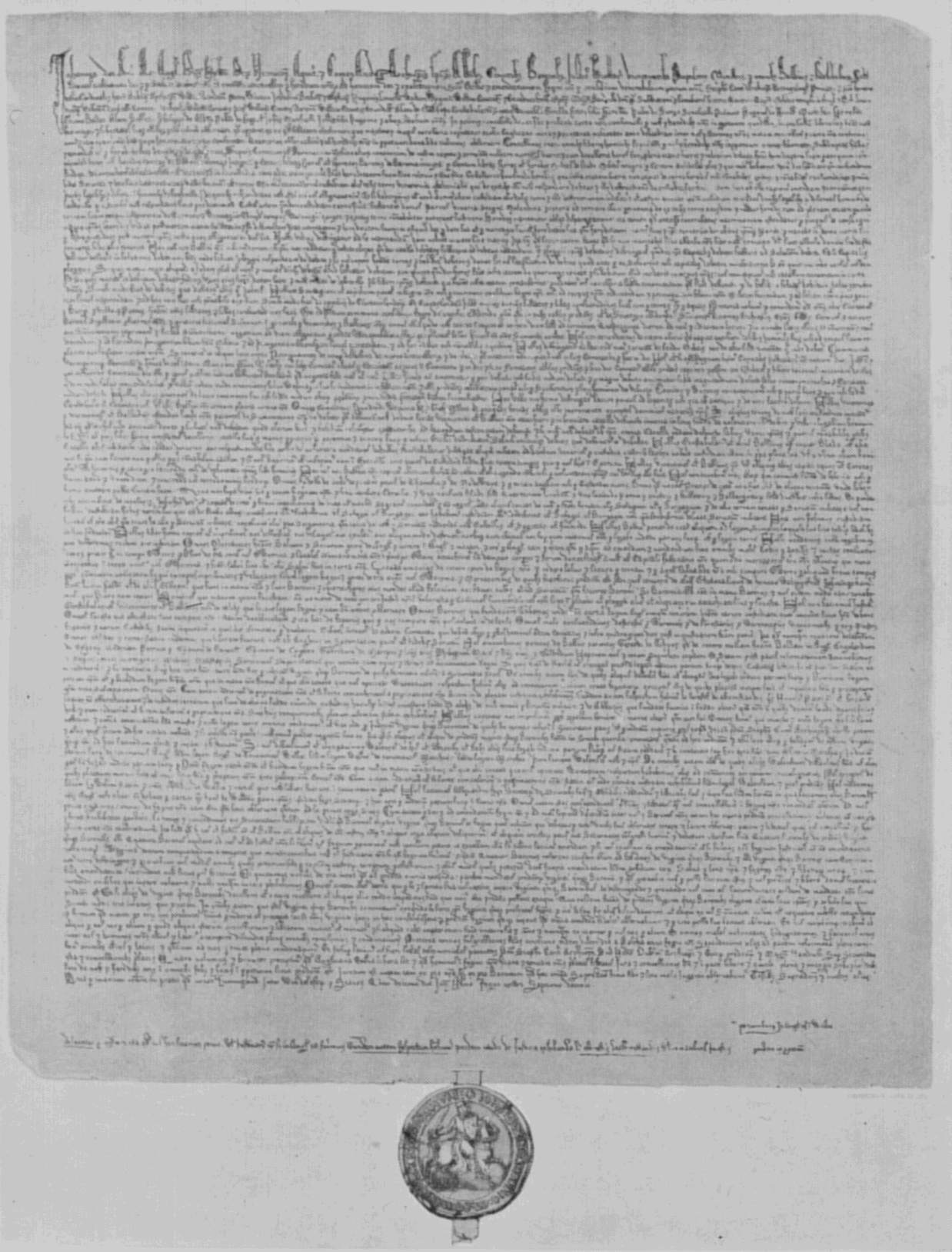
The Great Charter is a great table of laws. It marks the beginning of
written legislation, and anticipates Acts of Parliament. Unwritten laws
and traditions were not abolished: they remain with us to this day; but
the written law had become a necessity when "the bonds of unwritten
custom" failed to restrain kings and barons. The Great Charter also took
into account the rights of free men, and of the tenants of the King's
vassals. If the barons and knights had their grievances to be redressed,
the commons and the freeholding peasants needed protection against the
lawless exactions of their overlords.
Sixty-three clauses make up Magna Charta, and we may summarise them as
follows:—
(1) The full rights and liberties of the Church are acknowledged;
bishops shall be freely elected, so that the Church of England shall be
free.
(2-8) The King's tenants are to have their feudal rights secured
against abuse. Widows—in the wardship of the Crown—are to be
protected against robbery and against compulsion to a second
marriage.
(9-11) The harsh rules for securing the payment of debts to the Crown
and to the Jews (in whose debts the Crown had an interest) are to be
relaxed.
(12-14) No scutage or aid (save for the three regular feudal
aids—the ransom of the King, the knighting of his eldest son, and
the marriage of his eldest daughter) is to be imposed except by the
Common Council of the nation; and to this Council archbishops, bishops,
abbots, earls, and greater barons are to be called by special writ, while
all who held their land directly from the King, and were of lesser rank,
were to be summoned by a general writ addressed to the sheriff of the
county. Forty days' notice of the meeting was to be given, and also the
cause of the assembly. The action of those who obeyed the summons was to
be taken to represent the action of all. (This last clause is never
repeated in later confirmations of the Great Charter.)
(15-16) The powers of lords over their tenants are limited and
defined.
(17-19) A Court of Common Pleas is to be held in some fixed place so
that suitors are not obliged to follow the King's Curia. Cases touching
the ownership of land are to be tried in the counties by visiting
justices, and by four knights chosen by the county.
(20-23) No freeman is to be fined beyond his offence, and the penalty
is to be fixed by a local jury. Earls and barons to be fined by their
peers; and clerks only according to the amount of their lay property.
(24-33) The powers of sheriffs, constables, coroners, and bailiffs of
the King are strictly defined. No sheriff is to be a justice in his own
county. Royal officers are to pay for all the goods taken by requisition;
money is not to be taken in lieu of service from those who are willing to
perform the service. The horses and carts of freemen are not to be seized
for royal work without consent. The weirs in the Thames, Medway, and
other rivers in England are to be removed.
(34-38) Uniformity of weights and measures is directed. Inquests are
to be granted freely. The sole wardship of minors who have other lords
will not be claimed by the King, except in special cases. No bailiff may
force a man to ordeal without witnesses.
(39-40) No free man is to be taken, imprisoned, ousted of his land,
outlawed, banished, or hurt in any way save by the judgment of his peers,
or the law of the land. The King is not to sell, delay, or deny right or
justice to anyone.
(41-42) Merchants may go out or come in without paying exorbitant
customs. All "lawful" men are to have a free right to pass in and out of
England in time of peace.
(44-47) An inquiry into the Forest Laws and a reform of the forest
abuses are promised. All forests made in present reign to be disforested,
and all fences in rivers thrown down.
(49-60) The foreign mercenaries of the King, all the detested gang
that came with horses and arms to the hurt of the realm, are to be sent
out of the country. The Welsh princes and the King of Scots (who had
sided with the barons) are to have justice done. A general amnesty for
all political offences arising from the struggle is made.
The last three articles appointed twenty-five barons, chosen out of
the whole baronage, to watch over the keeping of the Charter. They were
empowered to demand that any breach of the articles should at once be put
right, and, in default to make war on the King till the matter was
settled to their satisfaction. Finally there was the oath to be taken on
the part of the King, and on the part of the barons that the articles of
the Charter should be observed in good faith according to their plain
meaning.
The Great Charter was signed, and then in a wild burst of rage John
shouted to his foreign supporters, "They have given me five-and-twenty
over-kings!"
Within a week of Runnymede the Great Charter was published throughout
England, but neither King nor barons looked for peace. John was ready to
break all oaths, and while he set about increasing his army of
mercenaries, he also appealed to the Pope, as his overlord, protesting
that the Charter had been wrested from him by force.
Langton and the bishops left for Rome to attend a general council.
Pope Innocent declared the Charter annulled on the ground that both King
and barons had made the Pope overlord of England, and that consequently
nothing in the government could be changed without his consent. But with
Langton, the bishops, and the Papal legate all away at Rome, there was no
one to publish the Papal repudiation of the Charter, and the King and
barons were already at civil war. Pope Innocent III. was dead in the
spring of 1216, and John's wretched reign was over when the King lay
dying at Newark in October.
Stephen Langton was back again at Canterbury in 1217, and for eleven
more years worked with William the Marshall and Hubert of Burgh to
maintain public peace and order during Henry III.'s boyhood. At Oxford,
in 1223, the Charter was confirmed afresh, and two years later it was
solemnly proclaimed again when the King wanted a new subsidy. As long as
the great statesmen were in office Henry III. was saved from the weakness
that cursed his rule in England for nearly forty years. But William the
Marshall died in 1219, Archbishop Stephen in 1228, and Hubert was
dismissed from the justiciarship in 1234. A horde of greedy aliens from
Poitou fed at the Court of Henry and devoured the substance of England,
until men arose, as Langton had arisen, to demand the enforcement of
charters and a just administration of the laws.
Again a national party arises under the leadership of Simon of
Montfort, and in their victory over the King we get the beginnings of
Parliamentary government and popular representation. Every step forward
is followed by reaction, but the ground lost is recovered, and the next
step taken marks always a steady advance. Over and over again it has
seemed that all the liberties won in the past were lost, but looking back
we can see that there has been no lasting defeat of liberty. Only for a
time have the forces of oppression triumphed; it is soon found impossible
in England to rest under tyranny, or to govern without the consent of the
governed. And every fresh campaign for the restriction of kingly power
brings us nearer the day of democratic government.
To-day democracy takes the form of representative government in
civilised countries; and for representative government contend the
nations and peoples seeking democracy.
The weak spots in all popular electoral systems are obvious, and the
election of representatives is always a subject for jokes and satire. It
could hardly be otherwise. For the best machinery in the world needs some
sort of sympathetic intelligence in the person who manipulates it, and
the machinery of popular elections can only be worked successfully with a
large measure of sincerity and good will. In the hands of the ambitious,
the self-seeking, and the unscrupulous, democratic politics are a machine
for frustrating popular representation, and as this state of things is
always prevalent somewhere, the humorist and the satirist naturally treat
politics without respect.
But in spite of all its faults and failings—glaring as these
are—mankind can at present devise nothing better than
representative government, and the abuse of power, the cunning, roguery,
and corruption that too often accompany popular elections and democratic
administration, rather stir honest men to action than make them incline
to dictatorship and absolutism.
The present notion about representative government is that it makes
possible the expression of popular will, and can ensure the fulfilment of
that will. In the thirteenth century, when we get the beginnings of
representative government, there is no question of the people making
positive proposals in legislation, but there is a distinct belief that
the consent of the governed ought to be obtained by the ruling power. The
mere legal maxim from the Code of Justinian, that "that which touches all
shall be approved by all," "becomes transmuted by Edward I.
into a great political and constitutional principle."
More than a century earlier the first recorded appearances of town
representatives are found in the Spanish Cortes of Aragon and Castile. St. Dominic
makes a representative form of government the rule in his Order of
Preaching Friars, each priory sending two representatives to its
provincial chapter, and each province sending two representatives to the
general chapter of the Order.
In England, Simon of Montfort, the son of Simon, the great warrior of
the Albigensian wars and the warm friend of Dominic, was in close
association with the friars. Hence there was nothing so very remarkable
in Earl Simon issuing writs for the Full Parliament of 1265 for the
return of two burgesses from each city and borough. He had seen
representative government at work among the friars in their chapters. Why
should the plan be not equally useful in the government of the country? There is no
evidence that the summons to the burgesses was regarded as a
revolutionary proposal—so lightly comes political change in
England.
The name of Simon of Montfort, Earl of Leicester, must always be
associated with the beginning of representative government in England.
Let us recall how it was the great Earl came to be in power in 1265.
Henry III. was always in want of money, and his crew of royal
parasites from Poitou drained the exchequer. Over and over again the
barons called on the King to get rid of his favourites, and to end the
misrule that afflicted the country; and the King from time to time gave
promises of amendment. But the promises were always broken. As long as
Henry could get money he was averse from all constitutional reform. In
1258 the barons were determined that a change must be made. "If the King
can't do without us in war, he must listen to us in peace," they
declared. "And what sort of peace is this when the King is led astray by
bad counsellors, and the land is filled with foreign tyrants who grind
down native-born Englishmen?"
William of Rishanger, a contemporary writer, expressed the popular
feeling in well-known verses:
"The King that tries without advice to seek his country's weal
Must often fail; he cannot know the wants and woes they feel.
The Parliament must tell the King how he may serve them best,
And he must see their wants fulfilled and injuries redressed.
A King should seek his people's good and not his own sweet will.
Nor think himself a slave because men hold him back from ill."
"The King's mistakes call for special treatment," said Richard, Earl
of Gloucester.
So that year a Parliament met in Oxford, in the Dominican Priory. It
was called the "Mad Parliament," because the barons all came to it fully
armed, and civil war seemed imminent. But Earl Simon and Richard of
Gloucester carried the barons with them in demanding reform. Henry was
left without supporters, and civil war was put off for five years.
The work done at this Parliament of Oxford was an attempt to make the
King abide loyally by the Great Charter; and the Provisions of Oxford, as
they were called, set up a standing council of fifteen, by whom the King
was to be guided, and ordered that Parliament was to meet three times a
year: at Candlemas (February 2nd), on June 1st, and at Michaelmas. Four
knights were to be chosen by the King's lesser freeholders in each county
to attend this Parliament, and the baronage was to be represented by
twelve commissioners.
It was an oligarchy that the Provisions of Oxford established,
"intended rather to fetter the King than to extend or develop the action
of the community at large. The baronial council clearly regards itself as
competent to act on behalf of all the estates of the realm, and the
expedient of reducing the national deliberations to three sessions of
select committees betrays a desire to abridge the frequent and somewhat
irksome duty of attendance in Parliament rather than to share the central
legislative and deliberative power with the whole body of the people. It
must, however, be remembered that the scheme makes a very indistinct
claim to the character of a final arrangement."
For a time things went better in England. The aliens at Henry's Court
fled over-seas, and their posts were filled by Englishmen. Parliament
also promised that the vassals of the nobles should have better
treatment, and that the sheriffs should be chosen by the shire-moots, the
county freeholders.
But Henry's promises were quickly broken, and war broke out on the
Welsh borders between Simon of Montfort's friend Llewellyn and Mortimer
and the Marchers. Edward, Prince of Wales, stood by the Provisions of
Oxford for a few years, but supported his father when the latter refused
to re-confirm the Provisions in 1263. As a last resource to prevent civil
war, Simon and Henry agreed to appeal to King Louis of France to
arbitrate on the fulfilment of the Provisions. The Pope had already
absolved Henry from obedience to the Provisions, and the Award of Louis,
given at Amiens and called the Mise of Amiens, was entirely in
Henry's favour. It annulled the Provisions of Oxford, left the King free
to appoint his own ministers, council, and sheriffs, to employ aliens,
and to enjoy power uncontrolled. But the former charters of the realm
were declared inviolate, and no reprisals were to take place.
To Simon and most of the barons the Award was intolerable, and when
Henry returned from France with a large force ready to take the vengeance
which the Award had forbidden, civil war could not be prevented. London
rallied to Simon, and Oxford, the Cinque Ports, and the friars were all
on the side of the barons against the King.
On May 14th, 1264, a pitched battle at Lewes ended in complete victory
for Simon, and found the King, Prince Edward, and the kinsmen and chief
supporters of the Crown prisoners in his hands.
Peace was made, and a treaty—the Mise of
Lewes—drawn up and signed. Once more the King promised to keep
the Provisions and Charters, and to dismiss the aliens. He also agreed to
live thriftily till his debts were paid, and to leave his sons as
hostages with Earl Simon.
Simon at once set about the work of reform. The King's Standing, or
Privy, Council was reconstituted, and the Parliamentary Commissioners
were abolished, "for Simon held it as much a man's duty to think and work
for his country as to fight for it." A marked difference is seen between
Simon's policy at Oxford and the policy after Lewes. The Provisions of
1258 were restrictive. The Constitution of 1264 deliberately extended the
limits of Parliament. "Either Simon's views of a Constitution had rapidly
developed, or the influences which had checked them in 1258 were removed.
Anyhow, he had genius to interpret the mind of the nation, and to
anticipate the line which was taken by later progress." What Simon
wanted was the approval of all classes of the community for his plans,
and to that end he issued writs for the Parliament—the Full
Parliament—of 1265.
The great feature of this Parliament was that for the first time the
burgesses of each city and borough were summoned to send two
representatives. In addition, two knights were to come from each shire,
and clergy and barons as usual—though in the case of the earls and
barons only twenty-three were invited, for Simon had no desire for the
presence of those who were his enemies. The Full Parliament sat till
March, and then two months later war had once more blazed out. Earl
Gilbert of Gloucester broke away from Simon, Prince Edward escaped from
custody, and these two joined Lord Mortimer and the Welsh Marchers.
On August 4th Edward surprised and routed the army of the younger
Simon near Kenilworth, and then advanced to crush the great Earl, who was
encamped at Evesham, waiting to join forces with his son. All hope of
escape for Earl Simon was lost, and he was outnumbered by seven to two.
But fly he would not. One by one the barons who stood by Simon were cut
down, but though wounded and dismounted, the great Earl "fought on to the
last like a giant for the freedom of England, till a foot soldier stabbed
him in the back under the mail, and he was borne down and slain." For
three hours the unequal fight lasted in the midst of storm and darkness,
and when it was over the Grey Friars carried the mangled body of the dead
Earl into the priory at Evesham, and laid it before the high altar, for
the poorer clergy and the common people all counted Simon of Montfort for
a saint.
"Those who knew Simon praise his piety, admire his learning, and extol
his prowess as a knight and skill as a general. They tell of his simple
fare and plain russet dress, bear witness to his kindly speech and firm
friendship to all good men, describe his angry scorn for liars and unjust
men, and marvel at his zeal for truth and right, which was such that
neither pleasure nor threats nor promises could turn him aside from
keeping the oath he swore at Oxford; for he held up the good cause 'like
a pillar that cannot be moved, and, like a second Josiah, esteemed
righteousness the very healing of his soul.' As a statesman he wished to
bind the King to rule according to law, and to make the King's Ministers
responsible to a Full Parliament; and though he did not live to see the
success of his policy, he had pointed out the way by which future
statesmen might bring it about."
In the hour of Simon's death it might seem that the cause of good
government was utterly lost, and for a time Henry triumphed with a fierce
reaction. But the very barons who had turned against Simon were quite
determined that the Charters should be observed, and Edward was to show,
on his coming to the throne, that he had grasped even more fully than
Simon the notion of a national representative assembly, and that he
accepted the principle, "that which touches all shall be approved by
all."
Henry III. died in 1272, and it was not till two years later that
Edward I. was back in England from the crusades to take up the crown. It
was an age of great lawgivers; an age that saw St. Louis ruling in
France, Alfonso the Wise in Castile, the Emperor Frederick II.—the
Wonder of the World—in Sicily. In England Edward shaped the
Constitution and settled for future times the lines of Parliamentary
representative government.
For the first twenty years Edward's Parliaments were great assemblies
of barons and knights, and it was not till 1295 that the famous Model
Parliament was summoned. "It is very evident that common dangers must be
met by measures concerted in common," ran the writ to the bishops. Every
sheriff was to cause two knights to be elected from each shire, two
citizens from each city, two burgesses from each borough. The clergy were
to be fully represented from each cathedral and each diocese.
Hitherto Parliament, save in 1265, had been little else than a feudal
court, a council of the King's tenants; it became, after 1295, a national
assembly. Edward's plan was that the three estates—clergy, barons,
and commons: those who pray, those who fight, and those who
work—should be represented. But the clergy always stood aloof,
preferring to meet in their own houses of convocation; and the
archbishops, bishops, and greater abbots only attended because they were
great holders of land and important feudal lords.
Although the knights of the shire were of much the same class as the
barons, the latter received personal summons to attend, and the knights
joined with the representatives of the cities and boroughs. So the two
Houses of Parliament consisted of barons and bishops—lords
spiritual and lords temporal—and knights and commons; and we have
to-day the House of Lords and the House of Commons; the former, as in the
thirteenth century, lords spiritual and temporal, the latter,
representatives from counties and boroughs.
The admission of elected representatives was to move, in course of
time, the centre of government from the Crown to the House of Commons;
but in Edward I.'s reign Parliament was just a larger growth of the
King's Council—the Council that Norman and Plantagenet kings relied
on for assistance in the administration of justice and the collection of
revenue. The judges of the supreme court were always summoned to
Parliament, as the law lords sit in the Upper House to-day.
Money, or rather the raising of money, was the main cause for calling
a Parliament. The clergy at first voted their own grants to the Crown in
convocation, but came to agree to pay the taxes voted by Lords and
Commons, And Lords and Commons, instead of making separate grants, joined
in a common grant.
"And, as the bulk of the burden fell upon the Commons, they adopted a
formula which placed the Commons in the foreground. The grant was made by
the Commons, with the assent of the Lords spiritual and temporal. This
formula appeared in 1395, and became the rule. In 1407, eight years after
Henry IV. came to the throne, he assented to the important principle that
money grants were to be initiated by the House of Commons, were not to be
reported to the King until both Houses were agreed, and were to be
reported by the Speaker of the Commons' House. This rule is strictly
observed at the present day. When a money bill, such as the Finance bill
for the year or the Appropriation bill, has been passed by the House of
Commons and agreed to by the House of Lords, it is, unlike all other
bills, returned to the House of Commons." The Speaker, with his own hand,
delivers all money bills to the Clerk of Parliaments, the officer whose
business it is to signify the royal assent.
In addition to voting money, the Commons, on the assembly of
Parliament, would petition for the redress of grievances. In the
thirteenth and fourteenth centuries, they were not legislators, but
petitioners for legislation; and as it often happened that their
petitions were not granted in the form they asked, it became a matter of
bitter complaint that the laws did not correspond with the petitions.
Henry V. in 1414 granted the request that "nothing should be enacted to
the petition of the Commons contrary to their asking, whereby they should
be bound without their assent"; and from that time it became customary
for bills to be sent up to the Crown instead of petitions, leaving the
King the alternative of assent or reaction.
In the fourteenth and fifteenth centuries, the power of Parliament was
strong enough to force the abdication of two kings—Edward II. and
Richard II.—but not strong enough to free the land of the turbulent
authority of the nobles. This authority went down in the struggles of the
Lancastrians and Yorkists.
"The bloody faction fights known as the Wars of the Roses brought the
Plantagenet dynasty to a close, weeded out the older nobility, and
cleared the way for a new form of monarchy."
"The high nobility killed itself out. The great barons who adhered to
the 'Red Rose' or the 'White Rose,' or who fluctuated from one to the
other, became poorer, fewer, and less potent every year. When the great
struggle ended at Bosworth, a large part of the greatest combatants were
gone. The restless, aspiring, rich barons, who made the civil war, were
broken by it. Henry VII. attained a kingdom in which there was a
Parliament to advise, but scarcely a Parliament to control."
It is important to note the ascendancy of the barons in the medieval
Parliaments, and their self-destruction in the Wars of the Roses. Unless
we realise how very largely the barons were the Parliament, it is
difficult to understand how it came about that Parliament was so utterly
impotent under the Tudors. The Wars of the Roses killed off the mighty
parliamentarians, and it took a hundred years to raise the country
landowners into a party which, under Eliot, Hampden, and Pym, was to make
the House of Commons supreme.
"The civil wars of many years killed out the old councils (if I might
so say): that is, destroyed three parts of the greater nobility, who were
its most potent members, tired the small nobility and gentry, and
overthrew the aristocratic organisation on which all previous effectual
resistance to the sovereign had been based."
To get an idea of the weakness of Parliament when the Tudors ruled, we
have but to suppose at the present day a Parliament deprived of all
front-bench men on both sides of the House, and of the leaders of the
Irish and Labour parties, and a House of Lords deprived of all Ministers
and ex-Ministers.
Before passing to the Parliamentary revival of the seventeenth
century, there still remain one or two points to be considered relating
to the early national assemblies of the thirteenth and fourteenth
centuries.
(1) Who were the electors in the Middle Ages?—In the
counties, all who were entitled to attend and take part in the
proceedings of the county court had the right of electing the knight of
the shire; and "it is most probable, on the evidence of records, on the
analogies of representative usage, and on the testimony of later facts,
that the knights of the shire were elected by the full county court."
The county court or shire-moot not only elected knights for
Parliament; it often enough elected them for local purposes as well. The
county coroner was elected in similar fashion by the county. All the
chief tenants and small freeholders were therefore the county electors;
but the tenants-in-chief (who held their lands from the Crown) and the
knights of the county had naturally considerably more influence than the
smaller men. "The chief lord of a great manor would have authority with
his tenants, freeholders as they might be, which would make their
theoretical equality a mere shadow, and would, moreover, be exercised all
the more easily because the right which it usurped was one which the
tenant neither understood nor cared for."
It is difficult to decide to what extent the smaller freeholders could
take an active interest in the affairs of the county. As for the office
of knight of the shire, there was no competition in the thirteenth or
fourteenth century for the honour of going to Parliament, and it is
likely enough that the sheriff, upon whom rested the responsibility for
the elections, would in some counties be obliged to nominate and compel
the attendance of an unwilling candidate.
(2) Payment of Parliamentary Representatives.—The fact
that Members of Parliament were paid by their constituents in the
thirteenth, fourteenth, and fifteenth centuries made certain small freeholders as
anxious not to be included in the electorate as others were anxious not
to be elected to Parliament. It was recognised as "fair that those
persons who were excluded from the election should be exempt from
contribution to the wages. And to many of the smaller freeholders the
exemption from payment would be far more valuable than the privilege of
voting."
But the Commons generally petitioned for payment to be made by all
classes of freeholders, and when all allowance has been made for varying
customs and for local diversities and territorial influence, it is safe
to take it that the freeholders were the body of electors.
In 1430, the eighth year of Henry VI., an Act was passed ordering that
electors must be resident in the country, and must have free land or
tenement to the value of 40s. a year at least; and this Act was in
operation till 1831.
The county franchise was a simple and straightforward matter compared
with the methods of electing representatives from the boroughs. All that
the sheriff was ordered to do by writ was to provide for the return of
two members for each city or borough in his county; the places that were
to be considered as boroughs were not named. In the Middle Ages a town
might have no wish to be taxed for the wages of its Parliamentary
representative, and in that case would do its best to come to an
arrangement with the sheriff. (It was not till the sixteenth and
seventeenth centuries that a considerable increase of boroughs took
place. The Tudors created "pocket" and "rotten" boroughs in order to have
the nominees of the Crown in Parliament.) The size of the borough bore no
relation to its membership till the Reform Act of the nineteenth century,
and as the selection of towns to be represented was arbitrary, so the
franchise in the towns was equally unsettled. One or two places had a
wide franchise, others confined the vote to freemen and corporation
members. But in spite of the extraordinary vagaries of the borough
franchise, and the arbitrary selection of towns to be represented, these
early medieval Parliaments really did in an imperfect way represent the
nation—all but the peasants and artisans.
"Our English Parliaments were unsymmetrical realities. They
were elected anyhow. The sheriff had a considerable licence in sending
writs to boroughs, that is, he could in part pick its constituencies; and
in each borough there was a rush and scramble for the franchise, so that
the strongest local party got it whether few or many. But in England at
that time there was a great and distinct desire to know the opinion of
the nation, because there was a real and close necessity. The nation was
wanted to do something—to assist the sovereign in some war, to pay
some old debt, to contribute its force and aid in the critical juncture
of the time. It would not have suited the ante-Tudor kings to have had a
fictitious assembly; they would have lost their sole feeler, their
only instrument for discovering national opinion. Nor could they have
manufactured such an assembly if they wished. Looking at the mode of
election, a theorist would say that these Parliaments were but 'chance'
collections of influential Englishmen. There would be many corrections
and limitations to add to that statement if it were wanted to make it
accurate, but the statement itself hits exactly the principal excellence
of these Parliaments. If not 'chance' collections of Englishmen, they
were 'undesigned' collections; no administrations made them, or could
make them. They were bona fide counsellors, whose opinion might be wise
or unwise, but was anyhow of paramount importance, because their
co-operation was wanted for what was in hand."
(3) The political position of women in the Middle
Ages.—Abbesses were summoned to the convocations of clergy in
Edward I.'s reign. Peeresses were permitted to be represented by proxy in
Parliament. The offices of sheriff, high constable, governor of a royal
castle, and justice of the peace have all been held by women. In fact,
the lady of the manor had the same rights as the lord of the manor, and
joined with men who were freeholders in electing knights of the shire
without question of sex disability. (A survival of the medieval rights
of women may be seen in the power of women to present clergy to benefices
in the Church of England.)
In the towns women were members of various guilds and companies
equally with men, and were burgesses and freewomen. Not till 1832 was the
word "male" inserted before "persons" in the charters of boroughs. "Never
before has the phrase 'male persons' appeared in any statute of the
realm. By this Act (the Reform Bill), therefore, women were technically
disfranchised for the first time in the history of the English
Constitution. The privilege of abstention was converted into the penalty
of exclusion."
The years of Simon of Montfort and Edward I., which saw the beginnings
of a representative national assembly, were not a time of theoretical
discussion on political rights. The English nation, indeed, has ever been
averse from political theories. The notion of a carefully balanced
constitution was outside the calculations of medieval statesmen, and the
idea of political democracy was not included among their visions.
"Even the scholastic writers, amid their calculations of all possible
combinations of principles in theology and morals, well aware of the
difference between the 'rex politicus' who rules according to law, and
the tyrant who rules without it, and of the characteristics of monarchy,
aristocracy, and democracy, with their respective corruptions, contented
themselves for the most part with balancing the spiritual and secular
powers, and never broached the idea of a growth into political
enfranchisement. Yet, in the long run, this has been the ideal towards
which the healthy development of national life in Europe has constantly
tended, only the steps towards it have not been taken to suit a
preconceived theory."
Each step towards democracy has been taken "to suit the convenience of
party or the necessities of kings, to induce the newly admitted classes
to give their money, to produce political contentment."
The only two principles that are apparent in the age-long struggles
for political freedom in England, that are recognised and acknowledged,
are: (1) That that which touches all shall be approved by all; (2) that
government rests on the consent of the governed. Over and over again
these two principles may be seen at work.
Popular insurrection has never been successful in England; a violent
death and a traitor's doom have been the lot of every leader of the
common people who took up arms against the Government. The Civil War that
brought Charles I. to the scaffold, and the Revolution that deposed James
II. and set William of Orange on the throne, were the work of country
gentlemen and Whig statesmen, not of the labouring people.
But if England has never seen popular revolution triumphant and
democracy set up by force of arms, the earlier centuries witnessed more
than one effort to gain by open insurrection some measure of freedom for
the working people of the land.
No other way than violent resistance seemed possible to peasants and
artisans in the twelfth, fourteenth, fifteenth, and sixteenth centuries,
if their wrongs were to be mitigated and their rulers to be called to
account.
Langton and Simon of Montfort had placed some check on the power of
the Crown, had laid the foundations of political liberty, and marked the
road to be travelled; but the lot of the labouring people remained
unheeded and voiceless in the councils of the nation. What could they do
but take up arms to end an intolerable oppression?
The first serious protest came from the London workmen in the reign of
Richard I.; and FitzOsbert, known as Longbeard, was the spokesman of the
popular discontent.
The King wanted money, chiefly for his crusades in Palestine. He had
no inclination to personal government, and the business of ruling England
was in the hands of Hubert Walter, Archbishop of Canterbury, the
justiciar or King's lieutenant. Richard left England for Normandy in
1194, and returned no more. England to him was a country where money
could be raised, a subject-province to be bled by taxation. Archbishop
Hubert did his best to satisfy the royal demands; and though by his
inquisitions "England was reduced to poverty from one sea to the
other"—it is estimated that more than £1,000,000 was sent to
Richard in two years—the King was left unsatisfied. The nation
generally came to hate the Archbishop's taxation, the Church suffered by
his neglect, and he was finally compelled to resign the
justiciarship.
It was the London rising, under FitzOsbert's leadership, that directly
caused Archbishop Hubert's retirement, and FitzOsbert is notable as the
first of the long line of agitators.
The political importance of the capital was seen in the reigns of Cnut
and William the Conqueror. It was conspicuous on the arrival of Stephen
in 1135, and its influence on national politics lasted till the middle of
the nineteenth century.
By its charter London had the right of raising taxes for the Crown in
its own way, and in 1196 the method proposed by the Corporation provoked
the outbreak. "When the aldermen assembled according to usage in full
hustings for the purpose of assessing the taxes, the rulers endeavoured
to spare their own purses and to levy the whole from the poor"
(Hoveden).
The poorer citizens were voteless, and the plan of the aldermen was to
levy the tallages per head, and not in proportion to the property of the
inhabitants. This meant, practically, that the whole, except a very small
fraction of the sum to be raised, must be paid by the working people.
Thereupon FitzOsbert protested, and the people rose in arms against
the demand.
FitzOsbert was an old crusader, and he was something of a lawyer and a
powerful speaker. Not a rich man by any means, FitzOsbert was yet a
member of the city council when, "burning with zeal for justice and fair
play, he made himself the champion of the poor." To his enemies he was a
demagogue and disreputable—so Ralph de Diceto, Dean of St. Paul's
at that time, described him. To others of more popular sympathies he was
heroic and died a martyr's death. Across the centuries he is seen as "an
agitator"—the first English agitator, the first man to stand up
boldly against the oppression of the common people. This palpably unjust
taxation of the poor was intolerable to FitzOsbert.
Fifteen thousand men banded themselves together in London under an
oath that they would stand by each other and by their leader; and
FitzOsbert, after a vain journey to Normandy to arouse Richard's
attention to the wrongs of his subjects, bade open defiance to the
justiciar and his tax-gatherers.
For a time the Archbishop's men were powerless, but weakness crept in
amongst the citizens, and the aldermen were naturally on the side of
constituted authority. FitzOsbert's success meant a readjustment of
taxation quite unpalatable to the City Fathers.
In the end FitzOsbert was deserted by all but a handful of his
followers and fled with them for sanctuary to the church of St.
Mary-le-Bow in Cheapside. Pursued by the officers of the law, FitzOsbert
climbed up into the tower of the church, and to fetch him down orders
were given to set the church on fire. This was done, and the only chance
of life that now remained for the rebels was to get out of the church and
cut their way through the ranks of their enemies.
At the church door FitzOsbert was struck down, and his little company
quickly overpowered.
Heavily chained, and badly wounded, FitzOsbert was carried off to the
Tower, to be tried and sentenced to a traitor's death without delay.
A few days later—it was just before Easter—FitzOsbert was
stripped naked, and dragged at the tail of a horse over the rough streets
of London to Tyburn. He was dead before the place of execution was
reached, but the body, broken and mangled, was hung up in chains under
the gallows elm all the same; and nine of his companions were hanged with
him.
The very people who had fallen away from their leader in the day of
his need now counted FitzOsbert for a saint, and pieces of his gibbet and
of the bloodstained earth underneath the tree were carried away and
treasured as sacred relics. It was alleged that miracles were performed
when these relics were touched—so wide was now the popular
reverence for the dead champion of the poor.
Archbishop Hubert put a stop to this devotion by ordering sermons to
be preached on FitzOsbert's iniquities; and an alleged death-bed
confession, containing an account of many evil deeds, was published. It
is likely enough that an old crusader had plenty of sins to answer for,
but FitzOsbert's one crime before the law was that he had taught the
people of London to stand up and resist by force of arms the payment of
taxes—taxes levied with gross unfairness in popular judgment.
The monks of Canterbury, to whom the church of St. Mary-le-Bow in
Cheapside belonged, had long had their own quarrels with Archbishop
Hubert, and on this firing of their church, and the violation of
sanctuary, they appealed to the King and the Pope—Innocent
III.—that Hubert should give up his political work and attend
exclusively to his duties as Archbishop. Both the Pope and the great
barons were against him, and in 1198 Archbishop Hubert was compelled to
resign the judiciarship.
The great uprising of the peasants in 1381 was a very different matter
from the local insurrection made by FitzOsbert. Two centuries had passed,
and in those centuries the beginnings of representative government had
been set up and some recognition of the rights of the peasantry had been
admitted in the Great Charter.
The Peasant Revolt was national. It was carefully prepared and
skilfully organised, and its leaders were men of power and
ability—men of character. It was not only a definite protest
against positive evils, but a vigorous attempt to create a new social
order—to substitute a social democracy for feudal government.
The old feudal order had been widely upset by the Black Death in 1349,
and the further ravages of pestilence in 1361 and 1369. The heavy
mortality left many country districts bereft of labour, and landowners
were compelled to offer higher wages if agriculture was to go on. In vain
Parliament passed Statutes of Labourers to prevent the peasant from
securing an advance. These Acts of Parliament expressly forbade a rise in
wages; the landless man or woman was "to serve the employer who shall
require him to do so, and take only the wages which were accustomed to be
taken in the neighbourhood two years before the pestilence." The scarcity
of labour drove landowners to compete for the services of the labourer,
in spite of Parliament.
Discontent was rife in those years of social change. The Statutes of
Labourers were ineffectual; but they galled the labourers and kept
serfdom alive. The tenants had their grievance because they were obliged
to give labour-service to their lords. Freehold yeomen, town workmen, and
shopkeepers were irritated by heavy taxation, and vexed by excessive
market tolls. All the materials were at hand for open rebellion, and
leaders were found as the days went by to kindle and direct the
revolt.
John Ball, an itinerant priest, who came from St. Mary's, at York, and
then made Colchester the centre of his wanderings, spent twenty years
organising the revolt, and three times was excommunicated and imprisoned
by the Archbishop of Canterbury for teaching social "errors, schisms, and
scandals," but was in no wise contrite or cast down.
Chief of Ball's fellow-agitators were John Wraw, in Suffolk, Jack
Straw, in Essex—both priests these—William Grindcobbe, in
Hertford, and Geoffrey Litster, in Norfolk. In Kent lived Wat Tyler, of
whom nothing is told till the revolt was actually afire, but who at once
was acknowledged leader and captain by the rebel hosts.
From village to village went John Ball in the years that preceded the
rising, organising the peasants into clubs, and stirring the people with
revolutionary talk. It was the way of this vagrant priest to preach to
the people on village greens, and his discourses were all on the same
text—"In the beginning of the world there were no bondmen, all men
were created equal." Inequalities of wealth and social
position were to be ended:
"Good people, things will never go well in England, so long as goods
be not kept in common, and so long as there be villeins and gentlemen. By
what right are they whom men call lords greater folk than we? If all come
from the same father and mother, Adam and Eve, how can they say or prove
that they are better than we, if it be not that they make us gain for
them by our toil what they spend in their pride?
"They are clothed in velvet, and are warm in their furs and ermines,
while we are covered in rags. They have wine and spices and fair bread,
and we oatcake and straw, and water to drink. They have leisure and fine
houses; we have pain and labour, the wind and rain in the fields. And yet
it is of us and of our toil that these men hold their state.
"We are called slaves; and if we do not perform our services, we are
beaten, and we have not any sovereign to whom we can complain, or who
wishes to hear us and do us justice."
The poet, William Langland, in "Piers Plowman," dwelt on the social
wrongs of the time; Ball was fond of quoting from Langland, and of
harping on a familiar couplet:
"When Adam delved and Eve span,
Who was then the gentleman?"
Besides the sermons, some of the rhymed letters that John Ball sent
about the country have been preserved:
"John Ball, Priest of St. Mary's, greets well all manner of men, and
bids them in the name of the Trinity, Father, Son and Holy Ghost, to
stand together manfully in truth. Help truth and truth shall help
you.
"John Ball greeteth you all,
And doth to understand he hath rung your bell.
Now with right and might, will and skill,
God speed every dell.
John the Miller asketh help to turn his mill right:
He hath ground small, small:
The King's Son of Heaven will pay for it all.
Look thy mill go right, with its four sails dight.
With right and with might, with skill and with will,
And let the post stand in steadfastness.
Let right help might, and skill go before will,
Then shall our mill go aright;
But if might go before right, and will go before skill,
Then is our mill mis-a-dight."
Sometimes it is under the signature of John Trueman that John Ball
writes:
"Beware ere ye be woe;
Know your friend from your foe;
Take enough and cry "Ho!"
And do well and better and flee from sin,
And seek out peace and dwell therein—
So biddeth John Trueman and all his fellows."
A more definite note was struck when it seemed to Ball and his
colleagues that the time was ripe for revolution, and the word was given
that appeal must be made to the boy-king—Richard was only eleven
years old when he came to the throne in 1377.
"Let us go to the King, and remonstrate with him, telling him we must
have it otherwise, or we ourselves shall find the remedy. He is young. If
we wait on him in a body, all those who come under the name of serf, or
are held in bondage, will follow us in the hope of being free. When the
King shall see us we shall obtain a favourable answer, or we must then
ourselves seek to amend our condition."
In another letter John Ball greets John Nameless, John the Miller, and
John Carter, and bids them stand together in God's name, and beware of
guile: he bids Piers Plowman "go to his work and chastise well Hob the
Robber (Sir Robert Hales, the King's Treasurer); and take with you John
Trueman and all his fellows, and look that you choose one head and no
more."
These letters and the preaching were accepted by willing minds. John
Ball was in prison—in the jail of Archbishop Sudbury at
Maidstone—in the spring of 1381, but the peasants were organised
and ready to revolt. If Wat Tyler is the recognised leader of the rebel
forces—"the one head"—John Ball's was the work of preparing
the uprising. The vagrant priest had rung his bell to some purpose. In
every county, from Somerset to York, the peasants flocked together, "some
armed with clubs, rusty swords, axes, with old bows reddened by the smoke
of the chimney corner, and odd arrows with only one feather."
At Whitsuntide, early in June, 1381, the great uprising
began—the Hurling time of the peasants—long to be remembered
with horror by the governing classes. A badly ordered poll-tax was the
match that kindled the fire.
The poll-tax was first levied, in 1377, on all over fourteen years of
age. Two years later it was graduated, every man and woman of the working
class being rated at 4d., and dukes and archbishops at £6 13s. 4d. More
money was still wanted by the Government, and early in 1381, John of
Gaunt, the chief man in the realm, called Parliament together at
Northampton, and demanded £160,000. Parliament agreed that £100,000
should be raised, and the clergy—owning a third of the
land—promised £60,000. But the only way of raising the £100,000
that the Government could think of was by another poll-tax, and this time
everybody over fifteen was required to pay 1s. Of course, the thing was
impossible. In many parishes the mere returns of population were not
filled in; numbers evaded payment—which spelt ruin—by leaving
their homes. £22,000 was all that came to hand.
Then a man named John Legge came to the assistance of the Government,
and was appointed chief commissioner, and empowered to collect the
tax.
The methods of Legge and his assistants provoked hostility, and when
the villagers of Fobbing, Corringham, and Stanford-le-Hope, in Essex,
were summoned to meet the commissioner at Brentwood, their reply was to
kill the collectors.
The Government answered this by sending down Chief Justice Belknap to
punish the offenders, but the people drove the chief justice out of the
place, and Belknap was glad to escape with his life.
This was on Whit-Sunday, June 2nd, and two days later the revolt had
spread to Kent; Gravesend and Dartford were in tumult. In one place Sir
Simon Burley, a friend of Richard II., seized a workman, claiming him as
a bondservant, and refusing to let him go under a fine of £300; while at
Dartford a tax-collector had made trouble by gross indecency to the wife
and daughter of one John Tyler.
Thereupon this John Tyler, "being at work in the same town tyling of
an house, when he heard thereof, caught his lathing staff in his hand,
and ran reaking home; where, reasoning with the collector, who made him
so bold, the collector answered with stout words, and strake at the
tyler; whereupon the tyler, avoiding the blow, smote the collector with
his lathing staff, so that the brains flew out of his head. Wherethrough
great noise arose in the streets, and the poor people being glad,
everyone prepared to support the said John Tyler."
Now, with the fire of revolt in swift blaze, it was for the men of
Kent to see that it burned under some direction. Authority and discipline
were essential if the rising was not to become mob rule or mere anarchy,
and if positive and intolerable wrongs were to find remedies.
At Maidstone, on June 7th—after Rochester Castle had been
stormed, its prisoners set free and Sir John Newton its governor placed
in safe custody—Wat Tyler was chosen captain of the rebel
hosts.
History tells us nothing of the antecedents of this remarkable man.
For eight days, and eight days only, he plays his part on the stage of
national events: commands with authority a vast concourse of men; meets
the King face to face, and wrests from sovereignty great promises of
reform; orders the execution of the chief ministers of the Crown, and
then, in what seems to be the hour of triumph, is struck to the ground,
and goes to his death.
Under the accredited leadership of Wat Tyler the revolt at once took
form. Five days were spent in Kent before the peasant army marched on
London. The manor houses were attacked, and all rent rolls, legal
documents, lists of tenants and serfs destroyed. The rising was not a
ferocious massacre like the rising of the Jacquerie in France; there was
no general massacre of landlords, or reign of terror. The lawyers who
managed the landowners' estates were the enemy, and against
them—against the instruments of landlord tyranny—was the
anger of the peasants directed. In the same way John of Gaunt, and not
the youthful King, was recognised as the evil influence in government;
and while a vow was taken by the men of Kent that no man named "John"
should be King of England, the popular cry was "King Richard and the
Commons," and all who joined in this were accounted friends of the
insurgent populace.
Blackheath was reached on the evening of June 12th, and early the
following morning, which was Corpus Christi Day, John Ball—released
by a thousand hands from his prison at Maidstone—preached to the
multitude on the work before them:
"Now is the opportunity given to Englishmen, if they do but choose to
take it, of casting off the yoke they have borne so long, of winning the
freedom they have always desired. Wherefore, let us take good courage and
behave like the wise husbandman of scripture, who gathered the wheat into
his barn, but uprooted and burned the tares that had half-choked the good
grain. The tares of England are her oppressive rulers, and the time of
harvest has come. Ours it is to pluck up these tares and make away with
them all—the wicked lords, the unjust judges, the
lawyers—every man, indeed, who is dangerous to the common good.
Then shall we all have peace in our time and security for the future. For
when the great ones have been rooted up and cast away, all will enjoy
equal freedom and nobility, rank and power shall we have in common."
Thirty-thousand men—yeomen, craftsmen, villeins, and peasants,
were at Blackheath, and these were soon joined by thousands more from
Surrey.
John Wraw and Grindcobbe came to consult with Wat Tyler, and then
returned to Suffolk and Hertford to announce that the hour had come to
strike.
The Marshalsea and King's Bench prisons, and the houses of ill-fame
that clustered round London Bridge, were destroyed before Wat Tyler led
his army into the city. An attempt to meet the King in conference was
frustrated by the royal counsellors. Richard came down in the royal barge
as far as Rotherhithe, but was dissuaded by Sir Robert Hales, and the
Earls of Suffolk, Salisbury, and Warwick, from "holding speech with the
shoeless ruffians."
Richard rowed back swiftly to the Tower, and Tyler and his army swept
into London. The city was in the hands of the rebel captain, but the
citizens welcomed the invaders, and offered bread and ale when Tyler
proclaimed that death would be the instant punishment for theft.
John of Gaunt's palace at the Savoy, on the river strand, was the
first place to be burnt; but Henry, Earl of Derby, John of Gaunt's son
(eighteen years later to reign as Henry IV., in place of Richard), was
allowed to pass out uninjured, and a wretched man caught in the act of
stealing off with a silver cup was promptly executed.
The Savoy destroyed, the Temple—a hive of lawyers—was the
next to be burnt, and before nightfall the Fleet Prison and Newgate had
been demolished.
Again Tyler demanded conference with the King, and Richard, lying in
the Tower with his counsellors, unable to prevent the work of conference,
boldly decided to come out and meet the rebels. Mile End was appointed
for the conference, and to Mile End Richard came with a very modest
retinue. The King was only fifteen, but he was the son of the Black
Prince, and he had both courage and cunning. He was fully aware that the
people did not lay on him responsibility for the sins of the Government.
"If we measure intellectual power by the greatest exertion it ever
displays, rather than by its average results, Richard II. was a man of
considerable talents. He possessed along with much dissimulation a
decisive promptitude in seizing the critical moment for action."
At Mile End Tyler stated the grievances of the people. But first he
asked that all traitors should be put to death, and to this the King
agreed.
Four positive articles of reform were put forward, and were at once
assented to by the King:—
1. A free and general pardon to all concerned in the rising.
2. The total abolition of all villeinage (forced labour) and
serfdom.
3. An end to all tolls and market dues—"freedom to buy and sell
in all cities, burghs, mercantile towns, and other places within our
kingdom of England."
4. All customary tenants to become leaseholders at a fixed rental of
fourpence an acre for ever.
That all doubts might be removed, thirty clerks were set to work on
the spot to draw up charters of manumission, and banners were presented
to each county. At nightfall thousands returned home convinced that the
old order was ended, and that the Royal charters were genuine assurances
of freedom.
But Tyler and the bulk of the men of Kent and Surrey remained in the
city. It seemed to Wat Tyler that better terms still were to be wrung
from the King. It looked that night as though the insurrection had
triumphed completely. Not only were the charters signed and the royal
promises given, but several in high office, whom Tyler held to be
"traitors," had gone to their doom. Sir Robert Hales, the Treasurer,
Archbishop Sudbury, the Chancellor—a gentle and kindly old man,
"lenient to heretics"—John Legge, the hated poll-tax commissioner,
with Appleton, John of Gaunt's chaplain, and Richard Lyons, a thoroughly
corrupt contractor of Edward III.'s reign, were all dragged out of the
Tower and beheaded on Tower Hill on Friday, June 15th.
On Tyler's request for another conference with Richard on the
following day, the King saw he had no choice but to yield. For the second
time Wat Tyler and Richard met face to face. The conference was held at
Smithfield, in the square outside St. Bartholomew's Priory. The King and
two hundred retainers, with Walworth the mayor, were on the east side of
the square. Tyler and his army were on the west side, opposite the
Priory.
In the open space Tyler, mounted on a little horse, presented his
demands; more sweeping were the reforms now asked for than those of the
previous day.
"Let no law but the law of Winchester prevail throughout the land, and
let no man be made an outlaw by the decree of judges and lawyers. Grant
also that no lord shall henceforth exercise lordship over the commons;
and since we are oppressed by so vast a horde of bishops and clerks, let
there be but one bishop in England; and let the property and goods of
Holy Church be divided fairly according to the needs of the people in
each parish, after in justice making suitable provision for the present
clergy and monks. Finally, let there be no more villeins in England, but
grant us all to be free and of one condition."
Richard answered that he promised readily all that was asked, "if only
it be consistent with the regality of my Crown." He then bade the commons
return home, since their requests had been granted.
Nobles and counsellors stood in sullen and silent anger at the King's
words, but were powerless to act. Tyler, conscious of victory, called for
a draught, and when his attendant brought him a mighty tankard of ale,
the rebel leader drank good-humouredly to "King Richard and the Commons."
A knight in the royal service, a "valet of Kent," was heard to mutter
that Wat Tyler was the greatest thief and robber in all the county, and
Tyler caught the abusive words, drew his dagger, and made for the
man.
Mayor Walworth, as angry as the nobles at the King's surrender,
shouted that he would arrest all who drew weapons in the King's presence;
and on Tyler striking at him impatiently, the Mayor drew a cutlass and
slashed back, wounding Tyler in the neck so that he fell from his horse.
Before he could recover a footing, two knights plunged their swords into
him, and Tyler, mortally wounded, could only scramble on to his little
horse, ride a yard or two, call on the commons to avenge him, and then
drop—a dead man.
And with Wat Tyler's death the whole rebellion collapsed. Confusion
fell upon the people at Smithfield. Some were for immediate attack, but
when Richard, riding out into the middle of the square, claimed that he
and not Tyler was their King, and bade them follow him into the fields
towards Islington, the great mass, convinced that Richard was honestly
their friend, obeyed. At nightfall they were scattered.
Wat Tyler's body was taken into the Priory, and his head placed on
London Bridge.
Walworth hastily gathered troops together, and the leader of the
rebels being dead, the nobles recovered their courage.
The rising was over; the people without leaders were as sheep for the
slaughter. Jack Straw was taken in London and hanged without the
formality of a trial; and on June 22nd Tresilian, the new chief justice,
went on a special assize to try the rebels, and "showed mercy to none and
made great havock." The King's charters and promises were declared null
and void when Parliament met, and some hundreds of peasants were hanged
in various parts of the country.
John Ball and Grindcobbe were hanged at St. Albans on July 15th, John
Wraw and Geoffrey Litster suffered the same fate.
All that Wat Tyler and the peasants had striven for was lost; but the
rising was not quite in vain. For one thing, the poll-tax was stopped,
and the end of villeinage was hastened.
The great uprising was the first serious demonstration of the English
people for personal liberty. "It taught the King's officers and gentle
folks that they must treat the peasants like men if they wished them to
behave quietly, and it led most landlords to set free their bondsmen, and
to take fixed money payments instead of uncertain services from their
customary tenants, so that in a hundred years' time there were very few
bondsmen left in England."
To understand the character and importance of the rising of the men of
Kent under Jack Cade in 1450, the first thing to be done is to clear the
mind of Shakespeare's travesty in King Henry VI., Part 2. In the
play the name of Cade has been handed down in obloquy, and all that he
and his followers aimed at caricatured out of recognition. The part that
Jack Cade really played in national affairs has no likeness to the low
comedy performance imagined by Shakespeare.
It was a popular rising in 1450, but it was not a peasant revolt. Men
of substance in the county rallied to Cade's banner, and in many parishes
in Kent the village constable was employed to enrol willing recruits in
the army of disaffection.
The peasant revolt was at bottom a social movement, fostered and
fashioned by preachers of a social democracy. Cade's rising was provoked
by misgovernment and directed at political reform. It was far less
revolutionary in purpose than the revolt that preceded it, or the rising
under Ket a hundred years later.
The discontent was general when Cade encamped on Blackheath with the
commons of Kent at the end of May, 1450. Suffolk, the best hated of Henry
VI.'s ministers, had already been put to death by the sailors of Dover,
and Lord Say-and-Sele, the Treasurer, was in the Tower under impeachment.
Ayscough, Bishop of Salisbury, another Minister, was hanged by his
infuriated flock in Wiltshire, and Bishop Moleyns, of Chichester, Keeper
of the Privy Seal, was executed in Portsmouth by a mob of sailors. Piracy
prevailed unchecked in the English Channel, and the highways inland were
haunted by robbers—soldiers back from France and broken in the
wars.
The ablest statesman of the day, the Duke of York, was banished from
the royal council, and there was a wide feeling that an improvement in
government was impossible until York was recalled.
Whether Cade, who was known popularly as "Mortimer," was related to
the Duke of York, or was merely a country landowner, can never be
decided. The charges made against him after his death were not supported
by a shred of evidence, but it was necessary then for the Government to
blacken the character of the Captain of Kent for the utter discouragement
of his followers. All we know of Cade is that by the Act of
Attainder he must have been a man of some property in
Surrey—probably a squire or yeoman.
The army that encamped on Blackheath numbered over 40,000, and
included squires, yeomen, county gentlemen, and at least two notable
ecclesiastics from Sussex, the Abbot of Battle and the Prior of Lewes.
The testimony to Cade's character is that he was the unquestioned and
warmly respected leader of the host. The Cade depicted by his
enemies—a dissolute, disreputable ruffian—was not the kind of
man to have had authority as a chosen captain over country gentlemen and
clerical landowners in the fifteenth century.
The "Complaints" of the commons of Kent, drawn up at Blackheath and
forwarded to the King and his Parliament, then sitting at Westminster,
called attention in fifteen articles to the evils that afflicted the
land. These articles dealt with a royal threat to lay waste Kent in
revenge for the death of the Duke of Suffolk; the wasting of the royal
revenue raised by heavy taxation; the banishment of the Duke of
York—"to make room for unworthy ministers who would not do justice
by law, but demanded bribes and gifts"; purveyance of goods for the royal
household without payment; arrest and imprisonment on false charges of
treason by persons whose goods and lands were subsequently seized by the
King's servants, who then "either compassed their deaths or kept them in
prison while they got possession of their property by royal grant";
interference by "the great rulers of the land" with the old right of free
election of knights of the shire; the mismanagement of the war in France.
A certain number of purely local grievances, chiefly concerned with the
maladministration of justice, were also included in the "Complaints," and
five "Requests"—including the abolition of the Statutes of
Labourers—were added.
Henry and his counsellors dismissed these "Complaints" with contempt.
"Such proud rebels," it was said, "should rather be suppressed and tamed
with violence and force than with fair words or amicable answer." But
when the royal troops moved into Kent to disperse the rising, Cade's army
cut them to pieces at Sevenoaks. Henry returned to London; his nobles
rode away to their country houses; and after a fruitless attempt at
negotiations by the Duke of Buckingham and the Archbishop of
Canterbury,
the King himself fled to Kenilworth—leaving London at the mercy of
the Captain of Kent.
On July 2nd Cade crossed London Bridge on horseback, followed by all
his army. The Corporation had already decided to offer no opposition to
his entry, and one of its members, Thomas Cocke, of the Drapers'
Company—later sheriff and M.P.—had gone freely between the
camp at Blackheath and the city, acting as mutual friend to the rebels
and the citizens. All that Cade required was that the foreign merchants
in London should furnish him with a certain number of arms and horses,
"and 1,000 marks of ready money"; and this was done. "So that it was
found that the Captain and Kentishmen at their being in the city did no
hurt to any stranger."
On the old London stone, in Cannon Street, Cade laid his sword, in the
presence of the Mayor and a great multitude of people, and declared
proudly: "Now is Mortimer lord of this city." Then at nightfall he went
back to his headquarters at the White Hart Inn in Southwark.
The following day Lord Say-and-Sele, and his son-in-law, Crowmer,
Sheriff of Kent, were removed by Cade's orders from the Tower to the
Guildhall, tried for "divers treasons" and "certain extortions," and
quickly beheaded. Popular hatred, not content with this, placed the heads
of the fallen minister and his son-in-law on poles, made them kiss in
horrible embrace, and then bore them off in triumph to London Bridge.
A third man, one John Bailey, was also hanged for being a necromancer;
and as Cade had promised death to all in his army convicted of theft, it
fell out that certain "lawless men" paid the penalty for disobedience,
and were hanged in Southwark—where the main body of the army
lay.
Cade's difficulties began directly after Lord Say-and-Sele's
execution. London assented willingly to the death of an unpopular
statesman, but had no mind to provision an army of 50,000 men, and,
indeed, had no liking for the proximity of such a host. Plunder being
forbidden, and strict discipline the rule, the urgent question for the
Captain of Kent was how the army was to be maintained.
Getting no voluntary help from the city. Cade decided that he must
help himself. He supped with a worthy citizen named Curtis in Tower
Street on July 4th, and insisted before he left that Curtis must
contribute money for the support of the Kentish men. Curtis
complied—how much he gave we know not—but he resented
bitterly the demand, and he told the tale of his wrongs to his
fellow-merchants. The result was that while Cade
slept in peace as usual at the White Hart, the Mayor and Corporation took
counsel with Lord Scales, the Governor of the Tower, and resolved that at
all costs the Captain of Kent and his forces must be kept out of the
city. After the treatment of Curtis the fear was that disorder and
pillage might become common.
On the evening of Sunday, July 5th, and all through the night battle
waged hotly on London Bridge, which had been seized and fortified before
Cade was awake, and by the morning the rebels, unsuccessful in their
attack, were glad to agree to a hasty truce.
The truce gave opportunity to Cardinal Kemp, Archbishop of York, the
King's Chancellor, to suggest a lasting peace to Cade. Messengers were
sent speedily from the Tower, where Kemp, with Archbishop Stafford, of
Canterbury, had stayed in safety, to the White Hart, urging a conference
"to the end that the civil commotions and disturbances might cease and
tranquillity be restored."
Cade consented, and when the two Archbishops, with William Waynfleet,
Bishop of Winchester, met the Captain of Kent in the Church of St.
Margaret, Southwark, and promised that Parliament should give
consideration to the "Complaints" and "Requests" of the commons, and that
a full pardon should be given to all who would straightway return home,
the rising was at an end.
Cade hesitated, and asked for the endorsement of the pardons by
Parliament; but this was plainly impossible because Parliament was not
sitting. The bulk of the commons were satisfied with their pardons, and
with the promise that Parliament would attend to their grievances. There
was nothing to be gained, it seemed, by remaining in arms. On July 8th,
the rebel army had broken up, taking the road back to the towns and
villages, farms and cottages in Kent, Sussex, and Surrey. Cade, with a
small band of followers, retreated to Rochester, and attempted without
success, the capture of Queenborough Castle. On the news that the commons
had dispersed from Southwark, the Government at once took the offensive.
Alexander Iden was appointed Sheriff of Kent, and, marrying Crowmer's
widow, subsequently gained considerable profit. Within a week John Cade
was proclaimed by the King's writ a false traitor throughout the
countryside, and Sheriff Iden was in eager pursuit—for a reward of
1,000 marks awaited the person who should take Cade, alive or dead.
Near Heathfield, in Sussex, Cade, broken and famished, was found by
Iden, and fought his last fight on July 13th, preferring to die sword in
hand than to perish by the hangman. He fell before the overwhelming odds
of the sheriff and his troops, and the body was immediately sent off to
London for identification.
The landlady of the White Hart proved the identity of the dead
captain, and all that remained was to stick the head on London Bridge,
and dispatch the quartered body to Blackheath, Norwich, Salisbury and
Gloucester for public exhibition.
Iden got the 1,000 marks reward and, in addition, the governorship of
Rochester Castle at a salary of £36 a year.
By special Act of Attainder all Cade's goods, lands and tenements were
made forfeit to the Crown, and statements were published for the
discrediting of Cade's life.
No allusion was made in Parliament to the "Complaints" and "Requests,"
and, in spite of Cardinal Kemp's pardons, a number of men were hanged at
Canterbury and Rochester for their share in the rising, when Henry VI.
and his justices visited Kent in January, 1451.
The revolt failed to amend the wretched misrule. It remained for civil
war to drive Henry VI. from the throne, and make Edward IV. of York his
successor.
A century after the rising of the commons of Kent came the last great
popular rebellion—the Norfolk Rising, led by Ket. This insurrection
was agrarian and social, concerned neither with the fierce theological
differences of the time, nor with the political rivalries of Protector
Somerset and his enemies in Edward VI.'s Council.
At the beginning of the sixteenth century England was in the main a
nation of small farmers, but radical changes were taking place, and these
changes meant ruin to thousands of yeomen and peasants.
The enclosure, by many large landowners, of the fields which for ages
past had been cultivated by the country people, the turning of arable
land into pasture, were the main causes of the distress. Whole
parishes were evicted in some places and dwelling houses destroyed, and
contemporary writers are full of the miseries caused by these
clearances.
Acts of Parliament were passed in 1489 and 1515, prohibiting the
"pulling down of towns," and ordering the reversion of pasture lands to
tillage, but the legislation was ignored. Sir Thomas More, in his
"Utopia" (1516), described very vividly what the enclosures were doing to
rural England; and a royal commission, appointed by Cardinal Wolsey,
reported in the following year that more than 36,000 acres had been
enclosed in seven Midland counties. In some cases, waste lands only were
enclosed, but landowners were ordered to make restitution within forty
days where small occupiers had been dispossessed. Royal commissions and
royal proclamations were no more effective than Acts of Parliament. Bad
harvests drove the Norfolk peasantry to riot for food in 1527 and 1529.
The dissolution of the monasteries in 1536 and 1539 abolished a great
source of charity for the needy, and increased the social disorder.
Finally, in 1547, came the confiscation by the Crown of the property of
the guilds and brotherhoods, and the result of this enactment can only be
realised by supposing the funds of friendly societies, trade unions, and
co-operative societies taken by Government to-day without
compensation.
All that Parliament would do in the face of the starvation and
unemployment that brooded over many parts of England, was to pass penal
legislation for the homeless and workless—so that it seemed to many
that Government had got rid of Papal authority only to bring back
slavery. The agrarian misery, the violent changes in the order of church
services and social customs, the confiscation of the funds of the guilds,
and the wanton spoiling of the parish churches—all these things drove the
people to revolt.
Early in 1549 the men of Devon and Cornwall took up arms for "the old
religion," and were hanged by scores. In Norfolk that same year the
rising under Ket was social, and unconcerned with religion. Lesser
agrarian disturbances took place in Somerset, Lincoln, Essex, Kent,
Oxford, Wilts, and Buckingham. But there was no cohesion amongst the
insurgents, and no organisation of the peasants such as England had seen
under John Ball and his companion in 1381.
In 1548 Somerset, the Lord Protector, made an honest attempt to check
the rapacity of the landowners, but his proclamation and royal commission
were no more successful than Wolsey's had been, and only earned for the
Protector the hatred of the landowners.
The Norfolk Rising was the one strong movement to turn the current
that was sweeping the peasants into destitution. It failed, as all
popular insurrection in England has failed, and it brought its leaders to
the gallows; but for six weeks hope lifted its head in the rebel camp
outside Norwich, and many believed that oppression and misery were to
end.
The rising began at Attleborough, on June 20th, when the people pulled
down the fences and hedges set up round the common fields. On July 7th,
at the annual feast in honour of St. Thomas of Canterbury, at Wymondham,
a mighty concourse of people broke down the fences at Hetherset, and then
appealed to Robert Ket and his brother to help them.
Both the Kets were well-known locally. They were men of old family,
craftsmen, and landowners. Robert was a tanner by trade, William a
butcher. Three manors—valued at 1,000 marks, with a yearly income
of £50—belonged to Robert Ket: church lands mostly, leased from the
Earl of Warwick.
Ket saw that only under leadership and guidance could the revolt
become a revolution, and he threw himself into the cause of his poorer
neighbours with whole-hearted fervour. "I am ready," he said, "and will
be ready at all times to do whatever, not only to repress, but to subdue
the power of great men. Whatsoever lands I have enclosed shall again be
made common unto ye and all men, and my own hands shall first perform it.
You shall have me, if you will, not only as a companion, but as a
captain; and in the doing of the so great a work before us, not only as a
fellow, but for a leader, author, and principal."
Ket's leadership was at once acclaimed with enthusiasm by the thousand
men who formed the rebel band at the beginning of the rising. The news
spread quickly that Ket was leading an army to Norwich, and on July 10th,
when a camp was made at Eaton Wood, every hour brought fresh recruits. It
is clear from Ket's speeches, and from "The Rebels' Complaint," issued by
him at this time, that the aim of the leaders of the Norfolk Rising was
not merely to stop the enclosures, but to end the ascendancy of the
landlord class for all time, and to set up a social democracy.
Ket's address at Eaton Wood was revolutionary:
"Now are ye overtopped and trodden down by gentlemen, and put out of
possibility ever to recover foot. Rivers of riches run into the coffers
of your landlords, while you are par'd to the quick, and fed upon pease
and oats like beasts. You are fleeced by these landlords for their
private benefit, and as well kept under by the public burdens of State,
wherein while the richer sort favour themselves, ye are gnawn to the very
bones. Your tyrannous masters often implead, arrest, and cast you into
prison, so that they may the more terrify and torture you in your minds,
and wind your necks more surely under their arms.... Harmless counsels
are fit for tame fools; for you who have already stirred, there is no
hope but in adventuring boldly."
"The Rebels' Complaint" is equally definite and outspoken. It
rehearsed the wrongs of a landless peasantry, and called on the people to
end these wrongs by open rebellion. The note of social equality is struck
by Ket throughout the rising.
"The present condition of possessing land seemeth miserable and
slavish—holding it all at the pleasure of great men; not freely,
but by prescription, and, as it were, at the will and pleasure of the
lord. For as soon as any man offend any of these gorgeous gentlemen, he
is put out, deprived, and thrust from all his goods.
"The common pastures left by our predecessors for our relief and our
children are taken away.
"The lands which in the memory of our fathers were common, those are
ditched and hedged in and made several; the pastures are enclosed, and we
shut out.
"We can no longer bear so much, so great, and so cruel injury; neither
can we with quiet minds behold so great covetousness, excess, and pride
of the nobility. We will rather take arms, and mix Heaven and earth
together, than endure so great cruelty.
"Nature hath provided for us, as well as for them; hath given us a
body and a soul, and hath not envied us other things. While we have the
same form, and the same condition of birth together with them, why should
they have a life so unlike unto ours, and differ so far from us in
calling?
"We see that things have now come to extremities, and we will prove
the extremity. We will rend down hedges, fill up ditches, and make a way
for every man into the common pasture. Finally, we will lay all even with
the ground, which they, no less wickedly than cruelly and covetously,
have enclosed.
"We desire liberty and an indifferent (or equal) use of all things.
This will we have. Otherwise these tumults and our lives shall only be
ended together."
But though the method was revolution and the goal social democracy,
Ket was no anarchist. He proved himself a strong, capable leader, able to
enforce discipline and maintain law and order in the rebel camp. And with
all his passionate hatred against the rule of the landlord, Ket would
allow neither massacre nor murder. There is no evidence that the life of
a single landowner was taken while the rising lasted, though many were
brought captive to Ket's judgment seat.
Ket was equally averse from civil war between the citizens of Norwich
and the peasants. When the Mayor of Norwich, Thomas Cod, refused to allow
Ket's army to cross the city on its way to Mousehold Heath, where the
permanent camp was to be made, Ket simply led his forces round by
Hailsdon and Drayton, and so reached Mousehold on July 12th without
bloodshed. A week later, and 20,000 was the number enrolled under the
banner of revolt—for the publication of "The Rebels' Complaint" and
the ringing of bells and firing of beacons roused all the countryside to
action.
On Mousehold Heath, Robert Ket, with his brother William, gave
directions and administered justice under a great tree, called the Oak of
Reformation. Mayor Cod, and two other respected Norwich citizens,
Aldrich, an alderman, and Watson, a preacher, joined Ket's council,
thinking their influence might restrain the rebels from worse doings.
Twenty-nine "Requests and Demands," signed by Ket, Cod, and Aldrich,
were dispatched to the King from Mousehold, and this document gave in
full the grievances of the rebels. The chief demands were the cessation
of enclosures, the enactment of fair rents, the restoration of common
fishing rights, the appointment of resident clergymen to preach and
instruct the children, and the free election or appointment of local
"commissioners" for the enforcement of the laws. There was also a request
"that all bond men may be made free, for God made all free with His
precious bloodshedding."
The only answer to the "Requests and Demands" was the arrival of a
herald with a promise that Parliament would meet in October to consider
the grievances, if the people would in the meantime quietly return to
their homes.
But this Ket would by no means agree to, and for the next few weeks
his authority was supreme in that part of the country. He established a
rough constitution for the prevention of mere disorder, two men being
chosen by their fellows from the various hundreds of the eastern half of
the county. A royal messenger, bearing commissions of the peace to
certain country gentlemen, falling into the hands of Ket, was relieved of
his documents and dismissed. Ket then put in these commissions the names
of men who had joined the rising, and declared them magistrates with
authority to check all disobedience to orders.
To feed the army at Mousehold, men were sent out with a warrant from
Ket for obtaining cattle and corn from the country houses, and "to beware
of robbing, spoiling, and other evil demeanours." No violence or injury
was to be done to "any honest or poor man." Contributions came in from
the smaller yeomen "with much private good-will," but the landowners
generally were stricken with panic, and let the rebels do what they
liked. Those who could not escape by flight were, for the most part,
brought captive to the Oak of Reformation, and thence sent to the prisons
in Norwich and St. Leonard's Hill.
Relations between Ket and the Norwich authorities soon became strained
to breaking point. Mayor Cod was shocked at the imprisonment of county
gentlemen, and refused permission for Ket's troops to pass through the
city on their foraging expeditions. Citizens and rebels were in conflict
on July 21st, but "for lack of powder and want of skill in the gunners"
few lives were lost, and Norwich was in the hands of Ket the following
day. No reprisals followed; but a week later came William Parr, Marquis
of Northampton—Henry VIII.'s brother-in-law—with 1,500
Italian mercenaries and a body of country squires, to destroy the rebels.
Northampton's forces were routed utterly, and Lord Sheffield was slain,
and many houses and gates were burnt in the city.
Then for three weeks longer Robert Ket remained in power, still hoping
against hope that some attention would be given by the Government to his
"Requests and Demands." Protector Somerset, beset by his own
difficulties, could do nothing for rebellious peasants, could not
countenance in any way an armed revolt, however great the miseries that
provoked insurrection. The Earl of Warwick was dispatched with 14,000
troops to end the rebellion, and arrived on August 24th. For two days the
issue seemed uncertain—half the city only was in Warwick's hands.
The arrival of 1,400 mercenaries—"lanzknechts," Germans
mostly—and a fatal decision of the rebels to leave their vantage
ground at Mousehold Heath and do battle in the open valley that stretched
towards the city, gave complete victory to Warwick.
The peasants poured into the meadows beyond Magdalen and Pockthorpe
gates, and were cut to pieces by the professional soldiers.
When all seemed over Ket galloped away to the north, but was taken,
worn out, at the village of Swannington, eight miles from Norwich.
More than 400 peasants were hanged by Warwick's orders, and their
bodies left to swing on Mousehold and in the city. Robert Ket and William
Ket were sent to London, and after being tried and condemned for high
treason, were returned to Norwich in December for execution. Robert Ket
was hanged in chains from Norwich Castle, and William suffered in similar
fashion from the parish church at Wymondham—to remind all people of
the fate that befall those who venture, unsuccessfully, to take up arms
against the government in power.
So the Norfolk Rising ended, and with it ended all serious popular
insurrection in England. Riots and mob violence have been seen even to
our own time, but no great, well-organised movement to overthrow
authority and establish a social democracy by force of arms has been
attempted since 1549.
The characters of Robert Ket and his brother have been vindicated by
time, and the rebel leader is now recognised as a disinterested, capable,
high-minded man. Ket took what seemed to him the only possible course to
avert the doom of a ruined peasantry, and failed. But his courage and
humaneness are beyond question.
The enclosures did not end with the sixteenth century, and for another
one hundred years complaints are heard of the steady depopulation of
rural England. In the eighteenth century came the second great series of
enclosures—the enclosing of the commons and waste spaces, by Acts
of Parliament. Between 1710 and 1867 no less than 7,660,439 acres were
thus enclosed.
To-day the questions of land tenure and land ownership are conspicuous
items in the discussion of the whole social question, for the relations
of a people to its land are of very first importance in a democratic
state.
The English Parliament throughout the sixteenth century was but a
servile instrument of the Crown. The great barons were dead. Henry VIII.
put to death Sir Thomas More and all who questioned the royal absolutism.
Elizabeth, equally despotic, had by good fortune the services of the
first generation of professional statesmen that England produced. These
statesmen—Burleigh, Sir Nicholas Bacon, Sir Walter Mildmay, Sir
Thomas Smith, and Sir Francis Walsingham—all died in office.
Burleigh was minister for forty years, Bacon and Mildmay for more than
twenty, and Smith and Walsingham for eighteen years.
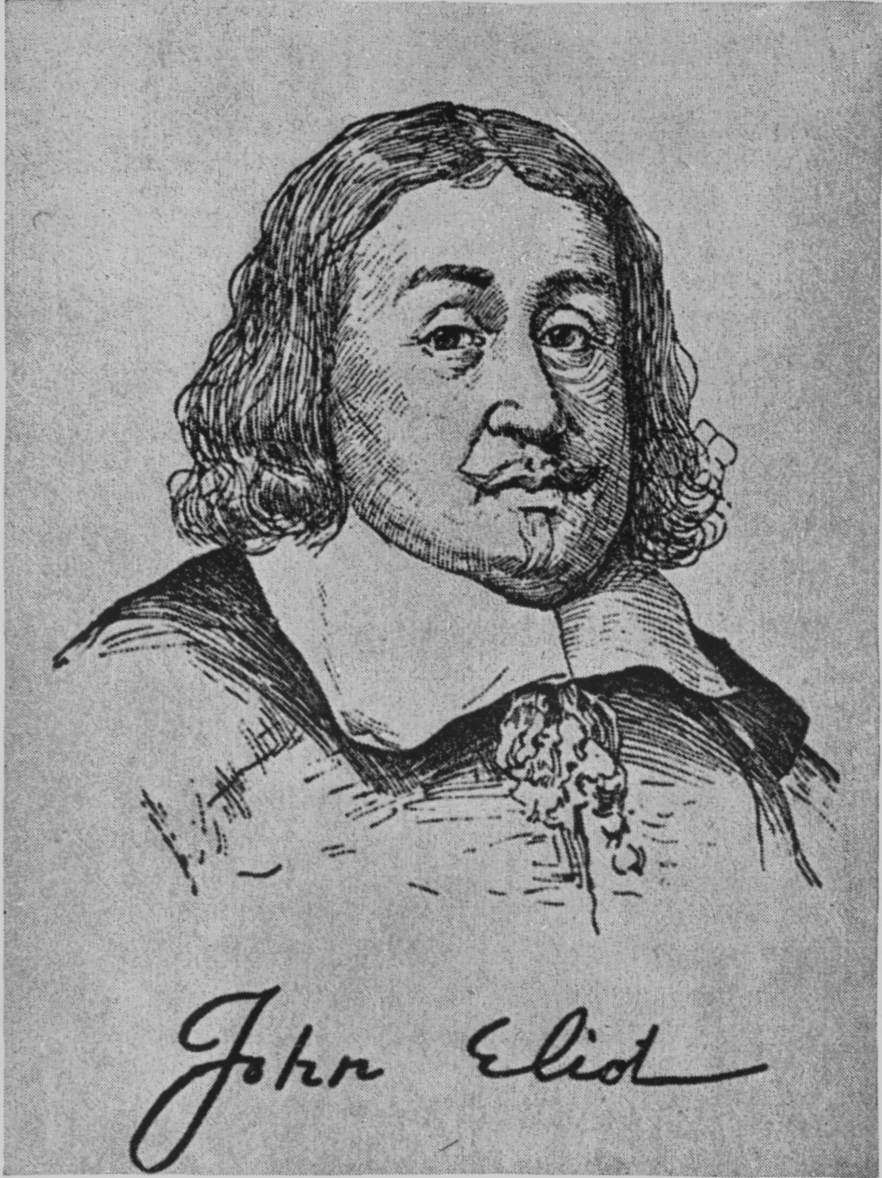
Parliament was not only intimidated by Henry VIII. and Elizabeth, its
membership was recruited by nominees of the Crown. And then it is also to be borne in
mind that both Henry and Elizabeth made a point of getting Parliament to
do their will. They governed through Parliament, and ruled triumphantly,
for it is only in the later years of Elizabeth that any discontent is
heard. The Stuarts, far less tyrannical, came to grief just because they
never understood the importance of Parliament in the eyes of Englishmen
in the middle ranks, and attempted to rule while ignoring the House of
Commons.
Elizabeth scolded her Parliaments, and more than once called the
Speaker of the House of Commons to account. The business of Tudor
Parliaments was to decree the proposals of the Crown. "Liberty of speech
was granted in respect of the aye or no, but not that everybody should
speak what he listed." Bacon declared, "the Queen hath both enlarging and
restraining power; she may set at liberty things restrained by statute
and may restrain things which be at liberty."
Yet Elizabeth raised no objection to the theory that Parliament was
the sovereign power, for her authority controlled Parliament; and so we
have Sir Thomas Smith writing in 1589 that "the most high and absolute
power of the realm of England consisteth in the Parliament."
In his "Ecclesiastical Polity," Book I. (1592-3), Hooker argues that
"Laws human, of what kind soever are available by consent," and that
"laws they are not which public approbation hath not made so"; deciding
explicitly that sovereignty rests ultimately in the people.
When he came to the throne in 1603, James I. was prepared to govern
with all the Tudor absolutism, but he had neither Elizabeth's
Ministers—Cecil excepted—nor her knowledge of the English
mind. The English Parliament and the English people had put up with
Elizabeth's headstrong, capricious rule, because it had been a strong
rule, and the nation had obviously thriven under it. But it was
another matter altogether when James I. was king.
"By many steps the slavish Parliament of Henry VIII. grew into the
murmuring Parliament of Queen Elizabeth, the mutinous Parliament of James
I., and the rebellious Parliament of Charles I."
The twenty years of James I.'s reign saw the preaching up of the
doctrine of the divine right of kings by the bishops of the Established
Church, and the growing resolution of the Commons to revive their earlier
rights and privileges. If the Stuarts were as unfortunate in their choice
of Ministers as Elizabeth had been successful, the House of Commons was
equally happy in the remarkable men who became its spokesmen and leaders.
In the years that preceded the Civil War—1626-42—three men
are conspicuous on the Parliamentary side: Eliot, Hampden, and Pym. All
three were country gentlemen, of good estate, high principle, and
religious convictions—men of courage and
resolution, and of blameless personal character. Eliot died in prison, in
the cause of good government, in 1632; Hampden fell on Chalgrove Field in
1643.
As in earlier centuries the struggle in the seventeenth century
between the King and the Commons turned mainly on the questions of
taxation. (At the same time an additional cause of dispute can be found
in the religious differences between Charles I. and the Parliamentarians.
The latter were mainly Puritan, accepting the Protestantism of the Church
of England, but hating Catholicism and the high-church views of Laud. The
King was in full sympathy with high Anglicanism, and, like his father,
willing to relax the penal laws against Catholics.)
"By the ancient laws and liberties of England it is the known
birthright and inheritance of the subject that no tax, tallage, or other
charge shall be levied or imposed but by common consent in England, and
that the subsidies of tonnage and poundage are no way due or payable but
by a free gift and special Act of Parliament."
In these memorable words began the declaration moved by Sir John Eliot
in the House of Commons on March 2nd, 1629. A royal message ordering the
adjournment of the House was disregarded, the Speaker was held down in
his chair, and the key of the House of Commons was turned against
intrusion, while Eliot's resolutions, declaring that the privileges of
the Commons must be preserved, were carried with enthusiasm.
Charles answered these resolutions by dissolving Parliament and
sending Eliot to the Tower.
For eleven years no Parliament was summoned. Eliot refused altogether
to make any defence for his Parliamentary conduct. "I hold that it is
against the privilege of Parliament to speak of anything which is done in
the House," was his reply to the Crown lawyers. So Sir John Eliot was
left in prison, for nothing would induce this devoted believer in
representative government to yield to the royal pressure, and three years
later, at the age of forty-two, he died in the Tower.
It was for the liberties of the House of Commons that Eliot gave his
life. Wasted with sickness, health and freedom were his if he would but
acknowledge the right of the Crown to restrain the freedom of
Parliamentary debate; but such an acknowledgment was impossible from Sir
John Eliot. For him the privilege of the House of Commons in the matter
of free speech was a sacred cause, to be upheld by Members of Parliament,
even to the death—a cause every whit as sacred to Eliot as the
divine right of kings was to the Stuart bishops.
Charles hoped to govern England through his Ministers without
interference from the Commons, and only the need of money compelled him
to summon Parliament.
John Hampden saw that if the King could raise money by forced loans
and other exactions, the days of constitutional government were over.
Hence his memorable resistance to ship-money. London and the seaports
were induced to provide supplies for ships in 1634, on the pretext that
piracy must be prevented. In the following year the demand was extended
to the inland counties, and Hampden refused point blank to
pay—though the amount was only a matter of 20s.—falling back,
in justification of his refusal, on the Petition of
Right—acknowledged by Charles in 1628—which declared that
taxes were not to be levied without the consent of Parliament. The case
was decided in 1636, and five of the twelve judges held that Hampden's
objection was valid. The arguments in favour of non-payment were
circulated far and wide, so that, in spite of the adverse verdict, "the
judgment proved of more advantage and credit to the gentleman condemned
than to the King's service."
The personal rule of Charles and his Ministers, Laud and Strafford,
came to an end in the autumn of 1640, when there was no choice left to
the King but to summon Parliament, if money was to be obtained. Earlier
in the year the "Short Parliament" had met, only to be dissolved by the
folly of the King after a sitting of three weeks, because of its
unwillingness to vote supplies without the redress of grievances.
The disasters of the King's campaign against the Scots, an empty
treasury, and a mutinous army, compelled the calling of Parliament. But
the temper of the men who came to the House of Commons in November was
vastly different from the temper of the "Short Parliament." For this was
the famous "Long Parliament" that assembled in the dark autumn days of
1640, and it was to sit for thirteen years; to see the impeachment and
execution of Laud and Strafford, the trial and execution of the King, the
abolition of monarchy and the House of Lords, the establishment of the
Commonwealth; and was itself to pass away finally only before Cromwell's
military dictatorship.
Hampden was the great figure at the beginning of this Parliament. "The
eyes of all men were fixed upon him, as their patriæ pater, and
the pilot that must steer the vessel through the tempests and rocks which
threatened it. I am persuaded (wrote Clarendon) his power and interest at
that time were greater to do good or hurt than any man's in the kingdom,
or than any man of his rank hath had at any time; for his reputation of
honesty was universal, and his affections seemed so publicly guided, that
no corrupt or private ends could bias them."
Politically, neither Hampden nor Pym was Republican. Both believed in
government by King, Lords, and Commons; but both were determined that the
King's Ministers should be answerable to Parliament for the policy of the
Crown, and that the Commons, who found the money for government, should
have a definite say in the spending of that money. As for the royal claim
of "Divine right," and the royal view that held passive obedience to be
the duty of the King's subjects, and saw in Parliament merely a useful
instrument for the raising of funds to be spent by the royal pleasure
without question or criticism—these things were intolerable to
Hampden, Pym, and the men of the House of Commons. The King would not
govern through Parliament; the House of Commons could govern without a
King. It was left to the Civil War to decide the issue between the Crown
and Parliament, and make the House of Commons supreme.
Things moved quickly in the first year of the Long Parliament. The
Star Chamber and High Commission Courts were abolished. Strafford was
impeached for high treason, and executed on Tower Hill. Archbishop Laud
lay in prison, to be executed four years later. The Grand Remonstrance of
the House of Commons was presented to Charles in December, 1641. The
demands of the Commons in the Remonstrance were not revolutionary, but
they stated, quite frankly, the case for the Parliament. The main points
were the need for securities for the administration of justice, and an
insistence on the responsibility of the King's Ministers to the Houses of
Parliament. The Grand Remonstrance was only carried by eleven votes in
the House of Commons, 159 to 148, after wild scenes. "Some waved their
hats over their heads, and others took their swords in their scabbards
out of their belts, and held them by the pummels in their hands, setting
the lower part on the ground." Actual violence was only prevented "by the
sagacity and great calmness of Mr. Hampden, by a short speech."
Charles promised an answer to the deputation of members who waited
upon him with the Grand Remonstrance, and early in the new year came the
reply. The King simply demanded the surrender of five members—Pym,
Hampden, Holles, Strode, and Hazlerig—and their impeachment on the
charge of high treason. All constitutional law was set aside by a charge
which proceeded personally from the King, which deprived the accused of
their legal right to a trial by their peers, and summoned them before a
tribunal which had no pretence to a justification over them. On the
refusal of the Commons to surrender their members, Charles came in person
to Westminster with 300 cavaliers to demand their arrest. But the five
members, warned of the King's venture, were well out of the way, and
rested safely within the City of London—for the citizens were
strongly for the Parliament. "It was believed that if the King had found
them there (in the House of Commons), and called in his guards to have
seized them, the members of the House would have endeavoured the defence
of them, which might have proved a very unhappy and sad business."
As it was, Charles could only retire "in a more discontented and angry
passion than he came in." The step was utterly ill-advised. Parliament
was in no mood to favour royal encroachments, and the citizens of London
were at hand, with their trained bands, to protect forcibly members of
the House of Commons.
War was now imminent. "The attempt to seize the five members was
undoubtedly the real cause of the war. From that moment, the loyal
confidence with which most of the popular party were beginning to regard
the King was turned into hatred and suspicion. From that moment, the
Parliament was compelled to surround itself with defensive arms. From
that moment, the city assumed the appearance of a garrison.
"The transaction was illegal from beginning to end. The impeachment
was illegal. The process was illegal. The service was illegal. If Charles
wished to prosecute the five members for treason, a bill against them
should have been sent to a grand jury. That a commoner cannot be tried
for high treason by the Lords at the suit of the Crown, is part of the
very alphabet of our law. That no man can be arrested by the King in
person is equally clear. This was an established maxim of our
jurisprudence even in the time of Edward the Fourth. 'A subject,' said
Chief Justice Markham to that Prince, 'may arrest for treason; the King
cannot; for, if the arrest be illegal, the party has no remedy against
the King.'"
Both King and Parliament broke rudely through all constitutional
precedents in their preparations for hostilities.
The King levied troops by a royal commission, without any advice from
Parliament, and Pym got an ordinance passed, in both Houses, appointing
the Lords-Lieutenant of the counties to command the Militia without
warrant from the Crown.
A last attempt at negotiations was made at York, in April, when the
proposals of Parliament—nineteen propositions for curtailing the
power of the Monarchy in favour of the Commons—were rejected by
Charles with the words: "If I granted your demands, I should be no more
than the mere phantom of a king."
By August, Charles had raised the royal standard at Nottingham, and
war was begun.
Five years later and Charles was a prisoner, to die in 1649 on the
scaffold. That same year monarchy and the House of Lords were abolished
by law; the Established Church had already fallen before the triumphant
arms of the Puritans.
Then, in 1653, the House of Commons itself fell—expelled by
Cromwell; and the task of the Lord Protector was to fashion a
constitution that would work. What happened was the supremacy of
the army. Parliament, attenuated and despised, contended in vain against
the Protector. On Cromwell's death, and the failure of his son, Richard,
the army declared for Charles II., and there was an end to the
Commonwealth.
In all these changes the great mass of the people had neither part nor
lot; and the famous leaders of the Parliamentary Party, resolute to
curtail the absolutism of the Crown, were no more concerned with the
welfare of the labouring people than the barons were in the time of John.
The labouring people—generally—were equally indifferent to
the fortunes of Roundheads and Cavaliers, though the townsmen in many
places held strong enough opinions on the matters of religion that were
in dispute.
That the common misery of the people was not in any way lightened by
Cromwell's rule we have abundant evidence, and it cannot be supposed that
the substitution of the Presbyterian discipline for episcopacy in the
Church, and the displacement of Presbyterians by Independents, was likely
to alleviate this misery.
Taxation was heavier than it had ever been before, and in Lancashire,
Westmorland, and Cumberland the distress was appalling.
Whitelocke, writing in 1649, notes "that many families in
Lancashire were starved." "That many in Cumberland and Westmorland died
in the highways for want of bread, and divers left their habitations,
travelling with their wives and children to other parts to get relief,
but could find none. That the committees and Justices of the Peace of
Cumberland signed a certificate, that there were 30,000 families that had
neither seed nor bread-corn, nor money to buy either, and they desired a
collection for them, which was made, but much too little to relieve so
great a multitude."
Cromwell, occupied with high affairs of State, had neither time nor
inclination to attend to social reform. Democracy had its witnesses;
Lilburne and the Levellers made their protest against military rule, and
were overpowered; Winstanley and his Diggers endeavoured to persuade the
country that the common land should be occupied by dispossessed peasants,
and were quickly suppressed.
Lilburne was concerned with the establishment of a political
democracy, Winstanley with a social democracy, and in both cases the
propaganda was offensive to the Protector.
Had Cromwell listened to Lilburne, and made concessions towards
democracy, the reaction against Puritanism and the Commonwealth might
have been averted.
John Lilburne had been a brave soldier in the army of the Parliament
in the early years of the Civil War, and he left the army in 1645 with
the rank of Lieutenant-Colonel (and with £880 arrears of pay due to him)
rather than take the covenant and subscribe to the requirements of the
"new model."
The monarchy having fallen, Lilburne saw the possibilities of tyranny
in the Parliamentary government, and at once spoke out. With considerable
legal knowledge, a passion for liberty, clear views on democracy, an
enormous capacity for work, and great skill as a pamphleteer, Lilburne
was not to be ignored. The Government might have had him for a supporter;
it unwisely decided to treat him as an enemy, and for ten years he was an
unsparing critic, his popularity increasing with every fresh pamphlet he
issued—and at every fresh imprisonment.
Lilburne urged a radical reform of Parliament and a general manhood
suffrage in 1647, and the "Case for the Army," published by the Levellers
in the same year, on the proposal of the Presbyterian majority in
Parliament that the army should be disbanded, demanded the abolition of
monopolies, freedom of trade and religion, restoration of enclosed common
lands, and abolition of sinecures.
Both Cromwell and Ireton were strongly opposed to manhood suffrage,
and Cromwell—to whom the immediate danger was a royalist
reaction—had no patience for men who would embark on democratic
experiments at such a season.
Lilburne and the Levellers were equally distrustful of Cromwell's new
Council of State. "We were ruled before by King, Lords, and Commons, now
by a General, Court-martial, and Commons; and, we pray you, what is the
difference?" So they put the question in 1648.
To Cromwell the one safety for the Commonwealth was in the loyalty of
the army to the Government. To Lilburne the one guarantee for good
government was in the supremacy of a Parliament elected by manhood
suffrage. He saw plainly that unless steps were taken to establish
democratic institutions there was no future for the Commonwealth; and he
took no part in the trial of Charles I., saying openly that he doubted
the wisdom of abolishing monarchy before a new constitution had been
drawn up.
But Lilburne overestimated the strength of the Leveller movement in
the army, and the corporals who revolted were shot by sentence of
courts-martial.
In vain the democratic troopers argued, "the old king's person and the
old lords are but removed, and a new king and new lords with the commons
are in one House, and so we are under a more absolute arbitrary monarchy
than before." The Government answered by clapping Lilburne in the Tower,
where, in spite of a petition signed by 80,000 for his release, he
remained for three months without being brought to trial. Released on
bail, Lilburne, who from prison had issued an "Agreement of the Free
People," calling for annual parliaments elected by manhood suffrage and
the free election of unendowed church ministers in every parish, now
published an "Impeachment for High Treason against Oliver Cromwell and
his son-in-law, James Ireton," and declared that monarchy was preferable
to a military despotism. At last, brought to trial on the charge of
"treason," Lilburne was acquitted with "a loud and unanimous shout" of
popular approval. "In a revolution where others
argued about the respective rights of King and Parliament, he spoke
always of the rights of the people. His dauntless courage and his power
of speech made him the idol of the mob."
Lilburne was again brought to trial, in 1653, and again acquitted,
with undiminished enthusiasm. But "for the peace of the nation," Cromwell
refused to allow the irrepressible agitator to be at large, and for two
years Lilburne, "Free-born John," was kept in prison. During those years
all power in the House of Commons was broken by the rule of the Army of
the Commonwealth, and Parliament stood in abject submission before the
Lord Protector. Only when his health was shattered, and he had embraced
Quaker principles, was Lilburne released, and granted a pension of 40s. a
week. The following year, at the age of 40, Lilburne died of
consumption—brought on by the close confinement he had suffered. A
year later, 1658, and Cromwell, by whose side Lilburne had fought at
Marston Moor, and against whose rule he had contended for so many a year,
was dead, and the Commonwealth Government was doomed.
The "Digger" movement was a shorter and much more obscure protest on
behalf of the people than Lilburne's agitation for democracy; but it is
notable for its social significance.
While Lilburne strove vigorously for political reforms that are still
unaccomplished, Gerrard Winstanley preached a revolutionary gospel of
social reform—as John Ball and Robert Ket had before him. But
Winstanley's social doctrine allowed no room for violence, and included
the non-resistance principles that found exposition in the Society of
Friends. Hence the "Diggers," preaching agrarian revolution; but denying
all right to force of arms, never endangered the Commonwealth Government
as Lilburne and the Levellers did.
Free Communism was the creed of more than one Protestant sect in the
sixteenth century, and the Anabaptists on the Continent had been
conspicuous for their experiments in community of goods and anarchist
society.
Winstanley confined his teaching and practice to common ownership of
land, pleading for the cultivation of the enclosed common lands, "that
all may feed upon the crops of the earth, and the burden of poverty be
removed." There was to be no forcible expropriation of landlords.
"If the rich still hold fast to this propriety of Mine and Thine, let
them labour their own lands with their own hands. And let the common
people, that say the earth is ours, not mine, let them
labour together, and eat bread together upon the commons, mountains, and
hills.
"For as the enclosures are called such a man's land, and such a man's
land, so the Commons and Heath are called the common people's. And let
the world see who labour the earth in righteousness, and those to whom
the Lord gives the blessing, let them be the people that shall inherit
the earth.
"None can say that their right is taken from them. For let the rich
work alone by themselves; and let the poor work together by
themselves."
With the common ownership and cultivation of land, an end was to be
made of all tyranny of man over his fellows.
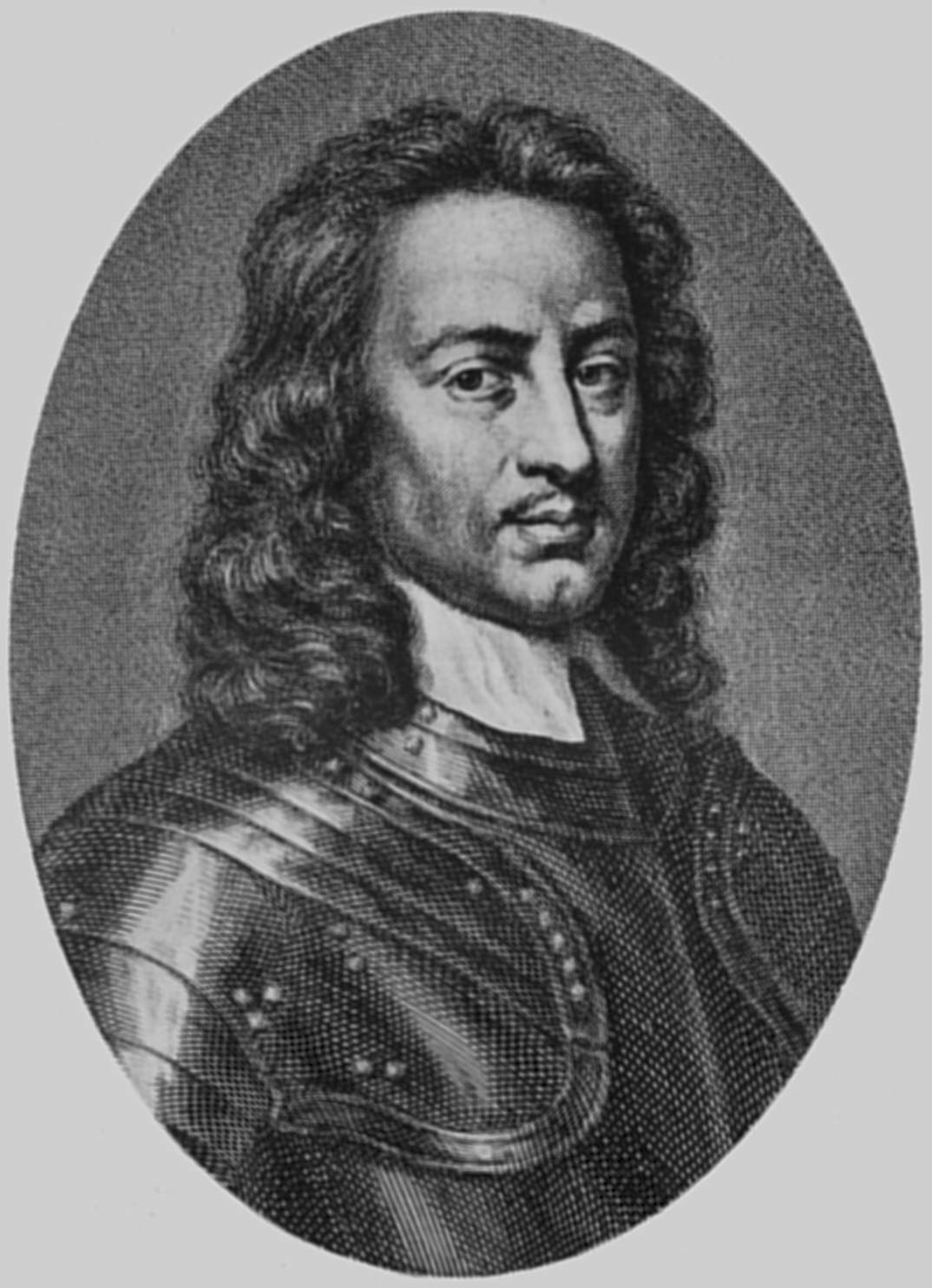 After the Engraving by G. Houbraken.
"Leave off dominion and lordship one over another; for the whole bulk
of mankind are but one living earth. Leave off imprisoning, whipping, and
killing, which are but the actings of the curse. Let those that have
hitherto had no land, and have been forced to rob and steal through
poverty; henceforth let them quietly enjoy land to work upon, that
everyone may enjoy the benefit of his creation, and eat his own bread
with the sweat of his own brow."
Winstanley's argument was quite simple:
"If any man can say that he makes corn or cattle, he may say, That
is mine. But if the Lord made these for the use of His creation,
surely then the earth was made by the Lord to be a Common Treasury for
all, not a particular treasury for some."
Two objections were urged against private property in land:
"First, it hath occasioned people to steal from one another. Secondly,
it hath made laws to hang those that did steal. It tempts people to do an
evil action, and then kills them for doing it." It was a prolific age for
pamphlets, the seventeenth century; the land teemed with preachers and
visionaries, and Winstanley's writings never attracted the sympathy that
was given to the fierce controversialists on theological and political
questions.
Only when Winstanley and his Diggers set to work with spade and shovel
on the barren soil of St. George's Hill, in Surrey, in the spring of
1649, was the attention of the Council of State called to the strange
proceedings. The matter was left to the local magistrates and landowners,
and the Diggers were suppressed. A similar attempt to reclaim land near
Wellingboro' was stopped at once as "seditious and tumultuous." It was
quite useless for Winstanley to maintain that the English people were
dispossessed of their lands by the Crown at the Norman Conquest, and that
with the execution of the King the ownership of the Crown lands ought to
revert to the people; Cromwell and the Council of State had no more
patience with prophets of land nationalisation than with agitators of
manhood suffrage. Indeed, the Commonwealth Government never took the
trouble to distinguish between the different groups of disaffected
people, but set them all down as "Levellers," to be punished as
disturbers of the peace if they refused to obey authority.
Winstanley's last pamphlet was "True Magistracy Restored," an open
letter to Oliver Cromwell, 1652, and after its publication Gerrard
Winstanley and his Diggers are heard of no more.
To-day both Lilburne and Winstanley are to be recalled because the
agitation for political democracy is always with us, and the question of
land tenure is seen to be of profound importance in the discussion of
social reform. No democratic statesman in our time can propose an
improvement in the social condition of the people without reference to
the land question, and no social reformer of the nineteenth century has
had more influence or been more widely read and discussed than Henry
George—the exponent of the Single Tax on Land Values.
Winstanley was very little heeded in his own day, but two hundred and
fifty years later the civilised countries of the earth are found in deep
debate over the respective rights of landowners and landless, and the
relation of poverty to land ownership. State ownership, taxation of land
values, peasant proprietorship, co-operative agriculture—all have
their advocates to-day, but to Winstanley's question whether the earth
was made "for to give ease to a few or health to all," only one answer is
returned.
Under the Commonwealth the landowners were as powerful as they had
been under the monarchy. Enclosures continued. Social reform was not
contemplated by Cromwell nor by Councils of State; democracy was equally
outside the political vision of government. Church of England ministers
were dispossessed in favour of Nonconformists, Puritanism became the
established faith, Catholicism remained proscribed.
The interest in ecclesiastical and theological disputes was
considerable, and Puritanism was popular with large numbers of the
middle-class. But to the mass of the people Puritanism was merely the
suppression of further liberties, the prohibition of old customs, the
stern abolition of Christmas revels and May-day games.
Lilburne did his best to get Cromwell to allow the people some
responsibility in the choice of its rulers. Winstanley proposed a remedy
for the social distress. To neither of these men was any concession made,
and no consideration was given to their appeals.
Hence the bulk of the nation, ignored by the Commonwealth Government,
and alienated by Puritanism, accepted quite amiably—indeed, with
enthusiasm—the restoration of the monarchy on the return of Charles
II., and was unmoved by the royalist reaction against Parliamentary
Government that followed on the Restoration.
The House of Commons itself, when Monk and his army had gone over to
the side of Charles, voted, in the Convention Parliament of 1660, "that
according to the ancient and fundamental laws of this Kingdom, the
government is, and ought to be, by King, Lords, and Commons," and Charles
II. was received in London with uproarious enthusiasm.
The army was disbanded; a royalist House of Commons restored the
Church of England and ordered general acceptance of its Prayer Book.
Puritanism, driven from rule, could only remain in power in the heart and
conscience of its adherents.
To the old Commonwealth man it might seem, in the reaction against
Puritanism, and in the popularity of the King, that all that had been
striven for in the civil war had been lost, in the same way as after the
death of Simon of Montfort it might have appeared that "the good cause"
had perished with its great leader. In reality the House of Commons stood
on stronger ground than ever, and was to show its strength when James II.
attempted to override its decisions. In the main the very forms of
Parliamentary procedure were settled in the seventeenth century, to
remain undisturbed till the nineteenth century. "The Parliamentary
procedure of 1844 was essentially the procedure on which the House of
Commons conducted its business during the Long Parliament."
With Charles II. on the throne the absolutism of the Crown over
Parliament passed for ever from England. Cromwell had set up the
supremacy of the army over the Commons: this, too, was gone, never to be
restored.
Henceforth government was to be by King, Lords, and Commons; but
sovereignty was to reside in Parliament. Not till a century later would
democracy again be heard of, and its merits urged, as Lilburne had urged
them under the Commonwealth.
For nearly two centuries—from 1660 to 1830—England was
governed by an aristocracy of landowners. Charles II. kept the throne for
twenty-five years, because he had wit enough to avoid an open collision
with Parliament. James II. fled the country after three
years—understanding no more than his father had understood that
tyranny was not possible save by consent of Parliament or by military
prowess. At the Restoration the royal prerogative was dead, and nothing
in Charles II.'s reign tended to diminish the power of Parliament in
favour of the throne. Charles was an astute monarch who did not wish to
be sent on his travels again, and consequently took care not to outrage
the nation by any attempt upon the liberties of Parliament. Only by the
Tudor method of using Parliament as the instrument of the royal will
could James II. have accomplished the constitutional changes he had set
his heart upon. In attempting to set up toleration for the Roman Catholic
religion, and in openly appointing Roman Catholics to positions of
importance, James II. set Parliament at defiance and ranged the forces of
the Established Church against himself. The method was doomed to failure.
"None have gone about to break Parliaments but in the end Parliaments
have broken them." In any case the notion of
restoring political liberty to Catholics was a bold endeavour in 1685.
Against the will of Parliament the project was folly. To overthrow the
rights of corporations and of the Universities, and to attempt to bully
the Church of England, after Elizabeth's fashion, at the very beginning
of a pro-Catholic movement, was to provoke defeat.
Parliament decided that James II. had "abdicated," when, deserted by
Churchill, he fled to France, and William and Mary came to the throne at
the express invitation of Parliament. The Revolution completed the work
of the Long Parliament by defining the limits of monarchy, and
establishing constitutional government. It was not—this Revolution,
of 1688—the first time Parliament had sanctioned the deposing of
the King of England and the appointment of his successor, but it was
the last. Never again since the accession of William and Mary have the
relations of the Crown and Parliament been strained to breaking point;
never has the supremacy of Parliament been seriously threatened by the
power of the throne.
The full effects of the Revolution of 1688 were seen in the course of
the next fifty years. Aristocracy, then mainly Whig, was triumphant, and
under its rule, while large measures of civil and religious liberty were
passed, the condition of the mass of labouring people was generally
wretched in the extreme. The rule of the aristocracy saw England become a
great power among the nations of the world, and the British Navy supreme
over the navies of Europe; but it saw also an industrial population,
untaught and uncared for, sink deeper and deeper into savagery and
misery. For a time in the eighteenth century the farmer and the peasant
were prosperous, but by the close of that century the small farmer was a
ruined man, and with the labourer was carried by the industrial
revolution into the town. The worst times for the English labourer in
town and country since the Norman Conquest were the reign of Edward VI.
and the first quarter of the nineteenth century.
The development of our political institutions into their present form;
the establishment of our Party system of government by Cabinet, and of
the authority of the Prime Minister; the growth of the supreme power of
the Commons, not only over the throne but over the Lords also: these were
the work of the aristocracy of the eighteenth century, and were attained
by steps so gradual as to be almost imperceptible. No idea of democracy
guided the process; yet our modern democratic system is firm-rooted upon
the principles and privileges of the Constitution as thus established.
Social misery deepened, without check from the politicians; and the most
enlightened statesmen of the Whig regime were very far from our present
conceptions of the duties and possibilities of Parliament.
James II. was tumbled from the throne for his vain attempt to
establish toleration for Catholics and Nonconformists without consent of
Parliament. Yet the Whig aristocracy which followed, while it did nothing
for Catholics, laid broad principles of civil and religious liberty for
democracy to build upon.
The Declaration of Right, presented by Parliament to William and Mary
on their arrival in London, was turned into the Bill of Rights, and
passed into law in 1689. It stands as the last of the great charters of
political liberty, and states clearly both what is not permitted to the
Crown, and what privileges are allowed to the people.
Under the Bill of Rights the King was denied the power of suspending
or dispensing, of levying money, or maintaining a standing army without
consent of Parliament. The people were assured of the right of the
subject to petition the Crown, and of the free election of
representatives in Parliament, and of full and free debate in Parliament.
Any profession of the Catholic religion, or marriage with a Catholic,
disqualified from inheritance to or possession of the throne.
So there was an end to the doctrine of the Divine Right of Kings, and
four hundred non-juring clergymen—including half-a-dozen
bishops—of the Church of England were deprived of their
ecclesiastical appointments for refusing to accept the accomplished fact,
and acknowledge William III. as the lawful King of England. By making
William King, to the exclusion of the children of James II., Parliament
destroyed for all future time in England the belief in the sacred
character of kingship. The King was henceforth a part of the
constitution, and came to the throne by authority of Parliament, on
conditions laid down by Parliament.
William resented the decision of Parliament not to allow the Crown a
revenue for life, but to vote an annual supply; but the decision was
adhered to, and has remained in force ever since. The Mutiny Act, passed
the same year, placed the army under the control of Parliament, and the
annual vote for military expenses has, in like manner, remained.
The Toleration Act (1689) gave Nonconformists a legal right to worship
in their own chapels, but expressly excluded Unitarians and Roman
Catholics from this liberty. Life was made still harder for Roman
Catholics in England by the Act of 1700, which forbade a Catholic priest,
under penalty of imprisonment for life, to say mass, hear confessions, or
exercise any clerical function, and denied the right of the Catholic
laity to hold, buy or inherit property, or to have their children
educated abroad. The objection to Roman Catholics was that their loyalty
to the Pope was an allegiance to a "foreign" ruler which prevented their
being good citizens at home. Against this prejudice it was useless to
point to what had been done by Englishmen for their country, when all the
land was Catholic, and all accepted the supremacy of the Pope. It was not
till 1778 that the first Catholic Relief Bill was carried, a Bill that
"shook the general prejudice against Catholics to the centre, and
restored to them a thousand indescribable charities in the ordinary
intercourse of social life which they had seldom experienced."
The last Roman Catholic to die for conscience' sake was Oliver
Plunket, Archbishop of Armagh, who was executed at Tyburn, when Charles
II. was King, in 1681. After the Revolution, Nonconformists and Catholics
were no longer hanged or tortured for declining the ministrations of the
Established Church, but still were penalised in many lesser ways. But the
spirit of the eighteenth century made for toleration, and the Whigs were
as unostentatious in their own piety as they were indifferent to the
piety of others.
The killing of "witches," however, went on in Scotland and in England
long after toleration had been secured for Nonconformists. As late as
1712 a woman was executed for witchcraft in England.
William III. began with a mixed ministry of Whigs and Tories, which
included men like Danby and Godolphin, who had served under James II. But
the fierce wrangling that went on over the war then being waged on the
Continent was decidedly inconvenient, and by 1696 the Whigs had succeeded
in driving all the Tories—who were against the war—out of
office. Then for the first time a united ministry was in power, and from
a Cabinet of men with common political opinions the next step was to
secure that the Cabinet should represent the party with a majority in the
House of Commons. Our present system of Cabinet rule, dependent on the
will of the majority of the Commons, is found in full operation by the
middle of the eighteenth century. The fact that William III., George I.,
and George II. were all foreigners necessitated the King's ministers
using considerable powers. But George III. was English, and effected a
revival in the personal power of the King by his determination that the
choice of ministers should rest with the Crown, and not with the House of
Commons. He succeeded in breaking up the long Whig ascendancy, and so
accustomed became the people to the King making and unmaking ministries,
that on George IV.'s accession in 1820 it was fully expected the new King
would turn out the Tories and put in Whigs. William IV. in 1835 did what
no sovereign has done since—dissolved Parliament against the wish
of the government.
From 1696 to 1701 the Whigs were in office. Then on the death of
William and the accession of Anne, Tory ministers were included in the
government, and for seven years the Cabinet was composite again. But
Marlborough and Godolphin found that if they were to remain in power it
must be by the support of the Whigs, who had made the support of the war
against France a party question; and from 1708 to 1710 the ministry was
definitely Whig. By 1710 the war had ceased to be popular, and the
general election of that year sent back a strong Tory majority to the
House of Commons, with the result that the Tory leaders, Harley (Earl of
Oxford) and Henry St. John (Bolingbroke) took office. The Tories fell on
the death of Anne, because their plot to place James (generally called
the Chevalier or the old Pretender), the Queen's half-brother, on the
throne was defeated by the readiness of the Whig Dukes of Somerset and
Argyll to proclaim George, Elector of Hanover, King of England. By the
Act of Settlement, 1701, Parliament had decided that the Crown should
pass from Anne to the heirs of Sophia, Electress of Hanover and daughter
of James I.; and the fact that the Chevalier was a Catholic made his
accession impossible according to law, and the policy of Bolingbroke
highly treasonable.
George I. could not speak English, and relied entirely on his Whig
ministers. Bolingbroke fled to the Continent, but was permitted to return
from exile nine years later. Oxford was impeached and sent to the Tower.
The Whigs were left in triumph to rule the country for nearly fifty
years—until the restiveness of George III. broke up their
dominion—and for more than twenty years of that period Walpole was
Prime Minister. Cabinet government—that is, government by a small
body of men, agreed upon main questions of policy, and commanding the
confidence of the majority of the House of Commons—was now in full
swing, and in spite of the monarchist revival under George III., no King
henceforth ever refused consent to a Bill passed by Parliament.
The Whigs did nothing in those first sixty years of the eighteenth
century to make the House of Commons more representative of the people.
They were content to repeat the old cries of the Revolution, and to
oppose all proposals of change. But they governed England without
oppression, and Walpole's commercial and financial measures satisfied the
trading classes and kept national credit sound.
Walpole remained in power from 1720 to 1742 by sheer
corruption—there was no other way open to him. He laughed openly at
all talk of honesty and purity, and his influence lowered the whole tone
of public life. But he kept in touch with the
middle classes, was honest personally, and had a large amount of tact and
good sense. His power in the House of Commons endured because he
understood the management of parliamentary affairs, and had a genius for
discerning the men whose support he could buy, and whose support was
valuable.
George III. went to work in much the same way as Walpole had done, and
only succeeded in breaking down the power of the Whig houses by using the
same corrupt methods that Walpole had employed. The "King's friends," as
they were called, acted independently of the party leaders, and in the
pay of the King were the chief instrument of George III.'s will.
But George III. not only turned the Whigs out of office, he altered
permanently the political complexion of the House of Lords. From the time
of the Revolution of 1688 to the death of George II. in 1760, the Lords
were Whiggish, and the majority of English nobles held Whig principles.
They were, on the whole, men of better education than the average member
of the House of Commons, who was in most cases a fox-hunting squire, of
the Squire Western type. The House of Lords stood in the way of the
Commons when, in the Tory reaction of 1701, the Commons proposed to
impeach Somers, the Whig Chancellor, a high-minded and skilful lawyer,
"courteous and complaisant, humane and benevolent," for his share in the
Second Partition Treaty of 1699, and this was the beginning of a bitter
contest between the Tory Commons and the Whig Lords. An attempt was made
by the Commons to impeach Walpole on his fall in 1742, but the Lords
threw out a Bill proposing to remit the penalties to which his prosecutor
might be liable, and the King made Walpole a peer. George III., by an
unsparing use of his prerogative, changed the character and politics of
the Upper House. His creations were country gentlemen of sufficient
wealth to own "pocket" boroughs in the House of Commons, and lawyers who
supported the Royal prerogative.
From George III.'s time onward there has always been a standing and
ever-increasing majority of Tory peers in the House of Lords. And while
the actual number of members of the Upper House has been enlarged
enormously, this majority has became enlarged out of all proportion.
Liberal and Tory Prime Ministers were busy throughout the nineteenth
century adding to the peerage—no less than 376 new peers were
created between 1800 and 1907; but comparatively few Liberals retained
their principles when they became peers, and two of the present chiefs of
the Unionist Party in the House of Lords—Lords Lansdowne and
Selborne—are the sons of eminent Liberals.
So it has come about that while the House of Commons has been steadily
opening its doors to men of all ranks and classes, and in our time has
become increasingly democratic in character, the House of Lords, confined
in the main to men of wealth and social importance, has become an
enormous assembly of undistinguished persons, where only a small minority
are active politicians, and of this minority at least three-fourths are
Conservatives.
This change in the House of Lords began, as we have seen, in the reign
of George III., when the Whig ascendancy in Parliament had passed. But
the Whigs did nothing during their long lease of power to bring democracy
nearer, and were entirely contemptuous of popular aspirations. At the
very time when the democratic idea was the theme of philosophers, and was
to be seen expressed in the constitution of the revolted American
colonies, and in the French Revolution, England remained under an
aristocracy, governed first by Whigs, and then by Tories. It is true
democracy was not without its spokesmen in England in the eighteenth
century, but there was no popular movement in politics to stir the masses
of the people, as the preaching of the Methodists stirred their hearts
for religion. Democratic ideas were as remote from popular discussion in
the eighteenth century as they had been made familiar by Lilburne for a
brief season in the seventeenth century.
A word must be said about John Wilkes, a man of disreputable character
and considerable ability, who for some ten
years—1763-73—contended for the rights of electors against
the Whig Government. The battle began when George Grenville, the Whig
Prime Minister, had Wilkes arrested on a general warrant for an article
attacking the King's Speech in No. 45 of the North Briton, a
scurrilous newspaper which belonged to Wilkes. Chief Justice Pratt
declared the arrest illegal on the ground that the warrant was bad, and
that Wilkes, being at the time M.P. for Aylesbury, enjoyed the privilege
of Parliament. A jury awarded Wilkes heavy damages against the Government
for false imprisonment, and the result of the trial made Wilkes a popular
hero. Then, in 1764, the Government brought a new charge of blasphemy and
libel, and Wilkes, expelled from the House of Commons, and condemned by
the King's Bench, fled to France, and was promptly declared an outlaw. He
returned, however, a year or two later, and while in prison was elected
M.P. for Middlesex. The House of Commons, led by the Government, set the
election aside, and riots for "Wilkes and Liberty" broke out in London.
The question was: Had the House of Commons a right to exclude a member
duly elected for a constituency?—the same question that was raised
over Charles Bradlaugh, a man of very different character, in the
Parliament of 1880. Again and again in 1768 and 1769 Wilkes was
re-elected for Middlesex, only to be expelled, and finally the House
decided that Wilkes' opponent, Colonel Luttrell, was to sit, although
Luttrell was manifestly not chosen by the majority of electors. The
citizens of London replied to this by choosing Wilkes for Sheriff and
Alderman in 1770, and by making him Lord Mayor four years later. The
Government gave up the contest at last, and Wilkes was allowed to take
his seat. Besides vindicating the right of constituencies against the
claim of Parliament to exclude undesirable persons, Wilkes did a good
deal towards securing that right of Parliamentary debating which was
practically admitted after 1771.
But the "Wilkes and Liberty" movement was no more than a popular
enthusiasm of the London mob for an enemy of the Government, and a
determination of London citizens and Middlesex electors not to be
brow-beaten by the Government. Wilkes himself always denied that he was a
"Wilkesite," and he had no following in the country or in Parliament.
The idea of constitutional government has its witnesses in the Middle
Ages, democratic theories are common in the sixteenth and seventeenth
centuries, but it is not till the eighteenth century that France, aflame
to realise a political ideal, proves that democracy has passed from the
books of schoolmen and philosophers, and is to be put in practice by a
nation in arms.
In the thirteenth century the friars rallied to Simon of Montfort and
preached, not democracy, but constitutional liberty. Thomas
Aquinas, the great Dominican doctor, became the chief exponent of
political theory, and maintained that sovereignty expressed in
legislative power should be exercised for the common good, and that a
mixed government of monarch, nobles, and people, with the Pope as a final
Court of Appeal, would best attain that end.
A hundred years later, John Ball and his fellow agitators preached a
gospel of social equality that inspired the Peasant Revolt. But communism
was the goal of the peasant leaders in 1381, and freedom from actual
oppression the desire of their followers. No conception of political
democracy can be found in the speeches and demands of Wat Tyler.
In the sixteenth century Robert Ket in Norfolk renewed the old cries
of social revolution, and roused the countryside to stop the enclosures
by armed revolt. And again the popular rising is an agrarian war to end
intolerable conditions, not a movement for popular government.
The theory of a pact or contract between the Government and the people
became the favourite assumption of political writers from the sixteenth
century onward, and it was this theory that Rousseau popularised in his
"Social Contract," the theory, too, which triumphed for a season in the
French Revolution.
The theory is, of course, pure assumption, without any basis in
history, and resting on no foundation of fact. It assumes that primitive
man was born with enlightened views on civil government, and that for the
greater well-being of his tribe or nation he deposited the sovereign
authority which belonged to himself, in a prince or king—or in some
other form of executive government—retaining the right to withdraw
his allegiance from the government if the authority is abused, and the
contract which conferred sovereignty violated. It was not maintained that
the contract was an actually written document; it was supposed to be a
tacit agreement. The whole theory seems to have sprung from the study of
Roman law and the constitutions of Athens and Sparta. Nothing was known
of primitive man or of the beginnings of civilisation till the nineteenth
century. The Bible and the classical literature of Greece and Rome are
all concerned with civilised, not primitive, man, and with slaves and
"heathens" who are accounted less than men. The "sovereign people" of
Athens and Sparta became the model of later republican writers, while the
choosing of a king by the Israelites recorded in the Old Testament
sanctioned the idea, for early Protestant writers, that sovereignty was
originally in the people.
The Huguenot Languet, in his Vindiciae contra Tyrannos (1579),
maintained on scriptural grounds that kingly power was derived from the
will of the people, and that the violation by the king of the mutual
compact of king and people to observe the laws absolved the people from
all allegiance. The Jesuit writers, Bellarmine and
Mariana, argued for the sovereignty of the people as the basis of kingly
rule; and when the English divines of the Established Church were
upholding the doctrine of the divine right of kings, the Spanish Jesuit,
Suarez, was amongst those who attacked that doctrine, quoting a great
body of legal opinion in support of the contention that "the prince has
that power of law giving which the people have given him." Suarez, too,
insists that all men are born equal, and that "no one has a political
jurisdiction over another." Milton, in his "Tenure of Kings and
Magistrates" (1649), had taken a similar line: the people had vested in
kings and magistrates the authority and power of self-defence and
preservation. "The power of kings and magistrates is nothing else but
what is only derivative, transferred, and committed to them in trust from
the people to the common good of all, in whom the power yet remains
fundamentally, and cannot be taken from them without a violation of their
natural birthright." Hooker, fifty years earlier (1592-3), in his
"Ecclesiastical Polity," Book I., had affirmed the sovereignty or
legislative power of the people as the ultimate authority, and had also
declared for an original social contract, "all public regiment of what
kind soever seemeth evidently to have risen from deliberate advice,
consultation, and composition between men, judging it convenient and
behoveful." Hobbes made the social contract a justification for Royal
absolutism, and Locke, with a Whig ideal of constitutional government,
enlarged on the right of a people to change its form of government, and
justified the Revolution of 1688. The writings of Hobbes and Locke have
had a lasting influence, and Locke is really the source of the democratic
stream of the eighteenth century. It rises in Locke to become the torrent
of the French Revolution.
But Huguenots and Jesuits, Hooker and Milton—what influence had
their writings on the mass of English people? None whatever, as far as we
can see. Milton could write of "the power" of "the people" as a "natural
birthright," but the power was plainly in Cromwell's army, and "the
people" had no means of expression concerning its will, and no
opportunity for the assertion of sovereignty. Lilburne and the Levellers
held that democracy could be set up on the ruins of Charles I.'s
Government, and the sovereignty of the people become a fact; and with a
ready political instinct Lilburne proposed the election of popular
representatives on a democratic franchise. Cromwell rejected all
Lilburne's proposals; for him affairs of State were too serious for
experiments in democracy; and Lilburne himself was cast into prison by
the Commonwealth Government. Lilburne's pamphlets were exceedingly
numerous, and his popularity, in London particularly, enormous. He was
the voice of the unrepresented, powerless citizens in whom the republican
theorists saw the centre of authority. The one effort to persuade the
Commonwealth Republic to give power to the people was made by John
Lilburne, and it was defeated. The Whig theory that an aristocratic House
of Commons, elected by a handful of people, and mainly at the dictation
of the landowners, was "the People," triumphed. The bulk of the English
people were left out of all account in the political struggles of Whigs
and Tories, and democracy was not dreamed of till America was free and
France a republic. The industrial revolution compelled the reform of the
British House of Commons, and democracy has slowly superseded
aristocracy, not from any enthusiasm for the "sovereign people," but from
the traditional belief that representative government means the rule of
the people.
Precedent, not theory, has been the argument for democracy in
England.
The writings of Hobbes are important, because they state the case for
absolute rule, or "a strong government," as we call it to-day. Hobbes was
frankly rationalist and secular. Holding the great end of government to
be happiness, he made out that natural man lived in savage ill-will with
his fellows. To secure some sort of decency and safety men combined
together and surrendered all natural rights to a sovereign—either
one man, or an assembly of men—and in return civil rights were
guaranteed. But the sovereignty once established was supreme, and to
injure it was to injure oneself, since it was composed of "every
particular man." The sovereign power was unlimited, and was not to be
questioned. Whether monarchy, aristocracy, or democracy was the form of
government was unimportant, though Hobbes preferred monarchy, because
popular assemblies were unstable and apt to need dictators. Civil laws
were the standard of right and wrong, and obedience to autocracy was
better than the resistance which led to civil war or anarchy—the
very things that induced men to establish sovereignty. Only when the
safety of the state was threatened was rebellion justifiable.
At bottom, the objection to the theories of Hobbes is the same
objection that must be taken to the theories of Locke and Rousseau. All
these writers assume not only the fiction of a social contract, but a
static view of society. Society is the result of growth: it is not
a fixed and settled community. Mankind proceeds experimentally in forms
of government. To Hobbes and his followers, security of life and property
was the one essential thing for mankind—disorder and social
insecurity the things to be prevented at all cost. Now, this might be all
very well but for evolution. Mankind cannot rest quietly under the
strongest and most stable government in the world. It will insist on
learning new tricks, on thinking new thoughts, and if it is not allowed
to teach itself fresh habits, it will break out in revolt, and either the
government will be broken or the subjects will wither away under the rule
of repression.
Hobbes may be quoted as a supporter of the rule of the Stuarts, and
equally of the rule of Cromwell. Every kind of strong tyranny may be
defended by his principles.
In the nineteenth century Carlyle was the finest exponent of "strong"
government, and generally the leaders of the Tory party have been its
advocates, particularly in the attitude to be taken towards subject
races.
Locke, setting out to vindicate the Whig Revolution of 1688, rejects
Hobbes' view of the savagery of primitive man, and invents "a state of
peace, goodwill, mutual assistance and preservation"—equally, as we
know to-day, far from the truth. Locke's primitive men have a natural
right to personal property—"as much land as a man tills, plants,
improves, cultivates, and can use the product of, so much is his
property"—but they are as worried and as fearful as Hobbes'
savages. So they, too, renounce their natural rights in favour of civil
liberty, and are happy when they have got "a standing rule to live by,
common to every one of that society, and made by the legislative power
erected on it."
According to Hobbes, once having set up a government, there was no
possible justification for changing it—save national peril; and a
bad government was to be obeyed rather than the danger of civil war
incurred.
But Locke never allows the government to be more than the trustee of
the people who placed it in power. It rules by consent of the community,
and may be removed or altered when it violates its trust. Hobbes saw in
the break-up of a particular government the dissolution of society. Locke
made a great advance on this, for he saw that a change of government
could be accomplished without any very serious disturbance in the order
of society or the peace of a nation. Hobbes did not believe that the
people could be trusted to effect a change of government, while Locke had
to justify the change which had just taken place in 1688.
Only when we have dropped all Locke's theories of primitive man's
happiness, and the social-contract fiction, does the real value of his
democratic teaching become clear, and the lasting influence of his work
become visible.
Mankind is compelled to adopt some form of government if it is to
sleep at nights without fear of being murdered in its bed, or if it
wishes to have its letters delivered by the postman in the morning. As
the only purpose of government is to secure mutual protection, mankind
must obey this government, or the purpose for which government exists
will be defeated. But the powers of government must be strictly limited
if this necessary consent of the governed is to continue, and if the
government has ceased to retain the confidence that gives consent, then
its form may be changed to some more appropriate shape.
Now all this theory of Locke's has proved to be true in the progress
of modern democracy. It was pointed out that the danger of his
doctrine—that a nation had the right to choose its form of
government, and to change or adapt its constitution—lay in the
sanction it gave to revolution; but Locke answered that the natural
inertia of man was a safeguard against frequent and violent political
changes, and as far as England was concerned Locke was right. The average
Englishman grumbles, but only under great provocation is he moved to
violent political activity. As a nation, we have acknowledged the right
of the majority to make the political changes that have brought in
democracy, and we have accepted the changes loyally. Occasionally, since
Locke, the delay of the government in carrying out the wishes of the
majority has induced impatience, but, generally, the principle has been
acted upon that government is carried on with the consent of the
governed, and that the Parliamentary party which has received the largest
number of votes has the authority from the people to choose its ministry,
and to make laws that all must obey.
The power of the people is demonstrated by the free election of
members of Parliament, and, therefore, democracy requires that its
authority be obeyed by all who are represented in Parliament. There is no
social contract between the voter and the government; but there is a
general feeling that it is not so much participation in politics as the
quiet enjoyment of the privileges of citizenship that obliges submission
to the laws. The extension of the franchise was necessary whenever a body
of people excluded from the electorate was conscious of being
unrepresented and desired representation. Otherwise the consent of the
voteless governed was obviously non-existent, and government was carried
on in defiance of the absence of that consent.
It is not Locke's theories that have guided politically the great
masses of the people, for Locke's writings have had no very considerable
popularity in England. But it has happened that these theories have
influenced the conduct of statesmen, and with reason, since they offer an
explanation of political progress, and constrain politicians to act,
experimentally indeed, but with some reasonable anticipation of safety to
the nation. British statesmen and politicians have made no parade of
Locke's opinions; they have done nothing to incur the charge of
"theorist," but the influence of Locke can be seen all the
same—chiefly in the loyal acceptance of political change, in the
refusal to be shocked or alarmed at a "leap in the dark," and by a
willingness to adjust the machinery of government to the needs of the
time. In England Locke's influence has been less dynamic than static; it
has helped us to preserve a moderation in politics; to be content with
piecemeal legislation, because to attempt too much might be to alienate
the sympathies of the majority; to keep our political eye, so to speak,
on the ebb and flow of public opinion—since it is public opinion
that is the final court of appeal; to tolerate abuses until it is quite
plain a great number of people are anxious to have the abuse removed; and
above all to settle down in easy contentment under political defeat, and
make the best of accomplished reforms, not because we like them, but
because a Parliamentary majority has decreed them.
For England, in fact, the essence of Locke's teaching has helped to
produce a deference almost servile to political majorities and to public
opinion, a reluctance to make any reform until public opinion has
pronounced loudly and often in favour of reform, and an emphatic
assurance that every reform enacted by Parliament is the unmistakable
expression of the will of the people. Locke has discouraged us from hasty
legislation and from political panics.
Locke's influence in France and in America has been altogether
different. Voltaire, Rousseau, and Diderot were all students and admirers
of Locke, and his political theories were at the base of Rousseau's
"Social Contract." A return to nature, a harking back to an imaginary
primitive happiness of mankind, the glorification of an ideal of
simplicity and innocence,—supposed to have been the ideal of early
politics—the restoration of a popular sovereignty built up on
natural rights alleged to have been lost: these were the articles of
faith Rousseau preached with passionate conviction in his "Discourses"
and in the "Social Contract." Individual man was born naturally "free,"
and had become debased and enslaved by laws and civilisation. "Man is
born free, and everywhere he is in chains," is the opening sentence of
the "Social Contract." This liberty and equality of primitive man was
acclaimed as a law of nature by eighteenth century writers in France, and
to some extent in England too. Pope could write, "The state of nature was
the reign of God." Instead of a forward movement the business of man was
to recover the lost happiness of the childhood of the world, to bring
back a golden age of liberty and equality. Locke's "state of peace,
goodwill, mutual assistance, and preservation" is to be the desire of
nations, and with wistful yearning Rousseau's disciples gazed on the
picture painted by their master.
It was all false, all a fiction, all mischievous and misleading, this
doctrine of a return to an ideal happiness of the past, and it was the
most worthless portion of Locke's work. To-day it is easy for us to say
this, when we have learnt something of the struggle for existence in
nature, something of the habits and customs of primitive man, and
something of man's upward growth. But Locke and Rousseau were born before
our limited knowledge of the history of man and his institutions had been
learnt; before science, with patient research, had revealed a few
incidents in the long story of man's ascent. Even the history of Greece
and Rome, as Rousseau read it, was hopelessly inaccurate and incomplete.
Therefore, while we can see the fallacy in all the eighteenth century
teaching concerning the natural happiness of uncivilised man, we must at
the same time remember it as a doctrine belonging to a pre-scientific
era. The excuse in France, too, for its popularity was great.
Civilisation weighed heavily on the nation. The whole country groaned
under a misrule, and commerce and agriculture were crippled by the system
of taxation. It seemed that France was impoverished to maintain a
civilisation that only a few, and they not the most useful members of the
community, could enjoy.
How mankind had passed from primitive freedom to civilised slavery
neither Locke nor Rousseau inquired. "Man is born free, and everywhere he
is in chains," cries Rousseau, in sublime disregard of facts. For man was
not born free in the ancient republics of Greece and Rome that Rousseau
revered; children were not born free in his day any more than they are in
ours; and any assembly or community of people necessarily involves mutual
consideration and forbearance which are at once restrictive.
The truth is, of course, that man is not born free, but is born with
free will to work out political freedom or to consent to servitude. He is
not born with "natural" political rights, but born to acquire by law
political rights.
The fiction of primitive man's happiness and of the natural goodness
and freedom of man did little harm in England, for Locke was not a
popular author, and Wesley's religious revival in the eighteenth century
laid awful stress on man's imperfections. The sovereign people ruled in
an unreformed House of Commons, and the "contract" theory was exhibited
by ministers holding office on the strength of a majority in the
Commons.
Rousseau's writings depicted, with a clearness that fascinated the
reader, the contrast between the ideal state that man had lost and the
present condition of society with its miseries and corruption; and by its
explanation of the doctrines of a contract and the sovereignty of the
people, suggested the way to end these miseries and corruptions. The
"Social Contract" became the text-book of the men who made the French
Revolution, and if the success of the Revolution is due to the teaching
of Rousseau more than to that of any other French philosopher, the crimes
and mistakes of the Revolution are directly to be traced to his
influence, and this in spite of Rousseau's deprecation of violence.
As there is a certain tendency in England to-day to attempt the
resuscitation of Rousseau's theories of popular sovereignty and the
natural rights of man, and as so distinguished a writer as Mr. Hilaire
Belloc is at pains to invite the English working class to seek
illumination from Rousseau and to proceed to democracy guided by the
speculative political doctrines of the eighteenth century rather than on
the tried experimental lines of representative government and an extended
franchise, it is necessary to devote to Rousseau and his "Social
Contract" more space than the subject deserves.
The "Social Contract" is full of inaccuracies in its references to
history; it is often self-contradictory, and it has not even the merit of
originality. From Hobbes Rousseau borrowed the notion of authority in the
State; from Locke the seat of this authority; the nature of the original
pact and of citizenship from Spinoza; from the Huguenot Languet the
doctrine of fraternity; and from Althusius the doctrine of the
inalienability of citizenship. Where Locke was content to maintain that
the people collectively had the right to change the form of government,
Rousseau would give the community continual exercise in sovereignty,
while voting and representation are signs of democratic decadence in
Rousseau's eyes. The sovereign people governing, not through elected
representatives but by public meeting, has only been found possible in
small slave-ridden states.
At the Revolution France had to elect its deputies. But the theory of
the sovereignty of the people has over and over again, in France, upset
the Government, and destroyed the authority of the deputies. In England
we accept the rule of Parliament, and are satisfied that the election of
representatives by an enfranchised people is the most satisfactory form
of democracy, though we retain a healthy instinct of criticism of the
Government in power. In France has happened what Locke's critics
foretold: the sovereign people never wholeheartedly delegates its powers
to its deputies, and indulges in revolution when impatient of government.
During the Revolution the passionate clamour of the sovereign people
overpowered the votes and voices of elected representatives, and
revolution and reaction were the rule in France from 1793 to 1871.
We may be frankly against the Government all the time in England; we
may resist it actively and passively, for the purpose of calling
attention to some political grievance, some disability that needs
removal. But we never forget that it is the Government, or believe that
it can be overturned save by the votes of the electorate. At the time of
the European revolutions of 1848, when crowns were falling, and ministers
flying before the rage of the sovereign people, Chartism never seriously
threatened the stability of the British Government, and its great
demonstrations were no real menace to the existing order. Nothing seems
able to shake the British confidence in its elected representatives, and
in the Government that is supported by a majority of those
representatives. We have never accepted the gospel of Jean Jacques
Rousseau; Priestley and Price are almost the only names that can be
mentioned as disciples of Rousseau before the advent of Mr. H.
Belloc.
France, still following Rousseau, does not associate political
sovereignty with representation as England does. It never invests the
doings of its Cabinet with a sacred importance, and it readily transfers
the reins of government from Ministry to Ministry. France has submitted
to the sovereignty of an Emperor and to the rule of kings since the great
Revolution, and though its Republic is now forty years old, and at
present there are no signs of dictatorship on the horizon, the Government
of the Republic is never safe from a revolutionary rising of the
sovereign people, and only by the strength of its army has revolution
been kept at bay. If Louis XVI. had possessed the army of modern France
he too might have kept the revolution at bay. All this revolution and
reaction, disbelief in the authority of representative government, and
lively conviction that sovereignty is with the citizens, and must be
asserted from time to time—to the confusion of deputies and
delegates—is Rousseau's work, the reaping of the harvest sown by
the "Social Contract." Let us sum up the character of Rousseau's work,
and then leave him and his doctrines for ever behind us.
"Rousseau's scheme is that of a doctrinaire who is unconscious of the
infinite variety and complexity of life, and its apparent simplicity is
mainly due to his inability to realise and appreciate the difficulties of
his task. He evinced no insight into the political complications of his
time; and his total ignorance of affairs, together with his contempt for
civilised life, prevented him from framing a theory of any practical
utility. Indeed, the disastrous attempt of the Jacobins to apply his
principles proved how valueless and impracticable most of his doctrines
were. He never attempted to trace social and political evils to their
causes, in order to suggest suitable modifications of existing
conditions. He could not see how impossible it was to sweep away all
institutions and impose a wholly new social order irrespective of the
natures, faculties, and desires of those whom he wished to benefit; on
the contrary, he exaggerates the passivity and plasticity of men and
circumstances, and dreams that his model legislator, who apparently is to
initiate the new society, will be able to repress all anti-social
feelings. He aims at order and symmetry, oblivious that human nature does
not easily and rapidly bend to such treatment. It is his inability to
discover the true mode of investigation that accounts for much of
Rousseau's sophistry. His truisms and verbal propositions, his dogmatic
assertions and unreal demonstrations, savour more of theology than of
political science, while his quasi-mathematical method of reasoning from
abstract formulæ, assumed to be axiomatic, gives a deceptive air of
exactness and cogency which is apt to be mistaken for sound logic. He
supports glaring paradoxes with an array of ingenious arguments, and with
fatal facility and apparent precision he deduces from his unfounded
premises a series of inconsequent conclusions, which he regards as
authoritative and universally applicable. At times he becomes less rigid,
as when (under the influence of Montesquieu) he studies the relations
between the physical constitution of a nation, its territory, its
customs, its form of government, and its deep-rooted opinions, or avows
that there has been too much dispute about the forms of government. But
such considerations are not prominent. In certain cases his
inconsistencies may be due to re-handling, but he is said to have
observed that those who boasted of understanding the whole contract were
more clever than he."
This may sound very severe, but it is entirely just. The "Social
Contract" consists of four books: (1) The founding of the civilized state
by a social pact. (2) The theory of the sovereignty of the people. (3)
and (4). The different forms of government; the indestructible character
of the general will of the community; and civil religion.
The whole work teems with generalisations, mostly ill-founded, and the
details are not in agreement. The one thing of permanent value is the
conception that the State represents the "general will" of the community.
How that "general will" finds expression and gets its way is of great
importance to democracy. Even more important is the nature of that
"general will." Individualist as Rousseau was in his views about personal
property (following Locke in an apparent ideal of peasant
proprietorship), he insisted on the subjection of personal rights to the
safety of the Commonwealth.
The resistance of the American colonies to the British Government did
not commence with any spirit of independence. The tea incident at Boston
took place in 1773, and it was not till three years later that the
Declaration of Independence was drawn up. The Whig principles of 1688 are
at the foundation of American liberties, and Locke's influence is to be
seen both in the Declaration of Independence and in the American
constitution. The colonists from the first had in many states a
Puritanism that was hostile to the prerogatives of governors, and appeals
to the British Government against the misuse of the prerogative were
generally successful. The colonists wanted no more, and no less, than the
constitutional rights enjoyed by Englishmen in Great Britain, and while
the Whigs were in power these rights were fairly secure. George III.,
attempting a reversion to monarchist rule, drove the colonists to war and
to seek independence; with the aid of France this independence was
won.
If the French officers who assisted the Americans brought the
doctrines of Rousseau to the revolted colonists, which is possible, it is
quite certain that the establishment of the American Republic, and the
principles of La Fayette and Paine, who had fought in the American War,
were not without effect in France.
The American Constitution was the work of men who believed in
democratic government as Locke had defined it, and America has been the
biggest experiment in democracy the world has seen. The fact that the
President and his Cabinet are not members of Congress makes the great
distinction between the British and American Constitution. The College of
Electors is elected only to elect the President; that done, its work is
over. Congress, consisting of members elected from each state, and the
Senate, consisting of representatives from each state, need not contain a
majority of the President's party, and the President is in no way
responsible to Congress as the British Prime Minister is to the House of
Commons. The relation of the State Governments to the Federal Government
has presented the chief difficulty to democracy in America.
The Whigs, or Republicans, as they came to be called, stood for a
strong Federal Government; the Democrats were jealous for the rights of
State Governments. The issue was not decided till the Civil War of
1861-1865, when the southern slave-holding States, seeing slavery
threatened, announced their secession from the United States. Abraham
Lincoln, the newly-elected President, declared that the Government could
not allow secession, and insisted that the war was to save the union.
Slavery was abolished and the Union saved by the defeat of the
Secessionists; but for a time the fortunes of the Union were more
desperate than they had been at any time since the Declaration of
Independence.
Hamilton was the real founder of the Republican party, as Jefferson
was of the Democrats. Both these men were prominent in the making of the
American Constitution in 1787, and Jefferson was the responsible author
of the Declaration of Independence. But Franklin and Paine made large
contributions to the democratic independence of America.
Edmund Randolph, the first Attorney-General of the United States, was
on Washington's staff at the beginning of the War, and he ascribed
independence in the first place to George III., but next to "Thomas
Paine, an Englishman by birth."
Paine's later controversies with theological opponents have obscured
his very considerable services to American Independence, to political
democracy in England, and to constitutional government in the French
Revolution; and as mankind is generally, and naturally, more interested
in religion than in politics, Paine is remembered rather as an
"infidel"—though he was a strong theist—than as a gifted
writer on behalf of democracy and a political reformer of original
powers.
Paine—who came of a Suffolk Quaker family—reached America
in 1774, on the very threshold of the war. His Quaker principles made him
attack negro slavery on his arrival, and he endeavoured, without success,
to get an anti-slavery clause inserted in the "Declaration of
Independence." He served in the American ranks during the war, and was
the friend of Washington, who recognised the value of his writings. For
Paine's "Common Sense" pamphlet and his publication, "The Crisis," had
enormous circulation, and were of the greatest value in keeping the
spirit of independence alive in the dark years of the war. They were
fiercely Republican; and though they were not entirely free from
contemporary notions of government established on the ruins of a lost
innocence, they struck a valiant note of self-reliance, and emphasised
the importance of the average honest man. "Time makes more converts than
reason," wrote Paine. Of monarchy he could say, "The fate of Charles I.
hath only made kings more subtle—not more just"; and, "Of more
worth is one honest man to society, and in the sight of God, than all the
crowned ruffians that ever lived."
Paine was in England in 1787, busy with scientific inventions, popular
in Whig circles and respected. The fall of the Bastille won his applause,
as it did the applause of Fox and the Whigs, but it was not till the
publication of Burke's "Reflections on the Revolution in France," in
1790, that Paine again took up his pen on behalf of democracy.
Burke had been the hero of Paine and the Americans in the War of
Independence, and his speeches and writings had justified the republic.
And now it was the political philosophy of Hobbes that Burke seemed to be
contending for when he insisted that the English people were bound for
ever to royalty by the act of allegiance to William III.
Paine replied to Burke the following year with the "Rights of Man"
which he wrote in a country inn, the "Angel," at Islington. It was not so
much to demolish Burke as to give the English nation a constitution that
Paine desired; for it seemed to the author of "Common Sense" that,
America having renounced monarchy and set up a republican form of
government, safely guarded by a written constitution, England must be
anxious to do the same thing, and was only in need of a constitution.
The flamboyant rhetoric of the American Declaration of
Independence—"We hold these truths to be self-evident—that
all men are created equal; that they are endowed by the Creator with
inalienable rights; that among these are life, liberty, and the pursuit
of happiness"—was not the sort of language that appealed to English
Whigs (America itself cheerfully admitted the falseness of the statement
by keeping the negro in slavery), and the glittering generalities of the
"Rights of Man" made no impression on the Whig leaders in Parliament.
Paine was back in the old regions of a social contract, and of a popular
sovereignty antecedent to government. It was all beside the mark, this
talk of a popular right inherent in the nation, a right that gave the
power to make constitutional changes not through elected
representatives in Parliament, but by a general convention. Parliament in
the sight of the Whigs was the sovereign assembly holding its authority
from the people, and only by a majority in the House of Commons could the
people express its will. What made the "Rights of Man" popular with the
English democrats of the "Constitutional Society" and the sympathisers
with the French Revolution was not so much the old pre-historic popular
"sovereignty" fiction—though it is true that there were many
Englishmen, of whom Godwin was one, who could see no hope of Parliament
reforming itself or of granting any measure of enfranchisement to the
people, and therefore were willing to fall back on any theory for
compelling Parliament to move towards a more liberal
constitution—as the programme of practical reforms that was
unfolded in its pages and the honest defence of the proceedings in Paris.
That Parliament had no right to bind posterity, as Burke maintained, and
that if the revolution of 1688 was authoritative, why should a revolution
in 1788 be less authoritative? were matters of less interest than the
clear statement of events in France, and the proposals for a democratic
constitution in England and for social reform. Fifty thousand copies of
the "Rights of Man" were quickly sold, and it obtained a large number of
readers in America, and was translated into French. The total sales were
estimated at 200,000 in 1793. Paine followed it up with Part II. while he
was an elected member of the National Convention in Paris, and in 1792,
when a cheap edition of the "Rights of Man" was issued, its author was
tried for high treason, and in his absence convicted and outlawed.
Part I. of the "Rights of Man," while relying on the popular
"sovereignty" fiction for getting a national convention, contained a
careful definition of representative government. It showed that
government by democracy—i.e. by popular meeting, suitable enough
for small and primitive societies—must degenerate into hopeless
confusion in a large population; that monarchy and aristocracy which
sprang from the political confusion of the people must degenerate into
incapacity. A representative government was the control of a nation by
persons elected by the whole nation, and the Rights of Man were the
rights of all to this representation.
As a nation we have never admitted any "natural" political rights to
man, but we have steadily insisted on the constitutional right of
representation in Parliament to those who possess a fixed abode and
contribute by taxation to the national revenue.
Paine attacked all hereditary authority and all titles, but approved a
double chamber for Parliament. He claimed that the whole nation ought to
decide on the question of war with a foreign country, and urged that no
member of Parliament should be a government pensioner.
In Part II. there is a confident announcement that "monarchy and
aristocracy will not continue seven years longer in any of the
enlightened countries of Europe," so sure was Paine that civilised
mankind would hasten to follow the examples of France and America, and
summon national conventions for the making of republican constitutions.
As the old form of government had been hereditary, the new form was to be
elective and representative. The money hitherto spent on the Crown was to
be devoted to a national system of elementary education—all
children remaining at school till the age of 14—and to old-age
pensions for all over 60. It is in these financial proposals and the
suggested social reforms that Paine is seen as a pioneer of democracy. A
progressive income tax is included in this Part II., the tax to be
graduated from 3d. in the £ on incomes between £50 to £500; 6d. on
incomes between £500 and £1,000; an additional 6d. up to £4,000; and then
1s. on every additional £1,000 until we get to an income tax of 20s. in
the £ on an income of £22,000 a year.
The popularity of Paine's proposals in England and the Reign of Terror
in France frightened the British Government into a policy of fierce
persecution against all who bought, sold, lent or borrowed the "Rights of
Man." "Constitutional Societies" were suppressed, and all who dared
openly express sympathy with revolutions or republics were promptly
arrested.
Paine, outlawed by the British Government, contended in the National
Convention for a republican constitution for France, did his best to
prevent the execution of Louis XVI., fell with the Girondins, was thrown
into prison, and only escaped with his life by an accident. Then, under
the very shadow of the guillotine Paine wrote his "Age of Reason," to
recall France from atheism to a mild humanitarian theism. This book was
fatal to Paine's reputation. Henceforth the violent denunciation of
theological opponents pursued him to the grave, and left his name a
byword to the orthodox. As Paine's contribution to the body of democratic
belief in the "Rights of Man" was submerged in the discussion on his
religious opinions, so was his early plea for what he called "Agrarian
Justice." On his release from a prison cell in the Luxembourg, in 1795,
Paine published his "Plan for a National Fund." This plan was an
anticipation of our modern proposals for Land Reform. Paine urged the
taxation of land values—the payment to the community of a
ground-rent—and argued for death duties as "the least troublesome
method" of raising revenue. It was in the preface to this pamphlet on
"Agrarian Justice" that Paine replied to Bishop Watson's sermon on "The
Wisdom and Goodness of God in having made both Rich and Poor." "It is
wrong," wrote Paine, "to say God made rich and poor; He made only male
and female, and gave them the earth for their inheritance."
Napoleon organised the plebiscite, which conferred on him the
Consulate for life, in 1802, and the French Revolution and Constitution
making having yielded to a military dictatorship, Paine returned to
America, and died in New York in 1809.
John Cartwright, the "Father of Reform," is notable as the first of
the English "Radical Reformers." His direct influence on politics was
small—none of his writings had the success of the "Rights of
Man"—but, like Paine, he laboured to turn England by public opinion
from aristocracy to democracy, and for more than forty years Cartwright
was to the fore with his programme of Radical reform. The problem for
Cartwright and the Radical reformers was how to get the changes made
which would give political power to the people—with whom was the
sovereignty, as they had learnt from Locke—and make Parliament the
instrument of democracy. A hundred years and more have not sufficed to
get this problem answered to everybody's satisfaction, but in the latter
part of the eighteenth century, to the minds of simple, honest men, it
seemed enough that the argument should be stated plainly and reasonably;
it would follow that all mankind would be speedily convinced; so great
was the faith in the power of reason.
What neither Cartwright nor Paine understood was, that it was not the
reasonableness of a proposed reform but the strength of the demand that
carried the day. The revolt and independence of the American Colonies
were not due to a political preference for a republic, but were the work
of public opinion driven by misgovernment to protest. The difficulty in
England was that the mass of people might be in great wretchedness, badly
housed, ill-fed, and generally neglected, but they were not conscious of
any desire for democracy. They were against the government, doubtless,
and willing enough, in London, to shout for "Wilkes and Liberty," but the
time had not yet come for the working class to believe that
enfranchisement was a remedy for the ills they endured.
Major Cartwright was an exceedingly fine type of man; conscientious,
public spirited, humane, and utterly without personal ambition. He
resigned his commission in the Navy because he believed it wrong to fight
against the American Colonies, and he organised a county militia for the
sake of national defence. On the pedestal beneath his statue in
Cartwright Gardens, just south of Euston Road, in London, the virtues of
the "Father of Reform" are described at length, and he is mentioned as
"the firm, consistent and persevering advocate of universal
suffrage, equal representation, vote by ballot, and annual
Parliaments." It was in 1777 that Cartwright published his first pamphlet
entitled "Legislative Rights Vindicated," and pleaded for "a return to
the ancient and constitutional practice of Edward III." and the election
of annual Parliaments. Long Parliaments were the root of all social
political evil, Cartwright argued. War, national debt, distress,
depopulation, land out of cultivation, Parliamentary debate itself become
a mockery—these calamities were all due to long Parliaments; and
would be cured if once a year—on June 1st—a fresh Parliament
was elected by the votes of every man over eighteen—by ballot and
without any plural voting—and a payment of two guineas a day was
made to members on their attendance. Of course, Cartwright could not help
writing "all are by nature free, all are by nature equal"—no
political reformer in the eighteenth century could do
otherwise—but, unlike his contemporaries, the Major was a stout
Christian, and insisted that as the whole plan of Christianity was
founded on the equality of all mankind, political rights must have the
same foundation. By the political axiom that "no man shall be taxed but
with his own consent, given either by himself or his own representative
in Parliament," Cartwright may be quoted as one who had some perception
of what democracy meant in England; but he is off the track again in
arguing that personality, and not the possession of property, was the
sole foundation of the right of being represented in Parliament. It was
the possession of property that brought taxation, and with taxation the
right to representation. We cannot repeat too often that in England the
progress to democracy has never been made on assumptions of an abstract
right to vote. We have come to democracy by experience, and this
experience has taught us that people who are taxed insist, sooner or
later, on having a voice in the administration of the national exchequer.
But we have never admitted "personality" as a title to
enfranchisement.
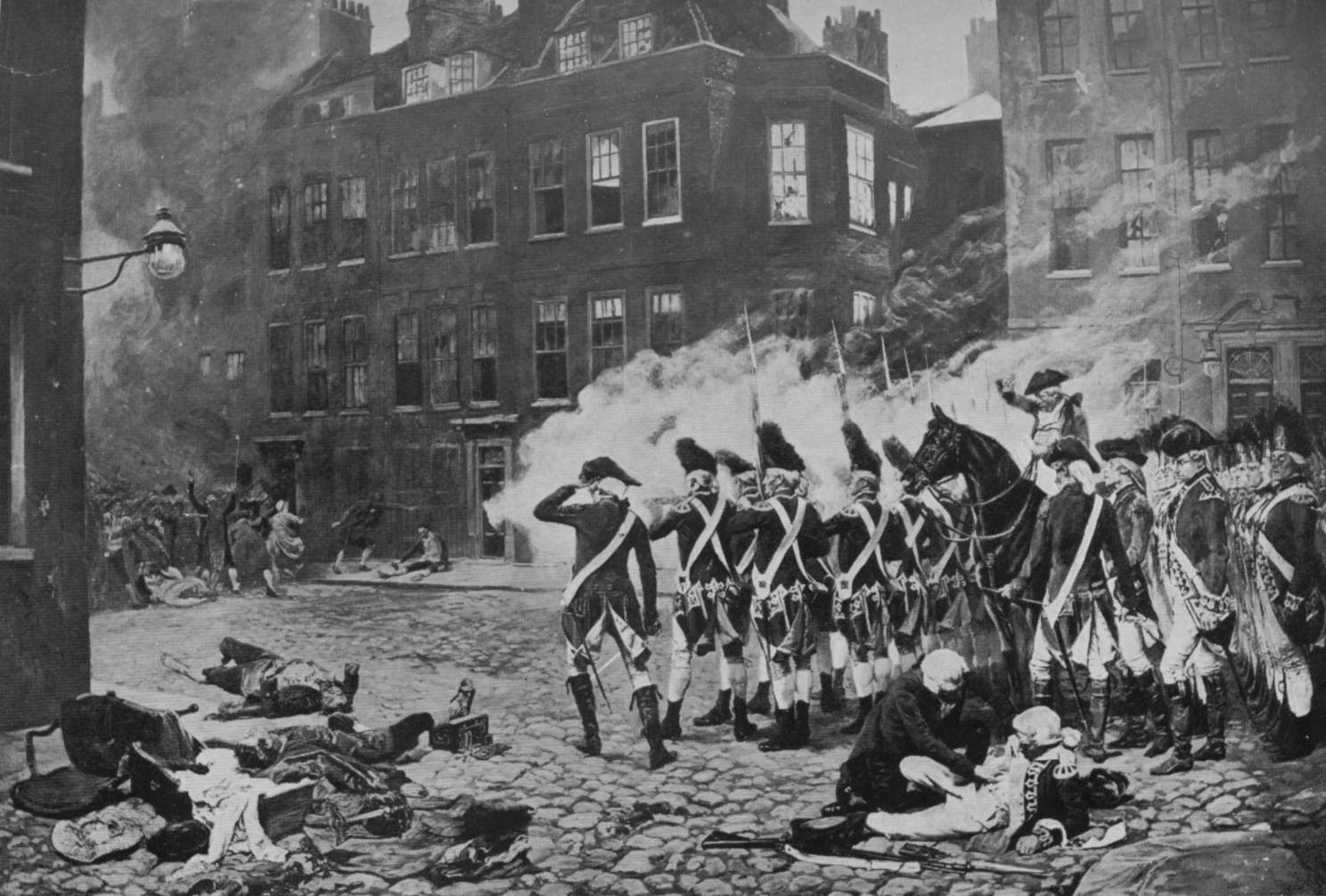 From the Painting by Seymour Lucas, R.A.
Cartwright followed with the multitude of political writers of his
time to deduce a right to vote, and his deduction is as worthless as the
rest of the a priori reasoning. But the brave old man—he was
tried for "sedition" at the age of eighty in the Government panic of
1820—was an entirely disinterested champion of the poor and a real
lover of liberty. He believed the affairs of government ought to be a
matter of common concern, and that they were quite within the capacities
of ordinary men. Cartwright's life—much more than his
writings—kept the democratic ideal unshaken in the handful of
"Radical Reformers" who survived the Tory reaction on the war with the
French Republic in 1793, and his glowing enthusiasm helped to kindle the
fire for political enfranchisement that was burning in the hearts of the
manufacturing population by 1818. But in 1777 the electorate was not
anxious for reform, and the unenfranchised gave no thought to their
political disabilities. On the very day in 1780 that the Duke of Richmond
proposed, in the House of Lords, a resolution in favour of manhood
suffrage and annual Parliaments, the London mob, stirred up by the
anti-Catholic fanaticism of Lord George Gordon, marched to Westminster
with a petition to repeal Savile's Act of 1778, which allowed Catholics
to bequeath land and to educate their own children. There was a riot, and
in the course of the next six days the mob burnt Newgate, sacked Catholic
chapels, and generally plundered and ravaged the City.
In the House of Commons Pitt made three attempts to get reform
considered—in 1782, 1783 and 1785—and on each occasion his
resolution was defeated by an overwhelming majority. After that Pitt made
no further effort for reform, and from 1793 to 1795 the Government he led
passed the Acts of repressive legislation which made all democratic
propaganda illegal, and crushed all political agitation.
But "the Cause" was not dead.
Sir Francis Burdett, M.P. for Westminster, Henry Hunt, better known as
"Orator Hunt," and Cobbett with his "Political Register," in various ways
renewed the campaign for manhood suffrage, and the growth of the
manufacturing districts made a change in the constitution of Parliament
imperative.
Burdett was sent to the Tower in 1810 for contempt of Parliament, but
lived to see the Reform Bill of 1831 passed into law, and died a Tory.
Cobbett spent two years in prison, and became M.P. for Oldham in 1832.
What Cobbett did with pen—and no man at that day wrote with greater
ability for the common people, or with greater acceptance—Hunt did
on the platform. Both strove to arouse the working class to demand
enfranchisement. Hunt presided at the mass meeting at Peterloo, by
Manchester, in 1819—an entirely peaceful meeting which was broken
up by the military with some loss of life—and was sent to prison
for two years for doing so. He also was elected M.P. (for Preston) in the
first reformed Parliament.
Again the Government tried coercion, and after Peterloo, for the next
few years, intimidation and numerous arrests kept down all outward
manifestation of the reform movement.
In spite of this, the movement could not be stayed. Each year saw
political indifference changed to positive desire for enfranchisement,
and the British public, which, in the main, had been left untouched by
the vision of a democracy and the call for a national convention and a
new constitution, became impatient for the reform of Parliament and the
representation of the manufacturing interest.
The name of Spence must be mentioned amongst those who preached the
democratic idea at the close of the eighteenth century. A Newcastle
schoolmaster, Spence, in 1775, expounded his "Plan" for land
nationalisation on the following lines:—
"The land, with all that appertains to it, is in every parish made the
property of the Corporation or parish, with as ample power to let,
repair, or alter all or any part thereof, as a lord of the manor enjoys
over his lands, houses, etc.; but the power of alienating the least
morsel, in any manner, from the parish, either at this or any time
thereafter, is denied. For it is solemnly agreed to, by the whole nation,
that a parish that shall either sell or give away any part of its landed
property shall be looked upon with as much horror and detestation as if
they had sold all their children to be slaves, or massacred them with
their own hands. Thus are there no more or other landlords in the whole
country than the parishes, and each of them is sovereign lord of its
territories.
"Then you may behold the rent which the people have paid into the
parish treasuries employed by each parish in paying the Parliament or
National Congress at any time grants; in maintaining and relieving its
own poor people out of work; in paying the necessary officers their
salaries; in building, repairing, and adorning its houses, bridges, and
other structures; in making and maintaining convenient and delightful
streets, highways, and passages both for foot and carriages; in making
and maintaining canals and other conveniences for trade and navigation;
in planting and taking in waste grounds; in providing and keeping up a
magazine of ammunition and all sorts of arms sufficient for all the
inhabitants in case of danger from enemies; in premiums for the
encouragement of agriculture, or anything else thought worthy of
encouragement; and, in a word, doing whatever the people think proper,
and not as formerly, to support and spread luxury, pride, and all manner
of vice."
No taxes of any kind were to be paid by native or foreigner "but the
aforesaid rent, which every person pays to the parish according to the
quantity, quality, and conveniences of the land, housing, etc., which he
occupies in it. The Government, poor, roads, etc., are all maintained by
the parishes with the rent, on which account all wares, manufactures,
allowable trade employments, or actions are entirely duty free."
The "Plan" ends with the usual confidence of the idealist reformer of
the time in the speedy triumph of right, and in the world-wide acceptance
of what seemed to its author so eminently reasonable a proposal.
"What makes this prospect yet more glowing is that after this empire
of right and reason is thus established it will stand for ever. Force and
corruption attempting its downfall shall equally be baffled, and all
other nations, struck with wonder and admiration at its happiness and
stability, shall follow the example; and thus the whole earth shall at
last be happy, and live like brethren."
The American War and the French Revolution hindered the consideration
of Spence's "empire of right and reason," but, in the course of nearly
forty years' advocacy of land nationalisation, Spence gathered round him
a band of disciples in London, and the Spenceans were a recognised body
of reformers in the early part of the nineteenth century. The attacks on
private property in land, and the revolutionary proposals for giving the
landlords notice to quit, brought down the wrath of the Government on
Spence, and he was constantly being arrested, fined and imprisoned for
"seditious libel," while his bookshop in Holborn was as frequently
ransacked by the authorities.
Spence died in 1814, and the movement for abolishing the landlords in
favour of common ownership languished and stopped. The interesting thing
about Spence's "Plan" is its anticipation of Henry George's propaganda
for a Single Tax on Land Values, and the extinction of all other methods
of raising national revenue, a propaganda that, in a modified form for
the taxation of land values, has already earned the approval of the House
of Commons.
Because we insist on the experimental character of our British
political progress, and the steady refusal to accept speculative ideas
and a priori deductions in politics, it does not follow that the
services of the idealist are to be unrecognised.
The work of the idealist, whether he is a writer or a man of
action—and sometimes, as in the case of Mazzini, he is
both—is to stir the souls of men and shake them out of sluggish
torpor, or rouse them from gross absorption in personal gain, and from
dull, self-satisfied complacency. He is the prophet, the agitator, the
pioneer, and after him follow the responsible statesmen, who rarely see
far ahead or venture on new paths. Once or twice in the world's history
the practical statesman is an idealist, as Abraham Lincoln was, but the
combination of qualities is unusual. The political idealist gets his
vision in solitary places, the democratic statesman gets his experience
of men by rubbing shoulders with the crowd.
A democratic nation must have its seers and prophets, lest it forget
its high calling to press forward, and so sink in the slough of contented
ease. The preacher of ideals is the architect of a nation's hopes and
desires, and the fulfilment of these hopes and desires will depend on the
wisdom of its political builders—the practical politicians. Often
enough the structural alterations are so extensive that the architect
does not recognise his plan; and that is probably as it should be; for it
is quite likely that the architect left out of account so simple a matter
as the staircase in his house beautiful, and the builder is bound to
adapt the plan to ordinary human needs.
The idealist has a faith in the future of his cause that exceeds the
average faith, and in his sure confidence fails to understand why his
neighbours will not follow at his call, or move more rapidly; and so he
fails as a practical leader.
Here the work of the statesman and politician comes in. They are
nearer to the mass of people, they hold their authority by election of
the people, and they understand that the rate of speed must be slow.
Under the guidance of their political leaders, the people are willing to
move.
Sometimes the idealist is frankly revolutionary, is for beginning anew
in politics, and starting society all over again. If the state of things
is bad enough, he may get into power, as he did in France at the
Revolution, and for a time the world will stagger at his doings. But
there is no beginning de novo in politics, and the revolutions
wrought by men who would give the world an entirely fresh start (to be
distinguished from mere changes of dynasty, such as our English
Revolution was) have their sandy foundations washed away by the floods of
reaction.
There is no such absolute escape from the past for men or nations, and
we can only build our new social and political order on the foundations
of experience. But we may not be moved to build at all but for the
prophet and the agitator, and therefore the instinct that makes
governments slay or imprison the political agitator and suppress the
writings of political prophets can be understood. For the existence of
every government is threatened by prophets and agitators, and in
self-defence it resists innovation. A healthy democracy will allow too
many opportunities for popular expression to fear innovation; yet even
under a democracy the prophets have been stoned—their sepulchres to
be subsequently erected by public subscription and handsomely
decorated.
Democracy owes too much to its prophets in the past not to rejoice at
their presence in its midst. But it will prudently leave the direction of
its public affairs to men who, less gifted it may be in finding new
paths, are more experienced in making the roads that others have
discovered fit for the heavy tread of multitudes.
The industrial revolution of the eighteenth century changed the face
of England and brought to the manufacturing class wealth and prominence.
The population of Lancashire was not more than 300,000 in 1760, the West
Riding of Yorkshire about 360,000, and the total population of England
6,000,000. The inventions of Arkwright, Hargreaves, Crompton, Watt, and
Cartwright revolutionised the cotton trade in the last twenty years of
the eighteenth century, and increased enormously the production of
woollen goods. England ceased to be mainly a nation of farmers and
merchants; domestic manufacture gave way to the factory system; the
labouring people, unable to make a living in the country, gathered into
the towns. The long series of Enclosure Acts—1760-1843—turned
seven million acres of common land into private property, and with this
change in agrarian conditions and the growth of population England ceased
to be a corn-exporting country, and became dependent on foreign nations
for its food supply.
While these industrial and agrarian changes meant a striking increase
in wealth and population, they were accompanied by untold misery to the
common people.
"Instead of the small master working in his own home with his one or
two apprentices and journeymen, the rich capitalist-employer with his
army of factory hands grew up. Many of these masters were rough,
illiterate and hard, though shrewd and far-seeing in business. The
workmen were forced to work for long hours in dark, dirty and unwholesome
workshops. The State did nothing to protect them; the masters only
thought of their profits; the national conscience was dead, and unjust
laws prevented them combining together in trade unions to help
themselves. Women and children were made to work as long and as hard as
the men. A regular system grew up of transporting pauper and destitute
children to weary factory work. There was no care for their health. There
were few churches and chapels, though the Methodists often did something
to prevent the people from falling back into heathendom. The workmen were
ignorant, brutal, poor and oppressed. There were no schools and plenty of
public houses. In hard times distress was widespread, and the workmen
naturally listened to agitators and fanatics, or took to violent means of
avenging their wrongs, for they had no constitutional means of redress.
Even the masters had no votes, as the new towns sent no members to
Parliament. The transfer of the balance of population and wealth from the
south and east to the north and Midlands made Parliamentary reform
necessary."
With this transfer of the balance of economic power came a good deal
of rivalry between the manufacturers and the landed gentry, the latter
becoming more and more Tory, the former more and more Radical. As all
political power, in the main, was in the landowner's hands, men anxious
to take part in politics eagerly bought up the small estates, and the old
yeoman class disappeared, except in out-of-the-way places. These yeomen
and small landowners had been the backbone of the Parliamentary Party in
the days of the Stuarts, but they were left hopelessly behind in an age
of mechanical inventions and agrarian changes, and were in most cases
glad to sell out and invest their property in other ways.
The story of the misery of rural depopulation in the first half of the
sixteenth century repeats itself at the close of the eighteenth.
"A single farmer held as one farm the lands that once formed fourteen
farms, bringing up respectably fourteen families. The capitalist farmer
came in like the capitalist employer. His gangs of poor and ignorant
labourers were the counterpart of the swarm of factory hands. The
business of farming was worked more scientifically, with better tools and
greater success; but after the middle of the eighteenth century the
condition of the agricultural labourer got no better, and now the great
mass of the rural population were mere labourers.... Pauperism became
more and more a pressing evil, especially after 1782, when Gilbert's
Act abolished the workhouse test (which compelled all who received
relief from the rates to go into the half-imprisonment of a poor-house),
and the system of poor law doles in aid of wages was encouraged by the
high prices at the end of the century. In 1803 one-seventh of the people
was in receipt of poor law relief."
But with all the considerable distress, in town and country alike
amongst the working people, at the beginning of the nineteenth century,
swift progress was taking place in agriculture and in manufactures. Only,
the accumulated wealth fell into fewer hands, and the fluctuations in the
demand for goods, caused partly by the opening up of new markets, brought
successions of good times and bad times. "The workmen shared but
partially in the prosperity, and were the first to bear the brunt of hard
times."
The point for us to note here is that the changed economic conditions
made Parliamentary reform a necessity, and brought the question of
popular enfranchisement within sight. It was useless for Burke to
maintain the incomparable beauty of the British constitution; English
politicians might be indifferent to political theories of democracy, and
heartily dislike any notion of radical change, but the abuses were too
obvious to prevent reform.
Whatever the size of the county it returned two members elected by
freeholders, and the cost of a county election was enormous. Some of the
boroughs, especially in Cornwall, were tiny villages. Eighteen members
were returned from such boroughs in that part of Cornwall which now
returns one member for the Liskeard Division. The fields of Old Sarum
belonged to seven electors and returned two members. As there was no
habitation whatever in this "borough" of Old Sarum, a tent was put up for
the convenience of the returning officer at election times. No general
law decided the borough franchise. Local custom and various political and
personal considerations settled who should vote for members of
Parliament. Places like Westminster and Preston had practically manhood
suffrage. In most of the "corporation boroughs" the franchise was
restricted exclusively to freemen of the borough, and to the self-elected
non-resident persons who composed the governing body before the Municipal
Corporation Act of 1835. A small number of rich and powerful men really
worked nearly all the elections. Seats were openly bought and sold, and a
candidate had either to find a patron who would provide him with a seat,
or, failing a patron, to purchase a seat himself. Fox first entered
Parliament for the pocket borough of Midhurst, and Sir George Trevelyan
has described how it took place. Midhurst was selected by the father of
Charles James Fox as "the most comfortable of constituencies from the
point of view of a representative; for the right of election rested in a
few small holdings, on which no human being resided, distinguished among
the pastures and the stubble that surrounded them by a large stone set up
on end in the middle of each portion. These burbage tenures, as they were
called, had all been bought up by a single proprietor, Viscount Montagu,
who when an election was in prospect, assigned a few of them to his
servants, with instructions to nominate the members and then make back
the property to their employer. This ceremony was performed in March,
1768, and the steward of the estate, who acted as the returning officer,
declared that Charles James Fox had been duly chosen as one of the
burgesses for Midhurst, at a time when that young gentleman was still
amusing himself in Italy."
Three years earlier Burke had entered Parliament as a nominee of Lord
Rockingham's. Gibbon sat in the House for some years under patronage.
Gladstone first became a member by presentation to a pocket borough, and
later spoke in praise of this method of bringing young men of promise
into Parliament. John Wilson Croker estimated that of six hundred and
fifty-eight members of the House of Commons at the end of the eighteenth
century, two hundred and seventy-six were returned by patrons. Men of
more independence of mind who could afford to buy seats did so, and many
of the reformers—including Burdett, Romilly and Hume—thus sat
in the House.
It was not so much that the landowning aristocracy were
over-represented in Parliament by their control of so many pocket
boroughs, as that great manufacturing centres were entirely
unrepresented. The middle-class manufacturers had no means of making
their influence felt in the unreformed House of Commons, for towns of
such importance as Leeds, Manchester and Birmingham sent no
representatives to Parliament. This meant that Parliament was out of
touch with all the industrial life of the nation, and that nothing was
done till after the Reform Act in the way of serious industrial
legislation.
35 constituencies with hardly any voters at all returned       75 members
46 constituencies with less than 50 voters in each returned    90    "
19 constituencies with less than 100 voters in each returned   37    "
26 constituencies with less than 200 voters in each returned   52    "
84 male electors in other constituencies returned             157    "
The Reform Act of 1832 changed all this. It disfranchised all boroughs
with less than 2,000 inhabitants—fifty-six in all; allowed one
member only to boroughs with between 2,000 and 4,000; gave
representatives to Manchester, Birmingham, Leeds, and to several other
large manufacturing towns and London boroughs; extended the county
franchise to leaseholders and £50 tenants at will; and settled the
borough franchise on a uniform qualification of occupation in a house of
£10 rateable value. It also fixed two days, instead of fifteen, as the
limit for county elections, and one day for boroughs.
The Reform Bill was not carried without much rioting in the country,
and some loss of life.
The Duke of Wellington was at the head of the Tory Ministry in 1830;
and though he declared in face of an Opposition that was headed by the
Whig aristocrats, and included the middle-class manufacturers and the
great bulk of the working class in the industrial districts of
Lancashire, Yorkshire and the Midlands, that "no better system (of
Parliamentary representation) could be devised by the wit of man" than
the unreformed House of Commons, and that he would never bring forward a
reform measure himself, and should always feel it his duty to resist such
measure when proposed by others, yet, in less than two years after this
speech Wellington's resistance had ended, and the Reform Bill was carried
into law.
What happened in those two years was this: At the general election in
the summer of 1831, the popular cry was "the Bill, the whole Bill, and
nothing but the Bill."
"The whole countless multitude of reformers had laid hold of the
principle that the most secure and the shortest way of obtaining what
they wanted was to obtain representation. The non-electors felt
themselves called upon to put forth such power as they had as a means to
obtaining the power which they claimed." And the non-electors were
enormously successful. For they "combined their will, their knowledge,
and their manifest force in political unions, whence they sent forth
will, knowledge, and influence over wide districts of the land. And the
electors, seeing the importance of the crisis—the unspeakable
importance that it should be well conducted—joined these
unions."
The Reformers carried the day at the elections, and the new House of
Commons passed the second reading of the Bill on July 8th, by 136:
367-231. On September 21st the third reading passed by 345 to 236. Then
on the 8th of October the House of Lords threw out the Bill by 199 to
158, and at once fierce riots broke out all over the country, in especial
at Derby, Nottingham, and Bristol.
At Derby the jail was stormed. At Nottingham the castle was burned,
and of nine men subsequently convicted of riot, three were hanged. At
Bristol, the jail, the Mansion House, the Customs House, the Excise
Office, and the Bishop's Palace were burned, and twelve lives were lost
in three days.
The new session opened in December, and again the Bill was introduced,
and this time the second reading had a majority of 162: 324-162. The
House of Lords hesitated when the Bill came up to them at the end of
March, 1832; allowed the second reading to pass by 184 to 175, and then
in Committee struck out those clauses which disfranchised the "rotten"
boroughs—uninhabited constituencies like Old Sarum. Grey, the Whig
Prime Minister, at once resigned, and the Duke of Wellington endeavoured
to form a Tory anti-reform Ministry. But the task was beyond him, the
temper of the country was impatient of any further postponement of the
Bill. Petitions poured in urging Parliament to vote no supplies, and
resolutions were passed refusing to pay taxes till the Bill became
law.
On Wellington's failure to make a Government, William IV. had to
recall Grey, and the Whigs resumed office with an assurance that, if
necessary, the King would create sufficient peers favourable to reform,
so that the Bill should pass.
The battle was over, the anti-Reformers retired, and on June 4th,
1832, the Reform Bill passed the Lords by 106 to 22, receiving the Royal
Assent three days later.
The Whigs protested that the Reform Bill was a final measure,
and Sir Francis Burdett, the veteran reformer, was content to vote with
the Tories when the Act had become law. But there is no finality in
politics, and the Reform Bill was only the removal of a barrier on the
road to democracy. The Tories described the Bill as revolutionary, but as
a matter of fact the Act of 1832 neither fulfilled the hopes of its
friends nor the fears of its foes. What the Act did was to transfer the
balance of power from the landed aristocracy, which had been in the main
predominant since 1688, to the richer members of the middle
class—the big farmers in the country, the prosperous shopkeepers in
the towns. The working class was still voteless, and the old democratic
franchise of Preston and Westminster was gone from those boroughs.
The first reformed Parliament met early in 1833, and the change in the
character of the House of Commons was seen at once. Government accepted
responsibility for legislation in a way that had never been known before.
The New Poor Law, 1834, and the new Municipal Corporations Act, 1835,
were the beginning of our present system of local government. Slavery was
abolished in all British Colonies in 1833.
Greville, in his Memoirs, gives us an impression of the new regime in
Parliament as it appeared to one who belonged to the old dethroned
aristocracy.
"The first thing that strikes one is its inferiority to preceding
Houses of Commons, and the presumption, impertinence, and
self-sufficiency of the new members.... There exists no party but
that of the Government; the Irish act in a body under O'Connell to the
number of about forty; the Radicals are scattered up and down without a
leader, numerous, restless, turbulent, bold, and active; the Tories,
without a head, frightened, angry, and sulky."
But the working classes were the really disappointed people in the
country. They had worked for the reformers, and their energies—and
their violence—had been the driving force that had carried the Bill
into law. If their expectations were extravagant and their hopes
over-heated, the more bitter was their distress at the failure of the
Reform Act to accomplish the social improvements that had been
predicted.
So the working class in despair of help from the Government, decided
to get the franchise for themselves, and for twelve years, 1838-1850,
Chartism was the great popular movement. The Five Points of the
People's Charter were proclaimed in 1838: (1) Universal Suffrage; (2)
Vote by Ballot; (3) Annual Parliaments; (4) Abolition of Property
Qualification for Members of Parliament; (5) Payment of Members. A Sixth
Point—Equal Electoral Districts—was left out in the National
Petition.
Although the Chartist demands were political, it was the social misery
of the time that drove men and women into the Chartist movement. The
wretchedness of their lot—its hopeless outlook, and the horrible
housing conditions in the big towns—these things seemed intolerable
to the more intelligent of the working people, and thousands flocked to
the monster Chartist demonstrations, and found comfort in the orations of
Feargus O'Connor, Bronterre O'Brien, and Ernest Jones.
The Charter promised political enfranchisement to the labouring
people, and once enfranchised they could work out by legislation their
own social salvation. So it seemed in the 'Forties—when one in
every eleven of the industrial population was a pauper.
Stephens, a "hot-headed" Chartist preacher, put the case as he, a
typical agitator of the day, saw it in 1839: "The principle of the
People's Charter is the right of every man to have his home, his hearth,
and his happiness. The question of universal suffrage is, after all, a
knife-and-fork question. It means that every workman has a right to have
a good hat and coat, a good roof, a good dinner, no more work than will
keep him in health, and as much wages as will keep him in plenty."
The lot of the labourer and the artisan was found to be worse than it
was in the earlier years of the nineteenth century, before the great
Reform Act had been passed. And while the Anti-Corn Law
League, the Socialist propaganda of Robert Owen, and the agitation for
factory legislation, all promised help and attracted large numbers of
workmen, the Chartist movement was by far the strongest and most
revolutionary of all the post-reform popular agitations. Chartism went to
pieces because the leaders could not work together, and were, in fact,
greatly divided as to the methods and objects of the movement. By 1848
Bronterre O'Brien had retired from the Chartist ranks, Feargus O'Connor
was M.P. for Nottingham—to be led away from the House of Commons
hopelessly insane, to die in 1855—and Ernest Jones could only say
when the Chartist Convention broke up in hopeless disagreement, "amid the
desertion of friends, and the invasion of enemies, the fusee has been
trampled out, and elements of our energy are scattered to the winds of
heaven."
In spite of its failure, Chartism kept alive for many years the desire
for political enfranchisement in the labouring classes. That desire never
died out. Although Palmerston, the "Tory chief of a Radical
Cabinet"—so Disraeli accurately enough described him—was
Prime Minister from 1855 to 1865 (with one short interval), and during
that period gave no encouragement to political reform, the opinion in the
country grew steadily in favour of working-class enfranchisement.
Palmerston's very inactivity drove Liberals and the younger Conservatives
to look to the working classes for support for the measures that were
planned. The middle class was satisfied that the artisans could be
admitted to the franchise without danger to the Constitution.
Palmerston's death in 1865 left the Liberal Party to Earl Russell's
premiership, with Gladstone as its leader in the Commons. Reform was now
inevitable.
The Bill as first introduced in 1866 was a moderate measure, making a
£7 rental the qualification for a vote in the boroughs. It was too
moderate to provoke any enthusiasm, and it was hateful to the old
Palmerstonian Whigs and most of the Conservatives, who objected to any
enfranchisement of the working class. By a combination of these opponents
the Bill was defeated, the Liberals retired from office, and a
Conservative ministry under Lord Derby, with Disraeli leading the House
of Commons, was formed.
It was seen quickly that there was a very real demand for the
enfranchisement of the town workman—the agricultural districts
remained unawakened—and Reform Leagues and Reform Unions sprang up
as they had done in 1831. Then in London came the incident of the Hyde
Park railings, which gave a distinct impetus to the Reform movement. What
happened at Hyde Park was this: the London Reform Union decided to hold a
monster demonstration in Hyde Park on July 23rd, but the Chief
Commissioner of Police had declared the meeting must not take place, and
ordered the gates to be closed at five o'clock. Mr. Edmund Beales, and
other leaders of the London Reform Union, on being refused admittance,
drove away calmly to hold a meeting in Trafalgar Square, but the great
mass of people remained outside the park, "pressed and pressing round the
railings." Some were clinging to the railings; others deliberately
weakened the supports of the railings. Park Lane was thronged, and all
along the Bayswater Road there was a dense crowd. The line was too long
for the police to defend, and presently, when the railings yielded to the
pressure, the people poured in to the park.
"There was a simultaneous, impulsive rush, and some yards of railing
were down, and men in scores were tumbling and floundering and rushing
over them. The example was followed along Park Lane, and in a moment half
a mile of iron railings was lying on the grass, and a tumultuous and
delighted mob was swarming over the park. The news ran wildly through the
town. Some thought it a revolt; others were of opinion it was a
revolution. The first day of liberty was proclaimed here—the
breaking loose of anarchy was shrieked at there. The mob capered and
jumped over the sward for half the night through. Flower beds and shrubs
suffered a good deal, not so much from wanton destruction, as from the
pure boisterousness which came of an unexpected opportunity for
horseplay. There were a good many little encounters with the police;
stones were thrown on the one side, and truncheons used on the other
pretty freely. A few heads were broken on both sides, and a few prisoners
were made by the police; but there was no revolution, no revolt, no
serious riot even."
The Guards were called out, and a detachment arrived at the park, but
the people only cheered the soldiers good-humouredly. Not even a blank
cartridge was fired that day.
The Government, however, took the Hyde Park disturbance with extreme
seriousness. "Nothing can well be more certain than the fact that the
Hyde Park riot, as it was called, convinced Her Majesty's ministers of
the necessity of an immediate adoption of the reform principle." Disraeli, who
in 1859 had proposed reform without getting any support, now saw that a
great opportunity had come for a constructive Conservative policy, and
boldly insisted to his party that Parliamentary Reform was a necessity.
"You cannot establish a party of mere resistance to change, for change is
inevitable in a progressive country," he told his followers.
All through the autumn and winter great demonstrations took place in
the large towns and cities of the country in support of the demand for
the enfranchisement of the workman, and when Parliament met in February,
1867, a Reform Bill was promised in the Queen's Speech. To Lord Derby the
measure was frankly a "leap in the dark," and one or two Conservative
ministers (including Cranborne, afterwards Lord Salisbury) left the
Government in disgust. But the Conservatives generally chuckled at
"dishing the Whigs," and the Bill, with considerable revision, was passed
through both Houses of Parliament by August.
By the Reform Bill of 1867 all male householders in boroughs were
enfranchised, and all male lodgers who paid £10 a year for unfurnished
rooms. The town workman was enfranchised by this Act as the middle-class
man had been enfranchised by the Act of 1832, and the electorate was
increased from about 100,000 to 2,000,000. An amendment that women should
not be excluded from the franchise was moved by John Stuart Mill, and
defeated. Some redistribution of seats took place under the Act of 1867,
eleven boroughs were disfranchised, thirty-five with less than 10,000
inhabitants were made single-member constituencies, and additional
representation was given to Chelsea, Hackney, Leeds, Liverpool,
Manchester, Salford, Glasgow, Birmingham, Dundee, and Merthyr. "Thus was
Household Suffrage brought in in the boroughs, and a great step
was made towards democracy, for it was plain that the middle-class county
constituencies could not last very much longer now that all workmen who
happened to live in boroughs had their votes."
The third Reform Act, giving household suffrage to the country
districts, was passed by Gladstone in 1884, and it was followed by a
Redistribution of Seats Act in 1885. By these two Acts the agricultural
labourer was enfranchised, a service franchise was created for those who
were qualified neither as householders nor lodgers, and the principle of
single-member equal electoral districts—on a basis of 54,000
inhabitants—was adopted. Only twenty-three boroughs, the City of
London and the Universities of Oxford, Cambridge, and Dublin, retained
double-member representation. The membership of the House of Commons was
increased from six hundred and fifty-eight to six hundred and seventy,
the present total; and the franchise remains as it was fixed in
1885—occupation and ownership giving the right to vote.
From time to time, for more than a hundred years, a plea has been put
forward for universal or adult suffrage for men on the ground of an
abstract right to vote, but it has met with little encouragement. There is,
however, a wide feeling in favour of simplifying the registration laws,
so that a three-months' residence, instead of, as at present, a year's
residence from one July to the next, should be sufficient to qualify for
the franchise. There is also a strong demand for "one man, one vote." At
present, while no elector may give more than one vote in any
constituency, he may, if he has property in various places, give a vote
in each of these districts, and some men thus give as many as a dozen
votes at a general election. This plural voting by property and
residential qualifications in different constituencies is not customary
in other constitutional countries, and a Bill for its abolition passed
the House of Commons in 1906, but was rejected by the Lords.
While Liberals urge "one man, one vote" as the more democratic
arrangement, Conservatives reply by asking for "one vote, one
value"—that is, a new redistribution of seats, for in the last
twenty-five years there have been deep and extensive changes in the
distribution of populations, and Ireland in particular is
over-represented, it is maintained. But then the representation of
Ireland in the House of Commons was really guaranteed by the Act of
Union, 1800.
With the extension of the franchise the change in the personnel
of the House of Commons has become marked. The more wealthy of the middle
class entered in considerable numbers after 1832; the Acts of 1867 and
1884 made the entry of the workman inevitable. The miners were the first
to send Labour representatives to Parliament, and to-day their members
outnumber those of any other trade. Since 1892 industrial constituencies,
chiefly in Yorkshire, Lancashire, South Wales, and the mining districts,
have gone on steadily electing and re-electing working-class
representatives—trade union secretaries and officers for the most
part—and with the formation of a National Labour Representation
Committee in 1900, these representatives became a separate and distinct
party—the Labour Party after 1906—in the House of
Commons.
Enfranchisement to secure representation for the redress of grievances
has been the principle that has guided the English people towards
democracy. Both the middle class and the working class were convinced
that enfranchisement was necessary if the House of Commons was to be in
any real sense a representative assembly, and both have used
enfranchisement for obtaining representation in Parliament. The return of
forty Labour Members at recent general elections is evidence that a large
electorate supports the Labour Party in its desire to carry in Parliament
legislation that will make life a better thing for the labourer and his
family; and in the House of Commons the Labour Members have won a general
respect. As a matter of fact, the House of Commons to-day is in every way
a more orderly, a more intelligent, more business-like, and
better-mannered assembly than it was in the days before 1832.
No stronger evidence of the value of Parliamentary representation to
the working-class can be offered than the large output of what may be
called labour legislation in recent years. It is true that Lord
Shaftesbury's benevolent and entirely disinterested activities promoted
Factory Acts in the first half of the nineteenth century, but in the last
twenty years measures for the amelioration of the lot of the workman have
been constantly before Parliament.
The nineteenth century was not only the century of popular
enfranchisement; it was the century that saw the removal of religious
disabilities, and the free admission to Parliament and to the Government
of Roman Catholics, Nonconformists, Jews, and Freethinkers.
In the year 1800 Roman Catholics in England were excluded from
Parliament, from the franchise, from the magistracy, the Bar, the Civil
Service, from municipal corporations, and from commissions in the Army
and Navy. Pitt was willing to abolish these disabilities on the passing
of the Act of Union, and the Irish people were bitterly disappointed that
the disabilities remained. But George III. refused all assent to the
proposals, and Pitt resigned. Several times the House of Commons passed
Catholic Relief Bills, which were thrown out by the Lords, and it was not
till 1829, when "the English ministry had to choose between concession
and civil war," that Peel and the Duke of Wellington yielded and
persuaded their party to admit Catholics to Parliament and to the Civil
and Military Services.
The repeal of the Penal Laws against Roman Catholics—Acts of
Elizabeth that inflicted penalties on priests who said mass in England,
and on Roman Catholics who attended mass—took place in 1844, and in
1866 the Parliamentary Oath was amended and made unobjectionable to Roman
Catholics.
A Roman Catholic is still excluded by law from the Crown, the Lord
Chancellorship, and the Lord Lieutenancy of Ireland, but many Roman
Catholics are members of Parliament—members of all
parties—and the late Lord Ripon, a Catholic, sat in a Liberal
Cabinet.
In 1846 Rothschild was elected as a Liberal M.P. for the City of
London, but the law did not permit him to take his seat. Then for some
years Jewish M.P.'s were allowed to take part in debates and sit on
committees, but were not allowed to vote. Finally, in 1858, the Lords,
after rejecting the measure for ten years, passed the Jews' Disabilities
Bill, which removed all restriction. The Right Hon. Herbert Samuel, M.P.,
is the first Jew to sit in the Cabinet, for though Disraeli was of the
Jewish race, he was a Christian in belief.
Although in 1800 various Acts on the Statute Book required
Nonconformists to subscribe to the religion of the Church of England
before taking part in municipal affairs, these Acts had long been a dead
letter. All that was done in the nineteenth century was to repeal these
Acts, and to throw open the universities and public offices to
Nonconformists. It is only, however, in recent years that Nonconformists
have filled posts of high importance in the Cabinet.
The last attempt at restriction on the religious beliefs of members of
Parliament was made in the House of Commons itself, when Charles
Bradlaugh, after being duly elected M.P. for Northampton, was by the
action of the House excluded from his seat. Bradlaugh was a frank
disbeliever in Christianity, and the House of Commons refused to allow
him either to take the oath or make an affirmation. For five years
(1880-5) the struggle lasted—a Liberal Government being in power
all the time—and three times during that period the electors of
Northampton triumphantly returned Charles Bradlaugh as their member, only
to be answered by resolutions of refusal and expulsion passed by the
House of Commons against their representative. It was a repetition of the
battle Wilkes had fought one hundred and twenty years earlier, and it
ended in the same way. A new Parliament assembled in January, 1886 (after
a general election in November), the new Speaker (Mr. Peel) permitted
Bradlaugh to take the oath in the usual way, declined to allow any
interference, and the battle was over. Two years later a general
Affirmation Bill was carried on the motion of Bradlaugh, and became law.
When Charles Bradlaugh lay dying in January, 1891, the House of Commons
passed, without dissent, a resolution expunging from the journals of the
House the old resolutions of exclusion.
The nineteenth century then will always be noted as the era of steady
advance towards democracy, especially in England. Enfranchisement of the
workman, and his representation in Parliament, have transferred the
government of the country from an aristocracy to the middle class and the
working class, for to-day, alike in Parliament and in the permanent Civil
Service, men of the middle class predominate, assisted by those who
served apprenticeship in mine or workshop. The removal of religious
disabilities has ended the old rule that confined the business of the
legislature and the administration of justice to members of the
Established Church of England, and Roman Catholics, Jews, Nonconformists,
and Freethinkers now take their share in all public work.
One disability only remains—the sex disability that denies the
parliamentary franchise to women. In the middle ages women were excused
from parliamentary attendance, but there was no notion that their powers
and privileges as landowners were shortened because, on account of their
sex, they were granted exemption from Parliament and from juries. In 1868
a test case—Chorlton v. Lings—was brought, and the
judges decided that women householders were not to be registered as
electors, and it was left to Parliament to pass a Women's Enfranchisement
Bill. From the time of John Stuart Mill's advocacy in 1867 there have
always been supporters of Women's Suffrage in the House of Commons, and
in the last five years these supporters have been growing in numbers.
Only the refusal of the Government to give time for the discussion of the
Bill in Committee has prevented a Woman's Enfranchisement measure, which
on several occasions has received a second reading, from passing the
House of Commons; and the announcement by the present (1911) Government
that full facilities for such discussion are to be granted next year
(1912) would indicate that the removal of political sex disabilities is
close at hand. Women are not asking for adult suffrage, but are willing
to receive enfranchisement on the terms that qualify men as electors, and
the Conciliation Bill, as it is called—because members of every
political party have agreed to make it their Bill—would place on
the roll of electors rather more than a million of women voters.
Meantime, while waiting for the removal of the anti-democratic barrier
that excludes them from full political citizenship, women are admitted in
the United Kingdom to an equal share with men in all local government.
Since 1869 women who are householders have enjoyed the municipal
franchise, and as Poor Law guardians and members of school boards, they
have been freely elected to sit side by side with men. In 1907 women were
declared eligible by Parliament for membership on county and borough
councils, and for the chairmanship of county councils and the mayoralty
of boroughs. Since this Act was passed we have seen women elected to the
councils of great cities—Manchester and Liverpool, for
instance—and chosen as mayors in several towns. No political
movement in recent years has been of greater public interest or
importance than the agitation for "Votes for Women." The demand for
enfranchisement is based on the old constitutional ground of the
Parliamentarians of the seventeenth century—that those who are
directly taxed by Government must have some political control of the
public expenditure—and it is supported by the present leader of the
Conservative Party on the ground that government can
only be carried on in England by consent of the governed.
The demand for the parliamentary franchise is with us the expression
of that deep dissatisfaction at the unequal relations of the sexes that
is felt by many men, and by far more women, all over the civilised world.
As the middle-class man and the workmen of Great Britain were sure that
they could not get from Parliament an understanding of popular
grievances, still less fair treatment, until they possessed the right to
choose their own parliamentary representatives, so women are convinced
that there can be no adequate adjustment of these unequal relations until
they too enjoy the same privilege of citizenship; for enfranchisement and
representation are the two chosen instruments of democratic government in
our day.
To-day in Great Britain, in America, in the self-governing colonies,
and in many European countries, we can sec the principles of democracy in
working order.
The whole system of local government in Great Britain and Ireland is
essentially democratic. The municipal councils of all the large cities
are elected on household suffrage, and have enormous powers. There is now
no sex disability to prevent the election of women to these bodies, and,
except in the case of the clergy of the Established Church, who are
disqualified from sitting on town councils (but not on county or district
councils), all ratepayers are eligible for nomination. The result is that
on nearly every city council, and on a great number of county councils,
London borough councils, urban and rural district councils, boards of
guardians, and parish councils, there are working-class representatives,
while women members have been elected to the great councils of Liverpool
and Manchester, and sit on many boards of guardians and parish
councils.
All these councils are of recent creation. The Municipal Corporations
Act of 1835 placed the election of town councils for the first time in
the hands of the ratepayers, but the real reform of local government
dates from 1888. In that year the Conservative Government established
county and district councils and Lord Rosebery became the first chairman
of the London County Council. Six years later the Liberals set up parish
councils in the rural districts, with parish meetings where the
population did not exceed three hundred. In 1899 the Conservatives
displaced the old London vestries by borough councils, and in 1902-3
abolished in England the school boards created in 1870, and made the
county council the local authority for public elementary education.
Scotland was allowed to retain its school boards, and strong but
unsuccessful opposition was made in London and the chief cities to the
suppression of the specially elected education authority.
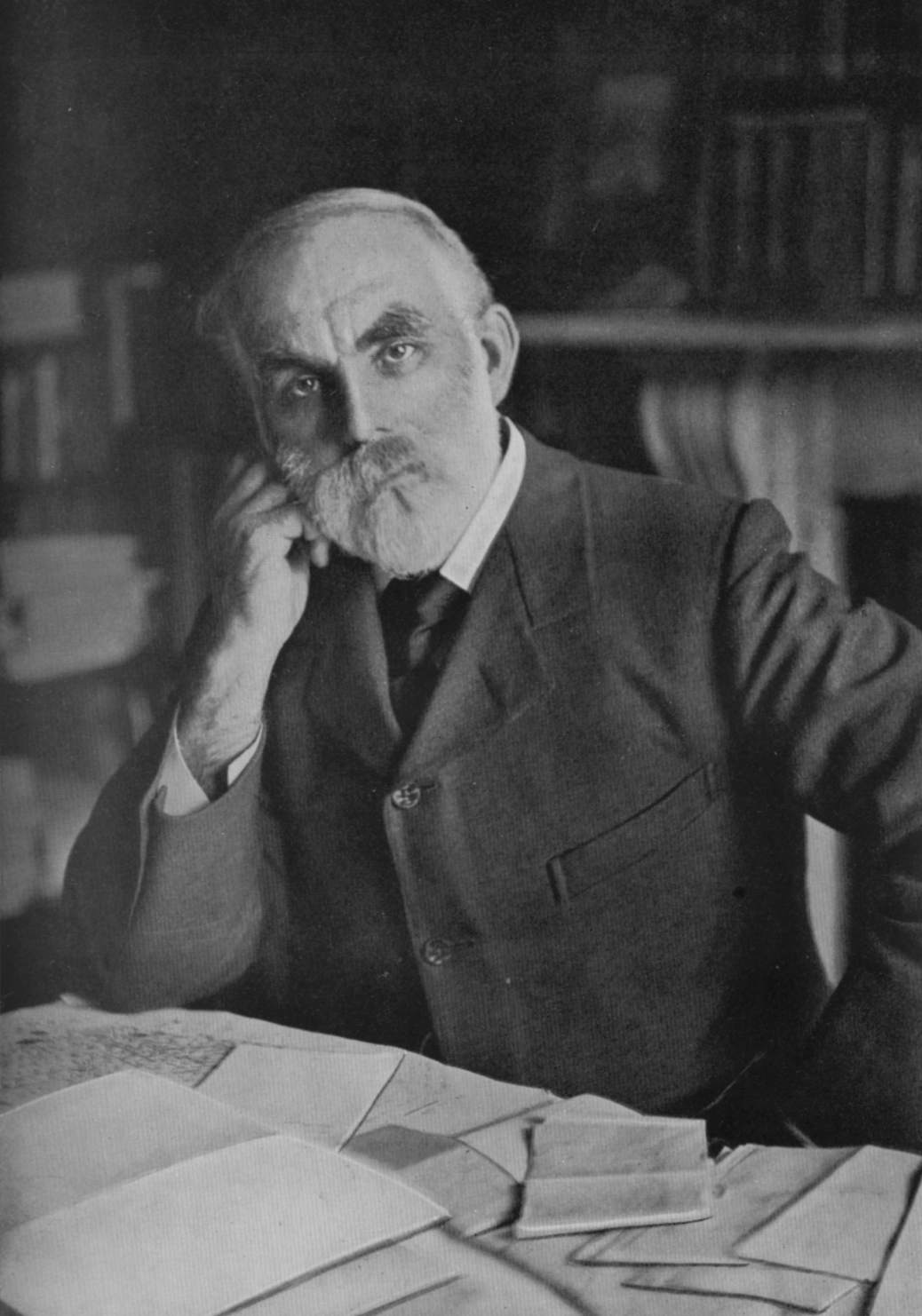 Photo: Moyse, Putney.
As far as rural England is concerned, county councils, district
councils, and parish councils are, generally speaking, very reluctant to
put into operation the wide powers they possess. The average county
council, though popularly elected, is composed in agricultural England of
landowners and the bigger farmers, who, as a common rule, do not favour a
land programme for labourers, and are anxious to keep down the rates. The
rural district council and board of guardians are equally averse from any
display of public enterprise, and the parish council, which often
consists mainly of labourers, rarely accomplishes anything except at the
prompting, or with the sanction, of the parochial landowner. The result
is that allotments, rural housing, village baths and washhouses, an
adequate water supply, public halls and libraries, are not regarded as
the concern of rural elected authorities, but are left to the private
enterprise of landowners. Civic pride, which glories in the public
proprietorship of lands and libraries, tramways and lodging-houses,
waterworks and workmen's dwellings, art galleries and swimming baths, and
is a living influence in the municipalities of, let us say, London,
Glasgow, Liverpool, Leeds, Bradford, Manchester, Birmingham, West Ham,
and many a smaller borough, does not exist in rural councils. To the
farmer and the peasant public ownership is a new and alien thing. The
common lands and all the old village communal life have gone out of the
memory of rural England; but the feudal tradition that the landowner is
the real centre of authority has survived, and it is the benevolent
landowner who is expected to build cottages, grant allotments, and see to
the water supply, as fifty years ago he built and managed the village
school. Political organisation could break through this tradition, but
farmers and agricultural labourers are without this organisation; and so
the authority of the landowner remains, in spite of the democratic
constitution of local government. The people can allow their power to
remain in the hands of others, just as a king can be content to reign
without ruling, and the local government of rural England is an oligarchy
elected by a popular franchise.
In the factory towns and the mining districts it is a very different
matter. Here the people are organised, and take their share in local
government. In the county of Durham, for instance, the working class
predominates on local councils, and the influence of trade unions
prevails in these assemblies wherever a strong Labour party exists. Mr.
Joseph Chamberlain began his public career on the Birmingham Town
Council, and his municipal services earned for him the enthusiastic
support of Birmingham for all his later political ventures. It would be
difficult to mention the name of a great statesman who laid the
foundations of his fame in rural local government.
As in local government, so in the Imperial Parliament. Rural England
sends no Labour member to the House of Commons. Only in very exceptional
cases has a tenant farmer been elected. It is the social labour of the
mine and the mill that has produced the Labour member of Parliament.
Mr. Joseph Arch made a valiant attempt to organise the agricultural
labourers of England, and from 1880 to 1890 a rural labourers' union,
with some thousands of members, was in existence. For a time this secured
a rise in wages, and when Mr. Arch was in Parliament, as a Liberal M.P.
(1885-1895), the rural labourer hoped for lasting improvement in the
conditions of life. But the Union fell to pieces, and Mr. Arch was not
strong enough single-handed to force the claims of his constituents on
the House of Commons.
To-day there are more than forty workmen in the House of Commons, and
the great majority of these have served an apprenticeship in municipal
and trade union offices. Northumberland, Durham, Yorkshire, Lancashire,
Stafford, South Wales, Glasgow, Dundee, Leicester, Norwich and London,
all have their elected Labour members in Parliament, and a marked
preference is shown for the man who has proved his honesty and capacity
in the municipality, or as the leader of his trade union. All the miners'
representatives are tried and experienced men. Mr. G.N. Barnes, M.P., was
for ten years the general secretary of the Amalgamated Society of
Engineers. Mr. Clynes, M.P., was elected to the office of district
secretary of the Gas Workers' and General Labourers' Union twenty years
ago; Mr. Will Thorne, M.P., has been general secretary of the same union
since 1889, and has sat on the West Ham Corporation for more than sixteen
years. Mr. George Lansbury, M.P., and Mr. Will Crooks, M.P., are well
known for their work on the London County Council and on their local
borough council and board of guardians. Similarly with other Labour
members of Parliament. Their lives are marked by a sense of public
responsibility, with the result that in the House of Commons they are
grave, business-like, and undemonstrative. The Labour members do not make
"scenes"; they respect the rules of the House and the dignity of the
National Assembly, partly because they are all in sober middle age, but
more because they have learnt that public business can only be carried on
by due observance of order; and they are in Parliament to get business
done for their constituents, to promote legislation that will make life
easier for the working class. When Mr. Victor Grayson, in the exuberance
of youth, and with a passion that blazed out against the misery of the
poor, made a "scene" in the House of Commons, and was expelled, the
Labour members were quite sincere in their disapproval. They understood,
with a wider knowledge than Mr. Grayson possessed, that "scenes"
alienated sympathy in the House, were not helpful in debate, and were not
popular with the electors.
The member who would succeed in the House of Commons must respect the
usages of the House, and show himself loyal to its laws of debate. As
long as this respect and loyalty are shown the Labour member is accepted
by his fellow-members as one who has been elected to the greatest club in
the world, and is justly entitled to all the privileges of membership.
For the British House of Commons is a democratic assembly, and in its
collective pride it cares nothing for the opinions or social rank of its
members. All it asks is that the newly-elected member should be alive to
the honour of membership, should be modest in his bearing, and should as
soon as possible "catch the tone of the House." He may be a labourer, or
the son of a belted earl; the House is indifferent so long as his
parliamentary manners are good.
The House of Commons is a far more orderly assembly than it was a
hundred years ago; it is more sober and less noisy, and the arrival of
Labour members has increased rather than diminished its good behaviour.
It is also a far more industrious assembly, and the influence of the
Labour party compels an amount of legislation that honourable members
would have thought impossible fifty years ago.
Three representative working-class leaders in the House of Commons
stand out pre-eminently in contemporary politics—the Right Hon.
John Burns, Mr. J. Keir Hardie, and Mr. J. Ramsay MacDonald. The Right
Hon. D. Lloyd George is conspicuous rather as the representative of the
industrious Nonconformist middle class, but the success of his career is
no less significant of the advance of democracy. The very Cabinet is now
no longer an aristocratic committee, and the highest offices of executive
government are held by men who are neither wealthy nor of distinguished
family.
Two working-class leaders of an earlier generation—the Right
Hon. T. Burt, M.P., and Mr. H. Broadhurst—held office as
Under-Secretaries in the Liberal Government of 1892-5; but Mr. John Burns
is the first trade unionist to sit in the Cabinet. He, too, might have
been an Under-Secretary in the days of that short-lived Ministry, but
decided, with characteristic vigour, that if he was fit to be an
Under-Secretary he was fit for the Cabinet. At the close of 1905 the
opportunity came, and the offer of Sir H. Campbell-Bannerman to preside
over the Local Government Board was promptly accepted. The workman first
took his place in the Cabinet when Mr. John Burns, at the age of
forty-seven, went to the Local Government Board—to the complete
satisfaction of Mr. Burns. For the robust egoism of Mr. Burns is largely
a class pride. His invincible belief in himself is part of an equally
invincible belief in the working class. His ambitions thrive on the
conviction that whatever Mr. John Burns does, that the working class does
in the person of their representative. Always does he identify himself
with the mechanics and labourers with whom his earlier years were spent,
and by whose support he has risen to office. The more honours for Mr.
John Burns, the more does it seem to this stalwart optimist that the
working class is honoured. He arrays himself in court dress at the
palaces of kings, receives honorary degrees at Universities, and is kept
before the public by the newspaper paragraphist, without wincing or
pretending to dislike it. Why should the workman not be esteemed by kings
and universities? Mr. Burns asks. So great is his self-respect that the
respect of others is taken as a matter of course. Much of the criticism
that has been directed against Mr. John Burns misses the mark, because it
does not recognise that the motive power at work all the time in his
career is the triumph of his class. It is the triumph of a member of the
Amalgamated Society of Engineers, of a London workman, that Mr. John
Burns beholds with unconcealed pleasure in his own success.
There are drawbacks, of course, to this complete self-satisfaction.
Since the workman has triumphed in the person of Mr. John Burns, the
working class would do well to follow his example, and heed his advice on
all matters affecting its welfare, Mr. Burns argues. The failures of
working-class life and the misery of the poor are due to the lack of
those virtues that he possesses, he is apt to maintain. Hence Mr. Burns
is hated as a Pharisee in certain quarters when he extols self-reliance
and total abstinence as essential to working-class prosperity, and points
to gambling and strong drink as the root of all evil in the State. It is
sometimes urged that Mr. Burns over-praises his own merits; but the fault
is really in the opposite direction; he does not appreciate sufficiently
that the gifts he possesses—the gifts he has used so fully and so
freely—are exceptional. These gifts are a powerful physique, a
great voice, a tremendous energy, and a love of literature; and they are
not the common equipment of the skilled mechanic and the labourer. True,
they are often wasted and destroyed when they do exist; and in the case
of Mr. Burns a strongly disciplined will has made them abundantly
fruitful. But from the first the physique, the voice, and the untiring
energy were far above those that fall to the lot of the average workman;
and the love of books stored the mind with rich supplies of language to
be drawn upon when speeches were to be made. Not as an administrator at
the Local Government Board has Mr. Burns become famous. His fame as a
champion of the working class was established by popular ovations in Hyde
Park and at dock gates. Battersea has been won and held by the speeches
of its member. It is not the mighty voice alone, silencing interruption
often enough by sheer volume of sound, but the plainly pointed epigram,
the ready jest and the quick repartee that endear Mr. John Burns'
speeches to the multitude. His sayings and phrases are quoted. His wit is
the wit of the Londoner—the wit that Dickens knew and studied, the
wit of the older cabmen and 'bus drivers, the wit of the street boy. It
is racy, it is understood, and the illustrations are always concrete and
massive, never vague or unsubstantial. Apt Shakespearian quotations,
familiar and unfamiliar, embellish the speeches. Personality, vital
personality, counts for so much in the orator of the market place. The
speaker must be alive to his audience, he must convince by his presence
no less than by his arguments. And Mr. Burns is so obviously alive. He
warms the shrunken, anæmic vitality of followers, and overpowers the
protests of enemies by sheer force of character.
Mr. John Burns is at his real vocation when addressing a great
multitude. His energy finds an outlet in speech on those occasions, an
outlet it can never find in the necessary routine of office
administration. He was made for a life of action, and when once, in
youth, he had thrown himself into the active study of political and
industrial questions, every opportunity was seized for stating the
results of that study. As a Social Democratic candidate for Parliament,
Mr. Burns polled 598 votes at West Nottingham in 1885. In 1886 he was
charged (with Messrs. Hyndman, Champion, and Williams) with seditious
conspiracy—after an unemployed riot in the West End—and
acquitted. In 1887 he suffered six weeks imprisonment (with Mr. R.B.
Cunninghame Graham) for contesting the right of free speech in Trafalgar
Square. In 1889 came the great London dock strike, and, with Messrs. Mann
and Tillett, Mr. Burns was a chief leader of the dockers. Battersea
returned him to the London County Council in 1889 and to the House of
Commons in 1892. The Liberal Party promised a wider sphere of work than
the Socialists could offer; political isolation was a barren business;
and Mr. Burns gradually passed from the councils of the trade union
movement to the Treasury Bench of a Liberal Ministry. But the Socialist
convictions of early manhood had a lasting influence on their owner.
These convictions have been mellowed by work; responsibility has checked
and placed under subjection the old revolutionary ardour; experience
finds the road to a co-operative commonwealth by no means a quick or easy
route, and admits the necessity of compromise. But there is still a
consciousness of the working class as a class in the speeches of Mr.
Burns; and there is still the belief expressed that the working class
must work out their own salvation, and that it is better the people
should have the power to manage their own national and municipal affairs,
and the wisdom to use that power aright, rather than that a benevolent
bureaucracy should manage things for them. Mr. John Burns is an older man
by twenty-five years than he was in the stormy days of the Trafalgar
Square riots, and he is now a Privy Councillor and Cabinet Minister, but
his character is little changed. His speeches on the settlement of the
great Dock Strike of August, 1911, are the speeches of the man of 1889.
Parliamentary life made sharper changes in the minds of Gladstone and Mr.
Joseph Chamberlain than it has made in the mind of the Right Hon. John
Burns. But Mr. Burns never admits that he possesses health and vigour
beyond the average.
A working class leader of vastly different qualities is Mr. J. Keir
Hardie, M.P. He, too, no less significant of democracy, stands as the
representative of his class, claims always to be identified with it, to
be accepted as its spokesman. A Lanarkshire miner and active trade
unionist, Mr. Hardie has striven to create a working-class party in
politics independent of Liberals and Conservatives; to him, more than to
any other man, the existence of the Independent Labour Party and the
Parliamentary Labour Party—the latter consisting of the Independent
Labour Party and the trade unions—may justly be said to be due. The
political independence of an organised working class has been the one
great idea of Mr. Hardie's public life. Not by any means his only idea,
for Mr. Hardie has been the ever-ready supporter of all democratic causes
and the faithful advocate of social reforms; but the great idea,
the political pearl of great price, for which, if necessary, all else
must be sacrificed. Only by this independence can democracy be achieved,
and a more equal state of society be accomplished—so Mr. Hardie has
preached to the working people for the last twenty-five years at public
meetings and trade union congresses, travelling the length and breadth of
Great Britain in his mission.
There is something of the poet in Mr. Keir Hardie but much more of the
prophet, and withal a good deal of shrewd political common sense. Where
Mr. John Burns wants, humanly, the approval and goodwill of his friends
and neighbours for his work, Mr. Keir Hardie is content with the
assurance of his own conscience; and in times of difficulty he chooses
rather to walk alone, communing with his own heart, than to seek the
consolations of social intercourse.
Mr. Burns is a citizen of London, a lover of its streets, at home in
all its noise, a reveller in its festivities. Mr. Hardie belongs to his
native land; he is happier on the hills of Lanarkshire than in the
Parliament of Westminster; solitude has no terrors for him. Both men
entered the House in 1892. Personal integrity, blameless private life,
and a doggedness that will not acknowledge defeat, have had much to do
with the success that both have won. For if Mr. Hardie remains a private
member of the House of Commons while Mr. Burns is a Cabinet Minister, Mr.
Hardie has lived to see an independent Labour Party of forty members in
Parliament, and has himself been its accredited leader.
Again, exceptional gifts may be noted. An eloquence of speech, a
rugged sincerity that carries conviction, a love of nature and of
literature—all these things, controlled and tempered by will and
refined by use, have won for Mr. Hardie a high regard and an affection
for the cause he champions. For years Mr. Hardie was misrepresented in
the Press, abused by political opponents and misunderstood by many of the
working class. From 1895 to 1900 he was out of Parliament, rejected by
the working-class electorate of South West Ham. But nothing turned Mr.
Hardie from his policy of independence, or shook his faith in the belief
that only by forming a political party of their own could the working
people establish a social democracy. Merthyr Tydvil re-elected him to the
House of Commons in 1900 at the very time when he was braving a strong
public opinion by denouncing the South African War; and for Merthyr Mr.
Hardie will sit as long as he is in Parliament.
It may safely be said that Mr. Hardie will never take office in a
Liberal Ministry. The sturdy republicanism that keeps him from court
functions and from the dinner parties of the rich and the great, and the
strong conviction that Labour members do well to retain simple habits of
life, are not qualities that impel men to join Governments.
Visionary as he is—and no less a visionary because he has seen
some fulfilment of his hopes—so indifferent to public opinion that
many have exclaimed at his indiscretions, with a religious temperament
that makes him treat his political work as a solemn calling of God and
gives prophetic fire to his public utterances, Mr. Keir Hardie may remain
a private member of Parliament; but he also remains an outstanding figure
in democratic politics, conspicuous in an age that has seen the working
class rising cautiously to power. Mr. Hardie's influence with the
politically minded of the working class has contributed in no small
degree to the changes that are now at work. The ideal of a working class,
educated and organised, taking up the reins of government and using its
power in sober righteousness, has been preached by Mr. Hardie with a
fervour that commands respect. He has made an appeal that has moved the
hearts of men and women by its religious note, and hence it is very
considerably from the ranks of Nonconformists with Puritan traditions
that the Independent Labour Party has been recruited. Mr. Hardie is now
fifty-five years of age. He has never been afraid of making mistakes, and
he has never sought the applause of men. He has succeeded in arousing
large numbers of people from a passive allegiance to the party
governments of Liberals and Conservatives, and constrained them to march
under a Labour banner at political contests. Whether the Labour Party in
Parliament will remain a separate organisation or will steadily become
merged in the Liberal Party, forming perhaps a definite left wing of that
party: whether a sufficiently large number of voters will ever be found
to make the Labour Party anything more than a group in Parliament: and
whether the Independent Labour movement is not passing as Robert Owen's
socialist movement and as the Chartist movement passed away in the middle
of the nineteenth century, are questions that are yet to be answered.
Democracy will go its own way in spite of the prophets. In any case, the
work of Mr. Keir Hardie has been fruitful and valuable. For it has made
for a quickened intelligence, and a more exalted view of human life
amongst the working people; and it has increased the sense of personal
and civic responsibility. It has made for civilisation, in fact, and it
has insisted on the importance of things that democracy can only forget
to its own destruction.
The third distinguished working-class leader in Parliament is Mr. J.
Ramsay MacDonald, the elected leader of the Labour Party, and its
secretary since its formation. Mr. Ramsay MacDonald is for the working
class, but, though born of labouring people, and educated in a Scotch
board school, has long ceased to be of them. Never a workman, and never
associated with the workman's trade union, Mr. MacDonald went from school
teaching to journalism and to a political private secretaryship, and so
settled down quickly into the habits and customs of the ruling middle
class. Marriage united him still more closely with the middle class, and
strengthened his position by removing all fear of poverty, and providing
opportunities for travel.
From the first Mr. MacDonald's political life has been directed
clearly to one end—the assumption of power to be used for the
social improvement of the people. And this ambition has carried him far,
and may carry him farther. With the industry and persistence that are
common to his race, Mr. MacDonald has taken every means available to
educate himself on all political questions; with the result that he is
accepted to-day as one of the best informed members of the House of
Commons. He taught himself to speak, and his speeches are appreciated. He
taught himself to write, and his articles on political questions have
long been welcome in the monthly reviews, and his books on Socialism are
widely read. Twenty years ago the Liberal Party promised no political
career to earnest men like Mr. MacDonald, men anxious for social reform.
The future seemed to be with the Socialists, and with the Independent
Labour Party. When the Liberal downfall came in 1895, it was thought that
the fortunes of Liberalism were ended. Native prudence has restrained Mr.
Ramsay MacDonald from pioneering, but once the Independent Labour Party,
of Mr. Keir Hardie's desire, was set going, and promised an effectual
means for political work, Mr. MacDonald joined it, and did well to do so.
As an ordinary Liberal or Radical Member of Parliament, Mr. Ramsay
MacDonald would never have had the opportunities the Labour Party has
given him. He only entered the House of Commons in 1906—at the age
of forty—and already as leader of the Labour Party he is a
distinguished Parliamentary figure, of whose future great things are
foretold.
Mr. MacDonald has studied politics as other people study art or
science. He has trained himself to become a statesman as men and women
train themselves to become painters and musicians. He has learnt the
rules of the game, marked the way of failure and the road to success, and
his career may be pondered as an example to the young. No generous
outburst of wrath disfigures Mr. MacDonald's speeches, no rash utterance
is ever to be apologised for, no hasty impulse to be regretted. In the
Labour movement Mr. MacDonald won success over older men by an
indefatigable industry, a marked aptitude for politics, and by an obvious
prosperity. Other things being equal, it is inevitable that in politics,
as in commerce, the needy, impecunious man will be rejected in favour of
the man with an assured balance at the bank, and the man of regular
habits preferred before a gifted but uncertain genius. The Socialist and
Labour movements of our time have claimed the services of many gifted men
and women, and the annals of these movements are full of heroic
self-sacrifice. But an aptitude for politics was not a distinguishing
mark of Socialists, and therefore Mr. MacDonald's experience and
abilities gave him at once a prominent place in the council of the
Independent Labour Party, and soon made him the controlling power in that
organisation. With the formation of the National Labour Party a very much
wider realm was to be conquered, and Mr. MacDonald has been as successful
here as in the earlier Independent Labour Party. But now the Labour Party
having made Mr. MacDonald its chairman, it can do no more for him. He is
but forty-five years old, his health is good, his talents are recognised;
by his aversion from everything eccentric or explosive, the public have
understood that he is trustworthy. We may expect to see Mr. Ramsay
MacDonald a Cabinet Minister in a Liberal-Labour Government. It may even
happen that he will become Prime Minister in such a Government. He is a
"safe" man, without taint of fanaticism. His sincerity for the
improvement of the lot of the poor does not compel him to extravagant
speech on the subject, and his imagination is sufficient to exclude
dullness of view. He has proved that the application of Socialist
principles does not require any violent disturbance of the existing
order, and is compatible with social respectability and political
authority. A public opinion that would revolt against the notion of an
ex-workman becoming Prime Minister would not be outraged in any way by
Mr. MacDonald holding that office. Mr. Burns and Mr. Hardie have remained
in their own and in the public eye representatives of the working class,
all education notwithstanding. Mr. MacDonald has long cut himself off
from the labouring class of his boyhood. He has adapted himself easily
and naturally to the life and manners of the wealthier professional
classes, and he moves without constraint in the social world of high
politics, as one born to the business. No recognition of the workman is
possible in Mr. Ramsay MacDonald's case, and this fact is greatly in his
favour with the multitudes who still hold that England should be ruled by
"gentlemen."
The Right Hon. D. Lloyd George is a striking figure in our new
democracy, and his character and position are to be noted. It was not as
a labour representative but as the chosen mouthpiece of the working
middle class, enthusiastic for Welsh nationalism, that Mr. Lloyd George
entered Parliament in 1890, at the age of twenty-seven. With his entry
into the Cabinet, in company with Mr. John Burns, at the Liberal revival
in 1905, government by aristocracy was ended; and when Mr. Lloyd George
went from the Board of Trade to the Chancellorship of the Exchequer,
startling changes were predicted in national finance. These predictions
were held to have been fulfilled in the Budget of 1909. The House of
Lords considered the financial proposals of the Budget so revolutionary
that it took the unprecedented course of rejecting the Bill, and thus
precipitated the dispute between the two Houses of Parliament, which was
brought to a satisfactory end by the Parliament Act of 1911. Romantic and
idealist from the first, and with unconcealed ambition and considerable
courage, Mr. Lloyd George, with the strong backing of his Welsh
compatriots, fought his way into the front rank of the Liberal Party
during the ten years (1895-1905) of opposition. More than once Mr. George
pitted himself against Mr. Joseph Chamberlain in the days of the
Conservative ascendancy and the South African War, and his powers as a
Parliamentary debater won general acknowledgment. In youth Mr. Lloyd
George, full of the fervour of Mazzini's democratic teaching, dreamed of
Wales as a nation, a republic, with himself, perhaps, as its first
president. Welsh nationalism could not breed a Home Rule Party as Irish
nationalism has done, and Mr. Lloyd George has found greater scope for
his talents in the Liberal Party. The Welsh "question" has dwindled into
a campaign for the Disestablishment of the Church in Wales, a warfare of
Dissenters and Churchmen, and to Mr. Lloyd George there were bigger
issues at stake than the position of the Welsh Church.
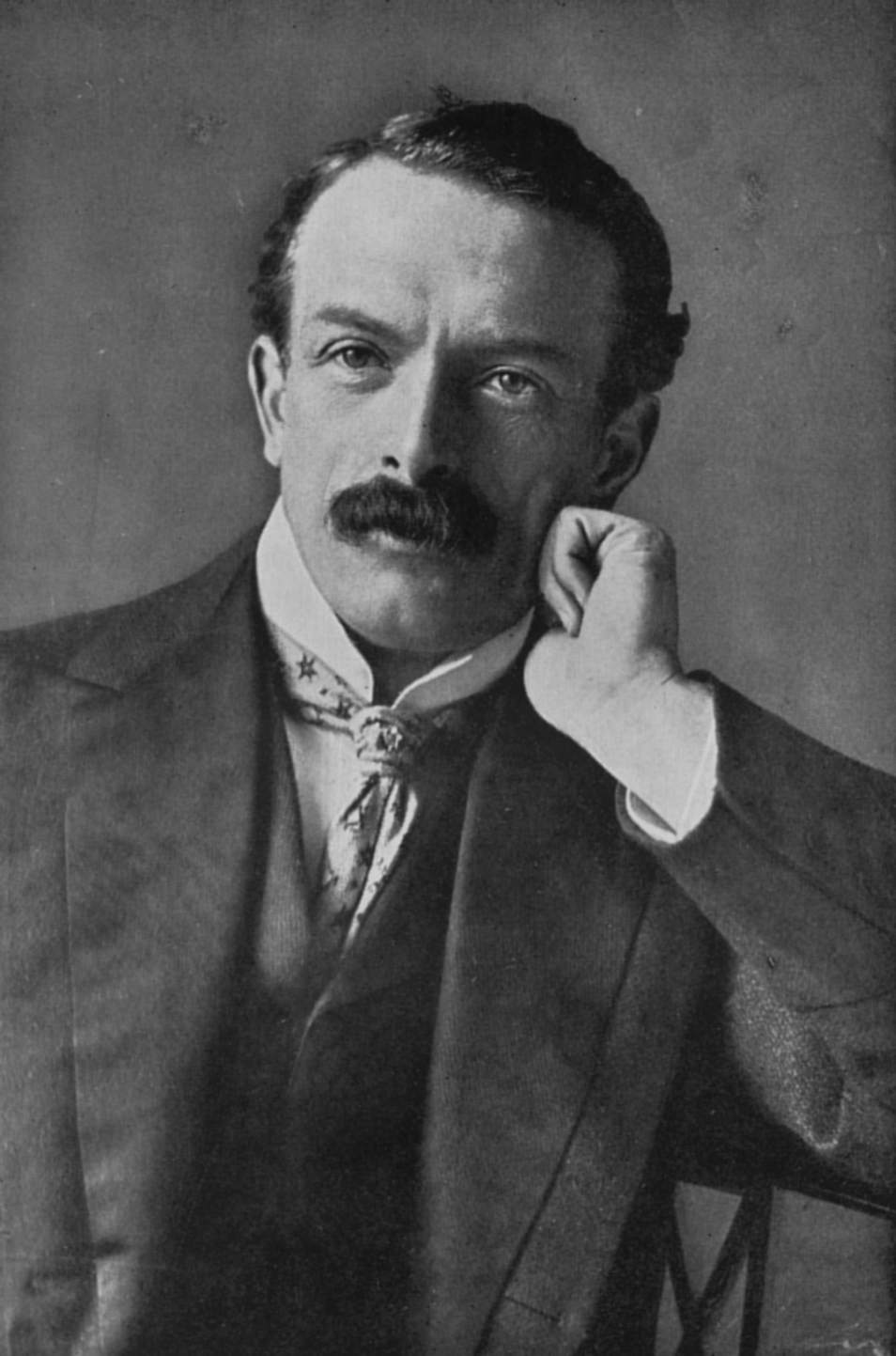 Photo: Reginald Haines, Southampton Row, W.C.
Already Mr. Lloyd George's Budget and his speeches in support of the
Budget have made the name of the Chancellor of the Exchequer familiar to
the people of Great Britain; and now, in the eager discussion on his Bill
for National Insurance, that name is still more loudly spoken. Hated by
opponents and praised by admirers, denounced and extolled, Mr. Lloyd
George enjoys the tumult he arouses. His passionate speeches for the poor
provoke the sympathy of the working class; his denunciations of the rich
stir the anger of all who fear social revolution. Hostile critics deny
any constructive statesmanship in Mr. Lloyd George's plans and orations,
and prophesy a short-lived tenure of office. Radical supporters hail him
as a saviour of society, and are confident that under his leadership
democracy will enter the promised land of peace and prosperity for all.
Neutral minds doubt whether Mr. Lloyd George is sufficiently
well-balanced for the responsibilities of high office, and express
misgivings lest the era of social reform be inaugurated too rapidly. The
obvious danger of a fall always confronts ambition in politics, but the
danger is only obvious to the onlooker. Pressing forward the legislative
measures he has set his heart upon, and impatient to carry out the policy
that seems to him of first importance to the State, Mr. Lloyd George pays
little heed to the criticism of friends or foes. A supreme
self-confidence carries him along, and the spur of ambition is constantly
pricking. Political co-operation is difficult for such a man, and an
indifference to reforms that are not of his initiation, and a willingness
to wreck legislation that cannot bear his name, are a weakness in Mr.
Lloyd George that may easily produce a fall. Only a very strong man can
afford to say that a reform shall be carried in his way, or not at all,
in cheerful disregard of the wishes of colleagues and followers. Mr.
Lloyd George's attitude on the question of Women's Suffrage is
characteristic. Professing a strong belief in the justice of women's
enfranchisement, he assumes that he can safely oppose all Women's
Suffrage Bills that are not of his framing, even when these Bills are the
work of ardent Liberals. He would have the measure postponed until he
himself can bring in a Reform Bill, to the end that the enfranchisement
of women may be associated with his name for all time.
It is dangerous to the statesman, the ambition that finds satisfaction
less in the success of a party or the triumph of a cause, than in the
personal victory. Dangerous, because it brings with it an isolation from
friends and colleagues. These come to stand coldly aloof, and then, if a
slip occurs or a mistake is made, and there comes a fall, no hands are
stretched out to repair the damage or restore the fallen. The statesman
who is suspected of "playing for his own hand" may laugh at the murmurs
of discontent amongst his followers while all goes well for him, but when
he falls he falls beyond recovery. No one can foretell the end of Mr.
Lloyd George's career, but his popularity with the multitude will not
make up to him for the want of support in Parliament should an error of
judgment undo him. The pages of political history are strewn with the
stories of high careers wrecked in a feverish haste for fame, that
overlooked dangers close at hand; of eminent politicians broken in the
full course of active life by the mere forgetfulness of the existence of
other persons. A simple miscalculation of forces, and from lofty station
a minister tumbles into the void.
The stability of the working-class leaders makes their future a matter
of fairly safe conjecture. Mr. Lloyd George, romantic in temperament,
covetous of honour, confident of popularity, but heedless of good-will
alienated and of positive ill-will created, has reached the
Chancellorship of the Exchequer. Will he climb still higher in office, or
will he pass to the limbo peopled by those who were and are not? Time
alone can tell. But in this year of grace 1911 Mr. Lloyd George,
incarnation of the hard-working middle class, is a very distinct
personality in the government of the country, and his presence in the
Cabinet a fact in the history of democracy.
More than once since 1831 the House of Lords has come into conflict
with the House of Commons when a Liberal Government has been in power. A
compromise was effected between the two Houses over the Disestablishment
of the Irish Church in 1869, the Lords, on the whole, giving way. When
the Lords proposed to "amend" the Army Reform Bill (for abolishing the
purchase of commissions) in 1871, Gladstone overpowered their opposition
by advising the Crown to cancel the Royal Warrant which made purchase
legal, and to issue a new warrant ending the sale of commissions. This
device completely worsted the House of Lords, for a refusal to pass the
Bill under the circumstances merely deprived the holders of commissions
of the compensation awarded in the Bill. The Army Reform Bill became law,
but strong objection was taken by many Liberals to the sudden exercise of
the Royal Prerogative. In 1884 the Lords refused to pass the Bill for the
enfranchisement of the rural labourer unless a Bill was brought in at the
same time for a redistribution of seats. After some discussion Gladstone
yielded, the Redistribution Bill was drawn up, and passed the Commons
simultaneously with the Franchise Bill in the Lords.
Several Bills have been rejected or "amended" by the Lords since the
Liberals came into power in 1906, and the crisis came when the Budget was
rejected in 1909. In June, 1907, the following resolution was passed by
the House of Commons by 432 to 147 votes: "That in order to give effect
to the will of the people, as expressed by their elected representatives,
it is necessary that the power of the other House to alter or reject
Bills passed by this House should be so restricted by law as to secure
that within the limits of a single Parliament the final decision of the
Commons shall prevail." This resolution was embodied in the Parliament
Bill of 1911. Between 1907 and 1911 came (1) the rejection of the Budget,
November, 1909; (2) the General Election of January, 1910, and the return
of a majority of 124 (Liberal, Labour, and Irish Nationalist) in support
of the Government; (3) the passing of resolutions (majority, 105) for
limiting the Veto of the Lords; (4) the failure of a joint Conference
between leading Liberals and Conservatives on the Veto question, followed
by (5) the General Election of December, 1910, and the return of the
Liberals with a united majority of 126.
The Parliament Bill declared that every Money Bill sent up by the
Commons, if not passed unamended by the Lords within a month, should
receive the Royal assent and become an Act of Parliament notwithstanding,
and that every Bill sent up for three successive sessions shall in the
third session become an Act of Parliament without the assent of the
Lords.
The Lords passed this Bill with amendments which the Commons refused
to accept, and the Parliament Bill was returned to the Lords in August.
But, as in 1832, the Prime Minister announced that he had received
guarantees from the Crown that peers should be created to secure the
passage of the Bill if it was again rejected; and to avoid the making of
some three or four hundred Liberal peers, Lord Lansdowne—following
the example of the Duke of Wellington—advised the Conservatives in
the House of Lords to refrain from opposition. The result of this
abstention was that the Lords' amendments were not persisted in, and the
Bill passed the Lords on August 10th, 1911, by 131 to 114 votes.
By this Parliament Act the Lords' veto is now strictly limited. The
Lords may reject a Bill for two sessions, but if the Commons persist,
then the Bill passes into law, whether the Lords approve or
disapprove.
The real grievance against the House of Lords, from the democratic
standpoint, has been that its veto was only used when a Liberal
government was in power. There is not even a pretence by the Upper House
of revising the measures sent from the Commons by a Conservative
ministry; yet over and over again, and especially in the last five years,
Liberal measures have been rejected, or "amended" against the will of the
Commons, by the Lords after the electors have returned the Liberals to
power. The permanent and overwhelming Conservative majority in the Lords
acts on the assumption that a Liberal ministry does not represent the
will of the people, an assumption at variance with the present theory of
democratic government, and in contradiction to the constitutional
practice of the Crown. The great size of the House of Lords makes the
difficulty of dealing with this majority so acute. In 1831 the creation
of forty peerages would have been sufficient to meet the Tory opposition
to the Reform Bill; to-day it is said that about four hundred are
required to give the Liberals a working majority in the Lords. The rapid
making of peers began under George III., but from 1830 to the present day
Prime Minister after Prime Minister has added to the membership of the
House of Lords with generous hand. Satire, savage and contemptuous, has
been directed against the new peers by critics of various opinions, but
still the work of adding to the House of hereditary legislators goes
gaily on, and Liberal Prime Ministers have been as active as their Tory
opponents in adding to the permanent Conservative majority in the Lords;
for only a small minority of Liberal peers retain their allegiance to the
Liberal Party.
Thackeray gave us his view of the making of peers in the years when
Lord Melbourne and his Whig successors were steadily adding to the Upper
House. (Between 1835 and 1841 Melbourne made forty-four new peers, and
twenty-eight more were added by 1856.)
"A man becomes enormously rich, or he jobs successfully in the aid of
a Minister, or he wins a great battle, or executes a treaty, or is a
clever lawyer who makes a multitude of fees and ascends the bench; and
the country rewards him for ever with a gold coronet (with more or less
balls or leaves) and a title, and a rank as legislator. 'Your merits are
so great,' says the nation, 'that your children shall be allowed to reign
over us, in a manner. It does not in the least matter that your eldest
son is a fool; we think your services so remarkable that he shall have
the reversion of your honours when death vacates your noble shoes.'"
J.H. Bernard, in his "Theory of the Constitution" (1835), was no less
emphatic:—
"As the affair is managed now, the peerage, though sometimes bestowed
as the reward of merit, on men who have adorned particular professions,
is yet much more frequently—nine times out of ten—employed by
the minister of the day as his instrument to serve particular views of
public policy; and is often given to actual demerit—to men who hire
themselves out to do his commands through thick and thin. The peerage is
now full of persons who have obtained possession of it by disreputable
means."
But in spite of satire and hostile criticism members of the House of
Lords have always enjoyed a considerable social popularity. They are
widely esteemed for their titles, even by those who denounce hereditary
legislators and desire to abolish the Second Chamber.
Disraeli created six new peers in 1867-8, and seventeen more from 1875
to 1880, in addition to conferring the earldom of Beaconsfield on
himself. Yet Disraeli had written in "Coningsby" (1844):—
"We owe the English peerage to three sources: the spoliation of the
Church, the open and flagrant sale of its honours by the elder Stuarts,
and the borough-mongering of our own times. Those are the three main
sources of the existing peerage of England, and, in my opinion,
disgraceful ones."
Gladstone made fifty peers in his four premierships, and Mr. Herbert
Paul, the Liberal historian of "Modern England," makes the following
comments:—
"No minister since Pitt had done so much as Mr. Gladstone to enlarge
and thereby to strengthen the House of Lords.
"Mr. Gladstone was lavish in his distribution of peerages, and rich
men who were politically active, either in the House of Commons or behind
the scenes, might hope to be rewarded with safe seats elsewhere."
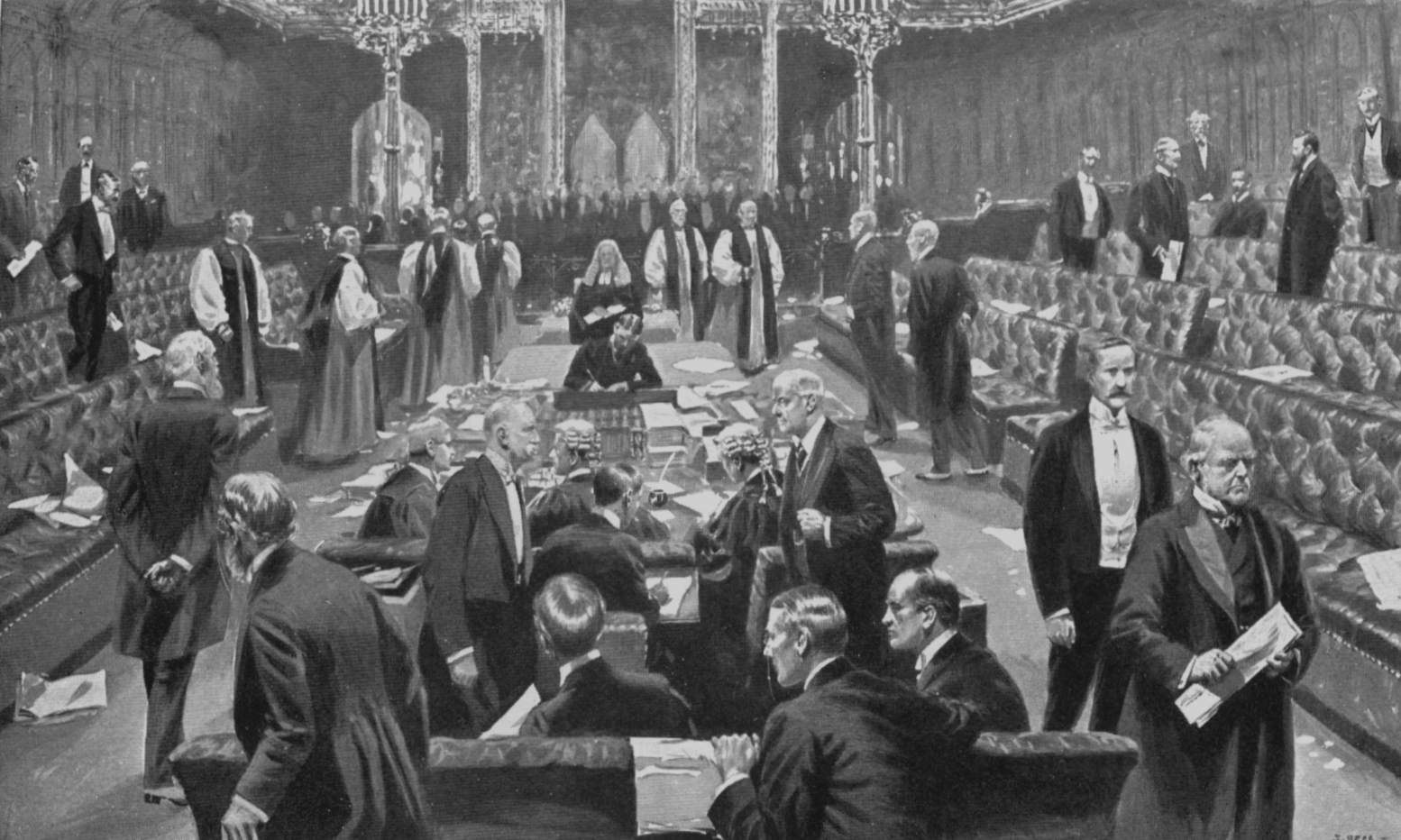 From the Drawing by S. Begg.
Sir Henry Campbell-Bannerman exceeded all previous records of the last
century by making twenty new peers in less than two years—1905 to
1907—and Mr. Asquith maintained this vigorous policy by thirteen
new creations in the first year of his premiership. Already many of these
peers, whose titles are not more than six years old, vote with the
Conservatives. Great Britain is now the only country in the world that
combines a democratic form of government with a second chamber of
hereditary legislators, and many proposals are on foot for the reform of
the House of Lords. While the Conservatives are more anxious to change
the constitution of the Upper House, and to make it a stronger and more
representative assembly, the Liberals prefer that its power of veto
should be abolished. No Act of Parliament was required to abolish the
veto of the Crown on Acts of Parliament, but the growth of a democratic
public opinion did not prove strong enough to end the veto of the Lords
on the Bills passed by a Liberal majority in the Commons, and therefore
the Parliament Act was passed.
The popularity of the Crown has become increasingly wider and more
general in the years that have seen the British people steadily taking up
the work of self-government. The fear of a hostile demonstration by the
inhabitants of London kept William IV. from visiting the Mansion House in
1830, and the death of that monarch in 1837 evoked no national mourning.
Queen Victoria, unknown to the people on her accession, had the very
great advantage of Lord Melbourne's political advice in the early years
of her reign. Her marriage, in 1840, with the Prince Consort—who
himself learnt much from Melbourne—brought a wise counsellor to the
assistance of the throne. "I study the politics of the day with great
industry," wrote the Prince Consort. "I speak quite openly to the
Ministers on all subjects, and endeavour quietly to be of as much use to
Victoria as I can." The Prince Consort saw quickly that "if monarchy was
to rise in popularity, it could only be by the sovereign leading a good
life, and keeping quite aloof from party." The days of a profligate court
and of "the King's friends" in politics were past and gone; the royal
influence was to succeed the royal prerogative.
The aloofness from political partisanship has been faithfully
maintained by the successors of Queen Victoria, and great as the royal
influence may be in the social life of the wealthier classes, it is
certain that no such influence operates in the casting of votes by the
people at Parliamentary elections. No one suspects the King of desiring
the return of Liberals over Tories, or of favouring the Tory programme
rather than the Liberal; and this neutrality is the surest guarantee of
the continued popularity of the Crown.
For some years in the late 'seventies and early 'eighties of the
nineteenth century Republicanism was the creed of many ardent
working-class Radicals in England. Charles Bradlaugh was its chief
exponent, and both Mr. Joseph Chamberlain and the late Sir Charles Dilke
were regarded as Republicans before they entered Gladstone's Ministry in
1880. The Republican movement waned before Bradlaugh's death. He himself
was "led to feel that agitation for an ideal form of government was less
directly fruitful than agitation against the abuses of class privilege;
and in the last dozen years of his life, his political work went mainly
to reforms within the lines of the Constitution."
With the rise of the Socialist movement in England in 1884-5, and the
celebration of the Queen's Jubilee in 1887, Republicanism became utterly
moribund, and nothing save an attempt on the part of the sovereign to
take a definite side in party politics, or a notorious lapse from the
morals required of persons in office of State, could revive it.
The interest in Socialism was fatal to the Republican movement,
because it turned the enthusiasm of the active spirits in democratic
politics from the desire for radical changes in the form of
government, to the crusade for economic changes, and the belief in a
coming social revolution. The existence of monarchy seemed a small and
comparatively unimportant affair to men and women who were hoping to get
poverty abolished, and the landlords and capitalists expropriated either
by direct revolution, or by the act of a House of Commons, dominated by
working men with Socialist convictions.
The national celebrations at the Queen's Jubilee in 1887 marked the
beginning of the popular revival in pageantry and official ceremonial. In
the Church of England this revival began some forty years earlier, and it
has, in our day, changed the whole conduct of public worship. The revival
of Roman Catholicism in England with its processions and solemn ritual
has been equally significant. By gratifying the common human instinct for
spectacle and drama the monarchy has gained the popular affections.
The Whigs scoffed at pageants and symbols; the earlier Puritans had
proscribed ceremonial as savouring of idolatry, and feared any
manifestation of beauty as a snare of the devil. In the latter half of
the nineteenth century, England began to throw off the shackles of
Puritanism, and to lose all interest in Whiggery. The new democracy was
neither coldly Deist, nor austerely Republican. It has shown no
inclination to inaugurate a reign of "pure reason" in religion or
politics, but has boldly and cheerfully adopted symbolism and pageantry.
Friendly societies and trade unions have their badges, banners, and
buttons. The Roman Catholic Church grows in popularity with the working
class, and in many towns and cities the Church of England and the
Salvation Army are distinctly popular. On the other hand, the
Nonconformist churches confess annually to a decreasing membership, and
Secularist and Ethical societies have but the smallest following.
The royal processions and the pageantry of monarchy have provided a
spectacular display that average human nature enjoys. The symbols and
trappings of monarchy must be shown if the sovereign is to be popular;
they add to the gaiety of life, and people are grateful for the warmth of
colour they impart to our grey streets. The sovereign in encouraging the
renewed and growing love for pageants and ceremonial has discerned the
signs of the times. Modern democracy does not desire that kings or
priests shall rule; but it does require that they shall on State
occasions and in the performance of their office, be clad in kingly and
priestly robes, and by their proceedings enrich the dignity of public
life, and the beauty of public worship.
The rise of Socialism in the 'eighties not only diverted the attention
of working-class leaders from political reform, but it substituted for
the destruction of monarchy and the House of Lords a reconstruction of
society as the goal of democracy; and the Socialist teaching has been of
enduring and penetrating influence.
Fifty years earlier in the nineteenth century, Robert Owen had
preached a Socialist crusade with strenuous persuasion—but,
ignoring politics, he outlived the temporary success of his cause. The
utopian Socialism of Owen flourished and died, as Chartism, under
different treatment, flourished and died.
The "scientific" Socialism of Karl Marx was planned on stronger
foundations. It brought a message of hope; it revealed how the change was
to be wrought that would "emancipate the workers of the world from the
slavery of wage service"; and it insisted that this change was
inevitable. On the Continent, and more particularly in Germany, the
Social Democratic Party has gained an enormous working-class support, and
every election adds to its strength.
In England the Social Democratic Federation—now the Social
Democratic Party—was founded in 1884 by Mr. H.M. Hyndman; but in
spite of its untiring efforts, it has never won the sympathy of the trade
unions, nor the confidence of the working-class electorate. Its
Parliamentary candidatures rarely attract attention, and it is not a
force in Labour politics. Nevertheless, indirectly, the influence of the
Social Democratic Party has been very considerable. Mr. John Burns, and
many another Labour leader, have passed through its ranks, and a social
conscience has been made sensitive to the miseries of the poor, largely
by the voices—that will not be silenced—of this comparatively
small company.
The Fabian Society also began its work of educating public opinion to
Socialism in 1884, but, unlike the Social Democratic Federation, it made
no proposals for the creation of a Socialist Party or the organisation of
the working class into a separate political party. Mainly, its influence
can be seen in the increase of statistical knowledge and of State
interference in the conditions of life and labour in the working
class.
The Independent Labour Party was not formed till 1892, and while
professing Socialism, it has aimed rather at securing the return of
labour members to Parliament, and to local governing councils than at the
conversion of the working class to a dogmatic social democracy. Often
frankly opportunist and experimental, the Independent Labour Party and
its offspring, the Labour Party in the House of Commons, have followed
the national custom in politics of attacking and redressing evident
evils, and have done this with considerable success.
But while the Socialists have compelled the attention of all classes
to existing social ills, and have made social reform the chief concern of
all politicians, the idea of a social democracy steadily recedes from the
political vision, and the conscious movement to Socialism falters.
Socialist workmen in Parliament or on city councils soon find themselves
absorbed in the practical work of legislation or administration, and
learn that there is neither leisure nor outlet for revolutionary
propaganda. The engrossing character of public work destroys the old
inclination to break up the existing order, for the Socialist member of
Parliament, or city councillor interested in his work, has become part of
the machinery responsible for the existing order, and without losing his
sympathy for the labouring people is content that the amelioration of
society shall come, as it now seems to him it must come, by slow and
orderly stages and without violence. The very return of so many Labour
members to Parliament and to local councils has damped down the fires of
Socialism, by placing in positions of authority and responsibility, and
thereby withdrawing them from the army of disaffection, the ablest
leaders of the working-class movement. The Labour member who cannot
settle down to legislative or administrative work, but attempts to play
the agitator's part in the House of Commons or the council chamber, is
generally doomed to banishment from official public life, and is allowed
to remain an agitator.
Mr. John Burns may be denounced as a renegade by Socialist critics,
but a working-class electorate returns him to Parliament. Mr. Cunninghame
Graham and Mr. Victor Grayson may be applauded for their consistency by
Socialist audiences, but working-class constituencies are loth to return
such representatives to the House of Commons.
As Socialism quietly passes out of the vision of the political world,
and from a definite inspiration to democracy becomes a dim and remote
possibility of the future, Social Reform takes its place. Not only in
Great Britain, but throughout Europe, the social reformers or
"revisionists" are gaining the mastery over the scientific Marxian
Socialists in democratic politics. In Great Britain where "practical," or
experimental, politics have always prevailed over political theory, the
passing of positive Socialist dogma is naturally more obvious. Social
Reform is now the cry of Liberals and Conservatives alike. The old
Liberal doctrines of laissez faire, unrestricted competition, and
the personal liberty of the subject are as dead as the Stuart doctrine of
the divine right of kings. The old Liberal hostility to State
interference in trade or commerce, and to compulsory social legislation
has melted away at the awakened social conscience. It still has its
adherents—Lord Cromer and Mr. Harold Cox repeat the ancient
watch-words of Victorian Liberalism, and they are regarded with a respect
mingled with curiosity, as strange survivals of a far-off age—but
no popular echo follows their utterances. Pensions for the aged, better
provision for the sick and the infirm, a more careful attention to the
well-being of children, national health, some cure for destitution, and
some remedy for unemployment—these are the matters that a Liberal
Government is concerned about to-day. And the Conservatives are no less
sincere in their willingness to help in these matters. Legislative
proposals for social reform are treated as non-party questions, and the
chief item in the Conservative programme, Tariff Reform, was adopted and
is advocated mainly as a social reform, a cure for industrial evils, and
the misery of unemployment.
Socialism proposed the abolition of poverty, and the common ownership
and control of the land and the means of production, distribution, and
exchange as the solution of economic questions.
Social Reform proposes to mitigate the hardships of life for the
multitude, and, while leaving land and capital in private hands, to
compel by taxation provision for the wants of the people. Its aim is the
abolition of destitution by State assistance to voluntary effort, and the
gradual raising of the standard of life. It does not propose to remove
the cause of poverty.
Socialism would place the democracy in possession of the means of
wealth. Social Reform requires the State to tax wealth and provide for
the people. It promises a living wage, decent housing accommodation, an
insurance against unemployment, and security in old age, and leaves the
question of national ownership or private ownership to be settled by
posterity.
Apart from the ideals of Socialism, the democratic ideal of a
community owning the full value of its land was presented by Henry
George, an American economist, in 1879, and his book "Progress and
Poverty," was at once received with enthusiasm by certain reformers in
England and America. George visited England in 1881, 1884, and 1889, and
his visits resulted in a strong movement for the taxation of land values.
This movement has been inspired by an ideal of a democratic community as
definite as the Socialist ideal, and it has grown steadily in popular
favour as the justice of a tax on land values has been recognised.
"Progress and Poverty" is the bible of the Land Reformers, as Marx's
"Capital" is (or was) the bible of Socialists. It is claimed that a tax
on land values is the true remedy of social and economic ills, and that
democracy can eradicate the root-cause of poverty by such a tax. In this
belief the followers of Henry George have preached the Single Tax, as it
is called, with unquenchable fervour, and the Liberal Party has been
gradually won over—if not to the Single Tax, at least to a tax on
land values. Many Conservatives, too, favour the taxation of land values
in cities, and all the principal municipalities have petitioned
Parliament in favour of this method of taxation. But it is the democratic
ideals of Henry George that have been the life of the movement for the
Single Tax, and but for these ideals the movement would never have become
a living influence towards democracy, or inspired a social
enthusiasm.
The charm about the Single Tax propaganda is that its ideals of
democracy do not discourage the practical politician and the average
citizen from supporting what seems a necessary and reasonable proposal.
Without committing themselves at all to Henry George's full scheme for
the total abolition of land monopoly by a tax of twenty shillings in the
pound on all land values, and without abandoning the common British
suspicion of the doctrinaire and the political idealist, the ordinary
shopkeeper and householder are quite of opinion that urban values in land
can be taxed legitimately for the benefit of the community, and that
democracy would do well to decree some moderate tax on land values for
the relief of the overtaxed non-landowner.
So the taxation of land values is presented by its advocates as a
social reform more radical and democratic than all other social reforms,
as a reform that in fact would make democracy master of its own land, and
the people free from the curse of poverty; and it is accepted by the
great mass of working people as a just and useful method of raising
revenue for local and imperial needs.
Socialism, social reform, the Single Tax—various are the ideals
of a democratic people at work at the business of government, and various
are the means proposed to establish the democracy in economic
freedom.
The movement towards democracy is world-wide to-day, and the political
constitutions of the West are desired with fervour in the East.
For generations there has been agitation in Russia for representative
government, and men and women—in countless numbers—have
sacrificed wealth, reputation, liberty, and life itself in the cause of
political freedom. On the establishment in 1906 of the Duma, a national
chamber of elected members, there was general rejoicing, because it
seemed that, at length, autocracy was to give place to representative
government. But the hopes of the political reformers were short lived.
The Duma still exists, but its powers were closely restricted in 1907,
and the franchise has been narrowed, to secure an overwhelming
preponderance of the wealthy, so that it is altogether misleading to
regard it as a popular assembly.
In Egypt and in India the Nationalist movements are directed to
self-government, and are led by men who have, in most cases, spent some
years at an English University, or have been trained at the English Bar.
Residence in England, and a close study of British politics make the
educated Indian anxious for political rights in his own country, similar
to those that are given to him in Great Britain. In England the Indian
has all the political rights of a British subject. He can vote for a
member of Parliament, he can even be a member of the House of Commons. On
two occasions in recent years, an Indian has been elected to Parliament:
Mr. Dadabhai Naoroji sat as Liberal M.P. for Finsbury, 1892-5; Sir M.M.
Bhownagree as a Conservative for Bethnal Green, 1895-1906. Back in his
native land, the Indian finds that he belongs to a subject race, and that
the British garrison will neither admit him to social equality, nor
permit him the right of legislation. Hence with eyes directed to Western
forms of government, the Indian is discontented with the bureaucracy that
rules his land, and disaffected from the Imperial power. But so many are
the nations in India, and so poverty-stricken is the great multitude of
its peasantry that the Nationalist movement can touch but the fringe of
the population, and the millions of India live patiently and contentedly
under the British Crown. Nevertheless, the national movement grows
steadily in numbers and in influence, for it is difficult for those who,
politically minded, have once known political freedom, to resign
themselves to political subjection.
In Egypt the Nationalist movement is naturally smaller and more
concentrated than in India and the racial divisions hinder its unity.
Egypt is nominally under the suzerainty of Turkey, though occupied by
Great Britain, and now that Turkey has set up a Constitution and a
Parliament, patriotic Egyptian politicians are impatient at the blocking
out by the British authorities of every proposal for self-government.
As in India, so in Egypt: it is the men of education who are
responsible for the Nationalist movement. And in both countries it is the
desire to experiment in representative government, to test the
constitutional forms in common use in the West, and to practise the
responsibilities of citizenship, that stimulates the movement. The
unwillingness of the British Government to gratify this desire explains
the hostility to British rule in India and Egypt.
Japan received a Constitution from the Emperor in 1890, and in 1891
its Diet was formally opened with great national enthusiasm. It is a
two-chamber Parliament—a Council of nobles, and a popularly elected
assembly—and only in the last few years have the business men given
their attention to it. Although the Cabinet is influenced by Japanese
public opinion, it is not directly responsible to the Diet, but is the
Ministry of the Mikado. The resolution of the Japanese statesmen of forty
years ago to make Japan a world-power made Constitutional Government, in
their eyes, a necessity for the nation.
In Europe, Norway, Sweden, and Denmark all possess democratic
constitutions, and only the removal of sex disabilities in the latter two
is needed to achieve complete adult suffrage. Finland established
complete democracy nine years ago, and, with equal electoral districts,
complete adult suffrage, and the free election of women equally with men
to its Diet, is a model democratic state. But the liberties of Finland
are gravely threatened by the Russian Government, and there is no
security for the Finns that their excellent self-government will be
preserved. In Germany, with universal manhood suffrage, the struggle is
to make the Government responsible to the elected Reichstag.
The British self-governing Colonies show a tendency of democracy to
federate. The Australian Colonies are federated into a Commonwealth, and
their example has been followed by the South African Colonies. New
Zealand and Australia are at one in their franchise, which allows no
barrier of sex; but South Africa still restricts the vote to males. In
Australia the working class are in power, and the Commonwealth Prime
Minister is a Labour representative. There is no willingness to grant
political rights to those who are not of European race, either in South
Africa or in Australia; and the universal republic dreamed of by
eighteenth century democrats, a republic which should know no racial or
"colour" bar, is not in the vision of the modern colonial statesmen of
democracy, who are frankly exclusive. Only in New Zealand does a native
race elect its own members to Parliament—and four Maori M.P.'s are
returned.
Experience has proved that democratic and republican forms of
government are no guarantee that the nation possesses political
liberty.
Mexico, nominally a republic under President Diaz, was in reality a
military autocracy of the severest kind. The South American Republics are
merely unstable monarchies, at the mercy of men who can manipulate the
political machinery and get control of the army.
It is too early yet to decide whether the constitutional form of
government set up in Turkey in 1908, or the republic created on the
abolition of monarchy in Portugal in 1910, mark national movements to
democracy. In neither country is there evidence that general political
freedom has been the goal of the successful revolutionist, or that the
people have obtained any considerable measure of political power or civil
liberty. Ambitious and unscrupulous men can make full use of republican
and democratic forms to gain political mastery over their less cunning
fellows, and no machinery of government has ever yet been devised that
will safeguard the weak and the foolish from the authority of the strong
and the capable.
Those who put their trust in theories of popular sovereignty, and urge
the referendum and initiative as the surer instruments of democracy than
Parliamentary representation, may recall that a popular plebiscite
organised by Napoleon in 1802 conferred on him the Consulate for life;
that Louis Napoleon was made President of the French Republic in 1848 by
a popular vote, obtained a new constitution by a plebiscite in 1851, and
a year later arranged another plebiscite which declared him hereditary
Emperor, Napoleon III. France, where naturally Rousseau's theories have
made the deepest impression, has since the Revolution gloried in the
right of the "sovereign people" to overthrow the government, and its
elected representatives have been alternately at the mercy of dictators
and social revolutionists.
On the whole, the stability of the British Government, rooted in the
main on the traditional belief in the representation of the electorate,
would seem to make more surely for national progress and wider political
liberty than the alternation of revolution and reaction which France has
known in the last hundred and twenty years.
England has not been without its popular outbursts against what the
American poet called "the never-ending audacity of elected persons," but
these outbursts are commonly accepted as manifestations of intolerable
conditions; and while the outbursts are repressed means are taken by
Government to amend the conditions. When the Government fails to amend
things, the House of Commons takes the matter up; and if the Commons
neglect to do so, then the electors make it plain that amendment and
reform are necessary by returning men to Parliament pledged to change
matters, and by rejecting those who have failed to meet the
situation.
The dangers that threaten democracy are obvious. Universal adult
suffrage, short Parliaments, proportional representation, equal electoral
districts, second ballots—none of these things can insure democracy
against corruption. For a government which rests on the will of a
people—a will expressed by the election of representatives—is
inevitably exposed to all the evils attendant on the unruly wills and
affections of the average man.
The orator can play upon the feelings of the crowd, and sway
multitudes against a better judgment; and he has greater chance of
working mischief when a referendum or other direct instrument of
democracy is in vogue than he has when government is by elected
representatives. For the party system, itself open to plenty of
criticism, constantly defeats the orator by the superior power of
organisation. Hence it frequently happens at Parliamentary elections that
a candidate whose meetings are enthusiastic and well attended fails
lamentably at the poll. His followers are a crowd; they are not a party.
They do not know each other, and they have not the confidence that comes
of membership in a large society.
If the orator is a menace to the wise decisions of the people by a
referendum, the party organiser and political "boss" can easily be a
curse to representative government on party lines. By all manner of
unholy devices he can secure votes for his candidate and his party, and
he has raised (or lowered) the simple business of getting the people to
choose their representative into the art of electioneering. The triumph
of political principles by the election of persons to carry out those
principles becomes of less importance than the successful working of the
party machine, when the boss and the organiser are conspicuous. Patronage
becomes the method for keeping the party in power, and the promise of
rewards and spoils enables an opposition to defeat the Government and
obtain office. To be outside the party is to lose all chance of sharing
in the spoils, and to take an interest in politics means, under these
circumstances, to expect some consideration in the distribution of
honours.
The "spoils system" is notorious in America, but in England it has
become practically impossible for a man to take any serious part in
politics except by becoming part of the machine. An independent attitude
means isolation. To belong to a party—Liberal, Unionist, or
Labour—and to criticise its policy, or differ from its leaders, is
resented as impertinence. The machine is master of the man. A troublesome
and dangerous critic is commonly bought or silenced. He is given office
in the Government, or rewarded with a legal appointment; perhaps made a
peer if his tastes are in that direction. A critic who cannot command a
considerable backing among the electorate will probably be driven out of
public life. The disinterested activity in politics that puts the
commonwealth before party gain is naturally discouraged by the party
organisers.
Yet when public interest in national affairs sinks to the merely
sporting instinct of "backing your candidate" at elections as a horse is
backed at race meetings, and of "shouting for your party" as men shout
for their favourite football team, or sinks still lower to the mercenary
speculation of personal gain or loss on election results, then another
danger comes in—the indifference of the average honest citizen to
all politics, and the cynical disbelief in political honesty.
The warnings of John Stuart Mill against leaving politics to the
politicians and against the professional position may be quoted:
"Representative institutions are of little value, and may be a mere
instrument of tyranny or intrigue when the generality of electors are not
sufficiently interested in their own government to give their vote; or,
if they vote at all, do not bestow their suffrages on public grounds, but
sell them for money, or vote at the beck of some one who has control over
them, or whom for private reasons they desire to propitiate. Popular
elections as thus practised, instead of a security against misgovernment,
are but an additional wheel in its machinery."
Mill himself was a striking example of the entirely disinterested
politician, who, caring a great deal more for principles than for party,
finds little favour with the electors, and less with the party managers,
and retires from politics to the relief of his fellows.
A general lack of interest in politics can prove fatal to democracy.
The party managers, without the fear of the electorate before their eyes,
will increase the number of salaried officials and strengthen their
position by judicious appointments. Nominally, these inspectors and
officers will be required for the public service, and the appointments
will be justified on patriotic grounds. There will be little criticism in
Parliament, because the party not in power will be anxious to create
similar "jobs" when its own turn comes. Besides, as the public pays for
these officials, there is no drain on the party funds; and this is a
matter of congratulation to party managers, who are always anxious not to
spend more than they can help on the political machinery.
But the horde of officials and inspectors will change democracy into
bureaucracy, and the discovery is sometimes made too late that a land is
ruled by permanent officials, and not by elected representatives. The
elected representatives may sit and pass laws, but the bureaucracy which
administers them will be the real authority.
It may be an entirely honest and efficient bureaucracy, as free from
political partisanship as our British Civil Service and police-court
magistracy are, but if it is admitted to be outside the jurisdiction of
the House of Commons, and to be under no obedience to local councils, and
if its powers involve a close inquisition into the lives of the people,
and include the right to interfere daily with these lives, then
bureaucracy and not democracy is the actual government.
A host of salaried political workers—agents, organisers,
secretaries, etc.—will make popular representative government a
mere matter of political rivalry, an affair of "ins and outs," and by
this development of the party system will exclude from active politics
all who are not loyal to the "machine," and are not strong enough to
break it. But a host of public officers—inspectors, clerks,
etc.—paid out of the public funds will do more than pervert
representative government: they will make it subordinate to the permanent
official class; and bureaucracy, once firmly in the saddle, is harder to
get rid of than the absolutism of kings, or the rule of an
aristocracy.
Yet a permanent Civil Service is better in every way in a democracy
than a Civil Service which lives and dies with a political party, and is
changed with the Cabinet.
On the whole, the best thing for democracy is that the paid workers in
politics should be as few as possible, and the number of salaried state
officials strictly limited. The fewer the paid political workers, the
fewer people will be concerned to maintain the efficiency of the
political machine, and the more freely will the electorate act in the
choice of its representatives. The fewer the salaried officials of State,
the less inspection and restriction, and the less encouragement to habits
of submission in the people. Democracy must depend on a healthy, robust
sense of personal responsibility in its citizens, and every increase in
the inspectorate tends to diminish this personal responsibility, and to
breed a "servile state" that will fall a willing prey to tyranny and
bureaucracy.
Nevertheless, whilst in self-defence democracy will avoid increasing
its officials, it will distinguish between officials and employees. It is
bound to add to the number of its employees every year, as its municipal
and imperial responsibilities grow steadily larger, and these employees,
rightly regarded as public servants, cannot threaten to become our
masters.
Still one more danger to democracy may be mentioned, and that is the
notion that from the working class must necessarily come our best
rulers.
"Rulers are not wise by reason of their number or their poverty, or
their reception of a weekly wage instead of a monthly salary or yearly
income. It is worse and more unpleasant and more dangerous to be ruled by
many fools than by one fool, or a few fools. The tyranny of an ignorant
and cowardly mob is a worse tyranny than the tyranny of an ignorant and
cowardly clique or individual.
"Workers are not respectable or to be considered because they work
more with their hands or feet than with their brains, but because the
work they do is good. If it is not good work they do, they are as
unprofitable as any other wasters. A plumber is not a useful or admirable
creature because he plumbs (if he plumbs ignorantly or dishonestly, he is
often either a manslayer or a murderer), but because he plumbs well, and
saves the community from danger and damp, disease, and fire and water.
Makers of useless machine-made ornaments are, however 'horny-handed,'
really 'anti-social persons,' baneful to the community as far as their
bad work goes; more baneful, possibly, than the consumers of these bad
articles, quite as baneful as the entrepreneurs who employ
them.
"The only good institutions are those that do good work; the only good
work done is that which produces good results, whether they be direct, as
the plough-man's, or navvy's, or sailor's; or indirect, as the policeman,
or the schoolmaster, or the teacher of good art, or the writer of books
that are worth reading. A man is no better or wiser than others by reason
of his position or lack of position, but by reason of his stronger body,
wiser head, better skill, greater endurance, keener courage."
There it is. Democracy needs for its counsellors, legislators and
ministers, strength, wisdom, skill, endurance and courage, and must get
these qualities in whomsoever they are to be found. Democracy can afford
the widest range of choice in the election of popular representatives, or
it will never reach its full stature.
In the choice of its representatives, a democracy will do well to
elect those who know the life of the working people, and who share its
toils; just as it will do well to shun the mere talker, and to seek out
for itself candidates for election rather than have candidates thrust
upon its attention by some caucus in London. But the main thing is that
it should first discern men and women of ability and of character and
then elect them for its representatives, rejecting those, it may be of
more dazzling qualities, who are unstable in mind and consumed with
vanity. It would be well if the elected representative were always an
inhabitant of the county or the borough, known to his neighbours, and of
tested worth. True, the prophet is often without honour in his own
country, and a constituency acts wisely in electing a representative of
national repute. But to search for a man of wealth who will subsidise
every club and charitable institution in the constituency, and to rejoice
when such a candidate is procured from some political headquarters, is a
wretched proceeding in a democratic state. The member who buys a
constituency by his gifts will always feel entitled to sell his
constituents should occasion arise.
Again, the delegate theory of representation can be a danger to
democracy.
A Parliamentary representative is something better than a mechanical
contrivance for registering the opinions of electors on certain subjects.
Otherwise all Parliamentary debate is a mockery. A representative he is
of the majority of electors, but he must act freely and with initiative.
Often enough he may be constrained to vote, not as many of his
constituents would prefer, but using his own judgment. Of course when the
choice is between obedience to the party whip and the wishes of his
constituents, and personal conviction is with the latter, then at all
costs the decision should be to stand by his constituents, or popular
representation is a delusion.
To-day the pressure is far greater from the party whips than from the
constituents, especially when in so many cases election expenses are
paid, in part at least, from the party funds. And to overcome this
constant danger to popular representation a sure plan would be the
payment of all necessary election expenses out of the local rates, and
the prohibition by law of all payments by the candidate or by political
associations. When members are paid for their attendance in Parliament,
far better would it be, too, if such payment were made by the
constituents in each case, and not from the national exchequer. Worse than
the delegate theory is the opinion that a representative of the people is
in Parliament chiefly to keep his party in power. Political parties are
inevitable, and they are effective and convenient when principles divide
people. But popular representation is older than a party system of
government, and when it becomes utterly subordinate to the welfare of
parties it is time for a democratic people to realise the possible loss
of their instrument of liberty.
Great Britain is not partial to groups, it has always broadly been
divided politically into two camps, but a few men of strong independent
judgment are invaluable in a popular assembly. There need be no fear lest
governments totter and fall at the presence of men who dare to take a
line of their own, and to speak out boldly on occasion. The bulk of
members of Parliament will always cleave to their party, as the bulk of
electors do, and the dread of being thought singular is a potent
influence on the average man, in or out of Parliament. Democracy is in
danger of losing the counsel of its best men when it insists that its
representatives must be merely delegates of the electors, without minds
or wills of their own; but it is in greater danger if it allows its
representatives to be nothing but the tools of the party in power or in
opposition. For when Parliamentary representation is confined to those
who are willing to be the mechanical implements of party leaders and
managers, the House of Commons becomes an assembly of place-hunters and
self-seekers, for whom the profession of politics affords the
gratification of vanity or enrichment at the public expense. In such an
assembly the self-respecting man with a laudable willingness to serve the
State is conspicuous by his absence.
With a Press in the hands of party politicians, and with editors and
journalists engaged to write up their party through thick and thin, and
to write down every honest effort at political independence of mind, the
danger of losing from all political service the few rare minds that can
ill be spared is a very real and present danger.
"The price of liberty is eternal vigilance," and often enough we sleep
at our vigils. But when all the dangers and difficulties that beset
democracy are enumerated, and all its weak spots are laid bare, we can
still hold democracy to be the only suitable form of government for
persons possessing free will, and the representation of the people the
most satisfactory expression of democracy.
Government by autocrat, by despotism, benevolent or otherwise, by
expert officials, or by an oligarchy of superior intelligences is irksome
to the average man or woman of reasonable education, and in each case has
been intolerable to the British people. They have all been tried and
found wanting—royal absolutism, aristocracy, military dictatorship,
and only of late have we been threatened by an expert bureaucracy.
Parliamentary representation adapted, by the removal of disabilities
of creed and rank and income, to meet the demands of the nation, has been
proved by experience a clumsy but useful weapon for checking oppression.
Nowadays, we are using it less for defence against oppression, or as an
instrument for removing political grievances, and are testing its worth
for the provision of positive social reform. More and more it is required
of Parliament that means be found for getting rid of the ills around us,
for preventing disease and destitution, for promoting health and
decency.
And just because legislation is, at the prompting of a social
conscience, invading our homes and workshops, penetrating into prisons,
workhouses, and hospitals, touching the lives of all of us from the
cradle to the grave, the more imperative is it that our legislators
should be chosen freely by the widest electorate of men and women. We
fall back on the old maxim: "That which touches all shall be approved by
all," and can perceive no other way of obtaining that general approbation
for the laws than by the popular election of our representatives.
Demagogues may exploit the popular will, the cunning and unscrupulous
in power may have us at their mercy, in our folly and indifference the
nation may be brought to grave losses; but still there is always the
means of recovery for the well-disposed while the vote remains in their
hands.
So it is that, in spite of obvious failings and shortcomings,
democracy by representative government remains for nations throughout the
world that have not yet tried it the goal of their political striving. We
are alive to the imperfections of democracy. It is no automatic machine
for conferring benefits in return for taxes. It is the creation of
mankind, not a revelation from heaven; and it needs, like all good human
things, constant attention and can bear many improvements. It has to be
adjusted from time to time to suit the growing capacities of
mankind—as the popular assembly gave way to the representative
assembly—and only on the failure to make the adjustment does it get
rusty and out of order. It has to meet the requirements of vast empires
and mighty confederations of states, and to fulfil the wants of small
republics and parish councils.
What but democracy can answer to the call for political liberty that
sounds from so many lands and in so many varying tongues? Did any other
form of government devised by the wit of man make such universal
appeal?
And when all is said and done—what does this democracy, this
government by popular representatives, mean, but government by the
consent of the governed—the only form of government tolerable to
civilised mankind in the twentieth century?
Given a fairly good standard of common honesty in the ordinary
dealings of life, and the honesty of our public life, whether in
Parliament or in the Civil Service, in executive or administration, will
serve. If the private and commercial life is corroded with dishonesty,
then democracy will be bitten by knaves and rascals. For our chosen
rulers have a way of faithfully reflecting the morality of their
electors, and are not free to indulge their fancies, as kings of old
were.
Politics are not, and never will be, or ought to be, the chief
interest and concern of the mass of people in a healthy community where
slavery is extinct. And democracy makes no demand that would involve such
interest and concern. The choice of honest representatives, persons of
goodwill, and reasonable intelligence, is no tremendous task in a
community where honesty, goodwill, and intelligence prevail. And if these
things do not prevail, if honesty is contemned in business, and goodwill
between man and man despised, and intelligence frowned upon, then it is
of small importance what the government of such a nation is, for that
nation is doomed, and it is well for the world that it should be
doomed.
But, on the whole, it seems indisputable that the common people of the
great nations do cleave to honesty and goodwill, and that the desire for
intelligence is being widely fostered. As long, then, as we can count on
honesty, goodwill, and intelligence in our streets and market-places, as
we can to-day, mankind does well to elect its representatives to council
and Parliament and proclaim democracy—"Government of the people, by
the people, for the people"—as the proper government for
mankind.
We cannot be sure
about the constitution of the Witenagemot. The evidence is conflicting,
and, at best, we can only offer a statement of opinion.
"The parish was the
community of the township organised for Church purposes and subject to
Church discipline, with a constitution which recognised the rights of the
whole body as an aggregate, and the right of every adult member,
whether man or woman, to a voice in self-government, but at the
same time kept the self-governing community under a system of inspection
and restraint by a central authority outside the parish
boundaries."—Bishop Hobhouse, Somerset Record Society, Vol.
IV.
"The community had its own assembly—the parish
meeting—which was a deliberative assembly. It had its own officers,
who might be either men or women, duly elected, sometimes for a year,
sometimes for life, but in all cases subject to being dismissed for
flagrant offences. The larger number of these officials had well-defined
duties to discharge, and were paid for their services out of funds
provided by the parishioners."—Dr. Jessopp,
Before the Great Pillage.
Radmer, Life of
Anselm. (Rolls Series.)
"The boldness of
Anselm's attitude not only broke the tradition of ecclesiastical
servitude, but infused through the nation at large a new spirit of
independence."—J.R. Green, History of
the English People.
"For as long as any
one in all the land was said to hold any power except through him, even
in the things of God, it seemed to him that the royal dignity was
diminished."—Eadmer, Life of
Anselm.
See Palgrave's
History of Normandy and England.
"A martyr he clearly
was, not merely to the privileges of the Church or to the rights of the
See of Canterbury, but to the general cause of law and order as opposed
to violence."—Freeman, Historical
Essays.
See Campbell's
Lives of the Chancellors.
F. York Powell,
England to 1509.
"Ecclesiastical privileges were not so exclusively priestly privileges
as we sometimes fancy. They sheltered not only ordained ministers, but
all ecclesiastical officers of every kind; the Church courts also claimed
jurisdiction in the causes of widows and orphans. In short, the
privileges for which Thomas contended transferred a large part of the
people, and that the most helpless part, from the bloody grasp of the
King's courts to the milder jurisdiction of the bishop."—Freeman, Historical Essays.
Walter of
Coventry. (Rolls Series.)
Roger of Wendover.
(Rolls Series.)
"Clause by clause
the rights of the commons are provided for as well as the rights of the
nobles; the interest of the freeholder is everywhere coupled with that of
the barons and knights; the stock of the merchant and the wainage of the
villein are preserved from undue severity of amercement as well as the
settled estate of the earldom or barony. The knight is protected against
the compulsory exaction of his services, and the horse and cart of the
freeman against the irregular requisition even of the
sheriff."—Stubbs, Constitutional
History.
"Quod Anglicana
Ecclesia libera sit."—Magna Charta, I.
"This most
important provision may be regarded as a summing-up of the history of
Parliament so far as it can be said yet to exist. It probably contains
nothing which had not been for a long time in theory a part of the
Constitution: the kings had long consulted their council on taxation;
that council consisted of the elements that are here specified. But the
right had never yet been stated in so clear a form, and the statement
thus made seems to have startled even the barons.... It was for the
attainment of this right that the struggles of the reign of Henry III.
were carried on; and the realisation of the claim was deferred until the
reign of his successor. In these clauses the nation had now obtained a
comparatively clear definition of the right on which their future
political power was to be based."—Stubbs,
Constitutional History.
"Ut quod omnes
similiter tangit ab omnibus approbetur."
Stubbs,
Constitutional History.
Stubbs,
Ibid.
"Analogous
examples may be taken from the practice of the ecclesiastical assemblies,
in which the representative theory is introduced shortly before it finds
its way into parliament."—Stubbs,
Constitutional History.
Stubbs,
Constitutional History.
Stubbs,
Constitutional History.
F. York Powell,
England to 1509.
Sir Courtenay
Ilbert, Parliament.
Ilbert,
Parliament.
Bagehot, The
English Constitution.
Bagehot,
Ibid.
Stubbs,
Constitutional History.
Stubbs,
Constitutional History.
Andrew Marvell,
the poet, who sat for Hull in the reign of Charles II., was paid by the
mayor and aldermen of the borough. In return Marvell wrote letters
describing passing events in London. There are stray cases of the payment
of members in the early years of the eighteenth century. Four shillings a
day, including the journey to and from London, for the knight of the
shire, and two shillings a day for the borough member were the wages
fixed by law in 1323.
Stubbs,
Constitutional History.
Bagehot, The
English Constitution.
See Stopes'
British Freewomen for a full examination of this matter.
Stubbs,
Constitutional History.
For the last fifty
years the political influence of London has been less than that of the
manufacturing districts.
"The project was
clearly to set up a new order of things founded on social
equality—a theory which in the whole history of the Middle Ages
appears for the first time in connection with this movement."—Dr. Gairdner, Introduction to Paston
Letters.
Four centuries
later and this doctrine of all men having been born free at the beginning
was to be preached again in popular fashion by Rousseau and find
expression in American Independence and the French Revolution.
Froissart seems to
be chiefly responsible for the notion, found in the writings of later
historians, that this John Tyler was the leader of the revolt, and for
the confusion that mistakenly identifies him with Wat Tyler, of
Maidstone, the real leader. Three other Tylers are mentioned in the
records of the Peasant Revolt—Walter, of Essex, and two of the City
of London.
Hallam, Middle
Ages.
This law of
Winchester was the statute of Edward I., 1285, which authorised local
authorities to appoint constables and preserve the peace. According to a
statement made by Jack Straw, Tyler and his lieutenants intended, amongst
other things, to get rid of the King's Council, and make each county a
self-governing commune.
There are some
grounds for believing that a plot had been made to slay Wat Tyler at
Smithfield. See Dr. G. Kriehn American Review, 1902.
F. York Powell,
England to 1509.
Durrant Cooper,
John Cade's Followers in Kent.
"These lords found
him sober in talk, wise in reasoning, arrogant in heart, and stiff in
opinions; one who by no means would dissolve his army, except the King in
person would come to him, and assent to the things he would
require."—Holinshed.
Stow.
"Whereof he (Cade)
lost the people's favour and hearts. For it was to be thought if he had
not executed that robbery he might have gone far and brought his purpose
to good effect."—Fabyan's
Chronicle.
"And for this the hearts of the citizens fell from him, and every
thrifty man was afraid to be served in likewise, for there was many a man
in London that awaited and would fain have seen a common
robbery."—Stow.
"During the
period, which may be roughly defined as from 1450 to 1550, enclosure
meant to a large extent the actual dispossession of the tenants by their
manorial lords. This took place either in the form of the violent ousting
of the sitting tenant, or of a refusal on the death of one tenant to
admit the son, who in earlier centuries would have been treated as his
natural successor. Proofs abound."—W.J.
Ashley, Economic History.
See Dr.
Jessop, The Great Pillage.
"That a populous
and wealthy city like Norwich should have been for three weeks in the
hands of 20,000 rebels, and should have escaped utter pillage and ruin,
speaks highly for the rebel leaders."—W.
Rye, Victoria County History of Norfolk.
"Robert Ket was not a mere craftsman: he was a man of substance, the
owner of several manors; his conduct throughout was marked by
considerable generosity; nor can the name of patriot be denied to him who
deserted the class to which he might have belonged or aspired, and cast
in his lot with the suffering people."—Canon
Dixon, History of the Church of England.
"There was
something in the temper of these celebrated men which secured them
against the proverbial inconstancy both of the Court and of
individuals.... No Parliament attacked their influence. No mob coupled
their names with any odious grievance.... They were, one and all,
Protestants. But ... none of them chose to run the smallest personal risk
during the reign of Mary. No men observed more accurately the signs of
the times.... Their fidelity to the State was incorruptible. No intrigue,
no combination of rivals could deprive them of the confidence of their
Sovereign."—Macaulay, Burleigh, his
Times.
"The Tudor
monarchs exercised freely their power of creating boroughs by charter.
They used their Parliaments, and had to find means of controlling them.
In the creation of 'pocket' or 'rotten' boroughs, Queen Elizabeth was
probably the worst offender. She had much influence in her Duchy of
Cornwall, and many of the Cornish boroughs which obtained such a
scandalous reputation in later times were created by her for the return
of those whom the lords of her council would consider 'safe'
men."—Ilbert, Parliament.
Elizabeth's
popularity steadily diminished in her last years. The death of Essex,
ecclesiastical persecutions, increased taxation, and the irritations
caused by royal expenditure were all responsible for the discontent.
James I. failed from the first to secure the goodwill of the people.
Oxford men all
three. Sir John Eliot was at Exeter College, 1607; John Hampden at
Magdalen, 1609; and John Pym at Broadgate Hall (later called Pembroke),
1599.
Clarendon,
History of the Great Rebellion.
"The same men who,
six months before, were observed to be of very moderate tempers, and to
wish that gentle remedies might be applied, talked now in another dialect
both of Kings and persons; and said that they must now be of another
temper than they were the last Parliament."—Clarendon, ibid.
Macaulay,
Hallam's Constitutional History.
"The great rule of
Cromwell was a series of failures to reconcile the authority of the
'single person' with the authority of Parliament."—Ilbert, Parliament.
"A very large
number of persons regarded the struggle with indifference.... In one
case, the inhabitants of an entire county pledged themselves to remain
neutral. Many quietly changed with the times (as people changed with the
varying fortunes of York and Lancaster). That this sentiment of
neutrality was common to the greater mass of the working classes is
obvious from the simultaneous appearance of the club men in different
parts of the country with their motto: 'If you take our cattle, we will
give you battle.'"—G.P. Gooch, History
of Democratic Ideas in the Seventeenth Century.
See Memorial of
English Affairs.
"By its
injudicious treatment of the most popular man in England, Parliament was
arraying against itself a force which only awaited an opportunity to
sweep it away."—G.P. Gooch, History of
Democratic Ideas in the Seventeenth Century.
"So die the
Leveller corporals. Strong they, after their sort, for the liberties of
England; resolute to the very death."—Carlyle.
"Then ensued a
scene, the like of which had in all probability never been witnessed in
an English court of justice, and was never again to be witnessed till the
seven bishops were freed by the verdict of a jury from the rage of James
II."—S.R. Gardiner, History of the
Commonwealth.
Professor C.H.
Firth, Lilburne in Dict. Nat. Biography.
Winstanley's
New Law of Righteousness, 1649.
Palgrave.
Introduction to Erskine May, Parliamentary Practice.
Sir John Eliot,
1629.
Edward II., in
1327, and Richard II., in 1399, had not been deposed without the consent
of Parliament.
"The monarchical
regime which was revived under Charles II. broke down under James II. It
was left for the 'glorious Revolution' of 1688, and for the Hanoverian
dynasty, to develop the ingenious system of adjustments and compromises
which is now known, sometimes as cabinet government, sometimes as
parliamentary government."—Ilbert,
Parliament.
G.P. Gooch,
Annals of Politics and Culture.
Palmerston's
influence in the House of Commons was about as bad in the nineteenth
century.—See Bagehot, The English
Constitution.
"Here and there we
find an eminent man, whose public services were so notorious that it was
impossible to avoid rewarding them; but putting aside those who were in a
manner forced upon the Sovereign, it would be idle to deny that the
remainder and, of course, the overwhelming majority, were marked by a
narrowness and illiberality of sentiment, which, more than anything else,
brought the whole order into contempt. No great thinkers, no great
writers, no great orators, no great statesman, none of the true nobility
of the land, were to be found among those spurious nobles created by
George III. Nor were the material interests of the country better
represented. Among the most important men in England those engaged in
banking and commerce held a high place; since the end of the seventeenth
century their influence had rapidly increased.... But in the reign of
George III. claims of this sort were little heeded."—Buckle, History of Civilisation.
"They, the friars,
and especially the Franciscans, largely influenced politics. The
conception of individual freedom, upon which the life of St. Francis was
built, went far to instil the idea of civic freedom into men's minds....
It was the ideas of the friars that found expression in the Baron's War."
The Song of the Battle of Lewes "set forth unmistakably the conception of
the official position of the King, and affirmed the right of his subjects
to remove evil counsellors from his neighbourhood, and to remind him of
his duty—ideas due to the political influence of the
Franciscans."—Creighton, Historical
Lectures and Addresses.
The late Lord
Acton pointed out that St. Thomas Aquinas was really the first Whig.
See Introduction
to Rousseau's Social Contract, by H. J. Tozer.
"That which
distinguishes the French Revolution from other political movements is
that it was directed by men who had adopted certain speculative a priori
conceptions with the fanaticism and proselytising fervour of a religious
belief, and the Bible of their Creed was the Contrat Social of
Rousseau."—Lecky, England in Eighteenth
Century, Vol. V.
"The original contract seized on as a watchword by Rousseau's
enthusiasm grew from an arid fiction into a great and dangerous deceit of
nations."—Sir F. Pollock, History of the
Science of Politics.
Mr. H.J. Tozer.
Introduction to Rousseau's Social Contract.
See Conway's
Life of Paine, Vol. I.
Professor T.F.
Tout, England from 1689.
Tout,
ibid.
Tout,
ibid.
R.G. Gammage,
History of the Chartist Movement.
"The condition of
the labouring classes was the least satisfactory feature of English life
in 1846. Politically they were dumb, for they had no parliamentary votes.
Socially they were depressed, though their lot had been considerably
improved by an increased demand for labour and by the removal of taxes in
Peel's great Budget of 1842. That was the year in which the misery of the
English proletariat reached its lowest depth."—Herbert Paul, History of Modern England.
Justin McCarthy,
Short History of Our Own Times.
McCarthy,
Ibid.
Tout, England
since 1689.
"For a general
extension of the franchise, an extension from the occupation franchise to
the adult franchise, there does not appear to be any demand, except in
connection with the burning question of the franchise for
women."—Ilbert, Parliament.
"On the mere
numerical basis Ireland is much over-represented, but Ireland claims to
be treated as a separate entity, and her claims cannot be
disregarded."—Ilbert,
Parliament.
Rt. Hon. A.J.
Balfour, M.P., House of Commons, 1910.
"With great tact,
and without very much friction, he brought the monarchy into touch with
the state of things brought about by the Reform Bill. He did for the
Crown what Wellington did for the House of Lords. Just as the Duke saw
that the Lords must give up setting themselves against the national will
strongly expressed, so did the Prince see that the Crown could no longer
exercise those legal rights for which George III. had fought so
manfully. Like the Lords, the Crown now became a checking and regulating,
rather than a moving, force. It remained as the pledge and symbol of the
unity and continuity of the national life, and could do good work in
tempering the evils of absolute party government. Such of the royal
prerogatives as were not dead must be carried out by ministers.
The royal influence continued to run through every branch of the
State."—Professor T.F. Tout, England
from 1689.
Mr. J.M.
Robertson, M.P., Charles Bradlaugh—A Record of His Life and
Work.
F. York Powell,
Thoughts on Democracy.
Unfortunately the
present House of Commons has just decided, August, 1911, to pay its
members a salary of £400 a year from the national revenue. It is to be
regretted that the cost has not been laid directly on the electors, and
that the time is not more appropriate. With the country torn with strikes
of workmen seeking a few extra shillings a week, it was hardly the
opportune moment for a House of Commons to vote itself some £250,000 a
year. The proposal would have been more palatable to the nation if the
Commons had decided that payment should begin with the next
Parliament.
 By permission of Messrs. S. Hildesheimer & Co., Ltd.


