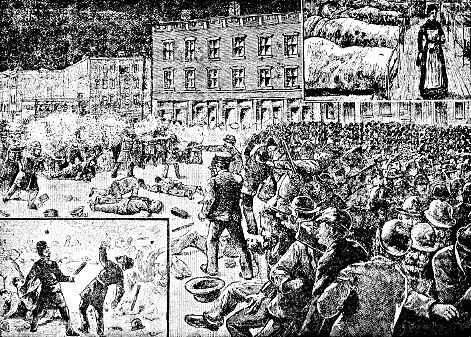
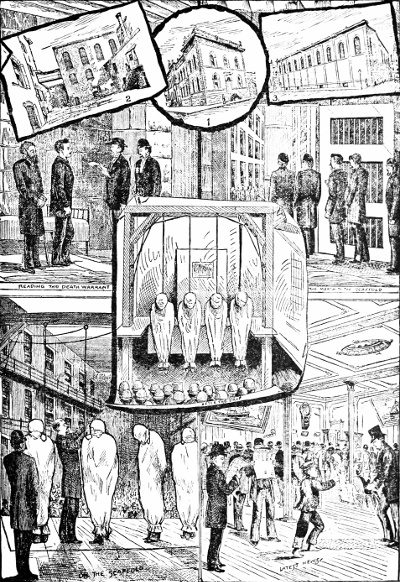
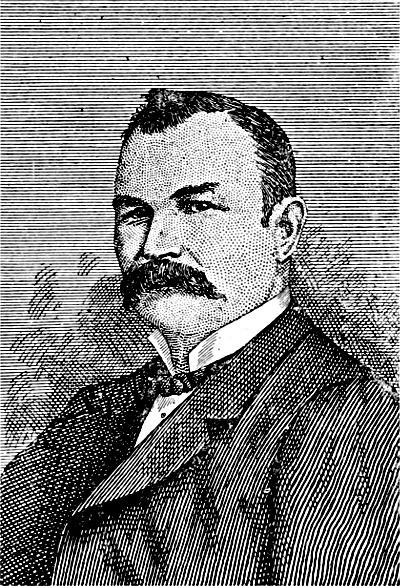
This great and unprecedented anarchistic conspiracy of May
4th will doubtless result in a blessing to America. First, it
will teach the administrators of law and justice the necessity of
being watchful of this treacherous element in society which
would thus ruthlessly violate every sacred principle of right and
honor.
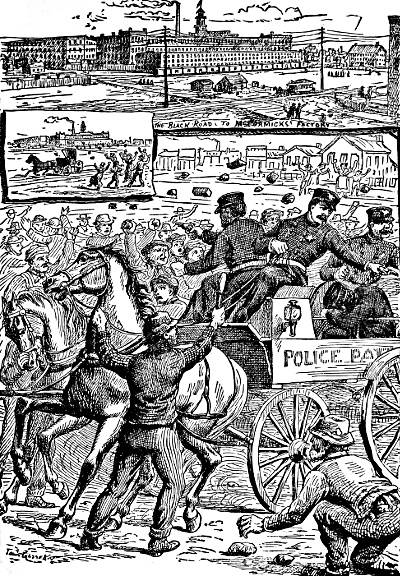
The bravery of the police on that eventful night of May
4th is worthy of note in the history of Chicago, and those who
fell in the defence of our birthrights as American citizens have
builded a monument in the hearts of a grateful people that shall
endure while the star-spangled banner shall continue to wave
“O’er the land of the free and the home of the brave.” Were
we to disturb, disquiet, and bring up from their tombs the most
hideous monsters from the dead of the dark and superstitious
ages of the gloomy past, their hands deep purple with the blood
of their murdered fellow men, we should fail to find a parallel
that would compare with this unscrupulous cold-blooded massacre,
along with the bold attempt at the subversion of law.
On the fifth of the month eight of the leaders of anarchy
were arrested and indicted for murder and conspiracy. The
police raided the office of the Arbeiter Zeitung,
the organ of the socialistic and anarchistic labor agitators,
obtaining quantities of dynamite bombs, flags, and
inflamatoryinflammatory literature which
was offered in the trial as corroborative evidence. August Spies, a German, was the editor of the
Zeitung and a ringleader of the anarchists. A. R. Parsons, an American, was editor of the
Alarm. Samuel Fielden, of
English nationality, laborer. Oscar Neebe,
German. Adolph Fischer, a German.
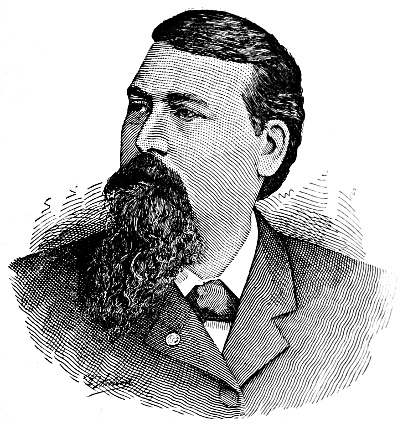
Louis
LingLingg, a German, carpenter. George EngleEngel, German,
and Michal Schwab. These are the ones who
were indicted for murder and anarchy. A. R. Parsons fled the night
of the riot and consequently was not arrested, but he subsequently
came in and gave himself up to the officials in the criminal court,
doubtless thinking by this semblance of honor to impress the court of
his innocence and thereby secure acquittal.
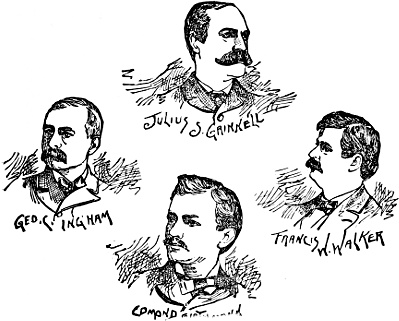
The attorneys for the State in the prosecution were as follows:
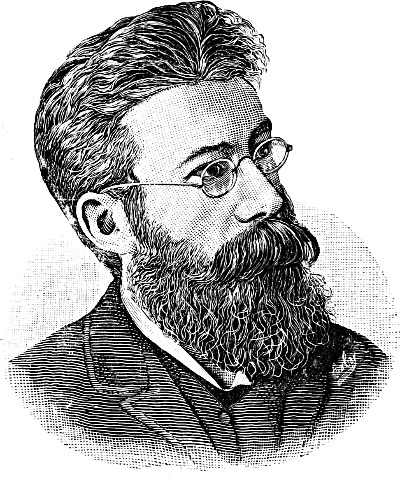
Julius S. Grinnell; and assistants State, George Ingham
and Frank Walker.
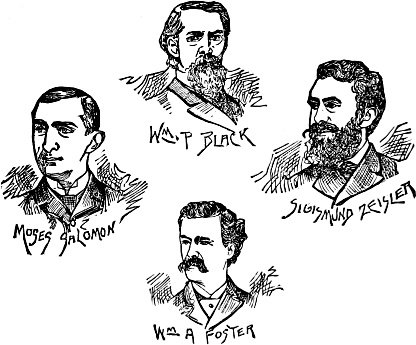
Col. W. P. Black, Solomon Zeisler, and Mr. Foster, of Iowa,
were for the defence, who availed themselves of every technicality
in the interests of their clients. Four long and tedious
weeks were consumed in obtaining a jury, exhausting fourteen
panels of jurors in securing twelve competent men to try this
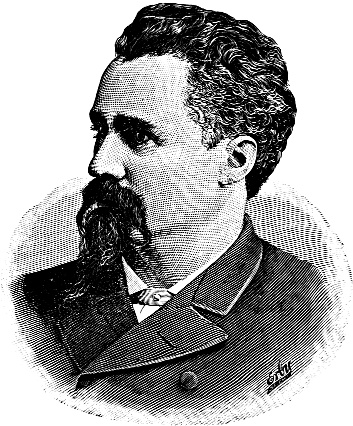
case. His Honor, Judge J. E. Gary, presiding.
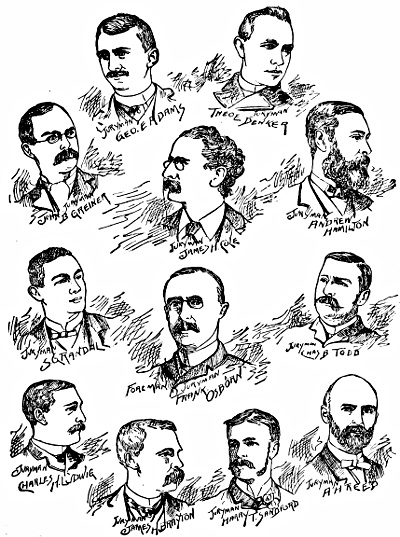
The names of the jury accepted by the State and the defence
were Major J. H. Cole, F. E. Osborne, S. G. Randall, A. H.
Reed, J. H. Bruyton, A. Hamilton, G. W. Adams, J. B. Greiner,
C. B. Todd, C. A. Ludwig, T. E. Denker, and H. T. Sanford.
An application was filed with State’s Attorney Grinnell for
a separate trial in the case of Neebe, Spies, Schwab, and Fielden,
but was overruled by his Honor, Judge Gary, as they had been
jointly indicted for conspiracy and murder.
On Friday, July 10th, 1886, the case of the anarchists was
opened by the prosecution in the taking of evidence.
Officers Steel, Barber, Reed and McMahon, who were
wounded in the riot of May the 4th, were so far recovered as to
be able to be present.
Felix Puschek was sworn and submitted plans of the Haymarket
and several halls in the city known to be headquarters
for the meetings of the anarchists.
Police Inspector Bonfield next took the stand and related
how the police attempted to disperse the unlawful assemblage
of armed Anarchists, and detailed the circumstance of the
bomb-throwing, already related. He also identified the following
circular, by which the meeting was called:
“Attention, working men! Great mass-meeting to-night, at
7 o’clock, Haymarket square, between Desplaines and Halsted.
Good speakers will be present to denounce the late atrocious
act of the police, the shooting of our fellow working men yesterday
afternoon. Working men, arm and appear in full force.”
“The Committee.”
Some of the anarchist’sanarchists indicted
for conspiracy turned State’s evidence. Gottfried Waller, a Swiss
by nationality, a cabinet-maker by trade, formerly a socialist, and
a member of the Lehr and Wehr Verein, testified that the latter
organization comprised various armed groups of anarchists; that the
letter “Y” in the Arbeiter Zeitung meant for the armed
section to meet at Grief’sGreif’s hall; that he
acted as chairman of the meeting of seventy or eighty persons, Engel,
Fischer and Breitenfeld, the commander of the Lehr and Wehr, being
present. The witness testified that Engel unfolded a plan whereby if a
collision between the strikers and the police should occur, the word
“Ruhe” would appear in the Arbeiter as a signal for the
Lehr and Wehr and the Northwest group of anarchists to assemble in
Wicker Park with arms. They should then storm the North avenue police
station, and proceed thence to other stations, using dynamite and
shooting down all who opposed them, and should cut the telegraph wires
to prevent communication with the outside
world. Engel said the best way to begin would be to throw a
dynamite bomb into the police station, and that when the populace
saw that the police were overpowered, tumult would
spread through the city, and the anarchists would be joined by
the working men. This plan, Engel said, had been adopted by
the Northwest group. It was decided to appoint a committee
to keep watch of affairs in the city and to call a meeting for the
next night in the Haymarket. Fischer was directed to get the
handbills calling the meeting printed. Those present at the preliminary
meeting represented various groups throughout the
city. Fischer announced that the word “Ruhe” would mean
that a revolution had been started. Engel put the motion, and
the plan was adopted. The committee on action was composed
of members from each group; the witness knew only one—Kraemer.
The members of the armed groups were known by
numbers, and witness number was 19.
Spies was questioned in January, 1885, at Grand Rapids,
Mich., relative to these secret organizations, when he said that
force must bring about the necessary reform which the ballot-box
had failed to inaugurate and was incompetent to perform.
Shook, of Grand Rapids, also testified that Spies had said that
the secret drilled organizations of Chicago for the revolution of
society numbered over 3,000, and that none except members of
those organizations knew of the modus operandi
by which they intended to wage their warfare.
Lieutenant Bowler testified to seeing men in the crowd fire
upon the police with revolvers; officers S. C. Bohner and E. J.
Hawley saw Fielden fire. In the line of proving up the conspiracy
to incite the working men to violence, it was shown by the
evidence of James L. Frazer, E. T. Baker, A. S. Leckie, Frank
Haraster, Sergeant John Enright and officer L. H. McShane,
that Spies and Fielden incited the mob to attack McCormick’s
Reaper Works and the non-union employes on May 3. Detective
Reuben Slayton testified to having arrested Fischer at the
Arbeiter Zeitung office. He had a loaded revolver hid under his
coat; a file-grooved dagger and a fulminating cap, used to
explode dynamite bombs. Theodore Fricke, former business
manager of the Arbeiter, identified the copy of the “Revenge”
circular as being in Spies’ handwriting. Lieutenant William
Ward testified to having commanded the Haymarket meeting to
disperse in the name of the people of Illinois, and that Fielden
cried, “We are peaceable,” laying a slight emphasis on the last
word.
William Seliger, of 442 Sedgwick street, testified that Louis
Lingg boarded with him, and that himself, Lingg, Huebner, Manzenberg
and Hewmann worked at making dynamite bombs of a spherical shape.
He attended the various meetings. He identified the calls for
the armed sections to meet in the Arbeiter Zeitung.
BalthasarBalthazar Rau brought the “Revenge”
circular to Zephf’s hall. Lingg worked at first on “gas-pipe” bombs;
they made forty or fifty bombs the Tuesday before the riot. Lingg said
they were to be used that evening; he and Lingg carried a small trunk
full of the bombs to Neff’s hall, 58 Clybourne avenue, that evening,
where they were divided up among the anarchists; besides the Northwest
group the Sachsen Bund met at Neff’s hall; witness, Lingg, Thieben
and Gustave Lehmen and two others from the Lehr and Wehr Verein, left
Neff’s hall for the Larrabee street police station; Lingg said a
disturbance must be made on the North side to prevent the police from
going to the West side; Lingg wanted to throw a bomb into the station;
the police were outside, and they could not get near; the patrol-wagon
came along completely manned, and Lingg wanted to throw a bomb under
the wagon; he asked witness for fire from his cigar; witness went into
a hallway and lit a match, and before he returned the wagon had passed:
they returned to Neff’s hall where he heard a bomb had fallen on
the West side, and killed a great many; Hewmann blamed Lingg and said
in an angry voice, “You are the cause of it all;” they
then went and hid their bombs under sidewalks and in various places,
and went home; Lingg first brought dynamite to the house about six
weeks before May 1, in a long wooden box; he made a wooden spoon to
handle it with in filling the bombs; witness belonged to the Northwest
group, and his number was 72, Engel was also a member. [The bombs were
here produced and Judge Gary ordered them removed immediately from
the court roomcourtroom and from the building.]
Seliger’s testimony was unshaken on cross-examination. Mrs.
Bertha Seliger corroborated her husband’s testimony, testifying
that at one time six or seven men were at work making bombs, and that
after the Haymarket Lingg tore up the floor of a closet to secrete
those he had on hand.
Lieutenant John D. Shea, Chief of the Detective force, testified
to having assisted in the raid on the Arbeiter Zeitung
office, May 5. The galley of type from which the “Revenge” circular was
printed, copies of Herr Most’s book, and other anarchistic literature,
red flags and banners with treasonable devices, and a quantity of
dynamite were found. The witness asked Spies if he wrote the “Revenge”
circular, and he refused to answer. When he arrested Fischer he asked
him where he was on the night of the Haymarket meeting. Fisher said in
the Arbeiter ZietungZeitung office
with Schwab, and that Rau brought word that
Spies was at the Haymarket, that a big crowd was there, and
they all went over. He had a belt, a dagger, and a fulminating
cap on him when arrested, but he said he carried them for protection.
I said: ‘You didn’t need them in the office.’ He said:
‘I intended to go away, but was arrested.’ I also said: ‘There
has been found other weapons like this sharpened dagger; how
is it you come to carry this?’ He said he put it in his pocket
for his own protection.
Detective William Jones testified that he had a locksmith
open a closet in Spies office, and in a desk were found two bars
of dynamite, a long fuse, a box of fulminating caps, some letters,
and copies of both the celebrated circulars. At Fischer’s home
he found a lot of cartridges and a blouse of the Lehr und Wehr
Verein. Officer Duffy found two thousand copies of the circular
calling upon the working men to arm, and the manuscript of
the “Revenge” circular in the Arbeiter Zeitung office. Herr
Most’s book, “The Science of Revolutionary Warfare,” found in
the Arbeiter office, was offered in evidence; also the manual for
the manufacture of explosives and poisons.
Bernhard Schrader, a native of Prussia, five years in this
country, a carpenter by trade, testified that he was a member of
the Lehr und Wehr Verein; was at the meeting at Greif’s hall
the night of May 3, and he corroborated Waller’s testimony
throughout. Besides those mentioned by Waller, Schrader named
Hadermann, Thiel and Danafeldt, as attendants at the meeting. He
saw BalthausarBalthazar Rau distributing the
“Revenge” circulars at a meeting of the Carpenter’s
Union on Desplaines street. Witness was present also at the Sunday
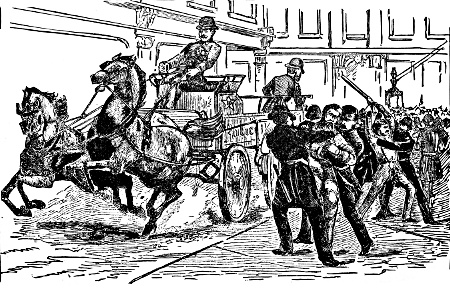
meeting on Emma street. It was here agreed to cripple the fire
department, in case they were called out, by cutting their hose. Witness
went to the meeting at 54 West Lake street in response to the signal
“Y” in the Arbeiter Zeitung. He was at the
Haymarket, but did not know who threw the bomb. The Northwest group of
the Lehr und Wehr were armed with Springfield rifles. Witness’
number in the organization was 3,312.
Lieutenant Edward Steele testified that when the police
entered the Haymarket somebody cried out: “Here come the
blood-hounds. You do your duty, and we’ll do ours.”
Lieutenant Michael Quinn testified that he heard this exclamation
and that the man who made it was Fielden, just as he
ceased speaking on the wagon. About the instant the bomb
exploded, Fielden exclaimed: “We are peaceable!”
Lieutenant Stanton testified that the bomb exploded four
seconds after his company of eighteen men entered the Haymarket.
Every member of his company except two were
wounded, and two—Degan and Redden—killed. The witness
was wounded in eleven places. Officers Krueger and Wessler
testified to having seen Fielden shoot at the police with a revolver.
Gustave Lehman, one of the conspirators, gave a detailed
account of various meetings; the afternoon of May 4 he was at
Lingg’s house where men with cloths over their faces were
making dynamite bombs; Huebner was cutting fuse; Lingg
gave witness a small hand-satchel with two bombs, fuse, caps,
and a can of dynamite; at 3 o’clock in the morning, after the
Haymarket explosion, he got out of bed and carried this material
back to Ogden’s grove and hid it, where it was found by Officer
Hoffman; money to buy dynamite was raised at a dance of the
Carpenters’ Union, at Florus’ Hall, 71 West Lake street. Lingg
took this money and bought dynamite; Lingg taught them how
to make bombs. M. H. Williamson and Clarence P. Dresser,
reporters, had heard Fielden, Parsons and Spies counsel violence;
the latter at the Arbeiter Zeitung office had advised that the
new Board of Trade be blown up on the night of its opening.
George Munn and Herman Pudewa, printers, worked on the
“Revenge” circular in the Arbeiter Zeitung office; Richard
Reichel, office-boy, got the “copy” for it from Spies.
The most sensational evidence of the trial, as showing the
inside workings of the armed sections of the socialists, and at
the same time the most damaging as indicative of their motives
and designs, was that of Detective Andrew C. Johnson, of the
Pinkerton agency, an entirely disinterested person who was
detailed in December, 1884, by his agency, which had been
employed by the First National Bank to furnish details of the
secret meetings which it was known were being held by revolutionary
plotters at various places throughout the city. Johnson
is a Scandinavian, thin-faced and sandy-haired, born in Copenhagen,
and thirty-five years of age. He told his story in a calm,
collected, business-like manner. Mr. Grinnell asked:
“Do you know any of the defendants?” Witness—“I do.”
“Name them.”—“Parsons, Fielden, Spies, Schwab and
Lingg.”
“Were you at any time connected with any group of the
International Workingmen’s Association?”—“I was.”
“What group?”—“The American group.”
“Were you a member of any armed section of the socialists
of this city?”—“Yes, sir.”
“When did you begin attendance at their meetings?”—“The
first meeting I attended was the 22d of February 1885, at
Baum’s pavilion. The last meeting I attended was the 24th of
January of this year.”
“At whose instance did you go to their meetings?”—“At the
instance of my agency.”
“Did you from time to time make reports of what you heard
and saw at their meetings?”—“I did.”
Mr. Grinnell passed over to witness a bundle of papers and
asked: “Have you in your hand a report of the meeting of the
22d of February, 1885?”—“Yes, sir.”
“Were any of the defendants present at that meeting?”—“Yes,
sir; Parsons was present.”
“Refer to your memoranda and tell me what was said by
Parsons at that meeting.”—Objected to; overruled.—“Parsons
stated that the reason the meeting had been called in that locality
was so as to give the many merchant princes who resided there
an opportunity to attend and see what the Communists had to
say about the distribution of wealth. He said: ‘I want you all
to unite together and throw off the yoke. We need no president,
no congressmen, no police, no militia, and no judges.
They are all leeches, sucking the blood of the poor, who have
to support them all by their labor. I say to you, rise one and
all, and let us exterminate them all. Woe to the police or to
the military whom they send against us.’”
“That was where?”—“At Baum’s pavilion, corner of Cottage
Grove avenue and Twenty-second street.”
“Have you a report of any other of the defendants speaking
at that meeting?”—“No, sir.”
“What is the next memorandum that you have?”—“The
next meeting was March 1. That night I became a member. I
went to Thielen, who was at the time acting as treasurer and
secretary for the association, and gave him my name and signified
my willingness to join the association. He entered my name
in a book and handed me a red card with my name on and a
number.”
“When and where was that?”—“That was March 1, 1885, at
GriefsGreif’s hall, No. 54 West Lake street, in
this city.”
“Have you what was said and done at that meeting?”—“I
have a report of it here.”
“Who spoke?”—“Parsons, Fielden, Spies, and others.”
“Any other of the defendants?”—“No sir.”
“State what Fielden said, and then what Parsons said.”—“A
lecture was given by a man named Bailey on the subject of
socialism and christianity, and the question arose as to whether
christianity ought to be introduced in their meetings.”
“What did Fielden, Spies and Parsons say there?”—“Fielden
said that he thought this matter ought not to be introduced
into their meetings. Parsons said, ‘I am of the same opinion,’
and Spies also said that it ought not to be introduced.”
“Now state the next meeting.”—“The next meeting was
March 4, at the same place.”
“Who were present?”—“Parsons, Fielden and Spies were present,
and spoke.”
“When was the memorandum made that you have of that
meeting?”—“The same day, immediately after the termination
of the meeting. Parsons said: ‘We are sorely in need of funds
to publish the Alarm. As many of you as are able ought to
give as much as you can, because our paper is our most powerful
weapon, and it is only through the paper that we can hope
to reach the masses.’ During his lecture he introduced christianity.
Spies stood up and said: ‘We don’t want any christianity
here in our meetings at all. We have told you so before.’
Fielden made no speech.”
“When was the next meeting?”—“March 22.”
“Were any speeches made by any of the defendants
there?”—“Yes, sir, Spies spoke. Previously a man
named Bishop introduced a resolution of sympathy for a girl named
Sorell. Bishop stated that the girl had been assaulted by her master.
She had applied for a warrant, which had been refused her on account
of the high social standing of her master. Spies said: ‘What is
the use of passing resolutions? We must act, and revenge the girl.
Here is a fine opportunity for some of our young men to go and shoot
Wight.’ That was the man who had assaulted the girl.”
“Do your reports contain references to speeches made by
others?”—“They do.”
“You are only picking out speeches made by the
defendants?”—“That is all.”
“When was the next meeting?”—“March 29, 1885, at
Grief’sGreif’s hall. The defendant, Fielden,
spoke at that meeting. He said: ‘A few explosions in the city of
Chicago would help the cause considerably. There is the new Board of
Trade, a roost of thieves and robbers. We ought to commence by blowing
that up.’”
“Were other speeches made at that meeting?”—“There
were, but no others made by the defendants.”
“When was the next meeting?”—“April 1, at Greif’s hall.
Spies, Fielden and Parsons were present at the meeting. Spies
made a lengthy speech on this occasion. His speech was in regard
to acts of cruelty committed by the police in Chicago; he
spoke of the number of arrests made, and the number of convictions
in proportion. He also referred to the case of the girl who
preferred a charge of assault against police-sergeant Patton, of
the West Chicago avenue station.”
“Who else spoke there?”—“Fielden. Spies had said before
that he had advised the girl to get a pistol and go and shoot
the policeman. Fielden stood up and said; ‘That is what she
ought to do.’”
“What was the next meeting?”—“April 8, 1885,
at Greif’s hall. Parsons made a lengthy speech. He referred
frequently in his address to the strike at the McCormick harvester
works. He said: ‘There is but one of two things for the men to
do. They must either go to work for the wages offered them or else
starve.’ In concluding his remarks he referred to the strike
at La Salle, Illinois. He said: ‘To-morrow morning or the next
day the authorities here in the city will probably send a trainload
of policemen or militia to La Salle to shoot down the working people
there. Now, there is a way to prevent this. All you have to do is to
get some soap and place it on the rails and the train will be unable to
move.’ Parsons spoke at great length of the crimes, as he termed
them, of the capitalists, and he said to those present that it was an
absolute necessity for them to unite against them, as that was the only
way they could fight the capitalists.”
“Who else spoke there?”—“Fielden. He said it was a
blessing something had been discovered wherewith the working
men could fight the police and militia with their Gatling guns.”
“What was the next meeting you had?”—“April 19. That
meeting was held at No. 106 Randolph street, because the hall
at No. 54 Lake street was engaged. At this meeting Parsons
offered a resolution of sympathy for Louis Riel and the half-breeds
in the Northwest who were in rebellion against the Canadian
government. Neither Parsons nor Fielden spoke at the
meeting.”
“What was the next meeting?”—“April 22, at
Greif’s hall. Referring to the opening of the new Board of Trade
building, Parsons said: ‘What a splendid opportunity there will
be next Tuesday night for some bold fellow to make the capitalists
tremble by blowing up the building and all the thieves and robbers
that are there.’ At the conclusion of his speech he said that
the working men of Chicago should form in processions on Market square
Tuesday evening next, and he invited all those present to get as many
of their friends as they could to join in the procession.”
“Did any other of the defendants speak
there?”—“Fielden said: ‘I also wish to invite
as many of you as can come and as many as you can get. Go around to the
lodging-houses and get all you can to join in the procession—the
more the merrier.’”
“When was the next meeting?”—“April 26, at
Greif’s hall.”
“Did any of the defendants speak
there?”—“There were present Parsons, Fielden, Spies.
Parsons said: ‘I wish you all to consider the misery of the
working classes, and the cause of all the misery is these institutions
termed government. I lived on snow-balls all last winter, but, by
G—d! I won’t do it this winter.’”
“What was the next meeting at which any of the defendants
attended?”—“April 30, at Market square; Parsons and Fielden.
Parsons said: ‘We have assembled here to determine in
which way best to celebrate the dedication of the new Board of
Trade building, and to give the working men of Chicago a
chance to state their views in the matter’. Fielden then said:
‘I want all the working men of Chicago, the country, and the
world in general to arm themselves and sweep the capitalists off
the face of the earth.’ Parsons then said: ‘Every working
man in Chicago must save a little of his wages every week until
he has enough to buy a Colt’s revolver and a Winchester rifle,
for the only way that the working people will get their rights
is by the point of the bayonet. We want you to form in procession
now, and we will march to the Board of Trade. We
will halt there, and while the band is playing we will sing the
Marseillaise.’”
“Did you march in the procession, too?”—“I did.”
“Where were you in that line of march?”—“I was in the
center of the procession.”
“Did any of the defendants march with you?”—“Not with
me, but in the procession Fielden, Spies, Parsons and Neebe
marched.”
“What was the next meeting?”—“There was something
occuredoccurred the night of May 30. I was
standing at the corner of Washington street and Fifth avenue close
behind Spies. That was Decoration day, and as the procession passed
by, Spies said: ‘A half-dozen dynamite bombs would scatter them
all.’ A little later a gentleman who was standing near remarked
upon the fine appearance of the Illinois National Guard, who were then
passing. Spies said: ‘They are only boys, and would be no use in
case of a riot. Fifty determined men would soon disarm them
all.’”
“When was the next meeting?”—“The next meeting was
on the Lake front, May 31, and Fielden and Parsons was there.
Fielden said: ‘It is only by strength and force that you can
overthrow the government.’ Parsons also spoke, but I don’t recollect
what he said.”
“Go on to the next meeting.”—“The next meeting was June
7, at Ogden’s grove. There were present Fielden, Parsons and
Spies. Fielden said: ‘Every working man in Chicago ought
to belong to organizations. It is of no use to go to our masters
to give us more wages or better times. I mean for you to use
force. It is of no use for the working people to hope to gain
anything by means of an ordinary weapon. Every one of you
must learn the use of dynamite, for that is the power with which
we hope to gain our rights.’ Schwab also spoke at that meeting
in German, which I do not understand.”
“When was the next meeting?”—“The next meeting was
August 19, at Greif’s hall. Parsons and Fielden spoke. Parsons
referred to the late strike of the street car employes, and
said that if but one shot had been fired, and Bonfield had happened
to be shot, the whole city would have been deluged in
blood, and social revolution would have been inaugurated. The
next meeting was August 24, at Greif’s hall.”
“Do you know of a fellow named Bodendecke speaking at
those meetings?”—“Occasionally, but not frequently; I don’t
know where he is now. There were some twenty or twenty-three
men present at that meeting, and twenty women.”
“Name who were present.”—“Besides the two defendants,
Parsons, and Fielden, there was Baltus, Bodendecke, Boyd,
Lawson, Parker, Franklin and Schneider.”
“State what occuredoccurred
there.”—“After being there a short time a man armed
with a long cavalry sword and dressed in a blue blouse and wearing a
slouch hat came into the room. He ordered all those present to fall in.
He then called off certain
names, and all those present answered to their names. He inquired
whether there were any new members who wished to join
the military company, and some one replied that there was. He
then said: ‘Whoever wants to join step to the front.’ Myself
and two others stepped to the front. We were asked separately
to give our names. I gave my name, which was put down in a
book, and I was then told that my number was 16. Previous
to my name being put down in the book, a man to whom I was
speaking asked whether there was any one present who knew
me, or whether any one could vouch for my being a true man.
The defendant, Parsons and Bodendecke spoke up and said they
would vouch for me. The other two were asked their names in
turn, and as they were properly vouched for, their names were
entered in a similar manner in a book, and they were given
numbers. The man who came into the room armed then inquired
of two other men in the room whether they were members
of the American group. Both said they were and he asked
to see their cards. As they were unable to show cards they
were expelled, as were two others. The doors were closed and
the remainder were asked to fall in line, and we were drilled
about three-quarters of an hour—put through a regular manual
of drill, marching, countermarching, wheeling, forming fours,
etc.”
“Who drilled you?”—“The man that came in with the
sword; I didn’t ascertain his name. At the expiration of that
time the drill-instructor stated that he would now introduce
some of the members of the first company of the German organization.
He went outside and in a few minutes returned accompanied
by ten other men, dressed as he himself was, each one
armed with a Springfield rifle. When they all got into the
room he placed them in line facing us and introduced them as
members of the first company of the Lehr und Wehr Verein.
He said that he was going to drill them a little while to let us
see how far they had got with their drill. He drilled them
about ten minutes in a regular musket drill. At the end of
that time a man in the employ of the proprietor of the saloon at
No. 54 West Lake street came into the room with two tin boxes,
which he placed on the table at the south end of the room. The
drill-instructor then asked all those present to step up and examine
the two tin boxes, as they were the latest improved dynamite
bomb. I stepped to the front with the others, and examined
the two tins.”
“Describe them as near as you can.”—“They were about the
size and had the appearance of ordinary preserved fruit cans. The
top part unscrewed, and on the inside the cans were filled with a
light-brown mixture. There was also a small glass tube inserted in
the center of the can. The tube was in connection with a screw,
and it was explained that when the can was thrown against any hard
sabstancesubstance it would explode.”
“Was that mixture a liquid?”—“Inside of the glass tube
was a liquid.”
“Was there anything around that glass tube?”—“Yes, sir;
it was a brownish mixture.”
“Was that a liquid?”—“No, sir; it looked more like fine
sawdust.”
“Did you feel of it?”—“I did not. The drill-instructor told
us we should be very careful about selecting new members of
company, because if we were not, there was no telling whom we
might get into our midst. The next proceeding of the evening
was to select officers. A man named Walters was chosen Captain,
and Parsons was chosen Lieutenant. Some discussion
arose as to what the company should be called. It was decided
eventually that we should be called the International Rifles.
The drill-instructor then suggested that we ought to choose some
other hall, as we were not quite safe there. He added: ‘We
have a fine place at No. 636 Milwaukee avenue. We have a
shooting range in the basement, where we practice shooting regularly.’
Parsons inquired whether it was not possible for us to
rent the same place. The drill-instructor informed him he did
not know. The question of renting another hall was postponed,
and our next meeting was fixed for the next Monday.”
Mr. Salomon—“A meeting of what?”
Witness—“A meeting of the armed section of the American
group.”
Mr. Grinnell—“Who drilled that company that
night?”—Witness—“That German, and Parsons and Fielden.”
“When was the next meeting?”—“The following Monday,
the 31st of August, at the same place. Parsons and Fielden
were present, and others. That was a meeting of the armed section,
and it was held at Greif’s hall. Capt. Walters drilled us
about an hour and a half. Afterward a consultation was held
by the members of the company as to the best way of procuring
arms. Some one suggested that each member should pay so
much a week until a sufficient amount had been raised wherewith
to purchase a rifle for each member of the company. Parsons
said: ‘Look here, boys, why can’t we make a raid some
night on the militia armory? There are only two or three men
on guard there, and it is easily done.’ This suggestion seemed
to be favored by the members, and it was finally decided to put
the matter off until the nights got a little longer.”
Capt. Black—“Which matter was put off?”
Witness—“The raid on the armory.”
Mr. Grinnell—“When was the next
meeting?”—Witness—“September 3, 1885, at No. 54 West Lake
street. Fielden made a speech there and said: ‘It is useless for you
to suppose that you can ever obtain anything in any other way than by
force. You must arm yourselves and prepare for the coming revolution.’
That was one of the ordinary meetings of the association. The next
meeting was October 11, at Twelfth street Turner hall. Spies and
Fielden were present. Fielden said: ‘The Eight-Hour law will be of no
benefit to the working men. You must organize and use force. You must
crush out the present Government by force. It is the only way in which
you can better your present condition.’ I left with Fielden before the
meeting terminated.”
“When was the next meeting you attended?”—“The next
meeting was December 20, at Twelfth street Turner hall. Fielden
was present. He said: ‘All the crowned heads of Europe
are trembling at the very name of Socialism, and I hope soon to
see a few Liskes in the United States to put away a few of the
tools of the capitalists. The execution of Riel in the Northwest
was downright murder.’”—“Was that an open meeting?”—“It
was as far as I know. I saw no one refused admission.”
“How about those other meetings you have mentioned, aside
from the armed sections?”—“Aside from the meetings of the
armed section I should say that they were public. I never saw
any one refused admission.”—“Was there any precaution
taken?”—“A precaution was taken in this way: A member
of the group was generally stationed at the door, and as each
member entered the hall he was closely scrutinized. The next
meeting was December 30.”
“What place?”—“At No. 106 Randolph.”
“Who spoke there?”—“Fielden. At this meeting a stranger
asked a question, and Fielden replied to the question.”
“Do you know what the question was?”—“The question
was: ‘Would the destruction of private property assist universal
co-operation?’ Fielden replied: ‘Neither I or any body
else can tell what is going to be in a hundred years from now,
but this everybody knows: If private property is done away
with, it would insure a better state of things generally. And
we are trying all we can to teach the people the best way in
which to bring about this change.’”
“Who was present at that meeting?”—“Fielden, only.
The next meeting was January of this year, at Twelfth street
Turner hall. Fielden and Schwab were present. Fielden, referring
to the troubles in Ireland, said: ‘If every Irishman
would become a Socialist, he would have a better opportunity
to secure home-rule for Ireland. I want all Irishmen to destroy
all the private property they can lay their hands on.’ He also
referred to other matters. What he said had reference to Pinkerton’s
detective agency.”
“What was it he said?”—“He said Pinkerton’s detectives
were a lot of cold-blooded murderers, and the worst enemies the
working men had, and they were all in the pay of the capitalists.”
“Is that all that was said there? Was that one of these ordinary
opening meetings?”—“It was.”
“What else happened?”—“Schwab also addressed this meeting
in German. During his speech he was frequently applauded.
The next meeting I attended was January 14, at No. 106
Randolph Street.”
“January of this year?”—“Yes, sir.”
“What was said at this meeting?”—“Before the meeting
commenced the defendants, Fielden and Spies, had a conversation
which I overheard.”
“Where was that?”—“That was held in the hall near the
door.”
“State what you heard.”—“Spies said to Fielden: ‘Don’t
say very much about that article on Anarchists in an afternoon
paper. You simply need to state that a reporter of the paper
had an interview with me a few days ago, but that most of the
statements of the paper are lies.’”
“How was that conversation carried on?”—“It was carried
on quietly and was not meant for anybody else to hear.”
Capt. Black objected to the last part of the answer, and
succeeded in having it stricken out.
“What was the tone of voice?”—“In whispers.”
“When did they leave?”—“Spies further said: ‘You must
be careful in your remarks. You don’t know who might be
amongst us to-night.’ Spies then went away and the meeting
was called to order.”
“By whom?”—“Fielden.”
“What did he say?“—“He made a long talk, commenting
on the articles that appeared. He said almost all of the statements
were lies. He said in regard to dynamite bombs: ‘It is
quite true we have lots of explosives and dynamite in our possession,
and we will not hesitate to use them when the proper
time comes. We care nothing at all either for the military or
the police. All of these are in the pay of the capitalists.’ He
further said that ‘even in the regular army most of the soldiers
are in sympathy with us, and most of them have been driven to
enlist. I have had a letter from a friend out West. He told
me that he had seen a soldier on the frontier reading a copy of
the Alarm.’ Others then made speeches. Afterward Fielden
again spoke at the same meeting in regard to the question asked
him, what was the Socialist idea of the eight-hour movement.
Fielden said: ‘We don’t object to but we don’t believe in it.
Whether a man works eight hours a day or ten hours a day he
is still a slave. We propose to abolish slavery altogether.’ That
is all of that meeting. Fielden said, the 24th of January, at a
meeting held at No. 106 Randolph street—”
“What is the name of that, Jung’s hall?”—“Yes, I believe
it is Jung’s hall. Fielden said good results were sure to follow
the abolishment of private property.”
“When did you quit this branch of your business?”—“The
latter part of January last.”
“Did you know then of Pinkerton’s agency having any other
men employed in the same line that you were employed in?”—“I
knew there had been another man, but whether he was employed
then I do not know.”
“Have you lately, within the last few days, ascertained, and
do you know the fact, that you have seen any Pinkerton men in
these meetings?”—“That is so.”
“But you did not know it at that time?”—“I did not know
it at that time.”
“How often did you drill with the armed section?”—“Only
twice.”
“How often did they drill?”—“Once a week.”
“Have you got any information from any other members of
the organization? If they drilled after that?”
Objected to and withdrawn.
“Did you ascertain from any of the defendants if they drilled
after that?”—“I did not.”
“Have you had any other talk with Parsons outside of these
utterances?”—“I have.”
“Have you had any talk with Spies, Fielden, Parsons, and
other defendants as to the purposes of their organization?”—“I
have talked frequently with Parsons and Fielden at various
times and at various places. I cannot recollect as to what was
said at each place and when it was said.”
“Can you give me the substance or purport of what was
said at any time?”
Captain Black objected, unless time and place were given.
“What was the object of the armed section as was expressed
by the members?”—“At the first meeting of the armed section
the discussion arose as to what the company should be called.
Some one suggested that the company should be amalgamated
with the German organization, and the company was to be called
the Fourth Company of the Lehr und Wehr Verein. This idea
was opposed, and finally it was decided that it should be called
the International Rifles. It was further said and understood by
all the members that in case of a conflict with the authorities the
International Rifles were to act in concert with the Lehr und
Wehr Verein, and obey the orders of the officers of that organization.”
“What was said at any time as to when this revolution was
to take place—when was to be the culmination of the conflict?”—“The
1st of May was frequently mentioned as a good opportunity.”
“What 1st of May?”—“This present. As far as I remember
it was at a meeting at Twelfth street Turner hall on one
occasion in December, and it was the defendant Fielden that
said the 1st of May would be the time to strike the blow. There
would be so many strikes and there would be 50,000 men out of
work—that is to say if the eight-hour movement was a failure.”
“Have you ever met any of them at the Arbeiter Zeitung
office?”—“I have.”
“What conversation did you have?”—“I had a conversation
with Parsons some time in March. The conversation took place in
the Alarm office in the Arbeiter Zeitung
building. This office is situated in the back of the building.”
“Well, state what you remember of the conversation.”—“I
asked Parsons if he did not think it advisable to get some papers
printed in the Scandinavian language, as I thought I could make
use of them. I intended to distribute them among the Scandinavian
people along Milwaukee avenue and that neighborhood.
Parsons replied: ‘Yes, it is a good idea, and the best thing you
can do is to bring the matter up in our next meeting. Bring it
up before the meeting, and I will see that it is attended to. It
is no use, we must have the Scandinavians with us.’”
“Did you have any talk with any of these defendants about
the purposes and objects of the social revolution, so-called?”—“I
have had numerous conversations with Fielden and Parsons
but I cannot remember distinctly what was said.”
“What was Parsons’ relation to the Alarm?”—“He was
the editor.”
“Did you ever see a book by Most called ‘The Modern
Science of Revolutionary Warfare?’ Look at that book and
state whether you have seen it before.”—“I have.”
“Where?”—“I have seen it at meetings at Twelfth street
Turner hall; at No. 54 West Lake street, and also at No. 106
Randolph.”
“Who had charge of the distribution of it?”—“The Chairman.”
“Of the respective meetings?”—“Yes, sir.”
“Were they sold or given away?”—“They were sold.”
“Do you know whether or not any steps were taken to distribute
the Alarm?”
“There were a number of those present at that particular
meeting who bought a number of copies of the Alarm, and said
that they would try their best to sell them and obtain new subscribers.”
“Do you know a man named Schneider and one Thomas
Brown?”—“Yes, sir.”
“Did they belong to the American group?”—“Both of
them.”
“Did they belong to the armed section?”—“Both of them.”
“Where usually did the American group meet before the
time you ceased your connection with it?”
“During the last few meetings it met at No. 106 Randolph
street.”
“Prior to that where did it meet?”—“It had met at No. 54
West Lake street, also at No. 45 North Clark street, and on the
Lake front.”
“Did you ever meet with the American group at No. 107
Fifth avenue?”—“No, sir.”
“No. 636 Milwaukee avenue was the place mentioned as the
proper place for drilling. Were you ever there?”—“I was
there.”
“Did they meet more than once there?”—“I don’t know.”
“Do you know what the hall is called?”—“I do.”
“What is it?”—“Thalia hall.”
“When you joined this organization did it cost you anything?”—“Ten
cents.”
“How often did you pay the contributions?”—“Once a
month.”
“How much?”—“Ten cents.”
“When you joined the armed section did that require any
special contribution?”—“No, sir.”
“What was Fielden’s office in the group of the armed
section?”
“He was Treasurer and Secretary of the organization—of
the group.”
“Did he hold any office, or was he simply a private in the
armed section?”
“He held no office while I attended there.”
CROSS-EXAMINED.
Cross-examined by Mr. Foster:—“Where were you before
you came here?”
“I was a police officer in England eight years.”
“In uniform?”—“Part of the time.”
“How long did you do detective service there?”—“Three
years.”
“At what place?”—“In Lancashire.”
“How long have you been with Pinkerton?”—“Three
years.”
“What did you do before you became a detective here?
Were you ever in any legitimate business?”
Mr. Grinnell—“In any other legitimate business?”
Witness—“I was storekeeper at the Windsor hotel.”
“Was that meeting at Baum’s hall a public one?”—“It
was.”
“March 1 you became a member?”—“Yes, sir.”
“Were your antecedents inquired into?“—“No, sir.”
“You just paid your ten cents and were received?”—“Yes,
sir.”
“Is not that your experience, that anybody who could pay
10 cents could be received?”—“Yes, sir.”
“Did you ever see anybody excluded?”—“No, sir, except
reporters. I have seen reporters excluded sometimes.”
“Were not reporters generally freely admitted?”—“Not
very often.”
“They had seats for them and a table?”—“I don’t know.
I never saw more than one at a time there.”
“Did you ever see anybody excluded by the doorkeeper?”
“No, sir.”
“Did you ever have any ushers—anybody who got seats for
strangers.”
“No, sir; but I saw some of the old members get up and
give their seats when strangers came in.”
“You stated that Mr. Spies introduced resolutions in sympathy
with a girl?”
“Somebody else introduced them but Spies opposed it. He
said there was no use making resolutions.”
“That is, the girl had had her day in court and it was no use
passing resolutions?”
“He said it would be a good opportunity for some one to
take a pistol and go and shoot Wight.”
“You are sure Spies said that?”—“Yes, sir.”
“You wrote out your report immediately with all the facts
fresh in your mind.”—“Yes, I wrote it that night.”
“Didn’t you write in your report [reading from it] that
Keegan said that after Spies got through with his remarks?”—“Yes,
but Mr. Spies said it also.”
“You are sure of that?”—“Yes, sir.”
“Will you show me the place in your report where this is
said?“—“I don’t find it.”
“Then your memory is better now than it was immediately
after the meeting?”
“It is considerably better now that I have refreshed it.”
“A detective’s memory gets better as the time goes on, does
it?”
Mr. Grinnell objected to this kind of cross-examination.
Referring to the charges against Sergt. Patton, Mr. Foster
asked: “Were the circumstances stated that the girl had been
grossly abused, but his brother officers stood round and swore
him out?”
“It may have been.”
“And was it not stated as a general expression that such a
man ought to be shot?”
“It may have been.”
In regard to the strike at La Salle, Mr. Foster made it appear as
if Parsons had simply stated in general terms that if soap was put on
the rails the train would not be able to move, but that he did not
advise anybody to go and put the soap on. Fielden’s remark that
something had been discovered by which the working men could resist
the police and militia, and Parson’s remark that he would not
live on snow-ballssnowballs another winter, were
represented by Mr. Foster in an equally innocent and harmless light.
The cross-examination for the day concluded with the
following questions and answers:
“You heard Fielden say: ‘While we march toward the
Board of Trade we will sing the Marseillaise hymn?’”—“Yes,
sir.”
“That you understood to be the French national hymn?”—“Yes,
sir.”
W. H. Freeman, a reporter, testified as follows:
“I was at the corner of Randolph and Desplaines streets.
Saw Parsons speaking, and listened to what he had to say.
Some one said Mayor Harrison was there and I tried to find
him. There was a big crowd. Parsons said that Jay Gould
was a robber, and asked what was to be done. Somebody
shouted, ‘Throw him in the lake.’ Parsons said: ‘No, that
won’t do. We must overthrow the system by which he was
enabled to secure so much money.’ He shouted frequently: ‘To
arms! to arms!’ and the crowd applauded. There were six or
eight persons on the wagon. Fielden, the next speaker, discussed
legislation, saying that Martin Foran had admitted that
it was impossible for the working men to get their rights through
legislation, and that the people were fools to send such a man to
Congress when he owned that the legislation could not better
them. He justified the forthcoming revolution, saying it was
just as proper as the colonial revolution. The police came up
quietly and my first knowledge of it was the command to disperse.
Then the bomb exploded. It made a terrible noise, and
a moment after the firing commenced. Parsons, Spies and
Fielden were on the wagon, and I think I saw Schwab there.
I crouched down behind the wagon until after the firing was
over; then I went to the Desplaines street station. On getting
out on the street I saw two officers lying wounded. I spoke to
them but they didn’t answer, so I told the sergeant of a patrol-wagon
about it.”
Officer McKeogh testified:
“I was at the Haymarket on the night of May 4. Parsons
followed Spies, saying: ‘I am a Socialist from the top of my
head to the soles of my feet, and I’ll express my sentiments if I
die before morning.’ Again he said: ‘I pay rent for the house
I live in.’ Some one asked: ‘What does the landlord do with
the money?’ Parsons replied: ‘I am glad you asked that
question. The landlord pays taxes, they go to pay the sheriff,
the militia, and the Pinkertonites.’ The crowd cheered, then
Parsons cried: ‘To arms! to arms!’ and Fielden took the stand.
He said: ‘The law does not protect you, working men. Did
the law protect you when the police shot down your brothers at
McCormick’s? Did the law protect you when McCormick closed
the doors of his factory and left you and your wives and children
to starve? I say throttle the law; strangle it, kill it!’”
H. E. O. Heineman, formerly a reporter on the Arbeiter
Zeitung, was asked:
“Mr. Heineman, you were formerly an Internationalist?”—“Yes,
sir.”
“When did you cease your connection with them?”—“About
two years ago.”
“Whom of the defendants do you know that were in that
association or society before you left it?”—“Of my own knowledge
I know none but one, that is Neebe. He used to belong
to the same group that I did.”
“Did you ever meet with any of the others at any of the
meetings?”—“Yes; Spies, Schwab, and I think, Parsons.”
“That was about the time Herr Most came here and delivered
some speeches?”—“Yes, sir.”
“And it was on account of those speeches you severed your
connection with the Anarchists?”—“Yes.”
“Whom did you see on the speaker’s wagon at the Haymarket?”—“I
saw the speakers, Spies, Schwab and Fielden, and
Rudolph Schnaubelt, whom I had formerly known from my
connection with the Internationalists.”
“You say Schnaubelt was on the wagon. How long after
the cloud came up and the crowd thinned out did you see him?”—“I
cannot say.”
“Well, how long before the police came did you miss Schnaubelt?”—“I
cannot say; perhaps ten minutes.”
“You say Mr. Neebe was a member of the Internationalist
organization. Now, you didn’t have any passwords, did you?
It wasn’t an organization where you drilled, was it?”—“It was
an avowed Socialistic order.”
Another sensational witness was Harry L. Gilmer, a workman,
who testified that he saw Spies and Rudolph Schnaubelt
standing inside the mouth of the alley at the Haymarket; that
Spies lit a match for Schnaubelt, who in turn lit the fuse of the
bomb and threw it among the police. An effort was made to
shake the testimony of this witness, which was not successful,
and witnesses were then brought forward to impeach his veracity,
but the state produced many prominent men who knew
him, and who stated that they would believe him under oath.
Captain Frank Schaack, in charge of the East Chicago
avenue police station, who unearthed the Anarchists’ conspiracy
after the Haymarket, was called to the stand on Thursday, July
29. Lingg’s trunk was placed before him. He was asked:
“Do you know any of the defendants in this case?”
“I have seen Spies, Schwab and Parsons, and Engel and
Lingg were arrested and confined in my station.”
“When did you first converse with Lingg about this case?”
“About 3 o’clock on the afternoon of May 14. First I
asked him his name. He told me. I asked him if he was at the
meeting at 54 Lake street on Tuesday night. He said: ‘Yes.’
Then he said he made dynamite. I asked him what for. He
said: ‘To use then.’ He looked excited. I asked why he
disliked the police. He said he had a reason; the police clubbed
the men at McCormick’s. He said he was down on the police
because they took the part of the capitalists. I said: ‘Why
don’t you use guns instead of dynamite?’ He said guns
wouldn’t do; that the militia would outnumber the Socialists.
I asked him how he learned to make dynamite. He said out of
books, and that he made bombs out of gas-pipe and out of lead
and metal mixed. He said he got the lead on the streets and
the gas-pipe along the river or anywhere he could.”
“What other conversation did you have?”
“Lingg said he made those bombs and meant to use them.
Then Mrs. Seliger accused him of making bombs a few weeks
after he came to her house. I knew then that he had made a
good many. John Thielen was arrested at the same time, and
from him we got two bombs. I said to Lingg: ‘This man
says you gave him the bombs. What have you to say?’ He
looked at Thielen and shook his head, and Thielen said: ‘Oh,
it’s no use, everything is known; you might just as well talk.’
But Lingg refused to say anything.”
“Anything else?”
“Well, this trunk here was brought to my office. Under the
lining I found a lot of dynamite and some fuse and asked him
if that was the kind of dynamite he used. He said it was; that
he got it at a store on Lake street. There were three kinds of
dynamite. He said he experimented once with a long bomb;
that he put it in a tree, touched it off, and that it riddled the
tree to atoms. I asked him if he knew Spies. He said ‘Yes,
for some time;’ that he was often at the Arbeiter Zeitung office.
I asked him how long he had been a Socialist. He said he’d
been a Socialist as long as he could think.”
“Did you have any conversation with Engel?”
“Yes, on the 18th, in the evening, I asked him where he was May
3. He said he worked for a man named Koch. I asked him if he made
a speech at the meeting at 54 Lake street. He said no, but that he
was at the meeting. The second time I talked with him his wife came.
She brought him a bunch of flowers. He got excited, and cried: ‘What
good are those flowers to me? Here I am locked up in a dark cell.’
Then his wife said: ‘Papa, see what trouble you’ve got yourself
into; why haven’t you stopped this nonsense?’ He said: ‘Mamma, I
can’t. I am cursed with eloquence. What is in a man must come out.
LouisLouise Michel suffered for the cause. She is
a woman; why should I not suffer? I am a man, and I will stand it like
a man.’”
“How many bombs in all did you find?”—Objected to.
“Tell the jury what experiments you made with those
bombs.”
“One bomb found in Lingg’s room, which Schuettler said
was loaded with a funnel, I put in a box two feet square and
buried in the ground three feet deep at Lake View. Officers
Stift, Rehm and Loewenstein were there. We touched the
bomb off. It blew the box to pieces, fragments carried off the
branches of trees, and the ground was torn up for a great distance.
This black dynamite, also found in Lingg’s room, was
put in a beer keg. Part of this dynamite Lingg gave to Thielen,
and this is a fragment of a round bomb I experimented with.
On top of this bomb I had a round piece of iron thirty-four
inches wide, some heavy planks, a piece of steel forty-two inches
wide and weighing 180 pounds; then an iron boiler twenty-two
inches wide and fourteen inches high; then on top of that a
stone weighing 132 pounds. The stone was burst to pieces, nine
holes were shot through the iron boiler, the steel cover was
cracked, and the planks were split into kindling wood. Portions
of the other bombs I cut off, and gave them to Profs.
Haines and Paton.”
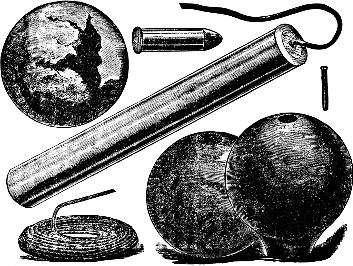
There were bushels of bombs before the jury. Coils of
fuse was unwound. Dynamite in paper packages and in tin
boxes was displayed. The court-room looked like the interior of
an arsenal so far as the tremendous character of the explosives
were concerned. Pieces of metal, gas-pipe, tin cans, and iron
boxes rattled together. Capt. Schaack, pointing to the bombs,
said he got two from Hoffman, one from fireman Miller, and one
from Officer Loewenstein. He was not allowed to tell how
many bombs in all he received until the officers first told where
the bombs were found.
“Now about those conversations. Did Lingg say anything
about the use of those bombs?”
“He said he intended to use them against the Gatling-guns
of the militia; that a revolution was impending. I asked him
about that satchel he brought to Neff’s place. He said he saw
one there. Then I asked him where he got the moulds to mould
the round bombs. He said he made them out of clay; that they
could be used about two times, then they were no good. He
said he saw the ‘Revenge’ circular on the West side.”
“Who did he say was at his place May 4?”—“He said about
six in all, but he only knew the two Lehmans.”
Capt. Schaack was asked by Mr. Ingham whether he experimented
with fuse.
“I did. I also experimented with dynamite cartridges. I
had one inserted into a stone weighing perhaps thirty pounds.
The explosion broke this stone into atoms.”
Cross-examined by Mr. Foster.—“What Lingg said to you,
Captain, was substantially this: That there was to be a conflict
between the police and the Gatling-guns on one side and the
laboring men on the other, and that he was making these bombs
to use when that time came?”
“That’s about it, only he said the time had actually come.”
“Those experiments you made were made for your own satisfaction?”
“They were made to enable me to testify to the character of
the stuff that was found.”
“As a matter of fact you woke up Engel in his cell after
midnight to interrogate him, didn’t you?”
“Well, I don’t remember. If I did, I did, and I suppose I
did. I had a right to do it.”
“Do you know of two detectives at your station who went
to Lingg’s cell late at night and exhibited a rope saying they
were going to hang him?”
“I do not, and I do not believe anything of the kind was
done.”
Officer Hoffman, of the Larrabee street station, testified that
he found nine round bombs and four long ones under a sidewalk
near Clyde street and Clybourn avenue.
“Who was with you at the time?”—“Gustav Lehman.”
Under John Thielen’s house the witness found two long
bombs, two boxes of cartridges, two cigar boxes full of dynamite,
one rifle, and one revolver.
“What else?”—“Lehman pointed out to me a can holding
about a gallon, and this was filled with dynamite.”
“Look at this box of caps. Where did you find them?”—“They
were with the dynamite. They were all under the sidewalk
on Clybourn avenue, back of Ogden’s grove.”
Assistant State’s Attorney Frank Walker opened the proceedings
Friday, July 30, by reading extracts from Parsons’
Alarm, dated May 2d of this year. It was a speech delivered
by Parsons April 29, the night the new Board of Trade was dedicated,
and that occasion afforded the speaker his subject. The
speech was full of rabid utterances, of which the following are
samples:
“To-night the property owners are dedicating a temple for
the plunder of the people. We assemble as Anarchists and
Communists to protest against the system of society founded on
spoilation of the people.” In conclusion Parsons advised his
hearers to save their money and buy revolvers and rifles, and
recommended the use of dynamite.
Under date of December 26, 1885, the Alarm contained a
long description of what qualities should center in a revolutionist.
“The revolutionist,” it was said, “must dedicate his life exclusively
to his idea, living in this world only for the purpose of
more surely destroying it. He hates every law and science, and
knows of but one science—that of destruction. He despises
public sentiment and social morality. All his sentiments of
friendship, love and sympathy must be suppressed. Equally
must he hate everything that stands in the way to the attainment
of his ends. He must have but one thought—merciless
revolution; he must be bound by no ties, and must not hesitate
to destroy all institutions and systems.”
On February 6, 1886, the Alarm paid its respects to Captain
Bonfield, and the attention of the revolutionists was called
to the clubbing done by the police at the time of the car-men’s
strike, by saying: “American sovereigns, if you don’t like this,
get guns or dynamite.”
The names of those appointed to act as a bureau of information
for the Anarchists were printed in the Alarm under date
January 9, 1886. Joseph Bock, B. Rau, August Spies, A. R.
Parsons and Anton Hirschberger were the names given. On
March 20, 1886, the Alarm said: “All argument is no good
unless based on force.”
On another occasion, speaking of the eight-hour movement,
it was said: “All roads lead to Rome; so must all labor movements
lead to Socialism.” Later the Alarm said: “One pound
of dynamite is better than a bushel of ballots. Working men,
to arms! Death to luxurious idleness!” All articles from
which these extracts were taken had Parsons’ name appended as
the writer. April 24, the date of the last issue of the Alarm,
the Knights of Labor were assailed “for attempting to prevent
the people from exterminating the predatory beasts—the capitalists.”
Mr. Ingham reads from Herr Most’s book a description
of an infernal machine to burn down buildings. This apparatus
is described as of wonderful efficiency and dirt cheap. It
is read to secure the admission as evidence of the four tin boxes
spoken of by Detective Jansen, who saw them exhibited at 54
West Lake street.
The Court is not sure the contents in both cases are the same,
and Officer Coughlin, of the Chicago avenue station, is put on
the stand to prove the character of the compound. He experimented
with one can by means of a fulminating cap. He tried
to explode the can but failed, then he attached a fuse and an explosion
followed. A quantity of burning liquid, much resembling
vitriol, was distributed in all directions, a stream was thrown
five or six feet high, and for a space of ten feet in all directions
the grass was set on fire, and it burned for fully five minutes.
Charles B. Prouty is called. He was formerly manager of a
gun store on State street.
“Have you ever seen any of the defendants before?”—“I
have seen Engel and Parsons.”
“When did you converse with Engel last, before May 4?”—“Some
time last fall. Mr. Engel and his wife called at the
store and inquired for some big revolvers. They found one that
suited them, to present to some society. They said they wanted
100 or 200 for this society. A week later they said this revolver
would do and they wanted some 200 revolvers. I told them
I thought I could get them, but when they came back the second
time I found I couldn’t. They were much disappointed and
said they would go some place else.”
“What was the price?”—“I think $5.50. They were either
44 or 45 calibre revolvers.”
“What did you say about the price?”—“I told them that
was very cheap and said they could make a handsome profit on
them. They said they didn’t want to make any profit; that the
weapons were for a society.”
Captain Black, on the cross-examination, brings it out that
the witness sold the gun to Engel, thinking he wanted to go into
some speculation.
W. J. Reynolds, also in the gun business at 73 State street,
has seen Parsons, and he thinks Engel.
“When did you see Parsons relative to your
buisnessbusiness, and tell what it was?”
“I think it was in February or March. He came into the
store and wanted to purchase about forty remodeled Remington
guns. Parsons spoke to me several times about this purchase,
but it was never made. Parsons seemed undecided.”
“State whether your concern ever sold any rifle or revolver
cartridges, which were to be delivered, and were delivered, at
636 Milwaukee avenue—Thalia hall?”
This question is overruled by the court unless the cartridges
were delivered by the witness in person. Capt. Black takes the
witness in hand and he said he never knew Parsons by name until
yesterday, then that person was pointed out to him in court.
“That’s all,” says Capt. Black.—“Mr. Reynolds,” says Mr.
Grinnell, “was Parsons pointed out to you, or did you not point
out the man you had seen before?”
“I pointed out the man I had seen before.”
A manuscript in Spies’ handwriting is offered in evidence.
It is a manuscript of an editorial which was printed in the Arbeiter
Zeitung of May 4 and captioned: “Blood and Powder as
a Cure for Dissatisfied Working Men.” In another part of the
paper was the following: “This evening there is a great meeting
at the Haymarket. No working men ought to stay away.”
Manuscript in Schwab’s handwriting is submitted. This
matter appeared in the Arbeiter Zeitung May 4, and one passage
is as follows: “The heroes of the club dispensed with their
cudgels yesterday.” This has reference to the riot at McCormick’s.
Another extract; “Reports of the capitalist papers have all
been dictated by the police.” Still another: “The armory on
the Lake front is guarded by military tramps.” And another:
“Milwaukee, usually so quiet, yesterday became the scene of
quite a number of labor riots.” Under date of May 3, Spies’
paper said: “A hot conflict. The termination of the radical
elements bring the extortioners in numerous instances to terms.”
January 5, 1885, Spies wrote concerning a report of a meeting
at 54 West Lake street: “Comrade Spies, in the course of his
speech said: ‘And if we commence to murder we obey the law
of necessity for self-preservation.’” January 19, 1885, the Arbeiter
Zeitung contained a two column report of a meeting held
at Mueller’s hall. Dynamite, blood and bombs were the nice
points dealt with, and the comments thereon was what the state
wanted read. But first a translation should have been made,
and to do this an adjournment is taken until 2 o’clock.
As the trial progressed public interest in the development of
the Anarchist plot to overthrow law and order increased. The
courtroom would not hold half of the people that applied for admission,
and hundreds were turned away. Scattered throughout
the courtroom were numerous red flags and banners of the Lehr
und Wehr Verein and the various Anarchist groups. Detective
James Bonfield was recalled to identify the flags and banners
found at the Arbeiter Zeitung office. They were as follows:
“In the Absence of Law all Men are Free”; “Every Government
is a Conspiracy against the People”; “Down with all
Laws”; “Fifteenth Section Boys Stick together”; “Proletarians
of all Countries, unite”; “International Working People’s Association
of Chicago. Presented by the Socialistic Women’s Society
July 16, 1875”.
Saturday, July 31, the state introduced more translations
from the Arbeiter Zeitung. The paper of January 6, under the
caption of “A New Military Law,” contained the following editorials:
“After the adoption of the law and its working we
have learned a lesson. The vote of 1881 has shown that we are
stronger than ever. There exists to-day an invisible network of
Socialistic forces. We are stronger than ever.”
On January 22, 1886, an editorial asked: “How can the
eight-hour day be brought about? Why, every clear-headed
man can see that the result can be obtained by no other means
than armed force.”
The next day it was said: “The rottenness of our social institutions
cannot be covered up with whitewash. Capital sucks
its force out of the labor of the working men. The misery has
become unbearable. Let us not treat with our enemies on May
1. Therefore, comrades, arm to the teeth. We want to demand
our rights on May 1.”
Regarding the riot in London, a meeting was held at the
Twelfth street Turner hall, Neebe presiding; Fielden the orator,
and his speech and the proceedings were reported under date of
February 15. Fielden said: “The time is not so far distant
when the down-trodden in Chicago will rise like their brothers
in London, and march up Michigan avenue, the red flag at their
head.” Schwab spoke, calling on the people to rally around the
red flag of revolution. An editorial on February 17 said:
“Hundreds and thousands of reasons indicate that force will
bring about a successful termination in the struggle for liberty.”
April 10 it was said: “What happened yesterday in East St.
Louis may happen in Chicago. It is high time to be prepared
to complete the ammunition and be ready.”
On April 22 Spies wrote: “Working men, arm yourselves.
May 1 is close at hand.” Six days later he said: “What Anarchists
predicted six months ago has been realized now. The
power of the manufacturers must be met with armed working
men. The logic of facts requires this. Arms are more necessary
now than ever. It is time to arm yourselves. Whoever
has not money sell your watch and buy firearms. Patience has
been preached—the working men have had too much of patience.”
On April 29 Spies wrote: “The wage slave who is not utterly
demoralized should have a breech-loader in his house.”
And the next day he said: “As we have been informed the
police have received secret orders to keep themselves in readiness
for fear of a riot on Saturday next, to the working men we again
say: Arm yourselves! Keep your arms hidden so that they
will not be stolen by the minions of the law, as has happened
before.” In the Letter-Box was the following: “A dynamite
cartridge explodes not through concussion. A percussion primer
is necessary.”
January 5, in the Arbeiter Zeitung, a report said: “The
meeting which the American group held at 54 West Lake street
was one of the best meetings ever held in Chicago. Comrade
Spies said: ‘When we murder we put an end to general murder.
We only follow the law of self-preservation.’”
On January 18 all working men were called to attend a
meeting at Steinmetz hall. “To Arms,” was the caption.
“Those who desire instruction in drilling will not have to pay.”
At Mueller’s hall, a few days later, Schwab made an address,
saying: “We have made all preparations for a revolution by
force.” Spies said: “I have been accused by a paper that I
tried to stir up a revolution. I concede this. What is crime,
anyhow? When the working men try to secure the fruits of
their labor it is called crime.”
Guns, dynamite and prussic acid, Spies preached, should be
given the working men, and “for every clubbed head in the
ranks of the working men there should be exacted twelve dead
policemen.” In a long discourse on the means of action, Spies
said: “In the action itself one must be personally at the place,
to select personally that point of the place of action which is the
most important, and is coupled with the greatest danger, upon
which depends chiefly the success or failure of the whole affair.
Otherwise the thing would reach the long ears of the police,
which, as is known to every one, hear the grass grow and the
fleas cough; but if this theory is acted on, the danger of discovery
is extremely small.” “The Love of Self-Sacrifice”, as manifested
by those who were killed during the uprising of the Paris
Commune, while fighting under the red flag, was the subject of
a long address on March 22, and March 23 it was said the question
of arming was the one uppermost in labor circles. Working
men, it was held, ought to be armed long ago. Daggers and
revolvers were easily purchased; hand-grenades were plentiful,
and so was dynamite. The approaching contest should not
be gone into with empty hands.
The State here rested its case.