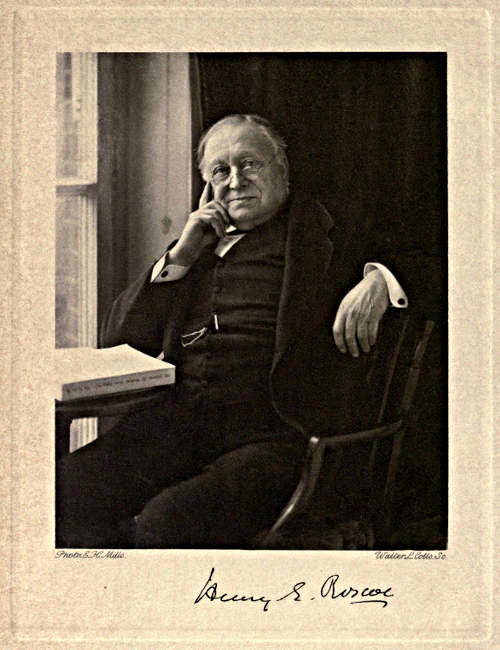
The character of Roscoe’s scientific work may also
be said to have been entirely moulded by his Heidelberg
training, and Bunsen’s influence may be traced
through it to the last. So completely was this the
case that consciously or unconsciously he seemed
never to contemplate attacking any problem that
would not have appealed to, or have been appreciated
by, Bunsen.
His first research was undoubtedly suggested by
Bunsen. As already stated, it resulted in the
classical investigation on the laws regulating photochemical
action. It was already known that a
mixture of equal volumes of hydrogen and chlorine
on exposure to light lost its characteristic colour,
and was converted into hydrochloric acid, readily
soluble in water; and Bunsen conceived the idea
of making this reaction the basis of a method of
measuring the relative amount and activity of those
light-vibrations which are mainly concerned in effecting
chemical change. As a matter of fact the idea
was not new, for, unknown to Bunsen, it had already
been adopted by Draper, of New York, who had, as
he states in his paper in the Philosophical Magazine
for December 1843:
invented an instrument [based upon the same reaction] for measuring
the chemical force of the tithonic rays, which are found at
a maximum in the indigo space, and which from that point
gradually fade away to each end of the spectrum.
It perhaps says little for the assiduity with which
young Roscoe read the original chemical literature
of his time that he should only have knowledge of
Draper’s remarkable papers some thirteen years after
they were published in the English journals. But
it is only due to him to say the chemical students
of University College in those far-off days had fewer
opportunities of access to original literature than
they now enjoy.
Be this as it may, Roscoe’s discomfiture at being
thus anticipated was of no long duration.
Do not (wrote Bunsen) let your discovery of Draper’s work disconcert
you.… It appears to me that the value of an investigation
is not to be measured by whether something is described in it for
the first time, but rather by what means and methods a fact is
proved beyond doubt or cavil, and in this respect I think that
Draper has left plenty for us to do.
After many fruitless attempts they succeeded in
constructing an apparatus in which the defects of
Draper’s “tithonometer” were obviated, and by which
not only accurate comparative determinations could be
made, but which enabled them to reduce the chemical
action of light to absolute measure. They showed by
means of it that the amount of chemical action produced
by light from a constant source varied inversely
as the square of the distance. They studied more
accurately the phenomena of photochemical induction,
discovered by Draper, the causes which determine its
occurrence, and the laws which regulate the chemical
action of light after the induction is completed. They
proved that the absorption of the chemical rays in
passing through a medium varies directly as the intensity
of the light, and that the amount transmitted
varies proportionately with the density of the absorbing
medium. It was found that for a given amount of
chemical action effected in the mixture of chlorine and
hydrogen an equivalent quantity of light is absorbed,
and that the coefficients of extinction of pure chlorine
for chemical rays from various sources of light are
very different. They established a general and absolute
standard of comparison for the chemical action of
light, and sought to determine the quantitative relations
of the chemical action effected by direct and
diffused sunlight, and to investigate the laws which
regulate the distribution on the earth’s surface of
the chemical activity emanating from the sun.
They also measured the chemical action of the
constituent parts of the solar spectrum. The action
on the sensitive gas showed the existence of several
maxima of chemical intensity in the spectrum.
The greatest action was observed between the lines
G in the indigo and H in the violet, whilst another
maximum was found to be near the line I in the ultra
violet. Towards the least refrangible end of the
spectrum the action became imperceptible about
the line D in the orange, but at the other end of
the spectrum the action was found to extend as far as
Stokes’s line U, or to a distance from the line H
greater than the total length of the ordinary visible
spectrum.
By investigating the conditions under which it was
possible to prepare a photographic paper of uniform
and constant sensitiveness, and ascertaining the means
by which the darkening of the paper on insolation could
be accurately compared with a standard tint, it was
found comparatively easy to construct an instrument
capable of measuring the chemical action of light
effected at any point on the earth’s surface by the total
sunlight and diffuse daylight under the most widely
varying circumstances of climate and atmospheric
condition.
This joint research, begun in 1855, occupied its
authors until 1862. Roscoe did the greater part of
the experimental work, and after his election to the
professorship in Owens College in 1857 he spent his
long vacations in Heidelberg in continuing the inquiry.
The results were communicated in a series of memoirs
to the Royal Society and are published in the Philosophical
Transactions.[5]
Subsequently he pursued the subject alone or in
conjunction with others. In a short paper published
in 1863 he gave the results of a series of measurements
of the chemical brightness of various portions
of the solar disc made by means of standard photographic
paper according to the method described by
Bunsen and himself in their last communication;[6]
and in 1864 he described a method of meteorological
registration of the chemical action of total daylight
based on a modification of that originally used by
Bunsen and himself. The account of this method
was made the Bakerian Lecture in 1865, and is
published in the Philosophical Transactions of that
year.[7]
In this paper he gives the results of consecutive
observations on each day for nearly a month at about
midsummer, and compares the chemical action of light
at Manchester at the winter and summer solstices, and
the vernal and autumnal equinoxes. The wide variation
in the chemical action of light at different periods
of the year was illustrated by the fact that if the
integral of that on the shortest day be taken as the
unit, that upon the equinox will be represented by
7, and that upon the longest day by 25.
In 1866 he and Mr. Baxendell contributed a joint
note to the Royal Society on the relative chemical
intensities of direct sunlight and diffuse daylight at
different altitudes of the sun. They showed from
observations made at Manchester and at Heidelberg
that the ratio of the chemical intensity of direct to
diffuse sunlight for a given altitude at different localities
is not constant, but varies with the transparency
of the atmosphere, and that this ratio does not in the
least correspond with the value of visible intensity as
estimated by the eye, the action of the atmosphere
being 17·4 times greater upon the chemical than on
the luminous rays when the sun’s altitude is about
25° and 26·4 times greater when it is 12°.[8]
With a view to the introduction of the instrument
into meteorology, and as part of the routine work of an
observatory, he caused a regular series of measurements
to be made during two years at the Kew
Observatory, under the direction of Dr. Balfour
Stewart; and in order to gain further knowledge
of the variation in the chemical action of light in
different areas of the earth’s surface, he sent the
writer in 1866 to Pará, on the river Amazon, 1° 28´
south of the Equator. The selection of this particular
place arose from the circumstance that his cousin,
now the Right Hon. Charles Booth, was proceeding
to the Brazils in connection with the establishment
of a new line of steamers, and it was
arranged that the writer should accompany him, in
order that he might make photometric observations
en route, going and returning, and at the same time
make a series of determinations of the amount of
carbon dioxide in sea air, night and day, with a view
of testing the truth of an allegation by a French
chemist, that it was subject to a diurnal variation,
depending upon the intensity of sunlight.
The special form of apparatus arranged for making
photometric observations at sea proved to be ill-adapted
to the purpose. But even if its performance
had been good, the conditions under which it
had to be employed were incapable of furnishing
valid results. Accordingly the writer elected to
remain at Pará in order to obtain the required
observations at that place, until such time as he
could return by the succeeding steamer. He was
thus enabled to make a much more extensive set of
observations than was originally contemplated, and
under conditions which ensured trustworthy measurements.
The following letter, dated May 12, 1866, and
received at Pará, refers to these matters. The
allusion to Agassiz arose from the circumstance
that the great naturalist was at the time engaged in
work on the Amazons and its tributaries under the
auspices of the Emperor Dom Pedro.
Roscoe himself was busily engaged with his
vanadium researches.
Although I was disappointed to find that the Augustine returned
without you, yet I think that you acted quite rightly in staying until
the Jerome returns, as you could not get any results whilst on board.
I only hope that your health will have been good, and that you will
have enjoyed your stay at Pará, and that when you return in August
we may have to work out plenty of interesting results.
I send per the Jerome a second bottle of silver solution, and some
more salted paper, as you may possibly be out of both. I also
enclose two or three fixed strips, but not calibrated. These, in case
you are out, may be used, carefully preserved and calibrated, on your
return. They must be carefully marked before using and notice
taken in the book of the marks on each strip when employed.
…
Your carbonic acid observations are very interesting: you seem
to have settled Lewy completely, and I hope you will get some
more experiments made on your return voyage.
Could you not manage to make several series of daily observations
(photochemical) on your return voyage? It would not much
matter if the surface was not perfectly horizontal always, and you
could use your pendulum concern to steady the exposed paper to a
certain extent. Perhaps your ship does not give you a sufficiently
free horizon. However, you will do what is possible.
Your meeting with Agassiz was very fortunate, and I was glad to
hear that the other friends whom you found were likely to prove
agreeable.
We have not much news to send you. The book [“Lessons in
Elementary Chemistry”] is not yet out. I have this day, however,
corrected the last proofs of the Index, and I fully expect that it will
be ready (and I hope a great number sold!) before you arrive here.
My new assistant [Mr. Francis Jones] is a very careful and
accurate worker. He has with great care determined the atomic
weight of vanadium by the loss of weight of VO₃ in hydrogen, and
curiously enough gets exactly Berzelius’s number of 68·5! This in
two experiments on large quantities. We are now preparing pure
chloride to try again whether we get 67·4 (your number), and we
have got hold of some very queer reactions, which I can only
understand either by the presence of another metal having the
same (or nearly) atomic weight as Va, or else by the existence of
an isomeric (solid) modification of the chloride. However, time,
I hope, will show.
My lecture on June 1st at the Royal Institution will, of course,
be shorn of some of its interest as I cannot tell them how much
chemical light there is in the tropics, but I hope to have enough
to make an interesting hour, and have got some nice experiments to
illustrate the opalescence of the atmosphere.
My wife tells me to remind you to be so good as to bring her
something tropical—some birds’ skins would do or anything you see
or fancy. Only no monkeys, if you please, for me! I hate the animals.
Your father will doubtless send you all the news of the times, as
well as local information, and so I will only add that the Laboratory
[rowing] crew were again beaten last week. The races were very
good—better as regards equality than last year. The umpire, poor
R⸺, got upset and nearly suffocated in the Irwell mud!
Hoping to see you safe back at the end of July or beginning of
August.
The day after this letter was written Roscoe
received some of the preliminary results of the
photometric observations, so that he was enabled to
give his Royal Institution audience some idea of the
amount of chemical light in the tropics. He made
this matter one of the chief features of his lecture.
I have only just time to send what you want over to Liverpool
this afternoon, and to acknowledge your letter of April 14th with
enclosures, which are all very welcome.
…
The diffused and direct sun experiments are very interesting.
They differ in toto from the Heidelberg results. Pray get some
more at low elevations of the sun.
I must now close … as the Jerome sails early in the morning.
P.S.—I hope you may be able to get one cloudless day before you
leave, as the clouds evidently much modify the result. It is almost
a pity that you did not go out in the vacation for September and
October, but it cannot be helped now.
If you get a cloudless day begin early, take four or six sets of
observations (one at noon, of course) until late in the evening, so
as to get the low elevations.
The Kew observations showed that the mean
chemical intensity for hours equidistant from noon is
practically the same on the same day, and that the
daily maximum of chemical intensity corresponds with
the maximum of solar altitude. Measurements showing
the daily rise and fall of chemical intensity for
each of the twenty-four months were obtained, as well
as of the biennial variation for the same period. It
was pointed out that the curve of yearly chemical
intensity is not symmetrical about the vernal and
autumnal equinoxes. Thus for 100 chemically active
rays falling at the spring equinox at Kew, there fell
at the autumnal equinox 167 rays, the sun’s mean
altitude being the same, the difference being probably
due to the greater atmospheric opalescence in the
spring.
The Pará observations were interesting from the fact
that they were the first measurements of photometric
intensity made within the tropics, and that they
served to dispel certain fallacies about photographic
effects in very hot climates at that time current. The
observations showed that the relation between the
sun’s altitude and chemical intensity may be represented
by the equation:
C I a = C I₀ + const. a,
where C I a represents the chemical intensity at a
given altitude a in circular measure, C I₀ the chemical
intensity at the altitude 0, and const. a a number to
be calculated from the measurements. Comparisons
between the observations at Kew and at Pará on
the same days in April showed that the daily mean
chemical intensity at the latter place was from ten to
fifty times greater than at Kew, the wide differences
being due to the enormous and rapid variations in
intensity from hour to hour which the chemically
active rays experience in the tropics during the rainy
season of the year.[9]
The relation between the sun’s altitude and the
chemical intensity of daylight was more accurately
determined by the writer from a long series of observations
made by Roscoe’s method under a cloudless
sky near Lisbon in the autumn of 1867. The fact
was confirmed that the direct sunlight is robbed of
almost all its chemically active rays at altitudes below
10°, and that although the chemical intensity for the
same altitude at different places and at different times
of the year varies according to the varying transparency
of the atmosphere, yet the relation at the
same place between altitude and intensity is always
represented by a straight line. The differences in the
observed actions for equal altitudes, which may amount
to more than 100 per cent. at different places, and to
nearly as much at the same place at different times of
the year, serve as exact measurements of the varying
transparency of the atmosphere. As illustrating the
wide differences in the daily march of chemical
intensity at various places, it was found that, when
light of unit intensity acting for 24 hours is taken as
1,000, the value of the mean chemical intensity at
Kew is represented by the number 94·5, that at
Lisbon by 110, and that at Pará by 313·3.[10]
Roscoe’s hope that measurements of the chemical
intensity of daylight might become part of the regular
work of meteorological observations has, unfortunately,
not been realized. Observations of the kind,
no doubt, consume much time, and if properly
conducted require the whole service of a skilled
assistant. But considering the enormously important
part played by chemically active light in the economy
of nature, and more particularly in the phenomena of
vegetable life, it cannot be doubted that a sufficiently
long-continued series of observations, systematically
carried out on a well-considered plan, at observatories
distributed over the earth’s surface, would afford most
valuable information concerning the facts of solar
energy, and incidentally serve to elucidate many
important collateral questions. With the assistance
of Mr. Horace Darwin, Roscoe made attempts to
devise an automatic arrangement which should
minimize the labour of observation, but in the
absence of any certain assurance that such an
instrument would be utilized, the trials were discontinued.[11]
It has been thought desirable, for the sake of
continuity, to describe Roscoe’s work on chemical
photometry, arising out of his association with Bunsen,
so long as he continued to pursue that subject. A
subsequent paper will, however, be mentioned later.
We must now revert to his work when he returned
from Germany.
On leaving Heidelberg to settle again in London,
as already stated he engaged Dittmar as research
assistant, and they jointly studied, by Bunsen’s
methods, the absorption of hydrochloric acid and
ammonia in water,[12] proving that these gases do not
obey Dalton and Henry’s law.
He next attacked, first with Dittmar’s and then
with Schorlemmer’s assistance, the nature of the
aqueous solutions of the common volatile acids of
constant boiling-point, and showed that although the
ratio of acid to water is constant for a definite boiling-point
under a particular pressure, this does not necessarily
indicate the existence of definite hydrates. The
composition of the hydrated acid on boiling is entirely
dependent on the pressure under which it is heated—a
strong solution losing acid, and a weak solution
losing water until the residue in each case acquires a
constant composition, depending upon the pressure
under which it is boiled.[13]
In those days Gmelin’s “Handbuch” was the
chief repository of chemical knowledge—or the want
of it—and many suggestions as to possible profitable
fields of inquiry were to be gleaned from its pages.
One such subject was perchloric acid and its compounds,
concerning which but little was then known
beyond the composition of potassium perchlorate,
established by Stadion as far back as 1816. Roscoe,
with Schorlemmer’s assistance, made a fairly complete
investigation of perchloric acid and its hydrates, and
a number of its salts.[14]
He narrowly escaped a serious accident when
working with ethyl perchlorate, first prepared in 1840
by the American chemists Hare and Boye, and
known to be extremely unstable. He was engaged
in filtering a few cubic centimetres of the liquid into
a test-tube, when the compound exploded with great
violence, and a deep hole was bored into the base
of the filter-stand, and many hundreds of fragments
of glass were driven into his hand. That filter-stand
was long an object of interest to visitors in
the private laboratory of the old Owens College.[15]
The writer subsequently prepared thallium perchlorate
for him in a pure state, determined its
composition, and established its isomorphism with the
alkaline perchlorates, the crystallographic characters
of which had been previously ascertained by Kopp.[16]
But Roscoe’s most important contribution to inorganic
chemistry was unquestionably his research
upon vanadium and its compounds, which occupied
him for the greater part of five years. About 1865
his attention was drawn to the occurrence of vanadium
in some of the copper-bearing beds of the Lower
Keuper Sandstone of the Trias which were then
being worked at Alderley Edge and Mottram St.
Andrews in Cheshire. He obtained possession of a
large quantity of a lime precipitate, which was found
to contain about 2 per cent. of vanadic acid. It
was a most unpromising material, but eventually a
method was worked out by which the vanadium was
extracted as an ammonium vanadate: this on heating
yielded vanadic acid. Great difficulty was met with
in freeing the vanadic acid from accompanying phosphoric
acid. Even small quantities of phosphoric acid
cause the vanadic acid after fusion to solidify as a
pitch-like amorphous mass. It was the writer’s
privilege to assist in the early stages of this investigation,
and it fell to his lot to carry out the various
experiments which eventually served to establish the
composition of the oxides of vanadium, the true nature
of its volatile chloride, the existence of hitherto unknown
oxychlorides, and of the mononitride which
Berzelius had regarded as the metal, and lastly to fix
its real atomic weight and to show that it was
approximately 16 below that assumed by Berzelius.
It was only very gradually that the true chemical
relationships of vanadium revealed themselves. For
a time the indications were contradictory and perplexing.
The first clue was given by Rammelsberg’s
observation that vanadinite is isomorphous with pyromorphite
and mimetesite—analogously constituted
minerals containing phosphorus and arsenic. The
next significant fact to be discovered was that by the
action of a reducing agent it was possible to obtain
a solution of a vanadium oxide which on reoxidation
to vanadic acid appeared to require as much oxygen
as Berzelius’s vanadium, regarded as metal, would
have needed. When it was discovered that the
volatile chloride which Berzelius had considered was
a trichloride and free from oxygen, in reality contained
oxygen, and was analogous in constitution to
phosphoryl chloride, the whole matter was rapidly
cleared up, and the chemical affinities of vanadium
to phosphorus, arsenic, and the other members of the
trivalent group were established. This, of course,
necessitated altering the formulæ of the vanadium
compounds hitherto described.
At the close of the College Session 1866-1867,
Roscoe took away with him the laboratory journals
containing the results of the inquiry as far as it had
progressed, and worked at them at Roddam Hall,
near Alnwick, which he had taken for the Long
Vacation.
The following letters have reference to this matter:
Roddam, near Alnwick,
August 26, 1867.
I write a line to say that I hope you are getting on well and that
I shall soon hear from you.… I want you very much to stay with
me till April to settle the vanadium and light matters and help me
in London with my lectures.… I have at last found out about
vanadium. The acid is V₂O₅ like P₂O₅. The chloride VOCl₃
like POCl₃ and the solid chlorides VOCl₂, VOCl, etc. This
explains the isomorphism of the vanadate of lead and the
corresponding phosphate and lots of other points. It becomes
very interesting now.
Pray write a line and say whether you will stay till April, and
when you will be back.
The first paragraph in the next letter alludes to the
circumstance that the present writer had just returned
from Lisbon, where he had carried out the photometric
measurements already referred to.
Roddam Hall, near Alnwick,
September 12, 1867.
I was very glad to hear by your note received to-day of your safe
arrival and the success of your observations.… You did quite
right in returning home rather than wait indefinitely for the Jerome.
The working out of your Pará and of the Lisbon direct and diffuse-light
experiments will take some time and labour, but I believe the
results will repay the trouble.…
I have been up to the Dundee [British Association] meeting for
a few days, but I now, in all probability, shall stop here, so that I
can at once answer your letter.
Please ask Joseph [Heywood] to send me per book-post Pogg.
Ann., vol. 98, in which volume is Rammelsberg’s paper on the
isomorphism of vanadates and phosphates. There is no doubt
in my mind that vanadic acid is V₂O₅, and it will be exceedingly
interesting to work out the vanadates which must all be explained
as phosphates. The ordinary white NH₃ salt is NH₄VO₃ (like
NaPO₃) and is a meta-vanadate. The bi-vanadates can also be
explained, but all need re-preparation and analysis. Did I tell you
that we have now got
V₂O₅, V₂O₄, V₂O₃, V₂O₂ (I wish we had V also!)
V₂O₂Cl₆, V₂O₂Cl₄, V₂O₂Cl₂, and V₂O₂Cl₆, or VOCl₃, VOCl₂, VOCl
At St. Andrews I saw Professor Heddle; he has a crystal half
apatite and half vanadinite, and he threw out the suggestion long
ago that vanadic acid is V₂O₅.… I hope you will write soon and
let me hear what you have to say about my plan. I will then write
what I think of your ideas.
Roddam,
Tuesday, September 17, 1867.
I have now edited the atomic weight determinations by oxidation,
and also the various oxides of vanadium. I have now to
do the chlorides. Many points still remain requiring clearing up.
(1) As regards the slow oxidation of the V₂O₃ (Berzelius’s
suboxide); a sample made on November 13, 1866, weighing
0·7507, weighed on June 12, 1867, 0·8733. This corresponds
to an oxide higher than V₂O₄ (V = 51·4). Now I want this
oxide and tube drying under the air-pump and weighing carefully
and keeping for further examination (the weight of tube
and oxide was 3·6066 on June 12th last).
(2) When a neutral solution of V₂O₂ in SO₄H₂, got by zinc
reduction, and neutralized by excess of zinc, is exposed to a
current of air, it goes brown, and this brown colour does not
alter. Analysed by permanganate it would seem to contain
V₂O₄. I want this confirming.
(3) Try to get sight of a copy of Greg and Lettsom’s
“British Mineralogy” (you can go and call on Mr. Robt.
P. Greg, Greg Bros., Chancery Lane, and ask him to lend you
the book for me). Under “Vanadinite” you will see some
mention of Heddle and his observations. I find nothing
about him in Rammelsberg’s paper.
(4) Has V₂O₄ been prepared by heating the suboxide V₂O₃
in the air at low temperatures? Is it green?
The thing above all others necessary for us now is to get the
metal. We must set about this at the beginning of the session.
If you have time before you go away to clear up these four
preliminary points I shall be glad.
Roddam,
September 26, 1867.
The first thing to do when we begin will be to try to get the
metal V = 51·3 by forming the ammonio-chloride and reducing
the nitride in ammonia.… If we only can get 0·5 of metal
the question of atomic weight is settled beyond dispute.
I have now collated all the experiments: (1) On the oxides of
vanadium; (2) on the determination of atomic weight by reduction
of V₂O₅ to V₂O₃; (3) on the oxychlorides and determination of
atomic weight from the chlorine determinations. These latter require
re-calculation as I do not know how much should be allowed for as
impurity in the silver. Still, I see already that this alteration can be
but very slight, and the numbers agree very well, viz. (1) mean
at. wt. from reduction expts. 51·362 (probable error 0·068); (2)
mean of 9 volumetric chlorine determinations of the oxytrichloride
61·28; (3) mean of 8 weight determinations of chlorine 61·21, so
that as far as I yet see the true atomic weight is 51·30.
I am obliged by your extract from Greg and Lettsom. When in
St. Andrews I saw Professor Heddle, and he promised to send me
some crystallized specimens of vanadinite and pyromorphite existing
in one crystal.
I think I have got quite matter enough for one paper, but I
should like to have the metal if only in sufficient quantity to oxidize
up to V₂O₅ and determine the increase. Everything can be very
nicely used, and all fits in well; but, of course, such a first paper
must in some points be imperfect.
I think it is perhaps best that ⸺ should give the lectures, as I
am sure to want you in London several Saturdays—otherwise I
should have been very glad for you to have taken the course.
You will be back on Saturday, October 5th, I suppose. We must
re-calculate all the analyses with the exact atomic weight. This can
soon be done, and I should like to get this first part off my hands
before long.
I hope you are enjoying this splendid autumn weather.
…
As regards the blue oxide got by gradual oxidation of V₂O₃ (suboxide)
we have analyses proving it to be V₂O₄—by oxidation. It is
very possible that the further increase in weight is due to the hydration
of this oxide. We must wait until the green substance remains
constant, and we must then determine the water and the V₂O₅.
Roscoe’s first memoir on the subject was read to
the Royal Society on December 19, 1867, and was
made the Bakerian Lecture of that session.[17] On
February 14, 1868, he gave a Friday evening discourse
at the Royal Institution “On Vanadium, one of the
Trivalent Groups of Elements,” when the writer acted
as his lecture-assistant. Having arranged the experimental
illustrations, the assistant spent a spare half-hour
in wandering through the old laboratories in
the cellars of the Institution, sacred to the genius and
labours of Davy and Faraday. In looking over some
specimens in a cupboard he came upon a small bottle
containing ammonium vanadate, labelled “Sent to
me by Berzelius. 1831,” and on it Faraday’s well-known
monogram by way of signature. A portion
of the substance was afterwards placed at Roscoe’s
disposal by the late Sir Edward Frankland, at the time
Fullerian Professor of Chemistry. On examination
it was found to contain considerable quantities of phosphoric
acid, thus serving to indicate the probable cause
of the discrepancy between the numbers obtained by
Berzelius and Roscoe in the course of the atomic
weight determinations. It had been observed that
the presence of even traces of phosphorus prevents the
complete reduction in hydrogen of the vanadium pentoxide
to vanadous oxide.
Some little time after the appearance of the
first memoir on vanadium, the writer proceeded to
Heidelberg to study under Bunsen, to whom at that
time practically all Roscoe’s senior students who were in
a position to go to Germany were sent. It had been
reported in a French periodical on popular science
that Roscoe had been awarded the Copley medal
for his work on vanadium, and of course his former
assistant had hastened to congratulate him on that
event.
Camfield Place, Hatfield, Herts,
September 13, 1868.
In the first place let me thank you for your letter and congratulations
upon the great French discovery! Many of these Parisian
wonders have after all turned out myths—and this last is, I believe,
no exception—the expression “Medaille de Copley” is, so far as I
am aware, the French (and bad French too!) for the “Bakerian
Lecture.” I am, however, none the less obliged to you for your
good wishes on this occasion, and for all the valuable help which in
many ways you gave me.
…
Thanks for your news of my dear friend. I have been very
remiss in not writing to him. Tell him so, please; and ask him to
send me the first proof-sheets of his “Filtration” paper for me to
translate; unless, indeed, you do it yourself, as I am sure you can
perfectly well. Give B[unsen] my kindest regards, and say that I
will write to him soon.
Part II of “Researches on Vanadium,” dealing
with the chlorides VCl₄, VCl₃, and VCl₂, and
metallic vanadium, which he obtained by heating the
dichloride in hydrogen, was presented to the Royal
Society on June 16, 1869,[18] and his last memoir,
treating of the bromides, and of certain of the metallic
vanadates, including vanadinite which he prepared
artificially, on April 7, 1870.[19]
With the mention of a short communication, “On
Two New Vanadium Minerals,” to the Proceedings of
the Royal Society for 1876,[20] and of a lecture on
“Recent Discoveries about Vanadium” at the
Royal Institution, the foregoing statement includes
all Roscoe’s published contributions to the history
of vanadium. As regards original work, he handed
over the subject to his senior students, and under
his inspiration and direction a considerable number
of communications from the Owens College
Laboratory were made to the Chemical Society from
Crow (1876), Bedson (1876), H. Baker (1878), Kay
(1880), Brierley (1886), Hall (1887), and published
in the Transactions of the Chemical Society.
Other noteworthy contributions by Roscoe to
inorganic chemistry are his study of tungsten compounds,
in which he describes for the first time the
existence of the pentachloride WCl₅ and the corresponding
pentabromide WBr₅,[21] and his discovery
of uranium pentachloride, UCl₅.[22]
These compounds are of considerable theoretical
interest on account of their “anomalous” character.
He also discovered columbium trichloride, CbCl₃,
which he found to have the remarkable property
of decomposing carbon dioxide when heated in that
gas with the formation of columbium oxychloride,
CbOCl₃, and carbon monoxide—a reaction not
exhibited by any other metallic chloride (Chem. Soc.
Abstracts, 1878, 272), and he determined the vapour
densities of the chlorides of lead and thallium which
he showed to be normal.[23]
An examination of the earth metals contained in
samarskite proved that the rare earth-metal announced
by Delafontaine under the name of “philippium”
was a mixture of yttrium and terbium.[24]
The spark spectrum of terbium was at the same
time mapped by him and Schuster. An examination
of a specimen of oxide which ought to contain
“philippium” in large quantities if that chemical
element existed showed no conclusive evidence of
any other metals than yttrium or terbium.[25]
In 1882 he sent to the French Academy a note on
a re-determination of the atomic weight of carbon
by the method of Dumas and Stas, using Cape
diamonds, and obtained the value 12·002 (O = 16)
as the mean of six experiments (Chem. Soc. Abstracts,
1882, 724). He also showed, with the assistance
of Schuster, that the spectrum of the carbon dioxide
furnished by the South African diamond was identical
with that furnished by other forms of carbon.
So long as he remained in Manchester Roscoe
was in the habit of making occasional contributions
to the meetings of the Literary and Philosophical
Society on general or local interest. Among these
communications were papers on arsenic-eating in
Styria; on a crystallizable carbon compound in the
Alais meteorite; on the amount of carbonic acid
in Manchester air; on the corrosion of leaden hot-water
cisterns; Dalton’s first table of Atomic
Weights, etc.—all of which are printed in the
Proceedings or Memoirs of the Society.
Roscoe was largely instrumental in making
spectrum analysis first known to British men of
science and the British public generally. Almost
immediately after the publication of Bunsen and
Kirchhoff’s classical paper in Poggendorff’s Annalen,
he translated it for the Philosophical Magazine.
He also gave many public lectures on the subject,
beginning with that at the Royal Institution on
March 1, 1861—one of the most successful of the
many he delivered there. Indeed, there were few
of our larger towns in which he was not invited at
one time or other during the sixties and early
seventies to lecture on that astonishing development
of nineteenth-century science. These lectures involved
no inconsiderable effort. They necessitated
much bulky and fragile apparatus difficult to transport.
Some of the illustrations could only be shown
to a large audience by means of the electric lantern,
and this, in those days, needed the provision of a large
battery of Groves’s cells; electricity “laid-on” by a
public authority was not then, as now, almost everywhere
available.
One of these courses of six lectures given to the
Society of Apothecaries of London in 1868 was subsequently
published, with additions, in an admirably
illustrated volume which had a considerable measure
of success—a second edition, still more largely augmented
owing to the extraordinary rapidity with
which knowledge on celestial chemistry increased,
being called for within a year. In the preparation
of a third and fourth edition he was assisted by his
friend Dr. Schuster. As the successive editions
show, the rate at which literature accumulated round
the subject was altogether unprecedented in the
history of scientific discovery.
Roscoe made an attempt to apply the spectroscope
to the Bessemer process of steel manufacture, and for
this purpose caused a long series of observations
to be made, first at Brown’s Atlas works in Sheffield,
and then at the Crewe works of the L. & N.W.
Railway Company, when a considerable amount of
information concerning the peculiarities of the
spectrum of the converter-flame was gained, mainly
by the observations of Dr. W. Marshall Watts, a
former student and one of his assistants, who took
over the subsequent conduct of the inquiry.
Considering his interest in the subject, comparatively
little original work on spectroscopy was published
by Roscoe.
The following is a list of the inquiries with which
he was concerned:
“On the Effect of Increased Temperature upon the Nature of
the Light Emitted by the Vapour of Certain Metals on Metallic
Compounds.” By H. E. Roscoe and R. B. Clifton. Manchester
Phil. Soc. Proc. II. (1860-1862), pp. 227-230.
“Note on the Absorption-spectra of Potassium and Sodium at
Low Temperatures.” By H. E. Roscoe and A. Schuster. Roy.
Soc. Proc. XXII. (1874), pp. 362-364.
“On the Absorption-spectra of Bromine and Iodine Monochloride.”
By H. E. Roscoe and T. E. Thorpe. Phil. Trans.
CLXVII. (1878), pp. 207-212.
“Note on the Identity of the Spectra Obtained from the Different
Allotropic Forms of Carbon.” By H. E. Roscoe and A. Schuster.
Manchester Lit. Phil. Soc. Proc. XIX. (1880), pp. 46-49.
“The Spectrum of Terbium.” By H. E. Roscoe and A. Schuster.
Chem. Soc. Jour. XLI. (1882), pp. 283-287.
The only attempt he was able to make to contribute
to our knowledge of the chemistry of the
sun by spectroscopic observations had an unlucky
ending. He formed one of the members of the
Government expedition sent to Sicily to observe
the total solar eclipse of December 22, 1870. The
following letters refer to this subject:
Victoria Park, Manchester,
November 2, 1870.
Lockyer has asked me to go with him in the American Eclipse
Expedition. I have a good mind to do so, but I have written to
say that I was not sure that I could make the observations alone (!),
and that it would be very desirable that you should go too! So we
shall see what comes of it.
I am unfortunately laid up with an attack of gout, which quite
disables me and reduces me to the level of the beasts that perish.
However, I hope soon to be all right again.
I will write to Francis about the Lisbon paper, which ought
certainly to be out.…
Did Schorlemmer write to you about your attacking the Germans
for attacking the French? He was quite wild, and came up to me
in such a state of excitement that I could scarcely understand what
he said. However, under the influence of cigars and a bottle of
sherry he cooled down again and perhaps has buried his resentment.
Huxley comes for the first of the Science Lectures on Friday.
I am delighted to hear of your numbers of evening students,
and was much pleased by your Introductory. I have no doubt that
the laboratory will fill too. You must have patience.
Owens College, Manchester,
November 19, 1870.
Of course you come to Sicily.… Lockyer thinks of going on
December 8th. Perhaps I may go a day earlier—with you if you
can come—and spend twenty-four hours in Heidelberg.
I send box, stand, papers, and all I can find—except insolation
affairs which cannot yet be got out of H⸺’s hands. He shall
have no peace till they are ready, and they shall then be sent at
once to you. You will be responsible for the whole apparatus being
in order. Look them over carefully.… You know what is wanted.
Unfortunately H.M.S. Psyche, the vessel conveying
the party from Naples, was wrecked off Aci Reale,
about a couple of miles to the north of the classic
Cyclops rocks, and under the shadow of Etna, by
striking a submerged and uncharted rock. The ship
was badly holed, and rapidly began to fill, but fortunately
the weather was fine and the sea calm, and
all were got safely on shore. The cliffs were scarcely
200 yards away, but the landing was difficult, the
jagged reefs of lava seeming to afford no sure
footing. Eventually all the instrumental equipment
was also landed, in a more or less damaged condition,
but much of the personal baggage was lost. A letter
written by one of the members of the expedition
which found its way into a Manchester newspaper
thus describes the event:
We formed ourselves into a line to pass the things along the rocks
to the prominence which we had mounted.… Everybody worked
with a will, and laboured like galley-slaves. The ship had now
settled down considerably; the water was up to her quarter, and
the boats pushed off in the expectation that she would roll off the
reef. By this time we had almost stripped the ship of everything easily
movable, and we prepared to get it to a secure place. The nearest
point habitable was Catania, seven miles to the south, and we got
the boats ready to take ourselves and our things thither.…
Roscoe assumed command of our expedition. Everybody seemed
to look to him instinctively. I shall never forget the sight of him,
standing, with his legs apart to steady himself on a narrow piece
of the lava rock, with his arm stretched out, giving his orders with
the authority of one who seemed born to command. As the gig
was about to push off I saw him look round, and when he saw
me he motioned for me to get into it.… In a few hours the
remainder of the party arrived, and shortly afterwards the luggage
and apparatus.
It was arranged that Roscoe, assisted by the late
Sir George Darwin and Mr. Bowen of Harrow
School, should make observations on the spectrum
of the corona from a position on Mount Etna as high
as the snow would permit. On the day before that
of the eclipse the party had toiled up more than
5,000 feet of the mountain with their instruments
strapped on the backs of half a dozen mules, to a
deserted hut on the side of the volcano. The night
was spent in a storm of rain and snow, and next
morning, in a piercing wind, the instruments were
put together with benumbed fingers. As the sun
was gradually covered, the sky became clouded over
and the upper part of Etna was completely enveloped
in fog, and during the minute of totality a violent
hailstorm broke over the party, rendering all observations
impossible.
A number of measurements of the chemical intensity
of daylight during the progress of the eclipse
were, however, made by the writer at Catania, some
little distance away, by the method described by Roscoe
in the Bakerian Lecture for 1865. These showed
that the diminution in the total chemical intensity
of the sun’s light during an eclipse is directly proportional
to the magnitude of the obscuration of the
solar disc.[26]
This matter is referred to in the following letter.
June 11, 1871.
The results are very interesting, and you have worked them out
in an admirable manner. I had no idea that so much could be
made out.
I am writing at once to Airy and Lockyer to ask them whether
we may not send the paper to the Royal Society (last meeting on
Thursday next) so as to have it in series with our other papers.
I have just heard from Wild, the director of all the Russian
observatories, that he is anxious to adopt the plan over all the
Russias, and wants an automatic arrangement. So I am going in
for it and hope to get a machine made before long. It is really
too important to be delayed.
You deserve great credit for your labours, and by rights the paper
should be yours alone, but perhaps we [had] better keep together.
We can do the automatic affair also together if you like.
The automatic arrangement alluded to has already
been mentioned. It was not proceeded with.