Lady Margaret Cheyne awoke suddenly.
As Cleek had surmised, left to herself, she would have slept on
undisturbed for hours, but the sharp sound of opening and closing doors,
the buzz of voices, and blaze of light, caused the forget-me-not blue
eyes to open and stare dazedly round her. For the moment she thought she
was back in the seclusion of the convent.
"Am I late, sister?" she murmured drowsily. Then as she grew wider
awake, the recollection of the events of the last hours swept over her,
and with this came the memory of her journey, and all the misery that it
had entailed. With a little cry, half mental pain, half physical
tiredness, she started up, and her eyes fell on the figure of the
Honourable Miss Cheyne, who stood at the side of the chair, a lamp in
hand, looking anxiously down at her.
"Auntie," cried the girl joyfully, and grasping at the hand put out to
her, she remembered only just in time not to kiss her aunt, for Miss
Cheyne had invariably hated caresses.
"Oh, you are back at last. I missed you at the station——"
"So I should think, my dear," said Miss Cheyne, grimly. "I've had the
servants looking for you, such lazy devils as they are, gobblers all of
them. I've been looking for you, and I find you here all the time. I
want to know who the person was who brought you." She finished as she
turned to put the lamp down on a table.
"I don't know who he is, except that his name is Lieutenant Deland,"
cried Lady Margaret, "and that he is a friend of a lady who was on the
boat, Miss Ailsa Lorne, who was so good to me. Oh, Auntie, I was so
sick. I shall never go back again. I simple couldn't go through it."
"No, no, you shan't, my dear," said Miss Cheyne, almost amiably for her,
"you shall have a good time over here, but now you are tired out, and
must get to bed. I don't keep any servants, so you'll have to set to,
and do for yourself—the lazy good-for-noughts, they eat you out of
house and home! John shall get you something to eat and drink, my dear,
and then to-morrow we'll have the house to ourselves."
Lady Margaret was too tired to argue, even if she had thought of so
doing, and she knew of her aunt's parsimonious habits.
She certainly did not like the look of John, who leered into her face as
he brought a glass of what was presumably lemonade and a plate of
thickly cut bread and butter, which she could not touch. She was
thirsty, however, and carried the glass quickly to her lips, only to be
put down with a shudder as she detected the flavour of strong spirit.
"I don't think I want anything, Auntie, after all, only just to go to
bed."
"Nonsense, my girl, you drink it up sharp," was the response. "You'll
catch your death of cold driving about with strange men at night. Come,
down with it."
"Better hurry up," said John, significantly, and even Lady Margaret's
tired mind took in the strangeness of the remark coming as it did from
her aunt's butler.
With a little puzzled frown, the girl took a long gulp of the liquid,
then fled up the staircase, pausing at the first landing only long
enough to pick up a candle.
"Good-night, Auntie," she called down to the bejewelled and rouged
figure standing at the bottom. "I'll be better to-morrow."
With a little nod she vanished, and the listeners heard her light
footfall on the bare staircase of the second flight. A moment later
there came the click of a door shut to. Lady Margaret had retired for
the night.
A sigh of relief came from Miss Cheyne's lips and she met the peculiar
look of her servant with one equally significant.
"Send Aggie up to her," she commanded, "and don't forget to lock her
in."
With this remark she turned on her high-heeled shoes, and minced
painfully back to the dining room.
Whether it was the effects of her journey, or what was more likely the
strong spirit in the lemonade, Lady Margaret slept as soundly as the
proverbial top till close on mid-day, when she was awakened by the rough
entry of the person designated as "Aggie."
She was a queer-looking maid, Lady Margaret thought to herself, with
rough, unkept hair, and strangely roughened and stained fingers.
She did not like the way the woman looked at her as she banged on the
table a cup of weak tea and some thick slices of bread and butter.
"Here you are, Miss—yer ladyship, I mean," she said in harsh cockney
tones which made Lady Margaret wince unconsciously, accustomed as she
was to the soft, pure French of the good nuns at Notre Dame. "An' the
quicker you gets up and attends to yerself, the better I shall like
it," the woman continued, muttering more to herself than to the girl.
"It's a bit more than I bargained for."
"That will do very well. I shall not require anything more, and please
tell my aunt I shall be with her directly."
"I don't doubt you will," responded the blunt Aggie in a rather
surprising manner, then without another word she swung on her heel, and
stalked out of the room, banging the door behind her.
"What an awful creature," said Lady Margaret as she jumped lightly out
of her bed. "I shall get Auntie to discharge her very soon. Oh, I am so
thankful to be home," and she ran lightly to the window and looked out.
With all the resilience of youth, she seemed a different being this
morning from the worn-out, fragile child who had been driven home last
night by Lieutenant Deland.
A few minutes later she ran lightly down the staircase and into the
dining room where she found the Honourable Miss Cheyne deeply absorbed
in the morning newspapers.
She greeted her niece a little gruffly, but knowing her eccentric ways,
Lady Margaret took but scant notice. It was not long, however, before
she realized that her future life was not to be entirely a bed of
roses.
"I am going over to see Miss Lorne to-day, Auntie," she said presently,
"and to thank her for getting me out of my difficulties."
"Got us into them, you mean," snapped Miss Cheyne angrily. "She's a
designing adventuress trying to scrape acquaintance with you, so that
she can say she is a friend of Lady Margaret Cheyne! Oh, I know the
breed, she and her blessed accomplice, Beland, or Deland, or whatever
his name is, they were probably on the watch for you, and managed to
carry you off before I arrived on the scene. I forbid you even to
mention their names again, much less speak to them."
"Oh, Auntie!" pleaded poor Lady Margaret, her bright young face clouding
at this unexpected ban on a friendship to which she had looked forward
with such pleasure. "I am sure you are mistaken, and Miss Lorne said
that she was coming to see you to-day and explain——"
"Well, if she has the impertinence to come here," snapped Miss Cheyne
angrily, "she will not be admitted. Don't you dare to argue with me,
child, or back to school you'll go. I'm not going to have you drive
about with strange men just as you like, so don't you think it——"
"I told you last night how it happened," responded Lady Margaret in a
little gust of impatience. "I slept in the car all the time till I got
here. I don't know what I should have done had it not been for Miss
Lorne, anyway, and especially on board ship."
Miss Cheyne's thin lips set in a straight, grim line. "Well, the best
thing you can do is to forget her, or else send her some money, probably
she'll value that more," she retorted with heat, shaking a finger in the
girl's face. "Don't forget you have something more important to think of
than designing minxes and pert Lieutenants, if he is really a genuine
officer, which I doubt. Anyhow, I shall take you up to town next week
out of their reach, for one thing, and for another to celebrate your
coming of age. Then you will have all the Cheyne jewels, don't forget
that——"
Lady Margaret was young enough and human enough to forget temporarily
her grief for Miss Lorne's rejected friendship in the idea of seeing, to
say nothing of wearing, the famous treasures of her family.
"Oh, Auntie!" she cried. "I had forgotten them, are you really going to
let me see them?"
"You shall do more than that, my dear," replied her aunt almost amiably,
"you shall wear them. I mean to have you presented at Court, and you
will certainly have to wear some jewellery then. I don't suppose you
know anything about the pieces themselves. I myself have forgotten——"
"Oh, yes, I do," said Lady Margaret, "don't you remember the list father
gave me in his last letter, in case there was any trouble? I don't
remember all of them, but I know there were three strings of pearls, a
big diamond necklace and tiara, ever so many rings, and of course the
Purple Emperor!"
"Oh, yes, I had not forgotten that," said Miss Cheyne drily. "It is
something one is not likely to forget."
"But I don't think there's any need to have that out, Auntie; do you?"
asked Lady Margaret with a little tremor of fear in her voice. "It's not
particularly beautiful. In fact, I don't suppose it looks much different
from an amethyst, and father used to say it was best at the bottom of
the sea."
"That's because he knew no better and spoke like a fool," snapped Miss
Cheyne, her voice quivering with excitement, and as the girl looked up
at her, she saw a face that was changed out of all recognition,
distorted as it was with avarice and envy. "I want them all, I tell
you—all! They ought to have been mine and I want to see them before I
die. Do you hear me?"
"Oh, of course, Aunt Marion," said Lady Margaret, astonished at the
unexpected outburst. "You can have them and wear them, too. I shan't
want them, that is, until——" she broke off, her face crimsoning.
"Until what, pray?" demanded Miss Cheyne, sharply, switching round and
looking at her.
"Until—well, until I get married. I meant to have told you before long,
but I am going to be married some day to Sir Edgar Brenton——" She
paused as if waiting for another outburst, but to her intense amazement
Miss Cheyne only laughed.
"Marry, well, so you shall, my dear, if you want to, and your jewels
will be a good wedding present." She gave a little chuckle which
mystified the girl still further.
"Meanwhile," went on Miss Cheyne, as if to change the subject to other
things, "you had better get upstairs and unpack your boxes. Don't expect
Aggie to help you, she has enough to do downstairs."
"Oh, I don't want Aggie's help," responded Lady Margaret quickly with a
wry little smile. "She wasn't exactly charming, and I must say I don't
quite like the look of her. Can't you get rid of her, Aunt? I'm sure she
is not honest, and that man, too. If we are going to have the Cheyne
jewels here——"
"We are," snapped Miss Cheyne, "and don't you trouble your head about
what doesn't concern you, my dear. You leave John and Aggie alone. I'll
settle them."
Lady Margaret said no more but ascended to her room, thinking in her
innermost heart of many things. She could only dimly remember her aunt
when she had been allowed to spend her holidays at Cheyne Court, but she
knew she was eccentric, and because she herself had been jilted in her
youth hated all men.
Still she did not mean to be made a prisoner of. She was determined to
visit not only Miss Lorne, to whom she had been undeniably attracted,
but also, and this she considered far more important, Lady Brenton, the
mother of the man she had pledged herself to marry in those stolen
interviews under the walls of Notre Dame.
Thanks to Miss Cheyne's many requests, Lady Margaret had little time to
pay visits or write letters that day, and when night did fall, she was
glad to crawl into bed and sleep the sleep of youth and healthy fatigue.
She slept soundly for hours, but all at once she was rudely awakened.
From the depths below that supposedly sleeping household came a queer
bumping noise, and it seemed to the terrified girl, as she sat up in
bed, that the very house was being torn to pieces.
Conquering her natural fears she rose, and donning a dressing gown,
unconsciously tried the handle of her door.
To her amazement it was locked on the outside, locked! She was a
prisoner in her own house!
Burglars were Lady Margaret's first thought, and she pulled vigorously
at the door. At first it resisted, but to her delight the old lock,
rotten with age, gave way under her vigorous onslaught. A second later
she was descending the staircase, bent on rousing Miss Cheyne or
obtaining assistance.
She had reached the bottom of the first flight, amid complete silence,
and for a moment she thought she had heard the sounds only in her dream.
But at the head of the stairs she stood hesitating when from all around
her came a sound as of a soul in agony, a horrible moaning cry that
chilled her very heart. Startled and terrified she gave a shriek, and
losing her balance, came hurtling down the shallow staircase. Her slim
ankle was twisted under her, and she lay there for some time, a little,
moaning, writhing heap.
When Lady Margaret awoke to consciousness, it was to find herself once
more in her own room, with Aggie, the pert serving maid, bending
anxiously over her.
"What was it?" she cried out, clutching feverishly at the grimy,
toil-worn hand of the girl. "Oh, what was it? Didn't you hear it?" She
struggled to get up, but sank back with a moan at the pain in her ankle.
"Hear what? Lawks o'mussy, but you gave us all a turn, Miss—yer
ladyship," said the woman roughly.
"But the horrible noise!" shuddered the girl.
"That? Why, it was one of the dogs. There's a dog ill down in the cellar
and that's what you heard," retorted Aggie. "A nice twist you've given
this ankle of yours. It's a good job; Auntie—the mistress—I mean,
knows something about sprains."
"Does she?" asked the girl wearily, her mind still bent on the horrible
sound. Appallingly human it was; no dog could have screamed like that,
she felt sure. It was the hurt cry of a human being in pain.
"Yes, you bet, and here she is." Aggie relinquished her place,
apparently only too gladly, to Miss Cheyne, who appeared with lotions
and bandages, and literally took possession of the patient. Her long,
slender fingers manipulated the swollen ankle with the experience and
precision of a trained hand.
"Now, my lady, you'll just have to be still and patient," she said
grimly. To Lady Margaret it seemed as if this eccentric relative were by
no means ill-pleased at the catastrophe which had overtaken her niece.
"I thought it was burglars, Aunt Marion," said the girl, as Miss
Cheyne's eye fell on the splintered lock, "and that reminds me, I was
locked in——Did you know that? You won't dare to keep that woman
now——"
"You go off to sleep, and I'll inquire into it," was all Miss Cheyne
would say, and with that the girl was obliged to rest content. But when
she fell into an uneasy sleep, it was with the profound intention to ask
Edgar Brenton's advice at the earliest opportunity.
A sprained ankle is not a dangerous occurrence, but it is sufficiently
painful and depressing to be worthy of more anxiety than was expended
over Lady Margaret.
Rendered practically a prisoner she had only to rely on such books and
magazines as Miss Cheyne brought up to her and the days passed very
slowly indeed.
She wrote letters to Sir Edgar and to Miss Lorne, bribing Aggie with
such coins as she possessed to post them, unknown to her aunt.
No answer came to them, though Aggie swore that they had been sent to
the post, and later the girl was not surprised to find them in the
possession of Miss Cheyne, opened and mutilated.
At intervals she heard the dull, distant moans, but had schooled herself
to believe Aggie's statement.
On the first day that she could walk about her room she was almost
hysterical with delight.
For once, too, Miss Cheyne relaxed her firm manner.
"I suppose you know what to-morrow is, my dear," she said, looking
almost furtively at her niece.
Lady Margaret thought a moment, then gave a little cry of delight.
"Why, it's my birthday, of course, and I'm eighteen."
"Yes, and what is just as important," said Miss Cheyne, "you are the
owner of the Cheyne jewels. We're going up to town in the morning to
bring them back."
"Bring them all here?" cried Lady Margaret, startled at the odd look in
the black, flashing old eyes. "Do you think it safe enough? Thieves
might break in. Why not leave them, at least some of them, where they
are, Aunt Marion. It is safer, surely!"
"Because I want them. I want to see them," Miss Cheyne snapped
ferociously. "I'm curious, you know, more curious than you are. And I
mean to have them here."
"Just as you like, Aunt. I want to see them, too, only I was thinking of
the danger."
"There is no danger. I am having special safes made for them
downstairs," said Miss Cheyne. "If you have them here you can wear them
whenever you like without having to go up to those thieving lawyers
every time you happen to want them."
Lady Margaret agreed, but deep down in her own mind she felt that she
would prefer to leave the Cheyne jewels in the safe custody of Messrs.
Shallcott, Woodward & Company in London. On the other hand, she had
gained an unspoken victory in regard to her future marriage.
Indeed it seemed to her as if Miss Cheyne had but one obsession: to see
the Cheyne Court jewels. Her inexplicable antipathy even against Ailsa
Lorne seemed to have died a natural death. When Lady Margaret, albeit a
trifle timidly, ventured to hint at a visit to her newly found friend,
Miss Cheyne said pleasantly enough:
"Yes, if you like my dear, after we come back from London, then there is
no reason at all why you should not see your friends."
To say that this lifted a load off the girl's mind, is to express the
matter in the mildest terms imaginable. Her failure to hear either from
Lady Brenton or her lover, as well as from Ailsa Lorne herself, had
filled Lady Margaret's mind with strange forebodings. She almost felt
that she would be willing to lose every stone among the heirlooms if her
aunt could be made so much pleasanter to live with.
And downstairs, Miss Cheyne said aloud with a queer little chuckle, when
the girl had left the room:
"See your friends? So you shall, my dear. After we come back!"
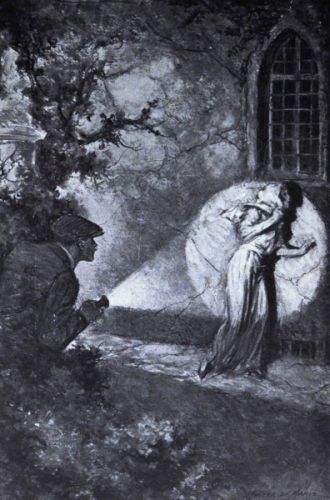 "For even as the light streamed out and flung that circle
into that impinging mist, there moved across it the figure of a woman"
"For even as the light streamed out and flung that circle
into that impinging mist, there moved across it the figure of a woman"