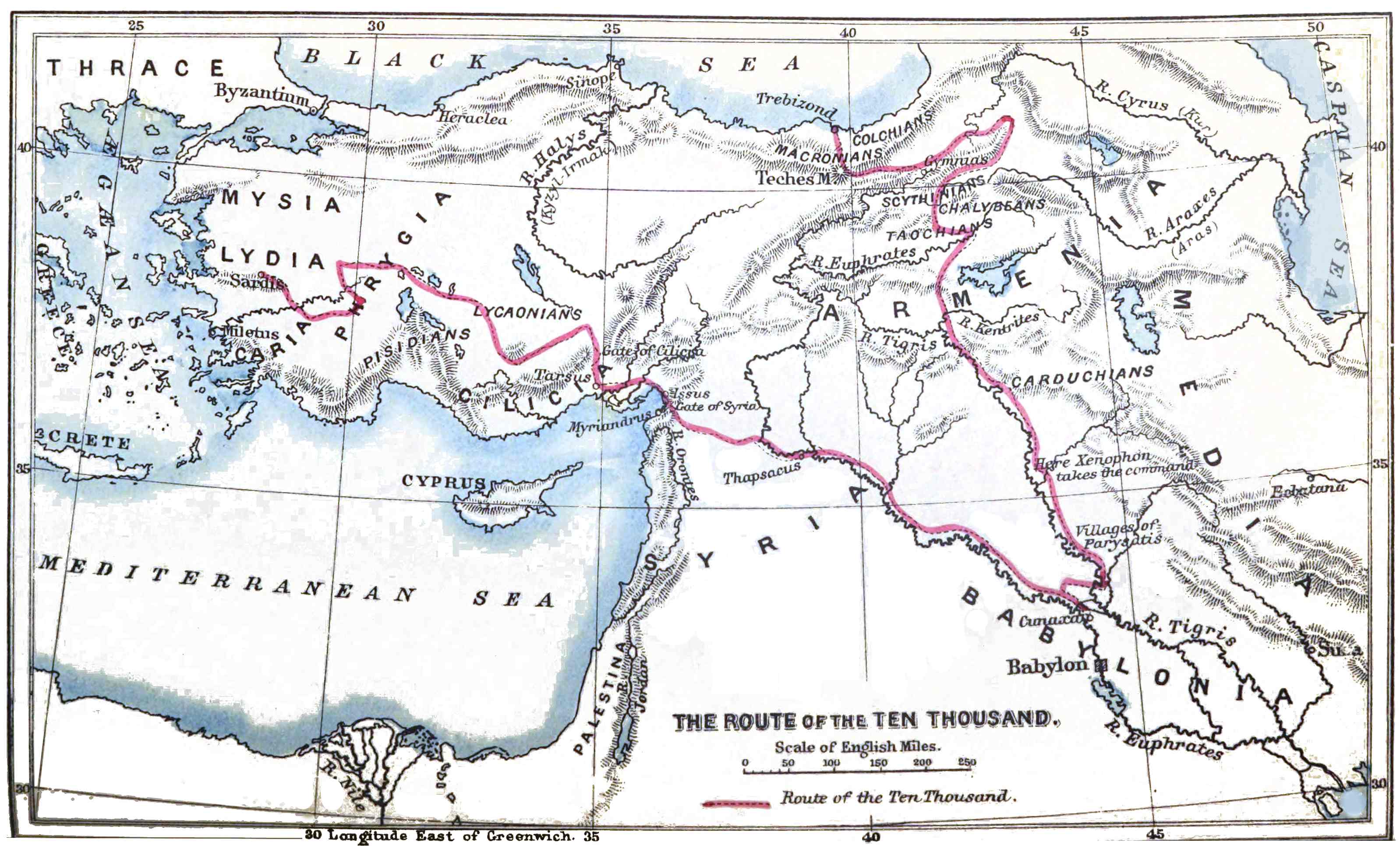
Larger versions of most illustrations may be seen by right-clicking them
and selecting an option to view them separately, or by double-tapping and/or
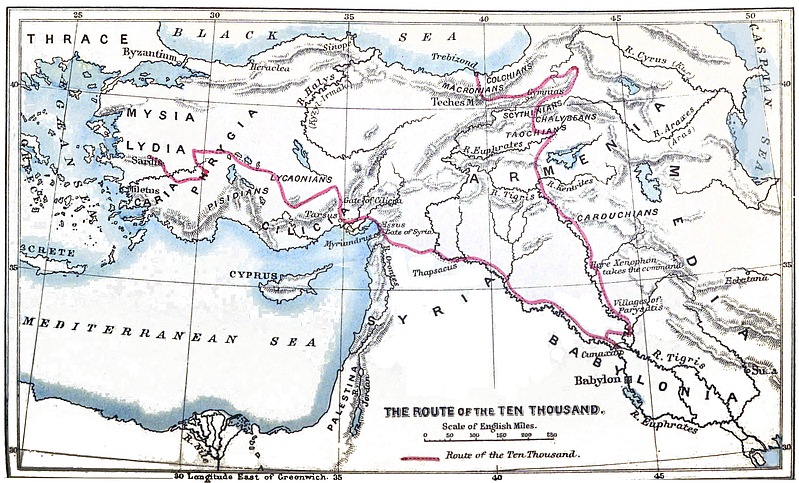
stretching them. A larger, higher-resolution copy of the map
may be seen by clicking (Larger) beneath it.
THE STORY OF OUR LORD. Told in Simple Language for
Children. With 25 Illustrations in Wood, from Pictures by the Old
Masters, and numerous Ornamental Borders, Initial Letters, &c. from
Longmans’ Illustrated New Testament. Crown 8vo. 2s. 6d. cloth
plain, 3s. 6d. cloth extra, gilt edges.
THE STORY OF GENESIS, Being Part I. of The Story of the
Bible. Crown 8vo. 2s. 6d.
THE STORY OF THE EXODUS. Being Part II. of The Story of
the Bible. With a Map and 29 Illustrations. Crown 8vo. 2s. 6d.
WORKS BY PROFESSOR C. WITT.
Head Master of the Altstadt Gymnasium, Königsberg. Translated into English by Frances Younghusband.
MYTHS OF HELLAS. With a Preface by A. Sidgwick, M.A. Crown
8vo. 3s. 6d.
THE TROJAN WAR. With a Preface by the Rev. W. G. Rutherford,
M.A., Head Master of Westminster School. Fcp. 8vo. 2s.
THE WANDERINGS OF ULYSSES. Crown 8vo. 3s. 6d.
THE RETREAT OF THE TEN THOUSAND. With a Preface by
H. G. Dakyns, M.A., Translator of ‘The Works of Xenophon.’
Containing numerous Illustrations. Crown 8vo. 3s. 6d.
HEAD MASTER OF THE ALTSTADT GYMNASIUM AT KÖNIGSBERG
TRANSLATED FROM THE GERMAN BY
FRANCES YOUNGHUSBAND Translator of ‘Myths of Hellas’
WITH A PREFACE BY H. G. DAKYNS, M.A. Translator of ‘The Works of Xenophon’
THIRD EDITION
LONGMANS, GREEN, AND CO. LONDON, NEW YORK, AND BOMBAY
1896
All rights reserved
PREFACE
Miss Younghusband kindly insists that I should write
a preface to her new volume, and I cannot refuse. It
contains a translation by her hand from the German of
Professor C. Witt’s version of the Retreat of the Ten
Thousand.
Such a book ought, I think, no less than its predecessors
The Myths of Hellas, The Tale of Troy, and
The Wanderings of Ulysses, to become a favourite with
those youthful readers, to whom it is primarily addressed.
Indeed, considering the nature of the history, older
persons may perhaps find an interest in it.
The original Greek narrative, on which Professor
Witt has based his version, is, of course, the well-known
Anabasis of Xenophon, which is one of the most fascinating
books in the world. And I agree with the translator
in hoping that some of those who read the story for the
first time in English will be led to study Greek sufficiently
to read it again and again in the language of
Xenophon himself.
That remarkable personage, who in spite of his
Spartan leanings was a thorough Athenian at heart—found
himself on a sudden called upon to play the part of
a leader: and played it to perfection. But if he deserved
well of his countrymen and fellow soldiers by his service
in the field, he has deserved still better of all later
generations by the vigour, not of his sword, but of his
pen.
Perhaps we owe it to his Socratic training that whilst
the memories were still fresh he sat down to describe
the exploits of the Ten Thousand in a style admirably
suited to the narrative; and produced a masterpiece.
I do not think there is a dull page in the book.
The incidents, albeit they took place in the broad
noonday of Grecian history, are as thrilling as any tale
told by the poets in the divine dawn of the highly
gifted Hellenic race. The men themselves who play so
noble a part are evidently true descendants of the
Homeric heroes. If they have fits of black despondency—the
cloud is soon dispelled when there is need for
action, and by a sense of their own dignity. The spirit
of their forefathers, who fought and won at Marathon
and Salamis and Platææ, has entered into them. They
enter the lists of battle with the same gaiety. They
confront death with similar equanimity. Buoyancy is the
distinctive note of the Anabasis.
But there is another side to the matter. These
Xenophontine soldiers are also true enfants du siècle.
They bear the impress of their own half century
markedly: and it was an age not by any means entirely
heroic. It had its painful and prosaic side.
‘Nothing,’ a famous Frenchman, M. Henri Taine,
has remarked in one of his essays entitled Xénophon,
‘is more singular than this Greek army—which is a
kind of roving commonwealth, deliberating and acting,
fighting and voting: an epitome of Athens set adrift in
the centre of Asia: there are the same sacrifices, the
same assemblies, the same party strifes, the same outbursts
of violence; to-day at peace and to-morrow at war;
now on land and again on shipboard; every successive
incident serves but to evoke the energy and awaken the
poetry latent in their souls.’
How does this happen? It is due, I think, to the
Ten Thousand to admit: It was so, because in spite of
personal defects they were true to themselves. ‘The
Greeks,’ as the aged Egyptian priest exclaimed to Solon,
in another context, ‘are always children.’
This something childlike—this glory had not as yet
in the year 400 B.C. faded into the light of common day.
But as M. Taine adds concerning the writing itself,
‘The beauty of style transcends even the interest of the
story,’ and we may well imagine that a less capable
writer than Xenophon (Sophænetus for instance) would
have robbed the narrative and the actors alike of half
their splendour.
And what of Xenophon himself? There is much to
be said on that topic. But it is ‘another story.’ In
this he must speak for himself.
H. G. Dakyns.
TRANSLATOR’S NOTE
In translating Professor Witt’s version of the Retreat
of the Ten Thousand, I have ventured to divide the
chapters, and also to re-arrange in some cases the
grouping of sentences and paragraphs, for the sake of
greater clearness. The figures given for numbers,
distances and sums of money, are the same as in
Mr. Dakyns’ translation of the works of Xenophon.
Here and there too I have modified or omitted or
added a phrase, as for instance in substituting, on
the first page, Alfred the Great for Karl der Grosse, as
an example more familiar to English readers; and in
adding to the description of Persepolis one or two
details to explain the illustrations. But in the main I
have endeavoured to reproduce accurately Professor
Witt’s text in simple English, without either addition
or omission.
The illustrations are mostly taken (by permission)
from MM. Perrot and Chipiez’s ‘Histoire de l’Art dans
l’Antiquité.’ Some few are from Baumeister’s Dictionary.
The two views are from photographs kindly lent for
the purpose by Mr. Cecil Smith, of the British
Museum.
I am glad to take the opportunity of expressing my
very grateful thanks to Mr. Dakyns for his kindness in
forwarding this attempt to interest English children
in the writings of an author to whom he has himself
given so many hours of sympathetic study. And I
hope that many readers of this little book may be
stimulated to the effort of studying for themselves the
works of the great historian in the original Greek.
THE RETREAT OF THE TEN THOUSAND — I THE GREAT KING
From time to time, in the course of the world’s history,
the title of Great has been given to some monarch who
has distinguished himself, either by the splendour of
his victories, or by the value of his services to his fellowmen.
We speak, for example, of Alexander the Great,
and amongst English kings, of Alfred the Great.
There was however one empire, that of Persia, in
which the title of Great carried with it no distinction,
for in this country every king was called the Great
King, not because it was supposed that his nature was
more noble or his actions more splendid than those of
other men, but because he was lord of a vast empire,
greater than had ever yet been seen upon the face of
the earth.
The Persian empire had been founded about a
hundred and fifty years before the time of this story,
by Cyrus the Great, who, having succeeded by inheritance
to the double throne of Persia and Media, had
conquered many of the surrounding nations. The
kings who came after him extended their sway farther
and farther, until at last, in the time of Darius I., there
were no less than fifty-six countries subject to the
Great King of Persia.
The Great King was looked upon as little less than
a god. Every one who entered his presence threw
himself flat upon the ground, as if in the presence of a
divine being. It was supposed that a mere subject
must of necessity be struck to the earth with sudden
blindness on meeting the dazzling rays of such exalted
majesty.
The court of the Great King was on a scale of the
utmost splendour. His chief residence was the city of
Susa, but in the hot season he preferred the city of
Ecbatana, which was higher and cooler, and he also
stayed occasionally at Babylon and at Persepolis. At
each of these places there was an immense palace,
adorned with every conceivable magnificence, and from
the discoveries recently made among the ruins of Persepolis
we can form some idea of what the palace of the
Great King of Persia must have been like.
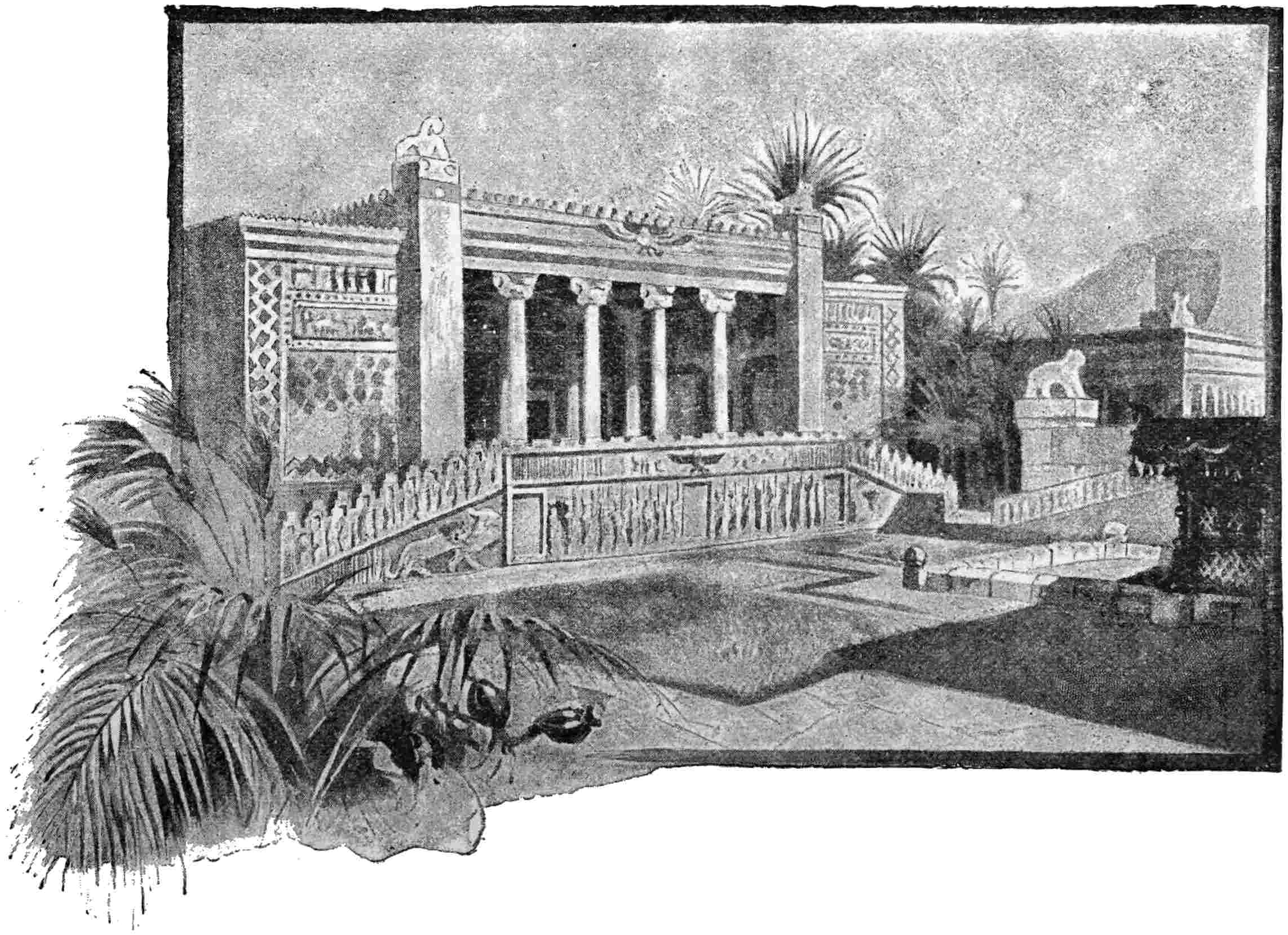
The palace of Persepolis stood upon a terrace above
the rest of the city, and all round it were houses of a
simpler kind, used for lodging the soldiers and the civil
and military officers who were attached to the King’s
person, and who ate daily at his expense. There must,
in all, have been about fifteen thousand of them, including
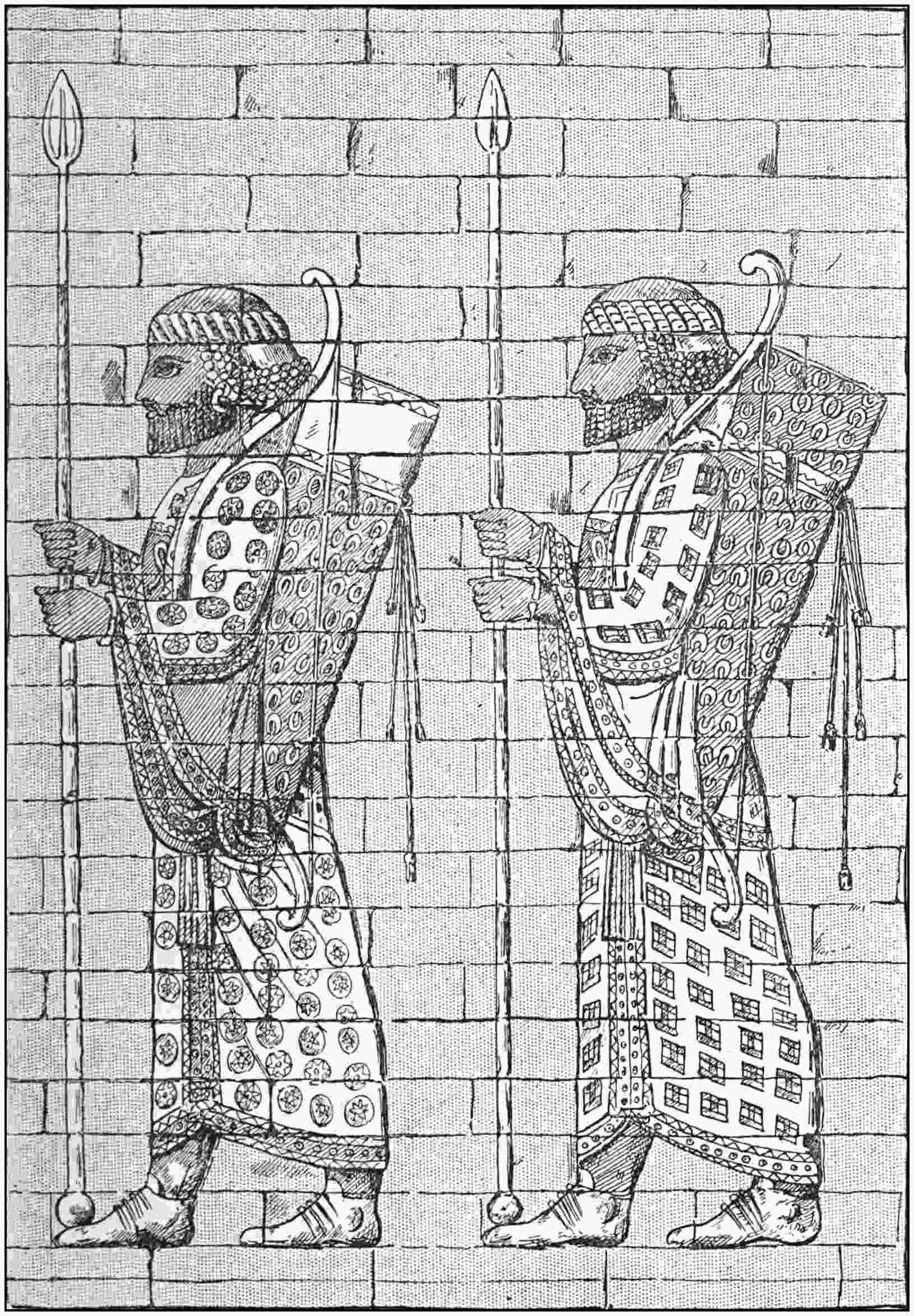
the ten thousand soldiers of the royal body-guard.1
The gate of the palace was approached by two superb
flights of marble stairs, which joined in front of the
entrance, and were so wide that ten horsemen could
ride abreast up each side.2 Within the gate was a square
building with a front of more than two hundred feet.3
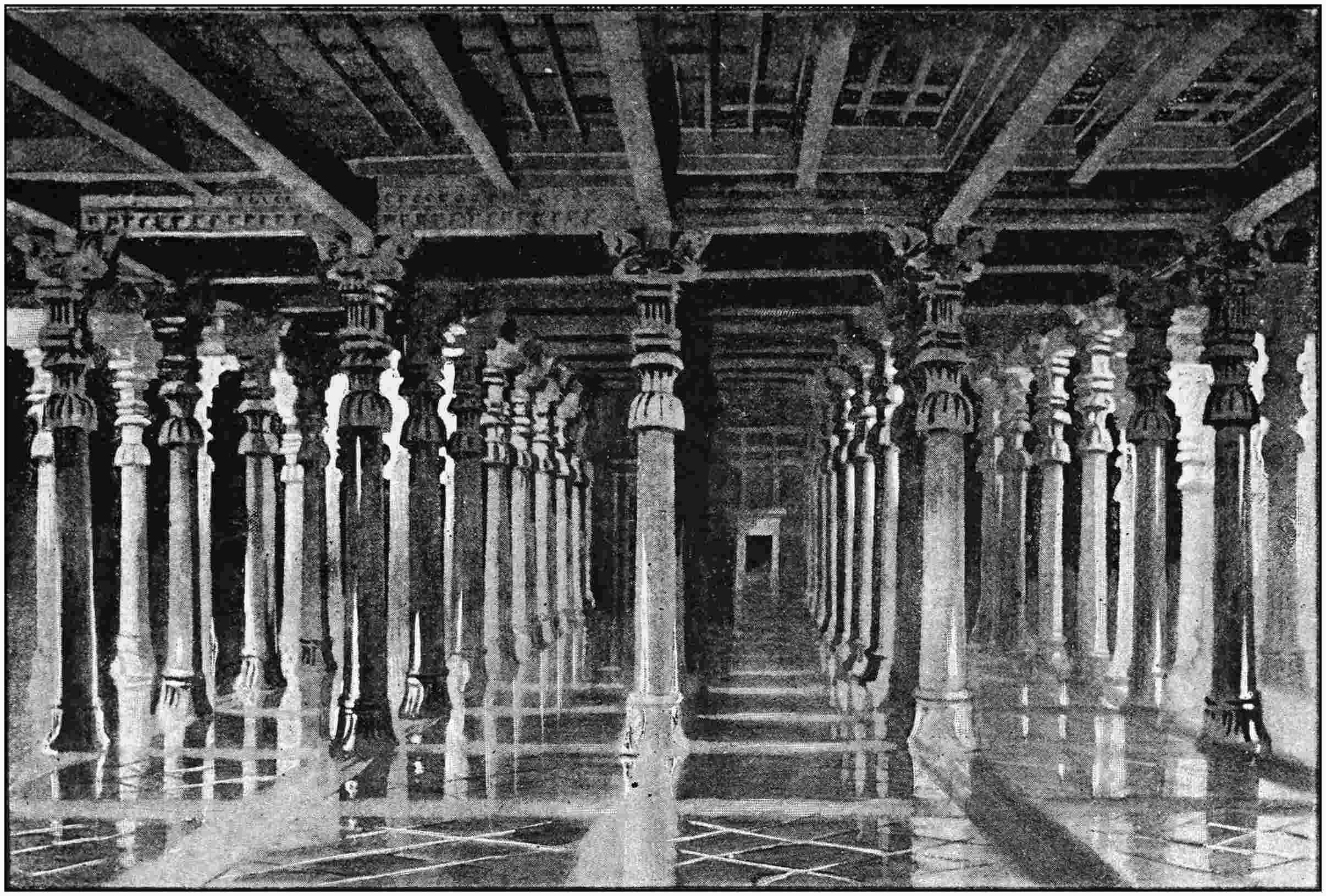
The entrance-hall was a magnificent room, with a roof
supported by a hundred pillars of richly carved stone,4
and on either side of it were other rooms with
beautiful pillars. In all directions lovely colours and
ornaments of gold and silver met the eye. The walls
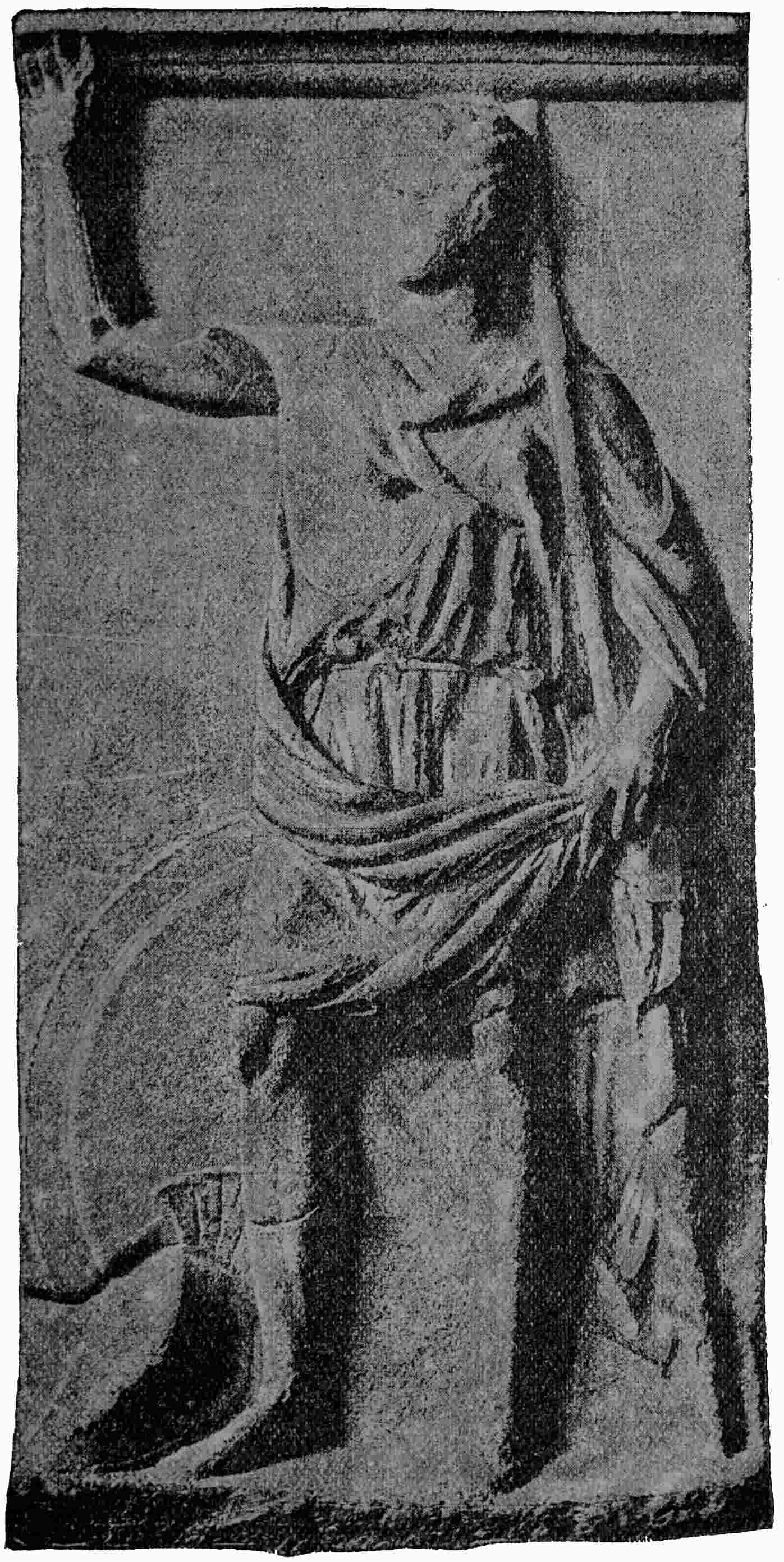
were covered with gigantic sculptures, representing the
Great Kings Darius I. and Xerxes, who had built the
palace, with attendants, both in time of peace, and at
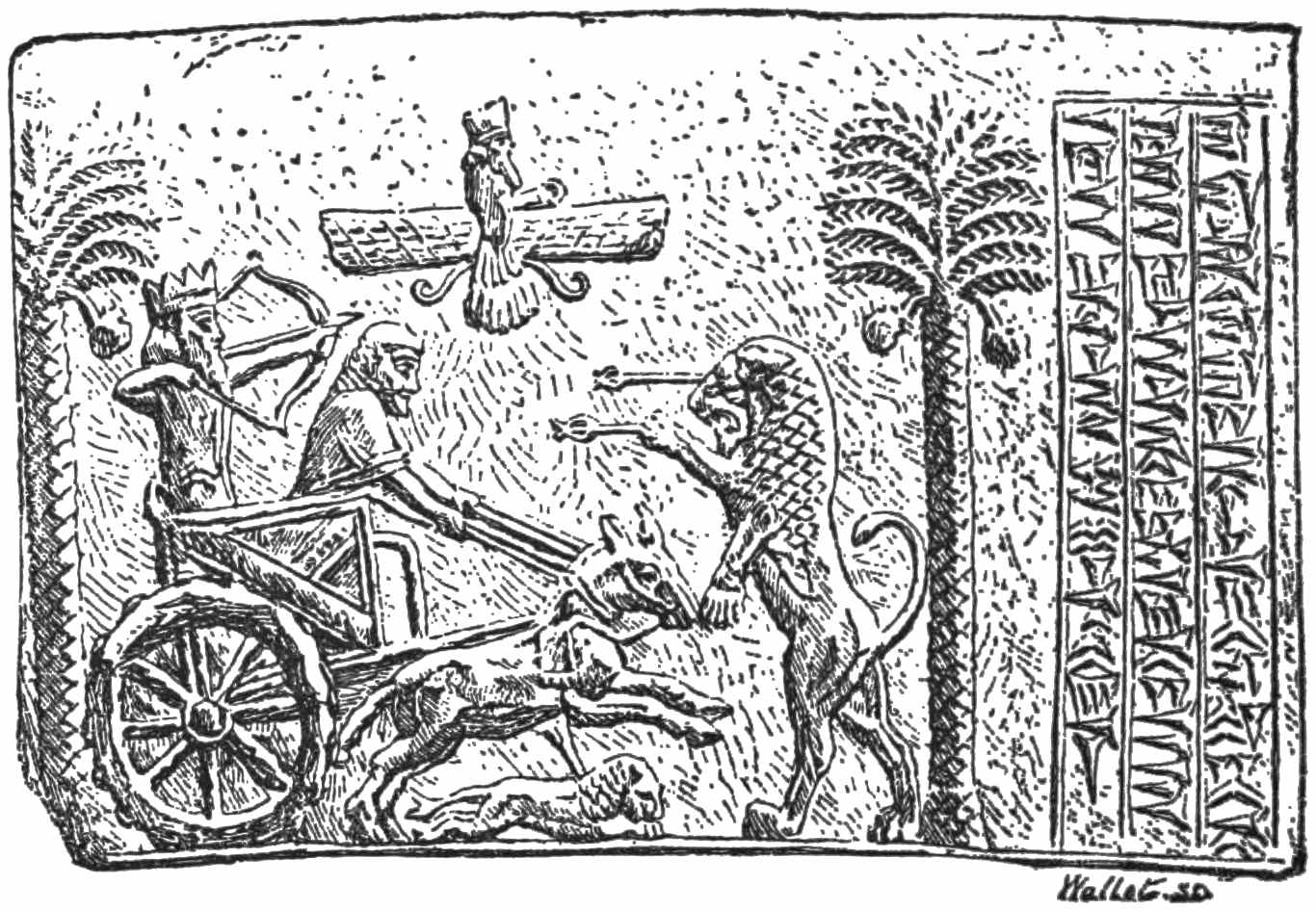
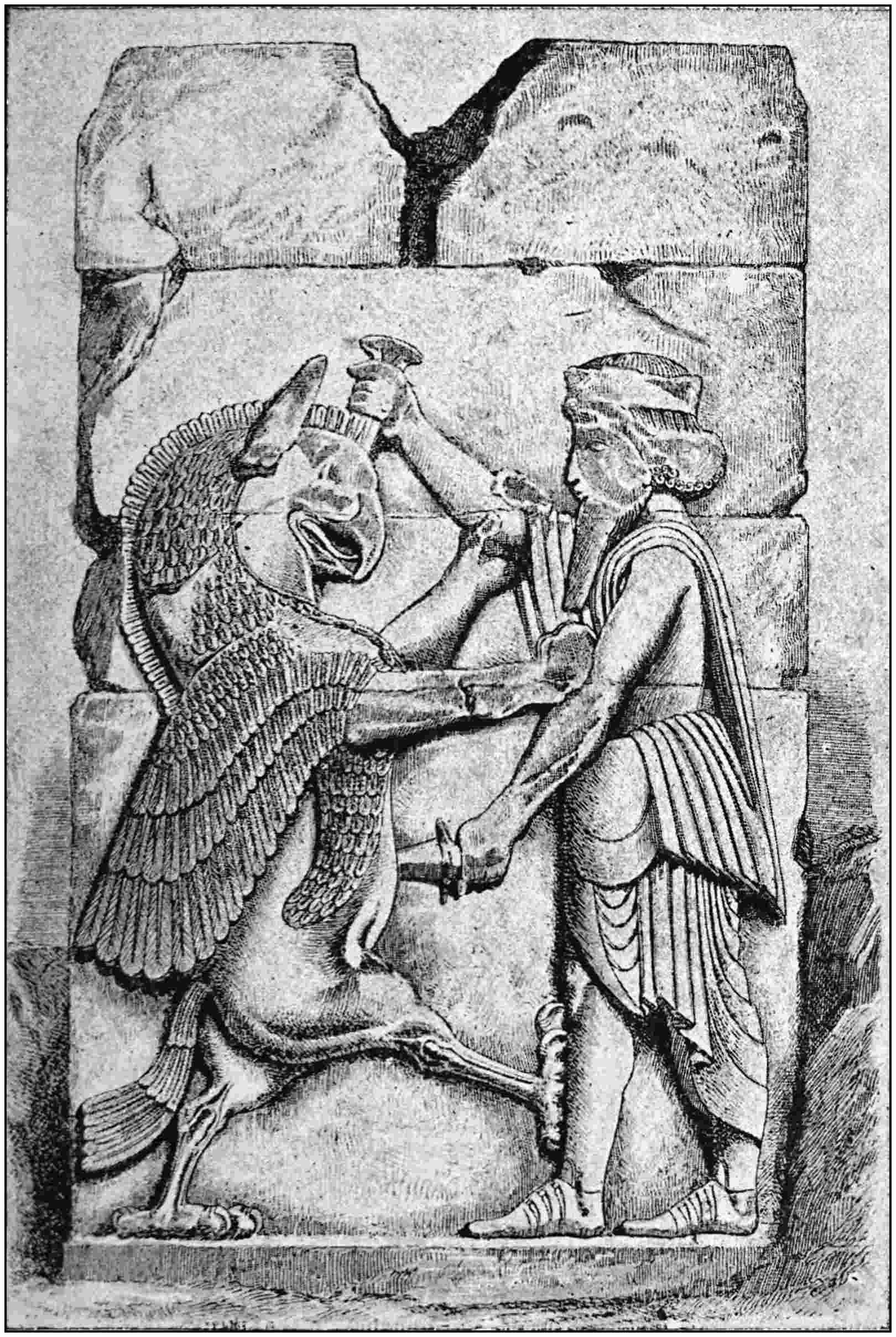
war with monsters and wild beasts.5 Together with the
sculptures were inscriptions which can be read even
now. This is a translation of the beginning of one of
them: ‘I am Darius, the Great King, the King of
kings, the King of these many countries.’ Among the
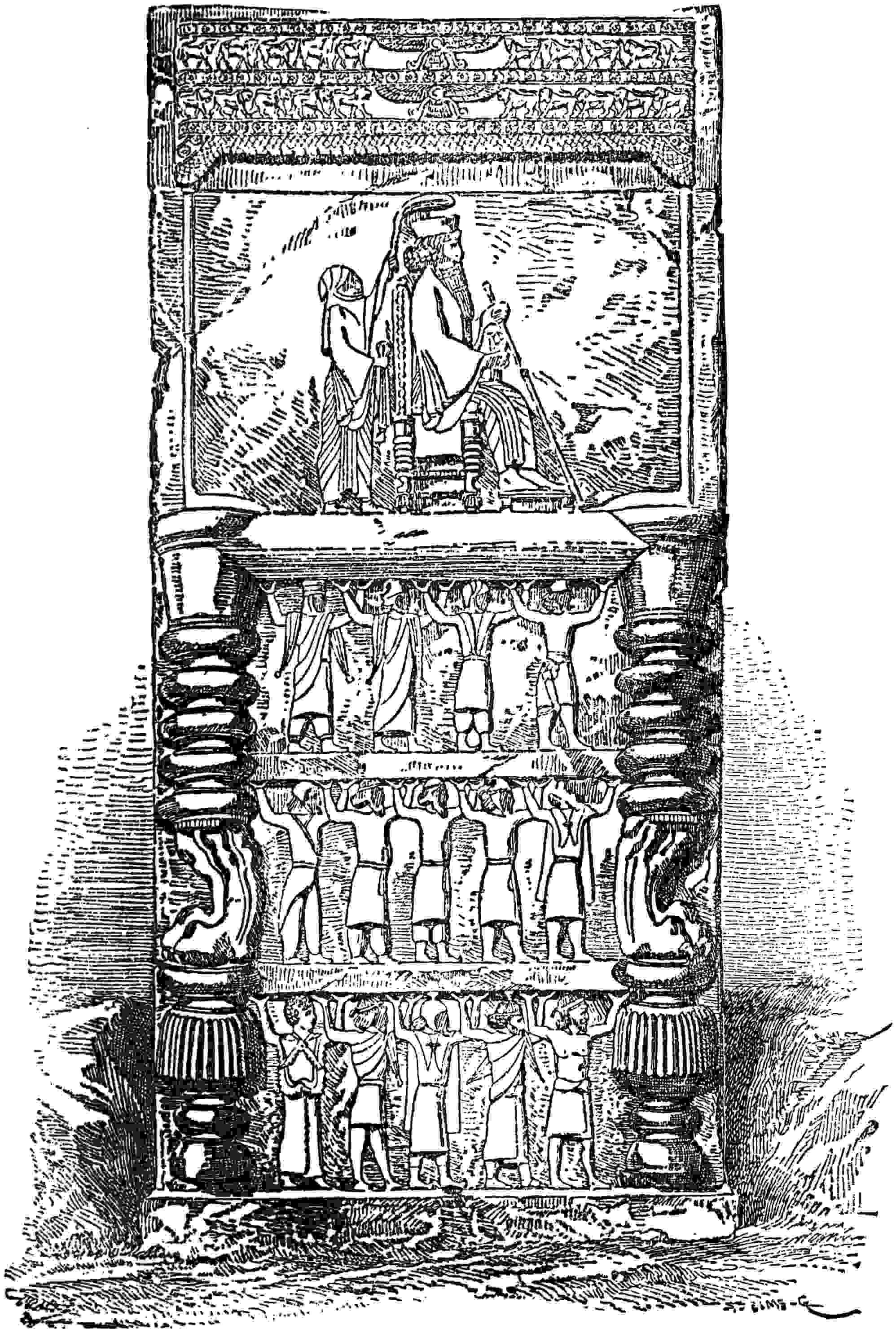
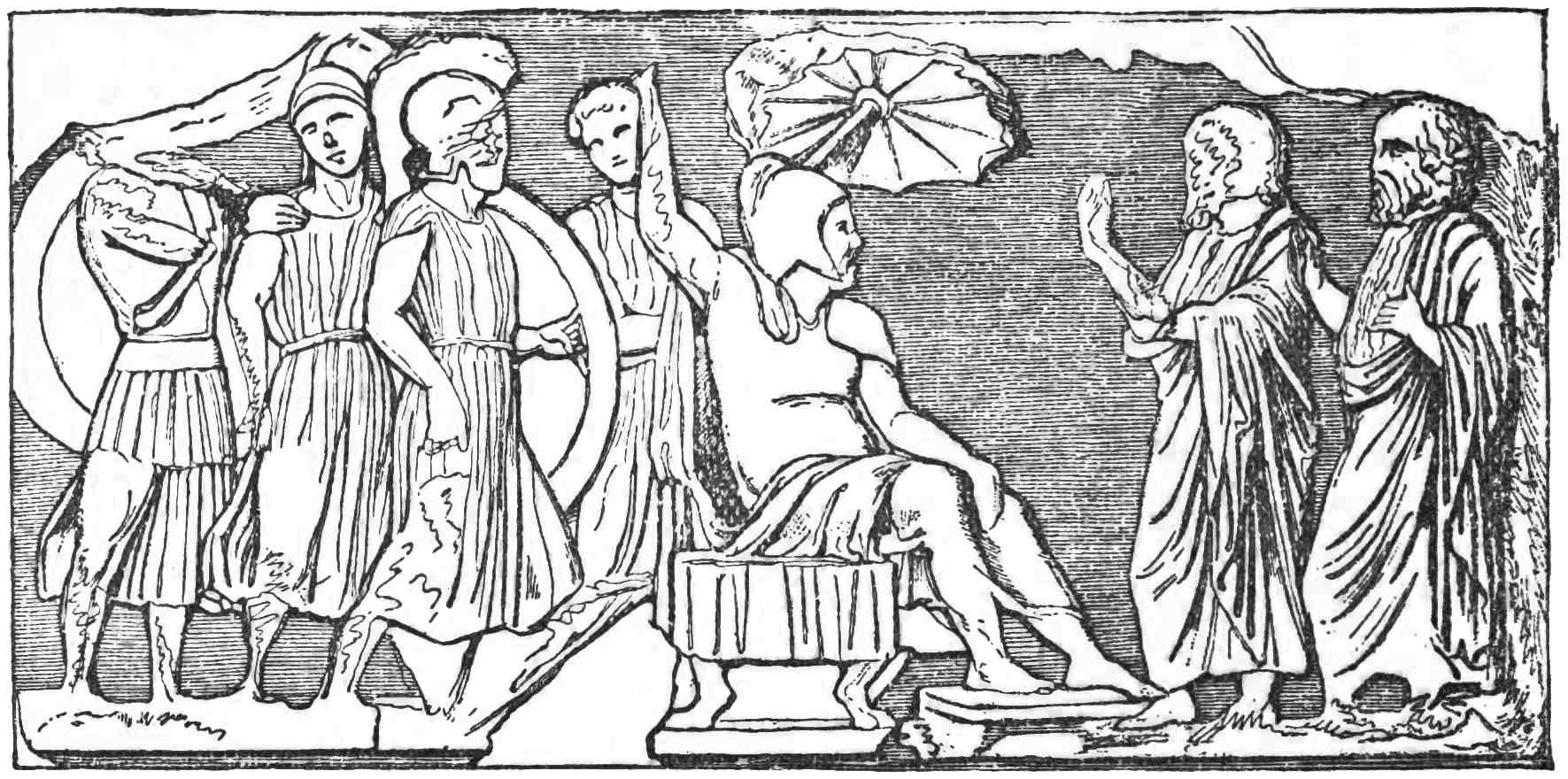
sculptures is one that represents Darius seated on his
throne, with a slave standing behind him, holding in his
hand a fan with which to keep off the flies. The mouth
of the slave is covered with a bandage, for it would have
been considered a profanation to allow the air breathed
by so august a sovereign to be polluted by the breath
of a slave.6 Another sculpture represents an audience
given to an ambassador, who, for the same reason, holds
his hand before his mouth in the presence of the King.
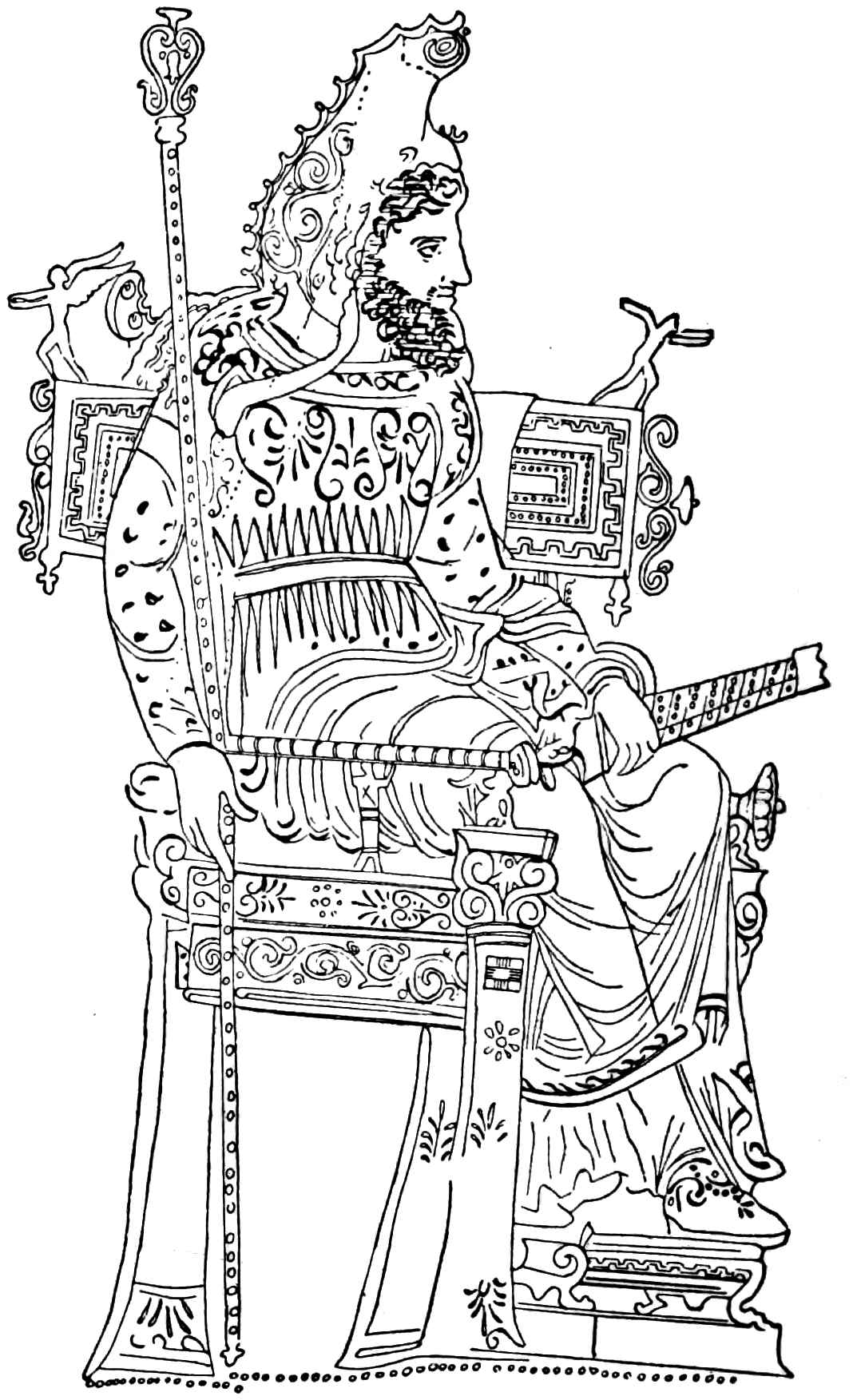
When the Great King gave an audience he sat
upon a golden throne with a canopy above him which
was held in its place by four slender pillars of gold
adorned with precious stones. The whole effect was so
dazzling that it would be hard to imagine anything more
splendid, even in a fairy tale. On these occasions, and
on all feast days, the King appeared in a purple robe,
with a magnificent mantle of the same purple colour,
richly embroidered. Round his waist was a golden
girdle, and from it there hung a golden sabre,
glittering with precious stones. On his head was the
tiara, a sort of pointed cap worn by the Persians.
Only the King might wear his tiara standing upright,
all subjects were obliged to press down the point, or
arrange the cap in some other way. The colour of the
royal tiara was blue and white, and it was encircled
with a golden crown. The full value of the gala
costume was reckoned at nearly 300,000l. of our
money.
It was only on rare occasions that the King walked,
and then only within the precincts of the palace; on
these occasions carpets were spread before him, on which
no foot but his might tread. When he rode beyond the
palace, the right of helping him into his saddle was bestowed
as a mark of great distinction upon one of the
most highly-favoured lords of the empire. More frequently,
however, the King preferred to drive in his
chariot, and at these times the road he intended to take
was specially cleansed, and strewn with myrtle as if for
a festival, and filled with clouds of incense. It was lined,
moreover, with armed men on both sides; and guards
with whips prevented any approach to the royal chariot.
If a distant journey had to be undertaken, no less
than twelve hundred camels and a whole multitude of
chariots, waggons and other means of transport were
required to convey the Great King, his countless
attendants, and his endless baggage.
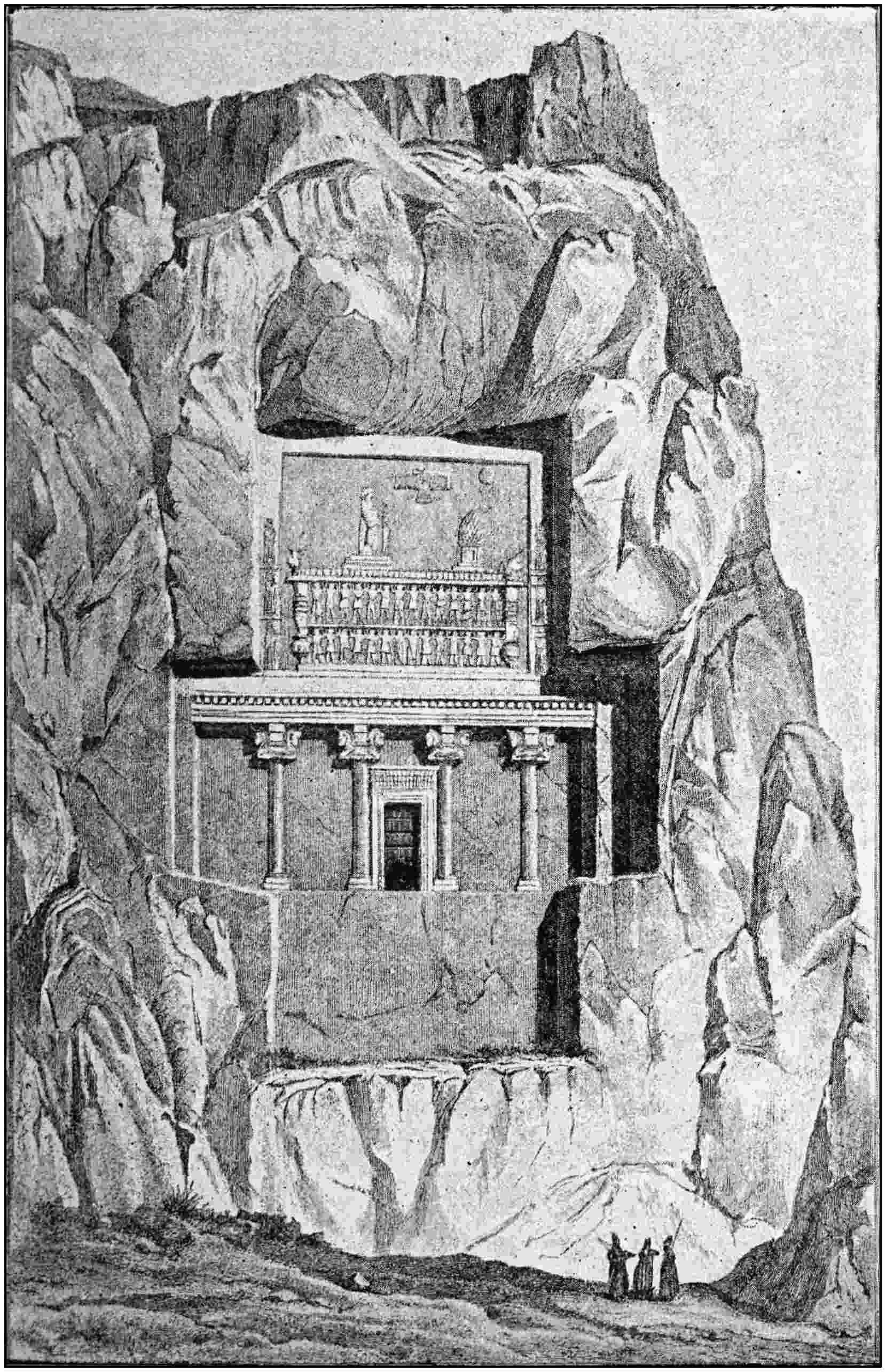
At a distance of about two miles from Persepolis
was a great pile of marble rock, and here Darius I. caused
his tomb to be made whilst he was yet alive. So steep
and inaccessible was the cliff that the only way of placing
the body in the tomb prepared for it was by raising it
from below with ropes. Afterwards three other royal
tombs were hewn out of the same rock, and three more
in another, not far off.7
All Persians were allowed to have many wives, and
the Great King had often a very large number; Darius,
for example, had three hundred and sixty—almost as
many as there are days in the year. Yet only one of
these was the Queen; all the rest were so far beneath
her that, when she approached, they had to bow themselves
to the ground before her.
Like all Persians, the King only ate once a day,
but the meal lasted a very long time. He sat at the
centre of the table, upon a divan framed in gold and
covered with rich hangings. At his right hand was
the Queen-Mother; at his left, the Queen-Consort.
The princes and intimate friends of the King, who were
called his ‘table-companions,’ usually took their meal
in an adjoining room. On feast days, however, they
were permitted to dine in the royal presence, and on
these occasions, seats made of cushions or carpets were
placed for them upon the floor.
The power of the Great King was bounded by no
law; from his will there was no appeal. He was a
despot in the strictest sense of the word, and his
subjects were all alike his slaves, from the lowest to the
highest, not even excepting his nearest relations. In the
whole world there was only one person whom he was
required to treat with any kind of respect; this was his
mother.
II THE PERSIAN EMPIRE
Under the vigorous rule of Darius I. the empire of
Persia had attained its utmost limits; at that time fifty-six
subject countries offered tribute to the Great King.
But from this moment it gradually declined in power
and in extent. For the wisest head and the strongest
arm it would have been no easy task to govern such a
dominion, and the successors of Darius were neither
wise nor strong.
Neither was the Persian nation what it had been in
the time of the great Cyrus, when even the nobles were
simple in their habits, and when every Persian made it
his pride to ride well, to shoot well, and always to speak
the truth. Now, nobles and people alike had become
luxurious and pleasure-loving, caring for nothing but
to increase their own power and wealth, no matter at
what cost to the subject nations.
The empire was unwieldy in size, and moreover it
lacked any real bond of union. The various nations of
which it was composed differed in language, in manners,
and in habits of life. Each province was interested in
its own local affairs, but was profoundly indifferent to
the fate of the empire at large; and in time of war the
soldiers were so little inclined to risk their lives for a
monarch of whom they knew nothing that they only
fought under compulsion, and often had to be driven
with whips to face the enemy.
In order to provide for the government of the
empire, it was subdivided into provinces, and each
province, or group of two or more provinces, was placed
under the charge of one of the great lords. It was the
duty of these governors—or Satraps, as they were
called—to act as the representative of the sovereign,
to maintain law and order, and to take care that the
people had no opportunity of revolting from their subjection
to the Great King.
The power of the satraps was practically absolute,
and a thoroughly disloyal Satrap could even go so far
as to seize some favourable opportunity to detach his
province from the empire and make himself an independent
sovereign. The King was, indeed, accustomed to
make a journey of inspection every year into one or
other of his provinces, but in each province such visits
were of rare occurrence, and a Satrap who wished to
seek his own advantage, instead of studying the
interests of the King and of the empire, had every
opportunity of doing so. ‘The empire is large,’ he
might well say to himself, ‘and the King is far away.’
With a view to checking such tendencies on the
part of the Satraps, the Persian nobles were trained in
habits of implicit obedience and subjection to the sovereign,
and were kept in constant fear of being ruined
by some report of treason or misgovernment on their
part which should reach the ears of the King. Upon
the smallest suspicion, and without any sort of trial, a
man who was accused of plotting treason against the
King might be removed from his post, and either
openly or secretly put to death. A story is told of
Darius I., who was one of the best of the Great Kings,
that once, when he was about to engage in an
expedition against the Scythians, a Persian noble
prostrated himself before him, and craved as a boon
that of his three sons he might be allowed to keep one
at home with him. The King answered that he should
keep them all at home, and gave command to put
them to death immediately.
In a similar manner the people were crushed by
severe and cruel laws, just as wild animals are cowed by
ill-treatment and want of food. As conquered nations
they were not expected to have any attachment to the
King, or any interest in the welfare of the empire, and
although now and again services rendered to the King
would be rewarded by overwhelming favours, yet the
means chiefly relied upon for securing good behaviour
was the certainty that every offence would meet with
prompt and barbarous punishment. Not only criminals,
but even persons merely suspected of having committed
crimes, were put to death in the most horrible manner.
Some were crushed between stones, others were torn
limb from limb, and others, again, suffered painful
imprisonment in troughs. For merely trifling offences
they were cruelly mutilated.
There is a Persian proverb that ‘the King has many
eyes and ears.’ In every state the king must have
means of knowing through his trusted officers, who see
and hear for him, what is going on among the people.
But in Persia the arrangements for obtaining information
of this kind were reduced to a science. Satraps
and people alike were constantly watched by a body of
spies, and so secretly was this done that it was not even
known who were the officers employed. A favourite
device of the spies was to feign a friendship for the person
whose actions they wished to report, and a man might be
arrested and executed without once suspecting the false
friend who had given information of his real or imaginary
guilt. Sometimes the spy would denounce an
innocent man for no other reason than to bring himself
into notice as active in the King’s service.
Another plan was to take note of every one who
passed along the roads which led from the various
Residences of the Great King to the other principal
towns of the empire. These roads were commanded
by fortresses where officers were stationed whose duty
it was to enquire of every wayfarer whither he was
going and on what errand, and any messenger carrying
a letter was obliged to give it up for inspection.
This was intended to check the free passage of suspicious
persons, and to prevent the sending of letters
not approved by the government; but it must often
have been easy to find means of evading the King’s
officers.
In order that the King might be informed as quickly
as possible of any risings or disturbances in the provinces,
a very complete system of postal communication had
been arranged. Besides the fortresses, there were
stations all along the roads, at intervals of about fifteen
miles apart, where the traveller could find shelter for
the night. Here the swiftest horses and horsemen were
always waiting in readiness to carry on the post at full
gallop without a moment’s delay, whether in burning
sun or blinding snow: and thus there came to be a
saying that ‘the Persian post-riders fly faster than the
cranes.’ A messenger sent from Susa to Sardis, traveling
at the ordinary speed, would take a hundred days
to reach his destination; but by means of the King’s
posts a letter could be conveyed in six or seven
days and nights. It must not be supposed, however,
that ordinary letters were carried so fast. The King’s
posts were entirely reserved for the King’s business,
and by this means he had the advantage of getting
news from the provinces and sending back his commands
before any one else knew what was going on.
But, in spite of all these precautions, the King, like
his subjects, lived in constant fear. He never showed
himself to the people, except surrounded by his ten
thousand guards. If he gave an audience, the person
admitted to the royal presence was compelled, on pain
of death, to present himself dressed in a robe with long
sleeves falling over the hands, so that he should not be
able to use his hands against his sovereign. If he
entertained guests at his table, those among them who
were considered the most faithful were placed at his right
hand, and the less trusted at his left, because, in case of
need, he would be better able to defend himself with the
right hand than with the left. Each dish that was set
before him was first tasted by an officer in the royal
presence, lest there should be poison in the food, and in
like manner, the cup-bearer always drank first from the
cup that he handed.
Under such a system of mutual fear and distrust,
the seeds of ruin and decay were sown throughout the
Persian empire, and each succeeding century saw it
tottering more helplessly towards its final overthrow.
But from without everything appeared fair and prosperous,
and up to the very last, the Great Kings were
careful to maintain all the pomp and splendour of
imperial power.
III HELLAS
Beyond the great Persian Empire, on the other side of
the Hellespont, was the little country of Hellas, or
Greece. The Hellenes, or Greeks, as they are often
called, were a race of men who had for centuries trained
themselves in the art of noble thinking and noble living,
and they looked down with some scorn on their less
cultivated neighbours, to whom they gave, one and all,
the name of Barbarians.
In many respects Hellas was a complete contrast to
Persia. The country was a very small one, and it was
further divided into a number of tiny states, each with
a free government of its own, and independent of all the
rest. To the Hellene citizen, the one supreme necessity
of life was freedom, and consequently in almost all the
states the government was in the hands of men chosen
by the people. Now and again a monarchy would be
established in one or other of the states, but it never
lasted long, and in their horror of tyrants, the Hellenes
were apt to overlook the advantages of a firm, stable
government.
It is true that in Hellas there were many slaves,
but they formed a class apart and were in no sense
citizens. The citizens themselves were free, and the
Hellenes were convinced that honour, courage, and high-mindedness
can only flourish among free men. It was
their greatest pride to recall the battles fought by their
countrymen in former days against the Barbarians of
Persia, when, although outnumbered by ten to one, a
handful of free men had put to flight a host of slaves.
About the year 423 before Christ, the throne of Persia
was occupied by a King, named Darius II. His Queen,
the beautiful Parysatis, had borne him thirteen children,
but most of them had died young, and only two sons
were now alive, between whose ages there was a
difference of no less than thirty years. The elder was
called Artaxerxes; the younger, Cyrus. Parysatis was
not an impartial mother. She loved Cyrus far better
than Artaxerxes, and desired nothing more ardently
than that he should succeed to the throne after the
death of Darius, rather than his elder brother.
The Queen was beautiful, and wise and clever, and
she had great influence over her husband, and seldom
failed in persuading him to do as she wished. She
hoped therefore to induce the King to name Cyrus as
his successor, especially as there was much that could
be urged in favour of her plan.
It was certainly true that the throne of Persia
descended, as a rule, from the father to his first-born
son, but there was nothing to prevent an elder son
being passed over in favour of a younger, and such a
course was not without precedent. In the present case,
an excuse might be found in the fact that the birth of
Artaxerxes had taken place before his father came to the
throne, whereas Cyrus had been ‘born in the purple,’
and moreover bore the honoured name of the greatest of
Persian sovereigns.
But a much stronger argument was the difference in
character between the two men. Artaxerxes was weak
and indolent, and lived constantly at the King’s court,
hating exertion of any kind. Cyrus, on the contrary,
was active and energetic, and had already given striking
proofs of ability, both as a soldier and ruler of men, for
at the age of eighteen, he had been appointed satrap of
the provinces of Lydia, Greater Phrygia and Cappadocia.
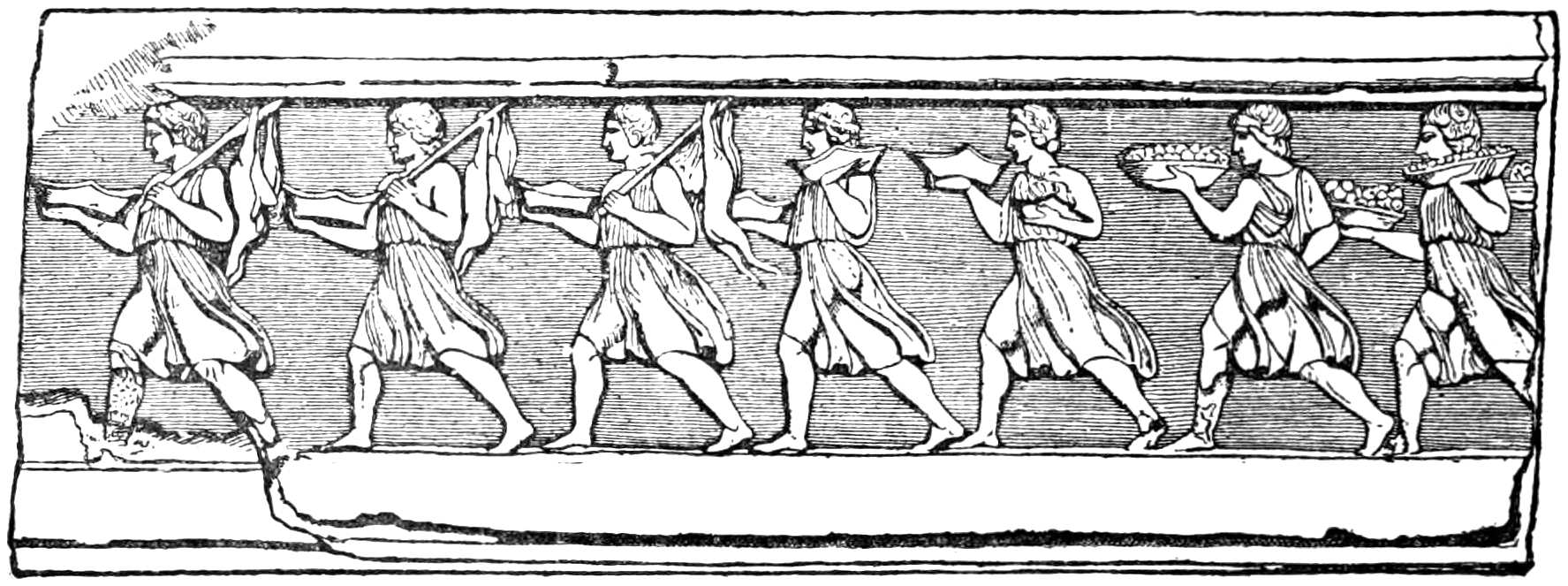
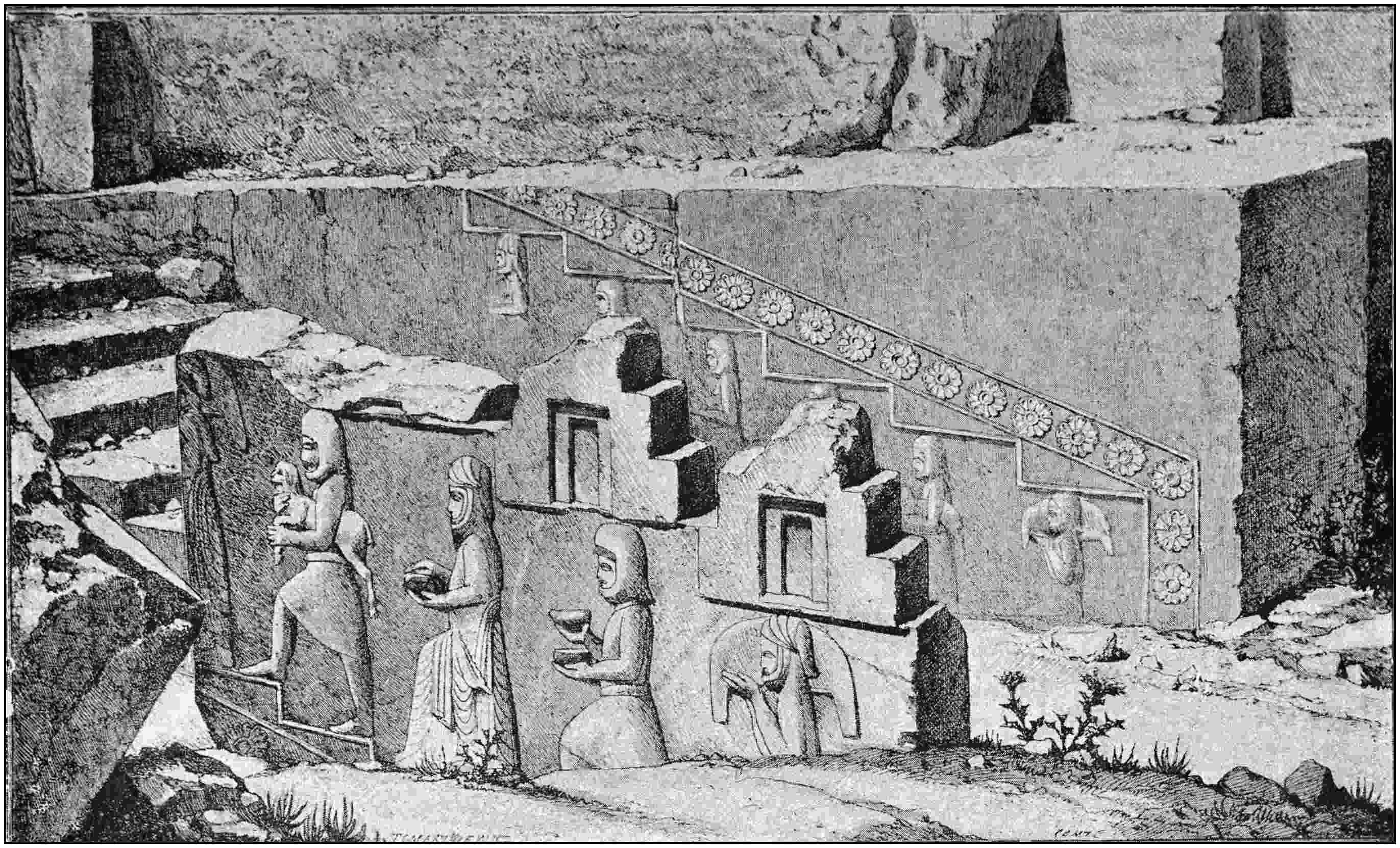
BRINGING PRESENTS TO A SATRAP.
Cyrus had many friends. He was a man just after
the Persian heart,—a bold rider, an unrivalled archer
and spear-thrower, and a passionate lover of the chase,
especially when it was dangerous. He also excited the
admiration of the Persians by his power of drinking an
enormous quantity of wine without becoming intoxicated.
This was looked upon as a sign of manliness,
and a great distinction.
In the pleasant and peaceful occupation of gardening,
Cyrus also took great delight. This charming pursuit
had been raised almost to the rank of a religious
duty by Zoroaster, the founder of the Persian religion,
who had taught his disciples that when occupied in
the planting and tending of trees useful to man, they
were engaged in a good action, well-pleasing to God;
and in consequence of this precept, almost every palace
stood in the centre of a large park or tract of enclosed
land, covered with beautiful old trees.
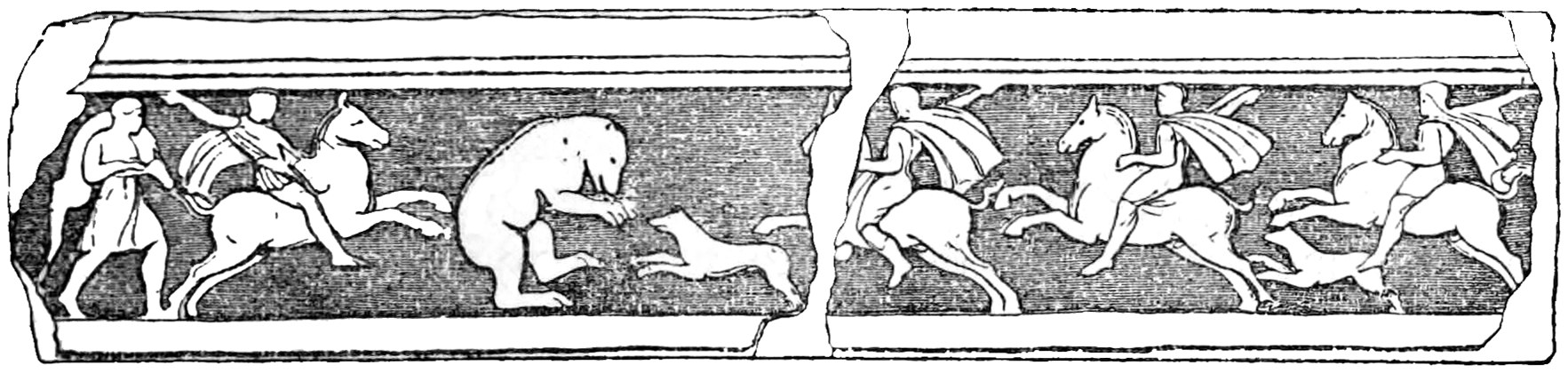
A BEAR HUNT.
The palace of Cyrus stood in such a park, called by
the Persians a ‘paradise.’ Here he might often be
seen, attending to the trees with the utmost diligence.
Here too was a convenient hunting-ground, ready to his
hand, for the forest was full of wild animals who
found abundant pasture in its pleasant glades. One
day when Cyrus was out hunting he was attacked by
a she-bear, who dragged him from his horse, and gave
him several wounds before he could kill her. One of
his companions came to his help, and for this service
Cyrus rewarded him in so princely a manner as to make
him an envied man.
As a friend, Cyrus was always generous and open-handed,
and he delighted in making small presents as
well as great. According to an old custom, every
subject who came to his court brought with him gifts,
and these Cyrus always accepted, but not for himself;
he took them in order that he might divide them among
his friends.
Sometimes, at a banquet, if he observed that the
wine set before him was better than usual, he would
send away part of it to one of his friends with some such
message as this: ‘Drink this good wine to-day with
your dearest friend.’ Or perhaps the gift would consist
of half a goose or part of a loaf of bread, which would
be taken to the friend with the message, ‘Cyrus has
enjoyed this, and desires that you should taste it
also.’
If he gave a promise, or entered into an agreement,
it was certain that he would keep his word. A friendship
once formed he ever afterwards regarded as sacred.
Any one who did him a service, whether in war or in
peace, was rewarded tenfold. At the same time, any one
who offended or injured him might expect the most
savage retaliation. He is said to have once prayed to
the gods to grant that he might live until he had repaid
all his friends and all his enemies.
As a governor, Cyrus was strictly and sternly just.
Well-doers were encouraged and rewarded, but evil-doers
met with immediate punishment; and as a warning
to others, criminals who had been deprived of hands,
legs or eyes, were exposed to view in the most frequented
streets. In the whole empire there were no provinces
in which natives and strangers alike were so secure from
robbery and murder as in those governed by Cyrus.
Meanwhile the Great King Darius II. felt his end
approaching, and as he wished to have both his sons
beside his death-bed, he sent for Cyrus to come to
Susa. On receiving the message, the young prince set
out at once for the King’s court, accompanied by Tissaphernes,
the satrap of a neighbouring province, whom
he looked upon as one of his friends. He took with him
also a body-guard of three hundred Hellenes, who had
entered his service.
Cyrus was full of hope that the influence of his
mother, and the favour with which he was regarded by
the Persians generally, would cause his father to
bequeath the throne to him, and not to Artaxerxes. If
the choice of their future sovereign had been left to the
people, they would probably have chosen Cyrus. But
in Persia, the naming of the successor was the right of
the reigning king, and the hopes of Cyrus were doomed
to disappointment. On his death-bed, Darius named,
not his younger, but his elder son; and the upright
tiara, encircled with the golden crown, passed to
Artaxerxes.
Cyrus was vexed and angry at the failure of his
hopes, and probably took little pains to conceal his feelings,
for he was of a very passionate nature. However
this may have been, Tissaphernes, whose friendship for
him had been merely feigned, went to the new King and
told him that his brother had made up his mind to have
him murdered.
The beginning of a new reign had often in Persia
been signalled by bloody deeds, and the murder of a
brother was by no means an unheard-of crime.
Artaxerxes was therefore ready enough to believe the
accusation, and immediately gave orders for his brother’s
arrest, for he was resolved to defeat his ambitious
schemes by the most effectual of all methods, namely by
putting him to death.
Cyrus had many friends at the court, but there was
not one who dared to come forward in his behalf, except
his mother, Queen Parysatis. She indeed was ready
to risk everything in order to save her favourite son, and
being also the mother of the Great King, with a sacred
claim upon his love and respect, she succeeded at last,
after endless entreaties, in shaking his resolution and
inducing him to pardon Cyrus.
Artaxerxes was far from being a great man, but
he was at least easy-going and good-natured, and now
his mother so far prevailed upon him, that he not only
set Cyrus at liberty, but also reinstated him in his
former dignities, and allowed him to depart to his own
province.
Cyrus returned therefore to his Residence at Sardis,
full of bitterness and disappointment. It is not known
whether or not he had really plotted the murder of his
brother. The story may very possibly have been invented
by Tissaphernes through envy of Cyrus, and
in the hope of succeeding to the government of his
provinces.
This much however is at least certain, that after
having been treated as guilty of high treason, and condemned
to death in consequence, Cyrus had but one object
in life, and that to further this object, he did not
hesitate to employ the power entrusted to him for
a very different purpose. From this time forward his
whole mind was set upon obtaining by conquest the
throne of Persia.
V PREPARATIONS
It was no small enterprise upon which the mind of
Cyrus was now bent, and at first sight it might well
have been pronounced altogether hopeless. How could
a mere governor of a province hope to unseat from his
throne the Great King with all the resources of the
empire at his command? At the most, Cyrus could
only reckon upon some 100,000 soldiers, whereas
Artaxerxes was able to bring more than a million of
men into the field.
On the other hand however, it might be urged that
the Great King could not at once assemble his whole
force. So immense were the distances in this huge
empire, that a whole year of preparation would be required,
in order to bring up the army to its full
strength. And Cyrus intended, if possible, to take his
brother by surprise. He believed moreover that his
disadvantage in point of numbers would be more than
counterbalanced by the infinitely superior quality of at
least a part of his army.
It was from among the Hellenes that he hoped to
enlist such troops as could not fail to ensure his success.
Some years before this, he had visited Hellas as his
father’s ambassador at the time of the Peloponnesian
war, and had observed the unusual talent displayed by
the Hellenes for military enterprise. He had made
many friends among them, whose friendship he still
retained, and he was anxious to induce as many Hellene
soldiers as possible to enter his service.
The Hellenes had always been fond of adventure,
and just at this time there were numbers of them
willing and eager to engage themselves to a foreign
master who promised good wages, especially when this
master was a prince well known to be generous and
open-handed, and above all, a lover of Hellas and the
Hellenes. During the long Peloponnesian war they
had become accustomed to an unsettled, adventurous
camp-life, and now that the war was over, they did not
care to return to peaceful pursuits.
But Cyrus could not, without betraying his plans,
begin openly to enlist foreign troops. It was necessary
to find a pretext for employing them, and in this he
was helped by fortune. For several hundred years
there had been established along the west coast of Asia,
numerous flourishing colonies of Ionian Hellenes. At
first, and for a long time, they were free states, but they
had been conquered at last by the Persians, and now
they formed part of the Persian empire, and were included
in the satrapy of Tissaphernes.
Most fortunately however for Cyrus it happened
that just at this time the Ionian cities rebelled, not
against the Great King, but against Tissaphernes, and
begged Cyrus to take them under his protection. To
this he gladly agreed, for it gave him a pretext for declaring
war against Tissaphernes, and supplied a cloak
with which to cover the preparations he was making
for his great enterprise. Accordingly he sent word to
the Ionian cities that their garrisons should be strengthened
by the addition of Hellene soldiers, which he proceeded
to levy for the purpose. He also raised troops
for the relief of Miletus, one of the largest of the cities,
and the only one left in the hands of Tissaphernes, who
had received the news of the intended revolt in time to
enable him to take prompt measures for suppressing it.
He had removed the garrison, put to death the leaders
of the opposition, and banished all suspected persons.
These banished inhabitants had come to Cyrus, and
in answer to their entreaties, he agreed to besiege
Miletus both by land and water.
It may seem strange that one satrap should have
been able to wage war against another, whilst all the
time both continued to be subjects of the Great King.
But in point of fact, such rivalries between neighbouring
satraps were rather encouraged than otherwise
by the Great Kings, who lived in constant fear lest one
or other of the great lords should take it into his head
to make himself an independent sovereign, and consequently
felt more secure when they were occupied in
quarrelling among themselves. In this case moreover,
the royal revenue suffered no loss through the revolt of
the Ionian cities, for Cyrus took care to forward the
tribute which they were required to send to Susa, just
as regularly as it had before been sent by Tissaphernes.
Other opportunities also offered themselves to Cyrus
for increasing the number of Hellene soldiers in his
pay. About this time he received a visit from a Spartan
named Clearchus, whose acquaintance he had made
during the Peloponnesian war, and of whose ability as
a military commander he had the highest opinion.
Clearchus had come to him with a request on behalf
of the cities of the Hellespont, who were at war with
their barbarous neighbours, the Thracians, and could
not hold their own against them without help. He
wished to aid his countrymen by raising an army for
their defence, and asked Cyrus to grant him for this
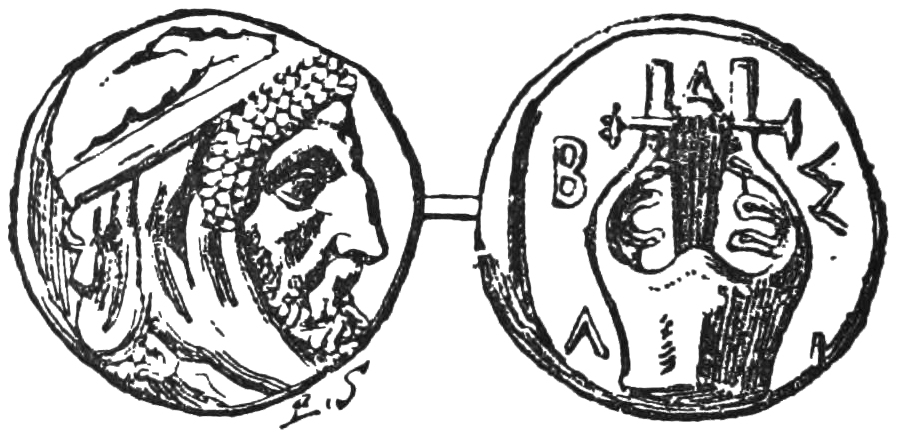
purpose a sum of 10,000 darics.8 The request was a
large one, but it was at once granted by Cyrus.
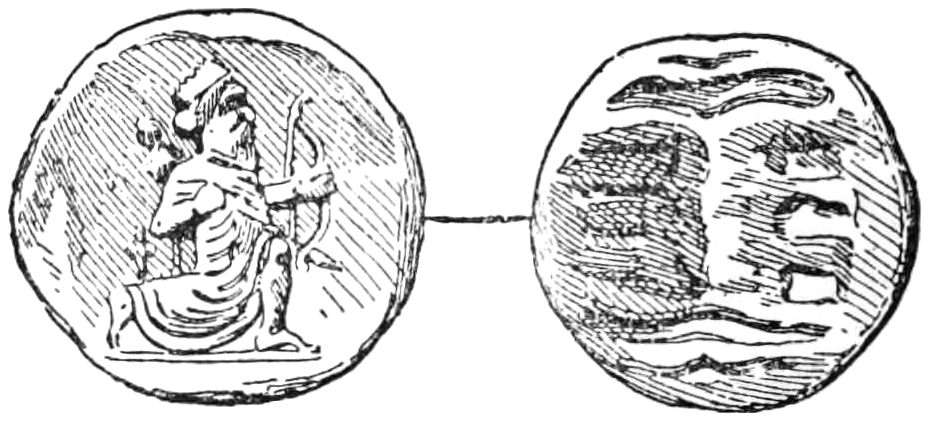
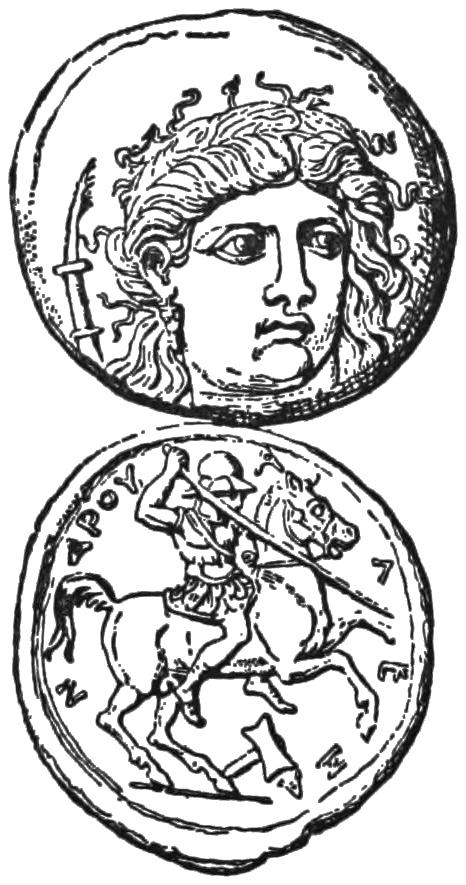
8 A daric was a gold coin, first issued by King Darius I, and called
after him—worth about a guinea.
A GOLD DARIC.
Shortly afterwards there came to him a Hellene from
Thessaly, with a similar request. In his country, the
party of which he was leader found itself hard pushed
by the opposing faction, and he also desired to raise an
army by means of which he and his friends might again
have the upper hand. He asked Cyrus to let him have
as much money as would enable him to hire 2,000 men
for three months. ‘I will give you gold enough,’
said Cyrus, ‘to hire 4,000 men for six months, on condition
that you prolong the quarrel with your enemies
until I send for you.’
Other requests of a similar kind were also granted
by Cyrus, always with an intimation that he might
require the troops later on for his own service. And
thus he secretly collected a force of Hellenes which he
kept employed in other undertakings, but ready to come
to him when he should want them.
Meanwhile he was careful not to neglect any means
of improving the Barbarian soldiers of his provinces,
and this could be done openly, for it was part of his
duty as satrap to practise the troops in all kinds of
military exercises calculated to increase their efficiency.
All this time the Great King was constantly sending
spies to Sardis to find out what his brother was doing,
but on their return the spies invariably reported that
they had seen nothing that could be regarded as suspicious.
The fact was that Cyrus knew so well how to
make himself agreeable to the spies, that although they
reached Sardis as the friends of the King, they always
became, before leaving it, the friends of Cyrus.
Every step that he took was weighed by Cyrus with
the utmost caution; every difficulty that was likely to
present itself on the road to Susa was considered carefully
and deliberately, in order to ascertain the best
means of overcoming it. No feeling of impatience was
allowed to urge him on to any rash or premature
action.
At last, three years after his return from the court,
he judged that the preparations were sufficiently advanced,
and that the time had come when he might
venture to call in the companies of Hellene mercenaries
from their various services, and also assemble his Persian
troops.
Even now however he took care not to disclose the
real object of the campaign. For had he announced his
intention of marching against Susa, the Great King
would have been at once put upon his guard, and moreover
he had every reason to fear that the Hellenes would
refuse to enter upon the expedition, if they knew how
desperate was the venture, and how far it would lead
them from their homes. By means of his posts the
King could hear in less than a week of what was doing
at Sardis, but an army could not march from thence to
Susa in less than six months.
For these reasons Cyrus announced that the expedition
was to be directed against the marauding tribes of
Pisidia, who had often made raids upon the neighbouring
provinces, and laid them waste. These tribes must, he
said, be exterminated, in order to maintain the safety
of the empire.
But there was one whose sharp eyes had followed
all the doings of Cyrus with the close watchfulness of
hatred, and who saw clearly through the veil with which
he sought to conceal his real purpose. This was his
neighbour, Tissaphernes. When he heard of the great
host gathered together for the expedition against the
Pisidians, Tissaphernes felt certain that Cyrus was
aiming at nothing short of the throne of Persia; and
taking with him a troop of five hundred cavalry, he set
off at full speed for Susa, that he might be the first to
warn the King of the approaching danger.
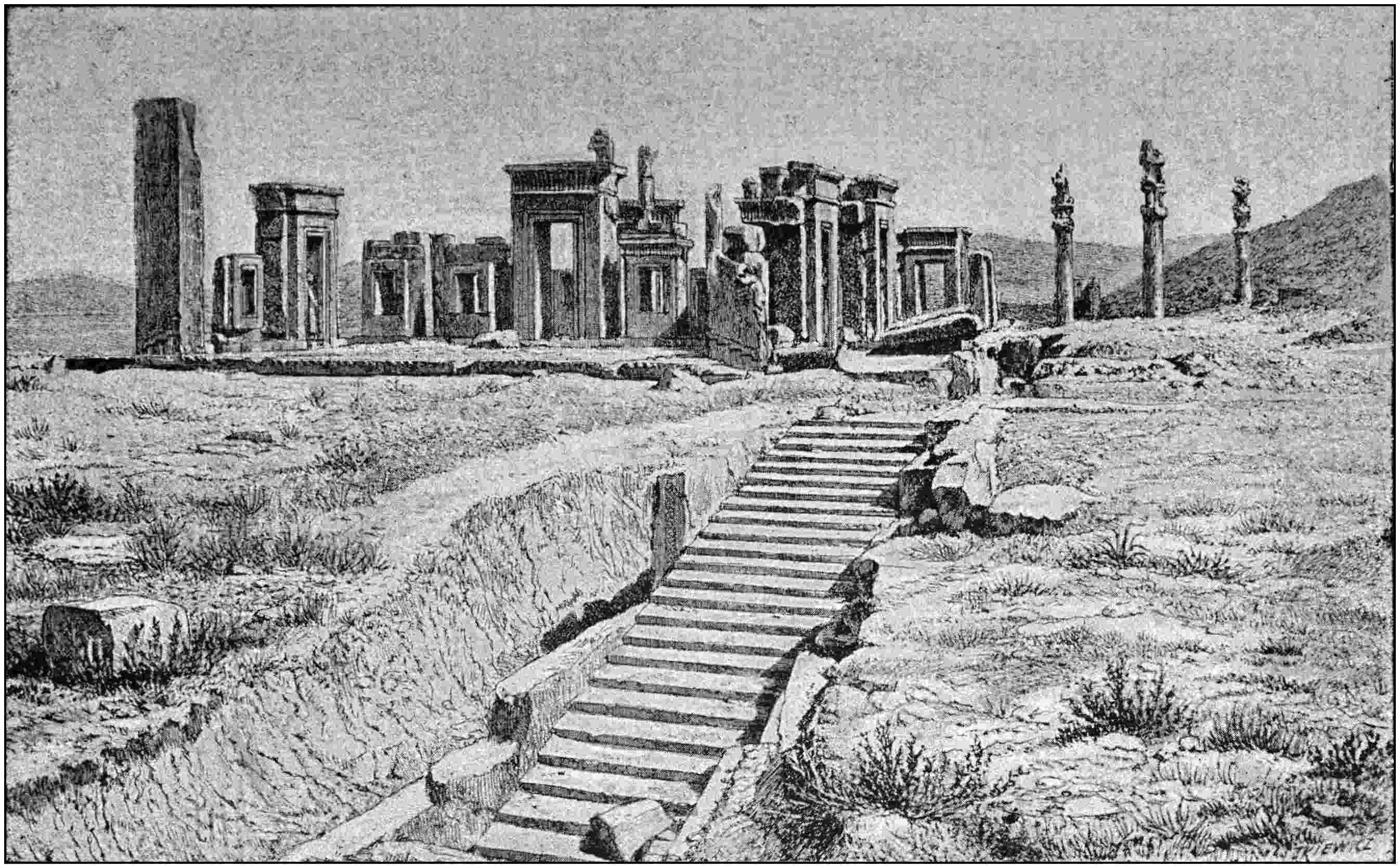
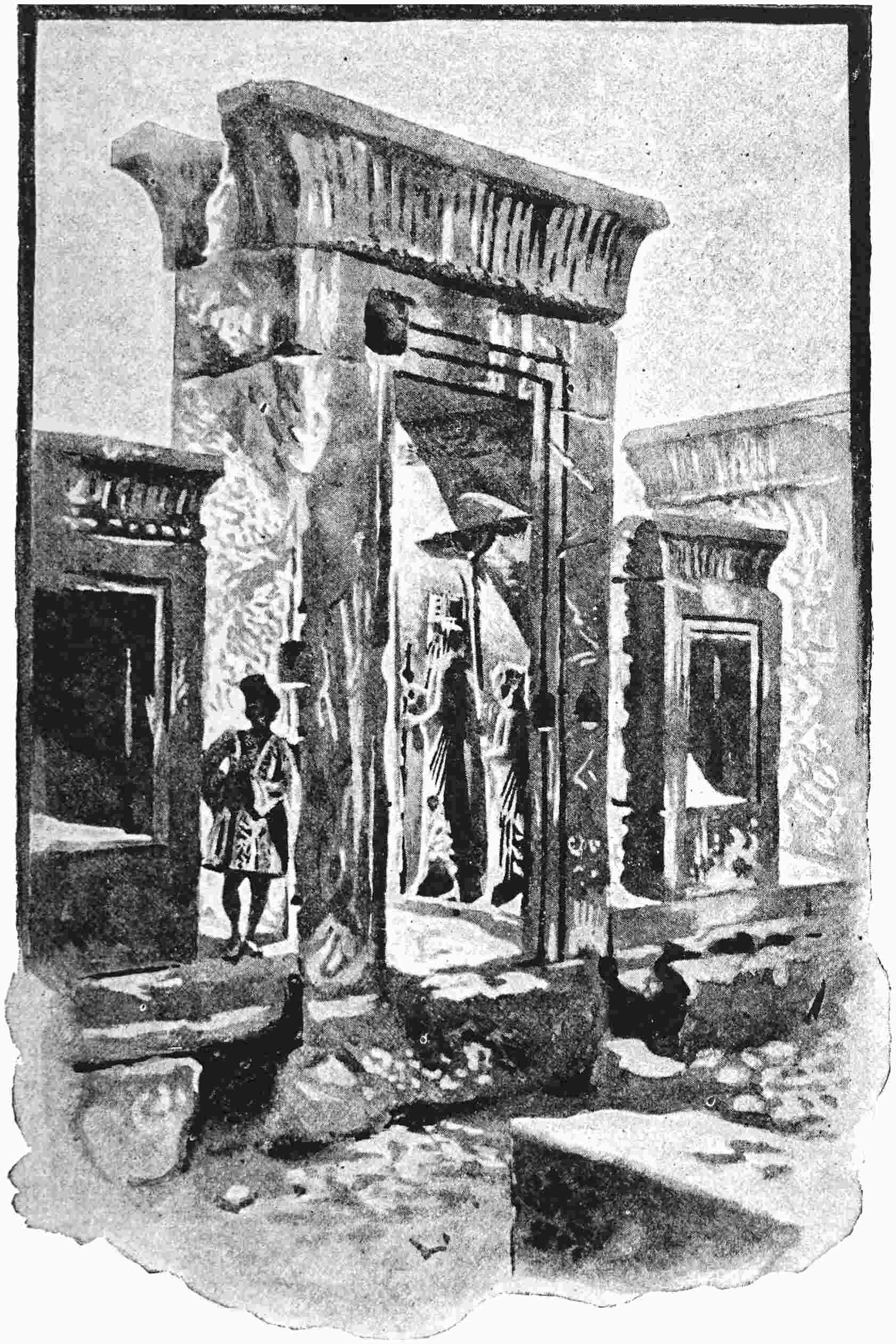
RUINS OF PERSEPOLIS: BALUSTRADE OF GREAT STAIRCASE.
It was about the ninth day of March in the year 401
B.C., that the army of Cyrus began to set forward.
Cyrus was commander-in-chief of the whole army, but
the two divisions were kept entirely separate, each
under its own officers. The Asiatic troops, who
numbered 100,000, were under the command of Ariæus,
one of the most distinguished of the Persian supporters
of Cyrus. The Hellene force, which consisted of 13,000
men, and was afterwards increased by another thousand,
was composed of a number of different companies, each
commanded by the general who had raised it, and
smaller or larger according to his success in getting
recruits. Under the generals were captains, who each
had command of a hundred men, and whose numbers
consequently varied in each company with the number
of the soldiers.
Of the Persian troops, the most brilliant and useful
were the cavalry. The Persians had long been famous
for their skill and activity as horsemen; they were
also excellent archers, and could draw their long bows
at full gallop with as accurate an aim as if they were
standing still and undisturbed on solid ground.
Among the Hellenes, on the contrary, the most
useful, and at the same time the most numerous, were
the Hoplites, or heavy infantry.
There were no cavalry, and in the
whole army only forty mounted
men, nearly all of whom were
officers.
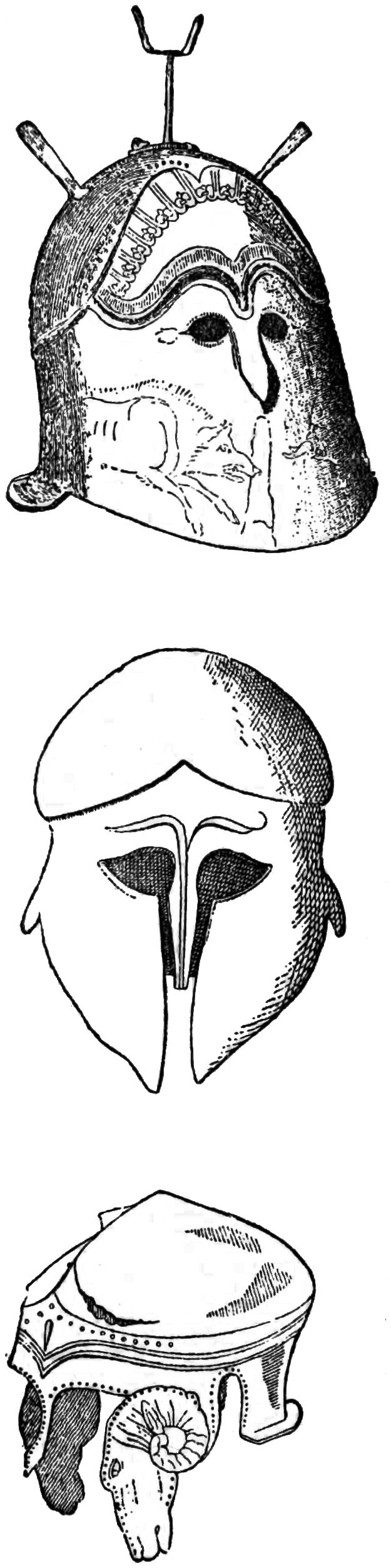
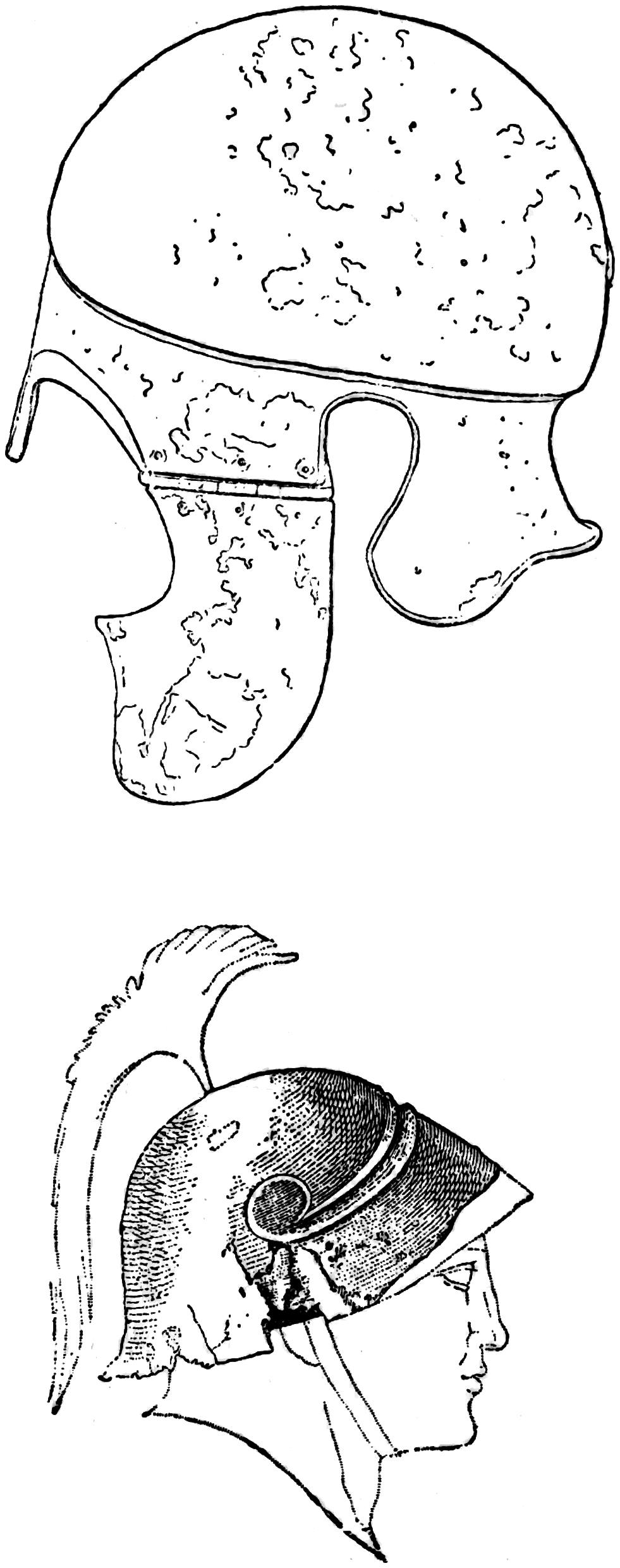
ATHENIAN HELMETS.
The hoplites wore a helmet,
breast-plate and greaves of iron,
and carried an oval shield of ox-hide,
overlaid with metal, which
protected them from the mouth
to the ankles. On its inner side
the shield had a handle for holding
it, and a strap wide enough for a
shoulder-belt was attached to it
at each end, so that it could be
carried over the back. This was
the usual way of carrying it on
the march, when the enemy was
known to be in the neighbourhood
so that it was necessary to
have the shield at hand, but not
when the soldiers were engaged in
actual fighting. For weapons of
attack, they carried a spear
measuring from seven to eight feet
in length, made of strong wood
with a solid iron point, and a short
sword, or curved sabre. None
but fine strong men could enter
the ranks of the hoplites, for the
full weight of the armour and
weapons that they had to carry was no less than
seventy pounds.
The light infantry were armed quite differently.
They had but one weapon of defence, a shield which
was only two feet in length; besides this they had
little to carry but their clothes, for they were practically
a troop of foot cavalry, and it was necessary that they
should be very active, and able both to advance and
retreat with extreme rapidity. According to their
weapons of attack, they were subdivided into troops
of lancers, archers and slingers. The lancers carried
several light javelins, from three to four feet in length,
the archers carried bows and arrows, and the slingers
carried slings, with which they hurled stones or leaden
bullets at the enemy.
And now the great host is well on its way. Try to
imagine the dense, suffocating clouds of dust that must
have been raised by the progress of such an army!
Supposing the troops to have marched ten abreast,
leaving one pace between each rank, the Barbarian
army would have formed a procession more than three
miles long, and the Hellene army would have covered
about a third of a mile more. Besides this, there was
the long train of baggage-wagons, the great droves of
animals brought for slaughter, the numberless beasts of
burden, and the crowds of people who in some capacity
or other followed the army, but did not march in the
ranks.
Even in the Hellene army, which in comparison
with the Barbarian force was but scantily provided
with camp-followers, there were great numbers of
slaves whose duty it was to pitch the tents, to prepare
the food, and to attend generally to the comfort of the
troops. The tents and utensils were packed with the
other luggage in wagons which the slaves drove, or
piled on the backs of transport animals which the slaves
led. Many of the Hellene officers moreover, and even
some of the private soldiers, had brought their own
slaves to wait upon them and to carry their heavy
shields and helmets when there was no likelihood of
their being attacked on the march. Behind these came
a number of provision-dealers and other merchants, who
brought goods of all kinds to sell to the troops, and
who were always ready to buy from them any spoil
that they might have an opportunity of taking. Still
further in the rear were trumpeters, heralds, sacrificing
priests, soothsayers and surgeons.
But the Hellene camp-followers were outnumbered
a hundred times by the followers of the Barbarian
army. For in addition to the other slaves, the luxurious
Persian lords had brought with them their cooks, their
bakers, and all manner of personal attendants, besides
enormous tents in which to house the many members
of their households who accompanied them to the
war. The complete length of the procession formed
by the army and its retinue was nothing short of six
miles.
This immense multitude, great enough to people
a good-sized town, required every day to be fed, either
by buying such provisions as could be obtained on the
spot, when the country through which they were
marching was fruitful and well-peopled, or, when the
country was waste and desolate, by falling back upon
the stores which they had brought with them. These
stores they were careful to renew whenever there was
an opportunity of doing so.
In the Barbarian army, the officers were entrusted
with the duty of providing food for the troops, and
seeing that each man received every day his due portion
of bread, meat and wine. In the Hellene army, the
men catered for themselves, for their pay was given
them in money instead of food.
The ordinary pay of a Hellene soldier was one daric
a month, or about twenty-one shillings of our money, and
out of this he was expected to provide his own weapons.
The captains received twice as much as the private
soldiers, and the generals four times as much. To us
such a sum appears a very miserable pittance, but it
must be remembered that in those days the value of
money was far greater than it is now. Moreover all alike,
whether officers or privates, might count upon a good
share of booty from the enemy’s country.
VII THE PRINCESS EPYAXA
The Hellenes had now been for some considerable time
in the service of Cyrus, and hitherto he had not failed
to pay them punctually every month. But the enormous
expenses incurred in starting the expedition had
for the moment completely drained his treasury, and
now, two months after the departure from Sardis, he
was still unable to give them any money, although their
pay was by this time three months in arrear. It was a
painful and embarrassing situation, and he felt it the
more keenly because he had always been accustomed to
give to those whom he employed more, rather than less,
than he had promised them.
For a time the soldiers had been content to wait,
for they had mostly some money of their own to fall
back upon. But gradually their savings were becoming
exhausted, and they were obliged to remind Cyrus of
his debt. At first they did this modestly, but as time
went on, they became more and more persistent, and
now whole bands of them were constantly gathered
round his tent, clamouring for their pay.
From this unpleasant position Cyrus was rescued
by help that came to him from an unexpected quarter.
Just at this time he received a visit from the Princess
Epyaxa, wife of Prince Syennesis, who was the ruler of
Cilicia, a province of the Persian empire included in the
satrapy of Cyrus.
The princess had made a long journey in order to
meet Cyrus at this point, and she had not come empty-handed.
The large sum of money that she brought
with her could not have arrived at a more welcome
moment, and it was sufficient to enable Cyrus to distribute
four months’ pay to the Hellene soldiers, and
yet reserve a considerable sum for the next time of
necessity.
Cyrus was now approaching the province of Cilicia,
and for some days Epyaxa accompanied his march.
One day she expressed a wish that he would draw up
his whole army before her, so that she might see it at
its full strength.
Accordingly, when they came to some open country
suitable for the purpose, Cyrus proceeded to gratify her
wish, and ordered the troops to be drawn up in battle
array, that he might review them in the company of the
princess. Side by side they passed along the ranks, the
princess in a woman’s chariot shaded by curtains that
could be drawn close or opened wide at pleasure, Cyrus
in a man’s chariot.
First they reviewed the Barbarian army with its
endless ranks of cavalry and foot-soldiers. Then they
came to the Hellene troops, who were stationed opposite.
In point of numbers the Hellenes could not compare
with the Barbarians, but their appearance was far more
imposing, so noble and spirited was their bearing, so
proud and firm their step. They were dressed in
purple tunics, with brass greaves and helmets, and
carried bright, polished shields that glittered in the
sunshine.
ATHENIAN HELMETS
After having
driven slowly past
them, Cyrus sent
word to beg that
the hoplites would
advance, as if they
were in battle, and
about to charge.
In answer to his
request, the trumpeters
gave a signal,
and on hearing
it, the hoplites
covered themselves
with their great
shields, and lowered
their long, powerful
spears as if they saw
the enemy before
them. Then the
war cry was sounded
forth, and the hoplites
began to advance,
marching
faster and faster,
until their pace was
like a whirlwind,
carrying everything
before it. The Barbarians
were seized
with panic, for the charge had every appearance of
being in earnest; the princess sprang from her chariot
and ran away as fast as she was able; the merchants
left their wares, and, like the rest, sought refuge in
flight; and meanwhile the Hellenes returned, laughing,
to their tents.
When the princess had recovered from her fright,
she could not sufficiently praise the gallant bearing of
the Hellene troops, and as for Cyrus, his heart bounded
with joy at the thought of the impression they would
make upon his enemies when they should confront them
in the field of battle.
Soon after this, the army reached the country of
the Lycaonians, who were no less notorious than the
Pisidians for their constant raids upon the territory
of their neighbours. Cyrus desired the Hellenes to
plunder their country, and thus gained a double advantage.
On the one hand he was able to punish the
robbers, and on the other, he could in this way provide
some spoil for his Hellene troops,—an arrangement with
which they were entirely satisfied.
The army was now within a few days’ march of
Cilicia, and the princess returned to her home by a
short route, under the escort of a company of Hellene
soldiers, while the main part of the army followed by a
longer but easier way.
Cyrus was prepared to find Prince Syennesis less
disposed than his wife to receive him with open arms.
As a subject of Artaxerxes the Great King, it would be
his duty to prevent Cyrus the rebel from advancing
through his country. This he could easily do, for the
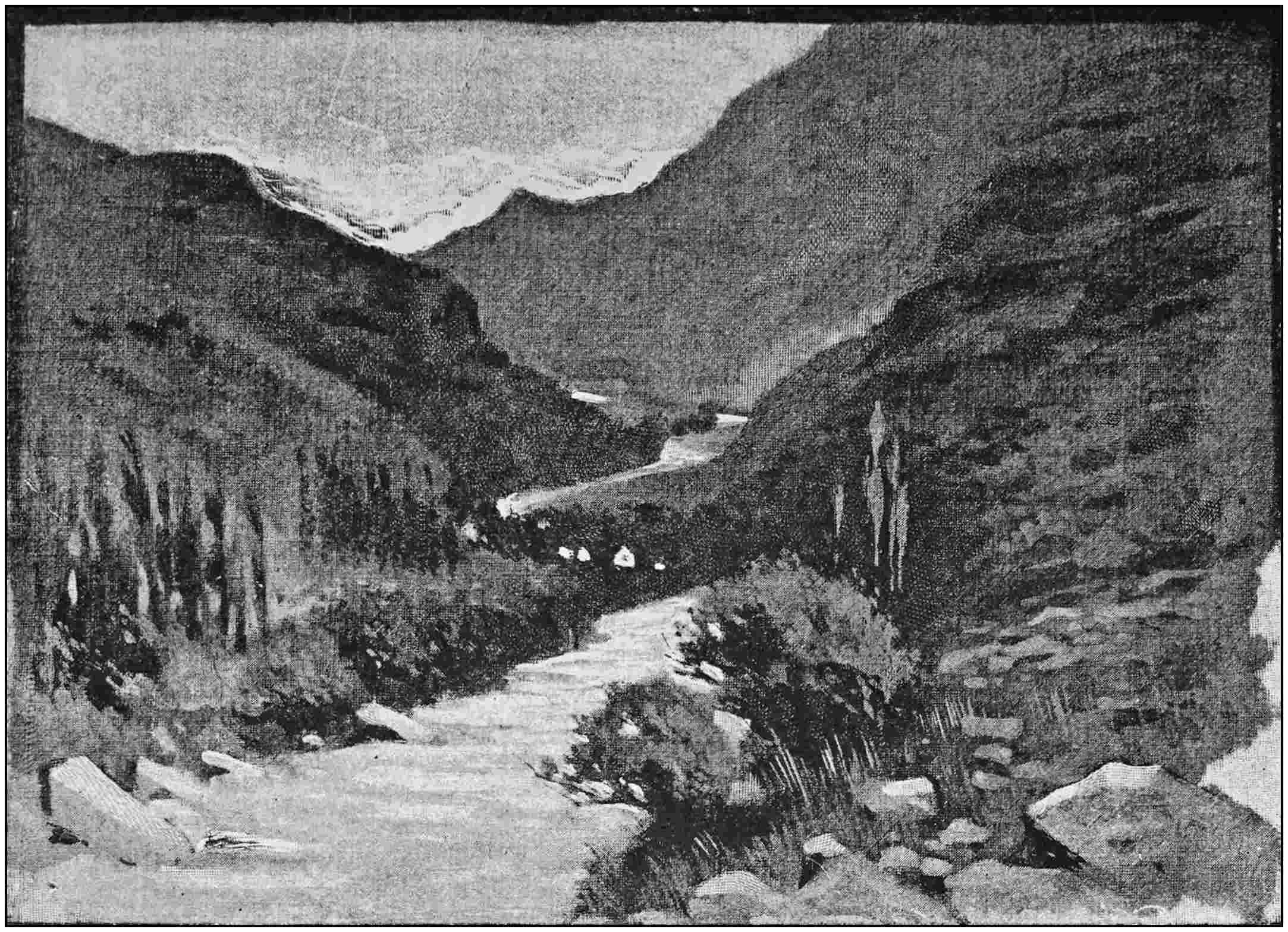
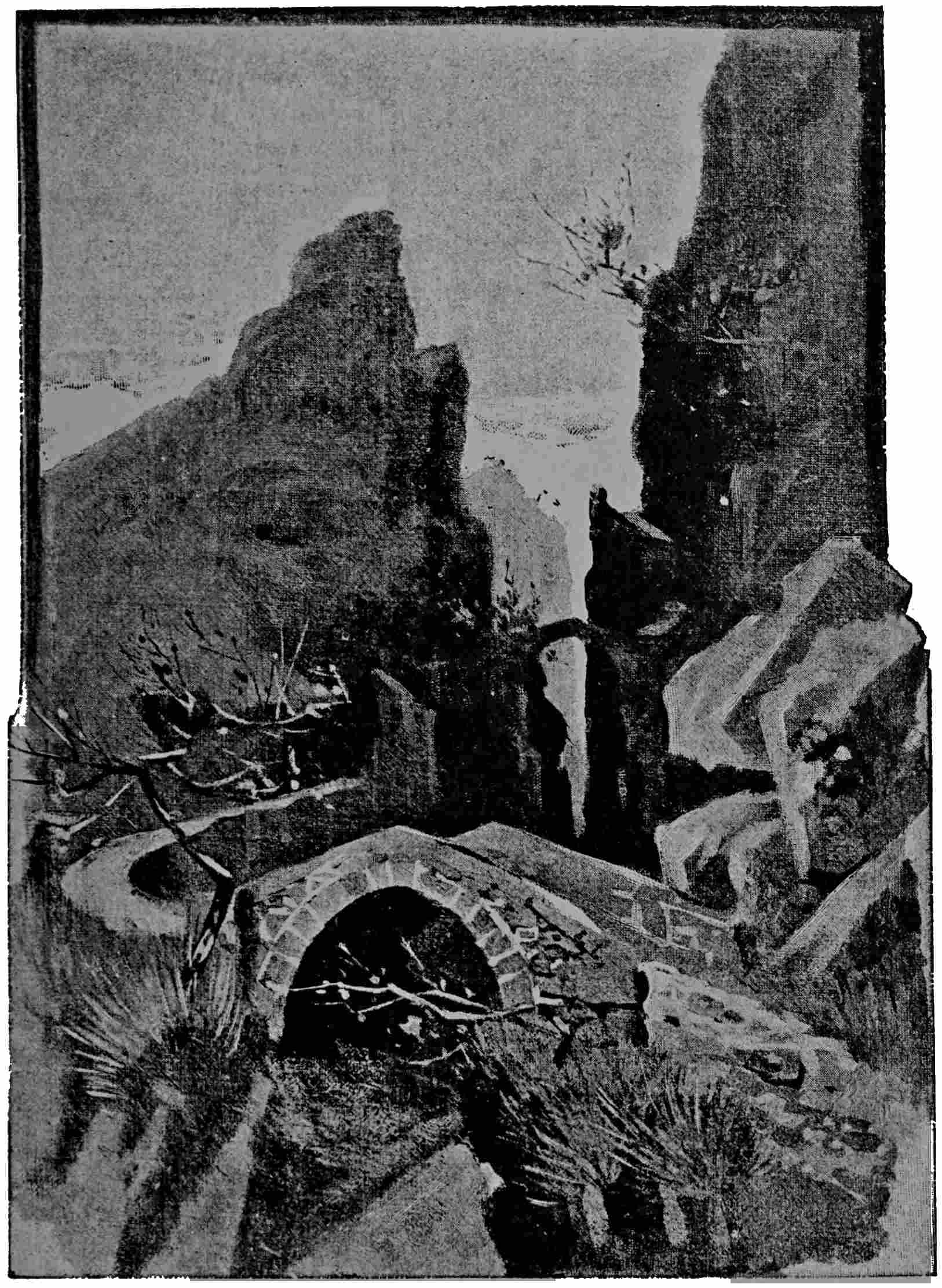
entrance to Cilicia was by a road so steep and narrow
that a very small number of men could hold it against
an army of invaders.
But the difficulty had been foreseen, and before leaving
Sardis, Cyrus had fitted out a fleet which had followed
him round the coast of Asia Minor, and was now in
readiness to land soldiers on the further side of the
mountains, so that they might fall upon the enemy in
the rear.
It happened however that the presence of the fleet
was sufficient, and that it was not necessary to land the
soldiers. The prince had indeed taken possession of
the heights commanding the road
by which Cyrus must enter, but
when he found that not only were
the mountains behind him occupied
by the Hellene soldiers who
had accompanied his wife to her
home, but that moreover the
troops who were preparing to
disembark from the fleet would
also be in his rear, he abandoned all idea of defending
it. And thus Cyrus was able to pass over the mountains
unhindered, and enter the city of Tarsus without
further difficulty.
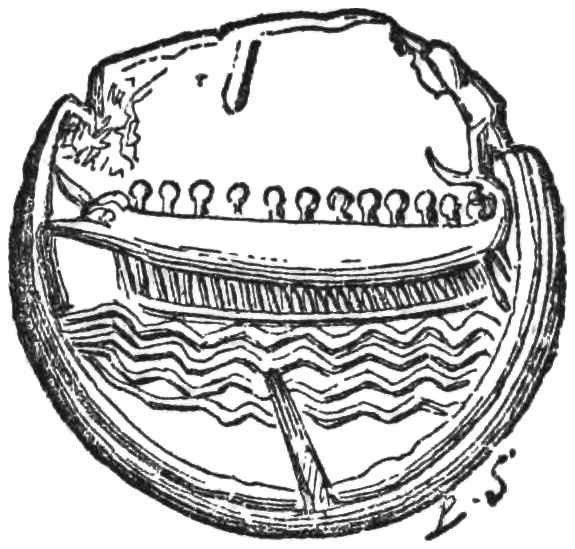
PERSIAN GALLEY.
Cyrus now invited the prince to visit him as a friend.
But Syennesis answered, ‘I have never put myself into
the power of one who was more powerful than myself,
and I will not do so now.’
The princess however persuaded him to trust to the
honour of Cyrus, and he finally accepted the invitation.
Like his wife, he took with him a considerable sum of
money to assist the rebel, and in return, Cyrus presented
him with the usual gifts offered by the Persians to
persons of distinction,—a horse with a golden bridle, a
sword with a golden sheath, a ring, armlets, and a robe
of honour. So little could the Great King rely upon
the loyalty of his subjects!
In deciding to make his peace with Cyrus, the
Cilician prince had probably considered what would be
the course best calculated to forward his own interests.
By occupying the mountains for a few days, he had
made a display of loyalty to the Great King; and
having done this, he was anxious on the other hand to
secure the favour of Cyrus also, in case he should be the
conqueror.
VIII CLEARCHUS
For twenty days the army halted at Tarsus. It
seemed indeed, at one time, that at this point the
expedition would break down altogether. For the
Hellene troops, on whom Cyrus based all his hopes of
conquest, became restive and dissatisfied. They had
been engaged to punish the Pisidian marauders, but
had now passed the country of the Pisidians, and were
naturally beginning to ask themselves what was the
real object of the expedition. Their suspicions were
increased moreover by the opposition of the Cilician
prince. His resistance had certainly been of the
feeblest, but still he had made an attempt to stop their
passage through his mountains, and had thus declared
himself the enemy of Cyrus. What reason could he
have had for taking such a course, were it not that he
had received instructions from the Great King to bar
the passage of Cyrus, because he was a rebel and was
advancing to unseat him from his throne?
HALL OF THE HUNDRED COLUMNS AT PERSEPOLIS—RESTORED.
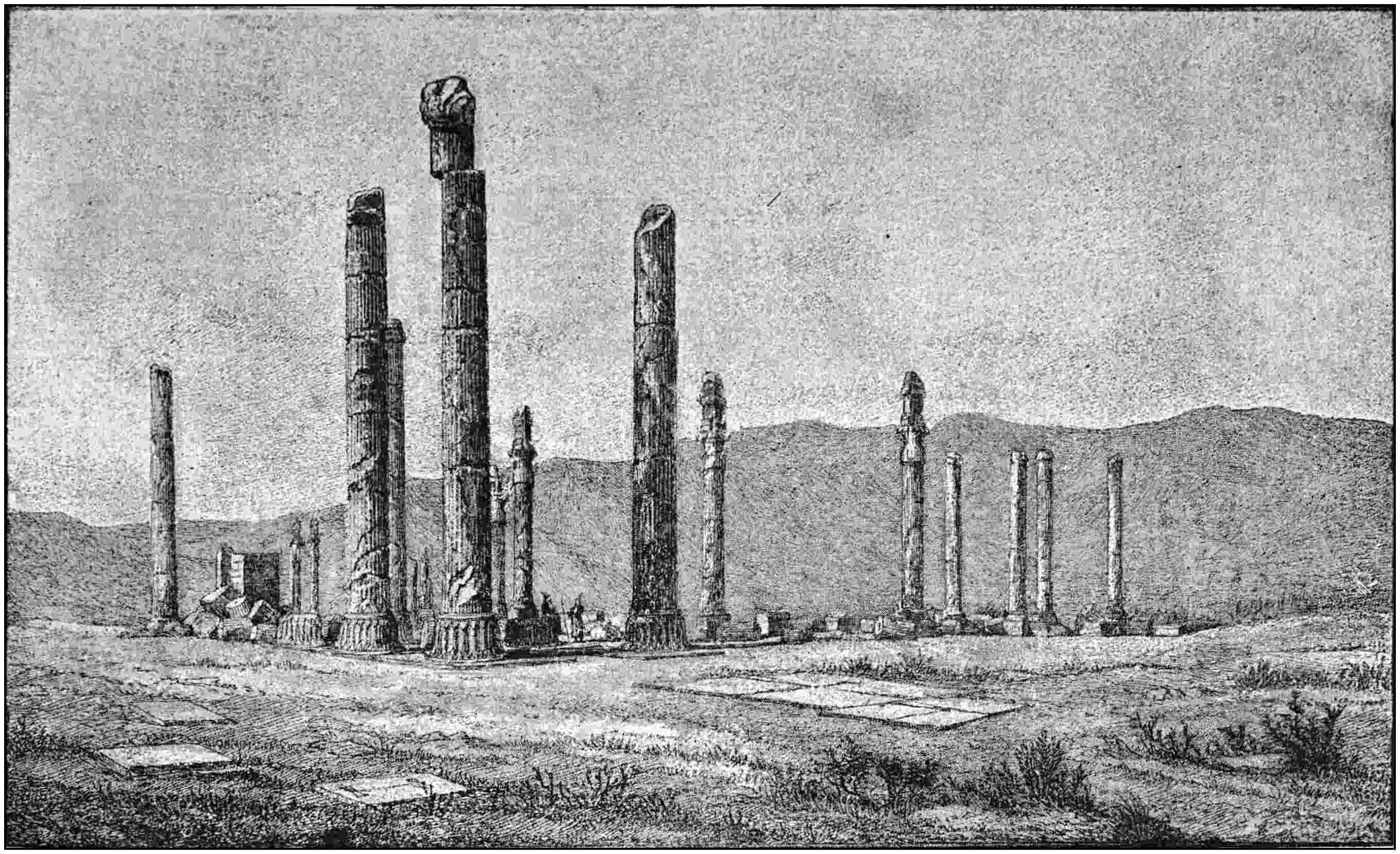
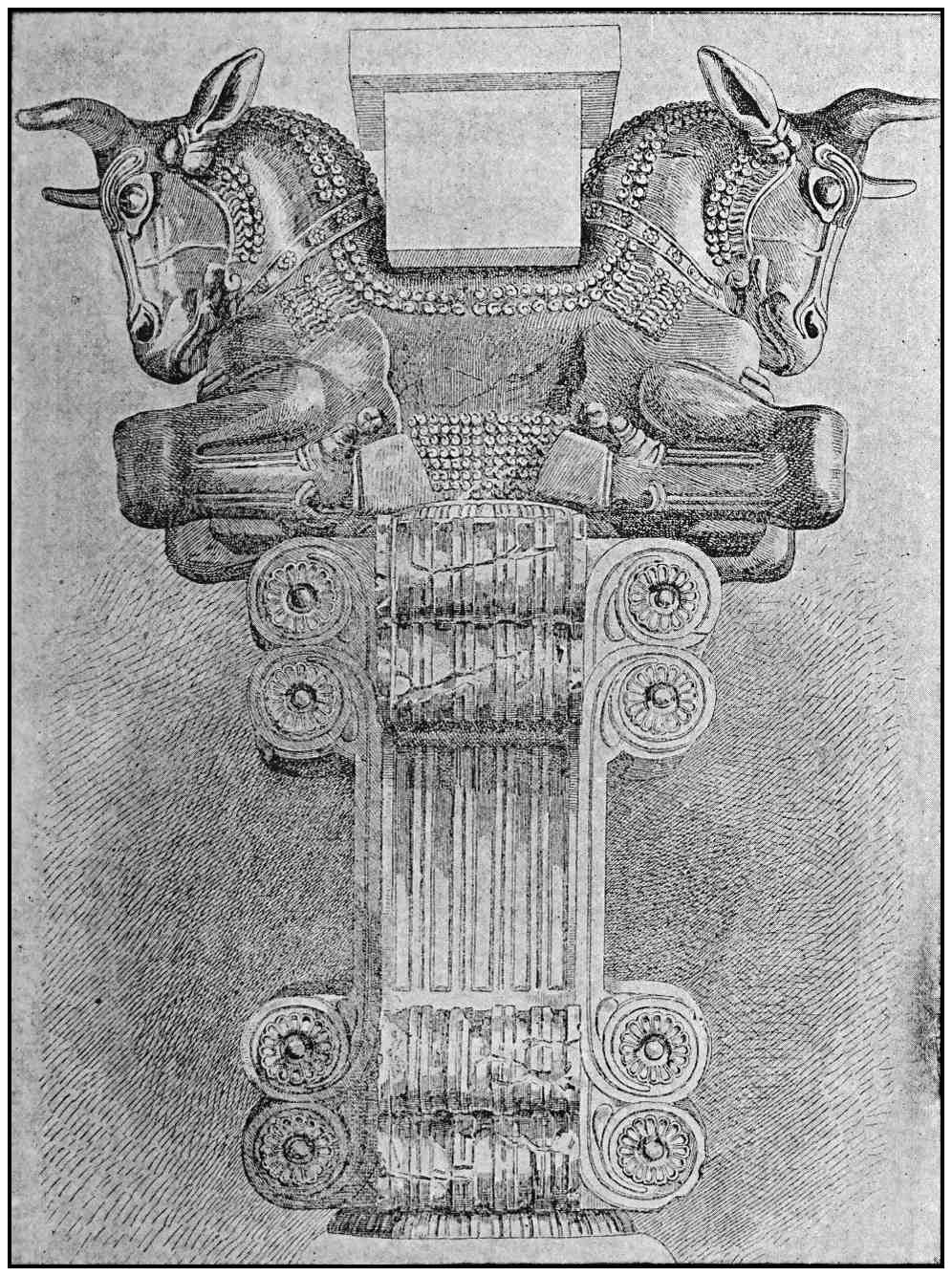
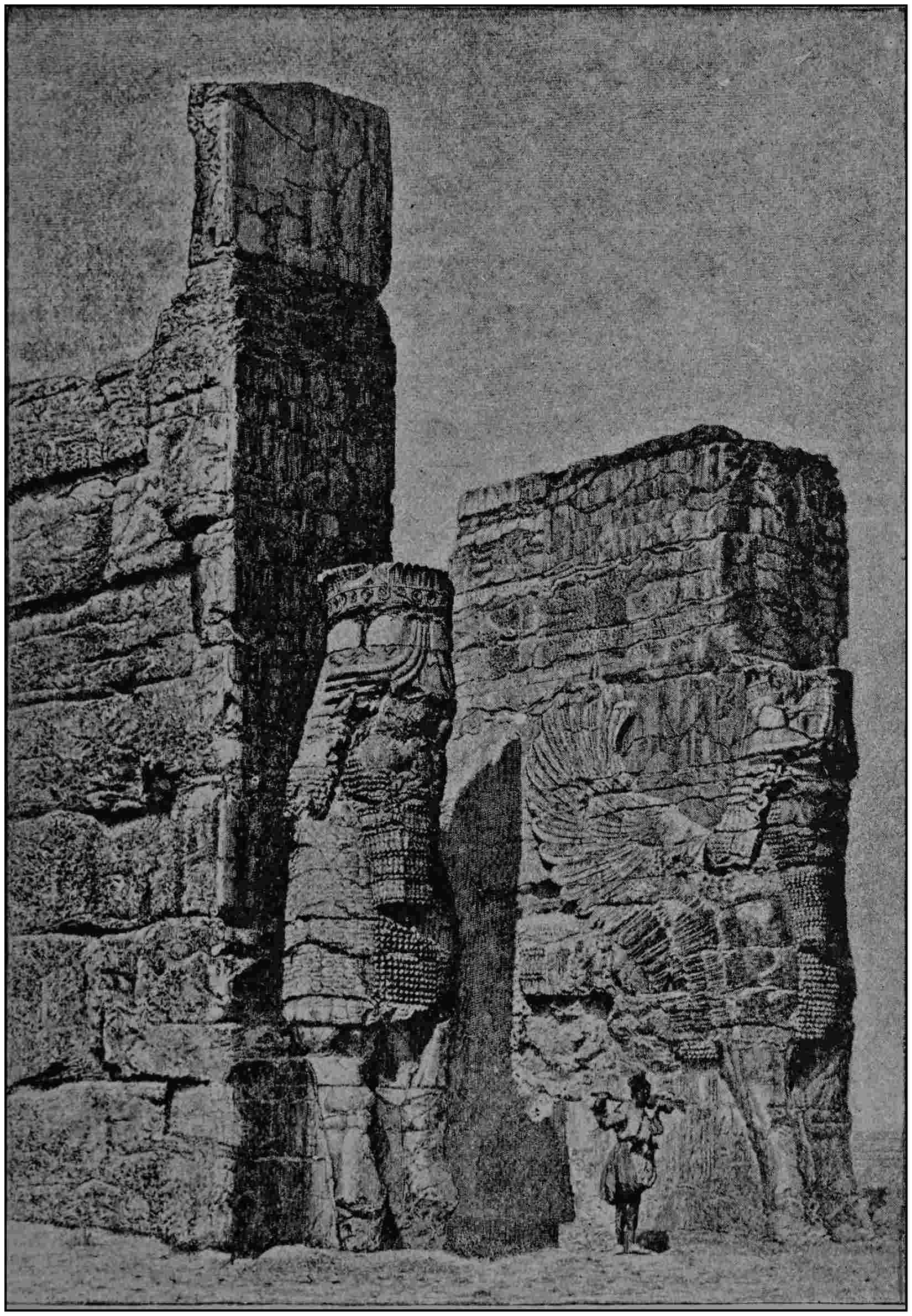
See page 3, and illustrations facing pages 47 and 62.
The Hellenes now discovered for the first time that
they were intended to march on for hundreds of miles
into the very heart of the Persian empire, and then risk
their lives in battle against the Great King, of whose
boundless resources they had often heard. For such a
mad enterprise as this, they had not been engaged, they
said, and they would never have agreed to enter upon it.
For, putting aside the extreme length of the march to
Susa, how could they expect that in case the hopes of
Cyrus should be doomed to disappointment, it would be
possible for them, a mere handful of strangers in an
unknown country, to break through the ranks of the
enemy, and make their way back to their own land?
The Hellene mercenaries were no mere collection of
soldiers of fortune, picked up anywhere, and ready to
undertake any service. On the contrary, they were,
for the most part, respectable citizens of Hellas, who had
taken service under Cyrus, with the expectation of soon
returning to their families laden with spoil.
Every day their murmurs became louder, as their
suspicions received additional confirmation, and at
Tarsus they made a formal protest, declaring to the
officers who had enlisted them, that they were betrayed,
and that nothing would induce them to go a step
farther.
Almost all the officers were of the same mind, but
there was one who thought otherwise. This was
Clearchus the Spartan, a man who had received from
Cyrus many favours, and who was anxious to prove his
gratitude by doing his utmost to forward the prince’s
wishes. To Cyrus the ultimate decision of the Hellene
troops was of the gravest consequence; in his mind
there was no question that the success of his plans
depended on his being able to reckon upon their
help.
Clearchus was at this time about fifty years of age.
He possessed the entire confidence of Cyrus, and was
in fact the only person who had been told from the
first the real, though secret, object of the expedition.
He was a man born to be a soldier. A quiet, easy
life in his native land was an existence altogether
without charm for him; war, with all its dangers
and hardships, was his natural element, and into
this favourite pursuit he threw all the energy of his
character. He personally supervised the provisioning
of his men, and this was only one instance of the
extreme care with which he attended to every detail.
Nothing that could contribute to the efficiency of his
company was too insignificant for his notice.
He had nearly all the qualifications of a great
general, but in one respect he failed signally. For
whilst he could always command the admiration and
respect of his men, he was quite incapable of gaining
their affection. He had not indeed any desire to do so,
for he believed in discipline, and in nothing else. His
orders were strict and severe, and he required instant
obedience to the most minute particular. He was
accustomed to say that an army without discipline
was utterly worthless, and that soldiers should fear
their officers more than they feared the enemy. Yet
although he was so careful to exact obedience from
others, he himself was but a poor hand at rendering
obedience.9
The soldiers under the command of Clearchus never
saw him unbend. His face was always stern, his brow
contracted, his eye restless. He punished his men constantly,
and severely, and often in moments of passion
did things that he afterwards sincerely regretted. The
consequence was that when there was no immediate
danger impending, his men were often tempted to
leave him and take service under a less strict officer.
But in any time of danger or difficulty, the soldiers
would follow Clearchus more readily than any one
else, for they had unbounded belief in his ability as a
general.
Nothing ever disturbed his presence of mind.
However threatening the danger, he always met it with
perfect calm and self-possession. At such times the
stern, unbending face of Clearchus seemed to his men a
tower of strength, the sight of his coolness and insensibility
to fear inspired them with courage, and they felt
an enthusiasm for their general, in which for the
moment something like affection was added to respect.
IX NEGOTIATIONS AT TARSUS
When first the soldiers of his company declared their
intention of marching no farther, Clearchus refused to
listen to them. He thought he had sufficient influence
over them to compel them to do as he wished, but in
this he was mistaken. For when he sternly ordered
them to continue the march, and placed himself at
their head to lead them on whether they would or no,
they took up stones to throw at him, and if he had not
quickly made his escape, they would have stoned him
to death.
It was clear that any attempt to enforce discipline
would be of no avail in such a case as this, but for all
that, Clearchus did not intend to be beaten. He knew
how to manœuvre as well as how to fight, and had no
difficulty in finding ways and means to gain his end.
After allowing a little time for the excitement of
the soldiers to subside, he sent to summon them to
a meeting. They were at first disinclined to go,
but they said to one another, ‘We may as well hear
what it is that he wants us to do. But no matter what
he says, we will be firm, and hold to our decision.’
When they came to the meeting, they found
Clearchus so changed that they would hardly have recognised
him. Instead of the stern officer with angry brow
and flashing eyes, there stood before them a silent, downcast
man, who wept like a child. Never had they seen
him so deeply moved.
At last he began to speak in a low agitated voice.
‘Comrades,’ he said, ‘be not surprised that I am
grieved at your decision. I have every cause to be
grateful to Cyrus, who has been to me the best of
friends, and for this reason it was my earnest hope
that with your assistance I might be able to repay
his kindness by helping him in his present undertaking.
But you are not willing, and it shall never be
said of me that I took the part of a Barbarian against
my own countrymen. I declare therefore that I
will follow you, for to me you are country, friends,
comrades. Without you I can neither help a friend nor
harm an enemy.’
On hearing these words, the soldiers felt perfectly
satisfied, and at once made peace with their general.
Moreover two thousand men, belonging to two other
companies, left the generals under whom they had
enlisted, in order to join the company of Clearchus.
For they believed that having once said that he would
not march against the Great King, Clearchus would
hold to his resolution whatever happened, whereas it
seemed very possible that the other officers might be
won over by Cyrus, notwithstanding their present
protests.
When Cyrus heard what had passed at the meeting,
he was vexed and disappointed, and sent a messenger to
summon Clearchus to his presence. Clearchus however
refused to go, and took care that the soldiers
should know of his refusal, but sent word secretly to
Cyrus that he hoped all would yet be well.
Several more days went by, and then Clearchus again
summoned the soldiers to a meeting. This time any one
was allowed to attend, whether he belonged to the
company of Clearchus or not, so that there was a very
large gathering. Clearchus was the first to speak.
‘Comrades,’ he said, ‘we have now broken with
Cyrus. We are no longer his mercenaries, and he is no
longer our paymaster. Naturally he is angry with us
for deserting him, and as for me, I dare not show myself
in his presence, for although he is the best of friends, he
is at the same time a relentless enemy, and his power is
great. We shall do well therefore to lose no time in
considering how we may return in safety, and above all,
how it will be possible, without the help of Cyrus, to
obtain food for the march. Let whosoever will, now
speak his mind.’
First one man and then another rose to speak, some
saying what occurred to them at the moment, and others
according to instructions previously received. For
Clearchus had made his own preparations for the meeting,
and had prompted several of the soldiers as to what
they should say. Some were to speak in favour of
returning home at once, and others were to raise difficulties.
After some of the other soldiers had spoken, one
of the men who had been prompted by Clearchus, rose
and began to urge with great eagerness an immediate
return home, as if it were the easiest thing in the
world.
‘To begin with,’ he said, ‘we must lay in a store
of provisions, and then ask Cyrus to give us ships to take
us home by sea from Tarsus. Or, if he refuses that, we
must ask him to supply us with a guide, who knows the
country, to take us back by land. We must act
promptly moreover, lest the people of the country treat
us as enemies and come out against us.’
This speech was received with great applause. But
immediately another of those who had been previously
told what to say, rose to reply.
‘All that you have just heard,’ he said, ‘is utter
nonsense. How can we expect to get food, when the
only market is in the camp of the Barbarians? Do you
suppose that after we have broken with Cyrus, he is
likely to be so pleasant and obliging as to allow us to
take provisions out of his camp for our journey? And
the ships that he has brought here for his own use, is it
likely that he will part with them in order that we may
get home comfortably?
‘Then as regards the guide, is it to be expected that
he will grant a guide to us, who by our desertion will
be doing him the greatest injury and crossing all his
plans? Even if he were to supply us with ships, I, for
one, should expect the ships to be sunk in mid-sea in
order that we might be drowned, or if he gave us a
guide, I should fear that the guide would lead us into
some place where we could not fail to perish.
‘This plan will never do. I propose instead that
we nominate certain persons to go with Clearchus to
Cyrus, and ask him what it is exactly that he wants of us.
If he proposes some such enterprise as those on which
our countrymen have been employed before, then let us
follow him. If on the other hand it appears likely that
his plans will involve us in great toils and dangers, we
must ask him either to give us good reasons for advancing,
or else consent to our going back. Then we
shall either accompany him as friends, or else be allowed
to return in peace.’
This speech made the desired impression, for the
Hellenes could not but see that there was far more
sense in the apprehensions of the last speaker than in
the hopeful view of the man who had preceded him, and
accordingly, when the proposal to send a deputation to
Cyrus was put to the meeting, a great show of hands
was raised in favour of it. The members of the deputation
were therefore chosen at once, and sent away on
their errand.
Cyrus granted the messengers an interview, and
agreed to answer their questions. He made no mention
of attacking the Pisidians, still less of marching against
the Great King, but spoke of an enemy of his, a powerful
satrap named Abrocamas, who lived on the banks
of the Euphrates at a distance of twelve days’ march from
Tarsus. It was for the purpose of fighting this satrap,
he said, that he wanted the help of the Hellenes, for
Abrocamas had a great army under his command. If he
held his ground, he should be punished; but if on the
other hand he should save himself by flight, then in that
case, it would be necessary to consider further what
would have to be done.
With this answer the messengers returned to their
comrades, and the Hellenes declared themselves ready
to remain in the service of Cyrus, on condition that he
would increase their pay. To this he readily consented,
and promised that instead of receiving every month one
daric as before,10 the private soldiers should in future
have a daric and a half. In like proportion, the captains
were to have three darics instead of two, and the generals
six darics instead of four.
The Hellenes were in the position of a man whose
path lies through a bog. After he has advanced some
little way, he begins to consider whether it would not
be better to turn back, but finding that this is just as
difficult as to go forward, he thinks it a pity to waste
the effort he has already made, and decides to continue.
So to the Hellenes it seemed that to return promised
to be no less dangerous than to advance. The more
clear-sighted were by this time perfectly aware that
whatever Cyrus might say, or refrain from saying, his
ultimate design was to proclaim war against the Great
King. But the great mass of the soldiers, although
they knew in their hearts that this was his real intention,
preferred not to think too much about it, and persisted
in hoping that after all it might turn out to be
something else.
X FROM TARSUS TO MYRIANDUS
After twenty days’ halt at Tarsus, the army again set
out on its march, and in five days came to the last city
in Cilicia. The next province through which they would
have to pass was that of Syria, and here the entrance
was even more carefully guarded than had been the
approach to Cilicia.
Between the two provinces were two fortresses,
called the Gates of Cilicia and Syria. They were at
about six hundred yards apart, and stood one behind
the other on each side of a little river which flowed from
the mountains into the sea, and formed the boundary
between the two provinces. The mountains at this
place approached so close to the sea that the walls of
the fortresses stretched the whole distance, and the only
passage was through gates which opened to admit
friends, but remained fast shut when enemies approached.
The fortresses were quite impregnable, if defended, and
it was said that Abrocamas had taken the field against
Cyrus with 300,000 men, reinforced moreover by
400 Hellenes who were in the service of the Great
King.
But Cyrus had long ago foreseen this difficulty as he
had foreseen that of entering Cilicia, and had provided
against it in the same way. He had desired the fleet to
follow him from Tarsus, and had arranged that it should
land two divisions of troops on the coast of Syria, one in
the space between the river and the Syrian fortress, the
other on the further side of it, so that the fortresses
might be attacked on both sides at the same time.
As before however, it proved unnecessary to carry
out the plan. For when Abrocamas heard that Cyrus
had made his way through Cilicia, and found moreover
that his Hellenes were leaving him to join their countrymen,
he turned and fled, never stopping until the
waters of the Euphrates were rolling behind him. The
only harm that he did to Cyrus was to burn the ferry-boats
employed for crossing the Euphrates, after making
use of them himself.
The cowardly satrap remembered the saying that
‘discretion is the better part of valour,’ and following
the example of the Cilician prince, he took care so to
manage matters, that in the quarrel between the two
brothers, he should have done something to help both
sides. If the Great King should conquer, he could
urge that he had burnt the boats and guarded the walls
for a time. If, on the other hand, Cyrus should prevail,
he could say that he had given way at his approach, and
had yielded him free passage. He afterwards carried
out this policy by bringing an army to the aid of
the Great King five days after the decisive battle
between the two brothers had been fought, with a
plausible excuse for not having been able to arrive
sooner.
A day’s march along the Syrian coast brought the
troops to Myriandus, a populous sea-port of Phenicia,
where an active trade brought many merchant-vessels
to anchor in the bay. Here the army rested for seven
days, and during this time two of the Hellene officers,
Xenias and Pasion by name, hired a ship, and sailed
away home in it with the greater part of their possessions.
These were the two officers from whom 2,000
soldiers had deserted at Tarsus in order to take service
under Clearchus. They had expected that Cyrus would
compel the deserters to return to them, but knowing
that they would serve much better under the general of
their own choice, he had allowed them to remain with
Clearchus. In consequence of this, the two officers
were so much annoyed that they determined to abandon
the expedition.
When their flight became known, the soldiers all
expected that Cyrus would send some ships of war in
pursuit of them, and that having been overtaken and
brought back, they would be severely punished. But
in this they were mistaken, for instead of acting in any
such way, Cyrus called together the remaining Hellene
officers, and addressed them in an altogether different
strain.
‘Xenias and Pasion,’ he said, ‘have deserted, but
they are still in my power. I am fully informed as to
the route they have taken, and my ships are swifter than
theirs. But for all that, I will not pursue them. No
one shall be able to say of me that I know how to make
use of a man as long as he is with me, but that when
he wishes to leave me, I lay hands upon him and seize
his goods. Let them go. They will have to confess
that they have treated me worse than I have treated
them. I might detain their wives and children who
have been left at home under my protection, but they
shall not be deprived of them. This shall be their
reward for the services they have rendered hitherto.’
This proof of high-mindedness increased the respect
of all the Hellenes for Cyrus.
XI THE CROSSING OF THE EUPHRATES
From this point, the route by which the army was to
march left the coast and struck inland. The fleet
could therefore be of no further service, and Cyrus
accordingly sent it home from Myriandus.
It was now the hot season, which in Syria is
infinitely more trying than anything that is ever
experienced in our northern climates. And as the
troops were marching southwards, the heat continued
to increase in intensity with every day’s march.
To the Hellenes, everything in these tropical regions
was new and strange; the vegetation, the animals, the
people, the customs, the ways of thinking, all were very
different from anything to which they were accustomed
at home. One day they came to a river swarming
with great fish. These were worshipped as gods by
the people of the country, who would have thought it
a great crime to catch them. In the same place there
were large flocks of pigeons, which were also considered
sacred, and any one who dared to kill or even to catch
one of them, would have been severely punished.
Towards the end of August the army reached the
large and flourishing city of Thapsacus, on the
Euphrates. Here Cyrus called together the Hellene
officers, and told them plainly that he was marching
towards Babylon to make war upon the Great King,
and that they must communicate this information to
the soldiers under them, and persuade them to follow
him as before.
The news was received by the men, not indeed with
surprise, for they had long had their misgivings, but
with considerable irritation, and many of them cried
out that nothing would induce them to go any farther.
Their anger was directed, not so much against
Cyrus, as against their own officers, whom they accused
of having known from the first what was intended, and
they said that by keeping the matter secret, the officers
had involved them in an undertaking which, so far at
all events, appeared absolutely hopeless.
A few days’ consideration however was sufficient to
make them realise their position. What could they
do? Ever since leaving Tarsus they had been marching
farther and farther away from their homes, and the
reasons which had then decided them to cast in their
lot with Cyrus were now even more urgent than
before.
Again therefore they allowed themselves to be persuaded,
and once more demanded an increase of pay,
which was promised by Cyrus to an extent that exceeded
their highest hopes. For he said that when
they reached Babylon he would give to each man five
silver minæ, which was more than the ordinary pay
for a whole year, and that during the return march
they should receive full pay until they were again
among their own countrymen in Ionia.
It was now necessary to find some means of crossing
the great river Euphrates, and at first it seemed
probable that this would be a task of no small difficulty.
The boats ordinarily used for the purpose had been
burnt by Abrocamas, and the only thing to be done
was to make an attempt at wading through the stream.
Happily this proved to be a far more simple matter
than could have been expected, for when the soldiers
stepped into the water, it only reached as far as their
breasts, although at this season of the year it was
usually very much deeper. The men of Thapsacus said
that this was a sign from heaven, and that the stream
had been constrained to roll back his waters in order
to make way for the man who was destined to wear
the royal tiara of Persia.
At this time, Menon, one of the Hellene generals,
saw an opportunity of gaining an advantage over his
comrades, and he used it in a manner that was little
to his credit. Before it had been decided whether the
Hellenes should continue to follow Cyrus or not, an
advance party had been sent out to see if the river
could be forded, and had reported that it was possible.
On hearing this, Menon called his men together,
and said to them, ‘Soldiers, if you will be guided by my
advice, you may, with no danger, and little trouble, get
yourselves farther advanced in the favour of Cyrus
than any of your comrades. To him it is of the utmost
importance that the Hellenes should cross the Euphrates
and support him in his attack upon the Great King.
If then we take the lead and cross the river to-day,
and they follow us, he will give us credit for having
set them a good example. If, on the other hand, they
decide not to follow Cyrus, we can easily go back again,
but in any case we may be sure that Cyrus will regard
us as his most faithful friends, and that when he has
rich appointments and well-paid offices to give away,
he will remember us in disposing of them.’
The prospect suggested by Menon was so alluring
that the soldiers fell in readily with his proposal, and
at once crossed the Euphrates. When Cyrus heard
that they were already on the further side, he was
greatly pleased, and sent them this message,—‘I have
occasion to praise you, and that you may soon have
occasion to praise me must be my care, or I should not
be Cyrus.’ He lost no time moreover in testifying his
especial gratitude to Menon by sending him magnificent
presents.
Selfishness was the most conspicuous feature in the
character of Menon. His highest aim in life was to
amass wealth, and to obtain power. A straightforward,
honourable man he regarded as a fool, and for his own
part shunned neither deceit nor perjury. Whereas
other men considered it their duty to honour the gods
and to deal justly with their fellows, Menon prided
himself only on getting the better of others by cunning
and fraud.
XII IN THE DESERT
After crossing the Euphrates, the army followed the
course of the river, keeping it on the right, and came
in nine days to the desert. The tract of country that
now lay before them was so waste and barren as to be
entirely uninhabited; the most they could expect was to
meet from time to time with some stranger journeying
through it.
It was necessary therefore to lay in a good store of
provisions, and happily the villages on the border of
the desert were thriving and well supplied with corn
and wine, so that the soldiers were able to load the
baggage animals with as much as they could possibly
carry.
After this they journeyed for eighteen days through
a waste of sand, which lay all around them in broad,
low waves, like the sea when it is stirred by a gentle
wind. There were no trees in this desert, but occasional
shrubs and plants, which gave forth a delicious
scent. In consequence of the absence of men, wild
animals abounded, especially gazelles and wild asses,
bustards and ostriches. Never in their lives before
had many of them seen such a creature as a Hellene
soldier.
When there was a halt, the soldiers went out hunting,
but some of the animals were hard to catch. The
wild asses were very different beasts from our donkeys,
who are justly accused of being both slow and stupid.
They were remarkable both for swiftness and intelligence,
and could not be run down by a single horse, however
fleet. When they found that they were being hunted,
they would stand quite still until their pursuer was
almost within spear range, and then dash away out of
reach, and again stop to rest.
The only way in which the Hellenes could succeed
in capturing them was by arranging for several horsemen
to take part in the chase. Having placed themselves
at suitable distances apart, the first horseman
would drive the wild ass as fast as possible towards the
next, who would then take up the chase with his fresh
horse, and by the time that two or three horses had
been tired out, the wild ass would himself become so
exhausted that he was easily caught and killed.
As for the ostriches, it was quite useless to pursue
them, for, as is well known, they run very swiftly, and
moreover add to their speed by the movement of their
wings, which they use like sails. Of all the wild
animals the easiest to kill were the bustards, for they,
like partridges, can only fly a short distance. They
furnished moreover the best eating, although the flesh
of the wild ass, which resembled venison, was also
excellent.
In this desert region, long forced marches were
sometimes necessary, in order to reach either a spring
of water, or a place where the horses and beasts of
burden could find pasture, but even so, many of
them died of hunger. The men also suffered considerably.
One day they came in sight of a city where they
felt sure that they would be able to obtain abundance
of food. But there was neither boat nor bridge nor
any other means of crossing the river, and the stream,
at this place, was far too deep for the men to wade
through it.
They overcame the difficulty however by means of a
contrivance that is still common in the East. Taking a
number of the leather coverings used by the army for
various purposes, they made great sacks which they
filled with hay and bound together so as to form little
rafts capable of supporting a few men and some cargo.
The soldiers then rowed themselves over to the opposite
shore in these rafts, and bought in the town supplies
of wheat, millet-bread, and palm-wine.
Another time it happened that they had to march
along a narrow way, where the wagons sank so deep
in the soft clay soil, that the transport animals were
unable to drag them through it. Cyrus commanded
his Barbarian soldiers to pull the wagons along. But
they set to work in a surly, lazy manner, and he
became so impatient that he drove them away, and
turning to his suite, ordered them to put their shoulders
to the wheel.
These proud nobles were little accustomed to any
kind of exertion, but with the implicit obedience of the
Persian subject, they hastened to do the bidding of
Cyrus. Laying aside their gorgeous cloaks, but still
dressed in their silk vests and trousers, many of them
adorned moreover with golden chains and bracelets,
they ran to the place, as if each were eager to prove
himself more active and zealous than all the rest, and
seizing the dirty wagons, dragged them along until
they were well beyond the bad part of the road.
Such a spirit of submission was quite unknown
among the Hellenes, who were accustomed to treat
their superiors in a very different manner. Once already
they had manifested their displeasure at the
conduct of Clearchus, and about this time another
incident of the same sort occurred, which might have
led to very serious consequences.
It happened that in passing through the camp,
Clearchus saw one of the soldiers of his company
engaged in a dispute with a soldier belonging to the
company of Menon, and taking the part of his own
man, he did not hesitate to have the other one beaten.
This action was resented by the comrades of the
man who had been beaten, and later in the day, when
Clearchus chanced to be riding through the camp of
Menon with only a few soldiers attending him, a
Hellene who was occupied in cutting wood, threw his
axe at him, while others threw stones, and called out
after him in an insulting manner.
Neither the axe nor the stones hit their mark, but
Clearchus was nevertheless beside himself with rage,
and riding furiously to his own camp, he ordered his
men to arm themselves and advance without a moment’s
delay against the company of Menon. On the other
hand, the soldiers of Menon, seeing Clearchus and his
men about to charge, rushed also to seize their arms
and prepare for battle.
Meanwhile one of the other generals, named Proxenus,
had seen what was going on, and he also hurried
forward at the head of his men, and placing himself
between the combatants, implored Clearchus to make
peace. But Clearchus only reproached him with estimating
far too lightly the insult he had received, and
becoming more furious than ever, ordered him to
withdraw.
Just then however, by great good fortune, Cyrus
came to the place, and seeing the Hellene troops drawn
up in battle-array, enquired what was the meaning of
it. When he heard all that had passed, he was filled
with dismay, and cried out, ‘Ye leaders of the Hellenes,
ye know not what ye do. As surely as my Barbarians
see you fighting among yourselves, my ruin will be
sealed, and yours also. Ye will have more to fear
from my followers than from the army of my brother.’
These grave words brought back Clearchus to his
right mind. He was filled with remorse, and both
sides laid down their arms and made friends again.
It was not indeed without cause that Cyrus had
referred to the ill-will of the Barbarians, for they had
long since observed with feelings of jealousy and hatred
the preference that on all occasions he showed for the
Hellenes.
XIII THE TREACHERY OF ORONTES
After marching some distance farther, Cyrus was
informed that the ground showed the tracks of about
2,000 horsemen. This was a troop of cavalry sent out
by the Great King to reconnoitre. They were to discover
and report to him the position of Cyrus, and were
also to burn down all the villages and corn-fields on the
way, so as to prevent his army from getting any food. It
was important therefore for Cyrus to intercept these
horsemen, and either kill them or keep them prisoners,
so as to prevent their returning to the King.
At this moment, a Persian of high rank, named
Orontes, came forward, and offered to undertake their
capture. Orontes had already twice proved himself a
false friend to Cyrus, and had twice been forgiven.
He had however promised so faithfully on the last
occasion to be true for the future, that in spite of his
previous history, Cyrus did not now feel suspicious, but
agreed to let him take with him the thousand horsemen
that he asked for.
PILLAR FROM HALL OF THE HUNDRED COLUMNS.
See page 3, and illustrations facing pages 38 and 47.
Everything was in readiness for the start, when a
Barbarian presented himself before Cyrus, and delivered
into his hands a letter that he had received from
Orontes, with instructions to obtain the swiftest horses,
and carry it with all speed to the Great King. In
the letter Orontes reminded the King of the services
that he had formerly rendered him, and added that
he was now about to hasten to his side with all the
horsemen he could procure.
Cyrus immediately caused Orontes to be arrested,
and sent to summon the most distinguished Persians,
and Clearchus the Hellene, to a meeting in his tent.
After informing them of the treachery of Orontes, he
said, ‘My friends, I desire your counsel as to the course
which in the sight of God and man it will be right for
me to pursue with regard to the prisoner, Orontes.’
He then began to question Orontes.
‘Since our reconciliation at Sardis,’ he asked, ‘have
I ever in any way wronged you?’
Orontes was obliged to answer, ‘No.’
‘Did you revolt from me to the Mysians, and lay
waste my land, so far as you were able?’
‘I did.’
‘Did you then come to the altar of Artemis, and
say that you repented of your misdoings? And did
you swear that you would in the future be always my
friend and helper?’
‘I did.’
‘Have I since then done you any wrong, that you
have turned traitor for the third time?’
‘You have given me no cause.’
‘Do you think that from henceforth you can be
to my brother an enemy, but to me a true friend?’
‘If I were, you would not trust me.’
The questioning over, Cyrus turned to the judges,
and said to them, ‘Thus has Orontes spoken, thus has
he done. Speak then, and you first, Clearchus, say what
he deserves.’
‘My advice,’ answered Clearchus, ‘is to put this
man out of the way, so that we need not have to watch
him.’
The Persians, even the relations of Orontes, concurred
in the opinion of Clearchus, and each in turn seized the
prisoner by the girdle, which was the Persian manner
of pronouncing the sentence of death.
Then Orontes was led away through a great crowd
of Hellenes and Barbarians who had assembled outside
the tent of Cyrus, and many of the Persians of lower rank
threw themselves on the ground before him, as they
had always been accustomed, although the great lord
was now a criminal condemned to death.
After this Orontes was never seen again, and no
one ever knew by what death he died, or where he
was buried. It is probable that according to a practice
common in Persia, he was buried alive beneath the tent
to which he had been taken.
XIV THE KING APPROACHES
After three more days of marching, there arrived at
the camp of Cyrus some deserters, who informed him
that the King’s army was close at hand.
He could hardly have been much surprised at the
news that Artaxerxes was approaching; the only wonder
was that he had tarried so long, for he had heard from
Tissaphernes of the revolt of Cyrus in little more than
a month from the time that the expedition had set out
from Sardis.
The King had certainly expected that his brother
would find some difficulty in getting through Cilicia,
and that Abrocamas, with his 300,000 men, would do
something more to check his progress than merely
burning the boats on the Euphrates. But it was now
two months since the flight of Abrocamas, and yet the
King had made no effort to meet the usurper, but had
allowed him to penetrate unhindered into the very heart
of the empire. Cyrus had now reached the rich province
of Babylonia, where the fruitful soil brought forth food
in abundance, being watered by the two great rivers
Tigris and Euphrates, which in this part of the country
flow at a distance of only a few miles apart.
The Hellenes thought scorn of a King who could
be so indolent and so irresolute, and they said, mockingly,
one to another, ‘This is a King who can neither ride,
nor drink, nor hunt, nor fight.’
But Cyrus took a different view of his brother’s character,
for once when Clearchus asked him, ‘Do you think,
Cyrus, that your brother will fight at all?’ he answered,
‘By Zeus, he will. If he be the son of Darius and
Parysatis, and my brother, I shall not get the crown
from him without a struggle.’
When the news of the King’s approach reached
Cyrus, it was already past midnight, but nevertheless
he at once held a review of his whole force, for he
thought that a battle might now take place at any time.
After the review, Cyrus addressed the Hellene
officers. ‘Men of Hellas,’ he said, ‘it is not from any
scarcity of troops of my own that I have brought you
hither, but because I know that you are braver and
stronger than a whole multitude of Barbarians. See that
you prove yourselves worthy of the freedom that you
enjoy. Believe me when I say that I envy you this, and
would willingly part with all my treasures to purchase it,
and even with far more precious possessions. The Barbarians
trust to their overwhelming numbers, and to
the deafening clamour with which they charge, but if you
resist them bravely, you will find them—it shames me to
say so—nothing but a cowardly mob. Bear yourselves
bravely, and if I conquer, I will send you back to your
homes with such treasures as will make you envied by
all your friends. Yet I hope that many of you will
prefer to remain in my service, instead of returning to
Hellas.’
When Cyrus had ended his speech, a Hellene from
the island of Samos answered him, saying, ‘There are
many of us, Cyrus, who think that it is all very well in
the hour of danger to promise mountains of gold, but
that when the danger is past, you may forget your promises,
or it may not perhaps be in your power to fulfil
them.’
‘The empire of my father,’ said Cyrus, ‘stretches
northwards to the regions where men cannot live because
of the cold, and southwards to the regions where men
cannot live because of the heat, and all the countries
that lie between are governed by the friends of my
brother. If we conquer, I will set my friends over all
that land. I have less fear that I shall not have enough
gifts with which to reward my friends, than that I shall
not have enough friends on whom to bestow my gifts.
To each of you moreover, ye officers of the Hellenes, I
will give, in remembrance of this campaign, a crown of
gold.’
The rest of the soldiers quickly heard of the dazzling
prospects held out by Cyrus, and there was not a man
among them who did not long for the battle to begin.
At the same time the officers were anxious that Cyrus
should not expose himself, for everything depended on
his escaping unhurt, and they urged him to take up a
safe position behind the cavalry.
But Cyrus would not hear of such a thing, and in
this he was perfectly right. In our days the general
is regarded as the head of the army who has to think
for all, and he would be blamed if he were to risk his
life without actual necessity. But in the time of Cyrus,
the general in command always took his share of the
actual fighting, and would have been thought a coward
if he had not been seen by friend and foe alike, in the
fore-front of the battle.
The next morning the troops continued their march,
drawn up in fighting order, for Cyrus expected that the
two armies would meet that day. But as the day wore
on, and no enemy appeared in sight, he remembered a
prophecy that had been made by a Hellene soothsayer,
Silanus by name, who ten days before this had sacrificed
a heifer, and had afterwards prophesied that the battle
would not take place within the next ten days.
The Hellenes believed that by examining the entrails,
that is to say, the heart, the lungs and the liver
of an animal that had been offered in sacrifice, the
soothsayer could discover the will of the gods, and foretell
the fate of the person for whom the animal had
been sacrificed.
Cyrus had rejoiced greatly on hearing the prophecy
of Silanus, for he said, ‘If my brother does not fight
within the next ten days, he will not fight at all.’
And he had promised the soothsayer that if his prophecy
should come true, he would give him 3,000 darics.11
This was now the eleventh day, and he sent for
Silanus, and gave him the promised reward.
Another circumstance seemed also to indicate that
the King had abandoned all idea of fighting. In the
middle of the day, the army came to a newly made trench
of enormous size, twenty feet only from the bank of the
Euphrates, whose course they were still following. The
trench was thirty feet wide and eighteen feet deep,
and was said to extend for more than forty miles. It
had been recently dug by the command of the Great
King, and must have required the toil, night and
day, for months, of many thousands of workmen. It
seemed certain therefore that the enemy would not fail
to make the most of a defence that had been prepared
at such tremendous cost, and Cyrus approached it with
considerable anxiety, for in the narrow space of twenty
feet between the river and the trench, his army would
be completely exposed to the arrows and darts of the
enemy, whom he expected to find waiting for him on
the further side.
To his extreme surprise however, when he reached
the dreaded spot not a soul was to be seen behind the
trench, and the army was able to pass it unharmed.
There were indeed tracks of men and horses, as if
troops had been stationed there, but had retreated.
Cyrus now became convinced that his brother must
have given up all intention of fighting, and he began
to look forward to obtaining possession of the throne
without a struggle. Hitherto he had been riding on
horseback, but now he dismounted and seated himself
in his chariot. The army also took its ease, and
marched carelessly. In order to save themselves the
fatigue of carrying their heavy shields in the burning
sun, the hoplites took them off, and either placed them
on the baggage-wagons, or gave them to their slaves.
It was almost time to halt and prepare the midday
meal when a scout came riding up at a furious
gallop, his horse all covered with foam and heat.
Without drawing rein, he dashed through the various
groups of soldiers, straight to the presence of Cyrus,
but as he passed he shouted aloud, here in Persian,
there in Hellene speech, ‘The King comes! The King
comes!’
XV BEFORE THE BATTLE.
In a moment everything was in confusion. The King
was said to be approaching with a vast army, prepared
for battle, and it was thought that the battle
would take place without delay. Cyrus leapt from his
chariot, put on his armour, and mounted his horse,
giving orders that all should arm themselves in like
manner, and take their appointed places.
The Hellene army under its various officers occupied
the right wing; the Barbarian army, commanded by
Ariæus, took the left; Cyrus, with his body-guard of
six hundred Persian cavalry, was in the centre. The
body-guard were armed with breast-plate and helmet,
carrying in the left hand a short Hellenic sword, and in
the right hand two javelins; their horses were also protected
by light armour on the head and breast. Cyrus
was armed in like manner, but on his head he had
placed, instead of a helmet, the upright tiara, worn only
by the Great King.
It was still some time however before the enemy
came in sight. Not till the afternoon was their
approach announced by immense clouds of white dust,
soon displaced by a blackness that overspread the horizon.
Presently, as the host came nearer, the long, never-ending
lines of spear-points began to flash in the sunlight,
and by degrees the different groups could be
distinguished, advancing nation by nation.
In front of all came a hundred and fifty scythe-chariots.
These were two-wheeled cars with a number
of sharp scythes projecting from the axle-trees on
both sides. They were drawn by a pair of swift horses,
and driven as fast as possible into the midst of the
enemy’s ranks, that they might cut to pieces everything
that crossed their path.
Behind the scythe-chariots came the royal troops,
drawn up in the order in which they were to fight. In
the centre of the line was the Great King surrounded
by a guard of six thousand picked horsemen, and close
to him floated the standard of his forefathers, a golden
eagle with outstretched wings upon a high perch.
It was easy enough to see how infinitely greater
was the army of the King than that of his brother.
Cyrus had twenty scythe-chariots, but the King had
a hundred and fifty. The army of Cyrus numbered a
hundred thousand, besides the Hellene force of thirteen
thousand, but the King was said to have with him a
million two hundred thousand soldiers. This may have
been an exaggeration, but in any case the disproportion
was so great that the whole line of Cyrus, although far
less deep, extended little beyond the centre of the
King’s line.
THE GREAT KING ON HIS THRONE, SUPPORTED BY THE
SUBJECT NATIONS.
As the enemy approached, Cyrus rode a little forward,
and surveyed his own troops and those of his
brother. The immense host marshalled against him
caused him no alarm, for he felt sure that his Hellenes
would be victorious, and setting spurs to his horse,
he galloped down to the right wing, where they were
posted, to tell them that the sacrificing priest had just
declared the omens to be favourable.
As he approached, he heard a sort of murmur passing
through the ranks. He asked what it meant, and
was told that it was the war-cry being given for the
second time from mouth to mouth. Before entering
into an engagement, it was the custom for the general
in command to give the war-cry, or watch-word for the
day, to the first soldier in the foremost rank, who
immediately passed it on to the man next him. It was
thus passed from man to man through all the ranks,
and then, for greater safety, it was returned in like
manner from the last to the first.
‘What is the watch-word?’ asked Cyrus.
‘Zeus the Saviour, and Victory,’ was the answer.
‘It is a good omen,’ cried Cyrus; ‘may it be fulfilled!’
And with these words he returned to his place
in the centre of the line.
XVI THE BATTLE OF CUNAXA
The eventful battle which was now fought between the
rival brothers, was called after some villages which
were then in the neighbourhood, but which have long
since disappeared, the battle of Cunaxa.
Cyrus had desired Clearchus to charge the centre
of the enemy’s line, where the King was stationed.
‘For,’ he said, ‘if we win there, the whole battle is
ours.’
But Clearchus was afraid that if the Hellenes were
to advance against the centre, they would find themselves
surrounded by the innumerable host of the
enemy and attacked on all sides at once. He therefore
thought it better to attack the troops of the left wing,
immediately opposite to him, and he assured Cyrus that
his plan would succeed. But, judging from the result,
he would have done better to follow the instructions of
Cyrus.
The troops of the left wing consisted of a body of
cavalry under the command of Tissaphernes; a company
of archers who carried shields of basket-work fastened
to poles which they stuck into the ground for protection
while discharging their arrows; and a company of
Egyptian infantry, armed with great wooden shields
that covered their whole body. Contrary to the expectation
of Cyrus, they advanced, behind their scythe-chariots,
in silence, and with a firm, even step.
When they had come within a distance of five or
six hundred yards, the Hellenes sang the pæan, or
battle-hymn, and began to move forwards, at first
slowly, but by degrees faster and faster, until their
pace was like a whirlwind.
At the mere sight of them, the Barbarians turned
and fled. Before they had come within arrowshot, the
enemy’s line was broken, and in wild confusion, the
archers thinking of nothing but saving their lives by
running away. The drivers of the scythe-chariots
sprang from their seats and left the horses to go where
they pleased. The horses rushed pell-mell over the
plain, some to the right, some to the left; many of
them ran back into their own ranks adding to the confusion
there; only a few went in the direction of the
Hellenes, and these did no harm.
The only part of the line that made any resistance
was the cavalry of Tissaphernes. These troops rode
rapidly forward against the light-armed Hellene archers.
But they, at the approach of the cavalry, opened their
ranks and let them pass through, and then hurled
javelins and arrows at them as they went by. The
whole injury sustained by the Hellenes in this charge
consisted in the loss of one man shot by an arrow,
and another disabled through being caught by one of
the scythe-chariots.
It was only at the end of several hours that the
Hellenes returned from the pursuit of the flying Barbarians.
On their way back they met with another
detachment of the enemy’s troops, but these they defeated,
if possible, even more easily than the first.
They were now very anxious for their long-delayed
meal, for as yet they had eaten nothing that day. But
Cyrus had arranged that all the food should be stored
in the Barbarian camp, which had been plundered by a
body of the enemy’s troops. The Hellenes were consequently
obliged to go supperless to bed, only a few
of them having been able to find something to eat.
Yet they were cheered by the thought of the victory
they had won, and by the hope that Cyrus had in
like manner triumphed over the cowardly Barbarians
opposed to him. They had not indeed heard anything
of him, but supposed that he had gone far in pursuit of
his foes, and was therefore at a distance from the camp.
A FIGHT BETWEEN HELLENES AND BARBARIANS.
(From the Darius Vase at Naples.)
The next morning, as they had nothing else to eat,
they slaughtered the oxen and asses belonging to the
baggage-wagons, and sought in the battle-field for fuel
to make a fire. There they found great quantities of
arrows, and shields both of wood and wicker-work, as
well as empty wagons and overturned chariots. All
of these they piled up in heaps, and kindled therewith
several fires in which they cooked the food, holding it
in the flame on their spear-points, and so appeased
their hunger for that day.
They wondered however that Cyrus neither came,
nor sent them word of what had happened since they
had left him to pursue the Barbarians, and resolved to
set out in search of him. But whilst they were preparing
for the start, they were hailed by two soldiers of the
army of Cyrus, who brought them this terrible news:—‘Cyrus
is dead. Ariæus and the Barbarians under him
have been put to flight.’
On perceiving the easy victory won by the Hellenes,
Cyrus had been beside himself with joy, for he thought
that the fate of the day was already decided. All those
around him shared his expectation, and the officers of
the body-guard sprang from their horses and threw
themselves in the dust before him, as if he were already
the Great King.
For a moment he waited to see what the enemy
would do. Then, observing that the troops of Artaxerxes
were making a movement as if to wheel round and
attack him in the rear, he hesitated no longer, but
dashed forward with his six hundred chosen companions
towards the place where the King was stationed
with his guard of six thousand horse.
With his own hand Cyrus killed the leader of the
guard, and so irresistible was the charge, that the ranks
of the enemy were broken through in a moment, and
driven right and left before the cavalry of Cyrus, who
pursued them eagerly.
Thus it happened that the prince was left almost
alone, with only his most intimate friends, those whom
he called his table-companions, round him. At the same
moment he caught sight of his hated brother, the troops
in front of the King having been put to flight, and on
seeing him, lost all command of himself. Mad with
passion he galloped up to him, crying out, ‘I see the
man!’ and hurling his javelin, hit him in the breast,
inflicting a wound which however was but slight, the
course of the javelin having been checked by the coat of
mail worn by the King.
But at that moment, while still almost alone, Cyrus
was struck under the eye by the javelin of a Carian
lancer. It was a mortal wound, and falling from his
horse to the ground, he died immediately. All his
table-companions fell around him; the most faithful
of all leaped from his horse and threw himself upon
the corpse, where he was either killed by the enemy, or,
as some say, fell upon his own sword.
The head and right hand of Cyrus were cut off by
command of Artaxerxes, and carried through the ranks
on the point of a long spear. And when Ariæus, who
commanded the right wing of the rebel army, saw that
Cyrus was dead, he sought safety in flight. Thus the
battle which had begun so well for Cyrus, turned in a
moment quite unexpectedly, and all the hopes of his
followers were dashed to the ground.
But for the javelin thrust which ended the life of
Cyrus, the future history of Persia might have been very
different. Artaxerxes, the indolent, was not the man to
save his country. From him no effort could be expected,
no attempt to improve his subjects, or check the luxurious
selfishness which was bringing the country to ruin.
But had Cyrus, the brave, wise, and generous Cyrus,
become King, he might have been able, not only to
arrest the ruin, but even to restore the empire to something
of its former greatness. For since the time of
Cyrus I., the throne of Persia had never been occupied
by a man so worthy and so able to govern a great
nation as was his young namesake.
Had it been Artaxerxes who had fallen in the battle,
the Queen-mother Parysatis would hardly have wept
other than tears of joy, for then Cyrus would have been
sure of the throne. But now that her best-beloved son
was killed, the grief of Parysatis was only equalled by
her burning desire for vengeance on all who had had
any part in his death. She contrived to get into her
power the Carian archer by whose javelin her son had
been wounded, and the soldier who had carried through
the ranks his head and hand, and caused them both to
be tortured to death.
Terrible indeed must have been the despair of the
Hellenes on hearing of the death of Cyrus, for by this
one blow their whole position was changed, their every
hope was shattered. Instead of being able to cherish
pleasant dreams of future happiness made possible by
the bounty of Cyrus, they had now before them nothing
but a dark and dreary prospect of toil and danger,
through which if they barely escaped with their lives, it
was as much as they could dare to hope.
Hitherto Cyrus, who had studied in advance every
mile of the road, had been their leader, and had always
brought them by the best way. Now they found themselves
a thousand miles distant from their home, without
the slightest knowledge of the countries through
which they would have to pass. Hitherto they had
been free from all care with regard to their daily food,
for the liberal pay which they had received from Cyrus
had enabled them to supply their wants without difficulty.
Now they had nothing to fall back upon but
their savings, and when these were spent, they would
be reduced to the most extreme distress.
They were, in fact, like men lost in some primeval
forest, surrounded by every kind of danger, with no
human being to help them, no landmark to point out
the way, but nevertheless struggling to escape from
among its gloomy shades.
Fortunately for the Hellenes, there was among
them one man at least, who, even in the most sudden
reverses of fortune, never lost his presence of mind.
This was the rough, stern soldier, Clearchus. Although
under ordinary circumstances he was rather hated than
loved by his men, yet in the press of battle, the consciousness
that nothing escaped him, and that he, at all
events, was absolutely cool and self-possessed, inspired
them with courage and confidence, and in this time of
need, he rose at once to the position of greatest authority
in the whole army. Hitherto he had been merely
the general of his own company; now he became commander-in-chief,
not so much by any formal choice, as
because every one was ready to grant him willing
obedience, in the belief that whatever the difficulties
might be, he would cope with them better than any
one else.
The first plan suggested by Clearchus was to join
forces with Ariæus, who had commanded the Barbarian
army under Cyrus, and who, on the previous day, had
fled back three miles to the last halting-place. To him
therefore the Hellenes sent messengers to say that if he
would like to fight for the throne on his own account,
they would be willing to help him, as they had helped
Cyrus.
Soon after the messengers had departed, there
arrived at the camp some Persian ambassadors, accompanied
by a Hellene named Phalinus, belonging to the
suite of Tissaphernes, who acted as their spokesman.
They asked to see the generals, and demanded, in the
name of the Great King, that the Hellenes should give
up their arms, and throw themselves upon his mercy.
But Clearchus said, ‘We have conquered, and it is
not usual for the conquerors to give up their arms.’
Just then however he was called away to attend to a
sacrifice that he had caused to be offered for the purpose
of consulting the omens, and he left the conference,
saying to his comrades, ‘Give them such a message to
take back as may seem good to you.’
In his absence, Cleanor, the eldest of the generals,
was the first to speak, and he said, ‘We will rather die
than give ourselves up.’
Another general asked, ‘If the King thinks himself
the conqueror, why does he not come and fetch our
arms?’
And a third said, ‘The most precious possessions that
we have are our valour and our arms. So long as we
keep our arms, our valour may be of some service to us,
but if we part with them, our lives will not be worth
much.’
Others again thought it desirable not to irritate the
King, and said that the arms which they had hitherto
carried in the service of Cyrus might now be employed
in the service of the King.
By this time Clearchus had returned, and he asked
Phalinus whether the ambassadors had as yet received
their answer.
‘The other generals,’ answered Phalinus, ‘have
spoken this and that,—now let us hear what you say.’
This gave Clearchus an opportunity of appealing to
Phalinus to help him to keep up the spirits of his comrades.
‘I rejoice, Phalinus,’ he said, ‘that you, a
countryman of our own, are here among the ambassadors.
Give us counsel, and say what appears to you
the most honourable and advantageous course for us
Hellenes, situated as we are. You know that in the
time to come all Hellas will know what has been your
advice to us to-day.’
But Phalinus evaded the appeal, and gave a very
different answer from that which Clearchus had hoped
for. ‘If,’ he said, ‘you have the least ground for
supposing yourselves able to hold your own against the
Great King, I advise you not to give up your arms.
But if you see clearly that it is impossible, then my
advice is this, Save yourselves as best you can.’
Clearly there was nothing to be gained by further
discussion, and Clearchus said, ‘You have spoken, but
take to the King this answer, that if he desires
our service as friends, it is better for him that we
should keep our arms. And on the other hand, if
he regards us as enemies, it is better for us that we
should have them.’
With this message, the ambassadors returned to the
King. When they were gone, Clearchus announced
to the other generals that the omens of the sacrifice
which he had just caused to be offered, were unfavourable
for a battle with the King, but favourable for the
proposal to join forces with Ariæus.
Soon afterwards the messengers returned from
Ariæus with the answer that he did not care to accept
the offer of the Hellenes to set him on the throne,
because among the great lords of Persia there were
many more powerful and distinguished than himself,
who would never endure to see him placed above them.
But he said that early the next morning he was going
to begin the return-march to Sardis, and that the Hellenes
might go with him if they liked.
The generals decided to do so, and although it was
already dark, they set out at once for the place where
he was encamped, and reached it about midnight. There
they entered into a treaty with Ariæus, and confirmed it
with sacred rites in order that it might be doubly sure.
According to the Persian custom, a bull, a wolf, a wild
boar, and a ram were slaughtered, and their blood was
mingled in the hollow of a shield, into which the Hellene
officers dipped their swords and the Barbarian officers
their lances. Then they swore on both sides to help
one another in every difficulty. Neither party was to
desert the other, the Barbarians were to act as guides
to the Hellenes, according to the best of their knowledge,
and in all emergencies they were to stand by one
another as true friends.
XVIII THE TREATY WITH THE GREAT KING
The next thing was to decide as to the best route for
the return march, and Ariæus was of opinion that it
would be better not to return by the way they had
come.
‘If we go that way’ he said, ‘we cannot fail to
perish from hunger, for even on the journey hither we
have often been short of food, and in those places where
food was plentiful, we have already taken all that was
to be had. I think I can show you a better way, which
though longer, goes through fruitful districts. But for
the first few days we must make long forced marches,
so as to get at least two or three days’ journey in advance
of the Great King. He will give up the idea of
pursuing us, for he would not venture to come after us
with a small army; and with a great army, which must
of necessity move slowly, he would not be able to overtake
us.’
Early the next morning therefore, the allied forces
started together for some villages in which they were to
encamp for the night. They were still on the march
when, towards evening, they perceived by various signs
that the King’s troops were not far off. Clearchus did
not wish for an engagement, for his men were tired
and hungry, having had nothing to eat all day, but in
order that he might not seem to be afraid of them, he
went on marching in the same direction as before.
The enemy did not however appear in sight, and
the Hellenes reached the villages for which they were
bound, without any fighting. But on arriving at the
place, they found that the King’s soldiers had been
there, and had destroyed everything; they had not even
stopped short of burning down the houses. The first-comers
were able to make themselves fairly comfortable,
but the rear, who did not get in till after dark, were
obliged to lie down upon the bare ground, without food
or shelter.
The discomfort gave rise to quarrels among the
soldiers, and there was so much noise and confusion
that those at a distance were seized with panic, thinking
that the enemy had surprised them in the darkness.
Thus the night passed in wretchedness and anxiety,
but in the morning Clearchus invented a joke as a means
of reassuring the disheartened soldiers. He sent for a
herald, and told him to go round the camp, proclaiming
that whoever would give information as to the person
who had let the ass into the camp, should receive a
talent of silver.12 By this joke the soldiers understood
that Clearchus meant to laugh at them for their fright,
and to assure them that there had been no real cause
for it.
Meanwhile the King was by no means at ease, for
he was quite as much afraid of the Hellenes as they of
him, and in the morning he again sent heralds to them.
He did not now attempt to demand that they should give
up their arms, but proposed to make a treaty with
them.
When the heralds were announced, Clearchus was
very careful not to let it appear that the Hellenes were
in any pressing need, or that they felt their position to
be a difficult one. The heralds were told that they must
wait until he could find time to attend to them, and
meanwhile he drew up his troops in such a manner as
to make the best possible display, putting in front those
who had complete sets of armour and who could otherwise
appear to the greatest advantage.
This done, he went forward with the other generals
to receive the heralds, and asked, rather curtly, what
they wanted. When they had delivered their message,
he answered, ‘Say to the King that another battle will
be necessary before we can think about a treaty. For
we have nothing to eat, and I cannot speak to my men
about a treaty until their hunger is stayed.’
The heralds rode away, but quickly returned, which
proved that the King was near at hand. They brought
with them guides, and said that in case the Hellenes
were willing to agree to a truce, they were to conduct
them to a place where food could be obtained.
Clearchus and the other generals withdrew to consider
this proposal, and they very quickly decided to
conclude the truce at once. But nevertheless they again
kept the heralds waiting for some time, so that it might
appear as if it had been a good while before they could
make up their minds to agree to the King’s proposals.
At last the decision was communicated to the heralds,
and the two armies set out under the direction of the
King’s guides, marching by a road which was one of
the very worst that the Hellenes had ever seen. The
district through which they were passing was part of
the province of Babylonia, and was crossed in all
directions by an infinite number of canals and ditches
which kept the country well watered, and made it
abundantly fruitful. At this time of year they were not
usually full of water, but in order to make the march as
difficult as possible for the Hellenes, the Persians had
opened all the sluices. Consequently the canals could
not be crossed except by bridges, of which there were
none.
The Barbarians had been anxious to give the Hellenes
a practical example of the endless difficulties that they
might expect to meet with in the course of their
retreat. But if they hoped that this would have the
effect of making them humble and ready to submit, they
were much mistaken; Clearchus was not the man to be
beaten by a difficulty of this sort, and under his direction
the Hellenes set cheerily to work to make temporary
bridges wherever they were required. In many places
fallen trunks of date-palms lay ready to hand, and where
these did not suffice, others were quickly felled.
All soldiers under the age of thirty years were
ordered to the work, in order that it might be carried
through as fast as possible. Clearchus himself acted as
overseer, moving about briskly among the soldiers with
a staff in the right hand and a spear in the left, and
whenever he saw a man loitering over his task, he did
not hesitate to give him a beating. Although he was
more than fifty years old, he laboured with his own
hands with the utmost diligence, and this example was
followed by many other of the older men.
At last the toil was over, and the Hellenes reached
some villages where a little money could buy food in
abundance. Inexhaustible seemed the immense stores
of corn, dates, and palm-wine, as well as of a kind of
acid drink made also from the date-palm, which they
found in these villages. The food, moreover, was as
good as it was plentiful. Dates better than any that
the Hellenes had ever eaten at home were here food
for slaves; those put aside for the masters were of
immense size and exquisite flavour. Delicious too was
the sweet juice of the date-palm, but unhappily it was
apt to give head-ache.
COIN OF A SATRAP, PROBABLY TISSAPHERNES.
In this district the Hellene army encamped, together
with their Barbarian allies. For two days they
heard nothing of the enemy, but on the third day
Tissaphernes arrived, with a brother-in-law of the Great
King and three other Persian noblemen, attended by
many slaves. Tissaphernes demanded an interview with
the Hellene generals, and when they had presented
themselves, he began to address them in a friendly
manner, by means of an interpreter who understood
both Persian and Hellene speech.
‘You know,’ said Tissaphernes, ‘that I am the nearest
neighbour of your country, and as I see that you are
now in great straits, I am anxious to obtain the permission
of the Great King to conduct you to your
homes in safety. By so doing I hope not only to gain
your gratitude, but also that of all Hellas. The King
knows and values the services I have rendered him.
I was the first to bring him news of the revolt of
Cyrus, and the only one who did not fly before you
in the battle. He has promised me therefore to grant
my request on your behalf, but at the same time
he desires me to ask you for what reason you have
taken the field against him. As your friend I advise
you to be careful in giving your answer, that I may not
fail in my endeavour to help you.’
After conferring with the other generals, Clearchus
answered, ‘We knew not that Cyrus intended to lead
us against the Great King. But when he who had
shown us much kindness was in need of our help, we
should have been shamed before gods and men had we
then deserted him. Cyrus is now dead, and we have
no further quarrel with the King, nor any wish to injure
his subjects. If we are allowed to go on our way in
peace, we will return quietly to our home, and for any
kindness that we may receive we shall prove ourselves
grateful. But if we are treated as enemies, then by the
help of the gods, we shall know how to defend our
lives.’
With this answer Tissaphernes professed himself
satisfied, and he rode away, saying, ‘Let there be a
truce between us until I come again.’
Three days afterwards he again made his appearance.
‘It was far from easy,’ he said, ‘to dispose the King in
your favour, but at last I have succeeded, and we are ready
to conclude a treaty with you to this effect:—You are to
be allowed to pass through the King’s dominions in
peace, and where there is food to be bought you shall
be supplied with it in exchange for your money; where
they refuse to sell it, you can take what you require.
On your side, you must swear that you will act the part
of friends and not enemies towards the people of the
countries through which you march.’
These conditions having been agreed to, Tissaphernes
and the Persian nobles gave their right hands to the
generals and captains of the Hellenes, and all swore by
the most sacred oaths that they would faithfully keep
the treaty. Then Tissaphernes departed, saying, ‘I shall
very soon bring my army to escort you on your way to
Hellas, whilst I return myself to my own province.’
XIX THE DEFECTION OF ARIÆUS
But although Tissaphernes had promised to return very
shortly, day after day went by, and still he did not
come.
Meanwhile there was constant communication
between the King’s troops and those of Ariæus, who
had sworn to be the faithful friends and allies of the
Hellenes, and who were encamped beside them among
the Babylonian villages. The brothers and other
relations of the general rode over to see him, and in
like manner all the troops of Ariæus, down to the
humblest private soldier, received and returned the
visits of their friends in the King’s army, which was
encamped at no great distance.
All this was for a purpose, and for the same purpose
Tissaphernes continued to delay his coming. The
King’s party were anxious to sow dissension between
the allies, in order that the Hellenes might be utterly
without friends. To this end, promises of free pardon
to all subjects of the Great King who would now return
to their duty, were diligently circulated, and Tissaphernes
was careful to put off his coming, so that the
Persians of the King’s army might have time to alienate
Ariæus and his men from their former friends.
The Hellenes could not but perceive that the tone
of their allies was changing rapidly, and many of them
warned Clearchus that there was something wrong.
‘Why do we remain here?’ they asked him. ‘Do
we not know that the King wishes above all things to
destroy us? To him it would be unendurable that we
should reach home in safety, and boast that we, a handful
of Hellenes, have defeated the Great King in the
very heart of his empire, and have then escaped out of
his hands after defying him openly. He pretends just
now to be inclined for peace, but he is only waiting until
all his forces are assembled, and then he will put forth
his whole power to crush us.’
Clearchus saw the danger of their position, but it
seemed to him that to go forward was even more
perilous than to stay still. ‘If we fold up our tents and
depart,’ he said, ‘the King may say that we have
broken the treaty, and declared war against him.
Who will then give us guides to lead us through this
unknown land? What other rivers may lie before us, I
know not, but in any case there is the broad Euphrates,
which it would be impossible to cross if an enemy were
to dispute our way. It seems to me moreover that if
the King really meant to destroy us, he would hardly
have thought it necessary to perjure himself by swearing
to a treaty which he all the time intended to break.’
At last, after a delay of twenty days, Tissaphernes
arrived with his force, to escort the allied armies on
their journey home. The double camp was broken up,
and in five days they reached the Tigris, which was
crossed by a bridge of boats.
Soon afterwards they came to some villages which belonged
to Parysatis, the Queen-mother, and Tissaphernes,
who was delighted to have the opportunity of doing her
an injury, desired the Hellenes to plunder the villages.
He had always envied and hated Cyrus, and because
she had done everything in her power to help her
younger son, he hated Parysatis also. It gave additional
zest to his revenge that her villages should be
plundered by the Hellenes for whom Cyrus had always
shown such marked partiality. They found them well-stocked
with food, and were able to take away a great
number of sheep, and a quantity of barley.
It was one of the provisions of the treaty that the
Hellenes should be supplied with food; this they were
able to procure by buying it in the market established
in the Barbarian camp. Nevertheless their distrust of
Tissaphernes was constantly on the increase, and they
always marched at a prudent distance behind the Barbarians,
having separate guides of their own. At night
the two camps were pitched at a distance of two or
three miles apart.
The army of Ariæus had by this time openly joined
Tissaphernes, and now kept itself close to his force and
away from the Hellenes, regardless of all the sacred
oaths by which, after the battle of Cunaxa, the two
armies had sworn to stand by one another and act as
faithful friends and allies.
We cannot but condemn the treachery of Ariæus,
and yet we must remember, as some excuse for him,
the difficult position in which he was placed. For, had
he remained true to the Hellenes, they would have
marched together as far as Ionia, and then the Hellenes
would have gone away over the sea to their own country,
leaving him alone to bear the full brunt of the King’s
fury.
XX A CONFERENCE WITH TISSAPHERNES
For about three weeks the two armies continued marching,
one behind the other, neither good friends nor yet
open enemies. The mutual distrust resulted in constant
quarrels, and if the soldiers from both armies
were cutting wood in the same forest, or gathering
grass from the same fields, there was sure to be a fight.
Clearchus did not however believe that the Persians
had any deliberate intention of breaking the treaty to
which they had sworn, and in the hope of putting an
end to a state of affairs which was every day getting
worse, he resolved if possible to come to an understanding
with Tissaphernes. He sent word therefore that he
wished to speak with him. Tissaphernes accordingly
invited him to a conference in his tent, and Clearchus
spoke as follows—
‘You regard us,’ he said, ‘as enemies, and consequently
we think it necessary to stand on our guard
against you. These mutual suspicions may easily lead
to actual war, and therefore I am anxious to convince
you that you have no reason to doubt us.
‘First, and before all things, we are prevented by
our oath from thinking of you in any other light than
that of friends. He who breaks an oath plunges himself
into the greatest misery, for who is swift enough to
outrun the wrath of the gods? In what darkness
could he hide himself from them? What fortress would
protect him, were it ever so strong? For to the gods
all things are subject, and they have power over all,
everywhere alike.
‘But more than this, you are of all others the man
who is best able to help us. Without you our way is
shrouded in shades of night, for we know not your land.
The inhabited districts we should fear to enter, but far
more should we dread the barren waste lands, where there
would be none to help us. But with your good-will
every way is open to us, every river can be crossed, we
shall be among friends, and food will not fail. If we
were mad enough to think of taking your life, we should
be destroying our best friend, and should expose ourselves
to the fury of the Great King who would hasten
to avenge your death.
‘And now I will tell you what services we can
render in return for your friendship. We know that
you are harassed by the Mysians, the Pisidians and
other nations, and moreover that the Egyptians have
risen against you. But if we Hellenes are your friends,
and fight as comrades by your side, what people can
hope to withstand you?
‘Taking all things into consideration, it seems
incredible that you should suspect us, and I can only
suppose that some mischief-maker has been at work,
causing you to question our good faith.’
In his own mind Clearchus had little doubt that the
mischief-maker was Menon, one of the other generals.
Menon was a rival of Clearchus, and wished to supersede
him as commander-in-chief of the Hellene army, while
Clearchus was by no means inclined to make way for
him. Clearchus suspected that Menon had been trying
to induce the Satrap to insist upon his being given
the first place, and that in return for this, he had
promised to bring over the Hellenes to the party of
Tissaphernes. Of such a plan the selfish Menon13 was
certainly capable, and it afterwards appeared that he
was not entirely innocent of intrigues with the Persians.
But it is very possible that Clearchus may have been
misled by jealousy into over-estimating the extent of
his guilt.
To the speech of Clearchus, Tissaphernes made a
hypocritical reply. ‘I rejoice,’ he said, ‘to hear that
you know how to value our friendship. But now,
on the other hand, have we not long since given you
proofs of our sincerity?
‘If we wished to do you an injury, have we not
foot-soldiers and horsemen enough to overpower you?
Is there any lack of favourable places for falling upon
you? Could I not seize the mountains to block your
way? Or prevent you from crossing a river? Or,
surest means of all to compass your ruin, could I not
set fire to the country far and wide around you, and
having destroyed all the fruits of the earth, leave you
to die of hunger? Why have I not done this? Because
I love the Hellenes, and hope, by means of their
friendship, to attain my highest wish.
‘The Great King,’ he added, ‘is the only one who
may wear the tiara upright upon his head, but with
your help, another may wear it upright in his heart.’
By these mysterious words he meant to signify that
he aspired to fight himself for the throne, as Cyrus had
done. He also hinted that Clearchus was quite right
in suspecting one of his fellow-officers, and asked him
to bring all the generals and captains to a meeting in
his tent, when he promised to point out the traitor.
All difficulties appeared now to have been smoothed
away. Tissaphernes assumed a most friendly manner,
and begged Clearchus to remain with him for supper,
and be his guest for the night.
XXI THE TREACHERY OF TISSAPHERNES
On the next day Clearchus returned to the camp, and
reported the good understanding that he had established
with Tissaphernes. But when he said that Tissaphernes
wished all the officers to assemble in his tent, the
Hellenes objected, for they did not trust the Satrap,
and did not care to let their best men run any risk of
falling into his clutches.
Clearchus however was so confident that all would
go well, and pressed his opinion with such persistence,
that after a long discussion it was at last decided to
send five generals and twenty captains to take part in
the conference. Clearchus was of course one of the
five generals, so also was Menon. They were accompanied
by two hundred soldiers who wished to buy provisions
in the Barbarian camp, but all were unarmed,
for it was to be a friendly meeting.
Some hours passed by, and the Hellenes did not
return. Those who were left behind began to look out
anxiously for their comrades, but they could see nothing
but a number of Persian horsemen galloping about
separately in all directions upon the heath, which lay
between the two camps. They did not understand
what this could mean, but soon the horrible explanation
was brought to them by a badly-wounded Hellene,
who made his way back to the camp as fast as he was
able, and told them what had happened.
On reaching the tent of Tissaphernes, the five
generals had been invited to go within; the captains
were left standing at the door. Presently a blood-red
flag was hoisted above the tent, and at this signal,
the Barbarians fell upon the captains and the two
hundred soldiers who were all unarmed, and massacred
them. Those who attempted to flee were cut
down by horsemen sent in pursuit of them, and killed
upon the heath. Of the fate of the generals who had
gone within the tent, the wounded man knew nothing.
On hearing this terrible news, the Hellenes rushed
to seize their arms, for they naturally expected an immediate
attack. This did not however take place, but
Ariæus, with some other nobles, and about three hundred
Persian cavalry, rode towards the camp, and demanded
to speak with one of the generals. When he
was within hearing, Ariæus cried out, ‘Clearchus was
a traitor, he had broken the oath, and has been punished.
To you I bring an order from the Great King to deliver
up your arms, for they belonged to Cyrus, who
was his slave.’ Every one in the Persian empire was
considered a slave, except the King himself.
But one of the generals answered with spirit befitting
the occasion. ‘Thou miserable Ariæus,’ he cried,
‘and you others who were the friends of Cyrus, you are
the most wicked of men, you who formerly swore that
our friends should be your friends, and our enemies
your enemies, and have now entered into a covenant
with the godless Tissaphernes to destroy us.’
To this the Persians could make no reply, and they
turned back to their own camp.
The night that followed was a terrible one for the
Hellenes. The infamous crime that had been committed
could only be regarded as the first of a series
planned long ago by Tissaphernes. Now that Clearchus
was gone, who was to command the little band of
Hellenes, left as sheep without a shepherd? If the
treacherous Barbarians were bent upon their destruction,
what was to hinder them from taking them by
surprise again and again, until at last they were reduced
to the choice of death or slavery?
Throughout the whole camp reigned discouragement,
despondency, even despair. Only a few of the soldiers
could rouse themselves to take food or kindle a fire.
Wherever they chanced to be, they threw themselves
down upon the ground, and passed a sleepless night,
kept awake by brooding care for what the next day
might bring forth, and for sick longing for their country,
their parents, their wives, their children, whom they
feared they should never see again.
* * * * *
On entering the tent of Tissaphernes, the five
generals had been surprised and made prisoners, and
were forthwith sent to Susa, there to await the King’s
pleasure. Menon was set at liberty, but the rest languished
for a year in prison, and were then beheaded.
For Clearchus, who had been the most intimate
friend of her dearly loved Cyrus, Parysatis, the Queen-mother,
did everything in her power. Through the
medium of her physician, she was able to supply him
with many comforts in his prison, and she even hoped
that her influence with Artaxerxes would prevail to
save his life. But in Statira, the Queen-consort, she
had a rival whose influence was even greater than her
own. Statira succeeded in convincing her husband
that it was indispensable to the dignity of the Persian
throne to pass sentence of death upon the most active
and distinguished adherent of the usurper Cyrus, and
Clearchus was consequently executed.
Mother-in-law and daughter-in-law had long been
consumed by mutual jealousy and hatred, and this last
struggle filled the cup to overflowing. In order to
revenge herself for the death of Clearchus, Parysatis
bribed a servant to give poison to Statira, and thus
caused her death. As a punishment for the murder,
she was banished for a time from Babylon.
For a year Menon was at liberty, and went about
as he pleased in Susa, but at the end of that time he
also was executed, after having been cruelly tortured.
The freedom that he enjoyed at first seems to prove
that, as Clearchus suspected, he had really rendered
some service to the Great King, to the disadvantage
of his countrymen. And his subsequent death shows
that, cunning as he was, he was not cunning enough
to provide against all contingencies. It is very possible
that here also the influence of Parysatis may have been
at work.
XXII XENOPHON
In the history of Rome there is a story which tells how
King Tarquin desired, once upon a time, to conquer
the town of Gabii. As he was unable to overcome it
by fair fighting, he determined to have recourse to
treachery, and in order to carry out his purpose, sent
his son to the city.
The son knocked at the city gate, and when from
within they asked who was there, he said that he was
the son of Tarquin, but that he came as a friend, not an
enemy, for his father had ill-treated him shamefully,
and he wished now to revenge himself by helping the
Gabians to defend their city.
The townsmen let him in, and after having seen
him, time after time, fighting bravely in their ranks,
they gave him their full confidence, and finally chose
him to be their general-in-chief.
So far he had succeeded, but he did not know what
was the next thing to be done, and therefore sent a
trusted slave to ask his father’s advice. The king took
the slave into his garden, where there was a bed of
poppies in full bloom, and walking up and down beside
the bed, he struck off the heads of the tallest poppies,
one by one. Then he said to the slave, ‘Go back and
tell my son what you have seen.’
The slave did not know how this could be an answer
to the question that had been asked, but when he had
carefully described to his master what he had seen, the
son understood very well what it meant. One after
another, he impeached in turn all the chief men of the
city upon some frivolous pretext or other, and he did it
so cleverly that their fellow-townsmen believed them to
be traitors, and condemned them either to death or
banishment. When the city had been deprived of all
its best men, it was easy enough for him to give it up
into the hands of his father.
In like manner Tissaphernes thought that by the removal
of their officers, the Hellenes would be left helpless,
and would no longer have the heart to fight for
their lives and their freedom. But it fell out otherwise,
for the officers who had been betrayed by Tissaphernes
were succeeded by others still more able. Above
all, Xenophon the Athenian, a man hitherto almost
unnoticed in the crowd, came forward, and by his
inspiring presence, his sound judgment, and his unfailing
courage, gained the confidence of his comrades, and
brought them at last through all their difficulties to a
place of safety.
Xenophon was at this time in the full prime of life,
being about forty years old. He had been born and
brought up at Athens, and in his youth astonished
every one by his remarkable beauty, which was of
such a kind that it seemed to indicate rare qualities
of heart and mind. The wise Socrates met him one
day by chance, and was so much attracted by his appearance
that he invited him to join the company of his
friends. Socrates had a great number of friends, both
young and old, with whom he used every day to discuss
all manner of questions, in order that he might inspire
them with a love of everything that was true and noble
and good. Xenophon became one of his favourite pupils,
and the teaching of Socrates fell on fruitful soil; the
beautiful and gifted youth grew up to be a wise and
pious man.
It is said that some years afterwards, when Xenophon
was about thirty years of age, Socrates had once
the opportunity of saving him from a great danger. In
a war between the Athenians and Bœotians, Xenophon
was serving his country as a cavalry soldier, Socrates
was on foot. The Athenians were beaten at Delium,
and obliged to flee. In the bustle and confusion,
Xenophon fell wounded from his horse, and must
either have been trodden to death by his countrymen,
or else killed by the enemy, had not Socrates perceived
his danger, and rushed to help him, carrying
him in his strong arms until he was far away from the
place of battle.
Another of the friends of Xenophon was Proxenus
the Bœotian, who was ten years younger than himself.
From a very early age it had been the ambition of
Proxenus to gain for himself a high place as leader of
the people, and with this end in view he had placed
himself under the instruction of the famous orator,
Gorgias. But his fate led him in another direction.
At the time that Cyrus was preparing for his expedition
against Artaxerxes, Proxenus happened to be
staying at Sardis. He soon became an honoured friend
and guest of Cyrus, and was asked by the prince to raise
a company of Hellenes for his service, as had already
been done by many of his countrymen. This commission
he agreed to accept.
For the position of general Proxenus was in
many respects well fitted, but his nature was so amiable
that he lacked the power of being severe, and
he was quite unable to maintain discipline amongst unruly
soldiers. He considered it sufficient if the superior
officer praised those who did their duty, and simply
withheld his praise from those who shirked it. And so
it came to pass, that he had more fear of being irksome
to his men than they had of incurring his displeasure,
and that he took more pains to avoid annoying them
than they took to do their duty. The good soldiers
were devoted to him, but the bad ones did not scruple
to be inattentive to his orders, because they knew that
he was easy-going. Proxenus was in fact the exact
opposite of the stern Clearchus.
Fired with affection and enthusiasm for Cyrus,
Proxenus wrote to Xenophon, pressing him to come at
once to Sardis, and join the prince. He said that he
would introduce him to Cyrus, and that Xenophon would
never repent of accepting the invitation, and he added
that he himself loved Cyrus even more than he loved his
home.
Whenever Xenophon was in doubt about any decision,
he was accustomed to ask the advice of Socrates, and did
so on this occasion. Socrates doubted whether it would
be well for Xenophon to do as his friend wished, for
some years before, in the time of the Peloponnesian war
between the Athenians and the Spartans, Cyrus had
taken the part of the Spartans against the Athenians,
and had helped them with large sums of money. He
thought therefore that the Athenians might take it ill
if Xenophon were to ally himself with their former
enemy. It would be best, he said, to go to the oracle
at Delphi, and ask counsel of the god.
Accordingly Xenophon repaired to Delphi, but he
had already made up his mind, and worded his question
thus:—‘To which of the gods must I pray and offer
sacrifices, in order that I may prosper in the journey
which I have in view, and return home in safety?’
The oracle named the gods. But when Xenophon
returned, and told what he had done, Socrates said, ‘That
was not the right way to put the question. Since however
you have so asked, and so been answered, depart,
and do the bidding of the oracle.’
Xenophon was well received at Sardis, and accompanied
Cyrus on his march. Yet, up to the day of the
massacre of the Hellenes by Tissaphernes, he had taken
no active part in the expedition. He served neither as
general, nor as captain, nor as private soldier, but was
present merely as the friend of Proxenus and Cyrus.
Nevertheless he took the deepest interest in everything
that befell the army, whether for good or ill.
XXIII ELECTION OF OFFICERS
Xenophon was deeply affected by the massacre of his
countrymen, and all the more so because of his friendship
for Proxenus, who was one of the five generals
entrapped by Tissaphernes.
During the night that followed that ill-fated day,
he could not sleep. He had thrown himself upon the
ground, overcome with grief and anxiety, but could
get no rest. At last however he fell into a troubled
slumber, and dreamt that it was thundering and
lightning, and that his father’s house was struck by
the lightning and burst into flames.
He started up in horror, but found that it was a
dream. Then, being a pious man who believed that
every event was brought about by the direct intervention
of the gods, he began to consider what the dream could
mean, for he doubted not that it was sent to him as a
sign from Zeus, the Ruler of all. But whether it betokened
good or evil fortune, he could not tell. The
burning of the house would seem to foretell misfortune,
and yet, on the other hand, the light breaking suddenly
out of darkness might be taken to signify help in the
hour of need.
Shaking off his despondency, he began to reason
with himself. ‘Of what avail is it,’ he said, ‘to lie here?
The night creeps on apace. To-morrow the enemy
will attack us, and there is not one of us who thinks
of preparing for defence. All are lying prone, as if
this were a time for inaction and giving way to despair.
For what should I wait, or for whom? It is clear
that I must help myself.’
With these words he sprang to his feet, and calling
together the captains of the company of Proxenus, he
proceeded to address them, saying, ‘I cannot sleep,
and you in like manner are unable to close your eyes for
thinking of the perilous situation in which we find ourselves.
From the Great King we can look for nothing
but fury and vengeance, for we came hither to unseat
him from his throne.
‘Nevertheless it seems to me that our condition is
not such that we should give way to despair, for the
gods are angry with the Barbarians because they have
broken the peace they swore to maintain. The gods
will therefore be on our side. Moreover we can endure
frost and heat better than the weakly Persians, and are
in every way, thank the gods, made of better stuff.
Let us therefore not delay, but at once put our hands
to the work. On us everything depends, for the
soldiers will follow our lead. If they see us wanting in
courage they will be faint-hearted, but if we show ourselves
ready for anything that may be in store for
us, whether of toil or danger, and encourage a like
spirit in our comrades, the soldiers will follow our
example and be ashamed of their faint-heartedness.’
All the captains but one agreed with Xenophon, but
there was one who thought otherwise, a certain Apollonides,
who appeared by his speech to be a Bœotian.
This man said that it was madness to dream of any
other deliverance than that which they might hope to
gain by throwing themselves upon the mercy of the
Great King, and began to reckon up all the hardships
that lay before them.
But Xenophon cut him short. ‘Thou fool,’ he said,
‘thou hast eyes and ears, but canst neither see nor hear.
When the King demanded our arms, and we refused to
give them up and began to march away, was he not
then most anxious to enter into a treaty with us?
And is it not in consequence of having trusted in his
promises that we have fallen into this present distress?
Ye captains, this man has not the mind of a Hellene,
he is a disgrace to our brave Hellas. Let us not endure
him among us any longer, he is only fit to be among
the camp-followers and carry the baggage.’
‘In truth,’ said one of the captains, ‘Apollonides is
no Bœotian, nor indeed a Hellene of any sort, but a
Barbarian from Lydia. This you can tell by looking
at his ears, which have been pierced.’ So indeed it
proved, and Apollonides was turned away.
It was now midnight, and at the suggestion of
Xenophon, the captains of the company of Proxenus
went through the camp, and summoned all the generals
and captains of the other companies to meet together
and take counsel as to what should be done.
When they were assembled, to the number of about
a hundred, Xenophon was asked to repeat in the hearing
of all what he had already said to the captains of the
company of Proxenus. This he did, and then went on
to propose immediate action.
‘The first thing to be done,’ he said, ‘is to choose
generals and captains to replace those who have been
taken from us, that the army may not be left without
responsible chiefs. For through order and discipline
an army is strong; slackness and disorder are the harbingers
of defeat. Let us first agree among ourselves
who are the best men to fill the vacant places, and then
call together the soldiers to confirm our decision. It will
be well also to speak to them some words of encouragement,
for it is not numbers that ensure victory, but confidence
and courage. He who in war thinks only of saving
his life is the most likely to lose it, and his death is the
death of a coward. But he who, remembering that
death is the common lot of all men, chooses rather to
die with honour than to live in shame, is far more likely
to attain old age, and while life lasts, lives nobly.’
The suggestion was acted upon without delay.
Xenophon was chosen to take the place of his friend
Proxenus, and for the four other missing generals
successors were appointed from among the captains of
their companies. In the same way, soldiers were
elected to replace the dead captains and those newly
promoted, so that as far as the officers were concerned,
each company was made up to its former strength.
By this time it was almost daybreak, and a herald
was sent round the camp to summon all the soldiers
to a general meeting, the precaution being meanwhile
taken of placing outposts at regular intervals outside
the camp, with instructions to bring in news at once,
if they should perceive any sign of the enemy’s
approach.
XXIV XENOPHON ADDRESSES THE TROOPS
When the soldiers were assembled, Xenophon appeared
among them clad in his most beautiful armour, as if for
a feast, with a serene countenance, and eyes that glowed
with hope and courage. When he was asked to speak, he
addressed them in a clear, penetrating voice that all could
hear. ‘Soldiers,’ he said, ‘in the terrible disaster that has
befallen us, you see the result of trusting to the oaths of
Barbarians. From henceforth we must regard them, not
as allies, but as enemies, and fight to avenge the murder
of our comrades. Thus by the help of the gods may we
hope to be delivered out of their hands.’
ZEUS.
At this moment it chanced that one of the soldiers
sneezed loudly. Nothing could have been more fortunate,
for the Hellenes believed that a sneeze was a sign
sent by the gods to confirm the word that had just been
spoken. Such a good omen could not fail to cheer the
downcast soldiers, and Xenophon paused in his speech,
and proposed that all should unite in making a vow to
Zeus the Saviour, from whom the sign had come, that
as soon as they should again find themselves in a
land of friends, they would offer thank-offerings to Zeus
and the other gods. The proposal was accepted with
acclamation, and all prayed together, and sang a hymn
of praise.
After this, Xenophon continued to speak. ‘Our
hope,’ he said, ‘rests on a sure foundation. We have
been true to the oath sworn in the name of the
gods, while the Barbarians have perjured themselves.
The gods will not allow them to go unpunished; their
anger will be turned against our enemies, and their
help will be with us. They can humble the mighty and
exalt the weak, and can, if they will, save us out of our
distress.
‘Let us not form too high an estimate of the
Persian resources. The Mysians and the little nation
of Pisidians defy the Great King. In the midst of his
empire they live as free men, and have many large and
flourishing cities. Are we at all inferior to Mysians
or Pisidians? Think of our forefathers, and of the
world-famed victories which they won. The Persians
came with a mighty army to lay Athens in the dust,
but the little band of Athenians met them with undaunted
courage, and drove them back in disgraceful
flight. After that came Xerxes with an army, countless
as the sand of the sea. And what happened to him?
Our forefathers overcame that army by sea and by land,
and the glorious results of their victories continue to
this very day. To this day our cities are free, and over
us we acknowledge no other lords but only the eternal
gods.
‘You yourselves moreover have been put to the test,
and have not been found wanting. It is but a short
time since you confronted the descendants of those
same Barbarians. Their number was many times
greater than yours, but with the help of the gods you
smote them and they were scattered like chaff before
the wind, not one of them could look you in the face. And
at that time you were fighting for Cyrus, a stranger, to
set him upon the throne. With how much greater zeal
will you fight now, when the battle is for your own
salvation!
‘In the last place, let each one of us take heed to do
his part. Our new chiefs must be even more vigilant
and cautious than those we have lost; the soldiers
must be more strictly obedient than hitherto. If every
man will keep his eye upon the rest, and allow nothing
to be done that is against the rule, then will our
enemies be disappointed of their hope that in depriving
us of our officers they have robbed us of all discipline.’
As of an heroic deed, so too of an inspiring speech
it may with truth be said that it ‘begets courage, even
in a coward.’ The brave words of Xenophon put to
flight the dark cloud of despair that had threatened to
paralyse the energy of the soldiers, and prepared the
way for a dawning of new confidence, and a hope that
in their case also the old saying might once again prove
true, that ‘Fortune helps the brave.’
The next thing to be done was to make preparations
for continuing the march. Xenophon was asked for
his advice, and he answered, ‘Before everything else,
it will be necessary to provide ourselves with food, now
that we can no longer buy it in the Barbarian camp,
and I hear that there are villages in the neighbourhood
where we shall find what we want. The Barbarians
will pursue us like cowardly curs, who run after a man,
snapping at his heels. If he turns round upon them,
they immediately run away, but as soon as he continues
to go forward, they are after him again as before.
‘I propose therefore that we adopt the form of a
hollow square, and place in the centre the camp-followers
and baggage-animals, that there may be no
risk of their being cut off by the enemy. Let Cheirisophus
take the post of honour and lead the van, as is
fitting, for he is a Spartan,14 and let the two eldest
generals take charge of the wings, while Timasion and
myself command the rear. If after a time we wish to
make any alteration, it will always be easy to change.
He who has something better than this to propose, let
him now speak.’
14 Sparta was at this time the leading state in Hellas.
All were silent.
‘Hold up hands then, those who agree to my plan,’
cried Xenophon.
Every hand was raised, and the proposal was
accordingly carried.
There was another matter to which Xenophon was
anxious to call the attention of his comrades. He
knew how serious a disadvantage it is to an army in
the field to be encumbered with a quantity of baggage,
and advised that everything not absolutely needed for
the march should be burnt.
‘He who would enrich himself with spoil,’ he said,
‘must overcome the enemy. Only conquerors can hold
their own, and take the spoil of the vanquished.
Whichever of you would see again those who are most
dear to him, let him remember that he must prove himself
a man.’
This proposal was also carried by a show of hands,
and the meeting being at an end, the soldiers dispersed
to overlook their possessions, and choose from among
them such things as were indispensable. If any of
them had possessions which they themselves did not
need, but which others lacked, they gave them to their
comrades. Then a great bonfire was lighted, and into
it were cast all the rest of the things, together with the
tents and the wagons.
From this time forward the recognised heads of the
army were Cheirisophus the Spartan and Xenophon the
Athenian, but more especially Xenophon. All alike were
agreed in thinking that these two men were the best fitted
to command, and the other generals felt that by carrying
out with alacrity whatever was proposed by them,
they could most surely promote the present well-being
and ultimate salvation of the brave Ten Thousand.
XXV ANNOYED BY MITHRIDATES
The sun had now risen, and the Hellenes were about
to prepare their morning meal, when the scouts brought
in word that the satrap Mithridates was riding towards
the camp with an escort of thirty horsemen.
Having arrived within speaking distance, Mithridates
called out to the generals to come forward and hear what
he had to say. Then he proceeded to address them in
an apparently friendly manner. ‘Men of Hellas,’ he
said, ‘I was, as you know, upon the side of Cyrus, and
am now your friend. I do not wish to remain with
Tissaphernes, for I fear his vengeance, and if you will
let me know your plans, I will gladly join you with all
my following, and march by your side. Tell me therefore
what you have decided to do.’
The generals conferred together, and agreed that
Cheirisophus, their spokesman, should answer Mithridates
as they had already so often answered the Persian
envoys. ‘If we are allowed to return in peace to our
home, we will pursue our way with as little injury as
possible to the inhabitants of the countries through
which we pass. But if we are hindered in our march,
we will fight to the death.’
To this Mithridates replied by trying to persuade
them that they could have no hope of escape except by
making peace with the Great King, and it soon became
clear that he had been sent by the enemy to feign
friendship, for the purpose of finding out their plans.
They refused therefore to listen to him any longer, and
Mithridates was obliged to ride away without having
succeeded in his mission.
The generals had been confirmed in their suspicion
of Mithridates by recognising among his escort a man
belonging to the suite of Tissaphernes, who had evidently
been sent with him as a spy, so that he might not be
able to say anything to the Hellenes except such words
as had been dictated by Tissaphernes. And as some
Persians had already succeeded in making their way
into the camp, and had induced one of the captains to
desert with twenty of his men, they proceeded to pass
a resolution, that in future there was to be open war
with the Persians, and that they would receive no more
ambassadors coming in the name of the Great King.
They then returned to their interrupted meal, and
when this was over, set out upon the march, forming
themselves, as already agreed upon, in a hollow square.
But they had not gone far when Mithridates again
appeared with two hundred horsemen and four hundred
archers and slingers, who advanced towards them as
if with friendly intentions. As soon however as they
had come within arrow range, they opened fire, and
the Hellenes found themselves suddenly beset with a
storm of arrows and darts, which wounded many of
them.
For a time Xenophon pursued his way without
taking any notice, for he was anxious not to delay the
progress of the march, but finding that the shots came
thicker and thicker, he called a halt, and commanded the
rear-guard to charge the enemy. No sooner had they
done so than the Barbarians were in full flight, but the
heavy armed hoplites could not pursue them far, and
each time that they re-formed their ranks and turned
to continue the march, the Barbarians were after them
as before. This occurred so often that it was late in the
day before they reached the villages where they were to
halt, although the distance was little more than three
miles.
When at last they were established for the night in
the villages, Cheirisophus and the other generals reproached
Xenophon with having so seriously delayed
the march, without having gained any advantage. They
did not, perhaps, fully realise the difficulty, but instead
of retorting that they were inconsiderate, Xenophon
answered quietly, admitting that they had cause for
annoyance, and proposing a plan by which he hoped to
remedy the evil.
‘To-day,’ he said, ‘we have to thank the gods that
we have only had a small force to deal with, that could
not do us any great injury; and we have also to thank
the enemy for having shown us where we are weak.
The Persian slingers and archers can make their missiles
carry to a greater distance than ours, and moreover the
enemy have cavalry, while we are without. Under
such circumstances the struggle must always be unequal,
with the disadvantage on our side.
‘Happily however we have it in our power to improve
our position in this respect. Among the troops
there are several Rhodians, and we know that the men
of Rhodes are famed for their skill in slinging. Their
shots carry moreover twice as far as those of the
Persians, for instead of great stones the size of a fist,
they use little bullets of lead. I propose that we find
out if any of these men possess slings, or know how
to make new slings. With their help we may be able
to form a band of slingers capable of doing good
service.
‘Then as regards our want of cavalry. Fortunately
we have horses. I have a few, there are some that
belonged to Clearchus, and others that have been
captured, and are now used for
transport, besides those belonging to
private persons. Any one willing
to give up his horse for the public
service could have the loss made
good to him by receiving in exchange
other baggage animals.’
All the proposals made by Xenophon
were accepted, and carried into
execution during the night. By
the next day the army was supplemented
with a company of five
hundred Rhodian slingers and a
troop of fifty horsemen, all fully
equipped,—the command of the
cavalry being entrusted to an Athenian named Lycius.
HELLENE HORSEMAN: COIN OF ALEXANDER OF PHERÆ.
The Hellenes remained one more day in the villages,
and then, on the third morning, set out at earliest dawn
to continue their march. There lay before them a
wooded ravine which it would be difficult to go through
in fighting order, and they were anxious to get as far
beyond it as possible, before they should be overtaken
by the Persians.
The early start met with its due reward, for the
Hellenes were already a good distance beyond the ravine
when Mithridates again appeared, this time with a
much larger force than before.
He had been very much pleased with the success of
his first attempt to harass the Hellenes, for his small
band of slingers and archers had sustained but little
injury, whereas they had, as he believed, inflicted considerable
loss. Expecting to find the Hellenes still at
the same disadvantage, he had assured Tissaphernes
that if he were supplied with a thousand horsemen and
four thousand archers and slingers, he would make an
end of them altogether.
But now they were prepared for him. They let him
pass unhindered through the ravine, and advance beyond
it until he was almost within arrow-shot. Then the
trumpets sounded, and the newly formed cavalry and
light infantry charged forward upon the advancing foe.
At this wholly unexpected attack, the Barbarians
were seized with panic, and fled precipitately. But on
reaching the ravine, their flight was impeded by the
trees and bushes, and many of them were killed by the
Hellene cavalry who came after them in full pursuit.
Eighteen horsemen were captured, together with their
horses, and many more of the enemy were killed, whose
bodies the Hellenes mutilated in a horrible manner in
order to strike terror into the breasts of the Persians.
From this time they saw no more of Mithridates.
His place was now to be taken by a still more powerful
enemy.
XXVI HARASSED BY TISSAPHERNES
For some days after the repulse of Mithridates, the
Hellenes were allowed to continue their march unmolested,
but soon the Persians were again seen coming
up behind them. Tissaphernes was now pursuing them
with all the forces under his command, determined that
they should not much longer escape his vengeance.
Keeping the main body of his army in the background,
he brought to the front his numerous companies
of light infantry, and commanded them to make use of
their slings and bows. But the Hellenes, unawed by
the overpowering numbers of the enemy, quickly
brought forward their little band of Rhodians, whose
leaden bullets carried farther than the heavy shot of
the Persian slingers, and before the enemy was near
enough to do them any harm, they had opened fire upon
their close-packed ranks where every shot was certain
to tell. The archers too discharged their arrows with
equal effect, and so deadly was the assault, that Tissaphernes
was obliged to withdraw his men out of range,
and for the rest of that day, contented himself with
following the Hellenes at a safe distance.
Before retiring from the ground where the skirmish
had taken place, the Hellenes were careful to collect all
the bows and arrows that had belonged to the dead
Persians. These bows, which were much stronger than
their own, were likely to be of great service to them,
and in the evening, when they reached the villages in
which they were to spend the night, they took great
pains to practise using them with effect. They were
so fortunate moreover as to find in these same villages
a store of excellent bow-strings, and a quantity of
lead, which they at once set to work to make into
bullets.
After resting for one whole day, they continued
their march, and now the road lay through a flat plain.
Tissaphernes followed at a distance, always on the lookout
for any opportunity of attacking them at a disadvantage,
and so overwhelming was his superiority in
point of numbers that he was often able to inflict
considerable loss, even upon the brave Hellenes.
Sometimes for instance the road would narrow
considerably, or a bridge would have to be crossed, and
then it was found that the plan of marching in the
form of a square had many drawbacks for a retreating
army with the enemy in pursuit. Confusion was sure
to arise, both in breaking up the square on arriving at
the narrow part of the road, and in re-forming it on
coming out again into the open country, and by this
confusion Tissaphernes did not fail to profit.
The generals agreed that some new plan must be
devised to meet the difficulty, and they decided to form
six small companies, each consisting of a hundred men,
and subdivided into half and quarter companies, each
with its own officer. When the square had to be compressed
for passing over a bridge or narrow road, these
companies fell out of their places in the wings, and
wheeled round to the back of the rear, returning again
to the wings when the square widened out again. By
this means disorder was prevented, and for the next four
days the Hellenes continued their way with very little
loss.
On the fifth day they came to the end of the flat
country. They had now to cross a range of hills, and
at this they rejoiced, thinking that the hilly ground
would be disadvantageous for the Persian cavalry. But
this day was destined to be the most disastrous of any
they had yet known.
Seeing in the distance a palace with several villages
clustering round it, they decided to make for it. The
road lay over hilly ground, and they had already
climbed the first hill when they received an unexpected
check. As they descended the farther side, the
enemy appeared upon the height they had just left, and
discharged a volley of stones and arrows upon the light-armed
infantry, killing and wounding many of them.
To this the Hellenes replied by sending a detachment
of hoplites to march back up the hill, and dislodge
the Persians. Their heavy armour protected
them to some extent, but made it impossible for them
to advance rapidly, and the nimble Persians quickly
withdrew beyond their reach, returning however as
soon as the hoplites turned back to rejoin their comrades,
and discharging their shots and arrows as
before.
THE HILL COUNTRY EAST OF THE TIGRIS.
At the second hill, the same thing happened again,
and now the Persian cavalry were also brought into
play, and directed to chase the Hellenes at full speed
down the steep descent. This they did, but only when
they had been driven to their work with whips. Meanwhile
the hail of stones and arrows continued, and made
such havoc in the ranks of the light-armed troops who
wore neither helmet nor coat of mail, that it became
urgently necessary to find some means of diverting the
attention of the enemy.
Calling a short halt, the generals rapidly took
counsel together, and formed a plan by which the light
infantry could be placed beyond the reach of danger, and
at the same time give assistance to their comrades.
Parallel with the range of hills over which the
Hellenes were making their way, was a range of mountains,
from whence the road along the hills could be
overlooked. To these mountains the light-armed troops
were despatched, with instructions to keep pace with
their comrades on the lower level, and rain down shots
and arrows upon the enemy whenever they attempted
to hinder them in their march. As soon as the Persians
perceived this device, they gave up the pursuit. The
disadvantage was now on their side, and they were
afraid of being cut off from the main body of their
army.
So for the rest of that day the Hellenes continued
their way in peace, the light infantry on the mountains,
the hoplites on the lower hills. At last they reached
the villages which they had perceived in the distance,
and now the first thing to be done was to see to the
sick and wounded, of whom there were a great many.
They were carefully tended by the eight surgeons who
accompanied the Hellene force, and for three days the
army rested quietly in the villages. This was chiefly
on account of the sick, but partly also because they
found there great stores of wheat, barley, and wine,
of which they took possession without paying for them,
because they were now at war, and in the enemy’s
country.
XXVII THE LAST OF TISSAPHERNES
During the time that the Hellenes rested in the villages
Tissaphernes disappeared from sight, but on the fourth
day, when they came out from under cover, they found
him again pursuing them with his whole army.
It was an anxious time for the Hellenes, for a large
number of them were incapacitated from fighting.
Besides the wounded, there were those who carried the
wounded in litters, and those again who carried the
armour of the litter-bearers. The wagons in which the
sick might have journeyed had been burnt when they
had declared war against the Great King.
The generals were of opinion that in this crippled
condition they were no match for the enemy in the open
field, and that it would be useless to attempt to march
and fight at the same time, as hitherto. So when they
found that the Persians were coming against them, they
determined to halt at the first village they should reach,
and place the wounded in safety, while the able-bodied
could easily put the Persians to flight from under the
cover of the huts. Once routed, they knew that the
Persians would give them no more trouble that night,
for they were so terribly afraid of being surprised by
the Hellenes that they always pitched their camp at
least six miles away from them.
This plan was carried out, and the Persians were
driven back from the village. Then, as soon as they
were out of sight, the Hellenes made a fresh start, and
marched on for another six miles before encamping for
the night, so that the next day when they began their
march, they had twelve miles start of the enemy.
All that day and all the next day they were able to
march steadily on without fighting, for the Barbarians
were too far behind to attack them, but during the
third night Tissaphernes also made an extra, or as it is
called, a forced march.
The Satrap had the great advantage of being able
to get every information as to the districts through
which they were marching, and knowing that the flat
plain that they had been traversing ever since the last
skirmish would now be succeeded by mountainous
country, he sent forward a detachment of his troops to
get in advance of the Hellenes by taking another road,
and seize a hill overlooking the way by which they
must pass.
When the Hellene vanguard approached the hill,
they found it already in possession of the enemy, and
Cheirisophus sent to the rear for Xenophon. It was
clear that the Persians must be dislodged without a
moment’s delay, for already the main body of the
Barbarian army, commanded by Tissaphernes himself,
could be seen approaching in the distance.
Xenophon looked long and carefully at the height
occupied by the Persians, and saw that from the very
top of the mountain above it there was a road leading
down to the place. ‘We must get up to the top of the
mountain,’ he said, ‘and from thence charge down upon
the enemy and drive them from their post. There is not
a moment to lose. If you will remain here with the
rest of the army, I will attack the mountain with the
light-armed troops, or else if you will lead them thither,
I will remain below.’
‘You may choose,’ said Cheirisophus.
‘Very well then,’ answered Xenophon, ‘I will
climb the mountain, for I am the younger.’
He set off at once with the troops assigned to him,
and for a time they were concealed from the enemy by
the trees and bushes which clothed the hillside. But
as soon as the Persians perceived their intention, they
also made for the higher peak, hoping to reach it
before the Hellenes. And now began a race, Hellenes
and Persians climbing each by a different road, and
watching eagerly the progress of the other party. Now
one side would seem to have the advantage and now
the other, while all the time incessant shouts from
below stimulated their efforts, for on both sides it was
well known how much depended on the issue.
Xenophon rode on horseback beside his men,
urging them to do their utmost. ‘Remember,’ he said,
‘that this toil is to make it possible for you to return
to your homes, your wives, and your children. Yet a
little more effort, and all the rest will be easy.’
One of the soldiers, who was named Soteridas, was
a lazy, sullen fellow, and looking enviously at Xenophon,
he said, ‘It is all very well for you to talk, Xenophon,
for you can ride at your ease, but I am groaning
beneath the weight of this heavy shield.’
Instantly Xenophon sprang from his horse, seized
the shield of Soteridas, pushed him aside, and taking
his place in the ranks, struggled up the hill like a
private soldier, although he was encumbered with the
heavy armour worn for riding.
The other men were delighted at this, and they did
not scruple to express their contempt for Soteridas by
blows as well as taunts, until at last the unhappy man
was constrained to implore Xenophon to let him take
back his shield and share the toil of his comrades.
To this Xenophon consented, and remounting his
horse, he rode as long as it was possible to do so, but
soon the road became so bad that he was obliged to dismount
and climb on foot for the rest of the way.
The Persians were but a very little distance from
the crest of the mountain when the first Hellenes
reached it. The advantage was now with them, and
they at once charged. Back fled the Persians by any
path they could find, and soon there was no longer a
trace either of the detachment that had been posted
on the hill, or of the main army advancing along the
plain.
The road was free, and a short march brought the
Hellenes to some villages where they could rest after
the fatigues of the day. There they found abundance
of food, and were able moreover to take as spoil a
number of cows and other animals, for it happened,
fortunately for the Hellenes, that a great number were
just then collected at that place in order to be ferried
across the Tigris.
This was their last encounter with Tissaphernes.
Since his shameful betrayal of their generals, he had
for twenty days been following in their track, as a
pack of hounds pursues a noble stag, who nevertheless
saves himself by his courage and endurance.
Taking into consideration the enormous difference in
point of numbers, the loss sustained by the Hellenes
during these twenty days was very slight. They had
been more than a match for Tissaphernes and his great
army, and might well feel proud of their superiority to
the cowardly mob of Barbarians.
XXVIII THE RIVER OR THE MOUNTAINS?
But although they had now seen the last of Tissaphernes,
the Hellenes were still a very long way from
the end of their journey. Difficulties of another and
more serious kind still lay before them, and the question
of their further route caused the generals great anxiety.
For in front of the fruitful valley in which they were
encamped, there stretched before them a stern and
rugged mountain-country inhabited by a nation of
savages.
The limit of this mountain district was the river
Tigris, and the only way of avoiding it was by crossing
the Tigris. No path could be found by which they
could pass between the mountains and the river, for
immense rocks stretched out far over the water, so that
there was not space for even a single person to go by.
But the river was far too deep and broad to be
forded, and they had no other means of crossing.
When they tried to measure its depth with their long
spears, they could not reach the bottom, even close to
the shore.
Whilst the generals were consulting together as to
what could be done, a Rhodian soldier came to them to
ask for an audience, and said, ‘If you will promise me a
talent of silver,15 and provide me with all that I shall need
for carrying out my plan, I will build you a bridge over
the Tigris capable of bearing two thousand hoplites.’
Then he went on to explain his plan. ‘We have
here,’ he said, ‘a great many cows, sheep, goats and
asses. All these animals must give me their skins, for
I shall want two thousand leather bags. I shall also
want all the straps used for the baggage animals. The
skins must be inflated, and tied up securely. I shall then
attach one of the straps to either end of each skin so
that it can be fastened to the next one, and steady it
in the water with large stones let down from the under
side to serve as anchors. When the skins are all in
their places and fastened together, I shall cover them
thoroughly with earth and brushwood to prevent them
from being slippery, and the bridge will be complete.
Each skin will bear the weight of two men, so that
you will have a bridge able to carry four thousand.’
The generals agreed that it was an excellent idea,
but unhappily they could not turn it to any account,
for on the further side of the river, troops of Persian
cavalry were already collected to oppose their crossing,
and by them the men employed in working at the
bridge would be shot down one by one, long before it was
sufficiently finished to carry the soldiers across.
The crossing of the river was thus out of the
question, and there remained nothing but the road over
the mountains, although they knew not whither it led.
They were like mariners driven out of their course by
violent storms, who neither know where they are, nor
what is before, or behind, or on either side of them.
Gladly would the Hellenes have given a good deal of
their scanty store of money for a small sheet of paper
which to-day can be bought anywhere for a few pence,—a
map of the country that lay before them. But in
those days no such thing had ever been heard of.
All they could do was to question the prisoners,
and from them they learnt that southwards, in
the direction from whence they had come, were the
provinces of Babylonia and Media, to the east were the
cities of Susa and Babylon, to the west the provinces
of Lydia and Ionia, and that the road northwards over
the mountains would lead them through the land of the
Carduchians, a fierce, war-loving race, who had never
been conquered. Once the Great King had sent into
their country an army of 120,000 men, to subdue them,
but of all that great host not one had ever seen his
home again.
If the Hellenes should succeed in getting through
the country of the Carduchians, they would then reach
the province of Armenia, and after that they would be
able to journey on without further hindrance.
XXIX THE CARDUCHIANS
Although in themselves not very formidable enemies,
within the limits of their own country the Carduchians
were almost invincible. It was a mountainous district,
in which the hills rose sheer and steep from the rich,
fertile valleys lying far below, where the Carduchians
built their houses and pastured their flocks.
They seldom risked coming to close quarters with
their enemies, but contented themselves with shooting
from a distance at any intruders who might be rash
enough to enter their country. This method of warfare
was the more effective as they had considerable skill as
marksmen, and were beyond the possibility of pursuit.
Every path and every recess of their wild mountain
country was familiar to them, and they were extremely
agile, being accustomed from their childhood to clamber
up and down the rocks like cats. Moreover they had
the advantage of being burdened with no armour and
but little clothing, and they carried no weapons but bows
and slings.
Their bows and arrows were unusually large, the
bow measuring nearly three cubits in length, and the
arrows more than two cubits. In order to shoot, they
rested the lower end of the bow on the ground, and
placed one foot upon it; then, drawing back the string
as far as it would go, they discharged the arrow with
such force that it was able to pierce right through
a leather jerkin, and penetrate deep into the flesh
beneath.
With this barbarous people the Hellenes were most
anxious to remain at peace, and they desired nothing
better than to be allowed to pass quietly through the
country, paying for everything that they might be
obliged to take, in order to supply themselves with food.
The prisoners who had told them about the defeat of
the Persian army, had spoken also of an alliance made
by the Carduchians with the satrap of the province
nearest their country. With him they had established
an occasional exchange of friendly intercourse, but as
they hated all the other Persians as bitterly as ever,
the Hellenes hoped that on the principle that ‘The
enemy of my enemy is my friend,’ the Carduchians
might be inclined to regard them with favour, and make
a treaty with them.
Nevertheless they resolved to enter the country very
cautiously, and after having offered sacrifices and
prayers to the gods, that their enterprise might be
brought to a successful issue, they set out while it was
still dark in the hope of crossing the first mountain unperceived.
By daybreak they were in the country of
the Carduchians, Cheirisophus leading the van, which
included all the light-armed troops, Xenophon in the
rear commanding the hoplites, while the camp-followers
as usual marched in the centre.
Cheirisophus passed unobserved over the crest of
the mountain, and on the further side, found several
villages scattered about in the ravines and recesses of
the country. Great was the astonishment of the inhabitants
at the unexpected appearance of the Hellene
soldiers. They came pouring out of their houses, and
although the Hellenes made signs of friendliness, and
called out that they had no wish to injure them, they
would not stop to listen, but fled away into the mountains
with their wives and children.
Meanwhile the rear was still crossing the height
over which Cheirisophus had just passed in safety.
The road was narrow, and the long line of combatants
and camp-followers could make but slow progress.
Night had fallen before those in the extreme rear could
reach the villages, and on their way, they were attacked
by the terrified Carduchians who had fled at the approach
of Cheirisophus. Some of them were killed, and
others wounded, with stones and arrows. Happily the
enemy were as yet but few in number, or they might
have sustained more serious loss.
The Hellenes established themselves for the night
in the villages of which they had been left in possession,
and found in the houses many vessels and utensils
of brass, but as they still hoped to enter into peaceful
relations with the Carduchians, they took no spoil,
excepting only such food as was necessary. There was
no one from whom to buy, and so they were obliged to
help themselves.
During the night they were left undisturbed, but
great bonfires could be seen flaming away upon the
tops of the mountains. They had been set alight by
the Carduchians in order that the signal might be
passed on from point to point, all over the country, to
call together all the people to defend their land from
the strangers who had entered it.
There could no longer be any doubt that the Carduchians
were determined to regard the Hellenes as
enemies, and again the generals and captains met in consultation.
As on the occasion when they had declared
war against the Great King, they determined to leave
behind everything that could possibly be spared. All
prisoners were set free, and of the transport animals they
retained only such of the strongest as were quite indispensable.
By this means it became possible to reduce
the quantity of provisions to be carried, and moreover
the men who had been formerly employed in attending
to the discarded animals could now be added to the
fighting force.
The soldiers were informed of the decision arrived
at, and desired to be ready for a fresh start immediately
after the morning meal. Then the generals placed
themselves at a narrow part of the road, and as the
army marched past, took away from the men anything
that they might have tried to carry off in defiance of
the order.
The day did not pass without several skirmishes
with the Carduchians, but for the most part they were
able to march on steadily without serious fighting.
XXX SEIZING A PASS
On the following day a great snow-storm made it
difficult for the Hellenes to continue their march.
Nevertheless they were obliged to go forward, as they
had not a sufficient supply of food. The Carduchians
now beset them in greater numbers than before, and
harassed them with showers of stones and arrows,
especially whenever they were hindered by coming to a
part of the road that was particularly narrow.
Xenophon, who led the rear-guard, was several
times obliged to halt and drive back the enemy, giving
as he did so, a signal with the trumpets, in order that
Cheirisophus and the van might wait for him. No
sooner did the Hellenes turn and prepare to charge,
than the Carduchians disappeared as if by magic, but
in a very short time they were again in the rear, shooting
at them as before.
At first Cheirisophus waited for the hoplites, so
that they had no great difficulty in keeping up with
the rest of the army, but after a time he took no more
notice of the signals, and the distance between the van
and the rear became greater and greater, until at last
the march of Xenophon and his men was more like
a flight than a retreat, whilst all the time they were
exposed to the arrows and missiles of the enemy.
When in the evening they rejoined their comrades,
Xenophon complained to Cheirisophus of the want of
consideration he had shown in obliging the men to run
and fight at the same time. In consequence of this,
several of them, he said, had fallen, amongst whom
were two of the best, and moreover it had been impossible
to rescue their bodies.
Among the Hellenes it was regarded as a terrible
calamity if anything interfered to prevent the dead
from receiving funeral honours. If nothing else could
be done, the corpse must at least be solemnly sprinkled
with earth in the name of the gods, or the shade of the
dead man would find no rest in the Lower World.
But it was not without urgent necessity that
Cheirisophus had hurried forward during the latter
part of the march, and he answered, ‘We were told by
the guides that the mountains in front of us are almost
impassable, and that there is but one steep road—that
which you see yonder—leading to the only pass by
which we can cross them. I hoped that by hurrying
we might be able to seize this pass before the enemy
should occupy it, but unhappily they have reached it
first. They are posted there in great numbers, and I
do not see how we are to drive them from it.’
AMONG THE CARDUCHIAN MOUNTAINS.
Xenophon was obliged to admit that Cheirisophus
was fully justified in acting as he had done, but he had
something to report, which made the situation a little
less hopeless. ‘As the Carduchians persisted in molesting
us,’ he said, ‘we lay in ambush for them behind some
bushes. This gave us the opportunity of doing them
an injury, and also of resting ourselves for a moment, for
we were quite out of breath. When a band of Carduchians
came by, we rushed out upon them and
killed most of them, but two I was careful to take
alive, and we have brought them as prisoners, for I
thought they would be useful in guiding us through
these mountains. They may be able to tell us of a
second way not known to the guides we have had
hitherto.’
The two prisoners were led forward to be examined,
and the first one was asked if he did not know of
another road leading to the pass. Although it was
evident that he could, if he chose, give the information
of which the Hellenes were in such pressing need, he
persisted in saying that there was no other road.
They threatened him with death if he continued
obstinate, but it was of no avail, and fearing lest the
other Carduchian should be encouraged to follow his
example, they determined to show that they were not
to be trifled with. It was absolutely essential to find
another road, the fate of the whole army depended on
it, and in order to strike terror into the heart of the
second man, they hanged his comrade before his eyes.
This had the desired effect, and when the second
Carduchian was questioned, he said, ‘There is another
road. My country-man would not betray the secret,
because his daughter lives near it, with her husband.
I am ready to show it to you, and you will find it
passable also for the baggage animals.’
In war, terrible things occur. For the sake of the
general good it is often necessary to be cruel. But
still we cannot help regretting the fate of the brave man
who for the love of his daughter gave himself over to
death.
On further questioning the Carduchian, the generals
discovered that the road which he promised to show
them was at one point commanded by a peak already in
possession of the enemy, who must be dislodged from
it before the road could be used. This would probably
be an enterprise of some risk, and the generals resorted
to an expedient often used in war to rouse enthusiasm
for a difficult and dangerous undertaking,—namely that
of calling for volunteers.
About two thousand men at once offered their
services, of whom some were officers and others private
soldiers. Having first eaten a good meal, they set out,
as soon as it began to get dark, in a storm of wind and
rain, guided by the Carduchian, whom they had put
into chains, lest he should desert them on the way.
It was arranged that the band of volunteers should
dislodge the Carduchians from the height commanding
the second road, and remain there during the night.
At dawn they were to descend towards the pass and
begin the attack upon it, giving at the same time
a signal with the trumpets. On hearing the signal,
a part of the army left below was to ascend as rapidly
as possible by the first road, and join them at the pass.
In order to divert the attention of the enemy from
the movements of the two thousand, Xenophon set out
at the same moment with the hoplites, and made a
feint of advancing up the first road leading to the pass.
Coming however to a narrow ravine between great
boulders of rock, he found the cliffs on either side
crowded with Carduchians, who had dragged to that
place huge fragments of rock, besides stones of all sizes,
ready to be hurled down upon the Hellenes. The
moment the Carduchians caught sight of the approaching
enemy, down crashed the stone-storm, making
the most appalling noise as the great pieces of rock
bounded from boulder to boulder, broke off into a thousand
splinters, and then thundered to the ground, burying
themselves finally deep in the earth.
Had the Hellenes entered the ravine, not one of
them would have escaped alive. But they had taken
good care to keep well beyond the range of the deadly
hail, only, from time to time, one or other of the captains
would show himself from among the bushes on either
side of the ravine, as if he were looking for some other
way of getting past.
When it had become so dark that they could no
longer be seen by the Carduchians, the Hellenes hastened
back to the valley, where they were glad enough to
prepare their evening meal, for they had had no dinner
that day. All through the night they could hear the
noise made by the Carduchians, who were still on the
alert, and who continued to pour down volleys of stones
and rock, lest their enemies should slip past them in
the darkness.
Meanwhile the two thousand volunteers had been
led by their guide to a place which they believed to be
the peak commanding the second road. There they
found a number of Carduchians sitting comfortably
round their fires, and attacking them suddenly, they
killed some and put the rest to flight. Then they
sat down and spent the remainder of the night in front
of the fires that had been kindled by the enemy, which,
as it was excessively cold, they looked upon as a piece
of great good fortune.
At dawn they proceeded towards the pass, very
cautiously and silently, according to the instructions
they had received, and under cover of a thick mist, were
able to come close up to the enemy unobserved. Then
the trumpets gave the signal that had been agreed upon,
and the Hellenes charged. The enemy saw that it was
of no use to attempt to maintain their position, and fled
without a struggle, only a few of them being killed.
This freed the road, up which Cheirisophus and his
men were making their way as fast as possible. It
was excessively steep and narrow, and in their eagerness
to reach the top, many of the men climbed as
best they could over places where there was no path,
drawing one another up with the help of their spears.
At last they reached the pass, and joined the band of
volunteers who were already in possession.
Two-thirds of the army had now reached the pass.
But for the rest there was still in store a long day
of toil and fighting before they could arrive at the same
spot.
XXXI A LONG DAY’S FIGHTING
Xenophon and his rear-guard of hoplites had undertaken
the escort of the transport animals, who had to be
brought up to the pass by the second, more circuitous
road, because the first was too steep for them. The
animals were placed in the centre of the line, half the
troops marching in front of them, and half behind.
The rear had not proceeded far when they came in
sight of a peak overlooking the road, and discovered
that it was occupied by the enemy. The volunteers
had indeed thought that they had freed the road by
driving the enemy from their camp-fires on the previous
evening, but this proved not to be the case.
Until the Carduchians could be ousted from the
height, it would not be safe for either troops or cattle
to pass beneath, and Xenophon at once told off some of
his men for this service, with instructions to make the
attack in such a manner as to give the Carduchians
ample opportunity for running away. He did not want
them to be forced to make a desperate stand, for he
was anxious not to be delayed by having to stop and
fight.
Accordingly a detachment of hoplites, headed by
Xenophon himself, set out to climb the hill. As they did
so, they were exposed the whole time to a constant volley of
arrows and stones, discharged at them by the Carduchians
from above, but no sooner had they reached the top than
the Carduchians turned and fled, leaving the road below
the peak free.
A new difficulty however now presented itself, for
from this peak a second came into sight, occupied just
in the same manner. This would have to be fought
for as the first had been, and moreover it would be
necessary to leave a guard on the first peak to prevent
the enemy from returning to it. For the Carduchians
were like a swarm of flies, who can easily be driven
away from the place where they have settled, but who
return just as quickly, the moment they are left alone
again. And Xenophon knew that he could not hope
to get his line of men and horses past the peak of which
he had just taken possession, before the Carduchians
would have time to get back to it, for the road was so
narrow that they were obliged to go very slowly.
Accordingly he left three captains, with the men
serving under them, to guard the first peak, whilst he
himself went forward towards the second. This was
captured with the same toil and the same success as the
first, but now a third came into view which had to be
taken in like manner. Xenophon accordingly set forward
to attack it, but in this case the task was easier
than before, for the enemy abandoned the peak before
the Hellenes arrived at it, so that it could be climbed
without hindrance or danger.
So far all had gone well, but now from the rear came
disastrous news. The men left in charge of the first
peak had been surprised and defeated by the enemy,
who had killed almost all of them, including two out of
the three captains. A few only had saved their lives
by making a desperate leap from the rocks into the road
below.
There was nothing for it but to reconquer the peak
which they had thought already secured,—a terrible
addition to the work of a day already overcrowded with
toils and risks which cost many a brave soldier his life.
Xenophon himself was at one time in great peril. In
climbing one of the mountains, his shield-bearer became
so frightened at the shower of stones and arrows pouring
down from above, that he turned and fled, taking the
shield with him. Xenophon was thus left unprotected,
but happily one of the soldiers saw his danger, and
hastening to his side, held his own shield so as to cover
both.
At last however the long march was over, and
before nightfall, the hoplites had rejoined their comrades
at the pass, from whence they soon reached some
well-to-do mountain villages where there was food in
abundance, and where they could shelter themselves
in comfortable huts. Their loss that day had been very
severe, and unhappily it had been impossible to carry
off the dead.
To repair such a misfortune, no sacrifice could be too
great, and accordingly Cheirisophus and Xenophon sent
a herald to the Carduchians, offering to restore the man
who had acted as their guide, if the Carduchians, on
their part, would give up the bodies of the fallen
Hellenes. To this they agreed, and the Hellenes had
the satisfaction of burying their comrades with the
customary rites.
It was however at no small cost that they had
effected this exchange, for by so doing they had lost the
services of the only man who could pilot them through
this wild and unknown land. They were now without
a guide, and from the nature of the country, no
extensive view could anywhere be gained. They could
but direct their course by the sun and stars, and they
decided to continue marching northwards towards the
source of the Tigris.
The next three days were spent in much the same
manner as the last, the Carduchians disputing every
step of their march, and constantly assailing them with
shots and stones hurled from a higher level. But at
last, to their infinite joy, they came to the edge of the
Carduchian country, and could look down upon the
broad plains of Armenia stretched out before them.
They had only been seven days, in all, in the land
of the Carduchians, and yet, during that short time
they had suffered so severely, that all their previous
encounters, both with the Great King and with
Tissaphernes, seemed in comparison but child’s play.
XXXII THE CROSSING OF THE KENTRITES
The Persian province of Armenia was divided from the
land of the Carduchians by the river Kentrites. It
was a fertile country, but for a distance of nearly twenty
miles from the river there were no villages nor cultivated
land, because the Armenians were determined that there
should be nothing to tempt their warlike neighbours,
the Carduchians, to enter their country in search of
plunder.
The news that the Hellenes were approaching had
reached them, and on the further side of the river,
Persian cavalry were already keeping guard along
the shore. Infantry also were posted beyond, in the
more hilly part of the country. Notwithstanding this,
however, since there was no way of getting round the
river, the Hellenes were determined, if possible, to wade
through it, in defiance of the Persian troops.
But on stepping into the river, they found that
the water was breast deep, and that the stream had a
very rapid current, which swept to one side the great
shields they carried to protect them in front, so that
they were exposed to the arrows and darts of the
enemy. They could indeed, by lifting the shields
out of the water and holding them above their heads,
protect themselves to some extent, but not sufficiently
to be out of danger. Besides this, the ground at the
bottom of the river was strewn with great stones, so
slippery that they could not get any certain footing,
and were in constant danger of falling. And in
addition to everything else, they now perceived, at the
edge of the mountainous country which they had
just quitted, a band of armed Carduchians, who were
evidently only waiting for the moment when they
should be occupied in crossing the river, to come and
attack them in the rear.
The position was most embarrassing, and they could
not tell what to do for the best. Being urgently in need
of rest, they resolved to remain where they were for that
day, and encamp at night in the same place as on the
previous evening. The Carduchians continued at their
post until dark, and then retreated to their nearest
villages.
That night Xenophon had a dream. He thought
that he was bound with fetters, but suddenly the fetters
fell off, and he could move his limbs freely. Thereupon
he awoke, with the firm conviction that the dream
had been sent from the gods, to signify that they
would provide a way of escape from the present
difficulty.
Early in the morning he went to Cheirisophus to
tell him of the dream, and of his interpretation of it,
and both generals agreed to have sacrifices offered, that
by means of the omens they might know yet more
surely the will of the gods. At the very first, the
omens were favourable, and now they felt certain that
the gods would not fail to work out their deliverance,
though how it was to be accomplished they did not as
yet know.
They had not however long to wait, for whilst they
were still eating their breakfast, two young soldiers came
running into the camp to tell the generals of a discovery
that they had made.
‘We were looking for fuel,’ they said, ‘a good way
up the stream, when we saw a man, a woman, and two
girls, who seemed to be entering a cave among the rocks.
So we tried the water in that place, and found that it
flows much more quietly than here, and we went right
over to the other side, for the country there is hilly, so
that we were protected from the enemy’s cavalry, and
nowhere did the water come above our waists.’
This was indeed welcome news, and the generals
believed that it had been sent to them by the gods. In
token of thankfulness they at once offered as a libation
the wine of which they had been drinking, pouring it
out upon the ground. And for each of the two youths
they filled also a cup of wine, that they too might pour
it out to the gods, and be thankful.
The other generals were summoned, and all took
counsel together as to the arrangements to be made for
crossing the river with the least possible loss, in spite of
the enemy in front and the enemy in the rear. For
with the morning light, the Carduchians had returned
to their post on the high ground that formed the fringe
of their country.
After some consideration the generals decided upon
a plan. Guided by the two youths, the whole Hellene
army marched up the river bank towards the ford,
which was about half a mile from the place where
they had pitched their camp. Seeing this, the Persian
horsemen took the same course, and made a similar
progress on the opposite bank of the river.
When the Hellenes reached the ford, the priests
offered a sacrifice to the god of the river, then all joined
in singing the pæan, or hymn of praise to the gods, and
with a mighty shout, Cheirisophus and the van stepped
into the stream.
But meanwhile Xenophon and his men hurried back
as fast as possible to the former place, as if they
intended crossing there; and this movement had the
effect that had been aimed at by the generals in making
their plan. For when the Persian cavalry saw that
Cheirisophus was in the act of crossing above, and that
Xenophon, as they supposed, was about to cross below,
they were seized with panic, and fearing lest they should
be shut in between the two divisions of the Hellene
army, they urged their horses into a gallop, and fled
away as fast as they could.
By this means Cheirisophus and the van crossed the
river without hindrance, and they marched straight to
the high ground where the Persian infantry were posted.
The infantry however made no better stand than the
other troops, for when they saw that the cavalry had
fled, they followed the example of their comrades, and
ran away also.
The camp-followers and the baggage animals had
crossed the river behind Cheirisophus, and now, on the
hither side of the Kentrites, there only remained the
rear-guard commanded by Xenophon.
HOPLITE SINGING THE PÆAN.
To enable these remaining troops to cross in safety
was the last, and by no means the easiest task of the
day. For the Carduchians were still behind, only waiting
for the moment when they could most effectively
fall upon them. Until the greater part of the men
were in the water, they did not venture down from
their mountains, but as soon as they saw that comparatively
few of them were left on the bank, they
dashed forward, as if they wished to teach the Hellenes
the truth of the proverb that the last man is bitten by
the dog.
But Xenophon was prepared to receive them.
Before taking any notice, he allowed them to come
almost within close quarters. Their arrows were even
whirring already through the air when he gave a signal
with the trumpet. Then the hoplites turned suddenly,
and charged with rapid step, shouting the Hellene
war-cry.
The Carduchians fled back into shelter as fast as
they could, for they knew well that except in their own
mountains they were no match for the Hellene troops.
Once more the trumpet sounded, and the Carduchians
fled yet faster than before, but Xenophon had previously
given secret instructions to the men, that when they
heard the second signal for attack, instead of obeying
it they should turn back and hasten across the river as
quickly as possible. This they did, and thus the crossing
of the Kentrites, which in the beginning had seemed
almost impossible, was accomplished by the Hellenes
with little or no loss.
XXXIII THE SATRAP TIRIBAZUS
The Hellenes were now in Armenia. In this country
there were no dangerous mountains, such as those they
had just left, but here they had to contend against
difficulties of another kind. The greater part of the
country was 5,000 feet above the sea level, and in consequence
of this, the winters were very long and cold,
and the summers very short. In June the corn began
to sprout. In September the harvest was gathered,
and then the winter set in. It was now December,
and the Hellenes were soon to experience the intense
cold of an Armenian winter.
After crossing the Kentrites, they marched for a
distance of a hundred and twenty miles over level
country, without encountering any enemy. These
marches occupied six days, and it mostly chanced that
in the evening they found themselves near villages
where they could shelter for the night.
On the seventh day there came to meet them a
troop of horsemen, commanded by the satrap Tiribazus,
who stood high in the favour of the Great King, and
enjoyed the privilege, when he was at court, of helping
the sovereign to mount on horseback.
He rode forward towards the Hellene army, and
demanded speech of the generals, announcing that he
was desirous of entering into a treaty with them. They
were to promise that they would neither burn the
villages nor do violence to the inhabitants, but they
were at liberty to take any provisions that they
might require; and he, for his part, would undertake
not to molest them in any way.
A SATRAP RECEIVING DEPUTIES.
This was all that could be desired, and the generals
agreed to conclude the treaty on the terms proposed.
But their previous experience of the Persians had not
been such as to induce them to place much confidence
in any promises they might make, and they judged that
it was best, notwithstanding the treaty, to remain on
their guard. Tiribazus followed their march at the
distance of rather more than a mile.
During the night that followed, the Hellenes were
encamped beneath the open sky, when they were overtaken
by the first fall of snow. The next day there
was nothing to be seen of Tiribazus, and thinking that
the deep snow would prevent him from attempting any
surprise, they ventured, when night came on, to take
up their quarters in some villages which they had
reached.
In the morning however, some of the soldiers who
had strayed to a distance the previous night, reported
that they had seen a great number of fires in the
neighbourhood, which seemed to show that the army
of Tiribazus was not far off. The generals decided
therefore that it was too unsafe to break up the army
by allowing the soldiers to scatter themselves over
various villages, and on the next night again camped
out in the open, where all could be together.
But again the snow came down, and this time more
heavily than before, burying as if in a grave, both the
men and their stacks of weapons. The frost too was
very severe, and the transport horses were so benumbed
that they could hardly raise their limbs from the ground.
The soldiers remained lying beneath the snow, for they
found it warmer to be thus covered up, as if with a
soft blanket, but Xenophon roused himself, and taking
an axe, began to cut wood, partly for the sake of getting
warm, partly in order to make a fire. Then some
of the men followed his example, and soon they had a
number of fires blazing.
After a night of such severity, the generals were
afraid to risk spending another in the open air, and
decided that at all hazards they must take shelter the
next evening in the villages. They determined however
to send out a small band of men, under cover of
the darkness, to search in the direction in which the
soldiers had stated that they had seen the fires burning.
No fires could be discovered, but the soldiers came
upon a man carrying a battle-axe, and a Persian bow
and quiver. When they asked him who he was, and
where he came from, the man replied that he was a
Persian, and had come from the army of Tiribazus to
seek for food. Then they questioned him further as
to the size of the army, and the purpose for which it
had been assembled, and ascertained from his answers
that the satrap was keeping a little in advance of the
Hellenes in order to seize a pass in the mountains
that they were now approaching, before they should
reach it.
There could be no doubt that the Barbarians were
intending to play the same treacherous game as before.
It was well for the Hellenes that they had not trusted
them. The soldiers returned, taking with them the
Persian they had captured, and brought him into the
presence of the generals, who again questioned him.
Having satisfied themselves that he was speaking the
truth, they resolved to be beforehand with Tiribazus,
and detailed a part of the army to set out at once under
the guidance of the prisoner towards the place where
the Barbarians had pitched their camp, not far from
the pass.
As they were going over one of the mountains, the
archers and slingers who marched in front, caught sight
of the camp, and without waiting for the hoplites,
rushed forward with a loud cry, which so frightened
the Barbarians that they immediately fled in the most
disgraceful manner,—just as when the lion opens his
mouth and roars, all the lesser animals run away in fear
and trembling.
Few of the Barbarians were killed, but the Hellenes
captured twenty horses, and the magnificent tent of
the satrap, in which were found richly wrought drinking
vessels, and couches with silver feet. The bakers
and cup-bearers of the satrap were also taken prisoners.
After this, the Hellenes returned with all speed to
their comrades, and the whole army hastened forward
to secure the pass before the enemy should have time
to recover from their alarm. This they accomplished
successfully on the following day.
Three more marches brought them to the Euphrates,
but as the river was in this part of the country near
its source they were able to ford it without difficulty,
for the water did not reach higher than the middle of
their bodies.
XXXIV AN ARMENIAN WINTER
But now the Hellenes were brought face to face with a
new difficulty. The winter had by this time set in,
and the whole country was buried in snow. All around
in every direction, as far as the eye could reach, was one
vast stretch of snow, many feet in depth, and through
this the Hellenes had to make their way. Any one who
has tried to walk for even a quarter of an hour through
snow into which he cannot help sinking above the knee
at every step he takes, may imagine how tiring and
painful it must have been to march thus for a whole
day. Many of the slaves and horses perished, and also
thirty of the soldiers.
On the third day after crossing the Euphrates, their
sufferings were still further increased by a north-wind,
whose bitter blast was torture, even to the stalwart Hellenes.
One of the soothsayers suggested that a sacrifice
should be offered to Boreas, the god of the north-wind,
and when this had been accomplished, it seemed to them
all that his fury abated to some extent.
When night came on, the Hellenes had to encamp
in the snow. Those who first reached the camping-place
found plenty of food, and soon had some big fires
burning, round which the stragglers were glad enough
to press as soon as they arrived; but the first-comers
would only make room for them on condition of their
giving them some of their bread, or anything else that
they might have to eat, for food was now getting scarce.
As the snow melted beneath the fires, the soldiers
could measure its depth, and they found that it was no
less than six feet.
All the next day, the Hellenes had to plough their
way through this terrible snow, and many became
so faint and ill that they threw themselves down upon
the ground, unable to move. When Xenophon, with
the rear-guard, came up to the place, and saw them
lying there in such misery, he asked his men if there
was nothing that could be done for them. One of the
older soldiers answered that the poor fellows were merely
suffering from exhaustion caused by fatigue and want of
food, and that if they could get something to eat, they
would be able to march on again. Xenophon went himself
to the transport to get what he could for them, and
when the sick soldiers had taken some food, they revived,
and were able to keep up with their comrades.
In the evening, Cheirisophus and the van reached a
village which had a wall round it, and a gate that could
be shut at night. When they arrived, they found some
women and children drawing water at a well outside the
village, who asked Cheirisophus where he came from.
He answered that he was on his way from the King to
the satrap; and they told him that the satrap was not in
the village, but at a place about four miles off. The
women then went home, and the Hellenes of the van
went with them through the gate, and took up their
quarters in the village for the night.
But the other soldiers, who were a long way behind,
had to spend the night in the open air, with little or
nothing to eat, and several of them died of cold and
hunger. When, on the next day, they continued
their march, some of those who had suffered most
discovered a sheltered place where there was a warm
spring, that had not been frozen over, nor covered
up with snow. In a moment they threw themselves
upon the warm black earth round the spring, and
there they lay enjoying the hot steam that rose from it,
when Xenophon, who always brought up the rear, came
to the place and found them there. He told the men
that they must not linger, as the enemy were close behind;
and finding that mild words were of no avail, he
spoke more and more sharply, and even beat some of
them. But the men would not move. They said that
if they must be killed they were ready to die, but they
could not go a step farther.
Meanwhile the Persians were coming nearer and
nearer. They had not failed to profit by the distress of
the Hellenes, and had captured the fallen baggage
animals, who had been left lying in the snow. Now
they were disputing over their prize with great clamour,
as they approached the spring.
Xenophon ordered some of the least exhausted of
his hoplites to charge, and drive them back; and the
sick men at the spring helped by shouting with all
their might, and striking their spears against their
shields. The enemy were soon routed, and fled as fast
as they could, but were hindered by the snow. Xenophon
then marched on, but before leaving the sick men, he
promised that as soon as possible, he would send some
of their comrades to fetch them.
That night, he again had to encamp with his men
in the open, without either food or fire. When it
was nearly morning, he sent some of his youngest
soldiers back to the spring to fetch the sick men who
had been left there the day before, and bring them on
their way. Many had died during the night, and for
these there was nothing to be done but to bury them
where they lay; but others who were still living, though
unable to walk, had to be carried by their comrades.
Going to see whether the men were performing their
task faithfully, Xenophon was just in time to prevent
a most barbarous action. One of the soldiers was
digging a grave for a comrade who lay beside him, but
as he watched him, Xenophon saw the dead man move,
and called out to the soldier, ‘He is still alive.’ But the
man answered, ‘He may have ten lives as far as I am
concerned. I will not drag him any farther.’ And it
was only after having been well beaten that he consented
to take up his burden again.
Up to this time, the Hellenes had preserved their
courage through all the difficulties and privations to
which they had been exposed, or if for a moment their
spirits had flagged, they had quickly recovered themselves.
But now the trial of excessive cold seemed to
have robbed many of them of all manliness.
It must be remembered that extreme cold has an
exceptionally enervating effect, even upon men accustomed
to it. But in this case, the sons of a country
where frost and snow are unknown except in the
mildest form, found themselves suddenly exposed to the
terrible cold of the high Asiatic table-land in the month
of December.
Moreover they were absolutely unprovided with
clothing suitable for such weather. The Hellene
soldier wore but one garment, and besides this had
nothing whatever to protect him except that some of
them, though by no means all, carried a great square of
woollen cloth which they used as a cloak. We may
rather wonder that so many kept up their spirits
throughout this terrible march, than that the courage of
some should have failed.
XXXV ARMENIAN VILLAGES
At last, all who were still alive of the sick men were
brought away from the spring, and before nightfall, the
rear-guard reached the village which had been already
occupied for two nights by the van. Near it were other
villages, and the various companies drew lots for their
respective quarters. Here they were able to rest in
comfort after the privations of the last few days.
The dwellings in this part of the country were made
in a fashion that was quite new to the Hellenes.
Instead of being built upon the ground, they were dug
out of it, and had, for entrance, an opening like the
mouth of a well, which widened out below into a large
room, inhabited by the owner and his whole family,
together with his goats, his sheep, his cattle, and
his fowls. There were two ways of reaching it, a ladder
for the human beings, and a slope of earth for the
animals. Such dwellings are still common in Armenia,
among the poorer classes, and like the cellars in which
we keep our wine, they are cooler in summer and
warmer in winter than the air outside.
The houses in which the Hellenes took up their
quarters were well stocked with food, and the hospitable
villagers set before them maize and barley and other
kinds of corn, as much as they desired. They had also
a kind of barley beer, made with whole corns floating in
it, which they drank through hollow reeds, so that the
corns should not choke them. When they wished to
drink a toast to the health of one of their guests, they
filled a great bowl with wine, and bending over it,
lapped it up, as an ox drinks out of a pail. Then it
was the turn of the guest, and he was expected to
answer the toast by drinking to his host in the same
manner.
On the day after his arrival, Xenophon visited in
turn all the villages, and found the soldiers everywhere
feasting and enjoying themselves. The friendly villagers
had made them most welcome, and when Xenophon
arrived, they loaded the tables with flesh of lambs, kids,
calves and swine, besides fowls, and bread both of maize
and barley.
It happened that this was the season for sending
the yearly tribute of horses required by the Great King
from the province of Armenia, where the horses were
smaller than those of Persia, but far more spirited.
Finding in the villages a number of horses destined for
this purpose, Xenophon did not hesitate to take one for
his own use, and he advised the other officers to follow
his example. The head-man of the village was a priest
of the sun-god, and to him Xenophon gave the horse who
had faithfully carried him through so many dangers, but
who was now quite worn out and unable to go any
farther, that he might be rested and well fed, and then
offered as a sacrifice to the sun-god.
RUINS OF PERSEPOLIS: GATE OF XERXES.
Xenophon was on very friendly terms with the
head-man, and always invited him to dine with him at
the same table. He had assured him that no harm
would come to him, and that the Hellenes would pay
for whatever they took, if he, for his part, would help
them on their way, by acting as their guide till they
came to the next country. The man agreed to this,
and as further proof of friendship, showed the Hellenes
the place where a great store of wine had been buried.
The conversation between Xenophon and the head-man
was carried on through an interpreter, but the soldiers
had to make themselves understood as best they could
by means of signs and gestures.
For eight days the Hellenes rested in the villages in
order that they might thoroughly recover themselves
before going farther. On the ninth day they again set
out, and by the advice of the head-man, tied up their
horses’ hoofs in little bags of leather, so as to give them
a larger surface to tread upon, and thus prevent them
from sinking as deeply into the snow as before.
Cheirisophus as usual led the van, and with him
went the head-man who was to act as guide. It was
not thought necessary to bind him, as they had bound
the Carduchian guide, for they had perfect confidence
in him, and felt sure that he would not desert them.
But after marching for three days without coming
to any villages in which they could shelter, Cheirisophus
reproached the guide, on the third evening, for bringing
them by such a bad way. The man answered that
in that part of the country there were no villages, but
Cheirisophus did not believe him, and getting more and
more angry, he ended by striking him. The next
morning the guide was nowhere to be found.
In consequence of this misadventure, there arose
a quarrel between the two generals, the first and last
in the whole course of the march. Xenophon became
very angry, and said that Cheirisophus had committed
two unpardonable blunders, first in striking the poor
man who was doing his best for them, and secondly in
that after having ill-used him in this manner, he had
not taken the precaution of putting him into chains in
order to prevent his running away.
The Hellenes had to suffer for the imprudence of
Cheirisophus, for now they were again without a guide.
Nevertheless they made their way onwards as best they
could, and on the eighth day came in sight of the mountain
range which forms the northern boundary of
Armenia.
XXXVI THE TAOCHIANS
The country north of Armenia was inhabited by the
Taochians, a warlike and independent tribe, who soon
made it clear that they were by no means disposed to
welcome the intruding strangers.
On approaching the border of Armenia, the Hellenes
saw before them, at a distance of about three
miles, a mountain range stretching away both to the left
and right. The generals halted, and brought up the
troops in line, whilst waiting for the return of the spies,
who had been sent on in front to find out whether there
was any road leading over the ridge. When the spies
returned, they reported that the only road led to a
narrow pass, already occupied by the Taochians.
It was evident that they would not be suffered to
cross the mountains without a struggle, and Cheirisophus
gave orders that the men should at once take their dinner,
during which time the generals were asked to discuss
whether they should attack the pass immediately, or wait
till the next day. One of the generals, named Cleanor,
had quickly made up his mind, and was the first to speak.
‘It is well,’ he said, ‘that the soldiers should begin by
making a good meal, but this done, we must attack the
enemy without delay. If we wait till to-morrow, they
will think we are afraid of them, their spirits will rise,
and many more of their friends will join them.’
But Xenophon was of a different opinion. ‘It is of
the first importance,’ he said, ‘that we should lose as
few men as possible in seizing the pass. The mountains
stretch away to a distance of more than six miles, and
no part of the range appears to be guarded except the
road leading to the pass. It seems to me that it would
be better for us to find a way over the unguarded part,
instead of attacking the enemy in their favourable position.
‘For it is more easy to ascend by a steep road, if
unhindered, than by a level road that is contested, and
more possible to see in the night, if there is nothing to
distract us, than in the day time, if there are enemies all
around. Moreover the rough road is better, if we are
left in peace, than the smooth road, if stones are continually
falling about our heads. We can steal a way for
ourselves under cover of the darkness at such a distance
from the enemy that they will not hear us, especially if
some of us divert their attention by advancing towards
the pass as if we were going to attack it.
‘But when I speak of stealing,’ he continued in a
jesting tone, turning to Cheirisophus, ‘ye Spartans, as I
have heard, are accustomed to steal from your infancy.
With you it is considered an honour to steal successfully,
but in order that you may learn to be skilful,
he who is caught is scourged. Now you can give
proof of the excellent training you have received. Help
us to steal our way so cleverly that we shall not be caught
and punished.’
Cheirisophus took the jest in good part, and replied
in the same tone. ‘You also,’ he said, ‘ye men of Athens,
have some experience in stealing, for I hear that notwithstanding
the risk of severe punishment, you know how
to steal the treasures of the state, and the greatest
robbers are those distinguished persons who hold the
highest offices. For you too, therefore, there is now a
chance of showing how well you can turn to account
the lessons which you have learnt at home.’
The plan proposed by Xenophon was adopted, and
it was agreed that certain of the troops should climb
the mountain, and that others should advance along the
road to the pass. The Hellenes were happily provided
with guides who knew the country, for on the march
they had captured some marauders who had followed at
a little distance, hoping to find a favourable opportunity
for stealing a few cattle. The prisoners had already
been questioned, and had said that the mountains were
not impassable, but were used as grazing ground for
both goats and cattle, and that if the Hellenes had
command of any part of the ridge, they would be able
to take the baggage animals over it without difficulty.
Dinner being ended, Cheirisophus led the army
towards the pass occupied by the enemy, but halted at
the distance of a mile from the mountains. When it
was dark, the troops who were to climb over the heights,
marched away in the utmost silence. All went well, the
soldiers met with no hindrance, and having reached the
top of the ridge, kindled a fire according to agreement,
as a signal to those below that they had accomplished
their task.
The fire was seen also by the Taochians, who now
perceived that they were in danger of being assailed on
both sides, and they also lighted fires as a signal to
their comrades to come to their help.
In the morning, Cheirisophus pressed forward along
the road leading to the pass, and at the same time, the
other troops appeared upon the heights, and began to
make their way to the same place. The Taochians
divided their men into two companies, the greater
number remaining at the pass, whilst a smaller band
marched out to meet the enemy on the ridge. Here
the first engagement took place, and the Hellenes soon
defeated the Taochians, and put them to flight. Meanwhile
Cheirisophus was rapidly approaching at the head
of the hoplites, having sent on the archers and slingers
in advance, and when the Taochians at the pass saw
that their friends had been defeated on the ridge, they
also turned and fled, so that the pass was won almost
without fighting. As a remembrance of their victory,
the Hellenes raised upon the mountain a trophy, made
of stones piled one upon another, and decorated with
the shields and arms taken from the Taochians.
From hence they marched for five days through a
level country, where they met with no resistance. But
now provisions again began to fail. There was no lack
of food in the country, but the Taochians had taken care
to store everything within their castles, which were
strong, fortified places, always perched on the top of
some rugged height. The Hellenes did not think it
prudent to attack these castles, and in spite of their
hunger, were forced to pass them by.
On the sixth day however they came to a fortress
which they were obliged to attack, for they
were quite without food. It was built upon the edge
of an overhanging cliff and beneath it was a river,
and a road running beside the river. In this fortress
all the men, women and children of the neighbourhood
had assembled, together with their cattle, and had piled
together great heaps of stones to hurl down upon the
Hellenes.
Having tried in vain to find some means of taking
the place, Cheirisophus called a halt, and waited until
Xenophon came up. In answer to his question as to
why they were at a standstill, Cheirisophus replied,
‘The only approach to this place is by the road under
the cliff, and the moment we attempt to pass, they hurl
down stones upon us from above of which this is the
result,’ and he pointed to some poor fellows lying on the
ground whose legs and ribs had been broken.
As usual, Xenophon had something to suggest. ‘It
seems to me,’ he said, ‘that there are not many of them
up there, and that it will not take long to exhaust their
supply of stones.’ And then, having carefully examined
the place, he added, ‘The dangerous piece of road is
about a hundred and fifty feet in length, of which two-thirds
is covered with great pine trees, not very far
apart. One, or at the most two leaps, will take us from
the shelter of one group of pine trees to the next, and
then, when the stones begin to fail, we must run as fast
as possible over the last fifty feet of open ground.’
About seventy men were entrusted with the task of
freeing the approach to the fortress, and one of them hit
upon a clever device for bringing down the stones as
fast as possible. From beneath the shelter of a pine
tree, he ran a step or two forward to attract the
attention of the enemy, who at once hurled all their
biggest stones at the place, but before they could touch
him, he was back under the shelter of his tree. He did
this so often that at last there was quite a heap of stones
lying in front of him, but he himself was untouched.
The other men followed his example, and made it a
sort of game, enjoying the sensation, pleasant alike to
old and young, of courting danger for a moment, and
then quickly escaping it. When the stones were
almost exhausted, the soldiers raced one another over
the exposed part of the road, each eager to be the first
to reach the fortress. The Taochians made no further
resistance, but, fearing the vengeance of the Hellenes,
men, women and children flung themselves over the
edge of the cliff and were dashed to pieces.
One of the soldiers, seeing a Taochian who appeared
to be better dressed than the rest, about to throw himself
over the precipice, ran up to him and tried to pull
him back, but the Taochian grasped him in his strong
arms and dragged him forward with him over the edge,
so that both perished together.
The Hellenes took few prisoners, but much spoil,
cattle and asses in abundance, and whole flocks of
sheep.
XXXVII THE SEA! THE SEA!
The next country through which the Hellenes had to
make their way was inhabited by the Chalybeans, who
like the Taochians, were a free people, not subject to
the Great King. In their country were iron mines
which they had worked from the most ancient times,
and they knew how to smelt the iron and make it into
steel.
When they went out to fight, the Chalybeans wore
a cuirass made of many folds of linen, with a thick
fringe at the bottom, of twisted cords. They wore also
greaves and helmet, and carried a spear twenty-two feet
in length, and a short curved sword, with which they
cut off the heads of their fallen enemies. These they
carried about, singing and dancing, and displayed them
to the foe with horrible delight.
Like the Taochians, the Chalybeans were possessed
of strong castles, to which they had carried off all the
food in the country, and the Hellenes would have fared
badly but for the cattle which they had recently taken
from the Taochians.
It was not the custom of the Chalybeans to meet
their enemies in the open field, and they contented
themselves with harassing the Hellenes whenever they
could do so at an advantage, although if their castles
had been attacked, they would have defended them with
the utmost bravery. As it was, the Hellenes suffered
considerable loss during the seven days that they
spent in passing through this country, and at the end of
the whole march, Xenophon declared that the Chalybeans
were the most warlike of all the many tribes with whom
they had exchanged blows in Asia.
After leaving their country, the Hellenes marched
for four days through the land of the Scythinians, until
they came to some villages where they rested for three
days, and took in a fresh supply of food.
From thence, four more marches brought them to
the rich and populous city of Gymnias, which derived
its wealth mainly from the produce of a silver mine.
It was the first city the Hellenes had seen for many
long weeks, and here they met with the agreeable surprise
of being received as friends. The governor paid
them, unasked, the most welcome of all attentions in
sending them a guide, who undertook to bring them,
within five days, to a mountain from whence they could
look down upon the Black Sea. At hearing this
promise the hearts of the Ten Thousand leapt for joy,
for hitherto they had been marching on and on without
in the least knowing how many more weary miles yet
lay between them and the sea.
But first the guide led them through a country of
which the inhabitants were at feud with the city of
Gymnias, and desired them to lay waste the land with
fire and sword. It then appeared that the governor of
Gymnias had received them so kindly because he hoped
to make use of them. The Hellenes rendered him the
service he required, and ravaged the country, taking
abundance of spoil.
Soon afterwards they came to the mountain of which
the guide had spoken, and began to ascend it. Suddenly
Xenophon and the rear heard a cry from the van, who
had now reached the top, and the cry swelled louder
and louder as rank after rank came up to the place.
Thinking that there must be some unexpected attack,
Xenophon urged on his horse, and galloped forward to
see what was the matter.
But as he came nearer, he perceived that it was no
war-cry, but a shout of joy. ‘Thalatta! Thalatta!’ was
the cry, ‘The sea! The sea!’ And there, on the
distant horizon, glittering in the sunlight, was a narrow,
silver streak, the long-looked-for goal of all their
hopes.
The soldiers burst into tears of joy, poured forth
congratulations one to the other, threw themselves into
the arms of their comrades and their officers. Then
some one suggested that they should raise a trophy to
commemorate the occasion, and all ran to get stones.
These they piled one upon another, and covered them
with skins of animals for decoration, and with shields
which they had taken as spoil from the enemy.
The guide had kept his word, and was generously
rewarded, for out of their poverty, the Hellenes presented
him with a horse, a silver cup, a Persian dress,
and ten darics, equal to about ten guineas of our
money. He begged moreover for some of the rings
that the soldiers wore on their fingers, and a good many
were given to him.
The Hellenes loved the sea as the Swiss love their
Alps. Hardly anywhere is there a country so sea-girt
as Hellas. A glance at the map will show the numberless
bays and inlets by which the sea makes its way to
all parts of the country. Almost every Hellene had
been born within reach of the fresh salt breeze, had been
familiar with the sea from his childhood, had sailed
over it in all directions, and was accustomed to cherish
for it the same sort of feeling as for that which he
regarded as the greatest of all blessings, namely
freedom.
Now the sea was actually in sight, and a few more
marches would bring the weary soldiers to the Hellene
colonies which lay scattered all along its coast. There
they would hear once more their own mother-tongue,
and be again among friends, among men of their own
race, whose help they could count upon in case of need.
For the last five months, ever since the battle of
Cunaxa, they had been engaged in a desperate struggle
with difficulties of every kind, surrounded on all sides
by enemies of foreign race and alien tongue. Now they
saw before them the end of all their toils.
RUINS OF PERSEPOLIS: GATEWAY WITH WINGED BULLS
XXXVIII THE MACRONIANS AND THE COLCHIANS
Before parting from the Hellenes, the guide showed
them a village where they could rest for the night, and
pointed out a road that led to the country of the
Macronians, through which they must next pass. Then
he took leave of them, and returned to his own people.
The country of the Macronians was bounded by a
river, whose banks were lined with trees, not large, but
growing close together, and the Hellenes set to work to
cut down the trees, that they might throw them into
the river and so cross the more easily. Soon however
there appeared on the opposite bank a number of
Macronians armed with spears and shields, who began
throwing stones at the Hellenes, although they could
not reach far enough to hit them.
Just then one of the soldiers went up to Xenophon
and said, ‘When I was quite a child, I was taken to
Athens and sold as a slave, and I could never discover
who were my parents, nor to what race they belonged.
But now I hear the tongue which I remember to have
spoken as a child. These must be my countrymen.
May I speak with them?’
‘By all means,’ answered Xenophon. ‘Ask them
why they come out against us, and seek to stop our way.’
The soldier translated this question, and soon
reported the answer, ‘Because ye come as invaders into
our country.’
‘Tell them,’ said Xenophon, ‘that we have been at
war with the Great King, and that we are now returning
to our home, and only wish to reach the sea as
quickly as possible. Say also that we will not do them
any harm.’
The Macronians then asked if the Hellenes would
make a treaty with them, and give pledges to deal with
them as with friends, and when the generals had agreed
to this, they came through the water to the other side.
The gods were called to witness, and as a pledge of
friendship, the Macronians gave to the Hellenes a
Barbarian spear, and received from them in return a
Hellene spear.
After this the Macronians set to work to help the
Hellenes in cutting down trees to make a bridge, and
re-crossed the river with their new friends. They also
brought barley and other food for sale, and at parting
supplied them with a guide to take them on to the next
country, which was inhabited by the Colchians.
In three days the Hellenes came to a chain of
mountains already occupied by the Colchians, who
were drawn up against them in battle array. The
mountains were not too steep to be scaled, and the
Hellenes halted and took counsel as to how they could
best make the attack.
It was at first proposed to advance in the form of a
phalanx, that is to say in long lines, each close behind
the next, but Xenophon thought there were many
objections to this plan. ‘A phalanx,’ he said, ‘would
be liable to fall out of line in climbing the mountain,
for in some places we shall find the road good, and in
other places bad. Moreover if the phalanx is at all
deep, the lines will not extend far enough to outflank
the enemy, and in that case they will be able to attack
us at the wings or in the rear. And on the other hand,
if we extend our lines far enough to obviate that danger,
the phalanx will be shallow, and easily broken through.
‘My advice is that we divide the hoplites into
separate companies of a hundred men each, and let
them ascend in column, leaving spaces between the
columns, so that they may extend beyond the enemy’s
line. The bravest man in each company must head the
column, and lead it up the mountain by the best path
he can find. The Colchians will not venture to charge,
for if they were to press in between the columns, they
would be surrounded by enemies on both sides.’
This plan was agreed upon, and the hoplites were
formed into eighty companies of a hundred men each,
while the light-armed troops were divided into three
detachments of about six hundred men each, and posted
in the centre and at the two wings. Before advancing
to the battle, Xenophon addressed the troops in a
soldier-like speech, short, and to the point. ‘Comrades,’
he said, ‘these are the last enemies that stand in our
path. Let us eat them up alive, if we can, without
cooking.’
Having prayed and sung the battle-hymn, the
Hellenes advanced bravely up the mountain to meet
the Colchians, who seeing that they were outflanked,
drew out their line to the right and left, leaving a gap in
the centre, of which the Hellenes were not slow to take
advantage. With a great shout they pressed forward
to occupy the vacant space, and when the Colchians
saw that the two wings of their army were cut off one
from the other, they betook themselves to flight.
The Hellenes then crossed the mountain-range, and
came, on the further side, to some villages where they
could rest and enjoy themselves at the expense of the
enemy.
In this district there were great quantities of bees,
but the honey which they made was of a peculiar kind,
and very poisonous. After eating it, the Hellenes
were overcome with sickness, their senses left them, and
they were unable to stand. Those who had eaten but
little of the honey were like men intoxicated, while
those who had eaten much became quite mad, and some
of them appeared to be at the point of death.
Hundreds lay on the ground unable to move, a prey to
despair, just as if some great defeat had recently taken
place.
No one died however, and at the end of twenty-four
hours they all recovered their senses. In three or four
days afterwards they were nearly, if not quite, well
again.
XXXIX THE GAMES AT TREBIZOND
From the villages of the Colchians, two marches brought
the Hellenes to the city of Trebizond, an ancient Hellene
colony on the coast of the Black Sea. Now at last
they had arrived at the sea, now they could rest awhile
among their own countrymen, and forget all the miseries
they had endured since taking service under the ill-fated
Cyrus.
The people of Trebizond received them with great
kindness, and made them gifts of cattle, barley and wine.
They also opened a market for them, and brought abundance
of goods for sale. By this time however money
had become very scarce among the Hellenes, but they
were able to provide themselves with food by making
raids into the country of the Colchians.
The march from Sardis to Cunaxa had occupied six
months, the return-journey from Cunaxa to Trebizond
had lasted five months. It was now February, and since
December all the other trials of the retreat had been
aggravated by the intense cold which had cost many of
them their lives.
When reviewed by Cyrus before the battle of Cunaxa,
the Hellenes had numbered 13,000, but by the time they
reached Trebizond, they had become reduced to 8,600.
Of those who were missing, some had been killed by the
enemy, and others had perished in the snow or had been
cut off by sickness. In round numbers they are always
spoken of as the famous Ten Thousand.
At the time of their greatest need, when Clearchus
and the other officers had been struck down by the treachery
of Tissaphernes, the Hellenes had vowed to offer
sacrifices to the gods if ever they should again be in a
land peopled by men of their own race. When they made
the vow it seemed hardly possible to hope that they
would ever be in a position to fulfil it, but now the time
had come, for now the deliverance was accomplished.
It would have been a thing unknown for the Hellenes
to celebrate any great event without including among
the ceremonies some contests of physical strength and
skill, which always attracted the presence of a great
crowd of spectators. Accordingly it was agreed that
there should be races of this kind on the occasion
of the sacrifices offered as thank-offerings to the
gods for the safe return of the Ten Thousand, and the
arrangements were entrusted to a Spartan named Dracontius.
Dracontius could not arrange for races on the grand
scale of the celebrated games at Olympia to which all
Hellas was accustomed to flock once in every four years,
but he was determined that at least there should be no
lack of amusement and excitement. Since he could not
command a fine level course strewn with sand, he chose
instead a rugged hill with a steep slope down to the sea,
and when they asked him how it would be possible to
have a wrestling match on such rough ground, he
answered laughing, ‘Those who are thrown will get the
hardest knocks.’
In accordance with the ancient custom, the first race
was for boys, but as among the soldiers there were no
boys, this race was contested by such of the prisoners
as were still youths. Then came a foot-race for which
more than sixty Cretan soldiers had entered their names,
followed by a wrestling match, a boxing match, and the
game called by the Hellenes Pankration, which combined
both wrestling and boxing.
All these games were watched with great enthusiasm
by a crowd of spectators, both men and women. Numbers
of people had come out from the town, dressed in
their gayest apparel, and mingled with the soldiers, lining
both sides of the course. The successful combatants
were greeted with tremendous applause, and those who
were defeated with shouts of laughter.
Best as well as last of all, was the horse-race. The
riders had to race from the altar at the top of the hill
down the slope to the sea, and then turn and climb the
hill again. They started off at full gallop, but many
of the horses tripped in the uneven ground, and rolled
over and over, while others who had gone down well
enough, came toiling back, unable to get beyond a walk.
All this called forth peals of laughter from the spectators,
together with many shouts and cheers. The prizes
given to the winners were the skins of the animals
that had been slaughtered for the sacrifices.
Not far from the place chosen for the games was the
spot where the Argonauts were said to have landed long
ago to win the Golden Fleece. The story of Jason and
his brave comrades was one of the old tales that the
Hellenes loved, of dauntless heroes helped by the gods to
accomplish tasks beyond the power of mortal men.
If that old story was remembered by the Hellene
soldiers as they took part in the games, they might
have reflected with pride that although there was nothing
superhuman in the task which they had just brought to a
successful issue, yet it had nevertheless demanded courage
and endurance, and by the help of the gods they had
triumphed. Many a time there had seemed no possibility
of escape, many a time they had been within a hair’s-breadth
of utter destruction, but at last they had reached
the goal. Certainly there was still a strain of the blood
of the heroes in the veins of the brave Ten Thousand.
XL THE AFTER-LIFE OF XENOPHON — Transcriber’s Notes
The Hellenes were now among their countrymen; but
they still had many difficulties to encounter, and many
toils and dangers to pass through, before they could
actually reach their home. They could not get ships
enough to take so large a number by sea, and were
obliged, for the most part, to make their way on foot
all along the Black Sea coast, getting food, as best they
could, by plundering any enemies within reach.
Xenophon had been anxious to return to Hellas as
quickly as possible, but he would not forsake his comrades,
and determined to remain with them as long as
they needed his help and counsel. After a time, however,
the greater number of the soldiers decided to join
the Spartans, who were just then sending an expedition
into Asia to make war upon Tissaphernes, and Xenophon
resigned his charge to the Spartan general in command
of the expedition.
Soon after leaving Trebizond, the spoil taken from
the Colchians and other enemies had been divided
among the troops, a tenth part having first been set
aside for the god Apollo, and his sister, the goddess
Artemis, whose magnificent temple at Ephesus was one
of the wonders of the world. The share for the gods
was assigned to the generals, to be offered in any way
that they might think best, and out of a part of the
treasure given to him for the goddess Artemis, Xenophon
bought in after years a piece of land near Olympia,
and dedicated it to her service for ever. It was a lovely
spot, with a little stream running through it called
Selinus, which happened also to be the name of the river
that flows past the temple of Artemis at Ephesus, and
like the Ephesian Selinus, it was full of fish and mussels.
There were groves, moreover, and forests abounding in
game, besides hilly ground, and pastures for cattle, sheep
and horses.
Here Xenophon built a temple to Artemis, and
planted around it a grove of many kinds of fruit-trees;
and in the temple he placed an altar, and an image
of the goddess. The temple was like the temple at
Ephesus, only far smaller, and the image was like the
image at Ephesus, but instead of being made of gold,
it was of cypress-wood. Lastly he set up a column
near the temple, and on it this inscription:—‘This
place is sacred to Artemis. He who lives here and
enjoys the fruits of the ground must every year offer
the tenth part of the produce to the goddess, and out
of the residue keep the temple in repair. Should he
neglect this duty, the goddess will remember it against
him.’
ARTEMIS.
The first guardian of the temple was Xenophon
himself. In this beautiful place he settled down on
retiring from the cares of public life, and here he spent
many happy years with his wife and two brave sons,
living to the age of ninety. Every year he made a
feast in the name of the goddess, and invited to it all
the people of the neighbourhood. Booths were erected
for the reception of the guests, and they were feasted
on the produce of the sacred ground,—on barley and
wheaten bread, flesh of the flocks and herds, game
caught in the chase by Xenophon and his sons, wines
and sweetmeats.
In his old age Xenophon had the grief of losing
one of his dearly loved sons, who fell in battle. The
news was brought to him as he was standing, crowned
with a garland, before the image of the goddess, about
to offer a sacrifice. On hearing it he put off the garland,
the emblem of joy and gladness; but when he
was told his son had fallen in fair fight, after a brave
resistance, he put on the garland again, and ended the
sacrifice, saying, ‘I knew that my child was mortal.’
It was no doubt in this pleasant retreat that Xenophon
composed the writings that have been handed
down to us as a record of the events which he saw with
his own eyes, and in which he took an honourable and
distinguished part. Among them all there are no more
graphic or more interesting pages than those which
describe the doings and sufferings of the brave Ten
Thousand.16
16 For further particulars of the life of Xenophon, see the detailed
study prefixed by Mr. Dakyns to his translation of the works of
Xenophon.
PRINTED BY
SPOTTISWOODE AND CO., NEW-STREET SQUARE
LONDON
Punctuation, hyphenation, and spelling were made
consistent when a predominant preference was found
in the original book; otherwise they were not changed.
Simple typographical errors were corrected; unbalanced
quotation marks were remedied when the change was
obvious, and otherwise left unbalanced.
Illustrations in this eBook have been positioned
between paragraphs and outside quotations. In versions
of this eBook that support hyperlinks, the page
references in the List of Illustrations lead to the
corresponding illustrations.
Several illustrations had footnotes that just referenced
text or illustrations on other pages relevant to those
illustrations. Those footnotes have been simplified
to “See page” references and combined with the
captions of their illustrations.