BY the treaty of 1358 the whole eastern shore of
the Adriatic as far as Durazzo was ceded to
Hungary, but as a matter of fact that Power only
extended its occupation as far as Ragusa. Not having
a strong fleet, King Louis feared that the more southern
cities would be difficult to hold, and he therefore never
exercised his treaty rights over them. Venice, having
lost with Dalmatia her chief naval base, turned her
attention towards Albania and the adjoining Slavonic
countries. She had at one time occupied Durazzo
(1205-1208), and through her colonies in Dalmatia had
come into contact with the Albanians. Now that her
influence in the former country was destroyed, and that
she had lost a large part of her mainland possessions,
the population devoted itself to “the bee-like task of
accumulating wealth and extending its commerce.”274
Relations were once more established with Albania, trade
with that country was encouraged, and the foundations
were laid for the revival of Venetian influence in the
Adriatic.275
The conditions of the Slavonic states behind Dalmatia
were at this time extremely disturbed. During the
brilliant reign of Stephen Dušan, the Servian people were
at the height of their greatness and power. Macedonia,
Albania, and other parts of the Greek Empire, and a
part of Bosnia, as well as Servia proper, acknowledged
the rule of the Servian Tsar, and even Bulgaria paid him
tribute. The great position of Servia under this ruler
is not usually appreciated by historians of the Eastern
Empire. Dušan, as Professor Bury observes,276 was not
only a great warrior, but a great legislator, and drew
up the Zakonik or code of laws, comparable with that
of Jaroslav for Russia. Had he lived a few years longer,
and been able to crush the turbulence of his feudal
vassals and consolidate his possessions, Kossovo might
never have taken place, and the Balkans never have been
subjected to the horrors of the Turkish conquest. But
on his death in 1355 the whole fabric of his Empire split
up into a number of separate principalities. He was
succeeded by his son, Uroš IV. (1355-1367), who was
not strong enough to carry on his father’s work, and
the Magnates and governors soon began to show signs
of insubordination. Not only had he to deal with internal
discontent, but he was also attacked by foreign
neighbours. In 1358 Louis of Hungary made war upon
him with such success that he conquered the erstwhile
Hungarian district of Mačva,277 south of the Save, and
placed Nicholas of Gara to rule over it.278
The most powerful Servian Magnates were the brothers
Vukašin and Ulješa Mrnjavčić, Knez279 Lazar Grebljanović,
who was afterwards to achieve immortal fame on the field
of Kossovo, Vuk Branković, the brothers Balša, and Knez
Vojslav Voinović. This last and the Balšas obtained
their independence during the lifetime of Uroš. In 1367
the last of the Nemanjas died, murdered, it is said, by
Vukašin’s followers while out hunting. Vukašin himself,
who had been greatly favoured by Dušan and
appointed, by the terms of the Tsar’s will, chief State
Councillor to Uroš, succeeded to the throne. But this
only hastened the disruption of the Empire, for Knez
Lazar, Vuk Branković, and Nicholas Altomanovic (the
Governor of the Danubian provinces) rose against him,
and not only proclaimed their own independence, but
occupied part of his immediate possessions.280
Of the various states into which the Servian Empire
split up the first to be formed was the Zedda, ruled
by the Balša family. These were, according to some
authorities, of French origin, and according to others
were descended from the Nemanjas.281 A Balša had served
in Dušan’s armies, and was afterwards made governor
of the Zedda. In a privilege of 1360, in which Stephen
Uroš IV. grants trading rights in his states to the
Ragusans, the “Zedda of Balša” is mentioned, showing
that the province was still under Servian suzerainty.
It consisted of the region round the lake of Scutari,
i.e. of part of Montenegro and Northern Albania; it
is, in fact, another name for the ancient Doclea.282 It was
always regarded with especial affection by the Nemanjas
as their original home, and in 1195 they made it into
a Grand County. The first Balša died in 1361, leaving
three sons, Stračimir, George, and Balša II., and a
daughter. The sons reigned jointly, the eldest being
merely “primus inter pares.”283 They at once began to
aspire to become independent of Servian authority and to
expand their own territories. Their first move was an
alliance with Ragusa, who made them honorary citizens
of the Republic. Between 1362 and 1370 they conquered
Scutari and threw off all allegiance to Dušan’s successor.
South of the Zedda lies Albania proper. Formerly
a province of the Eastern Empire, it had first been conquered
by Charles of Anjou (1266), then by Stephen
Uroš II. Milutin, and then again by Philip of Taranto
for the Angevins. Finally, after many vicissitudes, it
came under the rule of the native prince Charles Topia,
who, after he had captured Durazzo from the Neapolitans
in 1364, made himself master of the whole of Middle
Albania and independent of Servia. In Southern Albania
and Macedonia other vassal nobles, such as the Gropa
of Ochrida, Radoslav Hlapa in the Verria district, and
Alexander at Avlona, rose to power.
In the immediate hinterland of Ragusa was the land
of Hlum, ruled by Knez Vojslav Voinović, who owed
allegiance both to the Servian Tsar and to the Banus
of Bosnia. He too after Dušan’s death made himself
independent of his successor, and with Hungarian help
also of the Banus. His territory extended from the
Servian Morava by Senice and Gacko to Cattaro and
Ragusa, and included the coast between those two towns.
He was the bitterest enemy of the Ragusans, and never
ceased from molesting them. He is described in their
chronicles and documents as a “homo perfidus,” who
“tamquam infidelis male servat fidem.”284 On his death
in 1363 he was succeeded by his nephew Nicholas
Altomanović, who fixed his headquarters at the important
commercial town of Rudnik.
Stephen Tvrtko, Banus of Bosnia, profited by the
break-up of Servia to consolidate his own possessions.
He had come to the throne in 1353, and sided with
Hungary in the war against Venice and the Serbs. Apparently
some of his Magnates were inclined to rebellion
and encouraged in their disloyalty by the Tsar Dušan,
who thus hoped to annex the whole Banate; in this he
might have succeeded had he not been cut off by death
while on the march to Constantinople (Dec. 20, 1355).
But as soon as the power of Servia was broken, Louis
of Hungary changed his policy towards Bosnia, and
obliged Tvrtko to agree to very onerous conditions.
His possession of the Banate was recognised, but he had
to give up his rights over Hlum to Elizabeth, Louis’s
wife.285 At the same time he was reduced to the position
of a vassal of Hungary, and various feudal lords on the
frontier were encouraged to shake off their allegiance to
him. A general rising of the Bosnian barons ensued,
and the sect of the Bogomils, taking advantage of this
state of anarchy, became so influential that Pope Innocent
VI. proclaimed a crusade against them early in 1360.
This was more than Louis had bargained for, and he
sent an army into Bosnia (June 1360) which put down
the revolt and restored Tvrtko’s authority. Another
rebellion broke out in 1365, and Tvrtko was driven
from the country and forced to apply once more for
Hungarian help; a small contingent was granted to him,
and after severe fighting he managed to regain the throne
in 1366; his brother Vuk, a Bogomil, who had been
among the rebels, fled to Ragusa. Shortly after Tvrtko
visited that city in full state, accompanied by a train
of nobles, confirmed all the privileges granted to it by
his uncle Stephen, and contracted a treaty of perpetual
alliance with the Republic, “save for what shall do injury
to the honour of the King of Hungary.”286 But he failed
to achieve the main object of his visit, viz. the surrender
of Vuk. The Ragusans refused to give him up,
and on becoming a Catholic he enlisted the sympathy of
the Pope (Urban V.) for his claims to the Bosnian throne.
But Louis of Hungary would not support him, having
turned his attention to Poland, of which country he
hoped to become king. Tvrtko was thus able to enjoy
a period of peace, and to consolidate his somewhat disturbed
Banate.
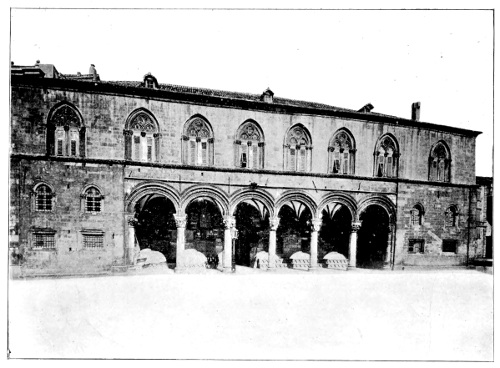
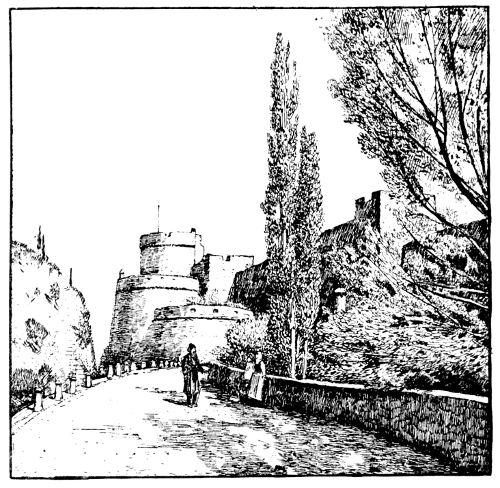
Façade of the Rector’s Palace
(From a photograph by Messrs. Stengel & Co., Dresden)
The Republic of Cattaro continued to remain in a
state of semi-independence. It was usually on good
terms with Venice, and the town contained a flourishing
commercial colony of Venetians. Ensconced in the deep
and well-sheltered inlet known as the Bocche di Cattaro,
its trade was active and its mercantile fleet large. Its
relations with Ragusa were characterised by mutual
jealousy, owing partly to commercial rivalry (especially
on account of the disputed salt monopoly), and partly
to the intrigues of Venice, who wished to prevent all
possible coalitions of the Dalmatian townships against
her own supremacy.287
A new Power now makes its appearance as a factor
in the history of Europe, the Ottoman Turks, who
were destined in the space of two centuries to conquer
the whole of the Balkan peninsula, a large part of
Dalmatia, and nearly the whole of Hungary, humbling
that kingdom to the dust. The Serbs and other South
Slavonic peoples by their civil wars and mutual jealousies
prepared the way for their greatest enemy and that of all
Christendom. In these events the part played by Ragusa
was a curious one. At one moment the Republic actually
tried to arbitrate in the quarrels of the Servian princes
and to induce them to unite against the invader. But
from the point of view of general European history its
chief interest lies in the action of its Government in obtaining
information as to the movements of the Turkish
armies. The Ragusans were subsequently on good terms
with the Turks, and permitted to visit all parts of the
Empire, even when other Europeans were excluded.
Ragusan merchants and agents sent home despatches
which are preserved in the city records, and in them we
can follow the Turkish conquest step by step, as city
after city, province after province, was first raided,
then rendered tributary, and finally absorbed into the
Sultan’s dominions. This is not the place to tell the
story of the conquest, but it will be well to remind
the reader of a few of its more important events and
dates.
The first Turkish invasion of Europe occurred in
1341, when Orhan crossed the Bosporos to intervene
in the civil wars of the Eastern Empire. Several minor
raids followed, while the Emir Orchan (1326-1360),
who may be regarded as the founder of the Ottoman
power, established his capital at Brusa. In 1358 his son
Suleiman again invaded Europe, and the Chersonnese
was soon filled with colonies of Ottomans.288 In 1359
Gallipoli, “the key of Europe,” was occupied and
rebuilt as a Turkish town. In 1360 both Orchan and
his son Suleiman died, and his second son Murad succeeded
to the throne. The latter in the following year
captured Adrianople, which henceforward was to be the
seat of the Turkish Government, and the headquarters
for the attacks on the Greek Empire, the Serbs, and the
Bulgarians. In 1370 a Turkish army of 70,000 men
under Murad spread into Macedonia, but was driven
back by the Serbs under King Vukašin and his brother
Ulješa. He advanced again the following year, and
encountered the Serbs at Černomen,289 on the right bank
of the Marica, a day’s march from Adrianople. The
Serbs won in the first instance, but during the night the
Turks rallied, and inflicted a terrible defeat on them.
Vukašin and his brother fell with the flower of the
Servian chivalry.290 The Turks now overran Macedonia
and Servia, and forced Marko Kraljević, Vukašin’s eldest
son, and other Slave princes to pay tribute to them.
The vassals who had hitherto obeyed Vukašin now
rebelled against his son, and the Servian Empire was
definitely broken up, while the Turks became ever more
powerful.
The exchange of Hungarian supremacy in the place
of that of Venice brought about less change in the
internal situation of Ragusa than might have been
expected, but the dignity of the Republic was enhanced
by the further extension of its autonomy, for it now
becomes to all intents and purposes an independent
State. When the last Venetian Count departed a commission
of three Rectors, elected by the citizens, was
appointed to carry on the affairs of the Government, and
they were to be changed every two months. But a few
months later the number was reduced to one,291 and his
tenure of office limited to one month. Formerly, in the
periods during which Ragusa had been independent, the
ruler of the State had held office for six months, and
had enjoyed considerable authority. But the example of
Damiano Juda had made the citizens chary of entrusting
their destinies to a too powerful magistrate, and they
now curtailed his initiative till he became a mere figure-head.
His chief duties were the safe-keeping of the
keys of the castles and of the State seals, the summoning
of the Grand Council, the Senate, and the Minor Council,
and the proposal of the affairs to be discussed in these assemblies,
in which, however, he himself had only one vote.
During his brief tenure of office he might never leave his
official residence save in full state, i.e. accompanied by
twenty-four retainers attired in scarlet, two musicians,
and all the chief secretaries and palace functionaries.
His own robe was like that of a Venetian senator.
Under these circumstances we can hardly imagine him
taking much pleasure in a quiet walk for a breath of
fresh air. If he was ill or excluded from the Council
“in his own interest or in that of his relations,”292 his
place was taken by the senior member of the Minor
Council. If he died while in office he was borne to the
grave on the shoulders of the nobles, the bell of the
Palace tolled, and the city gates were closed. In 1441
Ladislas, King of Hungary, conferred upon the chief
magistrate of Ragusa the title of Arch-Rector, which was
confirmed by King Matthew Corvinus in 1463, but the
Senate refused to allow him to use it, lest it should
inspire him with dangerous ambitions! He was, however,
permitted to accept the knighthood of the Golden
Spur with which he had been invested by the same
monarch. No other important changes were made in
the constitution from this date until the fall of the
Republic.
Ragusa’s international position, however, was now
considerably altered. The King of Hungary allowed
the citizens the most absolute liberty to manage their
own affairs, and not only had he no Hungarian representative
in the town, but he did not even attempt to
interfere indirectly with the Government. Ragusa was
merely bound to pay him a tribute and to provide a
naval contingent in time of war on the terms set forth
in the treaty of Višegrad. She always remained the faithful
friend and ally of Hungary, and was quite content
to render this not very onerous allegiance; in her relations
with that Power there was no trace of the constant
recriminations and bickerings that there were with Venice.
The reason of this difference of feeling towards the two
Powers lies in the character of Venetian as compared
with Hungarian policy. Venice was ever extending her
influence down the Adriatic coast, consolidating her
dominion, and destroying local autonomies. Above all,
Venice was a great maritime Power and could swoop
down on Ragusa or any other Adriatic town with her
swift galleys at any moment; commercial rivalry, too,
had its effect, for Venice aspired to the monopoly of the
same trades as those in which Ragusa dealt. Hungary,
on the other hand, was purely a military State. Its aims
were internal consolidation and the security of its own immediate
frontiers. It did not aspire to distant dominions,
as it had no powerful navy, and it merely desired to
possess Dalmatia so as to secure a wider outlet to the
sea than the Croatian coast; and it had no sea-borne
trade to interfere with that of Ragusa. On the land
side it wished to secure the allegiance of the Bosnian
Banus, but there was little danger of its establishing an
absolute sway over the Slave lands immediately behind
Ragusa.
The Ragusans now set to work to consolidate their
independence and develop their trade, but they were not
destined to enjoy a long period of absolute peace. Their
first quarrel was with Vojslav Voinović, Count of Hlum
(“Comes Chelmi Magnus Procer Imperatoris Sclavoniæ”).293
Early in 1359 the Republic sent an envoy to him, offering
to pay a sum of 4000 ipperperi as tribute due to the
Emperor of Slavonia; but shortly after he raided the
Ragusan districts of Astarea and Gionchetto, burned the
houses and churches, cut down the vineyards, took a
number of prisoners, and arrested the Ragusan traders
in his territories. Vojslav was known to be meditating
an expedition against Stagno and even Ragusa, so that
defensive measures were taken. All the city gates except
two were walled up, a special guard of night watchmen
was formed, troops and sailors levied throughout
the Republic’s dominions, and a band of mercenaries was
raised at Curzola with the permission of the Venetian
Count for the defence of Stagno. A master-mechanic
was sent for from Messina to superintend the war engines,
and a master-crossbowman from Italy. In the meanwhile
the Senate sent envoys to the King of Hungary
and to his lieutenant the Banus of Croatia and Dalmatia,
complaining of Vojslav’s conduct, and asking for assistance
against him.294 He was described as being “like a
wolf who wishes to devour us lambs,”295 and a price of
10,000 ipperperi was put on his head the following year.296
Ragusa also tried to resort to another measure against
Vojslav. The latter’s territory reached as far as the
neighbourhood of Cattaro, which town served him as a
port. Ragusa now proposed an alliance with the Cattarini,
and suggested that they should break off all
relations with the lord of Hlum and cease to provide
him with provisions and salt. But Cattaro was unable
to accede to this plan from fear of Vojslav’s power.
Ragusa then determined to punish that town, and made
an alliance to this end with the Balšas, lords of Zedda.
Negotiations were opened with the Servian Tsar Uroš
and with his most powerful vassals, and envoys were
sent to the King of Bosnia and to Sanko to arrange a
plan of campaign against Hlum. Operations began by
sea, and on July 6, 1361, Ragusa itself appears to have
been attacked by Vojslav’s ships.297 The Republic confiscated
the money which that prince had deposited in
the town,298 and a naval expedition was fitted out to
operate against Cattaro and raid the Bocche. Raids
were also made into Vojslav’s territories on the land side,
and doubtless the Ragusans were able to pay their enemy
back in his own coin. The quarrel with Cattaro and
Vojslav lasted nearly two years, and only ended through
Venetian and Servian mediation.
According to some authorities299 Vojslav died in 1363,
and was succeeded by his cousin Nicholas Altomanović;
according to others300 in 1371. The latter date is probably
the correct one, the confusion having arisen from the
fact that Nicholas came to reign jointly with his brother
in 1363 or 1364, and after that date we find them both
mentioned in the Ragusan documents. This system of
dual or plural sovereignty, prevalent in Servian lands,
caused much trouble, and also weakened the resistance
against the Turkish invaders, as the rival princes were
always quarrelling among themselves and intriguing with
outside foes against each other. At this time a coalition
of a number of Servian princelings and nobles against
others was formed, and produced the most fatal consequences
by breaking up the organisation of the country.
During this war the Balšas, in order to consolidate their
power, began to make political and commercial alliances
with their neighbours. For this purpose they applied to
Ragusa, requesting the honour of Ragusan citizenship for
themselves. The Senate was well pleased to accede to
this desire, as the Republic was feeling by no means safe
from Vojslav, and Hungarian help delayed in coming.
A treaty of offensive and defensive alliance was concluded,
by which it was agreed that the Balšas should
attack Cattaro, Vojslav’s ally, by land and the Ragusans
by sea. The Ragusan envoy, Clemente Dersa, informed
the Balšas that Vojslav was meditating a coup de main on
Budua, and that this would be a serious menace to their
territory. Budua is a small town on the Adriatic, just
south of the entrance to the Bocche di Cattaro. It is
of ancient origin, and has one of the earliest municipal
statutes in existence.301 It was under the direct protection
of the Servian Tsars, who were represented by a castellano,
and independent of the vassal feudatories. Ragusa had
had a quarrel with the town in 1359 owing to the alleged
acts of piracy committed by its inhabitants, but afterwards
peace was made when Budua became in a manner subject
to the Balšas and helped them in their revolt against
Servia. During the hostilities the Cattarini besieged
Budua and nearly captured it, taking a number of
prisoners in the sorties, until a Ragusan flotilla came
to the rescue and drove them back.302 In April 1362
Ragusan ships blockaded Cattaro by sea, while the
Balšas attacked it by land.303 During these hostilities the
Ragusans captured the property of some Venetian merchants
as contraband of war, and this caused further
unpleasantness with Venice. Cattaro then requested Venetian
mediation, and in January 1362 Paolo Quirini and
a Hungarian representative were sent to Dalmatia to
arbitrate, but without success. At last, in August, the
Servian Tsar intervened, and on August 22 peace was
signed at Onogost.304 All parties regained their former
privileges, prisoners were liberated, and compensation
paid for injuries. The chief result for Ragusa was the
introduction of the plague from the lands beyond the
mountains.305 The Balšas, however, were able to extend
their territory along the coast as far as Dulcigno, and in
1367 the dignity of warden of Budua passed to George
Balša, and he and his brothers thenceforward styled
themselves “magnificent barons of Maritime Slavonia.”
They were now able to negotiate with Venice, and
became an important Power in the Adriatic. This
ultimately proved advantageous for the Ragusans, to
whom they granted many privileges and opened the
trade routes up the rivers of Northern Albania. They
also obtained for the Republic from the Servian Tsar the
full possession of the island of Meleda.306
But the peace failed to prevent the molestations of
the lawless Count of Hlum, Nicholas Altomanović. In
April 1371307 the Ragusans wrote to the King of Hungary
complaining of his raids, and describing him as “the
worst of all the Rascian barons, although they are all
false and infamous.” Not content with the gifts they
had made to him, he had demanded the tribute due to
the Servian Tsar, and on their refusal he invaded their
territory and tortured the prisoners he made by pouring
boiling lard over them. The Ragusans added that the
Banus of Mačva, who was the King of Hungary’s vassal,
had done nothing to restrain Altomanović, but was
secretly his friend. The whole of the interior being in
a state of anarchy, inland trade was almost at a standstill,
and the Republic requested the King to intercede
with the Pope for the renewal of the licence to send two
ships every year to the lands of the Infidel.
The Ragusan forces, however, managed on several
occasions to defeat the bands of Altomanović, and later
in the year the Republic joined the alliance of Knez
Lazar and Tvrtko, Banus of Bosnia, against that prince.
The latter now had won the Balšas to his side by the
gift of Canali, Trebinje, and Dračevica, but the coalition
succeeded in conquering a large part of his possessions.
Knez Lazar occupied Rudnik, and Tvrtko the upper
valley of the Drina, and drove George Balša from Trebinje.
The King of Bosnia’s possessions were thus extended
by 1376 over the greater part of the Servian
lands as far as Trebinje, Cattaro, and Nikšić in the
south, to Senice in the east, and included the important
monastery of Mileševo, where St. Sava, the Apostle of
the Serbs, was buried.308 He was now the most powerful
ruler in this part of the Balkans, and had himself crowned
at Mileševo with two crowns, styling himself “Stephen
Tvrtko in the name of Our Lord Christ King of Servia
and Bosnia and the Primorije (coast land).”309 Ragusa
was the first State to recognise him, and proved quite
willing to pay the 2000 ipperperi a year due to him as
lord of Servia.
The Ragusan Senate had the foresight to understand
the growing importance of the Ottoman Turks, and
having obtained from Urban V. an exemption to trade
with the Infidel, it contracted commercial agreements
with the Sultans of Egypt, Syria, and Konia in 1359,
and in 1365 obtained from the Sultan Murad a firman
granting the citizens of Ragusa freedom to trade in all
parts of the Ottoman dominions and protection for their
commercial factories, in exchange for a yearly tribute
of 500 ducats. Ragusa was thus the first Christian
State to make a treaty with the Ottoman Turks, and its
citizens were enabled to penetrate into the remotest parts
of the Turkish Empire and form permanent settlements
there at a time when other Christians were either excluded
altogether or limited to a few coast towns. The tribute
which they paid for these advantages, although often raised
subsequently, proved a most profitable investment.
In 1378, in consequence of the intrigues of Venice
and Genoa to obtain a predominant position at Constantinople,
war broke out between the two Republics—the
famous Chioggia war—in which Ragusa too was involved.
The Genoese induced Francesco Carrara, lord of Padua,
who had been humbled but not subdued by Venice, to
join them, and further help was obtained from Louis
of Hungary. Ragusa, as vassal of that potentate, joined
the coalition. But Venice, undismayed, made all preparations
for war, and invested Vettor Pisani with the
supreme command at sea. A Venetian victory off Cape
Antium was won on May 30, and Pisani took Sebenico
and Cattaro by storm; these and other towns on the
Adriatic coast which his garrisons occupied were harried
and blockaded by Ragusan vessels, who also seized this
opportunity to destroy the salt-pans of Cattaro, thus
ridding the Republic of a dangerous competitor.310 The
Ragusans were in great fear of an attack by the Venetian
fleet, and made desperate efforts to strengthen the defences
of the town and of Stagno. They also asked for
assistance from Tvrtko, King of Bosnia, who offered
them a contingent; but on hearing that he was treating
with the Venetians, possibly with a view to a move
against Ragusa, they refused it. On October 14, 1378,
the Genoese fleet under Fieschi put in at Ragusa,311 where
a Ragusan galley joined it, and the admiral received two
bombards and a present of money from the Republic.
Armed barques issued forth from the town to scour the
Adriatic and obtain news of the movements of the Venetian
fleet, which were at once transmitted to the Banus
of Dalmatia and Croatia at Zara, while privateers cruised
about to plunder the enemy’s merchantmen. Ragusan
ships were, in fact, the eyes of the allied fleet.
The Senate sent a squadron out under Stefano Sorgo
to capture all Venetian or Cattarine ships found in South
Dalmatian waters,312 while envoys went to Cattaro to stir
up the people to rebel against Venice and return to
Hungarian allegiance. But the Cattarini, still fearing
the Venetians, at first refused. Then a joint Genoese
and Ragusan fleet made a demonstration against the
town, and the authorities promised to raise the Hungarian
standard on a certain date. But they failed to
do so, and intrigued instead with the King of Bosnia
against Ragusa, plundered Ragusan grain ships, and captured
the sentinels guarding the approaches to the city
on the Monte Sergio. After the total defeat of the
Venetian fleet off Pola in May the Ragusans pursued
their operations against Cattaro by land and sea with
renewed vigour, and by June 26 the town had once more
returned to Hungarian allegiance.313
Meanwhile the Genoese had carried the war almost
to the very gates of Venice, and were besieging Chioggia.
A Ragusan contingent under Matteo Giorgi was of great
assistance to them in the siege, owing to Giorgi’s knowledge
of the use of artillery,314 and, according to Razzi, he would
have prevented the blockade of the Genoese fleet, which
was executed, by closing the harbour with sunken boats,
if only his advice had been followed.315 On the defeat of
the Genoese the Ragusan galleys managed to escape, and
saved a number of the fugitives whose vessels had been
sunk (June 24, 1380). Desultory fighting continued for
a few months longer, in which the Ragusan galleys took
part, and in 1381 peace was signed at Turin. Although
in the end the Genoese had been defeated, Venice
was by no means victorious, and had to confirm her
renunciation of Dalmatia, much to the satisfaction of
Ragusa.
But it seemed as though the little Republic of St.
Blaize were destined never to be at peace with her neighbours
for long. Hardly was the Chioggia war over when
a storm-cloud appeared on the side of Bosnia. Now
that the Bosnian king had humbled his neighbours and
become the most powerful sovereign of the Southern
Slaves he began to assume an unfriendly attitude towards
Ragusa. His kingdom possessed a stretch of coast from
the Bocche di Cattaro to the mouth of the Četina, but
the two best ports of that region—Ragusa and Cattaro—were
independent Republics owing allegiance to the
King of Hungary, who was by no means likely to be
always friendly to a powerful and independent Bosnia.
If Tvrtko wished to establish a really strong Servian state
he would have to occupy those towns. While still
Banus he had granted the freedom of his territories to
the Ragusans in a charter dated from Bobovac, February
5, 1375.316 On April 10, 1379, he came to Žrnovica,
very near Ragusa, accompanied by his magnates. The
Republic sent out a commission of nobles to greet him,
and a new and advantageous commercial treaty was
concluded, Ragusa agreeing to pay Tvrtko and his
successors 500 ipperperi a year for freedom to trade in
Bosnia, and 2000 a year as lord of the Servian lands.317
But this friendship did not last long, for on July 26,
1379, we find the Republic complaining to Louis of
Hungary that the people of Cattaro having offered their
city to the King of Bosnia, the latter refused to allow
foodstuffs to be imported into Ragusa. Louis defended
his faithful vassals, and Tvrtko was forced to desist from
his annoyances. When, in 1382, Louis died, he left a
widow, Elizabeth, who was Tvrtko’s cousin, and two
daughters, Mary and Hedwig. He had declared Mary
his successor, and betrothed her to Prince Sigismund, son
of the Emperor Charles IV., King of Bohemia; but on
his death the Poles, who were united to the Hungarians
under the same dynasty, refused to be ruled by Mary,
and elected her younger sister Hedwig as their queen
instead, and even in Hungary and Croatia a considerable
party was opposed to Elizabeth and Mary. Civil war
broke out and devastated Hungary, Croatia, Dalmatia,
and Slavonia for the next twenty-five years. Of these
disturbances Tvrtko determined to take advantage, now
favouring Elizabeth and Mary, now Charles of Durazzo,
who as an Angevin claimed the throne of Hungary also,
and his son Ladislas, always with an eye to his own
profit.318 His first thought was for Ragusa. He knew
that he could not capture the town without a large fleet,
for Ragusan shipping had revived since 1358, and was
now very formidable. But he also knew that its inhabitants
lived entirely by trade, and he determined to injure
them by establishing a rival trading centre at the entrance
of the Bocche, making it the chief port and the commercial
capital of Bosnia. He called it Sveti Stjepan
(San Stefano), but the name was soon changed to Novi,
and then to Erzegnovi (Castelnuovo). In violation of his
treaties with Ragusa he opened salt-pans at Castelnuovo,
which soon became an important trading station not only
for the neighbourhood, but for the whole of Dalmatia
and Croatia. The Ragusans complained bitterly, and as
they obtained Hungarian support, Tvrtko deemed it
prudent to give way for the moment, and he promised to
close the salt market.319 But again in 1383 he re-opened
it, and the Republic sent Pietro Gondola and Stefano
Luccari to Budapest to complain of this breach of the
treaty to Queen Mary. The latter at once issued a
decree forbidding the inhabitants of Dalmatia and Croatia
to trade at Novi.320
Tvrtko, not feeling yet strong enough to attack
Ragusa openly, allied himself with the Venetians. The
latter sold him a large galley fully armed and equipped,
and allowed him to have two others built in Venice, sent
Niccolò Baseio to him as admiral, and made him honorary
citizen of the Republic.321 These movements disturbed
not only Ragusa, but also the two Hungarian queens,
who feared that Tvrtko might avail himself of the discontent
in Croatia and Dalmatia to raise further trouble.
They therefore sent Nicholas of Gara to his court at
Sutieska to try to come to some arrangement. Finally
Tvrtko was induced to agree not to disturb Ragusa nor
the Hungarian dominions, for which promise he was
rewarded with the town of Cattaro.322 This occupation
brought him into conflict with the Balšas of Zedda, but
after some fighting peace was restored through Venetian
mediation. On April 9, 1387, Tvrtko concluded a
treaty with Ragusa, in which he promised to protect the
city from all enemies, and the Ragusans granted him the
right of asylum should he ever be in need of it. It was
added that if he should come to the town for any reason,
and Queen Mary, who was then a prisoner in the hands
of the rebels, should escape, he should be warned in good
time and allowed to leave.
By the following year the King of Bosnia’s power
in Croatia and Dalmatia had greatly increased, and he
became possessed of such important castles as Clissa,
Vrana, Ostrovica, and probably Knin, the key of Croatia.323
He now tried to get hold of the Dalmatian coast towns,
as the whole country was in a turmoil of war and revolution,
Ragusa alone remaining quiet and loyal to Queen
Mary and her husband Sigismund. Various Dalmatian
towns promised to pay allegiance to Tvrtko, including
Spalato, which was to raise the Bosnian standard on June
15, 1389. But on that very date the death-knell of the
Southern Slaves sounded on the fatal “Field of Crows.”324
While Tvrtko was thus consolidating his kingdom
at the expense of his neighbours, while Hungary was a
prey to civil war, while the various princelings of Servia
were eternally fighting among themselves, the Turks
were ever marching onward. As early as 1375 Marko
Kraljević, the hero of Servian popular poetry, had
initiated the disastrous policy of calling in Turkish
assistance in a quarrel against another Christian prince.
Wishing to reconquer Kastoria and other towns in
Southern Macedonia and Albania held by the Musacchi
family and their ally George I. Balša, he obtained a
Turkish contingent for the enterprise, but was defeated
by Balša. In 1376 Tvrtko had allied himself
with Knez Lazar, who ruled over the Danubian provinces
of Servia (the last remnant of the Servian Empire)
against Nicholas Altomanović, and continued to remain
on good terms with him after Nicholas’s death. He
regarded Knez Lazar’s principality as a buffer State
between his own dominions and those of the Turks.
After the fall of Niš in 1375, and of Sofia in 1382, he
gave Lazar assistance, and in 1387 he sent him a contingent
which enabled him to cut to pieces a Turkish
army of 20,000 men at Pločnik on the Toplica (Old
Servia). But the Sultan Murad I. determined to
avenge the defeat, and prepared an expedition against
Lazar. The latter, seeing himself in great danger, appealed
for help from all his neighbours, but the King of
Bosnia alone sent him a force, commanded by Vlatko
Hranić. The Servian-Bosnian army, under the leadership
of Knez Lazar, with Marko Kraljević as chief
lieutenant, had its headquarters at Priština, in the plain
of Kossovo—a long plateau surrounded by mountains
extending from Verisović to Mitrovica. The Turkish
army was commanded by the Sultan Murad in person;
the right wing was led by his son Bayazet, and the left
by his son Yakub. The fight began early on Wednesday,
June 15, 1389, and raged all day. For a long time
the fortunes of the battle seemed doubtful, and both
sides fought with heroic courage. But at last Bayazet
succeeded by a sudden attack in throwing the Servian
left wing into confusion. At the same time Vuk
Branković, whose name has been handed down to the
execration of the whole Servian race as a traitor, abandoned
the field of battle with all his division. Then
Vlatko Hranić and the Bosnian contingent began to
give way, and the main body of the Serbs was driven
slowly back. Knez Lazar, after fighting like a lion, was
killed in the mêlée; Murad was mortally wounded in his
own tent by the Servian chief Miloš Obilić, who pretended
to be a traitor and to have information to give
him. He was himself cut down instantly, and then
Lazar’s head was brought in by attendants to cheer the
dying Sultan, who expired soon after.
The Turks did not follow up their victory, and from
the first news of the fight which he received Tvrtko
thought that the Christians had triumphed, and sent
messages to that effect to the foreign Powers. In the
churches of Florence Te Deums of victory were sung,
and the Republic congratulated the Bosnian king.
Even when the true result was known no one realised
at the time what a crushing blow had fallen on the
Slavonic peoples of the Balkans. The native princes
continued to fight among themselves regardless of their
impending doom, and Tvrtko, who was the most powerful
of them, thought more of occupying Dalmatia and
Croatia than of strengthening his southern frontier.
His enterprises were fairly prosperous; he succeeded in
conquering the whole country from the Velebit mountains
to Cattaro, Zara and Ragusa alone remaining true
to Sigismund, while the three islands of Brazza, Curzola,
and Lesina recognised the suzerainty of the Bosnian
king (1390). He died in 1391, leaving Bosnia in such
a position as she had never enjoyed before. But her
power was not based on a solid foundation, and therefore
short-lived. His brother, Stephen Dabiša, who succeeded
him, soon lost the greater part of Dalmatia and Croatia.
George II. Stračimirov Balša, who now styled himself
“absolute lord of all the Zedda and of the coast,” and
had established a brilliant court at Scutari,325 was equally
unconscious of the danger, and thought only of capturing
Cattaro. He began by occupying the Krivošije,326 and
blocked all the roads leading into the town. Ragusa at
the request of Cattaro acted as mediator, and peace was
made, probably on an understanding on the part of the
Cattarini that they would pay a tribute to George.327
Ragusa was beginning to be really alarmed at the progress
of the Turks in Albania, and saw the necessity of
allying herself with the other Dalmatian townships, “propter
oppressionem Turcorum.” In 1390 the Senate had
tried in vain to mediate between the King of Bosnia and
Hungary, so as to end the war which was desolating the
country,328 and now it made a proposal of this kind to
Hungary and Venice. At the same time it granted a
subsidy of arms and ammunition to George Balša. But
mutual jealousies prevented the idea from being realised,329
and in 1392 George himself was a prisoner in the hands
of the Turks.330 He was soon ransomed, but he lost
Scutari, and his power was seriously shaken.
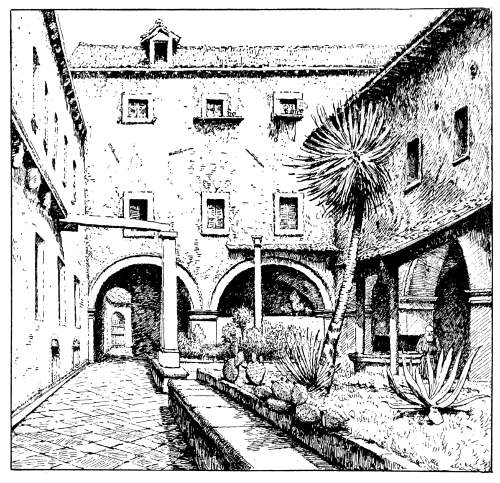
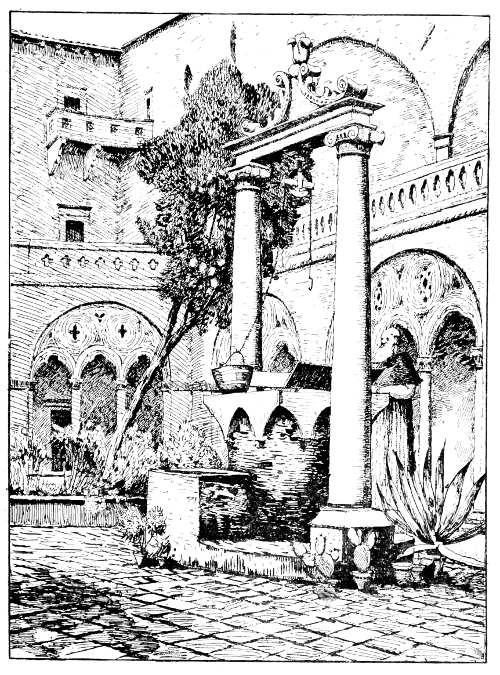
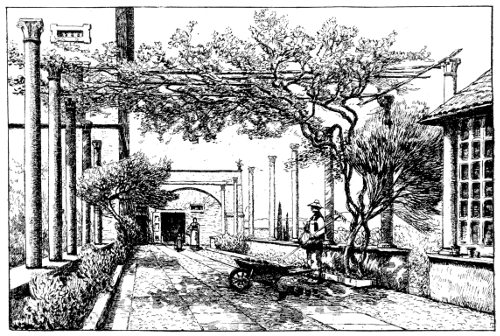
APOTHECARY’S GARDEN, FRANCISCAN MONASTERY
The year 1395 proved an unfortunate one for Ragusa.
In the first place, one Constantine Balša, a relative of
George II., who had obtained a trade monopoly in the
Zedda and inland as far as Prizren and Novobrdo, laid
heavy impositions on Ragusan trade so as to exclude it
from the country.331 At the same time heavy rains flooded
the city and its immediate neighbourhood, destroying all
the crops, and on May 19 a severe earthquake—the first
great shock felt in Dalmatia for many centuries—wrought
great havoc.332 During this period the Adriatic was infested
by the pirate barques of Gabriele da Parma. There was
another quarrel with George Balša on account of a certain
monk named Marino of Dulcigno, who intrigued with
the Slaves near Ragusa. However, this was soon settled
to the satisfaction of all parties, the Albanian markets
were re-opened, Constantine Balša recovered Scutari from
the Turks for his kinsman, and declared himself despot
of the town. In 1395 George visited Ragusa, where he
was splendidly received as Prince of Albania.
Although the Ragusans were usually on bad terms
with their immediate neighbours, they had been for some
time good friends with the Bosnian magnate Vlatko
Vuković. On his death in 1392 his estates descended to
his nephew Sandalj Hranić, to whom Ragusa sent an embassy
of homage in 1395. He was a true type of South
Slavonic lordling of that time. His one object was to
consolidate and enlarge his territories, so as to carve out a
principality for himself and be independent of the King of
Bosnia or the Despot of Servia. Like all his colleagues, he
completely failed to appreciate the terrible significance of
the Turkish danger, and while he began by “proclaiming
his misfortunes from the mountain tops, he ended by descending
into the plain to declare himself the vassal of
the powerful invader.”333 He was certainly less cruel than
most of his neighbours, and, unlike them, was guilty of
no particularly heinous murders. The result of his
ambitious schemes was the formation of the Duchy afterwards
called of St. Sava or the Herzegovina.334 In 1396
he meditated a descent on Cattaro in order to round off
his dominions. This town was also coveted by Radić
Crnoević, lord of what is now Montenegro. Radić got
into trouble with Balša, by whom he was defeated and
killed, while Sandalj, although he could not take Cattaro,
took Budua, probably at the secret instigation of Venice,
who did not wish Balša to advance further north. Sandalj
was granted the honorary citizenship of Venice.
In the meanwhile, in spite of several set-backs,
Turkish raids into Bosnia continued. Small bands were
sent forward as feelers to ravage and plunder and prepare
the way for their grand advance. We find the Ragusan
Senate asking the King of Hungary to recommend them
to Venice for protection against the Turks,335 while they
gave asylum in Stagno and Sabbioncello to many Slaves
and Vlachs who were flying from the terrible enemy.
On September 28, 1396, Sigismund, King of Hungary,
at the head of a confederate force of 100,000 Christians,
was totally defeated by the Sultan Bayazet at Nikopolis
on the Danube. The King himself managed to escape
down the river on a Venetian galley to the Black Sea to
Constantinople, across the Ægean, and up the Adriatic
to Ragusa, which he reached on December 21. He was
honourably and hospitably received by the Rector and
Councillors, who offered him the keys of the town. He
spent nine days there, being entertained, together with
his suite at the expense of the Republic, and he received
in addition a present of 2000 ducats and two years’
tribute in advance. As a reward he granted the Republic
the right to strike silver coinage.336 On December 30 he
departed on board a Ragusan galley for Spalato. He
took the four sons of the ship’s chief officer into his
service, and subsequently through his favour many
Ragusans rose to high positions in Hungary.
Every day fresh batches of refugees fled into Ragusan
territory before the advancing Ottoman hordes, who even
threatened the Bocche di Cattaro. George Balša himself
began to fear for his own safety, and requested that
Ragusa should give shelter to his wife and family. The
Republic placed a palace at his disposal, and also allowed
him to purchase arms and ammunition in the town and
have his old weapons repaired there. But even this had
to be done secretly, lest Sandalj, who was an enemy of
the Balšas and a friend of the Turks, should retaliate on
the Ragusans. We find an interesting entry in this
connection by Andrea da Bologna, the Chancellor of the
Republic, in the Reformationes for 1398: “Die ...
(blank space) Januarii (1398) Filius Pasayt (Bayazet)
cum magna quantitate Turchorum et Sclavorum intravit
Bossinam, et fuit depredatus ipsam. In reversione major
pars ipsorum propter immensum frigus decesserunt.”337
This shows that even at that early date the Turks found
allies in the renegade Slaves. The Ragusan Senate tried
to mediate between Sandalj and George so as to strengthen
Hungary, and arranged a meeting between the former
and his rival’s wife, but the attempted conciliation failed.
Apparently, too, some of the Slavonic lordlings tried to
draw Ragusa into their intrigues with the Turks, and
in 1399 Feris (?Ferid), Governor of Svečanj, visited
the town as Turkish envoy, but nothing came of the
negotiations.338
The kingdom of Bosnia was, as we have seen, subject
to constant incursions on the part of the Turks, whom
it was incapable of resisting, for under the reign of King
Dabiša and Queen Helena Gruba the Vojvods had risen
to power once more, and had become almost independent.
Of these the most important were Sandalj Hranić, lord
of Hlum, of whom we have already spoken; Hrvoje,
Duke of Spalato; and Paul Radinović. Sandalj ruled
over a great part of Hlum as far as the Drina. Hrvoje,
who has been described as the “Bosnian Warwick,” owing
to the number of princes he deposed and set up, ruled
over middle Dalmatia, a large part of Bosnia, including
the town of Jajce, and some districts of Hlum, including
Livno. Paul Radinović was lord of Trebinje, part of
Canali, and other lands as far as Prača. His sons, Peter
and Radosav, took the name of Paulović. Queen Helena
lost her throne owing to a rebellion in 1398 or 1399,
and was succeeded by Stephen Ostoja, probably a natural
son of Stephen Tvrtko.339 Ostoja had to depend for his
authority on the goodwill of his magnates, but his reign
was at first successful. He defeated Sigismund of
Hungary, who tried to enforce his claims on Bosnia,
and had invaded it at two points. Also on the Turkish
frontier things were more peaceful, and, according to
Klaić, after the raid of 1398 Ostoja concluded a treaty
with Bayazet to support the claims of Ladislas of Naples
to the Hungarian throne against Sigismund.340 Later,
Bayazet became still less formidable, as he had to hurry
off to Asia to defend his Empire against Timur.
For a few years after his accession Ostoja had been
friendly to Ragusa, and in 1399 he granted them a
further stretch of coast from Stagno to Klek, near the
mouth of the Narenta. For this the citizens had given
him a palace in the town and made him an honorary
citizen; they granted the same favours to Hrvoje for
his intercession.341 But Ostoja, finding himself with no
coastline save the bit between the rivers Četina and the
Narenta, repented of his generosity, and tried to induce
Ragusa to recognise Bosnian supremacy. When in 1400
the envoys brought him the tribute he suggested that
the city should throw off the Hungarian yoke and come
under his protection. But the Republic would not hear
of the proposal, preferring to obey the distant and complaisant
King of Hungary rather than the near and
untrustworthy King of Bosnia. The latter did not yet
feel strong enough to attack the city openly with any
chance of success where Tvrtko had failed, so he resorted,
if we are to believe the local historians, to intrigue, and
secretly fomented a conspiracy of ambitious nobles. The
circumstances of the plot are not very clear, and Ragnina’s
account, detailed though it is, leaves much unexplained.
In the early part of 1400 four nobles, Niccolò and
Giacomo Zamagna, and Lorenzo and Simeone Bodazza,
determined to become masters of the city with the help
of the Count of Popovo (in the Herzegovina), the Vojvod
of Trebinje, and other Bosnian barons. According to
Ragnina the conspiracy was engineered by Ostoja, or by
Stephen the Despot of Servia. It is more likely that
the former was privy to it, as the Despot of Servia was
now a person of no importance, and his territory did
not even border with that of the Republic. The Bosnian
king probably saw in this plot a means of possessing
himself of the town and its valuable port; but he did
not appear in the actual intrigue, which was carried on
by the neighbouring vojvods. Ragusa at this time was
almost deserted, a large part of its inhabitants having
taken refuge in the neighbouring country on account
of the plague. On the Feast of the Forty Martyrs
(March 9) a number of the conspirators were to dine
in the house of a certain artisan at Ragusa to mature
their plans. The man not having enough table utensils
for the company sent his wife to the house of a noble
named Niccolò Gozze, in whose service she had been, to
ask for a loan of the required articles. Gozze promised
to lend them, but wanted to know for whom they were
required. The woman told him the names of the nobles
in question, and as they were men of somewhat shady
antecedents Gozze became suspicious. He bribed the
woman to take note of all that she should hear at
supper, and to report it to him the following morning.
This she did, and informed Gozze that a Morlach named
Miloš and four companions had come with the nobles,
and that it was agreed that Miloš should wait at the
town gate for a Slave messenger who was expected with
letters from the Bosnian magnates. They also discussed
how to raise a band of followers from among the dregs
of the people, and secretly to admit some Slaves from
outside, with the object of overpowering the town guard,
seizing the gates, and opening them to a large force of
Bosnians. Gozze, although suffering from the gout,
rose from his bed, had himself carried to the Government
Palace, and summoned the Minor Council. The
woman was secured and summoned to give evidence, and
the chief conspirators were arrested. They confessed
everything under torture. At the same time a trusty
man was sent to await the arrival of the letters in the
place of the Morlach; he gave all the requisite signs
when the messenger arrived, and received the papers.
The contents were as follows: “In the first place
remember your promise and take care of yourself and
yours, and we shall do what we have decided.” The
conspirators were beheaded on March 10, and their
property confiscated. A few who managed to escape
were condemned in contumacy. This episode is interesting
as being one of the only instances of an internal
revolution in law-abiding Ragusa. There is not enough
evidence to enable us to understand its character nor the
actual complicity of Ostoja. It may also have been an
early symptom of the disagreement between the Latin
and Slavonic elements of the population.
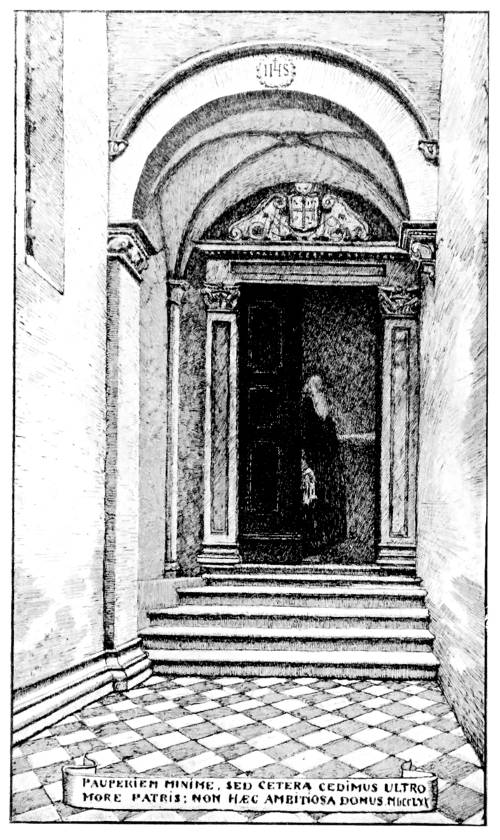
Entrance to the Franciscan Monastery
Ostoja, after having received the homage of Sebenico
and Traù, renewed his request that Ragusa should recognise
his supremacy; but again the citizens refused,
and renewed their oath of fealty to Sigismund, merely
promising to take no part in the hostilities between Bosnia
and Hungary, and to refuse to admit Bosnian rebels into
the town. The following year a number of Sigismund’s
opponents in Hungary, Croatia, and Dalmatia collected
at Zara, and Ladislas crossed over from Italy and was
crowned by the Hungarian Primate King of Hungary,
Croatia, and Dalmatia. Ostoja himself, however, was not
altogether satisfied, for although he had favoured Ladislas’s
cause as long as the pretender was in Italy, the moment
he landed in Dalmatia, the Bosnian king felt that his own
interests along the seaboard were menaced. Hrvoje, Duke
of Spalato, maintained an ambiguous attitude, and Ostoja
determined to make use of this confusion to declare war
on Ragusa. He found a pretext in the fact that two
Bosnian rebels had been given hospitality in the town;
he began by demanding back the Primorije which he
himself had ceded, as well as other territory given by
his predecessors, and he also insisted that the Ragusans
should recognise his full suzerainty. His demands
being rejected he sent a force of 8000 men under the
Vojvods Radić Sanković, Sandalj Hranić, and Paul Radinović
into Ragusan territory. Hostilities lasted from
August 1403 to the spring of 1404.342 We have but meagre
details of this campaign besides those given in the untrustworthy
chronicle of Resti, and some information in
the Diplomatarium. According to Resti, the Ragusans at
first drove back the Bosnians, but the latter were soon
reinforced and again invaded the Republic’s territory.
Encounters took place at Bergato and Gionchetto, and
4000 well-armed Ragusans commanded by Giacomo
Gondola tried to induce the enemy to give battle, but
without success, as the latter retired to Trebinje. Probably
the Ragusans were defeated, as we find the Senate
asking for the mediation of the Hungarian king shortly
after. But the difficulty was, which king, as Ladislas
was now in Dalmatia. The tortuous nature of Ragusan
diplomacy is well illustrated by the contemporaneous
embassies to Ladislas, Sigismund, and Hrvoje. They
did not wish to commit themselves by sending regular
ambassadors to Ladislas, as Sigismund might still gain
the upper hand, so they merely sent a monk, Marino
Bodazza, ostensibly to obtain compensation for the property
taken by the pretender’s followers. But a request
for mediation in the Bosnian quarrel was also hinted at.
Ladislas replied that he would consider the matter if
a proper embassy were sent to him. This the Senate
refused to do, upon which Ladislas declared Ragusa to
be his enemy. But, fortunately for the Republic, Sigismund
regained his freedom, and collected a large army
in northern Hungary, while Ladislas returned to Italy.
An embassy was then sent to Sigismund, the envoys being
instructed to go first to Hrvoje, the Duke of Spalato,
to complain of Ostoja’s conduct, and suggest that he
himself might become King of Bosnia; but if he did not
care to go so far, he might help some other member of
the Kotromanić family, or Paul Radissić, who had been
living at Ragusa for the past two years, to acquire the
crown. Ragusa had always been friendly to the old
Bosnian dynasty, and had given refuge to many of its
exiled princes. At the same time they were to inform
him that Ostoja, on seeing the retreat of Ladislas, had sent
envoys to Sigismund to intrigue against him (Hrvoje).
If the latter broached the subject of Ragusa’s relations
with Ladislas they were to say: “We are the subjects
of the Crown of Hungary, and whoever is actually King
of Hungary is our suzerain.” They were to proceed
to Sigismund’s court only if Hrvoje advised them to do
so. If they did go on to Hungary they were instructed
to try to obtain for Ragusa the suzerainty over the three
large islands of Lesina, Curzola, and Brazza, to discover
what were the provisions of the treaty which was being
negotiated between Ostoja and Sigismund, and to warn the
latter against the Bosnian king’s fickleness, and induce him
to insist that that potentate should give up the territory
he had filched from the Republic in the last war, and
pay compensation for the damages, calculated at 200,000
ducats, for which he was responsible. They were also to
suggest that he should come to terms with Hrvoje, who
might help him to reduce Bosnia to obedience, and to advise
him to sow dissension among the Bosnian magnates,
who were always ready to rebel.343
The embassy departed for Spalato, and thence, at
Hrvoje’s advice, proceeded to Hungary, but there they
found that, Ostoja having shown himself willing to
make peace, Sigismund had concluded a treaty with
him already. By its terms Ostoja recognised Hungarian
supremacy over Bosnia, and agreed to renew all the privileges
of the Ragusans, and restore all the territory taken
save the Primorije or coast-land. This did not satisfy the
Republic, and Hrvoje was still more annoyed as it upset
all his ambitious schemes. So he concluded an alliance
with Ragusa against Ostoja, with the object of deposing
him and placing Paul Radissić on the Bosnian throne.
Hrvoje was to lead an army of Dalmatians and Bosnian
malcontents up the Narenta valley, while Ragusa was
to cut off Ostoja’s supplies and intrigue against him at
the Hungarian court. Sigismund, however, supported
Ostoja, and when the latter was besieged in his castle
of Bobovac by Hrvoje he sent a force to his assistance
under the Banus of Mačva344 (Sigismund’s lieutenant in
northern Bosnia), and gained back all his territory for
him. But he did not forget his faithful Ragusans, and
not only induced Ostoja to renew their privileges, but
requested him to restore them the coast between the
Ombla and Stagno.345 After long negotiations the Diet or
“Congregation” of Bosnian magnates met at Visoki in
April,346 and Ostoja brought Ragusa’s claim before it, but
no decision was arrived at. After further useless negotiations
the Ragusans again allied themselves with Hrvoje
and the Bosnian rebels, including this time Sandalj Hranić
and Paul Radinović. A second conference of nobles was
summoned, and Ostoja was deposed. Stephen Tvrtko II.,
son of Stephen Tvrtko I., was elected king, and Ostoja
retired to Bobovac, now occupied by a Hungarian garrison.
The new king owed his position to Hrvoje and
Sandalj, who were the real masters of the country, and
Ragusa applied to them to obtain a lasting peace with
Bosnia. “For what you desire,” wrote the Rector to
Sandalj, “that also the lord King Tvrtko and the Duke
(Hrvoje) and all Bosnia desire too, for God has granted
you the favour that this should be so.”347 Eventually
Tvrtko gave them back all the territory that had been
theirs and some more lands besides. The Republic
made him and his brothers, as well as Sandalj, citizens
of Ragusa, and gave them palaces in the town.
The loyalty of the Ragusans to Hungary was sorely
tried this same year, for Sigismund prepared to make
war on Tvrtko as a usurper and reinstate Ostoja as the
rightful king. They would not side openly with Tvrtko
against this suzerain, but they did not wish to lose the
valuable and hardly won favours of Bosnia; they therefore
placed their arsenals at the disposal of Tvrtko’s
agents, who bought large supplies of arms for the war.348
Sigismund sent three armies into Bosnia—one under the
Banus of Mačva by way of Usora, a second under Paul,
Banus of Croatia, up the Una valley towards Bihać, and
a third to guard the Bosnian-Slavonian frontier under
Peter of Perén. Ladislas lent his fleet to Hrvoje to
keep watch at Arbe and attack Sigismund’s forces if they
should invade the littoral. But after a few ephemeral
successes the Hungarians were defeated at all points, and
Tvrtko’s position was thereby considerably strengthened.
Ostoja, fearing for his life, asked for a safe conduct to
Ragusa in April 1407, and the Senate, much to his
surprise, granted it, forgiving him all his former hostility,
“for any man who from Bosnia or from the land of any
other lord takes refuge in our city, according to the law,
may enter freely and live here undisturbed.” But after
all he did not avail himself of the permit, either because
he mistrusted the Ragusans, or because he still hoped
to regain his throne. While Tvrtko was trying to win
Cattaro and Budua from the Balšas, Sigismund was preparing
his revenge, and in 1408 invaded Bosnia with a
large army, defeated the usurper and captured him,
together with a large number of magnates, of whom 126
were beheaded at Dobor. Ostoja was replaced on the
throne, and Sigismund retired to Buda with Tvrtko in
his train.
We must now return to Ragusa’s relations with the
Balšas. When George II. died in 1403 he was succeeded
by his son, who styled himself Balša III. The Zedda
was now surrounded by jealous rivals; the Turks
claimed tribute, Venice wished to establish posts in the
country against them, and various native princelings
aspired to enlarge their estates. Ragusa being at war
with Bosnia, allied herself with the lords of Njegoš (the
nucleus of modern Montenegro) and with Cattaro, and
tried to conciliate Venice. Balša determined to oust the
Venetians from Albania, and invited the Turks to help
him to capture Drivasto and Scutari. Thus Ragusa and
he were in opposite camps. Drivasto fell, and so did the
town of Scutari, but the castle held out (1404). With
the help of Sandalj Hranič and the Albanian magnates
Venice soon recovered all that she had lost, and by June,
1407, Balša and his ambitious mother Helena had to sue
for peace and give way on all points. Balša, however,
did not carry out his engagements, and Venice resorted
to the threat of calling in the help of Bayazet to force
him to do so (January, 1409); in June of the same year
the Venetian fleet sailed down the Adriatic and put in at
Ragusa, where the Capitano in Golfo met the envoy of
Sandalj.349 Balša, being now thoroughly frightened, went
to Venice with his mother and signed a further agreement.
But in 1410 he again raided the Venetian possessions
and attacked Scutari with a large force. Benedetto
Contarini defended the town with great skill, and received
much assistance from a Ragusan flotilla operating
on the lake.350 Balša having also threatened Cattaro, that
town offered itself to the Venetians, who were ready to
occupy it; but now Sandalj came forward with his claims
on it, which caused further complications. Ragusa,
although allied to Venice, tried to better her relations
with Balša on account of her Albanian trade. But this
ambiguous attitude was not quite successful, and Ragusan
merchants ended by suffering molestations both from
the Venetians and from Balša’s subjects. In 1412 peace
was concluded, and Balša restored everything.
Once the danger from Balša was passed Ragusan
hostility against Venice revived again, and the Senate
wrote to protest against Venetian depredations in Albanian
and Sicilian waters. The Republic still desired the
supremacy of Hungary in the Adriatic, and although
that cause was lost, it tried to bolster it up by inducing
Cattaro to return to Hungarian allegiance. This attempt
was made, however, more with the object of injuring
Venice than with any hope of benefiting Hungary.
Ragusa also contracted an alliance with Balša and with
Sandalj, who had married Balša’s mother, and was meditating
a coup on Cattaro. But the Cattarini succeeded in
inducing Ragusa to mediate between them and Sandalj,
and even to provide them with a large loan with which
to arm the whole population of the Bocche. The maze
of intrigue and counter-intrigue between Venice, Hungary,
Ragusa, Bosnia, and the various Slave and Albanian
princes now becomes hopelessly involved, and no man
trusted any other. Ragusa’s policy is well explained in
a despatch,351 in which it is stated that the Republic “had
to be on good terms with these lords of Slavonia, for
every day our merchants and our goods pass through
their hands and their territory, and we fear lest they (the
merchants) should suffer injury.” But when Balša demanded
a number of Ragusan shipbuilders to repair his
vessels for operations against Venice the Senate refused,
fearing to incur the latter’s displeasure.
The protection and promotion of trade was the keynote
of Ragusan policy, and everything was done with
that end in view. In the meanwhile the Senate acquired
much knowledge concerning the affairs of Italy and of
the East from the Ragusan traders, and communicated
the information to Sigismund. Thus the latter learned
about the advance of the Turks in Bosnia at the instigation
of Vuk, the son of Knez Lazar, who wished to get
possession of his brother’s principality. Ladislas continued
to send piratical fleets to Dalmatia, which did
much damage to Ragusan commerce. But the Ragusans
revenged themselves by relieving Curzola, which was
attacked by the Apulian fleet. “With the favour of
St. Blaize we shot so many arrows and javelins against the
enemy, and did their ships so much damage with our bombards,
that many of their men were killed or wounded.
They abandoned much property and arms, and not only
desisted from the siege, but abandoned these parts altogether.”352
This same year (1409) the Venetians began
to re-establish their rule over Dalmatia, and obtained
Zara from Ladislas. This caused an outbreak of hostilities
between them and Sigismund, who regarded Dalmatia as
an integral part of his dominions. While the two Powers
were fighting the common enemy was advancing, and in
1411 a Ragusan despatch announces that the Turks had
taken and burnt Srebrnica. In 1413 negotiations were
opened between Hungary and Venice, in which Ragusa
took part, and while Sigismund agreed to give up the
greater part of Dalmatia, Ragusa asked for and obtained
the lease of the three coveted islands of Lesina, Curzola,
and Brazza, which had been withdrawn from Hrvoje’s
rule.353 The Ragusans had hoped to obtain full ownership,
but even the lease was a great point gained, and the
Republic thought that it would eventually become vested
into absolute possession. The islanders, however, were
not well disposed towards their new masters, and were
only cowed into submission by a naval demonstration.
A count was appointed for each island, to remain in office
for six months, with a salary of which Ragusa was to pay
one-third and the islanders the remainder.354 This acquisition
might have been the beginning of great things for the
Republic had its policy been a little less narrowly provincial
and nervous. Its territory was now fairly large,
its commerce and finances flourishing, and with its intimate
connection with the dying kingdom of Bosnia it
might have extended its influence far into the hinterland,
establishing a strong Latin-Slavonic State as a bulwark
against the advancing Turks. Ragusa was also trying to
get possession of another part of Canali and Dračevica
from Sandlaj Hranić, but the latter would not give it
up, because “if he were hard pressed by the Turks he
would have no other means of escaping to the sea,” and
also because Dračevica was the best position for dominating
Cattaro,355 which he had now forced to pay him
tribute. The Venetians, Sandalj, and Balša were now all
suffering from the Turkish obsession. The enemy’s headquarters
were at Üsküb, whence many raids into Bosnia
and Albania were made. In 1415 the Turks invaded
Bosnia for the third time, and raiding parties came as
far as Sebenico and Almissa, so that the Ragusan Senate
ordered the islanders to arm light galleys to co-operate
with those of Ragusa and Stagno. The ridges dividing
the hinterland from the sea were anxiously watched,
and every moment it was feared that the dreaded turbans
might appear over the crest. In 1416 Sigismund
announced to Ragusa his intention of making war on a
grand scale against the Turks, and declared that the
property of all those who helped them should be confiscated.
As the Despot of Servia, Sandalj Hranić, and
almost every other Slavonic prince were more or less
tributaries to the Sultan, this seems rather a sweeping
order. In the same letter he declared that the three
islands were withdrawn from Ragusan suzerainty and
were to be given over to one Ladislas Jakez, a favourite
of the Empress Barbara (September 21-23, 1416). No
reason is assigned for the withdrawal of the concession,
but it was probably due to the somewhat high-handed
manner with which the Republic had governed its new
possessions. Curiously enough, the Senate did not seem
very unwilling to lose them.
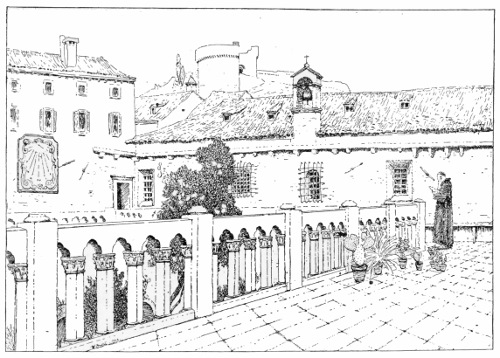
TERRACE OF THE FRANCISCAN MONASTERY WITH THE TORRE MENZE IN THE BACKGROUND
There were now fresh disturbances in Bosnia, and
Tvrtko, who had been deposed in favour of Ostoja, was
causing trouble. He raised a band of rebels, with which
he defeated his adversaries and obliged some of them to
take refuge in Ragusan territory. Of this hospitality
Tvrtko, as an old friend of the Republic, complained, but
the citizens replied that it was better for malcontents to
fly to Ragusa, where they usually ended by making peace
with their king, than to other lands. For a few months
Tvrtko was quite powerful, but soon after he was again
defeated. Hrvoje, who had been deprived of his duchy,
now called in the Turks to aid him against Hungary and
Bosnia, and the Sultan Mohammed I. thereupon sent a
force into the latter country, which defeated the Hungarians
near Usora, and obtained much booty. As soon
as it had retired civil strife broke out again, in consequence
of the murder by Ostoja of Paul Radinović, a
powerful Bosnian noble. Hrvoje died in March 1416,
and in October a Ragusan despatch declared that “the
whole of Bosnia is laid waste, and the barons are preparing
to exterminate each other.” The rebel magnates met
in a Diet, and forced Ostoja to fly to Hlum, where he
succeeded in establishing a precarious rule, but after the
year 1418 nothing more is heard of him. The magnates
elected his son, Stephen Ostojić, as King, and Ragusa at
once sent an embassy to try to obtain from him the rest
of Canali, of which a part had been given by Sandalj and
a part by Paul Paulović. This request Ostojić granted,
and in exchange for a yearly tribute of 500 ipperperi
promised to protect the city. Sandalj and Paulović still
retained a part of that territory, but on Paulović’s death
in 1419 Sandalj sold all his remaining share to the
Republic for 18,000 ducats, and included that of Paulović.
The latter’s son, Radosav, protested, and induced the
Canalesi to revolt. He too asked for Turkish help,
for, as Resti says, “he had begun after the example of
the other Slave princes to nourish in his breast the viper
that was to devour them all.” He continued to disturb
Ragusa for years to come.
Between 1417 and 1421 Balša had been at war with
most of his neighbours, including Venice and Ragusa,
but in this last year his stormy life came to an end, and
with him the house of Balša died out, for he left no
sons. Stephen, the Despot of Servia, Sandalj Hranić,
and a native prince named Stephen Maramonte, laid
claim to his estates, but Venice obtained the lion’s
share, as Drivasto, Dulcigno, and Antivari surrendered
spontaneously to the Republic. Thus disappeared the
principality of the Zedda.
With the year 1420 opens a new epoch in the history
of Dalmatia, for it marks the final reconquest of the
country by Venice and the withdrawal of Hungary
from the Adriatic. In 1409 the great Republic had, as
we have seen, reoccupied Zara, and in 1412 Sebenico.
She seized the opportunity of Sigismund’s being engaged
in the Hussite war in 1420 to seize Lesina, Brazza,
Curzola, and Almissa. Traù, defended by a strong
Hungarian garrison, held out for a little while, but
ended by surrendering too. Spalato fell next, and
Cattaro, after having for some time owed allegiance
to Sandalj Hranić, now spontaneously surrendered to
the Venetians, who took possession on March 8. Thus
they regained the whole of Dalmatia, including the
Croatian towns of Novigrad, Nona, and Vrana. Ragusa
alone remained outside their sphere, but according to
Resti they meditated a coup de main even on the town,
and had actually prepared an expedition for the purpose;
the plot, however, was disclosed by a Venetian Senator
to a Ragusan who had lived twenty-seven years in Venice
and was regarded as almost a Venetian. But he had not
forgotten his duty towards his native city, and hastened
to inform the Ragusan Government. The town was
immediately put in a state of defence, so that when the
Venetian squadron arrived it saw that a surprise was
out of the question, and gave up the idea. This story,
like every other statement of Resti’s, is doubtful; but
according to Lucio there actually were hostilities between
the two Republics at the time, nor is it unlikely that
Venice may have meditated uniting her Dalmatian
possessions by occupying Ragusa.
The situation of Ragusa towards Hungary was thus
considerably altered, as the Hungarians were no longer
on her borders. The Republic from this date assumes
a still greater degree of independence than before, but
from the despatches to the King of Hungary it appears
that it still recognised his suzerainty to a certain extent.
Hungary was, however, no longer able to afford it
valid protection, and the Venetians it did not trust;
this explains its subsequent attitude towards the Turks,
whom it was now obliged to conciliate, lest it should
suffer the fate that was soon to befall its neighbours.
But its dependence on the Sultan amounted to little
more than the payment of a tribute.
As we have seen, the one important alteration brought
about by the exchange of Hungarian in the place of
Venetian overlordship was the establishment of the
Rector, elected by the city council. This form of
government lasted unchanged until the fall of the
Republic. Its character tended to become more and
more oligarchic, and although the “Specchio,” or Golden
Book, was not compiled until 1440, all save the nobles
were practically excluded from any share in the government.
A new high court of justice was formed, consisting
of five judges, who remained in office for one
year. Beyond this there is no important constitutional
or administrative change to record.
Various measures were taken to improve the general
conditions of the city. Lepers were confined to a spot
outside Ragusa called San Michele alla Cresta, which
they were not allowed to leave. As elsewhere, they were
regarded with feelings of horror mixed with superstitious
awe. The earliest mention of them is in a small legacy
in their favour dated 1295.356 They probably made their
first appearance at Ragusa at the time of the Crusades.
We have already alluded to the great plague of 1348,
and after that there were several outbreaks of the dread
malady in Ragusa; they are recorded in Gradi’s history
of the plagues at Ragusa, written “ad memoriam et
terrorem cunctorum gentium.” In 1363 a second outbreak
took place, a third in 1371, and a fourth in 1374.
According to Gradi, the total number of victims in these
four visitations amounted to 250 nobles and 25,000
commoners. Quarantine stations for persons coming
from infected spots were established at Ragusavecchia
and on the island rock of Mercana, but in spite of these
precautions there was a fifth outbreak in 1391, which
lasted six months, nearly all the nobles taking refuge at
Gravosa. In 1397 a still more rigorous quarantine was
established, but in 1400 the plague broke out afresh and
carried off 2500 victims, and in 1401 it returned. The
city then remained free from the scourge until 1416,
when two months of plague caused the death of 3800
persons. It was imported from the East, it is said, by
Paolo Gondola. In 1410 one Giacomo Godoaldo of
Ferrara had been appointed official physician to the
Republic, and seeing that his remedies were of little
avail, he suggested in 1416 that plague patients should
be isolated. The Senate agreed, and two houses in the
suburb of Danče were set apart for them. When another
outbreak occurred in 1422, the number of victims was
very small, owing to these precautions.
Ragusan trade continued to increase considerably, and
followed much the same lines as in the preceding period;
but, owing to the Turkish invasion and the constant
wars in the Slave lands, it tended more and more towards
the sea. Italy, the Greek Empire, Asia Minor, and
Egypt were always the chief markets for Ragusan merchants,
and special exemptions were granted to them to
trade with the Infidel,357 although they were forbidden to
sell timber, iron, or arms in those countries. Their
relations with the Turks were satisfactory, and they
often sent envoys to the Emirs and Sultans. At the
same time, this did not interfere with their good understanding
with the Christian Powers, and they did much
business with Constantinople and the rest of the Greek
Empire, both by sea and by land. The land trade with
the Slavonic hinterland, although subject to frequent
interruptions, was still very active, and new and flourishing
commercial colonies arose in Bosnia, Hlum, Servia,
Albania, and Bulgaria. With Hungary there was a very
active trade, both by way of Bosnia, Servia, and the
Danube, and by sea via Croatia. Embassies were frequently
sent to the Hungarian court and to the Banus
of Croatia and Dalmatia, who resided at Zara as the
King of Hungary’s viceroy. The envoys in question
frequently acted as commercial travellers for Ragusan
goods, of which they brought samples to sell. An
enactment, which is greatly to the credit of the little
Republic is the prohibition of the slave trade, “perchè
turpe scellerato ed abominevole” (1417).358 In this the
Ragusans were ahead of most of the other Christian
States at the time, and later, as we shall see, the city
became an important ransoming agency for liberating
slaves captured by the Turks.
The citizens were now extremely wealthy, and addicted
to luxury and splendour. They took much
pleasure in picturesque popular festivals, of which that
of San Biagio (February 3), and the anniversary of
bringing of the Saint’s arm to Ragusa (July 5) were
the most important. On both days races were run for
a banner (palio), which attracted large crowds of peasants
from the neighbourhood.359 A third feast was that of the
Forty Martyrs (March 9), established in 1400 to commemorate
the city’s escape from tyranny.360 The procession
is thus described in the Ceremonial of the
Rector:—
“On the 8th day of March his Excellency the
Rector issues forth under the arcades (of the Palace),
whence he is invited by the parish priest of St. Blaize to
enter the church. The following morning he again
comes forth and seats himself on the upper seat, opposite
the magistrates, as is customary in such festivals,
with the rest of the Senators; the bells of the Senate
and of the Council are then rung. After the third
tucket of the pipers the Secretary begins, with his
Excellency’s permission, to read out in order the names
of all the magistrates and of the remaining members of
the Senate and of the Council; all must be present, save
in case of illness or other legitimate impediment—absentees
are fined 25 ipperperi. This done, his Excellency
proceeds along the street of the Palace, with
all the aforesaid nobles, marching two and two, carrying
lighted torches given them by the people. They enter
the church of San Biagio, our Standard-bearer, and then
come out again in procession, carrying the three relics
which are wont to be thus carried, viz. the Head, the
Arm, and the Foot of the Saint, and they march across
the Piazza, round the Loggia, and return by the Palace
street. They again repair to the said church, and High
Mass begins. When it is finished the Archbishop leads
the way, followed by his Excellency, to the Loggia,
where the guard is. Then the Preaching Father of the
Cathedral delivers a political discourse. This ended,
the procession returns to the church in the same order.
There the Archbishop and the Rector make obeisance to
each other before the choir; the former enters the choir,
the latter returns to the Palace; the torches remain in
the church.”361
Another more secular festival was that of the Tree
on May 3. There existed a society of patrician youths,
from ten to eighteen years of age, and therefore too young
to take part in the affairs of the State. The society
elected some of its members managers of the festival,
and “on the last day of April they plant a maypole,
artificially covered with fir branches, to be burnt on
May 3. They choose a page, and three or four attendants
for him, from among the patrician boys under
ten, to read out the prayers suitable for the occasion
On May 1 and on each of the following days the members
of the society repair daily to do homage to the Rector
and the chief authorities, who encourage them, and give
them sweetmeats as a reward for the trouble they are
taking. The ceremonies round the maypole are accompanied
by fireworks and discharges of small cannon, and
on the evening of the third day the maypole is set on
fire. While it is burning splendid fireworks are set
going. The whole company then repair to the house of
the page, whose father receives formal thanks.”362
A symbol of Hungarian suzerainty, possibly connected
with the May festival, is the so-called statue of
Orlando. In many mediæval towns a pillar was erected
in the chief square, from the summit of which the public
crier proclaimed the enactments of the Government.
Here, too, the people were wont to gather when their
consent was required, and near this spot capital sentences
were sometimes executed. The pillar also served as a
support for the city standard. It was usually adorned
with a statue of a warrior, whence it was called in
German towns the Rolandssäule or Rolandsbild, Roland
being the symbol of Imperial authority. Such a monument
did not exist at Ragusa until the fifteenth century,
when Sigismund, King of Hungary, the city’s protector,
was elected Emperor of Germany. The Roland
column at Ragusa is a square pier in the piazza opposite
the church of the Patron Saint, with a statue of a knight
in full armour on one side and a flagstaff on top, from
which the banner of the Republic floated on grand
occasions. The right arm of the figure, from the elbow
downwards, served as a standard of measurement for the
cloth merchants.363 From the platform on the summit
political orations and funeral discourses were held and
public announcements proclaimed. In 1825 the monument
was upset by a terrific hurricane, and among its
foundations a brass plate was discovered with the
following inscription:—
MCCC....III . DE . MAGGIO . FATTO . NEL . TEMPO . DI . PAPA . MAR
TINO . V . E . NEL . TEMPO . DEL . SIGNOR . NOSTRO . SIGISMONDO . IMPERA
TOR . ROMANORVM . ET. SEM(per Augustus) . ET . RE . D’ONGARIA .
E . DALMATIA . E . CROATIA . ET . CETERA . FO . MESSA . QVESTA . PIE
TRA . ET . STENDARDO . QVI . IN . HONOR . DI . DIO . ET . DI . SANTO . BLA
SIO . NOSTRO . GONFALON . LI . OFFICIALI....
Part of the figures of the date are erased, but as
Martin V. was Pope from 1417 to 1431, and Sigismund
Emperor from 1411 to 1437, the full date should be
MCCCCXVIII, or MCCCCXXIII, or MCCCCXX with
the III as the day of the month. There is no mention
of Sigismund’s title of King of Bohemia, which he
assumed in 1419, so that the earlier date seems more
probable, according to Professor Gelcich. On the other
hand, in this case the day of the month would not be
mentioned, and as the year 1420 was that of the end of
Hungarian rule in Dalmatia (the Convention of Cattaro
was signed on March 8, 1420), it is likely that this
column was erected to reconfirm Ragusa’s allegiance to
the Hungarian crown, as well as to proclaim its independence
from Venice. The date, May 3, may have some
connection with the aforementioned festival.
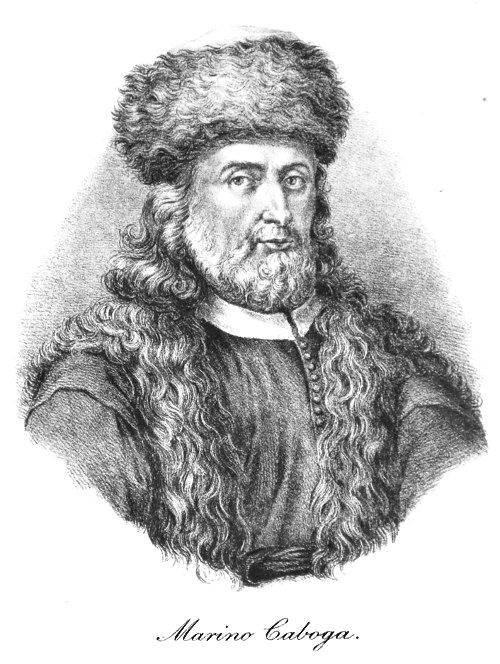
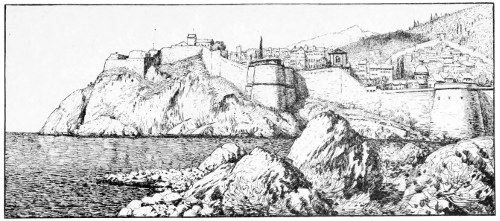
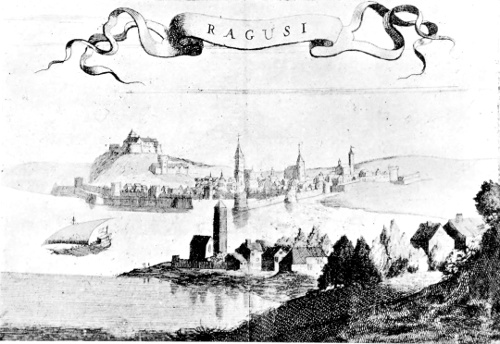
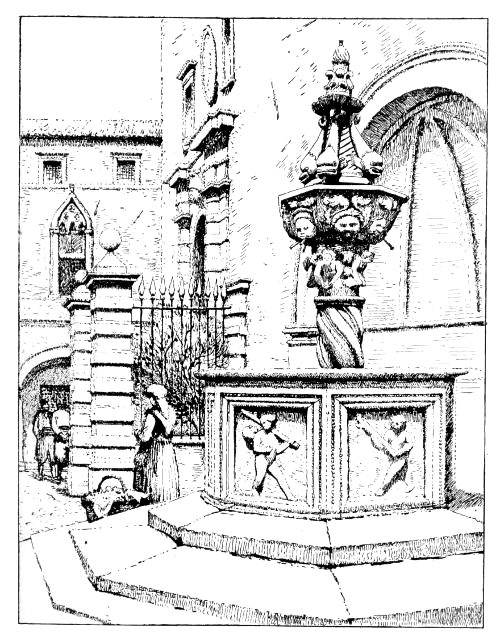
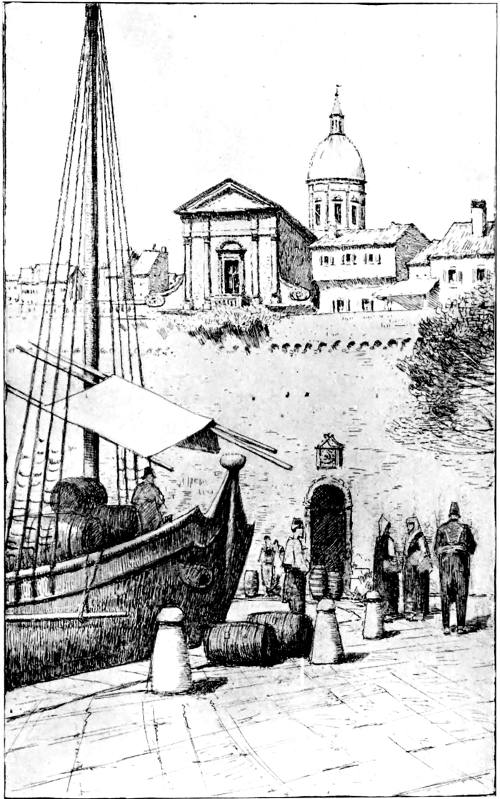
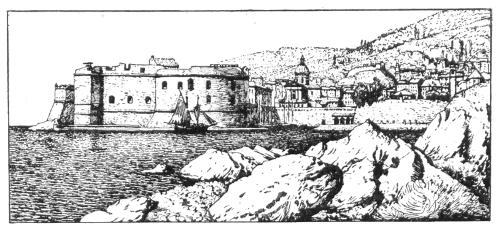
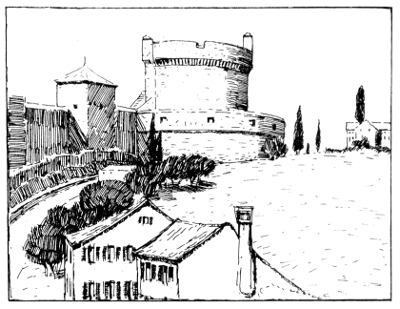
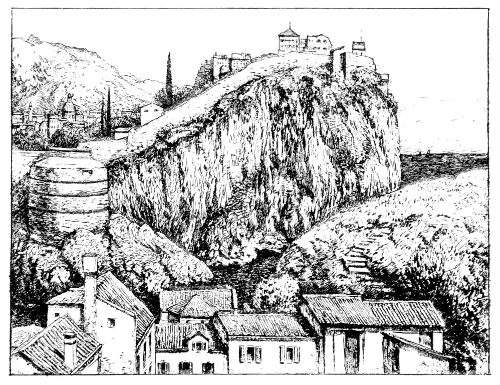

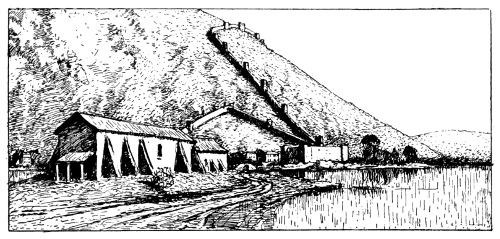
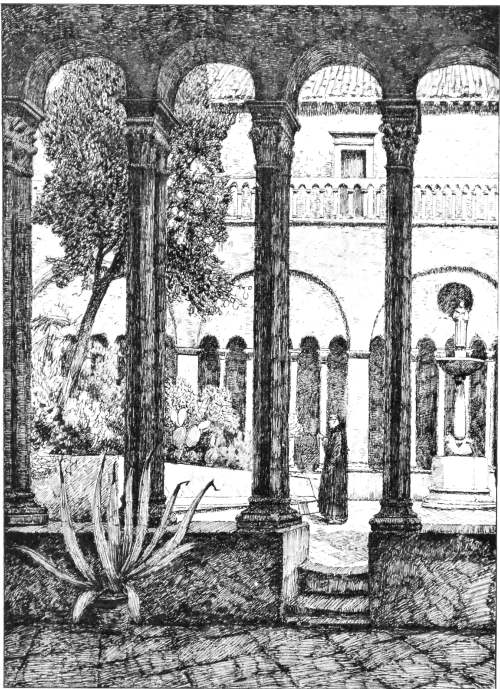
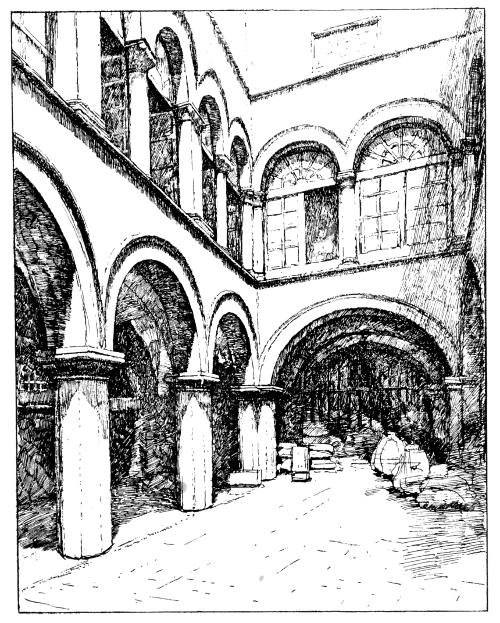
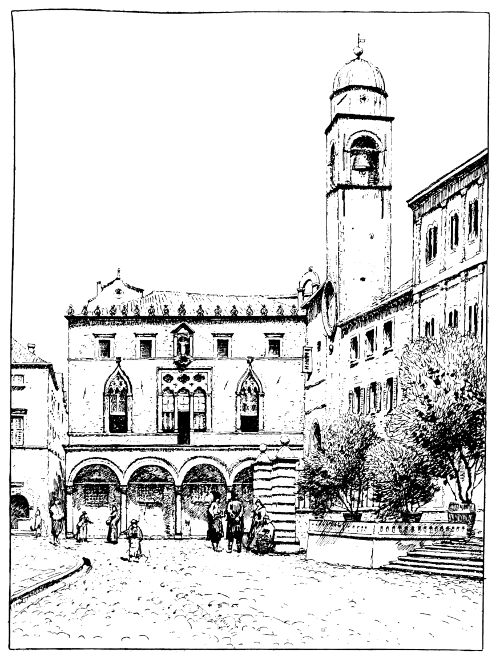
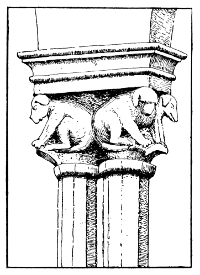
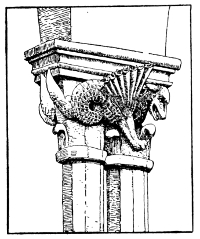
 , found on so many houses in Ragusa, to commemorate
the earthquake of that year. The façade has
a portico of five handsome round arches in the Renaissance
style, the columns of which are adorned with
elaborate capitals; many of these have been renewed.
Above is a row of windows in the purest Venetian style
of the fifteenth century. The central window is a three-light
aperture, the two side ones are of a single light.
The windows of the third story are square like those
looking on the courtyard. In the centre is a niche with
a statue of St. Blaize, while the row of pinnacles on the
roof call to mind many a Venetian palazzo. In spite of
all incongruities the Sponza is a very attractive building,
full of quaint grace and good work.