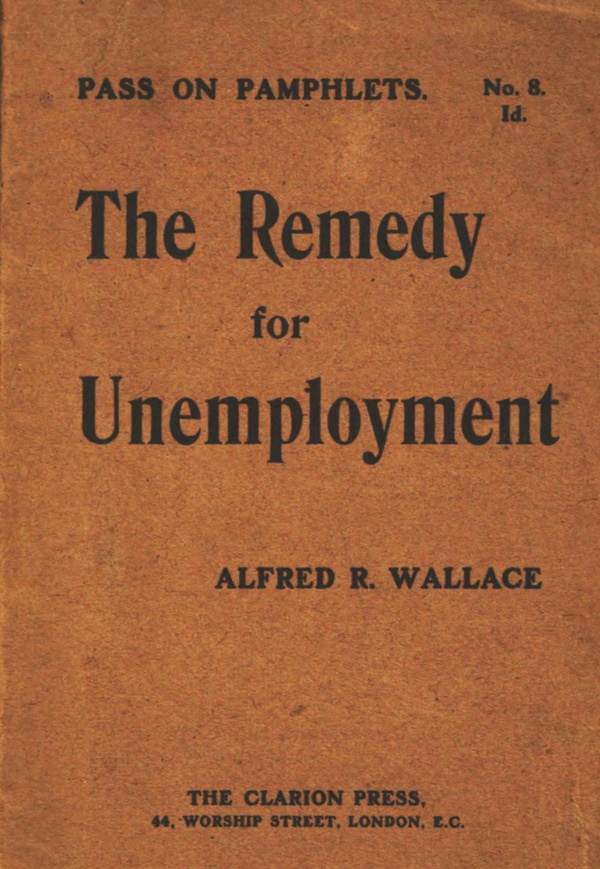
BY DR. ALFRED R. WALLACE.
The reason why I wrote the present pamphlet (which
first appeared in the “Socialist Review,” and is now
reprinted in a slightly modified form) was that,
although there is a small body of avowed Socialists
in Parliament, not one of them has, so far as I am
aware, upheld any of the fundamental principles of
Socialism as a means of dealing with the greatest of
present-day problems—that of chronic unemployment
and starvation all over our land. Let me
illustrate what I mean by a few examples. Perhaps
the most fundamental and universally admitted
axiom of Socialism is that all production should
be, primarily, for use and not for profit; and the
next in importance is that the true or proper wages
of labour is the whole product of that labour.
But neither in Parliament nor out of it has a
single voice been raised to show that these principles
must be adopted in any permanent solution of the
problem, or to explain how they can be applied far
more easily and economically than any of the suggested
alleviations. All the talk has hitherto been
of securing trade union rates of wages for out-of-works
of every kind; and the underlying idea has
always been that of the non-Socialist worker—that
the Government provision of work must not be
looked upon as permanent, but only as enabling the
worker to live till the capitalist employer again
requires him.
An equally non-Socialist view was put forth by
one of the most respected Socialists in Parliament
when he advocated the immediate construction of
light railways all over the country in order that
when labour was brought back to the land the products
could be carried economically to market, implying
that the “products” were to be sold, thus
competing in the market with those of other producers,
lowering prices, and altogether ignoring the
great Socialist principle of “production for use.”
In the discussion of this question it has been totally
overlooked that by a proper organisation of the
labour of the permanently or temporarily unemployed,
as well as of all those whose employment
does not supply them with the means of a thoroughly
sufficient and healthy existence, all the necessaries
and comforts of life can be produced in our own
country, just as they were produced down to a few
centuries ago. I will now proceed to the exposition
of the whole subject.
In order that those who have not read the Labour
Party’s Unemployed Workmen Bill may understand
why it could not have succeeded, a short statement
of its essential provisions may here be given.
The first clause provides that the “Local Unemployment
Authority” under this Bill shall be the
council of every borough or district of over 20,000
inhabitants, and for the rest of the county the
“County Council.” Clause 3 declares that “it shall
be the duty of the Local Unemployment Authority
to provide work for him” (any workman registered
as unemployed) in connection with one or other of
the “schemes” hereinafter provided, “or otherwise,”
or failing the provision of work, “to provide maintenance,
should necessity exist, for that person and
for those depending on that person.”
This is the essential part of the clause, with a
condition that the wages are to be “not lower than
those that are standard to the work in the locality.”
Then there is to be a Central Unemployment Committee
to “frame schemes,” and generally look after
the Local Unemployment Committees, which are to
be established by every local authority, and are also
to “frame schemes”; and the “schemes” of the
four or five hundred local authorities are all to be
submitted to the Local Government Board for revisal
or approval. Nowhere is any guide given to
the essential principles which should underlie these
hundreds of schemes, and we can easily imagine
the delay, the confusion, the cost, and the almost
certain failure of “schemes” initiated in so haphazard
a manner.
The whole conception of the Bill is, in my opinion,
wrong. Unemployment is not a local phenomenal,
but national, and even world-wide. It is a symptom
of disease in our existing civilisation, and must be
treated, if with any chance of success, on broad
national lines, and with national resources. Even
the one definite suggestion in the Bill—that
“schemes of national utility” might be undertaken
to employ the out-of-works—however good in itself,
was here altogether out of place. For such schemes—afforestation,
reclamation of foreshores, drainage
works, roads, etc.—are all either not reproductive at
all, or not for many years, in the meantime increasing
taxation, and thus perhaps producing further
unemployment; while they could only employ
a mere fraction of those in distress (none of the
women) and, when completed, would leave the problem
exactly where it was when they were started.
The discussion in Parliament showed a clear recognition
of the fact that it is quite impossible to
remedy such chronic and widespread unemployment
as exists now by finding work for the half-starved
population in the hundreds of different occupations
at which they have been engaged; but, strange to
say, no one seemed to be aware that it is by no means
impossible—that it is, in fact, comparatively easy—to
enable these same people to produce for themselves
the primary necessaries of life which are their
immediate and permanent need. What is required
is to organise and combine the whole of the unemployed
into local groups, each group or community
being primarily made up of a due proportion of
workers who have been engaged in the production
of some of these necessaries, and who will form a
nucleus for the training of others for similar work.
These various occupations are comparatively primitive,
and there is every reason to believe that they
will be found among the unemployed in about the
same proportions as in the whole population. The
thorough organisation and careful supervision
needed cannot, however, be left to the random, and
often antagonistic, opinions of hundreds of local
authorities, but must be undertaken by the Central
Government itself, and that only when the guiding
principles and the practical procedure have been
carefully thought out, clearly defined, and fully discussed
in Parliament, before being embodied in law.
It is pre-eminently a work to be devised and carried
out by the Executive Government itself.
I will now endeavour to show in some detail how
this can be done, what will be its results, and what
are the various facts and arguments which render its
success a certainty if it is fully and honestly
carried out.
The recent discussion of the problem of unemployment,
both in Parliament and in the Press,
affords a remarkable proof of how difficult it is to
enforce attention to new methods of dealing with
great social problems, if such proposals are made
a little before their time. Thus only can it be explained
that not one Liberal, Labour, or Socialist
Member of Parliament seems to be aware that a
thorough and carefully-worked out scheme for
dealing with the unemployed problem was published
about twenty years ago, was re-issued a year or two
later in a cheap edition by a well-known London
publisher, was widely read and greatly admired,
and—as was to be expected at that time—was very
soon forgotten. I feel sure that this book must be
in many public and private libraries, especially
those of Liberal or Radical Clubs, but neither by
Members of Parliament nor by any writers in the
reviews have I once seen it referred to. Yet its title
alone should have caused it to be read at this time,
since it so fully and clearly states the problem
which has received so much attention, but no solution,
during the last few years. It is as follows:
Poverty and the State, or Work for the Unemployed;
An Inquiry into the Causes and Extent of
Enforced Idleness, together with a Statement of a
Remedy Practicable Here and Now. By Herbert V.
Mills. London. Kegan, Paul, Trench, and Co.
Price one shilling. 1889.
Now, this book is pre-eminently a practical one,
and the bold claim in its title is fully justified by
its contents. Mr. Mills was a Poor Law Guardian
in Liverpool for many years, where there were
nearly three thousand inmates of the workhouse.
He thus had unusual opportunities of becoming
acquainted with the poor, and of studying the
various problems of pauperism, such as unemployment,
food-supply, the various occupations of
paupers, and other matters. He further obtained
information and advice from experts in agriculture,
and in the various trades and occupations of the men
who came under his notice, and has thus been able
to give us detailed estimates and calculations of the
greatest value in formulating practical methods of
utilising the labour of the unemployed to the
greatest advantage, for their own benefit. He also
visited and carefully inquired into the detailed
working of the various Dutch Beggar and Labour
Colonies, and obtained from them valuable information
as to the methods that tend to success, as well
as of those that either diminish the success or lead
to failure.
Having myself encountered many disappointments
in books, claiming to expound new and
important ideas both in physical and economic
science, I was fully prepared for another failure here.
But I quickly found that this was really what it
claimed to be, and I at once did all I could to call
public attention to it, first in one of my annual
addresses to the Land Nationalisation Society (in
1892), and much more fully in a chapter I wrote for
Edward Carpenter’s Forecasts of the Coming Century,
published in 1897. This chapter I republished,
with some important additional facts and
arguments, in 1900, in my Studies, Scientific and
Social; yet all appears to have been in vain. If
the authors of the “Unemployed Workmen Bill”
had drawn it so as to follow closely Mr. Mills’
scheme, and had fully explained this scheme in their
speeches by means of the facts, illustrations, and
methods so well and concisely given in his book, I
feel sure that the result of the debate would have
been very different, and that not only Socialists, but
the whole body of Labour Members, a large
majority of Liberals, and even many Conservatives,
would have voted in its favour; in which case the
Government would have been obliged either to adopt
it, or to bring in a Bill of their own on similar lines.
The chief reason why Mr. Mills’ scheme, if embodied
in a Bill, should, and I think would, receive
the support of a large majority in the present House
of Commons is, that it utilises and combines in an
admirable manner the most important, and at the
same time the least disputable, methods of both
Socialism and Individualism. To illustrate this I
will give a few condensed extracts from his
summary of the main features of his proposals, with
some remarks of my own.
(1) In each county or union, tracts of land from
2,000 acres upwards shall be purchased or taken
over by the State or Local Authority, and be prepared
with suitable houses, buildings, tools,
machines, etc., for the accommodation of about
4,000 or 5,000 occupants, men, women, and
children; with skilled foremen and organisers to
carry out the various operations of agriculture, and
the trades and manufactures required to produce
food, clothing, and other necessaries for the inhabitants.
(2) It is shown, by the facts and calculations of
experts, that the labour of a properly assorted population,
for four hours daily, will, when in full
working order (say after a year), produce all the
necessaries of life in abundance. One hour more is
added for the costs of skilled supervision and
another hour for the maintenance and schooling of
the children, and for the support of the aged and
the sick as they arise.
(3) In order to effect this the ordinary methods
and rules of the best kinds of industrial work must
be adopted; but, after working hours, all will be as
completely free from control by the various industrial
officials as the people of any prosperous and
well-ordered town or village.
(4) That the director of each of the Co-operative
estates shall encourage the workers to make their
homes and work-places as healthful, convenient, and
beautiful as possible, giving them advice as to how
this can best be done, and assistance in doing it.
(5) That for work done co-operatively no money
wages shall be paid, the equivalent of such work
being the whole net produce of the labour. This
will be—the provision of comfortable homes,
abundance of good food and fuel, with a good
supply of clothing, the latter being chosen by each
person from a variety of suitable material and
design kept in the stores. In addition to this, the
children would all receive the best education, and
as they grew up would each be trained in accordance
with their faculties or tastes, in two or three useful
occupations.
At least four-fifths of all the work on the estate
shall be done for home consumption, not for sale.
(6) Every worker will be enabled to employ his
spare time for his own use or profit, so as to obtain
any luxuries or pleasures he might desire. Some
would have land on which to raise choice fruits or
vegetables for sale; others a workshop; the young
women might do dressmaking, or open shops for the
supply of small luxuries not produced co-operatively.
All they required would be supplied at
wholesale price, to be repaid by instalments out of
the profits.
On this subject Mr. Mills well remarks: “I can
easily imagine that for the sake of the retriever, the
pigeons, the tobacco, the poultry or rabbits, the
greenhouse, the bicycle, the piano, the library, the
concert, or the theatre, many morning and evening
industries would spring up quickly, without any
other stimulus from the director than that which
exists in every human heart. The acquisition of the
luxuries of life might well be left to the ingenuity
and activity of private enterprise.”
I would myself further suggest that the rules
and restrictions on these estates should be as few
as possible, and only such as are absolutely essential
for the comfort and well-being of all. Especially
should all healthful amusements and social enjoyments
be provided for; while such serious offences as
repeated drunkenness, immorality, or violence
should be punished by absolute dismissal or expulsion.
It should be made quite clear from the first that
these estates or colonies are established for the
provision of permanent and enjoyable homes for all
who desired to take advantage of them, not as mere
temporary shelters in times of depression. There
would, of course, be no compulsion to remain, but
anyone who was dissatisfied with his surroundings
and left could not again be admitted.
Another point of importance is, that the organisation
of the whole community under an official
director, whose rule must necessarily at first be
despotic, is not intended to be permanent. When
the colony became thoroughly self-supporting, and
its inhabitants fully appreciated the benefits they
enjoyed under the co-operative system, and had
been gradually trained in the principles and
methods essential to success, the organisation would
be steadily modified in the direction of a self-governing
community.
With this end in view, the Director, as well as
the several heads of departments of industry,
would, after the first year, each choose a few of the
more intelligent and industrious workers to form
small Consultative Committees. With these he
would hold informal weekly meetings, to talk over
the special affairs of their departments, and consider
whether any improvements in organisation were
advisable, either in the interests of the workers
themselves or of the whole community who consumed
or utilised the products of the work. Later
on these committees might be added to by the introduction
of workers chosen to represent the rest;
or, perhaps better still, by the admission of those
who had been longest in the community, and were
therefore best acquainted with the needs and wishes
of all its members. These would automatically
become members after a certain period of work, the
older retiring as the younger entered, and would
ultimately constitute the whole committee. Suggestion-books
should also be kept in the public rooms,
in which every member, without exception, could, if
he wished, make proposals or suggestions on any
matter affecting the well-being of the whole community,
or any section of it. These books would
be examined by the committees and by the Director,
who would decide upon their merits. Public meetings
would also be held monthly or quarterly, at
which the decision as to each of the suggestions
would be announced, and the reasons why some
were adopted and others rejected explained, while
occasionally a suggestion would be given a trial and
afterwards the opinion of a general meeting taken
upon its adoption.
This plan was, I believe, first tried at Ralahine
(in 1832) by Mr. E. T. Craig, and it has since been
adopted by a few great industrial concerns with
excellent results. It is found that useful suggestions
are made by quite ordinary workmen, and
even by boys, affecting both the convenience of the
workmen and economy of production. But more
important is its educational and moral value, which
would be especially great in a co-operative association,
by giving to every worker a definite status, and
making him feel that he is not only a labourer in a
great organisation, but that he is allowed to express
his own views as to what is essential for the
good of all. This feeling, and the careful attention
given to all suggestions, tends to give confidence in
the management, and ensures willing and thoughtful
attention to duty.
But here some of my readers will no doubt object,
how can it be shown that such estates or colonies
could and would produce all the necessaries of life
with such a comparatively small amount of labour?
We know what John Burns told us of the enormous
cost of the Labour Colonies at Hollesley Bay and
Laindon; why should not these be equal failures?
The answer is simple. The colonies now being
tried, as well as that of General Booth in Essex,
are a kind of rural workhouses, with no idea of
permanency, no home life, no freedom of action, no
prospect of a future. Neither is there any effective
grouping of workers, no sufficient variety of occupations,
no attempt at the production of all the
necessaries of life by those who consume them.
There is also, apparently, a large sale of produce in
competition with outside workers, wholly different
from the system of production for use which is the
very basis of Mr. Mills’ scheme.
The scope of this scheme and its far-reaching and
permanent effects on unemployment are totally
unlike those of our present costly and temporary
Labour Colonies. It would at once absorb the unemployed
workers in scores of different trades and
occupations, all being employed in supplying
directly the wants of the community of which each
formed a part. The wheat grown for food would
employ millers, machinists, sack-makers, bakers,
etc.; the sheep and cattle, supplying meat, milk,
butter and cheese for all, would also by the intervention
of tanners, curriers, saddlers, shoemakers,
etc., supply all the leather goods; while the dairy
outfit would require the work of tinmen and other
skilled mechanics for the pans, pails, churns,
presses, etc. The bones and horns might be used to
make handles of domestic cutlery and for old-fashioned
but useful lanthorns; perhaps combs and
brushes might also be made, while the refuse fat
would be made into soap for the use of the community.
Wherever suitable clay occurred bricks
and tiles would be made, as well as drain pipes and
coarse pottery for various domestic uses. Even unlimited
sugar for a population of 5,000 might be
produced from home-grown beet-root with suitable
pressing, boiling, and refining machinery. The
wool of the sheep would be cleaned, spun, and
woven into all the chief forms of clothing and
household articles required; while flax grown, prepared,
spun, and woven at home would supply
the needful underclothing and linen of various
kinds.
Artificers in wood and iron would be occupied in
the supply and repair of carts, waggons, ploughs,
and the simpler agricultural machines; while water
or wind mills (or both) would give the power for
the various kinds of machinery, for electric light
and power-transmission, and probably also for
warming and cooking purposes.
All these various industries would require a
considerable engineering plant, and a body of
trained workers, while a staff of joiners, cabinet-makers,
plumbers, painters, and paper-makers, and
in smaller numbers, compositors, printers, and book-binders,
with store-keepers, clerks, and porters,
would find constant or occasional work; and there
would be comparatively few workers of any kind
who would not be able to learn some one or other of
these occupations, even if their own special skill
in some less familiar industry was not called for.
And besides all these, a considerable body of
labourers would be wanted; and all adults as well
as the older children would at times of pressure be
called to assist in some of the varied forms of simple
farm and garden work, such as hay-making, fruit-gathering,
and harvesting.
An immense advantage of such an organised
co-operative community (and one that can hardly
be over-estimated) is the comparative certainty of
returns and independence of adverse seasons that
would thus be introduced into agriculture. Much
of our hay is now deteriorated by cutting being
delayed beyond the period of maximum nutriment,
or damaged by not being dried and stacked at
the earliest possible opportunity. But with a large
and interested population close at hand, ready and
willing to assist at an hour’s notice, and with the
best machinery and appliances always ready, a single
fine day in an otherwise adverse season might enable
a hay or corn crop to be secured in good condition
which, without this assistance, would be irretrievably
ruined. And when everyone would be thus helping
to save his own crops—the very “daily bread” that
he himself and his family would enjoy during the
coming year, the work, however hard, would become
a pleasure, and every hour of the long summer’s
day (or even of the night as well) would be utilised
by relays of workers. We can well imagine with
what determination and energy the work would be
carried on, and with what enthusiasm and rejoicing
would the holiday succeeding such an effort—a true
“harvest-home”—be partaken of by all.
Another point may here be usefully dwelt on.
Though at the first starting of such colonies it may
be advisable to have large common dwellings and
meals, it should at an early period be possible for
all who wished it to have cottages or houses of their
own; and these should first be provided for married
couples and their families. These could, however,
continue to take their meals (or any meal) at the
common table, or in lieu of these could draw rations
of food from the stores and cook for themselves.
Home-life, so dear to many of us, would thus be
rendered possible for all who wished it, while still
retaining the economies and securities of co-operative
work.
Yet further, keeping in view the one object of
the establishment of these co-operative villages—that
of enabling the unemployed to work profitably
for themselves; if after a few years’ residence any
of the workers wished to have the opportunity of
trying an independent life on the land, he should
not only be permitted to do so, but should be helped
to obtain land for a small holding in the immediate
vicinity, and, if his record in the colony justified it,
have implements and stock provided for him, to be
repaid by easy instalments. Thus might be exhibited,
side by side, the comparison of men with
similar training adopting the methods of co-operation
and individualism; and the results, in the
degree of comfort and contentment attained by
each as years went on, would be exceedingly
instructive.
With regard to the chances (or, as I maintain, the
certainty) of the economic and moral success of
colonies or villages organised with the one end of
enabling people to provide by their own labour all
the essentials of a secure, a happy, and a contented
life, it may be well to adduce a few illustrative
facts and results.
Between the years 1870 and 1880, workshops and
a garden of fourteen acres were started at the Newcastle-on-Tyne
Workhouse on which to employ the
ordinary able-bodied inmates. In a very short time
all the vegetables required for the whole of the
paupers was easily grown, with a considerable
surplus which was disposed of to local shopkeepers;
and at the end of three years this land is stated to
have produced a profit of £339 annually. In
almost every department of work more goods were
produced than the house required, so that a reserve
of a two years’ supply of boots and shoes was
accumulated, while the whole of the inside fittings
of new wings to the workhouse were executed by the
inmates.[A]
At Ralahine, in Ireland, eighty-one men, women,
and children, all ordinary labourers of the lowest
class, and with a very bad reputation in the district,
farmed 618 acres of land, including bog and waste,
under a committee chosen by themselves (Mr. Craig,
who kept the accounts and supervised the household,
being ignorant of agriculture), and they not only
paid the very high rent of £900 a year (in produce
estimated at market prices), but in the course of
three years brought waste land into cultivation,
purchased a reaping-machine, and at the same time
increased their capital and lived well and contentedly.
Then, the owner, having gambled away
his property, suddenly disappeared, while the
tenants were evicted and all their property confiscated
by the Irish Court of Chancery!
At the Dutch colony of Frederiksoord, a miscellaneous
body of “unemployed” have, under wise
administration, converted an absolutely barren waste
of moorland into what Mr. Mills terms “a paradise
in the midst of a wilderness.” Here a large number
of “free farmers” have been trained, who now
support themselves in comfort and independence,
while another body of labourers carry on the ordinary
work of the estate (which must be
largely educational and unproductive), and yet so
nearly support themselves that the Director informed
Mr. Mills that he did not use agricultural machinery
because it would make it difficult to find work for
all, and they would then be less easily managed.
Mr. Edward Atkinson, the great American
statistician and advocate of capitalism, has given
striking estimates of the productiveness of labour
when aided by modern machinery. Two men’s
labour for a year in wheat-growing and milling will
produce 1,000 barrels of flour, barrels included,
which will give bread enough for 1,000 persons. But
as we grow more bushels of wheat per acre than is
grown in the American wheat fields, we could certainly
produce our bread on the spot quite as
cheaply, if not much cheaper. Again, he tells us
that one man’s labour produces woollen goods for
300 people, or boots and shoes for 1,000. Now,
as far as productiveness goes, spinning, knitting,
weaving, or shoe-making machines suitable for the
employment of a dozen or twenty men or women
could, in our co-operative colony, be worked quite
as economically as in a great factory where 1,000
hands are employed—perhaps even more so, because
no overseeing would be required, and all would be
close to their work; while as the hours would be
shorter and would alternate with outdoor or household
work, the workers would be healthier and
their labour more effective.
Again, as every inmate of such a colony would be
trained in at least two distinct occupations, one involving
mostly outdoor work, a large proportion of
these textile fabrics would be made during wet days
and long winter evenings, and would thus utilise
time that is now often wasted.
Another great economy in such a colony is, that
the whole of the middlemen’s and retailer’s profits
would be saved, as well as the cost of the various
forms of advertising, including commercial
travellers and the high rents of retail shops in good
situations, and that of railway freights, cartage,
and other costs of world-wide or cross-country distribution.
The result of all these needless expenses
is shown by the well-known fact that, on the
average, goods of every kind in common use are
produced for about half what they are sold for by
the retailer; and to this great loss must be added,
in the case of the individual producer for sale, the
loss of time expended in selling and buying, and
the frequent difficulty of finding a purchaser except
at a ruinously low price. It is these numerous
economics at every step of the process that justify
Mr. Mills’ careful estimate of six hours’ daily work
being ample to supply all the necessaries of life for
a well-organised co-operative population, including
the children, the sick, and the aged; while a small
farmer works usually ten or twelve hours to secure
the same result, and can only succeed in doing so
under somewhat favourable conditions, and with
much greater risk of failure.
One other point remains to be considered. What
would be the initial cost of such colonies as are here
suggested, up to the time at which they became self-supporting?
Here, too, Mr. Mills has given us the
answer. By a careful estimate, founded on ascertained
facts, he shows that the total cost, both of the
land and of the stock, buildings, and other
appliances, together with a half-year’s food, would
only equal the amount of two years’ total expenditure
for the same number of paupers. The result of
this outlay would be that after two or three years the
necessity for poor-rates would cease. It would
therefore be an enormous saving, even if each union
or county purchased the land and stocked it as
part of its Poor Law expenditure, and this would
be the case even if Mr. Mills’ calculations are found
to be too favourable to the extent of even 50 per
cent. (which I consider wildly improbable). But I
believe that if the scheme was carried out under an
Act of Parliament and under the general supervision
of the Board of Agriculture, still greater
economies might be effected, especially in the matter
of land. For power should be given in the Act to
take any land required at a valuation based on the
net rental now obtained by the owner (or on the
valuation in the rate books), for which amount he
should receive Government Land Bonds. As soon
as the colonies became self-supporting, and had
absorbed most of the unemployed, so that pauperism
in the ordinary sense was abolished, the respective
local authorities would only have to pay the interest
and sinking fund on these bonds, which would be a
mere trifle as compared with existing poor rates, and
would itself disappear in the course of less than two
generations.
The farmers and labourers, as well as mechanics
or others, who might be living upon the land thus
taken over, would have the option of remaining upon
it in the capacities for which they were severally
fitted, as superintendents, foremen, or labourers; or
if they preferred to leave would receive a reasonable
“compensation for disturbance.”
There are always people who will not be satisfied
with any proposed remedy for a great evil unless it
deals with every possible phase and form of it, so
as to abolish it completely at once, and for ever.
Some of these will be sure to object that the worst
of the unemployed—the tramps and the men who
will not work under any conditions—will still
remain; and they will ask triumphantly: “How will
you bring these into your system? They
will flock into your colonies in winter to
enjoy the good living and do nothing to
earn it.” There are two replies to this
objection, which is really no valid objection at all.
In the first place, it was not for this class of men
that the “Unemployed Workmen Bill” was
brought into Parliament, or for whom legislation
has been promised by the Government. It was not
of these unfortunates that either Socialists or
Liberals drew such vivid pictures of undeserved
misery, but of the genuine workmen, the men or
women whose one object in life is to obtain work,
however hard, however it may injure their own
health or shorten their lives, in order that they may
save their families from starvation, or from the
deservedly hated workhouse. The whole of this
great and successful agitation has been in behalf of
those willing and anxious to work, but to whom
by our actual social organisation it is forbidden. It
was for them only that the “Right to Work” was
demanded—not the right to food while refusing to
work. It is a sufficient reply to the objectors,
therefore, that Mr. Mills’ proposal really solves the
problem as regards those very classes of workers for
whom the “Right to Work” clause was drawn.
But, secondly, it is certain that the system of
co-operative colonies here explained would, in the
course of a few years, absorb also the so-called unemployable,
who are in reality by no means
numerous, and have never yet been offered the kindly
assistance, the sympathetic treatment, the amount
of liberty and the congenial surroundings they
would find in these colonies. General Booth’s
experience at his Essex colony has shown that a considerable
proportion of these men are easily reclaimable,
and the system there is far less favourable and
less educational than it would be in our proposed
co-operative colonies.
Before concluding, I will briefly advert to a few
matters of high public importance, involving great
cost, much loss of time and energy, widespread
physical and moral deterioration, and terrible
sacrifice of life, which would all be ameliorated and
would ultimately disappear in proportion as these
co-operative colonies spread over the country.
First and foremost, the cost of Old Age Pensions,
which all admit to be absolutely necessary now,
would steadily diminish with increase of these
colonies, and ultimately become unnecessary. Next,
the terrible mortality of infants, due to our present
competitive manufacturing system, would rapidly
disappear when the health and comfort of mothers
were thoroughly safeguarded as a primary social
duty. What would be the result of such a natural,
simple, healthful, yet fully-occupied life as would
prevail in these colonies may be judged by the
condition of some of the German colonists in Central
Brazil. A young friend of mine is now living
among them. They subsist almost entirely on the
direct produce of their own labour; they have large
and healthy families, and his two nearest neighbours
have twelve and eight children respectively,
mostly grown up, without having lost a single child.
Then there is the enormous and ever-increasing
system of inspectorship of factories and workshops,
to guard against dangers of machinery, unhealthiness,
and overwork, all quite unnecessary, and which
would never even be thought of where there was no
one to profit by such enormities.
Lastly, there is the curse of adulteration, ever
increasing, pervading all commercial products,
clothing, food, and even drugs, injurious alike to
the health and the morality of the nation, and
which inspectors and penalties have hardly any
effect upon. All this would absolutely disappear
when everything now adulterated would be produced
in these colonies for home consumption, and not
for the profit of capitalists; and this fact would
certainly re-act upon the private manufacturers.
The safety and healthiness of all the co-operative
shops would soon compel private capitalists to
improve the conditions of their factories under the
penalty of not being able to obtain men or women
to work for them.
A collateral but highly beneficial result of the
system here advocated is, that just as it extended
and flourished, it would, by absorbing all surplus
labour, raise the standard of wages over the whole
country, and of itself produce that “minimum
wage” that we may decree by law, but which, so
long as our present system persists unchecked, we
can certainly never enforce. The generally higher
wages thus caused will almost all be spent on home-made
products, and thus more than compensate for
any diminution of foreign trade that may occur:
for it must always be remembered that foreign trade
is mainly carried on for the profit of the capitalist
or to supply luxuries for the wealthy, and is little
needed when all workers are enabled to produce the
necessaries of life, co-operatively, for themselves.
Yet another important economy not yet referred
to arises from the essential nature of a co-operative
community producing everything for their own consumption,
and therefore absolutely free from the
faintest suspicion of adulteration. We have seen
that Mr. Mills estimated that not more than one-fifth
of the total produce would have to be sold in order
to purchase articles or materials which the colonists
could not produce themselves. Each colony would
decide, or rather would find by experience, which
articles it would thus produce in larger amounts than
it needed—one might sell butter, cheese, and
perhaps cream; another woollen fabrics; another
shoes, etc., or some combination of these. But it
would soon become known that everything made at
the colony was genuine. The butter would not be
margarine; the cloths and flannels would be wool
throughout, the boot-soles would not be of brown
paper; and the matches, the china-glazes and the
paints would all be made of non-poisonous materials.
The certainty that this would be so—everything
being made primarily for use and not for profit—would
ensure a large and constant demand for
everything the colonists had to sell. They would
thus be saved all the costs of advertising or of
taking their goods to market; as was found to be
the case with the best of the Communistic Societies
in the United States, whose garden and farm
seeds, dried and preserved fruits, tubs, washing
machines, traps, and chairs, are still widely known
and sought after for their purity and good workmanship.
All the goods which the colony had for sale
would thus bring the highest market prices with
the minimum expenditure of time and labour; so
that one fatal circumstance that caused the failure
of so many attempts at co-operative workshops—the
difficulty or impossibility of selling the produce—would
never arise.
The result of this brief, but I believe accurate,
examination of the capitalistic and the co-operative
systems in their essential conditions and proved
results, is to show that the former is inherently
wasteful to an enormous degree, and so productive
of physical and moral evil as to be incompatible
with a true civilisation. In every part of the world
it is alike productive of poverty, degradation, and
crime for large numbers of the workers, and the
latter perhaps in an equal proportion (though in
different ways) for the capitalist employers also.
Such a system stands condemned at the bar of
reason, justice, and common sense.
I think I have now shown that the way to solve
this great “Problem of the Unemployed” was
clearly pointed out nearly twenty years ago, with
precision, fulness of detail, and sufficient basis of
fact and experience. But the time had not then
come. The few read and appreciated the book, but
it was generally ignored, with the usual cry of
“Utopian”! Now, however, the hour has arrived,
and here is the Man whose long-neglected book
shows us clearly the lines on which alone we can
successfully overcome the difficulty.
But a proviso has here to be made, which is of
the most vital importance and which must always
be kept in view. Even if the scheme here advocated
is carried out to the letter, so far as its methods are
concerned, complete success will only be attained
if its organisers are imbued throughout with the
human, the philanthropic, the brotherly spirit of
the propounder. This will depend almost wholly on
the choice of men for directors of the several co-operative
colonies. If the head is chosen for his
supposed power of managing and governing large
bodies of men, in the way our governors of prisons
and masters of workhouses have been chosen; and
if he enters on his duties with the one idea of compelling
all to work alike, from the very first, and
with that end draws up an elaborate system of rules,
with fines and punishments to be rigidly enforced
in the various departments of industry, then failure
will be inevitable. Neither is the successful
manager of a great factory or large estate more
likely to succeed if he is a man who looks upon
workers as mere “hands”—as parts of a great productive
machine, each to be kept in his proper place,
and to have no will of his own.
Our object should be to train up self-supporting,
self-respecting, and self-governing men and women;
and we should aim at doing this by developing the
conceptions of solidarity and brotherhood—that
good and honest work is expected from each because
he benefits equally with every other worker
in the joint result, and that it is therefore his plain
duty to do his full share in producing that result.
The type of men to be sought after are such as Mr.
Craig, who, though a suspected stranger and supposed
emissary of the landlords, yet gained the
affection of a body of wild Irish labourers, and in a
year of sympathetic guidance so changed their lives
that, in their own words: “Ralahine used to be a
hell; now it is a little heaven;” and Robert Owen,
the self-educated Welshman, who in less than
twenty years changed a population of over 500 persons,
all Scotch mill-workers—who were living in
chronic destitution and debt, and in habits of
almost continuous drunkenness, dirt, and vice—into
a cleanly, well-to-do, contented, and grateful community.
The methods by which these men produced such
results should be studied by everyone who would
undertake the directorship of one of the proposed
co-operative colonies. For those who talk so confidently
about human nature being not good enough
for any such co-operative life as is here suggested,
I would adduce Owen’s work at New Lanark as an
unanswerable reply. I know of no more wonderful
example in history, of the results to be obtained by
appealing to men’s higher feelings rather than to the
lower and baser, than Owen’s account, in his story
of his own life, of how he stopped almost universal
thieving, drunkenness, neglect, and other faults in
his great body of workers, by means of his invention
of the “silent monitor”—a little record on four
sides of a tally, of each worker’s conduct the day
before, as indicated by four colours—black, red,
yellow, and white, one of which only was displayed.
These tallies were attached to each
worker’s place every morning, so that as Owen
walked through the work-rooms he could see them
both collectively and separately. At first the
majority were black, while white was rare. But
gradually the colours changed, and in a few years
yellow and white prevailed. During all this time
there were no punishments, either by fine or in any
other way, neither did Owen ever scold a man, or
even speak harshly to him. He merely, when the
colour was black, looked at the man in sorrow; and
he tells us, how after a time he could tell a man’s
conduct by his very attitude as he passed him, without
looking at the tally.
It may be said, we have no such men now; but I
think that is a mistake. Mr. Mills himself would
probably be one of the first appointed; while a post
as responsible director of 5,000 workers would be
congenial to many of our broad-minded clergy, to the
more educated among the officials of the Salvation
Army, and to such sympathetic writers about the
poor as Mr. Whiteing, Mr. Zangwill, and many
others. It should be considered a position of high
rank and importance, equal, say, to that of a judge
or a bishop, and none should be appointed who are
not in perfect sympathy with the avowed objects of
the “colonies,” and determined to do all in his
power to make the experiment a success. The
salary should not be high; in fact, the lower the
better, in some respects. The office would almost
certainly attract the best men, since it would enable
them to initiate and develop one of the greatest
social reforms ever undertaken in a civilised
country. They should, of course, have practically
a free hand, and be judged only by results. They
must have complete power to change the heads of
departments, if they found them difficult to work
with, or of characters unsuited to the task of rendering
the labour of the community at once efficient
and attractive to the workers.
There would, I believe, very soon arise a healthy
rivalry between different colonies, in which every
individual, from the Director to the youngest
worker, would bear his part, as to which shall
exhibit the best results in the various industries
carried on; in the cleanliness, comfort, and even
elegance of their domestic arrangements and general
surroundings; in their amusements and their
studies; and especially in the general contentment,
order, and happiness of the whole community.
To attain such a result would be a truer honour
to our country than all our past and prospective
victories, gained at the cost of untold misery to both
victors and vanquished, vast burdens of taxation,
rivers of blood and tears. To attain such a beneficent
result seems now actually within our reach;
and my chief hope is that I may live to see it
inaugurated, and that all parties and classes alike
shall for once forget their prejudices and antagonisms,
and work together for the success of some such
scheme as is here laid before them.
It is after a considerable acquaintance with the
literature of this subject, from the time of the grand
pioneer, Robert Owen, down to the present day,
that I have arrived at the most absolute conviction
that Mr. Mills has pointed out to us the one true
road to success, and that any considerable divergence
from it will lead to failure. I therefore
most earnestly call upon all social reformers, and
especially all members of Parliament, whose duty it
will be to legislate upon the subject, to make a careful
study of his small volume—but really great
and illuminating work—to read it carefully
throughout; to study it in all its parts; to imbue
themselves with its spirit as well as with its facts, its
principles, and its arguments; to familiarise themselves
with the practical results of co-operative
undertakings so far as their opportunities permit;
and, by means of the knowledge they will have
gained from Mr. Mills, satisfy themselves as to the
essential causes of failure or success.
Above all these things, let them see that when
the time of legislation, and of giving practical
effect to the legislation arrives, the principle of the
whole scheme shall be, in Mr. Mills’ words: “That
within the bounds of the ‘Co-operative Estates’ we
shall endeavour to cultivate able and tender-hearted
men, and brave and independent women; and not
to accumulate wealth.”
The Utopia Press, Printers, Worship St., London, E.C.